
Pearson BTEC Level 1/ Level 2 First Diploma in Business Specification
|
|
|
- Brook Harrell
- 9 years ago
- Views:
Transcription
1

2

3 Pearson BTEC Level 1/ Level 2 First Diploma in Business Specification First teaching September 2013
4 Pearson Education Limited is one of the UK s largest awarding organisations, offering academic and vocational qualifications and testing to schools, colleges, employers and other places of learning, both in the UK and internationally. Qualifications offered include GCSE, AS and A Level, NVQ and our BTEC suite of vocational qualifications, ranging from Entry Level to BTEC Higher National Diplomas. Pearson Education Limited administers BTEC qualifications. Through initiatives such as onscreen marking and administration, Pearson is leading the way in using technology to modernise educational assessment, and to support teachers and learners. Key changes are sidelined. We will inform centres of any changes to this issue. The latest issue can be found on the Edexcel website: References to third-party material made in this specification are made in good faith. We do not endorse, approve or accept responsibility for the content of materials, which may be subject to change, or any opinions expressed therein. (Material may include textbooks, journals, magazines and other publications and websites.) ISBN All the material in this publication is copyright Pearson Education Limited 2013
5 Welcome to your BTEC First specification For more than 25 years, BTECs have earned their reputation as well-established, enduringly effective qualifications. They have a proven track record in improving motivation and achievement among young learners. Additionally, BTECs provide progression routes to the next stage of education or into employment. BTECs are evolving Informed by recent policy developments, including the Review of Vocational Education The Wolf Report (March 2011) and the Study Programmes for year olds consultation (June 2012), we have designed this new suite of BTEC Firsts to: ensure high quality and rigorous standards conform to quality criteria for qualifications used in programmes in schools and colleges be fit for purpose for learners, pre- or post-16, in schools and in colleges. We conducted in-depth, independent consultations with schools, colleges, higher education, employers, the Association of Colleges and other professional organisations. This new suite builds on the qualities such as a clear vocational context for learning and teacher-led assessment based on centre-devised assignments that you told us make BTECs so effective and engaging. This new suite introduces additional features to meet the needs of educators, employers and the external environment. They are fully aligned with requirements for progression to further study at level 3, into an apprenticeship or into the workplace. We believe these features will make BTECs even stronger and more highly valued. What are the key principles of the new suite of BTEC Firsts? To support young people to succeed and progress in their education, we have drawn on our consultations with you and embedded four key design principles into the new BTEC Firsts. 1 Standards: a common core and external assessment Each new Level 2 BTEC First qualification has an essential core of knowledge and applied skills. We have introduced external assessment appropriate to the sector. This provides independent evidence of learning and progression alongside the predominantly portfolio-based assessment. 2 Quality: a robust quality-assurance model Building on strong foundations, we have further developed our quality-assurance model to ensure robust support for learners, centres and assessors. We will make sure that: every BTEC learner s work is independently scrutinised through the external assessment process every BTEC assessor will take part in a sampling and quality review during the teaching cycle we visit each BTEC centre every year to review and support your quality processes. We believe this combination of rigour, dialogue and support will underpin the validity of the teacher-led assessment and the learner-centric approach that lie at the heart of BTEC learning.

6 3 Breadth and progression: a range of options building on the core; contextualised English and mathematics The essential core, developed in consultation with employers and educators, gives learners the opportunity to gain a broad understanding and knowledge of a vocational sector. The mandatory units assess knowledge, understanding and skills that are not covered within the core units but are essential to the curriculum area or vocational industry. These mandatory units ensure all learners receive a thorough grounding in the sector to support progression to their next stage in education or employment. The optional specialist units provide a closer focus on a vocational area, supporting progression into a more specialised level 3 vocational or academic course or into an apprenticeship. Opportunities to develop skills in English and mathematics are indicated in the units where appropriate. These give learners the opportunity to practise these essential skills in naturally occurring and meaningful contexts, where appropriate to the sector. The skills have been mapped against GCSE (including functional elements) English and mathematics subject content areas. 4 Recognising achievement: opportunity to achieve at level 1 The new BTEC Firsts will continue to provide for the needs of learners aiming to achieve a level 2 qualification. However, we have recognised that for some learners achieving this standard in all units within one to two years may not be possible. Therefore, the qualifications have been designed as level 1/level 2 qualifications with grades available at Level 2 and at Level 1 Pass. Improved specification and support In our consultation, we also asked about what kind of guidance you, as teachers and tutors, need. As a result, we have streamlined the specification itself to make the units easier to navigate, and provided enhanced support in the accompanying Delivery Guide. Thank you Finally, we would like to extend our thanks to everyone who provided support and feedback during the development of the new BTEC Firsts, particularly all of you who gave up many evenings of your own time to share your advice and experiences to shape these new qualifications. We hope you enjoy teaching the course.

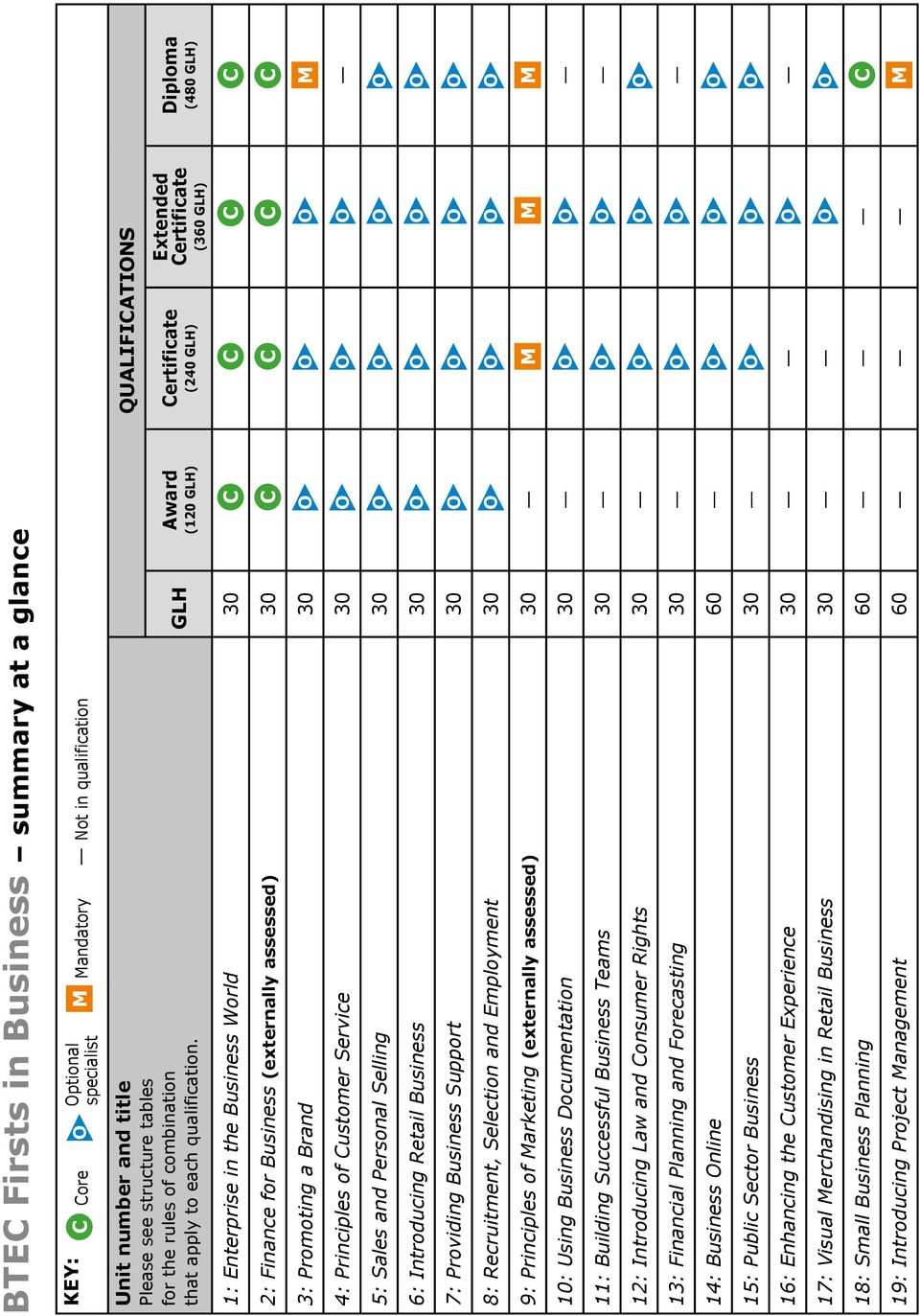
7 16: Enhancing the Customer Experience 30 O 18: Small Business Planning 60 19: Introducing Project Management 60 O O Diploma (480 GLH) O O O O O O O M O O O C M BTEC Firsts in Business summary at a glance KEY: C Optional Core O M Mandatory Not in qualification specialist Unit number and title Please see structure tables for the rules of combination that apply to each qualification. GLH Award (120 GLH) Qualifications Certificate (240 GLH) Extended Certificate (360 GLH) 1: Enterprise in the Business World 30 2: Finance for Business (externally assessed) 30 3: Promoting a Brand 30 C C C C C C C C O O O M 4: Principles of Customer Service 30 O O O 5: Sales and Personal Selling 30 O O 6: Introducing Retail Business 30 O O O O 7: Providing Business Support 30 O O 8: Recruitment, Selection and Employment 30 O O O O 9: Principles of Marketing (externally assessed) 30 M M 10: Using Business Documentation O O 30 O 11: Building Successful Business Teams 30 O 12: Introducing Law and Consumer Rights 30 O 13: Financial Planning and Forecasting 30 O O 14: Business Online 60 15: Public Sector Business 30 O O 17: Visual Merchandising in Retail Business 30
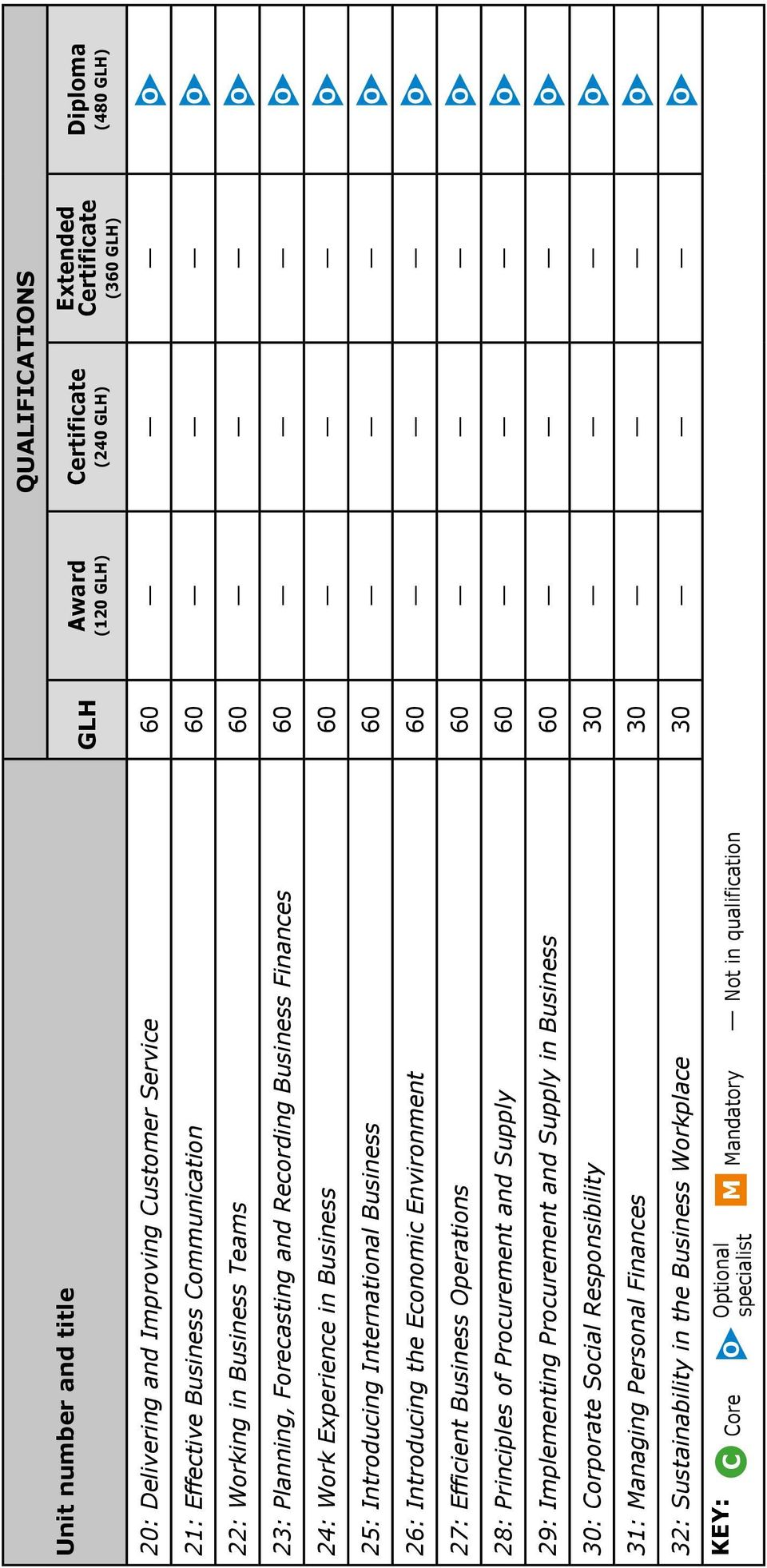
8 20: Delivering and Improving Customer Service 60 21: Effective Business Communication 60 22: Working in Business Teams 60 23: Planning, Forecasting and Recording Business Finances 60 24: Work Experience in Business 60 25: Introducing International Business 60 26: Introducing the Economic Environment 60 27: Efficient Business Operations 60 28: Principles of Procurement and Supply 60 29: Implementing Procurement and Supply in Business 60 30: Corporate Social Responsibility 30 31: Managing Personal Finances 30 32: Sustainability in the Business Workplace 30 Diploma (480 GLH) O O O O O O O O O O O O O Unit number and title GLH Award (120 GLH) Qualifications Certificate (240 GLH) Extended Certificate (360 GLH) KEY: C Optional Core O M Mandatory Not in qualification specialist
9 Contents Purpose of this specification 1 Qualification title and Qualification Number 2 1 What are BTEC Firsts? 3 2 Key features of the Pearson BTEC First Diploma 5 3 Pearson BTEC Level 1/Level 2 First Diploma in Business 9 Rationale for the Pearson BTEC Level 1/Level 2 First Diploma in Business 9 4 Qualification structure 14 Qualification structure of the Pearson BTEC Level 1/Level 2 First Diploma in Business 15 5 Programme delivery 17 Resources 17 Delivery approach 18 Personal, learning and thinking skills 18 English and mathematics knowledge and skills 18 Functional Skills at level Access and recruitment 20 Prior knowledge, skills and understanding 20 Access to qualifications for learners with disabilities or specific needs 21 7 The layout of units in the specification 22 8 Internal assessment 25 Language of assessment 25 Summary of internal assessment 25 Assessment and verification roles 25 Learner preparation 27 Designing assessment instruments 27 Authenticity and authentication 29 Applying criteria to internal assessments 29 Assessment decisions 30 Late submission 31 Resubmission of improved evidence 31 Appeals 32 Dealing with malpractice 32 Reasonable adjustments to assessment 32 Special consideration 32 9 External assessment 34 Grade descriptors for the internal and external units Awarding and reporting for the qualification Quality assurance of centres Further information and useful publications 43

10 13 Professional development and support 44 Units 45 Unit 1: Enterprise in the Business World 47 Unit 2: Finance for Business 57 Unit 3: Promoting a Brand 63 Unit 5: Sales and Personal Selling 69 Unit 6: Introducing Retail Business 79 Unit 7: Providing Business Support 89 Unit 8: Recruitment, Selection and Employment 99 Unit 9: Principles of Marketing 111 Unit 12: Introducing Law and Consumer Rights 117 Unit 14: Business Online 127 Unit 15: Public Sector Business 141 Unit 17: Visual Merchandising in Retail Business 151 Unit 18: Small Business Planning 163 Unit 19: Introducing Project Management 179 Unit 20: Delivering and Improving Customer Service 191 Unit 21: Effective Business Communication 207 Unit 22: Working in Business Teams 225 Unit 23: Planning, Forecasting and Recording Business Finances 239 Unit 24: Work Experience in Business 253 Unit 25: Introducing International Business 271 Unit 26: Introducing the Economic Environment 283 Unit 27: Efficient Business Operations 297 Unit 28: Principles of Procurement and Supply 311 Unit 29: Implementing Procurement and Supply in Business 323 Unit 30: Corporate Social Responsibility 335 Unit 31: Managing Personal Finances 347 Unit 32: Sustainability in the Business Workplace 357 Annexe A 367 Personal, learning and thinking skills 367 Annexe B 373 English knowledge and skills signposting 373 Annexe C 377 Mathematics knowledge and skills signposting 377 Annexe D 381 Level 2 Functional Skills 381 Annexe E 385 Synoptic assessment 385 Annexe F 387 Summary of units in the Pearson BTEC Level 1/Level 2 First in Business suite 387 Annexe G 391 Structure: Pearson BTEC Level 1/Level 2 First Award in Business 391

11 Annexe H 393 Structure: Pearson BTEC Level 1/Level 2 First Certificate in Business 393 Annexe I 395 Structure: Pearson BTEC Level 1/Level 2 First Extended Certificate in Business 395

12

13 INTRODUCTION Purpose of this specification The purpose of this specification, as defined by Ofqual, is to set out: the qualification s objective any other qualification that a learner must have completed before taking the qualification any prior knowledge, skills or understanding that the learner is required to have before taking the qualification units that a learner must have completed before the qualification will be awarded, and any optional routes any other requirements that a learner must have satisfied before the learner will be assessed, or before the qualification will be awarded the knowledge, skills and understanding that will be assessed as part of the qualification (giving a clear indication of their coverage and depth) the method of any assessment and any associated requirements relating to it the criteria against which learners level of attainment will be measured (such as assessment criteria) any specimen materials (supplied separately) any specified levels of attainment. 1
14 INTRODUCTION Qualification title and Qualification Number Qualification title Qualification Number (QN) Pearson BTEC Level 1/Level 2 First Diploma in Business 601/0171/4 This qualification is on the National Qualifications Framework (NQF). Your centre should use the Qualification Number (QN) when seeking funding for your learners. The qualification title, units and QN will appear on each learner s final certificate. You should tell your learners this when your centre recruits them and registers them with us. Further information about certification is in the Edexcel Information Manual on our website, 2

15 INTRODUCTION 1 What are BTEC Firsts? BTEC First qualifications were originally designed for use in colleges, schools and the workplace as an introductory level 2 course for learners wanting to study in the context of a vocational sector. This is still relevant today. The knowledge, understanding and skills learnt in studying a BTEC First will aid progression to further study and prepare learners to enter the workplace in due course. In the business sector, learners would be aiming to move into entry-level roles, such as assistants in business administration, marketing, finance, human resources, sales and customer service. These qualifications are intended primarily for learners in the age group, but may also be used by other learners who wish to gain an introductory understanding of a vocational area. When taken as part of a balanced curriculum, there is a clear progression route to a level 3 course or an apprenticeship. BTECs are vocationally related qualifications, where learners develop knowledge and understanding by applying their learning and skills in a work-related context. Additionally, they are popular and effective because they engage learners to take responsibility for their own learning and to develop skills that are essential for the modern-day workplace. These skills include: teamworking; working from a prescribed brief; working to deadlines; presenting information effectively; and accurately completing administrative tasks and processes. BTEC Firsts motivate learners, and open doors to progression into further study and responsibility within the workplace. The BTEC First suite continues to reflect this ethos and builds on the recommendations outlined in the Review of Vocational Education The Wolf Report (March 2011) and further emphasised in the Study Programmes for year olds consultation (June 2012). These reports confirmed the importance of a broad and balanced curriculum for all learners. The BTEC First suite of qualifications The following qualifications are part of the BTEC First suite: Application of Science Applied Science Art and Design Business Children s Play, Learning and Development Construction and the Built Environment Creative Digital Media Production Engineering Health and Social Care Hospitality Information and Creative Technology Music Performing Arts Principles of Applied Science Public Services Sport Travel and Tourism. Visit for information about these qualifications and also for information about qualifications in different sizes and in different vocational sectors. 3
16 INTRODUCTION Objectives of the BTEC First suite The BTEC First suite will: enable you, as schools, colleges and training providers, to offer a high-quality vocational and applied curriculum that is broad and engaging for all learners secure a balanced curriculum overall, so learners in the age group have the opportunity to apply their knowledge, skills and understanding in the context of future development provide learners with opportunities to link education and the world of work in engaging, relevant and practical ways enable learners to enhance their English and mathematical competence in relevant, applied scenarios support learners development of transferable interpersonal skills, including working with others, problem-solving, independent study, and personal, learning and thinking skills provide learners with a route through education that has clear progression pathways into further study or an apprenticeship. Breadth and progression This qualification has a core of underpinning knowledge, skills and understanding, and a range of options to reflect the breadth of pathways within a sector. This gives learners the opportunity to: gain a broad understanding and knowledge of a vocational sector investigate areas of specific interest develop essential skills and attributes prized by employers, further education colleges and higher education institutions. This suite of qualifications provides opportunities for learners to progress to either academic or more specialised vocational pathways. Progression from Level 1 This qualification has been designed to provide a progression route from the following qualifications: Pearson BTEC Level 1 Certificate in Business Administration (QCF) Pearson BTEC Level 1 Diploma in Business Administration (QCF). This qualification is also designed to provide a progression route from the following qualifications: Pearson BTEC Level 1 Certificate in Vocational Studies (QCF) Pearson BTEC Level 1 Diploma in Vocational Studies (QCF). See website for details: 4
17 INTRODUCTION 2 Key features of the Pearson BTEC First Diploma The Pearson BTEC Level 1/Level 2 First Diploma: is the largest size in the BTEC First suite of qualifications that includes these smaller sizes: o Award 120 guided learning hours (GLH) o Certificate 240 GLH o Extended Certificate 360 GLH is aimed primarily at learners working towards achievement at Level 2 who are aged 16 years and over is a Level 1/Level 2 qualification; the grades range from Level 2 PP to Level 2 D*D*. Learners who do not achieve at Level 2 may be graded at Level 1. Learners whose level of achievement is below a Level 1 will receive an unclassified (U) result is a 480 guided-learning-hour qualification (equivalent in teaching time to four GCSEs) has core, mandatory and optional specialist units has 12.5 per cent of the qualification that is externally assessed. Pearson sets and marks these assessments will be available on the National Qualifications Framework (NQF) presents knowledge in a work-related context gives learners the opportunity to develop and apply skills in English and mathematics in naturally occurring, work-related contexts provides opportunities for synoptic assessment through applying skills, knowledge and understanding gained to realistic or work-related tasks, such as projects, work experience and event planning, and to deepen learning through more specialist units. See Annexe E for more detailed information. Learners can register for this BTEC Level 1/Level 2 First Diploma qualification from September The first certification opportunity for this qualification will be Types of units within the qualification The BTEC First qualifications have core, mandatory and optional specialist units. See Section 4 for more detailed information. For this qualification, learners will need to complete all the core and mandatory units. This is to ensure that all learners have a broad and balanced coverage of the vocational sector. Core units Two of the three core units of this qualification are common to all qualification sizes in this sector (Units 1 and 2). The third core unit is a 60-GLH unit with a synoptic purpose, which requires learners to bring together and apply their learning, in order to demonstrate their understanding of concepts and their development of transferable skills. This unit is internally assessed. These core units are designed to cover the body of content that employers and educators within the sector consider essential for year old learners. They support the remainder of the learning needed for this qualification. Two units will be internally assessed and one unit will be externally assessed. 5

18 Mandatory units Mandatory units assess additional knowledge, skills and understanding that are not covered within the core units but that are essential to the curriculum area or vocational sector for either the qualification size or sector. Unit 9: Principles of Marketing is a 30-GLH mandatory unit that is externally assessed; the rest are internally assessed. Optional specialist units The remainder of the Pearson BTEC Level 1/Level 2 First Diploma will be formed from optional specialist units. Optional specialist units are sector specific, focus on a particular area within the vocational sector, and provide an opportunity to demonstrate knowledge, skills and understanding. Pathways and endorsed titles Some learners may want to pursue a particular specialised pathway by selecting units from the sector that lead to an endorsed title. The specific combinations of units that can be chosen to lead to an endorsed title are shown in Section 4, Qualification structure. 6

19 Pearson BTEC Level 1/ Level 2 First Diploma in Business 7

20 8

21 QUALIFICATION 3 Pearson BTEC Level 1/Level 2 First Diploma in Business Rationale for the Pearson BTEC Level 1/Level 2 First Diploma in Business Aims The aims of all qualifications in the BTEC First suite in Business are to: inspire and enthuse learners to consider a career in the business sector give learners the opportunity to gain a broad knowledge and understanding of, and develop skills in, the business sector support progression to a more specialised level 3 vocational or academic business course or apprenticeship give learners the potential opportunity, in due course, to enter employment within a wide range of job roles. The specific aims of the BTEC First Diploma in Business are to: provide a comprehensive and challenging programme of study related to business that is particularly suited to post-16 learners who have the relevant interest and aptitude to progress in the sector broaden and deepen learners understanding of business careers and their attributes provide a broad and balanced programme of study through the core and mandatory units that develop knowledge, skills and understanding that are relevant to the sector as a whole allow learners to specialise or deepen their understanding through the provision of a broad range of optional specialist units, including units requiring 60 guided learning hours of study provide opportunities for the development of transferable skills related to study and vocational application that provide a platform for success both within the business sector and elsewhere build on achievement and interest developed through related level 1 or level 2 qualifications in business, including the BTEC Level 1/Level 2 First Award, Certificate or Extended Certificate in Business give learners the potential opportunity to progress to employment, or progress within employment in a wide range of job roles across the business sector support progression into specialised level 3 qualifications in business, general qualifications in business, or progression into an apprenticeship. 9
22 QUALIFICATION Role within programmes of study This qualification has been designed specifically to meet the recommendation of the Department for Education s Study Programme for year olds that post-16 learners should have at the heart of their programme a qualification of substantial size, which offers the opportunity to progress to the next stage of learning. It will give learners the opportunity to study topics and aspects of the sector more appropriate for, and focused towards, post-16 learners. The qualification is aimed at learners who: have made a choice to focus their learning and career development in business, taking, where appropriate, the opportunity to follow pathways of specific learning in the sector directly related to popular areas for employment or further study within the sector have relevant pre-16 study that they are seeking to extend post-16 may also be working towards achieving level 2 English and/or mathematics qualifications in a post-16 setting and wish to complement their study programme with a qualification that supports preparation for work or progression. The Diploma size of qualification will meet the needs of many post-16 learners, but smaller sizes may continue to be appropriate for some learners, such as: learners who are working towards both English and mathematics at level 2 and who require a large proportion of their study time to be devoted to those subjects learners who wish to take other general qualifications of interest to them or of relevance to their progression objectives. Provision for study within the Pearson BTEC Level 1/Level 2 First Diploma in Business Core units The core units within this qualification ensure that all learners will develop knowledge that underpins learning in other units in the qualification: for example, Unit 1: Enterprise in the Business World this unit introduces learners to the world of business how businesses work, what they do, trends that affect them, how they operate and the factors that could determine whether they are successful or not. The unit also allows learners to develop their entrepreneurial skills but developing a business idea for the their local community. This unit is internally assessed. practical and vocational skills: for example, Unit 2: Finance for Business in this unit the learner will develop knowledge of the fundamental areas of business finance. They will learn about the costs involved in business and how a business makes a profit, how a business plans for success and to avoid financial difficulty, and how to put together financial statements. This unit is externally assessed. ability to draw together and apply learning in vocational applications: for example, Unit 18: Small Business Planning this synoptic unit requires learners to bring together the knowledge, skills and understanding they have gained from other units of study and develop a full business plan for a small business idea of their choosing. Learners will use their knowledge of finance, enterprise, marketing and project management to plan, present and reflect on their small business idea, using and developing key skills such as independent investigation and research skills and techniques, data collection, data processing and analysis, which are valued by employers and support progression to level 3 qualifications. This unit is internally assessed. 10
23 QUALIFICATION Mandatory units The mandatory units within this qualification ensure that all learners will develop: understanding of the sector, employment and careers, for example: Unit 3: Promoting a Brand this unit explores the role of branding and promotion within business, allowing the learner to develop their own promotional campaign. This unit is internally assessed Unit 19: Introducing Project Management this unit introduces learners to the fundamentals of project management and allows them to apply these skills to a business project of their choosing. This unit is internally assessed. ability to apply knowledge and demonstrate analysis through external assessment: for example, Unit 9: Principles of Marketing in this unit, learners investigate the key principles involved in marketing planning, including identifying markets, the marketing mix and market research. This unit is both mandatory and externally assessed as it is key for any learner wishing to progress in the business world to have a fundamental knowledge of markets and their behaviour. Optional specialist units The optional specialist units offer centres flexibility to tailor the programme to the local area and give learners the opportunity to pursue more specialist interests. These units may be selected to: extend knowledge and understanding developed in core or mandatory units: for example, by being able to study key areas of business, such as finance, marketing and customer service in more detail deepen and enhance practical application of vocational skills: for example, by project managing specific business projects or events, developing practical team work skills or by developing promotional plans for a business or product of their choice provide synopticity: for example, Unit 18: Small Business Planning allows a learner to pull together all the knowledge they have developed from the other core, mandatory and optional units. The business plan will need to include elements of finance, marketing, market research, SMART objectives and project management skills. Assessment approach The Pearson BTEC Level 1/Level 2 First Diploma in Business includes two externally assessed units. This will assist learners as they progress either into higher levels of vocational learning or to related academic qualifications, by providing independent assessment evidence of learning alongside the portfolio-based assessment. This approach will also assist learners with developing a range of transferable skills, and in applying their knowledge in unfamiliar contexts. The remaining units are internally assessed. Internal assessment allows learners to develop a wider range of skills and provide evidence towards meeting the unit assessment criteria. Evidence for assessment can be generated through a range of activities, including role play, practical performance and verbal presentations. Delivery strategies should reflect the nature of work within the business sector by encouraging learners to research and carry out assessment in the workplace, or in simulated working conditions, wherever possible. It will be beneficial to learners to use local examples, wherever possible, and for your centre to engage with local 11
24 QUALIFICATION employers for support and input. This allows a more realistic and motivating basis for learning and can start to ensure learning serves the needs of local areas. Learners should be encouraged to take responsibility for their own learning and achievement, taking account of the industry standards for behaviour and performance. Progression opportunities The Pearson BTEC Level 1/Level 2 First Diploma in Business provides the knowledge, skills and understanding for level 2 learners to progress to: other level 2 vocational qualifications and related competence-based qualifications for the business sector level 3 vocational qualifications, such as BTEC Nationals, specifically the Pearson BTEC Level 3 National in Business (QCF) related academic qualifications. English and mathematics English and mathematics are essential for progression into further education and employment. All learners are required to take or work towards GCSE A* C English and mathematics or other English and mathematics qualifications as part of their Study Programme, if they have not achieved this already. The BTEC First Diploma in Business supports the development of level 2 English and mathematics knowledge and skills. Comprehensive mapping to GCSE English and mathematics, and Functional Skills level 2 English, mathematics and ICT is provided in Annexes B, C and D. This will allow learners the opportunity to enhance and reinforce skills related to these areas in naturally occurring, relevant, work-related contexts. Developing employability skills One of the main purposes of BTEC qualifications is to help learners to progress ultimately into employment. The vast majority of employers require learners to have certain technical skills, knowledge and understanding to work in a particular sector, but they are also looking for employability skills to ensure that employees are effective in the workplace. Unlike technical skills, which may become outdated over time, employability skills enable learners to adapt to the ever-changing roles needed to survive in the global economy. These skills include: self-management, teamworking, business awareness and customer awareness, problem solving, communication, basic literacy and numeracy, a positive attitude to work, and the use of IT. The Pearson BTEC Level 1/Level 2 First Diploma in Business includes a unit covering work experience in business, which supports the need for purposeful work experience in the sports sector. Undertaking work experience will provide learners with first-hand understanding of the workplace, giving them the opportunity to develop knowledge, skills and understanding within business environments. The experience and skills within the work experience unit will develop important attributes required to add value to job applications and secure future employment. Also included is a new core unit that requires learners to carry out a business-related project. This synoptic unit requires learners to bring together the knowledge, skills and understanding they have gained from other units of study and choose a business-related project topic of interest to them. Learners will then plan, 12
25 QUALIFICATION carry out and reflect on their project, using and developing key skills such as independent investigation and research skills and techniques, data collection, data processing and analysis, that are valued by employers and supporting progression to level 3 qualifications. Throughout the Pearson BTEC Level 1/Level 2 First Diploma in Business, learners should develop a range of employability skills, engage with employers and carry out work-related activities. These opportunities are signposted in the suggested assignment outlines at the end of each unit. For example, learners can develop: project-/self-management and independent-learning skills, through units such as Unit 19: Introducing Project Management, where learners will work independently to plan and carry out a project related to the business sector communication skills, through units such as Unit 21: Effective Business Communication, which requires learners to develop both verbal and non-verbal business related communication skills business awareness and customer awareness skills, as assignments are set in a vocational context. Stakeholder support The Pearson BTEC Level 1/Level 2 First Diploma in Business reflects the needs of employers, further and higher education representatives and professional organisations. Key stakeholders were consulted during the development of this qualification. 13
26 QUALIFICATION 4 Qualification structure The Pearson BTEC Level 1/Level 2 First Diploma in Business is taught over 480 guided learning hours (GLH). It has core, mandatory and optional specialist units. The BTEC First Diploma is the largest size in the BTEC First suite of qualifications that includes these smaller sizes: Award 120 GLH Certificate 240 GLH Extended Certificate 360 GLH Some units for the Pearson BTEC Level 1/Level 2 First Diploma qualification only appear in this qualification size, while other units are included in the smaller qualification sizes within the suite. The Summary of units table (see Annexe F) lists each unit in the suite and how it is used within individual qualifications, i.e. whether the unit is core, mandatory (Mand), or optional specialist (Opt), or not included ( ). The qualification structure shows the permitted combinations for the qualification. If a learner has already achieved a BTEC Level 1/Level 2 First Award, Certificate or Extended Certificate qualification within the same sector, they may carry forward their unit results for use in this qualification. It is the responsibility of the centre to ensure that the required number of guided learning hours 480 GLH in total and correct unit combination are adhered to. Please see Annexe G for the structure of the Pearson BTEC Level 1/Level 2 First Award in Business qualification. See Annexe H for the structure of the Pearson BTEC Level 1/Level 2 First Certificate in Business qualification. See Annexe I for the structure of the Pearson BTEC Level 1/Level 2 First Extended Certificate in Business qualification. 14
27 QUALIFICATION Qualification structure of the Pearson BTEC Level 1/Level 2 First Diploma in Business Learners will take a total of units to complete this qualification. The number of units taken is dependent on the size of optional specialist units selected, and the combination of all units should total 480 guided learning hours (GLH). These units will include: 3 core units (totalling 120 GLH) 3 mandatory units (totalling 120 GLH) 4 6 optional specialist units (totalling 240 GLH), of which at least two must be chosen from Group A. This BTEC First Diploma has units that your centre assesses (internal) and units that Pearson sets and marks (external). Pearson BTEC Level 1/Level 2 First Diploma in Business Unit Core units Assessment method GLH 1 Enterprise in the Business World Internal 30 2 Finance for Business External Small Business Planning Internal 60 Mandatory units 3 Promoting a Brand Internal 30 9 Principles of Marketing External Introducing Project Management Internal 60 Optional specialist units Group A (minimum two units from this group) 14 Business Online Internal Delivering and Improving Customer Service Internal Effective Business Communication Internal Working in Business Teams Internal Planning, Forecasting and Recording Business Finances Internal Work Experience in Business* Internal Introducing International Business Internal Introducing the Economic Environment Internal Efficient Business Operations Internal Principles of Procurement and Supply Internal Implementing Procurement and Supply in Business Internal 60 15
28 QUALIFICATION Optional specialist units Group B (maximum 4 units from this group) 5 Sales and Personal Selling Internal 30 6 Introducing Retail Business Internal 30 7 Providing Business Support Internal 30 8 Recruitment, Selection and Employment* Internal Introducing Law and Consumer Rights Internal Public Sector Business Internal Visual Merchandising in Retail Business Internal Corporate Social Responsibility Internal Managing Personal Finances Internal Sustainability in the Business Workplace Internal 30 *Unit 8: Recruitment, Selection and Employment is a forbidden combination with Unit 24: Work Experience in Business. For learners who have already completed a BTEC Level 1/Level 2 First Certificate or Extended Certificate in Business, we recommend that the following units in this qualification be avoided. If learners have already completed Unit 4: Principles of Customer Service and/or Unit 16: Enhancing the Customer Experience, they should avoid Unit 20: Delivering and Improving Customer Service in this qualification. If learners have already completed Unit 10: Using Business Documentation, they should avoid Unit 21: Effective Business Communication in this qualification. If learners have already completed Unit 11: Building Successful Business Teams, they should avoid Unit 22: Working in Business Teams in this qualification. If learners have already completed Unit 13: Financial Planning and Forecasting, they should avoid Unit 23: Planning, Forecasting and Recording Business Finances in this Units 4, 10, 11 and 13 are optional specialist units in the BTEC Level 1/Level 2 First Certificate and Extended Certificate in Business. Unit 16 is an optional specialist unit in the BTEC Level 1/Level 2 First Extended Certificate in Business. These units are included in the specification for these qualifications which can be found on our website: 16
29 QUALIFICATION 5 Programme delivery Pearson does not define the mode of study for BTEC qualifications. Your centre is free to offer the qualification using any mode of delivery (such as full-time, part-time, evening only or distance learning) that meets your learners needs. As such, those already employed in the business sector could study this qualification on a part-time basis, using industry knowledge and expertise gained from the workplace to develop evidence towards meeting the unit assessment criteria. Whichever mode of delivery is used, your centre must ensure that learners have appropriate access to the resources identified in the specification and to the subject specialists who are delivering the units. This is particularly important for learners studying for the qualification through open or distance learning. When planning the programme, you should aim to enhance the vocational nature of the qualification by: using up-to-date and relevant teaching materials that make use of scenarios and case studies relevant to the scope and variety of employment opportunities available in the sector. These materials may be drawn from workplace settings, where feasible. For example, you could use promotional materials that have been developed by a local businesses giving learners the opportunity to apply their learning through practical activities to be found in the workplace. For example, you could ask them to reflect on central importance of planning and managing finances including employers in the delivery of the programme. You may, for example, wish to seek the cooperation of local employers to provide examples of current work procedures and practices within local businesses liaising with employers to make sure a course is relevant to learners specific needs. You may, for example, wish to seek employer help in stressing the importance of English and mathematical skills, and of wider skills in the world of work. Resources As part of the approval process, your centre must make sure that the resource requirements below are in place before offering the qualification. Centres must have appropriate physical resources (for example, equipment, IT, learning materials, teaching rooms) to support the delivery and assessment of the qualification. Staff involved in the assessment process must have relevant expertise and/or occupational experience. There must be systems in place to ensure continuing professional development for staff delivering the qualification. Centres must have appropriate health-and-safety policies in place relating to the use of equipment by learners. Centres must deliver the qualification in accordance with current equality legislation. Your centre should refer to the Teacher guidance section in individual units to check for any specific resources required. 17
30 QUALIFICATION Delivery approach Your approach to teaching and learning should support the specialist vocational nature of BTEC First qualifications. These BTEC Firsts give a balance of practical skill development and knowledge requirements, some of which can be theoretical in nature. Instruction in the classroom is only part of the learning process. You need to reinforce the links between the theory and practical application, and make sure that the knowledge base is relevant and up to date, by using teaching methods and materials that allow learners to apply their learning to actual events and activities within the sector. Maximum use should be made of the learners experience where relevant, for example by encouraging them to reflect on their experience of work or the experiences of family and friends. One of the important aspects of your approach to delivery should be to instil into learners who have a limited experience of the world of work some insights into the daily operations that are met in the vocational area being studied. It is suggested that the delivery of the BTEC Firsts can be enriched and extended by the use of learning materials, classroom exercises and internal assessments that draw on current practice in and experience of the qualification sector being studied. This may include: vocationally specific workplace case-study materials visiting speakers, and the assistance of local employers visits by learners to local workplaces inviting relevant experts or contacts to come to speak to the learners about their involvement in business at different levels and in different ways arranging visits to employers in business, such as retail outlets or offices asking a local employer to set learners a problem-solving activity to be carried out in groups referring to trade journals, magazines or newspaper articles relevant to the sector. Personal, learning and thinking skills Your learners have opportunities to develop personal, learning and thinking skills (PLTS) within a sector-related context. See Annexe A for detailed information about PLTS, and mapping to the units in this specification. English and mathematics knowledge and skills It is likely that learners will be working towards English and mathematics qualifications at Key Stage 4 or above. This BTEC First qualification provides further opportunities to enhance and reinforce skills in English and mathematics in naturally occurring, relevant, work-related contexts. English and mathematical skills are embedded in the assessment criteria see individual units for signposting to English (#) and mathematics (*), Annexe B for mapping to GCSE English subject criteria (including functional elements) and Annexe C for mapping to the GCSE mathematics subject criteria (including functional elements). 18
31 QUALIFICATION Functional Skills at level 2 Your learners can use opportunities within their learning programme to develop and practise Functional Skills. Annexe D sets out where units and learning aims are of particular relevance for learners being prepared for assessment in Functional Skills in English, mathematics and/or ICT at level 2. There may also be other opportunities to develop functional skills in programmes, for example through group work, research, employment-related activities and work experience. 19
32 QUALIFICATION 6 Access and recruitment Our policy regarding access to our qualifications is that: they should be available to everyone who is capable of reaching the required standards they should be free from any barriers that restrict access and progression there should be equal opportunities for all those wishing to access the qualifications. This is a qualification aimed at level 2 learners. Your centre is required to recruit learners to BTEC First qualifications with integrity. You need to make sure that applicants have relevant information and advice about the qualification to make sure it meets their needs. Your centre should review the applicant s prior qualifications and/or experience to consider whether this profile shows that they have the potential to achieve the qualification. For learners with disabilities and specific needs, this review will need to take account of the support available to the learner during the teaching and assessment of the qualification. Prior knowledge, skills and understanding Learners do not need to achieve any other qualifications before registering for a BTEC First. No prior knowledge, skills or understanding are necessary. There are no specific requirements for this qualification. This qualification can be taken as a stand-alone qualification, or learners can extend the achievement they have demonstrated through the Pearson BTEC Level 1/Level 2 First Award in Business, the Pearson BTEC Level 1/Level 2 First Certificate in Business or the Pearson BTEC Level 1/Level 2 First Extended Certificate in Business qualification by taking additional units. Learners can then make up the requisite number of guided learning hours, ensuring the correct unit combination is adhered to, in order to fulfil the rules of combination for the Pearson BTEC Level 1/Level 2 First Diploma in Business. See Section 4, Qualification structure. Please see Annexe G for the structure of the Pearson BTEC Level 1/Level 2 First Award in Business qualification. See Annexe H for the structure of the Pearson BTEC Level 1/Level 2 First Certificate in Business qualification. See Annexe I for the structure of the Pearson BTEC Level 1/Level 2 First Extended Certificate in Business qualification. See the Information Manual for further details. 20
33 QUALIFICATION Access to qualifications for learners with disabilities or specific needs Equality and fairness are central to our work. Our equality policy requires that all learners should have equal opportunity to access our qualifications and assessments, and that our qualifications are awarded in a way that is fair to every learner. We are committed to making sure that: learners with a protected characteristic (as defined by the Equality Act 2010) are not, when they are undertaking one of our qualifications, disadvantaged in comparison to learners who do not share that characteristic all learners achieve the recognition they deserve for undertaking a qualification and that this achievement can be compared fairly to the achievement of their peers. You can find details on how to make adjustments for learners with protected characteristics in the policy document Access Arrangements, Reasonable Adjustments and Special Considerations, which is on our website, 21
34 QUALIFICATION 7 The layout of units in the specification Each unit is laid out using the headings given below. Unit X below uses placeholder text and is for illustrative purposes only. Unit title The title reflects the content of the unit. Level All units and qualifications have a level assigned to them that represents the level of achievement. The National Qualifications Framework level descriptors and similar qualifications at this level inform the allocation of the unit level. Unit type This shows if the unit is core, mandatory or optional specialist. Guided learning hours All units have guided learning hours assigned to them. This is the time when you (as a teacher, tutor, trainer or facilitator) are present to give specific guidance to learners on the unit content. Assessment type Units are either internally or externally assessed. Your centre designs and assesses the internal assessments. Pearson sets and marks the external assessments. Unit introduction The unit introduction is addressed to the learner and gives the learner a snapshot of the purpose of the unit. Learning aims The learning aims are statements indicating the scope of learning for the unit. They provide a holistic overview of the unit when considered alongside the unit content. 22
35 QUALIFICATION Learning aims and unit content The unit content gives the basis for the teaching, learning and assessment for each learning aim. Topic headings are given, where appropriate. Content covers: knowledge, including definition of breadth and depth skills, including definition of qualities or contexts applications or activities, through which knowledge and/or skills are evidenced. Content should normally be treated as compulsory for teaching the unit. Definition of content sometimes includes examples prefixed with e.g.. These are provided as examples and centres may use all or some of these, or bring in additional material, as relevant. Assessment criteria The assessment criteria determine the minimum standard required by the learner to achieve the relevant grade. The learner must provide sufficient and valid evidence to achieve the grade. 23
36 QUALIFICATION Teacher guidance While the main content of the unit is addressed to the learner, this section gives you additional guidance and amplification to aid your understanding and to ensure a consistent level of assessment. Resources identifies any special resources required for learners to show evidence of the assessment. Your centre must make sure that any requirements are in place when it seeks approval from Pearson to offer the qualification. Assessment guidance gives examples of the quality of work needed to differentiate the standard of work submitted. It also offers suggestions for creative and innovative ways in which learners can produce evidence to meet the criteria. The guidance highlights approaches and strategies for developing appropriate evidence. Suggested assignment outlines gives examples of possible assignment ideas. These are not mandatory. Your centre is free to adapt them, or you can design your own assignment tasks. 24
37 QUALIFICATION 8 Internal assessment Language of assessment Assessment of the internal and external units for this qualification will be available in English. All learner work must be in English. This qualification can also be made available through the medium of Welsh in which case learners may submit work in Welsh and/or English. A learner taking the qualification may be assessed in British or Irish Sign Language where it is permitted for the purpose of reasonable adjustment. Summary of internal assessment For the Pearson BTEC Level 1/Level 2 First qualifications, the majority of the units are assessed through internal assessment, which means that you can deliver the programme in a way that suits your learners and relates to local need. The way in which you deliver the programme must also ensure that assessment is fair and that standards are nationally consistent over time. To achieve this, it is important that you: plan the assessment of units to fit with delivery, allowing for the linkages between units write suitable assessments (for example, assignments, projects or case studies) or select assessments from available resources, adapting them as necessary plan the assessment for each unit in terms of when it will be authorised by the Lead Internal Verifier, when it will be used and assessed, and how long it will take, and how you will determine that learners are ready to begin an assessment ensure each assessment is fit for purpose, valid, will deliver reliable assessment outcomes across assessors, and is authorised before use provide all the preparation, feedback and support that learners need to undertake an assessment before they begin producing their evidence make careful and consistent assessment decisions based only on the defined assessment criteria and unit requirements validate and record assessment decisions carefully and completely work closely with Pearson to ensure that your implementation, delivery and assessment is consistent with national standards. Assessment and verification roles There are three key roles involved in implementing assessment processes in your school or college, namely: Lead Internal Verifier Internal Verifier the need for an Internal Verifier or Internal Verifiers in addition to the Lead Internal Verifier is dependent on the size of the programme in terms of assessment locations, number of assessors and optional paths taken. Further guidance can be obtained from your Regional Quality Manager or Centre Quality Reviewer if you are unsure about the requirements for your centre assessor. 25
38 QUALIFICATION The Lead Internal Verifier must be registered with Pearson and is required to train and standardise assessors and Internal Verifiers using materials provided by Pearson that demonstrate the application of standards. In addition, the Lead Internal Verifier should provide general support. The Lead Internal Verifier: has overall responsibility for the programme assessment plan, including the duration of assessment and completion of verification can be responsible for more than one programme ensures that there are valid assessment instruments for each unit in the programme ensures that relevant assessment documentation is available and used for each unit is responsible for the standardisation of assessors and Internal Verifiers using Pearson-approved materials authorises individual assessments as fit for purpose checks samples of assessment decisions by individual assessors and Internal Verifiers to validate that standards are being correctly applied ensures the implementation of all general assessment policies developed by the centre for BTEC qualifications has responsibility for ensuring learner work is authenticated liaises with Pearson, including the Pearson Standards Verifier. Internal Verifiers must oversee all assessment activity to make sure that individual assessors do not misinterpret the specification or undertake assessment that is not consistent with the national standard in respect of level, content or duration of assessment. The process for ensuring that assessment is being conducted correctly is called internal verification. Normally, a programme team will work together with individuals being both assessors and Internal Verifiers, with the team leader or programme manager often being the registered Lead Internal Verifier. Internal Verifiers must make sure that assessment is fully validated within your centre by: checking every assessment instrument carefully and endorsing it before it is used ensuring that each learner is assessed carefully and thoroughly using only the relevant assessment criteria and associated guidance within the specification ensuring the decisions of every assessor for each unit at all grades and for all learners are in line with national standards. Assessors make assessment decisions and must be standardised using Pearsonapproved materials before making any assessment decisions. They are usually the teachers within your school or college, but the term assessor refers to the specific responsibility for carrying out assessment and making sure that it is done in a way that is correct and consistent with national standards. Assessors may also draft or adapt internal assessment instruments. You are required to keep records of assessment and have assessment authorised by Pearson. The main records are: the overall plan of delivery and assessment, showing the duration of assessment and the timeline for internal verification assessment instruments, which are authorised through an Internal Verifier assessment records, which contain the assessment decisions for each learner for each unit 26
39 QUALIFICATION an internal verification sampling plan, which shows how assessment decisions are checked, and that must include across the sample all assessors, unit assessment locations and learners internal verification records, which show the outcomes of sampling activity as set out in the sampling plan. Learner preparation Internal assessment is the main form of assessment for this qualification, so preparing your learners for it is very important because they: must be prepared for and motivated to work consistently and independently to achieve the requirements of the qualification need to understand how they will be assessed and the importance of timescales and deadlines need to appreciate fully that all the work submitted for assessment must be their own. You will need to provide learners with an induction and a guide or handbook to cover: the purpose of the assessment briefs for learning and assessment the relationship between the tasks given for assessment and the grading criteria the concept of vocational and work-related learning how learners can develop responsibility for their own work and build their vocational and employability skills how they should use and reference source materials, including what would constitute plagiarism. Designing assessment instruments An assessment instrument is any kind of activity or task that is developed for the sole purpose of assessing learning against the learning aims. When you develop assessment instruments you will often be planning them as a way to develop learners skills and understanding. However, they must be fit for purpose as a tool to measure learning against the defined content and assessment criteria to ensure your final assessment decisions meet the national standard. You should make sure that assessment tasks and activities enable learners to produce valid, sufficient, authentic and appropriate evidence that relates directly to the specified criteria within the context of the learning aims and unit content. You need to ensure that the generation of evidence is carefully monitored, controlled and produced in an appropriate timescale. This will help you to make sure that learners are achieving to the best of their ability and at the same time that the evidence is genuinely their own. An assessment that is fit for purpose and suitably controlled is one in which: the tasks that the learner is asked to complete will provide evidence for a learning aim that can be assessed using the assessment criteria the assessment instrument gives clear instructions to the learner about what they are required to do the time allowed for the assessment is clearly defined and consistent with what is being assessed you have the required resources for all learners to complete the assignment fully and fairly 27
40 QUALIFICATION the evidence the assignment will generate will be authentic and individual to the learner the evidence can be documented to show that the assessment and verification has been carried out correctly. You may develop assessments that cover a whole unit, parts of a unit or several units, provided that all units and their associated learning aims are fully addressed through the programme overall. A learning aim must be covered completely in an assessment. Learning aim coverage must not be split between assignments. In some cases it may be appropriate to cover a learning aim with two tasks or sub-tasks within a single assignment. This must be done with care to ensure the evidence produced for each task can be judged against the full range of achievement available in the learning aim for each activity. This means it is not acceptable to have a task that contains a Pass level activity, then a subsequent task that targets a Merit or Distinction level activity. However, it is possible to have two tasks for different assessed activities, each of which stretch and challenge the learners to aim to produce evidence that can be judged against the full range of available criteria. When you give an assessment to learners, it must include: a clear title and/or reference so that the learner knows which assessment it is the unit(s) and learning aim(s) being addressed a scenario, context, brief or application for the task task(s) that enable the generation of evidence that can be assessed against the assessment criteria details of the evidence that the learner must produce clear timings and deadlines for carrying out tasks and providing evidence. Your assessment tasks should enable the evidence generated to be judged against the full range of assessment criteria; it is important the learners are given the opportunity for stretch and challenge. The units include guidance on appropriate approaches to assessment. A central feature of vocational assessment is that it should be: current, i.e. it reflects the most recent developments and issues local, i.e. it reflects the employment context of your area flexible, i.e. it allows you as a centre to deliver the programme, making best use of the vocational resources that you have consistent with national standards, with regard to the level of demand. Your centre should use the assessment guidance within units along with your local resource availability and guidance to develop appropriate assessments. It is acceptable to use and adapt resources to meet learner needs and the local employment context. You need to make sure that the type of evidence generated fits with the unit requirement, that it is vocational in nature, and that the context in which the assessment is set is in line with unit assessment guidance and content. For many units, this will mean providing for the practical demonstration of skills. For many learning aims, you will be able to select an appropriate vocational format for evidence generation, such as: written reports, graphs, posters projects, project plans time-constrained practical assessments audio-visual recordings of portfolio, sketchbook, a working logbook, etc presentations. 28
41 QUALIFICATION Authenticity and authentication You can accept only evidence for assessment that is authentic, i.e. that is the learner s own and that can be judged fully to see whether it meets the assessment criteria. You should ensure that authenticity is considered when setting assignments. For example, ensuring that each learner has a different focus for research will reduce opportunities for copying or collaboration. On some occasions it will be useful to include supervised production of evidence. Where appropriate, practical activities or performance observed by the assessor should be included. Learners must authenticate the evidence that they provide for assessment. They do this by signing a declaration stating that it is their own work when they submit it to certify: the evidence submitted for this assignment is the learner s own the learner has clearly referenced any sources used in the work they understand that false declaration is a form of malpractice. Your assessors should assess only learner evidence that is authentic. If they find through the assessment process that some or all of the evidence is not authentic, they need to take appropriate action, including invoking malpractice policies as required. It is important that all evidence can be validated through verification. This means that it must be capable of being reassessed in full by another person. When you are using practical and performance evidence, you need to think about how supporting evidence can be captured through using, for example, videos, recordings, photographs, handouts, task sheets, etc. This should be submitted as part of the learner s evidence. The authentication of learner evidence is the responsibility of your centre. If during external sampling a Pearson Standards Verifier raises concerns about the authenticity of evidence, your centre will be required to investigate further. Depending on the outcomes, penalties may be applied. At the end of this section, you can find an example of a template that can be used to record the declaration of learners in relation to the authenticity of the evidence presented for assessment. Applying criteria to internal assessments Each unit and learning aim has specified assessment criteria. Your centre should use these criteria for assessing the quality of the evidence provided. This determines the grade awarded. Unless specifically indicated by the assessment guidance, assessment criteria are not a set of sequential activities but a way of making a judgement. For example, if a Level 2 Pass specifies a description and a Merit an analysis, these do not require two different activities but rather one activity through which some learners will provide only description evidence and others will also provide analysis evidence. The assessment criteria are hierarchical. A learner can achieve a Merit only if they provide sufficient evidence for the Level 2 Pass and Merit criteria. Similarly, a learner can achieve a Distinction only if they give sufficient evidence for the Level 2 Pass, Merit and Distinction criteria. 29
42 QUALIFICATION A final unit grade is awarded after all opportunities for achievement are given. A learner must achieve all the assessment criteria for that grade. Therefore: to achieve a Level 2 Distinction a learner must have satisfied all the Distinction criteria in a way that encompasses all the Level 2 Pass, Merit and Distinction criteria, providing evidence of performance of outstanding depth, quality or application to achieve a Level 2 Merit a learner must have satisfied all the Merit criteria in a way that encompasses all the Level 2 Pass and Merit criteria, providing performance of enhanced depth or quality to achieve a Level 2 Pass a learner must have satisfied all the Level 2 Pass criteria, showing breadth of coverage of the required unit content and having relevant knowledge, understanding and skills a learner can be awarded a Level 1 if the Level 1 criteria are fully met. A Level 1 criterion is not achieved through failure to meet the Level 2 Pass criteria. A learner who does not achieve all the assessment criteria at Level 1 has not passed the unit and should be given a grade of U (Unclassified). A learner must achieve all the defined learning aims to pass the internally assessed units. There is no compensation within the unit. Assessment decisions Final assessment is the culmination of the learning and assessment process. Learners should be given a full opportunity to show how they have achieved the learning aims covered by a final assessment. This is achieved by ensuring that learners have received all necessary learning, preparation and feedback on their performance and then confirming that they understand the requirements of an assessment, before any assessed activities begin. There will then be a clear assessment outcome based on the defined assessment criteria. Your assessment plan will set a clear timeline for assessment decisions to be reached. Once an assessment has begun, learners must not be given feedback on progress towards criteria. After the final assignment is submitted, an assessment decision must be given. An assessment decision: must be made with reference to the assessment criteria should record how it has been reached, indicating how or where criteria have been achieved may indicate why attainment against criteria has not been demonstrated must not provide feedback on how to improve evidence to meet higher criteria. Your Internal Verifiers and assessors must work together to ensure that assessment decisions are reached promptly and validated before they are given to the learner. 30
43 QUALIFICATION Late submission You should encourage learners to understand the importance of deadlines and of handing work in on time. For assessment purposes it is important that learners are assessed fairly and consistently according to the assessment plan that the Lead Internal Verifier has authorised and that some learners are not advantaged by having additional time to complete assignments. You are not required to accept for assessment work that was not completed by the date in the assessment plan. Learners may be given authorised extensions for legitimate reasons, such as illness at the time of submission. If you accept a late completion by a learner, the evidence should be assessed normally, unless it is judged to not meet the requirements for authenticity. It is not appropriate, however, to give automatic downgrades on assessment decisions as punishment for late submission. Resubmission of improved evidence Once an assessment decision is given to a learner, it is final in all cases except where the Lead Internal Verifier approves one opportunity to resubmit improved evidence. The criteria used to authorise a resubmission opportunity are always: initial deadlines or agreed extensions have been met the tutor considers that the learner will be able to provide improved evidence without further guidance the evidence submitted for assessment has been authenticated by the learner and the assessor the original assessment can remain valid the original evidence can be extended and re-authenticated. Your centre will need to provide a specific resubmission opportunity that is authorised by the Lead Internal Verifier. Any resubmission opportunity must have a deadline that is within 10 working days of the assessment decision being given to the learner, and within the same academic year. You should make arrangements for resubmitting the evidence for assessment in such a way that it does not adversely affect other assessments and does not give the learner an unfair advantage over other learners. You need to consider how the further assessment opportunity ensures that assessment remains fit for purpose and in line with the original requirements; for example, you may opt for learners to improve their evidence under supervised conditions, even if this was not necessary for the original assessment, to ensure that plagiarism cannot take place. How you provide opportunities to improve and resubmit evidence for assessment needs to be fair to all learners. Care must be taken when setting assignments and at the point of final assessment to ensure that the original evidence for assessment can remain valid and can be extended. The learner must not have further guidance and support in producing further evidence. The Standards Verifier will want to include evidence that has been resubmitted as part of the sample they will review. 31
44 QUALIFICATION Appeals Your centre must have a policy for dealing with appeals from learners. These appeals may relate to assessment decisions being incorrect or assessment not being conducted fairly. The first step in such a policy would be a consideration of the evidence by a Lead Internal Verifier or other member of the programme team. The assessment plan should allow time for potential appeals after assessment decisions have been given to learners. If there is an appeal by a learner you must document the appeal and its resolution. Dealing with malpractice Your centre must have a policy for dealing with potential malpractice by learners. Your policy must follow the Pearson Assessment Malpractice policy. You must report serious malpractice to Pearson, particularly if any units have been subject to quality assurance or certification. Reasonable adjustments to assessment You are able to make adjustments to assessments to take account of the needs of individual learners in line with Pearson s Reasonable Adjustments and Special Considerations policy. In most instances this can be achieved simply by application of the policy, for example to extend time or adjust the format of evidence. We can advise you if you are uncertain as to whether an adjustment is fair and reasonable. Special consideration You must operate special consideration in line with Pearson s Reasonable Adjustments and Special Considerations policy. You can provide special consideration only in the time given for evidence to be provided or for the format of the assessment if it is equally valid. You may not substitute alternative forms of evidence to that required in a unit, or omit the application of any assessment criteria to judge attainment. Pearson can consider applications for special consideration in line with the policy. 32
45 QUALIFICATION (Exemplar for centres) Learner Assessment Submission and Declaration This sheet must be completed by the learner and provided for work submitted for assessment. Learner name: Assessor name: Date issued: Completion date: Submitted on: Qualification: Assessment reference and title: Please list the evidence submitted for each task. Indicate the page numbers where the evidence can be found or describe the nature of the evidence (e.g. video, illustration). Task ref. Evidence submitted Page numbers or description Comments for note by the assessor: Learner declaration I certify that the work submitted for this assignment is my own. I have clearly referenced any sources used in the work. I understand that false declaration is a form of malpractice. Learner signature: Date: 33
46 QUALIFICATION 9 External assessment Externally assessed units have the same grades as internally assessed units: Level 2 Pass, Merit, Distinction Level 1 Unclassified. The table below shows the type of external assessment and assessment availability for this qualification. Unit 2: Finance for Business Type of external assessment Length of assessment This unit is externally assessed using an onscreen test. Pearson sets and marks the test. The assessment must be taken by the learner under examination conditions. The external assessment will be 1 hour. No. of marks 50 Assessment availability First assessment availability On-demand November 2013 Unit 9: Principles of Marketing Type of external assessment Length of assessment This unit is externally assessed using a paper-based exam. Pearson sets and marks the exam. The assessment must be taken by the learner under examination conditions. The external assessment will be 1 hour, 30 minutes. No. of marks 50 Assessment availability First assessment availability January and June January 2014 Your centre needs to make sure that learners are: fully prepared to sit the external assessment entered for assessments at appropriate times, with due regard for resit opportunities as necessary. Sample assessment materials will be available to help centres prepare learners for assessment. Specific arrangements for external assessment are available before the start of each academic year on our website: 34
47 QUALIFICATION Grade descriptors for the internal and external units Internal units Each internally assessed unit has specific assessment criteria that your centre must use to judge learner work in order to arrive at a grading decision for the unit as a whole. For internally assessed units, the Assessor judges the evidence that the learner has presented to determine whether it meets all the relevant criteria, and then awards a grade at the appropriate level. The criteria are arrived at with reference to the following grading characteristics: applying knowledge and understanding in vocational and realistic contexts, with reference to relevant concepts and processes, to achieve tasks, produce outcomes and review the success of outcomes developing and applying practical and technical skills, acting with increasing independence to select and apply skills through processes and with effective use of resources to achieve, explain and review the success of intended outcomes developing generic skills for work through management of self, working in a team, the use of a variety of relevant communication and presentation skills, and the development of critical thinking skills relevant to vocational contexts. External units The externally assessed units are assessed using both marks-based and levels-based schemes. For each external assessment, grade boundaries, based on learner performance, will be set by the awarding organisation. The following criteria are used in the setting and awarding of the external units. Level 2 Pass For the externally assessed Unit 2, learners will be able to recall and apply knowledge of finance in familiar situations, including simple business applications. They will have a sound understanding of key terms, methods, purposes and cost factors related to business. They will be able to interpret information in order to select and apply knowledge of costs, profit, breakeven and cash flow. They will be able to define and describe the processes associated with business finance and perform simple calculations to demonstrate they can select appropriate actions in simple and familiar contexts. They will be able to relate knowledge of business finance to vocational and realistic situations, and relate the use of business techniques to planning for success. For the externally assessed Unit 9, learners will be able to recall and apply knowledge of marketing to a given case study, including simple business applications. They will have a sound understanding of key terms, methods and purposes related to marketing. They will be able to interpret information in order to select and apply knowledge of marketing, branding and promotion. They will be able to define and describe the processes associated with marketing and demonstrate appropriate application to a given case study. They will be able to relate knowledge of marketing to vocational and realistic situations, and relate the use of marketing principles to planning for success. Level 2 Distinction For the externally assessed Unit 2, learners will be able to synthesise knowledge of business finance and how it is used, bringing together skills in using financial methods in realistic contexts. They will be able to analyse how businesses respond to changes, calculating impacts and deducing appropriate reactions. They will be able to apply knowledge to sometimes complex contexts, including multiple-stage tasks. 35
48 QUALIFICATION They will show depth of knowledge and understanding of how finances affect businesses in different situations, and will be able to make effective judgements based on analysis of given information such as costs, sales and prices. They will be able to explore and evaluate potential effects on businesses of financial decisions, and make valid recommendations. They will be able to make judgements from data provided and recommend solutions, controls, plans and actions. They will be able to compare methods and approaches used by different businesses to plan, measure and control finances, and evaluate alternatives against defined criteria. For the externally assessed Unit 9, learners will be able to synthesise knowledge of marketing and how it is used, bringing together skills in applying principles of marketing in realistic contexts. They will be able to analyse how businesses respond to changes in the market, assessing the impact on businesses and recommending appropriate actions. They will be able to explore and evaluate potential effects on businesses of marketing decisions, and make valid recommendations. They will be able to make judgements from data provided and recommend solutions, controls, plans and actions. They will be able to compare methods and approaches used by different businesses to plan and implement marketing decisions, and will be able to evaluate alternatives against defined criteria. 36
49 QUALIFICATION 10 Awarding and reporting for the qualification The awarding and certification of this qualification will comply with the requirements of the Office of Qualifications and Examinations Regulation (Ofqual). Calculation of the qualification grade This qualification is a level 1/level 2 qualification, and the certification may show a grade ranging from Level 2 PP to Level 2 D*D*. (Please refer to the Calculation of qualification grade table for the full list of grades. ) If these are not achieved, a Level 1 grade may be awarded. Learners whose level of achievement is below a Level 1 will receive an Unclassified (U) result. The qualification grade is calculated on the basis of grades in individual units. Each unit will be awarded a grade of Level 2 Pass, Level 2 Merit, Level 2 Distinction or Level 1. Learners whose level of achievement is below a Level 1 will receive an Unclassified (U) for that unit. There is no unit grade of D*; grades of D*D and D*D* can be awarded as an aggregated grade for the qualification based on the learner s overall performance. In order to achieve this grade, learners will have to demonstrate a strong performance across the qualification as a whole. To achieve a level 2 qualification, learners must: complete and report an outcome for all units within the permitted combination (NB Unclassified is a permitted unit outcome), and have sufficient points across Units 1 and 2, i.e. a minimum of 24 points, and have sufficient points from Unit 18, i.e. a minimum of 24 points, and achieve the minimum number of points at a grade threshold from the permitted combination. See the Calculation of qualification grade table. For comparison, the table includes all qualification sizes in the suite. Learners who do not achieve a Level 2 may be entitled to achieve a Level 1 where they: complete and report an outcome for all units within the permitted combination (NB Unclassified is a permitted unit outcome), and have sufficient points across Units 1 and 2, i.e. a minimum of 12 points, and have sufficient points from Unit 18, i.e. a minimum of 12 points, and achieve the minimum number of points for a Level 1. See the Calculation of qualification grade table. For comparison, the table includes all qualification sizes in the suite. Learners who fail to reach the minimum standard for a Level 1 to be awarded will be recorded as Unclassified (U) and will not be certificated. It is the responsibility of a centre to ensure that the correct unit combination is adhered to. Learners who do not achieve sufficient points for the Diploma qualification may be eligible to achieve the Award, Certificate or Extended Certificate provided they have sufficient points across the core units, have completed the correct combination of units and meet the appropriate qualification grade points threshold. The Calculation of qualification grade table provides centres with guidance on the performance levels expected for the award of individual grades. Grade thresholds may be reviewed based on unit grade performance. 37
50 QUALIFICATION Please see Annexe G for the structure of the BTEC Level 1/Level 2 First Award in Business, Annexe H for the structure of the BTEC Level 1/Level 2 First Certificate in Business and Annexe I for the structure of the BTEC Level 1/Level 2 First Extended Certificate in Business. The latest versions of the BTEC Level 1/Level 2 First Award, Certificate and Extended Certificates in Business are available on our website ( Points available for unit size and grades The table below shows the number of points scored per 10 guided learning hours at each grade. Points per grade per 10 guided learning hours Unclassified Level 1 Level 2 Pass (P) Level 2 Merit (M) Level 2 Distinction (D) Pearson will automatically calculate the qualification grade for your learners when your learner unit grades are submitted. Learners will be awarded qualification grades for achieving the sufficient number of points within the ranges shown in the Calculation of qualification grade table. Example: A learner achieves a Level 2 Pass grade for a unit. The unit size is 30 guided learning hours (GLH). Therefore they gain 12 points for that unit, i.e. 4 points for each 10 GLH, therefore 12 points for 30 GLH. 38
51 QUALIFICATION Calculation of qualification grade Award Certificate Extended Certificate Diploma (120 GLH) (240 GLH) (360 GLH) (480 GLH) Grade Points threshold Grade Points threshold Grade Points threshold Grade Points threshold U 0 U 0 U 0 U 0 Level 1 24 Level 1 48 Level 1 72 Level 1 96 Level 2 Pass 48 Level 2 PP 96 Level 2 PP 144 Level 2 PP 192 Level 2 MP 114 Level 2 MP 174 Level 2 MP 234 Level 2 Merit 66 Level 2 MM 132 Level 2 MM 204 Level 2 MM 276 Level 2 DM 150 Level 2 DM 234 Level 2 DM 318 Level 2 Distinction 84 Level 2 DD 168 Level 2 DD 264 Level 2 DD 360 Level 2 D*D 174 Level 2 D*D 270 Level 2 D*D 366 Level 2 Distinction* 90 Level 2 D*D* 180 Level 2 D*D* 276 Level 2 D*D*
52 QUALIFICATION The tables below give examples of how the overall grade is determined. Examples used are for illustrative purposes only. Other unit combinations are possible, see Section 4, Qualification structure. Example 1 Achievement of a Diploma with a Level 2 MM grade GLH Weighting (GLH/10) Grade Grade points Unit Level 2 Merit 6 18 Unit Level 2 Pass 4 12 Unit Level 2 Merit 6 36 Unit Level 2 Merit 6 18 Unit Level 2 Merit 6 18 Unit Level 2 Pass 4 12 Unit Level 2 Distinction 8 48 Unit Level 2 Distinction 8 48 Unit Level 2 Merit 6 18 Unit Level 2 Pass 4 24 Unit Level 2 Pass 4 24 Qualification grade totals Level 2 MM 276 Points per unit (weighting grade points) The learner can be considered for Level 2 because: they have at least 24 points across Units 1 and 2, and they have at least 24 points from Unit 18. Example 2 The learner has sufficient points for a Level 2 MM grade Achievement of a Diploma with a Level 2 DD grade GLH Weighting (GLH/10) Grade Grade points Unit Level 2 Merit 6 18 Unit Level 2 Distinction 8 24 Unit Level 2 Merit 6 36 Unit Level 2 Distinction 8 24 Unit Level 2 Merit 6 18 Unit Level 2 Distinction 8 24 Unit Level 2 Distinction 8 48 Unit Level 2 Distinction 8 48 Unit Level 2 Distinction 8 24 Unit Level 2 Distinction 8 48 Unit Level 2 Distinction 8 48 Qualification grade totals Level 2 DD 360 Points per unit (weighting grade points) The learner can be considered for Level 2 because: they have at least 24 points across Units 1 and 2, and they have at least 24 points from Unit 18. The learner has sufficient points for a Level 2 DD grade. 40
53 QUALIFICATION Example 3 Achievement of a Diploma at Level 1 (but with a Level 2 PP grade points total) GLH Weighting (GLH/10) Grade Grade points Unit Level 2 Pass 4 12 Unit Level Unit Level 2 Merit 6 36 Unit Level 2 Merit 6 18 Unit Level 2 Pass 4 12 Unit Level 2 Merit 6 18 Unit Level 2 Pass 4 24 Unit Level 2 Pass 4 24 Unit Level 2 Pass 4 12 Unit Level Unit Level 2 Pass 4 24 Qualification grade totals Level Although the learner has gained enough points overall for a Level 2 PP, they will get a Level 1 as they did not achieve sufficient points across Units 1 and 2. Points per unit (weighting grade points) The learner cannot be considered for Level 2 because: they do not have at least 24 points across Units 1 and 2, however they can be considered for Level 1 as they have at least 12 points across Units 1 and 2, and they have a minimum of 12 points from Unit 18. Example 4 The learner has not achieved sufficient points in the core units to gain a Level 2 or Level 1 qualification GLH Weighting (GLH/10) Grade Grade points Unit Level 2 Distinction 8 24 Unit Level 2 Distinction 8 24 Unit Unclassified 0 0 Unit Level 2 Merit 6 18 Unit Level 2 Pass 4 12 Unit Level 2 Merit 6 18 Unit Level 2 Pass 4 24 Unit Level 2 Pass 4 24 Unit Level 2 Merit 6 18 Unit Level Unit Level 2 Pass 4 24 Qualification grade totals Unclassified 198 Points per unit (weighting grade points) The learner cannot be considered for Level 2 or Level 1 because although: they have at least 12 points across Units 1 and 2 they do not have at least 12 points from Unit 18. Although the learner has gained enough points overall for a Level 2 PP, they will receive an Unclassified as they did not achieve sufficient points in Unit
54 QUALIFICATION 11 Quality assurance of centres Pearson will produce on an annual basis the BTEC Quality Assurance Handbook, which will contain detailed guidance on the quality processes required to underpin robust assessment and internal verification. The key principles of quality assurance are that: a centre delivering BTEC programmes must be an approved centre, and must have approval for the programmes or groups of programmes that it is delivering the centre agrees, as part of gaining approval, to abide by specific terms and conditions around the effective delivery and quality assurance of assessment; it must abide by these conditions throughout the period of delivery Pearson makes available to approved centres a range of materials and opportunities, through online standardisation, intended to exemplify the processes required for effective assessment, and examples of effective standards. Approved centres must use the materials and services to ensure that all staff delivering BTEC qualifications keep up to date with the guidance on assessment an approved centre must follow agreed protocols for standardisation of assessors and verifiers, for the planning, monitoring and recording of assessment processes, and for dealing with special circumstances, appeals and malpractice. The approach of quality-assured assessment is through a partnership between an approved centre and Pearson. We will make sure that each centre follows best practice and employs appropriate technology to support quality-assurance processes, where practicable. We work to support centres and seek to make sure that our quality-assurance processes do not place undue bureaucratic processes on centres. We monitor and support centres in the effective operation of assessment and quality assurance. The methods we use to do this for BTEC First programmes include: making sure that all centres complete appropriate declarations at the time of approval undertaking approval visits to centres making sure that centres have effective teams of assessors and verifiers who are trained to undertake assessment assessment sampling and verification, through requested samples of assessments, completed assessed learner work and associated documentation an overarching review and assessment of a centre s strategy for assessing and quality assuring its BTEC programmes. An approved centre must make certification claims only when authorised by us and strictly in accordance with requirements for reporting. Centres that do not fully address and maintain rigorous approaches to quality assurance cannot seek certification for individual programmes or for all BTEC First programmes. Centres that do not comply with remedial action plans may have their approval to deliver qualifications removed. 42
55 QUALIFICATION 12 Further information and useful publications For further information about the qualification featured in this specification, or other Pearson qualifications, please call Customer Services on (calls may be monitored for quality and training purposes) or visit our website ( Related information and publications include: Equality Policy Information Manual (updated annually) Access Arrangements, Reasonable Adjustments and Special Considerations Quality Assurance Handbook (updated annually) o Publications on the quality assurance of BTEC qualifications are on our website at Our publications catalogue lists all the material available to support our qualifications. To access the catalogue and order publications, please go to Additional documentation Additional materials include: Sample Assessment Material (for the external units) a guide to Getting Started with BTEC guides to our support for planning, delivery and assessment (including sample assignment briefs). Visit for more information. Additional resources If you need to source further learning and teaching material to support planning and delivery for your learners, there is a wide range of BTEC resources available to you. Any publisher can seek endorsement for their resources, and, if they are successful, we will list their BTEC resources on our website 43
56 QUALIFICATION 13 Professional development and support Pearson supports UK and international customers with training related to BTEC qualifications. This support is available through a choice of training options offered in our published training directory, or through customised training at your centre. The support we offer focuses on a range of issues including: planning for the delivery of a new programme planning for assessment and grading developing effective assignments building your team and teamwork skills developing learner-centred learning and teaching approaches building functional skills into your programme building in effective and efficient quality-assurance systems. The national programme of training we offer is on our website at You can request customised training through the website or you can contact one of our advisers in the Training from Edexcel team via Customer Services to discuss your training needs. BTEC training and support for the lifetime of the qualification Training and networks: our training programme ranges from free introductory events through sector-specific opportunities to detailed training on all aspects of delivery, assignments and assessment. In addition, we have designed our new network events programme to allow you to share your experiences, ideas and best practice with other BTEC colleagues in your region. Sign up to the training you need at: Regional support: our team of Curriculum Development Managers and Curriculum Support Consultants, based around the country, are responsible for providing advice and support in centres. They can help you with planning and curriculum developments. Call to contact the curriculum team for your centre. Your BTEC Support team Whether you want to talk to a sector specialist, browse online or submit your query for an individual response, there is someone in our BTEC Support team to help you whenever and however you need, with: Welcome Packs for new BTEC centres: if you are delivering BTEC for the first time, we will send you a sector-specific Welcome Pack designed to help you get started with this qualification Subject Advisers: find out more about our subject adviser team immediate, reliable support from a fellow subject expert at: BTEC Hotline: call the BTEC Hotline on with your query Ask Edexcel: submit your question online to our Ask Edexcel online service ( and we will make sure your query is handled by a subject specialist. 44
57 Units 45
58 46
59 UNIT 1: ENTERPRISE IN THE BUSINESS WORLD Unit 1: Enterprise in the Business World Level: 1 and 2 Unit type: Core Guided learning hours: 30 Assessment type: Internal Unit introduction What is a business and what does it do? The term business can cover anything from a sole trader in a local market to a multinational corporation selling products to millions of people all over the world. This unit introduces you to the language and terminology used in business. It explores what businesses do, trends that affect them, how they operate and the factors that influence their success. You will explore different types of business ownership and how these relate to the size and scale of a business, as well as how the type of ownership impacts on the responsibilities of the owners of a business. Combined with looking at types of business model, you can begin to understand how diverse the world of business is. You will use your understanding of business language to investigate what businesses do by examining the aims and objectives they set, the importance of knowing their market and understanding the influence of their stakeholders. You will plan an idea for a realistic business start-up in your local area, based on your research, select a format and then present the business model and plan. This unit should be incorporated throughout the programme of study as the content is synoptic and links to, and underpins, all the other units in the specification. Learning aims In this unit you will: A know how trends and the current business environment may impact on a business B plan an idea for a new business C present a business model for a business start-up. 47
60 UNIT 1: ENTERPRISE IN THE BUSINESS WORLD Learning aims and unit content What needs to be learnt Learning aim A: Know how trends and the current business environment may impact on a business Topic A.1 Finding information Sources of information, e.g. broadsheet and local newspapers, professional and trade journals, websites, business networking organisations Reliability of sources and bias and currency of information Topic A.2 Factors to consider in the current business environment National factors political issues, level and type of government support for business, taxation, the economy, e.g. level of employment, inflation, exchange rates, cost of loans Local factors location of business, requirements for resources, e.g. premises, staff, equipment, location of suppliers, competitors and customers Impact of factors on a selected target group of customers, relevance to business proposition Topic A.3 Trends affecting business Social trends, e.g.: o population changes, increasing life expectancy o households and families, e.g. more couples cohabiting o education, e.g. increasing achievements at GCSE o labour market, e.g. increase in flexible working o increasing travel for work, e.g. longer commutes to work Technology trends, e.g. increasing use of information technology, telephony and web developments Environmental trends, e.g. increase in renewable energy and recycling Ethical trends ethical concerns of potential customers, e.g. carbon footprint, sources of timber, child labour, inadequate pay, animal welfare, identification of values of an organisation and ethical codes to address ethical concerns, contribution of business to the community Topic A.4 Size of business and type Micro business up to 9 staff SMEs (small and medium enterprises): o small enterprises between 10 and 49 staff o medium enterprises between 50 and 249 staff Large business more than 250 staff Start-ups and existing businesses 48
61 UNIT 1: ENTERPRISE IN THE BUSINESS WORLD What needs to be learnt Learning aim B: Plan an idea for a new business Topic B.1 How business ideas can be successful Finding innovative solutions, e.g. Dyson Meeting customer needs, e.g. products or services, filling a gap, doing it better than competitors Identifying new needs, e.g. mentoring and coaching, using digital media (such as social networking websites) Continuing to meet established customer needs, e.g. adapt when gap in provision, review and improve provision Being entrepreneurial ideas of recent entrepreneurs, e.g. Tanya Budd, Rose Grimond, Mark Zuckerberg Importance of having a strong vision and seeing it through, e.g. Apple Measures of success, e.g. financial, social, customer satisfaction Topic B.2 Business ideas Researching the market and identifying gaps or opportunities Selecting a product or service Targeting customers, e.g. by age, location, interests, concerns How a selected product or service will meet the need or demand of targeted customers Difference between benefits and features of a product or service Topic B.3 Assessing the suitability of a business idea Estimating resources required to develop ideas, including: o own time, others time, skills and areas of expertise o personal commitment o finance, premises, materials, equipment Selecting the most appropriate idea Likelihood of success or failure, e.g. access to prospective customers, existing demand, estimating profitability Identification of major barriers for a start-up business, e.g. large start-up costs, cash flow, licences, competitors Topic B.4 Producing an initial plan for a business idea Producing a plan, including: o a rationale for a realistic idea, including vision and concept o supporting evidence, e.g. possible customers, possible routes to market, strategy for dealing with competitors, ideas for financing, ideas for implementation 49
62 UNIT 1: ENTERPRISE IN THE BUSINESS WORLD What needs to be learnt Learning aim C: Present a business model for a business start-up Topic C.1 Choice of format Definition, features, advantages and disadvantages of the following formats: o sole trader o partnership o limited company o public limited company (plc) o social enterprise Topic C.2 Sources of help and support in developing a new business Sources of help, e.g. finance (bank manager), start-up capital (selling shares to family members, Prince s Trust), research (other businesses), independent advice (Business Link) Support networks, e.g. Chambers of Commerce, trade associations, professional bodies, friends and family, charities and voluntary organisations Topic C.3 Business model Definition of a business model shows how a business aims to generate revenue and make a profit from operations: the model includes the components and functions of business, as well as revenues it generates and expenses it incurs Components of a business model, including: o results of researching the market, including identifying potential customers (businesses or individual consumers) and competitors o goods or services make or buy o means of delivering to customer, e.g. internet only, franchise, direct sales o business aims the long-term visions or goals o business objectives measurable targets to help achieve the overall aims of a business, importance of making objectives SMART (specific, measurable, achievable, realistic and time-related) o stakeholders and their influence on the business, e.g. owners, employees, customers, financiers, suppliers, local community o finances and costs for start-up o providing evidence to justify why the idea will succeed 50
63 UNIT 1: ENTERPRISE IN THE BUSINESS WORLD Assessment criteria Level 1 Level 2 Pass Level 2 Merit Level 2 Distinction Learning aim A: Know how trends and the current business environment may impact on a business 1A.1 Identify factors of the business environment that can impact on a start-up business. 1A.2 Identify current trends that may impact on a start-up business. 2A.P1 Outline how the business environment can impact on a start-up business. 2A.P2 Explain how current trends will impact on a start-up business. * 2A.M1 Explain how changes in the current business environment are likely to impact on a start-up business. 2A.M2 Compare how two trends have impacted on a start-up business. * 2A.D1 Assess the current risks, opportunities and trends in the business environment for a start-up business. * Learning aim B: Plan an idea for a new business 1B.3 Identify the features of successful businesses. 1B.4 Prepare an initial plan for a business idea for the local area. *# 2B.P3 Describe, using relevant examples, the features of successful businesses. 2B.P4 Prepare a realistic initial plan for a business idea suitable for the local area. *# 2B.M3 Compare the features, strengths and weaknesses of two successful businesses. 2B.M4 Explain how the initial plan for a business idea has the potential to respond to market needs. * 2B.D2 Justify how the initial plan for a business idea has potential for success in relation to existing local businesses. * 51
64 UNIT 1: ENTERPRISE IN THE BUSINESS WORLD Level 1 Level 2 Pass Level 2 Merit Level 2 Distinction Learning aim C: Present a business model for a business start-up 1C.5 Outline the choice of format selected for a business start-up. 1C.6 Present, with guidance, a business model for a business start-up. # 2C.P5 Explain the reasons for the choice of format selected for a business start-up. 2C.P6 Present a realistic business model for a business start-up. # 2C.M5 Present a realistic business model for a business, explaining how the format and business model will enable it to carry out its activities successfully. # 2C.D3 Present a realistic business model for a business, explaining how the format and supporting evidence justifies the initial business idea. # *Opportunity to assess mathematical skills #Opportunity to assess English skills 52
65 UNIT 1: ENTERPRISE IN THE BUSINESS WORLD Teacher guidance Resources Learners will need access to local businesses. Assessment guidance This unit is assessed internally by the centre and externally verified by Pearson. Please read this guidance in conjunction with Section 8 Internal assessment. Potentially, the unit covers a large amount of ground and the intention is that, rather than becoming knowledgeable about all aspects of the business environment, learners instead become aware of the need to monitor the business environment and develop the skills to research what they need in order to develop a specific business idea. This unit is synoptic and it would be advisable to deliver it over the period of the course as it links to and underpins all the other units. An active approach should be taken to delivery, encouraging learners to take responsibility for finding information and applying it to their own business model. The unit gives learners opportunities to explore current affairs and reflect on the impact that changes could have on businesses or social enterprises. It is recommended that assessment evidence for this unit is presented in a portfolio, with the following sections, under which the learner places their evidence to meet the criteria: idea for the start-up business research for the start-up business initial plan for a business idea format of business start-up, reasons for choice business model presentation observation records and/or witness statements. Work should be broken up into manageable stages. The assessment programme could be presented as a series of interlinked and coordinated tasks from which the outline business plan is derived. It will be necessary to have detailed and wellmaintained tracking records so as to track the achievement of individual criteria. Supporting evidence in the form of presentation materials, learners notes and peer observations must be retained. Learners need to provide the initial rationale for the choice of development of a business idea and a brief project plan; then later they need to provide the more specific detail in the business plan. Learners presentations can be either written or verbal, but presentations need to be supported by completed assessor observation records detailing individual learner achievement against the target criteria. This is particularly important if a group presentation has been made. If learners have worked in groups on an idea for a start-up business, the groups should be no more than three or four learners. 53
66 UNIT 1: ENTERPRISE IN THE BUSINESS WORLD Level 2 For 2A.P1, the learner needs to outline how the business environment can impact on a start-up business. For 2A.P2, the learner needs to explain how current trends will impact on a start-up business. If they wish, they could focus on trends that have a particular impact on their own idea for a business start-up. For 2A.M1, the learner needs to explain how changes in the current business environment are likely to impact on a start-up business. This leads to 2A.M2 where the learner will compare how two trends have impacted on a start-up business. If they wish, they could focus their evidence on the impact this will have on their own idea for a business start-up. This evidence could be developed further in 2A.D1, where the learner will assess the current risks, opportunities and trends in the business environment for a start-up business. This should go beyond expressing a hunch or opinion but rather should draw upon relevant data or balance one argument with the opposing argument before coming to a decision. For 2B.P3, the learner needs to describe, using relevant examples, the features of successful businesses they have individually identified. This could be developed for 2B.M3 where learners need to compare the features, strengths and weaknesses of two of the successful businesses used for 2B.P3. For 2B.P4, the learner needs to prepare a realistic initial plan for a business idea suitable for the local area. This must include an individual rationale with supporting evidence. The supporting evidence will show appropriate research and detail and be appropriate for the local area. For 2B.M4, learners need to provide a full explanation of how their idea has the potential to respond to local market needs and for 2B.D2, justify how their idea has potential for success in relation to specific local businesses. For 2C.P5, the learner needs to explain the reasons for the choice of format selected for their business start-up, demonstrating an understanding of the characteristics of different types of format available. For 2C.P6, the learner needs to present a realistic business model for a business start-up. They can develop this further in 2C.M5 by explaining how the format and business model will enable the business to carry out its activities successfully, based on its potential for success in relation to existing local businesses. This will be detailed and original, showing thorough research and thought. There will be a detailed explanation of how it has the required features to respond to market needs and be successful, giving reasons for suitability and fully explaining the reasons for rejecting other ideas. For 2C.D3, the learner will explain how their chosen format and supporting evidence justifies the initial business idea. They should explain a vision that traces the steps along the way from the original idea to a plan for a business start-up that could be potentially successful. They will come up with one idea that others have not considered and that responds creatively to market needs and will be able to articulate their thoughts well. They will justify and evaluate the likelihood of success of the development of the business idea. The learner will need to define what success is and use one or more sources of information, such as their business plan, to support judgements on whether the idea is likely to be successful, using comparisons to existing businesses. 54
67 UNIT 1: ENTERPRISE IN THE BUSINESS WORLD Level 1 For 1A.1, the learner needs to identify factors of the business environment that can impact on a start-up business. For 1A.2, the learner needs to identify current trends that may impact on a start-up business. These should be related to reliable sources of information. It may be useful for the learner to consider the trends that may be relevant to their idea for a new business idea. For 1B.3, the learner needs to identify the features of successful businesses. A minimum of four features need to be identified. For 1B.4, the learner needs to prepare an initial plan for a business idea for the local area, including a rationale and supporting evidence. At this stage the idea should be individual. It may be that learners then work together to select the best idea to take forward for the rest of the unit, but if that is the case all criteria must be evidenced individually. For 1C.5, the learner needs to outline the choice of format selected for a business start-up. For 1C.6, the learner needs to present a basic business model for a business startup. The plan may not show that they are fully informed of all the characteristics of a business model and research may be incomplete. 55
68 UNIT 1: ENTERPRISE IN THE BUSINESS WORLD Suggested assignment outlines The table below shows a programme of suggested assignment outlines that cover the assessment criteria. This is guidance and it is recommended that centres either write their own assignments or adapt any assignments we provide to meet local needs and resources. Criteria covered Assignment Scenario Assessment evidence 1A.1, 1A.2, 2A.P1, 2A.P2, 2A.M1, 2A.M2, 2A.D1 Investigating the Business Environment You have decided that you would like to set up a business. You will research local businesses to understand the local business market and to see whether there is a gap in the market that you could fill with your new business. To do this, you will need to consider both current trends and the current business environment, and their impact on businesses. Leaflet, presentation, discussion 1B.3, 1B.4, 2B.P3, 2B.P4, 2B.M3, 2B.M4, 2B.D2; 1C.5, 1C.6, 2C.P5, 2C.P6, 2C.M5, 2C.D3 My Business Idea You will research which businesses in the local area are currently successful, and why. You will then plan and decide on a realistic idea for a proposed business start-up, as well as deciding on the format for the ownership of the business. When presenting your realistic business model, you need to include your research, the type of ownership proposed, whether you have chosen to provide services or goods, your aims, objectives and sources of finance for the business, who your stakeholders are and a justification of why you think your business will be successful. Presentation, with explanatory notes, of idea, format and business model 56
69 UNIT 2: FINANCE FOR BUSINESS Unit 2: Finance for Business Level: 1 and 2 Unit type: Core Guided learning hours: 30 Assessment type: External Unit introduction All businesses have to spend money before they can make a profit, and when they spend money, they incur costs. In this unit, you will explore the types of costs that businesses incur, from the initial start-up costs involved in setting up a business to the ongoing daily costs of running the business. You will then explore the ways in which the sale of products and services generates revenue, so that you can develop your understanding of profit. Next, you will examine how businesses plan for success and learn about the techniques used to assist the planning process. In particular, you will learn how to calculate the break-even point the point at which sales equal costs (fixed and variable). All sales over the break-even point produce profits, while any drop in sales below that point will produce losses. You will be introduced to the benefits of breakeven analysis to ensure that a business knows how and when to prevent losses. As well as profit, cash is an important factor in business success. It is vital for any business to ensure that it budgets correctly and that it knows what money is coming in to the business and what needs to be paid out, and when. In this unit, you will learn how to use budgets and cash flow forecasts to deal with these important issues. The final part of the unit explores the ways in which businesses measure success and identify areas for improvement. You will understand how gross profit and net profit are calculated and you will learn about the relationship between sales, cost of sales and gross profit. You will analyse key financial statements (e.g. profit and loss accounts, balance sheets) and review their importance in the successful financial management of a business. Learning aims In this unit you will: A understand the costs involved in business and how businesses make a profit B understand how businesses plan for success C understand how businesses measure success and identify areas for improvement. 57
70 UNIT 2: FINANCE FOR BUSINESS Learning aims and unit content What needs to be learnt Learning aim A: Understand the costs involved in business and how businesses make a profit Topic A.1 Understand the costs involved in business Learners should: understand and identify costs of a business, including: o start-up costs the costs incurred when setting up a business o operating (running) costs the costs incurred in the day-to-day running of a business understand, define and identify the differences between fixed and variable costs, direct and indirect costs, total costs calculate total costs (formula will not be given in the assessment) total costs = fixed costs + variable costs Topic A.2 Understand how businesses make a profit Learners should: understand and identify how businesses make money (generate revenue) from selling their products or services identify sources of revenue for a business calculate revenue (formula will not be given in the assessment) revenue = number of sales x price per unit describe how businesses have to spend money (expenditure) in order to succeed identify types of expenditure (including overheads) businesses may have understand that expenditure is anything a business pays out and overheads are the everyday running costs of a business understand that businesses must know how much money is coming in (revenue) and going out (expenditure), before they can work out whether the business has: o made a profit o made a loss define: o profit revenue is more than expenditure o loss expenditure is more than revenue calculate profit (formula will not be given in the assessment) profit = revenue expenditure 58
71 UNIT 2: FINANCE FOR BUSINESS What needs to be learnt Learning aim B: Understand how businesses plan for success Topic B.1 Understand the planning tools businesses use to predict when they will start making a profit Learners should: define breakeven when a business has made enough money through product sales to cover the cost of making the product (no profit and no loss) be able to interpret from a break-even chart: o break-even point o profit o loss o variable costs o fixed costs o total revenue o total costs o margin of safety calculate the breakeven (formula will be given in the assessment) Breakeven = fixed costs selling price per unit variable cost per unit analyse and explain the value and importance of breakeven analysis to businesses when planning for success analyse and explain the associated risks to businesses of not completing a breakeven analysis present given information graphically on a break-even chart analyse the effect on the break-even point if sales or (fixed and variable) costs change, and explain the impact of these changes on the business Topic B.2 Understand the tools businesses use to plan for success Budgeting learners should understand: the purpose of budgeting in setting expenditure and revenue budgets the difference between budgeting and budgetary control (checking performance against plan) Cash flow forecasting learners should: know the purpose of a cash flow forecast to identify the money that should be coming into a business (inflows) and the money going out of the business (outflows) over a period of time be able to identify inflows and outflows explain the purpose of a cash flow forecast, including that it identifies the flow of cash through a business over a period of time understand the sources of cash coming into the business (inflows) understand the sources and destination of cash leaving the business (outflows) identify the impact of timings of inflows and outflows continued 59
72 UNIT 2: FINANCE FOR BUSINESS What needs to be learnt understand the benefits of using a cash flow forecast to plan for success in a business (e.g. to produce new goods/services, invest in new resources, expand/reduce activities) and explain the associated risks to businesses of not completing a cash flow forecast complete a cash flow forecast from given information, showing individual and total inflows, individual and total outflows, net inflows and outflows, and opening and closing balances analyse a business finances based on cash flow information and identify possible issues for the business from any cash surplus or deficit Learning aim C: Understand how businesses measure success and identify areas for improvement Topic C.1 Understand how businesses measure success Making a profit learners should: define cost of sales the cost of producing a product define gross profit the money made from selling a product (revenue) after the cost of producing the product (cost of sales) has been deducted calculate gross profit (formula will not be given in the assessment) gross profit = revenue cost of sales explain the impact of positive and negative gross profit on businesses define net profit the money made from selling a product after all costs (expenditure) have been deducted (formula will not be given in the assessment) calculate net profit net profit = gross profit expenditure explain the impact of positive and negative net profit on businesses Measuring success by looking at financial statements learners should: understand what financial statements are documents that record the financial activities of a business, sometimes required by law, including income statement (profit and loss account) and statement of financial position (balance sheet) Income statement (profit and loss account) learners should: identify the purpose of a income statement (profit and loss account) to show how the business performed financially over a period of time (usually one year) complete an income statement (profit and loss account) from given figures, including: trading account (top section of the income statement) includes figures for revenue (turnover) and cost of sales and calculates the amount of gross profit expenses/overheads (bottom section of the income statement) calculating net profit continued 60
73 UNIT 2: FINANCE FOR BUSINESS What needs to be learnt Statement of financial position (balance sheet) learners should: identify the purpose of a statement of financial position (balance sheet) to show the financial position of a business at a point in time understand the format of a statement of financial position (balance sheet) categorise total assets and liabilities using a statement of financial position (balance sheet) understand that a statement of financial position (balance sheet) shows at a point in time: o how a business is funded (capital) o how a business is using these funds (net assets) complete a statement of financial position (balance sheet) with given figures for a small business (such as a sole trader or partnership), identifying: o net assets what the business owns, or is owed (debtors/trade receivables), including fixed assets and short-term assets o liabilities what the business owes to others (creditors/trade payables), including current liabilities and long-term liabilities o capital how the business is funded (money invested in the business to generate revenue) from: internal sources money from shareholders (share capital) or retained profits external sources bank loans or other forms of finance that have to be repaid o working capital the amount of capital used to run day-to-day activities (current assets minus current liabilities): if this figure is negative, the business may have problems financing its day-to-day activities Topic C.2 Understand how businesses can be more successful Learners should: identify ways in which a business can increase profits analyse financial statements for a small business (such as a sole trader or partnership) and suggest appropriate actions the business can take to succeed 61
74 UNIT 2: FINANCE FOR BUSINESS Teacher guidance Resources There are no special resources needed for this unit. Assessment guidance It is advisable for centres to teach the content of this unit towards the beginning of the course as the content of other units builds on the content of this one. This unit is externally assessed using an onscreen test. Pearson sets and marks the test. The test lasts for one hour and is worth 50 marks. The assessment is available on demand. Learners will complete an onscreen test that has different types of questions including objective and short-answer questions. Where appropriate, questions contain graphics, photos, animations or videos. An onscreen calculator is available for questions requiring calculations. An onscreen notepad is available for making notes. Each item will have an accessibility panel that allows a learner to zoom in and out, and apply a colour filter. 62
75 UNIT 3: PROMOTING A BRAND Unit 3: Promoting a Brand Level: 1 and 2 Unit type: Optional specialist Guided learning hours: 30 Assessment type: Internal Unit introduction A successful business promotes itself to customers through its brand and image. In this unit, you will find out what it takes to build a brand and what a business has to consider when planning brand development. You will investigate the importance of branding to a business, the types of branding that are available and why businesses need to review and update their brands. You will consider the important role of promotion and its place within the marketing mix. You will discover that promotion is a communication process, involving the sending and receiving of messages via a particular medium. It is not enough to have excellent products on offer at competitive prices; the benefits of these products must be clearly communicated to customers in order to encourage sales and, ultimately, make a profit. The total communications programme is called the promotional mix and involves a blend of advertising, direct marketing, personal selling, sales promotion and public relations. You will investigate the different elements of the promotional mix and begin to understand why careful planning of the promotional mix is essential if a brand is to be successful. You will review branding methods and techniques and consider how businesses promote their brand images. You will be encouraged to think of ideas for a brand and gain skills in developing promotional activities such as objective setting, selecting an appropriate promotional mix and justifying the choices you make when planning a promotional campaign for a brand. Learning aims In this unit you will: A explore the use of branding and the promotional mix in business B develop and promote a brand for a business. 63
76 UNIT 3: PROMOTING A BRAND Learning aims and unit content What needs to be learnt Learning aim A: Explore the use of branding and the promotional mix in business Topic A.1 The importance of branding to businesses What a brand is, e.g. a strategy, perception of a customer, a logo, a legal instrument, a company, a personality, a vision, an identity, an image Why businesses use branding Types of branding used by businesses Adding value Benefits of successful branding, e.g. image, quality, recognition, long-lasting perceptions, trust, marketing multiple products Effects of unsuccessful branding, e.g. Dasani water Topic A.2 Promotion in businesses Why businesses need to promote themselves Activities used in the marketing mix 4 Ps (Product, Price, Place, Promotion) Benefits of promotion to businesses Topic A.3 Elements of the promotional mix and their purposes Advertising: o definition any paid-for space used to communicate ideas or products in the prime media o purpose to persuade and inform o two basic aspects of advertising the message (what the communication needs to say) and the medium (how to get the message across) o methods, including: moving image, e.g. television, cinema, DVD, video print, e.g. newspapers, magazines, billboard posters, direct mail, press releases ambient, e.g. bus and taxi sides, desktop items such as pens digital, e.g. SMS texts, podcasts, blogs, pop-ups, banners, social networking audio, e.g. radio, podcasts, public address systems Sales promotion provides incentives to customers or the distribution channel to stimulate demand for a product o methods, e.g. price promotion, coupons, competitions, money refunds, loyalty incentives Personal selling involves interpersonal interactions between salespeople and individual customers for the purpose of closing a sale; can be more effective than advertising in more complex selling situations o methods, e.g. face to face, by telephone, via , through video or web conferencing Public relations activities promotion of a product, brand or business by placing information about it in the media without paying for the time or media space directly o methods, e.g. exhibitions, sponsorship, press releases continued 64
77 UNIT 3: PROMOTING A BRAND What needs to be learnt Direct marketing establishing an individual relationship between the business and the customer o methods, e.g. direct mail (junk mail), mail order catalogues, magazines, telemarketing Topic A.4 Promotional activities in business How businesses identify which customers their promotions will target, including: o types of market, e.g. Business to Business (B2B), Business to Consumer (B2C) o different ways of segmenting the market, e.g. by age, family status, gender, income, attitudes, lifestyle The use of promotional activities in business, including: o setting SMART (specific, measurable, achievable, realistic and time-related) objectives o selecting an appropriate promotional mix o benefits of selecting an appropriate promotional mix o communicating with the selected market segment using the AIDA model (Awareness/Attention, Interest, Desire, Action) Learning aim B: Develop and promote a brand for a business Topic B.1 Branding methods and techniques Effective branding methods and techniques in business, including the use of logos, straplines and celebrity endorsements Planning ideas for a brand for a business, including: o type of brand concept or commodity o considerations, e.g. race, nationality, religion, children, people with disabilities, environmental o brand personality o brand objectives o target market Topic B.2 Promoting a brand How businesses promote their brand image, e.g. use of different types of media Planning a promotional campaign for a business, including: o promotional objectives, e.g. to raise awareness of product or service, to remind, differentiate, persuade or inform, to create market presence, to increase market share o developing the most appropriate promotional mix o justifying the choice of promotional mix o designing promotional activities 65
78 UNIT 3: PROMOTING A BRAND Assessment criteria Level 1 Level 2 Pass Level 2 Merit Level 2 Distinction Learning aim A: Explore the use of branding and the promotional mix in business 1A.1 Describe the importance of branding for a business. 2A.P1 Explain how branding is used in two businesses. 2A.M1 Compare the use of brand promotion in two businesses. 1A.2 Identify elements of the marketing mix for a selected branded product. 1A.3 Identify elements of the promotional mix used for a selected branded product. 2A.P2 Assess the marketing mix for a selected branded product. 2A.P3 Describe the purpose of elements of the promotional mix used for a selected branded product. 2A.M2 Explain the importance of selecting an appropriate promotional mix for a selected branded product. 2A.D1 Evaluate the effectiveness of the promotional mix for a selected branded product. Learning aim B: Develop and promote a brand for a business 1B.4 Outline an idea and select a target market for a brand. 1B.5 Outline elements of a promotional campaign for a brand. 2B.P4 Use branding methods and techniques to recommend a brand personality and a target market for a brand. 2B.P5 Plan a promotional campaign for a brand. # 2B.M3 Explain how branding methods and techniques were used to recommend a brand personality and a target market for a brand. 2B.M4 Justify the choice of promotional mix for a brand. 2B.D2 Evaluate the effectiveness of a promotional campaign for a brand and recommend improvements. *Opportunity to assess mathematical skills #Opportunity to assess English skills 66
79 UNIT 3: PROMOTING A BRAND Teacher guidance Resources No special resources are needed for this unit. Assessment guidance This unit is assessed internally by the centre and externally verified by Pearson. Please read this guidance in conjunction with Section 8 Internal assessment. Level 2 For 2A.P1, learners must explain how businesses use branding and investigate two businesses which have a brand or brands. For 2A.P2, learners will apply their knowledge by assessing the marketing mix for a selected branded product. For 2A.P3, learners must describe the purpose of elements of the promotional mix used for the selected branded product used in 2A.P2. For 2A.M1, learners need to compare the use of brand promotion in two businesses and, in 2A.M2, build on this evidence to explain the importance of selecting an appropriate promotional mix for the branded product used in 2A.P2. In 2A.D1, learners will use all of their evidence generated for the assessment criteria in learning aim A to evaluate the effectiveness of the promotional mix of their selected branded product. For 2B.P4, learners need to use branding methods and techniques to recommend a brand personality and a target market for a brand. They will then plan a full promotional campaign for this brand in 2B.P5. This will involve selecting appropriate promotional activities to effectively communicate the brand to customers. For 2B.M3, learners should explain how branding methods and techniques were used to recommend a brand personality and target market for their brand, and, for 2B.M4, justify their choice of promotional mix. This will lead to 2B.D2, where learners must evaluate the overall effectiveness of their promotional campaign and recommend improvements. Level 1 For 1A.1, learners should describe the importance of branding for a business. Learners descriptions should refer to brand definition, brand personality, types of brand, value-added issues, benefits of branding (e.g. image) and effects of unsuccessful branding. Learners must relate their descriptions to a real brand which they should research in order to generate good evidence for this criterion. For 1A.2, learners need to identify elements of the marketing mix for a selected product and, for 1A.3, they need to identify elements of the promotional mix used to promote a selected brand. As for 1A.1, evidence should refer to a specific brand which will assist learners with their descriptions. The brand referred to in 1A.3 can be the brand used to promote the selected product in 1A.2. To achieve 1B.4, learners must outline an idea and select a target market for a brand. These ideas may emerge from the research undertaken for learning aim A. For 1B.5, learners must outline the elements of a promotional campaign for their brand, to indicate how the brand will be communicated to customers. This should include branding methods and techniques (e.g. logos) they would use to promote their brand. 67
80 UNIT 3: PROMOTING A BRAND Suggested assignment outlines The table below shows a programme of suggested assignment outlines that cover the assessment criteria. This is guidance and it is recommended that centres either write their own assignments or adapt any assignments we provide to meet local needs and resources. Criteria covered Assignment Scenario Assessment evidence 1A.1, 1A.2, 1A.3, 2A.P1, 2A.P2, 2A.P3, 2A.M1, 2A.M2, 2A.D1 Branding and Promotion You are working for a marketing consultancy business. You have been given the task of producing promotional material that provides information on branding and promotion to potential clients. To do this, you will need to research real brands to investigate the use of branding in businesses. Your research and assessment evidence will need to cover the importance of branding to the business and brand characteristics of the brands researched. Presentation or written report completed in a promotional style Teacher/peer reviews of presentation 1B.4, 1B.5, 2B.P4, 2B.P5, 2B.M3, 2B.M4, 2B.D2 Developing and Promoting My Brand You are working for a marketing consultancy business. You have been given the task of designing a promotional campaign for a brand in response to a request from a client. To fulfil the client brief, you will need to go through the process of objective setting, applying branding methods and techniques, and promoting the brand image. Presentation of the plan for a promotional campaign with supporting evidence 68
81 UNIT 5: SALES AND PERSONAL SELLING Unit 5: Sales and Personal Selling Level: 1 and 2 Unit type: Optional specialist Guided learning hours: 30 Assessment type: Internal Unit introduction Did you know that personal selling has many advantages over other methods? It is a direct method of dealing with customers, where each customer receives a relatively high level of personal attention. Personal selling usually involves meeting customers face to face or speaking to them on the telephone. However, new technologies also allow personal contact to take place over the internet, via video conferencing for example. Personal selling is flexible so that sales staff can respond to customer questions. Businesses have always relied on sales staff to sell goods and services in person and, in doing so, promote the business and its purposes. Sales staff need to know about the products and services they are selling so they can give customers any relevant information that may influence the purchasing decision. The selling process attempts to inform and educate prospective customers and to persuade them to purchase. For example, if you are selling television sets, you will need to know about display technologies, the features of the different products and whether each product is future-proofed against changes in broadcasting technology. Sales staff are governed by a number of rules and regulations which range from the national legal framework to organisations own policies. If you are involved in personal selling, you will need a good knowledge of customers rights and your obligations as a seller. Successful selling will meet the needs and expectations of customers, while also meeting the organisation s business objectives. In order to achieve this, sales staff need a combination of excellent communication and interpersonal skills, product knowledge, and customer awareness. This unit will introduce you to the methods of selling. You will develop techniques to sell successfully including effective handling of customer queries and problems and learn to apply them in different situations. You will also have a chance to put your personal selling skills into practice (for example, demonstrating knowledge of product features and benefits and showing the ability to create awareness, handle objections, and close a sale). Learning aims In this unit you will: A explore the role of sales staff B demonstrate personal selling skills and processes. 69
82 UNIT 5: SALES AND PERSONAL SELLING Learning aims and unit content What needs to be learnt Learning aim A: Explore the role of sales staff Topic A.1 The functions of the role of sales staff, including: selling (goods, services, product surround) providing information dealing with routine enquiries representing the organisation Topic A.2 The skills that sales staff should have, including: understanding potential customers, e.g. diversity, disability, ethnicity, age sales preparation skills, e.g. appearance, subject knowledge, communication skills sales techniques, e.g. cold calling, face to face, drop-in visits, telemarketing closing a sale, e.g. techniques, timing Topic A.3 The knowledge that sales staff should have, including: product knowledge, e.g. sizes, functions, colours, capability, compatibility sales motivation, e.g. bonuses, discounts, benefits, targets legislation affecting personal selling organisational policies, e.g. price matching, discounting, guarantees, after-sales service, customer care, dealing with problems and complaints reflective practice, e.g. Gibbs cycle of reflection Topic A.4 The process of personal selling and additional aspects of the role of sales staff, including: helping businesses remain competitive establishing customer requirements matching goods/services to customer requirements complying with the law, e.g. for both product and pricing and customer care requirements developing customer care and building relationships, e.g. handling queries and dealing with complaints gathering feedback first point of contact promoting the product by informing, reminding and/or persuading 70
83 UNIT 5: SALES AND PERSONAL SELLING What needs to be learnt Learning aim B: Demonstrate personal selling skills and processes Topic B.1 Demonstrate personal selling skills, including: preparing for the sales process, including researching appropriate product knowledge, identifying features and benefits of products and knowing how to present this information to customers maintaining an appropriate appearance, e.g. personal hygiene, dress maintaining an appropriate attitude, e.g. manners, courtesy, consideration, language, positivity communicating with customers, e.g. spoken, written, listening, answering routine questions/enquiries, non-verbal, face to face, remote, eye contact, knowing limits of authority using different types of communication with customers, e.g. greetings, introductions, attracting customers attention and interest, identifying and meeting customers needs, presenting products/product information closing techniques, e.g. direct close, silent close, alternative close, presumptive close preparing the sales area, including complying with relevant health and safety legislation an awareness of personal space Topic B.2 Demonstrate personal selling processes, including: sales initiate, make, close (greeting and introduction, attracting customers attention and interest, presenting product information, persuading customers to buy) recording information, e.g. sales, payments, customer information closing techniques, e.g. direct close, silent close, alternative close, presumptive close customer care and after-sales service, e.g. delivery, warranty, satisfaction, follow up, feedback dealing with enquiries handling complaints or problems overcoming barriers to closing the sale, e.g. reinforcing features and benefits, adapting behaviour to audience requirements, showing respect for customers, understanding and empathising with customer views repeat sales up-selling liaison with other departments, e.g. customer collection, despatch, accounts, service methods of recording, e.g. in an organised and concise manner, using ranking systems 71
84 UNIT 5: SALES AND PERSONAL SELLING Assessment criteria Level 1 Level 2 Pass Level 2 Merit Level 2 Distinction Learning aim A: Explore the role of sales staff 1A.1 Identify two functions of sales staff in a selected business. 1A.2 Identify the sales skills used by sales staff in a selected business. 1A.3 Outline the importance of product knowledge when making sales. 2A.P1 Describe, using examples, four functions of sales staff in a selected business. 2A.P2 Describe the sales skills used by sales staff in three different selling situations. 2A.P3 Explain the knowledge and skills needed to sell two selected products. 2A.M1 Compare the functions of the sales staff and the different sales skills used in two selected businesses. 2A.D1 Assess the effectiveness of sales skills and knowledge used by sales staff in two selected businesses. 1A.4 Outline legislation which affects personal selling in a selected business. 2A.P4 Explain the legislation which affects personal selling in a selected business. 2A.M2 Assess the importance of complying with the legal requirements for customer care and selling products in a selected business. 72
85 UNIT 5: SALES AND PERSONAL SELLING Level 1 Level 2 Pass Level 2 Merit Level 2 Distinction Learning aim B: Demonstrate personal selling skills and processes 1B.5 Identify product knowledge required to make personal sales. 1B.6 Answer two routine customer enquiries in a personal sales situation. # 1B.7 Use selling skills in two personal sales situations. # 2B.P5 Prepare for the sales process for making personal sales to two different types of customer. 2B.P6 Demonstrate handling two different types of customer enquiry. # 2B.P7 Demonstrate effective customer care skills in two personal sales situations. # 2B.M3 Demonstrate handling a customer problem or complaint. # 2B.M4 Assess the effectiveness of the selling skills and processes used in two different situations. 2B.D2 Demonstrate the confident use of personal selling skills when making sales in at least three different personal sales situations. # 2B.D3 Evaluate the preparation, skills and processes used in two different personal sales situations and recommend improvements. *Opportunity to assess mathematical skills #Opportunity to assess English skills 73
86 UNIT 5: SALES AND PERSONAL SELLING Teacher guidance Resources There are no special resources needed for this unit. Assessment guidance This unit is assessed internally by the centre and externally verified by Pearson. Please read this guidance in conjunction with Section 8 Internal assessment. Evidence for this unit will require learners to show their knowledge and understanding of the role and importance of personal selling activities to businesses and their customers. This will involve developing and using personal selling skills to make sales to customers. Evidence could include a presentation or written account describing the role of sales personnel and the knowledge, understanding and skills required. Learners should also provide records showing how they have used techniques to demonstrate personal selling skills. Level 2 To achieve all the pass assessment criteria, learners must have access to a suitable business to carry out their investigations. For 2A.P1, learners need to provide a description, using examples, of four functions of sales staff in a selected business. Selling involves matching the customers requirements to a product or service and then closing the sale. For 2A.P2, learners need to describe the sales skills used by sales staff in three different selling situations. For example, someone working on the cosmetics counter in a department store will use different methods to secure a sale when compared to someone who works in a call centre, selling holidays. One scenario involves face-toface contact with the customer, while the other does not. In the first situation, the sales person must consider the impact of their personal physical presentation, while the sales person in the second scenario must be aware of the impact of vocal presentation. For 2A.P3, learners need to explain the knowledge and skills needed to sell two selected products. This should include a requirement to know technical information about two products. For example, a television set can have a plasma or LCD display, so sales staff should know the relative merits of each display type. Learners could use evidence from their observations of sales staff in 2A.P1 to help them achieve this criterion. For 2A.P4, learners must explain the legislation which affects personal selling in a selected business. They need to understand the broad principles of the legislation only and should be able to show understanding by application of these principles to the specific business, using relevant examples. It is important that the learner does not copy verbatim large chunks of text without any application or understanding. Learners should also be aware that many organisations have their own policies and procedures, which complement the legal requirements. These extra policies are often accompanied by a rider to indicate that the customer s statutory rights are not affected. Learners can develop evidence for 2A.P4 into evidence for 2A.M2, which requires them to assess the importance of complying with the legal requirements for selling products and customer care in a selected business. It is not necessary for the assessment to cover all legal requirements, just those specifically relevant to the business and their particular products or customers. 74
87 UNIT 5: SALES AND PERSONAL SELLING Learners could combine their evidence for 2A.P1, 2A.P2, 2A.P3, 2A.P4 and 2A.M2 to create an induction pack for new sales staff. For 2A.M1, learners will extend their comparison of the functions of sales staff and the different sales skills they use in two selected businesses, to examine the responsibility of sales staff in promoting the business and the contribution they make to a business goals. Learners should understand that personal selling is about more than simply meeting customer needs. Sales staff are the public face of the business, so they have a role in promoting it. This involves being presentable, polite and friendly, and ensuring that the customer has a positive experience and would be happy to provide repeat business. Sales staff must be well informed and able to provide information to customers about products and services. Learners should know that, by providing good customer care, promoting products and services, selling product surround and gathering customer data, sales staff can increase sales, profitability and customer loyalty, thus contributing to business objectives. Work for 2A.M1 can be developed in 2A.D1; to achieve the latter outcome, learners should assess the effectiveness of the sales skills and knowledge used by sales staff in the two businesses they have selected to research. Evidence for 2A.M1 and 2A.D1 could be in the form of a case study to add to the induction pack produced for 2A.P1, 2A.P2, 2A.P3, 2A.P4 and 2A.M2 to illustrate the impact of different sales skills and knowledge in different selling situations. To achieve learning aim B, learners will need to demonstrate their own personal selling skills. For 2B.P5, learners must make the necessary preparations to sell, including preparing the sales area, self-preparation and ensuring they have the necessary product knowledge to answer customer questions. They should have practised the techniques they will use to elicit information from customers and increase the likelihood of a successful sale. It is important for learners to understand that assessors will not be able to give feedback on these preparations until all criteria for the learning aim have been submitted. Learners should be prepared to deal with two different types of customer, including those with special requirements (e.g. customers for whom English is not a first language, customers with physical disabilities, families with young children). For 2B.P6, 2B.P7 and 2B.M3, learners must demonstrate their selling skills in a sheltered or real work environment. They will need to show sales and communication skills that create a positive impression of the learner personally, of the products and services being sold, and of the organisation as a whole. Learners will show that they can sell goods in ways that demonstrate good customer care in two different situations. Although these should be routine sales situations, there must be some objections that have to be overcome (e.g. price, features); for 2B.M3, learners should demonstrate their skills in handling a customer problem or complaint. For 2B.D2, learners must show confidence in selling goods and services and in following associated sales processes. For example, learners should know how to prepare the work area prior to making sales and should be fully informed about products and services. In addition, they should use all the procedures associated with making personal sales to ensure that customers receive a good service and that their requirements are met in full. Learners may role play different scenarios, and these role plays can be videoed to provide assessment evidence. Centres must ensure that learners record a personal statement from a log or diary explaining how they demonstrated their skills. In addition, teachers should provide a written observation record of each learner s performance. For 2B.M4, learners need to reflect on their performance for 2B.P5, 2B.P6, 2B.P7 and 2B.M3 to assess the effectiveness of the selling skills used in two different situations. For example, sales staff working in a dispensing pharmacy will need a different skill set from sales staff in a clothes store. In a pharmacy, the legal constraints are stronger and customers may be in some distress, seeking advice. In a clothes store, the purchases represent discretionary spending. The legal and regulatory requirements are much more modest and sales staff may need less training. 75
88 UNIT 5: SALES AND PERSONAL SELLING For 2B.D3, learners should use reflective practice to evaluate the preparation, skills and processes used by sales staff in two different situations. They may draw on their own experiences (as customers) of sales staff. Alternatively, learners may choose to evaluate their own work for other outcomes in learning aim B, using feedback from customers and witnesses (e.g. teachers, peers) and giving their own opinions. Evidence can be in the form of a personal statement from the learner using examples from their demonstration of their selling skills. Level 1 To achieve the assessment criteria, learners will need access to a suitable business to carry out their investigations. To achieve 1A.1, learners need to identify two functions of sales staff in a selected business. Selling involves matching each customer s requirements to a product or service and then closing the sale. This leads to 1A.2 where learners must identify the sales skills used by the sales staff they observed for 1A.1. Evidence could be provided in the form of a short presentation or a poster. For 1A.3, learners must outline the importance of product knowledge when making sales, in terms of giving confidence to the sales personnel as well as securing a sale. Learners may draw on their own experience of purchasing a product or service when completing this outcome. For 1A.4 learners need to outline legislation which affects personal selling in a selected business. They need to outline two broad principles, for example one relating to customer care and one relating to the product. It is important that the learner does not copy verbatim large chunks of text without showing understanding. Learners should be aware that many organisations have their own policies and procedures, which complement the legal requirements. These extra policies are often accompanied by a rider to indicate that the customer s statutory rights are not affected. For 1B.5, learners need to identify the product knowledge they will require in order to make personal sales. Evidence could involve learners identifying the products they will be selling, researching each one and identifying the features they will present to customers. Learners could submit the notes (including stating the sources of their research) as part of their portfolio of evidence. For 1B.6 and 1B.7, learners need to demonstrate their personal selling skills through role-play scenarios; video recordings of these role plays may be provided as assessment evidence. Scenarios could be developed from learners own experiences of customer service or based on case studies, internet research, or examples given on visits or by visiting speakers. It is important at this level that the skills assessed are based on routine customer enquiries. Learners should demonstrate effective presentation, communication and interpersonal skills in at least two different personal selling situations. Centres must ensure that learners record a personal statement from a log or diary describing how they demonstrated the skills. In addition, teachers should provide a written observation record of each learner s performance. 76
89 UNIT 5: SALES AND PERSONAL SELLING Suggested assignment outlines The table below shows a programme of suggested assignment outlines that cover the assessment criteria. This is guidance and it is recommended that centres either write their own assignments or adapt any assignments we provide to meet local needs and resources. Criteria covered Assignment Scenario Assessment evidence 1A.1, 1A.2, 1A.3, 1A.4, 2A.P1, 2A.P2, 2A.P3, 2A.P4, 2A.M1, 2A.M2, 2A.D1 New Starter Induction You are working in a department store as a sales advisor. You have been given the task of assisting your manager to prepare training materials for new sales staff. To do this, you will need to investigate how other sales staff in the store use their skills and knowledge to sell products to customers. You will then use your research to create training materials for new staff to learn about the role and function of sales staff in the business, and which offer guidance on how to sell products effectively to customers. Induction pack 1B.5, 1B.6, 1B.7, 2B.P5, 2B.P6, 2B.P7, 2B.M3, 2B.M4, 2B.D2, 2B.D3 Making Sales You are working in a department store as a sales advisor. You need to prepare to sell products to customers. You will demonstrate personal selling skills and processes, and also effective customer care skills in different selling situations. This will include dealing with customer enquiries and problems or complaints. You will reflect on your personal selling skills and suggest improvements that you could make in the future. When demonstrating your personal selling skills, your performance will be observed by either your teacher (who will take on the role of your supervisor/manager) or your supervisor/ manager from either a part-time job or work placement. Observation records Portfolio of evidence and records (e.g. sales diary) 77
90 78
91 UNIT 6: INTRODUCING RETAIL BUSINESS Unit 6: Introducing Retail Business Level: 1 and 2 Unit type: Optional specialist Guided learning hours: 30 Assessment type: Internal Unit introduction Did you know that over three million people (around 11 per cent of the total UK workforce) are employed in retail in the UK? Would you be surprised to find out that there are an estimated 290,000 retail units in the UK and that UK retail sales run to approximately 290 billion annually? More than a third of retail spending is conducted through retail outlets. However, internet shopping has become increasingly popular in recent years and there are now more than 150,000 online retail businesses. You may be interested to learn that more than 600,000 British jobs are in, or supporting, e-retail in the UK. Retail business is a very dynamic sector to work in, constantly changing in order to appeal to customers and keep up with the competition. In this unit, you will gain an understanding of the ways in which retailing has developed in the UK. You will learn about the structure and organisation of the retail sector and current trends in the industry. You will have the opportunity to research the variety of job roles available in retail operations and explore the progression routes for those jobs. You will gain an understanding of the links between retailing and the wider political and economic environment and investigate important issues that affect the retail sector. Learning aims In this unit you will: A explore the structure and organisation of retail business B investigate the relationship between retail business and the external environment. 79
92 UNIT 6: INTRODUCING RETAIL BUSINESS Learning aims and unit content What needs to be learnt Learning aim A: Explore the structure and organisation of retail business Topic A.1 The nature of retailing, including: definitions the relationship between wholesaling and manufacturing the supply chain retail channels (the routes that retailers use to get products and services to market), e.g. shops/stores, showrooms, e-tailing, mobile technology, catalogues, home shopping, market stalls Topic A.2 Retail sub-sectors Product-related sub-divisions of the retail industry, e.g. automotive, clothing, electrical goods, food and grocery, footwear, DIY, electrical goods, homewares, music and video, specialised stores, personal care, second-hand goods Topic A.3 Retail business ownership Types of ownership of different-sized businesses in different retail sub-sectors, e.g. sole traders, partnerships, limited companies, public limited companies, franchises Topic A.4 Retail outlets Types and sizes, including micro, small and medium enterprises (SMEs) and large outlets, e.g. independent traders, convenience stores, symbol groups, specialist outlets, market stalls, kiosks, multiple/chain stores, discount stores, cooperatives, franchising, superstores, hypermarkets, department stores Topic A.5 Non-outlet retailing Types of non-outlet retailing, e.g. mail order, e-tailing, catalogues, telephone selling, vending machines, shopping channels Topic A.6 Location Locations of retail businesses, e.g. city/town, out of town, district, retail parks, primary locations, secondary locations Topic A.7 Jobs in retail business Roles in store operations and their progression routes, e.g. cashier, customer service, retail assistant, sales floor assistant, sales floor supervisor, stockroom assistant, stockroom supervisor, receptionist, shop assistant Topic A.8 Supporting retail businesses The importance of businesses that support the retail sector, e.g. transport and delivery companies, suppliers and manufacturers, computing and financial services, tradespeople, shop fitters, marketing and advertising agencies, legal and accountancy firms (accountancy services include preparing financial statements, conducting audits of the business, providing financial advice) continued 80
93 UNIT 6: INTRODUCING RETAIL BUSINESS What needs to be learnt Topic A.9 Aims and objectives The types and purpose of aims and objectives used by retail businesses How aims and objectives are used in retail businesses, including use of SMART (specific, measurable, achievable, realistic and time-related) targets Topic A.10 Measuring performance How retail businesses use Key Performance Indicators (KPIs), e.g.: o sales o profit o sales/profit per square metre o sales per employee o average revenue per customer o service level o customer satisfaction o stock holding o returns o complaints o environmental performance targets 81
94 UNIT 6: INTRODUCING RETAIL BUSINESS What needs to be learnt Learning aim B: Investigate the relationship between retail business and the external environment Topic B.1 Retail business in the UK Issues linked to relationships between developments in UK retail businesses and the external environment, including: o environmental issues, e.g. increased traffic, carbon footprint, packaging issues, food miles, green site developments o ethical issues, e.g. Fairtrade products, child labour, corporate responsibility, genetically modified foods, organic foods, healthy living, processed foods, products tested on animals o community concerns, e.g. impact on town centres of out-of-town developments, impact on small retailers, increased traffic, new road developments, pressure on local infrastructures, transport systems and cost o political issues, e.g. competition between the large supermarkets, competition commission, out-of-town retail developments, advertising campaigns The benefits of retail developments to communities and customers, including: o economic benefits, e.g. providing employment, donations and sponsorship, supporting local charities and voluntary bodies, attracting new businesses, attracting new customers, attracting new people to live in the area o social benefits, e.g. providing meeting places, cafés and restaurants in store, providing additional facilities and community spaces o customer benefits, e.g. disability and mobility benefits, ease of access to channels, free parking, cheap petrol Topic B.2 Doing business with the rest of the world Issues linked to relationships between UK retail businesses and international markets, e.g. factors to consider when exporting UK retail models to other countries, customs, styles, lifestyles, tastes, self-entry, acquisition, franchising, joint ventures, location issues, economic and legislative environments, cultural considerations 82
95 UNIT 6: INTRODUCING RETAIL BUSINESS Assessment criteria Level 1 Level 2 Pass Level 2 Merit Level 2 Distinction Learning aim A: Explore the structure and organisation of retail business 1A.1 Identify the sub-sector, channels, format, size and location of a retail business. 2A.P1 Describe the sub-sector, channels, format, size, ownership and location of two retail businesses operating in different sub-sectors. 1A.2 Outline the functions of two job roles in store operations. 1A.3 Identify two types of business that support retail businesses. 1A.4 Identify types of nonoutlet retailing used by two retail businesses. 2A.P2 Describe the functions of two job roles in store operations and their progression routes. 2A.P3 Explain, using examples, the role of two businesses that support retail businesses. 2A.P4 Describe how two retail businesses operating in different sub-sectors make use of non-outlet retailing. 2A.M1 Assess two different types of ownership of selected retail businesses. 2A.M2 Explain how and why two retail businesses operating in different sub-sectors use aims and objectives. 2A.D1 Evaluate how two retail businesses operating in different sub-sectors measure their performance, with reference to Key Performance Indicators (KPIs). 1A.5 Outline one aim and one objective of a retail business. 2A.P5 Describe the aims and objectives of two retail businesses operating in different sub-sectors. 83
96 UNIT 6: INTRODUCING RETAIL BUSINESS Level 1 Level 2 Pass Level 2 Merit Level 2 Distinction Learning aim B: Investigate the relationship between retail business and the external environment 1B.6 Outline two issues of concern and two benefits that can arise from two retail developments in the UK. 1B.7 Identify three issues UK businesses must consider when they decide to operate in another country. 2B.P6 Explain, using examples, two issues of concern and two benefits that can arise from retail developments in the UK. 2B.P7 Explain, using examples, three issues facing UK retail businesses when they decide to operate in another country. 2B.M3 Assess the benefits for the local community of a retail development in the UK. 2B.D2 Evaluate the impact of a retail development in the UK on the local community. *Opportunity to assess mathematical skills #Opportunity to assess English skills 84
97 UNIT 6: INTRODUCING RETAIL BUSINESS Teacher guidance Resources No special resources are needed for this unit. Assessment guidance This unit is assessed internally by the centre and externally verified by Pearson. Please read this guidance in conjunction with Section 8 Internal assessment. Level 2 To achieve 2A.P1, learners should demonstrate their awareness of the structure of retail businesses. They should choose two retail businesses operating in different sub-sectors (for example, Next and an independent baker) and, for each one, describe the sub-sector, channels, format, size, ownership and location. For 2A.P2, learners should describe the functions of two job roles in store operations and the progression routes of each role. For 2A.P3, learners must understand that, in order to operate effectively, retailers need support from a range of different businesses. Learners should use real examples to explain the role of two businesses that support retail businesses. They can use their evidence from 2A.P1, 2A.P2, 2A.P3 to develop their response to 2A.M1 where they must assess two different types of ownership of selected retail businesses, looking at the benefits of the type of ownership for the businesses chosen. For 2A.P4, learners will need to research non-outlet retailing and describe how it is used by two retail businesses operating in different sub-sectors. To achieve 2A.P5, learners will need to research the aims and objectives of retail businesses. Using their own words (rather than downloading information directly from the internet), learners must describe the aims and objectives of two retail businesses operating in different sub-sectors. This evidence leads to 2A.M2 where learners must explain how and why these two retail businesses use aims and objectives. Learners can develop this further in 2A.D1 where they must evaluate how two retail businesses operating in different sub-sectors measure their performance, with reference to Key Performance Indicators (KPIs). This can involve looking at how KPIs are used to help these businesses achieve their aims and objectives. For 2A.M2 and 2A.D1, learners may focus on the same retail businesses as in 2A.P4 and 2A.P5, or select different ones. To meet the requirements of 2B.P6, learners need to identify at least two proposed, under construction or completed retail developments. They should then explain, using examples, two issues of concern and two benefits that can arise from these developments. For 2B.M3, learners need to assess the benefits for the local community of the retail development by looking at factors such as increased job opportunities and regeneration of the local area. For 2B.D2, learners will need to evaluate the impact of the retail development on the local community, taking into account factors such as environmental, ethical and political issues that may affect the community. For 2B.P7, learners will need some knowledge of international developments such as Tesco s expansion overseas. They should use real examples in explaining three issues facing UK retailers when they decide to operate in other countries. Evidence could be in the form of a leaflet aimed at decision makers for the business. 85
98 UNIT 6: INTRODUCING RETAIL BUSINESS Level 1 To meet the requirements for 1A.1, learners should show that they understand the nature of the retail sector. They should select a real retail business and identify the sub-sector, channels, format, size and location. In order to achieve 1A.2, learners could draw on their own experience to outline the functions of two job roles in store operations. To achieve 1A.3, learners should identify two types of business that support two retail businesses. For 1A.4, learners should provide examples of nonoutlet retailing used by two retail businesses. These examples should not be limited to internet retailers but should include other forms of non-outlet retailing, such as catalogues. For 1A.5, learners need to outline one aim and one objective of a retail business. Learning aim B asks learners to look at the wider implications of retail business. For 1B.6, learners will need to identify two proposed, under construction or completed retail developments and outline two issues of concern and two benefits that may arise from these developments. For 1B.7, learners need to identify three issues retail businesses face when considering operating in another country. Evidence could be in the form of a leaflet aimed at decision makers for the business. 86
99 UNIT 6: INTRODUCING RETAIL BUSINESS Suggested assignment outlines The table below shows a programme of suggested assignment outlines that cover the assessment criteria. This is guidance and it is recommended that centres either write their own assignments or adapt any assignments we provide to meet local needs and resources. Criteria covered Assignment Scenario Assessment evidence 1A.1, 1A.2, 1A.3, 1A.4, 1A.5, 2A.P1, 2A.P2, 2A.P3, 2A.P4, 2A.P5, 2A.M1, 2A.M2, 2A.D1 What is Retail Business? You are working on behalf of the British Retail Consortium to provide information for an article for a local newspaper on raising the awareness of retail businesses in the area. To do this, you will need to research retail businesses in the local area, looking at sizes and sub-sectors. Your article must contain examples of real businesses. Presentation Teacher/peer reviews 1B.6, 1B.7, 2B.P6, 2B.P7, 2B.M3, 2B.D2 Development for the Better? Continuing your work for the British Retail Consortium, you will examine the relationship between developments in retail business and the effect on the local community. You will be presenting your findings to representatives of the local retail business community (these could be real members of the local retail business community or peers and teachers taking on these roles). Finally, you will look at factors a retail business would need to consider if it decided to operate in another country. You will use your research to produce some guidance for retail businesses considering operating in another country Presentation or discussion Video recording of discussion Teacher/peer reviews 87
100 88
101 UNIT 7: PROVIDING BUSINESS SUPPORT Unit 7: Providing Business Support Level: 1 and 2 Unit type: Optional specialist Guided learning hours: 30 Assessment type: Internal Unit introduction All businesses need a range of functions to be carried out to support their successful operation. Large businesses often have a separate department to carry out support tasks such as reception, centralised filing, printing services and diary management. Smaller businesses may just have one role which covers all the support functions required. This unit will introduce the overarching purpose of providing business support, irrespective of the size of the business concerned. You will investigate a range of office equipment, its purpose and how to use it safely. You will have the opportunity to develop skills in organising and providing support for meetings. This will include activities such as the practical considerations of booking rooms or venues and equipment, and other preparatory work, including sending information to attendees and organising resources. You will explore the support tasks involved during a meeting including setting up the meeting room, meeting health and safety requirements, assisting meeting delegates or visitors and taking accurate records. You should be encouraged to develop these skills in practical situations. Learning aims In this unit you will: A understand the purpose of providing business support B use office equipment safely for different purposes C organise and provide support for meetings. 89
102 UNIT 7: PROVIDING BUSINESS SUPPORT Learning aims and unit content What needs to be learnt Learning aim A: Understand the purpose of providing business support Topic A.1 Types of support, including: dealing with visitors organising travel and accommodation managing diaries using telephone systems to make, receive and transfer calls organising and supporting meetings producing documents processing and storing information, both manually and electronically Topic A.2 The purpose of providing business support, including: ensuring consistency making effective use of time providing support for managers, teams, colleagues and departmental processes providing effective service to internal and external customers Learning aim B: Use office equipment safely for different purposes Topic B.1 Office equipment Types, e.g. computer, printer, photocopier, telephone system, office chair Features and functions Instruction manuals Training in usage of equipment Problem solving Meeting different business requirements Topic B.2 Working safely Health and safety issues when using office equipment, e.g. correct seating and posture, positioning and distance of monitor, mouse and keyboard Following relevant health and safety legislation for working safely Safe lifting techniques, e.g. when lifting stationery to refill printer or piles of meeting documents Following instructions, including technical instructions (e.g. from equipment manuals) and business own instructions for using equipment (e.g. training manual) 90
103 UNIT 7: PROVIDING BUSINESS SUPPORT What needs to be learnt Learning aim C: Organise and provide support for meetings Topic C.1 Types of meeting, including: different sizes internal and external formal and informal confidential, e.g. concerning human resource (HR) issues or company strategy team meetings Topic C.2 Organising meetings, including: meeting brief and agenda checking dates confirming budget choosing and booking venues sending meeting invitations with date and time of meeting, meeting agenda and any other relevant documentation, e.g. minutes of previous meeting arranging catering, equipment and resources sending delegates the venue address and map, details of transport links, local accommodation keeping a record of those people who have said they will attend the meeting and those who have sent their apologies in advance identifying any special requirements, e.g. dietary, mobility Topic C.3 Supporting meetings, including: documentation for attendees, e.g. additional copies of agenda and other papers such as minutes of previous meeting attendance list checking room is set out correctly checking equipment is working serving refreshments preparing an accurate list of those present at the meeting noting apologies for absence agreeing minutes of last meeting if appropriate taking accurate minutes of the meeting, including agreed actions Topic C.4 Follow-up activities, including: clearing the venue ensuring that the venue or room is cleared and tidied and left in a presentable state after the meeting, e.g. clearing coffee cups, clearing papers away, tidying tables and chairs writing up minutes after the meeting, including agreed actions circulating documents to attendees within agreed timescales, e.g. minutes and any other documentation requested for circulation at the meeting monitoring completion of agreed actions 91
104 UNIT 7: PROVIDING BUSINESS SUPPORT Assessment criteria Level 1 Level 2 Pass Level 2 Merit Level 2 Distinction Learning aim A: Understand the purpose of providing business support 1A.1 Identify types of business support in two contrasting businesses. 2A.P1 Explain the purpose of different types of business support in two contrasting businesses. Learning aim B: Use office equipment safely for different purposes 1B.2 Identify office equipment to meet different business requirements. 1B.3 Demonstrate using different types of office equipment safely, with guidance and in accordance with health and safety legislation. 2B.P2 Describe the use of office equipment to meet different business requirements. 2B.P3 Demonstrate using office equipment safely, in accordance with health and safety legislation. 2B.M1 Explain the appropriate uses of office equipment types, features and functions to suit different business purposes. 2B.M2 Demonstrate understanding of the application of safe lifting techniques when using office equipment. 2B.D1 Analyse the contribution that office equipment makes to the provision of business support. 92
105 UNIT 7: PROVIDING BUSINESS SUPPORT Level 1 Level 2 Pass Level 2 Merit Level 2 Distinction Learning aim C: Organise and provide support for meetings 1C.4 Draw up a checklist for organising and supporting either an internal or an external meeting. 2C.P4 Organise a meeting according to specified requirements using a checklist. 2C.M3 Explain the organisation and support required for different types of meeting. 1C.5 Produce a meeting brief and agenda for either an internal or an external meeting. # 1C.6 Provide some support at either an internal or an external meeting and assist in clearing the venue after the meeting has finished. 2C.P5 Produce accurate documents required prior to a meeting and take notes during the meeting. # 2C.P6 Provide all required support for a meeting, including follow-up activities. 2C.M4 Produce accurate and detailed post-meeting documentation (including minutes) prepared from notes taken during meeting discussions. # 2C.D2 Evaluate own contribution to providing support before, during and after the meeting, and suggest improvements. *Opportunity to assess mathematical skills #Opportunity to assess English skills 93
106 UNIT 7: PROVIDING BUSINESS SUPPORT Teacher guidance Resources The special resource required for this unit is access to suitable office equipment. Assessment guidance This unit is assessed internally by the centre and externally verified by Pearson. Please read this guidance in conjunction with Section 8 Internal assessment. Level 2 Evidence for this unit will require learners to show that they have an understanding of the purpose of business support, demonstrate how to use office equipment safely, and organise and provide support for a meeting. For 2A.P1, learners must investigate two contrasting businesses; examples could be from any type of business. A presentation, leaflet or report explaining the purpose of different types of support in two different businesses, the organisation and support required for different types of meeting, and the use of office equipment (including features and functions) could cover 2A.P1, 2B.P2, 2B.M1 and 2C.M3. Learners could draw on their knowledge of businesses, gained through visits, work placements and case studies, to develop their explanation. Their evidence should show a clear link between the purpose of support and the type of support being delivered. Learners should present at least two examples that are sufficiently different to show a recognisable contrast. Presentations should be supported by learner research and presentation notes/slides/handouts and witness statements for verification purposes. Presentations could be delivered to an invited audience, which may include appropriate specialists, such as human resources managers, as well as local business operators. These guests should be briefed about their role in the assessment process and how they can contribute to assessing learners work. For 2B.P3, learners need to demonstrate that they can follow instructions accurately when using office equipment in a correct and safe manner, complying with relevant health and safety legislation. For 2B.M2, learners will need to demonstrate understanding of the application of safe lifting techniques when using office equipment, for example when refilling the printer with paper. The evidence will be records of the equipment used together with a witness testimony stating that the learner has used the equipment safely and correctly and demonstrated knowledge of safe lifting techniques. As a minimum, learners must use a computer, a printer, a telephone and an office chair. Learner evidence can include records of the learner using office equipment and ensuring that safety and security procedures are followed while carrying out different administrative tasks (for example asking visitors to sign in and issuing visitor badges). Evidence could be an observation report that identifies and confirms correct and safe use of the equipment, for example using the computer safely and ensuring that seating and posture are correct. 2B.M1 can also be evidenced through discussions with the learner (instead of through a presentation or report as suggested above). Much will depend on the capabilities of the equipment they have used. If using advanced equipment, learners can explain how the facilities suited the purposes they were required to meet. If equipment facilities are limited, learners can explain what additional facilities they would have used had they been available. Learners must demonstrate appropriate knowledge of modern equipment, regardless of whether or not it was available for them to use in practical circumstances. 94
107 UNIT 7: PROVIDING BUSINESS SUPPORT For 2C.P4, 2C.P5 and 2C.P6, learners need to organise and provide all the required support for a meeting, producing all pre-meeting documentation and completing follow-up activities. To offer scope to achieve these assessment criteria and address all the requirements of the unit content, learners should aim to cover the majority of the components of Topics C.2, C.3 and C.4. It is recommended that the meeting is larger than a small team meeting and involves using equipment (such as a laptop and LitePro). Learners need to present their own evidence for these assessment criteria, so it is important that they are clear about how to present their evidence. Much of the evidence generated will be through the documentation learners prepare to support a meeting, such as notification of the time and date of the meeting, the agenda and minutes from the last meeting. Learners should also gather appropriate witness testimonies and/or teacher observation records to supplement the evidence they have generated for themselves. For 2C.M4, learners should provide accurate post-meeting documents, including the minutes taken, the action points and documents circulated after the meeting has taken place. In addition, they should monitor completion of any required actions if appropriate. For 2B.D1, learners should analyse the contribution that office equipment makes to the provision of business support. They should provide two examples one from their own experience of supporting a meeting and one from their research. Learners can use their evidence from 2B.D1 to help achieve 2C.D2, where they will evaluate their contribution to providing support for the meeting they organised and suggest improvements. Level 1 Evidence for this unit will require learners to show they have an understanding of the types of business support required in businesses, demonstrate how to use office equipment safely and provide support for a meeting. For 1A.1, learners must investigate two contrasting businesses; examples could be from any type of business. A presentation, poster or leaflet identifying different types of business support required in those businesses, and the support required at meetings they may hold, could cover 1A.1. Presentations and posters should be supported by learner research and presentation notes/slides/handouts and witness statements must be made available for verification purposes. Presentations could be delivered to an invited audience which may include appropriate specialists, such as human resources managers, as well as local business operators. These guests should be briefed about their role in the assessment process and how they can contribute to assessing learners work. For 1B.2, learners need to identify office equipment to meet different business requirements and for 1B.3, demonstrate that they can use office equipment in a correct and safe manner, following relevant health and safety legislation. Evidence for this learning outcome will include records of the equipment used together with a witness testimony that the learner has used it correctly. As a minimum, learners must use a computer, a printer, a telephone and an office chair. Evidence could be an observation report that identifies and confirms correct and safe use of the equipment, for example using the computer safely and ensuring that seating and posture are correct. For 1C.4, 1C.5 and 1C.6, learners need to draw up a checklist of activities to complete when organising and supporting either an internal or an external meeting. These activities include producing a meeting brief and agenda for that meeting and providing support at the meeting, including clearing or tidying the venue/room. 95
108 UNIT 7: PROVIDING BUSINESS SUPPORT Evidence will need to include records (such as a witness testimony or observation record) of learners providing support for the meeting. Evidence for 1B.2 can be combined with that produced for 1C.3, 1C.4 and 1C.5, with an observation report being generated that identifies and confirms correct and safe use of office equipment when the learner is producing documentation to support a meeting. 96
109 UNIT 7: PROVIDING BUSINESS SUPPORT Suggested assignment outlines The table below shows a programme of suggested assignment outlines that cover the assessment criteria. This is guidance and it is recommended that centres either write their own assignments or adapt any assignments we provide to meet local needs and resources. Criteria covered Assignment Scenario Assessment evidence 1A.1, 1B.2, 1B.3, 2A.P1, 2B.P2, 2B.P3, 2B.M1, 2B. M2, 2B.D1 Supporting Business You work for a business consultancy that has been asked to audit the efficiency of business support in two contrasting businesses. You will need to explain the purpose of the different business support used in these businesses, including how the features and functions of office equipment meet different business requirements. You will need to explain the organisation and support required for different types of meeting in these two businesses. You will also demonstrate the correct use office equipment in a safe manner that meets current health and safety legislation. Leaflet, presentation or report 1C.4, 1C.5, 1C.6, 2C.P4, 2C.P5, 2C.P6, 2C.M4, 2C.D2 Meeting Support You will organise and provide business support for a meeting, and all follow-up activities. This will include booking a room or venue, booking equipment, and all other preparatory work, including sending information to attendees, organising resources, and all follow-up activities such as clearing the room afterwards. You will set up the meeting room, assist meeting delegates, provide accurate documents and records both prior to, during and after the meeting, including taking accurate notes during the meeting. Demonstration of skills, meeting documentation, witness testimonies, teacher observation report and reflective report 97
110 98
111 UNIT 8: RECRUITMENT, SELECTION AND EMPLOYMENT Unit 8: Recruitment, Selection and Employment Level: 1 and 2 Unit type: Optional specialist Guided learning hours: 30 Assessment type: Internal Unit introduction The success of any business is largely due to the calibre of the people who work for it. A business will strive to ensure that it has the right people in the right place at the right time. In this unit you will be introduced to the variety of job roles that exist within businesses and the various functions that are performed by individual roles, as well as the types of organisational structures used in businesses. You will discover that there are a number of important roles in any business which have to be performed effectively for that business to be successful. Businesses use person specifications and job descriptions to ensure that they recruit the best people to fill job vacancies. You will be given the opportunity to complete these important documents for given job roles and will also have the opportunity to complete an application and an interview for a specific job role. You will also consider how to prepare for interview and employment and the necessary steps for career planning by producing your own career development plan. Learning aims In this unit you will: A know about job roles and functional areas in business B produce documentation for specific job roles C demonstrate interview skills and plan career development. 99
112 UNIT 8: RECRUITMENT, SELECTION AND EMPLOYMENT Learning aims and unit content What needs to be learnt Learning aim A: Know about job roles and functional areas in business Topic A.1 Organisational structures and functional areas Different organisational structures e.g. hierarchical, flat, matrix, functional, divisional Functional areas, e.g. sales, production, purchasing, administration, customer service, distribution, finance, human resources, ICT, marketing, research and development (R&D) Purposes of functional areas in supporting business aims and objectives Links between functional areas, including relationships and interactions with other functional areas Topic A.2 Job roles and responsibilities Directors, e.g. looking after interests of shareholders, deciding policy or strategy Senior managers, e.g. motivating staff, target setting, recruitment and dismissal, allocating work, communicating, planning and decision making, problem solving Supervisors or team leaders, e.g. managing staff or small teams, motivating, allocating tasks Operational and support staff/assistants, e.g. day-to-day general work and administration duties Impact on roles of different organisational structures Learning aim B: Produce documentation for specific job roles Topic B.1 Recruitment Reasons why a vacancy arises in a business, e.g. employee leaving, high staff turnover, extra work (such as growth of the business), sickness, different job roles required, maternity and paternity cover Ways of recruiting staff, e.g. job centres, consultants, recruitment agencies, from within the business itself, advertising Types of recruitment, including: o internal or external o identifying issues with internal and external recruitment Cost and legal considerations of recruitment, e.g. equal opportunities Topic B.2 Developing a job description and person specification Methods, including: o developed by relevant department staff, e.g. staff create a description of what the job entails and the qualities required o developed by current job holder o interviewing current job holder to find out what is involved and qualities required of the new recruit continued 100
113 UNIT 8: RECRUITMENT, SELECTION AND EMPLOYMENT What needs to be learnt Topic B.3 Contents of a job description Contents may include: o title, location, description of organisation s business o purpose of job, main tasks, essential and desirable requirements, lines of reporting o pay and benefits, promotion prospects o start date o basis, e.g. full-/part-time, secondment, maternity cover, fixed-term contract Topic B.4 Contents of a person specification Contents may include: o attainments, e.g. qualifications, membership of professional bodies o competency profiles, e.g. what the candidate should be able to do o special aptitudes or skills, e.g. numeracy, problem solving o essential and desirable attributes, e.g. previous relevant experience and product knowledge, relevant interests o disposition, e.g. leadership qualities o circumstances, e.g. mobile or not Topic B.5 Applying for jobs Requirements may include: o application forms o curriculum vitae (CV) o letters of application o other requirements, e.g. copies of qualification certificates, criminal records check by the Disclosure and Barring Service (DBS) o pre-application tests, e.g. online psychometric tests, physical fitness test, sight test, health checks Next steps after applying for a job, e.g. shortlisting, invitation to interview or assessment centre, feedback 101
114 UNIT 8: RECRUITMENT, SELECTION AND EMPLOYMENT What needs to be learnt Learning aim C: Demonstrate interview skills and plan career development Topic C.1 Job interviews Before the interview: o preparation and research into the business and the job role o preparation of questions to ask, question anticipation o preparing for interviews, e.g. appropriate dress, good personal hygiene, location, travel arrangements, arrive in plenty of time Behaviour during the interview, e.g. displaying confidence, appropriate body language (such as maintaining eye contact), tone and clarity of voice, active listening, showing interest Topic C.2 Personal audit A personal audit may include an assessment of own: o knowledge o skills, e.g. technical, practical, communication, numeracy o interests Matching knowledge and skills: o to job opportunities o for use in career planning Topic C.3 Career development Information and advice, including: o sources of information and advice, e.g. careers advice services, advertisements, word-of-mouth, careers fairs, friends and family, teachers, previous employers, network connections o employment and government agencies Developing a career plan: o choosing between an academic or vocational pathway, e.g. full-time further or higher education, work-based learning (including NVQs and apprenticeships) o full- or part-time employment o training needs, development plans, personal targets o professional and career-specific qualifications, e.g. accountancy, teaching, food hygiene 102
115 UNIT 8: RECRUITMENT, SELECTION AND EMPLOYMENT Assessment criteria Level 1 Level 2 Pass Level 2 Merit Level 2 Distinction Learning aim A: Know about job roles and functional areas in business 1A.1 Describe the purpose of two functional areas in two contrasting businesses. 1A.2 Identify the responsibilities of two different job roles in a selected business. 2A.P1 Explain the purpose of different functional areas in two contrasting businesses. 2A.P2 Describe the responsibilities of two different job roles in two contrasting businesses. 2A.M1 Compare two job roles and responsibilities from different functional areas in two contrasting businesses. 2A.D1 Analyse the impact of organisational structure on job roles and functional areas in a selected business, using appropriate examples. 103
116 UNIT 8: RECRUITMENT, SELECTION AND EMPLOYMENT Level 1 Level 2 Pass Level 2 Merit Level 2 Distinction Learning aim B: Produce documentation for specific job roles 1B.3 Produce a job description for a specific job. # 1B.4 Produce, with guidance, a curriculum vitae and letter of application to apply for a suitable job role. # 2B.P3 Produce an appropriate and detailed job description and person specification for a specific job. # 2B.P4 Produce a curriculum vitae, letter of application and completed application form to apply for a suitable job role. # 2B.M2 Produce an appropriate and detailed job description and person specification for a specific job, justifying why the documents will encourage effective recruitment. # 2B.M3 Justify how current knowledge and skills meet those required in a given person specification and job description. 2B.D2 Analyse gaps in knowledge and skills that might require further training or development to match the requirements of a given person specification and job description. 104
117 UNIT 8: RECRUITMENT, SELECTION AND EMPLOYMENT Level 1 Level 2 Pass Level 2 Merit Level 2 Distinction Learning aim C: Demonstrate interview skills and plan career development 1C.5 Provide some appropriate responses to interview questions for a specific job role. # 1C.6 Produce, with guidance, a personal career development plan. # 2C.P5 Provide appropriate responses to interview questions for a specific job role. # 2C.P6 Produce a realistic personal career development plan. # 2C.M4 Demonstrate prior research and preparation when providing appropriate responses to interview questions for a specific job role. # 2C.M5 Produce a realistic personal career development plan showing independent research and planning. # 2C.D3 Evaluate the suitability of a realistic career development plan using interview performance feedback and own reflection. *Opportunity to assess mathematical skills #Opportunity to assess English skills 105
118 UNIT 8: RECRUITMENT, SELECTION AND EMPLOYMENT Teacher guidance Resources No special resources are needed for this unit. Assessment guidance This unit is assessed internally by the centre and externally verified by Pearson. Please read this guidance in conjunction with Section 8 Internal assessment. Level 2 For 2A.P1, the learner needs to explain the purpose of different functional areas in two contrasting businesses. They should select two businesses that they can access easily to investigate the functional areas and job roles that exist. The learner could be encouraged to approach a business either directly or by writing to them and asking for information. It could be the business where they are already working parttime or their work experience business. Alternatively, the teacher may select suitable businesses for the learner to approach. For 2A.P2, the learner needs to describe the responsibilities of two different job roles in two contrasting businesses. These can be the same businesses used in 2A.P1. This evidence can lead to 2A.M1, where the learner will compare two job roles and responsibilities from different functional areas in two contrasting businesses. Again, these can be the same businesses used in 2A.P1. For example, a team leader in a small supermarket with a functional structure may perform a very different role from a team leader in a large manufacturing organisation with a matrix or flat structure. The learner should understand that although businesses may have different organisational structures, individual job titles may be similar, but the responsibilities of the job roles may be very different. It is recommended that learners choose at least one small business with a simple organisational structure to facilitate comparisons with a larger business having a different, more complex structure. For 2A.D1, using their evidence for 2A.P1, 2A.P2 and 2A.M1, learners need to analyse the impact of organisational structure on job roles and functional areas in a selected business, using appropriate examples from their research. For 2B.P3, the learner needs to produce an appropriate and detailed job description and person specification for a specific job. Evidence may come from a job they may be given to research, or one of their own choice, such as their existing part-time job. The learner should be encouraged to research the job in as much detail as possible, such as arranging discussions with their line manager and other people in the organisation to ensure that accurate and detailed evidence can be produced. In 2B.M2, the learner could develop their evidence from 2B.P3 by justifying why the documents they have produced will encourage effective recruitment. For 2B.P4, the learner needs to produce a curriculum vitae, letter of application and completed application form to apply for a suitable job role. It is recommended that they carry out a personal audit of their current knowledge and skills, matching the results to suitable potential job opportunities. They should be encouraged to seek advice from appropriate sources (such as the teacher or careers advice services) when completing their personal audit to ensure that the job to which they are matching their abilities to is realistic. It could be either a full-time or part-time opportunity or placement opportunities for work experience. For 2B.M3, the learner can use the results of their personal audit in 2B.P4 to justify in their application how 106
119 UNIT 8: RECRUITMENT, SELECTION AND EMPLOYMENT their current knowledge and skills meet those required in the job description and person specification. They can develop this evidence further in 2B.D2 by analysing gaps in their knowledge and skills that might require further training or development role for which they are applying. This will demonstrate their ability to understand in detail the knowledge and skills required together with the ability to be objective about their own knowledge and skills. For 2C.P5, the learner needs to provide some appropriate responses to the questions asked at an interview for a specific job role. It can involve a mock interview with the teacher acting as the interviewer, or any other suitable scenario. Actual interviews for work experience positions are acceptable as long as witness testimonies are provided by external interviewers. The assessor must provide a detailed witness testimony/observation record covering the learner s performance at the interview. For 2C.M4, the learner needs to demonstrate prior research and preparation when providing appropriate responses to interview questions for a specific job role. The responses will be detailed and demonstrate prior research on the business and the role and demonstrate personal preparation (such as rehearsed answers and appropriate attire). For 2C.P6, the learner needs to produce a realistic personal career development plan for a suitable career. They must select an appropriate career or job, investigate the skills, knowledge and qualifications required and then produce a plan. The plan needs to include measurable targets such as timelines of how they can achieve their goal. For example, if a learner selects a job in human resources, they need to research the qualifications required to enter the profession and the experience required for job roles in that functional area. They will need to identify the professional qualifications required, how long these will take to achieve and where they can study. To achieve 2C.M5, their career plan will show evidence of independent research and planning. For 2C.D3, the learner needs to reflect on their own performance at the interview they took part in for 2C.P5 and, using this and the interviewer s feedback, evaluate the suitability of their career development plan, and update or improve the plan where appropriate. Level 1 For 1A.1, the learner needs to describe the purpose of two functional areas in two contrasting businesses. They should select two businesses that they can access easily to investigate the functional areas that exist. The learner could be encouraged to approach a business either directly or by writing to them and asking for information. It could be the business where they are already working part-time or their work experience business. Alternatively, the teacher may select suitable businesses for the learner to approach. For 1A.2, the learner needs to identify the responsibilities of two different job roles in a selected business. This can be one of the businesses used in 1A.1. For 1B.3, the learner needs to produce a job description for a specific job they may have been given to research, or one of their own choice, such as an existing parttime job. The learner should be encouraged to research the job in as much detail as possible, such as arranging discussions with the line manager and other people in the business to ensure an accurate, detailed job description can be produced. 107
120 UNIT 8: RECRUITMENT, SELECTION AND EMPLOYMENT For 1B.4, the learner needs to produce a curriculum vitae and letter of application to apply for a suitable job role. The letter can be basic, but the CV should be appropriately detailed and presented in a professional business format. A template or sample CV could be provided to learners as guidance. The job role chosen must be a realistic choice and guidance may be necessary. For example, the teacher may have provided a selection of suitable local adverts. It could be either a full-time or part-time opportunity or placement opportunities for work experience. For 1C.5, the learner needs to provide some appropriate responses to the questions asked at an interview for a specific job role. For 1C.6, the learner needs to produce a basic personal career development plan. It is recommended that they complete a personal skills audit to focus their planning and aspirations for the future before completing the evidence requirements of this criterion. 108
121 UNIT 8: RECRUITMENT, SELECTION AND EMPLOYMENT Suggested assignment outlines The table below shows a programme of suggested assignment outlines that cover the assessment criteria. This is guidance and it is recommended that centres either write their own assignments or adapt any assignments we provide to meet local needs and resources. Criteria covered Assignment Scenario Assessment evidence 1A.1, 1A.2, 2A.P1, 2A.P2, 2A.M1, 2A.D1 Job Roles and Functions in Business You are working for a recruitment consultancy. You have been given the task of producing information for potential employees. To do this, you will need to investigate roles and functional areas in two contrasting businesses with different organisational structures. You will need to describe the responsibilities of two job roles and explain the purpose of the different functional areas, comparing these and analysing the impact of the organisational structure on the job roles and functional areas. Your work must include reference to examples of real businesses. Presentation/leaflet Teacher/peer feedback 109
122 UNIT 8: RECRUITMENT, SELECTION AND EMPLOYMENT Criteria covered Assignment Scenario Assessment evidence 1B.3, 1B.4, 1C.5, 1C.6, 2B.P3, 2B.P4, 2C.P5, 2C.P6, 2B.M2, 2B.M3, 2C.M4, 2C.M5, 2B.D2, 2C.D3 Recruitment and Job Application & Career planning For this assignment you will take on two roles. In the first role, you are working in the human resources department of a business and are responsible for preparing recruitment documentation. This will include producing a detailed job description and person specification to advertise for a specific job vacancy. In the second role, you will select and apply for a specific role. You will need to produce a curriculum vitae, letter of application and completed application form to apply for a suitable job role. You will also prepare for and participate in an interview for the job vacancy you have applied for. Having participated in the interview process and having had time to consider your future career pathway, you will create a career development plan. Completion of required documents Detailed witness testimony/observation record from interviews required Individual plan 110
123 UNIT 9: PRINCIPLES OF MARKETING Unit 9: Principles of Marketing Level: 1 and 2 Unit type: Mandatory Guided learning hours: 30 Assessment type: External Unit introduction Marketing is a process used by businesses. It starts with understanding the needs and expectations of current and future customers. It then moves on to examining how these customer needs can be fulfilled at a profit. This unit will explore why the role of marketing is so important and consider how businesses use market research to make key decisions. It was the marketing process that led Tesco to launch in America in Market research told company executives that there was a gap in the market for small grocery stores selling a range of ready meals. By the autumn of 2011 there were more than 175 Tesco stores across America. It was marketing, too, that led Microsoft into the games console market. Their research indicated that there was a significant growth potential in the market for selling games to young adults. This marketing strategy has led to Microsoft becoming a major threat to established companies such as Sony and Nintendo who were slower in recognising the opportunity presented by the young adult market. In this unit you will consider why companies participate in marketing activity. You will look at the different types of target markets and how marketing activity differs across these areas. You will examine the different ways that businesses try to understand the needs of a market. This will include looking at how research data is gathered and how it can be analysed to produce useful business information. Finally, you will look at the important process of developing and monitoring marketing activity and market strategy. You will consider the importance of the marketing mix and see how this is applied across different markets. Learning aims In this unit you will: A explore the role of marketing within businesses B consider how businesses use market research to make marketing decisions C explore the use of the marketing mix. 111
124 UNIT 9: PRINCIPLES OF MARKETING Learning aims and unit content What needs to be learnt Learning aim A: Explore the role of marketing within businesses Topic A.1 Principles of marketing Definition of marketing Why marketing is important to businesses, including how it is used to gain market share, develop brand awareness, encourage customer loyalty How businesses use marketing, including: o to understand customer needs o to keep ahead of competitors o to communicate effectively with the public o to increase sales and profitability Understand the contribution of marketing to the achievement of corporate objectives Understand the use of SMART (specific, measurable, achievable, realistic, timebased) objectives within a marketing plan Topic A.2 What is a market? Be able to identify types of market, including Business to Business (B2B) and Business to Consumer (B2C) Understand the implications of the market targeted for the type of marketing activity undertaken Understand the difference between: o customer and consumer o goods and services markets o capital and consumer goods markets Be able to identify and define: o niche and mass markets o market and product orientated businesses Understand different types of business model including marketing, sales and advertising Understand how orientation of a business affects its choice of marketing, sales or advertising model Topic A.3 Principles of branding Understand the importance of branding for a business in creating a distinctive offering for a chosen market Understand the different dimensions of a distinctive brand, including the use of logos, colours, symbols, images and celebrity endorsements Understand the benefits to a business of building brands, including extensions, value and personality 112
125 UNIT 9: PRINCIPLES OF MARKETING What needs to be learnt Learning aim B: Consider how businesses use market research to make marketing decisions Topic B.1 Researching the market Types and sources of data, including o primary and secondary o quantitative and qualitative Understand the uses of different types of data to support marketing activity, including: o quantitative and qualitative data: understanding trends and making predictions identify areas of interest or gaps in the market methods of collection, including desk research, questionnaires, interviews o internal and external data: benchmarking against competitors for producing a SWOT and PESTLE (situational analysis) Understand the use and benefits of situational analysis when making marketing decisions Topic B.2 Using market research in businesses Understand the purpose of research and analysis, including: o to identify target markets finding a gap in the market based on the perceived strengths and weaknesses of current offerings o to identify competitor activity o to understand consumer behaviour and motivations how does current business practice fit with the needs and wants of customers and how will customers react to the offering of the business? o to identify market trends the value of a market (sales revenue) and the rate at which it is growing, the level of competition in the market and the number of products in the market Topic B.3 The value of market research to businesses Understand how to interpret key research findings to support marketing decisions concerning: o market size by value, product/brand, customer o market growth implications of fast and slow growing markets o market share links to mass and niche marketing Understand the desirability of different levels of market share Understand how to identify external threats and opportunities political, economic, social, technological, legal and environmental (PESTLE analysis) 113
126 UNIT 9: PRINCIPLES OF MARKETING What needs to be learnt Learning aim C: Explore the use of the marketing mix Topic C.1 Understanding the 4 Ps of the marketing mix Product, including: o core and augmented product o Unique Selling Point (USP) o stages of the product life cycle development, introduction, growth, maturity, decline o product portfolios and the implications to businesses of maintaining them Price, including: o pricing strategies cost plus, mark-up, competitive pricing, price taking, skimming, penetration o advantages and disadvantages of different pricing strategies o elasticity of demand Place, including: o within the market o distribution channels o location within a distribution channel o locational factors for a physical business o ecommerce o relevance of channels to the size and type of the business Promotion, including: o the promotional mix o promotional budget o promotional channels o viral marketing, including the use of social media o above the line and below the line promotion o guerrilla advertising Understand the importance of consistency between different elements of the marketing mix Understand the difference between ebusiness and ecommerce Understand the benefits of ebusiness and ecommerce Topic C.2 Factors affecting the marketing mix Understand the importance of different influences on the marketing mix, including: o technology o economic issues o cultural issues o social issues o ethical issues o political issues Understand how to evaluate the effectiveness of a business s marketing mix, including whether specific, SMART (specific, measurable, achievable, realistic and time-related), objectives have been met 114
127 UNIT 9: PRINCIPLES OF MARKETING Teacher guidance Resources No special resources are needed for this unit. Assessment guidance This unit is externally assessed using a paper-based exam. The assessment must be taken by the learner under examination conditions. All questions in the exam paper will be compulsory. The exam is set and marked by Pearson. The exam lasts for 1 hour, 30 minutes and contains 50 marks. The first assessment opportunity for this unit is January
128 116
129 UNIT 12: INTRODUCING LAW AND CONSUMER RIGHTS Unit 12: Introducing Law and Consumer Rights Level: 1 and 2 Unit type: Optional specialist Guided learning hours: 30 Assessment type: Internal Unit introduction We are all consumers of goods and services. This unit will give you an understanding of what is meant by the law and how it affects consumers. You will learn the difference between civil and criminal law, and investigate their courts, processes and personnel. You will then be given an insight into the laws that protect consumers, considering them in relation to the laws of contract and negligence. When things go wrong, consumers might have to consider enforcing their legal rights to get what they are entitled to, which might include replacement goods or services or getting their money back. It is essential that businesses that buy and sell goods or provide services also understand the legal rights of their customers. The reputation of a business could be affected if it was seen to be breaking the law or refusing to replace faulty goods. You will investigate the appropriate legal remedies available to both buyers and sellers in these situations. You will also need to appreciate that both buyers and sellers have rights, remedies and possible criminal liability, which could all arise from one situation, such as the selling of bad/contaminated food. This unit offers a practical knowledge of the law that will allow you to deal with basic legal terminology comfortably and accurately. It will help you appreciate some of the details of civil and criminal law and consumer protection legislation and allow you to apply your understanding in real life situations. It is expected that centres will use the most up-to-date legislation, precedents and regulations when delivering this unit. However, to allow for recent changes in the law during the delivery of this course, the use of legislation, precedents and regulations which are up to one year out of date will be permitted. Learning aims In this unit you will: A investigate civil and criminal law and their courts and personnel B understand the law relating to consumers and their protection C apply appropriate legal remedies available to buyers and sellers. 117
130 UNIT 12: INTRODUCING LAW AND CONSUMER RIGHTS Learning aims and unit content What needs to be learnt Learning aim A: Investigate civil and criminal law and their courts and personnel Topic A.1 Role of civil law and its courts Civil law, its meaning and purpose Civil courts the different courts and their jurisdiction Outline of civil procedure and the people involved Case management, e.g. small claims track, fast track, multi-track Alternative methods of resolving disputes and their uses, for example: o arbitration o conciliation o mediation o negotiation o tribunals Topic A.2 Role of criminal law and its courts Criminal law, its meaning and purpose Criminal courts the different courts and their jurisdiction The adversarial system and role of prosecution and defence Types of offence, including summary, indictable, either way Bail or remand Mode of trial, including magistrates and juries, plea and direction hearings Trial, including burden of proof, outline procedure Topic A.3 Working in the law The role in the legal process of: o barristers o solicitors o legal executives o paralegals o judges o lay magistrates, including selection o jurors, including selection o sources of information, e.g. Trading Standards, Citizens Advice Bureau (CAB) 118
131 UNIT 12: INTRODUCING LAW AND CONSUMER RIGHTS What needs to be learnt Learning aim B: Understand the law relating to consumers and their protection Topic B.1 How contract and negligence relate to consumers Contract o definition o contracts for goods and/or services o contract requirements, including offer, acceptance, price (consideration), capacity of under 18s o format of contracts, e.g. verbal, written, standard form, online and mail order o terms and exclusion clauses Negligence o definition o differences between contract and negligence o the concepts of duty, breach and damage in the context of consumers Topic B.2 How legislation protects consumers Consumer protection legislation relating to: o contracts for the sale of goods, e.g. Sale of Goods Act (1979), Unfair Terms in Consumer Contracts Regulations (1999), Consumer Protection (Distance Selling) Regulations (2000), The Consumer Protection from Unfair Trading Regulations (2008) o contracts for the provision of services, e.g. Supply of Goods and Services Act (1982) o negligence or defective goods, e.g. Consumer Protection Act (1987) o breaches of criminal law, e.g. false trade descriptions, The Consumer Protection from Unfair Trading Regulations (2008), Fraud Act (2006) Sections 2 and 11, Theft Act (1978) Section 3 Learning aim C: Apply appropriate legal remedies available to buyers and sellers Topic C.1 Situations and legal remedies Situations where consumers may have a legal claim, including where: o the buyer wants to end the contract o the goods were defective o the goods caused injury or damage o services have not been provided or provided poorly o the wrong goods were provided o only part goods were provided o the goods were falsely described or misrepresented The rights and duties of buyers and sellers to receive/provide remedies in contracts, negligence, crime and under legislation Remedies and their benefits, including: o damages o termination o rescission 119
132 UNIT 12: INTRODUCING LAW AND CONSUMER RIGHTS Assessment criteria Level 1 Level 2 Pass Level 2 Merit Level 2 Distinction Learning aim A: Investigate civil and criminal law and their courts and personnel 1A.1 Outline the role of the civil law and courts in a given situation. 1A.2 Outline the role of the criminal law and courts in a given situation. 1A.3 Identify the roles and responsibilities of people involved in the law in given situations. 2A.P1 Explain the role of the civil law and courts in two different situations. 2A.P2 Explain the role of the criminal law and courts in two different situations. 2A.P3 Explain the roles and responsibilities of people involved in the law in both a criminal and a civil situation. 2A.M1 Compare, using examples, the process of the law and the use of the courts in civil and criminal law cases. 2A.M2 Assess the importance of using magistrates and juries in criminal courts. 2A.D1 Evaluate how civil or criminal law, courts and personnel have been used in a selected case. 120
133 UNIT 12: INTRODUCING LAW AND CONSUMER RIGHTS Level 1 Level 2 Pass Level 2 Merit Level 2 Distinction Learning aim B: Understand the law relating to consumers and their protection 1B.4 Outline how the requirements of contract law are relevant to consumers in a given situation. 1B.5 Outline the relevance of negligence in a given situation. 1B.6 Identify the legislation that protects consumers in given situations relating to: a contract for the sale of goods a contract for the provision of services defective goods or negligence a breach of criminal law. 2B.P4 Explain how the requirements of contract law protect consumers, with reference to different contract formats. 2B.P5 Explain how negligence protects consumers in given situations. 2B.P6 Describe how legislation protects consumers in given situations relating to: a contract for the sale of goods a contract for the provision of services defective goods or negligence a breach of criminal law. 2B.M3 Compare the effectiveness of the law of contract and negligence in protecting consumers in given situations. 2B.M4 Compare the consumer protection provided by different legislation in a given situation. 2B.D2 Evaluate, using recent cases, the effectiveness of consumer protection in law. 121
134 UNIT 12: INTRODUCING LAW AND CONSUMER RIGHTS Level 1 Level 2 Pass Level 2 Merit Level 2 Distinction Learning aim C: Apply appropriate legal remedies available to buyers and sellers 1C.7 Outline why consumers may have a claim in three situations. 1C.8 Identify remedies available to buyers and/or sellers in three situations. 2C.P7 Explain why consumers may have a legal claim in three different situations. 2C.P8 Describe the remedies available to buyers and sellers in three different situations. 2C.M5 Compare the benefits of the remedies available to buyers and sellers in three different situations. 2C.D3 Evaluate the appropriateness of legal remedies decided in recent consumer protection cases. *Opportunity to assess mathematical skills #Opportunity to assess English skills 122
135 UNIT 12: INTRODUCING LAW AND CONSUMER RIGHTS Teacher guidance Resources No special resources are needed for this unit. Assessment guidance This unit is assessed internally by the centre and externally verified by Pearson. Please read this guidance in conjunction with Section 8 Internal assessment. It is important that the evidence presented by learners is not copied verbatim from textbooks. Any information researched should be referenced, but the evidence should be written in the learner s own words. The evidence given should place the emphasis on an application of the law to practical scenarios or case studies in order to show the learner s understanding of the courts, personnel and law and their application in practice. Level 2 For 2A.P1, learners need to explain the role of the civil law and courts in two different situations. This criterion lends itself to the learner being given various scenarios or case studies involving civil disputes such as a small and large claim, or a contract and negligence claim and then explaining which courts will deal with the disputes, why and how. This criterion can be linked to 2A.P3 which requires learners to explain the roles and responsibilities of the personnel involved in these courts. For 2A.P2, learners need to explain the role of the criminal law and courts in two different situations. This criterion lends itself to the learner being given various scenarios or case studies involving different types of criminal disputes and explaining which courts will deal with the disputes, why and how. This criterion can also be linked to 2A.P3 which requires learners to explain the roles and responsibilities of the personnel involved in these courts. For 2A.M1, learners need to compare, using examples, the effectiveness of the legal process in the civil and criminal courts. The same scenarios/case studies and courts used for 2A.P1, 2A.P2 and 2A.P3 can be used for this criterion. 2A.M2 follows on from 2A.P3, with learners assessing the importance of the laypeople used in criminal trials. 2A.D1 requires a consideration of all the material used in the assessment criteria for learning aim A and an evaluation and conclusion as to the effectiveness of the civil and criminal law, courts and personnel based on a recent legal case. For 2B.P4, learners need to explain how the requirements of contract law protect consumers, with reference to different contract formats. This criterion lends itself to the learner being given various scenarios or case studies, to which they can apply the law of contract and use to form the basis of their explanations. For 2B.P5, learners need to explain how the rules of negligence protect consumers in given situations. This criterion lends itself to the learner being given various scenarios or case studies, to which they can apply the law of negligence and use to form the basis of their explanations. For 2B.P6, learners need to describe how legislation protects consumers in four different situations. These four situations need to include a contract for the sale of goods, a contract for the provision of services, a situation involving either defective goods or negligence and a breach of criminal law (for example, a situation involving false descriptions). 123
136 UNIT 12: INTRODUCING LAW AND CONSUMER RIGHTS For 2B.M3, learners need to compare the effectiveness of the law of contract and negligence in protecting consumers using the explanations, application and case study materials they have used in 2B.P4 and 2B.P5. For 2B.M4, learners need to compare the protection provided by different pieces of legislation for consumers using the explanations and application to one of the four situations they have used in 2B.P6. The situation selected for this criterion must be capable of supporting relevant discussion on more than one type of legislative consumer protection. For 2B.D2, learners need to evaluate, using current examples, the effectiveness of consumer protection provided by both common law and legislation, applying this to two given situations one for defective goods and one for non-provision of services. For 2C.P7, learners need to explain why consumers may have a legal claim in three different situations. These situations can be taken from those used in 2B.P4, 2B.P5 and 2B.P6. For 2C.P8, learners need to describe the remedies available to buyers and sellers in three different situations. These situations can be taken from those used in 2B.P4, 2B.P5 and 2B.P6. For 2C.M5, learners need to compare the benefits of remedies available under the law, to buyers and sellers in three different consumer situations. These situations can be taken from those used in 2B.P4, 2B.P5 and 2B.P6. For 2C.D3, learners need to evaluate, using recent legal case examples, the appropriateness of the legal remedies decided in the area of consumer protection. Level 1 For 1A.1, learners need to outline the role of the civil law and courts in a given situation. This criterion lends itself to the learner being given either a scenario or case study involving civil disputes and outlining which courts will deal with the dispute(s), why and how. This criterion can be linked to 1A.3 and the personnel involved in these courts and their roles and responsibilities can also be identified. For 1A.2, learners need to outline the role of the criminal law and courts in a given situation. This criterion lends itself to the learner being given a scenario or case study involving different types of criminal disputes and outlining which courts will deal with the disputes, why and how. This criterion can be linked to 1A.3 and the personnel involved in these courts and their roles and responsibilities can also be identified. For 1B.4, learners need to outline how the rules of contract law are relevant to consumers in a given situation. This criterion lends itself to the learner being given a scenario or case study, to which they can apply the law of contract and use as the basis of their outline. For 1B.5, learners need to outline how the rules of negligence are relevant to consumers in a given situation. This criterion lends itself to the learner being given a scenario or case study, to which they can apply the law of negligence and use as the basis of their outline. For 1B.6, learners need to identify how legislation protects consumers in four different situations. These four situations need to include a contract for the sale of goods, a contract for the provision of services, a situation involving either defective goods or negligence and a breach of criminal law (for example, a situation involving false descriptions). For 1C.7, learners need to outline why consumers may have a claim in three different situations. These situations can be taken from those used in 1B.4, 1B.5 and 1B.6. For 1C.8, learners need to identify the remedies available to buyers and/or sellers in three different situations. Again, these situations can be taken from those used in 1B.4, 1B.5 and 1B
137 UNIT 12: INTRODUCING LAW AND CONSUMER RIGHTS Suggested assignment outlines The table below shows a programme of suggested assignment outlines that cover the assessment criteria. This is guidance and it is recommended that centres either write their own assignments or adapt any assignments we provide to meet local needs and resources. Criteria covered Assignment Scenario Assessment evidence 1A.1, 1A.2, 1A.3, 2A.P1, 2A.P2, 2A.P3, 2A.M1, 2A.M2, 2A.D1 Who? What? Why? You will be given scenarios of both civil and criminal disputes. These may be real cases or hypothetical situations. You need to determine which courts will deal with the situations and why, who the people involved in the court hearings will be and why, together with the role they will play. In your You assessment, ensure you compare the process of law and use of courts in civil and criminal cases, and the importance of using magistrates and juries in criminal trials, and evaluate the process and personnel used in a real court case. Presentation or written report Teacher/peer reviews of presentation 1B.4, 1B.5, 1B.6, 1C.7, 1C.8, 2B.P4, 2B.P5, 2B.P6, 2C.P7, 2C.P8, 2B.M3, 2B.M4, 2C.M5, 2B.D2, 2C.D3 Protecting Consumers You will be given scenarios involving contract, negligence and consumer protection legislation disputes. You will need to explain and apply the law, assess and evaluate the protection available, and then determine the remedies and redress available within the law. You will need to compare the effectiveness of the remedies and evaluate, using current case law examples, how effective the law is in protecting consumers. Presentation or written report Teacher/peer reviews of presentation 125
138 126
139 UNIT 14: BUSINESS ONLINE Unit 14: Business Online Level: 1 and 2 Unit type: Optional specialist Guided learning hours: 60 Assessment type: Internal Unit introduction Computers, mobile phones and the networks that connect them have made instant communication possible. The availability of these technologies has also changed the way in which businesses operate. Think about how, for example, airline boarding passes can now be sent directly to a mobile device so there is no longer a paper ticket and the need for check-in staff is significantly reduced. This unit will explore how creating and maintaining an online presence has become increasingly important for businesses as it allows them to remain competitive and, in many cases, to grow. Today, a small local business like a nail bar can advertise its services and run its appointments system online. However, it cannot yet offer a virtual manicure customers still need to visit the premises. You will come to understand the issues that must be considered when a business decides to investigate having an online presence. What are the implications for staff? Does the business have the capacity to keep online information up to date? This is especially important as a poor online service can cause customers to take their business elsewhere. Websites consisting of collections of related pages hosted on a web server allow businesses to trade. You will investigate the different features that can be used to make a website meet the needs of a specific business, including text, graphics, video and other digital assets. Websites are used for a number of different purposes, from providing product information to selling goods and accepting payments, but the trick is to create a site that customers find easy to use. A carefully designed website will encourage loyalty and repeat business. Learning aims In this unit you will: A explore business activity online B understand the issues relating to doing business online C investigate the uses and features of websites D design a website to meet the needs of a business. 127
140 UNIT 14: BUSINESS ONLINE Learning aims and unit content What needs to be learnt Learning aim A: Explore business activity online Topic A.1 Online business activity The range of online business activities, for example providing: o internet services o direct selling of goods and/or services o banking services o education o advertising or marketing o government services Types of online presence may depend on the size and scale of the business and the sector in which it operates, e.g. the business may operate entirely or partially online Type of activity, including: o Business to Business (B2B) and Business to Consumer (B2C), e.g. own online sites, hosted through an intermediary such as ebay shops o Consumer to Consumer (C2C), e.g. ebay, Gumtree, community forums Complementing offline activities, e.g. order online and collect in-store Passive presence, e.g. brochures Interactive presence, e.g. providing information in response to enquiries, inviting online transactions, etc Interactive customisation, e.g. digital image processing Topic A.2 Doing business online The purpose of doing business online/having an online presence, e.g. providing services or goods, giving customers easy access to information The achievement of business aims and objectives through an online presence, e.g. profit maximisation, market growth, market share The provision of effective communication, e.g. bulletins, forums, mass communication, distribution lists The customer interface, including: o move to indirect rather than direct contact with customers o online customer service o one-to-one relationships o mass customisation Relationship marketing Advantages and disadvantages of having an online presence How businesses operate online, including having a website Market presence, e.g. 24 hours 7 days a week visibility, global presence continued 128
141 UNIT 14: BUSINESS ONLINE What needs to be learnt Topic A.3 Researching trends and changes in the online business environment Changes in media formats, including growth of social media, e.g. Twitter, Facebook The impact of growth of social media on online business activity Changes in technology, e.g. smart phones, tablets, WiFi availability, mobile apps Online advertising, e.g. web banners, sponsorship, Google Adwords Effects of the current online business environment on the achievement of business aims Learning aim B: Understand the issues relating to doing business online Topic B.1 Planning and implementation Suitability of the business as an online operation, including: o deciding which business activities can operate online, e.g. beauty treatment bookings o deciding which business activities can only operate offline, e.g. beauty treatments Reasons why some businesses do not operate online, e.g. costs involved in software, hardware, maintenance and delivery, lack of personal touch with customers Deciding on a domain name Set-up whether the website is created in-house or outsourced to an external agency Coping with the additional work the amount of work is different to running a normal business from bricks and mortar premises, e.g. hours of work, different types of staff, increase in business Availability of technical and design skills improvements made due to changes in security or protection of personal data or accessibility to the site Changing and updating website needs to be changed and updated on a regular basis to keep customers interested Relationship marketing having the scope to customise, e.g. Amazon s website shows recently viewed items and gives a selection of items the customer may also wish to view Relationships with other businesses that help support the business, e.g. financial services, distribution and delivery services Topic B.2 Operational risks Payment security methods, e.g. credit, debit card or PayPal Customer errors when ordering resulting in returns Protecting the data of customers data protection legislation Updating the website maintaining customer interest, ensuring details are correct, e.g. old stock removed and new stock added Language problems, e.g. non-english-speaking customers, words and phrases having different meanings Legislation and regulations on the sale and supply of goods to include Distance Selling Regulations, and The Company (Trading Disclosures) Regulations Vulnerability to hostile attack, e.g. viruses, financial fraud, keylogging continued 129
142 UNIT 14: BUSINESS ONLINE What needs to be learnt Hardware and software failures, e.g. loss of data, hardware damage, failure or lack of back-up systems Global regulations, e.g. health and safety, labelling issues, standards set by other countries, unfamiliar trading conditions Topic B.3 Staffing Impact on staff, e.g. job security, changes in job description, skills development Use of call centres, e.g. answering queries, providing customer support Continuity of service, e.g. dealing with breakdowns and system failures, ensuring 24-hour operation Loss of personal contact, e.g. to discuss issues and problems, to get advice Familiarity with technology attracting new members of staff who know the technology, training existing staff to use the technology Topic B.4 Finance Initial costs of setting up including the purchase of hardware and software Fixed and running costs, e.g. annual updating of anti-virus software, electricity, distribution costs Coping with increased interest, e.g. meeting customer demand, quantity of goods, delivery terms Topic B.5 Distribution Importance of fulfilling customer orders getting the goods to the right people at the right time, reputation of the company, location of customers, e.g. remote, overseas Benefits to customers, e.g. selecting a convenient delivery slot, cheaper to buy online than in-store Scale of business regional, national or global, e.g. special documentation to comply with regulations, special labelling or packaging of products, method of transport and insurance Special types of goods, e.g. fragile, perishable, hazardous Ease of distribution services offered as opposed to goods, e.g. online insurance quotations, booking flights and hotel rooms 130
143 UNIT 14: BUSINESS ONLINE What needs to be learnt Learning aim C: Investigate the uses and features of websites Topic C.1 Using a website to operate a business online Why businesses use websites, including: o for commerce, e.g. shopping, banking o to present information, e.g. advertising, news o to store information, e.g. archiving, cloud o to download information, e.g. data, media o to enable customers to browse and search for information, e.g. real-time information o to collect feedback for monitoring and evaluation purposes o to improve efficiency of operations o to communicate, e.g. social networking, video conferencing o for media sharing, e.g. video clips of product demonstrations or positive customer review o as a source of education, e.g. libraries, online learning, assessments o to provide interactive features to customers, e.g. registration and logins, e-commerce facilities, links, message boards and online forums, forms, downloads o to enable global trading/commerce being available 24 hours a day, 7 days a week Topic C.2 Types and features of business websites Types of websites a collection of related web pages, traditionally hosted on a web server, for example: o static website a collection of web pages primarily coded in Hypertext Markup Language (HTML) presenting static information to their audience, e.g. a brochure o dynamic website a collection of web pages that changes or customises itself frequently and automatically triggered by the business or the customer Platforms and compatibility Construction features, including hyperlinks, action buttons, hotspots, templates and forms Interactive features, e.g. links, registration logins, forms, accessibility Aesthetics, e.g. colours, layout, graphics/video/animation, audio, text, style Topic C.3 User experience of websites How different features of websites improve the user experience for an individual or business, for example: o providing forms that allow customers to leave feedback o using dynamic interactions when communicating with customers online o applying style sheets to keep the same look and feel for a website o making websites interactive by embedding digital assets 131
144 UNIT 14: BUSINESS ONLINE What needs to be learnt Learning aim D: Design a website to meet the needs of a business Topic D.1 Designing a website to meet a client brief Planning the design of a website to meet a business need, e.g. storyboards to map the layout and structure, site map Using appropriate website software tools/techniques to create single or multiple web pages that will include some or all of the following: o text o tables o forms, e.g. text field, text area, buttons, radio buttons, check boxes o frames o navigation, e.g. menus, hyperlinks (internal and external), anchors o interactive components, e.g. hotspots, pop-ups, buttons, menus, rollover images o colour schemes, styles and templates, e.g. cascading style sheets, page layout, size and position (text, links, assets, forms), text wrapping, background colours o embedded multimedia/digital asset content, e.g. digital graphics, digital video, digital audio, digital animation o simple client-side scripts, e.g. write JavaScript code to display a name in a pop-up box o other languages, e.g. Hypertext Markup Language (HTML), Dynamic Hypertext Markup Language (DHTML) Accessibility features, e.g. alt (alternative) tags, zoom features, text-to-speech Checking browser compatibility to present web pages Exporting and compressing any digital assets into suitable file types, e.g. resolution and size appropriate for web pages Using suitable file names for web pages Website hosting, e.g. web server, domain name, web hosting services Testing the website for functionality, quality and usability Topic C.2 Ensuring that a client brief is met Ensuring that feedback is gathered from others (particularly the client/business) on the effectiveness of aspects of the website design, including: o resolution o effectiveness o content o presentation o navigation o usability o accessibility o performance o whether it meets the brief and the business purpose for which it was created How to assess the suitability of the website in meeting a client brief/business need, based on feedback from others The importance of revising website designs to ensure that a client brief is fully met 132
145 UNIT 14: BUSINESS ONLINE Assessment criteria Level 1 Level 2 Pass Level 2 Merit Level 2 Distinction Learning aim A: Explore business activity online 1A.1 Identify the purpose and features of the online activity of three businesses. 1A.2 Outline how two businesses have amended their online business activities in line with changes in the online business environment. 2A.P1 Describe the purpose and features of the online activity of two contrasting businesses. 2A.P2 Explain how two contrasting businesses have amended their online business activities in line with changes in the online business environment. 2A.M1 Compare the ways in which two contrasting businesses conduct their online business activities. 2A.D1 Assess, using examples, how the current online business environment impacts on the achievement of business aims. Learning aim B: Understand the issues relating to doing business online 1B.3 Identify factors a selected business needs to consider when deciding to operate online, including planning, implementation, staffing, finance and distribution. * 1B.4 Outline the operational risks involved in establishing an online presence for a selected business. 2B.P3 Describe the factors a selected business needs to consider when deciding to operate online, including planning, implementation, staffing, finance and distribution. * 2B.P4 Explain the operational risks involved in developing an online presence for a selected business. 2B.M2 Assess ways in which a selected business could deal with the operational risks associated with an online presence. * 2B.D2 Evaluate the suitability of having an online presence for a selected business. * 133
146 UNIT 14: BUSINESS ONLINE Level 1 Level 2 Pass Level 2 Merit Level 2 Distinction Learning aim C: Investigate the uses and features of websites 1C.5 Identify the uses and features of the websites of two businesses. 2C.P5 Describe the uses and features of the websites of two contrasting businesses. 2C.M3 Compare the uses and features of the websites of two contrasting businesses in terms of presentation, usability and accessibility. 2C.D3 Evaluate how the features of a selected business website improve the user experience. 134
147 UNIT 14: BUSINESS ONLINE Level 1 Level 2 Pass Level 2 Merit Level 2 Distinction Learning aim D: Design a website to meet the needs of a business 1D.6 Plan the design of a website with a minimum of four and a maximum of eight interlinked pages in response to the needs of a selected business. # 1D.7 Create a website independently, with a minimum of four and a maximum of eight interlinked pages in response to the needs of a selected business. # 2D.P6 Plan the design of a website with a maximum of eight interlinked pages that meets the needs of a selected business. # 2D.P7 Create a website independently, with a maximum of eight interlinked pages that meets the needs of a selected business. # 2D.M4 Explain how the plan for the design of a website meets the needs of a selected business. 2D.D4 Present, using feedback gathered, recommendations for changes or improvements to the functionality, accessibility and usability of the website created. 1D.8 Demonstrate the functionality, accessibility and usability of the website created. 2D.P8 Demonstrate how the functionality, accessibility and usability of the website created meets the needs of a selected business. 2D.M5 Assess, using feedback from others, the suitability of the website created in meeting the needs of the business and the customers. *Opportunity to assess mathematical skills #Opportunity to assess English skills 135
148 UNIT 14: BUSINESS ONLINE Teacher guidance Resources The special resource required for this unit is website authoring software that allows the creation of websites. Learners will need a brief against which to design and develop a website to meet the needs of a selected business. User requirements for this brief should include the: purpose of the website target audience information that must be provided features that must be included (e.g. text, forms, frames, tables) user interaction that is required digital assets to be included, e.g. digital animation, digital graphics, digital audio, digital video. The brief should ideally be written with a business in mind, and learners should have clear objectives of what they want the website to present. Computer resources are needed to host the website. Assessment guidance This unit is assessed internally by the centre and externally verified by Pearson. Please read this guidance in conjunction with Section 8 Internal assessment. Level 2 To achieve the assessment criteria, learners will need to investigate the online activities of two contrasting businesses, e.g. a major retailer like Tesco which has both a bricks and clicks presence and a sole trader who only does business online. For 2A.P1, learners need to describe the purpose and features of the online activity of these two contrasting businesses. For 2A.P2, learners need to research trends and changes in the online business environment and explain how two contrasting business have amended their online business activities in line with changes they have identified in the online business environment, for example, changing their website to make it easier for customers to access it from a mobile phone. Learners can use the same two businesses used for 2A.P1 or two completely different businesses. For 2A.M1, learners must compare the ways in which the two contrasting businesses used in 2A.P1 and/or 2A.P2 conduct their online business activities. This builds into 2A.D1 where learners need to assess, using examples from the businesses they have researched for 2A.P1 and 2A.P2, how the current online business environment impacts on the achievement of business aims. For example, if the main aim of the business is to maximise profits, do the changes in mobile technology (such as increased use of smartphones to shop online) affect those aims if the business cannot afford to update their own technology to keep up with these changes. 136
149 UNIT 14: BUSINESS ONLINE For 2B.P3, learners need to describe the factors a selected business needs to consider when deciding to operate online, including planning, implementation, staffing, finance and distribution. One of the businesses used in learning aim A can be used, or a business that has no current online presence can be examined instead. Some businesses may elect not to have an online presence. Some may only exist online. Others may only have a limited online presence, such as advertising their products, but not selling them. Any business deciding to have an online presence will need to have considered how to plan and implement its online activities, after first having examined the staffing, finance and distribution implications of operating online. For 2B.P4, learners need to explain the operational risks involved in developing an online presence for their selected business and for 2B.M2, they should assess ways in which the business could deal with these risks. For example, how is the risk of data loss minimised or eliminated? For 2B.D2, learners need to evaluate the suitability of an online presence for their selected business. They should consider whether it should have an online presence and, if so, what activities should be available online? The assessment of learning aims A and B can be carried out in a single assignment which can be staged. Sufficient investigation and preparation needs to be carried out before a website is designed and built. For 2C.P5, learners need to describe the uses and features of the websites of two contrasting businesses. Two of the businesses used for learning aim A could be used again here. Learners should consider why the websites are used and identify the range of activities that are available through them. For 2C.M3, learners need to compare the uses and features of these two websites in terms of presentation, usability and accessibility. They should consider how user-friendly they are and whether a user will want to return to the sites in the future. For 2C.D3, the learner needs to choose one website and evaluate how its features improve the user experience. For example, is the site easy to navigate, does it offer search options and does it remember you if you previously made purchases, so avoiding the need to reenter information such as a delivery address? They should also consider whether the user interface is attractive and intuitive. For 2D.P6, learners need to plan the design of a website with a maximum of eight interlinked pages that meets the needs of a selected business. Learners need to show how they propose to design the website by providing items such as storyboards to map the layout, as well as showing the structure of the website together with a site map. For 2D.M4, learners must explain how the design meets the needs of the business. This is not a full-blown proposal to take to the client, but rather an account of how the learner proposes to approach the design and creation of the website. For 2D.P7, each learner must individually (and not in a group) create a website consisting of a maximum of eight interlinked pages that meets the needs of a selected business. They will need to use a range of suitable website software tools and techniques to complete this task. Learners should have developed a website based on their design that includes at least eight interlinked web pages with: at least four different assets internal and external hyperlinks text at least one table forms menus colour schemes and styles. 137
150 UNIT 14: BUSINESS ONLINE For 2D.P8, learners need to demonstrate how the functionality, accessibility and usability of their completed website meet the needs of the business. The demonstration could take the form of a presentation to a representative from the business they have designed the website for, with the teacher or assessor taking on this role. It should be a live demonstration of the website and not just a presentation with screenshots or storyboards. For 2D.M5, having demonstrated the website and allowed others to use it, learners need to gather feedback and assess its suitability in meeting the needs of the business and its customers. For 2D.D4, learners need to present recommendations for changes or improvements to the functionality, accessibility and usability of the website in response to the feedback they received. Learners may, if they wish, modify their website, although identifying the requirements for any changes required is sufficient. The assessment of learning aims C and D can be carried out in a single assignment which can be staged. Level 1 To achieve the assessment criteria, learners will need to investigate the online activities of two contrasting businesses, e.g. a major retailer like Tesco which has both a bricks and clicks presence and a sole trader who only does business online. For 1A.1, learners need to identify the purpose and features of the online activity of two businesses. For 1A.2, learners need to research trends and changes in the online business environment and outline how two contrasting business have amended their online business activities in line with changes they have identified in the online business environment, for example, changing their website to make it easier for customers to access it from a mobile phone. Learners can use the same two businesses used for 1A.1 or two completely different businesses. For 1B.3, learners need to identify the factors a selected business needs to consider when deciding to operate online, including planning, implementation, staffing, finance and distribution. One of the previously identified businesses used in learning aim A can be used again, or a business that has no current online presence can be examined instead. Any business deciding to have an online presence will need to have considered how to plan and implement its online activities after having examined issues such as staffing, finance and distribution and their relevance to online business activities. For 1B.4, learners need to outline the operational risks involved in establishing an online presence for a selected business. The significance of the risks or the methods for dealing with them will not be explained in detail. For 1C.5, learners need to identify the uses and features of the websites of two businesses. They should consider why the websites are used and the range of activities that are available through them. To achieve 1D.6, learners need to plan the design of a website with a minimum of four and a maximum of eight interlinked pages in response to the needs of a selected business. The plan should show how they will tackle the task, but their plan may not meet all the needs of the business. For 1D.7, each learner must individually (and not in a group) create their planned website using suitable website software tools and techniques, including text, a table, hyperlinks and two assets as a minimum. For 1D.8, learners need to demonstrate the functionality, accessibility and usability of their website. The demonstration could take the form of a presentation to a representative from the business they have designed the website for, with the teacher or assessor taking on this role. It should be a live demonstration of the website and not just a presentation with screenshots or storyboards. 138
151 UNIT 14: BUSINESS ONLINE Suggested assignment outlines The table below shows a programme of suggested assignment outlines that cover the assessment criteria. This is guidance and it is recommended that centres either write their own assignments or adapt any assignments we provide to meet local needs and resources. Criteria covered Assignment Scenario Assessment evidence 1A.1, 1A.2, 1B.3, 1B.4, 2A.P1, 2A.P2, 2B.P3, 2B.P4, 2A.M1, 2B.M2, 2A.D1, 2B.D2 Why Go Online? You are working for a consultancy firm that advises businesses on developing an online presence. Your manager has asked you to produce an information booklet for small and medium businesses on establishing an online presence. To provide some examples for your booklet, you will need to research two contrasting online businesses and investigate the nature and features of online business activities, and the purposes of doing business online. You will then need to think about the factors a selected business needs to consider when deciding to operate online this must include planning, implementation, staffing, finance and distribution issues, and the operational risks involved. A guidance booklet for small/medium businesses on establishing an online presence. The guide can be supported with a presentation to the owner of a business that is considering establishing an online presence Any presentation observed by the assessor requires an observation record 139
152 UNIT 14: BUSINESS ONLINE Criteria covered Assignment Scenario Assessment evidence 1C.5, 1D.6, 1D.7, 1D.8, 2C.P5, 2D.P6, 2D.P7, 2D.P8, 2C.M.3, 2D.M4, 2D.M5, 2C.D3, 2D.D4 Building a Website The consultancy business you are working for also provides a website design service for businesses. You will plan and build a website that meets an identified business need in a provided brief that you can interpret and use as the basis for your work in constructing a website. To prepare, you will need to research the features and uses of two existing contrasting business websites, and consider how the features improve the user experience. You will then plan the design of a website (with a maximum of eight interlinked pages) that meets the needs of the business in the given brief. After completing the plan, you will then create the website and demonstrate how the functionality, accessibility and usability meet the needs of the business. Finally, you will need to use the feedback received on the functionality of your website to assess whether it meets the needs of the business, and recommend changes or improvements. Demonstration of a functioning website hosted on a computer together with supporting documentation showing the approach used for the design of the website A personal review of the effectiveness of the website with recommendations for improvement The demonstration of the operation of the website witnessed by the assessor requires an observation record 140
153 UNIT 15: PUBLIC SECTOR BUSINESS Unit 15: Public Sector Business Level: 1 and 2 Unit type: Optional specialist Guided learning hours: 30 Assessment type: Internal Unit introduction Network Rail owns the railway tracks and the BBC owns a broadcasting network. Both are public sector businesses owned and controlled by the government but why does the government hold such diverse interests? In this unit you will learn what is meant by public sector business, why such businesses exist, what they do and how they operate. Annual public expenditure on goods and services in the United Kingdom is nearly 700 billion around 47 per cent of gross domestic product. Much of this money is spent through public sector businesses and around 20 per cent of UK employment is in the public sector. By exploring the nature of public sector business you will come to understand its important contribution to national wellbeing and economic prosperity. There are many reasons why the government has assumed the responsibility of providing goods and services for its citizens. Health, education, welfare and social security are provided for all. Every child receives 11 years of compulsory free schooling; the army, navy and air force defend all citizens. Yet it all has to be paid for and this unit will allow you to explore factors affecting the operation and improvement of public sector businesses. You will see how they are generally financed through taxation, although some have a more commercial focus. The BBC, for example, has a commercial arm which generates revenue by selling television shows around the world. Ultimately though, the government will pay the bill so it is important that public sector businesses operate efficiently. Learning aims In this unit you will: A explore public sector businesses B investigate how public sector businesses operate C explore factors affecting the operation and improvement of public sector businesses. 141
154 UNIT 15: PUBLIC SECTOR BUSINESS Learning aims and unit content What needs to be learnt Learning aim A: Explore public sector businesses Topic A.1 The nature of public sector business What a public sector business is one that is owned and controlled by the government that is usually free at the point of delivery Types of public sector business, including: o schools o Network Rail, the British Broadcasting Corporation (BBC) o the National Health Service (NHS) o armed services o government departments, e.g. Department for Education o local councils, e.g. county, borough, metropolitan and district councils What public sector businesses provide essential services, e.g. utilities, healthcare, national security, social security and welfare Types of goods public sector businesses provide: o pure public goods goods that would never be provided by the private sector as a profit cannot be made out of them, e.g. street lighting, national defence provided by the armed services o social goods public goods that can be delivered as private goods but are not for various reasons as a matter of social policy o merit goods, e.g. flu jabs The characteristics of pure public goods: o non-excludability o non-rival consumption The importance of public sector businesses to the national economy in terms of contribution to: o levels of employment o Gross National Product (GNP) 142
155 UNIT 15: PUBLIC SECTOR BUSINESS What needs to be learnt Learning aim B: Investigate how public sector businesses operate Topic B.1 How public sector businesses operate Funded by public money By working with the private sector public-private partnerships (PPPs), Private Finance Initiative (PFI) Benefits of different methods of funding, e.g. using money from the private sector to reduce burden on the taxpayer Public sector business models Use of outsourcing/outside contracting for services, e.g. IT systems Organisational structure of businesses in the public sector, including: o approaches to leadership and associated benefits and issues o hierarchical structure with clearly defined roles How and why public sector businesses are regulated, e.g. OFSTED, OFCOM, the Healthcare Commission Accountability the government rather than the individual takes responsibility Learning aim C: Explore factors affecting the operation and improvement of public sector businesses Topic C.1 Factors affecting the public sector Direction of government policy, e.g. on employment, education, welfare The level of public expenditure, e.g. impact of global economy, government borrowing requirements Competition, e.g. effects of no competition, ways of improving competitiveness, privatisation Efficiency, e.g. providing value for money Maintaining services rather than developing them Fairness the free rider problem, removing rejectability and choice Complacency Monitoring/regulation, e.g. to prevent abuse of public money Role of the media, e.g. the MPs expenses scandal, treatment of elderly patients in NHS hospitals Topic C.2 Improving public sector services Ways of improving public services and operations, including: o using IT to improve information management o integration of services o staff training and morale o improved management techniques Ways of measuring improvements to public services: o operating within budget o productivity levels, e.g. reducing NHS waiting lists, reduced prisoner re-offending, school league tables o reduced costs 143
156 UNIT 15: PUBLIC SECTOR BUSINESS Assessment criteria Level 1 Level 2 Pass Level 2 Merit Level 2 Distinction Learning aim A: Explore public sector businesses 1A.1 Identify the goods and/or services provided by three contrasting public sector businesses. 1A.2 List reasons why the government maintains public sector businesses. 2A.P1 Describe the goods and/or services provided by three contrasting public sector businesses. 2A.P2 Explain, using examples, why the government maintains public sector businesses. 2A.M1 Compare the characteristics of two types of pure public goods. 2A.D1 Evaluate the importance of the contribution of public sector businesses to the national economy. 144
157 UNIT 15: PUBLIC SECTOR BUSINESS Level 1 Level 2 Pass Level 2 Merit Level 2 Distinction Learning aim B: Investigate how public sector businesses operate 1B.3 Identify how two contrasting public sector businesses are funded. 1B.4 Illustrate the organisational structure of a selected business in the public sector. 1B.5 Name the official regulator of two contrasting public sector businesses. 2B.P3 Explain how two contrasting public sector businesses are funded. 2B.P4 Describe the organisational structure of two contrasting businesses in the public sector. 2B.P5 Describe how two contrasting business in the public sector are regulated. 2B.M2 Compare the benefits of the funding methods and organisational structure of two contrasting public sector businesses. 2B.M3 Assess the reasons for regulating two contrasting public sector businesses. 2B.D2 Evaluate the effectiveness of the operation (method of funding, organisational structure, regulation) of a selected public sector business. 145
158 UNIT 15: PUBLIC SECTOR BUSINESS Level 1 Level 2 Pass Level 2 Merit Level 2 Distinction Learning aim C: Explore factors affecting the operation and improvement of public sector businesses 1C.6 List the factors affecting two contrasting public sector businesses. 1C.7 Outline ways a selected public sector business could improve its services and operations. 2C.P6 Describe the factors affecting two contrasting public sector businesses. 2C.P7 Explain how a selected public sector business could improve its services and operations. 2C.M4 Assess the contribution of government policy on services and operations in two contrasting public sector business. 2C.D3 Evaluate the contribution of government policy on improving services and operations in a selected public sector business. *Opportunity to assess mathematical skills #Opportunity to assess English skills 146
159 UNIT 15: PUBLIC SECTOR BUSINESS Teacher guidance Resources No special resources are needed for this unit. Assessment guidance This unit is assessed internally by the centre and externally verified by Pearson. Please read this guidance in conjunction with Section 8 Internal assessment. Level 2 To meet the assessment criteria, learners will need to investigate three contrasting public sector businesses such as a local council, a school or college and the British Broadcasting Corporation (BBC). For 2A.P1, learners must describe the goods and/or services provided by these three public sector businesses. For 2A.P2, learners must explain, using examples, why the government maintains public sector businesses. For essential services such as national security and welfare, the reasons are often clear, but it is less clear why public businesses engage in purely commercial activities such as making and selling television programmes across the world. For 2A.M1, learners must compare the characteristics of two types of public goods, for example public car parks and street lighting. Public sector businesses make a significant contribution to national wellbeing by employing large numbers of people and producing a considerable quantity of goods and services. For 2A.D1, learners must evaluate the importance of public sector businesses to the national economy. For 2B.P3, learners must explain how two contrasting public sector businesses are funded. They should examine methods such as taxation, private and public partnerships and commercial activities. Although it is possible to consider a single business that uses different funding methods, learners need to use different businesses. However, they may continue to use the same three public sector businesses used for learning aim A. For 2B.M2, learners need to build on work completed for 2B.P3 by comparing the benefits of the funding methods and organisational structure of two contrasting public sector businesses, for example by looking at the impact on the public purse when funding is generated through commercial revenues. For 2B.D2, learners need to select one public sector business and evaluate the effectiveness of how it is operated by considering matters such as its method of funding, its organisational structure and the way it is regulated. For 2B.P4, learners must describe the organisational structure of two contrasting public sector businesses, considering how they are organised and managed and whether they use techniques such as outsourcing and external contracting. Some public sector businesses such as the BBC, for example, are regulated in a variety of ways but postal services only have a single regulator. For 2B.P5, learners must choose two contrasting public sector businesses and describe how they are regulated. For 2B.P4 and 2B.P5, learners can use the same public sector businesses used for 2B.P3 or choose two other businesses. For 2B.M3, learners need to build on work completed for 2B.P4 by assessing the reasons for regulating the two selected contrasting public sector businesses. These could include the need to control the monopoly power enjoyed by many public businesses but also the need to ensure that they provide value for money by publishing consistent information about their performance, for example infant mortality rates in NHS hospitals. The assessment of learning aims A and B can be completed through the use of a single assignment which can be staged. 147
160 UNIT 15: PUBLIC SECTOR BUSINESS For 2C.P6, learners need to describe the factors affecting two contrasting public sector businesses. Again, two of the businesses previously used for learning aim A can be used. Government policies and the level of funding need to be considered and learners should find numerous instances in which public sector businesses are affected by these issues. For 2C.P7, learners must explain how a selected public sector business could improve its services and operations. For 2C.M4, learners need to assess the impact of government policy on the services and operations in two contrasting public sector business. Reductions in government spending are forcing all public sector businesses to review how they operate. For 2C.D3, learners need to use a selected public sector business and evaluate the contribution of government policy to improving services and operations in that business, for example, government sustainability policies resulting in increased household recycling. Level 1 To achieve the assessment criteria, learners will need to investigate three contrasting public sector businesses such as a local council, a school or college and the British Broadcasting Corporation (BBC). For 1A.1, learners need to identify the goods and/or services provided by these three contrasting businesses. For 1A.2, learners must list reasons why the government maintains public sector businesses. Although accounts will be limited there must be an indication of the extent of the goods and services provided and the associated reasons for businesses being in the public sector. For 1B.3, learners need to take two of the three public sector businesses used for learning aim A and identify how they are funded. For 1B.4, learners need to illustrate the organisational structure of a selected business in the public sector. They may choose to do so using an annotated diagram or a narrative. For 1B.5, learners need to name the official regulator of two contrasting public sector businesses. For 1C.6, learners need to list the factors affecting two contrasting public sector businesses. There will be brief indications of why these factors affect the operations of the businesses. For 1C.7, learners need to outline ways a selected public sector business could improve its services and operations and how this might be done. 148
161 UNIT 15: PUBLIC SECTOR BUSINESS Suggested assignment outlines The table below shows a programme of suggested assignment outlines that cover the assessment criteria. This is guidance and it is recommended that centres either write their own assignments or adapt any assignments we provide to meet local needs and resources. Criteria covered Assignment Scenario Assessment evidence 1A.1, 1A.2, 1B.3, 1B.4, 1B.5, 2A.P1, 2A.P2, 2B.P3, 2B.P4, 2B.P5, 2A.M1, 2B.M2, 2B.M3, 2A.D1, 2B.D2 What are Public Sector Businesses? You are working as an intern at your local council and have been asked to produce some promotional materials for the general public that provide information on what public sector businesses do. To do this, you need to investigate the nature and importance of public sector businesses and how they operate, by focusing on the goods and services provided and the reasons why public sector businesses provide these goods and services. You need to consider why the government maintains public sector businesses, providing appropriate examples. You will also examine how contrasting public sector businesses are funded, and investigate their organisational structures and how they are regulated. Brochure, leaflet, report, posters, images, photographs and PowerPoint slides Any presentation observed by the assessor requires an observation record 149
162 UNIT 15: PUBLIC SECTOR BUSINESS Criteria covered Assignment Scenario Assessment evidence 1C.6, 1C.7, 2C.P6, 2C.P7, 2C.M4, 2C.D3 Factors Affecting Public Sector Businesses In your work as an intern at your local council, you have been asked to provide an article for a local newspaper or magazine on factors affecting public sector businesses. To do this, you will need to explore the factors that affect public sector businesses, identify how the provision of public sector services can be improved, and consider the contribution of government policy on services and operations in public sector businesses. Newspaper/magazine article, report, leaflet 150
163 UNIT 17: VISUAL MERCHANDISING IN RETAIL BUSINESS Unit 17: Visual Merchandising in Retail Business Level: 1 and 2 Unit type: Optional specialist Guided learning hours: 30 Assessment type: Internal Unit introduction When you go shopping have you ever wondered what it is that makes you go into one retail outlet rather than another? Is it a well-designed window display or the layout of the store itself? Once you are inside what attracts you to particular products? Are you more likely to make a purchase if the products are attractively displayed and it is easy to find what you are looking for? All these questions relating to the layout of a retail outlet and the positioning of products within it are of interest to retail businesses. A carefully considered layout and clever product positioning can entice customers into making a purchase. It is so important that many retail outlets employ skilled visual merchandisers to design and create the layout of their outlet and the product displays within it. In this unit you will learn about visual merchandising activities in retail businesses. You will find out what exactly visual merchandisers do and how their role differs depending on the size of the retail business and the sub-sector it operates in. You will learn about the tools and techniques visual merchandisers use to create eye-catching product displays and have the opportunity to develop your own creative skills by applying these tools and techniques to a retail situation. Learning aims In this unit you will: A understand the responsibilities of visual merchandisers in retail businesses B understand the principles of visual merchandising C apply visual merchandising techniques. 151
164 UNIT 17: VISUAL MERCHANDISING IN RETAIL BUSINESS Learning aims and unit content What needs to be learnt Learning aim A: Understand the responsibilities of visual merchandisers in retail businesses Topic A.1 Visual merchandising activities Working alone or as part of a visual merchandising team Designing floor plans and displays for product presentation Designing window displays for product presentation Drawing design plans by hand or computer Following a given design brief Assembling and dismantling displays Using props and lighting Deciding how to use space and lighting creatively Dressing mannequins and arranging screens and posters Making sure that prices and other details are visible Topic A.2 The effect of size and sub-sector of retail outlets on the work of visual merchandisers Size micro, small and medium-sized enterprises (SMEs), large retailers, e.g. national/international department stores, retail businesses that operate globally How the size of retail businesses affects the work of visual merchandisers, e.g. a small retailer may have one visual merchandiser who creates all displays, whereas a large, national retailer may have specialist teams of visual merchandisers Sub-sectors, e.g. automotive, clothing, DIY, electrical goods, food and grocery, footwear, homewares, music and video, non-specialised stores, personal care, second-hand stores How the sub-sector of retail businesses affect the work of visual merchandisers, e.g. availability of refrigerated units for perishable goods displays Topic A.3 The responsibilities of visual merchandisers in different sizes and sub-sectors of retail business Giving feedback to stakeholders, e.g. head office, buying teams, members of the visual merchandising team, departmental managers Discussing briefs with clients where appropriate Sourcing props Organising/conducting research into customer demographics and store/regional attributes Creating branded visual merchandising packs to send to each branch of a store Liaising with sales staff and arranging coaching on how goods should be displayed Ensuring consistency with corporate brand image (usually only in large businesses) Researching costs and working within a budget Researching common factors and trends that influence customer buying patterns, e.g. marketing, advertising, branding, celebrity influence, seasonal, financial 152
165 UNIT 17: VISUAL MERCHANDISING IN RETAIL BUSINESS What needs to be learnt Learning aim B: Understand the principles of visual merchandising Topic B.1 The techniques and tools used by visual merchandisers Visual merchandising techniques, including: o psychological techniques how to appeal to customer senses (e.g. sight, touch, smell, taste, hearing), discounts, time limitations, music, minimalist versus pile them high displays o display techniques, e.g. the use of open sell to enable customers to try products for themselves, closed sell displays, themed displays o visual techniques how sales staff can influence customers through visual techniques, e.g. demonstration areas, trials, sampling, placement of add-ons Visual merchandising tools, including: o display props, e.g. mannequins, display units o working tools, e.g. measuring tape, staple gun, hot glue gun, hammer, scissors, pencils, bradawl, safety glasses, screwdrivers, plumb levels o the importance of general corporate tidiness including cleanliness, using appropriate POS (point of sale) materials o creation of ambience, e.g. targeted specialised lighting from spotlights, floor lighting by fluorescents, varied floor coverings, use of mirrors o the importance and use of colour o design drawings, computer software, planograms The effectiveness of the techniques and tools used in successful visual merchandising displays, e.g. encouraging target customers to browse and buy Topic B.2 Using visual merchandising techniques and tools successfully The benefits of successful visual merchandising to: o retail businesses, e.g. increased customer traffic, increased profitability o customers, e.g. improves accessibility to categories of goods, improves self selection, informs on fashion and trends o suppliers, e.g. increased sales, improved marketing of their products 153
166 UNIT 17: VISUAL MERCHANDISING IN RETAIL BUSINESS What needs to be learnt Learning aim C: Apply visual merchandising techniques Topic C.1 Using practical approaches to support design ideas Supporting design ideas, including: o the range of products/goods to be used in a display o the type of props that will enhance products to be used in a display o any time constraints o the use of appropriate support merchandise o themes, activities, events, seasons o the use of signage, colour, styling and composition o the direction of any lighting to be used Topic C.2 Planning a positive retail environment The importance of attempting to create an environment that provides a positive experience for customers, enticing them to enter and buy products Designing a planogram for a positive retail environment, using appropriate annotations and considering the following features: o layout, e.g. gridiron, open/free-flow, boutique o location, space availability, link with adjacent stock o customer traffic flow entrance design, e.g. flat, recess, open, automatic doors, multi-level outlets o position of fixtures, e.g. 45/60/90 degrees o product positioning effects, e.g. slow sellers, fast sellers, new ranges, old stock, doubling up/repeat placing, placing products by the till/door o product presentation, e.g. hanging, folding garments, boxed, pyramid o accessibility, e.g. height of shelves/fixtures, position of products, direction of customer flow, clockwise/anticlockwise flows, sales desk/checkout position, exit location, effect of the transition zone o common factors that influence customer buying patterns and trends, e.g. marketing, advertising, branding, celebrity influence, seasonal, financial and how retailers use this information to create a retail environment The importance of using feedback from others (e.g. customers, clients) to improve the effectiveness of retail environment planograms 154
167 UNIT 17: VISUAL MERCHANDISING IN RETAIL BUSINESS What needs to be learnt Topic C.3 Designing a product display How to create realistic product display designs to engage the attention of customers, including: o the type of display, e.g. small window display, internal store display, shelf display, free standing display o the location and positioning of the display, positioning of props, space availability and links with other stock o link to existing planogram, if appropriate o the products/goods to be displayed and the overall shape of the display, e.g. pyramid, symmetrical, asymmetrical o the use and positioning of props, e.g. stands, lighting, POS, backdrops, mannequins, ceilings and wall coverings o the use of signage, themes and colours o appropriate ways of informing customers about the products on display, e.g. effective use of visual techniques o use of any corporate/manufacturers policies, e.g. colour schemes, logo, positioning, POS material o complementary merchandise placement o health and safety considerations relevant to the goods on display o ethical and cultural considerations of target customers The importance of using feedback from others (e.g. customers, clients) to improve the effectiveness of product display designs 155
168 UNIT 17: VISUAL MERCHANDISING IN RETAIL BUSINESS Assessment criteria Level 1 Level 2 Pass Level 2 Merit Level 2 Distinction Learning aim A: Understand the responsibilities of visual merchandisers in retail businesses 1A.1 Identify the activities of visual merchandisers in two retail businesses. 1A.2 Outline the responsibilities of visual merchandisers across retailers of different size. 2A.P1 Describe, using relevant examples from research, the activities of visual merchandisers in two retail businesses operating in different sub-sectors. 2A.P2 Explain, using relevant examples from research, how the responsibilities of visual merchandisers vary across specific retailers of different size. 2A.M1 Analyse how the size and sub-sector of two selected retail businesses affect the responsibilities of visual merchandisers. 2A.D1 Critically evaluate the impact on business success of the activities and responsibilities of a visual merchandiser in a selected retail business. 156
169 UNIT 17: VISUAL MERCHANDISING IN RETAIL BUSINESS Level 1 Level 2 Pass Level 2 Merit Level 2 Distinction Learning aim B: Understand the principles of visual merchandising 1B.3 Outline the techniques used by visual merchandisers in two retail businesses. 1B.4 Identify the tools used by visual merchandisers in two retail businesses. 2B.P3 Explain, using relevant examples from research, the techniques used by visual merchandisers in two retail businesses operating in different sub-sectors. 2B.P4 Describe, using relevant examples from research, the tools used by visual merchandisers in two retail businesses operating in different sub-sectors. 2B.M2 Explain the benefits of the effective use of visual merchandising techniques and tools to two retail businesses operating in different sub sectors, including their customers and suppliers. 2B.D2 Compare the effectiveness of the techniques and tools used by visual merchandisers in two retail businesses operating in different sub-sectors. 157
170 UNIT 17: VISUAL MERCHANDISING IN RETAIL BUSINESS Level 1 Level 2 Pass Level 2 Merit Level 2 Distinction Learning aim C: Apply visual merchandising techniques 1C.5 Plan a positive retail environment. * 2C.P5 Plan a detailed, positive retail environment using appropriate annotations to meet a given design brief. * 1C.6 Create a product display design for use within a positive retail environment. * 1C.7 Outline how the positive retail environment plan and the product display design meet the given design brief. 2C.P6 Create a realistic and appropriate product display design for use within a positive retail environment, to meet a given design brief. * 2C.P7 Explain how the positive retail environment plan and the product display design meet the given design brief. 2C.M3 Use feedback to analyse the effectiveness of the positive retail environment plan and the product display design. 2C.D3 Justify suggested improvements to the positive retail environment plan and the product display design in response to feedback. 1C.8 Gather feedback on the positive retail environment plan and the product display design. 2C.P8 Gather feedback on the effectiveness of the positive retail environment plan and the product display design. *Opportunity to assess mathematical skills #Opportunity to assess English skills 158
171 UNIT 17: VISUAL MERCHANDISING IN RETAIL BUSINESS Teacher guidance Resources No special resources are needed for this unit. Assessment guidance This unit is assessed internally by the centre and externally verified by Pearson. Please read this guidance in conjunction with Section 8 Internal assessment. An active approach should be taken to delivery, encouraging learners to research retail businesses of different size that operate in different sub-sectors. This will enable learners to gather sufficient information to help them when providing evidence for the assessment criteria. Level 2 For 2A.P1, learners need to describe at least three activities of visual merchandisers in two retail businesses operating in different sub-sectors, for example a food retailer and a fashion retailer. They should give appropriate examples from their research to illustrate their description. For 2A.P2, learners need to explain how the range of responsibilities may differ in different sized retail outlets. For example, a large retailer may use a team of visual merchandisers who implement designs created at head office, whereas a smaller retailer may have one visual merchandiser who creates and implements all the designs themselves. Learners should illustrate their work for 2A.P2 with appropriate examples from their research. For 2A.M1, learners need to use their evidence from 2A.P1 and 2A.P2 to analyse how the size and sub-sector of two retail businesses selected from their research affects the responsibilities of visual merchandisers. For 2A.D1, learners need to critically evaluate the impact on business success of the activities and responsibilities of a visual merchandiser in a retail business selected from their research. In their evaluation, they should show an awareness of research as a key responsibility and the importance of researching trends that impact on consumer buying habits. For learning aim B, learners need to demonstrate their understanding of the tools and techniques used by visual merchandisers to create engaging layouts and displays to entice customers to buy products. For 2B.P3, they need to explain the techniques used by visual merchandisers in two retail businesses they have researched that operate in different sub-sectors, demonstrating their understanding of how different retailers use a variety of psychological techniques in their retail environment to influence customers buying decisions. Learners can use the same two retail businesses used in 2A.P1, or choose to research two different ones. They must use real examples to support their work in order to achieve the requirements of the assessment criteria, e.g. photographs of displays in retail outlets. For 2B.P4, learners should describe the tools used by visual merchandisers in the two retail businesses they used for 2B.P3. For 2B.M2, learners need use their research from the two retail businesses used in 2B.P3 and 2B.P4 and explain the benefits of the effective use of visual merchandising techniques and tools to each retail business, its customers and suppliers. For 2B.D2, learners need to compare the effectiveness of the tools and techniques used by visual merchandisers in the two retail businesses used for 2B.P3, 2B.P4 and 2B.M2. For 2C.P5, learners need to plan a detailed and positive retail environment using appropriate annotations to meet a given design brief. Using their research, and knowledge and understanding gained from learning aims A and B to help them, learners need to create a planogram for the layout of a retail outlet to meet a given design brief. 159
172 UNIT 17: VISUAL MERCHANDISING IN RETAIL BUSINESS The planogram should show evidence of the use of psychological techniques that attempt to create a positive experience for customers to entice them to buy products. It is recommended that the layout covers a space no bigger than 25m by 25m. For 2C.P6, learners need to create a realistic product display for use within the positive retail environment they have designed for 2C.P5, again, to meet a given design brief. The display design should be appropriate for the space available and the intended target customer. For 2C.P7, learners need to explain how their planogram and product display design meet the given design brief. This could involve producing a rationale to accompany their designs or including it in a presentation to the owner of the business the designs are intended for in the design brief. For 2C.P8, learners need to gather feedback on the effectiveness of their designs for 2C.P5 and 2C.P6 and use this to analyse the effectiveness of their designs for 2C.M3. For example, is it accessible to all customers or just a few? How will it tempt consumers to buy the product? Does it meet the given design brief? It would be particularly beneficial for learners to gather and use feedback from: the person who set the design brief (ideally someone from a local business) the retail businesses that provided the inspiration for their designs from their research activities in learning aims A and B. Feedback should be gathered from a variety of sources, e.g. potential customers and the owner/manager of the retail business on which the designs are based. Learners should provide a summary of the feedback gathered and a copy of the original questionnaire or questions asked. For 2C.D3, learners need to use the feedback together with their own review of the effectiveness of their designs to justify any suggested improvements. Evidence could include revised designs with suggested improvements clearly indicated, or an action plan that includes their justified suggestions. When assessing learners designs for learning aim C, it is important to judge whether they have met the requirements of the original design brief. The artistic quality of the design is not, in itself, being assessed. Level 1 For 1A.1, learners need to identify the activities of visual merchandisers in two retail businesses in the local area. For 1A.2, learners need to outline the responsibilities of visual merchandisers across retailers of different size in the local area. This will mainly involve looking at instances where retailers work alone or in teams, implementing a corporate planogram or creating designs themselves. Examples from current, local retail outlets should be used to illustrate the evidence for 1A.2. For 1B.3, learners need to outline the techniques used by visual merchandisers in two retail businesses in the local area and give examples to illustrate each technique. 1B.3 can easily be linked to 1B.4 where learners identify the tools that have been used to create visual and psychological effects in retail outlet layouts and product displays. For 1C.5, learners need to plan a positive retail environment. Their planogram of the layout of a retail environment may not have all the appropriate annotations, but must show evidence of the use of psychological techniques that attempt to create a positive experience for customers to entice them to buy products. For 1C.6, learners need to create a design for a product display for use within the positive retail environment they have designed for 1C.5. For 1C.7, learners need to outline how their planogram and product display design meet the given design brief. This could involve producing a rationale to accompany their designs or including it in a presentation to the owner of the business the designs are intended for in the design brief. 160
173 UNIT 17: VISUAL MERCHANDISING IN RETAIL BUSINESS For 1C.8, they need to gather feedback on the designs they created for 1C.5 and 1C.6. Feedback should be gathered from a variety of sources, e.g. potential customers and the owner/manager of the retail business the designs are based on. Learners should provide a summary of the feedback gathered and a copy of the original questionnaire or questions asked. When assessing learners designs for learning aim C, it is important to judge whether they have met the requirements of the original design brief. The artistic quality of the design is not, in itself, being assessed. 161
174 UNIT 17: VISUAL MERCHANDISING IN RETAIL BUSINESS Suggested assignment outlines The table below shows a programme of suggested assignment outlines that cover the assessment criteria. This is guidance and it is recommended that centres either write their own assignments or adapt any assignments we provide to meet local needs and resources. Criteria covered Assignment Scenario Assessment evidence 1A.1, 1A.2, 1B.3, 1B.4, 2A.P1, 2A.P2, 2B.P3, 2B.P4, 2A.M1, 2B.M2, 2A.D1, 2B.D2 Attracting Customers You will investigate two contrasting retail businesses and look at the activities and responsibilities of visual merchandisers, and the techniques and tools they use to create layouts and displays that entice customers to buy products. You will consider (and, for Distinction, evaluate) how these activities and responsibilities vary across different sub-sectors and sizes of retail business. You will then go on to research the techniques and tools used by visual merchandisers in two different retail sub-sectors. Brochure or leaflet aimed at retail businesses looking to improve the layout and design of their outlets in order to entice customers to buy products 1C.5, 1C.6, 1C.7, 1C.8, 2C.P5, 2C.P6, 2C.P7, 2C.P8, 2C.M3, 2C.D3 Creating a Positive Retail Environment From a given design brief, you will create a detailed planogram for a positive retail environment, and design a realistic and appropriate product display for use within that environment including an explanation of how the designs meet the given design brief. After receiving feedback on the effectiveness of your design, you will review your work and suggest improvements. Annotated designs with accompanying explanation of how the designs meet the given design brief, evidence of feedback gathered and a review of the designs created 162
175 UNIT 18: SMALL BUSINESS PLANNING Unit 18: Small Business Planning Level: 1 and 2 Unit type: Optional specialist Guided learning hours: 60 Assessment type: Internal Unit introduction Setting up a successful business enterprise involves having a business idea and then planning how to develop it. Success at the planning stage comes from good preparation, while seeking the advice and support you need from professionals in order to minimise mistakes. In Unit 1: Enterprise in the Business World, you will have planned an idea for a realistic business start-up in your local area, and based on your research, selected a format and then presented the business model and plan. In this unit, you can develop your idea from Unit 1: Enterprise in the Business World, or develop a new idea. In this unit you will have the opportunity to turn your ideas into reality by persuading others that it is realistic and viable through devising a business plan to meet the identified opportunity or gap in the market. You will do this by considering your ability to run the business, the skills you need for success, those you already have and those that require further development. You will look at the legal aspects of setting up and running a business and identify the types of risks that could impact on a successful start-up. You will then plan, conduct and analyse market research to test the viability of your business idea. The business plan will include the important and relevant information required by financial advisors, including the type of business and its unique selling proposition, the target market, available resources, financial information and forward planning. You will use presentation skills to pitch the plan to a potential sponsor, and use any feedback you are given to review the plan where necessary. It is recommended that you study both Unit 1: Enterprise in the Business World and Unit 2: Finance for Business and before attempting this unit. Learning aims In this unit you will: A understand the factors that will impact on the start-up of a business B be able to research and analyse the market to test the viability of a business start-up idea C understand the steps involved in planning a start-up business venture D be able to develop and pitch a realistic and viable business plan from an initial idea. 163
176 UNIT 18: SMALL BUSINESS PLANNING Learning aims and unit content What needs to be learnt Learning aim A: Understand the factors that will impact on the start-up of a business Topic A.1 Skills needed to run a business Identifying skills needed to successfully run the business, including: o practical and technical skills to develop the product or service, e.g. developing product knowledge, operating equipment or machinery, building displays (visual merchandising) o administrative and ICT skills o interpersonal skills, e.g. listening, questioning, body language, assertiveness o written communication skills o stress management o time management o customer service skills Ways of assessing own skills, e.g. psychometric testing, personal SWOT (strengths, weaknesses, opportunities, threats) analysis, using feedback from others Identifying own skills gaps and planning development of own skills, e.g. training, getting advice and support from professionals, identifying costs involved, reviewing own progress Developing own skills versus paying experts for services, e.g. use of an accountant, role of solicitors (creating/reviewing contracts) Topic A.2 Factors that contribute towards a successful business start-up Good product or high-quality service Innovative product or service that meets a market need Demonstrating entrepreneurial characteristics and skills, e.g. idea generation, prioritisation, risk management, problem solving, delegation Effective advertising of product or service Good customer service Creation of revenue Managing cash flow Ensuring there is a demand for product or service, including filling a gap in the market, Unique Selling Points (USPs) Showing flexibility of business to meet changing customer demands or circumstances Topic A.3 Risks Assess the types of risks that may be incurred, e.g. lack of skills, competition from others, price of production, raising finance for start-up costs, weather, economic environment How risks can be minimised, e.g. minimal start-up costs, no additional staff required, family members on hand to provide help and support Support available to new businesses, e.g. membership of a professional association such as the National Market Traders Federation continued 164
177 UNIT 18: SMALL BUSINESS PLANNING What needs to be learnt Topic A.4 Legal aspects Know the relevant laws and regulations relating to a business format and model, including: o consumer legislation, e.g. Trade Descriptions Act, Sale of Goods Act, Weights and Measures Act o licences o regulations, e.g. health and safety, fire o other legislation/regulations relevant to business idea, e.g. registration with HM Revenue & Customs, food handling/preparation, food retailing Legal implications of self-employment, e.g. self-assessment tax returns, liability Understand the principles of employing and managing others, including: o employment legislation, e.g. National Insurance contributions, working hours regulations, minimum wage, training and developing staff o organisation structure and its impact on the business o leadership styles and choice of styles for different business contexts and situations 165
178 UNIT 18: SMALL BUSINESS PLANNING What needs to be learnt Learning aim B: Be able to research and analyse the market to test the viability of a business start-up idea Topic B.1 Why research the market? Outlining the purpose of the market research, e.g. to understand the behaviour of customers, the activities of competitors, the characteristics of the market Identifying the objectives of the market research to be conducted, e.g. to evaluate the attractiveness of different markets, develop insights into customer needs and wants, understand the competitive forces in a market Topic B.2 Planning and conducting market research Defining research parameters and setting objectives Developing a research plan Selecting, collecting and analysing data Approaches to interpreting findings and reporting results The different sources of data that can be used in market research, including: o primary and secondary o quantitative and qualitative o internal and external o the sources and applications of each type of data o the benefits and drawbacks of different sources of data, e.g. time, cost, complexity, volume, availability, timeliness Designing questions that enable relevant data to be collected from research subjects, including: o open and closed questions and scales to measure (quantify) people s ideas about the viability of a business idea o how different types of question will lead to different types of response, e.g. leading questions, closed questions, probing questions o the link between appropriate question design and the collection of unbiased data Collecting data using a range of methods, e.g. surveys (physical or electronic), interviews, journals, focus groups, published research, newspapers/magazines Topic B.3 Using simple statistical tests on a data set The purpose of descriptive statistics, e.g. to measure averages, to identify unusual cases, to find typical customers The different types of data that can be collected and the best ways of presenting them, for example: o continuous and discrete data o the main features of different types of charts and graphs, e.g. pie, bar, histogram, scatter plot o appropriateness of different types of graph and chart, e.g. the use of line graphs for continuous data such as the changes in sales of a specific product over time, pie charts for discrete data such as market share of different companies Using descriptive statistics to summarise research findings mean, median, mode, frequency continued 166
179 UNIT 18: SMALL BUSINESS PLANNING What needs to be learnt Topic B.4 Interpreting the findings of market research activity and commenting on their significance Describing relationships, e.g. between data from different sources, between elements within a data set, between the activities of different groups such as customers, competitors, suppliers Prediction, e.g. of future sales, of changes in market share, of proliferation of product lines Topic B.5 Producing a situational analysis using market research data to test the viability of a business start-up idea SWOT analysis, including: o Strengths, e.g. staff capabilities, store locations, copyrights and patents o Weaknesses, e.g. product sales, life cycle stages, ranges in a product portfolio o Opportunities, e.g. growth in a market, absence or weakness of competition, new developments in technology o Threats, e.g. market share of competitors, limited access to distribution channels, legal and social changes Analysing the market position of a business using market research data, e.g. market mapping, product portfolio (product life cycle, Boston Matrix), market segmentation, (demographic, geographic, psychographic), use of market research to assess competitive advantage (the 3Cs Customer, Competitor, Corporation) Topic B.6 Evaluating market research Evaluating whether the data gathered addresses research objectives, for example: o has the data gathered provided an insight into the market, customers and competitors? o is the data suitable to assess the attractiveness of a specific market? o does the data test the extent to which a product/service meets customer needs and expectations? Evaluating the extent to which market research data is valid and reliable, including: o sample size, e.g. response rates, sufficiency o triangulation, e.g. number of data sources used, extent that evidence from different sources present same or similar findings 167
180 UNIT 18: SMALL BUSINESS PLANNING What needs to be learnt Learning aim C: Understand the steps involved in planning a start-up business venture Topic C.1 Planning marketing for meeting an identified opportunity or gap in the market Steps involved in preparing a marketing plan, including: o collating and presenting market research in an appropriate format, e.g. method, scale, findings, conclusions o finding out customer needs o considering competitor activities o considering other external factors, e.g. trends, legislation o gathering support material, e.g. letters of support, industry studies Developing a marketing strategy, e.g. identifying unique selling proposition, defining typical customers and target market, identifying costs for marketing, how success of marketing and promotions will be measured Choosing an appropriate promotional method, for example: o promotional activities, e.g. demonstrations, money-off coupons, tasting sessions o promotional materials and suitability for customer group, e.g. leaflets, posters, advertisement, website o advertising, e.g. TV, radio, newspapers, magazines, internet o branding and/or logo Creating a marketing mix the 4 Ps (Product, Price, Place, Promotion) Topic C.2 Developing a financial strategy Developing a financial model that will fit with the aims of the business, including: o estimated costs for producing, promoting and selling the product/service, e.g. number of products to be made or services sold, sales methods and promotional materials o the costs involved that will affect the start-up of the business, e.g. premises, equipment, supplies, running costs o projected breakeven, cash flow forecast, income statement (profit and loss account) and statement of financial position (balance sheet) o how financial viability will be assessed, e.g. number of sales, customer demand Importance of having a personal survival budget Advantages and disadvantages of different sources of finance, e.g. grants, loans, borrowing, sponsorship, business angels Availability of support and guidance, e.g. Prince s Trust loans and mentoring 168
181 UNIT 18: SMALL BUSINESS PLANNING What needs to be learnt Learning aim D: Be able to develop and pitch a realistic and viable business plan from an initial idea Topic D.1 Structure of business plan Preparing a structured business plan that provides sufficient information for a funding decision, including: o title and the business vision, aims and objectives, tasks and timelines o details of the product/service o impact of the business environment, e.g. legal aspects, trends o summary of market research o competitors, risks o marketing strategy, e.g. routes to market, promotion o financial plan, e.g. finance, costs, funding o physical resources and equipment o personnel, who they are and their skills, knowledge and attributes o acknowledgements, appendices Presentation of plan to give a professional image, e.g. page numbering, format and fonts used Topic D.2 Presenting relevant findings of market research in an appropriate format in the business plan Differences between data and information, e.g. use of appendices for data such as questionnaires, summaries and analysis in the main body of the report Volume versus clarity, e.g. summarising data, highlighting key facts Multimedia presentation of research, e.g. PowerPoint slides, DVDs, digital video Visualisation of data, e.g. graphs and charts, using shapes and symbols to represent facts and figures in proportion to one another, heat maps, mind maps, word clouds Topic D.3 Pitching the business plan Pitching the plan to a suitable audience using presentation skills, including: o structure of presentation o delivery, e.g. tone, pace, gestures, eye contact, use of visual aids, handouts o answering questions Getting feedback and using that to review plan and make necessary amendments 169
182 UNIT 18: SMALL BUSINESS PLANNING Assessment criteria Level 1 Level 2 Pass Level 2 Merit Level 2 Distinction Learning aim A: Understand the factors that will impact on the start-up of a business 1A.1 State the skills needed for running the business and identify own skills that need further development. 1A.2 Identify the risks and legal aspects that will affect the start-up of the business. 2A.P1 Describe the skills needed to make the business successful, identifying own skills that would need further development. 2A.P2 Describe the risks and legal aspects that will affect the start-up of the business. 2A.M1 Analyse the personal development needed to run the business successfully. 2A.M2 Assess the implications of the risks and legal aspects that might affect the start-up of the business, identifying ways to minimise the risks. 2A.D1 Evaluate the impact of factors that might affect the start-up of the business, recommending ways these can be addressed. 170
183 UNIT 18: SMALL BUSINESS PLANNING Level 1 Level 2 Pass Level 2 Merit Level 2 Distinction Learning aim B: Be able to research and analyse the market to test the viability of a business start-up idea 1B.3 Produce a market research plan, with guidance, to test the viability of a business start-up idea. # 2B.P3 Produce a detailed market research plan to test the viability of a business start-up idea. # 1B.4 Collect market research data from three sources to test the viability of a business start-up idea. * 1B.5 Use statistical techniques, with guidance, to present information from data gathered. * 2B.P4 Collect relevant research data from four different sources to test the viability of a business start-up idea, including generating different types of data. * 2B.P5 Use statistical techniques to present information from data gathered. * 2B.M3 Analyse the validity and reliability of market research collected. * # 2B.D2 Evaluate the extent to which the viability of the business idea has been addressed by the data collected. * # 1B.6 Produce a situational analysis, with guidance, using research findings. * # 2B.P6 Produce a situational analysis using research findings. * # 171
184 UNIT 18: SMALL BUSINESS PLANNING Level 1 Level 2 Pass Level 2 Merit Level 2 Distinction Learning aim C: Understand the steps involved in planning a start-up business venture 1C.7 Prepare an outline marketing strategy for a start-up business. 1C.8 Prepare, with guidance, a financial strategy with estimated costs and revenues for a start-up business. * 2C.P7 Prepare a marketing strategy for a start-up business, including promotional activities to support business success, based on an initial idea. # 2C.P8 Prepare a financial strategy with accurate estimated costs and revenues to meet the aims of a start-up business. * 2C.M4 Explain how the marketing strategy will contribute to the success of a business start-up. 2C.M5 Explain the advantages and disadvantages of different sources of funding for the start-up business. 2C.D3 Assess the viability of the financial and marketing strategies for the start-up business for the forthcoming year. * # Learning aim D: Be able to develop and pitch a realistic and viable business plan from an initial idea 1D.9 Produce, with guidance, a realistic business plan based on the initial idea. # 1D.10 Present a business plan to a suitable audience. # 2D.P9 Produce a realistic and viable business plan containing sufficient information for a funding decision and based on the initial idea. # 2D.P10 Pitch the plan to a suitable audience, gaining feedback. # 2D.M6 Deliver a clear and wellstructured presentation for a realistic and viable business plan, explaining how the business startup will be successful. # 2D.D4 Evaluate the plan, using feedback gathered, suggesting improvements. *Opportunity to assess mathematical skills #Opportunity to assess English skills 172
185 UNIT 18: SMALL BUSINESS PLANNING Teacher guidance Resources Learners will need to use the initial plan and business model from Unit 1 to create their business plan. Assessment guidance This unit is assessed internally by the centre and externally verified by Pearson. Please read this guidance in conjunction with Section 8 Internal assessment. Learners will be expected to produce evidence that shows their knowledge and understanding of how small businesses are planned and started. This unit involves taking a business idea/model (they can use the one created in Unit 1: Enterprise in the Business World if they wish) and developing a full business plan that includes detailed finance and marketing strategies. It is recommended that assessment evidence for this unit is presented in a portfolio, with the following sections: findings from their analysis of skills and personal development needed to run the business an explanation of the legal aspects and risks that will affect the start-up of their business an analysis of market research conducted (presented in an appropriate format) a full business plan, including marketing and financial strategies presentation feedback received from others observation records and/or witness statements. Supporting evidence in the form of presentation materials, learners notes and peer observations must be retained. Learners presentations can be either written or verbal, but verbal presentations need to be supported by completed assessor observation records detailing individual learner achievement against the target criteria. Learners must write their own plans and make individual presentations. Learners can work in small groups of three or four for preparatory work but cannot work in groups when producing or presenting their business plan. Level 2 For 2A.P1, learners must describe the skills needed to make the business successful and identify which of their own skills would need further development. They must be realistic about their skills and personal development and, although they are not expected to undertake additional development work, they must show awareness of what the requirements would be. This can be developed for 2A.M1 where learners need to analyse the personal development required to run the business successfully, explaining how they would achieve this, taking into account timelines and any costs involved. For 2A.P2, learners need to describe the risks and legal aspects that will affect the start-up of the business. This will include aspects such as the legal status of the business, the form of trading it will undertake, the principles of employing others, and specific relevant legal issues. Learners need to consider the key risks that could 173
186 UNIT 18: SMALL BUSINESS PLANNING affect the success of the business. They can develop this further for 2A.M2, assessing the implications of the risks and legal aspects that might affect the start-up of the business and identifying at least one way in which each risk could be reduced. This may include learners describing systems they will have in place for addressing any issues, such as recording systems for tax and liabilities. Learners should include a summary of how identified risks will be minimised. For 2A.D1, learners must evaluate the impact of factors that might affect the start-up of the business, covering skills development, legal aspects and risks, and recommending ways to address them. For 2B.P3, learners need to produce a detailed market research plan to test the viability of the initial business idea, setting appropriate research objectives and explaining how particular research methods will be utilised. The plan should include details of the questions that will be asked in surveys and interviews. For 2B.P4, learners need to start implementing their plan by collecting relevant research data from four different sources, including generating different types of data. The sources of data must be sufficiently different to achieve this criterion; for example, if a learner conducts interviews as one source of data, they cannot use focus groups as another source. Websites such as Google Docs, SurveyMonkey or Qualtrics enable learners to construct sophisticated electronic questionnaires that can be distributed via a school VLE or a Facebook profile, if this is appropriate to the sample that has been defined. Links with a local university might be useful to gain access to published research, such as Mintel reports, but these documents might need some simplification before being shared with learners. Where learners gather secondary data they should be encouraged to include references of their material in their research report. Where learners have gathered primary data, they should be encouraged to summarise their key findings. For 2B.P5, learners need to use statistical techniques to present information from data gathered. They could comment on, for example, the mean, mode or median of their data set. For 2B.P6, learners need to use their research findings to produce a situational analysis. Learners should select an appropriate form of situational analysis according to the parameters and objectives of their research. For example, they might use the product life cycle if they are considering launching a new product. For 2B.M3, learners need to analyse the validity and reliability of the data that they have collected. They might consider the size of their sample, the design of data collection instruments, such as questionnaires, that they have used and/or the steps taken to reduce bias in their data. Learners should comment on the quality of the data they have collected and how likely it is to provide a true reflection of the market they are investigating. For 2B.D2, learners need to evaluate the extent to which the viability of the business idea has been addressed by the data they have collected and the corresponding analysis performed upon it. For 2C.P7, learners must prepare a marketing strategy for their start-up business, including promotional activities to be carried out and how these activities will support business success. The strategy, which will be used in the overall business plan, must identify the product or service to meet an identified opportunity or gap in the market. It should include the target market, market research carried out, and details of how the business will be promoted. The strategy should be based on an initial business idea (either from Unit 1: Enterprise in the Business World or a new idea given to the learner in a case study) and presented with the overall business plan in learning aim D and learners should discuss the development of this evidence with the teacher or a business mentor. 174
187 UNIT 18: SMALL BUSINESS PLANNING For 2C.M4, learners need to explain how their marketing strategy will contribute to the success of their business start-up. For 2C.P8, learners need to prepare a financial strategy to meet the aims of their start-up business. The strategy should show accurately calculated anticipated costs and expected revenue, and be realistic based on the market research. For 2C.M5, learners must explain the advantages and disadvantages of different sources of funding for their start-up business. They should identify and select more than one source they intend to use for their business, giving a valid reason for their choice. There should be evidence of the consideration of other sources of finance with reasons given for their rejection. For 2C.D3, learners must assess the viability of the financial and marketing strategies of their start-up business over a period of one year. This should include consideration of at least three likely contingencies, such as lower than anticipated sales, an increase in costs and seasonal differences in demand. For 2D.P9, learners must produce a full business plan for their start-up business that is realistic and viable, including the marketing and financial strategies. The plan should have a recognisable structure and have sections organised in order, with sufficient information for a funding decision to be made, including a detailed analysis of market research conducted to back up their plan. It should detail how the product will be produced or the service run, and the likely customer demand. Learners need to identify the tasks that have to be done, with timelines, and identify what resources they will require and who will be involved in running the start-up business. The business plan could be in the form of a written report or presentation. For 2D.P10, learners need to demonstrate presentation skills when pitching the plan to a suitable audience, such as a business mentor, a local entrepreneur or a bank manager, or someone who would potentially sponsor the business. The centre should ensure that the audience inputs into the assessment of this criterion and provides feedback to the learner. Learners should demonstrate a range of presentation skills and use language that is persuasive. For 2D.M6, all sections of the business plan should be complete and the document should follow standard business conventions regarding layout. The plan should use appropriate business terminology and points should be articulated in formal English with minimal punctuation and grammar errors. The plan should be coherent with relevant and related sections organised into a logical structure and should include an explanation of how the start-up business will be successful. The audience should be able to follow the delivery of the presentation easily. For 2D.D4, learners need to use the feedback they have received on their presentation to review and evaluate the plan, suggesting improvements that could be made. The learner must clearly annotate changes made to the plan in response to the feedback received. Level 1 For 1A.1, learners must state the skills needed for running their start-up business and identify which of their own skills need further development. This could be achieved by asking learners to list the skills necessary for opening their business and then categorising those skills according to whether they possess them or not. Skills they already have could be rated according to the individual s level of competence. For 1A.2, learners need to identify the risks and legal aspects that will affect the start-up of their business. Legal aspects should be relevant to the legal status of the business, and at least one risk must be identified. 175
188 UNIT 18: SMALL BUSINESS PLANNING For 1B.3, learners need to produce a basic market research plan to test the viability of their business start-up idea. This could involve outlining the size of the market they will be investigating and how the sampling strategy selected will be appropriate to the population of this market. For 1B.4, learners need to start implementing their plan by collecting market research data from three sources to test the viability of their business start-up idea. For 1B.5, learners need to use basic statistical techniques to present information from the data they have gathered. For 1B.6, learners need to use their research findings to produce a basic situational analysis. This may involve completing a SWOT, PESTLE (political, economic, sociological, technological, legal, environmental), or other situational analysis using their market research data and needs to be presented in the final report in an appropriate format. Learners should use the data that they collected for 1B.4 as the basis for this task. For example, they might identify the proportion of survey respondents who would pay a certain price for a product as an opportunity or news stories about a proposed new competitor store as a threat. For 1C.7, learners must prepare an outline marketing strategy for their start-up business. The plan may show that research is incomplete but the target market must be identified, with at least one promotional activity given. For 1C.8, learners need to prepare a basic financial strategy with estimated costs and revenue for their start-up business. For 1D.9, learners need to produce a basic but realistic business plan based on their business idea. The plan may be incomplete but it must be structured in an acceptable business format and contain a summary of their market research findings. Some effort will be made to provide an appropriate structure and use formal language. For 1D.10, learners need to present their business plan to a suitable audience. Presentation skills may not be very effective or clear, using language that is not as persuasive as when pitching a plan. Responses to questions might lack fluency and thus require further probing by the audience. 176
189 UNIT 18: SMALL BUSINESS PLANNING Suggested assignment outlines The table below shows a programme of suggested assignment outlines that cover the assessment criteria. This is guidance and it is recommended that centres either write their own assignments or adapt any assignments we provide to meet local needs and resources. Criteria covered Assignment Scenario Assessment evidence 1A.1, 1A.2, 1B.3, 1B.4, 1B.5, 1B.6, 1C.7, 1C.8, 2A.P1, 2A.P2, 2B.P3, 2B.P4, 2B.P5, 2B.P6, 2C.P7, 2C.P8, 2A.M1, 2A.M2, 2B.M3, 2C.M4, 2C.M5, 2A.D1, 2B.D2, 2C.D3 Preparing the Plan You have developed a business idea/model for work carried out in Unit 1: Enterprise in the Business World. You can use this work to develop a full business plan or use a business idea/model provided by your teacher in a case study. You will research factors that will impact on the running and success of the business. To do this you will assess skills you already have and the personal development needed, as well as examining legal factors and the potential risks involved. You will also plan, conduct and analyse market research to test the validity of your business idea. You will develop detailed marketing and finance strategies to support the plan. Leaflet, presentation, discussion, report Market research presented in an appropriate format 1D.9, 1D.10, 2D.P9, 2D.P10, 2D.M6, 2D.D4 Presenting the Business Plan You will present your business plan to a suitable audience. You will include all the relevant documents and appendices. You will demonstrate effective pitching skills to secure funding for the start-up business, responding appropriately and confidently to questions asked by your audience. Presentation with business plan in suitable business format Observation report, video recording 177
190 178
191 UNIT 19: INTRODUCING PROJECT MANAGEMENT Unit 19: Introducing Project Management Level: 1 and 2 Unit type: Mandatory Guided learning hours: 60 Assessment type: Internal Unit introduction What is a project? How is it different from routine work? You will probably know that project management techniques are used to manage one-off events or introduce change in businesses. Some projects, for example to install a new payroll system, can be on a small scale and run over a short period of time. At the other end of the spectrum, big construction projects, for example to build a new town bypass, can be on a large scale and run over a long period of time. In this unit you will have the opportunity to learn the basic principles of project planning and investigate the benefits to a business of the project management way of working. Effective project management contributes to business success; but a poorly planned project that has overrun in time and budget can have a major negative impact on the reputation and further survival of the business. You will find out what is involved in preparing for and planning a project, covering processes that include identifying the purpose, scope and timescale of the project. There are different methods, tools and techniques used in project management to ensure that the project runs to plan, is kept on schedule and within budget. A project will not run by itself; progress needs to be monitored and controlled during the implementation stage, and you will need to consider ways to ensure success through reducing the risk of failure. It is very important to evaluate a project at its completion, including lessons learned both from success and failure, and you will investigate methods that can be used. You will apply your learning and skills of project management methodology to plan and help run a small business sector-related project at an appropriate level of complexity for a level 2 programme. You will need to use different types of resources, show some dependencies which establish the links between tasks, a few activities which can be carried out either consecutively or concurrently and with more than one stakeholder. Possible examples could be organising a business event such as a parents information evening, or a product launch. Learning aims In this unit you will: A understand the importance of good project management to businesses B explore project management tools and processes for preparing and planning a project C investigate processes for monitoring, reporting and evaluating projects D plan and run a business sector-related project using project management tools and processes. 179
192 UNIT 19: INTRODUCING PROJECT MANAGEMENT Learning aims and unit content What needs to be learnt Learning aim A: Understand the importance of good project management to businesses Topic A.1 Features of a project One-off undertaking Pre-determined start and end dates Series of related activities to meet defined objectives A team focus Differences between routine and project work, e.g. uncertain activities and processes, different colleagues and team leader(s), temporary role The project life cycle phases, including: o project definition and initiation o project planning o project implementation o project completion and review Key people involved in the project, e.g. the project team leader, the project team, the project sponsor, the customer/client, the stakeholders Topic A.2 Importance of project management for businesses How projects can be an effective means of getting things done, e.g. work can be quicker, more cost-effective, improves quality Increased flexibility, e.g. can expand team without having to employ extra staff Raised morale, e.g. team members can develop more skills and take on new responsibilities Drawing together teams with a variety of skills and experience can encourage new ideas and better ways of working Effects of poor project management, including: o dissatisfied customers/clients/stakeholders o damaged reputation and relationships which may impact on gaining further work o cost issues such as financial penalties, leading to loss of profit o low morale among the team 180
193 UNIT 19: INTRODUCING PROJECT MANAGEMENT What needs to be learnt Learning aim B: Explore project management tools and processes for preparing and planning a project Topic B.1 Planning a project Purpose, aims and objectives of the project, including: o the purpose of the project, e.g. who it is for, how it will contribute to meeting business objectives o the project aims and objectives, e.g. what it is expected to achieve and within what costs o the importance of agreeing purpose, aims and objectives, e.g. to ensure project is planned to meet sponsors needs, to set suitable priorities, to take account of stakeholders needs o the project scope, e.g. deliverables, objectives, importance of adherence to quality standards, the importance of agreeing scope to enable budget deliverables to be on time and on cost Timescales and resources, including: o identifying key milestones/targets o identifying the activities in each phase o working out timings and identifying dependencies o final deadline o allocating roles and responsibilities, e.g. skills and expertise, number of people o physical resources, e.g. accommodation, equipment, furniture, stationery o financial resources o importance of agreeing timescales and resources, e.g. for accurate resource planning, ensuring that priorities are clear Agreeing and allocating budgets Types of project risk, how to carry out a risk assessment and the importance of having a contingency plan Outputs of the project, e.g. the tangible results of the project such as a report, prototype, finished product, change in the business Importance of planning for project success Topic B.2 Tools for planning a project The different tools and techniques used for preparing a project plan, including: o scheduling e.g. checklists, activity lists, Gantt charts, critical path analysis (CPA), flow diagrams, network diagrams, business process models o work breakdown structure (WBS) 181
194 UNIT 19: INTRODUCING PROJECT MANAGEMENT What needs to be learnt Learning aim C: Investigate processes for monitoring, reporting and evaluating projects Topic C.1 Activities involved in implementing the project Methods used for monitoring project progress, including: o progress reports from team o comparing delivery with milestones and adjusting plan if necessary o benchmarking with similar projects o budget monitoring using variance analysis o using project management tools and techniques, e.g. software such as Microsoft Project, Gantt charts o evaluating team performance o team meetings Monitoring the use of resources Managing the project team and dealing with any conflict situations, e.g. looking for win-win solutions while keeping project objectives in mind Keeping stakeholders informed Project handover procedures Topic C.2 Reporting project progress Methods used for reporting project progress, including: o purpose of reporting, e.g. to ensure project is on track, when and how to take remedial action, to inform planning for future related projects, to enable scope, objectives or resources to be adjusted o suitability of methods of reporting, e.g. presentations, reports, using charts and diagrams, drawing conclusions Topic C.3 Evaluating a project Purpose of evaluating a project, including: o learning from successes or shortcomings, identifying which aspects would be repeated, which would be tackled differently another time o comparing results with success criteria o developing team members project-working skills o developing project management skills o building good working relationships Methods of evaluating a project, e.g. meetings, obtaining feedback from stakeholders, employing an independent evaluator Broadcasting success to ensure that project leads to long-term benefits for the business 182
195 UNIT 19: INTRODUCING PROJECT MANAGEMENT What needs to be learnt Learning aim D: Plan and run a business sector-related project using project management tools and processes Topic D.1 Skills for planning and running the project Importance of time management skills when planning and running a project, e.g. sequencing activities and work breakdown Setting SMART (specific, measurable, achievable, realistic and time-based) objectives Development of skills needed, e.g. basic budgeting, estimating skills, risk assessment Being an effective team member Identifying problems, e.g. time, or not meeting deadlines, resources, communications, costings Legal issues relating to contracts Sources of advice on problems, e.g. line manager, team members, suppliers Meeting stakeholder needs and expectations Topic D.2 Planning and running the project Selecting a suitable business sector-related project Preparing a project plan to include: o purpose o aims and objectives o timescales o resources o outputs o allocation of responsibilities Identifying and planning for project issues and risks Implementation of project/section of a project using project management tools, e.g. preparing a critical path analysis and/or Gantt chart Dealing with any project operational problems Topic D.3 Evaluating the project Evaluation of project and the importance of any variations between outcomes and plans 183
196 UNIT 19: INTRODUCING PROJECT MANAGEMENT Assessment criteria Level 1 Level 2 Pass Level 2 Merit Level 2 Distinction Learning aim A: Understand the importance of good project management to businesses 1A.1 Identify two differences between routine and project work. 1A.2 Outline how good project management can affect a business. 2A.P1 Describe, using relevant examples, differences between routine and project work. 2A.P2 Explain the importance of good project management for a selected business. 2A.M1 Compare the impact on a business of the potential success or failure of a given project. 2A.D1 Evaluate the impact on a business of the outcome of a given project. Learning aim B: Explore project management tools and processes for preparing and planning a project 1B.3 Outline the importance of agreeing a project plan. 1B.4 Identify different project management tools and techniques. 2B.P3 Explain the importance of agreeing purpose, aims, objectives, scope, timescales, budget and resources for a project. 2B.P4 Describe how to plan projects and record risks using appropriate tools and techniques. 2B.M2 Assess different risks and suggest how these could be planned for in a given project. 2B.D2 Evaluate, using relevant examples, the importance of planning for risk to ensure timely completion of a given project. 184
197 UNIT 19: INTRODUCING PROJECT MANAGEMENT Level 1 Level 2 Pass Level 2 Merit Level 2 Distinction Learning aim C: Investigate processes for monitoring, reporting and evaluating projects 1C.5 Outline methods for monitoring the implementation of a project. 1C.6 State a reason for evaluating a project. 2C.P5 Explain methods used for monitoring progress, reviewing and reporting a project. 2C.P6 Describe the purpose of evaluating a project. 2C.M3 Explain the suitability of different methods that could be used when evaluating and reporting on the progress of a selected project. 2C.D3 Assess the importance of monitoring and evaluating projects and the effect of any likely variations between outcomes and plans. Learning aim D: Plan and run a business sector-related project using project management tools and processes 1D.7 Create a plan for a business-related project, with guidance, which states purpose, aims, objectives, milestones and individual contributions. * # 1D.8 Implement a section of a project plan using at least one project monitoring technique. # 1D.9 Identify the outcomes of the project and how these meet the plan. 2D.P7 Create a plan for a business-related project to include purpose, aims, objectives, milestones, resources, outputs and individual contributions. * # 2D.P8 Implement a section of a project plan using project monitoring techniques and demonstrating managing time and problems. # 2D.P9 Review the outcomes of the project, identifying lessons learned. 2D.M4 Explain how the plan meets the needs and expectations of all stakeholders involved in the project. 2D.M5 Assess, using feedback from others, how far the outcomes of the project met the scope. 2D.D4 Justify recommendations for improvements to the project, based on own experience and feedback from others. *Opportunity to assess mathematical skills #Opportunity to assess English skills 185
198 UNIT 19: INTRODUCING PROJECT MANAGEMENT Teacher guidance Resources The special resources required for this unit are project planning tools, both paperbased and software-based. Assessment guidance This unit is assessed internally by the centre and externally verified by Pearson. Please read this guidance in conjunction with Section 8 Internal assessment. Learners are required to have a working knowledge of the main techniques and should understand how to use them in planning a real project, confident in the knowledge that they provide a helpful means of setting up a project in a way that allows it to be managed effectively. Level 2 To achieve the assessment criteria learners will need to investigate the different types of projects carried out in businesses. Presentations should be supported by learner research and presentation notes/slides/handouts and witness statements for verification purposes. Presentations could be delivered to an invited audience, which may include appropriate specialists, such as project managers, as well as local business operators. These guests should be briefed about their role in the assessment process and how they can contribute to assessing learners work. For 2A.P1, learners must describe at least four differences between working on a project and routine work, and also use at least one example of routine work and one of project work to illustrate their description. For 2A.P2, learners need to explain the importance of good project management for a selected business, using examples of the potential impact for the business and the effect on business success. Learners must address the likely effects of poor project management and can use real examples to illustrate this, for example the building of the new Wembley Stadium which went over budget and time or the tram system in Edinburgh. For 2A.M1, a comparison should be made of the potential outcomes, i.e. the success or failure, of a given project in a business. The project examined by learners should be based on a real business or detailed case study scenario. This can be developed for 2A.D1 where learners will evaluate the impact of actual outcome of the project on the business. For 2B.P3, learners must explain why it is important to agree the purpose, aims, objectives, scope, timescales, budget and resources for a project. They should provide at least one reason for each point and relate these to a real project. They can use the project researched in learning aim A. For 2B.P4, learners need to describe how to plan projects and record risks using appropriate tools and techniques. They should relate these to real projects. For 2A.M2 learners must identify at least four types of risk and assess how these would impact on project planning. They should make realistic suggestions for how the risks could be planned for. This can be developed for 2B.D2 to evaluate the importance of planning for risk to ensure timely completion of the project. 186
199 UNIT 19: INTRODUCING PROJECT MANAGEMENT For 2C.P5, learners must explain how to monitor projects by using agreed performance criteria and review project progress against project plans. Examples should be given of the monitoring mechanisms used to collect information that can be used to review progress against plans. For 2C.P6, learners need to describe the purpose of evaluating a project, with emphasis on what happens once it has been concluded by using suitable performance indicators and drawing any conclusions that might be used in other future project management activities. For 2C.M3, learners must explain the suitability of different methods that could be used when evaluating and reporting on the progress of a selected project. For 2C.D3, learners need to assess the importance of monitoring and evaluating projects and the effect of any likely variations between outcomes and plans. For the assessment criteria in learning aim D, learners need to demonstrate their capacity to administer, run and control a project, so there needs to be identification of the resources required for projects and allocation of responsibilities to members of the project team. The choice of project is important; it must be suitable for level 2 and be business related. Learners can undertake a group project, but the evidence presented for assessment must be their own individual work. For 2D.P7 and 2D.P8, learners need to plan their project and implement a section of it using appropriate techniques. Assessment must be carried out using a business sector-related project. They will review the outcomes of the project against the project plan to achieve 2D.P9. The description of potential problems and solutions could be incorporated into the milestones of the plan. The review should include what went well, what could be done differently, and identify any development needed for project management skills. Learners are not expected to use sophisticated project management tools (such as critical path analysis) during their project work they are only expected to have an understanding of the tools available. Evidence of the use of more simple project management tools (such as using Gantt charts), would be sufficient for producing assessment evidence for learning aim D. Evidence is likely to include diary notes or a log of activities, a project plan and planning tools. Learners must produce a project plan showing how time will be managed throughout the project and some budget planning. Learners can work in a group to discuss potential ideas for a project but must then write their own plan. The group can decide on the best plan to implement and then the plan needs to be divided into sections with each section being allocated to an individual learner. Learners must have the opportunity to demonstrate their own skills when implementing their allocated section of the plan for 2D.P8. Group evidence is not acceptable for 2D.P8 and 2D.P9 and individual learners must produce their own evidence for assessment. Signed teacher observation records, and all learners evidence, must be retained for internal and standards verification. Testimony can be supplemented with additional evidence, for example annotated photographs of activities carried out. For 2D.M4, learners need to explain how the plan meets the needs and expectations of all stakeholders involved in the project. For 2D.M5, learners must provide evidence they have used feedback gathered from others, including stakeholders, to assess how well the outcomes of the project were met. For 2D.D4, learners need to use this feedback to justify recommendations for changes or improvements they would make to the project. 187
200 UNIT 19: INTRODUCING PROJECT MANAGEMENT Level 1 To achieve the assessment criteria learners will need to investigate the planning and running of projects in two different businesses. For 1A.1, learners must outline two differences between routine and project work, using one example for each difference. For 1A.2, learners need to outline how good project management can affect a business. They should ensure that the effects of poor project management are covered in their assessment evidence. For 1B.3, learners need to outline the importance of agreeing a project plan. They should consider at least the purpose, aims and objectives. For 1B.4, learners need to identify different project management tools and techniques. They must show evidence they understand what these are used for and, as a minimum, use a Gantt chart to show which activities will happen when and how long they will take. For 1C.5, learners must outline at least two methods for monitoring the implementation of a project. For 1C.6, learners need to state at least one reason for the purpose of evaluating a project. For 1D.7 and 1D.8, learners need to demonstrate the planning and implementation of a section of a business sector-related project. At least one project monitoring technique must be evidenced. For 1D.9, learners will identify the outcomes of the project and how these met the original plan. 188
201 UNIT 19: INTRODUCING PROJECT MANAGEMENT Suggested assignment outlines The table below shows a programme of suggested assignment outlines that cover the assessment criteria. This is guidance and it is recommended that centres either write their own assignments or adapt any assignments we provide to meet local needs and resources. Criteria covered Assignment Scenario Assessment evidence 1A.1, 1A.2, 1B.3, 1B.4, 1C.5, 1C.6, 2A.P1, 2A.P2, 2B.P3, 2B.P4, 2C.P5, 2C.P6, 2A.M1, 2B.M2, 2C.M3, 2A.D1, 2B.D2, 2C.D3 How to Manage Successful Projects You are taking on the role of a project team leader and have been asked by your line manager to write training materials on project management methodology and its importance to business success. Written report or presentation Teacher and peer feedback 1D.7, 1D.8, 1D.9, 2D.P7, 2D.P8, 2D.P9, 2D.M4, 2D.M5, 2D.D4 Planning and Running a Project Continuing your role as project team leader, you need to create a project plan to meet the brief for a selected business sector-related project, manage the implementation of a section of the project using project management tools and techniques, and evaluate the success of the project. Project plan Records of the project implementation Written assessment Observation record of presenting recommendations 189
202 190
203 UNIT 20: DELIVERING AND IMPROVING CUSTOMER SERVICE Unit 20: Delivering and Improving Customer Service Level: 1 and 2 Unit type: Optional specialist Guided learning hours: 60 Assessment type: Internal Unit introduction In a world of increasing competition, businesses across all sectors realise that their level of customer service impacts on their reputation and can give them a competitive advantage. Delivering excellent customer service through enhancing the customer experience to ensure repeat custom and encourage new custom is key to business success. It is therefore vital to build relationships with customers, as well as monitoring and evaluating provision to improve the service that customers receive. This unit will develop and broaden your understanding of customer service in different businesses, why it is important to provide consistent and reliable customer service, and the wide range of different types of internal and external customers. It covers the importance for businesses of setting internal policies and procedures to ensure that staff maintain customer service standards. Effective customer service delivery involves meeting the needs and expectations of customers through using good communication and interpersonal skills, as well as having good product or service knowledge. You will look at how consistent and reliable customer service can be provided, and have the opportunity to develop customer service skills and put them into practice. How do you know that customers are satisfied? You will consider the importance of monitoring customer service and how this allows businesses to take action to improve their products or services where necessary. Businesses also need to look closely at their own performance and ask themselves key questions such as How are we doing?, Are we giving our customers what they want? and What could we do better?. There are a number of indicators that businesses can use to evaluate their customer service provision and help them to monitor any changes and improvements. In this unit you will discover that a business needs to regularly evaluate its own performance, be responsive to its customers and make swift enhancements where needed to benefit the customer, the business and the employees. Learning aims In this unit you will: A understand how businesses provide customer service B demonstrate appropriate customer service skills in different situations C understand the importance to businesses of enhancing the customer experience D explore how customer service can be monitored, evaluated and improved. 191
204 UNIT 20: DELIVERING AND IMPROVING CUSTOMER SERVICE Learning aims and unit content What needs to be learnt Learning aim A: Understand how businesses provide customer service Topic A.1 The meaning of customer service Definition, e.g. the ways in which a business meets customer expectations to satisfy customers Topic A.2 Different customer service roles in a business, including: roles dealing directly with customers, e.g. receptionist, contact centre worker, retail sales assistant, delivery driver roles that do not involve direct customer service, e.g. cleaner, gardener, engineer, back office administrator Topic A.3 The different types of customer service businesses have, including: service deliverer (the person seen by the customer as providing customer service and representing the business) face-to-face customer service (hotels, restaurants, leisure centres, hospitals, shops) remote customer service (call centres, online) customer service teamwork (cooperation between individuals, departments and businesses) Topic A.4 Customer satisfaction What is meant by customer satisfaction, including confidence in service, value for money, repeat custom, word-of-mouth reputation, loyalty Different ways businesses can satisfy customers, including providing reliable products/services; providing extra services (e.g. free delivery, follow-up services); providing accuracy, reliability and speed of service; providing value for money; providing information and advice; dealing with problems Topic A.5 Different ways that businesses can provide consistent and reliable customer service: through staff knowledge of the scope of job role and products and/or services through staff attitude and behaviour, e.g. timing, accessibility/availability meeting specific customer needs working under pressure confirming service meets needs and expectations dealing with problems Topic A.6 The effect of good customer service on the reputation of a business, including: building a good reputation (quality products, value for money, consistency, reliable and trustworthy service) increased sales, increased profit, retention of existing customers, new customers, word-of-mouth recommendation, competitive advantage, staff job satisfaction and motivation continued 192
205 UNIT 20: DELIVERING AND IMPROVING CUSTOMER SERVICE What needs to be learnt Topic A.7 Different ways of exceeding customer expectations by: providing value for money, information and advice quickly providing additional help and assistance, e.g. dealing promptly with problems, offering discounts, offering additional products or services, providing information on returns policy providing exceptional help and assistance for customers with special requirements Topic A.8 Providing effective customer service through organisational procedures Ways that businesses can provide effective customer service, e.g. by monitoring customer service, following codes of practice (industry, organisational/business, professional), meeting legal and regulatory requirements and having ethical standards: o ensuring that correct procedures are followed, e.g. referring to someone in authority, dealing with refunds, dealing with questions you cannot answer, treating customers equally o minimising hazards and risks, including identifying where customers could be injured, informing people of dangers (e.g. signs on wet floors), complying with fire regulations (e.g. exits signed, location of fire extinguishers, fire practice, evacuation procedure, meeting points), knowing how to deal with security alerts (e.g. taking messages, evacuation procedure, meeting points) The purpose of organisational procedures that contribute to consistent and reliable customer service: o meeting or exceeding the customer service offered by rival businesses, thereby gaining a competitive edge o ensuring company mission/vision statements are followed o ensuring external quality benchmarks are met Topic A.9 Complying with legislative and regulatory customer service requirements Meeting all legal and regulatory requirements, including sale of goods, health and safety, data protection and equal opportunities 193
206 UNIT 20: DELIVERING AND IMPROVING CUSTOMER SERVICE What needs to be learnt Learning aim B: Demonstrate appropriate customer service skills in different situations Topic B.1 Customers Types of customer, including: o internal, e.g. managers, colleagues in own team or other departments, supervisors, staff o external, e.g. existing and new customers, individuals, groups, members of the public, business-to-business o customers with special requirements, e.g. non-english speaking, different ages, different cultures, gender, families, customers with special needs, e.g. visual, hearing, mobility Differences between internal customers and external customers Factors that impact on different customer service expectations, e.g. those relating to age, culture, image of the business, public image of the owner, disposable income Topic B.2 Skills required to deliver consistent and reliable customer service, including: being professional and creating a good impression, e.g. good manners, appropriate dress, using appropriate language, good posture/body language, tidy work area having a positive attitude, e.g. good timekeeping, being conscientious, being motivated effective communication with customers, including: o verbal appropriate greeting, speaking clearly, tone of voice, volume, speaking to people who do not have English as a first language o non-verbal smiling, making eye contact, looking at the customer, open body language, facial expression completing communication with the customer, e.g. thanking the customer, appropriate tone of voice, positive body language, appropriate form of address, use of the customer s name, offering further assistance, confirmation of service Topic B.3 Developing customer service skills, including: different situations, e.g. face to face, telephone, writing, ways of dealing with customer queries, including being polite, showing empathy with the customer, keeping customers informed, not disagreeing, using appropriate body language ways of dealing with customer problems and complaints, e.g. by offering alternatives or exchanging products, escalating issues to management customer types, e.g. difficult, abusive, people with disabilities, elderly, those needing technical information different situations, e.g. providing information about products and/or services, promoting additional products and/or services, giving advice, taking and relaying messages other customer service skills, e.g. keeping records, dealing with problems, handling complaints, remedial measures, emergency situations complying with organisational/business policy, e.g. complaints procedure, disclaimers, service specification statements continued 194
207 UNIT 20: DELIVERING AND IMPROVING CUSTOMER SERVICE What needs to be learnt Topic B.4 Limits of authority Limits of own authority when dealing with customer queries and the role of supervisors and management, including: o service deliverer limited authority on amounts to refund, limited authority to offer free products, need to check with line manager o line manager/supervisor greater authority to authorise refunds, can authorise discounts or free goods, supervising staff at lower level, ensuring policies and procedures are carried out o management control of branch or office, authorising exceptional changes to procedures and policies Learning aim C: Understand the importance to businesses of enhancing the customer experience Topic C.1 The value and importance of enhancing the customer experience Enhancing the reputation of business and brand trust and confidence in business and brand leading to potential expansion into new product ranges/services Increased customer goodwill Increased customer retention Encouraging repeat business and attracting new customers Potential increases in revenue and profits Giving the business a Unique Selling Point (USP) and the opportunity to gain market share Repairing any damage to reputation, e.g. because of sub-standard products, poor value for money, unreliable and/or untrustworthy service Changing perceptions of any negative publicity, e.g. from word-of-mouth, newspapers, blogs, social media, reviews on independent consumer review websites Decreasing costs if customers have sought legal action, e.g. through breach of contract, breach of Trade Descriptions Act Improving staff satisfaction, morale and motivation, for example: o more pleasant working environment o satisfaction of pleasing customers o more secure employment o increased staff retention 195
208 UNIT 20: DELIVERING AND IMPROVING CUSTOMER SERVICE What needs to be learnt Learning aim D: Explore how customer service can be monitored, evaluated and improved Topic D.1 Ways businesses monitor and evaluate customer service Monitor by: o informal customer feedback o customer questionnaires, comment cards, online feedback o staff feedback o mystery customers o complaints and compliment letters o the cost of providing customer service delivery o customer buying habits, e.g. data from loyalty cards Evaluate by looking at: o levels of sales o numbers of repeat or new customers o level and types of complaints or compliments o staff turnover o comparing to existing benchmarks Topic D.2 Using customer profiling to enhance customer service Creating customer profiles, including: o customer details, e.g. names, addresses, payment details o formal data, e.g. customer buying habits data from loyalty cards o informal data, e.g. from focus groups, telephone surveys, follow-up surveys Using customer profiles to enhance customer service, e.g. using customer browsing and/or buying habits data to provide further product recommendations targeted to individual customers, tailored discount vouchers at point of sale Topic D.3 Improving and enhancing customer service Types of improvements and enhancements, for example: o quality and reliability of service o value for money o offering new products or services better suited to customers o changing existing products or services in response to customer feedback o changing internal procedures o more positive body language and improved tone of voice from staff o ensuring staff comply with legal, regulatory and organisation obligations, e.g. the requirements of customer charters, price promises o better resolution of complaints or queries, e.g. improved speed of response continued 196
209 UNIT 20: DELIVERING AND IMPROVING CUSTOMER SERVICE What needs to be learnt Ways of improving and enhancing customer service, including: o identifying poor customer service and addressing areas for improvement, including identifying priorities o better communication with customers, e.g. in writing, telephone, text, , via social media, face to face, through a website o providing better staff training, e.g. to ensure professional behaviour, courtesy and consideration towards customers, to anticipate customer needs, upskilling opportunities, training to help staff understand their responsibilities, embedding excellent customer service in corporate culture/style o providing opportunities for staff to suggest improvements and innovative ideas to enhance the customer experience o better and more efficient procedures, e.g. customer focused, less referral of queries to manager or supervisor, less paperwork, more accurate provision of information Recognising improvements and enhancements to customer service, e.g. compliments from customers, positive media coverage, increased customer loyalty Implications of improving and enhancing customer service, including: o to the customer, e.g. satisfaction (products and services) o to the business, e.g. costs (time and resources), benefits (sales and profitability) o to the employee, e.g. more training, job satisfaction, greater scrutiny of performance 197
210 UNIT 20: DELIVERING AND IMPROVING CUSTOMER SERVICE Assessment criteria Level 1 Level 2 Pass Level 2 Merit Level 2 Distinction Learning aim A: Understand how businesses provide customer service 1A.1 Identify features of consistent and reliable customer service. 2A.P1 Describe the characteristics of consistent and reliable customer service. 2A.M1 Explain how a selected business attempts to exceed the expectations of different types of customer. 1A.2 Identify how organisational procedures contribute to consistent and reliable customer service. 1A.3 Outline how legislative and regulatory requirements affect customer service in a selected business. 2A.P2 Explain how organisational procedures and legislation contribute to consistent and reliable customer service. 2A.P3 Explain how legislative and regulatory requirements affect customer service in a selected business. 2A.M2 Compare the impact of legislative and regulatory requirements affecting customer service on a selected business. 2A.D1 Assess the effect of providing consistent and reliable customer service on the reputation of a selected business. 198
211 UNIT 20: DELIVERING AND IMPROVING CUSTOMER SERVICE Level 1 Level 2 Pass Level 2 Merit Level 2 Distinction Learning aim B: Demonstrate appropriate customer service skills in different situations 1B.4 Identify when it is necessary to refer a customer service problem to someone in authority. 1B.5 Demonstrate appropriate communication skills in three customer service situations. # 2B.P4 Describe, using examples, the limits of authority that would apply when delivering customer service. 2B.P5 Demonstrate effective communication skills to meet customer needs when dealing with three different customer types in customer service situations. # 2B.M3 Demonstrate effective communication skills when responding to customer problems and complaints in three customer service situations. # 2B.D2 Evaluate the effectiveness of own customer service skills, justifying areas for improvement. # Learning aim C: Understand the importance to businesses of enhancing the customer experience 1C.6 Outline, using examples, the value to businesses of enhancing the customer experience. 2C.P6 Explain, using examples, the value to businesses of enhancing the customer experience. 2C.M4 Compare, using examples, the effects of enhancing the customer experience in two contrasting businesses. 2C.D3 Evaluate, using examples, the importance of enhancing the customer experience to two contrasting businesses. 199
212 UNIT 20: DELIVERING AND IMPROVING CUSTOMER SERVICE Level 1 Level 2 Pass Level 2 Merit Level 2 Distinction Learning aim D: Explore how customer service can be monitored, evaluated and improved 1D.7 Identify ways a selected business monitors and evaluates its customer service provision, including the use of different sources of data and customer profiles. 2D.P7 Explain how a selected business monitors and evaluates its customer service provision, including the use of different sources of data and customer profiles. 2D.M5 Compare how two contrasting businesses use data to monitor and evaluate their customer service provision. * 2D.D4 Evaluate the usefulness of data in monitoring and evaluating the customer service provision in a selected business. * 1D.8 List ways a selected business has enhanced the customer experience. 2D.P8 Explain how a selected business has enhanced the customer experience. 1D.9 State ways a selected business recognises enhancements to the customer experience. 1D.10 Describe the implications to a selected business of enhancing the customer experience. 2D.P9 Describe how a selected business recognises enhancements to the customer experience. 2D.P10 Explain, using examples, the implications to a selected business of enhancing the customer experience. 2D.M6 Assess the changes made by a selected business to enhance the customer experience. 2D.D5 Evaluate the impact of enhancements to the customer experience on a selected business. *Opportunity to assess mathematical skills #Opportunity to assess English skills 200
213 UNIT 20: DELIVERING AND IMPROVING CUSTOMER SERVICE Teacher guidance Resources No special resources are needed for this unit. Assessment guidance This unit is assessed internally by the centre and externally verified by Pearson. Please read this guidance in conjunction with Section 8 Internal assessment. Level 2 In providing evidence for learning aims A and B, learners must show that they understand how good customer service impacts on a business and ways of exceeding customer expectations. They must also show how they have demonstrated customer service skills in different situations. To achieve all the assessment criteria for learning aims A and B, learners should research two different businesses. Examples could be from retail, call centres, leisure centres, banks, local government, hospitality outlets, estate agents, etc. For 2A.P1, learners should describe the characteristics of consistent and reliable customer service. They should expand on this description for 2A.M1, with an explanation of the different ways in which one business attempts to exceed the expectations of different types of customer. This explanation can then be further developed for 2A.D1 into an assessment of how good customer service can impact on the reputation of a business. Examples provided for this criterion could be from the businesses learners have researched or from their own experiences. To meet the assessment requirements for 2A.P2 and 2A.P3, learners could prepare a guidance leaflet designed for new staff. Learners must not download and regurgitate large chunks of legislation, but should summarise and briefly explain how the legislation protects the customer and impacts on the delivery of customer service. Learners also need to explain how organisational procedures contribute to consistent and reliable customer service. To support their explanation, learners should give examples showing application of their understanding, such as responding to problems or complaints. For 2A.M2 learners could expand on the work for 2A.P2 and 2A.P3 and compare the impact of legislative and regulatory requirements affecting customer service on a selected business, giving relevant examples. Learning aim B requires demonstration of customer service skills in different situations and evidence will be through records showing how these skills have been applied. For 2B.P4, learners need to show understanding of the limits of authority when dealing with customer queries, such as offering discounts or free delivery, ways to deal with unusual, extreme or complex requests and when to ask for help from supervisors. To achieve 2B.P5, learners should demonstrate effective communication skills to meet customer needs when dealing with three different customer types in different situations. Evidence will be through records of how these skills have been applied (through role play, part-time work or a work placement). Centres must ensure that learners record a personal statement from evidence they have gathered to show how they demonstrated the skills (e.g. in a log or diary if they have demonstrated these skills during a work placement or part-time job). It is also essential to have a 201
214 UNIT 20: DELIVERING AND IMPROVING CUSTOMER SERVICE detailed written observation record of each learner s performance, signed and dated by either the teacher or a work supervisor. This can be developed for 2B.M3 where learners need to think beyond the basic provision of customer service in order to respond to problems and handle complaints. Again, work should be supported with observation records and personal statements. When responding to customer service complaints, learners do not have to be limited to face-to-face situations. They can also demonstrate their skills through written communication (such as responding to letters or s of complaint) or recorded telephone conversations. Evidence should include the learner s own plan for dealing with the problem or complaint. This could involve their written script for a telephone conversation or their draft notes for a role play. For 2B.D2, learners need to reflect on their performance and evaluate how well they handled the situations, identifying lessons learned and areas for improvement, justifying why these improvements would be of benefit. Learning aims C and D require learners to show evidence that they understand the value and importance to businesses of enhancing the customer experience. These learning aims also explore how monitoring and evaluating is used to enhance the customer experience and the effects this may have on the business, the customer and the employee. To achieve all the assessment criteria in learning aims C and D, learners should be able to investigate businesses (for example retail, call centres, leisure centres, banks, local government, hospitality outlets, estate agents, etc) which give both a contrast in terms of size, sector, etc and a suitable range of customer service activities. A presentation examining the value and importance of enhancing the customer experience for selected businesses could provide evidence for learning aim C. For 2C.P6, learners need to use examples from researched businesses, case studies, or their own experience to explain the value to businesses of enhancing the customer experience. This evidence can build into 2C.M4 where learners should compare the effects of enhancing the customer experience in two contrasting businesses, e.g. business-tobusiness (B2B) versus business-to-consumer (B2C), customer service provision when selling fast-moving consumer goods (FMCG) such as chocolate bars, versus selling houses. Their evidence could be presented in table format but must include the effects of enhancing the customer experience for each of the two businesses. Work for 2C.M4 can be developed into 2C.D3 where learners should use their research into contrasting businesses in 2C.P6 and 2C.M4 to provide examples to illustrate their evaluation of the importance of enhancing the customer experience. To achieve learning aim D, learners need to demonstrate an understanding of how customer service is monitored and evaluated in businesses, including the use of customer profiling methods. They can use the same businesses researched in 2C.P6. For 2D.P7, learners need to research at least two monitoring and two evaluation methods used by a selected business. Their explanation should include reasons why the business monitors and evaluates its customer service provision, and give examples of the usefulness of different sources of data, particularly when creating customer profiles. To achieve 2D.M5, learners need to compare how two contrasting businesses use formal and informal data, such as buying habits, to monitor and evaluate their customer service provision. This can be developed into evidence for 2D.D4 through an evaluation of the usefulness of data in monitoring and evaluating the customer service provision in a selected business. 202
215 UNIT 20: DELIVERING AND IMPROVING CUSTOMER SERVICE To achieve the rest of the assessment criteria for learning aim D, learners need to examine how a business has enhanced the customer experience, how enhancements are identified, the benefits of these enhancements to the business and the impact on internal procedures. For 2D.P8 and 2D.P9, learners need to select one business and explain the ways in which it has made enhancements to the customer experience. This should include how the enhancements are recognised, for example, improving the response time for dealing with customer queries and how this is communicated to customers, for example on the website for the business. For 2D.P10, learners need to explain the implications of these enhancements to the customer, the business, and the employee, using at least one example for each. For 2D.M6, learners need to assess changes made by a selected business to enhance the customer experience, such as a change to internal procedures, and assess whether or not this has improved customer service provision. For 2D.D5, learners need to build their explanations into a full evaluation of the impact of enhancements to the customer experience on the customer, business and employee in terms of cost, time and resources. Level 1 Evidence for learning aims A and B will require learners to show they understand what is meant by customer service, how it is provided in different contexts and how they have demonstrated customer service skills in different situations. To achieve all the assessment criteria for learning aims A and B, learners must investigate two different businesses. Examples could be from retail, call centres, leisure centres, banks, local government, hospitality outlets, estate agents, etc. For 1A.1, learners need to identify features of consistent and reliable customer service contributes to customer satisfaction. This could be provided in the form of an induction booklet for new staff. Examples of consistent and reliable customer service can be drawn from a learner s own experience as a customer or from research two examples would suffice, and there must be reference to customer satisfaction. This could be combined with 1A.2 and 1A.3, where learners need to identify how organisational procedures contribute to consistent and reliable customer service and outline how legislative and regulatory requirements affect customer service. For 1B.4, learners should identify customer service situations when they should refer to someone in authority. 1B.P5 requires learners to demonstrate customer service skills in three customer service situations. Evidence will be through records of how these skills have been applied (through role play, part-time work or a work placement). Centres must ensure that learners record a personal statement from evidence they have gathered to show how they demonstrated the skills (e.g. in a log or diary if they have demonstrated these skills during a work placement or part-time job). It is also essential to have a detailed written observation record of each learner s performance, signed and dated by either the teacher or a work supervisor. Evidence for learning aims C and D will require learners to show they have knowledge of the enhancing the customer experience, and how it can be monitored and evaluated in a business to identify areas for improvement. To achieve the assessment criteria for learning aims C and D, learners should be able to investigate a business (e.g. retail, call centres, leisure centres, banks, local government, hospitality outlets, estate agents, etc) which gives a suitable range of customer service activities. A presentation summarising the value and importance of 203
216 UNIT 20: DELIVERING AND IMPROVING CUSTOMER SERVICE enhancing the customer experience for selected businesses could provide evidence for learning aim C. An account of how customer service is monitored and evaluated to identify improvements would cover learning aim D. For 1C.6, learners need to use their knowledge from researched businesses, case studies, or their own experience to outline, using examples, the value to businesses, of enhancing the customer experience. To achieve learning aim D, learners need to show an understanding of the ways of monitoring and evaluating customer service and investigate how enhancements to the customer experience can be made. Evidence for this could be provided in the form of a training or information booklet for new or existing staff. For 1D.7, learners should give at least two examples of how a business monitors and evaluates its customer service provision, including the usefulness of sources of data and customer profiling. For 1D.8, learners then need to produce a list of the ways a selected business has enhanced its customer service provision and, for 1D.9, state how the business recognises the enhancements made, for example from customer feedback. For 1D.10, learners need to describe the implications of enhancing the customer experience, with one example each for the business, the customer and the employee. 204
217 UNIT 20: DELIVERING AND IMPROVING CUSTOMER SERVICE Suggested assignment outlines The table below shows a programme of suggested assignment outlines that cover the assessment criteria. This is guidance and it is recommended that centres either write their own assignments or adapt any assignments we provide to meet local needs and resources. Criteria covered Assignment Scenario Assessment evidence 1A.1, 1A.2, 1A.3, 2A.P1, 2A.P2, 2A.P3, 2A.M1, 2A.M2, 2A.D1 What is Customer Service? You are working in a business as a customer services advisor. You have been given the task of assisting the customer service manager to prepare training materials for new staff. To do this, you will need to investigate how customer service is provided in other businesses. You will then use your research to create training materials that new staff can use to learn about providing good customer service. Training handbook for new staff, to include guidance on customer service roles, customer service provision and legislation and regulations that affect customer service work 1B.4, 1B.5, 2B.P4, 2B.P5, 2B.M3, 2B.D2 Handling Customers You are working in a business as a customer services advisor. You need to develop your skills in providing customer service to a range of different customer types in different customer service situations. You will be observed with three customer types in different customer service situations. You will need to demonstrate effective communication skills and your knowledge of how to meet the needs and expectations of these customers within the limits of your own authority. Your performance will be observed by either your teacher (who will take on the role of your supervisor/manager) or your supervisor/ manager from either a part-time job or work placement. Work experience or role play supported with personal statement and observation record 205
218 UNIT 20: DELIVERING AND IMPROVING CUSTOMER SERVICE Criteria covered Assignment Scenario Assessment evidence 1C.6, 2C.P6, 2C.M4, 2C.D3 Customer Service Good or Bad? You are assisting the customer service manager of a business and are tasked with preparing training material for new staff. The training materials you produce should specifically refer to examples of the value and importance to businesses of enhancing the customer experience. Presentation of an investigation into the value and importance to businesses of enhancing the customer experience 1D.7, 1D.8, 1D.9, 1D.10, 2D.P7, 2D.P8, 2D.P9, 2D.P10, 2D.M5, 2D.M6, 2D.D4, 2D.D5 Why Bother? The Importance of Monitoring and Evaluating the Customer Experience You will continue assisting the customer service manager of a business and prepare more materials on further investigations into enhancing the customer experience. This will cover how the provision of customer service is monitored and evaluated to identify enhancements, and how enhancements impact on the customer, the business and the employee. The materials you produce need to refer to specific business examples to meet the assessment criteria. Guidance booklet for use with new or existing staff 206
219 UNIT 21: EFFECTIVE BUSINESS COMMUNICATION Unit 21: Effective Business Communication Level: 1 and 2 Unit type: Optional specialist Guided learning hours: 60 Assessment type: Internal Unit introduction Effective business communication verbal, non-verbal and written is essential for business success. In small businesses, communication may be mainly verbal, with some supporting written or electronic documentation. As businesses grow in size, their communication needs become more complex and it is vital to maintain clear and open channels, both internal and external, to support the aims and objectives of the business. In this unit, you will explore why effective business writing remains an essential part of business success and learn about the different speaking and listening communication skills used in different business contexts. You will examine the importance for a business of producing accurate and wellpresented written documents in order to present a positive image, and how different documents are used for different purposes. For example, there will be different written communications to convey messages to an internal audience, external stakeholders, and the public. You will learn how some written communication in any business will be confidential and how to meet the requirements of confidentiality in any written documentation you produce. You will also develop the skills needed to produce business communications for a variety of purposes and have the opportunity to put these skills into practice, which will help you to function more effectively in your studies and eventually in your chosen role at work. Businesses rely on employees who are able to listen and understand instructions in order to carry out different tasks and who can communicate effectively with colleagues and supervisors alike. Effective communication between individual members of staff or within a group requires good speaking and listening skills. In this unit, you will come to understand the importance of good verbal and nonverbal communication in the workplace. You will also develop your own professional speaking and listening communication skills, in both one-to-one and group situations, and have the opportunity to practise these skills in different contexts. Learning aims In this unit you will: A know the purpose of effective communication in business contexts B plan and select appropriate business documents to communicate in different business contexts C produce business documents for communication in a business D use verbal and non-verbal communication skills in business contexts. 207
220 UNIT 21: EFFECTIVE BUSINESS COMMUNICATION Learning aims and unit content What needs to be learnt Learning aim A: Know the purpose of effective communication in business contexts Topic A.1 Purposes and formats of different types of business documents Purposes, e.g. to inform, confirm, promote, instruct, make a request Types of business documents, e.g. letters, memos, s, notices, agendas, minutes, purchase orders, invoices, organisation charts, flow charts, flyers, press releases, mail shots Formats, e.g. handwritten, electronic, word processed, text, virtual Topic A.2 Influence of different business contexts on the use of business documents Formal and informal documents used for communicating in a business context, e.g. for meetings, notices, reports, technical enquiries, communicating with supervisor, colleagues, suppliers, customers, complaints, presentations, confidentiality The influence of internal audiences, external stakeholders and the public on the use of different business documents Selecting appropriate documents to meet the business context Impact of both effective and ineffective written communication in businesses Topic A.3 Purposes and methods of verbal and non-verbal communication Purposes, including sharing/giving information, seeking clarification, asking questions (open and closed questions) to gain information, influencing and persuading others Methods, including: o formal, e.g. interviews, board meetings, presentations o informal, e.g. small team discussion o verbal, e.g. speaking to others and listening to responses, using listening skills o non-verbal, e.g. interpersonal skills Topic A.4 Communicating effectively in different business contexts Using appropriate verbal communication skills effectively and professionally, including: o speaking clearly and concisely o tone of voice o use of appropriate professional language o avoiding jargon o use of different messages to suit different situations o awareness of audience, e.g. those who have English as a second language Using appropriate non-verbal communication skills effectively and professionally, including eye contact, body language, gestures, facial expressions, posture Different business contexts, including advertising products and services, customer service (face to face, helplines, online services), meetings, conferences, presentations, briefings continued 208
221 UNIT 21: EFFECTIVE BUSINESS COMMUNICATION What needs to be learnt Creating a good impression, e.g. excellent personal hygiene, good time management, professional and business-like manner when dealing with others, being well organised Demonstrating effective interpersonal skills, e.g. attitude, behaviour, first impressions, greeting customers, courtesy, confidence Learning aim B: Plan and select appropriate business documents to communicate in different business contexts Topic B.1 Planning and selecting appropriate business documents Factors to consider: o the needs of the audience, e.g. line manager, colleague, customer o costs and availability of resources, e.g. appropriate software o speed and urgency required o the need to plan research and gather information for the content of formal documents, e.g. reports o choice of suitable vocabulary, tone, clarity, use of emoticons, presentation style and format o channel of communication, e.g. internal, external, vertical, horizontal, diagonal o clarity of language fog index, crystal mark for clarity o confidentiality, e.g. using appropriate methods of communication to convey confidential messages, being sensitive in dealing with confidential issues, understanding of material that might be confidential, e.g. data protection o keeping records for audit requirements copies and evidence, e.g. to meet legislative and regulatory requirements 209
222 UNIT 21: EFFECTIVE BUSINESS COMMUNICATION What needs to be learnt Learning aim C: Produce business documents for communication in a business Topic C.1 Steps involved in producing business documents Entering, editing and formatting text Use of different formats and styles, e.g. appropriate fonts, headings, images, pagination, document headers and footers Drafting and redrafting to ensure accuracy, legibility and consistency Proofreading Use of standard/appropriate layouts following house style, using templates Fitness for purpose using documents appropriate to the task and different audiences (internal and external) Using relevant technical language, graphical information and conventions, avoiding jargon Recording and reporting, e.g. keeping accurate and complete records of meetings and/or agreed actions, accurate, detailed and concise reporting Copying documents, including: o types of equipment for making copies, e.g. photocopier, scanner, fax machine, printer o following manufacturers instructions and health and safety requirements when using equipment o producing the correct number of copies o checking the quality of the copies o minimising paper wastage o sorting or fastening copies securely and in the correct order o routine equipment problems, e.g. replacing paper or toner, clearing paper jams Working within given timeframes to meet deadlines Ensuring documents reach intended audience, e.g. post, , tracking documents 210
223 UNIT 21: EFFECTIVE BUSINESS COMMUNICATION What needs to be learnt Learning aim D: Use verbal and non-verbal communication skills in business contexts Topic D.1 Verbal communication skills in a one-to-one business context How to prepare for a formal one-to-one meeting, including: o carrying out research o preparing questions o preparing answers to potential questions How to demonstrate professional speaking and listening skills in a one-to-one business context, including: o asking relevant questions o giving information o listening and understanding verbal instructions o interpreting instructions and task requirements correctly Topic D.2 Verbal communication skills in a group business context How to prepare for a formal group discussion, including carrying out research, preparing questions and answers to potential questions How to demonstrate professional speaking and listening skills in a group business context, including: o listening and responding appropriately to others o making positive and relevant suggestions o seeking clarification and confirming understanding o being tactful o moving discussions forward o following allocated role, e.g. chair/lead, note/minute-taker, participant, guest speaker Topic D.3 Non-verbal communication skills in a one-to-one and group business context Preparation for: o a formal one-to-one meeting o a formal group discussion o delivering a presentation Considering appropriate interpersonal skills and dress when preparing to demonstrate communication skills in business contexts Demonstrating professional interpersonal skills, including: o use of appropriate eye contact and gestures o open body language o facial expressions, e.g. smiling o posture o empathy, e.g. reading other people s body language o being alert continued 211
224 UNIT 21: EFFECTIVE BUSINESS COMMUNICATION What needs to be learnt Topic D.4 Evaluating own verbal and non-verbal communication skills Identifying strengths and weaknesses Seeking feedback from others, e.g. teachers, peers, employers, parents Drawing conclusions and making recommendations for future development and progression opportunities Identifying development opportunities, including: o role play o presentations o group discussions o training events 212
225 UNIT 21: EFFECTIVE BUSINESS COMMUNICATION Assessment criteria Level 1 Level 2 Pass Level 2 Merit Level 2 Distinction Learning aim A: Know the purpose of effective communication in business contexts 1A.1 Identify four different business documents used in a selected business. 1A.2 Outline the business contexts that influence the format of four business documents in a selected business. # 2A.P1 Describe the purpose of four different business documents used in a selected business. # 2A.P2 Explain how the business context influences the format of four business documents in a selected business. # 2A.M1 Compare the purpose of both formal and informal documents from different business contexts in a selected business. # 2A.D1 Evaluate the impact of written communications in different business contexts in a selected business. # 1A.3 Identify the purposes of verbal and non-verbal business communication in four contrasting business contexts. 1A.4 Outline how verbal and non-verbal communication skills are used effectively in four contrasting business contexts. # 2A.P3 Explain the purposes of verbal and non-verbal business communication in four contrasting business contexts. # 2A.P4 Explain how verbal and non-verbal communication skills are used effectively in four contrasting business contexts. # 2A.M2 Analyse the effectiveness of verbal and non-verbal communication skills used in four contrasting business contexts. # 2A.D2 Evaluate the importance of using effective verbal and non-verbal communication skills in four contrasting business contexts. # 213
226 UNIT 21: EFFECTIVE BUSINESS COMMUNICATION Level 1 Level 2 Pass Level 2 Merit Level 2 Distinction Learning aim B: Plan and select appropriate business documents to communicate in different business contexts 1B.5 List the factors to be considered when planning and selecting appropriate business documents in four different business contexts. 1B.6 Outline the suitability of business documents in meeting the needs of the audience in four different business contexts. # 2B.P5 Describe the factors to be considered when planning and selecting appropriate business documents in four different business contexts. 2B.P6 Explain the suitability of business documents in meeting the needs of the audience in four different business contexts, including the need for confidentiality. # 2B.M3 Compare the effectiveness of business documents to meet the needs of different audiences in four different business contexts. # 2B.D3 Evaluate the effectiveness of business documents to meet the needs of confidentiality and audit requirements. # 214
227 UNIT 21: EFFECTIVE BUSINESS COMMUNICATION Level 1 Level 2 Pass Level 2 Merit Level 2 Distinction Learning aim C: Produce business documents for communication in a business 1C.7 Produce two business documents of different types to support business tasks for internal communication in a selected business. # 1C.8 Produce two business documents of different types to support business tasks for external communication in a selected business. # 2C.P7 Produce three accurate business documents of different types to support business tasks for internal communication in a selected business. # 2C.P8 Produce three accurate business documents of different types to support business tasks for external communication in a selected business. # 2C.M4 Assess the factors that influenced the production of internal and external documents, including reaching the intended audience by the agreed deadlines. # 2C.D4 Justify the suitability of the internal and external documents produced in meeting the needs of the intended audience. # 215
228 UNIT 21: EFFECTIVE BUSINESS COMMUNICATION Level 1 Level 2 Pass Level 2 Merit Level 2 Distinction Learning aim D: Use verbal and non-verbal communication skills in business contexts 1D.9 Use verbal and nonverbal communication skills in a one-to-one discussion in a business context.# 1D.10 Use verbal and nonverbal communication skills in a group discussion in a business context. # 2D.P9 Demonstrate prior research and preparation when using appropriate verbal and non-verbal communication skills in a one-to-one business context. # 2D.P10 Demonstrate prior research and preparation when using appropriate verbal and non-verbal communication skills in a group business context. # 2D.M5 Assess the effectiveness of own verbal and nonverbal communication skills used in one-to-one and group business contexts. # 2D.D5 Evaluate own verbal and non-verbal communication skills used in one-to-one and group business contexts and recommend improvements. # *Opportunity to assess mathematical skills #Opportunity to assess English skills 216
229 UNIT 21: EFFECTIVE BUSINESS COMMUNICATION Teacher guidance Resources No special resources are needed for this unit. Assessment guidance This unit is assessed internally by the centre and externally verified by Pearson. Please read this guidance in conjunction with Section 8 Internal assessment. For this unit, learners are required to show evidence that they understand the purpose and types of effective communications used in business, know how to produce documents that are fit for purpose using appropriate formats and language and demonstrate the use of verbal and non-verbal communication skills in business contexts. Learners must research the business documents used in a selected business this could be the school/college or an external business. Learners will also be expected to produce evidence of their ability to communicate in business contexts. This may include: a presentation or report explaining learners understanding of the purpose of business communications in contrasting business contexts witness testimonies of how effective learners have been in using both non-verbal interpersonal skills and verbal communications, supported by records/notes of the learner demonstrating these skills an individual personal assessment and evaluation summary completed by the learner on their use of interpersonal and verbal communication skills in business contexts. Level 2 To achieve 2A.P1, learners need to describe the purpose of four different documents used in a selected business. Evidence could be presented in table format or in a poster depicting the type of document, its purpose, the context in which it would be used, and the most appropriate format for that context. This could be combined with 2A.P2, where learners should give examples to explain how the business context influences the format of the four documents. For example, the purpose of a word-processed notice in the accounts office can be to instruct staff on how to use a piece of equipment such as a photocopier. The contexts should show an acceptable level of contrast and they should not all be confined to communication within the office to members of office staff. This could be developed for 2A.M1 by learners selecting at least two formal and two informal communications in different business contexts and comparing their purpose. For 2A.D1, learners should evaluate the impact of written communications in different business contexts in a selected business. They could look at the effectiveness of written communication in a business by contrasting it with different types of communication such as oral and electronic. The evaluation should link to the purpose of communication and the appropriate business context. For 2A.P3, learners are required to use examples to explain the purposes of verbal and non-verbal business communications in four contrasting contexts. This should show an acceptable level of contrast, for example they should not all be confined to communication in the office between members of office staff. Learners should apply their knowledge and draw on their own individual research and experiences; for example, an external telephone call to a customer to answer a complaint has a different purpose and context from an internal telephone call to a colleague asking if they could work an extra shift. 217
230 UNIT 21: EFFECTIVE BUSINESS COMMUNICATION For 2A.P4, learners should explain how verbal and non-verbal communication skills are used effectively in four contrasting business contexts. Again, relevant individual personal experience or observation of others displaying these skills should be used to illustrate answers. Examples should include situations where verbal and non-verbal communication is effective in getting the correct message across to both customers and colleagues. 2A.P3 and 2A.P4 can be developed for 2A.M2, where learners need to analyse the effectiveness of verbal and non-verbal communication skills using practical examples to support the analysis in four contrasting business contexts. For 2A.D2, learners need to evaluate the importance of using effective verbal and non-verbal communication skills in four contrasting business contexts; for example, for creating a good impression. The same documents identified as suitable evidence for 2A.P1, 2A.P2, 2A.M1 and 2A.D1 can also be used for learning aim B. For 2B.P5 learners need to describe the factors to be considered when planning and selecting the most appropriate documents in four different business contexts. For 2B.P6, learners should develop 2B.P5 further by explaining how these documents are suitable for the intended audience. For example, when the human resources department requests the attendance of a member of staff at a disciplinary meeting, communication should be carried out with integrity and a respect for confidentiality. Learners need to demonstrate their understanding of how different methods of communication are suitable for different situations and audiences. They should focus on the suitability of the communication (such as the tone, clarity, vocabulary, etc). Learners should not refer to the same type of audience for each of the four business contexts. It is recommended that two different audiences are considered, for example an external customer and internal member of staff, such as a supervisor or colleague. This evidence could be developed for 2B.M3 to compare the effectiveness of the documents used to meet the needs of different audiences in four different business contexts. The comparison should take into account costs and the availability of resources, for example suitable software to produce an eye-catching notice. For 2B.D3, learners should examine whether the documents have met audit and confidentiality requirements for the business. Their evaluation should draw on relevant legislation and regulations, for example the Data Protection Act and the question of how and when the personal details of customers or staff should be stored. For 2C.P7, learners should produce three different documents to support business tasks for internal communication. The documents may be themed or based on different subject matter, but there must be a sufficient contrast in the type of document, for example three different letters would be insufficient. However, a letter, purchase order and an , all of which may relate to the same topic, would be acceptable. All must be well-presented and accurate with correct spelling, punctuation and grammar, and should conform to accepted business conventions. For 2C.P8, learners should produce three different documents for external use by a business. These documents should include dealing with a customer complaint, and responding to a technical enquiry. They must be accurate and sufficiently contrasting. Again, the documents may be themed or based on different topics. Centres must ensure that learners have photocopied, printed or scanned the business documents produced for audit purposes. 218
231 UNIT 21: EFFECTIVE BUSINESS COMMUNICATION For 2C.M4, learners must assess the factors that influenced the production of their documents. They should give reasons for producing a particular type of internal and external document for the task, for example why they chose a particular format and style and how that made the document fit for purpose. The assessment should also include other factors, such as the importance of ensuring the document reached its intended audience by the agreed deadline. For 2C.D4, learners need to justify the suitability of the documents they produced. This should include why they chose the specific internal and external documents and how these met the needs of the intended audience. This justification should clearly reflect the context of the situation. For example, if the learner chooses to send a letter to a customer who has complained verbally to the business, they should explain why a letter is more appropriate than any other form of written reply or a verbal response to the customer. For 2D.P9 and 2D.P10, learners need to prepare for and participate effectively in a one-to-one and group business context using appropriate verbal and non-verbal communication skills. Learner evidence must reflect group work and one-to-one discussions, with records of their effective contribution. The prior research needed for the demonstration of verbal skills should include preparing questions and answers to potential questions and could involve other activities such as planning a presentation. Preparation for demonstrating non-verbal skills should include consideration of appropriate interpersonal skills and dress. Evidence can include audio, video, minutes, notes, slides or a transcript, but this will only record some of the detail required. Evidence must be supported by an observation record completed by the teacher or an experienced witness confirming that the actions have met the assessment criteria. For 2D.M5, learners need to reflect on their own verbal and non-verbal communication skills and assess the effectiveness of these in one-to-one and group business contexts in terms of getting the right message across to internal or external recipients. A work placement or part-time job could give learners good opportunities to find appropriate examples in a real business context. Learners will need to produce an honest and accurate review of their strengths and weaknesses. This should be completed after feedback from the teacher or employer who should make reference to the observation sheet. Learners should refer to particular strengths and weaknesses of other group members as appropriate. Their evaluation in 2D.D5 should identify development opportunities for improving their verbal and non-verbal communication skills. Level 1 To achieve 1A.1, learners need to identify four different business documents used in a selected business. These can be straightforward documents, such as letters, s, invoices, agendas, minutes, and so forth. For 1A.2, learners should outline which business contexts influence each of these four documents, for example a formal letter in response to a customer complaint. Learners could present this evidence in table format or as a leaflet. For 1A.3, learners need to use appropriate, contrasting examples when listing the purposes of verbal and non-verbal business communications in four contrasting contexts. Learners should apply their knowledge and give examples of the contexts of the communications. For example, an external telephone call to a customer to answer a complaint has a different purpose and context than an internal telephone call to a colleague asking if they could work overtime. The contexts should also show an acceptable level of contrast. For example, they should not all be confined to communication in the office between members of office staff. 219
232 UNIT 21: EFFECTIVE BUSINESS COMMUNICATION For 1A.4, learners need to outline how different methods of verbal and non-verbal communication are used effectively in four contrasting business contexts. For 1B.5, learners should identify and list the factors that need to be considered when selecting the most appropriate document for each of the four identified business contexts. For 1B.6, they should outline how these are suitable for the intended audience, for example an to a work colleague confirming a meeting venue. Learners could use the same documents identified in 1A.1 and 1A.2. For 1C.7 and 1C.8, learners must produce two different documents used to support business tasks. These must include two different types for internal communication and two for external use. The documents may be themed or based on different subject matter. At this level it is not expected that the documents will contain complex information, but they must be well-presented with correct spelling, punctuation and grammar and should conform to accepted business conventions. Centres must ensure that learners have photocopied, printed or scanned the business documents produced for audit purposes. For 1D.9 and 1D.10, learners need to use verbal and non-verbal communication skills in one-to-one and group discussions in a business context. Evidence should be provided of at least one discussion for each criterion recorded in a suitable format, along with learner notes and an observation record from the teacher. 220
233 UNIT 21: EFFECTIVE BUSINESS COMMUNICATION Suggested assignment outlines The table below shows a programme of suggested assignment outlines that cover the assessment criteria. This is guidance and it is recommended that centres either write their own assignments or adapt any assignments we provide to meet local needs and resources. Criteria covered Assignment Scenario Assessment evidence 1A.1, 1A.2, 1A.3, 1A.4, 1B.5, 1B.6, 2A.P1, 2A.P2, 2A.P3, 2A.P4, 2B.P5, 2B.P6, 2A.M1, 2A.M2, 2B.M3, 2A.D1, 2A.D2, 2B.D3 How to Communicate in Business You are working for a business consultancy that advises business start-ups. Your manager wants you to prepare information for guidance material on all aspects of business communication. You will cover written, verbal and non-verbal communications in business, focusing on their purpose and effectiveness and the range of contexts in which they occur. You will need to prepare a presentation examining the purpose of four different documents used by another business. When planning and selecting appropriate business documents, you will need to consider different factors to meet audience needs and also how the business context influences the format of document used. When examining effective communication skills, you will need to identify four different business contexts, explaining the purposes and methods used of verbal and non-verbal communications, To help you provide specific examples, you could arrange interviews with individual members of staff to discuss their use of verbal and non-verbal communication skills and the impact of written, verbal and non-verbal communications, considering confidentiality and audit requirements when producing business documents. Presentation, leaflet, brochure, report 221
234 UNIT 21: EFFECTIVE BUSINESS COMMUNICATION Criteria covered Assignment Scenario Assessment evidence 1C.7, 1C.8, 2C.P7, 2C.P8, 2C.M4, 2C.D4 Producing Documents Continuing your work in the consultancy business, you will now produce examples of business documents the entrepreneur may use in their business. You will need to produce six accurate business documents of different types to support business tasks three that can be used to support internal communication and three to support external communication in the entrepreneur s business. You need to assess the factors that influenced the production of these documents and justify their suitability to meet the needs of the intended audience. Fit for purpose business documents with suitable format, layout and language, supported with learner review justifying their choice of documents 222
235 UNIT 21: EFFECTIVE BUSINESS COMMUNICATION Criteria covered Assignment Scenario Assessment evidence 1D.9, 1D.10, 2D.P9, 2D.P10, 2D.M5, 2D.D5 Using Communication Skills Once you have researched the purpose and methods of communication to use in contrasting business contexts, and considered both verbal and non-verbal communication skills to use, you can put your preparation into practice. This will involve demonstrating your skills in one-toone and group business contexts and reviewing the effectiveness of the verbal and non verbal communication skills you demonstrated in these situations. Role play and observation report Review of strengths and weaknesses, areas for improvement 223
236 224
237 UNIT 22: WORKING IN BUSINESS TEAMS Unit 22: Working in Business Teams Level: 1 and 2 Unit type: Optional specialist Guided learning hours: 60 Assessment type: Internal Unit introduction The most successful businesses in today s world are often the ones that are flexible enough to respond quickly to the changing environment and meet their customers needs. Teamworking can help a business achieve these goals. It is often said that TEAM stands for Together Everyone Achieves More. An effective team is one that makes the best use of individual strengths so more can be achieved. Team members should work together and support each other to solve problems more easily with their collective knowledge and skills. In this unit you will investigate why teams and teamworking are so important in business. You will learn the importance of developing self-management (work behaviours, presentation of self, time management) and communication skills for the business workplace, especially in teamworking situations. You will also come to understand the role and responsibilities of the team leader. An effective team leader ensures that all team members understand and share the same visions and values. Teams also need to go through stages of development, with distinct roles being identified and filled. The team leader needs specific skills to manage this process and build their team, whilst at the same time creating a sense of common purpose and motivating individual members. Effective communication skills are essential if a team is to meet its goals. This unit focuses on the different ways of communicating with others in team situations, and will allow you to develop your knowledge and understanding of interpersonal skills. You will explore the different factors that make an effective team and have the opportunity to develop and practise teamworking. You will also have the opportunity to reflect on and evaluate your own and the team s performance, and improve your teamworking and communication skills. Learning aims In this unit you will: A investigate the importance of teams and teamworking B understand the role of the team leader C use skills to demonstrate effective business teamworking D reflect on own business teamworking skills. 225
238 UNIT 22: WORKING IN BUSINESS TEAMS Learning aims and unit content What needs to be learnt Learning aim A: Investigate the importance of teams and teamworking Topic A.1 Effective teams Definition of a team, e.g. the differences between a group and a team Different types of business teams, including: o temporary, e.g. project teams, hot groups o permanent, e.g. departmental o interdependent, e.g. support teams (finance, administration, human resources, IT) o cross-functional teams o virtual teams Characteristics, e.g. importance of each team member s contribution whatever their role, united in a common purpose, complementary skills, loyalty to the team, development of identity, trust, cooperation, good communication, reaching consensus, supporting each other, managing conflict Stages in team development, e.g. forming, norming, storming, performing transforming Team roles Belbin s team role theory, including: o differences between the roles o strengths and allowable weaknesses of each role o contribution of each role to the team Topic A.2 Effective teamworking The behaviours for effective teamwork, e.g. encouragement, consideration, ability to listen, respect, tolerance, patience, flexibility, loyalty, ability to accept constructive criticism, ability to motivate others The benefits of effective teamworking, including: o for the business, e.g. contributing to business objectives, making best use of people s strengths, better internal communication, increased efficiency and productivity, less duplication of tasks, less risk by sharing work, more flexible workforce o for the individual, e.g. opportunities to stretch talents and take on new responsibilities, increased motivation, opportunities for creativity and showing initiative 226
239 UNIT 22: WORKING IN BUSINESS TEAMS What needs to be learnt Learning aim B: Understand the role of the team leader Topic B.1 Roles and responsibilities of the team leader Definition of the role of a team leader to meet the task, team and individual needs (Adair) Responsibilities of a team leader, including: o planning the work of the team o setting team objectives and deadlines, e.g. SMART (specific, measurable, achievable, realistic and time-based) objectives o giving instructions o monitoring the work of the team o motivating the team to achieve its objectives o communicating with the team o making decisions, e.g. making a decision to solve a problem, deciding on the best way of doing something, allocating team members to different activities o providing feedback to the team and individual team members, e.g. written reports, appraisals, verbal feedback to individuals, feedback to a team on performance of a task o leading team meetings and team briefings o monitoring and managing conflict in the team o providing support for team members How the role of the team leader contributes to the overall effectiveness of the team, including: o ensuring business needs are met, e.g. delegation of tasks, maintaining quality standards o integrating leadership role into day-to-day activities, e.g. team meetings, one-to-one meetings, informal contact Topic B.2 Attributes and qualities of an effective leader Fairness in the treatment of others Involvement of team members Valuing the contributions of team members Respecting opinions of others Supporting team members Leading by example Accepting responsibility Effective communication with the team, e.g. active listening, questioning Showing integrity, fairness and consistency 227
240 UNIT 22: WORKING IN BUSINESS TEAMS What needs to be learnt Learning aim C: Use skills to demonstrate effective business teamworking Topic C.1 Skills for self The importance of skills for self, including how they: o are viewed as essential by employers o make a good impression on others o help to ensure deadlines and goals are met when working in teams and on business-related activities or projects o can be transferable, including application to a range of different business contexts when studying or working in business and personal life o help to improve own productivity and confidence o help to aid career progression in the business sector Topic C.2 Skills that are important in the business workplace Self-management, including: o work behaviours o presentation of self Time management, including: o punctuality o meeting deadlines o prioritising tasks within a business-related activity or project Problem solving when approaching a business-related project Creative thinking within a business-related project Striving for excellence through gathering feedback, reviewing and revising work in a business-related activity or project Transferability of skills to a range of different business contexts, e.g. communication skills, ICT and numeracy skills Motivational communication, including: o communication to internal and external stakeholders of the business o different audiences and purposes o using appropriate styles Topic C.3 Effective teamworking skills Skills to demonstrate effective teamworking, including: o showing a positive attitude and respecting others o taking responsibility for own work clarifying objectives, agreeing task allocation and completing tasks to agreed deadlines o supporting other team members o responding positively to constructive feedback o recognising and dealing with conflict situations o communicating effectively, e.g. listening and speaking skills, body language, assertiveness o cooperating with other team members, e.g. accepting help or advice, trying out ideas, providing support continued 228
241 UNIT 22: WORKING IN BUSINESS TEAMS What needs to be learnt Awareness of potential barriers to effective team performance, including: o lack of commitment from team leader, team members or self o poor communication o lack of appropriate skills o resource issues, e.g. financial, physical, staff o personal factors, e.g. not respecting authority, lack of cooperation o conflict between team members Topic C.4 Developing effective teamworking skills How own and other team members roles can contribute to the work of the whole team and develop teamworking skills, including: o the contribution of own role to overall team success o being committed to the team s success o taking collective responsibility o supporting each other and respecting each other s views o overcoming barriers to communication within the team, e.g. lack of confidence, hostility, being unprepared or unwilling to participate, dominance by one or two members o giving ideas and suggestions as to how the team might complete their task, e.g. by participating in group discussions, problem-solving or brainstorming sessions, finding out information and reporting back to the group o offering help to other team members o changing behaviour in response to feedback Learning aim D: Reflect on own business teamworking skills Topic D.1 Reviewing own teamworking skills Identifying skills and personal qualities employers are looking for in business-related projects and activities Understanding the skills required for working in different functional areas of business, including: o customer service o sales o marketing o human resources o administration o finance Skills audit of own skills, aptitudes and experiences Analysis of gaps in own skills or experiences Planning own skills development to meet business sector requirements Topic D.2 Ways of improving own teamworking skills for work in business Practising use of skills for work Asking for feedback from others, e.g. teacher, team members, employer Gaining additional knowledge through attending courses, work experience, coaching Reflecting on gaps in skills for work and planning improvements 229
242 UNIT 22: WORKING IN BUSINESS TEAMS Assessment criteria Level 1 Level 2 Pass Level 2 Merit Level 2 Distinction Learning aim A: Investigate the importance of teams and teamworking 1A.1 Identify the characteristics of two effective business teams. 1A.2 Outline the importance of the stages of team development in a selected business team. 1A.3 Outline the importance of team role theory in a selected business team. 1A.4 Identify the behaviours needed for effective teamwork. 2A.P1 Describe the characteristics of two effective business teams. 2A.P2 Explain the importance of the stages of team development in a selected business team. 2A.P3 Explain the importance of team role theory in a selected business team. 2A.P4 Describe, using examples, the behaviours needed for effective teamwork. 2A.M1 Assess, using examples, the importance of the stages of team development and team role theory in developing an effective business team. 2A.M2 Assess the benefits of teamworking for the business and individual team member of a selected business. 2A.D1 Evaluate the effectiveness of a selected business team. Learning aim B: Understand the role of the team leader 1B.5 Outline the role and responsibilities of a team leader in two business teams. 1B.6 Identify the attributes and qualities of the team leader in two business teams. 2B.P5 Explain the importance of the role and responsibilities of the team leader in two contrasting business teams. 2B.P6 Describe the attributes and qualities of the team leader in two contrasting business teams. 2B.M3 Assess how the team leader contributes to the effectiveness of a selected business team. 2B.D2 Evaluate the effectiveness of a team leader in ensuring a selected business team meets its objectives. 230
243 UNIT 22: WORKING IN BUSINESS TEAMS Level 1 Level 2 Pass Level 2 Merit Level 2 Distinction Learning aim C: Use skills to demonstrate effective business teamworking 1C.7 Identify the skills for self that are seen as being important in business. 1C.8 Demonstrate appropriate teamworking skills that contribute to meeting the objectives of a business team. # 2C.P7 Describe the importance of employees having appropriate skills in a business workplace. 2C.P8 Demonstrate effective teamworking skills that contribute to meeting the objectives of a business team, including taking responsibility for own work. # 2C.M4 Demonstrate effective teamworking skills that contribute to meeting the objectives of a business team, including taking responsibility for own work and overcoming barriers. # 2C.D3 Evaluate own contribution to the effectiveness of a business team in meeting its objectives. 1C.9 Describe how well the team performed, including own role in the team. 2C.P9 Assess how well the team performed in meeting its objectives. 2C.M5 Assess how well the team performed in meeting its objectives, including how conflict was managed and resolved and how barriers were overcome. 2C.D4 Recommend improvements to the performance of the team to ensure it continues to meet its objectives in the future. 231
244 UNIT 22: WORKING IN BUSINESS TEAMS Level 1 Level 2 Pass Level 2 Merit Level 2 Distinction Learning aim D: Reflect on own business teamworking skills 1D.10 Identify the skills that have been developed during business-related teamworking activities. 2D.P10 Describe the skills that have been developed during business-related teamworking activities. 2D.M6 Analyse the impact of the development of own skills on the success of business-related teamworking activities. # 2D.D5 Justify recommendations for improvements to own teamworking skills, including methods required to achieve these improvements. # *Opportunity to assess mathematical skills #Opportunity to assess English skills 232
245 UNIT 22: WORKING IN BUSINESS TEAMS Teacher guidance Resources No special resources are needed for this unit. Assessment guidance This unit is assessed internally by the centre and externally verified by Pearson. Please read this guidance in conjunction with Section 8 Internal assessment. Level 2 Evidence for this unit requires learners to show they understand teams and teamworking in business, the role of the team leader and how to work effectively in a team. To achieve all the assessment criteria, learners must have the opportunity to work in team situations in order to explore and demonstrate the skills and qualities required in different team tasks. A reasonable team size would be four to six people. It may be easier to provide evidence for learning aims A and B if they are completed after the practical activities for learning aim C. Learners could then use examples from their teamworking experiences in learning aim C to support their evidence for learning aims A and B. For 2A.P1, learners need to describe the characteristics of two effective business teams. The teams could be course or subject teams of staff at the learners school/college, teams of learners engaged in a business project, or teams at a place of work or from a work experience placement. For 2A.P2, learners need to explain the importance of the stages of team development in a selected business team. The team selected can be one of the teams used for 2A.P1. For 2A.P3, learners need to explain the importance of team role theory in a selected business team. This requires learners to explain the importance of Belbin s theory and apply it to the roles allocated to members of the selected team. Both 2A.P2 and 2A.P3 can be developed for 2A.M1 where learners need to assess, using examples, the importance of the stages of team development and team role theory in developing an effective business team. Learners can select one of the teams used previously to complete this criterion. For 2A.P4, learners need to describe, using examples, the behaviours needed for effective teamwork. It will be useful if the examples relate to practical situations with which learners have been involved. This answer can then be developed for 2A.M2, where learners need to assess the benefits of teamworking for both an individual team member and a selected business. For this Merit criterion, a case study may provide better material than a live team of learners. This can be developed for 2A.D1, where learners need to evaluate the effectiveness of a selected business team. They must reference theory as part of this evaluation. For 2B.P5, learners need to explain the importance of the role and responsibilities of the team leader in two contrasting business teams. These can be either actual teams of which learners have experience, or they could be scenarios or case studies provided by the teacher. The teams should be sufficiently different, for example permanent and temporary. For 2B.P6, learners need to describe the attributes and qualities of the team leader in two contrasting business teams. The teams selected for this criterion can be the same as for 2B.P5. 233
246 UNIT 22: WORKING IN BUSINESS TEAMS For 2B.M3, learners need to assess how the team leader contributes to the effectiveness of a selected business team. This can then be developed for 2B.D2 where learners need to evaluate the effectiveness of a team leader in ensuring a selected business team meets its objectives. For 2C.P7, learners need to describe the importance of having appropriate skills when interacting with others in a business workplace. For 2C.P8, learners need to demonstrate effective teamworking skills that contribute to meeting the objectives of a business team, including taking responsibility for their own work. They need to work effectively in a team situation where they will be expected to make a positive contribution to the team task. They do not need to be given distinct roles, but the team should plan and agree work together. This can be developed for 2C.M4, where learners should also demonstrate skills to overcome barriers and take responsibility for own work when working within a team. For 2C.D3, learners need to evaluate their own contribution to the effectiveness of a business team in meeting its objectives. For 2C.P9, learners need to assess how well the team performed in meeting its objectives. This can then be developed for 2C.M5, where the assessment should include both how conflict was managed and resolved and how barriers were overcome. Conflict may arise naturally during the activity, and the teacher will witness how learners deal with it. However, conflict should not be manufactured in a real teamworking situation. If it does not occur naturally, learners could be assessed via a role-play exercise in which they play a range of roles related to a relevant theme, such as negotiation or conflict resolution. For 2C.D4, learners need to recommend improvements to the performance of the team to ensure it continues to meet its objectives in the future. Evidence of learner performance for the assessment criteria in learning aim C can be through teacher observation reports and records of learners own activities typically in the form of a log or diary. This will then help learners to reflect on their performance for 2C.D3 and 2C.D4. For 2D.P10, learners need to examine how well they applied their skills in businessrelated teamworking activities and describe the skills they developed. This can be taken further for 2D.M6, where learners need to analyse the impact of the development of their skills on the success of business-related teamworking activities in learning aim C. This leads to 2D.D5, where learners must justify recommendations for improvements to their teamworking skills, including methods required to achieve them. Methods could include suggesting suitable training courses and explaining how these would help to develop their skills to benefit future business-related teamworking activities. Level 1 Evidence for this unit requires learners to show they understand teams and teamworking in business, the role of the team leader, and how to work effectively in a team. To achieve all the assessment criteria, learners must have the opportunity to work in team situations in order to explore and demonstrate the skills and qualities required by different team tasks. A reasonable team size would be four to six people. It may be easier to provide evidence for the assessment criteria for learning aims A and B if they are completed after the practical activities for learning aim C. Learners could then use examples from their teamworking experiences in learning aim C to support their evidence for learning aims A and B. 234
247 UNIT 22: WORKING IN BUSINESS TEAMS For 1A.1, learners need to identify the characteristics of two effective business teams. The business teams could be course or subject teams of staff at the learners school/college, teams of learners engaged in a business project, or teams at a place of work or from a work experience placement. For 1A.2, learners need to outline the importance of the stages of team development in a selected business team. The team selected can be one of those used for 1A.1. For 1A.3, learners need to outline the importance of team role theory in a selected business team. Again, the team selected can be the same as the one used for 1A.1 and 1A.2. For 1A.4, learners need to identify the behaviours needed for effective teamwork. For 1B.5, learners need to outline the role and responsibilities of a team leader in two business teams. These can be either actual teams of which learners have experience, or they could be scenarios or case studies provided by the teacher. For 1B.6, learners need to identify the attributes and qualities of the team leader in two business teams. The teams selected for this criterion can be the same as for 1B.5. For 1C.7 learners need to identify the skills for self that are important in business. This evidence could be in the form of a discussion or question and answer session following the observation of practical performance of skills. For 1C.8, learners need to demonstrate appropriate teamworking skills that contribute to meeting the objectives of a business team. They need to work effectively in a team situation where they will be expected to make a positive contribution to the team task. They do not need to be given distinct roles but the team should plan and agree work together. This should be followed with 1C.9, where learners describe how well their team performed, including their own role in the team. Evidence of learner performance for the assessment criteria in learning aim C can be through teacher observation reports and records of learners own activities typically in the form of a log or diary. For 1D.10, learners need to identify the skills that have been developed during businessrelated teamworking activities in learning aim C. 235
248 UNIT 22: WORKING IN BUSINESS TEAMS Suggested assignment outlines The table below shows a programme of suggested assignment outlines that cover the assessment criteria. This is guidance and it is recommended that centres either write their own assignments or adapt any assignments we provide to meet local needs and resources. Criteria covered Assignment Scenario Assessment evidence 1A.1, 1A.2, 1A.3, 1A.4, 1B.5, 1B.6, 2A.P1, 2A.P2, 2A.P3, 2A.P4, 2B.P5, 2B.P6, 2A.M1, 2A.M2, 2B.M3, 2A.D1, 2B.D2 What is a Team? You have been asked by your manager to prepare training materials for a team-building training session. The materials you produce need to look at a selected business team and consider what factors make an effective team. This should include the importance of having appropriate skills for self both in the business workplace generally and in a team situation, the impact of team role theory, and the stages of team development. You should also consider the role and importance of the team leader, especially the qualities and attributes a team leader brings to the team to make it effective. Presentation, brochure or leaflet 236
249 UNIT 22: WORKING IN BUSINESS TEAMS Criteria covered Assignment Scenario Assessment evidence 1C.7, 1C.8, 1C.9, 1D.10, 2C.P7, 2C.P8, 2C.P9, 2D.P10, 2C.M4, 2C.M5, 2D.M6, 2C.D3, 2C.D4, 2D.D5 Effective Teamworking You will be participating in real teamworking activities. These may be completed while on a work placement, in a part-time job or in team activities at your centre. You will need to demonstrate effective teamworking skills to contribute to meeting the objectives of a business team, including taking responsibility for completing your own work. You will then need to assess how well your team performed in meeting its objectives, the skills you developed during these activities and how you can improve your skills to benefit future business-related teamworking activities. Teacher/supervisor/line manager witness observation report confirming teamworking ability supported with personal statement 237
250 238
251 UNIT 23: PLANNING, FORECASTING AND RECORDING BUSINESS FINANCES Unit 23: Planning, Forecasting and Recording Business Finances Level: 1 and 2 Unit type: Optional specialist Guided learning hours: 60 Assessment type: Internal Unit introduction Financial information provides the owners and managers of businesses with the knowledge of how a business is performing. It allows day-to-day control of the business so that action can be taken to keep the business on track. From your studies in Unit 2: Finance for Business, you will know that all businesses have to spend money before they start generating income and making profits. Breakeven analysis allows businesses to identify how much they need to sell and earn before they start to make profits as well as to see what happens to profits when prices and costs change. Businesses need cash to keep operating, so you will have the opportunity to learn more about cash flow forecasting: knowing how much money will come in, and go out, over a period of time. You will also look at budgets and budgetary control. These allow businesses to plan, track and manage items such as sales, purchases and expenses like wages. Budgets enable predictions to be made and if plans go wrong then businesses can take quick, corrective action to put the business back on course. You will learn that there is a legal requirement to calculate profits or losses. The accounting system allows a business to know exactly what its financial position is. What sales have been made? How much have purchases cost? At the end of a trading period has a profit or a loss been made? You will learn how to record financial transactions in detail and accurately, using recognised conventions, which will result in the production of reports that can be used to monitor, control and report on the activities of the business. Financial information means that decisions can be made about the business for example, should it extend the range of products it sells or should it close branches? By planning, forecasting and recording business finances, businesses are better able to achieve their goals. You must study Unit 2: Finance for Business before attempting this unit in order to cover essential topics, such as costs, revenue and profit. Learning aims In this unit you will: A demonstrate the use of breakeven analysis and cash flow forecasting in business B investigate the use of budgets and budgetary control in business C be able to use financial documents to record transactions D be able to create financial reports. 239
252 UNIT 23: PLANNING, FORECASTING AND RECORDING BUSINESS FINANCES Learning aims and unit content What needs to be learnt Learning aim A: Demonstrate the use of breakeven analysis and cash flow forecasting in business Topic A.1 Calculating breakeven The concept of breakeven balancing costs or expenditure with revenues or income Definition of break-even point Methods of calculating breakeven using a formula, graphically Topic A.2 Breakeven analysis The concept of breakeven analysis Identifying areas of profit and loss Margin of safety Costs (fixed, variable, total) Contribution (unit selling price minus the unit variable cost) Total revenue Presenting and interpreting breakeven information graphically The relevance of breakeven analysis to a business and how it can be used: o to estimate the level of sales required to break even o to estimate profitability o as a tool when making future business decisions, e.g. changing costs or prices Topic A.3 Preparing a cash flow forecast Identifying cash inflows, including: o capital o sales cash sales and payments from debtors o loans o other inflows, e.g. rent from premises leased to others o regular and irregular inflows o how the timing of inflows influences the cash flow of a business Identifying cash outflows, including: o purchases cash purchases and payments to creditors o repayments, e.g. loans, mortgage, overdraft o expenses, e.g. wages, rent, advertising, interest o regular and irregular outflows, e.g. interest payments on a loan, charitable donations o how the timing of outflows influences the cash flow of a business continued 240
253 UNIT 23: PLANNING, FORECASTING AND RECORDING BUSINESS FINANCES What needs to be learnt Cash balances, including: o opening balance o closing balance o income per period o expenditure per period Topic A.4 Analysing a cash flow forecast The purpose of analysing a cash flow forecast, including: o to identify a potential surplus or deficit and to take appropriate action, e.g. invest in more resources when there is a surplus, seek extra sources of finance (such as a bank loan) when there is a deficit o to inform business planning and forecasting, e.g. preparing a budget How cash flow forecasting can be used as a tool to effectively manage the finances in a business effectively Learning aim B: Investigate the use of budgets and budgetary control in business Topic B.1 The use of budgets in businesses The purpose of budgets in business, e.g. as a forecasting tool, resource planning, to control resources, to motivate staff to achieve performance targets Types of business budgets and the differences between them, including: o sales o production o purchases, e.g. raw materials for a manufacturing business, finished goods for a retail business o labour o overheads o cash o capital expenditure o profit and loss Topic B.2 Controlling budgets Budgetary control the management system used in businesses to control budgets How budgetary control is used in businesses, e.g. to identify overspends or underspends and take appropriate action The benefits of budgetary control for a business Topic B.3 Using variance analysis to inform business decisions The concept of variance when a difference occurs between actual and budget figures The concept of variance analysis to determine why financial performance was not as expected Identifying favourable and adverse variances The cause and significance of variances How variances affect business decisions, including taking appropriate action 241
254 UNIT 23: PLANNING, FORECASTING AND RECORDING BUSINESS FINANCES What needs to be learnt Learning aim C: Be able to use financial documents to record transactions Topic C.1 Financial documents The importance of using financial documents for business transactions, including providing: o a record of details of the transaction o source data for making entries in the accounting system o an auditable record Sequence of sales and purchasing documentation from order to receipt of goods, including: o order form o delivery note o invoice o credit note o cash receipt o payment advice Topic C.2 Recording transactions Methods of recording transactions o manual o electronic System of double entry accounting o day books o ledgers o cash book o petty cash o balancing accounts Reconciling the cash book and the bank statement Topic C.3 Computerised accounting systems How computerised accounting systems are used to record accounting transactions How computerised accounting systems produce information from financial transactions Features of computerised accounting systems 242
255 UNIT 23: PLANNING, FORECASTING AND RECORDING BUSINESS FINANCES What needs to be learnt Learning aim D: Be able to create financial reports Topic D.1 Income statement (profit and loss account) The structure of the income statement Income Expenditure: o cost of sales o expenses Gross profit and gross loss Net profit and net loss Topic D.2 Statement of financial position (balance sheet) The structure of the balance sheet Assets, including: o fixed o current o net Liabilities, including: o current o long-term Working capital Capital employed Stakeholders who are interested in the information contained in the financial reports, for example: o owners o managers o employees o creditors o banks o potential investors o HM Revenue and Customs 243
256 UNIT 23: PLANNING, FORECASTING AND RECORDING BUSINESS FINANCES Assessment criteria Level 1 Level 2 Pass Level 2 Merit Level 2 Distinction Learning aim A: Demonstrate the use of breakeven analysis and cash flow forecasting in business 1A.1 Calculate, with guidance, breakeven using given sets of data. * 1A.2 Present an accurate breakeven graph. * 1A.3 Outline the uses of breakeven in a given situation. 2A.P1 Calculate breakeven using given sets of data. * 2A.P2 Present the breakeven using an appropriately annotated, accurate graph. * 2A.P3 Explain how a selected business can use breakeven analysis in a given situation. 2A.M1 Assess the impact of changing cost and revenue data on the break-even point for a selected business. * 2A.D1 Evaluate the importance of breakeven analysis to a selected business. * 1A.4 Prepare an annual cash flow forecast for a selected business using monthly data. * 2A.P4 Prepare an accurate annual cash flow forecast for a selected business using monthly data, explaining the implications of regular and irregular cash inflows and outflows. * 2A.M2 Analyse a cash flow forecast to identify issues and appropriate actions for a selected business. * 2A.D2 Evaluate cash flow forecasting as a tool for managing the finances for a selected business. 244
257 UNIT 23: PLANNING, FORECASTING AND RECORDING BUSINESS FINANCES Level 1 Level 2 Pass Level 2 Merit Level 2 Distinction Learning aim B: Investigate the use of budgets and budgetary control in business 1B.5 Outline how budgetary control is used in a selected business. 1B.6 Identify, with guidance, favourable and adverse variances in a given business budget. 2B.P5 Explain how budgetary control is used in two contrasting businesses. 2B.P6 Identify favourable and adverse variances in a given business budget. 2B.M3 Compare how budgetary control is used in two contrasting businesses. 2B.D3 Evaluate the influence of variances on financial decisions made by a business. Learning aim C: Be able to use financial documents to record transactions 1C.7 Post business transactions from financial documents into the accounting system. * 1C.8 Reconcile the cash book balances with the bank statement, with guidance. * 2C.P7 Balance business accounts after posting business transactions from financial documents into the accounting system. * 2C.P8 Reconcile the cash book balances with the bank statement. * 2C.M4 Explain the stages followed when posting transactions from source documents into double entry accounts. * 2C.D4 Assess the importance of using financial documents to record business transactions. 245
258 UNIT 23: PLANNING, FORECASTING AND RECORDING BUSINESS FINANCES Level 1 Level 2 Pass Level 2 Merit Level 2 Distinction Learning aim D: Be able to create financial reports 1D.9 Prepare an income statement for a selected business, with guidance. * 1D.10 Prepare a statement of financial position for a selected business, with guidance. * 2D.P9 Prepare an accurate income statement (profit and loss account) from a trial balance. * 2D.P10 Prepare an accurate statement of financial position (balance sheet) from a trial balance. * 2D.M5 Explain the structure of the financial reports created for a selected business. 2D.D5 Assess the interests of different stakeholders in the information contained in the financial reports created for a selected business. *Opportunity to assess mathematical skills #Opportunity to assess English skills 246
259 UNIT 23: PLANNING, FORECASTING AND RECORDING BUSINESS FINANCES Teacher guidance Resources No special resources are needed for this unit. Assessment guidance This unit is assessed internally by the centre and externally verified by Pearson. Please read this guidance in conjunction with Section 8 Internal assessment. Level 2 To achieve the assessment criteria in all the learning aims, learners must be able to use and manipulate data using breakeven, budgetary, financial recording and financial reporting techniques as well as understanding the significance of the results obtained. Knowing how financial information is used to monitor and control business activities and to take decisions that ensure the business is meeting its objectives is an important aspect of good business management. For 2A.P1, learners need to calculate breakeven using given sets of data. It is important that learners understand the consequences of altering the assumptions on which decisions are made. For 2A.P2, learners need to present their calculations from 2A.P1 using an appropriately annotated and accurate graph, identifying elements such as fixed costs and areas of profit or loss. The annotations should make clear that the learner understands the information displayed in the graph. For 2A.P3, learners need to explain how a selected business can use breakeven analysis in a given situation. This can be developed for 2A.M1, where learners should assess the impact of changing cost and revenue data on the break-even point for the business selected in 2A.P3. For example, if a business finds that its costs rise, what might that mean for breakeven and profitability? For 2A.D1, learners need to evaluate the importance of breakeven analysis to a selected business by showing how this information can inform decisions made to help ensure business success. For 2A.P4, learners need to use monthly data to prepare an accurate annual cash flow forecast for a selected business. A set of data for a 12-month period will identify fluctuations in income and expenditure and show what effect these fluctuations have on cash balances. They also need to explain the implications to the business of regular and irregular cash inflows and outflows. So, for example, will there be sufficient cash to pay suppliers in the future? For 2A.M2, learners have to analyse a cash flow forecast to identify issues such as cash shortfalls as well as possible appropriate actions a selected business might take. It is recommended that the cash flow forecast analysed be the same as the one created for 2A.P4. For 2A.D2, learners need to evaluate cash flow forecasting as a tool for managing the finances for the selected business. In any business, the purpose of budgeting is to make financial plans that can be monitored in order to control business activity. However, the budgeting focuses of a retailer and a manufacturing business will differ. For 2B.P5, learners need to explain how budgetary control is used in two contrasting businesses. For 2B.P6, learners need to identify favourable and adverse variances in a given business budget. There needs to be sufficient planned and actual data to create a realistic picture of budgetary activity over a period of time. For 2B.M3, learners need to use all of their evidence for 2B.P5 and 2B.P6 to compare how budgetary control is used in the two contrasting businesses. For 2B.D3, learners need to evaluate the influence of variances on financial decisions made by one of the selected businesses used in 2B.M3. 247
260 UNIT 23: PLANNING, FORECASTING AND RECORDING BUSINESS FINANCES An overspend of 10,000 on a budget might seem a lot but if it only represents an overspend of 0.1 per cent then it may not be material and will not require any action. However, an overspend of 10,000 on a 10,000 budget represents a 100 per cent variance and will certainly demand both explanation and action. The business used for learning aim A can also be used for learning aim B, with an additional business to give the necessary contrasts. The two selected businesses need to be sufficiently different to enable the learner to demonstrate their understanding of how different types of business use different types of budgets to meet their financial planning needs. For example, a retailer and a manufacturer could provide the necessary contrast. For 2C.P7, learners need to balance business accounts after posting business transactions from financial documents into the accounting system. This involves taking the source data from the documents and using this information to produce the journals and the ledger entries. The ledger accounts should be balanced at the end of a period. Software can be used to carry out these tasks but learners should show that they know how the software is processing the transactions data and how it equates to the manual processes. For 2C.M4, learners need to explain the stages followed when posting transactions from source documents into double entry accounts, identifying how data is aggregated and organised in order to produce information about the performance of a business. For 2C.P8, learners need to reconcile cash book balances with the bank statement, showing that they understand the requirement to explain differences in similar information that originates from different sources. For 2C.D4, learners need to assess the importance of using financial documents to record business transactions as they provide evidence of what business activity there has been. The transactions provide a basis for subsequently producing information on the performance of the business. Teachers need to ensure that examples of business documents used are supported with a commentary. The practical work will involve the posting of business transactions to the double-entry accounting system and producing the subsequent outputs. For 2D.P9 and 2D.P10, learners need to prepare an accurate income statement and statement of financial position from a trial balance. The trial balance should be produced from the practical work done for learning aim C. For 2D.M5, learners must explain the structure of the financial reports created for a business, identifying the constituent components of the reports and what information they reveal. For 2D.D5, learners need to assess the interests of different stakeholders in the information contained in financial reports created for 2D.P9 and 2D.P10, showing why the stakeholders would want to have the information. 248
261 UNIT 23: PLANNING, FORECASTING AND RECORDING BUSINESS FINANCES Level 1 To achieve the assessment criteria, learners must be able to use and manipulate data using breakeven, budgetary, financial recording and financial reporting techniques, as well as understand how this helps with the management and control of the finances of a business. For 1A.1, learners need to calculate breakeven using simple sets of data. For 1A.2, learners need to present an accurate breakeven graph showing the correct break-even point. For 1A.3, learners need to outline the uses of breakeven in a given situation showing how it marks the move into profitable activity. There should be recognition that the graph allows the impact of changes to costs and revenues on the break-even point to be identified. For 1A.4, learners need to use monthly data to prepare an annual cash flow forecast for a selected business. A set of data for a 12-month period will identify fluctuations in income and expenditure. For 1B.5, learners need to outline how budgetary control is used in a selected business. Learners should demonstrate an awareness of the need to plan revenues and costs in order to control them when the actual figures are known. For 1B.6, learners need to identify favourable and adverse variances in a simple business budget. There needs to be sufficient planned and actual data to create a realistic picture of budgetary activity over a period of time. The business used for learning aim A can also be used for learning aim B, with an additional business to give the necessary contrasts. The two selected businesses need to be sufficiently different to enable the learner to demonstrate their knowledge of the different types of budgets businesses can use to meet their financial planning needs. For example, a retailer and a manufacturer could provide the necessary contrast. For 1C.7, learners need to post business transactions from financial documents into the accounting system. For 1C.8, learners need to reconcile basic cash book balances with the bank statement, showing that they understand the requirement to explain differences in similar information that originates from different sources. For 1D.9 and 1D.10, learners must prepare a basic income statement and a basic statement of financial position for a business from a set of given data. Basic templates could be provided for learner guidance. 249
262 UNIT 23: PLANNING, FORECASTING AND RECORDING BUSINESS FINANCES Suggested assignment outlines The table below shows a programme of suggested assignment outlines that cover the assessment criteria. This is guidance and it is recommended that centres either write their own assignments or adapt any assignments we provide to meet local needs and resources. Criteria covered Assignment Scenario Assessment evidence 1A.1, 1A.2, 1A.3, 1A.4, 2A.P1, 2A.P2, 2A.P3, 2A.P4, 2A.M1, 2A.M2, 2A.D1, 2A.D2 Financial Planning for a Business You will be given sets of data and asked to complete a breakeven analysis and cash flow forecast for a selected business. You need to examine the information generated to determine the potential impact on the business. The breakeven will have to be calculated from the data given and plotted accurately on an annotated graph. You will then examine how the business can use the breakeven analysis in a given situation. You will also prepare an annual cash flow forecast for a given business from data provided, and consider the implications of regular and irregular inflows and outflows for the business. A report supported by an accurate breakeven analysis that includes a graphical indication of the breakeven position and cash flow forecast 1B.5, 1B.6, 2B.P5, 2B.P6, 2B.M3, 2B.D3 Business Budgeting You will investigate the use of budgets and budgetary control in two contrasting businesses. You will explain how budgetary control is used in the two businesses, identify favourable and adverse variances in given budgets and consider how variance can influence financial decisions made by businesses. Leaflet or brochure aimed at new businesses to advise them on how other businesses use budgets to manage their finances Budgets with variances 250
263 Criteria covered Assignment Scenario Assessment evidence 1C.7, 1C.8, 2C.P7, 2C.P8, 2C.M4, 2C.D4 Recording Transactions You work as a finance assistant in the accounts department of a newly established business and have been asked to enter transactions into the accounting system. You will produce a set of balanced accounts prepared from source documents. These can be manually produced or prepared with software. You also need to explain the purposes of the financial documents, identifying the stages followed when posting transactions, with an assessment of the importance of using financial documents. Finally, you will explain the advantages and disadvantages of using computerised accounting systems to record business transactions. Observation records from the assessor A set of balanced accounts A bank reconciliation statement Report 1D.9, 1D.10, 2D.P9, 2D.P10, 2D.M5, 2D.D5 Financial Reports Continuing your work as a finance assistant in the accounts department of a newly established business, you have been asked to prepare the end of period financial reports. You will produce a set of final accounts prepared from a trial balance. These can be manually produced or prepared with software. Observation records from the assessor. Completed accurate income statement and statement of financial position Report You then need to explain the structure of the financial reports created, with an assessment of the interests of different stakeholders in the information contained in financial reports. 251
264 252
265 UNIT 24: WORK EXPERIENCE IN BUSINESS Unit 24: Work Experience in Business Level: 1 and 2 Unit type: Optional specialist Guided learning hours: 60 Assessment type: Internal Unit introduction Career opportunities in the business sector are expanding all the time and there is an ever-increasing requirement to improve the skills of the current and future workforce. The business sector has a wide and diverse range of occupations. By doing a work experience placement in the business sector, you will gain an idea of what happens in the workplace, and be able to develop your knowledge, skills and understanding first-hand. The experience and skills you develop will be important when you start looking for a job in business and will add value to your job applications. You will learn about the variety of job roles that exist within businesses and the various functions that are performed by individual roles, as well as the types of organisational structures in businesses. This will help you to decide whether it is the right type of work and work sector for you. You will prepare for your work experience placement by learning how to find and apply for a suitable vacancy. You will learn more about the workplace, which should help you to progress in your business career. You will also look at work-based health and safety issues. Through your work experience you will investigate the skills that are needed in the workplace and gain first-hand experience of the business sector. You will look at the impact and benefits of your work experience and how it will help you with your personal career aims. This unit is a forbidden combination with Unit 8: Recruitment, Selection and Employment. Learning aims In this unit you will: A know about job roles and functional areas in business B prepare for work experience in the business sector C be able to work towards personal and professional development goals during a business sector-based work experience placement D reflect on the benefits of undertaking work experience in the business sector. 253
266 UNIT 24: WORK EXPERIENCE IN BUSINESS Learning aims and unit content What needs to be learnt Learning aim A: Know about job roles and functional areas in business Topic A.1 Organisational structures and functional areas Different organisational structures, e.g. hierarchical, flat, matrix, functional, divisional Functional areas, e.g. sales, production, purchasing, administration, customer service, distribution, finance, human resources, ICT, marketing, research and development (R&D) Purposes of functional areas in supporting business aims and objectives Links between functional areas, including relationships and interactions with other functional areas Topic A.2 Job roles and responsibilities Directors, e.g. looking after interests of shareholders, deciding policy or strategy Senior managers, e.g. motivating staff, target setting, recruitment and dismissal, allocating work, communicating, planning and decision making, problem solving Supervisors or team leaders, e.g. managing staff or small teams, motivating, allocating tasks Operational and support staff/assistants, e.g. day-to-day general work and administration duties Impact on roles of different organisational structures 254
267 UNIT 24: WORK EXPERIENCE IN BUSINESS What needs to be learnt Learning aim B: Prepare for work experience in the business sector Topic B.1 Job-searching techniques Different career paths available to business students, e.g. human resources, marketing, finance, accountancy, operations, procurement and supply, customer service Matching own skills and interests to specific business functions by conducting a skills audit Setting and using criteria for job search, including type of business-based placement, length of placement, role Searching for suitable opportunities within teacher-directed vacancies Assessing suitability for jobs, in terms of education, hard and soft skills, interests Recognising suitable opportunities, even when learners do not meet all the specified criteria in the job advert Places to search for vacancies, e.g. job databases, local and national newspapers, job-hunting and work experience websites, recruitment agencies, employer websites, trade journals, local community noticeboards, word of mouth Topic B.2 Applying for a work placement within a specific business Application methods, e.g. CV and cover letter, application form, online, speculative application Tailoring application documents to fit the requirements of a specific employer, e.g. using research into a business to amend a CV and covering letter, use of company website, contact with personnel at a specific business Outlining relevant education, skills and interests Explaining how to meet employer s expectations Outlining how gaps could be addressed, e.g. on-the-job training, further reading, course completion Detailing achievements to date, e.g. school or college awards, sporting achievements, voluntary work Presentation of application, e.g. form filled in correctly, formal language used, spelling, format suitable for vacancy Checking accuracy of application, e.g. no embellishments, facts are correct Topic B.3 Interview skills Preparing answers to common questions, e.g. reason(s) for applying for role, skills and knowledge they have to carry out role(s) in the business sector Arriving on time and introducing self Using communication skills, including verbal (listening, speaking) and non-verbal (body language, facial expressions) Good presentation of self, appearance, clothing, cleanliness Asking questions about the workplace, e.g. uniform or dress code requirements, working hours, key contact at workplace Preparing answers to common questions, e.g. current business sector-specific issues Demonstrating confidence Asking for clarification or further information when necessary continued 255
268 UNIT 24: WORK EXPERIENCE IN BUSINESS What needs to be learnt Topic B.4 Personal audit A personal audit may include an assessment of own: o knowledge o skills, e.g. technical, practical, communication, numeracy o interests Matching knowledge and skills: o to job opportunities o for use in career planning Setting appropriate SMART (specific, measurable, achievable, realistic and timebased) targets, e.g. for the work placement, for longer-term career goals 256
269 UNIT 24: WORK EXPERIENCE IN BUSINESS What needs to be learnt Learning aim C: Be able to work towards personal and professional development goals during a business sector-based work experience placement Topic C.1 Health and safety considerations at work Measures to ensure personal health and safety, e.g. criminal records check by the Disclosure and Barring Service (DBS), local authority s safeguarding and vetting procedures, posture and screen position when using a computer, frequent breaks, personal protective equipment (PPE), safe manual-handling procedures Current legislation relevant to the work placement, e.g. Health and Safety at Work Act 1974, Control of Substances Hazardous to Health (COSHH) 2002, Reporting of Diseases and Dangerous Occurrences Regulations (RIDDOR) 2002 Measures to ensure safety of others, e.g. working in a safe manner individually, CRB check, keeping fire exits clear, safe disposal of waste products, safe operation of machinery Possible health and safety risks, e.g. trip hazards, appropriate cleanliness, keeping work areas tidy, ensuring the correct storage of equipment (such as appropriate placement of heavy objects) How to carry out a risk assessment Minimising the risk of work-related injury, e.g. compliance with workplace routines and procedures when using dangerous machinery, use of PPE Topic C.2 Skills to use for addressing a business sector work-related task Communicating with others, e.g. line manager, colleagues, customers/clients, adapting communication methods and skills for different audiences Working in a team, e.g. colleagues, supervisors, managers, other departments, other branches Time management, e.g. completing tasks within agreed timescales, prioritisation, use of a diary or planner Providing customer service internal and external customers, anticipating needs, meeting and exceeding expectations, the role of customer feedback in the workplace Administrative skills, including: maintaining records, e.g. paper, electronic use of communication systems, e.g. , phone, fax Using workplace documentation, e.g. due diligence records, customer service records, client records, financial documents, filing, retrieval Working independently, e.g. following instructions, asking for help and guidance when necessary, clarifying instructions, following organisational procedures Problem solving, e.g. finding a new way to complete tasks, using technology to complete tasks more efficiently Topic C.3 Developing knowledge and skills unique to a specific career path Marketing and sales, e.g. making a pitch, developing leads, designing advertising materials, organising a mailshot Finance and accounts, e.g. maintaining daybooks, managing petty cash, completing banking and reconciliation, auditing accounts Customer service, e.g. handling customer complaints, building displays, maintaining customer service levels continued 257
270 UNIT 24: WORK EXPERIENCE IN BUSINESS What needs to be learnt Topic C.4 Development within and beyond the workplace Collecting evidence of achievement in the workplace, e.g. witness statements, digital images, audio and visual recordings, documents, artefacts Gathering 360 degree feedback, e.g. from colleagues, managers, customers Relevance of feedback to career goals Reviews and appraisals, target setting, assessing the progress toward goals, technical skills, interpersonal skills Evaluating own contribution to business targets, e.g. Key Performance Indicators (KPIs), SMART targets, operational and strategic objectives, departmental objectives The importance of producing a career plan Topic C.5 Maintaining a reflective journal How to: o keep a record of significant events during a placement on a daily basis o document experiences o reflect on personal and professional development o monitor the completion of targets 258
271 UNIT 24: WORK EXPERIENCE IN BUSINESS What needs to be learnt Learning aim D: Reflect on the benefits of undertaking work experience in the business sector Topic D.1 Benefits of undertaking work experience in the business sector Skills gained and developed, e.g. customer service, teamwork, administration, selling techniques Personal development benefits, e.g. improved self confidence, development of communication skills, development of interpersonal skills, better insight into working life Short-term benefits, including reference from employer, improvement of CV, ability to highlight experiences and achievements in job interviews Reviewing interest in business sector-related jobs, e.g. strengthened by experience, decreased due to experience, created interest in another related sector/area Identifying potential future job roles of interest, including qualifications, skills and training needed Identifying next steps, e.g. further education, relevant part-time or voluntary work, work experience placement or shadowing, research other sectors, speak to careers adviser, impact on career plans Key achievements and examples, e.g. contributions to projects, experience of specific tasks, opportunities to participate in and observe a range of specialist activities Long-term benefits, including transferability of skills developed Reviewing suitability for job roles in the business sector, including if in possession of skills and knowledge to be successful in role, strengths, weaknesses, opportunities, threats (SWOT) analysis Reviewing suitability for organisation type, e.g. private sector, voluntary sector, public sector, large organisation, small organisation Gaining feedback on performance, e.g. strengths, achievements, areas for development Planning short- and long-term objectives for career to build on experience, e.g. within next six months, a year, two years Topic D.2 Benefits to business of offering work placements to business students Professional development opportunities for employees Motivational benefits for the workforce, e.g. variety in duties, feelings of accomplishment, feeling of making a contribution The opportunity to gain new ideas, e.g. a different perspective to look at problems, application of learning from formal study to real world problems 259
272 UNIT 24: WORK EXPERIENCE IN BUSINESS Assessment criteria Level 1 Level 2 Pass Level 2 Merit Level 2 Distinction Learning aim A: Know about job roles and functional areas in business 1A.1 Describe the purpose of two functional areas in two contrasting businesses. 1A.2 Identify the responsibilities of two different job roles in a selected business. 2A.P1 Explain the purpose of different functional areas in two contrasting businesses. 2A.P2 Describe the responsibilities of two different job roles in two contrasting businesses. 2A.M1 Compare two job roles and responsibilities from different functional areas in two contrasting businesses. 2A.D1 Analyse the impact of organisational structure on job roles and functional areas in a selected business, using appropriate examples. 260
273 UNIT 24: WORK EXPERIENCE IN BUSINESS Level 1 Level 2 Pass Level 2 Merit Level 2 Distinction Learning aim B: Prepare for work experience in the business sector 1B.3 Identify businesses which are able to offer a work placement, using given sources of information. # 2B.P3 Use job-searching techniques to find three suitable business sectorbased work placements. # 2B.M2 Compare the suitability of three different business sector-based work placements for self, based on a personal skills audit. # 1B.4 Use job application skills to apply for a suitable work placement in the business sector, selecting essential personal information. 1B.5 Use interview skills in an interview for a work placement in the business sector.# 2B.P4 Use job application skills to apply for a suitable work placement in the business sector, selecting relevant personal information that supports the application. 2B.P5 Demonstrate confidence, professionalism and evidence of preparation in interview responses. # 2B.M3 Use research into a selected business and career path to tailor application documents. 2B.D2 Assess own suitability for a work placement in a specific business based on research into a specific career path. 1B.6 Set simple targets with an employer prior to undertaking a work placement. # 2B.P6 Set SMART targets with an employer prior to undertaking a work placement in support of personal career goals. # 2B.M4 Negotiate SMART targets with an employer prior to undertaking a work placement based on long-term career goals.# 261
274 UNIT 24: WORK EXPERIENCE IN BUSINESS Level 1 Level 2 Pass Level 2 Merit Level 2 Distinction Learning aim C: Be able to work towards personal and professional development goals during a business sector-based work experience placement 1C.7 Identify health and safety requirements to ensure personal safety during the business sector-based work placement. 1C.8 Participate in day-to-day workplace activities with guidance/support. # 1C.9 Gather feedback on own performance during a work placement. 2C.P7 Describe health and safety measures that ensure the safety of self and others during the business sector-based work placement. 2C.P8 Participate in day-to-day workplace activities with minimal guidance. # 2C.P9 Gather 360-degree feedback on own performance while undertaking a work placement. 2C.M5 Assess potential risks that could occur during the business sectorbased work placement, explaining how to reduce these risks. # 2C.M6 Participate in specialist business activities with guidance/support from an appropriate specialist. # 2C.D3 Evaluate own contribution to the business while undertaking a work placement, based on relevant evidence. Learning aim D: Reflect on the benefits of undertaking work experience in the business sector 1D.10 Identify benefits to self of undertaking work experience in the business sector. 2D.P10 Describe benefits to self of undertaking work experience in the business sector in relation to skills developed. 2D.M7 Explain the benefits of the work experience placement to self and the host business. 2D.D4 Discuss the short- and long-term benefits to self and to the host business of completing a business sector-based work experience placement. *Opportunity to assess mathematical skills #Opportunity to assess English skills 262
275 UNIT 24: WORK EXPERIENCE IN BUSINESS Teacher guidance Prerequisite The centre needs to take responsibility for ensuring that all aspects of safeguarding learners on work placement have been covered. This includes CRB checks (where applicable) and risk assessments. Resources This unit focuses on learners gaining work experience in the business sector. Learners should be given the background knowledge and understanding of the business sector job market and the skills required when applying to work, and working, in this competitive environment. Centres are encouraged to develop links with a wide cross-section of businesses that provide a range of products and services. These could include accountancy businesses, marketing consultancies, retail outlets, and human resource and recruitment specialists. Visits from personnel from potential work experience placements would add context and realism to the preparation process (for example using interview skills). Links could be made with the careers service/local job centres which could provide advice on the business sector job market as well as the skills needed when applying for a job in this sector. Assessment guidance This unit is assessed internally by the centre and externally verified by Pearson. Please read this guidance in conjunction with Section 8 Internal assessment. Learners should be assessed via centre-devised assignments/tasks which will include their independent undertaking of a work placement in the business sector. It is recommended that teachers create one holistic assignment to cover all assessment criteria within a level. Learners should be clear about the practical tasks they are expected to perform. They should also be responsive to broader issues such as timekeeping and health and safety issues in their placement. Learners should seek a work placement that is relevant to a career path which interests them. Before the placement it is important to communicate with the placement business to ensure that learners can gain experience of some form of specialist tasks in which they are particularly interested. It is recommended that learners complete approximately 20 hours of work experience in the business sector. This could be over five consecutive working days, or spread over a wider period of time. Evidence from a simulated work experience placement is not acceptable. At level 2, learners are expected to conduct independent research to search for business sector-based work placements and not rely on vacancies supplied by the teacher. Level 2 learners are also expected to complete their own application forms. They will show basic and advanced skills in their work experience placements. At level 1 teachers may need to give learners a list of suitable work placements, from which they select a placement in order to research it. When it comes to applying for a position, level 1 learners may be provided with sample documents to help them apply for the position. 263
276 UNIT 24: WORK EXPERIENCE IN BUSINESS Evidence should include real documents from the application process. The interview for the position must be witnessed and could be recorded. Witness statements and/or observation records must be completed to support assessment decisions. Interviews may be simulated if there is no employer available, but learners should be encouraged to consider this process as a realistic preparation for their work placement. Learners should be encouraged to collect evidence from their work experience in a logbook, which could include placement logs, diaries, personal accounts, observation records and witness testimonies. Evidence generated and/or demonstrated in the workplace must be authenticated by a workplace supervisor or manager, or a visiting teacher. Centres are ultimately responsible for verification of evidence and should be confident that those who sign witness statements and observation records in a workplace are sufficiently competent to do so. Observation records must clearly show learners achievements against the target criteria. Signed witness testimonies and supporting learner evidence should be retained by the centre for quality assurance purposes. The learner s logbook or diary should also be used to review and evaluate their experiences and what they have achieved/learnt as a result. It is important to focus on positive issues and to be constructive about the whole experience. Learners could produce a presentation to deliver to the teacher and group reflecting on the benefits of their work experience in the business sector, giving them an opportunity to share their thoughts and experiences with others. Level 2 For 2A.P1, learners need to explain the purpose of different functional areas in two contrasting businesses. To provide a sufficient contrast, learners could choose a private sector and a public sector business. Evidence for the structure can be in the form of an organisational chart. Learners should select two businesses that they can access easily and approach them directly or in writing. It could be the business where they are already working part-time or their work experience business. Alternatively, the teacher may select suitable businesses for learners to approach. For 2A.P2, learners need to describe the responsibilities of two different job roles in two contrasting businesses. These can be the same businesses used for 2A.P1. Both 2A.P1 and 2A.P2 lead on to 2A.M1, where learners have to compare two job roles and responsibilities from different functional areas in two contrasting businesses. Again, these can be the same businesses used in 2A.P1. For example, a team leader in a small supermarket with a functional structure may perform a very different role from a team leader in a large manufacturing business with a matrix or flat structure. Learners need to understand that although businesses may have different organisational structures, individual job titles may be similar, but the responsibilities of the job roles may be very different. Learners must choose at least one small business with a simple organisational structure to facilitate comparisons with a larger business having a different, more complex structure. For 2A.D1, using their evidence for 2A.P1, 2A.P2 and 2A.M1, learners need to analyse the impact of organisational structure on job roles and functional areas in a selected business, using appropriate examples from their research. For 2B.P3, learners need to use job-searching techniques to find three suitable business sector-based work placements. They should be encouraged to self-assess their skills and to seek advice from appropriate sources (such as the teacher or careers advice services) to ensure that they are being realistic in their ability to do a chosen job. This leads to 2B.M2 where they will need to compare the suitability of these work placements for themselves, based on a personal skills audit. 264
277 UNIT 24: WORK EXPERIENCE IN BUSINESS Learners need to choose one of the job placements from 2B.P3 and 2B.M2 and use job application skills to apply for this placement for 2B.P4, selecting relevant personal information that supports the application. Depending on the job role and the work placement business, this is likely to include production of a curriculum vitae and letter of application, and completing an application form. All documentation produced must be accurate and well presented, using standard business formats. This leads to 2B.M3, where learners need to use research into a selected business and career path to tailor their application documents. They can use the results of their personal audit to justify how their current knowledge and skills meet those required in the job description and person specification. They can develop this evidence further to assess their suitability for the work placement for 2B.D2 by analysing gaps in their knowledge and skills that might require further training or development. This will demonstrate their ability to understand in detail the knowledge and skills required and to be objective about their own knowledge and skills. For 2B.P5, learners need to demonstrate confidence, professionalism and evidence of preparation when providing responses in an interview for the work placement. They should provide some appropriate responses to the questions asked at an interview for a specific job role. The interview for the position must be witnessed and ideally recorded and the learner must take on the role of interviewee only. Witness statements/observation records must be completed to support assessment decisions. Interviews may be simulated if there is no employer available, but learners should be encouraged to consider this process as a realistic preparation for their work experience. For 2B.P6, learners must set SMART targets with an employer prior to undertaking a work placement in support of personal career goal. Learners can develop the personal skills audit undertaken in 2B.M2 to help them set targets for areas where they have weaknesses. They should set at least four goals to meet the expectations of the placement, personal goals to cover competencies, knowledge, qualifications and career aspirations. They will then need to negotiate their SMART targets with an employer prior to undertaking their work placement for 2B.M4 in order to ensure agreement of the aims and objectives of the work tasks. The goals set must be practical in terms of the time available and the tasks the learner will be performing and relate to the initial personal audit. For 2C.P7, learners need to describe health and safety measures that ensure the safety of self and others during their work placement. They need to show they understand the expectations and responsibilities relevant to health and safety in the work placement, e.g. policy of organisation, moving and lifting, protective clothing and equipment, first aid, fire safety, food hygiene, as well as reporting procedures. This leads to 2C.M5, where learners must assess potential risks that could occur during their work placement and explain how to reduce these risks. For 2C.P8, learners need to participate in day-to-day workplace activities with minimal supervision during their work placement. Learners must use a reflective journal to provide evidence of tasks undertaken during the work placement and what was learned from these tasks. Evidence must show the nature of the tasks carried out and not simply be a list. Learners must have signatures of supervisors or observers to confirm the tasks have been completed successfully. For 2C.M6, learners must participate in specialist business activities with support from an appropriate specialist. Learners need to relate the development of the skill or knowledge to their specific experiences for the activity. It is not sufficient for the learner to simply write a description of the activity. Specialist activities could include helping out on specific projects (not just providing administrative support), for example participating in discussions at development meetings, offering ideas and solutions to problems. 265
278 UNIT 24: WORK EXPERIENCE IN BUSINESS Learners must collect evidence from their work experience using a personal diary/logbook; evidence could include a record of duties and work-related tasks undertaken, skills used, personal and/or team experiences, annotated photographs, observation records and witness statements. Evidence generated and/or demonstrated during the work experience must be authenticated by a workplace supervisor or manager, or a visiting teacher. Centres are responsible for verifying evidence and should be confident that those who sign witness statements and observation records in a workplace are sufficiently competent to do so. Observation records must clearly show learner achievement against the target criteria. Signed witness statements, observation records and supporting learner evidence should be retained by the centre for quality assurance purposes. Please note that witness statements/observations alone are not acceptable as evidence for assessment. These must be supported by written learner work. For 2C.P9, learners need to gather 360-degree feedback on their own performance while undertaking their work placement. This will include testimonials from managers, colleagues and customers. For 2C.D3 learners need to evaluate their own contribution to the business while undertaking their work placement. This must be based on relevant evidence, for example the 360-degree feedback gathered, and include successful and unsuccessful aspects. Learners should consider what aspects should be approached differently and give reasons for this. For 2D.P10, learners need to describe how they have benefited from their work experience in terms of the skills they have developed. A minimum of two benefits should be given. Learners need to consider their key achievements, the skills and knowledge needed to be successful in the role, areas for improvement and how they will improve them. This leads to 2D.M7, where learners need to explain the benefits of the work experience placement to themselves and the host business. Finally, for 2D.D4, learners need to discuss the short- and long-term benefits to self and to the host business of their work experience. They should also reflect on the effectiveness of achieving goals planned for the work placement. Learners should use evidence from their personal log/diary together with collected feedback to identify each benefit, say how they are related and how each one contributes to their overall experience. Evidence for the personal and work skills demonstrated in the work placement could be collected from reflective journals, learning logs or witness statements. Learners need to draw the information together in a clear and precise way. Learners could annotate their learning log/reflective journal or provide a précis of the personal and work skills. They must also explain how they have evidenced that they have learned something new, for example a checklist completed by a work placement supervisor, witness statement, practical demonstration of a new skill. The documents alone will not provide the evidence required. Level 1 For 1A.1, learners need to describe the purpose of two functional areas in two contrasting businesses. They should select two businesses that they can access easily and approach them directly or in writing. It could be the business where they are already working part time or their work experience business. Alternatively, the teacher may select suitable businesses for learners to approach. For 1A.2, learners need to identify the responsibilities of two different job roles in a selected business. This can be one of the businesses used for 1A
279 UNIT 24: WORK EXPERIENCE IN BUSINESS For 1B.3, learners need to identify a minimum of two businesses which are able to offer a work placement, using given sources of information. Learners can select jobs from a range provided by the assessor which are appropriate to the learners' skill sets and abilities. For 1B.4, learners need to use job application skills to apply for a suitable work placement in the business sector, selecting essential personal information. The documentation produced, such as curriculum vitae, covering letter, and application form, must all be presented in a suitable business format and checked for spelling, accuracy and grammar. For 1B.5, learners need to use interview skills in an interview for their work placement. The assessor must provide a detailed witness testimony/observation record covering the learner s performance at the interview. For 1B.6, learners need to set simple targets with an employer prior to undertaking a work placement. They should list at least three goals, one of which should be a skills development goal. The goals set may not all be SMART. For 1C.7, learners need to identify health and safety requirements to ensure personal safety during their work placement, including reporting procedures. They should state why these requirements are important. For 1C.8, learners need to participate in day-to-day workplace activities under supervision during their work placement. They need to identify the nature of the tasks being carried out and have signatures of supervisors or observers to confirm the tasks have been completed successfully. Making comments on the learning experience of carrying out the tasks, what was learned and what would be done differently, will help in the review for 1D.10. For 1C.9, learners need to gather feedback on their own performance during their work placement, using testimonials and witness statements from colleagues, managers, and customers. For 1D.10, learners need to identify benefits to themselves of work experience in the business sector using evidence from their reflective journals and adding comments on what they would do differently. 267
280 UNIT 24: WORK EXPERIENCE IN BUSINESS Suggested assignment outlines The table below shows a programme of suggested assignment outlines that cover the assessment criteria. This is guidance and it is recommended that centres either write their own assignments or adapt any assignments we provide to meet local needs and resources. Criteria covered Assignment Scenario Assessment evidence 1A.1, 1A.2, 1B.3, 1B.4, 1B.5, 1B.6, 2A.P1, 2A.P2, 2B.P3, 2B.P4, 2B.P5, 2B.P6, 2A.M1, 2B.M2, 2B.M3, 2B.M4, 2A.D1, 2B.D2 Preparation for My Work Placement You will prepare for employment by searching for suitable work placements. To help you understand the range of job roles, the responsibilities involved, and the various functions performed, you will need to investigate the structure of contrasting businesses. Once you have found a suitable work placement opportunity, you will use business skills to apply for the position, providing appropriately presented personal information to support the application. You will then complete an interview for the position, having prepared appropriately for potential interview questions in a professional, business-like manner. Vacancies Job application(s) Signed observation record of interview relevant to skills demonstrated Research evidence, such as an annotated CV showing where details have been tailored, and printouts of relevant documents such as company profiles from their website Work placement targets Printed copies of s showing evidence of the negotiation of targets 268
281 UNIT 24: WORK EXPERIENCE IN BUSINESS Criteria covered Assignment Scenario Assessment evidence 1C.7, 1C.8, 1C.9, 1D.10, 2C.P7, 2C.P8, 2C.P9, 2D.P10, 2C.M5, 2C.M6, 2D.M7, 2C.D3, 2D.D4 Logbook and Review During the period of your work placement, you will keep a log of the tasks you carried out and show understanding of health and safety requirements for the workplace. You could include how things went and the skills you gained or developed. You will need to review what you learned from the experience and how you were able to use these skills in a business workplace environment. You then need to consider how you will be able to use the experience to benefit your future career development. You could also consider both the short- and long-term benefits of having undertaken this work placement. A reflective journal either written or electronic Signed witness statements and/or observation records from host business Written evaluation of the experience Digital recordings, audio and/or visual if supported by relevant consent documentation Workplace documentation and/or artefacts, e.g. copies of documents completed by the learner if accompanied by evidence of consent by the employer 269
282 270
283 UNIT 25: INTRODUCING INTERNATIONAL BUSINESS Unit 25: Introducing International Business Level: 1 and 2 Unit type: Optional specialist Guided learning hours: 60 Assessment type: Internal Unit introduction In today s global marketplace business transactions take place across continents every day, but why? Why do we need to trade with other countries? Why can we not be self-sufficient? Likewise, why do businesses from other countries want to set up operations within the UK? This unit aims to develop your understanding of why it is important to have international trade. You will begin with basic economic concepts concerning natural resources and develop greater understanding of the attitudes of multinational businesses towards international trade. Although international business is expanding, there are still many regulations and barriers to trading. You will investigate the financial implications of fluctuating exchange rates and how this can affect the revenue of businesses. There are also more complex barriers to trading in overseas markets; but there are organisations that encourage and promote international trade, helping to break down barriers. You will investigate cultural and religious differences in other countries and how these could affect a business when trying to operate overseas. You will have the opportunity to explore business in an international context by investigating the international trading operations of real businesses. Learning aims In this unit you will: A understand the importance of trading internationally for businesses B understand the international business environment C investigate the impact of different cultures and environments on businesses that trade internationally D understand how businesses trade successfully in the international market. 271
284 UNIT 25: INTRODUCING INTERNATIONAL BUSINESS Learning aims and unit content What needs to be learnt Learning aim A: Understand the importance of trading internationally for businesses Topic A.1 Why trade internationally? Economic reasons for trading internationally, including: o out of necessity, for example: when the climate restricts the range of foodstuffs a country can produce when raw materials (e.g. iron ore, coal) are not available when the country produces more goods than it can sell internally, e.g. diamonds in Africa o to reduce operating costs, for example: lower labour costs lower priced utilities or raw materials lower local taxes To make use of a country s specialisations, for example: o production of electrical items in the Far East, e.g. white goods, computers, mobile phones and other high technology products o strong financial markets, such as the London Stock Exchange and banking system in the UK encouraging other countries to invest through the UK financial markets o the UK s skilled manufacturing workforce, e.g. Nissan, Sabic, Tata Steel Opportunity for growth, including: o bigger markets, e.g. increase your customer base globally, increase sales revenue and product awareness o diversification, e.g.to potentially yield higher returns Topic A.2 International trading Types, sizes, formats and sectors of businesses involved in trading internationally, e.g. multinationals, retail manufacturing, call centres, online only Locations that businesses choose to operate from, including: o UK businesses with overseas operations, e.g. call centres in India where English is widely spoken and wages are lower o overseas businesses which operate within the UK, e.g. EDF energy can increase their market share as they supply energy from nuclear power stations in France 272
285 UNIT 25: INTRODUCING INTERNATIONAL BUSINESS What needs to be learnt Learning aim B: Understand the international business environment Topic B.1 The international financial environment Key terminology, including: o import o export o exchange rates o balance of payments o invisible transactions o visible transactions The effects of changing exchange rates on businesses, including: o increase or decrease in revenue o problems associated with operating with different currencies fluctuations in exchange rates and when stock markets crash, e.g. Greece or the impact of 9/11 on the pound sterling (GBP) How changes in the global economy affect UK businesses, including: o the effect of reduced consumer spending in overseas markets o the effect of reduced investment by overseas businesses in UK operations Topic B.2 Barriers to trade Barriers to international trading that affect a business deciding to operate internationally, including: o tariffs o quotas o embargoes o economic sanctions preventing trade with certain countries Topic B.3 Promoting international trade Organisations involved in increasing international trade and their purpose, including: o European Union (EU) o World Trade Organization (WTO) Methods used by organisations such as EU and WTO to promote international trade, including: o trade agreements o reduced legislation, e.g. the removal of tariffs and quotas across trading areas, the introduction of the freedom to work within the EU for all EU citizens o partnerships between countries o assistance to businesses, e.g. fair trade agreements the Fairtrade Foundation ensuring producers are paid a fair price for products 273
286 UNIT 25: INTRODUCING INTERNATIONAL BUSINESS What needs to be learnt Learning aim C: Investigate the impact of different cultures and environments on businesses that trade internationally Topic C.1 Cultural issues affecting businesses when trading internationally Language, including: o the problems for smaller businesses without expertise in the language of the country they wish to operate in o problems caused by differing interpretation of meanings between countries Religion, including: o festivals and holidays, e.g. some countries have more public holidays than the UK o working week, e.g. the EU has a statutory working week whereas the Far East work longer hours, not all countries operate Monday to Friday o use of female employees, e.g. cultures that do not allow female employees Customs Work ethos Education levels of workers, e.g. such as literacy and numeracy Topic C.2 The effects of different business environments on businesses trading internationally Issues associated with the political system in place in countries that businesses wish to trade in, including: o changes in political leadership leading to changes in attitude towards foreign businesses o trading in non-democratic countries, e.g. Syria The legal environment, including: o issues associated with different legislation concerning employment rights, e.g. minimum wages, working conditions, health and safety o issues associated with legislation concerning the sale of certain goods and services, e.g. the prohibited sale of alcohol in some Middle Eastern countries The economic environment, including: o issues associated with high levels of unemployment in countries that businesses may wish to operate in o increased costs of borrowing and the risks associated with this o the potential impact of reduced consumer spending o increased wage demands from employees The impact of changes in technology, e.g. giving competitors an advantage Environmental issues: o pollution caused by production (possible changes to local regulations), e.g. countries such as China currently have more liberal regulations regarding pollution but increased global pressure will lead to increased regulation 274
287 UNIT 25: INTRODUCING INTERNATIONAL BUSINESS What needs to be learnt Learning aim D: Understand how businesses trade successfully in the international market Topic D.1 Identification of types of business and product/service Type, e.g. sole trader, partnership, limited company, PLC, multinational Sector, e.g. manufacturing, service sector Product or service: what does the business sell or produce? Topic D.2 How businesses operate internationally Types of international operations, including: o UK businesses based overseas o Importer of goods from overseas o Exporter to overseas markets o Outsourcing of parts of the business to operate in an overseas area o Overseas business based in the UK Topic D.3 Measurement of organisational data Percentage of market share Profits how much is generated by the overseas revenue The proportion of sales revenue generated by international trade Costs the amount spent by the business to run its overseas operations Justification for international trade what benefits does it bring to the business? 275
288 UNIT 25: INTRODUCING INTERNATIONAL BUSINESS Assessment criteria Level 1 Level 2 Pass Level 2 Merit Level 2 Distinction Learning aim A: Understand the importance of trading internationally for businesses 1A.1 Outline why two businesses trade internationally. 1A.2 Identify the benefits of trading internationally for two businesses. 2A.P1 Explain why two contrasting businesses trade internationally. 2A.P2 Describe the benefits of trading internationally for two contrasting businesses. 2A.M1 Discuss the benefits of trading internationally instead of just trading in one country for two contrasting businesses. 2A.D1 Evaluate the importance of trading internationally for a selected business. Learning aim B: Understand the international business environment 1B.3 Outline how the financial environment affects two businesses that trade internationally. * 1B.4 Identify potential barriers that may impact upon a selected business that want to trade internationally. 2B.P3 Explain how the financial environment affects two contrasting businesses that trade internationally. * 2B.P4 Describe potential barriers that may impact upon a selected business that wants to trade internationally. 2B.M2 Analyse how barriers to trade may impact upon a selected business that wants to trade internationally. 2B.D2 Evaluate how the international business environment may impact upon a selected business that wants to trade internationally. * 1B.5 Outline how two organisations promote international trade. 2B.P5 Explain how two organisations promote international trade. 276
289 UNIT 25: INTRODUCING INTERNATIONAL BUSINESS Level 1 Level 2 Pass Level 2 Merit Level 2 Distinction Learning aim C: Investigate the impact of different cultures and environments on businesses who trade internationally 1C.6 Identify cultural issues that may affect two businesses that trade internationally. 1C.7 Outline how the business environment in different countries may affect two businesses that trade internationally. 2C.P6 Describe cultural issues that may affect two contrasting businesses that trade internationally. 2C.P7 Explain how the business environment in different countries may affect two contrasting businesses that trade internationally. 2C.M3 Analyse how cultural issues and different business environments may affect a selected business that trades internationally. 2C.D3 Evaluate the effect of different cultures and the business environment on a selected business that trades internationally. Learning aim D: Understand how businesses trade successfully in the international market 1D.8 Outline how two businesses trade internationally. 1D.9 Outline the financial performance of two selected businesses that trade internationally. * 2D.P8 Explain how two contrasting businesses trade internationally. 2D.P9 Explain the financial performance of two businesses that trade internationally. * 2D.M4 Compare the success of two contrasting businesses in trading internationally. * 2D.D4 Evaluate the performance of a selected business that trades internationally. * *Opportunity to assess mathematical skills #Opportunity to assess English skills 277
290 UNIT 25: INTRODUCING INTERNATIONAL BUSINESS Teacher guidance Resources There are no special resources needed for this unit. Assessment guidance This unit is assessed internally by the centre and externally verified by Pearson. Please read this guidance in conjunction with Section 8 Internal assessment. Level 2 To achieve the assessment criteria, learners must show they have a good understanding of the range of businesses that operate internationally and why it is important that we have international trade. They must also demonstrate that they understand the economic, political and cultural environment in which these businesses operate, highlighting how these issues impact upon their operations. For 2A.P1, learners need to explain why two contrasting businesses trade internationally. They do not need to address individual organisational objectives to achieve this grading criterion, but will concentrate mostly on economic reasons for trading internationally. For 2A.P2, learners need to describe the benefits of trading internationally for two contrasting businesses. Learners must ensure they have chosen contrasting businesses, for example a manufacturing and service sector business. For 2A.M1, learners need to discuss the benefits of trading internationally instead of just trading in one country for two contrasting businesses. For 2A.D1, learners need to evaluate the importance of trading internationally for a selected business. Learners will need to know that they can highlight key issues but support this with basic economic data showing revenue or volume of sales of certain items and how this would be affected by not trading internationally. For 2B.P3, learners need to explain how the financial environment affects two contrasting businesses that trade internationally. At this level learners are not expected to have detailed economic understanding of exchange rate systems, or interpret detailed balance of payments spreadsheets, but should be able to demonstrate they can identify the key points. They must be able to explain what exchange rates are and what happens to the price of buying or selling goods/services internationally when they change. Learners are also expected to be able to demonstrate how changes to the economy in another country may impact upon spending, thus in turn leading to a drop in sales revenue to a firm exporting products/services. For 2B.P4, learners need to describe potential barriers that may impact upon a selected business that wants to trade internationally. This can be used to contrast against 2B.P5 where learners must explain how two organisations promote international trade. They will be expected to name organisations such as the EU or WTO and identify how they attempt to promote trade and remove barriers identified in 2B.P4. This leads to 2B.M2, where learners need to analyse how barriers to trade may affect the business wanting to trade internationally that was used for 2B.P4. Learners must be able to analyse specific examples of external factors, such as trade embargoes or changing exchange rates, but also how organisations intervene to reduce some of these factors. Learners must also demonstrate how some intervention by global organisations can artificially affect markets. 278
291 UNIT 25: INTRODUCING INTERNATIONAL BUSINESS For 2B.D2, learners need to evaluate how the international business environment may affect the business used for 2B.P4 and 2B.M2. They need to evaluate the effects of changing financial environments and other external factors, demonstrating that they understand the consequences of these factors. It would be beneficial for learners to give specific examples to highlight their understanding of the topic. For 2C.P6, learners need to describe cultural issues that may affect two contrasting businesses that trade internationally. For 2C.P7, learners need to explain how the business environment in different countries may affect the two contrasting businesses used in 2C.P6. For 2C.M3, learners need to analyse how cultural issues and different business environments may affect a selected business that trades internationally, showing how variations in culture can affect trade. This leads to 2C.D3, where learners need to evaluate the effect of different cultures and the business environment on a selected business that trades internationally. For 2D.P8, learners need to explain how two contrasting businesses trade internationally, for example a multinational operating globally and a small business selling products in one overseas market. Learners need to explain how they operate and who they trade with. For 2D.P9, learners must explain the financial performance of two businesses that trade internationally. Learners will need to collect financial data about two contrasting businesses and their overseas operations. They should be able to identify income and expenditure generated by these operations. This leads to 2D.M4, where learners need to compare the success of the two contrasting businesses, adding more data than that required for 2D.P9, looking at their financial performance and showing strengths and weaknesses of their international trading. For 2D.D4, learners need to evaluate the performance of one of the businesses used for 2D.P8, 2D.P9 and 2D.M4. Their evaluative comments about the success or failure of their chosen business must also include looking forwards to the possible threats or opportunities they may have. Level 1 For 1A.1, learners need to outline why two businesses trade internationally, identifying some of the key examples such as profit, lower running costs or specialisms. For 1A.2, learners need to identify the benefits of trading internationally for two businesses. For 1B.3, learners need to outline how the financial environment affects two businesses that trade internationally. They will be expected to identify key terms and give an outline of them. For example: what are imports/exports and what is an exchange rate? They must be able to relate changes in exchange rates to changes in the costs/revenue for a business. For 1B.4, learners need to identify potential barriers that may impact upon a selected business that wants to trade internationally. This could be integrated with 1B.5, where learners need to outline how some organisations such as the EU or WTO aim to remove these barriers and promote more trade. For 1C.6, learners need to identify cultural issues that may affect two businesses that trade internationally. This could be linked with 1C.7 where learners will need to outline wider business environment issues such as politics, climate or working styles. These two criteria could be presented in the form of a poster or a presentation where learners highlight culture and the environment from different countries. 279
292 UNIT 25: INTRODUCING INTERNATIONAL BUSINESS For 1D.8, learners need to outline how two businesses trade internationally. Learners should be able to identify where they trade, who with, what they trade in and what sector they operate in. This leads to 1D.9, where learners need to outline the financial performance of these two businesses. They should be able to identify key financial indicators for the two businesses, including a range of income and expenditure items. 280
293 UNIT 25: INTRODUCING INTERNATIONAL BUSINESS Suggested assignment outlines The table below shows a programme of suggested assignment outlines that cover the assessment criteria. This is guidance and it is recommended that centres either write their own assignments or adapt any assignments we provide to meet local needs and resources. Criteria covered Assignment Scenario Assessment evidence 1A.1, 1A.2,1B.3, 1B.4, 1B.5, 2A.P1, 2A.P2, 2B.P3, 2B.P4, 2B.P5, 2A.M1, 2B.M2, 2A.D1, 2B.D2 The Need to Trade You are working for the local authority and have been asked to put together a report that looks at the importance of international business. You have been asked to investigate why businesses trade internationally. Your report will need to cover: the benefits and importance to businesses of trading internationally how the financial environment affects businesses wanting to trade internationally barriers that exist to entering the market and if there are any organisations that promote international trade. Report 1C.6, 1C.7, 2C.P6, 2C.P7, 2C.M3, 2C.D3 Culture and Environment Having produced your report for the local authority, they have now asked you to give a presentation to their trade department covering how different cultures and operating environments can impact upon international trade. You need to use examples from two contrasting businesses to demonstrate the cultural and wider business environment issues (such as politics, environmental issues or legal implications) faced by businesses when operating in other countries. Presentation Signed witness observation testimony 281
294 UNIT 25: INTRODUCING INTERNATIONAL BUSINESS Criteria covered Assignment Scenario Assessment evidence 1D.8, 1D.9, 2D.P8, 2D.P9, 2D.M4, 2D.D4 Case Study The local authority has been very pleased with the work you have produced so far and they have asked you to complete one last task. They have given you detailed information about the operations of two contrasting businesses that trade internationally. They would like you to analyse this information and produce a short report that summarises the information about their international trading operations. They wish you to identify where they trade, who they trade with, how successful have they been and what opportunities they have for the future. You must also include financial data from your two businesses. A short report based upon two case studies of contrasting businesses. 282
295 UNIT 26: INTRODUCING THE ECONOMIC ENVIRONMENT Unit 26: Introducing the Economic Environment Level: 1 and 2 Unit type: Mandatory Guided learning hours: 60 Assessment type: Internal Unit introduction Economics affects the lives of everyone. People want to have enough money to buy all the things they want, whether this is food for the week or the latest gadget. Businesses have to decide what products to make or services to supply and how to do this to make a profit. Governments want to ensure that the country is secure and that people have a good standard of living. In this unit, you will learn that producing goods and providing services create the wealth of the nation but individuals, businesses and governments are always faced with questions of scarcity and choice. The demand for goods and services is often greater than their supply. Decisions have to be taken about what goods and services to produce, how to produce them and who should get them. Markets help to solve these problems. So, for example, train companies have busy timetables in the rush hour and charge high prices but then have to create a demand for travel outside rush hours in order to fill empty seats by selling cheap off-peak tickets. However, markets do not work perfectly and need to be regulated. For instance, some train companies might prefer to run no trains at all at quieter times of day but they are obliged to do so as a social requirement. You will learn about the organisation of the national economy. Governments are interested in how the economy is structured and how it works and both of these are experiencing constant change. Governments provide services such as health, security and education all of which add to national output and create employment. Regulating the economy is a major government responsibility as it seeks to achieve objectives such as promoting growth and creating jobs. Applying the ideas of economics helps you to understand how the economy works. Learning aims In this unit you will: A understand how the demand and supply for goods and services are determined B understand how markets work C know the structure of the national economy D understand the economic role of government. 283
296 UNIT 26: INTRODUCING THE ECONOMIC ENVIRONMENT Learning aims and unit content What needs to be learnt Learning aim A: Understand how the demand and supply for goods and services are determined Topic A.1 The economic problem Scarcity of resources Making the best use of scarce resources Allocation of resources, including: o satisfying the wants of consumers o using resources efficiently to maximise benefits to society Decision making by individuals, business and governments to prioritise the goods and services they want Government decision making about the distribution of resources, e.g. health care is free to everyone but not everybody needs it, unemployment benefits are not available to those under 18, high-income earners pay higher rates of income tax but some low-income earners pay no income tax Topic A.2 Demand for goods and services Factors that determine the demand that individuals, business and governments have, including: o the need for goods and services, e.g. essential ones, such as food, housing and raw materials, or desirable ones, such as pay TV and holidays o the price of goods and services (the demand schedule or curve) o the amount available to spend which is determined by income and borrowing o the price of similar, substitute goods and services, e.g. people switch to buses if rail fares rise o the price of related, complementary goods and services, e.g. as the demand for smart phones rises so too does the demand for apps o changed tastes and preferences, e.g. moving to mobile telephones from land lines Responsiveness of demand to changes in price, including: o products, such as fuel for heating, that continue to be in demand even if the price goes up o services, such as going to the cinema, that are used less often as the price goes up Effects on the income earned by a business as prices change and the corresponding demand for their products changes continued 284
297 UNIT 26: INTRODUCING THE ECONOMIC ENVIRONMENT What needs to be learnt Topic A.3 Supply of goods and services Supply of goods and services by businesses where there is an actual or potential demand that will be profitable or contribute to a specific business goal Factors that determine the supply of goods and services, including: o the price of goods and services (the supply schedule or curve) o the price of inputs used in production, such as the costs of labour, raw materials and capital o changes in technology, such as the use of robots in manufacturing motor vehicles o the number of competing businesses supplying the market o government policies, e.g. the legislation and taxation affecting tobacco products Responsiveness of supply to changes in price including: o spare capacity a business has to increase supply, e.g. producing more ice cream in hot weather by organising extra shifts o the amount of stock held, e.g. a manufacturer releasing umbrellas from a warehouse if the weather is unseasonably rainy without producing more umbrellas o reducing or stopping the supply of products to the market, e.g. HMV reducing availability of music CDs Need by producers to: o identify how much to supply o minimise their production costs Making goods or supplying services by deciding on combinations of: o capital, e.g. land, factories, machinery o labour o materials Methods of production, e.g. by hand, mechanised, automated Locations of production, e.g. home, overseas, one location, multiple locations 285
298 UNIT 26: INTRODUCING THE ECONOMIC ENVIRONMENT What needs to be learnt Learning aim B: Understand how markets work Topic B.1 Determining where demand and supply meet for a product or service Identification of how demand for and supply of a product or service in a market are matched through the price mechanism Identification of the effect on the market equilibrium of shifts in the: o demand curve, e.g. impact of preference for eating restaurant food on the demand for fresh foods in supermarkets o supply curve, e.g. technological change such as the impact of e-books on traditional book publishers Topic B.2 Markets Requirements for markets to be efficient, including: o best use of scarce resources o maximum wellbeing of society o lowest costs of production o avoidance of abuse of market power o promotion of competition o choice for consumers Market structures and conditions, including: o perfect competition o imperfect competition o oligopoly o monopoly Market failure arising from factors, including: o spillover effects where the producer and consumer do not pay, e.g. environmental pollution from a factory, street littering outside a fast food restaurant o providing public goods, e.g. parks, the police o government providing goods and services that are socially beneficial, e.g. healthcare, education, Citizens Advice Bureau o monopoly power Remedying market failure by using methods that include: o influencing prices, e.g. charging taxes on goods such as tobacco, providing subsidies to train operators to operate Community Rail Routes and to oil companies to decommission oil rigs o using regulatory agencies to oversee price setting and other business behaviour, e.g. Office of the Rail Regulator (ORR), Office of the Gas and Electricity Markets (Ofgem) o deregulation to promote competition, e.g. Open Skies agreements to allow Virgin Atlantic Airways to compete with British Airways and the growth of low-cost carriers such as easyjet o regulating monopolies and restrictive practices through the Competition Commission 286
299 UNIT 26: INTRODUCING THE ECONOMIC ENVIRONMENT What needs to be learnt Learning aim C: Know the structure of the national economy Topic C.1 The structure of the national economy Sectors of production in the national economy, including: o primary o secondary o tertiary o quaternary, e.g. information technology, research and development The contribution of the sectors of production to the economy, e.g. in terms of employment, output or growth Topic C.2 The size of the national economy Measuring the size of the economy in different ways, including: o output, e.g. gross national product, gross domestic product, output per capita o the labour force, e.g. working age population, participation rates, dependency, ratio, employment and unemployment, sectoral distribution of the working population, education and skill level, migration o population trends and their impact on the economy o rate of economic growth o wellbeing, e.g. Human Development Index Structure of international trade, including: o the balance of payments o the trading partners of the United Kingdom and the value of the trade with them Topic C.3 Economic developments Developing issues that will affect the national economy including: o information technology o globalisation o the stability of the banking sector, e.g. sufficient lending to business for investment and growth o environmental protection and sustainability o ethical concerns, e.g. genetically modified foods, animal testing of pharmaceuticals and cosmetics, manufacturing in developing countries 287
300 UNIT 26: INTRODUCING THE ECONOMIC ENVIRONMENT What needs to be learnt Learning aim D: Understand the economic role of government Topic D.1 The role of government in managing the economy Economic priorities that government cannot always easily reconcile, including: o promoting economic growth o stabilising prices by keeping inflation under control o managing the balance of payments o ensuring full employment o managing public finances Methods of economic control, including: o fiscal policy which employs direct and indirect taxation to influence demand and supply o monetary policy involving pumping more or less money into the economy to stimulate or restrict growth Topic D.2 How the government provides and consumes goods and services Provision of goods and services, including: o health care o education o security, e.g. army, navy, air force, police force o welfare o transport Consumption of goods and services, including for: o running government services o creating employment in areas of unemployment, e.g. by moving government offices o boosting demand in the economy, e.g. infrastructure projects such as Cross Rail o regenerating urban areas, e.g. Stratford in East London 288
301 UNIT 26: INTRODUCING THE ECONOMIC ENVIRONMENT Assessment criteria Level 1 Level 2 Pass Level 2 Merit Level 2 Distinction Learning aim A: Understand how the demand and supply for goods and services are determined 1A.1 Identify the factors that determine the demand for a product or service. * 1A.2 Identify the factors that determine the supply of a product or service. * 2A.P1 2A.P2 Describe the factors that determine the demand for a selected product or service. * Describe the factors that determine the supply for a selected product or service. * 2A.M1 Compare the differences between the factors that affect the supply and demand for a selected product and a selected service. * 2A.D1 Assess the importance to businesses of knowing the responsiveness of supply and demand to changes in price for products or services. * Learning aim B: Understand how markets work 1B.3 Outline how the price mechanism matches demand and supply for a selected product or service. * 1B.4 Outline why market failure occurs in the market for a given product or service. 1B.5 Identify the action that can be taken by government to remedy market failure. 2B.P3 2B.P4 2B.P5 Explain how the price mechanism matches demand to supply in the market for a selected product or service. * Describe why market failure occurs in the market for a selected product or service. Describe the action that can be taken by government to remedy market failure. 2B.M2 Explain how the price is established in a market for a selected product or service in response to shifts in demand and supply. * 2B.M3 Explain the effectiveness of the methods used to remedy market failure. 2B.D2 Assess the reasons why markets need to work efficiently in an economic system. 289
302 UNIT 26: INTRODUCING THE ECONOMIC ENVIRONMENT Level 1 Level 2 Pass Level 2 Merit Level 2 Distinction Learning aim C: Know the structure of the national economy 1C.6 Identify the structure and size of the national economy, using different indicators of performance. 2C.P6 Describe the structure and size of the national economy, using different indicators of performance. 2C.M4 Analyse the importance of the trends in the structure and size of the national economy. * 2C.D3 Evaluate the impact of selected developments on the national economy. * Learning aim D: Understand the economic role of government 1D.7 Identify the role of the government in managing the economy. # 1D.8 Outline the importance of government activity in the economy. * # 2D.P7 2D.P8 Describe the role of the government in managing the economy. # Explain the importance of government activity in the economy. * # 2D.M5 Compare the priorities of government economic policy, showing how they conflict. * # 2D.D4 Evaluate the extent to which government activity in the economy supports the achievement of its economic priorities. * # *Opportunity to assess mathematical skills #Opportunity to assess English skills 290
303 UNIT 26: INTRODUCING THE ECONOMIC ENVIRONMENT Teacher guidance Resources There are no special resources needed for this unit. Assessment guidance This unit is assessed internally by the centre and externally verified by Pearson. Please read this guidance in conjunction with Section 8 Internal assessment. It is possible to assess work through observation and discussion with the learner demonstrating, explaining and describing things to the assessor. When observations and oral assessments are used then the work must be directly attributable to the learner. The assessor must provide a signed statement that includes detail of the evidence presented that is aligned to the criteria. The evidence must support achievement of the criteria. If there is sufficient evidence from the oral work or from observations to make an assessment decision, then the assessment decision should be shown. Level 2 To achieve the assessment criteria, learners must be able to apply economic ideas to current economic activity and economic problems, and to analyse demand and supply, as well as understanding the significance of the information obtained. Knowing how the information is of value helps determine individual, business and government decision making and is an important aspect of good economic management. For 2A.P1, learners need to describe the factors that determine the demand for a selected product or service, including both price and non-price factors such as the price of competing products, preferences and tastes. Learners can analyse their own choices of what to buy and consider the factors they took into account when making choices. For 2A.P2, learners need to describe the factors that determine the supply for a selected product or service including both price and non-price factors. For 2A.M1, learners need to explain the differences between the factors that affect the supply and demand for a selected product and a selected service. So, for example, in drawing contrasts the supply of and demand for petrol could be compared with the supply of and demand for window cleaning. The former has relatively fixed demand and supply patterns while the latter has more flexible demand and supply patterns and learners can explain the reasons for these differences. For 2A.D1, learners need to assess the importance to businesses of knowing how change to demand and supply for products or services affect price and output. For 2B.P3, learners need to explain how the price mechanism matches demand to supply in the market for a product or service they have selected. Examples can be taken from what happens in street markets, particularly at the end of the day or week, or from the markets for premium products like iphones. For 2B.M2, learners must explain how the price is established in a market for a selected product or service in responses to shifts in demand and supply. Explanations should be supplemented with graphical illustrations to show how prices and demand change. 291
304 UNIT 26: INTRODUCING THE ECONOMIC ENVIRONMENT For 2B.P4 learners should describe why market failure occurs in the market for a selected product or service. Some towns have a single grocery chain that provides supermarkets and convenience stores, meaning that prices might be uncompetitive. They should then extend 2B.P4 for 2B.P5 by describing the action that can be taken by government to remedy market failure. So what action might be taken, if necessary by government, to promote competition? The work can be extended for 2B.M3, with learners being required to explain the effectiveness of the methods used to remedy market failure before assessing in 2B.D2 the reasons why markets need to work efficiently. Takeover and acquisitions in the supermarket business provide examples that have interested the Office of Fair Trading and Competition Commission. For 2C.P6, learners have to describe the structure and size of the national economy using different indicators of performance. The work for 2C.P6 can be extended for 2C.M4, with learners having to analyse the nature of the trends in the structure and size of the national economy, with examples, showing where there are significant changes to the structure and size of the economy and why these are important. For 2C.D3 learners have to evaluate the impact of selected developments on the national economy. For example, the impact of changes in information technology has seen the growth of online business activities that require automated warehouses and efficient supply chains which then have an impact on areas such as the structure of businesses, economic growth, employment patterns, the location of business and the environment. For 2D.P7, learners have to describe the role of the government in managing the economy. Consideration has to be given to issues such as promoting economic growth, keeping inflation under control and ensuring full employment and how methods of economic control are used to achieve the goals. Stamp duty levels were reduced between 2010 and 2012 for first-time house buyers in an attempt to stimulate the housing market and hence the demand for other household goods such as furniture, electrical appliances and carpets. For 2D.P8, learners have to explain the importance of government activity in the economy. By providing services such as welfare and education as well as purchasing drugs for the NHS and aircraft for the RAF from UK businesses the government is an important contributor to the level of national economic activity. For 2D.M5, learners have to compare the priorities of government economic policy, showing how they conflict and cannot all be satisfied at once. So, for example, they need to consider how the pursuit of one goal may be at the expense of another goal. Promoting growth involves stimulating demand which may cause prices to rise and so be inflationary. For 2D.D4, learners have to evaluate the extent to which government activity in the economy supports the achievement of its economic priorities. For example, to what extent has pumping more money into the economy stimulated growth and has it had an effect on inflation? Assessments can be integrated across more than one learning aim where this is practicable. Level 1 To achieve the assessment criteria, learners must be able to use data relating to demand and supply as well as knowing the value of the information shown. Knowing how the information is used to consider the performance of a business in the market is an important aspect of good business management. 292
305 UNIT 26: INTRODUCING THE ECONOMIC ENVIRONMENT For 1A.1, learners need to identify the factors that determine the demand for a product or service. For 1A.2, learners need to identify the factors that determine the supply of a product or service. For 1B.3, learners need to outline how the price mechanism matches demand and supply for a product or service provided by the teacher. For 1B.4, learners have to outline why market failure occurs in the market for a product or service. For 1B.5, learners have to identify the action that can be taken by government to remedy market failure. For 1C.6, learners have to identify the structure and size of the national economy using indicators of performance. For 1D.7, learners have to identify the role of the government in managing the economy. For 1D.8, learners have to outline the importance of government activity in the economy. 293
306 UNIT 26: INTRODUCING THE ECONOMIC ENVIRONMENT Suggested assignment outlines The table below shows a programme of suggested assignment outlines that cover the assessment criteria. This is guidance and it is recommended that centres either write their own assignments or adapt any assignments we provide to meet local needs and resources. Criteria covered Assignment Scenario Assessment evidence 1A.1, 1A.2, 2A.P1, 2A.P2, 2A.M1, 2A.D1 Establishing Demand You have been asked to advise the owner of a new, small business on the importance of assessing the demand and supply for the product or service that the business is to provide by describing the factors that determine the demand for and supply of products/services. A report on the demand for and supply of a product or service Observation records from the assessor if a discussion or a presentation is used 1B.3, 1B.4, 1B.5, 2B.P3, 2B.P4, 2B.P5, 2B.M2, 2B.M3, 2B.D2 Markets You have been asked to advise the owner of a new, small business on the importance of understanding the nature of business markets in covering: how the price mechanism works in matching demand to supply why market failure occurs in the market for a selected product or service actions that can be taken by government to remedy market failure. An account of the functioning of markets Observation records from the assessor if a discussion or a presentation is used Graphical illustrations of how prices match demand and supply 1C.6, 2C.P6, 2C.M4, 2C.D3 The National Economy The owner of the business has been asked to make a presentation to a group of potential entrepreneurs who want an overview of the national economy including: the structure and size of the national economy using different indicators of performance the importance of international trade to the national economy. A presentation on the national economy Observation records from the assessor for the presentation 294
307 UNIT 26: INTRODUCING THE ECONOMIC ENVIRONMENT Criteria covered Assignment Scenario Assessment evidence 1D.7, 1D.8, 2D.P7. 2D.P8, 2D.M5, 2D.D4 The Role of Government You have been asked to advise the owner of a new, small business on various business matters including the responsibilities of the government to manage the economy including: the role of the government in managing the economy the significance of government activity in the economy. A report on the economic role of government Observation records from the assessor if a discussion or a presentation is used 295
308 296
309 UNIT 27: EFFICIENT BUSINESS OPERATIONS Unit 27: Efficient Business Operations Level: 1 and 2 Unit type: Optional specialist Guided learning hours: 60 Assessment type: Internal Unit introduction The term lean originated from the need to constantly improve quality while reducing the costs of production performance in the manufacturing industry. It is now used as the basis for improvement in the workplace, including non-manufacturing processes such as an office or service industry environment, to improve business performance by eliminating waste and increasing efficiency. In this unit you will learn about the concept of lean organisation techniques, and highlight the differences between lean production and lean office principles to put the concept in context. You will examine factors that affect an businesses productivity, such as the types of waste and non-value-added work that affect efficiency and ultimately the customer. This unit will equip you with tools and techniques that can be applied within the workplace to facilitate lean systems of working. You will have the opportunity to undertake a Productivity Needs Analysis (PNA) to help establish a starting point on the productivity improvement journey. You will also learn about mapping the process and measuring improvement in order to identify any concerns and improvements needed. You will see how a process map can be applied to a process and produce one for assessment. Learning aims In this unit you will: A understand the concept of a lean environment B be able to implement the productivity needs analysis process C understand continuous improvement techniques and the principles of workplace organisation D be able to use methods to improve the work environment and eliminate variance. 297
310 UNIT 27: EFFICIENT BUSINESS OPERATIONS Learning aims and unit content What needs to be learnt Learning aim A: Understand the concept of a lean environment Topic A.1 Lean principles Definition of lean production techniques Background to lean principles, e.g. from use in the car manufacturing industry to applying lean principles in the office Design and state of the workspace how these affect the implementation and application of lean principles Differences between lean production and lean organisation techniques Benefits of lean, for example: o improving overall productivity o increasing market share o improving speed-to-market with new products o reducing costs o reducing or eliminating non-value-added operations and processes 298
311 UNIT 27: EFFICIENT BUSINESS OPERATIONS What needs to be learnt Learning aim B: Be able to implement the productivity needs analysis process Topic B.1 The productivity needs analysis process Purpose of the productivity needs analysis process, including: o the starting point of a productivity improvement journey o to identify ways to improve o to help meet targets Topic B.2 Data used to analyse productivity needs Turnover Cost of customer services Labour, including: o headcount o staff turnover rates o rewards and benefits o absenteeism rate o use of temporary staff Material, including: o not right first time (NRFT) rates o rework levels o waste Overheads, including: o floor space utilisation o contract penalties Supplier information by spend and volume Topic B.3 Preparing to implement the productivity needs analysis process Necessary information requirements Gathering information from appropriate stakeholders Scoring the current status of the business Skill control Conducting a gap analysis Preparing an implementation plan Topic B.4 Producing a flow process map Definition of a process in its elements/activities of work The concept of flow process analysis How a flow process analysis is created using symbols and abbreviations defined by ASME (American Standard for Methods Engineering) The benefits of flow process analysis for businesses How to produce a flow process map, including: o identifying process variation o identifying value-added and non-value-added activities o identifying waste o identifying improvements to the process o action planning monitoring and evaluating the effectiveness of improvements implements 299
312 UNIT 27: EFFICIENT BUSINESS OPERATIONS What needs to be learnt Learning aim C: Understand continuous improvement techniques and the principles of workplace organisation Topic C.1 Continuous improvement techniques (Kaizen) Kaizen principles and application in the workplace, including: o definition of Kaizen o the use of benchmarking to set quantifiable targets and objectives o identifying forms of waste, problems or conditions in the work area or activity Benefits of improvements, including: o reduced product cost o improved safety o improved quality o improvements to working practices and procedures o reduction in lead time o reduction/elimination of waste Standard operating procedures (SOPs) used to sustain improvements in businesses Health and safety practices and procedures Organisational policies and procedures Limits of own responsibility in implementing continuous improvement techniques Topic C.2 The principles and techniques of workplace organisation (5S/5C) The principles of 5S/5C: o Seiri (Clear out) o Seiton (Configure) o Seiso (Clean and Check) o Seiketsu (Conformity) o Shitsuke (Custom and Practice) The process of selecting a work area or activity to apply 5S/5C principles Benefits to businesses of increasing the 5S/5C score to work areas or activities 5S/5C techniques, including: o establishing area score o identifying missing information, tools and/or equipment o identifying improvements in existing SOPs o techniques to communicate information using visual controls o identifying and complying with health and safety requirements 300
313 UNIT 27: EFFICIENT BUSINESS OPERATIONS What needs to be learnt Learning aim D: Be able to use methods to improve the work environment and eliminate variance Topic D.1 Visual indicators used to improve the work environment The purpose of using visual indicators to improve the work environment Stages of process Principles of applying visual indicators in the workplace, including: o standardisation o format o positioning o relevance Measures of performance Benefits of using visual indicators to improve the work environment Topic D.2 Eliminating variance from the workplace Principles of eliminating variance from the workplace Benefits of eliminating variance, including: o safety o quality o efficiency Using standard working methods to eliminate variance Standardising work documents to eliminate variance Applying safe working methods Assigning responsibility for processes and activities 301
314 UNIT 27: EFFICIENT BUSINESS OPERATIONS Assessment criteria Level 1 Level 2 Pass Level 2 Merit Level 2 Distinction Learning aim A: Understand the concept of a lean environment 1A.1 Identify the principles of lean organisation techniques. 1A.2 Outline the difference between lean production and lean organisation techniques. 2A.P1 Describe, using examples, the principles of lean organisation techniques. 2A.P2 Describe, using examples from contrasting businesses, the difference between lean production and lean organisation techniques. 2A.M1 Explain the benefits of using lean organisation techniques for two contrasting businesses. 2A.D1 Evaluate the benefits of lean organisation techniques for a selected business. 302
315 UNIT 27: EFFICIENT BUSINESS OPERATIONS Level 1 Level 2 Pass Level 2 Merit Level 2 Distinction Learning aim B: Be able to implement the productivity needs analysis process 1B.3 Outline the process to conduct a productivity needs analysis. 2B.P3 Explain the process for conducting a productivity needs analysis. 1B.4 Carry out a productivity needs analysis, with guidance, in a selected workplace. 1B.5 Produce a flow process map for a selected process. * # 2B.P4 Carry out a productivity needs analysis in a selected workplace. 2B.P5 Produce a flow process map for an identified process, using appropriate symbols and terminology. * # 2B.M2 Analyse the benefits to the business of improvements to be implemented. 2B.D2 Evaluate, using relevant examples, the usefulness of flow process mapping when planning to implement improvements in the workplace. 1B.6 Produce, with guidance, an action plan for implementing improvements identified in the flow process map. * # 2B.P6 Produce a realistic action plan for implementing improvements identified in the flow process map. * # 303
316 UNIT 27: EFFICIENT BUSINESS OPERATIONS Level 1 Level 2 Pass Level 2 Merit Level 2 Distinction Learning aim C: Understand continuous improvement techniques and the principles of workplace organisation 1C.7 Outline how Kaizen techniques are applied in a selected workplace.* 1C.8 Identify areas of weakness in workplace organisation in a selected business. * 2C.P7 Explain how Kaizen techniques are applied in a selected workplace. * 2C.P8 Describe areas of weakness in workplace organisation in a selected business and suggest improvements. * 2C.M3 Analyse the benefits to a selected business of implementing suggested improvements to workplace organisation. * 2C.D3 Evaluate the benefits of implementing Kaizen and workplace organisation techniques in a selected workplace. * Learning aim D: Be able to use methods to improve the work environment and eliminate variance 1D.9 Produce a suitable visual indicator for an identified improvement. 1D.10 Identify the benefits of standard working methods. 1D.11 Prepare, with guidance, a standardised work document suggesting how to eliminate variance in a selected work environment. # 2D.P9 Identify elements that contribute to good visual management in the workplace and prepare appropriate visual indicators. 2D.P10 Describe the benefits of standard working methods. 2D.P11 Prepare a standardised work document suggesting how to eliminate variance in a selected work environment. # 2D.M4 Recommend visual management improvements to a selected workplace. 2D.D4 Evaluate improvements to the work environment through using visual management systems in a selected workplace. *Opportunity to assess mathematical skills #Opportunity to assess English skills 304
317 UNIT 27: EFFICIENT BUSINESS OPERATIONS Teacher guidance Resources There are no special resources needed for this unit. Assessment guidance This unit is assessed internally by the centre and externally verified by Pearson. Please read this guidance in conjunction with Section 8 Internal assessment. It is important for learners to select an appropriate work area or activity to complete the assessment for this unit. The workplace used for assessment in this unit can be real or a simulated realistic working environment. Level 2 For 2A.P1, learners need to describe, using examples, the principles of lean organisation techniques. This should involve looking at the background to the concept of lean, drawing upon its inception in Japanese manufacturing production, and linking this to current lean office application For 2A.P2, learners need to describe, using examples from contrasting businesses, the difference between lean production and lean organisation techniques. This could involve preparing a presentation that highlights the similarities and differences between lean production and lean organisation techniques. Presentations should be supported by learner research and presentation notes/slides/handouts and witness statements for verification purposes. Presentations could be delivered to an invited audience, which may include appropriate specialists, such as operations managers, as well as local business operators. These guests should be briefed about their role in the assessment process and how they can contribute to assessing learners work. For 2A.M1, learners need to explain the benefits of using lean organisation techniques for two contrasting businesses. This leads to 2A.D1, where learners must evaluate how using lean organisation techniques has benefited one of the businesses used in 2A.M1. For 2B.P3 and 2B.P4, learners need to explain the process for conducting a productivity needs analysis and then carry out a productivity needs analysis in a selected workplace. Learners should ensure that they identify key areas of opportunity which can be used to measure the progress of improvement. This will require analysis of the productivity needs and their purpose to the selected business; for example a business may need to address the three main factors affecting their operating costs labour, overheads and material. For 2B.P5, learners need to produce a flow process map for an identified process that is annotated using appropriate symbols and terminology. This will form the basis for an action plan identifying and justifying improvements. Learners must demonstrate their understanding of flow process analysis through identifying value-added, non value-added processing steps, and waste. For 2B.P6, learners need to produce a realistic action plan for implementing improvements identified in their flow process map. This leads to 2B.M2, where learners must analyse the benefits to the business of improvements to be implemented. 305
318 UNIT 27: EFFICIENT BUSINESS OPERATIONS For 2B.D2, learners need to evaluate, using relevant examples, the usefulness of flow process mapping when planning to implement improvements in the workplace. For 2C.P7, learners need to explain how Kaizen techniques are applied in a selected workplace. This should involve describing the concept of Kaizen and explaining the stages involved in the improvement cycle, illustrating them with a diagram and followed by how these stages are applied in the selected workplace. For 2C.P8, learners need to describe areas of weakness in workplace organisation in a selected business and suggest improvements. This will involve conducting an audit of a selected work area to determine where information, tools and/or equipment are missing, and where improvements could be made. Learners should justify their suggested improvements. For 2C.M3, learners need to analyse the benefits to a selected business of implementing the improvements they have suggested to workplace organisation. For 2C.D3, learners need to evaluate the benefits of implementing Kaizen and workplace organisation techniques in the selected workplace used in 2A.M1. For 2D.P9, learners need to identify elements that contribute to good visual management in the workplace, including the features of a visual management system, and then prepare appropriate visual indicators. Learners can build on their work for 2C.P8 and identify any visual management improvements, preparing appropriate visual indicators to support this. For 2D.P10, learners need to describe the benefits of standard working methods. This will involve describing the benefits of having standard operating procedures (SOPs) in terms of safety, quality and efficiency. For 2D.P11, learners need to prepare a standardised work document suggesting how to eliminate variance in a selected work environment. This will involve designing a procedure for a selected activity or area and outlining the improvements it could make to the process. For 2D.M4, learners need to recommend visual management improvements to a selected workplace and, for 2D.D4, the impact of these improvements for the work environment needs to be evaluated. Level 1 For 1A.1, learners need to identify the principles of lean organisation techniques. For 1A.2, learners need to outline the difference between lean production and lean organisation techniques. This could involve producing a poster or wall chart to demonstrate the differences. For 1B.3, learners need to outline the process to conduct a productivity needs analysis and then carry out a basic productivity needs analysis in a selected workplace for 1B.4. For 1B.5, learners need to produce a flow process map for a selected process. This could involve producing a mindmap, splitting these into labour, material and overheads categories. For 1B.6, learners need to produce a basic action plan for implementing improvements identified in their flow process map. They must show the process mapped using correct terminology, and must identify concerns and at least one improvement needed. For 1C.7, it is important that learners understand the interpretation of the 5Ss/5Cs from the Japanese words ensuring that they list the main Kaizen principles when outlining how Kaizen techniques are applied in a selected workplace. 306
319 UNIT 27: EFFICIENT BUSINESS OPERATIONS For 1C.8, learners need to select a work area and identify weaknesses in workplace organisation in a selected business. For 1D.9, learners will need to demonstrate their understanding of the use of visual management systems to improve work practices by producing a suitable visual indicator for an identified improvement. For 1D.10, learners need to identify the benefits of standard working methods, including the benefits of having standard operating procedures (SOPs) in terms of safety, quality and efficiency. For 1D.11, learners need to prepare a basic standardised work document suggesting how to eliminate variance in a selected work environment. This will involve designing a procedure for a selected activity or area and outlining the improvements it could make to the process. 307
320 UNIT 27: EFFICIENT BUSINESS OPERATIONS Suggested assignment outlines The table below shows a programme of suggested assignment outlines that cover the assessment criteria. This is guidance and it is recommended that centres either write their own assignments or adapt any assignments we provide to meet local needs and resources. Criteria covered Assignment Scenario Assessment evidence 1A.1, 1A.2, 2A.P1, 2A.P2, 2A.M1, 2A.D1 What is a Lean Organisation? You are working in a business improvement consultancy and have been asked to help provide information for training sessions for businesses wanting to improve business performance by eliminating waste and increasing efficiency. Firstly, you will need to research the origin of the term lean and investigate lean techniques and lean production. You have been asked to prepare this as a presentation. Presentation Signed witness testimony 1B.3, 1B.4, 1B.5, 1B.6, 2B.P3, 2B.P4, 2B.P5, 2B.P6, 2B.M2, 2B.D2 Productivity Needs Analysis and Mapping You now need to include information on the factors that affect the productivity of a selected business, such as the types of waste and nonvalue-added work that affect efficiency and ultimately the customer. In order to do this you will need to select a workplace and carry out a productivity needs analysis. To improve organisational process and services you will need to explain the process and produce a flow process map with an action plan for improvements. Presentation or report Productivity needs analysis Flow process map with symbols and terminology 308
321 UNIT 27: EFFICIENT BUSINESS OPERATIONS Criteria covered Assignment Scenario Assessment evidence 1C.7, 1C.8, 2C.P7, 2C.P8, 2C.M3, 2C.D3 Kaizen and Improvement Techniques You have been asked to produce further information for the training on the continuous improvement of process management in business. This will also include details of tools and techniques that can be applied within the workplace to facilitate lean systems of working. To do this you need to explain Kaizen then complete an audit of a work area to determine where improvements could be made. Report or presentation Signed witness statement of audit carried out 1D.9, 1D.10, 1D.11, 2D.P9, 2D.P10, 2D.P11, 2D.M4, 2D.D4 Visual Management Systems Finally, you need to include information for the training on the principles and procedures of visual management systems and the types of information to be displayed. You will need to prepare suitable visual indicators for improvements you have identified and prepare a leaflet which includes a procedure and an outline of the improvements this has made to the process. Leaflet Annotated photos or signed witness statement of visual indicators designed 309
322 310
323 UNIT 28: PRINCIPLES OF PROCUREMENT AND SUPPLY Unit 28: Principles of Procurement and Supply Level: 1 and 2 Unit type: Optional specialist Guided learning hours: 60 Assessment type: Internal Unit introduction In today s competitive global market it has become increasingly important for businesses to deliver products and services that exceed customer expectations. All businesses need inputs of goods and services from external suppliers or providers and if these have not been purchased in adequate volume, at a competitive price or the proper quality, then the business cannot maintain competitive advantage. It is consequently critical to the success of any business, whether in the public, private or third sectors, that procurement and supply involves selecting the proper vendors or suppliers. In this unit you will have the opportunity to examine the key concepts of procurement, supply and supply chains and how these contribute to the efficiency and effectiveness of the business. In any business, a significant proportion of costs are accounted for by the purchase of products, services or constructional works. Equally, any business will also be supplying products, services or works to their customers, which could be other businesses, consumers or the public. You will learn about the key aspects of sourcing and buying activities in the supply chain. This includes understanding the fundamental objectives of and processes for effective sourcing, and the main aims and procedures for efficient buying. It is important for buyers to develop and maintain good relationships with suppliers and you will be able to explore ways of achieving these and the effects of poor relationships. Selecting the source from which to buy is only the beginning of the process. Expediting, monitoring and controlling placed orders are also essential steps in the total buying process. In this unit you will understand the main elements of a procurement and supply function and how this links to organisational goals. Finally, you will examine how market factors, such as the level of demand, can impact on the procurement and supply function in different businesses. For example, you might consider how developments in technology, such as smartphones and tablets, affect business decisions on whether to stockpile goods or source minimum stocks. Learning aims In this unit you will: A understand the role of procurement and supply in businesses B know about the sourcing process and key stages of the supply chain C understand the procurement and supply function in businesses D understand how market factors impact on a procurement and supply function. 311
324 UNIT 28: PRINCIPLES OF PROCUREMENT AND SUPPLY Learning aims and unit content What needs to be learnt Learning aim A: Understand the role of procurement and supply in businesses Topic A.1 Aspects of procurement and supply Common terms that describe aspects of procurement and supply, including: o procurement o purchasing o buying o supply chain o materials management o distribution o logistics o contract management The typical proportion of costs accounted for by procurements of goods and services The role of procurement and supply in achieving value for money in businesses, including defining value for money The promotion of sustainability in the work of procurement and supply through specifying goods and services, selecting suppliers and monitoring standards, for example through: o socially and ethically responsible purchasing o minimising environmental impact through the supply chain o delivering economically sound solutions o good business practice The role of procurement personnel in liaising with other internal functions and how these personnel contribute to the procurement of goods and services from suppliers, for example: o procurement planning o purchasing o inventory control o traffic o incoming inspection o salvage operations The benefits of effective procurement, including: o the impact on profitability the profit contribution effect o creating savings and improving efficiency o assisting in the creation and monitoring of budgets o by helping to achieve targets The five rights of procurement and supply to have: o the right quality o the right quantity o at the right price o at the right place o at the right time 312
325 UNIT 28: PRINCIPLES OF PROCUREMENT AND SUPPLY What needs to be learnt Issues involved in implementing the five rights, e.g. to get an item at the right time, you may have to lower the quality and/or increase the price The delivery of products and services that businesses make to customers, including: o defining products and services o customers demands for delivery of the five rights o seeing customers as a part of a supply chain The delivery of products and services made by external suppliers, including: o the need for supplies of products and services from external suppliers o outsourced services, e.g. facilities management, information technology support, logistics, personnel services o seeing suppliers as a part of a supply chain Learning aim B: Know about the sourcing process and key stages of the supply chain Topic B.1 The sourcing process The main stages of a sourcing process (sourcing resources and suppliers), including: o identification of needs o producing specifications o requesting and receiving quotations o assessing suppliers quotations o making contract award recommendations o contract authorisation o order placement, blanket orders/frameworks and call off orders o performance and delivery o payment of suppliers o expediting deliveries o reviewing outcomes and processes o pre- and post-award stages of a sourcing process How the sourcing process is applied in businesses Problems that can occur during the sourcing process, including: o implications for the rest of the process o contingency planning to overcome problems Topic B.2 The supply chain The main components of a supply chain, including: o customers and their customers o customers and consumers o suppliers and their use of suppliers o tiers of a supply chain, e.g. goods and services, information and financial flows o the global aspects of supply chains, e.g. using suppliers from other countries Problems that can occur in the supply chain, including: o implications for the rest of the supply chain o contingency planning to overcome problems o communication o time zones 313
326 UNIT 28: PRINCIPLES OF PROCUREMENT AND SUPPLY What needs to be learnt Learning aim C: Understand the procurement and supply function in businesses Topic C.1 Types of business Differences between: o private, public and third sector businesses/organisations o production and service businesses/organisations o formal and informal businesses/organisations Topic C.2 Operating functions in businesses Typical functions in businesses/organisations that procurement and supply interacts with, for example: o production o operations o marketing and sales o customer support o human resources o finance o IT o technical functions Differentiating between procurement for inbound logistics, and supply for outbound logistics How businesses compete on the basis of cost, reliability of quality and delivery, range of products and services and how procurement and supply can contribute to achieving organisational goals Topic C.3 Elements of a procurement and supply function The use of mission and/or vision statements and objectives by procurement and supply functions in businesses, including: o objectives of procurement and supply functions o targets for procurement and supply The main roles and structures of a procurement and supply function within businesses/organisations, including: o links to organisational goals o competition and regulatory roles o advice and guidance that a procurement and supply function can provide to other functions o procurement and supply as a service function o centralised, devolved and lead buying structures of procurement and supply functions Procedures that can be created by a procurement and supply function, including: o delegations of authority and approvals o procedures that apply to running competitions between suppliers o auditing compliance with internal procedures 314
327 UNIT 28: PRINCIPLES OF PROCUREMENT AND SUPPLY What needs to be learnt Learning aim D: Understand how market factors impact on a procurement and supply function Topic D.1 Market factors that impact on a procurement and supply function Economic sectors that impact on a procurement and supply function, including: o public, private and not for profit/third sectors o primary, secondary and tertiary sectors The impact of demand and supply on markets, including: o demand and supply curves o how demand and supply factors can change o how demand and supply factors can impact on pricing and availability Topic D.2 The impact of market factors on procurement and supply activities The level of competition, including: o perfect competition o imperfect competition o oligopoly o duopoly o monopolies The impact of demand on sales and how procurement and supply can match demand with the supply of goods and services The effect of market growth and decline on procurement and supply activities Competitive forces on businesses/organisations through the bargaining strength of customers and suppliers, substitute products or services and new entrants to the market The activities of procurement and supply to gauge the changes in competitive forces in the supply chain 315
328 UNIT 28: PRINCIPLES OF PROCUREMENT AND SUPPLY Assessment criteria Level 1 Level 2 Pass Level 2 Merit Level 2 Distinction Learning aim A: Understand the role of procurement and supply in businesses 1A.1 Identify the roles of procurement and supply in two businesses. 2A.P1 Describe the roles of procurement and supply in two contrasting businesses. 1A.2 Outline the benefits of effective procurement and supply for businesses. 1A.3 Outline how the five rights of procurement and supply are applied effectively in a selected business. 2A.P2 Explain, using relevant examples, the benefits of effective procurement and supply for businesses. 2A.P3 Explain, using relevant examples, how the five rights of procurement and supply are applied effectively in a selected business. 2A.M1 Assess the benefits of an effective procurement and supply function for a selected business. 2A.D1 Evaluate the importance of the role of the procurement and supply function for a selected business. Learning aim B: Know about the sourcing process and key stages of the supply chain 1B.4 Identify the main stages of the sourcing process in two contrasting businesses. 1B.5 Identify the main components of the supply chain in two businesses. 2B.P4 Describe the main stages of the sourcing process in two contrasting businesses. 2B.P5 Describe the main components of the supply chain in two contrasting businesses. 2B.M2 Explain how the sourcing process and supply chain can be managed effectively in a selected business. 2B.D2 Justify recommendations for improving the sourcing process in a selected business. 316
329 UNIT 28: PRINCIPLES OF PROCUREMENT AND SUPPLY Level 1 Level 2 Pass Level 2 Merit Level 2 Distinction Learning aim C: Understand the procurement and supply function in businesses 1C.6 Identify how the procurement and supply function in two businesses use mission and vision statements and objectives. 1C.7 Identify the main roles and structures of the procurement and supply function in two businesses. 2C.P6 Describe how the procurement and supply function in two contrasting businesses use mission and/or vision statements and objectives. 2C.P7 Describe the main roles and structures of the procurement and supply function in two contrasting businesses. 2C.M3 Compare the roles, structures and procedures of the procurement and supply function in two contrasting businesses. 2C.D3 Assess the effectiveness of the procurement and supply function in a selected business. 1C.8 Describe the main procedures that can be created by a procurement and supply function. 2C.P8 Explain, using relevant examples, the main procedures that can be created by a procurement and supply function. 317
330 UNIT 28: PRINCIPLES OF PROCUREMENT AND SUPPLY Level 1 Level 2 Pass Level 2 Merit Level 2 Distinction Learning aim D: Understand how market factors impact on a procurement and supply function 1D.9 Identify the impact of demand and supply on markets. * 1D.10 Outline how market factors impact on the procurement and supply activities of two businesses. * 2D.P9 Describe, using relevant examples, the impact of demand and supply on markets. * 2D.P10 Explain how market factors impact on the procurement and supply activities of two contrasting businesses. * 2D.M4 Analyse the impact of market factors on procurement and supply activities in a selected business. * 2D.D4 Evaluate the effect of competition on the procurement and supply activities of a selected business. * *Opportunity to assess mathematical skills #Opportunity to assess English skills 318
331 UNIT 28: PRINCIPLES OF PROCUREMENT AND SUPPLY Teacher guidance Resources Learners will need access to local businesses. This unit is linked to professional qualifications from the Chartered Institute of Purchasing and Supply (CIPS). For further details, visit Assessment guidance This unit is assessed internally by the centre and externally verified by Pearson. Please read this guidance in conjunction with Section 8 Internal assessment. Level 2 For 2A.P1, learners need to describe the roles of procurement and supply in two contrasting businesses. The businesses contrasted should be a public and a private sector business. The correct use of common terms must be used. Learners will need to define what is meant by procurement and outline the purchasing process in each business, showing how it differs in different sectors. Evidence could be in the form of a leaflet or presentation. For 2A.P2, learners must explain, using relevant examples, the benefits of effective procurement and supply for businesses. The examples can be from research carried out for 2A.P1 and learners should consider different aspects, including sustainable practices and improved efficiency. This can then be developed for 2A.M1, to assess the benefits of an effective procurement and supply function for a selected business. For 2A.P3, learners need to explain, using relevant examples, how the five rights of procurement and supply are applied effectively in a selected business. They should identify how effective purchasing contributes to the profitability and competitiveness of the business and also identify any issues involved in implementing the five rights. For 2A.D1, learners must evaluate the importance of the role of the procurement and supply function for a selected business. Learners should examine how the purchasing function helps the business achieve its objectives. For 2B.P4, learners need to describe the main stages of the sourcing process in two contrasting businesses. This could be presented as a flow chart or diagram. For 2B.P5, learners need to describe the main components of the supply chain in two contrasting businesses. The same businesses used in 2B.P4 could be used, and the evidence produced in diagrammatic format. For 2B.M2, learners need to explain how the sourcing process and supply chain can be managed effectively in a selected business. Evidence should examine the types of problems that can occur in the supply chain and the implications of this for the business. This evidence could be developed for 2B.D2, where learners must justify recommendations for improving the sourcing process in a selected business. Examples could be improving communication between supply chain members, such as more regular meetings and how this could benefit the business through improved team work and increased productivity. Learning aim C looks at the main elements of the procurement and supply function. For 2C.P6, learners need to describe how the procurement and supply function in two contrasting businesses use mission and/or vision statements and objectives. 319
332 UNIT 28: PRINCIPLES OF PROCUREMENT AND SUPPLY For 2C.P7, learners need to describe the main roles and structures of the procurement and supply function in two contrasting businesses. This could be illustrated with an organisation chart, showing the typical operational functions in the businesses and where procurement and supply both integrates and differentiates with these. For 2C.P8, learners must explain, using relevant examples, the main procedures that can be created by a procurement and supply function, such as those relating to delegation of authority and approvals and running competitions between suppliers. For 2C.M3, learners need to compare the roles, structures and procedures of the procurement and supply function in two contrasting businesses. This can be developed for 2C.D3, where learners must assess the effectiveness of the procurement and supply function in a selected business. For 2D.P9, learners need to describe, using relevant examples, the impact of demand and supply on markets. A simple demand and supply curve can be used to illustrate how the market factors can change, and how these can affect pricing and availability. For 2D.P10, learners must explain how market factors impact on the procurement and supply activities of two contrasting businesses. Learners can then select one business and analyse the impact of market factors on procurement and supply activities for 2D.M4. For 2D.D4, learners need to evaluate the effect of competition on the procurement and supply activities of a selected business. Level 1 For 1A.1, learners need to identify the roles of procurement and supply in two businesses. For 1A.2, learners must outline the benefits of effective procurement and supply for businesses. For 1A.3, learners need to outline how the five rights of procurement and supply are applied effectively in a selected business. For 1B.4, learners must identify the main stages of the sourcing process in two contrasting businesses. For 1B.5, learners need to identify the main components of the supply chain in two businesses. For 1C.6, learners need to identify how the procurement and supply function in two businesses use mission and vision statements and objectives.. For 1C.7, learners need to identify the main roles and structures of the procurement and supply function in two businesses. For 1C.8, learners need to describe the main procedures that can be created by a procurement and supply function. For 1D.9, learners need to identify the impact of demand and supply on markets. For 1D.10, learners need to outline how market factors impact on the procurement and supply activities of two businesses. 320
333 UNIT 28: PRINCIPLES OF PROCUREMENT AND SUPPLY Suggested assignment outlines The table below shows a programme of suggested assignment outlines that cover the assessment criteria. This is guidance and it is recommended that centres either write their own assignments or adapt any assignments we provide to meet local needs and resources. Criteria covered Assignment Scenario Assessment evidence 1A.1, 1A.2, 1A.3, 1B.4, 1B.5, 2A.P1, 2A.P2, 2A.P3, 2A.M1, 2A.D1, 2B.P4, 2B.P5, 2B.M2, 2B.D2, What is Procurement and Supply? You have a work placement in the purchasing department of a large do-it-yourself outlet. Your supervisor has asked you to help prepare training materials on the concepts relating to procurement and supply for a new staff training induction. The materials you produce must look at two contrasting businesses and examine what makes an effective procurement and supply function and the benefits of this for a business. You will also need to use examples from contrasting businesses to illustrate the stages of the sourcing process and the components of the supply chain. Presentation or leaflet 321
334 UNIT 28: PRINCIPLES OF PROCUREMENT AND SUPPLY Criteria covered Assignment Scenario Assessment evidence 1C.6, 1C.7, 1C.8, 1D.9, 1D.10, 2C.P6, 2C.P7, 2C.P8, 2C.M3, 2C.D3, 2D.P9, 2D.P10, 2D.M4, 2D.D4 Procurement and Supply in Practice You have now been asked to provide case study material which investigates the procurement and supply function in two contrasting types of business. This material will cover the roles and structures of the function in each business, showing how this integrates with other organisational functions and links to business goals. You should also give examples of different market factors, including the impact of demand and supply on markets, and how these could impact on the procurement and supply function. Presentation or report 322
335 UNIT 29: IMPLEMENTING PROCUREMENT AND SUPPLY IN BUSINESS Unit 29: Implementing Procurement and Supply in Business Level: 1 and 2 Unit type: Optional specialist Guided learning hours: 60 Assessment type: Internal Unit introduction Procurement and supply activities involve a number of complex internal and external interrelationships in a business. Procurement and supply is a function which buys in materials and services from suppliers and forms contracts with those suppliers. In order for it to be effective for a business, it is important to know the capabilities of the suppliers, build relationships with all stakeholders and have systems and procedures in place. Pricing is a key component of a contract and the pros and cons of different types of arrangements have to be considered. You will have the opportunity to examine the types of contracts used for the supply of goods or services and the fundamentals of the contract formation process. Selecting potential suppliers involves finding out as much information about them as possible, such as researching the track record for technical capability, delivery and quality factors. You will examine different sources of information used by businesses to locate details of both suppliers and customers. It is important to form agreements with external suppliers and in this unit you will be able to examine how effective administration can ensure that timely deliveries are achieved by suppliers. You will also explore the relevant documentation and administrative processes that are involved. Effective procurement and supply depends on good relationships. Stability of demand helps suppliers form long-term relationships with customers and, in return, suppliers are expected to provide excellent levels of service. This requires a high degree of trust, which can sometimes result in conflict situations between stakeholders. You will examine ways that effective relationships can be formed with suppliers, customers and other stakeholders, and the importance of teamwork when resolving conflict situations. Finally, implementation of procurement and supply in business requires effective quality management systems, ethical codes of practice and rigorous corporate governance. You will explore the principles of quality management and the techniques used for quality assurance, as well as the details included in standard ethical codes and the impact of corporate governance. Learning aims In this unit you will: A know about customers and contractual agreements in procurement and supply B know about systems for supplier selection, ordering and payment C understand how to work with stakeholders in procurement and supply D understand the importance of quality management and ethical codes of practice in procurement and supply. 323
336 UNIT 29: IMPLEMENTING PROCUREMENT AND SUPPLY IN BUSINESS Learning aims and unit content What needs to be learnt Learning aim A: Know about customers and contractual agreements in procurement and supply Topic A.1 Contractual agreements Types of contract for the supply of goods or services, including: o spot purchases o term contracts o framework arrangements blanket orders, panel contracts, call offs Pricing arrangements applied in commercial contracts, including: o fixed pricing, lump sum pricing and schedule of rates o cost reimbursable and cost plus arrangements o variable pricing arrangements o target pricing arrangements o risk and reward pricing arrangements o the benefits, drawbacks and appropriateness of different pricing arrangements The use of tendering and quotations Documents that comprise a contract for the purchase or supply of goods or services, including: o the specification o Key Performance Indicators (KPIs) o contract terms o pricing o the use of other schedules Topic A.2 Sources of information on suppliers and customers The use of internet search engines to locate details about suppliers and customers The types of information presented by suppliers and customers on their websites and their usefulness The use of credit rating agencies, including: o the role of credit rating agencies and credit rating scores o publications on individual businesses and markets o the use of credit rating scores Intranet, extranet and internet sites, including: o distinguishing between the intranet, extranet and internet sites o the use of intranet, extranet and internet sites to publicise information o information for help and advice on intranet sites o information for the wider community on business websites 324
337 UNIT 29: IMPLEMENTING PROCUREMENT AND SUPPLY IN BUSINESS What needs to be learnt Learning aim B: Know about systems for supplier selection, ordering and payment Topic B.1 Systems for supplier selection, ordering and payment Types of system, including: o systems for purchase ordering o capturing data on expenditures o the use of portal sites to locate suppliers or customers o the use of master production schedules, bills of materials and inventory status files o examples of supplier database systems, e.g. sales order processing, MRP and ERP systems The use of electronic sourcing systems for supplier selection, including: o defining e-sourcing o attracting quotations or tenders through an e-tendering or e-sourcing system o the publication of e-notices P2P (purchase to pay) systems for ordering from suppliers and payment to suppliers, including: o the P2P process from the creation of requisitions, to raising requests for quotations or tenders, receipt of quotations or tenders, delivery documentation, invoicing and payment o examples and benefits of P2P systems provided by software companies o the use of reverse auction software in sourcing products or services The importance to businesses of having effective systems in place for supplier selection, ordering and payment 325
338 UNIT 29: IMPLEMENTING PROCUREMENT AND SUPPLY IN BUSINESS What needs to be learnt Learning aim C: Understand how to work with stakeholders in procurement and supply Topic C.1 Stakeholders Defining stakeholders in procurement and supply External stakeholders, including: o suppliers o customers o consumers o communities o government Internal stakeholders that can be involved in purchases from suppliers and supplies delivered to customers, including: o the role of procurement and supply in dealing with other business functions, e.g. marketing, sales, production, operations, human resources, finance, design and development, distribution, facilities, senior management and the board of management Topic C.2 Conflict resolution with stakeholders in procurement and supply How conflict can arise in the work of procurement and supply, including: o defining workplace conflict o the sources of conflict in businesses and between personnel o the sources of conflict between businesses and their personnel Approaches to conflict resolution with stakeholders in procurement and supply, including: o clarifying roles and responsibilities o group cohesion o achieving buy-in from stakeholders The contribution of effective teamwork to dealing with conflict with stakeholders in procurement and supply, including: o group cohesiveness and performance o the characteristics of an effective work group o theoretical perspectives of the stages of team development, including Tuckman s forming, storming, norming and performing model of team development Methods of improving working relationships with stakeholders in procurement and supply 326
339 UNIT 29: IMPLEMENTING PROCUREMENT AND SUPPLY IN BUSINESS What needs to be learnt Learning aim D: Understand the importance of quality management and ethical codes of practice in procurement and supply Topic D.1 Components of quality management in procurement and supply Defining: o quality o quality control o quality assurance Approaches to developing Total Quality Management (TQM) Developing a quality culture in businesses Benchmarking Quality standards BS5750 and ISO 9000 The costs of quality, including: o internal inspection, prevention and appraisal costs o external costs of loss of sales and rework or returns caused through defective quality and the long term damage to organisational reputation Techniques associated with quality assurance and quality management, including: o from quality inspection to quality assurance o quality circles PDCA (Plan, Do, Check, Act) o the use of statistical process control charts o achieving continuous improvement The importance to businesses of having effective quality management systems in place Topic D.2 The use of ethical codes of practice in procurement and supply The role of ethical codes in procurement and supply, including: o bribery and corruption o treatment of stakeholder groups o ethical behaviours with suppliers, customers and competitors The use of ethical codes in procurement and supply such as the CIPS (Chartered Institute of Purchasing and Supply) Code of Ethics Details that should be included within standard ethical codes, including: o regulations in ethical standards o codes for sustainable procurement The impact of corporate governance on a procurement and supply function, including: o defining corporate governance and the use of governance frameworks that include rules, policies, processes and structures o the importance of effective corporate governance of the procurement and supply function in businesses o mechanisms and controls in the corporate governance of procurement and supply that include policies and procedures for delegations of authority, authorisations of expenditures and audits of agreements made with suppliers o the application of ethical codes with suppliers 327
340 UNIT 29: IMPLEMENTING PROCUREMENT AND SUPPLY IN BUSINESS Assessment criteria Level 1 Level 2 Pass Level 2 Merit Level 2 Distinction Learning aim A: Know about customers and contractual agreements in procurement and supply 1A.1 Outline the differences between three different types of contract used for the purchase or supply of goods or services. # 1A.2 Identify the pricing arrangements applied in three commercial contracts. * # 1A.3 Outline how two businesses use different sources of information to locate details about suppliers and customers. 2A.P1 Explain the differences between three different types of contract used for the purchase or supply of goods or services. # 2A.P2 Describe the pricing arrangements applied in three different commercial contracts. * # 2A.P3 Explain how two contrasting businesses use different sources of information to locate details about suppliers and customers. 2A.M1 Discuss the benefits and drawbacks of the pricing arrangements used in three different types of contract for the purchase or supply of goods or services. * 2A.M2 Assess the usefulness of the different sources of information used by two contrasting businesses to locate details about suppliers and customers. 2A.D1 Evaluate the appropriateness of the pricing arrangements used in three different types of contract for the purchase or supply of goods or services. * Learning aim B: Know about systems for supplier selection, ordering and payment 1B.4 Identify the types of systems used for supplier selection, ordering and payment in two businesses. 2B.P4 Describe the types of systems used for supplier selection, ordering and payment in two contrasting businesses. 2B.M3 Assess the effectiveness of the systems used for supplier selection, ordering and payment in a selected business. 2B.D2 Evaluate the importance of having effective systems in place for supplier selection, ordering and payment in a selected business. 328
341 UNIT 29: IMPLEMENTING PROCUREMENT AND SUPPLY IN BUSINESS Level 1 Level 2 Pass Level 2 Merit Level 2 Distinction Learning aim C: Understand how to work with stakeholders in procurement and supply 1C.5 Identify the internal and external stakeholders involved in purchases from suppliers and supplies delivered to customers in two businesses. 1C.6 Outline the approaches used by two businesses to resolve conflict with stakeholders in procurement and supply. 2C.P5 Describe the internal and external stakeholders involved in purchases from suppliers and supplies delivered to customers in two contrasting businesses. 2C.P6 Explain the approaches used by two contrasting businesses to resolve conflict with stakeholders in procurement and supply. 2C.M4 Assess the effectiveness of a selected business in dealing with stakeholders in procurement and supply. 2C.D3 Justify recommendations for improving working relationships with stakeholders in procurement and supply in a selected business. 1C.7 Outline the contribution that effective teamwork can make when dealing with conflict with stakeholders in procurement and supply. 2C.P7 Explain the contribution that effective teamwork can make when dealing with conflict with stakeholders in procurement and supply. 329
342 UNIT 29: IMPLEMENTING PROCUREMENT AND SUPPLY IN BUSINESS Level 1 Level 2 Pass Level 2 Merit Level 2 Distinction Learning aim D: Understand the importance of quality management and ethical codes of practice in procurement and supply 1D.8 Outline how a quality management system is applied in two businesses. * 1D.9 Identify the role of ethical codes in procurement and supply and the details that should be included in standard ethical codes. 1D.10 Outline the impact of corporate governance on a procurement and supply function in a selected business. 2D.P8 Explain how a quality management system is applied in two contrasting businesses. * 2D.P9 Describe the role of ethical codes in procurement and supply and the details that should be included in standard ethical codes. 2D.P10 Explain the impact of corporate governance on a procurement and supply function in a selected business. 2D.M5 Assess the effectiveness of a quality management system applied in a selected business. * # 2D.D4 Evaluate the importance of effective quality management systems in a selected business, including adherence to ethical codes and mechanisms of corporate governance. * # *Opportunity to assess mathematical skills #Opportunity to assess English skills 330
343 UNIT 29: IMPLEMENTING PROCUREMENT AND SUPPLY IN BUSINESS Teacher guidance Resources Learners will need access to local businesses. This unit is linked to professional qualifications from the Chartered Institute of Purchasing and Supply (CIPS). For further details, visit Assessment guidance This unit is assessed internally by the centre and externally verified by Pearson. Please read this guidance in conjunction with Section 8 Internal assessment. Level 2 For 2A.P1, learners need to explain the differences between three different types of contract used for the purchase or supply of goods or services. This will include a definition of the term contracts and why these are important. For 2A.P2, learners need to describe the pricing arrangements applied in three different commercial contracts, for example variable pricing, target pricing, risk and reward pricing. This can be developed for 2A.M1, where learners must discuss the benefits and drawbacks of the pricing arrangements used in these three different types of contract for the purchase or supply of goods or services. Evidence could be in the form of a presentation or poster. For 2A.P3, learners must explain how two contrasting businesses use different sources of information to locate details about suppliers and customers; for example the use of the internet, trade associations or supplier database systems. The usefulness of these sources of information for the two businesses must be assessed for 2A.M2. An evaluation of the appropriateness of the pricing arrangements used in three different types of contract for the purchase or supply of goods or services is needed for 2A.D1. For 2B.P4, learners need to describe the types of systems used for supplier selection, ordering and payment in two contrasting businesses. An assessment of the effectiveness of these systems for 2B.M3 can be developed to evaluate the importance and impact on business success for 2B.D2. For 2C.P5, learners need to describe the internal and external stakeholders involved in purchases from suppliers and supplies delivered to customers in two contrasting businesses. An explanation of the approaches used by the two businesses to resolve conflict with stakeholders and the contribution that effective teamwork can make in this process will provide evidence for 2C.P6 and 2C.P7. For 2C.M4 learners should select one of the businesses used for 2C.P5 and 2C.P6 and assess the effectiveness of how they deal with stakeholders in procurement and supply. This can be developed for 2C.D3 to make justified recommendations for improving working relationships with stakeholders. For 2D.P8, learners need to explain how a quality management system is applied in two contrasting businesses. For 2D.P9, learners need to describe the role of ethical codes in procurement and supply and the details that should be included in standard ethical codes. They could 331
344 UNIT 29: IMPLEMENTING PROCUREMENT AND SUPPLY IN BUSINESS use examples from a selected business. This business could be used to research and explain the impact of corporate governance on a procurement and supply function in for 2D.P10. For 2D.M5, learners need to select one of the businesses used for 2D.P8 and assess the effectiveness of the quality management system in place. They can build on this to evaluate the importance of effective quality management systems for 2D.D4, including adherence to ethical codes and mechanisms of corporate governance. Level 1 For 1A.1, learners need to outline the differences between three different types of contract used for the purchase or supply of goods or services. For 1A.2, learners must identify the pricing arrangements applied in three commercial contracts. For 1A.3, learners need to outline how two businesses use different sources of information to locate details about suppliers and customers. For 1B.4, learners must identify the types of systems used for supplier selection, ordering and payment in two businesses. For 1C.5, learners need to identify the internal and external stakeholders involved in purchases from suppliers and supplies delivered to customers in two businesses. For 1C.6, learners need to outline the approaches used by two businesses to resolve conflict with stakeholders in procurement and supply. For 1C.7, learners need to outline the contribution that effective teamwork can make when dealing with conflict with stakeholders in procurement and supply. For 1D.8, learners need to outline how a quality management system is applied in two businesses. For 1D.9, learners must identify the role of ethical codes in procurement and supply and the details that should be included in standard ethical codes. For 1D.10, learners need to outline the impact of corporate governance on a procurement and supply function in a selected business. 332
345 UNIT 29: IMPLEMENTING PROCUREMENT AND SUPPLY IN BUSINESS Suggested assignment outlines The table below shows a programme of suggested assignment outlines that cover the assessment criteria. This is guidance and it is recommended that centres either write their own assignments or adapt any assignments we provide to meet local needs and resources. Criteria covered Assignment Scenario Assessment evidence 1A.1, 1A.2, 1A.3, 1B.4, 2A.P1, 2A.P2, 2A.P3, 2B.P4, 2A.M1, 2A.M2, 2B.M3, 2A.D1, 2B.D2 What Are Contracts and the Systems Used in Procurement and Supply? You are applying for a job as purchasing assistant in the contracts department for a local manufacturing business. As part of the interview process, you have been asked to deliver a short presentation showing you understand how effective administration can ensure that timely deliveries are achieved by suppliers. You will need to look at two contrasting businesses and include information on the main types of contracts, pricing arrangements, and administrative processes that are involved in forming agreements with external suppliers. Presentation Copies of slides, presenter notes 333
346 UNIT 29: IMPLEMENTING PROCUREMENT AND SUPPLY IN BUSINESS Criteria covered Assignment Scenario Assessment evidence 1C.5, 1C.6, 1C.7, 1D.8, 1D.9, 1D.10, 2C.P5, 2C.P6, 2C.P7, 2D.P8, 2D.P9, 2D.P10, 2C.M4, 2D.M5, 2C.D3, 2D.D4 The Importance of Relationships and Quality in Procurement and Supply You have also been asked to prepare a written handout for the selection panel on procurement and supply stakeholders and the importance of quality management. The material must include information researched in two businesses. You will examine how effective relationships can be formed with suppliers, customers and other internal and external stakeholders, giving examples of approaches used to resolve conflicts with stakeholders. You should also provide detail on how quality management is applied in the businesses, together with the importance of adhering to ethical codes of practice and mechanisms of corporate governance. Handout or report 334
347 UNIT 30: CORPORATE SOCIAL RESPONSIBILITY Unit 30: Corporate Social Responsibility Level: 1 and 2 Unit type: Optional specialist Guided learning hours: 30 Assessment type: Internal Unit introduction Supermarkets import fresh produce that requires a large amount of water in its cultivation from countries in Africa where the population often does not have enough water for living. Neither of these actions is against the law but are these businesses behaving responsibly? Businesses have a responsibility but also an excellent opportunity to make a difference through their actions. One way of doing this is to make sure that they act in a socially responsible way; this notion is called corporate social responsibility. Consumers are taking a greater interest in the role of businesses in society. This has partly been prompted by increased awareness of environmental and ethical issues. These issues include environmental damage and the way that staff are treated. Corporate social responsibility has often meant accountability in far-away countries, but businesses are now finding that measures closer to home are also important. Issues such as these have been highlighted in the media and the pressure on businesses to play a positive role in society is growing. Businesses are realising that if they respond to these pressures, there might be long-term benefits to their business. In this unit, you will learn about the concept of responsible business practice and explore how businesses interact with, and affect, the local, national and global community. Businesses have objectives and without regulation they might behave in unacceptable ways in pursuit of those objectives. Businesses produce their own policies, procedures and internal codes of practice for responsible behaviour. They have customer charters and promises that indicate the standards of service that customers can expect. They demonstrate social engagement through local projects and national initiatives. Wider environmental concerns are reflected in policies for sustainability and fair trade. Businesses that are socially responsible enhance their reputations, build positive perceptions and involve stakeholders; all of which ultimately benefit the businesses. Understanding the nature of social responsibility will show learners its relevance to businesses and its contribution to the achievement of business goals. Learning aims In this unit you will: A understand why businesses need to act responsibly B know ways in which businesses can demonstrate corporate social responsibility C be able to review and recommend improvements to business practices. 335
348 UNIT 30: CORPORATE SOCIAL RESPONSIBILITY Learning aims and unit content What needs to be learnt Learning aim A: Understand why businesses need to act responsibly Topic A.1 Compliance with the law The need for businesses to operate in legal ways by working within the confines of the law, for example: o company law o employment law o health and safety law o equality law o consumer law o environmental law Why areas of business activity are governed by law (Current legislation must be referred to in considering the social responsibilities of businesses.) Topic A.2 Responsible and ethical behaviour Demonstrating best corporate practice in areas such as: o corporate governance o employment, e.g. Investors in People o pay policy o positive discrimination o social inclusion o ethical trading o payment of commissions ensuring they do not constitute bribery o conflict of interest o whistleblowing Complying with the requirements of regulatory frameworks, for example: o international conventions: ILO Convention on Minimum Age (child labour) Kimberley Process Certification Scheme (blood diamonds) o regulatory agencies such as: Financial Services Authority (FSA) Water Services Regulation Authority (OFWAT) Office of the Gas and Electricity Markets (OFGEM) o codes of practice such as the: British Code of Advertising Sales Promotion and Direct Marketing (CAP Code) Making a service commitment to customers, including: o customer charters o customer pledges o service levels continued 336
349 UNIT 30: CORPORATE SOCIAL RESPONSIBILITY What needs to be learnt Demonstrating corporate behaviour that is: o honest, e.g. TV phone voting not being rigged o open, e.g. publishing surgeons success rates o transparent, e.g. tendering processes for the supply of goods and services o respectful, e.g. allowing Muslim cricketers not to display sponsors logos when the sponsor is a brewer o responsible, e.g. product recalls when items are faulty o fair, e.g. equal pay for work of equal value Topic A.3 The need to be a good corporate citizen The characteristics of being a good corporate citizen, including: o community involvement o investing locally o creating employment The benefits of being a good corporate citizen, including: o reputation o positive image o customer loyalty o employee commitment Topic A.4 Stakeholder interest in socially responsible corporate behaviour Ensuring that social responsibility meets the interests of stakeholders, for example: o owners o managers o employees o debtors o creditors o government agencies, e.g. HMRC o customers o communities local, national, international o pressure groups 337
350 UNIT 30: CORPORATE SOCIAL RESPONSIBILITY What needs to be learnt Learning aim B: Know ways in which businesses can demonstrate corporate social responsibility Topic B.1 Socially responsible behaviour when trading Demonstrating social responsibility towards customers in areas such as: o product quality o service quality o consumer information o marketing o promotional activities o pricing o customer loyalty o refusing to sell to rogue and pariah states o requiring customers to demonstrate ethical standards o dealing/not dealing with customers, e.g. Ford Motor Company withdrawing advertising from the (now defunct) News of the World Demonstrating social responsibility towards suppliers in areas such as: o requiring suppliers to be socially responsible o requiring ethical supplier practices o requiring supplier quality standards o prompt payment o receiving gifts o receiving hospitality o buying from rogue and pariah states o dealing/not dealing with suppliers Advantages to businesses of being socially responsible when trading Topic B.2 Social impact of business activities Managing issues that have an impact on society, for example: o environmental protection, e.g. air pollution, environmental permitting o carbon footprint o climate change o sustainability, e.g. energy conservation, recycling, waste reduction, reducing packaging o animal rights/animal testing o genetically modified (GM) food continued 338
351 UNIT 30: CORPORATE SOCIAL RESPONSIBILITY What needs to be learnt Topic B.3 Community involvement Being involved with the community through activities such as: o charitable foundations, e.g. Bill and Melinda Gates Foundation o charitable donations o sponsorship o political donations o community involvement e.g. Social Business Trust o community partnerships o local initiatives o promotional campaigns e.g. Computers for Schools, Active Kids Reasons why businesses choose to be involved with the community Learning aim C: Be able to review and recommend improvements to business practices Topic C.1 Socially responsible corporate policies, procedures and practices Socially responsible policies, procedures and practices in respect of: o customers o suppliers o employees o environment o ethical behaviour o responsible behaviour Review and recognise socially responsible business activities: o identify best practice international, national, industry o benchmarking and recognising responsible corporate policies, procedures and practices using indicators, for example: Investors in People Human Capital Awards Soil Association Energy Star Fairtrade Freedom Food Topic C.2 Recommend improvements to business practices Areas for improvement to socially responsible policies, procedures and practices in respect of: o customers o suppliers o employees o environment o ethical behaviour o responsible behaviour Recommending changes to socially responsible policies, procedures and practices 339
352 UNIT 30: CORPORATE SOCIAL RESPONSIBILITY Assessment criteria Level 1 Level 2 Pass Level 2 Merit Level 2 Distinction Learning aim A: Understand why businesses need to act responsibly 1A.1 Outline why areas of business activity are governed by law. 1A.2 Identify the characteristics of responsible corporate behaviour. 2A.P1 Explain why areas of business activity are governed by law. 2A.P2 Explain the characteristics of responsible and ethical organisational behaviour. 2A.M1 Assess the interests of stakeholders in businesses being good corporate citizens. 2A.D1 Evaluate the benefits to a business of being a good corporate citizen. Learning aim B: Know ways in which businesses can demonstrate corporate social responsibility 1B.3 Outline how businesses demonstrate socially responsible behaviour. 1B.4 Identify, using examples, the issues of social concern that affect businesses. 1B.5 Outline, using examples, how businesses demonstrate their community involvement. 2B.P3 Explain, using relevant examples, how businesses demonstrate socially responsible behaviour when trading. 2B.P4 Describe, using relevant examples, issues of social concern that affect the activities of businesses. 2B.P5 Explain, using relevant examples, how businesses demonstrate socially responsible behaviour through their community involvement. 2B.M2 Analyse the advantages to a selected business of socially responsible behaviour when trading. 2B.M3 Assess the reasons for a selected business demonstrating socially responsible behaviour through its community involvement. 2B.D2 Evaluate how a selected business responds to the issues of social concern through the ways that it operates. 340
353 UNIT 30: CORPORATE SOCIAL RESPONSIBILITY Level 1 Level 2 Pass Level 2 Merit Level 2 Distinction Learning aim C: Be able to review and recommend improvements to business practices 1C.6 Outline the socially responsible corporate practices of a selected business. 1C.7 Suggest changes to socially responsible practices of a selected business. 2C.P6 Explain the socially responsible corporate policies, procedures and practices of a selected business. 2C.P7 Recommend improvements to socially responsible policies, procedures and practices of a selected business. 2C.M4 Assess the areas in need of development in the socially responsible corporate policies, procedures and practices of a selected business. 2C.D3 Justify recommended improvements to socially responsible policies, procedures and practices of a selected business. *Opportunity to assess mathematical skills #Opportunity to assess English skills 341
354 UNIT 30: CORPORATE SOCIAL RESPONSIBILITY Teacher guidance Resources There are no special resources needed for this unit. Assessment guidance This unit is assessed internally by the centre and externally verified by Pearson. Please read this guidance in conjunction with Section 8 Internal assessment. To achieve the assessment criteria, learners will need access to organisational information or can be given a suitable case study to consider. Many businesses make information available in their annual reports and on their websites regarding their corporate social responsibilities and how these are met. Level 2 For 2A.P1, learners need to explain why areas of business activity are governed by law since at the heart of socially responsible behaviour is adherence to the law. Discriminating against employees on the grounds of ethnicity is not just socially irresponsible but it is against the law. For 2A.P2, learners need to explain the characteristics of responsible and ethical organisational behaviour, demonstrating what constitutes best corporate practice, compliance with the requirements of regulatory frameworks, making service commitments to customers and demonstrating good corporate behaviour. For 2A.M1, learners need to assess the interests of stakeholders in businesses being good corporate citizens. What is the benefit to stakeholders of socially responsible behaviour? There are, of course, times when these interests might conflict. For example, many drugs are tested on animals by pharmaceutical companies which need to demonstrate good corporate citizenship by marketing safe drugs but animal rights activists have a conviction that animal testing is unethical. For 2A.D1, learners need to evaluate the benefits to a business of being a good corporate citizen. The assessment work for learning aim A can be integrated across all the assessment criteria and ensure that examples and cases used are current. For 2B.P3, learners explain how businesses demonstrate socially responsible behaviour when trading. They need to provide relevant examples of practices of real businesses in order to achieve this criterion. For 2B.P4, learners describe the issues of social concern that affect the activities of businesses. They need to provide relevant examples of issues that have affected real businesses in order to achieve this criterion. For 2B.P5, learners need to explain, using relevant examples, how businesses demonstrate socially responsible behaviour through their community involvement. Examples can be taken from a range of different businesses and many will be keen to trumpet their activities in respect of their socially responsible behaviour. For example, supermarkets giving away coupons that can be spent by schools on computers and sports equipment. For 2B.M2, learners need to analyse the advantages to a selected business of socially responsible behaviour when trading. This leads to 2B.M3, where learners need to assess the reasons for the business demonstrating socially responsible behaviour through its community involvement. The benefits to the business can be beneficial in both financial and non-financial terms. 342
355 UNIT 30: CORPORATE SOCIAL RESPONSIBILITY For 2B.D2, learners need to evaluate how a selected business responds to the issues of social concern through the ways that it operates. There is a range of issues that can be considered. For example, a cosmetics business that does not test its products on animals, or an energy company giving out energy-efficient light bulbs to reduce energy usage and therefore carbon emissions. The assessment work for learning aim B can be integrated across all the assessment criteria. For 2C.P6, learners need to explain the socially responsible corporate policies, procedures and practices of a selected business. This leads to 2C.P7, where learners must recommend improvements to socially responsible policies, procedures and practices of the business. For 2C.M4, learners need to assess the areas in need of development in the socially responsible corporate policies, procedures and practices of the business used in 2C.P6 and 2C.P7. For 2C.D3, learners need to justify the improvements they recommended to socially responsible policies, procedures and practices of the business used in 2C.P6 and 2C.P7. The assessment work for learning aim C can be integrated across all the assessment criteria. In addition, assessment can be integrated across all three learning aims and presented to learners as a staged activity. Level 1 For 1A.1, learners need to outline why areas of business activity are governed by law. For 1A.2, learners need to identify the characteristics of responsible corporate behaviour. For 1B.3, learners need to outline how businesses demonstrate socially responsible behaviour. For 1B.4, learners need to identify, using examples, the issues of social concern that affect businesses. For 1B.5, learners need to outline, using examples, how businesses demonstrate their community involvement. For 1C.6, learners need to outline the socially responsible corporate practices of a selected business. For 1C.7, learners need to suggest changes to socially responsible practices to the business used in 1C
356 UNIT 30: CORPORATE SOCIAL RESPONSIBILITY Suggested assignment outlines The table below shows a programme of suggested assignment outlines that cover the assessment criteria. This is guidance and it is recommended that centres either write their own assignments or adapt any assignments we provide to meet local needs and resources. Criteria covered Assignment Scenario Assessment evidence 1A.1, 1A.2, 2A.P1, 2A.P2, 2A.M1, 2A.D1 The Need to Act With Social Responsibility You work in a newly established business that sets a high value on acting in socially responsible ways and have been asked as part of your training to consider why businesses need to act responsibly. You have been asked to investigate and prepare a report for the senior management team on the social responsibility issues that face businesses including: an explanation of why areas of business activity are governed by law an explanation of the characteristics of responsible and ethical organisational behaviour an assessment of the interests of stakeholders in businesses of being good corporate citizens an evaluation of the benefits to a business of being a good corporate citizen. Report Observation records from the assessor if a discussion or presentation is used 344
357 UNIT 30: CORPORATE SOCIAL RESPONSIBILITY Criteria covered Assignment Scenario Assessment evidence 1B.3, 1B.4, 1B.5, 2B.P3, 2B.P4, 2B.P5, 2B.M2, 2B.M3, 2B.D2 Demonstrating Corporate Social Responsibility Continuing your work in the newly established business, your manager has asked you to prepare a promotional brochure for other staff members on the ways in which businesses can demonstrate corporate social responsibility. Brochure Observation records from the assessor if a discussion or presentation are used. Using relevant examples, your brochure will cover: how businesses demonstrate socially responsible behaviour when trading issues of social concern that affect the activities of businesses the advantages to a selected business of socially responsible behaviour when trading how businesses demonstrate socially responsible behaviour through their community involvement the reasons for a selected business demonstrating socially responsible behaviour through its community involvement how a selected business responds to the issues of social concern through the ways that it operates. 345
358 UNIT 30: CORPORATE SOCIAL RESPONSIBILITY Criteria covered Assignment Scenario Assessment evidence 1C.6, 1C.7, 2C.P6, 2C.P7, 2C.M4, 2C.D3 Improving Socially Responsible Business Practices Continuing your work in the newly established business, and following the success of your report in the assignment covering learning aim A, the senior management team have asked you to look at how business practices can be improved. Your report will need to include an explanation of the socially responsible corporate policies, procedures and practices of a selected business with an assessment of the areas in need of development. You will need to follow this with justified recommendations for improvements to these policies, procedures and practices. Report 346
359 UNIT 31: MANAGING PERSONAL FINANCES Unit 31: Managing Personal Finances Level: 1 and 2 Unit type: Optional specialist Guided learning hours: 30 Assessment type: Internal Unit introduction Planning personal finances is a skill which all business people need to develop if they are to have a secure financial future. It is important for you to appreciate the factors that can impact on this as well as the consequences of not planning properly. This unit gives you the opportunity to investigate all sources of personal income and items of expenditure, although not all of these may currently apply to you. Personal organisation and problem-solving skills are needed to manage personal finance, and you will be able to apply these when constructing your own realistic budgets. You will get the chance to investigate the different types of financial service providers, looking at both traditional institutions, such as banks and building societies, and the newer players in the market, such as retailers and online providers. You will be able to investigate the types of advice they provide and be able to make comparisons between the advice you would receive from a tied adviser and an independent financial adviser. It is important to get sound and impartial financial advice on savings and investments and in this unit you will learn about different financial products and services available to you during your lifetime. You will not only learn about the key features of the products and services but also the regulation of financial service providers, to help protect you as a consumer of financial products and services, and also your own personal responsibilities, before you seek advice and buy financial products and services. Learning aims In this unit you will: A know about managing personal finances and financial products and services B produce a personal budget that takes account of personal remuneration and expenditure. 347
360 UNIT 31: MANAGING PERSONAL FINANCES Learning aims and unit content What needs to be learnt Learning aim A: Know about managing personal finances and financial products and services Topic A.1 Managing personal finances Importance of managing personal finances effectively, e.g. to avoid getting into debt, controlling costs, remaining solvent, saving, planning for future events, maintaining a good credit rating Consequences of not managing finances effectively, e.g. poor credit rating, insolvency, difficulty in getting approval for mortgages and loans, being unable to meet essential day-to-day payments, potentially losing a home and possible family tensions The importance of keeping and checking financial records, e.g. bank and credit card statements, chequebook counterfoils, (cheque stubs), receipts, bills, pay slips Contingency planning, e.g. having savings and/or insurance for emergencies such as central heating boiler or car breaking down, losing a job through redundancy Planning for future events, e.g. buying a house, buying a new car, going on holiday, getting married, having children, university/college fees, retirement Online banking, e.g. setting up standing orders and direct debits, ease of transferring funds or paying bills, 24/7 access to account balances, security issues Keeping money secure, e.g. taking care when using ATMs and PINs, setting secure passwords for online accounts, being aware of phishing and scam s Topic A.2 Financial services providers Types of financial services providers, including: o banks o building societies o independent financial advisers (IFAs) o financial companies o retailers (store cards, personal loans) The purpose of financial services providers, for example: o giving financial advice on managing money o providing savings or investment accounts o providing insurance against sickness/loss o lending money subject to specific criteria Other sources of financial information and advice, for example: o internet comparison sites o newspapers o family and friends continued 348
361 UNIT 31: MANAGING PERSONAL FINANCES What needs to be learnt Topic A.3 Financial products and services Types of financial products and services, including: o current or savings accounts o insurance protection o life assurance o mortgages o different types of loans o pensions o religious and cultural banking services, e.g. Sharia-compliant bank accounts Financial Service Authority (FSA) regulation of financial service advisers to provide protection to customers, e.g. licensing of all financial service providers, information on what financial service providers must provide, providing a system for complaints The personal responsibilities that people have when they buy financial products or services, including: o making an honest assessment of their own needs and risk profile o undertaking their own preliminary research to find out about the different products and services on the market o researching the providers and making sure they are authorised by the FSA to offer advice and provide financial products and services o checking what the costs are and finding out if they can change their mind and get their money back later, e.g. cooling off periods or if any loans or mortgages can be paid off early without incurring any early redemption penalties Comparing options and making suitable choices of financial products and services based on accurate information, including: o terms and conditions o interest rates o fees and/or charges o policy information o access 349
362 UNIT 31: MANAGING PERSONAL FINANCES What needs to be learnt Learning aim B: Produce a personal budget that takes account of personal remuneration and expenditure Topic B.1 Producing a personal budget The purpose of creating a personal budget, including: o to work out how much money there will be left at the end of each month o to help plan future expenditure o to help plan future savings Key elements of a personal budget and how to construct it, including: o total monthly income o total monthly expenditure o net monthly cash flow o monthly opening balances o monthly closing balances o ensuring tax and National Insurance contributions are accounted for Regular and irregular income and expenditure, including: o regular income, e.g. wage/salary, interest on savings/investment, state benefits o regular expenditure, e.g. rent/mortgage, food, gas/electric, loan repayments o irregular income, e.g. bonuses, gifts/inheritances o irregular expenditure, e.g. special occasions, emergencies Sources of income, for example: o wages, salary including overtime o tips o fees o bonus or commission earned o allowances o state benefits and grants o interest from savings or investments o gifts and inheritances Types of expenditure, for example: o accommodation o household expenses (utilities) o travelling and travel expenses o food o clothing o communication (landline, mobile, internet) o leisure activities o insurance o money set aside for savings o special occasions o credit card or loan payments o Child Support Agency (CSA) payments continued 350
363 UNIT 31: MANAGING PERSONAL FINANCES What needs to be learnt Topic B.2 Analysing a personal budget Analysing a personal budget and planning for contingencies, including: o looking for months where expenditure exceeds income o looking at the trend in the closing monthly balances o looking at expenditure items to ensure they are all necessary o looking for any surpluses to aid saving/investment decisions o planning the most appropriate time to make large purchases o ensuring sufficient savings to cover for emergencies o considering ways to increase income. 351
364 UNIT 31: MANAGING PERSONAL FINANCES Assessment criteria Level 1 Level 2 Pass Level 2 Merit Level 2 Distinction Learning aim A: Know about managing personal finances and financial products and services 1A.1 Outline the importance of managing personal finances effectively. # 2A.P1 Explain, using relevant examples, the importance of managing personal finances effectively. # 2A.M1 Analyse the consequences of not managing personal finances effectively. # 1A.2 Identify different types of financial service providers and their purpose. 2A.P2 Explain the purpose of different types of financial service providers and their products. 1A.3 Outline the features, benefits, charges and risks associated with the products and services provided by three financial providers. * 1A.4 Outline the rules and regulations that financial service providers must comply with when providing savings and investment advice to potential customers. 2A.P3 Explain the features, benefits, charges and risks associated with the products and services provided by three contrasting financial providers in a given situation. * 2A.P4 Explain the rules and regulations that financial service providers must comply with when providing savings and investment advice in a given situation. 2A.M2 Assess the appropriateness of the different features, benefits, charges and risks associated with the products and services provided by three contrasting financial providers in a given situation. * # 2A.D1 Justify recommendations for appropriate financial products and services in a given situation. * # 352
365 UNIT 31: MANAGING PERSONAL FINANCES Level 1 Level 2 Pass Level 2 Merit Level 2 Distinction Learning aim B: Produce a personal budget that takes account of personal remuneration and expenditure 1B.5 Outline the purpose of creating a personal budget. 1B.6 Prepare, with guidance, a personal budget from given data. * 1B.7 Outline the type of contingencies that need to be planned for and how to plan for them. * # 2B.P5 Explain the purpose of creating a personal budget. 2B.P6 Prepare an accurate personal budget from given data. * 2B.P7 Explain the type of contingencies that need to be planned for and how to plan for them. * # 2B.M3 Analyse a personal budget and identify areas of concern. 2B.M4 Make justified recommendations on how to overcome issues identified in the personal budget. * # 2B.D2 Evaluate personal budgeting as a tool for managing personal finances. * # *Opportunity to assess mathematical skills #Opportunity to assess English skills 353
366 UNIT 31: MANAGING PERSONAL FINANCES Teacher guidance Resources The special resource required for this unit is access to a computer spreadsheet package to enable learners to produce their personal budget. Assessment guidance This unit is assessed internally by the centre and externally verified by Pearson. Please read this guidance in conjunction with Section 8 Internal assessment. This unit can be used as a platform to introduce the concept of managing personal finances. Learners can use their own experiences, as well as case studies and data provided by the centre, to explore the financial services sector and develop their own knowledge of how to manage personal finances effectively. When producing and analysing a personal budget, learner work should be based on the potential finances of the first few years of their career rather than a budget based on their finances whilst still in full-time education. For example, they could produce a personal budget based on a salary of around 15,000 or their finances whilst on a level 3 apprenticeship programme. Level 2 For 2A.P1, learners need to explain using relevant examples, the importance of managing personal finances. For 2A.M1, learners need to draw together both the how and the why to provide an analysis of what could happen if personal finances are not managed effectively. For 2A.P2, learners need to explain the different types of financial service providers and whether they are tied advisers or can give independent advice and the types of products and services they provide. This leads onto 2A.P3 where learners must explain the features, benefits, charges and risks of different types of products that are currently available for a given situation. They could either explain the features, benefits, charges and risks provided by a current account from three different providers or they could consider the features, benefits, charges and risks provided by three different loans or credit cards. Teachers can either provide details of the three accounts for the learners to compare, to ensure a good contrasting choice or they can research their own with guidance from the teacher. For 2A.P4, learners need to be aware of rules and regulations that financial advisers have to adhere to when providing financial advice in order to offer some protection to the consumer and aid the quality of the advice given. For 2A.M2, learners need to make a comparison of the features, benefits, charges and risks associated with the three products explained in the given situation in 2A.P4. The three products need to be the same type, e.g. three savings accounts, three current accounts or three loans from different providers, to enable learners to compare the products and make some judgements; for example, current accounts offered to students from three different providers could be investigated and would be relevant to learners, allowing them to make an informed comparison relevant to their own potential needs. For 2A.D1, learners need to select one of the three products as their preferred choice and justify their recommendation, taking into account the features, benefits, charges and risks they have already explained and assessed. 354
367 UNIT 31: MANAGING PERSONAL FINANCES For 2B.P5, learners need to explain the purpose of producing a personal budget as part of managing their personal finances. Often banks can be a source of advice, providing information in the form of leaflets which can be collected from their branches or downloaded from their websites. For 2B.P6, learners need to be provided with realistic data so they can prepare a personal budget for the next twelve months. This should include at least one month where expenditure exceeds income and there is at least one closing negative balance. This will allow learners to undertake the analysis for 2B.M3 with some purpose. A well-designed set of data allowing the learners to make suitable suggestions is crucial for this criterion. There should be both regular and irregular income and expenditure and suggested examples for sources of income and expenditure are provided in the teaching content for learning aim B. For 2B.P7, learners need to explain the types of issues that that could have an impact on their personal finances and how they could make a contingency plan for these. For 2B.M3, learners need to provide an analysis of the personal budget they have produced. The detail of the analysis and the issues identified will depend on the scenario set and data given in the assignment by the teacher. This can then be developed in 2B.M4 where learners make recommendations on how they would plan to address these issues. For 2B.D3, learners need to evaluate the process of producing a personal budget as a way of managing personal finances by looking at both the advantages and disadvantages of the process. Level 1 For 1A.1, learners need to outline why it is important to manage personal finances effectively, starting from the basic assumption of it will help you avoid getting into debt and providing reasons why this is important. For 1A.2, learners need to identify different types of financial service providers, such as banks, building societies or IFAs, and identify the different types of products and services they provide. For 1A.3, learners need to outline the features, benefits, charges and risks of different types of financial services and products provided by three financial providers. For 1A.4, learners need to outline the rules and regulations placed on financial service providers when they provide savings and investment advice to consumers. For 1B.5, learners need to outline the purpose of creating a personal budget by looking at how it will help with planning for the future and avoiding overspending. For 1B.6, learners need to prepare a basic personal budget from given data. This could be where income does not exceed expenditure, or where the inflows and outflows are regular. Assessors could also provide learners with example budgets prior to the learner starting the assignment. For 1B.7, learners need to outline the types of contingencies that need to be planned for and outline how they would plan for these. 355
368 UNIT 31: MANAGING PERSONAL FINANCES Suggested assignment outlines The table below shows a programme of suggested assignment outlines that cover the assessment criteria. This is guidance and it is recommended that centres either write their own assignments or adapt any assignments we provide to meet local needs and resources. Criteria covered Assignment Scenario Assessment evidence 1A.1, 1A.2, 1A.3, 1A.4, 2A.P1, 2A.P2, 2A.P3, 2A.P4, 2A.M1, 2A.M2, 2A.D1 Managing Personal Finances and Financial Products and Services Owing to the rise in personal debt because of the recession, and as part of your job with your local Citizens Advice Bureau, you are part of a team that needs to prepare and present a report entitled, Know about managing personal finances and financial products and services. Report, presentation, discussion notes 1B.5, 1B.6, 1B.7, 2B.P5, 2B.P6, 2B.P7, 2B.M3, 2B.M4, 2B.D2 Production of a Personal Budget As part of your role with the Citizens Advice Bureau you are working with a client and have agreed to produce a personal budget for them from the information they have provided you and to offer advice and guidance to help them better plan their finances in the future. Personal budget spreadsheet, report 356
369 UNIT 32: SUSTAINABILITY IN THE BUSINESS WORKPLACE Unit 32: Sustainability in the Business Workplace Level: 1 and 2 Unit type: Optional specialist Guided learning hours: 30 Assessment type: Internal Unit introduction What is sustainability and how does the way we work affect the environment? How is sustainability applied in workplaces in the business sector? This unit may inspire you to make positive changes to the way you live and encourage you to use sustainable practices when you are at work. Sustainability in the work environment requires us to use resources to ensure minimum impact on the environment, and to ensure sustained productivity. It is important in making sure that we have, and will continue to have, the water, materials and resources needed to protect human health and wellbeing and our environment. More and more employers in the business sector are using sustainable practices in the workplace. The use of sustainable practices can take pressure off the environment, help to reduce costs, and increase efficiency and profit. You will have the opportunity to find out how sustainability relates to the business sector workplace. You will explore how non-sustainable practices can affect these workplaces and explore ways in which a business sector workplace could improve its sustainable practice. You will then use what you have learnt to devise and carry out a campaign to promote sustainability in a selected business workplace and have the opportunity to reflect on the outcomes of your campaign to see what went well and what you could improve. Learning aims In this unit you will: A explore sustainable practices that benefit the business workplace B research and carry out a campaign to promote environmental sustainability in a business workplace C reflect on the outcomes of the sustainability campaign. 357
370 UNIT 32: SUSTAINABILITY IN THE BUSINESS WORKPLACE Learning aims and unit content What needs to be learnt Learning aim A: Explore sustainable practices that benefit the business workplace Topic A.1 Non-sustainable practices The impact of non-sustainable practice on the business workplace, including: o cost of wasting materials, e.g. paper, materials used in products o cost of wasting power, including non-use of energy-efficient lighting, keeping equipment on standby o pollution and its impact on employee health, the local environment and the local population o impact of pollution on products and services, e.g. food scares o impact of energy sources running out, e.g. oil, coal, gas, and the availability and cost of sustainable alternatives such as wind, solar, tidal, geothermal; rising cost of energy sources as a result of scarcity o negative public perception, e.g. negative media coverage, political comments Topic A.2 Sustainable practices Everyday sustainable practices that could be used by individuals in the business workplace, for example: o walking or cycling to the workplace o avoiding/minimising air travel o reducing waste and not over purchasing, e.g. paper for printers o recycling waste o reusing items for their original or a different purpose, e.g. reusable shopping bags, using food containers for storage o sustainable purchasing, e.g. buying local produce, fairly traded products o waste management hierarchy (reduce, reuse, recycle) o reducing energy use, e.g. electric cars, turning off shop-front lighting overnight, turning off lights when not in the room, turning down thermostats, using lowenergy light bulbs, turning off equipment at the end of the day o reducing transport needs through different working arrangements, e.g. working from home, video conferencing o individual workplace-specific practices, e.g. composting in food retail outlets, scrapping waste materials when manufacturing products, secure destruction of confidential documents o use of carbon neutral materials and products o use of zero carbon technology o servicing office machinery according to schedule, e.g. printers o schemes, e.g. International Sustainability and Carbon Certification (ISCC) o sustainable design features, e.g. buildings orientated to maximise use of natural light, increasing building insulation levels, use of solar energy Monitoring effectiveness of sustainable practices, e.g. energy audit, food miles, reduced cost of energy bills, increased efficiency in businesses, less traffic/congestion, reduction in carbon levels 358
371 UNIT 32: SUSTAINABILITY IN THE BUSINESS WORKPLACE What needs to be learnt Topic A.3 Advantages and disadvantages of sustainable practices for the business workplace Potential advantages for businesses, including: o reducing negative impact of business workplace activities on local, national and global environment o creating resource efficiency and reducing costs o creating green marketing opportunities o improving public relations and image o generating support for business in local community o increasing safety for employees and others by adhering to legal requirements to use certain sustainable practices, e.g. safe storage and disposal of waste and safe storage and use of hazardous substances Potential disadvantages for businesses, including: o cost of compliance with key, current and relevant legislation, Waste Electrical and Electronic Equipment (WEEE) Regulations 2006, Controlled Waste Regulations 1992, Environmental Protection Act (EPA) 1990, Waste Regulations 2007, ISO14000 family of standards o too time consuming to implement sustainable practices o attempts to be sustainable can lead to greenwash (the perception that a business is environmentally friendly when it is not) 359
372 UNIT 32: SUSTAINABILITY IN THE BUSINESS WORKPLACE What needs to be learnt Learning aim B: Research and carry out a campaign to promote environmental sustainability in a business workplace Topic B.1 Planning a campaign strategy to promote sustainability in a business workplace Planning a campaign strategy, including: o aim of promotional campaign, e.g. promote waste management, energy saving o key message of the campaign o using independent research from different types of sources, e.g. internet, textbooks, newspapers o primary research of the sustainability issue, e.g. questionnaires, interviews o secondary research of the sustainability issue, e.g. provided information sources, papers, journals, magazines, internet o exploring other local or national sustainability campaigns, e.g. Greenpeace, Climate Chaos Coalition, Friends of the Earth o target audience, e.g. internal/external customers, local community, other businesses o type of campaign, e.g. online, digital, paper-based, in person, event o main resources needed o campaign deadline/duration o potential risks to the success of the campaign, e.g. lack of interest of target audience o ways of overcoming or mitigating risks, e.g. using a suitable campaign type to reach and engage target audience o problem solving and modifying plan where necessary Topic B.2 Carrying out a campaign to promote sustainability in a business workplace Carrying out a campaign, including: o using a variety of promotional methods, e.g. use of social media, advertisements, newspaper/magazine articles, debates, word of mouth o completing tasks within timescales o following instructions and adhering to any relevant health and safety practices o asking for help and guidance when necessary o monitoring progress in relation to original plan and aims 360
373 UNIT 32: SUSTAINABILITY IN THE BUSINESS WORKPLACE What needs to be learnt Learning aim C: Reflect on the outcomes of the sustainability campaign Topic C.1 Outcomes of the campaign Factors to consider when reflecting on the outcomes of the campaign, including: o identifying the outcomes of the campaign, e.g. using feedback from target audience and others, assessing the effect of the campaign on the business o strengths and weaknesses of the promotional campaign in relation to other campaigns, e.g. appropriateness of campaign for target audience, effect on the sustainability issue, clarity of messaging, how well the campaign managed to raise awareness of the sustainability issue o ways in which the chosen sustainability issue could be further addressed by the business 361
374 UNIT 32: SUSTAINABILITY IN THE BUSINESS WORKPLACE Assessment criteria Level 1 Level 2 Pass Level 2 Merit Level 2 Distinction Learning aim A: Explore sustainable practices that benefit the business workplace 1A.1 Outline the possible effects of nonsustainable practice on a given business workplace. 2A.P1 Explain the impact nonsustainable practices can have on two contrasting business workplaces. 1A.2 Outline how sustainable practices in operation in a selected business workplace benefit the environment. 1A.3 Identify potential advantages and disadvantages of sustainable practices in operation in a selected business workplace. 2A.P2 Explain, using relevant examples, how sustainable practices in operation in a selected business workplace benefit the environment. 2A.P3 Describe, using relevant examples, potential advantages and disadvantages of sustainable practices in operation in a selected business workplace. 2A.M1 Assess, using relevant examples, whether the advantages of sustainable practices outweigh the disadvantages in a selected business workplace. # 2A.D1 Justify recommendations for sustainable practices that could be used in a selected business workplace. # 362
375 UNIT 32: SUSTAINABILITY IN THE BUSINESS WORKPLACE Level 1 Level 2 Pass Level 2 Merit Level 2 Distinction Learning aim B: Research and carry out a campaign to promote environmental sustainability in a business workplace 1B.4 Plan a campaign, with guidance, to promote sustainability that meets a defined objective for a given business workplace. # 1B.5 Use one promotional method to promote the objective of the campaign. # 2B.P4 Plan a campaign to promote sustainability that meets defined objectives for a selected business workplace, using own research. # 2B.P5 Use three different promotional methods appropriate to the intended audience to promote the objective of the campaign. # 2B.M2 Create a realistic and detailed plan for a campaign to promote sustainability for a given business workplace, identifying risks in the chosen promotional methods and campaign strategy. # 2B.D2 Evaluate risks in the campaign strategy and chosen promotional methods and suggest improvements. # Learning aim C: Reflect on the outcomes of the sustainability campaign 1C.6 Identify the outcomes of the promotional campaign for a given business workplace. 2C.P6 Review the outcomes of the promotional campaign for a selected business workplace in relation to the defined objectives. 2C.M3 Compare, using relevant examples, the strengths and weaknesses of the promotional campaign for a selected business workplace with other campaigns promoting sustainability. # 2C.D3 Evaluate the effectiveness of the promotional campaign for a selected business workplace in relation to the defined sustainability issue and propose ways in which the issue could be further addressed. # *Opportunity to assess mathematical skills #Opportunity to assess English skills 363
376 UNIT 32: SUSTAINABILITY IN THE BUSINESS WORKPLACE Teacher guidance Resources The resources required for this unit will depend on the nature of the campaign that learners undertake. For example, personal protective equipment (PPE) would be needed for a waste management exercise as part of a promotional event. Assessment guidance This unit is assessed internally by the centre and externally verified by Pearson. Please read this guidance in conjunction with Section 8 Internal assessment. It is important that learners agree with teachers on the campaign they will be undertaking. The campaign must relate to a sustainability issue in a business sector workplace. The campaign can relate to a real business workplace or a realistic case study scenario. Learners may work alone or in groups. When working in a group, each learner must provide individual evidence on their contribution to meeting the assessment criteria. Level 2 For 2A.P1, learners need to explain the impact non-sustainable practices can have on two contrasting business workplaces. To achieve this criterion, the businesses used must be sufficiently contrasting, for example, a small, local business and large multinational. Evidence can be taken from the learner s own investigations from visits to businesses or from talks from guest speakers, or from a detailed centre-devised case study. For 2A.P2, learners need to choose one of the businesses investigated for 2A.P1 and explain, using relevant examples, how sustainable practices in operation in that business workplace benefit the environment. Learners need to provide details and give reasons and evidence to clearly support their explanation. For 2A.P3, learners need to describe, using relevant examples, potential advantages and disadvantages of sustainable practices in operation in the business workplace selected for 2A.P2. This leads to 2A.M1 where learners assess, again using relevant examples, whether the advantages of sustainable practices outweigh the disadvantages in the same business workplace. For 2A.D1, learners need to use their evidence for 2A.P1, 2A.P2, 2A.P3 and 2A.M1 to suggest justified recommendations for sustainable practices that could be used their selected business workplace. For 2B.P4, learners need to use their own research to plan a campaign to promote sustainability that meets defined objectives for a selected business workplace. The workplace selected can be the same one as either of those used in learning aim A, or an entirely new one. Learners need to research campaigns used by other, real businesses, to provide inspiration and examples to enable them to suitably justify their plan. To achieve 2B.M2, learners will need to have created a more realistic and detailed campaign plan that also identifies risks in the chosen promotional methods and campaign strategy. For 2B.P5, learners must use three different promotional methods appropriate to the intended audience to promote the objective of the campaign. For example, posters, leaflets and a webpage (or storyboards for a possible webpage). For 2B.D2, learners must evaluate risks in their campaign strategy and chosen promotional methods and suggest improvements. 364
377 UNIT 32: SUSTAINABILITY IN THE BUSINESS WORKPLACE To achieve 2C.P6, after they have completed their promotional campaign for learning aim B, learners need to review the outcomes of the campaign in relation to the defined objectives. This leads to 2C.M3 where they must compare, using relevant examples, the strengths and weaknesses of the promotional campaign for their selected business workplace with other campaigns promoting sustainability. They should use examples from their own research to illustrate their evidence. For 2C.D3, learners need to evaluate the effectiveness of the promotional campaign for their selected business workplace in relation to the sustainability issue defined in the campaign and propose ways in which the issue could be further addressed. Level 1 For 1A.1, learners need to outline the possible effects of non-sustainable practice on a given business workplace. Evidence can be taken from the learner s own investigations from visits to businesses or from talks from guest speakers, or from a detailed centre-devised case study. For 1A.2, learners need to outline how sustainable practices in operation in the business workplace investigated in 1A.1 benefit the environment and for 1A.3, identify potential advantages and disadvantages of these practices. For 1B.4, learners need to plan a basic campaign to promote sustainability that meets a defined objective for a given business workplace. The workplace selected can be the same as the one used in learning aim A, or an entirely new one. It is recommended that learners research campaigns used by other, real businesses, to provide inspiration for their own campaigns. For 1B.5, learners must use one promotional method to promote the objective of the campaign, for example, a leaflet or poster. For 1C.6, after their promotional campaign is completed, learners need to identify the outcomes of the campaign for their given business workplace. 365
378 UNIT 32: SUSTAINABILITY IN THE BUSINESS WORKPLACE Suggested assignment outlines The table below shows a programme of suggested assignment outlines that cover the assessment criteria. This is guidance and it is recommended that centres either write their own assignments or adapt any assignments we provide to meet local needs and resources. Criteria covered Assignment Scenario Assessment evidence 1A.1, 1A.2, 1A.3, 2A.P1, 2A.P2, 2A.P3, 2A.M1, 2A.D1 The Importance of Sustainability for All Create a newsletter or magazine article that highlights the importance of sustainability and informs readers of sustainable practices. You should focus on sustainable and non-sustainable practices in the business sector workplace and their impacts on businesses. Newsletter/magazine in paper-based or digital format 1B.4, 1B.5, 2B.P4, 2B.P5, 2B.M2, 2B.D2, 1C.6, 2C.P6, 2C.M3, 2C.D3 Sustainability Campaign Plan and carry out a promotional campaign to promote sustainability within a business sector workplace, using three different promotional methods. Review the outcomes of your campaign. Written plan, e.g. completed pro forma Promotional material and/or signed witness testimony Notes on the outcomes of the campaign 366
379 UNIT 32: SUSTAINABILITY IN THE BUSINESS WORKPLACE Annexe A Personal, learning and thinking skills A FRAMEWORK OF PERSONAL, LEARNING AND THINKING SKILLS IN ENGLAND Source QCDA (Archived) The framework comprises six groups of skills that are essential to success in learning, life and work. In essence, the framework captures the essential skills of: managing self; managing relationships with others; and managing own learning, performance and work. It is these skills that will enable young people to enter work and adult life confident and capable. The titles of the six groups of skills are set out below. Team workers Self-managers Independent enquirers Reflective learners Creative thinkers Effective participators For each group, there is a focus statement that sums up the range of skills. This is followed by a set of outcome statements that is indicative of the skills, behaviours and personal qualities associated with each group. Each group is distinctive and coherent. The groups are also interconnected. Young people are likely to encounter skills from several groups in any one learning experience. For example, an independent enquirer would set goals for their research with clear success criteria (reflective learner) and organise and manage their time and resources effectively to achieve these (self-manager). In order to acquire and develop fundamental concepts such as organising oneself, managing change, taking responsibility and perseverance, learners will need to apply skills from all six groups in a wide range of learning contexts. 367
380 ANNEXES The skills Independent enquirers Focus: Young people process and evaluate information in their investigations, planning what to do and how to go about it. They take informed and well-reasoned decisions, recognising that others have different beliefs and attitudes. Young people: identify questions to answer and problems to resolve plan and carry out research, appreciating the consequences of decisions explore issues, events or problems from different perspectives analyse and evaluate information, judging its relevance and value consider the influence of circumstances, beliefs and feelings on decisions and events support conclusions, using reasoned arguments and evidence. Creative thinkers Focus: Young people think creatively by generating and exploring ideas, making original connections. They try different ways to tackle a problem, working with others to find imaginative solutions and outcomes that are of value. Young people: generate ideas and explore possibilities ask questions to extend their thinking connect their own and others ideas and experiences in inventive ways question their own and others assumptions try out alternatives or new solutions and follow ideas through adapt ideas as circumstances change. Reflective learners Focus: Young people evaluate their strengths and limitations, setting themselves realistic goals with criteria for success. They monitor their own performance and progress, inviting feedback from others and making changes to further their learning. Young people: assess themselves and others, identifying opportunities and achievements set goals with success criteria for their development and work review progress, acting on the outcomes invite feedback and deal positively with praise, setbacks and criticism evaluate experiences and learning to inform future progress communicate their learning in relevant ways for different audiences. 368
381 UNIT 32: SUSTAINABILITY IN THE BUSINESS WORKPLACE Focus: Team workers Young people work confidently with others, adapting to different contexts and taking responsibility for their own part. They listen to and take account of different views. They form collaborative relationships, resolving issues to reach agreed outcomes. Young people: collaborate with others to work towards common goals reach agreements, managing discussions to achieve results adapt behaviour to suit different roles and situations, including leadership roles show fairness and consideration to others take responsibility, showing confidence in themselves and their contribution provide constructive support and feedback to others. Self-managers Focus: Young people organise themselves, showing personal responsibility, initiative, creativity and enterprise with a commitment to learning and self-improvement. They actively embrace change, responding positively to new priorities, coping with challenges and looking for opportunities. Young people: seek out challenges or new responsibilities and show flexibility when priorities change work towards goals, showing initiative, commitment and perseverance organise time and resources, prioritising actions anticipate, take and manage risks deal with competing pressures, including personal and work-related demands respond positively to change, seeking advice and support when needed. Effective participators Focus: Young people actively engage with issues that affect them and those around them. They play a full part in the life of their school, college, workplace or wider community by taking responsible action to bring improvements for others as well as themselves. Young people: discuss issues of concern, seeking resolution where needed present a persuasive case for action propose practical ways forward, breaking these down into manageable steps identify improvements that would benefit others as well as themselves try to influence others, negotiating and balancing diverse views to reach workable solutions act as an advocate for views and beliefs that may differ from their own. 369
382 ANNEXES Summary of the PLTS coverage throughout the programme This table shows where units support the development of personal, learning and thinking skills. Key: indicates opportunities for development a blank space indicates no opportunities for development Personal, learning and thinking skills Unit Independent enquirers Creative thinkers Reflective learners Team workers Self-managers Effective participators
383 UNIT 32: SUSTAINABILITY IN THE BUSINESS WORKPLACE Personal, learning and thinking skills Unit Independent enquirers Creative thinkers Reflective learners Team workers Self-managers Effective participators
384 372
385 UNIT 32: SUSTAINABILITY IN THE BUSINESS WORKPLACE Annexe B English knowledge and skills signposting This table shows where an assessment criterion in a BTEC First unit can provide an opportunity to practise a subject content area from the GCSE English subject criteria (including functional elements). Unit number and title Learning aim Assessment criterion reference Subject content area from the GCSE subject criteria (details of the content area can be found below) Unit 1: Enterprise in the Business World Unit 2: Finance for Business (external assessment) B 1B.4, 2B.P4 2, 5, 15 C 1C.6, 2C.P6, 2C.M5, 2C.D3 N/A N/A N/A 2, 7, 15, 16 Unit 3: Promoting a Brand B 2B.P5 2, 7, 15 Unit 5: Sales and Personal Selling B 1B.6, 1B.7, 2B.P6, 2B.P7, 2B.M3, 2B.D2 2, 5, 9 12 Unit 6: Introducing Retail Business N/A N/A N/A Unit 7: Providing Business Support C 1C.5, 2C.P5, 2C.M4 2, 4, 15 Unit 8: Recruitment, Selection and Employment B 1B.3, 1B.4, 2B.P3, 2B.P4, 2B.M2 2, 4, 15 C 1C.5, 2C.P5, 2C.M4 2, 5, C.6, 2C.P6, 2C.M5 2, 4, 5, 15 Unit 9: Principles of Marketing (external assessment) Unit 12: Introducing Law and Consumer Rights N/A N/A N/A N/A N/A N/A Unit 14: Business Online D 1D.6, 2D.P6, 1D.7, 2D.P7 2, 4, 6, 15, 16 Unit 15: Public Sector Business N/A N/A N/A 373
386 ANNEXES Unit number and title Learning aim Assessment criterion reference Subject content area from the GCSE subject criteria (details of the content area can be found below) Unit 17: Visual Merchandising in Retail Business N/A N/A N/A Unit 18: Small Business Planning B 1B.3, 1B.6, 2B.P3, 2B.P6 2, 5, 15, 16 2B.M3, 2B.D2 2, 5 C 2C.P7 2, 5, 15, 16 2C.D3 2, 3, 5 D 1D.9, 2D.P9 2, 5, 15 1D.10, 2D.P10, 2D.M6 9, Unit 19: Introducing Project Management D 1D.7,2D.P7 2, 5, 15, 16 1D.8, 2D.P8 2, 5, 11, 12 Unit 20: Delivering and Improving Customer Service B 1B.5, 2B.P5, 2B.M3, 2B.D2 2, 5, 9 12 Unit 21: Effective Business Communication A 1A.1, 1A.2, 1A.3, 1A.4, 2A.P1, 2A.P2, 2A.P3, 2A.P4, 2A.M1, 2A.M2, 2A.D1, 2A.D2 1, 6, 8, 13, 14 B 1B.6, 2B.P6, 2B.M3, 2B.D3 1, 6, 8, 13, 14 C 1C.7, 1C.8, 2C.P7, 2C.P8, 2C.M4, 2C.D4 2, 4, 5, 15, 16 D 1D.9. 1D.10, 2D.P9, 2D.P10 5, D.M5, 2D.D5 1, 3, 5 Unit 22: Working in Business Teams C 1C.8, 2C.P8, 2C.M4 2, 5, 7,
387 UNIT 32: SUSTAINABILITY IN THE BUSINESS WORKPLACE Unit number and title Learning aim Assessment criterion reference Subject content area from the GCSE subject criteria (details of the content area can be found below) Unit 23: Planning, Forecasting and Recording Business Finances N/A N/A N/A Unit 24: Work Experience in Business B 1B.3, 2B.P3, 2B.M2 8, 13 1B.5, 2B.P5 2, 7, 9 12 C 1B.6, 2B.P6, 2B.M4 1C.8, 2C.P8, 2C.M6 2, , 5, 13 2C.M5 2, 5 Unit 25: Introducing International Business N/A N/A N/A Unit 26: Introducing the Economic Environment D 1D.7, 2D.P7, 1D.8, 2D.P8, 2D.M5, 2D.D4 2, 3, 5, 13 Unit 27: Efficient Business Operations B 1B.5, 2B.P5, 1B.6, 2B.P6 2, 5, 15 D 1D.11, 2D.P11 2, 4, 5, 7, 15 Unit 28: Principles of Procurement and Supply N/A N/A N/A Unit 29: Implementing Procurement and Supply in Business A D 1A.1, 2A.P1, 1A.2, 2A.P2 2D.M5, 2D.D4 1, 5, , 4, 5 Unit 30: Corporate Social Responsibility Unit 31: Managing Personal Finances N/A N/A N/A N/A N/A N/A Unit 32: Sustainability in the Business Workplace A 2A.M1 5 2A.D1 2, 5 B 1B.4, 2B.P4, 1B.5, 2B.P5, 2B.M2, 2B.D2 2, 5,
388 ANNEXES GCSE English subject content area The topic areas below are drawn from the GCSE English subject criteria. Learners should: 1 analyse spoken and written language, exploring impact and how it is achieved 2 express ideas and information clearly, precisely, accurately and appropriately in spoken and written communication 3 form independent views and challenge what is heard or read on the grounds of reason, evidence or argument 4 understand and use the conventions of written language, including grammar, spelling and punctuation 5 explore questions, solve problems and develop ideas 6 engage with and make fresh connections between ideas, texts and words 7 experiment with language to create effects to engage the audience 8 reflect and comment critically on their own and others use of language. In speaking and listening, learners should: 9 present and listen to information and ideas 10 respond appropriately to the questions and views of others 11 participate in a range of real-life contexts in and beyond the classroom, adapting talk to situation and audience and using standard English where appropriate 12 select and use a range of techniques and creative approaches to explore ideas, texts and issues in scripted and improvised work. In reading, learners should: 13 understand how meaning is constructed through words, sentences and whole texts, recognising and responding to the effects of language variation 14 evaluate the ways in which texts may be interpreted differently according to the perspective of the reader. In writing, learners should write accurately and fluently: 15 choosing content and adapting style and language to a wide range of forms, media, contexts, audiences and purposes 16 adapting form to a wide range of styles and genres. 376
389 UNIT 32: SUSTAINABILITY IN THE BUSINESS WORKPLACE Annexe C Mathematics knowledge and skills signposting This table shows where an assessment criterion in a BTEC First unit can provide an opportunity to practise a subject content area from the GCSE mathematics subject criteria (including functional elements). Unit number and title Learning aim Assessment criterion reference Subject content area from the GCSE subject criteria (details of the content area can be found below) Unit 1: Enterprise in the Business World A 2A.P2, 2A.M2, 2A.D1 1 8, 12 17, 21, 24 B 1B.4 1 8, 12 17, 21 2B.P4, 2B.M4, 2B.D2 1 8, 12 17, 21, 24 Unit 2: Finance for Business (external assessment) A B C N/A 1 8, 12 17, 21, 24 Unit 3: Promoting a Brand N/A N/A N/A Unit 5: Sales and Personal Selling N/A N/A N/A Unit 6: Introducing Retail Business N/A N/A N/A Unit 7: Providing Business Support N/A N/A N/A Unit 8: Recruitment, Selection and Employment N/A N/A N/A Unit 9: Principles of Marketing (external assessment) Unit 12: Introducing Law and Consumer Rights B N/A 1 6, 14, 16 N/A N/A N/A Unit 14: Business Online B 1B.3, 2B.P3, 2B.M2, 2B.D2 1 6, 8, 13, 14, 16,
390 ANNEXES Unit number and title Learning aim Assessment criterion reference Subject content area from the GCSE subject criteria (details of the content area can be found below) Unit 15: Public Sector Business N/A N/A N/A Unit 17: Visual Merchandising in Retail Business C 1C.5, 1C.6, 2C.P5, 2C.P6 1 6, 10, 11, 18 Unit 18: Small Business Planning C D 1B.4, 2B.P4 15 1B.5, 2B.P5 1, 3, 10, 11, 14 1B.6, 2B.P6 2 2B.M3, 2B.D2 1 1C.8, 2C.P8 1 3, C.D3 1, 11 Unit 19: Introducing Project Management D 1D.7, 2D.P Unit 20: Delivering and Improving Customer Service Unit 21: Effective Business Communication D 2D.M5, 2D.D4 1, 3 6, 8, 12 16, 21 N/A N/A N/A Unit 22: Working in Business Teams N/A N/A N/A Unit 23: Planning, Forecasting and Recording Business Finances A 1A.1, 1A.2, 2A.P1, 2A.P2 1 6, 12, 14, 21 2A.M1, 2A.D1 1 6, 12, 14, 16, 21 1A.4, 2A.P4, 2A.M2 1 6, 8, 13, 21 C D 1C.7,1C.8, 2C.P7, 2C.P8, 2C.M4 1D.9, 1D.10, 2D.P9, 2D.P10 1 6, 8, 13, 21 1, 3 Unit 24: Work Experience in Business N/A N/A N/A 378
391 UNIT 32: SUSTAINABILITY IN THE BUSINESS WORKPLACE Unit number and title Learning aim Assessment criterion reference Subject content area from the GCSE subject criteria (details of the content area can be found below) Unit 25: Introducing International Business B 1B.3, 2B.P3, 2B.D2 1, 16 D 1D.9. 2D.P9, 2D.M4, 2D.D4 1, 16 Unit 26: Introducing the Economic Environment A 1A.1, 1A.2, 2A.P1, 2A.P2, 2A.M1, 2A.D2 1 B 1B.3, 2B.P3, 2B.M2 1 C 2C.M4, 2C.D3 1, 9, 16 D 1D.8, 2D.P8 1 2D.M5 1, 16 2D.D4 1, 9, 16 Unit 27: Efficient Business Operations B 1B.5, 1B.6, 2B.P5, 2B.P6 1, 9 11 C 1C.7, 1C.8, 2C.P7 1, 9 2C.P8 1, C.M3, 2C.D3 1, 10 Unit 28: Principles of Procurement and Supply D 1D.9, 1D.10, 2D.P9, 2D.P10. 2D.M4, 2D.D4 1, 9, 16 Unit 29: Implementing Procurement and Supply in Business A 1A.2, 2A.P2, 2A.M1, 2A.D1 1 1D.8, 2D.P8 1 2D.M5, 2D.D4 1, 16 Unit 30: Corporate Social Responsibility N/A N/A N/A Unit 31: Managing Personal Finances A 1A.3, 2A.P3, 2A.M2, 2A.D1 1, 16 B 1B.7, 1B.8, 2B.P7, 2B.P8, 2B.M3, 2B.M4 1, 10, 16 Unit 32: Sustainability in the Business Workplace N/A N/A N/A 379
392 ANNEXES GCSE mathematics subject content area The topic areas below are drawn from the GCSE mathematics subject criteria. Learners should be able to: 1 understand number size and scale and the quantitative relationship between units 2 understand when and how to use estimation 3 carry out calculations involving +,,,, either singly or in combination, decimals, fractions, percentages and positive whole number powers 4 understand and use number operations and the relationships between them, including inverse operations and the hierarchy of operations 5 provide answers to calculations to an appropriate degree of accuracy, including a given power of ten, number of decimal places and significant figures 6 understand and use the symbols =, <, >, ~ 7 understand and use direct proportion and simple ratios 8 calculate arithmetic means 9 understand and use common measures and simple compound measures such as speed 10 make sensible estimates of a range of measures in everyday settings and choose appropriate units for estimating or carrying out measurement 11 interpret scales on a range of measuring instruments, work out time intervals and recognise that measurements given to the nearest whole unit may be inaccurate by up to one half in either direction 12 plot and draw graphs (line graphs, bar charts, pie charts, scatter graphs, histograms) selecting appropriate scales for the axes 13 substitute numerical values into simple formulae and equations using appropriate units 14 translate information between graphical and numerical form 15 design and use data-collection sheets, including questionnaires, for grouped, discrete or continuous data, process, represent, interpret and discuss the data 16 extract and interpret information from charts, graphs and tables 17 understand the idea of probability 18 calculate area and perimeters of shapes made from triangles and rectangles 19 calculate volumes of right prisms and of shapes made from cubes and cuboids 20 use Pythagoras theorem in 2-D 21 use calculators effectively and efficiently In addition, level 2 learners should be able to: 22 interpret, order and calculate with numbers written in standard form 23 carry out calculations involving negative powers (only 1 for rate of change) 24 change the subject of an equation 25 understand and use inverse proportion 26 understand and use percentiles and deciles 27 use Pythagoras theorem in 2-D and 3-D 28 use trigonometric ratios to solve 2-D and 3-D problems. 380
393 UNIT 32: SUSTAINABILITY IN THE BUSINESS WORKPLACE Annexe D Level 2 Functional Skills Functional Skills standards for English level 2 Speaking, listening and communication Make a range of contributions to discussions in a range of contexts, including those that are unfamiliar, and make effective presentations Reading Select, read, understand and compare texts and use them to gather information, ideas, arguments and opinions Writing Write a range of texts, including extended written documents, communicating information, ideas and opinions, effectively and persuasively Functional Skills standards for mathematics level 2 Representing 1. Understand routine and non-routine problems in familiar and unfamiliar contexts and situations 2. Identify the situation or problems and identify the mathematical methods needed to solve them 3. Select a range of mathematics to find solutions Analysing 1. Apply a range of mathematics to find solutions 2. Use appropriate checking procedures and evaluate their effectiveness at each stage Interpreting 1. Interpret and communicate solutions to multistage practical problems in familiar and unfamiliar contexts and situations 2. Draw conclusions and provide mathematical justifications 381
394 ANNEXES Functional Skills standards for ICT level 2 Using ICT 1. Plan solutions to complex tasks by analysing the necessary stages 2. Select, interact with and use ICT systems safely and securely for a complex task in non-routine and unfamiliar contexts 3. Manage information storage to enable efficient retrieval Finding and selecting information 1. Use appropriate search techniques to locate and select relevant information 2. Select information from a variety of sources to meet requirements of a complex task Developing, presenting and communicating information 1. Enter, develop and refine information using appropriate software to meet requirements of a complex task 2. Use appropriate software to meet the requirements of a complex data-handling task 3. Use communications software to meet requirements of a complex task 4. Combine and present information in ways that are fit for purpose and audience 5. Evaluate the selection, use and effectiveness of ICT tools and facilities used to present information 382
395 UNIT 32: SUSTAINABILITY IN THE BUSINESS WORKPLACE Mapping to level 2 Functional Skills This table shows where a learning aim in a unit is of particular relevance for the learners being prepared for assessment in Functional Skills in English, mathematics and/or ICT at level 2. Centres may identify further opportunities arising in their own programmes in addition to those identified below, for example, group work, research, employment-related activities and work experience. Key: the letters A, B, C and D indicate the learning aim where there are opportunities for development; a blank space indicates no opportunities for development English Mathematics ICT Unit Speaking, listening and communication Reading Writing Representing Analysing Interpreting Using ICT Finding and selecting information Developing, presenting and communicating information 1 A, B, C A, B, C A, B, C A, B, C C A, B, C 2 A, B, C A, B, C A, B, C A, B, C 3 A A, B A 5 A, B A, B 6 B A, B A, B A, B A, B 7 A, B, C C C B, C B, C B, C 8 C A A, B B B 9 A, B, C A, B, C B, C 12 A, B, C A, B, C A, B, C A, B, C 14 A, B A, B A, B, C, D D A, B, C, D D 15 A, B, C A, B, C A, B, C A, B, C A, B, C 17 A A, B, C A C A, B 18 C A, C B, C B, C B, C 383
396 ANNEXES English Mathematics ICT Unit Speaking, listening and communication Reading Writing Representing Analysing Interpreting Using ICT Finding and selecting information Developing, presenting and communicating information 19 A, B, C, D A, B, C, D A, B, C, D C, D C, D 20 B, C, D A, B, C, D A, B, C, D 21 A, B, D A, B A, B, C, D C A, B, C 22 A, B, C A, B A, B, C, D A 23 A, C A, B, C, D A, B, C, D A, B, C, D A, B, C, D A, B, C, D A, B, C, D A, B, C, D 24 D B, C A, B, C, D B A, B, C 25 A, B, C, D A, B, C, D A, B, C, D B, C, D D A, B, C, D 26 A, B, C, D A, B, C, D A, B, C, D B, C, D B, C, D A, B, C, D 27 A, B, C, D A, B, C, D A, B, C, D B B B A, B, C, D B, D 28 A, B, C, D A, B, C, D A, B, C, D A, B, D D A, B, C, D 29 A, B A, B, C, D A, B, C, D A, B, D A, B, D A, D A, B, C, D B, D 30 A, B, C A, B, C A, B, C A, B, C 31 A, B A, B A, B A A, B A, B B A, B B 32 A, B A, B, C A, B, C B A, B, C C 384
397 UNIT 32: SUSTAINABILITY IN THE BUSINESS WORKPLACE Annexe E Synoptic assessment Synoptic assessment in this qualification is embedded throughout the assessment criteria across the units of study. The core units (Unit 1: Enterprise in the Business World and Unit 2: Finance for Business), together with the mandatory units (Unit 3: Promoting a Brand, Unit 9: Principles of Marketing and Unit 19: Introducing Project Management), provide the essential knowledge, understanding and skills required in business and underpin the content of the optional specialist units. In addition, there is a further core unit, Unit 18: Small Business Planning, that is specifically designed to allow learners to draw together all the themes and skills gained from other units of study and apply them to creating a business plan for a new business start-up. Learners studying this qualification are able to demonstrate a number of synoptic approaches towards meeting the assessment criteria. These include: showing links and holistic understanding/approaches to units of study from the specification being able to interrelate overarching concepts and issues, bringing together their knowledge of specific specialist areas of business, such as finance, selling and customer care drawing together and integrating knowledge, understanding and skills across different units, in order to develop an appreciation of how topics relate to one another and how each may contribute to different business contexts/situations making and applying connections to particular business contexts or situations demonstrating their ability to use and apply a range of different methods and/or techniques being able to put forward different perspectives and/or explanations to support decisions they have made or evidence presented being able to suggest or apply different approaches to contexts or situations synthesising information gained from studying a number of different business activities applying knowledge, understanding and skills from across different units to a particular business situation, issue or case study using specialist terminology where appropriate demonstrating use of transferable skills developing an appreciation and awareness of the use of different techniques, methods or approaches to investigate and/or address specific client/performer needs, issues or situations demonstrating analytical and interpretation skills (of evidence and/or results) and the ability to formulate valid well-argued responses evaluating and justifying their decisions, choices and recommendations. Unit 1: Enterprise in the Business World and Unit 18: Small Business Planning give learners the opportunity to draw together and demonstrate the knowledge and skills developed across the programme of study (in conjunction with other core and mandatory units), by the presentation of a business plan for a new business start-up. 385
398 For this reason it is advisable for centres to deliver Units 1 and 18 throughout the programme of study. The example below demonstrates how other units in this specification provide essential knowledge, understanding and skills that learners can draw on to complete Units 1 and 18. Example potential unit combinations for a Pearson BTEC Level 1/Level 2 First Diploma in Business In Units 1 and 18, if a learner considers a new start-up business involving selling products to customers via a retail outlet, this could draw on knowledge, understanding and skills from the following combination of units. Unit 2: Finance for Business (core unit), to understand the financial aspects of starting and running the business. Unit 3: Promoting a Brand (mandatory unit), to understand how to promote the business and carry out promotional activities. Unit 9: Principles of Marketing (mandatory unit), to understand how to determine their target market and marketing mix for their products, as well as considering the external factors that may affect their business. Unit 19: Introducing Project Management (mandatory unit), to understand and apply project management techniques when creating their plan for a new business start-up to ensure timely completion of the project. Unit 5: Sales and Personal Selling, to understand the importance of effective personal selling techniques to help the business remain competitive and to demonstrate that they have developed effective personal selling skills. Unit 12: Introducing Law and Consumer Rights, to understand what their legal obligations would be when running their business and potential consequences of non-compliance. Unit 14: Business Online, to understand online business activities and the issues associated with doing business online. Learners could also have the opportunity to design a website for their start-up business. Unit 20: Delivering and Improving Customer Service, to understand the importance of providing consistent and reliable customer service to encourage repeat business, demonstrate that they have developed effective customer service skills, to understand how businesses monitor and evaluate the customer service they provide and the ways in which they can enhance the customer experience for customers in their own start-up business. Unit 23: Planning, Forecasting and Recording Business Finances, to understand the importance of using cash flow forecasting and breakeven analysis to plan the finances of the business, identify potential problems in cash flow, suggest suitable remedies to ensure that the business does not run into financial difficulty, to be able to produce of reports that can be used to monitor, control and report on the activities of the business. 386
399 ANNEXES Annexe F Summary of units in the Pearson BTEC Level 1/Level 2 First in Business suite The Pearson BTEC Level 1/Level 2 First in Business suite comprises four qualifications: Award (120 GLH), Certificate (240 GLH), Extended Certificate (360 GLH) and Diploma (480 GLH). The smaller qualifications are nested within the larger qualifications, which means that learners may take a smaller-sized qualification, then top up to a larger size without repeating the units already achieved in the smaller size. For example, the core units (one internally assessed and one externally assessed) included in the Award are also included in all the larger-sized qualifications. The additional units in the larger qualifications will provide further depth and breadth, relevant to the sector. There is a second externally assessed unit included in the Certificate, Extended Certificate and Diploma. This table lists each unit in the suite and how it is used within individual qualifications, i.e. is the unit core, mandatory (Mand), optional specialist (Opt) or not included ( ). Key: Core Core Mand Mandatory Opt Optional specialist indicates where the unit does not appear in the qualification Qualifications Unit No. Unit title GLH Award Certificate Extended Certificate Diploma 1 Enterprise in the Business World 30 Core Core Core Core 2 Finance for Business (externally assessed) 30 Core Core Core Core 3 Promoting a Brand 30 Opt Opt Opt Mand 4 Principles of Customer Service 30 Opt Opt Opt 387
400 Unit No. Unit title GLH Qualifications Award Certificate Extended Certificate Diploma 5 Sales and Personal Selling 30 Opt Opt Opt Opt 6 Introducing Retail Business 30 Opt Opt Opt Opt 7 Providing Business Support 30 Opt Opt Opt Opt 8 Recruitment, Selection and Employment 9 Principles of Marketing (externally assessed) Opt Opt Opt Opt Mand Mand Mand 10 Using Business Documentation 30 Opt Opt 11 Building Successful Business Teams 30 Opt Opt 12 Introducing Law and Consumer Rights 30 Opt Opt Opt 13 Financial Planning and Forecasting 30 Opt Opt 14 Business Online 60 Opt Opt Opt 15 Public Sector Business 30 Opt Opt Opt 16 Enhancing the Customer Experience 30 Opt 17 Visual Merchandising in Retail Business 30 Opt Opt 18 Small Business Planning 60 Core 19 Introducing Project Management 60 Mand 20 Delivering and Improving Customer Service 60 Opt 388
401 ANNEXES Unit No. Unit title GLH Qualifications Award Certificate Extended Certificate Diploma 21 Effective Business Communication 60 Opt 22 Working in Business Teams 60 Opt 23 Planning, Forecasting and Recording Business Finances 60 Opt 24 Work Experience in Business 60 Opt 25 Introducing International Business 60 Opt 26 Introducing the Economic Environment 60 Opt 27 Efficient Business Operations 60 Opt 28 Principles of Procurement and Supply 60 Opt 29 Implementing Procurement and Supply in Business 60 Opt 30 Corporate Social Responsibility 30 Opt 31 Managing Personal Finances 30 Opt 32 Sustainability in the Business Workplace 30 Opt 389
402 390
403 ANNEXES Annexe G Structure: Pearson BTEC Level 1/Level 2 First Award in Business The Pearson BTEC Level 1/Level 2 First Award in Business is taught over 120 guided learning hours (GLH). It has core and optional specialist units. Learners must complete the two core units, and a choice of optional specialist units to reach a total of 120 GLH. This BTEC First Award has units that your centre assesses (internal) and a unit that Pearson sets and marks (external). Pearson BTEC Level 1/Level 2 First Award in Business Unit Core units Assessment method GLH 1 Enterprise in the Business World Internal 30 2 Finance for Business External 30 Optional specialist units 3 Promoting a Brand Internal 30 4 Principles of Customer Service Internal 30 5 Sales and Personal Selling Internal 30 6 Introducing Retail Business Internal 30 7 Providing Business Support Internal 30 8 Recruitment, Selection and Employment Internal
404 392
405 ANNEXES Annexe H Structure: Pearson BTEC Level 1/Level 2 First Certificate in Business This qualification is taught over 240 guided learning hours (GLH). It has core, mandatory and optional specialist units. Learners must complete the two core units, the mandatory unit, and a choice of optional specialist units to reach a total of 240 GLH. If a learner has already achieved a BTEC Level 1/Level 2 First Award qualification, they may carry forward their unit results for use in larger BTEC Level 1/Level 2 First qualifications within the same sector. The units available in the Pearson BTEC Level 1/Level 2 First Award in Business qualification are Units 1 to 8. Please see Annexe G for the structure of the BTEC Level 1/Level 2 First Award in Business qualification. This BTEC First Certificate has units that your centre assesses (internal) and units that Pearson sets and marks (external). Pearson BTEC Level 1/Level 2 First Certificate in Business Unit Core units Assessment method GLH 1 Enterprise in the Business World Internal 30 2 Finance for Business External 30 Mandatory unit 9 Principles of Marketing External 30 Optional specialist units 3 Promoting a Brand Internal 30 4 Principles of Customer Service Internal 30 5 Sales and Personal Selling Internal 30 6 Introducing Retail Business Internal 30 7 Providing Business Support Internal 30 8 Recruitment, Selection and Employment Internal Using Business Documentation Internal Building Successful Business Teams Internal Introducing Law and Consumer Rights Internal Financial Planning and Forecasting Internal Business Online Internal Public Sector Business Internal
406 394
407 ANNEXES Annexe I Structure: Pearson BTEC Level 1/Level 2 First Extended Certificate in Business This qualification is taught over 360 guided learning hours (GLH). It has core, mandatory and optional specialist units. Learners must complete the two core units, the mandatory unit, and a choice of optional specialist units to reach a total of 360 GLH. If a learner has already achieved a BTEC Level 1/Level 2 First Award qualification, they may carry forward their unit results for use in larger BTEC Level 1/Level 2 First qualifications within the same sector. The units available in the Pearson BTEC Level 1/Level 2 First Award in Business qualification are Units 1 to 8. Please see Annexe G for the structure of the BTEC Level 1/Level 2 First Award in Business qualification. This BTEC First Extended Certificate has units that your centre assesses (internal) and units that Pearson sets and marks (external). Pearson BTEC Level 1/Level 2 First Extended Certificate in Business Unit Core units Assessment method GLH 1 Enterprise in the Business World Internal 30 2 Finance for Business External 30 Mandatory unit 9 Principles of Marketing External 30 Optional specialist units 3 Promoting a Brand Internal 30 4 Principles of Customer Service Internal 30 5 Sales and Personal Selling Internal 30 6 Introducing Retail Business Internal 30 7 Providing Business Support Internal 30 8 Recruitment, Selection and Employment Internal Using Business Documentation Internal Building Successful Business Teams Internal Introducing Law and Consumer Rights Internal Financial Planning and Forecasting Internal Business Online Internal Public Sector Business Internal Enhancing the Customer Experience* Internal Visual Merchandising in Retail Business Internal 30 *Unit 4: Principles of Customer Service is a compulsory prerequisite of Unit 16: Enhancing the Customer Experience Seb G:\LT\PD\BTEC FIRST DIPLOMA\PHASE 1\ _BTEC L12_DIP_BUS\ _BTEC L12_DIP_BUS_SPECUPD.DOC.1-404/0 395
408
Specification. Specification HEALTH AND SOCIAL CARE HEALTH AND SOCIAL CARE BTEC FIRST. From September 2012. Issue 2. Issue 2.
 BTEC FIRST Issue 2 For more information on Edexcel and BTEC qualifications please visit our website: www.edexcel.com BTEC is a registered trademark of Pearson Education Limited Pearson Education Limited.
BTEC Level 1/Level 2 First Award in Business Specification
 BTEC Level 1/Level 2 First Award in Business Specification First teaching September 2012 Issue 2 Pearson Education Limited is one of the UK's largest awarding organisations, offering academic and vocational
Welcome to your BTEC First 2012 specification
 BTEC Level 1/Level 2 First Certificate in Information and Creative Technology BTEC Level 1/Level 2 First Extended Certificate in Information and Creative Technology Specification First teaching September
Welcome to your BTEC First 2012 specification
 Pearson Education Limited is one of the UK's largest awarding organisations, offering academic and vocational qualifications and testing to schools, colleges, employers and other places of learning, both
Enterprise and Entrepreneurship
 Pearson BTEC Level 3 in Enterprise and Entrepreneurship Pearson BTEC Level 3 Subsidiary Diploma Pearson BTEC Level 3 90-credit Diploma Pearson BTEC Level 3 Diploma Pearson BTEC Level 3 Extended Diploma
BTEC Level 3 Certificate, BTEC Level 3 Subsidiary Diploma, BTEC Level 3 90-credit Diploma, BTEC Level 3 Diploma and BTEC Level 3 Extended Diploma in
 BTEC Level 3 Certificate, BTEC Level 3 Subsidiary Diploma, BTEC Level 3 90-credit Diploma, BTEC Level 3 Diploma and BTEC Level 3 Extended Diploma in Issue 3 Pearson Education Ltd is one of the UK s largest
BTEC Level 3 Certificate, BTEC Level 3 Subsidiary Diploma, BTEC Level 3 90-credit Diploma, BTEC Level 3 Diploma and BTEC Level 3 Extended Diploma in
 BTEC Level 3 Certificate, BTEC Level 3 Subsidiary Diploma, BTEC Level 3 90-credit Diploma, BTEC Level 3 Diploma and BTEC Level 3 Extended Diploma in Issue 2 Pearson Education Ltd is one of the UK s largest
Edexcel Level 3 Awards and Certificate in Assessing the Quality of Assessment (QCF)
 Edexcel Level 3 Awards and Certificate in Assessing the Quality of Assessment (QCF) Specification Edexcel specialist qualification First teaching September 2010 Issue 2 Pearson Education Ltd is one of
BTEC Level 3 Certificate, BTEC Level 3 Subsidiary Diploma, BTEC Level 3 90-credit Diploma, BTEC Level 3 Diploma and BTEC Level 3 Extended Diploma in
 BTEC Level 3 Certificate, BTEC Level 3 Subsidiary Diploma, BTEC Level 3 90-credit Diploma, BTEC Level 3 Diploma and BTEC Level 3 Extended Diploma in For first teaching September 2010 90-credit Diploma
LEVEL QCF. Accredited
 LEVEL QCF Accredited Issue 5 March 2015 Edexcel, BTEC and LCCI qualifications Edexcel, BTEC and LCCI qualifications are awarded by Pearson, the UK s largest awarding body offering academic and vocational
BTEC Level 3 Certificate, BTEC Level 3 Subsidiary Diploma, BTEC Level 3 90-credit Diploma, BTEC Level 3 Diploma and BTEC Level 3 Extended Diploma in
 BTEC Level 3 Certificate, BTEC Level 3 Subsidiary Diploma, BTEC Level 3 90-credit Diploma, BTEC Level 3 Diploma and BTEC Level 3 Extended Diploma in Issue 2 Pearson Education Ltd is one of the UK s largest
Specification. Issue 5. First teaching September 2010
 Pearson BTEC Entry Level Award in Business Administration (Entry 3) (QCF) Pearson BTEC Level 1 Award/Certificate/ Diploma in Business Administration (QCF) Specification Issue 5 First teaching September
BTEC Level 3 Certificate, BTEC Level 3 Subsidiary Diploma, BTEC Level 3 90-credit Diploma, BTEC Level 3 Diploma and BTEC Level 3 Extended Diploma in
 BTEC Level 3 Certificate, BTEC Level 3 Subsidiary Diploma, BTEC Level 3 90-credit Diploma, BTEC Level 3 Diploma and BTEC Level 3 Extended Diploma in For first teaching September 2010 90-credit Diploma
LEVEL QCF. Accredited
 LEVEL QCF Accredited Issue 8 February 2015 Edexcel, BTEC and LCCI qualifications Edexcel, BTEC and LCCI qualifications are awarded by Pearson, the UK s largest awarding body offering academic and vocational
Pearson BTEC Level 3 National Diplomas in Fitness Services, Leisure Operations, Sports Performance and Excellence Specification
 Pearson BTEC Level 3 National Diplomas in Fitness Services, Leisure Operations, Sports Performance and Excellence Specification First teaching September 2016 Issue 1 Edexcel, BTEC and LCCI qualifications
Pearson Edexcel Level 5 NVQ Diploma in Management (QCF) Specification
 Pearson Edexcel Level 5 NVQ Diploma in Management (QCF) Specification NVQ/Competence-based qualification First registration February 2014 Edexcel and BTEC qualifications are awarded by Pearson, the UK
LEVEL QCF. Accredited
 LEVEL QCF Accredited Issue 9 February 2015 Edexcel, BTEC and LCCI qualifications Edexcel, BTEC and LCCI qualifications are awarded by Pearson, the UK s largest awarding body offering academic and vocational
Pearson BTEC Level 3 National Diploma in
 Pearson BTEC Level 3 National Diploma in Film and Television Production Film and Television Visual Effects Sound Production Digital Publishing Digital Games Design and Development Specification First teaching
BTEC. Edexcel Level 4 BTEC Higher Nationals in Business. Issue 2. September 2004. Edexcel Level 4 BTEC Higher Nationals. Guidance and units.
 BTEC Edexcel Level 4 BTEC Higher Nationals in Business Issue 2 September 2004 Guidance and units Edexcel Level 4 BTEC Higher Nationals Business London Qualifications is one of the leading examining and
LEVEL QCF. Accredited
 LEVEL QCF Accredited Issue 5 February 2015 Edexcel, BTEC and LCCI qualifications Edexcel, BTEC and LCCI qualifications are awarded by Pearson, the UK s largest awarding body offering academic and vocational
LEVEL QCF. Accredited
 LEVEL QCF Accredited Issue 5 March 2015 Edexcel, BTEC and LCCI qualifications Edexcel, BTEC and LCCI qualifications are awarded by Pearson, the UK s largest awarding body offering academic and vocational
Pearson Edexcel Level 3 Certificate in Hospitality Retail Outlet Management (QCF) Specification
 Pearson Edexcel Level 3 Certificate in Hospitality Retail Outlet Management (QCF) Specification NVQ/Competence-based qualification First registration January 2014 Pearson Education Limited is one of the
3 Specification LEVEL. From September 2010. Accredited on the QCF
 Sport LEVEL 3 Specification From September 2010 Accredited on the QCF Edexcel BTEC Level 3 Certificate in Sport Edexcel BTEC Level 3 Subsidiary Diploma in Sport Edexcel BTEC Level 3 Diploma in Sport Edexcel
Pearson Edexcel Level 2 Award/Certificate/Diploma in Retail Skills (QCF)
 Pearson Edexcel Level 2 Award/Certificate/Diploma in Retail Skills (QCF) Specification Competence-based qualifications First registration September 2011 Issue 5 Edexcel, BTEC and LCCI qualifications Edexcel,
Specification. Edexcel NVQ qualification. Edexcel Level 3 NVQ Certificate in Management (QCF)
 Specification Edexcel NVQ qualification Edexcel Level 3 NVQ Certificate in Management (QCF) For first registration August 2010 Edexcel, a Pearson company, is the UK s largest awarding organisation offering
Qualification Specification. Higher Apprenticeship in Retail Management Level 4 (England)
 Qualification Specification Higher Apprenticeship in Retail Management Level 4 (England) Version 2.0 (July 2016) Page 1 of 21 This qualification specification covers the following qualifications: Qualification
Pearson BTEC Level 3 Diploma for Residential Childcare (England) (QCF) Specification
 Pearson BTEC Level 3 Diploma for Residential Childcare (England) (QCF) Specification Combined (Competence and Knowledge) qualification First registration January 2015 Edexcel, BTEC and LCCI qualifications
Specification. BTEC Entry 3, Level 1
 Specification BTEC Entry 3, Level 1 Edexcel Entry Level BTEC Award in Caring for Children (Entry 3) (QCF) Edexcel Level 1 BTEC Award/Certificate/Diploma in Caring for Children (QCF) For first teaching
Higher Nationals LEVEL QCF. Accredited
 Higher Nationals LEVEL QCF Accredited Issue 4 July 2011 Edexcel, a Pearson company, is the UK s largest awarding body, offering academic and vocational qualifications and testing to more than 25,000 schools,
Pearson BTEC Level 5 Award in Principles of Managing the Learning and Development Function (QCF)
 Pearson BTEC Level 5 Award in Principles of Managing the Learning and Development Function (QCF) BTEC Professional qualifications Specification First teaching August 2014 Pearson Education Limited is one
Specification. Edexcel BTEC Level 3 Certificate/Diploma in Skills and Activities for Sport and Active Leisure (Sports Science) (QCF)
 Specification BTEC Specialist qualifications Edexcel BTEC Level 3 Certificate/Diploma in Skills and Activities for Sport and Active Leisure (Sports Science) (QCF) Supplementary information For first teaching
SPECIFICATION OF APPRENTICESHIP STANDARDS FOR ENGLAND
 SPECIFICATION OF APPRENTICESHIP STANDARDS FOR ENGLAND Contents Introduction Paragraph Number 1 Intermediate Level Apprenticeship Frameworks Qualifications Related to the Sector 2-5 Functional Skills /
Pearson BTEC Nationals in Creative Digital Media Production from 2016
 Pearson BTEC Nationals in Creative Digital Media Production from 2016 Introductory Guide Introducing your new BTEC Nationals in Creative Digital Media Production Your Introductory Guide at a glance Flexible
Pearson Edexcel BTEC Level 7 Diploma in Strategic Management and Leadership
 Pearson Edexcel BTEC Level 7 Diploma in Strategic Management and Leadership at the London College of Business Programme Title Awarding Body Pearson Edexcel BTEC Level 7 Diploma in Strategic Management
Supporting You. Supporting You. Supporting You. Dedicated website support. Visit the BTEC website for all your BTEC needs;
 Getting Ready to Teach next generation BTEC First for level 2 learners in Construction Course Code:13BVC01 2 Aims and Objectives 1 Supporting You I am a Examinations Officer Teacher Quality Nominee I need
BTEC Higher Nationals. Guidance and units. Edexcel Level 4 BTEC Higher Nationals in Graphic Design
 BTEC Higher Nationals Guidance and units Edexcel Level 4 BTEC Higher Nationals in Graphic Design May 2004 London Qualifications is one of the leading examining and awarding bodies in the UK and throughout
CERTIFICATE SUITE QUALIFICATION HANDBOOK
 2016 Suite Cambridge TECHNICALS LEVEL 3 IT CERTIFICATE SUITE QUALIFICATION HANDBOOK OCR Level 3 Cambridge Technical Certificate in IT (05838) OCR Level 3 Cambridge Technical Extended Certificate in IT
BTEC. Edexcel Level 5 BTEC Higher Nationals in. Hospitality Management. July 2005. Guidance and units. Hospitality Management
 BTEC Edexcel Level 5 BTEC Higher Nationals in Hospitality Management July 2005 Guidance and units Edexcel Level 5 BTEC Higher Nationals in Hospitality Management Edexcel Limited is one of the leading examining
Specification. Edexcel BTEC Level 3 Diploma and BTEC Level 3 Extended Diploma in Electrical/Electronic Engineering (QCF) BTEC Nationals
 Specification BTEC Nationals Edexcel BTEC Level 3 Diploma and BTEC Level 3 Extended Diploma in Electrical/Electronic Engineering (QCF) For first teaching September 2010 February 2010 Edexcel, a Pearson
BTEC Level 3 Certificate, BTEC Level 3 Subsidiary Diploma, BTEC Level 3 90-credit Diploma, BTEC Level 3 Diploma and BTEC Level 3 Extended Diploma in
 BTEC Level 3 Certificate, BTEC Level 3 Subsidiary Diploma, BTEC Level 3 90-credit Diploma, BTEC Level 3 Diploma and BTEC Level 3 Extended Diploma in Issue 2 Pearson Education Ltd is one of the UK s largest
Specification. Enterprise and Entrepreneurship. Pearson BTEC Level 3 National Diploma in
 Pearson BTEC Level 3 National Diploma in Enterprise and Entrepreneurship Specification First teaching from September 2016 First certification from 2018 Issue 1 Pearson BTEC Level 3 National Diploma in
BTEC Level 5 Diploma in Automotive Management and Leadership (QCF)
 BTEC Level 5 Diploma in Automotive Management and Leadership (QCF) BTEC Professional qualification Specification First teaching September 2012 Pearson Education Limited is one of the UK's largest awarding
BTEC International Quality Assurance Handbook 2015-16
 BTEC International Quality Assurance Handbook 2015-16 1. Introduction Contents How to use this handbook... 2 Introduction... 2 WHAT IS QUALITY ASSURANCE?... 2 WHICH QUALIFICATIONS DOES THIS HANDBOOK COVER?...
Pearson BTEC Level 3 National Foundation Diploma in Computing Specification
 Pearson BTEC Level 3 National Foundation Diploma in Computing Specification First teaching September 2016 Issue 1 Edexcel, BTEC and LCCI qualifications Edexcel, BTEC and LCCI qualifications are awarded
Higher Business Management Course Specification (C710 76)
 Higher Business Management Course Specification (C710 76) Valid from August 2014 First edition: April 2014, version 1.1 Revised edition: September 2014, version 1.2 This specification may be reproduced
BTEC Level 3 Extended Diploma in Business
 Heathcote School & Science College Business Studies Department BTEC Level 3 Extended Diploma in Business Student Course Handbook 2015-16 Name: Teacher/s: Course Introduction Welcome to the BTEC Level 3
Edexcel BTEC Level 7 Award, Certificate, Diploma and Extended Diploma in Strategic Management and Leadership (QCF)
 Edexcel BTEC Level 7 Award, Certificate, Diploma and Extended Diploma in Strategic Management and Leadership (QCF) BTEC Professional qualifications Specification From August 2010 Issue 2 Pearson Education
Edexcel BTEC Level 5 Diploma in Innovation and Growth (QCF)
 Edexcel BTEC Level 5 Diploma in Innovation and Growth (QCF) BTEC Professional Combined Competence and Knowledge qualification Specification First teaching October 2012 Pearson Education Limited is one
Inspection judgements Key to judgements: Grade 1 is outstanding; grade 2 is good; grade 3 is requires improvement; grade 4 is inadequate
 Teesside University Initial Teacher Education (ITE) inspection report 28-31 January 2013 This inspection was carried out by three of Her Majesty s Inspectors and one additional inspector in accordance
Flexible, online studies & locally delivered UK HND, Degree & Masters level qualifications in:
 Flexible, online studies & locally delivered UK HND, Degree & Masters level qualifications in: Accounting & Finance Business Marketing Law Human Resource Leadership & Management Health & Social Care Teacher
Pearson BTEC Level 3 National Extended Certificate in Information Technology Specification
 Pearson BTEC Level 3 National Extended Certificate in Information Technology Specification First teaching September 2016 Issue 1 Edexcel, BTEC and LCCI qualifications Edexcel, BTEC and LCCI qualifications
Qualifications for the Fire Sector
 Qualifications for the Fire Sector 1 Contents 3 Why choose Pearson Work Based Learning and Colleges for fire sector qualifications 4 Qualifications Fire Safety 4 Fire and Rescue Services in the Community
Arrangements for: SQA Level 2 Certificate in Plant Operations General Construction (Construction) (QCF) SQA Code: GD3R 54 Ofqual Code: 600/2724/1
 Arrangements for: SQA Level 2 Certificate in Plant Operations General Construction (Construction) (QCF) SQA Code: GD3R 54 Ofqual Code: 600/2724/1 Operational start date: 1 September 2011 Date of original
MANAGEMENT AND LEADERSHIP
 Professional Developing the skills learners need for workplace progression BTEC Professional Qualifications in MANAGEMENT AND LEADERSHIP Specification From August 2010 Accredited on the QCF Edexcel BTEC
Pearson BTEC Nationals in Art and Design from 2016
 Pearson BTEC Nationals in Art and Design from 2016 Introductory Guide Introducing your new BTEC Nationals in Art and Design Your Introductory Guide at a glance Flexible choice of subjects and course sizes
Department of Science, Maths, Technology and Computing HNC & HND in Applied Chemistry Programme Specification
 Department of Science, Maths, Technology and Computing HNC & HND in Applied Chemistry Programme Specification Contents Programme title... 2 Course codes... 2 School responsible for the management of the
TAE40110 Certificate IV in Training and Assessment. Course Overview
 TAE40110 Certificate IV in Training and Assessment Course Overview Table of Contents Table of Contents... 1 1. Welcome... 2 1.1 VECCI Team... 2 2. TAE40110 Certificate IV in Training and Assessment...
QUALIFICATION HANDBOOK
 QUALIFICATION HANDBOOK Level 2 Extended Certificate in Health Informatics (7450-12) February 2012 Version 1.0 Qualification at a glance Subject area City & Guilds number 7450 Health Informatics Age group
Qualification Specification. Higher Apprenticeship in Business & Professional Administration Level 4 (England)
 Qualification Specification Higher Apprenticeship in Business & Professional Administration Level 4 (England) Version 2.0 (July 2016) Qualification Specification: Business Administration: Higher Apprenticeship
Criteria for Foundation, Higher and Advanced Diploma Qualifications
 Criteria for Foundation, Higher and Advanced Diploma Qualifications July 2011 Ofqual/11/4898 Contents Criteria for Foundation, Higher and Advanced Diploma Qualifications The criteria... 2 Introduction...
IQ Level 3 NVQ Diploma in Management (QCF) Specification
 IQ Level 3 NVQ Diploma in Management (QCF) Specification Regulation No: 600/6699/4 Page 1 of 94 IQB/0.2/115 Version 1.0 10/10/2012 Author CZ Contents Page Introduction... 4 About this Qualification (Description,
Specification. Edexcel BTEC Level 2 Extended Certificate in Beauty Therapy Services and BTEC Level 2 Diploma in Beauty Therapy (QCF) BTEC Firsts
 Specification BTEC Firsts Edexcel BTEC Level 2 Extended Certificate in Beauty Therapy Services and BTEC Level 2 Diploma in Beauty Therapy (QCF) For first teaching September 2010 October 2010 Edexcel, a
SPORT AND PHYSICAL ACTIVITY
 2016 Suite Cambridge TECHNICALS LEVEL 3 SPORT AND PHYSICAL ACTIVITY CERTIFICATE SUITE QUALIFICATION HANDBOOK OCR Level 3 Cambridge Technical Certificate in Sport and Physical Activity (05826) OCR Level
Libraries, Archives, Records and Information Management Services (England)
 Libraries, Archives, Records and Information Management Services (England) Issued by Learning and Skills Improvement Service Libraries, Archives, Records and Information Management Services (England) Information
Advanced Higher Business Management Course Specification (C710 77)
 Advanced Higher Business Management Course Specification (C710 77) Valid from August 2015 This edition: April 2015, version 2.0 This specification may be reproduced in whole or in part for educational
Glossary. Statistical Publications. November 2010. Ofqual
 Statistical Publications November 2010 Ofqual Contents Glossary...2 Awarding organisation...2 Sector subject area...2 Qualification type...4 Level of qualification...7 Ofqual 2010 1 Glossary Awarding organisation
OCR Level 3 Cambridge Technical Certificate and Diplomas in IT 1
 OCR Level 3 Cambridge Technical Certificate in IT 05347 OCR Level 3 Cambridge Technical Introductory Diploma in IT 05349 OCR Level 3 Cambridge Technical Subsidiary Diploma in IT 05352 OCR Level 3 Cambridge
Multi-skilled Vehicle Collision Repair (England)
 Multi-skilled Vehicle Collision Repair (England) Latest framework version? Please use this link to see if this is the latest issued version of this framework: afo.sscalliance.org/frameworkslibrary/index.cfm?id=fr02283
BUSINESS ADMINISTRATION The BTEC Apprenticeships in Business Administration are set to become the gold standard of Apprenticeships in this country
 Apprenticeships BUSINESS ADMINISTRATION The BTEC Apprenticeships in Business Administration are set to become the gold standard of Apprenticeships in this country Why choose Pearson Work Based Learning
SPECIFICATION OF APPRENTICESHIP STANDARDS FOR ENGLAND (SASE) SEPTEMBER 2015
 SPECIFICATION OF APPRENTICESHIP STANDARDS FOR ENGLAND (SASE) SEPTEMBER 2015 Contents Introduction... 3 Intermediate Level Apprenticeship Frameworks... 3 Qualifications Related to the Sector... 3 Functional
BIMM Course Specification
 Full title of the course & final award Mode of attendance BA (Hons) in Event Management Full-time Length of course This course is taught as a traditional three-year course at levels four, five and six,
Specification. Edexcel BTEC Level 3 Certificate in Counselling Skills (QCF) Edexcel BTEC Level 3 Diploma in Counselling Skills (QCF)
 Specification BTEC Specialist qualifications Edexcel BTEC Level 3 Certificate in Counselling Skills (QCF) Edexcel BTEC Level 3 Diploma in Counselling Skills (QCF) First teaching April 2011 Edexcel, a Pearson
Diploma in Management Level 4
 Diploma in Management Level 4 This qualification is accredited by OFQUAL as being Stand Alone and part of Apprenticeships. Learners must achieve 37 credits and above to gain the Diploma qualification.
Level 2 Certificate in Preparing and Delivering a Sustainable Social Enterprise Activity (QCF)
 Level 2 Certificate in Preparing and Delivering a Sustainable Social Enterprise Activity (QCF) 601/0432/6 Qualification and Unit Specification 2013 SFEDI Awards Contents About SFEDI Awards... 3 Customer
Distance Learning Policy
 Distance Learning Policy For internal and external use September 2013 Issue 1.0 Quality, Standards and Research Contents Scope of policy 3 Policy statement 3 Regulatory references 7 Policy review date
Personal and Professional Development in Health and Social Care
 Unit 6: Personal and Professional Development in Health and Social Care Unit code: QCF Level 3: Credit value: 20 Guided learning hours: 120 Aim and purpose D/600/8958 BTEC Nationals This unit aims to enable
The European Qualifications Framework for Lifelong Learning (EQF)
 European Qualifications Framework The European Qualifications Framework for Lifelong Learning (EQF) Europe Direct is a service to help you find answers to your questions about the European Union Freephone
University Strategy. 2015/16 to 2020/21
 University Strategy 2015/16 to 2020/21 OUR VISION We will deliver transformational education, research and innovation by... Recognising and sustaining our strengths in undergraduate education and growing
HND Diploma in Business (Management)
 HND Diploma in Business (Management) Level 5 NEW UNIVERSITY CENTRE 2016/17 About this course KCC s Higher National Qualification in Business is aimed at students wanting to continue their education through
Supporting Teaching and Learning in Schools
 QCF Supporting Teaching and Learning in Schools OCR Level 3 Certificate in Supporting Teaching and Learning in Schools Scheme code 04468 Scheme code 04469 Scheme code 04470 Centre Handbook OCR Level 3
AUSTRALIAN PROFESSIONAL STANDARDS FOR TEACHERS I L C O U N C
 AUSTRALIAN PROFESSIONAL STANDARDS FOR TEACHERS QUALITY TEACHING I L C O U N C Contents Introduction 2 Organisation of the Australian Professional Standards for Teachers 4 Professional Knowledge 8 Professional
Marketing Travel and Tourism Products and Services
 Unit 5: Marketing Travel and Tourism Products and Services Unit code: QCF Level 3: Credit value: 10 Guided learning hours: 60 Aim and purpose R/600/9489 BTEC National The unit provides learners with an
Understanding the UK education system
 Understanding the UK education system The education system in the UK is currently undergoing perhaps more change than at any time since the 1944 Butler Education Act. There are now a huge range of schools
Plus. St Benedict s Catholic High School Sixth Form. September 2016
 St Benedict s Catholic High School Sixth Form Plus BTEC Level 3 Diploma in Business BTEC Level 3 Diploma in Health & Social Care BTEC Level 3 Certificate in WorkSkills September 2016 St Benedict s Catholic
University of the Arts London (UAL)
 Programme Specification Every taught course of study leading to a UAL award is required to have a Programme Specification. This summarises the course aims, learning outcomes, teaching, learning and assessment
The Retail Sector s Assessment Principles for the Qualifications & Credit Framework
 The Retail Sector s Assessment Principles for the Qualifications & Credit Framework Final version for use from January 2012 www.skillsmartretail.com Skillsmart Retail Retail Sector Assessment Principles
Vocational qualifications for 16 to 19 year olds
 Vocational qualifications for 16 to 19 year olds 2017 and 2018 performance tables: technical guidance for awarding organisations Updated March 2015 (Annex F: 2018 Addendum added) Contents Summary 4 About
Credit value: 10 Guided learning hours: 60
 Unit 5: Sports Coaching Unit code: QCF Level 3: Credit value: 10 Guided learning hours: 60 Aim and purpose Y/502/5621 BTEC National The aim of this unit is to develop a learners understanding and knowledge
BTEC National Qualifications A Guide for Higher Education Admissions Staff
 A Guide for Higher Education Admissions Staff Enhancing Progression Opportunities for Vocational Learners September 2009 CONTENTS Introduction 1 Structure 2 Duration of Course 2 Entry Requirements 2 Assessment
Digital Industries Apprenticeship: Assessment Plan. Cyber Security Technologist. April 2016
 Digital Industries Apprenticeship: Assessment Plan Cyber Security Technologist April 2016 1 Digital Industries Apprenticeships: Assessment Plan 1. General Introduction and Overview The apprenticeship Standard
Qualification and Assessment Specification
 Qualification and Assessment Specification NOCN Level 3 Award in Skills for Employment, Training and Personal Qualification No: 601/1683/3 NOCN Level 3 Certificate in Skills for Employment, Training and
Pearson BTEC Level 5 Certificate in Management (QCF) Pearson BTEC Level 5 Diploma in Management (QCF) Specification. BTEC Professional qualifications
 Pearson BTEC Level 5 Certificate in Management (QCF) Pearson BTEC Level 5 Diploma in Management (QCF) Specification BTEC Professional qualifications First teaching March 2015 Edexcel, BTEC and LCCI qualifications
Programme Specification 2015/16
 Programme Specification 2015/16 1. Awarding body University of Surrey 2. Teaching institution (if different) N/A 3. Final award BSc (Hons) 4. Programme title/route/pathway International Events Management
UNDERGRADUATE PROGRAMME SPECIFICATION
 UNDERGRADUATE PROGRAMME SPECIFICATION Programme Title: Awarding Body: Teaching Institution: Final Awards: Intermediate Awards: Mode of Study: UCAS Codes: QAA Subject Benchmarks: JACS Code: Recognised by:
QUALIFICATION REFORM: A GUIDE TO WHAT IS HAPPENING AROUND THE UK
 QUALIFICATION REFORM: A GUIDE TO WHAT IS HAPPENING AROUND THE UK Issue: v1 February 2015 CONTENTS Introduction... 3 Qualification reform statements... 4 England... 5 A levels in England... 5 Science practical...
POSTGRADUATE PROGRAMME SPECIFICATION
 POSTGRADUATE PROGRAMME SPECIFICATION Programme Title: Awarding Body: Teaching Institution: Final Awards: MSc International Accounting and Financial Management Staffordshire University Staffordshire University
Foundation Degree (Arts) International Hospitality Management
 Foundation Degree (Arts) International Programme Specification Programme Code: 2C44 Programme valid from September 2014 Valid for delivery at: University of Derby Derby College (from September 2015) CONTENTS
Higher National Certificate in Electrical-Electronic Engineering
 Higher National Certificate in Electrical-Electronic Engineering 2 Department: Engineering 3 Course Validation Number: 4 UCAS Code: 5 Qualification/Award Title: Higher National Certificate 6 Awarding Body: