
High contrast ratio and compact-sized prism for DLP projection system
|
|
|
- Olivia Parker
- 9 years ago
- Views:
Transcription
1 High contrast ratio and compact-sized prism for DLP projection system Yung-Chih Huang and Jui-Wen Pan 2,3,4,* Institute of Lighting and Energy Photonics, National Chiao Tung University, Tainan City 750, Taiwan 2 Institute of Photonic System, National Chiao Tung University, Tainan City 750, Taiwan 3 Biomedical Electronics Translational Research Center, National Chiao Tung University, Hsin-Chu City 3000, Taiwan 4 Department of Medical Research, Chi Mei Medical Center, Tainan 7004, Taiwan * [email protected] Abstract: In this paper, a novel light separator with contrast ratio enhancement but maintaining the optical efficiency of the DLP projection system is proposed. The main capability of the novel light separator is to direct the uncontrolled light away from the image system. The working theorem for the novel light separator is derived as well. Uncontrolled light is kept away from the image system by a total internal reflection surface, thereby effectively improving the image quality. Compared with the conventional contrast ratio enhancement method, the FO:FO contrast ratio can be improved from 839: to 48250:, the ANSI contrast ratio can be improved from 80: to 306:, while the image system efficiency remains at 76.2%. 204 Optical Society of America OCIS codes: ( ) Systems design; ( ) Light-emitting diodes; ( ) Prisms; ( ) Vision - contrast sensitivity; (0.2945) Illumination design. References and links. X. Zhao, Z. L. Fang, J. C. Cui, X. Zhang, and G.-G. Mu, Illumination system using LED sources for pocketsize projectors, Appl. Opt. 46(4), (2007). 2. C.-M. Chang and H.-P. D. Shieh, Design of illumination and projection optics for projectors with single digital micromirror devices, Appl. Opt. 39(9), (2000). 3. J. W. Pan, S. H. Tu, C. M. Wang, and J. Y. Chang, High efficiency pocket-size projector with a compact projection lens and a light emitting diode-based light source system, Appl. Opt. 47(9), (2008). 4. J. W. Pan and S. H. Lin, Achromatic design in the illumination system for a mini projector with LED light source, Opt. Express 9(7), (20). 5. S. P. Marks, Projector phones: Cool app or visual pollution, New Sci. 20(2697), 8 9 (2009). 6. S. C. Shin, Y. Jung, T. J. Ahn, S. S. Jeong, S. G. Lee, and K. Y. Choi, The compact systems design based on DMD and the straight line 2-channel LED for a mobile embedded pico projector, J. Disp. Technol. 8(4), (202). 7. C. Zhang, P. S. Huang, and F. P. Chiang, Microscopic phase-shifting profilometry based on digital micromirror device technology, Appl. Opt. 4(28), (2002). 8. P. F. Van Kessel, L. J. Hornbeck, R. E. Meier, and M. R. Douglass, A MEMS-based Projection Display, in Proceedings of IEEE Conference on Micro Electro Mechanical Systems Workshop (IEEE, 998), pp Texas Instruments Incorporated, Introduction to Digital Micro Mirror Device (DMD) Technology, Appl. Rep. DLPA008 (2008). 0. Texas Instruments (TI), DLP Discovery Optics 0 Application Note, Texas Instruments (TI), DMD 0: Introduction to Digital Micromirror Device (DMD) Technology, 2. J. W. Pan, C. M. Wang, W. S. Sun, and J. Y. Chang, Portable digital micromirror device projector using a prism, Appl. Opt. 46(22), (2007). 3. Y. Meuret and P. De Visschere, Contrast-improving methods for digital micromirror device projectors, Opt. Eng. 42(3), (2003). 4. W. J. Smith, Modern Optical Engineering, 4th ed. (McGraw Hill, 2008), pp J. W. Bowron and R. P. Jonas, Off-axis illumination design for DMD systems, Proc. SPIE 586, (2003). (C) 204 OSA 4 July 204 Vol. 22, No. 4 DOI:0.364/OE OPTICS EXPRESS 706

2 6. Lighttools website: 7. E. H. Stupp and M. S. Brennesholtz, Characteristics and characterization, in Projection Displays, A. C. Lowe, ed., 2nd ed. (Wiley, 2008), Chap. 3, pp American National Standards Institute (ANSI), Website document number: ANSI/NAPM IT J. W. Pan and H. H. Wang, High contrast ratio prism design in a mini projector, Appl. Opt. 52(34), (203).. Introduction Nowadays, the projector is an important feature of the devices people use in their daily life, and portability is an important factor, especially in small devices such as mobile phones []. Liquid Crystal Display (LCD), Liquid Crystal on Silicon (LCOS), and Digital Light Processing (DLP) are the main technologies used in the projectors. Each technology has its respective advantages, but the characteristics of the DLP system give it better light utilization, resolution, and image quality [2]. However, there is one disadvantage in that the size of a conventional lamp is bulky, so it is not suitable as a light source for mini projectors. For this reason, the light-emitting diode (LED) projector [] came into being. The advantage of LEDs is that they are not only cheap, have a long life time, and are portable, but also generate less heat than conventional light sources to avoid extra energy loss. LEDs also have the ability of instantly powering on or off. Therefore, an illumination system with red, green, and blue (RGB) LED sources would be suitable as a light source in a compact-size projector [, 3]. The development of the LED projector has led to numerous applications such as in computer monitors, laptops, or mobile phones [4 6]. DLP is a technology used in an all-digital projection display system that is based on Texas Instruments Digital Micromirror Device (DMD) [7 ]. The DLP projection system has many applications with better optical efficiency and a smaller system size than other display systems. This is possible because the DMD system does not use polarized light. However, the DLP-projector still cannot compare with other display systems in the terms of image quality which is affected by several factors such as the contrast ratio. Here, we are interested in how to increase the contrast ratio as affected by uncontrolled light. Uncontrolled light entering the image system is caused by scattered light. In order to achieve higher optical efficiency, more rays have to be collected in the pupil of the image system. A smaller f-number image system is thus usually used in a DLP projection system to increase optical efficiency [2]. However, more rays entering the image system also means more uncontrolled light entering the image system. This phenomenon leads to decreasing contrast ratios and worsening image quality. Adding an asymmetric aperture to the image system is one common method to increase the contrast ratio and maintain the optical efficiency of DLP projection systems [2, 3]. An asymmetric aperture has the ability to cut off uncontrolled light from the illumination system passing through the image system aperture. However, this method also has some disadvantages that have to be improved. One of the disadvantages is that it is difficult to align the lens with the asymmetric aperture, a problem which can increase manufacturing costs. In addition, the uncontrolled light is cut off by the asymmetric aperture. A decrease in the contrast ratio of the DLP projection system because the extra scattered light may impinge on the screen through multiple reflections within the image system. In this paper, we propose a novel light separator design to be used instead of an asymmetric aperture to increase the contrast ratio and maintain the optical efficiency of the DLP projection system. The novel light separator design is able to reflect the uncontrolled light away from the image system without the asymmetric aperture and avoids its disadvantages. The novel light separator is designed mathematically while considering the critical conditions. Optical software is used to simulate the projection system to offer proof that this method can increase the contrast ratio and maintain the optical efficiency of a DLP projection system. In order to find out why there is an increase in the contrast ratio, we also analyze the optical ray path followed by the stray light. The proposed novel light separator (C) 204 OSA 4 July 204 Vol. 22, No. 4 DOI:0.364/OE OPTICS EXPRESS 707

3 design does in fact effectively increase the contrast ratio and maintains the optical efficiency of the DLP projection system. Comparison with the conventional contrast ratio enhancement method shows an improvement in the full-on/full-off (FO:FO) contrast ratio, from 839: to 48250:, the ANSI contrast ratio can be improved from 80: to 306:, while the image system efficiency remains at 76.2%. The test results show the system with the novel light separator to have an FO:FO contrast ratio of 4025: and an ANSI contrast ratio of 275:. 2. The working principles of the novel light separator Depending on the structure, there are two types of DLP projection systems, those with a telecentric structure and those with a nontelecentric structure. In the telecentric structure the exit pupil of the illumination system or entrance pupil of the projection system is located at or near infinity from the DMD chip. In the nontelecentric structure the exit pupil of the illumination system is located at a finite distance from the DMD chip. Moreover, for the energy translation between illumination system and image system in the projection system, the entrance pupil of the image system must be coincident with the exit pupil of the illumination system [0]. In the telecentric structure, a light separator is usually used to reduce interference between the illumination system and the image system. Telecentric structure has a higher uniformity of illumination than the nontelecentric structure because of the telecentric condition at the DMD s active area [4]. Also, the illumination system and image system can be designed independently, making system design easier. These advantages have made the telecentric structure a quite common design in the DLP projection system. The light separator in the telecentric design can significantly affect the contrast ratio of the projection system. Removing light scattering in the flat-state is an important topic in contrast enhancement. A schematic diagram of the novel light separator is shown in Fig.. The novel light separator is composed of three light separators, labeled P, P2, and P3, made of the same material, with air gaps existing between the joints. The 5μm air gaps are often used to prevent astigmatism and overcome the limitations of the manufacturing technology [0, 5]. However, because of the existence of the air gaps, the direction of the ray path will be altered by total internal reflection (TIR). In this design, there are two air gaps defined as the first TIR surface (orange line) and the second TIR surface (red line). second TIR surface critical condition (I) θe θa P2 P3 θdmd upward marginal ray DMD chip on-axial ray downward marginal ray θin P first TIR surface critical condition (II) Fig.. Schematic diagram of the ray tracing sequence when the DMD chip is in the on-state and for critical conditions I&II. (C) 204 OSA 4 July 204 Vol. 22, No. 4 DOI:0.364/OE OPTICS EXPRESS 708

4 In the DLP projection system, there are three states: the on-state, the flat-state and the offstate with corresponding tilt angles of the micromirrors of + 2 degrees, 0 degrees, and 2 degrees, depending on the image ray path and the working conditions of the DMD chip []. The novel light separator design in terms of the angular space and spatial space is discussed below. 2. Angular space 2.. DMD chip in the on-state In Fig., the optical ray path is divided into two main paths: the black line indicates the illumination ray path and the blue line indicates the image ray path. Based on the working theory, the illumination rays strike the first TIR surface at an angle smaller than the critical angle θ C, so they will pass through the first TIR surface and directed toward the DMD chip. After the rays are reflected by the DMD chip, they become image rays at the on-state. These rays strike the first TIR surface at an angle larger than the θ C, so are reflected due to TIR condition. As shown in Fig., there is a limitation of θ E at P to correspond to the above condition. Equation () shows the limitation of θ E. Here, the rays impinge on P at an incident angle θ in, n p indicates the index of the light separator, and θ DMD represents the incident angle between the DMD normal line and on-axial ray before impinging on the DMD chip. The relationship between θ in and θ E is shown in Eq. () below: sinθdmd sinθin = np sin[45 sin θe ]. () n p There is a balance between θ in and θ E because of the aberration and the size of the light separator, so we can acquire a suitable angle θ E [2]. When the DMD chip is in the on-state, the incident angle of the upward marginal ray is the highest in the illumination system. In critical condition (I), the upward marginal ray strikes the first TIR surface without TIR and the other rays will be able to pass through. The critical condition (I) is formulated as in Eq. (2) below: sin { sin[ θin + sin ( )]} + θe < sin ( ), (2) n 2 F /# n p where F # indicates the f-number of the illumination system. In critical condition (II), the downward marginal ray strikes the first TIR surface with being reflected by TIR and the other rays will be reflected. Critical condition (II) is formulated as in Eq. (3) below: sin[sin ( ) θ 2 )] DMD + θt sin ( ) + sin 2 F /# < 45, (3) n n p where θ t indicates the tilt angle of the micromirrors on the DMD chip. From Eqs. (2) and (3), we can obtain the interval of n p for critical condition (I) and critical condition (II). Among the three states of DMD chip operation, the flat-state is the major cause of uncontrolled light scattering [2]. In order to reduce the scattering of uncontrolled light, a second TIR surface is designed. After being reflected from the first TIR surface, the on-state rays easily pass through the second TIR surface. The flat-state rays are reflected away from the image system at the second TIR surface by TIR. p p (C) 204 OSA 4 July 204 Vol. 22, No. 4 DOI:0.364/OE OPTICS EXPRESS 709

5 2..2 DMD chip in the flat-state As shown in Fig. 2, when the DMD chip is in the flat-state, the illumination rays will also pass through the first TIR surface without TIR into the DMD chip. After the rays are reflected by a DMD chip in the flat-state, the rays will become flat-state rays. The flat-state rays strike the first TIR surface at an angle larger than the θ C, so will be reflected. The existence of flatstate rays will reduce the contrast ratio, so P3 is designed at θ A to direct the flat-state rays from the image system by the second TIR surface. There are two critical conditions in the design of the θ A at P3 as shown in Fig. 2. Here, we want the flat-state rays to be reflected at the second TIR surface, while the on-state rays just pass through. In critical condition (III), the downward marginal rays strike the second TIR surface and are reflected while the other rays are reflected at the second TIR surface. Critical condition (III) is formulated as in Eq. (4) below: θa > sin sin { sin[ θdmd sin ( )]}. (4) n p np 2 F /# In critical condition (IV), the upward marginal ray strikes the first TIR surface without TIR, while the other rays will be able to pass through the first TIR surface. Critical condition (IV) is formulated as in Eq. (5) below: θa < {sin sin { sin[ θdmd + sin ( )]} + 45 }. (5) 2 nb nb 2 F /# From Eqs. (4) and (5), we can acquire the interval of θ A for critical condition (III) and critical condition (IV). critical condition (IV) critical condition (III) θa P3 P2 θe second TIR surface θdmd upward marginal ray DMD chip on-axial ray downward marginal ray θin P first TIR surface Fig. 2. Schematic diagram of the ray tracing sequence when the DMD chip is in the flat-state for critical conditions III&IV. 2.2 Spatial space As can be seen in Fig. 3, in the flat-state, the position of the second TIR surface is an important factor influencing the ray tracing sequence. The upward marginal ray indicates the top edge of the illumination rays and the downward marginal ray represents the bottom edge of the illumination rays. The illumination rays will pass through the first TIR surface without TIR into the DMD chip. After they are reflected by the DMD chip in the flat-state, the flatstate rays are reflected away from the image system by the second TIR surface. If the position of the second TIR surface overlaps limit point, the upward marginal rays cannot be directed (C) 204 OSA 4 July 204 Vol. 22, No. 4 DOI:0.364/OE OPTICS EXPRESS 7020

6 away from the image system. Limit point 2 can be calculated by using the appropriate θ A in Eqs. () (5). The position of the second TIR surface is easily described using a coordinate axis as shown in Fig. 3. The original point (0, 0) (marked in red) is located at the bottom of the first TIR surface. Equations (6) and (7) below is used to calculate the positions of limit point (L, a) and limit point 2 (b, 0) (both marked orange). In Eqs. (6) and (7), L is the edge length of an isosceles right triangle at P2 and P3; d is the distance which the downward marginal ray is traced in the novel light separator at P and P2; d2 is the distance between the DMD chip and the novel light separator; k is the distance between the top of the first TIR surface and the intersection of the downward marginal ray and the first TIR surface. The limit point is: 2d a = L { [ksin ( 45 + θa) sin[ θdmd + sin ( )] tan[ θ sin ( )] p 2 /# DMD + n F 2 F /# (6) 2d2 tan[ θdmd + sin ( )] 2 F /# and 2d b = L (L { [ksin ( 45 + θa) sin[ θdmd + sin ( )] tan[ θ sin ( )] np 2 F /# DMD + 2 F /# (7) d θ + θa. 2F /# 2 2 tan[ DMD sin ( )]}) tan second TIR surface limit point (L, a) x 45 L θa P3 y limit point 2 (b, 0) θe θdmd upward marginal ray P2 DMD chip k d2 on-axial ray downward marginal ray θin P d 45 original point (0, 0) first TIR surface Fig. 3. Schematic diagram of the ray tracing sequence when the DMD chip is in the flat-state and limit points &2. The novel light separator can be modeled using Eqs. () (7) for the three states of DMD chip operation, as shown in Fig. 4. The on-state rays are directed into the image system without TIR by the second TIR surface, as shown in Fig. 4(a). The flat-state and the off-state rays are directed away from the image system by the second TIR surface, as shown in Figs. 4(b) and 4(c), respectively. (C) 204 OSA 4 July 204 Vol. 22, No. 4 DOI:0.364/OE OPTICS EXPRESS 702

7 Fig. 4. Arrangement of the novel light separator, the DMD chip, and the image system when: (a) on-state rays are directed into the image system; (b) flat-state rays and (c) off-state rays are reflected away from the image system. # $5.00 USD (C) 204 OSA Received 30 Apr 204; revised 20 Jun 204; accepted 24 Jun 204; published 3 Jul July 204 Vol. 22, No. 4 DOI:0.364/OE OPTICS EXPRESS 7022

8 3. Optical simulation of the projection system 3. Novel light separator for a projection system The DLP projection system with the novel light separator is shown in Fig. 5, and the whole system is set up by the optical software LightTools [6]. The DLP projection system is composed of three major subsystems: an illumination system, a relay system and an image system [2]. An RGB LED is used as the light source in the illumination system, one condenser lens is used to collect light, and one integration rod is used to get uniform light. After the illumination system, the rays strike the DMD chip after passing through the relay system. Micromirrors on the DMD chip are used to control the progress of the image rays toward or away from the image system. In this design, the θ DMD is set at 26 degrees and the f- number of the illumination system is 2.4. The size of the DMD chip is 0.3 inch (7.62 mm) and the tilt angle of the DMD chip is ± 2 degrees. The f-number of the image system is 2.0 to collect more light [2]. Image system stop Image system Red LED Condenser lens DMD chip Cover glass Green LED X-cube Integration rod Relay lens Light separator Blue LED Fig. 5. Schematic diagram of the novel light separator for the DLP projector. 3.2 Analysis of the contrast ratio for the novel light separator There is a trade-off between the contrast ratio and optical efficiency in the DMD based projector [2]. The two common methods for measuring the contrast ratio of the projection system are the FO:FO contrast ratio [0, 7] and ANSI contrast ratio [7, 8]. The FO:FO contrast ratio is defined as a ratio between the darkest dark (which represents a 00% dark level) and the whitest white (which represents a 00% white level) that the display is able to produce. The ANSI contrast ratio is measured using a 4 4 checkerboard pattern that shows black and white at the same time. The image system efficiency is defined as the luminous flux on the screen divided by the luminous flux on the receiver set between the cover glass and the novel light separator. The relationship between the FO:FO contrast ratio, image system efficiency and θ A is illustrated in Fig. 6. As the θ A increases gradually, more and more flat-state rays are reflected by the second TIR surface and the FO:FO contrast ratio will also get larger until reaching the maximum value at an θ A of 29.8 degrees. On the other hand, when the θ A increases, fewer and fewer on-state rays are able to pass through the second TIR surface. Therefore, the image system efficiency decreases gradually. From the above results we can see that there is a tradeoff between FO:FO contrast ratio and the image system efficiency. As shown in Fig. 6, we can get the maximum FO:FO contrast ratio when the θ A is set at 29.8 degrees; the FO:FO contrast ratio can increase to 48250: and the image system efficiency is about 76.2%. (C) 204 OSA 4 July 204 Vol. 22, No. 4 DOI:0.364/OE OPTICS EXPRESS 7023
![The DLP projection system is composed of three major subsystems: an illumination system, a relay system and an image system [2].](/docs-images/48/18451902/images/page_8.jpg "An RGB LED is used as the light source in the illumination system, one condenser lens is used to collect light, and one integration rod is used to get uniform light.")
9 However, if the θ A is too large, the flat-state rays are reflected at the second TIR surface and there is a gradual decrease in FO:FO as shown in Fig. 7. Fig. 6. The relationship between the FO:FO contrast ratio, image system efficiency and θ A. Fig. 7. Schematic diagram of the ray tracing sequence with θ A set to 3.0 degrees when DMD chip is in the flat-state. 3.3 Comparison of the traditional light separator with an asymmetric stop When the f-number of the image system F/2.0 is smaller than that of the illumination system F/2.4, the pupil of the image system will be slightly larger than the pupil shown in Fig. 8. The overlap between the image system pupil and the flat-state pupil implies a flat-state light leakage into the image system which causes the contrast ratio to decrease. One common method of contrast ratio enhancement is to use asymmetric stops to block flat-state light leakage [2]. Here, γ is the distance from the edge of the asymmetric stop to the edge of the image system pupil. If γ = 0 the asymmetric stop is located at the edge of the image system pupil, and does not block any light passing into the image system. As γ increases gradually, the asymmetric stop will move closer to the center of the image system pupil. (C) 204 OSA 4 July 204 Vol. 22, No. 4 DOI:0.364/OE OPTICS EXPRESS 7024

10 Image system F/2.0 Asymmetric stop Illumination system F/2.4 at on-state γ Illumination system F/2.4 at flat-state Illumination system F/2.4 at off-state Fig. 8. Schematics of the pupils. The pupil of the image system F/2.0 is slightly larger than the pupil of the illumination system F/2.4. The deep blue board presents an asymmetric stop. The overlapping area between the projection and flat-state pupil shows the flat-state light leakage into the image system. The relationship between the FO:FO contrast ratio, image system efficiency and asymmetric stop position is illustrated in Fig. 9. As can be seen from the figure, when the asymmetric stop position γ is at 0.4mm, there is a balance between the FO:FO contrast ratio and image system efficiency. Here, the image system efficiency is 82.04%, and the FO:FO contrast ratio is 839:. Fig. 9. The relationship between the FO:FO contrast ratio, image system efficiency and asymmetric stop position γ The ANSI contrast ratio is also a common factor considered for ensuring image quality. We compare the ANSI contrast ratios obtained for the novel light separator and the conventional asymmetric stop in Fig. 0. The results indicate that the ANSI contrast ratio is roughly greater with the novel design than that under the asymmetric stop. For the novel light separator, when θ A increases from 28.4 to 29.8 degrees, the ANSI contrast ratio will increase from 260: to 306:. For the conventional light separator with an asymmetric stop, when the asymmetric stop is moved from 0.0 mm to.4 mm, the contrast ratio will increase from 96: to 80:. Obviously, the novel light separator would offer a higher contrast ratio than the conventional light separator with an asymmetric stop in a LED projector system. (C) 204 OSA 4 July 204 Vol. 22, No. 4 DOI:0.364/OE OPTICS EXPRESS 7025

11 Fig. 0. Comparison of the ANSI contrast ratios for the novel light separator and asymmetric stop. A comparison of the FO:FO contrast ratios, ANSI contrast ratios and image system efficiency obtained with our design and the traditional design is shown in Table. A photograph of the novel light separator is shown in Fig.. The testing results of the system with the novel light separator show an FO:FO contrast ratio of 4025: and an ANSI contrast ratio of 275:. Table. Comparison of the novel light separator and the traditional asymmetric stop method Condition Novel light separator with θ A = 29.8 degrees Asymmetric stop conventional light separator with γ = 0.4mm FO:FO contrast ratio 48250: 839: ANSI contrast ratio 306: 80: Image system efficiency 76.2% 82.0% Fig.. A sample of the novel light separator. 4. Ghost ray analysis As noted in the above results, the contrast ratio of the novel light separator is higher than that of the conventional light separator with an asymmetric stop. The higher contrast ratio indicates that the novel light separator should have smaller amounts of ghost rays. In order to find the reason for this high contrast ratio, the ghost rays are analyzed using ray path analysis. (C) 204 OSA 4 July 204 Vol. 22, No. 4 DOI:0.364/OE OPTICS EXPRESS 7026

12 As shown in Fig. 2, there are three main ghost ray paths, labeled, 2, and 3, in the projection system in the conventional light separator with an asymmetric stop, named Design. Paths, 2, and 3 are caused by Fresnel reflection when the flat-state light passes through the image system. In the flat-state, Fresnel reflection happens in the rear part of the image system. In Design, ghost ray path produces about.885 lm (5.0%), ghost ray path 2 produces about lm (22.73%), and ghost ray path produces about lm (8.65%), as shown in Table 2. These three paths comprise 92.39% of the ghost rays total power in Design. The only method to remove the ghost rays before they hit the rear part of the image system is to use the novel light separator to change their path. Ghost ray path (a) Ghost ray path 2 (b) Ghost ray path 3 (c) Fig. 2. Three main ghost ray paths in Design : optical engine with conventional light separator: (a) path, (b) path 2, and (c) path 3. Table 2. Ghost Ray Analysis of the Projection System with the Conventional Light Separator Type Ghost ray path. Ghost ray path 2. Ghost ray path 3. Total ghost rays Luminous flux (lm) Percentage (%) As shown in Fig. 3, there are three main ghost ray paths labeled, 2, and 3 in the projection system with the novel light separator, named Design 2. Paths, 2, and 3 are caused by Fresnel reflection at the second surface of the novel light separator and the rear part of the image system. Here, ghost ray path produces about lm (72.4%), ghost ray path 2 produces about lm (3.79%), and ghost ray path 3 produces about lm (8.62%) for a total in model 2 of 0.4lm, as shown in Table 3. These three paths comprise 94.82% of the ghost rays total power in Design 2. # $5.00 USD (C) 204 OSA Received 30 Apr 204; revised 20 Jun 204; accepted 24 Jun 204; published 3 Jul July 204 Vol. 22, No. 4 DOI:0.364/OE OPTICS EXPRESS 7027

13 Ghost ray path Ghost ray path 2 (a) (b) Ghost ray path 3 (c) Fig. 3. Three main ghost ray paths in Design 2, the optical engine with the novel light separator: (a) path, (b) path 2, and (c) path 3. Table 3. Ghost Ray Analysis for the Projection System with the Novel Light Separator Type Ghost ray path. Ghost ray path 2. Ghost ray path 3. Total ghost rays Luminous flux (lm) Percentage (%) Comparison of the ghost ray analysis results between the two designs shows that ghost ray paths, 2, and 3 in Design can be removed by using the second TIR surface, as is done with the novel light separator in Design 2. The three ghost ray paths are caused by Fresnel reflection as the flat-state rays pass through the image system. However, in the novel light separator, the flat-state light is removed away from the image system; therefore paths, 2, and 3 do not happen in Design 2. In other words, the three main ghost ray paths in Design can be efficiently removed by using the novel light separator, so that better contrast ratio enhancement can be easily achieved in Design Comparison to a previous design A comparison of the novel light separator design to a previous design [9] under the same illumination system and image system appears in Table 4. The novel light separator has 80% the volume of the previous design. Obviously, the novel light separator design is more compact and has a higher contrast ratio, so it is also more suitable to be a component in a DLP projection system. Although there may be a slight decrease in the system efficiency of the novel light separator s image, the improvement in the image efficiency is still enough to warrant its use. Table 4. The Comparison of Novel Light Separator and Previous Work Condition FO:FO contrast ratio ANSI contrast ratio Image system efficiency Prism volume Weight Light path in the illumination system Prism number Testing result for FO:FO contrast ratio Testing result for ANSI contrast ratio # $5.00 USD (C) 204 OSA previous work [9] 46296: 295: 79.3% 6 mm 23 mm 7 mm 5.7g TIR surface DMD chip : 206: novel light separator 48250: 306: 76.2% 6 mm 2 mm 5 mm 2.6g DMD chip TIR surface : 275: Received 30 Apr 204; revised 20 Jun 204; accepted 24 Jun 204; published 3 Jul July 204 Vol. 22, No. 4 DOI:0.364/OE OPTICS EXPRESS 7028

14 6. Conclusion In this paper, we present a novel light separator that offers an enhancement of the contrast ratio while maintaining the optical efficiency of the DLP projection system. The novel light separator has the ability to direct the uncontrolled light away from the image system when the DMD chip is in the flat-state. This novel light separator design can achieve contrast ratio enhancement over that obtained using the asymmetric stop design. Compared with the conventional design, the FO:FO contrast ratio can be improved from 839: to 48250:, and the ANSI contrast ratio can be improved from 80: to 306:, while the image system efficiency remains at 76.2%. The test results for the system with the novel light separator show and the FO:FO contrast ratio of 4025: and ANSI contrast ratio of 275:. Also, through ghost ray analysis, we know that the ghost rays can be removed effectively away from the image system. The difference between the novel light separator and asymmetric stop designs can be easily understood. With the advantage of a high contrast ratio, the mini projector can project a more vivid image and the image quality can be effectively improved. Acknowledgments This study was supported in part by the Ministry of Science and Technology, under project numbers MOST E , MOST E , NSC E MY3, and in part by the "Aim for the Top University Plan" of the National Chiao Tung University and Ministry of Education, Taiwan, Republic of China. (C) 204 OSA 4 July 204 Vol. 22, No. 4 DOI:0.364/OE OPTICS EXPRESS 7029

III. MEMS Projection Helvetica 20 Displays
 Helvetica 26 Helvetica 22 III. MEMS Projection Displays Micro Mirror Projection - Texas Instruments DMD - Daewoo Elec. AMA Grating Light Valve - Silicon Light Machines Image Projection Color Synthesis
Optical Design Tools for Backlight Displays
 Optical Design Tools for Backlight Displays Introduction Backlights are used for compact, portable, electronic devices with flat panel Liquid Crystal Displays (LCDs) that require illumination from behind.
Laser expander design of highly efficient Blu-ray disc pickup head
 Laser expander design of highly efficient Blu-ray disc pickup head Wen-Shing Sun, 1,* Kun-Di Liu, 1 Jui-Wen Pan, 1 Chuen-Lin Tien, 2 and Min-Sheng Hsieh 1 1 Department of Optics and Photonics, National
DOING PHYSICS WITH MATLAB COMPUTATIONAL OPTICS RAYLEIGH-SOMMERFELD DIFFRACTION INTEGRAL OF THE FIRST KIND
 DOING PHYSICS WITH MATLAB COMPUTATIONAL OPTICS RAYLEIGH-SOMMERFELD DIFFRACTION INTEGRAL OF THE FIRST KIND THE THREE-DIMENSIONAL DISTRIBUTION OF THE RADIANT FLUX DENSITY AT THE FOCUS OF A CONVERGENCE BEAM
Optical Design using Fresnel Lenses
 Optical Design using Fresnel Lenses Basic principles and some practical examples Arthur Davis and Frank Kühnlenz Reflexite Optical Solutions Business Abstract The fresnel lens can be used in a wide variety
Endoscope Optics. Chapter 8. 8.1 Introduction
 Chapter 8 Endoscope Optics Endoscopes are used to observe otherwise inaccessible areas within the human body either noninvasively or minimally invasively. Endoscopes have unparalleled ability to visualize
Light Control and Efficacy using Light Guides and Diffusers
 Light Control and Efficacy using Light Guides and Diffusers LEDs 2012 Michael Georgalis, LC Marketing Manager, Fusion Optix October 11, 2012 Agenda Introduction What Is Light Control? Improves Application
PHYS 39a Lab 3: Microscope Optics
 PHYS 39a Lab 3: Microscope Optics Trevor Kafka December 15, 2014 Abstract In this lab task, we sought to use critical illumination and Köhler illumination techniques to view the image of a 1000 lines-per-inch
Epson 3LCD Technology A Technical Analysis and Comparison against 1-Chip DLP Technology
 An Epson White Paper Epson 3LCD Technology A Technical Analysis and Comparison against 1-Chip DLP Technology Epson South Asia & Southeast Asia June 2010 About 3LCD Technology 3LCD Technology is the world
Arrayoptik für ultraflache Datensichtbrillen
 Arrayoptik für ultraflache Datensichtbrillen Peter Schreiber, Fraunhofer Institut für Angewandte Optik und Feinmechanik IOF, Jena 1. Introduction 2. Conventional near-to-eye (N2E) projection optics - first
Reflection and Refraction
 Equipment Reflection and Refraction Acrylic block set, plane-concave-convex universal mirror, cork board, cork board stand, pins, flashlight, protractor, ruler, mirror worksheet, rectangular block worksheet,
Which month has larger and smaller day time?
 ACTIVITY-1 Which month has larger and smaller day time? Problem: Which month has larger and smaller day time? Aim: Finding out which month has larger and smaller duration of day in the Year 2006. Format
P R E A M B L E. Facilitated workshop problems for class discussion (1.5 hours)
 INSURANCE SCAM OPTICS - LABORATORY INVESTIGATION P R E A M B L E The original form of the problem is an Experimental Group Research Project, undertaken by students organised into small groups working as
Lenses and Apertures of A TEM
 Instructor: Dr. C.Wang EMA 6518 Course Presentation Lenses and Apertures of A TEM Group Member: Anup Kr. Keshri Srikanth Korla Sushma Amruthaluri Venkata Pasumarthi Xudong Chen Outline Electron Optics
Experimental and modeling studies of imaging with curvilinear electronic eye cameras
 Experimental and modeling studies of imaging with curvilinear electronic eye cameras Viktor Malyarchuk, 1 Inhwa Jung, 1 John A. Rogers, 1,* Gunchul Shin, 2 and Jeong Sook Ha 2 1 Department of Materials
Solution Derivations for Capa #14
 Solution Derivations for Capa #4 ) An image of the moon is focused onto a screen using a converging lens of focal length (f = 34.8 cm). The diameter of the moon is 3.48 0 6 m, and its mean distance from
4. CAMERA ADJUSTMENTS
 4. CAMERA ADJUSTMENTS Only by the possibility of displacing lens and rear standard all advantages of a view camera are fully utilized. These displacements serve for control of perspective, positioning
Digital Micromirror. Device (DMD )
 Digital Micromirror TM Device (DMD ) From R&D to a Profitable Business Sherel D. Horsley DMD the Digital Light Switch Mirror size 17 um Mirror switching time 20 us Mirror tilt angle 10 degrees Pulse modulation
Case Study 2: Digital Micromirror Devices (DMD) Optical MEMS
 Case Study : Digital Micromirror Devices (DMD) Chapter of Senturia A MEMS-based projection display, Van Kessel, P.F.; Hornbeck, L.J.; Meier, R.E.; Douglass, M.R., Proc. IEEE, Vol. 86 pp.1687-174 1998 http://www.dlp.com/
Color holographic 3D display unit with aperture field division
 Color holographic 3D display unit with aperture field division Weronika Zaperty, Tomasz Kozacki, Malgorzata Kujawinska, Grzegorz Finke Photonics Engineering Division, Faculty of Mechatronics Warsaw University
Interference. Physics 102 Workshop #3. General Instructions
 Interference Physics 102 Workshop #3 Name: Lab Partner(s): Instructor: Time of Workshop: General Instructions Workshop exercises are to be carried out in groups of three. One report per group is due by
Revision problem. Chapter 18 problem 37 page 612. Suppose you point a pinhole camera at a 15m tall tree that is 75m away.
 Revision problem Chapter 18 problem 37 page 612 Suppose you point a pinhole camera at a 15m tall tree that is 75m away. 1 Optical Instruments Thin lens equation Refractive power Cameras The human eye Combining
A Guide to Acousto-Optic Modulators
 A Guide to Acousto-Optic Modulators D. J. McCarron December 7, 2007 1 Introduction Acousto-optic modulators (AOMs) are useful devices which allow the frequency, intensity and direction of a laser beam
S300. Big Screen Viewing. Bright projection 2800 ANSI Lumens. SVGA resolution, 15,000:1 contrast ratio. Low ownership costs - up to 6500 hrs lamp life
 S300 Big Screen Viewing Bright projection 2800 ANSI Lumens SVGA resolution, 15,000:1 contrast ratio Low ownership costs - up to 6500 hrs lamp life Lightweight and portable, carry bag included S300 Ideal
Zoom Lens Design of Mobilephone Camera with Global-Explorer Optimization
 Zoom Lens Design of Mobilephone Camera with Global-Explorer Optimization Chao-Yu Hung * and Jyh-Long Chern ** Department of Photonics, Institute of Electro-Optical Engineering Microelectronic and Information
X-ray thin-film measurement techniques
 Technical articles X-ray thin-film measurement techniques II. Out-of-plane diffraction measurements Toru Mitsunaga* 1. Introduction A thin-film sample is two-dimensionally formed on the surface of a substrate,
Thermodynamically efficient NONIMAGING OPTICS Dan David Symposium UC MERCED September 26, 2008
 Thermodynamically efficient NONIMAGING OPTICS Dan David Symposium UC MERCED September 26, 2008 Nonimaging optics departs from the methods of traditional optical design by instead developing techniques
SafetyScan Lens. User Manual
 SafetyScan Lens User Manual Contents Introduction 2 Lens selection 3 Beam quality parameter Using the tables Use with lasers whose M 2 is 1.2 4 Use with lasers whose M 2 is 3.0 5 Use with lasers whose
Fig.1. The DAWN spacecraft
 Introduction Optical calibration of the DAWN framing cameras G. Abraham,G. Kovacs, B. Nagy Department of Mechatronics, Optics and Engineering Informatics Budapest University of Technology and Economics
Understanding astigmatism Spring 2003
 MAS450/854 Understanding astigmatism Spring 2003 March 9th 2003 Introduction Spherical lens with no astigmatism Crossed cylindrical lenses with astigmatism Horizontal focus Vertical focus Plane of sharpest
WHITE PAPER. Source Modeling for Illumination Design. Zemax A Radiant Zemax Company
 Source Modeling for Illumination Design Source Modeling for Illumination Design Authored by: Ronald F. Rykowski and C. Benjamin Wooley Abstract As computation speeds have increased dramatically over the
WHITE PAPER. Are More Pixels Better? www.basler-ipcam.com. Resolution Does it Really Matter?
 WHITE PAPER www.basler-ipcam.com Are More Pixels Better? The most frequently asked question when buying a new digital security camera is, What resolution does the camera provide? The resolution is indeed
CSCA0201 FUNDAMENTALS OF COMPUTING. Chapter 4 Output Devices
 CSCA0201 FUNDAMENTALS OF COMPUTING Chapter 4 Output Devices 1 Topics: Output Devices Examples of Output Device Printer Monitor Speakers Projector 2 Output Devices Any peripheral that receives or displays
High-resolution Imaging System for Omnidirectional Illuminant Estimation
 High-resolution Imaging System for Omnidirectional Illuminant Estimation Shoji Tominaga*, Tsuyoshi Fukuda**, and Akira Kimachi** *Graduate School of Advanced Integration Science, Chiba University, Chiba
2) A convex lens is known as a diverging lens and a concave lens is known as a converging lens. Answer: FALSE Diff: 1 Var: 1 Page Ref: Sec.
 Physics for Scientists and Engineers, 4e (Giancoli) Chapter 33 Lenses and Optical Instruments 33.1 Conceptual Questions 1) State how to draw the three rays for finding the image position due to a thin
Chapter 23. The Reflection of Light: Mirrors
 Chapter 23 The Reflection of Light: Mirrors Wave Fronts and Rays Defining wave fronts and rays. Consider a sound wave since it is easier to visualize. Shown is a hemispherical view of a sound wave emitted
Anamorphic imaging with three mirrors: a survey
 Anamorphic imaging with three mirrors: a survey Joseph M. Howard Optics Branch (Code 551), NASA Goddard Space Flight Center, Greenbelt, MD 20771 Ph: 301-286-0690 Fax: 301-286-0204 [email protected]
Holographically corrected microscope with a large working distance (as appears in Applied Optics, Vol. 37, No. 10, 1849-1853, 1 April 1998)
 Holographically corrected microscope with a large working distance (as appears in Applied Optics, Vol. 37, No. 10, 1849-1853, 1 April 1998) Geoff Andersen and R. J. Knize Laser and Optics Research Center
Hunting Ghosts. For the development of imaging optical STRAY LIGHT ANALYSIS IN IMAGING OPTICS
 Virtual prototype of the camera lens defined in [3]. Besides the lenses we model only those mechanical parts that potentially contribute the most to stray light Hunting Ghosts STRAY LIGHT ANALYSIS IN IMAGING
PHYS 222 Spring 2012 Final Exam. Closed books, notes, etc. No electronic device except a calculator.
 PHYS 222 Spring 2012 Final Exam Closed books, notes, etc. No electronic device except a calculator. NAME: (all questions with equal weight) 1. If the distance between two point charges is tripled, the
Basic Optics System OS-8515C
 40 50 30 60 20 70 10 80 0 90 80 10 20 70 T 30 60 40 50 50 40 60 30 C 70 20 80 10 90 90 0 80 10 70 20 60 50 40 30 Instruction Manual with Experiment Guide and Teachers Notes 012-09900B Basic Optics System
8001782 Owner s Manual
 8001782 Digital Infrared Thermometer Owner s Manual Introduction This instrument is a portable, easy to use compact-size digital thermometer with laser sighting designed for one hand operation. The meter
GRID AND PRISM SPECTROMETERS
 FYSA230/2 GRID AND PRISM SPECTROMETERS 1. Introduction Electromagnetic radiation (e.g. visible light) experiences reflection, refraction, interference and diffraction phenomena when entering and passing
Improved predictive modeling of white LEDs with accurate luminescence simulation and practical inputs
 Improved predictive modeling of white LEDs with accurate luminescence simulation and practical inputs TracePro Opto-Mechanical Design Software s Fluorescence Property Utility TracePro s Fluorescence Property
Investigation of Color Aliasing of High Spatial Frequencies and Edges for Bayer-Pattern Sensors and Foveon X3 Direct Image Sensors
 Investigation of Color Aliasing of High Spatial Frequencies and Edges for Bayer-Pattern Sensors and Foveon X3 Direct Image Sensors Rudolph J. Guttosch Foveon, Inc. Santa Clara, CA Abstract The reproduction
Renewable Energy. Solar Power. Courseware Sample 86352-F0
 Renewable Energy Solar Power Courseware Sample 86352-F0 A RENEWABLE ENERGY SOLAR POWER Courseware Sample by the staff of Lab-Volt Ltd. Copyright 2009 Lab-Volt Ltd. All rights reserved. No part of this
WAVELENGTH OF LIGHT - DIFFRACTION GRATING
 PURPOSE In this experiment we will use the diffraction grating and the spectrometer to measure wavelengths in the mercury spectrum. THEORY A diffraction grating is essentially a series of parallel equidistant
Apples & Pears, a CELMA guiding paper: Why standardisation of performance criteria for LED luminaires is important
 Apples & Pears, a CELMA guiding paper: Why standardisation of performance criteria for LED luminaires is important Enabling like-for-like comparison of LED luminaire performance starts with published initial
LightTools Illumination Design Software. Design, Analyze, Optimize and Deliver Illumination Optics
 LightTools Illumination Design Software Design, Analyze, Optimize and Deliver Illumination Optics Design Highlights Design Highlights at a Glance ``Smart system modeling with full optical accuracy and
9/16 Optics 1 /11 GEOMETRIC OPTICS
 9/6 Optics / GEOMETRIC OPTICS PURPOSE: To review the basics of geometric optics and to observe the function of some simple and compound optical devices. APPARATUS: Optical bench, lenses, mirror, target
Aspherical Lens Design by Using a Numerical Analysis
 Journal of the Korean Physical Society, Vol. 51, No. 1, July 27, pp. 93 13 Aspherical Lens Design by Using a Numerical Analysis Gyeong-Il Kweon Department of Optoelectronics, Honam University, Gwangju
EXPERIMENT 6 OPTICS: FOCAL LENGTH OF A LENS
 EXPERIMENT 6 OPTICS: FOCAL LENGTH OF A LENS The following website should be accessed before coming to class. Text reference: pp189-196 Optics Bench a) For convenience of discussion we assume that the light
C) D) As object AB is moved from its present position toward the left, the size of the image produced A) decreases B) increases C) remains the same
 1. For a plane mirror, compared to the object distance, the image distance is always A) less B) greater C) the same 2. Which graph best represents the relationship between image distance (di) and object
3.5.4.2 One example: Michelson interferometer
 3.5.4.2 One example: Michelson interferometer mirror 1 mirror 2 light source 1 2 3 beam splitter 4 object (n object ) interference pattern we either observe fringes of same thickness (parallel light) or
Light and its effects
 Light and its effects Light and the speed of light Shadows Shadow films Pinhole camera (1) Pinhole camera (2) Reflection of light Image in a plane mirror An image in a plane mirror is: (i) the same size
Advancements in High Frequency, High Resolution Acoustic Micro Imaging for Thin Silicon Applications
 Advancements in High Frequency, High Resolution Acoustic Micro Imaging for Thin Silicon Applications Janet E. Semmens Sonoscan, Inc. 2149 E. Pratt Boulevard Elk Grove Village, IL 60007 USA Phone: (847)
PDF Created with deskpdf PDF Writer - Trial :: http://www.docudesk.com
 CCTV Lens Calculator For a quick 1/3" CCD Camera you can work out the lens required using this simple method: Distance from object multiplied by 4.8, divided by horizontal or vertical area equals the lens
The Information Processing model
 The Information Processing model A model for understanding human cognition. 1 from: Wickens, Lee, Liu, & Becker (2004) An Introduction to Human Factors Engineering. p. 122 Assumptions in the IP model Each
Solutions to Exercises, Section 5.1
 Instructor s Solutions Manual, Section 5.1 Exercise 1 Solutions to Exercises, Section 5.1 1. Find all numbers t such that ( 1 3,t) is a point on the unit circle. For ( 1 3,t)to be a point on the unit circle
Measuring the Point Spread Function of a Fluorescence Microscope
 Frederick National Laboratory Measuring the Point Spread Function of a Fluorescence Microscope Stephen J Lockett, PhD Principal Scientist, Optical Microscopy and Analysis Laboratory Frederick National
Projection with LED Light Sources Application Note
 Projection with LED Light Sources Application Note Abstract This application note provides insights into the use of LED light sources for projection applications. An overview of LED projection systems
Graphical displays are generally of two types: vector displays and raster displays. Vector displays
 Display technology Graphical displays are generally of two types: vector displays and raster displays. Vector displays Vector displays generally display lines, specified by their endpoints. Vector display
Measurement of Enhanced Specular Reflector (ESR) Films Using a LAMBDA 1050 UV/Vis/NIR Spectrometer and URA Accessory
 FIELD APPLICATION REPORT UV/Vis/NIR Spectroscopy Author: Frank Padera Shelton, CT Contributor: Chris Lynch Shelton, CT Measurement of Enhanced Specular Reflector (ESR) Films Using a LAMBDA 1050 UV/Vis/NIR
6) How wide must a narrow slit be if the first diffraction minimum occurs at ±12 with laser light of 633 nm?
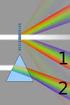 Test IV Name 1) In a single slit diffraction experiment, the width of the slit is 3.1 10-5 m and the distance from the slit to the screen is 2.2 m. If the beam of light of wavelength 600 nm passes through
Diffraction of a Circular Aperture
 Diffraction of a Circular Aperture Diffraction can be understood by considering the wave nature of light. Huygen's principle, illustrated in the image below, states that each point on a propagating wavefront
Dynamic IR Scene Projector Based Upon the Digital Micromirror Device
 Dynamic IR Scene Projector Based Upon the Digital Micromirror Device D. Brett Beasley, Matt Bender, Jay Crosby, Tim Messer, and Daniel A. Saylor Optical Sciences Corporation www.opticalsciences.com P.O.
Efficiency, Dispersion and Straylight Performance Tests of Immersed Gratings for High Resolution Spectroscopy in the Near Infra-red
 Changing the economics of space Efficiency, Dispersion and Straylight Performance Tests of Immersed Gratings for High Resolution Spectroscopy in the Near Infra-red J. Fernandez-Saldivar 1, F. Culfaz 1,
Geometric Optics Converging Lenses and Mirrors Physics Lab IV
 Objective Geometric Optics Converging Lenses and Mirrors Physics Lab IV In this set of lab exercises, the basic properties geometric optics concerning converging lenses and mirrors will be explored. The
Video Camera Image Quality in Physical Electronic Security Systems
 Video Camera Image Quality in Physical Electronic Security Systems Video Camera Image Quality in Physical Electronic Security Systems In the second decade of the 21st century, annual revenue for the global
University of California at Santa Cruz Electrical Engineering Department EE-145L: Properties of Materials Laboratory
 University of California at Santa Cruz Electrical Engineering Department EE-145L: Properties of Materials Laboratory Lab 8: Optical Absorption Spring 2002 Yan Zhang and Ali Shakouri, 05/22/2002 (Based
Characteristic curves of a solar cell
 Related Topics Semi-conductor, p-n junction, energy-band diagram, Fermi characteristic energy level, diffusion potential, internal resistance, efficiency, photo-conductive effect, acceptors, donors, valence
19 - RAY OPTICS Page 1 ( Answers at the end of all questions )
 19 - RAY OPTICS Page 1 1 ) A ish looking up through the water sees the outside world contained in a circular horizon. I the reractive index o water is 4 / 3 and the ish is 1 cm below the surace, the radius
3W RGB High Power LED
 Features: Super high flux output and high luminance Designed for high current operation Low thermal resistance No UV Package Dimensions: Typical Applications Reading lights Portable flashlight Uplighters
Cross-beam scanning system to detect slim objects. 100 mm 3.937 in
 891 Object Area Sensor General terms and conditions... F-17 Related Information Glossary of terms... P.1359~ Sensor selection guide...p.831~ General precautions... P.1405 PHOTO PHOTO Conforming to EMC
Integration of a passive micro-mechanical infrared sensor package with a commercial smartphone camera system
 1 Integration of a passive micro-mechanical infrared sensor package with a commercial smartphone camera system Nathan Eigenfeld Abstract This report presents an integration plan for a passive micro-mechanical
Factoring Patterns in the Gaussian Plane
 Factoring Patterns in the Gaussian Plane Steve Phelps Introduction This paper describes discoveries made at the Park City Mathematics Institute, 00, as well as some proofs. Before the summer I understood
Solid State Devices 4B6
 Solid State Devices 4B6 Lecture 13 Projection and 3D displays: LCD, DLP and LCOS Daping Chu Lent 2015 (LCD) A 105 inch TFT-LCD 4k2k curved panel by Samsung January 2014 A 105 inch OLED 3k2k curved panel
The following words and their definitions should be addressed before completion of the reading:
 Seasons Vocabulary: The following words and their definitions should be addressed before completion of the reading: sphere any round object that has a surface that is the same distance from its center
1 of 9 2/9/2010 3:38 PM
 1 of 9 2/9/2010 3:38 PM Chapter 23 Homework Due: 8:00am on Monday, February 8, 2010 Note: To understand how points are awarded, read your instructor's Grading Policy. [Return to Standard Assignment View]
Displays. Cathode Ray Tube. Semiconductor Elements. Basic applications. Oscilloscope TV Old monitors. 2009, Associate Professor PhD. T.
 Displays Semiconductor Elements 1 Cathode Ray Tube Basic applications Oscilloscope TV Old monitors 2 1 Idea of Electrostatic Deflection 3 Inside an Electrostatic Deflection Cathode Ray Tube Gun creates
GeoGebra Workshop for the Initial Teacher Training in Primary Education
 GeoGebra Workshop for the Initial Teacher Training in Primary Education N. Ruiz [email protected] Facultad de Formación de Profesorado y Educación (Faculty of Education) Universidad Autónoma de Madrid
Chapter 17: Light and Image Formation
 Chapter 17: Light and Image Formation 1. When light enters a medium with a higher index of refraction it is A. absorbed. B. bent away from the normal. C. bent towards from the normal. D. continues in the
Microlenses immersed in nematic liquid crystal with electrically. controllable focal length
 Microlenses immersed in nematic liquid crystal with electrically controllable focal length L.G.Commander, S.E. Day, C.H. Chia and D.R.Selviah Dept of Electronic and Electrical Engineering, University College
Choosing a digital camera for your microscope John C. Russ, Materials Science and Engineering Dept., North Carolina State Univ.
 Choosing a digital camera for your microscope John C. Russ, Materials Science and Engineering Dept., North Carolina State Univ., Raleigh, NC One vital step is to choose a transfer lens matched to your
MINIMUM USAGE OF FERRITE TILES IN ANECHOIC CHAMBERS
 Progress In Electromagnetics Research B, Vol. 19, 367 383, 2010 MINIMUM USAGE OF FERRITE TILES IN ANECHOIC CHAMBERS S. M. J. Razavi, M. Khalaj-Amirhosseini, and A. Cheldavi College of Electrical Engineering
How To Understand Light And Color
 PRACTICE EXAM IV P202 SPRING 2004 1. In two separate double slit experiments, an interference pattern is observed on a screen. In the first experiment, violet light (λ = 754 nm) is used and a second-order
RAY OPTICS II 7.1 INTRODUCTION
 7 RAY OPTICS II 7.1 INTRODUCTION This chapter presents a discussion of more complicated issues in ray optics that builds on and extends the ideas presented in the last chapter (which you must read first!)
ATOMIC SPECTRA. Apparatus: Optical spectrometer, spectral tubes, power supply, incandescent lamp, bottles of dyed water, elevating jack or block.
 1 ATOMIC SPECTRA Objective: To measure the wavelengths of visible light emitted by atomic hydrogen and verify the measured wavelengths against those predicted by quantum theory. To identify an unknown
Year 9 mathematics test
 Ma KEY STAGE 3 Year 9 mathematics test Tier 6 8 Paper 1 Calculator not allowed First name Last name Class Date Please read this page, but do not open your booklet until your teacher tells you to start.
RAY TRACING UNIFIED FIELD TRACING
 RAY TRACING Start to investigate the performance of your optical system using 3D ray distributions, dot diagrams of ray positions and directions, and optical path length. GEOMETRIC FIELD TRACING Switch
WJP, PHY381 (2015) Wabash Journal of Physics v4.3, p.1. Cloud Chamber. R.C. Dennis, Tuan Le, M.J. Madsen, and J. Brown
 WJP, PHY381 (2015) Wabash Journal of Physics v4.3, p.1 Cloud Chamber R.C. Dennis, Tuan Le, M.J. Madsen, and J. Brown Department of Physics, Wabash College, Crawfordsville, IN 47933 (Dated: May 7, 2015)
Rec. ITU-R F.699-5 1 RECOMMENDATION ITU-R F.699-5 *
 Rec. ITU-R F.699-5 1 RECOMMENATION ITU-R F.699-5 * REFERENCE RAIATION PATTERNS FOR LINE-OF-SIGHT RAIO-RELAY SYSTEM ANTENNAS FOR USE IN COORINATION STUIES AN INTERFERENCE ASSESSMENT IN THE FREQUENCY RANGE
Physical Science Study Guide Unit 7 Wave properties and behaviors, electromagnetic spectrum, Doppler Effect
 Objectives: PS-7.1 Physical Science Study Guide Unit 7 Wave properties and behaviors, electromagnetic spectrum, Doppler Effect Illustrate ways that the energy of waves is transferred by interaction with
AP Physics B Ch. 23 and Ch. 24 Geometric Optics and Wave Nature of Light
 AP Physics B Ch. 23 and Ch. 24 Geometric Optics and Wave Nature of Light Name: Period: Date: MULTIPLE CHOICE. Choose the one alternative that best completes the statement or answers the question. 1) Reflection,
Optical Communications
 Optical Communications Telecommunication Engineering School of Engineering University of Rome La Sapienza Rome, Italy 2005-2006 Lecture #2, May 2 2006 The Optical Communication System BLOCK DIAGRAM OF
104 Practice Exam 2-3/21/02
 104 Practice Exam 2-3/21/02 1. Two electrons are located in a region of space where the magnetic field is zero. Electron A is at rest; and electron B is moving westward with a constant velocity. A non-zero
HSI BASED COLOUR IMAGE EQUALIZATION USING ITERATIVE n th ROOT AND n th POWER
 HSI BASED COLOUR IMAGE EQUALIZATION USING ITERATIVE n th ROOT AND n th POWER Gholamreza Anbarjafari icv Group, IMS Lab, Institute of Technology, University of Tartu, Tartu 50411, Estonia [email protected]