
Anamorphic imaging with three mirrors: a survey
|
|
|
- Jayson Bates
- 10 years ago
- Views:
Transcription
1 Anamorphic imaging with three mirrors: a survey Joseph M. Howard Optics Branch (Code 551), NASA Goddard Space Flight Center, Greenbelt, MD Ph: Fax: [email protected] Bryan D. Stone The Institute of Optics, University ofrochester, Rochester NY Now with Optical Research Associates, 1800 West Park Drive, Suite 410, Westborough MA Ph: Fax: [email protected] Abstract: Design methods are described for unobstructed, plane-symmetric, anamorphic systems composed of three mirrors. Low order imaging constraints are used to reduce the dimensionality of the configuration space. Examples are presented from a specific class of systems with fixed packaging constraints. 1. Introduction In 1992, Stone and Forbes presented general methods for designing asymmetric optical systems [1,2]. Over the next decade, several applications applying these methods to the design of unobstructed reflective systems have been reported. The studies have included systems with two conic mirrors [3], and spherical mirror systems with two, three and four mirrors [4-7]. More recently in 2002, nonanamorphic systems composed of three conic mirrors were reported [8]. In this paper, we consider plane-symmetric systems of three mirrors, but release the constraint that the mirrors be conic, and we allow for anamorphism (i.e. diffe rent focal lengths in and out of the plane of symmetry such that a rectangle is imaged to a square). Mirror 1: S S S S Mirror 3: S S S S Base Ray Image Object at Infinity Mirror 2: S S S S Figure 1. Nineteen construction parameters for a three-mirror system. In Figure 1, the base ray and the 19 construction parameters associated with a plane-symmetric system of three mirrors are illustrated. The base ray is the ray thatoriginates at the center of the field and passes through the center of the pupil. (In a centered system, for example, the base ray would travel along the axis of symmetry.) In this paper, we only consider the case where the object is at infinity, but similar results can be obtained for systems at finite conjugates. The construction parameters used here are: the separations for each segment along the base ray (d 1, d2, d3), the tilts of the object, image, and the mirrors ( 1, 2, 63, ^,), the surface shape parameters ( S11, S22, S111, S 122 ) for each mirror (12 total). Each construction parameter represents one degree of freedom to the designer. In Figure 2, the surface shape parameters are shown to be defined as the coefficients of the Taylor expansion of the mirror about the point where the base ray intersects (i.e. basal point). This notation is readily available in optical design software and is typically called anamorphic asphere, or some variant. If desired, these four parameters can

2 be reduced to three degrees of freedom by constraining the mirror to be a conic section (on or off-axis), but doing so results in a disconnected configuration space where no solutions exist [9]. As such, only anamorphic aspheres are considered here. Figure 2. Surface shape parameters and equation used to describe mirrors. By considering a Taylor expansion of the imaging properties about the base ray, individual construction parameters can be constrained to ensure a given set of low-order image properties. For example, four construction parameters can be constrained from the four first-order imaging properties of the plane symmetric system [8]. In a centered system, this process is analogous to placing a solve on the final curvature in a lens to ensure that the axial ray height is zero at the image, or that the system has a desired focal length. Additional constraints can be introduced by considering the second-order imaging properties. For the anamorphic systems considered here with the object at infinity, the original 19 degrees of freedom can be reduced to ten: six for system geometry d 1, d 2, d3, 1, 2, 3, and four for mirror geometry: G 11, G22, S 111, S 122. The G parameters are functions of the first-order parameters of the three mirrors (i.e. S 11, S22, etc.). The methods for determining the exact analytic constraint equations are described elsewhere [1] -[8]. The benefits of using system constraints are twofold. First, any system that does not meet the imaging criteria is excluded from consideration, and second, the number of degrees of freedom that the designer is confronted is greatly reduced. The net result is that the design process is facilitated tremendously, reducing the time necessary to search for feasible systems for the application at hand. In Section 2, a parametric survey is performed for these three mirror systems given a fixed system geometry (i.e. the d and B parameters are frozen). Surveyed parameters are the speed of the systems in the plane of symmetry, and the degree of anamorphism (or ratio of focal lengths in and out of the plane of symmetry). Local optimization is performed over the constrained and then un-constrained configuration space for a specific packaging geometry, and examples of the results are presented. Finally, some concludin g remarks are given in Section 3.

3 2. Parametric Survey with Example Systems Figure 3. System Geometry fixed for survey. To simplify this survey, the system packaging parameters are fixed to the values shown in Figure 3, a common form for an unobstructed system of mirrors. The separations (d) are frozen at 250 mm, and the tilt angles at each mirror s basal point is 12 degrees (except for the f/2.5 systems, where the tilts are increased to 15 and 17 degrees to prevent obstructions). The entrance pupil diameter is set to 100 mm, and is fixed at the first mirror. The image is required to be square format, and no internal images are considered here. To summarize, this assumed simplifications reduce the degrees of freedom from ten to four, i.e. the mirror geometry parameters. A two-degree full field of view (FOV) is set in the plane of symmetry, but allowed to vary out of the plane according to the anamorphic imaging ratio, as shown in Figure 4. Since the image format is required to be square, the anamorphic imaging ratio (AIR) can be defined as the ratio of the X to Y fields of view. When the anamorphic imaging ratio is less than unity, the X field is stretched at the detector to match the Y field size at the square detector. Alternatively, square pixels on the detector would map to rectangular pixels on the sky, with aspect ratios equivalent to the anamorphic imaging ratio. When the anamorphic imaging ratio is greater than one, the larger X field is squeezed onto the square detector. And finally, when the ratio is unity, the system is non-anamorphic. The survey here is performed over varying these anamorphic imaging ratios using the following system F/# s: 20, 15, 10, 7.5, 5, and 2.5. Note that since the systems are anamorphic, the F/# will be different in the plane of symmetry as it is out of the plane of symmetry, by the factor of the anamorphic imaging ratio. As such, the F/# presented here represents that which is IN the plane of symmetry, so that systems can be readily identified by a standard lens drawing in the plane of symmetry such as shown in Figure 3.

4 Figure 4. Anamorphic Imaging ratio to a square detector. Specific systems are created by locally optimizing the second-order shape parameters G 11 and G22 in the constrained space, and then releasing all constraints (including S 111, S 122) and performing downhill optimization on the mirror shapes only to find the representative designs. Fourth-order shape parameters were allowed to vary in the final optimization, as well as the image surface location and tilt angle. The method is generally robust, and only takes about a minute for each system found in the survey. The figure of merit for each system is simply the WORST rootmean-square spot radius evaluated over the field of view, which typically ends up being at the top or bottom corner of the detector, as shown in Figure 4. Note that symmetry requires left-right performance (i.e. out of the plane of symmetry) to be identical. Figure 5 presents example systems found in this survey, as well as performance plots for each F/# considered at the beginning of each row. Each plot in the left column has an arrow that locates the system that is illustrated to the right of the plot in the center and right-most columns. The horizontal axis (X-axis) of the plots is the anamorphic image ratio (i.e. X FOV / Y FOV), and the vertical axis (Y-axis) is the Figure of Merit (RMS Spot radius, in microns). The first thing to note in the figure is that the best performing systems, or minimum of each plot, gradually decreases with F/#. That is, slower systems perform well with the anamorphic image ratio (AIR) > 1, and fast systems do better with the AIR > 1. When one considers the lens drawings in the center and right column, which are typically systems close to this minimum, the secondary and tertiary mirror widths follow this trend, which is related to the X-field of the system. (e.g. The tertiary mirror of the F/2.5 system is almost the shape of a banana.) Recall that the image for each system is square, but that its size changes with the F/# (as one would expect) since the field in object space is kept constant in the plane of symmetry, along with the entrance pupil diameter.

5 Figure 5. Survey systems with examples.

6 Figure 6 is a combined plot of all the data shown in Figure 5, but with the X-axis plotted as the log of the AIR. It is apparent from the figure that the optimal AIR decreases as the system F/# decreases from 20 to 2.5. The minimum values of each of the curves in Figure 6 are used in the following plot. Figure 6. Summary performance plot of survey systems. ^2 4 6 B System FI# Figure 7. Peak performance as a function of system F/#. In Figure 7, the optimum anamorphic image ratio (AIR) is plotted versus system F/#, showing the trend of peak performance for each class of system. From this data, it appears that this class of system is best kept nonanamorphic from F/# s of 5 to about 10. Outside of this range, better systems exist (using the defined figure of merit) by introducing anamorphism, by either extending or squeezing the field of view along the X -axis.

7 3. Concluding Remarks Anamorphic systems should be considered whenever an optical system under utilizes a given detector format, such as the case investigated here where a rectangular field is imaged to a square detector. Alternatively, anamorphic systems can also be applied to image a square field to a rectangular detector. By building in anamorphism, one could fully utilize the given detector, and post-process the images to be non-anamorphic, if desired. Systems have been reported to improve their capability through using anamorphic systems [10-11]. Other uses include pupil slicing and grazing incidence interferometry [12]. Additional applications include earth-observing push-broom style imaging systems, wide-field thermal infrared sensors, as well as observational astronomy. Many other design forms for anamorphic three mirror systems exist. Only a small region of the configuration space was explored in this paper, which was limited primarily by the packaging parameters set in Figure 3. In addition to freeing the packaging parameters to vary, systems could also include internal images, beams that cross one another (i.e. making a loop ), and even breaking out of the plane of symmetry. Naturally, systems at finite conjugates can also be considered, as well as anamorphic collimators and anamorphic afocal systems. These methods can also be extended to four mirror systems, as well as two-mirror systems (which are considered in Ref [3]). The systems shown here should be considered as starting designs for the optical designer. Strategies for improving the designs shown here include moving the stop, varying frozen system packaging parameters (i.e. d and ), and allowing vignetting, etc. Grazing incidence systems can also be considered using the approaches described here. These analytical design tools can be readily incorporated into the macro language of optical design software, which is discussed further in Ref [13]. In such a visual design tool, they provide a virtual design environment that allows individual parameters to be changed along with system drawings and other graphics updated in real time. The author can be contacted for example macros that illustrate this graphical design approach. Endnotes [1] Bryan D. Stone and G.W. Forbes, Foundations of first-order layout for asymmetric systems: an applications of Hamilton s methods, J. Opt. Soc. Am. A 9, (1992). [2] Bryan D. Stone and G.W. Forbes, Foundations of second-order layout for asymmetric systems, J. Opt. Soc. Am. A 9, (1992). [3] Bryan D. Stone and G.W. Forbes, Second-order design methods for definitive studies of plane-symmetric, two-mirror systems, J. Opt. Soc. Am. A 11, (1994). [4] Bryan D. Stone and G.W. Forbes, First-order layout of asymmetric systems composed of three spherical mirrors, J. Opt. Soc. Am. A 9, (1992). [5] Joseph M. Howard and Bryan D. Stone, "Imaging a point with two spherical mirrors," J. Opt. Soc. Am. A 15, (1998). [6] Joseph M. Howard and Bryan D. Stone, Imaging with three spherical mirrors, Appl. Opt. 39, (2000). [7] Joseph M. Howard and Bryan D. Stone, Imaging with four spherical mirrors, Appl. Opt. 39, (2000). [8] Joseph M. Howard and Bryan D. Stone, "Nonanmorphic imaging with three conic mirrors," Proc. SPIE 4832,25 (2002). [9] A discussion of representing a conic surface as a Taylor expansion about an off-axis point can be found in Section 6 of G.W. Forbes and Bryan D. Stone, "Hamilton's angle characteristic in closed form for generally configured conic and toric interfaces," J. Opt. Soc. Am. A 10, (1993). By considering equations 2.4 of Ref [3], i.e. specifically the square root terms, one can readily see that not all realizations of the S parameters will result in real values for the conic profile. [10] E. Eisner, Brighter Spectrographic Images by the Use of Anamorphic Optics, Applied Optics, Vol. 2, No. 7, (1963). [11] D.E. Aspnes and S. M. Kelso, Common-axis rotationally symmetric anamorphic mirror combinations: application to synchrotron-radiation beam lines, J. Opt. Soc. Am. Vol. 71, No. 8, (1981). [12] Paolo Span, Free-forms optics into astronomical use: The case of an all-mirror anamorphic collimator, Proc. SPIE 7018, , (2008). [13] Joseph M. Howard, Optical design using computer graphics, Applied Optics, Vol. 40, No. 19, (2001).

Grazing incidence wavefront sensing and verification of X-ray optics performance
 Grazing incidence wavefront sensing and verification of X-ray optics performance Timo T. Saha, Scott Rohrbach, and William W. Zhang, NASA Goddard Space Flight Center, Greenbelt, Md 20771 Evaluation of
Algebra 2 Chapter 1 Vocabulary. identity - A statement that equates two equivalent expressions.
 Chapter 1 Vocabulary identity - A statement that equates two equivalent expressions. verbal model- A word equation that represents a real-life problem. algebraic expression - An expression with variables.
The Wide Field Cassegrain: Exploring Solution Space
 The Wide Field Cassegrain: Exploring Solution Space Peter Ceravolo Ceravolo Optical Systems www.ceravolo.com [email protected] Abstract This article illustrates the use of an internal aperture stop in
Zoom Lens Design of Mobilephone Camera with Global-Explorer Optimization
 Zoom Lens Design of Mobilephone Camera with Global-Explorer Optimization Chao-Yu Hung * and Jyh-Long Chern ** Department of Photonics, Institute of Electro-Optical Engineering Microelectronic and Information
NOVEL FOCUSING OPTICS FOR IR LASERS Paper 1504
 NOVEL FOCUSING OPTICS FOR IR LASERS Paper 1504 Gary Herrit 1, Alan Hedges 1, Herman Reedy 1 1 II-VI Incorporated, 375 Saxonburg Blvd., Saxonburg, PA, 16056, USA Abstract Traditional focusing optics for
A PHOTOGRAMMETRIC APPRAOCH FOR AUTOMATIC TRAFFIC ASSESSMENT USING CONVENTIONAL CCTV CAMERA
 A PHOTOGRAMMETRIC APPRAOCH FOR AUTOMATIC TRAFFIC ASSESSMENT USING CONVENTIONAL CCTV CAMERA N. Zarrinpanjeh a, F. Dadrassjavan b, H. Fattahi c * a Islamic Azad University of Qazvin - [email protected]
Understand the Sketcher workbench of CATIA V5.
 Chapter 1 Drawing Sketches in Learning Objectives the Sketcher Workbench-I After completing this chapter you will be able to: Understand the Sketcher workbench of CATIA V5. Start a new file in the Part
DOING PHYSICS WITH MATLAB COMPUTATIONAL OPTICS RAYLEIGH-SOMMERFELD DIFFRACTION INTEGRAL OF THE FIRST KIND
 DOING PHYSICS WITH MATLAB COMPUTATIONAL OPTICS RAYLEIGH-SOMMERFELD DIFFRACTION INTEGRAL OF THE FIRST KIND THE THREE-DIMENSIONAL DISTRIBUTION OF THE RADIANT FLUX DENSITY AT THE FOCUS OF A CONVERGENCE BEAM
Optical Systems Design with Zemax OpticStudio. Lecture 1
 Optical Systems Design with Zemax OpticStudio Lecture 1 Why Optical Systems Design Optical system design is no longer a skill reserved for a few professionals. With readily available commercial optical
4. CAMERA ADJUSTMENTS
 4. CAMERA ADJUSTMENTS Only by the possibility of displacing lens and rear standard all advantages of a view camera are fully utilized. These displacements serve for control of perspective, positioning
Aspherical Lens Design by Using a Numerical Analysis
 Journal of the Korean Physical Society, Vol. 51, No. 1, July 27, pp. 93 13 Aspherical Lens Design by Using a Numerical Analysis Gyeong-Il Kweon Department of Optoelectronics, Honam University, Gwangju
521493S Computer Graphics. Exercise 2 & course schedule change
 521493S Computer Graphics Exercise 2 & course schedule change Course Schedule Change Lecture from Wednesday 31th of March is moved to Tuesday 30th of March at 16-18 in TS128 Question 2.1 Given two nonparallel,
Volumes of Revolution
 Mathematics Volumes of Revolution About this Lesson This lesson provides students with a physical method to visualize -dimensional solids and a specific procedure to sketch a solid of revolution. Students
TABLE OF CONTENTS. INTRODUCTION... 5 Advance Concrete... 5 Where to find information?... 6 INSTALLATION... 7 STARTING ADVANCE CONCRETE...
 Starting Guide TABLE OF CONTENTS INTRODUCTION... 5 Advance Concrete... 5 Where to find information?... 6 INSTALLATION... 7 STARTING ADVANCE CONCRETE... 7 ADVANCE CONCRETE USER INTERFACE... 7 Other important
Lecture 8 : Coordinate Geometry. The coordinate plane The points on a line can be referenced if we choose an origin and a unit of 20
 Lecture 8 : Coordinate Geometry The coordinate plane The points on a line can be referenced if we choose an origin and a unit of 0 distance on the axis and give each point an identity on the corresponding
Reflection and Refraction
 Equipment Reflection and Refraction Acrylic block set, plane-concave-convex universal mirror, cork board, cork board stand, pins, flashlight, protractor, ruler, mirror worksheet, rectangular block worksheet,
DISCLAIMER. This document was prepared as an account of work sponsored by an agency of the United States
 DISCLAIMER This document was prepared as an account of work sponsored by an agency of the United States Government. Neither the United States Government nor the University of California nor any of their
11.1. Objectives. Component Form of a Vector. Component Form of a Vector. Component Form of a Vector. Vectors and the Geometry of Space
 11 Vectors and the Geometry of Space 11.1 Vectors in the Plane Copyright Cengage Learning. All rights reserved. Copyright Cengage Learning. All rights reserved. 2 Objectives! Write the component form of
Selecting the Best Approach to Teach 3D Modeling to Technical College Engineering
 Paper ID #12358 Selecting the Best Approach to Teach 3D Modeling to Technical College Engineering Students Dr. Farzin Heidari, Texas A&M University, Kingsville c American Society for Engineering Education,
Graphs of Polar Equations
 Graphs of Polar Equations In the last section, we learned how to graph a point with polar coordinates (r, θ). We will now look at graphing polar equations. Just as a quick review, the polar coordinate
Given ZEMAX's user-interface and available tools, the singlet can be modeled and optimized easily!
 of 19 http://home.strw.leidenuniv.nl/~brandl/obstech/zemax_intro.html 10/6/2012 8:55 AM ZEMAX Users' Knowledge Base - http://www.zemax.com/kb How To Design a Singlet Lens http://www.zemax.com/kb/articles/20/1/how-to-design-a-singlet-lens/page1.html
Application Report: Running µshape TM on a VF-20 Interferometer
 : Running µshape TM on a VF-20 Interferometer General This report describes how a fiber interferometer from Arden Photonics Ltd was used together with the µshape TM Generic software package. The VF-20
Optimization of Support Point Locations and Force Levels of the Primary Mirror Support System
 Optimization of Support Point Locations and Force Levels of the Primary Mirror Support System Myung K. Cho Opto-structural Engineer Ronald S. Price Opto-mechanical Engineer November 5, 1993 GEMINI PROJECT
Unit 7 Quadratic Relations of the Form y = ax 2 + bx + c
 Unit 7 Quadratic Relations of the Form y = ax 2 + bx + c Lesson Outline BIG PICTURE Students will: manipulate algebraic expressions, as needed to understand quadratic relations; identify characteristics
Fraunhofer Diffraction
 Physics 334 Spring 1 Purpose Fraunhofer Diffraction The experiment will test the theory of Fraunhofer diffraction at a single slit by comparing a careful measurement of the angular dependence of intensity
Optical Design using Fresnel Lenses
 Optical Design using Fresnel Lenses Basic principles and some practical examples Arthur Davis and Frank Kühnlenz Reflexite Optical Solutions Business Abstract The fresnel lens can be used in a wide variety
Introduction to reflective aberration corrected holographic diffraction gratings
 Introduction to reflective aberration corrected holographic diffraction gratings By Steve Slutter, Wu Jiang, and Olivier Nicolle The reflective diffraction grating is the heart of most spectroscopy systems
Customized corneal ablation can be designed. Slit Skiascopic-guided Ablation Using the Nidek Laser. Scott MacRae, MD; Masanao Fujieda
 Slit Skiascopic-guided Ablation Using the Nidek Laser Scott MacRae, MD; Masanao Fujieda ABSTRACT PURPOSE: To present the approach of using a scanning slit refractometer (the ARK 10000) in conjunction with
Solving Simultaneous Equations and Matrices
 Solving Simultaneous Equations and Matrices The following represents a systematic investigation for the steps used to solve two simultaneous linear equations in two unknowns. The motivation for considering
Relating Vanishing Points to Catadioptric Camera Calibration
 Relating Vanishing Points to Catadioptric Camera Calibration Wenting Duan* a, Hui Zhang b, Nigel M. Allinson a a Laboratory of Vision Engineering, University of Lincoln, Brayford Pool, Lincoln, U.K. LN6
Optical System Design
 Optical System Design Robert E. Fischer CEO, OPTICS 1, Incorporated Biljana Tadic-Galeb Panavision Paul R. Yoder Consultant With contributions by Ranko Galeb Bernard C.Kress, Ph.D. Stephen C. McClain,
PARAMETRIC MODELING. David Rosen. December 1997. By carefully laying-out datums and geometry, then constraining them with dimensions and constraints,
 1 of 5 11/18/2004 6:24 PM PARAMETRIC MODELING David Rosen December 1997 The term parametric modeling denotes the use of parameters to control the dimensions and shape of CAD models. Think of a rubber CAD
15.062 Data Mining: Algorithms and Applications Matrix Math Review
 .6 Data Mining: Algorithms and Applications Matrix Math Review The purpose of this document is to give a brief review of selected linear algebra concepts that will be useful for the course and to develop
Endoscope Optics. Chapter 8. 8.1 Introduction
 Chapter 8 Endoscope Optics Endoscopes are used to observe otherwise inaccessible areas within the human body either noninvasively or minimally invasively. Endoscopes have unparalleled ability to visualize
Optical Design Document
 Code: ASTRI-XXX-OAB-3000-XXX Issue: 1.1 DATE 09-11-2012 Page: 1 Optical Design Document Prepared by: Name: Rodolfo Canestrari Signature: Date: 09-11- 2012 INAF- OABr Reviewed by: Name: Gabriele Rodeghiero
We can display an object on a monitor screen in three different computer-model forms: Wireframe model Surface Model Solid model
 CHAPTER 4 CURVES 4.1 Introduction In order to understand the significance of curves, we should look into the types of model representations that are used in geometric modeling. Curves play a very significant
. Address the following issues in your solution:
 CM 3110 COMSOL INSTRUCTIONS Faith Morrison and Maria Tafur Department of Chemical Engineering Michigan Technological University, Houghton, MI USA 22 November 2012 Zhichao Wang edits 21 November 2013 revised
The Basics of FEA Procedure
 CHAPTER 2 The Basics of FEA Procedure 2.1 Introduction This chapter discusses the spring element, especially for the purpose of introducing various concepts involved in use of the FEA technique. A spring
Geometric Optics Converging Lenses and Mirrors Physics Lab IV
 Objective Geometric Optics Converging Lenses and Mirrors Physics Lab IV In this set of lab exercises, the basic properties geometric optics concerning converging lenses and mirrors will be explored. The
INJECTION MOLDING COOLING TIME REDUCTION AND THERMAL STRESS ANALYSIS
 INJECTION MOLDING COOLING TIME REDUCTION AND THERMAL STRESS ANALYSIS Tom Kimerling University of Massachusetts, Amherst MIE 605 Finite Element Analysis Spring 2002 ABSTRACT A FEA transient thermal structural
Algebra Geometry Glossary. 90 angle
 lgebra Geometry Glossary 1) acute angle an angle less than 90 acute angle 90 angle 2) acute triangle a triangle where all angles are less than 90 3) adjacent angles angles that share a common leg Example:
Experimental and modeling studies of imaging with curvilinear electronic eye cameras
 Experimental and modeling studies of imaging with curvilinear electronic eye cameras Viktor Malyarchuk, 1 Inhwa Jung, 1 John A. Rogers, 1,* Gunchul Shin, 2 and Jeong Sook Ha 2 1 Department of Materials
Optical laser beam scanner lens relay system
 1. Introduction Optical laser beam scanner lens relay system Laser beam scanning is used most often by far in confocal microscopes. There are many ways by which a laser beam can be scanned across the back
Manual for simulation of EB processing. Software ModeRTL
 1 Manual for simulation of EB processing Software ModeRTL How to get results. Software ModeRTL. Software ModeRTL consists of five thematic modules and service blocks. (See Fig.1). Analytic module is intended
Common Core Unit Summary Grades 6 to 8
 Common Core Unit Summary Grades 6 to 8 Grade 8: Unit 1: Congruence and Similarity- 8G1-8G5 rotations reflections and translations,( RRT=congruence) understand congruence of 2 d figures after RRT Dilations
Optical Modeling of the RIT-Yale Tip-Tilt Speckle Imager Plus
 SIMG-503 Senior Research Optical Modeling of the RIT-Yale Tip-Tilt Speckle Imager Plus Thesis Kevin R. Beaulieu Advisor: Dr. Elliott Horch Chester F. Carlson Center for Imaging Science Rochester Institute
VRSPATIAL: DESIGNING SPATIAL MECHANISMS USING VIRTUAL REALITY
 Proceedings of DETC 02 ASME 2002 Design Technical Conferences and Computers and Information in Conference Montreal, Canada, September 29-October 2, 2002 DETC2002/ MECH-34377 VRSPATIAL: DESIGNING SPATIAL
Aerodynamic Design Optimization Discussion Group Case 4: Single- and multi-point optimization problems based on the CRM wing
 Aerodynamic Design Optimization Discussion Group Case 4: Single- and multi-point optimization problems based on the CRM wing Lana Osusky, Howard Buckley, and David W. Zingg University of Toronto Institute
5-Axis Test-Piece Influence of Machining Position
 5-Axis Test-Piece Influence of Machining Position Michael Gebhardt, Wolfgang Knapp, Konrad Wegener Institute of Machine Tools and Manufacturing (IWF), Swiss Federal Institute of Technology (ETH), Zurich,
Optical modeling of finite element surface displacements using commercial software
 Optical modeling of finite element surface displacements using commercial software Keith B. Doyle, Victor L. Genberg, Gregory J. Michels, Gary R. Bisson Sigmadyne, Inc. 803 West Avenue, Rochester, NY 14611
Physics 202 Problems - Week 8 Worked Problems Chapter 25: 7, 23, 36, 62, 72
 Physics 202 Problems - Week 8 Worked Problems Chapter 25: 7, 23, 36, 62, 72 Problem 25.7) A light beam traveling in the negative z direction has a magnetic field B = (2.32 10 9 T )ˆx + ( 4.02 10 9 T )ŷ
3D Printing LESSON PLAN PHYSICS 8,11: OPTICS
 INVESTIGATE RATIONALE Optics is commonly taught through the use of commercial optics kits that usually include a basic set of 2-4 geometric lenses (such as double convex or double concave). These lenses
Higher Education Math Placement
 Higher Education Math Placement Placement Assessment Problem Types 1. Whole Numbers, Fractions, and Decimals 1.1 Operations with Whole Numbers Addition with carry Subtraction with borrowing Multiplication
Manufacture of 8.4 m off-axis segments: a 1/5 scale demonstration
 Manufacture of 8.4 m off-axis segments: a 1/5 scale demonstration H. M. Martin a, J. H. Burge a,b, B. Cuerden a, S. M. Miller a, B. Smith a, C. Zhao b a Steward Observatory, University of Arizona, Tucson,
Pro/ENGINEER Wildfire 4.0 Basic Design
 Introduction Datum features are non-solid features used during the construction of other features. The most common datum features include planes, axes, coordinate systems, and curves. Datum features do
EFFECTS ON NUMBER OF CABLES FOR MODAL ANALYSIS OF CABLE-STAYED BRIDGES
 EFFECTS ON NUMBER OF CABLES FOR MODAL ANALYSIS OF CABLE-STAYED BRIDGES Yang-Cheng Wang Associate Professor & Chairman Department of Civil Engineering Chinese Military Academy Feng-Shan 83000,Taiwan Republic
MEASUREMENT OF END FACE GEOMETRY ON FIBER OPTIC TERMINI...2
 MEASUREMENT OF END FACE GEOMETRY ON FIBER OPTIC TERMINI...2 IMPORTANCE OF END FACE GEOMETRY...2 FIBER OPTIC CONNECTOR END FACE GEOMETRY MEASUREMENT TECHNIQUES...2 INTERFEROMETRIC MICROSCOPE TYPES...3 MEASUREMENT
Introduction to Autodesk Inventor for F1 in Schools
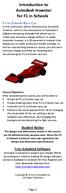 Introduction to Autodesk Inventor for F1 in Schools F1 in Schools Race Car In this course you will be introduced to Autodesk Inventor, which is the centerpiece of Autodesk s digital prototyping strategy
2013 Getting Started Guide
 2013 Getting Started Guide The contents of this guide and accompanying exercises were originally created by Nemetschek Vectorworks, Inc. Vectorworks Fundamentals Getting Started Guide Created using: Vectorworks
Polarization of Light
 Polarization of Light References Halliday/Resnick/Walker Fundamentals of Physics, Chapter 33, 7 th ed. Wiley 005 PASCO EX997A and EX999 guide sheets (written by Ann Hanks) weight Exercises and weights
12-1 Representations of Three-Dimensional Figures
 Connect the dots on the isometric dot paper to represent the edges of the solid. Shade the tops of 12-1 Representations of Three-Dimensional Figures Use isometric dot paper to sketch each prism. 1. triangular
The Olympus stereology system. The Computer Assisted Stereological Toolbox
 The Olympus stereology system The Computer Assisted Stereological Toolbox CAST is a Computer Assisted Stereological Toolbox for PCs running Microsoft Windows TM. CAST is an interactive, user-friendly,
Getting to know your TI-83
 Calculator Activity Intro Getting to know your TI-83 Press ON to begin using calculator.to stop, press 2 nd ON. To darken the screen, press 2 nd alternately. To lighten the screen, press nd 2 alternately.
Graphing Quadratic Functions
 Problem 1 The Parabola Examine the data in L 1 and L to the right. Let L 1 be the x- value and L be the y-values for a graph. 1. How are the x and y-values related? What pattern do you see? To enter the
Structural Axial, Shear and Bending Moments
 Structural Axial, Shear and Bending Moments Positive Internal Forces Acting Recall from mechanics of materials that the internal forces P (generic axial), V (shear) and M (moment) represent resultants
39 Symmetry of Plane Figures
 39 Symmetry of Plane Figures In this section, we are interested in the symmetric properties of plane figures. By a symmetry of a plane figure we mean a motion of the plane that moves the figure so that
Scientific Graphing in Excel 2010
 Scientific Graphing in Excel 2010 When you start Excel, you will see the screen below. Various parts of the display are labelled in red, with arrows, to define the terms used in the remainder of this overview.
Unit 9: Conic Sections Name Per. Test Part 1
 Unit 9: Conic Sections Name Per 1/6 HOLIDAY 1/7 General Vocab Intro to Conics Circles 1/8-9 More Circles Ellipses 1/10 Hyperbolas (*)Pre AP Only 1/13 Parabolas HW: Part 4 HW: Part 1 1/14 Identifying conics
Monochromatic electromagnetic fields with maximum focal energy density
 Moore et al. Vol. 4, No. 10 /October 007 /J. Opt. Soc. Am. A 3115 Monochromatic electromagnetic fields with maximum focal energy density Nicole J. Moore, 1, * Miguel A. Alonso, 1 and Colin J. R. Sheppard,3
Introduction to Autodesk Inventor for F1 in Schools
 F1 in Schools race car Introduction to Autodesk Inventor for F1 in Schools In this course you will be introduced to Autodesk Inventor, which is the centerpiece of Autodesk s Digital Prototyping strategy
Fast Varifocal Lenses Based on KTa 1-x Nb x O 3 (KTN) Single Crystals
 : Crystal Technologies Fast Varifocal Lenses Based on KTa 1-x Nb x O 3 () Single Crystals Tadayuki Imai, Shogo Yagi, Seiji Toyoda, and Masahiro Sasaura Abstract NTT Photonics Laboratories has recently
CATIA V5 Tutorials. Mechanism Design & Animation. Release 18. Nader G. Zamani. University of Windsor. Jonathan M. Weaver. University of Detroit Mercy
 CATIA V5 Tutorials Mechanism Design & Animation Release 18 Nader G. Zamani University of Windsor Jonathan M. Weaver University of Detroit Mercy SDC PUBLICATIONS Schroff Development Corporation www.schroff.com
Optimizing an Electromechanical Device with Mulitdimensional Analysis Software
 Optimizing an Electromechanical Device with Mulitdimensional Analysis Software White Paper June 2013 Tecplot, Inc. P.O. Box 52708 Bellevue, WA 98015 425.653.1200 direct 800.676.7568 toll free [email protected]
www.mathsbox.org.uk ab = c a If the coefficients a,b and c are real then either α and β are real or α and β are complex conjugates
 Further Pure Summary Notes. Roots of Quadratic Equations For a quadratic equation ax + bx + c = 0 with roots α and β Sum of the roots Product of roots a + b = b a ab = c a If the coefficients a,b and c
Algebra 1 Course Title
 Algebra 1 Course Title Course- wide 1. What patterns and methods are being used? Course- wide 1. Students will be adept at solving and graphing linear and quadratic equations 2. Students will be adept
Alignement of a ring cavity laser
 Alignement of a ring cavity laser 1 Introduction This manual describes a procedure to align the cavity of our Ti:Sapphire ring laser and its injection with an Argon-Ion pump laser beam. The setup is shown
Correcting the Lateral Response Artifact in Radiochromic Film Images from Flatbed Scanners
 Correcting the Lateral Response Artifact in Radiochromic Film Images from Flatbed Scanners Background The lateral response artifact (LRA) in radiochromic film images from flatbed scanners was first pointed
Testing of Aspheric Surfaces with computer Generated Holograms
 Testing of Aspheric Surfaces with computer Generated Holograms H.Tiziani, B.PackroB, G.Schmidt Institut fur Technische Optik, Universitat Stuttgart, Pfaffenwaldring 9, 7000 Stuttgart 80, FRG Summary Aspherical
Biggar High School Mathematics Department. National 5 Learning Intentions & Success Criteria: Assessing My Progress
 Biggar High School Mathematics Department National 5 Learning Intentions & Success Criteria: Assessing My Progress Expressions & Formulae Topic Learning Intention Success Criteria I understand this Approximation
Laue lens for Nuclear Medicine
 Laue lens for Nuclear Medicine PhD in Physics Gianfranco Paternò Ferrara, 6-11-013 Supervisor: prof. Vincenzo Guidi Sensors and Semiconductors Lab, Department of Physics and Earth Science, University of
Physics 25 Exam 3 November 3, 2009
 1. A long, straight wire carries a current I. If the magnetic field at a distance d from the wire has magnitude B, what would be the the magnitude of the magnetic field at a distance d/3 from the wire,
potential in the centre of the sphere with respect to infinity.
 Umeå Universitet, Fysik 1 Vitaly Bychkov Prov i fysik, Electricity and Waves, 2006-09-27, kl 16.00-22.00 Hjälpmedel: Students can use any book. Define the notations you are using properly. Present your
Anamorphic Projection Photographic Techniques for setting up 3D Chalk Paintings
 Anamorphic Projection Photographic Techniques for setting up 3D Chalk Paintings By Wayne and Cheryl Renshaw. Although it is centuries old, the art of street painting has been going through a resurgence.
Chapter 4. Polynomial and Rational Functions. 4.1 Polynomial Functions and Their Graphs
 Chapter 4. Polynomial and Rational Functions 4.1 Polynomial Functions and Their Graphs A polynomial function of degree n is a function of the form P = a n n + a n 1 n 1 + + a 2 2 + a 1 + a 0 Where a s
Logo Symmetry Learning Task. Unit 5
 Logo Symmetry Learning Task Unit 5 Course Mathematics I: Algebra, Geometry, Statistics Overview The Logo Symmetry Learning Task explores graph symmetry and odd and even functions. Students are asked to
Development of Optical Wave Microphone Measuring Sound Waves with No Diaphragm
 Progress In Electromagnetics Research Symposium Proceedings, Taipei, March 5 8, 3 359 Development of Optical Wave Microphone Measuring Sound Waves with No Diaphragm Yoshito Sonoda, Takashi Samatsu, and
Two vectors are equal if they have the same length and direction. They do not
 Vectors define vectors Some physical quantities, such as temperature, length, and mass, can be specified by a single number called a scalar. Other physical quantities, such as force and velocity, must
Chapter 8. Low energy ion scattering study of Fe 4 N on Cu(100)
 Low energy ion scattering study of 4 on Cu(1) Chapter 8. Low energy ion scattering study of 4 on Cu(1) 8.1. Introduction For a better understanding of the reconstructed 4 surfaces one would like to know
The Optical Design of the High Resolution Imaging Channel for the SIMBIO-SYS experiment on the BepiColombo Mission to Mercury
 Mem. S.A.It. Suppl. Vol. 12, 77 c SAIt 2008 Memorie della Supplementi The Optical Design of the High Resolution Imaging Channel for the SIMBIO-SYS experiment on the BepiColombo Mission to Mercury G. Marra
Online refocusing algorithm for a satellite camera using stellar sources
 Online refocusing algorithm for a satellite camera using stellar sources Jeong-Bin Jo, Jai-Hyuk Hwang, * and Jae-Sung Bae School of Aerospace and Mechanical Engineering, Korea Aerospace University, Gyeonggi-do,
MICROFOCUSING OF THE FERMI@ELETTRA FEL BEAM WITH A K-B ACTIVE OPTICS SYSTEM: SPOT SIZE PREDICTIONS. Lorenzo Raimondi
 MICROFOCUSING OF THE FERMI@ELETTRA FEL BEAM WITH A K-B ACTIVE OPTICS SYSTEM: SPOT SIZE PREDICTIONS Lorenzo Raimondi PADReS Group Sincrotrone Trieste SCpA 1 FERMI@Elettra seeded FEL FEL 1 FEL 2 FEL 1 from
Introduction to CATIA V5
 Introduction to CATIA V5 Release 16 (A Hands-On Tutorial Approach) Kirstie Plantenberg University of Detroit Mercy SDC PUBLICATIONS Schroff Development Corporation www.schroff.com www.schroff-europe.com
* This work is an official contribution of the National Institute of Standards and Technology and
 Variability in the Geometric Accuracy of Additively Manufactured Test Parts A.L. Cooke and J.A. Soons National Institute of Standards and Technology * Gaithersburg, MD, USA Abstract This paper describes
Straightening Data in a Scatterplot Selecting a Good Re-Expression Model
 Straightening Data in a Scatterplot Selecting a Good Re-Expression What Is All This Stuff? Here s what is included: Page 3: Graphs of the three main patterns of data points that the student is likely to