
4. CAMERA ADJUSTMENTS
|
|
|
- Garry Hugo Ellis
- 10 years ago
- Views:
Transcription
1 4. CAMERA ADJUSTMENTS Only by the possibility of displacing lens and rear standard all advantages of a view camera are fully utilized. These displacements serve for control of perspective, positioning of the depthof-field and creative image composing. Any camera displacement requires the appropriate lens with the sufficient image circle. Before starting to use camera movements, return all camera controls to zero. 36

2 3. Lenses and Shutters 3.2. IMAGE CIRCLE In order to make optimum use of the decisive advantage of the M 679cs, i.e. its wide range of displacements lenses are needed with large image circle and first-class image reproduction quality right up to the edge of the image circle. The most important camera displacement is the parallel adjustment to eliminate or reduce converging verticals. For this, the lens must have an image circle far beyond the size of the taking format.the image circle stated in the technical specifications of the lens manufacturers always refer to a focusing distance of infinity and a working aperture of f/22. For shorter distances (e.g.for table shots), the image circle diameter will increase so that even larger adjustments are required. For digital lenses the the corresponding working aperture is referred as f/11. The Linhof M 679cs offers the necessary long mechanical adjustment facilities. Please always ensure that the image circle of the lens covers the mechanical displacements. As a practical hint: when looking through the lens onto the groundglass at working aperture all four edges of the picture format have to be visible. Shift limits Image circles and shift limits. Within the limit of a sufficiently large image circle the picture format can be displaced. Image circle diameter of medium format lens Shift limits Picture format Image circle diameter of view camera lens 32

3 Scale for lateral shift at the rear standard 4.1. VERTICAL AND LATERAL SHIFT (DIRECT DISPLACEMENT) Horizontal and vertical parallel displacements are operated with self-aligning micro drives. Direct adjustments are recommended for precise cropping corrections and should normally be made after having finished all settings thus avoiding any movement of the tilting axis out of their centre position. When working with extremely short lenses (24, 28, 35, 38 mm ) we recommend the direct camera displacement using the horizontal and vertical shift facilities. In general their range of adjustment is sufficient and all displacements remain parallel. Direct parallel adjustment (vertical shift) with self aligning micro drives at the lens standard (M 679cs with Apo-Sironar 4,5/35 mm and wide angle bellows). 37

4 4.2. INDIRECT PARALLEL DISPLACEMENTS Parallel movements (rise and shift of the front and back standards) are primarily used to eliminate converging verticals or horizontals in subjects with predominantly parallel lines. While vanishing lines are simply the normal perspective rendition resulting from an oblique position of the image plane relative to the main subject plane, the experienced professional will see that through proper use of camera adjustments pictures do not show any of the unwanted perspectives so often found in architectural and industrial subjects. Whether up, down or lateral shift of the lens or rear standard: Most parallel adjustments are executed indirectly. In other words: The front and rear standard is simply placed parallel to the main view of the subject. vertical parallel shift The possible adjustments increase linear with the camera extension. The M 679cs offers an up/down or lateral shift of 168 mm each at maximum camera extension (tilting angle 30 ). At minimum camera extension the possible indirect parallel shift is approximately 38 mm. The sketch shows extension and adjustment which can be achieved with normal bellows. horizontal parallel shift (view from above) 38

5 4.3. VERTICAL PARALLEL SHIFTS (INDIRECT) Indirect vertical shifts (lens rise or lens drop) are used to produce an image without converging lines when shooting from a low or high view point. LENS RISE: With all adjustments in neutral position and with the aid of the integrated panorama benchholder the camera is set to the subject. Focus until the object appears in focus on the groundglass. Adjust lens and rear standards to vertical with the aid of the spirit level. If necessary, refocus. The picture was taken with a 58 mm wide angle lens. 1. Set the camera to the subject, composing the image. 2. Adjust lens and rear standards ti vertical with the aid of the spirit level, if necessary make cropping correction, focus.

6 LENS DROP When working in the studio shooting is often made from a high view point (still life, tabletops etc.): with the aid of the integrated panorama benchholder the camera is set to the subject determining the image on the groundglass and focus. Adjust front and rear standards to vertical with the aid of the spirit level, refocus. REMAINING PERSPECTIVE Since totally corrected images can sometimes appear unreal a so-called "remaining perspective" is often desirable. This is an uncomplicated procedure: read off the angle of tilting of the optical bench and reduce the base tilt of the standard by approximately 25%. 1. Set the camera to the object, frame the image. The package is seen with converging verticals. 2. Adjust front and rear standard to vertical with the aid of the spirit level. The package is seen with undistorted verticals. 40

7 4.4. HORIZONTAL PARALLEL SHIFTS Horizontal shifts (lateral displacement or cross front movements) are used to obtain frontal views from a lateral camera position, producing an image without vanishing lines and perspective distortion. This is a common requirement when standing in front of reflecting surfaces (mirrors, windows) or when the view from a centre position directly in front of the subject is obstructed or includes unwanted subject matter. To ensure correct perspective, start by placing the camera (and the filmplane) parallel to the main object plane: The camera has to be rotated with the bench panorama holder to the object until reaching the desired framing on the groundglass. Then turn the back standard around the vertical axis until you reach the main view of the object preferably utilizing the grid lines of the groundglass. Now transfer the angle of rotation of the panorama of the rear standard to the lens standard for obtaining exact parallelism. 1. Shooting with non-displaced camera: the main view shows converging lines. 2. Shooting with camera and parallel adjustments: the main view is seen undistorted. 1a. Set camera to the object, frame the image (camera is shown from above). 2b. Adjust rear standard parallel to main view. Transfer angle to lens standard. 41

8 4.5. COMBINED PARALLEL SHIFTS Horizontal and vertical shifts can, of course, also be applied in combination. A typical example is the reproduction of a package where the front cover is to be shown as a rectangle and both the top and the side should be visible as well. 1. Select the appropriate camera view point, adjust the groundglass, determine framing. 2. Adjust both standards vertically with the aid of the spirit level for avoiding converging lines. PRACTICAL HINT: All camera adjustments should start at the panorama benchholder (1). Then follows - if necessary - the adjustment of the standards to vertical. All control elements are situated above the panorama benchholder at the optical bench (2). The final adjustment facilities (level 3) for the camera are swings and tilts by rack and pinion drives. Finally the cropping correction is made (4) Swing rear standard for parallel position to the book cover. Set camera to grid net lines of the groundglass. Read off angle and transfer to the lens standard. Refocus (illustration shows camera from top). Make cropping correction when necessary. 42

9 4.6. SCHEIMPFLUG ADJUSTMENTS When talking about camera movements, the term "Scheimpflug" is often subject to a certain amount of misinterpretation. Even by experienced photographers, the use of Scheimpflug adjustments to control focus and depth-of-field is either looked upon as a highly complex mathematical problem or considered a simple adjustment procedure which a modern view camera should do more or less automatically by itself. Neither opinion really corresponds with the photographic practice, as the truth is somewhere in the middle, but once there is a certain understanding of the theory behind all Scheimpflug adjustments, their practical application becomes as simple and fool proof routine. adjustment possibilities). Groundglass-Scheimpflug exaggerates the perspective rendition but "saves" image circle. PRACTICAL PROCEDURE Before starting with any Scheimpflug adjustments, the plane of sharp focus running from the near to the far object point should be determined. The most simple application can be found with two dimensional objects, such as plane of table, carpet, meadows or wall: the main object plane has a certain angle to the image plane. First determine one near object point and one far object point of the object plane. Near and far object point should be seen on the opposite side of the groundglass. The amount and direction to any camera adjustment required to fulfill the Scheimpflug condition can easily be determined by looking at the camera and the subject from the side. It will be seen that the more distant objects in the infinity range (buildings) require relatively small adjustments of a few degrees which will steadily increase with closer focusing distances. In extreme closeup work, with reproduction ratios between 1:4 and natural size 1:1, the amount of swings or tilts needed will often require the adjustments of both the front and the rear standard (for instance small table-top subjects, tools, electronic components and assemblies etc.). THE SCHEIMPFLUG RULE To provide sharp focus over the entire picture when main object plane is at an angle to the camera, the object main plane, the lens plane and the image plane must intersect in one common line. This rule can be applied by swinging the groundglass or (and) the lens standard. Scheimpflug by swinging the lens standard does not alter the given perspective "consuming" however much of the image circle (limits of the image plane lens plane object main plane (for example plane of table, carpet, meadows) 43

10 DISPLACEMENTS, WHERE? The M 679 with its highly practical centre rotation of the lens standard, also allows direct Scheimpflug adjustments with the front simply by focusing to the near object point and swinging/tilting the lens standard until also the far object point comes into focus. As a result of the centre rotation, only a slight focus adjustment will become necessary. Displacement with rear standard: + only slight focusing necessary + desired plus of perspective rendition + centre raise of the lens are used: positive for a clear quality of the image + extremely simple control of depth-of-field: turning axis always remains in focus distortions unavoidable rays do not meet the groundglass centrally thus complicating the viewing of the image Displacement with the lens standard: + no perspective distortion + easy viewing of the image on the groundglass refocusing necessary during adjustments border rays of the lens will be used, i.e. the limit of the image circle is quickly reached. Vignetting is possible DOUBLE SCHEIMPFLUG There are many objects where the desired sharpness is in an oblique plane. In this case, both axis - the vertical and the horizontal axis - have to be swung. First swing the horizontal or lateral axis, then swing around the vertical axis in order to avoid any yawing. By swinging of the image and lens plane any desired focal plane can be achieved. Utilizing the advantages of both procedures: 1. Displacements with the rear standard - centre of groundglass remains in focus. 2. Angle value is transferred to lens standard (reduced by angle value of adjustment in per cent values), swing in opposite direction, refocus. Displacements with rear and lens standard: Tilting at the horizontal axis Displacements with rear and lens standard: swinging around the vertical axis (illustration shows camera from above). 44

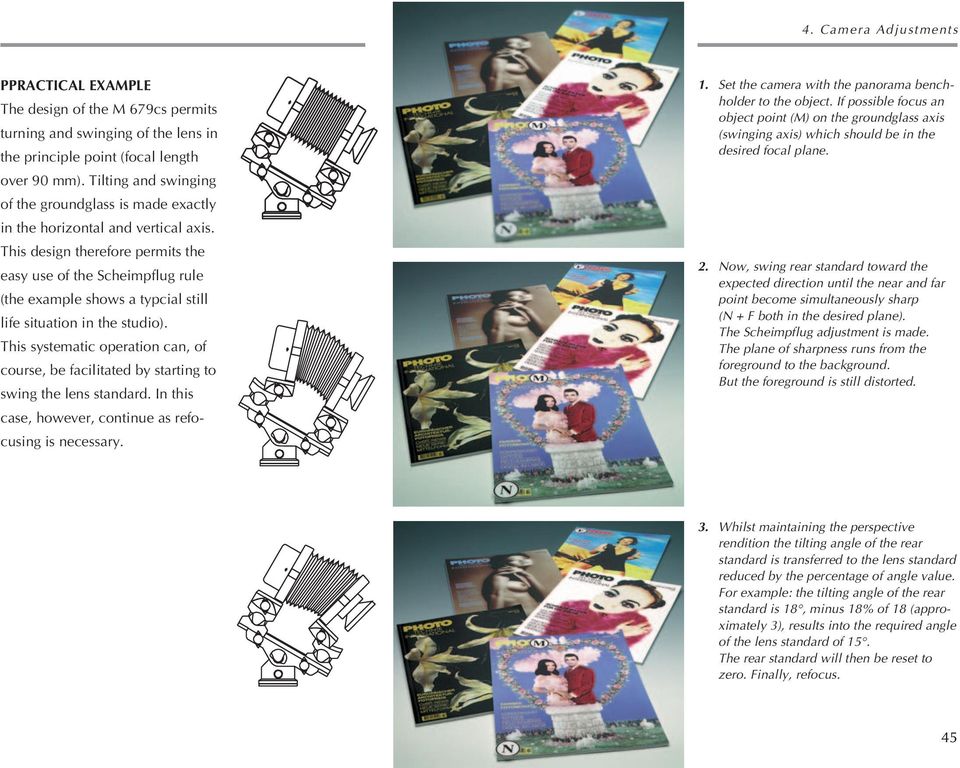
11 PPRACTICAL EXAMPLE The design of the M 679cs permits turning and swinging of the lens in the principle point (focal length over 90 mm). Tilting and swinging of the groundglass is made exactly in the horizontal and vertical axis. This design therefore permits the easy use of the Scheimpflug rule (the example shows a typcial still life situation in the studio). This systematic operation can, of course, be facilitated by starting to swing the lens standard. In this case, however, continue as refocusing is necessary. 1. Set the camera with the panorama benchholder to the object. If possible focus an object point (M) on the groundglass axis (swinging axis) which should be in the desired focal plane. 2. Now, swing rear standard toward the expected direction until the near and far point become simultaneously sharp (N + F both in the desired plane). The Scheimpflug adjustment is made. The plane of sharpness runs from the foreground to the background. But the foreground is still distorted. 3. Whilst maintaining the perspective rendition the tilting angle of the rear standard is transferred to the lens standard reduced by the percentage of angle value. For example: the tilting angle of the rear standard is 18, minus 18% of 18 (approximately 3), results into the required angle of the lens standard of 15. The rear standard will then be reset to zero. Finally, refocus. 45
12 4.7. DEPTH-OF-FIELD WEDGE Since the objects to be handled are normally 3-dimensional you have to use additionally a small lens aperture. Example: The height of a building is the area of the required depth-of-field. In order to reach this position with the smallest possible lens aperture the focal plane is set in such a way that the object is intersected in the centre as the depth-of-field zone, which extends to either side of the plane of focus, increases uniformly. The area of the depth-of-field is like a wedge. This will become smaller when being nearer to the camera. Table-top shooting with increased depth-of-field necessitate placing flat objects near to the camera whereas higher objects should be placed in a more distant position of the camera. Most still lifes are typical examples. 1 Plane of focus 2 Depth-of-field wedge at full aperture 3 Depth-of-field wedge with stopped-down lens How to gain depth-of-field As the depth-of-field zone, which extends to either side of the plane of focus, increases uniformly when the lens is stopped down, it is important to adjust the camera in such a way that the plane of focus runs through the middle of the object. Since the depth-of-field increases at same aperture with increasing distance from the camera, a wedge type area for the sharpness is the result. 46

13 4.8. SUMMARY 1. Use Scheimpflug adjustments for depth-offield control only for subjects which are in an oblique position to the camera from the near point to the far point. 2. Without stopping down only 2-dimensional subjects (carpets, walls etc.) will have an overall sharpness. 3. Scheimpflug adjustments are a logical way to control depth-of-field as long as there is one major and clearly defined plane of focus. 4. If overall sharpness over an expanded 3-dimensional space without clearly defined sharpness planes is required, this can only be achieved in the conventional way through a correspondingly small lens aperture as determined by a suitable depth-offield calculator. Typical studio situation With the aid of the integrated panorama tilt head the camera is set to the object. To avoid converging vertical details lens and rear standard are adjusted to vertical with the aid of the spirit level Scheimpflug for increased depth-of-field. In this case, the lens standard has to be tilted. Use micro drives for direct vertical and lateral shifts. Determine depth-offield and aperture with the aid of the depth-of-field optimizer. 47

14 4.9. DEPTH-OF-FIELD AND DEPTH-OF-FIELD OPTIMIZER Generally speaking, only one plane can remain sharp. Everything behind or before becomes increasingly unsharp. The area the photographer is not visualizing this sharpness is called depth-of-field. This depth-of-field is based on the following factors: 1. Reproduction range. The smaller the reproduction range, the larger the depth-of-field area. 2. Stopped-down lens. The more the lens is stopped down, the larger is the depth-of-field. Please observe that the physically given defraction of the lenses result into a decrease of the lens performance. Therefore, never stop down too much if unnecessary. Depth-of-field optimizer The M 679cs offers an integrated depth-of-field optimizer. For the depth-of-field optimizer, interchangeable format dials are available: Format dial 3x3 for digital backs, chip size from 24x26 to 37x49 mm Format dial 6x7 for formats 6x6 6x8 cm (included in camera price) Format dial 6x9 cm Depth-of-field at stopped down lens If the optical bench is tilted more than 20 the calculated aperture value can be reduced by 1/3 f/stop. If the depth-of-field requirements result in an excessively large extension difference, try to reduce the distance by re-arranging the depth-of-field zone using Scheimpflug adjustments. Sometimes it is necessary to increase the taking distance to eliminate or reduce depth-of-field problems. Depth-of-field at full aperture The general rule for the ideal point of focus with a desirable depth-of-field zone is: Focus on 50% of the difference of the camera extension, i.e. on the middle between near and far point focusing of the camera. When stopping down a non-displaced camera the depth-of-field increases more in the background than in the foreground depending on distance and aperture. 48

M A D E I N G E R M A N Y
 M A D E I N G E R M A N Y SYSTEM M679 cs L I N H O F P R Ä Z I S I O N S - S Y S T E M T E C H N I K G M B H M Ü N C H E N E Y O U R D E C I S I O N F O R Y O U R F U T U R E INNOVATION IN THE STUDIO:
Schneider Kreuznach PC Tilt/Shift Lenses
 User Manual PC-TS SUPER-ANGULON 2.8/50 HM PC-TS MAKRO-SYMMAR 4.5/90 HM with interchangeable bayonet mount for Canon EOS, Nikon, Pentax K or Sony Alpha PC-TS APO-DIGITAR 5.6/120 HM Aspheric with bayonet
Rodenstock Photo Optics
 Apo-Sironar-S Apo-Macro-Sironar Apo-Grandagon Grandagon-N Accessories: Center filters Accessories: Focus-Mount Lenses for Analog Professional Photography Even in the age of digital photography, the professional
Geometric Optics Converging Lenses and Mirrors Physics Lab IV
 Objective Geometric Optics Converging Lenses and Mirrors Physics Lab IV In this set of lab exercises, the basic properties geometric optics concerning converging lenses and mirrors will be explored. The
Rodenstock Photo Optics
 Rogonar Rogonar-S Rodagon Apo-Rodagon N Rodagon-WA Apo-Rodagon-D Accessories: Modular-Focus Lenses for Enlarging, CCD Photos and Video To reproduce analog photographs as pictures on paper requires two
TS-E24mm f/3.5l TS-E45mm f/2.8 TS-E90mm f/2.8 Instructions
 TS-E24mm f/3.5l TS-E45mm f/2.8 TS-E90mm f/2.8 ENG Instructions Thank you for purchasing a Canon product. Canon s TS-E lenses are tilt-shift lenses designed for EOS cameras. The tilt-shift mechanism enables
2) A convex lens is known as a diverging lens and a concave lens is known as a converging lens. Answer: FALSE Diff: 1 Var: 1 Page Ref: Sec.
 Physics for Scientists and Engineers, 4e (Giancoli) Chapter 33 Lenses and Optical Instruments 33.1 Conceptual Questions 1) State how to draw the three rays for finding the image position due to a thin
picture real beauty Capture real beauty with the one you love
 picture real beauty Capture real beauty with the one you love Lina Dove invites you to experience photography for yourself and capture images of beauty that live around you. To help, we ve taken the principles
Anamorphic Projection Photographic Techniques for setting up 3D Chalk Paintings
 Anamorphic Projection Photographic Techniques for setting up 3D Chalk Paintings By Wayne and Cheryl Renshaw. Although it is centuries old, the art of street painting has been going through a resurgence.
 silvestri Bicam II Professional modular camera for high-end digital photography Giovanni Bortolani Technical information dimensions weight vertical shift lenses attachment back attachment reference code
Message, Audience, Production (MAP) Framework for Teaching Media Literacy Social Studies Integration PRODUCTION
 Message, Audience, Production (MAP) Framework for Teaching Media Literacy Social Studies Integration PRODUCTION All media messages - a film or book, photograph or picture, newspaper article, news story,
CS 4204 Computer Graphics
 CS 4204 Computer Graphics 3D views and projection Adapted from notes by Yong Cao 1 Overview of 3D rendering Modeling: *Define object in local coordinates *Place object in world coordinates (modeling transformation)
LEICA TRI-ELMAR-M 28 35 50 mm f/4 ASPH. 1
 LEICA TRI-ELMAR-M 28 35 5 mm f/4 ASPH. 1 This lens combines three of the focal lengths that are most popular among Leica M photographers. The appropriate bright-line frame appears in the viewfinder when
Contents OVERVIEW WORKFLOW PROBLEM. SOLUTION. FEATURE. BENEFIT 4 5 EASY STEPS TO CALIBRATE YOUR LENSES 5
 User Guide Contents OVERVIEW PROBLEM. SOLUTION. FEATURE. BENEFIT 4 EASY STEPS TO CALIBRATE YOUR LENSES WORKFLOW 1. SETUP SPYDERLENSCAL 6 2. SETUP CAMERA 6 3. DISTANCE SETTING 7 4. SHOOTING ENVIRONMENT
Digital Photography Composition. Kent Messamore 9/8/2013
 Digital Photography Composition Kent Messamore 9/8/2013 Photography Equipment versus Art Last week we focused on our Cameras Hopefully we have mastered the buttons and dials by now If not, it will come
Ultra-High Resolution Digital Mosaics
 Ultra-High Resolution Digital Mosaics J. Brian Caldwell, Ph.D. Introduction Digital photography has become a widely accepted alternative to conventional film photography for many applications ranging from
Technical Drawing Specifications Resource A guide to support VCE Visual Communication Design study design 2013-17
 A guide to support VCE Visual Communication Design study design 2013-17 1 Contents INTRODUCTION The Australian Standards (AS) Key knowledge and skills THREE-DIMENSIONAL DRAWING PARALINE DRAWING Isometric
9/16 Optics 1 /11 GEOMETRIC OPTICS
 9/6 Optics / GEOMETRIC OPTICS PURPOSE: To review the basics of geometric optics and to observe the function of some simple and compound optical devices. APPARATUS: Optical bench, lenses, mirror, target
M A S TER T E C H N IKA S Y S T E M
 M A D E I N G E R M A N Y M A S TER T E C H N IKA S Y S T E M c l a s s i c 3 0 0 0 L I N H O F P R Ä Z I S I O N S - S Y S T E M T E C H N I K G M B H E T H E U N I V E R S A L T O O L F O R P E R F E
SP AF 300mm F/2.8 LD [IF] for Canon (Model 360EE)
![SP AF 300mm F/2.8 LD [IF] for Canon (Model 360EE)](/thumbs/40/21493790.jpg "SP AF 300mm F/2.8 LD [IF] for Canon (Model 360EE)") SP AF 300mm F/2.8 LD [IF] for Canon (Model 360EE) We greatly appreciate your purchase of this Tamron lens. The Tamron SP AF 300mm F/2.8 LD [IF] is a fast telephoto lens developed for Canon AF single-reflex
SP AF 300mm F/2.8 LD [IF] for Canon (Model 360EE) We greatly appreciate your purchase of this Tamron lens. The Tamron SP AF 300mm F/2.8 LD [IF] is a fast telephoto lens developed for Canon AF single-reflex
Zörk Film & Phototechnic, Sales & Marketing USA Tel. 541-357-5045 / email: [email protected]
 Zörk Film & Phototechnic, Sales & Marketing USA Tel. 541-357-5045 / email: [email protected] Panorama Shift Adapter -- shift, panorama Macroscope Aspherical Close-up Lens Zörk Film & Phototechnic Innovative,
Optical Illusions Essay Angela Wall EMAT 6690
 Optical Illusions Essay Angela Wall EMAT 6690! Optical illusions are images that are visually perceived differently than how they actually appear in reality. These images can be very entertaining, but
Experiment 3 Lenses and Images
 Experiment 3 Lenses and Images Who shall teach thee, unless it be thine own eyes? Euripides (480?-406? BC) OBJECTIVES To examine the nature and location of images formed by es. THEORY Lenses are frequently
Convex Mirrors. Ray Diagram for Convex Mirror
 Convex Mirrors Center of curvature and focal point both located behind mirror The image for a convex mirror is always virtual and upright compared to the object A convex mirror will reflect a set of parallel
Master Anamorphic T1.9/35 mm
 T1.9/35 mm backgrounds and a smooth, cinematic look, the 35 Close Focus (2) 0.75 m / 2 6 Magnification Ratio (3) H: 1:32.3, V: 1:16.1 Weight (kg) 2.6 Weight (lbs) 5.7 Entrance Pupil (7) (mm) -179 Entrance
Introduction to Lensometry Gregory L. Stephens, O.D., Ph.D. College of Optometry, University of Houston 2010
 Introduction to Lensometry Gregory L. Stephens, O.D., Ph.D. College of Optometry, University of Houston 2010 I. Introduction The focimeter, lensmeter, or Lensometer is the standard instrument used to measure
Grazing incidence wavefront sensing and verification of X-ray optics performance
 Grazing incidence wavefront sensing and verification of X-ray optics performance Timo T. Saha, Scott Rohrbach, and William W. Zhang, NASA Goddard Space Flight Center, Greenbelt, Md 20771 Evaluation of
OD1641 PRINCIPLES OF DRAFTING AND SHOP DRAWINGS
 SUBCOURSE OD1641 EDITION 8 PRINCIPLES OF DRAFTING AND SHOP DRAWINGS US ARMY REPAIR SHOP TECHNICIAN WARRANT OFFICER ADVANCED CORRESPONDENCE COURSE MOS/SKILL LEVEL: 441A PRINCIPLES OF DRAFTING AND SHOP
Contents. Introduction 2. Features and Benefits 3. Freeform Design Range 10. Custom 14/16/18 13. Custom U 15. Custom V 17.
 Contents page Introduction 2 Features and Benefits 3 Freeform Design Range Custom 14/16/18 13 Custom U 1 Custom V 17 Custom Office 19 Custom Driver Custom Relax 21 Custom Junior 22 Custom Blended Bifocal
Chapter 17: Light and Image Formation
 Chapter 17: Light and Image Formation 1. When light enters a medium with a higher index of refraction it is A. absorbed. B. bent away from the normal. C. bent towards from the normal. D. continues in the
SP AF 90mm F/2.8 Di Macro 1:1 (Model 272E)
 SP AF 90mm F/2.8 Di Macro 1:1 (Model 272E) Thank you for purchasing this Tamron lens as the latest addition to your photographic equipment. Before using your new lens, please read the contents of this
1 of 9 2/9/2010 3:38 PM
 1 of 9 2/9/2010 3:38 PM Chapter 23 Homework Due: 8:00am on Monday, February 8, 2010 Note: To understand how points are awarded, read your instructor's Grading Policy. [Return to Standard Assignment View]
Description of field acquisition of LIDAR point clouds and photos. CyberMapping Lab UT-Dallas
 Description of field acquisition of LIDAR point clouds and photos CyberMapping Lab UT-Dallas Description of field acquisition of LIDAR point clouds and photos Objective: Introduce the basic steps that
18-270mm F/3.5-6.3 Di II VC PZD for Canon, Nikon (Model B008) 18-270mm F/3.5-6.3 Di II PZD for Sony (Model B008)
 R 18-270mm F/3.5-6.3 Di II VC PZD for Canon, Nikon (Model B008) 18-270mm F/3.5-6.3 Di II PZD for Sony (Model B008) Thank you for purchasing the Tamron lens as the latest addition to your photographic equipment.
Basic Manual Control of a DSLR Camera
 Basic Manual Control of a DSLR Camera Naixn 2008 Photographers don t just take photographs - they make them! Produced by Yon Ankersmit for curious-eye.com 2009 Digital Single Lens Reflex Camera The basic
Greenwich Visual Arts Objectives Photography High School
 Media, Techniques and Processes Greenwich Visual Arts Objectives 1. Identifies different camera types and applies the knowledge of a working 35mm SLR camera (e.g., lens, focus ring, aperture, speed dial)
EXPERIMENT 6 OPTICS: FOCAL LENGTH OF A LENS
 EXPERIMENT 6 OPTICS: FOCAL LENGTH OF A LENS The following website should be accessed before coming to class. Text reference: pp189-196 Optics Bench a) For convenience of discussion we assume that the light
Basics to Using the View Camera
 Walker Evans at work Using the View Camera Basics to Using the View Camera Because of the large-scale nature of the view camera, it is necessary to follow basic steps in setting-up the camera in order
AF 70~300 mm F/4-5.6 Di LD Macro 1:2 (Model A17)
 AF 70~300 mm F/4-5.6 Di LD Macro 1:2 (Model A17) Thank you for purchasing the Tamron lens as the latest addition to your photographic equipment. Di II lens (Digitally Integrated) series are designed for
Be careful not to scratch or hit front edge of the side viewing micro prisms onto hard objects!
 Instructions Manual Flexia BGA Inspection Systems This manual describes how to use Flexia BGA Inspection System Optilia Instruments 1 AB Contents 1. Safety and maintenance Instructions 3 2. About Flexia
Phase One Lenses Overview. Ready for 100MP. And beyond. what the world s best photography is made of
 Phase One Lenses Overview Ready for 100MP And beyond what the world s best photography is made of Phase One Lenses Introduction Phase One Lenses Focal Plane lenses The Phase One Focal Plane lens range
Some Thoughts on View Camera Calculations
 Some Thoughts on View Camera Calculations Leonard Evens Department of Mathematics Northwestern University [email protected] February 9, 2003 The purpose of this article is to explore how simple
Digital Image Requirements for New Online US Visa Application
 Digital Image Requirements for New Online US Visa Application As part of the electronic submission of your DS-160 application, you will be asked to provide an electronic copy of your photo. The photo must
Apo-Nikkor and Process-Nikkor large format lenses by Daniel W. Fromm
 Apo-Nikkor and Process-Nikkor large format lenses by Daniel W. Fromm 1 Apo-Nikkors, according to Nikon Nikon made two families of Apo-Nikkor lenses, both intended to be used for, e.g., photoengraving.
Creating a Planogram Database
 Creating a Planogram Database Creating a planogram database is perhaps the most difficult part of creating planograms. Once your database is finished, however, it can be maintained with little effort and
AP Physics B Ch. 23 and Ch. 24 Geometric Optics and Wave Nature of Light
 AP Physics B Ch. 23 and Ch. 24 Geometric Optics and Wave Nature of Light Name: Period: Date: MULTIPLE CHOICE. Choose the one alternative that best completes the statement or answers the question. 1) Reflection,
Reflection and Refraction
 Equipment Reflection and Refraction Acrylic block set, plane-concave-convex universal mirror, cork board, cork board stand, pins, flashlight, protractor, ruler, mirror worksheet, rectangular block worksheet,
Traditional Drawing Tools
 Engineering Drawing Traditional Drawing Tools DRAWING TOOLS DRAWING TOOLS 1. T-Square 2. Triangles DRAWING TOOLS HB for thick line 2H for thin line 3. Adhesive Tape 4. Pencils DRAWING TOOLS 5. Sandpaper
3D Printing LESSON PLAN PHYSICS 8,11: OPTICS
 INVESTIGATE RATIONALE Optics is commonly taught through the use of commercial optics kits that usually include a basic set of 2-4 geometric lenses (such as double convex or double concave). These lenses
3D Drawing. Single Point Perspective with Diminishing Spaces
 3D Drawing Single Point Perspective with Diminishing Spaces The following document helps describe the basic process for generating a 3D representation of a simple 2D plan. For this exercise we will be
ZEISS Compact Prime and Zoom lenses Flexibility and performance in a winning combination.
 ZEISS Compact Prime and Zoom lenses Flexibility and performance in a winning combination. // FLEXIBILITY MADE BY ZEISS The moment you shout action! and feel your story come together. This is the moment
What is a DSLR and what is a compact camera? And newer versions of DSLR are now mirrorless
 1 2 What is a DSLR and what is a compact camera? And newer versions of DSLR are now mirrorless 3 The Parts Your camera is made up of many parts, but there are a few in particular that we want to look at
Anamorphic imaging with three mirrors: a survey
 Anamorphic imaging with three mirrors: a survey Joseph M. Howard Optics Branch (Code 551), NASA Goddard Space Flight Center, Greenbelt, MD 20771 Ph: 301-286-0690 Fax: 301-286-0204 [email protected]
The Bonelle Tool and Cutter Grinder
 The Bonelle Tool and Cutter Grinder The grinder was constructed about 1987 and exhibited at the 89th Model Engineering exhibition where it was awarded a bronze medal (see ME Vol164 No 3868 page 273). Subsequently
TEC APO140. This telescope is closer to optical perfection more than any instrument I have ever used before. R.Renzi, Italy.
 140 manuals 2013_110 manuals 1/13/2013 10:40 PM Page 1 TEC APO140 This telescope is closer to optical perfection more than any instrument I have ever used before. R.Renzi, Italy. OWNER S MANUAL 2013 140
TELEPHOTO TECHNIQUE. Shutter Release, January 2006
 TELEPHOTO TECHNIQUE Shutter Release, January 2006 Zooming in to enlarge a distant subject is revealing and aesthetically satisfying photography liberating seeing in the classic sense. Magnification further
Optical laser beam scanner lens relay system
 1. Introduction Optical laser beam scanner lens relay system Laser beam scanning is used most often by far in confocal microscopes. There are many ways by which a laser beam can be scanned across the back
Understanding Depth Of Field, Aperture, and Shutter Speed Supplement to Mastering the Nikon D7000
 Understanding Depth Of Field, Aperture, and Shutter Speed Supplement to Mastering the Nikon D7000 This supplemental information is intended for readers of Mastering the Nikon 7000 only. Please do not distribute
3D Drawing. Single Point Perspective with Diminishing Spaces
 3D Drawing Single Point Perspective with Diminishing Spaces The following document helps describe the basic process for generating a 3D representation of a simple 2D plan. For this exercise we will be
ZEISS Education Program Price Information
 ZEISS Education Program Price Information ZEISS Education Program Discount Program for Students and Educators Camera lenses from ZEISS are used by millions of photographers all over the world: in SLR or
Freehand Sketching. Sections
 3 Freehand Sketching Sections 3.1 Why Freehand Sketches? 3.2 Freehand Sketching Fundamentals 3.3 Basic Freehand Sketching 3.4 Advanced Freehand Sketching Key Terms Objectives Explain why freehand sketching
WAVELENGTH OF LIGHT - DIFFRACTION GRATING
 PURPOSE In this experiment we will use the diffraction grating and the spectrometer to measure wavelengths in the mercury spectrum. THEORY A diffraction grating is essentially a series of parallel equidistant
Lecture 12: Cameras and Geometry. CAP 5415 Fall 2010
 Lecture 12: Cameras and Geometry CAP 5415 Fall 2010 The midterm What does the response of a derivative filter tell me about whether there is an edge or not? Things aren't working Did you look at the filters?
Flat-Field IR Mega-Pixel Lens
 Flat-Field Mega-Pixel Lens Series Flat-Field Mega-Pixel Lens Flat-Field Mega-Pixel Lens 20.ver.02 E Specifications and Lineup Full MP Image Model Imager Size Mount Focal Length Aperture Range Zoom Ratio
Shutter Speed in Digital Photography
 Shutter Speed in Digital Photography [Notes from Alan Aldrich as presented to the Hawkesbury Camera Club in April 2014] Light is a form of energy and as such behaves as formulated in the general power
The Olympus stereology system. The Computer Assisted Stereological Toolbox
 The Olympus stereology system The Computer Assisted Stereological Toolbox CAST is a Computer Assisted Stereological Toolbox for PCs running Microsoft Windows TM. CAST is an interactive, user-friendly,
Depth of Field and Bokeh
 Depth of Field and Bokeh by H. H. Nasse Carl Zeiss Camera Lens Division March 2010 Preface "Nine rounded diaphragm blades guarantee images with exceptional bokeh" Wherever there are reports about a new
Understanding astigmatism Spring 2003
 MAS450/854 Understanding astigmatism Spring 2003 March 9th 2003 Introduction Spherical lens with no astigmatism Crossed cylindrical lenses with astigmatism Horizontal focus Vertical focus Plane of sharpest
Digital Photography. Digital Cameras and Digital Photography. Your camera. Topics Your Camera Exposure Shutter speed and f-stop Image Size Editing
 Digital Cameras and Digital Photography Topics Your Camera Exposure Shutter speed and f-stop Image Size Editing Faculty Innovating with Technology Program Aug 15, 2006 Digital Photography Your camera Virtually
SolidWorks: Mirror, Revolve, and. Introduction to Robotics
 SolidWorks: Mirror, Revolve, and Circular Pattern Introduction to Robotics Let s Review At this point we have learned the following: Extrude Boss/Base Extruded Cut Adding Relations and Dimensions Linear
Basic Problem: Map a 3D object to a 2D display surface. Analogy - Taking a snapshot with a camera
 3D Viewing Basic Problem: Map a 3D object to a 2D display surface Analogy - Taking a snapshot with a camera Synthetic camera virtual camera we can move to any location & orient in any way then create a
Geometric Camera Parameters
 Geometric Camera Parameters What assumptions have we made so far? -All equations we have derived for far are written in the camera reference frames. -These equations are valid only when: () all distances
Shape Measurement of a Sewer Pipe. Using a Mobile Robot with Computer Vision
 International Journal of Advanced Robotic Systems ARTICLE Shape Measurement of a Sewer Pipe Using a Mobile Robot with Computer Vision Regular Paper Kikuhito Kawasue 1,* and Takayuki Komatsu 1 1 Department
Thin Lenses Drawing Ray Diagrams
 Drawing Ray Diagrams Fig. 1a Fig. 1b In this activity we explore how light refracts as it passes through a thin lens. Eyeglasses have been in use since the 13 th century. In 1610 Galileo used two lenses
Camera Resolution Explained
 Camera Resolution Explained FEBRUARY 17, 2015 BY NASIM MANSUROV Although the megapixel race has been going on since digital cameras had been invented, the last few years in particular have seen a huge
Mathematics on the Soccer Field
 Mathematics on the Soccer Field Katie Purdy Abstract: This paper takes the everyday activity of soccer and uncovers the mathematics that can be used to help optimize goal scoring. The four situations that
LIGHT REFLECTION AND REFRACTION
 QUESTION BANK IN SCIENCE CLASS-X (TERM-II) 10 LIGHT REFLECTION AND REFRACTION CONCEPTS To revise the laws of reflection at plane surface and the characteristics of image formed as well as the uses of reflection
Figure 3. Pressure taps distribution around the bus model (64 pressure taps)
 Figure1. Double deck bus into the wind tunnel The aerodynamic balance, built by the authors according Tusche [11], is based on strain gage type cells arranged as a double Wheatstone bridge acquiring simultaneously
House Design Tutorial
 Chapter 2: House Design Tutorial This House Design Tutorial shows you how to get started on a design project. The tutorials that follow continue with the same plan. When we are finished, we will have created
1. You stand two feet away from a plane mirror. How far is it from you to your image? a. 2.0 ft c. 4.0 ft b. 3.0 ft d. 5.0 ft
 Lenses and Mirrors 1. You stand two feet away from a plane mirror. How far is it from you to your image? a. 2.0 ft c. 4.0 ft b. 3.0 ft d. 5.0 ft 2. Which of the following best describes the image from
Solution Derivations for Capa #14
 Solution Derivations for Capa #4 ) An image of the moon is focused onto a screen using a converging lens of focal length (f = 34.8 cm). The diameter of the moon is 3.48 0 6 m, and its mean distance from
Experiment 5: Magnetic Fields of a Bar Magnet and of the Earth
 MASSACHUSETTS INSTITUTE OF TECHNOLOGY Department of Physics 8.02 Spring 2005 Experiment 5: Magnetic Fields of a Bar Magnet and of the Earth OBJECTIVES 1. To examine the magnetic field associated with a
The Photosynth Photography Guide
 The Photosynth Photography Guide Creating the best synth starts with the right photos. This guide will help you understand how to take photos that Photosynth can use to best advantage. Reading it could
Solving Simultaneous Equations and Matrices
 Solving Simultaneous Equations and Matrices The following represents a systematic investigation for the steps used to solve two simultaneous linear equations in two unknowns. The motivation for considering
From 3D to 2D: Orthographic and Perspective Projection Part 1
 From 3D to 2D: Orthographic and Perspective Projection Part 1 History Geometrical Constructions Types of Projection Projection in Computer Graphics Andries van Dam September 13, 2001 3D Viewing I 1/34
1051-232 Imaging Systems Laboratory II. Laboratory 4: Basic Lens Design in OSLO April 2 & 4, 2002
 05-232 Imaging Systems Laboratory II Laboratory 4: Basic Lens Design in OSLO April 2 & 4, 2002 Abstract: For designing the optics of an imaging system, one of the main types of tools used today is optical
SP AF 17~50 mm F/2.8 XR Di-II LD Aspherical [IF] (Model A16)
![SP AF 17~50 mm F/2.8 XR Di-II LD Aspherical [IF] (Model A16)](/thumbs/40/20837175.jpg "SP AF 17~50 mm F/2.8 XR Di-II LD Aspherical [IF] (Model A16)") SP AF 17~50 mm F/2.8 XR Di-II LD Aspherical [IF] (Model A16) Thank you for purchasing the Tamron lens as the latest addition to your photographic equipment. Di II lens (Digitally Intigrated) series are
SP AF 17~50 mm F/2.8 XR Di-II LD Aspherical [IF] (Model A16) Thank you for purchasing the Tamron lens as the latest addition to your photographic equipment. Di II lens (Digitally Intigrated) series are
How an electronic shutter works in a CMOS camera. First, let s review how shutters work in film cameras.
 How an electronic shutter works in a CMOS camera I have been asked many times how an electronic shutter works in a CMOS camera and how it affects the camera s performance. Here s a description of the way
Revision problem. Chapter 18 problem 37 page 612. Suppose you point a pinhole camera at a 15m tall tree that is 75m away.
 Revision problem Chapter 18 problem 37 page 612 Suppose you point a pinhole camera at a 15m tall tree that is 75m away. 1 Optical Instruments Thin lens equation Refractive power Cameras The human eye Combining
Perspective and Space
 Perspective and Space Space: The element of art referring to the emptiness or area between, around, above, below, or within objects. FOREGROUND - Part of the picture plane that appears closest to the viewer
Application Report: Running µshape TM on a VF-20 Interferometer
 : Running µshape TM on a VF-20 Interferometer General This report describes how a fiber interferometer from Arden Photonics Ltd was used together with the µshape TM Generic software package. The VF-20
Tube Control Measurement, Sorting Modular System for Glass Tube
 Tube Control Measurement, Sorting Modular System for Glass Tube Tube Control is a modular designed system of settled instruments and modules. It comprises measuring instruments for the tube dimensions,
Technical Drawing. MEC1000 Spring 2006 Instructor: David Anderson
 Technical Drawing MEC1000 Spring 2006 Instructor: David Anderson Topics Drawing Views Drawing Standards Best Practices Creating Drawings in SolidWorks Spring 2006 MEC1000 Technical Drawing - D. Anderson
2D & 3D TelePresence
 2D & 3D TelePresence delivers the ultimate experience in communication over a distance with aligned eye contact and a life-size sense of presence in a room setting. Eye Contact systems achieve eye-to-eye
Hunting Ghosts. For the development of imaging optical STRAY LIGHT ANALYSIS IN IMAGING OPTICS
 Virtual prototype of the camera lens defined in [3]. Besides the lenses we model only those mechanical parts that potentially contribute the most to stray light Hunting Ghosts STRAY LIGHT ANALYSIS IN IMAGING
Solar Tracking Application
 Solar Tracking Application A Rockwell Automation White Paper Solar trackers are devices used to orient photovoltaic panels, reflectors, lenses or other optical devices toward the sun. Since the sun s position
Integrated sensors for robotic laser welding
 Proceedings of the Third International WLT-Conference on Lasers in Manufacturing 2005,Munich, June 2005 Integrated sensors for robotic laser welding D. Iakovou *, R.G.K.M Aarts, J. Meijer University of
Photography for Archaeologists Part I : Site specific record. Guide 25. BAJR Practical Guide Series Lisa Jayne Fisher June 2009.
 Photography for Archaeologists Part I : Site specific record Guide 25 BAJR Practical Guide Series Lisa Jayne Fisher June 2009 held by authors Contents Introduction 1 Angle of Viewpoint in the trench 3
Stereo 3D Monitoring & Correction
 www.omnitek.tv Advanced Measurement Technology Stereo 3D Monitoring & Correction Roger Fawcett, Managing Director, OmniTek It has long been known that it is possible to give the impression of 3D scene
MACRO PHOTO LENS. MP-E 65mm f/2.8 1-5 ENG. Instruction
 MACRO PHOTO LENS MP-E 65mm f/2.8 1-5 ENG Instruction Thank you for purchasing a Canon product. Canon Macro Photo Lens MP-E 65mm f/2.8 1-5 is a high-magnification macro lens that can magnify the subject