
Arab National Bank Saudi Joint Stock Company
|
|
|
- Esther Palmer
- 9 years ago
- Views:
Transcription
1

2

3 CONSOLIDATED STATEMENT OF FINANCIAL POSITION As at December 31, 2013 and 2012 ASSETS Note 2013 SAR SAR 000 Cash and balances with SAMA 4 14,971,749 20,334,429 Due from banks and other financial institutions 5 2,767,181 2,240,924 Investments, net 6 28,248,369 24,323,047 Loans and advances, net 7 88,456,106 86,328,608 Investment in associates 8 466, ,046 Other real estate 136, ,006 Property and equipment, net 9 1,647,318 1,506,311 Other assets 10 1,241,534 1,156,905 Total assets 137,935, ,639,276 LIABILITIES AND EQUITY Liabilities Due to banks and other financial institutions 12 7,641,058 6,549,924 Customers deposits ,372, ,560,443 Other liabilities 14 3,045,720 2,931,822 Debt securities in issue 15 1,687,500 1,687,500 Total liabilities 118,747, ,729,689 Equity attributed to equity holders of the Bank Share capital 16 8,500,000 8,500,000 Statutory reserve 17 7,270,000 6,630,000 Other reserves 263, ,618 Retained earnings 2,622,124 1,579,657 Proposed dividend , ,000 Total equity attributed to equity holders of the Bank 19,080,454 17,804,275 Non-controlling interest 107, ,312 Total equity 19,188,414 17,909,587 Total liabilities and equity 137,935, ,639,276 The accompanying notes 1 to 40 form an integral part of these consolidated financial statements. 1

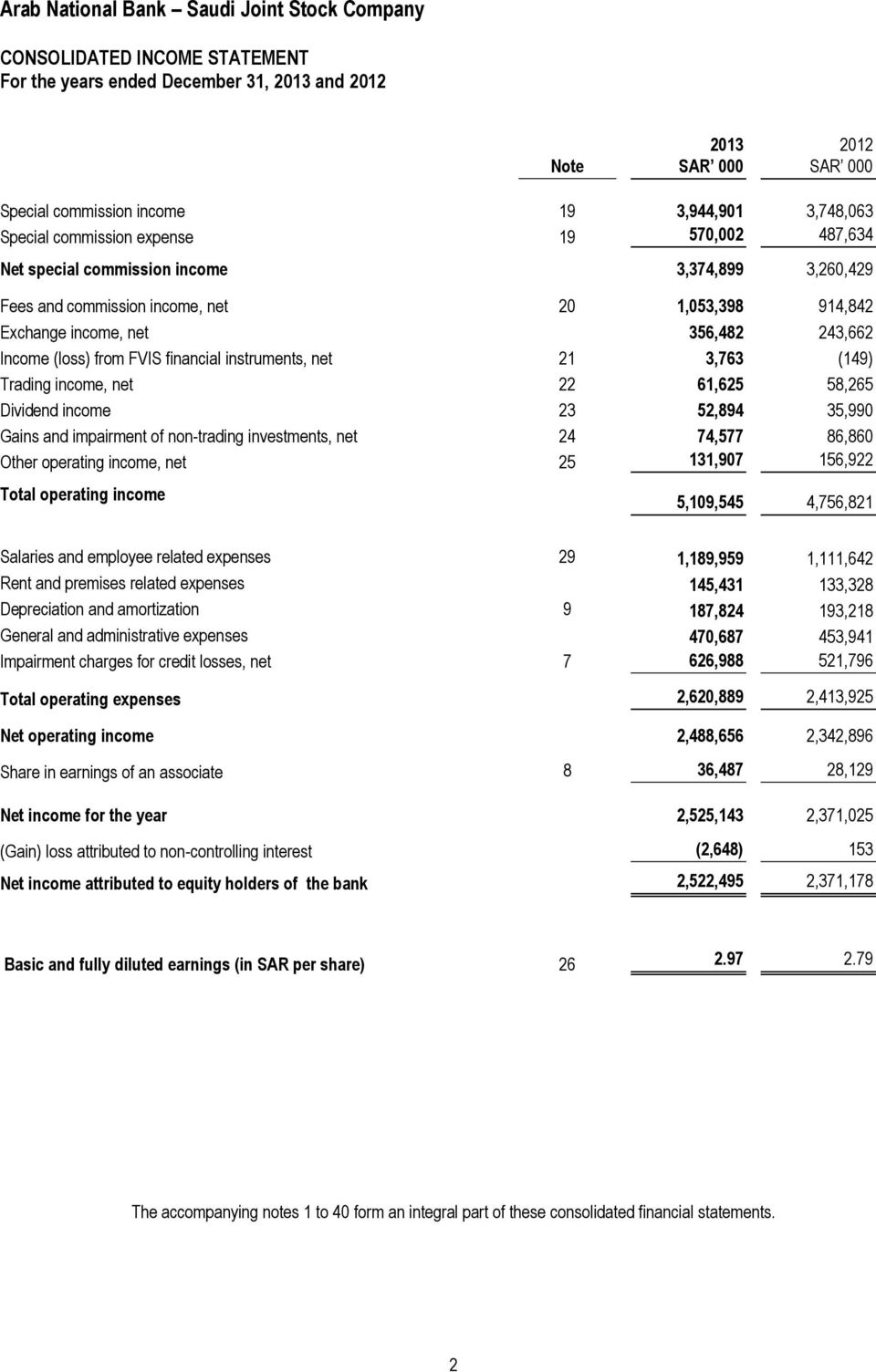
4 CONSOLIDATED INCOME STATEMENT Note 2013 SAR SAR 000 Special commission income 19 3,944,901 3,748,063 Special commission expense , ,634 Net special commission income 3,374,899 3,260,429 Fees and commission income, net 20 1,053, ,842 Exchange income, net 356, ,662 Income (loss) from FVIS financial instruments, net 21 3,763 (149) Trading income, net 22 61,625 58,265 Dividend income 23 52,894 35,990 Gains and impairment of non-trading investments, net 24 74,577 86,860 Other operating income, net , ,922 Total operating income 5,109,545 4,756,821 Salaries and employee related expenses 29 1,189,959 1,111,642 Rent and premises related expenses 145, ,328 Depreciation and amortization 9 187, ,218 General and administrative expenses 470, ,941 Impairment charges for credit losses, net 7 626, ,796 Total operating expenses 2,620,889 2,413,925 Net operating income 2,488,656 2,342,896 Share in earnings of an associate 8 36,487 28,129 Net income for the year 2,525,143 2,371,025 (Gain) loss attributed to non-controlling interest (2,648) 153 Net income attributed to equity holders of the bank 2,522,495 2,371,178 Basic and fully diluted earnings (in SAR per share) The accompanying notes 1 to 40 form an integral part of these consolidated financial statements. 2
5 CONSOLIDATED STATEMENT OF COMPREHENSIVE INCOME 2013 SAR SAR 000 Net income for the year 2,525,143 2,371,025 Other comprehensive income: Available for sale investments: - Net changes in fair value 64, ,828 - Transfers to consolidated income statement (29,376) (96,235) Cash flows hedges: - Net changes in fair value (4,406) 2,180 - Transfers to consolidated income statement (11,793) (28,775) 18,712 66,998 Total comprehensive income for the year 2,543,855 2,438,023 Attributable to: Equity holders of the Bank 2,541,207 2,438,176 Non-controlling interest 2,648 (153) Total comprehensive income for the year 2,543,855 2,438,023 The accompanying notes 1 to 40 form an integral part of these consolidated financial statements. 3

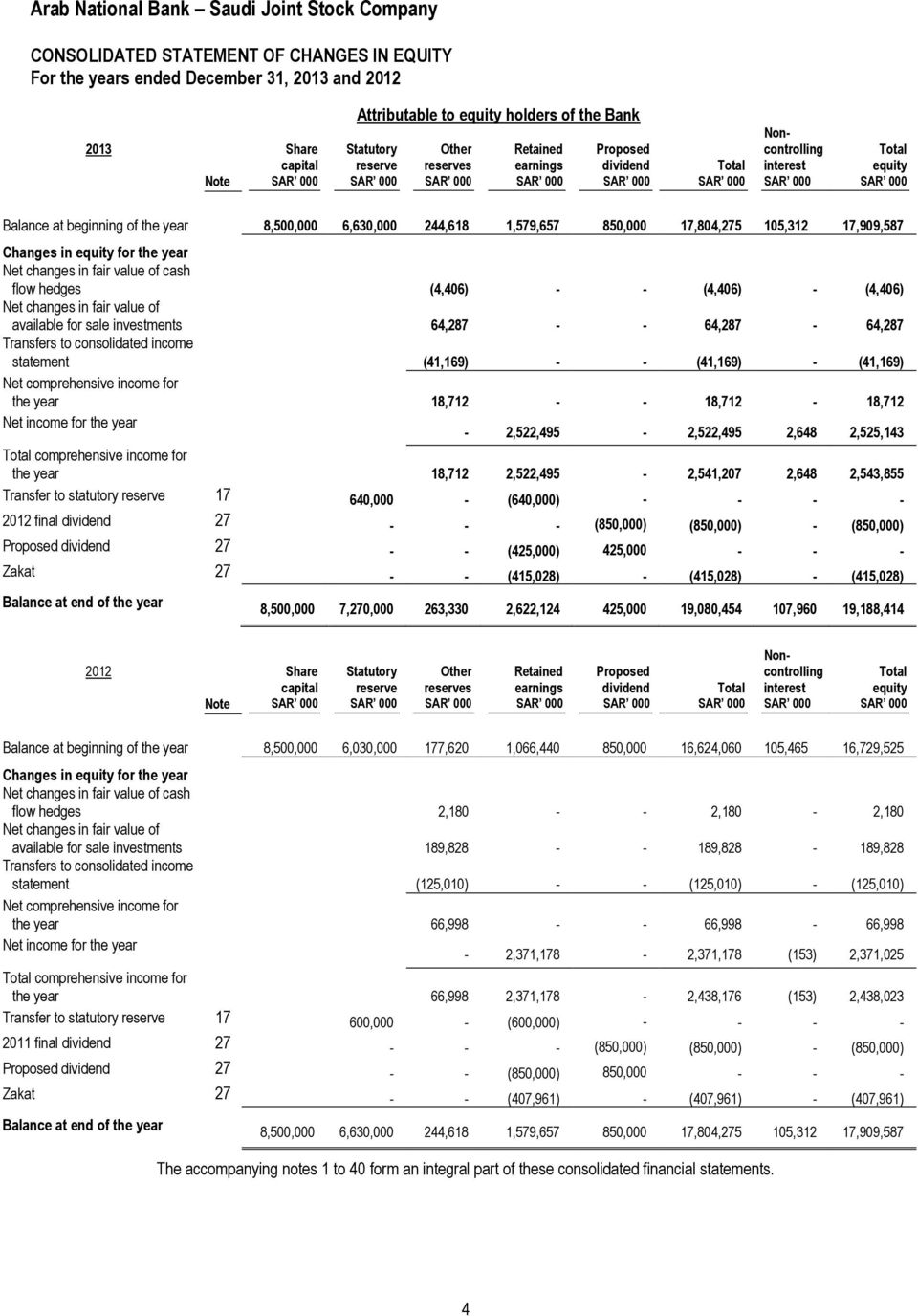
6 CONSOLIDATED STATEMENT OF CHANGES IN EQUITY 2013 Note Share capital SAR 000 Attributable to equity holders of the Bank Statutory reserve SAR 000 Other reserves SAR 000 Retained earnings SAR 000 Proposed dividend SAR 000 Total SAR 000 Noncontrolling interest SAR 000 Total equity SAR 000 Balance at beginning of the year 8,500,000 6,630, ,618 1,579, ,000 17,804, ,312 17,909,587 Changes in equity for the year Net changes in fair value of cash flow hedges (4,406) - - (4,406) - (4,406) Net changes in fair value of available for sale investments 64, ,287-64,287 Transfers to consolidated income statement (41,169) - - (41,169) - (41,169) Net comprehensive income for the year 18, ,712-18,712 Net income for the year - 2,522,495-2,522,495 2,648 2,525,143 Total comprehensive income for the year 18,712 2,522,495-2,541,207 2,648 2,543,855 Transfer to statutory reserve ,000 - (640,000) final dividend (850,000) (850,000) - (850,000) Proposed dividend (425,000) 425, Zakat (415,028) - (415,028) - (415,028) Balance at end of the year 8,500,000 7,270, ,330 2,622, ,000 19,080, ,960 19,188, Note Share capital SAR 000 Statutory reserve SAR 000 Other reserves SAR 000 Retained earnings SAR 000 Proposed dividend SAR 000 Total SAR 000 Noncontrolling interest SAR 000 Total equity SAR 000 Balance at beginning of the year 8,500,000 6,030, ,620 1,066, ,000 16,624, ,465 16,729,525 Changes in equity for the year Net changes in fair value of cash flow hedges 2, ,180-2,180 Net changes in fair value of available for sale investments 189, , ,828 Transfers to consolidated income statement (125,010) - - (125,010) - (125,010) Net comprehensive income for the year 66, ,998-66,998 Net income for the year - 2,371,178-2,371,178 (153) 2,371,025 Total comprehensive income for the year 66,998 2,371,178-2,438,176 (153) 2,438,023 Transfer to statutory reserve ,000 - (600,000) final dividend (850,000) (850,000) - (850,000) Proposed dividend (850,000) 850, Zakat (407,961) - (407,961) - (407,961) Balance at end of the year 8,500,000 6,630, ,618 1,579, ,000 17,804, ,312 17,909,587 The accompanying notes 1 to 40 form an integral part of these consolidated financial statements. 4
7 CONSOLIDATED STATEMENT OF CASH FLOWS OPERATING ACTIVITIES Notes 2013 SAR SAR 000 Net income for the year 2,525,143 2,371,025 Adjustments to reconcile net income to net cash (used in) from operating activities: Accretion of discounts of non-trading investments, net (52,864) (37,385) Gains and impairment of non-trading investments, net 24 (74,577) (86,860) Depreciation and amortization 9 187, ,218 Loss (gain) on disposal of property and equipment (7) Share in earnings of an associate 8 (36,487) (28,129) Impairment charges for credit losses, net 7 626, ,796 3,176,945 2,933,658 Net (increase) decrease in operating assets: Statutory deposit with SAMA 4 (661,257) (624,196) Due from banks and other financial institutions maturing after ninety days of the acquisition date - 37,500 Investments held at FVIS 6 60,735 6,144 Loans and advances (2,795,623) (14,021,164) Other real estate 182,372 (150,997) Other assets (89,284) 470,413 Net increase (decrease) in operating liabilities: Due to banks and other financial institutions 1,091,134 (2,274,537) Customers deposits (1,187,711) 19,701,628 Other liabilities (428,806) 127,480 Net cash (used in) from operating activities (651,495) 6,205,929 INVESTING ACTIVITIES Proceeds from sale of and matured non-trading investments 29,060,691 60,636,528 Purchase of non-trading investments (32,733,708) (58,665,217) Investment in associates 8 - (52,500) Purchase of property and equipment 9 (329,964) (264,967) Proceeds from sale of property and equipment ,844 Net cash (used in) from investing activities (4,002,766) 1,700,688 FINANCING ACTIVITIES Dividend paid (843,419) (843,053) Net cash used in financing activities (843,419) (843,053) (Decrease) increase in cash and cash equivalents (5,497,680) 7,063,564 Cash and cash equivalents at the beginning of the year 17,304,744 10,241,180 Cash and cash equivalents at the end of the year 28 11,807,064 17,304,744 Special commission received during the year 3,925,699 3,828,200 Special commission paid during the year 579, ,687 Supplemental non-cash information Net changes in fair value 59, ,008 The accompanying notes 1 to 40 form an integral part of these consolidated financial statements 5

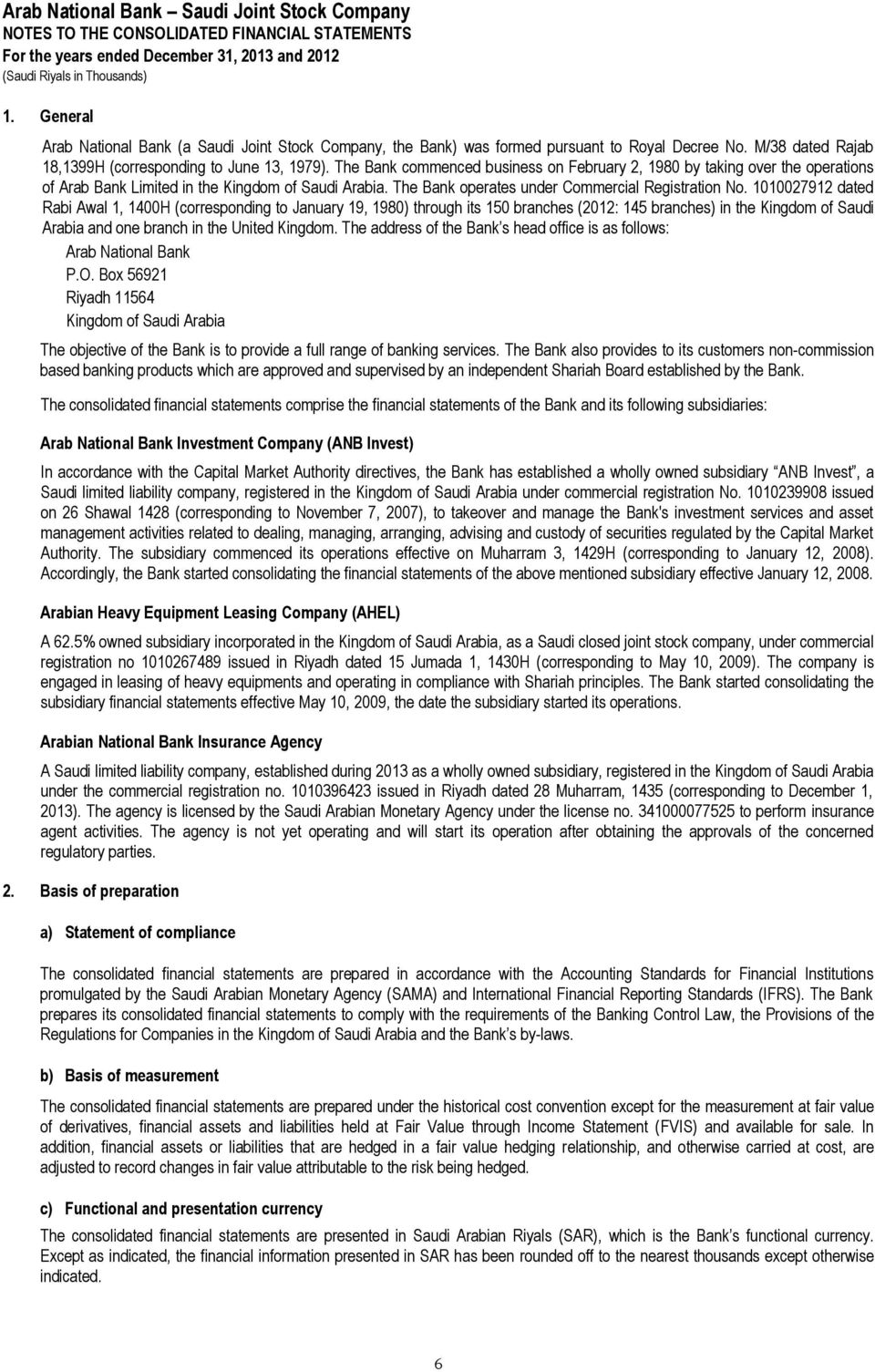
8 NOTES TO THE CONSOLIDATED FINANCIAL STATEMENTS 1. General Arab National Bank (a Saudi Joint Stock Company, the Bank) was formed pursuant to Royal Decree No. M/38 dated Rajab 18,1399H (corresponding to June 13, 1979). The Bank commenced business on February 2, 1980 by taking over the operations of Arab Bank Limited in the Kingdom of Saudi Arabia. The Bank operates under Commercial Registration No dated Rabi Awal 1, 1400H (corresponding to January 19, 1980) through its 150 branches (2012: 145 branches) in the Kingdom of Saudi Arabia and one branch in the United Kingdom. The address of the Bank s head office is as follows: Arab National Bank P.O. Box Riyadh Kingdom of Saudi Arabia The objective of the Bank is to provide a full range of banking services. The Bank also provides to its customers non-commission based banking products which are approved and supervised by an independent Shariah Board established by the Bank. The consolidated financial statements comprise the financial statements of the Bank and its following subsidiaries: Arab National Bank Investment Company (ANB Invest) In accordance with the Capital Market Authority directives, the Bank has established a wholly owned subsidiary ANB Invest, a Saudi limited liability company, registered in the Kingdom of Saudi Arabia under commercial registration No issued on 26 Shawal 1428 (corresponding to November 7, 2007), to takeover and manage the Bank's investment services and asset management activities related to dealing, managing, arranging, advising and custody of securities regulated by the Capital Market Authority. The subsidiary commenced its operations effective on Muharram 3, 1429H (corresponding to January 12, 2008). Accordingly, the Bank started consolidating the financial statements of the above mentioned subsidiary effective January 12, Arabian Heavy Equipment Leasing Company (AHEL) A 62.5% owned subsidiary incorporated in the Kingdom of Saudi Arabia, as a Saudi closed joint stock company, under commercial registration no issued in Riyadh dated 15 Jumada 1, 1430H (corresponding to May 10, 2009). The company is engaged in leasing of heavy equipments and operating in compliance with Shariah principles. The Bank started consolidating the subsidiary financial statements effective May 10, 2009, the date the subsidiary started its operations. Arabian National Bank Insurance Agency A Saudi limited liability company, established during 2013 as a wholly owned subsidiary, registered in the Kingdom of Saudi Arabia under the commercial registration no issued in Riyadh dated 28 Muharram, 1435 (corresponding to December 1, 2013). The agency is licensed by the Saudi Arabian Monetary Agency under the license no to perform insurance agent activities. The agency is not yet operating and will start its operation after obtaining the approvals of the concerned regulatory parties. 2. Basis of preparation a) Statement of compliance The consolidated financial statements are prepared in accordance with the Accounting Standards for Financial Institutions promulgated by the Saudi Arabian Monetary Agency (SAMA) and International Financial Reporting Standards (IFRS). The Bank prepares its consolidated financial statements to comply with the requirements of the Banking Control Law, the Provisions of the Regulations for Companies in the Kingdom of Saudi Arabia and the Bank s by-laws. b) Basis of measurement The consolidated financial statements are prepared under the historical cost convention except for the measurement at fair value of derivatives, financial assets and liabilities held at Fair Value through Income Statement (FVIS) and available for sale. In addition, financial assets or liabilities that are hedged in a fair value hedging relationship, and otherwise carried at cost, are adjusted to record changes in fair value attributable to the risk being hedged. c) Functional and presentation currency The consolidated financial statements are presented in Saudi Arabian Riyals (SAR), which is the Bank s functional currency. Except as indicated, the financial information presented in SAR has been rounded off to the nearest thousands except otherwise indicated. 6
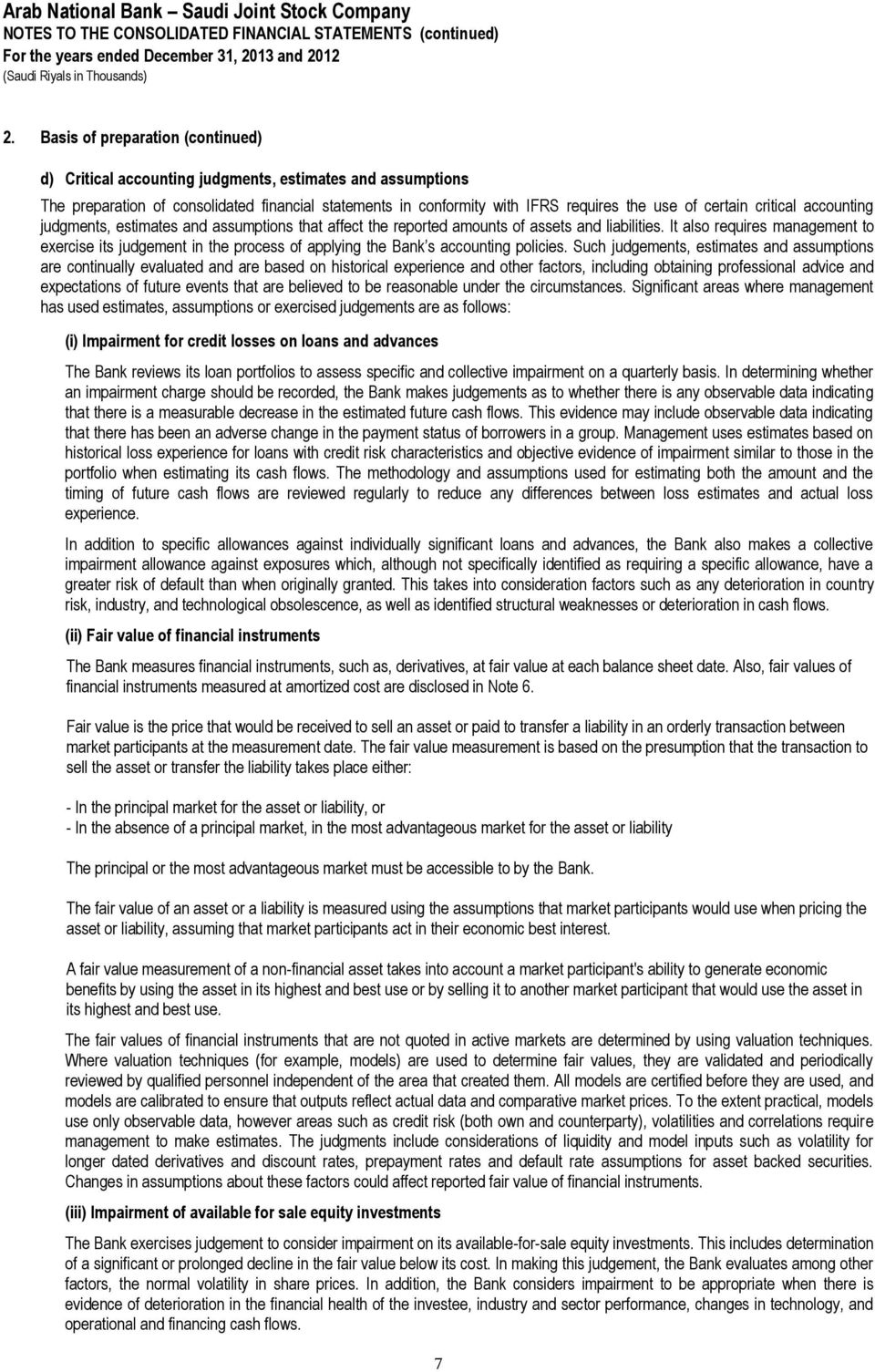
9 2. Basis of preparation (continued) d) Critical accounting judgments, estimates and assumptions The preparation of consolidated financial statements in conformity with IFRS requires the use of certain critical accounting judgments, estimates and assumptions that affect the reported amounts of assets and liabilities. It also requires management to exercise its judgement in the process of applying the Bank s accounting policies. Such judgements, estimates and assumptions are continually evaluated and are based on historical experience and other factors, including obtaining professional advice and expectations of future events that are believed to be reasonable under the circumstances. Significant areas where management has used estimates, assumptions or exercised judgements are as follows: (i) Impairment for credit losses on loans and advances The Bank reviews its loan portfolios to assess specific and collective impairment on a quarterly basis. In determining whether an impairment charge should be recorded, the Bank makes judgements as to whether there is any observable data indicating that there is a measurable decrease in the estimated future cash flows. This evidence may include observable data indicating that there has been an adverse change in the payment status of borrowers in a group. Management uses estimates based on historical loss experience for loans with credit risk characteristics and objective evidence of impairment similar to those in the portfolio when estimating its cash flows. The methodology and assumptions used for estimating both the amount and the timing of future cash flows are reviewed regularly to reduce any differences between loss estimates and actual loss experience. In addition to specific allowances against individually significant loans and advances, the Bank also makes a collective impairment allowance against exposures which, although not specifically identified as requiring a specific allowance, have a greater risk of default than when originally granted. This takes into consideration factors such as any deterioration in country risk, industry, and technological obsolescence, as well as identified structural weaknesses or deterioration in cash flows. (ii) Fair value of financial instruments The Bank measures financial instruments, such as, derivatives, at fair value at each balance sheet date. Also, fair values of financial instruments measured at amortized cost are disclosed in Note 6. Fair value is the price that would be received to sell an asset or paid to transfer a liability in an orderly transaction between market participants at the measurement date. The fair value measurement is based on the presumption that the transaction to sell the asset or transfer the liability takes place either: - In the principal market for the asset or liability, or - In the absence of a principal market, in the most advantageous market for the asset or liability The principal or the most advantageous market must be accessible to by the Bank. The fair value of an asset or a liability is measured using the assumptions that market participants would use when pricing the asset or liability, assuming that market participants act in their economic best interest. A fair value measurement of a non-financial asset takes into account a market participant's ability to generate economic benefits by using the asset in its highest and best use or by selling it to another market participant that would use the asset in its highest and best use. The fair values of financial instruments that are not quoted in active markets are determined by using valuation techniques. Where valuation techniques (for example, models) are used to determine fair values, they are validated and periodically reviewed by qualified personnel independent of the area that created them. All models are certified before they are used, and models are calibrated to ensure that outputs reflect actual data and comparative market prices. To the extent practical, models use only observable data, however areas such as credit risk (both own and counterparty), volatilities and correlations require management to make estimates. The judgments include considerations of liquidity and model inputs such as volatility for longer dated derivatives and discount rates, prepayment rates and default rate assumptions for asset backed securities. Changes in assumptions about these factors could affect reported fair value of financial instruments. (iii) Impairment of available for sale equity investments The Bank exercises judgement to consider impairment on its available-for-sale equity investments. This includes determination of a significant or prolonged decline in the fair value below its cost. In making this judgement, the Bank evaluates among other factors, the normal volatility in share prices. In addition, the Bank considers impairment to be appropriate when there is evidence of deterioration in the financial health of the investee, industry and sector performance, changes in technology, and operational and financing cash flows. 7
10 2. Basis of preparation (continued) d) Critical accounting judgments, estimates and assumptions (continued) (iii) Impairment of available for sale equity investments (continued) Due to current volatility in the market, 30% or more is used as a reasonable measure for significant decline below cost, irrespective of the duration of the decline, and is recognized in the consolidated income statement under gains and impairment of non-trading investments, net. Prolonged decline represents decline below cost that persists for 1 year or longer irrespective of the amount and is, thus, recognized in the consolidated income statement under gains and impairment of non-trading investments, net. (iv) Classification of held-to-maturity investments The Bank follows the guidance of IAS 39 on classifying non-derivative financial assets with fixed or determinable payments and fixed maturity as held-to-maturity. In making this judgement, the Bank evaluates its intention and ability to hold such investments to maturity. If the Bank fails to keep these investments to maturity other than in certain specific circumstances for example, selling close to maturity or an insignificant amount it will be required to reclassify the entire class as availablefor-sale. (v) Determination of control over investees The control indicators set out note 3 (a) are subject to management s judgements that can have a significant effect in the case of the Group s interests in investments funds. The Group acts as Fund Manager to a number of investment funds. Determining whether the Group controls such an investment fund usually focuses on the assessment of the aggregate economic interests of the Group in the Fund (comprising any carried interests and expected management fees) and the investors rights to remove the Fund Manager. As a result the Group has concluded that it acts as an agent for the investors in all cases, and therefore has not consolidated these funds. e) Going concern The Bank s management has made an assessment of the Bank s ability to continue as a going concern and is satisfied that the Bank has the resources to continue in business for the foreseeable future. Furthermore, the management is not aware of any material uncertainties that may cast significant doubt upon the Bank s ability to continue as a going concern. Therefore, the financial statements continue to be prepared on the going concern basis. 3. Summary of significant accounting policies The significant accounting policies adopted in the preparation of these consolidated financial statements are set out below: The accounting policies used in the preparation of these consolidated financial statements are consistent with those followed in the preparation of the Group s annual consolidated financial statements for the year ended 31 December 2012 except that the Group has adopted the following new and amended IASB Standards and International Financial Reporting Interpretations Committee which had no impact on the financial position and financial performance of the Group: - IAS 1 Presentation of Items of other comprehensive income Amendments to IAS 1 - IAS 1 Clarification of the requirement for comparative information (Amendment) - IAS 34 Interim financial reporting and segment information for total assets and liabilities (Amendment) - IFRS 7 Financial instruments: Disclosures offsetting financial assets and financial liabilities (Amendment) - IFRS 10 Consolidated financial statements and IAS 27 separate financial statements - IFRS 12 Disclosure of interests in other entities - IFRS 13 Fair value measurement 8

11 3. Summary of significant accounting policies (continued) a) Basis of consolidation The consolidated financial statements comprise the financial statements of the Bank and its subsidiaries (collectively referred to as the Group). The financial statements of the subsidiaries are prepared for the same reporting year as that of the Bank, using consistent accounting policies. Adjustments have been made to the financial statements of the subsidiaries when necessary to align them with the Bank s financial statements. Subsidiaries are investees controlled by the Bank. The Bank controls an investee when it is exposed to, or has rights to, variable returns from its involvement with the investee and has the ability to affect those returns through its power over the investee. The financial statements of subsidiaries are include in the consolidated financial statements from the date that control commences until the date that control ceases. Specifically, the Bank controls an investee if and only if the Bank has: - Power over the investee (i.e. existing rights that give it the current ability to direct the relevant activities of the investee) - Exposure, or rights, to variable returns from its involvement with the investee, and - The ability to use its power over the investee to affect its returns When the Bank has less than a majority of the voting or similar rights of an investee, the Bank considers all relevant facts and circumstances in assessing whether it has power over an investee, including: - The contractual arrangement with the other vote holders of the investee - Rights arising from other contractual arrangements - The Bank s voting rights and potential voting rights The Bank re-assesses whether or not it controls an investee if facts and circumstances indicate that there are changes to one or more of the three elements of control. Consolidation of a subsidiary begins when the Bank obtains control over the subsidiary and ceases when the Bank loses control of the subsidiary. Assets, liabilities, income and expenses of a subsidiary acquired or disposed of during the year are included in the statement of comprehensive income from the date the Bank gains control until the date the Bank ceases to control the subsidiary. Profit or loss and each component of other comprehensive income (OCI) are attributed to the equity holders of the Bank and to the non-controlling interests, even if this results in the non-controlling interests having a deficit balance. When necessary, adjustments are made to the financial statements of subsidiaries to align them with the Bank s financial statements. Non-controlling interests represent the portion of net income or loss and net assets not owned, directly or indirectly, by the Bank and are presented separately in the consolidated income statement and within equity in the consolidated statement of financial position, separately from the equity holders of the bank. Any losses applicable to the non controlling interest in excess of the non controlling interest share are allocated against the interests of the Bank. Acquisitions of non-controlling interests are accounted for using the purchase method of accounting, whereby, the difference between the cost of acquisition and the fair value of the share of the net assets acquired is recognized as goodwill. All intra-group assets and liabilities, equity, income, expenses and cash flows relating to transactions between members of the Group are eliminated in full on consolidation. A change in the ownership interest of a subsidiary, without a loss of control, is accounted for as an equity transaction. b) Investment in associates Associates are enterprises in which the Bank generally holds 20% to 50% of the voting power and/or over which it exercises significant influence. Investments in associates are initially recorded at cost and subsequently accounted for under the equity method of accounting and are carried in the consolidated statement of financial position at the lower of the equity-accounted or recoverable amount. c) Settlement date accounting All regular-way purchases and sales of financial assets are recognized and derecognized on the settlement date. Regular-way purchases or sales are purchases or sales of financial assets that require delivery of assets within the timeframe generally established by regulation or convention in the market place. For financial instruments held at fair value, the Bank accounts for any change in fair values between the trade date and the reporting date. 9

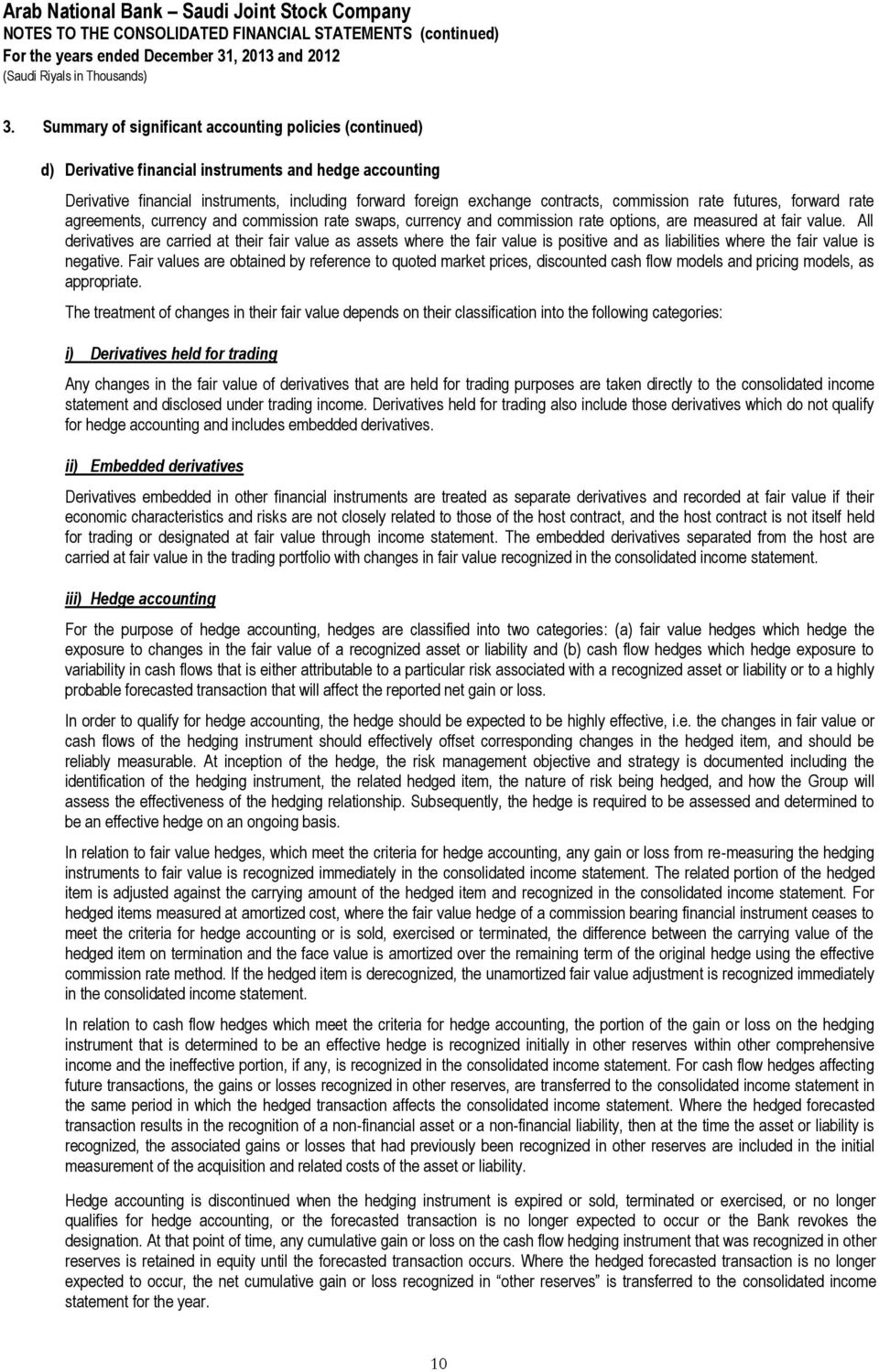
12 3. Summary of significant accounting policies (continued) d) Derivative financial instruments and hedge accounting Derivative financial instruments, including forward foreign exchange contracts, commission rate futures, forward rate agreements, currency and commission rate swaps, currency and commission rate options, are measured at fair value. All derivatives are carried at their fair value as assets where the fair value is positive and as liabilities where the fair value is negative. Fair values are obtained by reference to quoted market prices, discounted cash flow models and pricing models, as appropriate. The treatment of changes in their fair value depends on their classification into the following categories: i) Derivatives held for trading Any changes in the fair value of derivatives that are held for trading purposes are taken directly to the consolidated income statement and disclosed under trading income. Derivatives held for trading also include those derivatives which do not qualify for hedge accounting and includes embedded derivatives. ii) Embedded derivatives Derivatives embedded in other financial instruments are treated as separate derivatives and recorded at fair value if their economic characteristics and risks are not closely related to those of the host contract, and the host contract is not itself held for trading or designated at fair value through income statement. The embedded derivatives separated from the host are carried at fair value in the trading portfolio with changes in fair value recognized in the consolidated income statement. iii) Hedge accounting For the purpose of hedge accounting, hedges are classified into two categories: (a) fair value hedges which hedge the exposure to changes in the fair value of a recognized asset or liability and (b) cash flow hedges which hedge exposure to variability in cash flows that is either attributable to a particular risk associated with a recognized asset or liability or to a highly probable forecasted transaction that will affect the reported net gain or loss. In order to qualify for hedge accounting, the hedge should be expected to be highly effective, i.e. the changes in fair value or cash flows of the hedging instrument should effectively offset corresponding changes in the hedged item, and should be reliably measurable. At inception of the hedge, the risk management objective and strategy is documented including the identification of the hedging instrument, the related hedged item, the nature of risk being hedged, and how the Group will assess the effectiveness of the hedging relationship. Subsequently, the hedge is required to be assessed and determined to be an effective hedge on an ongoing basis. In relation to fair value hedges, which meet the criteria for hedge accounting, any gain or loss from re-measuring the hedging instruments to fair value is recognized immediately in the consolidated income statement. The related portion of the hedged item is adjusted against the carrying amount of the hedged item and recognized in the consolidated income statement. For hedged items measured at amortized cost, where the fair value hedge of a commission bearing financial instrument ceases to meet the criteria for hedge accounting or is sold, exercised or terminated, the difference between the carrying value of the hedged item on termination and the face value is amortized over the remaining term of the original hedge using the effective commission rate method. If the hedged item is derecognized, the unamortized fair value adjustment is recognized immediately in the consolidated income statement. In relation to cash flow hedges which meet the criteria for hedge accounting, the portion of the gain or loss on the hedging instrument that is determined to be an effective hedge is recognized initially in other reserves within other comprehensive income and the ineffective portion, if any, is recognized in the consolidated income statement. For cash flow hedges affecting future transactions, the gains or losses recognized in other reserves, are transferred to the consolidated income statement in the same period in which the hedged transaction affects the consolidated income statement. Where the hedged forecasted transaction results in the recognition of a non-financial asset or a non-financial liability, then at the time the asset or liability is recognized, the associated gains or losses that had previously been recognized in other reserves are included in the initial measurement of the acquisition and related costs of the asset or liability. Hedge accounting is discontinued when the hedging instrument is expired or sold, terminated or exercised, or no longer qualifies for hedge accounting, or the forecasted transaction is no longer expected to occur or the Bank revokes the designation. At that point of time, any cumulative gain or loss on the cash flow hedging instrument that was recognized in other reserves is retained in equity until the forecasted transaction occurs. Where the hedged forecasted transaction is no longer expected to occur, the net cumulative gain or loss recognized in other reserves is transferred to the consolidated income statement for the year. 10
13 3. Summary of significant accounting policies (continued) e) Foreign currencies Transactions in foreign currencies are translated into Saudi Arabian Riyals at the exchange rates prevailing at transaction dates. Monetary assets and liabilities at year end, denominated in foreign currencies, are translated into Saudi Arabian Riyals at the exchange rates prevailing at the consolidated statement of financial position date. Foreign exchange gains or losses on translation of monetary assets and liabilities denominated in foreign currencies are recognized in the consolidated income statement. Exchange differences on monetary items that qualify as hedging instruments in a cash flow hedge are reported initially in other comprehensive income to the extent that the hedge is effective. Exchange component of gains or losses on non-monetary items are recognized either in the consolidated income statement or other comprehensive income, in accordance with the treatment of the related gain or loss. Non-monetary items that are measured in terms of historical cost in a foreign currency are translated using the exchange rates as at the dates of the initial transactions. Non-monetary items measured at fair value in a foreign currency are translated using the exchange rates at the date when the fair value was determined. The monetary assets and liabilities of overseas branch are translated at the rate of exchange ruling at the consolidated statement of financial position date. The statement of income of the overseas branch is translated at the average exchange rates for the year. f) Offsetting financial instruments Financial assets and liabilities are offset and reported net in the consolidated statement of financial position when there is a legally enforceable right to set off the recognized amounts and when the Group intends to settle on a net basis, or to realize the asset and settle the liability simultaneously. Income and expenses are not offset in the consolidated income statement unless required or permitted by any accounting standard or interpretation, and as specifically disclosed in the accounting policies of the bank. g) Revenue and expenses recognition Special commission income and expense for all commission-bearing financial instruments, except for those classified as held for trading or designated at fair value through income statement, including the fees which are considered an integral part of the effective yield of a financial instrument, are recognized in the consolidated income statement on the effective yield basis and include premiums amortized and discounts accreted during the year. The effective commission rate is the rate that exactly discounts estimated future cash payments or receipts through the expected life of the financial instrument or a shorter period, where appropriate, to the net carrying amount of the financial assets or liability. The calculation takes into account all contractual terms of the financial instrument (for example, prepayment options) and includes any fees or incremental costs that are directly attributable to the instrument and are an integral part of the effective commission rate but not future credit losses. Loan commitment fees for loans that are likely to be drawn down are deferred and, together with the related direct cost, are recognized as an adjustment to the effective commission rate on the loan. The carrying amount of the financial asset or financial liability is adjusted if the Bank revises its estimates of payments or receipts. The adjusted carrying amount is calculated based on the original effective commission rate and the change in carrying amount is recorded as special commission income or expense. Once the recorded value of a financial asset or a group of similar financial assets has been reduced due to an impairment loss, special commission income continues to be recognized using the original effective commission rate applied to the new carrying amount. Exchange income/loss is recognized when earned/incurred. Fees and commissions are recognized on an accrual basis when the service has been provided. Portfolio and other management advisory and service fees are recognized based on the applicable service contracts, usually on a timeproportionate basis. Fee received on asset management, wealth management, financial planning, custody services and other similar services that are provided over an extended period of time, are recognized rateably over the period when the service is being provided. Dividend income is recognized when the right to receive income is established. Revenue arising from trading activities include all gains and losses from changes in fair value and related commission income or expense and dividends for financial assets and financial liabilities held for trading and foreign exchange differences. This includes any ineffectiveness recorded in hedging transactions. 11

14 3. Summary of significant accounting policies (continued) h) Sale and repurchase agreements Assets sold with a simultaneous commitment to repurchase at a specified future date (repos) continue to be recognized on the consolidated statement of financial position and are measured in accordance with related accounting policies for investments held as FVIS, available for sale, held to maturity and other investments held at amortized cost. The counterparty liability for amounts received under these agreements is included in Due to banks and other financial institutions or Customers deposits, as appropriate. The difference between sale and repurchase price is treated as special commission expense and accrued over the life of the repo agreement on an effective yield basis. Assets purchased with a corresponding commitment to resell at a specified future date (reverse repo) are not recognized in the consolidated statement of financial position, as the Bank does not obtain control over the assets. Amounts paid under these agreements are included in Cash and balances with SAMA, Due from banks and other financial institutions or Loans and advances, as appropriate. The difference between purchase and resale price is treated as special commission income and accrued over the life of the reverse repo agreement on an effective yield basis. i) Investments The classification of financial instruments at initial recognition depends on the purpose for which the financial instruments were acquired and their characteristics. All investment securities are initially recognized at their fair value plus, in the case of all financial assets other than those carried at Fair Value through income statement (FVIS), any directly attributable incremental costs of acquisition. Premiums are amortized and discounts accreted on effective yield basis and taken to special commission income. For securities traded in organized financial markets, fair value is determined by reference to exchange quoted market bid prices at the close of business on the consolidated statement of financial position date without any deduction for transaction costs. Fair value of managed assets and investments in mutual funds are determined by reference to declared net asset values. For securities where there is no quoted market price, a reasonable estimate of the fair value is determined by reference to the current market value of another instrument which is substantially the same, or is based on the expected cash flows or the underlying net asset base of the security. Where the fair values cannot be derived from active markets, they are determined using a variety of valuation techniques that include the use of mathematical models. The input to these models is taken from observable markets where possible, but where this is not feasible, a degree of judgment is required in establishing fair values. Following initial recognition, subsequent transfers between the various classes of investments are not ordinarily permissible. The subsequent period-end reporting values for each class of investment are determined on the basis as set out in the following paragraphs: (i) Held at Fair Value Through Income Statement (FVIS) Investments in this category include those investments held for trading or those designated as FVIS on initial recognition. Investments classified as trading are acquired for the purpose of selling or repurchasing in short term and are recorded in the consolidated statement of financial position at fair value. Changes in fair value are recognized in trading income/loss, net. An investment may be designated as FVIS if it satisfies the criteria laid down by IAS 39 except for the equity instruments that do not have a quoted price in an active market and whose fair values cannot be reliably measured. After initial recognition, investments held at FVIS are measured at fair value. Changes in fair value are recorded in the consolidated income statement in the year in which it arises. Special commission income and dividend income received on financial assets held as FVIS are reflected as either trading income or income from FVIS financial instruments in line with the underlying assets in the consolidated income statement. (ii) Available for sale Available-for-sale investments are those equity and debt securities intended to be held for an unspecified period of time, which may be sold in response to needs for liquidity or changes in commission rates, exchange rates or equity prices. AFS are non-derivative instruments that are designated as AFS or not classified as another category of financial assets. Investments which are classified as available for sale are subsequently measured at fair value. For an available-for-sale investment where the fair value has not been hedged, any gain or loss arising from a change in its fair value is recognized directly in the consolidated statement of comprehensive income. On derecognition, any cumulative gain or loss previously recognized in shareholders equity is transferred in the consolidated income statement for the year. Special commission income is recognized in the consolidated income statement on an effective yield basis. Dividend income is recognized in consolidated income statement when the Group becomes entitled to the dividend. Foreign exchange gains or loss on available for sale debt security investments are recognized in consolidated income statement. 12

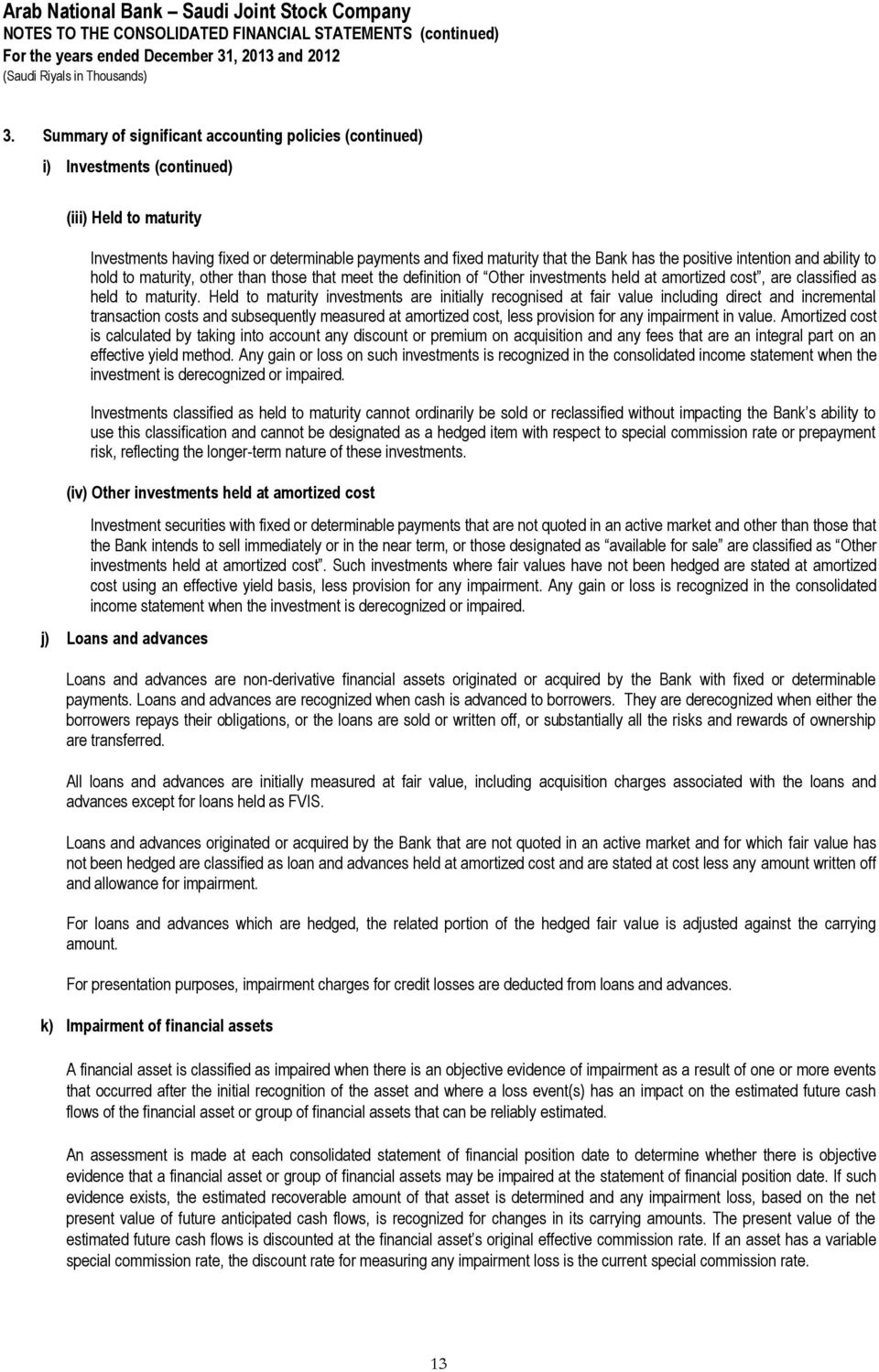
15 3. Summary of significant accounting policies (continued) i) Investments (continued) (iii) Held to maturity Investments having fixed or determinable payments and fixed maturity that the Bank has the positive intention and ability to hold to maturity, other than those that meet the definition of Other investments held at amortized cost, are classified as held to maturity. Held to maturity investments are initially recognised at fair value including direct and incremental transaction costs and subsequently measured at amortized cost, less provision for any impairment in value. Amortized cost is calculated by taking into account any discount or premium on acquisition and any fees that are an integral part on an effective yield method. Any gain or loss on such investments is recognized in the consolidated income statement when the investment is derecognized or impaired. Investments classified as held to maturity cannot ordinarily be sold or reclassified without impacting the Bank s ability to use this classification and cannot be designated as a hedged item with respect to special commission rate or prepayment risk, reflecting the longer-term nature of these investments. (iv) Other investments held at amortized cost Investment securities with fixed or determinable payments that are not quoted in an active market and other than those that the Bank intends to sell immediately or in the near term, or those designated as available for sale are classified as Other investments held at amortized cost. Such investments where fair values have not been hedged are stated at amortized cost using an effective yield basis, less provision for any impairment. Any gain or loss is recognized in the consolidated income statement when the investment is derecognized or impaired. j) Loans and advances Loans and advances are non-derivative financial assets originated or acquired by the Bank with fixed or determinable payments. Loans and advances are recognized when cash is advanced to borrowers. They are derecognized when either the borrowers repays their obligations, or the loans are sold or written off, or substantially all the risks and rewards of ownership are transferred. All loans and advances are initially measured at fair value, including acquisition charges associated with the loans and advances except for loans held as FVIS. Loans and advances originated or acquired by the Bank that are not quoted in an active market and for which fair value has not been hedged are classified as loan and advances held at amortized cost and are stated at cost less any amount written off and allowance for impairment. For loans and advances which are hedged, the related portion of the hedged fair value is adjusted against the carrying amount. For presentation purposes, impairment charges for credit losses are deducted from loans and advances. k) Impairment of financial assets A financial asset is classified as impaired when there is an objective evidence of impairment as a result of one or more events that occurred after the initial recognition of the asset and where a loss event(s) has an impact on the estimated future cash flows of the financial asset or group of financial assets that can be reliably estimated. An assessment is made at each consolidated statement of financial position date to determine whether there is objective evidence that a financial asset or group of financial assets may be impaired at the statement of financial position date. If such evidence exists, the estimated recoverable amount of that asset is determined and any impairment loss, based on the net present value of future anticipated cash flows, is recognized for changes in its carrying amounts. The present value of the estimated future cash flows is discounted at the financial asset s original effective commission rate. If an asset has a variable special commission rate, the discount rate for measuring any impairment loss is the current special commission rate. 13
16 3. Summary of significant accounting policies (continued) k) Impairment of financial assets (continued) When a financial asset is uncollectible, it is written off either directly by a charge to consolidated income statement or against the related allowance for impairment account. Financial assets are written off only in circumstances where effectively all possible means of recovery have been exhausted, and the amount of the loss has been determined. If, in a subsequent period, the amount of the impairment loss decreases and the decrease can be related objectively to an event occurring after the impairment was recognized, the previously recognized impairment loss is reversed by adjusting the allowance account. The amount of the reversal is recognized in the consolidated income statement in impairment charges for credit losses. Once a financial asset has been written down to its estimated recoverable amount, special commission income is thereafter recognized based on the original effective commission rate that was used to discount the future cash flows for the purpose of measuring the recoverable amount. Loans whose terms have been renegotiated are no longer considered to be past due but are treated as new loans. Restructuring policies and practices are based on indicators or criteria which, indicate that payment will most likely continue. The loans continue to be subject to an individual or collective impairment assessment, calculated using the loan s original effective yield rate. In addition to specific impairment charges for credit losses, an allowance for collective impairment is made on a portfolio basis for credit losses where there is an objective evidence that unidentified losses exist at the reporting date. This allowance is estimated based on various factors including credit ratings allocated to a borrower or group of borrowers, the current economic conditions, the experience the Bank has had in dealing with a borrower or group of borrowers and available historical default information. i) Impairment of financial assets held at amortized cost A specific impairment charges for credit losses due to impairment of a loan or any other financial asset held at amortized cost is established if there is objective evidence that the Bank will not be able to collect all amounts due. The amount of the specific provision is the difference between the carrying amount and the estimated recoverable amount. The estimated recoverable amount is the present value of expected cash flows, including amounts estimated to be recoverable from guarantees and collateral, discounted based on the original effective yield rate. For financial assets at amortized cost, the carrying amount of the asset is adjusted either directly or through the use of an allowance account and the amount of the adjustment is included in the consolidated income statement. ii) Impairment of available for sale financial assets In the case of debt instruments classified as available-for-sale, the Bank assesses individually whether there is objective evidence of impairment based on the same criteria as financial assets carried at amortized cost. However, the amount recorded for impairment is the cumulative loss measured as the difference between the amortized cost and the current fair value, less any impairment loss on that investment previously recognized in the consolidated income statement. If, in a subsequent period, the fair value of a debt instrument increases and the increase can be objectively related to a credit event occurring after the impairment loss was recognized in the income statement, the impairment loss is reversed through the consolidated income statement. For equity investments held as available-for-sale, a significant or prolonged decline in fair value below its cost represents objective evidence of impairment. The impairment loss cannot be reversed through the consolidated income statement as long as the asset continues to be recognized i.e. any increase in fair value after impairment has been recorded can only be recognized in equity. On derecognition, any cumulative gain or loss previously recognized in equity is included in the consolidated income statement for the year. 14

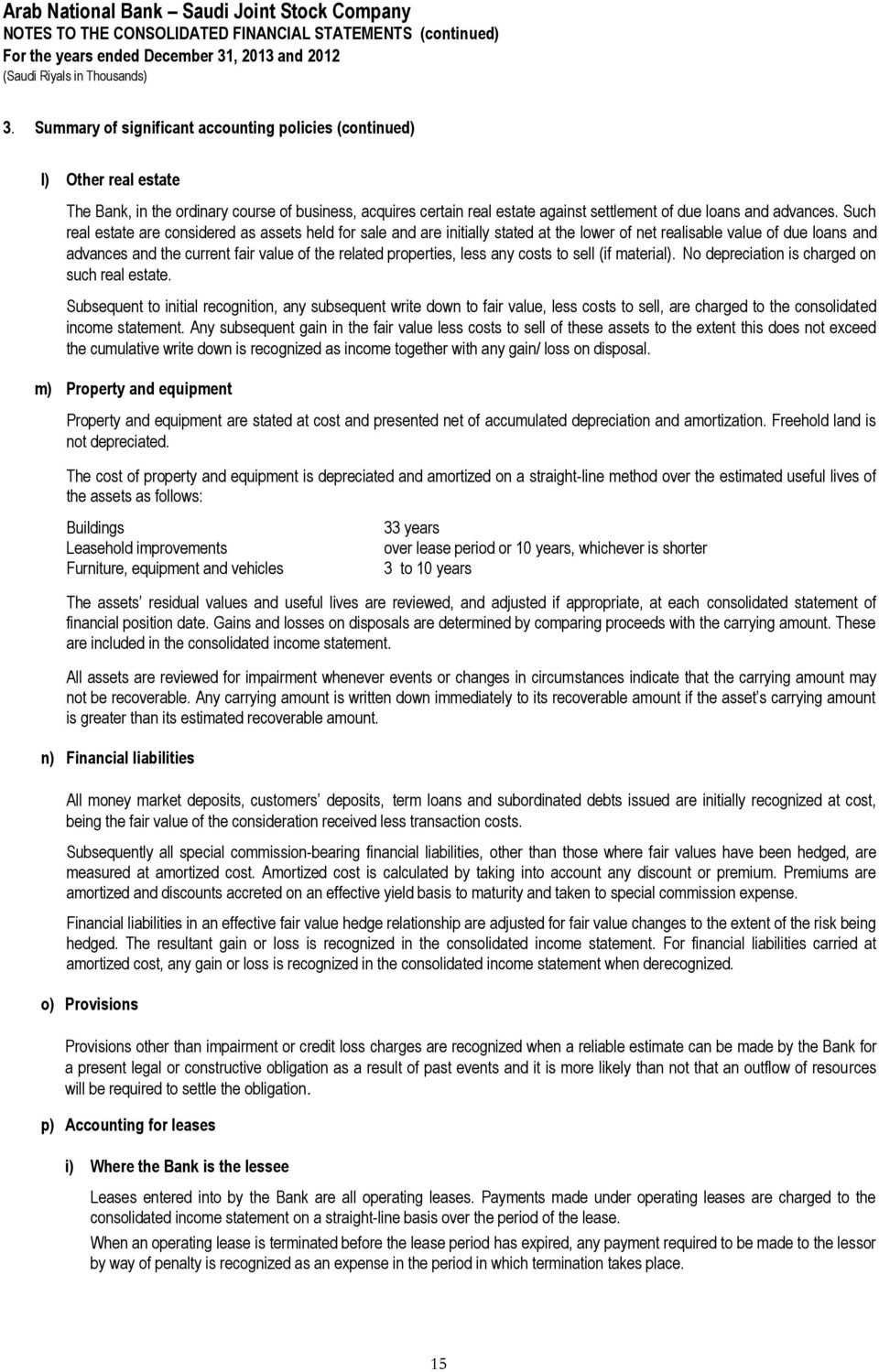
17 3. Summary of significant accounting policies (continued) l) Other real estate The Bank, in the ordinary course of business, acquires certain real estate against settlement of due loans and advances. Such real estate are considered as assets held for sale and are initially stated at the lower of net realisable value of due loans and advances and the current fair value of the related properties, less any costs to sell (if material). No depreciation is charged on such real estate. Subsequent to initial recognition, any subsequent write down to fair value, less costs to sell, are charged to the consolidated income statement. Any subsequent gain in the fair value less costs to sell of these assets to the extent this does not exceed the cumulative write down is recognized as income together with any gain/ loss on disposal. m) Property and equipment Property and equipment are stated at cost and presented net of accumulated depreciation and amortization. Freehold land is not depreciated. The cost of property and equipment is depreciated and amortized on a straight-line method over the estimated useful lives of the assets as follows: Buildings Leasehold improvements Furniture, equipment and vehicles 33 years over lease period or 10 years, whichever is shorter 3 to 10 years The assets residual values and useful lives are reviewed, and adjusted if appropriate, at each consolidated statement of financial position date. Gains and losses on disposals are determined by comparing proceeds with the carrying amount. These are included in the consolidated income statement. All assets are reviewed for impairment whenever events or changes in circumstances indicate that the carrying amount may not be recoverable. Any carrying amount is written down immediately to its recoverable amount if the asset s carrying amount is greater than its estimated recoverable amount. n) Financial liabilities All money market deposits, customers deposits, term loans and subordinated debts issued are initially recognized at cost, being the fair value of the consideration received less transaction costs. Subsequently all special commission-bearing financial liabilities, other than those where fair values have been hedged, are measured at amortized cost. Amortized cost is calculated by taking into account any discount or premium. Premiums are amortized and discounts accreted on an effective yield basis to maturity and taken to special commission expense. Financial liabilities in an effective fair value hedge relationship are adjusted for fair value changes to the extent of the risk being hedged. The resultant gain or loss is recognized in the consolidated income statement. For financial liabilities carried at amortized cost, any gain or loss is recognized in the consolidated income statement when derecognized. o) Provisions Provisions other than impairment or credit loss charges are recognized when a reliable estimate can be made by the Bank for a present legal or constructive obligation as a result of past events and it is more likely than not that an outflow of resources will be required to settle the obligation. p) Accounting for leases i) Where the Bank is the lessee Leases entered into by the Bank are all operating leases. Payments made under operating leases are charged to the consolidated income statement on a straight-line basis over the period of the lease. When an operating lease is terminated before the lease period has expired, any payment required to be made to the lessor by way of penalty is recognized as an expense in the period in which termination takes place. 15
18 3. Summary of significant accounting policies (continued) p) Accounting for leases (continued) ii) Where the Bank is the lessor When assets are sold under a finance lease, including assets under Shariah compliant lease, the present value of the lease payments is recognized as a receivable and disclosed under loans and advances. The difference between the gross receivable and the present value of the receivable is recognized as unearned finance income. Lease income is recognized over the term of the lease using the net investment method, which reflects a constant periodic rate of return. q) Cash and cash equivalents For the purpose of the consolidated statement of cash flows, cash and cash equivalents are defined as those amounts included in cash, balances with SAMA excluding statutory deposit, and due from banks and other financial institutions maturing within 90 days of the acquisition date. r) Financial guarantees In the ordinary course of business, the Bank gives financial guarantees, consisting of letters of credit, guarantees and acceptances. Financial guarantees are initially recognized in the consolidated financial statements at fair value, in Other Liabilities, being the premium received. Subsequent to initial recognition, the Bank s liability under each guarantee is measured at the higher of the amortized premium and the best estimate of expenditure required to settle any financial obligation arising as a result of the guarantee. Any increase in the liability relating to financial guarantees is taken to the consolidated income statement in impairment charges for credit losses. The premium received is recognized in the consolidated income statement in Fees and commission income, net on a straight line basis over the life of the guarantee. s) Derecognition of financial instruments A financial asset (or a part of a financial asset, or a part of a group of similar financial assets) is derecognized, when the contractual right to the cash flows from the financial asset expires. In instances where the Bank is assessed to have transferred a financial asset, the asset is derecognized if the Bank has transferred substantially all the risks and rewards of ownership. Where the Bank has neither transferred nor retained substantially all the risks and rewards of ownership, the financial asset is derecognized only if the Bank has not retained control of the financial asset. The Bank recognizes separately as assets or liabilities any rights and obligations created or retained in the process. A financial liability (or a part of a financial liability) is derecognized when it is extinguished, that is when the obligation specified in the contract is either discharged, cancelled or expires. t) Zakat and income taxes Zakat and income taxes are the liabilities of Saudi and foreign shareholders, respectively. Zakat is computed on the Saudi shareholders share of equity or net income using the basis defined under the zakat regulations. Income taxes are computed on the foreign shareholders share of net income for the year. Zakat and income taxes are not charged to the Bank s consolidated income statement as they are payable by the shareholders. 16

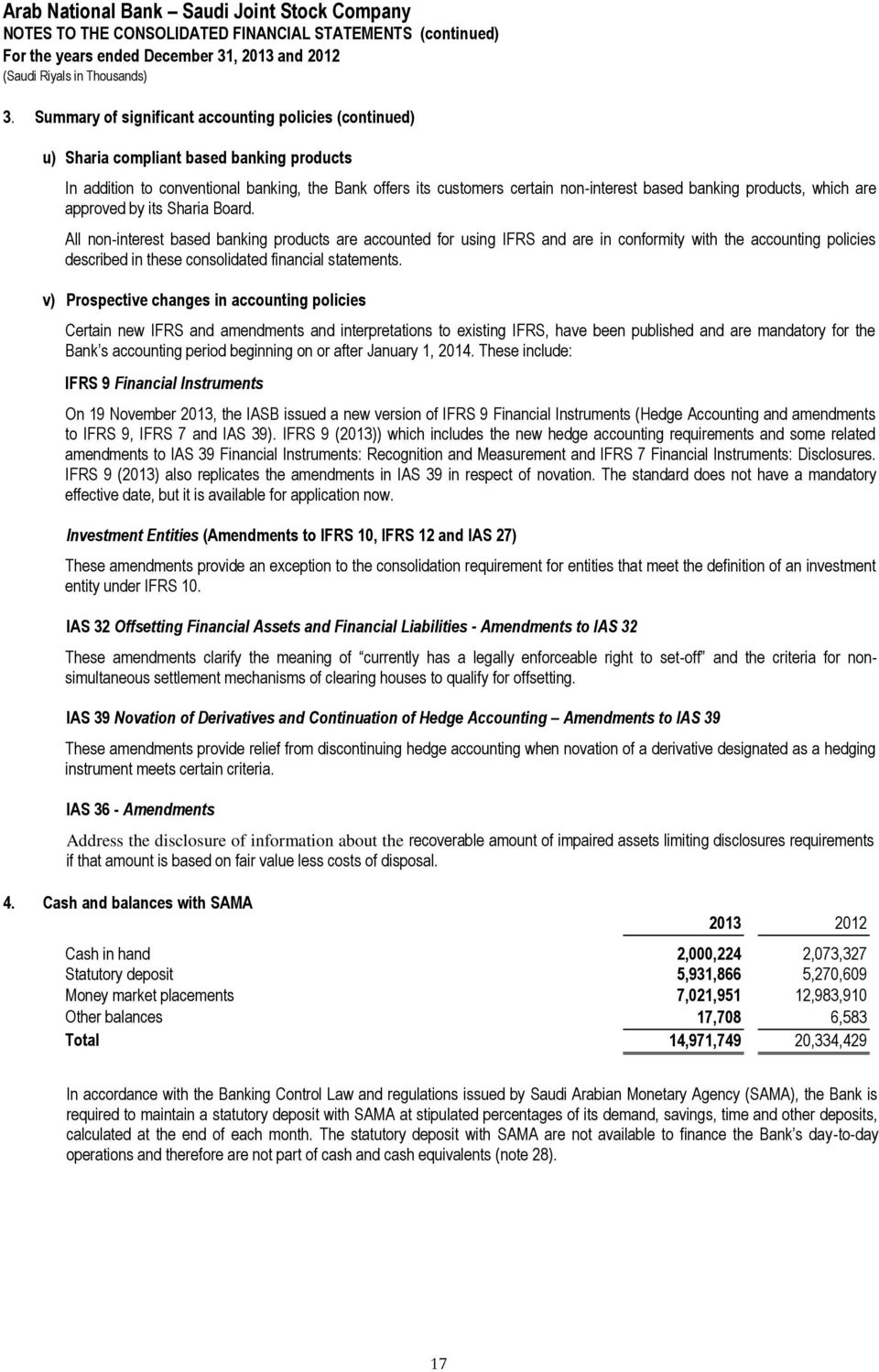
19 3. Summary of significant accounting policies (continued) u) Sharia compliant based banking products In addition to conventional banking, the Bank offers its customers certain non-interest based banking products, which are approved by its Sharia Board. All non-interest based banking products are accounted for using IFRS and are in conformity with the accounting policies described in these consolidated financial statements. v) Prospective changes in accounting policies Certain new IFRS and amendments and interpretations to existing IFRS, have been published and are mandatory for the Bank s accounting period beginning on or after January 1, These include: IFRS 9 Financial Instruments On 19 November 2013, the IASB issued a new version of IFRS 9 Financial Instruments (Hedge Accounting and amendments to IFRS 9, IFRS 7 and IAS 39). IFRS 9 (2013)) which includes the new hedge accounting requirements and some related amendments to IAS 39 Financial Instruments: Recognition and Measurement and IFRS 7 Financial Instruments: Disclosures. IFRS 9 (2013) also replicates the amendments in IAS 39 in respect of novation. The standard does not have a mandatory effective date, but it is available for application now. Investment Entities (Amendments to IFRS 10, IFRS 12 and IAS 27) These amendments provide an exception to the consolidation requirement for entities that meet the definition of an investment entity under IFRS 10. IAS 32 Offsetting Financial Assets and Financial Liabilities - Amendments to IAS 32 These amendments clarify the meaning of currently has a legally enforceable right to set-off and the criteria for nonsimultaneous settlement mechanisms of clearing houses to qualify for offsetting. IAS 39 Novation of Derivatives and Continuation of Hedge Accounting Amendments to IAS 39 These amendments provide relief from discontinuing hedge accounting when novation of a derivative designated as a hedging instrument meets certain criteria. IAS 36 - Amendments Address the disclosure of information about the recoverable amount of impaired assets limiting disclosures requirements if that amount is based on fair value less costs of disposal. 4. Cash and balances with SAMA Cash in hand 2,000,224 2,073,327 Statutory deposit 5,931,866 5,270,609 Money market placements 7,021,951 12,983,910 Other balances 17,708 6,583 Total 14,971,749 20,334,429 In accordance with the Banking Control Law and regulations issued by Saudi Arabian Monetary Agency (SAMA), the Bank is required to maintain a statutory deposit with SAMA at stipulated percentages of its demand, savings, time and other deposits, calculated at the end of each month. The statutory deposit with SAMA are not available to finance the Bank s day-to-day operations and therefore are not part of cash and cash equivalents (note 28). 17
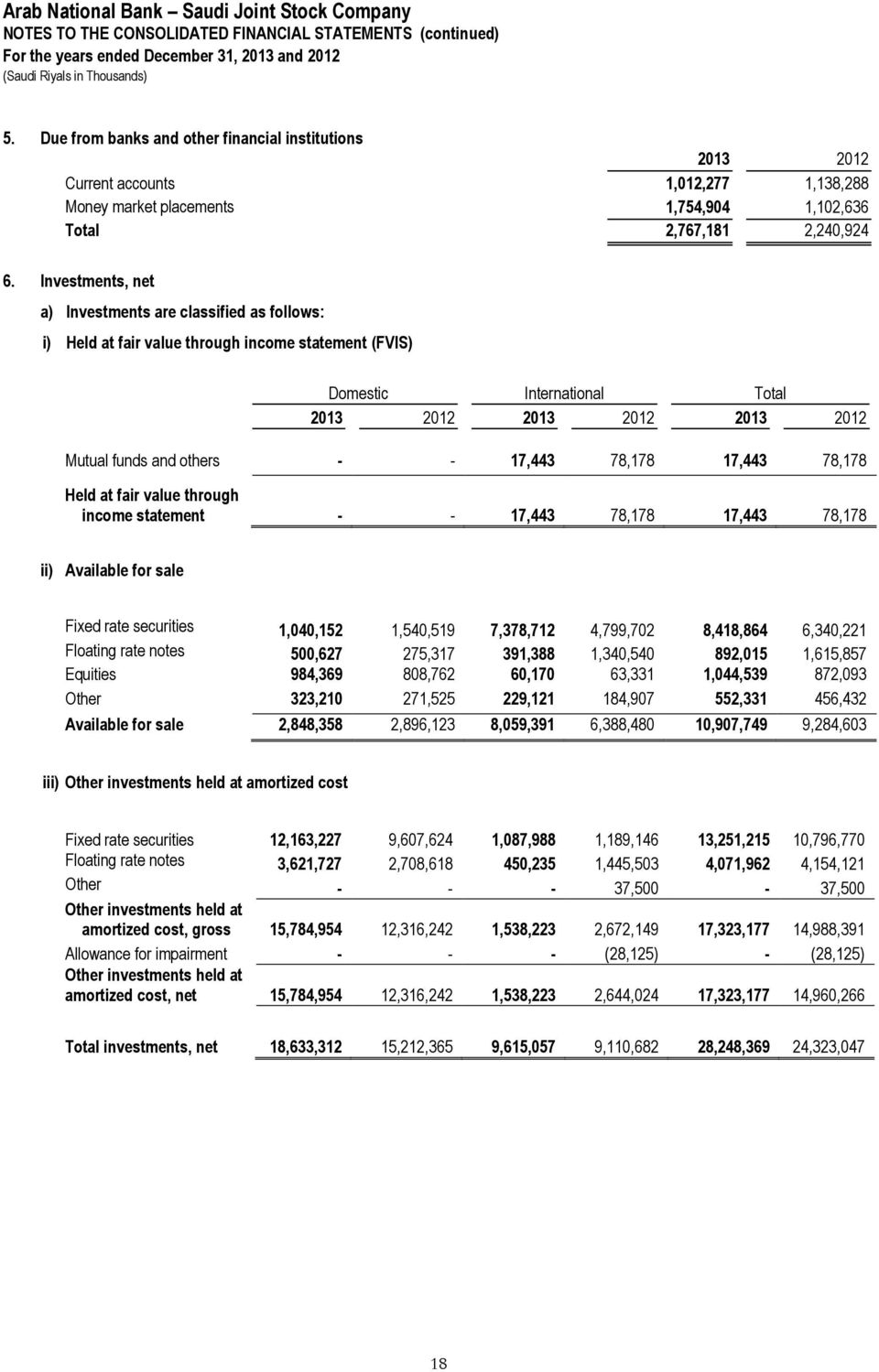
20 5. Due from banks and other financial institutions Current accounts 1,012,277 1,138,288 Money market placements 1,754,904 1,102,636 Total 2,767,181 2,240, Investments, net a) Investments are classified as follows: i) Held at fair value through income statement (FVIS) Domestic International Total Mutual funds and others ,443 78,178 17,443 78,178 Held at fair value through income statement ,443 78,178 17,443 78,178 ii) Available for sale Fixed rate securities 1,040,152 1,540,519 7,378,712 4,799,702 8,418,864 6,340,221 Floating rate notes 500, , ,388 1,340, ,015 1,615,857 Equities 984, ,762 60,170 63,331 1,044, ,093 Other 323, , , , , ,432 Available for sale 2,848,358 2,896,123 8,059,391 6,388,480 10,907,749 9,284,603 iii) Other investments held at amortized cost Fixed rate securities 12,163,227 9,607,624 1,087,988 1,189,146 13,251,215 10,796,770 Floating rate notes 3,621,727 2,708, ,235 1,445,503 4,071,962 4,154,121 Other ,500-37,500 Other investments held at amortized cost, gross 15,784,954 12,316,242 1,538,223 2,672,149 17,323,177 14,988,391 Allowance for impairment (28,125) - (28,125) Other investments held at amortized cost, net 15,784,954 12,316,242 1,538,223 2,644,024 17,323,177 14,960,266 Total investments, net 18,633,312 15,212,365 9,615,057 9,110,682 28,248,369 24,323,047 18
21 6. Investments, net (continued) b) The analysis of the composition of investments is as follows: Quoted Unquoted Total Quoted Unquoted Total Fixed rate securities 9,470,675 12,199,404 21,670,079 6,681,975 10,455,016 17,136,991 Floating rate notes 2,684,654 2,279,323 4,963,977 3,932,073 1,837,905 5,769,978 Equities 983,369 61,170 1,044, ,762 64, ,093 Other 414, , , , , ,110 Allowance for impairment (28,125) (28,125) Investments, net 13,553,473 14,694,896 28,248,369 11,770,085 12,552,962 24,323,047 Unquoted fixed rate securities and floating rate notes are mainly sukuk, treasury bills and Saudi Government Bonds. c) The analysis of unrecognized gains and losses and fair values of other investments held at amortized cost are as follows: Carrying value Gross unrecognized gains Gross unrecognized losses Fair value Carrying value Gross unrecognized gains Gross unrecognized losses Fair value i) Other investments held at amortized cost Fixed rate securities 13,251, ,466 47,425 13,335,256 10,796, ,031 4,897 10,916,904 Floating rate notes 4,071, ,517-4,181,479 4,154,121 64,792 1,964 4,216,949 Other ,500-28,125 9,375 Allowance for impairment (28,125) - - (28,125) Total 17,323, ,983 47,425 17,516,735 14,960, ,823 34,986 15,115,103 d) The analysis of investments by counter-party is as follows: Government and quasi government 24,110,960 19,392,550 Banks and other financial institutions 2,711,504 3,615,740 Corporate 976, ,407 Other 448, ,350 Total 28,248,369 24,323,047 Investments include SAR 1,561 million (2012: SAR 7,494 million), which have been pledged under repurchase agreements with other banks and customers. The market value of such investments is SAR 1,561 million (2012: SAR 7,523 million). e) Movement in the allowance for impairment of investments Balance at beginning of the year 28,125 18,750 Provided during the year - 9,375 Recoveries of amounts previously provided (28,125) - Balance at end of the year - 28,125 19
22 7. Loans and advances, net a) Loans and advances (all held at amortized cost) comprise the following: 2013 Credit cards Consumer loans Commercial loans and overdrafts Total Performing loans and advances, gross 355,959 22,519,724 66,630,893 89,506,576 Non-performing loans and advances, net 3,803 41, ,442 1,003,570 Total loans and advances 359,762 22,561,049 67,589,335 90,510,146 Impairment charges for credit losses, net (1,951) (83,551) (1,968,538) (2,054,040) Loans and advances, net 357,811 22,477,498 65,620,797 88,456, Performing loans and advances, gross 392,840 21,839,949 65,479,763 87,712,552 Non-performing loans and advances, net 5,212 30,527 1,279,045 1,314,784 Total loans and advances 398,052 21,870,476 66,758,808 89,027,336 Impairment charges for credit losses, net (2,674) (88,968) (2,607,086) (2,698,728) Loans and advances, net 395,378 21,781,508 64,151,722 86,328,608 Loan and advances, net include Shariah compliant based banking products in respect of Murabaha, Tawarruq agreements and Ijarah, which are stated at amortized cost, of SAR 52.8 billion (2012: SAR 49.3 billion). b) Movements in impairment charges for credit losses are as follows: 2013 Credit cards Consumer loans Commercial loans and overdrafts Total Balance at beginning of the year 2,674 88,968 2,607,086 2,698,728 Provided during the year 9, , , ,988 Bad debts written off (9,901) (201,934) (1,059,841) (1,271,676) Balance at end of the year 1,951 83,551 1,968,538 2,054, Balance at beginning of the year 3,237 75,449 2,526,211 2,604,897 Provided during the year 9, , , ,274 Recovery of amounts previously provided - (1,478) - (1,478) Bad debts written off (9,933) (157,934) (260,098) (427,965) Balance at end of the year 2,674 88,968 2,607,086 2,698,728 c) The Bank in the ordinary course of lending activities holds collaterals as security to mitigate credit risk in the loans and advances. These collaterals mostly include time, demand and other cash deposits, financial guarantees, local and international equities, real estate and other fixed assets. The collaterals are held mainly against commercial and consumer loans and are managed against relevant exposures at their net realizable values. 20
23 7. Loans and advances, net (continued) d) Economic sector risk concentrations for loans and advances and impairment charges for credit losses are as follows: 2013 Performing gross Non performing, net Impairment charges for credit losses Loans and advances, net 1. Government and quasi government 14, , Banks and other financial institutions 1,449, ,449, Agriculture and fishing 727,404 - (2,684) 724, Manufacturing 11,562,006 5,301 (137,912) 11,429, Mining and quarrying 2,396, ,396, Electricity, water, gas and health services 2,888, ,888, Building and construction 6,489, ,353 (474,075) 6,360, Commerce 15,663, ,794 (569,111) 15,680, Transportation and communication 3,350,790 - (10,387) 3,340, Services 2,355,868 10,125 (10,297) 2,355, Consumer loans and credit cards 22,875,683 45,128 (55,844) 22,864, Other 19,731,074 12,869 (322,595) 19,421,348 89,506,576 1,003,570 (1,582,905) 88,927,241 Allowance for collective impairment - - (471,135) (471,135) Total 89,506,576 1,003,570 (2,054,040) 88,456, Performing gross Non performing, net Impairment charges for credit losses Loans and advances, net 1. Government and quasi government 7, , Banks and other financial institutions 1,110, ,533 (709,016) 902, Agriculture and fishing 405, , Manufacturing 11,585,618 8,742 (172,776) 11,421, Mining and quarrying 2,070, ,070, Electricity, water, gas and health services 2,650, ,650, Building and construction 5,240,412 36,367 (414,584) 4,862, Commerce 15,200, ,914 (128,246) 15,205, Transportation and communication 6,604,072 - (26,565) 6,577, Services 2,250, ,687 (397,786) 2,243, Consumer loans and credit cards 22,232,789 35,739 (61,984) 22,206, Other 18,352, ,802 (316,636) 18,245,888 87,712,552 1,314,784 (2,227,593) 86,799,743 Allowance for collective impairment - - (471,135) (471,135) Total 87,712,552 1,314,784 (2,698,728) 86,328, Investment in associates Balance at beginning of the year 430, ,417 Investment during the year - 52,500 Share in earnings 36,487 28,129 Total 466, ,046 The Bank participated in the setting up of Saudi Home Loans Company (the associate). The Bank s share is 40% of the associate s total equity capital of SAR 2 billion. The associate was launched at the end of the fourth quarter of 2007 and is accounted for under the equity method. The bank initially paid an amount of SAR 320 million, representing 40% of the issued share capital of the associate. The investment during 2012 represents the Bank s share (30%) in setting up a cooperative insurance company in the Kingdom of Saudi Arabia. The company will start providing its services in the cooperative insurance after receiving the approval of the concerned regulatory parties. 21
24 9. Property and equipment, net Land and buildings Leasehold improvements Equipment, furniture and vehicles Projects under execution Cost Balance at beginning of the year 1,052, ,409 1,416, ,785 3,047,231 2,836,715 Additions 44,862 32, ,120 55, , ,967 Disposals - )3,275( )11,136( - )14,411( (54,451) Balance at end of the year 1,097, ,163 1,602, ,738 3,362,784 3,047,231 Accumulated depreciation Balance at beginning of the year 248, , ,403-1,540,920 1,355,316 Charge for the year 36,301 38, , , ,218 Disposals - )2,349( )10,929( - )13,278( (7,614) Balance at end of the year 284, ,858 1,092,836-1,715,466 1,540,920 Net book value As at December 31, , , , ,738 1,647,318 As at December 31, , , , ,785 1,506,311 Total 2013 Total Other assets Accrued special commission receivable - banks and other financial institutions investments 82,519 84,901 - loans and advances 328, ,864 - derivatives 34,069 20,397 Total accrued special commission receivable 445, ,364 Positive fair value of derivatives (note 11) 176, ,357 Prepaid expenses 285, ,227 Other 333, ,957 Total 1,241,534 1,156, Derivatives In the ordinary course of business, the Bank utilizes the following derivative financial instruments for both trading and hedging purposes: a) Swaps Swaps are commitments to exchange one set of cash flows for another. For commission rate swaps, counterparties generally exchange fixed and floating rate commission payments in a single currency without exchanging principal. For currency swaps, fixed commission payments and principal are exchanged in different currencies. For cross-currency commission rate swaps, principal, fixed and floating commission payments are exchanged in different currencies. b) Forwards and futures Forwards and futures are contractual agreements to either buy or sell a specified currency, commodity or financial instrument at a specified price and date in the future. Forwards are customized contracts transacted in the over-the-counter market. Foreign currency and commission rate futures are transacted in standardized amounts on regulated exchanges and changes in futures contract values are settled daily. c) Forward rate agreements Forward rate agreements are individually negotiated commission rate contracts that call for a cash settlement for the difference between a contracted commission rate and the market rate on a specified future date, on a notional principal for an agreed period of time. 22
25 11. Derivatives (continued) d) Options Options are contractual agreements under which the seller (writer) grants the purchaser (holder) the right, but not the obligation, to either buy or sell at fixed future date or at any time during a specified period, a specified amount of a currency, commodity or financial instrument at a pre-determined price. Held for trading purposes Most of the Bank s derivative trading activities relate to sales, positioning and arbitrage. Sales activities involve offering products to customers and banks in order, inter alia, to enable them to transfer, modify or reduce current and future risks. Positioning involves managing market risk positions with the expectation of profiting from favorable movements in prices, rates or indices. Arbitrage involves identifying, with the expectation of profiting from price differentials between markets or products. Held for hedging purposes The Bank has adopted a comprehensive system for the measurement and management of risk. Part of the risk management process involves managing the Bank s exposure to fluctuations in foreign exchange and commission rates to reduce its exposure to currency and commission rate risks to acceptable levels as determined by the Board of Directors within the guidelines issued by SAMA. The Board of Directors has established levels of currency risk by setting limits on counterparty and currency position exposures. Positions are monitored on a daily basis and hedging strategies are used to ensure positions are maintained within the established limits. The Board of Directors has established the level of commission rate risk by setting limits on commission rate gaps for stipulated periods. Asset and liability commission rate gaps are reviewed on a periodic basis and hedging strategies are used to reduce commission rate gap within the established limits. As part of its asset and liability management, the Bank uses derivatives for hedging purposes in order to adjust its exposure to currency and commission rate risks. This is generally achieved by hedging specific transactions as well as strategic hedging against overall statement of financial position exposures. Strategic hedging, other than portfolio hedges for commission rate risk, do not qualify for special hedge accounting and related derivatives are accounted for as held for trading. The Bank uses forward foreign exchange contracts and currency swaps to hedge against specifically identified currency risks. In addition, the Bank uses commission rate swaps and commission rate futures to hedge against the commission rate risk arising from specifically identified fixed commission-rate exposures. The Bank also uses commission rate swaps to hedge against the cash flow risk arising on certain floating rate exposures. In all such cases, the hedging relationship and objective, including details of the hedged items and hedging instrument are formally documented and the transactions are accounted for as fair value or cash flow hedges. The tables below show the positive and negative fair values of derivative financial instruments, together with the notional amounts, analyzed by the term to maturity and monthly average. The notional amounts, which provide an indication of the volumes of the transactions outstanding at the year-end, do not necessarily reflect the amounts of future cash flows involved. These notional amounts, therefore, are neither indicative of the Bank s exposure to credit risk, which is generally limited to the positive fair value of the derivatives, nor market risk Positive fair value Negative fair value Notional amount total Derivative financial instruments Notional amounts by term to maturity Within 3 months 3-12 months 1-5 years Over 5 years Monthly average Held for trading: Commission rate swaps 119, ,332 7,786, ,000 1,074,611 6,419,894 51,679 7,107,119 Commission rate futures and options , ,815-5,344,968 Forward foreign exchange contracts 50,043 21,015 6,310,929 4,890,058 1,417,069 3,802-8,685,071 Currency options 2,825 2,820 13,306,210 3,652,580 7,023,594 2,630,036-11,144,597 Held as fair value hedges: Commission rate swaps 4,859 81,171 2,642,222 45,908 93,750 2,476,725 25,839 4,508,978 Held as cash flow hedges: Commission rate swaps - 18,092 1,237, ,237, Total 176, ,430 31,307,860 8,828,546 9,609,024 12,792,772 77,518 36,790,733 23
26 11. Derivatives (continued) 2012 Positive fair value Negative fair value Notional amount total Derivative financial instruments Notional amounts by term to maturity Within 3 months 3-12 months 1-5 years Over 5 years Monthly average Held for trading: Commission rate swaps 70,566 63,595 6,941, , ,750 3,137,061 3,020,588 5,135,403 Commission rate futures and options ,246,887 Forward foreign exchange contracts 82,169 56,295 15,493,676 12,745,327 2,675,161 73,188-12,422,049 Currency options 6, ,896, ,624 4,014,199 1,590,990-6,806,129 Held as fair value hedges: Commission rate swaps 5, ,934 3,514,880-2,436, , ,874 3,661,960 Held as cash flow hedges: Commission rate swaps ,849,375 Total 165, ,316 31,846,768 13,261,951 9,684,121 5,493,234 3,407,462 32,121,803 The tables below show a summary of hedged items and portfolios, the nature of the risk being hedged, the hedging instrument and its fair value: Description of hedged items 2013 Fair value Hedge inception value Risk Hedging instrument Positive fair value Negative fair value Fixed commission rate investments 2,058,903 2,032,089 Fair value Commission rate swap - 26,225 Fixed commission rate loans 660, ,133 Fair value Commission rate swap 4,859 54,946 Floating commission rate loans 1,255,592 1,237,500 Cash flow Commission rate swap - 18,092 Description of hedged items 2012 Fair value Hedge inception value Risk Hedging instrument Positive fair value Negative fair value Fixed commission rate investments 657, ,261 Fair value Commission rate swap - 44,329 Fixed commission rate loans 2,984,234 2,897,619 Fair value Commission rate swap 5,990 92,605 Cash flow hedges The Bank is exposed to variability in future commission cash flows on non-trading assets and liabilities which bear commission at a variable rate. The bank uses commission rate swaps as cash flow hedges of these commission rate risks. Also, as a result of firm commitments in foreign currencies, such as its issued foreign currency debt, the Bank is exposed to foreign exchange and commission rate risks which are hedged with cross currency commission rate swaps. Below is the schedule indicating as at 31 December, the periods when the hedged cash flows are expected to occur and when they are expected to affect profit or loss: 2013 Within 1 year 1-3 years 3-5 years Cash inflows (assets) 13,310 26,598 26,547 Cash out flows (liabilities) (7,423) (24,626) (55,079) Net cash inflow (outflow) 5,887 1,972 (28,532) 2012 Cash inflows (assets) Cash out flows (liabilities) Net cash inflow (outflow)
27 11. Derivatives (continued) The discontinuation of hedge accounting resulted in reclassification of the associated cumulative losses of SAR 2.5 million from equity to consolidated income statement (2012: cumulative losses of SAR 466 thousands), included in the above numbers. Approximately 15% (2012: 31%) of the positive fair value of the Bank s derivatives are entered into with financial institutions and less than 17% (2012: 18%) of the positive fair value contracts are with any single counter-party at the consolidated statement of financial position date. Derivative activities are mainly carried out under the Bank s treasury banking segment. 12. Due to banks and other financial institutions Current accounts 169, ,267 Money market deposits 7,471,501 6,330,657 Total 7,641,058 6,549, Customers deposits Demand 57,388,751 52,349,494 Saving 104, ,598 Time 42,843,203 51,248,571 Other 6,036,170 3,858,780 Total 106,372, ,560,443 Time deposits include deposits against sale of securities of SAR 923 million (2012: SAR 4,269 million) with agreements to repurchase the same at fixed future dates. Other customers deposits include SAR 3,621 million (2012: SAR 2,705 million) of margins held for irrevocable commitments. The above include foreign currency deposits as follows: Demand 1,637,820 1,833,412 Saving 3,219 1,304 Time 14,552,080 20,085,439 Other 148, ,113 Total 16,341,985 22,102, Other liabilities Accrued special commission payable - banks and other financial institutions 813 1,591 - customers deposits 54,983 57,766 - derivatives 63,670 84,145 - debt securities in issue 4,555 4,774 Total accrued special commission payable 124, ,276 Negative fair value of derivatives (note 11) 237, ,316 Other 2,684,269 2,526,230 Total 3,045,720 2,931,822 25
28 15. Debt securities in issue During the year ended December 31, 2006, the Bank issued USD 500 million, 10 year subordinated floating rate notes (the notes) under its USD 850 million Euro Medium Term Note program. The notes initially carried a special commission rate of Libor plus 83 bps. The notes are non-convertible, unsecured and listed on the London stock exchange. These notes are callable after 5 years from their date of issuance. Effective October 31, 2011 and based on the step-up condition, the commission rate has been adjusted to Libor plus 133 bps. During the year ended December 31, 2009, USD 50 million was purchased from the secondary market and retired. 16. Share capital The authorized, issued and fully paid share capital of the Bank as at December 31, 2013 consists of 850 million shares of SAR 10 each (2012: 850 million shares of SAR 10 each). The ownership of the Bank s share capital is as follows: Saudi shareholders 60% 60% Arab Bank PLC Jordan 40% 40% At December 31, 2013, the Bank has 850 million shares issued and outstanding. 17. Statutory reserve In accordance with the Saudi Arabian Banking Control Law and the Articles of Association of the Bank, a minimum of 25% of the annual net income is required to be transferred to a statutory reserve until this reserve equals the paid up share capital of the Bank. Accordingly, SAR 640 million has been transferred from the net income for the year ended December 31, 2013 (2012: SAR 600 million). The statutory reserve is not available for distribution. 18. Commitments and contingencies a) Legal proceedings As at December 31, 2013 and 2012 there were legal proceedings of a routine nature outstanding against the Bank. No material provision has been made as related professional legal advice indicates that it is unlikely that any significant loss will arise. b) Capital commitments As at December 31, 2013 the Bank had capital commitments of SAR 112 million (2012: SAR 140 million) in respect of building and equipment purchases. c) Credit related commitments and contingencies The primary purpose of these instruments is to ensure that funds are available to customers as required. Guarantees and standby letters of credit, which represent irrevocable assurances that the Bank will make payments in the event that a customer cannot meet its obligations to third parties, carry the same credit risk as loans and advances. Cash requirements under guarantees and standby letters of credit are considerably less than the amount of the commitment because the Bank does not generally expect the third party to draw funds under the agreement. Documentary letters of credit, which are written undertakings by the Bank on behalf of a customer authorizing a third party to draw drafts on the Bank up to a stipulated amount under specific terms and conditions, are generally collateralized by the underlying shipments of goods to which they relate, and therefore have significantly less risk. 26
29 18. Commitments and contingencies (continued) c) Credit related commitments and contingencies (continued) Acceptances comprise undertakings by the Bank to pay bills of exchange drawn on customers. The Bank expects most acceptances to be presented before being reimbursed by the customers. Commitments to extend credit represent the unused portion of authorizations to extend credit, principally in the form of loans and advances, guarantees and letters of credit. With respect to credit risk on commitments to extend credit, the Bank is potentially exposed to a loss in an amount equal to the total unused commitments. However, the likely amount of loss, which cannot readily be quantified, is expected to be considerably less than the total unused commitment as most commitments to extend credit are contingent upon customers maintaining specific credit standards. The total outstanding commitments to extend credit do not necessarily represent future cash requirements, as many of these commitments could expire or terminate without being funded. i) The contractual maturity structure of the Bank s commitments and contingencies is as follows: 2013 Within 3 months 3-12 months 1-5 years Over 5 years Letters of credit 3,023,152 1,887, ,766-5,662,967 Letters of guarantee 9,959,339 8,665,174 6,171, ,865 24,916,838 Acceptances 1,082, ,491 15,021-1,536,884 Irrevocable commitments to extend credit - 236,952 1,969,516-2,206,468 Other , ,462 Total 14,064,863 11,228,666 8,908, ,327 34,471, Letters of credit 3,956,422 3,251, ,211-8,067,242 Letters of guarantee 6,992,166 11,307,291 6,402, ,307 25,035,170 Acceptances 1,736, ,105 6,840-2,471,696 Irrevocable commitments to extend credit ,231 1,148,275 19,565 1,327,141 Other , ,375 Total 12,685,409 15,446,236 8,416, ,247 37,067,624 The unutilized portion of non-firm commitments as at December 31, 2013, which can be revoked unilaterally at any time by the Bank, amounts to SAR 18,773 million (2012: SAR 12,548 million). ii) The analysis of commitments and contingencies by counter-party is as follows: Government and quasi government 220,888 33,600 Corporate 26,595,211 26,404,181 Banks and other financial institutions 6,799,484 9,699,351 Other 856, ,492 Total 34,471,619 37,067,624 d) Assets pledged Securities pledged under repurchase agreements with other banks include government and non government banks. Assets pledged as collateral with other financial institutions for security are as follows: Assets Related liabilities Assets Total Related liabilities Other investments held at amortized cost (note 6) 1,560, ,573 6,742,681 4,268,654 Available for sale investments (note 6) , ,000 Total 1,560, ,573 7,494,182 5,018,654 27
30 18. Commitments and contingencies (continued) e) Operating lease commitments The future minimum lease payments under non-cancelable operating leases where the Bank is the lessee are as follows: Less than 1 year 96,869 90,949 1 to 5 years 231, ,722 Over 5 years 90, ,391 Total 418, , Net special commission income Special commission income Investments: Available for sale 124, ,608 Other investments held at amortized cost 258, , , ,120 Due from banks and other financial institutions 21,782 12,673 Loans and advances 3,540,155 3,336,270 Total 3,944,901 3,748,063 Special commission expense Due to banks and other financial institutions 13,846 24,478 Customers deposits 527, ,919 Debt securities in issue 28,945 34,237 Total 570, ,634 Net special commission income 3,374,899 3,260, Fees and commission income, net Fee income Share trading and fund management 107, ,164 Trade finance 302, ,000 Credit cards 113, ,408 Other banking services 979, ,477 Total 1,502,974 1,320,049 Fee expense Credit cards 106,015 99,825 Custody and brokerage fees 3,908 8,997 Other banking services 339, ,385 Total 449, ,207 Fees and commission income, net 1,053, , Income (loss) from FVIS financial instruments, net Fair value change of financial assets held as FVIS investments 3,763 (149) 28
31 22. Trading income, net Fixed rate securities 23,514 43,126 Derivatives 38,111 15,139 Total 61,625 58, Dividend income Available for sale investments 52,894 35, Gains and impairment of non-trading investments, net Realized gains on available for sale investments 29,376 96,235 Realized gains on other investments held at amortized cost 17,076 - Impairment gain (loss) on other investments held at amortized cost 28,125 (9,375) Total 74,577 86, Other operating income, net (Loss) gain on disposal of property and equipment (918) 7 Recoveries of loans and advances previously written off 70, ,312 Gain (loss) on disposal of other real estate 16,370 (105) Other 46,150 15,708 Total 131, , Basic and fully diluted earnings per share Basic earnings per share are calculated by dividing the net income attributable to equity holders of the Bank by the weighted average number of ordinary shares in issue during the year. The fully diluted earnings per share is the same as the basic earnings per share figure. 27. Proposed gross dividend, Zakat and Income Tax Gross dividend is comprised of the following : Proposed dividends 425, ,000 Zakat (including prior year difference) 415, ,961 Total 840,028 1,257,961 At December 15, 2013 the Board of Directors recommended to pay cash dividends of SAR 425 million and bonus shares by issuing 3 bonus shares for every 17 existing shares. The bonus shares will be issued by transferring SAR 1,500 million from the retained earnings. These dividends are subject to final approval of the general assembly. The dividends are paid to the Saudi and non-saudi shareholders after deduction of Zakat and income tax respectively as follows: Zakat Zakat attributable to Saudi Shareholders for the year amounted to approximately SAR 257 million (2012: SAR 245 million). Income Tax Income tax payable by the non-saudi Shareholder on the current year s share of net income is SAR 208 million (2012: SAR 199 million). The Bank has submitted its Zakat and income tax returns for the years up to 2012 and received Zakat/Tax assessment in respect of prior years from 2004 to The bank, in consultation with its advisors, will contest the assessment and file an appeal. At the current stage, a reasonable estimation of the exposure cannot be determined reliably. 29
32 28. Cash and cash equivalents Cash and cash equivalents included in the consolidated statement of cash flows comprise the following: Cash and balances with SAMA excluding statutory deposit (note 4) 9,039,883 15,063,820 Due from banks and other financial institutions maturing within ninety days of the acquisition date 2,767,181 2,240,924 Total 11,807,064 17,304, Compensation practices In compliance with the rules set out by SAMA, which are consistent with the principles and standards of Financial Stability Board (FSB), the Bank has implemented a Risk-Based Compensation Policy. The policy is approved by the Bank s Board of Directors (The Board) and gives highest consideration to the alignment of compensation with risk and provides a competitive and balanced package of fixed and variable compensation. The policy ensures that compensation takes into account the likelihood and timelines of earnings and its impact on the Bank s capital. It also focuses on promoting effective risk management, achieving financial stability and dealing with risks posed by its compensation practices. The Bank takes into account all types of existing and potential material risks and ensures a balance between general industry practices and bank-specific factors such as business model, financial condition, operating performance, market perception, business prospects, appropriate managerial judgment etc. The Board of Directors, while determining and approving the bonus pool for the Bank, considers performance in absolute and relative terms, consistency of earnings, long term performance, historical bonus pool, market conditions, and the like. Similarly, while allocating the Bank-wide pool to business units, due consideration is given to the type of business transacted, level of risk assumed, relative importance of earnings, distinctive business drivers, historical bonus pool, current performance and the business unit s consistency of performance. The Board has ultimate responsibility for promoting effective governance and sound compensation practices. In order to assist in overseeing the Compensation system's design and its operation, the Board has appointed a Nomination & Compensation Committee. The Nomination & Compensation Committee comprises of three non-executives members of the Board and is chaired by an independent member of the Board. The Committee has full authority on behalf of the Board to review and where considered appropriate propose changes to the Bank's compensation policy and practices and recommend the same to the Board, for its approval, to ensure adequacy and effectiveness of the policy in meeting its intended objectives. The Committee also reviews the level and composition of remuneration of key executives of the Bank, and recommends the risk-adjusted bonus pool to the Board, for approval. The governance process ensures that the Compensation Policy is consistently applied within the Bank and operates as intended. The Bank has established an oversight mechanism to regularly evaluate the design characteristics of compensation practices and their implementation. S.No. Categories of employees Number of employees Fixed compensation Variable costs paid cash in Senior executive requiring SAMA no objections 20 40,449 22, Employees engaged in risk taking activities ,407 28, Employees engaged in control functions ,428 9, Other employees 4, ,044 55, Outsourced employees engaged in risk taking activities Total 4, , ,064 Variable compensation accrued in ,000 Other employment related costs* 199,631 Total salaries and employment related expenses 1,189,959 30
33 29. Compensation practices (continued) S.No. Categories of employees Number of employees Fixed compensation Variable cost paid cash in Senior executive requiring SAMA no objections 21 41,016 22, Employees engaged in risk taking activities ,674 21, Employees engaged in control functions ,091 7, Other employees 4, ,498 56, Outsourced employees engaged in risk taking activities Total 4, , ,374 Variable compensation accrued in ,000 Other employment related costs* 188,363 Total salaries and employment related expenses 1,111,642 * Other employment related costs include end of service benefits, GOSI, business travel, training and development, and other employees benefits. 30. Operating segments IFRS 8 requires operating segments to be identified on the basis of internal reports about components of the Bank that are regularly reviewed by the chief operating decision maker in order to allocate resources to the segments and to assess its performance. For management purposes the Group is organized into the following major operating segments: Retail banking Deposit, credit and investment products for individuals. Corporate banking Loans and advances, deposits and other credit products for corporate and institutional customers, small to medium sized businesses, and the Bank s London Branch. Treasury banking Manages the Bank s trading and investment portfolios and the Bank s funding, liquidity, currency and commission risks. Investment and brokerage services Investment management services and asset management activities related to dealing, managing, arranging, advising and custody of securities. Other Includes income on capital and unallocated costs, assets and liabilities pertaining to the Head Office and other supporting departments. Transactions between the operating segments are reported as recorded in the Group s transfer pricing system. Segment assets and liabilities comprise operating assets and liabilities, being the majority of the balance. The Group s primary business is conducted in the Kingdom of Saudi Arabia with one international branch in London. However, the total assets, liabilities, commitments and results of operations of this branch are not material to the Group s overall consolidated financial statements. 31
34 30. Operating segments (continued) a) The Group s total assets and liabilities as at December 31, 2013 and 2012, its total operating income, expenses and net income for the years then ended, by operating segments, are as follows: 2013 Retail banking Corporate banking Treasury banking Investment and brokerage services Other Total Total assets 32,028,809 60,352,931 42,676,008 77,536 2,800, ,935,424 Total liabilities 57,363,915 51,321,417 9,383,684 32, , ,747,010 Fee and commission income, net 294, ,717 19, ,568 61,580 1,053,398 Total operating income 2,093,443 1,781, , , ,816 5,109,545 Total operating expenses 1,543, ,638 90,053 74,921 47,302 2,620,889 Share in earnings of an associate ,487 36,487 Gain attributed to non-controlling interest (2,648) (2,648) Net income attributed to equity holders of the Bank 549, , ,562 37, ,353 2,522,495 Impairment charges for credit losses, net 213, , ,988 Investment in associates , ,533 Depreciation and amortization 136,611 2,799 3,554 6,121 38, , Retail banking Corporate banking Treasury banking Investment and brokerage services Other Total Total assets 30,819,872 59,315,473 43,420,050 44,194 3,039, ,639,276 Total liabilities 51,822,096 57,833,016 8,393,092 35, , ,729,689 Fee and commission income, net 307, ,743 32, ,586 10, ,842 Total operating income 2,145,472 1,507, , ,804 89,631 4,756,821 Total operating expenses 1,453, ,405 72,285 87,586 29,537 2,413,925 Share in earnings of an associate ,129 28,129 Loss attributed to non-controlling interest Net income attributed to equity holders of the Bank 692, , ,696 52,218 88,376 2,371,178 Impairment charges for credit losses, net 194, , ,796 Investment in associates , ,046 Depreciation and amortization 156,209 3,354 4,139 7,251 22, ,218 b) The Group s credit exposure by operating segments is as follows: 2013 Retail banking Corporate banking Treasury banking Investment and brokerage services Other Total Consolidated statement of financial position assets 29,251,462 60,024,648 42,387,374 16,182 1,230, ,909,714 Commitment and contingencies 3,309,730 12,921,401-74,231-16,305,362 Derivatives - 9, , , Consolidated statement of financial position assets 28,063,603 58,888,148 43,064,256 26,185 1,541, ,583,726 Commitment and contingencies 3,723,745 13,542,555-83,187-17,349,487 Derivatives - 2, , ,145 32
35 30. Operating segments (continued) Credit exposure comprises the carrying value of consolidated statement of financial position assets, excluding cash, property and equipment, other real estate, and other assets. The credit equivalent value of commitments, contingencies and derivatives are included in credit exposure (note 32a). 31. Credit risk The Bank manages exposure to credit risk, which is the risk that one party to a financial instrument will fail to discharge an obligation and cause the other party to incur a financial loss. Credit exposures arise principally in lending activities that relate to loans and advances, and investment activities. There is also credit risk in off-statement of financial position financial instruments, such as loan commitments. The Bank attempts to control credit risk by monitoring credit exposures, limiting transactions with specific counter-parties, and continually assessing the creditworthiness of counter-parties. The Bank s risk management policies are designed to identify and to set appropriate risk limits and to monitor the risks and adherence to limits. In addition to monitoring credit limits, the Bank manages the credit exposure relating to its trading activities by entering into master netting agreements and collateral arrangements with counterparties in appropriate circumstances, and limiting the duration of exposure. In certain cases the Bank may also close out transactions or assign them to other counter-parties to mitigate credit risk. The Bank s credit risk for derivatives, represents the potential cost to replace the derivative contracts if counter-parties fail to fulfill their obligation. To control the level of credit risk taken, the Bank assesses counter-parties using the same techniques as for its lending activities. Concentrations of credit risk arise when a number of counter-parties are engaged in similar business activities, or activities in the same geographic region, or have similar economic features that would cause their ability to meet contractual obligations to be similarly affected by changes in economic, political or other conditions. Concentrations of credit risk indicate the relative sensitivity of the Bank s performance to developments affecting a particular industry or geographical location. The Bank seeks to manage its credit risk exposure through diversification of lending activities to ensure that there is no undue concentration of risks with individuals or groups of customers in specific locations or business. It also takes security when appropriate. The Bank also seeks additional collateral from the counter-party as soon as impairment indicators are noticed for the relevant individual loans and advances. Management monitors the market value of collateral, requests additional collateral in accordance with the underlying agreement and monitors the market value of collateral obtained during its review of the adequacy of the allowance for impairment losses. The Bank regularly reviews its risk management policies and systems to reflect changes in markets products and emerging best practices. The debt securities included in the investment portfolio are mainly sovereign risk. Analysis of investments by counter-party is provided in note 6d. Information on credit risk relating to derivative instruments is provided in note 32 and for commitments and contingencies in note 18. The information on banks maximum credit exposure by operating segment is given in note 30. The information on maximum credit risk exposure and their relative risk weights is also provided in note 37. The Bank classifies its exposure into thirteen risk categories. Of these, ten categories are for performing and three for non performing. Each borrower is rated on an internally developed objective risk rating model that evaluates risk based on financial as well as qualitative factors such as management strength, industry characteristics, account conduct and company type. An independent credit review unit reviews the assigned ratings periodically. Exposures falling below a certain classification threshold are considered to be impaired, and appropriate specific provisions are made against them by comparing the present value of expected future cash flows for each such exposure with its carrying amount based on the criteria prescribed by IAS 39. Collective impairment is also measured and recognized on a portfolio basis for group of similar credits that are not individually identified as impaired. 33
36 31. Credit risk (continued) a) Credit risk exposures - on- consolidated statement of financial position assets: Loans and advances, net: Consumer loans Credit cards 357, ,378 Term loans 22,477,498 21,781,508 Total 22,835,309 22,176,886 Corporate loans Syndicated loans 12,881,373 13,843,066 Overdrafts 4,278,923 4,179,317 Term loans 48,372,254 46,107,348 Other 88,247 21,991 Total 65,620,797 64,151,722 Investments, net: Fixed-rate securities 21,670,079 17,136,991 Floating-rate notes 4,963,977 5,769,978 Other 1,614,313 1,416,078 Total 28,248,369 24,323,047 Gross Total 116,704, ,651,655 b) Credit risk exposures - off- consolidated statement of financial position items: Loan commitments and other credit related liabilities 2,206,468 1,327,141 Financial guarantees 32,265,151 35,740,483 Total 34,471,619 37,067,624 c) Credit quality of loans and advances Description Neither past due nor impaired 87,055,936 84,782,616 Past due but not impaired 841, ,539 Impaired (any loan with specific provision) 2,612,374 3,451,181 Total loans and advances 90,510,146 89,027,336 Impairment charges for credit losses, net (2,054,040) (2,698,728) Loans and advances, net 88,456,106 86,328,608 d) Loans and advances that are neither past due nor impaired Grades: Low risk (1-4) 40,873,995 39,009,948 Acceptable risk (5-8) 45,776,392 45,652,090 Watch list (9-10) 405, ,578 Total 87,055,936 84,782,616 34
37 31. Credit risk (continued) Grade 1-4: includes corporate and commercial loans having financial conditions, risk factors and ability to repay that are superior to excellent. For retail, it includes loans with salary assignment or real estate collaterals. Grade 5-8: includes corporate and commercial loans having financial conditions, risk factors and ability to repay that are acceptable to good, in addition to other retail loans not included in the above category. Grade 9-10: A credit that is currently protected but has potential weaknesses that deserve management s close attention. e) Loans and advances past due but not impaired 2013 Credit cards Consumer loans Commercial loans and overdrafts Total Past due up to 30 days 25, , , ,084 Past due days ,512 43,512 Past due days Past due more than 90 days - - 7,174 7,174 Total 25, , , , Past due up to 30 days 34, , , ,904 Past due days - - 3,697 3,697 Past due days - - 8,857 8,857 Past due more than 90 days - - 6,081 6,081 Total 34, , , ,539 f) Impaired loans and advances Corporate loans 2,464,441 3,337,590 Retail loans 147, ,591 Total 2,612,374 3,451,181 g) Credit quality of financial assets (investments) The credit quality of investments excluding investment in equities is managed using external credit ratings except Structured Investment Vehicles (SIVs), where internal credit ratings are used. The table below shows the credit quality by class of asset: Saudi Government Bonds 11,831,297 10,432,957 Investment grade 15,043,178 12,449,718 Non Investment grade 169, ,063 Unrated 1,204,125 1,309,309 Total investment, net 28,248,369 24,323,047 The Saudi Government Bonds comprise Saudi Government Development Bonds, Floating Rate Notes and Treasury Bills. Investment Grade comprises investments having credit rating equivalent to Standard and Poor s rating of AAA to BBB. The unrated investments comprise mainly mutual funds and investment in equities. h) Collateral The bank obtained assets by taking possession of collateral held as security, or calling upon other credit enhancements as follows: Nature of collateral held as security Carrying value Carrying value Listed securities 19,868,153 14,610,064 Properties 4,194,305 3,454,149 Others 4,404,260 1,865,434 Total 28,466,718 19,929,647 35
38 32. Concentration of risks of financial assets with credit risk exposure and financial liabilities a) Geographical concentration The bank s main credit exposure by geographical region is as follows: 2013 Saudi Arabia Other GCC & Middle East North America Latin America South East Asia Other Countries Europe Total Assets Cash and balances with SAMA 14,969,110-2, ,971,749 Due from banks and other financial institutions 1,600, , , , , ,767,181 Investments, net 18,633,312 2,002,802 1,212,383 6,288, ,600 28,248,369 Investment in associates 466, ,533 Loans and advances, net 87,866,065 63, , , ,456,106 Total 123,535,020 2,330,184 2,149,852 6,662, , ,909,938 Liabilities Due to banks and other financial institutions 93,750 1,611,970 78,730 5,854,451-1, ,641,058 Customers deposits 105,890, , ,151 3, , ,372,732 Debt securities in issue - 840, , ,250-1,687,500 Total 105,984,037 2,584,441 1,047,131 5,857, ,470 1, ,701,290 Commitments and contingencies 21,634,927 4,051,733 3,776, ,648 9,653 4,588,103 24,126 34,471,619 Maximum credit exposure (stated at credit equivalent amounts) Commitments and contingencies 10,426,588 1,969,578 1,598, ,842 5,471 2,100,163 7,197 16,305,362 Derivatives 305,255 35, ,040 88, , Saudi Arabia Other GCC & Middle East North America Latin America South East Asia Other Countries Europe Total Assets Cash and balances with SAMA 20,331,609-2, ,334,429 Due from banks and other financial institutions 775, , , , ,342 1,236 2,240,924 Investments, net 15,907,281 1,891,551 2,749,548 3,609, ,497 51,849 24,323,047 Investment in associates 430, ,046 Loans and advances, net 85,814,510 34, ,265 7, ,328,608 Total 123,258,446 2,459,626 3,553,207 4,031, ,839 53, ,657,054 Liabilities Due to banks and other financial institutions 1,650,104 3,715, , ,526-1, ,549,924 Customers deposits 107,362,274 28, ,782 2, , ,560,443 Debt securities in issue - 840, , ,250-1,687,500 Total 109,012,378 4,583,619 1,225, , ,288 1, ,797,867 Commitments and contingencies 19,868,813 2,291,746 4,935,381 1,366,006 23,223 8,391, ,568 37,067,624 Maximum credit exposure (stated at credit equivalent amounts) Commitments and contingencies 9,483,590 1,060,578 2,115, ,059 7,191 3,723,694 88,917 17,349,487 Derivatives 239,202 7, ,037 57, ,145 Credit equivalent amounts reflect the amounts that result from translating the Bank s off-consolidated statement of financial position liabilities into the risk equivalent of loans using credit conversion factors prescribed by SAMA. Credit conversion factor is meant to capture the potential credit risk related to the exercise of the commitment. 36
39 32. Concentration of risks of financial assets with credit risk exposure and financial liabilities (continued) b) The distributions by geographical concentration of non-performing loans and advances and impairment charges for credit losses are as follows: Impairment charges for credit Non-performing loans, net losses Saudi Arabia 1,003,570 1,314,784 2,054,040 2,698, Market risk Market Risk is the risk that the fair value or future cash flows of the financial instruments will fluctuate due to changes in market variables such as commission rates, foreign exchange rates, and equity prices. The Bank classifies exposures to market risk into either trading or banking-book. a) Market risk-trading book The Board has set limits for the acceptable level of risks in managing the trading book. In order to manage the market risk in trading book, the Bank periodically applies a VAR (value at risk) methodology to assess the market risk positions held and also to estimate the potential economic loss based on a set of assumptions and changes in market conditions. A VAR methodology estimates the potential negative change in market value of a portfolio at a given confidence level and over a specified time horizon. The Bank uses risk models to assess the possible changes in the market value of the trading book based on historical data. VAR models are usually designed to measure the market risk in a normal market environment and therefore the use of VAR has limitations because it is based on historical correlations and volatilities in market prices and assumes that the future movements will follow a statistical distribution. The VAR that the bank measures is an estimate, using a confidence level of 99% of the potential loss that is not expected to be exceeded if the current market positions were to be held unchanged for one day. The use of 99% confidence level depicts that within a one-day horizon, losses exceeding VAR figure should occur, on average, not more than once every hundred days. The VAR represents the risk of portfolios at the close of a business day, and it does not account for any losses that may occur beyond the defined confidence interval. The actual trading results however, may differ from the VAR calculations and, in particular, the calculation does not provide a meaningful indication of profits and losses in stressed market conditions. Although VAR is an important tool for measuring market risk, the assumptions on which the model is based do give rise to some limitations, including the following: I. A 1-day holding period assumes that it is possible to hedge or dispose of positions within one day horizon. This is considered to be a realistic assumption in most of the cases but may not be the case in situations in which there is severe market liquidity for a prolonged period. II. A 99 percent confidence level does not reflect losses that may occur beyond this level. Even within the model used there is a one percent probability that losses could exceed the VAR. III. VAR is calculated on an end-of-day basis and does not reflect exposures that may arise on positions during the trading day. IV. The VAR measure is dependent upon the Bank's position and the volatility of market prices. The VAR of an unchanged position reduces if the market price volatility declines and vice versa. The limitations of the VAR methodology are recognized by supplementing VAR limits with other position and sensitivity limit structures, including limits to address potential concentration risks within each trading portfolio. 37
40 33. Market risk (continued) a) Market risk-trading portfolio VAR by risk type (continued) The Bank s VAR related information for the years ended December 31, 2013 and 2012 is as under. All the figures are in million SAR: Foreign exchange risk Special Equity Foreign Special commission price Overall exchange commission risk risk risk risk risk Equity price risk Overall risk VAR as at December Average VAR (b) Non-Trading portfolio VAR by risk type Market risk on non-trading or banking positions mainly arises from the commission rate, foreign currency exposures and equity price changes. i) Commission rate risk Commission rate risk arises from the possibility that the changes in commission rates will affect either the fair values or the future cash flows of the financial instruments. The Board has established commission rate gap limits for stipulated periods. The Bank monitors positions daily and uses hedging strategies to ensure maintenance of positions within the established gap limits. The following table depicts the sensitivity to a reasonable possible change in commission rates, with other variables held constant, on the Bank s consolidated income statement or equity. The sensitivity of the income is the effect of the assumed changes in commission rates on the special commission income for one year, based on the floating rate non-trading financial assets and financial liabilities held as at December 31, 2013, including the effect of hedging instruments. The sensitivity of equity is calculated by revaluing the fixed rate available for sale financial assets, including the effect of any associated hedges as at December 31, 2013 for the effect of assumed changes in commission rates. The sensitivity of equity is analyzed by maturity of the asset or swap. All the banking book exposures are monitored and analyzed in currency concentrations and relevant sensitivities are disclosed in SAR million. Currency Increase in basis points 2013 Sensitivity of special commission income Sensitivity of equity Total 6 months 1 year or 1-5 years or Over 5 or less less less years SAR (0.04) (0.06) (1.10) (0.21) (1.41) USD +10 (7.66) (0.10) (0.01) (21.73) - (21.84) Others +10 (0.40) (0.04) (0.02) (0.03) (0.02) (0.11) Currency Decrease in basis points 2013 Sensitivity of special commission income Sensitivity of equity Total 6 months 1 year or 1-5 years or Over 5 or less less less years SAR -10 (33.25) USD Others
41 33. Market risk (continued) (b) Non trading portfolio VAR by risk type (continued) i) Commission rate risk (continued) Currency Increase in basis points 2012 Sensitivity of special commission income Sensitivity of equity Total 6 months 1 year or 1-5 years or less Over 5 or less less years SAR (0.01) (0.11) (0.46) (0.01) (0.59) USD +10 (12.53) (0.04) (0.35) (11.55) - (11.94) Others (0.01) (0.28) - - (0.29) Currency Decrease in basis points 2012 Sensitivity of special commission income Sensitivity of equity Total 6 months 1 year or Over 5 or less less 1-5 years or less years SAR -10 (23.68) USD Others -10 (3.96) Commission sensitivity of assets, liabilities and off consolidated statement of financial position items The Bank manages exposure to the effects of various risks associated with fluctuations in the prevailing levels of market commission rates on its financial position and cash flows. The table below summarizes the Group s exposure to commission rate risks. Included in the table are the Group s assets and liabilities at carrying amounts, categorized by the earlier of contractual re-pricing or maturity dates. The Group is exposed to commission rate risk as a result of mismatches or gaps in the amounts of assets and liabilities and off consolidated statement of financial position instruments that mature or re-price in a given period. The Bank manages this risk by matching the re-pricing of assets and liabilities through risk management strategies. Assets 2013 Within 3 months 3-12 months 1-5 years Over 5 years Non commission bearing Cash and balances with SAMA 7,021, ,949,798 14,971,749 Due from banks and other financial institutions 1,754, ,012,277 2,767,181 Investments, net 10,688,535 5,927,363 8,721,134 1,295,006 1,616,331 28,248,369 Loans and advances, net 42,909,381 24,551,097 20,314, ,965-88,456,106 Investment in associates , ,533 Other real estate , ,634 Property and equipment, net ,647,318 1,647,318 Other assets ,241,534 1,241,534 Total assets 62,374,771 30,478,460 29,035,797 1,975,971 14,070, ,935,424 Total 39
42 33. Market risk (continued) (b) Non-trading portfolio VAR by risk type (continued) Commission sensitivity of assets, liabilities and off consolidated statement of financial position items (continued) Within 3 months 3-12 months 1-5 years Over 5 years Non commission bearing 2013 Total Liabilities and equity Due to banks and other financial institutions 6,719, , ,557 7,641,058 Customers deposits 22,886,792 20,612,892 3,854-62,869, ,372,732 Other liabilities ,045,720 3,045,720 Debt securities in issue 1,687, ,687,500 Equity ,188,414 19,188,414 Total liabilities and equity 31,293,757 21,364,928 3,854-85,272, ,935,424 On-consolidated statement of financial position gap 31,081,014 9,113,532 29,031,943 1,975,971 (71,202,460) Off-consolidated statement of financial position gap 749, ,082 (1,230,990) (25,840) - Total commission rate sensitivity gap 31,830,762 9,620,614 27,800,953 1,950,131 (71,202,460) Cumulative commission rate sensitivity gap 31,830,762 41,451,376 69,252,329 71,202,460 - Assets 2012 Within 3 months 3-12 months 1-5 years Over 5 years Non commission bearing Cash and balances with SAMA 12,983, ,350,519 20,334,429 Due from banks and other financial institutions 1,102, ,138,288 2,240,924 Investments, net 10,386,380 4,637,196 6,833,181 1,067,107 1,399,183 24,323,047 Loans and advances, net 44,377,458 20,719,730 20,535, ,580-86,328,608 Investment in associates , ,046 Other real estate , ,006 Property and equipment, net ,506,311 1,506,311 Other assets ,156,905 1,156,905 Total assets 68,850,384 25,356,926 27,369,021 1,762,687 13,300, ,639,276 Liabilities and equity Due to banks and other financial institutions 5,700, , ,267 6,549,924 Customers deposits 33,231,227 20,554,168 29,489-53,745, ,560,443 Other liabilities ,931,822 2,931,822 Debt securities in issue 1,687, ,687,500 Equity ,909,587 17,909,587 Total liabilities and equity 40,619,384 21,184,168 29,489-74,806, ,639,276 On-consolidated statement of financial position gap 28,231,000 4,172,758 27,339,532 1,762,687 (61,505,977) Off-consolidated statement of financial position gap 2,975,933 (1,797,468) (803,465) (375,000) - Total commission rate sensitivity gap 31,206,933 2,375,290 26,536,067 1,387,687 (61,505,977) Cumulative commission rate sensitivity gap 31,206,933 33,582,223 60,118,290 61,505,977 - Total 40
43 33. Market risk (continued) The off-consolidated statement of financial position gap represents the net notional amounts of derivative financial instruments, which are used to manage the commission rate risk. The effective commission rate (effective yield) of a monetary financial instrument is the rate that, when used in a present value calculation, results in the carrying amount of the instrument. The rate is a historical rate for a fixed rate instrument carried at amortized cost and a current market rate for a floating rate instrument or an instrument carried at fair value. ii) Currency risk Currency risk represents the risk of change in the value of financial instruments due to changes in foreign exchange rates. The Board has set limits on positions by currencies, which are monitored daily, and hedging strategies are also used to ensure that positions are maintained within the limits. The table below shows the currencies to which the Bank has a significant exposure as at December 31, 2013 on its non-trading monetary assets and liabilities and forecasted cash flows. The analysis calculates the effect of reasonable possible movement of the currency rate against SAR, with all other variables held constant, on the consolidated income statement (due to the fair value of the currency sensitive non-trading monetary assets and liabilities) and equity (due to change in fair value of currency swaps used as cash flow hedges). A positive effect shows a potential increase in consolidated income statement or equity; whereas a negative effect shows a potential net reduction in consolidated income statement or equity. Currency risk exposures Changes in currency rate in % Effect on net income Changes in currency rate in % Effect on net income US Dollar +5 (23.486) -5 (23.463) Euro -3 (0.153) -3 (3.566) Pound Sterling -3 (0.085) -3 (12.207) iii) Currency position The Bank manages exposure to the effects of fluctuations in prevailing foreign currency exchange rates on its financial position and cash flows. The Board of Directors sets limits on the level of exposure by currency and in total for both overnight and intra-day positions, which are monitored daily. At the end of the year, the Bank had the following significant net exposures denominated in foreign currencies: Long (short) Long (short) US Dollar (469,711) (158,670) Euro 5,112 2,917 Pound Sterling 2,824 13,407 iv) Equity price risk Equity price risk refers to the risk of decrease in fair values of equities in the Bank s non-trading investment portfolio as a result of reasonable possible changes in levels of equity indices and the value of individual stocks. The effect on the Bank s equity investments held as available for sale due to reasonable possible change in equity indices, with all other variables held constant is as follows: Market indices Effect in Effect in Change in index % SAR 000 Change in index % SAR 000 Tadawul +5 50, ,354 41
44 34. Liquidity risk Liquidity risk is the risk that the Bank will be unable to meet its net funding requirements. Liquidity risk can be caused by market disruptions or credit downgrades, which may cause certain sources of funding to dry up immediately. To mitigate this risk, management has diversified funding sources and assets are managed with liquidity in mind, maintaining a healthy balance of cash, cash equivalents, and readily marketable securities. In accordance with the Banking Control Law and the regulations issued by SAMA, the Bank maintains a statutory deposit with SAMA equal to 7% (2012: 7%) of total demand deposits and 4% (2012: 4%) of saving and time deposits. In addition to the statutory deposit, the Bank also maintains liquid reserves of no less than 20% of its deposit liabilities, in the form of cash, Saudi Government Development Bonds or assets, which can be converted into cash within a period not exceeding 30 days. The Bank has the ability to raise additional funds through repo facilities with SAMA against Saudi Government Development Bonds up to 75% of the nominal value of bonds held. i) Analysis of undiscounted financial liabilities by remaining contractual maturities The table below summarizes the maturity profile of the Bank's financial liabilities at 31 December 2013 and 2012 based on contractual undiscounted repayment obligations. As special commission payments up to contractual maturity are included in the table, totals do not match with the consolidated statement of financial position. The contractual maturities of liabilities have been determined based on the remaining period at the statement of financial position date to the contractual maturity date and do not take into account the effective expected maturities. The Bank expects that many customers will not request repayment on the earliest date the Bank could be required to pay and the table does not affect the expected cash flows indicated by the Bank's deposit retention history Within 3 Above 5 No fixed months 3-12 months 1-5 years years maturity Total Financial liabilities Due to banks and other financial institutions 6,719, , ,557 7,643,400 Customers deposits 22,665,118 23,306, ,558-61,017, ,217,954 Derivative financial instruments Contractual amounts payable 21, , ,320 4, ,651 Contractual amounts receivable (15,949) (74,479) (420,162) (5,351) - (515,941) Debt securities in issue 11,260 20,091 1,741, ,772,648 Total financial liabilities 29,401,227 24,110,624 2,029,013 (549) 61,187, ,727, Financial liabilities Due to banks and other financial institutions 6,189, , ,267 7,040,763 Customers deposits 32,604,852 21,100,450 29,390-54,676, ,410,703 Derivative financial instruments Contractual amounts payable 15,495 93, ,042 16, ,622 Contractual amounts receivable (18,411) (54,991) (246,534) (6,798) - (326,734) Debt securities in issue 7,073 25,292 1,767, ,799,815 Total financial liabilities 38,798,794 21,796,103 1,876,348 9,646 54,895, ,376,169 42
45 34. Liquidity risk (continued) ii) Maturity profile of Bank s assets, liabilities and equity The table below shows an analysis of assets and liabilities analyzed according to when they are expected to be recovered or settled. See note (i) above for the Bank's contractual undiscounted financial liabilities. Management monitors the maturity profile to ensure that adequate liquidity is maintained. The daily liquidity position is monitored and regular liquidity stress testing is conducted under a variety of scenarios covering both normal and more severe market conditions. All liquidity policies and procedures are subject to review and approval by ALCO. Daily reports cover the liquidity position of both the Bank and operating subsidiaries and foreign branch. A summary report, including any exceptions and remedial action taken, is submitted regularly to ALCO Within 3 months 3-12 months 1-5 years Over 5 years No fixed maturity Total Assets Cash and balances with SAMA 7,021, ,949,798 14,971,749 Due from banks and other financial institutions 1,754, ,012,277 2,767,181 Investments, net 6,987,403 5,304,934 10,850,143 3,489,558 1,616,331 28,248,369 Loans and advances, net 30,005,449 21,101,588 31,461,956 5,132, ,450 88,456,106 Investment in associates , ,533 Other real estate , ,634 Property and equipment, net ,647,318 1,647,318 Other assets ,241,534 1,241,534 Total assets 45,769,707 26,406,522 42,312,099 8,622,221 14,824, ,935,424 Liabilities and equity Due to banks and other financial institutions 6,719, , ,557 7,641,058 Customers deposits 22,118,181 23,036, ,667-61,017, ,372,732 Other liabilities ,045,720 3,045,720 Debt securities in issue - - 1,687, ,687,500 Equity ,188,414 19,188,414 Total liabilities and equity 28,837,646 23,788,080 1,888,167-83,421, ,935, Within 3 months 3-12 months 1-5 years Over 5 years No fixed maturity Total Assets Cash and balances with SAMA 12,983, ,350,519 20,334,429 Due from banks and other financial institutions 1,102, ,138,288 2,240,924 Investments, net 5,785,399 4,564,130 9,976,477 2,597,858 1,399,183 24,323,047 Loans and advances, net 29,731,336 20,079,890 28,654,269 3,964,772 3,898,341 86,328,608 Investment in associates , ,046 Other real estate , ,006 Property and equipment, net ,506,311 1,506,311 Other assets ,156,905 1,156,905 Total assets 49,603,281 24,644,020 38,630,746 6,562,630 17,198, ,639,276 Liabilities and equity Due to banks and other financial institutions 5,700, , ,267 6,549,924 Customers deposits 32,300,775 20,554,168 29,489-54,676, ,560,443 Other liabilities ,931,822 2,931,822 Debt securities in issue - - 1,687, ,687,500 Equity ,909,587 17,909,587 Total liabilities and equity 38,001,432 21,184,168 1,716,989-75,736, ,639,276 43
46 35. Fair values of financial assets and liabilities The Bank uses the following hierarchy for determining and disclosing the fair value of financial instruments: Level 1: quoted prices in active markets for the same instrument (i.e., without modification or repacking): Level 2: quoted prices in active markets for similar assets and liabilities or other valuation techniques for which all significant inputs are based on observable market data: and Level 3: valuation techniques for which any significant input is not based on observable market data. Financial assets 2013 Level 1 Level 2 Level 3 Total Financial assets designated at FVIS - 17,443-17,443 Financial investments available for sale 8,941,166 1,870,982 95,601 10,907,749 Derivative financial instruments 50, , ,901 Total 8,991,209 2,015,283 95,601 11,102,093 Financial Liabilities Derivative financial instruments 21, , ,430 Total 21, , ,430 Financial assets 2012 Level 1 Level 2 Level 3 Total Financial assets designated at FVIS - 78,178-78,178 Financial investments available for sale 7,472,794 1,739,186 72,623 9,284,603 Derivative financial instruments 82,169 83, ,357 Total 7,554,963 1,900,552 72,623 9,528,138 Financial Liabilities Derivative financial instruments 56, , ,316 Total 56, , ,316 Fair value is the amount for which an asset could be exchanged or a liability settled between knowledgeable, willing parties in an arm s length transaction. The fair values of on-consolidated statement of financial position financial instruments, except for other investments held at amortized cost, held-to-maturity investments which are carried at amortized cost, are not significantly different from the carrying values included in the consolidated financial statements. The fair values of loans and advances, commission bearing customers deposits, debts securities in issue, due from and due to banks which are carried at amortized cost, are not significantly different from the carrying values included in the consolidated financial statements, since the current market commission rates for similar financial instruments are not significantly different from the contracted rates, and for the short duration of due from and due to banks. The estimated fair values of held-to-maturity investments and other investments held at amortized cost are based on quoted market prices when available or pricing models when used in the case of certain fixed rate bonds (respectively). The fair values of these investments are disclosed in note 6. The fair values of derivatives and other off-consolidated statement of financial position financial instruments are based on the quoted market prices when available or by using the appropriate valuation technique. The total amount of the changes in fair value recognized in the consolidated income statement, which was estimated using valuation technique, is SAR 42 million (2012: SAR 92 million). 44
47 36. Related party transactions In the ordinary course of its activities, the Bank transacts business with related parties. In the opinion of the management and the Board of Directors, the related party transactions are performed on an arm s length basis. The related party transactions are governed by limits set by the Banking Control Law and regulations issued by SAMA. a) The balances as at December 31 resulting from such transactions included in the consolidated financial statements are as follows: Arab Bank PLC: Due from banks and other financial institutions 126, ,363 Due to banks and other financial institutions 454,102 1,097,762 Commitments and contingencies 4,178,568 6,608,299 Derivatives (at fair value) 21,998 - Directors, key management personnel, other major shareholders and their affiliates: Loans and advances 2,714,866 2,742,818 Customers deposits 4,719,715 4,574,918 Commitments and contingencies 1,610, ,357 Bank s mutual funds: Investments 414, ,276 Loans and advances 1, Customers deposits 770, ,489 Associate: Loans and advances 2,454,729 1,380,681 Customers deposits 104,090 10,231 Other major shareholders represent shareholdings (excluding the non-saudi shareholder) of more than 5% of the Bank s issued share capital b) Income and expenses pertaining to transactions with related parties included in the consolidated financial statements are as follows: Special commission income 159, ,818 Special commission expense 45,563 38,426 Fees and commission income 24,886 19,770 Directors remuneration 4,245 4,424 c) The total amount of compensation paid to key management personnel during the year is as follows: Short-term employee benefits (Salaries and allowances) 59,015 58,615 Post-employment benefits (End of service indemnity and social security) 6,711 6,674 Key management personnel are those persons, including an executive director, having authority and responsibility for planning, directing and controlling the activities of the Bank, directly or indirectly. 45
48 37. Capital Adequacy The Group s objectives when managing capital are, to comply with the capital requirements set by SAMA; to safeguard the Group s ability to continue as a going concern; and to maintain a strong capital base. The Group monitors the adequacy of its capital using ratios established by SAMA. These ratios measure capital adequacy by comparing the Group s eligible capital with its statement of financial position assets, commitments and notional amount of derivatives at a weighted amount to reflect their relative risk. SAMA has issued the framework and guidance regarding implementation of the capital reforms under Basel III which are effective starting January 1, Accordingly, the Group s pillar I consolidated Risk Weighted Assets (RWA), total capital and related ratios on a consolidated group basis, are as follows: The increase of the regulatory capital in the year is mainly due to the contribution of the current-year profit. Credit Risk RWA 112,994, ,543,836 Operational Risk RWA 9,852,558 8,828,346 Market Risk RWA 931,221 1,866,856 Total Pillar-I RWA 123,778, ,239,038 Tier I Capital 18,655,454 16,813,075 Tier II Capital 1,146,135 1,237,123 Total Tier I & II Capital 19,801,589 18,050,198 Capital Adequacy Ratio % Tier I ratio 15.07% 13.75% Tier I + Tier II ratio 16.00% 14.77% The Group maintains an actively managed capital base to cover risks inherent in the business. The adequacy of the Group's capital is monitored using, among other measures, the rules and ratios established by the Basel Committee on Banking Supervision and adopted by the Saudi Arabian Monetary Agency in supervising the Bank. For the purposes of presentation, the RWAs, total capital and related ratios as at December 31, 2013 are calculated using the framework methodologies defined under the Basel III framework. The comparative balances and ratios as at December 31, 2012 are calculated under Basel II and have not been restated 38. Investment management services The Group offers investment services to its customers, which include management of investment funds with assets totaling SAR 4,293 million (2012: SAR 3,482 million). The financial statements of these funds are not consolidated with these consolidated financial statements. However, the Group s share of these funds is included in available-for-sale investments and fees earned are disclosed under related party transactions. Assets held in trust or in a fiduciary capacity are not treated as assets of the Group and accordingly are not included in the consolidated financial statements. 39. Basel disclosures Under Basel II pillar 3 and Basel III capital structure disclosures, certain quantitative and qualitative disclosures are required, and these disclosures will be made available on the Bank s website as required by the Saudi Arabian Monetary Agency. Such disclosures are not subject to audit by the external auditors. 40. Board of directors approval The consolidated financial statements were approved by the Board of Directors at February 11, 2014 (11 Rabi Thani 1435). 46
Consolidated Statement of Financial Position
 18 Consolidated Statement of Financial Position As at December 31, 2010 and 2009 Notes SAR 000 SAR 000 Assets Cash and balances with SAMA 4 11,997,395 10,457,455 Due from banks and other financial institutions
G8 Education Limited ABN: 95 123 828 553. Accounting Policies
 G8 Education Limited ABN: 95 123 828 553 Accounting Policies Table of Contents Note 1: Summary of significant accounting policies... 3 (a) Basis of preparation... 3 (b) Principles of consolidation... 3
Türkiye İş Bankası A.Ş. Separate Financial Statements As at and for the Year Ended 31 December 2015
 Türkiye İş Bankası A.Ş. Separate Financial Statements As at and for the Year Ended 2015 29 April 2016 This report includes 93 pages of separate financial statements together with their explanatory notes.
(Amounts in millions of Canadian dollars except for per share amounts and where otherwise stated. All amounts stated in US dollars are in millions.
 Notes to the Consolidated Financial Statements (Amounts in millions of Canadian dollars except for per share amounts and where otherwise stated. All amounts stated in US dollars are in millions.) 1. Significant
Acal plc. Accounting policies March 2006
 Acal plc Accounting policies March 2006 Basis of preparation The consolidated financial statements of Acal plc and all its subsidiaries have been prepared in accordance with International Financial Reporting
Notes to Consolidated Financial Statements Note 1: Basis of Presentation
 NOTES TO CONSOLIDATED FINANCIAL STATEMENTS to Consolidated Financial Statements Note 1: Basis of Presentation Bank of Montreal ( the bank ) is a public company incorporated in Canada having its registered
Notes to the Consolidated Financial Statements
 Deutsche Bank 2 Consolidated Financial Statements 289 Notes to the Consolidated Financial Statements 1 Significant Accounting Policies and Critical Accounting Estimates Notes to the Consolidated Financial
Note 2 SIGNIFICANT ACCOUNTING
 Note 2 SIGNIFICANT ACCOUNTING POLICIES BASIS FOR THE PREPARATION OF THE FINANCIAL STATEMENTS The consolidated financial statements have been prepared in accordance with International Financial Reporting
MATRIX IT LTD. AND ITS SUBSIDIARIES CONSOLIDATED FINANCIAL STATEMENTS
 CONSOLIDATED FINANCIAL STATEMENTS AS OF DECEMBER 31, 2013 CONSOLIDATED FINANCIAL STATEMENTS AS OF DECEMBER 31, 2013 NIS IN THOUSANDS INDEX Page Auditors' Reports 2-4 Consolidated Statements of Financial
DBS BANK LTD (Incorporated in Singapore. Registration Number: 196800306E) AND ITS SUBSIDIARIES
 DBS BANK LTD (Incorporated in Singapore. Registration Number: 196800306E) AND ITS SUBSIDIARIES FINANCIAL STATEMENTS For the financial year ended 31 December 2013 Financial Statements Table of Contents
Principal Accounting Policies
 1. Basis of Preparation The accounts have been prepared in accordance with Hong Kong Financial Reporting Standards ( HKFRS ). The accounts have been prepared under the historical cost convention as modified
Summary of Significant Accounting Policies FOR THE FINANCIAL YEAR ENDED 31 MARCH 2014
 46 Unless otherwise stated, the following accounting policies have been applied consistently in dealing with items which are considered material in relation to the financial statements. The Company and
Microfinance Organization Credo LLC Financial statements
 LLC Financial statements Year ended 31 December 2015, together with independent auditor s report Financial statements Contents Independent auditors report Financial statements Statement of financial position...
Samsung Life Insurance Co., Ltd. Separate Financial Statements March 31, 2013 and 2012
 Separate Financial Statements Index Page(s) Report of Independent Auditors 1-2 Separate Financial Statements Statements of Financial Position 3 Statements of Comprehensive Income 4 5 Statements of Changes
Consolidated Financial Statements For the Year Ended 31 December 2015
 Consolidated Financial Statements For the Year Ended 31 December 2015 Consolidated Statement of Financial Position As at 31 December 2015 2015 2014 ASSETS Notes QR000 QR000 Cash and Balances with Central
NOTES TO THE FINANCIAL STATEMENTS
 1. Principal activities The Company is an investment holding company and its subsidiaries are principally engaged in the provision of banking and related financial services in Hong Kong. The Company is
Cathay Life Insurance Co., Ltd. Financial Statements For The Three Months Ended March 31, 2012 and 2011 With Independent Auditors Review Report
 Financial Statements For The Three Months Ended March 31, 2012 and 2011 With Independent Auditors Review Report The reader is advised that these financial statements have been prepared originally in Chinese.
ATS AUTOMATION TOOLING SYSTEMS INC. Annual Audited Consolidated Financial Statements
 Annual Audited Consolidated Financial Statements For the year ended March 31, 2014 MANAGEMENT S RESPONSIBILITY FOR FINANCIAL REPORTING The preparation and presentation of the Company s consolidated financial
Consolidated financial statements
 Summary of significant accounting policies Basis of preparation DSM s consolidated financial statements have been prepared in accordance with International Financial Reporting Standards (IFRS) as adopted
QUINSAM CAPITAL CORPORATION INTERIM FINANCIAL STATEMENTS FOR THE THIRD QUARTER ENDED SEPTEMBER 30, 2015 (UNAUDITED AND EXPRESSED IN CANADIAN DOLLARS)
 INTERIM FINANCIAL STATEMENTS FOR THE THIRD QUARTER ENDED SEPTEMBER 30, (UNAUDITED AND EXPRESSED IN CANADIAN DOLLARS) NOTICE TO READER Under National Instrument 51-102, Part 4, subsection 4.3(3) (a), if
ARABIAN SCANDINAVIAN INSURANCE COMPANY P.L.C.
 ARABIAN SCANDINAVIAN INSURANCE COMPANY P.L.C. Financial statements and independent auditor s report for the year ended 31 December 2012 ARABIAN SCANDINAVIAN INSURANCE COMPANY P.L.C. Contents Pages Independent
ACCOUNTING POLICIES. for the year ended 30 June 2014
 ACCOUNTING POLICIES REPORTING ENTITIES City Lodge Hotels Limited (the company) is a company domiciled in South Africa. The group financial statements of the company as at and comprise the company and its
In addition, Outokumpu has adopted the following amended standards as of January 1, 2009:
 1. Corporate information Outokumpu Oyj is a Finnish public limited liability company organised under the laws of Finland and domiciled in Espoo. The parent company, Outokumpu Oyj, has been listed on the
POLICY MANUAL. Financial Management Significant Accounting Policies (July 2015)
 POLICY 1. Objective To adopt Full Accrual Accounting and all other applicable Accounting Standards. 2. Local Government Reference Local Government Act 1995 Local Government (Financial Management) Regulations
136 ST ENGINEERING / ABOVE & BEYOND
 136 ST ENGINEERING / ABOVE & BEYOND Independent auditors report Members of the Company Singapore Technologies Engineering Ltd Report on the financial STATEMENTS We have audited the accompanying financial
FUBON LIFE INSURANCE CO., LTD. AND SUBSIDIARIES. CONDENSED CONSOLIDATED INTERIM FINANCIAL STATEMENTS JUNE 30, 2013 and 2012
 FUBON LIFE INSURANCE CO., LTD. AND SUBSIDIARIES CONDENSED CONSOLIDATED INTERIM FINANCIAL STATEMENTS JUNE 30, 2013 and 2012 (with Independent Auditors Report Thereon) Address: 14F, No. 108, Sec. 1, Tun
International Accounting Standard 39 Financial Instruments: Recognition and Measurement
 EC staff consolidated version as of 18 February 2011 FOR INFORMATION PURPOSES ONLY International Accounting Standard 39 Financial Instruments: Recognition and Measurement Objective 1 The objective of this
Consolidated Statement of Financial Position Sumitomo Corporation and Subsidiaries As of March 31, 2016 and 2015. Millions of U.S.
 Consolidated Statement of Financial Position Sumitomo Corporation and Subsidiaries As of March 31, 2016 and 2015 ASSETS Current assets: Cash and cash equivalents 868,755 895,875 $ 7,757 Time deposits 11,930
ANNUAL FINANCIAL RESULTS
 ANNUAL FINANCIAL RESULTS For the year ended 31 July 2013 ANNUAL FINANCIAL RESULTS 2013 FONTERRA CO-OPERATIVE GROUP LIMITED Contents: DIRECTORS STATEMENT... 1 INCOME STATEMENT... 2 STATEMENT OF COMPREHENSIVE
Shin Kong Investment Trust Co., Ltd. Financial Statements for the Years Ended December 31, 2014 and 2013 and Independent Auditors Report
 Shin Kong Investment Trust Co., Ltd. Financial Statements for the Years Ended, 2014 and 2013 and Independent Auditors Report INDEPENDENT AUDITORS REPORT The Board of Directors and stockholder Shin Kong
ANNUAL FINANCIAL RESULTS FOR THE YEAR ENDED 31 JULY 2014 FONTERRA ANNUAL FINANCIAL RESULTS 2014 A
 ANNUAL FINANCIAL RESULTS FOR THE YEAR ENDED 31 JULY 2014 FONTERRA ANNUAL FINANCIAL RESULTS 2014 A CONTENTS DIRECTORS STATEMENT 1 INCOME STATEMENT 2 STATEMENT OF COMPREHENSIVE INCOME 3 STATEMENT OF FINANCIAL
TURKISH BANK A.Ş. CONSOLIDATED FINANCIAL STATEMENTS FOR THE YEAR ENDED 31 DECEMBER 2008
 CONSOLIDATED FINANCIAL STATEMENTS FOR THE YEAR ENDED 31 DECEMBER 2008 To the Board of Directors of Turkish Bank A.Ş. Đstanbul INDEPENDENT AUDITOR S REPORT We have audited the accompanying consolidated
International Financial Reporting Standard 7. Financial Instruments: Disclosures
 International Financial Reporting Standard 7 Financial Instruments: Disclosures INTERNATIONAL FINANCIAL REPORTING STANDARD AUGUST 2005 International Financial Reporting Standard 7 Financial Instruments:
Preliminary Final report
 Appendix 4E Rule 4.3A Preliminary Final report AMCOR LIMITED ABN 62 000 017 372 1. Details of the reporting period and the previous corresponding period Reporting Period: Year Ended Previous Corresponding
FINANCE POLICY POLICY NO F.6 SIGNIFICANT ACCOUNTING POLICIES. FILE NUMBER FIN 2 ADOPTION DATE 13 June 2002
 POLICY NO F.6 POLICY SUBJECT FILE NUMBER FIN 2 ADOPTION DATE 13 June 2002 Shire of Toodyay Policy Manual FINANCE POLICY SIGNIFICANT ACCOUNTING POLICIES LAST REVIEW 22 July 2014 (Council Resolution No 201/07/14)
SHIRE OF CARNARVON POLICY
 SHIRE OF CARNARVON POLICY POLICY NO C010 POLICY SIGNIFICANT ACCOUNTING POLICIES RESPONSIBLE DIRECTORATE CORPORATE COUNCIL ADOPTION Date: 27.5.14 Resolution No. FC 5/5/14 REVIEWED/MODIFIED Date: Resolution
SAMPLE MANUFACTURING COMPANY LIMITED CONSOLIDATED FINANCIAL STATEMENTS. Year ended December 31, 2011
 SAMPLE MANUFACTURING COMPANY LIMITED CONSOLIDATED FINANCIAL STATEMENTS Year ended SAMPLE MANUFACTURING COMPANY LIMITED CONSOLIDATED FINANCIAL STATEMENTS For the year ended The information contained in
Cathay Life Insurance Co., Ltd. Financial Statements As of December 31, 2006 and 2007 With Independent Auditors Report
 Financial Statements With Independent Auditors Report The reader is advised that these financial statements have been prepared originally in Chinese. These financial statements do not include additional
Grenville Strategic Royalty Corp (formally Troon Ventures Ltd.) Consolidated Financial Statements For the Year Ended December 31, 2014
 Grenville Strategic Royalty Corp (formally Troon Ventures Ltd.) Consolidated Financial Statements For the Year Ended Contents Independent Auditors Report... 2 Consolidated Statements of Financial Position...
Summary of significant accounting policies
 1 (14) Summary of significant accounting policies The principal accounting policies applied in the preparation of Neste's consolidated financial statements are set out below. These policies have been consistently
2 This Standard shall be applied by all entities that are investors with joint control of, or significant influence over, an investee.
 International Accounting Standard 28 Investments in Associates and Joint Ventures Objective 1 The objective of this Standard is to prescribe the accounting for investments in associates and to set out
Consolidated financial statements 2014. Zurich Insurance Group Annual Report 2014
 Consolidated financial statements 2014 Annual Report 2014 2 Annual results 2014 Consolidated financial statements Contents Consolidated income statements 3 Consolidated statements of comprehensive income
Financial Instruments: Recognition and Measurement
 STATUTORY BOARD FINANCIAL REPORTING STANDARD SB-FRS 39 Financial Instruments: Recognition and Measurement This version of the Statutory Board Financial Reporting Standard does not include amendments that
How To Account In Indian Accounting Standards
 Indian Accounting Standard (Ind AS) 39 Financial Instruments: Recognition and Measurement Contents Paragraphs Objective 1 Scope 2 7 Definitions 8 9 Embedded derivatives 10 13 Recognition and derecognition
Kilikia Universal Credit Organization LLC. Financial Statements for the year ended 31 December 2014
 Financial Statements for the year ended 31 December Contents Independent Auditors Report... 3 Statement of profit or loss and other comprehensive income... 4 Statement of financial position... 5 Statement
The consolidated financial statements of
 Our 2014 financial statements The consolidated financial statements of plc and its subsidiaries (the Group) for the year ended 31 December 2014 have been prepared in accordance with International Financial
Investments in Associates and Joint Ventures
 International Accounting Standard 28 Investments in Associates and Joint Ventures In April 2001 the International Accounting Standards Board (IASB) adopted IAS 28 Accounting for Investments in Associates,
ACCOUNTING POLICY INVESTMENTS AND OTHER FINANCIAL ASSETS
 Responsible Officer ACCOUNTING POLICY INVESTMENTS AND OTHER FINANCIAL ASSETS Director, Shared Services and Corporate Finance & Advisory Services Contact Officer Senior Group Statutory Reporting Manager,
Consolidated Financial Statements
 Consolidated Financial Statements March 19, 2015 Independent Auditor s Report To the Members of Assiniboine Credit Union Limited We have audited the accompanying consolidated financial statements of Assiniboine
SSAP 24 STATEMENT OF STANDARD ACCOUNTING PRACTICE 24 ACCOUNTING FOR INVESTMENTS IN SECURITIES
 SSAP 24 STATEMENT OF STANDARD ACCOUNTING PRACTICE 24 ACCOUNTING FOR INVESTMENTS IN SECURITIES (Issued April 1999) The standards, which have been set in bold italic type, should be read in the context of
MUSCAT CAPITAL IPO FUND Managed by MUSCAT CAPITAL INTERIM CONDENSED FINANCIAL STATEMENTS (Un-Audited) For the period ended from 16 March 2015 to 30
 IPO FUND INTERIM CONDENSED FINANCIAL STATEMENTS (Un-Audited) For the period ended from 16 March 2015 to 30 June 2015 together with the Independent Auditor s Review Report IPO FUND INDEX PAGE Independent
Residual carrying amounts and expected useful lives are reviewed at each reporting date and adjusted if necessary.
 87 Accounting Policies Intangible assets a) Goodwill Goodwill represents the excess of the cost of an acquisition over the fair value of identifiable net assets and liabilities of the acquired company
STATEMENT BY THE BOARD
 Financial Statements 1 FINANCIAL STATEMENTS STATEMENT BY THE BOARD In our opinion, (a) the accompanying consolidated financial statements of Info-communications Development Authority of Singapore (the
Significant Accounting Policies
 Apart from the accounting policies presented within the corresponding notes to the financial statements, other significant accounting policies are set out below. These policies have been consistently applied
Auditors report to the shareholder of Sun Pharma Holdings (previously known as Nogad Holdings)
 Auditors report to the shareholder of Sun Pharma Holdings (previously known as Nogad Holdings) Report on the Financial Statements We have audited the financial statements of Sun Pharma Holdings, which
CLOSED JOINT-STOCK COMPANY Eurobank. Financial Statements For the Year Ended 31 December 2009
 CLOSED JOINT-STOCK COMPANY Eurobank Financial Statements For the Year Ended CLOSED JOINT-STOCK COMPANY EUROBANK TABLE OF CONTENTS Page STATEMENT OF MANAGEMENT S RESPONSIBILITIES FOR THE PREPARATION AND
The statements are presented in pounds sterling and have been prepared under IFRS using the historical cost convention.
 Note 1 to the financial information Basis of accounting ITE Group Plc is a UK listed company and together with its subsidiary operations is hereafter referred to as the Company. The Company is required
Notes to the Financial Statements
 These notes form an integral part of and should be read in conjunction with the accompanying financial statements. 1. General The Company is a public limited company domiciled and incorporated in Singapore.
Statutory Financial Statements
 Statutory Financial Statements for the year ended December 31, 2007 by Kardan NV, Amsterdam, the Netherlands Consolidated IFRS Financial Statements Consolidated IFRS Balance Sheet 54 Consolidated IFRS
Transition to International Financial Reporting Standards
 Transition to International Financial Reporting Standards Topps Tiles Plc In accordance with IFRS 1, First-time adoption of International Financial Reporting Standards ( IFRS ), Topps Tiles Plc, ( Topps
NAMA CHEMICALS COMPANY AND SUBSIDIARIES (SAUDI JOINT STOCK COMPANY)
 CONSOLIDATED INTERIM FINANCIAL STATEMENTS AND AUDITORS REPORT (LIMITED REVIEW) CONSOLIDATED INTERIM FINANCIAL STATEMENTS AND AUDITORS REPORT INDEX PAGE Auditors report (limited review) 1 Consolidated interim
MOL Hungarian Oil and Gas Public Limited Company and Subsidiaries
 MOL Hungarian Oil and Gas Public Limited Company and Subsidiaries Consolidated financial statements prepared in accordance with International Financial Reporting Standards together with the independent
Interim report to the shareholders for the six months ended March 31, 2012
 Interim report to the shareholders for the six months ended March 31, 2012 CASTING AND EXTRUSION AUTOMOTIVE SOLUTIONS NOTICE TO READER The attached consolidated financial statements have been prepared
Consolidated Financial Statements
 Consolidated Financial Statements Reports 111 Management s responsibility for financial reporting 111 Report of Independent Registered Chartered Accountants 112 Management s report on internal control
IPSAS 29 FINANCIAL INSTRUMENTS: RECOGNITION AND MEASUREMENT
 IPSAS 29 FINANCIAL INSTRUMENTS: RECOGNITION AND MEASUREMENT Acknowledgment This International Public Sector Accounting Standard (IPSAS) is drawn primarily from International Accounting Standard (IAS) 39,
Notes to the Consolidated Financial Statements
 1. General The Company is a public limited company incorporated in Hong Kong and its shares are listed on The Stock Exchange of Hong Kong Limited (the Stock Exchange ). The address of the registered office
NOTES TO THE COMPANY FINANCIAL STATEMENTS
 FINANCIAL S 78 79 80 81 82 CONSOLIDATED INCOME CONSOLIDATED OF COMPREHENSIVE INCOME CONSOLIDATED OF FINANCIAL POSITION CONSOLIDATED OF CONSOLIDATED OF CHANGES IN EQUITY 83 NOTES TO THE CONSOLIDATED FINANCIAL
FINCA International, Inc. Consolidated Financial Statements as of and for the Years Ended December 31, 2013 and 2012, and Independent Auditors Report
 FINCA International, Inc. Consolidated Financial Statements as of and for the Years Ended December 31, 2013 and 2012, and Independent Auditors Report FINCA INTERNATIONAL, INC. TABLE OF CONTENTS INDEPENDENT
ZAMIL INDUSTRIAL INVESTMENT COMPANY (SAUDI JOINT STOCK COMPANY)
 ZAMIL INDUSTRIAL INVESTMENT COMPANY INTERIM CONSOLIDATED FINANCIAL STATEMENTS AND AUDITORS REPORT (LIMITED REVIEW) FOR THE THREE MONTHS AND NINE MONTHS PERIODS ENDED SEPTEMBER 30, NOTES TO THE INTERIM
Notes to Consolidated Financial Statements (forming part of the financial statements)
 Notes to Consolidated Financial Statements 85 1 Reporting entity DP World Limited ( the Company ) was incorporated on 9 August 2006 as a Company Limited by Shares with the Registrar of Companies of the
CSCBANK S.A.L. (FORMERLY CREDITCARD SERVICES COMPANY S.A.L.)
 CSCBANK S.A.L. (FORMERLY CREDITCARD SERVICES COMPANY S.A.L.) CONSOLIDATED FINANCIAL STATEMENTS AND INDEPENDENT AUDITORS REPORT YEAR ENDED DECEMBER 31, 2010 CSCBANK S.A.L. (FORMERLY CREDITCARD SERVICES
IFrS. Disclosure checklist. July 2011. kpmg.com/ifrs
 IFrS Disclosure checklist July 2011 kpmg.com/ifrs Contents What s new? 1 1. General presentation 2 1.1 Presentation of financial statements 2 1.2 Changes in equity 12 1.3 Statement of cash flows 13 1.4
International Accounting Standard 28 Investments in Associates
 International Accounting Standard 28 Investments in Associates Scope 1 This Standard shall be applied in accounting for investments in associates. However, it does not apply to investments in associates
TCS Financial Solutions Australia (Holdings) Pty Limited. ABN 61 003 653 549 Financial Statements for the year ended 31 March 2015
 TCS Financial Solutions Australia (Holdings) Pty Limited ABN 61 003 653 549 Financial Statements for the year ended 31 March 2015 Contents Page Directors' report 3 Statement of profit or loss and other
Condensed Consolidated Statement of Operations and Comprehensive Income (Loss) 3. Condensed Consolidated Balance Sheet 4
 CONSOLIDATED FINANCIAL STATEMENTS For the fiscal year ended March 31, 2014 INDEX Page Condensed Consolidated Statement of Operations and Comprehensive Income (Loss) 3 Condensed Consolidated Balance Sheet
Zamil Industrial Investment Company (Saudi Joint Stock Company) and its Subsidiaries
 Zamil Industrial Investment Company (Saudi Joint Stock Company) and its CONSOLIDATED INTERIM FINANCIAL STATEMENTS (UN-AUDITED) AND AUDITORS' LIMITED REVIEW REPORT 30 JUNE 2015 1 ACTIVITIES Zamil industrial
LLC Deutsche Bank and UFGIS Holding (Cyprus) Limited Combined Financial Statements for the year ended 31 December 2008
 LLC Deutsche Bank and UFGIS Holding (Cyprus) Limited Combined Financial Statements for the year ended 31 December 2008 Contents Independent Auditors Report... 3 Combined Income Statement... 4 Combined
Summary of Certain Differences between SFRS and US GAAP
 Summary of Certain Differences between and SUMMARY OF CERTAIN DIFFERENCES BETWEEN AND The combined financial statements and the pro forma consolidated financial information of our Group included in this
Consolidated Financial Statements of. Years ended September 30, 2015 and 2014
 Consolidated Financial Statements of Years ended September 30, 2015 and 2014 1 KPMG LLP Telephone 519-747-8800 115 King Street South, 2 nd Floor Fax 519-747-8830 Waterloo ON N2J 5A3 Internet www.kpmg.ca
UNITED COOPERATIVE ASSURANCE COMPANY (A SAUDI JOINT STOCK COMPANY)
 FINANCIAL STATEMENTS AND INDEPENDENT AUDITORS REPORT FOR THE YEAR ENDED 31 DECEMBER 2013 FINANCIAL STATEMENTS AND INDEPENDENT AUDITORS REPORT FOR THE YEAR ENDED 31 DECEMBER 2013 INDEX PAGE Independent
Investments in Associates and Joint Ventures
 STATUTORY BOARD FINANCIAL REPORTING STANDARD SB-FRS 28 Investments in Associates and Joint Ventures This standard applies for annual periods beginning on or after 1 January 2013. Earlier application is
AL FUJAIRAH NATIONAL INSURANCE COMPANY P.S.C. Independent auditor s report and financial statements for the year ended 31 December 2013
 AL FUJAIRAH NATIONAL INSURANCE COMPANY P.S.C. Independent auditor s report and financial statements for the year ended 31 December 2013 Al Fujairah National Insurance Company P.S.C. Independent auditor
SIGNIFICANT GROUP ACCOUNTING POLICIES
 SIGNIFICANT GROUP ACCOUNTING POLICIES Basis of consolidation Subsidiaries Subsidiaries are all entities over which the Group has the sole right to exercise control over the operations and govern the financial
KOREAN AIR LINES CO., LTD. AND SUBSIDIARIES. Consolidated Financial Statements
 Consolidated Financial Statements December 31, 2015 (With Independent Auditors Report Thereon) Contents Page Independent Auditors Report 1 Consolidated Statements of Financial Position 3 Consolidated Statements
PricewaterhouseCoopers) P.O.Box 2732 P.O.Box 8282 Riyadh 11461
 Al Juraid & Company Whinney Murray & Co. (Member firm of (Ernst & Young) PricewaterhouseCoopers) P.O.Box 2732 P.O.Box 8282 Riyadh 11461 Riyadh 11482 Saudi Arabia Saudi Arabia SPECIAL REVIEW REPORT To the
Fortis Financial Statements 2006
 Fortis Financial Statements 2006 Fortis Financial Statements 2006 Fortis Consolidated Financial Statements Report of the Board of Directors of Fortis SA/NV and Fortis N.V. Fortis SA/NV Financial Statements
VASSETI (UK) PLC CONSOLIDATED FINANCIAL STATEMENTS FOR THE SIX MONTHS ENDED 30 JUNE 2013
 CONSOLIDATED FINANCIAL STATEMENTS FOR THE SIX MONTHS ENDED 30 JUNE 2013 INTERIM MANAGEMENT REPORT (UNAUDITED) FOR THE 6 MONTHS ENDED 30 JUNE 2013 1. Key Risks and uncertainties Risks and uncertainties
Address: 296, Jen Ai Road, Sec. 4, Taipei, Taiwan, R.O.C. Telephone: 886-2-2755-1399
 Consolidated Statements For The Years Ended 2013 and With Independent Auditors Report The reader is advised that these financial statements have been prepared originally in Chinese. These financial statements
IFRS IN PRACTICE. IAS 7 Statement of Cash Flows
 IFRS IN PRACTICE IAS 7 Statement of Cash Flows 2 IFRS IN PRACTICE - IAS 7 STATEMENT OF CASH FLOWS TABLE OF CONTENTS 1. Introduction 3 2. Definition of cash and cash equivalents 4 2.1. Demand deposits 4
Consolidated Financial Statements
 Consolidated Financial Statements For the year ended February 20, 2016 Nitori Holdings Co., Ltd. Consolidated Balance Sheet Nitori Holdings Co., Ltd. and consolidated subsidiaries As at February 20, 2016
EXPLANATORY NOTES. 1. Summary of accounting policies
 1. Summary of accounting policies Reporting Entity Taranaki Regional Council is a regional local authority governed by the Local Government Act 2002. The Taranaki Regional Council group (TRC) consists
IFRS Practice Issues for Banks: Loan acquisition accounting
 IFRS Practice Issues for Banks: Loan acquisition accounting August 2011 kpmg.com/ifrs Contents 1. Addressing complexity in loan acquisitions 1 2. When should the acquisition of a loan be recognised in