
ATS AUTOMATION TOOLING SYSTEMS INC. Annual Audited Consolidated Financial Statements
|
|
|
- Barrie Clark
- 10 years ago
- Views:
Transcription
1 Annual Audited Consolidated Financial Statements For the year ended March 31, 2014
2 MANAGEMENT S RESPONSIBILITY FOR FINANCIAL REPORTING The preparation and presentation of the Company s consolidated financial statements is the responsibility of management. The consolidated financial statements have been prepared by management in accordance with International Financial Reporting Standards as issued by the International Accounting Standards Board. The consolidated financial statements and other information in Management s Discussion and Analysis and the Annual Report include amounts that are based on estimates and judgments. Management has determined such amounts on a reasonable basis in order to ensure that the consolidated financial statements are presented fairly, in all material respects. Financial information presented elsewhere in Management s Discussion and Analysis and the Annual Report is consistent with that in the consolidated financial statements, except as described further in the Non-IFRS Measures section of Management s Discussion and Analysis. Management maintains appropriate systems of internal accounting and administrative controls which are designed to provide reasonable assurance regarding the reliability of financial reporting and the preparation of financial statements in accordance with International Financial Reporting Standards as further described in the Controls and Procedures section of Management s Discussion and Analysis. Management s responsibilities for financial reporting are overseen by the Board of Directors (the Board ), which is ultimately responsible for reviewing and approving the consolidated financial statements. The Board carries out this responsibility principally through its Audit and Finance Committee (the Committee ). The Committee is appointed by the Board and all of its members are independent directors. The Committee meets periodically with management and the external auditors to discuss internal controls over the financial reporting process, auditing matters and financial reporting issues, to satisfy itself that each party is properly discharging its responsibilities and to review the consolidated financial statements and the external auditors report. The Committee has reported its findings to the Board which has approved the consolidated financial statements and Management s Discussion and Analysis for issuance to shareholders. The Committee also considers, for review by the Board and approval of shareholders, the engagement or reappointment of the external auditors. The consolidated financial statements have been audited on behalf of shareholders by Ernst & Young LLP, the external auditors, in accordance with International Financial Reporting Standards. The external auditors have full and free access to management and the Committee. Anthony Caputo Chief Executive Officer Maria Perrella Chief Financial Officer 1
3 INDEPENDENT AUDITORS' REPORT To the Shareholders of ATS Automation Tooling Systems Inc. We have audited the accompanying consolidated financial statements of ATS Automation Tooling Systems Inc., which comprise the consolidated statements of financial position as at March 31, 2014 and 2013, and the consolidated statements of income, comprehensive income, changes in equity and cash flows for the years then ended, and a summary of significant accounting policies and other explanatory information. Management's responsibility for the consolidated financial statements Management is responsible for the preparation and fair presentation of these consolidated financial statements in accordance with International Financial Reporting Standards, and for such internal control as management determines is necessary to enable the preparation of consolidated financial statements that are free from material misstatement, whether due to fraud or error. Auditors' responsibility Our responsibility is to express an opinion on these consolidated financial statements based on our audits. We conducted our audits in accordance with Canadian generally accepted auditing standards. Those standards require that we comply with ethical requirements and plan and perform the audit to obtain reasonable assurance about whether the consolidated financial statements are free from material misstatement. An audit involves performing procedures to obtain audit evidence about the amounts and disclosures in the consolidated financial statements. The procedures selected depend on the auditors' judgment, including the assessment of the risks of material misstatement of the consolidated financial statements, whether due to fraud or error. In making those risk assessments, the auditors consider internal control relevant to the entity's preparation and fair presentation of the consolidated financial statements in order to design audit procedures that are appropriate in the circumstances, but not for the purpose of expressing an opinion on the effectiveness of the entity's internal control. An audit also includes evaluating the appropriateness of accounting policies used and the reasonableness of accounting estimates made by management, as well as evaluating the overall presentation of the consolidated financial statements. We believe that the audit evidence we have obtained in our audits is sufficient and appropriate to provide a basis for our audit opinion. Opinion In our opinion, the consolidated financial statements present fairly, in all material respects, the financial position of ATS Automation Tooling Systems Inc. as at March 31, 2014 and 2013, and its financial performance and its cash flows for the years then ended in accordance with International Financial Reporting Standards. Toronto, Canada, May 21,
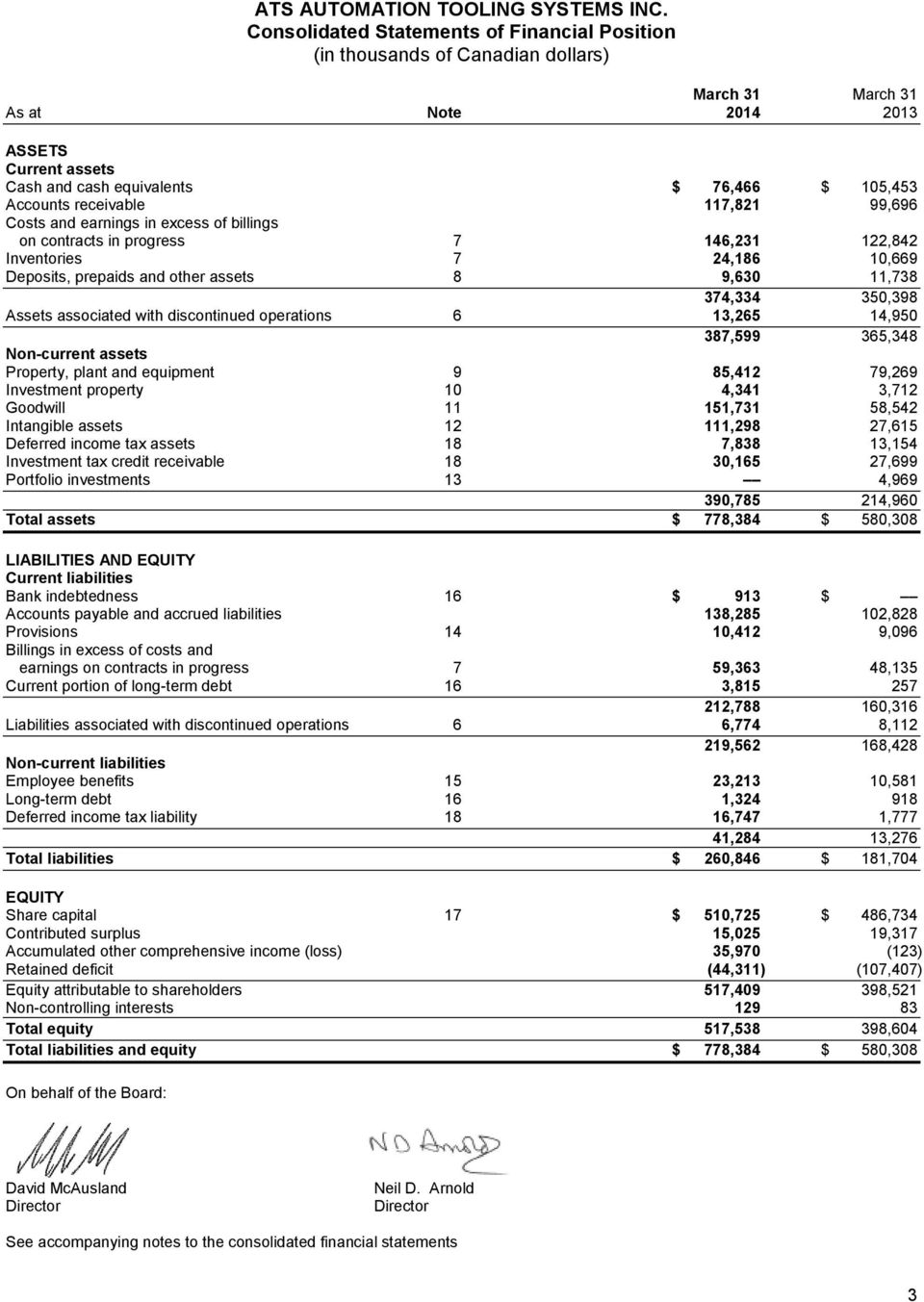
4 Consolidated Statements of Financial Position (in thousands of Canadian dollars) March 31 March 31 As at Note ASSETS Current assets Cash and cash equivalents $ 76,466 $ 105,453 Accounts receivable 117,821 99,696 Costs and earnings in excess of billings on contracts in progress 7 146, ,842 Inventories 7 24,186 10,669 Deposits, prepaids and other assets 8 9,630 11, , ,398 Assets associated with discontinued operations 6 13,265 14, , ,348 Non-current assets Property, plant and equipment 9 85,412 79,269 Investment property 10 4,341 3,712 Goodwill ,731 58,542 Intangible assets ,298 27,615 Deferred income tax assets 18 7,838 13,154 Investment tax credit receivable 18 30,165 27,699 Portfolio investments 13 4, , ,960 Total assets $ 778,384 $ 580,308 LIABILITIES AND EQUITY Current liabilities Bank indebtedness 16 $ 913 $ Accounts payable and accrued liabilities 138, ,828 Provisions 14 10,412 9,096 Billings in excess of costs and earnings on contracts in progress 7 59,363 48,135 Current portion of long-term debt 16 3, , ,316 Liabilities associated with discontinued operations 6 6,774 8, , ,428 Non-current liabilities Employee benefits 15 23,213 10,581 Long-term debt 16 1, Deferred income tax liability 18 16,747 1,777 41,284 13,276 Total liabilities $ 260,846 $ 181,704 EQUITY Share capital 17 $ 510,725 $ 486,734 Contributed surplus 15,025 19,317 Accumulated other comprehensive income (loss) 35,970 (123) Retained deficit (44,311) (107,407) Equity attributable to shareholders 517, ,521 Non-controlling interests Total equity 517, ,604 Total liabilities and equity $ 778,384 $ 580,308 On behalf of the Board: David McAusland Director Neil D. Arnold Director See accompanying notes to the consolidated financial statements 3
5 Consolidated Statements of Income Years ended March 31 Note Revenues Revenues from construction contracts $ 597,143 $ 538,150 Sale of goods 42,973 24,407 Services rendered 43,245 28,541 Total revenues 683, ,098 Operating costs and expenses Cost of revenues 501, ,182 Selling, general and administrative 113,321 89,485 Stock-based compensation 19 7,323 3,786 Earnings from operations 61,033 56,645 Net finance costs 23 3,016 2,013 Income from continuing operations before income taxes 58,017 54,632 Income tax expense 18 8,600 13,558 Income from continuing operations 49,417 41,074 Income (loss) from discontinued operations, net of tax 6 12,802 (25,991) Net income $ 62,219 $ 15,083 Attributable to Shareholders $ 62,173 $ 15,031 Non-controlling interests $ 62,219 $ 15,083 Earnings (loss) per share attributable to shareholders 24 Basic from continuing operations $ 0.56 $ 0.47 Basic from discontinued operations (0.30) $ 0.70 $ 0.17 Earnings (loss) per share attributable to shareholders 24 Diluted from continuing operations $ 0.55 $ 0.46 Diluted from discontinued operations (0.29) $ 0.69 $ 0.17 See accompanying notes to the consolidated financial statements 4

6 Consolidated Statements of Comprehensive Income (in thousands of Canadian dollars) Years ended March Net income $ 62,219 $ 15,083 Other comprehensive income (loss): Items to be reclassified subsequently to net income: Currency translation adjustment (net of income taxes of $nil) 36, Net unrealized gain on available-for-sale financial assets Tax impact 82 (82) Gain on available-for-sale financial assets transferred to net income (606) Tax impact Net unrealized loss on derivative financial instruments designated as cash flow hedges (2,478) (576) Tax impact Loss (gain) transferred to net income for derivatives designated as cash flow hedges 2,081 (79) Tax impact (543) (39) Items that will not be reclassified subsequently to net income: Actuarial gains (losses) on defined benefit pension plans 894 (3,397) Tax impact Other comprehensive income (loss) 37,016 (2,950) Comprehensive income $ 99,235 $ 12,133 Attributable to Shareholders $ 99,189 $ 12,081 Non-controlling interests $ 99,235 $ 12,133 See accompanying notes to the consolidated financial statements 5

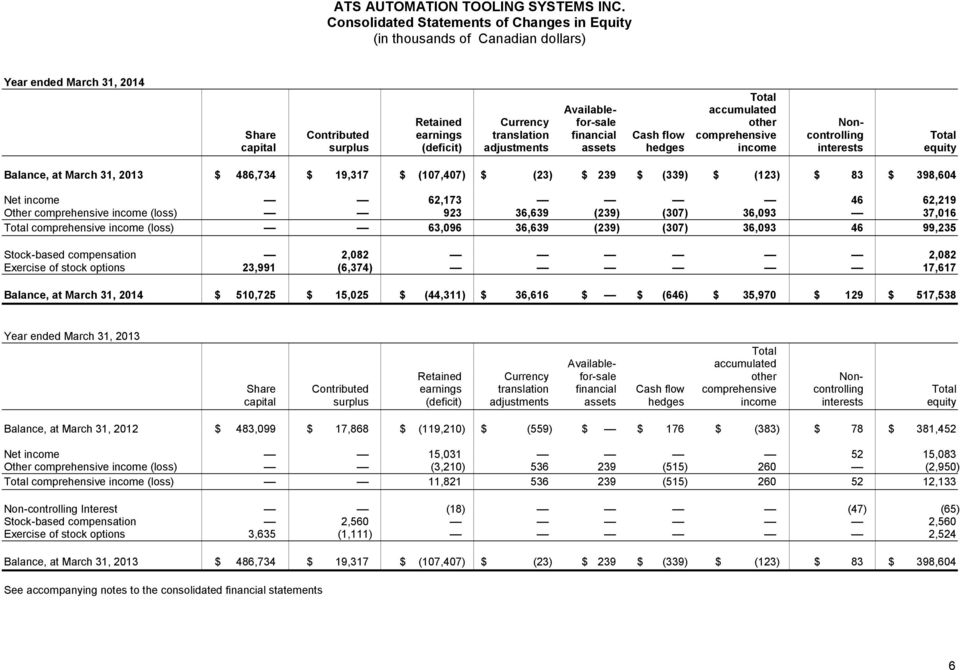
7 Consolidated Statements of Changes in Equity (in thousands of Canadian dollars) Year ended March 31, 2014 Total Available- accumulated Retained Currency for-sale other Non- Share Contributed earnings translation financial Cash flow comprehensive controlling Total capital surplus (deficit) adjustments assets hedges income interests equity Balance, at March 31, 2013 $ 486,734 $ 19,317 $ (107,407) $ (23) $ 239 $ (339) $ (123) $ 83 $ 398,604 Net income 62, ,219 Other comprehensive income (loss) ,639 (239) (307) 36,093 37,016 Total comprehensive income (loss) 63,096 36,639 (239) (307) 36, ,235 Stock-based compensation 2,082 2,082 Exercise of stock options 23,991 (6,374) 17,617 Balance, at March 31, 2014 $ 510,725 $ 15,025 $ (44,311) $ 36,616 $ $ (646) $ 35,970 $ 129 $ 517,538 Year ended March 31, 2013 Total Available- accumulated Retained Currency for-sale other Non- Share Contributed earnings translation financial Cash flow comprehensive controlling Total capital surplus (deficit) adjustments assets hedges income interests equity Balance, at March 31, 2012 $ 483,099 $ 17,868 $ (119,210) $ (559) $ $ 176 $ (383) $ 78 $ 381,452 Net income 15, ,083 Other comprehensive income (loss) (3,210) (515) 260 (2,950) Total comprehensive income (loss) 11, (515) ,133 Non-controlling Interest (18) (47) (65) Stock-based compensation 2,560 2,560 Exercise of stock options 3,635 (1,111) 2,524 Balance, at March 31, 2013 $ 486,734 $ 19,317 $ (107,407) $ (23) $ 239 $ (339) $ (123) $ 83 $ 398,604 See accompanying notes to the consolidated financial statements 6
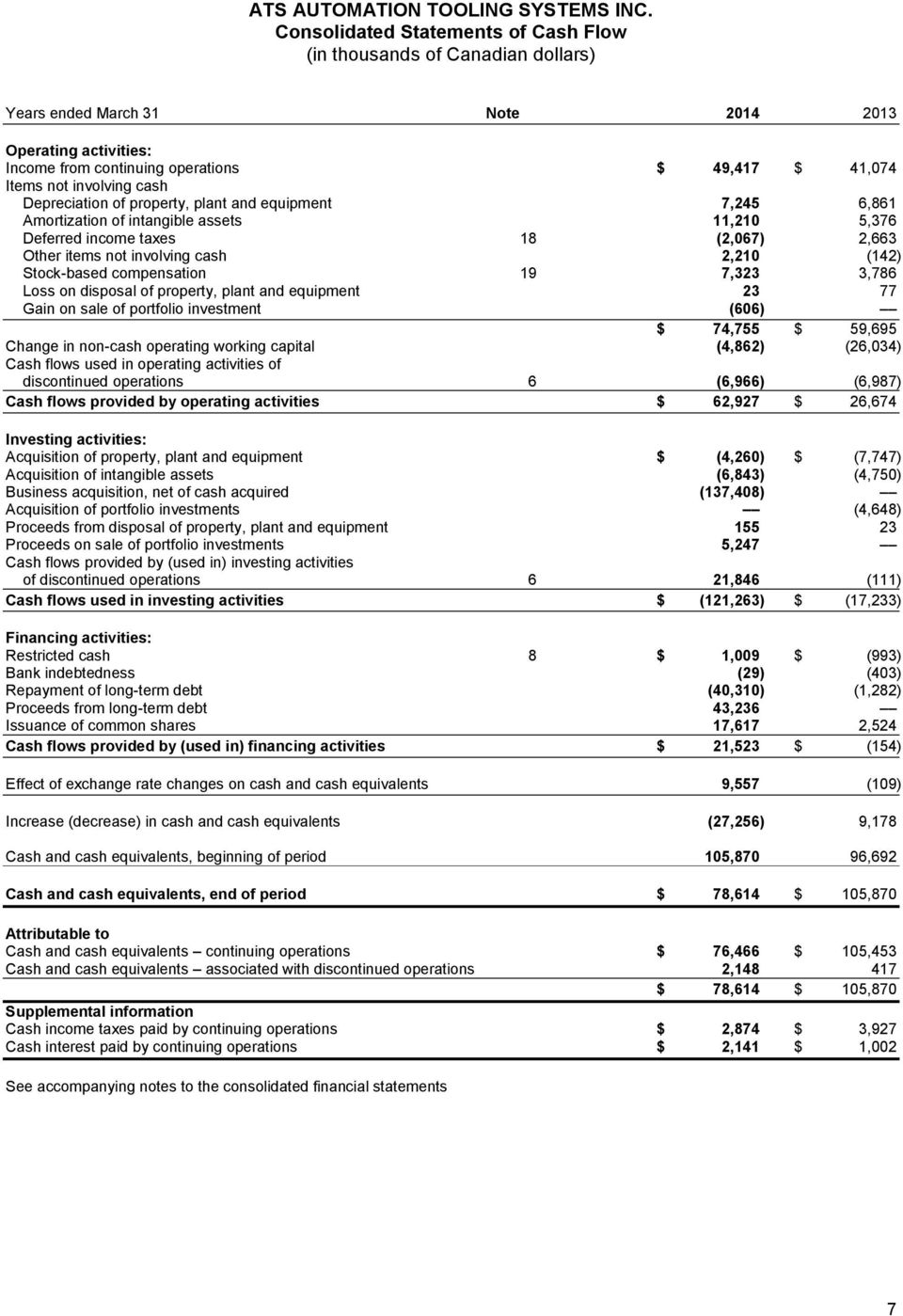
8 Consolidated Statements of Cash Flow (in thousands of Canadian dollars) Years ended March 31 Note Operating activities: Income from continuing operations $ 49,417 $ 41,074 Items not involving cash Depreciation of property, plant and equipment 7,245 6,861 Amortization of intangible assets 11,210 5,376 Deferred income taxes 18 (2,067) 2,663 Other items not involving cash 2,210 (142) Stock-based compensation 19 7,323 3,786 Loss on disposal of property, plant and equipment Gain on sale of portfolio investment (606) $ 74,755 $ 59,695 Change in non-cash operating working capital (4,862) (26,034) Cash flows used in operating activities of discontinued operations 6 (6,966) (6,987) Cash flows provided by operating activities $ 62,927 $ 26,674 Investing activities: Acquisition of property, plant and equipment $ (4,260) $ (7,747) Acquisition of intangible assets (6,843) (4,750) Business acquisition, net of cash acquired (137,408) Acquisition of portfolio investments (4,648) Proceeds from disposal of property, plant and equipment Proceeds on sale of portfolio investments 5,247 Cash flows provided by (used in) investing activities of discontinued operations 6 21,846 (111) Cash flows used in investing activities $ (121,263) $ (17,233) Financing activities: Restricted cash 8 $ 1,009 $ (993) Bank indebtedness (29) (403) Repayment of long-term debt (40,310) (1,282) Proceeds from long-term debt 43,236 Issuance of common shares 17,617 2,524 Cash flows provided by (used in) financing activities $ 21,523 $ (154) Effect of exchange rate changes on cash and cash equivalents 9,557 (109) Increase (decrease) in cash and cash equivalents (27,256) 9,178 Cash and cash equivalents, beginning of period 105,870 96,692 Cash and cash equivalents, end of period $ 78,614 $ 105,870 Attributable to Cash and cash equivalents continuing operations $ 76,466 $ 105,453 Cash and cash equivalents associated with discontinued operations 2, $ 78,614 $ 105,870 Supplemental information Cash income taxes paid by continuing operations $ 2,874 $ 3,927 Cash interest paid by continuing operations $ 2,141 $ 1,002 See accompanying notes to the consolidated financial statements 7
9 1. CORPORATE INFORMATION ATS Automation Tooling Systems Inc. and its subsidiaries (collectively ATS or the Company ) operate in two segments: Automation Systems ( ASG ) and Solar. The ASG segment produces customengineered turn-key automated manufacturing and test systems. The Solar segment is a turn-key solar project developer and manufacturer of photovoltaic products. The Company has initiated a formal sale process for the Ontario-based Solar business. Ontario Solar is presented as assets and liabilities associated with discontinued operations in the consolidated statements of financial position and as discontinued operations in the consolidated statements of income. See note 6 to the consolidated financial statements. As a result, ATS continuing operations are reported as one operating segment, ASG. See note 21 to the consolidated financial statements. The Company is listed on the Toronto Stock Exchange and is incorporated and domiciled in Ontario, Canada. The address of its registered office is 730 Fountain Street North, Cambridge, Ontario, Canada. The consolidated financial statements of the Company for the year ended March 31, 2014 were authorized for issue by the Board of Directors on May 21, BASIS OF PREPARATION These consolidated financial statements were prepared on a going concern basis under the historical cost convention, as modified by the revaluation of available-for-sale financial assets, and financial assets and financial liabilities (including derivative instruments) at fair value through profit or loss or other comprehensive income. All consolidated financial information is presented in Canadian dollars and has been rounded to the nearest thousands, except where otherwise stated. Statement of compliance These consolidated financial statements are prepared in accordance with International Financial Reporting Standards ( IFRS ), as issued by the International Accounting Standards Board ( IASB ). Basis of consolidation These consolidated financial statements include the accounts of the Company and its subsidiaries. Subsidiaries are those entities where the Company directly or indirectly owns the majority of the voting power or can otherwise control the activities. The financial statements of the subsidiaries are prepared for the same reporting period as the parent company, using consistent accounting policies. Noncontrolling interests in the equity and results of the Company s subsidiaries are presented separately in the consolidated statements of income and within equity in the consolidated statements of financial position. Subsidiaries are fully consolidated from the date of acquisition, being the date on which the Company obtains control, and continue to be consolidated until the date that such control ceases. The Company s material subsidiaries are: Automation Tooling Systems Enterprises Inc. and ATS Automation Tooling Systems GmbH. The Company has a 100% voting and equity securities interest in each of these corporations. All material intercompany balances, transactions, revenues and expenses and profits or losses, including dividends resulting from intercompany transactions, have been eliminated on consolidation. 8

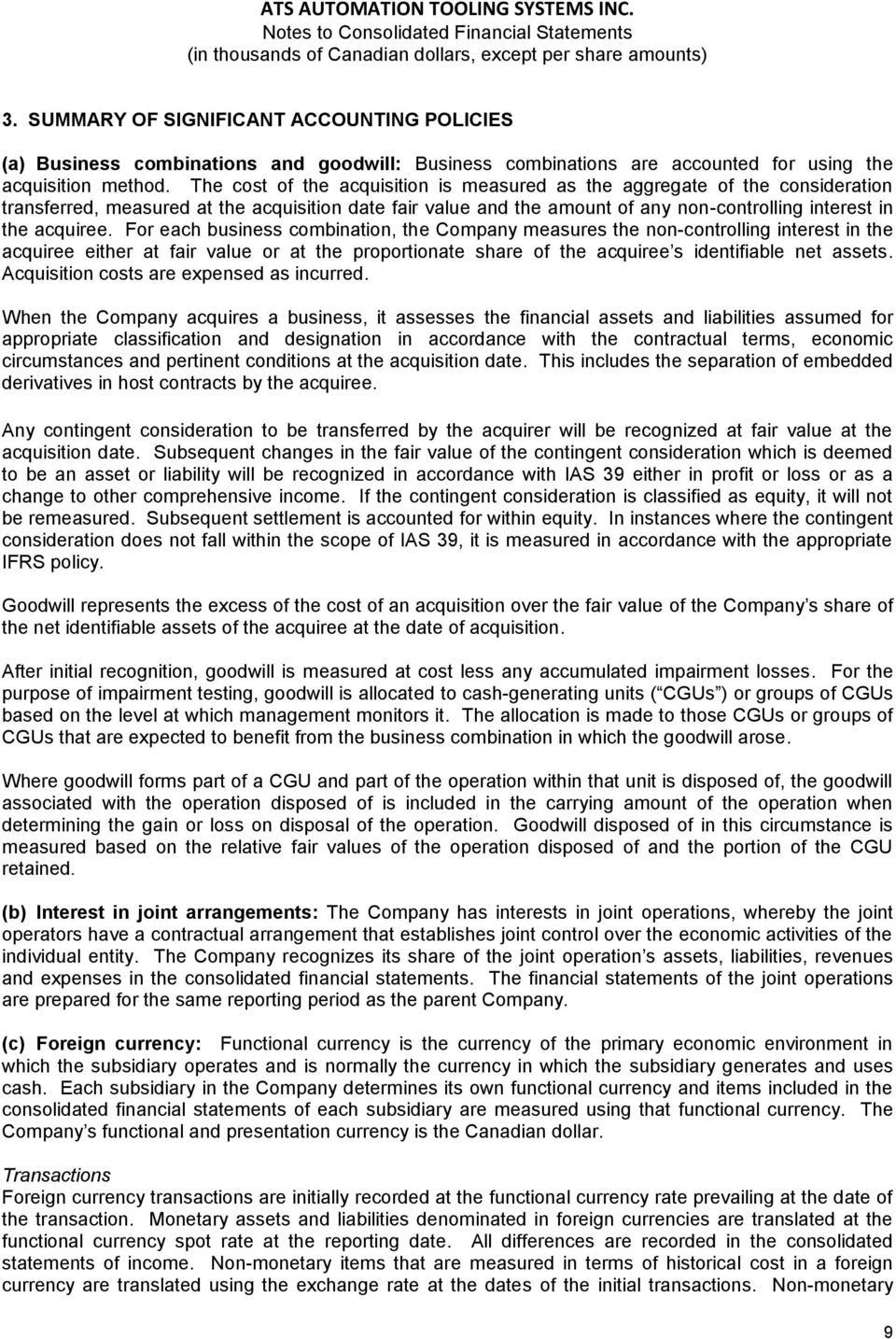
10 3. SUMMARY OF SIGNIFICANT ACCOUNTING POLICIES (a) Business combinations and goodwill: Business combinations are accounted for using the acquisition method. The cost of the acquisition is measured as the aggregate of the consideration transferred, measured at the acquisition date fair value and the amount of any non-controlling interest in the acquiree. For each business combination, the Company measures the non-controlling interest in the acquiree either at fair value or at the proportionate share of the acquiree s identifiable net assets. Acquisition costs are expensed as incurred. When the Company acquires a business, it assesses the financial assets and liabilities assumed for appropriate classification and designation in accordance with the contractual terms, economic circumstances and pertinent conditions at the acquisition date. This includes the separation of embedded derivatives in host contracts by the acquiree. Any contingent consideration to be transferred by the acquirer will be recognized at fair value at the acquisition date. Subsequent changes in the fair value of the contingent consideration which is deemed to be an asset or liability will be recognized in accordance with IAS 39 either in profit or loss or as a change to other comprehensive income. If the contingent consideration is classified as equity, it will not be remeasured. Subsequent settlement is accounted for within equity. In instances where the contingent consideration does not fall within the scope of IAS 39, it is measured in accordance with the appropriate IFRS policy. Goodwill represents the excess of the cost of an acquisition over the fair value of the Company s share of the net identifiable assets of the acquiree at the date of acquisition. After initial recognition, goodwill is measured at cost less any accumulated impairment losses. For the purpose of impairment testing, goodwill is allocated to cash-generating units ( CGUs ) or groups of CGUs based on the level at which management monitors it. The allocation is made to those CGUs or groups of CGUs that are expected to benefit from the business combination in which the goodwill arose. Where goodwill forms part of a CGU and part of the operation within that unit is disposed of, the goodwill associated with the operation disposed of is included in the carrying amount of the operation when determining the gain or loss on disposal of the operation. Goodwill disposed of in this circumstance is measured based on the relative fair values of the operation disposed of and the portion of the CGU retained. (b) Interest in joint arrangements: The Company has interests in joint operations, whereby the joint operators have a contractual arrangement that establishes joint control over the economic activities of the individual entity. The Company recognizes its share of the joint operation s assets, liabilities, revenues and expenses in the consolidated financial statements. The financial statements of the joint operations are prepared for the same reporting period as the parent Company. (c) Foreign currency: Functional currency is the currency of the primary economic environment in which the subsidiary operates and is normally the currency in which the subsidiary generates and uses cash. Each subsidiary in the Company determines its own functional currency and items included in the consolidated financial statements of each subsidiary are measured using that functional currency. The Company s functional and presentation currency is the Canadian dollar. Transactions Foreign currency transactions are initially recorded at the functional currency rate prevailing at the date of the transaction. Monetary assets and liabilities denominated in foreign currencies are translated at the functional currency spot rate at the reporting date. All differences are recorded in the consolidated statements of income. Non-monetary items that are measured in terms of historical cost in a foreign currency are translated using the exchange rate at the dates of the initial transactions. Non-monetary 9
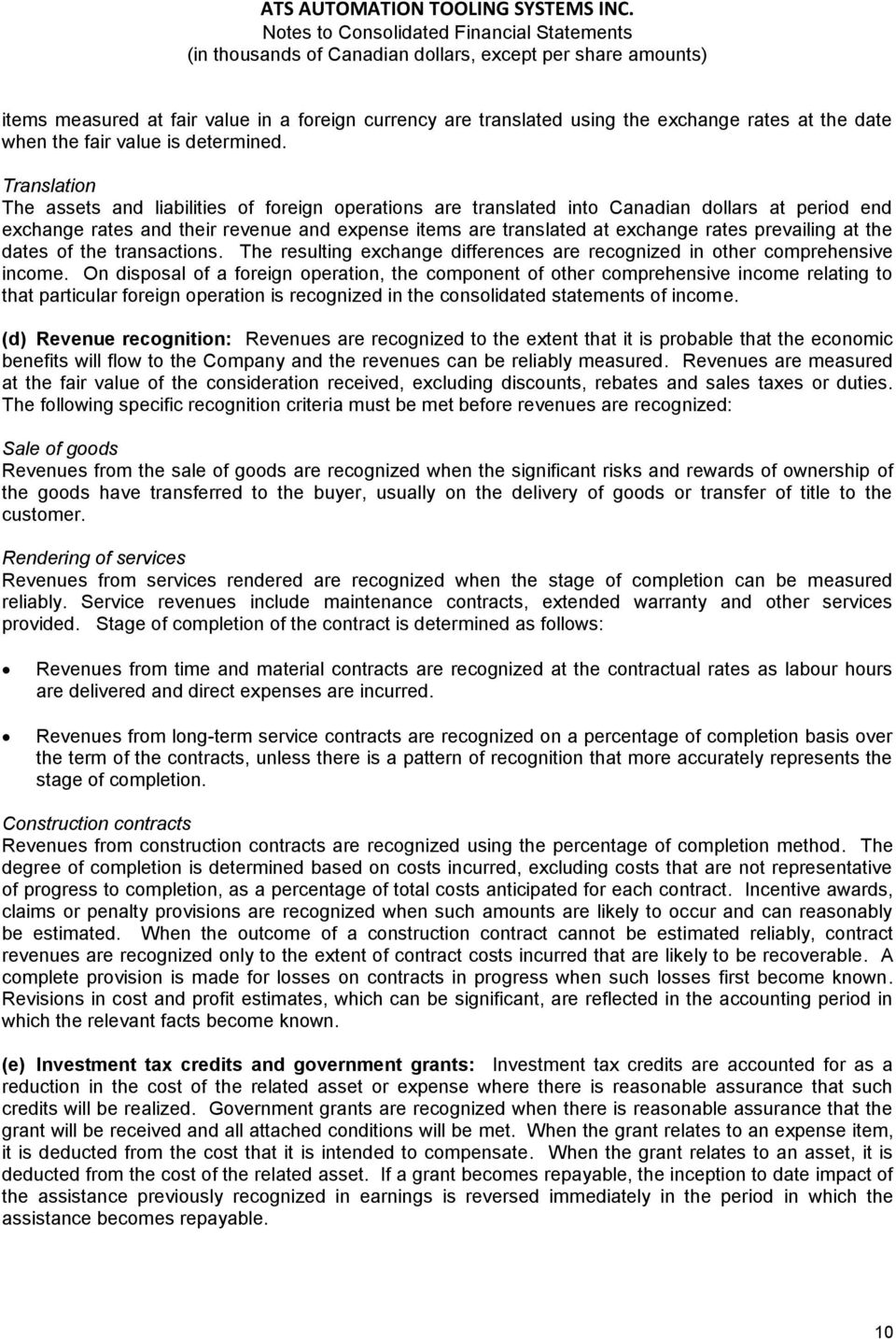
11 items measured at fair value in a foreign currency are translated using the exchange rates at the date when the fair value is determined. Translation The assets and liabilities of foreign operations are translated into Canadian dollars at period end exchange rates and their revenue and expense items are translated at exchange rates prevailing at the dates of the transactions. The resulting exchange differences are recognized in other comprehensive income. On disposal of a foreign operation, the component of other comprehensive income relating to that particular foreign operation is recognized in the consolidated statements of income. (d) Revenue recognition: Revenues are recognized to the extent that it is probable that the economic benefits will flow to the Company and the revenues can be reliably measured. Revenues are measured at the fair value of the consideration received, excluding discounts, rebates and sales taxes or duties. The following specific recognition criteria must be met before revenues are recognized: Sale of goods Revenues from the sale of goods are recognized when the significant risks and rewards of ownership of the goods have transferred to the buyer, usually on the delivery of goods or transfer of title to the customer. Rendering of services Revenues from services rendered are recognized when the stage of completion can be measured reliably. Service revenues include maintenance contracts, extended warranty and other services provided. Stage of completion of the contract is determined as follows: Revenues from time and material contracts are recognized at the contractual rates as labour hours are delivered and direct expenses are incurred. Revenues from long-term service contracts are recognized on a percentage of completion basis over the term of the contracts, unless there is a pattern of recognition that more accurately represents the stage of completion. Construction contracts Revenues from construction contracts are recognized using the percentage of completion method. The degree of completion is determined based on costs incurred, excluding costs that are not representative of progress to completion, as a percentage of total costs anticipated for each contract. Incentive awards, claims or penalty provisions are recognized when such amounts are likely to occur and can reasonably be estimated. When the outcome of a construction contract cannot be estimated reliably, contract revenues are recognized only to the extent of contract costs incurred that are likely to be recoverable. A complete provision is made for losses on contracts in progress when such losses first become known. Revisions in cost and profit estimates, which can be significant, are reflected in the accounting period in which the relevant facts become known. (e) Investment tax credits and government grants: Investment tax credits are accounted for as a reduction in the cost of the related asset or expense where there is reasonable assurance that such credits will be realized. Government grants are recognized when there is reasonable assurance that the grant will be received and all attached conditions will be met. When the grant relates to an expense item, it is deducted from the cost that it is intended to compensate. When the grant relates to an asset, it is deducted from the cost of the related asset. If a grant becomes repayable, the inception to date impact of the assistance previously recognized in earnings is reversed immediately in the period in which the assistance becomes repayable. 10
12 (f) Taxes: Current income tax Current income tax assets and liabilities for the current and prior periods are measured at the amount expected to be recovered from or paid to the taxation authorities. The tax rates and tax laws used to compute the amount are those that are enacted or substantively enacted, by the reporting date, in the countries where the Company operates and generates taxable income. Current income tax related to items recognized directly in equity is also recognized in equity and not in the consolidated statements of income. Management periodically evaluates positions taken in the tax returns with respect to situations in which applicable tax regulations are subject to interpretation and establishes provisions where appropriate. Deferred income tax Deferred income tax is provided using the liability method on temporary differences at the reporting date between the tax bases of assets and liabilities and their carrying amounts for financial reporting purposes. Deferred income tax assets and liabilities are measured at the tax rates that are expected to apply in the period when the asset will be realized or the liability will be settled, based on tax rates and tax laws that have been enacted or substantively enacted at the reporting date. Deferred income taxes are recognized for all taxable temporary differences, except: When the deferred income tax liability arises from the initial recognition of goodwill or an asset or liability in a transaction that is not a business combination and, at the time of the transaction, affects neither the accounting profit nor taxable profit or loss. In respect of taxable temporary differences associated with investments in subsidiaries and interests in joint operations, when the timing of the reversal of the temporary differences can be controlled and it is probable that the temporary differences will not reverse in the foreseeable future. Deferred income tax assets are recognized for all deductible temporary differences, carry forward of unused tax credits and unused tax losses, to the extent that it is probable that taxable profit will be available, against which the deductible temporary differences and the carry forward of unused tax credits and unused tax losses can be utilized, except: When the deferred income tax asset relating to the deductible temporary difference arises from the initial recognition of an asset or liability in a transaction that is not a business combination and, at the time of the transaction, affects neither the accounting profit nor taxable profit or loss. In respect of deductible temporary differences associated with investments in subsidiaries and interests in joint operations, deferred income tax assets are recognized only to the extent that it is probable that the temporary differences will reverse in the foreseeable future and taxable profit will be available against which the temporary differences can be utilized. The carrying amount of deferred income tax assets is reviewed at each reporting date and reduced to the extent that it is no longer probable that all or part of the deferred income tax asset will be utilized. Unrecognized deferred income tax assets are reassessed at each reporting date and are recognized to the extent that it has become probable the benefit will be recovered. Deferred income tax assets and deferred income tax liabilities are offset if a legally enforceable right exists to offset current income tax assets against current income tax liabilities and the deferred income taxes relate to the same taxable entity and the same taxation authority. Deferred income tax related to items recognized outside profit or loss is also recognized outside profit or loss. Deferred income tax items are recognized in correlation to the underlying transaction either in other comprehensive income or directly in equity. 11
13 Income tax benefits acquired as part of a business combination, but not satisfying the criteria for separate recognition at that date, would be recognized subsequently if new information about facts and circumstances changed. The adjustment would either be treated as a reduction to goodwill (as long as it does not exceed goodwill) if it is incurred during the measurement period or in profit or loss. Revenues, expenses and assets are recognized net of the amount of sales tax, except where the sales tax incurred on a purchase of assets or services is not recoverable from the taxation authority, in which case the sales tax is recognized as part of the cost of acquisition of the asset or as part of the expense item as applicable. Receivables and payables are stated with the amount of sales tax included. The net amount of sales tax recoverable from, or payable to, the taxation authority is included as part of accounts receivable or accounts payable in the consolidated statements of financial position. (g) Non-current assets classified as assets associated with discontinued operations: Non-current assets classified as assets associated with discontinued operations are measured at the lower of their carrying amount and fair value less costs to sell. Non-current assets are classified as associated with discontinued operations if their carrying amounts will be derecognized principally through a sale transaction rather than recovered through continuing use. This condition is regarded as being met only when the transaction is highly probable and the assets are available for immediate sale in their present condition. Management must be committed to the sale, which should be expected to qualify for recognition as a completed transaction within one year from the date of classification. In the consolidated statements of income of the reporting period, and of the comparable period, revenues and expenses from discontinued operations are reported separately from revenues and expenses from continuing operations, down to the level of net income after income taxes. Property, plant and equipment and intangible assets once classified as associated with discontinued operations are not depreciated or amortized. (h) Property, plant and equipment: Property, plant and equipment are stated at cost, net of accumulated depreciation and accumulated impairment losses, if any. Such cost includes the cost of replacing component parts of the property, plant and equipment and borrowing costs for long-term construction projects if the recognition criteria are met. When significant parts of property, plant and equipment are required to be replaced at intervals, ATS derecognizes the replaced part and recognizes the new part with its own associated useful life and depreciation. Likewise, when a major inspection is performed, its cost is recognized in the carrying amount of the property, plant and equipment as a replacement if the recognition criteria are satisfied. All other repair and maintenance costs are recognized in the consolidated statements of income as incurred. Depreciation is calculated on a straight-line basis over the estimated useful lives of the assets as follows: Buildings Production equipment Other equipment 25 to 40 years 3 to 10 years 3 to 10 years Leasehold improvements are amortized over the shorter of the term of the related lease or their remaining useful life on a straight-line basis. An item of property, plant and equipment and any significant part initially recognized is derecognized upon disposal or when no future economic benefits are expected from its use or eventual disposition. Any gain or loss arising on derecognition of the asset (calculated as the difference between the net disposal proceeds and the carrying amount of the asset) is included in the consolidated statements of income when the asset is derecognized. 12
14 The assets residual values, useful lives and methods of depreciation are reviewed at each financial year end and adjusted prospectively, if appropriate. (i) Leases: The determination of whether an arrangement is, or contains, a lease is based on the substance of the arrangement at the inception date, whether fulfillment of the arrangement is dependent on the use of a specific asset or the arrangement conveys a right to use the asset, even if that right is not explicitly specified in an arrangement. Finance leases, which transfer to ATS substantially all the risks and benefits incidental to ownership of the leased item, are capitalized at the commencement of the lease at the lower of the fair value of the leased property or the present value of the minimum lease payments. Lease payments are apportioned between finance charges and the reduction of the lease liability to achieve a constant rate of interest on the remaining balance of the liability. Finance charges are recognized in the consolidated statements of income. Leased assets are depreciated over the useful life of the asset. However, if there is no reasonable certainty that ATS will obtain ownership by the end of the lease term, the asset is depreciated over the shorter of the estimated useful life and the lease term. Leases where ATS does not assume substantially all of the risks and benefits of ownership of the asset are classified as operating leases. Operating lease payments are recognized as an expense in the consolidated statements of income on a straight-line basis over the lease term. (j) Borrowing costs: Borrowing costs directly attributable to the acquisition, construction or production of an asset that necessarily takes a substantial period of time to get ready for its intended use or sale are capitalized as part of the cost of the respective asset. All other borrowing costs are expensed in the period they occur. (k) Investment property: Investment properties, which are properties held to earn rental income and/or for capital appreciation, are measured at acquisition cost less straight-line depreciation and impairment losses. The depreciation policy for investment property is consistent with the policy for owner-occupied property. (l) Intangible assets: Acquired intangible assets are primarily software, patents, customer relationships, brands, technologies and licenses. Intangible assets acquired separately are initially recorded at fair market value and subsequently at cost less accumulated amortization and impairment losses. The useful lives of intangible assets are assessed as either finite or indefinite. Intangible assets with finite lives are amortized over their useful economic lives, ranging from 1 to 20 years, on a straight-line basis. Intangible assets with finite lives are assessed for impairment whenever there is an indication that the intangible asset may be impaired. The amortization period and the amortization method for an intangible asset with a finite useful life is reviewed at least at the end of each reporting period. Changes in the expected useful life or the expected pattern of consumption of future economic benefits embodied in the asset are accounted for by changing the amortization period or method, as appropriate, and are treated as a change in accounting estimate. The amortization expense on intangible assets with finite lives is recognized in the consolidated statements of income in the expense category consistent with the function of the intangible assets. Intangible assets with indefinite useful lives, primarily brands, are not amortized. The Company assesses the indefinite life at each reporting date to determine if there is an indication that an intangible asset may be impaired. If any indication exists, or when annual impairment testing for the intangible asset is required, the Company estimates the recoverable amount at the CGU level to determine whether the indefinite life continues to be supportable. If not, the change in useful life from indefinite to finite is made on a prospective basis. An asset is impaired when the recoverable amount is less than their carrying amount. The recoverable amount is the higher of an asset s fair value less cost to sell or its value in use. 13
15 Impairment losses relating to intangible assets are evaluated for potential reversals when events or changes in circumstances warrant such consideration. Gains or losses arising from derecognition of an intangible asset are measured as the difference between the net disposal proceeds and the carrying amount of the asset and are recognized in the consolidated statements of income when the asset is derecognized. Research and development expenditures Research costs are expensed as incurred. Development expenditures on an individual project are recognized as an intangible asset only when the following conditions are demonstrated: The technical feasibility of completing the intangible asset so that it will be available for use or sale. The Company s intention to complete and its ability to use or sell the intangible asset. How the asset will generate future economic benefits. The availability of resources to complete the intangible asset. The ability to measure reliably the expenditures during development. Following initial recognition of the development expenditure as an asset, the cost model is applied requiring the asset to be carried at cost less any accumulated amortization and accumulated impairment losses. Amortization of the asset begins when development is complete and the asset is available for use. It is amortized over the period of expected future benefit. Amortization is recorded in cost of revenues. In the event that a product program for which costs have been deferred is modified or cancelled, the Company will assess the recoverability of the deferred costs and if considered unrecoverable, will expense the costs in the period the assessment is made. (m) Financial instruments: Financial assets Financial assets within the scope of IAS 39 are classified as financial assets at fair value through profit or loss, loans and receivables, held-to-maturity investments, available-for-sale financial assets, or as derivatives designated as hedging instruments in an effective hedge, as appropriate. ATS determines the classification of its financial assets at initial recognition. All financial assets other than financial assets at fair value through profit or loss are recognized initially at fair value plus directly attributable transaction costs. ATS financial assets include cash and cash equivalents, accounts receivable, investments in equities included in portfolio investments and derivative financial instruments. The subsequent measurement of financial assets depends on their classification as follows: Financial assets at fair value through profit or loss Financial assets at fair value through profit or loss include financial assets held for trading and financial assets designated upon initial recognition at fair value through profit or loss. Financial assets are classified as held for trading if they are acquired for the purpose of selling or repurchasing in the near term. This category includes derivative financial instruments entered into by the Company that are not designated as hedging instruments in hedge relationships. Derivatives, including separated embedded derivatives, are also classified as held for trading unless they are designated as effective hedging instruments. Financial assets at fair value through profit or loss are carried in the consolidated statements of financial position at fair value with changes in fair value recognized in selling, general and administrative expenses in the consolidated statements of income. 14

16 Loans and receivables Loans and receivables are non-derivative financial assets with fixed or determinable payments that are not quoted in an active market. After initial measurement, such financial assets are subsequently measured at amortized cost using the effective interest rate method, less provisions for doubtful accounts. Amortized cost is calculated by taking into account any discount or premium on acquisition and fees or costs that are an integral part of the effective interest rate method. The effective interest rate method amortization is included in net finance costs in the consolidated statements of income. The losses arising from impairment are recognized in the consolidated statements of income in net finance costs. Available-for-sale financial assets Available-for-sale financial assets include equity securities, which are neither classified as held for trading nor designated at fair value through profit or loss. After initial measurement, available-for-sale financial assets are subsequently measured at fair value with unrealized gains or losses recognized in other comprehensive income until the investment is derecognized, at which time the cumulative gain or loss is recognized in selling, general and administrative expenses, or determined to be impaired, at which time the cumulative loss is reclassified to the consolidated statements of income and removed from other comprehensive income. Derecognition A financial asset is derecognized when the rights to receive cash flows from the asset have expired or the Company has transferred its rights to receive cash flows from the asset or has assumed an obligation to pay the received cash flows in full without material delay to a third party under a pass-through arrangement; and either the Company has transferred substantially all the risks and rewards of the asset, or ATS has neither transferred nor retained substantially all the risks and rewards of the asset, but has transferred control of the asset. Impairment of financial assets ATS assesses at each reporting date whether there is any objective evidence that a financial asset or a group of financial assets is impaired. A financial asset or a group of financial assets is deemed to be impaired if, and only if, there is objective evidence of impairment as a result of one or more events that has occurred after the initial recognition of the asset (an incurred loss event ) and that loss event has an impact on the estimated future cash flows of the financial asset or the group of financial assets that can be reliably estimated. Evidence of impairment may include indications that a debtor or a group of debtors is experiencing significant financial difficulty, default or delinquency in interest or principal payments, the probability that they will enter bankruptcy or other financial reorganization and where observable data indicates that there is a measurable decrease in the estimated future cash flows, such as changes in arrears or economic conditions that correlate with defaults. For financial assets carried at amortized cost, the Company first assesses whether objective evidence of impairment exists individually for financial assets that are individually significant, or collectively for financial assets that are not individually significant. If the Company determines that no objective evidence of impairment exists for an individually assessed financial asset, whether significant or not, it includes the asset in a group of financial assets with similar credit risk characteristics and collectively assesses them for impairment. Assets that are individually assessed for impairment and for which an impairment loss is, or continues to be, recognized are not included in a collective assessment of impairment. If there is objective evidence that an impairment loss has been incurred, the amount of the loss is measured as the difference between the asset s carrying amount and the present value of estimated future cash flows (excluding future expected credit losses that have not yet been incurred). The present value of the estimated future cash flows is discounted at the financial asset s original effective interest rate. If a loan has a variable interest rate, the discount rate for measuring any impairment loss is the current effective interest rate. 15
17 For available-for-sale financial assets, the Company assesses at each reporting date whether there is objective evidence that an asset or a group of assets is impaired. In the case of equity investments classified as available-for-sale, objective evidence would include a significant or prolonged decline in the fair value of the investment below its cost. Significant is evaluated against the original cost of the investment and prolonged against the period in which the fair value has been below its original cost. Where there is evidence of impairment, the cumulative loss measured as the difference between the acquisition cost and the current fair value, less any impairment loss on that investment previously recognized in the consolidated statements of income is removed from other comprehensive income and recognized in the consolidated statements of income. Impairment losses on equity investments are not reversed through the statements of consolidated income; increases in their fair value after impairments are recognized directly in other comprehensive income. Financial liabilities Financial liabilities within the scope of IAS 39 are classified as financial liabilities at fair value through profit or loss, loans and borrowings, or as derivatives designated as hedging instruments in an effective hedge, as appropriate. The Company determines the classification of its financial liabilities at initial recognition. All financial liabilities are recognized initially at fair value and, in the case of loans and borrowings, carried at amortized cost. This includes directly attributable transaction costs. The Company s financial liabilities include accounts payable and accrued liabilities, bank indebtedness, long-term debt and derivative financial instruments. The measurement of financial liabilities depends on their classification as follows: Financial liabilities at fair value through profit or loss Financial liabilities at fair value through profit or loss include financial liabilities held for trading and financial liabilities designated upon initial recognition as at fair value through profit or loss. Financial liabilities are classified as held for trading if they are acquired for the purpose of selling in the near term. This category includes derivative financial instruments entered into by the Company that are not designated as hedging instruments in hedge relationships as defined by IAS 39. Separated embedded derivatives are also classified as held for trading unless they are designated as effective hedging instruments. Gains or losses on liabilities held for trading are recognized in the consolidated statements of income. Loans and borrowings After initial recognition, interest bearing loans and borrowings are subsequently measured at amortized cost using the effective interest rate method. Gains and losses are recognized in the consolidated statements of income when the liabilities are derecognized as well as through the effective interest rate method amortization process. Derecognition A financial liability is derecognized when the obligation under the liability is discharged, cancelled or expired. When an existing financial liability is replaced by another from the same lender on substantially different terms, or the terms of an existing liability are substantially modified, such an exchange or modification is treated as a derecognition of the original liability and the recognition of a new liability, and the difference in the respective carrying amounts is recognized in the consolidated statements of income. 16

18 Fair value of financial instruments The Company primarily applies the market approach for recurring fair value measurements. Three levels of inputs may be used to measure fair value: Level 1 unadjusted quoted prices in active markets for identical assets or liabilities Level 2 inputs other than quoted prices included in Level 1 that are observable or can be corroborated by observable market data Level 3 unobservable inputs that are supported by no market activity (n) Derivative financial instruments and hedge accounting: The Company may use derivative financial instruments such as forward foreign exchange contracts and interest rate swaps to hedge its foreign currency risk and interest rate risk, respectively. Derivative financial instruments are initially recognized at fair value on the date on which a derivative contract is entered into and are subsequently remeasured at fair value. Derivatives are carried as financial assets when the fair value is positive and as financial liabilities when the fair value is negative. Any gains or losses arising from changes in the fair value of derivatives are recorded directly in the consolidated statements of income, except for the effective portion of cash flow hedges and hedges of net investments, which are recognized in other comprehensive income. The Company designates certain derivative financial instruments as either fair value hedges, cash flow hedges, or hedges of net investments in foreign operations. The application of hedge accounting enables the recording of gains, losses, revenues and expenses from hedging items in the same period as those related to the hedged item. At the inception of a hedge relationship, the Company formally designates and documents the hedge relationship to which the Company wishes to apply hedge accounting and the risk management objective and strategy for undertaking the hedge. The documentation includes identification of the hedging instrument, the hedged item or transaction, the nature of the risk being hedged and how the entity will assess and measure the effectiveness of changes in the hedging instrument s fair value in offsetting the exposure to changes in the hedged item s fair value or cash flows attributable to the hedged risk. Such hedges are expected to be highly effective in achieving offsetting changes in fair value or cash flows and are assessed on an ongoing basis to determine whether they have actually been highly effective throughout the financial reporting periods for which they were designated. Hedges which meet the strict criteria for hedge accounting are accounted for as follows: Cash flow hedges The effective portion of the gain or loss on the hedging instrument is recognized directly as other comprehensive income, while any ineffective portion is recognized immediately in the consolidated statements of income. Amounts recognized as other comprehensive income are transferred to the consolidated statements of income when the hedged transaction affects profit or loss, such as when the hedged financial income or financial expense is recognized. Where the hedged item is the cost of a non-financial asset or nonfinancial liability, the amounts recognized in other comprehensive income are transferred at the initial carrying amount of the non-financial asset or liability. If the forecasted transaction or firm commitment is no longer expected to occur, the cumulative gain or loss previously recognized in equity is transferred to the consolidated statements of income. If the hedging instrument expires or is sold, terminated or exercised without replacement or rollover, or if its designation as a hedge is revoked, any cumulative gain or loss previously recognized in other comprehensive income remains in other comprehensive income until the forecasted transaction or firm commitment affects profit or loss. 17
19 The Company uses forward foreign exchange contracts as hedges of its exposure to foreign currency risk on anticipated revenue or costs. The Company may use interest rate swap contracts with approved financial institutions to reduce its exposure to floating interest rates. Hedges of net investments Hedges of net investments in a foreign operation, including a hedge of a monetary item that is accounted for as part of the net investment, are accounted for in a way similar to cash flow hedges. Gains or losses on the hedging instrument related to the effective portion of the hedge are recognized as other comprehensive income while any gains or losses related to the ineffective portion are recognized in the consolidated statements of income. On disposal of the foreign operation, the cumulative value of any such gains or losses recorded in equity is transferred to the consolidated statements of income. The Company may use forward foreign exchange contracts as a hedge of its exposure to foreign exchange risk on its investments in foreign subsidiaries. (o) Inventories: Inventories are stated at the lower of cost and net realizable value on a first-in, first-out basis. The cost of raw materials includes purchase cost and costs incurred in bringing each product to its present location and condition. The cost of work in progress and finished goods includes cost of raw materials, labour and related manufacturing overhead, excluding borrowing costs, based on normal operating capacity. Cost of inventories includes the transfer from equity of gains and losses on qualifying cash flow hedges in respect of the purchase of raw materials. Net realizable value is the estimated selling price in the ordinary course of business, less estimated costs of completion and the estimated costs necessary to make the sale. (p) Impairment of non-financial assets: The Company assesses at each reporting date whether there is an indication that an asset may be impaired. If any indication exists, or when annual impairment testing for an asset is required, the Company estimates the asset s recoverable amount. An asset s recoverable amount is the higher of an asset s or CGU s fair value less costs to sell and its value in use and is determined for an individual asset, unless the asset does not generate cash inflows that are largely independent of those from other assets or groups of assets. Where the carrying amount of an asset or CGU exceeds its recoverable amount, the asset is considered impaired and is written down to its recoverable amount. In assessing value in use, the estimated future cash flows are discounted to their present value using a pre-tax discount rate that reflects current market assessments of the time value of money and the risks specific to the asset. In determining fair value less costs to sell, recent market transactions are taken into account, if available. If no such transactions can be identified, an appropriate valuation model is used. These calculations are corroborated by valuation multiples, quoted share prices for publicly traded subsidiaries or other available fair value indicators. Impairment losses of continuing operations, including impairment on inventories, are recognized in the consolidated statements of income in those expense categories consistent with the function of the impaired asset. (q) Provisions: Provisions are recognized when the Company has a present obligation (legal or constructive) as a result of a past event, it is probable that an outflow of resources embodying economic benefits will be required to settle the obligation and a reliable estimate can be made of the amount of the obligation. Where the Company expects some or all of a provision to be reimbursed, for example under an insurance contract, the reimbursement is recognized as a separate asset but only when the reimbursement is virtually certain. The expense relating to any provision is presented in the consolidated statements of income net of any reimbursement. If the effect of the time value of money is material, provisions are discounted using a current pre-tax rate that reflects, where appropriate, the risks specific to the liability. Where discounting is used, the increase in the provision due to the passage of time is recognized as a finance cost. 18
20 Warranty provisions Provisions for warranty-related costs are recognized when the product is sold or the service provided. Initial recognition is based on historical experience. The initial estimate of warranty-related costs is reviewed at the end of each reporting period and adjusted to reflect the current best estimate. Restructuring provisions Restructuring provisions are only recognized when general recognition criteria for provisions are fulfilled. Additionally, the Company needs to have in place a detailed formal plan about the business or part of the business concerned, the location and number of employees affected, a detailed estimate of the associated costs and the appropriate time-line. The people affected have a valid expectation that the restructuring is being carried out or the implementation has been initiated already. (r) Employee benefits: The Company operates pension plans in accordance with the applicable laws and regulations in the respective countries in which the Company conducts business. The pension benefits are provided through defined benefit and defined contribution plans. The cost of providing benefits under the defined benefit plans is determined separately for each plan using the projected unit credit method pro-rated on length of service and management s best estimate assumptions to value its pensions using a measurement date of March 31. Actuarial gains and losses arising from experience adjustments and changes in actuarial assumptions are recognized in the period in which they occur in other comprehensive income. Net interest is calculated by applying the discount rate to the net defined benefit liability or asset and is recognized in the selling, general and administrative expenses in the consolidated statements of income. The past service costs are recognized immediately in net earnings as an expense. The defined benefit asset or liability comprises the present value of the defined benefit obligation using the current interest rate at the reporting date on high quality fixed income investments with maturities that match the expected maturities of the obligation, less the fair value of plan assets out of which the obligations are to be settled. Plan assets are assets that are held by a long-term employee benefit fund or qualifying insurance policies. Plan assets are not available to the creditors of the Company, nor can they be paid directly to the Company. Fair value is based on market price information and in the case of quoted securities it is the published bid price. The value of any defined benefit asset recognized is restricted to the sum of any past service costs and actuarial gains and losses not yet recognized and the present value of any economic benefits available in the form of refunds from the plan or reductions in the future contributions to the plan. (s) Stock-based payments: The Company operates both equity-settled and cash-settled share-based compensation plans under which the entity receives services from employees as consideration for equity instruments (options) of the Company or cash payments. For equity-settled plans, namely the Employee Share Purchase Plan and the Stock Option Plan, the fair value determined at the grant date is expensed on a proportionate basis consistent with the vesting features of each grant and incorporates an estimate of the number of equity instruments that will ultimately vest. The total amount to be expensed is determined by reference to the fair value of the options granted, excluding the impact of any non-market service and performance vesting conditions (for example, profitability, sales growth targets and remaining an employee of the entity over a specified time period). At the end of each reporting period, the Company revises its estimate of the number of equity instruments expected to vest based on the non-market vesting conditions. The impact of the revision of the original estimates, if any, is recognized in the consolidated statements of income with a corresponding adjustment to equity. The proceeds received are credited to share capital and share premiums when the options are exercised. 19
21 For cash-settled plans, namely the Deferred Stock Unit Plan, the Share Appreciation Rights and the Restricted Share Units, the expense is determined based on the fair value of the liability incurred at each award date and at each subsequent statement of financial position date until the award is settled. The fair value of the liability is measured by applying quoted market prices. Changes in fair value are recognized in the consolidated statements of income in stock-based compensation expense. (t) Standards adopted in fiscal 2014: Certain new standards and amendments to standards that were adopted on April 1, 2013 are noted below. (a) Effective April 1, 2013, the Company applied the following new IFRS standards for the first time: IFRS 10 Consolidated Financial Statements and IFRS 12 Disclosures of Interests in Other Entities. The adoption of these standards and amendments affected presentation and disclosures only, and had no other impact on the financial statements of the Company. (b) IFRS 13 Fair Value Measurement IFRS 13 defines fair value and provides guidance for measuring fair value and identifies the required disclosures pertaining to fair value measurement. The application of IFRS 13 has not materially impacted the fair value measurements of the Company. Additional disclosures, where required, are provided in the individual notes relating to the assets and liabilities whose fair values were determined. See note 13 for the Company s fair value hierarchy. (c) IAS 1 Presentation of Financial Statements The IASB amended IAS 1 by revising how certain items are presented in other comprehensive income ( OCI ). Items within OCI that may be reclassified to the statements of income have been separated from items that will not. While this amendment has impacted presentation in the consolidated statements of comprehensive income, it did not impact the Company s consolidated income, comprehensive income or consolidated financial position. (d) IAS 19 Employee Benefits Effective April 1, 2013, the Company adopted revisions to IAS 19 Employee Benefits ( IAS 19R ). The amendments to IAS 19 introduce a net interest approach for defined benefit obligations by replacing the expected return on plan assets and interest costs on the defined benefit obligation with a single net interest component determined by multiplying the net defined benefit liability or asset by the discount rate used to determine the defined benefit obligation. Also, unvested past service costs can no longer be deferred and recognized over future vesting periods. Instead, all past service costs are recognized at the earlier of when the amendment occurs and when the Company recognizes related restructuring or termination costs. The change in accounting policy has been applied retrospectively. The adoption of IAS 19R had an immaterial impact on the financial statements of the Company. (e) IFRS 11 Joint Arrangements IFRS 11 replaces the previous guidance in IAS 31, Interests in Joint Ventures. IFRS 11 reduces the types of joint arrangements to two: joint ventures and joint operations. IFRS 11 requires equity accounting for interests in joint ventures, eliminating the existing policy choice of proportionate consolidation for jointly controlled entities in IAS 31. Accounting for joint operations will follow accounting similar to that for jointly controlled assets and jointly controlled operations under IAS 31. This standard became effective for annual periods beginning on or after January 1,
22 The Company s existing joint arrangement is classified as a joint operation under the new standard with no significant change in the accounting. The adoption of this standard did not have a material impact on the Company s consolidated financial statements. (f) IAS 36 Impairment of Assets Effective April 1, 2013, the Company adopted revisions to IAS 36 Impairment of Assets ( IAS 36 ). The amendments to IAS 36 reverse the unintended requirement in IFRS 13 Fair Value Measurement, to disclose the recoverable amount of every CGU to which significant goodwill or indefinite-lived intangible assets have been allocated. Under the amendments, recoverable amount is required to be disclosed only when an impairment loss has been recognized or reversed. These amendments are effective for annual periods beginning on or after January 1, 2014; however, the Company has adopted them early, starting April 1, The adoption of IAS 36 did not have a material impact on the Company s consolidated financial statements. (u) Standards issued but not yet effective: A number of amendments to standards and a new interpretation have been issued but are not yet effective for the financial year ended March 31, 2014, and accordingly, have not been applied in preparing these consolidated financial statements. (a) IFRIC 21 Levies In May 2013, the IFRS Interpretation Committee ( IFRIC ), with the approval by the IASB, issued IFRIC 21 Levies. IFRIC 21 provides guidance on when to recognize a liability to pay a levy imposed by government that is accounted for in accordance with IAS 37 Provisions, Contingent Liabilities and Contingent Assets. IFRIC 21 is effective for annual periods beginning on or after January 1, 2014, and is to be applied retrospectively. The Company is currently assessing the impact of adopting this interpretation on its consolidated financial statements and does not expect any significant impact. (b) IFRS 9 Financial Instruments In November 2013, the IASB issued a revised version of IFRS 9 Financial Instruments which introduces a new chapter on hedge accounting, putting in place a new hedge accounting model that is designed to be more closely aligned with how entities undertake risk management activities when hedging financial and non-financial risk exposures. The revised standard permits an entity to apply only the requirements introduced in IFRS 9 (2010) for the presentation of gains and losses on financial liabilities designated as at fair value through profit or loss without applying the other requirements of IFRS 9, meaning the portion of the change in fair value related to changes in the entity s own credit risk can be presented in other comprehensive income rather than within the consolidated statements of income. The amendments to IFRS 9 remove the mandatory effective date of IFRS 9 (2013), IFRS 9 (2010) and IFRS 9 (2009), leaving the effective date open pending the finalization of the impairment and classification and measurement requirements. Notwithstanding the removal of an effective date, each standard remains available for application. The Company does not anticipate early adoption and plans to adopt the standard on its effective date, which the IASB has tentatively decided will be no earlier than January 1, The Company is in the process of reviewing the standard to determine the impact on its consolidated financial statements. 21
23 4. CRITICAL ACCOUNTING ESTIMATES, JUDGMENTS AND ASSUMPTIONS The preparation of the Company s consolidated financial statements requires management to make estimates, judgments and assumptions that affect the reported amounts of assets, liabilities, revenues and expenses, and the disclosure of contingent assets and liabilities, at the end of the reporting period. However, uncertainty about these estimates, judgments and assumptions could result in outcomes that require a material adjustment to the carrying amount of the asset or liability affected in future periods. The Company based its estimates, judgments and assumptions on parameters available when the consolidated financial statements were prepared. Existing circumstances and assumptions about future developments, however, may change due to market changes or circumstances arising beyond the control of the Company. Such changes are reflected in the estimates when they occur. The following are the critical judgments, estimates and assumptions that have been made in applying the Company s accounting policies and that have the most significant effect on the amounts in the consolidated financial statements: ESTIMATES (a) Revenue recognition and contracts in progress: Revenues from construction contracts are recognized on a percentage of completion basis as outlined in note 3(d) Construction contracts. In applying the accounting policy on construction contracts, judgment is required in determining the estimated costs to complete a contract. These cost estimates are reviewed at each reporting period and by their nature may give rise to income volatility. (b) Income taxes: Deferred income tax assets, disclosed in note 18, are recognized to the extent that it is probable that taxable income will be available against which the losses can be utilized. Significant management judgment is required to determine the amount of deferred tax assets that can be recognized based upon the likely timing and level of future taxable income together with future tax planning strategies. If the assessment of the Company s ability to utilize the deferred tax asset changes, the Company would be required to recognize more or fewer of the deferred tax assets which would increase or decrease income tax expense in the period in which this is determined. The Company establishes provisions based on reasonable estimates for possible consequences of audits by the tax authorities of the respective countries in which it operates. The amount of such provisions is based on various factors, such as experience of previous taxation audits and differing interpretations of tax regulations by the taxable entity and the respective tax authority. These provisions for uncertain tax positions are made using the best estimate of the amount expected to be paid based on a qualitative assessment of all the relevant factors. The Company reviews the adequacy of these provisions at each quarter. However, it is possible that at some future date an additional liability could result from audits by the taxation authorities. Where the final tax outcome of these matters is different from the amount initially recorded, such differences will affect the tax provisions in the period in which such determination is made. (c) Stock-based payment transactions: The Company measures the cost of transactions with employees by reference to the fair value of the equity instruments. Estimating fair value for stock-based payment transactions requires the determination of the most appropriate valuation model, which is dependent on the terms and conditions of the grant. This estimate also requires determining the most appropriate inputs to the valuation model including the future forfeiture rate, the expected life of the share option, weighted average risk-free interest rate, volatility and dividend yield and making assumptions about them. The assumptions and models used for estimating fair value for stock-based payment transactions are disclosed in note 19 to the consolidated financial statements. (d) Impairment of non-financial assets: Impairment exists when the carrying value of an asset or CGU exceeds its recoverable amount, which is the higher of its fair value less costs to sell and its value in use. As disclosed in notes 11 and 12 to the consolidated financial statements, the calculations involve 22
24 significant estimates and assumptions. Items estimated include cash flows, discount rates and assumptions on revenue growth rates. These estimates could affect the Company s future results if the current estimates of future performance and fair values change. (e) Employee benefits: The cost of defined benefit pension plans and the present value of the pension obligations are determined using actuarial valuations. An actuarial valuation involves making various assumptions that may differ from actual developments in the future. These include the determination of the discount rate, future salary increases, mortality rates and future pension increases. Due to the complexity of the valuation, the underlying assumptions and its long-term nature, a defined benefit obligation is highly sensitive to changes in these assumptions. All assumptions are reviewed at each reporting date. In determining the appropriate discount rate, management considers the interest rates of corporate bonds in the respective currency, with extrapolated maturities corresponding to the expected duration of the defined benefit obligation. The mortality rate is based on publicly available mortality tables for the specific country. Future salary increases and pension increases are based on expected future inflation rates for the respective country. Further details about the assumptions used are provided in note 15. (f) Fair value measurement: Acquisitions that meet the definition of a business combination require the Company to recognize the assets acquired and liabilities assumed at their fair value on the date of the acquisition. The calculation of fair value of the assets and liabilities may require the use of estimates and assumptions, based on discounted cash flows, market information and using independent valuations and management s best estimates. JUDGMENTS (a) Discontinued operations: In fiscal 2011, the Company s Board of Directors approved a plan designed to implement the separation of Solar from ATS. Ontario Solar is currently classified as assets and liabilities associated with discontinued operations in the consolidated statements of financial position and as discontinued operations in the consolidated statements of income. The Company is conducting a formal sale process for the Ontario Solar business (see note 6). Net assets associated with discontinued operations should not be carried at amounts that exceed estimated fair value less costs to effect the sale. In this regard, management believes that the net assets of Ontario Solar are carried in these financial statements at amounts that do not exceed their estimated fair values. 5. ACQUISITION OF IWK On September 30, 2013, the Company completed its acquisition of 100% of the shares of IWK Verpackungstechnik GmbH and OYSTAR IWK USA, Inc. (collectively IWK ). IWK is a leader in technology driven high performance tube filling and cartoning machinery for the pharmaceutical and personal care industries, and is headquartered in Stutensee, Germany with locations in New Jersey, U.S.A. and Bangkok, Thailand. IWK has been integrated with the Company s existing ASG segment. The IWK acquisition aligns with ATS s strategy of scaling its leading position in the global automation market and enhancing growth opportunities, particularly in strategic customer segments and with technology leadership. It is expected to provide the Company with deep capabilities across several core elements of the customer value chain and improve the Company s position in the Life Sciences and Consumer Products markets. The total cash consideration for IWK was $147,312 (106,105 Euro). In addition, the Company incurred $3,166 of transaction costs related to the acquisition which were recognized in selling, general and administrative expenses. 23
25 Cash used in investing activities is determined as follows: Cash consideration $ 147,312 Less cash acquired (9,904) $ 137,408 The purchase cost was allocated to the underlying assets acquired and liabilities assumed based upon the estimated fair value at the date of acquisition. The Company determined the fair values based on discounted cash flows, market information, and using independent valuations and management s best estimates. The allocation of the purchase price at fair value is as follows: Purchase price allocation Cash $ 9,904 Current assets 46,340 Property, plant and equipment 3,171 Intangible assets with a definite life Technology 11,107 Customer relationships 56,091 Other 2,827 Intangible assets with an indefinite life Brand 7,775 Current liabilities (38,075) Defined benefit pension obligation (11,133) Deferred income tax liability (20,099) Net identifiable assets 67,908 Residual purchase price allocated to goodwill 79,404 $ 147,312 Non-cash working capital includes accounts receivable of $21,260, representing gross contractual amounts receivable of $21,443 less management s best estimate of the contractual cash flows not expected to be collected of $183. The primary factors that contributed to a residual purchase price that resulted in the recognition of goodwill are: the existing IWK business; the acquired workforce; core capability in primary packaging (tube fillers) and secondary packaging (cartoners); time-to-market benefits of acquiring an established organization in key international markets such as Europe, Asia and the United States; and the combined strategic value to the Company s growth plan. Approximately $5,200 and $4,300 of the amounts assigned to goodwill and intangibles respectively is expected to be deductible for tax purposes. During the three months ended March 31, 2014, changes to the purchase price allocation resulted in a decrease in inventory of $112, a decrease in goodwill of $2,534, an increase in intangible assets of $4,165, a decrease in accounts payable and accrued liabilities of $4,037, an increase in billings in excess of costs and earnings on contracts in progress of $5,250 and an increase in deferred tax liabilities of $306. The cash consideration of the purchase price along with transaction costs were primarily funded with existing cash on hand and proceeds from long-term debt of $40,000. This acquisition was accounted for as a business combination with the Company as the acquirer of IWK. The purchase method of accounting was used and the earnings have been consolidated from the acquisition date, September 30, IWK has contributed approximately $59,227 in revenue and $1,427 in net income to the fiscal 2014 results. If IWK had been acquired at the beginning of ATS fiscal year (April 1, 2013), the Company estimates that revenues from continuing operations and net income from continuing operations of the combined IWK and ATS entity for the year ended March 31, 2014 would have been approximately $735,900 and $50,500 respectively. 24
26 6. DISCONTINUED OPERATIONS The Board of Directors of ATS have approved a plan designed to implement the separation of Solar from ATS and the Company currently holds the related assets for sale. During the year ended March 31, 2014, the Company s 50% owned joint operation, Ontario Solar PV Fields ( OSPV ), sold four groundmount solar projects. OSPV has retained 25% ownership of the projects until the projects reach commercial operation, which is expected to occur in calendar Net proceeds to the Company are expected to be $21.4 million, of which the Company has received net proceeds of $13.4 million during the year ended March 31, 2014 and $0.5 million during the year ended March 31, The remaining proceeds are expected to be received when the projects achieve commercial operation. During the year ended March 31, 2014, the Company divested the Ontario Solar manufacturing assets and inventory. Net proceeds to the Company were $6.5 million. Subsequent to March 31, 2014, the Company sold the three remaining ground-mount solar projects. OSPV has retained 25% ownership of the projects until the projects reach commercial operation, which is expected to occur in early calendar Net proceeds to the Company are expected to be $14.6 million, of which the Company has received net proceeds of $12.0 million subsequent to the year ended March 31, The remaining proceeds are expected to be received when the projects achieve commercial operation. March 31 March 31 Years ended Revenues $ 1,079 $ 3,698 Gain on Sale 13,815 Operating costs and expenses (2,088) 29,827 Income (loss) from discontinued operations 12,806 (26,129) Net finance costs 4 15 Income (loss) from discontinued operations before income taxes 12,802 (26,144) Income tax recovery (153) Income (loss) from discontinued operations, net of tax $ 12,802 $ (25,991) Income (loss) per share Basic - from discontinued operations $ 0.14 $ (0.30) Diluted - from discontinued operations $ 0.14 $ (0.29) Included in the year ended March 31, 2014 is a non-cash recovery of $3,000 related to the reversal of a warranty provision which is no longer required. Included in the loss from discontinued operations for the year ended March 31, 2013 was $4,855 of noncash charges related to the write-down of inventory to its net realizable value, following declines in average market selling prices due to uncertainty in the Ontario market as a result of regulatory delays and $15,125 of non-cash property, plant and equipment impairment charges to write down assets to their expected recoverable amounts following the Company s change of plans to pursue separate sales of the manufacturing operations and the ground-mount solar projects. 25
27 The major classes of asset and liabilities of Solar classified as associated with discontinued operations are as follows: March 31 March 31 As at Assets Cash and cash equivalents $ 2,148 $ 417 Accounts receivable 31 3,140 Inventories 677 5,712 Deposits and prepaid assets 4,239 2,943 Other assets 6,170 2,738 Assets associated with discontinued operations $ 13,265 $ 14,950 Liabilities Accounts payable and accrued liabilities $ 6,738 $ 8,044 Provisions Liabilities associated with discontinued operations $ 6,774 $ 8,112 Net assets directly associated with disposal group $ 6,491 $ 6, CONSTRUCTION CONTRACTS AND INVENTORIES March 31 March 31 As at Contracts in progress: Costs incurred $ 870,970 $ 695,084 Estimated earnings 258, ,296 1,129, ,380 Progress billings (1,042,796) (726,673) $ 86,868 $ 74,707 Disclosed as: Costs and earnings in excess of billings on contracts in progress $ 146,231 $ 122,842 Billings in excess of costs and earnings on contracts in progress (59,363) (48,135) $ 86,868 $ 74,707 March 31 March 31 As at Inventories are summarized as follows: Raw materials $ 12,832 $ 5,935 Work in progress 10,358 4,651 Finished goods $ 24,186 $ 10,669 The amount charged to net income and included in cost of revenues for the write-down of inventory for valuation issues during the year ended March 31, 2014 was $390 (March 31, $186). The amount of inventories carried at net realizable value as at March 31, 2014 was $2,158 (March 31, $37). 26
28 8. DEPOSITS, PREPAIDS AND OTHER ASSETS March 31 March 31 As at Prepaid assets $ 5,071 $ 3,817 Restricted cash (i) 813 1,519 Supplier deposits 2,941 6,160 Forward foreign exchange contracts Other assets 9 22 $ 9,630 $ 11,738 (i) Restricted cash primarily consists of cash collateralized to secure letters of credit 9. PROPERTY, PLANT AND EQUIPMENT Buildings and Production Other Land leaseholds equipment equipment Total Cost: Balance, at March 31, 2012 $ 20,146 $ 89,086 $ 13,035 $ 24,232 $ 146,499 Additions 2, ,517 7,747 Disposals (899) (441) (3,458) (4,798) Exchange and other adjustments (108) (191) (178) (250) (727) Balance, at March 31, 2013 $ 20,038 $ 90,431 $ 13,211 $ 25,041 $ 148,721 Additions ,988 4,260 Acquisition of a subsidiary 1, ,395 3,171 Disposals (1) (353) (1,614) (1,968) Exchange and other adjustments 1,813 7,226 1,811 1,745 12,595 Balance, at March 31, 2014 $ 21,851 $ 99,946 $ 15,427 $ 29,555 $ 166,779 Buildings and Production Other Land leaseholds equipment equipment Total Depreciation: Balance, at March 31, 2012 $ $ (40,874) $ (10,151) $ (16,594) $ (67,619) Depreciation expense (3,467) (964) (2,430) (6,861) Disposals ,450 4,698 Exchange and other adjustments Balance, at March 31, 2013 $ $ (43,374) $ (10,535) $ (15,543) $ (69,452) Depreciation expense (3,477) (825) (2,943) (7,245) Disposals 302 1,491 1,793 Exchange and other adjustments (3,794) (1,439) (1,230) (6,463) Balance, at March 31, 2014 $ $ (50,645) $ (12,497) $ (18,225) $ (81,367) Net book value: At March 31, 2014 $ 21,851 $ 49,301 $ 2,930 $ 11,330 $ 85,412 At March 31, 2013 $ 20,038 $ 47,057 $ 2,676 $ 9,498 $ 79,269 Included in other equipment as at March 31, 2014 is $70 (March 31, $10) of assets which are under construction and have not been depreciated. 27
29 10. INVESTMENT PROPERTY Opening $ 3,712 $ 3,792 Foreign exchange adjustment 629 (80) Balance, at March 31 $ 4,341 $ 3,712 The estimated fair value of the Company s investment property at March 31, 2014 and March 31, 2013 approximates its carrying value, based on comparable market data for similar properties. The investment property is a plot of vacant land which does not earn any rental income nor incur any direct operating expenses, including repairs and maintenance. 11. GOODWILL The carrying amount of goodwill acquired through business combinations has been allocated to a group of CGUs which combine to form a single operating segment being Automation Systems Group, as follows: March 31 March 31 As at Automation Systems Group $ 151,731 $ 58, Balance at April 1 $ 58,542 $ 58,320 Acquisition IWK 79,404 Foreign exchange 13, Balance at March 31 $ 151,731 $ 58,542 The Company performed the annual impairment test of goodwill as at March 31, The recoverable amount of the group of CGUs is determined based on fair value less costs to sell using a capitalized EBITDA approach. This approach requires management to estimate maintainable future EBITDA and capitalize this amount by rates of return which incorporate the specific risks and opportunities facing the business. EBITDA includes net income from continuing operations less income taxes, net finance charges, depreciation and amortization. In determining a maintainable future EBITDA, the historical operating results for the five years ended March 31, 2014 were compared to the budgeted results for the year ending March 31, 2015, as presented to and approved by the Board of Directors. Non-recurring and unusual items have been adjusted in order to normalize past EBITDA. Management selected capitalization rates in the range of 6.3% to 11.1% for the calculation of the reasonable range of capitalized EBITDA. As a result of the analysis, management did not identify impairment for this group of CGUs. Management believes that any reasonable possible change in the key assumptions on which the recoverable amount is based would not cause the aggregate carrying amount to exceed the aggregate recoverable amount of the group of CGUs. 28
30 12. INTANGIBLE ASSETS Computer software, Development licenses Customer projects and other Technology relationships Brands Total Cost: Balance, at March 31, 2012 $ 2,959 $ 15,574 $ 9,814 $ 15,142 $ 4,538 $ 48,027 Additions 803 3,947 4,750 Disposals (1,707) (1,707) Exchange and other adjustments 33 (102) (144) (198) (125) (536) Balance, at March 31, 2013 $ 3,795 $ 17,712 $ 9,670 $ 14,944 $ 4,413 $ 50,534 Additions 3,260 3,583 6,843 Disposals (186) (186) Acquisition of a subsidiary 2,827 11,107 56,091 7,775 77,800 Exchange and other adjustments 63 1,511 2,585 7,666 1,504 13,329 Balance, at March 31, 2014 $ 7,118 $ 25,447 $ 23,362 $ 78,701 $ 13,692 $ 148,320 Computer software, Development licenses Customer projects and other Technology relationships Brands Total Amortization: Balance, at March 31, 2012 $ (2,732) $ (10,171) $ (1,981) $ (4,502) $ $ (19,386) Amortization (402) (1,276) (1,086) (2,612) (5,376) Disposals 1,707 1,707 Exchange and other adjustments Balance, at March 31, 2013 $ (3,134) $ (9,662) $ (3,040) $ (7,083) $ $ (22,919) Amortization (249) (2,963) (1,839) (6,159) (11,210) Disposals Exchange and other adjustments (15) (1,077) (590) (1,391) (3,073) Balance, at March 31, 2014 $ (3,398) $ (13,522) $ (5,469) $ (14,633) $ $ (37,022) Net book value: At March 31, 2014 $ 3,720 $ 11,925 $ 17,893 $ 64,068 $ 13,692 $ 111,298 At March 31, 2013 $ 661 $ 8,050 $ 6,630 $ 7,861 $ 4,413 $ 27,615 Included in development projects and in computer software, licenses and other intangibles as at March 31, 2014 is $1,719 and $4,663 respectively (March 31, $1,072 and $3,554 respectively) of intangible assets which are in development and have not been depreciated. Research and development costs that are not eligible for capitalization have been expensed and are recognized in cost of revenues. The Company performed the annual impairment test of indefinite lived intangible assets as at March 31, The intangible assets acquired during the year ended March 31, 2014 related to IWK were recorded at fair value based on discounted cash flows, market information, and using independent valuations and management s best estimates. The recoverable amount of the previously acquired intangible assets was estimated based on a value in use calculation using the present value of the future cash flows expected to be derived by the related subsidiaries. This approach requires management to estimate cash flows which include EBIT from continuing operations less income taxes, depreciation and amortization and capital expenditures. In determining future cash flows, the budgeted results for the year ending March 31, 2015, as presented to and approved by the Board of Directors were extrapolated for a five-year period. Management used discount rates in the range of 12% to 20% to determine the present value of the future cash flows. As a result of the analysis, management did not identify an impairment of the intangible assets and any reasonable change in assumptions would not result in an impairment. 29
31 13. FINANCIAL INSTRUMENTS (i) Categories of financial assets and liabilities: The carrying values of the Company s financial instruments are classified into the following categories: As at March 31, 2014 Loans, Fair value borrowings, Total through Cash flow and Available- Other carrying profit loss hedges receivables for-sale liabilities value Cash and cash equivalents $ $ $ 76,466 $ $ $ 76,466 Trade accounts receivable 104, ,678 Bank indebtedness (913) (913) Trade accounts payable and accrued liabilities (121,306) (121,306) Long-term debt (5,139) (5,139) Derivatives classified as held for trading gain (i) Derivatives designated as cash flow hedges loss (i) (862) (862) As at March 31, 2013 Fair value Total through Cash flow Loans and Available- Other carrying profit loss hedges receivables for-sale liabilities value Cash and cash equivalents $ $ $105,453 $ $ $ 105,453 Trade accounts receivable 85,587 85,587 Portfolio investments 4,969 4,969 Trade accounts payable and accrued liabilities (89,562) (89,562) Long-term debt (1,175) (1,175) Derivatives classified as held for trading loss (i) (354) (354) Derivatives designated as cash flow hedges loss (i) (464) (464) (i) Derivative financial instruments in a gain position are included in deposits and prepaid assets on the consolidated statements of financial position and derivative financial instruments in a loss position are included in accounts payable and accrued liabilities. (ii) Fair value measurements: The following table presents information about the Company s assets and liabilities measured at fair value on a recurring basis as at March 31, 2014 and March 31, 2013 and indicates the fair value hierarchy of the valuation techniques used to determine such fair value: March 31 As at 2014 Carrying Fair Value Value Level 1 Level 2 Level 3 Total Measured at fair value: Derivatives classified as held for trading $ 535 $ $ 535 $ $ 535 Derivatives designated as cash flow hedges (862) (862) (862) Investment property 4,341 4,341 4,341 Disclosed at fair value: Bank indebtedness (913) (913) (913) Long-term debt (5,139) (5,139) (5,139) 30
32 March 31 As at 2013 Carrying Fair Value Value Level 1 Level 2 Level 3 Total Measured at fair value: Derivatives classified as held for trading $ (354) $ $ (354) $ $ (354) Derivatives designated as cash flow hedges (464) (464) (464) Portfolio investment 4,969 4,969 4,969 Investment property 3,712 3,712 3,712 Disclosed at fair value: Long-term debt (1,175) (1,175) (1,175) The estimated fair values of cash and cash equivalents, accounts receivable, bank indebtedness, accounts payable and accrued liabilities approximate their respective carrying values due to the short period to maturity. The estimated fair value of long-term debt approximates the carrying value due to interest rates approximating current market values. Derivative financial instruments are carried at fair value determined by reference to quoted bid or asking prices, as appropriate, in active markets at periodend dates. The derivative contract counterparties are highly rated multinational financial institutions. During the year ended March 31, 2014 and March 31, 2013, there were no transfers between Level 1 and Level 2 fair value measurements. Derivative financial instruments The Company uses forward foreign exchange contracts to manage foreign currency exposure. Forward foreign exchange contracts that are not designated in hedging relationships are classified as held-fortrading, with changes in fair value recognized in selling, general and administrative expenses in the consolidated statements of income. During the year ended March 31, 2014, the fair value of derivative financial assets classified as held-for-trading and included in deposits, prepaid and other assets increased by $564 (increased by $13 year ended March 31, 2013) and the fair value of derivative financial liabilities classified as held-for-trading and included in accounts payable and accrued liabilities decreased by $325 during the year ended March 31, 2014 (decreased by $90 during the year ended March 31, 2013). Cash flow hedges During the year ended March 31, 2014 there was no unrealized gain or loss recognized in selling, general and administrative expenses for the ineffective portion of cash flow hedges (unrealized gain of $nil during the year ended March 31, 2013). After-tax unrealized gains of $646 and after-tax unrealized loss of $nil are included in accumulated other comprehensive income at March 31, 2014 and are expected to be reclassified to income over the next 12 months when the revenue and purchases are recorded (unrealized gains of $339 and unrealized losses of $nil at March 31, 2013). The following table summarizes the Company s commitments to buy and sell foreign currencies under forward foreign exchange contracts as at March 31, 2014: 31
33 Notional Weighted Currency sold Currency bought amount sold average rate U.S. dollars Canadian dollars 53, U.S. dollars Euros 1, U.S. dollars Singapore dollars U.S. dollars Malaysian ringgits 1, Euros Swiss francs 1, Euros Canadian dollars 29, Euros U.S. dollars Euros Singapore dollars Canadian dollars Euros 12, Canadian dollars Swedish krona 2, Canadian dollars Singapore dollars 1, Canadian dollars U.S. dollars 11, Canadian dollars Great British pounds Swiss francs Canadian dollars Great British pounds Canadian dollars (iii) Risks arising from financial instruments and risk management The Company is exposed to financial risks that may potentially impact its operating results including market risks (foreign exchange rate, interest rate and other market price risks), credit risk and liquidity risk. The Company s overall risk management program focuses on the unpredictability of financial markets and seeks to minimize potential adverse effects on the Company s financial performance. The Company uses derivative financial instruments to mitigate exposure to fluctuations in foreign exchange rates. The Company does not enter into derivative financial agreements for speculative purposes. Currency risk The Company transacts business in multiple currencies, the most significant of which are the Canadian dollar, the U.S. dollar and the Euro. As a result, the Company has foreign currency exposure with respect to items denominated in foreign currencies. The types of foreign exchange risk can be categorized as follows: Translation exposure Assets and liabilities are translated into Canadian dollars using the exchange rates in effect at the statement of financial position dates. Unrealized translation gains and losses are deferred and included in accumulated other comprehensive income. The cumulative currency translation adjustments are recognized in income when there has been a reduction in the net investment in the foreign operations. Foreign currency based earnings are translated into Canadian dollars each period at prevailing rates. As a result, fluctuations in the value of the Canadian dollar relative to these other currencies will impact reported net income. Foreign currency risks arising from the translation of assets and liabilities of foreign operations into the Company s functional currency are generally not hedged; however, the Company may decide to hedge this risk under certain circumstances. The Company has assessed the net foreign currency exposure of operations relative to their own functional currency. A fluctuation of +/- 5% in the Euro and U.S. dollar, provided as an indicative range in a volatile currency environment, would, everything else being equal, have an effect on accumulated other comprehensive income for the year ended March 31, 2014 of approximately +/- $12,046 and $9,914 respectively (2013 +/- $6,291 and $10,328) and on income from continuing operations before income taxes for the year ended March 31, 2014 of approximately +/- $28 and $1,030 respectively (2013 +/- $140 and $1,161). Transaction exposure The Company generates significant revenues in foreign currencies, primarily U.S. dollars, which exceed the natural hedge provided by purchases of goods and services in those currencies. In order to manage this net foreign currency exposure in subsidiaries which do not have the U.S. dollar as the functional 32
34 currency, the Company enters into forward foreign exchange contracts. The timing and amount of these forward foreign exchange contracts are estimated based on existing customer contracts on hand or anticipated, current conditions in the Company s markets and the Company s past experience. As such, there is not a material transaction exposure. Credit risk Credit risk is the risk of financial loss to the Company if a customer or counterparty to a financial instrument fails to meet its contractual obligations. Financial instruments that potentially subject the Company to credit risk consist of accounts receivable and derivative financial instruments. The carrying values of these assets represent management s assessment of the associated maximum exposure to such credit risk. Substantially all of the Company s trade accounts receivable are due from customers in a variety of industries and, as such, are subject to normal credit risks from their respective industries. The Company regularly monitors customers for changes in credit risk. The Company does not believe that any single industry or geographic region represents significant credit risk. Credit risk concentration with respect to trade receivables is mitigated by the Company s client base being primarily large, multinational customers and through insurance purchased by the Company. March 31 March 31 Trade receivables aged by due date as at Current $ 80,729 $ 66, days 9,894 7, days 3,954 4, days 1, Over 90 days 12,593 10,541 Total $ 108,463 $ 88,992 The movement in the Company s allowance for doubtful accounts for the years ended March 31 was as follows: Balance at April 1 $ 3,405 $ 4,665 Provisions and revisions 512 (1,246) Foreign exchange (132) (14) Balance at March 31 $ 3,785 $ 3,405 The Company minimizes credit risk associated with derivative financial instruments by only entering into derivative transactions with highly rated multinational financial institutions, in order to reduce the risk of counterparty default. Liquidity risk Liquidity risk is the risk that the Company may encounter difficulties in meeting obligations associated with financial liabilities. As at March 31, 2014, the Company was holding cash and cash equivalents of $76,466 (March 31, $105,453) and had unutilized lines of credit of $179,253 (March 31, $199,426). During the year ended March 31, 2013, the Company established a new Senior Secured Credit Facility (the Credit Agreement ) as described in note 16 to the consolidated financial statements. The Company expects that continued cash flows from operations in fiscal 2015, together with cash and cash equivalents on hand and available credit facilities, will be more than sufficient to fund its requirements for investments in working capital, property, plant and equipment and strategic investments including some potential acquisitions, and that the Company s credit ratings provide reasonable access to capital markets to facilitate future debt issuance. 33
35 The Company s accounts payable primarily have contractual maturities of less than 90 days and the contractual cash flows equal their carrying value. The Company s long-term debt obligations and scheduled interest payments are presented in note 16 to the consolidated financial statements. Interest rate risk In relation to its debt financing, the Company is exposed to changes in interest rates, which may impact the Company s borrowing costs. Floating rate debt exposes the Company to fluctuations in short-term interest rates. As at March 31, 2014, $3,592 or 70% (March 31, 2013 $121 or 10%) of the Company s total debt is subject to movements in floating interest rates. A +/- 1% change in interest rates in effect for the fiscal year would, all things being equal, have an impact of +/- $36 on income from operations before income taxes for the year ended March 31, 2014 (March 31, 2013 $1). 14. PROVISIONS Warranty Restructuring Other Total Balance, at March 31, 2012 $ 8,155 $ 530 $ 1,011 $ 9,696 Provisions made 4,990 4,561 9,551 Provisions reversed (3,205) (299) (213) (3,717) Provisions used (1,800) (110) (4,527) (6,437) Exchange adjustments 12 (4) (5) 3 Balance, at March 31, 2013 $ 8,152 $ 117 $ 827 $ 9,096 Provisions made 5,080 6,118 7,070 18,268 Acquisition of a subsidiary 1, ,403 Provisions reversed (5,170) (5,170) Provisions used (3,106) (4,652) (6,099) (13,857) Exchange adjustments Balance, at March 31, 2014 $ 6,832 $ 1,735 $ 1,845 $ 10,412 Warranty provisions Warranty provisions are related to sales of products and are based on experience reflecting statistical trends of warranty costs. Restructuring Restructuring charges are recognized in the period incurred and when the criteria for provisions are fulfilled. Termination benefits are recognized as a liability and an expense when the Company is demonstrably committed through a formal restructuring plan. 15. EMPLOYEE BENEFITS The Company operates pension plans for certain of its employees through defined contribution plans and defined benefit plans. The costs associated with defined contribution plans are expensed as incurred. The most recent actuarial valuations of the defined benefit plans were completed as at March 31, The next valuations are scheduled to be as at March 31, The changes in the fair value of assets, the employee benefit obligation, and the funded status were: 34
36 March 31 March 31 As at Accrued benefit obligations: Opening balance $ 21,116 $ 14,716 Acquisition of a subsidiary 11,110 Interest cost Service cost 1,008 1,305 Assumption changes (618) 3,753 Contributions Transfers and benefits paid (3,623) 991 Insurance premiums (208) (203) Foreign exchange 3,490 (318) Accrued benefit obligations, ending balance $ 33,371 $ 21,116 Plan assets: Opening balance $ 10,535 $ 8,376 Interest income included in net interest expense Net actuarial loss Company contributions Employee contributions Transfers and benefits paid (3,246) 1,067 Insurance premiums (208) (203) Foreign exchange 1,545 (236) Plan assets, ending balance $ 10,158 $ 10,535 Employee benefits liability $ 23,213 $ 10,581 Amounts recognized in the consolidated statements of comprehensive income (before tax) were: As at Total actuarial gains (losses) $ 618 $ (3,719) Return on plan assets Amounts recognized in OCI $ 894 $ (3,397) The significant weighted average annual actuarial assumptions used in measuring the accrued benefit obligation were: March 31 March Discount Rate 3.4% 3.1% Expected rate of return on plan assets 1.8% 1.6% Rate of compensation increase 2.5% 2.3% The weighted average allocations of plan assets were: March 31 March Equity securities 11.0% Debt securities 41.2% 44.1% Real Estate 22.9% 23.2% Other 24.9% 32.7% The fair values of equity securities and debt securities plan assets are determined based on generally quoted market prices in active markets. The fair value of real estate plan assets are valued based on appraisals performed by a qualified external real estate appraiser. 35
37 No plan assets were directly invested in the Company s securities. The net employee benefits expense included the following components: March 31 March 31 Years ended Defined benefit plans Service cost $ 1,008 $ 1,333 Interest cost Expected return on plan assets (171) (198) 1,597 1,707 Defined contribution plans 2,302 2,224 Net employee benefits expense $ 3,899 $ 3,931 The Company expects to contribute $700 to its defined benefit plans during the year ended March 31, The cumulative actuarial losses, net of income taxes, recognized as other comprehensive income as at March 31, 2014 was $4,457 (March 31, $3,534). 16. BANK INDEBTEDNESS AND LONG-TERM DEBT During the year ended March 31, 2013, the Company established a new Senior Secured Credit Facility (the Credit Agreement ). The Credit Agreement provides a committed revolving credit facility of $250,000 and expires on November 6, The Credit Agreement is secured by the assets, excluding real estate, of certain of the Company s North American legal entities and a pledge of shares and guarantees from certain of the Company s legal entities. At March 31, 2014, the Company had utilized $72,633 under the Credit Agreement, which was obtained by way of letters of credit (March 31, $53,103). The Credit Agreement is available in Canadian dollars by way of prime rate advances, letters of credit for certain purposes and/or bankers acceptances and in U.S. dollars by way of base rate advances and/or LIBOR advances. The interest rates applicable to the Credit Agreement are determined based on a debt to EBITDA ratio. For prime rate advances and base rate advances, the interest rate is equal to the bank s prime rate or the bank s U.S. dollar base rate in Canada, respectively, plus 0.50% to 1.50%. For bankers acceptances and LIBOR advances, the interest rate is equal to the bankers acceptance fee or the LIBOR, respectively, plus 1.50% to 2.50%. The Company pays a fee for usage of financial letters of credit which ranges from 1.70% to 2.70% and a fee for usage of non-financial letters of credit which ranges from 1.15% to 1.80%. The Company pays a standby fee on the unadvanced portions of the amounts available for advance or draw-down under the Credit Agreement at rates ranging from 0.30% to 0.50%. The Credit Agreement is subject to a debt to EBITDA test and an interest coverage test. Under the terms of the Credit Agreement, the Company is restricted from encumbering any assets with certain permitted exceptions. The Credit Agreement also limits advances to subsidiaries and partially restricts the Company from repurchasing its common shares and paying dividends. The Company has additional credit facilities available of $8,977 (2,396 Euro, 200,000 Indian Rupees, 500 Swiss Francs and 30,000 Thai Baht). The total amount outstanding on these facilities is $6,687, of which $913 is classified as bank indebtedness (March 31, $nil) and $5,774 is classified as long-term debt (March 31, 2013 $2,214). The interest rates applicable to the credit facilities range from 1.85% to 11.00% per annum. A portion of the long-term debt is secured by certain assets of the Company. The 500 Swiss Francs and 200,000 Indian Rupees credit facilities are secured by letters of credit under the Credit Agreement. 36
38 (i) Bank indebtedness March 31 March 31 As at Other facilities $ 913 $ (ii) Long-term debt March 31 March 31 As at Other facilities $ 5,774 $ 2,214 Issuance costs (635) (1,039) 5,139 1,175 Less: current portion 3, $ 1,324 $ 918 Scheduled principal repayments and interest payments on long-term debt from continuing operations as at March 31, 2014 are as follows: Principal Interest Less than one year $ 3,815 $ 98 One - two years Two - three years Three - four years Four - five years Thereafter $ 5,774 $ SHARE CAPITAL Authorized capital of the Company consists of an unlimited number of common shares, without par value, for unlimited consideration. The changes in the common shares issued and outstanding during the periods presented were as follows: Number of Share common shares capital Balance, at March 31, ,439,755 $ 483,099 Exercise of stock options 411,538 3,635 Balance, at March 31, ,851,293 $ 486,734 Exercise of stock options 2,942,254 23,991 Balance, at March 31, ,793,547 $ 510,725 37
39 18. TAXATION (i) Reconciliation of income taxes: Income tax expense differs from the amounts which would be obtained by applying the combined Canadian basic federal and provincial income tax rate to earnings before income taxes and non-controlling interest. These differences result from the following items: March 31 March 31 Years ended Income from continuing operations before income taxes and non-controlling interest $ 58,017 $ 54,632 Combined Canadian basic federal and provincial income tax rate 26.50% 26.50% Income tax expense based on combined Canadian basic federal and provincial income tax rate $ 15,375 $ 14,477 Increase (decrease) in income taxes resulting from: Adjustments in respect to current income tax of previous periods (444) (96) Non-taxable income (loss) net of non-deductible expenses 795 (2,647) Recognition/use of previously unrecognized assets (8,767) Income taxed at different rates and statutory rate changes 2,033 2,161 Manufacturing and processing allowance and all other items (392) (337) At the effective income tax rate of 15% ( %) $ 8,600 $ 13,558 Income tax expense reported in the consolidated statements of income: Current tax expense $ 10,667 $ 10,895 Deferred tax expense (2,067) 2,663 $ 8,600 $ 13,558 Deferred tax related to items charged or credited directly to equity: Net gain (loss) on revaluation of cash flow hedges $ 90 $ (140) Other items recognized through equity 111 (105) Income tax charged directly to equity $ 201 $ (245) (ii) Components of deferred income tax assets and liabilities: Deferred income taxes are provided for the differences between accounting and tax bases of assets and liabilities. Deferred income tax assets and liabilities are comprised of the following: March 31 March 31 As at Accounting income not currently taxable $ (25,799) $ (11,408) Investment tax credits taxable in future years when utilized (7,074) (6,212) Loss available for offset against future taxable income 9, Property, plant and equipment 2,758 1,119 Scientific research and experimental development expenditures available for offset against future taxable income 22,902 21,478 Other (11,056) 5,846 Net deferred income tax asset (liability) $ (8,909) $ 11,377 March 31 March 31 Presented as: Deferred income tax asset $ 7,838 $ 13,154 Deferred income tax liability (16,747) (1,777) Net deferred income tax asset (liability) $ (8,909) $ 11,377 38
40 (iii) Unrecognized deferred income tax assets: Deferred tax assets have not been recognized in respect of the following items (gross amount): March 31 March 31 As at Deductible temporary differences $ 1,360 $ 690 Loss available for offset against future taxable income 56,477 69,867 $ 57,837 $ 70,557 Loss carryforwards: As at March 31, 2014, the Company has the following net operating loss carryforwards which are scheduled to expire in the following years: Year of expiry Non-Canadian Canadian $ 3,036 $ 1, , ,315 6, ,195 No expiry 39,214 $ 55,117 $ 47,527 In addition, the Company has USA Federal and State capital loss carryforwards of US$13,456 (March 31, 2013 US$13,456) and Canadian capital loss carryforwards of $268,345 (March 31, 2013 $293,337) which do not expire. Investment Tax Credits: As at March 31, 2014, the Company has investment tax credits ( ITC ) available to be applied against future taxes payable in Canada of approximately $42,422 and in foreign jurisdictions of approximately $1,866. The investment tax credits are scheduled to expire as follows: Year of expiry Gross ITC balance $ , ,265 No expiry 180 $ 44,288 The benefit of $30,165 (March 31, 2013 $27,699) of these investment tax credits have been recognized in the consolidated financial statements. Unrecognized investment tax credits are scheduled to expire between 2028 and (iv) The Company has determined that as of the reporting date, undistributed profits of its subsidiaries will not be distributed in the foreseeable future. (v) There are temporary differences of $4,868 associated with investments in subsidiaries for which no deferred tax liability has been recognized. (vi) There are no income tax consequences attached to the payment of dividends in either 2014 or 2013 by the Company to its shareholders. 19. STOCK-BASED COMPENSATION Employee Share Purchase Plan: Under the terms of the Company s Employee Share Purchase Plan, qualifying employees of the Company may set aside funds through payroll deductions for an amount up to a maximum of 10% of their base salary or $10,000 in any one calendar year. Subject to the member 39
41 not making withdrawals from the plan, the Company makes contributions to the plan equal to 20% of a member s contribution to the plan during the year, up to a maximum of 1% of the member s salary or $2,000. Shares for the plan may be issued from treasury or purchased in the market as determined by the Company s Board of Directors. During the years ended March 31, 2014 and March 31, 2013, no shares were issued from treasury related to the plan. Deferred Stock Unit Plan: The Company offers a Deferred Stock Unit Plan ("DSU Plan") for members of the Board of Directors. Under the DSU Plan, each non-employee director may elect to receive his or her annual compensation in the form of notional common shares of the Company called deferred stock units ("DSUs"). The issue and redemption prices of each DSU are based on an average trading price of the Company s common shares for the five trading days prior to issuance or redemption. Under the terms of the DSU Plan, directors are not entitled to convert DSUs into cash until retirement from the Board of Directors. The value of each DSU, when converted to cash, will be equal to the market value of a common share of the Company at the time the conversion takes place. At March 31, 2014, the value of the outstanding liability related to the DSUs was $5,425 (2013 $3,099). The DSU liability is revalued at each reporting date based on the change in the Company s stock price. The change in the value of the DSU liability is included in the consolidated statements of income in the period of the change. Stock Option Plan: The Company uses a stock option plan to attract and retain key employees, officers and directors. Under the Company s 1995 Stock Option plan (the 1995 Plan ), the shareholders have approved a maximum of 5,991,839 common shares for issuance, with the maximum reserved for issuance to any one person at 5% of the common shares outstanding at the time of the grant. Time vested stock options vest over four year periods. Performance-based stock options vest based on the Company s stock trading at or above a threshold for a specified number of minimum trading days in a fiscal quarter. For time vested stock options, the exercise price is the price of the Company s common shares on the Toronto Stock Exchange at closing for the day prior to the date of the grant. For performance-based stock options the exercise price is either the price of the Company s common shares on the Toronto Stock Exchange at closing for the day prior to the date of the grant or the five-day volume weighted average price of the Company s common shares on the Toronto Stock Exchange prior to the date of the grant. Stock options granted under the 1995 Plan may be exercised during periods not exceeding seven years from the date of grant, subject to earlier termination upon the option holder ceasing to be a director, officer or employee of the Company. Stock options issued under the 1995 Plan are non-transferable. Any stock option granted which is cancelled or terminated for any reason prior to exercise is returned to the pool and becomes available for future stock option grants. In the event that the stock option would otherwise expire during a restricted trading period, the expiry date of the stock option is extended to the 10 th business day following the date of expiry of such period. In addition, the 1995 Plan restricts the grant of stock options to insiders that may be under the 1995 Plan. Under the Company s 2006 Stock Option plan (the 2006 Plan ), the shareholders have approved a maximum of 2,159,000 common shares for issuance. The terms of the 2006 Plan are identical to those of the 1995 plan, except that the maximum number of common shares to be issued pursuant to the issue of options under the 2006 Plan is 2,159,000 common shares. As at March 31, 2014, there are a total of 877,474 (March 31, ,229,762) common shares remaining for future stock option grants under both plans. 40
42 Years ended March Weighted Weighted Number of average Number of average stock exercise stock exercise options price options price Stock options outstanding, beginning of period 7,011,842 $ ,391,080 $ 7.38 Granted 596, , Exercised (i) (2,942,254) 5.99 (411,538) 6.13 Forfeited/cancelled (243,712) 8.61 (657,700) 9.72 Stock options outstanding, end of period 4,421,876 $ ,011,842 $ 7.39 Stock options exercisable, end of period, time vested options 1,145,210 $ ,465,193 $ 6.66 Stock options exercisable, end of period, performance based options 1,964,416 $ ,166,935 $ 6.75 (i) For the year ended March 31, 2014, the weighted average share price at the date of exercise was $13.41 (March 31, 2012 $9.24). As at March 31, 2014 Stock options outstanding Stock options exercisable Weighted average Weighted Weighted remaining average average Range of Number contractual exercise Number exercise Exercise prices outstanding life price exercisable price $3.49 to , years $ ,500 $ 6.25 $6.93 to ,304, years ,232, $8.63 to , years , $10.52 to ,331, years , $3.49 to ,421, years $ ,109,626 $ 8.53 The expense associated with the Company s performance-based stock options is recognized in income over the estimated assumed vesting period at the time the stock options are granted. Upon the Company s stock price trading at or above a stock price performance threshold for a specified minimum number of trading days, the options vest. When the performance-based stock options vest, the Company is required to recognize all previously unrecognized expenses associated with the vested stock options in the period in which they vest. The fair values of the Company s stock options issued during the periods presented were estimated at the date of grant using the Black-Scholes option pricing model with the following weighted average assumptions. Expected stock price volatility was determined at the time of the grant by considering historical share price volatility. Expected stock option grant life was determined at the time of the grant by considering the average of the grant vesting period and the grant exercise period. Years ended March Weighted average risk-free interest rate 1.51% 1.59% Dividend yield 0% 0% Weighted average expected volatility 42% 52% Weighted average expected life 4.75 years 4.75 years Number of stock options granted: Time vested 596, ,000 Weighted average exercise price per option $ $ 8.92 Weighted average value per option: Time vested $ 4.33 $
43 Share Appreciation Rights During the year ended March 31, 2014 the Company granted 500,000 share appreciation rights ( SARs ) (172,500 in the year ended March 31, 2013). The SARs give the employee the right to receive a cash payment equal to the excess of the market value of a common share of the Company at the time of exercise over the exercise price of the rights. The SARs granted during the year ended March 31, 2014 vest over eighteen months. The SARs vest upon successful achievement of certain non-market performance criteria and expire twenty-one months from the date of issue. The Company s vested SARs are measured at each reporting date at their fair value. The fair values of the Company s unvested SARs are measured at each reporting date using the Black- Scholes option pricing model with the following weighted average assumptions. Expected stock price volatility was determined by considering historical share price volatility. The expected SARs grant life was determined by considering the average of the estimated grant vesting period and the grant expected life. Year ended March Weighted average risk-free interest rate 1.08% 1.32% Dividend yield 0% 0% Weighted average expected volatility 27% 43% Weighted average expected life 1.37 years 4.24 years Weighted average exercise price per SAR $ 9.93 $ 8.87 Weighted average value per SAR $ 4.76 $ 3.98 The Company has recorded a liability of $1,763 as at March 31, 2014 (March 31, $206) based on the SARs fair value which includes both time based and performance based SARs. The market value of a common share of the Company as at March 31, 2014 was $14.35 (March 31, $9.90). During the year ended March 31, ,125 SARs vested (nil in the year ended March 31, 2013). Restricted Share Unit Plan During the year ended March 31, 2014 the Company granted 138,448 time vesting restricted share units ( RSUs ) (nil in the year ended March 31, 2013). The RSUs give the employee the right to receive a cash payment equal to the market value of a common share of the Company. During the year ended March 31, 2014 the Company granted 86,000 performance-based RSUs (nil in the year ended March 31, 2013). The performance-based RSUs vest upon successful achievement of certain operational and share price targets. The performance-based RSUs give the employee the right to receive a cash payment based on the market value of a common share of the Company. The weighted average remaining vesting period for the time vesting RSUs and performance-based RSUs are 1.2 years and 1.4 years respectively. The RSUs liability is recognized quarterly based on the expired portion of the vesting period and the change in the Company s stock price. At March 31, 2014, the value of the outstanding liability related to the RSU plan was $1,148 (March 31, $nil). 20. COMMITMENTS AND CONTINGENCIES The minimum operating lease payments, related primarily to facilities and equipment, and purchase obligations are as follows: 42
44 From continuing operations: Operating Purchase leases obligations Less than one year $ 6,293 $ 59,277 One two years 5, Two three years 4,460 Three four years 2,326 Four five years 1,764 Due in over five years 3,777 $ 23,733 $ 60,112 The Company s off-balance sheet arrangements consist of purchase obligations and various operating lease financing arrangements related primarily to facilities and equipment which have been entered into in the normal course of business. The Company s purchase obligations consist primarily of raw materials purchase commitments. In accordance with industry practice, the Company is liable to customers for obligations relating to contract completion and timely delivery. In the normal conduct of its operations, the Company may provide bank guarantees as security for advances received from customers pending delivery and contract performance. In addition, the Company provides bank guarantees for post-retirement obligations and may provide bank guarantees as security on equipment under lease and on order. At March 31, 2014, the total value of outstanding bank guarantees under credit facilities was approximately $95,250 (March 31, $68,319) from continuing operations and was $2,125 (March 31, $3,700) from discontinued operations. In the normal course of operations, the Company is party to a number of lawsuits, claims and contingencies. Although it is possible that liabilities may be incurred in instances for which no accruals have been made, the Company does not believe that the ultimate outcome of these matters will have a material impact on its consolidated financial position. 21. SEGMENTED DISCLOSURE Solar is currently classified as assets and liabilities associated with discontinued operations in the consolidated statements of financial position and as discontinued operations in the consolidated statements of income. As a result, the Company s continuing operations are reported as one operating segment, ASG. Geographic segmentation of revenues is determined based on the customer s installation site. Noncurrent assets represent property, plant and equipment and intangible assets that are attributable to individual geographic segments, based on location of the respective operations. As at March 31, 2014 Property, plant Intangible and equipment assets Canada $ 31,016 $ 9,774 United States 21,483 6,140 Germany 22,863 94,899 Other Europe 6, Asia Pacific and other 3, Total Company $ 85,412 $ 111,298 43
45 As at March 31, 2013 Property, plant Intangible and equipment assets Canada $ 32,651 $ 7,194 United States 20,291 2,299 Germany 17,172 17,911 Other Europe 5, Asia Pacific and other 3, Total Company $ 79,269 $ 27,615 Revenues from external customers for the years ended March Canada $ 34,753 $ 14,233 United States and Mexico 293, ,270 Germany 106,034 80,472 Other Europe 86,364 99,821 Asia Pacific and other 162, ,302 Total Company $ 683,361 $ 591,098 For the years ended March 31, 2014 and March 31, 2013, the Company did not have revenues from any single customer which amounted to 10% or more of total consolidated revenues. 22. INTEREST IN JOINT OPERATIONS During the year ended March 31, 2010, Ontario Solar entered into an agreement to establish Ontario Solar PV Fields Inc., a joint operation. Ontario Solar PV Fields Inc. is a joint arrangement with both parties involved having joint control with rights to the assets, and obligations for the liabilities, relating to the arrangement and accordingly, the Company recognizes its 50% share of assets, liabilities, revenues and expenses in the consolidated financial statements. Ontario Solar PV Fields Inc. is currently presented as assets and liabilities associated with discontinued operations in the consolidated statements of financial position and as discontinued operations in the consolidated statements of income. The following is a summary of the Company s share of the joint operation: March 31 March 31 As at Current assets $ 7,394 $ 7,395 Current liabilities (6,479) (2,666) Net assets $ 915 $ 4,729 Years ended March Net income (loss) $ 9,874 $ (265) 23. NET FINANCE COSTS March 31 March 31 Years ended Interest expense $ 3,248 $ 2,232 Interest income (232) (219) $ 3,016 $ 2,013 44
46 24. EARNINGS (LOSS) PER SHARE March 31 March 31 Years ended Weighted average number of common shares outstanding 88,932,165 87,577,078 Dilutive effect of stock option conversion 1,151,962 1,205,933 Diluted weighted average number of common shares outstanding 90,084,127 88,783,011 For the year ended March 31, 2014, stock options to purchase 670,000 common shares are excluded from the weighted average number of common shares in the calculation of diluted earnings per share as they are anti-dilutive (2,741,572 common shares were excluded for the year ended March 31, 2013). 25. CAPITAL MANAGEMENT: The Company s capital management framework is designed to ensure the Company has adequate liquidity, financial resources and borrowing capacity to allow financial flexibility and to provide an adequate return to shareholders. The Company defines capital as the aggregate of equity (excluding accumulated other comprehensive income), bank indebtedness, long-term debt and cash and cash equivalents. The Company monitors capital using the ratio of total debt to equity. Total debt includes bank indebtedness, and long-term debt as shown on the consolidated statements of financial position. Net debt consists of cash and cash equivalents less total debt. Equity includes all components of equity, less accumulated other comprehensive income. This is unchanged from the previous year. The Company also monitors an externally imposed covenant of debt to EBITDA of not greater than 3 to 1. EBITDA includes net income from continuing operations less income taxes, net finance charges, depreciation and amortization. For the years ended March 31, 2014 and March 31, 2013, the Company operated with a ratio well below the externally imposed covenant. The Company is prepared to increase the total debt to equity ratio and net debt to EBITDA ratio if appropriate opportunities arise. The capital management criteria can be illustrated as follows: March 31 March 31 As at Equity excluding accumulated other comprehensive income $ 481,568 $ 398,727 Long-term debt 5,139 1,175 Bank indebtedness 913 Cash and cash equivalents (76,466) (105,453) Capital under management $ 411,154 $ 294,449 Debt to equity ratio 0.01:1 0.01:1 45
47 26. RELATED PARTY DISCLOSURE Transactions between each subsidiary and the subsidiaries and parent are eliminated on consolidation. The Company did not have any material related party transactions with entities outside the consolidated group in the years ended March 31, 2014 and March 31, The remuneration of the Board of Directors (the Board ) and key management personnel is determined by the Board on recommendation from the Human Resources Committee of the Board: March 31 March 31 As at Salaries and benefits $ 2,435 $ 2,129 Other non-equity incentive compensation 2,111 1,088 Stock-based compensation 4,592 2,034 Post-retirement benefits Total remuneration $ 10,083 $ 6,133 Stock-based compensation represents the remuneration of the Board and key management personnel as reported in the consolidated statements of income stock-based compensation expense. 46
Note 2 SIGNIFICANT ACCOUNTING
 Note 2 SIGNIFICANT ACCOUNTING POLICIES BASIS FOR THE PREPARATION OF THE FINANCIAL STATEMENTS The consolidated financial statements have been prepared in accordance with International Financial Reporting
MATRIX IT LTD. AND ITS SUBSIDIARIES CONSOLIDATED FINANCIAL STATEMENTS
 CONSOLIDATED FINANCIAL STATEMENTS AS OF DECEMBER 31, 2013 CONSOLIDATED FINANCIAL STATEMENTS AS OF DECEMBER 31, 2013 NIS IN THOUSANDS INDEX Page Auditors' Reports 2-4 Consolidated Statements of Financial
Mood Media Corporation
 Consolidated Financial Statements Mood Media Corporation For the year ended 1 INDEPENDENT AUDITORS REPORT To the Shareholders of Mood Media Corporation We have audited the accompanying consolidated financial
(Amounts in millions of Canadian dollars except for per share amounts and where otherwise stated. All amounts stated in US dollars are in millions.
 Notes to the Consolidated Financial Statements (Amounts in millions of Canadian dollars except for per share amounts and where otherwise stated. All amounts stated in US dollars are in millions.) 1. Significant
G8 Education Limited ABN: 95 123 828 553. Accounting Policies
 G8 Education Limited ABN: 95 123 828 553 Accounting Policies Table of Contents Note 1: Summary of significant accounting policies... 3 (a) Basis of preparation... 3 (b) Principles of consolidation... 3
SAMPLE MANUFACTURING COMPANY LIMITED CONSOLIDATED FINANCIAL STATEMENTS. Year ended December 31, 2011
 SAMPLE MANUFACTURING COMPANY LIMITED CONSOLIDATED FINANCIAL STATEMENTS Year ended SAMPLE MANUFACTURING COMPANY LIMITED CONSOLIDATED FINANCIAL STATEMENTS For the year ended The information contained in
CONSOLIDATED FINANCIAL STATEMENTS
 CONSOLIDATED FINANCIAL STATEMENTS TABLE OF CONTENTS MANAGEMENT S STATEMENT OF RESPONSIBILITY FOR FINANCIAL REPORTING 65 INDEPENDENT AUDITOR S REPORT 66 CONSOLIDATED FINANCIAL STATEMENTS 67 Consolidated
Consolidated financial statements of MTY Food Group Inc. November 30, 2015 and 2014
 Consolidated financial statements of MTY Food Group Inc. Independent auditor s report...1 2 Consolidated statements of income... 3 Consolidated statements of comprehensive income... 4 Consolidated statements
Consolidated financial statements
 Summary of significant accounting policies Basis of preparation DSM s consolidated financial statements have been prepared in accordance with International Financial Reporting Standards (IFRS) as adopted
Grenville Strategic Royalty Corp (formally Troon Ventures Ltd.) Consolidated Financial Statements For the Year Ended December 31, 2014
 Grenville Strategic Royalty Corp (formally Troon Ventures Ltd.) Consolidated Financial Statements For the Year Ended Contents Independent Auditors Report... 2 Consolidated Statements of Financial Position...
Residual carrying amounts and expected useful lives are reviewed at each reporting date and adjusted if necessary.
 87 Accounting Policies Intangible assets a) Goodwill Goodwill represents the excess of the cost of an acquisition over the fair value of identifiable net assets and liabilities of the acquired company
ANNUAL FINANCIAL RESULTS FOR THE YEAR ENDED 31 JULY 2014 FONTERRA ANNUAL FINANCIAL RESULTS 2014 A
 ANNUAL FINANCIAL RESULTS FOR THE YEAR ENDED 31 JULY 2014 FONTERRA ANNUAL FINANCIAL RESULTS 2014 A CONTENTS DIRECTORS STATEMENT 1 INCOME STATEMENT 2 STATEMENT OF COMPREHENSIVE INCOME 3 STATEMENT OF FINANCIAL
ATS AUTOMATION TOOLING SYSTEMS INC.
 Interim Consolidated Financial Statements For the period ended June 29, 2014 (Unaudited) (Condensed) Interim Consolidated Statements of Financial Position (in thousands of Canadian dollars unaudited) June
Summary of Significant Accounting Policies FOR THE FINANCIAL YEAR ENDED 31 MARCH 2014
 46 Unless otherwise stated, the following accounting policies have been applied consistently in dealing with items which are considered material in relation to the financial statements. The Company and
ANNUAL FINANCIAL RESULTS
 ANNUAL FINANCIAL RESULTS For the year ended 31 July 2013 ANNUAL FINANCIAL RESULTS 2013 FONTERRA CO-OPERATIVE GROUP LIMITED Contents: DIRECTORS STATEMENT... 1 INCOME STATEMENT... 2 STATEMENT OF COMPREHENSIVE
Samsung Life Insurance Co., Ltd. Separate Financial Statements March 31, 2013 and 2012
 Separate Financial Statements Index Page(s) Report of Independent Auditors 1-2 Separate Financial Statements Statements of Financial Position 3 Statements of Comprehensive Income 4 5 Statements of Changes
Principal Accounting Policies
 1. Basis of Preparation The accounts have been prepared in accordance with Hong Kong Financial Reporting Standards ( HKFRS ). The accounts have been prepared under the historical cost convention as modified
Financial Results. 46 2013 Annual Report - Financial Review
 Financial Results Managements Statement of Responsibility for Financial Reporting Independent Auditors Report Consolidated Financial Statements Consolidated Statements of Earnings Consolidated Statements
Empire Company Limited Consolidated Financial Statements May 7, 2016
 Consolidated Financial Statements CONTENTS Independent Auditor s Report... 1-2 Consolidated Balance Sheets... 3 Consolidated Statements of (Loss) Earnings... 4 Consolidated Statements of Comprehensive
Cathay Life Insurance Co., Ltd. Financial Statements As of December 31, 2006 and 2007 With Independent Auditors Report
 Financial Statements With Independent Auditors Report The reader is advised that these financial statements have been prepared originally in Chinese. These financial statements do not include additional
Condensed Consolidated Statement of Operations and Comprehensive Income (Loss) 3. Condensed Consolidated Balance Sheet 4
 CONSOLIDATED FINANCIAL STATEMENTS For the fiscal year ended March 31, 2014 INDEX Page Condensed Consolidated Statement of Operations and Comprehensive Income (Loss) 3 Condensed Consolidated Balance Sheet
Consolidated Financial Statements of. Years ended September 30, 2015 and 2014
 Consolidated Financial Statements of Years ended September 30, 2015 and 2014 1 KPMG LLP Telephone 519-747-8800 115 King Street South, 2 nd Floor Fax 519-747-8830 Waterloo ON N2J 5A3 Internet www.kpmg.ca
The consolidated financial statements of
 Our 2014 financial statements The consolidated financial statements of plc and its subsidiaries (the Group) for the year ended 31 December 2014 have been prepared in accordance with International Financial
A&W Food Services of Canada Inc. Consolidated Financial Statements December 30, 2012 and January 1, 2012 (in thousands of dollars)
 A&W Food Services of Canada Inc. Consolidated Financial Statements December 30, and January 1, (in thousands of dollars) February 12, 2013 Independent Auditor s Report To the Shareholders of A&W Food Services
Consolidated Statement of Financial Position Sumitomo Corporation and Subsidiaries As of March 31, 2016 and 2015. Millions of U.S.
 Consolidated Statement of Financial Position Sumitomo Corporation and Subsidiaries As of March 31, 2016 and 2015 ASSETS Current assets: Cash and cash equivalents 868,755 895,875 $ 7,757 Time deposits 11,930
Consolidated Financial Statements (In Canadian dollars) ACUITYADS INC. Years ended December 31, 2013, 2012 and 2011
 Consolidated Financial Statements ACUITYADS INC. KPMG LLP Telephone (416) 228-7000 Yonge Corporate Centre Fax (416) 228-7123 4100 Yonge Street Suite 200 Internet www.kpmg.ca Toronto ON M2P 2H3 Canada To
Cathay Life Insurance Co., Ltd. Financial Statements For The Three Months Ended March 31, 2012 and 2011 With Independent Auditors Review Report
 Financial Statements For The Three Months Ended March 31, 2012 and 2011 With Independent Auditors Review Report The reader is advised that these financial statements have been prepared originally in Chinese.
Acal plc. Accounting policies March 2006
 Acal plc Accounting policies March 2006 Basis of preparation The consolidated financial statements of Acal plc and all its subsidiaries have been prepared in accordance with International Financial Reporting
SIGNIFICANT GROUP ACCOUNTING POLICIES
 SIGNIFICANT GROUP ACCOUNTING POLICIES Basis of consolidation Subsidiaries Subsidiaries are all entities over which the Group has the sole right to exercise control over the operations and govern the financial
Brussels, March 2014 Summary of significant accounting policies
 Brussels, March 2014 Summary of significant accounting policies Tessenderlo Chemie NV (hereafter referred to as the "company"), the parent company, is domiciled in Belgium. The consolidated financial statements
Shin Kong Investment Trust Co., Ltd. Financial Statements for the Years Ended December 31, 2014 and 2013 and Independent Auditors Report
 Shin Kong Investment Trust Co., Ltd. Financial Statements for the Years Ended, 2014 and 2013 and Independent Auditors Report INDEPENDENT AUDITORS REPORT The Board of Directors and stockholder Shin Kong
Microfinance Organization Credo LLC Financial statements
 LLC Financial statements Year ended 31 December 2015, together with independent auditor s report Financial statements Contents Independent auditors report Financial statements Statement of financial position...
Starrex International Ltd.
 Consolidated Financial Statements Table of Contents Independent Auditor s Report 1 Consolidated Financial Statements Consolidated Statements of Financial Position 2 Consolidated Statements of Comprehensive
QUINSAM CAPITAL CORPORATION INTERIM FINANCIAL STATEMENTS FOR THE THIRD QUARTER ENDED SEPTEMBER 30, 2015 (UNAUDITED AND EXPRESSED IN CANADIAN DOLLARS)
 INTERIM FINANCIAL STATEMENTS FOR THE THIRD QUARTER ENDED SEPTEMBER 30, (UNAUDITED AND EXPRESSED IN CANADIAN DOLLARS) NOTICE TO READER Under National Instrument 51-102, Part 4, subsection 4.3(3) (a), if
SAMPLE MANUFACTURING COMPANY LIMITED CONSOLIDATED FINANCIAL STATEMENTS. Year ended December 31, 2012
 SAMPLE MANUFACTURING COMPANY LIMITED CONSOLIDATED FINANCIAL STATEMENTS Year ended SAMPLE MANUFACTURING COMPANY LIMITED CONSOLIDATED FINANCIAL STATEMENTS For the year ended The information contained in
EXPLANATORY NOTES. 1. Summary of accounting policies
 1. Summary of accounting policies Reporting Entity Taranaki Regional Council is a regional local authority governed by the Local Government Act 2002. The Taranaki Regional Council group (TRC) consists
Consolidated Financial Statements. FUJIFILM Holdings Corporation and Subsidiaries. March 31, 2015 with Report of Independent Auditors
 Consolidated Financial Statements FUJIFILM Holdings Corporation and Subsidiaries March 31, 2015 with Report of Independent Auditors Consolidated Financial Statements March 31, 2015 Contents Report of Independent
ACCOUNTING POLICIES. for the year ended 30 June 2014
 ACCOUNTING POLICIES REPORTING ENTITIES City Lodge Hotels Limited (the company) is a company domiciled in South Africa. The group financial statements of the company as at and comprise the company and its
D. Consolidated Financial Statements
 Consolidated 254 D.1 Consolidated Statements of Income 255 D.2 Consolidated Statements of Comprehensive Income 256 D.3 Consolidated Statements of Financial Position 257 D.4 Consolidated Statements of Cash
Türkiye İş Bankası A.Ş. Separate Financial Statements As at and for the Year Ended 31 December 2015
 Türkiye İş Bankası A.Ş. Separate Financial Statements As at and for the Year Ended 2015 29 April 2016 This report includes 93 pages of separate financial statements together with their explanatory notes.
Notes to Consolidated Financial Statements Note 1: Basis of Presentation
 NOTES TO CONSOLIDATED FINANCIAL STATEMENTS to Consolidated Financial Statements Note 1: Basis of Presentation Bank of Montreal ( the bank ) is a public company incorporated in Canada having its registered
136 ST ENGINEERING / ABOVE & BEYOND
 136 ST ENGINEERING / ABOVE & BEYOND Independent auditors report Members of the Company Singapore Technologies Engineering Ltd Report on the financial STATEMENTS We have audited the accompanying financial
Consolidated Financial Statements Notes to the Consolidated Financial Statements for Fiscal Year 2014
 171 The most important exchange rates applied in the consolidated financial statements developed as follows in relation to the euro: Currency Average rate Closing rate Country 1 EUR = 2014 2013 2014 2013
Interim report to the shareholders for the six months ended March 31, 2012
 Interim report to the shareholders for the six months ended March 31, 2012 CASTING AND EXTRUSION AUTOMOTIVE SOLUTIONS NOTICE TO READER The attached consolidated financial statements have been prepared
NOTES TO THE FINANCIAL STATEMENTS For the financial year ended 31 March 2012
 For the financial year ended 31 March These notes form an integral part of and should be read in conjunction with the accompanying financial statements. 1. GENERAL The Company, Singapore Telecommunications
Financials. Ahold Annual Report 2014 63. Financials
 at a glance Financials Annual Report 2014 63 Financials Financial statements 64 Consolidated income statement 65 Consolidated statement of comprehensive income 66 Consolidated balance sheet 67 Consolidated
Notes to the Financial Statements
 These notes form an integral part of and should be read in conjunction with the accompanying financial statements. 1. General The Company is a public limited company domiciled and incorporated in Singapore.
FINCA International, Inc. Consolidated Financial Statements as of and for the Years Ended December 31, 2013 and 2012, and Independent Auditors Report
 FINCA International, Inc. Consolidated Financial Statements as of and for the Years Ended December 31, 2013 and 2012, and Independent Auditors Report FINCA INTERNATIONAL, INC. TABLE OF CONTENTS INDEPENDENT
Preliminary Final report
 Appendix 4E Rule 4.3A Preliminary Final report AMCOR LIMITED ABN 62 000 017 372 1. Details of the reporting period and the previous corresponding period Reporting Period: Year Ended Previous Corresponding
NOTES TO THE ANNUAL FINANCIAL STATEMENTSNOTE
 NOTES TO THE ANNUAL FINANCIAL STATEMENTSNOTE Notes to the ANNUAL FINANCIAL STATEMENTS 19 1. SUMMARY OF SIGNIFICANT ACCOUNTING POLICIES The principal accounting policies adopted in the preparation of these
ANNUAL FINANCIAL RESULTS
 ANNUAL FINANCIAL RESULTS Directors Statement The directors of Air New Zealand Limited are pleased to present to shareholders the Annual Report* and financial statements for Air New Zealand and its controlled
CONSOLIDATED FINANCIAL STATEMENTS CERF INCORPORATED FOR THE YEARS ENDED DECEMBER 31, 2014 AND 2013
 CONSOLIDATED FINANCIAL STATEMENTS CERF INCORPORATED KPMG LLP Telephone (403) 691-8000 205-5 th Avenue SW Fax (403) 691-8008 Suite 2700, Bow Valley Square 2 www.kpmg.ca Calgary AB T2P 4B9 INDEPENDENT AUDITORS
PART III. Consolidated Financial Statements of Hitachi, Ltd. and Subsidiaries: Independent Auditors Report 47
 PART III Item 17. Financial Statements Consolidated Financial Statements of Hitachi, Ltd. and Subsidiaries: Schedule: Page Number Independent Auditors Report 47 Consolidated Balance Sheets as of March
Management s Statement of Responsibility for Financial Reporting 41. Independent Auditors Report 42
 Financial Results Management s Statement of Responsibility for Financial Reporting 41 Independent Auditors Report 42 Consolidated Financial Statements Consolidated Statements of Earnings 43 Consolidated
WWW.SIEMENS.COM/AR/CONSOLIDATED- FINANCIAL-STATEMENTS
 The Consolidated Financial Statements are prepared in accordance with International Financial Reporting Standards (IFRS) as adopted by the European Union (EU), the supplementary requirements of German
Summary of significant accounting policies
 1 (14) Summary of significant accounting policies The principal accounting policies applied in the preparation of Neste's consolidated financial statements are set out below. These policies have been consistently
Notes to the Consolidated Financial Statements
 1. General The Company is a public limited company incorporated in Hong Kong and its shares are listed on The Stock Exchange of Hong Kong Limited (the Stock Exchange ). The address of the registered office
TCS Financial Solutions Australia (Holdings) Pty Limited. ABN 61 003 653 549 Financial Statements for the year ended 31 March 2015
 TCS Financial Solutions Australia (Holdings) Pty Limited ABN 61 003 653 549 Financial Statements for the year ended 31 March 2015 Contents Page Directors' report 3 Statement of profit or loss and other
KOREAN AIR LINES CO., LTD. AND SUBSIDIARIES. Consolidated Financial Statements
 Consolidated Financial Statements December 31, 2015 (With Independent Auditors Report Thereon) Contents Page Independent Auditors Report 1 Consolidated Statements of Financial Position 3 Consolidated Statements
STATEMENT BY THE BOARD
 Financial Statements 1 FINANCIAL STATEMENTS STATEMENT BY THE BOARD In our opinion, (a) the accompanying consolidated financial statements of Info-communications Development Authority of Singapore (the
NOTES TO THE COMPANY FINANCIAL STATEMENTS
 FINANCIAL S 78 79 80 81 82 CONSOLIDATED INCOME CONSOLIDATED OF COMPREHENSIVE INCOME CONSOLIDATED OF FINANCIAL POSITION CONSOLIDATED OF CONSOLIDATED OF CHANGES IN EQUITY 83 NOTES TO THE CONSOLIDATED FINANCIAL
CEZ GROUP CONSOLIDATED FINANCIAL STATEMENTS PREPARED IN ACCORDANCE WITH INTERNATIONAL FINANCIAL REPORTING STANDARDS AS OF DECEMBER 31, 2010
 CEZ GROUP CONSOLIDATED FINANCIAL STATEMENTS PREPARED IN ACCORDANCE WITH INTERNATIONAL FINANCIAL REPORTING STANDARDS AS OF DECEMBER 31, 2010 TOGETHER WITH INDEPENDENT AUDITOR S REPORT INDEPENDENT AUDITOR'S
Consolidated Financial Statements
 Consolidated Financial Statements March 19, 2015 Independent Auditor s Report To the Members of Assiniboine Credit Union Limited We have audited the accompanying consolidated financial statements of Assiniboine
Expressed in Canadian Dollars - Unaudited
 Hatch Interactive Technologies Corp. (Formerly Tosca Resources Corp.) Consolidated Interim Financial Report For the three and nine month periods ended August 31, 2015 Expressed in Canadian Dollars - Unaudited
Lenta Limited and subsidiaries Consolidated financial statements. For the year ended 31 December 2014
 Consolidated financial statements For the year ended Contents Page Statement of management s responsibilities for the preparation and approval of the consolidated financial statements for the year ended...2
FEDERATED CO-OPERATIVES LIMITED CONSOLIDATED STATEMENT OF COMPREHENSIVE INCOME year ended October 31, 2012
 CONSOLIDATED Financial Statements Federated Co-operatives Limited / OCTOBER 31, 2012 In Millions of CAD $ FEDERATED CO-OPERATIVES LIMITED CONSOLIDATED STATEMENT OF COMPREHENSIVE INCOME year ended October
Pethealth Inc. Consolidated Financial Statements. December 31, 2011
 Consolidated Financial Statements, To the Shareholders of Pethealth Inc. KPMG LLP Telephone (416) 777-8500 Chartered Accountants Fax (416) 777-8818 Bay Adelaide Centre Internet www.kpmg.ca 333 Bay Street
Condensed Consolidated Interim Financial Statements
 Condensed Consolidated Interim Financial Statements As at December 31, 2011 and for the three months ended December 31, 2011 and 2010 NOTICE OF NO AUDITOR REVIEW OF INTERIM FINANCIAL STATEMENTS Under National
The acquisition method of accounting is used to account for business combinations by the group.
 ABN 79 114 456 781 Summary of Significant Accounting Policies Basis of Preparation Huon produce general purpose financial statements which are been prepared in accordance with the Corporations Act 2001,
Summary of Certain Differences between SFRS and US GAAP
 Summary of Certain Differences between and SUMMARY OF CERTAIN DIFFERENCES BETWEEN AND The combined financial statements and the pro forma consolidated financial information of our Group included in this
POLICY MANUAL. Financial Management Significant Accounting Policies (July 2015)
 POLICY 1. Objective To adopt Full Accrual Accounting and all other applicable Accounting Standards. 2. Local Government Reference Local Government Act 1995 Local Government (Financial Management) Regulations
Acerinox, S.A. and Subsidiaries. Consolidated Annual Accounts 31 December 2014. Consolidated Directors' Report 2014. (With Auditors Report Thereon)
 Acerinox, S.A. and Subsidiaries Consolidated Annual Accounts 31 December 2014 Consolidated Directors' Report 2014 (With Auditors Report Thereon) (Free translation from the original in Spanish. In the event
ACCOUNTING POLICY 1.1 FINANCIAL REPORTING. Policy Statement. Definitions. Area covered. This Policy is University-wide.
 POLICY Area covered ACCOUNTING POLICY This Policy is University-wide Approval date 5 May 2016 Policy Statement Intent Scope Effective date 5 May 2016 Next review date 5 May 2019 To establish decisions,
MOL Hungarian Oil and Gas Public Limited Company and Subsidiaries
 MOL Hungarian Oil and Gas Public Limited Company and Subsidiaries Consolidated financial statements prepared in accordance with International Financial Reporting Standards together with the independent
Non-Banking Credit Organization Closed Joint-Stock Company National Settlement Depository
 Non-Banking Credit Organization Closed Joint-Stock Company National Settlement Depository Financial Statements for the year ended 31 December 2011 NON-BANKING CREDIT ORGANIZATION CLOSED JOINT-STOCK COMPANY
Arab National Bank Saudi Joint Stock Company
 CONSOLIDATED STATEMENT OF FINANCIAL POSITION As at December 31, 2013 and 2012 ASSETS Note 2013 SAR 000 2012 SAR 000 Cash and balances with SAMA 4 14,971,749 20,334,429 Due from banks and other financial
Consolidated Financial Statements December 31, 2014 and 2013. (Stated in Canadian Dollars)
 Consolidated Financial Statements December 31, 2014 and 2013 CONSOLIDATED STATEMENTS OF FINANCIAL POSITION As at December 31, 2014 2013 Note $ $ ASSETS Current assets Cash and cash equivalents 4 32,141,013
Pro-forma Consolidated Financial Statements 31 December 2006
 Pro-forma Consolidated Financial Statements 31 December 2006 These pro-forma consolidated financial statements contain 45 pages Contents Pro-forma Consolidated Balance Sheet 2 Pro-forma Consolidated Income
THE YARMOUTH MUTUAL FIRE INSURANCE COMPANY Financial Statements For the year ended December 31, 2014
 Financial Statements For the year ended Financial Statements For the year ended Table of Contents Page Independent Auditor's Report 2 Statement of Financial Position 3 Statement of Comprehensive Income
FUBON LIFE INSURANCE CO., LTD. AND SUBSIDIARIES. CONDENSED CONSOLIDATED INTERIM FINANCIAL STATEMENTS JUNE 30, 2013 and 2012
 FUBON LIFE INSURANCE CO., LTD. AND SUBSIDIARIES CONDENSED CONSOLIDATED INTERIM FINANCIAL STATEMENTS JUNE 30, 2013 and 2012 (with Independent Auditors Report Thereon) Address: 14F, No. 108, Sec. 1, Tun
CONSOLIDATED FINANCIAL STATEMENTS 31 DECEMBER 2015 CI FINANCIAL CORP.
 CONSOLIDATED FINANCIAL STATEMENTS 31 DECEMBER 2015 CI FINANCIAL CORP. INDEPENDENT AUDITORS REPORT TO THE SHAREHOLDERS OF CI FINANCIAL CORP. We have audited the accompanying consolidated financial statements
Notes to the consolidated financial statements For the year ended 31 December 2014
 124 Annual report and accounts Notes to the consolidated financial statements For the year ended 31 December 1 Corporate information The consolidated financial statements of Limited (the Company ) for
FINANCE POLICY POLICY NO F.6 SIGNIFICANT ACCOUNTING POLICIES. FILE NUMBER FIN 2 ADOPTION DATE 13 June 2002
 POLICY NO F.6 POLICY SUBJECT FILE NUMBER FIN 2 ADOPTION DATE 13 June 2002 Shire of Toodyay Policy Manual FINANCE POLICY SIGNIFICANT ACCOUNTING POLICIES LAST REVIEW 22 July 2014 (Council Resolution No 201/07/14)
 Consolidated statement of total comprehensive income For the Years Ended 31 December 2013 and 2012 2013 2012 Note w 000 w 000 Revenue 4 71,514 46,007 Cost of sales 5 (31,273) (21,926) Gross profit 40,241
Management s Responsibility for the Financial Statements
 SGV & CO SyCip Gorres Velayo & Co. 6760 Ayala Avenue 1226 Makati City Philippines Phone: (632) 891-0307 Fax: (632) 819-0872 www.sgv.com.ph BOA/PRC Reg. No. 0001 SEC Accreditation No. 0012-FR-1 INDEPENDENT