
IFRS IN PRACTICE. IAS 7 Statement of Cash Flows
|
|
|
- Buddy Harvey
- 10 years ago
- Views:
Transcription
1 IFRS IN PRACTICE IAS 7 Statement of Cash Flows

2 2 IFRS IN PRACTICE - IAS 7 STATEMENT OF CASH FLOWS TABLE OF CONTENTS 1. Introduction 3 2. Definition of cash and cash equivalents Demand deposits Short term maturity Investments in equity instruments Changes in liquidity and risk 5 3. Restricted cash and cash equivalent balances disclosure requirements Interaction with IAS Classification of cash flows as operating, investing or financing Operating activities Investing activities Financing activities Classification of interest and dividends Common classification errors in practice 9 5. Offsetting cash inflows and outflows in the statement of cash flows Effect of bank overdrafts on the carrying amount of cash and cash equivalents Presentation of operating cash flows using the direct or indirect method Income taxes and sales taxes Foreign exchange Worked example foreign currency translation Group cash pooling arrangements in an entity s separate financial statements Securities and loans held for dealing or trading Classification of cash flows arising from a derivative used in an economic hedge Finance leases Payments made on inception of a finance lease Disaggregation of finance lease payments Classification of cash flows arising from business combinations Presentation and disclosure of cash paid and cash acquired in a business combination Transaction costs Deferred and contingent consideration Cash flows from discontinued operations Worked example Discontinued operations not disposed of at the entity s reporting date Worked example Discontinued operations disposed of in full during the reporting period 32

3 IFRS IN PRACTICE - IAS 7 STATEMENT OF CASH FLOWS 3 1. INTRODUCTION This issue of IFRS in Practice looks at a number of practical issues which often arise in practice from the application of IAS 7 Statement of Cash Flows. The original version of IAS 7 was first issued in 1992, with the International Accounting Standards Board (IASB) adopting the standard in April Being one of the older standards in the current suite of IFRSs, IAS 7 is shorter and more summarised than new and revised standards which have been issued more recently by the IASB. It has also been subject to few changes since it was issued.
4 4 IFRS IN PRACTICE - IAS 7 STATEMENT OF CASH FLOWS 2. DEFINITION OF CASH AND CASH EQUIVALENTS IAS 7.6 includes the following definitions: Cash : Cash on hand (physical currency held) Demand deposits. Cash equivalents : Short-term, highly liquid investments that are readily convertible to known amounts of cash and which are subject to an insignificant risk of changes in value. IAS 7.7 then notes that cash equivalents are held for the purpose of meeting short term cash commitments rather than for investment or other purposes. IAS 7.7 also notes that: an investment normally qualifies as a cash equivalent only when it has a short maturity of, say, three months or less from the date of acquisition Demand deposits Demand deposits are not defined in IFRS. However, in order to qualify as cash, the related balance needs to have the same liquidity as cash itself, and so funds on demand deposit need to be capable of being withdrawn at any time without penalty. In general, deposits which can be withdrawn without penalty within 24 hours, or one working day, are regarded as being demand deposits. These include amounts deposited at financial institutions (such as funds in a bank current account), and may extend to cover deposits at non-financial institutions such as legal advisers, if funds are held for client in separate and designated accounts that can be called upon by the client at any time. If a deposit does not qualify to be regarded as cash, it may qualify to be classified as a cash equivalent. BDO comment Questions arise about whether investments that can be withdrawn on demand could qualify to be regarded as cash equivalents. We believe that this is possible, but only in very limited circumstances. This is because, in addition to the existence of the demand feature, all of the other requirements of IAS 7 need to be met. An interest bearing deposit at a financial institution might result in the amount of cash that would be received being known, and there might be an insignificant risk of changes in value (in particular in the current low interest rate environment), even if there is an early withdrawal penalty. However, it is also necessary for it to be demonstrated that the investment is being held for the purpose of meeting short-term cash commitments rather than for investment or other purposes (IAS 7.7). It may be difficult to reconcile this last requirement to the characteristics of the investment, particularly as its maturity (excluding the demand feature) increases.

5 IFRS IN PRACTICE - IAS 7 STATEMENT OF CASH FLOWS Short term maturity Although the reference to three months in IAS 7.7 might not be viewed as establishing a bright line threshold, it is a benchmark that is widely used in practice. One point which is frequently overlooked is that the three month period to maturity is based on the date on which an entity acquires an asset. Consequently, a one year fixed term deposit held by an entity does not become a cash equivalent when the period to maturity has reached three months. BDO comment The reference in IAS 7 to three months is often interpreted as meaning that this time period is by itself sufficient to reach a conclusion that an investment would not be subject to a more than insignificant risk of changes in value. However, this is not an automatic qualification, and it is still necessary to consider other attributes of short term investments. It is possible that an entity would be able to invest funds on a short term basis at a high rate of return that would put these funds at a more than insignificant risk of changes in value (for example, investments with low credit ratings such as certain asset backed securities). In these cases, the investments would not be regarded as being cash equivalents Investments in equity instruments In almost all cases, investments in equity instruments are excluded from being classified as cash and cash equivalents, because they typically have no maturity and are subject to significant potential changes in value. However, it is possible that an instrument such as a redeemable preference share, which is purchased with a short period remaining to its maturity date, will meet the definition of a cash equivalent Changes in liquidity and risk The definition of cash equivalents makes reference to them being both highly liquid and subject to an insignificant risk of changes in value. IAS 7 does not include any specific requirement to revisit either of these criteria after the initial recognition of a cash equivalent. In general, amounts that initially meet the definition of cash equivalents would not be expected to be subject to significant risk of adverse changes in liquidity and changes in value. However, it is possible that such changes could take place. For example, a short-term maturity corporate (or government) bond that would otherwise meet the definition of a cash equivalent might be subject to a sudden adverse change in the issuer s credit status. BDO comment This represents a less obvious feature of cash equivalents which is easily missed. At each reporting date, entities need to consider whether there are any indicators that items previously classified as cash equivalents now fail to meet the classification criteria. In recent years, a number of governments and financial institutions have seen their credit status decline dramatically within a very short period.
6 6 IFRS IN PRACTICE - IAS 7 STATEMENT OF CASH FLOWS 3. RESTRICTED CASH AND CASH EQUIVALENT BALANCES DISCLOSURE REQUIREMENTS Restricted cash and cash equivalent balances are those which meet the definition of cash and cash equivalents but are not available for use by the group. In practice, these balances may arise when a subsidiary in a group operates in a jurisdiction where there are legal restrictions or foreign exchange controls that restrict the group s access to, and use of, the subsidiary s cash balances. They can also arise from pledged bank balances and amounts placed in escrow accounts. Although these types of restrictions do not affect the presentation of the statement of cash flows, IAS 7.48 requires an entity to disclose the existence of any significant restricted cash balances, together with narrative commentary. This is normally included as part of the notes to the financial statements, with a separate line item in the primary financial statements for restricted cash and cash equivalents Interaction with IAS 1 IAS 1 Presentation of Financial Statements paragraph 66(d) requires an entity to classify an asset as current when: the asset is cash or a cash equivalent (as defined in IAS 7) unless the asset is restricted from being exchanged or used to settle a liability for at least twelve months after the reporting period. Although most cash and cash equivalents will be classified as current, it is important to understand the effects of any restrictions that are placed over the timing of use of those assets.
7 IFRS IN PRACTICE - IAS 7 STATEMENT OF CASH FLOWS 7 4. CLASSIFICATION OF CASH FLOWS AS OPERATING, INVESTING OR FINANCING IAS 7.10 requires an entity to analyse its cash inflows and outflows into three categories: Operating Investing Financing. IAS 7.6 defines these as follows: Operating activities are the principal revenue producing activities of the entity and other activities that are not investing or financing activities. Investing activities are the acquisition and disposal of long-term assets and other investments not included in cash equivalents. Financing activities are activities that result in changes in the size and composition of the contributed equity and borrowings of the entity Operating activities It is often assumed that this category includes only those cash flows that arise from an entity s principal revenue producing activities. However, because cash flows arising from operating activities represents a residual category, which includes any cash flows that do not qualify to be recorded within either investing or financing activities, these can include cash flows that may initially not appear to be operating in nature (e.g. cash inflows from other revenue sources that are not from the sale of goods or rendering of services, such as proceeds from an insurance claim).
8 8 IFRS IN PRACTICE - IAS 7 STATEMENT OF CASH FLOWS 4.2. Investing activities An entity s investing activities typically include the purchase and disposal of its intangible assets, property, plant and equipment, and interests in other entities that are not held for trading purposes. However, cash flows from investing activities do not include those arising from changes in ownership interest of subsidiaries that do not result in a change in control, which are classified as arising from financing activities. It should be noted that cash flows related to the sale of leased assets (when the entity is the lessor) are classified in operating activities in accordance with IAS Investing activities also include cash inflows and outflows associated with the drawdown and repayment of inter-company and other loans (provided the entity s principal activities do not include the lending of funds). One common example in practice is funds that are advanced to, and related repayments from, related parties Financing activities An entity s financing activities typically include the following: The issue and repurchase by an entity of its own share capital Distributions (dividends) paid to equity shareholders (note that IAS 7 contains an option for the classification of these distributions see below) The drawdown and repayment of borrowings from third parties Any other cash flows related to items classified in equity Classification of interest and dividends IAS 7.31 requires cash flows from interest and dividends received and paid to be disclosed separately, and permits each of them to be classified within either operating, financing, or investing activities. The classification chosen must be applied consistently from period to period. However, it is also necessary to consider other requirements of IAS 7. In particular, if borrowing costs are capitalised to qualifying assets in accordance with IAS 23 Borrowing Costs, the related cash flows will be classified within investing activities. BDO comment In practice, some regulators require consistent classification between interest paid and interest received, particularly when an entity classifies interest received as an operating activity (i.e. financial institutions). Similar regulatory requirements have also been seen in some jurisdictions in respect of the presentation of cash flows relating to dividends paid and received.
9 IFRS IN PRACTICE - IAS 7 STATEMENT OF CASH FLOWS Common classification errors in practice Although the definitions of operating, financing and investing activities may appear straightforward, in practice a number of classification errors are frequently made. These include: (i) Cash outflows related to the acquisition of intangible assets and items of property, plant and equipment incorrectly included within operating activities Some items of property, plant and equipment are purchased from suppliers on standard credit terms that are similar to those for inventory and for amounts payable to other creditors. Because of this, the transactions for property, plant and equipment may incorrectly be included within changes in accounts payable for operating items. Consequently, unless payments for property, plant and equipment are separated from other payments related to operating activities, they may be allocated to the incorrectly to operating activities. (ii) Cash inflows and outflows related to deposits held by financial institutions, or the purchase of short term investments, included within operating activities Surplus funds are sometimes used to purchase investments with short-to-medium term maturities that do not meet the definition of cash and cash equivalents (e.g. a deposit with a fixed term maturity that is greater than 3 months (IAS 7.7)). Entities sometimes argue that, because these funds are included in their working capital balances (because the funds will be used in the short-to-medium term for operating activities), the cash flows related to these investments should be classified within operating activities. This is incorrect. The entity is acquiring debt instruments of another entity that neither meet the definition of cash and cash equivalents, nor are held for dealing and trading purposes. Consequently, these cash outflows and inflows should be classified as investing (IAS 7.16(c)). Upon maturity of the investment the subsequent use of the funds for operating activities will result in cash flows being included in that category. In contrast, if an entity holds financial assets that are classified as held for dealing or trading activities (such as cash held by most financial institutions), then cash flows associated with those assets are classified within operating activities. This is because financial assets classified as held for dealing or trading purposes are typically held by an entity in the short-term (a matter of days) for the purposes of short term profits or losses. Consequently, they fall within the entity s operating activities.

10 10 IFRS IN PRACTICE - IAS 7 STATEMENT OF CASH FLOWS (iii) Failure to classify cash flows arising from an entity s principal operating activities as operating An entity in the financial services sector typically derives operating income from advancing loans to customers in return for future payments of principal and interest. Although IAS 7.31 permits an entity to classify interest cash flows as operating, investing or financing, the requirements of IAS 7.6 (which includes the definition of operating activities) override this option. Consequently, cash flows relating to loans advanced to customers by a financial institution are required to be classified as operating activities. (iv) Including cash flows in investing activities when they do not result in the recognition of an asset Some cash outflows relate to items which do not qualify to be recorded as assets (for example, research costs and certain development costs do not qualify to be capitalised as intangible assets in accordance with IAS 38 Intangible Assets). Some argue that such cash outflows should be included within investing activities, because they relate to items which are intended to generate future income and cash flows. Prior to 2010, IAS 7 was not specific about this point. However, effective for annual periods commencing on or after 1 January 2010, the 2009 Annual Improvements to IFRSs introduced an amendment to IAS 7.16 which makes it clear that, to be classified as an investing cash outflow, the expenditure must result in an asset being recognised in the statement of financial position (IAS 7.BC7). This is particularly relevant for entities operating in the extractives industry which apply IFRS 6 Exploration for and Evaluation of Mineral Resources, as these entities have a (temporary) exemption from applying the requirements of paragraphs 11 and 12 of IAS 8 Accounting policies, Changes in Estimates and Errors when developing an accounting policy in respect of the recognition of exploration and evaluation assets. If the accounting policy adopted by the entity in accordance with IFRS 6 does not result in the recognition of an asset, then those cash flows do not qualify to be included within investing activities. (v) Cash receipts relating to the leased assets of lessors When an entity is the lessor of assets, cash receipts relating to rental income as well as any subsequent sale of the leased assets are classified within operating activities. This may seem to contradict the requirement of IAS 7.16(b) which lists cash receipts from sale of assets as investing activities. However IAS 7.15 makes it clear that for lessors, cash flows received from lessees in respect of leased assets are classified in operating activities.
11 IFRS IN PRACTICE - IAS 7 STATEMENT OF CASH FLOWS OFFSETTING CASH INFLOWS AND OUTFLOWS IN THE STATEMENT OF CASH FLOWS IAS 1 Presentation of financial statements paragraph 32 prohibits the offset of assets and liabilities, and income and expense, unless this is required or permitted by an IFRS. IAS sets out requirements for, and examples of, individual cash inflows and outflows that are to be presented separately in respect of operating, investing and financing activities. The offset of cash inflows and outflows is not permitted (except in limited circumstances, that are relevant for financial institutions see below), meaning that separate (gross) disclosure is required for cash flows, including those related to: The purchase and sale of intangible assets, and items of property, plant and equipment The drawdown and repayment of borrowings The lending of funds to third parties, and the repayments associated with those loans. (i) Offsetting cash flows for financial institutions IAS 7.24 permits the following cash flows of a financial institution to be presented on a net basis: Cash receipts and payments for deposits with a fixed maturity dates Deposits placed and withdrawn from other financial institutions Cash receipts and payments for cash advances and loans Effect of bank overdrafts on the carrying amount of cash and cash equivalents IAS 7.8 notes that although bank borrowings are generally considered to be financing activities, in some countries bank overdrafts form an integral part of an entity s cash management. In such cases, bank overdrafts are included as a component of cash and cash equivalents meaning that bank overdraft balances would be offset against any positive cash and cash equivalent balances for the purposes of the statement of cash flows. However, care is required when presenting bank overdrafts, and cash and cash equivalents, in the statement of financial position. This is because, even though IAS 7 permits offset of balances in the statement of cash flows, this may not be permitted by IAS 32 Financial Instruments: Presentation. The IAS 32 requirements mean that balances are only offset when an entity: Currently has a legally enforceable right to set off the recognised amounts; and Intends either to settle on a net basis, or to realise the asset and settle the liability simultaneously. Consequently, some balances may be offset in the statement of cash flows, but not in the statement of financial position. It may be appropriate for entities to include narrative in their accounting policies, highlighting the distinction between cash flows that are offset in the statement of cash flows, and cash and cash equivalent balances that are offset in the statement of financial position.
12 12 IFRS IN PRACTICE - IAS 7 STATEMENT OF CASH FLOWS Example Entity A has two bank accounts with different financial institutions, Bank X and Bank Y. As at entity A s reporting date, the two bank balances are: Bank X: positive balance of 1,000 Bank Y: overdraft of 200. From Entity A s perspective, the bank overdraft is an integral part of its cash management. However, there is no arrangement involving Entity A, Bank X and Bank Y that give Entity A a legally enforceable right to offset the two recognised amounts. (Note: in practice, it is very unlikely that any such offset arrangement between two separate banks would be entered into.) Consequently, Entity A recognises amounts in its primary financial statements as follows: Statement of financial position Current assets Cash and cash equivalents 1,000 Current liabilities Bank overdraft 200 Statement of cash flows Cash and cash equivalents 800 In addition, for those entities that operate in a range of different jurisdictions worldwide, it will be important to distinguish those countries in which bank overdrafts form part of the entity s cash management, and those where they do not.

13 IFRS IN PRACTICE - IAS 7 STATEMENT OF CASH FLOWS PRESENTATION OF OPERATING CASH FLOWS USING THE DIRECT OR INDIRECT METHOD IAS 7.18 requires an entity to present its cash flows from operating activities using either the direct or the indirect method: a) Direct method Major classes of gross cash receipts and gross cash payments are disclosed. b) Indirect method Profit or loss is adjusted for the effects of transactions of a non-cash nature, any deferrals or accruals of past or future operating cash receipts or payments, and items of income or expense associated with investing or financing cash flows. A common error in practice is for a cash flow statement to include elements of both the direct and indirect methods. For example, certain non-cash items such as adjustments for depreciation, impairment, gains or losses on the disposal of property, plant and equipment, and the unwinding of discount on provisions, are sometimes seen in a statement of cash flows that is prepared under the direct method. Although IAS 7.19 encourages the preparation of a cash flow statement using the direct method, in many jurisdictions it is very common to see the indirect method followed with many amounts included in the statement of cash flows reconciling back to the other primary statements and notes to the financial statements.

14 14 IFRS IN PRACTICE - IAS 7 STATEMENT OF CASH FLOWS 7. INCOME TAXES AND SALES TAXES (i) Income taxes IAS 7.35 requires cash flows arising from income taxes to be disclosed separately, and classified within operating activities unless they can be specifically associated with financing or investing activities. (ii) Sales taxes IAS 7 does not provide guidance covering sales taxes (such as VAT or GST) that are collected by entities on behalf of third parties (typically governments). The approach adopted will vary, depending on whether the entity follows the direct or indirect method in preparing its statement of cash flows. If the direct method is followed, the following approaches might be followed: Include cash flows associated with sales taxes as separate line items Include cash flows associated with sales taxes in the payments to suppliers and receipts from customers. If the indirect method is followed, sales taxes will be included in the increase or decrease in accounts payable. Example Entity A has a single transaction during its reporting period, being a sale to a customer for 120 (inclusive of sales tax of 20). At entity A s reporting date, the customer has settled the amount due of 120 in cash, but the sales tax has not yet been remitted to the tax authorities. Direct method Entity A could include either of the following in its statement of cash flows: Receipts from customers of 100 and indirect taxes collected of 20, or Receipts from customers of 120. Indirect method Entity A would show working capital movement of an increase in accounts receivable of 20. (iii) Other taxes For other taxes, it is appropriate for the cash flows to be included within the same activity as the cash flows arising from the transaction that gave rise to the tax cash flows. This approach results in consistency between the way in which amounts are presented in the statement of cash flows and in other primary statements. These taxes include withholding taxes related to dividend payments, employees tax on earnings that is remitted by an entity to the tax authorities, and capital taxes incurred on the acquisition of a property.
15 IFRS IN PRACTICE - IAS 7 STATEMENT OF CASH FLOWS FOREIGN EXCHANGE IAS 7.25 requires cash flows arising from transactions in a foreign currency to be recorded at the exchange rate between an entity s functional currency and the foreign currency at the date of the cash flow. A similar approach is required for cash flows of a foreign subsidiary (IAS 7.26). IAS 7.27 notes that cash flows denominated in a foreign currency are dealt with in a manner that is consistent with that required by IAS 21 The Effects of Changes in Foreign Exchange Rates. Consequently, it is possible to use exchange rates that approximate the exchange rates at the dates of transactions (for example, a monthly rate or, if exchange rates are stable, a quarterly rate). However, the use of the period end rate for transactions that take place during a reporting period is not permitted. IAS 7.28 deals with unrealised gains and losses arising from transactions in foreign currency, and notes that: Unrealised gains and losses arising from changes in foreign currency exchange rates are not cash flows. However, the effect of exchange rate changes on cash and cash equivalents held or due in a foreign currency is reported in the statement of cash flows in order to reconcile cash and cash equivalents at the beginning and the end of the period. This amount is presented separately from cash flows from operating, investing and financing activities and includes the differences, if any, had those cash flows been reported at end of period exchange rates. This means that unrealised exchange differences in respect of cash and cash equivalents are not classified as operating, investing or financing. Instead, those unrealised exchange differences are presented as a separate, reconciling item, between the opening and closing balances of cash and cash equivalents in the statement of cash flows.

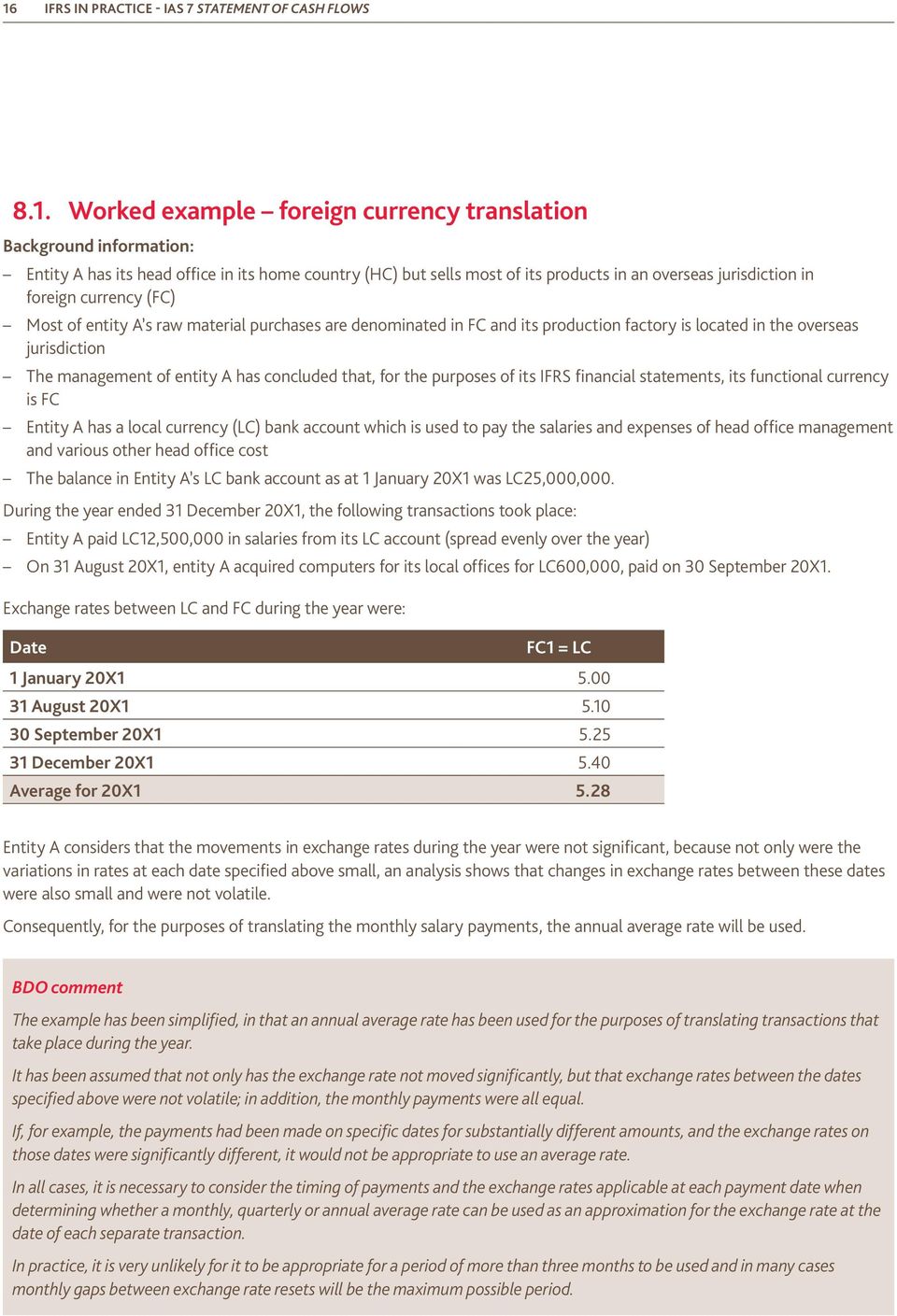
16 16 IFRS IN PRACTICE - IAS 7 STATEMENT OF CASH FLOWS 8.1. Worked example foreign currency translation Background information: Entity A has its head office in its home country (HC) but sells most of its products in an overseas jurisdiction in foreign currency (FC) Most of entity A s raw material purchases are denominated in FC and its production factory is located in the overseas jurisdiction The management of entity A has concluded that, for the purposes of its IFRS financial statements, its functional currency is FC Entity A has a local currency (LC) bank account which is used to pay the salaries and expenses of head office management and various other head office cost The balance in Entity A s LC bank account as at 1 January 20X1 was LC25,000,000. During the year ended 31 December 20X1, the following transactions took place: Entity A paid LC12,500,000 in salaries from its LC account (spread evenly over the year) On 31 August 20X1, entity A acquired computers for its local offices for LC600,000, paid on 30 September 20X1. Exchange rates between LC and FC during the year were: Date FC1 = LC 1 January 20X August 20X September 20X December 20X Average for 20X Entity A considers that the movements in exchange rates during the year were not significant, because not only were the variations in rates at each date specified above small, an analysis shows that changes in exchange rates between these dates were also small and were not volatile. Consequently, for the purposes of translating the monthly salary payments, the annual average rate will be used. BDO comment The example has been simplified, in that an annual average rate has been used for the purposes of translating transactions that take place during the year. It has been assumed that not only has the exchange rate not moved significantly, but that exchange rates between the dates specified above were not volatile; in addition, the monthly payments were all equal. If, for example, the payments had been made on specific dates for substantially different amounts, and the exchange rates on those dates were significantly different, it would not be appropriate to use an average rate. In all cases, it is necessary to consider the timing of payments and the exchange rates applicable at each payment date when determining whether a monthly, quarterly or annual average rate can be used as an approximation for the exchange rate at the date of each separate transaction. In practice, it is very unlikely for it to be appropriate for a period of more than three months to be used and in many cases monthly gaps between exchange rate resets will be the maximum possible period.
17 IFRS IN PRACTICE - IAS 7 STATEMENT OF CASH FLOWS 17 The LC transactions, as recorded in the LC bank account, are as follows: Date LC Exchange rate FC Opening balance 1 January 20X1 25,000, ,000,000 Payment of salaries Monthly (12,500,000) 5.28 (average) (2,367,424) Payment for computers (a) 30 September 20X1 (600,000) 5.25 (114,286) Closing balance (calculated) 2,518,290 Closing balance (at year end spot rate) 31 December 20X1 11,900, ,203,704 Exchange loss (b) (314,586) (a) The effect of the acquisition of computers on cash and cash equivalents has been determined using the payment date. (b) The exchange loss is the adjustment required to bring the closing bank balance to the amount calculated using the year end spot rate. In addition, a foreign exchange adjustment arises from the retranslation of the trade payable balance in respect of the purchase of computers, as illustrated by the following journal entries: 31 August 20X1 Dr PP&E (computers) 117,647 Cr Accounts payable 117,647 Acquisition of computers on 31 August and recording of amount payable (Calculated as LC600,000/5.10, the exchange rate at 31 August 20X1) 30 September 20X1 Dr Accounts payable 117,647 Cr Foreign exchange gain 3,361 Cr Cash 114,286 Settlement of accounts payable at 30 September 20X1 (Calculated as LC600,000/5.25, the exchange rate at 30 September 20X1)

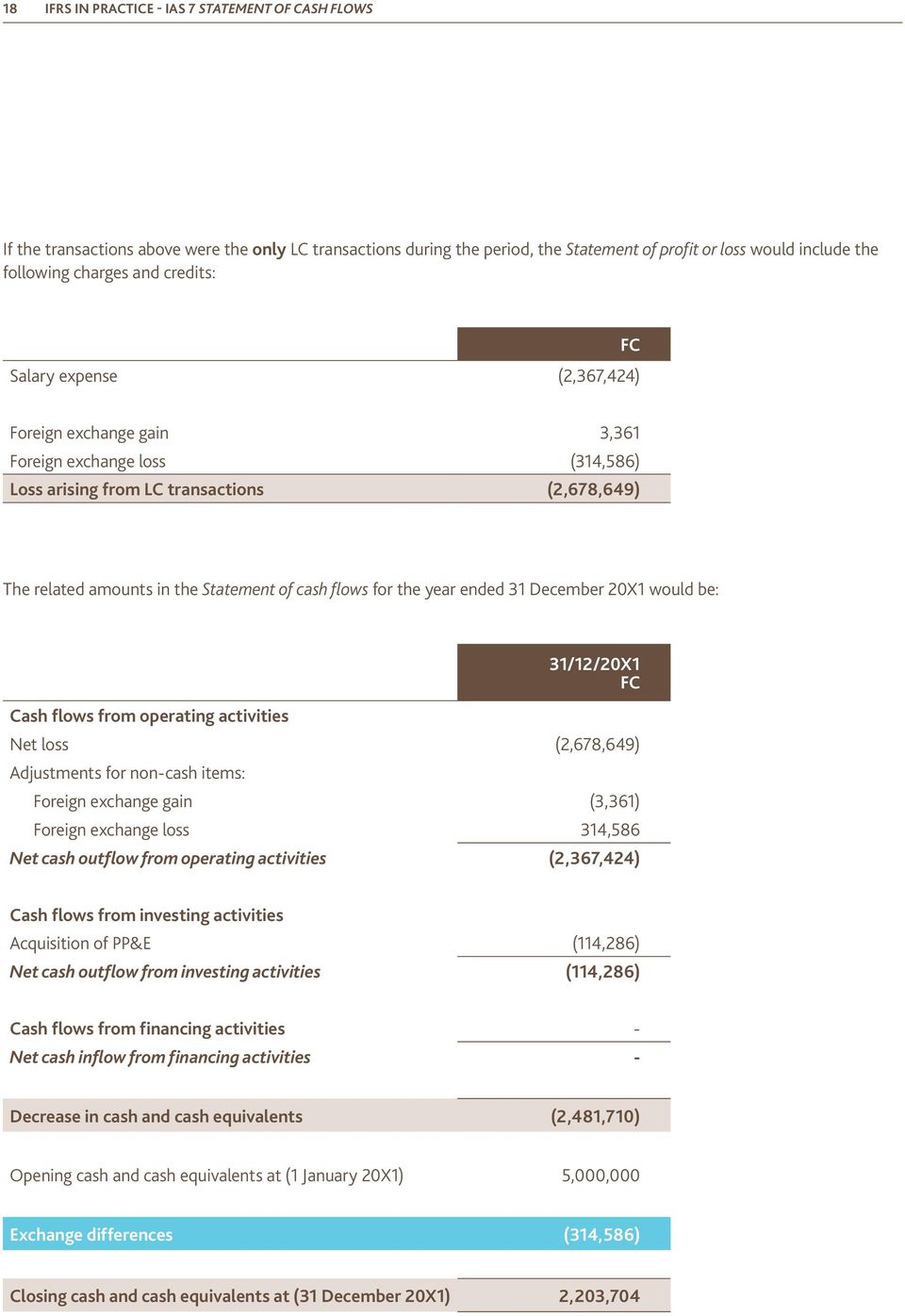
18 18 IFRS IN PRACTICE - IAS 7 STATEMENT OF CASH FLOWS If the transactions above were the only LC transactions during the period, the Statement of profit or loss would include the following charges and credits: Salary expense (2,367,424) FC Foreign exchange gain 3,361 Foreign exchange loss (314,586) Loss arising from LC transactions (2,678,649) The related amounts in the Statement of cash flows for the year ended 31 December 20X1 would be: Cash flows from operating activities 31/12/20X1 FC Net loss (2,678,649) Adjustments for non-cash items: Foreign exchange gain (3,361) Foreign exchange loss 314,586 Net cash outflow from operating activities (2,367,424) Cash flows from investing activities Acquisition of PP&E (114,286) Net cash outflow from investing activities (114,286) Cash flows from financing activities - Net cash inflow from financing activities - Decrease in cash and cash equivalents (2,481,710) Opening cash and cash equivalents at (1 January 20X1) 5,000,000 Exchange differences (314,586) Closing cash and cash equivalents at (31 December 20X1) 2,203,704
19 IFRS IN PRACTICE - IAS 7 STATEMENT OF CASH FLOWS GROUP CASH POOLING ARRANGEMENTS IN AN ENTITY S SEPARATE FINANCIAL STATEMENTS Cash pooling arrangements arise where one group entity (which may be the ultimate group parent, or a fellow subsidiary) acts as the treasury function for the rest of the group. Under these arrangements, one entity within a group holds and maintains all cash balances with an external financial institution(s) and advances funds to group entities. Often, a group treasury function is used in order to make the most efficient use of cash resources within a group, and to enable hedge accounting transactions to be entered into at group-level at the lowest overall cost. Typically, the group entities that act as a treasury function are not financial institutions. In some cases, subsidiaries do not have bank accounts at all, and instead amounts due are settled directly from centrally controlled funds. Questions then arise as to whether the cash flow statement should be prepared at all. In our view, a statement of cash flows which reflects the actual cash flows of an entity during the period is required to be prepared in all cases, regardless of the balance of cash and cash equivalents held at each period end. This is consistent with the requirements of IAS 7, which contain no exemption from the preparation of a statement of cash flows. This is regardless of whether an entity has a cash and cash equivalents balance at its reporting date, or merely a balance with a treasury function entity. In circumstances in which an entity makes net deposits or withdrawals of funds, these will give rise to intercompany balances. These deposits or withdrawals will be shown as investing or financing activities, respectively. The question which then arises is whether it is appropriate in the separate financial statements of an entity that has deposited cash and cash equivalents with a group treasury function, to present those amounts as cash and cash equivalents in its statement of cash flows. Many consider that the classification of such amounts as cash and cash equivalents to be inappropriate, on the basis that: The concept of cash is restricted to amounts that are held by independent financial institutions and are subject to protection by the regulatory requirements that are imposed on those financial institutions Deposits with group entities are subject to inherent risks that are not usually associated with cash deposits All group entities are controlled by a parent entity, meaning that it is difficult to conclude that a group entity could demand repayment of deposits independently of whether the parent entity would agree to the repayment In many cases funds are transferred to the treasury entity for unspecified and indeterminate periods.
20 20 IFRS IN PRACTICE - IAS 7 STATEMENT OF CASH FLOWS BDO comment In our view, it is very unlikely that it would be appropriate for cash and cash equivalents deposited by entities within a group treasury function to be classified as cash and cash equivalents. However it is possible that this would be appropriate, but only in very rare cases limited to those cases which involve a combination of at least the following factors: The treasury entity itself operates in accordance with strict and well defined controls The intra group balances behave in a manner similar to cash balances. That is, they are highly liquid, available on demand or in the short term and have terms that are similar to those which would be expected if the deposits had been made with an independent third party financial institution The group maintains collective cash balances (or has access to cash via lines of credit) to meet demand notices served by subsidiaries that have deposited excess funds with the treasury entity. Even if these characteristics existed, it is not clear how an entity could claim that it, individually, has control over whether it can require the repayment of cash and cash equivalents from a central treasury company. It would appear difficult to overcome the presumption that the ultimate parent company will control the repayment of funds, and in any event the purpose of a treasury function is to centralise the pooling and use of funds; the ability of a group entity to require repayment would appear contrary to the group policy. If they were presented as cash and cash equivalents, we believe that it would be appropriate for these balances to be identified on the face of the statement of financial position and/or in the notes to the financial statements (depending on their significance) as being amounts deposited with another group entity. It might also be appropriate to include additional information about the group cash pooling arrangements that are relevant to the users of financial statements in their understanding of the financial position and liquidity of the entity, as required by IAS 7.50.

21 IFRS IN PRACTICE - IAS 7 STATEMENT OF CASH FLOWS SERITIES AND LOANS HELD FOR DEALING OR TRADING IAS 7.14 includes a number of examples of operating cash flows, including cash receipts and payments from contracts held for dealing or trading purposes. IAS 7.15 notes that when an entity holds securities and loans for dealing or trading purposes, those items are similar to inventory acquired specifically for resale. As a result, the cash flows arising from the purchase and sale of dealing or trading securities are classified within operating activities. Consistent with this approach, IAS 7.16(c) and (d) require cash flows which relate to the acquisition or sale of equity or debt instruments of other entities (including interests in joint ventures) to be classified as arising from investing activities, unless the instruments being acquired are considered to be cash equivalents or they are held for dealing or trading purposes. However, although IAS 7 refers to instruments held for dealing or trading purposes, it does not contain a direct reference to either IAS 39 Financial Instruments: Recognition and Measurement or IFRS 9 Financial Instruments, both of which contain definitions of instruments that are held for trading. IAS 39.9 and IFRS 9 Appendix A define a financial instrument as held for trading if: a) It is acquired or incurred principally for the purpose of selling or repurchasing in the near term b) On initial recognition it is part of a portfolio of identified financial instruments that are managed together and for which there is evidence of a recent actual pattern of short-term profit-taking, or c) It is a derivative (except for a derivative that is a financial guarantee contract or a designated and effective hedging instrument). The question which then arises is whether cash flows related to securities that meet the definition of held for trading in IAS 39 and IFRS 9 are required to be classified as arising from operating activities. The wording in IAS 7 makes no reference to the definitions in IAS 39 and IFRS 9 and, in consequence, it would appear that there is no automatic classification of these cash flows into a particular category. Entities therefore need to give careful consideration to the purpose of the transaction that gave rise to the financial instrument classified as held for trading, and the reason(s) for the acquisition and/or sale. BDO comment When considering the appropriate classification of cash flows arising from financial instruments classified as held for trading in accordance with IAS 39 and IFRS 9, it is necessary to consider the underlying principle of IAS 7, which is that cash flows should be classified in accordance with the business that is carried on by an entity. Consequently, a financial institution for which a significant part of its business activities are buying and selling financial instruments would be likely to classify those cash flows as operating. In contrast, a manufacturing entity that enters into an interest rate swap to hedge interest rate risk arising from a variable rate loan, and applies hedge accounting, would classify the cash flows from the derivative in the same way as the cash flows arising from the position that has been hedged. The classification of cash flows arising from derivatives that are used in economic hedges but are not designated as hedging instruments in accordance with IAS 39 or IFRS 9 is considered in the next section.
22 22 IFRS IN PRACTICE - IAS 7 STATEMENT OF CASH FLOWS 11. CLASSIFICATION OF CASH FLOWS ARISING FROM A DERIVATIVE USED IN AN ECONOMIC HEDGE Consequential amendments were not made to IAS 7 as a result of the introduction of, and subsequent changes to, IAS 39 Financial Instruments: Recognition and Measurement. A related issue which often arises in practice is the classification of cash flows that arise from a derivative that, although used economically to hedge exposures, is not designated in an IAS 39 qualifying hedge relationship. The same issue arises in respect of hedge accounting and IFRS 9 Financial Instruments, for those entities which have adopted the new standard early. IAS 7.16(g) and (h) note that cash payments and receipts that relate to futures contracts, forward contracts, option contracts, and swap contracts should be classified as investing activities, unless the contracts are held for dealing or trading purposes, or the cash flow are classified as relating to financing activities. IAS 7.16 also notes that when a derivative is accounted for as a hedge of an identifiable position, the cash flows of that contract are classified in the same manner as the cash flows of the position being hedged. A derivative that is used in an economic hedge, but is not designated as a hedging instrument in accordance with IAS 39 and IFRS 9, does not technically fall within the guidance in IAS Consequently, it could be argued that it would not be appropriate to present the cash flows in the financial statements as if such a designation had been made. However, in our view, because IAS 7 is not clear about this point, it is acceptable to classify cash flows arising from economic hedges that are not designated as hedging instruments in accordance with IAS 39 or IFRS 9 in the same way as if they had formed part of a qualifying hedging relationship for accounting purposes. This means that the cash flows from those economic hedging instruments could be classified as operating, investing or financing, depending on the nature of the item that is being hedged.
23 IFRS IN PRACTICE - IAS 7 STATEMENT OF CASH FLOWS FINANCE LEASES Payments made on inception of a finance lease IAS 7.44(a) notes that many investing and financing activities do not have a direct effect on cash flows, although they do affect the capital and asset structure of an entity. Among the examples listed is the acquisition of an asset by means of a finance lease. This is because, in many cases, the initial recognition of an asset acquired under a finance lease, and the corresponding liability, arise from the signature of a lease contract without there being any exchange of cash. In some cases, finance leases can involve the exchange of cash on inception because the terms of the lease may require a deposit to be paid and/or payments to be made in advance. In those cases, amounts are included in the statement of cash flows and would be expected to be classified as investing activities (because the finance lease gives rise to a recognised asset) Disaggregation of finance lease payments In the same way as repayments of a conventional loan, finance lease payments are comprised of two components: Repayment of the principal amount, and Payment of interest. As a result, for the purposes of the statement of cash flows, finance lease payments are required to be split into each component with repayments of principal and payments of interest being presented separately. The repayments of principal are classified within financing activities (IAS 7.17(e)), with the interest portion being aggregated with other interest outflows (for other borrowings) and presented as arising from either operating, investing or financing activities (IAS 7.31). However, to the extent that finance lease interest is capitalised in accordance with IAS 23 Borrowing Costs, the related cash flows will be classified within investing activities (see section 4.4).
24 24 IFRS IN PRACTICE - IAS 7 STATEMENT OF CASH FLOWS 13. CLASSIFICATION OF CASH FLOWS ARISING FROM BUSINESS COMBINATIONS Presentation and disclosure of cash paid and cash acquired in a business combination When an entity acquires a business and part or all of the consideration is in cash or cash equivalents, part of the net assets acquired may include the acquiree s existing cash balance. This results in different amounts being presented in the statement of cash flows and the notes to the financial statements. IAS 7.39 and 42 require the net cash flows arising from gaining or losing control of a business, to be classified as arising from investing activities. Consequently, the statement of cash flows will not include the gross cash flows arising from the acquisition, and will instead show a single net amount. IAS 7.40 then requires the gross amounts to be disclosed in the notes. The disclosures required by IFRS 3 Business Combinations include: The acquisition date fair value of total consideration transferred, analysed into each major class of consideration including the cash element (IFRS 3.B64(f)(i)) Major classes of assets and liabilities acquired, of which cash and cash equivalents would be a class (IFRS 3.B64(i)) Transaction costs IFRS 3 requires transaction costs incurred in connection with a business combination to be expensed, because they relate to the purchase of services and not to the acquisition of the business. Only cash outflows that result in the recognition of an asset in the statement of financial position are classified as arising from investing activities in the statement of cash flows. Consequently, cash flows arising from transaction costs related to a business combination are classified as arising from operating activities in consolidated financial statements. However, if an entity prepares separate financial statements in accordance with IFRS, transaction costs are included as part of the cost of the investment in a subsidiary. Consequently, in the separate (parent) entity s statement of cash flows, cash flows arising from transaction costs will be classified as arising from investing activities.
25 IFRS IN PRACTICE - IAS 7 STATEMENT OF CASH FLOWS Deferred and contingent consideration IAS 7.39 requires the aggregate cash flows arising from obtaining (or losing) control of a subsidiary or other business to be classified as being derived from investing activities. This is consistent with the requirement of IAS 7.16 that only expenditure that results in an asset that is recognised in the statement of financial position can be classified as arising from investing activities. While this appears straightforward, issues arise when determining how cash outflows associated with deferred or contingent consideration should be presented in the statement of cash flows. (i) Deferred consideration Some business combinations may involve deferral of (a portion of) the purchase consideration to a future date. A key question is whether cash flows associated with deferred consideration should be classified as arising from investing activities (on the basis that they are in connection with the acquisition of net assets), or from financing activities (on the basis that the vendor is providing a form of finance). In our view, these cash flows should normally be classified as arising from investing activities on the basis that this is consistent with the nature of the original transaction which gave rise to the initial recognition of assets and liabilities in the statement of financial position. This would include any adjustments resulting from additional information about facts and circumstances that existed at the acquisition date. However, in limited cases deferred consideration may be similar in nature to a loan granted by the vendor, with the associated cash flows being classified as arising from financing activities. In our view, this may be the case when the period between the acquisition date and settlement of the deferred consideration is sufficiently long that the vendor would recognise imputed interest (see section 4.4 for the classification of cash flows relating to interest). Classification as financing would be appropriate if the vendor accepted payment in the form of a long term loan note. (ii) Contingent consideration When a business combination involves an adjustment to consideration payable to the vendor that is contingent on future events, IFRS 3 requires the acquirer to recognise the acquisition date fair value of the contingent consideration with an associated adjustment to goodwill. The related obligation (which meets the definition of a financial instrument) is classified as a financial liability or within equity in accordance with the requirements of IAS 32 Financial Instruments: Presentation. For obligations that are to be settled in cash or cash equivalents, subsequent changes in the carrying amount of the liability are recorded in profit or loss. The classification of the related cash flows is affected by this requirement, because IAS 7.16 only permits cash outflows that result in the recognition of an asset to be classified as arising from investing activities. This requirement of IAS 7 indicates that cash payments arising from any post acquisition date increase in the carrying amount of contingent consideration cannot be classified as arising from investing activities, because the incremental amount would be charged to profit or loss and would not result in the recognition of an asset (or an increase in carrying amount of an asset). This means that those excess cash flows would typically be classified as arising from operating activities (particularly if the increase arose from a formula linked to the operating performance of the acquired business). In limited cases, it may be appropriate to classify at least some of the cash flows as arising from financing activities (see deferred consideration above). However, it is necessary to look at the extent to which the amount of contingent consideration payable is affected by factors other than time value of money and, the more linkage there is to future business performance, the more difficult it will be to identify any financing component.
26 26 IFRS IN PRACTICE - IAS 7 STATEMENT OF CASH FLOWS 14. CASH FLOWS FROM DISCONTINUED OPERATIONS IAS 7 requires an entity to include all of its cash flows in the statement of cash flows, including those generated from both continuing and discontinued activities. IFRS 5 Non-current Assets Held for Sale and Discontinued Operations requires an entity to disclose its net cash flows derived from operating, investing and financing activities in respect of discontinued operations. There are two ways in which this can be achieved: a) Presentation in the statement of cash flows Net cash flows from each type of activity (operating, investing and financing) derived from discontinued operations are presented separately in the statement of cash flows. b) Presentation in a note Cash flows from discontinued operations are included together with cash flows from continuing operations in each line item in the statement of cash flows. The net cash flows relating to each type of activity (operating, investing and financing) derived from discontinued operations are then disclosed separately in a note to the financial statements. When a disposal group that meets the definition of a discontinued operation is classified as held for sale in the current period, and has not been realised/disposed of at the entity s reporting date, the closing balance of cash and cash equivalents presented in the statement of cash flows will not reconcile to the cash and cash equivalents balances that are included in the statement of financial position at the reporting date. This is because the cash and cash equivalents related to the disposal group are subsumed into the assets and liabilities of the disposal group and presented within the single line item in the statement of financial position.
27 IFRS IN PRACTICE - IAS 7 STATEMENT OF CASH FLOWS Worked example Discontinued operations not disposed of at the entity s reporting date Background information: Entity A operates in the food and beverage industry sectors Towards the end of the year ended 31 December 20X3, Entity A decides to dispose of the food sector The planned disposal qualifies as a discontinued operation in accordance with IFRS 5, as at 31 December 20X3 The carrying amount of 180 relating to Assets in disposal group classified as held for sale includes 30 of cash and cash equivalents. Information extracted from Entity A s statement of financial position is as follows: 31/12/20X3 31/12/20X2 Assets Cash and cash equivalents Inventories Property, Plant and Equipment Assets in disposal group classified as held for sale (a) Total 1, Liabilities and equity Trade payables (180) (280) Liabilities directly associated with assets in the disposal group classified as held for sale (70) - Share capital (10) (10) Retained earnings (740) (350) Total (1,000) (640) (a) Includes cash and cash equivalents of 30.
28 28 IFRS IN PRACTICE - IAS 7 STATEMENT OF CASH FLOWS Additional information Assets and liabilities directly related to the food sector disposal group as at 31 December 20X2 were as follows: Assets 31/12/20X2 Cash 10 Inventories 50 Property, Plant and Equipment 140 Total 200 Liabilities Trade payables (120) Total (120) Entity A s profit (including profit generated from discontinued operations) in 20X3 is 390 The profit from discontinued operations in 20X3 is 30 Discontinued operations in 20X3 include a cash outflow of 100 for operating activities and a cash inflow of 120 from investing activities In 20X3, Entity A acquired property, plant and equipment for 400. This property, plant and equipment is used in activities within continuing operations Entity A presents net cash flows relating to each type of activity (operating, investing and financing) generated from discontinued operations in the statement of cash flows Depreciation expense in 20X3 was 60 The effects of tax have been ignored. As at 31 December 20X3, Entity A had met the requirements in IFRS 5 meaning that the food sector disposal group was classified as a discontinued operation. As a result, the assets and liabilities of the food sector disposal group were presented separately from the other assets and liabilities of entity A in its statement of financial position. However, the assets and liabilities of the food sector disposal group were not presented separately in the statement of financial position for the comparative period (IFRS 5.40). In order to present a statement of cash flows for the year ended 31 December 20X3, which separates the continuing operations and the discontinued operations (either in the primary statement or in the notes), Entity A needs the opening balances of assets and liabilities of the disposal group (which comprises the discontinued operation) as at 31 December 20X2.
29 IFRS IN PRACTICE - IAS 7 STATEMENT OF CASH FLOWS 29 Entity A Statement of Cash Flows for the year ended 31 December 20X3 Cash flows from operating activities 31/12/20X3 Profit for the period 390 Adjustments for income and expenses not involving cash flows: Depreciation of property, plant and equipment (a) 60 Profit from discontinued operations (b) (30) Changes in assets and liabilities: Increase in inventories (c) 80 Increase in trade payables (d) (20) Net cash generated from continuing operating activities 360 Net cash used by discontinued operations (100) Net cash inflow from operating activities 260 Cash flows from investing activities Acquisition of property, plant and equipment (400) Net cash used in continuing investing activities (400) Net cash generated from investing activities discontinued operations 120 Net cash outflow from investing activities (280) Cash flows from financing activities Net cash generated from/(used in) financing activities - Net cash generated from/(used in) financing discontinued operations - Net cash flow financing activities - Decrease in cash and cash equivalents in 20X3 (20) Opening cash and cash equivalents (1 January 20X3) 280 Closing cash and cash equivalents (31 December 20X3) 260
30 30 IFRS IN PRACTICE - IAS 7 STATEMENT OF CASH FLOWS a) Depreciation of property, plant and equipment continuing operations Opening balance as at 1 January 20X3 (excluding discontinued operations) 60 Add: Acquisition of property, plant and equipment 400 Less: Closing balance of property, plant and equipment (400) Depreciation 60 The opening balance is calculated by deducting the amount of property, plant and equipment which relates to the discontinued operations on 31 December 20X2 (140) from the opening balance of entity A s property, plant and equipment at that date (200). b) Profit from discontinued operations The profit from discontinued operations is adjusted to avoid double counting. The cash movement of 100 is obtained from the additional information above. c) Increase in inventories continuing operations Closing balance as at 31 December 20X3 190 Less: opening balance (excluding discontinued operations) (110) Increase in inventories 80 The opening balance at 1 January 20X3 (excluding discontinued operations) is calculated by deducting the amount of inventories relating to the discontinued operations as at 31 December 20X2 (50) from the opening balance of Entity A s inventories (160) at the same date. d) Increase in trade payables continuing operations Closing balance on 31 December 20X3 180 Less: opening balance (excluding discontinued operations) (160) Increase in trade payables (20) The opening balance (excluding discontinued operations) is calculated by deducting the balance of trade payables which relates to the discontinued operations as at 31 December 20X2 (120) from the balance of total trade payables of Entity A as at the same date (280).
31 IFRS IN PRACTICE - IAS 7 STATEMENT OF CASH FLOWS 31 Statement of cash flows vs. Statement of financial position Statement of cash flows Statement of financial position Opening balance of cash and cash equivalents Net increase/(decrease) in cash and cash equivalents (20) (50) Closing balance of cash and cash equivalents The differences in the amounts for the net (decrease) in cash and cash equivalents, and in the closing balance of cash and cash equivalents, is because cash and cash equivalents of 30 related to the food sector disposal group are included within the single line item Assets in disposal groups classified as held for sale in the statement of financial position.
32 32 IFRS IN PRACTICE - IAS 7 STATEMENT OF CASH FLOWS Worked example Discontinued operations disposed of in full during the reporting period Extracts from Entity B s statement of financial position as at 31 December 20X2 and 20X3 are as follows: 31/12/20X3 31/12/20X2 Assets Cash and cash equivalents 3,400 1,600 Assets in disposal groups classified as held for sale Property, plant and equipment 1,700 1,400 Total 5,100 3,900 Liabilities and equity Trade payables (550) (240) Liabilities directly associated with assets in disposal group classified as held for sale - (490) Equity (4,550) (3,170) Total (5,100) (3,900) Additional information During 20X3, Entity B acquired property, plant and equipment (PP&E) for 420. The PP&E is not included in the discontinued operation On 30 June 20X3 Entity B paid dividends of 140 On 1 August 20X3, Entity B disposed of all of the assets and liabilities of the discontinued operation for cash proceeds of 1,300. The carrying amount of the discontinued operation s net assets as at the disposal date was 1,050 The following transactions and events took place in the discontinued operation during 20X3, prior to the date on which it was disposed of: Property, plant and equipment was sold for cash proceeds of 440 A loan of 320 was repaid Accounts receivable of 480 were settled in cash. As at 31 December 20X2, cash and cash equivalents were not included in non-current assets classified as held for sale Entity B has adopted an accounting policy for the presentation of dividends received and dividends paid as cash flows derived from investing and financing activities, respectively (IAS 7.33) The effects of tax have been ignored.
33 IFRS IN PRACTICE - IAS 7 STATEMENT OF CASH FLOWS 33 Alternative 1 presentation of discontinued operations in the statement of cash flows Cash flows from operating activities 31/12/20X3 Profit for the period (a) 1,520 Adjustments for income and expenses not involving cash flows: Depreciation of property, plant and equipment (b) 120 Profit from discontinued operations (c) (890) Changes in assets and liabilities: Increase in trade payables 310 Net cash generated from continuing operating activities 1,060 Net cash generated from discontinued operations (d) 480 Net cash inflows from operating activities 1,540 Cash flows from investing activities Acquisition of property, plant and equipment (420) Net cash used in continuing investing activities (420) Net cash generated from investing activities discontinued operations (e) 1,740 Net cash inflows from investing activities 1,320 Cash flows from financing activities Dividend paid (140) Net cash used in continuing financing activities (140) Net cash used in financing discontinued operations (f) (320) Net cash outflows from financing activities (460) Increase in cash and cash equivalents in 20X3 2,400 Less: increase in cash and cash equivalents attributable to discontinued operations disposed of during the period (g) (600) Opening cash and cash equivalents (1 January 20X3) 1,600 Closing cash and cash equivalents (31 December 20X3) 3,400
34 34 IFRS IN PRACTICE - IAS 7 STATEMENT OF CASH FLOWS a) Profit for the period The profit for the period is equal to the change in equity before distributions. This is calculated as equity as at 31 December 20X3 of 4,550 plus dividends paid of 140, less the opening balance of equity of 3,170. b) Depreciation of property, plant and equipment (PP&E) Opening balance as at 1 January 20X3 1,400 Add: Acquisition of PP&E during 20X3 420 Less: Closing balance as at 31 December 20X3 (1,700) Depreciation of PP&E 120 c) Profit from discontinued operations Gain on disposal (i) 250 Add: Profit during the period up to disposal (ii) 640 Profit from discontinued operations 890 (i) Consideration received of 1,300 less the closing net assets of the discontinued operations of 1,050 (see additional information above). (ii) Equal to the change in net assets of the discontinued operation, calculated as closing net assets of 1,050 less opening net assets (assets of 900 less liabilities of 490). d) Net cash generated from discontinued operations In this case, it has been assumed that all operating activities had ceased by 1 January 20X3. Consequently, the only cash flows that would be expected to be received would be the collection of trade receivables and other receivable balances. The additional information above notes that cash receipts of 480 were received from the settlement of trade receivables. e) Net cash generated from investing activities discontinued operations These are comprised of proceeds from the disposal of operations (1,300) plus cash received from the sale of property, plant and equipment (440). f) Net cash used in financing discontinued operations This relates to the repayment of the loan of 320. g) Increase in cash and cash equivalents attributable to the discontinued operations that have been disposed of This comprises all cash flows attributable to the discontinued operation up to the point at which it was disposed of, but does not include cash flows attributable to cash receipts from the sale of the discontinued operation. The amount is therefore the cash inflow from the decrease in accounts receivable (480) plus cash proceeds from the sale of property, plant and equipment (440) less the cash outflow associated with the repayment of the loan (320).
35 IFRS IN PRACTICE - IAS 7 STATEMENT OF CASH FLOWS 35 Statement of cash flows vs. Statement of financial position Statement of cash flows Statement of financial position Opening balance of cash and cash equivalents 1,600 1,600 Net increase/(decrease) in cash and cash equivalents 1,800 1,800 Closing balance of cash and cash equivalents 3,400 3,400 The amounts included in both primary statements are the same, because at the reporting period end there is no discontinued operation to be presented separately in the statement of financial position.
36 36 IFRS IN PRACTICE - IAS 7 STATEMENT OF CASH FLOWS Alternative 2 presentation of discontinued operations in the notes Cash flows from operating activities 31/12/20X3 Profit for the period (a) 1,520 Adjustments for income and expenses not involving cash flows: Depreciation of property, plant and equipment (b) 120 Profit from discontinued operations (c) (890) Changes in assets and liabilities: Decrease in trade receivables 480 Increase in trade payables 310 Net cash inflow from operating activities 1,540 Cash flows from investing activities Acquisition of property, plant and equipment (420) Sale of property, plant and equipment 440 Disposal of discontinued operation, net of cash disposed of 1,300 Net cash inflow from investing activities 1,320 Cash flows from financing activities Loan repayment (320) Dividend paid (140) Net cash used in financing activities (460) Increase in cash and cash equivalents in 20X3 2,400 Less: increase in cash and cash equivalents attributable to discontinued operations disposed of during the period (d) (600) Opening cash and cash equivalents (1 January 20X3) 1,600 Closing cash and cash equivalents (31 December 20X3) 3,400
37 IFRS IN PRACTICE - IAS 7 STATEMENT OF CASH FLOWS 37 a) Profit for the period The profit for the period is equal to the change in equity before distributions. This is calculated as equity as at 31 December 20X3 of 4,550 plus dividends paid of 140, less the opening balance of equity of 3,170. b) Depreciation of property, plant and equipment (PP&E) 31/12/20X3 Opening balance as at 1 January 20X3 1,400 Add: Acquisition of PP&E during 20X3 420 Less: Closing balance as at 31 December 20X3 (1,700) Depreciation of PP&E 120 c) Profit from discontinued operations 31/12/20X3 Gain on disposal (i) 250 Add: Profit during the period up to disposal (ii) 640 Profit from discontinued operations 890 (i) Consideration received of 1,300 less the closing net assets of the discontinued operations of 1,050 (see additional information above). (ii) Equal to the change in net assets of the discontinued operation, calculated as closing net assets of 1,050 less opening net assets (assets of 900 less liabilities of 490). d) Increase in cash and cash equivalents attributable to the discontinued operations that have been disposed of This is comprised of all cash flow attributable to the discontinued operation up to the point at which it was disposed of, but does not include cash flows attributable to cash receipts from the sale of the discontinued operation. The amount is therefore the cash inflow from the decrease in accounts receivable (480) plus cash proceeds from the sale of property, plant and equipment (440) less the cash outflow associated with the repayment of the loan (320). Notes to the financial statements (extract) Note [x] Discontinued operations (extract) The statement of cash flows includes the following amounts relating to discontinued operations: 31/12/20X3 Net cash generated by operating activities 480 Net cash generated by investing activities 440 Net cash used in financing activities (320) Net cash flow from discontinued operations 600
38 CONTACT For further information about how BDO can assist you and your organisation, please get in touch with one of our key contacts listed below. Alternatively, please visit Country Leaders where you can find full lists of regional and country contacts. EUROPE Caroline Allouët France Jens Freiberg Germany Teresa Morahan Ireland Ehud Greenberg Israel Ruud Vergoossen Netherlands Reidar Jensen Norway Maria Sukonkina Russia René Krügel Switzerland Brian Creighton United Kingdom ASIA PACIFIC Wayne Basford Australia Zheng Xian Hong China Fanny Hsiang Hong Kong Khoon Yeow Tan Malaysia LATIN AMERICA Marcelo Canetti Argentina Luis Pierrend Peru Ernesto Bartesaghi Uruguay NORTH AMERICA & CARIBBEAN Armand Capisciolto Canada Wendy Hambleton USA MIDDLE EAST Arshad Gadit Bahrain Antoine Gholam Lebanon SUB SAHARAN AFRICA Nigel Griffith South Africa This publication has been carefully prepared, but it has been written in general terms and should be seen as broad guidance only. The publication cannot be relied upon to cover specific situations and you should not act, or refrain from acting, upon the information contained therein without obtaining specific professional advice. Please contact your respective BDO member firm to discuss these matters in the context of your particular circumstances. Neither BDO IFR Advisory Limited, Brussels Worldwide Services BVBA, BDO International Limited and/or BDO member firms, nor their respective partners, employees and/or agents accept or assume any liability or duty of care for any loss arising from any action taken or not taken by anyone in reliance on the information in this publication or for any decision based on it. Service provision within the international BDO network of independent member firms ( the BDO network ) in connection with IFRS (comprising International Financial Reporting Standards, International Accounting Standards, and Interpretations developed by the IFRS Interpretations Committee and the former Standing Interpretations Committee), and other documents, as issued by the International Accounting Standards Board, is provided by BDO IFR Advisory Limited, a UK registered company limited by guarantee. Service provision within the BDO network is coordinated by Brussels Worldwide Services BVBA, a limited liability company incorporated in Belgium with its statutory seat in Brussels. Each of BDO International Limited (the governing entity of the BDO network), Brussels Worldwide Services BVBA, BDO IFR Advisory Limited and the member firms is a separate legal entity and has no liability for another such entity s acts or omissions. Nothing in the arrangements or rules of the BDO network shall constitute or imply an agency relationship or a partnership between BDO International Limited, Brussels Worldwide Services BVBA, BDO IFR Advisory Limited and/or the member firms of the BDO network. BDO is the brand name for the BDO network and for each of the BDO member firms BDO IFR Advisory Limited, a UK registered company limited by guarantee. All rights reserved
International Accounting Standard 7 Statement of cash flows *
 International Accounting Standard 7 Statement of cash flows * Objective Information about the cash flows of an entity is useful in providing users of financial statements with a basis to assess the ability
Indian Accounting Standard (Ind AS) 7 Statement of Cash Flows
 Contents Indian Accounting Standard (Ind AS) 7 Statement of Cash Flows Paragraphs OBJECTIVE SCOPE 1 3 BENEFITS OF CASH FLOW INFORMATION 4 5 DEFINITIONS 6 9 Cash and cash equivalents 7 9 PRESENTATION OF
Statement of Cash Flows
 STATUTORY BOARD FINANCIAL REPORTING STANDARD SB-FRS 7 Statement of Cash Flows This version of SB-FRS 7 does not include amendments that are effective for annual periods beginning after 1 January 2014.
Statement of Cash Flows
 HKAS 7 Revised February November 2014 Hong Kong Accounting Standard 7 Statement of Cash Flows HKAS 7 COPYRIGHT Copyright 2014 Hong Kong Institute of Certified Public Accountants This Hong Kong Financial
Sri Lanka Accounting Standard-LKAS 7. Statement of Cash Flows
 Sri Lanka Accounting Standard-LKAS 7 Statement of Cash Flows CONTENTS SRI LANKA ACCOUNTING STANDARD-LKAS 7 STATEMENT OF CASH FLOWS paragraphs OBJECTIVE SCOPE 1 3 BENEFITS OF CASH FLOW INFORMATION 4 5 DEFINITIONS
NEPAL ACCOUNTING STANDARDS ON CASH FLOW STATEMENTS
 NAS 03 NEPAL ACCOUNTING STANDARDS ON CASH FLOW STATEMENTS CONTENTS Paragraphs OBJECTIVE SCOPE 1-3 BENEFITS OF CASH FLOWS INFORMATION 4-5 DEFINITIONS 6-9 Cash and cash equivalents 7-9 PRESENTATION OF A
Deloitte GAAP 2014: FRS 102 - Volume B (UK Series)
 Deloitte GAAP 2014: UK Reporting - FRS 102 - Volume B (UK Series) Chapter B7: Free postage when you order online www.lexisnexis.co.uk/store or call 0845 370 1234 B7 Contents 1 Introduction 211 2 Scope
Cash Flow Statements
 Compiled Accounting Standard AASB 107 Cash Flow Statements This compiled Standard applies to annual reporting periods beginning on or after 1 July 2007. Early application is permitted. It incorporates
International Financial Reporting Standards (IFRS)
 FACT SHEET September 2011 IAS 7 Statement of Cash Flows (This fact sheet is based on the standard as at 1 January 2010.) Important note: This fact sheet is based on the requirements of the International
IPSAS 2 CASH FLOW STATEMENTS
 IPSAS 2 CASH FLOW STATEMENTS Acknowledgment This International Public Sector Accounting Standard (IPSAS) is drawn primarily from International Accounting Standard (IAS) 7, Cash Flow Statements published
G8 Education Limited ABN: 95 123 828 553. Accounting Policies
 G8 Education Limited ABN: 95 123 828 553 Accounting Policies Table of Contents Note 1: Summary of significant accounting policies... 3 (a) Basis of preparation... 3 (b) Principles of consolidation... 3
AUGUST 2012. IAS 7: Statement of Cash Flows a guide to avoiding common pitfalls and application issues
 AUGUST 2012 IAS 7: Statement of Cash Flows a guide to avoiding common pitfalls and application issues Important Disclaimer: This document has been developed as an information resource. It is intended as
Adviser alert New publication on IAS 7: Statement of Cash Flows a guide to avoiding common pitfalls and application issues
 Adviser alert New publication on IAS 7: Statement of Cash Flows a guide to avoiding common pitfalls and application issues August 2012 Overview The Grant Thornton International IFRS team has published
The consolidated financial statements of
 Our 2014 financial statements The consolidated financial statements of plc and its subsidiaries (the Group) for the year ended 31 December 2014 have been prepared in accordance with International Financial
5 BUSINESS ACCOUNTING STANDARD CASH FLOW STATEMENT I. GENERAL PROVISIONS II. KEY DEFINITIONS
 APPROVED by Resolution No. 1 of 18 December 2003 of the Standards Board of the Public Establishment the Institute of Accounting of the Republic of Lithuania 5 BUSINESS ACCOUNTING STANDARD CASH FLOW STATEMENT
IFrS. Disclosure checklist. July 2011. kpmg.com/ifrs
 IFrS Disclosure checklist July 2011 kpmg.com/ifrs Contents What s new? 1 1. General presentation 2 1.1 Presentation of financial statements 2 1.2 Changes in equity 12 1.3 Statement of cash flows 13 1.4
SIGNIFICANT GROUP ACCOUNTING POLICIES
 SIGNIFICANT GROUP ACCOUNTING POLICIES Basis of consolidation Subsidiaries Subsidiaries are all entities over which the Group has the sole right to exercise control over the operations and govern the financial
Transition to International Financial Reporting Standards
 Transition to International Financial Reporting Standards Topps Tiles Plc In accordance with IFRS 1, First-time adoption of International Financial Reporting Standards ( IFRS ), Topps Tiles Plc, ( Topps
MPSAS 2 GOVERNMENT OF MALAYSIA MPSAS 2. Cash Flow Statements
 MPSAS 2 GOVERNMENT OF MALAYSIA MPSAS 2 Cash Flow Statements March 2013 MPSAS 2 CASH FLOW STATEMENTS Acknowledgment The Malaysian Public Sector Accounting Standard (MPSAS) 2 is based on International Public
International Accounting Standard 39 Financial Instruments: Recognition and Measurement
 EC staff consolidated version as of 18 February 2011 FOR INFORMATION PURPOSES ONLY International Accounting Standard 39 Financial Instruments: Recognition and Measurement Objective 1 The objective of this
Accounting and Reporting Policy FRS 102. Staff Education Note 1 Cash flow statements
 Staff Education Note 1: Cash flow Statements Accounting and Reporting Policy FRS 102 Staff Education Note 1 Cash flow statements Disclaimer This Education Note has been prepared by FRC staff for the convenience
Illustrative financial statements
 IFRS Illustrative financial statements October 2012 kpmg.com/ifrs 1 Contents What s new 2 About this publication 3 Independent auditors report on consolidated financial statements 5 Consolidated financial
POLICY MANUAL. Financial Management Significant Accounting Policies (July 2015)
 POLICY 1. Objective To adopt Full Accrual Accounting and all other applicable Accounting Standards. 2. Local Government Reference Local Government Act 1995 Local Government (Financial Management) Regulations
How To Account For Paid Advances In Russia
 IASB EMERGING ECONOMIES GROUP 8th MEETING December 11-12, 2014 ISSUES FOR DISCUSSON: OTHER NON-FINANSIAL ASSETS AND RELATED MATTERS National Organization for Financial Accounting and Reporting Standards
Principal Accounting Policies
 1. Basis of Preparation The accounts have been prepared in accordance with Hong Kong Financial Reporting Standards ( HKFRS ). The accounts have been prepared under the historical cost convention as modified
Acal plc. Accounting policies March 2006
 Acal plc Accounting policies March 2006 Basis of preparation The consolidated financial statements of Acal plc and all its subsidiaries have been prepared in accordance with International Financial Reporting
Note 2 SIGNIFICANT ACCOUNTING
 Note 2 SIGNIFICANT ACCOUNTING POLICIES BASIS FOR THE PREPARATION OF THE FINANCIAL STATEMENTS The consolidated financial statements have been prepared in accordance with International Financial Reporting
VASSETI (UK) PLC CONSOLIDATED FINANCIAL STATEMENTS FOR THE SIX MONTHS ENDED 30 JUNE 2013
 CONSOLIDATED FINANCIAL STATEMENTS FOR THE SIX MONTHS ENDED 30 JUNE 2013 INTERIM MANAGEMENT REPORT (UNAUDITED) FOR THE 6 MONTHS ENDED 30 JUNE 2013 1. Key Risks and uncertainties Risks and uncertainties
Financial Instruments: Recognition and Measurement
 STATUTORY BOARD FINANCIAL REPORTING STANDARD SB-FRS 39 Financial Instruments: Recognition and Measurement This version of the Statutory Board Financial Reporting Standard does not include amendments that
ACCOUNTING POLICIES. for the year ended 30 June 2014
 ACCOUNTING POLICIES REPORTING ENTITIES City Lodge Hotels Limited (the company) is a company domiciled in South Africa. The group financial statements of the company as at and comprise the company and its
International Financial Reporting Standard 7. Financial Instruments: Disclosures
 International Financial Reporting Standard 7 Financial Instruments: Disclosures INTERNATIONAL FINANCIAL REPORTING STANDARD AUGUST 2005 International Financial Reporting Standard 7 Financial Instruments:
International Accounting Standard 12 Income Taxes. Objective. Scope. Definitions IAS 12
 International Accounting Standard 12 Income Taxes Objective The objective of this Standard is to prescribe the accounting treatment for income taxes. The principal issue in accounting for income taxes
Summary of Significant Accounting Policies FOR THE FINANCIAL YEAR ENDED 31 MARCH 2014
 46 Unless otherwise stated, the following accounting policies have been applied consistently in dealing with items which are considered material in relation to the financial statements. The Company and
IPSAS 29 FINANCIAL INSTRUMENTS: RECOGNITION AND MEASUREMENT
 IPSAS 29 FINANCIAL INSTRUMENTS: RECOGNITION AND MEASUREMENT Acknowledgment This International Public Sector Accounting Standard (IPSAS) is drawn primarily from International Accounting Standard (IAS) 39,
EXPLANATORY NOTES. 1. Summary of accounting policies
 1. Summary of accounting policies Reporting Entity Taranaki Regional Council is a regional local authority governed by the Local Government Act 2002. The Taranaki Regional Council group (TRC) consists
International Accounting Standard 21 The Effects of Changes in Foreign Exchange Rates
 International Accounting Standard 21 The Effects of Changes in Foreign Exchange Rates Objective 1 An entity may carry on foreign activities in two ways. It may have transactions in foreign currencies or
International Accounting Standard 40 Investment Property
 International Accounting Standard 40 Investment Property Objective 1 The objective of this Standard is to prescribe the accounting treatment for investment property and related disclosure requirements.
Consolidated financial statements
 Summary of significant accounting policies Basis of preparation DSM s consolidated financial statements have been prepared in accordance with International Financial Reporting Standards (IFRS) as adopted
How To Account In Indian Accounting Standards
 Indian Accounting Standard (Ind AS) 39 Financial Instruments: Recognition and Measurement Contents Paragraphs Objective 1 Scope 2 7 Definitions 8 9 Embedded derivatives 10 13 Recognition and derecognition
Significant Accounting Policies
 Apart from the accounting policies presented within the corresponding notes to the financial statements, other significant accounting policies are set out below. These policies have been consistently applied
The statements are presented in pounds sterling and have been prepared under IFRS using the historical cost convention.
 Note 1 to the financial information Basis of accounting ITE Group Plc is a UK listed company and together with its subsidiary operations is hereafter referred to as the Company. The Company is required
IFRS IN PRACTICE. IAS 36 Impairment of Assets (December 2013)
 IFRS IN PRACTICE IAS 36 Impairment of Assets (December 2013) 2 IFRS IN PRACTICE - IAS 36 IMPAIRMENT OF ASSETS (DECEMBER 2013) IFRS IN PRACTICE - IAS 36 IMPAIRMENT OF ASSETS (DECEMBER 2013) 3 INTRODUCTION
International Financial Accounting (IFA)
 International Financial Accounting (IFA) Preparation and presentation of Financial Statements DEPARTMENT OF BUSINESS AND LAW ROBERTO DI PIETRA SIENA, NOVEMBER 4, 2013 1 INTERNATIONAL FINANCIAL ACCOUNTING
Residual carrying amounts and expected useful lives are reviewed at each reporting date and adjusted if necessary.
 87 Accounting Policies Intangible assets a) Goodwill Goodwill represents the excess of the cost of an acquisition over the fair value of identifiable net assets and liabilities of the acquired company
FRS1 FINANCIAL REPORTING STANDARDS ACCOUNTING STANDARDS BOARD OCTOBER 1996 FRS 1 (REVISED 1996)
 ACCOUNTING STANDARDS BOARD OCTOBER 1996 FRS 1 (REVISED 1996) Financial Reporting Standard 1 (Revised 1996) is set out in paragraphs 1-50. The Statement of Standard Accounting Practice set out in paragraphs
NOTES TO THE COMPANY FINANCIAL STATEMENTS
 FINANCIAL S 78 79 80 81 82 CONSOLIDATED INCOME CONSOLIDATED OF COMPREHENSIVE INCOME CONSOLIDATED OF FINANCIAL POSITION CONSOLIDATED OF CONSOLIDATED OF CHANGES IN EQUITY 83 NOTES TO THE CONSOLIDATED FINANCIAL
ILLUSTRATIVE FINANCIAL STATEMENTS YEAR ENDED 31 DECEMBER 2013 International Financial Reporting Standards
 ILLUSTRATIVE FINANCIAL STATEMENTS YEAR ENDED 31 DECEMBER 2013 International Financial Reporting Standards 2 A Layout (International) Group Ltd Annual report and financial statements For the year ended
(1.1) (7.3) $250m 6.05% US$ Guaranteed notes 2014 (164.5) Bank and other loans. (0.9) (1.2) Interest accrual
 17 Financial assets Available for sale financial assets include 111.1m (2013: 83.0m) UK government bonds. This investment forms part of the deficit-funding plan agreed with the trustee of one of the principal
IPSAS 4 THE EFFECTS OF CHANGES IN FOREIGN EXCHANGE RATES ACKNOWLEDGMENT
 THE EFFECTS OF CHANGES IN FOREIGN EXCHANGE RATES ACKNOWLEDGMENT This International Public Sector Accounting Standard (IPSAS) is drawn primarily from International Accounting Standard (IAS) 21 (revised
SAGICOR FINANCIAL CORPORATION
 Interim Financial Statements Nine-months ended September 30, 2015 FINANCIAL RESULTS FOR THE CHAIRMAN S REVIEW The Sagicor Group recorded net income from continuing operations of US $60.4 million for the
Indian Accounting Standard (Ind AS) 21 The Effects of Changes in Foreign Exchange Rates
 Indian Accounting Standard (Ind AS) 21 The Effects of Changes in Foreign Exchange Rates Contents Paragraph OBJECTIVE 1-2 SCOPE 3-7 DEFINITIONS 8-16 Elaboration on the definitions 9-16 Functional currency
IFRS. Disclosure checklist. August 2012. kpmg.com/ifrs
 IFRS Disclosure checklist August 2012 kpmg.com/ifrs Contents About this publication 1 What s new? 2 The Checklist 3 1. General presentation 3 1.1 Presentation of financial statements 3 1.2 Changes in equity
International Accounting Standard 28 Investments in Associates
 International Accounting Standard 28 Investments in Associates Scope 1 This Standard shall be applied in accounting for investments in associates. However, it does not apply to investments in associates
Example Consolidated Financial Statements. International Financial Reporting Standards (IFRS) Illustrative Corporation Group 31 December 2010
 Example Consolidated Financial Statements International Financial Reporting Standards (IFRS) Illustrative Corporation Group 1 Introduction 2010 The preparation of financial statements in accordance with
International Accounting Standard 12 Income Taxes
 EC staff consolidated version as of 21 June 2012, EN IAS 12 FOR INFORMATION PURPOSES ONLY International Accounting Standard 12 Income Taxes Objective The objective of this Standard is to prescribe the
ANNUAL FINANCIAL RESULTS
 ANNUAL FINANCIAL RESULTS Directors Statement The directors of Air New Zealand Limited are pleased to present to shareholders the Annual Report* and financial statements for Air New Zealand and its controlled
Consolidated financial statements
 Rexam Annual Report 83 Consolidated financial statements Consolidated financial statements: Independent auditors report to the members of Rexam PLC 84 Consolidated income statement 87 Consolidated statement
SAMPLE MANUFACTURING COMPANY LIMITED CONSOLIDATED FINANCIAL STATEMENTS. Year ended December 31, 2011
 SAMPLE MANUFACTURING COMPANY LIMITED CONSOLIDATED FINANCIAL STATEMENTS Year ended SAMPLE MANUFACTURING COMPANY LIMITED CONSOLIDATED FINANCIAL STATEMENTS For the year ended The information contained in
Suruhanjaya Syarikat Malaysia Taxonomy Tagging List Templates ssmt_20131231
 Suruhanjaya Syarikat Malaysia Taxonomy Tagging List Templates ssmt_20131231 A view of financial and non financial elements as may be presented in set of financial statements. Content Page [010000] Filing
Investments in Associates and Joint Ventures
 International Accounting Standard 28 Investments in Associates and Joint Ventures In April 2001 the International Accounting Standards Board (IASB) adopted IAS 28 Accounting for Investments in Associates,
Foreign Currency Translation
 Statement of Accounting Standards Foreign Currency Translation Prepared by the Accounting Standards Board and the Public Sector Accounting Standards Board of the Australian Accounting Research Foundation
An Overview. September 2011
 An Overview September 2011 September 2011 Insights into IFRS: An overview 1 INSIGHTS INTO IFRS: AN OVERVIEW Insights into IFRS: An overview brings together all of the individual overview sections from
What science can do. AstraZeneca Annual Report and Form 20-F Information 2014
 What science can do Financial Statements Group Accounting Policies Basis of accounting and preparation of financial information The Consolidated Financial Statements have been prepared under the historical
ANNUAL FINANCIAL RESULTS
 ANNUAL FINANCIAL RESULTS For the year ended 31 July 2013 ANNUAL FINANCIAL RESULTS 2013 FONTERRA CO-OPERATIVE GROUP LIMITED Contents: DIRECTORS STATEMENT... 1 INCOME STATEMENT... 2 STATEMENT OF COMPREHENSIVE
Structure of the Standard
 INTERNATIONAL PUBLIC SECTOR ACCOUNTING STANDARD: FINANCIAL REPORTING UNDER THE CASH BASIS OF ACCOUNTING Structure of the Standard This Standard comprises two parts: Part 1 is mandatory. It sets out the
Consolidated Statement of Financial Position Sumitomo Corporation and Subsidiaries As of March 31, 2016 and 2015. Millions of U.S.
 Consolidated Statement of Financial Position Sumitomo Corporation and Subsidiaries As of March 31, 2016 and 2015 ASSETS Current assets: Cash and cash equivalents 868,755 895,875 $ 7,757 Time deposits 11,930
ACCOUNTING FOR THE EFFECTS OF CHANGES IN FOREIGN CURRENCY EXCHANGE RATES
 Institute of Chartered Accountants of New Zealand FINANCIAL REPORTING NO. 21 1997 FRS-21 Issued 12/97 Amended 04/98 ACCOUNTING FOR THE EFFECTS OF CHANGES IN FOREIGN CURRENCY EXCHANGE RATES Issued by the
Accounting Standard (AS) 30 Financial Instruments: Recognition and Measurement
 Accounting Standard (AS) 30 Financial Instruments: Recognition and Measurement Limited Revisions to AS 2, AS 11 (revised 2003), AS 21, AS 23, AS 26, AS 27, AS 28 and AS 29 Issued by The Institute of Chartered
IFRS Illustrative Consolidated Financial Statements 2014
 IFRS Illustrative Consolidated Financial Statements 2014 1 PKF International Limited administers a network of legally independent member firms which carry on separate businesses under the PKF Name. PKF
Accounting policies. General information. Comparatives for 2011. Summary of significant accounting policies. Changes in accounting policies
 Accounting policies General information This document constitutes the Annual Report and Financial Statements in accordance with UK Listing Rules requirements and the Annual Report on Form 20-F in accordance
SSAP 24 STATEMENT OF STANDARD ACCOUNTING PRACTICE 24 ACCOUNTING FOR INVESTMENTS IN SECURITIES
 SSAP 24 STATEMENT OF STANDARD ACCOUNTING PRACTICE 24 ACCOUNTING FOR INVESTMENTS IN SECURITIES (Issued April 1999) The standards, which have been set in bold italic type, should be read in the context of
2 This Standard shall be applied by all entities that are investors with joint control of, or significant influence over, an investee.
 International Accounting Standard 28 Investments in Associates and Joint Ventures Objective 1 The objective of this Standard is to prescribe the accounting for investments in associates and to set out
Volex Group plc. Transition to International Financial Reporting Standards Supporting document for 2 October 2005 Interim Statement. 1.
 Volex Group plc Transition to International Financial Reporting Standards Supporting document for 2 October 2005 Interim Statement 1. Introduction The consolidated financial statements of Volex Group plc
Philippine Financial Reporting Standards (Adopted by SEC as of December 31, 2011)
 Standards (Adopted by SEC as of December 31, 2011) Philippine Financial Reporting Framework for the Preparation and Presentation of Financial Statements Conceptual Framework Phase A: Objectives and qualitative
Reporting under IFRSs. Example consolidated financial statements 2013 and guidance notes
 Reporting under IFRSs Example consolidated financial statements 2013 and guidance notes Important Disclaimer: This document has been developed as an information resource. It is intended as a guide only
136 ST ENGINEERING / ABOVE & BEYOND
 136 ST ENGINEERING / ABOVE & BEYOND Independent auditors report Members of the Company Singapore Technologies Engineering Ltd Report on the financial STATEMENTS We have audited the accompanying financial
Introduction 1. Executive summary 2
 The KPMG Guide: FRS 139, Financial Instruments: Recognition and Measurement i Contents Introduction 1 Executive summary 2 1. Scope of FRS 139 1.1 Financial instruments outside the scope of FRS 139 3 1.2
Financial and statutory reports
 Financial and statutory reports Understanding our reports This financial report enables readers to assess the corporation s results for the year, including our present financial position, future outlook
ANNUAL FINANCIAL RESULTS FOR THE YEAR ENDED 31 JULY 2014 FONTERRA ANNUAL FINANCIAL RESULTS 2014 A
 ANNUAL FINANCIAL RESULTS FOR THE YEAR ENDED 31 JULY 2014 FONTERRA ANNUAL FINANCIAL RESULTS 2014 A CONTENTS DIRECTORS STATEMENT 1 INCOME STATEMENT 2 STATEMENT OF COMPREHENSIVE INCOME 3 STATEMENT OF FINANCIAL
IFRS Foundation: Training Material for the IFRS for SMEs. Module 30 Foreign Currency Translation
 2009 IFRS Foundation: Training Material for the IFRS for SMEs Module 30 Foreign Currency Translation IFRS Foundation: Training Material for the IFRS for SMEs including the full text of Section 30 Foreign
Profit/loss attributable to: (w7) Owners of the parent 60 21 Non-controlling interest 11 8 72 01
 Answers Professional Level Essentials Module, Paper P2 (IRL) Corporate Reporting (Irish) June 2014 Answers 1 (a) (i) Marchant Group: Statement of profit or loss and other comprehensive income for the year
Income Taxes STATUTORY BOARD SB-FRS 12 FINANCIAL REPORTING STANDARD
 STATUTORY BOARD SB-FRS 12 FINANCIAL REPORTING STANDARD Income Taxes This version of the Statutory Board Financial Reporting Standard does not include amendments that are effective for annual periods beginning
Singapore Illustrative Financial Statements 2013
 Singapore Illustrative Financial Statements 2013 About KPMG KPMG is one of the world s leading networks of professional services firms. With more than 152,000 professionals worldwide, KPMG member firms
NAS 09 NEPAL ACCOUNTING STANDARDS ON INCOME TAXES
 NAS 09 NEPAL ACCOUNTING STANDARDS ON INCOME TAXES CONTENTS Paragraphs OBJECTIVE SCOPE 1-4 DEFINITIONS 5-11 Tax Base 7-11 RECOGNITION OF CURRENT TAX LIABILITIES AND CURRENT TAX ASSETS 12-14 RECOGNITION
International Accounting Standard 32 Financial Instruments: Presentation
 EC staff consolidated version as of 21 June 2012, EN EU IAS 32 FOR INFORMATION PURPOSES ONLY International Accounting Standard 32 Financial Instruments: Presentation Objective 1 [Deleted] 2 The objective
Global Value Fund Limited A.B.N. 90 168 653 521. Appendix 4E - Preliminary Financial Report for the year ended 30 June 2015
 A.B.N. 90 168 653 521 Appendix 4E - Preliminary Financial Report for the year ended 30 June 2015 Appendix 4E - Preliminary Financial Report For the year ended 30 June 2015 Preliminary Report This preliminary
HKAS 12 Revised May November 2014. Hong Kong Accounting Standard 12. Income Taxes
 HKAS 12 Revised May November 2014 Hong Kong Accounting Standard 12 Income Taxes HKAS 12 COPYRIGHT Copyright 2014 Hong Kong Institute of Certified Public Accountants This Hong Kong Financial Reporting Standard
IFRS Practice Issues for Banks: Loan acquisition accounting
 IFRS Practice Issues for Banks: Loan acquisition accounting August 2011 kpmg.com/ifrs Contents 1. Addressing complexity in loan acquisitions 1 2. When should the acquisition of a loan be recognised in
Indian Accounting Standard (Ind AS) 12. Income Taxes
 Indian Accounting Standard (Ind AS) 12 Contents Income Taxes Paragraphs Objective Scope 1 4 Definitions 5 11 Tax base 7 11 Recognition of current tax liabilities and current tax assets 12 14 Recognition
Accounting Guideline
 Accounting Guideline GAP 2 Cash Flow Statements All rights reserved. No part of this publication may be reproduced, stored in retrieval system, or transmitted, in any form or by any means, electronic,
Module 7 Statement of Cash Flows
 IFRS for SMEs (2009) + Q&As IFRS Foundation: Training Material for the IFRS for SMEs Module 7 Statement of Cash Flows IFRS Foundation: Training Material for the IFRS for SMEs including the full text of
Arab National Bank Saudi Joint Stock Company
 CONSOLIDATED STATEMENT OF FINANCIAL POSITION As at December 31, 2013 and 2012 ASSETS Note 2013 SAR 000 2012 SAR 000 Cash and balances with SAMA 4 14,971,749 20,334,429 Due from banks and other financial
Investments in Associates
 Indian Accounting Standard (Ind AS) 28 Investments in Associates Investments in Associates Contents Paragraphs SCOPE 1 DEFINITIONS 2-12 Significant Influence 6-10 Equity Method 11-12 APPLICATION OF THE
How To Write A Budget For The Council
 FP5 SIGNIFICANT ACCOUNTING POLICIES - BUDGET Adopted: Audit Committee 20 June 2013 Committee Decision No. 10 Audit Committee Minutes endorsed by Council OMC 18 July 2013 Council Decision No. 2753 AASB
Similarities and differences*
 Investment Management & Real Estate Similarities and differences* Global Reporting Revolution June 2007 *connectedthinking Contents How to use this publication 01 Summary of Similarities and Difference
STATEMENT OF STANDARD ACCOUNTING PRACTICE FOREIGN CURRENCY TRANSLATION. (Issued April 1983)
 Contents (Issued April 1983) Part 1 - Explanatory Note 1-32 Background 1 Objectives of translation 2 Procedures 3 The individual company stage 4-12 The consolidated financial statements stage 13-14 The
International Accounting Standard 1 Presentation of Financial Statements
 IAS 1 Presentation of Financial Statements International Accounting Standard 1 Presentation of Financial Statements Objective 1 This Standard prescribes the basis for presentation of general purpose financial
Financial statements: contents
 Section 5 Financial statements 115 Financial statements: contents Consolidated financial statements Independent auditors report to the members of Pearson plc 116 Consolidated income statement 123 Consolidated
International Financial Reporting Standard 5 Non-current Assets Held for Sale and Discontinued Operations
 EC staff consolidated version as of 21/06/2012, FOR INFORMATION PURPOSES ONLY EN IFRS 5 International Financial Reporting Standard 5 Non-current Assets Held for Sale and Discontinued Operations Objective
Roche Capital Market Ltd Financial Statements 2009
 R Roche Capital Market Ltd Financial Statements 2009 1 Roche Capital Market Ltd, Financial Statements Reference numbers indicate corresponding Notes to the Financial Statements. Roche Capital Market Ltd,