
Consolidated Financial Statements For the Year Ended 31 December 2015
|
|
|
- Julius Freeman
- 9 years ago
- Views:
Transcription
1

2

3 Consolidated Financial Statements For the Year Ended 31 December 2015
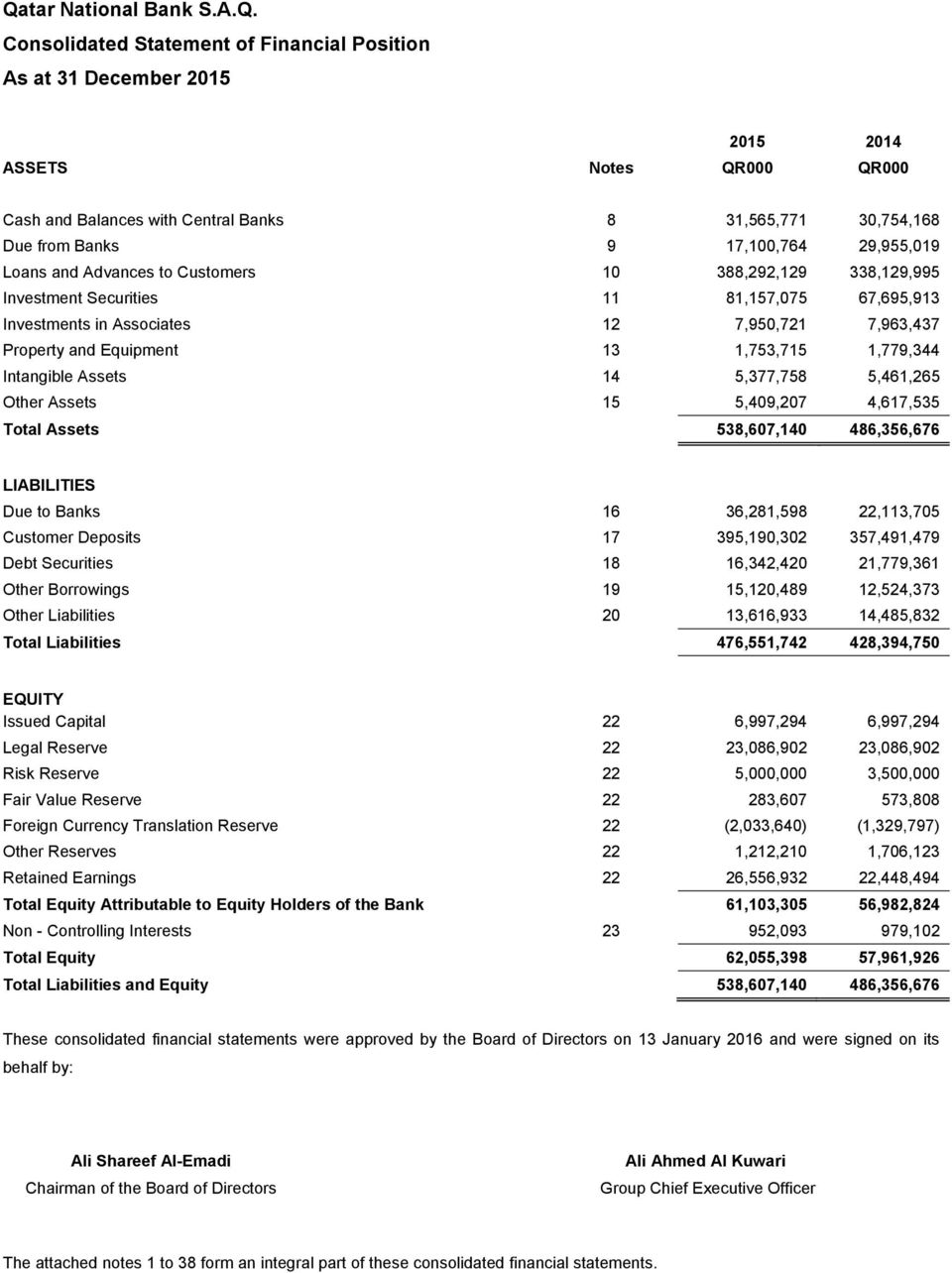
4 Consolidated Statement of Financial Position As at 31 December ASSETS Notes QR000 QR000 Cash and Balances with Central Banks 8 31,565,771 30,754,168 Due from Banks 9 17,100,764 29,955,019 Loans and Advances to Customers ,292, ,129,995 Investment Securities 11 81,157,075 67,695,913 Investments in Associates 12 7,950,721 7,963,437 Property and Equipment 13 1,753,715 1,779,344 Intangible Assets 14 5,377,758 5,461,265 Other Assets 15 5,409,207 4,617,535 Total Assets 538,607, ,356,676 LIABILITIES Due to Banks 16 36,281,598 22,113,705 Customer Deposits ,190, ,491,479 Debt Securities 18 16,342,420 21,779,361 Other Borrowings 19 15,120,489 12,524,373 Other Liabilities 20 13,616,933 14,485,832 Total Liabilities 476,551, ,394,750 EQUITY Issued Capital 22 6,997,294 6,997,294 Legal Reserve 22 23,086,902 23,086,902 Risk Reserve 22 5,000,000 3,500,000 Fair Value Reserve , ,808 Foreign Currency Translation Reserve 22 (2,033,640) (1,329,797) Other Reserves 22 1,212,210 1,706,123 Retained Earnings 22 26,556,932 22,448,494 Total Equity Attributable to Equity Holders of the Bank 61,103,305 56,982,824 Non Controlling Interests , ,102 Total Equity 62,055,398 57,961,926 Total Liabilities and Equity 538,607, ,356,676 These consolidated financial statements were approved by the Board of Directors on 13 January 2016 and were signed on its behalf by: Ali Shareef AlEmadi Chairman of the Board of Directors Ali Ahmed Al Kuwari Group Chief Executive Officer The attached notes 1 to 38 form an integral part of these consolidated financial statements.
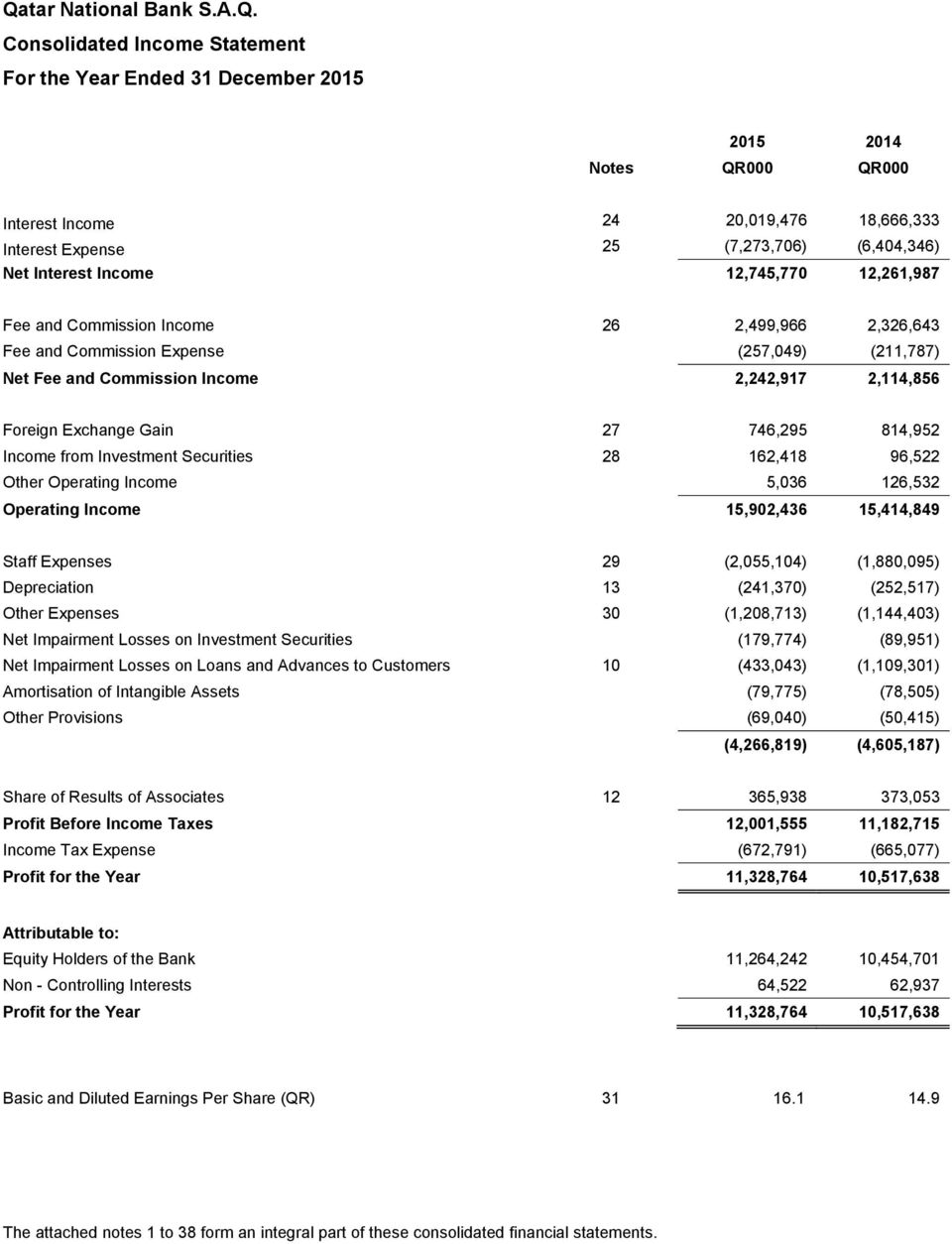
5 Consolidated Income Statement Notes QR000 QR000 Interest Income 24 20,019,476 18,666,333 Interest Expense 25 (7,273,706) (6,404,346) Net Interest Income 12,745,770 12,261,987 Fee and Commission Income 26 2,499,966 2,326,643 Fee and Commission Expense (257,049) (211,787) Net Fee and Commission Income 2,242,917 2,114,856 Foreign Exchange Gain , ,952 Income from Investment Securities ,418 96,522 Other Operating Income 5, ,532 Operating Income 15,902,436 15,414,849 Staff Expenses 29 (2,055,104) (1,880,095) Depreciation 13 (241,370) (252,517) Other Expenses 30 (1,208,713) (1,144,403) Net Impairment Losses on Investment Securities (179,774) (89,951) Net Impairment Losses on Loans and Advances to Customers 10 (433,043) (1,109,301) Amortisation of Intangible Assets (79,775) (78,505) Other Provisions (69,040) (50,415) (4,266,819) (4,605,187) Share of Results of Associates , ,053 Profit Before Income Taxes 12,001,555 11,182,715 Income Tax Expense (672,791) (665,077) Profit for the Year 11,328,764 10,517,638 Attributable to: Equity Holders of the Bank 11,264,242 10,454,701 Non Controlling Interests 64,522 62,937 Profit for the Year 11,328,764 10,517,638 Basic and Diluted Earnings Per Share (QR) The attached notes 1 to 38 form an integral part of these consolidated financial statements.
6 Consolidated Statement of Comprehensive Income Notes QR000 QR000 Profit for the Year 11,328,764 10,517,638 Other comprehensive income to be reclassified to income statement in subsequent periods: Foreign Currency Translation Differences for Foreign Operations (703,843) (372,690) Share of Other Comprehensive Income of Associates (493,913) (11,940) Effective Portion of Changes in Fair Value of Cash Flow Hedges 22 (17,329) (941,850) AvailableforSale Investment Securities Net Change in Fair Value 22 (196,495) 126,081 Net Amount Transferred to Income Statement 22 (76,377) (12,377) Total Other Comprehensive Income for the Year, net of Income Tax (1,487,957) (1,212,776) Total Comprehensive Income for the Year 9,840,807 9,304,862 Attributable to: Equity Holders of the Bank 9,776,285 9,241,925 Non Controlling Interests 64,522 62,937 Total Comprehensive Income for the Year 9,840,807 9,304,862 The attached notes 1 to 38 form an integral part of these consolidated financial statements.

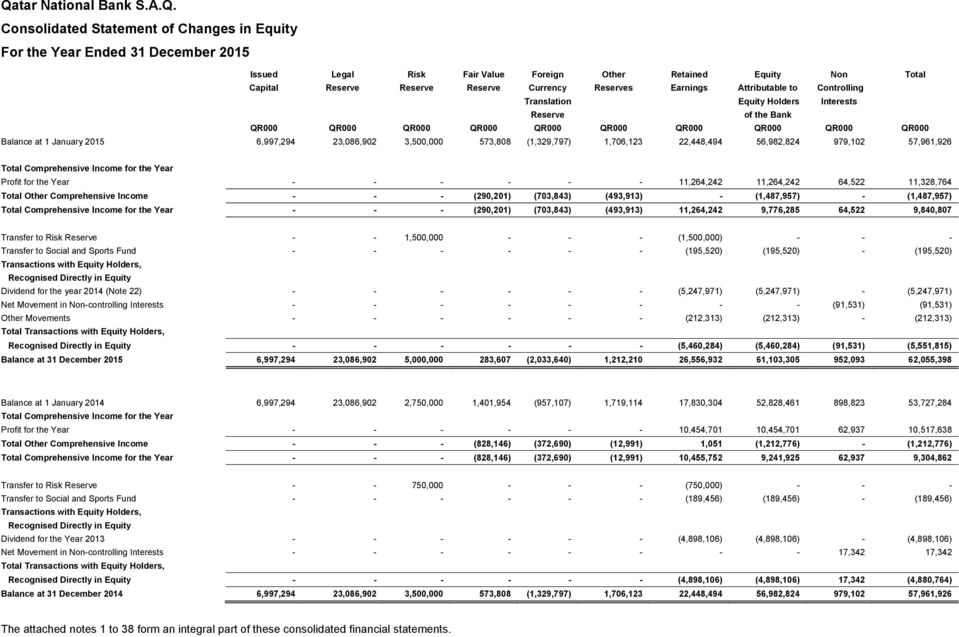
7 Consolidated Statement of Changes in Equity Issued Legal Risk Fair Value Foreign Other Retained Equity Non Total Capital Reserve Reserve Reserve Currency Reserves Earnings Attributable to Controlling Translation Equity Holders Interests Reserve of the Bank QR000 QR000 QR000 QR000 QR000 QR000 QR000 QR000 QR000 QR000 Balance at 1 January ,997,294 23,086,902 3,500, ,808 (1,329,797) 1,706,123 22,448,494 56,982, ,102 57,961,926 Total Comprehensive Income for the Year Profit for the Year 11,264,242 11,264,242 64,522 11,328,764 Total Other Comprehensive Income (290,201) (703,843) (493,913) (1,487,957) (1,487,957) Total Comprehensive Income for the Year (290,201) (703,843) (493,913) 11,264,242 9,776,285 64,522 9,840,807 Transfer to Risk Reserve 1,500,000 (1,500,000) Transfer to Social and Sports Fund (195,520) (195,520) (195,520) Transactions with Equity Holders, Recognised Directly in Equity Dividend for the year 2014 (Note 22) (5,247,971) (5,247,971) (5,247,971) Net Movement in Noncontrolling Interests (91,531) (91,531) Other Movements (212,313) (212,313) (212,313) Total Transactions with Equity Holders, Recognised Directly in Equity (5,460,284) (5,460,284) (91,531) (5,551,815) Balance at 31 December ,997,294 23,086,902 5,000, ,607 (2,033,640) 1,212,210 26,556,932 61,103, ,093 62,055,398 Balance at 1 January ,997,294 23,086,902 2,750,000 1,401,954 (957,107) 1,719,114 17,830,304 52,828, ,823 53,727,284 Total Comprehensive Income for the Year Profit for the Year 10,454,701 10,454,701 62,937 10,517,638 Total Other Comprehensive Income (828,146) (372,690) (12,991) 1,051 (1,212,776) (1,212,776) Total Comprehensive Income for the Year (828,146) (372,690) (12,991) 10,455,752 9,241,925 62,937 9,304,862 Transfer to Risk Reserve 750,000 (750,000) Transfer to Social and Sports Fund (189,456) (189,456) (189,456) Transactions with Equity Holders, Recognised Directly in Equity Dividend for the Year 2013 (4,898,106) (4,898,106) (4,898,106) Net Movement in Noncontrolling Interests 17,342 17,342 Total Transactions with Equity Holders, Recognised Directly in Equity (4,898,106) (4,898,106) 17,342 (4,880,764) Balance at 31 December ,997,294 23,086,902 3,500, ,808 (1,329,797) 1,706,123 22,448,494 56,982, ,102 57,961,926 The attached notes 1 to 38 form an integral part of these consolidated financial statements.
8 Consolidated Statement of Cash Flows Notes QR000 QR000 Cash Flows from Operating Activities Profit for the Year Before Income Taxes 12,001,555 11,182,715 Adjustments for: Interest Income (20,019,476) (18,666,333) Interest Expense 7,273,706 6,404,346 Depreciation , ,517 Net Impairment Losses on Loans and Advances ,043 1,109,301 Net Impairment Losses on Investment Securities 179,774 89,951 Other Provisions 12,969 12,940 Dividend Income 28 (86,041) (84,145) Net Gain on Sale of Property and Equipment (159) (75,822) Net Gain on Sale of AvailableforSale Investment Securities 28 (76,377) (12,377) Amortisation of Intangible Assets 79,775 78,505 Net Amortisation of Premium or Discount on Financial Investments (27,148) (25,906) Net Share of Results of Associates (178,566) (231,418) (165,575) 34,274 Changes in: Due from Banks (1,338,061) (1,859,629) Loans and Advances to Customers (50,595,177) (28,527,250) Other Assets (372,896) (43,723) Due to Banks 14,167,893 10,545,662 Customer Deposits 37,698,823 23,328,455 Other Liabilities (2,391,977) 3,013,628 Cash (used in) / from Operations (2,996,970) 6,491,417 Interest Received 19,546,140 18,439,829 Interest Paid (7,600,125) (5,724,205) Dividends Received 86,041 84,145 Income Tax Paid (661,824) (524,930) Other Provisions Paid (5,372) (3,414) Net Cash from Operating Activities 8,367,890 18,762,842 Cash Flows from Investing Activities Acquisition of Investment Securities (71,073,236) (32,053,642) Proceeds from Sale / Redemption of Investment Securities 55,220,622 42,314,443 Investments in Associates 12 (49,909) (2,101,929) Additions of Property and Equipment 13 (290,301) (691,901) Proceeds from Sale of Property and Equipment 1,833 83,212 Net Cash (used in) / from Investing Activities (16,190,991) 7,550,183 Cash Flows from Financing Activities Repayment of Debt Securities (5,460,750) Proceeds from Other Borrowings 2,563,174 99,754 Dividends Paid (5,231,852) (4,887,261) Net Cash used in Financing Activities (8,129,428) (4,787,507) Net (Decrease) / Increase in Cash and Cash Equivalents (15,952,529) 21,525,518 Effect of Exchange Rate Fluctuations on Cash Held 2,571, ,329 Cash and Cash Equivalents at 1 January 43,431,327 21,093,480 Cash and Cash Equivalents at 31 December 37 30,050,614 43,431,327 The attached notes 1 to 38 form an integral part of these consolidated financial statements.

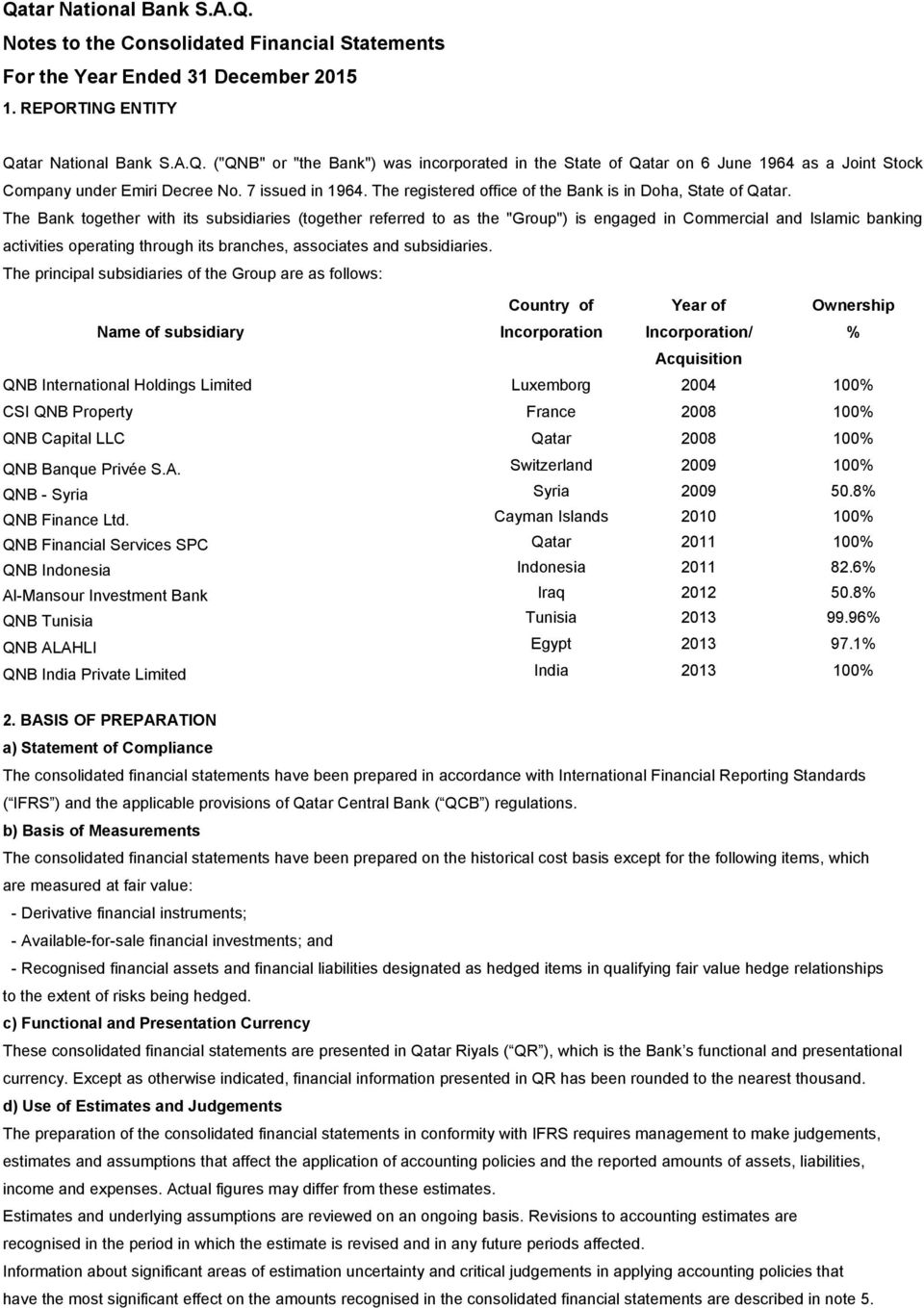
9 1. REPORTING ENTITY Qatar National Bank S.A.Q. ("QNB" or "the Bank") was incorporated in the State of Qatar on 6 June 1964 as a Joint Stock Company under Emiri Decree No. 7 issued in The registered office of the Bank is in Doha, State of Qatar. The Bank together with its subsidiaries (together referred to as the "Group") is engaged in Commercial and Islamic banking activities operating through its branches, associates and subsidiaries. The principal subsidiaries of the Group are as follows: Country of Year of Ownership Name of subsidiary Incorporation Incorporation/ % Acquisition QNB International Holdings Limited Luxemborg % CSI QNB Property France % QNB Capital LLC Qatar % QNB Banque Privée S.A. Switzerland % QNB Syria Syria % QNB Finance Ltd. Cayman Islands % QNB Financial Services SPC Qatar % QNB Indonesia Indonesia % AlMansour Investment Bank Iraq % QNB Tunisia Tunisia % QNB ALAHLI Egypt % QNB India Private Limited India % 2. BASIS OF PREPARATION a) Statement of Compliance The consolidated financial statements have been prepared in accordance with International Financial Reporting Standards ( IFRS ) and the applicable provisions of Qatar Central Bank ( QCB ) regulations. b) Basis of Measurements The consolidated financial statements have been prepared on the historical cost basis except for the following items, which are measured at fair value: Derivative financial instruments; Availableforsale financial investments; and Recognised financial assets and financial liabilities designated as hedged items in qualifying fair value hedge relationships to the extent of risks being hedged. c) Functional and Presentation Currency These consolidated financial statements are presented in Qatar Riyals ( QR ), which is the Bank s functional and presentational currency. Except as otherwise indicated, financial information presented in QR has been rounded to the nearest thousand. d) Use of Estimates and Judgements The preparation of the consolidated financial statements in conformity with IFRS requires management to make judgements, estimates and assumptions that affect the application of accounting policies and the reported amounts of assets, liabilities, income and expenses. Actual figures may differ from these estimates. Estimates and underlying assumptions are reviewed on an ongoing basis. Revisions to accounting estimates are recognised in the period in which the estimate is revised and in any future periods affected. Information about significant areas of estimation uncertainty and critical judgements in applying accounting policies that have the most significant effect on the amounts recognised in the consolidated financial statements are described in note 5.
10 3. SIGNIFICANT ACCOUNTING POLICIES The accounting policies set out below have been applied consistently to all periods presented in these consolidated financial statements, and have been applied consistently by the Group. a) Basis of Consolidation The consolidated financial statements comprise the financial statements of the Group and its subsidiaries as at the end of the reporting period. (i) Business Combinations For acquisitions meeting the definition of a business under IFRS 3, the acquisition method of accounting is used as at the acquisition date, which is the date on which control is transferred to the Group. The Group measures goodwill at the acquisition date as the total of: The fair value of the consideration transferred; plus The recognised amount of any noncontrolling interest in the acquiree; plus if the business combination is achieved in stages, the fair value of the existing equity interest in the acquiree; less The net recognised amount (generally fair value) of the identifiable assets acquired and liabilities assumed. When this total is negative, a bargain purchase gain is recognised immediately in consolidated income statement. The consideration transferred does not include amounts related to the settlement of preexisting relationships. Such amounts are generally recognised in consolidated income statement. Costs related to the acquisition, other than those associated with the issue of debt or equity securities, that the Group incurs in connection with a business combination are expensed as incurred. Any contingent consideration payable is recognised at fair value at the acquisition date. If the contingent consideration is classified as equity, it is not remeasured and settlement is accounted for within equity. Otherwise, subsequent changes to the fair value of the contingent consideration are recognised in consolidated income statement. If the business combination is achieved in stages, any previously held equity interest is remeasured at its acquisition date at fair value and any resulting gain or loss is recognised in consolidated income statement. It is then considered in the determination of goodwill. (ii) Subsidiaries Subsidiaries are all entities (including structured entities) controlled by the Group. The financial statements of subsidiaries are included in the consolidated financial statements from the date that control commences until the date that control ceases. Control is achieved when the Group is exposed, or has rights, to variable returns from its involvement with the investee and has the ability to affect those returns through its power over the investee. The accounting policies of subsidiaries have been aligned to the Group accounting policies.
11 3. SIGNIFICANT ACCOUNTING POLICIES (Continued) (iii) Loss of Control Upon the loss of control, the Group derecognises the assets and liabilities of the subsidiary, any noncontrolling interests and the other components of equity related to the subsidiary. Any surplus or deficit arising on the loss of control is recognised in consolidated income statement. If the Group retains any interest in the previous subsidiary, then such interest is measured at fair value at the date that control is lost. Subsequently it is accounted for as an equityaccounted investee or in accordance with the Group s accounting policy for financial instruments depending on the level of influence retained. (iv) NonControlling Interests and Transactions therewith The Group has elected to measure the noncontrolling interests in the acquiree at the proportionate share of the acquiree's identifiable net assets. Interests in the equity of subsidiaries not attributable to the Bank are reported in consolidated equity as noncontrolling interests. Profits or losses attributable to noncontrolling interests are reported in the consolidated income statement as profit or loss attributable to noncontrolling interests. Losses applicable to the noncontrolling interest in a subsidiary are allocated to the noncontrolling interest even if doing so causes the noncontrolling interest to have a deficit balance. The Group treats transactions with noncontrolling interests as transactions with equity holders of the Group. For purchases from noncontrolling interests, the difference between any consideration paid and the relevant share acquired of the carrying value of net assets of the subsidiary is recorded in equity. Gains or losses on disposals to noncontrolling interests are also recorded in equity.

12 3. SIGNIFICANT ACCOUNTING POLICIES (Continued) (iv) NonControlling Interests and Transactions therewith (Continued) When the Group ceases to have control or significant influence, any retained interest in the entity is remeasured to its fair value, with the change in carrying amount recognised in profit or loss. The fair value is the initial carrying amount for the purposes of subsequently accounting for the retained interest as an associate, joint venture or financial asset. In addition, any amounts previously recognised in other comprehensive income in respect of that entity are accounted for as if the Group had directly disposed of the related assets or liabilities. This will mean that amounts previously recognised in other comprehensive income are transferred to consolidated income statement. If the ownership interest in an associate is reduced but significant influence is retained, only a proportionate share of the amounts previously recognised in other comprehensive income is transferred to consolidated income statement where appropriate. (v) Transactions Eliminated on Consolidation Intragroup balances, transactions and unrealised gains arising from intragroup transactions, are eliminated in preparing the consolidated financial statements. Unrealised losses are also eliminated only to the extent that there is no impairment. (vi) Associates Associates are entities over which the Group has significant influence but not control, generally accompanying a shareholding of between 20% and 50% of the voting rights. Investments in associates are accounted for by the equity method of accounting and are initially recognised at cost (including transaction costs directly related to acquisition of investment in associate). The Group s investment in associates includes goodwill (net of any accumulated impairment loss) identified on acquisition. The Group s share of its associates postacquisition profits or losses is recognised in the consolidated income statement; its share of postacquisition movements is recognised in reserves. The cumulative postacquisition movements are adjusted against the carrying amount of the investment. When the Group s share of losses in an associate equals or exceeds its interest in the associate, including any other unsecured receivables, the Group does not recognise further losses, unless it has incurred obligations or made payments on behalf of the associate. For preparation of the consolidated financial statements, equal accounting policies for similar transactions and other events in similar circumstances are used. Dilution gains and losses in associates are recognised in the consolidated income statement. The Group s share of the results of associates is based on financial statements made up to a date not earlier than three months before the date of the consolidated statement of financial position, adjusted to conform with the accounting policies of the Group. Intergroup gains on transactions are eliminated to the extent of the Group s interest in the investee.
13 3. SIGNIFICANT ACCOUNTING POLICIES (Continued) (vii) Funds Management The Group manages and administers assets held in unit trusts and other investment vehicles on behalf of investors. The financial statements of these entities are not included in these consolidated financial statements except when the Group controls the entity. Information about the Group s funds management is set out in Note 35. b) Foreign Currency (i) Foreign Currency Transactions and Balances Foreign currency transactions that are transactions denominated, or that require settlement in a foreign currency are translated into the respective functional currencies of the operations at the spot exchange rates at the dates of the transactions. Monetary assets and liabilities denominated in foreign currencies at the reporting date are translated into the functional currency at the spot exchange rate at that date. Nonmonetary assets and liabilities denominated in foreign currencies that are measured at fair value are retranslated into the functional currency at the spot exchange rate at the date that the fair value was determined. Nonmonetary assets and liabilities that are measured in terms of historical cost in a foreign currency are translated using the exchange rate at the date of the transaction. Foreign currency differences resulting from the settlement of foreign currency transactions and arising on translation at period end exchange rates of monetary assets and liabilities denominated in foreign currencies are recognised in consolidated income statement Changes in the fair value of monetary investment securities denominated in foreign currency classified as available for sale are analysed between translation differences resulting from changes in the amortised cost of the security and other changes in the carrying amount of security. Translation differences related to changes in amortised cost are recognised in consolidated income statement, and other changes in carrying amount are recognised in other comprehensive income. Translation differences on nonmonetary financial assets, such as equities classified as availableforsale, are included in other comprehensive income. (ii) Foreign Operations The results and financial position of all the Group s entities that have a functional currency different from the presentation currency are translated into the presentation currency as follows: Assets and liabilities for each statement of financial position presented are translated at the closing rate at the reporting date; Income and expenses for each income statement are translated at average exchange rates (unless this average is not a reasonable approximation of the cumulative effect of the rates prevailing on the transaction dates, in which case income and expenses are translated at the dates of the transactions); and All resulting exchange differences are recognised in other comprehensive income. Exchange differences arising from the above process are reported in shareholders equity as foreign currency translation reserve.
14 3. SIGNIFICANT ACCOUNTING POLICIES (Continued) (ii) Foreign Operations (continued) When a foreign operation is disposed of, or partially disposed of, such exchange differences are recognised in the consolidated income statement as part of the gain or loss on sale. Goodwill and fair value adjustments arising on the acquisition of a foreign entity are treated as assets and liabilities of the foreign entity and translated at the closing rate. When the settlement of a monetary item receivable from or payable to a foreign operation is neither planned nor likely in the foreseeable future, foreign exchange gains and losses arising from such a monetary item are considered to form part of the net investment in the foreign operation and are recognised in other comprehensive income, and presented in the foreign exchange translation reserve in equity. c) Financial Assets and Financial Liabilities (i) Recognition and Initial Measurement The Group initially recognises loans and advances to customers, due from / to banks, customer deposits, debt securities and other borrowings on the date at which they are originated. All other financial assets and liabilities are initially recognised on the trade date at which the Group becomes a party to the contractual provisions of the instrument. (ii) Classification Financial Assets At inception a financial asset is classified in one of the following categories: Loans and receivables; Held to maturity; or Availableforsale Financial Liabilities The Group has classified and measured its financial liabilities at amortised cost. (iii) Derecognition The Group derecognises a financial asset when the contractual rights to the cash flows from the financial asset expire, or when it transfers the financial asset in a transaction in which substantially all the risks and rewards of ownership of the financial asset are transferred or in which the Group neither transfers nor retains substantially all the risks and rewards of ownership and it does not retain control of the financial asset. Any interest in transferred financial assets that qualify for derecognition that is created or retained by the Group is recognised as a separate asset or liability in the statement of financial position. On derecognition of a financial asset, the difference between the carrying amount of the asset (or the carrying amount allocated to the portion of the asset transferred), and consideration received (including any new asset obtained less any new liability assumed) is recognised in consolidated income statement.
15 3. SIGNIFICANT ACCOUNTING POLICIES (Continued) (iii) Derecognition (Continued) The Group enters into transactions whereby it transfers assets recognised on its statement of financial position, but retains either all or substantially all of the risks and rewards of the transferred assets or a portion of them. If all or substantially all risks and rewards are retained, then the transferred assets are not derecognised. Transfers of assets with retention of all or substantially all risks and rewards include, for example, securities lending and repurchase transactions. When assets are sold to a third party with a concurrent total rate of return swap on the transferred assets, the transaction is accounted for as a secured financing transaction similar to repurchase transactions as the Group retains all or substantially all the risks and rewards of ownership of such assets. In transactions in which the Group neither retains nor transfers substantially all the risks and rewards of ownership of a financial asset and it retains control over the asset, the Group continues to recognise the asset to the extent of its continuing involvement, determined by the extent to which it is exposed to changes in the value of the transferred asset. In certain transactions the Group retains the obligation to service the transferred financial asset for a fee. The transferred asset is derecognised if it meets the derecognition criteria. An asset or liability is recognised for the servicing contract, depending on whether the servicing fee is more than adequate (asset) or is less than adequate (liability) for performing the servicing. The Group derecognises a financial liability when its contractual obligations are discharged or cancelled or expire. (iv) Offsetting Financial assets and liabilities are offset and the net amount presented in the statement of financial position when, and only when, the Group has a legal right to set off the recognised amounts and it intends either to settle on a net basis or to realise the asset and settle the liability simultaneously. Income and expenses are presented on a net basis only when permitted under IFRS, or for gains and losses arising from a group of similar transactions such as in the Group s trading activity. (v) Measurement Principles Amortised Cost Measurement The amortised cost of a financial asset or liability is the amount at which the financial asset or liability is measured at initial recognition, minus principal repayments, plus or minus the cumulative amortisation using the effective interest rate method of any difference between the initial amount recognised and the maturity amount, minus any reduction for impairment loss. The calculation of effective interest rate includes all fees paid or received that are an integral part of the effective interest rate. Fair Value Measurement Fair value is the price that would be received to sell an asset or paid to transfer a liability in an orderly transaction between market participants at the measurement date in the principal market of the asset or liability, or in the absence of a principal market, in the most advantageous market for the asset or liability which the group has access to at the that date. The Group measures the fair value of listed investments at the market bid price for the investment. For unlisted investments, the Group recognises any increase in the fair value, when they have reliable indicators to support such an increase. These reliable indicators are limited to the most recent transactions for the specific investment or similar investments made in the market on a commercial basis between desirous and informed parties. In the absence of a reliable measure of fair value, the unlisted equity investment is carried at cost. The fair value of investments in mutual funds and portfolios whose units are unlisted are measured at the net asset value adjusted for market characteristics reported as at the end of the reporting period.
16 3. SIGNIFICANT ACCOUNTING POLICIES (Continued) Fair Value Measurement (Continued) Assets and long positions are measured at a bid price; liabilities and short positions are measured at an asking price. Where the Group has positions with offsetting risks, midmarket prices are used to measure the offsetting risk positions and a bid or asking price adjustment is applied only to the net open position as appropriate. Fair values reflect the credit risk of the instrument and include adjustments to take account of the credit risk of the Group entity and the counterparty where appropriate. Fair value estimates obtained from models are adjusted for any other factors, such as liquidity risk or model uncertainties; to the extent that the Group believes a thirdparty market participant would take them into account in pricing a transaction. (vi) Identification and Measurement of Impairment At each reporting date the Group assesses whether there is objective evidence that financial assets not carried at fair value through profit or loss are impaired. A financial asset or a group of financial assets is impaired when objective evidence demonstrates that a loss event has occurred after the initial recognition of the asset(s), and that the loss event has an impact on the future cash flows of the asset(s) that can be estimated reliably. Objective evidence that financial assets (including equity securities) are impaired can include significant financial difficulty of the borrower or issuer, default or delinquency by a borrower, restructuring of a loan or advance by the Group on terms that the Group would not otherwise consider, indications that a borrower or issuer will enter bankruptcy, the disappearance of an active market for a security, or other observable data relating to a group of assets such as adverse changes in the payment status of borrowers or issuers in the group, or economic conditions that correlate with defaults in the group. The Group considers evidence of impairment loss for loans and advances to customers and heldto maturity investment securities at both a specific asset and collective level. All individually significant loans and advances to customers and held to maturity investment securities are assessed for specific impairment. All individually significant loans and advances to customers and held to maturity investment securities found not to be specifically impaired are then collectively assessed for any impairment that has been incurred but not yet identified. Loans and advances to customers and held to maturity investment securities that are not individually significant are collectively assessed for impairment by grouping together loans and advances to customers and heldtomaturity investment securities with similar risk characteristics. Impairment losses on financial assets carried at amortised cost are measured as the difference between the carrying amount of the financial asset and the present value of estimated future cash flows discounted at the asset s original effective interest rate. Impairment losses are recognised in the consolidated income statement and reflected in an allowance account against loans and advances to customers when it pertains to loans and advances originated by the Group. Impairment of held to maturity investment securities are recorded and disclosed under a separate impairment allowance account. For listed equity investments, a decline in the market value by 20% from cost or more, or for a continuous period of 9 months or more, are considered to be indicators of impairment. Impairment losses on availableforsale investment securities are recognised by transferring the cumulative loss that has been recognised in other comprehensive income to consolidated income statement as a reclassification adjustment. The cumulative loss that is reclassified from other comprehensive income to consolidated income statement is the difference between the acquisition cost, net of any principal repayment and amortisation, and the current fair value, less any impairment loss previously recognised in the consolidated income statement. If, in a subsequent period, the amount of the impairment loss in respect of a financial asset carried at amortised cost decreases and the decrease can be related objectively to an event occurring after the impairment was recognised (such as an improvement in the debtor's credit rating), the reversal of the previously recognised impairment loss is recognised in the consolidated income statement. In subsequent periods, the appreciation of fair value of an impaired availableforsale equity investment securities is recorded in fair value reserves.
17 3. SIGNIFICANT ACCOUNTING POLICIES (Continued) d) Cash and Cash Equivalents Cash and cash equivalents include notes and coins on hand, unrestricted balances held with central banks and highly liquid financial assets with original maturities of three months or less that are subject to an insignificant risk of changes in their fair value, and are used by the Group in the management of its shortterm commitments. Cash and cash equivalents are carried at amortised cost in the consolidated statement of financial position. e) Due from banks Due from banks are financial assets which are mainly money market placements with fixed or determinable payments and fixed maturities that are not quoted in an active market. Money market placements are not entered into with the intention of immediate or shortterm resale. Due from banks are initially measured at cost, being the fair value of the consideration given. Following the initial recognition, due from banks are stated at cost less any amount written off and impairment, if any. f) Loans and Advances to Customers Loans and advances to customers are nonderivative financial assets with fixed or determinable payments that are not quoted in an active market and that the Group does not intend to sell immediately or in the near term. Loans and advances to customers are initially measured at the transaction price which is the fair value plus incremental direct transaction costs, and subsequently measured at their amortised cost using the effective interest method. Following the initial recognition, loans and advances are stated at the amortised cost less any amounts written off and allowances for impairment, if any. When the Group purchases a financial asset and simultaneously enters into an agreement to resell the asset (or a substantially similar asset) at a fixed price on a future date (reverse repo or stock borrowing), the arrangement is accounted for as a loan or advance, and the underlying asset is not recognised in the Group s financial statements. g) Investment Securities Subsequent to initial recognition investment securities are accounted for depending on their classification as either held to maturity, or availableforsale. (i) Held to maturity Financial Assets Heldtomaturity investments are nonderivative assets with fixed or determinable payments and fixed maturity that the Group has the positive intent and ability to hold to maturity. Held to maturity investments are carried at amortised cost using the effective interest method. (ii) Availableforsale Financial Assets Availableforsale investments are nonderivative investments that are designated as availableforsale or are not classified as another category of financial assets. Unquoted equity securities whose fair value cannot be reliability measured are carried at cost less impairment, and all other availableforsale investments are carried at fair value. Interest income is recognised in the consolidated income statement using the effective interest rate method. Foreign exchange gains or losses on availableforsale debt security investments are recognised in the consolidated income statement. Other fair value changes are recognised in other comprehensive income until the investment is sold or impaired, whereupon the cumulative gains and losses previously recognised in other comprehensive income are reclassified to the consolidated income statement as a reclassification adjustment.
18 h) Derivatives (i) Derivatives Held for Risk management Purposes and Hedge Accounting Derivatives held for risk management purposes include all derivative assets and liabilities that are not classified as trading assets or liabilities. Derivatives held for risk management purposes are measured at fair value on the statement of financial position. The Group designates certain derivatives held for risk management as well as certain nonderivative financial instruments as hedging instruments in qualifying hedging relationships. On initial designation of the hedge, the Group formally documents the relationship between the hedging derivative instrument(s) and hedged item(s), including the risk management objective and strategy in undertaking the hedge, together with the method that will be used to assess the effectiveness of the hedging relationship. The Group makes an assessment, both at the inception of the hedge relationship as well as on an ongoing basis, as to whether the hedging instrument(s) is (are) expected to be highly effective in offsetting the changes in the fair value or cash flows of the respective hedged item(s) during the period for which the hedge is designated, and whether the actual results of each hedge are within a range of percent. The Group makes an assessment for a cash flow hedge of a forecast transaction, as to whether the forecast transaction is highly probable to occur and presents an exposure to variations in cash flows that could ultimately affect profit or loss. These hedging relationships are discussed below. Fair Value Hedges When a derivative is designated as the hedging instrument in a hedge of the change in fair value of a recognised asset or liability or a firm commitment that could affect profit or loss, changes in the fair value of the derivative are recognized immediately in profit or loss together with changes in the fair value of the hedged item that are attributable to the hedged risk. If the hedging derivative expires or is sold, terminated, or exercised, or the hedge no longer meets the criteria for fair value hedge accounting, or the hedge designation is revoked, then hedge accounting is discontinued prospectively. Any adjustment up to that point to a hedged item, for which the effective interest method is used, is amortised to profit or loss as part of the recalculated effective interest rate of the item over its remaining life. Cash Flow Hedges When a derivative is designated as the hedging instrument in a hedge of the variability in cash flows attributable to a particular risk associated with a recognised asset or liability or a highly probable forecast transaction that could affect profit or loss, the effective portion of changes in the fair value of the derivative is recognised in other comprehensive income in the hedging reserve. The amount recognised in other comprehensive income is reclassified to profit or loss as a reclassification adjustment in the same period as the hedged cash flows affect profit or loss, and in the same line item in the statement of comprehensive income. Any ineffective portion of changes in the fair value of the derivative is recognised immediately in profit or loss. If the hedging derivative expires or is sold, terminated, or exercised, or the hedge no longer meets the criteria for cash flow hedge accounting, or the hedge designation is revoked, then hedge accounting is discontinued prospectively. In a discontinued hedge of a forecast transaction the cumulative amount recognised in other comprehensive income from the period when the hedge was effective is reclassified from equity to profit or loss as a reclassification adjustment when the forecast transaction occurs and affects profit or loss. If the forecast transaction is no longer expected to occur, then the balance in other comprehensive income is reclassified immediately to the consolidated income statement as a reclassification adjustment. Other NonTrading Derivatives When a derivative is not held for trading, and is not designated in a qualifying hedge relationship, all changes in its fair value are recognised immediately in consolidated income statement.

19 h) Derivatives (Continued) (ii) Derivatives Held for Trading Purposes The Group s derivative trading instruments includes forward foreign exchange contracts and interest rate swaps. The Group sells these derivatives to customers in order to enable them to transfer, modify or reduce current and future risks. These derivative instruments are fair valued as at the end of reporting date and the corresponding fair value changes is taken to the consolidated income statement. i) Property and Equipment (i) Recognition and Measurement Items of property and equipment are measured at cost less accumulated depreciation and accumulated impairment losses. Purchased software that is integral to the functionality of the related equipment is capitalised as part of that equipment. When parts of an item of property or equipment have different useful lives, they are accounted for as separate items (major components) of property and equipment. The gain or loss on disposal of an item of property and equipment is determined by comparing the proceeds from disposal with the carrying amount of the item of property and equipment, and is recognised in other income/other expenses in consolidated income statement. (ii) Subsequent Costs The cost of replacing a component of an item of property or equipment is recognised in the carrying amount of the item if it is probable that the future economic benefits embodied within the part will flow to the Group and its cost can be measured reliably. The carrying amount of the replaced part is derecognised. The costs of the daytoday servicing of property and equipment are recognised in consolidated income statement as incurred. (iii) Depreciation Depreciable amount is the cost of property and equipment, or other amount substituted for cost, less its residual value. Depreciation is recognised in consolidated income statement on a straightline basis over the estimated useful lives of each part of an item of property and equipment since this most closely reflects the expected pattern of consumption of the future economic benefits embodied in the asset and is based on cost of the asset less its estimated residual value. Land is not depreciated. The estimated useful lives for the current and prior years are as follows: Years Buildings 10 to 50 Equipment and Furniture 3 to 10 Motor Vehicles 5 Leasehold improvements 4 to 10 Freehold land is stated at cost. Depreciation methods, useful lives and residual values are reassessed at each reporting date and adjusted prospectively, if appropriate.

20 (j) Intangible Assets Goodwill that arises upon the acquisition of subsidiaries is included under intangible assets. Subsequent to initial recognition goodwill is measured at cost less accumulated impairment losses. Intangible assets also include Core Deposit Intangibles (CDI) acquired in a business combination are recognised at fair value at the acquisition date. CDI has a finite useful life and is carried at cost less accumulated amortisation. Amortisation is calculated using the straightline method to allocate the cost of CDI and licences over their estimated useful life ranging between 6 to 12 years. Intangible assets (such as operating licenses) with indefinite useful lives are not amortised, but are tested for impairment annually, either individually or at the cash generating unit level. (k) Impairment of NonFinancial Assets The carrying amounts of the Group s nonfinancial assets, other than deferred tax assets are reviewed at each reporting date to determine whether there is any indication of impairment. If any such indication exists, then the asset s recoverable amount is estimated. For goodwill and intangible assets that have indefinite useful lives or that are not yet available for use, the recoverable amount is estimated each year at the same time. An impairment loss is recognised if the carrying amount of an asset or its Cash Generating Unit ( CGU ) exceeds its estimated recoverable amount. The recoverable amount of an asset or CGU is the greater of its value in use and its fair value less costs to sell. In assessing value in use, the estimated future cash flows are discounted to their present value using a pretax discount rate that reflects current market assessments of the time value of money and the risks specific to the asset or CGU. For the purpose of impairment testing, assets that cannot be tested individually are grouped together into the smallest group of assets that generates cash inflows from continuing use that are largely independent of the cash inflows of other assets or CGU. Subject to an operating segment ceiling test, for the purposes of goodwill impairment testing, CGUs to which goodwill has been allocated are aggregated so that the level at which impairment testing is performed reflects the lowest level at which goodwill is monitored for internal reporting purposes. Goodwill acquired in a business combination is allocated to groups of CGUs that are expected to benefit from the synergies of the combination. The Group s corporate assets do not generate separate cash inflows and are utilised by more than one CGU. Corporate assets are allocated to CGUs on a reasonable and consistent basis and tested for impairment as part of the testing of the CGU to which the corporate asset is allocated. Impairment losses are recognised in consolidated income statement. Impairment losses recognised in respect of CGUs are allocated first to reduce the carrying amount of any goodwill allocated to the CGU (group of CGUs) and then to reduce the carrying amount of the other assets in the CGU (group of CGUs) on a pro rata basis. An impairment loss in respect of goodwill is not reversed. In respect of other assets, impairment losses recognised in prior periods are assessed at each reporting date for any indications that the loss has decreased or no longer exists. An impairment loss is reversed if there has been a change in the estimates used to determine the recoverable amount. An impairment loss is reversed only to the extent that the asset s carrying amount does not exceed the carrying amount that would have been determined, net of depreciation or amortisation, if no impairment loss had been recognised. (l) Provisions A provision is recognised if, as a result of a past event, the Group has a present legal or constructive obligation that can be estimated reliably, and it is probable that an outflow of economic benefits will be required to settle the obligation. Provisions are determined by discounting the expected future cash flows at a pretax rate that reflects current market assessments of the time value of money and, where appropriate, the risks specific to the liability.

21 (m) Financial Guarantees Financial guarantees are contracts that require the Group to make specified payments to reimburse the holder for a loss it incurs because a specified debtor fails to make payment when due in accordance with the terms of a debt instrument. Financial guarantee liabilities are recognised initially at their fair value, and the initial fair value is amortised over the life of the financial guarantee. The financial guarantee liability is subsequently carried at the higher of this amortised amount and the present value of any expected payment when a payment under the guarantee has become probable. Financial guarantees are included within other liabilities. (n) Employee Benefits Defined Benefit Plan Expatriate Employees The Group makes a provision for all termination indemnity payable to employees in accordance with its regulations, calculated on the basis of the individual's final salary and period of service at the end of the reporting period. The expected costs of these benefits are accrued over the period of employment. The provision for employees termination benefits is included in other provisions within other liabilities. Defined Contribution Scheme Qatari Employees With respect to Qatari employees, the Group makes a contribution to the State administered Qatari Pension Fund calculated as a percentage of the employees' salaries. The Group's obligations are limited to these contributions. The cost is considered as part of staff expenses and is disclosed in note 29. (o) Share Capital and Reserves (i) Share Issue Costs Incremental costs directly attributable to the issue of an equity instrument are deducted from the initial measurement of the equity instruments. (ii) Dividends on Ordinary Shares Dividends on ordinary shares are recognised in equity in the period in which they are approved by the Bank s shareholders. Dividends for the year that are declared after the end of the reporting period are dealt as a separate disclosure. (p) Interest Income and Expense Interest income and expense are recognised in consolidated income statement using the effective interest rate method. The effective interest rate is the rate that exactly discounts the estimated future cash payments and receipts through the expected life of the financial asset or liability (or, where appropriate, a shorter period) to the carrying amount of the financial asset or liability. When calculating the effective interest rate, the Group estimates future cash flows considering all contractual terms of the financial instrument, but not future credit losses. The calculation of the effective interest rate includes all transaction costs and fees paid or received that are an integral part of the effective interest rate.
22 (p) Interest Income and Expense (Continued) Transaction costs include incremental costs that are directly attributable to the acquisition or issue of a financial asset or liability. Interest income and expense include: Interest on financial assets and financial liabilities measured at amortised cost calculated on an effective interest rate basis; The effective portion of fair value changes in qualifying hedging derivatives designated in cash flow hedges of variability in interest cash flows, in the same period that the hedged cash flows affect interest income/expense; The ineffective portion of fair value changes in qualifying hedging derivatives designated in cash flow hedges of interest rate risk; and Fair value changes in qualifying derivatives, including hedge ineffectiveness, and related hedged items in fair value hedges of interest rate risk. Interest income on availableforsale investment (debt) securities and held to maturity investment securities is calculated using effective interest rate method are also included in interest income. (q) Fees and Commission Income and Expense Fees and commission income and expense that are integral to the effective interest rate on a financial asset or liability are included in the measurement of the effective interest rate. Other fees and commission income, including account servicing fees, investment management fees, sales commission, placement fees and syndication fees, are recognised as the related services are performed. When a loan commitment is not expected to result in the drawdown of a loan, the related loan commitment fees are recognised on a straightline basis over the commitment period. Other fees and commission expense relate mainly to transaction and service fees, which are expensed as the services are received. (r) Income from Investment Securities Gains or losses on the sale of investment securities are recognised in consolidated income statement as the difference between fair value of the consideration received and carrying amount of the investment securities. (s) Dividend Income Dividend income is recognised when the right to receive income is established. (t) Taxation Taxes are calculated based on tax laws and regulations in other countries in which the Group operates. A tax provision is made based on an evaluation of the expected tax liability. The Group operations inside Qatar are not subject to income tax, except for QNB Capital LLC whose profits are subject to tax as per the Qatar Financial Center Authority tax regulations. Deferred tax assets are recognised for deductible temporary differences, carry forward of unused tax credits and unused tax losses, to the extent it is probable that taxable profit will be available to utilise these. Deferred tax liabilities are recognised for taxable temporary differences. Deferred tax assets and liabilities are measured using tax rates and applicable legislation enacted as at the reporting date.
23 (u) Earnings per Share The Bank presents basic and diluted earnings per share (EPS) data for its ordinary shares. Basic EPS is calculated by dividing the profit or loss attributable to ordinary shareholders of the Bank by the weighted average number of ordinary shares outstanding during the period. Diluted EPS is determined by adjusting the profit or loss attributable to ordinary shareholders and the weighted average number of ordinary shares outstanding for the effects of all dilutive potential ordinary shares. (v) Segment Reporting An operating segment is a component of the Group that engages in business activities from which it may earn revenues and incur expenses, including revenues and expenses that relate to transactions with any of the Group s other components, whose operating results are reviewed regularly by the Group management committees to make decisions about resources allocated to each segment and assess its performance, and for which discrete financial information is available. (w) Fiduciary Activities The Group acts as fund manager and in other fiduciary capacities that result in the holding or placing of assets on behalf of individuals, corporate and other institutions. These assets and income arising thereon are excluded from these consolidated financial statements, as they are not assets of the Group. (x) Repossessed Collateral Repossessed collaterals against settlement of customers debts are stated within the consolidated statement of financial position under "Other assets" at their acquisition value net of allowance for impairment. According to QCB instructions, the Group should dispose of any land and properties acquired against settlement of debts within a period not exceeding three years from the date of acquisition although this period can be extended after obtaining approval from QCB.
24 (y) Comparatives Except when a standard or an interpretation permits or requires otherwise, all amounts are reported or disclosed with comparative information. (z) Parent Bank Financial Information Statement of financial position and income statement of the Parent bank as disclosed in the supplementary information to the consolidated financial statements are prepared following the same accounting policies as mentioned above except for investment in subsidiaries, associates and joint ventures which are not consolidated and carried at cost. (aa) New Standards and Amendments to Standards The following amendments to IFRS and new IFRSs have been applied by the Group in preparation of these consolidated financial statements. The below were effective from 1 January 2015: Standard Defined Benefit Plans: Employee Contributions (Amendment to IAS 19) Annual Improvements Cycle Annual Improvements Cycle The adoption of the above did not result in any changes to previously reported net profit or equity of the Group. Standards issued but not yet effective The below mentioned Standards, Interpretations and Amendments to Standards are not yet effective. The Group is currently evaluating the impact of these new standards. The Group will adopt these new standards on the respective effective dates. IFRS 9 Financial Instruments (Effective 1 January 2018). IFRS 14 Regulatory Deferral Accounts (Effective 1 January 2016). IFRS 15 Revenue from Contracts with Customers (Effective 1 January 2018). Amendments to IFRS 11 Joint Arrangements: Accounting for Acquisition of Interests (Effective 1 January 2016). Amendments to IAS 16 and IAS 38: Clarification of Acceptable Methods of Depreciation and Amortisation (Effective 1 January 2016). Amendments to IAS 27: Equity Method in Separate Financial Statements (Effective 1 January 2016). Amendments to IAS 1: Disclosure Initiative (Effective 1 January 2016). Amendments to IFRS 10, IFRS 12 and IAS 28: Applying the Consolidation Exception (Effective 1 January 2016).
25 4. FINANCIAL RISK MANAGEMENT I. Financial Instruments Definition and Classification Financial instruments cover all financial assets and liabilities of the Group. Financial assets include cash balances, on demand balances and placements with banks, investment securities, loans and advances to customers and banks and certain other financial assets. Financial liabilities include customer deposits, due to banks and certain other financial liabilities. Financial instruments also include contingent liabilities and commitments included in offbalance sheet items and derivative financial instruments. Note 3 explains the accounting policies used to recognise and measure the major financial instruments and their related income and expense. II. Risk Management a) Risk Management Framework Risk is inherent in the Group s activities but it is managed through a process of ongoing identification, measurement and monitoring, subject to risk limits and other controls. This process of risk management is critical to the Group's continuing profitability and each individual within the Group is accountable for the risk exposures relating to their responsibilities. The Group is exposed to credit risk, liquidity risk, operational risk and market risk, which include trading and nontrading risks. The independent risk control process does not include business risks such as changes in the environment, technology and industry. They are monitored through the Group's strategic planning process. Risk Management Structure The Board of Directors is ultimately responsible for identifying and controlling risks, however, there are separate independent bodies responsible for managing and monitoring risks. Risk Committee The Risk Committee has the overall responsibility for the development of the risk strategy and implementing principles, frameworks, policies and limits. Risk Measurement and Reporting Systems Monitoring and controlling risks is primarily performed based on limits established by the Group. These limits reflect the business strategy and market environment of the Group as well as the level of risk that the Group is willing to accept, with additional emphasis on selected industries. Information compiled from all businesses is examined and processed in order to analyse, control and identify early risks. This information is presented and explained to the Board of Directors, the Risk Committee, and the head of each business division. Internal Audit Risk management processes throughout the Group are audited by the Group Internal Audit as part of each audit which examines both the adequacy and compliance with the procedures in addition to specific audit of Group Risk function itself as per approved audit plan. Internal Audit discusses the results of all assessments with management and reports its findings and recommendations to the Group Audit and Compliance Committee. Risk Mitigation As part of its overall risk management, the Group uses derivatives and other instruments to manage exposures resulting from changes in interest rates, foreign currencies, equity risks, credit risks and exposures arising from forecast transactions. The risk profile is assessed before entering into hedge transactions, which are authorised by the appropriate level of seniority within the Group. The effectiveness of all hedge relationships is monitored by the Risk Management on a monthly basis. In a situation of hedge ineffectiveness, the Group will enter into a new hedge relationship to mitigate risk on a continuous basis. b) Credit Risk The Group manages its credit risk exposure through diversification of its investments, capital markets and lending and financing activities to avoid undue concentrations of risks with individuals or groups of customers in specific locations or businesses. It also obtains collaterals when appropriate. The types of collaterals obtained include cash, treasury bills and bonds, mortgages over real estate properties and pledges over shares. The Group uses the same credit risk procedures when entering into derivative transactions as it does for traditional lending products. Note 10 discloses the distribution of loans and advances and financing activities by industrial sector. Note 33 discloses the geographical distribution of the Group's assets and liabilities.
26 4. FINANCIAL RISK MANAGEMENT (Continued) b) Credit Risk (Continued) The table below shows the maximum exposure to credit risk on the consolidated statement of financial position and certain off balance sheet items. The maximum exposure is shown gross, before the effect of mitigation through the use of master netting and collateral agreements. Gross Maximum Exposure Cash and Balances with Central Banks (Excluding Cash on Hand) 26,417,352 25,792,397 Due from Banks 17,100,764 29,955,019 Loans and Advances to Customers 388,292, ,129,995 Investment Securities 78,799,227 65,920,817 Other Assets 4,488,214 3,783, ,097, ,581,567 Guarantees 46,391,681 37,758,889 Letters of credit 10,837,060 9,020,818 Unutilised Credit Facilities 52,447,682 44,457,004 Total 624,774, ,818,278 c) Risk Concentration for Maximum Exposure to Credit Risk by Industry Sector An industry sector analysis of the Group's financial assets and contingent liabilities, before and after taking into account collateral held or other credit enhancements, is as follows: Gross Net Gross Net Maximum Maximum Maximum Maximum Exposure Exposure Exposure Exposure Government 122,640,902 97,556,831 Government Agencies 153,502,145 41,982, ,970,794 38,013,192 Industry 24,096,227 21,064,373 21,772,178 16,556,983 Commercial 22,053,942 1,727,857 18,498,002 8,833,307 Services 94,712,640 59,397,471 76,353,787 30,826,938 Contracting 9,323,308 4,534,765 6,026,303 2,573,353 Real Estate 42,821,970 4,745,336 38,795,465 10,874,115 Personal 38,339,766 13,058,491 30,879,063 23,332,682 Others 7,606,786 6,910,514 16,729,144 14,397,919 Guarantees 46,391,681 46,391,681 37,758,889 37,758,889 Letters of credit 10,837,060 10,837,060 9,020,818 9,020,818 Unutilised Credit Facilities 52,447,682 52,447,682 44,457,004 44,457,004 Total 624,774, ,098, ,818, ,645,200 d) Credit Risk Exposure for each Internal Risk Rating It is the Group's policy to maintain accurate and consistent risk ratings across the credit portfolio. This facilitates the focused management of the applicable risks and the comparison of credit exposures across all lines of business, geographic regions and products. The rating system is supported by a variety of financial analytics, combined with processed market information to provide the main inputs for the measurement of counterparty risk. All internal risk ratings are tailored to the various categories and are derived in accordance with the Group's rating policy. The attributable risk ratings are assessed and updated regularly. Equivalent Grades Total Total AAA to AA 154,746, ,084,048 A+ to A 229,824, ,661,715 BBB+ to BBB 3,603,693 3,206,388 BB+ to B and Below 62,467,088 59,507,149 Unrated 174,132, ,358,978 Total 624,774, ,818,278 Unrated exposures represent credit facilities granted to corporations and individuals which do not have external credit ratings but were rated as per the applicable provisions of QCB regulations. Also, the ratings used by the Group are in line with the ratings and definitions published by international rating agencies.
27 4. FINANCIAL RISK MANAGEMENT (Continued) e) Credit Quality Due from Banks Loans and Advances to Customers Investment Securities (Debt) Neither Past Due nor Impaired A: Low Risk 12,751,181 26,072, ,970, ,724,489 51,995,283 42,183,286 B: Standard Risk 4,349,583 3,882, ,756,148 97,182,099 26,845,776 23,766,495 Total 17,100,764 29,955, ,726, ,906,588 78,841,059 65,949,781 Past Due but not Impaired A: Low Risk 107, ,045 B: Standard Risk / Watchlist 1,981,918 1,409,951 Total 2,089,532 1,570,996 Impaired Substandard 665, ,729 Doubtful 315, ,850 Loss 4,588,303 4,494,273 15,937 37,071 Sub total 5,569,510 5,578,852 15,937 37,071 Less: Impairment Allowance (7,093,337) (6,926,441) (57,769) (66,035) Net Carrying Amounts 17,100,764 29,955, ,292, ,129,995 78,799,227 65,920,817 At 31 December 2015 and 2014, none of the other assets were either past due or impaired. Investment Securities Debt Held to Maturity 35,956,593 34,160,670 Available for Sale 42,900,403 31,826,182 78,856,996 65,986,852 Less: Impairment Allowance (57,769) (66,035) Net Carrying Amount 78,799,227 65,920,817 Aging Analysis of Past Dues not Impaired per Category of Loans and Advances to Customers Less than Total As at 31 December Days Days Days Corporate Lending 571, ,300 51,610 1,304,691 Small Business Lending 9,614 4,940 11,895 26,449 Consumer Lending 442,912 87,050 49, ,933 Residential Mortgages 108,660 36,305 33, ,459 Total 1,132, , ,970 2,089,532 As at 31 December 2014 Corporate Lending 655, , , ,573 Small Business Lending 47,671 7,345 3,359 58,375 Consumer Lending 360, ,750 22, ,107 Residential Mortgages 17,158 41, ,941 Total 1,080, , ,552 1,570,996
28 4. FINANCIAL RISK MANAGEMENT (Continued) f) Renegotiated Loans and Advances Corporate Lending 1,701,323 1,768,352 Small Business Lending 17,606 55,313 Consumer Lending 225,207 70,717 Residential Mortgages 21,039 Total 1,965,175 1,894,382 g) Market Risk The Group takes on exposure to market risks from interest rates, foreign exchange rates and equity prices due to general and specific market movements. The Group applies an internal methodology to estimate the market risk of positions held and the maximum losses expected, based upon a number of assumptions for various changes in market conditions. The Group has a set of limits on the value of risk that may be accepted, which is monitored on a daily basis. Equity price risk is the risk that the fair values of equities decrease as a result of changes in the levels of equity indices and the value of individual stocks. The effect on equity due to a reasonably possible change in equity indices, with all other variables held constant, is as follows: Change in Effect on Change in Effect on Equity Price Other Equity Price Other % Comprehensive % Comprehensive Income Income Market Indices Qatar Exchange ±10 143,083 ±10 75,242 h) Operational Risk Operational risk is the risk of direct or indirect loss due to an event or action causing failure of technology, process infrastructure, personnel and other risks having an operational risk impact. The Group seeks to minimise actual or potential losses from operational risks failure through a framework of policies and procedures that identify, assess, control, manage and report those risks. Controls include effective segregation of duties, access, authorisation and reconciliation procedures, staff education and assessment processes. i) Other Risks Other risks to which the Group is exposed are regulatory risk, legal risk and reputational risk. Regulatory risk is controlled through a framework of compliance policies and procedures. Legal risk is managed through the effective use of internal and external legal advisers. Reputational risk is controlled through the regular examination of issues that are considered to have reputational repercussions for the Group, with guidelines and policies being issued as appropriate. j) Risk of Managing Customer Investments The Group provides custody and corporate administration to third parties in relation to mutual funds marketed or managed by the Group. These services give rise to legal and operational risk. Such risks are mitigated through detailed daily procedures and internal audits to assure compliance. Note 35 lists funds marketed by the Group.
29 4. FINANCIAL RISK MANAGEMENT (Continued) k) Interest Rate Risk Interest rate risk reflects the risk of a change in interest rates which might affect future earnings or the fair value of financial instruments. Exposure to interest rate risk is managed by the Group using, where appropriate, various offbalance sheet instruments, primarily interest rate swaps. Maturities of assets and liabilities have been determined on the basis of contractual pricing. The following table summarises the repricing profile of the Group s assets, liabilities and offbalance sheet exposures: At 31 December 2015: Within More than NonInterest Total Effective 3 Months Months Years 5 Years Sensitive Interest Rate Cash and Balances with Central Banks 4,685,411 26,880,360 31,565,771 Due from Banks 15,895, , ,362 17,100, % Loans and Advances 192,473,246 57,969, ,687,043 11,918, , ,292, % Investments 11,608,068 18,259,328 39,552,073 9,379,758 10,308,569 89,107, % Other Assets 12,540,680 12,540,680 Total Assets 224,661,821 76,877, ,239,116 21,298,058 50,530, ,607,140 Due to Banks 28,687,926 6,891,377 49, ,682 36,281, % Customer Deposits 232,595, ,422,913 11,993,901 92,848 45,085, ,190, % Debt Securities 2,730,376 13,612,044 16,342,420 Other Borrowings 14,059, , ,965 15,120,489 Other Liabilities 13,616,933 13,616,933 Total Equity 62,055,398 62,055,398 Total Liabilities and Equity 278,073, ,114,328 25,916,523 92, ,410, ,607,140 Balance Sheet Items (53,411,331) (36,237,176) 139,322,593 21,205,210 (70,879,296) OffBalance Sheet Items 21,488,080 10,093,332 (18,522,663) (13,058,749) Interest Rate Sensitivity Gap (31,923,251) (26,143,844) 120,799,930 8,146,461 (70,879,296) Cumulative Interest Rate Sensitivity Gap (31,923,251) (58,067,095) 62,732,835 70,879,296 At 31 December 2014: Cash and Balances with Central Banks 7,937,137 22,817,031 30,754,168 Due from Banks 23,616,924 3,379,693 1,820,250 1,138,152 29,955, % Loans and Advances 160,578,639 53,823, ,230,592 2,492,801 1,004, ,129, % Investments 9,585,599 9,982,750 37,580,191 8,772,277 9,738,533 75,659, % Other Assets 11,858,144 11,858,144 Total Assets 201,718,299 67,186, ,631,033 11,265,078 46,556, ,356,676 Due to Banks 14,165,440 7,468,372 29, ,863 22,113, % Customer Deposits 185,429, ,850,775 7,480,046 78,592 42,652, ,491, % Debt Securities 2,730,376 5,451,308 9,978,921 3,618,756 21,779,361 Other Borrowings 11,327, , ,605 2,599 12,524,373 Other Liabilities 14,485,832 14,485,832 Total Equity 57,961,926 57,961,926 Total Liabilities and Equity 213,653, ,006,089 18,446,602 3,699, ,551, ,356,676 Balance Sheet Items (11,934,727) (67,819,978) 141,184,431 7,565,131 (68,994,857) OffBalance Sheet Items 25,656,149 6,633,300 (21,500,706) (10,788,743) Interest Rate Sensitivity Gap 13,721,422 (61,186,678) 119,683,725 (3,223,612) (68,994,857) Cumulative Interest Rate Sensitivity Gap 13,721,422 (47,465,256) 72,218,469 68,994,857 Other assets includes property and equipment and intangible assets.
30 4. FINANCIAL RISK MANAGEMENT (Continued) l) Interest Rate Sensitivity The following table demonstrates the sensitivity to a possible and reasonable change in interest rates, with all other variables held constant, of the Group's income statement. The sensitivity of the income statement is the effect of the assumed changes in interest rates on the net interest income for one year, based on the floating rate of nontrading financial assets and financial liabilities including the effect of hedging instruments. The sensitivity of equity is calculated by revaluing fixed rate available for sale financial assets, including the effect of any associated hedges and swaps designated as cash flow hedges. The sensitivity of equity is analysed by maturity of the asset or swap. Total sensitivity of equity is based on the assumption that there are parallel shifts in the yield curve. Sensitivity of Other Comprehensive Income Increase in Sensitivity of Within More than 5 Total Basis Points Net Interest Months Months Years Years Income Currency Qatari Riyal 10 (1,345) 71 3, ,408 8, ,042 US$ 10 (52,126) (3,710) (21,465) (21,706) 22,223 (24,658) Euro (327) (9,533) (9,286) Pounds Sterling 10 4,732 (1,175) (3,342) (135) (15,764) (20,416) Other Currencies 10 9,722 (866) (4,506) 11,916 29,209 35,753 Sensitivity of Other Comprehensive Income Decrease in Sensitivity of Within More than 5 Total Basis Points Net Interest Months Months Years Years Income Currency Qatari Riyal 10 1,345 (71) (3,011) (339,408) (8,552) (351,042) US$ 10 52,126 3,710 21,465 21,706 (22,223) 24,658 Euro 10 (382) 327 (41) (533) 9,533 9,286 Pounds Sterling 10 (4,732) 1,175 3, ,764 20,416 Other Currencies 10 (9,722) 866 4,506 (11,916) (29,209) (35,753) Sensitivity of Other Comprehensive Income Increase in Sensitivity of Within More than 5 Total Basis Points Net Interest Months Months Years Years Income Currency Qatari Riyal 10 (363) 5,310 (3,631) 65, ,422 US$ 10 (3,276) 15,101 (14,205) 3,434 3,084 7,414 Euro 10 2,751 (711) 4,774 1,059 5,122 Pounds Sterling 10 (8,522) (7,379) (1,135) 465 (8,049) Other Currencies 10 (3,325) (1,151) ,492 2,490 Sensitivity of Other Comprehensive Income Decrease in Sensitivity of Within More than 5 Total Basis Points Net Interest Months Months Years Years Income Currency Qatari Riyal 10 2,835 (5,453) 3,041 (45,442) (876) (48,730) US$ 10 5,830 (15,989) 12,432 (2,423) (3,392) (9,372) Euro 10 (2,273) 538 (5,232) 193 (4,501) Pounds Sterling 10 8,806 6,595 1, ,002 Other Currencies 10 4, (222) 387 (3,841) (2,829)
31 4. FINANCIAL RISK MANAGEMENT (Continued) m) Liquidity Risk Liquidity risk is the risk that an institution will be unable to meet its funding requirements. Liquidity risk can be caused by market disruptions or credit down grades, which may cause certain sources of funding to cease immediately. To mitigate this risk, the Group has a diversification of funding sources and a diversified portfolio of high quality liquid assets and readily marketable securities. The table below summarises the maturity profile of the Group's assets and liabilities. The contractual maturities of assets and liabilities have been determined on the basis of the remaining period at the balance sheet date to the contractual maturity date and do not take account of the effective maturities as indicated by the Group's deposit retention history. Management monitors the maturity profile to ensure that adequate liquidity is maintained. Within More than Total 1 Month Months Months Years 5 Years At 31 December 2015: Cash and Balances with Central Banks 15,340,996 16,224,775 31,565,771 Due from Banks 9,971, ,971 4,179,106 1,940, ,364 17,100,764 Loans and Advances 25,653,933 25,783,012 56,219, ,534,781 69,101, ,292,129 Investments 6,481,768 5,189,374 18,353,435 39,612,721 19,470,498 89,107,796 Other Assets 2,789, ,509 2,373,866 1,590,702 5,628,404 12,540,680 Total Assets 60,237,852 31,896,866 81,125, ,678, ,668, ,607,140 Due to Banks 23,926,089 6,058,066 4,707,225 1,590,218 36,281,598 Customer Deposits 219,759,456 58,153,381 99,018,404 18,166,213 92, ,190,302 Debt Securities 2,730,376 13,612,044 16,342,420 Other Borrowings 107, ,046 2,716,192 11,678,440 15,120,489 Other Liabilities and Equity 5,761,778 6,347,469 1,354, ,353 62,058,520 75,672,331 Total Liabilities and Equity 249,555,134 71,176, ,526,408 45,197,268 62,151, ,607,140 Difference (189,317,282) (39,280,096) (29,400,742) 209,481,303 48,516,817 At 31 December 2014: Cash and Balances with Central Banks 18,676,251 12,077,917 30,754,168 Due from Banks 23,664,981 1,090,095 3,379,693 1,820,250 29,955,019 Loans and Advances 30,175,578 13,896,278 53,131, ,039,189 44,887, ,129,995 Investments 3,554,068 5,834,065 10,050,658 37,712,386 18,508,173 75,659,350 Other Assets 4,484,307 62,037 97,807 1,624,307 5,589,686 11,858,144 Total Assets 80,555,185 20,882,475 66,659, ,196,132 81,062, ,356,676 Due to Banks 11,497,968 3,118,335 7,468,372 29,030 22,113,705 Customer Deposits 181,535,917 48,085, ,392,190 7,467,325 10, ,491,479 Debt Securities 5,451,308 12,709,296 3,618,757 21,779,361 Other Borrowings 1,963, ,778 7,506,435 2,378,769 2,599 12,524,373 Other Liabilities and Equity 5,003,459 7,578,139 1,417, ,305 58,225,271 72,447,758 Total Liabilities and Equity 200,001,136 59,454, ,235,889 22,807,725 61,857, ,356,676 Difference (119,445,951) (38,572,195) (75,575,900) 214,388,407 19,205,639 The Group's liquidity ratio is set at 100% which is maintained by the Group. The definition of items included for liquidity ratio is consistent with Qatar Central Bank regulations. Other assets includes property and equipment and intangible assets.
32 4. FINANCIAL RISK MANAGEMENT (Continued) m) Liquidity Risk (Continued) Maturity analysis (financial liabilities and derivatives) The table below summarises the maturity profile of the Group's financial liabilities at 31 December based on contractual undiscounted repayment obligations. At 31 December 2015: One month More than Total months months years 5 years Due to Banks 23,956,928 6,151,375 4,893,843 1,963,460 36,965,606 Customer Deposits 220,332,347 59,874, ,475,712 18,166,213 93, ,941,917 Debt Securities 18,593 27,203 2,952,554 14,365,713 17,364,063 Other Borrowings 107, ,088 2,722,795 11,682,820 15,136,631 Derivative Financial Instruments Contractual Amounts Payable Forward 8,903,707 Contracts 16,477,270 14,074,312 39,455,289 Contractual Amounts Receivable Forward Contracts (9,362,906) (16,176,400) (13,973,879) (39,513,185) Contractual Amounts Payable/(Receivable) 30,896 34, ,556 Others 235,892 37, ,143 Total Liabilities 243,987,493 67,011, ,376,893 46,414, , ,920,464 At 31 December 2014: Due to Banks 11,515,023 3,132,212 7,568,075 29,547 22,244,857 Customer Deposits 182,005,905 48,247, ,431,395 8,323,435 15, ,023,801 Debt Securities 18,383 49,008 5,801,539 13,846,741 3,661,250 23,376,921 Other Borrowings 1,964, ,148 7,559,540 2,394,064 2,599 12,613,822 Derivative Financial Instruments Contractual Amounts Payable Forward 3,849,135 Contracts 13,155,337 13,642,393 73,702 30,720,567 Contractual Amounts Receivable Forward Contracts (13,206,542) (13,763,634) (3,772,086) (73,710) (30,815,972) Contractual Amounts Payable/(Receivable) 90, ,518 Others 131, ,109 40, ,527 Total Liabilities 195,543,320 52,131, ,576,116 24,829,888 3,720, ,801,523
33 4. FINANCIAL RISK MANAGEMENT (Continued) n) Liquidity Risk and Funding Management The table below summarises the contractual expiry dates by maturity of contingent liabilities: At 31 December 2015: On Demand More than Total months months years 5 years Contingent Liabilities 33,252,004 29,104,103 49,511,585 12,278,901 12,617, ,764,228 At 31 December 2014: Contingent Liabilities 20,755,525 26,216,525 46,872,268 9,894,743 10,619, ,358,511 o) Currency Risk The Group takes on exposure to the effect of fluctuations in prevailing foreign currency exchange rates on its financial position. The Group has a set of limits on the level of currency exposure, which are monitored daily. The Group has the following significant net exposures denominated in foreign currencies: Pounds Other QR US$ Euro Sterling Currencies Total At 31 December 2015: Assets 250,227, ,731,302 29,091,545 29,294,975 95,261, ,607,140 Liabilities and Equity 180,536, ,675,112 29,509,381 29,302,230 81,584, ,607,140 Net Exposure 69,691,182 (82,943,810) (417,836) (7,255) 13,677,719 At 31 December 2014: Assets 257,177, ,251,897 19,191,223 18,311,376 79,424, ,356,676 Liabilities and Equity 194,429, ,908,675 19,950,187 18,225,124 70,842, ,356,676 Net Exposure 62,747,486 (70,656,778) (758,964) 86,252 8,582,004 p) Currency Risk Effect of Change in Fair Value of Currency The table below indicates the effect of a reasonably possible movement of the currency rate against the Qatari Riyal on the income statement, with all other variables held constant: Change in Effect on Consolidated Currency Income Statement Rate Currency % US$ +2 (1,658,876) (1,413,136) Euro +3 (12,535) (22,769) Pounds Sterling +2 (145) 1,725 Other Currencies , ,460 US$ 2 1,658,876 1,413,136 Euro 3 12,535 22,769 Pounds Sterling (1,725) Other Currencies 3 (410,332) (257,460)
34 4. FINANCIAL RISK MANAGEMENT (Continued) q) Capital Management The Group maintains an actively managed capital base to cover risks inherent in the business. The adequacy of the Group's capital is monitored using, among other measures, the rules and ratios established by the Basel Committee on Banking Supervision and adopted by Qatar Central Bank in supervising the Group. The primary objectives of the Group's capital management are to ensure that the Group complies with externally imposed capital requirements and that the Group maintains strong credit ratings and healthy capital ratios in order to support its business and to maximise shareholders' value. r) Capital Adequacy Basel III Basel III Carrying Carrying Risk Risk amount amount weighted weighted amount amount Cash and Balances with Central Banks 10,875,525 8,992,744 31,565,771 30,754,168 Due from Banks 11,560,714 10,062,895 17,100,764 29,955,019 Loans and Advances to Customers 146,826, ,473, ,292, ,129,995 Investment Securities 44,830,615 35,074,544 81,157,075 67,695,913 Investment in Associates 13,957,848 11,912,087 7,950,721 7,963,437 Other Assets 5,317,591 6,396,880 12,540,680 11,858,144 Off balance Sheet Items 51,264,461 37,055, ,851, ,347,319 Total Risk Weighted Assets for Credit Risk 284,633, ,968, ,458, ,703,995 Risk Weighted Assets for Market Risk 8,299,960 3,206,990 Risk Weighted Assets for Operational Risk 25,438,578 22,316,945 Total Risk Weighted Assets 318,371, ,491,947 Common Equity Tier 1 (CET 1) Capital 51,847,463 43,911,402 Additional Tier 1 Capital 57,145 63,239 Additional Tier 2 Capital 34,852 41,634 Total Eligible Capital 51,939,460 44,016,275 Capital Adequacy Ratio 16.3% 16.2% The Bank has followed QCB Basel III Capital Adequacy Ratio (CAR) with effect from 1 January 2014 in accordance with QCB regulations. The minimum accepted CAR under QCB Basel III requirements are as follows: Minimum limit without Capital Conservation Buffer is 10% Minimum limit including Capital Conservation Buffer is 12.5% 5. USE OF ESTIMATES AND JUDGEMENTS a) Key Sources of Estimation Uncertainty The Group makes estimates and assumptions that affect the reported amounts of assets and liabilities. Estimates and judgements are continually evaluated and are based on historical experience and other factors, including expectations of future events that are believed to be reasonable under the circumstances. i) Going concern The Group's management has made an assessment of the Group's ability to continue as a going concern and is satisfied that the Group has resources to continue in the business for the foreseeable future. Furthermore, the management is not aware of any material uncertainties that may cast significant doubt upon the Group's ability to continue as a going concern. Therefore, the financial statements continue to be prepared on the going concern basis. (ii) Allowances for Credit Losses Assets accounted for at amortised cost are evaluated for impairment on a basis described in accounting policy. The specific counterparty component of the total allowances for impairment applies to financial assets evaluated individually for impairment and is based upon management s best estimate of the present value of the cash flows that are expected to be received. In estimating these cash flows, management makes judgements about counterparty s financial situation and the net realisable value of any underlying collateral. Each impaired asset is assessed on its merits, and the workout strategy and estimate of cash flows considered recoverable are independently approved by the Credit Risk function. Minimum impairment on specific counterparties are determined based on the QCB regulations. Collectively assessed impairment allowances cover credit losses inherent in portfolios of loans and advances to customers and investment securities measured at amortised cost with similar credit risk characteristics when there is objective evidence to suggest that they contain impaired financial assets, but the individual impaired items cannot yet be identified. In assessing the need for collective loss allowances, management considers factors such as credit quality, portfolio size, concentrations and economic factors. In order to estimate the required allowance, assumptions are made to define the way inherent losses are modelled and to determine the required input parameters, based on historical experience and current economic conditions. The accuracy of the allowances depends on the estimates of future cash flows for specific counterparty allowances and the model assumptions and parameters used in determining collective allowances.
35 5. USE OF ESTIMATES AND JUDGEMENTS (Continued) (iii) Determining Fair Value The determination of fair value for financial assets and liabilities for which there is no observable market price requires the use of valuation techniques as described in accounting policy. For financial instruments that trade infrequently and have little price transparency, fair value is less objective, and requires varying degrees of judgement depending on liquidity, concentration, uncertainty of market factors, pricing assumptions and other risks affecting the specific instrument. b) Critical Accounting Judgements in Applying the Group's Accounting Policies (i) Valuation of Financial Instruments The Group s accounting policy on fair value measurements is discussed in the significant accounting policies section. The Group measures fair values using the following fair value hierarchy that reflects the significance of the inputs used in making the measurements. Level 1: Quoted market price (unadjusted) in an active market for an identical instrument. Level 2: Valuation techniques based on observable inputs, either directly (i.e. as prices) or indirectly (i.e. derived from prices). This category includes instruments valued using: quoted market prices in active markets for similar instruments; quoted prices for identical or similar instruments in markets that are considered less than active; or other valuation techniques where all significant inputs are directly or indirectly observable from market data. Level 3: Valuation techniques using significant unobservable inputs. This category includes all instruments where the valuation technique includes inputs not based on observable data and the unobservable inputs have a significant effect on the instrument valuation. This category includes instruments that are valued based on quoted prices for similar instruments where significant unobservable adjustments or assumptions are required to reflect differences between the instruments. Fair values of financial assets and financial liabilities that are traded in active markets are based on quoted market prices or dealer price quotations. For all other financial instruments the Group determines fair values using valuation techniques. Valuation techniques include net present value and discounted cash flow models, comparison to similar instruments for which market observable prices exist, BlackScholes and polynomial option pricing models and other valuation models. Assumptions and inputs used in valuation techniques include riskfree and benchmark interest rates, credit spreads and other premia used in estimating discount rates, bond and equity prices, foreign currency exchange rates, equity and equity index prices and expected price volatilities and correlations. The objective of valuation techniques is to arrive at a fair value determination that reflects the price of the financial instrument at the reporting date, that would have been determined by market participants acting at arm s length. The table below analyses financial instruments measured at fair value at the end of the reporting period, by the level in the fair value hierarchy into which the fair value measurement is categorised: Level 1 Level 2 Level 3 Total At 31 December 2015: Derivative Assets Held for Risk Management 221, ,100 Investment Securities 27,144,685 17,919,907 45,064,592 27,144,685 18,141,007 45,285,692 Derivative Liabilities Held for Risk Management 676, , , ,737 At 31 December 2014: Derivative Assets Held for Risk Management 294, ,046 Investment Securities 17,816,111 15,576,241 33,392,352 17,816,111 15,870,287 33,686,398 Derivative Liabilities Held for Risk Management 762, , , ,038 There have been no transfers between Level 1 and Level 2. (2014: Nil) The above table does not include QR171.9 million as at 31 December 2015 of available for sale equity investments that were measured at cost (2014: QR182.7 million).
36 5. USE OF ESTIMATES AND JUDGEMENTS (Continued) (ii) Financial Asset and Liability Classification The Group s accounting policies provide scope for assets and liabilities to be designated at inception into different accounting categories in certain circumstances: In classifying financial assets or liabilities as trading, the Group has determined that it meets the description of trading assets and liabilities set out in accounting policies. In designating financial assets at fair value through profit or loss, the Group has determined that it has met one of the criteria for this designation set out in accounting policies. In classifying financial assets as heldtomaturity, the Group has determined that it has both the positive intention and ability to hold the assets until their maturity date as required by accounting policies. Details of the Group s classification of financial assets and liabilities are given in Note 7. (iii) Qualifying Hedge Relationships In designating financial instruments in qualifying hedge relationships, the Group has determined that it expects the hedges to be highly effective over the period of the hedging relationship. In accounting for derivatives as cash flow hedges, the Group has determined that the hedged cash flow exposure relates to highly probable future cash flows. (iv) Impairment of Investments in Equity and Debt Securities Investments in equity and debt securities are evaluated for impairment on the basis described in the significant accounting policies section. (v) Useful Lives of Property and Equipment The Group s management determines the estimated useful life of property and equipment for calculating depreciation. This estimate is determined after considering the expected usage of the asset, physical wear and tear, technical or commercial obsolescence. (vi) Useful Lives of Intangible Assets The Group s management determines the estimated useful life of its intangible assets for calculating amortisation. This estimate is determined after considering the expected economic benefits to be received from the use of intangible assets. Intangible assets with indefinite useful lives are not amortised, but are tested for impairment annually. The assessment of indefinite life is reviewed annually to determine whether the indefinite life continues to be supportable. If not, the change in useful life from indefinite to finite is made on a prospective basis. (vii) Impairment of nonfinancial assets The Group assesses whether there are any indicators of impairment for all nonfinancial assets at each reporting date. All nonfinancial assets are tested for impairment when there are indicators that the carrying amounts may not be recoverable. When value in use calculations are undertaken, management must estimate the expected future cash flows from the asset and choose a suitable discount rate in order to calculate the present value of those cash flows.
37 6. OPERATING SEGMENTS The Group organises and manages its operations through four main business segments, as described below, which are the Group s strategic business units. For each strategic business units, the Group management committee reviews internal management reports on at least a quarterly basis. The strategic business units offer different products and services and are managed separately because they require different strategies. Corporate Banking Corporate banking includes loans, deposits, investment and advisory services and other products and services with corporate customers and undertaking the Group's funding and centralised risk management activities through borrowings, issue of debt securities, use of derivatives for risk management purposes and investing in liquid assets such as short term placements and corporate and government debt securities. Consumer banking Consumer banking includes loans, deposits and other diversified range of products and services to retail customers. Asset and Wealth Management Assets and wealth management includes loans, deposits, assets management, brokerage and custody services to the high net worth customers. International Banking International banking includes loans, deposits and other products and services with corporate and individual customers in the Group's international locations. Qatar Operations Corporate Consumer Asset International Unallocated and Total Banking Banking and Wealth Banking Intragroup At 31 December 2015: Management Transactions External Revenue: Net Interest Income 7,578, , ,658 4,220,204 30,279 12,745,770 Net Fees and Commission Income 704, , ,905 1,072,601 2,248 2,242,917 Foreign Exchange Gain 367,265 82, , ,209 3, ,295 Income from Investment Securities 140,670 21, ,418 Other Operating Income 1, , ,036 Share of Results of Associates 33, , ,938 Total Segment Revenue 8,824, , ,351 5,829,084 36,189 16,268,374 Reportable Segment Profit 7,301,958 93, ,812 3,443,441 (92,571) 11,264,242 Reportable Segment Investments 52,506,790 23,241 28,627,044 81,157,075 Reportable Segment Loans and Advances 265,139,688 9,773,843 19,459,024 93,919, ,292,129 Reportable Segment Customer Deposits 175,963,774 21,969,610 44,985, ,271, ,190,302 Reportable Segment Assets 376,540,078 22,904,930 46,490, ,111,429 (153,439,899) 538,607,140 At 31 December 2014: External Revenue: Net Interest Income 7,427, , ,015 3,931,352 50,057 12,261,987 Net Fees and Commission Income 669, , ,324 1,010,138 (1,072) 2,114,856 Foreign Exchange Gain 372,989 86, , ,208 34, ,952 Income from Investment Securities 68,761 27,761 96,522 Other Operating Income 1, ,763 75, ,532 Share of Results of Associates 23, , ,053 Total Segment Revenue 8,564, , ,284 5,542, ,961 15,787,902 Reportable Segment Profit 7,181,561 86, ,881 2,876,476 (140,637) 10,454,701 Reportable Segment Investments 43,986,077 23,474 23,686,362 67,695,913 Reportable Segment Loans and Advances 240,780,235 8,371,569 15,802,241 73,175, ,129,995 Reportable Segment Customer Deposits 167,301,396 19,945,340 40,426, ,817, ,491,479 Reportable Segment Assets 335,002,218 20,634,806 42,694, ,563,650 (120,538,136) 486,356,676
38 7. FINANCIAL ASSETS AND LIABILITIES The table below sets out the carrying amounts and fair values of the Group s financial assets and financial liabilities: Held to Loans and Available Other Total Fair Value Maturity Advances forsale Amortised Carrying At 31 December 2015: Cost Amount Cash and Balances with Central Banks 31,565,771 31,565,771 31,565,771 Due from banks 17,100,764 17,100,764 17,100,764 Loans and advances to customers 388,292, ,292, ,292,129 Investment securities: Measured at fair value 45,236,429 45,236,429 45,236,429 Measured at amortised cost 35,920,646 35,920,646 36,652,748 35,920, ,857,900 45,236,429 17,100, ,115, ,847,841 Due to banks 36,281,598 36,281,598 36,165,194 Customer deposits 395,190, ,190, ,190,302 Debt securities 16,342,420 16,342,420 16,342,420 Other borrowings 15,120,489 15,120,489 15,120, ,934, ,934, ,818,405 At 31 December 2014: Cash and Balances with Central Banks 30,754,168 30,754,168 30,754,168 Due from banks 29,955,019 29,955,019 29,955,019 Loans and advances to customers 338,129, ,129, ,129,995 Investment securities: Measured at fair value 33,575,044 33,575,044 33,575,044 Measured at amortised cost 34,120,869 34,120,869 35,001,475 34,120, ,884,163 33,575,044 29,955, ,535, ,415,701 Due to banks 22,113,705 22,113,705 22,182,718 Customer deposits 357,491, ,491, ,491,479 Debt securities 21,779,361 21,779,361 21,779,361 Other borrowings 12,524,373 12,524,373 12,524, ,908, ,908, ,977,931 Investment Securities Unquoted Equity Securities at Cost The above table includes QR171.9 million at 31 December 2015 (2014: QR166.1 million) of equity investment securities in both the carrying amount and fair value columns that were measured at cost and for which disclosure of fair value was not provided because their fair value was not considered to be reliably measureable.
39 8. CASH AND BALANCES WITH CENTRAL BANKS Cash 5,148,419 4,961,771 Cash Reserve with Qatar Central Bank 12,253,084 12,077,917 Other Balances with Qatar Central Bank 288,743 2,721,736 Balances with Other Central Banks 13,875,525 10,992,744 Total 31,565,771 30,754,168 Cash reserve with Qatar Central Bank is a mandatory reserve and cannot be used to fund the Group s daytoday operations. 9. DUE FROM BANKS Current Accounts 989,708 2,291,073 Placements 13,187,021 25,599,952 Loans 2,924,035 2,063,994 Total 17,100,764 29,955, LOANS AND ADVANCES TO CUSTOMERS a) By Type Loans 377,022, ,600,243 Overdrafts 16,379,460 22,053,598 Bills Discounted 2,104,060 3,540, ,506, ,193,989 Deferred Profit (120,790) (137,553) Allowance for Impairment of Loans and Advances to Customers (7,093,337) (6,926,441) Net Loans and Advances to Customers 388,292, ,129,995 The aggregate amount of nonperforming loans and advances to customers amounted to QR5,570 million, which represents 1.4% of total loans and advances (2014: QR5,579 million, 1.6% of total loans and advances to customers). Allowance for impairment of loans and advances to customers includes QR1,094.8 million of interest in suspense (2014: QR865.4 million). b) By Industry At 31 December 2015: Loans & Overdrafts Bills Total Advances Discounted Government 53,519,092 36,565 53,555,657 Government Agencies 123,577,074 2,301, ,878,828 Industry 17,689,582 5,661, ,139 24,096,228 Commercial 19,506,613 2,240, ,380 22,053,943 Services 73,032,299 2,575, ,481 76,317,984 Contracting 8,268,724 1,037,585 16,999 9,323,308 Real Estate 42,496, , ,067 42,821,970 Personal 36,238,170 2,098,684 2,912 38,339,766 Others 2,694, , ,082 3,118,572 Total 377,022,736 16,379,460 2,104, ,506,256 At 31 December 2014: Loans & Overdrafts Bills Total Advances Discounted Government 31,768,010 6,898,142 38,666,152 Government Agencies 122,800,346 1,394, ,195,081 Industry 19,412,373 1,560, ,175 21,480,919 Commercial 16,156,025 1,298, ,930 17,877,580 Services 58,535,602 4,705,105 1,532,338 64,773,045 Contracting 5,284, , ,328 5,847,209 Real Estate 34,277,144 2,735, ,818 37,437,015 Personal 29,785,058 2,890,555 4,047 32,679,660 Others 1,581, , ,512 2,237,328 Total 319,600,243 22,053,598 3,540, ,193,989 The amounts above include figures before subtracting specific impairment.
40 10. LOANS AND ADVANCES TO CUSTOMERS (Continued) c) Movement in Impairment of Loans and Advances to Customers Balance at 1 January 6,926,441 6,411,577 Foreign Currency Translation (130,695) (97,933) Net Allowance during the Year 692,423 1,255,770 Allowances Made during the Year 1,747,584 2,049,012 Recoveries during the Year (1,055,161) (793,242) Impairment Allowance relating to Acquired Subsidiary Written off / Transfers during the Year (394,832) (642,973) Balance at 31 December 7,093,337 6,926,441 d) Impairment on Loans and Advances to Customers Small Corporate Business Consumer Residential Total Lending Lending Lending Mortgages Balance at 1 January ,887, ,306 1,696,983 77,673 6,926,441 Foreign Currency Translation (107,444) (5,179) (14,567) (3,505) (130,695) Allowances Made during the Year 1,131, , ,181 3,409 1,747,584 Recoveries during the Year (551,711) (85,648) (414,135) (3,667) (1,055,161) Written off / Transfers during the Year (372,101) (318) (22,413) (394,832) Balance At 31 December ,987, ,499 1,728,049 73,910 7,093,337 Balance at 1 January ,630, ,399 1,435,655 90,208 6,411,577 Foreign Currency Translation (89,841) (2,103) (5,688) (301) (97,933) Allowances Made during the Year 1,186, , ,635 12,512 2,049,012 Recoveries during the Year (382,418) (86,681) (299,397) (24,746) (793,242) Written off / Transfers during the Year (457,559) (8,192) (177,222) (642,973) Balance At 31 December ,887, ,306 1,696,983 77,673 6,926,441 e) Net Impairment during the Year Corporate Lending (351,374) (637,318) Small Business Lending (36,932) (27,893) Consumer Lending (45,143) (448,513) Residential Mortgages 406 4,423 Total (433,043) (1,109,301)
41 11. INVESTMENT SECURITIES Investments as at 31 December 2015 totalled QR81,157 million (2014: QR67,696 million). The analysis of investment securities is detailed below: a) Available for Sale Financial Investments Quoted Unquoted Quoted Unquoted Equities 884, , , ,058 State of Qatar Debt Securities 13,443,610 7,532,641 Other Debt Securities 29,400,152 34,819 24,197,583 69,724 Mutual Funds 1,301,381 15,755 1,239,533 16,634 Total 45,029, ,672 33,322, ,416 Fixed rate securities and floating rate securities amounted to QR42,794 million and QR85.0 million respectively (2014: QR31,707 million and QR92.5 million respectively). The above includes impairment allowance in respect of debt securities amounting to QAR21.8 million (2014: QR26.2 million). b) Held to Maturity Financial Investments By Issuer Quoted Unquoted Quoted Unquoted State of Qatar Debt Securities 21,388,273 21,392,112 42,475 Other Debt Securities 14,171, ,052 11,636,242 1,050,040 Total 35,559, ,052 33,028,354 1,092,515 By Interest Rate Fixed Rate Securities 35,403, ,052 32,909,412 1,092,515 Floating Rate Securities 156, ,942 Total 35,559, ,052 33,028,354 1,092,515 The above includes impairment allowance in respect of debt securities amounting to QR35.9 million (2014: QR39.8 million). The carrying amount and fair value of securities under repurchase agreements amounted to QR6,463 million and QR7,040 million respectively (2014: QR3,136 million and QR3,721 million respectively). 12. INVESTMENTS IN ASSOCIATES Balance at 1 January 7,963,437 5,840,008 Foreign Currency Translation (78,467) (173,849) Investments Acquired during the Year 49,909 2,101,929 Share in Profit 365, ,053 Cash Dividend (187,372) (141,635) Associates Sold / Transferred (23) (15,841) Other Movements (162,701) (20,228) Balance at 31 December 7,950,721 7,963,437 Name of Associate Country Principal business Ownership % Housing Bank for Trade and Finance Jordan Banking Al Jazeera Finance Company Qatar Financing Commercial Bank International UAE Banking Bank of Commerce and Development Libya Banking Senouhi Company for Construction Materials Egypt Construction Ecobank Transnational Incorporated Togo Banking The table below shows the summarised financial information of the Group's investment in listed Associates: Balance At 30 September 2015 Total Assets Total Liabilities Equity Group's Share of Profit Market Price per Share (QR) Housing Bank for Trade and Finance 40,834,980 35,643,806 5,191, , Commercial Bank International 17,482,367 15,229,263 2,253,105 (22,724) 1.54 Ecobank Transnational Incorporated 85,077,771 75,415,298 9,662, , Balance At 31 December 2014 Housing Bank for Trade and Finance 39,061,102 33,720,568 5,340, , Commercial Bank International 19,509,246 17,229,896 2,279,350 83, Ecobank Transnational Incorporated 88,258,687 78,592,851 9,665,836 70,
42 13. PROPERTY AND EQUIPMENT Land Leasehold Equipment Motor Total Balance At 31 December 2015 & Buildings Improvements & Furniture Vehicles Cost: Balance at 1 January 1,691, ,604 1,176,861 23,183 3,410,665 Additions 65,383 71, ,931 1, ,301 Disposals (570) (312) (2,131) (357) (3,370) Foreign Currency Translation (80,284) (16,089) (34,654) (1,703) (132,730) 1,675, ,892 1,292,007 22,421 3,564,866 Accumulated Depreciation: Balance at 1 January 358, , ,189 10,843 1,631,321 Charged during the Year 44,084 57, ,389 3, ,370 Disposals (56) (1,379) (261) (1,696) Foreign Currency Translation (20,826) (12,391) (25,825) (802) (59,844) 381, , ,374 13,669 1,811,151 Net Carrying Amount 1,293, , ,633 8,752 1,753,715 Balance At 31 December 2014 Cost: Balance at 1 January 1,240, ,539 1,060,708 21,378 2,800,079 Additions 504,870 49, ,157 3, ,901 Disposals (7,521) (616) (5,756) (1,172) (15,065) Foreign Currency Translation (46,786) (7,025) (12,248) (191) (66,250) 1,691, ,604 1,176,861 23,183 3,410,665 Accumulated Depreciation: Balance at 1 January 325, , ,798 7,493 1,409,113 Charged during the Year 45,907 65, ,725 4, ,517 Disposals (3,155) (350) (3,356) (814) (7,675) Foreign Currency Translation (10,062) (4,427) (7,978) (167) (22,634) 358, , ,189 10,843 1,631,321 Net Carrying Amount 1,332, , ,672 12,340 1,779, INTANGIBLE ASSETS Goodwill Core Deposit Operating Total Cost Intangibles licence Balance At 1 January ,144, , ,956 5,734,089 Foreign Currency Translation (5,956) (7,996) (13,952) Additions 18,980 18,980 Balance At 31 December ,144, , ,940 5,739,117 Accumulated Amortisation Balance At 1 January 2015 (194,461) (78,363) (272,824) Foreign Currency Translation 4,471 5,144 9,615 Amortisation Charge (88,742) (9,408) (98,150) Balance At 31 December 2015 (278,732) (82,627) (361,359) Net Book Value as at 31 December ,144, , ,313 5,377,758 Net Book Value as at 31 December ,144, , ,593 5,461,265 Impairment Tests for Goodwill and Intangible Assets with Indefinite Lives Net book value of goodwill as at 31 December 2015 includes QR3.9 billion (2014: QR3.9 billion) in respect of QNB ALAHLI, QR89.6 million (2014: QR89.6 million) in respect of QNB Indonesia, QR111.9 million (2014: QR111.9 million) in respect of Mansour Bank and QR77.4 million (2014: QR77.4 million) in respect of QNB Tunisia. The intangible assets with finite lives have a remaining amortisation period ranging between 10 to 11 years. Recoverable amount of goodwill and other intangible assets with indefinite useful life is calculated using valueinuse method based on following inputs. A discount rate of 19.3% (2014: 19.3%) and a terminal growth rate of 2% (2014:2%) were used to estimate the recoverable amount of QNB ALAHLI. The Group performed its annual impairment test in accordance with its accounting policy and performed a sensitivity analysis of the underlying assumptions used in the valueinuse calculations. The recoverable amounts of cashgenerating units were higher than the carrying amounts. Consequently, no impairment was considered necessary as at the end of the reporting period (2014: Nil).
43 15. OTHER ASSETS Interest Receivable 2,872,330 2,415,757 Prepaid Expenses 86,915 84,651 Positive Fair Value of Derivatives (Note 34) 221, ,046 Sundry Debtors 1,394,784 1,073,536 Others 834, ,545 Total 5,409,207 4,617, DUE TO BANKS Balances Due to Central Banks 636,340 6,470,577 Current Accounts 1,707,686 1,393,108 Deposits 27,372,723 10,784,485 Repurchase Agreements 6,564,849 3,465,535 Total 36,281,598 22,113, CUSTOMER DEPOSITS a) By Type Current and Call Accounts 101,061,778 96,618,719 Saving Accounts 10,659,541 9,080,494 Time Deposits 283,468, ,792,266 Total 395,190, ,491,479 b) By Sector Government 30,242,417 24,966,886 Government Agencies 115,100, ,289,109 Individuals 63,513,171 58,784,009 Corporate 186,334, ,451,475 Total 395,190, ,491,479
44 18. DEBT SECURITIES Face value of bonds 16,382,250 21,843,000 Less: Unamortised discount (39,830) (63,639) Total 16,342,420 21,779,361 The table below shows the debt securities issued by the Group as at the end of the reporting period: Balance at 1 January 21,779,361 21,754,224 Repayments (5,460,750) Other movements 23,809 25,137 Balance at 31 December 16,342,420 21,779,361 The table below shows the maturity profile of the debt securities outstanding as at the end of the reporting period ,451, ,730,376 2,730, ,637,368 3,634, ,351,913 6,344, ,622,763 3,618,756 16,342,420 21,779,361 The above debt securities are denominated in USD and comprise of fixed and floating interest rates. The interest rate paid on the above averaged 2.84% p.a in 2015 (2014: 2.84% p.a). 19. OTHER BORROWINGS The table below shows the movement in other borrowings issued by the Group as at the end of the reporting period: Balance at 1 January 12,524,373 12,408,154 Issuances during the year 12,809,347 2,119,611 Repayments (10,264,017) (1,523,009) Other movements 50,786 (480,383) Balance at 31 December 15,120,489 12,524,373 The table below shows the maturity profile of the other borrowings outstanding as at the end of the reporting period ,143, ,442,049 2,028, , , ,951,528 85, ,870 2,598 15,120,489 12,524,373 The above are denominated in USD, CHF, EUR, HKD, EGP and comprise of fixed and floating interest rates. The interest rate paid on the above averaged 0.77% p.a in 2015 (2014: 0.95% p.a).
45 20. OTHER LIABILITIES Interest Payable 2,510,113 2,836,532 Expense Payable 1,011, ,411 Other Provisions (Note 21) 115, ,143 Tax Payable 597, ,808 Negative Fair Value of Derivatives (Note 34) 676, ,038 Unearned Revenue 1,542,310 1,261,386 Social and Sports Fund 195, ,456 Deferred Tax Liability 165, ,744 Margin Accounts 1,162,840 2,846,500 Others 5,638,680 4,716,814 Total 13,616,933 14,485, OTHER PROVISIONS Staff Legal Total Total Indemnity Provision Balance at 1 January 74,137 33, ,143 86,244 Foreign Currency Translation (296) Provisions Made during the Year 13, ,840 14,248 87,636 34, , ,196 Provisions Relating to Subsidiary 11,872 Provisions Recovered during the Year (871) (871) (1,308) Provisions Paid and Written off during the Year (5,372) (213) (5,585) (3,617) Balance at 31 December 82,264 33, , , SHAREHOLDERS' EQUITY a) Issued Capital The authorised, issued and fully paid up share capital of the Bank totalling QR6,997 million consists of 699,729,438 ordinary shares of QR10 each (2014: 699,729,438 shares of QR10 each). Qatar Investment Authority holds 50% of the ordinary shares of the Bank with the remaining 50% held by members of the public. All shares issued are of the same class and carry equal rights. The table below shows the number of shares outstanding at the beginning and end of the year: Number of Shares Outstanding at the Beginning of the Year 699,729, ,729,438 Number of Shares Outstanding at the End of the Year 699,729, ,729,438
46 22. SHAREHOLDERS' EQUITY (Continued) b) Legal Reserve In accordance with Qatar Central Bank Law, at least 10% of profit for the year is required to be transferred to the legal reserve until the reserve equals 100% of the paid up capital. This reserve is not available for distribution except in circumstances specified in the Qatar Commercial Companies Law and after Qatar Central Bank approval. Due to the proposal of bonus shares, an increase in the legal reserve is proposed equivalent to the increase in capital to enhance the financial position of the Group. The proceeds received from the rights issue, net of any directly attributable transaction costs, are directly credited to share capital (nominal value of shares) and legal reserve (share premium on rights issue) when shares have been issued higher than their nominal value. c) Risk Reserve In accordance with Qatar Central Bank regulations, a risk reserve is made to cover contingencies on loans and advances and financing activities, with a minimum requirement of 2.5% of the total direct facilities after excluding provisions for credit losses, deferred profits, exposures granted to or guaranteed by Government and exposures against cash collaterals. d) Fair Value Reserve Available Cash Flow forsale Total Total Hedges Investments Balance at 1 January (479,206) 1,053, ,808 1,401,954 Foreign Currency Translation (53) (18,787) (18,840) (8,119) Revaluation Impact (17,276) (177,708) (194,984) (807,650) Reclassified to Consolidated Income Statement (76,377) (76,377) (12,377) Net Movement during the Year (17,329) (272,872) (290,201) (828,146) Balance at 31 December (496,535) 780, , ,808 Fair value reserve for availableforsale investment securities as at 31 December 2015 includes a negative fair value amounting to QR76.2 million (2014: QR1.9 million). e) Foreign Currency Translation Reserve The translation reserve comprises all foreign exchange differences arising from the translation of the financial statements of foreign operations. f) Other Reserves Other reserves represent mainly a general reserve which, in accordance with the Bank's Articles of Association, shall be employed according to a resolution of the General Assembly upon the recommendation from the Board of Directors and after Qatar Central Bank approval. Currency translation adjustments and share of changes recognised directly in associates' equity are not available for distribution. Details of other reserves are as follows: General Reserve 1,787,365 1,792,272 Share of Changes Recognised Directly in Associates' Equity, excluding Share of (575,155) (86,149) Profit Total 1,212,210 1,706,123 g) Retained Earnings Retained earnings include the Group's share in profit of associates. These profits are distributable to the shareholders only to the extent of the cash received. h) Proposed Dividend The Board of Directors have proposed a cash dividend of 35% of the nominal share value (QR3.5 per share) and a bonus share of 20% of the share capital for the year ended 31 December 2015 (2014: cash dividend 75% of the nominal share value (QR7.5 per share)). The amounts are subject to the approval of the General Assembly. 23. NONCONTROLLING INTERESTS Represents the non controlling interest in QNB Syria amounting to 49.2% of the share capital, 17.4% in QNB Indonesia, 49.2% in AlMansour Investment bank, 0.04% in QNB Tunisia and 2.88% in QNB Al ALAHLI.
47 24. INTEREST INCOME Due from Central Banks 20,491 48,485 Due from Banks 270, ,479 Debt Securities 4,527,854 4,129,503 Loans and Advances 15,200,614 14,267,866 Total 20,019,476 18,666, INTEREST EXPENSE Due to Banks 579, ,807 Customer Deposits 5,811,000 5,103,577 Debt Securities 592, ,523 Others 291, ,439 Total 7,273,706 6,404, FEE AND COMMISSION INCOME Loans and Advances 874, ,986 OffBalance Sheet Items 583, ,786 Bank Services 794, ,699 Investment Activities for Customers 208, ,745 Others 38,849 20,427 Total 2,499,966 2,326, FOREIGN EXCHANGE GAIN Dealing in Foreign Currencies 599, ,164 Revaluation of Assets and Liabilities 117, ,417 Revaluation of Derivatives 29,431 (20,629) Total 746, , INCOME FROM INVESTMENT SECURITIES Net Gains from Sale of AvailableforSale Securities 76,377 12,377 Dividend Income 86,041 84,145 Total 162,418 96, STAFF EXPENSES Staff Costs 2,005,382 1,834,570 Staff Pension Fund Costs 36,223 32,228 Staff Indemnity Costs 13,499 13,297 2,055,104 1,880, OTHER EXPENSES Training 42,100 33,387 Advertising 235, ,976 Professional Fees 89,707 88,721 Communication and Insurance 169, ,381 Occupancy and Maintenance 256, ,298 Computer and IT Costs 208, ,848 Printing and Stationary 33,818 31,961 Directors' Fees 11,380 11,380 Others 162, ,451 Total 1,208,713 1,144,403
48 31. BASIC AND DILUTED EARNINGS PER SHARE Earnings per share for the Group is calculated by dividing profit for the year attributable to equity holders of the Bank by the weighted average number of ordinary shares in issue during the year Profit for the Year Attributable to Equity Holders of the Bank 11,264,242 10,454,701 Weighted Average Number of Shares 699,729, ,729,438 Earnings Per Share (QR) Basic and Diluted The weighted average number of shares have been calculated as follows: Weighted Average Number of Shares at the Beginning of the Year 699,729, ,729,438 Weighted Average Number of Shares at the End of the Year 699,729, ,729, CONTINGENT LIABILITIES AND OTHER COMMITMENTS a) Contingent Liabilities Unutilised Credit Facilities 52,447,682 44,457,004 Guarantees 46,391,681 37,758,889 Letters of Credit 10,837,060 9,020,818 Others 27,087,805 23,121,800 Total 136,764, ,358,511 b) Other Commitments Forward Foreign Exchange Contracts 39,513,185 30,815,972 Interest Rate Swaps 50,850,271 48,207,898 Options, Caps and Floors 634,992 1,939,262 Mutual Funds 14,088,610 17,025,676 Total 105,087,058 97,988,808 Unutilised Credit Facilities Commitments to extend credit represent contractual commitments to make loans and revolving credits. The majority of these expire in the next year. Since commitments may expire without being drawn upon, the total contractual amounts do not necessarily represent future cash requirements. Guarantees and Letters of Credit Guarantees and letters of credit commit the Group to make payments on behalf of customers in the event of a specific event. Guarantees and standby letters of credit carry the same credit risk as loans.
49 33. GEOGRAPHICAL DISTRIBUTION Qatar Other GCC Europe North Others Total Countries America At 31 December 2015: Cash and Balances with Central Banks 16,495, , ,585 13,873,312 31,565,771 Due from Banks 1,210,678 3,025,469 5,174,400 3,260,583 4,429,634 17,100,764 Loans and Advances 294,372,555 15,665,542 21,757,911 1,465,487 55,030, ,292,129 Investments 42,165,336 4,786,816 2,170, ,020 39,371,240 89,107, ,243,704 24,461,566 29,316,280 5,340, ,704, ,066,460 Other Assets 12,540,680 Total Assets 538,607,140 Due to Banks 2,119,843 15,119,535 4,205,007 1,503,063 13,334,150 36,281,598 Customer Deposits 242,918,402 16,576,397 67,779,112 1,753,956 66,162, ,190,302 Debt Securities 16,342,420 16,342,420 Other Borrowings 4,010,877 11,109,612 15,120, ,038,245 31,695,932 92,337,416 3,257,019 90,606, ,934,809 Other Liabilities 13,616,933 Total Equity 62,055,398 Total Liabilities and Equity 538,607,140 Guarantees 21,147,171 1,666,402 6,094, ,220 17,042,864 46,391,681 Letters of Credit 5,880, , ,125 3,361,714 10,837,060 Unutilised Credit Facilities 38,178,363 3,265, ,202 10,666,798 52,447,682 At 31 December 2014: Cash and Balances with Central Banks 18,569, , ,873 11,374,279 30,754,168 Due from Banks 7,771,699 9,891,902 6,989, ,066 4,518,625 29,955,019 Loans and Advances 264,954,045 9,850,043 18,312, ,403 44,714, ,129,995 Investments 34,235,195 2,348, , ,740 38,145,922 75,659, ,530,918 22,718,665 25,691,905 1,804,209 98,752, ,498,532 Other Assets 11,858,144 Total Assets 486,356,676 Due to Banks 6,907,536 5,560,963 2,500,574 17,405 7,127,227 22,113,705 Customer Deposits 227,673,438 15,581,018 55,576, ,865 58,250, ,491,479 Debt Securities 21,779,361 21,779,361 Other Borrowings 5,804,550 6,719,823 12,524, ,580,974 21,141,981 85,660, ,270 72,097, ,908,918 Other Liabilities 14,485,832 Total Equity 57,961,926 Total Liabilities and Equity 486,356,676 Guarantees 16,400,153 1,067,609 5,775, ,046 14,376,869 37,758,889 Letters of Credit 3,312, ,211 1,019,340 4,169,114 9,020,818 Unutilised Credit Facilities 28,231,798 2,988, ,697 12,972,332 44,457,004 Other assets includes property and equipment and intangible assets.
50 34. DERIVATIVES The table below shows the positive and negative fair values of derivative financial instruments, together with the notional amounts analysed by the term to maturity. The notional amounts, which provide an indication of the volumes of the transactions outstanding at the yearend, do not necessarily reflect the amounts of future cash flows involved. These notional amounts, therefore, are neither indicative of the Group's exposure to credit risk, which is generally limited to the positive fair value of the derivatives, or market risk. Notional / Expected amount by term to maturity Positive Negative Notional Within More than Fair Value Fair Value Amount 3 Months Months Years 5 Years At 31 December 2015: Derivatives Held for Trading: Forward Foreign Exchange Contracts 72,107 58,572 39,513,185 25,539,306 13,973,879 Caps and Floors 18,803 18, , ,992 Interest Rate Swaps 27,321 14,290, ,818 3,426,180 10,310,769 Derivatives Held as Cash Flow Hedges: Interest Rate Swaps 102, ,330 36,545, ,455 4,563,262 18,522,663 13,058,749 Derivatives Held as Fair Value Hedges: Interest Rate Swaps ,375 14,375 Total 221, ,737 90,998,448 25,954,136 19,090,959 22,583,835 23,369,518 At 31 December 2014: Derivatives Held for Trading: Forward Foreign Exchange Contracts 82,393 84,780 30,815,972 26,970,176 3,772,086 73,710 Caps and Floors 27,357 27,357 1,939, , , ,800 Interest Rate Swaps 13, ,727, ,360 2,387,259 3,731,077 Derivatives Held as Cash Flow Hedges: Interest Rate Swaps 168, ,173 41,299,857 4,857,881 4,167,070 21,486,163 10,788,743 Derivatives Held as Fair Value Hedges: Interest Rate Swaps 2,100 1, ,345 15, ,350 14,543 Total 294, ,038 80,963,132 32,728,260 9,045,577 24,669,475 14,519,820 Swaps Swaps are commitments to exchange one set of cash flows for another. In the case of interest rate swaps, counterparties generally exchange fixed and floating interest payments in a single currency without exchanging principal. In the case of currency swaps, fixed interest payments and principal are exchanged in different currencies. In the case of crosscurrency interest rate swaps, principal, fixed and floating interest payments are exchanged in different currencies. In the case of credit default swaps the counterparties agree to make payments with respect to defined credit events based on specified notional amounts. Forwards and futures Forwards and futures are contractual agreements to either buy or sell a specified currency, commodity or financial instrument at a specified price and date in the future. Forwards are customised contracts transacted in the overthecounter market. Foreign currency and interest rate futures are transacted in standardised amounts on regulated exchanges and changes in future contract values are settled daily. Forward rate agreements Forward rate agreements are individually negotiated interest rate futures that call for a cash settlement for the difference between a contracted interest rate and the market rate on a specified future date, on a notional principal for an agreed period of time.
51 34. DERIVATIVES (Continued) Options Options are contractual agreements under which the seller (writer) grants the purchaser (holder) the right, but not the obligation, to either buy or sell at fixed future date or at any time during a specified period, a specified amount of a currency, commodity or financial instrument at a predetermined price. Caps and floors An interest rate cap or floor is a contractual arrangement under which the buyer receives money at the end of each specific period in which the agreed interest rates exceeds or is below the agreed strike price of the cap or floor. Derivatives Held for Hedging Purposes The Group has adopted a comprehensive system for the measurement and management of risk. Part of the risk management process involves reducing the Group's exposure to fluctuations in foreign exchange rates and interest rates to acceptable levels within the guidelines issued by Qatar Central Bank. The Group has established levels of currency risk by setting limits on counterparty and currency position exposures. Positions are monitored on a daily basis and hedging strategies are used to ensure positions are maintained within the established limits. The Group has established a level of interest rate risk by setting limits on interest rate gaps for stipulated periods. Asset and liability interest rate gaps are reviewed on a periodic basis and hedging strategies are used to reduce interest rate gaps to within the established limits. As part of its asset and liability management, the Group uses derivatives for hedging purposes in order to adjust its own exposure to currency and interest rate risks. This is generally achieved by hedging specific transactions in the balance sheet. The Group uses interest rate swaps to hedge against the cash flow risk arising on certain floating rate liabilities. In such cases, the hedging relationship and objective, including details of the hedged items and hedging instruments, are formally documented and the transactions are accounted for as cash flow hedges. The Group uses interest rate swap contracts to mitigate part of the risk of potential increase in fair value of its fixed rate customer's deposits in foreign currencies to the extent caused by declining market interest rates. These transactions are accounted as fair value hedges. Derivatives Held for Trading Purposes Most of the Group's derivative trading activities relate to sales, positioning and arbitrage. Sales activities involve offering products to customers in order to enable them to transfer, modify or reduce current and future risks. Positioning involves managing market risk positions with the expectation of profiting from favorable movements in prices, rates or indices. Arbitrage involves identifying and profiting from price differentials between markets or products. The Group also uses forward foreign exchange contracts and currency swaps to hedge against specifically identified currency risks.
52 35. MUTUAL FUNDS As part of the Group's investment activities, the following mutual funds were marketed by the Group: Funds Marketed 140, ,700 The Group's investment activities also include management of certain investment funds. As at 31 December 2015, third party funds under management amounted to QR14,088 million (2014: QR17,026 million). The financial statements of these funds are not consolidated with the financial statements of the Group as these funds have no recourse to the general assets of the Group and the Group has no recourse to the assets of the funds. However, the Group's share of equity in these funds is included in the financial investments of the Group. 36. RELATED PARTIES The Group has transactions in the ordinary course of business with directors, officers of the Group and entities over which they have significant influence and control. The key management personnel are those persons having authority and responsibility in making financial and operating decisions. At the statement of financial position date, such significant balances included: Statement of Financial Position Items Loans and Advances 1,797,141 1,659,244 Deposits 535, ,318 Contingent Liabilities and Other Commitments 41,209 53,729 Income Statement Items Interest and Commission Income 49,287 42,746 Interest and Commission Expense 4,545 4,711 Associates Due from banks 947, ,581 Interest and Commission Income 18,295 7,096 Due to banks 901,792 15,801 Interest Expense 4,285 7,610 The Group also has significant commercial transactions with the Government of Qatar which are disclosed in notes 10 and 17. All the transactions with the related parties are substantially on the same terms, including interest rates and collateral, as those prevailing in comparable transactions with unrelated parties. Compensation of key management personnel is as follows: Salaries and Other Benefits 44,801 34,929 End of Service Indemnity Benefits 1, CASH AND CASH EQUIVALENTS For the purpose of the statement of cash flow, cash and cash equivalents comprise the following balances: Cash and Balances with Central Banks 19,312,687 18,676,251 Due from Banks Maturing in Three Months 10,737,927 24,755,076 Total 30,050,614 43,431,327 Cash and balances with Central Banks do not include mandatory reserve deposits. 38. COMPARATIVE FIGURES Certain prior year amounts have been reclassified for better presentation in order to conform with the current year presentation. These consist of margins held for direct and indirect facilities amounting to QR 2,847 million which were previously included within Customer Deposits (Note 17) reclassified to Other Liabilities (Note 20). Such reclassifications do not affect the previously reported profit or equity.
53 Supplementary Information to the Consolidated Financial Statements As at and PARENT COMPANY The statement of financial position and income statement of the parent company are presented below: (i) Statement of Financial Position as at 31 December: QR000 QR000 ASSETS Cash and Balances with Central Banks 22,026,180 22,988,077 Due from Banks 20,868,043 31,311,591 Loans and Advances to Customers 349,051, ,386,869 Investment Securities 55,201,747 44,441,009 Investments in Subsidiaries and Associates 19,697,962 19,723,782 Property and Equipment 1,062,940 1,089,539 Other Assets 4,135,741 3,337,222 Total Assets 472,044, ,278,089 LIABILITIES Due to Banks 61,924,363 54,390,564 Customer Deposits 330,054, ,544,876 Other Borrowings 11,954,445 6,542,700 Other Liabilities 9,089,829 10,279,788 Total Liabilities 413,023, ,757,928 EQUITY Issued Capital 6,997,294 6,997,294 Legal Reserve 23,086,902 23,086,902 Risk Reserve 5,000,000 3,500,000 Fair Value Reserve 61, ,002 Foreign Currency Translation Reserve (707,297) (586,417) Other Reserves 1,194,879 1,683,885 Retained Earnings 23,387,399 20,466,495 Total Equity 59,020,953 55,520,161 Total Liabilities and Equity 472,044, ,278,089
54 Supplementary Information to the Consolidated Financial Statements As at and (ii) Income Statement for the Year Ended 31 December: QR000 QR000 Interest Income 13,898,907 13,771,093 Interest Expense (3,974,946) (3,819,242) Net Interest Income 9,923,961 9,951,851 Fee and Commission Income 1,730,949 1,503,611 Fee and Commission Expense (253,364) (208,339) Net Fee and Commission Income 1,477,585 1,295,272 Foreign Exchange Gain 623, ,237 Income from Investment Securities 140,669 68,762 Other Operating Income 1,515 77,460 Operating Income 12,167,104 12,134,582 Staff Expenses (1,291,213) (1,194,016) Depreciation (164,530) (175,416) Other Expenses (696,054) (697,860) Net Impairment Losses on Investment Securities (178,529) (85,876) Net Impairment Losses on Loans and Advances to Customers 17,483 (777,132) Other Provisions (770) (4,803) Profit Before Income Taxes 9,853,491 9,199,479 Income Tax Expense (178,297) (131,070) Profit for the Year 9,675,194 9,068,409
55
G8 Education Limited ABN: 95 123 828 553. Accounting Policies
 G8 Education Limited ABN: 95 123 828 553 Accounting Policies Table of Contents Note 1: Summary of significant accounting policies... 3 (a) Basis of preparation... 3 (b) Principles of consolidation... 3
Acal plc. Accounting policies March 2006
 Acal plc Accounting policies March 2006 Basis of preparation The consolidated financial statements of Acal plc and all its subsidiaries have been prepared in accordance with International Financial Reporting
Note 2 SIGNIFICANT ACCOUNTING
 Note 2 SIGNIFICANT ACCOUNTING POLICIES BASIS FOR THE PREPARATION OF THE FINANCIAL STATEMENTS The consolidated financial statements have been prepared in accordance with International Financial Reporting
Notes to the Consolidated Financial Statements
 1. General The Company is a public limited company incorporated in Hong Kong and its shares are listed on The Stock Exchange of Hong Kong Limited (the Stock Exchange ). The address of the registered office
Principal Accounting Policies
 1. Basis of Preparation The accounts have been prepared in accordance with Hong Kong Financial Reporting Standards ( HKFRS ). The accounts have been prepared under the historical cost convention as modified
Consolidated Statement of Financial Position
 18 Consolidated Statement of Financial Position As at December 31, 2010 and 2009 Notes SAR 000 SAR 000 Assets Cash and balances with SAMA 4 11,997,395 10,457,455 Due from banks and other financial institutions
ACCOUNTING POLICIES. for the year ended 30 June 2014
 ACCOUNTING POLICIES REPORTING ENTITIES City Lodge Hotels Limited (the company) is a company domiciled in South Africa. The group financial statements of the company as at and comprise the company and its
Arab National Bank Saudi Joint Stock Company
 CONSOLIDATED STATEMENT OF FINANCIAL POSITION As at December 31, 2013 and 2012 ASSETS Note 2013 SAR 000 2012 SAR 000 Cash and balances with SAMA 4 14,971,749 20,334,429 Due from banks and other financial
ANNUAL FINANCIAL RESULTS FOR THE YEAR ENDED 31 JULY 2014 FONTERRA ANNUAL FINANCIAL RESULTS 2014 A
 ANNUAL FINANCIAL RESULTS FOR THE YEAR ENDED 31 JULY 2014 FONTERRA ANNUAL FINANCIAL RESULTS 2014 A CONTENTS DIRECTORS STATEMENT 1 INCOME STATEMENT 2 STATEMENT OF COMPREHENSIVE INCOME 3 STATEMENT OF FINANCIAL
Türkiye İş Bankası A.Ş. Separate Financial Statements As at and for the Year Ended 31 December 2015
 Türkiye İş Bankası A.Ş. Separate Financial Statements As at and for the Year Ended 2015 29 April 2016 This report includes 93 pages of separate financial statements together with their explanatory notes.
Summary of Significant Accounting Policies FOR THE FINANCIAL YEAR ENDED 31 MARCH 2014
 46 Unless otherwise stated, the following accounting policies have been applied consistently in dealing with items which are considered material in relation to the financial statements. The Company and
Notes to the Financial Statements
 These notes form an integral part of and should be read in conjunction with the accompanying financial statements. 1. General The Company is a public limited company domiciled and incorporated in Singapore.
ANNUAL FINANCIAL RESULTS
 ANNUAL FINANCIAL RESULTS For the year ended 31 July 2013 ANNUAL FINANCIAL RESULTS 2013 FONTERRA CO-OPERATIVE GROUP LIMITED Contents: DIRECTORS STATEMENT... 1 INCOME STATEMENT... 2 STATEMENT OF COMPREHENSIVE
MATRIX IT LTD. AND ITS SUBSIDIARIES CONSOLIDATED FINANCIAL STATEMENTS
 CONSOLIDATED FINANCIAL STATEMENTS AS OF DECEMBER 31, 2013 CONSOLIDATED FINANCIAL STATEMENTS AS OF DECEMBER 31, 2013 NIS IN THOUSANDS INDEX Page Auditors' Reports 2-4 Consolidated Statements of Financial
Preliminary Final report
 Appendix 4E Rule 4.3A Preliminary Final report AMCOR LIMITED ABN 62 000 017 372 1. Details of the reporting period and the previous corresponding period Reporting Period: Year Ended Previous Corresponding
Notes to the financial statements Year ended 31 December 2011
 These notes form an integral part of the financial statements. The financial statements were authorised for issue by the Board of Directors on 12 March 2012. 1 Domicile and activities City Developments
Consolidated Statement of Financial Position Sumitomo Corporation and Subsidiaries As of March 31, 2016 and 2015. Millions of U.S.
 Consolidated Statement of Financial Position Sumitomo Corporation and Subsidiaries As of March 31, 2016 and 2015 ASSETS Current assets: Cash and cash equivalents 868,755 895,875 $ 7,757 Time deposits 11,930
(Amounts in millions of Canadian dollars except for per share amounts and where otherwise stated. All amounts stated in US dollars are in millions.
 Notes to the Consolidated Financial Statements (Amounts in millions of Canadian dollars except for per share amounts and where otherwise stated. All amounts stated in US dollars are in millions.) 1. Significant
136 ST ENGINEERING / ABOVE & BEYOND
 136 ST ENGINEERING / ABOVE & BEYOND Independent auditors report Members of the Company Singapore Technologies Engineering Ltd Report on the financial STATEMENTS We have audited the accompanying financial
ATS AUTOMATION TOOLING SYSTEMS INC. Annual Audited Consolidated Financial Statements
 Annual Audited Consolidated Financial Statements For the year ended March 31, 2014 MANAGEMENT S RESPONSIBILITY FOR FINANCIAL REPORTING The preparation and presentation of the Company s consolidated financial
DBS BANK LTD (Incorporated in Singapore. Registration Number: 196800306E) AND ITS SUBSIDIARIES
 DBS BANK LTD (Incorporated in Singapore. Registration Number: 196800306E) AND ITS SUBSIDIARIES FINANCIAL STATEMENTS For the financial year ended 31 December 2013 Financial Statements Table of Contents
Notes to Consolidated Financial Statements (forming part of the financial statements)
 Notes to Consolidated Financial Statements 85 1 Reporting entity DP World Limited ( the Company ) was incorporated on 9 August 2006 as a Company Limited by Shares with the Registrar of Companies of the
NOTES TO THE FINANCIAL STATEMENTS
 1. Principal activities The Company is an investment holding company and its subsidiaries are principally engaged in the provision of banking and related financial services in Hong Kong. The Company is
SIGNIFICANT GROUP ACCOUNTING POLICIES
 SIGNIFICANT GROUP ACCOUNTING POLICIES Basis of consolidation Subsidiaries Subsidiaries are all entities over which the Group has the sole right to exercise control over the operations and govern the financial
Clarien Bank Limited. Consolidated Financial Statements (With Independent Auditors Report Thereon)
 Clarien Bank Limited Consolidated Financial Statements (With Independent Auditors Report Thereon) Year Ended Table of Contents Independent Auditors Report to the Shareholder 3 Consolidated Statement of
NOTES TO THE ANNUAL FINANCIAL STATEMENTSNOTE
 NOTES TO THE ANNUAL FINANCIAL STATEMENTSNOTE Notes to the ANNUAL FINANCIAL STATEMENTS 19 1. SUMMARY OF SIGNIFICANT ACCOUNTING POLICIES The principal accounting policies adopted in the preparation of these
KOREAN AIR LINES CO., LTD. AND SUBSIDIARIES. Consolidated Financial Statements
 Consolidated Financial Statements December 31, 2015 (With Independent Auditors Report Thereon) Contents Page Independent Auditors Report 1 Consolidated Statements of Financial Position 3 Consolidated Statements
POLICY MANUAL. Financial Management Significant Accounting Policies (July 2015)
 POLICY 1. Objective To adopt Full Accrual Accounting and all other applicable Accounting Standards. 2. Local Government Reference Local Government Act 1995 Local Government (Financial Management) Regulations
Auditors report to the shareholder of Sun Pharma Holdings (previously known as Nogad Holdings)
 Auditors report to the shareholder of Sun Pharma Holdings (previously known as Nogad Holdings) Report on the Financial Statements We have audited the financial statements of Sun Pharma Holdings, which
 Consolidated statement of total comprehensive income For the Years Ended 31 December 2013 and 2012 2013 2012 Note w 000 w 000 Revenue 4 71,514 46,007 Cost of sales 5 (31,273) (21,926) Gross profit 40,241
EXPLANATORY NOTES. 1. Summary of accounting policies
 1. Summary of accounting policies Reporting Entity Taranaki Regional Council is a regional local authority governed by the Local Government Act 2002. The Taranaki Regional Council group (TRC) consists
NOTES TO THE COMPANY FINANCIAL STATEMENTS
 FINANCIAL S 78 79 80 81 82 CONSOLIDATED INCOME CONSOLIDATED OF COMPREHENSIVE INCOME CONSOLIDATED OF FINANCIAL POSITION CONSOLIDATED OF CONSOLIDATED OF CHANGES IN EQUITY 83 NOTES TO THE CONSOLIDATED FINANCIAL
Historical cost is generally based on the fair value of the consideration given in exchange for goods and services.
 Overview business review sustainability and governance performance financials additional information 123 ANNUAL REPORT For the financial year ended 31 March These notes form an integral part of and should
International Accounting Standard 39 Financial Instruments: Recognition and Measurement
 EC staff consolidated version as of 18 February 2011 FOR INFORMATION PURPOSES ONLY International Accounting Standard 39 Financial Instruments: Recognition and Measurement Objective 1 The objective of this
ACCOUNTING POLICY 1.1 FINANCIAL REPORTING. Policy Statement. Definitions. Area covered. This Policy is University-wide.
 POLICY Area covered ACCOUNTING POLICY This Policy is University-wide Approval date 5 May 2016 Policy Statement Intent Scope Effective date 5 May 2016 Next review date 5 May 2019 To establish decisions,
Transition to International Financial Reporting Standards
 Transition to International Financial Reporting Standards Topps Tiles Plc In accordance with IFRS 1, First-time adoption of International Financial Reporting Standards ( IFRS ), Topps Tiles Plc, ( Topps
Residual carrying amounts and expected useful lives are reviewed at each reporting date and adjusted if necessary.
 87 Accounting Policies Intangible assets a) Goodwill Goodwill represents the excess of the cost of an acquisition over the fair value of identifiable net assets and liabilities of the acquired company
The statements are presented in pounds sterling and have been prepared under IFRS using the historical cost convention.
 Note 1 to the financial information Basis of accounting ITE Group Plc is a UK listed company and together with its subsidiary operations is hereafter referred to as the Company. The Company is required
INGENICO GROUP Consolidated Financial Statements
 INGENICO GROUP Consolidated Financial Statements December 31, 2014 Ingenico Consolidated Financial Statements December 31, 2014 I. CONSOLIDATED INCOME STATEMENTS For the years ended December 31, 2014 and
Rabobank Group. Consolidated Financial Statements 2005. prepared in accordance with International Financial Reporting Standards
 Rabobank Group Consolidated Financial Statements 2005 prepared in accordance with International Financial Reporting Standards Rabobank Group Consolidated Financial Statements 2005 This publication, the
Financial Instruments: Recognition and Measurement
 STATUTORY BOARD FINANCIAL REPORTING STANDARD SB-FRS 39 Financial Instruments: Recognition and Measurement This version of the Statutory Board Financial Reporting Standard does not include amendments that
The consolidated financial statements of
 Our 2014 financial statements The consolidated financial statements of plc and its subsidiaries (the Group) for the year ended 31 December 2014 have been prepared in accordance with International Financial
IFRS Illustrative Consolidated Financial Statements 2014
 IFRS Illustrative Consolidated Financial Statements 2014 1 PKF International Limited administers a network of legally independent member firms which carry on separate businesses under the PKF Name. PKF
FINANCIAL STATEMENTS 2015
 1 Consolidated statement of comprehensive income 104 2 Consolidated statement of financial position 106 3 Consolidated statement of changes in equity 108 4 Consolidated statement of cash flows 110 5 Notes
Microfinance Organization Credo LLC Financial statements
 LLC Financial statements Year ended 31 December 2015, together with independent auditor s report Financial statements Contents Independent auditors report Financial statements Statement of financial position...
Türkiye Finans Katılım Bankası Anonim Şirketi
 Türkiye Finans Katılım Bankası Anonim Şirketi Financial Statements As At and For The Year Ended 31 December 2015 With Independent Auditors Report Thereon 12 February 2016 This report contains the Independent
How To Account In Indian Accounting Standards
 Indian Accounting Standard (Ind AS) 39 Financial Instruments: Recognition and Measurement Contents Paragraphs Objective 1 Scope 2 7 Definitions 8 9 Embedded derivatives 10 13 Recognition and derecognition
CSCBANK S.A.L. (FORMERLY CREDITCARD SERVICES COMPANY S.A.L.)
 CSCBANK S.A.L. (FORMERLY CREDITCARD SERVICES COMPANY S.A.L.) CONSOLIDATED FINANCIAL STATEMENTS AND INDEPENDENT AUDITORS REPORT YEAR ENDED DECEMBER 31, 2010 CSCBANK S.A.L. (FORMERLY CREDITCARD SERVICES
NOTES TO THE FINANCIAL STATEMENTS For the financial year ended 31 March 2012
 For the financial year ended 31 March These notes form an integral part of and should be read in conjunction with the accompanying financial statements. 1. GENERAL The Company, Singapore Telecommunications
International Financial Reporting Standard 7. Financial Instruments: Disclosures
 International Financial Reporting Standard 7 Financial Instruments: Disclosures INTERNATIONAL FINANCIAL REPORTING STANDARD AUGUST 2005 International Financial Reporting Standard 7 Financial Instruments:
Aktif Yatırım Bankası Anonim Şirketi and Its Subsidiaries
 Aktif Yatırım Bankası Anonim Şirketi and Its Subsidiaries TABLE OF CONTENTS Page ------ Independent Auditors Report Consolidated Statement of Financial Position 1 Consolidated Statement of Comprehensive
Acerinox, S.A. and Subsidiaries. Consolidated Annual Accounts 31 December 2014. Consolidated Directors' Report 2014. (With Auditors Report Thereon)
 Acerinox, S.A. and Subsidiaries Consolidated Annual Accounts 31 December 2014 Consolidated Directors' Report 2014 (With Auditors Report Thereon) (Free translation from the original in Spanish. In the event
RELIANCE INDUSTRIES (MIDDLE EAST) DMCC 1. Reliance Industries (Middle East) DMCC Reports and Financial Statements for the year ended 31 December 2014
 RELIANCE INDUSTRIES (MIDDLE EAST) DMCC 1 Reliance Industries (Middle East) DMCC Reports and Financial Statements for the year ended 31 December 2014 2 RELIANCE INDUSTRIES (MIDDLE EAST) DMCC Independent
Notes to the Financial Statements
 Report 2005 Notes to the Financial Statements These notes form an integral part of the financial statements. The financial statements were authorised for issue by the directors on 28 February 2006. 1 Domicile
Samsung Life Insurance Co., Ltd. Separate Financial Statements March 31, 2013 and 2012
 Separate Financial Statements Index Page(s) Report of Independent Auditors 1-2 Separate Financial Statements Statements of Financial Position 3 Statements of Comprehensive Income 4 5 Statements of Changes
The acquisition method of accounting is used to account for business combinations by the group.
 ABN 79 114 456 781 Summary of Significant Accounting Policies Basis of Preparation Huon produce general purpose financial statements which are been prepared in accordance with the Corporations Act 2001,
Significant Accounting Policies
 Apart from the accounting policies presented within the corresponding notes to the financial statements, other significant accounting policies are set out below. These policies have been consistently applied
Türkiye Finans Katılım Bankası Anonim Şirketi
 Türkiye Finans Katılım Bankası Anonim Şirketi TABLE OF CONTENTS Page Independent auditors report Consolidated statement of financial position 1 Consolidated statement of profit or loss and other comprehensive
Cathay Life Insurance Co., Ltd. Financial Statements For The Three Months Ended March 31, 2012 and 2011 With Independent Auditors Review Report
 Financial Statements For The Three Months Ended March 31, 2012 and 2011 With Independent Auditors Review Report The reader is advised that these financial statements have been prepared originally in Chinese.
STATEMENT BY THE BOARD
 Financial Statements 1 FINANCIAL STATEMENTS STATEMENT BY THE BOARD In our opinion, (a) the accompanying consolidated financial statements of Info-communications Development Authority of Singapore (the
ANNUAL FINANCIAL RESULTS
 ANNUAL FINANCIAL RESULTS Directors Statement The directors of Air New Zealand Limited are pleased to present to shareholders the Annual Report* and financial statements for Air New Zealand and its controlled
FINANCE POLICY POLICY NO F.6 SIGNIFICANT ACCOUNTING POLICIES. FILE NUMBER FIN 2 ADOPTION DATE 13 June 2002
 POLICY NO F.6 POLICY SUBJECT FILE NUMBER FIN 2 ADOPTION DATE 13 June 2002 Shire of Toodyay Policy Manual FINANCE POLICY SIGNIFICANT ACCOUNTING POLICIES LAST REVIEW 22 July 2014 (Council Resolution No 201/07/14)
MOL Hungarian Oil and Gas Public Limited Company and Subsidiaries
 MOL Hungarian Oil and Gas Public Limited Company and Subsidiaries Consolidated financial statements prepared in accordance with International Financial Reporting Standards together with the independent
Cathay Life Insurance Co., Ltd. Financial Statements As of December 31, 2006 and 2007 With Independent Auditors Report
 Financial Statements With Independent Auditors Report The reader is advised that these financial statements have been prepared originally in Chinese. These financial statements do not include additional
Brussels, March 2014 Summary of significant accounting policies
 Brussels, March 2014 Summary of significant accounting policies Tessenderlo Chemie NV (hereafter referred to as the "company"), the parent company, is domiciled in Belgium. The consolidated financial statements
Consolidated financial statements
 Summary of significant accounting policies Basis of preparation DSM s consolidated financial statements have been prepared in accordance with International Financial Reporting Standards (IFRS) as adopted
18 BUSINESS ACCOUNTING STANDARD FINANCIAL ASSETS AND FINANCIAL LIABILITIES I. GENERAL PROVISIONS
 APPROVED by Resolution No. 11 of 27 October 2004 of the Standards Board of the Public Establishment the Institute of Accounting of the Republic of Lithuania 18 BUSINESS ACCOUNTING STANDARD FINANCIAL ASSETS
Acerinox, S.A. and Subsidiaries. Consolidated Annual Accounts 31 December 2013. Consolidated Directors' Report 2013. (With Auditors Report Thereon)
 Acerinox, S.A. and Subsidiaries Consolidated Annual Accounts 31 December 2013 Consolidated Directors' Report 2013 (With Auditors Report Thereon) (Free translation from the original in Spanish. In the event
1. Accounting policies for consolidated financial statements
 1 1. Accounting policies for consolidated financial statements Corporate information The Sanoma Group comprises three reporting segments: Media, News and Learning. The Media segment consists of four strategic
CONSOLIDATED INCOME STATEMENT for the year ended 31st December
 CONSOLIDATED INCOME STATEMENT for the year ended 31st December HK$ million Notes 2012 2011 Group turnover 5 4,105 3,493 Share of turnover of jointly controlled entities 5 1,644 1,532 5,749 5,025 Group
International Accounting Standard 36 Impairment of Assets
 International Accounting Standard 36 Impairment of Assets Objective 1 The objective of this Standard is to prescribe the procedures that an entity applies to ensure that its assets are carried at no more
Notes to the Financial Statements
 These notes form an integral part of the financial statements. The financial statements were authorised for issue by the Board of Directors on February 26, 2009. 1. DOMICILE AND ACTIVITIES Sembcorp Industries
OJSC PhosAgro. Consolidated Financial Statements for the year ended 31 December 2012
 Consolidated Financial Statements for the year ended 31 December 2012 Contents Auditors Report Consolidated Statement of Comprehensive Income 5 Consolidated Statement of Financial Position 6 Consolidated
Kilikia Universal Credit Organization LLC. Financial Statements for the year ended 31 December 2014
 Financial Statements for the year ended 31 December Contents Independent Auditors Report... 3 Statement of profit or loss and other comprehensive income... 4 Statement of financial position... 5 Statement
TCS Financial Solutions Australia (Holdings) Pty Limited. ABN 61 003 653 549 Financial Statements for the year ended 31 March 2015
 TCS Financial Solutions Australia (Holdings) Pty Limited ABN 61 003 653 549 Financial Statements for the year ended 31 March 2015 Contents Page Directors' report 3 Statement of profit or loss and other
Notes to the Financial Statements
 Notes to the Financial Statements 1. General Information The principal activity of Delhaize Group (also referred to, with its consolidated and associated companies, except where the context otherwise requires,
FLUIDRA, S.A. AND SUBSIDIARIES. Consolidated Annual Accounts and Consolidated Directors Report
 FLUIDRA, S.A. AND SUBSIDIARIES Consolidated Annual Accounts and Consolidated Directors Report (Prepared in accordance with International Financial Reporting Standards as adopted by the European Union)
Ahold Annual Report 2012 73 Ahold at a glance Our strategy Our performance Governance Financials Investors
 Ahold Annual Report 73 Ahold at a glance Our strategy Our performance Governance Financials Investors Consolidated income statement Consolidated statement of comprehensive income Consolidated balance sheet
OMAN TELECOMMUNICATIONS COMPANY SAOG
 8 1 General information Oman Telecommunications Company SAOG (the Parent Company or the Company ) is an Omani joint stock company registered under the Commercial Companies Law of the Sultanate of Oman.
VASSETI (UK) PLC CONSOLIDATED FINANCIAL STATEMENTS FOR THE SIX MONTHS ENDED 30 JUNE 2013
 CONSOLIDATED FINANCIAL STATEMENTS FOR THE SIX MONTHS ENDED 30 JUNE 2013 INTERIM MANAGEMENT REPORT (UNAUDITED) FOR THE 6 MONTHS ENDED 30 JUNE 2013 1. Key Risks and uncertainties Risks and uncertainties
SAMPLE MANUFACTURING COMPANY LIMITED CONSOLIDATED FINANCIAL STATEMENTS. Year ended December 31, 2012
 SAMPLE MANUFACTURING COMPANY LIMITED CONSOLIDATED FINANCIAL STATEMENTS Year ended SAMPLE MANUFACTURING COMPANY LIMITED CONSOLIDATED FINANCIAL STATEMENTS For the year ended The information contained in
International Financial Reporting Standard 7 Financial Instruments: Disclosures
 EC staff consolidated version as of 21 June 2012, EN EU IFRS 7 FOR INFORMATION PURPOSES ONLY International Financial Reporting Standard 7 Financial Instruments: Disclosures Objective 1 The objective of
How To Write A Budget For The Council
 FP5 SIGNIFICANT ACCOUNTING POLICIES - BUDGET Adopted: Audit Committee 20 June 2013 Committee Decision No. 10 Audit Committee Minutes endorsed by Council OMC 18 July 2013 Council Decision No. 2753 AASB
SEF International Universal Credit Organization LLC. Financial Statements for the Year Ended 31 December 2009
 SEF International Universal Credit Organization LLC Financial Statements for the Year Ended 31 December Contents Independent Auditors Report... 3 Statement of comprehensive income... 5 Statement of financial
Example Consolidated Financial Statements. International Financial Reporting Standards (IFRS) Illustrative Corporation Group 31 December 2010
 Example Consolidated Financial Statements International Financial Reporting Standards (IFRS) Illustrative Corporation Group 1 Introduction 2010 The preparation of financial statements in accordance with
The Effects of Changes in Foreign Exchange Rates
 Indian Accounting Standard (Ind AS) 21 The Effects of Changes in Foreign Exchange Rates (This Indian Accounting Standard includes paragraphs set in bold type and plain type, which have equal authority.
Intesa Sanpaolo Banka d.d. Bosna i Hercegovina
 Intesa Sanpaolo Banka d.d. Bosna i Hercegovina Financial Statements as at 2014 Intesa Sanpaolo Banka, d.d. Financial statements as at 2014 Contents Management Board s Report 2 Responsibilities of the Management
accounting policies for the year ended 31 march 2009
 The annual financial statements are prepared on the historical cost basis, unless otherwise indicated, in accordance with International Financial Reporting Standards (IFRS), the requirements of the Companies
Aktif Yatırım Bankası Anonim Şirketi and Its Subsidiaries
 Aktif Yatırım Bankası Anonim Şirketi and Its Subsidiaries TABLE OF CONTENTS Page ------ Independent Auditors Report Consolidated Balance Sheet 1 Consolidated Income Statement 2 Consolidated Statement of
FUBON LIFE INSURANCE CO., LTD. AND SUBSIDIARIES. CONDENSED CONSOLIDATED INTERIM FINANCIAL STATEMENTS JUNE 30, 2013 and 2012
 FUBON LIFE INSURANCE CO., LTD. AND SUBSIDIARIES CONDENSED CONSOLIDATED INTERIM FINANCIAL STATEMENTS JUNE 30, 2013 and 2012 (with Independent Auditors Report Thereon) Address: 14F, No. 108, Sec. 1, Tun
Public Joint Stock Company The Ural Bank for Reconstruction and Development
 Public Joint Stock Company The Ural Bank for Reconstruction and Development Consolidated Financial Statements in accordance with International Financial Reporting Standards and Auditors Report 31 December
Notes to the consolidated financial statements For the year ended 31 December 2014
 124 Annual report and accounts Notes to the consolidated financial statements For the year ended 31 December 1 Corporate information The consolidated financial statements of Limited (the Company ) for
Summary of significant accounting policies
 1 (14) Summary of significant accounting policies The principal accounting policies applied in the preparation of Neste's consolidated financial statements are set out below. These policies have been consistently