
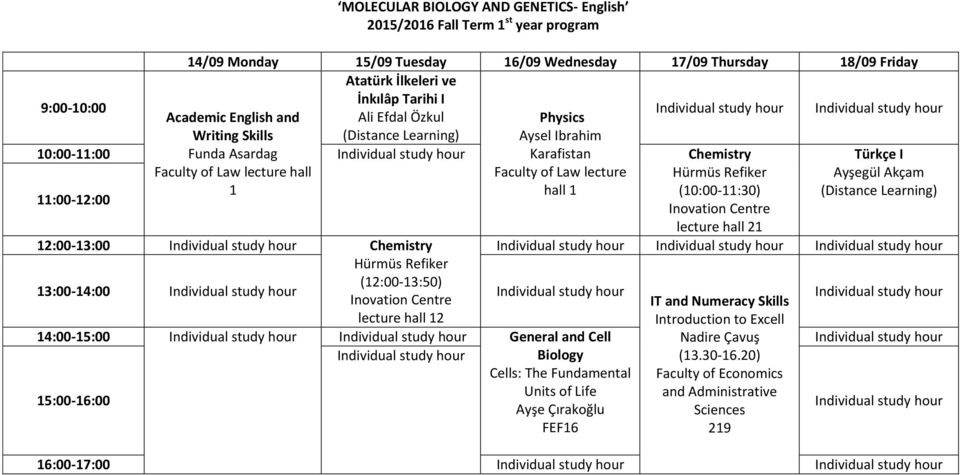
MOLECULAR BIOLOGY AND GENETICS- English 2015/2016 Fall Term 1 st year program
|
|
|
- Nora Fowler
- 9 years ago
- Views:
Transcription
1 MOLECULAR BIOLOGY AND GENETICS- English 2015/2016 Fall Term 1 st year program 14/09 Monday 15/09 Tuesday 16/09 Wednesday 17/09 Thursday 18/09 Friday Atatürk İlkeleri ve 10:00-11:00 Faculty of Law lecture hall Aysel Ibrahim Faculty of Law lecture Ayşegül Akçam 11:00-12:00 1 hall 1 (10:00-11:30) 12:00-13:00 13:00-14:00 Cells: The Fundamental Units of Life Ayşe Çırakoğlu Introduction to Excell
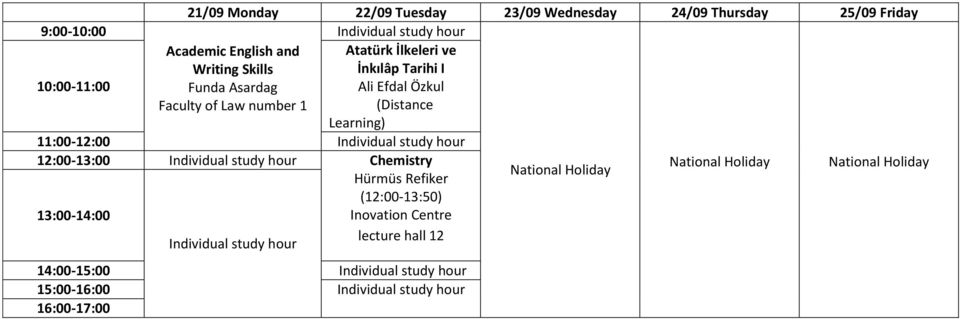
2 10:00-11:00 21/09 Monday 22/09 Tuesday 23/09 Wednesday 24/09 Thursday 25/09 Friday Atatürk İlkeleri ve Faculty of Law number 1 (Distance Learning) 11:00-12:00 12:00-13:00 13:00-14:00 National Holiday National Holiday National Holiday
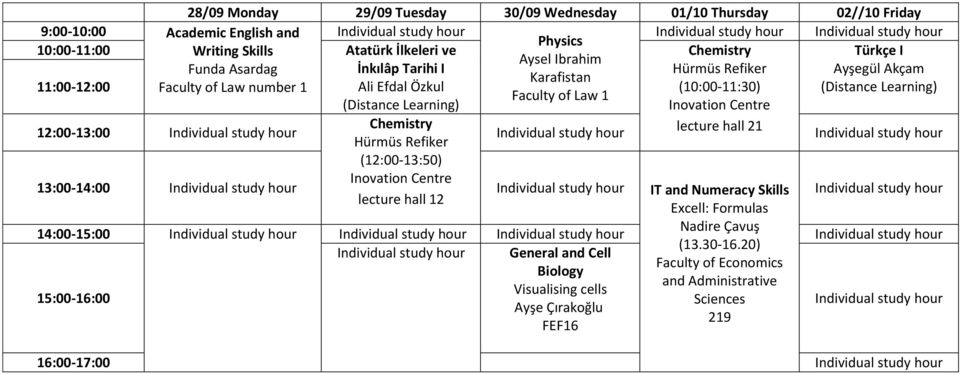
3 28/09 Monday 29/09 Tuesday 30/09 Wednesday 01/10 Thursday 02//10 Friday 10:00-11:00 Atatürk İlkeleri ve Aysel Ibrahim Ayşegül Akçam 12:00-13:00 (10:00-11:30) 13:00-14:00 Excell: Formulas Visualising cells Ayşe Çırakoğlu
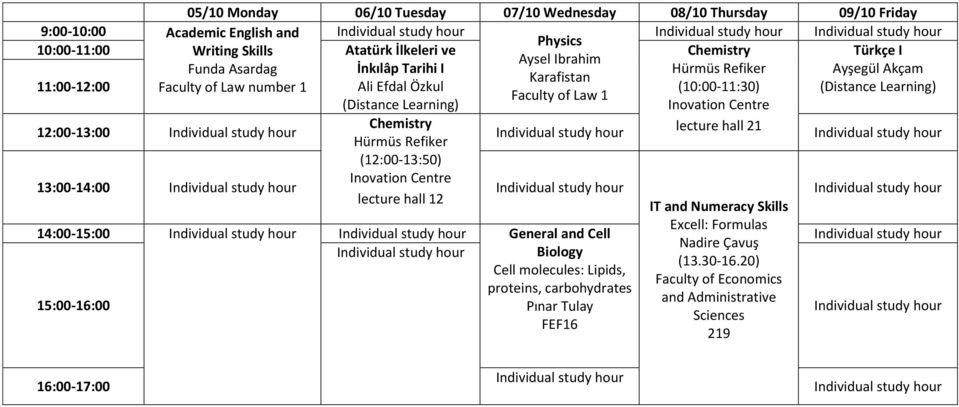
4 05/10 Monday 06/10 Tuesday 07/10 Wednesday 08/10 Thursday 09/10 Friday 10:00-11:00 Atatürk İlkeleri ve Aysel Ibrahim Ayşegül Akçam 12:00-13:00 13:00-14:00 Cell molecules: Lipids, proteins, carbohydrates Pınar Tulay (10:00-11:30) Excell: Formulas
5 12/10 Monday 13/10 Tuesday 14/10 Wednesday 15/10 Thursday 16/10 Friday 10:00-11:00 Atatürk İlkeleri ve Aysel Ibrahim Ayşegül Akçam 12:00-13:00 13:00-14:00 Membrane Structure and Membrane Transport of Small Molecules Pınar Tulay (10:00-11:30) Internet: Search tools
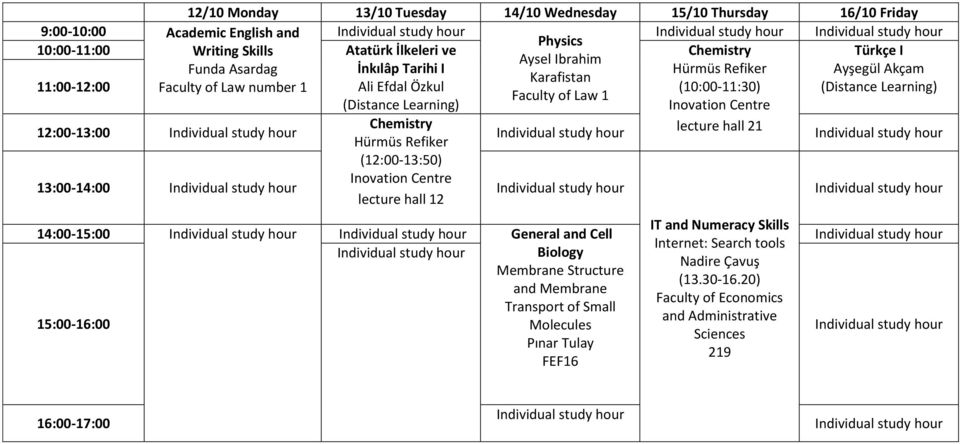
6 19/10 Monday 20/10 Tuesday 21/10 Wednesday 22/10 Thursday 23/10 Friday 10:00-11:00 Atatürk İlkeleri ve Aysel Ibrahim Ayşegül Akçam (10:00-11:30) 12:00-13:00 13:00-14:00 Cytoplasm, organelles and nucleus: Endoplasmic Reticulum, Ribosome, Intracellular Compartments and Protein Sorting, The Golgi Complex and Intracellular Vesicular Traffic Pınar Tulay Internet: Data searching

7 26/10 Monday 27/10 Tuesday 28/10 Wednesday 29/10 Thursday 30/10 Friday 10:00-11:00 Atatürk İlkeleri ve Aysel Ibrahim Ayşegül Akçam (10:00-11:30) 12:00-13:00 13:00-14:00 Internet: Data searching

8 10:00-11:00 11:00-12:00 12:00-13:00 13:00-14:00 02/11 Monday 03/11 Tuesday 04/11 Wednesday 05/11 Thursday 06/11 Friday MIDTERMS

9 09/11 Monday 10/11 Tuesday 11/11 Wednesday 12/11 Thursday 13/11 Friday 10:00-11:00 Atatürk İlkeleri ve Aysel Ibrahim Ayşegül Akçam (10:00-11:30) 12:00-13:00 13:00-14:00 Energy Conversion: Mitochondria and Chloroplasts Pınar Tulay Introduction to powerpoint
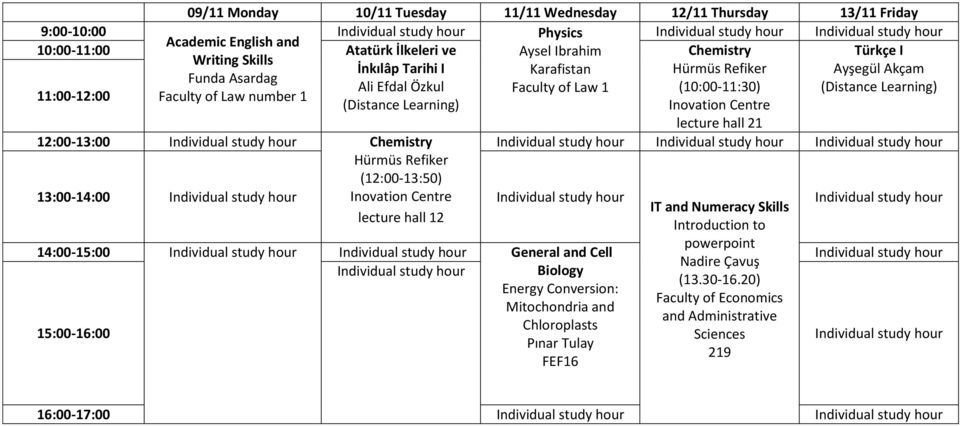
10 16/11 Monday 17/11 Tuesday 18/11 Wednesday 19/11 Thursday 20/11 Friday 10:00-11:00 Atatürk İlkeleri ve Aysel Ibrahim Ayşegül Akçam (10:00-11:30) 12:00-13:00 13:00-14:00 Lysosomes, Peroxisome and Centrioles Hüseyin Çağsın Introduction to powerpoint, ClipArt and Pictures
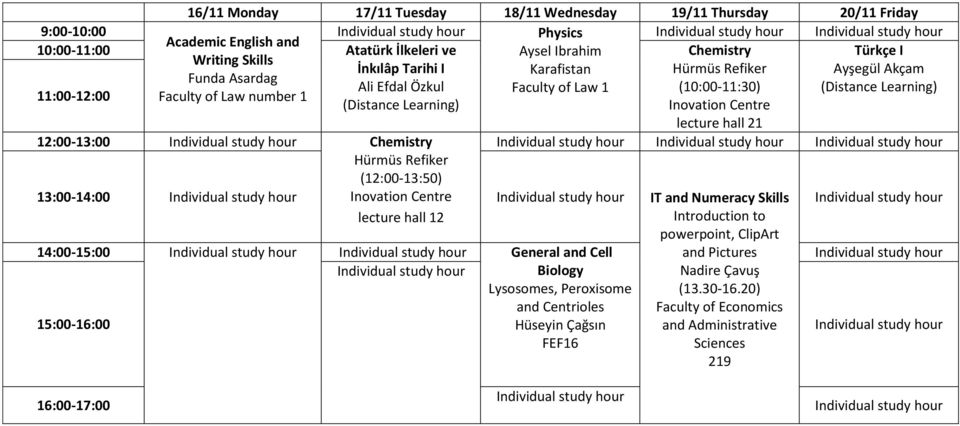
11 23/11 Monday 24/11 Tuesday 25/11 Wednesday 26/11 Thursday 27/11 Friday 10:00-11:00 Atatürk İlkeleri ve Aysel Ibrahim Ayşegül Akçam (10:00-11:30) 12:00-13:00 13:00-14:00 Nucleus, nuclear matrix, transport through the nuclear envelope and nucleic acids Pınar Tulay Introduction to powerpoint, ClipArt and Pictures
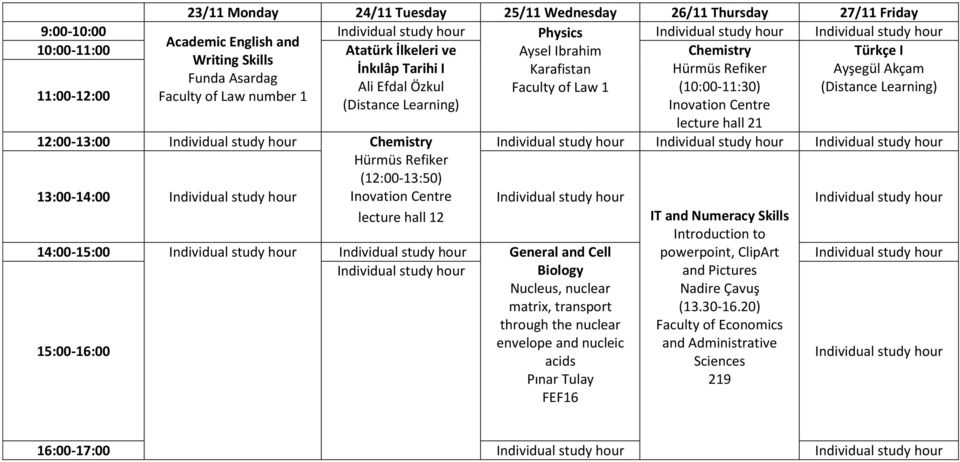
12 30/11 Monday 01/12 Tuesday 02/12 Wednesday 03/12 Thursday 04/12 Friday 10:00-11:00 Atatürk İlkeleri ve Aysel Ibrahim Ayşegül Akçam (10:00-11:30) 12:00-13:00 13:00-14:00 Extracellular Matrix and Cell Communication Pınar Tulay Introduction to powerpoint, ClipArt and Pictures
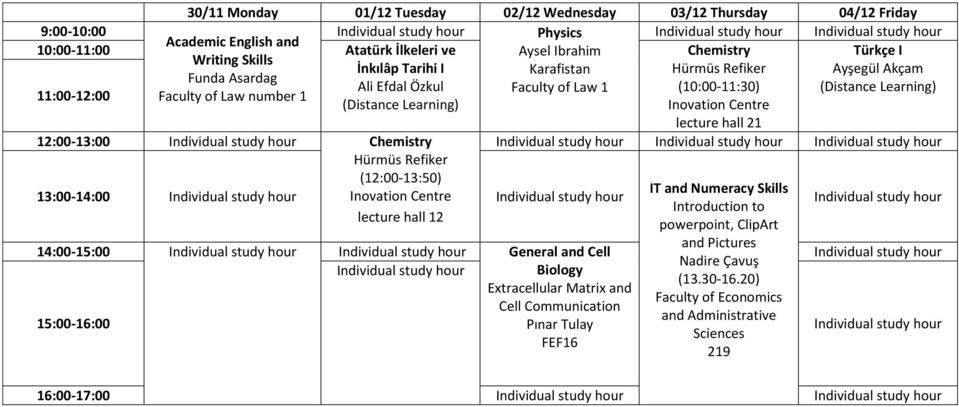
13 07/12 Monday 08/12 Tuesday 09/12 Wednesday 10/12 Thursday 11/12 Friday 10:00-11:00 Atatürk İlkeleri ve Aysel Ibrahim Ayşegül Akçam (10:00-11:30) 12:00-13:00 13:00-14:00 The Cytoskeleton Mahmut Ç. Ergören Introduction to powerpoint, ClipArt and Pictures
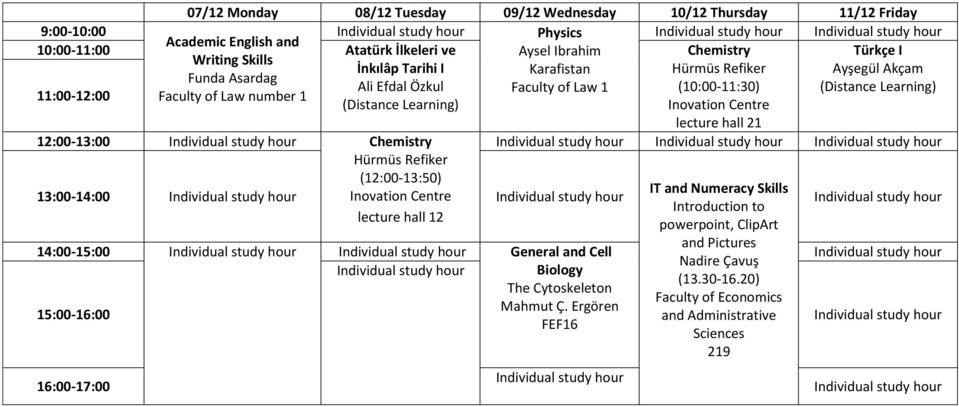
14 14/12 Monday 15/12 Tuesday 16/12 Wednesday 17/12 Thursday 18/12 Friday 10:00-11:00 Atatürk İlkeleri ve Aysel Ibrahim Ayşegül Akçam (10:00-11:30) 12:00-13:00 13:00-14:00 Introduction to powerpoint, ClipArt and Pictures
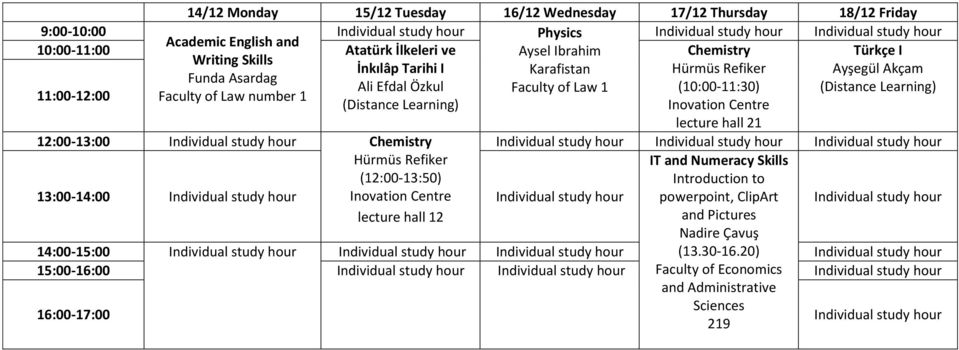
15 10:00-11:00 11:00-12:00 12:00-13:00 13:00-14:00 21/12 Monday 22/12 Tuesday 23/12 Wednesday 24/12 Thursday 25/12 Friday FINALS 10:00-11:00 11:00-12:00 12:00-13:00 13:00-14:00 28/12 Monday 29/12 Tuesday 30/12 Wednesday 31/12 Thursday FINALS

Biology Chapter 7 Practice Test
 Biology Chapter 7 Practice Test Multiple Choice Write the letter that best answers the question or completes the statement on the line provided. 1. The work of Schleiden and Schwann can be summarized by
Video Links: Differences Between Plant and Animal Cells http://www.youtube.com/watch?v=mwz4ptp_qeu
 Comparing Animal and Plant Cells by Annie Plant and animal cells are known as Eukaryotic cells which contain a nucleus and other genetic material enclosed within membranes. (Science Daily, n.d.) The primary
7.2 Cell Structure. Lesson Objectives. Lesson Summary. Cell Organization Eukaryotic cells contain a nucleus and many specialized structures.
 7.2 Cell Structure Lesson Objectives Describe the structure and function of the cell nucleus. Describe the role of vacuoles, lysosomes, and the cytoskeleton. Identify the role of ribosomes, endoplasmic
Lecture 8. Protein Trafficking/Targeting. Protein targeting is necessary for proteins that are destined to work outside the cytoplasm.
 Protein Trafficking/Targeting (8.1) Lecture 8 Protein Trafficking/Targeting Protein targeting is necessary for proteins that are destined to work outside the cytoplasm. Protein targeting is more complex
Chapter 4: A Tour of the Cell. 1. Cell Basics. Limits to Cell Size. 1. Cell Basics. 2. Prokaryotic Cells. 3. Eukaryotic Cells
 Chapter 4: A Tour of the Cell 1. Cell Basics 2. Prokaryotic Cells 3. Eukaryotic Cells 1. Cell Basics Limits to Cell Size There are 2 main reasons why cells are so small: If cells get too large: 1) there
Chapter 5 Organelles. Lesson Objectives List the organelles of the cell and their functions. Distinguish between plant and animal cells.
 Chapter 5 Organelles Lesson Objectives List the organelles of the cell and their functions. Distinguish between plant and animal cells. Check Your Understanding What is a cell? How do we visualize cells?
Chapter 2: Cell Structure and Function pg. 70-107
 UNIT 1: Biochemistry Chapter 2: Cell Structure and Function pg. 70-107 Organelles are internal structures that carry out specialized functions, interacting and complementing each other. Animal and plant
Review of the Cell and Its Organelles
 Biology Learning Centre Review of the Cell and Its Organelles Tips for most effective learning of this material: Memorize the names and structures over several days. This will help you retain what you
Plasma Membrane hydrophilic polar heads
 The Parts of the Cell 3 main parts in ALL cells: plasma membrane, cytoplasm, genetic material this is about the parts of a generic eukaryotic cell Plasma Membrane -is a fluid mosaic model membrane is fluid
7.2 Cells: A Look Inside
 CHAPTER 7 CELL STRUCTURE AND FUNCTION 7.2 Cells: A Look Inside Imagine a factory that makes thousands of cookies a day. Ingredients come into the factory, get mixed and baked, then the cookies are packaged.
Comparing Plant And Animal Cells
 Comparing Plant And Animal Cells http://khanacademy.org/video?v=hmwvj9x4gny Plant Cells shape - most plant cells are squarish or rectangular in shape. amyloplast (starch storage organelle)- an organelle
ISTEP+: Biology I End-of-Course Assessment Released Items and Scoring Notes
 ISTEP+: Biology I End-of-Course Assessment Released Items and Scoring Notes Page 1 of 22 Introduction Indiana students enrolled in Biology I participated in the ISTEP+: Biology I Graduation Examination
COMPARISON OF PLANT AND ANIMAL CELLS SIMILARITIES IN PLANT & ANIMAL CELLS
 COMPARISON OF PLANT AND ANIMAL CELLS Cells vary widely in structure and function, even within the same organism. The human body, for example, has more than 200 different types of cells, each with a specialized
Cell Structure & Function!
 Cell Structure & Function! Chapter 3! The most exciting phrase to hear in science, the one that heralds new discoveries, is not 'Eureka!' but 'That's funny.! -- Isaac Asimov Animal Cell Plant Cell Cell
Introduction to the Cell: Plant and Animal Cells
 Introduction to the Cell: Plant and Animal Cells Tissues, Organs, and Systems of Living Things Cells, Cell Division, and Animal Systems and Plant Systems Cell Specialization Human Systems All organisms
MCAS Biology. Review Packet
 MCAS Biology Review Packet 1 Name Class Date 1. Define organic. THE CHEMISTRY OF LIFE 2. All living things are made up of 6 essential elements: SPONCH. Name the six elements of life. S N P C O H 3. Elements
Drexel-SDP GK-12 ACTIVITY
 Drexel-SDP GK-12 ACTIVITY Subject Area(s): Biology Associated Unit: None Associated Lesson: None Activity Title : Plant or Animal Cell? Grade Level: 7 and 8 (7-9) Activity Dependency: None Time Required:
Quick Hit Activity Using UIL Science Contests For Formative and Summative Assessments of Pre-AP and AP Biology Students
 Quick Hit Activity Using UIL Science Contests For Formative and Summative Assessments of Pre-AP and AP Biology Students Activity Title: Quick Hit Goal of Activity: To perform formative and summative assessments
Cell Structure and Function. Eukaryotic Cell: Neuron
 Cell Structure and Function Eukaryotic Cell: Neuron Cell Structure and Function Eukaryotic Cells: Blood Cells Cell Structure and Function Prokaryotic Cells: Bacteria Cell Structure and Function All living
The Cell Interior and Function
 The Cell Interior and Function 5 5.0 CHAPTER PREVIEW Investigate and understand the organization and function of the cell interior. Define the differences between eukaryotic and prokaryotic cell structure.
Objective: On a team of no more than (2). Build to illustrate a 3D model of a PLANT or ANIMAL cell. 10 pts.
 THE CELL model: Activity 4.1 Science / Biology Objective: On a team of no more than (2). Build to illustrate a 3D model of a PLANT or ANIMAL cell. - Your models should clearly demonstrate the following
Look for these related items from Learning Resources :
 Look for these related items from Learning Resources : LER 1901 Cross Section Plant Cell LER 1902 Cross Section Heart Model LER 1903 Cross Section Brain Model LER 2437 Cross Section Earth Model For a dealer
UNIT 1 - Living Organisms and the Environment Situations. Cells
 Lesson Summaries HUMAN AND SOCIAL BIOLOGY UNIT 1 - Living Organisms and the Environment Situations Lesson 2 Cells OBJECTIVES At the end of this lesson you will be able to: a) Describe the structure of
C E L L O. Recommended Age: 6 years-8 years Time: 45 minutes prep, additional 3 hours for Jello to set
 C E L L O Recommended Age: 6 years-8 years Time: 45 minutes prep, additional 3 hours for Jello to set The smallest and simplest unit of life is called a cell. Cells are divided into two types of cells
Cells & Cell Organelles
 Cells & Cell Organelles The Building Blocks of Life H Biology Types of cells bacteria cells Prokaryote - no organelles Eukaryotes - organelles animal cells plant cells Cell size comparison Animal cell
Lecture 4 Cell Membranes & Organelles
 Lecture 4 Cell Membranes & Organelles Structure of Animal Cells The Phospholipid Structure Phospholipid structure Encases all living cells Its basic structure is represented by the fluidmosaic model Phospholipid
Plant and Animal Cells
 Plant and Animal Cells a. Explain that cells take in nutrients in order to grow, divide and to make needed materials. S7L2a b. Relate cell structures (cell membrane, nucleus, cytoplasm, chloroplasts, and
RAD 223. Radiography physiology. Lecture Notes. First lecture: Cell and Tissue
 RAD 223 Radiography physiology Lecture Notes First lecture: Cell and Tissue Physiology: the word physiology derived from a Greek word for study of nature. It is the study of how the body and its part work
Anatomy and Physiology Placement Exam 2 Practice with Answers at End!
 Anatomy and Physiology Placement Exam 2 Practice with Answers at End! General Chemical Principles 1. bonds are characterized by the sharing of electrons between the participating atoms. a. hydrogen b.
Do Not Write on this Quiz Paper (südamlik aitäh)
 1. This makes ribosomes. Cell Organelle Quiz Do Not Write on this Quiz Paper (südamlik aitäh) a. Rough ER c. Golgi apparatus (body) b. Nucleolus d. Mitochondria 2. This is an energy producing organelle.
Cells. Structure, Function and Homeostasis
 Cells Structure, Function and Homeostasis Characteristics of Cells Basic unit of life anything alive is made of cells Plasma membrane (skin) that separates them from the environment. Skeletonsfor protection
Partnerships Implementing Engineering Education Worcester Polytechnic Institute Worcester Public Schools Supported by: National Science Foundation
 Cells & Heredity: 6.C.2 Design a Cell Travel Brochure Grade Level 6 Sessions Seasonality Instructional Mode(s) Team Size WPS Benchmarks MA Frameworks Key Words 15-50 minutes N/A Individual N/A 06.SC.LS.05
FINAL SCHEDULE YEAR 1 AUGUST 18 22 WEEK 1
 YEAR 1 AUGUST 18 22 WEEK 1 TIME MONDAY (18) TUESDAY (19) WEDNESDAY (20) THURSDAY (21) FRIDAY (22) 11am 1 LUNCH LUNCH LUNCH LUNCH LUNCH 3 YEAR 1 AUGUST 25 29 WEEK 2 TIME MONDAY (25) TUESDAY (26) WEDNESDAY
Academic Calendar for Faculty
 Summer 2013 Term June 3, 2013 (Monday) June 3-4, 2013 (Monday Tuesday) June 5, 2013 (Wednesday) June 5-6, 2013 (Wednesday Thursday) June 6, 2013 (Thursday) July 3, 2013 (Wednesday) July 4, 2013 (Thursday)
Biology 101 Chapter 4 Cells as the Basic Unit of Life. The Cell Theory Major Contributors: Galileo = first observations made with a microscope
 Biology 101 Chapter 4 Cells as the Basic Unit of Life The Cell Theory Major Contributors: Galileo = first observations made with a microscope Robert Hooke = first to observe small compartments in dead
Cell and Membrane Practice. A. chromosome B. gene C. mitochondrion D. vacuole
 Name: ate: 1. Which structure is outside the nucleus of a cell and contains N?. chromosome. gene. mitochondrion. vacuole 2. potato core was placed in a beaker of water as shown in the figure below. Which
Organelles and Their Functions
 Organelles and Their Functions The study of cell organelles and their functions is a fascinating part of biology. The current article provides a brief description of the structure of organelles and their
CELLS: PLANT CELLS 20 FEBRUARY 2013
 CELLS: PLANT CELLS 20 FEBRUARY 2013 Lesson Description In this lesson we will discuss the following: The Cell Theory Terminology Parts of Plant Cells: Organelles Difference between plant and animal cells
Compartmentalization of the Cell. Objectives. Recommended Reading. Professor Alfred Cuschieri. Department of Anatomy University of Malta
 Compartmentalization of the Cell Professor Alfred Cuschieri Department of Anatomy University of Malta Objectives By the end of this session the student should be able to: 1. Identify the different organelles
Name Date Period. 2. When a molecule of double-stranded DNA undergoes replication, it results in
 DNA, RNA, Protein Synthesis Keystone 1. During the process shown above, the two strands of one DNA molecule are unwound. Then, DNA polymerases add complementary nucleotides to each strand which results
Cellular Structure and Function
 Chapter Test A CHAPTER 7 Cellular Structure and Function Part A: Multiple Choice In the space at the left, write the letter of the term or phrase that best answers each question. 1. Which defines a cell?
1. When you come to a station, attempt to answer each question for that station.
 Name: Block: Steps for completing this study guide 1. When you come to a station, attempt to answer each question for that station. 2. Once you are done answering the questions, or if you can t answer
The Cell Teaching Notes and Answer Keys
 The Cell Teaching Notes and Answer Keys Subject area: Science / Biology Topic focus: The Cell: components, types of cells, organelles, levels of organization Learning Aims: describe similarities and differences
2007 7.013 Problem Set 1 KEY
 2007 7.013 Problem Set 1 KEY Due before 5 PM on FRIDAY, February 16, 2007. Turn answers in to the box outside of 68-120. PLEASE WRITE YOUR ANSWERS ON THIS PRINTOUT. 1. Where in a eukaryotic cell do you
Gymnázium, Brno, Slovanské nám. 7, WORKBOOK - Biology WORKBOOK. www.gymnaslo.agb.cz
 WORKBOOK www.gymnaslo.agb.cz Subjekt: Biology Teacher: Iva Kubištová Student:.. School year:../. This material was prepared with using http://biologygmh.com/ Topics: 1. 2. 3. Cell Structure and Function
Biology I. Chapter 7
 Biology I Chapter 7 Interest Grabber NOTEBOOK #1 Are All Cells Alike? All living things are made up of cells. Some organisms are composed of only one cell. Other organisms are made up of many cells. 1.
The Cell: Organelle Diagrams
 The Cell: Organelle Diagrams Fig 7-4. A prokaryotic cell. Lacking a true nucleus and the other membrane-enclosed organelles of the eukaryotic cell, the prokaryotic cell is much simpler in structure. Only
CELL ANALOGY: AIRPORT. By: Joe Behrmann and Isaac Thompson
 CELL ANALOGY: AIRPORT By: Joe Behrmann and Isaac Thompson MITOCHONDRIA Location: The Mitochondria of a cell is located in both plant and animal cells. They are found floating throughout the cell. Function:
Microscopes. Eukaryotes Eukaryotic cells are characterized by having: DNA in a nucleus that is bounded by a membranous nuclear envelope
 CH 6 The Cell Microscopy Scientists use microscopes to visualize cells too small to see with the naked eye. In a light microscope (LM), visible light is passed through a specimen and then through glass
Biological cell membranes
 Unit 14: Cell biology. 14 2 Biological cell membranes The cell surface membrane surrounds the cell and acts as a barrier between the cell s contents and the environment. The cell membrane has multiple
An Overview of Cells and Cell Research
 An Overview of Cells and Cell Research 1 An Overview of Cells and Cell Research Chapter Outline Model Species and Cell types Cell components Tools of Cell Biology Model Species E. Coli: simplest organism
Cell Unit Practice Test #1
 ell Unit Practice Test #1 Name: ate: 1. Which organelle is primarily concerned with the conversion of potential energy of organic compounds into suitable form for immediate use by the cell?. mitochondria.
BME 42-620 Engineering Molecular Cell Biology. Lecture 02: Structural and Functional Organization of
 BME 42-620 Engineering Molecular Cell Biology Lecture 02: Structural and Functional Organization of Eukaryotic Cells BME42-620 Lecture 02, September 01, 2011 1 Outline A brief review of the previous lecture
Bacterial (Prokaryotic) Cell. Common features of all cells. Tour of the Cell. Eukaryotic Cell. Plasma Membrane defines inside from outside
 www.denniskunkel.com Tour of the Cell www.denniskunkel.com Today s Topics Properties of all cells Prokaryotes and Eukaryotes Functions of Major Cellular Organelles Information, Synthesis&Transport,, Vesicles
called a cell wall. The cell wall protects against mechanical stress and keeps the cell from becoming over-filled with water.
 What are Cells? By: Byron Norelius About Cells A cell is the basic unit of life. All living organisms are composed of one (unicellular) or more (multicellular) cells. In unicellular organisms, like many
Introduction, Noncovalent Bonds, and Properties of Water
 Lecture 1 Introduction, Noncovalent Bonds, and Properties of Water Reading: Berg, Tymoczko & Stryer: Chapter 1 problems in textbook: chapter 1, pp. 23-24, #1,2,3,6,7,8,9, 10,11; practice problems at end
Cytology. Living organisms are made up of cells. Either PROKARYOTIC or EUKARYOTIC cells.
 CYTOLOGY Cytology Living organisms are made up of cells. Either PROKARYOTIC or EUKARYOTIC cells. A. two major cell types B. distinguished by structural organization See table on handout for differences.
AP BIOLOGY 2006 SCORING GUIDELINES. Question 1
 AP BIOLOGY 2006 SCORING GUIDELINES Question 1 A major distinction between prokaryotes and eukaryotes is the presence of membrane-bound organelles in eukaryotes. (a) Describe the structure and function
The microscope is an important tool.
 KEY CONCEPT Microscopes allow us to see inside the cell. BEFORE, you learned Some organisms are unicellular and some are multicellular A microscope is necessary to study most cells The cell theory describes
The Cell. Grade 8 Activity Plan
 The Cell Grade 8 Activity Plan Plant Cell Project Objectives: 1. To identify cell organelles and their functions. 2. To demonstrate the difference between plant and animal cells. Keywords/concepts: cells,
The Steps. 1. Transcription. 2. Transferal. 3. Translation
 Protein Synthesis Protein synthesis is simply the "making of proteins." Although the term itself is easy to understand, the multiple steps that a cell in a plant or animal must go through are not. In order
cells - relatively simple cells - lack nuclear membrane and many organelles - bacteria and their relatives are all prokaryotic
 Cell Biology A cell is chemical system that is able to maintain its structure and reproduce. Cells are the fundamental unit of life. All living things are cells or composed of cells. 1 The interior contents
Cellular Respiration
 Cellular Respiration Cellular Respiration Text, Diagrams, Assessments, and Link to Standards Focus Questions 1) What is cellular respiration? 2) How is cellular respiration connected to breathing? 3) If
How Well Do You Know Your Cells?
 How Well Do You Know Your Cells? Complete each sentence below with words from the box. One word will not be used. cells cell membrane cell walls chloroplasts cytoplasm Hooke Leeuwenhoek mitochondria nucleus
THE UNIVERSITY OF THE WEST INDIES, ST. AUGUSTINE FACULTY OF SCIENCE & TECHNOLOGY DEPARTMENT OF LIFE SCIENCES COURSE DOCUMENTATION
 THE UNIVERSITY OF THE WEST INDIES, ST. AUGUSTINE COURSE CODE: BIOL 2061 FACULTY OF SCIENCE & TECHNOLOGY DEPARTMENT OF LIFE SCIENCES COURSE DOCUMENTATION COURSE TITLE: Cell & Developmental Biology CREDITS:
International University of Monaco 27/04/2012 14:55 - Page 1. Monday 30/04 Tuesday 01/05 Wednesday 02/05 Thursday 03/05 Friday 04/05 Saturday 05/05
 International University of Monaco 27/04/12 14:55 - Page 1 Master in International Business and Global Affairs - from 30 avril to 05 mai 12 Monday 30/04 Tuesday 01/05 Wednesday 02/05 Thursday 03/05 Friday
International University of Monaco 21/05/2012 16:01 - Page 1. Monday 30/04 Tuesday 01/05 Wednesday 02/05 Thursday 03/05 Friday 04/05 Saturday 05/05
 International University of Monaco 21/05/12 16:01 - Page 1 Master in International Sport Business and Management - from 30 avril to 05 mai 12 Monday 30/04 Tuesday 01/05 Wednesday 02/05 Thursday 03/05 Friday
Organization and Structure of Cells
 Organization and Structure of Cells All living things fall into one of the two categories: prokaryotes eukaryotes The distinction is based on whether or not a cell has a nucleus. Prokaryotic cells do not
Student name ID # 2. (4 pts) What is the terminal electron acceptor in respiration? In photosynthesis? O2, NADP+
 1. Membrane transport. A. (4 pts) What ion couples primary and secondary active transport in animal cells? What ion serves the same function in plant cells? Na+, H+ 2. (4 pts) What is the terminal electron
BIO 130.001 Principles of Cell & Molecular Biology Fall 2014 TR 11:00-12:15
 BIO 130.001 Principles of Cell & Molecular Biology Fall 2014 TR 11:00-12:15 S233 Dr. Sarah Canterberry Office Hours: S202 SI Leader: Assistant Professor, Biology MWF 1:00 3:00 Ramiro Espericueta *E-mail:
AP Biology-Chapter #6 & 7 Review
 DO NOT WRITE ON THIS TEST- USE ANSWER DOCUMENT AP Biology-Chapter #6 & 7 Review Multiple Choice Identify the choice that best completes the statement or answers the question. 1. All of the following are
Multiple Choice Questions
 Chapter 5 THE FUNDAMENTAL UNIT OF LIFE Multiple Choice Questions 1. Which of the following can be made into crystal? (a) A Bacterium (b) An Amoeba (c) A Virus (d) A Sperm 2. A cell will swell up if (a)
Chapter 3. Cellular Structure and Function Worksheets. 39 www.ck12.org
 Chapter 3 Cellular Structure and Function Worksheets (Opening image copyright by Sebastian Kaulitzki, 2010. Used under license from Shutterstock.com.) Lesson 3.1: Introduction to Cells Lesson 3.2: Cell
PLANT CELLS AND ANIMAL CELLS
 PLANT CELLS AND ANIMAL CELLS General Science, Biology, Anatomy, Physiology Grades 6 12 OBJECTIVES CONTENT THINKING SKILL/PROCESS Students will learn the role of cells as building blocks of all living structures.
CONCEPTS OF BIOLOGY - BIOL115 Dr. SG Saupe; Fall 2006 Exam #2
 CONCEPTS OF BIOLOGY - BIOL115 Dr. SG Saupe; Fall 2006 Exam #2 name And he gave it for his opinion, that whoever could make two ears of corn or two blades of grass to grow upon a spot where only one grew
3.1 AS Unit: Cells, Exchange and Transport
 3.1 AS Unit: Cells, Exchange and Transport Module 1: Cells 1.1.1 Cell Structure Candidates should be able to: (a) state the resolution and magnification that can be achieved by a light microscope, a transmission
Eukaryotic Cells Organelles Cell Wall cell wall
 Eukaryotic Cells Think back to Schwann and Schleiden. It wasn t until that fateful lunch that Schwann realized he was seeing cells. After that moment cell biology knowledge exploded (just a saying; it
Date: Student Name: Teacher Name: Jared George. Score: 1) A cell with 1% solute concentration is placed in a beaker with a 5% solute concentration.
 Biology Keystone (PA Core) Quiz Homeostasis and Transport - (BIO.A.4.1.1 ) Plasma Membrane, (BIO.A.4.1.2 ) Transport Mechanisms, (BIO.A.4.1.3 ) Transport Facilitation Student Name: Teacher Name: Jared
MATCHDAY 1 7-9 September 2014
 MATCHDAY 1 7-9 September 2014 7 September Sunday 18:00 Group D 7 September Sunday 20:45 Group D 7 September Sunday 20:45 Group D 7 September Sunday 18:00 Group F 7 September Sunday 20:45 Group F 7 September
Journal of Virginia Science Education. Exposing Student Misconceptions about Cellular Structure: A Curriculum Topic Study. Abbie Martin, M.Ed.
 Exposing Student Misconceptions about Cellular Structure: A Curriculum Topic Study Introduction Abbie Martin, M.Ed. Curriculum topic study allows teachers to investigate a specific concept in math or science
Trading Calendar - East Capital UCITS Funds
 Trading Calendar - UCITS s The table shows i) the days the funds will be closed due to holidays and ii) which days the funds have early cut-off times (11.30am Central European Time). Please note that the
City Part Function Cell Part Controls what goes in and
 Answer key: CELL CITY INTRODUCTION! Floating around in the cytoplasm are small structures called organelles. Like the organs in your own body, each one carries out a specific function necessary for the
Eukaryotes. www.njctl.org PSI Biology Eukaryotes & Gene Expression
 Eukaryotes The Eukaryotic Cell Classwork 1. Identify two characteristics that are shared by all cells. 2. Suppose you are investigating a cell that contains a nucleus. Would you categorize this cell as
Buddhist Chi Hong Chi Lam Memorial College A.L. Bio. Notes (by Denise Wong) The Cell... Page 28
 The Cell... Page 28 Organelles of cells: Introduction : - The cell is the fundamental unit of life. - The modern Cell theory states : i) All living organisms are composed of cells. ii) All new cells are
1. When applying the process of science, which of these is tested? a. an observation b. a result c. a hypothesis d. a question e.
 BCOR 11 Exam 1, 2004 MULTIPLE CHOICE. Choose the one alternative that best completes the statement or answers the question. 1. When applying the process of science, which of these is tested? a. an observation
Plant and Animal Cells
 Plant and Animal Cells Strand Topic Life Systems Investigating organelles and their functions in cells of living things Primary SOL LS.2 The student will investigate and understand that all living things
Eukaryotic Cell Structure: Organelles in Animal & Plant Cells Why are organelles important and how are plants and animals different?
 Why? Eukaryotic Cell Structure: Organelles in Animal & Plant Cells Why are organelles important and how are plants and animals different? The cell is the basic unit and building block of all living things.
Unit 2: Cells, Membranes and Signaling CELL MEMBRANE. Chapter 5 Hillis Textbook
 Unit 2: Cells, Membranes and Signaling CELL MEMBRANE Chapter 5 Hillis Textbook HOW DOES THE LAB RELATE TO THE NEXT CHAPTER? SURFACE AREA: the entire outer covering of a cell that enables materials pass.
the plant & animal cell
 6.1 Basic unit of life Biology Biology Structure & functions of 06 the plant & animal cell In 1665, Robert Hooke observed a section of a cork using a microscope prepared by him. He discovered a structure
Lesson 4.10: Life Science Plant & Animal Cell Functions
 Weekly Focus: Reading Comprehension Weekly Skill: Compare & Contrast Lesson Summary: This week students will continue with lessons in Life Science. The work contains foundational knowledge about plant
2015-2016 Academic Calendar - UNDERGRADUATE. All Other Classes Begin; Late Registration Begins. Last Day to Drop a Class without a W on Transcript;
 2015-2016 Academic Calendar - UNDERGRADUATE Fall 2015 Semester Monday, August 10 Friday, August 14 Saturday, August 15 Monday, August 17 Friday, August 21 Friday, August 28 Friday, September 4 Monday,
Anatomy PHL 212. By Dr Tajdar Husain Khan
 Anatomy PHL 212 By Dr Tajdar Husain Khan Overview of Anatomy Anatomy(from the Greek word anatome,"dissection") is a branch of natural science dealing with the structural organization of living things The
THE LIVING CELL. Cells also have variety of shapes. Plant cells are often rectangular or polygonal, while egg cells are usually spherical.
 THE LIVING CELL A Tour of the cell The cell is the smallest and the basic unit of structure of all organisms. There are two main types or categories of cells: prokaryotic cells and eukaryotic cells. Prokaryotic
BIOL 2401 Anatomy & Physiology I Course Syllabus: Fall 2014
 BIOL 2401 Anatomy & Physiology I Course Syllabus: Fall 2014 Northeast Texas Community College exists to provide responsible, exemplary learning opportunities. Ms. Alanta Knox Office: online Phone: 903-434-8292
tissues are made of cells that work together, organs are )
 Study Guide Cells Unit Test Matching. Write the letter of the correct response on the line. You may use the responses more than once. A. proteins B. simple carbohydrates C. complex carbohydrates D. lipids
The Cell Grade Ten. Estimated Duration: Three hours
 Ohio Standards Connection: Life Sciences Benchmark A Explain that cells are the basic unit of structure and function of living organisms, that once life originated all cells come from pre-existing cells,
2013-2014. 7 th Grade Science. Curriculum Framework Third Six Weeks. Updated
 2013-2014 7 th Grade Science Curriculum Framework Third Six Weeks Updated Week #1 TEKS RC ELPS CCRS Concepts Resources Recognize levels of organization in plants and animals. VI.A.1 Monday 7.12C 4 4J,
Week 1 EOC Review Cell Theory, Cell Structure, Cell Transport
 Week 1 EOC Review Cell Theory, Cell Structure, Cell Transport Benchmarks: SC.912.L.14.1 Describe the scientific theory of cells (cell theory) and relate the history of its discovery to the processes of
International University of Monaco 11/06/2012 09:27 - Page 1. Monday 30/04 Tuesday 01/05 Wednesday 02/05 Thursday 03/05 Friday 04/05 Saturday 05/05
 International University of Monaco 11/06/2012 09:27 - Page 1 Master in Finance - Hedge Funds and Private Equity - from 30 avril to 05 mai 2012 Monday 30/04 Tuesday 01/05 Wednesday 02/05 Thursday 03/05
Plant and Animal Cells
 Plant and Animal Cells Cell Scientists Hans and Zacharias Janssen Dutch lens grinders, father and son produced first compound microscope (2 lenses) Robert Hooke (1665) English Scientist looked at a thin