
MAHATMA GANDHI UNIVERSITY. Kottayam, Kerala
|
|
|
- Clifton Wiggins
- 9 years ago
- Views:
Transcription
1 MAHATMA GANDHI UNIVERSITY Kottayam, Kerala B.Tech. Degree Courses
2 Revised Scheme and Syllabus And Syllabus for Combined I & II Sem Contents 1. Course Regulations of B.Tech. Degree Courses (With effect from 2010 admissions) 2. Revised Scheme For B Tech Syllabus Syllabus for combined Ist & IInd Sem (Common for all branches) From, M.C.Philipose Chairman Board of Studies in Engg (UG) M.G.University Kottayam To The Registrar

3 M.G.University Kottayam Sir, Sub: Regulation,scheme&syllabus I am herewith submitting the following approved by the Board of Studies in Engg (UG) held on at M.G.university mini conference hall. 1. Regulation for B.Tech degree(2010 onwards) 2. Scheme for first to eighth semesters 3. Syllabus for combined first & second (common for all branches) I request you to take the necessary action in this regard Thanking you Yours sincerely Mahatma Gandhi University Course Regulations of B.Tech. Degree Courses
4 (With effect from 2010 admissions)

5 1. Conditions for Admissions Candidates for admission to the B.Tech. degree course shall be required to have passed the Higher Secondary Examination of State Board of Kerala or 12th Standard V.H.S.E., C.B.S.E., I.C.S.E. or examinations recognized equivalent by any Universities of Kerala thereto with mathematics, physics and chemistry as optional subjects, with 50% marks in Mathematics and 50% marks in Physics, Chemistry, and Mathematics put together. Candidates belonging to scheduled caste and scheduled tribe need only a pass in the qualifying examination. Candidates have to qualify the State Level Entrance examination conducted by the Commissioner of Entrance Examinations or State level/national level Entrance Examination approved by the Government of Kerala as equivalent. They shall also satisfy the conditions regarding age and physical fitness as prescribed by the Mahatma Gandhi University Criteria for selection and method of admission to merit/management seats for Engineering degree courses conducted by Government/Aided/Self-financing colleges affiliated to Mahatma Gandhi University shall be governed by the rules/regulations framed by the Commissioner of Entrance Examinations or other competent authority appointed by the Government of Kerala, in consultation with the University and without contravening with the stipulation of the All India Council for Technical Education (AICTE). In all matters related to selection and admission, the decisions of the University shall be final. The students admitted by affiliated colleges violating the above regulations will not be eligible for registration to University Examinations and contravention of the regulations shall lead to withdrawal/suspension of affiliation. 2. Admission to Diploma Holders A candidate who has a diploma in engineering awarded by the State Board of Technical Examination or an examination recognized equivalent by the State Board of Technical Education after undergoing regular course of 3 years in an institute approved by AICTE, securing a cumulative minimum of 50% marks in the second and third years diploma examination shall be eligible to be admitted to the first year B.Tech. programme of the Mahatma Gandhi University (hereafter, the University, unless otherwise specified) if he/she has qualified the entrance examination conducted by the Commissioner of Entrance Examinations or State level/national level Entrance Examination approved by the Government of Kerala as equivalent. Diploma holders with 60% marks (50% in case of SC/ST) are also eligible for admission to the 3 rd semester (regular full-time batch) engineering degree course (B.Tech.) under the lateral entry scheme provided they qualify the Entrance Examination conducted for the lateral entry scheme by the state Government. These students are not required to study any deficiency papers of the combined first and second semesters. Admission of all candidates under the lateral entry scheme shall be completed latest by commencement of 3 rd semester classes.

6 3. s of Study The subjects of study, both theory and practical, shall be in accordance with the prescribed scheme and syllabi of each branch of study. 4. Duration of the Course The course for the B.Tech degree shall extend over a period of four academic years comprising of eight semesters. The first and second semesters shall be combined; the scheme and syllabi for combined first and second semesters (S 1& S 2 ) will be common for all branches of study. The maximum duration permissible for taking the B.Tech. Degree is fixed as 8 years. For lateral entry students maximum duration permissible for taking the B.Tech. Degree is fixed as 7 years. Classes of combined first and second semesters shall be started latest by 1 st August in all affiliated engineering colleges of Mahatma Gandhi University; however admission to first year shall be completed by 31 st August. The minimum number of working days in combined first and second semesters shall be 150 days. In 3 rd to 8 th semesters, there shall be minimum 90 working days. 5. Branches of Study 1. Civil Engineering (CE) 2. Mechanical Engineering (ME) 3. Electrical and Electronics Engineering (EE) 4. Electronics and Communication Engineering (EC) 5. Electronics & Instrumentation Engineering (EI ) 6. Instrumentation and Control Engineering (IC) 7. Applied Electronics and Instrumentation Engineering (AI) 8. Computer Science and Engineering (CS)

7 9. Information Technology (IT) 10. Polymer Engineering (PO) 11. Automobile Engineering (AU) 12. Aeronautical Engineering (AN) 6. Course Calendar The course calendar, published by the University, shall be followed by all affiliated engineering colleges. Within a week after the commencement of classes of each semester, Head of each Institution should forward the list of faculty members working in the college along with their qualification and years of teaching experience, to the University. This is a mandatory requirement which should be strictly followed by Head of each Institution. Head of each Institution shall ensure the availability of sufficient number of regular faculty members having experience and qualifications (as per AICTE guidelines) in the institution. 7. Assessment of Students Assessment of students for each subject will be done by internal continuous assessment and Semester- End examinations. Internal assessment shall be conducted throughout the semester. It shall be based on internal examinations, assignments (such as home assignment, problem solving, group discussions, quiz, literature survey, seminar, term-project, software exercises, etc.) as decided by the faculty handling the course, and regularity in the class. Assignments of every semester shall preferably be submitted in Assignment Book, which is a bound book similar to laboratory record. Semester-End examinations of theory and practical subjects will be conducted by the University. Semester-End examinations of combined first and second semesters and 3 rd to 6 th semesters will be conducted only once in a year; failed or improvement candidates will have to appear for the Semester-End examinations along with regular students. However, Semester-End examinations of 7 th and 8 th semesters will be conducted once in every semester. Head of institution should take necessary steps to prevent any malpractices in the Semester-End examinations. If any such instances are detected, they should be reported to the University without any delay. Internal assessment marks of each theory subject should have a class average limited to 80%. If the class average of internal assessment marks of any theory subjects is greater than 80%, standard normalization procedure should be applied to limit it to 80%. If the class average is not greater than 80%, absolute marks should be given. For practical subjects, internal assessment marks and Semester-End examination marks individually should have a class average limited to 75%. If the class average of internal assessment marks or Semester-
8 End examination marks of practical subjects is greater than 75%, the standard normalization procedure should be applied to limit the class average to 75%. If it is not greater than 75%, absolute marks should be given. All the students in the nominal roll of the class on the closing day of semester should be considered for normalization of internal marks. All the students who have passed the Semester-End practical examination should be considered for normalisation of marks of Semester-End practical examinations. Internal assessment marks of theory and practical subjects, both absolute and normalised, should be published in the college 10 days before sending it to the University so as to enable the students to report any corrections. (a) Assessment in Theory s The marks allotted for internal continuous assessment and Semester-End university examinations shall be 50 marks and 100 marks respectively with a maximum of 150 marks for each theory subject. The weightage to award internal continuous assessment marks should be as follows: Test papers (minimum two) 60% Assignments (minimum two) such as home assignment, problem solving, group discussions, quiz, literature survey, seminar, term-project, software exercises, etc. 20% Regularity in the class 20% The sessional marks allotted for attendance shall be awarded in direct proportion to the percentage of attendance secured by the candidate in the subject. Full credit for regularity in the class can be given only if the candidate has secured minimum 90% attendance in the subject. (b) Assessment in Practical s

9 Internal continuous assessment and Semester-End practical examinations will have weightage in the student s performance of practical subjects, with 50 marks allotted for internal continuous assessment and 100 marks for Semester-End examinations. The weightage to award internal continuous assessment marks should be as follows: Test papers 30% Regular work/drawing/workshop record/lab record/ Class performance 50% Regularity in the class 20% An external examiner and an internal examiner, appointed by the University, shall conduct the Semester- End examinations of practical subjects. These examiners should necessarily have minimum two years teaching experience at engineering degree level. Award of marks in the Semester-End practical examinations (except Project) should be as follows: Viva voce 30% Procedure and tabulation form, Conducting experiment, results and inference 70% No candidate will be permitted to attend the Semester-End practical examinations unless he/she produces certified record of the laboratory. Strict measures will be taken by the University to monitor the laboratory facilities, laboratory experiments conducted, standard of Semester-End practical examinations, etc. in every affiliated engineering college. In this regard, an expert team comprising of at least three subject experts from government/government-aided engineering colleges from within/outside the University shall be formulated to assess these aspects in affiliated engineering colleges. This expert team should visit each engineering college at least once in a semester and submit a detailed report to the University regarding the laboratory facilities, laboratory experiments conducted, and standard of Semester-End practical examinations in each college.
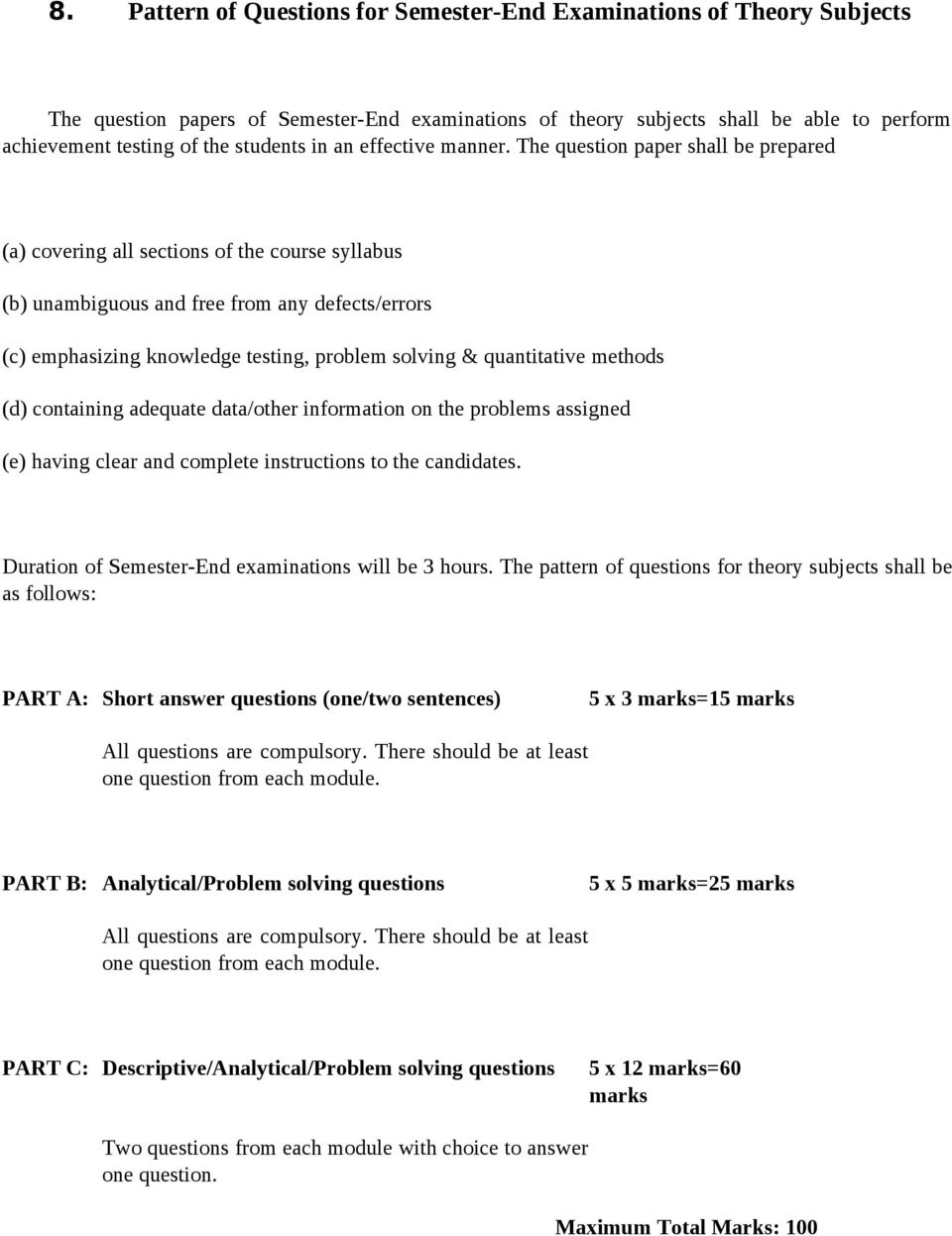
10 8. Pattern of Questions for Semester-End Examinations of Theory s The question papers of Semester-End examinations of theory subjects shall be able to perform achievement testing of the students in an effective manner. The question paper shall be prepared (a) covering all sections of the course syllabus (b) unambiguous and free from any defects/errors (c) emphasizing knowledge testing, problem solving & quantitative methods (d) containing adequate data/other information on the problems assigned (e) having clear and complete instructions to the candidates. Duration of Semester-End examinations will be 3 hours. The pattern of questions for theory subjects shall be as follows: PART A: Short answer questions (one/two sentences) 5 x 3 marks=15 marks All questions are compulsory. There should be at least one question from each module. PART B: Analytical/Problem solving questions 5 x 5 marks=25 marks All questions are compulsory. There should be at least one question from each module. PART C: Descriptive/Analytical/Problem solving questions 5 x 12 marks=60 marks Two questions from each module with choice to answer one question. Maximum Total Marks: 100
11 Weightage for categories such as problem solving, descriptive, drawing, or diagrammatic questions shall be specified along with the syllabus of any subject, if necessary. Model question paper shall be prepared for each subject at the time of framing the syllabus. This same model question paper along with the syllabus must be sent to the question-paper setter every time for framing the questions. The model question paper shall be made available to students. It is permitted to have an entirely different pattern of questions especially for subjects involving drawing, design, etc. However, the modified pattern to be followed shall be clearly specified along with the syllabus of the particular subject. All question paper setters should supplement the scheme and key for the evaluation 9. Minimum for Pass A candidate shall be declared to have passed in an individual subject of a semester examination if he/she secures not less than 40% marks for the subject in the university examination and not less than 50% of the total marks of the subject i.e. university examination marks and sessional marks in that subject put togather. A candidate shall be declared to have passed in a semester examination in full in first appearance (first registration is considered as first appearance) if he satisfies the above criteria for each theory and practical subjects Candidates will be assigned grades according to the marks scored. For Seminar, Project, and Viva Voce (in 7 th & 8 th semester), the minimum for a pass shall be 50% of the total marks assigned to the respective examination. If a candidate has passed all examinations of B.Tech. course (at the time of publication of results of eighth semester) except Viva-Voce in the eighth semester, a re-examination for the Viva-Voce should be conducted within one month after the publication of results. Each candidate should apply for this Save a Semester examination within one week after the publication of eighth semester results. 10. Credit System Each subject shall have a certain number of credits assigned to it depending upon the academic load and the nature and importance of the subject. The credit associated with each subject will be shown in the prescribed scheme and syllabi. Each course shall have an integer number of credits, which reflects its weightage. 11. Grading

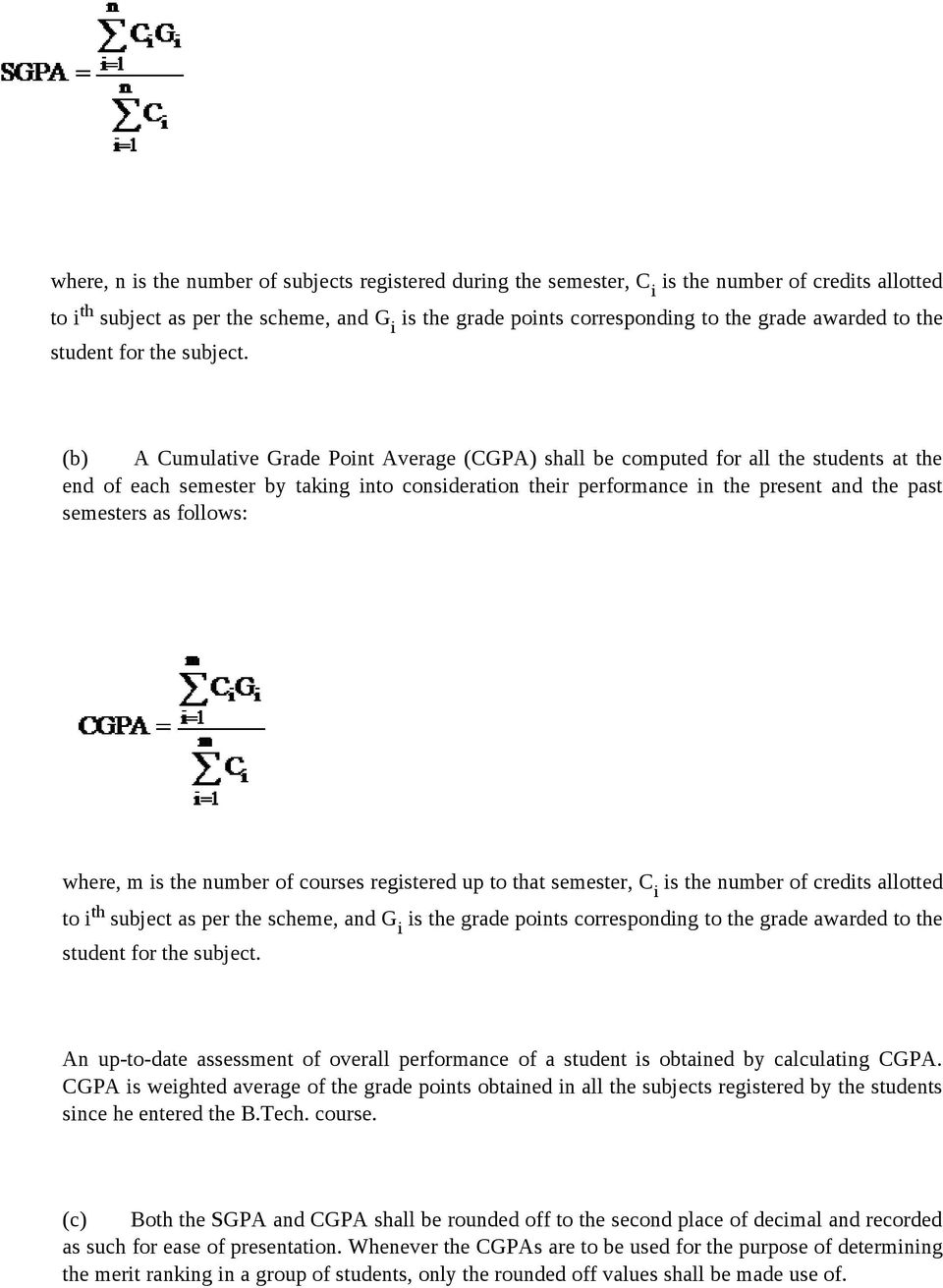
12 The university shall award the letter grade to students based on the marks secured by them in both internal assessment and Semester-End examinations taken together in the subjects registered. Each letter grade indicates a qualitative assessment of the student s performance and is associated with a specified number of grade points. The grading system along with the grade points for each grade, applicable to passed candidates is shown below. All passed candidate will be allotted a grade S, A, B, C, D, or E according to the total marks scored by him/her. If a candidate does not a pass a subject as per the conditions given in Section (9), he/she will be assigned an Unsatisfactory grade U irrespective of his/her total marks. If a student does not pass a subject in two attempts, the maximum grade he/she can get is C when he/she passes the subject in any subsequent examination, whatever be the marks scored by him/her. A student is considered to have completed a subject successfully and earned the credits if he/she secures a letter grade other than U in that course. Letter grade U has zero grade point and the candidate has to write the examination again to improve the grade. A student's performance is measured by the number of credits that he/she has earned and by the cumulative grade point average (CGPA) maintained by him/her.. Total marks scored by the passed candidate Corresponding Grade allotted Grade Points S A B C D E Semester Grade Point Average (SGPA) and Cumulative Grade Point Average (CGPA) (a) A Semester Grade Point Average (SGPA) shall be computed for all the students for each semester, as follows:

13 where, n is the number of subjects registered during the semester, C i is the number of credits allotted to i th subject as per the scheme, and G i is the grade points corresponding to the grade awarded to the student for the subject. (b) A Cumulative Grade Point Average (CGPA) shall be computed for all the students at the end of each semester by taking into consideration their performance in the present and the past semesters as follows: where, m is the number of courses registered up to that semester, C i is the number of credits allotted to i th subject as per the scheme, and G i is the grade points corresponding to the grade awarded to the student for the subject. An up-to-date assessment of overall performance of a student is obtained by calculating CGPA. CGPA is weighted average of the grade points obtained in all the subjects registered by the students since he entered the B.Tech. course. (c) Both the SGPA and CGPA shall be rounded off to the second place of decimal and recorded as such for ease of presentation. Whenever the CGPAs are to be used for the purpose of determining the merit ranking in a group of students, only the rounded off values shall be made use of.
14 13. Improvement Candidates shall be allowed to improve the grade of any two theory subjects in a semester. This can be done only in the immediate subsequent chance. If the candidate gets more marks in the improvement chance, marks scored in the improvement chance will be considered for grading in the subject; otherwise marks scored in the first attempt will be retained. No candidate shall be permitted to improve the marks scored in practical examinations and internal continuous assessment. 14. Attendance A candidate shall be permitted to appear for the Semester-End examinations only if he/she satisfies the following requirements: (a) He/she must secure not less than 75% attendance in the total number of working periods during the first year and in each semester thereafter; and shall be physically present for a minimum of 65% of the total working periods. In addition, he/she also shall be physically present in at least 20% of total attendance for each subject. (b) He/she must earn a progress certificate from the head of the institution stating that he/she has satisfactorily completed the course of study prescribed in the semester as required by these regulations. (c) His/her conduct must be satisfactory It shall be open to the Vice Chancellor to grant condonation of shortage of attendance on the recommendation of the head of the institution in accordance with the following norms. The shortage shall not be more than 10% Shortage shall not be condoned more than twice during the entire course. Candidate who is not eligible for condonation of shortage of attendance shall repeat the semester. 15. Eligibility for Promotion to Higher Semester Procedure for completing the course
15 (a) A student who has secured 75% of attendance and has exhibited satisfactory progress in the class will be eligible for promotion to the next higher semester. (b) However, before being admitted to the VIII semester classes, the student should have passed in all subjects in the combined first and second semester examination in full. Note: As this is an academic prerequisite, no exemption should be granted in this case, whatever be the causes. A candidate shall complete the programme and pass all examinations within Eight (8) years since his first admission to the B.Tech programme. 16. Registration for end Semester examination Every candidate should register for all subjects of the Semester-End examinations of each semester. A candidate who does not register will not be permitted to attend the Semester-End examinations; he/she shall not be permitted to attend the next semester. A candidate shall be eligible to register for any higher semester (i.e. 3 rd semester onwards) if he/she has satisfactorily completed the course of study and registered for the examination of the immediate previous semester. He/she should register for the semester at the start of the semester before the stipulated date. University will notify the starting and closing dates for each semester. 17. Additional Requirements for the degree In addition to the requirement prescribed for the award of B.Tech. degree, each student must complete compulsory social service for a total duration of 15 days during 3 rd to 7 th semesters of the course, A record is to be kept showing the details of social service activities undertaken and it should be approved by the Staff Advisor. Head of Institution should verify this compulsory requirement before permitting the student to register for the eighth semester. Students are expected to undertake industrial training(s) of total 10 days minimum duration or industrial visits (to minimum 2 industries) for studying about the industries of importance to the branch concerned during 4 th to 7 th semester. Students may also undertake an educational tour, the tour period shall be considered as part of the working periods of a semester. The tour maybe conducted during the vacation/holidays taking not more than 3 working days, combined with the vacation/holidays if required, between 5 th and 8 th semesters for visiting industries (at least two) of importance to the branch concerned. Faculty members shall accompany the students for the industrial visits/educational tour. Each student shall submit detailed bound report(s) of the training/visit/tour to the Head of Department within two weeks after the programme. These bound report(s), signed by the staff advisor or faculty in charge of tour/training/visit and by the head of department, shall also be brought during the final Viva-Voce. 18. Examination Monitoring Cell

16 Head of the each institution should formulate an Examination Monitoring Cell at the institution for supervising all examinations, especially the internal examinations. This cell, with a senior staff member as Convener, shall consist of minimum three members (one shall be a lady). The collective responsibilities of the examination monitoring cell are (a) officiate as the examination squad to keep a vigil on all Semester-End examinations. If any malpractices are found/reported by invigilators, inform these to the Head of Institution along with a report about the incident. Head of Institution shall forward all such complaints to the University. (b) schedule all examinations conducted as part of internal assessment of students. (c) to receive any complaint from students regarding issues like out-of-syllabus questions, printing mistakes, etc. of Semester-End examinations of theory and practical subjects. The cell shall investigate these complaints and if necessary forward it to university with specific comments. (d) to receive any complaints from students regarding internal examinations, enquire such incidents, and give a report to the Head of Institution for necessary action. To conduct all the theory examinations, a Chief Superintendent and a Senior Assistant Superintendent should be appointed internally by the Head of Institution. At least one external Additional Chief Superintendent from government/government-aided engineering colleges within the University should be appointed by the University for conducting theory examinations in all affiliated self financing Engineering Colleges. 19. Electives All students shall choose four elective subjects, one in the sixth, one in the seventh and two in eighth semesters from a set of elective subjects prescribed in the syllabus and offered by the institution. There should be at least 25% students of the class for an elective subject to be offered. However, any student having a CGPA of not less than 7.5 shall be permitted to select an elective of his/her choice and register under a faculty subject to the permission from the faculty and Head of Department. The student will have to study this subject on his own (self-study mode) or the classes of this subject shall be taken during off-hours. A student can opt for interdisciplinary electives, termed as global electives in the syllabus, maximum one during 8 th semesters subject to the permission from both Heads of Departments and the faculty handling the elective subject. Minimum number of students for a global elective shall be 15 and maximum 60. New electives may be introduced according to the needs of emerging fields in technology. The name of the elective and its syllabus should be approved by the university before the subject is offered as an
17 elective. 20. Class Committee Head of institution shall take necessary steps to form a class committee for each class at the start of classes of each semester. This class committee shall be in existence for the semester concerned. The class committee shall consist of the Head of Department, Staff Advisor of the class, a senior faculty member of the department, a faculty member from another department, and two student representatives (one of them should be a girl in a mixed class). There should be at least two meetings of the class committee every semester; it shall be the responsibility of the Head of Department to convene these meetings. The decisions of the Class Committee shall be recorded in a register for further reference. Each class committee will communicate its recommendations to the Head of Institution. The responsibilities of the class committee are: (a) (b) (c) (d) (e) to review periodically the progress and conduct of students in the class. to discuss any problems concerning any subjects in the semester concerned. to identify weaker students of the class and suggest remedial measures. to review teaching effectiveness and coverage of syllabus. discuss any other issue related to the students of the class. 21. Eligibility for the Degree No candidate shall be eligible for the B.Tech. degree unless he has undergone the prescribed course of study for a period of not less than four academic years in an institution in the state of Kerala and recognized by affiliated /recognized to the Mahatma Gandhi University and has passed all subjects as per the prescribed syllabus. No candidate under lateral entry scheme shall be eligible for the B.Tech. degree unless he has undergone the prescribed course of study for a period of not less than three academic years in an institution affiliated to the Mahatma Gandhi University and has passed all subjects of 3 rd to 8 th semesters as per the prescribed syllabus.

18 22. Classification of Successful Candidates (a) A candidate who qualifies for the degree, passing all the subjects of the eight semesters within 5 academic years after the commencement of his course of study and secures not less than a CGPA of 8.0 of all the semesters shall be declared to have passed the B.Tech. degree examination in First Class with Honours. (b) A candidate who qualifies for the degree, passing all the subjects of the eight semesters within 5 academic years after the commencement of his course of study and secures not less than a CGPA of 6.5 of all the semesters shall be declared to have passed the B.Tech. degree examination in First Class. (c) All other candidates who qualify for the degree passing all the subjects of the eight semesters and not covered as per Sections 22 (a) and (b) shall be declared to have passed the B.Tech. degree examination in second class. (d) Classification of the lateral entry student shall be given based on the CGPA of 3 rd to 8 th semesters. The final mark-list of lateral entry students should indicate that (i) the student was admitted through lateral entry scheme (ii) classification is based on CGPA of 3 rd to 8 th semesters. In case of lateral entry students, clause 22(a) and 22(b) shall hold good except for the number of academic years which shall be 4 academic years after the commencement of the course of study. It may be indicated in each mark-list that the internal assessment marks and Semester-End examination marks of practical subjects are normalised. 23. Grievance Cell Each college should setup a Grievance Cell with at least four faculty members to look into grievances of the students, if any. 24. Anti-Ragging Cell Head of Institution shall take necessary steps to constitute anti-ragging committee and squad at the commencement of each academic year. The committee and the squad shall take effective steps as specified by the Honorable Supreme Court of India, to prevent ragging.

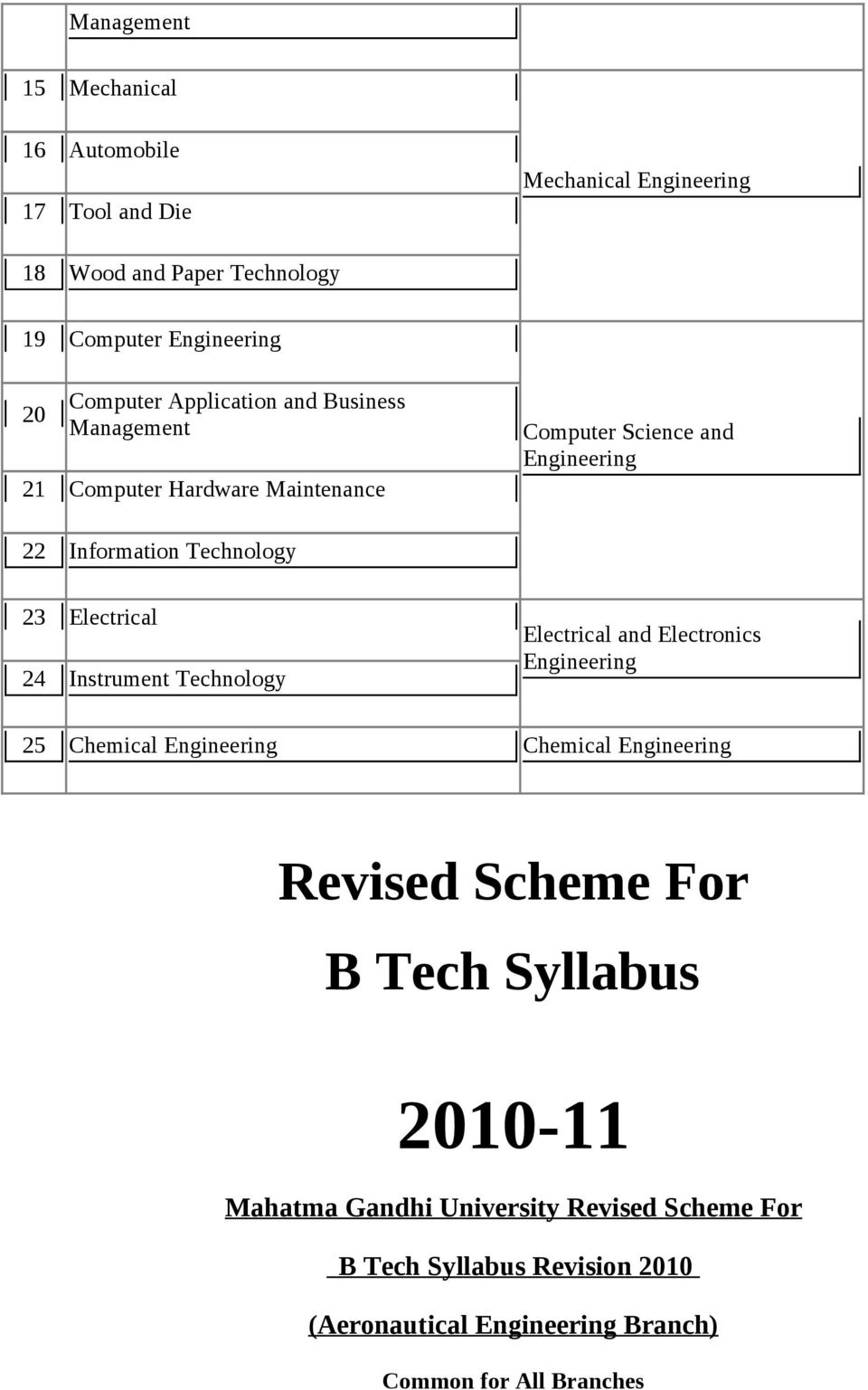
19 Notwithstanding all that has been stated above, the University has right to modify any of the above regulations from time to time as per University rules. Annexure Equivalency of Diploma Streams for Lateral entry B.Tech. Admission Sl. No. Specialisation in Diploma Branch Equate for B.Tech. Admission 1 Applied Electronics 2 Electronics 3 Medical Electronics 4 Electronics and Avionics 5 Telecommunication Technology 6 Electronics and Instrumentation Electronics and Communication Engineering 7 Electronics and Medical Instrumentation 8 Electronics Production Technology 9 Medical Instrumentation 10 Power Electronics 11 Biomedical Engineering 12 Civil Civil Engineering 13 Architecture 14 Quantity Survey and Construction

20 Management 15 Mechanical 16 Automobile 17 Tool and Die Mechanical Engineering 18 Wood and Paper Technology 19 Computer Engineering 20 Computer Application and Business Management 21 Computer Hardware Maintenance Computer Science and Engineering 22 Information Technology 23 Electrical 24 Instrument Technology Electrical and Electronics Engineering 25 Chemical Engineering Chemical Engineering Revised Scheme For B Tech Syllabus Mahatma Gandhi University Revised Scheme For B Tech Syllabus Revision 2010 (Aeronautical Engineering Branch) Common for All Branches
21 SCHEME S1S2 durationhours EN Engineering Mathematics I EN Engineering Physics EN Engineering. Chemistry & Environmental Studies EN Engineering Mechanics EN Engineering Graphics EN Basic Civil Engineering EN Basic Mechanical Engineering EN EN Basic Electrical Engineering Basic Electronics Engineering. & Information Technology EN Mechanical Workshop EN Electrical and Civil Workshops Total rd Semester duration -hours EN Engineering Mathematics II EN Economics and Communication
22 Skills (3+1) AN Fluid Mechanics AN Basic Thermodynamics AN Elements of Aeronautics AN Basic Strength of Materials AN (CE) Basic Strength of materials Lab AN (ME) Fluid Mechanics Lab Total th Semester durationhours EN Engineering Mathematics III AN Gas Dynamics AN Propulsion I AN Aerodynamics I AN Aircraft Structures I AN Electrical technology & Machines AN Structures Lab AN Propulsion Lab Total th Semester
23 durationhours EN A Engineering Mathematics IV N EN (ME) Principles of Management AN Computer Programming AN Flight Dynamics I AN Aerodynamics II AN Propulsion II AN Wind tunnel Lab AN Propulsion LabII Total th Semester duration -hours AN Avionics AN Experimental Aerodynamics AN Aircraft Structures II AN Heat Transfer AN Theory of Vibration AN Lxx Elective I
24 AN Heat Engines Lab AN Aero EnginesLab Total Elective I AN L01 Composite structures AN L02 Fatigue and fracture AN L03 Finite Elément Analysis AN L04 Operation Research AN L05 Ecology & Environment AN L06 Non Destructive Testing 7 th Semester duration -hours AN Computational Fluid Dynamics AN Experimental stress analysis AN Aircraft design AN Flight dynamics II AN Aircraft systems and instrumentation AN Lxx Elective II AN Experimental stress analysis Lab AN Vibration Lab AN Seminar
25 AN Project Total Elective II AN L01Theory of plates and shells AN L02 Advanced Materials in aircraft manufacturing AN L03 Failure analysis AN L04 Helicopter Aerodynamics AN L05 Optimization methods in Design AN L06 Rotor Dynamics 8 th Semester durationhours Credi ts AN Rockets & Missiles AN Introduction to space technology AN Air transportation & Aircraft maintenance AN Lxx Elective III AN Gxx Elective IV AN Aerodynamics Lab AN Project AN Viva Voce Total
26 Electives III AN L01 AN L02 AN L03 AN L04 AN L05 AN L06 Project management & TQM Air navigation Aircraft rules & regulations Industrial aerodynamics Acoustics & Noise control Transport process in reacting flows Electives IV AN G01 Boundary layer theory AN G02 Disaster Management AN G03 Cryogenics AN G04 Advanced strength of materials AN G05 High temperature gas dynamics AN G06 Turbo Machines Mahatma Gandhi University Revised Scheme For B Tech Syllabus Revision 2010 (Applied Electronics & Instrumentation Engineering) Common for All Branches SCHEME S1S2
27 durationhours EN Engineering Mathematics I EN Engineering Physics EN Engineering. Chemistry & Environmental Studies EN Engineering Mechanics EN Engineering Graphics EN Basic Civil Engineering EN Basic Mechanical Engineering EN Basic Electrical Engineering EN Basic Electronics Engineering. & Information Technology EN Mechanical Workshop EN Electrical and Civil Workshops Total rd Semester duration -hours EN EN Engineering Mathematics II Economics and Communication Skills (3+1) AI Network Theory
28 AI Solid State devices AI Analog Circuits I AI Computer Programming (LASN) AI Analog circuits Lab AI Programming Lab Total th Semester duration -hours EN Engineering Mathematics III EN (ME) Principles of Management AI Signals and Systems AI Digital Electronics AI Signal Communication AI Analog circuits II AI Analog circuits II lab AI Digital IC lab Total th Semester
29 durationhours EN Engg Mathematics IV AI Industrial Electronics and Applications AI Basic Instrumentation & recording system AI Data Acquisition system AI Control Engineering I AI Microprocessors and microcontrollers AI Industrial Electronics Lab AI Measurements lab Total th Semester duration -hours AI Process Control Instrumentation AI Digital Signal Processing AI Industrial Instrumentation I AI Microcontroller based system design AI Control Engineering II AI Lxx Elective I AI Microprocessors &
30 microcontrollers lab AI Mini Project Total Elective I AI L01 AI L02 AI L03 AI L04 AI L05 AI L06 Mechatronics Micro Electronics Digital system design Industrial safety engineering Reliability Engineering Energy management 7 th Semester duration -hours AI VLSI AI Computerised Process control AI Biomedical Instrumentation AI Analytical instrumentation AI Industrial Instrumentation II AI Lxx Elective II AI Industrial Instrumentation Lab AI DSP lab AI Seminar
31 AI Project Total Elective II AI L01 AI L02 AI L03 AI L04 AI L05 AI L06 Robotics Real Time system Optimization techniques Fuzzy Logic Digital Image processing Advanced microcontrollers 8 th Semester durationhours Credi ts AI Instrumentation system design AI Instrumentation in process industries AI Computer Networks AI Lxx Elective III AI Gxx Elective IV AI Process Control Lab AI Project AI Viva Voce Total
32 Electives III AI L01 AI L02 AI L03 AI L04 AI L05 AI L06 Neural networks Advanced DSP Embedded systems Artificial Intelligence VHDL BioInformatics Electives IV AI G01 AI G02 AI G03 AI G04 AI G05 AI G06 Total quality management Human factors engineering System engineering Professional Ethics Industrial Pollution control Simulation and modelling Mahatma Gandhi University Revised Scheme For B Tech Syllabus Revision 2010 (Automobile Engineering) Common for All Branches SCHEME S1&S2 durationhours EN Engineering Mathematics I
33 EN Engineering Physics EN Engineering. Chemistry & Environmental Studies EN Engineering Mechanics EN Engineering Graphics EN Basic Civil Engineering EN Basic Mechanical Engineering EN EN Basic Electrical Engineering Basic Electronics Engineering. & Information Technology EN Mechanical Workshop EN Electrical and Civil Workshops Total rd Semester duration -hours EN Engineering Mathematics II EN AU Economics and Communication Skills Fluid Mechanics and Hydraulic Machinery (3+1) AU (ME) Metallurgy & Material Science AU (ME) Programming in C
34 AU (CE) Strength of Materials & Structural Engineering AU Computer Lab AU (ME) Fluid Mechanics Lab Total th Semester durationhours EN Engineering Mathematics III EN (ME) Principles of Management AU Auto Power Plant AU (ME) Manufacturing Process AU Machine Drawing AU (EE) Electrical Technology AU Auto Workshop I AU (CE) Strength of Materials Lab Total th Semester durationhours EN A Engineering Mathematics IV
35 N AU Computer Aided Design & Manufacturing AU Auto Chassis AU (ME) Kinematics of Machinery AU (ME) I C Engines & Combustion AU (ME) Thermodynamics AU Computer Graphics & Drafting AU (EE) Electrical & Electronics Lab Total th Semester duration -hours AU Mechanics of Machines AU (ME) Heat & Mass Transfer AU Automotive Transmission AU (ME) Metrology & Machine Tools AU (ME) Mechatronics & Control Systems AU Lxx Elective I AU Heat Engines Lab AU Machine Tool Lab Total
36 Elective I AU L01 Vehicle Transport Management AU L02 Computer Aided vehicle Design AU L03 Computer Simulation of I C Engines AU L04 Tribology AU L05 Alternate Fuels and Energy systems AU L06 Quantitative Techniques 7 th Semester duration -hours AU (ME) Design of Machine Elements AU Advanced Automotive Technology AU Auto Electrical & Electronics AU (ME) Refrigeration & Air Conditioning AU (ME) Industrial Engineering AU Lxx Elective II AU (ME) Mechanical Measurements Lab AU Auto Workshop II AU Seminar AU Project Total Elective II
37 AU L01 Vehicle Body Engineering AU L02 Vehicle Performance and Testing AU L03 Automotive Pollution and Control AU L04 Project Management AU L05 Industrial Safety AU L06 Non Traditional Machining Processes 8 th Semester durationhours Credi ts AU (ME) Design of Transmission Elements AU (ME) Operations Management AU Special Types of Vehicles AU Lxx Elective III AU Gxx Elective IV AU Auto Workshop III AU Project AU Viva Voce Total Electives III AU L01 Transport Refrigeration and Air Conditioning AU L02 AU L03 Engineering Economics and Automotive Cost Estimation Vehicle Dynamics
38 AU L04 AU L05 AU L06 Finite Element Method Microprocessor Application in Automobiles Foundry and Welding Technology Electives IV AU G01 System Modeling and Simulation AU G02 Robotics and Robot Application AU G03 Farm Machinery and Equipment AU G04 AU G05 AU G06 Aerospace Engineering Management Information systems Petrochemical Engineering Mahatma Gandhi University Revised Scheme For B Tech Syllabus Revision 2010 Common for All Branches SCHEME S1S2 durationhours EN Engineering Mathematics I EN Engineering Physics EN Engineering. Chemistry & Environmental Studies EN Engineering Mechanics EN Engineering Graphics
39 EN Basic Civil Engineering EN Basic Mechanical Engineering EN EN Basic Electrical Engineering Basic Electronics Engineering. & Information Technology EN Mechanical Workshop EN Electrical and Civil Workshops Total rd Semester MAHATMA GANDHI UNIVERSITY CIVIL ENGINEERING Scheme for BTech. Degree III to VIII Semesters 2010 duration -hours EN Engineering Mathematics II EN Economics and Communication Skills (3+1) CE Fluid Mechanics CE Mechanics of Solids I CE Surveying I CE Engineering Geology CE Material Testing Lab I CE Surveying Practical I Total
40 4 th Semester durationhours EN Engineering Mathematics III CE Construction Engineering and Management CE Mechanics of Solids II CE Open Channel Flow and Hydraulic Machines CE Surveying II CE Civil Engineering Drawing CE Surveying Practical II CE (ME) Hydraulics Lab Total th Semester durationhours EN A Engineering Mathematics IV N
41 CE Computer Programming CE Design of Concrete Structures I CE Geotechnical Engineering I CE Quantity Surveying and Valuation CE Structural Analysis I CE Computing Techniques Lab CE Geotechnical Engineering Lab Total th Semester duration -hours CE Design of Steel Structures CE Geotechnical Engineering II CE Structural Analysis II CE Transportation Engineering I CE Water Resources Engineering CE Lxx Elective I CE Computer Aided Design and Drafting Lab Elective I CE Material Testing Lab II Total CE L01 CE L02 CE L03 Advanced Surveying Open Channel and Coastal Hydraulics Airport Engineering
42 CE L04 CE L05 CE L06 Advanced Mechnics of Materials Concrete Technology Soil Stability Analysis. 7 th Semester durationhours CE Design of Hydraulic Structures CE Environmental Engineering I CE Design of Concrete Structures II CE Architecture and Town Planning CE Transportation Engineering II CE Lxx Elective II CE Computer Applications Lab CE Transportation Engineering Lab CE Seminar CE Project Total Elective II CE L01 CE L02 Building Automation and Smart Structures Ground Improvement Technicques CE L03. Prestressed Concrete. CE L04 Environmental Impact Assessment CE L05 Theory of Plates and Shells CE L06 Traffic Engineering and Management
43 8 th Semester durationhours L T P/D Inte-rnal End-sem CE Advanced Structural Design CE Building Technology and Management CE Environmental Engineering II CE Lxx Elective III CE Gxx Elective IV CE Environmental Engineering Lab CE Project CE Viva Voce Total Electives III CE L01 CE L02 CE L03 CE L04 CE L05 CE L06 Advanced Foundation Design Environmental Geotechniques Earthquake Engineering and Design Advanced Hydrology and System Analysis Highway and Airfield Pavements Structural Dynamics and Stability Analysis Electives IV CE G01 Finite Element Analysis
44 CE G02 Environmental Pollution Control Techniques CE G03 Optimization Techniques CE G04 Land Use Planning CE G05 Numerical Methods CE G06 Remote Sensing and GIS Applications Mahatma Gandhi University Revised Scheme For B Tech Syllabus Revision 2010 (Computer Science & Engineering) Common for All Branches SCHEME S1&S2 durationhours EN Engineering Mathematics I EN Engineering Physics EN Engineering Chemistry & Environmental Studies EN Engineering Mechanics EN Engineering Graphics EN Basic Civil Engineering EN Basic Mechanical Engineering EN Basic Electrical Engineering EN Basic Electronics Engg. &
45 Information Technology EN Mechanical Workshop EN Electrical and Civil Workshops Total rd Semester Hours/week Marks EN Engineering Mathematics II EN CS Economics and Communication Skills Problem Solving and Computer Programming (3+1 ) CS Computer Organization CS Switching Theory and Logic Design CS (EC) Electronics Devices and Circuits CS Programming lab CS (EC) Logic Design lab Total th Semester duration L T P/D Inte- End- -hours Cred its
46 rnal sem EN Engineering Mathematics III CS Object Oriented Programming CS Data Structures and Algorithms CS (EC) Signals and Communication Systems CS Microprocessor Systems CS Theory of Computation CS Data Structures lab CS (EC) Electronic Circuits & Communication lab Total th Semester Hours/week Marks duratio n-hours Cred its EN B Engineering Mathematics IV EN (ME) Principles of Management CS Database Management Systems CS (EC) Digital Signal Processing CS Operating Systems CS Advanced Microprocessors & Peripherals
47 CS Database Lab CS Hardware & Microprocessors lab Total th Semester Hours/week Marks End-sem duration -hours Cred its CS Design and Analysis of Algorithms CS Internet Computing CS System Software CS Computer Networks CS Software Engineering CS Lxx Elective I CS Operating Systems Lab CS Mini Project Total Elective I CS L01 CS L02 CS L03 CS L04 Distributed Systems Micro controller Based Systems User Interface Design Unix Shell Programming
48 CS L05 CS L06 Embedded Systems Advanced Software Environments 7 th Semester Hours/week Marks duratio n-hours Cred its CS Web Technologies CS Compiler Construction CS Computer Graphics CS Object Oriented Modelling & Design CS Principles of Programming Languages CS Lxx Elective II CS Systems Programming Lab CS Networking lab CS Seminar CS Project Total Elective II CS L01 CS L02 CS L03 CS L04 CS L05 CS L06 Real Time Systems Data Mining and Data Warehousing Operating System Kernel Design Digital image processing Data Processing and File Structures Client Server and Applications
49 8 th Semester Hours/week Marks End-sem durationhours Cred its CS High Performance Computing CS Artificial Intelligence CS Security in Computing CS Lxx Elective III CS Gxx Elective IV CS Computer Graphics Lab CS Project CS Viva Voce Total Elective III CS L01 CS L02 CS L03 CS L04 CS L05 CS L06 E-commerce Grid Computing Bioinformatics Optimization Techniques Mobile Computing Advanced networking trends Elective IV CS G01 CS G02 CS G03 Multimedia Techniques Neural networks Advanced Mathematics
50 CS G04 CS G05 CS G06 Software Architecture Natural Language Processing Pattern Recognition Mahatma Gandhi University Revised Scheme For B Tech Syllabus Revision 2010 (ELECTRICAL & ELECTRONICS ENGINEERING) Common for All Branches SCHEME S1S2 durationhours EN Engineering Mathematics I EN Engineering Physics EN Engineering. Chemistry & Environmental Studies EN Engineering Mechanics EN Engineering Graphics EN Basic Civil Engineering EN Basic Mechanical Engineering EN EN Basic Electrical Engineering Basic Electronics Engineering. & Information Technology EN Mechanical Workshop EN Electrical and Civil Workshops
51 Total rd Semester duration -hours EN EN EE EE Engineering Mathematics II Economics and Communication Skills Electric Circuit Theory Electrical Measurements and Measuring Instruments (3+1) EE Electronic Circuits EE (ME) Mechanical Technology EE Electrical Measurements Lab EE Mechanical Lab Total th Semester duration -hours
52 EN Engineering Mathematics III EE DC Machines and Transformers EE Linear System Analysis EE Electromagnetic Theory EE Digital Systems and Computer Organization EE Computer Programming EE Computer Programming Lab EE Electronic Circuits Lab Total th Semester
53 6 th Semester duration -hours EE Power Generation and Distribution EE Induction Machines EE Control System Engineering EE Digital Signal Processing EE Microcontrollers and Embedded Systems EE Lxx Elective I EE Power Electronics Lab EE Mini project/ Microprocessor and Microcontroller Lab Total Elective I EE L01 EE L02 EE L03 EE L04 EE L05 EE L06 H V Engineering VLSI systems Artificial Neural Networks Object Oriented Programming Bio - medical engineering Renewable energy Sources 7 th Semester
54 duration -hours EN Electrical Power Transmission EE Synchronous Machines EE Drives and Control EE Modern Control Theory EE Communication Engineering EE Lxx Elective II EE Electrical CAD EE Electrical Machines Lab II EE Seminar EE Project Total Elective II EE L01 EE L02 EE L03 EE L04 EE L05 EE L06 H V D C Transmission Industrial Instrumentation Power Quality PLC Based system MEMS Special Electrical Machines 8 th Semester
55 durationhours Credi ts EE Power System Analysis EE Switch Gear and Protection EE Electrical System Design EE Lxx Elective III EE Gxx Elective IV EE Project EE Control and Simulation Lab EE Viva Voce Total Electives III EE L01 EE L02 EE L03 EE L04 EE L05 EE L06 Advanced Power System Computer Networks Generalized Machine Theory Finite Element applications in Electrical Engineering. Digital Signal Processors Opto Electronics Electives IV EE G01 EE G02 Soft Computing Techniques Intellectual property rights
56 EE G03 EE G04 EE G05 EE G06 Advanced Mathematics Virtual Instrumentation Digital Image Processing Distributed Power Systems Mahatma Gandhi University Revised Scheme For B Tech Syllabus Revision 2010 (Electronics & Communication Engineering) Common for All Branches SCHEME S1S2 durationhours EN Engineering Mathematics I EN Engineering Physics EN Engineering. Chemistry & Environmental Studies EN Engineering Mechanics EN Engineering Graphics EN Basic Civil Engineering EN Basic Mechanical Engineering EN EN Basic Electrical Engineering Basic Electronics Engineering. & Information Technology EN Mechanical Workshop EN Electrical and Civil Workshops
57 Total rd Semester durationhours EN Engineering Mathematics II EN Economics and Communication Skills (3+1) EC Network Theory EC Solid State Devices EC Analog Circuits - I EC Computer Programming EC Analog Circuits Lab EC Programming Lab Total th Semester durationhours EN Engineering Mathematics III EN (ME) Principles of Management EC Signals and Systems
58 EC Digital Electronics EC Analog Communication EC Analog Circuits -II EC Analog Circuits -II Lab EC Analog Communication Lab Total th Semester
59 6 th Semester duration -hours EC Digital Communication Techniques EC Digital Signal Processing EC Radiation and Propagation EC Computer Architecture and Parallel Processing EC Microcontrollers and Applications EC Lxx Elective I EC Microprocessor and Microcontroller Lab EC Mini Project Lab Total Elective I EC L01 Data Structures and Algorithms EC L02 Data Base Management Systems EC L03 High Speed Digital Design EC L04 Medical Electronics EC L05 Soft Computing Techniques EC L06 Television and Radar Engineering 7 th Semester
60 duration -hours EC VLSI Design EC Information Theory and Coding EC Microwave Engineering EC Electronic Instrumentation EC Embedded Systems EC Lxx Elective II EC Advanced Communication Lab EC VLSI and Embedded Systems Lab EC Seminar EC Project Total Elective II EC L01 Optimization Techniques EC L02 Speech and Audio Processing EC L03 Digital Image Processing EC L04 Wavelets and Applications EC L05 Antenna Theory and Design EC L06 System Software 8 th Semester duration- Credi
61 hours ts EC Wireless Communication EC Communication Networks EC Light Wave Communication EC Lxx Elective III EC Gxx Elective IV EC Systems lab EC Project EC Viva Voce Total Electives III EC L01 Nano Electronics EC L02 Micro Electro Mechanical Systems EC L03 Secure Communication EC L04 Management Information Systems EC L05 Pattern Recognition EC L06 R F Circuits Electives IV EC G01 Test Engineering EC G02 E-Learning EC G03 Mechatronics EC G04 Bio Informatics EC G05 Intellectual Property Rights
62 EC G06 Professional Ethics Mahatma Gandhi University Revised Scheme For B Tech Syllabus Revision 2010 (ELECTRONICS AND INSTRUMENTATION ENGINEERING) Common for All Branches SCHEME S1S2 durationhours EN Engineering Mathematics I EN Engineering Physics EN Engineering. Chemistry & Environmental Studies EN Engineering Mechanics EN Engineering Graphics EN Basic Civil Engineering EN Basic Mechanical Engineering EN Basic Electrical Engineering EN Basic Electronics Engineering. & Information Technology EN Mechanical Workshop EN Electrical and Civil Workshops Total rd Semester
63 durationhours EI Engineering Mathematics II EI Economics and Communication Skills (3+1) EI Network Theory EI Electronic Devices and Circuits I EI Basic Instrumentation EI Computer Programming EI Electronic circuits lab I EI Programming Lab(C,C++,Matlab) Total th Semester durationhours EN Engineering Mathematics III EN (ME) Principles of Management EI Signals&Systems EI Digital Electronics EI Electronic instrumentation EI Elecronic Devices and Circuits II
64 EI Electronic circuits Lab II EI Basic Instrumentation Lab Total th Semester durationhours EN A Engineering Mathematics IV N EI Industrial electronics and applications EI Linear integrated circuits and applications EI Transducer engineering EI Control engineering I EI Microprocessors and Microcontrollers EI Instrumentation lab I EI Integrated circuits lab Total th Semester
65 duration -hours EI Process Control Instrumentation EI Digital Signal Processing EI Industrial instrumentation I EI Data acquisition and communication EI Control engineering II EI Lxx Elective I EI Microprocessor and Microcontroller Lab EI Mini Project Total Elective I EI L01 Digital system design EI L02 Data Base Management Systems EI L03 Computer networks EI L04 micro controller based system design EI L05 Telimetry and remote control EI L06 Robotics and automation 7 th Semester duration -hours
66 EI Fibre Optics and Laser Instrumentation EI Computerised Process Control EI Biomedical Instrumentation EI Analytical Instrumentation EI Industrial Instrumentation II EI Lxx Elective II EI Instrumentation lab II EI System simulation lab EI Seminar EI Project Total Elective II EI L01 Optimization Techniques EI L02 VLSI Technology EI L03 Digital Image Processing EI L04 Applied soft computing EI L05 Instrumentation in petrochemical industries EI L06 Reliability and safety engineering 8 th Semester durationhours Credi ts EI Instrumentation System Design EI Instrumentation in Process Industries
67 EI Advanced Instrumentation and Applications EI Lxx Elective III EI Gxx Elective IV EI Process control lab EI Project EI Viva Voce Total Electives III EI L01 Nano Electronics EI L02 Micro Electro Mechanical Systems EI L03 Biomedical signal processing EI L04 Real time embedded systems EI L05 Environmental monitoring instruments EI L06 Air craft instrumentation Electives IV EI G01 Test Engineering EI G02 Total quality management EI G03 Human factors engineering EI G04 Bio Informatics EI G05 Intellectual Property Rights EI G06 Professional Ethics
68 Mahatma Gandhi University Revised Scheme For B Tech Syllabus Revision 2010 (Information Technology) Common for All Branches SCHEME S1S2 durationhours EN Engineering Mathematics I EN Engineering Physics EN Engineering. Chemistry & Environmental Studies EN Engineering Mechanics EN Engineering Graphics EN Basic Civil Engineering EN Basic Mechanical Engineering EN Basic Electrical Engineering EN Basic Electronics Engineering. & Information Technology EN Mechanical Workshop EN Electrical and Civil Workshops Total rd Semester
69 duration -hours EN Engineering Mathematics II EN IT (EC) IT IT IT IT (EC) Economics and Communication Skills Discrete and Integrated Electronic Circuits Switching Theory and Logic Design Principles of Communication Engineering Problem Solving and Computer Programming Electronic Circuits and Communication Lab (3+1) IT Programming Lab Total th Semester durationhours EN Engineering Mathematics III EN (ME) Principles of Management IT Computer Organisation and Architecture IT Theory of Computation
70 IT Data Structures and Algorithms IT Object Oriented Techniques IT Logic Design Lab IT Data Structures and Programming Lab Total th Semester durationhours EN B Engineering Mathematics IV N IT Microprocessors and Microcontrollers IT Digital Communication IT Operating Systems IT Language Translators IT Database Management Systems IT PC Hardware and Microprocessors Lab IT Systems Lab Total th Semester
71 duration -hours IT Computer Networks IT Digital Signal Processing IT Information Theory and Coding IT Software Engineering IT Design and Analysis of Algorithms IT Lxx Elective I IT Network Programming Lab IT Mini Project Total Elective I IT L01 Simulation and Modelling IT L02 Management Information Systems IT L03 UNIX Shell Programming IT L04 Advanced Database Systems IT L05 Parallel Computing IT L06 Optimization Techniques
72 7 th Semester duration -hours IT Financial Management and E- Banking IT IT Object Oriented Modelling and Design Computer Graphics and Multimedia Systems IT Internetworking IT Web Applications Development IT Lxx Elective II IT Internetworking Lab IT Computer Aided Software Engineering Lab IT Seminar IT Project Total Elective II IT L01 Software Project Management IT L02 Optical Communication Networks IT L03 Digital Speech and Image Processing
73 IT L04 Real Time Systems IT L05 Operating System Kernel Design IT L06 Data Mining and Data Warehousing 8 th Semester durationhours Credi ts IT Wireless Communication IT Cryptography and Network Security IT Artificial Intelligence IT Lxx Elective III IT Gxx Elective IV IT Web Applications Lab IT Project IT Viva Voce Total Electives III IT L01 Software Testing IT L02 Information Retrieval IT L03 High Speed Networks
74 IT L04 Network Administration and Management IT L05 Enterprise Resource Planning IT L06 Grid Computing Electives IV IT G01 Software Architecture IT G02 Advanced Mathematics IT G03 Ad Hoc and Sensor Networks IT G04 Electronic Business and Services IT G05 IT G06 Neural Networks Soft Computing Mahatma Gandhi University Revised Scheme For B Tech Syllabus Revision 2010 (Mechanical Engineering) Common for All Branches SCHEME S1S2 durationhours EN Engineering Mathematics I EN Engineering Physics EN Engineering. Chemistry & Environmental Studies EN Engineering Mechanics
75 EN Engineering Graphics EN Basic Civil Engineering EN Basic Mechanical Engineering EN EN Basic Electrical Engineering Basic Electronics Engineering. & Information Technology EN Mechanical Workshop EN Electrical and Civil Workshops Total rd Semester duration -hours EN Engineering Mathematics II EN Economics and Communication Skills (3+1) ME Fluid Mechanics ME Metallurgy & Material Science ME Programming in C ME (CE) Strength of Materials & Structural Engineering ME Computer ProgrammingLab ME Fluid Mechanics Lab Total
76 4 th Semester durationhours EN Engineering Mathematics III EN (ME) Principles of Management ME Hydraulic Machines ME Manufacturing Process ME Machine Drawing ME (EE) Electrical Technology ME Hydraulic Machines Lab ME (CE) Strength of Materials Lab Total th Semester durationhours EN A Engineering Mathematics IV N ME Computer Aided Design & Manufacturing ME Advanced Mechanics of Materials ME Kinematics of Machinery ME I.C.Engines & Combustion
77 ME Thermodynamics ME Computer Graphics & Drafting ME Electrical & Electronics Lab Total th Semester duration -hours ME Mechanics of Machines ME Heat & Mass transfer ME Thermal Systems & Applications ME Metrology & Machine Tools ME Mechatronics & Control System ME Lxx Elective I ME Heat Engines Lab ME Machine Tools Lab Total Elective I ME L01 Computational Fluid Dynamics ME L02 Composite Matérials Technology ME L03 Automobile engineering ME L04 Advanced strength of materials ME L05 Industrial Hydraulics
78 ME L06 Project management 7 th Semester duration -hours ME Design of Machine Elements ME Dynamics of Machines ME Gas Dynamics & Jet Propulsion ME Refrigeration & Air Conditioning ME Industrial Engineering ME Lxx Elective II ME Mechanical Measurements Lab ME Advanced Machine Tools Lab ME Seminar ME Project Total Elective II ME L01 Plant Engineering & Maintenance ME L02 Turbomachines ME L03 Theory of vibration ME L04 Sales & Marketing Management ME L05 Failure analysis & design ME L06 Foundary & Welding Technology
79 8 th Semester durationhours Credi ts ME Design of Transmission Elements ME Operations Management ME Production Engineering ME Lxx Elective III ME Gxx Elective IV ME Mechanical Systems Lab ME Project ME Viva Voce Total Electives III ME L01 ME L02 ME L03 ME L04 ME L05 ME L06 Aerospace Engineering Advanced Machining Process Cryogenics Acoustics & noise control Non Destructive Testing Advanced operations research Electives IV
80 ME G01 Industrial Safety ME G02 Disaster Management ME G03 Nano Technology ME G04 Finite element analysis ME G05 Optimization methods in design ME G06 Petrochemical Engineering Mahatma Gandhi University Revised Scheme For B Tech Syllabus Revision 2010 (Instrumentation & Control Engineering) Common for All Branches SCHEME S1S2 duration End-sem -hours EN Engineering Mathematics I EN Engineering Physics EN Engineering. Chemistry & Environmental Studies EN Engineering Mechanics EN Engineering Graphics EN Basic Civil Engineering EN Basic Mechanical Engineering EN EN Basic Electrical Engineering Basic Electronics Engineering. & Information Technology EN Mechanical Workshop
81 EN Electrical and Civil Workshops Total rd Semester durationhours EN Engineering Mathematics II EN Economics and Communication Skills (3+1) IC Network Theory IC Analog Devices & Circuits IC Basic Instrumentation & Measurements Engineering IC Computer Programming IC Basic Electronics Laboratory IC Programming Lab(C,C++,Matlab) Total th Semester duration -hours L T P/ D Internal EN Engineering Mathematics III EN010 Principles of
82 402(ME) Management IC Transducer Engineering IC Digital Electronics IC Electrical Engineering IC Mechanical Engineering IC Electrical Machines Laboratory IC Digital IC Laboratory Total th Semester durationhours EN A Engineering Mathematics IV N IC Industrial Electronics & Applications IC Electronic Instrumentation IC Linear Integrated Circuits IC Linear Control System IC IC Microprocessors and Microcontrollers Microprocessor & Microcontroller Lab IC Linear Integrated Circuits Lab
83 Total th Semester duration -hours IC Process Control Instrumentation IC Principles of Telemetry & Communication IC Industrial Instrumentation I IC Signals & Systems with Processing IC Advanced Control Systems IC Lxx Elective-I IC Industrial Instrumentation Laboratory IC Mini Project Total Elective I IC L01 Mechatronics IC L02 Computer Networks & Protocols IC L03 Advanced Microcontrollers IC L04 Embedded System Design IC L05 Digital System Design IC L06 Data Structures & Algorithm
84 7 th Semester duration -hours IC IC Computer Control of Industrial Process Optical and opto Electronic Instrumentation IC Biomedical Instrumentation IC Analytical Instrumentation IC Industrial Instrumentation-II IC Lxx Elective II IC Process Control Laboratory IC Mechanical Measurements Laboratory IC Seminar IC Project Total Elective II IC L01 Artificial Intelligence & Expert Systems IC L02 Robotics & Automation IC L03 Embedded Instrumentation System IC L04 Ultrasonic Instrumentation EC L05 VLSI Design EC L06 Virtual Instrumentation 8 th Semester
85 durationhours Credi ts IC Instrumentation System Design IC Power Plant Instrumentation IC Instrumentation & Control in Petrochemical Industries IC Lxx Elective III IC Gxx Elective IV IC System Simulation Laboratory IC Project IC Viva Voce Total Electives III IC L01 Intelligent Control System IC L02 Automotive Instrumentation IC L03 Instrumentation & Control Paper Industries IC L04 Digital Image Processing techniques IC L05 Instrumentation & Control in Aerospace & Navigation IC L06 Telecommunication & Switching networks Electives IV IC G01 Test Engineering IC G02 Multimedia Systems IC G03 Total Quality Management
86 IC G04 Bio Informatics IC G05 Intellectual Property Rights IC G06 Professional Ethics Mahatma Gandhi University Revised Scheme For B Tech Syllabus Revision 2010 Common for All Branches SCHEME S1S2 durationhours EN Engineering Mathematics I EN Engineering Physics EN Engineering. Chemistry & Environmental Studies EN Engineering Mechanics EN Engineering Graphics EN Basic Civil Engineering EN Basic Mechanical Engineering EN EN Basic Electrical Engineering Basic Electronics Engineering. & Information Technology EN Mechanical Workshop EN Electrical and Civil Workshops Total
87 3 rd Semester duration -hours EN Engineering Mathematics II EN Economics and Communication Skills (3+1) PO Polymer Science - I PO (CS) Computer Programming PO Organic Chemistry PO (CE) Strength of Materials & Structural Engineering PO Chemistry Lab PO (CS) Computer Lab Total th Semester durationhours EN Engineering Mathematics III EN (ME) Principles of Management PO Polymer Physics PO Polymer Science - II PO Chemical Engineering - I
88 PO (EE) Electrical Technology PO Polymer Preparation & Characterisation Lab PO (EE) Electrical Machines Lab Total th Semester durationhours EN Engineering Mathematics IV PO Plastics Science & Technology PO Polymer Processing - I PO Chemical Engineering - II PO Latex Technology PO Rubbers Science & Technology PO Latex Specification Tests Lab PO Polymer Analysis Lab Total th Semester duration L T P/D Inte- End- -hours
89 rnal sem PO Engineering Statistics & Quality Control PO Polymer Processing II PO Industrial Engineering PO Chemical Engineering - III PO Polymer Blends & Composites PO Lxx Elective I PO Latex Product Lab PO Product Manufacturing Lab Total Elective I PO L01 Bio Medical & Bio Polymers PO L02 Information Technology PO L03...Egineering Economics & Industrial Management. PO L04...Total Quality Management & Reliability Engineering PO L05...Production Engineering PO L06...Project Management 7 th Semester duration -hours PO Polymer Machinery, Moulds & Dies PO Polymer Testing
90 PO Plastic Products- Design &Testing PO Chemical Engineering - IV PO Tyre Technology PO Lxx ElectiveII PO Chemical Engineering Lab PO Polymer Testing Lab PO Seminar PO Project Total Elective II PO L01 Paints & Surface Coatings PO L02...Plastics Packaging Technology PO L03...Process Engineering Economics & Management PO L04...Process Control & Instrumentation PO L05 Object oriented programming PO L06 Cryogenics 8 th Semester durationhours Credi ts PO Polymers & Environment
91 PO Rubber products-design & testing PO Speciality Polymers PO Lxx Elective III PO Gxx Elective IV PO Polymer Blends & Composites Lab PO Project PO Viva Voce Total Electives III PO L01 Adhesive Technology PO L02 PO L03 PO L04 Dynamics of Machinery Computer aided design & manufacturing Combustion PO L05 PO L06 Industrial hydraulics Introduction to photonics Electives IV PO G01 Fibre Technology PO G02 Nanomaterials PO G03 Air polution PO G04 Environmental Impact Analysis
92 PO G05 PO G06 Marketing & sales management Structural analysis Syllabus for combined Ist & IInd Sem (Common for all branches) EN ENGINEERING MATHEMATICS I Teaching Scheme : 5 2 hour lecture and 1 hour tutorial per week Objectives To impart mathematical background for studying engineering subjects. MODULE I (18 hours) - MATRIX Elementary transformation echelon form rank using elementary transformation by reducing in to echelon form solution of linear homogeneous and non homogeneous equations using elementary transformation. Linear dependence and independence of vectors eigen values and eigen vectors properties of eigen values and eigen vectors(proof not expected) Linear transformation Orthogonal transformation Diagonalisation Reduction of quadratic form into sum of squares using orthogonal transformation Rank, index, signature of quadratic form nature of quadratic form MODULE 2 (18 hours) - PARTIAL DIFFERENTIATION Partial differentiation : chain rules statement of Eulers theorem for homogeneous functions Jacobian Application of Taylors series for function of two variables maxima and minima of function of two variables (proof of results not expected) MODULE 3 (18 hours) - MULTIPLE INTEGRALS Double integrals in cartesian and polar co-ordinates change of order of integration- area using double integrals change of variables using Jacobian triple integrals in cartesian, cylindrical and spherical coordinates volume using triple integrals change of variables using Jacobian simple problems.
93 MODULE 4 (18 hours) - ORDINARY DIFFERENTIAL EQUATIONS Linear differential equation with constant coefficients- complimentary function and particular integral Finding particular integral using method of variation of parameters Euler Cauchy equations- Legenders equations MODULE 5 (18 hours) - LAPLACE TRANSFORMS Laplace Transforms shifting theorem differentiation and integration of transform Laplace transforms of derivatives and integrals inverse transform application of convolution property Laplace transform of unit step function second shifting theorem(proof not expected) Laplace transform of unit impulse function and periodic function solution of linear differential equation with constant coefficients using Laplace Transform. REFERENCES 1. Erwin Kreyszig ;Advanced Engineering Mathematics Wiley Eastern Ltd 2. Grewal B.S ;Higher Engineering Mathematics,Khanna Publishers 3. N. P. Bali ;Engineering Mathematics,Laxmi Publications Ltd 4. Goyal & Gupta ; Laplace and Fourier Transforms 5. Dr. M.K.Venkataraman ;Engineering Mathematics Vol. I,National Publishing Co. 6. Dr. M.K.Venkataraman Engineering Mathematics Vol. 2, National Publishing Co 7. T.Veerarajan,Engineering Mathematics for first year, Mc Graw Hill 8. S.S.Sastry Engineering Mathematics Vol. I,Prentice Hall India 9. S.S.Sastry Engineering Mathematics Vol. 2, Prentice Hall India 10.B.V. Ramana Higher Engineering Mathematics, Mc Graw Hill EN ENGINEERING PHYSICS Teaching Scheme : 4 I hour lecture and 1 hour tutorial per week Objectives To provide students knowledge of physics of a problem and an overview of physical phenomena.
94 MODULE I (12 hours) LASERS AND HOLOGRAPHY Lasers- Principle of laser- Absorption- Spontaneous emission- Stimulated emission- Characteristics of laser - Population inversion- Metastable states- Pumping- Pumping Methods- Pumping Schemes- 3 level and 4 level pumping- Optical resonator- Components of laser- Typical laser systems like Ruby laser- He-Ne laser- Semiconductor laser- Applications of laser- Holography- Basic principle -Recording and reconstruction- comparison with ordinary photography- Applications of Hologram MODULE II (12 hours) NANOTECHNOLOGY AND SUPERCONDUCTIVITY Introduction to nanoscale science and technology- nanostructures-nanoring, nanorod, nanoparticle, nanoshells- Properties of nanoparticles- optical, electrical, magnetic, mechanical properties and quantum confinement- Classification of nanomaterials- C 60, metallic nanocomposites and polymer nanocomposites- Applications of nanotechnology B. Superconductivity- Introduction- Properties of super conductors- Zero electrical resistance- Critical temperature- Critical current- Critical magnetic field- Meissner effect- Isotope effect- Persistence of current- Flux quantization - Type I and Type II superconductors- BCS Theory (Qualitative study) Josephson effect- D.C Josephson effect- A.C Joseph son effect- Applications of superconductors. MODULE III (12 hours) CRYSTALLOGRAPHY AND MODERN ENGINEERING MATERIALS A. Crystallography Space lattice- Basis- Unit cell- Unit cell parameters- Crystal systems- Bravais lattices- Three cubic lattices-sc, bcc, and fcc- Number of atoms per unit cell- Co-ordination number- Atomic radius- Packing factor- Relation between density and crystal lattice constants- Lattice planes and Miller indices- Separation between lattice planes in sc- Bragg s law- Bragg s x-ray spectrometer- Crystal structure analysis. Liquid crystals- Liquid crystals, display systems-merits and demerits- Metallic glasses- Types of metallic glasses (Metal-metalloid glasses, Metal-metal glasses) Properties of metallic glasses (Structural, electrical,
95 magnetic and chemical properties) Shape memory alloys- Shape memory effect, pseudo elasticity. MODULE IV (12 hours) ULTRASONICS A. Ultrasonics- Production of ultrasonics- Magnetostriction method Piezoelectric method- Properties of ultrasonics- Non destructive testing- Applications B. Spectroscopy- Rayleigh scattering (Qualitative) - Raman effect Quantum theory of Raman effect- Experimental study of Raman effect and Raman spectrum- Applications of Raman effect C. Acoustics- Reverberation- Reverbaration time- Absorption of sound- Sabine s formula(no derivation)- Factors affecting acoustics properties MODULE V (12 hours) FIBRE OPTICS Principle and propagation of light in optical fibre- Step index (Single Mode and Multi Mode fibre) and graded index fibre- N.A. and acceptance angle Characteristics of optical fibres (Pulse dispersion, attenuation, V-number, Bandwidth-distance product) Applications of optical fibres- Fibre optic communication system (Block diagram)- Optical fibre sensors (any five) Optical fibre bundle. REFERENCES 1) A Text book of Engineering Physics M.N.Avadhanulu and P.G.Kshirsagar S.Chand& Company Ltd. 2) Nanomaterials- A.K.Bandhopadyaya New Age International Publishers
96 3) Engineering Physics A. Marikani 4) Engineering materials V Rajendran and Marikani-Tata McGraw-Hill Publishing Company Limited 5) Engineering physics- Dr. M Arumugam - Anuradha Agencies 6) Nano ; The Essentials- T. Pradeep 7) Material Science-M Arumugham- Anuradha Agencies 8) Lasers and Non-Linear optics By B.B Laud- New Age International (P) Limited EN Engineering Chemistry & Environmental Studies (Common to all branches) Teaching scheme :4 1hr lecture and 1hr tutorial per week (total 60 hrs) Objectives To impart a scientific approach and to familiarize the applications of chemistry in the field of technology To create an awareness about the major environmental issues for a sustainable development. Module 1 Electrochemical Energy Systems (13 hrs) Electrochemical cells - Galvanic cell - Daniel cell EMF - determination by potentiometric method - Nernst equation derivation- Single electrode potential-types of electrodes-metal/metal ion electrode, Metal/metal sparingly soluble salt electrode, Gas electrode and Oxidation/reduction electrode - Reference electrodes - Standard hydrogen electrode and Calomel electrode - Glass electrode Determination of ph using these electrodes - Concentration cell Electrolytic concentration cell without transfer - Derivation of EMF using Nernst equation for concentration cell - Cells and Batteries - Primary and secondary cells - Lead acid accumulator, Ni-Cd cell, Lithium MnO 2 cell and Rechargeable Lithium ion cell Polarization Overvoltage - Decomposition potential - Numerical problems based on Nernst equations and ph determination. Module 2 Corrosion and Corrosion Control (10 hrs) Introduction - Types of corrosion Chemical and Electrochemical corrosion Chemical corrosion Oxidation corrosion, By other gases and Liquid metal corrosion Pilling-Bedworth rule - Electrochemical
97 corrosion Mechanism - absorption of O 2 and evolution of H 2 - Types of electrochemical corrosion- Galvanic corrosion, Concentration cell corrosion, Differential aeration corrosion, Pitting corrosion, Waterline corrosion and Stress corrosion - Factors influencing the rate of corrosion - Nature of the metal and Nature of the environment - Corrosion control methods Selection of metal and proper design, Cathodic protection (Sacrificial anodic protection and Impressed current cathodic protection), Modifying the environment, corrosion inhibitors and Protective coating - Metallic coating Anodic coating and cathodic coating - Hot dipping (Galvanizing and Tinning), Electroplating, Electroless plating, Metal spraying, Metal cladding Cementation- sheradizing - chromizing- calorizing and Vacuum metallization - Non-metallic coating - Anodization Module 3 Engineering Materials (13 hrs) High polymers Introduction - Degree of polymerization Functionality Tacticity - Types of polymerization (mechanisms not required) Addition, Condensation and Copolymerization - Glass transition temperature-(tg) Definition only, Compounding and moulding of plastics - Compression, Injection, Extrusion, Transfer and Blow moulding. Fiber Reinforced Plastics - Glass reinforced plastics (GRP) - Manufacturing methods - Hand lay up, Spray up and Filament winding - properties and uses. Conducting Polymers Polyacetylene and Polyaniline - Applications (mechanism not required) Rubber - Natural rubber Properties Vulcanization - Synthetic rubber - Preparation, properties and uses of Polyurethane rubber, NBR and Silicone rubber. Carbon Nanotubes - Single walled (SWCNT) and Multi walled (MWCNT) - Properties and uses. Module 4 Environmental Pollution (12 hrs) Pollution - Types of pollution a brief study of the various types of pollution - Air pollution - Sources and effects of major air pollutants Gases - Oxides of carbon, nitrogen and sulphur Hydrocarbons Particulates -Control of air pollution - Different methods - Water pollution - Sources and effects of major pollutants - Inorganic pollutants- heavy metals cadmium, lead, mercury - Ammonia, Fertilizers and Sediments (silt) - Organic pollutants Detergents, pesticides, food waste, - Radioactive materials - Thermal pollutants - Control of water pollution - General methods Eutrophication - Definition and harmful effects Desalination of water - Reverse osmosis and Electrodialysis Module 5 Environmental Issues (12 hrs) An overview of the major environmental issues - Acid rain Smog - Photochemical smog - Green house effect - Global warming and climate change - Ozone layer depletion Deforestation - Causes and effects - Wet land depletion Consequences, Biodiversity importance and threats, Soil erosion - Causes and effects, Solid waste disposal -Methods of disposal - Composting, Landfill, and Incineration, E-Waste
98 disposal - Methods of disposal recycle( recovery) and reuse Renewable energy sources - Solar cells Importance - Photo voltaic cell - a brief introduction Bio fuels - Bio diesel and Power alcohol. Note: This course should be handled and examination scripts should be evaluated by the faculty members of Chemistry Text Books 1. A text book of Engineering Chemistry - Shashi Chawla, Dhanpat Rai and Co. 2. A text book of Engineering Chemistry - Jain & Jain 15 th edition. 3. A text book of Engineering Chemistry S. S. Dhara. 4. Modern Engineering Chemistry Dr. Kochu Baby Manjooran. S. References 1. Chemistry - John E. McMurry and Robert C. Fay, Pearson Education. 2. Polymer science V. R. Gowariker, New Age International Ltd. 3. A text book of polymer - M. S. Bhatnagar Vol I, II,& III, S. Chand publications. 4. Nano materials B. Viswanathan, Narosa publications. 5. Nano science & Technology V. S. Muralidharan and A. Subramania, Ane Books Pvt. Ltd. 6. Nanotechnology - Er. Rakesh Rathi, S. Chand & Company Ltd. 7. Environmental Studies - Benny Joseph (2 nd edition), Tata Mc Graw Hill companies. 8. Environmental Chemistry - Dr. B. K. Sharma, Goel publishers. 9. Environmental Chemistry A. K. De, New age International Ltd. 10.Industrial Chemistry B. K. Sharma, Goel publishers. 11.Engineering Chemistry O. G. Palanna, Tata Mc Graw Hill Education Pvt. Ltd.
99 EN ENGINEERING MECHANICS (Common to all branches) Teaching Scheme : 6 3 hour lecture and 1 hour tutorial per week Objective: 25. To develop analytical skills to formulate and solve engineering problems. Module I ( 23 hrs) Introduction to Mechanics Basic Dimensions and Units Idealization of Mechanics Rigid Body Continuum Point force Particle Vector and Scalar quantities. Principles of Statics Force Systems Coplanar, Collinear, Concurrent and Parallel Free body diagrams Resolution of forces Moment of a Force Varignon s Theorem Couple Resolution of a force into force couple system Conditions of static equilibrium of Rigid bodies Solutions of problems using scalar approach Force Systems in Space Introduction to Vector approach Elements of Vector algebra Position vector Moment of a Force about a Point and Axis Resultant of Forces Equilibrium of forces in space using vector approach Module II (23 hrs) Principle of Virtual work Elementary treatment only application of virtual work in beams, ladders Centroid of Lines, Areas and Volumes Pappus Guldinus Theorems Moment of Inertia of laminas Transfer theorems radius of Gyration problems Centre of Gravity Mass moment of Inertia of circular and rectangular plates solid rectangular prisms Cylinders Cones Module III (23 hrs) Friction Laws of friction Contact friction problems ladder friction Wedge friction Screw friction. Introduction to Structural Mechanics Types of Supports, loads, frames Static Indeterminacy Support reactions of beams Analysis of perfect trusses by method of joints, method of sections.
100 Module IV (28hrs) Kinematics Rectilinear motion of a particle under Variable Acceleration Relative Velocity - problems Circular motion with Uniform and Variable Acceleration Relations between Angular and Rectilinear motion Normal and Tangential accelerations Combined motion of Rotation and Translation Instantaneous centre of zero velocity Wheels rolling without slipping Introduction to Mechanical Vibrations Free vibrations Simple Harmonic motion Module IV (23 hrs) Kinetics of particles Newton s laws of Motion of Translation D Alembert s Principle Motion of connected bodies Work Energy Principle Principle of Momentum and Impulse Collision of Elastic bodies Newton s laws of Rotational motion Angular Impulse and Torque Conservation of Angular Momentum Centrifugal and Centripetal forces Applications Work done and Power by Torque and Couple. References: 13. Engineering Mechanics S. Timoshenko, D.H. Young & J. V. Rao Tata Mc Graw Hill 14. Engineering Mechanics Statics and Dynamics Irving H Shames, G Krishna Mohana Rao Pearson Edutcation 15. S. Rajasekararn & G.Sankarasubramanian, Engineering Mechanics, Vikas Publishing Co. 16. Engineering Mechanics Prof.J.Benjamin, Pentex Publishers 17. Engineering Mechanics G. S. Sawhney PHI Learning Private Ltd. New Delhi 18. Engineering Mechanics K. L. Kumar, Tata Mc Graw Hill, New Delhi EN : ENGINEERING GRAPHICS Teaching Scheme : 6 I hour lecture and 3 hour drawing per week
101 Objectives To provide students of all branches of engineering with fundamental knoeledge of engineering drawing To impart drawing skills to students MODULE 1 (24 hours) Introduction to Engineering Graphics: Drawing instruments and their uses-familiarization with current BIS code of practice for general engineering drawing. Scales-Plain scales-diagonal Scales-Forward and Backward Vernier Scales. Conic Sections:-Construction of conics when eccentricity and distance from directrix are given.construction of ellipse (1) given major axis and foci (2) given major axis and minor axis (3)given a pair of conjugate diameters (4) by the four centre method. Construction of parabola given the axis and base. Construction of hyperbola-(1) given the asymptotes and a point on the curve. (2) Given ordinate, abscissa and transverse axis. Construction of rectangular hyperbola. Construction of tangents and normals at points on these curves. Miscellaneous curves:-cycloids, Inferior and superior Trochoids-Epicycloid-Hypocycloid-Involute of circle and plain figures-archimedian Spiral and Logarithmic Spiral- Tangents and normals at points on these curves. MODULE 2 (24 hours) Orthographic projections of points and lines:-projections of points in different quadrants-projections of straight lines parallel to one plane and inclined to the other plane-straight lines inclined to both the planestrue length and inclination of lines with reference planes using line rotation and plane rotation methods Traces of lines. Orthographic projections of planes-polygonal surfaces and circular lamina. MODULE 3 (24 hours) Orthographic projections of solids:-projections of prisms, cones,cylinders,pyramids,tetrahedron,octahedron and spheres with axis parallel to one plane and parallel or perpendicular to the other plane-the above solids with their axes parallel to one plane and inclined to the other plane axis inclined to both the reference planes-use change of position method OR auxiliary method. Sections of solids:-sections of prisms,cones, cylinders,pyramids,tetrahedron and octahedron with axis parallel to one plane and parallel or perpendicular or inclined to the other plane with section planes perpendicular to one plane and parallel, perpendicular or inclined to the other plane True shapes of sections.
102 MODULE 4 (24 hours) Developments of surfaces of (1)simple solids like prisms,pyramids, cylinder and cone (2) sectioned regular solids (3)above solids with circular or square holes with their axes intersecting at right angles.-developments of funnels and pipe elbows. Isometric Projections:-Isometric Scales-Isometric views and projections of plane figures,simple&truncated solids such as prisms, pyramids, cylinder, cone, sphere, hemisphere and their combinations with axis parallel to one the planes and parallel or perpendicular to the other plane. MODULE 5 (24 hours) Perspective projections:-perspective projections of prisms,pyramids,cylinder and cone with axis parallel to one plane and parallel or perpendicular or inclined to the other plane by visual ray method OR vanishing point method Intersection of surfaces:-intersection of prism in prism &cylinder in cylinder-axis at right angles only. REFERENCES 1. Engineering Graphics-Unique Methods easy solutions-k.n Anilkumar 2. Engineering Graphics-P I Varghese. 3. Engineering Drawing-N D Bhatt 4. Engineering Graphics-P S Gill 5. Engineering Graphics-T S Jeyapoovan. EN : BASIC CIVIL ENGINEERING (Common to all branches) Teaching scheme: : 4 1 hour lecture and 1 hour tutorial per week Objective: To familiarize all engineering students with the basic concepts of civil engineering so that they can perform better in this great profession Engineering.
103 Module 1 (12 hours) Introduction to civil engineering : various fields of civil engineering- Engineering materials: Cement Bogues compounds, manufacture of Portland cement-wet and dry process, grades of cement, types of cement and its uses steel types of steel for reinforcement bars,structural steel sections,built-up sections,light gauge sections. Aggregates: Fine aggregate:- pitsand, riversand, M- sand--coarse aggregate: natural and artificial, requirements of good aggregates. Timber: varieties found in Kerala seasoning and preservation. Bricks: classification, requirements, tests on bricks. Module 2 (12 hours) Cement mortar- preparation and its uses concrete ingredients, grades of concrete water cement ratio, workability, curing, ready mix concrete. Roofs - roofing materials -A. C, aluminium, GI, fibre, tile, reinforced concrete (brief description only)- reinforcement details of a one way slab, two way slab and simply supported beams. Module 3 (12 hours) Building Components: Foundation: Bearing capacity and settlement - definitions only-footings- isolated footing, combined footing - rafts, piles and well foundation, machine foundation (Brief description only). Superstructure: Walls - brick masonry types of bonds, English bond for one brick -stone masonry- Random Rubble masonry. Module 4 (12 hours) Surveying: Classification principles of surveying- chain triangulation- instruments used, field work bearing of survey lines WCB and reduced bearing -Leveling: field work - reduction of levels - height of instrument method. Introduction to total station- basic principles of remote sensing, GPS and GIS. Module 5 (12 hours) Site plan preparation for buildings (Sketch only) Kerala Municipal Building Rules (1999)-general provisions regarding site and building requirements coverage and floor area ratio basic concepts of intelligent buildings and green buildings - disposal of domestic waste water through septic tank and soak pit. Classification of roads- basics of traffic engineering road markings, signs, signals and islands, road safety-accidents, causes and remedies (brief description only) References
104 1. Jha and Sinha, Construction and foundation Engineering, Khanna Publishers 2. Punmia B. C., Surveying Vol I, Laxmi Publications 3. Rangwala, Building Materials, Charotar Book stall 4. K. Khanna,C. E. G. Justo., Highway Engineering, Khanna Publishers 5. Nevile., Properties of Concrete, Mc Graw Hill 6. B C Punmia.,Basic Civil Engineering, Khanna Publishers 7. Kerala Municipal Building Rules 1999 EN Basic mechanical engineering (Common to all branches) Teaching scheme - 4 1hour lecture and1hour tutorial per week Objective To impart basic knowledge in mechanical engineering Module 1(12 hours) Thermodynamics: Basic concepts and definitions, Gas laws, specific heat Universal gas constant- Isothermal, adiabatic and polytrophic processes, work done, heat transferred, internal energy and entropy - Cycles: Carnot, Otto and Diesel- Air standard efficiency. Basic laws of heat transfer (Fourier s law of heat conduction, Newton s law of cooling Steffen Boltzmann s law) Module 2 (12 hours) I.C. Engines: Classification of I.C Engines, Different parts of I.C engines, Working of two stroke and four stroke engines-petrol and diesel engines-air intake system, exhaust system, fuel supply system, ignition system, lubrication system, cooling system and engine starting system-performance of I.C. engines, advantage of MPFI and CRDI over conventional system. Refrigeration: Unit of refrigeration, COP, Block diagram and general descriptions of air refrigeration system, vapour compression and vapour absorption systems- Required properties of a refrigerant, important refrigerants Domestic refrigerator- Ice plant. Air conditioning system: Concept of Air conditioning, psychometry, psychometric properties, psychometric
105 chart, psychometric processes, human comfort winter and summer air conditioning systems (general description), air conditioning application. Module 3 (12 hours) Power transmission elements: Belt Drive - velocity ratio of belt drive, length of belt, slip in belt- simple problems Power transmitted Ratio of tensions Centrifugal tension Initial tension Rope drive, chain drive and gear drive-types of gear trains (simple description only). Module 4 (12 hours) Power plants: General layout of hydraulic, diesel, thermal and nuclear power plants-nonconventional energy sources (general description only). Hydraulic turbines and pumps : Classifications of hydraulic turbines types of hydraulic turbines runaway speed, specific speed, draft tube, cavitations, selection of hydraulic turbines.classification of pumps positive displacement and rotodynamic pumps (description only)- applications Steam turbines: Classification of steam turbines, description of common types of steam turbines: Impulse and reaction, compounding methods. Module 5 (12 hours) Simple description of general purpose machines like lathe, shaping machines, drilling machines, grinding machines and milling machines, Basic concepts of CNC, DNC, CIM and CAD/CAM Manufacturing Processes: Moulding and casting, forging, rolling, welding- arc welding-gas welding (fundamentals and simple descriptions only) Text book 1 P.L. Bellany, Thermal Engineering, Khanna Publishes 2 Benjamin J., Basic Mechanical Engineering, Pentex Reference Books 1 R.C.Patel, Elements of heat engines, Acharya Publishers - 2 G.R Nagapal, Power plant engineering, Khnna publishes 3 P.K.Nag, Engineering Thermodynamics, McGraw Hill 4 Dr.P.R Modi &Dr.M.S. Seth, Hydraulics & Fluid Mechanics including Hydraulic Machines, Standard Book House EN : Basic Electrical Engineering
106 (Common to all branches) Teaching Scheme : 4 I hour lecture and 1 hour tutorial per week Objectives To provide students of all branches of engineering with an overview of all the fields of electrical engineering To prepare students for learning advanced topics in electrical engineering Module I (10 hours) Kirchhoff s Laws Formation of network equations by mesh current method Matrix representation Solution of network equations by matrix method Star delta conversion. Magnetic circuits mmf, field strength, flux density, reluctance, permeability comparison of electric and magnetic circuits force on current carrying conductor in magnetic filed. Module II (12 hours) Electromagnetic Induction Faraday s laws lenz s law statically and dynamically induced emf self and mutual inductance coupling coefficient. Alternating current fundamentals generation of AC frequency, period, average and r m s value, form factor, peak factor, phasor representation j operator power and power factor solution of RLC series and parallel circuits. Module III (13 hours) DC machine principle of operation of DC generator constructional details e m f equation types of generators. DC motor principle of operation of DC motor back emf need for starter losses and efficiency types of motors applications simple problems.
107 Transformer principle of operation e m f equation Constructional details of single phase and three phase transformer losses and efficiency application of power transformer, distribution transformer, current transformer and potential transformer. Module IV (13 hours) Three phase system generation of three phase voltage star and delta system relation between line and phase voltages and currents phasor representation of three phase system - balanced delta connected system three wire and four wire system simple problems. Three phase power measurement Single wattmeter, two wattmeter and three wattmeter methods. Induction motors principle of operation of three phase induction motors applications of cage and slip ring induction motor single phase induction motors capacitor start / run, shaded pole universal motors - Applications. Synchronous generator (Alternator) principles of operation and types. Module V (12 hours) Generation of electric power types of generation hydroelectric, thermal and nuclear (Block schematic and layout only) - Non conventional energy sources solar, wind, tidal, wave and geothermal. Transmission need for high voltage transmission Transmission voltage Distribution Underground versus overhead Feeder Distributor Service mains conductor materials one line diagram of typical power system. Requirements of good lighting system working principle of incandescent lamp, Fluorescent lamp and mercury vapour lamp-energy efficient lamps (CFL,LED lights) need for energy management and power quality home energy management. Text Books 1. D.P. Kothari & I.J. Nagrath Basic Electrical Engineering Tata McGraw Hill 2. D.C. Kulshreshta Basic Electrical Engineering - Tata McGraw Hill 3. Hughes Electrical and Electronic Technology Pearson Education
108 Reference Books 1. R.V. Srinivasa Murthy Basic Electrical Engineering Sunguine Technical 2. J.B.Gupta Fundamentals of Electrical Engineering & Electronics S.K.Kataria 3. V.K. Mehta, Rohit Mehta Basic Electrical Engineering S.Chand. 4. Bureau of Engineering Efficiency Guide book for national certification examination for energy managers and auditors. 5. Rajendra Prasad Fundamentals of Electrical Engineering, Prentice Hall India. 6. Soni, Gupta, Bhatnagar & Chackrabarty A text book on power system engineering Dhanapt Rai 7. Electrical Engineering Fundamentals Vincent Del Toro, Pearson Education. EN : Basic Electronics Engineering and Information Technology (Common to all branches) Teaching Scheme : 5 2 hour lecture and 1 hour tutorial per week Objectives To provide students of all branches of engineering with an overview of all the fields of electronics engineering and information technology MODULE 1 (18 hours): Basic Circuit Components: Diode: Germanium, Silicon, Zener, LEDs (working principle only). Forward and reverse characteristics. [2hr.] Rectifiers: Half wave, fullwave, Bridge circuits, DC Power supply: Capacitor filter, Zener regulator. [3hrs.] Transistors :Different configurations - CE characteristics-β and, concept of Amplifiers: Common emitter RC coupled amplifier, Frequency response, Bandwidth.(No analysis required) Comparison of BJT,FET,MOSFET, IGBT. [2hr.]. Integrated circuits: Advantages, classification of Linear and Digital ICs. Basics of Op-amps, inverting and non-inverting amplifiers.family of IC s(function diagram of 7400 & CD4011) [4hrs.].Specifications of TTL and CMOS.[] Comparison. MODULE 2 (18 hours): Basic communication Engineering:Communication: Frequency bands: RF, VHF, UHF, x, ku, ka, c. Modulation need for modulation, basic principles of amplitude, frequency and pulse modulation. [6hrs.]. Block schematic of AM transmitter, Super-hetrodyne receiver, FM receiver.-
109 function of each block.[3hrs.].wireless communication: Satellite Communication-Earth station, transponder and receiver.mobile Communication: GSM-BSC, Cell structure, frequency re-use, hands-of, establishing a call. MODULE 3 (18 hours):basic instrumentation and Consumer electronics: Electronic instrumentation: Transducers: Basic principles of Strain guage, LVDT, Thermistor, Photodiode, Typical moving coil microphones and Loud speaker.block diagram of Digital Multimeter.[8hrs].CONSUMER ELECTRONICS: Basic principles of TV Interlaced Scanning-Block Diagram of PAL TV receiver(color).basic principles of DTH, brief descriptions of MP3,multichannel audio 5.1,7.1. MODULE 4 (18 hours):introduction: Definition and Scope of IT-Digital Computer, Von Neumann Architecture-Basic Operational Concepts-CPU-single Bus and Multi Bus Organization, A typical Instruction set, Execution of Instructions. Memory and I/O-Main Memory, Virtual Memory-Cache memory-secondary Memories-Printers, Plotters, Displays,Key board, Mouse, OMR and OCR-Device Interface-I/O Processor-I/O Channel MODULE 5 (18 hours) :Computer software-system Software and Application Software-Machine Language-Assembly Language-High Level Language-Language Translators-Operating System, Procedural Programming and Object Oriented Programming.Computer Networks-Concepts of Networking-Network Topologies-WAN-LAN-MAN, Protocol-Internet-working concept, Internet Architecture, IP addresses, Routing, Domain Name System(Basic concepts only) References 1.Basic Electronics Devices, Circuits and IT fundamentals.santiram Kal,PHI( Module 1to 5) 2. Basic Electronics: Bernad Grob, Mc Graw Hill Publication(Module 1) 3. Electronic Devices: Floyd, Pearson Education (Module 1) 4. Electronic Devices and Circuits: J.B. Gupta,S.K.Kataria & Sons (Module 1, 2,3) 5. Digital Principles: Malvino & Leach, Mc Graw Hill Publication(Module 1) 6. Electronic Instrumentation: H.S Kalsi, Mc Graw Hill Publication(Module 2) 7. Communication Systems: Sanjay Sharma, S.K.Kataria & Sons (Module 2) 8. Satellite Comunication : Robert M.Gagliardi,CBS Publishers & Distributors.(Module 2) 9.Basic Radio and TV; S.P. Sharma,Tata McGrawhill(Module 2 &3) 10.Wireless Communication; T.S. Rappaport, Pearson(Module 3) 11.Computer Organization, Hamacher, Vranesic and Zaky, Mc Graw Hill (Module 4) 12.Systems Programming, JJ Donovan,Mc Graw Hill (Module 5) 13.Computer Networks,Andrew.S Tanenbaum,Pearson Education(Module 5) EN : Mechanical Workshop (Common to all branches) Teaching scheme : 1 3 hours practical per week Objectives
110 To provide students of all branches of engineering in house experience of basic mechanical instruments and activities Carpentry Planing cutting chiselling, marking sawing cross and tee joints dovetail joints engineering application, Seasoning, Preservation Plywood and ply boards. Fitting Smithy Practice in chipping filing cutting male and female joints. Forging of square and hexagonal prism. Study of forging principles, materials and operations. Foundry Preparation of simple sand moulds moulding sand characteristics, materials, gate, runner, riser, core, chaplets and casting defects. Demonstration and study of machine tools lathe, drilling, boring, slotting, shaping, milling and grinding machines, CNC machines and machining centers. Demonstration and study of arc and gas welding techniques. EN : Electrical and Civil Workshops (Common to all branches) Teaching scheme : 1 3 hours practical per 2 weeks for each Objectives To provide students of all branches of engineering in house experience of basic electrical and civil instruments and activities
111 Electrical Workshop 1. Wiring and estimation of one lamp and one plug, Control of two lamps in series and in parallel. 2. Staircase wiring. 3. Godown wiring. 4. Insulation megger - earth megger, measurement of insulation resistance and earth resistance.study of volt meter, ammeter, watt meter and energy meter. 5. Working principle and wiring of Fluorescent, CFL and Mercury vapour lamp. 6. Study and wiring of distribution board including power plug using isolator, MCB and ELCB Estimation of a typical 1BHK house wiring system. 7. Familiarization, soldering, testing and observing the wave forms on a CRO of a HW and FW Uncontrolled Rectifier (using diodes) with capacitor filter. 8. Observing the wave forms on a CRO of Experiment 7 without capacitor filter and find the average and RMS value of the voltage waveform. 9. Visit your college substation and familiarize the supply system, Transformer, HT Panel and Distribution etc. Civil Workshop Masonry : English bond Flemish bond wall junction one brick one and a half brick two brick and two and a half brick Arch setting. Plumbing: Study of water supply and sanitary fittings water supply pipe fitting tap
112 connections sanitary fittings urinal, wash basin closet (European and Indian), Manholes. Surveying: Study of surveying instruments chain compass plane table levelling minor instruments. Demonstration of Theodolite and Total Station. Familiarization of latest building materials : Flooring materials Roofing materials Paneling boards.
UNIVERSITY OF CALICUT. Abstract. Faculty of Engineering - Regulations of B.Tech Degree course ( Regular) -Revised - With effect G & A - IV - E
 File Ref.No.67049/GA - IV - E1/2013/CU UNIVERSITY OF CALICUT Abstract Faculty of Engineering - Regulations of B.Tech Degree course ( Regular) -Revised - With effect from 2014 admissions - approved - implemented
MAHATMA GANDHI UNIVERSITY TIMETABLE FOR B.TECH DEGREE EXAMINATIONS, MAY,
 MAHATMA GANDHI UNIVERSITY TIMETABLE FOR B.TECH DEGREE EXAMINATIONS, MAY, 2014 Semester I & II (New Scheme) (2013 Admission Regular, 2012 Admission Improvement & Supplementary /2010 Admission onwards Supplementary)
REGULATIONS. for the. B.Tech Degree Programmes offered under Faculty of Engineering. (With effect from 2015 Admissions)
 REGULATIONS for the B.Tech Degree Programmes offered under Faculty of Engineering (With effect from 2015 Admissions) COCHIN UNIVERSITY OF SCIENCE AND TECHNOLOGY COCHIN 682 022 2 REGULATIONS FOR B.Tech
ANNA UNIVERSITY, CHENNAI
 ANNA UNIVERSITY, CHENNAI UG (B.E. / B. Tech.) REGULATIONS 2008 CREDIT SYSTEM AFFILIATED COLLEGES DEGREE OF BACHELOR OF ENGINEERING / TECHNOLOGY The following Regulations are applicable to all Engineering
MAHATMA GANDHI UNIVERSITY
 MAHATMA GANDHI UNIVERSITY MASTER OF COMPUTER APPLICATIONS REGULATIONS and SCHEME for AFFILIATED COLLEGES and SCHOOL OF TECHNOLOGY AND APPLIED SCIENCES (From 2011 admission onwards) 1. Conditions for Admission
Subject Name. Exam Date. Session CONTROLLER OF EXAMINATIONS
 CY2111 GE2111 GE2112 HS2111 MA2111 PH2111 CY2161 GE2151 HS2161 MA2161 ME2151 PH2161 AE22 AE22 AE22 AE22 MA2211 ME22 AE2251 AE2252 AE2253 AE2254 AE2255 MA2264 AE23 AE23 AE23 AE23 EE2365 GE21 AE21 AE22 AE23
B.E./ B.TECH. (PART TIME) PROGRAMMES
 ANNA UNIVERSITY : : CHENNAI - 600 025 REGULATIONS 2013 CREDIT SYSTEM UNIVERSITY DEPARTMENTS B.E./ B.TECH. (PART TIME) PROGRAMMES This Regulation is applicable to the students admitted to all B.E. / B.Tech.
CONDUCT AND EVALUATION OF EXAMINATIONS FOR MASTER S DEGREE PROGRAMME IN HUMAN RESOURCE PLANNING & DEVELOPMENT
 ORDINANCE 20 : APPLICABILITY : CONDUCT AND EVALUATION OF EXAMINATIONS FOR MASTER S DEGREE PROGRAMME IN HUMAN RESOURCE PLANNING & DEVELOPMENT This ordinance shall apply to Master s degree programme in Human
THE MASTER OF TECHNOLOGY COURSE IN ENGINEERING (Full Time / Part Time)
 THE MASTER OF TECHNOLOGY COURSE IN ENGINEERING (Full Time / Part Time) OM 1 OM 1.1 OM 2 OM 2.1 OM 2.2 OM 2.3 OM 2.4 OM. 2.5 TITLE OF THE COURSE The Course shall be called Master of Technology Course, abbreviated
M.C.A Rules & Regulations
 M.C.A Rules & Regulations 1.0 Duration for the Programme The postgraduate programme leading to the degree of Master of Computer Applications will extend over a period of six semesters (3 academic years);
B. Tech. Ordinance, Rules & Regulations
 B. Tech. Ordinance, Rules & Regulations 1. The degree Bachelor of Technology acronym as B.Tech. shall be of four years (eight semesters) in the branches of Engineering prevalent in the institute at a point
2) Eligibility of Admission
 JNTUH COLLEGE OF ENGINEERING HYDERABAD (Autonomous) Kukatpally, Hyderabad. 500085 ACADEMIC REGULATIONS 2013 FOR 5 Year (10 Semesters) INTEGRATED DUAL DEGREE PROGRAMME (IDP) LEADING TO B.Tech. & /MBA) (Effective
Academic Regulations 2009 for B. Tech (Regular) (Effective for the students admitted into I year from the Academic Year 2009-2010 onwards)
 Academic Regulations 2009 for B. Tech (Regular) (Effective for the students admitted into I year from the Academic Year 2009-2010 onwards) 1. Award of B.Tech. Degree A student will be declared eligible
KONERU LAKSHMAIAH EDUCATION FOUNDATION. K L University
 KONERU LAKSHMAIAH EDUCATION FOUNDATION (A DEEMED TO BE UNIVERSITY U/S 3 OF UGC ACT) ` K L University Vaddeswaram 522 502 (A.P) INDIA ACADEMIC REGULATIONS MASTER OF ARTS (ENGLISH) Page 1 1.0 INTRODUCTION
PSG COLLEGE OF TECHNOLOGY, COIMBATORE - 641 004 (Autonomous college affiliated to Anna University, Chennai)
 PSG COLLEGE OF TECHNOLOGY, COIMBATORE - 641 004 (Autonomous college affiliated to Anna University, Chennai) 2013 REGULATIONS OF ME/ MTech DEGREE PROGRAMMES (For the batches of students admitted in 2013-2014
ELIGIBILITY FOR ADMISSION TO VARIOUS PROGRAMS (TENTATIVE)
 ELIGIBILITY FOR ADMISSION TO VARIOUS PROGRAMS (TENTATIVE) B.E./ B. Tech./B. Arch. Programs Sl. No. Course Eligibility B.E./ B.Tech. B.Arch. Bachelor of / Bachelor of Bachelor of Architecture a) Second
Rules and Regulations Relating to Degree of Bachelor of Engineering / Bachelor of Technology (B.E. /B. Tech.)
 Rules and Regulations Relating to Degree of Bachelor of Engineering / Bachelor of Technology (B.E. /B. Tech.) Preamble (To Be Introduced from Academic Year, 2012-13) Degree Course (Modified) with Effect
GOVERNMENT COLLEGE OF TECHNOLOGY NOV / DEC 2013 TIME TABLE BATCHES : 2003-2007 B.E. / B.TECH. DEGREE : FULL TIME & PART TIME 2003 REGULATION
 GOVERNMENT COLLEGE OF TECHNOLOGY NOV / DEC 2013 TIME TABLE BATCHES : 2003-2007 B.E. / B.TECH. DEGREE : FULL TIME & PART TIME 2003 REGULATION SESSION Government College of Technology, Coimbatore - 641 013
ANNA UNIVERSITY, CHENNAI DEGREE OF BACHELOR OF SCIENCE / BACHELOR OF COMPUTER APPLICATIONS CREDIT SYSTEM AFFILIATED COLLEGES REGULATIONS 2010
 ANNA UNIVERSITY, CHENNAI DEGREE OF BACHELOR OF SCIENCE / BACHELOR OF COMPUTER APPLICATIONS CREDIT SYSTEM AFFILIATED COLLEGES REGULATIONS 2010 (Common to all Bachelor of Science (B.Sc.) and Bachelor of
Integrated Dual Degree B. Tech. + M. Tech. / MBA - I Semester S. No. Subject Code Name of Subject L-T-P Credits Theory Subjects 3-1-0 4
 Integrated Dual Degree B. Tech. + M. Tech. / MBA - I Semester 1 PH 102 / Engineering Physics / CY 101 Engineering Chemistry 2 MA 101 Mathematics I 3 CE 101 Engineering Mechanics 2-1-0 3 4 CS 101 Computer
ADMISSION TO PG (MBA / MCA / M.E. / M.TECH. / M.ARCH. / M.PLAN) DEGREE COURSES 2014-2015
 DEPARTMENT OF TECHNICAL EDUCATION : CHENNAI 600 025 ADMISSION TO PG (MBA / MCA / M.E. / M.TECH. / M.ARCH. / M.PLAN) DEGREE COURSES 2014-2015 ELIGIBLE QUALIFICATION(S) FOR PG DEGREE COURSES PRESCRIBED BY
CENTURION UNIVERSITY OF TECHNOLOGY AND MANAGEMENT REGULATIONS FOR M.TECH DEGREE PROGRAMMES:
 CENTURION UNIVERSITY OF TECHNOLOGY AND MANAGEMENT REGULATIONS FOR M.TECH DEGREE PROGRAMMES: 1.0 Eligibility for Admission 1.1 Admission criteria/ Policies will be decided by the Academic Council of the
THE DEGREE OF BACHELOR OF ENGINEERING / TECHNOLOGY (With effect from 2006-2007)
 THE DEGREE OF BACHELOR OF ENGINEERING / TECHNOLOGY (With effect from 2006-2007) OB 1 TITLE AND DURATION OF THE COURSE OB 1.1 The course shall be called the degree course in Bachelor of Engineering / Technology
ANNA UNIVERSITY, CHENNAI. Five year Integrated M.Sc. Programmes REGULATION 2010 CREDIT SYSTEM AFFILIATED COLLEGES
 ANNA UNIVERSITY, CHENNAI Five year Integrated M.Sc. Programmes REGULATION 2010 CREDIT SYSTEM AFFILIATED COLLEGES The following Regulation is applicable to the students to be admitted to the all Engineering
Regulations Governing THE DEGREE OF BACHELOR OF ENGINEERING / TECHNOLOGY TITLE AND DURATION OF THE COURSE
 Regulations Governing THE DEGREE OF BACHELOR OF ENGINEERING / TECHNOLOGY OB 1 OB 1.1 OB 1.2 OB 1.3 OB 1.4 OB 2 OB 2.1 OB 2.2 TITLE AND DURATION OF THE COURSE The course shall be called the degree course
2016-17 INFORMATION BROCHURE. M.Tech. (Part Time and Sponsored) Motilal Nehru National Institute of Technology Allahabad Allahabad (India)
 2016-17 INFORMATION BROCHURE M.Tech. (Part Time and Sponsored) Hewlett-Packard Company 2015-16 M.Tech. (Part Time and Sponsored) Motilal Nehru National Institute of Technology Allahabad Allahabad (India)
PROSPECTUS FOR B.TECH LATERAL ENTRY COURSE 2011
 1. Introduction PROSPECTUS FOR B.TECH LATERAL ENTRY COURSE 2011 1.1 Lateral Entry Scheme is intended to admit meritorious Diploma holders to the Second Year/Third Semester of the B.Tech courses to acquire
PROSPECTUS FOR B.TECH LATERAL ENTRY COURSE 2015 (Approved vide G.O (Rt) No:342/2015/H.Edn Dated, Thiruvananthapuram, 20.02.2015) 1.
 PROSPECTUS FOR B.TECH LATERAL ENTRY COURSE 2015 (Approved vide G.O (Rt) No:342/2015/H.Edn Dated, Thiruvananthapuram, 20.02.2015) 1. Introduction Lateral Entry Scheme is intended to admit meritorious Diploma
ANNA UNIVERSITY :: CHENNAI 600 025 REGULATIONS 2013 CREDIT SYSTEM UNIVERSITY DEPARTMENTS POST GRADUATE PROGRAMMES
 ANNA UNIVERSITY :: CHENNAI 600 025 REGULATIONS 2013 CREDIT SYSTEM UNIVERSITY DEPARTMENTS POST GRADUATE PROGRAMMES This Regulation is applicable to the students admitted to M.E./M.Tech. (Full- Time, Part
MASTER OF ENGINEERING Mechanical Engineering Program
 MASTER OF ENGINEERING Mechanical Engineering Program Note: On-line registration is available to CURRENT M.Eng. students only. NEW students are NOT permitted to register on-line for their first semester.
M.S. Regulations. (Effective from 2007) NATIONAL INSTITUTE OF TECHNOLOGY TIRUCHIRAPPALLI 620 015, TAMILNADU INDIA.
 M.S. Regulations (Effective from 2007) NATIONAL INSTITUTE OF TECHNOLOGY TIRUCHIRAPPALLI 620 015, TAMILNADU INDIA. R.1 Areas of Specialization M.S. REGULATIONS M. S. (by Research) programme shall be offered
U. P. TECHNICAL UNIVERSITY Ordinances for Bachelor of Technology Programmes [Approved by Academic Council in its meeting dated 6 th Nov.
 U. P. TECHNICAL UNIVERSITY Ordinances for Bachelor of Technology Programmes [Approved by Academic Council in its meeting dated 6 th Nov. 2004 and by 1. Admission Executive Council in its meeting dated
Invitation for Expression of Interest (EoI) for translation and subtitling of existing videos EOI No: CDIT/GNL/ T355 Dated 11/07/2014
 Invitation for Expression of Interest (EoI) for translation and subtitling of existing videos EOI No: CDIT/GNL/ T355 Dated 11/07/2014 Centre for Development of Imaging Technology (C--DIT) (Under Govt.
ANNA UNIVERSITY, CHENNAI AFFILIATED COLLEGES REGULATIONS 2009 CREDIT SYSTEM POST-GRADUATE PROGRAMMES
 ANNA UNIVERSITY, CHENNAI AFFILIATED COLLEGES REGULATIONS 2009 CREDIT SYSTEM POST-GRADUATE PROGRAMMES The following Regulations are applicable to all Engineering Colleges affiliated to Anna University,
Engineering Technology Division
 93 xxx The Engineering Technology division of the Higher Colleges of Technology offers a wide range of programs at the Diploma, Higher Diploma and Bachelor of Applied Science levels. These programs prepare
University of Pune Rule No.1 Rule No.2: Rule No. 3 Rule No. 4
 University of Pune Rules and Regulations for B.E Degree Course under the Faculty of Engineering Four Year Degree Course 2008 Rule No.1: A candidate shall be admitted to the First Year Course in Engineering
MBA Degree Course RULES AND REGULATIONS FOR THE TWO YEAR MBA DEGREE COURSE
 A Degree Course RULES AND REGULATIONS FOR THE TWO YEAR A DEGREE COURSE CHAITANYA BHARATHI INSTITUTE OF TECHNOLOGY (AUTONOMOUS) Gandipet, Hyderabad 500 075, Andhra Pradesh, India (with effect from 2013-14)
REGULATIONS FOR MASTER s DEGREE IN BUSINESS ADMINISTRATION (MBA)
 REGULATIONS FOR MASTER s DEGREE IN BUSINESS ADMINISTRATION (MBA) General The University shall undertake and supervise the instructions and award Master s Degree in Business Administration. 1. Duration
GUJARAT TECHNOLOGICAL UNIVERSITY
 Subject Code Subject Name Date Time Branch 01: Aeronautical Engineering 160101 Aerodynamics-II 24-05-2013 10:30 To 01:00 160102 Fundamentals of Jet Propulsion 27-05-2013 10:30 To 01:00 160103 Vibration
Master of Technology (M.Tech.)Programme
 RULES AND REGULATIONS Master of Technology (M.Tech.)Programme Academic Affairs (2014-2015) NATIONAL INSTITUTE OF TECHNOLOGY GOA M. Tech. ORDINANCES AND REGULATIONS (Effective from 2014-15 admissions) ORDINANCES
College of Engineering Distance Education Graduate Degree Programs, Degree Requirements and Course Offerings
 College of Engineering Distance Education Graduate Degree Programs, Degree Requirements and Course Offerings Master of Engineering Program Requirements: The student must complete a total of 30 credit hours
SCHOOL OF MANAGEMENT STUDIES
 ORDINANCE NO. BPSMV/SMS/PG/MBA/2009/1 SCHOOL OF MANAGEMENT STUDIES B.P.S. Mahila Vishwavidyalaya, Khanpur Kalan Academic Ordinance for Duration, Admission, Fees, Teaching Methodology, Credit Weightage,
Doctor of Philosophy in Systems Engineering
 Doctor of Philosophy in Systems Engineering Coordinator Michael P. Polis Program description The Doctor of Philosophy in systems engineering degree program is designed for students who plan careers in
Eligibility Qualifications for admission to M.E./M.Tech./M.Arch./M.Plan. degree programmes through single window counselling
 Eligibility Qualifications for admission to M.E./M.Tech./M.Arch./M.Plan. degree programmes through single window counselling I. FACULTY OF CIVIL ENGINEERING B.E. / B.Tech 2. Chemical 3. Geoinformatics
Semester Rules and Regulations for the. 4-Years Undergraduates (BS) Degree Programs. at the Colleges Associated with University of the Punjab
 Semester Rules and Regulations for the 4-Years Undergraduates (BS) Degree Programs at the Colleges Associated with University of the Punjab This document describes the semester rules and regulations for
Ordinance for Master s Degree Programme
 Ordinance for Mter s Degree Programme 1. Degrees Offered 2. Admission Requirements 3. Admission and Registration Procedures 4. Academic Requirements and Regulations 5. Grading system 6. Conduct of Examination
1.0 DEFINITIONS: 1.3 Semester System - a programme wherein each academic year is apportioned into two semesters.
 ORDINANCE 11 : CONDUCT AND EVALUATION OF EXAMINATIONS FOR PROGRAMMES LEADING TO ALL BACHELOR S / MASTER S DEGREES AND UNDER-GRADUATE/ POST-GRADUATE DIPLOMAS FOLLOWING SEMESTER SYSTEM APPLICABILITY: This
NATIONAL INSTITUTE OF TECHNOLOGY WARANGAL 506 004, (T.S.) INDIA
 NATIONAL INSTITUTE OF TECHNOLOGY WARANGAL 506 004, (T.S.) INDIA Advt. No Admn 01/2015 ADVERTISEMENT FOR RECRUITMENT OF FACULTY POSITIONS The National Institute of Technology, Warangal invites applications
ACADEMIC REGULATIONS 2015 FOR CBCS BASED M.TECH PROGRAMME
 ACADEMIC REGULATIONS 2015 FOR CBCS BASED M.TECH PROGRAMME (Effiective for the students admitted into I year from the academic year 2015-16 and onwards) The M.Tech degree of S R Engineering College, Warangal
ACADEMIC REGULATIONS PERTAINING TO MBA DEGREE (DAY) OF BANGALORE UNIVERSITY
 ACADEMIC REGULATIONS PERTAINING TO MBA DEGREE (DAY) OF BANGALORE UNIVERSITY (2014 201 ONWARDS) Under Choice Based Credit System (BU-PG-CBCS, 2014) (Framed under section 44 (1), (C) of K.S.U. Act 2000)
ANNA UNIVERSITY, CHENNAI REGULATIONS 2013 CREDIT SYSTEM AFFILIATED COLLEGES POST-GRADUATE PROGRAMMES
 ANNA UNIVERSITY, CHENNAI REGULATIONS 2013 CREDIT SYSTEM AFFILIATED COLLEGES POST-GRADUATE PROGRAMMES The following Regulations is applicable to the students admitted to M.E / M.Tech., M.C.A and M.B.A.
CONTROLLER OF EXAMINATIONS
 B.Arch. and B.Arch.(Interior Design) Marine /B.Tech(Co mmon to all branches) (Incorporating the First and Second Rescheduling and Changes and Additions - I,, I and IV) For candidates admitted in Anna University
Two year M.Tech Programme in Railway Engineering at IIT Kharagpur
 Two year M.Tech Programme in Railway Engineering at IIT Kharagpur Commencing from the 2015-2016 academic year, IIT Kharagpur, with grant-in-aid from Indian Railways, is starting a two year M.Tech program
B.E. (OLD) (All Branches) Term-I & II Examinations,May/June, 2016
 (OLD) (All Branches) Term-I & II NORTH MAHARASHTRA UNIVERSITY, JALGAON Circular No. 108 of 2016 Programme of [ All Branches ( Term-I & II ) Course:Jully 2008 Examinations, May/June, 2016 1) Candidates
(Diploma in Business Management) (DBM)
 FACULTY OF COMMERCE (Diploma in Business Management) (DBM) DIRECTION NO. OF 2012. DIRECTION GOVERNING THE EXAMINATION LEADING TO THE DIPLOMA OF COMMERCE FACULTY (ANNUAL PATTERN) WHEREAS, the University
INTERNATIONAL INSTITUTE OF INFORMATION TECHNOLOGY, BANGALORE
 INTERNATIONAL INSTITUTE OF INFORMATION TECHNOLOGY, BANGALORE Document Control Version Number Revision Date Change Description Version Status 1.0 12 March 2012 Initial baseline Created based on M.Tech manual
U. P. TECHNICAL UNIVERSITY
 U. P. TECHNICAL UNIVERSITY Ordinances for Bachelor of Hotel Management & Catering Technology Programme [Approved by Academic Council in its meeting dated 6 th Nov. 2004 and by Executive Council in its
Notification Ph.D. Admission January 2016
 Notification Ph.D. Admission January 2016 December 12, 2015 Applications on prescribed form (obtainable from the University website (http://www.geu.ac.in/doctoral-programmes ) are invited for admission
CHOICE BASED CREDIT SYSTEM (CBCS) REGULATIONS GOVERNING THE DEGREE OF BACHELOR OF ENGINEERING / TECHNOLOGY (B.E./B.Tech.) DEFINITIONS OF KEY WORDS:
 CHOICE BASED CREDIT SYSTEM (CBCS) REGULATIONS GOVERNING THE DEGREE OF BACHELOR OF ENGINEERING / TECHNOLOGY (B.E./B.Tech.) DEFINITIONS OF KEY WORDS: 1. University: Visvesvaraya Technological University,
MINIMUM STANDARDS OF ARCHITECTURAL EDUCATION GUIDELINES FOR POST-GRADUATE PROGRAMME 2006
 MINIMUM STANDARDS OF ARCHITECTURAL EDUCATION GUIDELINES FOR POST-GRADUATE PROGRAMME 2006 1. Short title 1.1 These guidelines may be called the Council of Architecture ( Minimum Standards of Architectural
REGULATIONS FOR BACHELOR OF TECHNOLOGY / BACHELOR OF ENGINEERING COURSES
 REGULATIONS FOR BACHELOR OF TECHNOLOGY / BACHELOR OF ENGINEERING COURSES General The University shall undertake and supervise the instructions and award of Bachelor's Degree in the following disciplines
Electrical & Electronics Engineering
 B.Tech Degree Course in Electrical & Electronics Engineering Scheme & Syllabi (2010 Admission Onwards) Rajagiri School of Engineering & Technology Rajagiri Valley P.O. Kakkanad, Kochi-682 039. RSET Vision
Koneru Lakshmaih Education Foundation (Deemed to be University u/s 3 of UGC Act 1956)
 Koneru Lakshmaih Education Foundation (Deemed to be University u/s 3 of UGC Act 1956) K L UNIVERSITY Vaddeswaram, Green Fields, Guntur District Ph : (08645-247249), http://www.kluniversity.in REGULATIONS
Academic Regulations-M.B.A. 2014-2015
 Academic Regulations-M.B.A. 2014-2015 JAWAHARLAL NEHRU TECHNOLOGICAL UNIVERSITY ANANTAPUR ACADEMIC REGULATIONS FOR THE AWARD OF FULL TIME M.B.A. DEGREE (WITH EFFECT FROM THE ACADEMIC YEAR 2014-2015) The
List of courses covered under each stream
 List of courses covered under each stream Chemical Engineering & Allied S. No. COURSE 1 ADVANCED MATERIALS TECHNOLOGY 2 BIOCHEMICAL ENGINEERING 3 BIOCHEMICAL ENGINEERING AND BIOTECHNOLOGY 4 BIOMEDICAL
Eligibility Matrix for admission to MTech./MArch./MPlan./MDes./MURP/MBA Programmes under DASA-2015. NIT Agartala
 Eligibility Matrix for admission to MTech./MArch./MPlan./MDes./MURP/MBA Programmes under DASA-2015 (All other criteria for admission are as per DASA-2015 norms). NIT Agartala Sl No. Department Postgraduate
Ph.D Regulations. 1. Educational Qualifications
 Ph.D Regulations 1. Educational Qualifications a. Ph.D. in Engineering: Master s degree in Engineering / Technology / Business Administration with a first class or a minimum 60% marks (CGPA 6.5 on a 10
REGULATIONS FOR MBA DEGREE PROGRAMME * (For the batches of candidates admitted in 2015-16 and subsequently)
 REGULATIONS FOR MBA DEGREE PROGRAMME * (For the batches of candidates admitted in 2015-16 and subsequently) TSM-MBA Program, as indicated, is divided into 6 trimesters over 2 years, with a summer internship
BHARATHIAR UNIVERSITY : COIMBATORE 641 046 Master of Philosophy (M.Phil.) Modified Regulations effective from the academic year 2013-14
 M.Phil. Regulations (from the academic year 2013-14) Page 1 of 11 BHARATHIAR UNIVERSITY : COIMBATORE 641 046 Master of Philosophy (M.Phil.) Modified Regulations effective from the academic year 2013-14
SECTION II. Academic Ordinances
 SECTION II Academic Ordinances Academic Ordinances Doctor of Philosophy (Ph.D.) (Chapter XXV (A)) 1. A candidate will be eligible for admission to a course of study leading to the Degree of Doctor of Philosophy
Mk- Ckh vkj vecksmdj jk"vªh; izks ksfxdh lalfkku] tkyu/kj &144011 Dr B R AMBEDKAR NATIONAL INSTITUTE OF TECHNOLOGY, JALANDHAR - 144011
![Mk- Ckh vkj vecksmdj jkvªh; izks ksfxdh lalfkku] tkyu/kj &144011 Dr B R AMBEDKAR NATIONAL INSTITUTE OF TECHNOLOGY, JALANDHAR - 144011](/thumbs/37/17715872.jpg "Mk- Ckh vkj vecksmdj jkvªh; izks ksfxdh lalfkku] tkyu/kj &144011 Dr B R AMBEDKAR NATIONAL INSTITUTE OF TECHNOLOGY, JALANDHAR - 144011") Mk- Ckh vkj vecksmdj jk"vªh; izks ksfxdh lalfkku] tkyu/kj &144011 Dr B R AMBEDKAR NATIONAL INSTITUTE OF TECHNOLOGY, JALANDHAR - 144011 Admission to Ph D Programmes 2013-2014 (Starting from January-2014)
Mk- Ckh vkj vecksmdj jk"vªh; izks ksfxdh lalfkku] tkyu/kj &144011 Dr B R AMBEDKAR NATIONAL INSTITUTE OF TECHNOLOGY, JALANDHAR - 144011 Admission to Ph D Programmes 2013-2014 (Starting from January-2014)
Moi University Academic Calendar 2012/2015 (ISO 9001:2008 Certified)
 Moi University Academic Calendar 2012/2015 (ISO 9001:2008 Certified) 272 School of Engiineering Contact: The Dean, School of Engineering Moi University P.O. Box 3900 30100, Eldoret, Kenya Tel: (053) 43170;
Foundation Year for Engineering, Physics and Geophysics. Faculty of Engineering, Science and Mathematics
 Foundation Year for Engineering, Physics and Geophysics Faculty of Engineering, Science and Mathematics Development of electronic technology Who is the course for? The Foundation Year is the first year
Prospectus for admission to M.Ed. Degree Two year programme (4 semesters) 2015-17
 UNIVERSITY OF CALICUT DIRECTORATE OF TEACHER EDUCATION Prospectus for admission to M.Ed. Degree Two year programme (4 semesters) 2015-17 Master of Education (M.Ed.) is a professional and research oriented
SRM UNIVERSITY Ph.D Regulations 2014
 1. DEFINITIONS AND NOMENCLATURE In the Regulations, unless the context otherwise requires, i. University means SRM University ii. Programme means Doctoral Programme leading to the award of Ph.D. in Engineering
Diploma in Electrical Engineering DEE
 Diploma in Electrical Engineering DEE Electrical Engg. Electric Circuit Power Generation Basic Electronics Solid State Devices & Circuits Switching Theory & Logic Design I Electro Magnetic fields Analog
Provisions relating to Doctorate Degree PREAMBLE. 17. The University will award the following Doctorate Degrees:
 Provisions relating to Doctorate Degree PREAMBLE 17. The University will award the following Doctorate Degrees: i) D.Litt. in Arts; D.Sc. in Science, Engineering & Technology / Pharmacy ii) Ph.D. (Arts);
BEng (Hons) Civil Engineering - E410
 BEng (Hons) Civil Engineering - E410 1. Aim The aim of the degree programme is to provide students with a sound knowledge and understanding of the subject of Civil Engineering and the potential to practise
ESE 50 ISE 10 ESE - 50 20 - - 4 2 ISE -
 Second Year B.Tech. Program in Electronics Semester I 1MA 203 201 202 203 204 252 253 Applied Mathematics III Circuits Theory L T P Credits Scheme Theory Marks Practical Marks -- Data Structures and Algorithms
MASTER OF BUSINESS ADMINISTRATION (Credit System) Degree Programme of VTU, Campus, Belgaum
 MASTER OF BUSINESS ADMINISTRATION (Credit System) Degree Programme of VTU, Campus, Belgaum CB 1.00 CB 1.10 CB 1.20 CB 1.30 CB 1.40 CB 1.50 CB 1.60 CB 2.00 INTRODUCTION: The Regulations are applicable to
Bachelor of Technology in Food Process Technology. Student Handbook. Faculty of Industrial and Vocational Technology
 Bachelor of Technology in Food Process Technology Student Handbook Faculty of Industrial and Vocational Technology University of Vocational Technology March 2015 Rationale for the Food Process Technology
THE INDIAN LAW INSTITUTE
 1 LL.M. - 1 YEAR DEGREE PROGRAMME (CONDUCT AND EVALUATION) REGULATIONS THE INDIAN LAW INSTITUTE (Deemed University) Bhagwan Dass Road, New Delhi 110 001 2 1. DEFINITIONS: 1. Academic Council shall mean
Preamble: The Salient Features of the Credit Based Semester Scheme:
 REGULATIONS GOVERNING THE CREDIT BASED SEMESTER SCHEME FOR BACHELOR DEGREE PROGRAMME IN HOTEL MANAGEMENT (B.H.M.) (Framed under Section 44 (1) (c) of the KSU Act 2000) Preamble: The University Grants Commission,
HANDBOOK FOR GRADUATE STUDENTS MECHANICAL ENGINEERING. College of Engineering. Wayne State University. Detroit, Michigan
 HANDBOOK FOR GRADUATE STUDENTS in MECHANICAL ENGINEERING College of Engineering Wayne State University Detroit, Michigan http://www.eng.wayne.edu/me/welcome.html September 2010 Table of Contents Introduction
INTERNAL REGULATIONS FOR THE BACHELOR OF SCIENCE DEGREE IN MECHATRONICS AND ROBOTICS ENGINEERING
 Czech Technical University in Prague Faculty of Engineering Assiut University INTERNAL REGULATIONS FOR THE BACHELOR OF SCIENCE DEGREE IN MECHATRONICS AND ROBOTICS ENGINEERING Assiut University awards at
EXAMINATION TIMETABLE B.E. (SEM.-VII) (OLD) (ALL BRANCHES) EXAMINATIONS SECOND HALF 2015
 EXAMINATION TIMETABLE B.E. (SEM.-VII) (OLD) (ALL BRANCHES) EXAMINATIONS SECOND HALF 2015 TIME: 11:00am to 02:00pm DAY THURSDAY MONDAY THURSDAY SATURDAY TUESDAY DATE 10 TH December,2015 14 ST December,
Members. Member. Member
 Academic Ordinance for Postgraduate Studies for the Award of Master of Science in Engineering/ Master of Engineering/Master of Philosophy/Doctor of Philosophy Degree 1. Definitions 1.1 University means
UNIVERSITY OF MYSORE THE UNIVERSITY SCHOOL OF DESIGN
 UNIVERSITY OF MYSORE THE UNIVERSITY SCHOOL OF DESIGN REGULATIONS, SCHEME OF EXAMINATION AND SYLLABI GOVERNING DEGREE OF BACHELOR OF ARCHITECTURE (B.Arch.) 1.0 Course offered and duration of the course
FACULTY OF TECHNOLOGY
 - 165 - FACULTY OF TECHNOLOGY Sr.No. Name of the courses dinance No. 1. Bachelor of O.3701 Engineering (B.E.) MINIMUM ADMISSION REQUIREMENTS Duration Circular No. The degree of Bachelor of Engineering
REQUIREMENTS FOR REGISTRATION AS A PROFESSIONAL ENGINEER WITH THE PROFESSIONAL ENGINEERS BOARD SINGAPORE
 ATTACHMENT 9 REQUIREMENTS FOR REGISTRATION AS A PROFESSIONAL ENGINEER WITH THE PROFESSIONAL ENGINEERS BOARD SINGAPORE Requirements 1 The Professional Engineers Board will register a candidate as a professional
ELECTRICAL ENGINEERING GRADUATE STUDENT HANDBOOK
 ELECTRICAL ENGINEERING GRADUATE STUDENT HANDBOOK Master of Science Doctor of Philosophy Department of Electrical and Computer Engineering College of Engineering North Carolina A&T State University McNair
DEPARTMENT OF BUSINESS MANAGEMENT UNIVERSITY OF CALCUTTA
 DEPARTMENT OF BUSINESS MANAGEMENT UNIVERSITY OF CALCUTTA REGULATIONS & SYLLABI - 2006 Regulations Relating to the Two-Year Post Graduate Degree in BUSINESS MANAGEMENT (MBM) 1. General 1.01 The course of
Institute Profile. Indian institute of Technology (IIT)
 Institute Profile Type of the Institute: Name of the Institute: Complete Mailing Address: Contact Person For Admission: Designation: Indian institute of Technology (IIT) Indian institute of Technology
BEng (Hons) Electrical and Electronic Engineering E430
 BEng (Hons) Electrical and Electronic Engineering E430 1. Introduction The field of Electrical & Electronic Engineering encompasses a very wide area of knowledge. Electrical engineers perform a range of
Regulations. BTech (Computer Science & Engineering) and B.Tech (Information Technology) Programs
 Regulations BTech (Computer Science & Engineering) and B.Tech (Information Technology) Programs The provisions contained in these regulations will govern the terms and conditions for student registration,
REGULATIONS FOR SEMESTER SYSTEM IN BUET KHUZDAR. applicable from the academic session 2012
 Balochistan University of Engineering and Technology Khuzdar REGULATIONS FOR SEMESTER SYSTEM IN BUET KHUZDAR applicable from the academic session 2012 ALOCHISTAN UNIVERSITY OF ENGINEERING AND TECHNOLOGY
Regulations For Doctor of Philosophy R 2015
 Regulations For Doctor of Philosophy R 2015 (With all amendments incorporated upto June 2015) ANNA UNIVERSITY CHENNAI 600 025 CONTENTS Page DEFINITIONS AND NOMENCLATURE iii 1 GENERAL ELIGIBILITY 1 2 EDUCATIONAL
REGULATIONS FOR THE DEGREE OF MASTER OF SCIENCE IN ENVIRONMENTAL MANAGEMENT (MSc[EnvMan])
![REGULATIONS FOR THE DEGREE OF MASTER OF SCIENCE IN ENVIRONMENTAL MANAGEMENT (MSc[EnvMan])](/thumbs/33/16284282.jpg "REGULATIONS FOR THE DEGREE OF MASTER OF SCIENCE IN ENVIRONMENTAL MANAGEMENT (MSc[EnvMan])") 595 REGULATIONS FOR THE DEGREE OF MASTER OF SCIENCE IN ENVIRONMENTAL MANAGEMENT (MSc[EnvMan]) (See also General Regulations) Any publication based on work approved for a higher degree should contain a
595 REGULATIONS FOR THE DEGREE OF MASTER OF SCIENCE IN ENVIRONMENTAL MANAGEMENT (MSc[EnvMan]) (See also General Regulations) Any publication based on work approved for a higher degree should contain a
RULES REGARDING SELECTION COMMITTEE, SELECTION PROCEDURE AND ELIGIBILITY CRITERIA / QUALIFICATIONS AND EQUIVALENCE
 APPENDIX A RULES REGARDING SELECTION COMMITTEE, SELECTION PROCEDURE AND ELIGIBILITY CRITERIA / QUALIFICATIONS AND EQUIVALENCE FOR TEACHING POSTS IN THE DISCIPLINES, COMING UNDER THE PURVIEW OF ALL INDIA
c. Board of Studies: (BOS) shall mean the Board of Studies of the School of Medicine and Para Medical Sciences (SM&PMS).
 ORDINANCE 31:- GOVERNING THE PROGRAMMES LEADING TO AWARD OF DEGREES OF BACHELOR OF PHYSIOTHERAPY AND BACHELOR OF OCCUPATIONAL THERAPY FOLLOWING THE ANNUAL SYSTEM OF EXAMINATION APPLICABILITY: This ordinance