
New York State DOT Transportation Asset Management Plan Draft v (External Review)
|
|
|
- Raymond Johnson
- 9 years ago
- Views:
Transcription
1 New York State DOT Transportation Asset Management Plan Draft v (External Review) May 2014 Joan McDonald, Commissioner

2

3 New York State DOT Transportation Asset Management Plan date May 2014 Joan McDonald, Commissioner

4

5 Table of Contents Executive Summary... ES-1 Guiding Principles of NYSDOT s Asset Management Program...ES-3 NYSDOT s Transportation Asset Management Plan...ES-3 Key Elements of the TAMP...ES Introduction Background Guiding Principles of NYSDOT s Asset Management Program Comprehensive Program Update Objectives of this Document Scope of the TAMP TAMP Structure State of the System System Demand Asset Registry Pavement Inventory and Condition Bridge Inventory and Condition Financial Resources Valuation of NYSDOT Assets Core Fund Sources Overview Funds to Support Highway Infrastructure Transportation Asset Management Practices NYSDOT s Organizational Structure NYSDOT s Asset Management Business Structure The Role of the TAMP in Asset Management Practices Asset Management Policy Development Process TAMP Management Asset Management Improvement Process New York State Thruway Authority Practices Whole Life Management Life Cycle Cost Considerations i

6 Table of Contents, continued 5.2 Windows of Opportunity Tracking Asset Needs and Determining Backlog End-of-Life Strategies Risk Management Definitions NYSDOT s Risk Management Process Compiling the Risk Register Initial Risk Register Updating the Risk Register Role of Risk Management in the Asset Management Process Investment Plan NYSDOT s Asset Management Investment Strategies Prioritizing Investments of Highway and Bridge Core Construction Funds Asset Management Performance Targets Target Setting Process Scenario Analysis Performance Gap Analysis Asset Management Program Opportunities and Challenges New York State Opportunities and challenges National Opportunities and challenges Asset Management Improvements and Next Steps System Levels of Service Next Steps Transportation Asset Management Improvement Plan A. List of Acronyms...A-1 B. NYSDOT Asset Management Business Units... B-4 C. Sustainability Index... C-1 D. Example Beyond Preservation Project Submittal Forms...D-3 ii

7 List of Tables Table ES.1 Asset Registry...ES-6 Table ES.2 NYSDOT Revenue Projections...ES-8 Table ES.3 NYSDOT Pavement and Bridge Targets...ES-11 Table 2.1 Asset Registry Table 6.1 NYSDOT s Risk Categories Table 6.2 NYSDOT s Initial Risk Register Table 8.1 NYSDOT Pavement and Bridge Targets Table 8.2 NYSDOT Asset Management Performance Gap Table 10.1 Level of Service (LOS) Criteria for Pavement (example) Table 10.2 Asset Management Improvement Plan Table C.1 Asset Sustainability Index NYSDOT Bridges and Pavements... C-2 iii

8 List of Figures Figure ES.1 The Forward Four...ES-3 Figure ES.2 Estimated Funding Amounts for On and Off-System Construction, ES-7 Figure ES.3 NYSDOT s Internal Asset Management Business Structure...ES-9 Figure 1.1 Figure 1.2 Guiding Principles of the Asset Management Program Iterative TAMP Development Process Figure 2.1 Vehicle Miles Traveled on NYSDOT Highways ( ) Figure 2.2 NYSDOT Pavement Lane Miles Figure 2.3 Pavement Condition History NYSDOT Pavement Figure 2.4 NYSDOT Bridge Deck Area (1000 sf. ft) Figure 2.5 Percent Deck Area on Structurally Deficient NHS System (Federal Rating) Figure 2.6 Bridge Conditions NYSDOT Bridges Figure 3.1 Value of NYSDOT Infrastructure According to GASB-34 Modified Method Figure 3.2 MAP-21 Federal Funding Mix for NYS Figure 3.3 Figure 3.4 Figure 3.5 Figure 3.6 Figure 3.7 Figure 4.1 NYSDOT Financial Plan: 2013 through 2018 ($millions) NYSDOT Financial Plan: 2018 through 2023 ($ millions) Estimated Funding Amounts for On & Off System Construction, Estimated Available Core Construction Funds On-system v Off-system ($ milions) Funds Available for NYSDOT Core On-system Pavement and Bridge Asset Management ( ) ($ millions) NYSDOT Organizational Chart Figure 4.2 NYSDOT s Internal Asset Management Business Structure Figure 4.3 Asset Management Improvement Sources Figure 4.4 Overview of NYSTA s Program Development Process Figure 5.1 Pavement Performance Windows of Opportunity iv

9 Figure 5.2 Preservation Cost Effectiveness NYSDOT Bridges Figure 5.3 Sample Comprehensive Program Summary (CPS) Format Figure 6.1 Levels of Risks Figure 6.2 ISO Risk Management Framework Figure 6.3 Risk Management and Asset Management Figure 7.1 Figure 7.2 Scoring Statewide Planning NYSDOT Performance-based Planning Target Estimation Process for Pavements and Bridges Figure 7.3 Highway and Bridge Construction Fund Distribution ( example) Figure 8.1 Figure 8.2 Figure 8.3 Figure 8.4 Figure 8.5 Figure 8.6 Percent VMT on Good and Excellent Pavement versus Funding Percent Poor Pavement versus Funding Pavement Backlog versus Funding Bridge Conditions* in 2023 with Various Funding Levels Percent Deck Area in Good Condition versus Funding Percent Deck Area in Fair Protective Condition versus Funding Figure 8.7 Percent Deck Area in Fair Corrective Condition versus Funding Figure 8.8 Percent Deck Area in Poor Condition versus Funding Figure 8.9 NYSTA Historic and Projected Pavement Conditions Figure 8.10 NYSTA Historical and Projected Bridge Conditions Figure B.1 Regional Program Committee components....b-9 Figure B.2 Regional Asset Management Team Cross-Participation...B-10 Figure D.1 Example Beyond Preservation Form...D-4 Figure D.2 Example Bridge Beyond Preservation Analysis Form...D-6 Figure D.3 Example Pavement Beyond Preservation Analysis Form...D-7 v

10 Acknowledgments New York State Department of Transportation (NYSDOT) has created a multidisciplinary and cross functional team to develop its Transportation Asset Management Plan (TAMP). The team includes NYSDOT staff from: Policy and Planning, Maintenance, Budget and Finance, Structures, and Technical Services as well as members from the New York State Thruway Authority (NYSTA) and the Federal Highway Administration (FHWA). Oversight and governance of TAMP development was provided through NYSDOT s asset management business structure and through the FHWA with regular progress reports, conference calls, and feedback on key decisions and approaches. Additional consultant support was provided to NYSDOT by AMEC Environment & Infrastructure and Cambridge Systematics. Consultant support was provided as part of a FHWA project that assisted three pilot States - New York Minnesota and Louisiana - in developing Transportation Asset Management Plans compliant with the Moving Ahead for Progress in the 21st Century Act (MAP-21). vi

11 Executive Summary In May 2011, Commissioner Joan McDonald established the Comprehensive Asset Management/Capital Investment (CAMCI) Team to develop and articulate an investment strategy, framework and process to preserve and manage the multimodal transportation assets of New York State in an economically, environmentally, and socially sustainable manner. Analysis, at that time, predicted that without a change in course, NYSDOT s investment approach would result in 40% poor pavements statewide - including 20% poor pavements on the interstate system and continued deterioration of bridge conditions - by NYSDOT s own analysis showed that it would be far more cost effective to keep assets in higher condition states than to postpone treatment until assets deteriorate. Using this information, coupled with an understanding of current bridge and pavement conditions, the CAMCI Team lead the Department to investigate different investment and treatment strategies for pavements and bridges. The result was a capital investment program that was made up of 60% preservation and 40% system renewal (rehabilitation and reconstruction) and improvement. System renewal and improvement places a high priority on projects that improve infrastructure conditions, while enhancing the economy and/or providing sustainability benefits such as environmental enhancements or resiliency to extreme weather events. One example of an expected benefit of this new programming direction is a better than 50% reduction in the predicted amount of poor pavements in 2018 from 40% to less than 19% with a similar stabilization of bridge conditions. Though the current investment strategy provides much better end conditions than the traditional decentralized approach, it does not result in a state of good repair for either pavements or bridges. State of good repair is the condition state of the system that can be maintained in perpetuity at the lowest annual cost. NYSDOT s assets are not currently in a state of good repair, and with current funding, even the most efficient investment plan results in a widening gap between desired and actual conditions. To achieve a state of good repair in 10 years, NYSDOT would require approximately $1.7 billion per year for pavements and bridges as compared to its current annual funding level for these assets of $750 million. Based on recommendations from the CAM/CI Team, in 2011 NYSDOT established an asset management business structure to support consistent decision-making through a focus on system management. To support this effort, measures of accountability have been established to maximize return on investment and long term public benefits. NYSDOT s asset management business structure enables consistent decision-making at all levels of the organization and sets consistent fiscal limits for performance across geographic boundaries. It helps to manage expectations and allows NYSDOT, as steward of the transportation system, to facilitate the best investment for the system and the State, regardless of ownership. The asset management business structure calls for NYSDOT to: ES-1

12 1. Improve the quality of investment decisions deliver projects that impact conditions; do not just report on them. 2. Leverage existing data and tools - minimize initial investment and time needed to implement new practices by utilizing current data and technology, more extensively and uniformly across the state. 3. Establish collaborative relationships across the Department - break through organizational cultures and data stovepipes. 4. Employ transportation asset management guidance developed by the American Association of State Highway and Transportation Officials (AASHTO) - start with what is available now and work to improve. 5. Adopt a systems approach - deliver the best possible results to the most customers. The State will continue to improve its investment strategy through improvements in data collection, modeling software, organizational efficiency, management of risks and overall asset management capabilities to ensure that the State is making the best use of its available resources. Moving forward, NYSDOT s Capital Plan 1 provides approximately $3.4 billion in new capital program funding annually to improve the transportation system, enhance the system s resiliency and create jobs. Of that amount, more than $2.3 billion in new funding is provided annually to support NYSDOT s highway and bridge program, including: more than $1.7 billion in new construction funding for the repair, rehabilitation and replacement of critical State and local infrastructure and approximately $600 million in engineering, right-of-way and other program delivery support. The capital program also provides $438 million in additional funding for local highway and bridge projects under the Consolidated Highway Improvement Program (CHIPS) and $39.7 million for the local matching share of federal-aid projects under the Marchiselli program. The most significant risk to achieving the Transportation Asset Management Plan (TAMP) goals detailed below is the uncertainty of future federal funding for highways, bridges and transit. Federal aid comprises more than 40 percent of DOT s capital program and approximately 70 percent of on and off-system construction. Based on current spending and revenue trends, however, the U.S. Department of Transportation estimates that the Highway Account (HA) of the Highway Trust Fund (HTF) will encounter a shortfall by August Absent action to address the solvency of the Highway Trust Fund, virtually all federal Highway Trust Fund revenue in federal fiscal year 2015 will be spent to pay for prior year obligations, leaving little cash available to support new federal funding commitments. 1 State Fiscal Year New York State Enacted Budget Financial Plan Commitments for NYSDOT. ES-2

13 GUIDING PRINCIPLES OF NYSDOT S ASSET MANAGEMENT PROGRAM The primary focus of NYSDOT s asset management efforts is the preservation and safety of the existing infrastructure. NYSDOT s objective is to manage the highway system as effectively as possible in an environment in which the available funding is significantly lower than the system s needs. To ensure that good decisions are made in its efforts to preserve and enhance the safety and condition of the transportation system, the NYSDOT has adopted four guiding principles, known as the Forward Four. Figure ES.1 illustrates these principles, along with public safety, which is inherent in all of NYSDOT s investment decisions. These principles have been in place at NYSDOT since before the last Comprehensive Update. NYSDOT has just codified our approach in our documentation. Implementation of this plan builds from and strengthens them. Figure ES.1 The Forward Four NYSDOT S TRANSPORTATION ASSET MANAGEMENT PLAN NYSDOT s Transportation Asset Management Plan (TAMP), provides a window into its asset management practices. The TAMP also establishes a blueprint that includes considerations of: risk, life cycle management, performance management, service levels, strategic alignment, and customer outreach. Though few, if any, states currently support such a holistic asset management process at present, the TAMP provides a forum to codify current practices in these areas where they exist, and identify gaps that NYSDOT will address in the future. The TAMP is an important step forward in furthering governmental thoughtfulness and accountability. ES-3

14 Specifically, the TAMP: Defines the NYSDOT s asset management objectives; Summarizes the inventory and condition of New York s highways and bridges, and travel trends on the system; Documents a realistic estimate of funding expected to be available for the system over the next 10 years; Documents NYSDOT s asset management business structure, policies and practices; Illustrates how risk is managed and presents a list of priority risks and mitigation strategies for addressing them; Describes how NYSDOT manages its pavement and bridge assets throughout their lifetimes; Defines investment strategies used to guide the allocation of available funds; Summarizes issues at the National and State level that are expected to impact the TAMP and NYSDOT s asset management practices; and Lays out an agenda for future improvements to asset management and the TAMP. The TAMP also addresses the requirements in the Moving Ahead for Progress in the 21 st Century Act (MAP-21). MAP-21 requires all State DOTs to develop a risk-based TAMP that, at a minimum, addresses pavements and bridges on the National Highway System (NHS). To provide a full understanding of NYSDOT s asset management practices, the TAMP address all bridges and pavements that are eligible for funding from the NYSDOT comprehensive program. The comprehensive program covers all NYSDOT owned assets as well as all Federal-Aid eligible assets. Much of this infrastructure is not owned by NYSDOT. Local agencies that maintain portions of the Federal-aid eligible roadway system do so by applying state and local investment strategies and available financial resources. Therefore, NYSDOT maintains close, collaborative relationships with toll authorities, counties, cities and other municipalities who own and operate portions of the system as well as Metropolitan Planning Organizations (MPOs) which are essential partners in the asset management process. Transportation customers should not be concerned with what entity owns the highway. They should perceive a consistent level of service as they travel along a corridor regardless of jurisdiction or political boundaries crossed. Similarly, all asset owners who are eligible to receive and invest New York State or federal transportation funds need a clear understanding and consistent set of performance standards, investment strategies and project selection criteria. Towards this end, this document addresses asset management practices by the NYSDOT, the New York State Thruway Authority and, where applicable, local agencies. ES-4

15 KEY ELEMENTS OF THE TAMP This section summarizes key components of this plan. Asset Registry Table ES.1 summarizes the inventory and performance information of New York State s bridges and pavements. ES-5

16 Table ES.1 Asset Registry Highway Type Pavements Inventory Bridges (Lane-miles) (1000 sq. ft.) Count NYSDOT NYSTA Others 1 sub-totals 4 NYSDOT NYSTA Others 1 sub-totals 4 NYSDOT NYSTA Others 1 sub-totals 4 TAMP TAMP TAMP Interstate 5,400 2, ,940 31,137 9,719 8,941 49,798 1, ,310 Non-Interstate NHS 12, ,300 16,750 40,760 1,777 20,265 62,801 3, ,158 5,220 Non-NHS FA System 19, ,000 43,700 6, ,619 11,606 1, ,194 2,546 Non-Federal-Aid 1, , ,300 3, , , , TAMP Total 4 38,800 2,450 28,440 69,690 81,876 13,253 33, ,954 7, ,260 10,798 Highway Type % VMT on Good or Excellent Conditions Pavement Bridge (5) NYSDOT NYSTA Others (1) NYSDOT NYSTA Others (1) % Poor % VMT on Good or Excellent % Poor % VMT on Good or Excellent % Poor Average Condition Rating % Deficient Average Condition Rating % Deficient Average Condition Rating % Deficient Interstate 77.4% 3.4% 99.4% 0.0% 70.6% 0.0% Non-Interstate NHS 76.4% 4.2% 100.0% 0.0% 53.2% 7.5% Non-NHS FA System 56.3% 13.2% N/A N/A 48.9% 15.9% Non-Federal-Aid 36.5% 31.6% N/A N/A (6) (6) (1) Other owners of Federal-aid eligible infrastructure include: NYS Thru-way Authority, Mid-Hudson Bridge Authority, Port Authority of NY and NJ, Triborough Bridge and Tunnel Authority, Cities, Counties and Other Authorities and Local Governments. (2) Approximated and beyond scope of this plan. (3) Beyond the scope of this plan (4) Totals and Sub-totals are for infrastructure within the scope of this plan. (5) Bridge conditions calculated by deck area. (6) Insufficient Data ES-6 Cambridge Systematics, Inc.

17 NYSDOT Guiding Principles of Asset Management Funding Available for Managing Highway Infrastructure NYSDOT s current five-year fiscal plan includes approximately $ billion 2 in available revenue over the next five years. However, not all of these funds are available for asset management of pavements and bridges. Figure ES-2 compares the current and projected construction funding levels. It shows that funding for asset management is expected to decrease over the next ten years. Core funds are those from dedicated transportation funding streams, both state and federal. American Recovery and Reinvestment Act (ARRA) and NY Works are temporary infrastructure funding streams, which provided for infrastructure investment as a means of job creation and cannot be expected in future years. Figure ES.2 Estimated Funding Amounts for On and Off-System Construction, The amount of total state and federal funding available for transportation construction is shared by NYSDOT and local owners. NYSDOT s portion of the funding is commonly referred to as the On-system. Table ES-2 summarizes the various demands placed on the available funding to result in an estimation of funds available to impact on-system pavement and bridge conditions. Figure ES.3 shows a break down of the on-system budget for NYSDOT s current financial plan. 2 State Fiscal Year New York State Enacted Budget Financial Plan Commitments for NYSDOT. ES-7

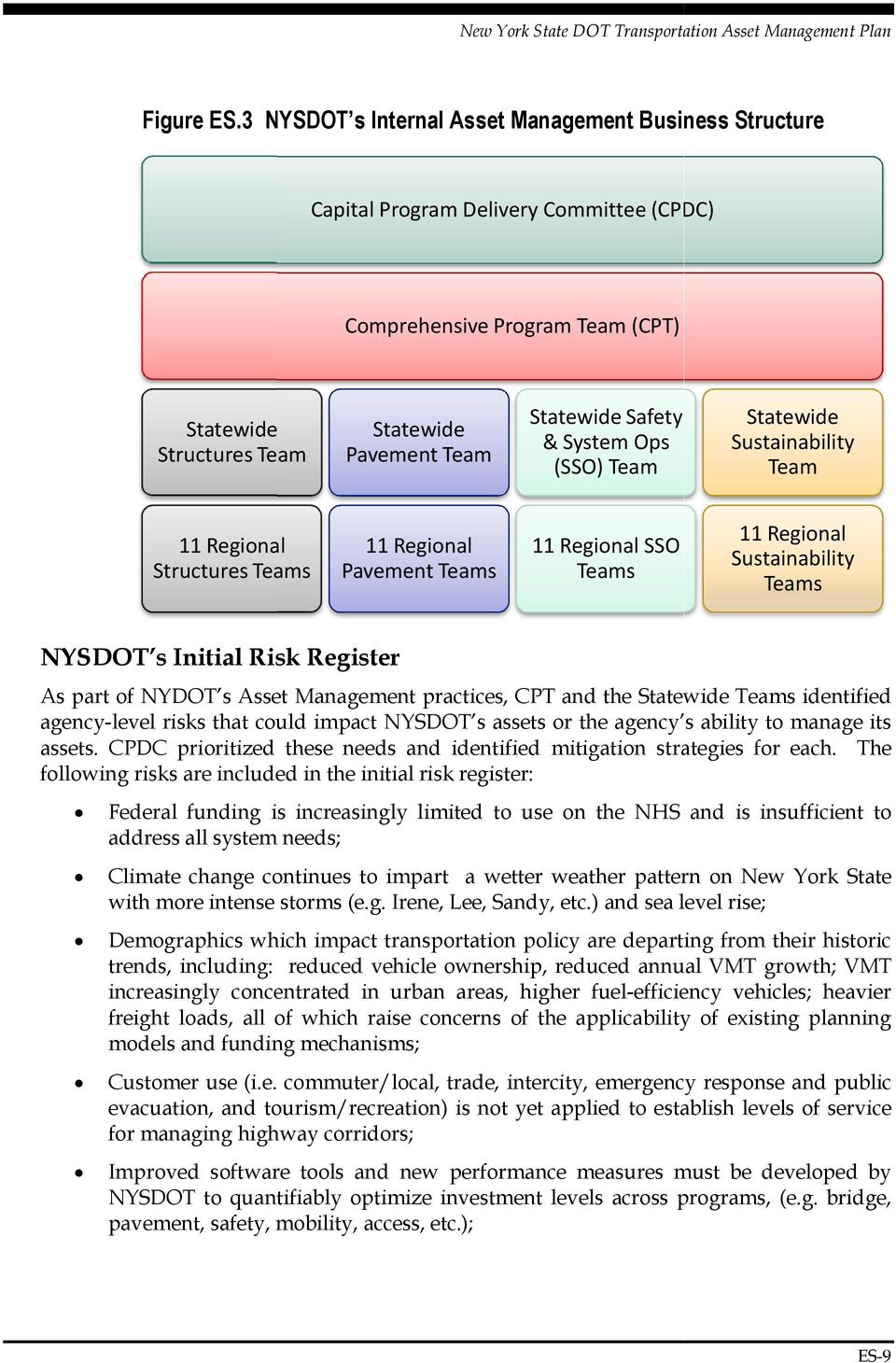
18 Table ES.2 NYSDOT Revenue Projections Projected Revenue ( ) Minus safety/other; engineering/admin.; state forces maintenance; ROW/nonconstruction phase; modal Projected funds available for highway and bridge core construction ( ) Minus funds for local roadways offsystem Projected funds available for NYSDOT on-system roadways ( ) Minus projected funds necessary for safety, congestion, and ancillary assets Projected funds available for NYSDOT on-system pavement and bridge asset management ( ) $ million - $7.953 billion $9.974 billion - $2.941 billion $7.033 billion - $3.283 billion $3.750 billion NYSDOT s Asset Management Business Structure NYSDOT s internal asset management business structure is illustrated in Figure ES.3. The structure is functional rather than organizational. At this time these teams are not organizational units, but are dedicated groups of staff from across program areas throughout the Department. The focus areas represented by the Statewide and Regional teams consist of the highest priority program areas for asset consideration. ES-8 Cambridge Systematics, Inc.

19 Figure ES.3 NYSDOT s Internal Asset Management Business Structure Capital Program Delivery Committee (CPDC) Comprehensive Program Team (CPT) Statewide Structures Team Statewide Pavement Team Statewide Safety & System Ops (SSO) Team Statewide Sustainability Team 11 Regional Structures Teams 11 Regional Pavement Teams 11 Regional SSO Teams 11 Regional Sustainability Teams NYSDOT s Initial Risk Register As part of NYDOT s Asset Management practices, CPT and the Statewide Teams identified agency-level risks that could impact NYSDOT s assets or the agency s ability to manage its assets. CPDC prioritized these needs and identified mitigation strategies for each. The following risks are included in the initial risk register: Federal funding is increasingly limited to use on the NHS and is insufficient to address all system needs; Climate change continues to impart a wetter weather pattern on New York State with more intense storms (e.g. Irene, Lee, Sandy, etc.) and sea level rise; Demographics which impact transportation policy are departing from their historic trends, including: reduced vehicle ownership, reduced annual VMT growth; VMT increasingly concentrated in urban areas, higher fuel-efficiency efficiency vehicles; heavier freight loads, all of which raise concerns of the applicability of existing planning models and funding mechanisms; Customer use (i.e. commuter/local, trade, intercity, emergency response and public evacuation, and tourism/recreation) is not yet applied to establish levels of service for managing highway corridors; Improved software tools and new performance measures must be developed by NYSDOT to quantifiably optimize investment levels across programs, (e.g. bridge, pavement, safety, mobility, access, etc.); ES-9
20 Consistent, comprehensive data is not readily available for inventory or condition of local-owned federal-aid-eligible roads that are off the NHS; and Dedicated staff are needed for the support and continued implementation of Transportation Asset Management at NYSDOT. Asset Management Investment Strategies NYSDOT has developed the following investment strategies to guide the distribution of asset management funding: Preservation First prioritizes activities that maximize the service life of existing infrastructure assets over expansion or enhancement of the highway network. "Beyond Preservation addresses assets that have deteriorated beyond a state in which they can be preserved, or that required improvements to address operational, sustainability, economic development or other needs. Demand Recovery addresses low volume pavements in poor conditions. Asset Management Performance Targets As part of its Comprehensive Program Update efforts, NYSDOT recently established condition targets for pavements and bridges. These targets are provided in Table ES.3. These are not aspirational goals, but reflect an effort to minimize deterioration of the existing highway and bridge infrastructure in an environment where available resources are less than half of what is needed to maintain a state of good repair. The targets represent the attainable in ten years if the funding commitments and strategies presented in this TAMP are implemented. As shown in the table, both pavement and bridge conditions are projected to worsen over the next ten years. However, the rate of deterioration will be less than if the NYSDOT did not implement asset management strategies. The percent poor pavement is expected to increase in the short term under a preservation first strategy, as resources are focused on getting good and fair pavement into a low-cost preservation cycle. This strategy eventually frees up funds in the future to repair the poor pavements. ES-10 Cambridge Systematics, Inc.

21 Table ES.3 NYSDOT Pavement and Bridge Targets Performance Measure NYSDOT Pavements Baseline 2013 State of Good Repair Target 2023 % VMT on Good and Excellent 71% 88% 59% % Poor 10% 10% 36% NYSDOT Bridges (1) Deficient (2) 49% 25% 50.5% % Poor 23% 10% 29% % Preservable (Good and Fair Protective) 56% 75% 53% % Correctable (Fair Corrective) 21% 15% 18% (1) Based on Deck Area; (2) NYSDOT Definition of Deficient Asset Management Program Opportunities and Challenges The TAMP is intended to be a living document that will be updated periodically and will be influenced by new policies and programs as time goes on. There are, however, several items which have been identified as challenges for near to mid-term revisions of the TAMP. These include: State opportunities and challenges include: NY Works is a new and ambitious initiative, implemented by Governor Cuomo, which intends to better integrate New York State infrastructure investment with formative goals of economic growth, competitiveness, and social benefits; The extraction of natural gas from Marcellus Shale deposits could dramatically change heavy-truck traffic volumes and patterns in the Southern-tier area of New York State, if the current moratorium on these operations is lifted. In 2011, Governor Cuomo created 10 Regional Councils to develop innovative, long-term strategic plans for economic growth for their regions that reflect the distinct characteristics of each of the 10 regions. NYSDOT is working closely with each REDC on program alignment. MAP-21 requires the TAMP to address the entire NHS. However, twenty-eight percent of the NHS is not owned or maintained by NYSDOT. The inclusion of non-nysdot roadways in the TAMP requires an approach for data collection on roads that NYSDOT does not own. NYSDOT works with its partner agencies and MPOs to develop multiple planning documents. Coordination of recommendations in the TAMP with recommendations in NYSDOT s non-asset management plans, such as those that address safety and congestion is essential to developing and delivering effective and efficient program. Opportunities and challenges associated with MAP-21 include: ES-11
22 The Federal Highway Trust Fund (HTF) is projected to be depleted before the end of federal fiscal year MAP-21 provides funding only through Federal fiscal year The Federal dedicated funding stream for the rehabilitation and replacement of State and local bridges was recently folded into a more broad-based fund category. This new category can be used to fund work on any highway and bridge assets, but is limited to use on the NHS. Rolling the Highway Bridge Rehabilitation and Replacement category of federal funding into the National Highway Performance Plan category has decreased the amount of federal-aid available to address highway and bridge needs (State and local) that are not considered part of the NHS. Final rule making on national performance measures, generally described in MAP-21, has not been completed. Asset Management Improvements and Next Steps There are profound and practical challenges ahead for New York State and for much of the country due to the aging of the nation s transportation infrastructure, changing climate, and inadequate funding relative to the growing needs of the State s infrastructure assets. Left unabated, the amount of poor pavement in NYS will more than triple in the next ten years with the backlog of needed work nearly doubling from $4.7 billion to $7.6 billion. Similarly, bridge conditions will become roughly 10 percent worse both in terms of deficiency and poor bridges. Assets in poor condition are extremely expensive to restore when compared to keeping good assets in good shape. Poor pavements need to be rebuilt from the ground up and poor bridges need to be replaced. Pavements and bridges in better shape can be kept that way through preservation efforts for very long periods of time, but need a level of funding at least adequate to treat those assets that can still be preserved. So in spite of the NYSDOT s best efforts to program efficiently, having roughly 44% of the funding needed to maintain the State s roads and bridges will result in significantly worse conditions in the future. Recognizing the difficult circumstances States are facing in managing an aging and underfunded highway infrastructure, there is still much that can and will be done. The TAMP includes an asset management improvement plan that addresses the following activities: Develop measures or methodologies to account for economic benefits of a proposed transportation investment; Work with MPOs to develop performance based plans that complement the TAMP; Establish a consistent set of performance measures for NYSDOT and MPOs; Implement a new program-management software to track accomplishments and performance; ES-12 Cambridge Systematics, Inc.
23 Normalize comparable performance measures across pavements and bridges to allow direct comparison of condition trends between assets, and extend these measures to include safety and sustainability;. Use CPU 2014 to expand the "systems not projects" approach to include safety and mobility needs; Expand CPU 2014 reporting to account for pavement and bridge funding that delivers accomplishments other than improving core infrastructure conditions; Hold sessions of the National Highway Institute Transportation Asset Management course for NYSDOT employees in the roles of Group/Bureau Directors and higher, along with MPO Staff; Work to connect Municipality and County Highway officials with Local Government version of Asset Management Training; Define key transportation corridors by category of customer use, such as commuter, commercial, transit, emergency, bike/pedestrians, etc.; Implement an Enterprise Asset Management Program (EAMP) with at least the pavement management, bridge management and cross-asset trade-off modules; Develop Life-cycle management practices and tools necessary to include Large Culverts and ADA compliance assets in a future version of TAMP; and Align performance reporting capabilities in an improved program management system with asset management strategies. These initiatives are prioritized, resourced, and tracked to completion through NYSDOT s asset management business structure. They will advance asset management processes and enable NYSDOT to manage the highway system as effectively as possible. ES-13
24
25 1.0 Introduction In May 2011, Commissioner Joan McDonald established the Comprehensive Asset Management/Capital Investment (CAMCI) Team to develop and articulate an investment strategy, framework and process to preserve and manage the multimodal transportation assets of New York State in an economically, environmentally, and socially sustainable manner. At that time NYSDOT was using a traditional decentralized decision-making process and investing more than half of its pavement funds into very expensive reconstruction projects. Analysis predicted that without a change in course, this investment approach would result in 40% poor pavements statewide, including 20% on the interstate system, by At the same time, there was considerable discussion at the national level about the cost effectiveness of preservation strategies for both pavements and bridges. NYSDOT s own analysis showed that it would be far more cost effective to keep assets in higher condition states than it is to postpone treatment until assets deteriorate. Using this information, coupled with an understanding of current bridge and pavement conditions, the CAMCI Team lead the Department to investigate different investment and treatment strategies for pavements and bridges. The analysis was done using realistic funding predictions to develop a set of strategies that would generate the best end conditions 10 years into the future. The strategies needed to focus on preserving as much of the overall highway and bridge system as possible, to minimize future costs, while also treating assets in the worst conditions where those conditions impact the most travelers. The result was a capital investment program that was made up of 60% preservation and 40% system renewal (rehabilitation and reconstruction) and improvement. One example of an expected benefit of this new programming direction is a better than 50% reduction the predicted amount of poor pavements 2018 from 40% to less than 19%. Though the current investment strategy provides much better end conditions, it does not result in a state of good repair for either pavements or bridges. State of good repair is the condition state of the system that can be maintained in perpetuity at the lowest annual cost. NYSDOT s assets are not currently in a state of good repair, and with current funding even the most efficient investment plan results in a widening gap between desired and actual conditions The ratio of actual funding to the funding level necessary to achieve state of good repair for an asset class is called the Asset Sustainability Index (ASI). To achieve a state of good repair in 10 years, NYSDOT would require approximately $2.5 billion per year for pavements and bridges as compared to its current annual funding level for these assets of $750 million. This results in a current ASI for state pavements and bridges of 30%, indicating that the State receives less than half the funding needed to address the treatments needed to be done. Based on recommendations from the CAM/CI Team, in 2011 NYSDOT established an asset management business structure to support consistent decision-making through a focus on system management. To support this effort, measures of accountability have been established to maximize return on investment and long term public benefits. 1-1
26 NYSDOT s asset management business structure enables consistent decision-making at all levels of the organization and sets consistent fiscal limits for performance across geographic boundaries. It helps to manage expectations and allows NYSDOT, as steward of the transportation system, to facilitate the best investment for the system and the State, regardless of ownership. The asset management business structure calls for NYSDOT to: 1. Improve the quality of investment decisions deliver projects that impact conditions; do not just report on them. 2. Leverage existing data and tools - minimize initial investment and time needed to implement new practices by utilizing current data and technology. 3. Establish collaborative relationships across the bureaucracy - break through organizational cultures and data stovepipes. 4. Employ transportation asset management guidance developed by the American Association of State Highway and Transportation Officials (AASHTO) - start with what is available now and work to improve. 5. Adopt a systems approach - deliver the best possible results to the most customers. The State will continue to improve its investment strategy through improvements in data collection, modeling software, organizational efficiency, management of risks and overall asset management capabilities to ensure that the State is making the best use of its available resources. Moving forward, NYSDOT s Capital Plan 3 provides approximately $3.4 billion in new capital program funding annually to improve the transportation system, enhance the system s resiliency and create jobs. Of that amount, more than $2.3 billion in new funding is provided annually to support NYSDOT s highway and bridge program, including: more than $1.7 billion in new construction funding for the repair, rehabilitation and replacement of critical State and local infrastructure and approximately $600 million in engineering, right-of-way and other program delivery support. The capital program also provides $438 million in additional funding for local highway and bridge projects under the Consolidated Highway Improvement Program (CHIPS) and $39.7 million for the local matching share of federally-aid projects under the Marchiselli program. The most significant risk to achieving the Transportation Asset Management Plan (TAMP) goals detailed below is the uncertainty of future federal funding for highways, bridges and transit. Federal aid comprises more than 40 percent of DOT s capital program and approximately 70 percent of on and off-system construction. Based on current spending and revenue trends, however, the U.S. Department of Transportation estimates that the Highway Account (HA) of the Highway Trust Fund (HTF) will encounter a shortfall by August Absent action to address the solvency of the Highway Trust Fund, virtually all 3 State Fiscal Year New York State Enacted Budget Financial Plan Commitments for NYSDOT. 1-2
27 federal Highway Trust Fund revenue in federal fiscal year 2015 will be spent to pay for prior year obligations, leaving little cash available to support new federal funding commitments. 1.1 BACKGROUND From construction of the nation s first railroads to the Erie Canal to the Brooklyn Bridge to the New York City elevated subway lines to the Interstate Highway System, New York State has been a world leader in the construction of multimodal transportation infrastructure transportation infrastructure that has transformed our State s economy into the global centers for the financial, insurance, real-estate and technology sectors. New York s transportation infrastructure, much of it built before or during the Eisenhower Interstate Era is among some of the oldest and most heavily utilized in the nation and is also subject to some of the harshest weather conditions. As a result, New York s infrastructure conditions rank among the lowest in the nation. The ability of people and goods to move through the State is dependent on a well functioning transportation system. The repair, rehabilitation, efficient operations and strategic replacement of existing transportation infrastructure are required for safety, mobility and for the State to remain economically competitive. Recognizing the challenges ahead, NYSDOT reengineered its capital program how it develops, programs and funds transportation infrastructure investments. Investments are focused on asset management and infrastructure preservation strategies. NYSDOT has implemented new strategies to select investments in projects that go beyond preservation, linking transportation with economic development and sustainability. NYSDOT is also successfully employing new procurement methods to deliver projects, such as Design-Build, authorized by the New York State Legislature in December GUIDING PRINCIPLES OF NYSDOT S ASSET MANAGEMENT PROGRAM The primary focus of NYSDOT s asset management efforts is the preservation and safety of the existing infrastructure. NYSDOT s objective is to manage the highway system as effectively as possible in an environment in which the available funding is significantly lower than the system s needs. To ensure that good decisions are made in its efforts to preserve and enhance the safety and condition of the transportation system, the NYSDOT has adopted four guiding principles, known as the Forward Four. Figure 1.1 illustrates these principles, along with public safety, which is inherent in all of NYSDOT s investment decisions. These principles have been in place at NYSDOT since before the last 1-3
28 Comprehensive Update. NYSDOT has just codified our approach in our documentation. Implementation of this plan builds from and strengthens them. Figure 1.1 Guiding Principles of the Asset Management Program Preservation First Expected resources are not sufficient to support a build new or worst first approach. Therefore NYSDOT has chosen to adopt a preserve what we have approach. The Preservation First strategy starts with Asset Management principles and data driven decision making. The highest priority is to preserve the functionality and safety of the existing highway system. It is very important to recognize that a Preservation First strategy is a long term strategy. The Agency must have patience to hold the course. System not Projects To meet the needs of the entire system, NYSDOT requires a system wide, program-driven approach, instead of individual project solutions. That means, when the Agency considers an individual project, it must be examined in the context of the larger transportation system: Who does this asset serve? Is it on a corridor that is essential to move people or goods? Where does it fit within Regional and State priorities? Inherent in these decisions is the need to identify better ways to manage and operate the transportation system as a whole, to most effectively use the capacity of the current system. System improvement projects that promote economic development, livability, and system connectivity must also be strategically advanced to provide the greatest benefit to the system. 1-4
29 Maximize Return on Investments Funding for transportation has been, and will continue to be, significantly less than the amount required to address all of the State s recognized needs. Insufficient investments have resulted in declining system conditions and a growing backlog of needs required to bring the system to a state of good repair. Given the significant needs of the transportation system, it is essential that a strategy be established to invest in a way that produces the greatest possible return on investment. The objective is to develop an approach that encourages good decision making and allocation of funds in a manner that not only preserves the most important assets but also meets the needs of those who rely on the transportation system. This approach has lead NYSDOT to implement whole life management principles (explained in Chapter 5) which emphasizes investments in appropriate treatments, at appropriate times, and at appropriate locations. Safety standards will be maintained. Focused rehabilitation work will be performed, fixing only those elements in need of repair, when it is determined that significant life can be bought with limited investment. All work will be timed appropriately within the window of opportunity for the selected treatment The scope of work will be constrained to include what is required to achieve the full remaining life of the asset while providing for a safe and accessible highway system. Bridges and highways will be replaced when replacement provides the best return on investment. Mobility enhancement and modernization projects will be included when it makes strategic and economic sense. Make It Sustainable A sustainable approach to programming considers the relative and cumulative value of the assets as they benefit the public, economy, and environment. In this way the decision-making process can be enhanced in terms of looking broadly at the wider benefits of the work done with each Comprehensive Program. The focus will be on ways to preserve the existing transportation system by incorporating sustainability considerations into decisions and actions; and support opportunities for innovation, economic growth and development. This must be done in a fiscally responsible manner by considering life cycle cost as well as fiscal cycles. A strategy that allows development of a sustainable program will be adopted, one that maximizes the return on investment, extends the life of the assets, and provides customers with a safe, reliable, balanced and environmentally sound transportation system. A sustainable program also incorporates strategies to minimize transportation system disruptions resulting from routine incidents, planned events, and non-routine events such as natural disasters or security related events. NYSDOT will seek and implement creative and low-cost ways to leverage funding to minimize costs over the life of the investments while fostering: 1-5
30 Economic competitiveness: Improve efficiencies in work/business travel and freight movement; improve tourism access and inter-modal connectivity; develop investments which complement or enhance the strategic investments proposed by Regional Economic Development Councils. Social equity/community: Improve accessibility for transit; recreation; education; health care; support smart growth, complete streets and livability; increase safety; weigh climate associated risk to transportation infrastructure. Environmental stewardship: Increase energy efficiency and reduce greenhouse gas emissions; reduce resource consumption; limit impacts that encroach on the environmental footprint; not deplete, and where practicable, enhance resources for future generations; improve air quality. 1.3 COMPREHENSIVE PROGRAM UPDATE NYSDOT s comprehensive program is its primary mechanism for delivering on its mission to provide safe and reliable transportation to its customers. NYSDOT typically develops a Comprehensive Program Update every two years. The update establishes a program of projects for all infrastructure and delivery mechanisms for the subsequent five years. The program is developed under the direction of the asset management Organization structure and following the asset management practices described in Chapter four. Projects are prioritized and selected according to the asset management investment strategies describe in Chapter 8. The program is fully funded, fiscally constrained and includes expected budgets, accomplishments key milestone dates for every project. The resulting program represents the mix of projects which provide the best progress towards the Department s goals. 1.4 OBJECTIVES OF THIS DOCUMENT This Transportation Asset Management Plan (TAMP) is a window into NYSDOT policy. It explains the roles, responsibilities and processes related to establishing and executing transportation asset management activities at NYSDOT. The plan covers the breadth of asset management practices at NYSDOT and was developed to achieve the following objectives: 1. Institutionalize the implementation of asset management practices. NYSDOT has made great strides in modernizing its programming processes. The Federal Highway Administration (FHWA) certification of NYSDOT s process for developing this plan ensures that these new strategies, processes and tools will continue to shape future programming efforts. 2. Communicate Asset Management Policy and Strategy. To date, NYSDOT s asset management policy has been scattered in numerous documents such as its STIP update instructions and statewide team charters. The TAMP pulls together all of the relevant information from these sources to present internal 1-6
31 and external stakeholders with a clear understanding of NYSDOT s vision and implementation of asset management. 3. Document and prioritize opportunities for improvement of business practices. Transportation asset management is a continual improvement process. As described in the AASHTO Transportation Asset Management Guide: A Focus on Implementation, the development of a TAMP is an ongoing process of communication with partners, self evaluation, gap identification, prioritization, improvement, and adoption. 4 This plan lays out the process for continual improvement of TAM business practices and contains NYSDOT s current asset management improvement plan (Table 10.2). Figure 1.2 illustrates this concept. Figure 1.2 Iterative TAMP Development Process Source: AASHTO Transportation Asset Management Guide, A Focus on Implementation 1.5 SCOPE OF THE TAMP To provide a full understanding of NYSDOT s asset management practices, this TAMP address all bridges and pavements that are eligible for funding from the NYSDOT comprehensive program. The comprehensive program includes all 4 AASHTO Transportation Asset Management Guide: A Focus on Implementation, Washington DC, January
32 available State and federal highway funds and covers all NYSDOT owned assets as well as all Federal-Aid eligible assets. Much of this infrastructure is not owned by NYSDOT. Local agencies that maintain portions of the Federal-aid eligible roadway system do so by applying state and local investment strategies and available financial resources. Therefore, NYSDOT maintains close, collaborative relationships with Metropolitan Planning Organization (MPO) members, toll authorities, counties, and municipalities who own and operate portions of the system. Transportation customers should not be concerned with what entity owns the highway. They should perceive a consistent level of service as they travel along a corridor, regardless of jurisdictions or political boundaries crossed. Similarly all asset owners who are eligible to receive and invest New York State or federal transportation funds need a clear understanding and consistent set of performance standards, investment strategies, and selection criteria. Towards this end, this document addresses asset management practices by the NYSDOT, the New York State Thruway Authority, and local agencies. More detail on how NYSDOT works with its partner infrastructure owners is provided in Chapter 4. There are several significant federal fund sources that are not within the scope of pavement and bridge asset management, including the federal Congestion Management Air Quality (CMAQ), Transportation Alternatives Program (TAP) (formerly Transportation Enhancement Program - TEP), Transportation Investment Generating Economic Recovery (TIGER) and Highway Safety Improvement Program (HSIP). These programs have the organizational and procedural requirements that are different from the more mainstream highways funds. The integration of projects funded by these programs will evolve over time as the TAMP s scope expands to address priority assets other than bridges and pavements. 1.6 TAMP STRUCTURE The Moving Ahead for Progress in the 21 st Century Act (MAP-21) contains specific provisions for the content to be included in a TAMP. The MAP-21 requirements for TAMP contents include: 1. A summary listing of the pavement and bridge assets on the National Highway System in the State, including a description of the condition of those assets; 2. Asset management objectives and measures; 3. Performance gap identification; 4. Lifecycle cost and risk management analysis; 5. A financial plan; and 6. Investment strategies. 1-8
33 In order to meet these requirements, this TAMP is presented as follows: Chapter 2 State of the System examines the overall demand on the NYSDOT system by the traveling public, and summarizes the inventory and condition of the state s pavements and bridges. Chapter 3 Financial Summary documents the expected funding for the system over a ten-year period. Chapter 4 - Transportation Asset Management Practices describes NYSDOT s asset management business structure, policies and practices. Chapter 5 - Whole Life Management presents the principles of life cycle management used by NYSDOT and explains the process used to prioritize projects under this philosophy. Chapter 6 Risk Management outlines the process used to assess risk, and presents a risk register that lists priority risks and associated mitigation activities. Chapter 7 Financial Plan and Investment Strategies illustrates how the available funds are provided for planning purposes and describes NYSDOT s investment strategies related to asset management. Chapter 8 Asset Management Targets defines a set of performance targets, and describes how they were developed. Chapter 9 Asset Management Program Opportunities and challenges provides an overview of issues at the National and State level that are expected to impact the TAMP and asset management practices within the agency. Chapter 10 Improvements and Next Steps defines specific improvement areas NYSDOT will be pursuing in the near term and lays out an agenda for future improvements to asset management policy and practices as well as the TAMP. 1-9
34
35 2.0 State of the System This chapter describes the state of New York s highway system in terms of demand, inventory and condition. 2.1 SYSTEM DEMAND Figure 2.1 shows the number of vehicles miles traveled (VMT) on NYSDOT s highway system since The chart can be broken down into several key phases or epochs based on world events and sustained rates of VMT growth. Those epochs are: The Great Depression ( ); World War II ( ); Post War Boom ( ); Roarin 80 s, 90 s, and 2000 s ( ); and Great Recession ( ). The chart shows that VMT growth was the lowest during the Great Depression. VMT growth was the highest during the Roarin 80 s, 90 s and 2000 s period. This epoch captures the transportation related coming of age (marriage, family development, career start) during the late 70 s, early 80 s of the Baby Boom generation (i.e. those born between 1946 and 1964) as well as the beginnings of its sunset (grown children now independent, family unit downsized, career retirement). The graph also shows the dramatic impact that the Great Recession has had on VMT in the New York. The severe economic downturn of the period dramatically shrank the economy and hence dramatically lessened travel. The impact of the Great Recession appears to be larger than either of the two previous VMT downturn events, which occurred during the Organization of the Petroleum Exporting Countries (OPEC) Oil Embargo of the late 1970 s, and World War II. Figure 2.1 also shows that NYSDOT expects a steady increase in VMT going forward, although at a lower growth rate than that experienced in the past. To meet the expected increase in demand for the next 25 years, it is vitally important that NYSDOT effectively manage its existing highway system. This is at the heart of NYSDOT s asset management approach. 2-1
36 Figure 2.1 Vehicle Miles Traveled on NYSDOT Highways ( ) 2-2
37 2.2 ASSET REGISTRY Table 2.1 presents New York s current highway asset registry. It summarizes inventory and performance information for bridges and pavements. The performance measures used in the registry are described in the following chapters. Table 2.1 includes all bridges and pavements that are eligible for funding from the NYSDOT comprehensive program. The comprehensive program includes all available State and federal highway funds and covers all NYSDOT owned assets as well as all Federal-Aid eligible assets. Federal-Aid assets are stratified in two tiers - NHS and non-nhs. The NHS is further stratified by interstate and non-interstate. This creates a four tier hierarchy of: Interstates, Non-interstate NHS, Non-NHS Federal-Aid system, and Non-Federal-Aid eligible NYSDOT-owned assets. NYSDOT owns and manages 72 percent of the NHS. The remaining portion is managed by NYSTA and other entities. Sections 2.3 and 2.4 present a more detailed breakdown of asset inventory and conditions. 2-3
38 Table 2.1 Asset Registry Highway Type Pavements Inventory Bridges (Lane-miles) (1000 sq. ft.) Count NYSDOT NYSTA Others 1 sub-totals 4 NYSDOT NYSTA Others 1 sub-totals 4 NYSDOT NYSTA Others 1 sub-totals 4 TAMP TAMP TAMP Interstate 5,400 2, ,940 31,137 9,719 8,941 49,798 1, ,310 Non-Interstate NHS 12, ,300 16,750 40,760 1,777 20,265 62,801 3, ,158 5,220 Non-NHS FA System 19, ,000 43,700 6, ,619 11,606 1, ,194 2,546 Non-Federal-Aid 1, , ,300 3, , , , TAMP Total 4 38,800 2,450 28,440 69,690 81,876 13,253 33, ,954 7, ,260 10,798 Highway Type % VMT on Good or Excellent Conditions Pavement Bridge (5) NYSDOT NYSTA Others (1) NYSDOT NYSTA Others (1) % Poor % VMT on Good or Excellent % Poor % VMT on Good or Excellent % Poor Average Condition Rating % Deficient Average Condition Rating % Deficient Average Condition Rating % Deficient Interstate 77.4% 3.4% 99.4% 0.0% 70.6% 0.0% Non-Interstate NHS 76.4% 4.2% 100.0% 0.0% 53.2% 7.5% Non-NHS FA System 56.3% 13.2% N/A N/A 48.9% 15.9% Non-Federal-Aid 36.5% 31.6% N/A N/A (6) (6) (1) Other owners of Federal-aid eligible infrastructure include: NYS Thru-way Authority, Mid-Hudson Bridge Authority, Port Authority of NY and NJ, Triborough Bridge and Tunnel Authority, Cities, Counties and Other Authorities and Local Governments. (2) Approximated and beyond scope of this plan. (3) Beyond the scope of this plan (4) Totals and Sub-totals are for infrastructure within the scope of this plan. (5) Bridge conditions calculated by deck area. (6) Insufficient Data 2-4
39 2.3 PAVEMENT INVENTORY AND CONDITION Inventory The NHS in New York State consists of 24,624 lane miles. However, NYSDOT s pavement network does not align with the NHS. Significant portions of the NHS are maintained by other agencies, and NYSDOT s network includes numerous roadways that are not on the NHS. Other owners of NHS in New York State include the New York State Thru-way Authority, Mid-Hudson Bridge Authority, Triborough Bridge and Tunnel Authority, Port Authority of New York and New Jersey, counties cities and towns. In total, NYSDOT maintains 38,739 lane miles of pavement. Figure 2.2 shows a breakdown of this inventory. Figure 2.2 NYSDOT Pavement Lane Miles 1,313 5,373 19,684 12,369 Interstates (14%) Non Interstate NHS (32%) Non NHS Federal Aid (51%) Non Federal Aid (3%) The remainder of this section addresses the condition of NYSDOT s pavements. Pavements that are managed by other jurisdictions are not included in this analysis. Pavement Performance Measures NYSDOT uses a number of performance measures as part of its pavement program. NYSDOT uses these measures for three purposes reporting, selecting projects, and managing the network. Following is a summary of the performance measures in each of these categories. 2-5
40 Measures Used for Reporting Surface Rating: A measure of pavement quality, based on the severity, extent and location of the pavement cracking. The Surface Rating is based on a 10 point scale and is reported as follows: 10-9 Excellent (no work needed) 8 Very Good (crack seal candidate) 7 Good (preventative maintenance candidate) 6 Fair (corrective maintenance candidate) <=5 Poor (rehabilitation or reconstruction candidate) For reporting purposes surface rating may be provided for an individual segment, or reported as an average for a corridor, geographic area, any subset of pavements, or the entire network.iri: International Roughness Index is a national-standard measure of ride quality reported as in./mi.. NYSDOT categorizes pavements as follows: < 60 Very Smooth Smooth Fair Rough >220 Very Rough For reporting purposes, IRI may be provided for an individual segment, or reported as an average for a corridor, geographic area, any subset of pavements, or the entire network. Measures Used to Identify, Prioritize, and Design Pavement Projects Both condition rating and IRI are used along with the following technical metrics to select appropriate treatments and identify, prioritize, and select pavement projects: Faulting: The measure of elevation difference between sequential slabs in or across transverse cracks in rigid pavements. Faulting indicates failure of the load transfer devices between slabs; Spalling: The loss of material from the surface of concrete pavement surface due to corrosion of reinforcing steel; Alligator cracking: Areas of interconnected cracks in flexible pavements, occurring in the wheel path, identifying failure of the pavement material; and Widening drop-off: the measure of elevation difference between one longitudinal area of a paving lane and an adjacent area that was constructed at a different time. 2-6
41 For treatment and project selection each of these measures is calculated for every pavement segment, so treatments can be optimized to the specific conditions at each location. Measures Used for Network Management NYSDOT uses the following performance measures to manage its pavement network: Percent Vehicle Miles Travelled (VMT) on Good or Excellent Pavements is a measure of how much of the customers travel is on a good road. It also reflects the program s emphasis on prioritizing the high volume roads for preservation work. Percent Poor Pavement is a measure of the extent of the system that has deteriorated to the point of requiring major rehabilitation or reconstruction. Backlog represents the funding needed to bring every pavement to a state of good repair today. A better system condition will have fewer needs and therefore a lower backlog. Since backlog is computed by the pavement models using condition trend data, it knows what the appropriate treatment is for each segment and will not recommend band-aid treatments that tend to cause a short term bump in ratings. NYSDOT tracks and evaluates these measures at the network level and uses them to support the setting of planning targets between Regions and programs. It also establishes target values for % VMT on Good or Excellent and % Poor Pavement. These target values are provided in Chapter 8. Historic Pavement Condition Trends Figure 2.3 shows the breakdown of NYSDOT pavement condition over the past 10 years. The recent increase in average condition rating is largely due to temporary increases in funding from infrastructure spending programs aimed at job creation American Recovery and Reinvestment Act (ARRA) in 2011 and NY Works Pavement Preservation Program in These programs improved average conditions by applying relatively light treatments to preserve good pavements. The result is an increased percentage of good and excellent pavement. While the preservation first strategy has stabilized the vehicle miles traveled on good and excellent pavement each year, additional funding will be needed to address the growing percentage of poor pavement. 2-7
42 6,207 3,772 Interstates (38%) Figure 2.3 Pavement Condition History NYSDOT Pavement 2.4 BRIDGE INVENTORY AND CONDITION Inventory New York State has 17,590 highway bridges totaling 214,585,190 square feet of deck area. Of that population 7592 are owned by NYSDOT, totaling just over 81 million square feet of deck area. Figure 2.4 shows a breakdown of NYSDOT s inventory. Figure 2.4 NYSDOT Bridge Deck Area (1000 sf. ft) 31,137 Non Interstate NHS (50%) Non NHS Federal Aid (8%) 40,760 Non Federal Aid (5%) 2-8
43 Bridge Performance Measures As part of its bridge program, NYSDOT uses a performance measures for three purposes reporting, identifying and selecting projects, and managing the network. Following is a summary of the performance measures in each of these categories. Measures Used for Reporting NYSDOT uses a Bridge Condition Rating (CR) to track and report on the condition of its bridges. The CR is calculated from inspection ratings for 13 bridge components weighted in proportion to their respective and relative structural importance. The CR is based on a 7 point scale and is reported as follows: CR = 7 CR 5.8 to 7 Excellent (no work needed) Good (preventive maintenance candidate) CR < 5.0 CR 4.9 to 5.8 CR 4.4 to 4.9 CR < 4.4 Structurally Deficient Fair Protective (preservation candidate). Fair Corrective (repair candidate) Poor (rehabilitation or replacement candidate). For reporting purposes, CR may be provided for an individual bridge, or reported as an average for a corridor, geographic area, any subset of bridges or the entire inventory. Unless otherwise noted average condition rating is reported as a weighted average by deck area. Additionally, pursuant to the requirements of MAP-21, NYSDOT is required to report on NHS bridge conditions. The Federally mandated reporting measure for NHS bridges is Structurally Deficient deck area represented in terms of percent. MAP- 21 requires that the NHS bridge Structurally Deficient deck area not exceed at 10 percent. A Structurally Deficient bridge is defined by FHWA as one having a bridge deck, superstructure, or substructure rated in "poor" condition (0 to 4 on the National Bridge Inventory - NBI - rating scale). The 0-7 NYSDOT bridge inspection scale is separate and different from the NBI scale. Figure 2.5 shows this measure over time, based on data found at FHWA s website. 2-9
44 Figure 2.5 Percent Deck Area on Structurally Deficient NHS System (Federal Rating) % Deck Area on Deficient Bridges B e t t e r Measures Used to Identify, Prioritize, and Design Bridge Projects NYSDOT uses the 13 inspection ratings that make up the CR to identify, prioritize, and design bridge projects. Measures Used for Network Management NYSDOT uses the following performance measures to manage its bridge network (definitions are provided above): Structurally deficient; Percent poor; Present preservable (good and fair protective); and. Percent correctable (fair corrective). 2-10
45 Historic Bridge Condition Trends Figure 2.6 shows the breakdown of NYSDOT bridges over the past 10 years. For a given year in the chart, the data presented reflects the data collected in the previous year and submitted to FHWA in April of the succeeding year. For example, data for calendar year 2012 is reported to FHWA in April 2013 and shown in the chart as 2013 data. Similar to pavements, bridge conditions have seen improvement in average condition rating but also increases in percent poor. Figure 2.6 Bridge Conditions NYSDOT Bridges 2-11
46
47 3.0 Financial Resources This chapter discusses the value of NYSDOT s assets and describes the funding expected to be available over the next 10 years. NYSDOT receives funding from multiple sources and is tasked with multiple missions. Only a fraction of overall funding is available for asset management of pavements and bridges. This chapter describes NYSDOT s various revenue streams and explains how the Department arrives at an average annual investment level for pavement and bridge assets. Additional information on NYSDOT s financial sustainability index is provided in Appendix C. 3.1 VALUATION OF NYSDOT ASSETS NYSDOT uses the Government Accounting Standards Board Statement No. 34 (GASB-34) modified method to determine the value of its assets on an annual basis. In this method, the collective original construction cost of all road and bridge assets is determined, then each year NYSDOT adds the value of all new construction and subtracts the depreciation. The valuation for roads includes the cost of pavement construction and all other assets necessary for the operation of the highway such a signs, striping and drainage. The current value of NYSDOT s assets is: Pavements - $ billion or $53.615B/38,559 Ln-Miles = $1.39M/lane-mile Bridges - $ billion or $12.613B/7592 bridges = $1.66M/Bridge Figure 3.1 Value of NYSDOT Infrastructure According to GASB34 Modified Method 3-1
48 Figure 3.1 shows how the value of NYSDOT s assets has changed over time. The increase in asset value is primarily due to the increased cost of construction over time. Labor and materials costs are higher on any new construction, and the carrying value on the inventory is historical cost, not current replacement cost. When a bridge is replaced, the cost of the new bridge is added and the historical cost to construct the original bridge is subtracted. The replaced bridge could have been constructed 50 or more years ago. For example, bridge was built in 1941 with a historical cost of $33,606. Replacement of this bridge was completed in 2012 for $1,024,213 for a net increase of $990,607 or 2947%. NYSDOT does not consider asset valuation when setting asset management strategies. Instead NYSDOT uses condition-based measures to determine annual financial need, as described in Chapter 8. However, asset valuation is an important measure that indicates the soundness of NYSDOT's investment decisions. 3.2 CORE FUND SOURCES OVERVIEW This section describes the sources of funding for the highway and bridge transportation system in New York State. The funding falls into seven main categories: Federal-Aid. Comprised of federal transportation funding and authorization programs such as MAP-21 and its predecessors. MAP-21 funding for NYS highways is approximately $1.6B for federal fiscal years 2013 and Federal transportation funding is typically split into broad categories of eligible work. MAP-21 consolidated the number of these historical categories. Figure 3.2 illustrates the mix of these funds received by New York State by program within MAP-21. In general terms, programs such as the Highway Safety Improvement Program (HSIP), Congestion Mitigation and Air Quality (CMAQ), Metropolitan Planning (MP) and Transportation Alternatives (TA) have very specific goals, while the National Highway Performance Program (NHPP) and Surface Transportation Program (STP) can be used to satisfy a range of core system bridge and highway needs. In 2009, the Federal government oversaw the American Recovery and Reinvestment act, which supplemented traditional federal infrastructure investment levels with funds targeted at shovel ready projects. These projects were intended to address infrastructure needs while also supporting job creation. 3-2
49 Figure 3.2 MAP-21 MAP Federal Funding Mix for NYS5 State Funds Funds. Comprised of funds from the New ew York State Dedicated Highway and Bridge Trust Fund (DHBTF) along with the New N York State General Fund support and other special programs. The fund sources are subsidized by the Petroleum Business Tax, Motor Vehicle Fees, Motor Fuel taxes, and other transportation transportation-related elated taxes and fees. Out year budgets include about $$1.3 billion per year in State fund for support of NYSDOT s comprehensive program. State Aid to Municipalities. State aid to municipalities for highway infrastructure purposes includes the Consolidated Local Street and Highway Improvement Program (CHIPS) at about $438M in SFY13/14 and the Marchiselli Program at about $39M per year. The CHIPS program directly funds needs on the local system, while the Marchiselli Program provides three-quarters quarters of the matching funds needed for Federal-Aid Federal projects. Local Municipal IInvestments. Local municipal investment levels vary widely across the state. Local funding is subsidized through local tax collections, primarily sales and property taxes. These funds are not collected, managed or distributed by New York State or NYSDOT, they are collected and remain in the municipalities in which they originate. 5 State Fiscal Year New York State Enacted Budget Financial Plan Commitments for NYSDOT. 3-3
50 Special Bond Issues. Periodically the State, through voter-approved bond acts, supplements revenues deposited in the DHBTF. The last voterapproved bond act was the Rebuild and Renew New York Transportation Bond Act of The current financial plan contains approximately $225 million per year in bond funds for highway projects. Tolling. NYSDOT can not raise revenue through tolling; however, several transportation authorities who are responsible for segments of the National Highway System in New York State can and do. These authorities include the New York State Thru-way Authority, Mid-Hudson Bridge Authority, Triborough Bridge and Tunnel Authority and the Port Authority of New York and New Jersey. The authority toll authority which owns the largest portion of NHS in New York State is the New York State Thruway Authority, which raises all of its revenue through the collection of tolls. 3.3 FUNDS TO SUPPORT HIGHWAY INFRASTRUCTURE NYSDOT s current fiscal plan includes approximately $ billion7 in available revenue over the next five years from the fund sources described above. However, not all of those funds are available for asset management of pavements and bridges. NYSDOT has many responsibilities other than asset management. These include, for example, safety initiatives which are managed through the Highway Safety Improvement Program, as well as multimodal facilities. Figure 3.3 shows the NYSDOT s current finance plan as it is distributed to these different missions. Only the portion shown in blue for Highway and Bridge Core Construction is available for asset management programming As budget predictions vary between years within the 5 year plan and federal fiscal years do not align with state fiscal years this number is not equal to five times the sum of the annual estimates presented in section State Fiscal Year New York State Enacted Budget Financial Plan Commitments for NYSDOT.
51 Figure 3.3 NYSDOT Financial Plan: 2013 through 2018 ($millions) Based on the best available information from state and federal sources, the NYSDOT is forecasting flat revenue for the next ten years. While detailed data is not reportable beyond the current fiscal plan, Figure 3.4 shows how the anticipated flat revenues in years six through ten are expected to result in reduced funding for core construction. Figure 3.4 NYSDOT Financial Plan: 2018 through 2023 ($ millions) Figure 3.5 compares the current and projected construction funding levels to the previous five-year period. This demonstrates that core infrastructure funds have been supplemented with ARRA and NYWorks to maintain investment levels. Core funds are those from dedicated transportation funding streams, both state 3-5
52 and federal. American Recovery and Reinvestment Act (ARRA) and NY Works are temporary infrastructure funding streams, which provided for infrastructure investment as a means of job creation and cannot be expected in future years. Because NYSDOT owns only a portion of the NHS as well as a portion of the non-nhs federal aid system, the amount of total federal funding available for construction projects in any given year is shared by NYSDOT and local owners. Additionally, some state funding is set aside to assist local owners in matching Federal funds as well as to support local efforts to address needs on non-federal aid facilities. NYSDOT s portion of the funding is commonly referred to as the On-system program while the local portion of the funding is commonly referred to as the Off-system program. This funding split can vary over time. Figure 3.6 shows the estimated On-system/Off-system split for construction funds in the current five-year program. Splits for future programs are not available. Figure Estimated Funding Amounts for On & Off System Construction,
53 Figure 3.6 Estimated Available Core Construction Funds On-system v Offsystem ($ milions) The available on-system construction funds must not only support maintenance and improvement of pavement and bridge assets, but also other major program needs. The most significant of these other program needs are: congestion mitigation, highway safety improvements, and ancillary assets. Figures 3.7 shows funding available for asset management of pavements and bridges as part of the whole on-system construction program for fiscal period Figure 3.7 Funds Available for NYSDOT Core On-system Pavement and Bridge Asset Management ( ) ($ millions) Congestion mitigation and strategic highway safety improvements are managed through separate mandated federal plans and come with dedicated funding: Congestion Mitigation and Air Quality Improvement Program (CMAQ) and 3-7
54 Highway Safety Improvement, respectively. Further information on these plans and how they relate to the TAMP is provided in Chapter 9. Ancillary assets include: culverts, traffic signals, signs, sign structures, drainage, and other assets necessary to ensure that the highway system functions safely and efficiently. Chapter 10 provides details on NYSDOT s plans to integrate these additional asset programs into this plan. The next three chapters of this plan explain NYSDOT s asset management business structure, practices, and approach to managing assets throughout their service lives and approach to managing risks. This information is brought together in Chapter 7 to explain NYSDOT s current investment strategies for delivering the best possible pavement and bridge conditions over the next ten years. 3-8
55 4.0 Transportation Asset Management Practices This chapter describes NYSDOT s asset management business structure, policies and practices. It addresses the following topics: NYSDOT s organizational structure; NYSDOT s asset management business structure; The role of the TAMP in asset management practices; Asset management policy development process; TAMP management; Asset management improvement process; and New York State Thruway practices. 4.1 NYSDOT S ORGANIZATIONAL STRUCTURE NYSDOT is led by the Commissioner of Transportation. The Executive Deputy Commissioner along with the offices of Communications and External Relations report directly to the Commissioner. NYSDOT has five main office divisions responsible for statewide policy and oversight of the program in the areas of: Administrative Services, Engineering, Legal Affairs, Operations and Asset Management, and Policy and Planning. NYSDOT s 11 Regional offices are responsible for program delivery and operating NYSDOT s highway network. The overall structure of NYSDOT is shown in Figure
56 Figure NYSDOT Organizational Chart
57 4.2 NYSDOT S ASSET MANAGEMENT BUSINESS STRUCTURE NYSDOT s internal i asset management business structure is illustrated in Figure 4.2. The structure is functional rather than organizational. At this time these teams are not organizational units, but are dedicated groups of staff from across program areas in the Main Main Office and Regions. The focus areas represented by the Statewide and Regional teams consist of the highest priority program areas for asset consideration. Figure 4.2 NYSDOT s Internal Asset Management Business B Structure. Program Delivery Committee (CPDC) Comprehensive Program Team (CPT) Statewide Structures Team Statewide Pavement Team Statewide Safety & System Ops (SSO) Team Statewide Sustainability Team 11 Regional Structures Teams 11 Regional Pavement Teams 11 Regional SSO Teams 11 Regional Sustainability Teams This structure has been established to: Generate consistent decision-making; decision Set consistent performance measures and establish appropriate targets targets; Ensure accountability accountability; Guide local and regional decisions for preservation of the system; Make centralized decisions for the most important system renewal and strategic improvement projects; Manage expectations; expectations and Ensure the best investment practices regardless of ownership ownership. The following is a synopsis of each Team s role in asset management governance and practice. Additional details for each of the groups included in NYSDOT s asset management business structure are provided in Appendix B. B 4-3
58 Program Delivery Committee (CPDC) The Capital Program Delivery Committee (CPDC), headed by the Commissioner of Transportation and consisting of executive-level and other key staff, provides strategic vision and executive leadership for asset management. Comprehensive Program Team (CPT) The Comprehensive Program Team (CPT) provides Statewide leadership on asset management policies, practices, tools and investments. Since its inception, CPT has been co-chaired by the Asset Management Champion and the Program and Project Management Champion. This linkage has been established to foster connection between program development and program delivery. Statewide Asset Management Teams (SAMT) Statewide Asset Management Teams (SAMTs) have been established for specific asset classes and functions: pavement, safety and operations, structures, and sustainability. Each team will establish a charter that clearly articulates the assets managed, mission, purpose, composition, meeting frequency, and roles and responsibilities. Regional Asset Management Teams (RAMTs) Regional Asset Management Teams (RAMTs) are responsible for programming decisions related to their specific areas of responsibility: pavement, safety and operations, structures, and sustainability. The teams work under the direction of the Regional Program Committee (RPC). RAMTs are shown in Figure B.1 as subordinate to Statewide teams in that they receive some goals and functional guidance from Statewide teams. 4.3 THE ROLE OF THE TAMP IN ASSET MANAGEMENT PRACTICES Consistent with AASHTO guidelines, the TAMP plays a key role in connecting the Agency s corporate strategic direction with implementation tools, ensuring that the Agency can achieve its mission in the most cost effective manner while achieving the required levels of service. 8 This plan provides a link between NYSDOT s strategic investment decisions, and program development practices. NYSDOT s comprehensive program is its primary mechanism for delivering on its mission to provide safe and reliable AASHTO, 2010; AASHTO Transportation Asset Management Guide: A Focus on Implementation, p
59 transportation to its customers. The TAMP provides strategic direction to ensure consistent programming processes and expectations. It informs NYSDOT s stakeholders, such as the Governor, State legislature, MPOs, Cities, county highway departments and commercial and private travelers, of NYSDOT s objectives and the path to achieving them. Finally, it helps maximize return on investment by ensuring asset investments are delivered at the optimal time to minimize whole life costs. 4.4 ASSET MANAGEMENT POLICY DEVELOPMENT PROCESS This section describes the process for development, review, and acceptance of all NYSDOT asset management policies and standards. Asset management policy includes documents such as the TAMP, comprehensive program and STIP update guidance, and similar strategic and tactical directives related to investments in highway infrastructure. Policy may be drafted by a Statewide Asset Team, an organizational unit, or a temporary task force. In the case of a temporary task force, a member of CPT will be identified to champion the effort, and will be responsible to inform the CPT on the status of the assignment. Once the policy is drafted, it is reviewed internally by the CPT and any internal stakeholders identified by the CPT. For policy impacting the STIP or comprehensive program update (CPU) this will, at a minimum, include the statewide teams. The internal review process utilizes the resources of NYSDOT s Asset Management Framework described in section 4.2. This framework provides middle management through executive level review that will be needed to obtain full support for the policy document and its implementation. Although NYSDOT s asset management structure contains representatives from several of the Regions, in order to assure their full buyin, it is recommended that Regional Directors and Regional Planning and Program Managers be briefed on the content and purpose of policy changes impacting their programs through normal organizational channels of communication. After addressing the comments of the internal reviewers to the CPT s satisfaction, the policy is approved with the signature of the Assistant Commissioner of Operations and Asset Management. For policy impacting external stakeholders, a minimum of 30 days is provided for external review and comment. The CPT will oversee the collection of comments and develop any necessary revisions. Following revisions from external review the draft is resubmitted to CPT and then to CPDC for approval. Statewide policy will be approved by the Commissioner of Transportation s signature. 4-5
60 4.5 TAMP MANAGEMENT This document represents NYSDOT s initial TAMP. It is designed to be a living document, in that the processes, strategies, and funding levels described in it are all subject to continuous improvement. The TAMP is also very closely related to NYSDOT s Comprehensive Program Update and TIP/STIP processes, and hence changes to the TAMP should be reflective of revisions to these processes. Accordingly, the TAMP will be updated on a biennial cycle, permitting the introduction of major programmatic changes in advance of the Program Update and/or the TIP/STIP update. This will enable new criteria and methods to be thoroughly vetted and refined prior to the initiation of the Program Update or TIP/STIP updates. The TAMP will be subject to a series of continuous improvements. Examples include the need to address additional assets, and the clarification or creation of new performance measures or definitions. Accordingly, the TAMP update process will include the creation of a list of improvements to asset management business practices that should be addressed over time. The TAMP biennial review process will be initiated by the CPT. At that time, the CPT will agree on a scope for the review, and identify a TAMP project manager and working group. The TAMP Working Group will develop a draft scope of changes for CPT review. The scope will identify changes in practices, tools, policies, fiscal projections, condition projections, risks, mandates, etc. that will impact asset management outcomes. The draft scope may expand the TAMP to include additional assets as well. Following review, the TAMP Working group will draft a revised TAMP for approval through the Asset Management Policy Development process as described above. 4.6 ASSET MANAGEMENT IMPROVEMENT PROCESS NYSDOT is continually improving the efficiency and effectiveness of its asset management business practices and tools. Until all highway assets are incorporated into the asset management business structure, and the business structure is fully integrated with other strategic plans, NYSDOT will continue to expand the scope of its asset management practices. Targeted business improvements are generated from many sources, as shown in Figure 4.3. The three primary sources are: 4-6 External policies including legislative actions, federal agency rules, judicial findings, etc. External reviews and audits by regulatory agencies such as FHWA and New York State Office of the State Comptroller. Internal assessments, reviews, and audits, which are performed by program areas as part of the normal business practice of continual
61 improvement, as well as on a larger scale in preparation for major efforts such as a program update or reorganization. Figure 4.3 Asset Management Improvement Sources ources Government Policy Internal Reviews and Assessments External Audits TAM Business Improvements The result of this process is NYSDOT s Asset Management Improvement Plan, which is the focus of Chapter 10. Development and updating of the Improvement Plan is managed according to the Asset Management Policy Development Process as described in Section NEW YORK STATE THRUWAY AUTHORITY PRACTICES CTICES The New York State Thruway Authority (NYSTA) operates as an independent authority and manages a significant portion of the State s NHS assets. Their program areas are highways, bridges, architecture, ITS and canals, with the majority of the funding going to highways, bridges and canals. Canals have a set allocation each year. However, for highways and bridges the condition/needs drive the way funds are allocated. Each year year, current highway and bridge conditions are reviewed and programming philoso philosophy is followed to update the current program and develop a future draft program. The draft program is compared to past trends and reviewed for major Division (geographical) imbalance. The Thruway Authority is currently making changes to the way projects are selected. Historically, to develop the their multi-year year capital plan or the yearly 4-7
62 contracts program, engineers from NYSTA s four Divisions identify and prioritize their project needs and then submit the projects to Headquarters program managers for review. The projects are then reviewed in each program area and based on the program area s priorities and available funding, a plan/program is developed. Approval of the plan/program is needed from the Capital Program Executive Steering Committee and the Thruway Authority Board. In 2012, work began on developing an enhanced pavement management system and in 2013, work started on a bridge management system. Figure 4.4 illustrates the new process utilized to develop the plan/program for pavement highway projects. Once the development of a pavement asset management system is more complete, some changes to the existing system for selecting pavement projects are anticipated. As the effort to develop a bridge management system has just commenced, the process is not yet documented. However, it is expected that a process similar to the one developed for pavement/highway projects will be utilized. Several graphs and a report (summarizing 20 years of bridge condition ratings, flag history, maintenance work, treatment costs, and programming information) are under development that will aid in evaluating a structure s condition. An evaluation form to document the structure s basic information, condition, vulnerabilities, maintenance and operational concerns, programming information, and preliminary assessment of work needed is also under development. Once an evaluation has been completed on all of NYSTA s structures, NYSTA will be able to rank and prioritize work, perform what if analyses, etc. for the development of the capital program. With both the pavement and bridge programs, NYSTA is moving to a preservation based strategy with the goal of keeping infrastructure that is rated good in good condition. 4-8
63 Figure 4.4 Overview of NYSTA s Program Development Process Development of the Thruway Authority s multi-year program is based on the following goals/guidelines: Maintain pavement and bridges in good condition; Maintain safety/correct safety critical elements; Minimize costs to the extent possible; Implement projects that service/operations or efficiency; Maximize or exhaust the safe remaining life of every bridge; Recognize differing functions of mainline, overhead, and ramp bridges and prioritize work accordingly; and Address prioritized reconstruction needs and capacity improvements. significantly enhance customer Currently lifecycle costs are considered during scoping. In the future, whole life management of assets is expected to be more tightly integrated into decision making and operations. At this point, treatments for bridges and highway segments are selected based on the contract and maintenance history, current condition, rate of deterioration, projected rate of deterioration, expected service life of last treatment, traffic/truck volumes, vulnerabilities and coordination requirements. 4-9
64
65 5.0 Whole Life Management This chapter introduces the principles of life cycle management and the resulting Whole life management process adopted by NYSDOT. Whole life management considers the most economical approach to manage inventories of assets by applying cost effective investment strategies. Whole life management applies the principles of life cycle cost analysis to program management practices. Just as traditional life cycle costing leads to the selection of the most cost effective alternative for a project, whole life management leads to the selection of the most cost effective strategies for managing multiyear, multiasset investment programs. 5.1 LIFE CYCLE COST CONSIDERATIONS All physical assets deteriorate with age and use. As assets deteriorate there are appropriate treatments which can be applied to slow or repair that deterioration. In general, treatments can be categorized by their impact and cost: Preventive maintenance treatments typically arrest deterioration without significantly improving condition or provide a modest improvement in condition. These treatments are only applicable to assets that are still in relatively good condition. Examples of preventive maintenance treatments include crack sealing, thin pavement overlays, and waterproofing concrete. Corrective maintenance treatments generally involve repairs to specific elements or aspects of an asset. These treatments are used for assets which are in fair to good condition, but in need of specific repairs. Examples of corrective repairs include concrete repairs on bridges and bump grinding. Rehabilitation is required for assets which still have a potential for significant remaining service but have a substantial number of components in need of repair, or major components in need of substantial repair. Examples of rehabilitation treatments include bridge deck replacement and multi-course pavement overlays. Replacement/reconstruction is required when an asset has reached the end of its service life and can no longer be extended though repair or rehabilitation. 5.2 WINDOWS OF OPPORTUNITY Over time, assets deteriorate through different stages of condition. As the asset condition gets worse, it will require more extensive treatments to bring it back to a state of good repair. The period of time where a particular work 5-1
66 type is the proper treatment for the distress in the asset is called the window of opportunity. Figure 5.1 illustrates the window of opportunity concept for pavements. As a pavement deteriorates there is a period of time, a window of opportunity, to perform a lower cost treatment before the distress becomes too severe and a more expensive treatment is required to properly repair the pavement. This concept is true for each treatment window the pavement passes through, as untreated distress continues to advance. Windows of opportunity are treatment specific. For example, the window of opportunity for a preventive maintenance overlay on pavement is approximately 3 years, while the window of opportunity for a more extensive treatment like mill and inlay is between 5 and 10 years. This does not mean the preventive maintenance overlay will only last for three years. It is simply the time period in which a preventive maintenance overlay is the appropriate treatment for the pavement. If applied within the window of opportunity the preventive maintenance overlay should last 7 years or more. Figure Pavement Performance Windows of Opportunity9 The shape of this curve is a function of the unique rating scale used by the NYSDOT s pavement surface rating system. It may appear to be inverted to those in the pavement management industry.
67 The dollar amounts shown in Figure 5.1 represent the ratio of typical costs between treatments which are appropriate in each window of opportunity. In general, the cost of treatment increases exponentially between categories. For example, the typical cost of a thin overlay on a good pavement is approximately $75,000 per lane-mile. The cost to mill and place two layers of asphalt on the same pavement when it reaches fair condition is typically $250,000 to $400,00 per lane-mile. The typical cost to rehabilitate that pavement if it reaches poor condition is $1 to $5 million per lane-mile. Because major work is necessary to recover the condition of poor assets, cost of preservation treatments, even applied multiple times over the assets life, are several times less expensive than postponing that work and replacing the asset prematurely. This same concept applies to bridges, but is more complex as each component of the bridge deteriorates along its own curve and each has independent windows of opportunity. NYSDOT s whole life approach to managing bridges recognizes the causality of robust cyclical and preventive maintenance programs and prolonging the service life as well as slowing the rate of deterioration of structures. Conceptually, the effects of a systematic maintenance program can be graphically represented as shown in Figure 5.2. The red line shows the straight-line deterioration of a theoretical bridge which receives no maintenance. The blue line demonstrates the additional service life possible through timely application of maintenance. The shadowed segments represent the four windows of opportunity for bridges, while the colored bars show how many of NYSDOTs bridges currently are in each window. Finally the hatched area to the right shows the relative cost difference between typical treatments necessary to address conditions within each window. 5-3
68 New York State DOT Transportation Asset Management Pla Plan Figure Preservation Cost Effectiveness NYSDOT Bridges10 Figure 5.2 was developed based on NYSDOT bridge inventory and inspection data prior to 2010 and is conceptual in nature. It is presented here as an illustration, not a treatment selection tool.
69 5.3 TRACKING ASSET NEEDS AND DETERMINING BACKLOG NYSDOT collects data on all of its pavements and bridges and has developed sophisticated computer models to determine the optimal time to treat each asset in order to minimize the life-cycle cost of the highway system. These models are based on the windows of opportunity described above. In general, the models aim to maximize investment in maintenance treatments to keep assets in good condition as long as possible and delay the need for substantially more expensive treatments. This is analogous to performing routine maintenance on your car to maximize the life of its engine. Reporting and analysis tools like the Comprehensive Program Summary (CPS) provide a comprehensive view of all NYSDOT assets, the appropriate treatments for those assets, the cyclical frequency for each treatment during the asset s life, the ideal number that should be done each year and the number actually planned due to resource constraints. The unmet need is determined as the difference from the ideal and the planned. A snapshot of the CPS using bridges as an example is presented in Figure 5.3 Figure 5.3 Sample Comprehensive Program Summary (CPS) Format This approach is further refined for pavements and bridges by using NYSDOT s pavement management and bridge management software to compare actual investment decisions to optimized investment scenarios. Differences between actual and ideal represent opportunities to improve future decisions or improve the data used for modeling the ideal. The analysis that NYSDOT conducts with these tools is a vital component of the target setting and resource allocation processes described in subsequent chapters. 5-5
70 5.4 END-OF-LIFE STRATEGIES Eventually all assets reach the end of their service lives or become obsolete. When this occurs, assets can be retired, repurposed, or disposed. Pavements NYSDOT treats all pavements as perpetual structures which means that while the surface layers will need to be replaced periodically, a properly designed and maintained pavement structure should rarely require full depth replacement. In most cases, when new paving layers are needed, they are placed directly over the existing pavement. When necessary, the surface layer can be milled and replaced. This is often done in areas with curbs and drainage inlets or when elevation restrictions exist. When this is done, the milled pavement is nearly always recycled either by incorporating the millings in maintenance work or incorporating them with fresh paving mixture. Pavements in need of replacement or reconstruction are recycled to the greatest extent possible. For asphalt options include in-place recycling, incorporating removed asphalt in new paving mix or reusing removed asphalt in some other aspect of the construction. Concrete pavements can often be directly overlaid, or in some cases broken up and left in place before overlaying. When concrete pavement is removed, any steel reinforcement is extracted and recycled and the remaining concrete is generally crushed by the contractor and used for some new purpose. Bridges The vast majority of bridges are disposed of through removal of the existing structure and replacement with a new bridge. When bridges are removed, every effort is made to see that the materials from the bridge are reused or recycled. At times, concrete from the structure is incorporated into new construction as fill. Also, some structural members such as beams can be reused by a local government or park. When neither of these are an option, the materials are made the property of the contractor for recycling or disposal. Repurposing of a bridge to recreational use is a less common option. However, this can be a viable option for highway bridges when the structure is sound enough and the highway is being retired or realigned. 5-6
71 6.0 Risk Management Risk Management is a key component of asset management as it allows NYSDOT to prepare for the occurrence of events that could impact the Agency s ability to deliver its planned infrastructure investments or manage the network effectively. Risks can be beneficial to a program such as increased funding, or negative such as damage from a major weather event. In either case, it is important that NYSDOT be prepared for major risks that could impact the delivery of the Comprehensive Program. NYSDOT s approach to risk management is consistent with its overall approach to asset management with the objective of managing risks at the system level, to maximize opportunities and minimize threats to the comprehensive program. This approach requires balancing risk across geographic areas and programs with a focus on minimizing overall risk to the comprehensive program. The focus is not on making the most conservative decision on any specific project or policy. Instead the intent is to make informed decisions based on reasonable consideration of future events and a reasoned estimate of the impacts of those events. 6.1 DEFINITIONS The following definitions are provided within the context of asset management at NYSDOT: Risk - The chance of something happening that will impact highway infrastructure or the NYSDOT s ability to manage the highway infrastructure, measured as a combination of the likelihood an event will occur and the event s impact. Risk Management - The identification, assessment, and prioritization of risks followed by coordinated and efficient application of resources to monitor risks, mitigate threats and maximize the realization of opportunities. Gap An existing condition that limits NYSDOT s ability to manage its highway infrastructure. Gaps can be in policy, tools, available information, resources or performance. Risk Context The risk categories to which the comprehensive program is sensitive. The context allows risk management to be tailored to the Agency s needs and circumstances. Context is represented by categories established in NYSDOT s risk management policy. The risk categories used by NYSDOT are shown later in this chapter. Risk Assessment - The combination of likelihood and impact that defines the significance of a risk to the highway infrastructure or NYSDOT s ability to manage that infrastructure. Risk assessment is established in the risk analysis process which culminates in the development of a risk register. 6-1
72 Risk Level - Risks can have impacts on an agency at various levels. Some risks may impact the entire Department; others may impact a single asset type or a single Region. For the TAMP, risks are categorized into the levels of: Agency, Program or Project, as defined in Figure 6.1. To help illustrate, inflation would be an example of agency risk, while asphalt price volatility would be a program risk, and the ability to get hot-mix asphalt to a job site would be a project risk. Figure 6.1 Levels of Risks Source: Risk-Based Asset Management: Examining Risk-based Approaches to Transportation Asset Management; Report 2: Managing Asset Risks at Multiple Levels in a Transportation Agency, FHWA, 2013 Asset Management Business Unit The groups, teams and committees identified in the TAMP as being active in the development and execution of asset management policy. Examples include the CPDC, CPT, Statewide asset management teams and Regional asset management teams. 6.2 NYSDOT S RISK MANAGEMENT PROCESS NYSDOT s risk management process consists of the following five primary steps: 6-2 Step 1 - Establish Context. This step involves understanding and documenting the social, cultural, legal, regulatory, economic and natural environment to which the Agency is sensitive.
73 Step 2 Identify Risks. NYSDOT formally identifies the risks that could affect its programs. Step 3 Analyze Risks. NYSDOT evaluates the probability of risk with its impact. Step 4 Evaluate Risks. NYSDOT supports decision making by comparing the magnitude of the risks identified in the preceding two steps with its risk tolerance. Step 5 Treat Risks. This decision-making step applies the five Ts. These are to treat, tolerate, terminate, transfer or take advantage of the risk. This process, which NYSDOT has adopted from International Organization for Standardization (ISO), is illustrated in Figure 6.2. Figure 6.2 ISO Risk Management Framework Source: International Standards for Risk Management (Principles and Guidelines) ISO 31000:2009 More details on these steps are provided below. 6-3
74 Step 1. Establish Context and Step 2. Identify Risks NYSDOT combines step 1 and step 2 into a group exercise that includes brainstorming of risks by individuals, combining of risks by the group, developing risk descriptions, and reaching a working consensus on which risks will be included in further analysis and prioritization. This process is done by Statewide business units through facilitated discussion. Before analysis and prioritization can begin, the risks must be clearly defined so each member of the business unit has the same understanding of the risk and the risk can be communicated to other stakeholders. Table 6.1 identifies the risk categories that were considered by NYSDOT during its initial risk identification process. Table 6.1 NYSDOT s Risk Categories Risk Categories Examples Economic Inflation, commodity spikes Effectiveness of TAMP and TAM policies Incorrect assumptions, unforeseen consequences Environmental Weather events External stakeholders Investments made by other owners of NHS infrastructure Fiscal Budget fluctuation Leadership change Retirements, Administration changes Legal/liability New legal precedents Organizational capacity Staffing, structure, training, availability of data, improved IT systems Political Federal, State, Local Regulatory ADA, sign retro-reflectivity Reputation, public perception Findings of Waste, Fraud, or Mismanagement of Public Resources Safety Considered in TAM, but managed separately by Strategic Highway Safety Plan Security Terrorist attack Step 3. Analyze Risks The analysis and prioritization of risks is an iterative process, in which risks are initially prioritized by each asset management business unit, then a combined risk register is reprioritized by the CPT, and finally the CPDC may recommend adjustments to this prioritized order. Initial prioritization by the business units is done objectively. Each risk is assigned an overall risk score equal to the product of its impact and likelihood scores. The business unit records the risk score in their risk register and sorts the list in order of descending score. 6-4
75 Risk score = impact score x likelihood score Step 4. Evaluate Risks and Step 5. Treat Risks During risk evaluation, each asset management business unit compares each risk to the NYSDOT s risk tolerance and develops a recommended treatment. In this context, treatments are referred to as risk mitigation strategies. The strategy is recorded in the Business Unit s risk register. 6.3 COMPILING THE RISK REGISTER Compiling the risk register and subsequent review process are the final key elements to the risk management process. When the CPT receives the risk registers from the other Business Units, the risks are added to the CPT s register. CPT then reviews the combined risk register looking for opportunities to combine risks, find synergies between mitigation strategies, and adjust priorities. Combining Risks. It is likely that a given risk can impact several of NYSDOT s programs and possibly impact the Department at both the program and Agency level. In such cases, the same risk may be identified by multiple business groups. The CPT identifies such redundant risks and determines how best to include the risk in the comprehensive risk register. The CPT has the ability to eliminate duplicate risks, edit the description of risks, and revise the prioritization of the remaining risks. The CPT may also delegate this role to representatives of the other business units. Synergies in Mitigation Strategies. In some cases, a single strategy such as a policy change may act to mitigate multiple risks. When reviewing the business units risk registers, the CPT looks for opportunities to mitigate multiple risks with a single strategy. This is done by looking for similar mitigation strategies proposed by multiple business units or by deciding to handle some program level risks with Agency level mitigation strategies. Adjusting Overall Priorities. Initially, the combined register is sorted according to the scores assigned by the original business units. CPT then reviews the list comparing each risk to the risks immediately above and below determining if adjustments need to be made in the overall priority. If the CPT determines an adjustment is needed, they may change the score of any specific risk as necessary to achieve the appropriate overall priority. This process is done only to adjust the relative priority of risks identified by different business units. 6.4 INITIAL RISK REGISTER Table 6.2 presents NYSDOT s initial risk register. It defines priority risks, summarizes the impact, defines mitigation strategies, identifies who is responsible for tracking and mitigating the risk, and provides a status of the 6-5
76 mitigation strategy. As this is an initial risk register, it only includes agency level risks. NYSDOT is undertaking an extensive overhaul of its program and project delivery tools and procedures, separate from the TAMP, which will address project level risks. Program level risks will be incorporated into the asset management risk register at a later date as prioritized through the asset management improvement process described in section 4.6 and chapter 10. This register is included as an example because it will continually evolve as described in the following section. NYSDOT will update this register sooner and more often than it updates the TAMP. 6-6
77 Table 6.2 NYSDOT s Initial Risk Register Risk Event Primary Impact Mitigation Strategy Responsible Status A. If federal funding continues to be inadequate (sustainability index currently 0.30) and further limited in where funding can be used, e.g. NHPP requiring approximately 2/3 of federal highway funding be spent on the NHS system or other mandates, Then, Leverage TAMP for outreach and education. External Relations Ongoing Engage our political representatives and explain the consequences of current funding and urgency of providing adequate funding to sustain the existing transportation system. External Relations Ongoing Develop a funding plan that most cost effectively gets the State s infrastructure to a sustainable condition at the lowest cost including levels of service achievable for various funding levels. Office of Finance / CPT Ongoing Engage the Federal Highway Administration and our political representatives and encourage them to expand the eligibility within the NHPP funding category to include non-nhs bridges to allow the State the flexibility to fund projects based on needs and system use. CPDC Short Term 1. Infrastructure conditions will continue to deteriorate with even the most cost effective treatment strategies. 2. NYSDOT will be unable to meet the Federal mandate of < 10% Structurally Deficient bridges on the NHS, 3. Assets on non-nhs system, which are already in a condition state significantly worse than the NHS system, will deteriorate even more rapidly resulting in large portions becoming poor and some portions becoming economically unrecoverable. 4. Any mandate that requires available funding to be spent on assets in a manner other than the most cost effective, for purposes of sustaining existing infrastructure will lower the number of bridges or lane-miles of pavement that can be sustained. 6-7
78 Risk Event B. If climate change continues to impart a weather pattern with more intense storms and sea level rise, 6-8 Primary Impact Then, 5. New York State will experience more frequent and more severe flooding of transportation facilities; 6. Storm-damaged assets will require major repairs or replacement before the end of their expected service lives; 7. The cost to replace damaged assets to hardened/higher hydraulic design standards will: Mitigation Strategy Responsible Status Engage the FHWA and our political representatives and explain the consequences of various mandates on overall infrastructure conditions and seek new rules and processes that meet other social and political objectives while providing NYSDOT the flexibility necessary to have separate programs and funding to address mandates and not tie them to infrastructure preservation or renewal projects. CPDC Short Term Separate costs for restoration and hardening from the core program CPDC Ongoing Maintain emergency response plans. Operations and Asset Management Division Policy and Planning Division Ongoing Complete Statewide flood vulnerability assessment GIS layer Ongoing
79 Risk Event Primary Impact Mitigation Strategy Responsible Status a. Draw funding away from core asset programs; b. Hinder NYSDOT's ability to deliver the core assets program; c. Cause accelerated deterioration of most major asset systems due to diversion of preservation funding; d. Add to instability and difficulty planning and delivering the Program Repeated emergency response and recovery efforts will drain staff resources and reduce productivity. Develop an infrastructure hardening plan with prioritized locations Office of Policy and Planning/ Statewide Sustainability Team Long Term, To be Developed 6-9
80 Risk Event Primary Impact Mitigation Strategy Responsible Status C. If adequate resources are not dedicated to produce accurate, timely and complete data for all federal-aid-eligible roads, including: highway inventory, surface rating, IRI AASHTO bridge elements, traffic data, crash data GIS/ELRS for all State and local roads. Then, 1. NYSDOT will be unable to perform the following across both the State and Local-owned system: a. Set meaningful performance targets; b. Make informed project selection decisions; c. Accurately estimate needs; d. Implement a program that will maximize the return on investment; e. Track progress toward program goals including MAP-21 goals; f. Meet the data driven requirements of MAP-21; g. Consider all locations that would most benefit from safety countermeasures; 2. Federal-Aid eligibility will be jeopardized due to inability to: a. Provide required data for HPMS, FMIS; b. Address all SAFETAP items; c. Achieve goals in the SHSP; d. Meet performance management requirements of MAP-21 Complete implementation of Enterprise Linear Referencing Software (ELRS), Roads and Highways. IT Services/Office of Technical Services Ongoing Develop Pavement and Traffic Data Strategic Plan including scope, available technology, cost, and effort to collect and maintain necessary data on the full Federal-aid highway system. Highway Data Services Bureau/Statewi de Pavement Management Team Short Term To begin in 2014 Complete implementation of Enterprise Asset Management Program software modules for structures management, pavement management and asset tradeoff. CPT Long Term, Ongoing 6-10
81 Risk Event Primary Impact Mitigation Strategy Responsible Status D. If NYSDOT does not provide staff support for the continued implementation of Transportation Asset Management, Then Modify the CPU process to: CPT Ongoing Executive Short Term 1. NYSDOT's ability is compromised to develop a CPU or STIP that: a. Is consistent with programming policy Use automation to reduce the amount of staff time needed for development and review b. Optimizes return on investment Reduce the reliance on specific individuals for mission-critical tasks. c. Follows an organized and efficient process Shift programming and user support to IT Services. 2. The same Regional staff will remain responsible for both program development and delivery, threatening the Department s ability to deliver the program; 3. NYSDOT will not have the necessary expertise, particularly outside of engineering disciplines, needed to bring ideas from research to pilot then practice; 4. NYSDOT will be unable to implement necessary non-engineering TAM practices such as multiprogram tradeoff analysis, and economic benefit Establish a formal Asset Management organization at Main Office and dedicated positions in the Regions to: Carry out the business tasks necessary for NYSDOT to continue implementation of Transportation Asset Management; Establish a Performance Management program to ensure that Regional and Statewide groups are addressing the most critical issues of their programs; Eliminate critical resource pinch points; 6-11
82 Risk Event D. (continued) Primary Impact modeling; 5. Staff will spend increased amounts of time responding to crises caused by declining conditions due to a suboptimal program; Mitigation Strategy Responsible Status Develop a plan to partner with Academia and other external institutions to develop new technologies and practices and bring them into our practice to improve program effectiveness. CPDC Long Term Commit to building internal planning capacity and partnering with others. Reassess priority of business tasks needed for program development. Reassess use of resources for program development versus program delivery activities. (production vs. decision making) Allocate adequate resources to core asset management tasks such as data collection, and analysis. Ensure that resources (in-house or consultant) are available to deliver safety projects. Establish access to areas of expertise not traditionally found in DOTs or even involved in the transportation industry (e.g., economists). 6-12
83 Risk Event Primary Impact Mitigation Strategy Responsible Status E. If NYSDOT is unable to properly balance investments across programs, (e.g. bridge, pavement, safety, mobility, access, etc.), Then Modify programming practices to separate the cost of investments made to improve conditions of core infrastructure from costs of ancillary work and enhancements. CPT Ongoing Develop separate dedicated funding to support strategies and programs other than core assets. CPT Ongoing Complete implementation of Enterprise Asset Management Program software that optimizes treatment strategies within asset classes and then allows for cross asset trade-off optimization. CPT Long Term Partner with other transportation agencies, industry and other States to increase funding for transportation, and continue to develop alternatives for funding transportation. CPDC Ongoing Continue to raise the issue in national forums such as AASHTO, and work with NYS representatives to further the issue in Congress. CPDC Ongoing Update NYSDOT s strategic plan to address these trends. Policy and Planning Division Ongoing 1. It will be less likely that the most cost effective treatment plan will be delivered even for the most critical assets; 2. The impact of tradeoff decisions among assets will not be obvious, creating unbalanced conditions among key assets 3. In some cases entire classes of assets could be left unaddressed, eventually becoming economically unsustainable; 4. The benefits of investment in other assets may not be fully considered; Expected 2016 GoLive 5. Projects providing significant economic and social benefits may never be realized F. Recent demographic and fleet data indicate long term trends toward: Reduced annual VMT; VMT increasingly concentrated in urban areas Higher fuel-efficiency vehicles; Then, 1. The NYS and federal systems for funding highway construction based on a fixed gas tax will diminish, requiring new funding sources or significantly increased gas taxes to meet funding actually needed; 2. Fiscal resources will continue to decline and will be inadequate to support a sustainable transportation system; 6-13
84 Risk Event Heavier freight loads; If these trends continue, 6-14 Primary Impact Mitigation Strategy Responsible Status Continue to implement Preservation First strategies that focus on delivering the most benefit to the most customers at the least cost. CPDC, CPT, SAMTs, RAMTs, Regions Ongoing
85 Risk Event Primary Impact Mitigation Strategy Responsible Status G. If NYSDOT does not begin to manage highway corridors and establish levels of service based on customer use (i.e. commuter/local, trade, intercity, emergency response and public evacuation, and tourism/recreation), Then, Establish as a Planning function the development of criteria to define these corridors Policy and Planning Division Short Term Develop corridor maps based on customer categories using our Linear referencing system and GIS tools. Policy and Planning Division Short Term Model needs and projected conditions by Region for these categories State Pavement and Sustainability Management Teams Short Term Initiate a customer outreach program to: Asset Management, External Relations, Planning Long Term Incorporate customer input into prioritization and trade-off analysis policies and practices. CPT Long Term Develop customer outreach for each category Asset Management, External Relations, Planning Long Term Factor customer use into programming decisions. CPT Long Term 1. We will not fully understand the consequences of project trade-off decisions 2. We will not have a basis for customer outreach efforts or to establish constituencies for these purposes 3. We will not be able to target investments for these purposes 4. We will not be able to clearly communicate the impacts of funding limitations 5. We will not be able to factor these items into our models or programming instructions Identify our customer groups; Develop systematic means of assessing customer expectations; Tie highway infrastructure investment strategies to economic development strategies. 6-15
86 6.5 UPDATING THE RISK REGISTER Keeping the risk register up to date is the responsibility of the CPT. The risk register will be managed following the asset management policy development process as described in section 4.4. Under the CPT s direction, Statewide Teams discuss risks and the status of mitigation strategies as part of normal meetings. As changes to risks or mitigations strategies that impact the risk register emerge the statewide team will notify the CPT. The CPT is responsible for making necessary changes to the risk register and recommending new or modified mitigation strategies to CPDC. At least quarterly, the CPT will review the risk register and make changes as necessary. The CPT may assign a working group or sub-team to track the register as well. Any changes requiring CPDC approval will be presented at regularly scheduled CPDC meetings. These occur at least quarterly. 6.6 ROLE OF RISK MANAGEMENT IN THE ASSET MANAGEMENT PROCESS The CPT and Statewide Teams refer to the risk register when developing or revising asset management policies or guidance. Figure 6.3 demonstrates the feedback loop between the risk register and policy development process. As risks are identified and mitigated, the risk register will need to be updated. Updating the risk register will alter mitigation strategies and drive new policy improvements. 6-16
87 Figure 6.3 Risk Management and Asset Management Risk Register Created / Modified TAM Policy Change Alters Risk Impact Mitigation Strategies Assigned Mitigation Strategy Drives TAM Policy Change To facilitate this process, NYSDOT assigns each mitigation strategy to a specific resource which can be a business unit or an asset management team. The assigned resource will be responsible for delivery of the mitigation strategy and keeping the CPT informed on their status. 6-17
88
89 7.0 Investment Plan As described in Chapter 3, NYSDOT s Highway and Bridge Core Construction11 Program consists of funds that can be used for asset management of pavements and bridges. As explained in Chapter 3, NYSDOT identifies approximately 53% of its available on-system construction funds specifically for management pavement and bridge assets. This chapter describes the strategies employed to ensure that those programs deliver the best possible outcomes and how NYSDOT establishes planning targets for Regional and statewide programs. 7.1 NYSDOT S ASSET MANAGEMENT INVESTMENT STRATEGIES This section describes the investment strategies that guide NYSDOT when determining planning target estimates for Highway and Bridge Core Construction Program funds. Chapters 2 and 3 of the TAMP describe the state of New York s highway and bridge infrastructure and the funding available to impact the condition of those assets. Following that, Chapters 4 and 5 describe NYSDOT s and NYSTA s asset management practices for planning and programming work to impact those conditions constrained by available funding using treatment strategies that are based on whole life management. The risk management described in Chapter 6 is then applied to inform asset management decisions on priorities, crossprogram trade-offs and planning targets. The remainder of this section describes the asset management investment strategies used for program development and management. Going forward, NYSDOT will work to improve and refine these strategies using the information gained through risk assessment and asset management improvements described in Chapter 10. Strategy #1 Preservation First Preservation First is an investment strategy that prioritizes activities that maximize the service life of existing infrastructure assets over expansion or enhancement of the highway network. The strategy prioritizes managing conditions across the entire system, by keeping preservable assets in the lowercost preservation treatment cycle. Once network conditions are stabilized, the future year savings are applied to more deteriorated assets to bring them into a state of good repair using higher cost treatments. It is very important to 11 As defined in Section
90 recognize that a Preservation First strategy is a long term commitment and will take years before NYSDOT fully achieves the desired results. This is a message that must be recognized, within NYSDOT, by external stakeholders and decision makers. The following Preservation First precepts are considered as part of NYSDOT s Program Update efforts: 1. Program strategy is preservation focused and safety sensitive. 2. Preservation projects address all applicable safety and accessibility requirements. 3. Preservation performance targets for structures and pavements are set and agreed to. 4. The details of which treatments and combinations of treatments are considered preservation are defined in program update instruction documents. 5. The expectation is that a Preservation First strategy is a long term commitment. It may take years before the desired results are fully achieved and the system obtains a state-of-good-repair. 6. The timing of when work is performed within the appropriate window of opportunity is important. This requires close monitoring of the asset, especially when dealing with the preventive maintenance window. 7. The window of opportunity is the period of time that a particular type of work is the proper treatment for the distress present in the asset. The window of opportunity for each treatment is based on historic asset performance data and established by the Statewide Asset Management Team for the treated asset. Strategy #2 Beyond Preservation Beyond Preservation is a strategy for addressing assets that have deteriorated beyond a state in which they can be preserved and or meets statewide goals of economic development, resiliency or sustainability. This includes any treatments not defined as preservation by a Statewide Asset Management Team, which is aimed at improving the condition of or replacing an existing asset. Specific prioritization and project selection criteria are part of any official program update instructions. Beyond Preservation projects are divided into two categories. 7-2 System Renewal investments are existing system restorations and are defined as all bridge replacements and major rehabilitations, road reconstructions in villages, hamlets, and cities, and major rehabilitation and reconstruction pavement projects. Projects are design and constructed to address Complete Street enhancement needs such as new sidewalks, bicycle access or any other necessary accessibility needs.
91 System Improvement is a term for investments that provide capacity or operational improvements like, new roadways, capacity projects, and any fundamental change in function or functional class. In addition to asset management resources, system improvement projects can be funded with discretionary sources such as TIGER, TEP and TAP. These resources are outside of the scope of the TAMP and can be used, when awarded, for system improvement type projects by NYSDOT and local recipients as appropriate. Strategy #3 Demand Recovery NYSDOT s Demand Recovery strategy is intended to address projects where the window of opportunity is missed for a particular type of treatment. In a perfect world, every asset would be treated within the most efficient window of opportunity. Due to programming complexity and competing priorities, some assets will deteriorate from one window to the next, and sometimes to an unacceptable condition. During the 2011 CPU analysis, NYSDOT found that the prioritization strategy based on dollars per vehicle miles traveled (dollars/vmt) would orphan low Annual Average Daily Traffic (AADT) pavement that has reached the end of its functional life. In some instances, the dollars/vmt ratio would never be low enough to be considered for funding in a fiscally constrained environment. These roads could be in such poor condition that it would impact the ability to plow the road or provide safe passage for vehicles. In response, NYSDOT developed the idea of a Demand Recovery funding category. Regions use this funding to address these low volume poor pavements. The subject routes have to meet certain criteria, including: Low to very low volume (AADT < 2,000); Very poor condition - poor pavement with IRI > in/mile, depending on vehicle operating speeds; and It is difficult to travel at the posted speed, plowing may be impaired, or it may be the generator of a large number of public complaints. Demand Recovery projects count toward the Regional Preservation planning target, but Regions are free to do a more extensive treatment, such as full depth reclamation or cold-in-place recycling, that would be on the order of $250$400K/lane mile. To maintain the preservation focus of the program, spending limits, proportional to modeled need for Demand Recovery, were set for each Region. Regional annual planning limits for Demand Recovery vary from $2 to $4 million. While there are only relatively few candidates now, the number is expected to grow under current funding plans as more pavements are forced to go untreated and slip to very poor condition. 7-3
92 7.2 PRIORITIZING INVESTMENTS OF HIGHWAY AND BRIDGE CORE CONSTRUCTION FUNDS With 44% of funding available for on-system pavement and bridge needs, NYSDOT is operating in an environment in which the needs of the transportation system far outweigh the funding available to address them. To keep NYSDOT s current transportation system functioning in a safe and reliable manner, while at the same time recognizing the current fiscal constraints, it is essential to follow a deliberate and strategic approach to setting planning targets. By necessity, this includes setting priorities - priorities that will allow NYSDOT to meet long-term goals and short-term objectives. Where allowed under the program area guidelines and where appropriate for the underlying infrastructure, NYSDOT uses the Highway and Bridge Core Construction Program funding to address two broad purposes: system preservation and beyond preservation. Preservation Preservation activities are those undertaken to extend or maximize the service life on an existing asset or highway facility. This work includes demand, preventive and corrective maintenance, and in some cases rehabilitation. In general, preservation project selection decisions are prioritized on a regional basis. Resources are managed and prioritized by Regional offices and MPOs for purposes of infrastructure preservation. Each Region is provided planning targets to meet a certain percentage of its preservation need. That percentage is constant across regions, so if it is determined that, for example, 70% of overall preservation needs across the State is what is affordable, each region is provided planning targets to meet 70% of their preservation needs. These needs are determined by NYSDOT s pavement and bridge management systems and include not just the recommended lowest cost effective treatment, but also whether that treatment is due within the window of opportunity for that treatment. These systems analyze each highway segment and bridge and recommend treatments based on a combination of historic cost information, models that estimate how an asset will deteriorate over time, and a set of work treatment selection algorithms that reflect conditions, life cycle costs, and NYSDOT policies. The regional planning target development process enables NYSDOT to balance system preservation across the network. System Renewal and Improvement To inform our planning process, Statewide asset teams and executive management review all system renewal projects to rank the most important, major system renewal and improvement projects Statewide. Projects are initiated through the MPO process (and regional process if outside of an MPO area), approved at the Statewide level, and are delivered by Regional offices. The 7-4
93 objective of the statewide planning process is to identify major projects at the locations of greatest need from an overall Statewide perspective. This is done, because of the very limited amount of funding available and the need to channel that funding where it is most desperately needed. Statewide planning considers: asset condition, facility importance, potential risk and restrictions to rank projects. Regions submit a two-part Beyond Preservation form for each candidate project. Examples of form submitted in 2012 are provided in Appendix D. The first form objectively scores several parameters such as condition rating and AADT, and the second allows for a narrative description of the project to take into account qualitative information explaining the potential importance of the projects. Project evaluation process includes a review of benefits in the areas of sustainability, safety, multimodal access, pavement conditions, and bridge conditions. Statewide Asset Management Teams meet to discuss, score and rank every submitted project. The Comprehensive Program Team takes the Statewide Teams results, considers the Teams evaluation as well as whether projects provide benefits across asset classes. From this the Comprehensive Program Team develops a recommendation for each project which is passed on to the Comprehensive Program Delivery Team to develop the final project list. As an example, Figure 7.1 demonstrates how those parameters were scored to aid in the establishment of Statewide planning for bridge projects. Figure 7.1 Scoring Statewide Planning 7-5
94 Additionally, each Region is given a planning target to address their most critical remaining system renewal needs. The regional system renewal need is calculated using the Pavement Management Model and Bridge Needs Tool. Regional system renewal resources are managed and planned by Regional offices and MPOs for routine projects that include major bridge rehabilitations and replacements and pavement reconstruction projects. Figure 7.2 illustrates how planning targets for these categories were estimated for the most recent comprehensive program update. NYSDOT first determines splits based on an analysis of preservation and improvement needs and windows of opportunity to treat these needs during the program period. The process for determining needs and defining windows of opportunity is described in Chapter 5. NYSDOT evaluates the value of these needs against its overall objective of striking a balance between overall system preservation and critical beyond preservation needs. 7-6
95 Figure 7.2 NYSDOT Performance-based Planning Target Estimation Process for Pavements and Bridges 7-7
96 The percentage split between preservation, and system renewal and improvement reflect the decisions made through the Asset Management business process based on an analysis of the relationship between funding level, risks and future performance outcomes. The resulting splits are shown in Figure 7.3 which illustrates the relative balance of these categories as part of the 2013 STIP update.. Figure Highway and Bridge Construction Fund Distribution ( example)
97 8.0 Asset Management Performance Targets As part of its Comprehensive Program Update efforts, NYSDOT recently established condition targets for pavements and bridges. The targets are provided in Table 8.1. These are not aspirational goals, but reflect an effort to minimize deterioration of the existing highway and bridge infrastructure in an environment where available resources are less than one third of what is needed to maintain a state of good repair. The targets represent the attainable in ten years if the funding commitments and strategies presented in this TAMP are implemented. As shown in the table, both pavement and bridge conditions are projected to worsen over the next ten years. However, the rate of deterioration will be less than if the NYSDOT did not implement asset management strategies. The percent poor pavement is expected to increase in the short term under a preservation first strategy, as resources are focused on getting good and fair pavement into a low-cost preservation cycle. This strategy eventually frees up funds in the future to repair the poor pavements. NYSDOT will continue to refine the trade off balance between investments in bridges vs. highways, preservation vs. system renewal and core asset conditions vs. system improvement to sustain as much of the existing infrastructure as possible while addressing the most highly beneficial economic, social and environmental transportation opportunities that can be afforded in the current fiscal environment. Table 8.1 NYSDOT Pavement and Bridge Targets Performance Measure Baseline 2013 State of Good Repair Target 2023 NYSDOT Pavements % VMT on Good and Excellent 71% 88% 59% % Poor 10% 10% 36% Deficient(2) 49% 25% 50.5% % Poor 23% 10% 29% % Preservable (Good and Fair Protective) 56% 75% 53% % Correctable (Fair Corrective) 21% 15% 18% NYSDOT Bridges(1) (1) Based on Deck Area; (2) NYSDOT Definition of Deficient 8-1
98 8.1 TARGET SETTING PROCESS When establishing asset management targets, NYSDOT considers the following: The value of the asset to the overall interconnected transportation system and its users; The condition and uses of the asset (see chapter 2); Risk of asset failure, closure or restriction; Traffic volumes and availability of alternate routes or detours; NYSDOT s guiding principles for asset management (see chapter 1); Funding availability and restricted uses of that funding (see chapter 3); Life cycle cost considerations (see chapter 5); Asset management investment strategies (see chapter 7); and An analysis of future funding versus performance scenarios (see section 8.2). The resulting targets reflect an attempt to focus on preserving as much of the system as possible while also providing funding for the most critical replacement, safety, and enhancement projects as seen from a Statewide perspective. The balance of needs funding and resulting performance targets will be driven from a more analytical approach when cross-asset optimization is implemented as part of NYSDOT s Enterprise Asset Management process. NYSDOT also will work to incorporate risk analysis into future target updates. NYSDOT uses an iterative process to establish targets, that consists of multiple iterations of the following steps: 1. Determine total funding available. 2. Divide funding among assets. 3. Determine amount of asset specific funding that goes to service life extension or condition improvement. 4. Develop treatment strategies for those assets. 5. Consider condition of assets being treated. 6. Evaluate the window of opportunity for treating needs for individual assets or asset segments. 7. Separate needs into: a. Preservation needs; b. System renewal needs; c. Safety element needs; and d. Enhancements. 8-2
99 8. Determine the dollar cost required to treat the assets in each of these four categories. 9. Determine funding estimates for each of these categories. 10. Model results. 11. Determine what percentage of those modeled end conditions is achievable. 12. Review results, and repeat steps 2 through 11 as necessary until a working consensus is achieved on the results. 13. Establish targets. 8.2 SCENARIO ANALYSIS An important aspect of NYSDOT s performance target setting process is understanding the relationship between funding levels and future asset management performance. This section describes how NYSDOT forecasts future performance levels and conducts scenario analysis. This is done for two primary reasons. To provide a basis for cross asset trade-off to see what critical performance levels can be achieved by moving funds from one asset class to another. To demonstrate critical thresholds that could be achieved by additional funding. For example, at a certain funding level bridge conditions could be stabilized at current levels or pavement conditions could achieve a perpetual state of good repair, or what combination of pavement and bridge funds would be needed to keep the backlog of funding needs from further increasing. NYSDOT uses custom in-house developed analysis software, the Pavement Model and the Bridge Needs Tool, which use asset inventory and condition data along with NYSDOT custom developed deterioration curves to determine the appropriate treatment for each asset in a given year. These deterioration curves account for the significant factors which impact asset deterioration including asset type, materials and location within the state to address climactic differences between geographic regions. The software uses the windows-of-opportunity approach described in Chapter 5 to optimize the timing of each treatment on each asset. Some assets may be within a window of opportunity for a specific treatment for many years. The pavement model optimizes treatment timing by predicting which year the asset is likely to slip out of its current window and recommending an appropriate treatment take place a year or two before that time. This allows NYSDOT to plan its treatments in advance to maximize return on investment and provide sufficient lead time for project delivery. The Bridge Needs tool allows the user to perform multiple runs to determine optimal treatment timing. 8-3
100 Once the model has recommended a treatment for each asset in the year of analysis, it then allows the user to prioritize treatments based on any performance measure. This prioritization is constrained by a budget. For pavements, the initial prioritization is performed using a measure of dollars invested divided by VMT carried by the segment. This approach prioritizes preservation work on highly traveled segments. Multiyear analysis has shown this to be the most cost effective means of accomplishing NYSDOT s strategy of Preservation First. For bridges, prioritization is based on iterative runs of the software looking at which combination of projects would best improve the primary performance criteria described above. The Pavement Model and Bridge Needs Tool were used to develop the forecasts that follow. The forecasts reflect the funding levels described in Chapter 3 and the investment strategies described in Chapter 7. All model runs were performed to include all NYSDOT pavement and bridges. Future Pavement Scenarios When developing potential pavement scenarios, NYSDOT evaluated five annual funding levels (assumed to be constant $ for the next 10 years): $250 million current funding level; $350 million amount required to stabilize the percent of vehicle miles traveled on good and excellent pavement; $500 million amount needed to stabilize the backlog of pavement needs. This will not eliminate the backlog, but will keep it at a constant dollar value over time; $700 million amount needed to bring the pavement system to the most economically efficient state. At this funding level, pavements will reach a condition state in year ten which will take the least funding after that to maintain pavement conditions. This is considered the state of good repair for pavements. These funding levels were selected to illustrate the gap between current funding and funding needed to stabilize critical pavement performance measures in order of the following priority: 1. Stabilize the percent of vehicle miles travelled on good and excellent pavements. The goal is to have as much of the traffic as possible travelling on good roads. 2. Stabilize the backlog of pavement needs. Currently the amount of work necessary to bring pavements to a sustainable state is growing, leaving a greater funding burden on future generations to bring the entire system back to a sustainable condition. 3. Stabilize the percentage of poor pavements. An economically efficient pavement management program will have some poor pavements, but 8-4
101 because of the high cost to bring these back to a sustainable condition, this percentage should be kept to a low and sustainable level. 4. Investment needed to bring the pavement system to the point that at the end of the ten-year analysis period the system is in a state of good repair. A state of good repair would enable future generations to sustain the roads at the lowest cost per year in perpetuity. Once in a state of good repair, fewer resources would be needed to maintain those conditions. For pavement, the annual need to maintain state of good repair would be $400 million from year 11 on. For bridges, the needs tool confirms continued investment beyond year 10, at the level needed to attain state of good repair would result in continuing improved conditions. NYSDOT is working to establish what the funding would be need from year 11 on to maintain state-of-good-repair bridge conditions. The results of the pavement analysis are shown in Figures 8.1 through 8.3. Each figure shows projected performance for the five funding scenarios described above. The projections were developed using the Needs Tool and by applying the preservation-first logic and priorities described above. Figure 8.1 Percent VMT on Good and Excellent Pavement versus Funding 8-5
102 Figure 8.2 Percent Poor Pavement versus Funding Figure 8.3 Pavement Backlog versus Funding Future Bridge Scenarios When developing potential bridge scenarios, NYSDOT evaluated the following annual funding levels: 8-6 $350 million current funding level. $500 million funding range needed to stabilize bridge condition ratings. $700 million funding range needed to stabilize the combination of faircorrective and poor at about 44 percent.
103 $1.0 billion Amount needed to stabilize the percent poor at 20% $1.8 billion - amount needed to achieve a state of good repair by 2023, where the population of poor bridges is reduced to and stabilized at 10% by deck area. The results of the bridge analysis are shown in Figures 8.4 through 8.8. Figure 8.4 shows a summary of bridge conditions for NYSDOT-owned bridges in the year 2023 that would result from each funding level. Figures 8.5 through 8.8 each show projected performance for the one of the five funding scenarios described above. The projections were developed using the Needs Tool and by applying the preservation-first logic and priorities described above. Figure 8.4 Bridge Conditions* in 2023 with Various Funding Levels * Lower percent Deficient indicates improved conditions. 8-7
104 Figure Percent Deck Area in Good Condition versus Funding
105 Figure 8.6 Figure 8.7 Percent Deck Area in Fair Protective Condition versus Funding Percent Deck Area in Fair Corrective Condition versus Funding 8-9
106 Figure Percent Deck Area in Poor Condition versus Funding
107 NYSTA Pavement and Bridge Projections Figures 8.9 and 8.10 illustrate the historical as well as projected pavement and bridge condition ratings based on current NYSTA funding projections. These projections are based on a bottom up approach (starting at the project level) which uses a deterioration model derived from Thruway pavement and bridge historical data and the scheduled work in the current Contracts Program. The condition ratings for the pavement and bridges will follow deterioration curves based on the last treatment until work is scheduled in the Contracts Program. The pavement or bridge rating is then increased based on the selected treatment and the projected condition rating them follows the new deterioration curve. Scenario analysis is not available at this time for NYSTA assets. Figure 8.9 NYSTA Historic and Projected Pavement Conditions Figure 8.10 NYSTA Historical and Projected Bridge Conditions 8-11
108 8.3 PERFORMANCE GAP ANALYSIS The scenario analysis described above shows the amounts needed to stabilize each of the measures used by NYSDOT to manage its pavements and bridges. However, the fiscally constrained targets defined in Table 8.1 indicate that stabilization is not feasible within the current funding environment. Therefore, the performance of NYSDOT pavements and bridges is expected to worsen over the next 10 years, based on current resources available. This difference between state of good repair levels and future target levels can be considered to be a performance gap. Table 8.2 illustrates this performance gap. Table 8.2 NYSDOT Asset Management Performance Gap Performance Measure Baseline 2013 State of Good Repair Target 2023 Performance Gap NYSDOT Pavements % VMT on Good and Excellent 71% 88% 59% 29% % Poor 10% 10% 36% 26% Deficient(2) 49% 25% 50.5% 25.5% % Poor 23% 10% 29% 19% % Preservable (Good and Fair Protective) 56% 75% 53% 22% % Correctable (Fair Corrective) 21% 15% 18% 3% NYSDOT Bridges(1) (1) Based on Deck Area; (2) NYSDOT Definition of Deficient 8-12
109 9.0 Asset Management Program Opportunities and Challenges NYSDOT s TAMP is intended to be a living document that will be updated periodically and will be influenced by new policies and programs as time goes on. There are, however, several items which have been identified as opportunities and challenges for near to mid-term revisions of the TAMP which are addressed in this chapter. These challenges fall into two categories: New York State opportunities and challenges, and national opportunities and challenges. 9.1 NEW YORK STATE OPPORTUNITIES AND CHALLENGES This section examines how the NY Works, extraction of natural gas, Regional Economic Development Councils (REDCs), managing assets not owned by NYSDOT, data collection issues on local highways, and coordination with nonasset management plans may impact the TAMP. NYWorks NY Works is a new and ambitious initiative which intends to better integrate New York State infrastructure investment with formative goals of economic growth, competitiveness, and social benefits. In 2011, the Governor established the NY Works program. This is a Statewide effort to coordinate investment throughout State agencies and State authorities through the development of Statewide short and long term (10 year) plans. The intent of this initiative is to avoid duplication of capital investments and to maximize benefits of all capital funding resources available to State agencies and authorities. This initiative is also the start of an effort to move away from silo-based planning towards a process to emphasize joint Agency/Authority investments and other shared investment strategies. NYSDOT s Forward Four strategy (defined in Chapter 1) as well as other elements of the program planning process have greatly influenced the policies and planning requirements for the NY Works initiative. Over time, NY Works policies will likely continue to influence NYSDOT s program as well as be influenced by NYSDOT s program and the TAMP. 9-1
110 Extraction of Natural Gas through Horizontal Drilling and Hydraulic Fracturing The Southern Tier counties of New York are generally located over large deposits of natural gas in the Marcellus Shale formation. The extraction of this gas through the use of high volume hydraulic fracturing is currently not permitted in New York State, as multiple State agencies continue to study the possible environmental impacts resulting from its use. The potential large scale extraction of gas from the Marcellus Shale in New York is being considered at the highest levels of State government. New York State Department of Environmental Conservation (NYSDEC) is continuing to work on finalizing the draft Supplemental Generic Environmental Impact Statement (dsgeis). The current dsgeis, which was made available for public review in September , envisions the requirement of a transportation plan, in which permit applicants would detail the demand for heavy trucks, the ability of existing infrastructure to safely accommodate that traffic, as well as suggested mitigation measures for each permit application. NYSDOT would work with NYSDEC on an advisory basis to review applicants transportation plans as part of the permit review and approval process13. Because of a very wide range of possible regulations, as well as changing demand conditions to the natural gas market, it is not yet feasible to estimate the near term impacts of large scale natural gas extraction on the asset treatment and replacement needs that are covered by the TAMP. Regional Economic Development Councils In 2011, Governor Cuomo created ten Regional Councils to develop long-term strategic plans for economic growth for their regions. These councils are publicprivate partnerships made up of local experts and stakeholders from business, academia, local government, and non-governmental organizations. Over the past two years, as part of a process that has awarded over $1.5 billion for job creation and community development, the Regional Councils produced innovative plans and implementation agendas that reflect the distinct characteristics of each of the ten regions. The Regional Councils have redefined the way New York invests in jobs and economic growth by putting in place a community-based, bottom up approach. The REDC s develop and recommend funding for all types of infrastructure improvements, including transportation. NYSDOT is working closely with each REDC to ensure that transportation Source: NYSDEC Marcellus Shale Website; 13 Source: NYSDEC Revised Draft SGEIS on the Oil, Gas and Solution Mining Regulatory Program (September 2011); Section ; pages 8-18 and 8-19
111 projects are aligned with NYSDOT s preservation and strategic investment strategies. Partnering with Other Owners of NHS Assets MAP-21 requires that the TAMP cover all of the NHS. However, NYSDOT does not have jurisdiction over the entire NHS in New York. Portions of the NHS are owned and maintained by local governments and independent public authorities such as the New York State Thruway Authority (NYSTA), the New York State Bridge Authority (NYSBA), and the Tri-borough Bridge and Tunnel Authority (aka Metropolitan Transportation Authority (MTA) Bridges and Tunnels). How NYSDOT s TAMP process can account for and coordinate the improvements to the non-nysdot portions of the NHS is an emerging issue. Specifically, 72 percent of the NHS is owned by NYSDOT, which has the responsibility of developing the TAMP; 18 percent is owned by other governmental entities within MPO planning areas (county, town, village or city), 10.5 percent owned by the NYS Thruway Authority and 0.5 percent by other entities outside of MPO planning areas. Figure 9.1 shows a break down of this system by jurisdiction. Figure 9.1 NHS Pavement Lane Miles by Jurisdiction 4, NYSDOT (72%) Thruway (10%) 2,444 MPO Area, non Thruway (18%) Non MPO Area, non Thruway (0.5%) 17,742 Because the NYS Thruway Authority owns a significant portion of the NHS, representatives from that agency have been included in the NYSDOT TAMP working group and the NYSTA contributed content to the TAMP. This provided the opportunity to increase communications with NYSTA on the policies as well as provided the opportunity for NYSTA to better understand the implementation of NYSDOT s Forward Four strategy and how its implementation is impacting NYSDOT s own program. MPO review is important to assist in providing local input to the TAMP. While no single MPO planning area contains as many local-owned NHS miles as the Thruway, collectively the local-owned segments comprise more than one in 9-3
112 every seven miles of the NHS. NYSDOT has advanced TAM principles to its partners and is working cooperatively with MPOs toward the universal adoption of asset management. However, NYSDOT cannot ensure all other owners will be receptive. To assist other NHS owners in adopting asset management, NYSDOT is working to provide data, analysis tools and support through the MPO process. Pavement14 Data Collection on Local Federal-Aid Highways The TAMP is data-driven, and hence dependent upon the timely and accurate collection of data for the models that are used in the selection of projects and assessing trends over time. The scope of this initial TAMP includes all FederalAid eligible highways, including approximately 11,000 miles of highways that are not under NYSDOT s control or jurisdiction. The inclusion of these highways in the TAMP raises data collection as an issue that will need to be resolved during the near term. New York State Highway law requires annual assessment and reporting of 100% of the state highway system. Procedures have been developed to capture the data needed to populate our pavement model on an ongoing basis for NYSDOT owned and operated pavements, as well as all state and federal touring routes 15. Some localities do collect condition data on their pavements but due to a lack of common training, inconsistent quality assurance programs and variations in rating systems and data formats between agencies, the data are of limited use for Statewide programming or project prioritization. NYSDOT is currently evaluating the following options for collecting pavement data on the localowned Federal-Aid system. Coordination with Non-Asset Management Plans NHS improvement strategies recommended by other (non-asset management) program areas need to be included in the TAMP, if they require changes to existing assets. These strategies, if implemented, could have a significant impact on future funding needs for system preservation. Two significant sources of funds and projects that involve highway assets are the federal Congestion Management Air Quality (CMAQ) and Highway Safety Improvement Program (HSIP). These two programs have organizational and procedural requirements that are different from the more mainstream highways funds. These separate New York State law requires the inspection of all bridges to be performed at least every two years. Because of this, there is no discrepancy in data availability between NYSDOT-owned assets and those owned by any other agency or municipality. 15 NYSTA collects pavement surface rating data on its system to the same data quality standards as NYSDOT and provides this data to NYSDOT. NYSDOT collects IRI data on the Thruway System and provides that data to NYSTA.
113 requirements are reflected in the project selection and implementation processes for both fund sources. Both of these fund sources were included in the most recent Comprehensive Program Update and STIP Update. The integration of projects funded by CMAQ or the HSIP will evolve over time as the TAMP s scope expands to deal with more dimensions of its covered assets than the basic condition status of pavement and bridges. Final rule making is also needed regarding each of these plans so NYSDOT and other stakeholders can determine the best approach to integrate these key program components. A primary source of coordination between the TAMP and MPO based CMAQ investment policies is through coordination of the TAMP with the federally required updates to the STIP and MPO Long Range Plans (LRP). LRPs in non attainment areas are updated on a four year cycle, with many of them due for updating within the near term. The development of LRPs is an open, transparent process which should present NYSDOT with the opportunity to coordinate future TAMP requirements with the CMAQ investment portion of each MPO s LRP. With the initial TAMP focused on pavements and bridges, there will not be a great influence on the conditions and/or improvements to these assets from the recommendations that are called for in the HSIP. However, in subsequent revisions of the TAMP, groups of HSIP covered assets should be included. Inclusion of HSIP assets will help to clarify and inform the service orientation of the TAMP s investment decisions. 9.2 NATIONAL OPPORTUNITIES AND CHALLENGES MAP-21 was enacted into law in 2012, the first such surface transportation authorization program since NYSDOT continues to work closely with FHWA to understand the programmatic and policy changes included in the Act and to implement new program rules and regulations. Initially, NYSDOT has identified four critical issues that, if unaddressed, may significantly impact the implementation of an asset management based capital and operations program: Elimination of a Dedicated Highway Bridge Rehabilitation and Replacement Program MAP-21 s restructuring of core highway programs eliminated the Highway Bridge Program (HBP, which had replaced the Highway Bridge Replacement and Rehabilitation (HBRR) program). HBP was the primary category of FederalAid used by States and local governments to rehabilitate and to replace bridges off the National Highway System (NHS). Funding for these structures now must compete with other transportation needs under the Surface Transportation Program (STP). However, the combined amount of funding 9-5
114 available to address these structures is significantly less under compared to prior surface transportation authorization bills. MAP-21 Reduction in Available Funding to Address Asset Needs (State and local) off the NHS The restructuring of highway programs in Moving Ahead for Progress in the 21st Century (MAP-21) resulted in the elimination of the funding for bridge replacement and rehabilitation as a separate stand-alone funding program. This separate bridge program was the primary source of federal aid used by states and local governments to rehabilitate and replace federal-aid eligible structures regardless of their functional classification. Funds previously appropriated under this federal bridge program were mostly redirected (85%) to a new program - the National Highway Performance Program (NHPP) which focuses a larger share of MAP-21 highway program resources on the interstate system as well as an extended National Highway System (NHS). As a result, the majority of federal-aid eligible State and local bridges are no longer eligible for funding under NHPP - MAP-21 s single largest highway funding program. MAP-21 also expanded the NHS to incorporate all roadways classified as principal arterials. In New York, only one-third of State and local bridges are on the NHS, while two-thirds of all highway funding apportioned to New York under MAP-21 may now only be used on the interstate and extended NHS. This translates into a minimum 25% decline in bridge funding when compared with SAFETEA-LU. Depletion of the Federal Highway Trust Fund (HTF) by the End of Federal Fiscal Year 2014 The most significant risk, remains the continued uncertainty of future federal funding for highways, bridges and transit. Federal aid comprises more than 40 percent of DOT s capital program and approximately 70 percent of on and offsystem construction. Based on current spending and revenue trends, however, the U.S. Department of Transportation estimates that the Highway Account (HA) of the Highway Trust Fund (HTF) will encounter a shortfall by August Absent action to address the solvency of the Highway Trust Fund, virtually all federal Highway Trust Fund revenue in federal fiscal year 2015 will be spent to pay for prior year obligations, leaving little cash available to support new federal funding commitments. MAP-21 Performance Measures The MAP-21 performance measures for pavement conditions have not yet been defined. However, IRI has been discussed as one of the most likely measures. NYSDOT is concerned with the use of IRI as a performance measure because it could force a worst first policy, whereas our current approach is to primarily slow the rate of network level deterioration on higher functional class roadways. NYSDOT pavement projects may not always show a significant improvement in IRI, but the pavement models show that the current approach is cost-effective 9-6
115 over the long-term because it will be able to treat pavements with lower dollar treatments to preserve their life, rather than waiting until much more expensive treatments are required. 9-7
116
117 10.0 Asset Management Improvements and Next Steps This chapter identifies NYSDOT s priorities for future improvements to its asset management program and the TAMP. NYSDOT has made significant inroads in managing the State s bridge and pavement assets over the past two years. These improvements include: The implementation of a robust asset management business structure Estimating planning targets based on needs, Using empirically-based bridge and pavement condition modeling, and forecasting to efficiently and effectively drive treatment strategies, Development of programming instructions that preserves far more of the system than previous Department approaches, Holding Regions tightly accountable for their project selection and program delivery, and Developing nationally recognized expertise and vision in shaping the future direction of asset management. NYSTA has also continued to develop its asset management program by establishing a formal organization with an asset management mission, by developing very detailed pavement and bridge condition models, and by becoming very deeply customer-focused. There are profound and practical challenges ahead for New York State and for much of the country due to the aging of the nation s transportation infrastructure, changing climate, and inadequate funding relative to the growing needs of the State s infrastructure assets. Left unabated, the amount of poor pavement in New York State will more than triple in the next ten years with the backlog of needed work nearly doubling from $4.7 billion to $7.6 billion. Similarly, bridge conditions will become roughly 10 percent worse both in terms of deficiency and poor bridges. Assets in poor condition are extremely expensive to restore when compared to keeping good assets in good shape. Poor pavements need to be rebuilt from the ground up and poor bridges need to be replaced. Pavements and bridges in better condition can be kept that way through preservation efforts for very long periods of time, but need a level of funding at least adequate to treat those assets that can still be preserved. Because NYSDOT has roughly half the resources it needs to preserve the system, in spite of the Agency s best efforts to program efficiently, conditions are expected to be significantly worse in the future. 10-1
118 Recognizing the difficult circumstances States are facing in managing an aging and underfunded highway infrastructure, there is still much that can and will be done to: Improve the State s ability to balance transportation investments, Provide meaningful information to customer groups on the levels of service being provided on key corridors of the transportation system that most affect their interests; Develop more sophisticated pavement and bridge models that enables decision makers to assess multiple treatment and investment scenarios; Develop cross-asset trade-off optimization across scenarios; Improve coordination of capital construction program State maintenance forces to ensure work is being delivered in the most efficient manner; Improve the way construction contracts are developed and managed; and Improve the efficiency of program delivery SYSTEM LEVELS OF SERVICE One particular need is in the area of defining system levels of services. Service levels can be defined from several different perspectives, including technical, economic or customer-based. Technical service levels are often defined as overall average condition measures, in stratified measures showing percentages of excellent and good, fair, and poor populations shown over time and in backlog of needed work. These service levels are consistent with the performance measures presented in Chapter 4. Economic measures define the various cost thresholds to sustain the transportation system at a defined condition state either for the entire system or for various functional components of the system. Customer measures such as IRI or from outreach to interest groups indicate how system users feel about their experience in using the transportation system. The following sections summarize the current thinking on incorporating economic and customer-based levels of service in future version of the TAMP. Economic Levels of Service (As Related to Funding) For bridges and pavements there could be five service level states segmented by customer use: 10-2 Protective state where the majority of needs are for low cost preventive maintenance or preservation treatments; Corrective state where the needs involve repairs to the system but not major rehabilitation or replacement/reconstruction, Renewal state where the assets need major rehabilitation or replacement,
119 Major functional enhancement state where the asset requires functional or major operational enhancements, or Economically unrecoverable state where the needs are for major rehabilitation or replacement and funds will not be available within the 10 year funding window. These five states could be given letter designations from A for protective maintenance only to E for economically unrecoverable. Table 10.1 illustrates how these grades could be defined for pavements. Table 10.1 LOS Level of Service (LOS) Criteria for Pavement (example) Status % Vehicle Miles Traveled on Good or Better A Efficiency Frontier (SOGR) 80% B Constant % VMT on Good+ 70% C Steady-state % VMT on Good+ 55% D Continuous Decline 40% F Unrecoverable <40% Current 70% Customer-Based Levels of Service Prior to determining or analyzing the level of service, NYSDOT must understand how the system is used, including: commuting, tourism, commercial transportation, mass transit, pedestrians and bicyclists, and emergency response/evacuation. The goal is to be able to provide levels of service for corridors that are critical to each of the above customer segments. With the establishment of key corridors for each of these customer segments, the asset management system could be used to determine the overall condition state and more importantly how sustainable those corridor related assets are over time. This is a continuation of the corridor based transportation management focus in the NYSDOT Master Plan and is an improvement over looking at the highway system on an NHS versus non-nhs, Federal-Aid versus non-federal-aid, primary versus secondary system, or State versus local system basis -- which is how the system is typically segmented. Ideally segmenting by customer use provides more insight into the types of uses affected by funding or treatment strategy changes. Measures could be a combination of physical asset conditions (bridge and pavement conditions, bridge posting) and operational states such as capacity and congestion. An inclusive level-of-service would cut across traditional programmatic stovepipes to directly address customer expectations. For example excellent pavement conditions do not satisfy the needs of commercial customers if a bridge on the corridor is weight posted. 10-3
120 A customer corridor based approach would enable the State to make purposedriven targeted infrastructure investments tailored to the specific needs of various customer groups trucking interests on commercial corridors, business interests on commuter and commercial corridors, State tourism interests on tourist corridors, and so on. For example, dairy producers may be more concerned that bridges between dairy farms and milk or yogurt factories remain unrestricted than they are about overall pavement conditions. Investments in sidewalks or bike lanes could be targeted based on data driven analysis or feedback from stakeholders. This approach would avoid underfunding, for example, routes to ski areas, which may not otherwise receive funds if they were allocated solely on the basis of NHS versus non-nhs, functional class, or a dollar per vehicle miles traveled basis NEXT STEPS The section defines next steps that NYSDOT will take in order to improve its asset management program. Extend the Definition of Preservation to include System Renewal NYSDOT s definition of preservation does not currently align with the federal definition which considers asset replacement within the existing footprint as a preservation action. Refine the Balance of Investments Continue to refine the distribution of available resources between Preventive & Corrective Maintenance vs. System Renewal and Improvements. This will always be a fluid process. Implement an Enterprise Asset Management System NYSDOT is developing a new Bridge Data Information System (BDIS) as part of an evolving Enterprise Asset Management System. The new system will combine bridge inventory and inspection, large culvert inventory and inspection, inspection scheduling, load rating, vulnerability analysis, and flag tracking into one Structures Data Management System. NYSDOT will then expand the system to include: overhead sign structures, retaining and noise walls and small culverts as part of the Bridge Management implementation phase of EAMP. Over the next two years, NYSDOT will be implementing the Bridge Management, Pavement Management (including linear referencing), and Asset Trade-Off components of the Enterprise Asset Management System. Requirements have been developed and funding secured for implementation of these modules. Once these pieces are in place, NYSDOT s objective is to then implement Maintenance Management and Safety Management. 10-4
121 Manage Additional Assets NYSDOT has begun inspecting large culverts using the methodology traditionally used for bridges, using engineer led inspection teams. As a result, in the upcoming years, comprehensive data will be available for condition assessment and modeling. At a future point, currently anticipated to be 4 years, large culverts can be included in the TAMP. With the continuing evolution of its Enterprise Asset Management System, NYSDOT will be able to capture and potentially report on the conditions of additional structural assets, such as overhead sign structures, retaining walls, noise walls and small culverts. Improve Condition Modeling and Forecasting With the anticipated implementation of its Enterprise Asset Management System for pavements and bridges, NYSDOT will be able to consider multiple decision trees that vary based on fiscal environment, treatment strategies and program objectives. NYSDOT will be able to use these decision trees to create different scenarios that can be used to support the resource allocation and programming processes. Improve Asset Trade-Off Analysis With the implementation of its Enterprise Asset Management System, NYSDOT will be able to combine pavement and bridge scenarios into super scenarios where various super scenarios can be compared for a given funding level to determine which will provide the optimal outcome. Assess Non-Condition Related Trade-Off Impacts Additional factors beyond condition outcomes need to be systematically considered in establishing an ideal program balance. Factors such as: bridge closures and postings, maintenance costs, roads deteriorating to a point where they can no longer be plowed or traveled at the posted speed ( very poor roads), impacts to associated assets such as safety appurtenances, bike routes or sidewalks, economic impacts to businesses, mobility and congestion, and any other quantifiable impacts should be considered in making trade-off decisions. NYSDOT will evaluate these options to determine which can become systematically measured and used in decision making. Develop Additional Sustainability Indices An Asset Sustainability Index as well as indices for pavement sustainability, bridge sustainability, and maintenance sustainability can help to understand and communicate the impact of NYSDOT s asset management program. A first cut at a NYSDOT Asset Sustainability Index, which compares a given level of resource investment with the underlying asset need is presented in Appendix C. 10-5
122 NYSDOT will investigate options for improving upon this index for use in a future TAMP. Improve Program Balance for Optimal Sustainability The primary goal of the current pavement and bridge program is to preserve the condition of as much of the system as possible. NYSDOT will continue to investigate options for assessing additional impacts of programming decisions such as social, economic, and environmental consequences of programming decisions to create a highway system that is sustainable from not just the perspective of the physical asset, but also the activities that the assets support. Determine Best Mechanism to Complete Work There is currently very little connection from a cost effectiveness perspective of what types of work activities should be done by in-house State Maintenance Forces, by simple service contracts, or by full Department let heavy construction contract. NYSDOT is aware that certain bridge maintenance activities like element-level corrective bridge repairs, repairs to short runs of damaged guide rail, and painted pavement markings are done at much lower cost by State Forces than by contractors, while production type work like highway paving, major bridge rehabilitation or replacements, production guide rail installation are done more effectively and efficiently by contractors. By having State Forces do work that is not cost effectively done by contract leaves more contract dollars available to do the types of work contractors do best, making more optimal use of available funding. Implement Countermeasures to Identified Risks Chapter 6 of this document summarizes the key risks to the State s highway and bridge assets or the Agency s ability to manage those assets effectively. The key identified risks include: climate change, making data-driven decisions, organizational issues, program balance, funding, demographic changes and understanding what key corridors are for critical transportation purposes like commerce, tourism, commuting, emergency response and evacuation, pedestrian and bike use, and mass transit. NYSDOT will dedicate resources to either evaluate or act on the countermeasures identified in the Risk Register TRANSPORTATION ASSET MANAGEMENT IMPROVEMENT PLAN Table 10.2 lists major short-term asset management improvement initiatives currently being advanced by NYSDOT. These initiatives are prioritized, resourced, and tracked to completion through the asset management business structure. They will advance asset management processes and enable NYSDOT to manage the highway system as effectively as possible. 10-6
123 Following the process described in section 4.4, NYSDOT will undergo regular self assessments as described in the AASHTO Transportation Asset Management Guide. NYSDOT is awaiting the completion of a national research project to develop a standard asset management gap analysis tool as described in the AASHTO Transportation Asset Management Guide: A Focus on Implementation. It is anticipated that the gap analysis tool will allow NYSDOT to better identify, prioritize and track future asset management process improvements. 10-7
124 Table 10.2 Asset Management Improvement Plan Driver Response Timeframe Expected Outcome(s) NYWorks - A comprehensive strategy for all NYS Capital Infrastructure Investments Develop measures or methodologies to account for economic benefits of a proposed capital transportation investment. < 2 years Better tie transportation capital investment strategies to NYWorks and Economic Development Council(s) strategies. MAP-21 Performance Based Planning Work with MPOs to develop performance based plans that complement the TAMP. < 2 years A consistent set of performance measures that allow NYSDOT and MPOs to understand each stakeholder s responsibility and impact on Statewide goals. Establish a consistent set of performance measures for NYSDOT and MPOs. 2 4 years Implement Portfolio Management Software to track accomplishments and performance. < 1 year An enterprise tool for planning and tracking project and program goals and accomplishments. Re-affirm or change the existing DOT Mission and Key Result Areas < 1 year Ensure that CPDC, CPT, and all Department program managers and staff clearly understand the overall mission and goals for the Agency. Use CPU 2014 to expand the "systems not projects" approach to include safety and mobility needs. < 1 year Better integrate safety and optimization into our asset management principles (the Forward Four) and asset management business structure. Expand CPU 2014 reporting to account for pavement and bridge funding that delivers accomplishments other than improving core infrastructure conditions. < 1 year Ensure funding stovepipes do not negatively impact the need to deliver safety and mobility Implement Enterprise Asset Management Program (EAMP) with at least the following modules including necessary inventory and condition assessment capabilities by December < 3 years Integrate program modeling into a common enterprise TAM system that allows for objective cross-program investment optimization Tie TAMP to LongRange Master Plan and Strategic Highway Safety Plan Integrate program modeling into a common enterprise TAM system that 10-8
125 Driver Response Timeframe Expected Outcome(s) allows for objective cross-program investment optimization Develop Life-cycle management practices and tools necessary to include Large Culverts and ADA compliance assets in next version of TAMP < 2 years Expanded scope of TAMP will cover largest three asset investment programs and assets necessary to comply with federally mandated access requirements. Develop common measures and approaches to modeling different assets. <2 years Identify measures such as backlog which can be calculated for and compared between multiple assets and develop a common approach to calculating those measures. Develop standard measure(s) and objective means of integrating resiliency into asset management investment strategies. <2 years Ability to balance the need for and cost of more resilient infrastructure against other costs and performance benefits. Hold sessions of NHI TAM course for NYSDOT employees in the roles of Group/Bureau Directors and higher along with MPO Staff. < 2 years Improved communications between Statewide and Regional TAM teams. Develop and deliver training for all NYSDOT staff on: < 2 years Ensure all NYSDOT employees have a consistent understanding of TAM and Preservation First practices and terminology. Connect Municipality and County Highway officials with Local Government version of Asset Management Training. < 1 year Support/fund training program for external stakeholders (statewide politicians, MPO directors, local highway officials, local politicians). Define key transportation corridors by category of customer use such as commuter, commercial, transit, emergency, bike/pedestrians, etc. < 2 years The ability to engage customer interest groups with data on asset conditions and function to partner with customers in setting priorities. Increase understanding of TAM principles and practices among NYSDOT other stakeholder agencies staff. Improved understanding of Transportation Asset Management among transportation leadership. TAM business model Forward Four Role of TAM Teams Purpose and contents of TAMP Preservation First General overview of Asset Management Tie TAM strategy to customer expectations 10-9
126 Driver Improve reliability of program delivery Response Align performance reporting capabilities in Portfolio Management Software with asset management strategies. Timeframe Expected Outcome(s) < 1 year The ability to calculate and report on the benefit(s) from specific projects or phases of projects toward specific program and programmatic goals.
127 Appendix A. List of Acronyms AADT Annual Average Daily Traffic AASHTO American Association of State Highway and Transportation Officials ASI Asset Sustainability Index BDIS Bridge Data Information System BP Beyond Preservation CAM-CI Capital Asset Management-Capital Investment CHIPS Consolidated Local Street and Highway Improvement Program CIPR Cold-In-Place Recycling CMAQ Congestion Management Air Quality CPDC Program Delivery Committee CPR Concrete Pavement Restoration CPS Comprehensive Program Summary CPT Comprehensive Program Team CPU Comprehensive Program Update CR Condition Rating dsgeis draft Supplemental Generic Environmental Impact Statement FA Federal-Aid FHWA Federal Highway Administration GIS Geographic Information System HBP Highway Bridge Program HBRR Highway Bridge Replacement and Rehabilitation HELP Highway Emergency Local Patrol HMA Hot Mix Asphalt HOV High Occupancy Vehicle HSIP Highway Safety Improvement Plan HTF Highway Trust Fund IPPs Initial Project Proposals IRI International Roughness Index A-1
128 Appendix A-2 ISO International Organization for Standardization ITS-TED Information Technology Services, Transportation and Economic Development Cluster LM Lane-miles LOS Level of Service LRP Long Range Plan MAP-21 Moving Ahead for Progress in the 21st Century Act MOVES Mobility, Operations, Vehicular systems, Environment, Safety MP Metropolitan Planning MPO Metropolitan Planning Organization MTA Metropolitan Transit Authority NASTO Northeast Association of State Transportation Officials NBI National Bridge Inventory NHPP National Highway Performance Program NHS National Highway System NYMTC New York Metropolitan Transportation Council NYS New York State NYSBA New York State Bridge Authority NYSDEC New York Department of Environmental Conservation NYSDOT New York State Department of Transportation NYSTA New York State Thruway Authority OCTC Orange County Transportation Council OPEC Organization of the Petroleum Exporting Countries RAMT Regional Asset Management Team REDC Regional Economic Development Council RPC Regional Program Committee SAFETAP Safety Appurtenance Program SAGE Spending and Government Efficiency Commission SAMT Statewide Asset Management Team SDF State Dedicated Funds SFY State Financial Year SHSP Strategic Highway Safety Plan
129 Appendix SOGR State of Good Repair SPMT State Pavement Management Team SSMT Statewide Structures Management Team SSO Safety and Systems Optimization STIP Statewide Transportation Improvement Plan STP Surface Transportation Program TA Transportation Alternatives TAM Transportation Asset Management TAMP Transportation Asset Management Plan TDM Travel Demand Management TEP Transportation Enhancements Program TIP Transportation Improvement Program TMC Traffic Management Center VMT Vehicle Miles Travelled A-3
130 Appendix B. NYSDOT Asset Management Business Units This appendix documents the description, mission, responsibilities, and membership listing of each of the groups/components of NYSDOT s asset management business structure. An overview of the business structure is provided in Chapter 2. Program Delivery Committee (CPDC) The Capital Program Delivery Committee (CPDC), headed by the Commissioner of Transportation and consisting of executive-level and other key staff, provides strategic vision and executive leadership for asset management. Mission Develop and communicate a vision for a sustainable transportation system to support a vibrant New York State economy; Ensure asset management strategy and policy is in harmony with long term strategic plans and Statewide economic development policy; and Create an environment in which the most effective program of projects is selected and delivered on time and on budget. Responsibilities Approve of all asset management policies and standards that impact external stakeholders; Manage communications with external stakeholders; Set expectations for Comprehensive Program Updates (CPU) and Statewide Transportation Improvement Program (STIP) updates; and Approve final program. Membership B-4 Commissioner; Executive Deputy Commissioner; Assistant Commissioner for Operations and Asset Management; Chief Engineer;
131 Appendix Chief Financial Officer; and Director of Regional Planning and Program Management. Comprehensive Program Team (CPT) The Comprehensive Program Team (CPT) provides Statewide leadership on asset management policies, practices, tools and investments. Since its inception, CPT has been co-chaired by the Asset Management Champion and the Program and Project Management Champion. This linkage has been established to foster connection between program development and program delivery. Mission Bring leaders from across the Agency together to direct asset management policies and effort; Establish policy to achieve CPDC s vision; Recommend deliverables for CPDC approval; Develop and articulate an investment strategy, framework, and process to preserve and manage the multimodal transportation assets of the State in a manner that is economically, environmentally, and socially sustainable. Elements include: Asset management business structure descriptions, roles and responsibilities; and process: definitions, Investment strategy definition; Accountability definition; Immediate focus: augmenting program update instructions; and Create a standard asset management business structure and process using existing titles to staff permanent asset/goal teams. Serve as an advocate and provide guidance for the Statewide Asset Management Teams (SAMT); Issue Asset Management Manual(s) as appropriate; Define objectives and strategies for preservation - preventive and corrective maintenance; Recommend performance measures and review performance of Regional Asset Management Teams (RAMT's); Align NYSDOT's asset specific management efforts across Engineering, Operations, and Policy and Planning; Develop/share best practices across SAMTs; B-5
132 Appendix Recommend policy and procedure modifications to improve project development and delivery; and Provide an advocacy role with FHWA on policy and procedural matters relating to asset management. Responsibilities Prepare draft Program Update Instructions; Prepare draft STIP Update Instructions; Develop and oversee the continual improvement of the TAMP; Prepare and manage asset management Risk Register; and Recommend actions to be taken on submitted programs and projects as detailed in the Comprehensive Program and/or STIP Update Instructions. Membership Membership Guidelines - In general, members should be Main Office Bureau Directors, Regional Group Directors or higher in rank. The following is a list of organizational units that should be represented on the CPT: Assistant Commissioner for Operations and Asset Management; Director of Regional Planning and Program Management; Chief Financial Officer; Chief Engineer; Director Policy and Planning Division; SAMT Co-Chairs; and At least 1 Regional Director. Statewide Asset Management Teams (SAMT) Statewide Asset Management Teams (SAMTs) have been established for specific asset classes and functions: pavement, safety and operations, structures, and sustainability. Each team will establish a charter that clearly articulates the assets managed, mission, purpose, composition, meeting frequency, and roles and responsibilities. Mission Each Statewide team shall be responsible for the management of their specific asset class from a Statewide perspective. The focus includes maintenance and operations, preservation and capital program actions necessary to efficiently manage the State s assets. The teams are established in support of the overall B-6
133 Appendix strategy and asset management priorities provided by the CPT. The specific mission of the group is to: Bring technical experts from across the Agency together to direct asset management policies and effort; Establish practices and tools to achieve CPDC s vision; Provide CPT with input to program update guidelines; Prepare a uniform approach to estimating accomplishments associated with block funded projects; Propose operational impairment (e.g. bridge posting) tradeoffs for less important assets if necessary to fund higher priority investments; Analyze deliverables for CPT recommendations; Serve as an advocate and provide guidance for the RAMTs; Coordinate cross-organizational management practices; Recommend objectives and strategies for preservation - preventive and corrective maintenance; Review performance of Regional Asset Management Teams (RAMTs); Develop measures and indices to advance objective, systems-based decision making; Provide a forum for sharing of best practices and addressing issues and concerns related to each team s area of focus; Identify and promote best practices to improve project development and delivery; and Support CPT in their advocacy role with FHWA. actions necessary to advance asset Responsibilities Draft technical guidance for CPU and STIP updates; Propose quantifiable prioritization criteria to be used by Regional asset management teams in capital program development. Where possible, criteria should incorporate both asset condition and operational performance characteristics. Priorities should be ranked from most important to least important (short term and long term task). Develop necessary measures, forms, and submission tools for CPU and STIP updates; Provide leadership and guidance to Regions in complying with asset management policies and directives; B-7
134 Appendix Analyze CPU and STIP deliverables to advance consistency with overall goals, objectives, and strategies as established by the CPT; Recommend the approval of individual Regional comprehensive programs and Capital Investment projects to the CPT; Gather Regional feedback on asset management policies, directives, requirements and tools, and recommend improvement actions to CPT; Establish a charter that clearly articulates the assets managed, mission, purpose, composition, meeting frequency, and roles and responsibilities; and Set requirements for RAMT charters. Membership SAMTs are assembled of managers and technical experts in the areas of: pavement, safety and operations, structures, and sustainability. Teams are diverse in areas of expertise and geography (main office and regional employees). The chair or at least one co-chair of each team will be a member of the CPT. SAMTs will typically have approximately 12 members. In general, SAMTs are comprised of: Main Office - Policy/Planning Main Office - Operations Main Office - Engineering Main Office - Asset technical specialist representative(s) (one as Co-Chair) Regions - 2+ Regional asset team representative(s) ITS-TED - Database/GIS support as/if needed. Regional Asset Management Teams (RAMTs) Regional Asset Management Teams (RAMTs) are responsible for programming decisions related to their specific areas of responsibility: pavement, safety and operations, structures, and sustainability. The teams work under the direction of the Regional Program Committee (RPC). RAMTs are shown in Figure B.1 as subordinate to Statewide teams in that they receive some goals and functional guidance from Statewide teams. Mission Take ownership of the Region s achievement of targets within their respective program area. Lead project selection process and manage delivery of projects to ensure the achievement of program targets. Support SAMT mission to develop and disseminate best practices. B-8
135 Appendix Responsibilities Prioritize capital investment and preservation project candidates for recommendation to RPC; RPC Lead Regional efforts to develop CPU and STIP updates; updates Select projects for Capital Investment and develop any necessary submittal documentation documentation; Oversee delivery of Region s Region s program to optimize return on investment for the program, not individual projects; projects Establish a team charter according to SAMT directions directions;; and Additional program-specific program specific responsibilities as identified in team charters. charters Figure B.1 Regional Program Committee components. Regional Program Committee Regional Structures Team Regional Pavement Team Regional Safety & System Ops Team Regional Sustainability Team Membership Membership varies by program area and Region. Figure B.2 B presents guidelines for membership on each team showing program areas that should be represented. Typically RAMTs will have four to nine members. B-9
136 Appendix Figure B.2 Regional Asset Management Team Cross-Participation articipation Regional SSO Team Regional Sust. Team Regional Paveme nt Team 1-2 Regional Structures Team B-10 Regional Structures Team Regional Structures Engineer; Engineer Regional Structures Management Engineer; Engineer Regional Bridge Maintenance Engineer; Planning and Program Management; Management Representative from Sustainability Team Team; and Representative from Safety and Operations Team Team. Regional Pavement Team Maintenance Maintenance; Pavement Manager/Modeler; Manager/Modeler Materials Materials; Highway Design; Design Representative fro from Sustainability Team; and Representative from Safety and Operations Team Team. Regional Safety and Systems Operations Team Traffic Safety; Safety Traffic Operations; Operations Maintenance Maintenance;
137 Appendix Highway Design; Representative from Sustainability Team; Representative from Pavement Team; and Representative from Structures Team. Regional Sustainability Team Sustainability Team Leader; Cross-discipline representation; and At least one member shared with each of the other Regional teams. B-11
138
139 Appendix C. Sustainability Index The word sustainability is used in many different contexts, and NYSDOT has a formal definition for the concept that includes considerations such as generational equity, environmental impacts, and balanced transportation options. The discussion below is more narrowly focused on the Asset Sustainability Index (ASI) defined as an index comparing a given level of resource investment with the underlying asset need. A basic economic notion behind asset management is the idea that assets deteriorate from use, weather and age. That loss can be quantified as a need or amount of asset value lost that needs to be restored so that the asset can continue to function as necessary. That loss is counterbalanced through investment in restoring that asset. An index has been created to demonstrate the sustainability of an asset, class of assets or maintenance of assets through the creation of an index. The index, as follows, is simply the amount of money budgeted that directly impacts asset conditions divided by the amount needed to restore the asset. That is called the Asset Sustainability Index. An index value of 1.0 indicates that the asset is economically sustainable. ASI= (Amount Budgeted ($/yr))/(amount Needed ($/yr)) Currently the ASI for NYS highways and bridges combined is That indicates that no matter how sophisticated the treatment strategy that an agency uses, the funding alone is inadequate to sustain the current portfolio of assets NYS owns. Before the accounting exercise associated with tabulating investment levels or asset needs, any computation of an ASI must first set the boundaries being considered with a clear definition of: 1. System Extent: Whether the whole system is being considered, or just some subset of it such as bridges. System extent may also be used to reflect variations in system ownership such as between a State and array of local municipalities, or geographic variations in extent. 2. Performance Metric: Reference performance metric used to characterize the system being evaluated. For the example of bridges, this might be the fraction of the system that is characterized by some condition metric such as percent Structurally Deficient under the federal definition. 3. Level of Service: Performance goal or target associated for the system under consideration. The two basic infrastructure cases which might be considered include: a. Status Quo or Steady State: Maintaining current level of service. b. State of Good Repair: Improving level of service to some ideal. C-1
140 Appendix 4. Time Horizon: Time period of analysis over which the performance target must be reached or maintained. NYSDOT has traditionally characterized the performance of major assets like pavement and bridges in terms of an operational component and a condition component. The most recent detailed assessment of major asset needs was conducted as part of the 2012 NYWorks Task Force. This effort relied on the detailed bridge and pavement modeling tools, all project costs, and all work types for each asset. This effort showed needs assessments yielding a range of ASI values from 0.19 to 0.36, as shown in Table C.1 below. Table C.1 Asset Bridge Pavement Combined Asset Sustainability Index NYSDOT Bridges and Pavements State of Good Repair ($ millions) $1,800 $700 $2,500 *Attains state of good repair for Regions 1-10 C-2 Asset Sustainability Index Maintain Status Anticipated Quo Investment Level ($ millions) ($ millions) $700 $350 $350 $250 $1,050 $750 Asset Sustainability Index
141 Appendix D. Example Beyond Preservation Project Submittal Forms D-3
142 Appendix Figure D.1 Example Beyond Preservation Form D-4
143 Appendix D-5
144 Appendix Figure D.2 Example Bridge Beyond Preservation Analysis Form D-6
145 Appendix Figure D.3 Example Pavement Beyond Preservation Analysis Form D-7
Asset Management Plan
 Example Transportation Asset Management Plan Outline This outline was created using the Transportation Asset Management Plan (TAMP) Builder ( www.tamptemplate.org ), a product of NCHRP Project 8-36/116.
Summary of MAP-21 Matrix
 Summary of MAP-21 Matrix Overview On July 6, 2012, President Obama signed into law P.L. 112-141, the Moving Ahead for Progress in the 21st Century Act (MAP-21). Funding surface transportation programs
Texas Freight Advisory Committee A PRIMER ON PUBLIC SECTOR FREIGHT PERFORMANCE MEASURES
 Texas Freight Advisory Committee A PRIMER ON PUBLIC SECTOR FREIGHT PERFORMANCE MEASURES October 1, 2013 A PRIMER ON PUBLIC SECTOR FREIGHT PERFORMANCE MEASURES How Do Performance Measures Assist the Public
Butch Wlaschin P.E. Director, Office of Asset Management, Pavements, and Construction FHWA
 Butch Wlaschin P.E. Director, Office of Asset Management, Pavements, and Construction FHWA National Goals Focus the Federal-aid program on the following national goals: 1) SAFETY 2) INFRASTRUCTURE CONDITION
New Mexico DOT Transportation Asset Management Implementation Plan. final plan
 New Mexico DOT Transportation Asset Management Implementation Plan final plan February 23, 2015 report New Mexico DOT Transportation Asset Management Implementation Plan date February 23, 2015 Table
South Carolina Multimodal Transportation Plan Vision, Goals, Objectives, and Performance Measures
 South Carolina Multimodal Transportation Plan Vision, Goals, Objectives, and Performance Measures Prepared for: Prepared by: June 2013 TABLE OF CONTENTS 1. Introduction... 1 1.1 Baseline Understanding...
DRAFT STIP Narrative, NYSDOT, March 2013 (for Oct 2013 to Sept 2017 STIP) Page i
 DRAFT STIP Narrative, NYSDOT, March 2013 (for Oct 2013 to Sept 2017 STIP) Page i TABLE OF CONTENTS I. INTRODUCTION... 1 II. PROGRAM DEVELOPMENT... 3 A. PROGRAM DEVELOPMENT PROCESS... 3 Metropolitan Planning
Chapter 5 RISK MANAGEMENT ANALYSIS CHAPTER 5 RISK MANAGEMENT ANALYSIS PAGE 49
 Chapter 5 RISK MANAGEMENT ANALYSIS CHAPTER 5 RISK MANAGEMENT ANALYSIS PAGE 49 This page intentionally left blank. PAGE 50 MINNESOTA GO MNDOT TRANSPORTATION ASSET MANAGEMENT PLAN RISK MANAGEMENT ANALYSIS
Performance-Based Planning and Programming
 Performance-Based Planning and Programming Matthew Hardy, Ph.D. Program Direction for Planning and Policy AASHTO September 17, 2013 2013 WVDOT/MPO/FHWA PLANNING CONFERENCE 1 Overview MAP-21 Requirements
SURFACE TRANSPORTATION PROGRAM (STP) PROCEDURES FOR THE OKLAHOMA CITY URBANIZED AREA FUNDS
 SURFACE TRANSPORTATION PROGRAM (STP) PROCEDURES FOR THE OKLAHOMA CITY URBANIZED AREA FUNDS October 2015 Background The Surface Transportation Program (STP) was originally established as Section 133 of
A Legislative Briefing prepared by Volume 7, Number 1 February 2001
 fiscal forum A Legislative Briefing prepared by Volume 7, Number 1 February 2001 Mitchell E. Bean, Director P. O. Box 30014, Lansing, MI 48909-7514 517-373-8080! FAX 517-373-5874! www.house.state.mi.us/hfa
Chapter VIII: Long-Term Outlook and the Financial Plan
 A. Long-Term Outlook Chapter VIII: Long-Term Outlook and the Financial Plan When examining the long-term outlook for transportation planning and programming over the foreseeable future, there are several
American Public Works Association Asset Management Task Force, 1998
 a comprehensive and structured approach to the long term management of assets as tools for the efficient and effective delivery of community benefits. Strategy for Improving Asset Management Practice,
Louisiana Department of Transportation and Development. Initial Transportation Asset Management Plan (Pilot Version February 2015)
 Louisiana Department of Transportation and Development Initial Transportation Asset Management Plan (Pilot Version February 2015) February 2015 Louisiana Department of Transportation and Development Initial
Chapter 4 ASSET INVENTORY AND CONDITION CHAPTER 4 ASSET INVENTORY AND CONDITION PAGE 33
 Chapter 4 ASSET INVENTORY AND CONDITION CHAPTER 4 ASSET INVENTORY AND CONDITION PAGE 33 This page intentionally left blank. PAGE 34 MINNESOTA GO MNDOT TRANSPORTATION ASSET MANAGEMENT PLAN ASSET INVENTORY
Performance Elements
 Performance Elements National Goals Performance Measures Performance Targets Performance Plans Target Achievement Special Performance Rules Performance Reporting National Goals Focus the Federal aid program
Update on the Development of MAP 21 Performance Measures
 Update on the Development of MAP 21 Performance Measures TPB Technical Committee February 6, 2015 Eric Randall Department of Transportation Planning Item 9 MAP 21 Rulemaking National Goals Rulemaking Overview
Technical Memorandum PERFORMANCE MEASURES. Prepared by:
 Technical Memorandum PERFORMANCE MEASURES Prepared by: March 2014 TABLE OF CONTENTS Executive Summary... 1 1. Introduction... 2 1.1 Performance Measures and the Public Sector... 2 1.2 National Focus: MAP
Examples of Transportation Plan Goals, Objectives and Performance Measures
 Examples of Transportation Plan Goals, Objectives and Performance Measures The next step in the Long Range Transportation Plan (LRTP) process is to develop goals, objectives, and performance measures.
RPA 14/ATURA Surface Transportation Program (STP) APPLICATION FOR FUNDS
 RPA 14/ATURA Surface Transportation Program (STP) APPLICATION FOR FUNDS Please provide the following information when applying to RPA 14/ATURA for Surface Transportation Program (STP) funding for projects
ACCESS OHIO 2040. Ohio Department of Transportation
 ACCESS OHIO 2040 ACCESS OHIO 2040 Ohio Department of Transportation May 2014 Table of Contents Introducing Access Ohio 2040...1 How AO40 was Developed...1 Public Outreach and Stakeholder Participation...2
How To Manage Transportation Asset Management
 1 TRANSPORTATION ASSET MANAGEMENT THE NEW BUSINESS MODEL FOR TRANSPORTATION AGENCIES Presented at the AASHTO Subcommittee on Transportation Finance Policy Business Meeting Irvine, California June 26, 2012
Implementation Strategy
 Implementation Strategy 6 The following implementation strategy defines strategic points of intervention for complete streets programming, including visioning, goal-setting, local agency plans, coordination
Successful performance management serves as
 ORGANIZATIONAL SUPPORT FOR PERFORMANCE MANAGEMENT C A R L O S B R A C E R A S The author is Executive Director, Utah Department of Transportation, Salt Lake City; Chair, Project Panel on the U.S. Domestic
GENERAL. This manual addresses five local programs that are funded under the current Highway Act:
 OVERVIEW The Local Public Agency Manual published by the Missouri Department of Transportation (MoDOT) is intended to be used as a guide for cities and counties that sponsor projects utilizing federal
MAP 21 themes. Strengthens America s highway and public transportation systems. Supports the Department s aggressive safety agenda
 MAP 21 themes Strengthens America s highway and public transportation systems Creates jobs and supports economic growth Supports the Department s aggressive safety agenda Simplifies and focuses the Federal
The Indiana Experience
 Transportation Asset Management Case Studies Presented by HIGHWAY ECONOMIC REQUIREMENTS SYSTEM-STATE The Indiana Experience Aerial view of the I-65/I-75 split in Indianapolis. Photo by James Kinder. FRONT
CALIFORNIA TRANSPORTATION BY THE NUMBERS:
 CALIFORNIA TRANSPORTATION BY THE NUMBERS: Meeting the State s Need for Safe and Efficient Mobility SEPTEMBER 2014 202-466-6706 tripnet.org Founded in 1971, TRIP of Washington, DC, is a nonprofit organization
Moving Ahead for Progress in the 21st Century. 2014 Performance Report
 MAP 21 Moving Ahead for Progress in the 21st Century 2014 Performance Report A report to Florida s Congressional Delegation March 2014 Overview: Because life is precious, FDOT has set the highway safety
Asset Management Highway Division Plan
 Asset Management Highway Division Plan 3/17/15 Leading the Nation in Transportation Excellence 1 U.S. Transportation Agencies Challenges Rising Costs Higher customer demand for better and safer roads Highly
Federal Guidelines for STP-U Funding
 MPC 5.f Attachment 1 STP-U Eligibility Guidelines Page 1 of 5 Federal Guidelines for STP-U Funding SURFACE TRANSPORTATION PROGRAM (STP) ELIGIBLE EXPENDITURES PERIOD AVAILABLE: FY + 3 Years FUND: Highway
How To Improve Road Quality
 A Customer Service Level Approach for Maine DOT s Asset Management System Jeffrey L. Zavitski, B.A. Senior Implementation Specialist Deighton Associates Limited Chip Getchell, P.E. Director, Work Plan
INDOT 2000-2025 Long Range Plan
 Chapter 9 INDOT 2000-2025 Long Range Plan Highway Needs Analysis Overview The statewide transportation planning process provides for the identification of highway needs through a comprehensive process
Asset Management for MAP-21. Gary Lasham, P.E. Jonathan Pollack
 Asset Management for MAP-21 Gary Lasham, P.E. Jonathan Pollack Replaced Intermodal Surface Transportation Efficiency Act (ISTEA) MAP-21 is transforming the policy and programmatic framework for investments
The Department intends to select one team. The contract will be for two years with a one year extension at the discretion of the Department.
 TITLE: Statewide Asset Management Plan REQUEST FOR PROPOSALS USING AGENCY: NC Department of Transportation State Asset Management ISSUE DATE: November 15, 2013 SUBMITTAL DEADLINE: December 17, 2013 at
CHAPTER 4 SURFACE TRANSPORTATION PROGRAM (STP)
 Local Assistance Program Guidelines Chapter 4 CHAPTER 4 SURFACE TRANSPORTATION PROGRAM (STP) CONTENTS Section Subject Page Number 4.1 INTRODUCTION... 4-1 4.2 ELIGIBILITY CRITERIA... 4-1 General... 4-1
2035 FINANCIAL RESOURCES FORECAST
 2035 FINANCIAL RESOURCES FORECAST AKRON METROPOLITAN AREA TRANSPORTATION STUDY 806 CITICENTER BUILDING 146 SOUTH HIGH STREET AKRON, OHIO 44308 December 2012 This report was prepared by the Akron Metropolitan
Federal Highway Administration 1200 New Jersey Avenue, SE Washington, DC 20590 202-366-4000
 1 of 8 12/27/2013 8:21 AM U.S. Department of Transportation Federal Highway Administration 1200 New Jersey Avenue, SE Washington, DC 20590 202-366-4000 MAP-21 - Moving Ahead for Progress in the 21st Century
2012-2013 Transition from SAFETEA-LU to the new MAP-21 Federal Transportation Act
 C h a p t e r 9 - F i n a n c i a l P l a n a n d R e c o m m e n d a t i o n s f o r T r a n s p o r t a t i o n S y s t e m I m p r o v e m e n t P r o j e c t s A major component of the Plan (T2040)
LONDON CORPORATE ASSET MANAGEMENT PLAN 2014
 LONDON CORPORATE ASSET MANAGEMENT PLAN 2014 ACKNOWLEDGEMENT Acknowledgement The Corporate Asset Management office would like to acknowledge the efforts of the staff of the individual City of London Service
Analysis of the Obama Administration s FY 2017 Budget Proposal for Transportation
 Analysis of the Obama Administration s FY 2017 Budget Proposal for Transportation FY 2017 Budget Summary The Obama s Administration s proposed budget for FY 2017, which was submitted to Congress February
Florida Transportation Commission: A Meeting of the Modes
 Florida Transportation Commission: A Meeting of the Modes Corridors of the Future: A National and I-95 Corridor Perspective George Schoener, Executive Director I-95 Corridor Coalition February 12, 2007
Safety Data Collection, Analysis, and Sharing
 Safety Data Collection, Analysis, and Sharing About the HSIP Noteworthy Practice Series The Highway Safety Improvement Program (HSIP) is a core Federal-aid highway program with the primary purpose of achieving
2009-3. The Preservation of Local Truck Routes: A Primary Connection between Commerce and the Regional Freight Network
 2009-3 The Preservation of Local Truck Routes: A Primary Connection between Commerce and the Regional Freight Network July 2009 This Goods Movement Challenges and Opportunities Report was prepared jointly
HERS_IN. HIGHWAY ECONOMIC REQUIREMENTS SYSTEM (for) INDIANA. AASHTO Transportation Estimator Association Conference October 16, 2001
 AASHTO Transportation Estimator Association Conference October 16, 2001 HERS_IN HIGHWAY ECONOMIC REQUIREMENTS SYSTEM (for) INDIANA OVERVIEW HERS Background System Planning Tool Development HERS_IN Structure
Chapter 5 Financial Plan
 The Safe, Accountable, Flexible, Efficient Transportation Equity Act: A Legacy for Users (SAFETEA_LU) requires that the MTP incorporate a financial plan for the planning period. The MTP is required to
Earth Retaining Structures
 Earth Retaining Structures and Asset Management Earth Retaining Structures and Asset Management A Critical Component Tool in Maintaining Public Safety Earth Retaining Structures (ERS) are often an overlooked
Caltrans Strategic Management Plan
 Caltrans Strategic Management Plan 2015-2020 Edmund G. Brown, Jr. Governor State of California Brian P. Kelly Secretary California State Transportation Agency Malcolm Dougherty Director California Department
Caltrans - Asset Management Implementation. March 2015
 Caltrans - Asset Management Implementation March 2015 Asset Management Plan Definition An asset management plan is a strategic plan for managing an organization's infrastructure and other assets to deliver
Surface Transportation Program (STP) Projects
 Toledo Metropolitan Area Council of Governments American Reinvestment and Recovery Act (Economic Stimulus Program) Application Packet for: Surface Transportation Program (STP) Projects APPLICATIONS DUE
The Roads to Recovery. Facts About Transportation Funding and Spending
 The Roads to Recovery Facts About Transportation Funding and Spending How Pima County spends transportation money (F.Y. 2014-15 Transportation Budget) 1 Debt Service (1997 bonds): $19.1 million In 1997,
Inspection Data for Bridge Asset Management
 Inspection Data for Bridge Asset Management New York State DOT approach and Practice George A. Christian, P.E. New York State Department of Transportation Vermont AOT Bridge Maintenance and Preservation
Technical Memorandum REVENUE FORECASTS. Prepared for: Prepared by:
 Technical Memorandum REVENUE FORECASTS Prepared for: Prepared by: April 2014 TABLE OF CONTENTS 1 Introduction... 1 1.1 Inflation Indices... 2 1.2 Previous Studies... 3 2 Highway Revenue Baseline Forecast...
William M. Lyons Volpe Center/Office of the Secretary/USDOT
 Metropolitan Area Transportation Planning for Healthy Communities TRB Transportation Planning, Land Use, and Air Quality Conference Developing Healthy and Livable Communities William M. Lyons Volpe Center/Office
CONNECTICUT S TOP TRANSPORTATION ISSUES:
 CONNECTICUT S TOP TRANSPORTATION ISSUES: Meeting the State s Need for Safe, Smooth and Efficient Mobility NOVEMBER 2015 202-466-6706 tripnet.org Founded in 1971, TRIP of Washington, DC, is a nonprofit
Transportation Asset Management Best Practices for Canada
 Primer Transportation Asset Management Best Practices for Canada Introduction Canada ranks seventh in the world in terms of road network size, with a two-lane equivalent length of 1.04 million kilometres,
Presented via Video Recording at IHEEP Conference June 2014
 Presented via Video Recording at IHEEP Conference June 2014 Scott D. Zainhofsky, PE (ND) Planning/Asset Management Engineer North Dakota Department of Transportation Planning/Asset Management Division
Transportation Asset Management
 Transportation Asset Management The Role of Engineering Economic Analysis Presented by: Eric Gabler Economist, Office of Asset Management Federal Highway Administration Introduction The mission of the
AASHTO SCOPM MAP-21 Checklist
 AASHTO SCOPM MAP-21 Notice of Proposed Rule-Making Checklist (CMAQ) AASHTO SCOPM MAP-21 Checklist Performance Area CMAQ Document Overview MAP-21 legislation requires States and MPOs to: Establish performance
Moving Ahead for Progress in the 21 st Century:
 Moving Ahead for Progress in the 21 st Century: IMPLICATIONS FOR OREGON OREGON DEPARTMENT OF TRANSPORTATION Moving Ahead for Progress in the 21 st Century Implications for Oregon December 2012 Oregon Department
PRIORITIZATION PROCESSES
 PROJECT SELECTION & PRIORITIZATION PROCESSES STIP Workshop Presented by: Bill Lawrence April 2011 Purpose and Review Overview of Project Selection Process Review Various Prioritization Processes Tk Take
Pedestrian & Bicycle Plan
 RAMSEY COMMUNITIES COUNTYWIDE Pedestrian & Bicycle Plan PRIMER: LEGAL FRAMEWORK PRIMER: LEGAL FRAMEWORK Walking and Biking for All e 2 CHAPTER 2: Walking and Biking for All This page intentionally left
Ne w J e r s e y Tr a f f i c Co n g e s t i o n :
 Ne w J e r s e y Tr a f f i c Co n g e s t i o n : A Growing Crisis January 2008 Cover photo : Route 3, Passaic County introduction A rising tide of traffic congestion threatens to increase roadway gridlock,
11. Managing our Transport Assets
 11. Managing our Transport Assets 11.1 The Need for an Asset Management Plan 11.1.1 A key challenge is to make transport assets work for the city in a way which fully contributes to the delivery of corporate
Program guidance that details the eligibility, criteria and application process. Ferry Boat Program. Ohio Department of Transportation
 Program guidance that details the eligibility, criteria and application process. Ferry Boat Program Ohio Department of Transportation TABLE OF CONTENTS Program Overview Program Administration.........2