
CHAPTER 4 SURFACE TRANSPORTATION PROGRAM (STP)
|
|
|
- Susanna Shaw
- 9 years ago
- Views:
Transcription
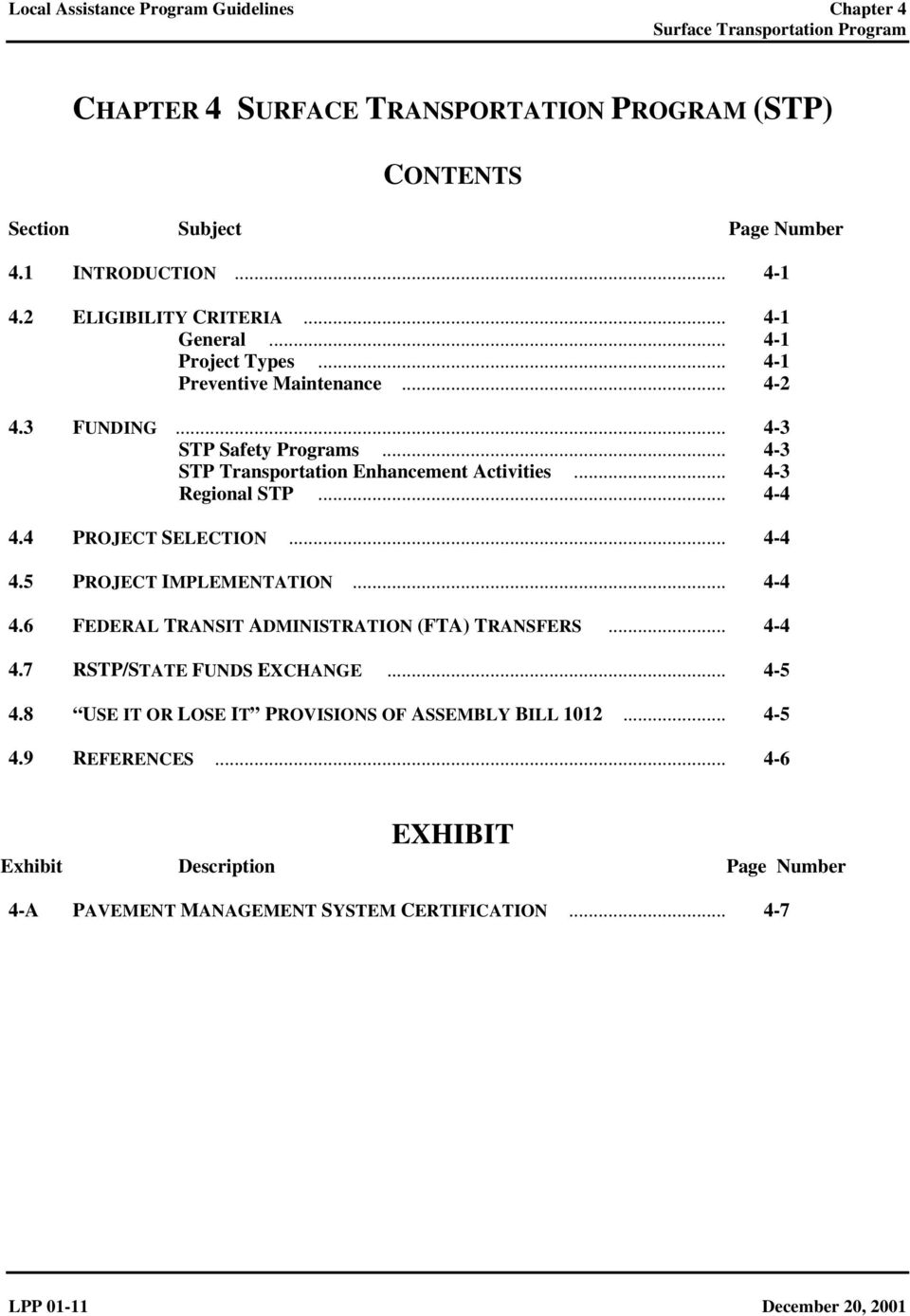
1 Local Assistance Program Guidelines Chapter 4 CHAPTER 4 SURFACE TRANSPORTATION PROGRAM (STP) CONTENTS Section Subject Page Number 4.1 INTRODUCTION ELIGIBILITY CRITERIA General Project Types Preventive Maintenance FUNDING STP Safety Programs STP Transportation Enhancement Activities Regional STP PROJECT SELECTION PROJECT IMPLEMENTATION FEDERAL TRANSIT ADMINISTRATION (FTA) TRANSFERS RSTP/STATE FUNDS EXCHANGE USE IT OR LOSE IT PROVISIONS OF ASSEMBLY BILL REFERENCES EXHIBIT Exhibit Description Page Number 4-A PAVEMENT MANAGEMENT SYSTEM CERTIFICATION LPP December 20, 2001
2 Chapter 4 Local Assistance Program Guidelines December 20, 2001 LPP 01-11

3 Local Assistance Program Guidelines Chapter 4 CHAPTER 4 SURFACE TRANSPORTATION PROGRAM (STP) 4.1 INTRODUCTION 4.2 ELIGIBILITY CRITERIA The (STP) was established by the 1991 Federal Intermodal Surface Transportation Efficiency Act (ISTEA) and continued with the passage of the Transportation Equity Act for the 21 st Century (TEA-21) and the TEA-21 Restoration Act in Both new Acts are jointly referred to as TEA-21. Funds are directed to projects and programs for a broad variety of transit and highway work (including work done to streets and roads). GENERAL PROJECT TYPES Eligible projects may be located on: Any federal-aid highway, including the National Highway System. (A portion of the funds reserved for rural areas may be spent on rural minor collectors for fiscal years 1998 through 2003.) Bridges on any public highway. Transit capitol projects, and intra-city/inter-city bus terminals and facilities. Generally, the projects must be transportation projects or programs which are: Consistent with Title 23 United States Code (USC) and/or Title 49 USC. Derived from the Regional Transportation Plan (RTP), included in a Federal Transportation Improvement Program (FTIP) and/or Federal Statewide Transportation Improvement Program (FSTIP) and consistent with the conformity determinations of the Clean Air Act and its amendments. Eligible project types (Title 23 USC, Chapter 1, Section 133) include: Construction, reconstruction, rehabilitation, resurfacing, restoration and operational improvements for highway and bridge projects, including bridge seismic retrofit, painting and application of calcium magnesium acetate, sodium acetate/formate, or other environmentally acceptable, minimally corrosive anti-icing and de-icing compositions. Also included are the necessary engineering, right-of-way and environmental mitigation for these activities. Transit capital projects under Chapter 53 of 49 USC including vehicles and facilities, whether publicly or privately owned, that are used to provide inter-city passenger service by bus. Carpool projects, fringe and corridor parking facilities, bicycle facilities and nonconstruction projects, pedestrian walkways, and modification of public sidewalks to comply with the Americans with Disabilities Act of 1990 (42 USC et seq.). Page 4-1 LPP December 20, 2001

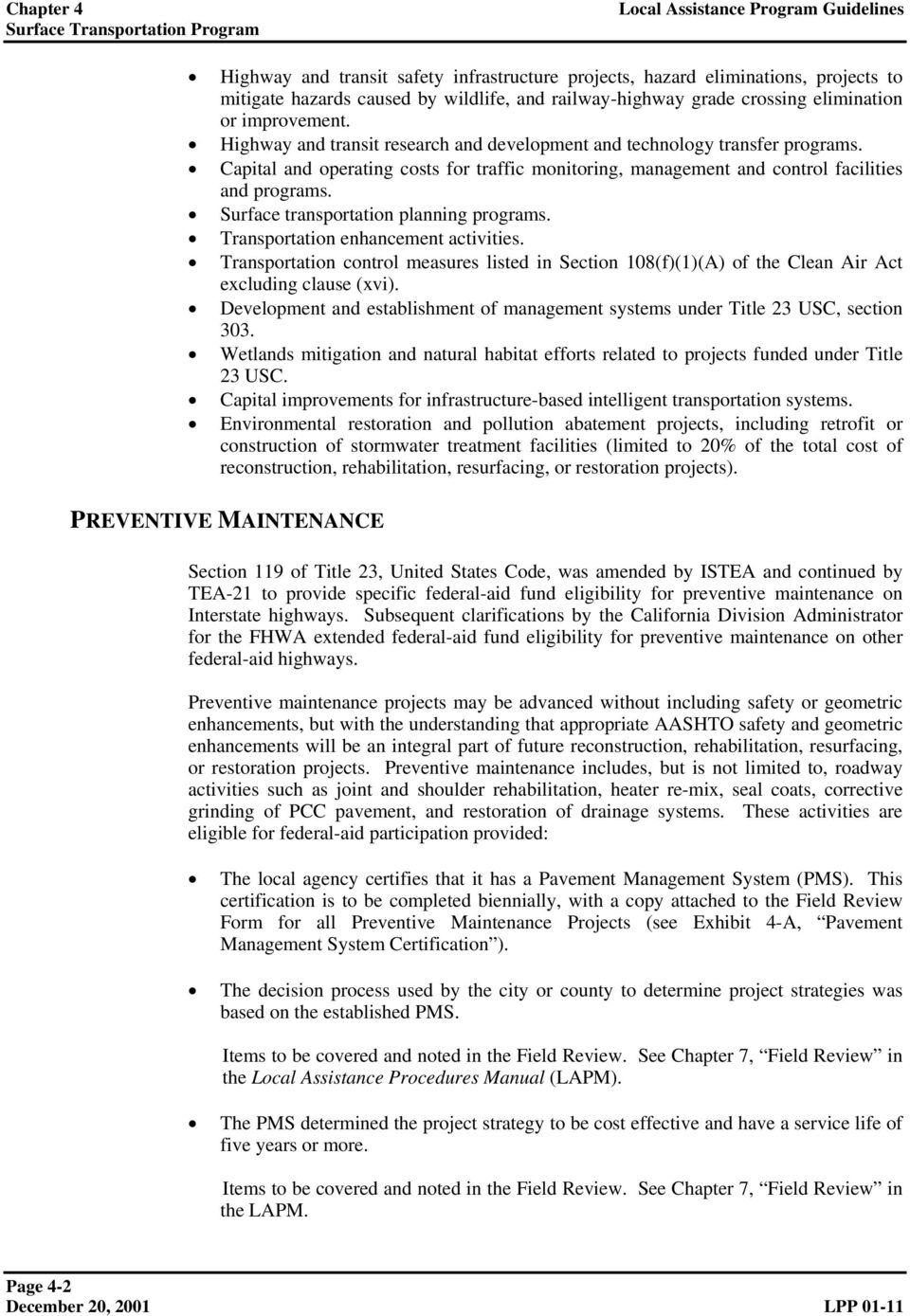
4 Chapter 4 Local Assistance Program Guidelines Highway and transit safety infrastructure projects, hazard eliminations, projects to mitigate hazards caused by wildlife, and railway-highway grade crossing elimination or improvement. Highway and transit research and development and technology transfer programs. Capital and operating costs for traffic monitoring, management and control facilities and programs. Surface transportation planning programs. Transportation enhancement activities. Transportation control measures listed in Section 108(f)(1)(A) of the Clean Air Act excluding clause (xvi). Development and establishment of management systems under Title 23 USC, section 303. Wetlands mitigation and natural habitat efforts related to projects funded under Title 23 USC. Capital improvements for infrastructure-based intelligent transportation systems. Environmental restoration and pollution abatement projects, including retrofit or construction of stormwater treatment facilities (limited to 20% of the total cost of reconstruction, rehabilitation, resurfacing, or restoration projects). PREVENTIVE MAINTENANCE Section 119 of Title 23, United States Code, was amended by ISTEA and continued by TEA-21 to provide specific federal-aid fund eligibility for preventive maintenance on Interstate highways. Subsequent clarifications by the California Division Administrator for the FHWA extended federal-aid fund eligibility for preventive maintenance on other federal-aid highways. Preventive maintenance projects may be advanced without including safety or geometric enhancements, but with the understanding that appropriate AASHTO safety and geometric enhancements will be an integral part of future reconstruction, rehabilitation, resurfacing, or restoration projects. Preventive maintenance includes, but is not limited to, roadway activities such as joint and shoulder rehabilitation, heater re-mix, seal coats, corrective grinding of PCC pavement, and restoration of drainage systems. These activities are eligible for federal-aid participation provided: The local agency certifies that it has a Pavement Management System (PMS). This certification is to be completed biennially, with a copy attached to the Field Review Form for all Preventive Maintenance Projects (see Exhibit 4-A, Pavement Management System Certification ). The decision process used by the city or county to determine project strategies was based on the established PMS. Items to be covered and noted in the Field Review. See Chapter 7, Field Review in the Local Assistance Procedures Manual (LAPM). The PMS determined the project strategy to be cost effective and have a service life of five years or more. Items to be covered and noted in the Field Review. See Chapter 7, Field Review in the LAPM. Page 4-2 December 20, 2001 LPP 01-11
5 Local Assistance Program Guidelines Chapter FUNDING The project is not for spot application. Spot application projects are considered to be normal maintenance and therefore not eligible. The preventive maintenance project does not degrade any existing safety or geometric aspects of the facility. All federal-aid requirements shall apply. Funding for each project shall be required to be in an approved Federal Statewide Transportation Improvement Program (FSTIP). (It is recommended that preventive maintenance projects be programmed on a lump sum basis for the program and not as individual projects.) Items to be covered and noted in the Field Review. See Chapter 7, Field Review in the LAPM. California received $656 million dollars for the Federal Fiscal Year of 2000/2001 (October 1, 2000 to September 30, 2001) in total STP apportionments under the 1998 TEA-21 provisions. Funds are apportioned on a pro-rata percentage of federal-aid highway lanemiles, vehicle-miles traveled on lanes on federal-aid highways, and tax payments attributable to highway users. FHWA may impose annual penalties when the state does not comply with specific provisions of federal law. Certain deductions for administrative purposes, set-asides, and transfers may adjust the amount available for apportionment. STP SAFETY PROGRAMS Ten percent of the STP apportionment authorized by TEA-21 is reserved for safety programs defined by Sections 130 (railroad-highway crossing improvements) and 152 (hazard elimination projects) of the Act (see Chapter 9, Hazard Elimination Safety, and Chapter 10, Railroad/Highway At-Grade Crossing, in this manual). STP TRANSPORTATION ENHANCEMENT ACTIVITIES (TEA) Another 10 percent of the STP apportionment is reserved for Transportation Enhancement Activities. This reserved apportionment is used for a variety of special projects which serve to enhance or enlarge the function or purpose beyond that normally required for transportation service or environmental mitigation requirement (see Chapter 8, Transportation Enhancement Activities of this manual). Page 4-3 LPP December 20, 2001

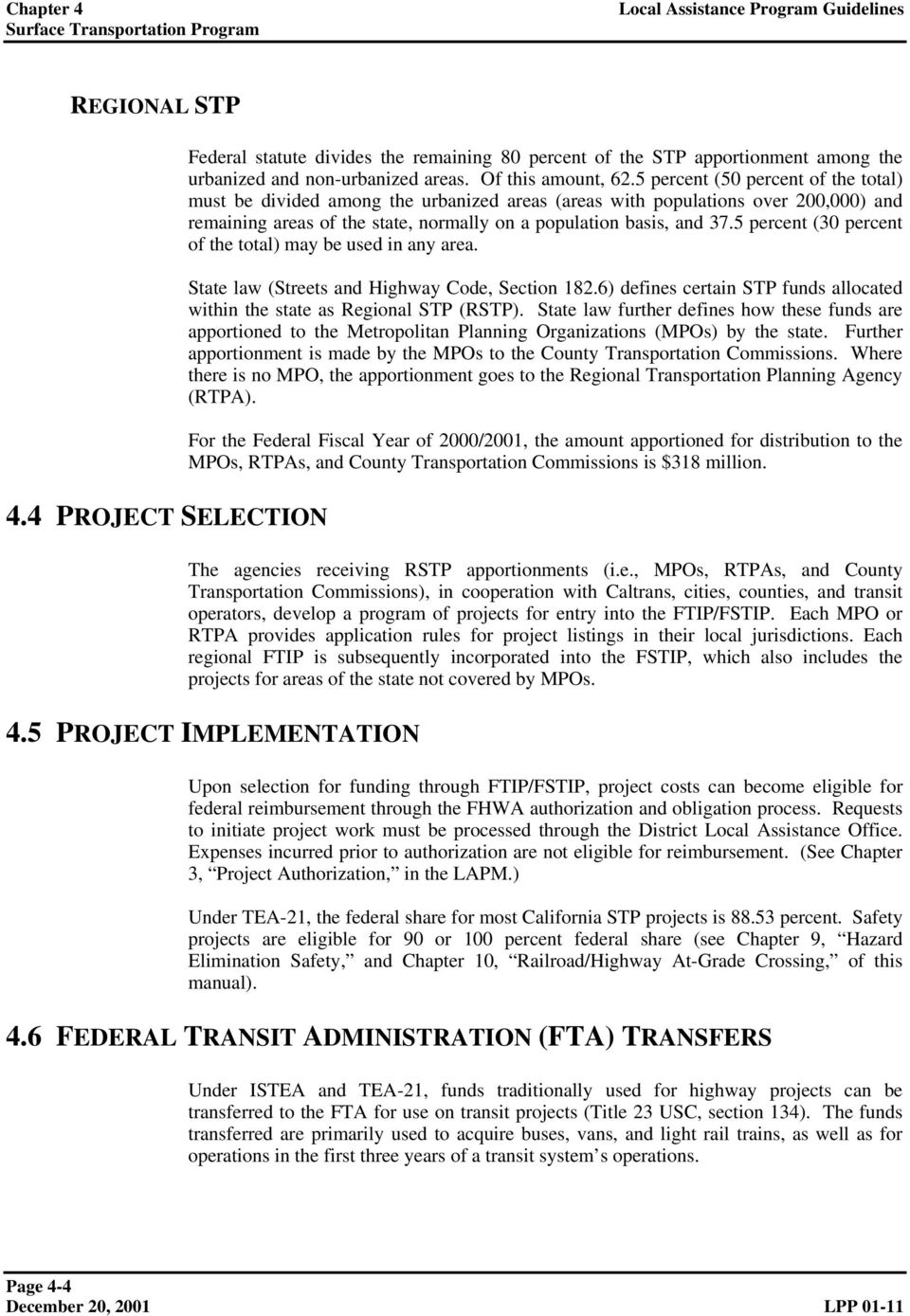
6 Chapter 4 Local Assistance Program Guidelines REGIONAL STP 4.4 PROJECT SELECTION Federal statute divides the remaining 80 percent of the STP apportionment among the urbanized and non-urbanized areas. Of this amount, 62.5 percent (50 percent of the total) must be divided among the urbanized areas (areas with populations over 200,000) and remaining areas of the state, normally on a population basis, and 37.5 percent (30 percent of the total) may be used in any area. State law (Streets and Highway Code, Section 182.6) defines certain STP funds allocated within the state as Regional STP (RSTP). State law further defines how these funds are apportioned to the Metropolitan Planning Organizations (MPOs) by the state. Further apportionment is made by the MPOs to the County Transportation Commissions. Where there is no MPO, the apportionment goes to the Regional Transportation Planning Agency (RTPA). For the Federal Fiscal Year of 2000/2001, the amount apportioned for distribution to the MPOs, RTPAs, and County Transportation Commissions is $318 million. The agencies receiving RSTP apportionments (i.e., MPOs, RTPAs, and County Transportation Commissions), in cooperation with Caltrans, cities, counties, and transit operators, develop a program of projects for entry into the FTIP/FSTIP. Each MPO or RTPA provides application rules for project listings in their local jurisdictions. Each regional FTIP is subsequently incorporated into the FSTIP, which also includes the projects for areas of the state not covered by MPOs. 4.5 PROJECT IMPLEMENTATION Upon selection for funding through FTIP/FSTIP, project costs can become eligible for federal reimbursement through the FHWA authorization and obligation process. Requests to initiate project work must be processed through the District Local Assistance Office. Expenses incurred prior to authorization are not eligible for reimbursement. (See Chapter 3, Project Authorization, in the LAPM.) Under TEA-21, the federal share for most California STP projects is percent. Safety projects are eligible for 90 or 100 percent federal share (see Chapter 9, Hazard Elimination Safety, and Chapter 10, Railroad/Highway At-Grade Crossing, of this manual). 4.6 FEDERAL TRANSIT ADMINISTRATION (FTA) TRANSFERS Under ISTEA and TEA-21, funds traditionally used for highway projects can be transferred to the FTA for use on transit projects (Title 23 USC, section 134). The funds transferred are primarily used to acquire buses, vans, and light rail trains, as well as for operations in the first three years of a transit system s operations. Page 4-4 December 20, 2001 LPP 01-11
7 Local Assistance Program Guidelines Chapter 4 The transfer process begins when a transit operator determines that funding is needed for a specific project, such as acquiring a bus, rehabilitating vans, or constructing a transit facility. Next, the transit operator makes a grant application to FTA. Once the number is received from FTA, the transit operator submits the necessary documentation to the Caltrans District Local Assistance Engineer (DLAE). At this point, the project identified for funding should be included on the FTIP/FSTIP. The DLAE then forwards the FTA transfer request to the Division of Local Assistance. Upon receiving a request, the Division of Local Assistance assures that adequate funding and obligational authority is available. Afterward, the Division of Local Assistance submits a letter to FHWA that 1) identifies the project and 2) asks FHWA to transfer the funds, thereby reducing the apportionment for the region. When FHWA Headquarters Office of Budget and Finance completes the necessary documents, FHWA then transfers funds to FTA. 1 For additional information, please refer to Chapter 3, Project Authorization, of the LAPM. 4.7 RSTP/STATE FUNDS EXCHANGE Non-MPO RTPAs may exchange their RSTP funding for State Highway Account funds. Counties represented by MPOs may exchange their guaranteed share of these funds provided that the amount is less than 1 percent of the total statewide apportionment or in excess of 3.5 percent total statewide apportionment by formula (see Chapter 18, Exchange/Match Program, of this manual). 4.8 USE IT OR LOSE IT PROVISIONS OF ASSEMBLY BILL 1012 Assembly Bill 1012 (AB 1012) was enacted in October 1999 with a goal of improving the delivery of transportation projects. The legislation states that regional agency RSTP and Congestion Mitigation and Air Quality Improvement (CMAQ) funds that are not obligated within the first three years of federal eligibility are subject to reprogramming by the California Transportation Commission (CTC) in the fourth year. Caltrans will apply the same policy to the Regional Transportation Enhancement Activities (TEA) program; although, the statutes do not specify that the Regional TEA program is subject to the same timely use of funds provisions. This treatment of Regional TEA funds is consistent with the CTC policy that states Regional TEA funds will be apportioned and managed in a manner similar to RSTP funds. The roles and responsibilities for the timely use of funds are delineated in statute and are shared by regional agencies, Caltrans, and the CTC. Regional agencies are responsible for: 1) obligating the funds within the three-year time period, and 2) developing a plan for these funds that remain unobligated in the third year. Caltrans is responsible for monitoring and reporting unobligated balances. The CTC is responsible for reprogramming the unobligated balances to ensure no federal lapse occurs. 1 Once transferred to FTA, the funds cannot be returned to FHWA. Page 4-5 LPP December 20, 2001

8 Chapter 4 Local Assistance Program Guidelines 4.9 REFERENCES Regional agencies must submit a formal obligation plan for any CMAQ, RSTP, or Regional TEA balance older than 2-years old to the DLAE by April 15 of each year. The plan must be tied back to the FTIP and provide a project identifier for each project. Adequate time must be allowed in the plans for the required administrative processes in order to meet the federal funds cut off date of September 15. Therefore, regional agencies must submit all requests for obligation of funds to the Department district offices no later than August 15. For information on policy and procedures necessary to implement the Timely Use of Funds provisions outlined in AB 1012, refer to the Guidelines for Implementation of the Timely Use of Funds Provisions of AB 1012, found on the Local Assistance homepage at: Title 23 United States Code, Chapter 1, Sections 104, 133, 134,135,149, 152 California Constitution, Article XIX Streets and Highways Code, Sections 182.4, Guidelines for Matching Regional Surface Transportation and CMAQ Projects (August 4, 1993), Division of Transportation Programming A Guide to Federal-Aid Programs, Projects, and Other Uses of Highway Funds, Publication No. FHWA-PD , September 1992 Page 4-6 December 20, 2001 LPP 01-11

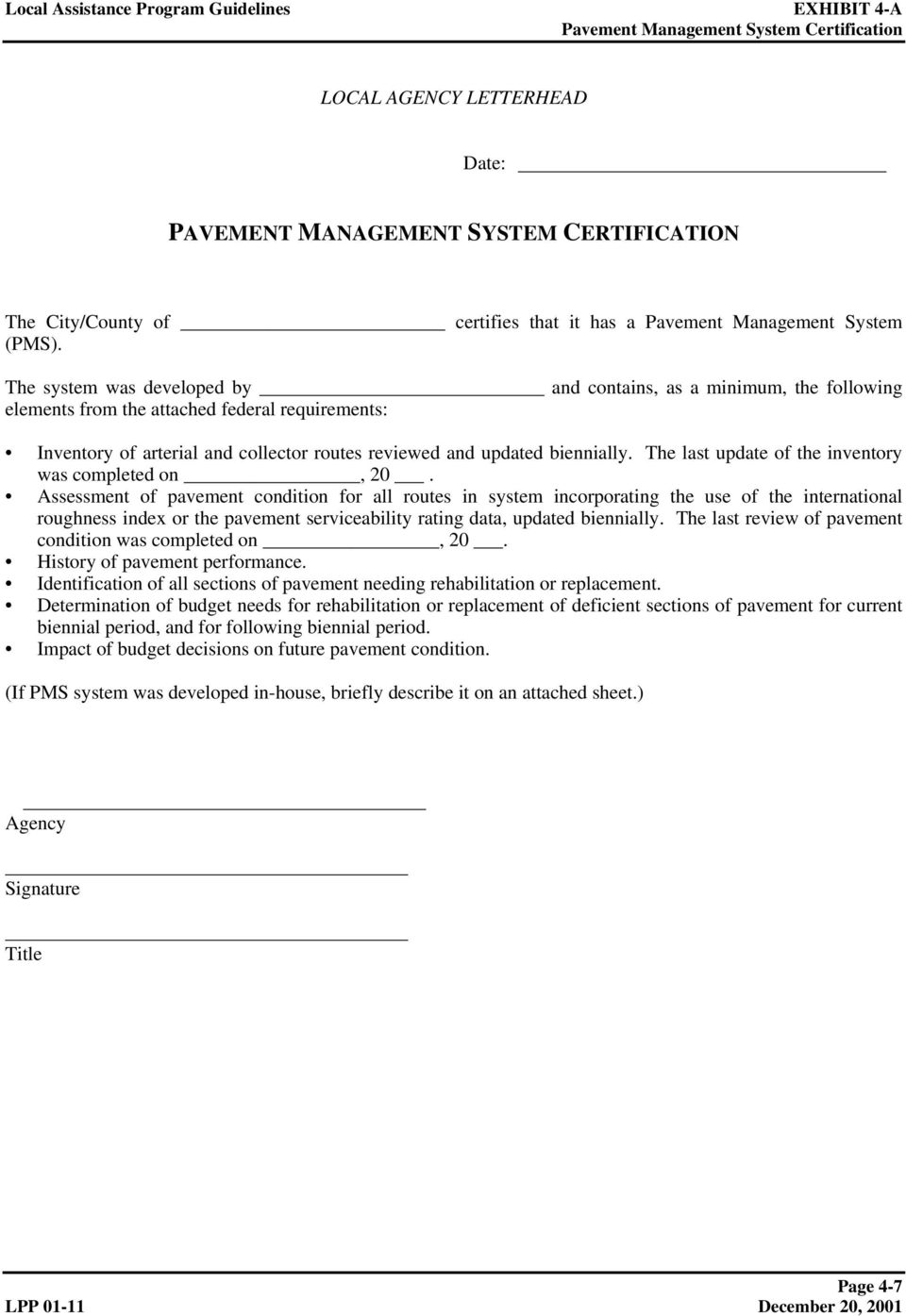
9 Local Assistance Program Guidelines EXHIBIT 4-A Pavement Management System Certification LOCAL AGENCY LETTERHEAD Date: PAVEMENT MANAGEMENT SYSTEM CERTIFICATION The City/County of certifies that it has a Pavement Management System (PMS). The system was developed by and contains, as a minimum, the following elements from the attached federal requirements: Inventory of arterial and collector routes reviewed and updated biennially. The last update of the inventory was completed on, 20. Assessment of pavement condition for all routes in system incorporating the use of the international roughness index or the pavement serviceability rating data, updated biennially. The last review of pavement condition was completed on, 20. History of pavement performance. Identification of all sections of pavement needing rehabilitation or replacement. Determination of budget needs for rehabilitation or replacement of deficient sections of pavement for current biennial period, and for following biennial period. Impact of budget decisions on future pavement condition. (If PMS system was developed in-house, briefly describe it on an attached sheet.) Agency Signature Title Page 4-7 LPP December 20, 2001
10 EXHIBIT 4-A Pavement Management System Certification Local Assistance Program Guidelines Page 4-8 December 20, 2001 LPP 01-11

Federal Guidelines for STP-U Funding
 MPC 5.f Attachment 1 STP-U Eligibility Guidelines Page 1 of 5 Federal Guidelines for STP-U Funding SURFACE TRANSPORTATION PROGRAM (STP) ELIGIBLE EXPENDITURES PERIOD AVAILABLE: FY + 3 Years FUND: Highway
Regional Surface Transportation Program Policy and Allocation
 FY 2014-15 Regional Surface Transportation Program Policy and Allocation August 2015 Humboldt County Association of Governments 611 I Street, Suite B Eureka, CA 95501 Phone: 707.444.8208 www.hcaog.net
Federal Highway Administration 1200 New Jersey Avenue, SE Washington, DC 20590 202-366-4000
 1 of 8 12/27/2013 8:21 AM U.S. Department of Transportation Federal Highway Administration 1200 New Jersey Avenue, SE Washington, DC 20590 202-366-4000 MAP-21 - Moving Ahead for Progress in the 21st Century
SURFACE TRANSPORTATION PROGRAM (STP) PROCEDURES FOR THE OKLAHOMA CITY URBANIZED AREA FUNDS
 SURFACE TRANSPORTATION PROGRAM (STP) PROCEDURES FOR THE OKLAHOMA CITY URBANIZED AREA FUNDS October 2015 Background The Surface Transportation Program (STP) was originally established as Section 133 of
GENERAL. This manual addresses five local programs that are funded under the current Highway Act:
 OVERVIEW The Local Public Agency Manual published by the Missouri Department of Transportation (MoDOT) is intended to be used as a guide for cities and counties that sponsor projects utilizing federal
Surface Transportation Program (STP) Projects
 Toledo Metropolitan Area Council of Governments American Reinvestment and Recovery Act (Economic Stimulus Program) Application Packet for: Surface Transportation Program (STP) Projects APPLICATIONS DUE
Chapter 8 Funding Considerations
 Chapter 8 Funding Considerations Expanding transit services into El Dorado Hills under any of the service alternatives has associated operating and capital costs. This chapter considers the funding sources
Alternatives to the Circ Project Prioritization Methodology Prepared for Circ Task Force July 28, 2011
 Alternatives to the Circ Project Prioritization Methodology Prepared for Circ Task Force July 28, 2011 CCRPC staff has developed a draft methodology described below and detailed in the attached pages for
Summary of MAP-21 Matrix
 Summary of MAP-21 Matrix Overview On July 6, 2012, President Obama signed into law P.L. 112-141, the Moving Ahead for Progress in the 21st Century Act (MAP-21). Funding surface transportation programs
The financial plan was prepared in conjunction with the Technical Working Group. Refer to Table 3-1: Funding and Implementation Plan.
 3 Financial Plan The purpose of the financial plan is to identify funding options that would be likely sources of money to advance recommendations made by this study. The Capitol Region Transportation
2012-2013 Transition from SAFETEA-LU to the new MAP-21 Federal Transportation Act
 C h a p t e r 9 - F i n a n c i a l P l a n a n d R e c o m m e n d a t i o n s f o r T r a n s p o r t a t i o n S y s t e m I m p r o v e m e n t P r o j e c t s A major component of the Plan (T2040)
RPA 14/ATURA Surface Transportation Program (STP) APPLICATION FOR FUNDS
 RPA 14/ATURA Surface Transportation Program (STP) APPLICATION FOR FUNDS Please provide the following information when applying to RPA 14/ATURA for Surface Transportation Program (STP) funding for projects
FINANCIAL PLAN. Any future earmarks are assumed to carry their own limitation and not reduce the regular limitation identified in these calculations.
 VII. FINANCIAL PLAN FHWA Funds The Federal Highway Administration (FHWA) funds are appropriated by Congress. FHWA funding levels are identified in the six-year Transportation Act. Each year, a federal
Knoxville Regional Transportation Planning Organization. Certification Review Report. April 2012
 Knoxville Regional Transportation Planning Organization Certification Review Report April 2012 Federal Highway Administration Federal Transit Administration Tennessee Division Office Region 4 404 BNA Drive,
CHAPTER 6 Project Cost, Scope, and Schedule Changes Table of Contents
 Chapter 6 Project Cost, Scope, and Schedule Changes Table of Contents CHAPTER 6 Project Cost, Scope, and Schedule Changes Table of Contents CHAPTER 6 Project Cost, Scope, and Schedule Changes... 6-3 ARTICLE
INDOT 2000-2025 Long Range Plan
 Chapter 9 INDOT 2000-2025 Long Range Plan Highway Needs Analysis Overview The statewide transportation planning process provides for the identification of highway needs through a comprehensive process
Performance Elements
 Performance Elements National Goals Performance Measures Performance Targets Performance Plans Target Achievement Special Performance Rules Performance Reporting National Goals Focus the Federal aid program
A Guide To Federal-Aid Programs And Projects
 A Guide To Federal-Aid Programs And Projects Federal Highway Administration Office of Program Administration Introduction Federal-Aid highway funds are authorized by Congress to assist the States in providing
CHAPTER 15 STATE AND LOCAL TRANSPORTATION PARTNERSHIP PROGRAM (SLTPP)
 Local Assistance Program Guidelines Chapter 15 State & Local Transportation Partnership Program CHAPTER 15 STATE AND LOCAL TRANSPORTATION PARTNERSHIP PROGRAM (SLTPP) TABLE OF CONTENTS Section Subject Page
Moving Ahead for Progress in the 21 st Century:
 Moving Ahead for Progress in the 21 st Century: IMPLICATIONS FOR OREGON OREGON DEPARTMENT OF TRANSPORTATION Moving Ahead for Progress in the 21 st Century Implications for Oregon December 2012 Oregon Department
LAWTON METROPOLITAN AREA
 LAWTON METROPOLITAN AREA TRANSPORTATION IMPROVEMENT PROGRAM FEDERAL FISCAL YEARS 2005, 2006, 2007 This report was prepared by the Lawton Metropolitan Planning Organization (LMPO) and was finance part through
Chapter 5 Financial Plan
 The Safe, Accountable, Flexible, Efficient Transportation Equity Act: A Legacy for Users (SAFETEA_LU) requires that the MTP incorporate a financial plan for the planning period. The MTP is required to
Technical Memorandum REVENUE FORECASTS. Prepared for: Prepared by:
 Technical Memorandum REVENUE FORECASTS Prepared for: Prepared by: April 2014 TABLE OF CONTENTS 1 Introduction... 1 1.1 Inflation Indices... 2 1.2 Previous Studies... 3 2 Highway Revenue Baseline Forecast...
DEPARTMENT OF TRANSPORTATION
 DEPARTMENT OF TRANSPORTATION CFDA 20.205 CFDA 20.219 CFDA 23.003 HIGHWAY PLANNING AND CONSTRUCTION (Federal-Aid Highway Program) RECREATIONAL TRAILS PROGRAM APPALACHIAN DEVELOPMENT HIGHWAY SYSTEM I. PROGRAM
Program guidance that details the eligibility, criteria and application process. Ferry Boat Program. Ohio Department of Transportation
 Program guidance that details the eligibility, criteria and application process. Ferry Boat Program Ohio Department of Transportation TABLE OF CONTENTS Program Overview Program Administration.........2
REFERENCE SERIES: Transportation in Connecticut ARTICLE NO. 02 Potential Federal-Aid Sources
 REFERENCE SERIES: Transportation in Connecticut ARTICLE NO. 02 Potential Federal-Aid Sources THIS DOCUMENT IS IN TEXT ONLY FORMAT - A FULLY FORMATTED DOCUMENT WITH GRAPHICS IS AVAILABLE AT THE CT DOT WEBSITE
Pedestrian & Bicycle Plan
 RAMSEY COMMUNITIES COUNTYWIDE Pedestrian & Bicycle Plan PRIMER: LEGAL FRAMEWORK PRIMER: LEGAL FRAMEWORK Walking and Biking for All e 2 CHAPTER 2: Walking and Biking for All This page intentionally left
Chapter VIII: Long-Term Outlook and the Financial Plan
 A. Long-Term Outlook Chapter VIII: Long-Term Outlook and the Financial Plan When examining the long-term outlook for transportation planning and programming over the foreseeable future, there are several
STAFF REPORT. COUNCIL Agenda # MEETING OF November 9, 2004
 COUNCIL Agenda # MEETING OF November 9, 2004 STAFF REPORT Resolution for the Authorization to Apply for Federal Surface Transportation Program Funds Administered by the Metropolitan Transportation Commission
Lynn M. Suter and Associates
 3 Lynn M. Suter and Associates Government Relations GM Memo No. 05-181 August 5, 2005 TO: Joe Wallace, President, and Members of the AC Transit Board of Directors Jim Gleich, DGM FR: RE: Lynn M. Suter
A. PAVEMENT MANAGEMENT SYSTEM
 CHAPTER 9 PAVEMENT A. PAVEMENT MANAGEMENT SYSTEM A Pavement Management System (PMS) is a systematic process that collects and analyzes roadway pavement information for use in selecting cost-effective strategies
HERS_IN. HIGHWAY ECONOMIC REQUIREMENTS SYSTEM (for) INDIANA. AASHTO Transportation Estimator Association Conference October 16, 2001
 AASHTO Transportation Estimator Association Conference October 16, 2001 HERS_IN HIGHWAY ECONOMIC REQUIREMENTS SYSTEM (for) INDIANA OVERVIEW HERS Background System Planning Tool Development HERS_IN Structure
Butch Wlaschin P.E. Director, Office of Asset Management, Pavements, and Construction FHWA
 Butch Wlaschin P.E. Director, Office of Asset Management, Pavements, and Construction FHWA National Goals Focus the Federal-aid program on the following national goals: 1) SAFETY 2) INFRASTRUCTURE CONDITION
KENTUCKY TRANSPORTATION CABINET. Department of Rural and Municipal Aid. Office of Local Programs
 KENTUCKY TRANSPORTATION CABINET Department of Rural and Municipal Aid Office of Local Programs Office of Local Programs Transportation Enhancements Safe Routes to School Congestion Mitigation and Air Quality
KENTUCKY TRANSPORTATION CABINET POLICY FOR FEDERALLY FUNDED PAVEMENT REHABILITATION AND PREVENTATIVE MAINTENANCE PROJECTS
 KENTUCKY TRANSPORTATION CABINET POLICY FOR FEDERALLY FUNDED PAVEMENT REHABILITATION AND PREVENTATIVE MAINTENANCE PROJECTS I. GENERAL The following policy shall apply when the intent of the project is to
3.1 Historical Considerations
 3. Recommended Scope of Bridge improvements 3.1 Historical Considerations In the fall of 2000, an outside consultant, Fraser Design, suggested that the existing 4 th St. Bridge is potentially eligible
Update on the Development of MAP 21 Performance Measures
 Update on the Development of MAP 21 Performance Measures TPB Technical Committee February 6, 2015 Eric Randall Department of Transportation Planning Item 9 MAP 21 Rulemaking National Goals Rulemaking Overview
14-97. 14-97.002 Definitions. For the purposes of this rule chapter the following definitions shall apply unless the context clearly shows otherwise:
 14-97 14-97.001 Purpose. This rule chapter sets forth an access control classification system and access management standards to implement the State Highway System Access Management Act of 1988. The implementation
FISCAL YEAR 2014 SOLICITATION FOR PROPOSALS FOR FEDERAL JOB ACCESS AND REVERSE COMMUTE AND NEW FREEDOM PROGRAM FUNDS EVALUATION CRITERIA
 FISCAL YEAR 2014 SOLICITATION FOR PROPOSALS FOR FEDERAL JOB ACCESS AND REVERSE COMMUTE AND NEW FREEDOM PROGRAM FUNDS EVALUATION CRITERIA Los Angeles County Metropolitan Transportation Authority (LACMTA)
2035 FINANCIAL RESOURCES FORECAST
 2035 FINANCIAL RESOURCES FORECAST AKRON METROPOLITAN AREA TRANSPORTATION STUDY 806 CITICENTER BUILDING 146 SOUTH HIGH STREET AKRON, OHIO 44308 December 2012 This report was prepared by the Akron Metropolitan
TEXAS DEPARTMENT OF TRANSPORTATION
 TEXAS DEPARTMENT OF TRANSPORTATION S T A T E W I D E T R A N S P O R T A T I O N I M P R O V E M E N T P R O G R A M S T I P 2 015-201 8 ABILENE DISTRICT 2 0 1 5-2 0 1 8 T I P T R A N S I T I n i t i a
CHAPTER 5-CMPO TRANSPORTATION VISION PLANS (2035 & BEYOND)
 Regional Transportation Plan 2035 28 CHAPTER 5-CMPO TRANSPORTATION VISION PLANS (2035 & BEYOND) The Cache Transportation Vision Plan shows roadway, bicycle, transit and pedestrian projects that attempt
APPLICATION LAFAYETTE METROPOLITAN PLANNING ORGANIZATION (MPO) SURFACE TRANSPORTATION PROGRAM (STP) FUNDS TRANSPORTATION IMPROVEMENT PROGRAM (TIP)
 APPLICATION LAFAYETTE METROPOLITAN PLANNING ORGANIZATION (MPO) SURFACE TRANSPORTATION PROGRAM (STP) FUNDS TRANSPORTATION IMPROVEMENT PROGRAM (TIP) To be considered for STP funding, a proposed project must
Improving Access in Florida International University Biscayne Bay Campus Executive Summary
 EXECUTIVE SUMMARY Improving Access in Florida International University Biscayne Bay Campus Executive Summary Prepared for: Miami-Dade County Metropolitan Planning Organization (Miami-Dade MPO) Prepared
AASHTO SCOPM MAP-21 Checklist
 AASHTO SCOPM MAP-21 Notice of Proposed Rule-Making Checklist (CMAQ) AASHTO SCOPM MAP-21 Checklist Performance Area CMAQ Document Overview MAP-21 legislation requires States and MPOs to: Establish performance
REPORT ON CERTIFICATION THAT THE TRANSPORTATION PLANNING PROCESS COMPLIES WITH APPLICABLE FEDERAL LAWS AND REGULATIONS
 REPORT ON CERTIFICATION THAT THE TRANSPORTATION PLANNING PROCESS COMPLIES WITH APPLICABLE FEDERAL LAWS AND REGULATIONS 2014 Prepared by: Assistance by: Reviews: Lincoln City-Lancaster County Planning Department
SUMMARY: This notice announces changes in the Federal Transit Administration (FTA)
 This document is scheduled to be published in the Federal Register on 02/16/2016 and available online at http://federalregister.gov/a/2016-02821, and on FDsys.gov DEPARTMENT OF TRANSPORTATION Federal Transit
Wilmington Urban Area Metropolitan Planning Organization Surface Transportation Program Direct Attributable Project Submittal Guide Fiscal Year 2016
 Wilmington Urban Area Metropolitan Planning Organization Surface Transportation Program Direct Attributable Project Submittal Guide Fiscal Year 2016 Date of Release: September 14, 2015 Pre application
ORANGE COUNTY TRANSPORTATION AUTHORITY. Final Long-Range Transportation Plan - Destination 2035. Attachment A
 ORANGE COUNTY TRANSPORTATION AUTHORITY Final Long-Range Transportation Plan - Destination 2035 Attachment A DESTINATION 2035 DESTINATION 2035 EXECUTIVE SUMMARY ATTACHMENT A Moving Toward a Greener Tomorrow
DESCRIPTION OF ACCOUNTING AND FINANCIAL REPORTING SYSTEM
 DESCRIPTION OF ACCOUNTING AND FINANCIAL REPORTING SYSTEM Livingston s accounting system is organized on the basis of Accounting Funds, each of which is considered a separate government activity with its
MAP 21 themes. Strengthens America s highway and public transportation systems. Supports the Department s aggressive safety agenda
 MAP 21 themes Strengthens America s highway and public transportation systems Creates jobs and supports economic growth Supports the Department s aggressive safety agenda Simplifies and focuses the Federal
Implementation Strategy
 Implementation Strategy 6 The following implementation strategy defines strategic points of intervention for complete streets programming, including visioning, goal-setting, local agency plans, coordination
Examples of Transportation Plan Goals, Objectives and Performance Measures
 Examples of Transportation Plan Goals, Objectives and Performance Measures The next step in the Long Range Transportation Plan (LRTP) process is to develop goals, objectives, and performance measures.
Surface Transportation Program (STP)
 Project Name: Project Sponsor: FEDERAL FUNDS PROJECT APPLICATION TRANSPORTATION IMPROVEMENT PROGRAM 2008-2013 SALT LAKE and OGDEN/ LAYTON URBAN AREAS Surface Transportation Program (STP) Urban Surface
metro funding sources guide 12-2341tr 2012 LACMTA
 2012 metro funding sources guide 12-2341tr 2012 LACMTA TABLE OF CONTENTS INTRODUCTION... 4 EXECUTIVE SUMMARY... 5 SECTION I Listing of Local, State, and Federal Funding Sources and Major Funding Sources
DRAFT STIP Narrative, NYSDOT, March 2013 (for Oct 2013 to Sept 2017 STIP) Page i
 DRAFT STIP Narrative, NYSDOT, March 2013 (for Oct 2013 to Sept 2017 STIP) Page i TABLE OF CONTENTS I. INTRODUCTION... 1 II. PROGRAM DEVELOPMENT... 3 A. PROGRAM DEVELOPMENT PROCESS... 3 Metropolitan Planning
STREETS -- BICYCLES -- PATHS
 STREETS -- BICYCLES -- PATHS RCW 35.75.050 Bicycle road fund -- Sources -- Use. The city or town council shall by ordinance provide that the whole amount or any amount not less than seventy-five percent
Transportation Improvement Program FY 2006-2008
 Transportation Improvement Program FY 2006-2008 Hidalgo County Metropolitan Planning Organization Adopted By Policy Committee: March 24, 2005 Public Meeting Date: March 1, 2005 Public Meeting Date: April
A Legislative Briefing prepared by Volume 7, Number 1 February 2001
 fiscal forum A Legislative Briefing prepared by Volume 7, Number 1 February 2001 Mitchell E. Bean, Director P. O. Box 30014, Lansing, MI 48909-7514 517-373-8080! FAX 517-373-5874! www.house.state.mi.us/hfa
Colorado Off-System Bridge Program Description and Guidelines for Selecting Bridges for Rehabilitation or Replacement Funding
 C Colorado Off-System Bridge Program Description and Guidelines for Selecting Bridges for Rehabilitation or Replacement Funding These guidelines are intended to provide assistance in selecting OFF-SYSTEM
How To Manage Transportation Asset Management
 1 TRANSPORTATION ASSET MANAGEMENT THE NEW BUSINESS MODEL FOR TRANSPORTATION AGENCIES Presented at the AASHTO Subcommittee on Transportation Finance Policy Business Meeting Irvine, California June 26, 2012
South Carolina Multimodal Transportation Plan Vision, Goals, Objectives, and Performance Measures
 South Carolina Multimodal Transportation Plan Vision, Goals, Objectives, and Performance Measures Prepared for: Prepared by: June 2013 TABLE OF CONTENTS 1. Introduction... 1 1.1 Baseline Understanding...
CALIFORNIA TRANSPORTATION BY THE NUMBERS:
 CALIFORNIA TRANSPORTATION BY THE NUMBERS: Meeting the State s Need for Safe and Efficient Mobility SEPTEMBER 2014 202-466-6706 tripnet.org Founded in 1971, TRIP of Washington, DC, is a nonprofit organization