
AASHTO SCOPM MAP-21 Checklist
|
|
|
- Lewis Garrett
- 10 years ago
- Views:
Transcription
1 AASHTO SCOPM MAP-21 Notice of Proposed Rule-Making Checklist (CMAQ) AASHTO SCOPM MAP-21 Checklist Performance Area CMAQ Document Overview MAP-21 legislation requires States and MPOs to: Establish performance targets for system performance on the National Highway System based on specific measures established by the Secretary of Transportation Submit statewide biennial performance reports on the established measures and targets Submit MPO performance plans describing progress in achieving the performance targets, including a description of CMAQ projects identified for funding and how such projects will contribute to achieving emission and traffic congestion reduction targets. The Notice of Proposed Rulemaking (NPRN) for implementing the provisions of the legislation is expected to include more specific implementation details on system performance measure definition, data sources, and calculation methods; and the processes for target-setting and performance reporting. This document provides a set of checklists that can be used to assist in the review of the MAP-21 Congestion/System Performance NRPM provisions related to NHS CMAQ performance measurement. The checklists may suggest areas where comments are warranted to ensure that the final rules (1) support current or desired state performance management processes and (2) can be implemented in a manner that minimizes burdens on limited state resources. The checklists were based on the recommendations developed through the AASHTO Standing Committee on Performance Management (SCOPM) Task Force on Performance Measure Development, Coordination and Reporting. These checklists reflect the input that was provided by the Task Force to FHWA on rules related to national performance measures and targets. Each section of this document presents a summary of the relevant statutory provisions, a statement of what additional guidance may be provided in the NPRM, and a checklist of considerations that some States may wish to see reflected in the final rules. AASHTO SCOPM MAP-21 Notice of Proposed Rule-Making Checklist (CMAQ) 1
2 Performance Measure Definitions and Data Sources Summary of Statutory Provisions: Statutory Provision: 1203(c); 23 USC 150(c) 1203; 23 USC 150(c)(5)] For the purpose of carrying out section 149 (Congestion Mitigation and Air Quality Improvement Program), the Secretary will establish performance measures for States to use to assess traffic congestion and on-road mobile source emissions Context: To implement section 1203 of MAP-21, FHWA s rulemaking will define specific system performance measures. In addition to specifying the measures, the rulemaking is expected to clarify the methods state DOTs will use for calculating the required measures. Checklist: The following checklist can be used as a guide for review of the NPRM; it may suggest areas where comments are warranted to ensure that the final rules support current or desired state performance management processes and can be implemented in a manner that minimizes burdens on limited state resources. The performance measures shown below reflect the statutory requirements and incorporate the recommendations of the Task Force on measure calculation and definition. Members of the Task Force noted a number of potential issues with implementation of the CMAQ performance measures including: (1) lack of consistency across agencies in processes for modeling of CMAQ project impacts, particularly for delay, (2) concern that CMAQ-eligible projects may not be the best projects to improve performance; (3) concern that the measures may not favor use of CMAQ funds to address highly localized problems that would not show area-wide impacts; (4) concern about basing measure calculation on the annual CMAQ report, given that the set of projects in that report may be different than the set of projects that were adopted in that year and (5) concern that the measures may systematically favor some jurisdictions in project selection, undermining equitable distribution. Underlying this last point is the need to recognize differences between areas that already have low emissions and little congestion and areas with substantial air quality and congestion issues. In addition, a Task Force request for stakeholder comment on the measures yielded suggestions for modifying the delay measure to be delay per capita (rather than total), and modifying the emissions measure to be per day (rather than total for consistency with the existing FHWA database). Task Force Recommended Measures Annual Hours of Delay (AHD). Travel time above a congestion threshold (defined by State DOTs and MPOs) in units of vehicle - hours of delay reduced by the latest annual program of CMAQ projects. Criteria Pollutant Emissions. Daily kilograms of on-road, mobile source criteria air pollutants (VOC, NOx, PM, CO) reduced by the latest annual program of CMAQ projects. AASHTO SCOPM MAP-21 Notice of Proposed Rule-Making Checklist (CMAQ) 2

3 Measure Definitions and Data Sources (continued) Measure Definition, Sources and Calculation Methods CMAQ Measure Applicability. CMAQ measures should apply only to MPOs that serve Transportation Management Areas (TMAs) with populations of over 1,000,000 and that are nonattainment or maintenance areas. This aligns current air quality measure reporting with the CMAQ performance plan requirements in MAP-21, which apply only to those MPOs serving TMAs with populations of 1 million or more that are nonattainment or maintenance areas. Definition AHD. AHD is the amount of extra time spent by each vehicle traveling due to congestion (based on a state- determined threshold of congestion). AHD is a summation of the number of daily vehicle-hours of delay due to congestion. Extra travel time shows where long distance trips by many commuters are occurring in slow conditions. It is composed of miles traveled, vehicles traveling (volumes), and the speed of travel. Threshold for Determining Congestion. Each state and MPO should have the flexibility to establish a threshold speed for congestion for purposes of calculating the AHD reduced by CMAQ projects. Scope - AHD. Analyzing, calculating, target setting, and reporting of the CMAQ traffic congestion measure is to be limited only to annual hours of delay for portions of the system that are in areas designated as being in either nonattainment or maintenance status. Scope Criteria Pollutant Emissions. The criteria pollutant emissions measure should target mobile source criteria air pollutants only (VOC, NOx, PM, CO). Greenhouse gases and mobile source air toxics (MSATs) are not pollutants targeted by CMAQ. Measures targeting these emissions would not relate to the purpose of CMAQ, and would expand beyond what is included in MAP-21. Conform to current estimation practices for Criteria Pollutant Emissions. The calculation method for the emissions measure should conform to current CMAQ requirements. Currently, estimation of on-road mobile source criteria pollutants for areas where most CMAQ dollars are spent is already required as part of Clean Air Act Amendments requirements and CMAQ program administration responsibilities. FHWA currently requires states and MPOs to report a quantitative estimate of expected emissions reductions attributable to each CMAQ project, and in some instances, FHWA allows projects to be bundled together for purposes of estimating benefits, or a qualitative estimate may be used in place of quantitative data. AASHTO recommends continuing current practices. Flexibility in emissions modeling. Because CMAQ project sponsors and project types differ greatly and no single model is currently required by FHWA to calculate emissions reductions. AASHTO supports continuation of a flexible approach for measuring CMAQ project emission reductions that is consistent with current CMAQ reporting practices and that gives states and MPOs freedom to choose calculation approaches that work best in the context of their region, while ensuring every effort is taken to make credible estimates that are based on reproducible and logical analytical procedures. AASHTO SCOPM MAP-21 Notice of Proposed Rule-Making Checklist (CMAQ) 3
4 Measure Definitions and Data Sources (continued) Consistency across CMAQ National Measures. There should be consistency between the national-level reporting of CMAQ traffic congestion (AHD) and on-road mobile source emissions performance measures. The methodology (including the procedures and tools) employed by most MPOs to calculate on-road mobile source emissions, could also be used to estimate traffic congestion reductions. Minimize new data requirements. To the extent USDOT would consider making any changes to current practices in this regard, such changes should be minimal and any new performance data and reporting should be consistent with current requirements, and with outputs of existing travel demand and air quality models. Comments: AASHTO SCOPM MAP-21 Notice of Proposed Rule-Making Checklist (CMAQ) 4
5 Target Setting Method and Process Summary of Statutory Provisions: 1203; 23 USC 150(d) States have 12 months from final rulemaking to set targets reflecting the established measures, with the option of setting different targets for rural and urbanized areas. Context: Per section 1203 of MAP-21, States have flexibility in setting target values of the established national measures. However, rulemaking is likely to provide additional information on the process by which States establish targets. It may discuss factors that States should consider as they set targets (e.g. implications of setting aggressive versus easily-attainable targets.) Guidance may also be provided on the relationship between existing state performance targets and those targets established in response to MAP-21. Checklist: The following checklist can be used as a guide for review of the NPRM; it may suggest areas where comments are warranted to ensure that the final rules support current or desired state performance management processes and can be implemented in a manner that minimizes burdens on limited state resources. State-MPO Coordination. The target setting approach should encourage states and MPOs to work together, given the central role of MPOs in the current air quality planning process and in the new CMAQ performance plan requirements. Flexibility in Target Setting. AASHTO supports state flexibility in the setting of targets; as provided in MAP-21. To that end, affected states and MPOs should have flexibility to set their own targets for the national reporting of the CMAQ traffic congestion performance measure. Scope of Targets. Targets should be required only for areas required to report emissions and delay reductions which are those States and MPOs that serve TMAs with populations of over 1 million and that are nonattainment or maintenance areas. State Flexibility. States should have flexibility to set the target values for each of the required measures. Targets need to be set in the context of available funding and agency funding allocation decisions. (cross-cutting recommendation) Allow States to Set Target Ranges. The value of performance management is found in better decision-making, not target achievement. DOTs support the idea of allowing States to establish ranges of acceptable performance outcomes. Use of ranges can provide DOTs with a more nuanced way of discussing performance outcomes across multiple competing objectives. (cross-cutting recommendation) Focus on Federal Objectives. MAP-21 performance measure and target-setting rules should focus on federal objectives and state support of these objectives. The rules should be focused on the ability of states, using available federal funds, to deliver the desired results not on how states manage their own programs that do not use federal funds. (cross-cutting recommendation) AASHTO SCOPM MAP-21 Notice of Proposed Rule-Making Checklist (CMAQ) 5
6 Performance Reporting and Progress Evaluation (continued) Risk Based Approaches and Tradeoffs. Allow flexibility for DOTs and MPOs to use a risk based target setting approach. Risk-based targets do not reflect optimal outcomes within a particular investment area; rather, risk-based targets represent strategic objectives within a plan to manage agency risks. Allowing states to approach target-setting for the entire set of national performance measures as a bundle accommodates states that have tradeoff processes across asset/program areas. (cross-cutting recommendation) Allow for Target Adjustments. If a state wants to adjust targets dynamically (on an ongoing basis as conditions change), they should be allowed to do so. Targets for Trends Rather than Absolute Values. Consider allowing targets in the form of percent change (slope or trend line rather than single number). Acknowledge Risks in Target Setting. The rules should acknowledge that target setting has risks an agency that doesn t meet the target they have established could face public criticism or other unintended consequences (cross-cutting recommendation) Provide Rationale. Setting targets should be accompanied by a rationale for selecting the specific target value. (cross-cutting recommendation) Rational Schedule. The time periods for the performance measure data collection, target setting assessment, and target adjustments need to consider the varying processes each state has for these activities. (cross-cutting recommendation) Target-Setting Timeline. A state should have the flexibility to align their MAP-21 target-setting and performance reporting schedule with their TIP/STIP project cycle. (cross-cutting recommendation) Coordination of State and MPO Targets. The development of state and MPO targets should be coordinated through a 3C (continuing, cooperative and comprehensive) planning process. This process should result in MPO targets that are attainable given the level of investment a DOT plans to make in a metropolitan planning area (MPA) over a particular time-horizon. Whenever possible, DOTs and MPOs should use consistent (i.e. equivalent) targets to assess the condition and performance of state highways within an MPA. (cross-cutting recommendation) Comments: AASHTO SCOPM MAP-21 Notice of Proposed Rule-Making Checklist (CMAQ) 6

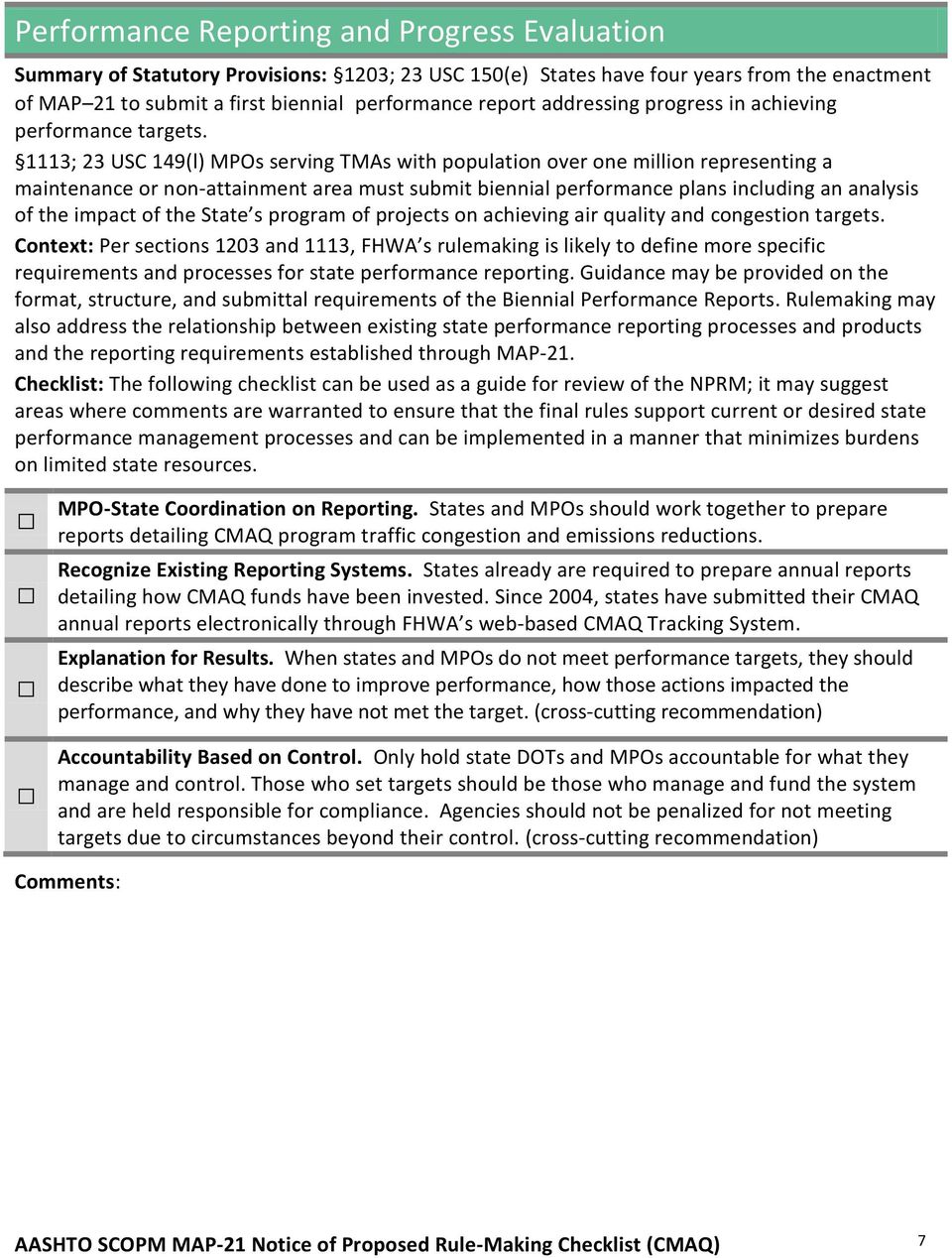
7 Performance Reporting and Progress Evaluation Summary of Statutory Provisions: 1203; 23 USC 150(e) States have four years from the enactment of MAP 21 to submit a first biennial performance report addressing progress in achieving performance targets. 1113; 23 USC 149(l) MPOs serving TMAs with population over one million representing a maintenance or non-attainment area must submit biennial performance plans including an analysis of the impact of the State s program of projects on achieving air quality and congestion targets. Context: Per sections 1203 and 1113, FHWA s rulemaking is likely to define more specific requirements and processes for state performance reporting. Guidance may be provided on the format, structure, and submittal requirements of the Biennial Performance Reports. Rulemaking may also address the relationship between existing state performance reporting processes and products and the reporting requirements established through MAP-21. Checklist: The following checklist can be used as a guide for review of the NPRM; it may suggest areas where comments are warranted to ensure that the final rules support current or desired state performance management processes and can be implemented in a manner that minimizes burdens on limited state resources. MPO-State Coordination on Reporting. States and MPOs should work together to prepare reports detailing CMAQ program traffic congestion and emissions reductions. Recognize Existing Reporting Systems. States already are required to prepare annual reports detailing how CMAQ funds have been invested. Since 2004, states have submitted their CMAQ annual reports electronically through FHWA s web-based CMAQ Tracking System. Explanation for Results. When states and MPOs do not meet performance targets, they should describe what they have done to improve performance, how those actions impacted the performance, and why they have not met the target. (cross-cutting recommendation) Accountability Based on Control. Only hold state DOTs and MPOs accountable for what they manage and control. Those who set targets should be those who manage and fund the system and are held responsible for compliance. Agencies should not be penalized for not meeting targets due to circumstances beyond their control. (cross-cutting recommendation) Comments: AASHTO SCOPM MAP-21 Notice of Proposed Rule-Making Checklist (CMAQ) 7
Performance-Based Planning and Programming
 Performance-Based Planning and Programming Matthew Hardy, Ph.D. Program Direction for Planning and Policy AASHTO September 17, 2013 2013 WVDOT/MPO/FHWA PLANNING CONFERENCE 1 Overview MAP-21 Requirements
Texas Freight Advisory Committee A PRIMER ON PUBLIC SECTOR FREIGHT PERFORMANCE MEASURES
 Texas Freight Advisory Committee A PRIMER ON PUBLIC SECTOR FREIGHT PERFORMANCE MEASURES October 1, 2013 A PRIMER ON PUBLIC SECTOR FREIGHT PERFORMANCE MEASURES How Do Performance Measures Assist the Public
Performance Elements
 Performance Elements National Goals Performance Measures Performance Targets Performance Plans Target Achievement Special Performance Rules Performance Reporting National Goals Focus the Federal aid program
Update on the Development of MAP 21 Performance Measures
 Update on the Development of MAP 21 Performance Measures TPB Technical Committee February 6, 2015 Eric Randall Department of Transportation Planning Item 9 MAP 21 Rulemaking National Goals Rulemaking Overview
Moving Ahead for Progress in the 21st Century. 2014 Performance Report
 MAP 21 Moving Ahead for Progress in the 21st Century 2014 Performance Report A report to Florida s Congressional Delegation March 2014 Overview: Because life is precious, FDOT has set the highway safety
Butch Wlaschin P.E. Director, Office of Asset Management, Pavements, and Construction FHWA
 Butch Wlaschin P.E. Director, Office of Asset Management, Pavements, and Construction FHWA National Goals Focus the Federal-aid program on the following national goals: 1) SAFETY 2) INFRASTRUCTURE CONDITION
Summary of MAP-21 Matrix
 Summary of MAP-21 Matrix Overview On July 6, 2012, President Obama signed into law P.L. 112-141, the Moving Ahead for Progress in the 21st Century Act (MAP-21). Funding surface transportation programs
Knoxville Regional Transportation Planning Organization. Certification Review Report. April 2012
 Knoxville Regional Transportation Planning Organization Certification Review Report April 2012 Federal Highway Administration Federal Transit Administration Tennessee Division Office Region 4 404 BNA Drive,
CHAPTER 4 SURFACE TRANSPORTATION PROGRAM (STP)
 Local Assistance Program Guidelines Chapter 4 CHAPTER 4 SURFACE TRANSPORTATION PROGRAM (STP) CONTENTS Section Subject Page Number 4.1 INTRODUCTION... 4-1 4.2 ELIGIBILITY CRITERIA... 4-1 General... 4-1
FISCAL YEAR 2014 SOLICITATION FOR PROPOSALS FOR FEDERAL JOB ACCESS AND REVERSE COMMUTE AND NEW FREEDOM PROGRAM FUNDS EVALUATION CRITERIA
 FISCAL YEAR 2014 SOLICITATION FOR PROPOSALS FOR FEDERAL JOB ACCESS AND REVERSE COMMUTE AND NEW FREEDOM PROGRAM FUNDS EVALUATION CRITERIA Los Angeles County Metropolitan Transportation Authority (LACMTA)
The Relationship Between Asset Management and Performance Management
 The Relationship Between Asset Management and Performance Management NCHRP 20-24, Task 58 Requested by: American Association of State Highway and Transportation Officials (AASHTO) Prepared by: Cambridge
The Relationship Between Asset Management and Performance Management
 The Relationship Between Asset Management and Performance Management NCHRP 20-24(58) Requested by: American Association of State Highway and Transportation Officials (AASHTO) Prepared by: Cambridge Systematics,
Federal Guidelines for STP-U Funding
 MPC 5.f Attachment 1 STP-U Eligibility Guidelines Page 1 of 5 Federal Guidelines for STP-U Funding SURFACE TRANSPORTATION PROGRAM (STP) ELIGIBLE EXPENDITURES PERIOD AVAILABLE: FY + 3 Years FUND: Highway
Stephen Gaj. Martin Kidner State Planning Engineer Wyoming DOT
 Stephen Gaj Leader, Asset Management Team, FHWA Martin Kidner State Planning Engineer Wyoming DOT What is asset management? Asset management is a strategic and systematic process of operating, maintaining,
How To Manage Transportation Asset Management
 1 TRANSPORTATION ASSET MANAGEMENT THE NEW BUSINESS MODEL FOR TRANSPORTATION AGENCIES Presented at the AASHTO Subcommittee on Transportation Finance Policy Business Meeting Irvine, California June 26, 2012
GENERAL. This manual addresses five local programs that are funded under the current Highway Act:
 OVERVIEW The Local Public Agency Manual published by the Missouri Department of Transportation (MoDOT) is intended to be used as a guide for cities and counties that sponsor projects utilizing federal
SURFACE TRANSPORTATION PROGRAM (STP) PROCEDURES FOR THE OKLAHOMA CITY URBANIZED AREA FUNDS
 SURFACE TRANSPORTATION PROGRAM (STP) PROCEDURES FOR THE OKLAHOMA CITY URBANIZED AREA FUNDS October 2015 Background The Surface Transportation Program (STP) was originally established as Section 133 of
American Public Works Association Asset Management Task Force, 1998
 a comprehensive and structured approach to the long term management of assets as tools for the efficient and effective delivery of community benefits. Strategy for Improving Asset Management Practice,
A Legislative Briefing prepared by Volume 7, Number 1 February 2001
 fiscal forum A Legislative Briefing prepared by Volume 7, Number 1 February 2001 Mitchell E. Bean, Director P. O. Box 30014, Lansing, MI 48909-7514 517-373-8080! FAX 517-373-5874! www.house.state.mi.us/hfa
5 Performance Measures
 5 Performance Measures This page left blank intentionally. 5 2 Moving Forward Monterey Bay 2035 Introduction The investments identified in the 2035 MTP/SCS are expected to result in significant benefits
Asset Management Plan
 Example Transportation Asset Management Plan Outline This outline was created using the Transportation Asset Management Plan (TAMP) Builder ( www.tamptemplate.org ), a product of NCHRP Project 8-36/116.
STATE OF NEW HAMPSHIRE STATE IMPLEMENTATION PLAN REVISION
 STATE OF NEW HAMPSHIRE STATE IMPLEMENTATION PLAN REVISION CARBON MONOXIDE LIMITED MAINTENANCE PLAN for the THE CITY OF MANCHESTER AND THE CITY OF NASHUA CARBON MONOXIDE MAINTENANCE AREAS August 1, 2012
Technical Memorandum PERFORMANCE MEASURES. Prepared by:
 Technical Memorandum PERFORMANCE MEASURES Prepared by: March 2014 TABLE OF CONTENTS Executive Summary... 1 1. Introduction... 2 1.1 Performance Measures and the Public Sector... 2 1.2 National Focus: MAP
South Carolina Multimodal Transportation Plan Vision, Goals, Objectives, and Performance Measures
 South Carolina Multimodal Transportation Plan Vision, Goals, Objectives, and Performance Measures Prepared for: Prepared by: June 2013 TABLE OF CONTENTS 1. Introduction... 1 1.1 Baseline Understanding...
INDOT 2000-2025 Long Range Plan
 Chapter 9 INDOT 2000-2025 Long Range Plan Highway Needs Analysis Overview The statewide transportation planning process provides for the identification of highway needs through a comprehensive process
FINANCIAL PLAN. Any future earmarks are assumed to carry their own limitation and not reduce the regular limitation identified in these calculations.
 VII. FINANCIAL PLAN FHWA Funds The Federal Highway Administration (FHWA) funds are appropriated by Congress. FHWA funding levels are identified in the six-year Transportation Act. Each year, a federal
REPORT ON CERTIFICATION THAT THE TRANSPORTATION PLANNING PROCESS COMPLIES WITH APPLICABLE FEDERAL LAWS AND REGULATIONS
 REPORT ON CERTIFICATION THAT THE TRANSPORTATION PLANNING PROCESS COMPLIES WITH APPLICABLE FEDERAL LAWS AND REGULATIONS 2014 Prepared by: Assistance by: Reviews: Lincoln City-Lancaster County Planning Department
Surface Transportation Program (STP) Projects
 Toledo Metropolitan Area Council of Governments American Reinvestment and Recovery Act (Economic Stimulus Program) Application Packet for: Surface Transportation Program (STP) Projects APPLICATIONS DUE
TEXAS DEPARTMENT OF TRANSPORTATION
 TEXAS DEPARTMENT OF TRANSPORTATION S T A T E W I D E T R A N S P O R T A T I O N I M P R O V E M E N T P R O G R A M S T I P 2 015-201 8 ABILENE DISTRICT 2 0 1 5-2 0 1 8 T I P T R A N S I T I n i t i a
HERS_IN. HIGHWAY ECONOMIC REQUIREMENTS SYSTEM (for) INDIANA. AASHTO Transportation Estimator Association Conference October 16, 2001
 AASHTO Transportation Estimator Association Conference October 16, 2001 HERS_IN HIGHWAY ECONOMIC REQUIREMENTS SYSTEM (for) INDIANA OVERVIEW HERS Background System Planning Tool Development HERS_IN Structure
ENVIRONMENTAL PROTECTION AGENCY. 40 CFR Part 52. [EPA-R10-OAR-2015-0447; FRL-9933-43-Region 10]
![ENVIRONMENTAL PROTECTION AGENCY. 40 CFR Part 52. [EPA-R10-OAR-2015-0447; FRL-9933-43-Region 10]](/thumbs/24/2303642.jpg "ENVIRONMENTAL PROTECTION AGENCY. 40 CFR Part 52. [EPA-R10-OAR-2015-0447; FRL-9933-43-Region 10]") This document is scheduled to be published in the Federal Register on 09/08/2015 and available online at http://federalregister.gov/a/2015-21938, and on FDsys.gov 6560-50-P ENVIRONMENTAL PROTECTION AGENCY
This document is scheduled to be published in the Federal Register on 09/08/2015 and available online at http://federalregister.gov/a/2015-21938, and on FDsys.gov 6560-50-P ENVIRONMENTAL PROTECTION AGENCY
Pedestrian & Bicycle Plan
 RAMSEY COMMUNITIES COUNTYWIDE Pedestrian & Bicycle Plan PRIMER: LEGAL FRAMEWORK PRIMER: LEGAL FRAMEWORK Walking and Biking for All e 2 CHAPTER 2: Walking and Biking for All This page intentionally left
GUIDE TO SUSTAINABLE TRANSPORTATION PERFORMANCE MEASURES
 GUIDE TO SUSTAINABLE TRANSPORTATION PERFORMANCE MEASURES EPA 231-K-10-004 August 2011 www.epa.gov/smartgrowth Acknowledgements This document was prepared for the U.S. Environmental Protection Agency by
New Mexico DOT Transportation Asset Management Implementation Plan. final plan
 New Mexico DOT Transportation Asset Management Implementation Plan final plan February 23, 2015 report New Mexico DOT Transportation Asset Management Implementation Plan date February 23, 2015 Table
Cap-and-Trade. Adaptive Management. Board Update November 19, 2015
 Cap-and-Trade Adaptive Management Board Update November 19, 2015 2 Outline Defining Adaptive Management (AM) Regulatory Framework Key Questions Development of AM Process Adaptive Management Working Group
Population Density, Traffic Density and Nitrogen Oxides (NOx) Emission Air Pollution Density in Major Metropolitan Areas of the United States
 Population Density, Traffic Density and Nitrogen Oxides (NOx) Emission Air Pollution Density in Major Metropolitan Areas of the United States This report summarizes the latest Environmental Protection
Where Do We Want to Go? How Can We Get There?
 Where Do We Want to Go? How Can We Get There? The BRTB has adopted nine goals, with supporting strategies, performance measures, and performance targets. Together, these goals, strategies, measures, and
2012-2013 Transition from SAFETEA-LU to the new MAP-21 Federal Transportation Act
 C h a p t e r 9 - F i n a n c i a l P l a n a n d R e c o m m e n d a t i o n s f o r T r a n s p o r t a t i o n S y s t e m I m p r o v e m e n t P r o j e c t s A major component of the Plan (T2040)
Transportation Asset Management
 Transportation Asset Management The Role of Engineering Economic Analysis Presented by: Eric Gabler Economist, Office of Asset Management Federal Highway Administration Introduction The mission of the
Performance Goals and Objectives:
 Online Briefing Winter 2011 2012 Purpose: The purpose of the Project is to examine and recommend ways of introducing higher passenger train speeds on the Empire Corridor and ways to improve reliability,
CHAPTER 2 Land Use and Transportation
 GREENSBORO URBAN AREA 24 Metropolitan Transportation Plan CHAPTER 2 Land Use and Transportation Introduction The Land Use and Transportation connection is an important consideration for the 24 MTP. Federal
Chicago Area Clean Cities
 Chicago Area Clean Cities Fleet Efficiency Strategies: Saving Money and Fuel 9/11/14 Samantha Bingham Environmental Policy Analyst, City of Chicago Coordinator, Chicago Area Clean Cities Email: [email protected]
Safety Data Collection, Analysis, and Sharing
 Safety Data Collection, Analysis, and Sharing About the HSIP Noteworthy Practice Series The Highway Safety Improvement Program (HSIP) is a core Federal-aid highway program with the primary purpose of achieving
REFERENCE SERIES: Transportation in Connecticut ARTICLE NO. 02 Potential Federal-Aid Sources
 REFERENCE SERIES: Transportation in Connecticut ARTICLE NO. 02 Potential Federal-Aid Sources THIS DOCUMENT IS IN TEXT ONLY FORMAT - A FULLY FORMATTED DOCUMENT WITH GRAPHICS IS AVAILABLE AT THE CT DOT WEBSITE
HOW WILL PROGRESS BE MONITORED? POLICY AREA. 1. Implement the 2040 Growth Concept and local adopted land use and transportation plans
 PERFORMANCE MONITORING APPROACH OAR 660-044-0040(3)(e) directs Metro to identify performance measures and targets to monitor and guide implementation of the Climate Smart Strategy. The purpose of performance
Presented by: Dr. Senanu Ashiabor, Intermodal Logistics Consulting Inc. at 2015 North Carolina MPO Conference April 30, 2015
 Presented by: Dr. Senanu Ashiabor, Intermodal Logistics Consulting Inc. at 2015 North Carolina MPO Conference April 30, 2015 What is Big Data? Big data is a broad term for large datasets that are so large
Scenario Planning Trends April 16, 2013
 Scenario Planning Trends April 16, 2013 Kate Ange, AICP Principal Renaissance Planning Group www.citiesthatwork.com Planning Context of Scenario Planning Alternative to predict and plan methods Provides
AIR QUALITY TECHNICAL MEMORANDUM
 AIR QUALITY TECHNICAL MEMORANDUM AIR QUALITY TECHNICAL MEMORANDUM GOLDEN GLADES INTERCHANGE PD&E STUDY Miami-Dade County, Florida Financial Management Number: 428358-1-22-01 Efficient Transportation Decision
14-97. 14-97.002 Definitions. For the purposes of this rule chapter the following definitions shall apply unless the context clearly shows otherwise:
 14-97 14-97.001 Purpose. This rule chapter sets forth an access control classification system and access management standards to implement the State Highway System Access Management Act of 1988. The implementation
MAP 21 themes. Strengthens America s highway and public transportation systems. Supports the Department s aggressive safety agenda
 MAP 21 themes Strengthens America s highway and public transportation systems Creates jobs and supports economic growth Supports the Department s aggressive safety agenda Simplifies and focuses the Federal
34 CFR Parts 461, 462, 463, 472, 477, 489, and 490. Programs and Activities Authorized by the Adult Education
 This document is scheduled to be published in the Federal Register on 04/16/2015 and available online at http://federalregister.gov/a/2015-05540, and on FDsys.gov 4000-01-U DEPARTMENT OF EDUCATION 34 CFR
GUIDANCE FOR TRANSIT FINANCIAL PLANS
 U.S. Department of Transportation Federal Transit Administration GUIDANCE FOR TRANSIT FINANCIAL PLANS JUNE 2000 Prepared By: Federal Transit Administration Office of Planning Office of Program Management
Methods to Find the Cost-Effectiveness of Funding Air Quality Projects
 Methods to Find the Cost-Effectiveness of Funding Air Quality Projects For Evaluating Motor Vehicle Registration Fee Projects and Congestion Mitigation and Air Quality Improvement (CMAQ) Projects Emission