
JOINT STOCK COMPANY KAZKOMMERTSBANK
|
|
|
- Angelica Greene
- 9 years ago
- Views:
Transcription
1 JOINT STOCK COMPANY KAZKOMMERTSBANK Consolidated Financial Statements and Independent Auditors Report For the Years Ended 2014, 2013 and 2012

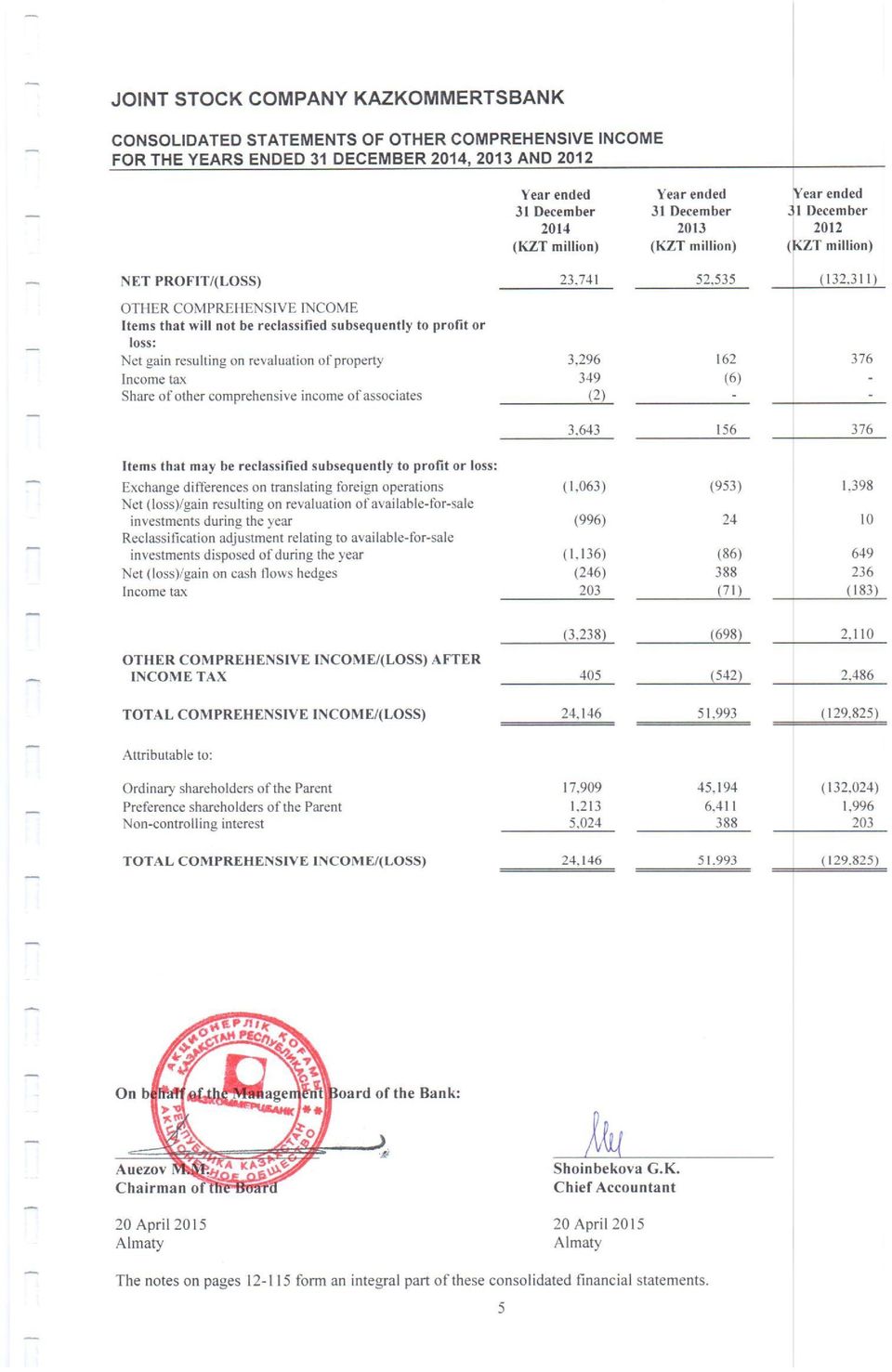
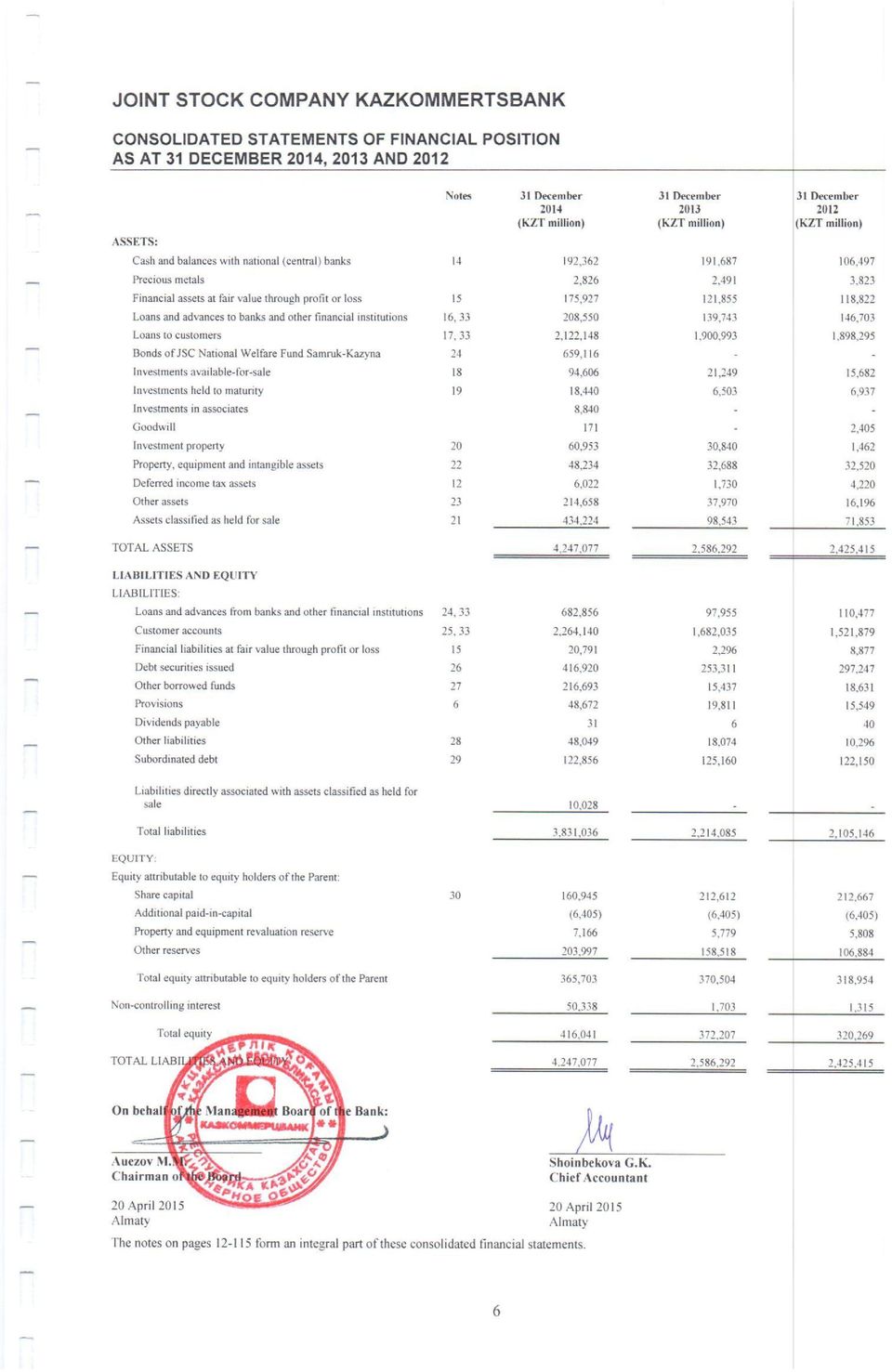
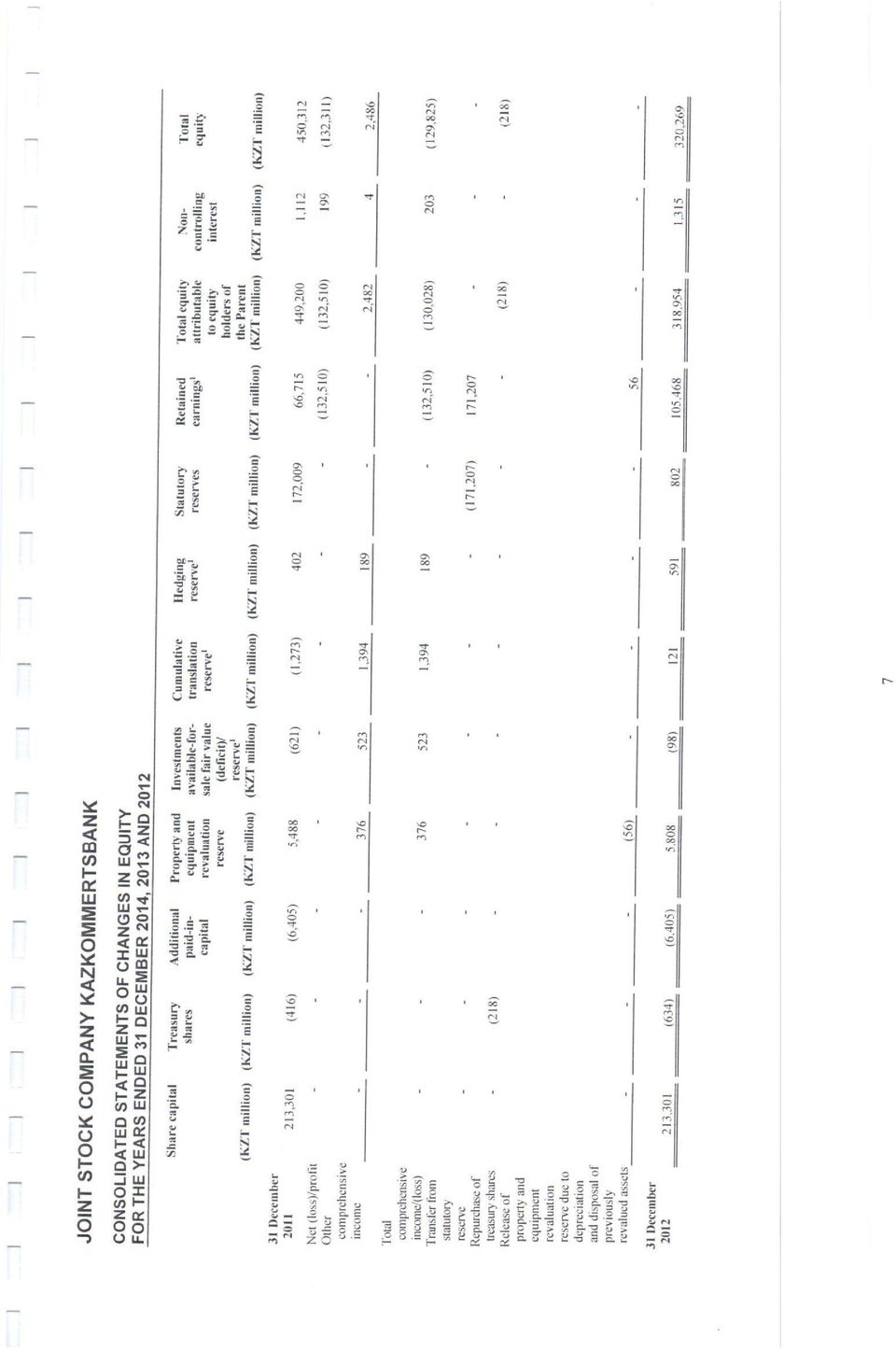
2 JOINT STOCK COMPANY KAZKOMMERTSBANK TABLE OF CONTENTS Page STATEMENT OF MANAGEMENT S RESPONSIBILITIES FOR THE PREPARATION AND APPROVAL OF THE CONSOLIDATED FINANCIAL STATEMENTS FOR THE YEARS ENDED 31 DECEMBER 2014, 2013 AND INDEPENDENT AUDITORS REPORT 2-3 CONSOLIDATED FINANCIAL STATEMENTS FOR THE YEARS ENDED 31 DECEMBER 2014, 2013 AND 2012: Consolidated statements of profit or loss 4 Consolidated statements of other comprehensive income 5 Consolidated statements of financial position 6 Consolidated statements of changes in equity 7-9 Consolidated statements of cash flows Notes to the consolidated financial statements

3

4

5
6

7
8
9
10

11

12

13

14 JOINT STOCK COMPANY KAZKOMMERTSBANK NOTES TO THE CONSOLIDATED FINANCIAL STATEMENTS FOR THE YEARS ENDED 31 DECEMBER 2014, 2013 AND ORGANISATION Joint Stock Company ( JSC ) Kazkommertsbank ( the Bank, or Kazkommertsbank ) is a Joint Stock Company and has operated in the Republic of Kazakhstan since The Bank s activities are regulated by the National Bank of the Republic of Kazakhstan ( the NBRK ) in accordance with the license /222/32 dated 2 December The Bank s primary business consists of commercial banking activities, operations with securities, foreign currencies and derivative instruments, originating loans and guarantees. The registered office of the Bank is located at 135Zh, Gagarin str., Almaty , Republic of Kazakhstan. As at 2014, 2013 and 2012, the Bank has 23 branches in the Republic of Kazakhstan. Kazkommertsbank is a parent company of the banking group ( the Group ) which consists of the following subsidiaries consolidated in the financial statements: Name JSC Kazkommerts Securities LLP Processing Company Kazkommerts International B.V. Kazkommerts Finance II B.V. Kazkommerts Capital II B.V. JSC GRANTUM Asset Management JSC Life Insurance Company Kazkommerts Life CJSC Kazkommertsbank Tajikistan JSC Insurance Company Kazkommerts-Policy JSC Commercial Bank Moskommertsbank KUSA-KKB-1 LLP KUSA KKB-2 LLP KUSA KKB-3 LLP Kazkom Realty LLP OJSC Kazkommertsbank Kyrgyzstan JSC Grantum APF JSC BTA Bank and related subsidiaries* Country of operation Proportion or ownership interest/voting rights As at As at As at Type of operation Republic of Kazakhstan 100% 100% 100% Securities market transactions Republic of Payment card processing Kazakhstan 100% 100% 100% and other related services Raising funds for the Bank Kingdom of the on international capital Netherlands 100% 100% 100% markets Raising funds for the Bank Kingdom of the on international capital Netherlands 100% 100% 100% markets Raising funds for the Bank Kingdom of the on international capital Netherlands 100% 100% 100% markets Republic of Investment management of Kazakhstan 100% 100% 100% pension assets Republic of Kazakhstan 100% 100% 100% Life insurance Republic of Tajikistan 100% 100% 100% Banking Republic of Kazakhstan 100% 100% 100% Insurance Russian Federation 100% 100% 100% Banking Republic of Management of stress Kazakhstan 100% 100% - assets Republic of Management of stress Kazakhstan 100% 100% - assets Republic of Management of stress Kazakhstan 100% - - assets Republic of Management of stress Kazakhstan 100% - - assets Kyrgyz Republic 95.75% 95.75% 95.75% Banking Republic of Kazakhstan 82.52% 82.52% 82.52% Pension fund Republic of Kazakhstan 47.42% - - Banking *JSC BTA Bank prepared consolidated financial statements for the year ended 2014 which is publicly available. 12

15 On 30 June 2014, the Bank and Mr. Kenes Rakishev, each purchased a 46.5% equity stake in JSC BTA Bank from JSC National Welfare Fund Samruk Kazyna ( JSC NWF Samruk-Kazyna ). Meanwhile, JSC NWF Samruk Kazyna transferred its remaining 4.26% in JSC BTA Bank to the Bank under a Trust Agreement providing the Bank with over 50% of the voting rights and operational control of JSC BTA Bank. Acquisition cost of JSC BTA Bank is as follows: Carrying value 30 June 2014 (unaudited) Fair value 30 June 2014 (unaudited) Assets Cash and balances with national (central) banks 39,367 39,367 Financial assets at fair value through profit or loss 60,677 60,711 Loans and advances to banks and other financial institutions 56,873 60,676 Loans to customers 607, ,917 Bonds of JSC National Welfare Fund Samruk-Kazyna 656, ,116 Investments available-for-sale 35,319 35,317 Investments in associates 12,408 12,408 Goodwill Property, equipment and intangible assets 10,768 10,768 Other assets 98,220 98,220 1,578,465 1,505,498 Liabilities Loans and advances from banks and other financial institutions 497, ,478 Customer accounts 547, ,786 Derivative financial instruments 10,426 10,426 Debt securities issued 87, ,973 Other borrowed funds 129, ,492 Provisions 30,475 30,475 Deferred tax liabilities Dividends payable Other liabilities 28,043 28,043 1,331,295 1,368,897 Net assets 136,601 Non-controlling interest 74,149 Net assets acquired as above 136,601 Less: non-controlling interest in subsidiaries of JSC BTA Bank (2,296) Net assets attributable to acquisition 134,305 Net acquired assets, 46.5% 62,452 Consideration transferred (62,452) The excess of Bank s share in cost of acquired net assets of BTA Bank over consideration transferred - Consideration transferred: JSC BTA Bank (unaudited) Consideration paid 31,000 Consideration payable 31,452 Total 62,452 13

16 Net cash inflow on acquisition of subsidiary: 14 JSC BTA Bank (unaudited) Consideration paid in cash 31,000 Less: cash and cash equivalent balances acquired (51,595) (20,595) The non-controlling ownership interest (53.5%) in JSC BTA Bank recognised at the acquisition date was measured by reference to the present ownership instruments proportionate share in the recognised amounts of the acquiree s identifiable net assets and amounted to KZT 74,149 million. The initial accounting for the acquisition of JSC BTA Bank has been determined at the end of the reporting period, based on the market value information. The loans acquired (to customers and to banks) had fair value of KZT 527,917 million and KZT 60,676 million, respectively, and gross contractual amounts of KZT 3,403,990 million and KZT 66,433 million, respectively. The best estimate at acquisition date of the amounts expected not to be collected on these contractual cash flows is KZT 2,796,371 million and KZT 9,560 million, respectively. JSC Kazkommerts Securities is a Joint Stock Company and has operated under the laws of the Republic of Kazakhstan since The company s primary business consists of trading with securities, including broker and dealing operations, consulting in investments and corporate finances, organization of security issuances, allocation and underwriting of securities, and purchase and sale of securities in the capacity as an agent. Due to re-registration from OJSC to JSC, the company received a license on broker and dealing operations dated 17 May 2006 and license for investment portfolio management dated 17 May 2006 issued by the NBRK. LLP Processing Company is a limited liability partnership and has operated under the laws of the Republic of Kazakhstan since 9 July The company is registered with the Ministry of Justice of the Republic of Kazakhstan under ТOO. The Company s primary business is to provide payment and other types of card processing. Kazkommerts International B.V. is a limited liability partnership (B.V.) and has operated under the laws of the Kingdom of the Netherlands. The Company was established for the primary purpose of raising funds for the Bank in foreign capital markets. The company was registered with the Chamber of Commerce of the Netherlands under the license dated 1 October 1997 for raising funds, including the issuance of bonds and other securities and entering into agreements regarding those activities. Kazkommerts Finance II B.V. is a limited liability partnership (B.V.) and has operated under the laws of the Kingdom of the Netherlands. The Company was established for the primary purpose of raising funds for the Bank at foreign capital markets. The company was registered with the Chamber of Commerce of the Netherlands under the license dated 13 February 2001 for conducting operations. Kazkommerts Capital II B.V. is a limited liability partnership (B.V.) and has operated under the laws of the Kingdom of the Netherlands since 11 April The Company was established for the primary purpose of raising funds for the Bank in foreign capital markets. The company has license dated 11 April 2000 issued by the Chamber of Commerce of the Netherlands for conducting operations. On 9 September 2011, the Board of Directors of the Bank decided to liquidate the subsidiary of special-purpose - Kazkommerts Capital II B.V. which performed its financial activity in the Netherlands. As at 2014, the company was not liquidated due to closing procedures being not completed.

17 JSC Grantum Asset Management is a Joint Stock Company and has operated under the laws of the Republic of Kazakhstan since The company s primary business is investment management of pension funds. The company has license dated 26 June 2006 on investment management of pension funds issued by the NBRK, license dated 26 June 2006 on management of investment portfolio issued by the NBRK, license dated 26 June 2006 on broker and dealer activity without right to custody activities issued by the NBRK. On 12 December 2014, the Board of Directors of the Bank decided on a voluntary reorganization of JSC Grantum Asset Management through a merger with JSC Kazkommerts Securities. JSC Life Insurance Company Kazkommerts Life is a Joint Stock Company and operates under the laws of the Republic of Kazakhstan. The company s primary business consists of life insurance. The company has a license on life insurance (reinsurance) services dated 6 January 2011 issued by the NBRK. On 27 November 2014, at a joint meeting the shareholders made a decision on voluntary reorganization of JSC Subsidiary Life Insurance Company of BTA Bank BTA Life and JSC Kazkommerts Life by merging JSC Subsidiary Life Insurance Company of BTA Bank BTA Life to JSC Kazkommerts Life. JSC Insurance Company Kazkommerts-Policy is a Joint Stock Company and has operated under the laws of the Republic of Kazakhstan since The company s primary business consists of insurance of property, cargoes, auto insurance, civil liability insurance of vehicle owners, insurance of other civil liabilities and reinsurance. The company has license on insurance and reinsurance services dated 1 June 2011 issued by the NBRK. On 5 January 2012, the NBRK gave permission to the Bank on acquisition of insurance holding status of JSC Insurance Company Kazkommerts-Policy and JSC Life Insurance Company Kazkommerts Life. The Bank is the sole shareholder of both above-listed insurance organizations. On 18 December 2014, the shareholders of JSC Subsidiary of JSC BTA Bank BTA Insurance and JSC Insurance Company Kazkommerts-Policy made a decision on the voluntary reorganization of JSC BTA Insurance and JSC Insurance Company Kazkommerts-Policy by merging JSC BTA Insurance to JSC Insurance Company Kazkommerts-Policy. CJSC Kazkommertsbank Tajikistan. The Bank received an approval from the NBRK 93 on 6 September 2007 for the creation of a subsidiary bank in Tajikistan. On 24 January 2008, CJSC Kazkommertsbank Tajikistan received an operating license from the National Bank of Tajikistan for banking operations in both national currency and foreign currencies 33/1. The Bank s primary business consists of commercial activities, trading with foreign currencies, originating loans and guarantees. OJSC Kazkommertsbank Kyrgyzstan is a Joint Stock Company and has operated under the laws of the Kyrgyz Republic since The Bank s operations are regulated by the National Bank of the Kyrgyz Republic ( the NBKR ) according to license 010 dated 15 April 2005 for banking operations in national currency and license 010/1 dated 15 April 2005 for banking operations in foreign currency. The Bank s primary business consists of commercial banking activities, acceptance of deposits from individuals, transfer of payments, operations with foreign exchange and derivative instruments, originating loans and guarantees. JSC Grantum APF is a Joint Stock Company and has operated since 1998 under the laws of the Republic of Kazakhstan. The company s primary business consists of the receipt of pension contributions of depositors and making pension payments to recipients under the laws of the Republic of Kazakhstan. The company operates based on a state license on the receipt of pension contributions and making pension payments, also on operating on securities market /38/41 dated 7 May 2010 issued by the NBRK. 15

18 As a result of the reforms in the pension system of the Republic of Kazakhstan the JSC Grantum APF has stopped accepting pension contributions from its clients and transferred net pension assets under management to Single Accumulating Pension Fund in February On 20 June 2014, at the extraordinary General Meeting of Shareholders of JSC Grantum APF the decision was made on voluntary liquidation of JSC Grantum APF and appropriate liquidation committee was appointed. Commercial Bank Moskommertsbank JSC ( MKB ) is a Joint Stock Company and operates under the laws of the Russian Federation ( RF ) since MKB s operations are regulated by the Central Bank of the Russian Federation ( the CBR ) in accordance with the license on the banking operations with private sector 3365 dated 08 December License of the Federal securities commission on broker operations dated 18 April 2008, license on the depository activity dated 18 April 2008, license on dealer operations dated 18 April MKB provides a wide spectrum of banking products and services for individuals, corporate clients and financial institutions. The Bank s primary business consists of retail banking, crediting of small and medium business and the corporate sector. LLP KUSA-KKB-1, LLP KUSA KKB-2, LLP KUSA KKB-3 and LLP Kazkom Realty are limited liability partnerships created to purchase banks non-working (distressed) assets and manage them in accordance with the legislation of the Republic of Kazakhstan on the Introduction of Amendments and Additions to Certain Legislative Acts regarding the Regulation of Banking Activities and Financial Institutions with Respect to Risk Mitigation, adopted in December JSC BTA Bank and its subsidiaries ( BTA Bank ) provide retail and corporate banking services, insurance services, leasing and other financial services in the Republic of Kazakhstan and the Russian Federation. The parent company of the group is JSC BTA Bank. BTA Bank is incorporated and domiciled in the Republic of Kazakhstan. BTA Bank accepts deposits from the public and extends credits, transfers payments within the Republic of Kazakhstan and abroad, exchanges currencies and provides other banking services to its commercial and retail customers in accordance with license No. 242 issued on 4 March 2008 by the Agency of the Republic of Kazakhstan for Regulation and Supervision of the Financial Market and Financial Organizations. BTA Bank has a primary listing on the Kazakhstan Stock Exchange ( KASE ). Certain of the BTA Bank s securities are listed on the Luxembourg Stock Exchange with a secondary listing on the KASE. During the third quarter of 2014, the Bank and Mr. Rakishev Kenes acquired 11,783,301,082 ordinary shares of BTA Bank from minority shareholders at a price of KZT per share. In accordance with the contractual agreements, all shares purchased from minority shareholders of BTA Bank were distributed equally between the Bank and Mr. Rakishev at the same price (KZT per share). In accordance with the decision of the Board of Directors of JSC BTA Bank dated 2014, subsidiary CJSC BTA Bank, which carries out its activities in Belarus, is treated as a discontinued operation in the consolidated financial statements of the Group. 16

19 Shareholders As at 2014, 2013 and 2012, the following shareholders owned the issued ordinary shares of the Bank: Number of shares Direct Number of Direct Number of ownership,* shares ownership, * shares % % Direct ownership,* % JSC Alnair Capital Holding ( Alnair ) 223,922, ,922, ,922, JSC Central-Asian Investment Company ( CAIC )** 185,561, ,561, ,561, Subkhanberdin N.S. 148,666, ,570, ,570, JSC National Welfare Fund Samruk Kazyna 85,517, ,517, ,517, European Bank for Reconstruction and Development ( EBRD ) ,095, ,095, Other shareholders 25,859, ,110, ,920, Total*** 669,527, ,777, ,588, Notes: *These percentage holdings were calculated based on the direct holding of each shareholder in the total number of ordinary shares outstanding less treasury shares purchased by the Bank and its subsidiaries. JSC Kazkommerts Securities, subsidiary of the Bank, acts as a market-maker of the Bank s shares on the local stock exchange. **As at 2014, the total number of shares under CAIC s control is 241,885,810 common shares, including 56,324,076 shares received in trust management from JSC NWF Samruk-Kazyna, ownership share 36.13% (2013: 241,885,810 common shares, ownership share 31.10%, 2012: 241,885,810 common shares, ownership share 31.11%). ***This number is calculated at each reporting date as the total number of the common shares outstanding minus treasury shares purchased by the Bank s market-maker based on the requirements of the KASE. On 21 May 2014, the European Bank of Reconstruction and Development ( EBRD ) has sold its stake in the Bank, which was acquired by Nurzhan Subkhanberdin in the amount of 76,095,329 common shares. In the third quarter of 2014, the Bank completed the buyback of 108,916,455 common shares at a price of KZT per common share (including 80,000,000 common shares from JSC NWF Samruk-Kazyna) under the Option Agreement with respect to JSC Kazkommertsbank as of 15 January 2009 signed between JSC NWF Samruk-Kazyna, JSC Central-Asian Investment Company, Mr. N.S. Subkhanberdin and JSC Alnair Capital Holding. Thus, the Bank decreased the number of ordinary shares in free float. Information on major shareholders JSC Central-Asian Investment Company ( CAIC ) is bank holding company through which the top management of the Bank own shares of the Bank. As at 2014, the sole shareholders of CAIC were Subkhanberdin N.S., Chairman of the Board of Directors of the Bank, who owns 87.21% (2013: 87.21%, 2012: 87.21%) and Zhussupova N.A., Chairman of the Management Board of the Bank, who owns 12.79% (2013: 12.79%, 2012: 12.79%). CAIC and Subkhanberdin N.S. act as the bank s holding company and major shareholder, respectively, on the basis of approval of the NBRK. As at 2014, Subkhanberdin N.S. owns 53.70% (2013: 36.45%, 2012: 36.46%) of the ordinary share capital of the Bank through direct and indirect ownership as a result of his holdings in CAIC and Zhussupova N.A. owns 4.62% (2013: 3.98%, 2012: 3.98%) through indirect ownership. 17

20 JSC Alnair Capital Holding ( Alnair ) is a company operating under the laws of the Republic of Kazakhstan whose sole participant is Alnair Capital LLP exercising all the rights of the participant and manager of the company s activity. Alnair group of companies is the Bank s shareholder from 2008 possessing the official status of the bank holding company which was obtained with approval of the NBRK. Alnair mainly holds shares in the form of GDRs which are included into the total number of shares being in the nominal holding of the Central Depositary. JSC NWF Samruk Kazyna is an entity controlled by the Government of the Republic of Kazakhstan. These consolidated financial statements were authorized for issue by the Management Board of the Bank on 20 April SIGNIFICANT ACCOUNTING POLICIES Statement of compliance These consolidated financial statements have been prepared in accordance with International Financial Reporting Standards ( IFRS ) as issued by the International Accounting Standards Boards ( IASB ). Other basis of presentation criteria These consolidated financial statements have been prepared on the assumption that the Group is a going concern and will continue in operation for the foreseeable future. These consolidated financial statements are presented in millions of Kazakhstani tenge ( KZT ), unless otherwise indicated. These consolidated financial statements have been prepared on the historical cost basis except for certain financial instruments that are accounted for at fair value and insurance liabilities which are accounted for based on actuarial calculations and certain property and equipment which are carried at revalued cost less depreciation and impairment as explained in the accounting policies below. Historical cost is generally based on the fair value of the consideration given in exchange for goods and services. Fair value is the price that would be received to sell an asset or paid to transfer a liability in an orderly transaction between market participants at the measurement date, regardless of whether that price is directly observable or estimated using another valuation technique. In estimating the fair value of an asset or a liability, the Group takes into account the characteristics of the asset or liability if market participants would take those characteristics into account when pricing the asset or liability at the measurement date. Fair value for measurement and/or disclosure purposes in these consolidated financial statements is determined on such a basis, except for share-based payment transactions that are within the scope of IFRS 2, leasing transactions that are within the scope of IAS 17, and measurements that have some similarities to fair value but are not fair value, such as net realisable value in IAS 2 or value in use in IAS 36. Kazkommertsbank and its subsidiaries (except for subsidiaries in Russian Federation, Republic of Tajikistan and Kyrgyz Republic) maintain their accounting records in accordance with IFRS. Subsidiaries in Russian Federation, Republic of Tajikistan and Kyrgyz Republic maintain their accounting records in accordance with local GAAP and their financial statements are prepared from the local statutory accounting records and adjusted to conform with IFRS. 18

21 These consolidated financial statements have been prepared based on the accounting records of the Bank and its subsidiaries. The preparation of consolidated financial statements in conformity with IFRS requires management to make estimates and assumptions that affect the reported amount of assets and liabilities and disclosure of contingent assets and liabilities at the date of the consolidated financial statements and reported amounts of revenues and expenses during the reporting period. Actual results could differ from those estimates. Estimates that are particularly susceptible to change relate to the provisions for impairment losses and the fair value of financial instruments. The Group presents its consolidated statement of financial position broadly in order of liquidity. An analysis regarding recovery or settlement within 12 months after the statement of financial position date (current) and more than 12 months after the statement of financial position date (non-current) is presented in Note 37. Functional currency Items included in the financial statements of each entity of the Group are measured using the currency that best reflects the economic substance of the underlying events and circumstances relevant to that entity (the functional currency ). The functional currency of the Bank is Kazakhstani tenge. The presentation currency of the consolidated financial statements is Kazakhstani tenge. Basis of consolidation These consolidated financial statements incorporate the financial statements of the Bank and entities (including structured entities) controlled by the Bank and its subsidiaries. Control is achieved when the Bank: has power over the investee; is exposed, or has rights, to variable returns from its involvement with the investee; and has the ability to use its power to affect its returns. The Bank reassesses whether or not it controls an investee if facts and circumstances indicate that there are changes to one or more of the three elements of control listed above. When the Bank has less than a majority of the voting rights of an investee, it has power over the investee when the voting rights are sufficient to give it the practical ability to direct the relevant activities of the investee unilaterally. The Bank considers all relevant facts and circumstances in assessing whether or not the Bank's voting rights in an investee are sufficient to give it power, including: the size of the Bank's holding of voting rights relative to the size and dispersion of holdings of the other vote holders; potential voting rights held by the Bank, other vote holders or other parties; rights arising from other contractual arrangements; and any additional facts and circumstances that indicate that the Bank has, or does not have, the current ability to direct the relevant activities at the time that decisions need to be made, including voting patterns at previous shareholders' meetings. Consolidation of a subsidiary begins when the Bank obtains control over the subsidiary and ceases when the Bank loses control of the subsidiary. Specifically, income and expenses of a subsidiary acquired or disposed of during the year are included in the consolidated statement of profit or loss and other comprehensive income from the date the Bank gains control until the date when the Bank ceases to control the subsidiary. Profit or loss and each component of other comprehensive income are attributed to the owners of the Bank and to the non-controlling interests. Total comprehensive income of subsidiaries is attributed to the owners of the Bank and to the non-controlling interests even if this results in the non-controlling interests having a deficit balance. 19
22 When necessary, adjustments are made to the financial statements of subsidiaries to bring their accounting policies into line with the Group's accounting policies. All intragroup assets and liabilities, equity, income, expenses and cash flows relating to transactions between members of the Group are eliminated in full on consolidation. Non-controlling interest Non-controlling interest represent the portion of profit or loss and net assets of subsidiaries not owned, directly or indirectly, by the Bank. Non-controlling interest are presented separately in the consolidated statement of profit or loss and within equity in the consolidated statement of financial position, separately from parent shareholders equity. Business combinations Acquisitions of businesses are accounted for using the acquisition method. The consideration transferred in a business combination is measured at fair value, which is calculated as the sum of the acquisitiondate fair values of the assets transferred by the Group, liabilities incurred by the Group to the former owners of the acquiree and the equity interests issued by the Group in exchange for control of the acquiree. Acquisition-related costs are generally recognised in profit or loss as incurred. At the acquisition date, the identifiable assets acquired and the liabilities assumed are recognised at their fair value, with some exceptions. Goodwill is measured as the excess of the sum of the consideration transferred, the amount of any noncontrolling interests in the acquiree, and the fair value of the acquirer's previously held equity interest in the acquiree (if any) over the net of the acquisition-date amounts of the identifiable assets acquired and the liabilities assumed. If, after reassessment, the net of the acquisition-date amounts of the identifiable assets acquired and liabilities assumed exceeds the sum of the consideration transferred, the amount of any non-controlling interests in the acquiree and the fair value of the acquirer's previously held interest in the acquiree (if any), the excess is recognised immediately in profit or loss as a bargain purchase gain. Non-controlling interests that are present ownership interests and entitle their holders to a proportionate share of the entity's net assets in the event of liquidation may be initially measured either at fair value or at the non-controlling interests' proportionate share of the recognised amounts of the acquiree's identifiable net assets. The choice of measurement basis is made on a transaction-by-transaction basis. Other types of non-controlling interests are measured at fair value or, when applicable, on the basis specified in another IFRS. Non-controlling interests are presented in the consolidated statement of financial position within equity, separately from the equity attributable to the equity holders of the Parent. Profit or loss and each component of other comprehensive income are attributed to the equity holders of the Parent and to the non-controlling interests. Total comprehensive income is attributed to the equity holders of the Parent and to the non-controlling interests even if this results in the non-controlling interests having a deficit balance. Changes in the Bank's ownership interests in subsidiaries that do not result in the Bank losing control over the subsidiaries are accounted for as equity transactions. The carrying amounts of the Bank's interests and the non-controlling interests are adjusted to reflect the changes in their relative interests in the subsidiaries. Any difference between the amount by which the non-controlling interests are adjusted and the fair value of the consideration paid or received is recognised directly in equity and attributed to the equity holders of the Parent. 20
23 When the Bank loses control of a subsidiary, a gain or loss is recognised in profit or loss and is calculated as the difference between (i) the aggregate of the fair value of the consideration received and the fair value of any retained interest and (ii) the previous carrying amount of the assets (including goodwill), and liabilities of the subsidiary and any non-controlling interests. When assets of the subsidiary are carried at revalued amounts or fair values and the related cumulative gain or loss has been recognised in other comprehensive income and accumulated in equity, the amounts previously recognised in other comprehensive income and accumulated in equity are accounted for as if the Group had directly disposed of the relevant assets (i.e. reclassified to profit or loss or transferred directly to retained earnings as specified by applicable IFRSs). The fair value of any investment retained in the former subsidiary at the date when control is lost is regarded as the fair value on initial recognition for subsequent accounting under IAS 39 or, when applicable, the cost on initial recognition of an investment in an associate or a jointly controlled entity. For a business combination involving an entity or business under common control, all assets and liabilities of the subsidiary are measured at the carrying values recorded in the stand-alone financial statements of the subsidiary. The difference between the carrying value of the acquired share in net assets of the subsidiary and the cost of acquisition are recorded directly in equity attributable to the owners of the parent. The results of subsidiaries acquired or disposed of during the year are included in the consolidated statement of profit or loss from the effective date of acquisition or up to the effective date of disposal, as appropriate. Recognition and measurement of financial instruments The Group recognizes financial assets and liabilities in its consolidated statement of financial position when it becomes a party to the contractual provisions of the instrument. Regular way purchases and sales of financial assets and liabilities are recognized using settlement date accounting. Financial assets and financial liabilities are initially recognized at fair value. Transaction costs that are directly attributable to the acquisition or issue of financial assets and financial liabilities (other than financial assets and financial liabilities at fair value through profit or loss) are added to or deducted from the fair value of the financial assets or financial liabilities, as appropriate, on initial recognition. Transaction costs directly attributable to the acquisition of financial assets or financial liabilities at fair value through profit or loss are recognised immediately in profit or loss. The accounting policies for subsequent re-measurement of these items are disclosed in the respective accounting policies set out below. Derecognition of financial assets and liabilities Financial assets The Group derecognizes a financial asset only when the contractual rights to the cash flows from the asset expire, or when it transfers the financial asset and substantially all the risks and rewards of ownership of the asset to another party. If the Group neither transfers nor retains substantially all the risks and rewards of ownership and continues to control the transferred asset, the Group recognizes its retained interest in the asset and an associated liability for amounts it may have to pay. If the Group retains substantially all the risks and rewards of ownership of a transferred financial asset, the Group continues to recognise the financial asset and also recognises a collateralised borrowing for the proceeds received. On derecognition of a financial asset in its entirety, the difference between the asset's carrying amount and the sum of the consideration received and receivable and the cumulative gain or loss that had been recognised in other comprehensive income and accumulated in equity is recognised in profit or loss. 21
24 On derecognition of a financial asset other than in its entirety (e.g. when the Group retains an option to repurchase part of a transferred asset), the Group allocates the previous carrying amount of the financial asset between the part it continues to recognise under continuing involvement, and the part it no longer recognises on the basis of the relative fair values of those parts on the date of the transfer. The difference between the carrying amount allocated to the part that is no longer recognised and the sum of the consideration received for the part no longer recognised and any cumulative gain or loss allocated to it that had been recognised in other comprehensive income is recognised in profit or loss. A cumulative gain or loss that had been recognised in other comprehensive income is allocated between the part that continues to be recognised and the part that is no longer recognised on the basis of the relative fair values of those parts. Financial liabilities A financial liability is derecognized when the obligation is discharged, cancelled, or expires. On the redemption or settlement of debt securities (including subordinated liabilities) issued by the Group, the Group derecognises the debt instrument and records a gain or loss being the difference between the debt s carrying amount and the cost of redemption or settlement. The same treatment applies where the debt is exchanged for a new debt issue that has terms substantially different from those of the existing debt. The assessment of whether the terms of the new debt instrument are substantially different takes into account qualitative and quantitative characteristics including a comparison of the discounted present value of the cash flows under the new terms with the discounted present value of the remaining cash flows of the original debt issue. Where an existing financial liability is replaced by another from the same lender on substantially different terms, or the terms of an existing financial liability are substantially modified, such an exchange or modification is treated as a derecognition of the original financial liability and the recognition of a new financial liability, and the difference in the respective carrying amounts is recognized in the consolidated statement of profit or loss. Cash and balances with national (central) banks Cash and balances with national (central) banks include cash on hand and unrestricted balances on correspondent and time deposit accounts with the National Bank of the Republic of Kazakhstan, the Central Bank of the Russian Federation, the National Bank of Kyrgyz Republic and the National Bank of Tajikistan with original maturities within three months. Cash and cash equivalents For the purposes of determining cash flows, cash and cash equivalents includes advances to banks with original maturities within three months, cash and balances with national (central) banks less the minimum reserve deposits required by the Central Bank of the Russian Federation, the National Bank of the Republic of Kazakhstan, the National Bank of the Kyrgyz Republic and the National Bank of Tajikistan. Precious metals Assets and liabilities denominated in precious metals are translated at the current rate computed based on the second fixing of the London Metal Exchange rates using the KZT/USD exchange rate effective on the date. Changes in the bid prices are recorded in net gain/(loss) on foreign exchange and precious metals operations. 22
25 Financial assets and liabilities at fair value through profit or loss Financial assets and liabilities at fair value through profit or loss represent derivative instruments or securities (1) acquired principally for the purpose of selling them in the near future, (2) which are a part of a portfolio of identified financial instruments that are managed together and for which there is evidence of a recent and actual pattern of short-term profit taking or (3) which are designated by the Group at fair value through profit or loss upon initial recognition. A financial asset or liability other than a financial asset or liability held for trading may be designated at fair value through profit or loss upon initial recognition if: (1) such designation eliminates or significantly reduces a measurement or recognition inconsistency that would otherwise arise; (2) the financial asset or liability forms part of a group of financial assets or financial liabilities or both, which is managed and its performance is evaluated on a fair value basis, in accordance with the Group s documented risk management or investment strategy, and information about the grouping is provided internally on that basis; or (3) it forms part of a contract containing one or more embedded derivatives, and IAS 39 Financial Instruments: Recognition and Measurement permits the entire combined contract (asset or liability) to be designated as at fair value through profit or loss. Financial assets and liabilities at fair value through profit or loss are initially recorded and subsequently measured at fair value. Fair value adjustment on financial assets and liabilities at fair value through profit or loss is recognized in the consolidated statement of profit or loss for the period and is included in the Net gain/(loss) from financial assets and liabilities at fair value through profit or loss line item. Fair value is determined in the manner described in Note 35. Derivative financial instruments In the normal course of business, the Group enters into various derivative financial instruments including forwards, futures, swaps and options on foreign currency, precious metals and securities to manage currency, interest rate and liquidity risks and for trading purposes. Derivatives are initially recognized at fair value at the date a derivative contract is entered into and are subsequently remeasured to their fair value at each reporting date. The fair values are estimated based on quoted market prices or pricing models that take into account the current market and contractual prices of the underlying instruments and other factors. Derivatives are carried as assets when their fair value is positive and as liabilities when it is negative. Derivatives are included within financial assets or financial liabilities at fair value through profit or loss in the consolidated statement of financial position. Gains and losses resulting from these instruments are included in Net gain/(loss) from financial assets and liabilities at fair value through profit or loss in the consolidated statement of profit or loss. Derivative instruments embedded in other financial instruments are treated as separate derivatives if their risks and characteristics are not closely related to those of the host contracts and the host contracts are not carried at fair value with unrealized gains and losses reported in the consolidated statement of profit or loss. An embedded derivative is a component of a hybrid (combined) financial instrument that includes both the derivative and a non-derivative host contract, with the effect that some of the cash flows of the combined instrument vary in a similar way to a stand-alone derivative. Loans and advances to banks and other financial institutions In the normal course of business, the Group maintains advances and deposits for various periods of time with other banks and other financial institutions. Loans and advances to banks and other financial institutions with a fixed maturity term are initially recorded at fair value plus directly attributable transaction costs and are subsequently measured at amortised cost using the effective interest method, less any reduction from impairment or uncollectibility. 23
26 Securities repurchase and reverse repurchase agreements and lending transactions In the normal course of business the Group enters into financial assets sale and purchase back agreements ( repos ) and financial assets purchase and sale back agreements ( reverse repos ). Repos and reverse repos are utilized by the Group as an element of its treasury management. A repo is an agreement to transfer a financial asset to another party in exchange for cash or other consideration and a concurrent obligation to reacquire the financial assets at a future date for an amount equal to the cash or other consideration exchanged plus interest. These agreements are accounted for as financing transactions. Financial assets transferred under repos are retained in the consolidated financial statements and the consideration received under these agreements is recorded as a collateralized loan received within loans and advances from banks and other financial institutions. Financial assets received under reverse repos are recorded in the consolidated financial statements as loans which are collateralized by securities and are classified within Loans and advances to banks and other financial institutions and loans to customers. In the event that the financial assets received under reverse repos are sold to third parties, the results are recorded in net gains/(losses) on respective assets. Any related income or expense arising from the pricing difference between purchase and resale of the underlying financial assets is accrued over the life of the agreement using the effective interest rate and recognized as interest income or expense in the consolidated statement of profit or loss. The Group enters into repos and reverse repos agreements under which it receives or transfers collateral in accordance with normal market practice. Under standard terms for repurchase transactions in the Republic of Kazakhstan and other CIS states, the recipient of collateral has the right to sell or repledge the collateral, subject to returning equivalent securities on settlement of the transaction, only if the counterparty fails to meet its obligations per the agreement on the lending transaction. Loans to customers Loans to customers are non-derivative financial assets with fixed or determinable payments that are not quoted in an active market other than those classified in other categories of financial assets. Loans to customers granted by the Group are initially recognized at fair value plus related transaction costs that directly relate to acquisition or creation of such financial assets. Where the fair value of consideration given does not equal the fair value of the loan, for example where the loan is issued at lower than market rates, the difference between the fair value of consideration given and the fair value of the loan is recognized as a loss on initial recognition of the loan and included in the consolidated statement of profit or loss according to nature of the losses. Subsequently, loans are carried at amortized cost using the effective interest method. Loans to customers are carried net of any allowance for impairment losses. Write off of loans and advances Loans and advances to banks and customers are written off against the allowance for impairment losses when deemed uncollectible. Loans and advances are written off after management has exercised all possibilities available to collect amounts due to the Group and after the Group has sold all available collateral. Subsequent recoveries of amounts previously written off are reflected as a decrease of charge for impairment of financial assets in the consolidated statement of profit or loss in the period of recovery. 24
27 Finance leases Finance leases are leases that transfer substantially all the risks and rewards incident to ownership of an asset. Title may or may not eventually be transferred. Whether a lease is a finance lease or an operating lease depends on the substance of the transaction rather than the form of the contract. A lease is classified as a finance lease if: The lease transfers ownership of the asset to the lessee by the end of the lease term; The lessee has the option to purchase the asset at a price which is expected to be sufficiently lower than the fair value at the date the option becomes exercisable such that, at the inception of the lease, it is reasonably certain that the option will be exercised; The lease term is for the major part of the economic life of the asset even if title is not transferred; At the inception of the lease the present value of the minimum lease payments amounts to at least substantially all of the fair value of the leased asset; and The leased assets are of a specialized nature such that only the lessee can use them without major modifications being made. The Group as a lessor presents finance leases within Loans to customers and initially measures them in the amount equal to net investment in the lease. Subsequently, the recognition of finance income is allocated to accounting periods so as to reflect a constant periodic rate of return on the Group s net investment in the finance lease. Investments available-for-sale Investments available-for-sale represents debt and equity investments that are intended to be held for an indefinite period of time. Investments in available-for-sale financial assets are non-derivatives that are either designated as available-for-sale or are not classified as loans and receivables, held-to-maturity investments or financial assets at fair value through profit or loss. Investments available-for-sale are initially recorded at fair value and subsequently are measured at fair value, with such re-measurement recognized in other comprehensive income and accumulated within the Investments available-for-sale fair value reserve which is included in Other reserves category within equity, except for impairment losses, foreign exchange gains or losses, interest income accrued using the effective interest method and dividends on available-for-sale equity investments, which are recognized directly in the consolidated statement of profit or loss. When sold, the cumulative gain or loss previously accumulated in the Investments available-for-sale fair value reserve is reclassified to profit or loss. Fair value is determined in the manner described in Note 35. Dividends on available-for-sale equity investments are recognised when the Group's right to receive the dividends is established and are included in dividend income in the consolidated statement of profit or loss. Available-for-sale equity investments that do not have a quoted market price in an active market and whose fair value cannot be reliably measured are measured at cost less any identified impairment losses at the end of each reporting period. Investments held to maturity Investments held to maturity are debt securities with determinable or fixed payments. The Group has a positive intent and the ability to hold them to maturity. Such securities are carried at amortized cost, using the effective interest rate method, less any allowance for impairment. Amortized discounts or premiums are recognized in interest income over the period to maturity using the effective interest method. 25
28 Impairment of financial assets Financial assets carried at amortized cost The Group accounts for impairment losses of financial assets when there is objective evidence that a financial asset or group of financial assets is impaired. Impairment losses are measured as the difference between carrying amounts and the present value of expected future cash flows, including amounts recoverable from guarantees and collateral, discounted at the financial asset s original effective interest rate. Such impairment losses are not reversed unless in a subsequent period the amount of the impairment loss decreases and the decrease can be related objectively to an event occurring after the impairment was recognized, such as recoveries, in which case the previously recognized impairment loss is reversed by adjustment of an allowance account to the extent that the carrying amount of the investment at the date the impairment is reversed does not exceed what the amortised cost would have been had the impairment not been recognised. Investments available-for-sale If an available-for-sale asset is impaired, the cumulative loss comprising the difference between its cost (net of any principal payment and amortization) and its current fair value, less any impairment loss previously recognized in the consolidated statement of profit or loss, is reclassified from equity to the consolidated statement of profit or loss. Reversals of impairment losses in respect of equity securities classified as available-for-sale are not recognized in the consolidated statement of profit or loss. Any increase in fair value subsequent to an impairment loss is recognised in other comprehensive income and accumulated within the Investments available-for-sale fair value reserve which is included in Other reserves line item within equity. Reversals of impairment losses on debt instruments are reversed through the consolidated statement of profit or loss if the increase in fair value of the instrument can be objectively related to an event occurring after the impairment loss was recognized in the consolidated statement of profit or loss. For the financial assets recorded at cost the impairment represents the difference between the carrying value of the financial asset and present value of the estimated future cash flows discounted using the current market interest rate for a similar financial asset. Such impairment losses are not reversed in subsequent periods. The impairment is calculated based on the analysis of assets subject to risks and reflects the amount sufficient, in the opinion of the management, to cover relevant losses. The provisions are created as a result of an individual evaluation of assets subject to risks regarding financial assets being material individually and on the basis of an individual or joint evaluation of financial assets not being material individually. The change in the impairment is included in the consolidated statement of profit or loss using the provision account (financial assets recorded at amortized cost) or by a direct write-off (financial assets recorded at cost). Assets recorded in the consolidated statement of financial position are reduced by the amount of the impairment. The factors the Group evaluates in determining the presence of objective evidence of occurrence of an impairment loss include information on liquidity of the debtor or issuer, their solvency, business risks and financial risks, levels and tendencies of default on obligations on similar financial assets, national and local economic tendencies and conditions, and fair value of the security and guarantees. These and other factors individually or in the aggregate represent, to a great extent, an objective evidence of recognition of the impairment loss on the financial asset or group of financial assets. It should be noted that the evaluation of losses includes a subjective factor. The management of the Group believes that the amount of recorded impairment is sufficient to cover losses incurred on assets subject to risks at the reporting date, although it is not improbable that in certain periods the Group can incur losses greater than recorded impairment. 26
29 Goodwill Goodwill arising on the acquisition of a business is carried at cost as established at the date of acquisition of the business (see paragraph Business Combinations above) less accumulated impairment losses, if any. For the purposes of impairment testing, goodwill is allocated to each of the Group's cash-generating units ( CGU ) (or groups of cash-generating units) that is expected to benefit from the synergies of the combination. A cash-generating unit to which goodwill has been allocated is tested for impairment annually, or more frequently when there is an indication that the unit may be impaired. If the recoverable amount of the cash-generating unit is less than its carrying amount, the impairment loss is allocated first to reduce the carrying amount of any goodwill allocated to the unit and then to the other assets of the unit pro rata based on the carrying amount of each asset in the unit. Any impairment loss for goodwill is recognised directly in profit or loss. An impairment loss recognised for goodwill is not reversed in subsequent periods. On disposal of the relevant cash-generating unit, the attributable amount of goodwill is included in the determination of the profit or loss on disposal. Property, equipment and intangible assets Property and equipment, except for buildings and other real estate and construction, and intangible assets are carried at historical cost less accumulated depreciation and amortization. Buildings and other real estate and construction are carried at market value. Depreciation on assets under construction and those not placed in service commences from the date the assets are ready for their intended use. Depreciation and amortization of property, equipment and intangible assets are charged on the carrying value of property and equipment and are designed to write off assets over their useful economic lives. Depreciation and amortization are calculated on a straight line basis at the following annual prescribed rates: Freehold land is not depreciated. Buildings and other real estate 1-10% Furniture and equipment 4-50% Intangible assets 15-50% Leasehold improvements are amortized over 5 years. Expenses related to repairs and renewals are charged when incurred and included in operating expenses in the consolidated statement of profit or loss, unless they qualify for capitalization. The carrying amounts of property, plant and equipment and intangible assets are reviewed at each reporting date to assess whether they are recorded in excess of their recoverable amounts. The recoverable amount is the higher of fair value less costs to sell and value in use, where carrying values exceed this estimated recoverable amount, assets are written down to their recoverable amount. An impairment is recognized in the respective period and is included in operating expenses. After the recognition of an impairment loss the depreciation charge for property, equipment and intangible assets is adjusted in future periods to allocate the assets revised carrying value, less its residual value (if any), on a systematic basis over its remaining useful life. Land and buildings held for use in supply of services, or for administrative purposes, are stated in the consolidated statement of financial position at their revalued amounts, being the fair value at the date of revaluation, determined from market-based evidence by an appraisal undertaken by professional independent appraisers, less any subsequent accumulated depreciation and subsequent accumulated impairment losses. Revaluations are performed with sufficient regularity such that the carrying amount does not differ materially from that which would be determined using fair values at the reporting date. 27
30 Any revaluation increase arising on the revaluation of such land and buildings is credited to the property and equipment revaluation reserve, except to the extent that it reverses a revaluation decrease for the same asset previously recognized as an expense, in which case the increase is credited to profit or loss for the period to the extent of the decrease previously charged. A decrease in the carrying amount arising on the revaluation of such land and buildings is charged as an expense to the extent that it exceeds the balance, if any, held in the properties revaluation reserve relating to a previous revaluation of that asset. Depreciation on revalued buildings is charged to consolidated statement of profit or loss. On the subsequent sale or retirement of a revalued property, the attributable revaluation surplus remaining in the property and equipment revaluation reserve is transferred directly to retained earnings. Market value of property is assessed using one of three methods: The comparable sales method which involves analysis of market sales prices for similar real estate property based on available public information; The income-based method which assumes a direct relationship between revenues generated by the property and its market value; The costs method which presumes the value of property to be equal to its recoverable amount less any depreciation charges. An item of property, plant and equipment is derecognised upon disposal or when no future economic benefits are expected to arise from the continued use of the asset. Any gain or loss arising on the disposal or retirement of an item of property, plant and equipment is determined as the difference between the sales proceeds and the carrying amount of the asset and is recognised in the consolidated statement of profit or loss. Intangible assets with finite useful lives that are acquired separately are carried at cost less accumulated amortisation and accumulated impairment losses. Amortisation is recognised on a straight-line basis over their estimated useful lives. The estimated useful life and amortisation method are reviewed at the end of each reporting period, with the effect of any changes in estimate being accounted for on a prospective basis. Intangible assets with indefinite useful lives that are acquired separately are carried at cost less accumulated impairment losses. An intangible asset is derecognised on disposal, or when no future economic benefits are expected from use or disposal. Gains or losses arising from derecognition of an intangible asset, measured as the difference between the net disposal proceeds and the carrying amount of the asset, are recognised in profit or loss when the asset is derecognised. Impairment of tangible and intangible assets other than goodwill At the end of each reporting period, the Group reviews the carrying amounts of its tangible and intangible assets to determine whether there is any indication that those assets have suffered an impairment loss. If any such indication exists, the recoverable amount of the asset is estimated in order to determine the extent of the impairment loss (if any). When it is not possible to estimate the recoverable amount of an individual asset, the Group estimates the recoverable amount of the cashgenerating unit to which the asset belongs. When a reasonable and consistent basis of allocation can be identified, corporate assets are also allocated to individual cash-generating units, or otherwise they are allocated to the smallest group of cash-generating units for which a reasonable and consistent allocation basis can be identified. Recoverable amount is the higher of fair value less costs to sell and value in use. In assessing value in use, the estimated future cash flows are discounted to their present value using a pre-tax discount rate that reflects current market assessments of the time value of money and the risks specific to the asset for which the estimates of future cash flows have not been adjusted. 28
31 If the recoverable amount of an asset (or cash-generating unit) is estimated to be less than its carrying amount, the carrying amount of the asset (or cash-generating unit) is reduced to its recoverable amount. An impairment loss is recognised immediately in profit or loss, unless the relevant asset is carried at a revalued amount, in which case the impairment loss is treated as a revaluation decrease. When an impairment loss subsequently reverses, the carrying amount of the asset (or a cashgenerating unit) is increased to the revised estimate of its recoverable amount, but so that the increased carrying amount does not exceed the carrying amount that would have been determined had no impairment loss been recognised for the asset (or cash-generating unit) in prior years. A reversal of an impairment loss is recognised immediately in profit or loss, unless the relevant asset is carried at a revalued amount, in which case the reversal of the impairment loss is treated as a revaluation increase. Investment property Investment properties are properties held to earn rentals and/or for capital appreciation (including property under construction for such purposes). Investment properties are measured initially at cost, including transaction costs. Subsequent to initial recognition, investment properties are measured at fair value. Gains and losses arising from changes in the fair value of investment properties are included in profit or loss in the period in which they arise. When the Group determines that the fair value of an investment property under construction is not reliably measurable but expects the fair value of the property to be reliably measurable when construction is complete, it measures that investment property under construction at cost until either its fair value becomes reliably measurable or construction is completed (whichever is earlier). An investment property is derecognised upon disposal or when the investment property is permanently withdrawn from use and no future economic benefits are expected from the disposal. Any gain or loss arising on derecognition of the property (calculated as the difference between the net disposal proceeds and the carrying amount of the asset) is included in profit or loss in the period in which the property is derecognised. Assets classified as held for sale Non-current assets held for sale A non-current asset is classified as held for sale if it is highly probable that the asset s carrying amount will be recovered through a sale transaction rather than through continuing use and the asset (or disposal group) is available for immediate sale in its present condition. Management must be committed to the sale, which should be expected to qualify for recognition as a completed sale within one year from the date of classification of an asset as held for sale. Non-current assets held for sale are measured at the lower of its carrying amount and fair value less costs to sell. If the fair value less costs to sell of an asset held for sale is lower than its carrying amount, an impairment loss is recognized in the consolidated statement of profit or loss as loss from non-current assets held for sale. Any subsequent increase in an asset s fair value less costs to sell is recognized to the extent of the cumulative impairment loss that was previously recognized in relation to that specific asset. Discontinued operation Disposal groups classified as held for sale are measured at the lower of their previous carrying amount and fair value less costs to sell. 29
32 Taxation Income tax expense represents the sum of the current and deferred tax expense. The current tax expense is based on taxable profit for the year. Taxable profit differs from net profit as reported in the consolidated statement of profit or loss because it excludes items of income or expense that are taxable or deductible in other years and it further excludes items that are never taxable or deductible. The Group s current tax expense is calculated using tax rates that have been enacted or substantively enacted as of the reporting date. Deferred income tax is the tax expected to be payable or recoverable on differences between the carrying amounts of assets and liabilities in the financial statements and the corresponding tax bases used in the computation of taxable profit, and is accounted for using the balance sheet liability method. Deferred tax liabilities are generally recognized for all taxable temporary differences and deferred tax assets are recognized to the extent that it is probable that taxable profits will be available against which deductible temporary differences can be utilized. Such assets and liabilities are not recognized if the temporary difference arises from the initial recognition (other than in a business combination) of other assets and liabilities in a transaction that affects neither the tax profit nor the accounting profit or taxable temporary difference from the initial recognition of goodwill. Deferred tax liabilities are recognized for taxable temporary differences arising on investments in subsidiaries and associates, and interests in joint ventures, except where the Group is able to control the reversal of the temporary difference and it is probable that the temporary difference will not reverse in the foreseeable future. Deferred tax assets arising from deductible temporary differences associated with such investments and interests are only recognized to the extent that it is probable that there will be sufficient taxable profits against which to utilize the benefits of the temporary differences and they are expected to reverse in the foreseeable future. A deferred tax asset is recorded only to the extent that it is probable that taxable profit will be available against which the deductible temporary differences can be utilized. Deferred tax is calculated at the enacted or substantively enacted tax rates that are expected to apply in the period when the liability is settled or the asset is realized. Deferred tax is charged or credited in the profit or loss, except when it relates to items charged or credited directly to other comprehensive income or equity, in which case the deferred tax is also dealt with in other comprehensive income or equity. Deferred income tax assets and deferred income tax liabilities are offset and reported net on the consolidated statement of financial position if: The Group has a legally enforceable right to set off current income tax assets against current income tax liabilities; and Deferred income tax assets and the deferred income tax liabilities relate to income taxes levied by the same taxation authority on the same taxable entity. Countries where the Group operates also have various other taxes other than income tax, which are assessed on the Group s activities. These taxes are included as a component of operating expenses in the consolidated statement of profit or loss. Loans and advances from banks and other financial institutions, customer accounts, debt securities issued, other borrowed funds and subordinated debt Loans and advances from banks and other financial institutions, customer accounts, debt securities issued, other borrowed funds and subordinated debt are initially recognized at fair value less transaction costs. Subsequently, amounts due are stated at amortized cost and any difference between net proceeds and the redemption value is recognized in the consolidated statement of profit or loss over the period of the borrowings using the effective interest method. 30
33 Provisions Provisions are recognized when the Group has a present legal or constructive obligation as a result of past events, and it is probable that an outflow of resources embodying economic benefits will be required to settle the obligation and a reliable estimate of the obligation can be made. Financial guarantee contracts issued and letters of credit Financial guarantee contracts and letters of credit issued by the Group are credit insurance that provides for specified payments to be made to reimburse the holder for a loss it incurs because a specified debtor fails to make payment when due under the original or modified terms of a debt instrument. Such financial guarantee contracts and letters of credit issued are initially recognized at fair value. Subsequently they are measured at the higher of (a) the amount recognized as a provision as determined in accordance with IAS 37 Provisions, Contingent Liabilities and Contingent Assets ; and (b) the amount initially recognized less, where appropriate, cumulative amortization of initial premium revenue received over the financial guarantee contracts or letter of credit issued. Contingencies Contingent liabilities are not recognized in the consolidated statement of financial position but are disclosed unless the possibility of any outflow in settlement is remote. A contingent asset is not recognized in the consolidated statement of financial position but disclosed when an inflow of economic benefits is probable. Share capital and share premium reserve Share capital is recognized at historical cost. The amount of share capital may be changed through placement of treasury shares (increase in capital), as well as through repurchase of treasury shares (decrease in capital). Costs directly attributable to the issue of new shares, other than on a business combination, are deducted from equity net of any related income taxes. Dividends on ordinary shares are recognized in equity as a reduction in the period in which they are declared. Dividends that are declared after the reporting date are treated as a subsequent event under IAS 10 Events after the Balance Sheet Date and disclosed accordingly. Preference shares Preferred shares that mandate the payment of dividends at a predetermined guaranteed amount shall be treated as compound financial instruments that contain a liability. On initial recognition, the fair value of the debt component is measured by discounting the expected future cash flows at the market rate for similar debt instruments and recognized in the statement of financial position as a liability, as well as in the additional paid-in capital. Subsequently, the debt component is measured according to the same principles as those used for subordinated debt, and equity component is measured according to the same principles as for share capital. Current period dividends relating to these shares are recognized as expenses in profit or loss. Retirement and other benefit obligations In accordance with the requirements of the legislation of the countries in which the Group operates certain percentages of pension payments are withheld from total disbursements to staff to be transferred to pension funds, such that a portion of salary expense is withheld from the employee and instead paid to a pension fund on behalf of the employee. This expense is charged in the period in which the related salaries are earned. Upon retirement all retirement benefit payments are made by the pension funds as selected by employees. The Group does not have any pension arrangements separate from the state pension system of the countries in which the Group operates. In addition, the Group has no post-retirement benefits or other significant compensated benefits requiring accrual. 31
34 Recognition of income and expense Recognition of interest income and expense Interest income and expense are recognized on an accrual basis using the effective interest method. The effective interest method is a method of calculating the amortized cost of a financial asset or a financial liability (or group of financial assets or financial liabilities) and of allocating the interest income or interest expense over the relevant period. The effective interest rate is the rate that exactly discounts estimated future cash payments or receipts through the expected life of the financial instrument or, when appropriate, a shorter period to the net carrying amount of the financial asset or financial liability. Once a financial asset or a group of similar financial assets has been written down (partly written down) as a result of an impairment loss, interest income is thereafter recognized using the rate of interest used to discount the future cash flows for the purpose of measuring the impairment loss. Interest income also includes income earned on investments in securities. Other income is credited to the consolidated statement of profit or loss when the related transactions are completed. Interest income, received on assets assessed at fair value, is classified as interest income. Recognition of fee and commission income and expense Loan origination fees are deferred, together with the related direct and incremental costs, and recognized as an adjustment to the effective interest rate of the loan. Where it is probable that a loan commitment will lead to a specific lending arrangement, the loan commitment fees are deferred, together with the related direct costs, and recognized as an adjustment to the effective interest rate of the resulting loan. Where it is unlikely that a loan commitment will lead to a specific lending arrangement, the loan commitment fees are recognized in the consolidated statement of profit or loss over the remaining period of the loan commitment. Where a loan commitment expires without resulting in a loan, the loan commitment fee is recognized in the profit or loss on expiry. Loan servicing fees are recognized as revenue as the services are provided. Loan syndication fees are recognized in the consolidated statement of profit or loss when the syndication has been completed. All other commissions are recognized when services are provided. Underwriting income and expenses Underwriting income includes net written insurance premiums and commissions earned on ceded reinsurance reduced by the net change in the unearned premium reserve, claims paid, the provision of insurance losses and loss adjustment expenses, and insurance policy acquisition cost. Net written insurance premiums represent gross written premiums less premiums ceded to reinsurers. Upon inception of a contract, premiums are recorded as written and are earned on a pro rata basis over the term of the related policy coverage. The unearned premium reserve represents the portion of the premiums written relating to the unexpired terms of coverage and is included within Provisions in the accompanying consolidated statement of financial position. Losses and loss adjustments are charged to the consolidated statement of profit or loss as incurred. Commissions earned on ceded reinsurance contracts are recorded to the consolidated statement of profit or loss at the date the reinsurance contract is written and deemed enforceable. Policy acquisition costs, comprising commissions paid to insurance agents and brokers, which vary with and are directly related to the production of new business, are deferred, recorded in the accompanying consolidated statement of financial position within other assets, and are amortized over the period in which the related written premiums are earned and is reviewed for impairment in circumstances where its carrying amount may not be recoverable. If the asset is greater than the recoverable amount it is written down immediately. All other costs are recognized as expenses when incurred. 32
35 Reserve for insurance losses and loss adjustment expenses Reserve for insurance losses and loss adjustment expenses is a summary of estimates of ultimate losses, and includes both claims reported but not settled ( RBNS ) and claims incurred but not reported ( IBNR ). RBNS is created for significant reported claims not settled at the reporting date. Estimates are made on the basis of information received by the Group during its investigation of insured events. IBNR is estimated by the Group based on its previous history of claims/indemnification of claims using actuarial methods of calculation, which include loss triangulation for insurance classes for which there is statistical data. For the types of insurance that do not have statistical data, IBNR is calculated according to the NBRK requirements as not less than 5% of the written premiums net of commission, for the last twelve months prior to reporting date. Life insurance The reserves for claims and claims incurred for annuity contracts are determined as the sum of the discounted value of the expected future benefits, annuities handling and contracts administration expenses, which are directly related to the contract, less the discounted value of the expected estimated premiums that would be required to meet the future cash outflows based on the valuation assumptions used. The reserves are either based on current assumptions or calculated using the assumptions established at the time the contract was issued, in which case a margin for risk and adverse deviation is generally included. The reinsurers share in the provision for losses is calculated in accordance with the reinsurers share under the reinsurance contracts. Reinsurance In the ordinary course of business, the Group cedes reinsurance. Such reinsurance arrangements provide for greater diversification of business, allow management to control exposure to potential losses arising from legal risks and provide additional capacity for growth. Reinsurance assets include balances due from reinsurance companies for paid and unpaid losses and loss adjustment expenses, and ceded unearned premiums. Amounts receivable from reinsurers are estimated in a manner consistent with the claim liability associated with the reinsured policy. Reinsurance is recorded gross unless a right of offset exists and is included in the accompanying consolidated statements of financial position within other assets. Reinsurance contracts are assessed to ensure that underwriting risk, defined as the reasonable possibility of significant loss, and timing risk, defined as the reasonable possibility of a significant variation in the timing of cash flows, are transferred by the Group to the reinsurer. The Group regularly assesses its reinsurance assets for impairment. A reinsurance asset is impaired if there is objective evidence that the Group may not receive all amounts due to it under the terms of the contract and that event has a reliably measurable impact on the amounts that the Group will receive from the reinsurer. 33
36 Rates of exchange The exchange rates used by the Group in the preparation of the consolidated financial statements as at year end are as follows: KZT/1 US Dollar KZT/1 Euro KZT/1 Kyrgyz Som KZT/1 Russian Rouble KZT/1 Tajikistan Somoni Collateral The Group obtains collateral in respect of customer liabilities where this is considered appropriate. The collateral normally takes the form of a lien over the customer s assets and gives the Group a claim on these assets for both existing and future customer liabilities. Equity reserves The reserves recorded in equity on the Group s statement of financial position include: Property and equipment revaluation reserve which comprises revaluation reserve of land and buildings; Investments available-for-sale fair value reserve/(deficit) which comprises changes in fair value of available-for-sale investments; Cumulative translation reserve which is used to record exchange differences arising from the translation of the net investment in foreign operations; Hedging reserve which is used to record the portion of the gain or loss on a hedging instrument in a cash flow hedge that is determined to be an effective hedge. Since late 2009, the hedge did not meet the criteria for hedge accounting. The cumulative gain or loss on the hedging instrument that has been recognised in other comprehensive income from the period when the hedge was effective shall remain separately in equity until the forecast transaction occurs; Statutory reserve which reflects the difference between provisions calculated in accordance with local requirements and provisions calculated under IFRS. The difference is attributable to fundamental methodological deviations including the impact of discounted future cash flows and the impact which certain forms of collateral have on the level of provision. Before 1 January 2013 this reserve was required by legislation of the Republic of Kazakhstan and is created through appropriations of retained earnings. This requirement was cancelled by NBRK effective from 1 January Offset of financial assets and liabilities Financial assets and liabilities are offset and reported net on the consolidated statement of financial position when the Group has a legally enforceable right to set off the recognized amounts and the Group intends either to settle on a net basis or to realize the asset and settle the liability simultaneously. In accounting for a transfer of a financial asset that does not qualify for derecognition, the Group does not offset the transferred asset and the associated liability. Fiduciary activities The Group provides depositary services to its customers, which include transactions with securities on their depository accounts. Assets accepted and liabilities incurred under the fiduciary activities are not included in the Group s consolidated financial statements. The Group accepts the operational risk on these activities, but the Group s customers bear the credit and market risks associated with such operations. 34
37 Segment reporting The segments are identified on the basis used by the Group s chief operating decision maker (Management Board) to allocate resources and evaluate performance, in accordance with IFRS 8 Operating Segments. The Board reviews discrete financial information for each of its segments, including measures of operating results, assets and liabilities. The segments are managed primarily on the basis of their results, which excludes certain unallocated costs related to interest expense on debt securities issued and loans and advances to banks and other financial institutions and operating expenses other than salaries and other employee benefits. Segments with a majority of revenue earned from sales to external customers and whose revenue, result or assets are ten per cent or more of all the segments are reported separately. Geographical segments of the Group have been reported based on the domicile of the company within the Group. Critical accounting judgments and key sources of estimation uncertainty In the application of the Group s accounting policies the Group management is required to make judgments, estimates and assumptions about the carrying amounts of assets and liabilities that are not readily apparent from other sources. The estimates and associated assumptions are based on historical experience and other factors that are considered to be relevant. Actual results may differ from these estimates. The estimates and underlying assumptions are reviewed on an ongoing basis. Revisions to accounting estimates are recognised in the period in which the estimate is revised if the revision affects only that period, or in the period of the revision and future periods if the revision affects both current and future periods. Critical judgments in applying accounting policies The following are the critical judgments, apart from those involving estimations (see below), that the Group management has made in the process of applying the Group s accounting policies and that have the most significant effect on the amounts recognised in the consolidated financial statements. Allowance for impairment losses of loans and receivables The Group regularly reviews its loans and receivables to assess for impairment. The Group s loan impairment provisions are established to recognize incurred impairment losses in its portfolio of loans and receivables. The Group considers accounting estimates related to allowance for impairment of loans and receivables a key source of estimation uncertainty because (i) they are highly susceptible to change from period to period as the assumptions about future default rates and valuation of potential losses relating to impaired loans and receivables are based on recent performance experience, and (ii) any significant difference between the Group s estimated losses and actual losses would require the Group to record provisions which could have a material impact on its financial statements in future periods. The Group uses management s judgment to estimate the amount of any impairment loss in cases where a borrower has financial difficulties and there are few available sources of historical data relating to similar borrowers. Similarly, the Group estimates changes in future cash flows based on past performance, past customer behavior, observable data indicating an adverse change in the payment status of borrowers in a group, and national or local economic conditions that correlate with defaults on assets in the group. Management uses estimates based on historical loss experience for assets with credit risk characteristics and objective evidence of impairment similar to those in the group of loans and receivables. The Group uses management s judgment to adjust observable data for a group of loans or receivables to reflect current circumstances not reflected in historical data. 35
38 The most significant judgment is applied in assessing impairment levels in real estate loans and construction financing. Current economic and market conditions make historical statistical loss levels less relevant in determining the inherent loss levels in the loan portfolio. Instead, management is required to use recent empirical evidence of impairment or employ analytical tools to estimate future economic value of collateral secured under loans or the expected cash generating ability of the borrowers business. This area of judgment bears significant sensitivity to various risk factors, such as general economic growth, central government involvement, support of local authorities, trends in the housing and commercial real estate markets, and changes in the regulatory environment. The assumptions underlying this judgment are highly subjective. The level of loan loss provisions for this loan category at the reporting date is supported by following factors: The economic value assessment of collateral under real estate loans. In some cases management used certain assumptions to determine the inherent value of collateral, such as land, based on highest and best use, current observable lease rates and sale prices for commercial and residential real estate. Moreover, the assessment sometimes depends on expectations that local municipal government will continue funding capital expenditure costs for infrastructure development in and around any given real estate project. In certain cases, the requirement for additional financing as well as investment is factored into determining the value. The Bank has formulated a work-out strategy for construction loans, which is currently being implemented, most significantly in Almaty and Astana. In many cases the approach taken by the Bank necessitates close partnership with local municipal authorities, construction subcontractors, suppliers of construction materials, and the availability of construction materials, specialized equipment and labour. Incomplete construction projects are more likely to result in past due construction loans. Therefore, the Bank encourages additional investments in incomplete construction projects, which in turn increase an opportunity to generate more cash flows for existing borrowers of the Bank that are involved in ancillary services to the construction sector, such as equipment leasing, construction materials, site management, labour outsourcing, transportation, security, and other services. Fair value changes in the above factors and assumptions may result in significant adjustment to loan loss provisions and the carrying value of loans to customers. Management seeks to regularly update assumptions and the approach it has taken toward individual borrowers. The allowances for impairment losses of financial assets in the consolidated financial statements have been determined on the basis of existing economic and political conditions. The Group is not in a position to predict what changes in these conditions will take place in Kazakhstan and what effect such changes might have on the adequacy of the allowances for impairment of financial assets in future periods. The impairment of a loan is identified within credit monitoring, which includes monitoring of payments of the customer and preparation of regular monitoring reports on the customer and his loans every 6 or 12 months, depending on the solvency of the customer. In addition, on a regular basis the credit managers monitor the quality of the loan, financial position and business of the customer, and observe the terms of the loan agreements. For the purpose of provisioning, an assessment of impairment losses for corporate loans is performed on an individual basis. If there is a default on payments of principal or accrued interest for 90 days or more, as well as in the case of an event which adversely affects the creditworthiness of the borrower, the Group classifies corporate loans as non-performing and, therefore, as impaired. The Group classifies consumer (retail) loans and small business loans as non-performing or impaired if there is a delay in payment of the principal or accrued interest for 90 days or more. For the purposes of provisioning for impairment, assessment of such loans is performed on a pool basis, at the portfolio level. 36
39 According to the Group s credit portfolio management policy, if at least one loan of a customer is recognized as impaired based on the above mentioned criteria, the total debt of such a customer is considered impaired, i.e. other performing loans of such customer are also recognized as impaired. All loans other than those included in the non-performing or impaired categories are assessed collectively. Homogeneous and/or collective loans are not assessed for impairment on an individual basis, because there is not enough objective information on such loans for assessment of their impairment. The Group creates an allowance for impairment losses in order to cover credit losses, including losses where the asset is not specifically identified. At least monthly, the provision for impairment losses on interest bearing assets is reviewed by the Chairman of the Board, the Head of Risk Management Department 1, the Chief Financial Officer, and the Chief Accountant. At least quarterly, the provision for impairment losses and overall credit quality is reviewed by the Board of Directors. The amount of provision is reviewed relative to the credit portfolio and current economic conditions. The amount of provision is determined by individual and portfolio-based approaches. As at 2014, 2013 and 2012, management deemed the provision for impairment losses to be appropriate and sufficient to absorb losses that are inherent to the Group s loan portfolio. Goodwill impairment The review of goodwill for impairment reflects management s best estimate of the future cash flows of the CGUs and the rates used to discount these cash flows, both of which are subject to uncertain factors as follows: the future cash flows of the CGUs are sensitive to the cash flows projected for the periods for which detailed forecasts are available and to assumptions regarding the long-term pattern of sustainable cash flows thereafter. Forecasts are compared with actual performance, and reflect management s expectations of future business prospects at the time of the assessment; and the rates used to discount future expected cash flows are based on the costs of capital assigned to individual CGUs and the rates can have a significant effect on their valuation. The cost of capital percentage is generally derived from a Capital Asset Pricing Model, which incorporates inputs reflecting a number of financial variables, which are subject to fluctuations in external market rates and economic conditions beyond control of the Group. Impairment testing inherently involves a number of judgmental areas: the preparation of cash flow forecasts for periods that are beyond the normal requirements of management reporting; the assessment of the discount rate appropriate to the business; estimation of the fair value of cashgenerating units; and the valuation of the separable assets of each business whose goodwill is being reviewed. Valuation of financial instruments As described in Note 35, the Group uses valuation techniques that include inputs that are not based on observable market date to estimate the fair value of certain types of financial instruments. Note 35 provides detailed information about the key assumptions used in the determination of the fair value of financial instruments. The Group management believes that the chosen valuation techniques and assumptions used are appropriate in determining the fair value of financial instruments. Recoverability of deferred tax assets The carrying amount of deferred tax assets is reviewed at each reporting date and reduced to the extent that it is no longer probable that sufficient taxable profit will be available to allow all or part of the deferred tax asset to be utilized. Unrecognized deferred tax assets are reassessed at each reporting date and are recognized to the extent that it has become probable that future taxable profits will allow the deferred tax to be recovered. 37
40 3. APPLICATION OF NEW AND REVISED IFRS Application of new and revised International Financial Reporting Standards (IFRSs) In the current year, the following new and revised Standards and Interpretations have been adopted and have affected the amounts reported in these financial statements. Amendments to IFRS 10, IFRS 12 and IAS 27 Investment Entities; Amendments to IAS 32 Offsetting Financial Assets and Financial Liabilities; Amendments to IAS 36 Recoverable Amount Disclosures for Non-Financial Assets; Amendments to IAS 39 Novation of Derivatives and Continuation of Hedge Accounting; IFRIC 21 Levies. Amendments to IFRS 10, IFRS 12 and IAS 27 Investment Entities The amendments to IFRS 10 introduce an exception from the requirement to consolidate subsidiaries for an investment entity. Instead, an investment entity is required to measure its interests in subsidiaries at fair value through profit or loss in its consolidated and separate financial statements. The exception does not apply to subsidiaries of investment entities that provide services that relate to the investment entity s investment activities. To qualify as an investment entity, a reporting entity is required to: Obtain funds from one or more investors for the purpose of providing them with professional investment management services; Commit to its investor(s) that its business purpose is to invest funds solely for returns from capital appreciation, investment income, or both; and Measure and evaluate performance of substantially all of its investments on a fair value basis. Consequential amendments have been made to IFRS 12 and IAS 27 to introduce new disclosure requirements for investment entities. These amendments do not have any effect on the Group's consolidated financial statements as the Company is not an investment entity. Amendments to IAS 32 Offsetting Financial Assets and Financial Liabilities The amendments to IAS 32 clarify the requirements relating to the offset of financial assets and financial liabilities. Specifically, the amendments clarify the meaning of currently has a legally enforceable right of set-off and simultaneous realization and settlement. There is no effect of these amendments on the consolidated financial statements as the Group does not have any financial assets and financial liabilities that qualify for offset. Amendments to IAS 36 Recoverable Amount Disclosures for Non-Financial Assets The amendments to IAS 36 restrict the requirement to disclose the recoverable amount of an asset or a cash-generating unit to periods in which an impairment loss has been recognized or reversed. In addition, they expand and clarify the disclosure requirements applicable to when recoverable amount of an asset or a cash-generating unit has been determined on the basis of fair value less costs of disposal. The new disclosures include the fair value hierarchy, key assumptions and valuation techniques used which are in line with the disclosure required by IFRS 13 Fair Value Measurements. There is no effect of these amendments on these financial statements as the Group does not apply hedge accounting. 38
41 Amendments to IAS 39 Novation of Derivatives and Continuation of Hedge Accounting These amendments allow the continuation of hedge accounting when a derivative is novated to a clearing counterparty and certain conditions are met. The amendments also clarify that any change to the fair value of the derivative designated as a hedging instrument arising from the novation should be included in the assessment and measurement of hedge effectiveness. There is no effect of these amendments on these financial statements as the Group does not apply hedge accounting. IFRIC 21 Levies The interpretation is applicable to all payments imposed by governments under legislation, other than income taxes that are within the scope of IAS 12 and fines and penalties for breaches of legislation. The interpretation clarifies that a liability to pay a levy should only be recognised when an obligating event has occurred and provides guidance on how to determine whether a liability should be recognized progressively over specific period or in full at a specific date. There was no effect of the interpretation on these financial statements. The Group did not early adopt any other standard, amendment or interpretation that has been issued and is not yet effective. New and revised IFRSs in issue but not yet effective. The Group has not applied the following new and revised IFRSs that have been issued but are not yet effective: Amendments to IAS 19 - Defined Benefit Plans: Employee contributions 1 ; Annual Improvements to IFRSs Cycle 1 ; Annual Improvements to IFRSs Cycle 1 ; Annual Improvements to IFRSs Cycle 2 ; IFRS 14 Regulatory Deferral Accounts 2 ; Amendments to IAS 16 and IAS 38 - Clarification of Acceptable Methods of Depreciation and Amortisation 2 ; Amendments to IAS 27 - Equity Method in Separate Financial Statements 2 ; Amendments to IAS 16 and IAS 41 - Agriculture: Bearer Plants 2 ; Amendments to IFRS 11 - Accounting for Acquisition of Interests in Joint Operations 2 ; Amendments to IFRS 10 and IAS 28 - Sale or Contribution of Assets between an Investor and its Associate or Joint Venture 2 ; IFRS 15 Revenue from Contracts with Customers 3 ; IFRS 9 Financial Instruments 4. 1 Effective for annual periods beginning on or after 1 July 2014, with earlier application permitted. 2 Effective for annual periods beginning on or after 1 January 2016, with earlier application permitted. 3 Effective for annual periods beginning on or after 1 January 2017, with earlier application permitted. 4 Effective for annual periods beginning on or after 1 January 2018, with earlier application permitted. 39
42 Amendments to IAS 19 Defined Benefit Plans: Employee contributions. The amendments to IAS 19 Employee Benefits clarify the requirements related to how contributions from employees or third parties that are linked to service should be attributed to periods of service. In addition, amendments permit a practical expedient if the amount of the contributions is independent of the number of years of service, such contributions, can, but are not required, to be recognised as a reduction in the service cost in the period in which the related service is rendered. The Group s management does not expect any impact of these amendments on the financial statements as the Group does not have defined benefit plans. IFRS 15 Revenue from Contracts with Customers. In May 2014, IFRS 15 was issued which establishes a single comprehensive model for entities to use in accounting for revenue arising from contracts with customers. IFRS 15 will supersede the current revenue recognition guidance including IAS 18 Revenue, IAS 11 Construction Contracts and the related interpretations when it becomes effective. The core principle of IFRS 15 is that an entity should recognise revenue to depict the transfer of promised goods or services to customers in an amount that reflects the consideration to which the entity expects to be entitled in exchange for those goods and services. Specifically, the standard provides a single, principles based five-step model to be applied to all contracts with customers. The five steps in the model are as follows: Identify the contract with the customer; Identify the performance obligations in the contract; Determine the transaction price; Allocate the transaction price to the performance obligations in the contracts; Recognise revenue when (or as) the entity satisfies a performance obligation. Under IFRS 15, an entity recognises revenue when or as a performance obligation is satisfied, i.e. when control of the goods or services underlying the particular performance obligation is transferred to the customer. Far more prescriptive guidance has been added on topics such as the point in which revenue is recognised, accounting for variable consideration, costs of fulfilling and obtaining a contract and various related matters. New disclosures about revenue are also introduced. The management of the Group anticipates that the application of IFRS 15 in the future may have an impact on amount and timing of revenue recognition. However, it is not practicable to provide a reasonable estimate of the effect of IFRS 15 until a detailed review has been completed. IFRS 9 Financial Instruments IFRS 9 issued in November 2009 introduced new requirements for the classification and measurement of financial assets. IFRS 9 was subsequently amended in October 2010 to include requirements for the classification and measurement of financial liabilities and for derecognition, and in November 2013 to include the new requirements for general hedge accounting. In July 2014 IASB issued a finalised version of IFRS 9 mainly introducing impairment requirements for financial assets and limited amendments to the classification and measurement requirements for financial assets. IFRS 9 is aiming at replacing IAS 39 Financial Instruments: Recognition and Measurement. 40
43 The key requirements of IFRS 9 are: Classification and measurement of financial assets. Financial assets are classified by reference to the business model within which they are held and their contractual cash flow characteristics. Specifically, debt instruments that are held within the business model whose objective is to collect the contractual cash flows, and that have contractual cash flows that are solely payments of principal and interest on the principal outstanding are generally measured at amortised cost after initial recognition. The 2014 version of IFRS 9 introduces a 'fair value through other comprehensive income' category for debt instruments held within the business model whose objective is achieved both by collecting contractual cash flows and selling financial assets, and that have contractual terms of the financial asset giving rise on specified dates to cash flows that are solely payments of principal and interest on the principal amount outstanding which are measured at fair value through other comprehensive income after initial recognition. All other debt and equity investments are measured at their fair values. In addition, under IFRS 9, entities may make an irrevocable election to present subsequent changes in the fair value of an equity investment (that is not held for trading) in other comprehensive income, with only dividend income generally recognised in profit or loss. Classification and measurement of financial liabilities. Financial liabilities are classified in a similar manner to under IAS 39, however there are differences in the requirements applying to the measurement of an entity's own credit risk. IFRS 9 requires that the amount of change in the fair value of the financial liability that is attributable to changes in the credit risk of that liability is presented in other comprehensive income, unless the recognition of the effects of changes in the liability s credit risk in OCI would create or enlarge an accounting mismatch in profit or loss. Changes in fair value attributable to a financial liability s credit risk are not subsequently reclassified to profit or loss. Impairment. The 2014 version of IFRS 9 introduces an expected credit loss model for the measurement of the impairment of financial assets, as opposed to an incurred credit loss model under IAS 39. The expected credit loss model requires an entity to account for expected credit losses and changes in those expected credit losses at each reporting date to reflect changes in credit risk since initial recognition. In other words, it is no longer necessary for a credit event to have occurred before a credit loss is recognized. Hedge accounting. Introduces a new hedge accounting model that is designed to be more closely aligned with how entities undertake risk management activities when hedging financial and nonfinancial risk exposures. Under IFRS 9, greater flexibility has been introduced to the types of transactions eligible for hedge accounting, specifically broadening the types of instruments that qualify for hedging instruments and the types of risk components of non-financial items that are eligible for hedge accounting. In addition, the effectiveness test has been overhauled and replaced with the principal of an economic relationship. Retrospective assessment of hedge effectiveness is also no longer required. Enhanced disclosure requirements about an entity s risk management activities have also been introduced. Derecognition. The requirements for the derecognition of financial assets and liabilities are carried forward from IAS 39. The standard is effective from 1 January 2018 with early application permitted. Depending on the chosen approach to applying IFRS 9, the transition can involve one or more than one date of initial application for different requirements. The Management of the Group anticipates that the application of IFRS 9 in the future will have a significant impact on amounts reported in respect of the Group's financial assets and financial liabilities. However, it is not practicable to provide a reasonable estimate of the effect of IFRS 9 until a detailed review has been completed. 41
44 Annual Improvements to IFRSs Cycle The Annual Improvements to IFRSs Cycle include a number of amendments to various IFRSs, which are summarized below. The amendments to IFRS 2 change the definition of vesting condition and market condition and add definitions for performance condition and service condition which were previously included within the definition of vesting condition. The amendments to IFRS 3 clarify that contingent consideration that is classified as an asset or liability should be measured at fair value at each reporting date, irrespective of whether the contingent consideration is a financial instrument within the scope of IAS 39 or IFRS 9 or a non-financial asset or liability. The amendments to IFRS 8 require an entity to disclose the judgements made by management in applying the aggregation criteria to operating segments and clarify that a reconciliation of the total of the reportable segments assets to the entity s assets should only be provided if the segment assets are regularly provided to the chief operating decision-maker. The amendments to the basis for conclusions of IFRS 13 clarify that the issue of IFRS 13 and consequential amendments to IAS 39 and IFRS 9 did not remove the ability to measure short-term receivables and payables with no stated interest rate at their invoice amounts without discounting, if the effect of discounting is immaterial. These amendments are considered to be effective immediately. The amendments to IAS 16 and IAS 38 remove perceived inconsistencies in the accounting for accumulated depreciation/amortisation when an item of property, plant and equipment or an intangible asset is revalued. The amended standards clarify that the gross carrying amount is adjusted in a manner consistent with the revaluation of the carrying amount of the asset and that accumulated depreciation/amortisation is the difference between the gross carrying amount and the carrying amount after taking into account accumulated impairment losses. The amendments to IAS 24 clarify that a management entity providing key management personnel services to a reporting entity is a related party of the reporting entity. Consequently, the reporting entity should disclose as related party transactions the amounts incurred for the service paid or payable to the management entity for the provision of key management personnel services. However, disclosure of the components of such compensation is not required. The Management of the Group does not anticipate that the application of these amendments will have a significant effect on the consolidated financial statements. Annual Improvements to IFRSs Cycle The Annual Improvements to IFRSs Cycle include the following amendments to various IFRSs. The amendments to IFRS 3 clarify that the standard does not apply to the accounting for the formation of all types of joint arrangement in the financial statements of the joint arrangement itself. The amendments to IFRS 13 clarify that the scope of portfolio exception for measuring the fair value of a group of financial assets and financial liabilities on a net basis includes all contracts that are within the scope of, and accounted for in accordance with, IAS 39 or IFRS 9, even if those contracts do not meet the definitions of a financial assets or financial liabilities within IAS 32. The amendments to IAS 40 clarify that IAS 40 and IFRS 3 are not mutually exclusive and application of both standards may be required. Consequently, an entity acquiring investment property must determine whether the property meets the definition of investment property in terms of IAS 40, and whether the transaction meets the definition of a business combination under IFRS 3. 42
45 The Management of the Group does not anticipate that the application of these amendments will have a significant effect on the consolidated financial statements. Annual Improvements to IFRSs Cycle. The Annual Improvements to IFRSs Cycle include the following amendments to various IFRSs. The amendments to IFRS 5 clarify that reclassification of an asset or a disposal group from held for sale to held to distribution to owners or vice versa should not be considered changes to a plan of sale or a plan of distribution to owners and that the classification, presentation and measurement requirements applicable to the new method of disposal should be applied. In addition, amendments clarify that assets that no longer meet the criteria for held for distribution to owners and do not meet the criteria for held for sale should be treated in the same way as assets that cease to be classified as held for sale. The amendments should be applied prospectively. The amendments to IFRS 7 provide additional guidance to clarify whether a servicing contract is continuing involvement in a transferred asset for the purposes of the disclosures required in relation to transferred assets. In addition, amendments to IFRS 7 were made to clarify that the disclosure requirements on offsetting financial assets and financial liabilities are not explicitly required to be included in the condensed interim financial statements for all interim periods, however, the disclosures may need to be included in condensed interim financial statements to comply with IAS 34. The amendments should be applied retrospectively. The amendments to IAS 19 clarify that the high quality corporate bonds used to estimate the discount rate for post-employment benefits should be issued in the same currency as the benefits to be paid. The amendments apply from the beginning of the earliest comparative period presented in the financial statements in which the amendments are fist applied. The amendments to IAS 34 clarify that information required by IAS 34 that is provided elsewhere within the interim financial report but outside the interim financial statements should be incorporated by way of a cross-reference from the interim financial statements to the other part of the interim financial report that is available to users on the same terms and at the same time as the interim financial statements. The Management of the Group does not anticipate that the application of these amendments will have a significant effect on the consolidated financial statements. 43
46 4. RECLASSIFICATIONS As at 2013 and 2012, assets classified as held for sale previously included in other assets within consolidated statement of financial position were reclassified to assets classified as held for sale for consistency with current period information. As at 2013, investment property included assets not classified as investment property, hence those assets were reclassified to other assets within consolidated statement of financial position for consistency with current period information. As per consolidated statement of financial position As per previous report As at 2013 Amount As per reclassified report As at 2013 Investment property 38,849 (8,009) 30,840 Assets classified as held for sale - 98,543 98,543 Other assets 128,504 (90,534) 37,970 As per consolidated statement of financial position As per previous report As at 2012 Amount As per reclassified report As at 2012 Assets classified as held for sale - 71,853 71,853 Other assets 88,049 (71,853) 16,196 44
47 5. NET INTEREST INCOME Year ended 2014 Year ended 2013 Year ended 2012 Interest income comprises: Interest income on financial assets recorded at amortized cost: - interest income on collectively assessed impaired financial assets* 41, interest income on financial assets that have been assessed individually for impairment* 95, interest income on financial assets that are not impaired including collective not impaired loans* 169, interest income on homogeneous and individually assessed watch assets - 163, ,980 - interest income on individually impaired financial assets - 66,311 54,069 - interest income on unimpaired financial assets - 16,066 22,738 Interest income on financial assets at fair value through profit or loss 5,561 5,180 5,799 Interest income on investments available-for-sale 2,631 1, Total interest income 313, , ,357 Interest income on financial assets recorded at amortized cost comprises: Interest on loans to customers 281, , ,966 Interest on loans and advances to banks and other financial institutions 3,605 1,790 2,441 Interest on investments held to maturity Interest income on bonds of JSC NWF Samruk-Kazyna 19, Total interest income on financial assets recorded at amortized cost 305, , ,787 Interest income on financial assets at fair value through profit or loss: Interest income on financial assets held-for-trading 5,561 5,180 5,799 Total interest income on financial assets at fair value through profit or loss 5,561 5,180 5,799 Interest income on investments available-for-sale 2,631 1, Total interest income 313, , ,357 Interest expense comprises: Interest on financial liabilities recorded at amortized cost 159, , ,398 Total interest expense 159, , ,398 Interest expense on financial liabilities recorded at amortized cost comprise: Interest on customer accounts 91,497 74,892 68,661 Interest on debt securities issued 26,466 20,602 24,737 Interest on loans and advances from banks and other financial institutions 22,579 3,659 3,972 Interest on other borrowed funds 9,167 1,087 1,359 Interest on subordinated debt 8,960 9,586 10,891 Preference share dividends Total interest expense on financial liabilities recorded at amortized cost 159, , ,398 Net interest income before provision for impairment losses on interest bearing assets 154, , ,959 *Starting from 2014 the collectively assessed loan portfolio includes both partly retail portfolio and partly SME portfolio. This amendment did not affect the total amount of interest income. 45
48 6. ALLOWANCE FOR IMPAIRMENT LOSSES AND OTHER PROVISIONS The movements in allowance for impairment losses on interest bearing assets were as follows: Loans and advances to banks and other financial institutions Loans to customers Investments available-for-sale (Note 16) (Note 17) (Note 18) Total , ,454 Additional provision recognized , ,325 Write-off of assets - (30,824) - (30,824) Foreign exchange differences (12) 9,810-9, , ,753 (Recovery of provision)/additional provision recognized (112) 71,667-71,555 Write-off of assets - (27,949) - (27,949) Foreign exchange differences 3 11,748-11, , ,110 (Recovery of provision)/additional provision recognized (2,383) 76, ,039 Write-off of assets - (655,723) (181) (655,904) Foreign exchange differences 2, , ,474 Reclassification as asset held for sale - (299) - (299) , ,420 During 2014, the Bank has written off loans in the amount of KZT 655,723 million. Main portion of write-off relates to arrangements carried out by NBRK to decrease non-performing loans in second tier banks, and also it relates to changes introduced to the Tax Code as at 1 January 2014 allow the write-off of loans without this being considered forgiveness of the loan for tax purposes and are therefore not subject to corporate income tax Insurance provisions, gross 47,986 15,655 12,876 Reinsurance share in provision (9,799) (3,114) (3,322) 38,187 12,541 9,554 46
49 The movements in insurance provisions, allowances for impairment losses on other transactions were as follows: Insurance provisions, gross Other assets (Note 23) Total ,200 3,773 11,973 Additional provision recognized 4,676 1,223 5,899 Write-off of assets - (201) (201) Foreign exchange differences ,876 4,890 17,766 Additional provision recognized 2,779 2,761 5,540 Write-off of assets - (906) (906) Foreign exchange differences ,655 6,813 22,468 Additional provision recognized 9, ,090 Write-off of assets - (7,181) (7,181) Foreign exchange differences - (644) (644) Acquisition of JSC BTA Bank 22,334 24,878 47,212 Disposal of subsidiary - (87) (87) ,986 23,872 71,858 Insurance provisions, net of reinsurance, comprised: Annuity insurance 20,894 7,724 4,432 Life insurance 4, Civil liability for damage 3,076 2,284 1,851 Civil liability for owners of vehicles 2, Property 1, ,395 Accidents 1, Vehicles 1, Medical insurance Other 1, ,187 12,541 9,554 Other insurance provisions include provisions for insurance of private lawyers, auditors and audit organizations, medical, air and marine transport and others. 47
50 The movements in provision for guarantees and other contingencies were as follows: Guarantees and other off-balance sheet contingencies (Note 32) ,524 Recovery of provision 109 Foreign exchange differences ,673 Additional provision recognized 1,415 Foreign exchange differences ,156 Recovery of provision (4,989) Foreign exchange differences 307 Acquisition of JSC BTA Bank 1, The movements in provision for reinsurance assets were as follows: Reinsurance assets (Note 23) Change in reinsurance share in provision (3,322) 2012 (3,322) Change in reinsurance share in provision (3,114) Change in reinsurance share in provision (6,685) 2014 (9,799) 7. NET (LOSS)/GAIN ON FINANCIAL ASSETS AND LIABILITIES AT FAIR VALUE THROUGH PROFIT OR LOSS Year ended 2014 Year ended 2013 Year ended 2012 Net (loss)/gain on operations with financial assets and liabilities held-for-trading comprise: Realized (loss)/gain on trading operations (909) 45 1,178 Unrealized (loss)/gain on fair value adjustment of financial assets held for trading (3,257) 800 (5,441) Net (loss)/gain on operations with derivative financial instruments (26,004) 3,898 3,937 Total net (loss)/gain on financial assets and liabilities at fair value through profit or loss (30,170) 4,743 (326) 48
51 8. NET GAIN/(LOSS) ON FOREIGN EXCHANGE AND PRECIOUS METALS OPERATIONS Year ended 2014 Year ended 2013 Year ended 2012 Dealing, net 10,736-5,923-4,823 Translation differences, net (1,978) (6,482) (1,213) Total net gain/(loss) on foreign exchange and precious metals operations 8,758 (559) 3, FEE AND COMMISSION INCOME AND EXPENSE Year ended 2014 Year ended 2013 Year ended 2012 Fee and commission income: Plastic cards operations 17,295 10,676 8,690 Cash operations 10,403 6,704 6,136 Settlements 6,839 5,066 4,629 Foreign exchange and securities operations 2,772 1,633 1,693 Documentary operations 2,186 2,043 1,853 Encashment operations Investment fees on administered pension funds 482 4,594 3,661 Other Total fee and commission income 41,316 31,535 27,470 Fee and commission expense: Payments to the deposits and insurance payment guarantee fund 8,990 4,476 4,738 Plastic cards services 4,787 3,710 2,936 Documentary operations Correspondent bank services Foreign exchange and securities operations The NBRK computation center services Insurance activity Other 1, Total fee and commission expense 16,649 9,187 8, OTHER INCOME Year ended 2014 Year ended 2013 Year ended 2012 Income from insurance activity 5,365 5,085 3,092 Net gain/(loss) from sale of non-current assets held for sale 1,266 (54) 776 Rental income Gain on sale of investment property Income from repurchase of own debt securities and early redemption of other obligations Fines and penalties received Income from recovery of impairment loss on property and equipment Net gain on sale of inventory (Impairment loss)/recovery of impairment loss of non-current assets held for sale (252) 726 (150) Impairment loss of goodwill (403) (2,405) - (Loss)/gain from revaluation of investment property (746) 1, Net (loss)/gain on sale of property and equipment (666) Gain on repayment of bonds Reimbursement of expenses on collateral Other 2, ,863 5,192 4,748
52 For the year ended 2014, the Bank repurchased debt securities issued in the amount of KZT 737 million (2013: 5,224 million, 2012: KZT 556 million). As a result of this operation the Bank received a gain on debt repayment in the amount of KZT 130 million (2013: KZT 8 million, 2012: KZT 63 million). 11. OPERATING EXPENSES Year ended 2014 Year ended 2013 Year ended 2012 Staff costs 27,445 16,878 17,799 Legal/consulting services 7, Taxes, other than income tax 4,972 1,781 1,599 Depreciation and amortization 3,624 3,112 3,149 Expenses on repossessed assets 3, Operating leases 3,164 2,131 2,452 Property and equipment maintenance 3,061 2,136 2,279 Advertising costs and telecommunications 2,190 1,733 2,093 Security 1, Bank cards services 1, Vehicle maintenance Expenses on charity and sponsorship Other expenses 6,448 2,284 1,889 64,891 32,739 33, INCOME TAX The Group provides for taxes based on the tax accounts maintained and prepared in accordance with the tax regulations of countries where the Group and its subsidiaries operate and which may differ from IFRS. The Group is subject to certain permanent tax differences due to non-tax deductibility of certain expenses and a tax free regime for certain income. Deferred taxes reflect the net tax effects of temporary differences between the carrying amounts of assets and liabilities for financial reporting purposes and the amounts used for tax purposes. Temporary differences as at 2014, 2013 and 2012 relate mostly to different methods of income and expense recognition as well as to recorded values of certain assets. 50
53 Tax effect of temporary differences as at 2014, 2013 and 2012: Deferred income tax assets: Unrealised loss on trading securities and derivatives 3, Tax losses carried forward on trading securities and derivatives 2,952 2,852 3,047 Allowance for impairment losses on loans and advances to banks and customers 2, Bonuses accrued Accrued interest payable 277 3,279 - Provision on guarantees and letters of credit Tax losses carried forward - - 3,070 Other assets Total deferred income tax assets 10,407 7,219 7,676 Deferred income tax liabilities: Property, equipment, intangible assets and accrued depreciation (2,533) (2,183) (1,988) Unrealized gain on revaluation of financial instruments, recognized on cash flow hedges (176) (225) (147) Unrealised gain on trading securities and derivatives - (2,852) (1,320) Allowance for impairment losses on loans and advances to banks and customers - (3) - Provision on guarantees and letters of credit - - (1) Other liabilities (1,676) (226) - Total deferred income tax liabilities (4,385) (5,489) (3,456) Net deferred income tax assets 6,022 1,730 4,220 Unrecognized deferred income tax assets as at 2014, 2013 and 2012 are as follows: Tax losses carried forward 305, Deductible temporary differences , As at 2013 and 2012, deferred tax assets had not been recognised in respect of the allowance for impairment losses and certain part of other assets because it was not probable that future taxable profit would be available against which MKB could utilise the benefits. In 2014, KZT 305,204 million unrecognized deferred tax assets relates to JSC BTA Bank. 51
54 Relationships between tax expenses and accounting profit for the years ended 2014, 2013 and 2012 are explained as follows: Year ended 2014 Year ended 2013 Year ended 2012 Profit/(loss) before income tax 30,678 62,219 (165,165) Tax at the statutory tax rate 6,136 12,444 (33,033) Tax effect of permanent differences: - tax exempt income (6,960) (5,884) (2,682) - unrecognized deferred corporate income tax assets (6,046) non-deductible expense 13,719 3,067 2,459 Adjustments in respect of current income tax expense based on declarations for prior years Income tax expense/(benefit) 6,937 9,684 (32,854) Current income tax expense 11,107 7, Adjustments in respect of current income tax expense based on declarations for prior years Deferred income tax (benefit)/expense (4,258) 2,413 (33,534) Income tax expense/(benefit) 6,937 9,684 (32,854) During 2014, 2013 and 2012, tax exempted income was represented by interest income and capital gains on state and other securities listed on the KASE, dividend income and interest income on finance leases, and non-deductible expenses comprising non-deductible operating expenses and provisions on finance leases. Corporate income tax rate in the Republic of Kazakhstan was 20% during 2014, 2013 and Net deferred income tax (assets)/liabilities 1 January (1,730) (4,220) 29,131 Deferred income tax (benefit)/expense recognized in statement of profit or loss (4,258) 2,413 (33,534) Change in hedging reserve (49) Change in investments available-for-sale reserve (154) (7) 136 Change in deferred tax liability from revaluation of property and equipment (349) 6 - Acquisition of JSC BTA Bank Other (6,022) (1,730) (4,220) During 2012, the tax authorities conducted a tax audit of the Bank covering the period from 2007 to 2010 inclusive. Based on the results of the tax audit, the Bank was due a total amount of KZT 3,775 million in corporate income tax and penalties. The tax authorities also demanded payment of administrative fines in the total amount of KZT 1,395 million. The Bank had appealed the tax authorities' actions in Almaty City Court in the amount of KZT 3,775 million. This amount was returned to the Bank in
55 13. EARNINGS/(LOSS) PER SHARE Basic and diluted earnings/(loss) per share are calculated by dividing the net profit/(loss) for the year attributable to equity holders of the Parent by the weighted average number of participating shares outstanding during the year. As described in Note 30, dividend payments per ordinary shares cannot exceed the dividends per share on preference shares for the same period. Therefore, net profit/(loss) for the period is allocated to the ordinary shares and the preference shares in accordance with their legal and contractual dividend rights to participate in undistributed earnings: Year ended 2014 Year ended 2013 Year ended 2012 Basic and diluted earnings/(loss) per share Net profit/(loss) for the year attributable to equity holders of the Parent 21,405 52,122 (132,510) Less: additional dividends that would be paid on full distribution of profit to the preferred shareholders (2,291) (6,482) - Net profit/(loss) for the year attributable to ordinary shareholders 19,114 45,640 (132,510) Weighted average number of ordinary shares for basic and diluted earnings/(loss) per share 738,205, ,738, ,954,987 Earnings/(loss) per share basic and diluted (KZT) (170.33) The book value per share for each type of shares as at 2014, 2013 and 2012 is as follows: Type of shares Outstanding shares Net asset value (KZT million) Book value per share, KZT Outstanding shares Net asset value (KZT million) Book value per share, KZT Outstanding shares Net asset value (KZT million) Book value per share, KZT Ordinary shares 669,527, , ,777, , ,588, , Preference shares 122,273,402 14, ,135,445 13, ,209,769 13, , , ,793 The number of outstanding ordinary and preferred shares is calculated net of treasury shares. According to amendments enacted to the KASE Listing Rules effective from 25 August 2010, listed companies are required to present book value per share (ordinary and preferred) in their financial statements. In the table above, net asset value and book value per share is calculated in accordance with the methodology in the KASE Listing Rules. 53
56 14. CASH AND BALANCES WITH NATIONAL (CENTRAL) BANKS Cash on hand 84,002 46,339 50,188 Balances with national (central) banks 108, ,348 56, , , ,497 Cash and cash equivalents for the purposes of the consolidated statement of cash flows are comprised of the following: Cash and balances with national (central) banks 192, , ,497 Loans and advances to banks with original maturities less than 3 months 100, , ,733 REPO with banks original maturity of less than 3 months 64,506 10,590 10,688 Less funds deposited with the National Bank of the Republic of Kazakhstan ( NBRK ) (50,568) (40,003) (37,806) Less funds deposited with the Central Bank of Russian Federation ( CBR ) (1,373) (2,102) (2,974) Less funds deposited with the National Bank of the Kyrgyz Republic ( NBKR ) (174) (139) (133) Less funds deposited with the National Bank of Tajikistan ( NBT ) (141) (78) (72) 305, , , FINANCIAL ASSETS AND LIABILITIES AT FAIR VALUE THROUGH PROFIT OR LOSS Debt securities 112,357 99, ,644 Equity investments 45,901 5,337 6,355 Derivative financial instruments 17,669 16,584 8,823 Total financial assets at fair value through profit or loss 175, , , Derivative financial instruments 20,791 2,296 8,877 Total financial liabilities at fair value through profit or loss 20,791 2,296 8,877 54
57 The financial assets at fair value through profit or loss relate entirely to financial assets held for trading Nominal interest Amount rate % 2013 Nominal interest Amount rate % 2012 Nominal interest Amount rate % Debt securities: Bonds of the Ministry of Finance of the Republic of Kazakhstan , , ,504 Eurobonds of the Ministry of Finance of the Republic of Kazakhstan , Bonds of Kazakhstani companies , , ,489 Bonds of Kazakhstani banks , Eurobonds of Kazakhstani companies , , Bonds of Russian companies , , ,760 Eurobonds of Kazakhstani banks , , ,891 Bonds of Development Bank of Kazakhstan , Municipal bonds of the RF , , ,010 Municipal bonds of the Republic of Kazakhstan Other bonds on foreign issuers Bonds of international financial organizations, foreign banks and foreign financial organizations Treasury bills of Ministry of Finance of Canada Bonds of Russian banks , ,039 Treasury bonds of USA , Government bonds of countries outside the OECD Eurobonds of Russian banks Eurobonds of the Government of the RF ,357 99, , Ownership share %* Amount Ownership share %* Amount Ownership share %* Amount Equity investments: GDRs of Kazakhstani companies , ,262 Shares of foreign banks* , Shares of Kazakhstani companies , , ,430 Shares of foreign companies* Shares of Kazakhstani banks* GDRs of Russian banks* Shares of Russian companies* Shares of Russian banks* GDRs of Kazakhstani banks* *Ownership interest in equity securities is below 1%, if not indicated otherwise. 45,901 5,337 6,355 As at 2014, fair value of financial assets at fair value through profit or loss pledged under repurchase agreements were equal to KZT 73,763 million (2013: KZT 75,380 million, 2012: KZT 77,936 million) (Note 24 and 31). As at 2014, 10.82% share in equity of Sekerbank TAS was accounted within financial assets at fair value through profit or loss. The fair value of the share in equity of Sekerbank TAS as at 2014 was KZT 16,983 million. 55
58 Derivative financial instruments: Notional value Fair value Notional Fair value Notional Fair value value value Assets Liabilities Assets Liabilities Assets Liabilities Foreign exchange contracts: Swaps 498,429 15,496 (12,195) 222,346 16,552 (1,619) 166,073 8,701 (1,514) Forwards 17,323 1,160-3, (22) 4, Spot 3,709 2 (5) 11,423 7 (19) 21, (12) Option 1, Interest rate contracts: Swaps 4,275 - (453) 6,632 - (636) 34, (7,351) Other: Forward on securities 9,227 - (7,359) Spot on purchase of securities (779) ,669 (20,791) 16,584 (2,296) 8,823 (8,877) As at 2014, the aggregate amount of unrealized gains under foreign exchange swap contracts deferred in the hedging reserve relating to the exposures amounted to KZT 878 million (2013: KZT 1,197 million, 2012: KZT 1,468 million). It is being recycled to profit or loss over the periods up to February 2017, in line with the previously hedged cash flows relating to these contracts. As at 2014, the aggregate amount of unrealized losses under interest rate swap contracts deferred in the hedging reserve relating to the exposures amounted to KZT Nil (2013: KZT 72 million, 2012: KZT 732 million). As at 2014, the difference between the fair value of shares of Sekerbank TAS and cost of sale, according to the terms of the agreement with JSC NWF Samruk-Kazyna, was recognized as a financial liability in the amount of KZT 7,359 million. 16. LOANS AND ADVANCES TO BANKS AND OTHER FINANCIAL INSTITUTIONS Recorded as loans and receivables: Loans and advances to banks 75,313 82,134 42,805 Correspondent accounts with other banks 68,731 47,190 93,490 Loans under reverse repurchase agreements 64,506 10,590 10, , , ,983 Less: allowance for impairment losses - (171) (280) 208, , ,703 Movements in allowances for impairment losses on loans and advances to banks and other financial institutions for the years ended 2014, 2013 and 2012 are disclosed in Note 6. As at 2014, the Group had no loans and advances to banks and other financial institutions, which individually exceeded 10% of the Group s equity (2013: KZT Nil, 2012: KZT 74,947 million). 56
59 The fair value of collateral and carrying value of loans under reverse repurchase agreements as at 2014, 2013 and 2012 comprised: Fair value of collateral 2014 Carrying value of loans Fair value of collateral 2013 Carrying value of loans Fair value of collateral 2012 Carrying value of loans Bonds of the Ministry of Finance of the Republic of Kazakhstan 64,220 60,136 9,185 8,597 11,623 10,688 Eurobonds of the Ministry of Finance of the Republic of Kazakhstan 4,655 4, Bonds of the Russian banks - - 1, Bonds of the Russian companies Bonds of Ministry of Finance of the RF ,875 64,506 11,408 10,590 11,623 10,688 In addition, as at 2014, the Group maintained deposits of KZT 1,526 million included in loans and advances to banks as collateral for credit cards operations (2013: KZT 119 million, 2012: KZT 95 million). Maturity of reverse repo agreements that were effective as at 2014 was in January 2015 (2013: in January 2014, 2012: in January 2013). As at 2014, reverse repo agreements were concluded through KASE. The Group believes that counterparties of these agreements are banks and other financial institutions. 17. LOANS TO CUSTOMERS Recorded as loans and receivables: Originated loans 2,624,593 2,872,468 2,814,843 Net investments in finance lease 5,831 7,278 6,739 2,630,424 2,879,746 2,821,582 Less: allowance for impairment losses (508,276) (978,753) (923,287) 2,122,148 1,900,993 1,898,295 Movement in allowances for impairment losses on loans to customers for the years ended 2014, 2013 and 2012 are disclosed in Note 6. As at 2014, the Bank has its own bonds and Eurobonds issued previously by subsidiary Kazkommerts Finance II B.V with a fair value of KZT 1 million (2013: 1 million, 2012: KZT 47 million) pledged as collateral for certain loans. 57
60 Decmber Analysis by sector: Housing construction 503, , ,635 Individuals 411, , ,185 Real estate 177, , ,363 Wholesale and retail trade 161, , ,549 Hospitality business 154, , ,146 Production of other non-metal materials 130, , ,829 Industrial and other construction 87,224 40,599 36,321 Energy 76,011 40,325 43,558 Commercial real estate construction 54, , ,818 Investments and finance 54,266 43,382 39,860 Transport and communication 53,771 40,660 40,262 Mining and metallurgy 29,855 11,261 8,786 Agriculture 27,959 8,936 21,847 Food industry 18,690 12,562 15,259 Machinery construction 9,589 3,481 4,233 Production of construction materials 6,928 17,885 19,325 Medicine 6,207 7,835 7,323 Other 158,333 94, ,996 2,122,148 1,900,993 1,898,295 During the years ended 2014, 2013 and 2012, the Group received non-financial assets by taking possession of collateral it held as security. As at 2014, such assets in the amount of KZT 411,346 million (2013: KZT 83,856 million, 2012: KZT 50,267 million) are included in the assets classified as held for sale line of the consolidated statement of financial position. These assets are represented mostly by real estate the majority of which will be realized through auctions. Additionally, the balance of repossessed collateral, as at 2014, 2013 and 2012, includes construction in progress. As at 2014, such assets in the amount of KZT 8,971 million (2013: KZT 14,687 million, 2012: KZT 21,586 million) are included in the assets classified as held for sale line of the consolidated statement of financial position. Loans to individuals comprise the following products: Consumer loans 230, ,257 83,595 Mortgage loans 174, , ,104 Car loans 2,234 1,994 2,536 Business loans 2, ,186 Other 1,589 2,187 1, , , ,185 As at 2014, the Group granted loans to the borrowers, which individually exceeded 10% of the Group s equity, in the total amount of KZT 609,161 million (2013: KZT 827,114 million, 2012: KZT 832,629 million). As at 2014, a significant part of loans 86.94% (2013: 90.42%, 2012: 90.52%) of the total portfolio is granted to companies operating in the territory of the Republic of Kazakhstan, which represents a significant geographical concentration. 58
61 The components of net investment in finance lease as at 2014, 2013 and 2012 are as follows: Minimum lease payments 6,498 8,313 8,058 Less: unearned finance income (667) (1,035) (1,319) Net investment in finance lease 5,831 7,278 6,739 Not later than one year 1,867 2,230 1,674 From one year to five years 3,954 2,876 2,906 More than five years 10 2,172 2,159 Net investment in finance lease 5,831 7,278 6,739 The value of future minimum lease payments receivable from the customer under a finance lease as at 2014, 2013 and 2012 comprised: Not later than one year 2,145 2,670 2,207 From one year to five years 4,342 3,462 3,647 More than five years 11 2,181 2,204 Total value of future minimum lease payments 6,498 8,313 8,058 Less: unearned finance income (667) (1,035) (1,319) Present value of minimum lease payments receivable 5,831 7,278 6,739 As at 2014, 2013 and 2012, the Group s finance lease agreements have an average life of five years. 18. INVESTMENTS AVAILABLE-FOR-SALE Debt securities 91,569 19,756 13,965 Equity securities 3,037 1,493 1,717 94,606 21,249 15,682 59
62 Nominal interest rate % Amount Nominal interest rate % Amount Nominal interest rate % Amount Debt securities: Bonds of international financial institutions, foreign banks and foreign financial institutions , Bonds of Kazakhstani banks , , ,873 Bonds of Kazakhstani companies , , ,839 Eurobonds of the Ministry of Finance of the Republic of Kazakhstan , Bonds of the Ministry of Finance of the Republic of Kazakhstan , , ,622 Bonds of Russian companies , , Bonds of Russian banks , , Other bonds of foreign issuers , Eurobonds of Kazakhstani banks , Eurobonds of Kazakhstani companies Municipal bonds of the Republic of Kazakhstan Treasury bonds of USA Government bonds of non-oecd countries Eurobonds of Government of RF Bonds of Development Bank of Kazakhstan Eurobonds of the Ministry of Finance of the RF Eurobonds of Eurasian Development Bank ,569 19,756 13,965 As at 2014, impairment of some debt securities, available-for-sale, was in the amount of KZT 144 million (2013: KZT 186 million, 2012: 186 million). Movements in those impairment for the years ended 2014, 2013 and 2012 are disclosed in Note 6. 60
63 Equity securities*: Shares of Kazakhstani companies 1, ADR of Kazakhstani companies GDR of Kazakhstani companies Shares of foreign companies GDR of Kazakhstani banks Shares of Kazakhstani banks GDR of Russian banks *Ownership share is less than 1%. 3,037 1,493 1,717 As at 2014, fair value of investments available-for-sale pledged under repurchase agreements were equal to KZT 4,095 million (2013: KZT 6,440 million, 2012: KZT Nil) (Notes 24 and 31). 19. INVESTMENTS HELD TO MATURITY Nominal interest rate % Amount Nominal interest rate % Amount Nominal interest rate % Amount Debt securities: Bonds of the Ministry of Finance of the Republic of Kazakhstan , , ,661 Eurobonds of the Ministry of Finance of the Republic of Kazakhstan , Bonds of Kazakhstani companies , , ,024 Eurobonds of Kazakhstani companies , Bonds of Kazakhstani banks , ,365 Eurobonds of Kazakhstani banks Eurobonds of the Russian banks Bonds of JSC National Welfare Fund Samruk- Kazyna Bonds of international financial institutions and foreign banks Bonds of Russian banks ,440 6,503 6,937 As at 2014, the amortized cost of investments held to maturity pledged under repo agreements was KZT 6,118 million (2013: KZT Nil, 2012: KZT Nil) (Notes 24 and 31). 61
64 20. INVESTMENT PROPERTY As at 1 January 30,840 1,462 - Acquisitions 9,056 1,011 - Increase due to capitalization of costs 22,407 2,164 - Additions due to business combination Disposal (445) - - Transferred from assets held for sale ,244 1,198 Transferred from inventory Transferred from property Investment property reclassified as held for sale (2,467) (1,937) - Investment property reclassified as inventory - (8,009) - (Loss)/gain on property revaluation (614) 1, Effect of foreign currency exchange difference (338) (127) 47 As at 60,953 30,840 1,462 As at 2014, 2013 and 2012, there was no investment property pledged as collateral for liabilities. Included into operating lease income is investment property rental income for the year ended 2014 amounted to KZT 290 million (2013: KZT Nil, 2012: KZT Nil). Operating expenses arising from the investment property that generated rental income during the year ended 2014 amounted to KZT 57 million (2013: KZT 1 million, 2012: KZT Nil). Operating expenses arising from the investment property that did not generate rental income during the year ended 2014 amounted to KZT 23,726 million (2013: KZT 28 million, 2012: KZT Nil). The fair value of the Group's investment property as at 2014 was determined by independent appraisers. The following methods were used for the estimation of its fair value: income approach, cost based method and comparative approach. In estimating the fair value of the properties, the highest and best use of the properties is their current use. There has been no change to the valuation technique during the year. Details of the Group's investment properties and information about the fair value hierarchy as at 2014 and 2013 are as follows: Level 1 Level 2 Level 3 Fair value as at 2014 Investment property at fair value: Land Real estate ,190 60,850 Total ,190 60,953 62
65 Level 1 Level 2 Level 3 Fair value as at 2013 Investment property at fair value: Land - 2, ,900 Real estate ,682 11,271 Total - 3,417 10,754 14,171 As at 2014 investment property under construction amounted to KZT 55,663 million (2013: KZT 24,678 million). 21. ASSETS CLASSIFIED AS HELD FOR SALE During the years ended 2014, 2013 and 2012, the Group received non-current assets by taking possession of collateral it held as security as assets held for sale at fair value. The assets have been subsequently measured at the lower of fair value less cost to dispose or the carrying value, as the appropriate level of management has committed to a plan to sell the assets and an active program to locate a buyer and complete the plan has been initiated. The types of assets recognized were land, buildings and constructions. The majority of these assets are located in Almaty and Astana. It was intended that the fair value of these assets would be recovered principally through a sale transaction within one year from the date of classification. Assets classified as held for sale are as follows: Non-current assets held for sale: Land 392,624 57,530 25,124 Real estate 16,915 25,685 25,057 Construction in progress* 8,971 14,687 21,586 Other assets 1, Disposal group: Assets of CJSC BTA Bank (Belarus) 13, Total assets classified as held for sale 434,224 98,543 71,853 *Construction in progress is accounted for at historical cost. The fair value of the Group's non-current assets held for sale as at 2014 was determined by independent appraisers. The following methods were used for the estimation of its fair value: income approach, cost based method and comparative approach. In estimating the fair value of the properties, the highest and best use of the properties is their current use. There has been no change to the valuation technique during the year. 63
66 Details of the Group's non-current assets held for sale and information about the fair value hierarchy as at 2014 and 2013 are as follows: Level 1 Level 2 Level 3 Fair value as at 2014 Non-current assets held for sale at fair value: Land , ,624 Real estate ,915 16,915 Other assets - - 1,807 1,807 Total , ,346 Level 1 Level 2 Level 3 Fair value as at 2013 Non-current assets held for sale at fair value: Land ,530 57,530 Real estate ,685 25,685 Other assets Total ,856 83,856 The impact on the statement of profit or loss from non-current assets held for sale is disclosed in Note 10. The non-current assets are included in the retail banking and corporate banking segments in Note
67 22. PROPERTY, EQUIPMENT AND INTANGIBLE ASSETS Buildings and other real estate Furniture and equipment Intangible assets Construction in progress At primary/revalued cost: ,942 19,676 4, ,387 49,274 Additions 114 1, ,245 Revaluation Disposals (41) (957) (91) (33) (306) (1,428) Foreign exchange differences ,293 20,459 4, ,178 50,536 Additions 150 1,715 1, ,257 Transfers (25) - - Revaluation Disposals (1,011) (925) (1,119) (19) (118) (3,192) Foreign exchange differences (35) (60) (24) - (54) (173) ,625 21,189 4, ,066 50,631 Additions 3,418 3, ,963 Revaluation 3, ,229 Disposals (632) (1,682) (555) (72) (595) (3,536) Foreign exchange differences (401) (295) 7 - (94) (783) Additions as a result of business combination 8,386 18,389 3,388 1, ,640 Disposals on discontinued operations - - (25) - - (25) Transfer (from)/to other assets (including transfer to inventory) (570) 9 (8) 101 (10) (478) ,055 40,647 7,980 1, ,641 Accumulated depreciation: ,103 2, ,246 Charge for the year 352 2, ,149 Revaluation (126) (126) Disposals (33) (941) (91) - (306) (1,371) Foreign exchange differences Other Total ,322 3, ,016 Charge for the year 307 2, ,112 Disposals (985) (890) (1,086) - (117) (3,078) Foreign exchange differences - (53) (23) - (31) (107) ,534 2, ,943 Charge for the year 458 2, ,624 Disposals (334) (1,315) (526) - (595) (2,770) Foreign exchange differences 14 (249) 5 - (20) (250) Additions as a result of business combination 1,624 16,916 2, ,872 Disposals on discontinued operations - - (12) - - (12) Transfer to/(from) other assets (including transfer to inventory) (2) ,933 32,342 4, ,407 Net book value: ,122 8,305 3,096 1, , ,454 6,655 2, , ,444 7,137 1, ,520 As at 2014, property, equipment and intangible assets of the Group included fully depreciated assets on initial cost amounting to KZT 9,355 million (2013: KZT 8,752 million, 2012: KZT 8,064 million), of which KZT 8,607 million pertain to the Bank (2013: KZT 6,632 million, 2012: KZT 6,560 million). 65
68 Buildings and other real estate are revalued on a regular cyclical basis, with the last valuation being conducted on 25 December 2014 (2013: 27 August 2013, 2012: 27 July 2012). The valuation was conducted by an independent appraisal company and for determining of the final value on these dates, the Group used observable prices in an active market for the properties. These prices are obtained through publications and current market data, and are adjusted based on characteristics of the valued property. Details of the Group's buildings and information about the fair value hierarchy as at 2014 and 2013 are as follows: Level 1 Level 2 Level 3 Fair value as at 2014 Buildings in following region: - Kazakhstan - 1,151 33,616 34,767 - Russia Total - 1,151 34,045 35,196 Level 1 Level 2 Level 3 Fair value as at 2013 Buildings in following region: - Kazakhstan ,008 23,008 - Russia Total ,625 23,625 There were no transfers between Levels 1 and 2 during the year. The carrying value of the buildings and other real estate as at 2014 amounted to KZT 35,122 million (2013: KZT 23,454 million, 2012: KZT 23,444 million). If the buildings were accounted for at historical cost restated according to inflation indices less accumulated depreciation and impairment losses, their carrying value as at 2014 would be KZT 20,336 million (2013: KZT 14,277 million, 2012: KZT 14,380 million). Intangible assets include software, patents and licenses. 66
69 23. OTHER ASSETS Other financial assets: Receivables on other transactions 22,256 9,063 6,800 Commissions receivable 11, Accounts receivable from insurance activity 4,232 1,901 1,668 Accrued commission 2,207 1,142 1,209 39,806 12,402 9,721 Less: allowance for impairment losses (23,862) (6,813) (4,890) Total other financial assets 15,944 5,589 4,831 Other non-financial assets: Prepaid expenses 113,270 4, Inventory 64,509 14, Resinsurance share in insurance reserves 9,799 3,114 3,322 Tax settlements, other than income tax 7,827 10,476 4,452 Income tax assets 3, , ,724 32,381 11,365 Less: allowance for impairment losses (10) - - Total other non-financial assets 198,714 32,381 11, ,658 37,970 16,196 Movement in allowances for impairment losses for the years ended 2014, 2013 and 2012 are disclosed in Note LOANS AND ADVANCES FROM BANKS AND OTHER FINANCIAL INSTITUTIONS Recorded at amortized cost: Correspondent accounts of other banks 5,485 3,759 2,348 Correspondent accounts of organizations that serve certain types of banking operations Loans from banks and other financial institutions 16,915 18,661 35,969 Deposits with banks Loans under repurchase agreements 659,797 74,976 71, ,856 97, ,477 As at 2014, loans under repurchase agreements included in loans and advances from banks and other financial institutions amounted to KZT 659,797 million (2013: KZT 74,976 million, 2012: KZT 71,486 million). Bonds of JSC NWF Samruk-Kazyna represent non-trading debt securities purchased by JSC BTA Bank in 2009 at nominal value of KZT 645,000 million. 67
70 The fair value of collateral held and carrying value of loans under repurchase agreements as at 2014, 2013 and 2012 are presented as follows: 2014 Fair value of collateral Carrying value of loans 2013 Fair value of collateral Carrying value of loans 2012 Fair value of collateral Carrying value of loans Bonds of JSC NWF Samruk-Kazyna 627, , Bonds of the Ministry of Finance of the Republic of Kazakhstan 72,576 67,975 65,113 60,342 65,186 60,222 Eurobonds of the Ministry of Finance of the Republic of Kazakhstan 4,278 4, Bonds of foreign companies 3,518 3,265 10,579 9,142 8,964 7,857 Bonds of foreign banks 2,536 2,415 3,967 3,410 1,793 1,512 Municipal bonds of the RF 1,110 1,093 1,704 1,625 1,993 1,895 Bonds of Ministry of Finance of the RF , ,797 81,820 74,976 77,936 71,486 The maturity of repurchase agreements that were effective as at 2014 was in January 2015 (2013: in January 2014, 2012: in January 2013). In accordance with the contractual terms of the loans from certain OECD based banks and EBRD, the Group is required to maintain certain covenants. In accordance with the terms of certain of those loans, the Group is also required to obtain the approval of the lender before distributing any dividends to the common shareholders except for dividends to be reinvested for ordinary shares. Furthermore, certain of the Group s outstanding financing agreements include covenants restricting the capability of the Group to create the right of pledge on its assets. The Group s failure to observe obligations on these covenants can lead to cross-accelerations and cross-defaults under the terms of the other financial agreements of the Group. The Group has received notification from its lenders in November 2014 revising certain calculations and has not breached any of these covenants during the years ended 2014, 2013 and CUSTOMER ACCOUNTS Recorded at amortized cost: Time deposits 1,689,999 1,247,918 1,137,371 Demand deposits 571, , ,866 Accounts in precious metals 2,835 2,491 3,642 2,264,140 1,682,035 1,521,879 As at 2014, customer accounts in the amount of KZT 15,754 million (2013: KZT 18,507 million, 2012: KZT 14,607 million) were pledged as a guarantee for issued letters of credit and other transactions relating to contingent liabilities, as disclosed in Note
71 As at 2014, the total amount of funds deposited under the stabilization program of the Government of the Republic of Kazakhstan by means of deposits from JSC NWF Samruk-Kazyna and JSC National Managing Holding Baiterek amounted to KZT 95,332 million (2013: KZT 101,062 million, 2012: KZT 103,701 million), including: KZT 19,886 million for refinancing mortgage loans (initially granted and deposited in the Bank KZT 24,000 million); KZT 71,806 million for completion of construction projects in Almaty and Astana (initially granted and deposited in the Bank KZT 111,998 million); and KZT 3,640 million for financing large-scale businesses in the manufacturing sector. On 23 February 2012, the Bank has completed a program of refinancing mortgage loans under the government program of JSC NWF Samruk-Kazyna. As at 2014, customer accounts of KZT 932,335 million or 41.18% (2013: 795,308 million or 47.28%, 2012: 654,158 million or 42.11%), were due to 10 customers, which represents a significant concentration. The Management of the Group believes that in the event of withdrawal of funds, the Group would be given sufficient notice as to realize its liquid assets to enable repayment Analysis by sector: Individuals 1,005, , ,384 Chemical and petrochemical industry 293, , ,811 Public organizations and unions 216, ,672 84,825 Government related entities 207,465 65,411 68,199 Investments and finance 108,519 53,322 88,531 Wholesale and retail trade 63,944 49,216 49,602 Services 56,950 42,170 41,419 Construction 56,343 42,645 60,053 Education 55,512 50,283 35,944 Transport and communication 50,543 66,392 96,591 Mining and metallurgy 21,179 14,128 10,887 Distribution of electricity, gas and water 21,010 50,562 70,207 Agriculture 9,917 46,811 12,519 Other 96,995 43,140 43,907 2,264,140 1,682,035 1,521,879 69
72 26. DEBT SECURITIES ISSUED Currency Maturity date Annual coupon rate % Recorded at amortized cost: Eurobonds: Issued in April 2003 at the price of % USD April ,940 Issued in April 2004 at the price of 99.15% USD April ,583 29,016 Issued in November 2005 at the price of 98.32% USD November ,584 42,113 42,671 Issued in November 2006 at the price of % USD November ,366 44,641 43,121 Issued in February 2007 at the price of % EUR February ,553 78,986 78,202 Issued in May 2011, at the price % USD May ,561 45,940 45, , , ,138 (Less)/including: Discount on Eurobonds issued (1,172) (1,505) (1,791) Accrued interest on Eurobonds issued 6,576 6,664 7,401 Total issued Eurobonds 243, , ,748 Debt securities issued of JSC Kazkommertsbank at the price 99.97% KZT November , Debt securities issued of JSC Kazkommertsbank at the price % % KZT April ,403 2,423 2,436 Issued promissory notes of JSC CB Moskommertsbank USD, EUR, RUR January , Issued bonds of Moscow Stars B.V. at the price of 99.00% USD December ,310 3,601 4,640 Debt securities issued of JSC BTA Bank USD, KZT February , Debt securities previously issued by JSC BTA Bank USD December , , , ,247 During 2014, the Group repurchased debt securities issued in the total amount of KZT 737 million (2013: 5,224 million, 2012: KZT 556 million) with maturity dates in During 2014, the Group sold debt securities issued in the total amount of KZT 120 million (2013: KZT 1,056 million, 2012: KZT 6,119 million) with maturity dates in On 7 April 2014, the Bank has repaid Eurobonds issued in April 2004 for the original amount of USD 400 million. The Eurobond was repaid in full on the date of its maturity from the Bank's own funds. 70
73 On 14 November 2014, JSC BTA Bank ( BTA ) Eurobonds in the amount of USD 750 million with a 5.5% coupon rate and maturity date in the year 2022 were novated to JSC Kazkommertsbank ( KKB ) in exchange for a payment of USD 750 million by BTA to KKB which has been fully paid in These Eurobonds were recognized by KKB at the date of acquisition of BTA for USD 450 million representing its fair value at the time of acquisition. The resulting difference in the amount of USD 300 million is effectively a distribution by BTA to KKB. As a result, the non-controlling interest related to BTA was reduced by KZT 27,745 million (USD 150 million) and a corresponding increase in KKB owners equity was recognized. On 21 November 2014, through specialized trades, the Bank had placed bonds on KASE, issued in accordance with legislation of the Republic of Kazakhstan and with the maturity period in November 2019 and the yield to maturity of 8.4% per annum in the total nominal amount of KZT 59,889 million at the price 99.97% of the nominal value (excluding commissions paid at placement). 27. OTHER BORROWED FUNDS Currency Maturity Loans from JSC NWF Samruk- Kazyna KZT December , Loans from JSC Entrepreneurship Development Fund Damu KZT December ,125 14,640 17,540 Loans from JSC Kazakhstan Mortgage Company KZT March , Loans from Private Export Funding Corporation USD April ,075 Loans from Deere Credit USD May ,693 15,437 18,631 As at 2014, loans from JSC Entrepreneurship Development Fund Damu ( Damu ) included a long-term loan in the amount of KZT 26,000 million at 2.0% interest rate maturing in 2034 with an early recall option. The loan was received in accordance with the Government program ( the Program ) to finance small and medium entrepreneurship ( SME ) operating in certain industries. According to the loan agreement between Damu and the Group, the Group is responsible to extend loans to SME borrowers, eligible to participate in the Program, up to 20 years at 6.0% interest rate. For the purpose of ensuring payments to creditors in the form of cash within the restructuring plan, JSC NWF Samruk-Kazyna on 19 December 2012 issued a loan to JSC BTA Bank in the amount of KZT 239,771 million. The period of the loan is up to 2024 and bears a coupon rate of 4.0% per annum, which is paid semi-annually. The loan is repaid at maturity. The Group is obligated to comply with covenants in relation to other borrowed funds disclosed above. These covenants include stipulated ratios, debt to equity ratios and various other financial performance ratios. The Group has not breached any of these covenants during the years ended 2014, 2013 and
74 28. OTHER LIABILITIES Other financial liabilities: Accounts payable 14, Settlements on other transactions 13,100 9,275 1,656 Accrued expenses 3, Accounts payable to re-insurers 3,139 1,692 1,552 Payables to employees 2,984 3,405 2,729 Accrued payable to deposits and insurance payment guarantee funds 1, ,184 Accrued commission expense ,293 14,764 7,477 Other non-financial liabilities Taxes payable other than income tax 4,970 2,408 1,150 Advances received 4, ,669 48,049 18,074 10, SUBORDINATED DEBT Currency Maturity date Interest rate % Subordinated bonds KZT ,131 35,104 33,847 Subordinated debt USD ,448 28,383 31,798 Subordinated debt USD ,693 23,530 23,181 Perpetual bonds USD ,297 15,388 11,059 Subordinated debt of Citigroup GMD AG & Co USD ,753 15,414 Debt component of preference shares USD - - 8,287 7,002 6, , , ,150 On 7 April 2014, the Bank has repaid subordinated debt received in April 2004 for the original amount of USD 100 million. The subordinated debt was repaid in full from the Bank's own funds. In the event of bankruptcy or liquidation of the Bank repayment of this debt is subordinate to the repayments of the Bank s liabilities to all other creditors. 72
75 30. SHARE CAPITAL As at 2014, 2013 and 2012, authorized share capital consisted of 1,100 million ordinary shares and 175 million preference shares. As at 2014, the Group s share capital comprised the following: Authorized share capital (Number of shares) Authorized but not issued share capital (Number of shares) Repurchased share capital (Number of shares) Issued share capital (Number of shares) Ordinary shares 1,100,000,000 (320,661,823) (109,811,012) 669,527,165 Preference shares 175,000,000 (50,000,000) (2,726,598) 122,273,402 1,275,000,000 (370,661,823) (112,537,610) 791,800,567 As at 2013, the Group s share capital comprised the following: Authorized share capital (Number of shares) Authorized but not issued share capital (Number of shares) Repurchased share capital (Number of shares) Issued share capital (Number of shares) Ordinary shares 1,100,000,000 (320,661,823) (1,560,270) 777,777,907 Preference shares 175,000,000 (50,000,000) (2,864,555) 122,135,445 1,275,000,000 (370,661,823) (4,424,825) 899,913,352 As at 2012, the Group s share capital comprised the following: Authorized share capital (Number of shares) Authorized but not issued share capital (Number of shares) Repurchased share capital (Number of shares) Issued share capital (Number of shares) Ordinary shares 1,100,000,000 (320,661,823) (1,749,654) 777,588,523 Preference shares 175,000,000 (50,000,000) (1,790,231) 123,209,769 1,275,000,000 (370,661,823) (3,539,885) 900,798,292 The preference shares carry no voting rights, unless preference dividends are not paid, but rank ahead of the ordinary shares in the event of liquidation of the Bank. The annual dividend is determined by the preference shares issuance rules in the amount of USD 0.04 per share. According to legislation on Joint Stock Companies of the Republic of Kazakhstan, additional dividend payments on the preference shares cannot be less than the dividends paid on common shares. These shares are cumulative and not redeemable. During 2014, dividends declared on preference shares amounted to KZT 878 million (2013: KZT 724 million, 2012: KZT 778 million). In 2014, 2013 and 2012 dividends on ordinary shares of the Bank have not been declared. 73
76 The table below provides a reconciliation of the number of shares outstanding as of 2014, 2013 and 2012: Preference shares (Number of shares) Ordinary shares (Number of shares) Preference shares Ordinary shares ,963, ,362,588 12, ,245 Repurchase of treasury shares (753,605) (774,065) (191) (160) ,209, ,588,523 12, ,085 Repurchase of treasury shares (1,074,324) 189,384 (56) ,135, ,777,907 12, ,086 Sale/(repurchase) of treasury shares 137,957 (108,250,742) 11 (51,678) ,273, ,527,165 12, ,408 The share premium reserve represents an excess of contributions received over the nominal value of shares issued. The Group s profit distributable among shareholders is limited to the amount of its reserves as disclosed in its statutory accounts. Non-distributable reserves are represented by a reserve fund, which is created as required by Kazakhstan regulations, in respect of general banking risks, including future losses and other unforeseen risks or contingencies. At each reporting date the reserve comprises an amount not less than the reserve, accrued on the prior reporting date and a certain portion of nondistributable net profit of the Bank prior to any ordinary share dividend distributions. 74
77 31. TRANSFERRED FINANCIAL ASSETS Details of transferred financial assets that are not derecognised in their entirety as at 2014, 2013 and 2012 are disclosed below: Securities lending and repurchase agreements The Group has a plan to borrow and lend securities and to sell securities under agreements to repurchase (repos) and to purchase securities under agreements to resell (reverse repos). The securities lent or sold under agreements to repurchase are transferred to a third party and the Group receives cash in exchange, or other financial assets. The Group has determined that it retains substantially all the risks and rewards of these securities, which include credit risk and market risk, and therefore it has not derecognised them. In addition, it recognises a financial liability for cash received as collateral. Similarly, the Group may sell or re-pledge any securities borrowed or purchased under agreements to resell, but has an obligation to return the securities and the counterparty retains substantially all the risks and rewards of ownership. Consequently, the securities are not recognised by the Group, which instead record a separate asset for any possible cash collateral provided. Financial assets at fair value through profit or loss Investments available-for-sale Investments held to maturity Bonds of JSC National Welfare Fund Samruk-Kazyna (Note 15) (Note 18) (Note 19) As at 2014: Carrying amount of assets 73,763 4,095 6, ,741 Carrying amount of associated liabilities (loans under repurchase agreements) 69,194 3,858 5, ,035 As at 2013: Carrying amount of assets 75,380 6, Carrying amount of associated liabilities (loans under repurchase agreements) 67,967 7, As at 2012: Carrying amount of assets 77, Carrying amount of associated liabilities (loans under repurchase agreements) 71, BTA Bank has been periodically selling part of its mortgage loan portfolio to Kazakhstan Mortgage Company ( KMC ), with full recourse to BTA Bank for any default loan. The BTA Bank has determined that, as a result of these transactions, substantially all the risks and rewards of the portfolio have not been transferred to KMC. Therefore, the BTA Bank continues to recognise these loans as an asset on its consolidated statement of financial position with the corresponding liability recorded in loans from financial institutions for the same amount. As at 2014, these loans amounted to KZT 2,054 million (2013: KZT 2,565 million). As at 2014, loans to customers include loans of KZT 4,338 million, which were pledged as collateral for the mortgage-backed bonds (2013: KZT 5,651 million). Liabilities to external holders of the bonds were recorded within debt securities issued in the amount of KZT 4,380 million as at 2014 (2013: KZT 5,658 million). 75
78 32. COMMITMENTS AND CONTINGENCIES In the normal course of business, the Group is a party to financial instruments with off-balance sheet risk in order to meet the needs of its customers. These instruments, involving varying degrees of credit risk, are not reflected in the consolidated statement of financial position. The Group s maximum exposure to credit loss under contingent liabilities and credit commitments, in the event of non-performance or in the event of impairment by the other party where all counterclaims, collateral or security prove valueless, is represented by the contractual amounts of those instruments. The Group uses the same credit control and management policies in undertaking off-balance sheet commitments as it does for on-balance operations. As at 2014, provision for losses on guarantees and other contingencies amounted to KZT 686 million (2013: KZT 4,156 million, 2012: 2,673 million). The risk-weighted amount is obtained by applying credit conversion factor and counterparty risk weightings according to the principles employed by the standardized approach provided for under Basel II standards. As at 2014, the credit risk on contingent liabilities and credit commitments was covered by collateral of KZT 47,682 million (2013: KZT 47,034 million, 2012: KZT 68,753 million). The collateral includes real estate, deposits and various other financial and non-financial assets. As at 2014, 2013 and 2012, the nominal or contract amounts and risk-weighted amounts were: Contingent liabilities and commitments: Guarantees issued and similar commitments 70,029 57,465 79,314 Commitments on loans and unused credit lines 12,491 10,923 13,947 Letters of credit and other transaction related to contingent obligations 4,250 10,040 3,952 Commitments on loans sold to JSC Kazakhstan Mortgage Company with recourse Total contingent liabilities and commitments 86,791 78,452 97,241 Less: collateral in cash (15,754) (18,507) (14,607) Less: provision for contingent liabilities and commitments (Note 6) (686) (4,156) (2,673) Total contingent liabilities and commitments, net of provisions and cash collateral 70,351 55,789 79,961 Total risk-weighted amount 66,134 56,447 87,440 The decision to issue loans to customers within open credit lines is made by the Group at each request of a customer for the borrowed funds and depends on the financial position of the borrower, credit history and other factors. As at 2014, the amount of contingent liabilities on such unused credit lines equals to KZT 271,750 million (2013: KZT 319,172 million, 2012: KZT 417,634 million). The decision to issue further funds is not obligatory since the Group is entitled to suspend or stop providing the borrower with a credit line or deny the borrower the credit for any reason including in case: the borrower violates the obligations before the Group; insufficiency of the collateral when revaluing the collateral due to a decrease in its pledge value or change of prices in the market; or as a result of provision of the credit line (provision of credit) the Group will violate any of the prudential norms established by the regulatory authorities for the second-tier banks; without warning the borrower.
79 Capital commitments As at 2014, capital commitments amounted to KZT 530 million (2013: KZT 55 million, 2012: KZT 173 million). Operating lease commitments As at 2014, 2013 and 2012, there were no material operating lease commitments outstanding. Fiduciary activities In the normal course of its business the Group enters into agreements with limited rights on decision making with clients for the management of assets in accordance with specific criteria established by them. The Group is liable for losses or actions aimed at appropriation of the clients funds if such funds or securities are not returned to the client. As at 2014, these amounts represent balances of clients funds under management of Group, including assets, which are under responsible custody in the amount of KZT 81,504 million (2013: KZT 85,814 million, 2012: KZT 112,884 million) respectively. As at 2014, assets of pension funds, which are under management of the Group, were equal to KZT Nil (2013: KZT 347,027 million, 2012: KZT 304,422 million). Legal proceedings and claims From time to time and in the normal course of business, claims against the Group are received from customers and counterparties. Management is of the opinion that no material unaccrued losses will be incurred and accordingly no provision has been made in these consolidated financial statements. The Group is subject to various legal proceedings related to business operations, mainly related to JSC BTA Bank. The Group assesses the likelihood of material liabilities arising from individual circumstances and makes provision in its financial statements only where it is probable that events giving rise to the liability will occur and the amount of the liability can be reliably measured. No provision has been made in these consolidated financial statements for any of the contingent liabilities mentioned below. BTA Bank (Kyrgyzstan) In 2009, JSC BTA Bank (Kazakhstan) was subject to a raiding action and, as a result, was assessed by the court to pay GBP 30,418,143 or KZT 7,751 million. As part of enforcement of this decision, shares of CJSC BTA Bank (Kyrgyzstan), owned by JSC BTA Bank (Kazakhstan) were seized, which led to loss of control over CJSC BTA Bank (Kyrgyzstan). As a result of actions performed, the decision on recovery was cancelled. In order to return the shares ownership, JSC BTA Bank (Kazakhstan) filed a claim to recognize the sale of shares as invalid. On 6 December 2012, the decision of the Bishkek interdistrict court on acknowledgment of the sale of shares as invalid came into legal force. The specified decision was not executed before the issuance of this consolidated financial statements (shares are not registered in favor of the JSC BTA Bank (Kazakhstan)) as a result of prolonged proceeding on the cancellation of existing arrests. As a result, the Group did not consolidate CJSC BTA Bank (Kyrgyzstan). 77
80 Sekerbank TAS In accordance with the decision of the Commercial Court of Istanbul dated 7 February 2012 at the request of Türkiye Vakiflar Bankasi TAO provisional arrest was imposed on 101,726,214 shares of Şekerbank TAŞ belonging to Subsidiary BTA Bank JSC BTA Securities Joint Stock Company ( BTA Securities ) together with the prohibition to transfer these shares to third parties. The issue regarding removal of seizure of shares belonging to BTA Securities was considered during court sessions on 13 May 2013, 11 September 2013, 5 February 2014 and 2 June On 5 February 2015, a regular hearing took place. Due to the absence of one of the main judges, the next court session was postponed to 9 April However, the Commercial Court of Istanbul decided that the petition regarding the removal of the arrest on shares will be reviewed by convocation of an extraordinary meeting, however, an exact date has not been set. As at the date of issue of these consolidated financial statements, Management believes that it is not probable that the outcome of the legal proceedings will result in a loss for the Group. Taxation Commercial legislation of the countries where the Group operates, including tax legislation, may allow more than one interpretation. In addition, there is a risk of tax authorities making arbitrary judgments of business activities. If a particular treatment, based on management s judgment of the Group s business activities, was to be challenged by the tax authorities, the Group may be assessed additional taxes, penalties and interest. Such uncertainty may relate to the valuation of financial instruments, valuation of provision for impairment losses and the market pricing of deals. Additionally such uncertainty may relate to the valuation of temporary differences on the provision and recovery of the provision for impairment losses on loans to customers, as an underestimation of the taxable profit. The management of the Group believes that it has accrued all probable tax amounts due. Income tax related provisions are reviewed at the end of each reporting period and adjusted to reflect the current best estimate. Operating environment Emerging markets such as the Republic of Kazakhstan are subject to different risks than more developed markets, including economic, political and social, and legal and legislative risks. Laws and regulations affecting businesses in the Republic of Kazakhstan continue to change rapidly, tax and regulatory frameworks are subject to varying interpretations. The future economic direction of the Republic of Kazakhstan is heavily influenced by the fiscal and monetary policies adopted by the government, together with developments in the legal, regulatory, and political environment. Because the Republic of Kazakhstan produces and exports large volumes of oil and gas, its economy is particularly sensitive to the price of oil and gas on the world market. 78
81 33. TRANSACTIONS WITH RELATED PARTIES Related parties or transactions with related parties are assessed in accordance with IAS 24. In considering each possible related party relationship, special attention is directed to the substance of the relationship, and not merely the legal form. Transactions between the Bank and its subsidiaries, which are related parties of the Bank, have been eliminated on consolidation and are not disclosed in this note. Details of transactions between the Group and other related parties are disclosed below: 2014 Related party balances Total category as per financial statements caption 2013 Related party balances Total category as per financial statements caption 2012 Related party balances Total category as per financial statements caption Loans and advances to banks and other financial institutions 3, , , ,983 -associates 3,531 - Loans to customers, before the allowance 9 2,630,424 1,059 2,879,746 1,015 2,821,582 - key management personnel of the entity or its parent 9 1,059 1,015 Allowance for impairment losses on loans to customers (2) (508,276) (116) (978,753) (61) (923,287) - key management personnel of the entity or its parent (2) (116) (61) Loans and advances from banks and other financial institutions ,856-97, ,477 -associates Customer accounts 6,079 2,264,140 5,152 1,682,035 5,359 1,521,879 - parent company 1,896 1,609 1,467 - entities with joint control or significant influence over the entity key management personnel of the entity or its parent 4,072 3,237 3,494 - other related parties Commitments on loans and unused credit lines , , ,947 - key management personnel of the entity or its parent Guarantees issued and similar commitments - 70,029-57, ,314 - key management personnel of the entity or its parent As at 2014 contingent liabilities amount of undrawn credit lines of related parties were equal to KZT 10 million (2013: KZT 6 million, 2012: KZT 107 million). 79
82 Included in the consolidated statement of profit or loss for the years ended 2014, 2013 and 2012 are the following amounts which arose due to transactions with related parties: Year ended 2014 Related party transactions Total category as per financial statements caption Year ended 2013 Related party transactions Total category as per financial statements caption Year ended 2012 Related party transactions Total category as per financial statements caption Interest income , , ,357 - key management personnel of the entity or its parent Interest expense (345) (159,144) (297) (110,550) (272) (110,398) -parent company (175) (71) (63) - entities with a joint control or significant influence of the entity - (3) - - key management personnel of the entity or its parent (169) (223) (209) - other related parties (1) - - Operating expenses (1,301) (64,891) (887) (32,739) (1,039) (33,890) - short-term employee benefits (1,301) (887) (1,039) (Provision)/recovery of provision for impairment losses on interest bearing assets, other transactions, guarantees and other contingencies (112) (72,455) (101) (78,718) 26 (289,011) - key management personnel of the entity or its parent (112) (101) 26 Key management personnel compensation for the years ended 2014, 2013 and 2012 is represented by salary and bonuses. As at 2014, 2013 and 2012, the Group does not pledge any assets in connection with guarantees issued to Management. 34. SEGMENT REPORTING Business segments The Group is managed and reported on the basis of four main operating segments. The Group s segments are strategic business units that offer different products and services which are managed separately. Retail banking representing private banking services, private customer current accounts, savings, deposits, investment savings products, custody, credit and debit cards, consumer loans and mortgages. Corporate banking representing direct debit facilities, current accounts, deposits, overdrafts, loan and other credit facilities, documentary credits. Investment banking representing financial instruments trading, structured financing, and merger and acquisitions advice, foreign currency and derivative products. Other representing insurance operations and other activities. 80
83 Retail banking offers a range of personal banking, savings and mortgage products and services. Corporate banking offers business banking services principally to small and mid-sized companies and commercial loans to larger corporate and commercial customers. Investment banking consists of assets and liabilities required to support the liquidity and funding requirements of the Group, Asset and Liability Management activities. Transactions between the business segments are performed on normal commercial terms and conditions. Funds are ordinarily reallocated between segments, resulting in funding cost transfers disclosed in operating income. Interest charged for these funds is based on the Group s cost of capital. There are no other material items of income or expense between the business segments. Internal charges and transfer pricing adjustments, if any, have been reflected in the performance of each business. Revenue sharing agreements are used to allocate external customer revenues to a business segment on a reasonable basis. Segment assets and liabilities comprise operating assets and liabilities, being the majority of the statement of financial position, except tax assets and liabilities. Internal charges and transfer pricing adjustments have been reflected in the performance of each business. More specific information on the revenues from external customers for each product and service, or each group of similar products and services is not available and the cost to develop it is high. Hence the Group presents operating segments on the basis of four main segments. 81
84 Segment information about these businesses is presented below. Retail banking Corporate banking Investment banking Other Unallocated Eliminations As at and for the year ended 2014 External interest income 61, ,964 31,574 1, ,579 Internal interest income 49,225 43, , (298,282) - External interest expenses (45,835) (40,077) (73,576) (59) - - (159,547) Internal interest expenses (26,706) (143,916) (127,660) ,282 - Net interest income before provision for impairment losses on interest bearing assets 37,764 78,642 35,724 1, ,032 (Provision)/recovery of provision for impairment losses on interest bearing assets (29,039) (47,049) 2, (74,039) NET INTEREST INCOME 8,725 31,593 37,773 1, ,993 Net loss on financial assets and liabilities at fair value though profit or loss (15) (15) (30,034) (106) - - (30,170) Net gain/(loss) on foreign exchange and precious metals operations 2,169 (2,443) 7,760 1, ,758 Fee and commission income 24,731 15,237 1, ,316 Fee and commission expense (13,932) (945) (1,619) (153) - - (16,649) Net realized gain/(loss) on investments available-for-sale - - 1,245 (109) - - 1,136 Dividend income , ,438 Other (expenses)/income (30,423) 6,805 26,096 5, ,863 NET NON-INTEREST (EXPENSE)/INCOME (17,470) 18,733 5,973 6, ,692 OPERATING EXPENSES (26,834) (24,421) (10,152) (3,484) - - (64,891) (LOSS)/PROFIT BEFORE OTHER OPERATING PROVISIONS (35,579) 25,905 33,594 4, ,794 Recovery of provision/(provision) for impairment losses on other transactions 31,306 (13,001) (15,961) (5,749) - - (3,405) Recovery of provision for guarantees and other contingencies - 4, ,989 Share of profits of associates (LOSS)/PROFIT BEFORE INCOME TAX (4,273) 17,892 17,934 (875) ,678 Segment assets 796,544 2,198,807 1,492, ,073 16,537 ( 385,928) 4,247,077 Segment liabilities 1,043,437 1,897,175 1,684,900 19,693 2,602 ( 816,771) 3,831,036 82
85 Retail banking Corporate banking Investment banking Other Unallocated Eliminations As at and for the year ended 2013 External interest income 38, ,903 7,404 1, ,092 Internal interest income 48,812 37, , (254,131) - External interest expenses (39,228) (32,728) (38,594) - - (110,550) Internal interest expenses (19,730) (128,442) (105,959) ,131 - Net interest income before provision for impairment losses on interest bearing assets 28,447 80,816 31,087 1, ,542 Recovery of provision/(provision) for impairment losses on interest bearing assets 9,721 (81,388) (71,555) NET INTEREST INCOME/(EXPENSE) 38,168 (572) 31,199 1, ,987 Net gain/(loss) on financial assets and liabilities at fair value though profit or loss - - 4,770 (27) - - 4,743 Net gain/(loss) on foreign exchange and precious metals operations (1,650) (559) Fee and commission income 16,811 9,956 4, ,535 Fee and commission expense (7,933) (685) (414) (155) - - (9,187) Net realized gain/(loss) on investments available-for-sale (87) Dividend income Other (expenses)/income (97) (59) 223 5, ,192 NET NON-INTEREST INCOME 9,700 9,297 8,148 4, ,134 OPERATING EXPENSES (18,973) (9,413) (1,806) (2,547) - - (32,739) PROFIT/(LOSS) BEFORE OTHER OPERATING PROVISIONS 28,895 (688) 37,541 3, ,382 Provision for impairment losses on other transactions - (2,551) (8) (3,189) - - (5,748) Provision for guarantees and other contingencies - (1,415) (1,415) PROFIT/(LOSS) BEFORE INCOME TAX 28,895 (4,654) 37, ,219 Segment assets 305,612 1,779, ,571 73,343 8,623 (74,395) 2,586,292 Segment liabilities 686,360 1,058, ,134 17,601 2,316 (71,200) 2,214,085 83
86 Retail banking Corporate banking Investment banking Other Unallocated Eliminations As at and for the year ended 2012 External interest income 31, ,334 8, ,357 Internal interest income 59,244 31, , (273,892) - External interest expenses (43,138) (26,314) (40,945) (1) - - (110,398) Internal interest expenses (15,817) (146,890) (111,185) ,892 - Net interest income before provision for impairment losses on interest bearing assets 31,921 50,371 39, ,959 Recovery of provision/(provision) for impairment losses on interest bearing assets 4,403 (290,550) (178) (286,325) NET INTEREST INCOME/(EXPENSE) 36,324 (240,179) 39, (163,366) Net loss on financial assets and liabilities at fair value though profit or loss - - (169) (157) - - (326) Net gain on foreign exchange and precious metals operations 1, , ,610 Fee and commission income 14,157 9,349 3, ,470 Fee and commission expense (7,215) (674) (468) (227) - - (8,584) Net realized loss on investments available-for-sale - - (649) (649) Dividend income - - 8, ,508 Other (expenses)/income (78) , ,748 NET NON-INTEREST INCOME 8,226 9,657 12,511 4, ,777 OPERATING EXPENSES (18,593) (9,855) (2,769) (2,673) - - (33,890) PROFIT/(LOSS) BEFORE OTHER OPERATING PROVISIONS 25,957 (240,377) 49,239 2, (162,479) Provision for impairment losses on other transactions - (1,124) (45) (1,408) - - (2,577) Provision for guarantees and other contingencies - (109) (109) PROFIT/(LOSS) BEFORE INCOME TAX 25,957 (241,610) 49,194 1, (165,165) Segment assets 243,952 1,760, ,700 67,029 11,215 (73,600) 2,425,415 Segment liabilities 632, , ,930 14,801 1,038 (29,485) 2,105,146 84
87 For the year ended 2014, operating expenses included depreciation and amortization: in segment Retail banking amounted to KZT 1,228 million (2013: KZT 1,058 million, 2012: KZT 1,049 million), in segment Corporate banking amounted to KZT 2,015 million (2013: KZT 1,887 million, 2012: KZT 1,867 million), in segment Investment banking amounted to KZT 291 million (2013: KZT 48 million, 2012: KZT 48 million), in segment Other amounted to KZT 101 million (2013: KZT 119 million, 2012: KZT 185 million). Geographical segments Segment information for the main geographical segments of the Group is set out below for the years ended 2014, 2013 and The financial results disclosed below has been allocated based on domicile of the company within the Group. Kazakhstan CIS OECD Countries For the year ended 2014 Total Interest income 300,472 13, ,579 Interest expense (154,200) (5,347) - (159,547) Provision for impairment losses on interest bearing assets (67,172) (6,867) - (74,039) Net (loss)/gain on financial assets and liabilities at fair value through profit or loss (30,254) (146) 230 (30,170) Net gain/(loss) on foreign exchange and precious metals operations 5,467 3,416 (125) 8,758 Fee and commission income 39,188 1, ,316 Fee and commission expense (15,638) (961) (50) (16,649) Net realized gain/(loss) on investments available-for-sale 1,245 (109) - 1,136 Dividend income 1, ,438 Other income/(expenses) 10,260 (2,365) (32) 7,863 OPERATING INCOME 90,806 2, ,685 Kazakhstan CIS OECD Countries For the year ended 2013 Total Interest income 241,948 10, ,092 Interest expense (105,859) (4,691) - (110,550) Provision for impairment losses on interest bearing assets (69,356) (2,199) - (71,555) Net gain on financial assets and liabilities at fair value through profit or loss 4, ,743 Net (loss)/gain on foreign exchange and precious metals operations (1,699) 1, (559) Fee and commission income 30, ,535 Fee and commission expense (8,531) (656) - (9,187) Net realized gain on investments available-for-sale Dividend income Other income 4, ,192 OPERATING INCOME 96,242 5, ,121 85
88 Kazakhstan CIS OECD Countries For the year ended 2012 Total Interest income 221,360 11, ,357 Interest expense (103,936) (6,458) (4) (110,398) Provision for impairment losses on interest bearing assets (286,105) (220) - (286,325) Net (loss)/gain on financial assets and liabilities at fair value through profit or loss (1,014) (326) Net gain on foreign exchange and precious metals operations 3, ,610 Fee and commission income 26, ,470 Fee and commission expense (8,204) (380) - (8,584) Net realized (loss)/gain on investments available-for-sale (687) 38 - (649) Dividend income 8, ,508 Other income 4, ,748 OPERATING (LOSS)/INCOME (135,800) 7,207 4 (128,589) 35. FAIR VALUE OF FINANCIAL INSTRUMENTS IFRS defines fair value as the price that would be received to sell an asset or paid to transfer a liability in an orderly transaction between market participants at the measurement date. Fair value of the Group's financial assets and financial liabilities measured at fair value on a recurring basis. The Group classifies its financial instruments using a fair value hierarchy that reflects the significance of the inputs used in measuring the fair value of those instruments. The fair value hierarchy has the following levels: Level 1 quoted prices (unadjusted) in active markets for identical assets or liabilities. Level 2 inputs other than quoted prices included within Level 1 that are observable for the asset or liability, either directly (i.e., as prices) or indirectly (i.e., derived from prices). Level 3 inputs for the asset or liability that are not based on observable market data (unobservable inputs). 86
89 Some of the Group's financial assets and financial liabilities are measured at fair value at the end of each reporting period. The following table gives information about how the fair values of these financial assets and financial liabilities are determined (in particular, the valuation technique(s) and inputs used). Financial assets/financial liabilities 2014 Fair value as at Fair value hierarchy Valuation technique(s) and key input(s) Significant unobservable input(s) Relationship of unobservable inputs to fair value 1) Derivative financial assets (Note 15) 11,030 16,584 8,823 Level 2 Discounted cash flows. Future cash flows are estimated based on forward exchange rates (from observable forward exchange rates at the end of the reporting period) and contract forward rates, discounted at a rate that reflects the credit risk of various counterparties. N/A N/A 2) Derivative financial assets (Note 15) 6, Level 3 Future cash flows in USD discounted using LIBOR rate obtained from available sources. Future cash flows in KZT discounted using internal rate of return, which was calculated based on LIBOR and foreign exchange rates obtained from available sources. The difference between net present values of these discounted cash flows should be equal to zero at initial recognition. KZT implied rate 3) Non-derivative financial assets at fair value through profit or loss (Note 15) Debt securities 112,276 99, ,561 Level 1 Quoted bid prices in an active market. N/A N/A Debt securities Level 3 Discounted cash flows based on contractual terms of debt securities and yield of similar instruments of counterparties with credit risk adjustment using internal model. Credit risk adjustment based on internal model. The greater KZT implied rate the smaller fair value The greater the credit risk adjustment the lower the fair value of instrument. Equity investments 45,901 5,337 6,355 Level 1 Quoted bid prices in an active market. N/A N/A 4) Investments available-for-sale (Note 18) 5) Derivative financial liabilities (Note 15) 94,606 21,249 15,682 Level 1 Quoted bid prices in an active market. N/A N/A 20,791 2,296 8,877 Level 2 Discounted cash flows. Future cash flows are estimated based on forward exchange rates (from observable forward exchange rates at the end of the reporting period) and contract forward rates, discounted at a rate that reflects the credit risk of various counterparties. N/A N/A 87
90 The table below summarizes the Group s financial assets and liabilities held at fair value by valuation methodology at 2014, 2013 and 2012, respectively: Level 1 Level 2 Level Total Financial assets: Trading assets Debt securities 112, ,357 Equity investments 45, ,901 Derivative financial instruments Foreign exchange and interest rate contracts - 11,030 6,639 17,669 Investments availablefor-sale Debt securities 91, ,569 Equity investments 3, ,037 Total 252,783 11,030 6, ,533 Financial liabilities: Derivative financial instruments Foreign exchange and interest rate contracts - 20,791-20,791 Total - 20,791-20,791 Level 1 Level 2 Level Total Financial assets: Trading assets Debt securities 99, ,934 Equity investments 5, ,337 Derivative financial instruments Foreign exchange and interest rate contracts - 16,584-16,584 Investments availablefor-sale Debt securities 19, ,756 Equity investments 1, ,493 Total 126,433 16, ,104 Financial liabilities: Derivative financial instruments Foreign exchange and interest rate contracts - 2,296-2,296 Total - 2,296-2,296 Level 1 Level 2 Level Total Financial assets: Trading assets Debt securities 103, ,644 Equity investments 6, ,355 Derivative financial instruments Foreign exchange and interest rate contracts - 8,823-8,823 Investments availablefor-sale Debt securities 13, ,965 Equity investments 1, ,717 Total 125,598 8, ,504 Financial liabilities: Derivative financial instruments Foreign exchange and interest rate contracts - 8,877-8,877 Total - 8,877-8,877 88
91 There were no transfers of financial instruments between Level 1 and 2 during the year ended Reconciliation from the beginning balances to the ending balances in Level 3 of fair value hierarchy for financial assets measured at fair value on recurring basis for the years ended 2014, 2013 and 2012 was presented as follows: Financial assets at fair value through profit or loss Trading assets Debt securities Derivative financial instruments Total 1 January Total gains or losses - to profit or loss Total gains or losses - to profit or loss Additions - 9,852 9,852 Total gains or losses - to profit or loss 16 (3,213) (3,197) Redemption (4) - (4) Business combination (18) - (18) ,639 6,720 As at 2014, 2013 and 2012, the Group used quoted market prices from independent information sources for all of its financial assets at fair value through profit or loss, with the exception of derivative financial instruments, which are valued using valuation models based on market data and unobservable data, and certain debt securities, which are valued using valuation models not based on observable market data. Fair value of financial assets and financial liabilities that are not measured at fair value on a recurring basis (but fair value disclosures are required) The following methods and assumptions are used by the Group to estimate the fair value of financial instruments not measured at fair value: Loans and advances to and from banks and other financial institutions and other borrowed funds for assets and liabilities maturing within three months, the carrying amount approximates fair value due to the relatively short-term maturity of these financial instruments. For the assets and liabilities maturing in over three months, the fair value in relation to repurchase and reverse repurchase agreements was estimated as the fair value of collateral pledged and received. For all other loans and advances and other borrowed funds the fair value is estimated as the present value of estimated future cash flows discounted at the appropriate year-end market rates and making adjustments for credit risk of the Group or counterparty. Loans to customers the estimate was made by discounting the scheduled future cash flows of the individual loans through the estimated maturity using market rates as at the respective year-end. Debt securities issued market values have been used, where available, to determine the fair value of debt securities traded on an active market. Subordinated debt market values have been used, where available, to determine the fair value of subordinated bonds issued and perpetual debt. 89
92 The fair value of financial assets and liabilities that are not carried at fair value in the consolidated statement of financial position compared with the corresponding carrying value in the consolidated financial statements of the Group are presented below: Carrying amount Fair value Carrying amount Fair value Carrying amount Fair value Financial assets: Loans to customers 2,122,148 2,227,656 1,900,993 1,952,399 1,898,295 1,929,541 Bonds of JSC National Welfare Fund Samruk- Kazyna 659, , Investments held to maturity 18,440 18,482 6,503 6,381 6,937 6,911 Financial liabilities: Customer accounts 2,264,140 2,283,364 1,682,035 1,692,680 1,521,879 1,540,809 Debt securities issued 416, , , , , ,787 Other borrowed funds 216, ,110 15,437 14,669 18,631 15,838 Subordinated debt 122, , , , , ,385 Level 1 Level Level 3 Total Financial assets: Loans to customers - - 2,227,656 2,227,656 Bonds of JSC National Welfare Fund Samruk-Kazyna - 665, ,099 Investments held to maturity 18, ,482 Financial liabilities: Customer accounts - 2,283,364-2,283,364 Debt securities issued 390, ,566 Other borrowed funds - 218, ,110 Subordinated debt 107, ,623 Level 1 Level Level 3 Total Financial assets: Loans to customers - - 1,952,399 1,952,399 Investments held to maturity 6, ,381 Financial liabilities: Customer accounts - 1,692,680-1,692,680 Debt securities issued 251, ,872 Other borrowed funds - 14,669-14,669 Subordinated debt - 125, ,703 90
93 Level 1 Level Level 3 Total Financial assets: Loans to customers - - 1,929,541 1,929,541 Investments held to maturity 6, ,911 Financial liabilities: Customer accounts - 1,540,809-1,540,809 Debt securities issued 280, ,787 Other borrowed funds - 15,838-15,838 Subordinated debt - 122, ,385 Financial assets and liabilities at fair value through profit or loss and investments available-for-sale are carried at fair value in the consolidated statement of financial position. The carrying amounts of cash and balances with national (central) banks, other financial assets and other financial liabilities, loans and advances to banks and other financial institutions and loans and advances from banks and financial institutions approximates fair value due to the short-term nature and concluding of such financial instruments contracts on market terms. 36. CAPITAL RISK MANAGEMENT Quantitative measures established by regulation to ensure capital adequacy require the Group to maintain minimum amounts and ratios of total and tier 1 capital to risk weighted assets. Capital adequacy requirements are set by the NBRK and controlled using the principles, methods and factors identified by the Basel II (standardised approach) Composition of regulatory capital a : Tier 1 capital: Share capital (ordinary shares) 148, , ,086 Share premium reserve (6,405) (6,405) (6,405) Retained earnings b 203, , ,555 Non-controlling interest 50,338 1,703 1,315 Goodwill (171) - (2,405) Investments in associates (4,420) - - Perpetual bonds 13,126 11,098 10,868 Total qualifying tier 1 capital 404, , ,014 Revaluation reserves c 5,517 5,626 5,710 Share capital (preference shares) 12,537 12,526 12,581 Subordinated debt d 33,064 47,599 66,176 Investments in associates (4,420) - - Total qualifying tier 2 capital 46,698 65,751 84,467 Total capital 451, , ,481 Risk weighted assets 3,382,089 2,419,037 2,229,676 Ratio of tier 1 capital adequacy 11.96% 15.06% 13.81% Capital adequacy ratio 13.34% 17.78% 17.60% a According to the principles applied by Basel II. b As at 2012, in the computation of total capital for capital adequacy purposes the line Retained earnings included statutory reserve, which is required by legislation of the Republic of Kazakhstan and reflected in IFRS financial statements since 1 July c The line Revaluation reserves includes property and equipment revaluation reserve and investments available-for-sale revaluation reserve/(deficit) (in accordance with the Basel II standards). d As at 2014, 2013 and 2012, the Group included in the computation of total capital for capital adequacy purposes the subordinated debt received, which is not to exceed 50% of Tier 1 capital. In the event of bankruptcy or liquidation of the Bank, repayment of this debt is subordinate to the repayments of the Bank s liabilities to all other creditors. 91
94 During the years ended 2014, 2013 and 2012, the Group complied with all set capital requirements. The capital adequacy ratio was calculated according to the principles employed by the Basel Committee. The Group manages its capital to ensure that entities in the Group will be able to continue as a going concern while maximising the return to stakeholders through the optimisation of the debt and equity balance. The capital structure of the Group consists of debt, which includes subordinated and perpetual debt disclosed in Note 29, and equity comprising issued capital, reserves and retained earnings as disclosed in the consolidated statement of changes in equity. The Management Board of the Bank reviews its capital structure on quarterly basis. Based on the recommendations of the Management Board by making decisions on the Board of Directors or shareholders meeting, the Group balances its overall capital structure through new share issues, issues of new debt or the redemption of existing debt, and the payment of dividends. The Group s overall capital risk management policy remains unchanged in comparison with 2013 and RISK MANAGEMENT POLICIES Management of risks is fundamental to the Group s business. The risk management functions include: Risk identification: The risks, which the Group is exposed to in its daily activities, are identified by the risk management system. Measuring risks: The Group measures the risks using various quantitative and qualitative methodologies, which include risk based profitability analysis, calculation of possible loss amounts, and utilization of specialized models. Measurement models and associated assumptions are periodically reviewed to ensure that the tools represent the risks adequately and reasonably. Risk monitoring: Group s policies and procedures determine the processes for mitigating and minimizing the risks and establish limits on various types of operations. Such limits are reviewed on a periodic basis set forth in internal documents of the Group. Risk reporting: Risk reporting is performed on a line of business and on a consolidated basis. This information is periodically presented to the Management. The main risks inherent to the Group s operations are those related to: Credit risk; Interest rate risk; Liquidity risk; Market risk; Currency risk; Operational risk. 92
95 Credit risk The Group is exposed to credit risk which is the risk that counterparty to a financial instrument will fail to fulfill its obligation to the Group. This covers actual payment defaults as well as losses in value resulting from a decrease in credit quality of the counterparty. Risk management and monitoring is performed within set procedures and limits by the Credit Committees and the Management of the Group. Risk management coordination is performed by the risk management specialist or Risk Management Departments. Daily risk management is performed by the Head of the Credit Departments or Credit Divisions of branches and subsidiaries. To measure credit risk, the Group employs several methodologies for estimating the likelihood of borrower or counterparty default. Methodologies differ depending on types of assets (e.g. consumer loans versus corporate term loans), risk measurement parameters (e.g. delinquency status and credit bureau reports versus corporate risk rating), and risk management and collection procedures (e.g. consumer lending collection center versus centrally managed workout groups). The Group determines the level of credit risk it undertakes by setting limits on the amount of risk accepted in relation to one borrower, or groups of borrowers, and to industry and geographical segments. The exposure to any individual borrower is further restricted by sub-limits covering on and off-balance sheet exposures which are set by the Credit Committees. Off-balance sheet credit commitments represent unused portions of credit in the form of loans, guarantees or letters of credit. The credit risk of off-balance sheet financial instruments is defined as the probability of losses due to the inability of the counterparty to comply with the contractual terms and conditions. With respect to credit risk on off-balance sheet instruments, the Group is potentially exposed to a loss in an amount equal to the total unused commitments. The actual amount of this loss is likely to be less than the total unused commitments since the commitments are contingent upon customers maintaining certain credit standards. The Group applies the same credit policy to contingent liabilities as it does to the on-balance sheet financial instruments. Structure of credit committees The Group has developed policies and guidelines that are designed to preserve the independence and integrity of the approval and decision making of extending credit and are aimed at accurate assessment of credit risk and its proper and timely monitoring. The policy frameworks (separate for retail lending and corporate lending) establish credit approval authorities, risk-rating methodologies, credit review parameters and guidelines for management of distressed loans. The Group has been centralizing decision making in the Head Office over the past several years. In particular, authorities of branches and regional directorates on approval of small entrepreneurship and retail loans have been transferred to Decision Making Centers ( DMCs ) in the Head office. Furthermore, most of the branch and regional directorate authorities on corporate loan approvals have also been transferred to the Head Office of the Bank. The Group currently has the following credit committees: Head office committees: o Head Office Credit Committee. This committee is authorized to approve corporate loans of up to equivalent of USD 5 million. The committee also approves retail and small and medium entrepreneurship loans which exceed the thresholds and authorities set for DMCs. o Commercial Directorate. There are five members of the committee, including the Chairperson of the Group, who presides, and four Managing Directors. The committee is authorized to approve loans exceeding the equivalent of USD 5 million. o Board of Directors. All loans exceeding 10% of the Group s total assets as well as all transactions with related parties have to be approved by the Board of Directors. 93
96 North Regional Directorate Committee. The Group has a North Regional Directorate Committee, covering the north regions of Kazakhstan (Astana, Kostanay, Kokshetau and Petropavlovsk). The north regional directorate has limited authorities to grant loans. Branch Committees. Each of the Group s branches has a credit committee. The branches have limited authorities to grant loans. Corporate loans While considering loan applications of corporate borrowers, the related Credit Committees take into account the analysis and conclusions of Risk Management Department 1, Collateral Valuation, Legal and Security Departments. Risk Management Department 1. The analytic group within the Head Office, which provides advice on commercial loans based on their assessment of the borrower's business and/or the project, to which the loan relates. Their assessment takes into account a number of industry and borrower specific factors, future cash flows of the potential borrower and anticipated riskadjusted returns for the Group. For the purpose of the analysis, risk managers utilize the rating model described below. Furthermore, the Department of Risk Management 1 is involved in the Group's loan portfolio monitoring and in the development of procedures and guidelines with respect to the Group's lending. Collateral Valuation Department. The Group requires collateral for almost all of its loans. According to legislation of the Republic of Kazakhstan, collateral valuation should be performed by independent collateral valuation companies ( IVCs ). The collateral Valuation Department reviews appraisal reports issued by IVCs and carries out certification and monitoring of IVCs. Legal Department. The Group obtains legal advice from the Legal Department regarding proposed loans and receives confirmation as to the valid corporate existence of the potential borrower and its authority to enter into loan transactions and collateral agreements. Security Department. The Security Department provides information on assets, credit history and reputation of potential borrowers. A central credit bureau has recently been established in Kazakhstan and this should improve the quality of information on the credit history of potential borrowers. Retail, small and medium entrepreneurship loans Loans to retail, small and medium entrepreneurship loans are subject to a standardized approval procedure. The Group has established two new divisions in Risk Management Department 2, the DMCs. One DMC processes consumer loan applications, while the second unit makes decisions on small and medium entrepreneurship loans. In order to approve or decline an application, the DMCs analyze payment ability and creditworthiness of a potential borrower on the basis of standard terms, criteria and procedures set forth by the Group. The DMC on retail is authorized to approve applications within the delegated authority and up to the equivalent of USD 200,000 per one borrower. The DMC on small entrepreneurship has authorities to approve applications within the delegated authority and up to the equivalent of USD 500,000. Applications with larger exposures and/or exceeding delegated authority are referred to one of the relevant credit committees in the Head Office. The DMCs conduct analysis of the applications exceeding their limits and/or delegated authority, and the relevant credit committee takes their conclusions into account in decision making. Allowance for credit losses The Group establishes an allowance for impairment losses on loans and off-balance liabilities where there is objective evidence that a financial asset is impaired. In order to assess the quality of an asset and to classify it for provisioning purposes, the Bank takes into account a number of criteria, including financial performance of the borrower, terms of the loan, collateral value and debt service of the borrower. In relation to loans, classified in collective portfolio, portfolio approach is applied and the quality of debt service is considered. 94
97 Maximum exposure The Group s maximum exposure to credit risk varies significantly and is dependent on both individual risks of certain financial assets and general market economy risks. The following table presents the maximum exposure to credit risk of financial assets and commitments. For financial assets the maximum exposure is equal to its carrying value of those assets prior to any offset or collateral. For financial guarantees and other commitments the maximum exposure to credit risk is the maximum amount the Group would have to pay if the guarantee was called on or in the case of commitments, if the loan amount was called on. The information in relation to financial guarantees and other contingent liabilities is disclosed in Note 32. Maximum exposure Offset Net exposure after offset Collateral pledged Net exposure after offset and collateral Cash equivalents 2 108, , ,360 Financial assets at fair value through profit or loss 3 130, , ,026 Loans and advances to banks and other financial institutions 208, ,550 (64,871) 143,679 Loans to customers 2,122,148 (4,308) 2,117,840 (512,851) 1,604,989 Bonds of JSC National Welfare Fund Samruk- Kazyna 659, , ,116 Investments available-forsale 91,569-91,569-91,569 Investments held to maturity 18,440-18,440-18,440 Other financial assets 15,944-15,944-15,944 Contingent liabilities and other credit commitments 86,791 (15,754) 71,037 (23,867) 47,170 Maximum exposure Offset Net exposure after offset Collateral pledged Net exposure after offset and collateral Cash equivalents 2 145, , ,348 Financial assets at fair value through profit or loss 3 116, , ,518 Loans and advances to banks and other financial institutions 139, ,743 (10,590) 129,153 Loans to customers 1,900,993 (3,220) 1,897,773 (674,261) 1,223,512 Investments available-forsale 19,756-19,756-19,756 Investments held to maturity 6,503-6,503-6,503 Other financial assets 5,589-5,589-5,589 Contingent liabilities and other credit commitments 78,452 (18,507) 59,945 (28,527) 31,418 95
98 Maximum exposure Offset Net exposure after offset Collateral pledged Net exposure after offset and collateral Cash equivalents 2 56,309-56,309-56,309 Financial assets at fair value through profit or loss 3 112, , ,467 Loans and advances to banks and other financial institutions 146, ,703 (14,392) 132,311 Loans to customers 1,898,295 (4,229) 1,894,066 (731,039) 1,163,027 Investments available-forsale 13,965-13,965-13,965 Investments held to maturity 6,937-6,937-6,937 Other financial assets 4,831-4,831-4,831 Contingent liabilities and other credit commitments 97,241 (14,607) 82,634 (54,146) 28,488 1 A description of the collateral presented on loans to customers is included in Note Amount represents unrestricted balances on correspondent and time deposit accounts with national (central) banks, which are considered as cash equivalents. 3 Financial assets at fair value through profit or loss are presented excluding equity investments. 4 Investments available-for-sale are presented excluding equity investments. The collateral pledged amount on loans to banks and other financial institutions is determined on the basis of fair value of collateral and capped by outstanding amount of loan. The collateral pledged amount for loans to customers is represented by its fair value adjusted for costs to sell, including financial costs and adjusted for the period required to sell collateral and capped by outstanding amount of loan. Fair value of collateral is reviewed on a semi-annual basis. As at 2014, loans and advances to banks and other financial institutions also include loans under reverse repurchase agreements in amount of KZT 64,506 million (2013: KZT 10,590 million, 2012: KZT 10,688 million). As at 2014, 2013 and 2012, there were no loans to customers under reverse repurchase agreements. Credit ratings Financial assets are graded according to the current credit rating of international rating agencies. The highest possible rating is AAA. Investment grade of the financial assets have ratings from AAA to BBB. Financial assets which have ratings lower than BBB are classified as a speculative grade. 96
99 The following table details the credit ratings of financial assets held by the Group: AAA AA A BBB <BBB Not rated 2014 Total Cash equivalents ,924-1, ,360 Financial assets at fair value through profit or loss , ,421 8,152 14, ,026 Loans and advances to banks and other financial institutions - 44,483 10,603 88,745 36,023 28, ,550 Loans to customers ,803 2,078,345 2,122,148 Bonds of JSC National Welfare Fund Samruk- Kazyna , ,116 Investments available-forsale ,256 26,318 14,200 13,945 91,569 Investments held to maturity ,532 1, ,440 Other financial assets ,515 15,944 AAA AA A BBB <BBB Not rated 2013 Total Cash equivalents , ,348 Financial assets at fair value through profit or loss 1-7, ,244 8,381 23, ,518 Loans and advances to banks and other financial institutions 23,114 36,914 47,883 12,112 13,564 6, ,743 Loans to customers ,097 1,898,896 1,900,993 Investments available-for-sale ,210 5,893 6,653 19,756 Investments held to maturity ,881 2,235 1,235 6,503 Other financial assets ,336 5,589 AAA AA A BBB <BBB Not rated 2012 Total Cash equivalents , ,309 Financial assets at fair value through profit or loss ,400 20, ,467 Loans and advances to banks and other financial institutions - 95,645 11,864 15,043 8,464 15, ,703 Loans to customers ,561 1,895,734 1,898,295 Investments available-for-sale ,514 1,303 6,148 13,965 Investments held to maturity ,499 1, ,937 Other financial assets ,647 2,898 4,831 1 Financial assets at fair value through profit or loss are presented excluding equity investments. 2 Investments available-for-sale are presented excluding equity investments. 97
100 Since not all counterparties of the Group have credit ratings from international rating agencies, the Group has developed its own methodologies allowing it to assign internal credit ratings. Such methodologies include a rating model for large corporate borrowers and scoring models for retail banking clients and small and medium enterprises. The scoring methodologies are tailor-made for specific products and are applied at various stages over the life of the loan. Loans to customers are classified by the responsible departments on the basis of internal assessment and other analytical procedures. Taking into account past experience, in December 2010 there was an improvement of the assessment methodology of probability of default of the loans based on a deeper analysis of the financial position of the borrower and future cash flows. As a result of this improvement, added to this analysis were qualitative and quantitative factors of the borrowers, such as operational efficiency, liquidity, capital adequacy ratios, cash flows and debt servicing ratios, quality of the management, risk of the industry, presence of facts of misapplication of funds and the customers credit history. The Group uses a rating model for classification of unimpaired loans issued to corporate customers. In 2014 the Group amended the definition of collectively assessed loans. Previously a part of the retail portfolio was classified as homogeneous. Starting from 2014 the collectively assessed loan portfolio includes both partly retail portfolio and partly SME portfolio. This amendment did not affect the total amount of impairment. Collectively assessed loans: loans to customers with similar credit risk characteristics (i.e. the characteristics include sector of the economy, borrower activities, type of loan program, level of defaults and other factors). Collective assessment is performed on loans that were determined not to be individually significant and on individually significant loans that did not exhibit credit losses based on the individual assessment. In 2014, the Bank used the classification of unimpaired loans to customers as follows: Ratings BBB and BBB-: acceptable or relatively acceptable quality of loan. The borrower has adequate resources to discharge its financial liabilities, relatively stable financial position, however, potential weaknesses are possible. Ratings BB+, BB and BB-: quality of loan ranges from sufficient to relatively sufficient. Unfavourable economic conditions or worsening business conditions may have an effect on the ability of the borrower to discharge its financial liabilities in the medium term. Ratings B+, B and B: quality of loan ranges from relatively weak to very weak. The ability of the borrower to discharge its financial liabilities ranges from will probably worsen in case of unfavorable conditions to financial indicators and structural deficiencies worsened to such a low level that they signify that restructuring of business and/or finance may be needed. Rating C: substandard quality of loan and evident susceptibility to default. Financial indicators and structural deficiencies worsened to such a low level that they signify that restructuring of business and/or finance may be needed Collectively assessed not impaired loans 706,354 BBB-, BBB 24,738 BB+, BB, BB- 163,070 B+, B, B- 90,121 С 16,939 Not impaired loans to customers 1,001,222 98
101 In 2013 and 2012, the Bank used the classification of loans to customers as follows: Group 1: The borrower makes interest and principal payments without delay and in full. The borrower is clearly able to repay both the loan principal and interest and the borrower s high financial efficiency is expected to continue. Group 2: The borrower makes interest and principal payments without delay and in full. The borrower is currently in a stable financial position, however, a possible negative trend may arise. Group 3: The borrower makes interest and principal payments without delay and in full. There is evidence of some unsatisfactory financial results which may affect the ability of the borrower to repay in the future. Group 4: The borrower makes interest and principal payments with delays and/or not in full. There is evidence of a significant number of unsatisfactory financial results which will affect the ability of the borrower to repay. Group 5: The borrower is unable to make interest and principal payments without delays and in full. Financial efficiency is questionable and there is low probability of a full repayment in the future Homogeneous loans 232, ,896 Group 1 114, ,877 Group 2 265, ,154 Group 3 805, ,819 Group 4 394, ,877 Group 5 87,802 88,672 Loans to customers 1,900,993 1,898,295 Impairment of financial assets The following table details the carrying value of assets that are impaired and not impaired: Financial assets that are not impaired including collective not impaired loans 99 Financial assets that have been assessed individually for impairment Collectively assessed impaired financial assets 2014 Total Loans and advances to banks and other financial institutions 208, ,550 Loans to customers 1,001,222 1,078,676 42,250 2,122,148 Investments available-for-sale 93, ,606 Investments held to maturity 18, ,440 Bonds of JSC National Welfare Fund Samruk- Kazyna 659, ,116 Other financial assets 15, ,944 Financial assets that are not impaired Financial assets that have been assessed individually for impairment Homogeneous and individually assessed watch assets 2013 Total Loans and advances to banks and other financial institutions 135,541-4, ,743 Loans to customers 107, ,364 1,405,291 1,900,993 Investments available-for-sale 21, ,249 Investments held to maturity 6, ,503 Other financial assets 5, ,589
102 Financial assets that are not impaired 100 Financial assets that have been assessed individually for impairment Homogeneous and individually assessed watch assets 2012 Total Loans and advances to banks and other financial institutions 140,613-6, ,703 Loans to customers 123, ,907 1,391,222 1,898,295 Investments available-for-sale 15, ,682 Investments held to maturity 6, ,937 Other financial assets 4, ,831 Geographical concentration The relevant Credit Committee exercise control over the risk in the legislation and regulatory arena and assess its influence on the Group s activity. The Group sets country limits for all countries with ratings below A- according to the Standard and Poor s classification. The Management of the Group considers the main segment to be the Republic of Kazakhstan. The geographical concentration of financial assets and financial liabilities is set out in tables below: Kazakhstan CIS OECD countries Non-OECD countries* 2014 Total FINANCIAL ASSETS AND PRECIOUS METALS: Cash and balances with national (central) banks 186,140 6, ,362 Precious metals - - 2,826-2,826 Financial assets at fair value through profit or loss 140,805 5,257 29, ,927 Loans and advances to banks and other financial institutions 124,559 24,613 56,661 2, ,550 Loans to customers 1,844, ,172 43,144 88,854 2,122,148 Bonds of JSC National Welfare Fund Samruk- Kazyna 659, ,116 Investments available-forsale 47,716 6,570 39, ,606 Investments held to maturity 17, ,440 Other financial assets 12,475 2, ,944 TOTAL FINANCIAL ASSETS AND PRECIOUS METALS 3,033, , ,354 93,360 3,489,919 FINANCIAL LIABILITIES: Loans and advances from banks and other financial institutions 666,222 9,366 1,962 5, ,856 Customer accounts 2,185,869 35,017 31,541 11,713 2,264,140 Financial liabilities at fair value through profit or loss ,516-20,791 Debt securities issued 85,303 1, , ,920 Other borrowed funds 216, ,693 Dividends payable Other financial liabilities 28, , ,293 Subordinated debt 43,408-79, ,856 TOTAL FINANCIAL LIABILITIES 3,225,631 46, ,344 17,026 3,762,580 NET POSITION (191,933) 143,928 (300,990) 76,334
103 Kazakhstan CIS OECD countries Non-OECD countries* 2013 Total FINANCIAL ASSETS AND PRECIOUS METALS: Cash and balances with national (central) banks 184,027 7, ,687 Precious metals - - 2,491-2,491 Financial assets at fair value through profit or loss 84,888 10,945 26, ,855 Loans and advances to banks and other financial institutions 11,861 15, , ,743 Loans to customers 1,718, ,020 26,538 40,596 1,900,993 Investments available-forsale 12,711 8, ,249 Investments held to maturity 6, ,503 Other financial assets 2,176 3, ,589 TOTAL FINANCIAL ASSETS AND PRECIOUS METALS 2,020, , ,457 40,609 2,390,110 FINANCIAL LIABILITIES: Loans and advances from banks and other financial institutions 62,319 19,632 11,474 4,530 97,955 Customer accounts 1,597,055 45,017 35,374 4,589 1,682,035 Financial liabilities at fair value through profit or loss ,142-2,296 Debt securities issued 1, , ,311 Other borrowed funds 14, ,437 Dividends payable Other financial liabilities 6, , ,764 Subordinated debt 41,843-83, ,160 TOTAL FINANCIAL LIABILITIES 1,722,995 65, ,943 9,192 2,190,964 NET POSITION 297,518 95,697 (225,486) 31,
104 Kazakhstan CIS OECD countries Non-OECD countries* 2012 Total FINANCIAL ASSETS AND PRECIOUS METALS: Cash and balances with national (central) banks 95,995 10, ,497 Precious metals 176-3,647-3,823 Financial assets at fair value through profit or loss 89,548 18,245 11, ,822 Loans and advances to banks and other financial institutions 4,153 26, , ,703 Loans to customers 1,726, ,015 19,544 36,582 1,898,295 Investments available-forsale 14, ,682 Investments held to maturity 6, ,937 Other financial assets 3,425 1, ,831 TOTAL FINANCIAL ASSETS AND PRECIOUS METALS 1,940, , ,664 36,926 2,301,590 FINANCIAL LIABILITIES: Loans and advances from banks and other financial institutions 42,186 16,037 46,482 5, ,477 Customer accounts 1,444,520 48,349 23,191 5,819 1,521,879 Financial liabilities at fair value through profit or loss ,806-8,877 Debt securities issued 2, , ,247 Other borrowed funds 17,540-1,091-18,631 Dividends payable Other financial liabilities 7, ,477 Subordinated debt 40,662-81, ,150 TOTAL FINANCIAL LIABILITIES 1,554,572 65, ,510 11,626 2,086,778 NET POSITION 385, ,825 (304,846) 25,300 *As at 2014, over 50% (2013 and 2012: over 90%) of non-oecd countries operations were represented by operations of companies registered in the Republic of Cyprus. These borrowers operate in the CIS, their assets and cash flows are also generated in the CIS. The banking industry is generally exposed to credit risk through its financial assets and contingent liabilities. Main credit risk exposure of the Group is concentrated within the Republic of Kazakhstan. The exposure is monitored on a regular basis to ensure that the credit limits and credit worthiness guidelines established by the Group s risk management policy are not breached. Asset and Liability Management Risks Effective assets and liabilities management is fundamental to the Bank, which allows the Bank to offer competitive products in the market while maintaining the risk and profitability balance on the level creating additional value for shareholders. The following are defined by the bank as key areas within asset and liability management: Structural risk management: structural interest rate and currency risks; Liquidity risk management; Market risk management in trading portfolio; Capital management. 102
105 The Group s Assets and Liabilities Management Committee ( the ALMC ) is responsible for managing risks the bank is exposed to while managing assets and liabilities. The ALMC is responsible of making strategic and operational decisions with respect of managing asset and liabilities with purpose of: Maintaining and further increasing net income while keeping risk exposure at an acceptable level; Ensuring continuity of the bank operations. In order to fulfill the objectives set above, short meetings of the ALMC take place on a weekly basis while extended meetings are organized monthly. Operational asset and liability management questions including trading portfolio performance and liquidity management are considered at the weekly meetings. At the monthly meetings ALMC discusses more strategic questions including balance sheet structure management. Various reports are presented to ALMC s attention including but not limiting to trading portfolio reports, open currency positions, liquidity gaps, cash flows, stress tests, etc. Structural interest rate risk To define and manage overall interest rate risk the Group applies an approach, which implies distinguishing interest rate risk in trading portfolio from structural interest rate risk since they impact equity and profit or loss differently. These two subtypes of the risk are now measured and managed separately. This section covers structural interest rate risk. Interest rate risk in trading portfolio is measured and managed by the bank as a part of market risks. Structural interest rate risk is a risk of possible decline in interest income generated on balance and off-balance sheet positions accounted at amortized cost as a result of changes in market interest rates. Thus managing structural interest rate risk implies managing exposure of the Bank s net interest income and hence capital to market interest rate changes with the purpose of limiting and controlling possible income reductions or losses and ensuring optimal and stable interest income inflow. To manage structural interest rate risk ALMC monitors and analyzes re-pricing gap and earnings at risk as well as interest rate margins. This helps the Group to mitigate exposure to the structural interest rate risk and maintain positive interest rate margin. The Risk Management Department monitors financial activity of the Group regularly assessing its exposure to changes in interest rates and income impact of the changes. Currently most of the loans extended by the Group are at fixed rate agreements. At the same time the loan agreements allow the Group to change the interest rate thus allowing the Group to decrease interest rate risks. 103
106 The following table presents an analysis of interest rate risk. Effective interest rates are presented by categories of financial assets and liabilities to determine interest rate exposure and effectiveness of the interest rate policy used by the Group. % in KZT % % % % % in USD in KZT in USD in KZT in USD % in other currencies % in other currencies % in other currencies ASSETS: Financial assets at fair value through profit or loss Loans and advances to banks and other financial institutions Loans to customers Investments availablefor-sale and held to maturity LIABILITIES: Loans and advances from banks and other financial institutions Customer accounts Debt securities issued Other borrowed funds Subordinated debt The Group uses derivative financial instruments to mitigate the interest rate risk and control the interest rate margin by different types of products. Management monitors the interest rate margin of the Group and believes that the Group is not exposed to significant risk of change in interest rates and related cash flow interest rate risk. Interest rate risk sensitivity analysis The Risk Management Department periodically estimates the Group s sensitivity to changes in market interest rates and their influence on the Group s profitability. If necessary, the Risk Management Department suggests decreasing the relevant risk levels to the ALMC of the Group. In calculating and analyzing sensitivity of net profit of the Group to structural interest rate risk, the Group applies the earnings at risk ratio (EaR). EaR is based on interest rate gap and measures the potential fluctuations in earnings over a given time interval under normal market conditions and based on the following assumptions: the period when possible losses are incurred, is one year. One year is viewed as a period, within which the Group may raise new funding or restructure its assets and liabilities with a purpose of returning and keeping its risks level within its risk appetite; EaR is calculated based on the assumption that each interest rate gap will be reassessed at a new interest rate. As at the reporting date, in calculating EaR, as reasonably possible, the Group applied the range of interest rate fluctuations in 200 bp across the yield curve. 104
107 The following table presents the sensitivity of the Group s consolidated statement of profit or loss to the above changes to interest rates, in which all other parameters are assumed to be constant: Earnings at risk (EaR) 2014 Earnings at risk (EaR) as a result of parallel shift in the yield curve Earnings at risk (EaR) as a result of upward movement in rates by 200 bp per 1 year (9,018) Earnings at risk (EaR) as a result of downward movement in rates by 200 bp per 1 year 9,018 Earnings at risk (EaR) 2013 Earnings at risk (EaR) as a result of parallel shift in the yield curve Earnings at risk (EaR) as a result of upward movement in rates by 200 bp per 1 year (5,042) Earnings at risk (EaR) as a result of downward movement in rates by 200 bp per 1 year 5,042 Earnings at risk (EaR) 2012 Earnings at risk (EaR) as a result of parallel shift in the yield curve Earnings at risk (EaR) as a result of upward movement in rates by 200 bp per 1 year (4,624) Earnings at risk (EaR) as a result of downward movement in rates by 200 bp per 1 year 4,624 At the reporting date, the Group s equity is not sensitive to interest rate fluctuations, since the interest rate swaps hedging relationship became ineffective in 2009 and, accordingly, changes in fair value of these instruments are recognized in the consolidated statement of profit or loss. Liquidity risk Liquidity risk is the risk that the Group will not have enough funding at reasonable price to meet all cash outflows (on- and off-balance sheet). ALMC controls these types of risks by means of weekly liquidity gap analysis and taking appropriate decisions to reduce liquidity risk. Current liquidity is managed by the Treasury Department through the deals in the money markets, with placement of available funds in liquid securities in line with instructions of ALMC. The Group maintains the compliance to regulatory requirements, including term liquidity ratios and foreign exchange liquidity. The Group considers these requirements to be strict, and, as such, this measure guarantees maintaining appropriate liquidity level. 105
108 The following tables provide an analysis of financial assets and liabilities grouped on the basis of the remaining period from the reporting date to the contractual maturity date. Up to 1 month 1 month to 3 months 3 months to 1 year 1 year to 5 years Over 5 years Maturity undefined 2014 Total FINANCIAL ASSETS: Debt securities and derivatives in the financial assets at fair value through profit or loss 1,921 9,298 10,961 52,419 42, ,138 Loans and advances to banks and other financial institutions 146,273 11,230 30,993 2,026 17, ,569 Loans to customers 43,322 25, , , ,467-1,398,749 Bonds of JSC National Welfare Fund Samruk- Kazyna , ,901 Debt securities included in investments available-forsale ,277 6,598 23,733 22,176-89,564 Investments held to maturity ,206 12,788-18,096 Total interest bearing assets 192,440 82, , ,494 1,114,918-2,479,017 Cash and balances with national (central) banks 190, , ,362 Precious metals 2, ,826 Equity securities in the financial assets at fair value through profit or loss ,901 45,901 Equity securities in the investments available-forsale ,132 3,132 Accrued interest income on interest-bearing assets 61,452 33, , ,467 38, ,737 Other financial assets 2,803 2,842 7,088 2, ,944 TOTAL FINANCIAL ASSETS AND PRECIOUS METALS 450, , ,965 1,101,929 1,155,123 49,033 3,489,919 FINANCIAL LIABILITIES: Loans and advances from banks and other financial institutions 85,433 1,057 4,759 2, , ,383 Customer accounts 152, , , , ,584-1,688,226 Debt securities issued , , , ,525 Other borrowed funds - - 1,622 50, , ,192 Subordinated debt - 7,013 18,768 74,031-21, ,317 Total interest bearing liabilities 238, , , ,368 1,121,299 21,505 3,116,643 Financial liabilities at fair value through profit or loss 943 1,822 7,359 10, ,791 Customer accounts 559, ,143 Dividends payable Accrued interest expense on interest-bearing liabilities 3,705 8,918 9,616 1,771 3,669-27,679 Other financial liabilities 23,872 1,011 2,926 10, ,293 TOTAL FINANCIAL LIABILITIES 825, , , ,776 1,125,482 21,505 3,762,580 Liquidity gap (375,372) (171,780) (347,831) 565,153 29,641 Interest sensitivity gap (45,749) (195,910) (695,207) 327,126 (6,381) Cumulative interest sensitivity gap (45,749) (241,659) (936,866) (609,740) (616,121) (a) Cumulative interest sensitivity gap as a percentage of total financial assets and precious metals (1.3%) (6.9%) (26.8%) (17.5%) (17.7%) ) Contingent liabilities and credit commitments 5,717 5,423 25,727 33,997 2, a) b) 106
109 Up to 1 month 1 month to 3 months 3 months to 1 year 1 year to 5 years Over 5 years Maturity undefined 2013 Total FINANCIAL ASSETS: Debt securities and derivatives in the financial assets at fair value through profit or loss 50 8,924 7,677 60,047 37, ,420 Loans and advances to banks and other financial institutions 126, ,535 3, ,505 Loans to customers 83,930 27, , , ,511-1,525,949 Debt securities included in investments available-forsale ,802 8,959-19,131 Investments held to maturity , ,397 Total interest bearing assets 210,826 37, , , ,832-1,805,402 Cash and balances with national (central) banks 189, , ,687 Precious metals 2, ,491 Equity securities in the financial assets at fair value through profit or loss ,337 5,337 Equity securities in the investments available-forsale ,493 1,493 Accrued interest income on interest-bearing assets 96,832 32, ,473 14,555 1, ,111 Other financial assets 2, ,702 1, ,589 TOTAL FINANCIAL ASSETS AND PRECIOUS METALS 502,069 71, , , ,564 6,830 2,390,110 FINANCIAL LIABILITIES: Loans and advances from banks and other financial institutions 79, ,530 10, ,828 Customer accounts 135, , , ,039 69,969-1,222,397 Debt securities issued , ,795 2, ,593 Other borrowed funds , ,109 Subordinated debt ,909 3,143 22, ,460 Total interest bearing liabilities 215, , , ,775 75,489 22,408 1,705,387 Financial liabilities at fair value through profit or loss 136 1, ,296 Customer accounts 445, ,620 Dividends payable Accrued interest expense on interest-bearing liabilities 4,363 8,701 8,494 1, ,891 Other financial liabilities 3, , ,764 TOTAL FINANCIAL LIABILITIES 668, , , ,567 76,088 22,408 2,190,964 Liquidity gap (166,916) (124,958) (54,335) 242, ,476 Interest sensitivity gap (4,323) (147,604) (269,642) 228, ,343 Cumulative interest sensitivity gap (4,323) (151,927) (421,569) (192,920) 122,423 (b) Cumulative interest sensitivity gap as a percentage of total financial assets and precious metals (0.2%) (6.4%) (17.6%) (8.1%) 5.1% Contingent liabilities and credit commitments 8,032 2,688 19,210 33,660 3, c) d) 107
110 Up to 1 month 1 month to 3 months 3 months to 1 year 1 year to 5 years Over 5 years Maturity undefined 2012 Total FINANCIAL ASSETS: Debt securities and derivatives in the financial assets at fair value through profit or loss 682 8,374 8,855 51,768 40, ,217 Loans and advances to banks and other financial institutions 125,830 1,610 6,718 12, ,339 Loans to customers 11,862 70, , , ,483-1,526,684 Debt securities included in investments available-forsale ,396 7,029-13,483 Investments held to maturity , ,810 Total interest bearing assets 138,381 80, , , ,966-1,803,533 Cash and balances with national (central) banks 103, , ,497 Precious metals 3, ,823 Equity securities in the financial assets at fair value through profit or loss ,355 6,355 Equity securities in the investments available-forsale ,717 1,717 Accrued interest income on interest-bearing assets 34,324 58,728 66, ,817 1, ,834 Other financial assets 3, , ,831 TOTAL FINANCIAL ASSETS AND PRECIOUS METALS 283, , , , ,018 8,072 2,301,590 FINANCIAL LIABILITIES: Loans and advances from banks and other financial institutions 75, ,852 28, ,264 Customer accounts 143, , , ,081 69,989-1,113,892 Debt securities issued , ,547 44, ,782 Other borrowed funds , ,245 Subordinated debt ,417 12,258 6, ,526 Total interest bearing liabilities 219, , , , ,110 6,851 1,652,709 Financial liabilities at fair value through profit or loss 783 1,338 1,242 4,412 1,102-8,877 Customer accounts 395, ,143 Dividends payable Accrued interest expense on interest-bearing liabilities 4,120 8,251 9, ,532 Other financial liabilities 2, , ,477 TOTAL FINANCIAL LIABILITIES 622, , , , ,218 6,851 2,086,778 Liquidity gap (338,782) (68,564) (199,531) 508, ,800 Interest sensitivity gap (81,256) (117,642) (252,213) 299, ,856 Cumulative interest sensitivity gap (81,256) (198,898) (451,111) (151,181) 157,675 (c) Cumulative interest sensitivity gap as a percentage of total financial assets and precious metals (3.5%) (8.6%) (19.6%) (6.6%) 6.9% e) Contingent liabilities and credit commitments 5,315 6,304 40,061 26,590 4,
111 Based on prior experience, the management of the Group considers it highly unlikely that all customer accounts seek repayment on maturity. Historically the majority of such deposits are rolled over. A further analysis of the liquidity is presented in the following tables in accordance with IFRS 7. The amounts disclosed in these tables do not correspond to the amounts recorded on the consolidated statement of financial position as the presentation below includes a maturity analysis for financial liabilities, which indicates the total remaining contractual payments, including interest payments, which are not recognized in the consolidated statement of financial position under the effective interest rate method. To the extent that interest flows are floating rate, the undiscounted amount is derived from interest rate yield curves at the end of the reporting period. 109
112 Up to 1 month 1 month to 3 months 3 months to 1 year 1 year to 5 years Over 5 years Maturity undefined 2014 Total FINANCIAL LIABILITIES: Loans and advances from banks and other financial institutions 85,433 1,057 4,759 2, , ,383 Customer accounts 152, , , , ,584-1,688,226 Debt securities issued , , , ,525 Other borrowed funds - - 1,622 50, , ,192 Subordinated debt - 7,013 18,768 74,031-21, ,317 Total interest bearing financial liabilities 238, , , ,368 1,121,299 21,505 3,116,643 Financial liabilities at fair value through profit or loss 943 1,822 7,359 10, ,791 Customer accounts 559, ,143 Dividend payable Accrued interest expense on interest-bearing liabilities 40,889 65, , , , ,557 Other financial liabilities 23,872 1,011 2,926 10, ,293 TOTAL FINANCIAL LIABILITIES 863, ,200 1,069, ,516 1,401,458 21,505 4,371,458 Contingent liabilities and other credit commitments 5,717 5,423 25,727 33,997 2, ,593 Derivative financial assets , ,854 Derivative financial liabilities , ,
113 Up to 1 month 1 month to 3 months 3 months to 1 year 1 year to 5 years Over 5 years Maturity undefined 2013 Total FINANCIAL LIABILITIES: Loans and advances from banks and other financial institutions 79, ,530 10, ,828 Customer accounts 135, , , ,039 69,969-1,222,397 Debt securities issued , ,795 2, ,593 Other borrowed funds , ,109 Subordinated debt ,909 3,143 22, ,460 Total interest bearing financial liabilities 215, , , ,775 75,489 22,408 1,705,387 Financial liabilities at fair value through profit or loss 136 1, ,296 Customer accounts 445, ,620 Dividends payable Accrued interest expense on interest-bearing liabilities 10,237 24,312 58,315 84,181 24, ,826 Other financial liabilities 3, , ,764 TOTAL FINANCIAL LIABILITIES 674, , , , ,869 22,408 2,369,899 Contingent liabilities and other credit commitments 8,055 2,717 19,407 33,758 3,878 10,638 78,453 Derivative financial assets - - 1, ,813 5, ,445 Derivative financial liabilities - - 1, ,780 5, ,
114 Up to 1 month 1 month to 3 months 3 months to 1 year 1 year to 5 years Over 5 years Maturity undefined 2012 Total FINANCIAL LIABILITIES: Loans and advances from banks and other financial institutions 75, ,852 28, ,264 Customer accounts 143, , , ,081 69,989-1,113,892 Debt securities issued , ,547 44, ,782 Other borrowed funds , ,245 Subordinated debt ,417 12,258 6, ,526 Total interest bearing financial liabilities 219, , , , ,110 6,851 1,652,709 Financial liabilities at fair value through profit or loss 783 1,338 1,242 4,412 1,102-8,877 Customer accounts 395, ,143 Dividends payable Accrued interest expense on interest-bearing liabilities 10,017 25,275 65, ,308 33, ,733 Other financial liabilities 2, , ,477 TOTAL FINANCIAL LIABILITIES 627, , , , ,833 6,851 2,314,979 Contingent liabilities and other credit commitments 8,661 6,358 40,223 26,822 4,809 10,365 97,238 Derivative financial assets ,733 29, ,686 Derivative financial liabilities ,223 29, ,
115 Market risk The Group defines market risk as currency, equity, commodity and interest rate risks related to its trading and available-for-sale portfolios, as well as currency positions. The Risk Management Department measures the risks and generates treasury position reports, which are presented to the ALMC of the Group. The Risk Management Department calculates VaR to measure the market risk on equity, fixed income and currency positions and breaks it down to individual risk factors (currency risk, interest rate risk, equity risk etc.). This allows the Group to analyze exposure to each risk factor and make further decisions to mitigate a particular exposure. For internal reporting purposes, in addition to VaR analysis discussed above, the Group also performs sensitivity analysis on its currency risk and interest rate exposures. This sensitivity analysis is presented in these financial statements. Currency risk Currency risk is defined as the risk of taking losses from open currency positions and financial instruments in foreign currencies as a result of changes in foreign exchange rates. The Group is exposed to the effects of fluctuations in foreign currency exchange rates on its open currency positions and trading portfolio. The ALMC controls currency risk by managing its open currency positions on the basis of macroeconomic analysis and exchange rate forecasts, which give the Group an opportunity to minimize losses from significant currency fluctuations. Similar to liquidity risk management, the Treasury Department manages open currency positions of the Group using data generated by the Prudentials Monitoring and Credit Reporting Division on a daily basis. The NBRK sets strict limits on open currency positions. This measure also limits the currency risk. In addition, the Treasury Department uses various hedging strategies including cross currency swaps in order to mitigate currency risks. Currency risk sensitivity analysis The Group estimates the possible effect of a 20% fluctuation in foreign currency rates on the consolidated statement of profit or loss and consolidated equity based on the sensitivity analysis of the internally prepared open currency position report, which includes derivative financial instruments. The analysis is based on the calculation of the impact of possible fluctuations in US dollar, Euro and Russian Rouble currency rates on the consolidated statements of profit or loss and consolidated equity. This is due to the fact that as at 2014 these were the main currencies in which the Group had open positions. A 20% fluctuation is determined as a reasonably possible change in the risk variable by the management of the Group. All other parameters were assumed to be constant. Negative and positive amounts in the table reflect the potential probable effect on the consolidated statement of profit or loss of such fluctuations USD/KZT EUR/KZT RUR/KZT +20% -20% +20% -20% +20% -20% Impact on profit or loss before tax (13,991) 13,991 5,178 (5,178) 1,630 (1,630) Impact on equity (311) (35) USD/KZT EUR/KZT RUR/KZT +20% -20% +20% -20% +20% -20% Impact on profit or loss before tax (14,151) 14,151 4,947 (4,947) 1,213 (1,213) Impact on equity 17 (17)
116 2012 USD/KZT EUR/KZT RUR/KZT +20% -20% +20% -20% +20% -20% Impact on profit or loss (16,666) 16,666 6,534 (6,534) 2,840 (2,840) Impact on equity (146) Limitations of sensitivity analysis The above tables demonstrate the effect of a change in a key risk factor while all other things held constant. In reality, there is a correlation between the assumptions and other factors. It should also be noted that these sensitivities are non-linear, and larger impacts should not be extrapolated from these results. The sensitivity analyses do not take into consideration that the Group s assets and liabilities are actively managed. Additionally, the financial position of the Group may vary depending on any actual market movements, since the Group s financial risk management strategy aims to manage the exposure to market fluctuations. In instances where there are significant or unexpected changes in market conditions, management actions could include selling investments, changing investment portfolio allocation and taking other protective action. Consequently, the actual impact of a change in the risk factors may be different from those shown above. Other limitations in the above sensitivity analyses include the use of hypothetical market movements to demonstrate potential risk that only represent the Group s view of possible near-term market changes that cannot be predicted with a fair degree of certainty; and the assumption that all interest rates move in an identical fashion. Operational Risk The Group is exposed to operational risk the risk of incurred loss resulting from deficiencies or mistakes, which were made by employees, functioning of informational systems and technologies, and also as a result of external events, in the course of execution of internal processes. Nowadays, for effective working the Group uses the following tools of identification and measure of operational risks that are in compliance with the world s best practice: Corporate Loss Database on operational risk (CLD); Risk Self-Assessment (RSA); Operational Risk Assessment Process (ORAP); Key Operational Risk Control (KORC); Key Risk Indicators (KRI). Tools on operational risk management make it possible for the Group to identify types of activities, which are more exposed to operational risk, to value and perform monitoring of losses of the Group, which were caused by operational risks, and also to establish corresponding controls and to develop preventive measures for minimization of such risk. 38. SUBSEQUENT EVENTS In February 2015, the Bank placed 20,916 common shares at price KZT per common share and KZT 1,150.4 per global depository receipt with the basic asset being the Bank s common shares (two common shares per 1 GDR) among existing ordinary shareholders to exercise their pre-emptive rights of purchase. 114
117 On 12 February 2015, through specialized trades, the Bank had placed bonds on KASE, issued in accordance with legislation of the Republic of Kazakhstan and with the maturity period in January 2022 and the yield to maturity of 8.75% per annum in the total nominal amount of KZT 19,900 million at the price of 99.95% of the nominal value (excluding commissions paid at placement). On 5 March 2015, through specialized trades, the Bank has additionally placed bonds the same issue on KASE. The bonds with the yield to maturity of 8.75% per annum were placed in the total nominal amount of KZT 29,600 million at the price of 99.93% of the nominal value (excluding commissions paid at placement). On 16 February 2015, the Bank has sold its stake in a subsidiary company, OJSC Kazkommertsbank Kyrgyzstan, within the process of optimizing the subsidiaries, in accordance with sale agreement of shares approved by the Board of Directors of the Bank on 29 January On 3 March 2015, the Bank acquired 304,187,299,781 common shares of JSC BTA Bank at a price of KZT per common share from Kenes Rakishev. This was in line with the integration model approved by the shareholders of the two banks on 26 December As a result, the Bank s holding in JSC BTA Bank increased to 94.83%. At the same time, Kenes Rakishev purchased 127,777,704 common shares of the Bank at a price of KZT per share under the share offering agreement announced earlier. Following this transaction and after receiving necessary regulatory approvals, Kenes Rakishev is a major shareholder of the Bank. As a result of placement of common share of the Bank among shareholders and investors, the shareholders of the Bank s common shares are: Shareholder structure as at Shareholder structure as at March 2015 % % Number of Number of direct direct shares shares ownership* ownership* JSC Alnair Capital Holding 223,922, ,922, JSC Central Asian Investment Company 185,561, ,561, N.S. Subkhanberdin 148,666, ,666, K.K. Rakishev ,777, JSC National Welfare Fund Samruk-Kazyna 85,517, ,517, Other shareholders 26,040, ,061, Total 669,708, ,507, * The ownership shares were calculated as the shares of direct ownership of each shareholder in the total number of the common shares outstanding minus the number of common shares bought back by the Bank. On 26 March 2015, the Bank has redeemed subordinated coupon bonds, which were placed in March 2005, with a total nominal value of the whole issue of KZT 7,000 million. The subordinated debt was repaid in full on the date of its maturity from the Bank's own funds. On 31 March 2015, the Board of Directors of the Bank had elected Marc Holtzman as the new Chairman of the Board of Directors of the Bank and Magzhan Auezov was appointed as Chairman of the Management Board of the Bank. 115
Note 2 SIGNIFICANT ACCOUNTING
 Note 2 SIGNIFICANT ACCOUNTING POLICIES BASIS FOR THE PREPARATION OF THE FINANCIAL STATEMENTS The consolidated financial statements have been prepared in accordance with International Financial Reporting
Notes to the Consolidated Financial Statements
 1. General The Company is a public limited company incorporated in Hong Kong and its shares are listed on The Stock Exchange of Hong Kong Limited (the Stock Exchange ). The address of the registered office
International Accounting Standard 39 Financial Instruments: Recognition and Measurement
 EC staff consolidated version as of 18 February 2011 FOR INFORMATION PURPOSES ONLY International Accounting Standard 39 Financial Instruments: Recognition and Measurement Objective 1 The objective of this
JOINT STOCK COMPANY "SAVINGS BANK "BELARUSBANK" Consolidated Financial Statements
 JOINT STOCK COMPANY "SAVINGS BANK "BELARUSBANK" Consolidated Financial Statements Year ended 31 December 2012 Together with Independent Auditors' Report "Savings Bank "Belarusbank" Consolidated financial
MATRIX IT LTD. AND ITS SUBSIDIARIES CONSOLIDATED FINANCIAL STATEMENTS
 CONSOLIDATED FINANCIAL STATEMENTS AS OF DECEMBER 31, 2013 CONSOLIDATED FINANCIAL STATEMENTS AS OF DECEMBER 31, 2013 NIS IN THOUSANDS INDEX Page Auditors' Reports 2-4 Consolidated Statements of Financial
AO UniCredit Bank. Consolidated Financial Statements Year ended 31 December 2014
 AO UniCredit Bank Consolidated Financial Statements Year ended 31 December 2014 CONTENTS Page STATEMENT OF MANAGEMENT S RESPONSIBILITIES FOR THE PREPARATION AND APPROVAL OF THE CONSOLIDATED FINANCIAL STATEMENTS
18 BUSINESS ACCOUNTING STANDARD FINANCIAL ASSETS AND FINANCIAL LIABILITIES I. GENERAL PROVISIONS
 APPROVED by Resolution No. 11 of 27 October 2004 of the Standards Board of the Public Establishment the Institute of Accounting of the Republic of Lithuania 18 BUSINESS ACCOUNTING STANDARD FINANCIAL ASSETS
Financial Instruments: Recognition and Measurement
 STATUTORY BOARD FINANCIAL REPORTING STANDARD SB-FRS 39 Financial Instruments: Recognition and Measurement This version of the Statutory Board Financial Reporting Standard does not include amendments that
KOREAN AIR LINES CO., LTD. AND SUBSIDIARIES. Consolidated Financial Statements
 Consolidated Financial Statements December 31, 2015 (With Independent Auditors Report Thereon) Contents Page Independent Auditors Report 1 Consolidated Statements of Financial Position 3 Consolidated Statements
How To Account In Indian Accounting Standards
 Indian Accounting Standard (Ind AS) 39 Financial Instruments: Recognition and Measurement Contents Paragraphs Objective 1 Scope 2 7 Definitions 8 9 Embedded derivatives 10 13 Recognition and derecognition
Principal Accounting Policies
 1. Basis of Preparation The accounts have been prepared in accordance with Hong Kong Financial Reporting Standards ( HKFRS ). The accounts have been prepared under the historical cost convention as modified
Türkiye İş Bankası A.Ş. Separate Financial Statements As at and for the Year Ended 31 December 2015
 Türkiye İş Bankası A.Ş. Separate Financial Statements As at and for the Year Ended 2015 29 April 2016 This report includes 93 pages of separate financial statements together with their explanatory notes.
G8 Education Limited ABN: 95 123 828 553. Accounting Policies
 G8 Education Limited ABN: 95 123 828 553 Accounting Policies Table of Contents Note 1: Summary of significant accounting policies... 3 (a) Basis of preparation... 3 (b) Principles of consolidation... 3
Cathay Life Insurance Co., Ltd. Financial Statements For The Three Months Ended March 31, 2012 and 2011 With Independent Auditors Review Report
 Financial Statements For The Three Months Ended March 31, 2012 and 2011 With Independent Auditors Review Report The reader is advised that these financial statements have been prepared originally in Chinese.
IPSAS 29 FINANCIAL INSTRUMENTS: RECOGNITION AND MEASUREMENT
 IPSAS 29 FINANCIAL INSTRUMENTS: RECOGNITION AND MEASUREMENT Acknowledgment This International Public Sector Accounting Standard (IPSAS) is drawn primarily from International Accounting Standard (IAS) 39,
International Financial Reporting Standard 3 Business Combinations
 International Financial Reporting Standard 3 Business Combinations Objective 1 The objective of this IFRS is to improve the relevance, reliability and comparability of the information that a reporting
NOTES TO THE FINANCIAL STATEMENTS
 1. Principal activities The Company is an investment holding company and its subsidiaries are principally engaged in the provision of banking and related financial services in Hong Kong. The Company is
ANNUAL FINANCIAL RESULTS
 ANNUAL FINANCIAL RESULTS For the year ended 31 July 2013 ANNUAL FINANCIAL RESULTS 2013 FONTERRA CO-OPERATIVE GROUP LIMITED Contents: DIRECTORS STATEMENT... 1 INCOME STATEMENT... 2 STATEMENT OF COMPREHENSIVE
2 This Standard shall be applied by all entities that are investors with joint control of, or significant influence over, an investee.
 International Accounting Standard 28 Investments in Associates and Joint Ventures Objective 1 The objective of this Standard is to prescribe the accounting for investments in associates and to set out
136 ST ENGINEERING / ABOVE & BEYOND
 136 ST ENGINEERING / ABOVE & BEYOND Independent auditors report Members of the Company Singapore Technologies Engineering Ltd Report on the financial STATEMENTS We have audited the accompanying financial
ANNUAL FINANCIAL RESULTS FOR THE YEAR ENDED 31 JULY 2014 FONTERRA ANNUAL FINANCIAL RESULTS 2014 A
 ANNUAL FINANCIAL RESULTS FOR THE YEAR ENDED 31 JULY 2014 FONTERRA ANNUAL FINANCIAL RESULTS 2014 A CONTENTS DIRECTORS STATEMENT 1 INCOME STATEMENT 2 STATEMENT OF COMPREHENSIVE INCOME 3 STATEMENT OF FINANCIAL
FUBON LIFE INSURANCE CO., LTD. AND SUBSIDIARIES. CONDENSED CONSOLIDATED INTERIM FINANCIAL STATEMENTS JUNE 30, 2013 and 2012
 FUBON LIFE INSURANCE CO., LTD. AND SUBSIDIARIES CONDENSED CONSOLIDATED INTERIM FINANCIAL STATEMENTS JUNE 30, 2013 and 2012 (with Independent Auditors Report Thereon) Address: 14F, No. 108, Sec. 1, Tun
OMAN INSURANCE COMPANY P.S.C. AND SUBSIDIARIES. Consolidated financial statements and independent auditor s report for the year ended 31 December 2013
 OMAN INSURANCE COMPANY P.S.C. AND SUBSIDIARIES Consolidated financial statements and independent auditor s report for the year ended 31 December 2013 OMAN INSURANCE COMPANY P.S.C. AND SUBSIDIARIES Contents
Arab National Bank Saudi Joint Stock Company
 CONSOLIDATED STATEMENT OF FINANCIAL POSITION As at December 31, 2013 and 2012 ASSETS Note 2013 SAR 000 2012 SAR 000 Cash and balances with SAMA 4 14,971,749 20,334,429 Due from banks and other financial
(Amounts in millions of Canadian dollars except for per share amounts and where otherwise stated. All amounts stated in US dollars are in millions.
 Notes to the Consolidated Financial Statements (Amounts in millions of Canadian dollars except for per share amounts and where otherwise stated. All amounts stated in US dollars are in millions.) 1. Significant
OMAN INSURANCE COMPANY P.S.C. AND SUBSIDIARIES. Review report and interim financial information for the three months period ended 31 March 2014
 OMAN INSURANCE COMPANY P.S.C. AND SUBSIDIARIES Review report and interim financial information for the three months period ended 31 March 2014 OMAN INSURANCE COMPANY P.S.C. AND SUBSIDIARIES Contents Pages
Consolidated Statement of Financial Position
 18 Consolidated Statement of Financial Position As at December 31, 2010 and 2009 Notes SAR 000 SAR 000 Assets Cash and balances with SAMA 4 11,997,395 10,457,455 Due from banks and other financial institutions
FINCA International, Inc. Consolidated Financial Statements as of and for the Years Ended December 31, 2013 and 2012, and Independent Auditors Report
 FINCA International, Inc. Consolidated Financial Statements as of and for the Years Ended December 31, 2013 and 2012, and Independent Auditors Report FINCA INTERNATIONAL, INC. TABLE OF CONTENTS INDEPENDENT
Notes to the Consolidated Financial Statements
 Deutsche Bank 2 Consolidated Financial Statements 289 Notes to the Consolidated Financial Statements 1 Significant Accounting Policies and Critical Accounting Estimates Notes to the Consolidated Financial
ASPE at a Glance. Standards Included in Topic
 ASPE AT A GLANCE ASPE AT A GLANCE This publication has been compiled to assist users in gaining a high level overview of Accounting Standards for Private Enterprises (ASPE) included in Part II of the CPA
ACCOUNTING POLICY INVESTMENTS AND OTHER FINANCIAL ASSETS
 Responsible Officer ACCOUNTING POLICY INVESTMENTS AND OTHER FINANCIAL ASSETS Director, Shared Services and Corporate Finance & Advisory Services Contact Officer Senior Group Statutory Reporting Manager,
Cathay Life Insurance Co., Ltd. Financial Statements As of December 31, 2006 and 2007 With Independent Auditors Report
 Financial Statements With Independent Auditors Report The reader is advised that these financial statements have been prepared originally in Chinese. These financial statements do not include additional
OJSC «OTP Bank» Financial Statements For the Year Ended December 31, 2009
 OJSC «OTP Bank» Financial Statements For the Year Ended OJSC «OTP Bank» TABLE OF CONTENTS Page STATEMENT OF MANAGEMENT S RESPONSIBILITIES FOR THE PREPARATION AND APPROVAL OF THE FINANCIAL STATEMENTS 1
Investments in Associates and Joint Ventures
 International Accounting Standard 28 Investments in Associates and Joint Ventures In April 2001 the International Accounting Standards Board (IASB) adopted IAS 28 Accounting for Investments in Associates,
Non-Banking Credit Organization Closed Joint-Stock Company National Settlement Depository
 Non-Banking Credit Organization Closed Joint-Stock Company National Settlement Depository Financial Statements for the year ended 31 December 2011 NON-BANKING CREDIT ORGANIZATION CLOSED JOINT-STOCK COMPANY
Consolidated financial statements of MTY Food Group Inc. November 30, 2015 and 2014
 Consolidated financial statements of MTY Food Group Inc. Independent auditor s report...1 2 Consolidated statements of income... 3 Consolidated statements of comprehensive income... 4 Consolidated statements
Consolidated Statement of Financial Position Sumitomo Corporation and Subsidiaries As of March 31, 2016 and 2015. Millions of U.S.
 Consolidated Statement of Financial Position Sumitomo Corporation and Subsidiaries As of March 31, 2016 and 2015 ASSETS Current assets: Cash and cash equivalents 868,755 895,875 $ 7,757 Time deposits 11,930
MOL Hungarian Oil and Gas Public Limited Company and Subsidiaries
 MOL Hungarian Oil and Gas Public Limited Company and Subsidiaries Consolidated financial statements prepared in accordance with International Financial Reporting Standards together with the independent
Notes to Consolidated Financial Statements Note 1: Basis of Presentation
 NOTES TO CONSOLIDATED FINANCIAL STATEMENTS to Consolidated Financial Statements Note 1: Basis of Presentation Bank of Montreal ( the bank ) is a public company incorporated in Canada having its registered
Fiat Group Consolidated Financial Statements
 Fiat Group 120 Income Statement 121 Statement of Comprehensive Income 122 Statement of Position 124 Statement of Cash Flows 125 Statement of Changes in Equity 126 Income Statement pursuant to Consob Resolution
ATS AUTOMATION TOOLING SYSTEMS INC. Annual Audited Consolidated Financial Statements
 Annual Audited Consolidated Financial Statements For the year ended March 31, 2014 MANAGEMENT S RESPONSIBILITY FOR FINANCIAL REPORTING The preparation and presentation of the Company s consolidated financial
Acal plc. Accounting policies March 2006
 Acal plc Accounting policies March 2006 Basis of preparation The consolidated financial statements of Acal plc and all its subsidiaries have been prepared in accordance with International Financial Reporting
Microfinance Organization Credo LLC Financial statements
 LLC Financial statements Year ended 31 December 2015, together with independent auditor s report Financial statements Contents Independent auditors report Financial statements Statement of financial position...
LLC Deutsche Bank and UFGIS Holding (Cyprus) Limited Combined Financial Statements for the year ended 31 December 2008
 LLC Deutsche Bank and UFGIS Holding (Cyprus) Limited Combined Financial Statements for the year ended 31 December 2008 Contents Independent Auditors Report... 3 Combined Income Statement... 4 Combined
Consolidated financial statements
 Summary of significant accounting policies Basis of preparation DSM s consolidated financial statements have been prepared in accordance with International Financial Reporting Standards (IFRS) as adopted
Summary of Significant Accounting Policies FOR THE FINANCIAL YEAR ENDED 31 MARCH 2014
 46 Unless otherwise stated, the following accounting policies have been applied consistently in dealing with items which are considered material in relation to the financial statements. The Company and
Residual carrying amounts and expected useful lives are reviewed at each reporting date and adjusted if necessary.
 87 Accounting Policies Intangible assets a) Goodwill Goodwill represents the excess of the cost of an acquisition over the fair value of identifiable net assets and liabilities of the acquired company
In addition, Outokumpu has adopted the following amended standards as of January 1, 2009:
 1. Corporate information Outokumpu Oyj is a Finnish public limited liability company organised under the laws of Finland and domiciled in Espoo. The parent company, Outokumpu Oyj, has been listed on the
BANK OF KHANTY-MANSIYSK OPEN JOINT STOCK COMPANY (OJSC BANK OF KHANTY- MANSIYSK) GROUP
 BANK OF KHANTY-MANSIYSK OPEN JOINT STOCK COMPANY (OJSC BANK OF KHANTY- MANSIYSK) GROUP Consolidated Financial Statements For the year ended TABLE OF CONTENTS Page STATEMENT OF MANAGEMENT S RESPONSIBILITIES
CSCBANK S.A.L. (FORMERLY CREDITCARD SERVICES COMPANY S.A.L.)
 CSCBANK S.A.L. (FORMERLY CREDITCARD SERVICES COMPANY S.A.L.) CONSOLIDATED FINANCIAL STATEMENTS AND INDEPENDENT AUDITORS REPORT YEAR ENDED DECEMBER 31, 2010 CSCBANK S.A.L. (FORMERLY CREDITCARD SERVICES
International Financial Reporting Standard 7. Financial Instruments: Disclosures
 International Financial Reporting Standard 7 Financial Instruments: Disclosures INTERNATIONAL FINANCIAL REPORTING STANDARD AUGUST 2005 International Financial Reporting Standard 7 Financial Instruments:
International Financial Reporting Standards (IFRS)
 FACT SHEET June 2010 IFRS 3 Business Combinations (This fact sheet is based on the standard as at 1 January 2010.) Important note: This fact sheet is based on the requirements of the International Financial
Investments in Associates and Joint Ventures
 STATUTORY BOARD FINANCIAL REPORTING STANDARD SB-FRS 28 Investments in Associates and Joint Ventures This standard applies for annual periods beginning on or after 1 January 2013. Earlier application is
Kilikia Universal Credit Organization LLC. Financial Statements for the year ended 31 December 2014
 Financial Statements for the year ended 31 December Contents Independent Auditors Report... 3 Statement of profit or loss and other comprehensive income... 4 Statement of financial position... 5 Statement
Home Credit and Finance Bank
 Consolidated Financial Statements Contents Auditors' Report Consolidated Statement of Profit or Loss Consolidated Statement of Comprehensive Income Consolidated Statement of Financial Position Consolidated
An Overview. September 2011
 An Overview September 2011 September 2011 Insights into IFRS: An overview 1 INSIGHTS INTO IFRS: AN OVERVIEW Insights into IFRS: An overview brings together all of the individual overview sections from
Preliminary Final report
 Appendix 4E Rule 4.3A Preliminary Final report AMCOR LIMITED ABN 62 000 017 372 1. Details of the reporting period and the previous corresponding period Reporting Period: Year Ended Previous Corresponding
Samsung Life Insurance Co., Ltd. Separate Financial Statements March 31, 2013 and 2012
 Separate Financial Statements Index Page(s) Report of Independent Auditors 1-2 Separate Financial Statements Statements of Financial Position 3 Statements of Comprehensive Income 4 5 Statements of Changes
12.31.2014 CONSOLIDATED FINANCIAL STATEMENTS. (Unaudited figures)
 12.31.2014 CONSOLIDATED FINANCIAL STATEMENTS (Unaudited figures) CONTENTS Consolidated financial statements Consolidated balance sheet 1 Consolidated income statement 3 Statement of net income and unrealised
DBS BANK LTD (Incorporated in Singapore. Registration Number: 196800306E) AND ITS SUBSIDIARIES
 DBS BANK LTD (Incorporated in Singapore. Registration Number: 196800306E) AND ITS SUBSIDIARIES FINANCIAL STATEMENTS For the financial year ended 31 December 2013 Financial Statements Table of Contents
Summary of significant accounting policies
 1 (14) Summary of significant accounting policies The principal accounting policies applied in the preparation of Neste's consolidated financial statements are set out below. These policies have been consistently
International Accounting Standard 28 Investments in Associates
 International Accounting Standard 28 Investments in Associates Scope 1 This Standard shall be applied in accounting for investments in associates. However, it does not apply to investments in associates
Significant Accounting Policies
 Apart from the accounting policies presented within the corresponding notes to the financial statements, other significant accounting policies are set out below. These policies have been consistently applied
CLOSED JOINT-STOCK COMPANY Eurobank. Financial Statements For the Year Ended 31 December 2009
 CLOSED JOINT-STOCK COMPANY Eurobank Financial Statements For the Year Ended CLOSED JOINT-STOCK COMPANY EUROBANK TABLE OF CONTENTS Page STATEMENT OF MANAGEMENT S RESPONSIBILITIES FOR THE PREPARATION AND
Fortis Financial Statements 2006
 Fortis Financial Statements 2006 Fortis Financial Statements 2006 Fortis Consolidated Financial Statements Report of the Board of Directors of Fortis SA/NV and Fortis N.V. Fortis SA/NV Financial Statements
Address: 296, Jen Ai Road, Sec. 4, Taipei, Taiwan, R.O.C. Telephone: 886-2-2755-1399
 Consolidated Statements For The Years Ended 2013 and With Independent Auditors Report The reader is advised that these financial statements have been prepared originally in Chinese. These financial statements
International Accounting Standard 32 Financial Instruments: Presentation
 EC staff consolidated version as of 21 June 2012, EN EU IAS 32 FOR INFORMATION PURPOSES ONLY International Accounting Standard 32 Financial Instruments: Presentation Objective 1 [Deleted] 2 The objective
EXPLANATORY NOTES. 1. Summary of accounting policies
 1. Summary of accounting policies Reporting Entity Taranaki Regional Council is a regional local authority governed by the Local Government Act 2002. The Taranaki Regional Council group (TRC) consists
BANCO COOPERATIVO ESPAÑOL, S.A. AND SUBSIDIARIES. Consolidated Annual Accounts and Directors Report. 31 December 2010. (With Auditors Report Thereon)
 BANCO COOPERATIVO ESPAÑOL, S.A. AND SUBSIDIARIES Consolidated Annual Accounts and Directors Report 31 December 2010 (With Auditors Report Thereon) (Free translation from the original in Spanish. In the
Shin Kong Investment Trust Co., Ltd. Financial Statements for the Years Ended December 31, 2014 and 2013 and Independent Auditors Report
 Shin Kong Investment Trust Co., Ltd. Financial Statements for the Years Ended, 2014 and 2013 and Independent Auditors Report INDEPENDENT AUDITORS REPORT The Board of Directors and stockholder Shin Kong
ASPE AT A GLANCE Section 3856 Financial Instruments
 ASPE AT A GLANCE Section 3856 Financial Instruments December 2014 Section 3856 Financial Instruments Effective Date Fiscal years beginning on or after January 1, 2011 1 SCOPE Applies to all financial instruments
Philippine Financial Reporting Standards (Adopted by SEC as of December 31, 2011)
 Standards (Adopted by SEC as of December 31, 2011) Philippine Financial Reporting Framework for the Preparation and Presentation of Financial Statements Conceptual Framework Phase A: Objectives and qualitative
Statutory Financial Statements
 Statutory Financial Statements for the year ended December 31, 2007 by Kardan NV, Amsterdam, the Netherlands Consolidated IFRS Financial Statements Consolidated IFRS Balance Sheet 54 Consolidated IFRS
Accounting Standard (AS) 30 Financial Instruments: Recognition and Measurement
 Accounting Standard (AS) 30 Financial Instruments: Recognition and Measurement Limited Revisions to AS 2, AS 11 (revised 2003), AS 21, AS 23, AS 26, AS 27, AS 28 and AS 29 Issued by The Institute of Chartered
ACCOUNTING POLICIES. for the year ended 30 June 2014
 ACCOUNTING POLICIES REPORTING ENTITIES City Lodge Hotels Limited (the company) is a company domiciled in South Africa. The group financial statements of the company as at and comprise the company and its
Near East Bank Limited And its Subsidiary. Consolidated financial statements as at and for the year ended December 31, 2012
 Near East Bank Limited And its Subsidiary Consolidated financial statements as at and for the year ended 2012 Consolidated statement of income...1 Consolidated statement of comprehensive income......2
AGROLIGA GROUP PLC. REPORT AND CONSOLIDATED FINANCIAL STATEMENTS 31 December 2011
 REPORT AND CONSOLIDATED FINANCIAL STATEMENTS 31 December 2011 REPORT AND CONSOLIDATED FINANCIAL STATEMENTS 31 December 2011 CONTENTS PAGE Board of Directors and other Officers 1 Report of the Board of
OJSC PhosAgro. Consolidated Financial Statements for the year ended 31 December 2012
 Consolidated Financial Statements for the year ended 31 December 2012 Contents Auditors Report Consolidated Statement of Comprehensive Income 5 Consolidated Statement of Financial Position 6 Consolidated
Consolidated financial statements. Sberbank of Russia and its subsidiaries for the year ended 31 December 2014. with independent auditor s report
 Consolidated financial statements Sberbank of Russia and its subsidiaries for the year ended 2014 with independent auditor s report Consolidated Financial Statements Sberbank of Russia and its subsidiaries
Financial Instruments: Disclosures
 STATUTORY BOARD SB-FRS 107 FINANCIAL REPORTING STANDARD Financial Instruments: Disclosures This version of the Statutory Board Financial Reporting Standard does not include amendments that are effective
Financial Statements 2014
 Financial Statements 2014 This financial statement is part of Heijmans annual report 2014. The complete English version of the annual report will be published a number of weeks after the publication of
accounting policies for the year ended 31 march 2009
 The annual financial statements are prepared on the historical cost basis, unless otherwise indicated, in accordance with International Financial Reporting Standards (IFRS), the requirements of the Companies
Rabobank Group. Consolidated Financial Statements 2005. prepared in accordance with International Financial Reporting Standards
 Rabobank Group Consolidated Financial Statements 2005 prepared in accordance with International Financial Reporting Standards Rabobank Group Consolidated Financial Statements 2005 This publication, the
Losses within a subsidiary are attributed to the non-controlling interest even if that results in a deficit balance.
 IFRS ACCOUNTING POLICIES 2012 CORPORTATE INFORMATION The consolidated financial statements of Visma AS, for the year ended 31 December 2012 were authorised for issue in accordance with a resolution of
ARABIAN SCANDINAVIAN INSURANCE COMPANY P.L.C.
 ARABIAN SCANDINAVIAN INSURANCE COMPANY P.L.C. Financial statements and independent auditor s report for the year ended 31 December 2012 ARABIAN SCANDINAVIAN INSURANCE COMPANY P.L.C. Contents Pages Independent
Acerinox, S.A. and Subsidiaries. Consolidated Annual Accounts 31 December 2014. Consolidated Directors' Report 2014. (With Auditors Report Thereon)
 Acerinox, S.A. and Subsidiaries Consolidated Annual Accounts 31 December 2014 Consolidated Directors' Report 2014 (With Auditors Report Thereon) (Free translation from the original in Spanish. In the event
Consolidated Financial Statements For the Year Ended 31 December 2015
 Consolidated Financial Statements For the Year Ended 31 December 2015 Consolidated Statement of Financial Position As at 31 December 2015 2015 2014 ASSETS Notes QR000 QR000 Cash and Balances with Central
NOTES TO THE COMPANY FINANCIAL STATEMENTS
 FINANCIAL S 78 79 80 81 82 CONSOLIDATED INCOME CONSOLIDATED OF COMPREHENSIVE INCOME CONSOLIDATED OF FINANCIAL POSITION CONSOLIDATED OF CONSOLIDATED OF CHANGES IN EQUITY 83 NOTES TO THE CONSOLIDATED FINANCIAL
ABH FINANCIAL LIMITED
 ABH FINANCIAL LIMITED International Financial Reporting Standards Consolidated Financial Statements and Independent Auditor s Report 31 December 2010 CONTENTS INDEPENDENT AUDITOR S REPORT CONSOLIDATED