
Rabobank Group. Consolidated Financial Statements prepared in accordance with International Financial Reporting Standards
|
|
|
- Derick Holland
- 10 years ago
- Views:
Transcription

1 Rabobank Group Consolidated Financial Statements 2005 prepared in accordance with International Financial Reporting Standards
2 Rabobank Group Consolidated Financial Statements 2005 This publication, the financial statements and the separate edition Rabobank Group Annual Report 2005 together form the annual report, the financial statements and other information of the Coöperatieve Centrale Raiffeisen-Boerenleenbank B.A.

3 Rabobank Group Consolidated Financial Statements General information Rabobank Group ( Rabobank ) is a cooperative organisation whose core comprises 248 local Rabobanks in the Netherlands. Rabobank comprises the local cooperative Rabobanks in the Netherlands, the central organisation Coöperatieve Centrale Raiffeisen-Boerenleenbank B.A. (Rabobank Nederland) and a number of specialised subsidiaries. Rabobank provides services in the form of public sector lending, corporate and investment banking, and leasing in many countries throughout the world. Rabobank operates in 38 countries and employs 51,000 people. The activities of Rabobank Nederland can be roughly divided into two categories. First, its role as central bank for the local Rabobanks in which role it encourages the establishment, continuation and development of cooperative banks, and for its members in which role it concludes agreements with them, negotiates their rights and undertakes obligations on their behalf insofar as these obligations have the same consequences for all members. Second, Rabobank Nederland s own banking activities, which supplement and are independent of the activities of the local Rabobanks. Rabobank Nederland is a cooperative whose capital is divided into shares. It is largely the product of a merger on 1 December 1972 of the two largest Dutch cooperative entities at the time. Rabobank Nederland has its registered office in Amsterdam and is established under Dutch law for an indefinite period. Rabobank Nederland is registered at the Trade Registry of the Amsterdam Chamber of Commerce under number Membership of Rabobank Nederland is open to cooperative banks whose Articles of Association have been approved by Rabobank Nederland. The majority of the members of the local Rabobanks are clients. At 31 December 2005, the local Rabobanks had approximately 1,550,000 members. Address: Croeselaan 18 P.O. Box HG Utrecht The Netherlands Internet:

4 2 Rabobank Group Consolidated Financial Statements 2005 Contents Consolidated balance sheet 4 Consolidated profit and loss account 6 Consolidated statement of changes in equity 8 Consolidated cash flow statement 10 Notes to the consolidated financial statements 12 1 Basis of consolidation 12 2 Accounting policies 12 3 Effect of changes in accounting policies due to first time adoption of IFRS 24 4 Solvency 29 5 Risk exposure of financial instruments 30 6 Business segments 46 7 Cash and cash equivalents 50 8 Due from other banks 50 9 Trading financial assets Other financial assets at fair value through profit and loss Derivative financial instruments and other trade liabilities Loans to customers Available-for-sale financial assets Held-to-maturity financial assets Investments in associates Goodwill and other intangible assets Property and equipment Investment properties Other assets Due to other banks Due to other banks at fair value through profit and loss Due to customers Due to customers at fair value through profit and loss Debt securities in issue Debt securities in issue at fair value through profit and loss Other debts Other financial liabilities at fair value through profit and loss Provisions Deferred tax Employee benefits Subordinated debt Contingencies and commitments Equity Rabobank Member Certificates issued by group companies Trust Preferred Securities III to VI issued by group companies Minority interests Interest Fees and commission Income from associates Trading income Net income from non-trading financial assets and liabilities at fair value through profit and loss Income from Interpolis insurance business Other Staff costs Other administrative expenses Depreciation and amortisation Value adjustments 85

5 Rabobank Group Consolidated Financial Statements Taxation Acquisitions and disposals Transactions with related parties Supervisory Board and Executive Board Principal subsidiaries and associates Reverse repurchase and securities borrowing contracts Repurchase agreements and security lending contracts Events after the balance sheet date 93 Auditors report 94
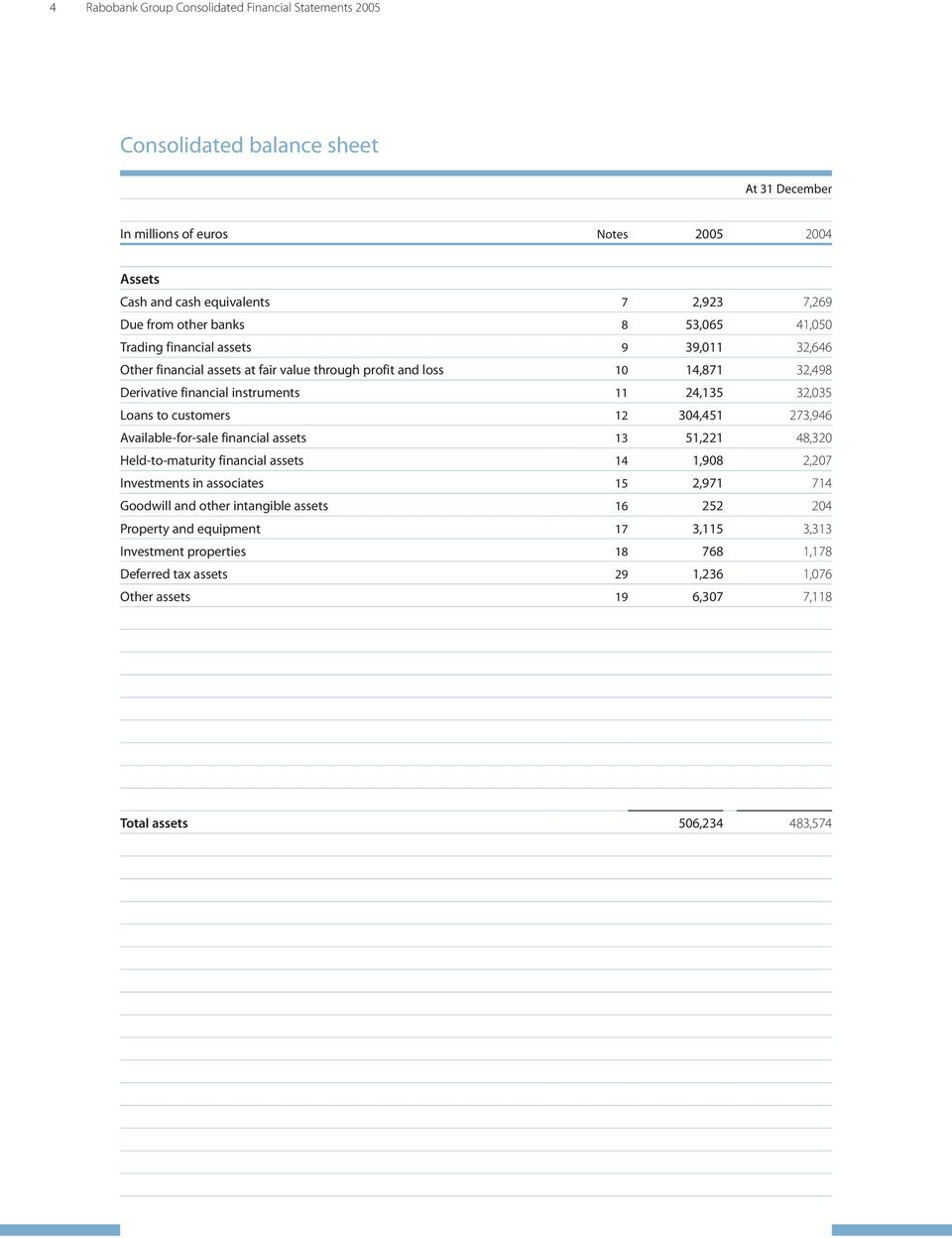
6 4 Rabobank Group Consolidated Financial Statements 2005 Consolidated balance sheet At 31 December In millions of euros Notes Assets Cash and cash equivalents 7 2,923 7,269 Due from other banks 8 53,065 41,050 Trading financial assets 9 39,011 32,646 Other financial assets at fair value through profit and loss 10 14,871 32,498 Derivative financial instruments 11 24,135 32,035 Loans to customers , ,946 Available-for-sale financial assets 13 51,221 48,320 Held-to-maturity financial assets 14 1,908 2,207 Investments in associates 15 2, Goodwill and other intangible assets Property and equipment 17 3,115 3,313 Investment properties ,178 Deferred tax assets 29 1,236 1,076 Other assets 19 6,307 7,118 Total assets 506, ,574
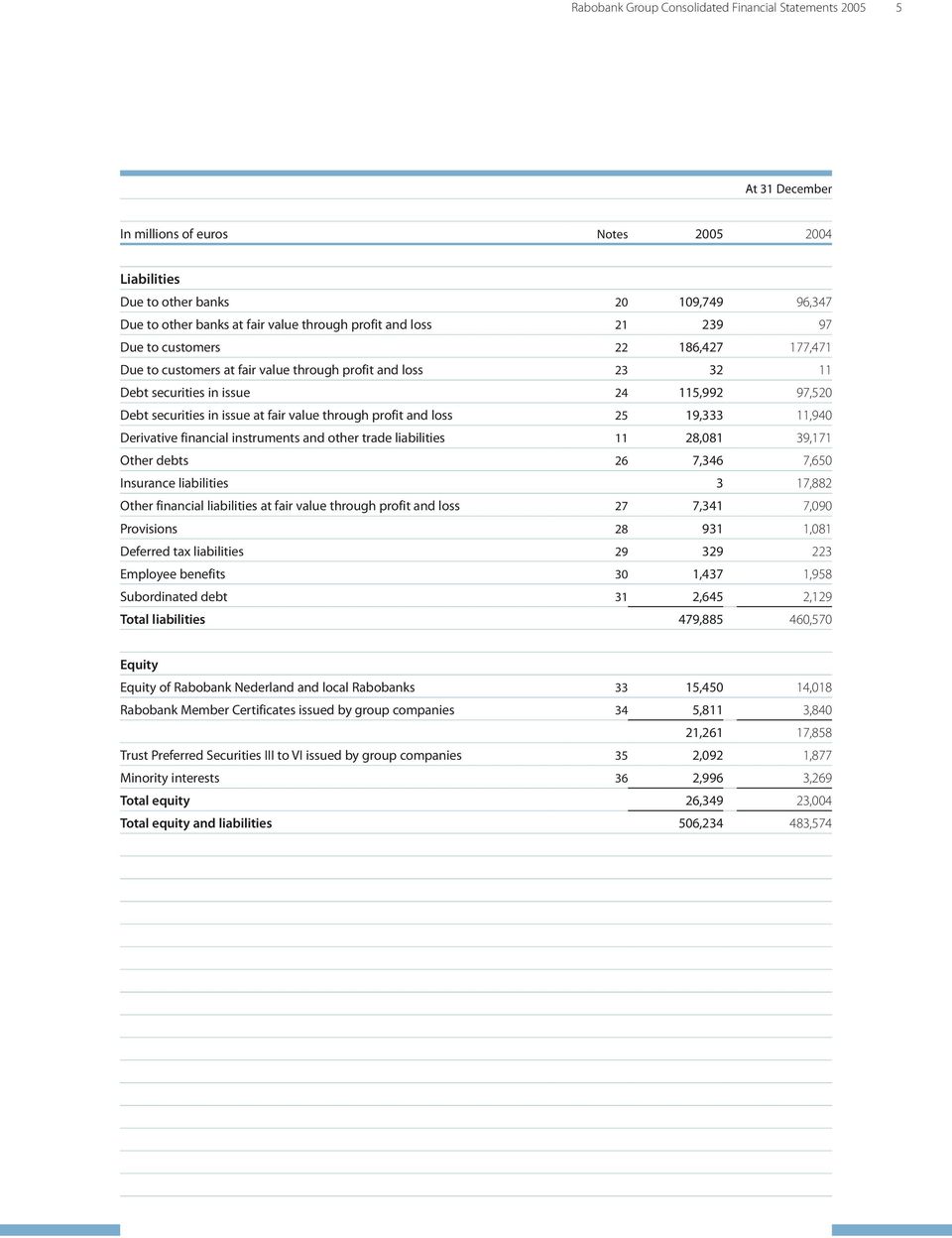
7 Rabobank Group Consolidated Financial Statements At 31 December In millions of euros Notes Liabilities Due to other banks ,749 96,347 Due to other banks at fair value through profit and loss Due to customers , ,471 Due to customers at fair value through profit and loss Debt securities in issue ,992 97,520 Debt securities in issue at fair value through profit and loss 25 19,333 11,940 Derivative financial instruments and other trade liabilities 11 28,081 39,171 Other debts 26 7,346 7,650 Insurance liabilities 3 17,882 Other financial liabilities at fair value through profit and loss 27 7,341 7,090 Provisions ,081 Deferred tax liabilities Employee benefits 30 1,437 1,958 Subordinated debt 31 2,645 2,129 Total liabilities 479, ,570 Equity Equity of Rabobank Nederland and local Rabobanks 33 15,450 14,018 Rabobank Member Certificates issued by group companies 34 5,811 3,840 21,261 17,858 Trust Preferred Securities III to VI issued by group companies 35 2,092 1,877 Minority interests 36 2,996 3,269 Total equity 26,349 23,004 Total equity and liabilities 506, ,574
8 6 Rabobank Group Consolidated Financial Statements 2005 Consolidated profit and loss account For the year ended 31 December In millions of euros Notes Interest income 37 22,101 18,580 Interest expense 37 15,694 12,385 Interest 37 6,407 6,195 Fee and commission income 38 2,639 2,294 Fee and commission expense Fees and commission 38 2,217 1,872 Income from associates Trading income Net income from non-trading financial assets and liabilities at fair value through profit and loss (90) Gains on available-for-sale financial assets Income from Interpolis insurance business Other 43 (271) 572 Income 9,363 9,222 Staff costs 44 3,880 3,683 Other administrative expenses 45 1,953 2,173 Depreciation and amortisation Operating expenses 6,164 6,177 Value adjustments Operating profit before taxation 2,682 2,566 Taxation Net profit for the year 2,083 1,793

9 Rabobank Group Consolidated Financial Statements In millions of euros Notes Of which attributable to Rabobank Nederland and local Rabobanks 33 1,577 1,392 Of which attributable to holders of Rabobank Member Certificates Of which attributable to Trust Preferred Securities III to VI Of which attributable to minority interests Net profit for the year 2,083 1,793 See the notes to the consolidated financial statements.

10 8 Rabobank Group Consolidated Financial Statements 2005 Consolidated statement of changes in equity Equity of Rabobank Nederland Rabobank Member Trust Preferred Total In millions of euros and local Rabobanks Certificates Securities III to VI Minority interests equity At 1 January ,501 3,853-3,325 19,679 Arising in the period: Available-for-sale financial assets - net fair value changes, after taxation Currency translation differences (57) (57) Available-for-sale financial assets - reclassified to net profit for the year, after taxation (109) (109) Total income and expense for the year recognised directly in equity Net profit for the year 1, ,793 Total income and expense 1, ,003 Issue of Rabobank Member Certificates and Trust Preferred Securities - (13) 1,877-1,864 Payment on Rabobank Member Certificates and Trust Preferred Securities - (217) (20) - (237) Other (85) - - (220) (305) At 31 December ,018 3,840 1,877 3,269 23,004

11 Rabobank Group Consolidated Financial Statements Equity of Rabobank Nederland Rabobank Member Trust Preferred Total In millions of euros and local Rabobanks Certificates Securities III to VI Minority interests equity At 1 January ,018 3,840 1,877 3,269 23,004 Arising in the period: Available-for-sale financial assets - net fair value changes, after taxation (179) (179) Available-for-sale financial assets - reclassified to net profit for the year, after taxation (114) (114) Currency translation differences Cash flow hedges - net fair value gains, after taxation Total income and expense for the year recognised directly in equity (270) (55) Net profit for the year 1, ,083 Total income and expense 1, ,028 Issue of Rabobank Member Certificates and Trust Preferred Securities - 1, ,971 Payment on Rabobank Member Certificates and Trust Preferred Securities - (211) (111) - (322) Other (457) (332) At 31 December ,450 5,811 2,092 2,996 26,349

12 10 Rabobank Group Consolidated Financial Statements 2005 Consolidated cash flow statement For the year ended 31 December Cash flows from operating activities Operating profit before taxation 2,682 2,566 Adjusted for: Non-cash items recognised in profit and loss and other adjustments Depreciation and amortisation Value adjustments Change in insurance liabilities (excluding Interpolis) Result on sale of property and equipment (12) (9) Share of (profit) of associates and result on sale of subsidiary (218) (65) Fair value gains /losses on investment properties 1 (18) Fair value gains /losses on available-for-sale financial assets reclassified to the income statement (20) 90 Net gains /losses on trading financial assets (373) (333) Net income from non-trading financial assets and liabilities at fair value through profit and loss (38) (27) Net (increase)/decrease in operating assets Due from other banks 1,387 14,054 Trading financial assets (5,741) 5,593 Derivative financial instruments 7,900 (4,555) Net (increase)/decrease in non-trading financial assets at fair value through profit and loss 25,219 (18,534) Loans to customers (30,337) (27,044) Net increase/(decrease) in liabilities relating to operating activities Derivative financial instruments and other trade liabilities (11,090) 5,596 Due to customers 8,956 17,541 Debt securities in issue 18,472 6,070 Other debts (304) (1,781) Income tax paid (634) (680) Other changes (mainly attributable to disposal of Interpolis) (18,861) 7,526 Net cash flow from operating activities (2,138) 6,826

13 Rabobank Group Consolidated Financial Statements For the year ended 31 December Cash flows from investing activities Acquisition of subsidiaries net of cash and cash equivalents acquired (21) (206) Disposal of subsidiaries net of cash and cash equivalents disposed 2 4 Acquisition of property and equipment and investment properties (456) (568) Income from sale of property and equipment Acquisition of available-for-sale financial assets and held-to-maturity financial assets (14,885) (19,485) Income from sale and repayment of available-for-sale financial assets and held-tomaturity financial assets 10,286 8,848 Net cash flow from investing activities (4,756) (10,763) Cash flows from financing activities Proceeds from issue of Rabobank Member Certificates 2,000 - Proceeds from issue of Trust Preferred Securities - 1,879 Proceeds from issue of subordinated debt instruments 1,000 1,927 Payment on Rabobank Member Certificates and Trust Preferred Securities Repayment of subordinated debt (774) (15) Net cash flow from financing activities 2,548 4,028 Net increase/(decrease) in cash and cash equivalents (4,346) 91 Cash and cash equivalents at beginning of year 7,269 7,178 Cash and cash equivalents at end of year 2,923 7,269 The purchase of the interest in Eureko and the sale of the interest in Interpolis did not generate any cash flows. The cash flows from interest are included in the net cash flow from operating activities. The interest income and expense amounted: Interest income 22,101 18,580 Interest expense 15,694 12,385

14 12 Rabobank Group Consolidated Financial Statements 2005 Notes to the consolidated financial statements This is the first official publication of the consolidated financial statements prepared under International Financial Reporting Standards (IFRS) in accordance with European Union regulations. The comparative figures have been restated accordingly. 1 Basis of consolidation Rabobank Group ( Rabobank ) comprises the local Rabobanks ( Members ) in the Netherlands, the central cooperative Rabobank Nederland and other specialised subsidiaries. Together they form Rabobank Group and Rabobank Nederland, which advises the Members and assists them in the provision of their services. Rabobank Nederland also advises the Members on behalf of De Nederlandsche Bank (the Dutch central bank). Rabobank s cooperative structure has several executive levels, each with its own duties and responsibilities. In IFRS terms, Rabobank Nederland exercises control over the local Rabobanks. The consolidated financial statements of Rabobank include the financial information of Rabobank Nederland and that of the Members and the other group companies. 2 Accounting policies The main accounting policies used in preparing these consolidated financial statements are explained below. 2.1 General The consolidated financial statements of Rabobank have been prepared in accordance with International Financial Reporting Standards ( IFRS ) as approved by the European Union. Rabobank adopted IFRS with effect from 1 January 2005 and has therefore restated its figures already reported for 2004 to bring them into line with IFRS. The effect of the adoption of the standards is explained in note 3, Effect of changes in accounting policies due to first-time adoption of IFRS. The consolidated financial statements have been prepared on a historical cost basis, except for available-for-sale financial assets, trading financial assets and liabilities, and derivative contracts. These items are recognised at fair value. Unless otherwise stated, all amounts in these consolidated financial statements are in millions Estimates The preparation of the consolidated financial statements requires management to make estimates and assumptions that affect the amounts reported for assets and liabilities and the reporting of contingent assets and liabilities at the date of the consolidated financial statements, as well as the amounts reported for income and expenses during the reporting period. Although management based their estimates on the most careful assessment of the current circumstances and activities, the actual results might deviate from these estimates.

15 Rabobank Group Consolidated Financial Statements Group financial statements Subsidiaries Subsidiaries and other entities (including special purpose entities) over which Rabobank exercises control, directly or indirectly, are consolidated. The assets, liabilities and results of these entities are consolidated in full. Subsidiaries are consolidated from the date on which Rabobank obtains control, and cease to be consolidated on the date that this control ends. All intra-group transactions, balances and unrealised gains and losses on transactions between business units of Rabobank are eliminated as part of the consolidation Joint ventures The interests of Rabobank in entities where control is shared are consolidated proportionally. With this method, Rabobank includes its share of the income and expenses, assets and liabilities, and cash flows of the various joint ventures in the relevant items of its financial statements Investments in associates Investments in associates are recognised in accordance with the equity method. With this method, Rabobank s share of the profits and losses of an associate (after the acquisition) is recognised in profit and loss, and its share of the changes in reserves after the acquisition is recognised in reserves. The cumulative changes after acquisition are adjustments to the cost of the investment. Associates are entities in which Rabobank holds between 20% and 50% of the voting rights and over which Rabobank has significant influence but does not exercise control. Unrealised gains on transactions between Rabobank and its associates are eliminated in proportion to the size of Rabobank s interest in the associates. Unrealised losses are also eliminated unless the transaction indicates that an impairment loss should be recognised on the asset transferred. Investments by Rabobank in associates include the goodwill acquired. If Rabobank s share in the losses of an associate equals or exceeds its interest in the associate, Rabobank will not recognise any more losses of the associate unless Rabobank has given undertakings or made payments on behalf of this associate. 2.3 Derivative financial instruments and hedging General Derivative financial instruments generally mean foreign currency contracts, currency and interest rate futures, forward rate agreements, currency and interest rate swaps, and currency and interest rate options (written as well as acquired). Derivative financial instruments might be traded on an exchange or as over- the-counter (OTC) instruments between Rabobank and a client. All derivative financial instruments are recognised at inception on the balance sheet at cost and subsequently revalued to fair value. The fair value is determined using listed market prices, prices offered by traders, cash-flow discounting models and option valuation models based on current market prices and contracted prices for the underlying instruments, as well as the time value of money, yield curves and the volatility of the underlying assets and liabilities. All derivative financial instruments are included under assets if their fair value is positive and under liabilities if their fair value is negative. Derivative financial instruments that are embedded in other financial instruments are treated separately if their risks and characteristics are not closely related to those of the underlying derivative contract and this contract is not classified at fair value through profit and loss.
16 14 Rabobank Group Consolidated Financial Statements Instruments not used for hedging Realised and unrealised gains and losses on derivative financial instruments classified by Rabobank as held-for-trading are recognised under Trading income Hedging instruments Rabobank also uses derivative financial instruments as part of balance sheet control to manage its interest rate risks, credit risks and foreign currency risks. On the date of concluding a derivative contract, Rabobank can designate certain derivative financial instruments as (1) a hedge of the fair value of an asset or liability on the balance sheet (fair value hedge), as (2) a hedge of future cash flows attributable to an asset or liability on the balance sheet, an expected transaction or a non-current liability (cash flow hedge), or as (3) a hedge of a net-investment in a foreign entity (net investment hedge). Derivative financial instruments can be qualified as hedging instruments if certain criteria are met. These criteria include: - Preparation of formal documentation of the hedging instrument, the hedged item, the objective of the hedge, the hedging strategy and the hedge relationship before applying hedge accounting; - The hedge is expected to be highly effective (in a range of 80% to 125%) in offsetting changes in the hedged item s fair value or cash flows attributable to the hedged risks during the entire reporting period; and - The hedge is continuously highly effective from inception onwards. Changes in the fair value of derivative financial instruments that are designated as fair value hedges and are highly effective in relation to the hedged risks are recognised in profit and loss, together with the corresponding changes in the fair value of the assets or liabilities hedged against the risks in question. If the hedge no longer meets the criteria for hedge accounting (according to the fair value hedge model), any adjustment to the carrying amount of a hedged interest-bearing financial instrument is amortised through profit and loss until the end of the hedged period. Any adjustment to the carrying amount of a hedged equity instrument is recognised under Profits and losses not disclosed in the profit and loss account until disposal of the equity instrument. Changes in the fair value of derivative financial instruments that are designated and qualify as cash flow hedges and that are highly effective in relation to the hedged risks are recognised in the hedging reserve included under equity (see note 11). The non-effective part of the changes in the fair values of the derivative financial instruments are recognised in profit and loss. If the forecast transaction or non-current liability results in the recognition of an asset or a liability, any deferred gain or loss included in equity are restated to the initial carrying amount (cost) of the asset or liability. In all other cases, deferred amounts included in equity are taken to the profit and loss account and are classified as income or expenses in the periods in which the hedged non-current liability or forecast transaction had an effect on profit and loss. Certain derivative contracts, although they are effective economic hedges in relation to the managed risk positions taken by Rabobank, do not qualify for hedge accounting under the specific IFRS rules. These contracts are therefore treated as derivative trading financial instruments, with the fair value of gains and losses being reported under Trading income. Rabobank hedges the credit risks of loan portfolios with economic hedges based on credit default swaps and does not apply hedge accounting to these instruments. However, if Rabobank recognises an impairment loss on a loan hedged with this type of economic hedge, the gain on the credit default swap is set off against expenses/gains related to credit losses. The fair value of derivative financial instruments held for trading and hedging purposes is disclosed in note 11, Derivative financial instruments and other trade liabilities.

17 Rabobank Group Consolidated Financial Statements Trade liabilities Trade liabilities are mainly negative fair values of derivative financial instruments and delivery obligations arising on short selling of securities. Securities are sold short to realise gains from short-term price fluctuations. The securities needed to settle the short selling are acquired through securities leasing or sale and repurchase contracts. Securities sold short are recognised at fair value at the balance sheet date. Trade liabilities also include certain financial liabilities that Rabobank does not intend to sell, but which it designated as held for trading on initial recognition and recognised at fair value. Changes in the fair value of these financial liabilities are recognised in profit and loss for the period in which they arise. 2.5 Trading financial assets Trading financial assets are acquired to realise gains from short-term fluctuations in the prices or margins of traders, or form part of a portfolio that regularly generates short-term gains. These assets are initially recognised at cost and subsequently revalued to fair value based on quoted bid prices. Any realised and unrealised gains and losses are included under Trading income. Interest earned on trading financial assets is recognised as interest income. Dividends received on trading financial assets is recognised as dividend income. All purchases and sales of trading financial assets that have to be delivered within a period prescribed by regulations or market convention are recognised at the transaction date. Other trading transactions are recognised as derivative financial instruments until the date of settlement. 2.6 Non-trading financial assets and liabilities at fair value through profit and loss Rabobank has opted to classify financial instruments not acquired or entered into for realising gains from short-term fluctuations in traders prices or margins at fair value through profit and loss. These financial assets are carried at fair value. Interest earned on assets with this classification is recognised as interest income and interest due on liabilities with this classification is recognised as interest expense. Dividends received on the financial assets are included under dividend income. Any other realised and unrealised gains and losses on revaluation of these financial instruments to fair value are included under Net income from non-trading financial assets and liabilities at fair value through profit and loss. 2.7 Available-for-sale financial assets Management determines the appropriate classification of a financial asset on its date of acquisition. Financial assets that are intended to be held indefinitely or sold for liquidity purposes or in response to changes in interest rates, exchange rates or share prices are classified as available for sale. Available-for-sale financial assets are initially recognised at costs (which includes transaction costs). These assets are subsequently revalued to fair value based on quoted bid prices or values derived from cash flow models. The fair values of unlisted equity instruments are estimated based on appropriate price/earnings ratios, adjusted to reflect the specific circumstances of the respective issuers. Any unrealised gains and losses from changes in the fair value of available-for-sale financial assets are recognised in equity unless they relate to amortised interest. If such financial assets are disposed of or suffer impairment losses, the adjustments to fair value are recognised in profit and loss as gains or losses on available-forsale financial assets. An impairment loss is recognised on a financial asset if its carrying amount exceeds its estimated recoverable amount. The recoverable amount of an instrument carried at fair value is the present value of the expected future cash flows, discounted at the current market rate of interest on a comparable financial asset. If the fair value of securities cannot be reliably measured, they are carried at cost.

18 16 Rabobank Group Consolidated Financial Statements 2005 All purchases and sales made in accordance with standard market conventions for available-for-sale financial assets are recognised at the transaction date. All other purchases and sales are recognised as forward derivative contracts until their dates of settlement. 2.8 Held-to-maturity financial assets Financial assets with fixed terms are classified as held-to-maturity financial assets, provided management intends to keep them for their full terms and is in a position to do so. Management determines the appropriate classification for its investments on their acquisition dates. Held-to-maturity financial assets are carried at amortised cost based on the effective interest method, net of provisions for impairment losses as necessary. Interest earned on held-to-maturity financial assets is recognised as interest income. All purchases and sales made in accordance with standard market conventions for held-to-maturity financial assets are recognised at the date of settlement. All other purchases and sales are recognised as forward derivative contracts until their dates of settlement. 2.9 Repurchase and reverse repurchase contracts Financial assets that are sold subject to related sale and repurchase contracts are included in the financial statements under Trading financial assets and Available-for-sale financial assets. The liability to the counterparty is included under Due to other banks and Due to customers depending on the application. Financial assets acquired under reverse sale and reverse repurchase contracts are recognised as: - Due from other banks, or - Loans to customers, depending on the application. The difference between the selling and repurchasing price is recognised as interest income or expense over the term of the agreement, based on the effective interest method Securitisations and other derecognition constructions Rabobank securitises, sells and carries various financial assets that it sometimes sells to special purpose entities, which then issue securities to investors. Rabobank has the option of retaining an interest in sold securitised financial assets in the form of subordinated interest-only strips, subordinated securities, spread accounts, servicing rights, and guarantees, put options and call options, and other constructions. A financial asset (or a portion of a financial asset) is derecognised if: - the rights to the cash flows from the asset expire; - the rights to the cash flows from the asset and a substantial portion of the risks and benefits of ownership of the asset are transferred; - a commitment to transfer the cash flows from the asset is presumed and a substantial portion of the risks and benefits are transferred; - not all the risks and benefits are retained or transferred; however control over the asset is transferred. If Rabobank retains control over the asset but does not retain a substantial portion of the rights and benefits, the asset is recognised in proportion to the continuing involvement of Rabobank. A related liability is also recognised to the extent of Rabobank s continuing involvement. The recognition of changes in the value of the liability corresponds to the recognition of changes in the value of the asset.
19 Rabobank Group Consolidated Financial Statements If a transaction does not meet the above conditions for derecognition, it is recognised as a loan for which security has been provided. To the extent that the transfer of a financial asset does not qualify for derecognition, the transfer does not result in Rabobank s contractual rights being separately recognised as derivative financial instruments if recognition of these instruments and the transferred asset, or the liability arising on the transfer, were to result in double recognition of the same rights or obligations. Gains and losses on securitisations and sale transactions depend partly on the previous carrying amounts of the financial assets involved in the transfer. The carrying amounts of the assets in question are allocated to the sold and retained interests based on the relative fair values of these interests at the date of sale. Any gains and losses are recognised at the time of transfer under Trading income. The fair value of the sold and retained interests is based on quoted market prices or calculated as the present value of the future expected cash flows, using pricing models that take into account various assumptions such as credit losses, discount rates, yield curves, payment frequency and other factors. Rabobank decides for each securitisation transaction whether the securitisation instrument should be included in the consolidated financial statements. For this purpose, it performs an assessment by taking a number of factors into consideration, for example the activities of the SPE, decision-making powers and the allocation of the benefits and risks associated with the activities of the SPE Netting of financial assets and liabilities Financial assets and liabilities are set off and the net amount is transferred to the balance sheet if a legal right to set off the recognised amounts exists and it is intended to settle the expected future cash flows on a net basis, or to realise the asset and settle the liability simultaneously Foreign currencies Foreign entities Items included in the financial statements of each entity in the Group are carried in the currency that best reflects the economic reality of the underlying events and circumstances that are relevant for the entity (the functional currency). The consolidated financial statements are presented in euros, which is the parent company s functional currency. Gains, losses and cash flows of foreign entities are translated into the presentation currency of Rabobank at the exchange rates on the transaction dates, which are approximately equal to the average exchange rates. For balance sheet purposes, they are translated at the exchange rates on 31 December. Translation differences arising on the net investments in foreign entities and on loans and other currency instruments designated as hedges of these investments are recognised in equity. If a foreign entity is sold, any such translation differences are recognised in profit and loss as part of the gain or loss on the sale. Goodwill and fair-value adjustments arising on the acquisition of a foreign entity are recognised as assets and liabilities of the foreign entity and are translated at the closing rate Transactions in foreign currencies Transactions in foreign currencies are translated into the functional currency at the exchange rates ruling at the transaction date. Translation differences arising on the settlement of such transactions or on the translation of monetary assets and liabilities denominated in foreign currencies are recognised in profit and loss, unless they are recognised in equity as qualifying cash flow hedges.

20 18 Rabobank Group Consolidated Financial Statements 2005 Translation differences on debt securities and other monetary financial assets carried at fair value are included under foreign exchange gains and losses. Translation differences on non-monetary items such as equity instruments held for trading are recognised as part of the fair value gains or losses. Translation differences on available-for-sale non-monetary items are included in the revaluation reserve reported under equity Interest Interest income and expenses for all interest-bearing instruments are recognised in profit and loss according to the allocation principle, with the effective interest method being applied to the actual purchase price. Interest income includes coupons relating to fixed-interest financial assets and trading financial assets, as well as the cumulative premiums and discounts on government treasury securities and other cash equivalent instruments. If any loans suffer impairment losses, they are written down to their recoverable amounts and the interest income recognised henceforth is based on the discount rate for calculating the present value of the future cash flows used to determine the recoverable amounts Fees and commission Income from asset management activities consists mainly of unit trust and fund management commission and administration fees. Fees are also received for insurance activities relating to pension management and employee healthcare. Income from asset management and insurance activities is recognised as earned when the services are provided. Fees and commission are generally recognised according to the allocation principle. Fees and commission received for negotiating a transaction, or taking part in the negotiations, on behalf of third parties, for example the acquisition of a portfolio of loans, shares or other securities, or the sale or purchase of companies, are recognised at completion of the underlying transactions Loans to customers and due from other banks Loans to customers and due from other banks are not derivative financial instruments with fixed or defined payments, not listed on active market, apart from such assets that Rabobank classifies as trading, at fair value on initial recognitions with changes recognised through profit and loss, or as available for sale. These loans and receivables are measured at amortised cost, including transaction costs. A value adjustment, for losses on loans, is recognised if there is objective evidence that Rabobank will not be able to collect all amounts due under the original terms of the contract. The size of the reserve is the difference between the carrying amount and recoverable amount, which is the present value of the expected cash flows, including amounts recoverable under guarantees and sureties, discounted at the original effective rate of interest of the loans. The reserve for loans includes losses if there is objective evidence that losses are attributable to some portions of the loan portfolio at the balance sheet date. These are estimated based on the historical pattern of losses for each separate portion and the credit ratings of the borrowers, and taken into account the actual economic conditions under which the borrowers conduct their activities. If a loan is not collectible, it is written off from the related reserve for losses on loans. Any amounts subsequently collected are included under the item Value adjustments on the profit and loss account.
21 Rabobank Group Consolidated Financial Statements Goodwill and other intangible assets Goodwill Goodwill is the amount by which the acquisition price paid for a subsidiary or associate exceeds the fair value on the acquisition date of Rabobank s share of the net assets and the unconditional liabilities of the entity acquired. Goodwill on acquisitions made on or after 1 January 2004 is recognised on the balance sheet as an intangible asset net of any impairment losses. Goodwill on the acquisition of a subsidiary made before 1 January 2004 was charged directly to equity. Goodwill in such case has not been capitalised retrospectively, as allowed under IFRS Software development costs Costs related to the development or maintenance of computer programs are recognised as an expense at the time they are incurred. Costs directly incurred in connection with identifiable and unique software products over which Rabobank has control and that will probably provide economic benefits exceeding the costs for longer than a year are recognised as intangible assets. Direct costs include the employee expenses of the software development team and an appropriate portion of the relevant overhead. Expenditures that improve the performance of computer programs compared with their original specifications are added to the original cost of the software. Computer software development costs recognised as assets are amortised on a straight-line basis over a period not exceeding three years Insurance contracts acquired as part of a business combination or portfolio transfer The fair value (present value of the expected future cash flows) of contractual insurance rights and obligations are capitalised as intangible assets and amortised over the term of the contract, which is generally between 2 and 5 years. The net asset undergoes an impairment test each year based on the expected future cash flows from the acquired insurance contracts. An impairment loss is recognised if the expected future profits do not justify the carrying amount of the asset Impairment losses on goodwill and other intangible assets At each balance sheet date, Rabobank assesses whether there are indications of impairment losses on goodwill and other intangible assets. If such indications exist, impairment testing is carried out to determine whether the carrying amount of goodwill and other intangible assets are fully recoverable. An impairment loss is recognised if the carrying amount is greater than the recoverable amount Property and equipment Equipment (for own use) is recognised at historical cost net of accumulated depreciation. Property (for own use) represents mainly offices and is also recognised at cost less accumulated depreciation. Straight-line deprecation is applied to these assets in accordance with the schedule below. Each asset is depreciated to its residual value over its estimated useful life. - Land Not depreciated - Buildings years Equipment, including the following: - Computer equipment 1-3 years - Other equipment and vehicles 3-8 years
22 20 Rabobank Group Consolidated Financial Statements 2005 Property and equipment are regularly submitted to impairment testing. If the carrying amount of an asset exceeds its estimated recoverable amount, the carrying amount is written down immediately to the recoverable amount. Gains and losses on the disposal of items of property and equipment are determined in proportion to their carrying amounts and taken into account when determining the operating result. Repair and maintenance work is charged to profit and loss at the time the costs are incurred. Expenditures on extending or increasing the benefits from land and buildings compared with their original benefits are capitalised and subsequently depreciated. Finance expenses incurred during the creation of an asset for use or sale are charged to profit and loss for the period in which they are incurred Investment properties Investment properties, mainly office buildings, are held for their long-term rental income and are not used by Rabobank or its subsidiaries. Investment properties are recognised as long-term investments and included on the balance sheet at cost, net of accumulated depreciation Leases Rabobank as lessee Leases relating to property and equipment under which substantially all the risks and benefits of ownership are transferred to Rabobank are classified as finance leases. Finance leases are capitalised at the inception of the lease at the fair value of the leased assets or, if lower, at the present value of the minimum lease payments. Lease payments are apportioned between the lease liability and the finance charges, so as to achieve a constant rate of interest on the remaining balance of the liability. The corresponding lease liabilities are included under other loans, after deduction of finance charges. The interest components of the finance charges are recognised in profit and loss over the term of the lease. An item of property and equipment acquired under a lease agreement is depreciated over the useful life of the asset or, if shorter, the term of the lease. Leases under which a substantial portion of the risks and benefits of ownership of the assets are retained by the lessor are classified as operating leases. Operating lease payments (less any discounts given by the lessor) are charged to profit and loss on a straight-line basis over the term of the lease Rabobank as lessor Finance leases If assets are leased under a finance lease, the present value of the lease payments is recognised as a receivable under Due from other banks or Loans to customers. The difference between the gross receivable and the present value of the receivable is recognised as unearned finance income. Lease income is recognised as interest income over the term of the lease using the net investment method, which results in a constant rate of return on the investment. Operating leases Assets leased under operating leases are included on the balance sheet under Property and equipment. The assets are depreciated over their expected useful lives in line with those of comparable items of property and equipment. Rental income (less discounts granted to lessees) is recognised under Other income on a straight-line basis over the term of the lease.
23 Rabobank Group Consolidated Financial Statements Provisions Provisions are recognised if Rabobank has a present obligation (legal or constructive) as a result of a past event, it is probable that an outflow of resources embodying economic benefits will be required to settle the obligation and a reliable estimate can be made of the amount of the obligation. If Rabobank expects a provision to be reimbursed, for example under an insurance contract, the reimbursement is recognised as a separate asset but only if the reimbursement is virtually certain Restructuring Restructuring provisions comprise penalties for premature termination of leases, payments under redundancy schemes and other costs directly attributable to restructuring programms. The costs are recognised in the period in which a legal or constructive obligation arises for Rabobank. No provisions are formed in advance for costs relating to continuing operations of Rabobank Leave and long-term employment Leave entitlements of employees and leave relating to long-term employment are recognised at the time they are granted. A provision is formed for the estimated obligation for annual leave and leave relating to long-term service of employees, with the balance sheet date as reference point Legal issues Legal issues provisions are formed for the amounts estimated at the balance sheet date as payable in connection with ongoing legal proceedings. The provisions include an estimate of legal costs and any payments to be made in the course of the legal proceedings Employee benefits Rabobank provides different pension plans based on the local conditions and practices of the countries in which it operates. In general, the plans are financed by payments to insurance companies or trustee administered funds. The payments are calculated actuarially at regular intervals. A defined benefit plan is one that incorporates a promise to pay an amount of pension benefit, which is usually based on several factors such as age, number of years in service and remuneration. A defined contribution plan is one under which Rabobank pays fixed contributions to a separate entity (a pension fund) and acquires no legal or constructive obligation if the fund has insufficient assets to pay all the benefits to employeemembers of the plan in respect of service in current and past periods Pension obligations The defined benefit liability is the present value of the defined benefit obligation at the balance sheet date, including adjustments for actuarial gains and losses and past service costs not yet recognised, reduced by the fair value of the fund. The defined benefit obligation is calculated by independent actuaries each year using the projected unit credit method. The present value of the defined benefit obligation is calculated by discounting the estimated future cash outflows at rates of interest on government securities with terms approximating those of the related obligations. Most of the pension plans are average pay plans and the net costs after deduction of employees contributions are included under Staff costs. Actuarial gains or losses from adjustments due to actual developments, modified actuarial assumptions and plan changes are recognised using the corridor method in accordance with IFRS.
24 22 Rabobank Group Consolidated Financial Statements Defined contribution plans Under defined contribution plans, Rabobank pays contributions to publicly or privately managed insured pension plans on a compulsory, contractual or voluntary basis. Once the contributions have been made, Rabobank has no further payment obligations. The regular contributions are net period costs for the year in which they are due and are included on this basis under Staff costs Other post-employment obligations Some Rabobank units provide other post-employment benefits. To become eligible for such benefits, the usual requirement is that the employee remains in service until retirement and has been with the company a minimum number of years. The expected costs of these benefits are accrued over the years of service, based on a system similar to that for defined benefit plans. The obligations are valued each year by independent actuaries. Under the current collective labour agreement, employees who satisfy the age criteria can opt for early retirement at 60. A provision has been formed for employees who will be eligible for early retirement under the plan in the future. The provision is calculated actuarially, using an average market rate of interest for all employees who satisfy the criteria and who will probably opt to retire early under the plan Tax Tax receivables and payables and deferred tax assets and liabilities are set off if they relate to the same taxation group, the same taxation authority, a legal right exists to set off tax items and simultaneous treatment or settlement is expected. Provisions are formed in full for deferred tax liabilities, using the liability method, arising from temporary differences at the balance sheet date between the tax bases of assets and liabilities and their carrying amounts for financial reporting purposes. The main temporary differences relate to the depreciation of property and equipment, the revaluation of certain financial assets and liabilities, including derivative financial instruments, provisions for pensions and other post-employment benefits, provisions for losses on loans and other impairment and tax losses, and, in connection with business combinations, the fair values of the net assets acquired and their tax bases. Deferred income tax assets and liabilities are measured at the tax rates that have been enacted or substantively enacted at the balance sheet date. Deferred tax assets are recognised to the extent that it is probable that future taxable profits will be available, against which the temporary differences can be utilised. Provisions are formed in respect of taxable temporary differences associated with investments in subsidiaries, associates and interests in joint ventures, unless the timing of the reversal of the temporary differences can be controlled and it is probable that the temporary differences will not reverse in the foreseeable future. The income taxation on profit is calculated in accordance with the tax legislation of the relevant jurisdiction and recognised in the period in which the profit is realised. The tax effects of the carry-forward of unused tax losses are recognised as an asset if it is probable that future taxable profits will be available against which the losses can be utilised. Deferred tax items relating to the revaluation to fair value of available-for sale financial assets and cash flow hedges that are charged or taken to equity are subsequently recognised in profit and loss together with the respective gain or loss.
25 Rabobank Group Consolidated Financial Statements Due to other banks, due to customers and debt securities in issue These borrowings are initially recognised at cost, i.e. the proceeds received less directly attributable and non-recurring transaction costs. Loans are subsequently included at amortised cost. Any difference between the net proceeds and the redemption amount is recognised over the term of the loan, using the effective interest method. If Rabobank repurchases one of its own debt instruments, it is derecognised, with the difference between the carrying amount of the liability and the consideration paid being recognised as income Rabobank Member Certificates These are the Members Certificates issued in 2000, 2001, 2002 and Since the proceeds of the issue are available to Rabobank on a perpetual and highly subordinated basis (also subordinate to the Trust Preferred Securities) and since in principle no distribution is made if the consolidated profit and loss account of Rabobank shows a loss for any financial year, the issue proceeds, insofar as they have been lent on to Rabobank Nederland, are recognised under Equity in proportion to the number of shares held by members and employees. As a result, distributions are accounted for in the profit appropriation Trust Preferred Securities Trust Preferred Securities, which pay a non-discretionary dividend and are redeemable on a specific date or at the option of the holder, are classified as financial liabilities and included under Other loans. The dividends on these preferred securities are recognised in profit and loss as interest expense based on amortised cost using the effective interest method. The remaining Trust Preferred Securities are recognised as equity, as there is no formal obligation to repay the principal or to pay a dividend Financial guarantees Financial guarantees are initially measured at cost and subsequently revalued to the amount that Rabobank would reasonably have to pay at the balance sheet date to settle the liability or transfer it to a third party Bills Bills represent commitments by Rabobank to redeem bills issued to clients. Rabobank expects to redeem most bills at the time the clients receive payment. Bills are recognised as off-balance-sheet transactions and disclosed as contingent liabilities and obligations Trust activities Assets and revenue involved in fiduciary activities, together with the related obligation to return the assets to the clients, are eliminated if Rabobank acts as nominee, trustee or agent Segment information A segment is a distinguishable component of Rabobank that engages in providing products or services and is subject to risks and returns that are different from those of other segments. A segment in which most of the revenue is generated by sales to external clients, and the revenue, profit or assets account for 10% or more of all segments in aggregate is reported separately. Rabobank s primary segment reporting format is by business segment; the secondary format is by geographical segment.
26 24 Rabobank Group Consolidated Financial Statements Cash and cash equivalents Cash equivalents are highly liquid short-term investments held to meet current obligations in cash, rather than for investment or other purposes. Such obligations have outstanding terms of less than 90 days at inception. Cash equivalents are readily convertible to known amounts of cash and subject to an insignificant risk of changes in value Estimates and assumptions The preparation of the consolidated financial statements requires Rabobank to make estimates and assumptions that affect the amounts reported for assets and liabilities and the reporting of contingent assets and liabilities at the date of the financial statements, as well as the amounts reported for income and expenses during the reporting period. The actual results can deviate from the above-mentioned estimates. 3 Effect of changes in accounting policies due to first time adoption of IFRS The effect of the adoption of IFRS on equity reported at 1 January 2004 can be broken down as follows: In millions of euros At 1 January 2004 as reported At 1 January 2004 after application of IFRS Assets Cash and cash equivalents 7,117 7,178 Due from other banks 41,919 41,890 Financial assets 84,445 92,878 Derivative financial instruments - 27,479 Loans to customers 250, ,039 Other assets 19,027 13,299 Total assets 403, ,763 Liabilities Due to other banks 82,856 83,117 Due to customers 172, ,930 Debt securities in issue 80,695 99,028 Derivative financial instruments and other trade liabilities - 33,575 Other debts 24,420 9,431 Other financial liabilities at fair value - 4,941 Provisions 19,177 19,087 Total liabilities 379, ,109 Equity and subordinated debt 23,586 21,654 Total equity and liabilities 403, ,763
27 Rabobank Group Consolidated Financial Statements The effect of the transition to IFRS on the consolidated profit previously reported for the year ended 31 December 2004: In millions of euros 2004 result as reported 2004 result after firsttime adoption of IFRS Interest 6,249 6,195 Income from securities and associates Commission 2,112 1,872 Results on financial transactions Income from insurance business Other income Total income 10,055 9,222 Staff costs 4,029 3,683 Other administrative expenses 2,335 2,173 Depreciation and amortisation Total operating expense 6,732 6,177 Value adjustments Operating profit before tax 2,809 2,566 Income tax expense Net profit for the year 1,852 1,793 The effects of the first-time adoption of the new reporting standards on the presentation of results and equity are explained briefly below. Net profit for 2004 under IFRS amounted to 1,793, 59 lower than under Dutch GAAP. Although the change in net profit for the year was relatively small, the composition of net profit did change, however. In addition to the effect on the composition of net profit from the changes in accounting policies, there was also an effect from the different treatment of the insurance business results. The most significant change in the presentation of results due to the first-time adoption of IFRS relates to interest income and the consolidation of interests. Ignoring the different treatment of results from the insurance business, interest income under IFRS is higher than under Dutch GAAP. Most of the difference is attributable to reclassifications. On the other hand, interest income fell due to the fact that swap results on the investment portfolio are no longer amortised. In accordance with IFRS, these results are recognised directly in profit and loss. The interests in the Gilde funds and the majority participating interests of these funds are consolidated under IFRS. This caused income to increase by 279 and operating expenses by 259. On 1 January 2004, the date of the transition to the new accounting standards, equity totalled 19.4 billion under IFRS, compared with 15.2 billion under Dutch GAAP. The difference can be accounted for as follows:
28 26 Rabobank Group Consolidated Financial Statements 2005 In billions of euros Equity at 1 January 2004 under Dutch GAAP 15.2 Reclassification of the fund for general banking risks as equity 1.7 Other minority interests reclassified as equity 3.3 Adjustment of the valuation of derivative financial instruments (0.9) Adjustment of the valuation of buildings (0.3) Adjustment of the valuation of interest-bearing securities 0.4 Gain on swap transactions 0.2 Tax effects 0.1 Adjustment to provision for doubtful debts (0.1) Adjustment to provision for pensions and healthcare (0.2) Incremental cost of lending (0.2) Other adjustments Equity at 1 January 2004 under IFRS 19.4
29 Rabobank Group Consolidated Financial Statements The effect of the adoption of IFRS on equity reported at 31 December 2004 can be broken down as follows: In millions of euros At 31 December 2004 as reported At 31 December 2004 after application of IFRS Assets Cash and cash equivalents 7,204 7,269 Due from other banks 40,588 41,050 Trading financial assets 111, ,671 Derivative financial instruments - 32,035 Loans to customers 276, ,946 Other assets 39,938 13,603 Total assets 475, ,574 Liabilities Due to other banks 96,266 96,444 Due to customers 192, ,482 Debt securities in issue 92, ,460 Derivative financial instruments and other trade liabilities - 39,171 Other debts 46,761 7,873 Other financial liabilities at fair value - 7,090 Provisions 20,752 20,921 Total liabilities 448, ,441 Equity and subordinated debt 26,609 25,133 Total equity and liabilities 475, ,574 Explanation: In comparison with Dutch GAAP, total assets are 2% higher under IFRS at billion. The increase is primarily due to the fact that under IFRS all derivative positions must be included on the balance sheet at market value, while under Dutch GAAP this only applies to trading positions. In addition, most of the items reclassified are liabilities. On 31 December 2004, equity amounted to 23.0 billion under IFRS, compared with 18.1 billion under Dutch GAAP. The difference can be accounted for as follows:
30 28 Rabobank Group Consolidated Financial Statements 2005 In billions of euros Equity at 31 December 2004 under Dutch GAAP 18.1 Difference at 1 January 2004 as accounted for above 4.2 Minority interests (0.1) Net profit for Revaluation reserve relating to available-for-sale financial assets 0.5 Other adjustments Equity at 31 December 2004 under IFRS 23.0
31 Rabobank Group Consolidated Financial Statements Solvency The main capital ratio requirements set by De Nederlandsche Bank (the Dutch central bank) are derived from the capital adequacy guidelines of the European Union and the Basel Committee on Banking Supervision. These ratios compare a bank s total capital (Tier I and Tier II) and core capital (Tier I) with the total risk-weighted assets and off-balance-sheet items and with the market risk exposure of the trading portfolios. The minimum requirements for total capital and core capital as a percentage of risk-weighted assets are 8% and 4% respectively. The table below shows the capital available to the Rabobank and the minimum capital required by the regulatory authorities. With the market risk approach, the general market risk is hedged, as well as the risk of open positions in foreign currencies, debt, own equity instruments. Assets are weighted according to broad categories of notional risk, the weightings reflecting the deemed capital required to back them. Four risk weightings are used: 0%, 20%, 50% and 100%. For example, cash and money market instruments are assigned a weighting of 0%, which means that no capital is required to back the holding of these assets. Items of property and equipment are assigned a weighting of 100%, which means that capital equal to 8% of their carrying amount has to be held to back them. Off-balance-sheet liabilities relating to loans, forward contracts, forwards and options based on derivative financial instruments have various categories of conversion factors applied to them in order to disclose these items at their balancesheet equivalents. These equivalent amounts are then also assigned risk weightings. Rabobank ratios Tier I and qualifying capital can be broken down as follows: Retained earnings and other reserves 15,172 13,469 Payment on Rabobank Member Certificates and Trust Preferred Securities (322) (237) Rabobank Member Certificates 5,811 3,840 Trust Preferred Securities III to VI 2,092 1,877 Trust Preferred Securities I and II 1,483 1,927 24,236 20,876 Part of minority interest treated as Tier I capital Deductions (125) (109) Tier I capital 24,860 21,404 Revaluation reserve Deductions (773) (391) Part of subordinated debt treated as qualifying capital 1, Qualifying capital 25,272 21,205 Risk-weighted assets 213, ,052 Ratio Core capital (Tier I ratio) Qualifying capital (BIS ratio)
32 30 Rabobank Group Consolidated Financial Statements Risk exposure of financial instruments 5.1 Strategy for the use of financial instruments Rabobank s activities are inherently related to the use of financial instruments, including derivative financial instruments. Rabobank accepts deposits from clients at fixed and variable rates of interest for a variety of terms and aims to earn aboveaverage interest margins on these deposits by investing them in high-quality assets. Rabobank also aims to increase these margins by consolidating short funds and loans for longer terms at higher interest rates, at the same time keeping sufficient liquid resources to meet all payments that might become due. A further objective of Rabobank is to increase its interest rate margins by obtaining above-average margins, after deduction of provisions, and by granting loans to commercial and retail borrowers with various credit ratings. These risks apply not only to loans recognised on the balance sheet, but also to guarantees given by Rabobank such as letters of credit and performance and other guarantee documents. Rabobank also trades in financial instruments when it takes positions in tradeable and unlisted instruments (OTCs), including derivative financial instruments, in order to profit from short-term movements on the share and bond markets and in exchange rates, interest rates and commodity prices. 5.2 Interest rate risk Rabobank is exposed to the risk of effects from fluctuations in market interest rates on its financial position and cash flows. As a result of such unexpected movements, interest rate margins can rise or fall. The Executive Board sets limits for the size of the permitted mismatch resulting from interest rate adjustments. The mismatch situation is monitored daily and monthly reports on it are sent to the respective risk management committees. The following table gives a highly simplified picture of Rabobank s repayment schedule broken down by interest-rate type. It shows the carrying amounts of the assets and liabilities of Rabobank, classified by interest rate period or date of maturity. The schedule does not take into account assumptions about client behaviour. Assumptions regarding early repayment of mortgages are used for Rabobank s interest rate risk model. In addition, the model used for due to customers is a portfolio of money market and capital market items. The assumptions on behaviour have been agreed with De Nederlandsche Bank (the Dutch central bank). Moreover, the on-balance-sheet position is hedged with derivative financial instruments not included in the table. Every quarter, reports generated by Rabobank s interest rate risk model are submitted to De Nederlandsche Bank. The results of a stress scenario based on the assumption that the interest rate curve will make a 2% parallel shift upwards and downwards show that interest income will probably not fall by more than 1% in the first year. The expected limit for the second year is 3%.
33 Rabobank Group Consolidated Financial Statements Within More than Non-interest- In millions of euros month months months 1-5 years 5 years bearing Total At 31 December 2005 Assets Cash and cash equivalents ,021 2,923 Due from other banks 32,976 13,847 3, , ,065 Trading financial assets 5,333 2,991 3,836 12,645 9,564 4,642 39,011 Other financial assets at fair value through profit and loss ,955 10,344 2,460 14,871 Loans to customers 72,123 34,815 36,572 92,737 67, ,451 Available-for-sale financial assets 4,110 11,365 4,333 16,173 14, ,221 Held-to-maturity financial assets , ,908 Other assets ,224 6,307 Total assets 116,092 63,989 49, , ,557 15, ,757 Liabilities Due to other banks 54,504 42,462 6,871 3,937 1, ,749 Due to other banks at fair value through profit and loss Due to customers 164,902 8,912 3,503 3,303 3,496 2, ,427 Due to customers at fair value through profit and loss Debt securities in issue 27,075 41,166 15,710 25,294 6, ,992 Debt securities in issue at fair value through profit and loss 3,286 4,897 6,843 1,238 3,069-19,333 Other debts , ,399 7,346 Insurance liabilities Other financial liabilities at fair value through profit and loss ,284 2, ,341 Subordinated debt 1, , ,645 Total liabilities 252,139 98,897 34,335 37,180 18,509 8, ,107 Interest rate sensitivity gap (136,047) (34,908) 15,523 88,053 85,048 6,981 24,650
34 32 Rabobank Group Consolidated Financial Statements 2005 Within More than Non-interest- In millions of euros month months months 1-5 years 5 years bearing Total At 31 December 2004 Assets Cash and cash equivalents 6, ,269 Due from other banks 23,096 10,950 3, , ,050 Trading financial assets 3,064 4,471 5,211 9,383 7,712 2,805 32,646 Other financial assets at fair value through profit and loss 2,874 1,650 1,758 9,322 13,451 3,443 32,498 Loans to customers 60,550 24,900 36,259 87,230 63,207 1, ,946 Available-for-sale financial assets 1,435 2,563 7,292 18,658 16,848 1,524 48,320 Held-to-maturity financial assets , ,207 Other assets ,980 7,118 Total assets 97,814 45,276 54, , ,671 15, ,054 Liabilities Due to other banks 46,951 41,757 3,447 2, ,160 96,347 Due to other banks at fair value through profit and loss Due to customers 137,443 24,754 3,942 5,015 5, ,471 Due to customers at fair value through profit and loss Debt securities in issue 4,883 32,956 19,867 28,176 11, ,520 Debt securities in issue at fair value through profit and loss 4, ,451 3,187-11,940 Other debts (4,941) 280 (960) (8,644) (2,574) 24,489 7,650 Insurance liabilities ,978 15, ,882 Other financial liabilities at fair value through profit and loss 1, ,390 2, ,090 Subordinated debt , ,129 Total liabilities 190, ,060 27,675 35,449 37,041 26, ,137 Interest rate sensitivity gap (92,658) (55,784) 26,832 91,767 67,630 (10,870) 26,917
35 Rabobank Group Consolidated Financial Statements The table below provides a summary of the average effective interest rates at 31 December for monetary financial instruments denominated in major currencies. At 31 December 2005 EUR GBP USD AUS Other % % % % % Assets Cash and cash equivalents Due from other banks Trading financial assets Loans to customers Available-for-sale financial assets Held-to-maturity financial assets Liabilities Due to other banks Due to customers Debt securities in issue Other debts At 31 December 2004 EUR GBP USD AUS Other % % % % % Assets Cash and cash equivalents Due from other banks Trading financial assets Loans to customers Available-for-sale financial assets Held-to-maturity financial assets Liabilities Due to other banks Due to customers Debt securities in issue Other debts
36 34 Rabobank Group Consolidated Financial Statements Credit risk The credit risk exposure is the loss that Rabobank would suffer if a counterparty or issuer were to default on all its contractual obligations. Credit risk is inherent in traditional banking products. Positions in tradeable assets such as bonds and shares are also subject to credit risk. Rabobank is exposed to credit risks. A credit risk is defined as the risk that a counterparty will be unable to make payments in full when they become due. Rabobank controls the size of its credit risk exposure by limiting the amount at risk in relation to a borrower, or a group of borrowers, and to countries. These risks are monitored cyclically and are subject to regular assessment. Rabobank uses an escalating authorisation system to make decisions on individual loans. Immediately below the Executive Board, the system takes the form of loan committees; at lower levels, assessments undergo a review by a second pair of eyes. Credit risks are managed by regularly analysing the financial capacity of borrowers and potential borrowers to pay the amounts they owe in interest and principal and by adjusting their credit limits as necessary. Credit risks are also partly managed through the use of covenants and/or the provision of security and business and personal guarantees. The credit risk exposure relating to each individual borrower is further restricted by the use of sub-limits to hedge amounts at risk, not all of which are disclosed on the balance sheet, and the use of daily delivery risk limits for trading items such as forward currency contracts. Most actual risks are assessed each day against the limits. Approximately 53% of Rabobank s total loan portfolio represents loans to private customers (mainly mortgages) who have an extremely low risk profile. The remainder is a highly varied portfolio of loans to business clients in the Netherlands and abroad. The proportion of the total loan portfolio attributable to the food & agri sector was 17% in The proportion of the loan portfolio relating to trade, industry and services was 30% at year-end 2005 and is spread over a large number of clients in many sectors, mainly in industrialised countries. The proposed BIS II regulations for credit risk distinguish between the standard approach and an approach based on internal ratings. The latter approach analyses the cause of actual losses in past years in order to calculate the risk of a borrower defaulting on his contractual obligations when a payment becomes due. The internal method distinguishes between a basic method and a more advanced method Loans Apart from due from other banks (53 billion, or 10% of total assets), Rabobank s only significant risk concentration is among private sector lending, which accounts for 48% of all loans to customers. Loans to trade, industry and services and loans to the food & agri sector are both spread over a wide range of industries. None of them represents more than 10% of the total client loan portfolio.
37 Rabobank Group Consolidated Financial Statements At 31 december Total loans to customers 304, ,946 of which: to government clients 1,053 1,616 securities transactions due from government clients 1,459 2,564 securities transactions due from private sector lending 22,025 18,570 interest rate hedges (hedge accounting) 1,819 2,238 Private sector lending 278, ,958 This can be broken down geographically as follows: The Netherlands 218,363 78% 200,278 80% Other countries in the Euro zone 24,681 9% 21,358 9% North America 18,391 7% 13,892 6% Latin America 3,620 1% 2,836 1% Asia 2,764 1% 2,196 1% Australia and New Zealand 10,219 4% 8,329 3% Other countries 57 0% 69 0% Total 278, % 248, % Risk spread in the loan portfolio can be broken down by business segment as follows: Private individuals 146,512 53% 133,184 53% Trade, industry and services 83,340 30% 76,321 31% Food & agri 48,243 17% 39,453 16% Total 278, % 248, % Derivative financial instruments Rabobank sets strict limits for open positions, in amounts as well as in terms. If ISDA (International Swaps and Derivatives Association) standards apply or a master agreement including equivalent terms has been concluded with the counterparty and the jurisdiction of the counterparty permits setting off, the open position is monitored. The amount exposed to credit risk is limited in each case to the fair value of the transactions plus an uplift for potential future risks for Rabobank (at the 97.5% confidence level). Regarding derivative financial instruments, this is only a fraction of the notional amount at which the open transactions are disclosed. This credit risk is managed as part of the general lending limits for clients. Substantial amounts of security or other guarantees are given for Rabobank s credit risk exposures in relation to these transactions. The credit risk exposure represents the current fair value of all open derivative contracts showing a gain, taking into account master netting agreements enforceable by law.
38 36 Rabobank Group Consolidated Financial Statements Credit risk management methods Rabobank further limits its exposure to credit risk by entering into master netting arrangements with counterparties for a significant volume of transactions. In general, master netting arrangements do not lead to the setting off of assets and liabilities included on the balance sheet as transactions are usually settled gross. The credit risk relating to favourable contracts is limited by master netting arrangements, however, to the extent that, if an event or cancellation occurs, all amounts involving the counterparty are frozen and settled net. Taking netting arrangements into account, the total fair value of the derivative contracts portfolio is a positive amount of 5,591 (7,116). The total credit risk exposure of Rabobank from derivative financial instruments to which netting arrangements apply is highly sensitive to the closing of new transactions, lapsing of existing transactions and market movements in interest and exchange rates. An additional method for managing the credit risk associated with derivative financial instruments and sale and repurchase contracts is the use of collateral arrangements Financial instruments not disclosed on the balance sheet The main purpose of these instruments is to ensure that financial resources are available for clients when needed. Guarantees and stand-by letters of credit, which represent irrevocable commitments by Rabobank to make payments to third parties on behalf of clients if they are unable to fulfil their obligations, are exposed to the same risks as loans. Documentary and commercial letters of credit, which are written undertakings by Rabobank on behalf of clients authorising third parties to draw bills against Rabobank up to a preset amount subject to specific conditions, are backed by the delivery of the underlying goods to which they relate. Accordingly, the risk exposure of such an instrument is less than that of a direct loan. Obligations to grant loans at specific rates of interest during a fixed period are included and recognised as derivative financial instruments, unless the obligations cease at the end of the period that appears to be required to carry out appropriate acceptance procedures. In that case, they are treated as transactions conforming to standard market conventions. Promises to grant lending facilities represent unused partial authorisations to grant such facilities in the form of loans, guarantees or letters of credit. Regarding promises to grant credit facilities, Rabobank is potentially exposed to losses up to an amount equal to the unused commitments. However, the probable size of such losses is less than the total of the unused commitments, as most promises to grant credit facilities are made subject to the clients meeting certain conditions that apply to loans. Rabobank monitors the term to expiry of credit promises, as long-term commitments are generally associated with a higher risk than short-term commitments.
39 Rabobank Group Consolidated Financial Statements Currency risk Rabobank is exposed to the effect of fluctuations in exchange rates on its financial position and cash flows. Just as for other market risks, the currency risk exposure of the trading books is managed using value-at-risk (VaR) limits set by the Executive Board. This risk is monitored on a daily basis. The non-trading books are exposed only to the translation risk on capital invested in foreign activities and on issues of Trust Preferred Securities not denominated in euros. To monitor and manage the translation risk, Rabobank follows a policy of protecting equity against exchange rate fluctuations. The following table shows the carrying amounts of Rabobank s assets and liabilities broken down by currency. Carrying amount in millions of euros At 31 December 2005 EUR GBP USD AUS Other Total Assets Cash and cash equivalents 1, ,345 2,923 Due from other banks 17,536 9,109 22, ,961 53,065 Trading financial assets 13,606 4,942 10, ,081 39,011 Other financial assets at fair value through profit and loss 5,314 1,210 7,316-1,031 14,871 Derivative financial instruments 15, , ,922 24,135 Loans to customers 236,790 7,008 45,395 7,563 7, ,451 Available-for-sale financial assets 22, , ,490 51,221 Held-to-maturity financial assets 1, ,908 Investments in associates 2, ,971 Goodwill and other intangible assets Property and equipment 2, ,115 Investment properties Deferred tax assets ,236 Other assets 3, , ,307 Total assets 326,421 22, ,466 8,802 32, ,234
40 38 Rabobank Group Consolidated Financial Statements 2005 Carrying amount in millions of euros At 31 December 2005 EUR GBP USD AUS Other Total Liabilities Due to other banks 41,619 13,088 45, , ,749 Due to other banks at fair value through profit and loss Due to customers 157,756 8,834 16,075 1,070 2, ,427 Due to customers at fair value through profit and loss Debt securities in issue 29,553 6,071 56,837 6,859 16, ,992 Debt securities in issue at fair value through profit and loss 10, , ,705 19,333 Derivative financial instruments and other trade liabilities 20, , ,462 28,081 Other debts 824 1,770 2, ,574 7,346 Insurance liabilities Other financial liabilities at fair value through profit and loss 4, , ,341 Provisions Deferred tax liabilities Employee benefits 1, ,437 Subordinated debt 1,162-1, ,645 Total liabilities 268,508 31, ,746 10,043 33, ,885 Net on-balance-sheet position 57,913 (8,157) (21,280) (1,241) (886) 26,349 At 31 December 2004 Total assets 343,963 18,540 65,438 13,150 42, ,574 Total liabilities 307,835 27,666 87,658 9,804 27, ,570 Net on-balance-sheet position 36,128 (9,126) (22,220) 3,346 14,876 23,004
41 Rabobank Group Consolidated Financial Statements Liquidity risk Rabobank is exposed to daily withdrawals from its available cash resources in the form of overnight deposits, current accounts, expiring deposits, early repayment of loans, guarantees, and out-of-the-margin and other calls on derivatives settled in cash. Rabobank holds no cash to meet these needs, as experience shows that a minimum level of reinvestment of maturing arrangements can be predicted with a high degree of probability. Rabobank uses a liquidity risk model that incorporates the trading and investment portfolios as a buffer for liquidity risk management. This is reflected in the balance sheet and the table below by the substantial items Trading financial assets, Available-for-sale financial assets and Other financial assets at fair value through profit and loss. In the event of a liquidity crisis, these assets can be utilised immediately to increase liquidity. The table below shows Rabobank s assets and liabilities grouped by the liquidity period remaining between the balance sheet date and contractual repayment date. Contract repayment date No On Less than 3 months More than repayment In millions of euros demand 3 months to 1 year 1-5 years 5 years date Total At 31 December 2005 Assets Cash and cash equivalents 1, ,923 Due from other banks 10,065 36,690 3, , ,065 Trading financial assets 158 5,965 3,753 13,945 11,495 3,695 39,011 Other financial assets at fair value through profit and loss ,955 10,344 2,460 14,871 Derivative financial instruments 12 2,542 2,591 7,777 11, ,135 Loans to customers 11,729 47,876 16,997 48, , ,451 Available-for-sale financial assets ,437 4,095 17,445 18, ,221 Held-to-maturity financial assets , ,908 Other assets 648 1, ,645 6,307 Total assets 24, ,234 32,362 92, ,808 11, ,892
42 40 Rabobank Group Consolidated Financial Statements 2005 Contract repayment date No On Less than 3 months More than repayment In millions of euros demand 3 months to 1 year 1-5 years 5 years date Total At 31 December 2005 Liabilities Due to other banks 7,068 88,762 7,187 5,436 1, ,749 Due to other banks at fair value through profit and loss Due to customers 141,571 31,144 3,251 4,099 3,794 2, ,427 Due to customers at fair value through profit and loss Debt securities in issue 4,112 50,862 12,643 35,672 12, ,992 Debt securities in issue at fair value through profit and loss ,125 15,057-19,333 Derivative financial instruments and other trade liabilities 74 2,028 2,713 8,462 14, ,081 Other debts 697 1,757 1, ,375 7,346 Insurance liabilities Other financial liabilities at fair value through profit and loss ,570 2, ,341 Subordinated debt , ,645 Total liabilities 154, ,598 27,670 60,884 52,870 6, ,188 Net liquidity surplus/(deficit) (129,247) (70,364) 4,692 31, ,938 5,491 20,704 At 31 December 2004 Total assets 36,686 78,260 36,836 98, ,684 13, ,089 Total liabilities 145, ,527 30,832 50,896 33,855 22, ,426 Net liquidity surplus/(deficit) (108,643) (77,267) 6,004 47, ,829 (9,500) 37,663 The above breakdowns were compiled on the basis of contract information, without taking into account the way the different balance sheet items change in practice. This is taken into account, however, for the day-to-day management of the liquidity risk. The regulations of the supervisory authority are also factored in. In relation to the liquidity criteria of De Nederlandsche Bank, Rabobank had a substantial liquidity surplus at 31 December The terms of assets and liabilities and the ability to replace interest-bearing liabilities at acceptable costs when they fall due are major factors in assessing Rabobank s liquidity position and its exposure to movements in interest and exchange rates.
43 Rabobank Group Consolidated Financial Statements The liquidity requirements to meet payments under guarantees and stand-by letters of credit are substantially lower than the size of the liabilities, as Rabobank does not generally expect that the third party to such an arrangement will withdraw its resources. The total open position relating to contractual obligations to provide credit does not necessarily represent Rabobank s future cash resource needs, as many of these obligations will lapse or terminate without financing being required. 5.6 Market risk Rabobank is exposed to market risk. A market risk arises on open positions in relation to interest rates, currencies and sharebased products, all of which are subject to general and specific market movements. Rabobank employs a value-at-risk (VaR) method to estimate the market risk of positions it holds and the maximum expected losses. The method requires a number of assumptions to be made for different changes in market conditions. The Executive Board sets limits for the acceptable risks and these are monitored on a daily basis. The criterion for the daily value that may be exposed to risk (VaR) is an estimate, at the 97.5% confidence level, of the potential losses that could occur when the existing positions are held unchanged for one trading day. The value for the criterion is selected in such way that daily losses exceeding the VaR should not occur more than once in 40 days on average. The actual results are assessed regularly to verify the validity of the assumptions, parameters and factors used in calculating the VaR. As the VaR is an integral part of Rabobank s risk management processes for dealing with market risk, VaR limits are set for all trading activities. The actual exposures in relation to the limits together with a consolidated group VaR is tracked each day by management. The average daily VaR for Rabobank was 19 in 2005 (17). The highest and lowest VaR reported during the year were 25 (22) and 14 (11) respectively. This approach does not prevent losses exceeding these limits in the event of dramatic market swings. 5.7 Fair value of financial assets and liabilities The table below shows the fair values of financial instruments based on the stated valuation methods and assumptions. This table is included because not all financial instruments are disclosed in the financial statements at fair value. The fair value is the amount for which an asset could be exchanged or a liability settled between two knowledgeable and willing parties in an arm s length transaction. We use the market price as fair value if an active market exists (such as a stock market), as this is the best measure of the fair value of a financial instrument. However, market prices are not available for a large number of the financial assets and liabilities that Rabobank holds or issues. Hence, for financial instruments for which no market prices are available, the fair values shown in the table below have been estimated using the present value or the results of other estimation and valuation methods, based on the market conditions at the balance sheet date. The values produced using these methods are highly sensitive to the underlying assumptions used for the amounts as well as for the timing of future cash flows and the discount rates. The following methods and assumptions have been used:
44 42 Rabobank Group Consolidated Financial Statements 2005 Cash and cash equivalents: The fair value of cash and cash equivalents is assumed to be almost equal to their carrying amount. This assumption is also used for highly liquid investments and the current component of all other financial assets and liabilities. Due from other banks: Due from other banks comprise interbank placings and items to be collected. The fair values of floating rate placings and overnight deposits are their carrying amounts. The estimated fair value of fixed-interest deposits is based on the present value of the cash flows, calculated using appropriate money market interest rates for debts with comparable credit risks and terms to maturity. Financial assets and derivative financial instruments held for trading: Financial assets and derivative financial instruments held for trading are carried at fair value based on available quoted market prices. If quoted market prices are not available, the fair value is estimated from appropriate discounted cash-flow models and option valuation models. Other financial assets at fair value through profit and loss: These financial assets are carried at fair value based on quoted prices in active markets if available. If not, they are estimated from comparable assets on the market, or using valuation methods, including appropriate discounted cash-flow models and option valuation models. Loans to customers: The fair value of issued loans is estimated from the present value of the cash flows, using current market rates for similar loans. For variable-interest loans that are reviewed often and do not vary significantly in terms of credit risk, the fair value is based on the carrying amount until maturity. Available-for-sale financial assets and held-to-maturity financial assets: Available-for sale financial assets and held-tomaturity financial assets are carried at fair value based on available quoted market prices. If quoted market prices are not available, the fair value is estimated from appropriate discounted cash-flow models and option valuation models. Other financial assets: For almost all other financial assets, the carrying amount is a good approximation of the fair value. Due to other banks: Due to other banks comprise interbank placings, items to be delivered and deposits. The fair values of floating rate placings and overnight deposits are their carrying amounts. The estimated fair value of fixed-interest deposits is based on the present value of the cash flows, calculated using ruling money market interest rates for debts with comparable credit risks and terms to maturity.
45 Rabobank Group Consolidated Financial Statements Trade liabilities: The fair value of trade liabilities is based on available quoted market prices. If quoted market prices are not available, the fair value is estimated from valuation models (such as discounted cash-flow models). Other financial liabilities at fair value through profit and loss: The fair value of these liabilities is based on available quoted market prices. If quoted market prices are not available, the fair value is estimated from appropriate discounted cash-flow models and option valuation models. Other financial liabilities classified at fair value through profit and loss are immune to changes in Rabobank s credit rating. Due to customers: Due to customers include current accounts and deposits. The fair value of savings and current accounts that have no specific termination date is assumed to be the amount payable on demand at the balance sheet date, i.e. their carrying amount at that date. The fair value of the deposits is estimated from the present value of the cash flows, based on current bid rates of interest for similar arrangements with terms to maturity that match the items to be measured. The carrying amount of variable-interest deposits is a good approximation to their fair value at the balance sheet date. Debt and other instruments issued by Rabobank: The fair value of these instruments is calculated using quoted market prices. For notes for which no quoted market prices are available, a discounted cash flow model is used, based on a current yield curve appropriate for the term to maturity. Other debts: The fair value of loans is estimated from the present value of the cash flows, based on current market rates for similar loans with terms to maturity that match the outstanding terms of the loans to be measured. Off-balance-sheet instruments for obligations or guarantees: The fair value of off-balance-sheet instruments for obligations or guarantees is based on current fees for entering into such arrangements, taking into account the outstanding terms of the agreements and the creditworthiness of the counterparties.
46 44 Rabobank Group Consolidated Financial Statements In millions of euros Carrying amount Fair value Carrying amount Fair value Assets Cash and cash equivalents 2,923 2,946 7,269 7,269 Due from other banks 53,065 52,919 41,050 41,118 Trading financial assets 39,011 39,011 32,646 32,646 Other financial assets at fair value through profit and loss 14,871 14,871 32,498 32,498 Derivative financial instruments 24,135 24,135 32,035 32,035 Loans to customers 304, , , ,981 Available-for-sale financial assets 51,221 51,221 48,320 48,320 Held-to-maturity financial assets 1,908 2,054 2,207 2,401 Total assets 491, , , ,268 Liabilities Due to other banks 109, ,721 96,347 96,356 Due to other banks at fair value through profit and loss Due to customers 186, , , ,125 Due to customers at fair value through profit and loss Debt securities in issue 115, ,227 97, ,374 Debt securities in issue at fair value through profit and loss 19,333 19,333 11,940 11,940 Derivatives and other trade liabilities 28,081 28,081 39,171 39,171 Subordinated debt 2,645 2,573 2,129 2,125 Total liabilities 462, , , ,199 The figures stated here represent the best possible estimates by management, based on a range of methods and assumptions. If a quoted market price is available, this is the best estimate of fair value. If no quoted market prices are available for fixedterm securities, equity instruments, derivative financial instruments and commodity instruments, Rabobank bases the fair value on the present value of the future cash flows, discounted at market rates corresponding to the credit ratings and terms to maturity of the investments. Alternatively, a model-based price can be used to determine a suitable fair value.
47 Rabobank Group Consolidated Financial Statements Rabobank s policy is to have all models used for valuing financial instruments validated by competent staff who are independent of the staff who determine the fair values of the financial instruments. In determining market or fair values, various factors have to be considered, such as the time value of money, volatility, underlying options, warrants and derivative financial instruments. Other factors are liquidity and the creditworthiness of the counterparty. Modifications to assumptions might affect the fair value of held-for-sale and available-for sale financial assets and liabilities. The table below summarizes the valuation methodes used in determining the fair value of financial assets and liabilities except from current financial instruments, receivables and payables arising in the normal course of business. Because of the relatively short time between their initial recognition and expected realisation, the carrying amounts of these items are a good approximation of their fair values. Measurement of financial instruments In millions of euros 2005 Fair value % At 31 december 2004 Fair value % Quoted market prices 208,975 22% 220,891 24% Valuation methods based on assumptions fully supported by demonstrable market prices or rates 750,319 78% 685,576 76% 5.8 Trust activities Rabobank provides fiduciary, trustee, corporate accounting, and asset management services, as well as advisory services to third parties, as part of which it has to make decisions on the allocation, purchase and sale of a wide variety of financial instruments. Assets held in connection with fiduciary activities are not disclosed in these financial statements. For some of the arrangements, Rabobank has agreed to achieve yield targets for the assets under its management. With these services, Rabobank could be exposed to the risk of being held liable for inadequate management or performance.
48 46 Rabobank Group Consolidated Financial Statements Business segments The business segments the Rabobank uses in its reporting are defined from a management viewpoint. This means they are the segments reviewed as part of Rabobank s strategic management and for the purpose of making business decisions. Rabobank distinguishes five major business segments: Domestic retail banking, Wholesale and international retail banking, Asset management and investments, Leasing and Real Estate. The other business activities of Rabobank comprise a variety of segments, none of which requires separate reporting. Inter-segment transactions are conducted in accordance with normal commercial terms and market conditions. Financial resources can be reallocated between segments, which leads to a reclassification of finance costs recognised in operating profit. The interest recognised on these financial resources is based on the cost of capital. No other material income or expense items arise between business segments. The assets and liabilities of a segment comprise operating assets and operating liabilities, in other words, a substantial part of the balance sheet, but excluding items relating to tax. The accounting policies used for segment reporting are the same as those described in the section on the main accounting policies used in preparing the consolidated financial statements.
49 Rabobank Group Consolidated Financial Statements In millions of euros Domestic retail banking Wholesale and international retail banking Asset Management and investments Leasing Real Estate Other * Total For the year ended 31 December 2005 External income 7,719 1, , (1,914) 9,363 Income from other segments (2,288) 827 (66) (354) (152) 2,033 - Total income 5,431 2, ,363 Segment expense 3,910 1, ,681 Operating profit before tax 1, (122) 2,682 Income tax expense (178) 599 Net profit for the year 1, ,083 Business unit assets 219, ,147 14,179 20,757 9,101 (128,698) 503,263 Investments in associates ,565 2,971 Total assets 219, ,362 14,333 20,761 9,119 (126,133) 506,234 Business unit liabilities 205, ,787 13,546 19,262 8,496 (126,347) 479,885 Total liabilities 205, ,787 13,546 19,262 8,496 (126,347) 479,885 Additions to property and equipment Depreciation and amortisation including amortisation of software Value adjustments (10) 517 * Including elimination between segments.
50 48 Rabobank Group Consolidated Financial Statements 2005 In millions of euros Domestic retail banking Wholesale and international retail banking Asset Management and investments Leasing Real Estate Other * Total For the year ended 31 December 2004 External income 7,557 1, (1,615) 9,222 Income from other segments (2,384) 946 (78) (352) (115) 1,983 - Total income 5,173 2, ,222 Segment expense 4,001 1, ,656 Operating profit before tax 1, ,566 Income tax expense Net profit for the year ,793 Business unit assets 201, ,802 13,220 17,489 8,041 (91,150) 482,860 Investments in associates Total assets 201, ,996 13,348 17,489 8,055 (90,789) 483,574 Business unit liabilities 188, ,001 12,776 16,211 7,514 (89,969) 460,570 Total liabilities 188, ,001 12,776 16,211 7,514 (89,969) 460,570 Additions to property and equipment Depreciation and amortisation including amortisation of software Value adjustments * Including elimination between segments.
51 Rabobank Group Consolidated Financial Statements Additions to property, Contingent Business unit Business unit Income from equipment and liabilities and In millions of euros assets liabilities external clients intangible assets obligations At 31 December 2004 The Netherlands 309, ,724 8, ,285 Other countries in Euro zone 24,092 9, (15) 4,326 Rest of Europe (excl. Euro zone) 77,272 65, ,333 North America 56,133 72, ,599 Latin America 4,612 2, Asia 7,869 13,861 (32) 2 1,524 Australia and New Zealand 26,268 12, ,464 Other and consolidation effects 19 (330) (1,888) 21 - Total 506, ,885 9, ,898 Additions to property, Contingent Business unit Business unit Income from equipment and liabilities and In millions of euros assets liabilities external clients intangible assets obligations At 31 December 2004 The Netherlands 310, ,856 9, ,573 Other countries in Euro zone 8,375 3, ,592 Rest of Europe (excl. Euro zone) 94,286 82, (2) 6,281 North America 26,072 36, (6) 12,834 Latin America 3,335 1, Asia 22,083 17, ,211 Australia and New Zealand 13,864 12, ,994 Other and consolidation effects 5,461 3,154 (2,171) (30) - Total 483, ,570 9, ,867
52 50 Rabobank Group Consolidated Financial Statements Cash and cash equivalents Cash Money market loans Deposits at central banks other than mandatory reserve deposits 1,723 6,160 Cash and cash equivalents 2,465 6,862 Mandatory reserve deposits at central banks Total cash and cash equivalents 2,923 7,269 Mandatory reserve deposits consist of deposits with De Nederlandsche Bank (the Dutch central bank) required under its minimum reserve policy. These deposits are not available to Rabobank for use in its daily business activities. 8 Due from other banks Deposits with other banks 13,387 12,001 Assets transferred under repurchase transactions 36,759 26,134 Loans 2,983 2,977 Less: value adjustments (64) (62) Total due from other banks 53,065 41,050 Breakdown of value adjustments At 1 January Additional value adjustment to due from other banks 6 15 Reversal of value adjustment to due from other banks (5) - Value adjustments 1 15 Amounts written off during the year - (3) Other changes 1 3 At 31 December 64 62
53 Rabobank Group Consolidated Financial Statements Trading financial assets In millions of euros Listed Unlisted Total Listed Unlisted Total Purchased loans - 2,255 2,255-2,124 2,124 Short-term government securities ,140-1,140 Government bonds 10, ,698 17, ,978 Other debt securities 15, ,621 2, ,557 Venture capital Equity instruments 2,349 2,342 4,691 7, ,499 Other financial assets 4, , ,323 1,343 Total 33,099 5,912 39,011 28,296 4,350 32, Other financial assets at fair value through profit and loss In millions of euros Listed Unlisted Total Listed Unlisted Total Short-term government securities Government bonds ,093 2,218-2,218 Other debt securities 11, ,194 26,630-26,630 Venture capital Equity instruments 2,236-2,236 3, ,443 Other trading financial assets Total 14, ,871 32, ,498
54 52 Rabobank Group Consolidated Financial Statements Derivative financial instruments and other trade liabilities 11.1 Types of derivative financial instruments used by Rabobank Forward currency and interest rate contracts are contractual obligations to receive or pay a net amount based on movements in exchange or interest rates, or to purchase or sell foreign currency or a financial instrument on a future date at a fixed specified price in an organised financial market. As collateral for forward contacts is provided in the form of cash, cash equivalents or marketable securities, and movements in the value of forward contracts are settled daily, the credit risk is negligible. Forward rate agreements are individually agreed forward interest rate contracts under which the difference between a contractually agreed interest rate and the market rate on a future date has to be settled in cash, based on a notional principal amount. Currency and interest rate swaps are commitments to exchange one set of cash flows for another. Swaps entail an economic exchange of currencies or interest rates (such as a fixed rate for one or more variable rates, or a combination i.e., a crosscurrency swap). Except for certain currency swaps, there is no transfer of the principal amount. The credit risk exposure of Rabobank represents the potential cost of replacing the swaps if the counterparties default. The risk is monitored continuously against current fair value, a portion of the notional amount of the contracts and the liquidity of the markets. As part of the credit risk management process, Rabobank employs the same methods for evaluating counterparties as it does for lending activities. Currency and interest rate options are contracts under which the seller (known as the writer) gives the buyer (known as the holder) the right, entailing no obligation, to purchase (in the case of a call option) or sell (in the case of a put option) a specific amount of foreign currency or a specific financial instrument on or before an agreed date or during an agreed period at a price set in advance. As consideration for accepting the currency or interest rate risk, the writer receives a payment (known as a premium) from the holder. Options are traded on exchanges or between Rabobank and clients (OTC). Rabobank is exposed to credit risks only as option holder and only up to the carrying amount, which is equal to the fair value in this case. Credit default swaps (CDSs) are instruments by means of which the seller of a CDS agrees to pay the buyer an amount equal to the loss that would be incurred by holding an underlying reference asset if a specific credit event were to occur (i.e. the materialisation of a risk). The buyer is under no obligation to hold the underlying reference asset. The buyer pays the seller a credit protection fee expressed in basis points, with the size of the fee depending on the credit spread of the reference asset Derivative financial instruments issued or held for trading Rabobank trades in financial instruments to take positions in tradeable or OTC instruments, including derivative financial instruments, so that it can profit from short-term movements on share and bond markets and in exchange and interest rates. For this type of trading, Rabobank sets risk limits relating to market positions at the end of the day (overnight trades) as well as during the day (intraday trades). Apart from specific hedging rules, the currency and interest rate risks associated with these derivative financial instruments are usually offset by taking counter positions in order to manage the volatility in the net cash or cash equivalent amounts needed to liquidate the market positions.
55 Rabobank Group Consolidated Financial Statements Derivative financial instruments held as hedges Rabobank concludes various derivative contracts that are intended as fair value, cash flow or net investment hedges, and which accordingly qualify as such. Rabobank also concludes derivative contracts as hedges against economic risks. It does not apply hedge accounting to these contracts. Fair value hedges Most of Rabobank s fair value hedges are interest rate and cross currency swaps that provide protection against a potential decrease in the fair value of fixed-interest financial assets or a potential increase in the fair value of clients time deposits in local as well as foreign currencies. The net fair value of these swaps at 31 December 2005 was 3,757 (3,622). Rabobank hedges part of its currency risk exposure relating to available-for-sale shares with fair value hedges in the form of currency futures contracts. The net fair value of these forward currency contracts at 31 December 2005 was 7 (-54). For the year ended 31 December 2005, Rabobank recognised a loss of 26 (21) on the portion of the fair value hedges classified as ineffective. Cash flow hedges Rabobank makes almost no use of cash flow hedges. Net investment hedges Rabobank uses forward currency contracts to hedge part of the translation risk on net investments in foreign entities. At 31 December 2005, forward contracts with a total notional amount of 2,922 (2,371) were classified as net investment hedges. These contracts produced losses totalling 169 (gains totalling 65), which were recognised in equity. No deductions from equity were made during the year (-) Notional amount and fair value Although the notional amount of certain types of financial instruments provides a basis for comparing instruments that are included on the balance sheet, it does not necessarily represent the related future cash flows or the fair values of the instruments. Hence, it does not represent the exposure of Rabobank to credit or exchange risks. The notional amount is the value of the underlying asset or reference rate or index of a derivative financial instrument and forms the basis for measuring changes in the value of such instruments. It provides an indication of the volume of transactions executed by Rabobank; it is not a measure of risk exposure, however. Some derivative financial instruments are standardised in terms of notional amount or settlement date, having been designed for trading on active markets (i.e. on stock exchanges). Others are specifically constructed for individual clients and not for trading on an exchange, even though they can be traded at prices negotiated by buyers and sellers (OTC instruments).
56 54 Rabobank Group Consolidated Financial Statements 2005 A positive fair value represents the cost for Rabobank to replace all contracts on which it will be entitled to receive payment. Replacement would apply in the event of all counterparties remaining in default. This is the standard method in the industry for calculating the current credit risk exposure. A negative fair value represents the cost for Rabobank to replace all contracts on which it will have to make payment. Replacement would apply in the event of Rabobank remaining in default. The total of positive fair values and the total of negative fair values are disclosed separately in the balance sheet. Derivative financial instruments are favourable (if passive) or not favourable (if not passive) as a result of swings in market or exchange rates in relation to their contract values. The total contract or notional amount of derivative financial instruments held, the degree to which these instruments are favourable or not favourable, and hence the total fair value of the derivative financial assets and liabilities can sometimes fluctuate significantly. The table below shows the notional amounts and the positive and negative fair values of Rabobank s derivative contracts (including those relating to closed derivative positions).
57 Rabobank Group Consolidated Financial Statements In millions of euros At 31 December 2005 Contract/ Notional amount Fair value Assets Liabilities Derivative financial instruments held for trading Currency derivative financial instruments Unlisted tradeable contracts (OTC) Forward currency contracts 219,249 2,497 2,493 Currency swaps 4, OTC currency options 6, Listed tradeable contracts Options 51-7 Total currency derivative financial instruments 230,497 2,865 2,931 Interest rate derivative financial instruments Unlisted tradeable contracts (OTC) Interest rate swaps 1,128,741 14,582 15,500 Cross-currency interest rate swaps 63,340 2,040 1,383 Forward rate agreements 209, OTC interest rate options 120,935 1,688 1,738 Total OTC contracts 1,522,941 18,355 18,676 Listed tradeable contracts Interest rate swaps 226, Total interest rate derivative financial instruments 1,749,883 18,362 18,689 Credit derivative contracts Credit default swaps 25, Total return swaps 14, Total credit derivative financial instruments 39, Precious metals contracts Unlisted tradeable contracts (OTC) Forward contracts Total precious metals contracts 4 - -
58 56 Rabobank Group Consolidated Financial Statements 2005 In millions of euros Contract/ Notional amount Fair value Assets Liabilities Equity instruments/index derivative financial instruments Unlisted tradeable contracts (OTC) Options 6, ,704 Listed tradeable contracts Futures Options 2,927 1,656 - Total equity instruments/index derivative financial instruments 9,478 1,727 1,704 Other derivative financial instruments Total derivative financial assets/liabilities held for trading 2,029,668 23,588 23,771 Derivative financial instruments classified as fair value hedges Forward currency contracts Currency swaps 1,129-7 Interest rate options 5, Interest rate swaps 29, ,951 Cross-currency interest rate swaps 7, Total derivative financial instruments classified as fair value hedges 43, ,310 Derivative financial instruments classified as cash flow hedges Interest rate swaps Total derivative financial assets/liabilities classified as hedges 43, ,310 Total derivative financial assets/liabilities recognised 2,073,428 24,135 28,081
59 Rabobank Group Consolidated Financial Statements In millions of euros At 31 December 2004 Contract/ Notional amount Fair value Assets Liabilities Derivative financial instruments held for trading Currency derivative financial instruments Unlisted tradeable contracts (OTC) Forward currency contracts 173,950 7,087 8,457 Currency swaps 3,665 6,056 7,604 OTC currency options 5,989 (444) (278) Listed tradeable contracts Currency futures Options Total currency derivative financial instruments 183,888 12,706 15,785 Interest rate derivative financial instruments Unlisted tradeable contracts (OTC) Interest rate swaps 1,267,761 13,403 14,530 Cross-currency interest rate swaps 56,959 2,011 2,060 Forward rate agreements 231, OTC interest rate options 93, Total OTC contracts 1,649,810 16,291 17,084 Listed tradeable contracts Interest rate futures 275, Interest rate options 2, Total interest rate derivative financial instruments 1,928,343 16,300 17,090 Credit derivative contracts Credit default swaps 18, Total return swaps 18, Total credit derivative financial instruments 37, Precious metals contracts Unlisted tradeable contracts (OTC) Forward contracts 14-1 Total precious metals contracts 14-1
60 58 Rabobank Group Consolidated Financial Statements 2005 In millions of euros Contract/ Notional amount Fair value Assets Liabilities Equity instruments/index derivative financial instruments Unlisted tradeable contracts (OTC) Options , ,358 Listed tradeable contracts Options Total equity instruments/index derivative financial instruments 25 1,247 1,358 Other derivative financial instruments Total derivative financial assets/liabilities held for trading 2,149,420 31,201 34,639 Derivative financial instruments held as hedges Derivative financial instruments classified as fair value hedges Currency options Currency swaps Interest rate swaps 13, ,741 Cross-currency interest rate swaps 18, Total derivative financial instruments classified as fair value hedges 32, ,504 Derivative financial instruments classified as cash flow hedges Interest rate swaps Total derivative financial instruments classified as cash flow hedges Total derivative financial assets/liabilities classified as hedges 32, ,532 Total derivative financial assets/liabilities recognised 2,181,834 32,035 39,171
61 Rabobank Group Consolidated Financial Statements Loans to customers At 31 december Loans initiated by Rabobank: Loans to government clients Leasing 7 8 Payables relating to securities transactions 1,459 2,564 Other 1,046 1,608 Loans to private clients: Overdrafts 9,280 9,299 Mortgages 200, ,207 Leasing 14,472 12,136 Payables relating to securities transactions 22,025 18,570 Other 57,818 48,571 Gross loans to customers 306, ,963 Less: changes in loans to customers (2,357) (2,017) Total loans to customers 304, ,946 Value adjustments in loans to customers Value adjustments in loans to customers can be broken down as follows: At 1 January 2,017 1,919 Additional value adjustment for credit losses Reversal of value adjustment for credit losses (251) (319) Defaulting loans written off during the year (364) (399) Other changes Total value adjustments in loans to customers 2,357 2,017
62 60 Rabobank Group Consolidated Financial Statements 2005 Finance leases Loans to customers also includes receivables from finance leases, which can be broken down as follows: Receivables from gross investment in finance leases: Shorter than 1 year 5,852 5,034 Longer than one year but not longer than five years 9,494 8,017 Longer than 5 years Total receivables from gross investment in finance leases 15,740 13,356 Unearned deferred finance income from finance leases 1,450 1,353 Net investment in finance leases 14,290 12,003 Net investment in finance leases can be broken down as follows: Shorter than 1 year 5,317 4,541 Longer than one year but not longer than five years 8,610 7,190 Longer than 5 years Net investment in finance leases 14,290 12,003 The provision for finance leases included in value adjustments amounted to 189 at 31 December 2005 (141).
63 Rabobank Group Consolidated Financial Statements Available-for-sale financial assets In millions of euros Listed Unlisted Total Listed Unlisted Total Loans granted - 2,240 2,240-2,619 2,619 Short-term government securities (18) 716 Government bonds 20,714 3,943 24,657 17,498 2,767 20,265 Other debt instruments 8,188 7,611 15,799 11,749 5,856 17,605 Equity instruments 155 7,038 7,193 1,351 4,122 5,473 Other available-for-sale financial assets ,292 1,642 Total available-for-sale financial assets 30,177 21,044 51,221 31,682 16,638 48,320 Gains and losses on available-for-sale financial assets: Derecognised available-for-sale financial assets The changes in available-for-sale financial assets can be broken down as follows: Opening balance 48,320 45,109 Translation differences on monetary assets 2,225 (1,011) Additions 16,243 19,046 Disposals (sale and redemption) (15,219) (13,818) Gains/(losses) from changes in fair value Value adjustments (120) (1,309) Other changes (316) (233) Closing balance 51,221 48,320
64 62 Rabobank Group Consolidated Financial Statements Held-to-maturity financial assets In millions of euros Listed Unlisted Total Listed Unlisted Total Government bonds 1,580-1,580 1,870-1,870 Other debt instruments Total held-to-maturity financial assets 1,908-1,908 2,207-2,207 The changes in held-to-maturity financial assets can be broken down as follows: Opening balance 2,207 2,309 Additions Disposals (sale and redemption) (527) (684) Value adjustments (13) (29) Closing balance 1,908 2, Investments in associates Opening balance Purchases 2, Sales (2) (4) Share of profit of associates before taxation 29 (1) Share of income tax of associates - (15) Dividends paid (8) (1) Foreign exchange differences 1 (2) Other (139) 154 Total 2, At 31 October 2005, Rabobank acquired a 32% interest in Eureko in exchange for its interest in Interpolis.
65 Rabobank Group Consolidated Financial Statements Goodwill and other intangible assets In millions of euros Goodwill Software developed in-house Insurance portfolio Total Year ended 31 December 2005 Net opening carrying amount Foreign exchange differences (3) - - (3) Additions Acquisition/disposal of subsidiaries 3 (37) - (34) Other Amortisation - (47) (5) (52) Net closing carrying amount Cost Accumulated amortisation - (129) (31) (160) Net carrying amount In millions of euros Goodwill Software developed in-house Insurance portfolio Total Year ended 31 December 2004 Net opening carrying amount Additions Disposals - (2) - (2) Acquisition/disposal of subsidiaries (14) 1 - (13) Other 30 (4) - 26 Amortisation - (18) (7) (25) Net closing carrying amount Cost Accumulated amortisation - (72) (26) (98) Net carrying amount Rabobank makes limited use of fully amortised software and other intangible assets.
66 64 Rabobank Group Consolidated Financial Statements Property and equipment In millions of euros Land and buildings Equipment Total Year ended 31 December 2005 Net opening carrying amount 2,079 1,234 3,313 Foreign exchange differences Purchases Acquisition of subsidiaries Disposals (48) (16) (64) Disposal of subsidiaries (201) (51) (252) Depreciation (104) (190) (294) Other 8 (18) (10) Net closing carrying amount 1,880 1,235 3,115 Cost 3,123 2,348 5,471 Accumulated depreciation (1,243) (1,113) (2,356) Net carrying amount 1,880 1,235 3,115 In millions of euros Land and buildings Equipment Total Year ended 31 December 2004 Net opening carrying amount 2,099 1,198 3,297 Foreign exchange differences (4) (7) (11) Additions Acquisition of subsidiaries Disposals (63) (109) (172) Disposal of subsidiaries (19) (1) (20) Depreciation (104) (213) (317) Other 102 (87) 15 Net closing carrying amount 2,079 1,234 3,313 Cost 3,269 2,724 5,993 Accumulated depreciation (1,190) (1,490) (2,680) Net carrying amount 2,079 1,234 3,313
67 Rabobank Group Consolidated Financial Statements Investment properties Net opening carrying amount 1,178 1,160 Purchases Acquisition of subsidiaries - 5 Sales (90) - Disposals - (2) Disposal of subsidiaries (395) (37) Other (30) - Net closing carrying amount 768 1,178 The fair value and carrying amount are practically equal. Cost 878 1,250 Accumulated depreciation (110) (72) Net carrying amount 768 1,178 The remaining maturity of investment properties is less than 10 years.
68 66 Rabobank Group Consolidated Financial Statements Other assets Receivables and prepayments 1,522 1,748 Accrued income Prepaid taxes (37) 397 Taxes receivable Assets held for sale Accrued interest 1,836 1,850 Precious metals, goods and warehouse receipts Assets in progress Capitalised acquisition costs Reinsurance assets Other assets 1,752 1,441 Less: provision for impairment losses on other assets - 12 Total other assets 6,307 7, Due to other banks Other loans 4,868 5,945 Money market deposits Time deposits 71,920 58,530 Other deposits 11,871 8,251 Repurchase contracts 20,496 22,898 Total due to other banks 109,749 96, Due to other banks at fair value through profit and loss This item relates to time deposits.
69 Rabobank Group Consolidated Financial Statements Due to customers Savings 86,181 78,325 Current accounts/settlement accounts 48,240 43,376 Time deposits 36,162 35,377 Repurchase contracts 5,392 3,907 Other due to customers 10,452 16,486 Total due to customers 186, ,471 At year-end, client accounts included deposits amounting to 8 (4) that were held as collateral for irrevocable commitments in connection with letters of import credit. 23 Due to customers at fair value through profit and loss This item relates to time deposits. 24 Debt securities in issue In millions of euros Listed Unlisted Total Listed Unlisted Total Certificates of deposit - 21,814 21,814-21,738 21,738 Commercial paper - 38,071 38,071-29,301 29,301 Bonds 50,627 3,453 54,080 40,298 3,245 43,543 Other debt securities 1, ,027 2, ,938 Total debt securities 52,095 63, ,992 42,792 54,728 97,520
70 68 Rabobank Group Consolidated Financial Statements Debt securities in issue at fair value through profit and loss In millions of euros Listed Unlisted Total Listed Unlisted Total Bonds 17,672-17,672 11,300-11,300 Other debt securities 1,661-1, Total debt securities 19,333-19,333 11,940-11, Other debts Payables 3,439 1,967 Dividends payable Income tax expense Accrued interest 2,242 2,773 Other 1,313 2,581 Total other debts 7,346 7, Other financial liabilities at fair value through profit and loss Short share positions 923 2,567 Short bond positions 6,418 4,523 Total 7,341 7,090
71 Rabobank Group Consolidated Financial Statements Provisions Rabobank recognised the following provisions during the year: Restructuring provision Leave and long-term employment provision 1 2 Legal issues provision Other Total 931 1,081 Restructuring provision Opening balance Additional provisions recognised in profit and loss Used during the year (144) (111) Closing balance Leave and long-term employment provision Opening balance 2 2 Additional provisions recognised in profit and loss - 1 Used during the year (1) (1) Closing balance 1 2 Legal issues provision Opening balance Additional provisions recognised in profit and loss Used, or released during the year (102) (56) Closing balance Other Opening balance Additional provisions recognised in profit and loss Used, or released during the year (148) (131) Closing balance Total provisions 931 1,081 Other includes provisions for loss-making contracts, credit guarantees and tax claims.
72 70 Rabobank Group Consolidated Financial Statements 2005 Maturity of the Rabobank provisions (excluding provisions for employee benefits and doubtful debts) In millions of euros Less than 1 year 1-3 years 3-5 years More than 5 years Total At 31 December 2005 Maturity of the provisions Deferred tax Deferred tax assets and liabilities are measured for all temporary differences using the liability method and an effective tax rate of 29.1% (30.0%). Changes in the deferred income tax account can be broken down as follows: Deferred tax assets Opening balance 1,076 1,046 (Charged)/taken to profit and loss - in respect of rate changes (44) (64) - other Available-for-sale financial assets - remeasurement of fair value 28 - Foreign exchange differences 58 (8) Acquisition/(disposal) of subsidiary 2 (9) Other Closing balance 1,236 1,076 Deferred tax liabilities Opening balance (Charged)/taken to profit and loss - in respect of rate changes (5) (1) Available-for-sale financial assets - remeasurement of fair value Cash flow hedges - remeasurement of fair value 10 - Foreign exchange differences 12 (8) Acquisition/(disposal) of subsidiary (175) (11) Other 213 (25) Closing balance
73 Rabobank Group Consolidated Financial Statements Deferred tax assets Pensions and other post-employment benefits Value adjustments Other provisions Hedged client deposits Carry-forward losses Property and equipment (11) (16) Other temporary differences (8) (139) Total deferred tax assets 1,236 1,076 Deferred tax liabilities Pension and other post-employment benefits (2) 8 Value adjustments 1 1 Other provisions - 1 Cash flow hedges 11 1 Carry-forward losses 5 20 Other temporary differences Total deferred tax assets The deferred tax expense relates to the following temporary differences: Property and equipment 5 2 Pension and other post-employment benefits 1 (5) Value adjustments 4 (10) Other provisions 18 3 Carry-forward losses (34) (2) Other temporary differences (20) 63 Deferred tax expense (26) 51 Deferred tax assets and deferred tax liabilities are offset if a legally enforceable right exists to set off current tax assets against current tax liabilities and the deferred tax items relate to the same taxation authority.
74 72 Rabobank Group Consolidated Financial Statements Employee benefits Pension plans 838 1,247 Other post-employment benefits Other employee benefits Total pension liabilities 1,437 1, Pension plans Rabobank has implemented several pension plans covering a significant percentage of its employees. Most of the plans are average pay defined benefit plans, some of which are administered by pension funds. The assets of the fund-administered plans are held independent of Rabobank assets and are managed by the trustees of the funds. These plans are valued each year by independent actuaries using the method prescribed by IFRS. The most recent actuarial valuations were carried out at the end of The weighted average of the principal actuarial assumptions used in the valuation of the provision for defined benefit plans at 31 December (% per annum) are: Discount rate Expected salary accrual rate 3 3 Consumer price inflation (indexation) 2 2 Expected return on investments Present value of liabilities administered by funds 9,676 8,593 Fair value of plan assets (8,739) (7,820) Present value of liabilities not administered by funds 1 8 Unrecognised actuarial gains/(losses) (62) 466 Unrecognised backservice costs (38) - Net liabilities 838 1,247
75 Rabobank Group Consolidated Financial Statements Present value of liabilities administered by funds Present value of entitlements at 1 January 8,593 8,137 Interest Increase in entitlements during the year Benefits paid (126) (128) Pension plan changes Deconsolidation effects (992) - Expected present value of entitlements at 31 December 8,492 8,792 Actuarial result 1,184 (199) Present value of entitlements at 31 December 9,676 8,593 Fair value of plan assets Fair value of assets at 1 January 7,820 6,961 Expected income from investments Premiums Benefits paid (126) (128) Deconsolidation effects (904) - Expected fair value of assets at 31 December 8,113 7,536 Actuarial result Fair value of assets at 31 December 8,739 7,820 Actual income from investments Expected income from investments Actuarial result Actual income from investments 1, The amounts recognised in consolidated profit and loss for the year are as follows: Costs based on period of employment during the year Interest on liabilities Expected income from plan assets (376) (387) Pension plan changes Gains and losses on discounts, settlements and costs Total cost for defined benefit plans
76 74 Rabobank Group Consolidated Financial Statements Other post-employment benefits Besides pension plans, Rabobank has a number of other post-employment benefit plans. The recognition method and measurement frequency are the same as for the defined benefit plans. In addition to the assumptions used for the pension plans, the principal actuarial assumption used is a 4% increase in healthcare costs. Present value of liabilities not administered by funds Unrecognised actuarial gains/(losses) (13) (17) Net liabilities The amounts recognised in consolidated profit and loss are as follows: Costs based on employment period during the year Interest on liabilities Actuarial result 36 - Release of provision (262) - Total costs (197) 26
77 Rabobank Group Consolidated Financial Statements Subordinated debt Subordinated debt 2,645 2,129 This subordinated debt includes loans relating to Trust Preferred Securities I and II, Rabobank Nederland, ACCBank and FGH Bank N.V. Trust Preferred Securities I and II At 1 January 1,927 2,037 Revaluation and other adjustments 206 (110) Repayments (650) - At 31 December 1,483 1,927 In 1999, 26 million non-cumulative Trust Preferred Securities with an expected distribution of 7% were issued by Rabobank Capital Funding Trust, Delaware, a group company of Rabobank Nederland. The total proceeds from this issue amounted to 650. As from 31 December 2004, Rabobank Capital Funding Trust has the right, after receiving prior written approval from De Nederlandsche Bank, to repurchase these Trust Preferred Securities on each distribution date (once a quarter). The trust exercised this right in the year under review to repay the loan. In 2003, 1.75 million non-cumulative Trust Preferred Securities were issued by Rabobank Capital Funding Trust II, Delaware, a group company of Rabobank Nederland. The expected distribution is 5.26% until 31 December 2013, after which the expected distribution is equal to the three-month USD LIBOR plus %. The total proceeds from this issue amounted to USD 1,750 million. As from 31 December 2013, these Trust Preferred Securities can be repurchased on each distribution date (which is once a quarter) after prior written approval is received from De Nederlandsche Bank. Rabobank Nederland issued a variable interest rate loan of 1,000 in 2005, with the rate subject to review every three months. The subordinated loan of ACCBank is a loan of 63 bearing interest at a variable rate. The loan matures in The interest expense recognised in 2005 was 1.9. The subordinated loan of FGH Bank NV consists of five loans. Two loans of 7.5 and 5 respectively, each bearing a variable rate of interest and repayable in A loan of 10 bearing a current interest rate of 6.25%, increasing to 6.75% after five years. The loan matures in A loan of 40 bearing a fixed rate of interest of 6% and repayable in A further loan of 0.7 bearing a variable rate of interest and repayable in 2012.
78 76 Rabobank Group Consolidated Financial Statements Contingencies and commitments Credit related liabilities Credit granting liabilities represent the unused portions of funds authorised for the granting of credit in the form of loans, guarantees, letters of credit and other lending related financial instruments. Rabobank s credit risk exposure from credit granting liabilities consists of potential losses amounting to the unused portion of the authorised funds. The total expected loss is lower than the total unused funds, however, as credit granting liabilities are subject to the clients in question continuing to meet specific standards of creditworthiness. Guarantees represent irrevocable undertakings that, provided certain conditions are met, Rabobank will make payments on behalf of clients if they are unable to meet their financial obligations to third parties. Rabobank also accepts credit granting liabilities in the form of credit facilities made available to ensure that clients liquidity requirements can be met, but which have not yet been drawn upon. Guarantees 7,021 6,550 Credit granting liabilities 60,636 55,075 Letters of credit 1,223 1,199 Contingent liabilities Total credit related and contingent liabilities 68,898 62,867 Liabilities relating to operating leases Rabobank has taken on various operating lease contracts as lessee. The future net minimum lease payments under non-cancellable operating leases can be broken down as follows: Shorter than 1 year 7 7 Longer than one year but not longer than five years Longer than 5 years - 1 Total liabilities relating to operating leases 20 25
79 Rabobank Group Consolidated Financial Statements Payments receivable from operating leases Rabobank has taken on various operating lease contracts as lessor. The future net minimum lease payments receivable from non-cancellable operating leases can be broken down as follows: Earlier than 1 year Later than one year but not later than five years Later than 5 years Total payments receivable from operating leases 1, Equity Equity of Rabobank Nederland and local Rabobanks Foreign currency translation reserve Revaluation reserve for available-for-sale financial assets Hedging reserve for cash flow hedges 1 - Retained earnings 15,172 13,469 Total reserves and retained earnings at year end 15,450 14,018 Foreign currency translation reserve Opening balance Currency translation differences emerging during the year 22 (56) Closing balance Revaluation reserve available-for-sale financial assets Opening balance Net gains/(losses) from fair value changes (174) 491 Deferred tax assets and liabilities 12 (121) Losses reclassified under profit as a result of impairment losses - 2 Net (gains)/losses reclassified under profit at disposal (132) (111) Other - 5 Closing balance
80 78 Rabobank Group Consolidated Financial Statements 2005 Hedging reserve for cash flow hedges Opening balance - - Gains/(losses) from fair value changes 1 - Closing balance 1 - Retained earnings Opening balance 13,469 12,162 Net profit 2,083 1,793 Payment on Rabobank Member Certificates and Trust Preferred Securities (322) (237) Other (58) (249) Closing balance 15,172 13,469 Total reserves and retained earnings 15,450 14, Rabobank Member Certificates issued by group companies Members capital relates to the Member Certificates issued in 2000, 2001, 2002 and In 2000, Rabobank Ledencertificaten N.V. (RLC), a group company of Rabobank Nederland, issued 40 million shares. The total proceeds from this issue amounted to 1,000. In 2000, RLC granted Rabobank Nederland a 900 deep-subordinated loan with a term of 31 years. In 2001, RLC issued an additional 60 million shares. The total proceeds of this issue amounted to 1,575. In 2001, RLC granted Rabobank Nederland a 1,350 deep-subordinated loan with a term of 30 years. In 2002, RLC II issued an additional 17 million shares. The total proceeds of this issue amounted to 1,747. In 2002, RLC II granted Rabobank Nederland a 1,487 deep-subordinated loan with a term of 32 years. In 2005, RLC III issued an additional 40 million shares. The total proceeds of this issue amounted to 2,000. In 2005, RLC III granted Rabobank Nederland a 1,999 deep-subordinated loan with a term of 35 years. At year-end 2005, the number of shares held by members and employees was 98,576,672 (98,388,376) with a net asset value of 2,530 (2,528), 16,277,476 (16,361,759) shares with a net asset value of 1,713 (1,725) and 39,478,422 shares with a net asset value of 1,974. Subject to the prior written approval of De Nederlandsche Bank, the loan may be repaid ahead of schedule on 29 June 2006 and every subsequent 29 June. The loan granted by RLC II can be repaid ahead of schedule on 29 December The loan granted by RLC III can be repaid early on 29 September 2035 and on the 29th of the third month of every quarter thereafter. Since the proceeds of the issue are available to Rabobank on a perpetual and highly subordinated basis (also subordinate to the Trust Preferred Securities) and since in principle no distribution is made if the consolidated profit and loss account of Rabobank shows a loss for any financial year, the issue proceeds, insofar as they have been lent on to Rabobank Nederland, are recognised in equity in proportion to the number of shares held by members and employees. The distribution per certificate in 2005 was 1.25 for RLC I, 4.5 for RLC II and 0.3 for RLC III. RLC has the right not to make a distribution.
81 Rabobank Group Consolidated Financial Statements Rabobank Member Certificates Changes during the year: Opening balance 3,840 3,853 Rabobank Member Certificates issued and cancelled during the year 1,971 (13) Closing balance 5,811 3, Trust Preferred Securities III to VI issued by group companies In 2004, four tranches of non-cumulative variable-interest shares were issued. - Rabobank Capital Funding Trust III, Delaware, a group company of Rabobank Nederland, issued 1.50 million non-cumulative Trust Preferred Securities. The expected distribution is 5.254% until 21 October For the period 21 October 2016 to 31 December 2016 inclusive, the expected distribution is equal to the USD LIBOR interpolated for the period, plus %. The trust has the right not to make a distribution. Thereafter, the expected distribution is equal to the threemonth USD LIBOR plus %. The total proceeds from this issue amounted to USD 1,500 million. As from 21 October 2016, these Trust Preferred Securities can be repurchased on each distribution date (which is once a quarter) after prior written approval is received from De Nederlandsche Bank. - Rabobank Capital Funding Trust IV, Delaware, a group company of Rabobank Nederland, issued 350 thousand non-cumulative Trust Preferred Securities. The expected distribution is 5.556% until 31 December 2019, after which the expected distribution is equal to the six-month GBP LIBOR plus %. The trust has the right not to make a distribution. The total proceeds from this issue amounted to GBP 350 million. As from 31 December 2019, these Trust Preferred Securities can be repurchased on each distribution date (which is once every half-year) after prior written approval is received from De Nederlandsche Bank. - Rabobank Capital Funding Trust V, Delaware, a group company of Rabobank Nederland, issued 250 thousand non-cumulative Trust Preferred Securities. The expected distribution is equal to the three-month BBSW plus % until 31 December 2014 inclusive, after which the expected distribution is equal to the three-month BBSW plus %. The trust has the right not to make a distribution. The total proceeds from this issue amounted to AUD 250 million. As from 31 December 2014, these Trust Preferred Securities can be repurchased on each distribution date (which is once a quarter) after prior written approval is received from De Nederlandsche Bank. - Rabobank Capital Funding Trust VI, Delaware, a group company of Rabobank Nederland, issued 250 thousand non-cumulative Trust Preferred Securities. The expected distribution is 6.415% until 31 December 2014, after which the expected distribution is equal to the three-month BBSW plus %. The trust has the right not to make a distribution. The total proceeds from this issue amounted to AUD 250 million. As from 31 December 2014, these Trust Preferred Securities can be repurchased on each distribution date (which is once a quarter) after prior written approval is received from De Nederlandsche Bank.
82 80 Rabobank Group Consolidated Financial Statements 2005 A distribution becomes due on the Trust Preferred Securities issued in 1999 and 2003 included under subordinated loans if: (i) the most recently audited and adopted consolidated financial statements of Rabobank Nederland show that Rabobank Group realised a net profit (after tax and extraordinary expenses) in the previous year; or (ii) a distribution is made on securities that are more subordinated (such as Rabobank Member Certificates and Rabobank Member Certificates II) or on securities of equal rank (pari passu); subject to the proviso that no distribution becomes due should the De Nederlandsche Bank object (for example, if Rabobank s solvency ratio is below 8%). The condition stated under (i) does not apply to Trust Preferred Securities issued in The other conditions do apply. If Rabobank Group realises a profit, Rabobank Nederland can make a distribution on these securities at its own discretion. Trust Preferred Securities Changes during the year: Opening balance 1,877 - Issued - 1,879 Revaluation 215 (2) Closing balance 2,092 1, Minority interests This item relates to shares held by third parties in subsidiaries and other group companies. Opening balance 3,269 3,325 Currency translation differences 328 (152) Other changes (601) 96 Closing balance 2,996 3,269
83 Rabobank Group Consolidated Financial Statements Interest Interest income Cash and cash equivalents Due from other banks 2,333 1,513 Trading financial assets 1,369 1,034 Other financial assets at fair value Derivative financial instruments Loans to customers 14,837 13,432 Available-for-sale financial assets 1,994 1,982 Held-to-maturity financial assets Other 521 (14) Total interest income 22,101 18,580 Interest expense Due to other banks 4,425 3,482 Trading financial assets 15 - Due to customers 4,567 3,919 Debt securities in issue 3,464 2,379 Derivative financial instruments 2,239 1,642 Other debts Other Total interest expense 15,694 12,385 Net interest 6,407 6,195
84 82 Rabobank Group Consolidated Financial Statements Fees and commission Fee and commission income Asset management Insurance commission Lending Purchase and sale of other financial assets Payment services Custodial fees and securities services Other transactions involving financial instruments Other commission income Total fee and commission income 2,639 2,294 Fee and commission expense Asset management Insurance commission - 2 Purchase and sale of other financial assets Payment services 7 13 Custodial fees and securities services 10 9 Other commission expense Total fee and commission expense Net fees and commission 2,217 1,872
85 Rabobank Group Consolidated Financial Statements Income from associates Profit of associates Of the profit of 226 (99), 128 (-) relates to discontinuation/disposal of interests. Key figures of associates are as follows: Total assets at year end 98,285 20,507 Total liabilities at year end 87,756 17,308 Total income 3,749 4,039 Net result Interest of Rabobank in associates Trading income Foreign currencies Debt instruments and interest rate derivative financial instruments Equity instruments Other trading income 6 (1) Total trading income The trading income also includes gains and losses on spot and forward contracts, options, futures and assets and liabilities denominated in foreign currencies. 41 Net income from non-trading financial assets and liabilities at fair value through profit and loss Net income 20 (90)
86 84 Rabobank Group Consolidated Financial Statements Income from Interpolis insurance business Income from Interpolis insurance business On 31 October 2005, the interest in Interpolis was transferred in order to obtain an interest in Eureko. This did not generate any cash flows. The normal profit of Interpolis for the period 1 January to 31 October 2005 inclusive was 308 (214). Profit before tax for the same period was 429 (income 1,023, expense 594) (303 (income 999, expense 696)). The income tax expense on this profit came to 121 (89). The gain realised on the disposal was 78 before tax and 45 after tax. From 1 January to 31 October 2005, Interpolis generated the following cash flows: 900 from operating activities, minus 860 from investing activities and minus 40 from financing activities. 43 Other As well as rent from real estate investments and income from operating leases, other includes the results on effects that cannot be allocated to individual categories of the profit and loss account. The adoption of IFRS has led to a sharp increase in the volatility of this portion of other income. The change in other income is almost entirely explained by this. 44 Staff costs Wages and salaries 2,637 2,569 Social security contributions and insurance costs Pension costs for defined contribution plans Pension costs for defined benefit plans Other post-employment benefits (197) 26 Other employee costs Total staff costs 3,880 3,683 Expressed in FTEs, the average number of employees was 47,876 (50,533).
87 Rabobank Group Consolidated Financial Statements Other administrative expenses This item includes office supplies, IT expenses, postage, advertising, rent, maintenance of buildings, etc. Other administrative expenses 1,953 2, Depreciation and amortisation Depreciation and amortisation Value adjustments Due from other banks 1 15 Loans to customers Receipts less write-offs (41) (64) Credit related liabilities (11) 19 Available-for-sale financial assets - 27 Other assets (7) 1 Total value adjustments The risk expenses related to lending were at an all-time low in 2004, while in 2005 they were slightly above the long-term average. This is mainly the result of a number of large new provisions formed abroad.
88 86 Rabobank Group Consolidated Financial Statements Taxation Current income tax - year under review prior years (9) 43 Deferred tax (26) 51 Share of income tax expense of associates - (15) Taxation The taxation on operating profit of Rabobank differs from the theoretical amount based on Dutch standard tax rates. The reconciliation between the two amounts is shown below. Profit before taxation 2,682 2,566 Tax exempt income and income to which tax treaties apply (623) (203) Income from Interpolis insurance business (353) (214) Non-deductible expenses Other 58 (28) Tax losses not recognised in prior years (151) (10) Taxable income 1,727 2,162 Income tax expense based on a rate of 31.5% (34.5%) Effect of change in tax rates Effect of different tax rates in other countries and miscellaneous effects 16 (35) Taxation In 2005, the Dutch government reduced the standard rate of income tax from 34.5% to 31.5%.
89 Rabobank Group Consolidated Financial Statements Acquisitions and disposals Acquisitions and disposals of subsidiaries and joint ventures The disposals relate to Interpolis and Stroeve. The assets and liabilities acquired and disposed of, as well as the corresponding goodwill and fees, can be broken down as follows: In millions of euros At 31 December 2005 Acquisitions Disposals Joint Joint Subsidiaries ventures Total Subsidiaries ventures Total Assets Cash and cash equivalents Due from other banks ,127-7,127 Trading financial assets Other financial assets at fair value through profit and loss ,144-9,144 Derivative financial instruments Loans to customers ,043-1,043 Available-for-sale financial assets ,356-4,356 Investments in associates Goodwill and other intangible assets Property and equipment Investment property Other assets ,444-1,444 Total assets ,911-23,911
90 88 Rabobank Group Consolidated Financial Statements 2005 In millions of euros At 31 December 2005 Acquisitions Disposals Joint Joint Subsidiaries ventures Total Subsidiaries ventures Total Liabilities Due to other banks Due to customers ,022-1,022 Insurance liabilities ,157-19,157 Derivative financial instruments and other trade liabilities Other debts Other liabilities Provisions Current tax Deferred tax liabilities Liabilities relating to employee benefits Total liabilities ,892-21,892 Net assets acquired/disposed of 2-2 2,019-2,019 In millions of euros At 31 December 2005 Acquisitions Disposals Joint Joint Subsidiaries ventures Total Subsidiaries ventures Total Gain/(loss) from disposal (after tax relating to Interpolis and Stroeve) Total acquisition fee/gain on sales Less: Cash and cash equivalents acquired/disposed of (1) - (1) Total
91 Rabobank Group Consolidated Financial Statements Transactions with related parties Two parties are considered related if one exercises control or has significant influence over the other party (regarding finance or operating decisions). In the normal course of business, Rabobank conducts a wide variety of transactions with related entities, involving different types of loans, deposits and transactions in foreign currencies. Transactions between related parties also include transactions with subsidiaries, associates, joint venture entities, shareholders and senior management, as well as transactions between subsidiaries. All these transactions were at arm s length. In accordance with IAS 24:4, intragroup transactions are eliminated in the preparation of the consolidated financial statements. In the normal course of Rabobank s business operations, banking transactions are carried out with related parties. These involve loans, deposits and transactions in foreign currencies. All these transactions were at arm s length and against market prices. The volumes of related party transactions, year-end outstanding balances and the corresponding income and expenses during the year are given below: Associates Other related parties Loans - outstanding at beginning of the year 1,023 1, granted during the year repaid during the year (990) (195) (12) (5) Loans outstanding at end of the year 33 1, Due to other banks and due to customers - outstanding at beginning of year 1, recognised during the year 5, repaid during the year (344) (12) (1) - Deposits at 31 December 5,969 1,002-1 Other liabilities Credit liabilities and other guarantees issued by Rabobank 1, ,036 1,786
92 90 Rabobank Group Consolidated Financial Statements Supervisory Board and Executive Board The members of the Supervisory Board and the Executive Board are listed on page 93 of these consolidated financial statements. The benefits for members and former members of the Executive Board came to 7.9 in 2005 (8.7). This amount is included under staff costs. It can be broken down as follows: Salaries Pension contributions Performance related benefits Other Total The total benefits for current and former members of the Supervisory Board amounted to 1.2 (1.2). At year-end 2005, loans and advances granted to members of the Supervisory Board and the Executive Board totalled 1.4 (1.9) respectively 3.4 (3.8).
93 Rabobank Group Consolidated Financial Statements Principal subsidiaries and associates Subsidiaries Name Share Voting rights Netherlands De Lage Landen International B.V. 100% 100% FGH Bank 100% 100% Gilde International B.V. 100% 100% O.W.M. Rabobanken B.A. 100% 100% Obvion N.V. 50% 70% Rabohypotheekbank N.V. 100% 100% Rabobank Ledencertificaten N.V. I to III 100% 100% Rabo Merchant Bank N.V. 100% 100% Rabo Vastgoed B.V. 100% 100% Rabo Wielerploegen B.V. 100% 100% Raiffeisenhypotheekbank N.V. 100% 100% Robeco Groep N.V. 100% 100% Schretlen & Co N.V. 100% 100% Other Euro zone countries ACCBank Plc 100% 100% North America Rabobank Capital Funding LCC I & II 100% 100% Rabobank Capital Funding Trust II to VI 100% 100% Utrecht America Holdings Inc. 100% 100% Australia and New Zealand Rabobank Australia Limited 100% 100% Rabobank New Zealand Limited 100% 100% Associates Name Share Voting rights Netherlands Eureko B.V. 37% 37% Rest of Europe Bank Sarasin & Cie S.A. 28% 28% BGZ S.A. 35% 35%
94 92 Rabobank Group Consolidated Financial Statements Reverse repurchase and securities borrowing contracts Reverse repurchase and securities borrowing contracts concluded by Rabobank are included under Due from other banks and Loans to customers. At 31 December, they amounted to: Due to other banks 36,758 26,134 Loans to customers 23,484 21,134 Total reverse repurchase and securities borrowing contracts 60,242 47,268 Under the terms of the reverse repurchase and securities borrowing contracts, Rabobank receives collateral that it can pledge or sell to third parties. The total fair value of the securities received under the terms of the contracts was 61,391 at 31 December 2005 (48,481). In accordance with the contract terms, collateral with a total fair value of 12,445 was pledged or sold in 2005 (13,978). 54 Repurchase agreements and security lending contracts Repurchase and securities lending contracts concluded by Rabobank are included under Due from other banks and Due to customers. At 31 December, they amounted to: Due to other banks 20,496 22,898 Due to customers 5,392 3,907 Total repurchase and securities leasing contracts 25,888 26,805 At 31 December 2005, interest-bearing securities with a carrying amount of 26,382 had been provided as collateral for repurchase and similar contracts (27,493). In general, the counterparty has the right to resell or repledge the securities.
95 Rabobank Group Consolidated Financial Statements Events after the balance sheet date Untill now no events after the balance sheet date have occurred. The publication of these consolidated financial statements was approved by the Executive Board on 8 March Executive Board Bert Heemskerk (H.), chairman Rik baron van Slingelandt (D.J.M.G.) Hans ten Cate (J.C.) Bert Bruggink (A.) Piet van Schijndel (P.J.A.) Piet Moerland (P.W.) Supervisory Board Lense Koopmans (L.), chairman Antoon Vermeer (A.J.A.M.), deputy chairman Sjoerd Eisma (S.E.), secretary Leo Berndsen (L.J.M.) Bernard Bijvoet (B.) Marinus Minderhoud (M.) Paul Overmars (P.F.M.) Hans van Rossum (J.A.A.M.) Herman Scheffer (H.C.) Martin Tielen (M.J.M.) Aad Veenman (A.W.) Arnold Walravens (A.H.C.M.) Teun de Boon (T.)
96 94 Rabobank Group Consolidated Financial Statements 2005 Auditors report Introduction We have audited the consolidated financial statements for the year 2005 which are part of the financial statements of Coöperatieve Centrale Raiffeisen-Boerenleenbank B.A. (Rabobank Nederland). These consolidated financial statements are the responsibility of the Executive Board of Rabobank Nederland. Our responsibility is to express an opinion on these consolidated financial statements based on our audit. Scope We conducted our audit in accordance with auditing standards generally accepted in the Netherlands. Those standards require that we plan and perform the audit to obtain reasonable assurance about whether the consolidated financial statements are free of material misstatement. An audit includes examining, on a test basis, evidence supporting the amounts and disclosures in the consolidated financial statements. An audit also includes assessing the accounting principles used and significant estimates made by the Executive Board of Rabobank Nederland, as well as evaluating the overall presentation of the consolidated financial statements. We believe that our audit provides a reasonable basis for our opinion. Opinion In our opinion, the consolidated financial statements give a true and fair view of the financial position of the company as at December 31, 2005 and of the result and the cash flows for the year then ended in accordance with International Financial Reporting Standards as adopted by the EU and comply with the financial reporting requirements included in Part 9 of Book 2 of the Netherlands Civil Code as far as applicable. Furthermore we have established to the extent of our competence that the annual report is consistent with the consolidated financial statements. Utrecht, 8 March 2006 for Ernst & Young Accountants N.M. Pul Chr.J. Westerman
97 Rabobank Group Consolidated Financial Statements Colophon Published by Rabobank Nederland Communications Art direction and design Eden Design & Communication, Amsterdam Borghouts Design, Haarlem Photographs Tjeerd Fonk, Amsterdam Internet Info.nl, Amsterdam SiteManagement C&F Report, Amsterdam Production co-ordination Kobalt BV, Amstelveen Prepress NEROC VGM, Amsterdam Printers Thieme, Amsterdam Materials used This document was printed using environmentally friendly materials. The ink was mineral oil-free Novavit Easy Mix Bio and the paper 250 gram and 130 gram Arctic the Volume (FSC certified). Publication This publication, the financial statements and the separate edition Rabobank Group Annual Report 2005 together form the annual report, the financial statements and other information of the Coöperatieve Centrale Raiffeisen-Boerenleenbank B.A. Filing After they have been adopted, the annual report 2005, the financial statements 2005 and other information will be filed at the offices of Trade Registry of the Chamber of Commerce and Industries under number Disclaimer This report is a translation of the Dutch report. In the event of any conflict in interpretation, the Dutch original takes precedence. Annual Reports Rabobank Group publishes the following annual/interim reports: Annual Report 2005 (in Dutch and English); Consolidated Financial Statements 2005 (in Dutch and English); Annual Sustainability Report 2005 (in Dutch and English); Interim Report 2006 (in Dutch and in English, to be published in September 2006). For copies of these reports please contact Rabobank Nederland, Communications. Croeselaan 18, 3521 CB Utrecht Postbus 17100, 3500 HG Utrecht Telephone Fax [email protected] All Annual Reports are also available on the internet:
98 96 Rabobank Group Consolidated Financial Statements 2005
Financial Statements 2013. Rabobank Nederland
 Financial Statements 2013 Rabobank Nederland Contents Annual figures 2 Notes to the financial statements of Rabobank Nederland 5 1 General information 5 2 Accounting policies 5 3 Solvency and capital management
G8 Education Limited ABN: 95 123 828 553. Accounting Policies
 G8 Education Limited ABN: 95 123 828 553 Accounting Policies Table of Contents Note 1: Summary of significant accounting policies... 3 (a) Basis of preparation... 3 (b) Principles of consolidation... 3
Consolidated Financial Statements 2014. Rabobank Group
 Consolidated Financial Statements 2014 Rabobank Group Contents General information 3 Consolidated statement of financial position 4 Consolidated statement of income 6 Consolidated statement of comprehensive
Note 2 SIGNIFICANT ACCOUNTING
 Note 2 SIGNIFICANT ACCOUNTING POLICIES BASIS FOR THE PREPARATION OF THE FINANCIAL STATEMENTS The consolidated financial statements have been prepared in accordance with International Financial Reporting
Principal Accounting Policies
 1. Basis of Preparation The accounts have been prepared in accordance with Hong Kong Financial Reporting Standards ( HKFRS ). The accounts have been prepared under the historical cost convention as modified
The consolidated financial statements of
 Our 2014 financial statements The consolidated financial statements of plc and its subsidiaries (the Group) for the year ended 31 December 2014 have been prepared in accordance with International Financial
Residual carrying amounts and expected useful lives are reviewed at each reporting date and adjusted if necessary.
 87 Accounting Policies Intangible assets a) Goodwill Goodwill represents the excess of the cost of an acquisition over the fair value of identifiable net assets and liabilities of the acquired company
Acal plc. Accounting policies March 2006
 Acal plc Accounting policies March 2006 Basis of preparation The consolidated financial statements of Acal plc and all its subsidiaries have been prepared in accordance with International Financial Reporting
Fortis Financial Statements 2006
 Fortis Financial Statements 2006 Fortis Financial Statements 2006 Fortis Consolidated Financial Statements Report of the Board of Directors of Fortis SA/NV and Fortis N.V. Fortis SA/NV Financial Statements
Summary of Significant Accounting Policies FOR THE FINANCIAL YEAR ENDED 31 MARCH 2014
 46 Unless otherwise stated, the following accounting policies have been applied consistently in dealing with items which are considered material in relation to the financial statements. The Company and
Transition to International Financial Reporting Standards
 Transition to International Financial Reporting Standards Topps Tiles Plc In accordance with IFRS 1, First-time adoption of International Financial Reporting Standards ( IFRS ), Topps Tiles Plc, ( Topps
EXPLANATORY NOTES. 1. Summary of accounting policies
 1. Summary of accounting policies Reporting Entity Taranaki Regional Council is a regional local authority governed by the Local Government Act 2002. The Taranaki Regional Council group (TRC) consists
SIGNIFICANT GROUP ACCOUNTING POLICIES
 SIGNIFICANT GROUP ACCOUNTING POLICIES Basis of consolidation Subsidiaries Subsidiaries are all entities over which the Group has the sole right to exercise control over the operations and govern the financial
In addition, Outokumpu has adopted the following amended standards as of January 1, 2009:
 1. Corporate information Outokumpu Oyj is a Finnish public limited liability company organised under the laws of Finland and domiciled in Espoo. The parent company, Outokumpu Oyj, has been listed on the
ACCOUNTING POLICIES. for the year ended 30 June 2014
 ACCOUNTING POLICIES REPORTING ENTITIES City Lodge Hotels Limited (the company) is a company domiciled in South Africa. The group financial statements of the company as at and comprise the company and its
Financial Statements 2014
 Financial Statements 2014 This financial statement is part of Heijmans annual report 2014. The complete English version of the annual report will be published a number of weeks after the publication of
Volex Group plc. Transition to International Financial Reporting Standards Supporting document for 2 October 2005 Interim Statement. 1.
 Volex Group plc Transition to International Financial Reporting Standards Supporting document for 2 October 2005 Interim Statement 1. Introduction The consolidated financial statements of Volex Group plc
Preliminary Final report
 Appendix 4E Rule 4.3A Preliminary Final report AMCOR LIMITED ABN 62 000 017 372 1. Details of the reporting period and the previous corresponding period Reporting Period: Year Ended Previous Corresponding
Türkiye İş Bankası A.Ş. Separate Financial Statements As at and for the Year Ended 31 December 2015
 Türkiye İş Bankası A.Ş. Separate Financial Statements As at and for the Year Ended 2015 29 April 2016 This report includes 93 pages of separate financial statements together with their explanatory notes.
Consolidated financial statements
 Summary of significant accounting policies Basis of preparation DSM s consolidated financial statements have been prepared in accordance with International Financial Reporting Standards (IFRS) as adopted
ANNUAL FINANCIAL RESULTS
 ANNUAL FINANCIAL RESULTS For the year ended 31 July 2013 ANNUAL FINANCIAL RESULTS 2013 FONTERRA CO-OPERATIVE GROUP LIMITED Contents: DIRECTORS STATEMENT... 1 INCOME STATEMENT... 2 STATEMENT OF COMPREHENSIVE
(Amounts in millions of Canadian dollars except for per share amounts and where otherwise stated. All amounts stated in US dollars are in millions.
 Notes to the Consolidated Financial Statements (Amounts in millions of Canadian dollars except for per share amounts and where otherwise stated. All amounts stated in US dollars are in millions.) 1. Significant
Banking Department Income Statement for the year to 28 February 2011
 48 Bank of England Annual Report 2011 Banking Department Income Statement for the year to 28 February 2011 Note Profit before tax 4 132 231 Corporation tax net of tax relief on payment to HM Treasury 7
ANNUAL FINANCIAL RESULTS FOR THE YEAR ENDED 31 JULY 2014 FONTERRA ANNUAL FINANCIAL RESULTS 2014 A
 ANNUAL FINANCIAL RESULTS FOR THE YEAR ENDED 31 JULY 2014 FONTERRA ANNUAL FINANCIAL RESULTS 2014 A CONTENTS DIRECTORS STATEMENT 1 INCOME STATEMENT 2 STATEMENT OF COMPREHENSIVE INCOME 3 STATEMENT OF FINANCIAL
SSAP 24 STATEMENT OF STANDARD ACCOUNTING PRACTICE 24 ACCOUNTING FOR INVESTMENTS IN SECURITIES
 SSAP 24 STATEMENT OF STANDARD ACCOUNTING PRACTICE 24 ACCOUNTING FOR INVESTMENTS IN SECURITIES (Issued April 1999) The standards, which have been set in bold italic type, should be read in the context of
NAS 09 NEPAL ACCOUNTING STANDARDS ON INCOME TAXES
 NAS 09 NEPAL ACCOUNTING STANDARDS ON INCOME TAXES CONTENTS Paragraphs OBJECTIVE SCOPE 1-4 DEFINITIONS 5-11 Tax Base 7-11 RECOGNITION OF CURRENT TAX LIABILITIES AND CURRENT TAX ASSETS 12-14 RECOGNITION
DBS BANK LTD (Incorporated in Singapore. Registration Number: 196800306E) AND ITS SUBSIDIARIES
 DBS BANK LTD (Incorporated in Singapore. Registration Number: 196800306E) AND ITS SUBSIDIARIES FINANCIAL STATEMENTS For the financial year ended 31 December 2013 Financial Statements Table of Contents
1. Accounting policies for consolidated financial statements
 1 1. Accounting policies for consolidated financial statements Corporate information The Sanoma Group comprises three reporting segments: Media, News and Learning. The Media segment consists of four strategic
TCS Financial Solutions Australia (Holdings) Pty Limited. ABN 61 003 653 549 Financial Statements for the year ended 31 March 2015
 TCS Financial Solutions Australia (Holdings) Pty Limited ABN 61 003 653 549 Financial Statements for the year ended 31 March 2015 Contents Page Directors' report 3 Statement of profit or loss and other
POLICY MANUAL. Financial Management Significant Accounting Policies (July 2015)
 POLICY 1. Objective To adopt Full Accrual Accounting and all other applicable Accounting Standards. 2. Local Government Reference Local Government Act 1995 Local Government (Financial Management) Regulations
NOTES TO THE COMPANY FINANCIAL STATEMENTS
 FINANCIAL S 78 79 80 81 82 CONSOLIDATED INCOME CONSOLIDATED OF COMPREHENSIVE INCOME CONSOLIDATED OF FINANCIAL POSITION CONSOLIDATED OF CONSOLIDATED OF CHANGES IN EQUITY 83 NOTES TO THE CONSOLIDATED FINANCIAL
NOTES TO THE FINANCIAL STATEMENTS
 1. Principal activities The Company is an investment holding company and its subsidiaries are principally engaged in the provision of banking and related financial services in Hong Kong. The Company is
STATEMENT BY THE BOARD
 Financial Statements 1 FINANCIAL STATEMENTS STATEMENT BY THE BOARD In our opinion, (a) the accompanying consolidated financial statements of Info-communications Development Authority of Singapore (the
Statutory Financial Statements
 Statutory Financial Statements for the year ended December 31, 2007 by Kardan NV, Amsterdam, the Netherlands Consolidated IFRS Financial Statements Consolidated IFRS Balance Sheet 54 Consolidated IFRS
Fiat Group Consolidated Financial Statements
 Fiat Group 120 Income Statement 121 Statement of Comprehensive Income 122 Statement of Position 124 Statement of Cash Flows 125 Statement of Changes in Equity 126 Income Statement pursuant to Consob Resolution
Summary of significant accounting policies
 1 (14) Summary of significant accounting policies The principal accounting policies applied in the preparation of Neste's consolidated financial statements are set out below. These policies have been consistently
ACCOUNTING POLICY 1.1 FINANCIAL REPORTING. Policy Statement. Definitions. Area covered. This Policy is University-wide.
 POLICY Area covered ACCOUNTING POLICY This Policy is University-wide Approval date 5 May 2016 Policy Statement Intent Scope Effective date 5 May 2016 Next review date 5 May 2019 To establish decisions,
Roche Capital Market Ltd Financial Statements 2009
 R Roche Capital Market Ltd Financial Statements 2009 1 Roche Capital Market Ltd, Financial Statements Reference numbers indicate corresponding Notes to the Financial Statements. Roche Capital Market Ltd,
International Accounting Standard 12 Income Taxes. Objective. Scope. Definitions IAS 12
 International Accounting Standard 12 Income Taxes Objective The objective of this Standard is to prescribe the accounting treatment for income taxes. The principal issue in accounting for income taxes
International Accounting Standard 12 Income Taxes
 EC staff consolidated version as of 21 June 2012, EN IAS 12 FOR INFORMATION PURPOSES ONLY International Accounting Standard 12 Income Taxes Objective The objective of this Standard is to prescribe the
MATRIX IT LTD. AND ITS SUBSIDIARIES CONSOLIDATED FINANCIAL STATEMENTS
 CONSOLIDATED FINANCIAL STATEMENTS AS OF DECEMBER 31, 2013 CONSOLIDATED FINANCIAL STATEMENTS AS OF DECEMBER 31, 2013 NIS IN THOUSANDS INDEX Page Auditors' Reports 2-4 Consolidated Statements of Financial
 Consolidated statement of total comprehensive income For the Years Ended 31 December 2013 and 2012 2013 2012 Note w 000 w 000 Revenue 4 71,514 46,007 Cost of sales 5 (31,273) (21,926) Gross profit 40,241
Samsung Life Insurance Co., Ltd. Separate Financial Statements March 31, 2013 and 2012
 Separate Financial Statements Index Page(s) Report of Independent Auditors 1-2 Separate Financial Statements Statements of Financial Position 3 Statements of Comprehensive Income 4 5 Statements of Changes
The acquisition method of accounting is used to account for business combinations by the group.
 ABN 79 114 456 781 Summary of Significant Accounting Policies Basis of Preparation Huon produce general purpose financial statements which are been prepared in accordance with the Corporations Act 2001,
VASSETI (UK) PLC CONSOLIDATED FINANCIAL STATEMENTS FOR THE SIX MONTHS ENDED 30 JUNE 2013
 CONSOLIDATED FINANCIAL STATEMENTS FOR THE SIX MONTHS ENDED 30 JUNE 2013 INTERIM MANAGEMENT REPORT (UNAUDITED) FOR THE 6 MONTHS ENDED 30 JUNE 2013 1. Key Risks and uncertainties Risks and uncertainties
NOTES TO THE CONSOLIDATED FINANCIAL STATEMENTS
 1 GENERAL INFORMATION COSCO Pacific Limited (the Company ) and its subsidiaries (collectively the Group ) are principally engaged in the businesses of managing and operating container terminals, container
ANNUAL FINANCIAL RESULTS
 ANNUAL FINANCIAL RESULTS Directors Statement The directors of Air New Zealand Limited are pleased to present to shareholders the Annual Report* and financial statements for Air New Zealand and its controlled
Consolidated Financial Statements Notes to the Consolidated Financial Statements for Fiscal Year 2014
 171 The most important exchange rates applied in the consolidated financial statements developed as follows in relation to the euro: Currency Average rate Closing rate Country 1 EUR = 2014 2013 2014 2013
Accounting policies. General information. Comparatives for 2011. Summary of significant accounting policies. Changes in accounting policies
 Accounting policies General information This document constitutes the Annual Report and Financial Statements in accordance with UK Listing Rules requirements and the Annual Report on Form 20-F in accordance
NOTES TO THE FINANCIAL STATEMENTS
 NOTES TO THE FINANCIAL STATEMENTS 1 SIGNIFICANT ACCOUNTING POLICIES (a) Statement of compliance These financial statements have been prepared in accordance with all applicable Hong Kong Financial Reporting
SHIRE OF CARNARVON POLICY
 SHIRE OF CARNARVON POLICY POLICY NO C010 POLICY SIGNIFICANT ACCOUNTING POLICIES RESPONSIBLE DIRECTORATE CORPORATE COUNCIL ADOPTION Date: 27.5.14 Resolution No. FC 5/5/14 REVIEWED/MODIFIED Date: Resolution
EKO FAKTORİNG A.Ş. FINANCIAL STATEMENTS AT 31 DECEMBER 2013 TOGETHER WITH INDEPENDENT AUDITOR S REPORT
 FINANCIAL STATEMENTS TOGETHER WITH INDEPENDENT AUDITOR S REPORT FINANCIAL STATEMENTS CONTENTS PAGES BALANCE SHEET (STATEMENT OF FINANCIAL POSITION)... 1 STATEMENT OF COMPREHENSIVE INCOME... 2 STATEMENT
OJSC PhosAgro. Consolidated Financial Statements for the year ended 31 December 2012
 Consolidated Financial Statements for the year ended 31 December 2012 Contents Auditors Report Consolidated Statement of Comprehensive Income 5 Consolidated Statement of Financial Position 6 Consolidated
Income Taxes STATUTORY BOARD SB-FRS 12 FINANCIAL REPORTING STANDARD
 STATUTORY BOARD SB-FRS 12 FINANCIAL REPORTING STANDARD Income Taxes This version of the Statutory Board Financial Reporting Standard does not include amendments that are effective for annual periods beginning
NOTES TO THE ANNUAL FINANCIAL STATEMENTSNOTE
 NOTES TO THE ANNUAL FINANCIAL STATEMENTSNOTE Notes to the ANNUAL FINANCIAL STATEMENTS 19 1. SUMMARY OF SIGNIFICANT ACCOUNTING POLICIES The principal accounting policies adopted in the preparation of these
Indian Accounting Standard (Ind AS) 12. Income Taxes
 Indian Accounting Standard (Ind AS) 12 Contents Income Taxes Paragraphs Objective Scope 1 4 Definitions 5 11 Tax base 7 11 Recognition of current tax liabilities and current tax assets 12 14 Recognition
Significant Accounting Policies
 Apart from the accounting policies presented within the corresponding notes to the financial statements, other significant accounting policies are set out below. These policies have been consistently applied
Consolidated Statement of Financial Position
 18 Consolidated Statement of Financial Position As at December 31, 2010 and 2009 Notes SAR 000 SAR 000 Assets Cash and balances with SAMA 4 11,997,395 10,457,455 Due from banks and other financial institutions
VITAFOAM NIGERIA PLC UNAUDITED INTERIM IFRS FINANCIAL STATEMENTS AS AT 30 JUNE 2015
 UNAUDITED INTERIM IFRS FINANCIAL STATEMENTS AS AT 30 JUNE 2015 1 UNAUDITED INTERIM IFRS FINANCIAL STATEMENTS AS AT 30 JUNE 2015 C O N T E N T S Page Statement of Financial Position Group & Company 3 Statement
BetaShares Geared U.S. Equity Fund - Currency Hedged (hedge fund) ASX code: GGUS
 BetaShares Geared U.S. Equity Fund - Currency Hedged (hedge fund) ASX code: GGUS ARSN 602 666 615 Annual Financial Report for the period 10 November 2014 to 30 June 2015 BetaShares Geared U.S. Equity Fund
Notes to the Consolidated Financial Statements
 1. General The Company is a public limited company incorporated in Hong Kong and its shares are listed on The Stock Exchange of Hong Kong Limited (the Stock Exchange ). The address of the registered office
Indian Accounting Standard (Ind AS) 7 Statement of Cash Flows
 Contents Indian Accounting Standard (Ind AS) 7 Statement of Cash Flows Paragraphs OBJECTIVE SCOPE 1 3 BENEFITS OF CASH FLOW INFORMATION 4 5 DEFINITIONS 6 9 Cash and cash equivalents 7 9 PRESENTATION OF
Financials. Ahold Annual Report 2014 63. Financials
 at a glance Financials Annual Report 2014 63 Financials Financial statements 64 Consolidated income statement 65 Consolidated statement of comprehensive income 66 Consolidated balance sheet 67 Consolidated
The statements are presented in pounds sterling and have been prepared under IFRS using the historical cost convention.
 Note 1 to the financial information Basis of accounting ITE Group Plc is a UK listed company and together with its subsidiary operations is hereafter referred to as the Company. The Company is required
Acerinox, S.A. and Subsidiaries. Consolidated Annual Accounts 31 December 2014. Consolidated Directors' Report 2014. (With Auditors Report Thereon)
 Acerinox, S.A. and Subsidiaries Consolidated Annual Accounts 31 December 2014 Consolidated Directors' Report 2014 (With Auditors Report Thereon) (Free translation from the original in Spanish. In the event
TÉCNICAS REUNIDAS, S.A. Annual accounts for the year ended 31 December 2013 and 2013 Director s Report
 TÉCNICAS REUNIDAS, S.A. Annual accounts for the year ended 31 December 2013 and 2013 Director s Report Contents of the annual accounts of Técnicas Reunidas, S.A. Note Page Balance sheet 4 Income statement
IFrS. Disclosure checklist. July 2011. kpmg.com/ifrs
 IFrS Disclosure checklist July 2011 kpmg.com/ifrs Contents What s new? 1 1. General presentation 2 1.1 Presentation of financial statements 2 1.2 Changes in equity 12 1.3 Statement of cash flows 13 1.4
accounting policies for the year ended 31 march 2009
 The annual financial statements are prepared on the historical cost basis, unless otherwise indicated, in accordance with International Financial Reporting Standards (IFRS), the requirements of the Companies
International Accounting Standard 21 The Effects of Changes in Foreign Exchange Rates
 International Accounting Standard 21 The Effects of Changes in Foreign Exchange Rates Objective 1 An entity may carry on foreign activities in two ways. It may have transactions in foreign currencies or
ATS AUTOMATION TOOLING SYSTEMS INC. Annual Audited Consolidated Financial Statements
 Annual Audited Consolidated Financial Statements For the year ended March 31, 2014 MANAGEMENT S RESPONSIBILITY FOR FINANCIAL REPORTING The preparation and presentation of the Company s consolidated financial
Notes to the Financial Statements
 These notes form an integral part of the financial statements. The financial statements were authorised for issue by the Board of Directors on February 26, 2009. 1. DOMICILE AND ACTIVITIES Sembcorp Industries
18 BUSINESS ACCOUNTING STANDARD FINANCIAL ASSETS AND FINANCIAL LIABILITIES I. GENERAL PROVISIONS
 APPROVED by Resolution No. 11 of 27 October 2004 of the Standards Board of the Public Establishment the Institute of Accounting of the Republic of Lithuania 18 BUSINESS ACCOUNTING STANDARD FINANCIAL ASSETS
Sri Lanka Accounting Standard LKAS 12. Income Taxes
 Sri Lanka Accounting Standard LKAS 12 Income Taxes CONTENTS paragraphs SRI LANKA ACCOUNTING STANDARD-LKAS 12 INCOME TAXES OBJECTIVE SCOPE 1 4 DEFINITIONS 5 11 Tax base 7 11 RECOGNITION OF CURRENT TAX LIABILITIES
Roche Capital Market Ltd Financial Statements 2012
 R Roche Capital Market Ltd Financial Statements 2012 1 Roche Capital Market Ltd - Financial Statements 2012 Roche Capital Market Ltd, Financial Statements Reference numbers indicate corresponding Notes
International Accounting Standard 39 Financial Instruments: Recognition and Measurement
 EC staff consolidated version as of 18 February 2011 FOR INFORMATION PURPOSES ONLY International Accounting Standard 39 Financial Instruments: Recognition and Measurement Objective 1 The objective of this
Ahold Annual Report 2012 73 Ahold at a glance Our strategy Our performance Governance Financials Investors
 Ahold Annual Report 73 Ahold at a glance Our strategy Our performance Governance Financials Investors Consolidated income statement Consolidated statement of comprehensive income Consolidated balance sheet
Pro-forma Consolidated Financial Statements 31 December 2006
 Pro-forma Consolidated Financial Statements 31 December 2006 These pro-forma consolidated financial statements contain 45 pages Contents Pro-forma Consolidated Balance Sheet 2 Pro-forma Consolidated Income
International Accounting Standard 7 Statement of cash flows *
 International Accounting Standard 7 Statement of cash flows * Objective Information about the cash flows of an entity is useful in providing users of financial statements with a basis to assess the ability
Losses within a subsidiary are attributed to the non-controlling interest even if that results in a deficit balance.
 IFRS ACCOUNTING POLICIES 2012 CORPORTATE INFORMATION The consolidated financial statements of Visma AS, for the year ended 31 December 2012 were authorised for issue in accordance with a resolution of
Notes to the Consolidated Financial Statements
 Notes to the Consolidated Financial Statements Basic information Vaisala is a global leader in environmental and industrial measurement. Building on over 75 years of experience, Vaisala contributes to
12.31.2014 CONSOLIDATED FINANCIAL STATEMENTS. (Unaudited figures)
 12.31.2014 CONSOLIDATED FINANCIAL STATEMENTS (Unaudited figures) CONTENTS Consolidated financial statements Consolidated balance sheet 1 Consolidated income statement 3 Statement of net income and unrealised
Notes to the Consolidated Financial Statements
 Deutsche Bank 2 Consolidated Financial Statements 289 Notes to the Consolidated Financial Statements 1 Significant Accounting Policies and Critical Accounting Estimates Notes to the Consolidated Financial
Brussels, March 2014 Summary of significant accounting policies
 Brussels, March 2014 Summary of significant accounting policies Tessenderlo Chemie NV (hereafter referred to as the "company"), the parent company, is domiciled in Belgium. The consolidated financial statements
Summary of Certain Differences between SFRS and US GAAP
 Summary of Certain Differences between and SUMMARY OF CERTAIN DIFFERENCES BETWEEN AND The combined financial statements and the pro forma consolidated financial information of our Group included in this
Acerinox, S.A. and Subsidiaries. Consolidated Annual Accounts 31 December 2013. Consolidated Directors' Report 2013. (With Auditors Report Thereon)
 Acerinox, S.A. and Subsidiaries Consolidated Annual Accounts 31 December 2013 Consolidated Directors' Report 2013 (With Auditors Report Thereon) (Free translation from the original in Spanish. In the event
Indian Accounting Standard (Ind AS) 21 The Effects of Changes in Foreign Exchange Rates
 Indian Accounting Standard (Ind AS) 21 The Effects of Changes in Foreign Exchange Rates Contents Paragraph OBJECTIVE 1-2 SCOPE 3-7 DEFINITIONS 8-16 Elaboration on the definitions 9-16 Functional currency
Notes to the Financial Statements
 These notes form an integral part of and should be read in conjunction with the accompanying financial statements. 1. General The Company is a public limited company domiciled and incorporated in Singapore.
Arab National Bank Saudi Joint Stock Company
 CONSOLIDATED STATEMENT OF FINANCIAL POSITION As at December 31, 2013 and 2012 ASSETS Note 2013 SAR 000 2012 SAR 000 Cash and balances with SAMA 4 14,971,749 20,334,429 Due from banks and other financial
DUBLIN CORE METADATA INITIATIVE LIMITED (Co. Reg. No. 200823602C) (Incorporated in the Republic of Singapore)
 (Incorporated in the Republic of Singapore) AUDITED FINANCIAL STATEMENTS AND OTHER FINANCIAL INFORMATION FOR THE PERIOD FROM 23 DECEMBER 2008 (DATE OF INCORPORATION) TO 30 JUNE 2009 LAM/KCH DIRECTORS REPORT
IFRS. Disclosure checklist. August 2012. kpmg.com/ifrs
 IFRS Disclosure checklist August 2012 kpmg.com/ifrs Contents About this publication 1 What s new? 2 The Checklist 3 1. General presentation 3 1.1 Presentation of financial statements 3 1.2 Changes in equity
TURKISH BANK A.Ş. CONSOLIDATED FINANCIAL STATEMENTS FOR THE YEAR ENDED 31 DECEMBER 2008
 CONSOLIDATED FINANCIAL STATEMENTS FOR THE YEAR ENDED 31 DECEMBER 2008 To the Board of Directors of Turkish Bank A.Ş. Đstanbul INDEPENDENT AUDITOR S REPORT We have audited the accompanying consolidated
PART III. Consolidated Financial Statements of Hitachi, Ltd. and Subsidiaries: Independent Auditors Report 47
 PART III Item 17. Financial Statements Consolidated Financial Statements of Hitachi, Ltd. and Subsidiaries: Schedule: Page Number Independent Auditors Report 47 Consolidated Balance Sheets as of March