
ALTIRIS Patch Management Solution 6.2 for Windows Help
|
|
|
- Gerard Berry
- 9 years ago
- Views:
Transcription
1 ALTIRIS Patch Management Solution 6.2 for Windows Help
2 Notice Altiris Patch Management Solution Altiris, Inc. All rights reserved. Document Date: February 13, 2007 Protected by one or more of the following U.S. Patents: , , , , , , , , , , , Other patents pending. Due to the inherently complex nature of computer software, Altiris does not warrant that the Altiris software is error-free, will operate without interruption, is compatible with all equipment and software configurations, or will otherwise meet your needs. The content of this documentation is furnished for informational use only, is subject to change without notice, and should not be construed as a commitment by Altiris. Altiris, Inc. assumes no responsibility or liability for any errors or inaccuracies that may appear in this documentation. For the latest documentation, visit our Web site at Altiris, the Altiris logo, BootWorks, Eality, ImageBlaster, Inventory Solution, PC Transplant, RapiDeploy, RapidInstall, and Vision are registered trademarks of Altiris, Inc. in the United States. Altiris, the Altiris Logo, and ManageFusion are registered trademarks of Altiris, Inc. in other countries. Altiris Connector, Altiris express, Altiris Protect, Application Management Solution, Application Metering Solution, Asset Control Solution, Asset Management Suite, Carbon Copy, Client Management Suite, Compliance Toolkit, Connector Solution, Contract Management Solution, Deployment Server, Deployment Solution, Energy Saver Toolkit, Education Management Suite, FSLogic, Handheld Management Suite, Helpdesk Solution, Lab Management Suite, ManageFusion, Migration Toolkit, Mobile Client for SMS, Monitor Solution, Network Discovery, Notification Server, Package Importer, Patch Management Solution, Problem Management Suite, Recovery Solution, Security Solution, Server Management Suite, Site Monitor Solution, Software Delivery Solution, SNMP Management, Software Delivery Suite, TCO Management Solution, UNIX Client for SMS, Web Administrator, Web Reports, and other product names are trademarks of Altiris, Inc. in the United States and other countries. AuditExpress, Scan on Detect, and SecurityExpressions are trademarks of Pedestal Software Inc. in the United States. Audit on Connect and Audit on Detect are trademarks of Pedestal Software inc. in the United States and other countries. WebLens and Guaranteeing Your Net Works are registered trademarks of Tonic Software Inc. in the United States. WebInsight and RUM are a trademarks of Tonic Software Inc. in the United States. Microsoft, Windows, and the Windows logo are trademarks, or registered trademarks of Microsoft Corporation in the United States and/or other countries. HP and Compaq are registered trademarks of the Hewlett-Packard Corporation. Dell is a registered trademark of Dell Inc. Macintosh is a registered trademark of the Apple Computer Corporation. Palm OS is a registered trademark of Palm Computing, Inc. BlackBerry is a service mark and a trademark of Research In Motion Limited Corporation. RIM is a service mark and trademark of Research In Motion (RIM). Other company names, brands, or product names are or may be trademarks of their respective owners. Altiris Patch Management Solution 6.2 for Windows 2
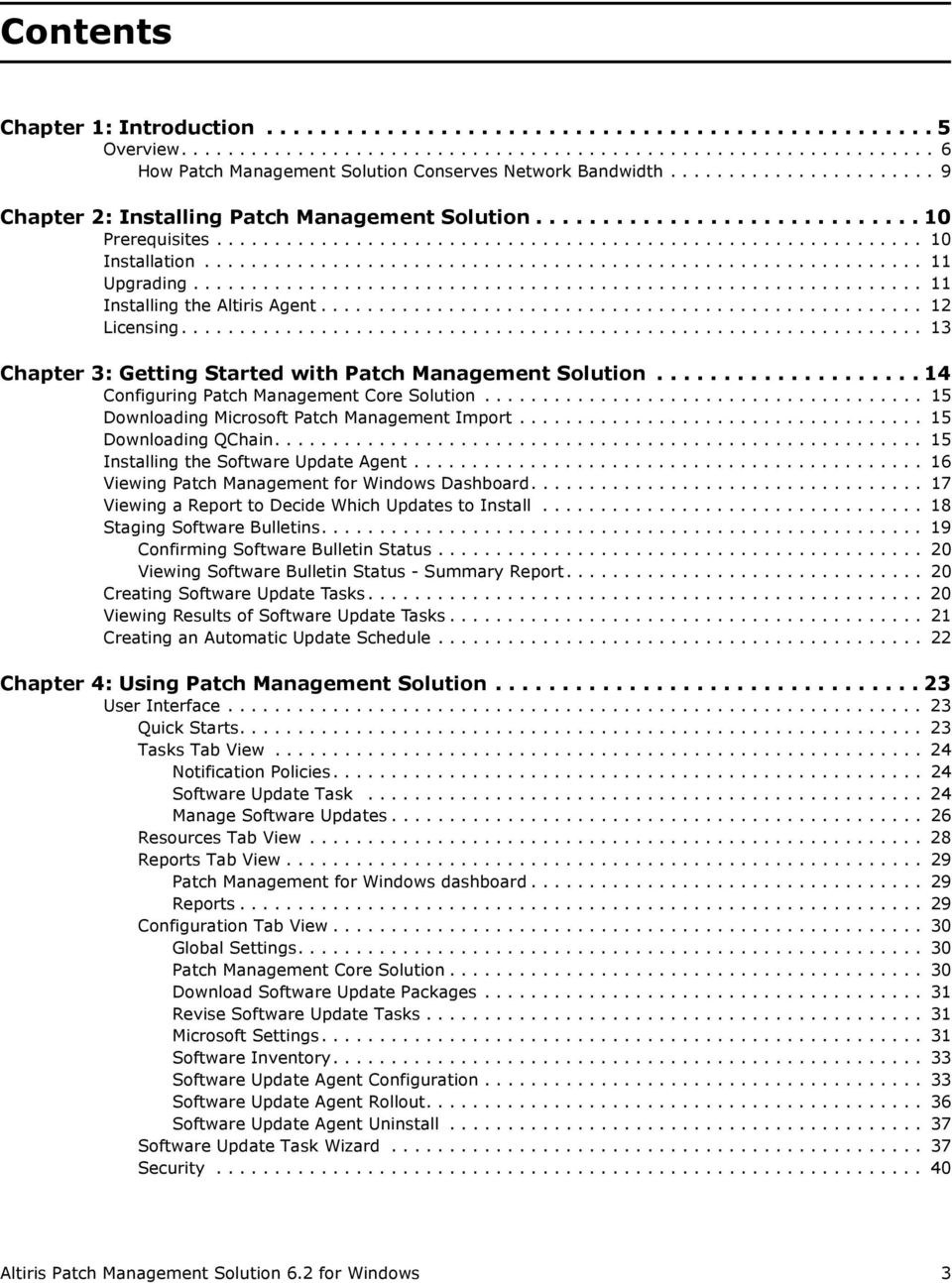
3 Contents Chapter 1: Introduction Overview How Patch Management Solution Conserves Network Bandwidth Chapter 2: Installing Patch Management Solution Prerequisites Installation Upgrading Installing the Altiris Agent Licensing Chapter 3: Getting Started with Patch Management Solution Configuring Patch Management Core Solution Downloading Microsoft Patch Management Import Downloading QChain Installing the Software Update Agent Viewing Patch Management for Windows Dashboard Viewing a Report to Decide Which Updates to Install Staging Software Bulletins Confirming Software Bulletin Status Viewing Software Bulletin Status - Summary Report Creating Software Update Tasks Viewing Results of Software Update Tasks Creating an Automatic Update Schedule Chapter 4: Using Patch Management Solution User Interface Quick Starts Tasks Tab View Notification Policies Software Update Task Manage Software Updates Resources Tab View Reports Tab View Patch Management for Windows dashboard Reports Configuration Tab View Global Settings Patch Management Core Solution Download Software Update Packages Revise Software Update Tasks Microsoft Settings Software Inventory Software Update Agent Configuration Software Update Agent Rollout Software Update Agent Uninstall Software Update Task Wizard Security Altiris Patch Management Solution 6.2 for Windows 3
4 Global Privileges Permissions Configuring Background Actions Software Resources Resource Types Resources Definitions of Software Updates and Software Bulletins Software Bulletins Viewing Available Software Bulletins Viewing Details on a Software Bulletin Custom Severity Levels Downloading Software Bulletins and Distributing Software Updates Software Updates Modifying Software Update Tasks About Software Updates Software Update Supersedence Software Update Agent Software Update Agent User Interface Software Update Agent Command-Line Utility Upgrading the Software Update Agent Uninstalling the Software Update Agent Resource Manager Computer Resource Manager Software Update Summary Inventory Data Classes Reporting on Patch Management Data in a Hierarchy Troubleshooting Software Updates not Downloading Enabling FTP downloads through a Proxy Reboot on a Schedule not Working Properly Agent Reboot Warning and Snooze Option Windows Update Error Codes Index Altiris Patch Management Solution 6.2 for Windows 4

5 Chapter 1 Introduction Altiris Patch Management Solution software lets you scan computers for security vulnerabilities, report on the findings, and automate the downloading and distribution of needed Microsoft security patches. You can review and download specific patches from Microsoft, create collections of computers that require a specific patch, and apply the patch to the computers that need them. Key features include Support for operating system and applications for English, German, Spanish, Japanese, Chinese, Portuguese, and French. Information repository that provides detailed information on each software bulletin, such as technical details, severity ratings, and number of executables. Software repository that automates the downloads from the vendor site prior to distribution without administrator intervention. Patch-specific inventory for determining supported operating systems, applications and the associated service pack level, and whether a patch is installed. Improved distribution wizard and targeting that automatically determines the patch installation requirements and assigns Altiris Notification Server collections based on the requirements. Extensive control over installations, such as integration with QChain, reboot control, and easy selection of command-line options. Integration with other Altiris products, such as Altiris Recovery Solution. Patch Management Processes Web Administration Automated Alerts Altiris Web Site 1. Download Software Management Resources Notification Server 2. Download Security Patch 3. Scan Results 4. Install Security Patch Microsoft Web Site Managed Computers Altiris Patch Management Solution 6.2 for Windows 5

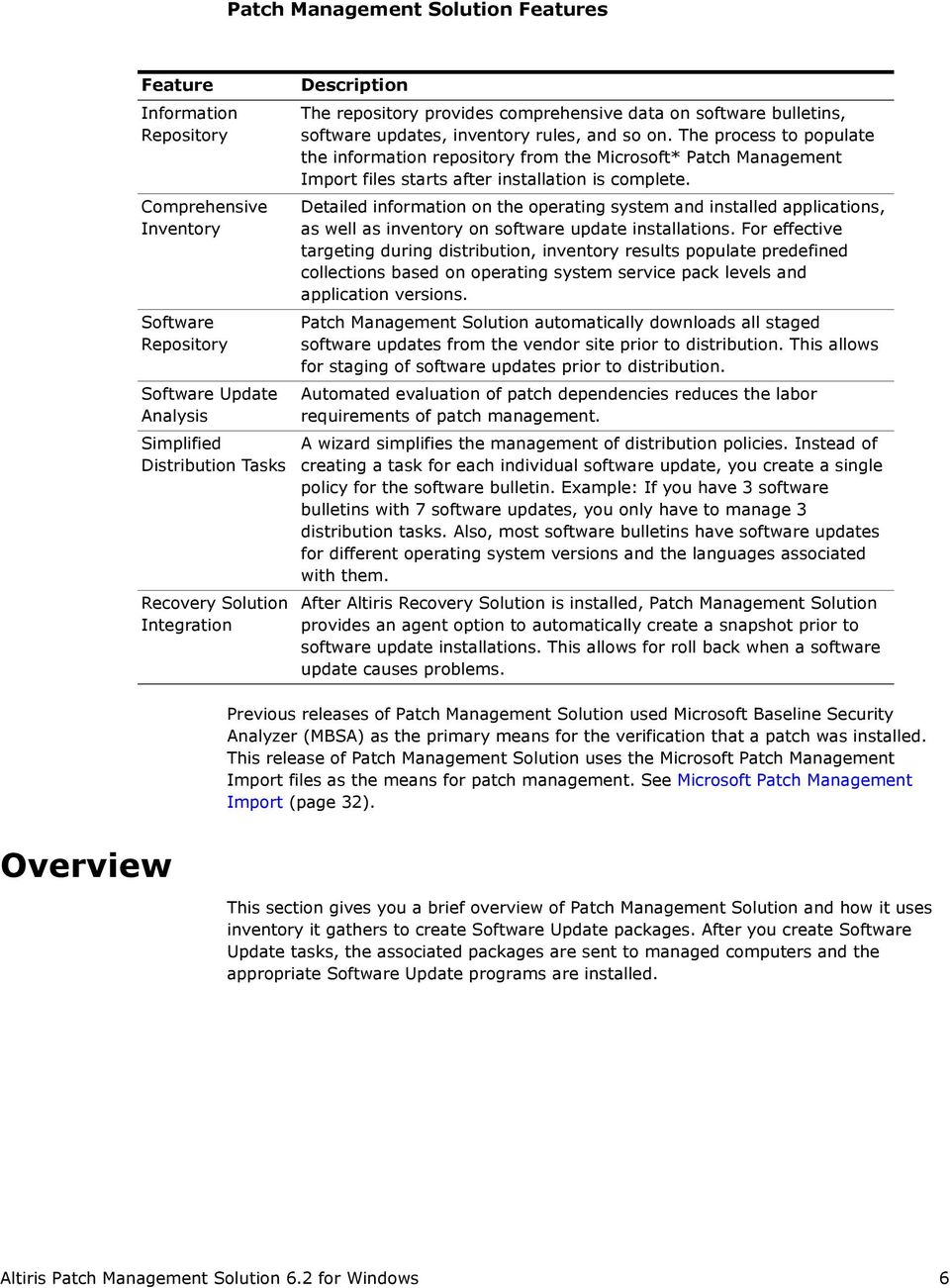
6 Patch Management Solution Features Feature Information Repository Comprehensive Inventory Software Repository Software Update Analysis Simplified Distribution Tasks Recovery Solution Integration Description The repository provides comprehensive data on software bulletins, software updates, inventory rules, and so on. The process to populate the information repository from the Microsoft* Patch Management Import files starts after installation is complete. Detailed information on the operating system and installed applications, as well as inventory on software update installations. For effective targeting during distribution, inventory results populate predefined collections based on operating system service pack levels and application versions. Patch Management Solution automatically downloads all staged software updates from the vendor site prior to distribution. This allows for staging of software updates prior to distribution. Automated evaluation of patch dependencies reduces the labor requirements of patch management. A wizard simplifies the management of distribution policies. Instead of creating a task for each individual software update, you create a single policy for the software bulletin. Example: If you have 3 software bulletins with 7 software updates, you only have to manage 3 distribution tasks. Also, most software bulletins have software updates for different operating system versions and the languages associated with them. After Altiris Recovery Solution is installed, Patch Management Solution provides an agent option to automatically create a snapshot prior to software update installations. This allows for roll back when a software update causes problems. Previous releases of Patch Management Solution used Microsoft Baseline Security Analyzer (MBSA) as the primary means for the verification that a patch was installed. This release of Patch Management Solution uses the Microsoft Patch Management Import files as the means for patch management. See Microsoft Patch Management Import (page 32). Overview This section gives you a brief overview of Patch Management Solution and how it uses inventory it gathers to create Software Update packages. After you create Software Update tasks, the associated packages are sent to managed computers and the appropriate Software Update programs are installed. Altiris Patch Management Solution 6.2 for Windows 6
7 A. Collections are automatically created from inventory As part of the deployment of the Software Update Agent, the Inventory Rule Agent gets installed on managed computers and sends back inventory specifically needed for managing software updates. Inventory includes software vendor, software release, and service pack information. From this inventory, Patch Management Solution creates specific collections to target only the computers that individual software updates should go to. These collections are created when the software bulletins that contain them are staged. These collections contain computers that are applicable for the software update. Altiris Patch Management Solution 6.2 for Windows 7

8 B. Software bulletin information needs to be downloaded After Patch Management Solution gets installed, you decide when to download software bulletin information from the Altiris Web site. This information includes the severity of each software bulletin as well as details on its software updates and where they can be downloaded from Microsoft. This information also includes rules for creating collections and rules how to verify that the software update is installed. Notification Server needs an internet connection to download the Microsoft Patch Management Import files that contain software bulletin information. C. You stage software bulletins to download software updates and create packages When you stage a software bulletin, each associated software update executable automatically gets downloaded from Microsoft. You can then create a Software Update task for each software bulletin you want to deploy. From the information in software bulletin executables, Patch Management Solution then creates a Software Update package for each software update. There are one or more software updates associated with each software bulletin. Every software update applies to a software release/service pack combination. Each software update also has a Software Installation Type. D. You create Software Update tasks to deploy downloaded software updates Software Update tasks can be created using the Software Update Task Wizard. Software Update tasks use the associations created from the inventory received from the Inventory Rule Agent to select the appropriate collections to which the software updates should go. When you create a Software Update task, one or more programs are automatically created and attached to the Software Update package associated with the software update. When the managed computer receives the Software Update task, it first verifies that the software update is needed, then downloads the Software Update package and launches the required program. This program then installs the software update. To save network bandwidth, the agent verifies that the software update is needed. The software update may already be there for multiple reasons (Example: Sometimes another process rolls out a software update). If the software update is already installed, it does not download and reinstall (Example: You image a computer and its image already has the Software Update Agent. In this case, the software update will be not reinstalled). At an interval, the Software Update task is re-evaluated and, if needed, reinstalled. Example: If some operation removes a software update, it will be reinstalled. Notification Server needs an internet connection so it can automatically download the update files from the Microsoft Web site. E. Behind the scenes Software Installation types determine install options, such as the command-line argument to run the executable. Altiris Patch Management Solution 6.2 for Windows 8

9 The Software Installation Type and Software Installation Option can be viewed on the Configuration tab view by selecting Configuration > Resource Settings > Resource Types > Software Management > Patch Management. To view all resources in a Software Installation Type or Software Installation Option, click either Software Installation Type or Software Installation Option in the left pane, and then click the List Resources tab in the content pane. When a Software Update task is created, one or more programs are created using the selected Software Installation Options (found under the Installation Options section of the Advanced tab). The Installation Options that are available depend on the Software Installation Type. For information, see Software Update Task (page 24). How Patch Management Solution Conserves Network Bandwidth The solution has been designed so that network bandwidth usage between the Notification Server and the Software Update Agent is minimized. The following features significantly reduce long term network requirements for this solution. Only inventory results that have changed are sent by the Software Update Agent to Notification Server. This is default behavior. You can configure individual software inventory policies to always send inventory results. You can enable or disable event capture of package events (the information about package download success, failure, or refresh). See Advanced Settings in the Altiris Notification Server Help. The Software Update Agent has a locally cached store of inventory rules. The Notification Server will only be contacted when new inventory rules are available. Only delta updates are performed for inventory rules. The Software Update Agent will only request inventory rules that are new or changed compared to the local agent cache. For patches with software update inventory rules, the installation of the software update will only execute (and send an NSE) if the rule evaluates as NotInstalled. Also, software updates with inventory rules will not be downloaded (and hence executed) on a client computer if an update is not applicable or is already installed. See Also Troubleshooting (page 56) Altiris Patch Management Solution 6.2 for Windows 9

10 Chapter 2 Installing Patch Management Solution Prerequisites (page 10) Installation (page 11) Upgrading (page 11) Installing the Altiris Agent (page 12) Licensing (page 13) Prerequisites Prerequisites for Patch Management Solution Install and configure Notification Server 6.0 SP3 R2 or later. See the Altiris Notification Server Help for Notification Server requirements. If Notification Server proxy settings have been configured, Patch Management Solution uses them to download software update information from the Altiris Web site and to download software updates from Microsoft. For more information on proxy settings, see the Altiris Notification Server 6.0 Release s or the Altiris Notification Server Help. Install or upgrade the Altiris Agent 6.0 SP3 on every computer to which you are sending patches. It may take some planning and time before you install Patch Management Solution. Microsoft typically releases patches on the second Tuesday of each month and Altiris updates the PMImport.cab file shortly afterwards. Because of this, we recommend that you install or update Patch Management Solution at least two weeks before Microsoft releases its patches. This gives you enough time before a PMImport.cab file update to make sure that you have the Altiris Agent upgraded to 6.0 SP3 on all computers as well as install and set up Patch Management Solution. Notification Server provides reports (in particular, see the reports under the Altiris Agent Installation Status folder) that let you know the status of the Altiris Agent installation. For more information, see the Altiris Notification Server Help. Minimum requirements for running the Software Update Agent Win32 computers running Windows 95 or later MSI 1.1 Altiris Patch Management Solution 6.2 for Windows 10

11 Installation Before installing Patch Management Solution, review the requirements information (see Prerequisites on page 10). The software updates that Patch Management Solution distributes are provided by Microsoft for its software products. You must ensure that each software update will work correctly in your environment before deploying it. We recommend that you first install the software update in a test environment before deploying it to your production environment. To install Altiris Infrastructure on the Notification Server 1. Select Start > Programs > Altiris > Altiris Console. This starts the Altiris Console. 2. In the Altiris Console, click the Getting Started tab. 3. Click the Install Altiris Solutions from the Solutions Center link. 4. Click the Solutions button. 5. Click Altiris Patch Management for Windows. 6. Click Start. The Install Wizard appears and provides configuration options. 7. Select the languages you want to manage in your environment. 8. Select the Download Actions you wish to run immediately after install. The Microsoft Patch Management Import task must complete before bulletins can be staged and distributed. Microsoft Patch Management Import should take around 20 minutes to run, depending on your network speed. Upgrading You must have Patch Management Solution 6.1 or later installed before you can upgrade to Patch Management Solution 6.2. Patch Management Solution 6.2 will only work with Software Update Agent 6.2. To upgrade from Patch Management Solution 6.1, you must also upgrade the Software Update Agent on your managed computers. To upgrade Patch Management Solution to Make sure you have Patch Management Solution 6.1 or later installed. 2. Install Patch Management Solution. See Installation (page 11). 3. Upgrade the Software Update Agent on your managed computers. Altiris Patch Management Solution 6.2 for Windows 11
12 To upgrade computers running Software Update Agent 6.1, in the Configuration tab select Configuration > Solutions Settings > Software Management > Patch Management > Windows > Software Update Agent Rollout and enable the Software Update Agent Upgrade policy. Installing the Altiris Agent The Altiris Agent must be installed on the computers you want to manage, if you have not done so already (through the use of other Altiris solutions that require the agent). When installing the agent, you specify the computers on which to install the agent. For large numbers of computers, you can use the Resource Discovery and Network Discovery features of Notification Server to discover the computers on your network and create a list from which you can select the computers on which to install the agent. If you have only a few computers to manage, such as during an evaluation, you can skip computer discovery and perform the agent installation procedure. Resource Discovery is used to discover Windows computers. The following procedure describes how to use this feature. Network Discovery can discover computers using Ping, Circular DNS resolution, SNMP, and NetBIOS name and domain. You can discover Linux/UNIX, Mac OS, and Windows computers. For details, see the Network Discovery Product Guide, which you can access from the Altiris Web site (altiris.com/support/documentation) or the Altiris Documentation page in the Altiris Console. You need administrator rights to install the Altiris Agent. For more information on the Altiris Agent, see the Notification Server documentation. To discover Windows computers using Resource Discovery 1. On the Notification Server computer, select Start > All Programs > Altiris > Altiris Console to open the Altiris Console. 2. In the console, click the Configuration tab. 3. In the left pane, select Configuration > Server Settings > Discovery Methods > Resource Discovery. 4. In the content pane, click and select the domains in which to search for computers. (Optional) Enter the name of a domain and click. 5. Select the discovery methods you want to use. You must select at least one method. Select the Domain Browse List option to discover computers (including Windows 95, 98, 98 SE, and ME computers) that are currently sharing files. Select the Domain Membership option to discover computers that have trust accounts in the domain and are running Windows NT, 2000, XP, and This method will not find any Windows 98, 98 SE, or ME computers. 6. Click Discover Now. 7. After the discovery process completes, click Apply. The computers in the specified domains are discovered and can be selected to receive the agent. Altiris Patch Management Solution 6.2 for Windows 12

13 To install the Altiris Agent This procedure does not work with Windows 98, 98 SE, and ME computers. For these operating systems, see the Pull Method in the Notification Server documentation. 1. On the Notification Server computer, select Start > All Programs > Altiris > Altiris Console to open the Altiris Console. 2. In the console, click the Configuration tab. 3. In the left pane, select Configuration > Altiris Agent> Altiris Agent Rollout> Altiris Agent Installation. 4. In the content pane, do one or both of the following: If you did not perform a computer discovery (because you only have a few computers on which you want to install the agent, such as during an evaluation) or you want to specify a computer manually, enter the name of the computer on which you want to install the agent in the field next to the Add button, and then click Add. Repeat this for all computers on which you want to install the agent. If you performed a computer discovery, click Select Computers. In the dialog that opens, select the computers to which you want to install the agent. Click OK. The fact that a computer can be discovered does not mean that you can push the agent to it. The computer must be running an operating system that supports having agents pushed to it. 5. Click Install Altiris Agent. The Options page opens to let you set configuration properties for the Altiris Agent. 6. Select the Show the Altiris Agent icon in the system tray option. 7. Click Proceed with Install. The Altiris Agent is installed to the computers. Licensing Each Altiris product comes with a 7-day trial license that is installed by default. You can register and obtain a 30-day evaluation license through our Web site at or purchase a full product license. To view your current license, open the Altiris Console, click the Configuration tab, and select Licensing. For more information, see Licensing Altiris Software in the Altiris Getting Started Guide on the product CD or on our Web site at Automatic Upgrade Protection (AUP) is required for ongoing use of Patch Management Solution. Without current AUP, you cannot download and use new Microsoft Patch Management Import files. However, you can continue to use Microsoft Patch Management Import files that were downloaded prior to the expiration of AUP. Altiris Patch Management Solution 6.2 for Windows 13

14 Chapter 3 Getting Started with Patch Management Solution The Getting Started tasks guide you through the basic setup, configuration, and use of Patch Management Solution. Each task has a procedure and, in many cases, exercises to illustrate the steps of the procedure. Getting Started tasks The tasks are listed sequentially. You must work through the tasks in sequence to complete all of them. 1. Installing the Altiris Agent (page 12) 2. Configuring Patch Management Core Solution (page 15) 3. Downloading Microsoft Patch Management Import (page 15) 4. Downloading QChain (page 15) 5. Installing the Software Update Agent (page 16) 6. Viewing a Report to Decide Which Updates to Install (page 18) 7. Staging Software Bulletins (page 19) 8. Creating Software Update Tasks (page 20) 9. Viewing Results of Software Update Tasks (page 21) You can perform Getting Started tasks from the Quick Start page or from the Altiris Console, the primary interface for Altiris solutions. To open the Quick Start page manually 1. In the Altiris Console, click the Tasks tab. 2. In the left pane, select Tasks > Quick Starts. 3. In the content pane, select Patch Management Solution Quick Start. For more information, see Quick Starts (page 23). Prerequisites for Getting Started tasks Notification Server 6.0 SP3. A Windows 2000 or 2003 (recommended) Server. Patch Management Solution 6.2 installed on the Notification Server (see Installing Patch Management Solution on page 10). Client computers with either Windows XP Professional or Windows 2000 Professional and the Altiris Agent installed. Exercise Scenario In the following exercises, you are the system administrator of Test Company. You have already installed Patch Management Solution and now need to implement it. Altiris Patch Management Solution 6.2 for Windows 14
15 Configuring Patch Management Core Solution After Patch Management Solution is installed, you must download Microsoft Patch Management Import and QChain before you can stage or distribute any updates. With the installation of Patch Management Solution, all English language releases are automatically installed so you can specify software updates to exclude from the Microsoft Patch Management Import download. Exclude software updates for software you do not use in your organization and select any additional languages you wish to download. To configure Patch Management Core Solution 1. In the Altiris Console, click the Configuration tab. 2. In the left pane, select Configuration > Solutions Settings > Software Management > Patch Management > Server Settings > Global Settings > Patch Management Core Solution. 3. Make any wanted changes. 4. Click Apply. Downloading Microsoft Patch Management Import Microsoft Patch Management Import downloads and imports all software management resources from these files into the Notification Database. To download Microsoft Patch Management Import 1. Access the Microsoft Patch Management Import page: Option 1: From the left pane of the Quick Start, click Download Microsoft Patch Management Import. Option 2: From the Altiris Console, click the Configuration tab. In the left pane, select Configuration > Solution Settings > Software Management > Patch Management > Server Settings > Microsoft Settings > Microsoft Patch Management Import. 2. Make any wanted changes. 3. Download Microsoft Patch Management Import: Option 1: In the Quick Start page, in the content pane, click the context menu icon and select Start Download Task. Option 2: In the Altiris Console in the left pane, right-click Microsoft Patch Management Import and select Start Download Task. Downloading QChain QChain chains software updates together before they are distributed to managed computers. To download QChain 1. Access the QChain page: Altiris Patch Management Solution 6.2 for Windows 15
16 Option 1: From the left pane of the Quick Start, click Download Microsoft QChain. Option 2: From the Altiris Console, click the Configuration tab. In the left pane, select Configuration > Solution Settings > Software Management > Patch Management > Server Settings > Microsoft Settings > QChain. 2. Download QChain: Option 1: From the content pane of the Quick Start, click the context menu icon and select Start Download Task. Option 2: From the Altiris Console, in the left pane, right-click QChain and select Start Download Task. Installing the Software Update Agent The Software Update Agent must be installed on managed computers on which you want to use Patch Management Solution. The Software Update Agent inventories programs that are installed on the managed computer and sends this data to the Notification Server. The Software Update Agent then uses this information to track operating systems and applications that are installed on managed computers, discover vulnerabilities, and match them with packages that are defined by the Notification Server. You can use this information when deciding which updates to send to which managed computers. The Inventory Rule Agent automatically runs the following policies on managed computers: Default Windows OS Inventory Policy, Default Windows Software Release Inventory Policy, Default Microsoft Vulnerability Analysis Policy, and Default Microsoft Software Inventory Policy. For information, see Software Inventory (page 33). Caution If you have a large number of computers to deploy the Software Update Agent to, consider deploying the agent during off-peak hours to minimize network traffic at peak times. Deploying the software agent can take some time, depending on the number of managed computers and the Altiris Agent settings. To install the Software Update Agent Exercise Test Company wants to install the Software Update Agent on all managed computers that do not already have it installed. When deciding when to install the agent, consider your environment. In Test Company s situation, there are more than 200 computers. To minimize the risk of slowing down or disrupting the network, set the install schedule to a time when most employees are not in the office. 1. Access the Software Update Agent Install page: Option 1: From the left pane of the Quick Start, click Deploy Software Update Agent. Option 2: From the Altiris Console, click the Configuration tab. In the left pane, select Configuration > Solutions Settings > Software Management Altiris Patch Management Solution 6.2 for Windows 16
17 > Patch Management > Windows > Software Update Agent Rollout > Software Update Agent Install. 2. In the content pane, select Enable. 3. Make any wanted changes. To make changes to Applies to collections and Schedule, click on the relevant hyperlinks and a dialog box for each item will appear. For a description of each page item, see Altiris Agent Upgrade Page in Altiris Notification Server Help. Exercise Employees at Test Company go home before 7 p.m. Leave the collection as All Windows Computers without Software Update Agent Installed. Set the Schedule to run daily at 7 p.m. and ensure Run once ASAP is not selected. 4. Click Apply. When the Software Update Agent is installed on a managed computer, a new tab, Software Updates, appears in the Altiris Agent window, displaying software updates for that computer. To open the Altiris Agent window, select the Altiris Agent icon in the system tray of the managed computer. See Also Software Update Agent (page 49) Software Update Agent Rollout (page 36) Viewing Patch Management for Windows Dashboard Confirm the Software Update Agent installation was successful the Patch Management for Windows dashboard. The dashboard is a central location that links several reports showing valuable Patch Management Solution information. Use it to access the Software Update Agent Execution Summary report (which lists computers with the Software Update Agent installed), agent version, and the operating system information. To view the Patch Management for Windows dashboard 1. Access the Patch Management for Windows dashboard: Option 1: From the left pane of the Quick Start, select Check Progress. Option 2: From the Altiris Console, click the Reports tab. In the left pane, select Dashboards > Patch Management for Windows Dashboard. 2. In the content pane, under Configuration, select Computers with Software Update Agent. 3. Click Refresh. Altiris Patch Management Solution 6.2 for Windows 17

18 You can use the Software Update Agent Installation Status report to see the status of all Software Update Agent installations over a specified period. To view the report, in the Reports tab, select Reports > Software Management > Patch Management > Agent Information > Software Update Agent Installation Status. Viewing a Report to Decide Which Updates to Install Running reports helps you determine which software updates need to be installed on which computers to address vulnerabilities. Individual software updates are bundled into software bulletins. Each software bulletin has a resource manager page containing explanations of the updates and hyperlinks to the vendor s Web site for more information. Once you have decided to install a particular bulletin, we recommend that you install it in a test environment before rolling it out across your network. You can stage or distribute software updates directly from reports by double-clicking on the update name in the report. Instead of evaluating each update individually, you can stage all the software bulletins listed in the Manage Software Updates page. However, this can result in increased network bandwidth use. To view the Detected Microsoft Vulnerabilities by Computer report Exercise Test Company management s main concern is addressing security issues covered by critical Microsoft updates. You have been tasked with finding critical vulnerabilities and installing required critical updates. 1. Access the Detected Microsoft Vulnerabilities by Computer page: Option 1: From the left pane of the Quick Start, click Microsoft Compliance by Computer. Option 2: From the Altiris Console, click the Reports tab. In the left pane, select Reports > Software Management > Patch Management > Compliance and Vulnerability > Microsoft Compliance and Vulnerability by Computer. 2. In the content pane, click Run this Report. 3. Leave the default settings and click Refresh. A list of software updates appears. 4. For information about an update, right-click on any update and select Resource Manager. 5. At the bottom of the Summaries tab, under Additional Information, click the hyperlink to the Microsoft TechNet article on the bulletin. 6. With the information provided in Resource Manager as a guide, make a note of the bulletins you wish to install. Altiris Patch Management Solution 6.2 for Windows 18
19 Exercise View the Count of Software Updates by Severity report in the folder Reports > Software Management > Patch Management > Software Update Summary. Set the Update Severity field to Critical. The report will list all available critical updates. Choose three of these updates to stage and distribute. The following reports also provide information on software updates: Compliance and Vulnerability > Microsoft Compliance and Vulnerability by Bulletin Inventory > Applicable Microsoft Updates by Computer Inventory > Installed Microsoft Software Updates by Computer If you want to view compliance reports for your entire organization from a single console when using more than one Notification Server, see Reporting on Patch Management Data in a Hierarchy (page 55). Staging Software Bulletins After you determine which software updates to deploy (see Viewing a Report to Decide Which Updates to Install on page 18), you need to stage them. Staging software bulletins downloads the software updates included in a software bulletin to the Notification Server. You must first stage a software bulletin to create a Software Update Task to install the updates. Software Update tasks install the software updates to the Windows computers that need them. To stage Software Bulletins Exercise Now that you have decided which updates to distribute, you must stage them. 1. Access the Manage Software Updates page: Option 1: From the left pane of the Quick Start, in the left pane, click Stage and Distribute Microsoft Patches. Option 2: From the Altiris Console, in the left pane, select Tasks > Software Management > Patch Management > Manage Software Updates. If the Microsoft Patch Management Import download has not yet completed, a dialog box appears with a message saying the Manage Software Updates page is disabled until Microsoft Patch Management Import is complete. 2. In the content pane, select the software bulletins you want to stage. Exercise Stage the software bulletins you chose in Viewing a Report to Decide Which Updates to Install (page 18). 3. Click the Stage Bulletin toolbar item. You can also stage software bulletins by right-clicking them and selecting Stage. Altiris Patch Management Solution 6.2 for Windows 19
20 Confirming Software Bulletin Status A Software Update Task cannot be created until all the updates in a bulletin have successfully downloaded. When updates are downloading, a progress dialog box appears. To confirm the status of updates in the Manage Software Updates page 1. Access the Manage Software Updates page: Option 1: From the left pane of the Quick Start, click Stage and Distribute Microsoft Patches. Option 2: From the Altiris Console, click the Tasks tab. In the left pane, select Tasks > Software Management > Patch Management > Manage Software Updates. 2. Click Update. When the #Updates and #Downloaded columns are equal, the downloads have completed. Viewing Software Bulletin Status - Summary Report You can also run the Software Bulletin Status - Summary report for more information on the status of Software Bulletins. This report displays summary information on software bulletins and the number of software updates for each bulletin. The results can be filtered to display only enabled bulletins, bulletins of a particular severity, or bulletins with full/partial software update downloads. To view the Software Bulletin Status - Summary report Exercise Run the report to see the status of the bulletins you want to distribute. 1. In the Altiris Console, click the Reports tab. 2. In the left pane, select Reports > Software Management > Patch Management > Software Bulletins > Software Bulletin Status - Summary. 3. In the content pane, click Run this Report. 4. To report on staged Microsoft software bulletins, set the Vendor field to Microsoft. 5. Set the Bulletin Status field to Staged. 6. Click Refresh. Creating Software Update Tasks After you stage software bulletins and download the associated software updates, you must create Software Update tasks to deploy software updates to the appropriate Windows computers. To create Software Update tasks Exercise Create a Software Update task for each of the critical updates you staged in the exercise component of Staging Software Bulletins (page 19). 1. Access the Manage Software Updates page: Altiris Patch Management Solution 6.2 for Windows 20
21 Option 1: From the left pane of the Quick Start, click Stage and Distribute Microsoft Patches. Option 2: From the Altiris Console, click the Tasks tab. In the left pane, select Tasks > Software Management > Patch Management > Manage Software Updates. 2. In the content pane, select any staged software bulletins you want to distribute. Exercise Select the three critical bulletins you staged. 3. Click the Software Update Task Wizard toolbar item. If a Software Update task has been already created for a bulletin, a warning dialog appears giving you two options. If you select Create a new task, the wizard opens. If you select Edit an existing task, a dialog opens with the existing task list, and you must choose which one to edit. 4. Leave the defaults in the first page of the Software Update Task Wizard and click Next. New Software Update tasks are enabled by default. 5. Leave the defaults in the second page of the wizard. Click Finish. The Software Update Agent downloads the Software Update package and installs it on appropriate managed computers. Viewing Results of Software Update Tasks Patch Management Solution contains a number of reports you can use to check if software updates were successfully distributed by Software Update Tasks. To view the Software Update Distribution Summary report Exercise Run the Software Update Execution Summary Report - 30 Days report from the Patch Management for Windows dashboard to see if the Software Update Tasks succeeded, failed, or were not executed. 1. Access the Patch Management for Windows dashboard: Option 1: In the Altiris Console, click the Reports tab. In the left pane, select Dashboards > Patch Management for Windows. Option 2: In the Quick Start page, in the left pane, click Check Progress. 2. In the content pane, click Software Update Execution Summary Report - 30 Days to run the related report. In the content pane, click Run this report. For more information on the available reports, see Reports Tab View (page 29). You can also view update details for individual computers by accessing Resource Manager. For information, see Resource Manager (page 54). Altiris Patch Management Solution 6.2 for Windows 21
22 Creating an Automatic Update Schedule Now that you have distributed initial updates, you can automate the update distribution process for ongoing use. Patch Management Solution lets you create a schedule for the automatic installation of software updates. Consider your company s business requirements before you specify a schedule. Certain times will be better than others for installing updates in different working environments. To create an automatic update installation schedule Exercise The employees at Test Company leave the office by 7 p.m. You want to roll out updates at 10:30 p.m. each day to ensure that the updates will not interfere with anyone s work. 1. In the Altiris Console, select the Configuration tab. 2. In the left pane, select Configuration > Solution Settings > Software Management > Patch Management > Windows > Software Update Agent Configuration > Default Software Update Agent Configuration Policy. 3. In the content pane, make any wanted changes to the schedule, collections, and reboot options. For a description of these items, see Software Update Agent Configuration (page 33). Exercise The default collection to receive updates is Default Software Update Agent Configuration Policy. Do not change this setting. Test Company has an overseas office with employees who need to synchronize files daily with employees in your office. Because of the time differences, these synchronizations never happen between 1 a.m. and 3 a.m. your time. Set the Reboot computer schedule accordingly to ensure reboots do not disrupt file synchronizations between the two offices. 4. Click Apply. Altiris Patch Management Solution 6.2 for Windows 22
23 Chapter 4 Using Patch Management Solution Quick Links User Interface (page 23) Software Resources (page 43) Software Bulletins (page 45) Software Updates (page 47) Software Update Agent (page 49) Resource Manager (page 54) Reporting on Patch Management Data in a Hierarchy (page 55) Troubleshooting (page 56) User Interface Folders and items for the Patch Management Solution are placed in the Software Management folder in the Tasks, Resources, Reports, and Configuration tabviews in the Altiris Console. The Software Management folder is also shared with Altiris Software Delivery Solution. Quick Starts (page 23) Tasks Tab View (page 24) Resources Tab View (page 28) Reports Tab View (page 29) Configuration Tab View (page 30) Software Update Task Wizard (page 37) Security (page 40) Configuring Background Actions (page 42) Quick Starts This page accesses commonly used patch management policies, tasks, and reports. To access the Quick Start page 1. In the Altiris Console, click the Tasks tab. 2. In the left pane, select Tasks > Quick Starts. Altiris Patch Management Solution 6.2 for Windows 23
24 3. In the content pane, select Patch Management Solution Quick Start. A page opens in a new window. In the content pane of the Quick Start page, a description of each item is provided in the Quick Start Help dialog. Tasks Tab View The following folders and items are used to manage updates. Quick Links Notification Policies (page 24) Software Update Task (page 24) Manage Software Updates (page 26) Notification Policies Notification policies tell you when certain conditions exist. Example: The New Software Bulletin Available policy generates a report whenever a new software bulletin becomes available. Generally, Notification policies get enabled and disabled automatically. However, you can edit or clone them to fit your needs. To access these policies 1. In the Altiris Console, click the Tasks tab. 2. In the left pane, select Tasks > Software Management > Patch Management > Notification Policies > Global. Software Update Task This folder stores Software Update tasks. We recommend that you use the Software Update Task Wizard to create Software Update tasks, though they can be created manually. See Software Updates (page 47). To access this folder 1. In the Altiris Console, click the Tasks tab. 2. In the left pane, select Tasks > Software Management > Patch Management > Software Update Task. To enable a Software Update Task 1. Select Enable. 2. Click Apply. To create a new Software Update task without using the Software Update Task Wizard 1. In the Altiris Console, click the Tasks tab. 2. In the left pane, select Tasks > Software Management > Patch Management > Software Update Tasks > Microsoft. Altiris Patch Management Solution 6.2 for Windows 24
25 3. Right-click on the Microsoft folder and select New > Software Update Task. Software Update tasks can be located in other folders, depending on where they were placed after their creation. Software Update task page items. General Tab Page Items Item Description Software Bulletin The name of the bulletin or bulletins you have chosen to make tasks for. You cannot edit the software bulletins through the Software Update Task Wizard. Double-click on a software bulletin to open the Resource Manager. This gives you detailed information on the software bulletin. You can only select a software bulletin that has been previously staged. Name Description Base Collection If you use the Software Update Task Wizard, the correct software bulletin is automatically selected. The name of the tasks you have chosen from the tasks window. This field is populated automatically if only one task is listed in the Tasks field. The Microsoft description of the bulletin. Specifies the target collection or collections to which the Software Update task applies. If you use the Software Update Task Wizard, the correct target collection for the selected software bulletin is automatically applied. To change the collection, click on the hyperlink to open the Collection Selector. Altiris Patch Management Solution 6.2 for Windows 25
26 Advanced Tab Page Items Item Description Enable Software Update Task Click to enable the Software Update task for the software bulletin and included software updates. There is an update name for each individual executable files for each software update included in a software bulletin. Update Name - The name of each software update executable. If Enable is selected, all of the executables will be enabled. Click the hyperlink to open the resource manager page for the software update. Culture - The language and culture of the software update. Package - The software package associated with the update. Click the hyperlink to open the package s resource manager. Package Options Command Line - The command-line to be run against the package. Click the hyperlink to open the command-line options dialog to change the recommended options. Use Multicast when the Altiris Agent s multicast option is enabled Allow immediate reboot if required - Select if a software update requires a reboot prior to installing an additional update. Initiate execution (other than agent default) - Select to run the Software Update task at a different time to that specified in the Software Update Agent settings. Override default reinstallation attempts after task failure - Select to override the Software Update Agent s default settings for reinstallation attempts after task installation failure. Manage Software Updates This page lets you view and stage all software bulletins provided by the Altiris Microsoft Patch Management Import files. When you stage a software bulletin, all associated updates get downloaded to the Notification Server from the Microsoft Web site. When the number in the # Updates column equals the number in the # Downloaded column, all updates for the software bulletin have been downloaded. Sometimes not all software updates can be downloaded for a software bulletin because Microsoft may stop hosting the bulletin or relocate it. You cannot create a Software Update task unless all updates for a software bulletin are downloaded. To access this page 1. In the Altiris Console, click the Tasks tab. 2. In the left pane, select Tasks > Software Management > Patch Management > Manage Software Updates. Altiris Patch Management Solution 6.2 for Windows 26
27 Page Items Item Show Vendor Software Bulletin list Description Select the view that best meets your needs. The name of the vendor supplying the update. From this list, you can perform an action on one or more software bulletins by right-clicking or selecting a toolbar item. Software Bulletin List Items Column Description Software Bulletin The name Microsoft assigned to the software bulletin. Severity The severity as defined by Microsoft. Custom Severity The severity as defined by the user. See Custom Severity Levels (page 46). Staged True = Staged. False = Disabled. You must stage the software bulletin to download its associated software updates. # Tasks The number of Software Update tasks created for the bulletin. # Updates The number of software updates included in the software bulletin. # Downloaded The number of software updates downloaded. First Release Date Revision Date Bulletin Description If you want to see which software updates have not been downloaded, run the Software Update Download Status report and select Fail as the Download Status. The date Microsoft released the software bulletin. The last date Microsoft revised this software bulletin. The description Microsoft gave to the software bulletin. Shortcut Menu Items The following table lists the Patch Management Solution shortcut menu items that may be available when you right-click a software bulletin on the Manage Software Updates page or on a report. Shortcut Menu Item View Tasks View Targeted Computers List Software Updates Description View a report of tasks that have been created for the selected software bulletin. Runs the Computers with Software Bulletin Prerequisites Installed report. Runs a report listing all updates for this software bulletin. To view resource information for the update, double-click on the update name. Altiris Patch Management Solution 6.2 for Windows 27
28 Shortcut Menu Item Resource Manager Move Stage/Disable Distribute Software Updates Recreate All Packages Software Update Task Wizard Description Shows detailed information including summary, severity, and affected platforms. A hyperlink is provided to the Microsoft Web site where that update is explained in further detail. Relocate this resource to another location in the Resource tab. Stages or disables the selected software bulletin. Disabling also disables all associated Software Update tasks. Launches the Software Update Task Wizard and automatically inputs information from the selected software bulletin. This option is only available after the software bulletin has been staged and all associated software updates have been downloaded. Redownloads and recreates the software updates in the selected software bulletin. Software updates that are missing will be downloaded. Software updates that are partially downloaded (Example: a disconnected network) will be recreated. Starts the Software Update Task Wizard. See Also Software Bulletins (page 45) Resources Tab View Folders and items in the Resources tab can be found by clicking on the Resources tab, and then navigating to Resource Management > Collections > Software Management and Resource Management > Resources > Software Management in the left pane. Patch Management Solution creates collections that are populated when the Notification Database receives inventory from the Inventory Rule Agent. These collections are then used by Patch Management Solution to distribute software updates. Default collections are hidden as they require no user input. However, you can create any collection to fit your needs. For information, see Altiris Notification Server Help. The collections that Patch Management Solution creates are based on the resource folders that Patch Management Solution creates under the Resource Management > Resources > Software Management > Software folder. You can double-click on any resource in the resource folders to launch the Resource Manager. The Resource Manager shows details about that resource. See Also Software Resources (page 43) Altiris Patch Management Solution 6.2 for Windows 28
29 Reports Tab View This section discusses the folders and items that Patch Management Solution places in the Reports tab view. Quick Links Patch Management for Windows dashboard (page 29) Reports (page 29) Patch Management for Windows dashboard From the dashboard, you can see how many computers have the Software Update Agent installed, how many bulletins have been added in the last 30 days, a summary of software update distribution, and related reports. To access this page 1. In the Altiris Console, click the Reports tab. 2. In the left pane, select Dashboards > Patch Management for Windows. Each result in the left pane of the dashboard is linked to a report. When you click on a report hyperlink, the report runs in the right pane. Reports You can use or modify predefined reports, or create your own. For information, see Altiris Notification Server Help. Altiris Infrastructure provides numerous predefined reports to help you analyze patch management information. These reports are found in the Altiris Console under the Reports tab by navigating to Reports > Software Management > Patch Management in the left pane. The reports are organized into the following categories: Agent Information - Contains a single comprehensive report that returns information on software update download and execution, (Example: package download errors, including wrong platform, insufficient space, and so forth), and information about computers with the Software Update Agent installed. Agent Software Update Packages - Contains reports on Software Update package downloads, errors, and so forth. Agent Task Execution - Contains reports on Software Update task execution such as Software Update Distribution Summary, Task Execution by Computer, and more. Compliance and Vulnerability - Contains the Microsoft Software Update Compliance by Bulletin report that reports on computer compliance levels for each available Software Bulletin. Inventory - Contains reports on computer inventory such as Applicable Microsoft Updates by Computer, Installed Microsoft Software Updates by Computer, and more. Software Bulletins - Contains reports such as Software Bulletin Status - Summary, that displays summary information on software bulletins and the number of software Altiris Patch Management Solution 6.2 for Windows 29
30 updates for each bulletin, and Software Bulletins by Software Component for Windows. Software Update Summary - Contains reports such as Software Update Download Status, which lists all failed or successful software update downloads. This folder also.contains Count of Software Updates by Severity. s Information contained in the Software Delivery Execution table (Evt_AeX_SWD_Execution) is used to generate Patch Management reports. Purging the table will result in incorrect report results. Any report that displays software updates lets you stage or distribute those updates by right-clicking on the update name (see Shortcut Menu Items on page 27). Every report result with computers as the primary result lets you create a collection based on the report results. To create a collection based on report results click the collection icon on the report page toolbar. For information, see Altiris Notification Server Help. Configuration Tab View Quick Links Global Settings (page 30) Microsoft Settings (page 31) Software Inventory (page 33) Software Update Agent Configuration (page 33) Software Update Agent Rollout (page 36) Software Update Agent Uninstall (page 37) Global Settings This folder contains items for managing languages, excluding resources, and so on for Patch Management globally, regardless of platform. The folder is located in the Configuration tab under Configuration > Solutions Settings > Software Management > Patch Management > Server Settings in the left pane. Quick Links Patch Management Core Solution (page 30) Download Software Update Packages (page 31) Revise Software Update Tasks (page 31) See Also Configuring Background Actions (page 42) Patch Management Core Solution This page sets global settings that apply to all software updates, regardless of platform. Altiris Patch Management Solution 6.2 for Windows 30
31 To access this page 1. In the Altiris Console, click the Configuration tab. 2. In the left pane, select Configuration > Solution Settings > Software Management > Patch Management > Server Settings > Global Settings > Patch Management Core Solution. Download Software Update Packages This background action is started after you stage a software bulletin to check software update package availability. It downloads the appropriate software update packages from the Microsoft Web site. Microsoft updates are hosted on HTTP servers and are downloaded through HTTP. Background actions can be triggered immediately from the context menu (by rightclicking on the background action) by clicking Start Task and Stop Task. Revise Software Update Tasks This page lets you update Software Update tasks with the latest versions of software updates and bulletins released by the vendor. The task completes the following software update synchronization and data cleanup processes: Updates Software Update tasks. New managed languages are imported and added to existing Software Update tasks. Updates software update advertisement installation options. If the new Microsoft Patch Management Import file specifies an Altiris recommended command-line, existing Software Update tasks will be revised to use the Altiris recommended command-line. Updates program command-lines. This changes the install.exe. Deletes empty Software Update tasks if they have no software advertisements. Assigns the Software Update Prerequisite Collection to software update advertisements. Cleans up software update packages not associated with software updates. Cleans up software installation files not associated with software update packages. Cleans up software updates not associated with Software Bulletins. Cleans up software prerequisite collections not associated with software updates. Microsoft Settings This folder contains items used for setting up Patch Management specifically for Windows. It is located in the Configuration tab under Configuration > Solutions Settings > Software Management > Patch Management > Server Settings in the left pane. After the Patch Management Solution install process is complete, the Download QChain and Microsoft Patch Management Import background actions are launched. Altiris Patch Management Solution 6.2 for Windows 31
32 Quick Links Download QChain (page 32) Microsoft Patch Management Import (page 32) Microsoft (page 32) See Also Configuring Background Actions (page 42) Download QChain QChain chains software updates together before they are sent out to managed computers. Microsoft Patch Management Import Microsoft This background action downloads the Microsoft Patch Management Import files and imports all software management resources from the Microsoft Patch Management Import files. These resources are necessary for populating the Manage Software Updates page and updating patches to managed computers. To see when this process has completed, look on the History tab view. The Result and Status columns will tell you if the process has completed. s Background actions are configured by default to run daily. Background actions can be triggered immediately from the context menu (by rightclicking on the background action) by clicking Start Task and Stop Task. Automatic Upgrade Protection (AUP) is required for ongoing use of Patch Management Solution. Without it, you cannot download and use new Microsoft Patch Management Import files. However, you can continue to use Microsoft Patch Management Import files that were downloaded prior to the expiration of AUP. We recommend you select Automatically revise software update tasks after Microsoft Patch Management Import to automatically update to the latest data Microsoft Patch Management Import data. If Only Download if modified and Automatically revise software update tasks after Microsoft Patch Management Import are selected and Microsoft Patch Management Import does not update, you must manually run Revise Software Update Tasks. See Revise Software Update Tasks (page 31). To change where the Microsoft Patch Management Import is referencing its files from, edit the following registry key: [HKLM\SOFTWARE\Altiris\Patch Management] "PMImportHostAndProtocol"=" This page lets you set up how you want Microsoft software updates distributed. Some of these settings are used as default values in the Software Update Task Wizard (see Software Update Task Wizard on page 37). All Microsoft software updates will have these settings by default. Altiris Patch Management Solution 6.2 for Windows 32
33 If you change these settings, existing Software Update tasks and packages will not be updated with these defaults. You can force them to be updated by re-creating packages from the Manage Software Updates page (see Manage Software Updates on page 26). Software Inventory Patch Management Solution inventories supported operating systems, applications, service packs, and installed patches. The information is utilized to automatically create collections based on service pack level for effective distribution targeting. The Software Inventory folder can be found by clicking on the Configuration tab and then navigating to Configuration > Solutions Settings > Software Management > Patch Management > Windows > Software Inventory in the left pane. The following four policies are automatically run by the Inventory Rule Agent when it is installed on a managed computer by the Software Update Agent. Global Default Windows OS Inventory Policy - Gathers operating system (version information) inventory on the managed computer. Default Windows Software Release Inventory Policy - Gathers software (software release and service pack) inventory from the managed computer. Microsoft Default Microsoft Software Inventory Policy - Gathers non-operating system inventory on installed applications, such as Microsoft Office, from the managed computer so collections can be created. Default Microsoft Vulnerability Analysis Policy - Gathers data on which software updates have already been installed on the managed computer. Software Update Agent Configuration The Software Update Agent is a plug-in agent for the Altiris Agent that performs the distribution of software updates. This agent needs to be deployed to all managed computers that you want to distribute software updates to. The Default Software Update Agent Configuration Policy policy lets you provide the settings for the Software Update Agent (see Software Update Agent on page 49). The collection targeted by this policy (also named Default Software Update Agent Configuration Policy) cannot be changed as it is a collection specifically designed to pick up any agents that do not have a configuration policy applied to them. As well, other collections cannot be added to the policy. These settings apply to all Windows computers that have the Software Update Agent installed. To access this page 1. In the Altiris Console, click the Configuration tab. 2. In the left pane, select Configuration > Solutions Settings > Software Management > Patch Management > Windows > Software Update Agent Configuration > Default Software Update Agent Configuration Policy. Altiris Patch Management Solution 6.2 for Windows 33
34 General Tab Items Item Enable Applies to Collections Description Select to enable the policy. Specifies the collection or collections to which this policy applies. Altiris Patch Management Solution 6.2 for Windows 34
35 General Tab Items Item Software Update Installation Description These options determine when software updates get installed on the managed computer and when the managed computer gets rebooted after software updates are installed. This allows for effective batching of software update installations. Schedule - Click on the hyperlink to specify a schedule for applying software updates to the managed computer. On this schedule, QChain is called to chain the software updates together, and then the software updates are sent to the managed computer. QChain is only applicable to computers running Windows NT 4 or later. This schedule displays on the Software Updates tab of the Altiris Agent. Reinstallation attempts after task failure - Set the number of times Patch Management should attempt to reinstall a software update after a task failure. Reinstallation attempts when reboot is required - Sometimes a software update requires a reboot. This sets the number of times to retry the software update installation after the reboot. Maximum number of consecutive successful installations allowed per update - The number of times an update can be installed. This is reset with reboot. Allow user to initiate - Allows users to initiate software update installation from the Altiris Agent by clicking the Start Software Update button. Reboot Defaults Perform Recovery Solution snapshot before applying software updates - Only appears if Altiris Recovery Solution is installed. Select to automatically create a snapshot prior to software update installations. This allows for effective roll back when a software update disrupts computer functions. Allow reboot after installation Never - Select if you do not want to automatically reboot the user s computer after a software update installation. Immediate - Select to reboot the user s computer immediately after a software update installation. Multiple - If Immediate is selected, select Multiple to allow multiple reboots during the default installation schedule. Scheduled - Select if software updates require a reboot and you wish to specify a reboot schedule. Example: you do not wish to affect user productivity with repeated reboots during work hours, so you create an after hours reboot schedule. This schedule displays on the Software Updates tab of the Altiris Agent. We recommend you do not set your reboot schedule too soon after the Software Update Installation schedule. The reboot schedule can cause the computer to reboot before updates have finished installing. Altiris Patch Management Solution 6.2 for Windows 35
36 Notification Tab Items Item Description Software Update Installation Notification Notify user - Select to send a message to users that a Patch Management task is about to run. The default dialog box message is, New software update/s ready to apply. The user can choose to Install Now, or Close the dialog box. Software Update Installation Progress Software Update Reboot Notifications Custom Message - Select to create a customized message of up to 128 characters. Example: Software updates will install on your computer in 10 minutes. Please ensure all work is saved. Show progress message - Select to show users a dialog box indicating the progress of software update installations. Custom Message - Select to create a customized message of up to 128 characters. Example: Software update currently in progress. Please do not restart your computer. These options let you control whether or not you want to send messages, notifying a user when a reboot is required by a software update. Each of the following notification messages appears in a separate dialog box on the user s screen. Show pending message - Select to warn user of a pending reboot. The time you select represents how soon before the pending reboot the user will be warned. The user can choose to Reboot Now. Custom Message - Select to create a customized message of up to 128 characters. Example: To complete software update installation, your computer will reboot in 5 minutes. Show reminder message - Select to notify a user that a reboot is required. If the user does not manually reboot, the reboot will occur according to your settings in the Default Reboot Options section. The user can choose to Reboot Later, or Reboot Now. Custom Message - Select to create a customized message of up to 128 characters. Example: Please save your work and reboot your computer to complete software update installation. Allow user to defer - Select to warn user of a pending reboot. The user can choose to Reboot now, or defer the reboot and choose the deferral time from a menu. Custom Message - Select to create a customized message of up to 128 characters. Example: Software update installation requires a reboot. Choose to reboot now or defer. Software Update Agent Rollout The Software Update Agent Rollout folder contains two policies and their associated packages and collections. These policies are used for deploying the Software Update Agent and upgrading the Software Update Agent. The Software Update Agent Install policy deploys the Software Update Agent to all computers in the All Windows Computers without Software Update Agent Installed collection (by default). Altiris Patch Management Solution 6.2 for Windows 36
37 The Software Update Agent Upgrade policy performs an upgrade of the Software Update Agent to all computers in the All Windows Computers Requiring Software Update Agent Upgrade collection (by default). The Software Update Agent Rollout folder can be found by clicking on the Configuration tab and then selecting Configuration > Solutions Settings > Software Management > Patch Management > Windows > Software Update Agent Rollout in the left pane. Under the Software Update Agent Rollout folder, you will also find two collections and a package associated with these policies. When the Software Update Agent is deployed, the Inventory Rule Agent and the Package Agent are also installed. The Inventory Rule Agent gathers inventory that is granular enough for Patch Management Solution to inform you of which patches need to be distributed to which computers. The Package Agent helps in the sending of software updates. The Software Update Agent gets installed on managed computers after you enable the Software Update Agent Install policy. For a description of the fields in the Software Update Agent Rollout policies, see Altiris Agent Upgrade Page in Altiris Notification Server Help. Software Update Agent Uninstall The Software Update Agent Uninstall folder contains a policy you can use to uninstall the Software Update Agent. This policy uninstalls the Software Update Agent from all computers listed in the Computers With Software Update Agent Installed collection (by default). The Software Update Agent Uninstall folder can be found by clicking on the Configuration tab and then navigating to Configuration > Solutions Settings > Software Management > Patch Management > Windows > Software Update Agent Uninstall in the left pane. Before using this policy, ensure that the Software Update Agent Install policy is disabled. If you want to uninstall the Software Update Agent from your managed computers, enable the Software Update Agent Uninstall policy. A collection has been provided which this policy will use for the uninstallation. You can, however, change the collection or collections that apply to this policy to meet your needs. See Also Uninstalling the Software Update Agent (page 53) Software Update Task Wizard The Software Update Task Wizard allows you to easily create and set up Software Update tasks to distribute updates to managed computers. These tasks are stored in the Software Update Task folder. Software Update tasks must be created before you can install software updates to managed computers. Altiris Patch Management Solution 6.2 for Windows 37
38 The Software Update Task Wizard has two pages that need to be configured. The items in the pages are described in the following tables: Altiris Patch Management Solution 6.2 for Windows 38
39 General Page Items Item Description Software Bulletin The name of the bulletin or bulletins you have chosen. Double-click on a software bulletin to open the Resource Manager. This gives you detailed information on the software bulletin. Name Description Base Collection You can only select a software bulletin that has been previously staged. The name of the tasks you have chosen from the tasks window. This field is populated automatically if there is only one task listed in the Tasks field. The Microsoft description of the bulletin. Specifies the target collection or collections to which the Software Update task applies. If you use the Software Update Task Wizard, the correct target collection for the selected software bulletin is automatically applied. The default collection is also automatically applied to the Software Update task. Package Options If you want to change the collection, click on the hyperlink to open the Collection Selector. Use Multicast when the Altiris Agent s multicast option is enabled - Select to allow multicasting if it is specified in the Software Update Agent s settings. Allow immediate reboot if required - Select to allow an immediate reboot, if a software update requires a reboot prior to installing an additional update. Initiate execution (other than agent default) - Select to run the Software Update task at a different time to that specified in the Software Update Agent settings. Override default reinstallation attempts after task failure - Select to override the Software Update Agent s default settings for reinstallation attempts after task installation failure. Altiris Patch Management Solution 6.2 for Windows 39
40 Options (or Advanced) Page Items Item Description Enable Software Update Task Click to enable the Software Update task for the software bulletin and included software updates. There is an update name for each individual executable file for each software update included in a software bulletin. Update Name - The name of each software update executable included in a software bulletin. If Enable is selected, all of the updates will be enabled by default. Clear the checkbox to disable an update. Click on the hyperlink to open the resource manager page for the software update. Culture - The language and culture of the software update. Package - The software package associated with the update. Click on the hyperlink to open the package s resource manager. Command Line - The command-line to be run against the package. Click on the hyperlink to open the command-line options dialog box that lets you change the update installation options. Options include No UI, No reboot, Reboot, No display, Unattended install, No commandline Arguments, and Custom. Finish Apply Back Cancel The fields in the Command-line Options dialog box, which act as software update installation settings are automatically populated. If the default software update installation options do not work as the vendor intended, the Altiris recommended command line arguments field will appear and be selected by default, to ensure a successful install. Click to complete the wizard. When you click Finish, a Software Update task gets created for this software update in the appropriate vendor folder in the Tasks tab under Tasks > Software Management > Patch Management > Software Update Task. Apply changes (only appears when editing a Software Update task). Click to go to the previous page. Click to discard changes and close the wizard. See Also Software Update Task (page 24) Creating Software Update Tasks (page 20) Security In addition to standard security roles privileges included in Notification Server, Patch Management Solution provides additional security privileges and permissions for administrating your patches. These privileges and permissions let you assign access to specific tasks, such as enabling patches for distribution and creating distribution tasks. Altiris Patch Management Solution 6.2 for Windows 40
41 Global Privileges Patch Management Solution adds two global privileges to each role: Stage Software Bulletin and Distribute Software Update. These privileges are similar but are provided to allow a separation of duties within your organization. Stage Software Bulletin - If this is enabled, users in this role can stage software bulletins to download the software updates. However, to distribute software updates, they also need the Distribute Software Update privilege. Distribute Software Update - If this is enabled, users in this role have the privilege of distributing software updates, which includes creating functional Software Update tasks. If this is not enabled, users cannot run the Software Update task Wizard or select software bulletins in new Software Update tasks that they create. Therefore, they cannot create a functional Software Update task. Use this for granting privileges to distribute approved software updates throughout your organization. Stage Software Bulletin Versus Distribute Software Update If you grant the Stage Software Bulletin privilege in a role, but not the Distribute Software Update privilege, users in that role can stage or disable any software bulletin. However, they cannot create a functional Software Update task. Users can enable Software Update tasks that have already been created. If you grant the Distribute Software Update privilege in a role, but not the Stage Software Bulletin privilege, users in that role can distribute any software update for any staged software bulletin. They can enable any Software Update task; however, they cannot stage any software bulletin. If you grant both of these privileges, users can stage software bulletins and distribute software updates for staged software bulletins. To view or edit Patch Management Security Privileges 1. In the Altiris Console, click the Configuration tab. 2. In the left pane, select Configuration > Server Settings > Notification Server Settings > Security Role Management. 3. In the content pane, choose a security role. 4. View and edit the Software Update Management Privileges section under Global Privileges. 5. Click Apply to save changes. Permissions Patch Management Solution adds a Software Update Management permission to the Permission Selection of a collection. This permission is called Apply Software Update Tasks. Each Software Update task has a target collection. Rights must be granted on the target collection to apply Software Update tasks. This permission lets you limit who can distribute software updates to different classes of computers. Example: this lets you control who can distribute software to servers in your organization. Altiris Patch Management Solution 6.2 for Windows 41
42 Suppose you have a server support team and a desktop support team. You can limit permissions so each of these teams can only apply Software Update tasks to the computers that they have responsibility for. You control who has permission to apply Software Update tasks by limiting who has permission to access the target collection on the Software Update task page. This is found on either the General tab of a Software Update task or the first step in the Software Update Task Wizard. With the Apply Software Update Tasks permission, users can only access those collections that they have permission to access in the Applies to target collection field. If they do not have permission, they cannot select any collections for this field, and the Software Update task cannot be properly created. To create an Apply Software Update Tasks permission 1. Set up a security role (see Security Role Management in the Altiris Notification Server Help) containing the users to whom you want to grant permission. 2. In the Resources tab view, navigate to the collection that the role will be granted permission to use. 3. Right-click on the collection, and select Properties. 4. Click the Security tab. 5. Click the Add button. 6. Select the role you previously set up, and click the Select button. 7. Select the Apply Software Update Tasks permission and any other permissions that you want this role to have. 8. Click the Select button. 9. Click Apply to save changes. Make sure you grant the necessary parent permissions for this role by granting limited viewing permissions for the tree path on which the collection is located. Example: in the Resources tab view, in the left pane, grant this role limited viewing permissions on the Resource Management folder. This lets the role view the whole path to the collection. Otherwise, even though you grant the role permissions for the collection, the user cannot view the path to that collection and cannot actually see the collection. Now, users in the role you have set up can select those collections in the Software Update task that they have permission to select. Configuring Background Actions Patch Management Solution includes a number of Background Actions for the Notification Server. These actions run automatically when required and assist in updating key components of Patch Management Solution. This section shows you how to locate the Background Actions in the Altiris Console, modify parameters associated with the actions, and track the status of ongoing updates. To locate Background Actions 1. In the Altiris Console, click the Configuration tab. Altiris Patch Management Solution 6.2 for Windows 42
43 2. In the left pane, select Configuration > Solution Settings > Software Management > Patch Management > Server Settings. 3. Some Background Actions are found in the Global Settings folder and some in the Microsoft Settings folder. To modify Background Action Parameters Background Actions include configurable parameters that specify the download locations, how often the actions are run, and whether or not to update the item when a file change is detected. 1. Select a Background Action. 2. On the General tab, review the options available or modify the schedule to a weekly or custom schedule. The Download Software Update Packages Background Action has no schedule to edit. To track a Background Action 1. Select a background action. 2. Click the History tab to view the information on the background action. The table includes the status, result of the last download, file version, when the task started, and when the task completed. To run a Background Action In the left pane, right-click the background action you want to run, and select Start Download Task from the context menu. See Also Global Settings (page 30) Microsoft Settings (page 31) Software Resources Patch Management Solution includes an information repository specifically tailored to automate the patch management process. This repository consists of the software management resources imported by the Microsoft Patch Management Import Background Action (see Configuring Background Actions on page 42). This repository provides a significant amount of data on software bulletins and software updates. These resources are then exposed and utilized in various aspects of the Patch Management Solution, including being used for creating collections. This section discusses software management resources so you can gain a general understanding of the information used in the Patch Management Solution. See Also Resources Tab View (page 28) Altiris Patch Management Solution 6.2 for Windows 43
44 Resource Types A resource type is a template for entering resource data. With each resource type, attributes are specified, which define the data stored about a resource. There are a number of resource types specific to Patch Management Solution. To view resource type information 1. In the Altiris Console, click the Configuration tab. 2. In the left pane, select Configuration > Resource Settings > Resource Types > Software Management > Patch Management. 3. Select a folder, then select a resource. Examples: Service Pack, Software Release. 4. In the content pane, click the List Resources tab. You can view the various software installation types. This information helps classify software update packages and provides information on the methods required to install a particular software update. Resources A resource is the most generic term to mean any item that is tracked or managed by the Altiris Infrastructure. Patch Management Solution utilizes resources to track the various software bulletins, software updates, and software releases. To view a Patch Management resource 1. In the Altiris Console, click the Resources tab. 2. In the left pane, select Resource Management > Resources > Software Management > Software Releases > Operating Systems > Operating System Applications. 3. In the content pane, right-click on a resource and select Resource Manager. 4. The Managing Resource window appears. This view provides additional information on the selected resource. Example: if you selected an operating system resource, it provides general information on the version. 5. Click the Associations tab. This view provides additional information that associates other resource data to the selected resource. 6. In the drop-down menu, select Service Pack Applies to Software Release. The table now displays all the service packs available for resource. Definitions of Software Updates and Software Bulletins A Software Update or patch, is any update or hotfix that is used to improve or fix a software product. A software bulletin is a bundle of software updates, released together. Altiris Patch Management Solution 6.2 for Windows 44
45 Software Bulletins This section tells you how to view software bulletins and use them to distribute software updates. For more information on software bulletins, see Manage Software Updates (page 26). Quick Links Viewing Available Software Bulletins (page 45) Viewing Details on a Software Bulletin (page 45) Custom Severity Levels (page 46) Downloading Software Bulletins and Distributing Software Updates (page 46) Viewing Available Software Bulletins To view available software bulletins 1. In the Altiris Console, click the Tasks tab. 2. In the left pane, select Tasks > Software Management > Patch Management > Manage Software Updates. In the content pane, you can view all of the current software bulletins in the database. The default view is All Software Bulletins. You can modify the contents of the table to view the data in different ways. To view software bulletins by software release 1. From the drop-down list, select Software Bulletins by Software Component for Windows. 2. Select the Status, Bulletin Severity, Software Component, and Software Bulletin information to filter the results. 3. Click the Update button. Viewing Details on a Software Bulletin Each software bulletin has a Resource Manager view that provides summary information on the software bulletin and lists all of the available executables for the software bulletin. 1. In the Altiris Console, click the Tasks tab. 2. In the left pane, select Tasks > Software Management > Patch Management > Manage Software Updates. 3. In the Software Bulletin list, double-click on a software bulletin to open its Resource Manager. 4. The Summary tab provides summary information on the selected software bulletin. Scroll down to view information on the affected software release or to access the Microsoft TechNet bulletin. 5. Click the Associations tab to view information on all the software update executables available for this software bulletin. Altiris Patch Management Solution 6.2 for Windows 45
46 6. From the Associations tab, you can right-click on the Software Bulletin To Software Update association type and select Resource Manager to view software update drill-down information. From this Resource Manager page, you can view specific information on the software update. Custom Severity Levels A Microsoft update deemed critical may not necessarily be critical in your environment, so you can create your own custom severity levels and assign them to bulletins. You create custom severity levels in the Patch Management Core Solution page, and assign them to bulletins in the Software Bulletin List. Before you can assign custom severity levels you must first create them in the Patch Management Core Solution page. To create a custom severity level In the Altiris Console, click the Configuration tab. 2. In the left pane, select Configuration > Solutions Settings > Software Management > Patch Management > Server Settings > Global Settings > Patch Management Core Solution. 3. In the content pane, click the Custom Severity tab. 4. In the Severity Level field, type the name you want to give the custom severity level. Example: Install right away! 5. Click Add. 6. Click Move Up or Move Down to position custom severity levels in the list. 7. Click Apply. To assign a custom severity level to a bulletin 1. In the Altiris Console, click the Tasks tab. 2. In the left pane, select Tasks > Software Management > Patch Management > Manage Software Updates. 3. In the Software Bulletin list, right-click on a software bulletin, and select Custom Severity. 4. Select a severity level. 5. Click Update to view the new Custom Severity column. You cannot alter the Microsoft specified severity levels, only custom severity levels. Downloading Software Bulletins and Distributing Software Updates After Patch Management Solution is installed, the Microsoft Patch Management Import files are automatically downloaded from an Altiris Web site and extracted to the install Altiris Patch Management Solution 6.2 for Windows 46
47 path\altiris\patch Management\Import folder. After the Microsoft Patch Management Import files have been extracted, its information gets placed in the Notification Database. This process can take several minutes. When this process is completed, you can view the imported information on the Manage Software Updates page (see Manage Software Updates on page 26). From the Manage Software Updates page, you can view software bulletins (see Viewing Available Software Bulletins on page 45), stage them for download, and create Software Update tasks to distribute security patches to managed computers. To download software updates for one or more software bulletins 1. In the Altiris Console, click the Tasks tab. 2. In the left pane, select Tasks > Software Management > Patch Management > Manage Software Updates. 3. In the content pane, in the Show drop-down menu, select All Software Bulletins. 4. Click the Update button. 5. Select one or more software bulletins from the bulletin list. 6. Click the Stage Bulletin toolbar item to stage all selected bulletins. Alternatively, you can right-click on a software bulletin, and select Stage. After software bulletins have been staged, True is displayed in the Staged column. Click the Update button to see a refresh of this list. Patch Management Solution now launches the Download Software Update Packages Background Action to download software updates for each staged software bulletin. You can view the status of the download by clicking the History tab on the Download Software Update Packages page. You can also view the status through the Notification Server Log Files. For more information, see the Altiris Notification Server Reference. After the software updates are downloaded, Patch Management Solution automatically creates the package shares on the Notification Server, and the software bulletin packages get deployed. In the All Software Bulletins view, you can view the staged bulletins and the number of executables available for distribution. To distribute a software update using a Software Update task, see Software Update Task Wizard (page 37). See Also Staging Software Bulletins (page 19) Creating Software Update Tasks (page 20) Software Updates Patch Management Solution includes a Software Update Task Wizard that simplifies the management of distribution policies. Instead of creating a task for each individual Altiris Patch Management Solution 6.2 for Windows 47
48 software update, you create a single policy for each software bulletin. Example: If you have 3 software bulletins with 7 software updates each, you only have to manage 3 distribution tasks instead of 21 distribution tasks. Patch Management Solution also provides automated evaluation of patch dependencies to substantially reduce the labor requirements of patch management. This is accomplished by using two computer collections: one to target the general distribution and one to target the correct executable to the right computer. For more information on these collections, see Software Update Task (page 24). This section discusses software updates, including how to use the Software Update Task Wizard and modifying Software Update tasks. Quick Links Software Update Task Wizard (page 37) Modifying Software Update Tasks (page 48) Modifying Software Update Tasks To modify Software Update tasks 1. In the Altiris Console, click the Tasks tab. 2. In the left pane, select Tasks > Software Management > Patch Management > Software Update Task > Microsoft. 3. Select the task in the left pane and modify the properties in the content pane. 4. Click Apply to save changes. About Software Updates A computer falls into the Targeted collection if it meets the prerequisites of a software update. These prerequisites are matched against high-level data which is sent back to the server. Examples: Internet Explorer version and OS version. A software update is applicable if its Prerequisites are met and if any further tests in the 'IsApplicable' inventory rule are met. These 'IsApplicable' rules are further requirements in addition to the prerequisites that will be determined once the update is sent out to a computer. If the further requirements are not met, the update will appear as Not Currently Applicable in the Software Update Agent interface. Updates are installed according to Microsoft specifications. Example: if Microsoft requires a restart, then the computer is restarted after the update is installed. Restarts on managed computers are minimized because the updates that do not require a restart are installed before the software updates that do require a restart. Patch Management Solution uses targeted deployments. Updates will not be deployed to a computer unless that computer specifically needs that software update. A computer must meet Microsoft prerequisites before any software updates can be sent to that computer. A particular software update will only be sent to a computer that meets the Microsoft prerequisites and also is applicable to that computer (Example: The computer has the appropriate hardware device, computer model, or operating system installed). Altiris Patch Management Solution 6.2 for Windows 48
49 You can add frequently used items to the Shortcuts tab. For more information, see the Altiris Notification Server Help. Software Update Supersedence When a software update has been superseded and rendered obsolete by another update or updates, the install of the obsolete update will be cancelled by the later update. This will only happen if both updates have been sent to a managed computer and are queued in the software update agent. Software Update Agent Patch Management Solution includes a Software Update Agent that must be deployed on managed computers on which you want to use Patch Management Solution features. The Software Update Agent manages all of the Patch Management Solution functionality on the managed computer. It inventories programs that are installed on the managed computer and sends this data to the Notification Server. It then uses this information to track applications that are installed on the managed computer and matches them with packages that are defined by the Notification Server. You can use this information in deciding which applications to send to which managed computers. Finally, it installs the software updates that you push out to the managed computer. When the Software Update Agent is installed, the Inventory Rule Agent and the Package Agent are automatically installed also. If you have a large number of computers to which you want to deploy the Software Update Agent, consider deploying the agent during off-peak hours to minimize network traffic at peak times. To deploy the Software Update Agent Before deploying the Software Update Agent on a computer, the Altiris Agent must already be installed on that computer. 1. In the Altiris Console, click the Configuration tab. 2. In the left pane, select Configuration > Solutions Settings > Software Management > Patch Management > Windows > Software Update Agent Rollout. 3. Select the Software Update Agent Install policy. 4. In the content pane, make any wanted changes. We recommend accepting the defaults. By default, the Software Update Agent is deployed as soon as possible after the policy is enabled to computers in the All Windows Computers without Software Update Agent Installed collection. 5. Select the Enable check box. 6. Click Apply. Altiris Patch Management Solution 6.2 for Windows 49
50 By default, a new Software Updates tab appears in the Altiris Agent console which shows software updates for that computer. This can take some time depending on how many managed computers you have and on your Altiris Agent settings. See Also Installing the Software Update Agent (page 16) Quick Links Software Update Agent User Interface (page 50) Upgrading the Software Update Agent (page 53) Uninstalling the Software Update Agent (page 53) Software Update Agent User Interface When the Software Update Agent is installed on an managed computer, a Software Updates tab appears on the Altiris Agent console. From this tab, computer users can view the software updates that have been downloaded to their computer. They can view all received software updates, both those that have been scheduled to be installed and those that have been installed. The software update information supplied in the tab is detailed in the following table. Column Status Description Displays the installation status of the software update. The following are the possible status icons or text found in this field. The Applicable and IsInstalled rules mentioned below are inventory rules found in the PMImport.cab files. Not all updates have an IsInstalled rule. There is a lesser degree of IsInstalled rules for older and non-english updates. Altiris Patch Management Solution 6.2 for Windows 50
51 Column Status Description ICONS Red error icon - The maximum reapplication retries for a failed software update has been exceeded. Yellow warning icon - The software update has failed to be applied at least once, but has not exceeded the maximum reapplication retries. It will be reapplied. Green tick icon - The Applicable rule is TRUE and the IsInstalled rule indicates that the update is already installed. It may not have actually been installed by the agent; if this is the case, then the Last Applied date will be empty. Clock icon - The Applicable rule is true and the IsInstalled rule is FALSE. The software update will be scheduled for installation. Icon info - The Applicable rule has evaluated false. This means the software update does not apply to this computer. It is also possible to configure the agent not to display software updates which do not apply by clearing the Not Currently Applicable checkbox in the Show Updates pane. See About Software Updates (page 48). User icon - The update has been installed by a user. Download icon - The update status is downloading, pending, invalid, retrying, or is required to download. Superseded - The update has been superseded by a later update and will not be installed. See Software Update Supersedence (page 49). TEXT Failed to Install - The maximum reapplication retries for a failed software update has been exceeded. Installation Failed - Rescheduled - The software update has failed to be applied at least once but has not exceeded the maximum reapplication retries. It will be reapplied. Installed - The Applicable rule is TRUE and the IsInstalled rule indicates that it is already installed. If the Last Applied date is not empty, it means that the agent has installed the update. Installation Scheduled - The Applicable rule is true and the IsInstalled rule is FALSE. The software update will be scheduled for installation. Not Applicable - The Applicable rule has evaluated false. This means the software update does not apply to this computer. Pending - The Applicable and IsInstalled rules have not yet been evaluated. Altiris Patch Management Solution 6.2 for Windows 51
52 Column Bulletin Name Software Update Name Last Applied Description The agent uses the IsInstalled rule to check the applicability of a software update before installing it. If there is no IsInstalled rule for the software update, the software update will be installed if it has not been previously installed by the Software Update Agent (the Last Applied date is not empty). The number of the Microsoft Bulletin containing the software update. The name of the individual software update. The date/time of the last applied download. The last install time is displayed only if the Software Update Agent installs the software update. If the software update is already installed (another source installed the software update) when the Software Update Agent goes to install it the first time, this field will display Never. Schedule Time of schedule = This software update has been scheduled to be installed. Not scheduled = This software update has not been scheduled to be installed. The Software Updates tab also includes a Show Updates pane that lets you show or hide updates with the following status: Downloading Errors - Retrying Installed by Software Update Agent Installed by User Installation Failed Not Currently Applicable Update Required Superseded (see Software Update Supersedence on page 49) Depending on the Software Update Agent configuration settings, the computer user can initiate software updates installation by clicking the Start Software Update button. For information, see Software Update Agent Configuration (page 33). Software Update Agent Command-Line Utility A command-line utility for installing updates is placed in the directory C:\Program Files\Altiris\Altiris Agent\Agents\PatchMgmtAgent when the Software Update Agent is installed on a computer. Altiris Patch Management Solution 6.2 for Windows 52
53 To run the utility, double-click on the file AeXPatchUtil.exe. Commands include: Command Description /I Run all inventory. /Xa Start Software Update cycle. /reboot Reboot only if the Software Update Agent requires a reboot. /C Update agent policies. /? Usage screen. Upgrading the Software Update Agent The Software Update Agent Upgrade policy is used to upgrade the Software Update Agent. If the Software Agent Upgrade policy is enabled, Altiris Infrastructure automatically upgrades older versions of the Software Update Agent on managed computers when a newer agent is available from the Notification Server. Newer versions of the Software Update Agent are bundled with Altiris Infrastructure. When you install a newer version of the Altiris Infrastructure with a newer agent, you will get the latest version of the Software Update Agent available. Uninstalling the Software Update Agent You can uninstall the Software Update Agent if there is an extended period of time when you do not want to use the Altiris Infrastructure features on an managed computer and you want to eliminate any overhead caused by the agent. After you use the Software Update Agent Uninstall policy once to uninstall the agent from a managed computer, you cannot use the same policy to uninstall the agent from that computer using the Run this task 'As Soon As Possible' option. To use the policy again, set a schedule. To uninstall the Software Update Agent 1. In the Altiris Console, click the Configuration tab. 2. In the left pane, select Configuration > Solution Settings > Software Management > Patch Management > Windows > Software Update Agent Rollout > Software Update Agent Install. 3. In the content pane, clear the Enable check box. 4. In the left pane, select Configuration > Solution Settings > Software Management > Patch Management > Windows > Software Update Agent Uninstall > Software Update Agent Uninstall. 5. In the content pane, ensure that the correct collection is selected in the Applies to Collections field. 6. Select whether or not you want to disable download via multicast. 7. Specify the scheduling options. 8. Select the Enable check box. 9. Click Apply. Altiris Patch Management Solution 6.2 for Windows 53
54 10. Restart the managed computer after the Software Update Agent has been uninstalled. The Software Update Agent will be removed from the managed computers as soon as possible after the policy is enabled. If at a later time you want to reinstall the Software Update Agent, make sure you disable this policy. Resource Manager Patch Management adds several useful items to the Resource Manager. These items are described in the following sections. Quick Links Computer Resource Manager Software Update Summary (page 54) Inventory Data Classes (page 55) Computer Resource Manager Software Update Summary Patch Management provides a software update summary page on the Resource Manager. This lets you view software update information on a specific computer, such as how many software updates have run or failed. To view this summary information 1. Click the Configuration tab. 2. In the left pane, select Configuration > Resource Settings > Resource Types > Asset Types > IT > Computer. 3. In the content pane, click the List Resources tab. 4. Find the computer you want in the list. 5. Right-click on the computer name and select Resource Manager. 6. Click the Summaries tab. 7. In the left pane, select Resource Manager > Software Update Summary. The software update summary screen lists the following information: Item Reboot Description The time of the Last reboot and the next Pending reboot, based on the agent s reboot schedule. Altiris Patch Management Solution 6.2 for Windows 54
55 Item Software Update Execution Summary - Last 30 Days Microsoft Vulnerabilities Description The number of time updates were Executed, how many updates Succeeded or Failed, and how many updates were Not executed in the last 30 days. Software Update Execution Summary Report - Results are displayed in a pie chart. The three sections show Succeeded, Failed, and Not Executed. Applicable - The total number of applicable Microsoft updates for the computer. This information comes from Microsoft Patch Management Import so the updates may need to be downloaded and staged before you can install them. Vulnerable - The number of applicable Microsoft updates that have not yet been installed on the computer. Installed - The number of Microsoft updates that are installed. Microsoft Vulnerabilities Report - Click to run this report. Inventory Data Classes Patch Management provides inventory data class information on the Resource Manager. This lets you see what software is installed on a computer without viewing a report. To view inventory data class information 1. Click the Configuration tab. 2. In the left pane, select Configuration > Resource Settings > Resource Types > Asset Types > IT > Computer. 3. In the content pane, click the List Resources tab. 4. Find the computer you want in the list. 5. Right-click on the computer name and select Resource Manager. 6. Click the Inventory tab. 7. In the left pane, select Data Classes > Software Management > Patch Management. You can double-click on some items to view drill-down information. Reporting on Patch Management Data in a Hierarchy If you have multiple Notification Servers reporting to one central Notification Server, you can view update compliance reports for your entire organization from a single console. The Software Update Agent sends update data from the computer to a Notification Server. This update data is inventory data. You can configure any Notification Server to forward inventory data to a parent Notification Server. Patch Management Solution needs to be installed on the parent Notification Server so you can run reports provided by Patch Management Solution. When you run Patch Management Solution-specific reports on the parent Notification Server, you can view your entire organization s update data. Altiris Patch Management Solution 6.2 for Windows 55
56 From the parent Notification Server, you can run all reports based upon inventory classes. Troubleshooting This section lists a common troubleshooting problem and gives probable resolutions. Quick Link Software Updates not Downloading (page 56) Enabling FTP downloads through a Proxy (page 56) Reboot on a Schedule not Working Properly (page 56) Agent Reboot Warning and Snooze Option (page 57) Windows Update Error Codes (page 57) Software Updates not Downloading Sometimes, during the software update download process, the software updates stop downloading. This can happen if the PMImport.cab files get re-imported while the software updates are downloading. If this happens, you need to do one of the following so that the software updates can finish downloading: Stage another software bulletin. This will add it to the queue and reattempt to download software update files again. (This works for disabling an existing one and re-enabling.) Navigate to the Download Software Update Packages Background Task, rightclick and select Start Download Task. The Download Software Update Packages Background Task is found on the Configuration tab by selecting Configuration > Solutions Settings > Software Management > Patch Management > Server Settings > Global Settings. Enabling FTP downloads through a Proxy Patch Management Solution needs to distinguish between using a HTTP Proxy and an FTP Proxy for its FTP needs. To do this, it utilizes a new core setting called CustomFTPProxyEnabled. If this setting is not enabled or the setting does not exist, the solution will attempt to use the HTTP Proxy to make the FTP connection. If the setting does exist and is enabled, then the solution will attempt to connect via a FTP proxy, using the server specified in the HTTP proxy settings, on port 21 only. Reboot on a Schedule not Working Properly Problem: You set up to reboot the managed computer on a schedule (on the Patch Management Agent Settings page), but the computer does not reboot at the scheduled time. Altiris Patch Management Solution 6.2 for Windows 56
57 Solution: You do not need to do anything. The computer will reboot as soon as it can after the scheduled time. The agent may take a few minutes to process the scheduled event because the agent can only perform one action at a time. Agent Reboot Warning and Snooze Option The agent reboot warning and snooze option do not appear to a user who is remotely connected through terminal service. This is working as designed. Because these notifications require responses from the user, they will only be sent to the user of the primary session. Windows Update Error Codes After a successful Windows update, one of the error codes described in the following table are returned. All other error codes that are returned by a Windows update are failure error codes. For information on these error codes, search for List of error codes and error messages for Windows Installer processes on the Microsoft Web site. Value Error Code Description 0 ERROR_SUCCESS Action completed successfully ERROR_INSTALL_SUSPEND Installation suspended, incomplete ERROR_SUCCESS_REBOOT_IN ITIATED The installation has started a reboot ERROR_SUCCESS_REBOOT_ A reboot is required to complete the install. REQUIRED 3011 ERROR_SUCCESS_RESTART_R EQUIRED A restart is required to complete the install. Altiris Patch Management Solution 6.2 for Windows 57
58 Index A actions background 42 agent inventory rule 28 software update 33, 36, 37 B background actions configuring 42 default schedule 32 bulletin information 28 bulletins 26, 45 C command line utility 52 configuration 30 custom severity levels 46 D dashboard 18, 29 default microsoft software inventory policy 33 default microsoft vulnerability analysis policy 33 default software update agent configuration policy 33 page items 34 default windows os inventory policy 33 default windows software release inventory policy 33 distribute updates 37 download software update packages 31 E edit software update task 21 error codes 57 exercise configure patch management core solution 15 exercises check qchain status 15 choose software bulletins 18 create software update task 20 deploy software update agent 16 download microsoft patch management import 15 patch management for windows dashboard 18 F software bulletin status - summary report 20 software update distribution summary report 21 software update installation settings 22 stage software bulletins 19 view software bulletin status 20 view update installation results 17 FTP downloads 56 FTP downloads through a proxy 56 G global privileges 41 global settings 30 H hierarchy reporting in 55 I icons update status 51 installation Patch Management Solution 11 prerequisites 10 installed software update 50 inventory software 33 inventory data classes 55 inventory rule agent 7, 8, 28, 37, 49 L licensing 13 M manage software updates 26 page items 27 menu items 27 microsoft configuration 32 microsoft patch management import 32 download 15 microsoft settings 31 N notification policies 24 Notification Servers P viewing reports when using multiple 55 patch management core solution configuration 30 patch management for windows dashboard 29 exercise 18 Patch Management Solution installing 11 licensing 13 using 14, 23 permissions 41 policies default microsoft software inventory policy 33 default microsoft vulnerability analysis policy 33 default software update agent configuration policy 33 default windows os inventory policy 33 default windows software release inventory policy 33 software update agent install 16, 36 software update agent uninstall 37, 53 software update agent upgrade 37 privileges 41 Q qchain 32 check status exercise 15 quick starts 23 R reboot 48 agent options 35 recovery solution 35 integration 6 report right-click 27 reports 29, 29 software bulletin status - summary 20 software update distribution summary 21 resource manager 45, 54 computer, software update summary 54 Altiris Patch Management Solution 6.2 for Windows 58
59 detailed bulletin information 28 resource types 44 resources 28, 43, 44 revise software update tasks 31 right-click report 27 S security 40 shortcut 27 software bulletin 26 downloading 46 list 27 view details 45 software bulletin list items 27 software bulletins 45 view available 45 software inventory 33 software resources 43 software update configure installation settings 22 distributing 46 installation notification 36 installed 50 stage multiple 47 software update agent 36, 49 configuration 33 deploy 16, 49 show/hide updates 52 uninstall 37 uninstalling 53 update status icons 51 upgrading 53 user interface 50, 50 software update agent command line utility 52 software update agent install policy 16, 36 software update agent rollout folder 36 software update agent uninstall policy 37, 53 software update agent upgrade policy 37 software update summary 54 software update task 24 create with Software Update Task Wizard 20 edit 21 modifying 48 software update task wizard 37 command line options 40 page items 39 software updates 47 stage updates 19 summary of software updates 54 superseded software updates 49 supersedence 49 T tasks 24 troubleshooting 56 agent reboot warning does not appear 57 FTP downloads 56 reboot schedule not working 56 software updates not downloading 56 windows update error codes 57 U uninstalling software update agent 53 upgrading 11 upgrading software update agent 53 user interface 23 using 14, 23 W wizard software update task wizard 37 Altiris Patch Management Solution 6.2 for Windows 59
ALTIRIS Integrated Component for Microsoft Active Directory 6.1 Help
 ALTIRIS Integrated Component for Microsoft Active Directory 6.1 Help Notice Altiris Integrated Component for Microsoft Active Directory 6.1 Help 1998-2006 Altiris, Inc. All rights reserved. Document Date:
ALTIRIS Software Delivery Solution for Windows 6.1 SP3 Product Guide
 ALTIRIS Software Delivery Solution for Windows 6.1 SP3 Product Guide Notice Altiris Software Delivery Solution for Windows 6.1 SP3 Product Guide 2007 Altiris, Inc. All rights reserved. Document Date: February
ALTIRIS. Network Discovery 6.0 SP4 Help
 ALTIRIS Network Discovery 6.0 SP4 Help Notice Altiris Network Discovery 6.0 SP4 2005-2006 Altiris, Inc. All rights reserved. Document Date: January 17, 2007 Protected by one or more of the following U.S.
ALTIRIS CONNECTOR 6.0 FOR ACTIVE DIRECTORY HELP
 ALTIRIS CONNECTOR 6.0 FOR ACTIVE DIRECTORY HELP Notice Copyright 1998-2004 Altiris Inc. All rights reserved. Product Version: 6.0 Document Date: April 1, 2004 Bootworks U.S. Patent No. 5,764,593. RapiDeploy
ALTIRIS TOPOLOGY VIEWER 6.0 PRODUCT GUIDE
 ALTIRIS TOPOLOGY VIEWER 6.0 PRODUCT GUIDE Notice Copyright 2005 Altiris, Inc. All rights reserved. Product Version: 6.0 Document Date: March 1, 2005 Bootworks U.S. Patent No. 5,764,593. RapiDeploy U.S.
ALTIRIS HELPDESK SOLUTION 6.0 SP2 PRODUCT GUIDE
 ALTIRIS HELPDESK SOLUTION 6.0 SP2 PRODUCT GUIDE Notice Copyright 2000-2005 Altiris Inc. All rights reserved. Product Version: 6.0 Document Date: January 31, 2005 Bootworks U.S. Patent No. 5,764,593. RapiDeploy
ALTIRIS INVENTORY SOLUTION 6.1 FOR WINDOWS REFERENCE
 ALTIRIS INVENTORY SOLUTION 6.1 FOR WINDOWS REFERENCE Notice Copyright 1999-2005 Altiris Inc. All rights reserved. Product Version: 6.1 Document Date: February 25, 2005 Bootworks U.S. Patent No. 5,764,593.
Symantec Patch Management Solution for Windows 7.5 SP1 powered by Altiris User Guide
 Symantec Patch Management Solution for Windows 7.5 SP1 powered by Altiris User Guide Altiris Patch Management Solution for Windows 7.5 SP1 from Symantec User Guide The software described in this book is
Altiris Patch Management Solution for Windows 7.1 SP2 from Symantec User Guide
 Altiris Patch Management Solution for Windows 7.1 SP2 from Symantec User Guide Altiris Patch Management Solution for Windows 7.1 SP2 from Symantec User Guide The software described in this book is furnished
Managing Software Updates with System Center 2012 R2 Configuration Manager
 Managing Software Updates with System Center 2012 R2 Configuration Manager Managing Microsoft Updates with Configuration Manager 2012 R2 This document is for informational purposes only. MICROSOFT MAKES
Idera SQL Diagnostic Manager Management Pack Guide for System Center Operations Manager. Install Guide. Idera Inc., Published: April 2013
 Idera SQL Diagnostic Manager Management Pack Guide for System Center Operations Manager Install Guide Idera Inc., Published: April 2013 Contents Introduction to the Idera SQL Diagnostic Manager Management
Altiris Patch Management Solution for Windows 7.1 from Symantec User Guide
 Altiris Patch Management Solution for Windows 7.1 from Symantec User Guide Altiris Patch Management Solution for Windows 7.1 from Symantec User Guide The software described in this book is furnished under
HP Server Automation Enterprise Edition
 HP Server Automation Enterprise Edition Software Version: 10.0 User Guide: Server Patching Document Release Date: June 13, 2013 Software Release Date: June 2013 Legal Notices Warranty The only warranties
SMS Inventory Tool for HP ProLiant and Integrity Update User Guide
 SMS Inventory Tool for HP ProLiant and Integrity Update User Guide Part Number 391346-003 December 2007 (Third Edition) Copyright 2006, 2007 Hewlett-Packard Development Company, L.P. The information contained
XEROX, The Document Company, the stylized X, and the identifying product names and numbers herein are trademarks of XEROX CORPORATION.
 Version 9.0 Scan to PC Desktop v9.0 Network Installation Guide Document version 4.0 This document provides instructions for installing the software associated with Scan to PC Desktop in a network environment.
User Manual. Onsight Management Suite Version 5.1. Another Innovation by Librestream
 User Manual Onsight Management Suite Version 5.1 Another Innovation by Librestream Doc #: 400075-06 May 2012 Information in this document is subject to change without notice. Reproduction in any manner
Providing Patch Management With N-central. Version 7.2
 Providing Patch Management With N-central Version 7.2 Contents Patch Management 3 Introduction 3 Monitoring for Missing Patches 3 Setting up Patch Management in N-central 4 Adding a WSUS Server to N-central
Altiris Patch Management Solution for Windows 7.1 from Symantec Release Notes
 Altiris Patch Management Solution for Windows 7.1 from Symantec Release Notes Altiris Patch Management Solution for Windows 7.1 from Symantec Release Notes The software described in this book is furnished
Deploying the Parallels Containers Update Server in a Local Network
 Deploying the Parallels Containers Update Server in a Local Network Deploying the Parallels Containers Update Server in a Local Network 1999-2008 Parallels Holdings Ltd. All rights reserved. Distribution
Q A F 0 3. ger A n A m client dell dell client manager 3.0 FAQ
 DELL CLIENT MANAGER 3.0 FAQ dell client manager 3.0 FAQ Do i need to license dell client manager standard edition? 2 What are the system requirements and prerequisites for installation? 2 When installing
Altiris Patch Management Solution for Linux 7.1 SP2 from Symantec User Guide
 Altiris Patch Management Solution for Linux 7.1 SP2 from Symantec User Guide Altiris Patch Management Solution for Linux 7.1 SP2 from Symantec User Guide The software described in this book is furnished
Dell SupportAssist Version 2.0 for Dell OpenManage Essentials Quick Start Guide
 Dell SupportAssist Version 2.0 for Dell OpenManage Essentials Quick Start Guide Notes, Cautions, and Warnings NOTE: A NOTE indicates important information that helps you make better use of your computer.
Windows Server Update Services 3.0 SP2 Step By Step Guide
 Windows Server Update Services 3.0 SP2 Step By Step Guide Microsoft Corporation Author: Anita Taylor Editor: Theresa Haynie Abstract This guide provides detailed instructions for installing Windows Server
WhatsUp Gold v16.3 Installation and Configuration Guide
 WhatsUp Gold v16.3 Installation and Configuration Guide Contents Installing and Configuring WhatsUp Gold using WhatsUp Setup Installation Overview... 1 Overview... 1 Security considerations... 2 Standard
Table of Contents. Introduction...9. Installation...17. Program Tour...31. The Program Components...10 Main Program Features...11
 2011 AdRem Software, Inc. This document is written by AdRem Software and represents the views and opinions of AdRem Software regarding its content, as of the date the document was issued. The information
Providing Patch Management With N-central. Version 7.1
 Providing Patch Management With N-central Version 7.1 Contents Patch Management 3 Introduction 3 Monitoring for Missing Patches 3 Setting up Patch Management in N-central 4 Adding a WSUS Server to N-central
WhatsUp Gold v16.2 Installation and Configuration Guide
 WhatsUp Gold v16.2 Installation and Configuration Guide Contents Installing and Configuring Ipswitch WhatsUp Gold v16.2 using WhatsUp Setup Installing WhatsUp Gold using WhatsUp Setup... 1 Security guidelines
Microsoft Entourage 2008 / Microsoft Exchange Server 2010. Installation and Configuration Instructions
 Microsoft Entourage 2008 / Microsoft Exchange Server 2010 Installation and Configuration Instructions Table of Contents How to connect Microsoft Entourage 2008 EWS to the Exchange Server... 3 Important
Test Note Phone Manager Deployment Windows Group Policy Sever 2003 and XP SPII Clients
 Test Note Phone Manager Deployment Windows Group Policy Sever 2003 and XP SPII Clients Note: I have only tested these procedures on Server 2003 SP1 (DC) and XP SPII client, in a controlled lab environment,
Dell PowerVault MD Storage Array Management Pack Suite Version 6.0 for Microsoft System Center Operations Manager Installation Guide
 Dell PowerVault MD Storage Array Management Pack Suite Version 6.0 for Microsoft System Center Operations Manager Installation Guide Notes, Cautions, and Warnings NOTE: A NOTE indicates important information
System Center Configuration Manager 2007
 System Center Configuration Manager 2007 Software Distribution Guide Friday, 26 February 2010 Version 1.0.0.0 Baseline Prepared by Microsoft Copyright This document and/or software ( this Content ) has
HP ProLiant Essentials Vulnerability and Patch Management Pack Release Notes
 HP ProLiant Essentials Vulnerability and Patch Management Pack Release Notes Supported platforms... 2 What s new in version 2.1... 2 What s new in version 2.0.3... 2 What s new in version 2.0.2... 2 What
White Paper. Network Installation of ScanSoft PDF Create! 2
 White Paper Network Installation of ScanSoft PDF Create! 2 Introduction Network installation enables a system administrator to push applications out to client computers without the need to visit each client
NetIQ. How to guides: AppManager v7.04 Initial Setup for a trial. Haf Saba Attachmate NetIQ. Prepared by. Haf Saba. Senior Technical Consultant
 How to guides: AppManager v7.04 Initial Setup for a trial By NetIQ Prepared by Haf Saba Senior Technical Consultant Asia Pacific 1 Executive Summary This document will walk you through an initial setup
Version 10.0 50-951A-10312
 Version 10.0 50-951A-10312 2 of 19 Scan to PC Desktop v10.0 Network Installation Guide Document version 4.0 This document provides instructions for installing the software associated with Scan to PC Desktop
Deploying System Center 2012 R2 Configuration Manager
 Deploying System Center 2012 R2 Configuration Manager This document is for informational purposes only. MICROSOFT MAKES NO WARRANTIES, EXPRESS, IMPLIED, OR STATUTORY, AS TO THE INFORMATION IN THIS DOCUMENT.
Adobe Acrobat 9 Deployment on Microsoft Windows Group Policy and the Active Directory service
 Adobe Acrobat 9 Deployment on Microsoft Windows Group Policy and the Active Directory service white paper TABLE OF CONTENTS 1. Document overview......... 1 2. References............. 1 3. Product overview..........
Shavlik Patch for Microsoft System Center
 Shavlik Patch for Microsoft System Center User s Guide For use with Microsoft System Center Configuration Manager 2012 Copyright and Trademarks Copyright Copyright 2014 Shavlik. All rights reserved. This
User Document. Adobe Acrobat 7.0 for Microsoft Windows Group Policy Objects and Active Directory
 Adobe Acrobat 7.0 for Microsoft Windows Group Policy Objects and Active Directory Copyright 2005 Adobe Systems Incorporated. All rights reserved. NOTICE: All information contained herein is the property
Patch Management for Red Hat Enterprise Linux. User s Guide
 Patch Management for Red Hat Enterprise Linux User s Guide User s Guide i Note: Before using this information and the product it supports, read the information in Notices. Copyright IBM Corporation 2003,
Troubleshooting pcanywhere plug-in Deployment
 Contents Verify implementation of pcanywhere Solution... 2 Deployment of the pcanywhere plug-in from the SMC... 3 Plug-in installation on managed computer... 5 Problems during pcanywhere Plug-in installation...
HP Client Automation Standard Fast Track guide
 HP Client Automation Standard Fast Track guide Background Client Automation Version This document is designed to be used as a fast track guide to installing and configuring Hewlett Packard Client Automation
Altiris Consulting. Disaster Recovery Checklist. NS and SQL
 Altiris Consulting Disaster Recovery Checklist NS and SQL Feburary 2006 Disaster Recovery Checklist Page 2 Notice The content in this document represents the current view of Altiris as of the date of publication.
Software Version 1.0 ConnectKey TM Share to Cloud April 2013. Xerox ConnectKey Share to Cloud User / Administrator s Guide
 Software Version 1.0 ConnectKey TM Share to Cloud April 2013 Xerox ConnectKey Share to Cloud User / Administrator s Guide 2013 Xerox Corporation. All rights reserved. Xerox, Xerox and Design, and Xerox
Patch Management Reference
 www.novell.com/documentation Patch Management Reference ZENworks 11 SP3 February 2014 Legal Notices Novell, Inc. makes no representations or warranties with respect to the contents or use of this documentation,
Actualtests.C2010-508.40 questions
 Actualtests.C2010-508.40 questions Number: C2010-508 Passing Score: 800 Time Limit: 120 min File Version: 5.6 http://www.gratisexam.com/ C2010-508 IBM Endpoint Manager V9.0 Fundamentals Finally, I got
Patch Management Reference
 Patch Management Reference ZENworks 11 www.novell.com/documentation Legal Notices Novell, Inc. makes no representations or warranties with respect to the contents or use of this documentation, and specifically
Dell InTrust 11.0. Preparing for Auditing and Monitoring Microsoft IIS
 Preparing for Auditing and Monitoring Microsoft IIS 2014 Dell Inc. ALL RIGHTS RESERVED. This guide contains proprietary information protected by copyright. The software described in this guide is furnished
BitDefender Security for Exchange
 Quick Start Guide Copyright 2011 BitDefender 1. About This Guide This guide will help you install and get started with BitDefender Security for Exchange. For detailed instructions, please refer to the
Lumension Endpoint Management and Security Suite
 Lumension Endpoint Management and Security Suite Patch and Remediation Module Evaluation Guide July 2012 Version 1.1 Copyright 2009, Lumension L.E.M.S.S:LPR - Table of Contents Introduction... 3 Module
Installation Guide for Pulse on Windows Server 2008R2
 MadCap Software Installation Guide for Pulse on Windows Server 2008R2 Pulse Copyright 2014 MadCap Software. All rights reserved. Information in this document is subject to change without notice. The software
Symantec AntiVirus Corporate Edition Patch Update
 Symantec AntiVirus Corporate Edition Patch Update Symantec AntiVirus Corporate Edition Update Documentation version 10.0.1.1007 Copyright 2005 Symantec Corporation. All rights reserved. Symantec, the Symantec
Getting Started Guide: Getting the most out of your Windows Intune cloud
 Getting Started Guide: Getting the most out of your Windows Intune cloud service Contents Overview... 3 Which Configuration is Right for You?... 3 To Sign up or Sign in?... 4 Getting Started with the Windows
Virtual CD v10. Network Management Server Manual. H+H Software GmbH
 Virtual CD v10 Network Management Server Manual H+H Software GmbH Table of Contents Table of Contents Introduction 1 Legal Notices... 2 What Virtual CD NMS can do for you... 3 New Features in Virtual
Aspera Connect Browser Plugin Installation Instructions - Windows Clinical Proteomic Tumor Analysis Consortium - Data Coordinating Center (CPTAC-DCC)
 Aspera Connect Browser Plugin Installation Instructions - Windows Clinical Proteomic Tumor Analysis Consortium - Data Coordinating Center (CPTAC-DCC) 9/4/2013 This document describes the steps to install
http://downloadcenter.trendmicro.com/
 Trend Micro Incorporated reserves the right to make changes to this document and to the product described herein without notice. Before installing and using the product, review the readme files, release
SonicWALL CDP 5.0 Microsoft Exchange InfoStore Backup and Restore
 SonicWALL CDP 5.0 Microsoft Exchange InfoStore Backup and Restore Document Scope This solutions document describes how to configure and use the Microsoft Exchange InfoStore Backup and Restore feature in
CentreWare for Microsoft Operations Manager. User Guide
 CentreWare for Microsoft Operations Manager User Guide Copyright 2006 by Xerox Corporation. All rights reserved. Copyright protection claimed includes all forms and matters of copyright material and information
DriveLock Quick Start Guide
 Be secure in less than 4 hours CenterTools Software GmbH 2012 Copyright Information in this document, including URL and other Internet Web site references, is subject to change without notice. Unless otherwise
Altiris IT Analytics Solution 7.1 SP1 from Symantec User Guide
 Altiris IT Analytics Solution 7.1 SP1 from Symantec User Guide Altiris IT Analytics Solution 7.1 from Symantec User Guide The software described in this book is furnished under a license agreement and
Installation Guide for Pulse on Windows Server 2012
 MadCap Software Installation Guide for Pulse on Windows Server 2012 Pulse Copyright 2014 MadCap Software. All rights reserved. Information in this document is subject to change without notice. The software
RMM/MDM. Quick Reference Guide
 RMM/MDM Quick Reference Guide Contents Getting Started...3 Probe and Agent Management...3 Installing a Windows Probe...3 Installing an Agent...5 Windows Agents...5 Updating Monitoring Software - Manually...5
WhatsUp Gold v16.1 Installation and Configuration Guide
 WhatsUp Gold v16.1 Installation and Configuration Guide Contents Installing and Configuring Ipswitch WhatsUp Gold v16.1 using WhatsUp Setup Installing WhatsUp Gold using WhatsUp Setup... 1 Security guidelines
Using Group Policies to Install AutoCAD. CMMU 5405 Nate Bartley 9/22/2005
 Using Group Policies to Install AutoCAD CMMU 5405 Nate Bartley 9/22/2005 Before we get started This manual provides a step-by-step process for creating a Group Policy that will install AutoCAD to a Windows
Deep Freeze and Microsoft System Center Configuration Manager 2012 Integration
 1 Deep Freeze and Microsoft System Center Configuration Manager 2012 Integration Technical Paper Last modified: May 2015 Web: www.faronics.com Email: [email protected] Phone: 800-943-6422 or 604-637-3333
Getting Started with Vision 6
 Getting Started with Vision 6 Version 6.9 Notice Copyright 1981-2009 Netop Business Solutions A/S. All Rights Reserved. Portions used under license from third parties. Please send any comments to: Netop
Providing Patch Management with N-central. Version 9.1
 Providing Patch Management with N-central Version 9.1 Contents Patch Management 4 Introduction 4 Monitoring for Missing Patches 4 Setting up Patch Management in N-central 5 Adding a WSUS Server to N-central
KeyAdvantage System DMS Integration. Software User Manual
 KeyAdvantage System DMS Integration Software User Manual ii Copyright Disclaimer Trademarks and patents Intended use EMC Directive Regulatory 2013 United Technologies Corporation. All rights reserved.
Distributing EmailSMS v2.0
 Distributing EmailSMS v2.0 1) Requirements Windows 2000/XP and Outlook 2000, 2002 or 2003, Microsoft.NET Framework v 2).NET Framework V 1 Rollout Microsoft.NET Framework v1 needed to run EmailSMS v2.0.
Spector 360 Deployment Guide. Version 7
 Spector 360 Deployment Guide Version 7 December 11, 2009 Table of Contents Deployment Guide...1 Spector 360 DeploymentGuide... 1 Installing Spector 360... 3 Installing Spector 360 Servers (Details)...
Dell Command Integration Suite for System Center 2012. Version 4.1. Installation Guide
 Dell Command Integration Suite for System Version 4.1 Installation Guide Notes, cautions, and warnings NOTE: A NOTE indicates important information that helps you make better use of your computer. CAUTION:
Software Version 5.1 November, 2014. Xerox Device Agent User Guide
 Software Version 5.1 November, 2014 Xerox Device Agent User Guide 2014 Xerox Corporation. All rights reserved. Xerox and Xerox and Design are trademarks of Xerox Corporation in the United States and/or
Airtel PC Secure Trouble Shooting Guide
 Airtel PC Secure Trouble Shooting Guide Table of Contents Questions before installing the software Q: What is required from my PC to be able to use the Airtel PC Secure? Q: Which operating systems does
Dell Recovery Manager for Active Directory 8.6. Quick Start Guide
 Dell Recovery Manager for Active Directory 8.6 2014 Dell Inc. ALL RIGHTS RESERVED. This guide contains proprietary information protected by copyright. The software described in this guide is furnished
Attix5 Pro Server Edition
 Attix5 Pro Server Edition V7.0.3 User Manual for Linux and Unix operating systems Your guide to protecting data with Attix5 Pro Server Edition. Copyright notice and proprietary information All rights reserved.
Downloading and Mass Deploying Applications
 Downloading and Mass Deploying Applications Use of this product requires additional applications that must be downloaded to your users' computers. You can download and mass deploy these applications using
HP ProLiant Essentials Vulnerability and Patch Management Pack Planning Guide
 HP ProLiant Essentials Vulnerability and Patch Management Pack Planning Guide Product overview... 3 Vulnerability scanning components... 3 Vulnerability fix and patch components... 3 Checklist... 4 Pre-installation
Sophos Cloud Migration Tool Help. Product version: 1.0
 Sophos Cloud Migration Tool Help Product version: 1.0 Document date: June 2015 Contents 1 About the Sophos Cloud Migration Tool...4 2 How does Sophos Cloud differ from on-premise management?...5 3 How
HP MediaSmart Server Software Upgrade from v.2 to v.3
 HP MediaSmart Server Software Upgrade from v.2 to v.3 Table of Contents Table of Contents Upgrade Your Server Software to HP MediaSmart Server v.3 2 Before You Begin 3 What's New 3 Features That Will
UP L04 Introduction to 3 rd Party Patching Using the 4A Model Hands-On Lab
 UP L04 Introduction to 3 rd Party Patching Using the 4A Model Hands-On Lab Description The objective of this course is to introduce students to the various concepts of 3rd party patching. Students will
Installing and Configuring vcloud Connector
 Installing and Configuring vcloud Connector vcloud Connector 2.7.0 This document supports the version of each product listed and supports all subsequent versions until the document is replaced by a new
Lepide Software. LepideAuditor for File Server [CONFIGURATION GUIDE] This guide informs How to configure settings for first time usage of the software
![Lepide Software. LepideAuditor for File Server [CONFIGURATION GUIDE] This guide informs How to configure settings for first time usage of the software](/thumbs/33/16328811.jpg "Lepide Software. LepideAuditor for File Server [CONFIGURATION GUIDE] This guide informs How to configure settings for first time usage of the software") Lepide Software LepideAuditor for File Server [CONFIGURATION GUIDE] This guide informs How to configure settings for first time usage of the software Lepide Software Private Limited, All Rights Reserved
Lepide Software LepideAuditor for File Server [CONFIGURATION GUIDE] This guide informs How to configure settings for first time usage of the software Lepide Software Private Limited, All Rights Reserved
Contents. Hardware Configuration... 27 Uninstalling Shortcuts Black...29
 Contents Getting Started...1 Check your Computer meets the Minimum Requirements... 1 Ensure your Computer is Running in Normal Sized Fonts... 7 Ensure your Regional Settings are Correct... 9 Reboot your
SOLARWINDS ORION. Patch Manager Evaluation Guide for ConfigMgr 2012
 SOLARWINDS ORION Patch Manager Evaluation Guide for ConfigMgr 2012 About SolarWinds SolarWinds, Inc. develops and markets an array of network management, monitoring, and discovery tools to meet the diverse
Installation & Activation Guide
 Lepide Exchange Recovery Manager Lepide Software Private Limited, All Rights Reserved This User Guide and documentation is copyright of Lepide Software Private Limited, with all rights reserved under the
System Manager Software Installation Notes
 System Manager Software Installation Notes Version 4.0 Service Update 2 63220-060-241B1 Retain for future use. Use this instruction sheet when you install the System Manager Software version 4.0, Service
Audit Management Reference
 www.novell.com/documentation Audit Management Reference ZENworks 11 Support Pack 3 February 2014 Legal Notices Novell, Inc., makes no representations or warranties with respect to the contents or use of
Welcome to the QuickStart Guide
 QuickStart Guide Welcome to the QuickStart Guide This QuickStart Guide provides the information you need to install and start using Express Software Manager. For more comprehensive help on using Express
User Guide. CTERA Agent. August 2011 Version 3.0
 User Guide CTERA Agent August 2011 Version 3.0 Copyright 2009-2011 CTERA Networks Ltd. All rights reserved. No part of this document may be reproduced in any form or by any means without written permission
InventoryControl for use with QuoteWerks Quick Start Guide
 InventoryControl for use with QuoteWerks Quick Start Guide Copyright 2013 Wasp Barcode Technologies 1400 10 th St. Plano, TX 75074 All Rights Reserved STATEMENTS IN THIS DOCUMENT REGARDING THIRD PARTY
Sophos Enterprise Console Help. Product version: 5.1 Document date: June 2012
 Sophos Enterprise Console Help Product version: 5.1 Document date: June 2012 Contents 1 About Enterprise Console...3 2 Guide to the Enterprise Console interface...4 3 Getting started with Sophos Enterprise
Using Additional Pollers with WhatsUp Gold v16.0 Learn how to install, configure, and manage pollers for load balancing on your WhatsUp Gold system
 Using Additional Pollers with WhatsUp Gold v16.0 Learn how to install, configure, and manage pollers for load balancing on your WhatsUp Gold system Contents CHAPTER 1 Polling Overview WhatsUp Gold Polling
Veeam Backup Enterprise Manager. Version 7.0
 Veeam Backup Enterprise Manager Version 7.0 User Guide August, 2013 2013 Veeam Software. All rights reserved. All trademarks are the property of their respective owners. No part of this publication may
PREFACE http://www.okiprintingsolutions.com 07108001 iss.01 -
 Network Guide PREFACE Every effort has been made to ensure that the information in this document is complete, accurate, and up-to-date. The manufacturer assumes no responsibility for the results of errors
SOLARWINDS ORION. Patch Manager Evaluation Guide
 SOLARWINDS ORION Patch Manager Evaluation Guide About SolarWinds SolarWinds, Inc. develops and markets an array of network management, monitoring, and discovery tools to meet the diverse requirements of