
Altiris Patch Management Solution for Windows 7.1 from Symantec User Guide
|
|
|
- Posy Little
- 9 years ago
- Views:
Transcription
1 Altiris Patch Management Solution for Windows 7.1 from Symantec User Guide
2 Altiris Patch Management Solution for Windows 7.1 from Symantec User Guide The software described in this book is furnished under a license agreement and may be used only in accordance with the terms of the agreement. Legal Notice Copyright 2011 Symantec Corporation. All rights reserved. Symantec, the Symantec Logo, Altiris, and any Altiris or Symantec trademarks used in the product are trademarks or registered trademarks of Symantec Corporation or its affiliates in the U.S. and other countries. Other names may be trademarks of their respective owners. The product described in this document is distributed under licenses restricting its use, copying, distribution, and decompilation/reverse engineering. No part of this document may be reproduced in any form by any means without prior written authorization of Symantec Corporation and its licensors, if any. THE DOCUMENTATION IS PROVIDED "AS IS" AND ALL EXPRESS OR IMPLIED CONDITIONS, REPRESENTATIONS AND WARRANTIES, INCLUDING ANY IMPLIED WARRANTY OF MERCHANTABILITY, FITNESS FOR A PARTICULAR PURPOSE OR NON-INFRINGEMENT, ARE DISCLAIMED, EXCEPT TO THE EXTENT THAT SUCH DISCLAIMERS ARE HELD TO BE LEGALLY INVALID. SYMANTEC CORPORATION SHALL NOT BE LIABLE FOR INCIDENTAL OR CONSEQUENTIAL DAMAGES IN CONNECTION WITH THE FURNISHING, PERFORMANCE, OR USE OF THIS DOCUMENTATION. THE INFORMATION CONTAINED IN THIS DOCUMENTATION IS SUBJECT TO CHANGE WITHOUT NOTICE. The Licensed Software and Documentation are deemed to be commercial computer software as defined in FAR and subject to restricted rights as defined in FAR Section "Commercial Computer Software - Restricted Rights" and DFARS , "Rights in Commercial Computer Software or Commercial Computer Software Documentation", as applicable, and any successor regulations. Any use, modification, reproduction release, performance, display or disclosure of the Licensed Software and Documentation by the U.S. Government shall be solely in accordance with the terms of this Agreement. Symantec Corporation 350 Ellis Street Mountain View, CA

3 Technical Support Contacting Technical Support Symantec Technical Support maintains support centers globally. Technical Support s primary role is to respond to specific queries about product features and functionality. The Technical Support group also creates content for our online Knowledge Base. The Technical Support group works collaboratively with the other functional areas within Symantec to answer your questions in a timely fashion. For example, the Technical Support group works with Product Engineering and Symantec Security Response to provide alerting services and virus definition updates. Symantec s support offerings include the following: A range of support options that give you the flexibility to select the right amount of service for any size organization Telephone and/or web-based support that provides rapid response and up-to-the-minute information Upgrade assurance that delivers software upgrades Global support purchased on a regional business hours or 24 hours a day, 7 days a week basis Premium service offerings that include Account Management Services For information about Symantec s support offerings, you can visit our web site at the following URL: All support services will be delivered in accordance with your support agreement and the then-current enterprise technical support policy. Customers with a current support agreement may access Technical Support information at the following URL: Before contacting Technical Support, make sure you have satisfied the system requirements that are listed in your product documentation. Also, you should be at the computer on which the problem occurred, in case it is necessary to replicate the problem. When you contact Technical Support, please have the following information available: Product release level

4 Hardware information Available memory, disk space, and NIC information Operating system Version and patch level Network topology Router, gateway, and IP address information Problem description: Error messages and log files Troubleshooting that was performed before contacting Symantec Recent software configuration changes and network changes Licensing and registration Customer service If your Symantec product requires registration or a license key, access our technical support web page at the following URL: Customer service information is available at the following URL: Customer Service is available to assist with non-technical questions, such as the following types of issues: Questions regarding product licensing or serialization Product registration updates, such as address or name changes General product information (features, language availability, local dealers) Latest information about product updates and upgrades Information about upgrade assurance and support contracts Information about the Symantec Buying Programs Advice about Symantec's technical support options Nontechnical presales questions Issues that are related to CD-ROMs or manuals

5 Support agreement resources If you want to contact Symantec regarding an existing support agreement, please contact the support agreement administration team for your region as follows: Asia-Pacific and Japan Europe, Middle-East, and Africa North America and Latin America Additional enterprise services Symantec offers a comprehensive set of services that allow you to maximize your investment in Symantec products and to develop your knowledge, expertise, and global insight, which enable you to manage your business risks proactively. Enterprise services that are available include the following: Managed Services Consulting Services Education Services Managed Services remove the burden of managing and monitoring security devices and events, ensuring rapid response to real threats. Symantec Consulting Services provide on-site technical expertise from Symantec and its trusted partners. Symantec Consulting Services offer a variety of prepackaged and customizable options that include assessment, design, implementation, monitoring, and management capabilities. Each is focused on establishing and maintaining the integrity and availability of your IT resources. Education Services provide a full array of technical training, security education, security certification, and awareness communication programs. To access more information about enterprise services, please visit our web site at the following URL: Select your country or language from the site index.
6

7 Contents Technical Support... 3 Chapter 1 Chapter 2 Chapter 3 Introducing Patch Management Solution for Windows About Patch Management Solution for Windows How Patch Management Solution for Windows works What's new in Patch Management Solution for Windows Where to get more information Implementing Patch Management Solution for Windows Implementing Patch Management Solution for Windows Installing Patch Management Solution for Windows Prerequisites for Patch Management Solution Platforms supported by Patch Management Solution for Windows Installing Patch Management Solution Upgrading Patch Management Solution Uninstalling Patch Management Solution Licensing Patch Management Solution Chapter 4 Installing the Software Update Plug-in About the software update plug-in Installing the software update plug-in Upgrading the software update plug-in Uninstalling the software update plug-in Software update plug-in user interface... 25

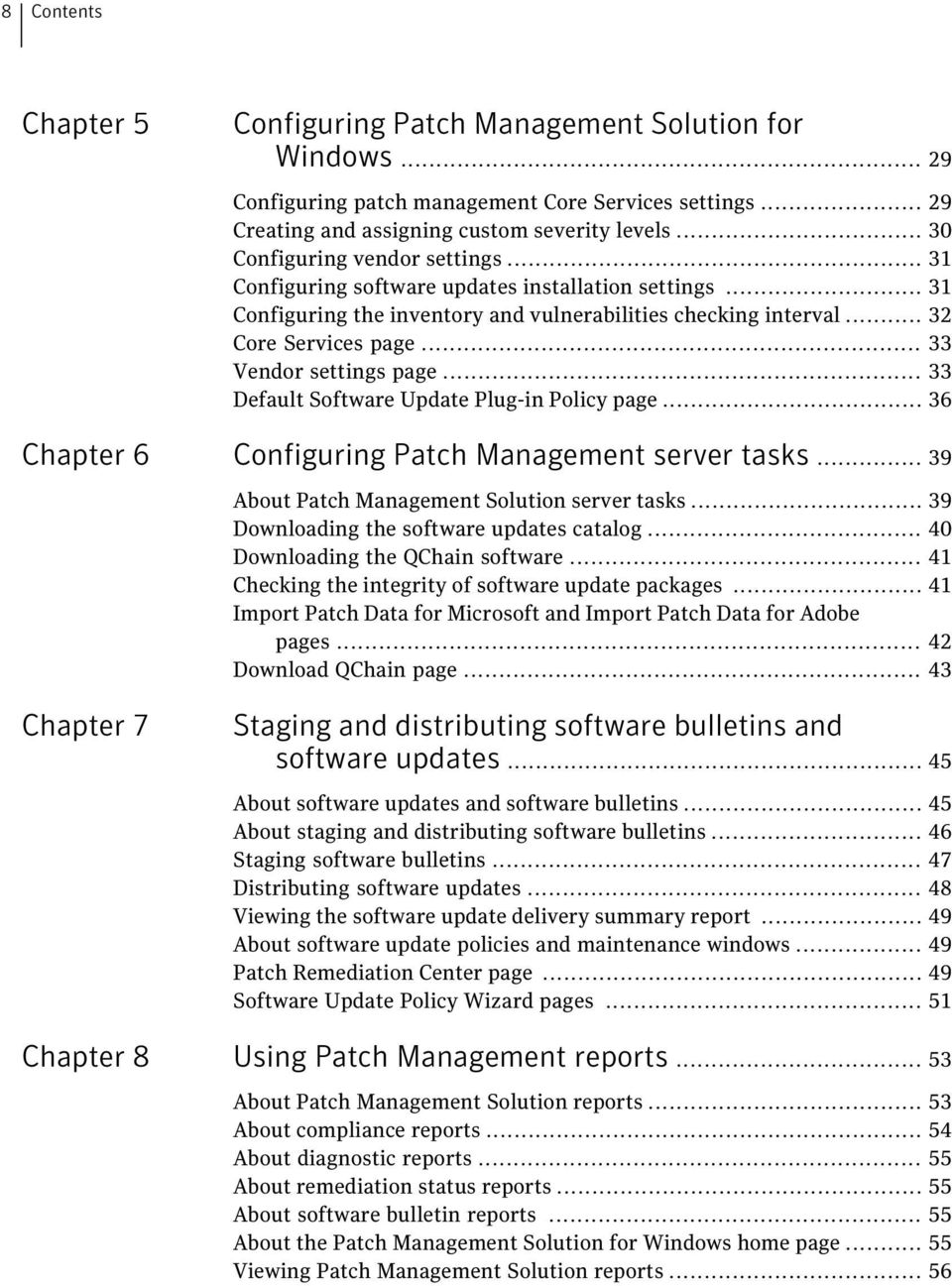
8 8 Contents Chapter 5 Configuring Patch Management Solution for Windows Configuring patch management Core Services settings Creating and assigning custom severity levels Configuring vendor settings Configuring software updates installation settings Configuring the inventory and vulnerabilities checking interval Core Services page Vendor settings page Default Software Update Plug-in Policy page Chapter 6 Configuring Patch Management server tasks About Patch Management Solution server tasks Downloading the software updates catalog Downloading the QChain software Checking the integrity of software update packages Import Patch Data for Microsoft and Import Patch Data for Adobe pages Download QChain page Chapter 7 Staging and distributing software bulletins and software updates About software updates and software bulletins About staging and distributing software bulletins Staging software bulletins Distributing software updates Viewing the software update delivery summary report About software update policies and maintenance windows Patch Remediation Center page Software Update Policy Wizard pages Chapter 8 Using Patch Management reports About Patch Management Solution reports About compliance reports About diagnostic reports About remediation status reports About software bulletin reports About the Patch Management Solution for Windows home page Viewing Patch Management Solution reports... 56
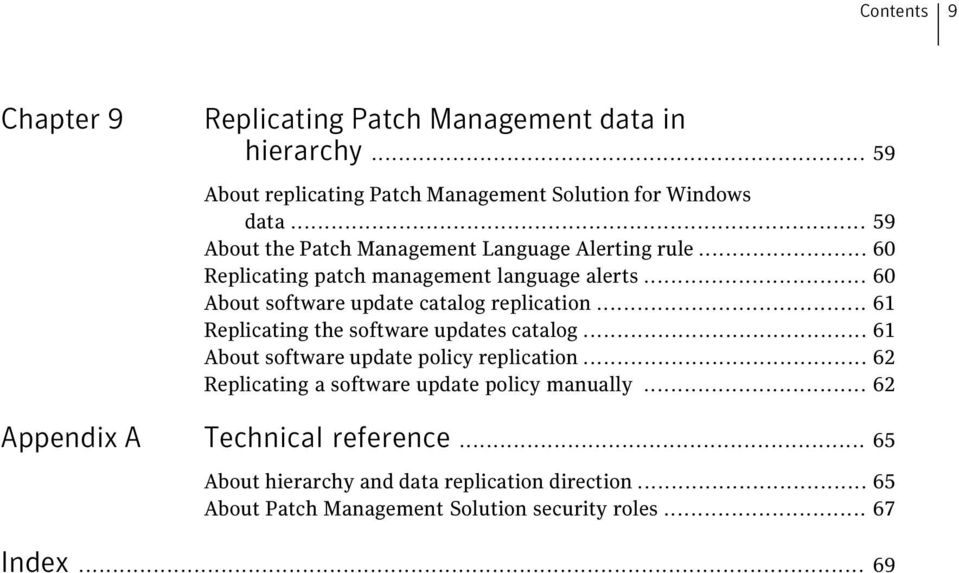
9 Contents 9 Chapter 9 Replicating Patch Management data in hierarchy About replicating Patch Management Solution for Windows data About the Patch Management Language Alerting rule Replicating patch management language alerts About software update catalog replication Replicating the software updates catalog About software update policy replication Replicating a software update policy manually Appendix A Technical reference About hierarchy and data replication direction About Patch Management Solution security roles Index... 69
10 10 Contents

11 Chapter 1 Introducing Patch Management Solution for Windows This chapter includes the following topics: About Patch Management Solution for Windows How Patch Management Solution for Windows works What's new in Patch Management Solution for Windows 7.1 Where to get more information About Patch Management Solution for Windows Patch Management Solution for Windows takes inventory of managed computers to determine the operating system and software updates (patches) they require. The solution then downloads the required patches and provides wizards to help you deploy patches. The solution enables you to set up a patch update schedule to ensure that managed computers are kept up-to-date with the latest vendor security updates. Managed computers are then protected on an on-going basis. See Platforms supported by Patch Management Solution for Windows on page 20. Key features include a software repository that provides comprehensive data on software bulletins, software updates, and inventory rules, such as technical details, severity ratings, and number of executables. The process of populating the information repository from the patch management metadata files can be started after installation is complete.

12 12 Introducing Patch Management Solution for Windows How Patch Management Solution for Windows works To reduce labor, the software update plug-in automatically analyzes managed computers. The software update plug-in gathers patch-specific inventory on supported operating systems, applications, and the associated service pack level. The inventory data is used to determine whether a patch is required. Inventory results populate predefined filters. The software update policy wizard then automatically assigns software updates to relevant filters. The wizard also simplifies the management of distribution. Instead of creating a policy for each individual software update, you create a single policy for the relevant software bulletin. For example, if three software bulletins with seven software updates address various operating systems in various languages, you only have to manage three distribution policies. If you want to, you can modify any default settings and command-line options in a software update policy. Integration with Notification Server 7.x includes features such as hierarchy and maintenance windows. Hierarchy lets you configure features and settings for a parent Notification Server computer, then pass the settings down to child Notification Server computers. See Implementing Patch Management Solution for Windows on page 17. How Patch Management Solution for Windows works Patch Management Solution for Windows uses inventory information to decide which software update packages to distribute. From software update packages, you create the software update policies that send the associated packages to managed computers and install the appropriate software update programs. After you install Patch Management Solution for Windows, you download complete software bulletin information from the Symantec Web site. Information includes the severity of each software bulletin, details on its software updates, and where they can be downloaded from Microsoft or Adobe. This information also includes rules for creating filters and rules on how to verify that a software update is installed. Then you deploy the software update plug-in to managed computers, which gathers inventory, including software vendor, software release, and service pack information. From this inventory, Patch Management Solution for Windows creates specific filters to target only the computers requiring individual software updates. See About the software update plug-in on page 23. You must stage software bulletins to download software updates and create packages. When a software bulletin is staged, each associated software update executable is downloaded from Microsoft or Adobe to the Notification Server computer. From the information in software bulletin executables, Patch Management Solution for Windows then creates a software update package for

13 Introducing Patch Management Solution for Windows What's new in Patch Management Solution for Windows each software update. From the staged software bulletins, you must create software update policies to distribute software update packages to the appropriate computer filters (previously known as collections). When a managed computer receives a software update policy, it verifies that the update is needed, then downloads the software update package from the Notification Server computer. The managed computer then installs the update. At an interval, the software update policy is re-evaluated and software updates are reinstalled if needed. For example, if an operation removes a software update, it is reinstalled. Or if a vendor revises a software update, it is reinstalled. After the software update plug-in distributes software updates, it sends results of patch deployment to the Notification Server computer. This information can be viewed through reports and the dashboard. You can configure part or all of Patch Management Solution for Windows to automatically download and install future software updates. When configuring the solution, you should consider possible effects on your network environment. Symantec recommends that you distribute new updates to a test environment first. What's new in Patch Management Solution for Windows 7.1 In the 7.1 release of Patch Management Solution, the following new features are introduced: The Software Management Solution Plug-in can be installed on 64-bit operating systems. The solution supports standard hierarchy editable properties. This feature lets you define which settings of replicated policies can be modified by the child Notification Server administrators. Hierarchy improvements. Improved performance of hierarchy-related reports. Policies are now using native Notification Server replication rules. Where to get more information Use the following documentation resources to learn about and use this product.

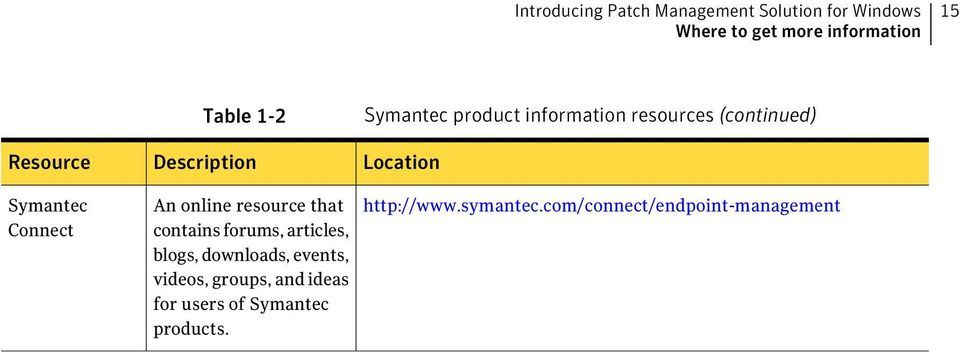
14 14 Introducing Patch Management Solution for Windows Where to get more information Document Release Notes Table 1-1 Description Information about new features and important issues. Documentation resources Location The Product Support page, which is available at the following URL: When you open your product's support page, look for the Documentation link on the right side of the page. User Guide Information about how to use this product, including detailed technical information and instructions for performing common tasks. The Documentation Library, which is available in the Symantec Management Console on the Help menu. The ProductSupport page, which is available at the following URL: When you open your product s support page, look for the Documentation link on the right side of the page. Help Information about how to use this product, including detailed technical information and instructions for performing common tasks. Help is available at the solution level and at the suite level. The Documentation Library, which is available in the Symantec Management Console on the Help menu. Context-sensitive help is available for most screens in the Symantec Management Console. You can open context-sensitive help in the following ways: The F1 key when the page is active. The Context command, which is available in the Symantec Management Console on the Help menu. This information is available in HTML help format. In addition to the product documentation, you can use the following resources to learn about Symantec products. Resource SymWISE Support Knowledgebase Table 1-2 Description Articles, incidents, and issues about Symantec products. Symantec product information resources Location

15 Introducing Patch Management Solution for Windows Where to get more information 15 Resource Symantec Connect Table 1-2 Description An online resource that contains forums, articles, blogs, downloads, events, videos, groups, and ideas for users of Symantec products. Symantec product information resources (continued) Location
16 16 Introducing Patch Management Solution for Windows Where to get more information

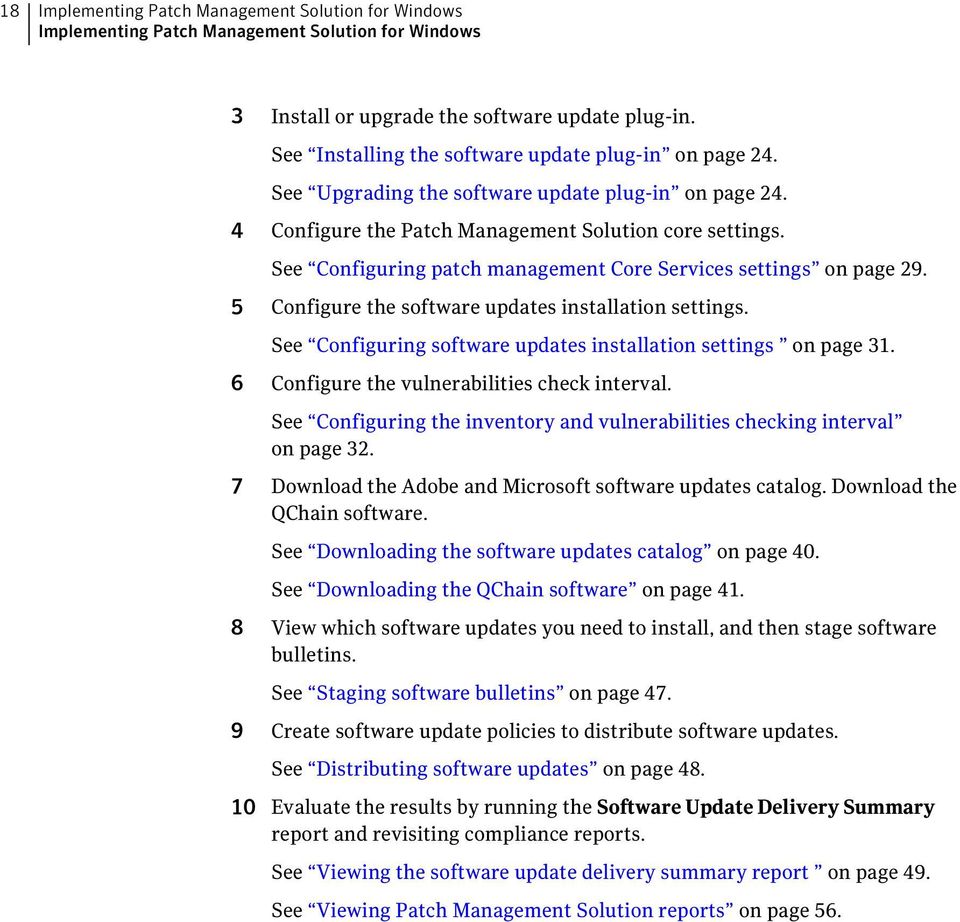
17 Chapter 2 Implementing Patch Management Solution for Windows This chapter includes the following topics: Implementing Patch Management Solution for Windows Implementing Patch Management Solution for Windows Patch Management Solution for Windows requires some components to be configured or enabled before others function correctly. When initially completing each task, you can also configure it for future automation. Automation is a key feature of Patch Management Solution for Windows as it reduces system administration workload and enhances overall security. To implement Patch Management Solution for Windows 1 Install or upgrade the solution. See Installing Patch Management Solution on page 20. See Upgrading Patch Management Solution on page Install or upgrade the Symantec Management Agent on every computer to which you want to send patches. For more information, see topics about installing or upgrading the Symantec Management Agent in the Symantec Management Platform User Guide.

18 18 Implementing Patch Management Solution for Windows Implementing Patch Management Solution for Windows 3 Install or upgrade the software update plug-in. See Installing the software update plug-in on page 24. See Upgrading the software update plug-in on page Configure the Patch Management Solution core settings. See Configuring patch management Core Services settings on page Configure the software updates installation settings. See Configuring software updates installation settings on page Configure the vulnerabilities check interval. See Configuring the inventory and vulnerabilities checking interval on page Download the Adobe and Microsoft software updates catalog. Download the QChain software. See Downloading the software updates catalog on page 40. See Downloading the QChain software on page View which software updates you need to install, and then stage software bulletins. See Staging software bulletins on page Create software update policies to distribute software updates. See Distributing software updates on page Evaluate the results by running the Software Update Delivery Summary report and revisiting compliance reports. See Viewing the software update delivery summary report on page 49. See Viewing Patch Management Solution reports on page 56.
19 Chapter 3 Installing Patch Management Solution for Windows This chapter includes the following topics: Prerequisites for Patch Management Solution Platforms supported by Patch Management Solution for Windows Installing Patch Management Solution Upgrading Patch Management Solution Uninstalling Patch Management Solution Licensing Patch Management Solution Prerequisites for Patch Management Solution Patch Management Solution requires the following: Symantec Management Platform 7.1. For more information, see topics about system requirements for Symantec Management Platform in the Symantec Management Platform Installation Guide. When you install or upgrade Patch Management Solution through the Symantec Installation Manager, Symantec Management Platform is installed automatically. See Installing Patch Management Solution on page 20.

20 20 Installing Patch Management Solution for Windows Platforms supported by Patch Management Solution for Windows Platforms supported by Patch Management Solution for Windows The Patch Management Solution for Windows component of Patch Management Solution supports the following operating systems: Windows XP SP2 and later, 32-bit and 64-bit. Windows Vista SP1 and later, 32-bit and 64-bit. Windows 7, 32-bit and 64-bit. Windows Server 2003 SP2 and later, 2003 R2 SP2 and later, 32-bit and 64-bit. Windows Server bit and 64-bit, 2008 Core, 2008 R2, 2008 R2 Core. Windows Hyper-V Server Installing Patch Management Solution Starting from version 7.1, the Patch Management Solution installation includes the following components: Patch Management Solution for Windows Patch Management Solution for Linux Patch Management Solution for Mac You install this product by using the Symantec Installation Manager. You can download the installation files directly to your server or you can create offline installation packages. For details, see the ITMS 7.1 Implementation Guide at Upgrading Patch Management Solution You upgrade this product by using the Symantec Installation Manager. You can download the installation files directly to your server or you can create offline installation packages. For details, see the ITMS 7.1 Implementation Guide at After you upgrade the solution, you must upgrade the Symantec Management Agent, and the software update plug-in that are installed on the managed computers.

21 Installing Patch Management Solution for Windows Uninstalling Patch Management Solution 21 For more information about upgrading the Symantec Management Agent, see Symantec Management Platform User Guide. See Upgrading the software update plug-in on page 24. Uninstalling Patch Management Solution Use the Symantec Installation Manager to uninstall this product. Licensing Patch Management Solution Each Symantec product comes with a seven-day trial license that is installed by default. You can register and obtain a 30-day evaluation license through the Symantec Web site at or purchase a full product license. Use the Symantec Installation Manager to install licenses. Note: Automatic upgrade protection (AUP) is required for continued use of Patch Management Solution for Windows. Without current AUP, you cannot download and use new Microsoft patch management metadata files. However, you can continue to use the Microsoft patch management metadata files that were downloaded before the expiration of AUP.
22 22 Installing Patch Management Solution for Windows Licensing Patch Management Solution
23 Chapter 4 Installing the Software Update Plug-in This chapter includes the following topics: About the software update plug-in Installing the software update plug-in Upgrading the software update plug-in Uninstalling the software update plug-in Software update plug-in user interface About the software update plug-in The software update plug-in manages all of the Patch Management Solution for Windows functionality on a client computer. When the Inventory Rule Plug-in (distributed by default by Notification Server) reports that a certain software update is required for a managed computer, the update is sent to the software update plug-in. The software update plug-in ensures that the update is applicable and not already installed, and then installs it. After you install the software update plug-in on a managed computer, the Software Updates tab appears in the Symantec Management Agent user interface. This tab displays the status software updates for that computer. To open the Symantec Management Agent user interface, click the Symantec Management Agent icon in the system tray of the managed computer. See Software update plug-in user interface on page 25. See Installing the software update plug-in on page 24.
24 24 Installing the Software Update Plug-in Installing the software update plug-in Installing the software update plug-in The software update plug-in manages all of the Patch Management Solution functionality on a client computer. See About the software update plug-in on page 23. Note: If you have a large number of computers on which to install the software update plug-in, consider deploying it during off-peak hours to minimize network traffic. Deploying the software update plug-in can take some time, depending on the number of managed computers and the Symantec Management Agent settings. To install the software update plug-in 1 In the Symantec Management Console, on the Settings menu, click Agents/Plug-ins > All Agents/Plug-ins. 2 In the left pane, click Software > Patch Management > Software Update Plug-in Install. 3 (Optional) In the right pane, make any wanted changes. For help, press F1 or click Help > Context. 4 Turn on the policy. 5 Click Save changes. Upgrading the software update plug-in If you upgraded Patch Management Solution from a previous version, you must also upgrade the software update plug-ins that are installed on the target computers. See About the software update plug-in on page 23. To upgrade the software update plug-in 1 In the Symantec Management Console, on the Settings menu, click Agents/Plug-ins > All Agents/Plug-ins. 2 In the left pane, click Software > Patch Management > Software Update Plug-in Upgrade. 3 (Optional) In the right pane, make any wanted changes. For help, press F1 or click Help > Context.
25 Installing the Software Update Plug-in Uninstalling the software update plug-in 25 4 Turn on the policy. 5 Click Save changes. Uninstalling the software update plug-in You can uninstall the software update plug-in if there is an extended period of time when you do not want to use the patch management features on a managed computer and you want to eliminate any overhead that is caused by the plug-in. See About the software update plug-in on page 23. Note: Ensure that the Software Update Plug-in Install policy is turned off before uninstalling the software update plug-in. See Installing the software update plug-in on page 24. To uninstall the software update plug-in 1 In the Symantec Management Console, on the Settings menu, click Agents/Plug-ins > All Agents/Plug-ins. 2 In the left pane, click Software > Patch Management > Software Update Plug-in Uninstall. 3 (Optional) In the right pane, make any wanted changes. For help, press F1 or click Help > Context. 4 Turn on the policy. 5 Click Save changes. Software update plug-in user interface When the software update plug-in is installed on a managed computer, a Software Updates tab appears in the Symantec Management Agent. From this tab, users can view the software updates that are applicable to their computer. They can view the status of all received software updates: those that have been scheduled to be installed and those that have been recently installed. See About the software update plug-in on page 23.
26 26 Installing the Software Update Plug-in Software update plug-in user interface Table 4-1 Item Schedules Show Updates Items in the software update plug-in user interface Description This pane lists all scheduled activities for the software update plug-in. By checking or unchecking boxes, you can choose to show or hide software updates with the status listed next to each box. For example, uncheck Not Currently Applicable to hide any software updates not applicable to the managed computer. Tasks Click StartSoftwareUpdateCycle to manually start the installation of software updates rather than wait for scheduled times. This option is available only if Allow user to run is checked on the Default Software Update Plug-in Policy page. Softwareupdatesfor this computer Displays the software updates that are applicable to this computer. Icons in the Status column A red error icon indicates that the maximum application retries for a failed software update have been exceeded. A yellow warning icon indicates that the software update has failed to be applied at least once, but has not exceeded the maximum application retries. It is reapplied. The green tick icon indicates that the Applicable rule is TRUE and the IsInstalled rule indicates that the update was installed. A clock icon indicates that the Applicable rule is true and the IsInstalled rule is FALSE. The software update is scheduled for installation. An information icon indicates that the Applicable rule has evaluated false. This means that the software update does not apply to this computer. You can also configure the agent not to display the software updates that do not apply by clearing the NotCurrentlyApplicable check box in the ShowUpdates pane. A user icon indicates that a user installed the update. A download icon indicates that the plug-in is downloading or attempting to download a software update package. A superseded icon indicates that the update was superseded by a later update and will not be installed.
27 Installing the Software Update Plug-in Software update plug-in user interface 27 Table 4-1 Item Items in the software update plug-in user interface (continued) Description Text labels in the Status column Failed to Install The maximum application retries for a failed software update has been exceeded. Installation Failed Rescheduled The software update has failed to be applied at least once but has not exceeded the maximum application retries. It will be reapplied. Installed The Applicable rule is TRUE and the IsInstalled rule indicates that it is already installed. If the Last Applied date is not empty, it means that the plug-in has installed the update. InstalledbyUser The software update was applicable, but was installed before the Software Update policy has arrived to the computer. Installation Scheduled The Applicable rule is true and the IsInstalled rule is FALSE. The software update is scheduled for installation. Not Applicable The Applicable rule has evaluated false. This means that the software update does not apply to this computer. Pending The Applicable and IsInstalled rules have not yet been evaluated. Download required The rules have been evaluated and the update package needs to be downloaded to the agent. Retry An attempt to download the package has failed and the agent is trying to download the package again. Bulletin Name Software Update Name Last Applied Schedule The name of the bulletin containing the software update. The name of the individual software update. The date and time of the last applied download. The last install time is displayed only if the software update plug-in installs the software update. If the software update is already installed (another source installed the software update) when the software update plug-in goes to install it the first time, this field will display Never. Time of schedule means that this software update has been scheduled to be installed. Not scheduled means that this software update has not been scheduled to be installed.
28 28 Installing the Software Update Plug-in Software update plug-in user interface
29 Chapter 5 Configuring Patch Management Solution for Windows This chapter includes the following topics: Configuring patch management Core Services settings Creating and assigning custom severity levels Configuring vendor settings Configuring software updates installation settings Configuring the inventory and vulnerabilities checking interval Core Services page Vendor settings page Default Software Update Plug-in Policy page Configuring patch management Core Services settings On the Core Services page you can configure to which location the software updates should be downloaded. You can also create custom severity levels to apply to software updates. The settings that you configure on the Core Services page apply to Windows and Linux components of Patch Management Solution.
30 30 Configuring Patch Management Solution for Windows Creating and assigning custom severity levels To configure patch management Core Services settings 1 In the Symantec Management Console, on the Settings menu, click All Settings. 2 In the left pane, click Software > Patch Management > Core Services. 3 In the right pane, make any wanted changes. See Core Services page on page Click Save Changes. Creating and assigning custom severity levels A software update deemed critical may not necessarily be critical in your environment. You can create your own custom severity levels and assign them to software bulletins. You first create custom severity levels, and then assign them to bulletins. You cannot alter the vendor-specified severity levels, only custom severity levels. See About software updates and software bulletins on page 45. To create a custom severity level 1 In the Symantec Management Console, on the Settings menu, click All Settings. 2 In the left pane, click Software > Patch Management > Core Services. 3 In the right pane, click the Custom Severity tab. 4 In the Severity Level box, type the name that you want to give the custom severity level. For example, "Install right away!" 5 Click Add. 6 Click Move Up or Move Down to position custom severity levels in the list. 7 Click Save Changes. To assign a custom severity level to a software bulletin 1 In the Symantec Management Console, on the Actions menu, click Software > Patch Remediation Center. 2 On the Patch Remediation Center page, in the software bulletin list, right-click on a software bulletin, and then click Custom Severity. 3 Click a severity level. 4 Click Refresh to view the new data in the Custom Severity column.
31 Configuring Patch Management Solution for Windows Configuring vendor settings 31 Configuring vendor settings You can set up how you want Microsoft or Adobe software updates distributed. You can exclude Microsoft software updates that you do not use in your organization. Excluding software releases ensures that unnecessary files are not downloaded. See About software updates and software bulletins on page 45. To configure vendor settings 1 In the Symantec Management Console, on the Settings menu, click All Settings. 2 In the left pane, click Software > Patch Management. 3 Do one of the following: Click Microsoft Settings > Microsoft. Click Adobe Settings > Adobe. 4 In the right pane, make any wanted changes. See Vendor settings page on page Click Save changes. Configuring software updates installation settings The Default Software Update Plug-in Policy page lets you configure when the software update plug-in can install software updates and restart the target computer. See About the software update plug-in on page 23. To configure the software updates installation settings 1 In the Symantec Management Console, on the Settings menu, click Agents/Plug-ins > All Agents/Plug-ins. 2 In the left pane, click Software > Patch Management > Windows > Default Software Update Plug-in Policy. 3 In the right pane, configure when and how do you want to install updates. See Default Software Update Plug-in Policy page on page Click Save changes.
32 32 Configuring Patch Management Solution for Windows Configuring the inventory and vulnerabilities checking interval Configuring the inventory and vulnerabilities checking interval Vulnerability analysis let you periodically inventory operating systems, applications, and installed patches on managed computers with the software update plug-in installed. For example, the Microsoft Vulnerability Analysis policy detects vulnerabilities to known Microsoft security problems. Vulnerability information is then used to determine which software updates the managed computer requires. Based on this information, filters are automatically created to assist with the targeting of software update policies. The Microsoft Vulnerability Analysis policy now incorporates four policies that were included in Patch Management Solution for Windows 6.2. The policies are as follows: Default Windows OS Inventory Policy Default Windows Software Release Inventory Policy Default Microsoft Inventory Policy Default Microsoft Vulnerability Analysis Policy You can configure how often you want to check for vulnerabilities. To configure the vulnerabilities checking interval 1 In the Symantec Management Console, on the Settings menu, click All Settings. 2 In the left pane, click Software > Patch Management 3 Click Microsoft Settings > Microsoft Vulnerability Analysis or Adobe Settings > Adobe Vulnerability Analysis. 4 In the right pane, in the Scan interval box, specify how often to report back inventory on the vulnerability of managed computers. 5 Click Only if Changed (set by default) if you want to report inventory only if it has changed, or click Always. 6 If you want to send a log of the results back to Notification Server, check Send inventory summary. 7 Do not change the targeted filter from AllWindowsComputerswithSoftware Update Plug-in Installed Target unless you have a specific reason to do so. 8 Click Save changes.
33 Configuring Patch Management Solution for Windows Core Services page 33 Core Services page The Core Services page lets you configure to which location the software updates should be downloaded. You can also create custom severity levels to apply to software updates. (Patch Management Solution for Windows only) You can select any additional languages that you want to download with the Patch Management Import task. The settings that are defined on this page apply to Windows and Linux components of Patch Management Solution. See About software updates and software bulletins on page 45. See Configuring patch management Core Services settings on page 29. See Creating and assigning custom severity levels on page 30. Table 5-1 Option Options on the Core Services page Description Managed Languages (Patch Management Solution for Windows only) Specifies the languages that you want to download. To Location Specifies the location to which you want to download the software update packages. The default location is C:\Program Files\Altiris\Patch Management\Packages\Updates. If you change the location and you want to relocate existing software update packages, use the Check Software Update Package Integrity task. See Checking the integrity of software update packages on page 41. Download from staging location (Patch Management Solution for Windows only) Specifies the location to download packages from if you want to download them from a cache in a different location. For this functionality to work, the file structure in that location must be exactly the same as the folder structure under C:\Program Files\Altiris\Patch Management\Packages\Updates. Vendor settings page This page lets you set up how you want vendor software updates distributed.
34 34 Configuring Patch Management Solution for Windows Vendor settings page See Configuring vendor settings on page 31. Some of these settings are used as default values on the Software Update Policy Wizard page. All new vendor software updates that are downloaded have these settings by default. If you change the settings, existing software update policies and packages are not updated with these defaults. If you want to update existing packages, check Update newpackagesettingsforalreadydownloadedpackages on the PolicyandPackage Settings tab. See Distributing software updates on page 48. See Patch Remediation Center page on page 49. Table 5-2 Option Options on the Software Update Options tab of the vendor settings page Description Patch Filter Update Interval Specifies when to update the target filters for all software updates. By default, the filter update is performed every 30 minutes. Resource Exclusions (Microsoft vendor policy only) Lets you select the software releases to exclude from download. For example, you can exclude the software releases that are not used in your organization. Excluding software releases ensures that unnecessary files are not downloaded. Software Update Distribution Options The table shows the filter that the policy targets. The default target is All Windows Computers with Software Update Plug-in Installed Target. Table 5-3 Option Options on the Policy and Package Settings tab of the vendor settings page Description Delete packages after Lets you specify when to delete the software update packages that are no longer needed. Default: 1 week.
35 Configuring Patch Management Solution for Windows Vendor settings page 35 Table 5-3 Option Options on the Policy and Package Settings tab of the vendor settings page (continued) Description UsemulticastwhentheSymantec Management Agent's multicast option is enabled Allow Package Server distribution Check if you want to use multicast when distributing software update packages. For more information on multicasting, see the Symantec Management Platform User Guide. This option is checked by default to ensure that package servers process software update packages. For more information on package servers, see the Symantec Management Platform User Guide. Assign package to Lets you select the package distribution method. For more information on assigning packages to package servers, see the Symantec Management Platform User Guide. Use alternate download location on Package Server Lets you specify a different location on a package server to which to download packages. If you are using Linux Package Servers in your envirionment, the Windows path that you specify is converted to UNIX paths automatically. You must use the trailing slash for the conversion to work correctly. For example, C:\path\ is converted to /path/ on Linux Package Servers. Use alternate download location on client Update new package settings for already downloaded packages Lets you specify a different location on the managed computers to which to download packages. By default, the changes that you make on this page are not applied to the packages that have already been downloaded. Check this option if you want to update the existing package settings after you click Save Changes. Only the packages from the current vendor will be updated.
36 36 Configuring Patch Management Solution for Windows Default Software Update Plug-in Policy page Table 5-4 Option Terminate after Run with rights Program can run Agent Events Options on the Programs tab of the vendor settings page Description Lets you specify a time after which to terminate a running software update program. Lets you specify which account to use to run the program. If you select the Specified User, you must specify user domain information. Lets you specify the conditions in which the program can run. Sends relevant events from managed computers to Notification Server. Default Software Update Plug-in Policy page This page lets you specify settings (including install and restart options) the software update plug-in uses when you install software updates on managed computers. The default resource target for the policy is designed to find any agents that do not have another software update plug-in configuration policy applied to them. For this reason, the default resource target cannot be changed. If you want to change the default resource target, you must clone the policy and alter the resource target on the clone. By default, the settings that you specify on this page apply to all Windows computers that have the software update plug-in installed. See About the software update plug-in on page 23. See Configuring software updates installation settings on page 31. Table 5-5 Option Schedule Options on the Installation Schedules tab of the Default Software Update Plug-in Policy page Description Lets you configure a schedule when software updates get installed on the managed computer. This schedule appears on the Software Updates tab of the Symantec Management Agent on the target computer. Reinstallation attempts after task failure Lets you set the number of times Patch Management Solution for Windows should attempt to reinstall a software update if the initial install attempt fails. Default: 3 times.
37 Configuring Patch Management Solution for Windows Default Software Update Plug-in Policy page 37 Table 5-5 Option Allow user to run Options on the Installation Schedules tab of the Default Software Update Plug-in Policy page (continued) Description Lets a user initiate a software update installation from the Symantec Management Agent by clicking Start Software Update in the Symantec Management Agent user interface. Allow restart after installation Never Scheduled Lets you specify when to restart the managed computer after software updates are installed. Do not automatically restart the target computer after a software update installation. Restart the computer on a specific schedule. For example, use this option to create an after hours restart schedule if you do not want to affect user productivity with repeated restarts during work hours. Symantec recommends that you do not set your restart schedule too soon after the software update installation schedule. This schedule appears on the Software Updatestab of the Symantec Management Agent on the target computer. At end of software update cycle Override maintenance windows settings Select this option to restart after all updates in a single update cycle have been installed. Check if you want to use the install and the restart options that you specified in this policy. Uncheck to abide by the maintenance windows that are specified in Notification Server configuration policies.
38 38 Configuring Patch Management Solution for Windows Default Software Update Plug-in Policy page Table 5-6 Options Notify user Options on the Notification tab of the Default Software Update Plug-in Policy page Description Check if you want to send a message to the users of the computer where a patch management task is about to run. Specify for how long the message should be displayed before a task is run. You can type a custom message: for example, Software updates will install on your computer in 10 minutes. Please ensure that all work is saved. When the message appears, the user can choose to install the updates immediately or close the dialog box. Show progress message Show pending message Lets you choose to show users a dialog box indicating the progress of software update installations. Lets you choose to warn users of a pending restart. The time you select represents how soon before the pending restart the user is warned. The user can choose to restart immediately. Show reminder message Lets you choose to notify a user that a restart is required. You can specify a schedule on which to display the notification. The user can choose to restart later, or restart immediately. If the user does not manually restart, the restart occurs according to your settings on the Installation Schedules tab. Allow user to defer Lets you choose to warn a user of a pending restart. Specify for how long the user can defer the restart. The user can choose to restart immediately, or defer the restart.
39 Chapter 6 Configuring Patch Management server tasks This chapter includes the following topics: About Patch Management Solution server tasks Downloading the software updates catalog Downloading the QChain software Checking the integrity of software update packages Import Patch Data for Microsoft and Import Patch Data for Adobe pages Download QChain page About Patch Management Solution server tasks You must configure server tasks (previously known as background actions) to run automatically at regular intervals. Examples of server tasks include Import Patch Data for Microsoft, Import Patch Data for Adobe, and Download QChain. Automated server tasks ensure that you have the latest, most accurate data, and your software update tasks are kept up to date. To configure a task to run automatically, set a schedule for it. The Import Patch Data for Microsoft task downloads Microsoft software updates catalog files and imports all software management resources from these files into the CMDB. The Import Patch Data for Adobe task does the same for Adobe software updates. The Microsoft QChain task chains the Microsoft software updates together before they are distributed to managed computers. Other server tasks ensure data integrity or assist in automating software update distribution processes.
40 40 Configuring Patch Management server tasks Downloading the software updates catalog The Import Patch Data for Microsoft, Import Patch Data for Adobe, and Download QChain tasks must successfully run before you can stage or distribute any software updates. See Implementing Patch Management Solution for Windows on page 17. See Downloading the software updates catalog on page 40. See Downloading the QChain software on page 41. Downloading the software updates catalog You must download the Microsoft and Adobe software updates catalog files (patch management metadata, or patch management import files) before you can stage software updates or create software update policies. See Implementing Patch Management Solution for Windows on page 17. Note: If the Altiris Log Viewer is open, close it before you perform this task. By closing the viewer, you can improve the task s performance by as much as 50 percent. You may want to create a schedule for this task as well. This procedure ensures that you have the latest, most accurate data, and your software update tasks are kept up to date. Symantec recommends that you configure the task to run daily. To download the software updates catalog immediately 1 In the Symantec Management Console, on the Manage menu, click Jobs and Tasks. 2 In the left pane, expand Jobs and Tasks > System Jobs and Tasks > Software > Patch Management. 3 Click one of the following: Import Patch Data for Microsoft Import Patch Data for Adobe 4 (Optional) In the right pane, make any wanted changes and then click Save changes. See Import Patch Data for Microsoft and Import Patch Data for Adobe pages on page Under Task Status, click New Schedule. 6 In the New Schedule dialog box, click Now, and then click Schedule.
41 Configuring Patch Management server tasks Downloading the QChain software 41 To configure a schedule for downloading the software updates catalog 1 On the Import Patch Data for Microsoft or Import Patch Data for Adobe page, under Task Status, click New Schedule. 2 In the NewSchedule dialog box, click Schedule, and then configure a schedule on which to run this task. Symantec recommends that you configure the task to run daily. 3 Click Schedule. Downloading the QChain software QChain is an executable that groups software updates together before you distribute them to managed computers. QChain removes the need of a computer restart after an individual update is installed. Patch Management Solution for Windows downloads QChain from the Microsoft Web site automatically after you install the solution through the Symantec Installation Manager. If you want, you can download QChain manually. For example, you may want to do this if you see that the task has failed to run the first time. See Implementing Patch Management Solution for Windows on page 17. To download QChain 1 In the Symantec Management Console, on the Manage menu, click Jobs and Tasks. 2 In the left pane, expand Jobs and Tasks > System Jobs and Tasks > Software > Patch Management, and then click Download QChain. 3 (Optional) In the right pane, make any wanted changes and then click Save changes. See Download QChain page on page Under Task Status, click New Schedule. 5 In the New Schedule dialog box, click Now, and then click Schedule. Checking the integrity of software update packages You can verify that software update packages in software update tasks have the correct global server settings applied. If you changed settings in a vendor policy, run the Check Software Update Package Integrity task to check that all software update packages have the correct new settings and values.
42 42 Configuring Patch Management server tasks Import Patch Data for Microsoft and Import Patch Data for Adobe pages See Configuring vendor settings on page 31. The task also relocates the software update packages in case you changed the default software update package location on the Core Services page. See Configuring patch management Core Services settings on page 29. To check the integrity of software update packages 1 In the Symantec Management Console, on the Manage menu, click Jobs and Tasks. 2 In the left pane, expand Jobs and Tasks > System Jobs and Tasks > Software > Patch Management, and then click Check Software Update Package Integrity. 3 If you want to delete the downloaded updates that are not part of any software update policy or belong to a superseded bulletin, check Delete updates from file system that are no longer in use. 4 If you want to relocate downloaded updates if the Software Update Package Location has changed, check Relocate existing packages if default Software Update Package location on Core Service page has changed. See Configuring patch management Core Services settings on page Under Task Status, click New Schedule and specify a schedule on which to run the task. Import Patch Data for Microsoft and Import Patch Data for Adobe pages This background action downloads the software update catalog files and imports all software management resources from these files into the CMDB. These resources are necessary for populating the Patch Remediation Center and updating patches to managed computers. When you download the software update catalog files, you automatically import all software management resources. See Downloading the software updates catalog on page 40. Table 6-1 Option Default Location Options on the Import Patch Data page Description The default location from which the patch management metadata files are downloaded. Alternative Location Lets you specify a custom location from which to download the patch management metadata files.
43 Configuring Patch Management server tasks Download QChain page 43 Table 6-1 Option Options on the Import Patch Data page (continued) Description Only download if modified Automatically revise software update policies after Patch Management Import Enabledistributionofnewlyadded software updates Disable all Superseded Software Updates Ensures that only updated files are downloaded, thus avoiding unnecessary downloads. Automatically updates software update policies with the latest Microsoft patch management metadata. Each download of the patch management metadata files may contain data and fixes for existing software updates. By checking this option, you can use the new data to resolve any known issues with software updates. Enables the distribution of the software update packages that were added to the software bulletin. This option disables the rollout of any software update tasks containing superseded software updates. Download QChain page The QChain is an executable that groups software updates together before you distribute them to managed computers. You must download QChain after you run the Import Patch Data for Microsoft task and before you distribute software updates. See Downloading the QChain software on page 41. Table 6-2 Option Location Options on the Download QChain page Description The location from which the QChain files are downloaded. Only download if modified Retry failed downloads Ensures that only updated files are downloaded, thus avoiding unnecessary downloads. The number of times to retry downloading the QChain files before the task fails.
44 44 Configuring Patch Management server tasks Download QChain page
45 Chapter 7 Staging and distributing software bulletins and software updates This chapter includes the following topics: About software updates and software bulletins About staging and distributing software bulletins Staging software bulletins Distributing software updates Viewing the software update delivery summary report About software update policies and maintenance windows Patch Remediation Center page Software Update Policy Wizard pages About software updates and software bulletins A software update or patch is any update or hotfix that is used to improve or fix a software product. A software bulletin is a bundle of software updates that are released together. Patch Management Solution for Windows uses targeted deployments. Updates are not deployed to a computer unless that computer specifically needs that software update. If a managed computer meets the prerequisites of a software update, it falls into a targeted filter. The prerequisites are matched against the
46 46 Staging and distributing software bulletins and software updates About staging and distributing software bulletins data that is sent to Notification Server by the software update plug-in: for example, the Internet Explorer and operating system versions. Software updates are then installed according to Microsoft specifications. For example, if Microsoft requires a restart, then the computer is restarted after the update is installed. Restarts on managed computers are minimized because the updates that do not require a restart are installed before the software updates that do. When a software update has been superseded and rendered obsolete by another update or updates, the later update is installed. Microsoft assigns severity levels to software updates, but you can also create a custom severity level. See Creating and assigning custom severity levels on page 30. Warning: Microsoft provides the software updates that Patch Management Solution for Windows distributes for Microsoft products. You must ensure that each software update works correctly in your environment before deploying it. Symantec recommends that you first distribute any required software update in a test environment before deploying it to your production environment. About staging and distributing software bulletins You stage software bulletins from the Patch Remediation Center page, where all available software updates are listed. When you stage a software bulletin, all associated updates are downloaded to the Notification Server computer. When the number in the Updates column equals the number in the Downloaded column, all updates for the software bulletin have been downloaded. Also, the value in the Staged column changes to True. See Staging software bulletins on page 47. After the bulletin is staged, you can create software update policies to distribute the software update to managed computers. Sometimes not all software updates can be downloaded for a software bulletin because Microsoft may stop hosting the bulletin or relocate it. You cannot create a software update policy unless all updates for a particular software bulletin or update have been downloaded. See Distributing software updates on page 48.
47 Staging and distributing software bulletins and software updates Staging software bulletins 47 Staging software bulletins You can stage a software bulletin to download associated updates. See About staging and distributing software bulletins on page 46. You can stage all software bulletins. However, Symantec recommends that you stage only the bulletins that the target computers require. On the Patch Remediation Center page, in the compliance reports, you can view how many computers require an update. After the updates are downloaded, you must create a software update policy to distribute the updates to managed computers. See Distributing software updates on page 48. When you stage a software bulletin, a task is created that downloads the software updates. You can view the status of this task to troubleshoot downloading of software updates. To stage a software bulletin 1 In the Symantec Management Console, on the Actions menu, click Software > Patch Remediation Center. 2 In the right pane, in the Show drop-down box, click Microsoft Compliance by Bulletin or Adobe Compliance by Bulletin, and then click the Refresh symbol. These reports let you see which updates the target computers require. 3 Click the bulletins that you want to stage. For example, click the bulletins that have a high number in the Vulnerable column. 4 Right-click the selected bulletins, and then click Stage. If the Stage option is not available, the bulletin is being staged. If there is a Software Update Policy Wizard option available in the menu, the bulletin is staged and ready to be distributed. See Distributing software updates on page 48. To view the status of a software bulletin download 1 In the Symantec Management Console, on the Manage menu, click Jobs and Tasks. 2 In the left pane, click Jobs and Tasks > System Jobs and Tasks > Software > Patch Management > Download Software Update Package. 3 In the right pane, view the status of download tasks.
48 48 Staging and distributing software bulletins and software updates Distributing software updates Distributing software updates After you stage software bulletins and download the associated software updates, you must create software update policies that deploy software updates to the appropriate computers. See Staging software bulletins on page 47. The Software Update Policy Wizard page lets you create software update policies. The policies that you create are stored in the Manage > Policies > Software > Patch Management > Software Update Policies folder. You can view the details of the policy and change settings if necessary. To distribute software updates 1 In the Symantec Management Console, on the Actions menu, click Software > Patch Remediation Center. 2 In the right pane, in the Show drop-down box, click Microsoft Compliance by Bulletin or Adobe Compliance by Bulletin, and then click the Refresh symbol. These reports let you see which updates the target computers require. 3 Click the bulletins that you want to distribute. For example, click the bulletins that have a high number in the Vulnerable column. 4 Right-click the selected bulletins, and then click Software Update Policy Wizard. If the Software Update Policy Wizard option is not available, the bulletin is not staged. You must first stage the bulletin. See Staging software bulletins on page (Optional) Configure the settings as needed. See Software Update Policy Wizard pages on page Click Next. 7 (Optional) On the second page of the wizard, check the updates that you want to distribute. 8 If you want to activate the new software update policy, turn on the policy. To turn on the policy, click on the colored circle and then click On. You can also turn on the policy later. 9 Click Distribute software updates.
49 Staging and distributing software bulletins and software updates Viewing the software update delivery summary report 49 Viewing the software update delivery summary report The WindowsSoftwareUpdateDeliverySummary report summarizes the results of all scheduled Microsoft software update policies. It tells you which computers the software update tasks target, and if the updates have been successfully installed. The report also tells you if any software update tasks failed, or if they have not yet completed. Patch Management Solution for Windows also provides other reports that you can view. See About Patch Management Solution reports on page 53. To view the software update delivery summary report 1 In the Symantec Management Console, on the Reports menu, click All Reports. 2 In the left pane, click Software > Patch Management > Remediation Status > Windows Software Update Delivery Summary. 3 In the right pane, leave the default settings, and then click Refresh. About software update policies and maintenance windows Maintenance windows are time periods in which maintenance tasks, including the installation of software updates, are performed. To ensure that software update policies abide by maintenance windows, leave the OverrideMaintenanceWindow Settings check box unchecked in the first page of the Software Update Policy Wizard. If the box is checked, the software update plug-in ignores maintenance windows and installs the updates as instructed otherwise by the software update policy. See Software Update Policy Wizard pages on page 51. Installing a software update may take longer than a specified maintenance window. In this case, the installation of the updates completes, but any required restarts are deferred until the next maintenance window. Patch Remediation Center page This page lets you view, stage, and distribute all software updates that are provided by software update catalog files. See About staging and distributing software bulletins on page 46.
50 50 Staging and distributing software bulletins and software updates Patch Remediation Center page See About software updates and software bulletins on page 45. Table 7-1 Item Bulletin Severity Custom Severity Staged Policies Updates Downloaded Released Revised Description Table 7-2 Item Items on the Patch Remediation Center page Description The bulletin's number, as supplied by the vendor. The bulletin's vendor-specified severity level. The bulletin's user-defined severity level. Indicates if the bulletin has been set to download included software updates. If all updates have been downloaded, the result is True. Otherwise it is False. The number of software update policies that have been created from the bulletin. The number of software updates that are included in the bulletin. The number of software updates currently downloaded. The date the bulletin was released. The date the bulletin was revised. A description of the vulnerabilities that the software bulletin addresses. Right-click actions on the Patch Remediation Center page Description View Targeted Computers Displays the computers that the software update policy containing this bulletin is targeting. You must create a software update policy to view targeted computers. View Applicable Computers View Installed Computers View Vulnerable Computers Displays the computers to which the selected bulletin applies. Displays the computers on which the selected bulletin is installed. Displays the computers that do not have the selected bulletin installed.
51 Staging and distributing software bulletins and software updates Software Update Policy Wizard pages 51 Software Update Policy Wizard pages The software update policy wizard creates the software update policies that distribute software updates to managed computers. A software update policy that is created from a software bulletin includes every software update that is in the bulletin. See Distributing software updates on page 48. Table 7-3 Option Software Updates Options on the first page of the Software Update Policy Wizard Description The names of each software update that is included in the bulletin. Software Bulletins The name of the bulletin or bulletins you have chosen to make policies for. You cannot edit the software bulletins through the software update policy wizard. You can click a software bulletin to open the Resource Manager to view detailed information on the software bulletin. You can only select a software bulletin that has been previously staged. Name Description Use Multicast when the SymantecManagementAgent s multicast option is enabled Run (other than agent default) The name of the policies you have chosen from the policies window. This field is populated automatically if only one policy is listed in the Tasks field. The vendor description of the bulletin. (Patch Management Solution for Windows only) Enables multicast features. Runs the software updates installation at a different time than the time that is specified in the software update plug-in settings. See Configuring software updates installation settings on page 31. As soon as possible Power on computer (Wake on LAN) Runs the software updates installation as soon as the software update policy arrives to the target computer. (Patch Management Solution for Windows only) Attempts to turn on the computer before installing software updates.
52 52 Staging and distributing software bulletins and software updates Software Update Policy Wizard pages Table 7-3 Option On schedule Options on the first page of the Software Update Policy Wizard (continued) Description Runs the software updates installation on a schedule. Override Maintenance Windows settings Apply to computers Overrides the specified maintenance windows settings. See About software update policies and maintenance windows on page 49. Lets you specify the target collection or collections to which the software update policy applies. If you use the software update policy wizard, the correct resource target for the selected software bulletin is automatically applied. Table 7-4 Options On/Off Options on second page of the Software Update Policy Wizard Description Lets you enable or disable the software update policy for the software bulletin and included software updates. Click On if you want the policy to become active after you complete the wizard. You can also turn on the policy later. The policies that you create are located at Manage > Policies > Software > Patch Management > Software Update Policies. Software Bulletin Update Name Culture Package Command Line The name of the software bulletin. The name of each software update executable. If Enable is selected, all of the executables are enabled. Click the hyperlink to open the Resource Manager page for the software update. The language and culture of the software update. The software package that is associated with the update. Click the hyperlink to open the package s Resource Manager. The command line to be run against the package. Click the hyperlink to open the command-line options dialog box to change the recommended options.
53 Chapter 8 Using Patch Management reports This chapter includes the following topics: About Patch Management Solution reports About compliance reports About diagnostic reports About remediation status reports About software bulletin reports About the Patch Management Solution for Windows home page Viewing Patch Management Solution reports About Patch Management Solution reports You can view and manage your patch management data through reports. These reports give you information specific to Patch Management Solution. For example, you can use compliance reports to determine how many urgent software updates your managed computers require. See About compliance reports on page 54. Reports let you view information in various ways. You can see your information in tables or graphically in charts. You can also drill down on specific items in a report to obtain additional information. You can stage or distribute software updates directly from reports by right-clicking on the update name in the report.
54 54 Using Patch Management reports About compliance reports Patch Management Solution provides the following reports: Compliance reports See About compliance reports on page 54. Diagnostic reports See About diagnostic reports on page 55. Remediation status reports See About remediation status reports on page 55. Software bulletin reports See About software bulletin reports on page 55. See Viewing Patch Management Solution reports on page 56. Patch Management Solution also has a patch management home page. This page is a portal page that is comprised of a number of Web parts displaying results from commonly used reports. See About the Patch Management Solution for Windows home page on page 55. About compliance reports Compliance reports are the key to quickly determining what software updates your managed computers require. Compliance reports are used to determine if computers are up-to-date with the latest software updates. These reports are also used to check if a particular software bulletin or update is installed on your managed computers. This is useful if a specific security issue affects your network environment and a certain update addresses the problem. You can start distributing software updates directly from report results. For example, if you want to quickly distribute all critical updates, sort the report results by Severity. Then, right-click all critical updates and click Stage. Then you can distribute the updates. See About staging and distributing software bulletins on page 46. You can find the compliance reports in the Symantec Management Console under Reports > All Reports > Software > Patch Management > Compliance. Compliance reports are also featured on the Patch Management Solution home page for easy access. See About the Patch Management Solution for Windows home page on page 55. See About Patch Management Solution reports on page 53.
55 Using Patch Management reports About diagnostic reports 55 About diagnostic reports The diagnostics reports display vulnerability summary and software update plug-in installation information. You can find the diagnostics reports in the Symantec Management Console under Reports > All Reports > Software > Patch Management > Diagnostics. See About Patch Management Solution reports on page 53. About remediation status reports The remediation status reports summarize and detail software update associations and activities. You can find the remediation status reports in the Symantec Management Console under Reports > All Reports > Software > Patch Management > Remediation Status. See About Patch Management Solution reports on page 53. About software bulletin reports The software bulletins reports summarize and detail software bulletin activity and status. You can find the remediation status reports in the Symantec Management Console under Reports > All Reports > Software > Patch Management > Software Bulletins. See About Patch Management Solution reports on page 53. About the Patch Management Solution for Windows home page The home page is a portal page providing patch management summary information at a glance. The page is comprised of a number of Web parts displaying results from commonly used reports. See About Patch Management Solution reports on page 53. You cannot customize the portal page directly. If you want, you can add patch management Web parts to other configurable portal pages. For example, the My Portal page.
56 56 Using Patch Management reports Viewing Patch Management Solution reports You can access the home page by clicking Home > Patch Management, and then, under Microsoft, click Updates. Only the Windows Compliance home page is available. A home page for Adobe is not available. Table 8-1 Web part Web parts on the Windows Compliance page Description Microsoft License Status Microsoft Vulnerabilities Reports on the amount of Patch Management Solution for Windows licenses in use, their status, and expiration date. Reports on the number of Microsoft vulnerabilities that need to be addressed. This Web part is also available in a graph form. Microsoft Software Update Delivery Summary Reports on the number of patches that were executed in the past 30 days and how many succeeded or did not complete. This Web part is also available in a graph form. Microsoft Software Bulletin Summary Reports on the number of software bulletins available, staged, tasks created, and new bulletins in the last 30 days. This Web part is also available in a graph form. Microsoft Configuration Summary An overall configuration summary, which includes computers with the software update plug-in, computers not reporting vulnerability analysis, Microsoft patch management metadata and QChain versions, and so on. Viewing Patch Management Solution reports Patch Management Solution for Windows provides reports that let you view detailed information about the updates. See About Patch Management Solution reports on page 53. To view Patch Management reports 1 In the Symantec Management Console, on the Reports menu, click All Reports. 2 In the left pane, expand Software > Patch Management.
57 Using Patch Management reports Viewing Patch Management Solution reports 57 3 Click the report that you want to view. For example, click Compliance > Windows Compliance by Bulletin. 4 In the right pane, leave the default settings, and click Refresh. 5 If you want to view more information about an update, right-click on any update, and click Resource Manager. Each type of compliance report opens a different Resource Manager, depending on the type of results. For example, the Windows Compliance by Computer report opens a computer-type Resource Manager. At the bottom of the Summaries tab, under Additional Information, click the hyperlink to the Microsoft Technet article on the bulletin.
58 58 Using Patch Management reports Viewing Patch Management Solution reports
59 Chapter 9 Replicating Patch Management data in hierarchy This chapter includes the following topics: About replicating Patch Management Solution for Windows data About the Patch Management Language Alerting rule Replicating patch management language alerts About software update catalog replication Replicating the software updates catalog About software update policy replication Replicating a software update policy manually About replicating Patch Management Solution for Windows data Downloading Microsoft and Adobe software update catalog files (patch management metadata, or patch management import files) to multiple Notification Servers can consume considerable network resources and time. Notification Server hierarchy features remove the need to download patch management metadata files individually. You can download the files once to a single parent Notification Server. Then you can use Patch Management Solution replication rules to send the relevant data to any number of child Notification Servers. The replicated data on the child Notification Servers is identical to the data on the parent.
60 60 Replicating Patch Management data in hierarchy About the Patch Management Language Alerting rule See About hierarchy and data replication direction on page 65. Before you can replicate data, you must run the Patch Management Language Alerting rule. See About the Patch Management Language Alerting rule on page 60. See Replicating patch management language alerts on page 60. See About software update catalog replication on page 61. See Replicating the software updates catalog on page 61. See About software update policy replication on page 62. See Replicating a software update policy manually on page 62. About the Patch Management Language Alerting rule Different Notification Servers within a hierarchy may manage different patch management language resources. The Patch Management Language Alerting replication rule ensures that child Notification Servers only receive data and software update policies for their managed languages. This rule replicates information about the managed languages of the child Notification Server up to the parent. You must run this rule on a child before any attempt is made to replicate patch management data or software update policies. A parent Notification Server must manage all of the languages that its children require. The rule is preconfigured to run daily at 20:00. See Replicating patch management language alerts on page 60. Replicating patch management language alerts You must run the Patch Management Language Alerting rule on a child before any attempt is made to replicate the software update catalog or software update policies. See About the Patch Management Language Alerting rule on page 60. To replicate patch management language alerts 1 In the Symantec Management Console, on the Settings menu, click Notification Server > Hierarchy. 2 In the left pane, click Hierarchy > Hierarchy Management. 3 In the right pane, click the Replication tab. 4 Expand the Resources section.
61 Replicating Patch Management data in hierarchy About software update catalog replication 61 5 Click Patch Management Language Alerting. 6 Click the Edit symbol. 7 Set a schedule to run before running other patch management replication functions. About software update catalog replication Downloading Microsoft or Adobe patch management software update catalog files to multiple Notification Servers can consume considerable network resources. Notification Server hierarchy features remove the need to download patch management software update catalog files individually. You can download the files once to a single parent Notification Server. Then you can use the Patch Management Import Data Replication for Microsoft and Patch Management Import Data Replication for Adobe rules to send the relevant data to any number of child Notification Servers. The replicated data on the child Notification Servers is identical to the data on the parent, depending on managed languages. The rules are preconfigured to run daily at 23:00. See Replicating the software updates catalog on page 61. Replicating the software updates catalog After downloading Microsoft or Adobe software updates catalog files and importing data to a parent Notification Server, you can replicate the data to any number of child Notification Servers. See About software update catalog replication on page 61. Warning: You must configure the Patch Management Language Alerting rule to run before the software catalog data replication. See About the Patch Management Language Alerting rule on page 60. To replicate the software updates catalog 1 In the Symantec Management Console, on the Settings menu, click Notification Server > Hierarchy. 2 In the left pane, select Hierarchy > Hierarchy Management. 3 In the right pane, click the Replication tab. 4 Expand the Resources section.
62 62 Replicating Patch Management data in hierarchy About software update policy replication 5 Click Patch Management Import Data Replication for Microsoft or Patch Management Import Data Replication for Adobe. 6 Click the Edit symbol. 7 Under Replicate, select Differential if you want to only replicate changed or new data. Select Complete to send all Microsoft patch management software update catalog files to child Notification Servers each time the task runs. 8 Under Schedule, create a custom schedule or select the standard replication schedule. 9 Under Data Verification, specify a percentage of data to be verified during each replication, and check Verify data integrity if wanted. 10 Turn on the rule. 11 Click Save changes. About software update policy replication Software update policies distribute software updates to the target computers. See Distributing software updates on page 48. In Patch Management Solution 7.1, the software update policies are always replicated to child Notification Servers. Replication occurs on the default Notification Server replication schedule. You can also replicate a software update policy manually. See Replicating a software update policy manually on page 62. Replicating software update policies does not replicate the actual software update files. Child Notification Servers download the needed software update files from the vendor. Replicating a software update policy manually You can save time and resources by replicating existing software update policies to child Notification Servers. See About software update policy replication on page 62. All software update policies are replicated to child Notification Servers on the default replication schedule. If you want, you can also manually replicate a policy immediately.
63 Replicating Patch Management data in hierarchy Replicating a software update policy manually 63 Warning: Before you replicate software update policies, ensure that the Patch Management Language Alerting rule and the Patch Management Import Data Replication rule have run. See About the Patch Management Language Alerting rule on page 60. See About software update catalog replication on page 61. To replicate a software update policy manually 1 In the Symantec Management Console, on the Manage menu, click Policies. 2 In the left pane, expand Software > Patch Management > Software Update Policies. 3 Right-click a policy, and then click Hierarchy > Replicate Now.
64 64 Replicating Patch Management data in hierarchy Replicating a software update policy manually
65 Appendix A Technical reference This appendix includes the following topics: About hierarchy and data replication direction About Patch Management Solution security roles About hierarchy and data replication direction Patch Management Solution for Windows and Patch Management Solution for Linux support the hierarchy and the replication features of the Symantec Management Platform. These features let you create settings, schedules, and other data at the top-level Notification Server computer and replicate them to child-level Notification Server computers. Patch Management Solution for Mac does not support replication. See About replicating Patch Management Solution for Windows data on page 59. Table A-1 Item Items that are replicated by the default Notification Server replication schedule with no custom replication rules Replication direction All the server tasks settings and schedules: Down Download QChain Check Software Update Package Integrity Import Patch Data for Microsoft/Adobe/Red Hat/Novell Microsoft/Adobe/Linux Vulnerability Analysis policy settings Microsoft/Adobe/Red Hat/Novell vendor settings Default Software Update Plug-in Policy settings Down Down Down
66 66 Technical reference About hierarchy and data replication direction Table A-1 Item Items that are replicated by the default Notification Server replication schedule with no custom replication rules (continued) Replication direction Software update plug-in install, upgrade, and uninstall policy settings Software update policies Down Down Table A-2 Items that are replicated with custom replication rules Item Language support information (Patch for Windows only) OS inventory data (Patch for Linux only) Patch management metadata Compliance summary Replication direction Up Up Down Up Description This information is replicated when the PatchManagementLanguageAlerting rule is enabled. This information is replicated when the Patch Linux OS Channel Resource Replication rule is enabled. This information is replicated when the Patch Management Import Data Replication for Adobe/Microsoft/Red Hat/Novell rules are enabled. For Windows, only the updates and bulletins that are associated with the child computer's supported languages are replicated. For Linux, only the metadata for the channels that are relevant to the child Notification Server's client computers is replicated. This information is replicated when the Patch compliance summary replication rule is enabled. The vulnerability analysis is replicated up as a summary.
67 Technical reference About Patch Management Solution security roles 67 About Patch Management Solution security roles You can assign the following security roles to Symantec Management Console users: Patch Management Administrators Patch Management Rollout Users with Patch Management Administrators role have full access to Patch Management Solution functionality, but no access to the rest of the Symantec Management Console. Users with Patch Management Rollout role have limited access to the following Patch Management Solution functionality: Software update policies Reports Patch Remediation Center page Users with the Patch Management Rollout role can perform the following actions: Enable, disable, and change settings in the software update policies. View reports.
68 68 Technical reference About Patch Management Solution security roles
69 Index A Adobe Patch Management Import task. See Import Patch Data for Microsoft task Adobe settings configuring 31 Adobe vendor settings page about 33 Adobe Vulnerability Analysis page about 32 analyzing vulnerabilities 32 assigning severity levels 30 B bulletins about 45 C Check Software Update Package Integrity task about 41 checking package integrity 41 compliance analysis configuring 32 configuring Adobe settings 31 Microsoft settings 31 Patch Management Solution core settings 29 severity levels 30 updates installation settings 31 vendor settings 31 context-sensitive help 13 Core Services page about 33 Core Services settings configuring 29 D Default Software Update Plug-in Policy about 36 distributing software bulletins 48 about 46 distributing software bulletins (continued) viewing update summary reports 49 documentation 13 download location 29 Download QChain task about 43 downloading patch management metadata 40 QChain 41 software updates catalog 40 downloading software updates. See staging H help context-sensitive 13 hierarchy replicating data 59 60, 62 replicating patch management metadata 61 replicating software updates catalog 61 home page 55 I Import Patch Data for Adobe task 42 Import Patch Data for Microsoft task 42 installing Patch Management Solution 20 prerequisites 19 software update plug-in 24 inventory collecting 32 L licensing about 21 M maintenance windows about 49 Microsoft Patch Management Import task. See Import Patch Data for Microsoft task
70 70 Index Microsoft settings configuring 31 Microsoft vendor settings page about 33 Microsoft Vulnerability Analysis page about 32 P page Adobe settings page 33 Default Software Update Plug-in Policy 36 Download QChain 43 Import Patch Data for Adobe 42 Import Patch Data for Microsoft 42 Microsoft settings page 33 Patch Remediation Center 49 Software Update Policy Wizard 51 patch management import data. See patch management metadata Patch Management Import Data Replication rule about 61 configuring 61 Patch Management Language Alerting rule about 60 configuring 60 patch management metadata downloading 40 replicating 61 Patch Management Solution components 19 installing 20 licensing 21 prerequisites 19 uninstalling 21 upgrading 20 Patch Management Solution for Windows about 11 implementing 17 overview 12 recommended workflow 17 supported platforms 20 Patch Management Solution server tasks about 39 Patch Remediation Center page about 49 patching recommended workflow 17 PMImport. See patch management metadata portal page 55 prerequisites 19 Q QChain downloading 41 R Release Notes 13 relocating packages 41 replicating data in hierarchy 59 60, 62 replicating software update policies 62 replication direction 65 reports 53 compliance 54 diagnostic 55 Patch Management Solution for Windows home page 55 remediation status 55 software bulletin 55 viewing 56 restarts configuring 31 S security roles 67 server tasks about 39 severity levels assigning 30 configuring 30 software bulletins about 45 configuring installation settings 31 distributing 48 viewing update summary reports 49 software update plug-in about 23 installing 24 uninstalling 25 upgrading 24 user interface 25 software update policy replicate now 62 replicating 62 Software Update Policy Wizard about 51 software updates about 45
71 Index 71 software updates (continued) computer restart time 31 installation settings 31 installation time 31 staging 47 software updates catalog downloading 40 replicating 61 staging software bulletins about 46 staging software updates 47 U uninstalling Patch Management Solution 21 software update plug-in 25 updates about 45 upgrading Patch Management Solution 20 software update plug-in 24 V vendor settings configuring 31 vulnerability analysis configuring 32
Altiris Patch Management Solution for Windows 7.1 SP2 from Symantec User Guide
 Altiris Patch Management Solution for Windows 7.1 SP2 from Symantec User Guide Altiris Patch Management Solution for Windows 7.1 SP2 from Symantec User Guide The software described in this book is furnished
Altiris Patch Management Solution for Linux 7.1 SP2 from Symantec User Guide
 Altiris Patch Management Solution for Linux 7.1 SP2 from Symantec User Guide Altiris Patch Management Solution for Linux 7.1 SP2 from Symantec User Guide The software described in this book is furnished
Symantec Virtual Machine Management 7.1 User Guide
 Symantec Virtual Machine Management 7.1 User Guide Symantec Virtual Machine Management 7.1 User Guide The software described in this book is furnished under a license agreement and may be used only in
Symantec Patch Management Solution for Windows 7.5 SP1 powered by Altiris User Guide
 Symantec Patch Management Solution for Windows 7.5 SP1 powered by Altiris User Guide Altiris Patch Management Solution for Windows 7.5 SP1 from Symantec User Guide The software described in this book is
Symantec Critical System Protection 5.2.9 Agent Guide
 Symantec Critical System Protection 5.2.9 Agent Guide Symantec Critical System Protection Agent Guide The software described in this book is furnished under a license agreement and may be used only in
Symantec Client Firewall Policy Migration Guide
 Symantec Client Firewall Policy Migration Guide Symantec Client Firewall Policy Migration Guide The software described in this book is furnished under a license agreement and may be used only in accordance
Veritas Operations Manager Package Anomaly Add-on User's Guide 4.1
 Veritas Operations Manager Package Anomaly Add-on User's Guide 4.1 November 2011 Veritas Operations Manager Package Anomaly Add-on User's Guide The software described in this book is furnished under a
Symantec Enterprise Security Manager Modules for Sybase Adaptive Server Enterprise Release Notes 3.1.0
 Symantec Enterprise Security Manager Modules for Sybase Adaptive Server Enterprise Release Notes 3.1.0 Release 3.1.0 for Symantec ESM 6.5.x and 9.0.1 Symantec Enterprise Security Manager Modules for Sybase
Symantec LiveUpdate Administrator. Getting Started Guide
 Symantec LiveUpdate Administrator Getting Started Guide Symantec LiveUpdate Administrator Getting Started Guide The software described in this book is furnished under a license agreement and may be used
Altiris IT Analytics Solution 7.1 SP1 from Symantec User Guide
 Altiris IT Analytics Solution 7.1 SP1 from Symantec User Guide Altiris IT Analytics Solution 7.1 from Symantec User Guide The software described in this book is furnished under a license agreement and
Altiris Patch Management Solution for Windows 7.1 from Symantec Release Notes
 Altiris Patch Management Solution for Windows 7.1 from Symantec Release Notes Altiris Patch Management Solution for Windows 7.1 from Symantec Release Notes The software described in this book is furnished
Symantec Mail Security for Microsoft Exchange Management Pack Integration Guide
 Symantec Mail Security for Microsoft Exchange Management Pack Integration Guide Symantec Mail Security for Microsoft Exchange Management Pack Integration Guide The software described in this book is furnished
Veritas Cluster Server Getting Started Guide
 Veritas Cluster Server Getting Started Guide Windows Server 2003, Windows Server 2008 5.1 Service Pack 2 21101490 Veritas Cluster Server Getting Started Guide The software described in this book is furnished
Altiris Asset Management Suite 7.1 from Symantec User Guide
 Altiris Asset Management Suite 7.1 from Symantec User Guide Altiris Asset Management Suite 7.1 from Symantec User Guide The software described in this book is furnished under a license agreement and may
Symantec Asset Management Suite 7.5 powered by Altiris technology User Guide
 Symantec Asset Management Suite 7.5 powered by Altiris technology User Guide Symantec Asset Management Suite 7.5 powered by Altiris technology User Guide The software described in this book is furnished
Symantec Management Platform Installation Guide. Version 7.0
 Symantec Management Platform Installation Guide Version 7.0 Symantec Management Platform Installation Guide The software described in this book is furnished under a license agreement and may be used only
Symantec Enterprise Security Manager Oracle Database Modules Release Notes. Version: 5.4
 Symantec Enterprise Security Manager Oracle Database Modules Release Notes Version: 5.4 Symantec Enterprise Security Manager Oracle Database Modules Release Notes The software described in this book is
Altiris Asset Management Suite 7.1 SP2 from Symantec User Guide
 Altiris Asset Management Suite 7.1 SP2 from Symantec User Guide Altiris Asset Management Suite 7.1 SP2 from Symantec User Guide The software described in this book is furnished under a license agreement
Symantec Mobile Management for Configuration Manager
 Symantec Mobile Management for Configuration Manager Replication Services Installation Guide 7.5 Symantec Mobile Management for Configuration Manager: Replication Services Installation Guide The software
Symantec Backup Exec System Recovery Granular Restore Option User's Guide
 Symantec Backup Exec System Recovery Granular Restore Option User's Guide Symantec Backup Exec System Recovery Granular Restore Option User's Guide The software described in this book is furnished under
Symantec NetBackup Vault Operator's Guide
 Symantec NetBackup Vault Operator's Guide UNIX, Windows, and Linux Release 7.5 Symantec NetBackup Vault Operator's Guide The software described in this book is furnished under a license agreement and may
Symantec Security Information Manager - Best Practices for Selective Backup and Restore
 Symantec Security Information Manager - Best Practices for Selective Backup and Restore Symantec Security Information Manager - Best practices for selective backup and restore The software described in
Symantec System Recovery 2013 Management Solution Administrator's Guide
 Symantec System Recovery 2013 Management Solution Administrator's Guide Symantec System Recovery 2013 Management Solution Administrator's Guide The software described in this book is furnished under a
Veritas Cluster Server Library Management Pack Guide for Microsoft System Center Operations Manager 2007
 Veritas Cluster Server Library Management Pack Guide for Microsoft System Center Operations Manager 2007 Windows Server 2003, Windows Server 2008 VCS Library Management Pack Veritas Cluster Server Library
Altiris Monitor Solution for Servers 7.5 from Symantec User Guide
 Altiris Monitor Solution for Servers 7.5 from Symantec User Guide Altiris Monitor Solution for Servers 7.5 from Symantec User Guide The software described in this book is furnished under a license agreement
Symantec Security Information Manager 4.8 Release Notes
 Symantec Security Information Manager 4.8 Release Notes Symantec Security Information Manager 4.8 Release Notes The software described in this book is furnished under a license agreement and may be used
Symantec Protection Center Enterprise 3.0. Release Notes
 Symantec Protection Center Enterprise 3.0 Release Notes Symantec Protection Center Enterprise 3.0 Release Notes The software described in this book is furnished under a license agreement and may be used
Symantec Backup Exec System Recovery Exchange Retrieve Option User's Guide
 Symantec Backup Exec System Recovery Exchange Retrieve Option User's Guide Symantec Backup Exec System Recovery Exchange Retrieve Option User's Guide The software described in this book is furnished under
Symantec Critical System Protection Agent Event Viewer Guide
 Symantec Critical System Protection Agent Event Viewer Guide Symantec Critical System Protection The software described in this book is furnished under a license agreement and may be used only in accordance
Symantec Critical System Protection Configuration Monitoring Edition Release Notes
 Symantec Critical System Protection Configuration Monitoring Edition Release Notes Symantec Critical System Protection Configuration Monitoring Edition Release Notes The software described in this book
Symantec Enterprise Security Manager Modules. Release Notes
 Symantec Enterprise Security Manager Modules for MS SQL Server Databases Release Notes Release 4.1 for Symantec ESM 9.0.x and 10.0 For Windows 2000/2008 and Windows Server 2003 Symantec Enterprise Security
Symantec Integrated Enforcer for Microsoft DHCP Servers Getting Started Guide
 Symantec Integrated Enforcer for Microsoft DHCP Servers Getting Started Guide Legal Notice Copyright 2006 Symantec Corporation. All rights reserved. Federal acquisitions: Commercial Software - Government
Veritas Operations Manager LDom Capacity Management Add-on User's Guide 4.1
 Veritas Operations Manager LDom Capacity Management Add-on User's Guide 4.1 November 2011 Veritas Operations Manager LDom Capacity Management Add-on User's Guide The software described in this book is
Symantec Data Center Security: Server Advanced v6.0. Agent Guide
 Symantec Data Center Security: Server Advanced v6.0 Agent Guide Symantec Data Center Security: Server Advanced Agent Guide The software described in this book is furnished under a license agreement and
Symantec NetBackup Backup, Archive, and Restore Getting Started Guide. Release 7.5
 Symantec NetBackup Backup, Archive, and Restore Getting Started Guide Release 7.5 Symantec NetBackup Backup, Archive, and Restore Getting Started Guide The software described in this book is furnished
Symantec Mobile Management 7.2 MR1Quick-start Guide
 Symantec Mobile Management 7.2 MR1Quick-start Guide Symantec Mobile Management 7.2 MR1 Quick-start Guide The software described in this book is furnished under a license agreement and may be used only
Symantec Endpoint Protection Shared Insight Cache User Guide
 Symantec Endpoint Protection Shared Insight Cache User Guide Symantec Endpoint Protection Shared Insight Cache User Guide The software described in this book is furnished under a license agreement and
Symantec NetBackup OpenStorage Solutions Guide for Disk
 Symantec NetBackup OpenStorage Solutions Guide for Disk UNIX, Windows, Linux Release 7.6 Symantec NetBackup OpenStorage Solutions Guide for Disk The software described in this book is furnished under a
Altiris Monitor Solution for Servers 7.1 SP1from Symantec User Guide
 Altiris Monitor Solution for Servers 7.1 SP1from Symantec User Guide Altiris Monitor Solution for Servers 7.1 SP1from Symantec User Guide The software described in this book is furnished under a license
Backup Exec Cloud Storage for Nirvanix Installation Guide. Release 2.0
 Backup Exec Cloud Storage for Nirvanix Installation Guide Release 2.0 The software described in this book is furnished under a license agreement and may be used only in accordance with the terms of the
Configuring Symantec AntiVirus for Hitachi High-performance NAS Platform, powered by BlueArc
 Configuring Symantec AntiVirus for Hitachi High-performance NAS Platform, powered by BlueArc Configuring Symantec AntiVirus for Hitachi High-performance NAS Platform, powered by BlueArc The software described
Symantec NetBackup Desktop and Laptop Option README. Release 6.1 MP7
 TM Symantec NetBackup Desktop and Laptop Option README Release 6.1 MP7 2 The software described in this document is furnished under a license agreement and may be used only in accordance with the terms
Symantec Endpoint Protection Integration Component 7.5 Release Notes
 Symantec Endpoint Protection Integration Component 7.5 Release Notes Symantec Endpoint Protection Integration Component 7.5 Release Notes Legal Notice Copyright 2013 Symantec Corporation. All rights reserved.
Symantec Critical System Protection Agent Event Viewer Guide
 Symantec Critical System Protection Agent Event Viewer Guide Symantec Critical System Protection Agent Event Viewer Guide The software described in this book is furnished under a license agreement and
Symantec NetBackup OpenStorage Solutions Guide for Disk
 Symantec NetBackup OpenStorage Solutions Guide for Disk UNIX, Windows, Linux Release 7.5 21220052 Symantec NetBackup OpenStorage Solutions Guide for Disk The software described in this book is furnished
Symantec Event Collector 4.3 for Microsoft Windows Quick Reference
 Symantec Event Collector 4.3 for Microsoft Windows Quick Reference Symantec Event Collector for Microsoft Windows Quick Reference The software described in this book is furnished under a license agreement
Symantec NetBackup for Microsoft SharePoint Server Administrator s Guide
 Symantec NetBackup for Microsoft SharePoint Server Administrator s Guide for Windows Release 7.5 Symantec NetBackup for Microsoft SharePoint Server Administrator s Guide The software described in this
Veritas Operations Manager Release Notes. 3.0 Rolling Patch 1
 Veritas Operations Manager Release Notes 3.0 Rolling Patch 1 Veritas Operations Manager Release Notes The software described in this book is furnished under a license agreement and may be used only in
Symantec ApplicationHA agent for Microsoft Exchange 2010 Configuration Guide
 Symantec ApplicationHA agent for Microsoft Exchange 2010 Configuration Guide Windows on Hyper-V 6.1 February 2014 Symantec ApplicationHA agent for Microsoft Exchange 2010 Configuration Guide The software
Symantec NetBackup for Lotus Notes Administrator's Guide
 Symantec NetBackup for Lotus Notes Administrator's Guide for UNIX, Windows, and Linux Release 7.5 Symantec NetBackup for Lotus Notes Administrator's Guide The software described in this book is furnished
Symantec Event Collector for Kiwi Syslog Daemon version 3.7 Quick Reference
 Symantec Event Collector for Kiwi Syslog Daemon version 3.7 Quick Reference Symantec Event Collector for Kiwi Syslog Daemon Quick Reference The software described in this book is furnished under a license
Symantec ApplicationHA agent for SharePoint Server 2010 Configuration Guide
 Symantec ApplicationHA agent for SharePoint Server 2010 Configuration Guide Windows on Hyper-V 6.1 February 2014 Symantec ApplicationHA agent for SharePoint Server 2010 Configuration Guide The software
Symantec System Recovery 2011 Management Solution Administrator's Guide
 Symantec System Recovery 2011 Management Solution Administrator's Guide Symantec System Recovery 2011 Management Solution Administrator's Guide The software described in this book is furnished under a
Email Encryption. Administrator Guide
 Email Encryption Administrator Guide Email Encryption Administrator Guide Documentation version: 1.0 Legal Notice Copyright 2015 Symantec Corporation. All rights reserved. Symantec, the Symantec Logo,
Symantec Protection Engine for Cloud Services 7.0 Release Notes
 Symantec Protection Engine for Cloud Services 7.0 Release Notes Symantec Protection Engine for Cloud Services Release Notes The software described in this book is furnished under a license agreement and
PGP CAPS Activation Package
 PGP CAPS Activation Package Administrator's Guide 9.12/10.0 The software described in this book is furnished under a license agreement and may be used only in accordance with the terms of the agreement.
Symantec AntiVirus for Network Attached Storage Integration Guide
 Symantec AntiVirus for Network Attached Storage Integration Guide Introducing Symantec AntiVirus for Network Attached Storage The software described in this book is furnished under a license agreement
Veritas Operations Manager Advanced 5.0 HSCL Pack 1 Release Notes
 Veritas Operations Manager Advanced 5.0 HSCL Pack 1 Release Notes November 2012 Veritas Operations Manager Advanced Release Notes The software described in this book is furnished under a license agreement
Symantec Enterprise Vault
 Symantec Enterprise Vault Setting up SharePoint Server Archiving 10.0 Symantec Enterprise Vault: Setting up SharePoint Server Archiving The software described in this book is furnished under a license
Altiris Monitor Solution for Servers 7.1 SP1 and Event Console 7.1 MR1 from Symantec Release Notes
 Altiris Monitor Solution for Servers 7.1 SP1 and Event Console 7.1 MR1 from Symantec Release Notes Altiris Monitor Solution for Servers 7.1 SP1 and Event Console 7.1 MR1 from Symantec Release Notes The
Symantec Enterprise Security Manager Patch Policy Release Notes
 Symantec Enterprise Security Manager Patch Policy Release Notes Symantec Enterprise Security Manager Patch Policy Release Notes The software described in this book is furnished under a license agreement
Symantec NetBackup for Microsoft SharePoint Server Administrator s Guide
 Symantec NetBackup for Microsoft SharePoint Server Administrator s Guide for Windows Release 7.6 Symantec NetBackup for Microsoft SharePoint Server Administrator s Guide The software described in this
Symantec ApplicationHA agent for Internet Information Services Configuration Guide
 Symantec ApplicationHA agent for Internet Information Services Configuration Guide Windows on Hyper-V 6.1 February 2014 Symantec ApplicationHA agent for Internet Information Services Configuration Guide
Symantec ApplicationHA Agent for Microsoft Internet Information Services (IIS) Configuration Guide
 Symantec ApplicationHA Agent for Microsoft Internet Information Services (IIS) Configuration Guide Windows Server 2003, Windows Server 2008 and 2008 R2 6.0 September 2011 Symantec ApplicationHA Agent for
Altiris Monitor Pack for Servers 7.1 SP2 from Symantec Release Notes
 Altiris Monitor Pack for Servers 7.1 SP2 from Symantec Release Notes Altiris Monitor Pack for Servers 7.1 SP2 from Symantec Release Notes The software described in this book is furnished under a license
Symantec Enterprise Vault
 Symantec Enterprise Vault Guide for Microsoft Outlook 2003/2007 Users 10.0 Light Outlook Add-In Symantec Enterprise Vault: Guide for Microsoft Outlook 2003/2007 Users The software described in this book
Symantec Enterprise Vault Technical Note
 Symantec Enterprise Vault Technical Note Configuring Internal and External WebApp URLs for OWA 2007 SP4 and later Symantec Enterprise Vault: Configuring Internal and External WebApp URLs for OWA The software
Symantec Enterprise Vault
 Symantec Enterprise Vault Setting up SMTP Archiving 10.0 Symantec Enterprise Vault: Setting up SMTP Archiving The software described in this book is furnished under a license agreement and may be used
Configuring Symantec AntiVirus for NetApp Storage system
 Configuring Symantec AntiVirus for NetApp Storage system Configuring Symantec AntiVirus for NetApp Storage system The software described in this book is furnished under a license agreement and may be used
Recovering Encrypted Disks Using Windows Preinstallation Environment. Technical Note
 Recovering Encrypted Disks Using Windows Preinstallation Environment Technical Note Preface Documentation version Documentation version: 11.0, Release Date: Legal Notice Copyright Symantec Corporation.
PGP Desktop Version 10.2 for Mac OS X Maintenance Pack Release Notes
 PGP Desktop Version 10.2 for Mac OS X Maintenance Pack Release Notes Thank you for using this Symantec Corporation product. These Release Notes contain important information regarding this release of PGP
Altiris Inventory Solution 7.1 SP2 from Symantec User Guide
 Altiris Inventory Solution 7.1 SP2 from Symantec User Guide Altiris Inventory Solution 7.1 SP2 from Symantec User Guide The software described in this book is furnished under a license agreement and may
Altiris Inventory Solution 7.1 SP2 from Symantec User Guide
 Altiris Inventory Solution 7.1 SP2 from Symantec User Guide Altiris Inventory Solution 7.1 SP2 from Symantec User Guide The software described in this book is furnished under a license agreement and may
Symantec ESM agent for IBM AS/400
 Symantec ESM agent for IBM AS/400 Version 6.5 Installation Guide 1 Legal Notice Copyright 2009 Symantec Corporation. All rights reserved. Symantec, the Symantec Logo, LiveUpdate, Symantec Enterprise Security
Symantec Protection for SharePoint Servers 6.0.4 Implementation Guide
 Symantec Protection for SharePoint Servers 6.0.4 Implementation Guide for Microsoft SharePoint 2003/2007 Symantec Protection for SharePoint Servers Implementation Guide The software described in this book
Symantec Event Collector for Cisco NetFlow version 3.7 Quick Reference
 Symantec Event Collector for Cisco NetFlow version 3.7 Quick Reference Symantec Event Collector for Cisco NetFlow Quick Reference The software described in this book is furnished under a license agreement
Symantec NetBackup PureDisk Deduplication Option Guide
 Symantec NetBackup PureDisk Deduplication Option Guide Windows, Linux, and UNIX Release 6.6.5 Revision 1 The software described in this book is furnished under a license agreement and may be used only
Veritas Storage Foundation and High Availability Solutions Getting Started Guide
 Veritas Storage Foundation and High Availability Solutions Getting Started Guide Linux 5.1 Service Pack 1 Platform Release 2 Veritas Storage Foundation and High Availability Solutions Getting Started Guide
Symantec Secure Email Proxy Administration Guide
 Symantec Secure Email Proxy Administration Guide Documentation version: 4.4 (2) Legal Notice Copyright 2014 Symantec Corporation. All rights reserved. Symantec, the Symantec Logo, and the Checkmark Logo
Symantec Storage Foundation and High Availability Solutions Microsoft Clustering Solutions Guide for Microsoft SQL Server
 Symantec Storage Foundation and High Availability Solutions Microsoft Clustering Solutions Guide for Microsoft SQL Server Windows 6.1 February 2014 Symantec Storage Foundation and High Availability Solutions
Symantec Endpoint Protection Small Business Edition Client Guide
 Symantec Endpoint Protection Small Business Edition Client Guide Symantec Endpoint Protection Small Business Edition Client Guide The software described in this book is furnished under a license agreement
Veritas Dynamic Multi-Pathing for Windows Release Notes
 Veritas Dynamic Multi-Pathing for Windows Release Notes Windows Server 2008 (x64), Windows Server 2008 R2 (x64) 6.0.1 October 2012 Veritas Dynamic Multi-Pathing for Windows Release Notes The software described
Symantec Security Information Manager 4.6 Administrator's Guide
 Symantec Security Information Manager 4.6 Administrator's Guide Symantec Security Information Manager 4.6 Administrator's Guide The software described in this book is furnished under a license agreement
Symantec Enterprise Vault
 Symantec Enterprise Vault Setting up Exchange Server Archiving 9.0 Symantec Enterprise Vault: Setting up Exchange Server Archiving The software described in this book is furnished under a license agreement
Symantec Enterprise Vault
 Symantec Enterprise Vault Setting up SMTP Archiving 11.0 Symantec Enterprise Vault: Setting up SMTP Archiving The software described in this book is furnished under a license agreement and may be used
Symantec Enterprise Vault. Upgrading to Enterprise Vault 11.0.1
 Symantec Enterprise Vault Upgrading to Enterprise Vault 11.0.1 Symantec Enterprise Vault: Upgrading to Enterprise Vault 11.0.1 The software described in this book is furnished under a license agreement
ALTIRIS Patch Management Solution 6.2 for Windows Help
 ALTIRIS Patch Management Solution 6.2 for Windows Help Notice Altiris Patch Management Solution 6.2 2001-2006 Altiris, Inc. All rights reserved. Document Date: February 13, 2007 Protected by one or more
Symantec Client Management Suite 7.5 SP1 powered by Altiris technology User Guide
 Symantec Client Management Suite 7.5 SP1 powered by Altiris technology User Guide Symantec Client Management Suite powered by Altiris technology User Guide The software described in this book is furnished
Symantec Response Assessment module Installation Guide. Version 9.0
 Symantec Response Assessment module Installation Guide Version 9.0 The software described in this book is furnished under a license agreement and may be used only in accordance with the terms of the agreement.
Symantec NetBackup for DB2 Administrator's Guide
 Symantec NetBackup for DB2 Administrator's Guide UNIX, Windows, and Linux Release 7.5 Symantec NetBackup for DB2 Administrator's Guide The software described in this book is furnished under a license agreement
Symantec Security Information Manager 4.5 Administrator's Guide
 Symantec Security Information Manager 4.5 Administrator's Guide Symantec Security Information Manager 4.5 Administrator's Guide The software described in this book is furnished under a license agreement
Veritas Storage Foundation and High Availability Solutions HA and Disaster Recovery Solutions Guide for Enterprise Vault
 Veritas Storage Foundation and High Availability Solutions HA and Disaster Recovery Solutions Guide for Enterprise Vault Windows Server 2003 Windows Server 2008 5.1 Service Pack 2 Veritas Storage Foundation
Symantec NetBackup for Hyper-V Administrator's Guide. Release 7.5
 Symantec NetBackup for Hyper-V Administrator's Guide Release 7.5 21220062 Symantec NetBackup for Hyper-V Guide The software described in this book is furnished under a license agreement and may be used
Symantec Endpoint Protection and Symantec Network Access Control Client Guide
 Symantec Endpoint Protection and Symantec Network Access Control Client Guide Symantec Endpoint Protection and Symantec Network Access Control Client Guide The software described in this book is furnished
Symantec Backup Exec Management Plug-in for VMware User's Guide
 Symantec Backup Exec Management Plug-in for VMware User's Guide The software described in this book is furnished under a license agreement and may be used only in accordance with the terms of the agreement.
Symantec NetBackup for Enterprise Vault Agent Administrator's Guide
 Symantec NetBackup for Enterprise Vault Agent Administrator's Guide for Windows Release 7.6 The software described in this book is furnished under a license agreement and may be used only in accordance
Symantec NetBackup Clustered Master Server Administrator's Guide
 Symantec NetBackup Clustered Master Server Administrator's Guide for Windows, UNIX, and Linux Release 7.5 Symantec NetBackup Clustered Master Server Administrator's Guide The software described in this
Symantec Protection for SharePoint Servers 6.0.4. Getting Started Guide
 Symantec Protection for SharePoint Servers 6.0.4 Getting Started Guide Symantec Protection for SharePoint Servers Getting Started Guide The software described in this book is furnished under a license
Symantec Backup Exec 2010 R2. Quick Installation Guide
 Symantec Backup Exec 2010 R2 Quick Installation Guide 20047221 The software described in this book is furnished under a license agreement and may be used only in accordance with the terms of the agreement.