
Model Checking II Temporal Logic Model Checking
|
|
|
- Maria Griffith
- 10 years ago
- Views:
Transcription
1 1/32 Model Checking II Temporal Logic Model Checking Edmund M Clarke, Jr School of Computer Science Carnegie Mellon University Pittsburgh, PA 15213

2 2/32 Temporal Logic Model Checking Specification Language: A propositional temporal logic Verification Procedure: Exhaustive search of the state space of the system to determine if the specification is true or not E M Clarke and E A Emerson Synthesis of synchronization skeletons for branching time temporal logic In Logic of programs: workshop, Yorktown Heights, NY, May 1981, volume 131 of Lecture Notes in Computer Science Springer-Verlag, 1981 JP Quielle and J Sifakis Specification and verification of concurrent systems in CESAR In Proceedings of the Fifth International Symposium in Programming, volume 137 of Lecture Notes in Computer Science Springer-Verlag, 1981

3 3/32 Why Model Checking? Advantages: No proofs! Fast Counter-examples No problem with partial specifications Logics can easily express many concurrency properties Main Disadvantage: State Explosion Problem Too many processes Data Paths Much progress has been made on this problem recently!

4 4/32 Model of Computation; Microwave Example Finite-state systems are modeled by labeled statetransition graphs, called Kripke Structures

5 5/32 Model of Computation (Cont) If some state is designated as the initial state, the structure can be unwound into an infinite tree with that state as the root b c a b c State Transition Graph or Kripke Model We will refer to this infinite tree as the computation tree of the system a b Paths in the tree represent possible computations or behaviors of the program a b b c c c c Infinite Computation Tree (Unwind State Graph to obtain Infinite Tree)

6 6/32 Model of Computation (Cont) Formally, a Kripke structure is a triple M = S,R,L, where S is the set of states, R S S is the transition relation, and L : S P(AP) gives the set of atomic propositions true in each state We assume that every state has at least one possible successor (ie, for all states s S there exists a state s S such that (s,s ) R) A path in M is an infinite sequence of states, π = s 0,s 1, such that for i 0, (s i,s i+1 ) R We write π i to denote the suffix of π starting at s i Unless otherwise stated, we assume finite Kripke structures

7 7/32 Computation Tree Logics Temporal logics may differ according to how they handle branching in the underlying computation tree In a linear temporal logic, operators are provided for describing events along a single computation path In a branching-time logic the temporal operators quantify over the paths that are possible from a given state

8 8/32 The Logic CTL The computation tree logic CTL (pronounced CTL star ) combines both branching-time and linear-time operators In this logic a path quantifier can prefix an assertion composed of arbitrary combinations of the usual linear-time operators 1 Path quantifiers: A for every path E there exists a path 2 Linear-time operators: Xp p holds true next time Fp p holds true sometime in the future Gp p holds true globally in the future puq p holds true until q holds true For a path π = (s 0,s 1,), state s 0 is considered to be at the present time

9 9/32 Path Formulas and State Formulas The syntax of state formulas is given by the following rules: If p is an atomic proposition, then p is a state formula If f and g are state formulas, then f and f g are state formulas If f is a path formula, then E(f) and A(f) are state formulas Two additional rules are needed to specify the syntax of path formulas: If f is a state formula, then f is also a path formula (A state formula f is true for a path π if the f is true in the initial state of the path π) If f and g are path formulas, then f, f g, X f, F f, G f, and f U g are path formulas

10 10/32 State Formulas (Cont) If f is a state formula, the notation M,s = f means that f holds at state s in the Kripke structure M Assume f 1 and f 2 are state formulas and g is a path formula The relation M,s = f is defined inductively as follows: 1 s = p atomic proposition p is true in s 2 s = f 1 s = f 1 3 s = f 1 f 2 s = f 1 or s = f 2 4 s = E(g) g holds true for some path π starting with s 4 s = A(g) g holds true for every path π starting with s

11 11/32 Path Formulas (Cont) If f is a path formula, the notation M,π = f means that f holds true for path π in Kripke structure M Assume g 1 and g 2 are path formulas and f is a state formula The relation M,π = f is defined inductively as follows: 1 π = f s is the first state of π and s = f 2 π = g 1 π = g 1 3 π = g 1 g 2 π = g 1 or π = g 2 4 π = X g 1 π 1 = g 1 5 π = F g 1 π k = g 1 for some k 0 6 π = G g 1 π k = g 1 for every k 0 7 π = g 1 U g 2 there exists a k 0 such that π k = g 2 and π j = g 1 for 0 j < k Recall: For π = (s 0,s 1,), we write π i to denote the suffix starting with s i

12 12/32 Time Notice that Fp, FFp, FFFp, etc, hold true for a path π even if p holds true at only the initial state in the path π In CTL, the future includes the present state (States have temporal duration, so if we re presently in state s at time t, then we ll still be in state s in the future at time t + dt where dt is an infinitesimally small period of time)

13 13/32 Relationships between operators Note the following: A(f) E( f) Ff (true U f) (Recall: π = g 1 U g 2 there exists a k 0 such that π k = g 2 and π j = g 1 for 0 j < k) G f F f So, given any CTL formula, we can rewrite it without using the operators A, F, or G

14 14/32 The Logic CTL CTL is a restricted subset of CTL that permits only branching-time operators each of the linear-time operators G, F, X, and U must be immediately preceded by a path quantifier More precisely, CTL is the subset of CTL that is obtained if the following two rules are used to specify the syntax of path formulas If f and g are state formulas, then X f and f U g are path formulas If f is a path formula, then so is f Example: AG(EF p)

15 15/32 The Logic LTL Linear temporal logic (LTL), on the other hand, consists of formulas that have the form A f where f is a path formula in which the only state subformulas permitted are atomic propositions More precisely, a path formula is either: If p AP, then p is a path formula If f and g are path formulas, then f, f g, X f, and f U g are path formulas Example: A(FG p)
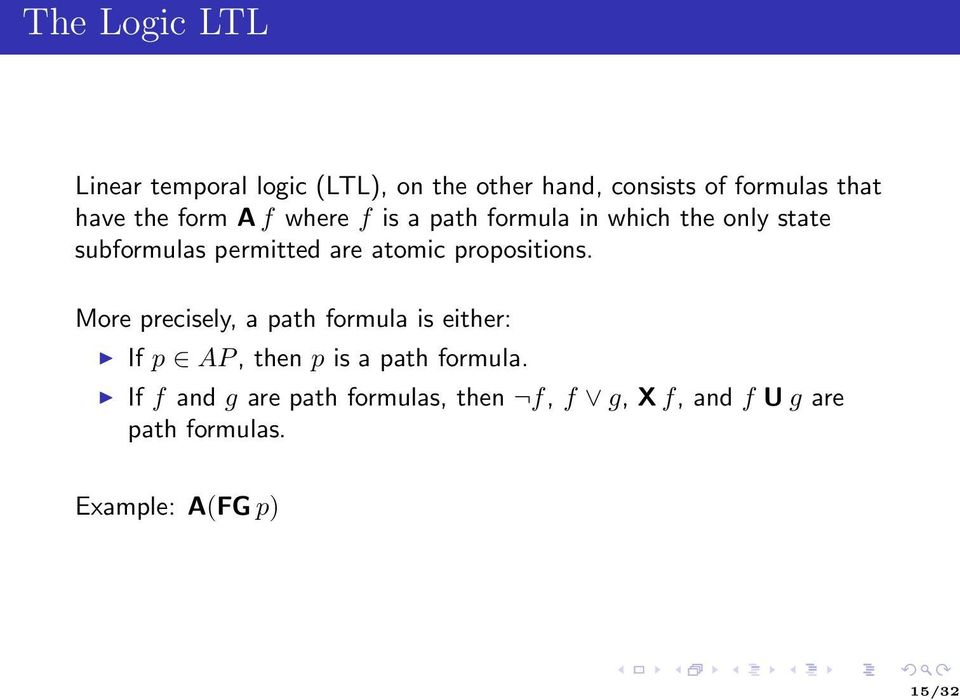
16 16/32 Expressive Power It can be shown that the three logics discussed in this section have different expressive powers For example, there is no CTL formula that is equivalent to the LTL formula A(FG p) Likewise, there is no LTL formula that is equivalent to the CTL formula AG(EF p) The disjunction A(FG p) AG(EF p) is a CTL formula that is not expressible in either CTL or LTL

17 17/32 AF(AG(p)) vs A(FG(p)) Consider the following Kripke structure: Are there any paths starting with S 1 for which G p is true? Starting with S 2? Starting with S 3? At which states does AG p hold true? At which states does AFAG p hold true? Does FGp hold true for all paths starting with S 1?

18 18/32 Basic CTL Operators There are eight basic CTL operators: AX and EX, AG and EG, AF and EF, AU and EU Each of these can be expressed in terms of EX, EG, and EU: AX f = EX( f) AG f = EF( f) AFf = EG( f) EFf = E[true U f] A[f U g] E[ g U f g] EG g

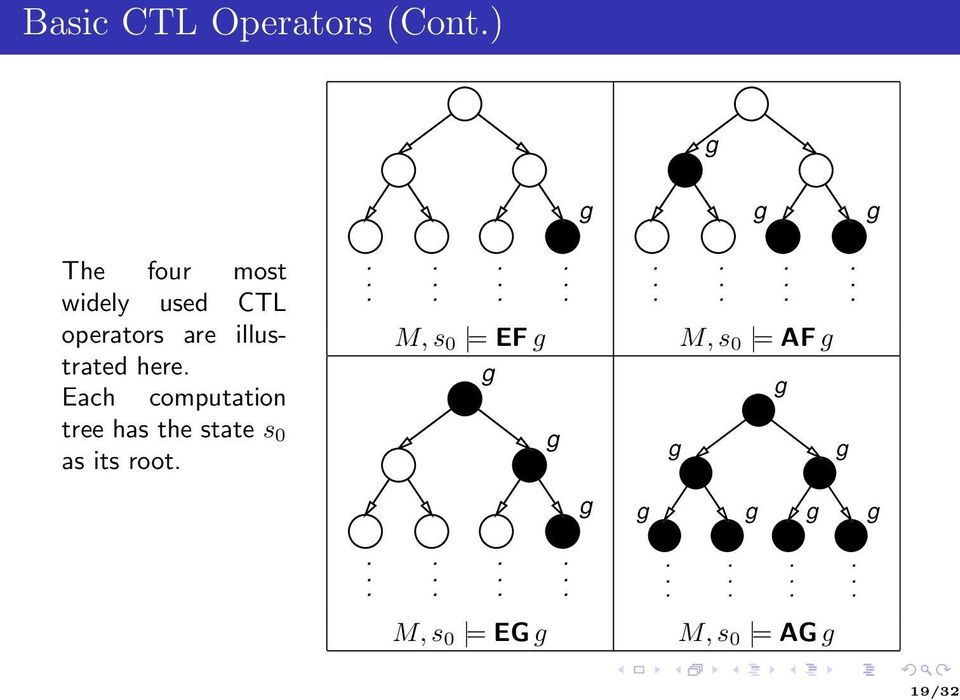
19 Basic CTL Operators (Cont) The four most widely used CTL operators are illustrated here Each computation tree has the state s 0 as its root g g g g M,s 0 = EF g M,s 0 = AFg g g g g g g g g g g M,s 0 = EGg M,s 0 = AG g 19/32
20 20/32 Typical CTL formulas EF(Started Ready): It is possible to get to a state where Started holds but Ready does not hold AG(Req AF Ack): If a request occurs, then it will be eventually acknowledged AG(AF DeviceEnabled): The proposition DeviceEnabled holds infinitely often on every computation path AG(EF Restart): From any state it is possible to get to the Restart state A(GF enabled GF executed): if a process is infinitely-often enabled, then it is infinitely-often executed Note that the first four formulas are CTL formulas

21 21/32 Model Checking Problem Let M be the state transition graph obtained from the concurrent system Let f be the specification expressed in temporal logic Find all states s of M such that M,s = f There exist very efficient model checking algorithms for the logic CTL E M Clarke, E A Emerson, and A P Sistla Automatic verification of finite-state concurrent systems using temporal logic specifications ACM Trans Programming Languages and Systems, 8(2):pages , 1986
22 22/32 The EMC Verification System Preprocessor Model Checker (EMC) CTL formulas State Transition Graph 10 4 to 10 5 states True or Counterexample
23 23/32 Basic Model Checking Algorithm M,s 0 = EG a AFb? M,s 0 = AF a AF b? a ~b ~a b a ~b a b
24 24/32 Basic Model Checking Algorithm M,s 0 = EG a AFb? M,s 0 = AF a AF b? a ~b ~a b AF b AF ~a a ~b a AF b b
25 25/32 Basic Model Checking Algorithm M,s 0 = EG a AFb? M,s 0 = AF a AF b? a ~b ~a b AF b AF ~a a ~b AF b a AF b b
26 26/32 Basic Model Checking Algorithm M,s 0 = EG a AFb? M,s 0 = AF a AF b? a ~b AF b ~a b AF b AF ~a a ~b AF b a AF b b
27 27/32 Basic Model Checking Algorithm M,s 0 = EG a AFb? M,s 0 = AF a AF b? a ~b AF b ~AF ~a ~a b AF b AF ~a a ~b AF b ~AF ~a a b AF b ~AF ~a
28 28/32 Mutual Exclusion Example n1 n2 t1 n2 n1 t2 c1 n2 t1 t2 t1 t2 n1 c2 c1 t2 t1 c2
29 29/32 Mutual Exclusion Example n1 n2 t1 -> AF c1 t1 n2 n1 t2 t1 -> AF c1 c1 n2 AF c1 t1 t2 t1 t2 n1 c2 t1 -> AF c1 c1 AF c1 t2 t1 c2
30 30/32 Mutual Exclusion Example n1 n2 t1 -> AF c1 t1 n2 n1 t2 t1 -> AF c1 c1 n2 AF c1 t1 -> AF c1 t1 t2 AF c1 t1 t2 n1 c2 t1 -> AF c1 c1 t2 AF c1 t1 -> AF c1 t1 c2
31 31/32 Mutual Exclusion Example n1 n2 t1 -> AF c1 t1 AF c1 n2 n1 t2 t1 -> AF c1 c1 n2 AF c1 t1 -> AF c1 t1 t2 AF c1 t1 -> AF c1 t1 t2 n1 c2 t1 -> AF c1 c1 t2 AF c1 t1 -> AF c1 t1 c2
32 32/32 The Kyoto University Verifier Vectorized version of EMC algorithm on Fujitsu FACOM VP400E using an explicit representation of the state transition graph State Machine size: 131,072 states 67,108,864 transitions 512 transitions from each state on the average CTL formula: 113 different subformulas Time for model checking: 225 seconds!!
Introduction to Software Verification
 Introduction to Software Verification Orna Grumberg Lectures Material winter 2013-14 Lecture 4 5.11.13 Model Checking Automated formal verification: A different approach to formal verification Model Checking
logic language, static/dynamic models SAT solvers Verified Software Systems 1 How can we model check of a program or system?
 5. LTL, CTL Last part: Alloy logic language, static/dynamic models SAT solvers Today: Temporal Logic (LTL, CTL) Verified Software Systems 1 Overview How can we model check of a program or system? Modeling
Model Checking: An Introduction
 Announcements Model Checking: An Introduction Meeting 2 Office hours M 1:30pm-2:30pm W 5:30pm-6:30pm (after class) and by appointment ECOT 621 Moodle problems? Fundamentals of Programming Languages CSCI
Temporal Logics. Computation Tree Logic
 Temporal Logics CTL: definition, relationship between operators, adequate sets, specifying properties, safety/liveness/fairness Modeling: sequential, concurrent systems; maximum parallelism/interleaving
Formal Verification and Linear-time Model Checking
 Formal Verification and Linear-time Model Checking Paul Jackson University of Edinburgh Automated Reasoning 21st and 24th October 2013 Why Automated Reasoning? Intellectually stimulating and challenging
T-79.186 Reactive Systems: Introduction and Finite State Automata
 T-79.186 Reactive Systems: Introduction and Finite State Automata Timo Latvala 14.1.2004 Reactive Systems: Introduction and Finite State Automata 1-1 Reactive Systems Reactive systems are a class of software
Software Modeling and Verification
 Software Modeling and Verification Alessandro Aldini DiSBeF - Sezione STI University of Urbino Carlo Bo Italy 3-4 February 2015 Algorithmic verification Correctness problem Is the software/hardware system
Formal Verification by Model Checking
 Formal Verification by Model Checking Natasha Sharygina Carnegie Mellon University Guest Lectures at the Analysis of Software Artifacts Class, Spring 2005 1 Outline Lecture 1: Overview of Model Checking
Software Model Checking: Theory and Practice
 Software Model Checking: Theory and Practice Lecture: Secification Checking - Temoral Logic Coyright 2004, Matt Dwyer, John Hatcliff, and Robby. The syllabus and all lectures for this course are coyrighted
Testing LTL Formula Translation into Büchi Automata
 Testing LTL Formula Translation into Büchi Automata Heikki Tauriainen and Keijo Heljanko Helsinki University of Technology, Laboratory for Theoretical Computer Science, P. O. Box 5400, FIN-02015 HUT, Finland
Algorithmic Software Verification
 Algorithmic Software Verification (LTL Model Checking) Azadeh Farzan What is Verification Anyway? Proving (in a formal way) that program satisfies a specification written in a logical language. Formal
On the Modeling and Verification of Security-Aware and Process-Aware Information Systems
 On the Modeling and Verification of Security-Aware and Process-Aware Information Systems 29 August 2011 What are workflows to us? Plans or schedules that map users or resources to tasks Such mappings may
Formal Verification of Software
 Formal Verification of Software Sabine Broda Department of Computer Science/FCUP 12 de Novembro de 2014 Sabine Broda (DCC-FCUP) Formal Verification of Software 12 de Novembro de 2014 1 / 26 Formal Verification
Development of dynamically evolving and self-adaptive software. 1. Background
 Development of dynamically evolving and self-adaptive software 1. Background LASER 2013 Isola d Elba, September 2013 Carlo Ghezzi Politecnico di Milano Deep-SE Group @ DEIB 1 Requirements Functional requirements
Software Verification and Testing. Lecture Notes: Temporal Logics
 Software Verification and Testing Lecture Notes: Temporal Logics Motivation traditional programs (whether terminating or non-terminating) can be modelled as relations are analysed wrt their input/output
http://aejm.ca Journal of Mathematics http://rema.ca Volume 1, Number 1, Summer 2006 pp. 69 86
 Atlantic Electronic http://aejm.ca Journal of Mathematics http://rema.ca Volume 1, Number 1, Summer 2006 pp. 69 86 AUTOMATED RECOGNITION OF STUTTER INVARIANCE OF LTL FORMULAS Jeffrey Dallien 1 and Wendy
2 Temporal Logic Model Checking
 Bounded Model Checking Using Satisfiability Solving Edmund Clarke 1, Armin Biere 2, Richard Raimi 3, and Yunshan Zhu 4 1 Computer Science Department, CMU, 5000 Forbes Avenue Pittsburgh, PA 15213, USA,
MetaGame: An Animation Tool for Model-Checking Games
 MetaGame: An Animation Tool for Model-Checking Games Markus Müller-Olm 1 and Haiseung Yoo 2 1 FernUniversität in Hagen, Fachbereich Informatik, LG PI 5 Universitätsstr. 1, 58097 Hagen, Germany [email protected]
Model checking test models. Author: Kevin de Berk Supervisors: Prof. dr. Wan Fokkink, dr. ir. Machiel van der Bijl
 Model checking test models Author: Kevin de Berk Supervisors: Prof. dr. Wan Fokkink, dr. ir. Machiel van der Bijl February 14, 2014 Abstract This thesis is about model checking testing models. These testing
Model Checking of Software
 Model Checking of Software Patrice Godefroid Bell Laboratories, Lucent Technologies SpecNCheck Page 1 August 2001 A Brief History of Model Checking Prehistory: transformational programs and theorem proving
Using Patterns and Composite Propositions to Automate the Generation of Complex LTL
 University of Texas at El Paso DigitalCommons@UTEP Departmental Technical Reports (CS) Department of Computer Science 8-1-2007 Using Patterns and Composite Propositions to Automate the Generation of Complex
Checking. E. M. Clarke O. Grumberg K. L. McMillan X. Zhao
 Ecient Generation of Counterexamples and Witnesses in Symbolic Model Checking E. M. Clarke O. Grumberg K. L. McMillan X. Zhao School of Computer Science Computer Science Dept. Cadence Berkeley Labs. School
Schedule. Logic (master program) Literature & Online Material. gic. Time and Place. Literature. Exercises & Exam. Online Material
 OLC mputational gic Schedule Time and Place Thursday, 8:15 9:45, HS E Logic (master program) Georg Moser Institute of Computer Science @ UIBK week 1 October 2 week 8 November 20 week 2 October 9 week 9
Today s Agenda. Automata and Logic. Quiz 4 Temporal Logic. Introduction Buchi Automata Linear Time Logic Summary
 Today s Agenda Quiz 4 Temporal Logic Formal Methods in Software Engineering 1 Automata and Logic Introduction Buchi Automata Linear Time Logic Summary Formal Methods in Software Engineering 2 1 Buchi Automata
Automata-based Verification - I
 CS3172: Advanced Algorithms Automata-based Verification - I Howard Barringer Room KB2.20: email: [email protected] March 2006 Supporting and Background Material Copies of key slides (already
Static Program Transformations for Efficient Software Model Checking
 Static Program Transformations for Efficient Software Model Checking Shobha Vasudevan Jacob Abraham The University of Texas at Austin Dependable Systems Large and complex systems Software faults are major
From Workflow Design Patterns to Logical Specifications
 AUTOMATYKA/ AUTOMATICS 2013 Vol. 17 No. 1 http://dx.doi.org/10.7494/automat.2013.17.1.59 Rados³aw Klimek* From Workflow Design Patterns to Logical Specifications 1. Introduction Formal methods in software
Feature Specification and Automated Conflict Detection
 Feature Specification and Automated Conflict Detection AMY P. FELTY University of Ottawa and KEDAR S. NAMJOSHI Bell Laboratories Large software systems, especially in the telecommunications field, are
The Course. http://www.cse.unsw.edu.au/~cs3153/
 The Course http://www.cse.unsw.edu.au/~cs3153/ Lecturers Dr Peter Höfner NICTA L5 building Prof Rob van Glabbeek NICTA L5 building Dr Ralf Huuck NICTA ATP building 2 Plan/Schedule (1) Where and When Tuesday,
Constructing Automata from Temporal Logic Formulas : A Tutorial
 Constructing Automata from Temporal Logic Formulas : A Tutorial Pierre Wolper Université de Liège, Institut Montefiore, B28, 4000 Liège, Belgium [email protected], http://www.montefiore.ulg.ac.be/~pw/
The Model Checker SPIN
 The Model Checker SPIN Author: Gerard J. Holzmann Presented By: Maulik Patel Outline Introduction Structure Foundation Algorithms Memory management Example/Demo SPIN-Introduction Introduction SPIN (Simple(
A computational model for MapReduce job flow
 A computational model for MapReduce job flow Tommaso Di Noia, Marina Mongiello, Eugenio Di Sciascio Dipartimento di Ingegneria Elettrica e Dell informazione Politecnico di Bari Via E. Orabona, 4 70125
Model Checking based Software Verification
 Model Checking based Software Verification 18.5-2006 Keijo Heljanko [email protected] Department of Computer Science and Engineering Helsinki University of Technology http://www.tcs.tkk.fi/~kepa/ 1/24
Validated Templates for Specification of Complex LTL Formulas
 Validated Templates for Specification of Complex LTL Formulas Salamah Salamah Department of Electrical, computer, Software, and Systems Engineering Embry Riddle Aeronautical University 600 S. Clyde Morris
Formal Verification Problems in a Bigdata World: Towards a Mighty Synergy
 Dept. of Computer Science Formal Verification Problems in a Bigdata World: Towards a Mighty Synergy Matteo Camilli [email protected] http://camilli.di.unimi.it ICSE 2014 Hyderabad, India June 3,
Formal Verification of Computer Systems - (INFO-F-412)
 Formal Verification of Computer Systems - (INFO-F-412) Thierry Massart Université Libre de Bruxelles Département d Informatique February 2013 Acknowledgment I want to thank Edmund Clarke, Keijo Heljanko,
DEGREES OF CATEGORICITY AND THE HYPERARITHMETIC HIERARCHY
 DEGREES OF CATEGORICITY AND THE HYPERARITHMETIC HIERARCHY BARBARA F. CSIMA, JOHANNA N. Y. FRANKLIN, AND RICHARD A. SHORE Abstract. We study arithmetic and hyperarithmetic degrees of categoricity. We extend
Automated Route Planning for Milk-Run Transport Logistics with the NuSMV Model Checker
 IEICE TRANS. INF. & SYST., VOL.E96 D, NO.12 DECEMBER 2013 2555 PAPER Special Section on Parallel and Distributed Computing and Networking Automated Route Planning for Milk-Run Transport Logistics with
Fixed-Point Logics and Computation
 1 Fixed-Point Logics and Computation Symposium on the Unusual Effectiveness of Logic in Computer Science University of Cambridge 2 Mathematical Logic Mathematical logic seeks to formalise the process of
INF5140: Specification and Verification of Parallel Systems
 Motivation INF5140: Specification and Verification of Parallel Systems Lecture 1 Introduction: Formal Methods Gerardo Schneider Department of Informatics University of Oslo INF5140, Spring 2009 Outline
LTL Model Checking with Logic Based Petri Nets
 LTL Model Checking with Logic Based Petri Nets Tristan M. Behrens and Jürgen Dix IfI Technical Report Series IfI-07-04 Impressum Publisher: Institut für Informatik, Technische Universität Clausthal Julius-Albert
10.2 Series and Convergence
 10.2 Series and Convergence Write sums using sigma notation Find the partial sums of series and determine convergence or divergence of infinite series Find the N th partial sums of geometric series and
Model Checking LTL Properties over C Programs with Bounded Traces
 Noname manuscript No. (will be inserted by the editor) Model Checking LTL Properties over C Programs with Bounded Traces Jeremy Morse 1, Lucas Cordeiro 2, Denis Nicole 1, Bernd Fischer 1,3 1 Electronics
Runtime Verification of Concurrent Haskell Programs
 Runtime Verification of Concurrent Haskell Programs Volker Stolz RWTH Aachen University, 52056 Aachen, Germany Frank Huch Christian-Albrecht-University of Kiel, 24118 Kiel, Germany Abstract In this article
INF5140: Specification and Verification of Parallel Systems
 INF5140: Specification and Verification of Parallel Systems Lecture 7 LTL into Automata and Introduction to Promela Gerardo Schneider Department of Informatics University of Oslo INF5140, Spring 2007 Gerardo
Mathematics for Computer Science/Software Engineering. Notes for the course MSM1F3 Dr. R. A. Wilson
 Mathematics for Computer Science/Software Engineering Notes for the course MSM1F3 Dr. R. A. Wilson October 1996 Chapter 1 Logic Lecture no. 1. We introduce the concept of a proposition, which is a statement
Rigorous Software Development CSCI-GA 3033-009
 Rigorous Software Development CSCI-GA 3033-009 Instructor: Thomas Wies Spring 2013 Lecture 11 Semantics of Programming Languages Denotational Semantics Meaning of a program is defined as the mathematical
Software Engineering using Formal Methods
 Software Engineering using Formal Methods Model Checking with Temporal Logic Wolfgang Ahrendt 24th September 2013 SEFM: Model Checking with Temporal Logic /GU 130924 1 / 33 Model Checking with Spin model
Combining Software and Hardware Verification Techniques
 Formal Methods in System Design, 21, 251 280, 2002 c 2002 Kluwer Academic Publishers. Manufactured in The Netherlands. Combining Software and Hardware Verification Techniques ROBERT P. KURSHAN VLADIMIR
tutorial: hardware and software model checking
 tutorial: hardware and software model checking gerard holzmann and anuj puri { gerard anuj } @research.bell-labs.com Bell Labs, USA outline introduction (15 mins) theory and algorithms system modeling
Model Based Testing for Security Checking. Wissam Mallouli and Prof. Ana Cavalli National Institute of Telecommunications, France November 21, 2007
 Model Based Testing for Security Checking Wissam Mallouli and Prof. Ana Cavalli National Institute of Telecommunications, France November 21, 2007 Outline Introduction Active/Passive Testing Active Testing
CISC422/853: Formal Methods
 Outline CISC422/853: Formal Methods in Software Engineering: Computer-Aided Verification Topic 7: Specifying, or How to Describe How the System Should (or Should Not) Behave Juergen Dingel Feb, 2009 Readings:
A Propositional Dynamic Logic for CCS Programs
 A Propositional Dynamic Logic for CCS Programs Mario R. F. Benevides and L. Menasché Schechter {mario,luis}@cos.ufrj.br Abstract This work presents a Propositional Dynamic Logic in which the programs are
Automata-Based Verification of Temporal Properties on Running Programs Dimitra Giannakopoulou Klaus Havelund
 Automata-Based Verification of Temporal Properties on Running Programs Dimitra Giannakopoulou Klaus Havelund RIACS Technical Report 01.21 August 2001 Presented at the 16 th IEEE International Conference
Introduction to SPIN. Acknowledgments. Parts of the slides are based on an earlier lecture by Radu Iosif, Verimag. Ralf Huuck. Features PROMELA/SPIN
 Acknowledgments Introduction to SPIN Parts of the slides are based on an earlier lecture by Radu Iosif, Verimag. Ralf Huuck Ralf Huuck COMP 4152 1 Ralf Huuck COMP 4152 2 PROMELA/SPIN PROMELA (PROcess MEta
Foundational Proof Certificates
 An application of proof theory to computer science INRIA-Saclay & LIX, École Polytechnique CUSO Winter School, Proof and Computation 30 January 2013 Can we standardize, communicate, and trust formal proofs?
A Classification of Model Checking-based Verification Approaches for Software Models
 A Classification of Model Checking-based Verification Approaches for Software Models Petra Brosch, Sebastian Gabmeyer, Martina Seidl Sebastian Gabmeyer Business Informatics Group Institute of Software
Finding Liveness Errors with ACO
 Finding Liveness Errors with ACO Francisco Chicano and Enrique Alba Abstract Model Checking is a well-known and fully automatic technique for checking software properties, usually given as temporal logic
CHAPTER 7 GENERAL PROOF SYSTEMS
 CHAPTER 7 GENERAL PROOF SYSTEMS 1 Introduction Proof systems are built to prove statements. They can be thought as an inference machine with special statements, called provable statements, or sometimes
The University of Jordan
 The University of Jordan Master in Web Intelligence Non Thesis Department of Business Information Technology King Abdullah II School for Information Technology The University of Jordan 1 STUDY PLAN MASTER'S
Monitoring Metric First-order Temporal Properties
 Monitoring Metric First-order Temporal Properties DAVID BASIN, FELIX KLAEDTKE, SAMUEL MÜLLER, and EUGEN ZĂLINESCU, ETH Zurich Runtime monitoring is a general approach to verifying system properties at
Stylianos Basagiannis
 Interlocking control by Distributed Signal Boxes Technical Report (TR) 4 Stylianos Basagiannis Supervisors: Dr Andrew Pombortsis, Dr Panagiotis Katsaros Aristotle University of Thessaloniki Department
VeriTech - A Framework for Translating among Model Description Notations
 Software Tools for Technology Transfer manuscript No. (will be inserted by the editor) VeriTech - A Framework for Translating among Model Description Notations Orna Grumberg and Shmuel Katz Computer Science
Specification and Analysis of Contracts Lecture 1 Introduction
 Specification and Analysis of Contracts Lecture 1 Introduction Gerardo Schneider [email protected] http://folk.uio.no/gerardo/ Department of Informatics, University of Oslo SEFM School, Oct. 27 - Nov.
Turing Degrees and Definability of the Jump. Theodore A. Slaman. University of California, Berkeley. CJuly, 2005
 Turing Degrees and Definability of the Jump Theodore A. Slaman University of California, Berkeley CJuly, 2005 Outline Lecture 1 Forcing in arithmetic Coding and decoding theorems Automorphisms of countable
Digital Design Verification
 Digital Design Verification Course Instructor: Debdeep Mukhopadhyay Dept of Computer Sc. and Engg. Indian Institute of Technology Madras, Even Semester Course No: CS 676 1 Verification??? What is meant
TO APPEAR IN: IEEE TRANSACTIONS ON DEPENDABLE AND SECURE COMPUTING 1. Proactive Detection of Computer Worms Using Model Checking
 TO APPEAR IN: IEEE TRANSACTIONS ON DEPENDABLE AND SECURE COMPUTING 1 Proactive Detection of Computer Worms Using Model Checking Johannes Kinder, Stefan Katzenbeisser, Member, IEEE, Christian Schallhart,
Chapter 4 Lecture Notes
 Chapter 4 Lecture Notes Random Variables October 27, 2015 1 Section 4.1 Random Variables A random variable is typically a real-valued function defined on the sample space of some experiment. For instance,
Verifying Real-Time Embedded Software by Means of Automated State-based Online Testing and the SPIN Model Checker Application to RTEdge Models
 Verifying Real-Time Embedded Software by Means of Automated State-based Online Testing and the SPIN Model Checker Application to RTEdge Models A thesis submitted to the Faculty of Graduate and Postdoctoral
Runtime Verification - Monitor-oriented Programming - Monitor-based Runtime Reflection
 Runtime Verification - Monitor-oriented Programming - Monitor-based Runtime Reflection Martin Leucker Technische Universität München (joint work with Andreas Bauer, Christian Schallhart et. al) FLACOS
Continued Fractions and the Euclidean Algorithm
 Continued Fractions and the Euclidean Algorithm Lecture notes prepared for MATH 326, Spring 997 Department of Mathematics and Statistics University at Albany William F Hammond Table of Contents Introduction
Counterexample-guided Design of Property-based Dynamic Software Updates
 Counterexample-guided Design of Property-based Dynamic Software Updates Min Zhang 20141015 Min Zhang (JAIST) Counterexample-guided Design of Property-based Dynamic Software Updates 20141015 [1/45] Contents
Semantics and Verification of Software
 Semantics and Verification of Software Lecture 21: Nondeterminism and Parallelism IV (Equivalence of CCS Processes & Wrap-Up) Thomas Noll Lehrstuhl für Informatik 2 (Software Modeling and Verification)
Formal Verification Coverage: Computing the Coverage Gap between Temporal Specifications
 Formal Verification Coverage: Computing the Coverage Gap between Temporal Specifications Sayantan Das Prasenjit Basu Ansuman Banerjee Pallab Dasgupta P.P. Chakrabarti Department of Computer Science & Engineering
Introducing Formal Methods. Software Engineering and Formal Methods
 Introducing Formal Methods Formal Methods for Software Specification and Analysis: An Overview 1 Software Engineering and Formal Methods Every Software engineering methodology is based on a recommended
Software Model Checking. Equivalence Hierarchy
 Software Equivalence Hierarchy Moonzoo Kim CS Dept. KAIST CS750B Software Korea Advanced Institute of Science and Technology Equivalence semantics and SW design Preliminary Hierarchy Diagram Trace-based
FACTORING POLYNOMIALS IN THE RING OF FORMAL POWER SERIES OVER Z
 FACTORING POLYNOMIALS IN THE RING OF FORMAL POWER SERIES OVER Z DANIEL BIRMAJER, JUAN B GIL, AND MICHAEL WEINER Abstract We consider polynomials with integer coefficients and discuss their factorization
Program Synthesis is a Game
 Program Synthesis is a Game Barbara Jobstmann CNRS/Verimag, Grenoble, France Outline Synthesis using automata- based game theory. MoBvaBon, comparison with MC and LTL. Basics Terminology Reachability/Safety
Path Querying on Graph Databases
 Path Querying on Graph Databases Jelle Hellings Hasselt University and transnational University of Limburg 1/38 Overview Graph Databases Motivation Walk Logic Relations with FO and MSO Relations with CTL
Fundamentals of Software Engineering
 Fundamentals of Software Engineering Model Checking with Temporal Logic Ina Schaefer Institute for Software Systems Engineering TU Braunschweig, Germany Slides by Wolfgang Ahrendt, Richard Bubel, Reiner
University of Ostrava. Reasoning in Description Logic with Semantic Tableau Binary Trees
 University of Ostrava Institute for Research and Applications of Fuzzy Modeling Reasoning in Description Logic with Semantic Tableau Binary Trees Alena Lukasová Research report No. 63 2005 Submitted/to
The Goldberg Rao Algorithm for the Maximum Flow Problem
 The Goldberg Rao Algorithm for the Maximum Flow Problem COS 528 class notes October 18, 2006 Scribe: Dávid Papp Main idea: use of the blocking flow paradigm to achieve essentially O(min{m 2/3, n 1/2 }
CS Master Level Courses and Areas COURSE DESCRIPTIONS. CSCI 521 Real-Time Systems. CSCI 522 High Performance Computing
 CS Master Level Courses and Areas The graduate courses offered may change over time, in response to new developments in computer science and the interests of faculty and students; the list of graduate