
Product Costing Guidelines
|
|
|
- Piers Farmer
- 9 years ago
- Views:
Transcription
1 Product Costing Guidelines Integrated Product Development (IPD) OMS/IOE 548, ArtDes 300 University of Michigan October 2005 Revised November 2008, November 2010 Compiled by William Lovejoy Sebastian Fixson Shaun Jackson

2 Table of Contents 1 Introduction Required Costing Documents Process Descriptions Casting processes Sand casting Investment casting Thermoset casting Die casting Molding Processes Injection Molding Blow molding (Extrusion) Compression molding Insert molding Rotational molding Thermoforming (Vacuum forming) Bulk Deforming Processes Extrusion Stamping Sheet metal forming Rod, pipe or tube bending Machining Processes Joining Processes Clinching Press fit Sewing Shrink fit Snap fits (including retaining rings) Threaded fasteners Adhesive bonding Brazing (Silver brazing) Gas welding (Tungsten inert gas) Vinyl bonding Hand Assembly Paperboard packaging

3 1 Introduction This document describes the economics of common manufacturing processes, and some design considerations and constraints for each. It contains a list of processes and the following information for each: description of the process, cost information, design guidelines, and sources for further information. The list of processes allows a selection from a large set of existing possibilities. If you decide to use a process not listed here, often one of the listed processes can serve as a baseline from which you can develop your own proposed costing data. If you develop your own cost models to estimate the cost of your product, your model should be validated by the instructors. The design guidelines are meant to avoid stark mistakes. To master any particular manufacturing process obviously requires much more in-depth knowledge. However, this broad overview can suggest the choice of economical processes and help avoid unnecessarily costly product designs

4 2 Required Costing Documents The costing documents to be handed in with your fully functional prototype must include the following: a) Summary Excel page that shows for all parts in the product, no matter how small, its fixed tooling and variable manufacturing, procurement or assembly cost. The list should also indicate for each part where (what page number) to look in the costing documentation for detailed costing information. The final fixed and variable cost should be reported clearly in summary form on this spreadsheet. b) On the internal pages indicated on the summary page, justify the reported fixed and variable cost for each part or subassembly. For sourced parts, this means justifying your costs with receipts or valid quotes (DO NOT abuse vendors, be honest about your intentions in all interactions with vendors). For manufactured parts (this should be most of them) use these costing guidelines and clearly show your assumptions and calculations. For assembly costs, show the sequence (a sketch is clear) of steps to assemble parts into subassemblies, and subassemblies into your finished product. Use the costing guidelines to cost out the steps. Finishing operations. Provide the necessary buffing, painting, etc. activities and cost them out using these guidelines. c) Any additional documentation relevant to support the product cost estimate. In practice, unclear or confusing documentation results in miscommunication, errors and rework. Therefore, the instructors will adjust your variable cost based on the accuracy, clarity and completeness of your costing documentation relative to those handed in by other teams

5 3 Process Descriptions 3.1 Casting processes Sand casting a) Process description and potential materials Process description Sand casting can be used for just about any metal that can be melted. A sand mold is formed by packing sand around a wood or metal pattern which has the same shape as the part to be cast. The pattern, and the sand box that it is embedded in, are usually made in two halves that can be separated to remove the pattern once the sand is packed in, and holes are made for pouring molten metal in and for allowing gas to escape. Metal is melted, poured into the holes to fill the mold, and it is left to cool. When the cast part has cooled, the box is opened and the part removed. The sand is disturbed when the part is removed, so that the set up operation must be repeated for each part. Hence, variable costs tend to be high for sand casting, and this method is usually used for large parts in low volumes that, because of their size, are not suitable for other processes. Sand castings tend to have a grainy surface with poor dimensional control. Most often castings are machined in post processing operations for smoothness and dimensional integrity. Process schematic <Source: CES (Cambridge Engineering Selector) Ver. 4.5> - 3 -

6 Process flow chart Pattern making Mate rial melting Pouring Cleaning, Inspection, etc Removal Solidification / Cooling Material Used for a wide range of metal alloys including aluminum and copper alloys, cast irons and steels. In principle, any non-reactive, non-refractory metal (Tm < 2000K) can be used b) Costing information Fixed cost: Machine n patterns. The cost of a set of identical pattern impressions is given by C = R ( 0.313N 0.085A ) n pi t sp + p where, R t = toolmaking (pattern shop) rate, assume this to be 40 $/h N sp = number of surface patches (see below) A p = projected area of impressions, cm 2 (in 2 = cm 2 ) n = number of identical impressions N sp (the number of surface patches ) is the number or continuous areas on the part, that can be machined without lifting the tool. For example, a simple disk will have three: the top surface, the bottom surface, and the edge. A disk with a hole in the middle will have four patches. Variable costs per pour: The inputs to the costing model are: N = number of cavities you will fill per cycle (less than or equal to 100). n = number of patterns that you manufacture (less than or equal to N). V = volume of the part to be cast, in in^3. A = floor area taken up by the box holding the sand and the part. Assume a rectangular box that has 2 clearance on all sides from the pattern. ρ = Material density (lb/in^3) m = dollar cost of material ($/lb) Materials cost per pour: The material cost for N parts in a pour will 1.03NmρV dollars. This assumes 2% waste. Set up N cavities: Charge yourself N/n dollars

7 Ladle the molten metal: Charge yourself.03n dollars. Allow to cool: Charge yourself.008na dollars Variable cost per part: Divide the variable cost per pour by N. Example: You want to make a part out of medium cast iron which costs $.73/lb and has a density of.258 lb/in^3. The part has a volume of 8 cubic inches and a projected area of the sand box equal to 36 square inches. Pattern has 1 surface patch. You decide to make 10 parts per pour (N=10). You machine one pattern (n=1) and intend to set up the sand boxes sequentially using your one pattern. The sand casting costs for this part will be as follows: Fixed cost: (40)( ( ) 1.2 ) = $2,360 Variable costs per pour of 10 parts: Materials: (1.02)(10)(.73)(.258)(8) = $ Set up: 10/1 = $10. Ladling: (.03)(10) = $.30. Cooling: (.008)(10)(36) = $2.88. Total per pour = = $ Total per part = 28.55/10 = $2.85. So for this part you would report a fixed tooling cost of $2,360 and a variable cost per part of $2.85. If you wanted a nice surface finish or if some aspects of the part had to conform to tight tolerances, you would have to add the cost of some post-processing machining steps to each part. If you decided to machine 10 patterns (so n = 10), you would increase the fixed cost to $11,828, but the variable cost would be reduced by nine dollars per pour (N/1 - N/n = 10-1 = 9), and would equal $19.55 per pour or $1.96 per part. In this example, if you were making 100,000 parts the optimal number of pattern made would be 11 (or, approximately 10). The figures for various N are as follows. F (Fixed cost / pattern) = $2,360 T (Total production volume) = 100,000 n* (Optimal pattern made) = (T/0.7F)^(1/1.7) = 11 N n* (n* <= N) Fixed Variable Total cost at 100,000 parts - 5 -

8 1 1 2, , , , , , , , , , , , , , , , , , , , , , , ,328 n* = optimal number of patterns to manufacture given that you want to produce 100,000 parts. c) Design guideline Bosses, undercuts, inserts and hollow sections are all practical. Shapes are frequently solid but complex internal shapes can be made using cores. Sand casting is not the best way to go for high volume parts, since the variable costs are usually high. d) Data Sources / Sources for further Information CES (Cambridge Engineering Selector) Ver. 4.5, Software Geoffrey Boothroyd, Peter Dewhurst, Winston Knight (2002). Product Design for Manufacture and Assembly. New York, Marcel Dekker. Robert C. Creese, M. Adithan, B.S. Pabla. (1992). Estimating and Costing for the Metal Manufacturing Industries. New York, Marcel Dekker

9 3.1.2 Investment casting a) Process description and potential materials Process description In investment casting, wax patterns are made by injection molding into a metal die and then assembled on a tree with feeding and gating systems. The wax pattern is dipped into a refractory slurry, then covered in a refractory stucco, and allowed to dry for a number of hours. This procedure is repeated a number of times, usually until about 8 coats of refractory have been achieved. This is the ceramic investment shell. The wax is then melted out - preferably in a steam autoclave. The ceramic shell is fired to around 1000C and then the molten metal is cast into it. Air pressure, vacuum or centrifugal pressure can be used to ensure complete filling of the mold when complex, thin sections are involved. The mold is broken up to remove the castings. The process is suitable for most metals with melting points below 2500K. Because the wax pattern is melted out, shapes can be very complex with contours, undercuts, bosses, recesses, etc. The process requires precision tooling for making the wax patterns and involves many steps which are time consuming, and therefore, it is expensive. The process is also known as the Lost Wax Process. Process schematic <Source: CES (Cambridge Engineering Selector) Ver. 4.5> - 7 -

10 Process flow chart Wax pattern making (Injection molding) Pattern cooling Mate rial melting Pouring Cleaning, Inspection, etc Removal Solidification / Cooling Material Suitable for a wide range of ferrous, non-ferrous and special alloys. b) Costing information Begin by understanding the sand casting costing method, and then make the following adjustments. Fixed cost: Cost out the tool that makes the wax patterns as if you were injection molding the pattern, using the injection molding guideline. Take the fixed tooling cost from the injection molding module. Ignore the variable costs from that module. Variable costs: The wax cannot be reused, so n = N. Add $.25/part for the wax cooling time and handling. Everything else is as in the sand casting costing guidelines. c) Design guidelines Very complex shapes with contours, undercuts, bosses, recesses, etc. Best for small 3-D shapes. You can get better surface finishes and hold tighter tolerances with investment casting, so that you may be able to eliminate post-processing operations. d) Data Sources / Sources for further Information CES (Cambridge Engineering Selector) Ver. 4.5, Software Geoffrey Boothroyd, Peter Dewhurst, Winston Knight (2002). Product Design for Manufacture and Assembly. New York, Marcel Dekker. Robert C. Creese, M. Adithan, B.S. Pabla. (1992). Estimating and Costing for the Metal Manufacturing Industries. New York, Marcel Dekker

11 3.1.3 Thermoset casting a) Process description and potential materials Process description Thermosets are plastics that are formed by mixing two compounds and letting them harden. If the plastic is poured into a mold prior to hardening, then the resulting solid will take the shape of the mold cavity. Thermosets are not recyclable, so that scrap is wasted instead of being cut up and re-used in the manufacturing process. The processing advantage of thermosets is that the molds can be stacked while they harden, so that the time spent in hardening is not time taken on an expensive machine (as in the cooling time in injection molding), but time taken stacked on the floor somewhere. Hence, this is a good process to consider for parts that are very thick and would require long cooling times if injection molded. Process schematic Catalyzed thermoset Simple metal mold Male shape form metal, wood, plaster, et.c Process flow chart Cavity making Compounds melting & mixing Pouring Unstacking & Removal Drying / Hardening Stacking Material Thermoset plastics - 9 -

12 b) Costing information The costs associated with thermoset casting involve: 1) Creation of the mold cavity, and cover if necessary. 2) Material costs. 3) Pouring the compounds. 4) Stacking the molds for drying. 5) Usage of storage volume while the plastic hardens. 6) Unstacking the molds. We will cost out the materials at the volume required plus 3% wastage. We will cost out the creation of the mold cavities using the IPD machining guidelines. The opportunity cost for storage space will be presumed to be $5 per square foot for each cooling (setting) cycle. Assume at least a 10-cavity tool, and determine the flat surface area per tool by laying out the cavities and leaving a 2 buffer between parts and between the parts and the sides of the tool. Assume that you can stack tools 10 high. So, if you make one tool with 10-cavities it will cost $(5/10)xA = $.5A in setting time per cavity (part). If you make 2 tools the cost per cavity is $(5/20)xA = $.25A. If you make 10 such tools and stack them it will still take just A square feet of floor area, and cost you $(5/100)xA = $.05A in setting time per cavity (part). In general if you build N 10-cavity tools, your setting time cost will be (5/(10N))xA = A/(2N) $ per part. We will assume that the time to mix a batch for an entire production run is, on a per-cavity basis, negligible (for high volume production, you could mix one huge batch and drive this cost per part practically to zero). The variable labor costs come from pouring the compound into the cavities. Assume this takes 15 seconds per pour, and cost out this time at $45/hour. Hence, the labor cost per cavity (part) will $ In summary your costs will be as follows. Fixed tooling cost: Cost out tooling cost using tooling cost in machining guideline. If you make N 10-cavity tools in total and the cost per cavity is C $\cavity, then your fixed cost = 10NC $. Variable costs per part: Cost = 1.03M + A/(2N) $/part. Where N = number of 10-cavity molds you manufacture M = material cost for the volume of material used in each part (cavity) ($). A= floor area taken up by a single 10-cavity mold (ft^2). Example A part with volume 9 cubic inches will be made from a thermoset plastic. 9 cubic inches of this plastic costs $.74 (= M). The material cost per part will be 1.03(.74) = $

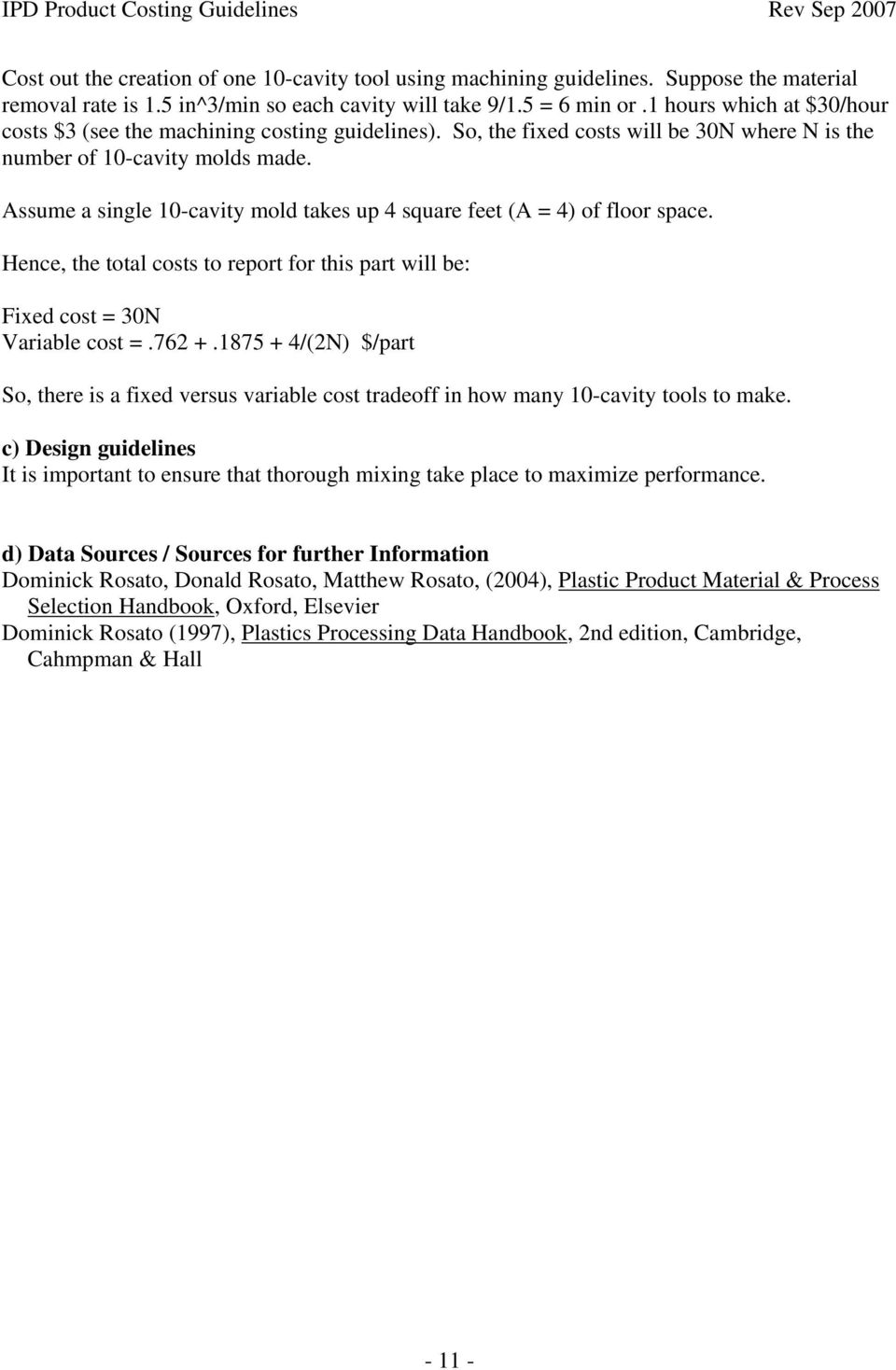
13 Cost out the creation of one 10-cavity tool using machining guidelines. Suppose the material removal rate is 1.5 in^3/min so each cavity will take 9/1.5 = 6 min or.1 hours which at $30/hour costs $3 (see the machining costing guidelines). So, the fixed costs will be 30N where N is the number of 10-cavity molds made. Assume a single 10-cavity mold takes up 4 square feet (A = 4) of floor space. Hence, the total costs to report for this part will be: Fixed cost = 30N Variable cost = /(2N) $/part So, there is a fixed versus variable cost tradeoff in how many 10-cavity tools to make. c) Design guidelines It is important to ensure that thorough mixing take place to maximize performance. d) Data Sources / Sources for further Information Dominick Rosato, Donald Rosato, Matthew Rosato, (2004), Plastic Product Material & Process Selection Handbook, Oxford, Elsevier Dominick Rosato (1997), Plastics Processing Data Handbook, 2nd edition, Cambridge, Cahmpman & Hall
14 3.14 Die casting Die casting is essentially the same process as injection molding, except that metals are cast rather than plastics. See the injection molding section for a general description of the process. The IPD die casting cost model uses the same inputs as injection molding, and costs out tooling in the same fashion. The only significant difference is that cooling times in die casting are less driven by maximal wall thickness, because of the high conductivity of most metals. Also, for the same reason, some care must be taken to keep the part from cooling too rapidly, preventing a complete pour from being completed successfully. The model for die casting is the same as for injection molding except the cooling time is computed as a linear (rather than quadratic) function of maximal part wall thickness: T c = β h max (seconds) Where the appropriate β for different metals is Metal β Zinc alloys.4 Aluminum alloys.47 Copper alloys.63 Magnesium alloys.31 SUMMARY (see detailed instructions in injection molding section for these inputs) The fixed tooling cost is the base cost plus the mold machining cost where Base cost = x A x (d+6)^(.4) ($) Mold machining cost = 75 A^ *( *SP)^ *A^(1.2) ($) A = projected area (in^2) d = part depth (in) SP = number of surface patches on the part The variable cost per part is the materials cost plus the cooling time cost (at $60/hour for the machine) which are as follows: Materials = 1.03*(cost of material for one shot) ($/shot) Machine cooling time cost = β h max /60 ($/shot) If you make more than one part per shot, input the projected area and the volume and maximal wall thickness for the entire part family. Data Sources / Sources for further Information Boothroyd, G, P. Dewhurst and W. Knight. Product Design for Manufacture and Assembly. Dekker,

15 3.2 Molding Processes Injection Molding a) Process description and potential materials Process description Injection molded products appear in every sector of product design: consumer products, business, industrial, computers, communication, medical and research products, toys, cosmetic packaging and sports equipment. The most common equipment for molding thermoplastics is the reciprocating screw machine, shown schematically in the figure. Polymer granules are fed into a spiral press where they mix and soften to a dough-like consistency that can be forced through one or more channels ('sprues') into the die. The polymer solidifies under pressure and the component is then ejected. Process Schematic <Source: CES (Cambridge Engineering Selector) Ver. 4.5> Injection molding is the best way to mass-produce small, precise, polymer components with complex shapes. The surface finish is good; texture and pattern can be easily altered in the tool,

16 and fine detail reproduces well. Decorative labels can be molded onto the surface of the component (see In-mould Decoration). The only finishing operation is the removal of the sprue. Injection Molding Cycle Injection Time Cooling Time Pressure Discharge Time Sealed Cooling Sealing Point Mold reset time Packing Time Time Materials Thermoplastics, thermosets and elastomers can all be injection molded. Co-injection allows molding of components with different materials, colors and features. Injection foam molding allows economical production of large molded components by using inert gas or chemical blowing agents to make components that have a solid skin and a cellular inner structure. b) Costing information Injection molding requires relative expensive tooling. For this reason, injection molding is suited for large production volumes. Production rate can be high particularly for small moldings. Multi-cavity molds are often used. Prototype moldings can be made using single cavity molds of cheaper materials. The costs of injection molding are mainly driven by the materials cost, the required equipment (press) the cycle time on the machine, and the required (and dedicated) tooling. Equipment Size The equipment size is determined by the clamp force which is determined by the part size and the number of cavitities. However, we are not going to model the different machine sizes and costs explicitly in IPD. Molding Cycle Time The molding cycle time on the machine consists of the injection time (which depends on the shot size and machine power, but is usually small: 1-2 secs) and the cooling time (this usually

17 dominates). The cooling time can be approximated as follows, which is largely driven by the square of the maximal wall thickness: Cooling Time t c 2 hmax = log πα e 4( T T i π ( T x T m) m) s h max = maximum wall thickness T x = recommended part ejection temperature, C T m = recommended mold temperature temperature, C T i = polymer injection temperature, C alpha = thermal diffusivity coefficient, mm 2 /s However, we will use a simplified model. See the variable cost section below. Mold Cost Estimation The mold cost consists of the cost of the mold base, and the cost of the cavity and core fabrication. We will approximate these costs using simplified versions of the logic in Botthroyd, Dewhurst and Knight (2002) Mold base cost The mold base cost is the cost of basic material that will be machined to make the part. This depends on the projected area of your part(s) and the depth needed. To get these numbers, draw your part within square, as if you are looking down on the tool seeing is length and width, but not depth. That is, sketch the outlines of the parts and draw a square around it (or them, if you are making multiple parts with one shot). Leave 2 between any part and any other part, and any part and the edge of the square. This 2 leeway is to leave room for runners, cooling channels, and other things that a tool requires. So, for example, if you are going to make 5 parts in one shot you will have 5 cavities all of which are at least 2 from each other and 2 from the edge of the circumscribing square. Define A = projected area (in^2) = the area of the square enclosing the parts, including 2 boundary on all sides. d = part depth (in), this comes from measuring the depth of the actual part, as it will lie in the box. There is no need to add a boundary to this, just measure the part itself. The mold base cost will be Cost = A (d+6)^(.4) $ Cavity and Core Manufacturing Costs The following activities during mold manufacturing are major cost drivers: - Cavity milling - Deep hole drilling for cooling channels

18 - Side action - Ejector system Boothroyd, Dewhurst and Knight cite a number of studies that estimate the mold costs as a function of various inputs. For example, the number of ejector pins needed in a tool is roughly equal to the square root of the projected area. And, a rough estimate is 2.5 manufacturing hours per ejector pin for the ejector system. Costing out this labor at $30/hour yields a cost for the ejector system of (30)(2.5)(A)^.5 = 75 A^.5 ($) where A = projected area of the box described above. The complexity of the part is determined by its number of surface patches, which are continuous surfaces that a tool can traverse without lifting. This determines the bulk of the machining costs, so count these carefully. The machining cost will be 2700( SP)^1.27 ($) where SP = number of surface patches. In addition to its complexity, the size of the mold affects the machining costs by adding the term A^1.2 ($) to the tool cost. So, in summary, the cost to manufacture the mold is 75 A^ *( *SP)^ *A^(1.2) ($) A = projected area (in^2) SP = number of surface patches. Summary of fixed cost for injection molding The total fixed cost for injection molding will be the base cost plus the machining cost, where Base cost = x A x (d+6)^(.4) ($) Mold machining cost = 75 A^ *( *SP)^ *A^(1.2) ($) A = projected area (in^2) d = part depth (in) SP = number of surface patches on the part

19 Variable costs The variable cost per part produced is the material cost plus the machine time cost. The machine time cost is driven by cooling time, which in turn depends on the square of the maximal wall thickness. Here are the models to use: Materials Compute the volume of material in each shot (the sum of the part volumes in each shot, if just one part is made per shot it is the part volume) and multiply 1.03 to account for scrap rate and runner losses. Machine time The heat transfer equation above can be approximated in simplified form to estimate the cooling time (in seconds) as 131 hmax^2/alpha (sec) where alpha = thermal diffusivity from the chart below (mm^2/sec) hmax = maximal wall thickness (inches) We charge $60/hour machine time, so the cost will be 2.18 hmax^2/alpha ($/ shot) Summary of injection molding variable cost Materials = 1.03*(cost of material for one shot) ($/shot) Machine time cost = 2.18 hmax^2/alpha ($/shot) Where alpha = thermal diffusivity from chart (in mm^2/sec) hmax = max wall thickness (inches) You can get thermal diffusivities for some common injection molded materials from the following table from Boothroyd, Dewhurst and Knight as follows:

20 Injection molding data (Data from BDK 2002, p. 358) Thermal Injection Mold Ejection Injection Approx Specificdiffusivity temp temp temp pressure cost Thermoplastic gravity (mm^2/s) (C) (C) (C) (bars) ($/kg) High-density polyethylene High-impact polystyrene Acrylonitrile-butadien-styrene (ABS) Acetal (homopolymer) Polyamide (6/6 nylon) Polycarbonate Polycarbonate (30% glass) Modified polyphenylene oxide (PPO) Modified PPO (30% glass) Polypropylene (40% talc) Polyester terephtalate (30% glass) For materials not on this list, you will have to find and document its material properties. SUMMARY The fixed tooling cost is the base cost plus the mold machining cost where Base cost = x A x (d+6)^(.4) ($) Mold machining cost = 75 A^ *( *SP)^ *A^(1.2) ($) A = projected area (in^2) d = part depth (in) SP = number of surface patches on the part The variable cost per part is the materials cost plus the cooling time cost where Materials = 1.03*(cost of material for one shot) ($/shot) Machine cooling time cost = 2.18 hmax^2/alpha ($/shot) If you make n parts on each shot, the variable cost per part is the ($/shot) divided by n. c) Design Guidelines Most thermoplastics can be injection molded, although those with high melting temperatures (e.g. PTFE) are difficult. Thermoplastic based composites (short fiber and particulate filled) can be processed providing the filler-loading is not too large. Large changes in section area are not recommended. Small re-entrant angles and complex shapes are possible, though some features (e.g. undercuts, screw threads, inserts) may result in increased tooling costs. The process may also be used with thermosets and elastomers. The most common equipment for molding thermoplastics is the reciprocating screw machine, shown schematically in the figure. Polymer granules are fed into a spiral press where they mix and soften to a dough-like consistency that

21 can be forced through one or more channels ('sprues') into the die. The polymer solidifies under pressure and the component is then ejected. d) Data Sources / Sources for further Information CES (Cambridge Engineering Selector) Ver. 4.5, Software Geoffrey Boothroyd, Peter Dewhurst, Winston Knight (2002). Product Design for Manufacture and Assembly. New York, Marcel Dekker
22 3.2.2 Blow molding (Extrusion) a) Process description and potential materials Process description Extrusion blow-molding is a good process for hollow thermoplastic objects (especially bottles and containers). The process begins just like an extrusion process, in which a thin tube is extruded into the middle of a cavity. Then, air is blown into the tube forcing it to expand against the walls of the cavity. The outside wall of the part takes the shape of the cavity wall. The part should have radial symmetry, and be relatively smooth. The simplicity of shape is what allows this process to work. Shapes more complicated than plastic pop bottles or baseball bats will be considered too complex for blow molding. See the instructors for an appraisal of the part. Process schematic <Source: CES (Cambridge Engineering Selector) Ver. 4.5>
23 Process flow chart Heating Extrusion Air Blowing Ejection Material Thermoplastics commonly used include: HDPE, LDPE, PP, ABS and upvc. b) Costing information If you can blow mold the part, we will use the following cost model. The major differences (we will assume) between extrusion blow molding and regular extrusion are: 1) The need for the forced air mechanism (increasing machine costs). 2) The cooling time. 3) The control for wall thickness in case the part has different diameters (For example, consider a cone. The wider portion would have to begin with more material than the narrow portion and this would have to be controlled in the extruding process). 4) There is no need for a cutoff operation. Hence, our costs can be computed as follows. Costing guideline: Compute the die cost and the unit cost using the extrusion guidelines. Add to the die cost $700 times the difference between the maximal radial diameter and the minimal radial diameter (in inches). Compute the machine time costs from the injection molding costing guideline model as an approximation. Example: Suppose you wanted to cost out a simple cone that is 5 tall, has a narrow diameter of 1 and a maximal diameter of 3, and has wall thickness of 1/8. You want to blow mold this part from high density polyethylene. The costs would be computed as follows. Basic extrusion costs: A rectangle circumscribing the part would be 3 on a side, or 9 square inches in area. Hence, the die cost is $ (1) + 3(9) = $1027. Note that a blow molding die will always have a center cavity, and so H=1. The per unit cost in the basic extrusion model is just the material cost, which is the volume used costed out at the extrusion cost model. The volume of plastic in this part is 3.93 in^3 for the sides of the cone and.98 in^3 for the two ends. So the total volume of plastic is 4.91 in^3. Injection molding guideline gives us material cost of $0.9/kg (= $0.41/lb) and the specific gravity of
24 This means that this material weighs.95 times as much as a similar volume of water. Multiply the specific gravity by.036 to get the lb/in^3 for any material. In this case, we get (.95)(.036) =.0342 lb/in^3 which at 4.91 in^3 volume is.168 lb per part, or.168(.41) =.0688 or $.07/part. This means that the piece part cost from the basic extrusion model is $.07. I have assumed no difference in wall thickness, which is constant at 1/8. Adjustments for extrusion blow molding: Add $700 times (3-1=2), or $1400 to the tool cost. The machine time cost for a part of this configuration is computed using the injection molding costing guideline and Material = high-density polyethylene Weight = (4.91)(0.95)(0.036)lb = 0.168lb = 76g Volume = 4.91 in^3 Maximum wall thickness = 1/8 in Projected area = 7.07 in^2 Part depth = 5 in Number of surface patches inside = 1 Number of surface patches outside = 1 From the injection molding costing guideline, the machine time cost per part is $.31. So, the cost for extrusion blow molding for this part is: Fixed tooling cost: $1027+$1400 = $2427 Variable cost per piece: = $.38 Note that if you wanted a cone without ends, you would have to cut these off as a secondary operation. c) Design guidelines Primarily used for bottles and containers - from small bottles to large (10000L) oil storage tanks. Useful for larger containers and irregular shapes e.g. detergent bottles, drums, tanks, toys (balls, baseball bats, etc.). Used for thin-walled hollow or tubular articles with small openings (e.g. bottles). Irregular shapes are possible. The part should have radial symmetry, and be relatively smooth. The simplicity of shape is what allows this process to work. Shapes more complicated than plastic pop bottles or baseball bats will be considered too complex for blow molding. See the instructors for an appraisal of the part. Limited level of reinforcement possible for composite materials (i.e. particulate and short fibers)
25 The wall thickness should be as uniform as possible to ensure more rapid molding cycles and to avoid distortion. d) Data Sources / Sources for further Information CES (Cambridge Engineering Selector) Ver. 4.5, Software Geoffrey Boothroyd, Peter Dewhurst, Winston Knight (2002). Product Design for Manufacture and Assembly. New York, Marcel Dekker. Dominick Rosato, Donald Rosato, Matthew Rosato, (2004), Plastic Product Material & Process Selection Handbook, Oxford, Elsevier
26 3.2.3 Compression molding a) Process description and potential materials Process description Compression molding is similar to injection molding, except the machine is somewhat simpler. In compression molding, a slug of material, called a charge, is placed in a heated cavity where it softens. The mold is then closed forcing the plastic to take the shape of the cavity. Cooling times will depend on the maximal wall thickness, and range from about 20 seconds for small, thin-walled parts to several hours for very large, thick parts. The basic trade-off is to trade lower tooling costs for longer cycle times on cheaper machines. Also, the cavity must be fairly simple in shape so that the plastic will flow nicely under the ram pressure. There is no material lost in runner systems. We will assume a modest labor charge for placing the charge in the cavity. This will add very little to the variable cost of each part. Thus, compression molding is a good choice for plastic parts with very simple shapes. Process schematic <Source: CES (Cambridge Engineering Selector) Ver. 4.5>
27 Process flow Tool making Charging Melting Discharging / Ejecting Curing / cooling Pressure & heating Material Mainly used with thermosetting plastics. However, elastomers and thermoplastics may also be processed. b) Costing information To cost these out in IPD, first make sure that your shape is very simple (half-spheres, cones, etc. that will easily fill under ram pressure). Cost out your part using the injection molding module. Then, adjust the costs as follows. Tooling cost: Use 1/2 the basic injection molding cost guideline. Material cost: Use the material costs per part from the injection molding cost guideline, as there is no lost material in runners in a compression mold. Machine time: Use the injection molding machine time cost unadjusted. If we assume that the machine cost is 1/2 that of an injection molding machine, but the cooling time is twice as long, then the total variable cost for machine time remains constant. Example calculation: compression molding for flat washer in ABS plastic. Let s suppose injection molding cost guideline gives: Total tooling cost: $8,657. Material cost/part with basic mold: $.23 Machine time cost/part with basic mold: $0.22 Hence, the relevant costs for compression molding are: Tooling cost: $ Material cost/part: $.23 Machine time cost/part: $.22 Total piece part variable cost: $.55 Note that compression molding will always save fixed costs, so that compression molding is usually a better choice for simple part shapes. Hence, if you have a simple part shape that is amenable to a simple cavity and ram molding process, you will want to consider this process. Note that you will still be penalized for very long cooling times, and this will still be driven by maximum wall thickness
28 c) Design guidelines Limited to simple shapes. Undercuts not recommended. Thermoplastics require heating and cooling cycles decreasing production rate. Frequently used for particle or short fiber-filled composites d) Data Sources / Sources for further Information CES (Cambridge Engineering Selector) Ver. 4.5, Software Geoffrey Boothroyd, Peter Dewhurst, Winston Knight (2002). Product Design for Manufacture and Assembly. New York, Marcel Dekker. Dominick Rosato, Donald Rosato, Matthew Rosato, (2004), Plastic Product Material & Process Selection Handbook, Oxford, Elsevier
29 3.2.4 Insert molding a) Process description and potential materials Process description Insert molding is an exotic form of injection molding where metal (or other material) inserts are molded into the part. Basically, the inserts are manually inserted into the mold before the mold is closed. More automatic processes (which incur higher capital costs) are sometimes used for higher volume parts. Process schematic Inserted part Process flow Tool making Melting Plastics Insert components to tool Discharging / Ejecting Curing / cooling Injecting Material Like injection molding in general, insert molding can be accomplished with a wide variety of materials, including polyethylene, polystyrene, polypropylene, polyvinyl chloride, thermoplastic elastomers, and many engineering plastics. b) Costing information To cost out an insert mold, use the injection molding module just as it is for your plastic part. Then, add $.03 per insert to the variable cost. Example:
30 Suppose you are adding two inserts per part in a four cavity mold. You are adding 8 inserts per cycle, adding another $.24 to the variable cost. You must also charge yourself for the inserts, which must be sourced or manufactured. c) Design guidelines In general, the basic design rules for insert molding are the same as those that apply to injectionmolded parts. The primary factors that restrict the use of insert molding are not process related, but are determined by the strength and other properties required for the molded product. d) Data Sources / Sources for further Information CES (Cambridge Engineering Selector) Ver. 4.5, Software Geoffrey Boothroyd, Peter Dewhurst, Winston Knight (2002). Product Design for Manufacture and Assembly. New York, Marcel Dekker. (Date: 10/09/05)
31 3.2.5 Rotational molding a) Process description and potential materials Process description Rotational molding involves placing material in a heated die and slowly rotating. As the plastic melts, it coats the die to the desired thickness. The die is then cooled and parted. To avoid underutilization of the oven, machines typically have multiple arms, each with at least one mold. While one arm is in the oven, others are undergoing cooling, unloading or loading. Process schematic <Source: CES (Cambridge Engineering Selector) Ver. 4.5> Process flow Tool making Charging Rotating & heating Discharging / Ejecting Rotating / cooling
32 Material Mainly thermoplastics but some thermosets also used. Short fibre composites (mainly glass filled) also produced. PE is the most commonly used thermoplastic. Polyurethane is the most common thermoset b) Costing information Rotational molding has the following costs: 1) Tooling. The mold must be machined. 2) Material costs. 3) Molding costs, which include placing the plastic in the mold, heating, cooling, and removing the part Costing guidelines: 1) Machine the molds using injection molding guideline. Each arm must have a mold. They may have multiple molds, and each mold may have multiple cavities as in injection molding part families. Charge yourself for machining all molds in your design. 2) Material costs should be documented as described elsewhere. 3) Molding operations that take machine and labor time include loading, heating, cooling and removing the part. In a single arm machine, these operations are sequential. In multiple arm machines, assume that the arms rotate at a cycle time equal to the maximum of the heating and cooling cycles (cooling time divided by the number of cooling stations). In the five arm machine for example, each part heats at station 1, cools at 2 and 3, unloads at 4 and reloads at 5. Assume a loading and unloading time of 20 seconds per part (10 seconds each for loading and unloading). Heating/coating time is assumed proportional to wall thickness and is assumed to be h seconds, where h is the maximal wall thickness in inches. Cooling time should be assumed to be equal to 60 x1.7 x h 2 /π α seconds, where α = thermal diffusivity in in 2 /minute. If there are multiple cooling stations, cooling takes place at each of these stations. Hence, with s cooling stations, only 1/s of the total cooling time must be accomplished at each station. This is an approximation since some cooling stations may be air cool and some water cool. For our purposes, assume a constant thermal diffusivity over all cooling stations
33 The charge for the machine and labor time will depend on the number of arms, n. Specifically, charge yourself n dollars per hour. Example: Suppose you want to mold a part out of polycarbonate with maximal wall thickness.2 inches in a five-arm machine described above (one mold per arm). Mold cost here is five times the cost for machining the mold in the injection molding guideline. Injection molding guideline gives polycarbonate alpha =.012 in 2 /min. So the cooling time is 60 x1.8 /2=54 seconds per cycle. Heating and coating time is 20+24(.2)=24.8 seconds. Loading and unloading are 10 seconds each. The overall cycle time is then 54 seconds driven by cooling. The charge for the machine and labor time will depend on the number of arms, n. Specifically, charge yourself n dollars per hour. In the example, that is $55 per hour. c) Design guidelines Simple hollow shapes only. Varying wall thickness is possible but difficult. Abrupt changes are impossible. Open shapes (e.g. bins, etc.) are possible through use of insulation in mould. Part length restricted to less than 4 x diameter of part. d) Data Sources / Sources for further Information CES (Cambridge Engineering Selector) Ver. 4.5, Software Geoffrey Boothroyd, Peter Dewhurst, Winston Knight (2002). Product Design for Manufacture and Assembly. New York, Marcel Dekker. Dominick Rosato, Donald Rosato, Matthew Rosato, (2004), Plastic Product Material & Process Selection Handbook, Oxford, Elsevier
34 3.2.6 Thermoforming (Vacuum forming) a) Process description and potential materials Process description Vacuum forming (or thermoforming) is a manufacturing process in which a sheet of plastic is heated to its deformation temperature, and then is drawn down over a mold by evacuating air between the sheet and the mold, relying on the outside atmospheric pressure to press the plastic down over the mold. The plastic is then allowed to cool in this position, and is ejected. The process is appropriate for parts that can be made by impressing deformations into a flat sheet. For example, simple shoe box or bowl shapes can be vacuum formed. The cup lids that you place on take-out drinks are vacuum formed. Because the tooling can be rapidly made out of wood or epoxy, vacuum forming is one net shape process that is often used for prototypes. Process schematic <Source: CES (Cambridge Engineering Selector) Ver. 4.5>
35 Process flow Tool making Heating Forming Postprocessing Cooling / hardening Material The process is used with thermoplastics, foams and short fibre reinforced thermoplastics. ABS, PA, PC, PS, PP, PVC, polysulphones, PBT and PET are particularly suited. b) Costing information Commercial vacuum forming involves the following costs: 1) Tooling. The mold has to have cooling channels. Prototypes can be done on wood or epoxy molds but these will not last very long in production because they will deform and crack under repeated heating/cooling. Also, wood and epoxy hold heat and the cooling times can be very long. Production molds are commonly made from aluminum, but other metals can be used. The mold must have channels for the air, as well as channels for cooling water. 2) Material costs. 3) Molding costs, which include clamping the sheet of plastic, heating it up, drawing it down over the mold, allowing it to cool, and then removing it. 4) Post processing costs, such as cutting the mold away from the surrounding sheet of plastic. Costing guidelines: 1) Assume that you machine the tool out of aluminum, complete with channels for air. If you are vacuum forming your prototype, then submit the tool with your product launch, and cost out the tool that you actually used in the prototype creation (but assume that you make it out of aluminum). You will need to drill the air channels, but you can ignore the need to drill water cooling channels. You may make as many parts per pull as you wish, but then you must of course machine that many forms. Use the machining guideline to cost out tool construction. If you are not actually vacuum forming your launched product, then draw and cost out the tool that you would have used. 2) Material costs include the cost of the entire square or rectangular sheet input into production. Source the material in sheets, and assume 2% yield loss (so charge yourself 1.02 times the cost of each sheet input into production). Be sure to charge yourself for preprocessing to get the big sheet down to the molding size. 3) Molding operations that take machine and labor time include clamping, forming, cooling, and blowing the part off the mold. The cost will be driven by the size of the machine needed (which
36 will be a function of the size of the input sheet of plastic) and the time needed to load, draw, cool, and unload the part. Assume a loading and unloading time of 20 seconds per pull (10 seconds each for loading and unloading). Cooling time should be assumed to be equal to 1.7 x h^2/πα where h = maximal wall thickness in inches. α = thermal diffusivity in in^2/minute. For example, suppose you want to vacuum form a part out of polycarbonate with maximal wall thickness.2 inches. Injection molding guideline gives polycarbonate alpha =.012 in^2/min. So the cooling time is 1.8 minutes. Add 20 seconds (.333 minutes) for loading and unloading gives 2.13 minutes. Actual cycle times for small volume vacuum formed parts are often longer than that (5-7 minutes). Thin-walled, high volume parts (such as drink cup lids) can use highly automated ( in-line molding ) equipment which reduces the cycle times considerably. This approximate model compromises between the mold times that might be realized with single-station handoperated molding and completely automated in-line molding. The charge for the machine and labor time will depend on the size of the input sheet of plastic. Specifically, let S = the surface area (square feet) of the input sheets. Charge yourself 20 + (S/36)80 $/hour for the mold and labor time during molding. So, if the rectangular input sheet for the polycarbonate part mentioned above is 1.5 square feet, the time (2.13 minutes) should be costed out at 20 + (1.5/36)80 = $/hour. Hence, this part will cost (2.13/60)23.33 = $.83 per pull for the molding cost (excluding material). 4) Post processing operations are needed to trim away unwanted material, and finish the resulting edges. These should be charged as hand operations. c) Design guidelines Shape capability limited to simple shapes of constant cross-section. Undercuts are possible but increase tooling costs considerably. Holes and openings are not possible without additional processes. Fiber reinforcement may further limit formability
37 d) Data Sources / Sources for further Information CES (Cambridge Engineering Selector) Ver. 4.5, Software Geoffrey Boothroyd, Peter Dewhurst, Winston Knight (2002). Product Design for Manufacture and Assembly. New York, Marcel Dekker. Dominick Rosato, Donald Rosato, Matthew Rosato, (2004), Plastic Product Material & Process Selection Handbook, Oxford, Elsevier
38 3.3 Bulk Deforming Processes Extrusion a) Process description and potential materials Process description The description below is for aluminum extrusion. Plastic extrusion is very similar and is discussed at the end of this section. Aluminum extrusion is a process in which a metal billet is heated to between 700 and 900 degrees F. and by means of a hydraulic ram is forced through a die hole. The emerging metal has a cross-section determined by the shape of the die hole. Extruded metal can bend or deform due to different flow rates in different parts of the die (because of different cross-sectional thicknesses) and/or due to differential cooling. Because of this, some post-processing operations may be required to straighten the metal extrusion. The extrusion is then cut to length. The dies for aluminum extrusion are relatively inexpensive. Before any material can be extruded, a tooling stack (die, die backer, etc.) must be assembled and preheated to operating temperatures. This takes several hours. Also, the first several hundred pounds are used to get the process in control, so this is wasted time. Together, these impose a large set up cost on the manufacturer. Typically, an extruder will not run less than 1000 pounds of material through a die. An aluminum billet, of a size determined by the length and size of the extrusion, is heated and placed in back of the die. A hydraulic ram then forces it through the die onto a runout table. From there the extrusion is moved to a cooling table where it is stretched to remove twists, etc. Extrusion dies are relatively inexpensive. A standard flat-shape die can cost about $500 and use a common backing plate. A hollow die will have a special backer and can cost up to $1500. More complex dies are more expensive. The extrusion process cannot hold tight tolerances. The extrusion industry depends in large measure on the construction industry, where extruded parts are used for trim (decorative applications where tight tolerances are not essential). Tight tolerances can be achieved by secondary operations on extruded parts, and the combined cost is often very competitive
39 Process schematic <Source: CES (Cambridge Engineering Selector) Ver. 4.5> Process flow Tool making Heating Extrusion Cooling Material Wide variety of metals are extruded. The most common are: aluminium and aluminium alloys, copper and copper alloys, magnesium, low-carbon and medium-carbon steels, low-alloy steels and stainless steels b) Costing information Fixed cost: Commodity extruded parts may be sourced wholesale. Custom extrusions require that a die be manufactured. The die cost can be estimated from: Die cost ($) = H + 3A where
40 H = 1 if the extrusion includes a hollow shape, and = 0 otherwise. A = area of rectangle circumscribing the part (in^2). Variable cost per part: The part costs can then be estimated from the materials cost adjusted for post-processing requirements, plus cutoff costs. These can be computed as follows: Per unit cost ($/unit) = M(1 +.1T/t) + cutoff cost where M ($/unit) = material cost from the volume of each part and the material selected. T = thickest wall t = thinnest wall in the cross section. Cutoff cost = sawing each part off from the extrusion. Cost this out as in the costing guidelines for hand operations, using a part-off operation so there is one cut per part. Plastic extrusion Assume tooling costs as above for plastic extrusions. Close tolerances cannot be held with plastic extrusions. Reasonable surface finishes are available, but there might be some longitudinal witness lines from the tool. Post operative smoothing of these is more difficult in plastic. So, plastic extrusions should only be used if tolerances are not that important, and if some small number of witness lines are acceptable. c) Design guidelines There will be more postprocessing if the design has a) Non-identical thicknesses, since thick sections flow faster than thin ones, the part tends to distort upon leaving the die, and requires more post-extruding time per part. b) Hollow shapes add about 10% per part to the cost. c) "Semi-hollow" shapes with narrow die sections make for weak die sections and potentially decreased die life. d) Longitudinal symmetry in the part is desirable as the part does not deform as much. d) Data Sources / Sources for further Information CES (Cambridge Engineering Selector) Ver. 4.5, Software Geoffrey Boothroyd, Peter Dewhurst, Winston Knight (2002). Product Design for Manufacture and Assembly. New York, Marcel Dekker
41 3.3.2 Stamping a) Process description and potential materials Process description Most stamping processes comprise two steps. In the first step a shearing operation separates individual blanks of appropriate size from either larger blanks or coils. The second step is the actual forming operation in which the part is drawn in one or several operations ( hits ). The costs - and the design parameters impacting these costs - are discussed below for both steps. Process flow chart Material Stamping is a process that can be applied to most ductile metals. b) Costing information Blanking Unless you plan to use a progressive die you will have to create the blanks for the stamping process. The costs for this step include: material cost, machine cost, and tooling costs. The material costs for the blanking step are the costs per blank. The blank is usually larger than the final part and the portion that is cut off during or after stamping is called engineered scrap of manufactured scrap. Clever part layout on the coil can reduce this scrap. The exact blank size is difficult to determine, but at a minimum it should include the part surface plus some material to control the flow of material during drawing (as a rule of thumb minimum 50 mm on all sides) plus extra material for very irregular shapes. The material that is not used for the part will receive scrap credit. For examples of material prices see table 1 below. The machine costs for the process step blanking are determined by the size of the machine, its speed, and its hourly costs. The required machine size is typically dependent on the blank size and the required shearing force. The bed size of the machine has to be able to accommodate the blank size. Table 2 lists some example machines. The required shearing force depends on the material type, the material thickness, and the length of the cut. As a rule of thumb, you can use the following formula: f = 0.5* U * h* ls where f is the required force in kn, U is the ultimate tensile strength, h is material thickness in m, and l s is the length to be sheared in m. Once the minimum machine size has been identified, hourly costs and run rates determine the machine cost per part for the blanking process. The tooling costs of the blanking process are determined by the size of the part, material type and thickness, and the shape of the cut. If the cut is a straight line, a non-dedicated shear can be used. If, however, the blank has as its own unique shape then a dedicated blanking tool must be purchased and amortized. For a simple cut-off, just add 10% to the hourly machine rate to
42 reflect the tool costs. To calculate the tool cost for blanking dies for uniquely shaped cuts use the following formula as a lower bound: 2 P C ds = * Au *0. 05 where C ds is the die set cost, A u is the usable area in L* W cm 2 between the guide pillars of the die set, P is the perimeter length to be sheared in cm, and L and W are length and width of the smallest rectangle that surrounds the punch in cm. Stamping The costs for the process step stamping include the costs for machine use and the costs for the stamping dies. Machine costs for stamping depend on required machine size, machine speed, and the hourly machine rates. Machine size depends on the bed size requirements, and the number of hits required to form the part under consideration. The number of hits is a function of the material s formability, critical measures of the part geometry, and additional part features such as flanges and bends. For steel sheet the following approximation can be used: If the final part resembles more box shape, the critical measure is the ratio of maximum draw depth to minimum draw radius. If this measure is larger than 6 more than 1 hit will be needed, if it is larger than 12 more than 2 hits will be needed to form the part without tearing the material. If the final part resembles more a cylinder, there are two critical measures: (a) the ratio of maximum draw depth to draw area diameter (H/D ratio), and (b) the ratio of material thickness to draw area diameter (t/d ratio). Tables 3 and 4 provide guidance in determining the minimum number of hits for steel sheet. If the part requires additional flanging operation, these are accomplished with additional hits. With the exception of a transfer press that can provide up to 6 hits in one machine, x number of hits mean that the part has to be processed x times. Once required size and number of machines have been identified, run rates (strokes per minute) and hourly machine rates determine the machine cost per part for the stamping process. The tooling costs for the stamping process depend on the part size and the number of hits. To estimate the costs of the complete tool set you can use the following formulas an approximation: A proj C 1567* N * *( L* W ) ds Hits A = where C ds is the tool set costs, N Hits is the number of final hits required, A proj is the projected stamping area in m 2, A final is the final surface area of the part in m 2, and L and W are length and width of the final part in mm. Stamping dies are almost always part specific, in other words they are dedicated and have to be amortized across the planned production volume. Stamping tools are expensive, but tend to have a long life time as well (typically several 100,000 units). Simple approximate models for use in IPD: Die cost: Using the above and assuming the projected area approximately equals the final area, and changing from mm to inches, yields C ds = 14,320 N 1.32 A.342 ($)
43 N = number of hits A = area of part (in^2) Use this model for both blanking dies and stamping dies. So, at minimum we would expect to have two hits, blanking and stamping. The variable cost = material cost + engineered scrap cost + machine time cost. Assume 10% engineered scrap. So, the total material cost including scrap is just the material cost for the volume input into the dies, multiplied by 1.1. Charge yourself $.01 per strike for the machine time cost, so the machine time cost is.01n c) Design Guidelines Reduce engineered scrap, avoid sharp radii, avoid large draw dept with small diameter (minimize draw depth), observe forming limits. d) Data Sources / Sources for further Information CES (Cambridge Engineering Selector) Ver. 4.5, Software Geoffrey Boothroyd, Peter Dewhurst, Winston Knight (2002). Product Design for Manufacture and Assembly. New York, Marcel Dekker. Table 1: Sheet Metal Properties and Typical Costs Scrap Elastic Max. Cost value Specific UTS Modulus tensile Alloy ($/kg) ($/kg) gravity (MN/m^2) (GN/m^2) strain Steel, low-carbon, commercial quality Steel, low-carbon, drawing quality Stainless Steel T Aluminum, 1100, soft Aluminum, 1100, half hard Aluminum, 3003 hard Copper, soft Copper, 1/4 hard Titanium, Grade Titanium, Grade Source: Boothroyd, Dewhurst, and Knight (2002)
44 Table 2: Mechanical Presses Bed Size Press Operating Maximum Width Depth force cost press stroke Strokes (cm) (cm) (kn) ($/hr) (cm) (per min.) Source: Boothroyd, Dewhurst, and Knight (2002)
45 Table 3 Number of Hits for Steel 1010 for draw die radii of 4t to 8t t/d ratio col_num H/D RATIO 2.00% 1.50% 1.00% 0.60% 0.30% 0.15% ERR ERR ERR ERR ERR ERR ERR ERR ERR ERR ERR ERR ERR ERR ERR ERR ERR ERR ERR ERR ERR ERR ERR ERR ERR ERR ERR ERR 8.91 ERR ERR ERR ERR ERR ERR ERR ERR ERR ERR ERR ERR ERR
46 Table 4 Number of Hits for Steel 1010 for draw die radii of 8t to 15t t/d ratio col_num H/D RATIO 2.00% 1.50% 1.00% 0.60% 0.30% 0.15% ERR ERR ERR ERR ERR ERR ERR ERR ERR ERR ERR ERR ERR ERR ERR ERR ERR ERR ERR ERR ERR ERR ERR ERR ERR ERR 6.61 ERR ERR ERR ERR ERR ERR ERR ERR ERR ERR ERR ERR ERR Standard sheet metal forming a) Process description Sheet metal can be cut on a shear (essentially a large metal scissors that is most often foot or power operated) and/or bent on a brake (a form of standard V-shaped stamping die in a hand or power operated machine that puts a corner bend into sheet metal). The latter is a form of stamping in which the die is a standard shape and therefore does not require special tooling (the former clearly requires no special tooling). Therefore the cost for these operations are largely variable labor costs and the tool (machine) time. b) Costing information To know whether or not you can assume fabrication on these less expensive machines, ask yourself if you can do the job on a standard hand-operated shear and brake. If the answer is yes, then do so. Time yourself for each bend, working in a careful and deliberate manner. Charge your time at $15/hour. You do not have to include any tooling cost in your calculations
47 3.3.4 Rod, pipe, or tube bending a) Process description Straight rods, pipes or tubes can be mechanically deformed into bent rods, pipes or tubes. This is done by applying pressure on either the inner or outer (relative to the center of the radius of bend) part of the tube with the other held fixed. When a stationary inner radius block is used and pressure is applied on the outside to force the tube to conform to the radius, it is called a compression method of bending. When pressure is applied to the inner radius by a shaped die (a ram) that forces the tube onto another die (or two wing die that pivot around the tube) deforming the tube into the ram shape, it is called ram or pressure bending. When the radius block rolls against the tube held by a following block, with one end fixed (like rolling up a garden hose) it is called rotary bending or roll forming. Variations on these themes involve the rod or tube passing through a series of spool-shaped rollers, each time adding a little more bend to get the desired shape. Sometimes heat is applied to help the material flow more readily into high quality bends. In all bending operations, the inner wall (toward the center of the radius of curvature) of the tube compresses and the outer wall thins as the tube deforms. For small diameter tubes with relatively thick walls and large bend radii this is not a problem. A rule of thumb is that you can do this relatively easily as long as the D factor CLR/(tube O.D.) greater than or equal to 4 where CLR = center line radius or radius of the bend at the center of the tube, and O.D. = outside diameter of the tube being bent. Sometimes shops will refer to an n x D bend meaning the CLR is n times the O.D. For example, forming is easier for 4xD bends and above. For larger pipe with thin walls or tight bend radii the tube can wrinkle or fold on the inner radius, and the outer skin stretches across the bend which can deform the tube cross section significantly. Related and in addition, the material on the outer radius will thin and that on the
48 inner radius will thicken, sometimes until it yields. Several methods are used to help counteract this effect. a) The shop can use an inner support (an articulating steel mandrel, or sometimes packed sand) inside the tube. b) The tube can be put into compression before bending, so the elongation on the outer radius is from a different starting position. b) The shop can heat the inside of the bend which changes the compression yield stress of the material. For standard radii any tube bending shop will have the appropriate tooling on site. For custom shapes the die will have to be specially built, increasing the fixed tooling cost. The difficulty of the bend and the need for special support tooling will depend on the D factor, the wall factor (ratio of OD to wall thickness), the desired shape (standard bends, or custom?), the material and the desired quality of the bend (wrinkles, deformations). b) Costing information If you can do the job on a standard hand-operated wire former or tube bender using standard radii blocks, and your D-factor (CLR/OD) is greater than or equal to 4, then your costs will be less than if you require a special tool set and special handling. If you are bending to standard radii, your D-factor is at least 4, and you need no special internal mandrels (external wiping blocks are allowed), then you have two options: i. No fixed tooling cost: Bend your tube by hand in the shop and time yourself for each bend, working in a careful and deliberate manner. Charge your time at $15/hour. You do not have to include any tooling cost in your calculations. ii. Trade off fixed tooling cost for reduced variable cost: Charge yourself a one-time fixed cost of C ds = 1,000 ($) dollars for the tool and then charge yourself $.03 per bend variable cost. Note that you need only pay once for the tool, and you can make as many bends as you wish with it. If your D-factor is less than 4, then you will need special tooling and other aids to make a quality bend. In that case, charge yourself C ds = 2,000 ($) dollars for the tool and charge yourself $.05 per bend variable cost. Again, you need only pay once for the tool, and you can make as many bends as you wish with it. c) Data sources, sources for further information
49 Tools for Bending handbook available from web site Machining Processes a) Process description and potential materials Process description In machining, material is removed from the work-piece until the desired shape is achieved. Generally, the machining process is the most costly of the basic forming processes, machining, casting, and deformation processing. However, one avoids fixed tooling costs, so this can be economical for small quantities. Machining is rather fast, the equipment is flexible, and the surfaces generated are usually better that those generated by other processing methods. Common machining processes include turning, boring, milling, drilling, tapping, grinding Woodworking Wood can be worked with manual or CNC machines. The primary differences between wood and metal/plastic machining is that wood spindle speeds are not as high (so as not to burn the wood with friction heat), and often carbide tools are used (metal or plastic tools are steel with finer edges but need sharpening more often). A wood machinist can feed about 1/3 faster through wood, even though there is a grain to deal with. b) Costing information Use the following guidelines to cost out machining process. a) We will ignore the load and unload times and also the tool set and engage times. The former can be significant for large (e.g. crane lifted) parts, but for most parts in the IPD class these costs are small relative to the material removal times. b) Find the material removal time from the simple computations below, where you take total volume removed and find the time from a generic material removal rate formula. d) Cost out all of these times at the machine rate of $30/hour in IPD. Actual machine rates in industry are $30 to $60 per hour, but hand machining will not be the process of choice for commercial production. The assumed $30/hour is to take into account the fact that in large volumes, fixtures and other efficiency enhancing steps will be taken to speed higher volume production of your part. In summary, Cost = M T m where M = machine rate (use $30/hour) T m = actual machine operation time in hours = total volume removal (V t ) divided by the volume removal rate (V r ) Find a generic material removal rate from below formula. Material removal rate: (generic model)
50 The time necessary to complete an operation is estimated from the volume of material removed, the material being worked, and the tool used. The basic rate of material removal is:.0015 F S OP (in 3 /min) where F = number of flutes (cutting edges) in the tool being used. For saw blades assume F = 1. S = cutting speed and depends on the material being worked (e.g. appropriate values would be S = 100 for low carbon steel, 200 for brass, 300 for aluminum, 500 for plastics, 750 for wood). OP = 1 unless listed individually in Table 3 below. This formula is referred to below. A. Hand sawing, horizontal cut-off saw and band saw: Assume that the blade width is.035", so that the volume (in 3 ) removed is the cross-sectional area being sawed (in 2 ) multiplied by.035. Assume F = 1 and use an operations factor of 3. For example, a saw can remove metal from a low carbon steel rod at a rate of /3 =.05 in 3 /min. The metal removed from a 1" diameter rod is π =.0275 in 3, so that the time to saw through this rod will be.0275/.05 =.55 minutes or 33 seconds. Charge sawing time at 30 $/hour. B. Drill press: Use an operations factor of 1.5. For example, a two-fluted drill can remove low carbon steel at a rate of /1.5 =.2 in 3 /min, and to drill a 1/2" diameter hole 1" into low carbon steel will take π.25 2 /.2 =.98 minutes. Center punching in preparation for drilling is a hand operation. Charge time at 30 $/hour. C. Reaming and countersinking: Countersinking should be charged at $.05 per hole. For reaming operations, compute the time as if the ream were drilling with a double fluked (F = 2) drill. That is, as if you were actually removing all material in its path. This assumption is justified by the fact that, although the material removed in a reaming operation is small, you must move slowly to maintain a good surface finish. D. Tapping (hand threading): Assume the volume removed is.433π DPL where D = diameter (in), P = pitch (in/thread) and L = length (in); assume F = 1. Use the generic material removal rate equation. E. Other hand processes (guidance by eye/hand using hand-held tools, such as a belt sander, and/or painting by hand): Estimate the time you spend, working at a realistic but efficient pace, and charge at 15 $/hour. c) Design guidelines Consider tool access and cutting path length as cost drivers. You also have to hold the part somehow while you are working on it, and this imposes process sequencing constraints
51 d) Data Sources / Sources for further Information CES (Cambridge Engineering Selector) Ver. 4.5, Software Geoffrey Boothroyd, Peter Dewhurst, Winston Knight (2002). Product Design for Manufacture and Assembly. New York, Marcel Dekker. Robert C. Creese, M. Adithan, B.S. Pabla. (1992). Estimating and Costing for the Metal Manufacturing Industries. New York, Marcel Dekker. Table 3. Operations factors for IPD operations Operation OP Additional notes Drill 1.5 F typically 2, but specify explicitly Ream 1.5 Compute as if drilling w/f = 2. Saw 3.0 Assume F = 1. Center drill 4.0 Assume volume removed is.226d 3 (in 3 ) where D = diameter of center drill in inches. Hand threads (tap or die) 4.0 Volume removed =.433πDPL where D = diameter (in), P = pitch (in/thread) and L = length (in); assume F =
52 3.4 Joining Processes Clinching a) Process description and potential materials Clinching is a combination of drawing and forming that locks together layers of sheet metal. Multiple layers can be joined, though clinching is most commonly used for only two layers. The method can replace spot welding, riveting, metal screws, brazing, and staking or crimping. In clinching, a punch drives the two layers of metal into a die that produces an impression. Additional force spreads the upper layer of material into the lower layer so it cannot be pulled out. Source: (10/10/05) Factors limiting clinching are mainly joint thickness and the distance of the joint from the edge of the material. Both these limits vary with the tooling vendor chosen. Joint thickness is generally limited to a total of 0.25 to 0.30 in., but minimum joint-to-edge distances may range from 0.06 to 0.25 in. Clinching applications include automotive and appliance assemblies, furnaces and ductwork, housings and enclosures, and metal office furniture. b) Costing information - Overall Formula: Charge 3 seconds ($.01) per fastener. c) Design guidelines Two basic clinching methods are used. The older one, often called a clinched or lanced lock, shears the metal, forcing the top layer through slits in the bottom layer. This method is primarily used for metals with less ductility, such as hard aluminum or
53 stainless steel, or where there is a considerable thickness or ductility difference between the sheets being joined. The second method, called a button or round clinch, produces no hole but simply deforms both layers so that the bottom layer locks around the top, like a circular dovetail joint. This joint is often preferred because of its neater appearance and leak resistance. Both processes require use of ductile sheet metals, such as steel, aluminum, or brass in light gauges. Many plastics are difficult to clinch because they tend to resume their original shape after being clinched. Materials that cannot be properly clinched often can be locked between two layers of metal, however. Note that pem nut installation does not include turning a screw or bolt into the installed nut, which must be costed separately as installing a "threaded fastener." Fasteners that plastically deform and do not come off easily once applied includes rivets and pem nuts. d) Data Sources / Sources for further Information (10/10/05)
54 3.4.2 Press fit a) Process description and potential materials Press fits offer a very inexpensive, quick and efficient joining method. Press fit must be designed with great care to avoid excessive hoop stress in the assembly. They are widely used to assemble metal parts; they are sometimes used with polymers, but cracking and stress relaxation and loosening over time can be problems. Source: CES software Press fits are widely used to join metals. Polymers with a yield strain of 0.01 or above and sufficient strength to tolerate the hoop-stresses can be joined, but press fits are not generally recommended for primary, load-bearing joints with polymers. b) Costing information - Overall Formula Charge 15 seconds ($.06) for each fit if you use a press, otherwise charge the actual time spent in the motion. c) Design guidelines An application example of press fit can be found in PCB assembly. A press-fit connection is made, as the name implies, through the pressing in of a contact pin into a PCB through hole. The important consideration here is that the cross section of the pin is greater than the diameter of the PCB hole. This difference in pin cross section and hole diameter results in a deformation of either the PCB hole or the cross section of the pin during the insertion process of pin into PCB through hole
55 The interference between the press-fitting parts requires precise control. An interference strain of is appropriate for metal-to-metal parts, of for polymer-onto-steel and for polymer-on-polymer. Hand assembly requires very little requirement. Automated assembly requires equipment that can be expensive. All parts must be cleaned before assembly. Avoid press fits between different materials when the assembly will be subjected to thermal cycling or when the assembly will be subjected to harsh environments during manufacture, assembly or transport. d) Data Sources / Sources for further Information - CES software - (10/04/05)
56 3.4.3 Sewing a) Process description and potential materials In sewing, a series of stitches are applied, using one or more continuous threads of fibers, to join two or more thicknesses of material. It provides not only mechanical fastening, but also decoration, often of a very elaborate kind. Sewing is an exceptionally flexible process, both in the range of materials it can join and in the shapes to which it can be applied. Dissimilar materials can be joined. The threads used for conventional sewing are the natural fibers cotton, silk and flax, the cellulose derivative (rayon or viscose), and drawn polymer fibers made from polyethylene, polyester, polyamide (nylons) or aramids (Nomex, Kevlar). It is also possible to sew with metal threads. The joining thread or fiber must be sufficiently strong and flexible to tolerate the tensions and curvatures involved in making a stitch. All fabrics, paper, cardboard, leather, and polymer films can be sewn. Sewing can also be used to join fabric and film to metal, glass or composite if eye-holes for the threads are molded or cut into these. b) Costing information The actual sewing process would include cutting out the pattern, and then pinning, aligning, and all other necessary manipulations, as well as the actual stitching. Our model is very simple. We ignore cutting out the pattern, and we note that a good line sewer can sew approximately 2.5 yds (90 inches) per minute on average, and their average cost is approximately 36.5 cents / minute, which implies a sewing cost of.365/90 =.0041 $/in. For the sake of simplicity we ignore the various types of stitches and the varying levels of difficulty, for example for sewing thin fabrics (e.g. silk or chiffon) or joint areas (e.g. sleeve to main body). So to compute your variable sewing costs in dollars simply measure the total length of all of your stitching and multiply by c) Design guidelines There are many types of stitching, broadly described as lock stitch in which loops of one thread pass through the material and are locked on the other side by a second thread; or chain stitch in which a single thread zigzags through the material. Sewing machines automate the process. The figure below shows a chain stitch of a single lap joint
57 Source: CES software There are many possible joint configurations, some involving simple through-stitching of a single lap or zigzag stitching across a simple butt, others requiring folding to give locked-lap and butt configurations. d) Data Sources / Sources for further Information CES software (09/28/05) Shaun Jackson Designs personal communication
58 3.4.4 Shrink fit a) Process description and potential materials There are two types of shrink fitting. First uses induction heating to quickly heat the tool holder (target housing) and allow the tool shank (bushing) to slip into the holder before it cools. It is used in high-volume production applications. Second shrink fit is facilitated by chilling the bushing using a suitable media, such as liquid nitrogen, dry ice, or placing the bushing within a freezer. Cooling down the bushing is preferred rather than heating the target housing. Normally, the bushing is of significantly less mass than the target housing, though heating the housing and simultaneously cooling the bushing is not uncommon. b) Costing information - Overall Formula Charge $.15 for each fitting. c) Design guidelines When a bushing or bearing are pressed into a housing, the force driving the bushing bearing should be applied equally or uniform to the end of the bearing to avoid galling, peening or damaging the bushing/bearing. The mating surfaces of both the bushing and housing should be thoroughly cleaned and imperfections as well as burrs removed. d) Data Sources / Sources for further Information - (10/03/05) - (10/03/05)
59 3.4.5 Snap fits (including retaining rings) a) Process description and potential materials Snap-fit joints are the most widely used way of joining and assembling plastics. They are classified according to their spring element and by separability of the joint: Will it be detachable, difficult to disassemble, or permanent? The most common snap fit is the cantilever. It is based on a flexural beam principle where the retaining force is a function of the material's bending stiffness. The second most widely used is the torsional snap joint. Deflection comes from torsional deformation of the joint's fulcrum and shear stresses carry the load after assembly. b) Costing information - Overall Formula Consider these instantaneous and charge nothing for time. c) Design guidelines Materials costs must be accounted for in the materials section of your estimate d) Data Sources / Sources for further Information - trsite=mdsite&catid=0 (10/04/05)
60 3.4.6 Threaded fasteners a) Process description and potential materials Two very basic types of machine-threaded fasteners are nuts & bolts and screws. Threaded fasteners are the most versatile of mechanical fasteners, with all the advantages they offer: they do not involve heat, they can join dissimilar materials of very different thickness and they can be disassembled. Source: CES software Their great advantages include the ease of assembly, which generally requires no special equipment, as well as the possibility to de- and re-assemble without (much) damage to the joint. They may be used for most materials. Typical use is for structural assembly in a wide range of engineering applications, particularly where high strength is required. They can also be found in smaller form in for example components where de- and re-assembly may be required (e.g. in domestic electronics). Threaded fasteners are commonly made of carbon steel, stainless steel, nylon or other rigid polymers. Stainless steel and nickel alloy screws can be used at high temperatures and in corrosive environments. Tightening is critical: too little, and the fastener will loosen; too much, and both the fastener and the components it fastens may be damaged torque wrenches overcome the problem. Locking washers or adhesives are used to prevent loosening
61 b) Costing information - Overall Formula Charge 12 seconds ($.05) per fastener. c) Design guidelines Require a significant turning motion to attach or unattach. Nuts & bolts are generally used with pre-drilled holes. In the case of a nut and bolt, a simple hole will do. Access from both sides of the component during assembly is generally required, although this may not be necessary if captive or welded nuts can be used. Because of their relatively high cost, nuts & bolts are mainly used for thicker sections, where they are a well-established technique. Self-tapping or thread-forming screws, on the other hand, require no nuts or tapped holes. Mostly used with pre-drilled holes (although self-drilling screws are available (see below)), the screw forms a thread in the materials being joined when inserted, avoiding the need for tapping of the hole or for access to both sides. Flow drilling (causing the material around the hole to be extended beyond the normal material thickness) usually provides enough material for thread engagement, although if required an additional nut or clip may be used. Self-drilling screws may be used without the need for pre-drilled holes. In thin materials, a screw with a special tip can be used to flow drill the hole in the material, providing additional thread engagement. To avoid injury to operators, some care may need to be taken with regards to sharp objects, drilling operations and the risk of entrapment of fingers. Furthermore, if pneumatic or hydraulic equipment is used, safety goggles should be worn. d) Data Sources / Sources for further Information - CES software - (10/04/05)
62 3.4.7 Adhesive bonding a) Process description and potential materials Process description Adhesive bonding joins multiple parts using liquid or solid adhesive material. Apply adhesive material on one side of part and join parts then dry to harden. Process schematic <Source: CES (Cambridge Engineering Selector) Ver. 4.5> b) Costing information For nonmetal adhesives (e.g. contact cement, epoxy, solvent cement, or cyanoacrylate (CA) bonding), charge yourself as follows. For spots, charge yourself.2 minutes ($.05) per spot. Charge yourself L minutes to draw a bead, where L is the length of the bead in inches. Charge yourself.2 +.4a minutes for bonding a surface area of a in 2. Cost out the time at $15/hour
63 c) Design guidelines Suggested adhesives Metals Wood Metals Wood Polymers Acrylic, CA, Epoxy, Elastomers CA, Epoxy, Silicone Ceramics Acrylic, CA, Epoxy, Ceram Fibercomposites CA, Acrylic, Epoxy, Imide Textiles Acrylic, CA, Epoxy, PU, Phenolic, Silicone Acrylic, Epoxy, Epoxy, Phenolic, Phenolic, PVA Hot-melt Acrylic, Acrylic, PU, CA, Phenolic, Epoxy, Phenolic PVA Phneolic Acrylic, AC, Phenolic, Epoxy, Silicone Phenolic, Silicone CA, Acrylic, Epoxy, Epoxy, PVA, PU, Ceram PVA, PU, Hotmelt Acrylic, CA, Epoxy, PVA Acrylic, PVA, Hot-melt PolymersElastomersCeramicsFibercomposites Textiles Ceram Acrylic, Epoxy, PVA, Silicone Acrylic, PVA Key CA = Cyanoacrylate Ceram = Ceramic-based Hot-melt = Thermoplastic PES = Polyester PU = Polyurethane PVA = Polyvinylacetate PU, Silicone Acrylic, Epoxy, PU, PVA, Silicone Epoxy, PU, Silicone Acrylic, PU, PVA Acrylic, CA, Epoxy, Ceram CA, Epoxy, Silicone Acrylic, PU, PVA, Hot-melt Epoxy, Imide, PES, Phenolic Acrylic, PU, PVA PVA, Hotmelt d) Data Sources / Sources for further Information CES (Cambridge Engineering Selector) Ver. 4.5, Software Mike Ashby and Kara Johnson (2002), Materials and design : the art and science of material selection in product design
64 3.4.8 Brazing (Silver brazing) a) Process description and potential materials Process description When the components to be joined cannot tolerate the temperatures required for welding, the alternatives are brazing, soldering, mechanical fasteners or adhesives. Brazing is the hottest of these. In brazing a low melting temperature metal is melted, drawn into the space between the two solid surfaces by capilliary motion, and allowed to solidify. Most brazing alloys melt above 450 C but below the melting temperature of the metals being joined. The braze is applied to the heated joint as wire, foil or powder, coated or mixed with flux, where it is melted by a gas-air torch, by induction heating or by insertion of the components into a furnace; the components are subsequently cooled in air. Process schematic <Source: CES (Cambridge Engineering Selector) Ver. 4.5> Material Almost all metals can be joined by some variant of brazing, provided they have melting temperatures above 650 C. b) Costing information Charge 2 minutes ($.50) per joint plus materials cost of $.25 per square inch of surface brazed
65 c) Design guidelines The process can join dissimilar metals even when they have different melting temperatures. Brazing is easily adapted to mass production (cheap bicycles are brazed) and the joint is strong, permanent and durable. A large joint area is good - it compensates for the relatively low strength of the brazing metal itself. Joints need a clearance of mm to allow a good, strong bond to form. Ceramics can be brazed if the mating surfaces are first metalized with copper or nickel. d) Data Sources / Sources for further Information CES (Cambridge Engineering Selector) Ver. 4.5, Software
66 3.4.9 Gas welding (Tungsten inert gas) a) Process description and potential materials Process description Tungsten inert-gas (TIG) welding is a heavy-duty welding process (others are MMA and MIG) is the cleanest and most precise, but also the most expensive. In one regard it is very like MIG welding: an arc is struck between a non-consumable tungsten electrode and the work piece, shielded by inert gas (argon, helium, carbon dioxide) to protect the molten metal from contamination. But, in this case, the tungsten electrode is not consumed because of its extremely high melting temperature. Filler material is supplied separately as wire or rod. TIG welding works well with thin sheet and can be used manually, but is easily automated. Both penetration and deposition rates are much less than those of MIG welding, but precise control of the weld is easier. Process schematic Material Almost any metal <Source: CES (Cambridge Engineering Selector) Ver. 4.5> b) Costing information Charge $.06 to start a bead and then assume a bead can be run for a cost of.06 $/in. Spot welds are assumed to have no "length" and consequently cost $.06 each. The total number of beads,
67 along with inches welded per bead will determine the welding cost. This cost is for the welding operation only. Welding can deform material due to thermal stresses. Any post-weld operations like abrading or straightening must be charged as separate operations. c) Design guidelines Because the heating is de-coupled from the filler supply, greater control of weld conditions is possible. Thus, TIG welding is used for thin plate and for precision assemblies, made of almost any metal. Clean surfaces and well-prepared joints are important. It's principally used for thin sections and precisely made joints. d) Data Sources / Sources for further Information CES (Cambridge Engineering Selector) Ver. 4.5, Software
68 Vinyl bonding a) Process description and potential materials Process description Vinyl bonding is like vinyl welding in that pieces are melted together by a heated press. For example, to make photo sleeves the manufacturer may place down two 3 by 3 sheets of vinyl. Then, a press-like structure comes down with tooling of the appropriate configuration and welds the vinyl as in a heat strip operation. Then, the individual pages are cut out of the 3 by 3 sheet. b) Costing information In practice a tool is made to the correct configuration. In this course, however, reasonable costs can be gained by assuming that the bonding is done by hand using a roller heat tool. Charge the same as nonmetal adhesives at L minutes, where L is the bead length. Charge out cutting the vinyl as a hand operation (hand-done time charged at $15/hour). c) Design guidelines d) Data Sources / Sources for further Information Dominick Rosato, Donald Rosato, Matthew Rosato, (2004), Plastic Product Material & Process Selection Handbook, Oxford, Elsevier
69 4. Hand assembly For hand operations not covered in these guidelines, perform the task yourself at a careful and deliberate speed, and charge your time at $15/hour. 5. Paperboard packaging For paperboard packaging with simple printing we assume no fixed costs and the manufacturing variable cost equals the material cost, so the total variable cost = twice the material cost
1. Injection Molding (Thermoplastics)
 1. Injection Molding (Thermoplastics) l Molding: Injection (thermoplastics) INJECTION MOLDING of thermoplastics is the equivalent of pressure die casting of metals. Molten polymer is injected under high
What is a mold? Casting. Die casting. Injection Molding Machine. Injection Molding. 2.008 Design & Manufacturing II. Spring 2004
 2.008 Design & Manufacturing II What is a mold? From Webster: a cavity in which a substance is shaped: as (1) : a matrix for casting metal (2) : a form in which food is given a decorative shape Spring
PROCESSING OF VARIOUS MATERIALS
 4 PROCESSING OF VARIOUS MATERIALS CHAPTER CONTENTS 4.1 Shaping Processes for Polymers Polymers Manufacturing Processes for Polymers 4.2 Rubber Processing Technology Processing of rubber into finished good
Casting. Training Objective
 Training Objective After watching the program and reviewing this printed material, the viewer will learn the essentials of the various metal casting processes used in industry today. The basic principles
CHAPTER 2 INJECTION MOULDING PROCESS
 CHAPTER 2 INJECTION MOULDING PROCESS Injection moulding is the most widely used polymeric fabrication process. It evolved from metal die casting, however, unlike molten metals, polymer melts have a high
3D Printed Injection Molding Tool ("PIMT") Guide. Objet Ltd.
 3D Printed Injection Molding Tool ("PIMT") Guide Objet Ltd. 2 Injection molding is a high speed, automated and versatile process that can produce high precision complex three dimensional parts from a fraction
Injection molding equipment
 Injection Molding Process Injection molding equipment Classification of injection molding machines 1. The injection molding machine processing ability style clamping force(kn) theoretical injection volume(cm3)
p l a s t i c i n j e c t i o n m o l d i n g p a r t 1 p r o c e s s, m o l d a n d m a c h i n e e r i k d e l a n g e
 p l a s t i c i n j e c t i o n m o l d i n g p a r t 1 p r o c e s s, m o l d a n d m a c h i n e e r i k d e l a n g e H R O R o t t e r d a m B r n o U T j o i n t p r o j e c t 1 plastic injection
Why Plastic Flows Better in Aluminum Injection Molds
 Why Plastic Flows Better in Aluminum Injection Molds An investigative study directly comparing melt flow characteristics of general purpose resins in QC-10 aluminum molds and P20 steel molds. By: David
Solid shape molding is not desired in injection molding due to following reasons.
 PLASTICS PART DESIGN and MOULDABILITY Injection molding is popular manufacturing method because of its high-speed production capability. Performance of plastics part is limited by its properties which
Kursus i Produktions- og materialeteknologi
 Kursus i Produktions- og materialeteknologi Plastsprøjtestøbning / Injection Molding Basics Short history of plastics 1862 first synthetic plastic 1866 Celluloid 1891 Rayon 1907 Bakelite 1913 Cellophane
Understanding Plastics Engineering Calculations
 Natti S. Rao Nick R. Schott Understanding Plastics Engineering Calculations Hands-on Examples and Case Studies Sample Pages from Chapters 4 and 6 ISBNs 978--56990-509-8-56990-509-6 HANSER Hanser Publishers,
Die casting Figure M2.3.1
 Die casting Die casting is a moulding process in which the molten metal is injected under high pressure and velocity into a split mould die. It is also called pressure die casting. The split mould used
ALUMINUM CASTING PROCESS COMPARISON CHARTS. Copyright 2002 Austin Group, LLC. All rights reserved.
 ALUMINUM CASTING COMPARISON CHARTS A Qualitative Comparison of Several Competing Processes for the Production of Aluminum Castings The following charts are intended to provide a relative guide to compare
INJECTION BLOW MOLDING WITH FDM
 INJECTION BLOW MOLDING WITH FDM 3D PRODUCTION SYSTEMS Time Required Cost Skill Level By Susan Sciortino, Stratasys Inc. OVERVIEW Blow molding is a manufacturing process in which air pressure inflates heated
PRECISION PROTOTYPING THE ROLE OF 3D PRINTED MOLDS IN THE INJECTION MOLDING INDUSTRY
 By Lior Zonder, Applications Team Leader Nadav Sella, Solutions Sales Manager, Global Field Operations Injection molding (IM) the process of injecting plastic material into a mold cavity where it cools
Allison Rae Paramount Industries Rhode Island School of Design ID 87. Prototyping Overview
 Allison Rae Paramount Industries Rhode Island School of Design ID 87 Prototyping Overview Prototyping for Mechanical Parts Paramount Industries Started as prototyping vendor, then added: Industrial Design
NetShape - MIM. Metal Injection Molding Design Guide. NetShape Technologies - MIM Phone: 440-248-5456 31005 Solon Road FAX: 440-248-5807
 Metal Injection Molding Design Guide NetShape Technologies - MIM Phone: 440-248-5456 31005 Solon Road FAX: 440-248-5807 Solon, OH 44139 [email protected] 1 Frequently Asked Questions Page What
DIE CASTING. This process if for high volume, high detail, and value added economically priced cast parts. HOW IT WORKS
 DIE CASTING PROCESS This process if for high volume, high detail, and value added economically priced cast parts. HOW IT WORKS A metal tool is built and attached to a furnace of molten metal Then molten
Glossary. 3D Animation Using computer software to create and animate a three-dimensional representation of image data.
 Glossary # 2D Control Drawing A line drawing showing various views of a product with details such as material, surface finish, volume, tolerances and critical dimensions. 3D Animation Using computer software
TECHNICAL DATA SHEET GRILON BG-15 S
 TECHNICAL DATA SHEET GRILON BG-1 S Grilon BG-1 S is a heat stabilised PA6 injection moulding grade with 1% glass fibres. Grilon BG-1 S has the following important properties: Excellent surface finish Easy
Welding of Plastics. Amit Mukund Joshi. (B.E Mechanical, A.M.I.Prod.E)
 Welding of Plastics Amit Mukund Joshi (B.E Mechanical, A.M.I.Prod.E) Introduction Mechanical fasteners, adhesives, and welding processes can all be employed to form joints between engineering plastics.
Injection Molding Design Guide. Table of Contents
 Injection Molding Design Guide 400 Injection Molding Design Guide Table of Contents Injection Mold Tooling Process Comparison...2 Size Limitations...3 Straight Pull Design...4 Other Geometric Considerations...5
the runnerless types of molds are explained post molding operations are described the basic methods of applied decoration methods are examined
 Training Objectives After watching the video and reviewing this printed material, the viewer will gain knowledge and understanding of the various plastic finishing processes used in industry and their
Plastic Injection Molding
 Training Objective After watching this video and reviewing the printed material, the student/trainee will understand the principles and physical operations of the plastic injection molding process. An
Engineering & Design: Coordinate Dimensioning
 s e c t i o n Section Contents NADCA No. Format Page Frequently Asked Questions (FAQ) -2 1 Introduction -2 2 Section Objectives -3 3 Standard and Precision Tolerances -3 4 Production Part Technologies
INJECTION MOULD DESIGN: MARPLEX PVC RESINS
 MACHINE RECCOMENDATIONS PVC requires reciprocating screw injection moulding machine with a plasticising screw to produce homogeneous melt. It is recommended that a shot weight of the part should take two
1) Cut-in Place Thermoforming Process
 Standard Thermoforming Equipment Overview There are three standard configurations for thermoforming equipment: 1. Heat and Cut-in-Place Forming 2. In-Line Forming with Steel Rule or Forged Steel Trim wand
MIT 2.810 Manufacturing Processes and Systems. Homework 6 Solutions. Casting. October 15, 2015. Figure 1: Casting defects
 MIT 2.810 Manufacturing Processes and Systems Casting October 15, 2015 Problem 1. Casting defects. (a) Figure 1 shows various defects and discontinuities in cast products. Review each one and offer solutions
6 Design of Gates. 6.1 The Sprue Gate
 6 Design of Gates 6.1 The Sprue Gate The sprue gate is the simplest and oldest kind of gate. It has a circular cross-section, is slightly tapered, and merges with its largest cross-section into the part.
Chapter 5 POWDER-BASED RAPID PROTOTYPING SYSTEMS
 Chapter 5 POWDER-BASED RAPID PROTOTYPING SYSTEMS 5.1 3D SYSTEMS SELECTIVE LASER SINTERING (SLS) 5.1.1 Company 3D Systems Corporation was founded by Charles W. Hull and Raymond S. Freed in 1986. The founding
Injection Molding. Materials. Plastics 2.008. Outline. Polymer. Equipment and process steps. Considerations for process parameters
 Outline 2.008 Polymer Equipment and process steps Injection Molding Considerations for process parameters Design for manufacturing, tooling and defects 1 2.008 spring 2004 S. Kim 2 Materials Solid materials
Unit 6: EXTRUSION. Difficult to form metals like stainless steels, nickel based alloys and high temperature metals can also be extruded.
 1 Unit 6: EXTRUSION Introduction: Extrusion is a metal working process in which cross section of metal is reduced by forcing the metal through a die orifice under high pressure. It is used to produce cylindrical
DIESEL EFFECT PROBLEM SOLVING DURING INJECTION MOULDING
 RESEARCH PAPERS FACULTY OF MATERIALS SCIENCE AND TECHNOLOGY IN TRNAVA SLOVAK UNIVERSITY OF TECHNOLOGY IN BRATISLAVA 2014 Volume 22, Special Number DIESEL EFFECT PROBLEM SOLVING DURING INJECTION MOULDING
Determining the Right Molding Process for Part Design
 Determining the Right Molding Process for Part Design How RIM Molding Advantages Compare with Traditional Production Technologies Page 2 Introduction This White Paper details the part production processes
Injection molding overview
 Injection molding overview This injection molding overview is designed to help our customers understand the process of injection molding and mold-making. Please read it fully as it helps to define what
A Guide to Thermoform Processing of Polypropylene. Introduction
 A Guide to Thermoform Processing of Polypropylene Introduction Thermoforming is the process of heating plastic sheet to a pliable state and forming it into shape. Thermoforming offers processing advantages
Single Cavity Mould. Basic Mould Construction. Ejection System. Multi Cavity Mould
 Basic Mould Construction Basic mould construction: Core plate and Core (moving) Cavity plate and cavity (fixed) Other features include Guide pillars / guide bush Sprue bush Locating ring Single Cavity
Technical Brief. Thermoforming Processes. Vacuum Forming and Methods
 Processes The process of forming a thermoplastic sheet into a three dimensional shape by clamping the sheet in a frame, heating it to render it soft, then applying differential pressure to make the sheet
ME349 Engineering Design Projects
 ME349 Engineering Design Projects Introduction to Materials Selection The Material Selection Problem Design of an engineering component involves three interrelated problems: (i) selecting a material, (ii)
BENEFITS OF 3D PRINTING VACUUM FORM MOLDS
 WHITE PAPER BENEFITS OF 3D PRINTING VACUUM FORM MOLDS AUTHORS COLE HARTMAN (MECHANICAL ENGINEER) & VERONICA DE LA ROSA (INDUSTRIAL DESIGNER) FATHOM is driven by advanced technologies. We leverage our expertise
9. Direct screwing into plastics and metal
 9. Direct screwing into plastics and metal 9.1 Direct screwing into plastics The use of plastics is gaining in importance through new application possibilities. Optimised thread pitch Advantages here are
ARMSTRONG MOLD GRAPHITE DIE CASTING DIVISION
 ARMSTRONG MOLD CORPORATION GRAPHITE DIE CASTING DIVISION Getting Started The Evolution of GDC The GDC technology was developed as a hybrid of traditional permanent mold, graphite mold and the die casting
Session 13 Design for Injection Moulding
 Session 13 Design for Injection Moulding Lecture delivered by Prof. M. N. Sudhindra Kumar Professor MSRSAS-Bangalore 1 Session Objectives At the end of this session the delegate would have understood Applying
4 Thermomechanical Analysis (TMA)
 172 4 Thermomechanical Analysis 4 Thermomechanical Analysis (TMA) 4.1 Principles of TMA 4.1.1 Introduction A dilatometer is used to determine the linear thermal expansion of a solid as a function of temperature.
POURING THE MOLTEN METAL
 HEATING AND POURING To perform a casting operation, the metal must be heated to a temperature somewhat above its melting point and then poured into the mold cavity to solidify. In this section, we consider
Craft and Design Application of Injection Moulding (Mobile Phone)
 Craft and Design Application of Injection Moulding (Mobile Phone) 5700 Summer 1999 HIGHER STILL Craft and Design Application of Injection Moulding (Mobile Phone) Support Materials This Support Material
Technical Services & Capabilities
 Technical Services & Capabilities Machining Welding MIG TIG Robotic TIG Friction Stir Welding Solution Heat Treat & Artificial Aging Assemblies & Fabrication Bike Frame Specialists Technical Services Product
Tool Design and Concurrent Engineering using Rapid Tooling Construction Methods
 Section Number 3563 Tool Design and Concurrent Engineering using Rapid Tooling Construction Methods Nicole Hoekstra Engineering Technology Department Western Washington University Abstract Prior to rapid
Mould and Die Standard Parts
 Mould and Die Standard Parts Tampere University of technology - Tuula Höök Mould standard parts can be divided into the following groups: Standard mould set with guide bars, guide sleeves and other guiding
INJECTION MOLDING COOLING TIME REDUCTION AND THERMAL STRESS ANALYSIS
 INJECTION MOLDING COOLING TIME REDUCTION AND THERMAL STRESS ANALYSIS Tom Kimerling University of Massachusetts, Amherst MIE 605 Finite Element Analysis Spring 2002 ABSTRACT A FEA transient thermal structural
2.810 Manufacturing Processes and Systems Quiz #1 Solutions
 2.80 Manufacturing Processes and Systems Quiz # Solutions October 9, 205 90 minutes Open book, open notes, calculators, computers with internet off. Please present your work clearly and state all assumptions.
ECONOMIC DESIGN OF INJECTION MOLDED PARTS USING DFM GUIDELINES - A REVIEW OF TWO METHODS FOR TOOLING COST ESTIMATION
 ECONOMIC DESIGN OF INJECTION MOLDED PARTS USING DFM GUIDELINES - A REVIEW OF TWO METHODS FOR TOOLING COST ESTIMATION Adekunle Fagade, University of Massachusetts Amherst David Kazmer, University of Massachusetts
Sheet Metal Stamping Dies & Processes
 Training Objectives After watching the program and reviewing this printed material, the viewer will gain knowledge and understanding of the stamping process and the die systems used to form sheet metal.
Profiles in stock Standard catalogue. Discover the possibilities with aluminium profiles from Sapa
 Profiles in stock Standard catalogue Discover the possibilities with aluminium from Sapa You can create your own profile or you can choose from a wide selection of standard. Delivery: 1 2 weeks for standard
Part and tooling design. Eastman Tritan copolyester
 Part and tooling design Eastman Tritan copolyester Part and tooling design Process Part design Tooling design High cavitation considerations Process Process Project development flow chart Concept OEM generates
TRENCHLESS TECHNOLOGY GUIDELINES CLOSE FIT THERMOPLASTIC LINING
 TRENCHLESS TECHNOLOGIES RESOURCE CENTRE TRENCHLESS TECHNOLOGY GUIDELINES SECOND EDITION CLOSE FIT THERMOPLASTIC LINING NEW VERSION AUGUST 2005 1. OVERVIEW The use of liners that are deliberately deformed
Polyolefin Heat Shrink Tubing for Tight-Tolerance Medical Applications
 Polyolefin Heat Shrink Tubing for Tight-Tolerance Medical Applications Understanding the Advantages and Development Process By Apur Lathiya Vice President and General Manager, Vesta Thermoplastics Division
GUIDELINES FOR WELDING THERMOPLASTIC MATERIALS (Hot Gas Hand and Hot Gas Extrusion Welding) TABLE OF CONTENTS
 GUIDELINES FOR WELDING THERMOPLASTIC MATERIALS (Hot Gas Hand and Hot Gas Extrusion Welding) TABLE OF CONTENTS I II III IV V VI COMMON THERMOPLASTICS AND WELDING TECHNIQUES HOT GAS (AIR) WELDING 1 The Process
Plastic Injection Molds
 Training Objective After watching the program and reviewing this printed material, the viewer will become familiar with the variety, design, and productive use of plastic injection molds. Mold components
Glossary of Terms Used in Plastic Injection Mold Manufacturing
 Acceptable Runner/Cavity Ratio: Runner systems designed for high pressure drops to minimize material usage and increase frictional heating in the runner. Annealing: The process of relieving internal stresses
2. The mold is closed up and held under hydraulic pressure while the rubber material or compound cures.
 Designing with Rubber Molding Processes Compression Molding Compression molding is the process of placing a pre-load of a rubber material or compound directly in the mold cavity and compressed to the shape
725-R-599 PIPE LINING. (Revised 05-01-12) SECTION 725, BEGIN LINE 1, INSERT AS FOLLOWS: SECTION 725 SLIP LINING OF EXISTING PIPE
 PIPE LINING (Revised 05-01-12) The Standard Specifications are revised as follows: SECTION 725, DELETE LINES 1 THRU 317. SECTION 725, BEGIN LINE 1, INSERT AS FOLLOWS: SECTION 725 SLIP LINING OF EXISTING
DESIGN OF PLASTIC INJECTION MOLD FOR AN AIR VENT BEZEL THROUGH FLOW ANALYSIS (CAE) FOR DESIGN ENHANCEMENT
 DESIGN OF PLASTIC INJECTION MOLD FOR AN AIR VENT BEZEL THROUGH FLOW ANALYSIS (CAE) FOR DESIGN ENHANCEMENT Jitendra Dilip Ganeshkar 1, R.B.Patil 2 1 ME CAD CAM Pursuing, Department of mechanical engineering,
AISI O1 Cold work tool steel
 T OOL STEEL FACTS AISI O1 Cold work tool steel Great Tooling Starts Here! This information is based on our present state of knowledge and is intended to provide general notes on our products and their
Metal Injection Molded Parts
 Metal Injection Molded Parts Metal Injection Molding (MIM) is a powder metallurgy process. he difference between MIM and conventional powder metallurgy is that in MIM, metal powder along with binders is
Foam Injection Molding:
 Foam Injection Molding: Unique Process Solutions for Light Weighting Automotive Plastic Parts Steve Braig President & CEO Trexel, Inc. AGENDA Technology Overview > Chemical Foaming > Physical Foaming Foamed
Removing chips is a method for producing plastic threads of small diameters and high batches, which cause frequent failures of thread punches.
 Plastic Threads Technical University of Gabrovo Yordanka Atanasova Threads in plastic products can be produced in three ways: a) by direct moulding with thread punch or die; b) by placing a threaded metal
07 21 19 Guide Specification STAYFLEX CORROSION CONTROL AND THERMAL INSULATION SYSTEM
 07 21 19 STAYFLEX CORROSION CONTROL AND THERMAL INSULATION SYSTEM 7819 Broadview Road Cleveland, OH 44131 800-522-4522 February, 2011 SPEC NOTE: This guide specification is intended for use when specifying
Notes on Polymer Rheology Outline
 1 Why is rheology important? Examples of its importance Summary of important variables Description of the flow equations Flow regimes - laminar vs. turbulent - Reynolds number - definition of viscosity
Tutorial: Rapid Prototyping Technologies
 1. Introduction Tutorial: Rapid Prototyping Technologies Rapid prototyping (RP) is a new manufacturing technique that allows for fast fabrication of computer models designed with three-dimension (3D) computer
MATERIALIZING VISIONS. Bohler-Uddeholm P20 Modified
 MATERIALIZING VISIONS Bohler-Uddeholm P20 Modified General Bohler-Uddeholm P20 Modified is a Cr-Mo-alloyed steel which is supplied in the hardened and tempered condition. P20 Modified offers the following
Analysis and Optimization of Investment Castings to Reduce Defects and Increase Yield
 Analysis and Optimization of Investment Castings to Reduce Defects and Increase Yield Arunkumar P 1, Anand.S.Deshpande 2, Sangam Gunjati 3 1 Associate Professor, Mechanical Engineering, KLS Gogte Institute
IHSS-N1 WELDED HONEYCOMB CORE SPECIFICATION. Generated: Sergiy Papyshev Engineering. Approved: Don Prysi Manufacturing. Approved: Merzuk Ramic Quality
 IHSS-N1 WELDED HONEYCOMB CORE SPECIFICATION Generated: Sergiy Papyshev Engineering Approved: Don Prysi Manufacturing Approved: Merzuk Ramic Quality Approved: Steven Barnett Administrative DATE DATE DATE
GLOBAL MANUFACTURING. ARAUJO, Anna Carla AUG, 2015 Mechanical Engineering Department POLI/COPPE/UFRJ
 GLOBAL MANUFACTURING ARAUJO, Anna Carla AUG, 2015 Mechanical Engineering Department POLI/COPPE/UFRJ Workpiece Presentation Powder Metallurgy and Additive Manufacturing [#7] Powder Metallurgy PM parts can
TechCut 4 Precision Low Speed Saw
 Product Brochure TechCut 4 Precision Low Speed Saw 3" - 6" Blade Range Digital Speed Display 1-Micron Sample Indexing Spring-Loaded Dressing Stick Attachment All Aluminum & Stainless Steel Construction
Introduction to JIGS AND FIXTURES
 Introduction to JIGS AND FIXTURES Introduction The successful running of any mass production depends upon the interchangeability to facilitate easy assembly and reduction of unit cost. Mass production
Lamination Production. by: John Roberts / Sko Die, Inc
 Lamination Production by: John Roberts / Sko Die, Inc Presentation Mission Understand the construction for magnetic cores Chose the best methods for producing Magnetic cores are constructed From soft magnetic
Introduction to Manufacturing Process
 Introduction to Manufacturing Process What is Manufacturing? The English word manufacture is several centuries old. The term manufacture comes from two Latin words, manus (hand) and factus (make). As per
How to reduce the cure time without damaging the rubber compound during injection molding?
 How to reduce the cure time without damaging the rubber compound during injection molding? 0Introduction This article aims at analyzing the rubber injection process and highlighting the limits that prevent
Lecture slides on rolling By: Dr H N Dhakal Lecturer in Mechanical and Marine Engineering, School of Engineering, University of Plymouth
 Lecture slides on rolling By: Dr H N Dhakal Lecturer in Mechanical and Marine Engineering, School of Engineering, University of Plymouth Bulk deformation forming (rolling) Rolling is the process of reducing
Butt Fusion Welding of HDPE Pipes Work Procedure
 Butt Fusion Welding of HDPE Pipes Work Procedure A pipeline is as good as its weakest point. Accordingly it is not only important that quality pipes and components are used in a piping system, but also
Plastics: An Energy-Efficient Choice
 Plastics: An Energy-Efficient Choice Introduction Plastics are derived from petroleum and natural gas. With increased public awareness and concern about waste and energy issues, some have questioned whether
Gas-Assist Injection Molding: An Innovative Medical Technology
 COVER STORY >> MOLDING Gas-Assist Injection Molding: An Innovative Medical Technology In certain medical device applications, gas-assist molding can provide solutions that conventional injection molding
CLASSIFICATIONS OF INJECTION MOLDS
 CLASSIFICATIONS OF INJECTION MOLDS General Notes The following classifications are guidelines to be used in obtaining quotations and placing orders for uniform types of molds. It is our desire, through
Zinc pressure die Casting Processes 1
 Zinc pressure die Casting Processes Pressure die casting is a process in which molten metal is injected at controlled high velocity and pressure into the cavity of a mould (die) which is usually made of
Ningbo Yinzhou Keao Prototyping & Mould Factory Services include : CNC machining prototypes,
 Ningbo Yinzhou Keao Prototyping & Mould Factory Services include : CNC machining prototypes, STEREOLITHOGRAPHY (SLA) Selective Laser Sintering (SLS) RTV MOLDING AND CAST URETHANE PROTOTYPES Tel : +86 574
SERIES ASM NEOPRENE/EPMD FLANGED SINGLE SPHERE CONNECTOR CONNECTORS. Pressures to 225 PSIG (15.51 barg) Temperatures to 230ºF (110ºC)
 APPLICATIONS Process Industry Weak Acids Alkalies Compressed Air Pulp & Paper MODELS ASM - Flanged Connection OPTIONS Control Rods Oil & Gas Water & Waste Pump suction & discharge Sea water Chemical lines
T A B L E T 1 T E S T S A N D I N S P E C T I O N C A B L E P C U T A N D P C U T - A
 T A B L E T 1 1 of 7 Tests & Inspection Cable PCUT & PCUT-A (Table T1) T E S T S A N D I N S P E C T I O N C A B L E P C U T A N D P C U T - A No. Test Scale MOC Requirements G 20:10:001:01 Defined Test
Somos Materials. Injection Molding Using Rapid Tooling
 Somos Materials Injection Molding Using Rapid Tooling Introduction Testing a new design before costly tooling is created can save companies time and money. For many years, the only process available to
SECTION 02720 SANITARY SEWER AND STORM DRAIN SYSTEMS
 SECTION 02720 SANITARY SEWER AND STORM DRAIN SYSTEMS PART 1 GENERAL 1.01 SECTION INCLUDES A. The requirements for pipe material and installation in sewer and drainage collection systems. All materials
SMOOTHMOVE INSTRUCTIONS FURNITURE VAN EPOXY FLOOR FINISH KIT VOC-FREE - NO SOLVENT GENERAL INFORMATION KEY 87269AB
 SMOOTHMOVE INSTRUCTIONS FURNITURE VAN EPOXY FLOOR FINISH KIT VOC-FREE - NO SOLVENT GENERAL INFORMATION KEY 87269AB YOU ARE NOW GETTING READY TO USE SOLVENT FREE AND 100% SOLIDS HIGH GLOSS SMOOTHMOVE FOR
Facts About. Industrial gases for better injection molding. This article appeared in the trade journal Kunststoffe plast europe, issue 12/2004.
 Facts About. Industrial gases for better injection molding. This article appeared in the trade journal Kunststoffe plast europe, issue 12/2004. 2 Industrial gases for better injection molding Gas injection
Reaction Injection Molding (RIM)
 Reaction Injection Molding (RIM) Low Volume Covers and Housings for Specialty Equipment Presented by Lucas Boettcher, Regional Manager at Premold Corp Areas to be Covered: -Overview of RIM -Advantages
Effective Cooling Method for Spin Casting Process
 Effective Cooling Method for Spin Casting Process Yong-Ak Song, Sehyung Park, Yongsin Kwon Korea Institute of Science and Technology KIST, CAD/CAM Research Center P.O. Box 131, Cheongryang, Seoul, Korea
TECHNICAL SPECIFICATION
 THOMAS - G-FLEX GFLEX TECH SPEC CONNECTING INNOVATION JOHANNESBURG TEL: +27 11 794 7594 CAPE TOWN TEL: +27 21 556 5258 POLOKWANE TEL: 015 298 9142 DESIGNER, MANUFACTURER AND DISTRIBUTOR OF PIPE CONNECTION,
METHOD OF TEST FOR SAMPLING AND TESTING CRUMB RUBBER MODIFIER
 STATE OF CALIFORNIA BUSINESS, TRANSPORTATION AND HOUSING AGENCY DEPARTMENT OF TRANSPORTATION DIVISION OF ENGINEERING SERVICES Transportation Laboratory 5900 Folsom Boulevard Sacramento, California 95819-4612
High performance thermoforming materials from Penn Fibre Plastics, Inc
 High performance thermoforming materials from Penn Fibre Plastics, Inc The material performance pyramid shown in figure 1 is probably one of the most widely used figures in the plastics industry. While
AN OVERVIEW OF GAS ASSIST
 GAS ASSIST INJECTION MOLDING AN OVERVIEW OF GAS ASSIST April 2010 www.bauerptg.com GAS ASSIST INJECTION MOLDING TECHNOLOGY It is a fact that packing force must be applied and maintained to an injection