
High School Physical Education Curriculum. Table of Contents High School Physical Education Program
|
|
|
- Marvin Summers
- 9 years ago
- Views:
Transcription
1 High School Physical Education Curriculum TABLE OF CONTENTS Table of Contents High School Physical Education Program Adaptive Physical Education: Course Descriptions and Benchmark Numbers Adaptive Physical Education: Related Glossaries Instructional Guide: Aerobics Aerobics 1: Pacing Guide Aerobics 1: Course Descriptions and Benchmark Numbers Aerobics 1: Related Glossaries Instructional Guide: Aerobics Aerobics 2: Pacing Guide Aerobics 2: Course Descriptions and Benchmark Numbers Aerobics 2: Related Glossaries Instructional Guide: Aerobics Aerobics 3: Pacing Guide Aerobics 3: Course Descriptions and Benchmark Numbers Aerobics 3: Related Glossaries Instructional Guide: Basketball Basketball: Pacing Guide Page of 384

2 Basketball: Course Descriptions and Benchmark Numbers Basketball: Related Glossaries Instructional Guide: Care and Prevention of Athletic Injuries Care and Prevention of Athletic Injuries: Pacing Guide Care and Prevention of Athletic Injuries: Course Descriptions and Benchmark Numbers Care and Prevention of Athletic Injuries: Related Glossaries Instructional Guide: Comprehensive Fitness Comprehensive Fitness: Pacing Guide Comprehensive Fitness: Course Descriptions and Benchmark Numbers Comprehensive Fitness: Related Glossaries Instructional Guide: First Aid First Aid: Pacing Guide First Aid: Course Descriptions and Benchmark Numbers First Aid: Related Glossaries Instructional Guide: Fitness Issues for Adolescence Fitness Issues for Adolescence: Pacing Guide Fitness Issues for Adolescence: Course Descriptions and Benchmark Numbers Fitness Issues for Adolescence: Related Glossaries Instructional Guide: Fitness Lifestyles Design Fitness Lifestyle Design: Pacing Guide Fitness Lifestyle Design: Course Descriptions and Benchmark Numbers Fitness Lifestyle Design: Related Glossaries Instructional Guide: H.O.P.E H.O.P.E. Health / Classroom Portion: Pacing Guide H.O.P.E. Activity / Fitness Portion: Pacing Guide Page of 384

3 H.O.P.E.: Course Descriptions and Benchmark Numbers H.O.P.E.: Related Glossaries Instructional Guide: Individual and Dual Sports Individual and Dual Sports 1: Pacing Guide Individual and Dual Sports 1: Course Descriptions and Benchmark Numbers Individual and Dual Sports 1: Related Glossaries Instructional Guide: Individual and Dual Sports Individual and Dual Sports 2: Pacing Guide Individual and Dual Sports 2: Course Descriptions and Benchmark Numbers Individual and Dual Sports 2: Related Glossaries Instructional Guide: Individual and Dual Sports Individual and Dual Sports 3: Pacing Guide Individual and Dual Sports 3: Course Descriptions and Benchmark Numbers Individual and Dual Sports 3: Related Glossaries Instructional Guide: Life Management Skills Life Management Skills: Pacing Guide Life Management Skills: Course Descriptions and Benchmark Numbers Life Management Skills: Related Glossaries Instructional Guide: Outdoor Education Outdoor Education: Pacing Guide Outdoor Education: Course Descriptions and Benchmark Numbers Outdoor Education: Related Glossaries Instructional Guide: Personal Fitness Personal Fitness: Pacing Guide Personal Fitness: Course Descriptions and Benchmark Page of 384
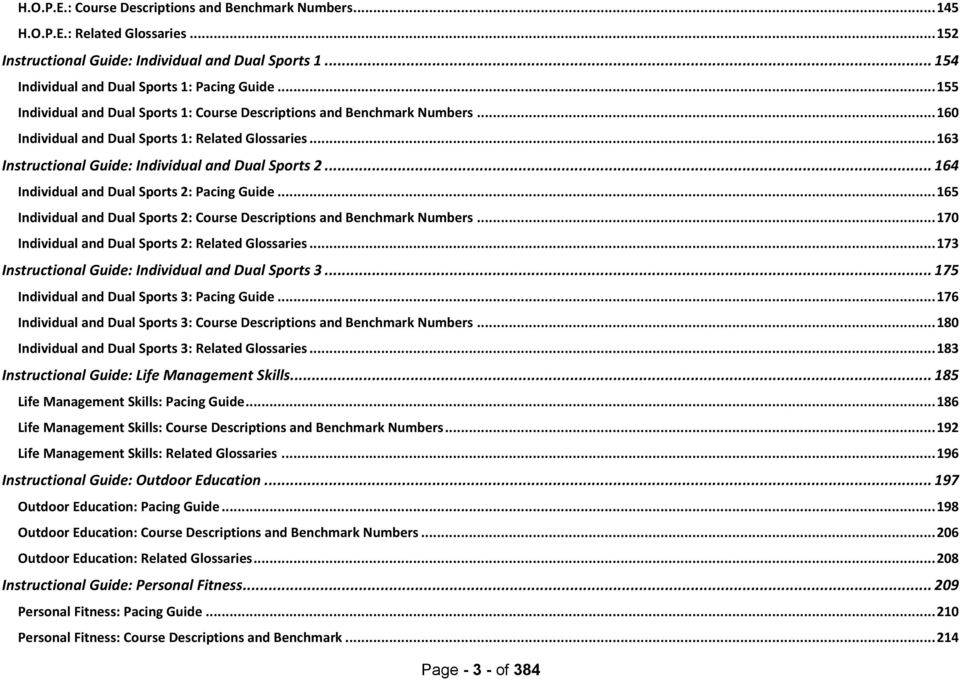
4 Personal Fitness: Related Glossaries Instructional Guide: Personal Fitness Trainer Pacing Guide: Personal Fitness Trainer Course Personal Fitness Trainer: Course Descriptions and Benchmark Personal Fitness Trainer: Related Glossaries Instructional Guide: Power Lifting Power Weight Lifting 1: Pacing Guide Power Weight Lifting 1: Course Descriptions and Benchmark Numbers Power Weight Lifting 1: Related Glossaries Instructional Guide: Recreational Activities Recreational Activities: Pacing Guide Recreational Activities: Course Descriptions and Benchmark Numbers Recreational Activities: Related Glossaries Instructional Guide: Soccer Soccer: Pacing Guide Soccer: Course Descriptions and Benchmark Numbers Soccer: Related Glossaries Instructional Guide: Softball Softball: Pacing Guide Softball: Course Descriptions and Benchmark Numbers Softball: Related Glossaries Instructional Guide: Sports Officiating Sports Officiating: Pacing Guide Sports Officiating: Course Descriptions and Benchmark Numbers Sports Officiating: Related Glossaries Page of 384

5 Instructional Guide: Team Sports Team Sports 1: Pacing Guide Team Sports 1: Course Descriptions and Benchmark Numbers Team Sports 1: Related Glossaries Instructional Guide: Team Sports Team Sports 2: Pacing Guide Team Sports 2: Course Descriptions and Benchmark Numbers Team Sports 2: Related Glossaries Instructional Guide: Tennis Tennis 1: Pacing Guide Tennis1: Course Descriptions and Benchmark Numbers Tennis1: Related Glossaries Instructional Guide: Volleyball Volleyball 1: Pacing Guide Volleyball 1: Course Descriptions and Benchmark Numbers Volleyball 1: Related Glossaries Instructional Guide: Volleyball Volleyball 2: Pacing Guide Volleyball 2: Course Descriptions and Benchmark Numbers Volleyball 2: Related Glossaries Instructional Guide: Volleyball Volleyball 3: Pacing Guide Volleyball 3: Course Descriptions and Benchmark Numbers Volleyball 3: Related Glossaries Instructional Guide: Weight Training Page of 384

6 Weight Training 1: Pacing Guide Weight Training 1: Course Descriptions and Benchmark Numbers Weight Training 1: Related Glossaries Instructional Guide: Weight Training Weight Training 2: Pacing Guide Weight Training 2: Course Descriptions and Benchmark Numbers Weight Training 2: Related Glossaries Instructional Guide: Weight Training Weight Training 3: Pacing Guide Weight Training 3: Course Descriptions and Benchmark Numbers Weight Training 3: Related Glossaries Credits Page of 384

7 HIGH SCHOOL PHYSICAL EDUCATION PROGRAM The benefits offered in our CCPS High School Physical Education program are: We are constantly striving for world class excellence in our programs. All high schools in CCPS have a gym, weight room and classroom/portable for inside activities and outside space with multiple fields, a track and tennis/basketball courts. CCPS has only certified physical education instructors who are highly qualified to teach physical education courses. The availability of one-on-one counseling concerning the benefits of high school physical education in CCPS is as follows: Once a student has dropped to a grade of a D, that student will be counseled on an individual basis about the importance of fitness. If the student does not improve, that student is counseled once again and the parent is contacted to inform them of their child s lack of progress. High School Curriculum Pacing Guides: The pacing guides for the High School Curriculum are broken down into weekly units; however it is up to the individual teacher as to the exact length of time to spend on each activity/sport. All of the standards listed in the course descriptions for the particular course curriculum must be taught. Pacing guides are 49 Minutes unless identified as block pacing guides. The pacing guide topics are only suggestions as to the lessons to be covered. The curriculum for High School Physical Education is organized in such a way to make teaching run smoothly. There are various letters and numbers to guide a person through the Next Generation Sunshine State Standards. Each group of letters and/or numbers is separated by a dot or a period (.). The letters PE represents Physical Education. The number directly following PE will be a 912. When directly following the PE, 912 represent grades For each course, four main ideas are addressed. These four ideas are called Strands but are also known as the Body of Knowledge. These four Body of Knowledge are labeled Movement Competency, Cognitive Abilities, Responsible Behavior and Values and Lifetime Fitness. Page of 384

8 Strand or Body of Knowledge: M = Movement Competency: Idea or Standard 1 = Demonstrate competency in many and proficiency in a few movement forms from a variety of categories (aquatics, dance, extreme sports, fitness education, gymnastics, individual/dual sports, outdoor pursuits, self-defense, team sports). Strand or Body of Knowledge: C = Cognitive Abilities: Idea or Standard 1= Identify, analyze, and evaluate movement concepts, mechanical principles, safety considerations, and strategies/tactics regarding movement performance in a variety of physical activities. Strand or Body of Knowledge: L = Lifetime Fitness: Idea or Standard 1 = Participate regularly in physical activity. Idea or Standard 2 = Develop and implement a personal fitness program to achieve and maintain a health-enhancing level of physical fitness. Strand or Body of Knowledge: R = Responsible Behavior and Values: Idea or Standard 1 = Exhibit responsible personal and social behavior that respects self and others in physical activity. Idea or Standard 2 = Value physical activity for health, enjoyment, challenge, self-expression, and/or social interaction. The letter M represents Movement Competency. The letter C represents Cognitive Abilities. The letter L represents Lifetime Fitness. The letter R represents Responsible Behavior and Values. The numbers next to the letters represent the standard for that particular Body of Knowledge. The number 1 directly after M, C, L and R resents Standard 1. For example, Standard 1 for Responsible Behavior and Values is R1 and represents: Exhibit responsible personal and social behavior that respects self and others in physical activity settings. The next number after the Standard represents the course description for that particular standard. Course Descriptions are located at the end of the pacing guides of each course. There will be the benchmark code numbers for that course in the left column and the course description in the column to the right next to the code number. All together, these numbers and course descriptions are the Benchmarks for that particular course. PE = Phys Ed and 912 represents grades All benchmarks will be preceeded by this combination unless it is a cross-curricular description from Language Arts (LA), Math (MA), etc. Teacher Resources: Teachers must log on to ANGEL to access curriculum resources. Page of 384

9 Instructional Guide: Adaptive Physical Education Course Number: Course Title: Adaptive Physical Education IEP or 504 Plan Abbreviated Title: ADAP PE IEP OR 504 Grade Level: 9 12 Credit: 0.5 Prerequisite: Must have IEP or 504 Plan Category: Adapted *Note: Adaptive Physical Education benchmarks are to be use with all pacing guides for students with IEP or 504 Plan. Page of 384

10 Adaptive Physical Education: Course Descriptions and Benchmark Numbers RELATED BENCHMARKS (23): Benchmark Description LA MA.912.A.10.1 PE.912.C.1.3 PE.912.C.1.11 PE.912.C.1.17 PE.912.C.1.20 PE.912.C.1.22 PE.912.C.1.25 PE.912.L.1.2 PE.912.L.1.3 PE.912.L.2.4 The student will use new vocabulary that is introduced and taught directly; Use a variety of problem-solving strategies, such as drawing a diagram, making a chart, guessing- and-checking, solving a simpler problem, writing an equation, working backwards, and creating a table. (DOK Rating HIGH) Analyze through observation the movement performance of self and others. Explain how each of the health-related fitness components (cardiorespiratory endurance, muscular strength, muscular endurance, flexibility, body composition) are improved through the application of training principles. Assess physiological effects of exercise during and after physical activity. Know various ways in which physical conflict can be resolved appropriately. Explain the skill-related components of balance, reaction time, agility, coordination, power, and speed and how they enhance performance levels. Analyze and evaluate the risks, safety procedures, rules, and equipment associated with specific course activities. Participate in a variety of activities that promote cardiorespiratory fitness, muscular strength and endurance, flexibility, and body composition. Participate in a variety of activities that promote effective stress management. Apply the principles of training and conditioning in accordance with personal goals. Page of 384

11 PE.912.L.2.7 PE.912.M.1.10 PE.912.M.1.14 PE.912.M.1.15 PE.912.M.1.16 PE.912.M.1.24 PE.912.M.1.25 PE.912.M.1.30 PE.912.M.1.33 PE.912.R.1.3 PE.912.R.1.4 PE.912.R.1.5 Evaluate how to make changes in an individual wellness plan as lifestyle changes occur. Apply sport specific skills in simulation and in real-life applications. Utilize selected technology to assess, enhance, and maintain health and skill-related fitness levels. Select and apply sports/activity specific warm-up and cool-down techniques. Apply the principles of training and conditioning to accommodate individual needs and strengths. Apply a combination of complex movement patterns in a game setting. Apply the appropriate speed and generation of force when running sprints or distance, throwing, jumping, and striking. Combine and apply movement patterns from simple to complex. Practice complex motor activities in order to improve performance. Demonstrate responsible behaviors during physical activities. Maintain appropriate personal, social, and ethical behavior while participating in a variety of physical activities. Demonstrate appropriate etiquette, care of equipment, respect for facilities, and safe behaviors while participating in a variety of physical activities. Page of 384

12 Adaptive Physical Education: Related Glossaries RELATED GLOSSARIES: Keywords (10) Area Chart Equation Instantaneous Rate of Change Point Square Table Width Balance Physical activity Definition The number of square units needed to cover a surface. A data display that presents information in columns and rows. A mathematical sentence stating that the two expressions have the same value. Also read the definition of equality. The rate of change at a particular moment. For a function, the instantaneous rate of change at a point is the same as the slope of the tangent line at that point. A specific location in space that has no discernable length or width. A rectangle with four congruent sides; also, a rhombus with four right angles. A data display that organizes information about a topic into categories using rows and columns. The shorter length of a two-dimensional figure. The width of a box is the horizontal distance from side to side (usually defined to be greater than the depth, the horizontal distance from front to back). Â skill-related component of fitness. The ability to maintain equilibrium while moving or standing still. Any fitness, sports, or recreational activity involving movement of the body that is produced through muscle contraction that increases energy expenditure. Page of 384

13 INSTRUCTIONAL GUIDE: AEROBICS 1 Subject Area: Physical Education Course Number: Grade Level: 9 12 Credit: 0.5 Prerequisite: None Category: Fitness Health Component Emphasized: Cardiorespiratory The purpose of this course is to enable students to develop basic-level knowledge of aerobic activities and fitness and to maintain or improve an individualized level of fitness. This course will contain but not limited to the following: safety practices, basic physiology of the cardiovascular system, basic anatomy of the muscles, correct techniques of executing exercises, high and low impact aerobics, use of various types of exercise equipment, personal and group fitness exercises/activities, fitness assessment, nutrition, stress reduction, consumer issues and the benefits of cardio respiratory fitness. Page of 384

14 Aerobics 1: Pacing Guide Topic / Section to be Covered Orientation Identify safety issues Pre Testing Goal Setting Conditioning Identify correct body mechanics in basic exercises. Time Frame (Based on 49 minutes per class) 1 st week 2 nd Week 1 st 3 rd Week Next Generation Sunshine State Standards (Benchmarks) M.1.35, C.1.25 M.1.5, M.1.34, M.1.35, C.1.25, R.1.3, R.1.4 MA. 912.S.3.3(x-curricular) M.1.15, M.1.19, M.1.30, M.1.34, M.1.35, C.1.7, C.1.24 R.1.3, R.1.4 Lesson / Information to be Covered Course Syllabus Attendance Procedures Rules and Regulations Locks and Lockers Uniforms Go over safety issues pertaining to exercises, equipment and in general. Pre-test on 12 minute walk/run, step test, crunches, and push-ups, flexibility and body composition Heart rate count: when, where and how. Warm-up: cardio-stretch / workout / cool-down / correct stretching Resources (Log in to Angel to get the following resources)) Templates for: Syllabus/Brochure, Information Form and lesson plan Template on Angel Template for scoring form, explanation and results chart of the test. Heart rate charts. Print, laminate and post. Safety in exercising / sequences of workouts Page of 384

15 Identify target heart Polar heart monitor (if applicable) and application. 4 th Week M.1.14, M.1.19, M.1.34, M.1.35, C.1.15, C.1.16, C L.1.1, R.1.3, R.1.4 Teach / perform basic steps in step- aerobics OR basic dance / rhythm movements. Aerobic information. Routines. Identify cardio respiratory Identify basic body mechanics in exercising Identify muscles of the body. Identify muscular endurance and strength Identify resistance training and safety. Identify correct body mechanics and techniques. Identify core exercising and how it applies to everyday situations-functional training 5 th week 6 th week M.1.12, M.1.19, M.1.30, M.1.34, M.1.35, L.1.1, L.1.2, R.1.3, R.1.4 LA (x-curricular) M.1.12, M.1.19, M.1.30, M.1.34, M.1.35, L.1.1, L.1.2, R.1.3, R.1.4 R1.5 Cardio workout Upper body sculpture workout with dumbbells, body bars and / or with bands. Lower body sculpture work out with dumbbells, body bars and / or bands. Add new steps to basic steps in step- aerobics OR basic dance/rhythm movements. Circuit training with stability balls, med balls OR with or without other equipment to concentrate on core. Basic dance/rhythm movements adding new steps transitions and directions to routine. Sculpture workouts and exercises can be found in Angel. Circuit training cards can be found in Angel. BOSU and Body bar routines and exercises in Angel. Page of 384

16 Identify caloric intake and expenditure. 7 th week M.1.12, M.1.19, M.1.30, M.1.34, M.1.35, C.1.13, L.1.1, L.1.2, R.1.3, R.1.4 Circuit training using the caloric intake / expenditure. Introduce BOSU or any other exercises and how it relates to core. Circuit training cards can be found in Angel. BOSU and Body bar routines and exercises in Angel. BOSU or other core workout. Abdominal workouts. Identify and apply correct body mechanics as it applies to various exercises 8 h week M.1.12, M.1.19, M.1.30, M.1.34, M.1.35, L.1.1, L.1.2, R.1.3, R.1.4 Basic aerobics, dance / rhythm movements adding new steps transitions / movement patterns to routine. Circuit training using Kick-box circuit. Kick box aerobic routine Introduce medicine ball and exercises with the medicine ball or similar activity. Or similar drill. Kick box circuits and routines- Med ball circuit and routines can be found in Angel. Page of 384

17 Identify FITT Apply correct body mechanics to exercise. Analyze and interpret test scores. 9 th week M.1.16, M.1.19, M.1.30, M.1.34, M.1.35, C.1.11, L.2.4, R.1.3, R.1.4 Go over FITT Principle and how it relates to improvement on fitness testing. Repeat test on 12 minute walk / run, step test, crunches, and pushups, flexibility and body composition FITT Principles found in HOPE or Per Fit Textbook. Also on Angel Health related test found on Angel. Analyze long-term benefits of exercising. 10 th week M.1.12, M.1.19, M.1.30, M.1.34, M.1.35, C.1.10, L.1.1, L.1.2, R.2.2, R.1.3, R.1.4 Analyze progression. Steps in stepaerobics or basic dance / rhythm movements workouts using new movements. Circuit training / various equipment. Analyze/ discuss long-term benefits of all. Steps in step- aerobics or basic dance/rhythm movements workouts using new movements. Variety of routines for various equipment found on Angel. Identify difference between aerobic exercising and anaerobic exercises 11 th week M.1.19, M.1.20, M.1.25, M.1.30, M.1.33, M.1.34, M.1.35, C.1.12, L.1.1, L.1.2, R.1.3, R.1.4 Breathing and relaxation to combat stress. Relays, Sprints, Boot Camp, Plyometric & activities from various cultures. Steps in step- aerobics or basic dance/rhythm movements workouts using new movements, transitions and directions Relays, Sprints, Boot Camp, Plyometric exercises on Angel. Page of 384

18 Understand and apply correct terminology in dance Understand and apply knowledge in creating a cardio routine with or without equipment taking into consideration diverse backgrounds and various levels of physical abilities Understand and apply knowledge in creating a muscular endurance routine with equipment taking into consideration various levels of physical abilities 12 th week 13 th week 14 th week M.1.19, M.1.30, M.1.34, M.1.35, C.1.2, C.1.23, R.1.3, R.1.4 LA M.1.8, M.1.9, M.1.13, M.1.15, M.1.19, M.1.20, M.1.30, M.1.34, M.1.35, C.1.2, C.1.3, R.1.3, R.1.4 R.1.2 R.2.3 M.1.8, M.1.12, M.1.15, M.1.19, M.1.20, M.1.30, M.1.34, M.1.35, C.1.2, C.1.3, R.1.3, R.1.2 R.1.4 Steps in step- aerobics or basic dance/rhythm movements workouts using new movements, Allow students to identify each movement by name Students will get into small groups and put a cardio routine together with or without equipment using the sequences used in class. Each group will perform their routine for another group on a one group to one group basis. Students get in groups to design a muscular endurance routine using exercises. Each group will perform their routine for another group on a one group to one group basis. Step names for step aerobics found on Angel. Templates and suggestions for developing routines on Angel. Templates and suggestions for developing routines on Angel. Page of 384

19 Compare and contrast healthrelated benefits in various exercises in the aerobic course. Introduce how to design a dance, rhythm or step routine. 15 th week M.1.6, M.1.19, M.1.30, M.1.34, M.1.35, C.1.5, C.1.6, R.1.3, R.1.4 Discussion of health related benefits in the various types of equipment while comparing and contrasting aerobic equipment. Give guidelines and rubric out to students for designing routines. Selection of music is done through the teacher s music used in class. Guideline and Rubric suggestions for aerobic/dance/rhythm routines on Angel. Analyzing selection of music in the dance, rhythm or step routine. Design a fitness program; dance, or step routine include diverse backgrounds with or without equipment. Demonstrate Improved fitness level. 16 th week 17 th week M.1.8, M.1.9, M.1.13, M.1.15, M.1.20, M.1.30, M.1.34, M.1.35, C.1.2, C.1.3, C.1.4, C.1.19, L.2.1, R.1.2, R.1.3, R.2.3 C.1.17, M.1.7, M.1.9, M.1.15, M.1.20, M.1.30, M.1.34, M.1.35, L.2.1 Students will form their groups, design routine as a group then practice routine. After routine is d, each group will perform for entire class. End of the year fitness testing to see improvement. Templates and suggestions for developing routines on Angel. Guideline and Rubric suggestions for aerobic/dance/rhythm routines on Angel. Page of 384

20 Make up for fitness test or make up for fitness routine. Review for written final Final exam 18 th week L.2.1 Make up work to be done. Hand out study sheets, discuss study sheets, and review terminology. Final written exam. Clean out lockers finalize. Templates for test found on Angel. Locker clean out Page of 384

21 Aerobics 1: Course Descriptions and Benchmark Numbers Course Code Course Title Aerobics 1 Course Level 2 Course Length Semester Credit Description Half credit (.5) Abbreviated Title AEROBICS 1 Course Section Basic and Adult Education Course Path: Section: Basic and Adult Education > Grade Group: Secondary Grades 9-12 > Subject: Physical Education > Sub-Subject: Fitness RELATED BENCHMARKS (21): Benchmark LA MA.912.S.3.3 PE.912.C.1.2 PE.912.C.1.5 PE.912.C.1.15 Description The student will use new vocabulary that is introduced and taught directly. Calculate and interpret measures of the center of a set of data, including mean, median, and weighted mean, and use these measures to make comparisons among sets of data. (DOK Rating: Moderate) Understand and apply terminology and etiquette in dance. Analyze the relationship between music and dance. Calculate individual target heart rate zone and analyze how to adjust intensity level to stay within the desired range.
22 PE.912.C.1.16 PE.912.C.1.23 PE.912.L.1.1 PE.912.L.1.2 PE.912.L.1.3 PE.912.L.1.6 PE.912.M.1.5 PE.912.M.1.8 PE.912.M.1.14 PE.912.M.1.15 PE.912.M.1.35 PE.912.R.1.2 PE.912.R.1.3 PE.912.R.1.4 Explain the methods of monitoring levels of intensity during aerobic activity. Apply appropriate technology and analyze data to evaluate, monitor, and/or improve performance. Participate in a variety of physical activities to meet the recommended number of minutes of moderate to vigorous physical activity (MVPA) beyond physical education on five or more days of the week. Participate in a variety of activities that promote cardio respiratory fitness, muscular strength and endurance, flexibility, and body composition. Participate in a variety of activities that promote effective stress management. Utilize knowledge of the risks and safety factors that may affect physical activity throughout life. Apply strategies for self improvement based on individual strengths and needs. Design and perform a creative movement sequence while working with a small or large group, with or without equipment/props. Utilize selected technology to assess, enhance, and maintain health and skill-related fitness levels. Select and apply sports/activity specific warm-up and cool-down techniques. Select proper equipment and apply all appropriate safety procedures necessary for participation. Develop strategies for including persons of diverse backgrounds and abilities while participating in a variety of physical activities. Demonstrate responsible behaviors during physical activities. Maintain appropriate personal, social, and ethical behavior while participating in a variety of physical activities.
23 PE.912.R.1.5 PE.912.R.2.3 Demonstrate appropriate etiquette, care of equipment, respect for facilities, and safe behaviors while participating in a variety of physical activities. Explore the role of games, sports, and/or physical activities in other cultures.
24 Aerobics 1: Related Glossaries Keywords (5) Instantaneous Rate of Change Mean Median Set Physical activity Definition The rate of change at a particular moment. For a function, the instantaneous rate of change at a point is the same as the slope of the tangent line at that point. There are several statistical quantities called means, e.g., harmonic mean, arithmetic mean, and geometric mean. However, mean commonly refers to the arithmetic mean that is also called arithmetic average. Arithmetic mean is a mathematical representation of the typical value of a series of numbers, computed as the sum of all the numbers in the series divided by the count of all numbers in the series. Arithmetic mean is the balance point if the numbers are considered as weights on a beam. When the numbers are arranged from least to greatest, the middle number of a set of numbers or the mean of two middle numbers when the set has two middle numbers is called median. Half of the numbers are above the median and half are below it. A set is a finite or infinite collection of distinct objects in which order has no significance. Any fitness, sports, or recreational activity involving movement of the body that is produced through muscle contraction that increases energy expenditure.
25 Subject Area: Physical Education Course Number: Grade Level: 9 12 Credit: 0.5 Prerequisite: Aerobics 1 Category: Fitness Health Component Emphasized: Cardiorespiratory INSTRUCTIONAL GUIDE: AEROBICS 2 The purpose of this course is to enable students to develop intermediate-level of knowledge pertaining to aerobic activities and fitness and to maintain or improve an individualized level of fitness. This course will contain but not limited to the following: safety practices, physiology of the cardiovascular system, anatomy of the muscles, correct techniques of executing exercises, high and low impact aerobics, use of various types of exercise equipment, personal and group fitness exercises/activities, fitness assessment, nutrition, stress reduction, consumer issues and the benefits of cardio respiratory fitness.
26 Aerobics 2: Pacing Guide Topic/Section to be Covered Orientation Identify safety issues Pre Testing Goal Setting Conditioning Identify correct body mechanics in basic exercises Safety in exercising Time Frame (Based on 49 minutes per class) 1 st week 2 nd Week 1 st 3 rd Week Next Generation Sunshine State Standards (Benchmarks) M.1.35, C.1.25 M.1.5, M.1.34, M.1.35, C.1.25, R.1.3, R.1.4 MA.912.S.3.3 (xcurricular) M.1.15, M.1.19, M.1.30, M.1.34, M.1.35, C.1.24 R.1.3, R.1.4, C.1.7 Lesson/Information to be Covered Course Syllabus Attendance Procedures Rules and Regulations Locks and Lockers Uniforms Go over safety issues pertaining to exercises, equipment and in general. Pre-test on 12 minute walk/run, step test, crunches, and push-ups, flexibility and body composition Heart rate count: when, where and how, Warm-up: cardio-stretch / workout / cooldown /correct stretching Resources (Log in to Angel to get the following resources) Templates for: Syllabus/Brochure, Information Form.and lesson plan Template on Angel Template for scoring form, explanation and results chart of the test. Heart rate charts. Print, laminate and post. Sequences of workouts
27 Identify target heart Polar heart monitor (if applicable) and application. 4 th Week M.1.14, M.1.19, M.1.34, M.1.35, C.1.15, C.1.16, C.1.17 L.1.1, R.1.3, R.1.4 Teach / perform basic steps in stepaerobics OR basic dance / rhythm movements. Aerobic information. Routines. Identify cardio respiratory. Identify basic body mechanics in exercising Identify muscles of the body, identify muscular endurance and strength Identify resistance training and safety. Identify correct body mechanics and techniques. Identify core exercising and how it applies to everyday situations-functional training. 5 th week 6 th week M.1.12, M.1.19, M.1.30, M.1.34, M.1.35, L.1.1, L.1.2, R.1.3, R.1.4 LA (x-curricular) LA (x-curricular) M.1.12, M.1.19, M.1.30, M.1.34, M.1.35, L.1.1, L.1.2, L.1.4, L.1.5, L.1.6, R.1.3, R.1.4 Cardio workout Upper body sculpture workout with dumbbells, body bars and/or with bands. Lower body sculpture work out with dumbbells, body bars and/or bands. Add new steps to basic steps in stepaerobics OR basic dance/rhythm movements. Circuit training with stability balls, med balls OR with or without other equipment to concentrate on core. Basic dance/rhythm movements adding new steps transitions and directions to routine. Sculpture workouts and exercises can be found in Angel. Circuit training cards can be found in Angel. BOSU and Body bar routines and exercises in Angel.
28 Identify caloric intake and expenditure. 7 th week M.1.12, M.1.19, M.1.30, M.1.34, M.1.35, C.1.13, L.1.1, L.1.2, R.1.3, R.1.4 Circuit training using the caloric intake/ expenditure Introduce BOSU or any other exercises and how it relates to core. BOSU or other core workout. Abdominal workouts. Circuit training cards can be found in Angel. BOSU and Body bar routines and exercises in Angel. Basic aerobics, dance/ rhythm movements adding new steps transitions/ movement patterns to routine. Identify and apply correct body mechanics as it applies to various exercises Identify FITT Apply correct body mechanics to exercise. Analyze and interpret test scores. 8 h week 9 th week M.1.12, M.1.19, M.1.30, M.1.34, M.1.35, L.1.1, L.1.2, R.1.3, R.1.4 M.1.16, M.1.19, M.1.30, M.1.34, M.1.35, C.1.11, L.2.4, R.1.3, R.1.4, C.1.16 Circuit training using Kick-box circuit. Kick box aerobic routine Introduce medicine ball and exercises with the medicine ball or similar activity. Or similar drill. Go over FITT Principle and how it relates to improvement on fitness testing. Repeat test on 12 minute walk / run, step test, crunches, and push-ups, flexibility and body composition. Analyze progression. Steps in stepaerobics or basic dance / rhythm movements workouts using new movements. Kick box circuits and routines- Med ball circuit and routines can be found in Angel. FITT Principles found in HOPE or Per Fit Textbook. Also on Angel Health related test found on Angel.
29 Analyze long-term benefits of exercising. Perform relaxation techniques and discuss 10 th week M.1.12, M.1.19, M.1.30, M.1.34, M.1.35, C.1.10, C.1.23, L.1.1, L.1.2, L.1.3, R.2.2, R.1.3, R.1.4 Circuit training / various equipment. Analyze / discuss long-term benefits of all. Steps in step- aerobics or basic dance / rhythm movements workouts using new movements. Variety of routines for various equipment found on Angel. Identify difference between aerobic exercising and anaerobic exercises. Explore activities of other cultures. Understand and apply correct terminology in dance Understand and apply knowledge in creating a cardio routine with or without equipment 11 th week 12 th week 13 th week M.1.19, M.1.20, M.1.25, M.1.30, M.1.33, M.1.34, M.1.35, C.1.12, L.1.1, L.1.2, R.1.3, R.1.4, R.2.3 M.1.19, M.1.30, M.1.34, M.1.35, C.1.2, C.1.23, R.1.3, R.1.4 M.1.8, M.1.9, M.1.13, M.1.15, M.1.19, M.1.20, M.1.30, M.1.34, M.1.35, C.1.2, C.1.3, R.1.3, R.1.4 Breathing and relaxation to combat stress. Relays, Sprints, Boot Camp, Plyometric & activities from various cultures. Steps in step- aerobics or basic dance / rhythm movements workouts using new movements, transitions and directions Steps in step- aerobics or basic dance / rhythm movements workouts using new movements, Allow students to identify each movement by name Students will get into small groups and put a cardio routine together with or without equipment using the sequences used in class. Each group will perform their routine for another group on a one group to one group basis. Relays, Sprints, Boot Camp, Plyometric exercises on Angel. Step names for step aerobics found on Angel. Templates and suggestions for developing routines on Angel.
30 Understand and apply knowledge in creating a muscular endurance routine with equipment 14 th week M.1.8, M.1.12, M.1.15, M.1.19, M.1.20, M.1.30, M.1.34, M.1.35, C.1.2, C.1.3, R.1.3, R.1.4, R1.5 Students get in groups to design a muscular endurance routine using exercises. Each group will perform their routine for another group on a one group to one group basis. Templates and suggestions for developing routines on Angel. Compare and contrast healthrelated benefits in various exercises in the aerobic course. Introduce how to design a dance, rhythm or step routine. 15 th week M.1.6, M.1.19, M.1.30, M.1.34, M.1.35, C.1.5, C.1.6, R.1.3, R.1.4 Discussion of health related benefits in the various types of equipment while comparing and contrasting aerobic equipment. Give guidelines and rubric out to students for designing routines. Selection of music is done through the teacher s music used in class. Guideline and Rubric suggestions for aerobic/dance/rhythm routines on Angel. Analyzing selection of music in the dance, rhythm or step routine. Design a fitness program; dance, or step routine include diverse backgrounds with or without equipment. 16 th week M.1.8, M.1.9,M.1.13 M.1.15, M.1.20, M.1.30, M.1.34, M.1.35, C.1.2, C.1.3, C.1.4, C.1.19, L.2.1, R.1.2, R.1.3, R.1.4, R.2.3 Students will form their groups, design routine as a group then practice routine. Templates and suggestions for developing routines on Angel.
31 Demonstrate Improved fitness level. Analyze data to evaluate, monitor and/or improve performance Make up fitness test or fitness routine. Review for written final 17 th week 18 th week C.1.17, M.1.7, M.1.8, M.1.9, M1.13,M.1.15, M.1.20, M.1.30, M.1.34, M.1.35, L.2.1 L.2.1 After routine is d, each group will perform for entire class. End of the year fitness testing to see improvement. Make up work to be done. Hand out study sheets, discuss study sheets, and review terminology. Final written exam. Guideline and Rubric suggestions for aerobic/dance/rhythm routines on Angel. Templates for test found on Angel. Final exam Clean out lockers finalize. Locker clean out
32 Aerobics 2: Course Descriptions and Benchmark Numbers Course Code Course Title Aerobics 2 Course Level 2 Course Length Semester Credit Description Half credit (.5) Abbreviated Title AEROBICS 2 Course Section Course Path: RELATED BENCHMARKS (31): Basic and Adult Education Section: Basic and Adult Education > Grade Group: Secondary Grades 9-12 > Subject: Physical Education > Sub-Subject: Fitness > Benchmark LA Description The student will use new vocabulary that is introduced and taught directly. LA MA.912.S.3.3 PE.912.C.1.3 PE.912.C.1.7 PE.912.C.1.12 PE.912.C.1.15 The student will relate new vocabulary to familiar words. Calculate and interpret measures of the center of a set of data, including mean, median, and weighted mean, and use these measures to make comparisons among sets of data. (DOK Rating: Moderate) Analyze through observation the movement performance of self and others. Evaluate the effectiveness of specific warm-up and cool-down activities. Compare and contrast aerobic versus anaerobic activities. Calculate individual target heart rate zone and analyze how to adjust intensity level to stay within the desired range.
33 PE.912.C.1.16 PE.912.C.1.17 PE.912.C.1.19 PE.912.C.1.23 PE.912.L.1.1 PE.912.L.1.2 PE.912.L.1.3 PE.912.L.1.4 PE.912.L.1.5 Explain the methods of monitoring levels of intensity during aerobic activity. Assess physiological effects of exercise during and after physical activity. Choreograph complex sequences alone, with a partner, or in a small group. Apply appropriate technology and analyze data to evaluate, monitor, and/or improve performance. Participate in a variety of physical activities to meet the recommended number of minutes of moderate to vigorous physical activity (MVPA) beyond physical education on five or more days of the week. Participate in a variety of activities that promote cardio respiratory fitness, muscular strength and endurance, flexibility, and body composition. Participate in a variety of activities that promote effective stress management. Utilize the in-school and community opportunities for participation in a variety of physical activities. Participate regularly in health-enhancing activities outside the physical education class setting. PE.912.L.1.6 PE.912.M.1.5 PE.912.M.1.6 PE.912.M.1.7 PE.912.M.1.8 Utilize knowledge of the risks and safety factors that may affect physical activity throughout life. Apply strategies for self improvement based on individual strengths and needs. Select appropriate music for dance forms and choreograph dance movements to music. Perform advanced dance sequences from a variety of dances accurately and with correct technique. Design and perform a creative movement sequence while working with a small or large group, with or without equipment/props.
34 PE.912.M.1.9 PE.912.M.1.13 PE.912.M.1.14 PE.912.M.1.30 PE.912.M.1.35 PE.912.R.1.2 PE.912.R.1.3 PE.912.R.1.4 PE.912.R.1.5 PE.912.R.2.3 Demonstrate complex skills and advanced rhythmic movements in dance. Perform a student designed cardio respiratory enhancing workout. Utilize selected technology to assess, enhance, and maintain health and skill-related fitness levels. Combine and apply movement patterns from simple to complex. Select proper equipment and apply all appropriate safety procedures necessary for participation. Develop strategies for including persons of diverse backgrounds and abilities while participating in a variety of physical activities. Demonstrate responsible behaviors during physical activities. Maintain appropriate personal, social, and ethical behavior while participating in a variety of physical activities. Demonstrate appropriate etiquette, care of equipment, respect for facilities, and safe behaviors while participating in a variety of physical activities. Explore the role of games, sports, and/or physical activities in other cultures.
35 Aerobics 2: Related Glossaries Keywords (5) Instantaneous Rate of Change Mean Median Set Definition The rate of change at a particular moment. For a function, the instantaneous rate of change at a point is the same as the slope of the tangent line at that point. There are several statistical quantities called means, e.g., harmonic mean, arithmetic mean, and geometric mean. However, mean commonly refers to the arithmetic mean that is also called arithmetic average. Arithmetic mean is a mathematical representation of the typical value of a series of numbers, computed as the sum of all the numbers in the series divided by the count of all numbers in the series. Arithmetic mean is the balance point if the numbers are considered as weights on a beam. When the numbers are arranged from least to greatest, the middle number of a set of numbers or the mean of two middle numbers when the set has two middle numbers is called median. Half of the numbers are above the median and half are below it. A set is a finite or infinite collection of distinct objects in which order has no significance. Physical activity Any fitness, sports, or recreational activity involving movement of the body that is produced through muscle contraction that increases energy expenditure.
36 Subject Area: Physical Education Course Number: Grade Level: 9 12 Credit: 0.5 Prerequisite: Aerobics 2 Category: Fitness Health Component Emphasized: Cardiorespiratory INSTRUCTIONAL GUIDE: AEROBICS 3 The purpose of this course is to enable students to develop as much knowledge as possible pertaining to aerobic activities and fitness and to maintain or improve an individualized level of fitness. This course will contain but not limited to the following: safety practices, physiology of the cardiovascular system, anatomy of the muscles, correct techniques of executing exercises, high and low impact aerobics, use of various types of exercise equipment, personal and group fitness exercises/activities, fitness assessment, nutrition, stress reduction, consumer issues and the benefits of Cardiorespiratory fitness.
37 Aerobics 3: Pacing Guide Topic/Section to be Covered Orientation Identify safety issues Pre Testing Goal Setting Conditioning Identify correct body mechanics in basic exercises Safety in exercising / sequences of workouts Identify target heart/ Polar heart monitor (if applicable) Identify cardio respiratory Time Frame (Based on 49 minutes per class) 1 st week 2 nd Week 1 st 3 rd Week 4 th Week Next Generation Sunshine State Standards (Benchmarks) M.1.35, C.1.25 M.1.5, M.1.34, M.1.35, C.1.25, R.1.3, R.1.4 MA.912.S.3.3 (xcurricular) M.1.15, M.1.19, M.1.30, M.1.34, M.1.35, C.1.7, C.1.24, R.1.3, R.1.4 M.1.14, M.1.19, M.1.34, M.1.35, C.1.15, C.1.16, L.1.1, R.1.3, R.1.4 Lesson/Information to be Covered Course Syllabus Attendance Procedures Rules and Regulations Locks and Lockers Uniforms Go over safety issues pertaining to exercises, equipment and in general. Pre-test on 12 minute walk/run, step test, crunches, and push-ups, flexibility and body composition Heart rate count: when, where and how. Warm-up: cardio-stretch / workout / cool-down / correct stretching Teach / perform basic steps in step- aerobics OR basic dance / rhythm movements. Resources (Log in to Angel to get the following resources) Templates for: Syllabus/Brochure, Information Form.and lesson plan Template on Angel Template for scoring form, explanation and results chart of the test. Heart rate charts. Print, laminate and post. Aerobic information. Routines. Identify basic body mechanics in exercising
38 Identify muscles of the body Identify muscular endurance and strength Identify resistance training and safety. 5 th week M.1.12, M.1.19, M.1.30, M.1.34, M.1.35, L.1.1, L.1.2, R.1.3, R.1.4 LA (xcurricular) Cardio workout Upper body sculpture workout with dumbbells, body bars and/or with bands. Lower body sculpture work out with dumbbells, body bars and / or bands. Sculpture workouts and exercises can be found in Angel. Identify correct body mechanics and techniques. Identify core exercising and how it applies to everyday situations-functional training. Identify caloric intake and expenditure. 6 th week 7 th week M.1.12, M.1.19, M.1.30, M.1.34, M.1.35, L.1.1, L.1.2, L.1.4, L.1.5, L.1.6, R.1.3, R.1.4 M.1.12, M.1.19, M.1.30, M.1.34, M.1.35, C.1.13, L.1.1, L.1.2, R.1.3, R.1.4 Add new steps to basic steps in step- aerobics OR basic dance / rhythm movements. Circuit training with stability balls, med balls OR with or without other equipment to concentrate on core. Basic dance / rhythm movements adding new steps transitions and directions to routine. Circuit training using the caloric intake / expenditure Introduce BOSU or any other exercises and how it relates to core. BOSU or other core workout. Circuit training cards can be found in Angel. BOSU and Body bar routines and exercises in Angel. Circuit training cards can be found in Angel. BOSU and Body bar routines and exercises in Angel. Abdominal workouts. Basic aerobics, dance / rhythm movements adding new steps transitions / movement patterns to routine.
39 Identify and apply correct body mechanics as it applies to various exercises 8 h week C.1.7, M.1.12, M.1.19, M.1.30, M.1.34, M.1.35, L.1.1, L.1.2, R.1.3, R.1.4 Circuit training using Kick-box circuit. Kick box aerobic routine Kick box circuits and routines- Med ball circuit and routines can be found in Angel. Identify FITT Apply correct body mechanics to exercise. Analyze and interpret test scores. 9 th week M.1.16, M.1.19, M.1.30, M.1.34, M.1.35, C.1.11, L.2.4, R.1.3, R.1.4 Introduce medicine ball and exercises with the medicine ball or similar activity. Or similar drill. Go over FITT Principle and how it relates to improvement on fitness testing. Repeat test on 12 minute walk / run, step test, crunches, and pushups, flexibility and body composition FITT Principles found in HOPE or Per Fit Textbook. Also on Angel Health related test found on Angel. Analyze long-term benefits of exercising. Perform relaxation techniques and discuss 10 th week M.1.12, M.1.19, M.1.30, M.1.34, M.1.35, C.1.10, C.1.23, L.1.1, L.1.2, L.1.3, R.2.2, R.1.3, R.1.4 Analyze progression. Steps in step- aerobics or basic dance / rhythm movements workouts using new movements. Circuit training / various equipment. Analyze / discuss long-term benefits of all. Variety of routines for various equipment found on Angel. Steps in step- aerobics or basic dance / rhythm movements workouts using new movements. Breathing and relaxation to combat stress.
40 Identify difference between aerobic exercising and anaerobic exercises. Explore activities of other cultures. Understand and apply correct terminology in dance Understand and apply knowledge in creating a cardio routine with or without equipment Understand and apply knowledge in creating a muscular endurance routine with equipment 11 th week 12 th week 13 th week 14 th week M.1.19, M.1.20, M.1.25, M.1.30, M.1.33, M.1.34, M.1.35, C.1.12, L.1.1, L.1.2, R.1. 2, R.1.3, R.1.4, R.2.3 M.1.19, M.1.30, M.1.34, M.1.35, C.1.2, C.1.23, R.1.3, R.1.4 M.1.7, M.1.8, M.1.9, M.1.13, M.1.15, M.1.19, M.1.20, M.1.30, M.1.34, M.1.35, C.1.2, C.1.3, R.1.3, R.1.4 M.1.8, M.1.12, M.1.15, M.1.19, M.1.20, M.1.30, M.1.34, M.1.35, C.1.2, C.1.3, R.1.3, R.1.4, R1.5 Relays, Sprints, Boot Camp, Plyometric & activities from various cultures. Steps in step- aerobics or basic dance / rhythm movements workouts using new movements, transitions and directions Steps in step- aerobics or basic dance / rhythm movements workouts using new movements, Allow students to identify each movement by name Students will get into small groups and put a cardio routine together with or without equipment using the sequences used in class. Each group will perform their routine for another group on a one group to one group basis. Students get in groups to design a muscular endurance routine using exercises. Each group will perform their routine for another group on a one group to one group basis. Relays, Sprints, Boot Camp, Plyometric exercises on Angel. Step names for step aerobics found on Angel. Templates and suggestions for developing routines on Angel. Templates and suggestions for developing routines on Angel.
41 Compare and contrast health-related benefits in various exercises in the aerobic course. 15 th week M.1.6, M.1.8, M.1.19, M.1.30, M.1.34, M.1.35, C.1.5, C.1.6, R.1.3, R.1.4 Discussion of health related benefits in the various types of equipment while comparing and contrasting the equipment. Guideline and Rubric suggestions for aerobic/dance/rhythm routines on Angel. Introduce how to design a dance, rhythm or step routine. Analyzing selection of music in the dance, rhythm or step routine. Design a fitness program; dance, or step routine include diverse backgrounds with or without equipment. Demonstrate Improved fitness level. Make up fitness test or fitness routine. Review for written final Final exam Locker clean out 16 th week 17 th week 18 th week M.1.7, M.1.8, M.1.9, M.1.13, M.1.15, M.1.20, M.1.30, M.1.34, M.1.35, C.1.2, C.1.3, C.1.4, C.1.19, L.2.1, R.1.2, R.1.3, R.2.3 C.1.17, C.1.23, M.1.7, M.1.9, M.1.15, M.1.20, M.1.30, M.1.34, M.1.35, L.2.1 L.2.1 Give guidelines and rubric out to students for designing routines. Selection of music is done through the teacher s music used in class. Students will form their groups, design routine as a group then practice routine. After routine is d, each group will perform for entire class. End of the year fitness testing to see improvement. Make up work to be done. Hand out study sheets, discuss study sheets, and review terminology. Final written exam. Clean out lockers finalize. Templates and suggestions for developing routines on Angel. Guideline and Rubric suggestions for aerobic/dance/rhythm routines on Angel. Templates for test found on Angel.
42 Aerobics 3: Course Descriptions and Benchmark Numbers Course Code Course Title Aerobics 3 Course Level 3 Course Length Semester Credit Description Half credit (.5) Abbreviated Title AEROBICS 3 Course Section Course Path: Basic and Adult Education Section: Basic and Adult Education > Grade Group: Secondary Grades 9-12 > Subject: Physical Education > Sub-Subject: Fitness > RELATED BENCHMARKS (29): Benchmark LA MA.912.S.3.3 PE.912.C.1.3 PE.912.C.1.4 PE.912.C.1.7 PE.912.C.1.12 PE.912.C.1.17 PE.912.C.1.19 Description The student will relate new vocabulary to familiar words. Calculate and interpret measures of the center of a set of data, including mean, median, and weighted mean, and use these measures to make comparisons among sets of data. (DOK Rating: Moderate) Analyze through observation the movement performance of self and others. Choreograph complex dance sequences alone, with a partner, or in a small group. Evaluate the effectiveness of specific warm-up and cool-down activities. Compare and contrast aerobic versus anaerobic activities. Assess physiological effects of exercise during and after physical activity. Choreograph complex sequences alone, with a partner, or in a small group.
43 PE.912.C.1.23 PE.912.C.1.25 PE.912.L.1.1 PE.912.L.1.2 PE.912.L.1.3 PE.912.L.1.4 PE.912.L.1.5 PE.912.L.1.6 PE.912.M.1.6 PE.912.M.1.7 PE.912.M.1.8 PE.912.M.1.9 PE.912.M.1.13 PE.912.M.1.30 PE.912.M.1.35 Apply appropriate technology and analyze data to evaluate, monitor, and/or improve performance. Analyze and evaluate the risks, safety procedures, rules, and equipment associated with specific course activities. Participate in a variety of physical activities to meet the recommended number of minutes of moderate to vigorous physical activity (MVPA) beyond physical education on five or more days of the week. Participate in a variety of activities that promote cardiorespiratory fitness, muscular strength and endurance, flexibility, and body composition. Participate in a variety of activities that promote effective stress management. Utilize the in-school and community opportunities for participation in a variety of physical activities. Participate regularly in health-enhancing activities outside the physical education class setting. Utilize knowledge of the risks and safety factors that may affect physical activity throughout life. Select appropriate music for dance forms and choreograph dance movements to music. Perform advanced dance sequences from a variety of dances accurately and with correct technique. Design and perform a creative movement sequence while working with a small or large group, with or without equipment/props. Demonstrate complex skills and advanced rhythmic movements in dance. Perform a student designed cardiorespiratory enhancing workout. Combine and apply movement patterns from simple to complex. Select proper equipment and apply all appropriate safety procedures necessary for participation.
44 PE.912.R.1.2 PE.912.R.1.3 PE.912.R.1.4 PE.912.R.1.5 PE.912.R.2.3 Develop strategies for including persons of diverse backgrounds and abilities while participating in a variety of physical activities. Demonstrate responsible behaviors during physical activities. Maintain appropriate personal, social, and ethical behavior while participating in a variety of physical activities. Demonstrate appropriate etiquette, care of equipment, respect for facilities, and safe behaviors while participating in a variety of physical activities. Explore the role of games, sports, and/or physical activities in other cultures.
45 Aerobics 3: Related Glossaries Keywords(5) Instantaneous Rate of Change Mean Median Set Physical activity Definition The rate of change at a particular moment. For a function, the instantaneous rate of change at a point is the same as the slope of the tangent line at that point. There are several statistical quantities called means, e.g., harmonic mean, arithmetic mean, and geometric mean. However, mean commonly refers to the arithmetic mean that is also called arithmetic average. Arithmetic mean is a mathematical representation of the typical value of a series of numbers, computed as the sum of all the numbers in the series divided by the count of all numbers in the series. Arithmetic mean is the balance point if the numbers are considered as weights on a beam. When the numbers are arranged from least to greatest, the middle number of a set of numbers or the mean of two middle numbers when the set has two middle numbers is called median. Half of the numbers are above the median and half are below it. A set is a finite or infinite collection of distinct objects in which order has no significance. Any fitness, sports, or recreational activity involving movement of the body that is produced through muscle contraction that increases energy expenditure.
46 Subject Area: Physical Education Course Number: Grade Level: 9 12 Credit: 0.5 Prerequisite: None Category: Team INSTRUCTIONAL GUIDE: BASKETBALL Fitness Components Emphasized: Skill-related and maintenance/improvement of health-related components of fitness The purpose of this course is to enable students to develop knowledge and skills in basketball, and maintain or improve health-related fitness. The content should include, but not be limited to the following: safety practices, rules, terminology, sportsmanship, etiquette, history of basketball, sportsmanship, correct techniques in performing skills, strategies, officiating, organizing and administration of basketball activities, consumer issues, benefits of participation, fitness activities, assessment of skills and fitness assessments.
47 Basketball: Pacing Guide Topic / Section to be Covered Orientation Importance of basketball as a lifelong activity. History of basketball Time Frame (Based on 49 minutes per class) 1 st week 2 nd Week 1 st Next Generation Sunshine State Standards (Benchmarks) C.1.9, C.1.14, C.1.22, C.1.25, M.1.5, M.1.15, M.1.34, M.1.35, C.1.7, C.1.9, C.1.21, C.1.25, R.2.3, L.1.6 MA.912.A.10.1 (x-curricular) Lesson /Information to be Covered Course Syllabus Locks and Lockers/Uniforms Attendance Procedures Rules and Regulations/Safety/Extreme weather and/or environmental conditions. Fitness Tests-Health/Skill Related Fitness Conditioning Medical History History of Basketball / Handout Cooperative Activity-Successful Basketball Players and Their Lifestyles Diagram / Chart to be used to solve problem- solving strategies throughout the course Resources Can be located on Angel Basic Basketball History on Angel Discussion on lifelong benefits Discuss and perform warm-up / cool down to be used for basketball and course.
48 Rules and terminology 3 rd Week M.1.15, M.1.16, M.1.19, M.1.25, M.1.34, M.1.35, C.1.24, C.1.25, C.1.28, L.1.1, R.1.3, R.1.4 LA (x-curricular) Rules of Play / Handout Vocabulary List National Federation of High School Basketball Rulebook Video-Know the Rules of the Game Sports Rules Book Human Kinetics Thomas Hanlon Sportsmanship/ positive attitude Physical Fitness value derived from participation 4th Week 5th Week M.1.10, M.1.12, M. 1.15, M.1.16, M.1.19, M.1.24, M.1.25, M.1.34, M.1.35, C.1.20, C.1.25, L.1.1, R.1.3, R.1.4 M.1.10, M.1.12, M.1.15, M.1.16, M.1.19, M.1.24, M.1.34, M.1.35, C.1.16, C.1.20, C.1.24, C.1.25, C.1.26, L.1.1, R.1.3, R.1.4, R.1.5 Discussion on Attitude / Sportsmanship Acknowledge positive behavior and how conflicts can be resolved. Handshakes Examples and Non-Examples Lecture and Discussion on basketball and its relationship to fitness Medicine Ball BOSU Rope Skip Conditioning Drills See Angel for dills and conditioning
49 Understand and apply physiological principles Understand the social skills derived from participation 6th Week 7 th Week M.1.10, M.1.12, M. 1.15, M.1.16, M.1.19, M.1.24, M.1.25, M.1.34, M.1.35, C.1.16, C.1.17, C.1.24, C.1.25, C.1.26, L.1.1, L.1.6, R.1.3, R.1.4, R.1.5 M.1.5, M.1.10, M.1.15, M.1.16, M.1.19, M.1.24, M.1.25, M.1.32, M.1.33, M.1.34, M.1.35, C.1.3, C.1.24, C.1.25, C.1.26, L.1.1, L.1.4, L.1.5, R.1.3, R.1.2, R.1.4, R.1.5 Lecture and Discussion / Application of Basketball Skills to Physiological Principles Fitness Runs Jump-ups Circuit Training Spot Drills Discuss risk factors that may affect physical activity throughout life Group Activities Machine - Passing Drill Team Relays Around the World Knockout Cut-Throat Use strategies for including persons of diverse backgrounds and abilities. See Angel for dills and conditioning Encourage the use of community participation by organizing after school tournaments at school and/or in the community
50 Skills Shooting 8 th Week M.1.5, M.1.10, M.1.15, M.1.16, M.1.19, M.1.24, M.1.25, M.1.30, M.1.33, M.1.34, M.1.35, C.1.3, C.1.3, C.1.23, C.1.24, C.1.25, C.1.26, L.1.1, R.1.3, R.1.4, R.1.5 B.E.E.F.(Balance, Eyes, Elbows, Follow- Through) Progression Eight-Foot Shot Partner Shooting Chair Shoot Team Around the World Lay-ups (Demonstration of proper lane to the basket, using the low block as aim point, proper foot take-off and body extension) Right hand lay-ups Left hand lay-ups Video or digital camera Skills Dribbling Skills Ball Handling 9 th Week 10 th Week M.1.5, M.1.10, M.1.15, M.1.16, M.1.19, M.1.24, M.1.25, M.1.30, M.1.33, M.1.34, M.1.35, C.1.3, C.1.23, C.1.24, C.1.25, C.1.26, L.1.1, R.1.3, R.1.4, R.1.5 M.1.10, M1.15, M.1.16, M.1.19, M.1.24, M.1.30, M.1.33, M.1.34, M.1.35, C.1.3, C.1.24, C.1.25, R.1.3, R.1.4, R.1.5 Students will video tape each other to analyze data and mechanical principles in order to improve performance Demonstration of Proper Form Eyes Up Drill Right Hand-Left Hand Cone Drill Students will video tape each other to analyze data and mechanical principles in order to improve performance Demonstration of Proper Form Ball Smack Up and Down Round and Round Figure-8 Shuffle Video or digital camera
51 Skills Passing Skills Rebounding Skills Defense 11 th Week 12 th Week 13 th Week M.1.5, M.1.10, M.1.15, M.1.16, M.1.19, M.1.24,M.1.25, M.1.30, M.1.33, M.1.34, M.1.35, C.1.3, C.1.24, C.1.25, C.1.26, R.1.3, R.1.4, R.1.5 M.1.5, M.1.10, M.1.15, M.1.16, M.1.19, M.1.24, M.1.25, M.1.33, M.1.34, M.1.35, M.1.30, M.1.32, C.1.3, C.1.21, C.1.24, C.1.25, C.1.26, L.1.1, R.1.3, R.1.4, R.1.5 M.1.5, M.1.10, M.1.15, M.1.16, M.1.19, M.1.24,M.1.25, M.1.26, M.1.33, M.1.34, M.1.35, M.1.30, M.1.31, M.1.32, C.1.3, C.1.21, C.1.24, C.1.25, C.1.26, L.1.1, R.1.3, R.1.4, R.1.5 Demonstration of Different Types and Proper Mechanics Two Hand Chest Pass Two Hand Bounce Pass Baseball Pass Two Hand over the head Step Right Bounce Pass and Step Left Bounce Pass Demonstration on Proper Position Discussion of how desire and attitude are related to success Timing of missed Shot Blocking Out Touch, Block out, go get the ball Discussion of how desire and attitude are related to becoming a good defensive player Proper Position Stance One on One Two on Two Three on Three Four on Four Five on Five
52 Skills Offense 14 th Week Testing 15 th Week Understanding team play and game strategies 16 th Week M.1.5, M.1.10, M.1.15, M.1.16, M.1.19, M.1.24, M.1.25, M.1.26, M.1.33, M.1.34, M.1.35, M.1.30, M.1.31, M.1.32, C.1.3, C.1.21, C.1.24, C.1.25, C.1.26, L.1.1, R.1.3, R.1.4, R.1.5 C.1.14, C.1.22,C.1.25, L.1.1, R.1.3, R.1.4, R.1.5 M.1.10, M1.15, M.1.16, M.1.19, M.1.24,M.1.25, M.1.26, M.1.33, M.1.34, M.1.35, M.1.30, M.1.31, M.1.32, C.1.3, C.1.21, C.1.24, C.1.25, C.1.28, L.1.1, R.1.3, R.1.4, R.1.5, R.2.3 Demonstration of proper positioning Movement with the ball Movement without the ball One on One Two on Two Three on Three Four on Four Five on Five Screening Techniques Skill and / or Health-Related Fitness Testing Health to see improvement Half-court game offense Half-court game defense Transition game Movement with the ball Movement without the ball Out of bounds situations Situational Practice Explore games and sports of other cultures as it relates to basketball Identifying different zones Differentiate between man to man and zone
53 Review 17 th Week Final Exam 18 th Week M.1.15, M.1.25, M.1.32, M.1.33, M.1.34, C.1.14, C.1.22, R.1.3, R.1.4, R.1.5C.1.6, C.1.10 M.1.15, M.1.25, M.1.32, M.1.33, M.1.34, C.1.14, C.1.22, R.1.3, R.1.4, R.1.5 Student Generated questions Questions from handouts Situational questions Skill demonstration Skill demonstration Demonstration retained knowledge Basic Information on Angel
54 Basketball: Course Descriptions and Benchmark Numbers Course Code Course Title Course Level 2 Course Length Basketball Semester Credit Description Half credit (.5) Abbreviated Title Course Section BASKETBALL Basic and Adult Education Course Path: Section: Basic and Adult Education > Grade Group: Secondary Grades 9-12 > Subject: Physical Education > Sub-Subject: Team > Benchmark LA MA.912.A.10.1 PE.912.C.1.22 PE.912.C.1.7 PE.912.C.1.20 PE.912.C.1.21 Description The student will use new vocabulary that is introduced and taught directly. Use a variety of problem-solving strategies, such as drawing a diagram, making a chart, guessing- and-checking, solving a simpler problem, writing an equation, working backwards, and creating a table. (DOK Rating: High) Explain the skill-related components of balance, reaction time, agility, coordination, power, and speed and how they enhance performance levels. Evaluate the effectiveness of specific warm-up and cool-down activities. Know various ways in which physical conflict can be resolved appropriately. Diagram, explain, and justify the use of advanced offensive, defensive, and transition strategies and tactics.
55 PE.912.C.1.23 PE.912.C.1.24 PE.912.C.1.25 PE.912.C.1.26 PE.912.C.1.28 PE.912.L.1.4 PE.912.L.1.5 PE.912.L.1.6 PE.912.M.1.5 PE.912.M.1.10 PE.912.M.1.15 PE.912.M.1.24 PE.912.M.1.25 PE.912.M.1.26 PE.912.M.1.30 PE.912.M.1.31 PE.912.M.1.32 Apply appropriate technology and analyze data to evaluate, monitor, and/or improve performance. Analyze the mechanical principles as they apply to specific course activities. Analyze and evaluate the risks, safety procedures, rules, and equipment associated with specific course activities. Evaluate skill patterns of self and/or partner by detecting and correcting mechanical errors. Interpret and apply the rules associated with specific course activities. Utilize the in-school and community opportunities for participation in a variety of physical activities. Participate regularly in health-enhancing activities outside the physical education class setting. Utilize knowledge of the risks and safety factors that may affect physical activity throughout life. Apply strategies for self improvement based on individual strengths and needs. Apply sport specific skills in simulation and in real-life applications. Select and apply sports/activity specific warm-up and cool-down techniques. Apply a combination of complex movement patterns in a game setting. Apply the appropriate speed and generation of force when running sprints or distance, throwing, jumping, and striking. Analyze and apply offensive, defensive, and transition strategies and tactics to reflect a higher order of thinking. Combine and apply movement patterns from simple to complex. Demonstrate advanced offensive, defensive, and transition strategies and tactics. Apply sport specific skills in a variety of game settings.
56 PE.912.M.1.33 PE.912.M.1.34 PE.912.M.1.35 PE.912.R.1.2 PE.912.R.1.3 PE.912.R.1.4 PE.912.R.1.5 PE.912.R.2.3 Practice complex motor activities in order to improve performance. Demonstrate use of the mechanical principles as they apply to specific course activities. Select proper equipment and apply all appropriate safety procedures necessary for participation. Develop strategies for including persons of diverse backgrounds and abilities while participating in a variety of physical activities. Demonstrate responsible behaviors during physical activities. Maintain appropriate personal, social, and ethical behavior while participating in a variety of physical activities. Demonstrate appropriate etiquette, care of equipment, respect for facilities, and safe behaviors while participating in a variety of physical activities. Explore the role of games, sports, and/or physical activities in other cultures.
57 Basketball: Related Glossaries Keywords (10) Area Chart Equation Instantaneous Rate of Change Point Square Table Width Balance Definition The number of square units needed to cover a surface. A data display that presents information in columns and rows. A mathematical sentence stating that the two expressions have the same value. Also read the definition of equality. The rate of change at a particular moment. For a function, the instantaneous rate of change at a point is the same as the slope of the tangent line at that point. A specific location in space that has no discernable length or width. A rectangle with four congruent sides; also, a rhombus with four right angles. A data display that organizes information about a topic into categories using rows and columns. The shorter length of a two-dimensional figure. The width of a box is the horizontal distance from side to side (usually defined to be greater than the depth, the horizontal distance from front to back). Â skill-related component of fitness. The ability to maintain equilibrium while moving or standing still. Physical activity Any fitness, sports, or recreational activity involving movement of the body that is produced through muscle contraction that increases energy expenditure.
58 INSTRUCTIONAL GUIDE: CARE AND PREVENTION OF ATHLETIC INJURIES Subject Area: Physical Education Course Number: Grade Level: Credit: 0.5 Prerequisite: HOPE Category: General Fitness Components Emphasized: Health-related component of fitness. The purpose of this course is to enable students to develop knowledge of the anatomy and physiology related to athletic injuries and skills related to the nature, prevention, care, and rehabilitation of athletic injuries. The content should include, but not be limited to the following: safety practices, rules, terminology, history of the sports/activities, correct techniques in performing skills, consumer issues, benefits of participation, fitness activities, and fitness assessments. The content of the course should include but not limited to such things as injury prevention, anatomy and physiology related to athletic injuries, conditioning methods, identification, management, rehabilitation, athletic training, career opportunities, benefits of knowing issues pertaining to athletic injuries. The purpose of this course is to acquire knowledge and skills relating to the nature, prevention, care, and rehabilitation of athletic injuries for current and future recreational pursuits.
59 Intended outcomes, after successfully completing this course, the student will: 1. Understand the importance of prevention, care, and rehabilitation of injuries that result from recreational and sports participation. 2. Exhibit a basic understanding of anatomy and physiology as related to athletic injuries. 3. Exhibit a basic understanding of injuries and courses of treatment, management, and rehabilitation. 4. Understand and use proper techniques in the prevention, care, and rehabilitation of injuries that result from recreational and sports participation. 5. Understand proper methods of conditioning. 6. Understand the field aspects of athletic training. Special Note: This is not an interscholastic activity.
60 Care and Prevention of Athletic Injuries: Pacing Guide Topic/Section to be Covered Time Frame (Based on 49 minutes per class) Next Generation Sunshine State Standards (Benchmarks) Lesson/Information to be Covered Resources Orientation Testing and Conditioning 1 st week 2 nd Week 1 st M.1.35, C.1.25 M.1.16, M.1.34, M.1.35, C.1. 9, C.1.14, MA.912.A.10.1 (x-curricular) Course Syllabus Locks and Lockers/Uniforms Attendance Procedures Rules and Regulations/Safety Medical History Rules and Regulations / Safety / Extreme weather and / or environmental conditions. Fitness Tests-Health Skill Related Fitness See Angel for Course Rules and Information Sheets See Angel for Fitness Testing Foundations Training/History Physical Conditioning Injury Prevention Warm-up Cool Down Physical Conditioning 3rd Week 1 st 4th Week LA (x-curricular LA (x-curricular) C.1.7, C.1.17 Problem solving strategies in relation to injury prevention discussed Vocabulary introduced and taught Students will research information that integrates with media into a presentation for oral communication Correct Warm-up Cool-Down to be used in course Textbook: Essentials of Athletic Training by Daniel Arnhiem
61 Safety/Activity Protective Sports Devices Heat Illnesses 5th Week periods of time to C.1.8, C.1.9, L.1.6 Safety precautions discussed Heat Illnesses are explored and learned Know the risk factors that may affect physical activity throughout life. Circuit Training Activity Nutrition Fitness Conditioning FITT Benefits of Physical Activity Health Components of Fitness 6 th Week 7 th week C.1.13, C.1.10, C.1.11, C.1.17, L.2.6 Food Pyramid Circuit Discussion on Nutrition Med Ball Conditioning Analyze long term benefits of participation in regular physical activities Analyze, discuss and explain how each health related component of fitness is improved through the application of training principles Cardio workout Discuss physiological effects of exercise during and after activity Mechanical Corrections and Detections Conditioning 8 th week C.1.23, C.1.26, M.1.14, M1.34 Boot Camp Conditioning Students will video tape each other s skill patterns in order to detect and correct mechanical errors. Students will demonstrate improvements of mechanical principles. Strength conditioning with weight training
62 Activities Role of Activities in Other Cultures Characteristics, & Classification of Sports Injuries Selected Emergency Procedures CPR 9 h week 10 th week M.1.35, R1.4, R.1.5, R.2.3 M.1.17 Explore the role of activities in other cultures Variety of Fitness and Sports Activities Vary fitness conditioning prior to application of lesson. Examples: Run, jump rope, med ball, weight training, aerobics, circuit training, team and individual / dual sports Healing & Follow- Up Care Wound Dressing & Bandaging 11 th and 12 th week ten 49 minute 13 th and 14 th week M.1.34,M.1.35, R.1.4, R.1.5, C.1.11, M.1.34,M.1.35, R.1.4, R.1.5, C.1.11, Demonstrate the basic CPR procedures Vary fitness conditioning prior to application of lesson. Examples: Run, jump rope, med ball, weight training, aerobics, circuit training, team and individual / dual sports Vary fitness conditioning prior to application of lesson. Examples: Run, jump rope, med ball, weight training, aerobics, circuit training, team and individual / dual sports
63 Taping Foot, Ankle, Lower Leg, Knee & Related Structures Taping Thigh, Hip, Groin, Pelvis, Abdomen, Thorax, Low Back, Upper Spine 15th week 16th week M.1.34,M.1.35, R.1.4, R.1.5, C.1.11, M.1.34,M.1.35, R.1.4, R.1.5, C.1.11, Vary fitness conditioning prior to application of lesson. Examples: Run, jump rope, med ball, weight training, aerobics, circuit training, team and individual / dual sports Vary fitness conditioning prior to application of lesson. Examples: Run, jump rope, med ball, weight training, aerobics, circuit training, team and individual / dual sports Taping Head and Face, Shoulder, Complex Upper Arm Review and Final Exams 17 th week 18 h week M.1.34,M.1.35, R.1.4, R.1.5, C.1.11, Vary fitness conditioning prior to application of lesson. Examples: Run, jump rope, med ball, weight training, aerobics, circuit training, team and individual/dual sports Sample questions from each unit Student generated questions
64 Care and Prevention of Athletic Injuries: Course Descriptions and Benchmark Numbers Course Code Course Title Course Level 2 Course Length Care and Prevention of Athletic Injuries Semester Credit Description Half credit (.5) Abbreviated Title Course Section Course Path: CARE/PREV OF ATH INJ Basic and Adult Education Section: Basic and Adult Education > Grade Group: Secondary Grades 9-12 > Subject: Physical Education > Sub-Subject: General > RELATED BENCHMARKS (22): Benchmark LA LA MA.912.A.10.1 PE.912.C.1.7 PE.912.C.1.8 PE.912.C.1.9 PE.912.C.1.10 Description The student will use new vocabulary that is introduced and taught directly The student will research and organize information that integrates appropriate media into presentations for oral communication (e.g., digital presentations, charts, photos, primary sources, web-casts). Use a variety of problem-solving strategies, such as drawing a diagram, making a chart, guessing- and-checking, solving a simpler problem, writing an equation, working backwards, and creating a table. (DOK Rating: High) Evaluate the effectiveness of specific warm-up and cool-down activities. Differentiate between the three different types of heat illnesses associated with fluid loss Explain the precautions to be taken when exercising in extreme weather and/or environmental conditions. Analyze long-term benefits of participating in regular physical activity.
65 PE.912.C.1.11 PE.912.C.1.17 PE.912.C.1.23 PE.912.C.1.25 PE.912.C.1.26 PE.912.L.1.6 PE.912.L.2.6 PE.912.M.1.14 PE.912.M.1.16 PE.912.M.1.17 PE.912.M.1.34 PE.912.M.1.35 PE.912.R.1.4 PE.912.R.1.5 PE.912.R.2.3 Explain how each of the health-related fitness components (cardiorespiratory endurance, muscular strength, muscular endurance, flexibility, body composition) are improved through the application of training principles. Assess physiological effects of exercise during and after physical activity. Apply appropriate technology and analyze data to evaluate, monitor, and/or improve performance. Analyze and evaluate the risks, safety procedures, rules, and equipment associated with specific course activities. Evaluate skill patterns of self and/or partner by detecting and correcting mechanical errors. Utilize knowledge of the risks and safety factors that may affect physical activity throughout life. Analyze health-related problems associated with inadequate levels of Cardiorespiratory endurance, muscular strength and endurance, flexibility, and body composition. Utilize selected technology to assess, enhance, and maintain health and skill-related fitness levels. Apply the principles of training and conditioning to accommodate individual needs and strengths. Demonstrate basic cardiopulmonary resuscitation (CPR) procedures. Demonstrate use of the mechanical principles as they apply to specific course activities. Select proper equipment and apply all appropriate safety procedures necessary for participation. Maintain appropriate personal, social, and ethical behavior while participating in a variety of physical activities. Demonstrate appropriate etiquette, care of equipment, respect for facilities, and safe behaviors while participating in a variety of physical activities. Explore the role of games, sports, and/or physical activities in other cultures.
66 Care and Prevention of Athletic Injuries: Related Glossaries Keywords (10) Area Chart Equation Instantaneous Rate of Change Definition The number of square units needed to cover a surface. A data display that presents information in columns and rows. A mathematical sentence stating that the two expressions have the same value. Also read the definition of equality. The rate of change at a particular moment. For a function, the instantaneous rate of change at a point is the same as the slope of the tangent line at that point. Point Square Table Width Balance A specific location in space that has no discernable length or width. A rectangle with four congruent sides; also, a rhombus with four right angles. A data display that organizes information about a topic into categories using rows and columns. The shorter length of a two-dimensional figure. The width of a box is the horizontal distance from side to side (usually defined to be greater than the depth, the horizontal distance from front to back). A skill-related component of fitness. The ability to maintain equilibrium while moving or standing still. Physical activity Any fitness, sports, or recreational activity involving movement of the body that is produced through muscle contraction that increases energy expenditure.
67 Subject Area: Physical Education Course Number: Grade Level: 9 12 Credit: 0.5 Prerequisite: Credit: 0.5 Prerequisite: HOPE Course Category: Fitness INSTRUCTIONAL GUIDE: COMPREHENSIVE FITNESS Health Component Emphasized: Cardiorespiratory & Muscular Strength/Endurance The purpose of this course is to enable students to develop an understanding of fitness concepts and design a personal fitness program while developing an individualized level of health-related activities. This course will contain but not be limited to the following: safety practices, physiology of the cardiovascular system, anatomy of the muscles, concepts and principles of health-related fitness, correct techniques of executing exercises, use of various types of exercise and fitness equipment, fitness assessments, personal and group fitness exercises/activities, nutrition, consumer issues, benefits of participation, design and implementation of a personal fitness program. This will be based on combined knowledge acquired in a HOPE and an aerobic course or a HOPE and a weight training course
68
69 Comprehensive Fitness: Pacing Guide Topic/Section to be Covered Orientation Time Frame (Based on 49 minutes per class) 1 st week Next Generation Sunshine State Standards (Benchmarks) M.1.35, C.1.25 C.1.28 Lesson/Information to be Covered Course Syllabus Attendance Procedures Rules and Regulations Locks and Lockers Uniforms Resources Templates for: Syllabus/Brochure, Information form and lesson plan templates on Angel. Identify safety issues Pre Testing/Goal Setting for fitness improvement Explain methods of monitoring levels of intensity during aerobic activities. 2 nd Week 1 st M.1.5, M.1.14, M.1.34, M.1.35, C.1.15, C.1.23, C.1.25, R.1.3, R.1.4, R.1.5 Go over rules associated with the course activities. Discuss safety issues pertaining to exercises, equipment and safety in general. Pre-test on 12 minute walk/run, push-ups crunches or max weight lifts on core lifts. Review heart rate checks. Template for scoring form, test explanation and results chart of the test. 1 rep max on Angel Use technology to analyze data to evaluate and monitor.
70 Designing a Fitness Routine/Goal setting as it relates to designing a routine Calculate individual target heart rate and analyze how to adjust intensity. 3 rd Week M.1.5, M.1.12, M.1.19, M.1.33, M.1.34, M.1.35, L.1.1, L.1.2, L.2.1, L.2.2, L.2.3, L.2.7, C.1.16, R.1.3,R.1.4, R.1.5 Goal setting, using a fitness journal/ selection of activities. Review basic core exercises and application to everyday movements. Use a variety of equipment. Med / stability balls, bands, BOSU, etc. See Power points on Angel. Circuit training on various pieces of workout equipment. MA.912.S.3.3 (x-curricular) Circuit training. Review of floor exercises. Practical application. Concentrate on correct techniques and body mechanics during practical application exercises. Concentrate on complex motor skills with med balls/ stability balls, etc. to improve performance.
71 Body Mechanics Warm-Up/Cool/Down Training muscle groups. 4 th Week M.1.12, M.1.15, M.1.19, M.1.34, M.1.35, C.1.26, C.1.33, C.2.4, L.1.1, L.1.2, R.1.3,R.1.4, R.1.5 Review of muscular fitness exercises. Concentrate on correct techniques and body mechanics during practical application. Circuit training weight training workout. All circuit trainings on Angel. Muscular strength/endurance and correlation to training. Choose endurance and/or strength exercises to use in workout. Plyometric circuit to improve complex motor skills. Identify muscles of the body, muscular endurance and strength Training muscle groups. 5 th week. M.1.12, M.1.15, M.1.16, M.1.19, M.1.34, M.1.35, L.1.1, L.1.2, R.1.3,R.1.4, R.1.5 LA (x-curricular) Discuss warm-up/cool down and importance Power Point Presentation on Muscles of the Body or muscle video. Re-enforce identification of muscles. Quiz. Discuss which exercises work which muscles. Power points can be found in Angel. Use weight training form and create a five day work out for 3 weeks do using a spreadsheet. Practical Application.
72 Nutrition and Muscles Training muscle groups. 6 th week. M.1.12, M.1.15, M.1.16, M.1.19, M.1.34, M.1.35, C.1.13, L.1.1, L.1.2, R.1.3,R.1.4, R.1.5 LA (x-curricular) Discussion on nutrition. Power point presentation or video on Fitness and Wellness and or Fitness and Nutrition. Discussion on food and how it relates to exercise. Record food consumption in journal. Circuit training on nutrition or caloric intake/output. Circuit Training on calorie intake/outtake. Power Point presentation. See Angel. Chapter on Nutrition in Personal Fitness Textbook- Roberta Stokes Cardio Training muscle groups. 7 th week M.1.12, M.1.15, M.1.16, M.1.19, M.1.30, M.1.34, M.1.35, C.1.15, L.1.1, L.1.2, R.1.3,R.1.4, R.1.5 Create a food plan to go with a workout. Use the five day work out plan for class activity. Work with a partner. Discuss cardio respiratory system and how it applies to exercise. Circuit train using a cardio- muscular fitness circuit. Pulse check. Fitness for Life Textbook Cardio power point found on Angel. All round circuit found on Angel Use the five day work out plan for class activity. Anatomy Training muscle groups 8 h week M.1.12, M.1.15, M.1.16, M.1.19, M.1.34, M.1.35, L.1.1, L.1.2, R.1.3,R.1.4, R.1.5 Core with or without equipment. Work with partner. Discuss in detail the anatomy of muscles. Use the five day work out plan for class activity. Cardio. Core with or without equipment. Work with partner. Fitness for Life Textbook Muscle Anatomy Power Point in Angel
73 FITT Training muscle groups 9 th week M.1.12, M.1.16, M.1.15, M.1.16, M.1.19, M.1.30, M.1.34, M.1.35, L.1.1, L.1.2, L.2.4, R.1.3, R.1.4, R.1.5 Go over FITT Principle and how it relates to improvement on muscular strength and endurance. Repeat test on 12 minute walk / run, step test, crunches, and push-ups or max-outs. FITT Principles found in HOPE or Per Fit Textbook. Also on Angel Health related test found on Angel. Flexibility in a fitness routine. Training muscle groups Stress Management 10 th week M.1.12, M.1.13, M.1.15, M.1.16, M.1.19, M.1.30, M.1.34, M.1.35, C.1.7, L.1.1, L.1.2, L.1.3, R.1.3,R.1.4, R.1.5 Stretches and how it relates to a fitness program. Detail discussions about warm-up / cool down. Practical application. Create a new 5 day workout routine for muscular fitness. This will be a 6 week workout plan. Use HOPE Textbook as supplement for Flexibility and stress management. Also so see Power points on each of these topics found on Angel. Student decides which cardio to use. Breathing exercises. Discussion on stress management.
74 Supplements Training muscle groups Explore activities used in other cultures 11 th week M.1.12, M.1.13, M.1.15, M.1.16, M.1.19, M.1.30, M.1.34, M.1.35, L.1.1, L.1.2, R.1.3,R.1.4, R.1.5, R.2.3 Discussion on supplements, steroids, alcohol and tobacco. Discuss activities and explore the role of these activities in other cultures. Use the five day work out plan for class activity. Fitness for Life Textbook Power point on Lifelong Fitness Cardio. Core with or without equipment. Safety Tips Training muscle groups 12 th week M.1.12, M.1.13, M.1.15, M.1.16, M.1.19, M.1.30, M.1.34, M.1.35, C.1.8, C.1.9, L.1.1, L.1.2, L.1.6, R.1.3,R.1.4, R.1.5 Work with partner. Discussion on fluid replacement, exercise clothing, a heat related illnesses and heat index as it relates to exercise. Use the five day work out plan for class activity. Cardio. Core with or without equipment. Work with partner. Fitness for Life Textbook Power point on Exercising Safely Training muscle groups 13 th week periods of time M.1.5, M.1.12, M.1.13, M.1.15, M.1.16, M.1.19, M.1.30, M.1.34, M.1.35, R.1.3,R.1.4, R.1.5 Use the five day work out plan for class activity. Cardio. Core with or without equipment. Work with partner. Fitness for Life Textbook
75 Analyze long-term benefits of exercising. Training muscle groups 14 th week M.1.12, M.1.13, M.1.15, M.1.16, M.1.19, M.1.30, M.1.34, M.1.35, C.1.10, L.1.1, R.1.3,R.1.4, R.1.5 L.1.2, L.2.7 Discussion of long tem benefits of exercising. Use the five day work out plan for class activity. Evaluate how to make changes in an individual wellness plan as lifestyle changes occur. Templates and suggestions for developing routines on Angel. Training muscle groups Consumer Issues Training muscle groups 15 th week 16 th week M.1.12, M.1.13, M.1.15, M.1.16, M.1.19, M.1.30, M.1.34, M.1.35, L.1.1, L.1.2, M.1.12, M.1.13, M.1.15, M.1.16, M.1.19, M.1.30, M.1.34, M.1.35, C.1.18, L.1.1, L.1.2, L.2.5, R.1.3,R.1.4, R.1.5 LA (x-curricular) Cardio. Core with or without equipment. Work with partner. Use the five day work out plan for class activity. Cardio. Core with or without equipment. Work with partner. Discuss Consumer Issues. Use the five day work out plan for class activity. Cardio. Core with or without equipment. Work with partner. Begin researching and information for a presentation on fitness. Design chart on computer See Consumer Issues in Personal Fitness Textbook- Roberta Stokes
76 Personal Trainer Routine Designer Demonstrate Improved fitness level. 17 th week M.1.5, M.1.12, M.1.13, M.1.16, M.1.19, M.1.30, M.1.34, M.1.35, C.1.11, L.1.1, L.1.2, L.2.1, L.2.7, R.2.2, R.1.3,R.1.4, R.1.5 Students share and discuss designed routine. Discuss health related components and how each apply to designed program using strategies and time-lines. See Angel. LA (x-curricular) Practical application. Students work with partner playing role of personal trainer. Present researched presentation to class on fitness. Make up physical testing work, clean up and wrap up 18 th week M.1.34, M.1.35, R.1.1,R.1.3, R.1.4 Post fitness test or max-out. Make up work to be done. Hand out study sheets, discuss study sheets, and review terminology. Final written exam. Locker clean out
77 Comprehensive Fitness: Course Descriptions and Benchmark Numbers Course Number: Course Title: Course Level: 2 Course Length: Comprehensive Fitness Semester Credit Description Half credit (.5) Abbreviated Title: Course Section Course Path: RELATED BENCHMARKS (29): COMPRE FIT Basic and Adult Education Section: Basic and Adult Education > Grade Group: Secondary Grades 9-12 > Subject: Physical Education > Sub-Subject: Fitness > Benchmark LA LA MA.912.S.3.3 PE.912.C.1.10 PE.912.C.1.15 PE.912.C.1.16 Description The student will use new vocabulary that is introduced and taught directly; The student will research and organize information that integrates appropriate media into presentations for oral communication (e.g., digital presentations, charts, photos, primary sources, web-casts. Calculate and interpret measures of the center of a set of data, including mean, median, and weighted mean, and use these measures to make comparisons among sets of data. (DOK Rating: Moderate) Analyze long-term benefits of participating in regular physical activity. Calculate individual target heart rate zone and analyze how to adjust intensity level to stay within the desired range. Explain the methods of monitoring levels of intensity during aerobic activity.
78 PE.912.C.1.23 PE.912.C.1.26 PE.912.C.1.28 PE.912.L.1.1 PE.912.L.1.2 PE.912.L.1.3 PE.912.L.2.1 PE.912.L.2.2 PE.912.L.2.3 PE.912.L.2.4 PE.912.L.2.7 PE.912.M.1.5 PE.912.M.1.12 Apply appropriate technology and analyze data to evaluate, monitor, and/or improve performance. Evaluate skill patterns of self and/or partner by detecting and correcting mechanical errors. Interpret and apply the rules associated with specific course activities. Participate in a variety of physical activities to meet the recommended number of minutes of moderate to vigorous physical activity (MVPA) beyond physical education on five or more days of the week. Participate in a variety of activities that promote cardiorespiratory fitness, muscular strength and endurance, flexibility, and body composition. Participate in a variety of activities that promote effective stress management. Demonstrate achievement and maintenance of a health-enhancing level of personal fitness by designing, implementing, self-assessing, and modifying a personal fitness program. Demonstrate program planning skills by setting goals, devising strategies, and making timelines for a personal fitness program. Use a variety of resources including available technology to assess, design, and evaluate their personal physical activity plan. Apply the principles of training and conditioning in accordance with personal goals. Evaluate how to make changes in an individual wellness plan as lifestyle changes occur. Apply strategies for self improvement based on individual strengths and needs. Select and perform complex movements using a variety of equipment which lead to improved or maintained muscular strength and endurance.
79 PE.912.M.1.13 PE.912.M.1.14 PE.912.M.1.15 PE.912.M.1.16 PE.912.M.1.33 PE.912.M.1.34 PE.912.M.1.35 PE.912.R.1.4 PE.912.R.1.5 PE.912.R.2.3 Perform a student designed cardiorespiratory enhancing workout. Utilize selected technology to assess, enhance, and maintain health and skill-related fitness levels. Select and apply sports/activity specific warm-up and cool-down techniques. Apply the principles of training and conditioning to accommodate individual needs and strengths. Practice complex motor activities in order to improve performance. Demonstrate use of the mechanical principles as they apply to specific course activities. Select proper equipment and apply all appropriate safety procedures necessary for participation. Maintain appropriate personal, social, and ethical behavior while participating in a variety of physical activities. Demonstrate appropriate etiquette, care of equipment, respect for facilities, and safe behaviors while participating in a variety of physical activities. Explore the role of games, sports, and/or physical activities in other cultures.
80 Comprehensive Fitness: Related Glossaries Keyword (6) Balance Instantaneous Rate of Change Mean Median Set Physical activity Definition A skill-related component of fitness. The ability to maintain equilibrium while moving or standing still. The rate of change at a particular moment. For a function, the instantaneous rate of change at a point is the same as the slope of the tangent line at that point. There are several statistical quantities called means, e.g., harmonic mean, arithmetic mean, and geometric mean. However, mean commonly refers to the arithmetic mean that is also called arithmetic average. Arithmetic mean is a mathematical representation of the typical value of a series of numbers, computed as the sum of all the numbers in the series divided by the count of all numbers in the series. Arithmetic mean is the balance point if the numbers are considered as weights on a beam. When the numbers are arranged from least to greatest, the middle number of a set of numbers, or the mean of two middle numbers when the set has two middle numbers is called median. Half of the numbers are above the median and half are below it. A set is a finite or infinite collection of distinct objects in which order has no significance. Any fitness, sports, or recreational activity involving movement of the body that is produced through muscle contraction that increases energy expenditure.
81 Subject Area: Physical Education Course Number: Grade Level: Credit: 0.5 Prerequisite: HOPE Category: Health INSTRUCTIONAL GUIDE: FIRST AID This course provides a basic overview of the causes and preventions of unintentional injuries, appropriate emergency responses to those injuries and crisis response planning. Safety education should include cardiopulmonary resuscitation (CPR) and the use of an automatic external defibrillator (AED), first aid for obstructed airway, and injury prevention.
82 First Aid: Pacing Guide Topic/Section to be Covered Time Frame (Based on 49 minutes per class) Next Generation Sunshine State Standards (Benchmarks) Lesson/Information to be Covered Resources >Heartsaver First Aid CPR AED Workbook Heartsaver >First Aid and CPR Instructional Manual ^Above two can be ordered from: World Point 1326 S Wolf Road Wheeling, IL >American Red Cross Manual dcross.org/en/ Introduction / Overview 1 st week periods of time to HE.912.B.1.4 HE.912.B.3.1 HE.912.C.1.7 LA MA.912.S.1.1 General Principles of First Aid Chapter 1: First Aid: How Will It Help Me? Explain what first aid is. Describe your responsibility and possible risk. Know where to find a list of items in the First Aid Kit. Heartsaver First Aid Textbook Pages 3-5
83 Protecting Yourself and the Victim: When to Phone for Help 2 nd Week periods of time to 3 rd Week periods of time to HE.912.C.2.4 HE.912.C.2.7 LA MA.912.S.1.2 HE.912.B.1.1 HE.912.B.1.2 HE.912.B.1.3 HE.912.B.1.6 General Principles of First Aid Chapter 2: Protect Yourself/ Protect the Victim! Name five things you should look for at the scene of an injury. Explain what universal precautions are. List two diseases that universal precautions may prevent. List three pieces of protective equipment. Demonstrate the correct way to remove protective gloves. Explain what you should do if you are exposed to blood or other body fluids. General Principles of First Aid Chapter 3: When in Doubt, Always Phone for Help Explain how to phone an emergency response number. Understand how to contact the EMS system in your area. Be able to provide five examples of when someone should phone an emergency response plan or 911 for help. Heartsaver First Aid Textbook Pages 5-9 Heartsaver First Aid Textbook Pages 10-12
84 How to Find Out What the Problem Is After the Emergency is Over 4 th Week periods of time to 5 th week periods of time to HE.912.B.2.1 HE.912.B.3.1 HE.912.P.1.1 HE.912.P.2.1 HE.912.P.2.4 LA LA General Principles of First Aid Chapter 4: Before You Can Help, You Have to Know the Problem List five things you should look for in a victim (from the most important to the least important). Describe how an unresponsive victim behaves. Describe how a responsive victim behaves. Demonstrate how to open the airway of an unresponsive victim. Demonstrate how to check if a victim is breathing. Explain how to check if a victim is breathing. Explain how o look for bleeding. Explain how to check for medical information jewelry. Explain how to ask a responsive victim what the problem is. General Principles of First Aid Chapter Five: After the Emergency is Over Tell how a first aid rescuer might feel after an emergency. Explain which forms you d have to fill out after an emergency. Understand/Discuss the importance of privacy Heartsaver First Aid Textbook Pages Heartsaver First Aid Textbook Pages 16-20
85 You Have to Breathe to Live Chest Pain and Heart Attack 6 th week periods of time to 7 th week periods of time to Fainting 8 th week ten 49 minute periods of time to LA LA LA LA MA.912.S.3.2 HE.912.B.2.1 HE.912.B.3.1 HE.912.B.4.1 LA LA Medical Emergencies Chapter 1: You Have to Breathe to Live Tell how to recognize someone with a breathing problem Describe the signs of choking Describe the first aid actions for a victim who is choking but can speak or make a sound Show the first aid actions for a victim who is choking and can t speak or made a sound List the signs of a bad allergic reaction List the first aid actions for someone with a bad allergic reaction Describe how you would use an epinephrine pen if your state regulations and company policy allow Medical Emergencies Chapter 2: Chest Pain and Heart Attack List several words that a victim of a heart attack may use to describe the pain or pressure caused by a heart attack Describe where the pain or pressure of a heart attack might be located Describe first aid actions for a victim with chest pain or pressure Medical Emergencies Chapter 3: Fainting Describe what fainting is Describe the first aid actions for fainting Heartsaver First Aid Textbook Pages Heartsaver First Aid Textbook Pages Heartsaver First Aid Textbook Pages 34-36
86 Diabetes and Low Blood Sugar Stroke Seizure 9 th week periods of time to 10 th week periods of time to 11 th week periods of time to LA HE.912.B.3.1 HE.912.B.4.1 LA LA HE.912.B.3.1 HE.912.B.4.1 HE.912.C.1.7 Medical Emergencies Chapter 4 : Diabetes and Low Blood Sugar Describe the signs of low blood sugar in a diabetic Describe the first aid actions for low blood sugar in a diabetic Medical Emergencies Chapter 5: Stroke List 3 signs of stroke Describe the first aid actions for stroke Medical Emergencies Chapter 6: Seizure List 4 causes of a seizure Describe how someone may move or act if he/she is having a seizure Describe how you would protect someone having a seizure List first aid actions for a person having a seizure Heartsaver First Aid Textbook pages Heartsaver First Aid Textbook pages Heartsaver First Aid Textbook pages 36-37
87 Bleeding You Can and Can Not See Head and Spine Injury 12 th week periods of time to 13 th week periods of time to HE.912.B.1.1 HE.912.B.1.4 HE.912.B.2.1 HE.912.B.3.1 HE.912.C.2.2 LA LA HE.912.B.3.1 HE.912.C.2.7 LA LA LA Injury Emergencies Chapter 1: Bleeding You Can See Tell why it is important to stop bleeding quickly List the first aid actions for bleeding that you can see Show how to put a pressure dressing on a bleeding are, lift a bleeding arm or leg above the level of the heart, & apply a bandage over a dressing Tell how to stop bleeding from the nose and the mouth Describe the first aid for an amputated part of the body Injury Emergencies Chapter 2: Shock and Bleeding You Can t See Tell what shock is List the signs of shock List the first aid actions for shock Tell when you should suspect bleeding inside the body Injury Emergencies Chapter 3: Head and Spine Injury List 6 types of injuries that are likely to result in a head injury List 6 signs of head injury List 3 types of injuries that might cause a spine injury Show how to open the airway of an unresponsive victim with a head or neck injury List first aid actions for a victim with a head and possible spinal cord injury Heartsaver First Aid Textbook pages Heartsaver First Aid Textbook pages 48-51
88 Injuries to Bones, Joints, and Muscles Burns C.P.R. Certifications Review/Mid- Term Review 14 h week periods of time to 15 h week periods of time to 16 h week periods of time to 17 th- 18 th Week fifteen 49 minute LA LA HE.912.C.1.5 HE.912.C.2.3 HE.912.C.2.6 HE.912.P.2.2 HE.912.P.2.3 HE.912.C.2.6 HE.912.P.2.2 LA HE.912.B.4.1 HE.912.C.1.6 HE.912.C.2.1 Injury Emergencies Chapter 4: Injuries to Bones, Joints, and Muscles List the first aid actions for injuries to the joints and muscles Show how to apply ice to an injured joint Injury Emergencies Chapter 5: Burns List the first aid actions for burns caused by heat List the dangers for the rescuer when giving first aid for a victim of high-voltage electrocution List the first aid actions for a victim of electrocution C.P.R. Review all concepts for Final exam. Heartsaver First Aid Textbook pages Heartsaver First Aid Textbook pages American Red Cross Training Video
89 First Aid: Course Descriptions and Benchmark Numbers Course Number: Course Title: Course Level 2 Course Length First Aid and Safety Semester Credit Description Half credit (.5) Abbreviated Title Course Section Course Path: RELATED BENCHMARKS (35): FIRST AID SAFETY Basic and Adult Education Section: Basic and Adult Education > Grade Group: Secondary Grades 9-12 > Subject: Physical Education > Sub-Subject: General > Benchmark HE.912.B.1.1 Description Verify the validity of health information, products, and services. HE.912.B.1.2 HE.912.B.1.3 HE.912.B.1.4 HE.912.B.1.6 HE.912.B.2.1 Compile data reflecting the accessibility of resources from home, school, and community that provide valid health information. Evaluate the accessibility of products and services that enhance health. Justify when professional health services or providers may be required. Justify the validity of a variety of technologies to gather health information. Explain skills needed to communicate effectively with family, peers, and others to enhance health.
90 HE.912.B.3.1 HE.912.B.4.1 HE.912.C.1.5 HE.912.C.1.6 HE.912.C.1.7 HE.912.C.2.1 HE.912.C.2.2 HE.912.C.2.3 HE.912.C.2.4 HE.912.C.2.6 HE.912.C.2.7 HE.912.P.1.1 HE.912.P.2.1 HE.912.P.2.2 HE.912.P.2.3 HE.912.P.2.4 Determine the value of applying a thoughtful decision-making process in health-related situations. Evaluate personal health practices and overall health status to include all dimensions of health. Propose strategies to reduce or prevent injuries and health problems. Evaluate the relationship between access to health care and health status. Assess the degree of susceptibility to injury, illness or death if engaging in unhealthy/risky behaviors. Analyze how the family influences the health of individuals. Compare how peers influence healthy and unhealthy behaviors. Assess how the school and community can affect personal health practice and behaviors. Evaluate how public health policies and government regulations can influence health promotion and disease prevention. Evaluate the impact of technology on personal, family, and community health. Assess the consequences of health risk behaviors. Analyze the role of individual responsibility in enhancing health. Utilize current, accurate data/information to formulate a health-enhancing message. Demonstrate how to influence and support others in making positive health choices. Work cooperatively as an advocate for improving personal, family and community health. Adapt health messages and communication techniques to a specific target audience.
91 LA LA LA LA LA LA LA LA LA LA The student will use new vocabulary that is introduced and taught directly. The student will relate new vocabulary to familiar words. The student will analyze and evaluate information from text features (e.g., transitional devices, table of contents, glossary, index, bold or italicized text, headings, charts and graphs, illustrations, subheadings). The student will use information from the text to answer questions or to state the main idea or provide relevant details. The student will organize information to show understanding or relationships among facts, ideas, and events (e.g. representing key points within text through charting, mapping, paraphrasing, summarizing, comparing, contrasting, or outlining). The student will select a variety of age and ability appropriate nonfiction materials (e.g., biographies and topical areas, such as science, music, art, history, sports, current events) to expand the core knowledge necessary to connect topics and function as a fully literate member of a shared culture. The student will select and use appropriate listening strategies according to the intended purpose (e.g., solving problems, interpreting and evaluating the techniques and intent of a presentation). The student will research and organize information that integrates appropriate media into presentations for oral communication (e.g., digital presentations, charts, photos, primary sources, web-casts). The student will distinguish between propaganda and ethical reasoning strategies in print and non-print media. The student will use appropriate available technologies to enhance communication and achieve a purpose (e.g., video, digital technology). MA.912.S.1.1 Formulate an appropriate research question to be answered by collecting data or performing an experiment. MA.912.S.1.2 Determine appropriate and consistent standards of measurement for the data to be collected in a survey or experiment.
92 MA.912.S.3.2 Collect, organize, and analyze data sets, determine the best format for the data and present visual summaries from the following: bar graphs line graphs stem and leaf plots circle graphs histograms box and whisker plots scatter plots cumulative frequency (ogive) graphs
93 First Aid: Related Glossaries RELATED GLOSSARIES (5) Keywords (5) Area Chart Histogram Instantaneous Rate of Change Set Definition The number of square units needed to cover a surface. A data display that presents information in columns and rows. A bar graph that shows how many data values fall into a certain interval. The number of data items in an interval is a frequency. The width of the bar represents the interval, while the height indicates the number of data items, or frequency, in that interval. The rate of change at a particular moment. For a function, the instantaneous rate of change at a point is the same as the slope of the tangent line at that point. A set is a finite or infinite collection of distinct objects in which order has no significance.
94 INSTRUCTIONAL GUIDE: FITNESS ISSUES FOR ADOLESCENCE Subject Area: Physical Education Course Number: Grade Level: Credit: 0.5 Prerequisite: HOPE Category: Fitness Fitness Components Emphasized: Health -related The purpose of this course is to extend the acquisition of knowledge of physical fitness concepts, acquire knowledge about selected adolescent issues related to physical fitness and grooming, and improve personal fitness. The content should include, but not be limited to, the following: further development of knowledge and application of physical fitness concepts and principles, participation in a variety of lifelong physical activities that assess and promote the health-related components of physical fitness, safety practices, a variety of adolescent issues related to physical fitness and grooming
95 Fitness Issues for Adolescence: Pacing Guide Topic/Section to be Covered Orientation Identify safety issues Pre Testing/Goal Setting for fitness improvement Designing a Fitness Routine/Goal setting as it relates to designing a routine Time Frame (Based on 49 minutes per class) 1 st week periods of time to 2 nd Week 1 st periods of time to 3 rd Week periods of time to Next Generation Sunshine State Standards (Benchmarks) M.1.35, C.1.25 M.1.5, M.1.34, M.1.35, C.1.25, R.1.3, R.1.4, R.1.5,C.1.15, M.1.5, M.1.12, M.1.13, M.1.14, M.1.19, M.1.34, M.1.35, C.1.6, L.1.1, L.1.2, L.2.1, L.2.3, R.1.3, R.1.4, R.1.5, R.2.2 MA.912.A.10.1 (x-curricular) Lesson/Information to be Covered Course Syllabus Attendance Procedures Rules and Regulations Locks and Lockers Uniforms Discuss safety issues pertaining to exercises, equipment and safety in general. Pre-test on 12 minute walk/run, push-ups crunches or max weight lifts on core lifts. Develop strategies for improvement. Review heart rate checks. Goal setting, using a fitness journal/ selection of activities. Include technology in using/evaluating activities. Review basic core exercises and application to everyday movements. Discuss/use a variety of equipment. Med/stability balls, bands, BOSU, etc. Circuit training. Review of floor exercises.. Concentrate on correct techniques and body mechanics during practical application exercises. Compare/contrast health-related benefits of various activities. Resources Templates for: Syllabus/Brochure, Information form and lesson plan templates on Angel. Template for scoring form, test explanation and results chart of the test. 1 rep max on Angel See Power points on Angel. Circuit training on various pieces of workout equipment.
96 Body Mechanics Warm-Up/Cool/Down Training muscle groups Identify muscles of the body, muscular endurance and strength Training muscle groups Nutrition and Muscles Training muscle groups 4 th Week periods of time to 5 th week periods of time to 6 th week periods of time to M.1.12, M.1.15, M.1.19, M.1.34, M.1.35, C.2.4, L.1.1, L.1.2, R.1.3,R.1.4, R.1.5 M.1.12, M.1.15, M.1.16, M.1.19, M.1.34, M.1.35, L.1.1, L.1.2, R.1.3,R.1.4, R.1.5 M.1.12, M.1.15, M.1.16, M.1.19, M.1.34, M.1.35, C.1.13, L.1.1, L.1.2, R.1.3,R.1.4, R.1.5, R.2.1 Review of muscular fitness exercises. Practical application. Concentrate on correct techniques and body mechanics during practical application. Circuit training weight training workout. Muscular strength/endurance and correlation to training. Choose endurance and/or strength exercises to use in workout. Discuss warmup/cool down and importance Power Point Presentation on Muscles of the Body or muscle video. Re-enforce identification of muscles. Quiz. Discuss which exercises work which muscles. Use weight training form and create a five day work out for 3 weeks. Discussion on nutrition. Power point presentation or video on Fitness and Wellness and or Fitness and Nutrition Discussion on food and how it relates to exercise. Record food consumption in journal. Circuit training on nutrition or caloric intake/output. Create a food plan to go with a workout. Use the five day work out plan for class activity. Work with a partner. Weight circuit trainings on Angel. Power points can be found in Angel. Circuit Training on calorie intake/outtake. Power Point presentation. See Angel. Chapter on Nutrition in Personal Fitness Textbook- Roberta Stokes Cardio Training muscle groups 7 th week periods of time to M.1.12, M.1.15, M.1.16, M.1.19, M.1.30, M.1.34, M.1.35, C.1.15, L.1.1, L.1.2, R.1.3,R.1.4, R.1.5 Discuss cardiorespiratory system and how it applies to exercise. Circuit train using a cardio- muscular fitness circuit. Pulse check. Use the five day work out plan for class activity. Core with or without equipment. Work with partner. Fitness for Life Textbook Cardio power point found on Angel. All round circuit found on Angel
97 Anatomy Training muscle groups FITT Training muscle groups 8 h week periods of time to 9 th week periods of time to M.1.12, M.1.15, M.1.16, M.1.19, M.1.34, M.1.35, L.1.1, L.1.2, R.1.3,R.1.4, R.1.5 M.1.12, M.1.16, M.1.15, M.1.16, M.1.19, M.1.30, M.1.34, M.1.35, L.1.1, L.1.2, L.2.4, R.1.3,R.1.4, R.1.5, R.2.1 Discuss in detail the anatomy of muscles. Use the five day work out plan for class activity. Cardio. Core with or without equipment. Work with partner. Go over FITT Principle and how it relates to improvement on muscular strength and endurance. Apply FITT to personal goals. Repeat test on 12 minute walk/run, step test, crunches, and push-ups or max-outs. Fitness for Life Textbook Muscle Anatomy Power Point in Angel FITT Principles found in HOPE or Per Fit Textbook. Also on Angel Health related test found on Angel. Flexibility in a fitness routine. Stress Management Training muscle groups Supplements Training muscle groups 10 th week periods of time to 11 th week periods of time to M.1.12, M.1.13, M.1.15, M.1.16, M.1.19, M.1.30, M.1.34, M.1.35, C.1.7, L.1.1, L.1.2, L.1.3, R.1.3,R.1.4, R.1.5 M.1.12, M.1.13, M.1.15, M.1.16, M.1.19, M.1.30, M.1.34, M.1.35, L.1.1, L.1.2, R.1.3,R.1.4, R.1.5 Stretches and how it relates to a fitness program. Detail discussions about warmup/ cool down. Create a new 5 day workout routine for muscular fitness. This will be a 6 week workout plan. Student decides which cardio to use. Breathing exercises. Discussion on stress management. Discussion on supplements, steroids, alcohol and tobacco. Use the five day work out plan for class activity. Cardio. Core with or without equipment. Work with partner. Use HOPE Textbook as supplement for Flexibility. Fitness for Life Textbook Power point on Lifelong Fitness
98 Safety Tips Training muscle groups 12 th week periods of time to M.1.12, M.1.13, M.1.15, M.1.16, M.1.19, M.1.30, M.1.34, M.1.35, C.1.8, C.1.9, L.1.1, L.1.2, L.1.6, R.1.3,R.1.4, R.1.5 Discussion on fluid replacement, exercise clothing, a heat related illnesses and heat index as it relates to exercise. Use the five day work out plan for class activity. Cardio. Core with or without equipment. Work with partner. Fitness for Life Textbook Power point on Exercising Safely Training muscle groups Analyze long-term benefits of exercising. Training muscle groups Training muscle groups 13 th week periods of time 14 th week periods of time to 15 th week periods of time to M.1.12, M.1.13, M.1.15, M.1.16, M.1.19, M.1.30, M.1.34, M.1.35, R.1.3,R.1.4, R.1.5 M.1.12, M.1.13, M.1.15, M.1.16, M.1.19, M.1.30, M.1.34, M.1.35, C.1.10, R.1.3, R.1.4, R.1.5, R.2.2, L.1.1, L.1.2, L.2.7 M.1.12, M.1.13, M.1.15, M.1.16, M.1.19, M.1.30, M.1.34, M.1.35, L.1.1, L.1.2, Use the five day work out plan for class activity. Cardio. Core with or without equipment. Work with partner. Discussion of long tem benefits of exercising and how to adjust changes in a wellness plan as time moves along.. Use the five day work out plan for class activity. Cardio. Core with or without equipment. Work with partner. Use the five day work out plan for class activity. Cardio. Core with or without equipment. Work with partner. Fitness for Life Textbook Templates and suggestions for developing routines on Angel. Design chart on Angel
99 Consumer Issues Training muscle groups 16 th week periods of time to M.1.12, M.1.13, M.1.15, M.1.16, M.1.19, M.1.30, M.1.34, M.1.35, C.1.18, L.1.1, L.1.2, L.2.5, R.1.3,R.1.4, R.1.5 Discuss Consumer Issues. Use the five day work out plan for class activity. Cardio. Core with or without equipment. Work with partner See Consumer Issues in Personal Fitness Textbook- Roberta Stokes Personal Trainer Routine Designer Considering the Role of Other Cultures Demonstrate improved fitness level. Make up physical testing work, clean up and wrap up 17 th week periods of time to 18 th week periods of time to M.1.5, M.1.12, M.1.13, M.1.16, M.1.19, M.1.30, M.1.34, M.1.35, C.1.11, L.1.1, L.1.2, L.2.1, L.2.2, L.2.3, L.2.7, R.1.1, R.2.2, R.1.3,R.1.4, R.1.5 MA.912.S.3.8 (x-curricular) LA (x-curricular) M.1.34, M.1.35, R.1.1,R.1.3, R.1.4 Students share and discuss designed routine. Discuss health related components an how each apply to designed program using strategies and time-lines. Use technology in designing a fitness activity plan. Students work with partner playing role of personal trainer. Present researched presentation to class on fitness. Post fitness test or max-out. Make up work to be done. Hand out study sheets, discuss study sheets, and review terminology. Final written exam. Locker clean out See Angel.
100 Fitness Issues for Adolescence: Course Descriptions and Benchmark Numbers Course Code Course Title Course Level 2 Course Length Fitness Issues for Adolescence Semester Credit Description Half credit (.5) Abbreviated Title Course Section Course Path: RELATED BENCHMARKS (30): FIT ISSUES FOR ADOL Basic and Adult Education Section: Basic and Adult Education > Grade Group: Secondary Grades 9-12 > Subject: Physical Education > Sub-Subject: Fitness > Benchmark MA.912.A.10.1 MA.912.S.3.8 PE.912.C.1.6 PE.912.C.1.9 PE.912.C.1.10 PE.912.C.1.13 PE.912.C.1.15 Description Use a variety of problem-solving strategies, such as drawing a diagram, making a chart, guessing- and-checking, solving a simpler problem, writing an equation, working backwards, and creating a table. (DOK Rating: High) Determine whether a data distribution is symmetric or skewed based on an appropriate graphical presentation of the data. (DOK Rating: Low) Compare and contrast the health-related benefits of various physical activities. Explain the precautions to be taken when exercising in extreme weather and/or environmental conditions. Analyze long-term benefits of participating in regular physical activity. Document food intake, calories consumed, and energy expended through physical activity and analyze the results. Calculate individual target heart rate zone and analyze how to adjust intensity level to stay within the desired range.
101 PE.912.C.1.18 PE.912.L.1.1 PE.912.L.1.2 PE.912.L.1.3 PE.912.L.1.6 PE.912.L.2.1 PE.912.L.2.2 PE.912.L.2.3 PE.912.L.2.4 PE.912.L.2.7 PE.912.M.1.5 PE.912.M.1.12 PE.912.M.1.13 Differentiate between fact and fallacy as it relates to consumer physical fitness products and programs. Participate in a variety of physical activities to meet the recommended number of minutes of moderate to vigorous physical activity (MVPA) beyond physical education on five or more days of the week. Participate in a variety of activities that promote cardiorespiratory fitness, muscular strength and endurance, flexibility, and body composition. Participate in a variety of activities that promote effective stress management. Utilize knowledge of the risks and safety factors that may affect physical activity throughout life. Demonstrate achievement and maintenance of a health-enhancing level of personal fitness by designing, implementing, self-assessing, and modifying a personal fitness program. Demonstrate program planning skills by setting goals, devising strategies, and making timelines for a personal fitness program. Use a variety of resources including available technology to assess, design, and evaluate their personal physical activity plan. Apply the principles of training and conditioning in accordance with personal goals. Evaluate how to make changes in an individual wellness plan as lifestyle changes occur. Apply strategies for self improvement based on individual strengths and needs. Select and perform complex movements using a variety of equipment which lead to improved or maintained muscular strength and endurance. Perform a student designed cardiorespiratory enhancing workout.
102 PE.912.M.1.14 PE.912.M.1.15 PE.912.M.1.35 PE.912.R.1.1 PE.912.R.1.4 PE.912.R.1.5 PE.912.R.2.1 PE.912.R.2.2 PE.912.R.2.3 Utilize selected technology to assess, enhance, and maintain health and skill-related fitness levels. Select and apply sports/activity specific warm-up and cool-down techniques. Select proper equipment and apply all appropriate safety procedures necessary for participation. Act independently of peer pressure both in and out of school. Maintain appropriate personal, social, and ethical behavior while participating in a variety of physical activities. Demonstrate appropriate etiquette, care of equipment, respect for facilities, and safe behaviors while participating in a variety of physical activities. Select and participate in a variety of physical activities outside of the school setting that contribute to personal enjoyment and the attainment or maintenance of a healthy lifestyle. Discuss physical activities from which benefits can be derived. Explore the role of games, sports, and/or physical activities in other cultures.
103 Fitness Issues for Adolescence: Related Glossaries Keywords (11) Area Chart Equation Function Definition The number of square units needed to cover a surface. A data display that presents information in columns and rows. A mathematical sentence stating that the two expressions have the same value. Also read the definition of equality. A relation in which each value of x is paired with a unique value of y. More formally, a function from A to B is a relation f such that every aâ A is uniquely associated with an object F(a)Â B. Instantaneous Rate of Change Physical activity The rate of change at a particular moment. For a function, the instantaneous rate of change at a point is the same as the slope of the tangent line at that point. Any fitness, sports, or recreational activity involving movement of the body that is produced through muscle contraction that increases energy expenditure. Point Probability A specific location in space that has no discernable length or width. A measure of the likelihood that a given event will occur; expressed as a ratio of one event occurring (favorable outcomes) to the number of equally likely possible outcomes (sample space). Probability is expressed on a linear scale from 0 (impossibility) to 1 (certainty), also expressed as a percentage between 0 and 100%. Experimental probability of an event A is the ratio of the number of times the event A occurs to the total number of trials or times the activity is performed. Theoretical probability of an event A is the ratio of the number of outcomes in event A to the number of outcomes in the sample space.
104 Square Table Width A rectangle with four congruent sides; also, a rhombus with four right angles. A data display that organizes information about a topic into categories using rows and columns. The shorter length of a two-dimensional figure. The width of a box is the horizontal distance from side to side (usually defined to be greater than the depth, the horizontal distance from front to back).
105 INSTRUCTIONAL GUIDE: FITNESS LIFESTYLES DESIGN Subject Area: Physical Education Course Number: Grade Level: Credit: 0.5 Prerequisite: HOPE Course Category: Fitness Health Component Emphasized: Cardio respiratory & Muscular Strength/Endurance The purpose of this course is to enable students to use and extend the knowledge gained in an aerobic and HOPE course or a weight training and HOPE course to design a personal fitness program in order to maintain or improve an individualized level of fitness. This course will contain but not limited to the following: safety practices, physiology of the cardiovascular system, anatomy of the muscles, concepts and principles of health-related fitness, correct techniques of executing exercises, use of various types of exercise and fitness equipment, personal and group fitness exercises/activities, fitness assessment, nutrition, stress reduction, consumer issues and the benefits of cardio respiratory fitness.
106 Fitness Lifestyle Design: Pacing Guide Topic/Section to be Covered Orientation Identify safety issues Pre Testing/Goal Setting Journal for recording and short time design Correct techniques/body mechanics in basic exercises. Safety in exercising and workouts. Evaluation effectiveness of specific warm-up and cool down for activities. Time Frame (Based on 49 minutes per class) 1 st week 2 nd Week 1 st 3 rd Week Next Generation Sunshine State Standards (Benchmarks) M.1.35, C.1.25 M.1.5, M.1.34, M.1.35, C.1.25, R.1.3, R.1.4 MA.912.A.10.1 (x-curricular) M.1.10, M.1.12, M.1.15, M.1.19, M.1.34, C.1.7, C.1.24, C.1.26, C.1.27, L1.1, L.1. 6 Lesson/Information to be Covered Course Syllabus Attendance Procedures Rules and Regulations Locks and Lockers Uniforms Discuss safety issues pertaining to exercises, equipment and in general. Hand out forms to keep track of test results Pre-test on 12 minute walk/run, push-ups crunches, flexibility, and body composition. Warm up, work-outs and cool downs. Basic floor exercises. Work with a partner. Concentrate on correct techniques and body mechanics during practical application. Introduce core workouts and application to everyday movements. Use a variety of equipment. Med/stability balls, bands, BOSU, steps for step aerobics etc. Cardio. Resources Templates for: Syllabus/Brochure, Information form and lesson plan templates on Angel. Template for scoring form, explanation and results chart of the test. 1 rep max on Angel See Power points on Angel.
107 Understanding Cardio respiratory Fitness Correct techniques/body mechanics in basic exercises Anatomy Muscular Fitness Endurance/Strength 4 th Week 5 th week M.1.12, M.1.14, M.1.15, M.1.16, M.1.19, M.1.30, M.1.34, M.1.35, C.1.12 C.1.15, C.1.23, C.1.24, C.1.26, L.1.1, L.1.2, R.1.3,R.1.4, R.1.5 LA (xcurricular) M.1.12, M.1.15, M.1.16, M.1.19, M.1.34, M.1.35, L.1.1, L.1.2, R.1.3,R.1.4, R.1.5 Review exercises and the variety of equipment that can be used using correct techniques and mechanical principles. Discuss cardiorespiratory fitness. Target Heart Rate, Circuit Training. Apply any available technology that is appropriate to analyze data, evaluate to monitor performance. Hand out muscle charts Discussion on muscles and workouts. Difference in strength and endurance workouts. Power point presentation or video on muscles Introduce sculpture exercises. Introduce glute and leg exercises. Core Exercises. Circuit training activities. Power Point on Angel Exercises on Angel Fit for Life Textbook Power Point on Angel Exercises on Angel Fit for Life Textbook. Nutrition and Exercising Managing Weight Correct techniques/body mechanics in basic exercises Safety in exercising and workouts. 6 th week M.1.12, M.1.15, M.1.16, M.1.19, M.1.34, M.1.35, C.1.13, L.1.1, L.1.2, R.1.3,R.1.4, R.1.5 Discussion on food and how it relates to exercise. Document food intake, calories consumed and energy expended. Review core exercise with and without equipment. Power Point on Angel. and Circuit Training: Caloric intake/out-take Chapter on Nutrition and Weight Management in Fit for Life Textbook.
108 Achieving Cardio respiratory Fitness Anaerobic/Aerobic 7 th week M.1.12, M.1.15, M.1.16, M.1.19, M.1.30, M.1.34, M.1.35, C.1.12 C.1.15, L.1.1, L.1.2, R.1.3,R.1.4, R.1.5 Jump Rope, Bleacher run Walking Intervals on track Sprints Boot Camp conditioning exercises Relays Power Point on Angel Exercises on Angel Fit for Life Textbook Flexibility in a fitness routine. 8 h week M.1.12, M.1.13, M.1.15, M.1.16, M.1.19, M.1.30, M.1.34, M.1.35, C.1.7, L.1.1, L.1.2, R.1.3,R.1.4, R.1.5 Stretches and how it relates to a fitness program. Detail discussions about warm-up/ cool down. Aerobic exercising with or without equipment. Power Point on Angel Fitness for Life Textbook FITT Fitness Testing Safety Tips 9 th week 10 th week M.1.12, M.1.16, M.1.15, M.1.19, M.1.34, M.1.35, L.1.1, L.1.2, L.2.4, R.1.3,R.1.4, R.1.5 M.1.12, M.1.13, M.1.15, M.1.16, M.1.19, M.1.34, M.1.35,C.1.7, C.1.8, C.1.9, L.1.1, L.1.2, L.1.6, R.1.3,R.1.4, R.1.5 Go over FITT Principle and how it relates to improvement on muscular strength and endurance. Repeat test on 12 minute walk/run, push-ups crunches, flexibility, and body composition. Analyze the health related components of fitness. Discussion on fluid replacement, exercise clothing, a heat related illnesses and heat index as it relates to exercise. Aerobic exercising with or without equipment. FITT Principles found in HOPE or Per Fit Textbook. Also on Angel Health related test found on Angel. Power Point on Angel Fitness for Life Textbook
109 Consumer Issues Safety in exercising and workouts. 11 th week M.1.12, M.1.13, M.1.15, M.1.16, M.1.19,, M.1.34, M.1.35, C.1.18, L.1.1, L.1.2, L.2.5, R.1.3,R.1.4, R.1.5, Discuss Consumer Issues. Aerobic exercising with or without equipment. Power Point on Consumer Issues On Angel Fitness for Life Textbook Stress and Exercising Yoga/ Palates Supplements and Exercising Kick Boxing Self Defense Correct techniques/body mechanics in basic exercises Analyze long-term benefits of exercising. Creating a routine and demonstration. 12 th week 13 th week periods of time 14 th week M.1.16, M.1.34, M.1.35, C.1.3, C.1.24, L.1.3, L.1.4, L.1.5, L.1.16, R.2.2 M.1.12, M.1.13, M.1.15, M.1.16, M.1.19, M.1.30, M.1.34, M.1.35, L.1.1, L.1.2, R.1.3,R.1.4, R.1.5, R.2.2 M.1.5, M.1.12, M.1.13, M.1.15, M.1.16, M.1.19, M.1.30, M.1.34, M.1.35, C.1.10, L.1.1, L.1.5, L.1.2.7, L.2.7, R.1.3,R.1.4, R.1.5 Discussion on Stress Management Introduction of Yoga, Palates Relaxation exercise Stress Evaluation Aerobic exercising with or without equipment. Application of information Discuss activities and benefits that can be derived. Discussion on supplements, steroids, alcohol and tobacco. Introduce Kickboxing and Self Defense Aerobic exercising with or without equipment. Discuss activities and benefits that can be derived. Discussion of long term benefits of exercising. Discuss how goals may change due to changes in life. Aerobic exercising with or without equipment. Power Point on Stress on Angel Stress Evaluation on Angel Fitness for Life Textbook Power Point about Supplements on Angel Fitness for Life Textbook Guest: Debbie Hamilton or Sheriff s Department for self defense See Power Point on Angel
110 Design Fitness Routine Group Work. Develop strategies for including persons of diverse backgrounds and in other cultures.. Design Fitness Routine Individual Design 15 th week 16 th week M.1.5, M.1.13, M.1.16, M.1.19, M.1.34, M.1.30, M.1.35, C.1.3, C.1.4, C.1.9, C.1.24, C1.25 C.1.26, L.1.16, R.1.2, R.2.3 M.1.5, M.1.12, M.1.15, M.1.19, M.1.30, M.1.34, M.1.35, C.1.4, C.1.24, C.1.9, L.1.1, L.1.2, L.2.1, R.1.3, R.1.4, R.1.5 Based on information acquired: student will get into small groups and design a cardio-fitness group routine. Group work. Based on information acquired: Student will design a fitness plan to use as a lifestyle. Set Goals. Use Fitness Journal Power Point on Angel Fitness for Life Textbook Fitness for Life Textbook
111 Personal Trainer Demonstrate Improved fitness level Make up physical testing work, clean up and wrap up 17 th week 18 th week M.1.12, M.1.13, M.1.15M.1.16, M.1.19, M.1.30, M.1.34, M.1.35, C.1.3, C.1.9, C.1.11, C.1.24, C1.25 C.1.26, L.1.1, L.1.2, L.2.1, L.2.7, R.2.2, R.1.3,R.1.4, R.1.5 M.1.34, M.1.35, R.1.1,R.1.3, R.1.4 Students share and discuss designed routine. Discuss health related components an how each apply to designed program. Students work with partner playing role of personal trainer. Post fitness test Make up work to be done. Hand out study sheets, discuss study sheets, and review terminology. Final written exam. Locker clean out Fitness for Life Textbook
112 Fitness Lifestyle Design: Course Descriptions and Benchmark Numbers Course Code Course Title Course Level 2 Course Length Fitness Lifestyle Design Semester Credit Description Half credit (.5) Abbreviated Title Course Section Course Path: FIT LIFST DESIGN Basic and Adult Education Section: Basic and Adult Education > Grade Group: Secondary Grades 9-12 > Subject: Physical Education > Sub-Subject: Fitness > Benchmark LA MA.912.A.10.1 PE.912.C.1.7 PE.912.C.1.10 PE.912.C.1.13 PE.912.C.1.23 PE.912.C.1.24 PE.912.C.1.25 The student will relate new vocabulary to familiar words. Description Use a variety of problem-solving strategies, such as drawing a diagram, making a chart, guessing- and-checking, solving a simpler problem, writing an equation, working backwards, and creating a table. (DOK Rating: High) Evaluate the effectiveness of specific warm-up and cool-down activities. Analyze long-term benefits of participating in regular physical activity. Document food intake, calories consumed, and energy expended through physical activity and analyze the results. Apply appropriate technology and analyze data to evaluate, monitor, and/or improve performance. Analyze the mechanical principles as they apply to specific course activities. Analyze and evaluate the risks, safety procedures, rules, and equipment associated with specific course activities.
113 PE.912.C.1.26 PE.912.C.1.27 PE.912.L.1.1 PE.912.L.1.3 PE.912.L.1.4 PE.912.L.1.5 PE.912.L.1.6 PE.912.L.2.7 PE.912.M.1.5 PE.912.M.1.13 PE.912.M.1.14 PE.912.M.1.15 PE.912.M.1.16 PE.912.M.1.34 PE.912.M.1.35 Evaluate skill patterns of self and/or partner by detecting and correcting mechanical errors. Compare and contrast how movement skills from one physical activity can be transferred and used in other physical activities. Participate in a variety of physical activities to meet the recommended number of minutes of moderate to vigorous physical activity (MVPA) beyond physical education on five or more days of the week. Participate in a variety of activities that promote effective stress management. Utilize the in-school and community opportunities for participation in a variety of physical activities. Participate regularly in health-enhancing activities outside the physical education class setting. Utilize knowledge of the risks and safety factors that may affect physical activity throughout life. Evaluate how to make changes in an individual wellness plan as lifestyle changes occur. Apply strategies for self improvement based on individual strengths and needs. Perform a student designed cardiorespiratory enhancing workout. Utilize selected technology to assess, enhance, and maintain health and skill-related fitness levels. Select and apply sports/activity specific warm-up and cool-down techniques. Apply the principles of training and conditioning to accommodate individual needs and strengths. Demonstrate use of the mechanical principles as they apply to specific course activities. Select proper equipment and apply all appropriate safety procedures necessary for participation.
114 PE.912.R.1.2 PE.912.R.1.4 PE.912.R.1.5 PE.912.R.2.2 PE.912.R.2.3 Develop strategies for including persons of diverse backgrounds and abilities while participating in a variety of physical activities. Maintain appropriate personal, social, and ethical behavior while participating in a variety of physical activities. Demonstrate appropriate etiquette, care of equipment, respect for facilities, and safe behaviors while participating in a variety of physical activities. Discuss physical activities from which benefits can be derived. Explore the role of games, sports, and/or physical activities in other cultures.
115 Fitness Lifestyle Design: Related Glossaries Keyword (10) Area Chart Equation Instantaneous Rate of Change Point Square Table Width Balance Physical activity Definition The number of square units needed to cover a surface. A data display that presents information in columns and rows. A mathematical sentence stating that the two expressions have the same value. Also read the definition of equality. The rate of change at a particular moment. For a function, the instantaneous rate of change at a point is the same as the slope of the tangent line at that point. A specific location in space that has no discernable length or width. A rectangle with four congruent sides; also, a rhombus with four right angles. A data display that organizes information about a topic into categories using rows and columns. The shorter length of a two-dimensional figure. The width of a box is the horizontal distance from side to side (usually defined to be greater than the depth, the horizontal distance from front to back). Â skill-related component of fitness. The ability to maintain equilibrium while moving or standing still. Any fitness, sports, or recreational activity involving movement of the body that is produced through muscle contraction that increases energy expenditure.
116 INSTRUCTIONAL GUIDE: H.O.P.E Health Opportunities through Physical Education (HOPE) Instructional Guide There are two variations of HOPE. These two variations are: HOPE-Physical Education Variation with the course # of AND HOPE-Core with the course # of Due to the fact that there are two variations of this course, it will be necessary to understand what is expected across the board in order to accomplish the goal of teaching HOPE while being in compliance with the curriculum and the statues that govern this course. In having these two versions, this allows the flexibility for each school to have the course taught by the most highly qualified staff possible. This will be determined by the certification and expertise of the teachers on the health and physical education staff at the school level. As a result of using the strengths of the departmental staff, the students will receive an optimal education in health and fitness. The HOPE Physical Education Variation (Course # ) will consist of 60 % of moderate to vigorous activity (MVA) and 40 % classroom, which will focus on health.
117 The HOPE Core (Course # ) will consist of 60 % classroom and 40 % of moderate to vigorous activity (MVA). The HOPE Curriculum Guide for Collier County reflects all of the Course Descriptions and all of the Next Generation Sunshine State Standards for both variations of HOPE. There will be two portions to the HOPE pacing guidelines. One portion will reflect the fitness/activity. The other portion will reflect the classroom/health portion. The two portions of the pacing guidelines for HOPE may be intertwined and/or used to meet the needs of that particular school and the course(s) being offered at that school. Adjustments to the pacing guides, pertaining to the percentage of time for each portion, will have to be made and will be determined by the version of HOPE being taught. All benchmarks that are required for that particular version of the HOPE Course must be met. HOPE Physical Education Variation Course Number: This course may be taught by a teacher who is certified in only physical education. OR This course may be taught by a teacher who is dually certified in both health and physical education. OR
118 This course may be co-taught using a health certified teacher to teach the health portion and a physical education certified teacher to teach the fitness/activity portion. HOPE CORE Course Number: This course may be taught by a teacher who is dually certified in both health and physical education. OR This course may be co-taught using a health certified teacher to teach the health portion and a physical education certified teacher to teach the fitness/activity portion. BUT If not co-teaching, a teacher who is certified only in physical education will have to teach the HOPE Physical Education Variation course.
119 H.O.P.E. Health / Classroom Portion: Pacing Guide INSTRUCTIONAL PACING GUIDE: H.O.P.E. Health / Classroom Portion Strand: HEALTH LITERACY: CONCEPTS Standard 1: Comprehend concepts related to health promotion and disease prevention to enhance health. Standard 2: Analyze the influence of family, peers, culture, media, technology, and other factors on health behaviors. Strand: HEALTH LITERACY: RESPONSIBLE BEHAVIOR Standard 1: Demonstrate the ability to access valid health information, products, and services to enhance health. Standard 2: Demonstrate the ability to use interpersonal communication skills to enhance health and avoid or reduce health risks. Standard 3: Demonstrate the ability to use decision-making skills to enhance health. Standard 4: Demonstrate the ability to use goal-setting skills to enhance health. Strand: HEALTH LITERACY: PROMOTION Standard 1: Demonstrate the ability to practice advocacy, health-enhancing behaviors, and avoidance or reduction of health risks for oneself.
120 Standard 2: Demonstrate the ability to advocate for individual, peer, school, family, and community health. HE = Health 912 = grades 9-12 C, R, and P and represent the Strand or the body of knowledge that the standard falls under. The number under the strand represents the name of that standard connected to the strand. Strand or Body of Knowledge: C= Concepts, R =Responsible Behavior and P = Promotion. Idea or Standard 1 = Demonstrate the ability to access valid health information, products, and services to enhance health. Idea or Standard 2 = Demonstrate the ability to use interpersonal communication skills to enhance health and avoid or reduce health risks. Idea or Standard 3 = Demonstrate the ability to use decision-making skills to enhance health. Idea or Standard 4 = Demonstrate the ability to use goal-setting skills to enhance health Strand or Body of Knowledge: C = Concepts: Idea or Standard 1= Comprehend concepts related to health promotion and disease prevention to enhance health. Idea or Standard 2= Analyze the influence of family, peers, culture, media, technology, and other factors on health behaviors. Strand or Body of Knowledge: P =Promotion:
121 Idea or Standard 1: Demonstrate the ability to practice advocacy, health-enhancing behaviors, and avoidance or reduction of health risks for oneself. Idea or Standard 2 = Demonstrate the ability to advocate for individual, peer, school, family, and community health. The pacing guides for Health are broken down into weekly units; however it is up to the individual teacher as to the exact length of time to spend on each unit. All of the standards listed in the course descriptions for the particular course curriculum must be taught. The curriculum for High School HOPE/Health is organized in such a way to make teaching run smoothly for the teacher and make for an easy reading for a lay person. There are various letters and numbers to guide a person through the Next Generation Sunshine State Standards. Each group of letters and/or numbers is separated by a dot or a period (.). The letters HE represents Health Education. The number directly following HE will be a 912. When directly following the HE, 912 represent grades For each course, three main areas are addressed. These three ideas, which are derived from the standards, are called Strands but are also known as the Body of Knowledge. These four When putting all of the letters and numbers together, this constitutes a benchmark number. Next to the benchmark number is the Description that correlates it. Breakdown of the Lettering/Numbering:
122 Remember, HE=Health and 912=grades So all classroom benchmarks will be preceeded by this combination unless it is a cross-curricular description from Language Arts (LA), Math (MA), etc.
123 NOTE: All standards listed are to be taught if the HOPE Core version is being used. However, Highlighted Benchmark # s are to be omitted if this portion is being taught in the HOPE Phys Ed Version. Text Resources Abbreviations Text: Prentice Hall Health T.E.: Teacher Edition T.R.: Teacher Resources T.T.: Teaching Transparencies CTB: Computer Test Bank CD-Rom PEX.: Presentation Express CD-Rom (Power Points & more) DVD: Discovery Education Video VVG: Video Viewing Guide Topic/Section to be Covered Time Frame (Based on 49 minutes per class) Next Generation Sunshine State Standards (Benchmarks) Lesson Objectives Resources
124 Orientation 1 st week Two 49 minute periods of time to HE.912: B.4.2, B.4.3, B.4.4, Cross-Curricular: LA , LA Course Syllabus Rules, Policies, and Procedures -Attendance/ Tardy -Grading -Homework/Make- Up Work -Etc. Goal Setting -Students will formulate a longterm Health- Plan Resources on ANGEL in the Health/ P.E. Group: Click on the following to find resources 1. Content (Tab) 2. Health Education (Folder) 3. High School (Folder) High School Statement to Parents Ground Rules & Other Pertinent Info CCPS Comprehensive Health Education Policy Click on the following to find resources 1. Content (Tab) 2. Physical Education, 3. High School, 4. Supplementary Materials 5. Orientation Material Course Syllabus Brochures Making Healthy Decisions Chapter 1 1 st Week 4 days of 49 minute periods of time to HE.912: B.1.4, B.1.5, B.3.1, B.3.2, B.3.3, B.3.6, B.4.2,C.1.5, C.2.6,C.2.8, P.1.1, P.1.2,, Cross-Curricular: LA Describe aspects of overall health and how it can be evaluated. -Identify and evaluate risk factors that can influence a persons overall health. -Describe how to evaluate health products, services, and information. -Evaluated advertising from a consumer standpoint and Identify your rights as a consumer. T.R.: Letters To Parents p. vii &viii T.E. Chapter 1 p DVD 1: Decisions, Decisions -VVG p. 1-4 PEX 1-1, 1-2, 1-3, 1-4 Note Taking Guide p TR Section p.1-19 T.T: p. 1-5 CTB-Chapter 1 Test Bank CD
125 Self Esteem and Emotions Chapter 2 Managing Stress Chapter 3 2 nd Week 4 days of 49 minute periods of time to 3 rd Week 5 days of 49 minute periods of time to HE.912: B.2.1, B.3.2, B.3.3, B.3.6, B.4.1, C.1.2, C.2.5,C.2.9, P.1.1, HE.912: B.2.1, B.2.2, B.2.3, B.3.4, B.3.6, B.4.1, B.4.2, C.1.1, C.1.2, C.1.5, C.2.5, C.4.2, P.1.1, P.1.2 -Name traits of personality and how it develops. -Compare the effects of high and low self-esteem and ways to maintain high self-esteem. -Identify primary and secondary emotions and why it is important to recognize emotions. -Identify causes of stress and the types of stressors. -Describe how the body responds to stress and its relationship to illness. -Explain how responses to stressors can differ and ways that personality affects stress. -Identify was to control stress, reduce tension, and change the way you think about stressors. T.E. Chapter 2 p DVD 2: Being Yourself -VVG p. 5-8 PEX 2-1, 2-2, 2-3, 2-4 Note Taking Guide p TR Section p T.T: p. 6-7 CTB-Chapter 2 Test Bank CD Resources on ANGEL in the Health/ P.E. Group: 1. Content (Tab) 2. Physical Education (Folder) 3. High School (Folder) 4. Supplementary Materials (Folder) 5. Fitness (Folder) 6. Stress (Folder) Stress Level Test T.E. Chapter 3 p DVD 3: Stressed Out -VVG p PEX 3-1, 3-2, 3-3, 3-4 Note Taking Guide p TR Section p T.T: p. 8-9 CTB-Chapter 3 Test Bank CD
126 Mental Disorders and Suicide Chapter 4 4 th Week 7 days of 49 minute periods of time to HE.912: B.1.4, B.2.3, B.2.4, B.3.2, B.3.3, B.3.4, B.3.5, B.3.6, B.4.1, C.1.2, C.1.4, C.1.5, C.2.3,C.2.5, P.1.1,P.1.2, P.2.2, Cross-Curricular: LA , LA Identify warning signs and causes of mental disorders. -Identify health risks and characteristics of specific eating disorders. -Explain why it is important to identify and treat clinical depression. -Describe why individuals might deliberately injure themselves. -List reason someone may not seek help for a mental disorder and general types of treatment available. T.E. Chapter 4 p DVD 4: Starving for Control -VVG p PEX 4-1, 4-2, 4-3, 4-4 Note Taking Guide p TR Section p T.T: p CTB-Chapter 4 Test Bank CD
127 Preventing Violence Chapter 7 5 th Week 5 days of 49 minute periods of time to HE.912: B.2.1, B.2.2, B.2.3, B.3.1 B.3.2,B. 3.3, B.3.4, B.3.6, C.1.2, C.1.5, C.1.7, C.2.2, C.2.3, C.2.5, P.1.1, P.1.2 Cross-Curricular: LA , LA Identify the risk factors and effects of violence. -Describe effective ways to reduce bullying, hazing, sexual harassment, and hate violence in schools. -Explain all of the components to how a fight starts: anger, revenge, control, and bystanders. -Describe approaches for resolving conflicts. - Identify precautions for Internet Safety -Discuss ways to be safe on the Internet. T.E. Chapter 7 p DVD 7: Bully-Proof -VVG p PEX 7-1, 7-2, 7-3, 7-4 Note Taking Guide p TR Section p T.T: p. 15 CTB-Chapter 4 Test Bank CD Bullying information and videos: ents/bullying.asp Internet Safety Videos: m/index.cfm?guidassetid=d3cb693 E-24CA-456D-8DA EC5399D&blnFromSearch=1& productcode=us m/index.cfm?guidassetid=048c88f 8-7F88-48F2-BD78-49CD9EC0C1AD&blnFromSearch=1 &productcode=us
128 Food and Nutrition Chapter 8 6 th week 5 days of 49 minute periods of time to HE.912: B.1.1, B.1.3, B.3.6, B.4.1, C.1.1, C.1.5, C.1.7, C.2.3, C.2.4, C.2.5, B.4.1 Cross-Curricular: MA.912.F.3.1,MA.9 12.F.4.1, -Name the classes of nutrients that supply your body with energy. -Describe the roles the carbohydrates, fats, and proteins play in the body. -Identify vitamins and minerals used by the body. -Explain the importance of water to the body. -Understand the Dietary Guidelines for Americans and the recommendations in the My Pyramid Plan. Resources on ANGEL in the Health/ P.E. Group: 1. Content (Tab) 2. Physical Education (Folder) 3. High School (Folder) 4. Supplementary Materials (Folder) 5. Fitness (Folder) 6. Nutrition (Folder) Charts (4) T.E. Chapter 8 p DVD 8: Food for Thought -VVG p PEX 8-1, 8-2, 8-3, 8-4 Note Taking Guide p TR Section p T.T: p CTB-Chapter 8 Test Bank CD Making Healthy Choices Chapter 9 7 th Week 5 days of 49 minute periods of time to HE.912: B.1.4, B.1.5, B.2.2, B.2.3, B.2.4, B.3.1, B.3.2, B.3.3, B.3.4, B.3.5, B.4.1, B.4.2, C.1.1, C.1.4, C.1.5, C.1.7, C.1.8, C.2.1, C.2.2, C.2.3,, C.2.5, C.2.8, C.2.9, P.1.1, 9.1.2, P.1.3,P.2.2, P.2.3 Cross-Curricular: LA LA Analyze information contained on food labels. -Examine the influences on person s weight and the problems associated with being overweight and underweight. -Understand how to calculate body mass index. -Examine how different individuals can meet their nutritional needs. - Anytime CPR T.E. Chapter 9 p DVD 9: Goals for Healthy Eating -VVG p PEX 9-1, 9-2, 9-3, 9-4 Note Taking Guide p TR Section p T.T: p. 20 CTB-Chapter 9 Test Bank CD
129 Human Sexuality Unit Understanding Sexuality Chapter 1 8 th Week 5 days of 49 minute periods of time to HE.912: B.2.1, B.2.3, B.3.1, B.3.2, B.3.3, B.3.4, B.3.5, C.2.8, C.2.9, Cross-Curricular: LA LA Identify how sexuality influences personality and behavior. -Describe how factors that influence sexuality and how it is expressed. -Identify physical changes related to sexuality that occur during puberty. -List factors that affect the development of self-concept during adolescence. -Identify how values and responsibilities play a role in decision making. T.E. Sexual Health Ch 1 p DVD 20: Pictures of Perfection -VVG p Go Online Health Link: p. 2, 6, & 11 Reproductive System Chapter 18 Human Sexuality Chapter 2 9 th Week 5 days of 49 minute periods of time to HE.912: B.3.1, B.3.2, B.3.3, B.3.4, B.3.5, B.4.1, B.4.2, C.1.4, C.1.7, C.1.8, C.1.1,C.1.5,C.2.1,C. 2.2, Cross-Curricular: LA LA Describe the functions of the male reproductive system and ways to keep it healthy. -Describe the functions of the female reproductive system and ways to keep it healthy. -Explain how genetic information passes from one generation to the next and causes of genetic disorders. T.E. Chapter 18 p DVD 18: Hormones in the Balance -VVG p PEX 18-1, 18-2, 18-3, 18-4 Note Taking Guide p TR Section p T.T: p CTB-Chapter 18 Test Bank CD T.E. Sexual Health Ch 2 p DVD 24: Taking Charge of Your Health -VVG p Go Online Health Link: p. 18, 24,& 33,
130 Responsible Relationships Chapter 6 Human Sexuality Chapter 3 Planning for the Future Chapter 5 Human Sexuality Chapter 4 10 th Week 5 days of 49 minute periods of time to 11 th Week 5 days of 49 minute periods of time to HE.912: B.2.1, B.2.2,B.2.3, B.3.2 B.3.3, B.3.4, B.3.5, B.3.6, C.1.1, C.1.5, C.1.7, C.1.8, C.2.1,C.2.2, C.2.3, C.2.5, C.2.7, C.2.9, P.2.2 Cross-Curricular: LA LA HE.912: B.2.1, B.2.2, B.3.1, B.3.2, B.3.3, B.3.6, B.4.2, C.1.1, C.1.4, C.2.1, C.2.3, C.2.5, C.2.7, C.2.9, P.1.1 Cross-Curricular: LA LA List thing you can learn about a person by dating. -Describe some strategies for dealing with dating concerns. -Identify risks of sexual intimacy. -Describe the cycle of violence. -Explain the effect of sexual abuse on a victim. -Describe dating violence and abuse -Describe warning signs of dating violence and abuse -List measures to prevent and stop dating abuse -Know community resources available to victims of dating violence and abuse - Define characteristics of a healthy relationship -Review the factors that changed the form of families and identify some forms. -List some causes of stress in families and types of abuse that can occur. -Identify keys to a successful marriage. -Describe the lifelong responsibilities of parenthood. T.E. Chapter 6.3 & 6.4 p DVD 6: Choosing Abstinence -VVG p PEX 6-3, 6-4 Note Taking Guide p TR p T.T: p. 14 CTB-Chapter 6.3 & 6.4 Test Bank CD Dating Violence Guest Speaker Marco Island Parks & Recreation Teen enter T.E. Sexual Health Ch 3 p Go Online Health Link: p. 38, 47, 53, T.E. Chapter 5.1 & 5.2 p DVD 5: Family Matters -VVG p PEX 5-1, 5-2 Note Taking Guide p TR : p T.T: p. 12 CTB-Chapter 5.1 & 5.2 Test Bank CD T.E. Sexual Health Ch 4.1 p Go Online Health Link: p. 58
131 Pregnancy, Birth and Childhood Chapter 19 Human Sexuality Chapter 4 Sexually Transmitted Infections and AIDS Chapter 22 Human Sexuality Chapter 5 12 th Week 5 days of 49 minute periods of time to 13 th week 5 days of 49 minute periods of time to HE.912: B.2.4, B.3.1, B.3.2, B.3.3, B.3.4, B.3.6, C.1.1, C.2.1, C.2.3, C.2.5, C.2.7, C.2.9, P.1.1 Cross-Curricular: MA.912.F.3.1, MA.912.F.4.1 HE.912: B.2.2, B.3.1, B.3.2, B.3.3, B.3.4, B.3.5, B.3.6, B.4.1,B.4.2, C.1.1, C.1.4, C.1.5, C.1.7, C.1.8, C.2.1, C.2.2, C.2.3, C.2.4, C.2.5, C.2.6, C.2.7, C.2.8, C.2.9, P.1.1, P.1.2, P.1.3, P.2.2, P.2.3 Cross-Curricular: MA.912.S.1.1, MA.912.S.3.3, LA , LA Summarize the events that occur during the first week after fertilization and the structures that protect and nourish the embryo and fetus. -Identify the essentials for a healthy pregnancy. -Describe the stages of birth and possible complicating factors. -Identify that abstinence is the only ly effective way to prevent pregnancy and STIs. -Identify the general types of contraception. -Identify risky behaviors associated with STI s and ways to prevent the spread of them. -Describe the most common STIs including their symptoms and treatments. -Explain how HIV leads to AIDS and how it is transmitted form person to person. -Identify behaviors to help prevent the spread of HIV, testing, and treatment. T.E. Chapter 19 p DVD 19: Teen Pregnancy -VVG p PEX : 19-1, 19-2, 19-3, 19-4 Note Taking Guide p TR : p T.T: p CTB-Chapter 19 Test Bank CD T.E. Sexual Health Ch 4 p Go Online Health Link: p. 66 T.E. Chapter 22 p DVD 22: Risks and STIs -VVG p PEX: 22-1, 22-2, 22-3, 22-4 Note Taking Guide p TR p T.T: p CTB-Chapter 22 Test Bank CD T.E. Sexual Health Ch 5 p Go Online Health Link: p. 86, 89, 93, 101, &107
132 Infectious Diseases Chapter th Week 5 days of 49 minute periods of time to HE.912: B.3.1, B.3.2, B.3.3, B.3.4, B.3.5, B.3.6, B.4.1, C.1.1, C.1.5, C.1.7, C.1.8, C.2.1, C.2.2, C.2.3, C.2.4, C.2.5, C.2.6, C.2.7, C.2.8, C.2.9, P.1.1, P.1.2, P.1.3, P.2.2, P.2.3 -Identify the causes of infectious diseases and how they are spread. -Identify the body s physical and chemical defenses against infectious disease. -List disease caused by bacteria and by viruses. -Identify why disease emerge. T.E. Chapter 21 p DVD 21: Protection from Infection -VVG p PEX: 21-1, 21-2, 21-3, 21-4 Note Taking Guide p TR p T.T: p CTB-Chapter 21 Test Bank CD Alcohol Chapter th week 5 days of 49 minute periods of time to HE.912: B.2.2, B.2.4, B.3.1, B.3.2, B.3.3, B.3.4, B.3.5, B.3.6, C.1.1, C.1.4, C.1.5, C.1.7, C.1.8, C.2.1, C.2.2,, C.2.3, C.2.4, C.2.7, C.2.9, P.1.1, P.1.2, P.1.3, P.2.2, P.2.3, PE.912.M Identify the major factors that influence underage drinking. -Explain how alcohol works as a depressant in the body and how it affects the body systems. -Identify long term risks of alcohol and alcoholism. -Describe refusal skills and ways to avoid situations where alcohol is present. T.E. Chapter 15 p DVD 15: Drinking Dangers -VVG p PEX: 15-1, 15-2, 15-3, 15-4 Note Taking Guide p TR: p T.T: p CTB-Chapter 15 Test Bank CD Cross-Curricular: MA.912.S.1.1, MA.912.S.3.3
133 Tobacco Chapter th week 5 days of 49 minute periods of time to HE.912: B.3.1, B.3.2, B.3.4, B.3.5, B.3.6, B.4.1, B.4.2, C.1.1, C.1.4, C.1.5, C.1.7, C.1.8, C.2.1, C.2.2, C.2.3, C.2.4, C.2.5, C.2.7, C.2.8, C.2.9, P.1.1, P.1.2, P.1.3, P.2.2, P.2.3 PE.912.M.1.17 Cross-Curricular: MA.912.S.1.1, MA.912.S.3.3 MA.912.A Identify factors that influence teens decision to use tobacco. -Describe different forms of tobacco products. -Explain how chemicals in tobacco affect the body. -Identify long-term effects of tobacco use and exposure to secondhand smoke. -Describe the benefits to quitting tobacco use and strategies to help stick to the decision to not sue tobacco. T.E. Chapter 16p DVD 16: Tackling Tobacco -VVG p PEX: 16-1, 16-2, 16-3, 16-4 Note Taking Guide p TR : p T.T: p CTB-Chapter 16 Test Bank CD Preventing Drug Abuse Chapter th Week periods of time to HE.912: B.2.1, B.2.2, B.2.4, B.3.1, B.3.2, B.3.3, B.3.4, B.3.5, B.3.6, C.1.1, C.1.4, C.1.5, C.1.7, C.1.8, C.2.1, C.2.2, C.2.3, C.2.4, C.2.7, C.2.9, P.1.1, P.1.2, P.1.3, P.2.2, P.2.3 PE.912.M.1.17 Cross-Curricular: MA.912.S.1.1, MA.912.S.3.3, MA.912.A Define drug abuse and identify the risk of it. -Evaluate how family, friends, and personal factors can influence an individual s decision about drugs. -Compare the effects of depressants, stimulants, and hallucinogens on the body. -Identify treatment options and steps to take to stay drug free. Anytime CPR T.E. Chapter 17 p DVD 17: Food for Thought -VVG p PEX:17-1, 17-2, 17-3, 17-4 Note Taking Guide p TR: p T.T: p CTB-Chapter 17 Test Bank CD Mannequins from AC
134 Review/Final Exam 18 th Week periods of time to HE.912: B.4.1 B.4.3 Cross-Curricular: LA Review Key concepts and Objectives that will be tested. Resources on ANGEL in the Health/ P.E. Group: 1. Content (Tab) 2. Physical Education (Folder) 3. High School (Folder) 4. Supplementary Materials (Folder) 5. Fitness (Folder) 6. Games (Folder) Bingo Final Exam
135 H.O.P.E. Activity / Fitness Portion: Pacing Guide T.E.: Teacher Edition Wraparound Kit Text Resources Abbreviations Text: Fitness for Life P.P.: Presentation Packages CD-Rom (Power Points) T.R.: Teacher Resources CD-Rom Includes: C.R.: Classroom Resources S.W.: Student Workbook P.A.: Physical Activity Workbook T.C.: Taking Charge Workbook Topic/Section to be Covered Orientation Time Frame (Based on 49 minutes per class) 1 st week periods of time to Next Generation Sunshine State Standards M.1.35, C.1.25 Lesson Objectives 5 Day Lesson Outline Resources Course Syllabus Locks and Lockers/Uniforms Attendance Procedures Rules and Regulations/Safety Fitness Tests/FITNESSGRAM Medical History Block 1 Course Syllabus Locks & Lockers/Uniforms Rules & Procedures Medical History Block 2 Course Syllabus Locks & Lockers/Uniforms Rules & Procedures Fitness Testing *Additional PowerPoint Resources on ANGEL Resources on ANGEL in the Health/ P.E. Group: 1. Content (Tab) 2. Physical Education (Folder) 3. High School (Folder) 4. Supplementary Materials (Folder) 5. Orientation Material (Folder) Course Syllabus Brochures
136 Fitness/ Wellness Chapter 1 Safe and Smart Physical Activity Chapter 2 How Much is Enough? FITT Chapter 4 2 nd Week periods of time to 3 rd Week periods of time to 4 th Week periods of time to M.1.12,M. 1.13, M.1.15,M. 1.16, M.1.19, M.1.34, M.1.35, L.1.1,L.1.2, L.2.5, L.2.7, R.1.3,R.1.4, M.1.12, M.1.13, M.1.15, M.1.16, M.1.19, M.1.30, M.1.34, M.1.35, C.1.8, C.1.9, L.1.1, L.1.2, L.1.6, R.1.3,R.1.4, R.1.5 M.1.12, M.1.16, M.1.15, M.1.19, M.1.34, -Define physical fitness, health, & wellness. -Describe some of the benefits of fitness, health, and wellness. -Describe the Five parts of health-related physical fitness. -Describe the 6 parts of skill related physical fitness. -Explain how to prepare for physical activity. -Explain how the environment affects physical activity. -Describe activity-related physical injuries. -Introduce Guidelines for preventing injuries -RICE to treat physical injuries. -Identify different types of risky exercises. -Discuss the three basic principals of exercise. -Explain how the FITT formula helps you build fitness. -Use the Physical Activity 1. Activity 1.1 Start Workout 2. Lesson 1.1 Fitness for Life 3. Self-Assessment 1 Exercise Basics 4. Lesson 1.2 Fitness though Physical Activity 5. Activity 1.2 Health & Skill-Related Fitness Stunts 1. Activity 2.1 Fitness Games 2. Lesson 2.1 Getting Ready 3. Self-Assessment 2 FITNESSGRAM 1 4. Lesson 2.2 Physical Activity & Injury 5. Activity 2.2 Safe Exercise Circuit 1. Activity 4.1 Line Exercise 2. Lesson 4.1 How Much Physical Activity is Enough? Resources on ANGEL in the Health/ P.E. Group: 1. Content (Tab) 2. Physical Education (Folder) 3. High School (Folder) 4. Supplementary Materials (Folder) 5. Fitness (Folder) Fitness Testing T.E.- Ch.1 p Activity Cards 1-10 &16-26 Vocab Cards 1-5 P.A.1-1 S.W 1-1 & 1-2 C.R. 1-3, 1-4, 1-5, & 1-6 T.C. 1-1 P.P. 1-1 & 1-2 Chapter Review p. 21 Chapter Test: C.R. 1-8 T.E. Chapter 2 p Activity Cards Vocab Cards P.A. 2-1 S.W 2-1, 2-3, 2-4 C.R. 2-2, 2-3, 2-4, 2-5, 2-6 T.C. 2-1 P.P. 2-1 &2-2 Chapter Review p. 41 Chapter Test: C.R. 2-8 T.E. Chapter 4 p Activity Cards Vocab Cards P.A. 4-1 S.W 4-1, 4-2
137 Pre Test FITNESSGRAM 5 th Week periods of time to M.1.35, C.1.11, L.1.1, L.1.2, L.2.4, R.1.3,R.1.4, R.1.5 M.1.14, M.1.34, M.1.35, C.1.25, R.1.3, R.1.4 Pyramid to plan an activity program. -Discuss fitness ratings application to activity program -Identify factors that contribute to fitness. -Describe factors to consider when creating a personal program. -Fitness Testing and explanation of the healthrelated components being tested: Aerobic capacity Muscular Strength, Endurance, and Flexibility Body Composition 3. Self-Assessment 4 Assessing your Posture 4. Lesson 4.2 How Much Fitness is Enough? 5. Activity 4.2 Circuit Workout 1. Aerobic Capacity PACER test One-mile run/walk Walk test 2/3.Muscular Strength & Muscular Endurance Curl-Up Trunk Lift Push up Pull up Flex Arm Hang C.R. 4-2, 4-3, 4-4, 4-5, 4-6, 4-7, 4-8 T.C. 4-1 P.P. 4-1 &4-2 Chapter Review p. 75 Chapter Test: C.R T.E. p , 81-82, ,265,317 net/training/ 4.Flexibility Back-Save Sit and Reach Shoulder Stretch 5.Body Composition Percent body fat Body mass index Assessments to be tracked for the Strategic Plan: Curl-ups, Push-ups, Shoulder stretch, Pacer and BMI
138 Learning Self- Management Skills Chapter 5 Lifestyle Physical Activity & Positive Attitudes Chapter 6 Active Sports & Skill Related Physical Fitness Chapter 9 6 th Week periods of time to 7 th Week periods of time to 8 th Week periods of time to M.1.14, M.1.34, M.1.35, C.1.14, C.1.25,R.1. 3, R.1.4 M.1.5,M.1. 16, M.1.19,M. 1.34, M.1.35,C.1. 24, L.1.16 M.1.5, M.1.34, M.1.35, C.1.14, C.1.25,R.1. 3, R.1.4 -Describe the stages of physical activity change. -Describe self management skills and how you can use them for a healthy life Goal Setting -Explain how goal setting can help plan a fitness program. -Identify guidelines for setting goals. -Describe various types of lifestyle physical activity. -Describe FIT formula for lifestyle physical activities. -List some reasons for negative attitudes about physical activity and how to change them into positive. -List reasons why people like to exercise. -Explain how you can help others develop a positive attitude towards physical education. - Describe Skill-related components of fitness -Introduction of activities for skill related fitness -Identify four categories of sports -Explain why fitness is 1. Activity 3.1 Cooperative Games or 5.1 Fitness Trail 2. Lesson 5.1 Learning Self-Management Skills 3. Self Assessment 5 FITNESSGRAM 2 4. Lesson 5.2 Goal Setting 5. Activity 5.2 Elastic Band Exercise Circuit 1. Activity 6.1 School Stepping 2. Lesson 6.1 Choices from the Pyramid 3. Self-Assessment 6 Walking Test 4. Lesson 6.2 Attitudes 5. Activity 6.2 Walking for Wellness 1. Activity 9.1 Orienteering 2. Lesson 9.1 Skill-Related Fitness Abilities 3. Self-Assessment 9 Assessing Skill-Related Fitness Abilities T.E. Chapter 5 p Activity Cards Vocab Cards P.A.5-1 S.W. 5-1, 5-2 C.R. 5-2, 5-3, 5-4, 5-6, 5-7 T.C. 5-1 P.P. 5-1 & 5-2 Chapter Review p. 89 Chapter Test:C.R.5-8 T.E. Chapter 6 p Vocab Cards P.A. 6-1 S.W 6-1, 6-2 C.R. 6-2, 6-3, 6-4, 6-5, 6-6, 6-7, 6-8 T.C. 6-1 P.P. 6-1 & 6-2 Chapter Review p. 100 Chapter Test: C.R. 6-9 Resources on ANGEL in the Health/ P.E. Group: 1. Content (Tab) 2. Physical Education (Folder) 3. High School (Folder) 4. Supplementary Materials (Folder) 5. Fitness (Folder) 6. Fitness Testing (Folder)
139 Cardio respiratory Fitness Chapter 7 9 th Week five- 49 minute periods of time to M.1.15, M.1.16,M. 1.19, M.1.30,M. 1.34, M.1.35,C C.1.15,C.1. 16, L.1.1,L.1.2, R.1.3,R.1.4, R.1.5 important to sport participants. -Discuss guidelines for choosing a sport. -Describe the benefits of cardiovascular fitness to health and wellness. -Explain the relationship between physical activity and good cardiovascular fitness. -Explain the difference between aerobic &Anaerobic activity. -Describe the FIT formula for developing cardiovascular fitness. -Describe threshold of training and target zone for building cardiovascular fitness. 4. Lesson 9.2 Active Sports 5. Activity 9.2 The Sports Star Program 1. Activity 7.1 Aerobic Dance Routine 2. Lesson 7.1 Cardiovascular Fitness Facts 3. Self-Assessment 7 Step Test & One Mile Run 4. Lesson 7.2 Building Cardiovascular Fitness 5. Activity 7.2 How Much Activity is Enough? Skill Related Fitness Testing T.E. Chapter 9 p Activity Cards Vocab Cards P.A. 9-1 S.W 9-1, 9-3 C.R. 9-3, 9-4, 9-5, 9-6, 9-7, 9-8, 9-9 T.C. 9-1 P.P. 9-1 & 9-2 Chapter Review p. 150 Chapter Test: C.R Resources on ANGEL in the Health/ P.E. Group: 1. Content (Tab) 2. Physical Education (Folder) 3. High School (Folder) 4. Supplementary Materials (Folder) 5. Fitness (Folder) Cardio Info Charts Cardio Material T.E. Chapter 7 p Activity Cards Vocab Cards P.A. 7-1, S.W 7-1, 7-2 C.R. 7-2,7-3, 7-4, 7-5, 7-6, 7-7 T.C. 7-1, P.P. 7-1 & 7-2 Chapter Review p. 117 Chapter Test: C.R. 7-8 Muscular Strength and 10 th Week M.1.12, M.1.15, -Explain the difference between muscular strength and 1. Activity 11.1 Partner Resistance Exercise Resources on ANGEL in the Health/ P.E. Group: : 1. Content (Tab)
140 Endurance Chapter 11 Chapter 12 periods of time to M.1.16, M.1.19, M.1.34, M.1.35, L.1.1, L.1.2, L.2.6, R.1.3,R.1.4, R.1.5 endurance. -Discuss types of muscles and muscle fibers. -Describe methods of Progressive resistance exercise. -Identify health and wellness benefits of strength -Myths and Misconceptions of strength training. -Describe benefits of good muscular endurance. -Describe methods of doing inexpensive PRE for health, fitness, and wellness. 2. Lesson 11.1 & 11.2 Muscle Fitness Basics Building Strength 3. Self-Assessment 11 & 12 Modified 1RM & Grip Strength 4. Lesson 12.1 & 12.2 Improving Muscular Endurance Muscle Fitness 5. Activity 12.2 Exercise Circuit 2. Physical Education (Folder) 3. High School (Folder) 4. Supplementary Materials (Folder) 5. Fitness (Folder) 6.a Circuit Training Material (Folder) All-Around Circuit 4-Corner Basic Circuit 6.b Weight Training (Folder) Workouts T.E. Chapter 11 p T.E. Chapter 12 p Activity Cards / Vocab Cards / P.A. 11-1/12-1 S.W 11-1, 11-2/ 12-1, 12-2 C.R. 11-2, 11-3, 11-4, 11-5, 11-6, 11-7, 11-8, 11-10, 11-11/ 12-2, 12-3, 12-4, 12-5, 12-6, 12-7, 12-8, 12-9 T.C. 11-1/12-1 P.P & 11-2/ 12-1 & 12-2 Chapter Review p. 199/218 Chapter Test: C.R / 12-11
141 Flexibility Chapter 10 Body Composition Chapter th Week periods of time to 12 th Week periods of time to M.1.15, M.1.16, M.1.19,, M.1.34, M.1.35, C.1.7, L.1.1, L.1.2, L.2.6, R.1.3,R.1.4, R.1.5 M.1.12, M.1.15, M.1.16, M.1.19, M.1.34, M.1.35, L.1.1, L.1.2, L.2.6, R.1.3,R.1.4, R.1.5 -Describe the characteristics of flexibility. -Explain why it is important to balance strength and flexibility exercises. -Explain the differences among static stretching, PNF stretching, and ballistic stretching. -Describe the fitness target zones for static and ballistic exercise. - Describe a healthy leave of body fatness and how it can be assessed. -Explain how the level of body fatness is related to good health. -Explain how to use the FIT formula for fat control. -Explain how physical activity helps a person maintain a healthy body fat level. 1. Activity 10.1 Jump & Stretch 2. Lesson 10.1 Flexibility Facts 3. Self-Assessment 10 Arm, Leg, Trunk Flexibility 4. Lesson 10.2 Improving Flexibility 5. Activity 10.2 Flexibility Circuit 1. Activity 13.1 Your Exercise Circuit 2. Lesson 13.1 Facts About Body Composition 3. Self-Assessment 13 Skin folds &Height- Weight Charts 4. Lesson 13.2 Controlling Body Fitness 5. Activity 13.2 Muscle Fitness with Resistance Machines T.E. Chapter 10 p Activity Cards Vocab Cards P.A S.W 10-1, 10-2 C.R. 10-2, 10-3, 10-5, 10-6 T.C P.P & 10-2 Chapter Review p.173 Chapter Test: C.R Resources on ANGEL in the Health/ P.E. Group: 1. Content (Tab) 2. Physical Education (Folder) 3. High School (Folder) 4. Supplementary Materials (Folder) 5. Fitness (Folder) 6. Body Composition Materials (Folder) Charts (10) T.E. Chapter 13 p Activity Cards Vocab Cards P.A S.W 13-1, 13-4 C.R. 13-2, 13-3, 13-5, 13-6, 13-8 T.C P.P & 13-2 Chapter Review p.241 Chapter Test: C.R
142 Choosing Nutritious Food Chapter 14 Stress Management Chapter th Week periods of time to 14 th Week periods of time to M.1.12, M.1.15, M.1.16, M.1.19, M.1.34, M.1.35, C.1.13, L.1.1, L.1.2, R.1.3,R.1.4, R.1.5 C.1.3,C.1.2 4,L.1.3, L.1.16 M.1.12, M.1.15, M.1.16, M.1.19, M.1.34, M.1.35, C.1.13, L.1.1, L.1.2, R.1.3,R.1.4, R.1.5 C.1.3,C.1.2 4,L.1.3, L Describe the three types of nutrients that provide energy. -Explain why vitamins and minerals are necessary to good health. -Explain how to use the FIT formula to meet your nutritional needs. -Explain how reading food labels can help you make healthy food choices. -Define Stress and list its causes and effects. -Define Eustress, Distress, & competitive stress. -Discuss how to manage and deal with stress in everyday life. 1. Activity 14.1 Jollyball 2. Lesson 14.1 Healthy Diet 3. Self-Assessment 14 Body Measurements 4. Lesson 14.2 Making Food Choices 5. Activity 14.2 Cooperative Aerobics 1. Activity 17.1 Frisbee Golf 2. Lesson 17.1 Facts About Stress 3. Self-Assessment 17 Identifying Signs of Stress 4. Lesson 17.2 Managing Stress 5. Activity 17.2 Relaxation Exercises for Stress Management Resources on ANGEL in the Health/ P.E. Group: 1. 1.Content (Tab) 2. Physical Education (Folder) 3. High School (Folder) 4. Supplementary Materials (Folder) 5. Fitness (Folder) 6.a Nutrition (Folder) Charts (4) 6.b Circuit Training Material (Folder) Run to Burn 1 & 2 Food Pyramid Circuit T.E. Chapter 14 p Vocab Cards P.A.14-1 S.W 14-1, 14- C.R. 14-2, 14-3, 14-4, 14-5, 14-6 T.C P.P & 14-2 Chapter Review p.259 Chapter Test: C.R Resources on ANGEL in the Health/ P.E. Group: : 1. Content (Tab) 2. Physical Education (Folder) 3. High School (Folder) 4. Supplementary Materials (Folder) 5. Fitness (Folder) 6. Stress (Folder) Stress Level Test T.E. Chapter 17 p Activity Cards Vocab Cards P.A.17-1 S.W 17-1, 17-4 C.R. 17-2, 17-3, 17-4,
143 T.C P.P &17-2 Chapter Review p. 303 Chapter Test: C.R Making Consumer Choices Chapter 15 Personal Program Planning Chapter th week periods of time to 16 6h Week periods of time to M.1.12,M. 1.13, M.1.15,M. 1.16, M.1.19,M. 1.34, M.1.35,C.1. 18, L.1.1, L.1.2, R.1.3,R.1.4, R.1.5 M.1.12,M. 1.13, M.1.15,M. 1.16, M.1.19,. M.1.34,M. 1.35, L.1.1,L.1.2, L.2.5, L.2.7, R.1.3,R.1.4, R.1.5 -Explain the importance of being an informed health consumer. -Identify reliable sources of health-related and fitness information on misconceptions. -Evaluate health-related and fitness-related facilities. -Evaluated printed material, videos, and internet resources related to health and fitness. -Explain how to use a fitness profile to plan a personal fitness program. -Describe the five steps in planning a personal fitness program. -Describe the five stages of physical activity. -Identify the strategies that help people become active and stay active at each of the stages. 1. Activity 15.1 Continuous Rhythmical Exercise 2. Lesson 15.1 Health & Fitness Quackery 3. Self-Assessment 15 Reassessing Body Composition, Flexibility, & Strength 4. Lesson 15.2 Evaluating Health Clubs, Equipment, Media, & Internet Materials 5. Activity 15.2 Isometric Circuit 1. Activity 18.1 Exercising at Home 2. Lesson 18.1 Program Planning 3. Self-Assessment 18 Evaluating your Personal Program 4. Lesson 18.2 Staying Fit & Active 5. Activity 18.2 Performing Your Plan T.E. Chapter 15 p Activity Cards Vocab Cards P.A.15-1 S.W 15-1, 15-3, C.R. 15-2, 15-3, 15-5, 15-7 T.C P.P & 15-2 Chapter Review p. 276 Chapter Test: C.R T.E. Chapter 18 p Vocab Cards P.A S.W 18-1 & 18-2 C.R. 18-2, 18-3, 18-4 T.C P.P & 18-2 Chapter Review p. 317 Chapter Test: C.R. 18-3
144 Fit Testing Post Testing 17 th Week periods of time to M.1.14, M.1.34, M.1.35, C.1.25, R.1.3, R.1.4 -Fitness Testing and explanation of the healthrelated components being tested: Aerobic capacity Muscular Strength, Endurance, and Flexibility Body Composition 2. Aerobic Capacity PACER test One-mile run/walk Walk test 2/3.Muscular Strength & Muscular Endurance Curl-Up Trunk Lift Push up Pull up Flex Arm Hang T.E. p , 81-82, ,265,317 net/training/ 4.Flexibility Back-Save Sit and Reach Shoulder Stretch 5.Body Composition Percent body fat Body mass index Review and Final Exam 18 th Week periods of time to R.1.1,R.1.3, R.1.4 -Review Key concepts and Objectives that will be tested. Review & Testing Schedule Resources on ANGEL in the Health/ P.E. Group: 1. Content (Tab) 2. Physical Education (Folder) 3. High School (Folder) 4. Supplementary Materials (Folder) 5. Fitness (Folder) 6. Games (Folder) Bingo Final Exam
145 H.O.P.E.: Course Descriptions and Benchmark Numbers RELATED BENCHMARKS (98): Benchmark HE.912.B.1.1 HE.912.B.1.3 HE.912.B.1.4 HE.912.B.1.5 HE.912.B.1.6 HE.912.B.2.1 Description Verify the validity of health information, products, and services. Evaluate the accessibility of products and services that enhance health. Justify when professional health services or providers may be required. Critique valid and reliable health products and services. Justify the validity of a variety of technologies to gather health information. Explain skills needed to communicate effectively with family, peers, and others to enhance health. HE.912.B.2.2 HE.912.B.2.3 HE.912.B.2.4 HE.912.B.3.1 HE.912.B.3.2 HE.912.B.3.3 Assess refusal, negotiation, and collaboration skills to enhance health and avoid or reduce health risks. Demonstrate strategies to prevent, manage, or resolve interpersonal conflicts without harming self or others. Analyze the validity of ways to ask for and offer assistance to enhance the health of self and others. Determine the value of applying a thoughtful decision-making process in health-related situations. Examine barriers that can hinder healthy decision-making. Assess whether individual or collaborative decision-making is needed to make a healthy decision.
146 HE.912.B.3.4 HE.912.B.3.5 HE.912.B.3.6 HE.912.B.4.1 HE.912.B.4.2 HE.912.B.4.3 HE.912.B.4.4 HE.912.C.1.1 HE.912.C.1.2 HE.912.C.1.4 HE.912.C.1.5 HE.912.C.1.7 HE.912.C.1.8 HE.912.C.2.1 HE.912.C.2.2 HE.912.C.2.3 Generate alternatives to health-related issues or problems. Appraise the potential short-term and long-term outcomes of each alternative on self and others. Employ the healthiest choice when considering all factors in making a decision. Evaluate personal health practices and overall health status to include all dimensions of health. Formulate a plan to attain a personal health goal that addresses strengths, needs, and risks. Implement strategies and monitor progress in achieving a personal health goal. Formulate an effective long-term personal health plan. Predict how healthy behaviors can affect health status. Interpret the interrelationships of mental/emotional, intellectual, physical, and social health. Analyze how heredity and family history can impact personal health. Propose strategies to reduce or prevent injuries and health problems. Assess the degree of susceptibility to injury, illness or death if engaging in unhealthy/risky behaviors. Analyze strategies for prevention, detection, and treatment of communicable and chronic diseases. Analyze how the family influences the health of individuals. Compare how peers influence healthy and unhealthy behaviors. Assess how the school and community can affect personal health practice and behaviors.
147 HE.912.C.2.4 HE.912.C.2.5 HE.912.C.2.6 HE.912.C.2.7 HE.912.C.2.8 HE.912.C.2.9 HE.912.P.1.1 HE.912.P.1.2 HE.912.P.1.3 HE.912.P.2.2 HE.912.P.2.3 LA LA LA LA Evaluate how public health policies and government regulations can influence health promotion and disease prevention. Evaluate the effect of media on personal and family health. Evaluate the impact of technology on personal, family, and community health. Assess the consequences of health risk behaviors. Analyze how the perceptions of norms influence healthy and unhealthy behaviors. Analyze how culture supports and challenges health beliefs, practices, and behaviors. Analyze the role of individual responsibility in enhancing health. Demonstrate a variety of healthy practices and behaviors that will maintain or improve health. Critique a variety of behaviors that avoid or reduce health risks. Demonstrate how to influence and support others in making positive health choices. Work cooperatively as an advocate for improving personal, family and community health. The student will relate new vocabulary to familiar words; The student will analyze and evaluate information from text features (e.g., transitional devices, table of contents, glossary, index, bold or italicized text, headings, charts and graphs, illustrations, subheadings); The student will select a variety of age and ability appropriate nonfiction materials (e.g., biographies and topical areas, such as science, music, art, history, sports, current events) to expand the core knowledge necessary to connect topics and function as a fully literate member of a shared culture. The student will select and use appropriate listening strategies according to the intended purpose (e.g., solving problems, interpreting and evaluating the techniques and intent of a presentation);
148 LA LA LA MA.912.A.10.1 MA.912.F.3.1 MA.912.F.4.1 MA.912.S.1.1 MA.912.S.3.3 MA.912.F.3.1 PE.912.C.1.6 PE.912.C.1.7 PE.912.C.1.8 PE.912.C.1.9 PE.912.C.1.10 PE.912.C.1.11 The student will use appropriate eye contact, body movements, voice register and oral language choices for audience engagement in formal and informal speaking situations; The student will research and organize information that integrates appropriate media into presentations for oral communication (e.g., digital presentations, charts, photos, primary sources, web-casts). The student will distinguish between propaganda and ethical reasoning strategies in print and non-print media; Use a variety of problem-solving strategies, such as drawing a diagram, making a chart, guessing- and-checking, solving a simpler problem, writing an equation, working backwards, and creating a table. (DOK Rating: High) Compare the advantages and disadvantages of using cash versus a credit card. (DOK Rating: High) Develop personal budgets that fit within various income brackets. (DOK Rating: Moderate) Formulate an appropriate research question to be answered by collecting data or performing an experiment. (DOK Rating: High) Calculate and interpret measures of the center of a set of data, including mean, median, and weighted mean, and use these measures to make comparisons among sets of data. (DOK Rating: Moderate) Compare the advantages and disadvantages of using cash versus a credit card. (DOK Rating: High) Compare and contrast the health-related benefits of various physical activities. Evaluate the effectiveness of specific warm-up and cool-down activities. Differentiate between the three different types of heat illnesses associated with fluid loss. Explain the precautions to be taken when exercising in extreme weather and/or environmental conditions. Analyze long-term benefits of participating in regular physical activity. Explain how each of the health-related fitness components (cardiorespiratory endurance, muscular strength, muscular endurance, flexibility, and body composition) is improved through the application of training principles.
149 PE.912.C.1.12 PE.912.C.1.13 PE.912.C.1.14 PE.912.C.1.15 PE.912.C.1.16 PE.912.C.1.17 PE.912.C.1.18 PE.912.C.1.22 PE.912.C.1.23 PE.912.C.1.25 PE.912.C.1.27 PE.912.L.1.1 PE.912.L.1.2 PE.912.L.1.3 Compare and contrast aerobic versus anaerobic activities. Document food intake, calories consumed, and energy expended through physical activity and analyze the results. Compare and contrast the skill-related components of fitness (speed, coordination, balance, power, agility, reaction time) used in various physical activities. Calculate individual target heart rate zone and analyze how to adjust intensity level to stay within the desired range. Explain the methods of monitoring levels of intensity during aerobic activity. Assess physiological effects of exercise during and after physical activity. Differentiate between fact and fallacy as it relates to consumer physical fitness products and programs. Explain the skill-related components of balance, reaction time, agility, coordination, power, and speed and how they enhance performance levels. Apply appropriate technology and analyze data to evaluate, monitor, and/or improve performance. Analyze and evaluate the risks, safety procedures, rules, and equipment associated with specific course activities. Compare and contrast how movement skills from one physical activity can be transferred and used in other physical activities. Participate in a variety of physical activities to meet the recommended number of minutes of moderate to vigorous physical activity (MVPA) beyond physical education on five or more days of the week. Participate in a variety of activities that promote cardiorespiratory fitness, muscular strength and endurance, flexibility, and body composition. Participate in a variety of activities that promote effective stress management.
150 PE.912.L.1.4 PE.912.L.1.5 PE.912.L.1.6 PE.912.L.2.1 PE.912.L.2.2 PE.912.L.2.3 PE.912.L.2.4 PE.912.L.2.5 PE.912.L.2.6 PE.912.L.2.7 PE.912.M.1.12 PE.912.M.1.13 PE.912.M.1.14 PE.912.M.1.15 Utilize the in-school and community opportunities for participation in a variety of physical activities. Participate regularly in health-enhancing activities outside the physical education class setting. Utilize knowledge of the risks and safety factors that may affect physical activity throughout life. Demonstrate achievement and maintenance of a health-enhancing level of personal fitness by designing, implementing, self-assessing, and modifying a personal fitness program. Demonstrate program planning skills by setting goals, devising strategies, and making timelines for a personal fitness program. Use a variety of resources including available technology to assess, design, and evaluate their personal physical activity plan. Apply the principles of training and conditioning in accordance with personal goals. Assess and evaluate the use of a variety of physical activities in developing a personal fitness program. Analyze health-related problems associated with inadequate levels of cardio respiratory endurance, muscular strength and endurance, flexibility, and body composition. Evaluate how to make changes in an individual wellness plan as lifestyle changes occur. Select and perform complex movements using a variety of equipment which lead to improved or maintained muscular strength and endurance. Perform a student designed cardiorespiratory enhancing workout. Utilize selected technology to assess, enhance, and maintain health and skill-related fitness levels. Select and apply sports/activity specific warm-up and cool-down techniques.
151 PE.912.M.1.16 PE.912.M.1.17 PE.912.M.1.19 PE.912.M.1.33 PE.912.M.1.34 Apply the principles of training and conditioning to accommodate individual needs and strengths. Demonstrate basic cardiopulmonary resuscitation (CPR) procedures. Use correct body alignment, strength, flexibility, and coordination in the performance of technical movements. Practice complex motor activities in order to improve performance. Demonstrate use of the mechanical principles as they apply to specific course activities. PE.912.M.1.35 PE.912.R.1.2 PE.912.M.1.34 PE.912.R.1.3 PE.912.R.1.4 PE.912.R.1.5 PE.912.R.2.1 PE.912.R.2.2 PE.912.R.2.3 Select proper equipment and apply all appropriate safety procedures necessary for participation. Develop strategies for including persons of diverse backgrounds and abilities while participating in a variety of physical activities. Demonstrate use of the mechanical principles as they apply to specific course activities. Demonstrate responsible behaviors during physical activities. Maintain appropriate personal, social, and ethical behavior while participating in a variety of physical activities. Demonstrate appropriate etiquette, care of equipment, respect for facilities, and safe behaviors while participating in a variety of physical activities. Select and participate in a variety of physical activities outside of the school setting that contribute to personal enjoyment and the attainment or maintenance of a healthy lifestyle. Discuss physical activities from which benefits can be derived. Explore the role of games, sports, and/or physical activities in other cultures.
152 H.O.P.E.: Related Glossaries RELATED GLOSSARIES (13) Keyword Area Chart Equation Instantaneous Rate of Change Mean Median Point Set Square Definition The number of square units needed to cover a surface. A data display that presents information in columns and rows. A mathematical sentence stating that the two expressions have the same value. Also read the definition of equality. The rate of change at a particular moment. For a function, the instantaneous rate of change at a point is the same as the slope of the tangent line at that point. There are several statistical quantities called means, e.g., harmonic mean, arithmetic mean, and geometric mean. However, mean commonly refers to the arithmetic mean that is also called arithmetic average. Arithmetic mean is a mathematical representation of the typical value of a series of numbers, computed as the sum of all the numbers in the series divided by the count of all numbers in the series. Arithmetic mean is the balance point if the numbers are considered as weights on a beam. When the numbers are arranged from least to greatest, the middle number of a set of numbers or the mean of two middle numbers when the set has two middle numbers is called median. Half of the numbers are above the median and half are below it. A specific location in space that has no discernable length or width. A set is a finite or infinite collection of distinct objects in which order has no significance. A rectangle with four congruent sides; also, a rhombus with four right angles.
153 Table Width Balance Physical activity A data display that organizes information about a topic into categories using rows and columns. The shorter length of a two-dimensional figure. The width of a box is the horizontal distance from side to side (usually defined to be greater than the depth, the horizontal distance from front to back). Â skill-related component of fitness The ability to maintain equilibrium while moving or standing still. Any fitness, sports, or recreational activity involving movement of the body that is produced through muscle contraction that increases energy expenditure.
154 INSTRUCTIONAL GUIDE: INDIVIDUAL AND DUAL SPORTS 1 Subject Area: Physical Education Course Number: Grade Level: 9 12 Credit: 0.5 Prerequisite: None Category: Individual/Dual Fitness Components Emphasized: Skill-related and maintenance/improvement of health-related components of fitness. The purpose of this course is to enable students to develop knowledge and skills specified in individual and dual sports and to maintain health related fitness. The content should include, but not be limited to the following: safety practices, rules, terminology, etiquette, history of the sports, sportsmanship, correct techniques in performing skills, consumer issues, benefits of participation, fitness activities, and assessment of skills and fitness assessments. The sports offered may include but not limited to tennis, table tennis, badminton, golf, juggling, track and field, and archery.
155 Individual and Dual Sports 1: Pacing Guide Topic/Section to be Covered (All topics in weeks 3-16 are all intertwined within this course) Orientation Testing and Conditioning Understand the history Time Frame (Based on 49 minutes per class) 1 st week periods of time to 2 nd Week 1 st periods of time to 3 rd Week periods of time to Next Generation Sunshine State Standards (Benchmarks) M.1.35 M.1.5, M.1.19, M.1.34, M.1.35, C.1.7, C.1.14, C.1.22 M.1.35, R.2.3 LA (cross-curricular) Lesson/Information to be Covered (All lessons in weeks 3-16 are taught within each sport and/or intertwined throughout this course.) Course Syllabus Locks and Lockers/Uniforms Attendance Procedures Rules and Regulations/Safety Medical History Skill Related - Fitness Tests/Conditioning Correct Warm-up/Cool-Down to be used in course for selected activities (Examples: Archery, Golf, Tennis, Table Tennis, Racquetball, Badminton, Juggling, Track & Field) Handouts Lecture and Discussion/Vocabulary Individual And Dual Sports Notebook Drills pertaining to selected sport Resources See Angel for Course Rules and Information Sheets See Angel for Fitness Testing See Angel for Basic Rules and history Other Resources: Internet on history of Individual/Dual Sports Rules and terminology 4 th Week periods of time to M.1.15, M.1.19, M.1.34, M.1.35,C.1.28 MA.912.A.10.1 (cross-curricular) LA (cross-curricular) Lecture and Discussion/Vocabulary Handouts Diagrams Demonstrations Drills pertaining to selected sport Other Resources: Crosswords CD s-crossword Generator-can obtain from online
156 Proper techniques Exhibit an improved skill level 5 th Week periods of time to 6 th Week periods of time to M.1.15, M.1.25, M.1.31, M.1.32, M.1.33, M.1.35, C.1.23, C.1.28, L.1.1, L.1.2, R.1.3, R.1.4, R.1.5 M.1.15, M.1.19, M.1.24, M.1.25, M.1.26, M.1.32, M.1.33, M.1.34, M.1.35, C.1.23, C.1.26, L.1.1, R.2.2 R.1.3, R.1.4, R.1.5 Demonstrations Examples and Non-examples Partner Activities Drills pertaining to selected sports Skills Test Skills Practice/Evaluate skill patterns of self and others by detecting and correcting mechanical errors. Demonstrations Observations/Checklist Stop/correct/refine Video correction techniques Other Resources could be: Skills Video Guest Speakers/ Professional Athletes Teaching Professionals Basic Information found on Angel Other Resources: Videotape play and review, analyze skill of class Strategies of individual and dual play 7 th Week periods of time to M.1.15, M.1.19, M.1.24, M.1.25, M.1.30, M.1.32, M.1.33, M.1.34, M.1.35, L.1.1, L.2.4, R.1.3, R.1.4, R.1.5 Lecture Demonstrations Handouts Drills Lead-up/modified games Questions and Answers Other Resources: Internet on Individual/Dual Strategy play The Sports Rule Book Human Kinetics Exhibit attributes of positive sportsmanship Understand social skills 8 th Week periods of time to 9 th week periods of time to M.1.15, M.1.19, M.1.24, M.1.25, M.1.26, M.1.32, M.1.33, M.1.34, M.1.35, L.1.1, R.1.3, R.1.4, R.1.5, C.1.20 M.1.15, M.1.19, M.1.24, M.1.25, M.1.26, M.1.32, M.1.33, M.1.34, M.1.35, L.1.1, R.1.3, R.1.4, R.1.5 Discussions Examples and Non-examples Acknowledge positive behavior and how conflicts can be resolved. Handshakes Demonstrations Peer to Peer Instruction Cooperative Activities Situational practice
157 Physical Fitness Value Physiological principles related to exercise and training Stress Management Managing Weight Exhibit an improved or maintained level of the health-related components of physical fitness 10 th Week 1 st periods of time to 11 th Week periods of time to 12 th Week periods of time to 13 th week periods of time to M.1.10, M.1.15, M.1.16, M.1.19, M.1.24, M.1.25, M.1.31,, M.1.32, M.1.33, M.1.34, M.1.35, C.1.6, C.1.10, C.1.17, L.1.1, R.1.3, R.1.4, R.1.5 M.1.15, M.1.25, M.1.30, M.1.31, M.1.32, M.1.33, M.1.34, M.1.35, C.1.6, C.1.7, C.1.10, C.1.27, L.1.1,L.1.3, L.2.4, L.2.7, R.1.3, R.1.4, R.1.5 C.1.13 M.1.5, M.1.15, M.1.16, M.1.19, C.1.16, C.1.10 M.1.15, M.1.24, M.1.25, M.1.26, M.1.30, M.1.32, M.1.33, M.1.34, M.1.35, C.1.6, L.1.1, R.1.3, R.1.4, R.1.5 Discussion Differences in values depending on sports Lead up and modified games Journal of participation in physical activity Review physiological principles from Personal Fitness Lead up and modified games Application in activity, drills, skills practice Medicine ball Activities as it relates to activity. Breathing and relaxation techniques discussed and practice and apply. Discussion Differences in calories depending on sports Modified games Circuit Training Document participation Observations Checklist on Skills General Individual Evaluation See Angel for: Personal Fitness Understanding Fitness See Angel for: Personal Fitness FITT Power Points and Med Ball activities. See Angel For: Circuit Training for calorie input/expenditure in Power Point on Managing Weight
158 Understand and use safety practices 14 th Week periods of time to M.1.15, M.1.19, M.1.24, M.1.25, M.1.26, M.1.30, M.1.31, M.1.32, M.1.33, M.1.34, M.1.35, C.1.9, C.1.10, C. L.1.1,L.1.6, C.1.25, R.1.3, R.1.4, R.1.5 Lecture and Discussion Examples and Non-Examples Situational Safety Precautions to be taken in extreme weather and environmental conditions. Identify appropriate activity and adapt for persons with disabilities/variety of skill levels Review risk and safety factors that effect physical activity throughout life Understand consumer issues 15 th Week periods of time to C.1.18, C.1.25, C.1.26 Lecture and Discussion Projects Demonstrations Review consumer issues in Personal Fitness (Wise consumer tips) See Angel for: Power Point on Consumer Issues Exhibit positive attitude as a participant and an observer Review 16 th Week periods of time to 17 th Week periods of time to M.1.15, M.1.19, M.1.24, M.1.25, M.1.26, M.1.30, M.1.31, M.1.32, M.1.33, M.1.34, M.1.35, L.1.1, R.1.3, R.1.4, R.1.5, R.2.3 M.1.15, M.1.19, M.1.24, M.1.25, M.1.26, M.1.30, M.1.32, M.1.33, M.1.34, M.1.35, L.1.1, C.1.6, C.1.10, R.1.3, R.1.4, R.1.5, R.2.1 Goal Setting/Honesty on calls Discussion/Questions and Answers Honor system Explore roles of games/activities in other cultures. Skill Fitness Evaluation Discussion and encouragement to participate in a variety of physical activities outside of school setting. Fitness Testing Review handout/notes Question and Answer Session
159 Final Exam 18 th Week periods of time to M.1.15, M.1.25, M.1.32, M.1.34, C.1.14, C.1.22, R.1.3, R.1.4, R.1.5 Skill Testing/Fitness Testing, Final Exam
160 Individual and Dual Sports 1: Course Descriptions and Benchmark Numbers Course Code Course Title Individual and Dual Sports 1 Course Level 2 Course Length Semester Credit Description Half credit (.5) Abbreviated Title INDIV/DUAL SPRTS 1 Course Section Course Path: Basic and Adult Education Section: Basic and Adult Education > Grade Group: Secondary Grades 9-12 > Subject: Physical Education > Sub-Subject: Individual and Dual > RELATED BENCHMARKS (23): Benchmark LA MA.912.A.10.1 PE.912.C.1.9 PE.912.C.1.20 PE.912.C.1.23 Description The student will use new vocabulary that is introduced and taught directly. Use a variety of problem-solving strategies, such as drawing a diagram, making a chart, guessing- and-checking, solving a simpler problem, writing an equation, working backwards, and creating a table. (DOK Rating: High) Explain the precautions to be taken when exercising in extreme weather and/or environmental conditions. Know various ways in which physical conflict can be resolved appropriately. Apply appropriate technology and analyze data to evaluate, monitor, and/or improve performance.
161 PE.912.C.1.26 PE.912.C.1.27 PE.912.C.1.28 PE.912.L.1.3 PE.912.L.1.6 PE.912.M.1.5 PE.912.M.1.10 PE.912.M.1.15 PE.912.M.1.25 PE.912.M.1.31 PE.912.M.1.32 PE.912.M.1.33 PE.912.M.1.35 PE.912.R.1.3 PE.912.R.1.4 PE.912.R.1.5 Evaluate skill patterns of self and/or partner by detecting and correcting mechanical errors. Compare and contrast how movement skills from one physical activity can be transferred and used in other physical activities. Interpret and apply the rules associated with specific course activities. Participate in a variety of activities that promote effective stress management. Utilize knowledge of the risks and safety factors that may affect physical activity throughout life. Apply strategies for self -improvement based on individual strengths and needs. Apply sport specific skills in simulation and in real-life applications. Select and apply sports/activity specific warm-up and cool-down techniques. Apply the appropriate speed and generation of force when running sprints or distance, throwing, jumping, and striking. Demonstrate advanced offensive, defensive, and transition strategies and tactics. Apply sport specific skills in a variety of game settings. Practice complex motor activities in order to improve performance. Select proper equipment and apply all appropriate safety procedures necessary for participation. Demonstrate responsible behaviors during physical activities. Maintain appropriate personal, social, and ethical behavior while participating in a variety of physical activities. Demonstrate appropriate etiquette, care of equipment, respect for facilities, and safe behaviors while participating in a variety of physical activities.
162 PE.912.R.2.1 PE.912.R.2.3 Select and participate in a variety of physical activities outside of the school setting that contribute to personal enjoyment and the attainment or maintenance of a healthy lifestyle. Explore the role of games, sports, and/or physical activities in other cultures.
163 Individual and Dual Sports 1: Related Glossaries RELATED GLOSSARIES (9) Keywords (9) Area Chart Equation Instantaneous Rate of Change Point Square Table Width Physical activity Definition The number of square units needed to cover a surface. A data display that presents information in columns and rows. A mathematical sentence stating that the two expressions have the same value. Also read the definition of equality. The rate of change at a particular moment. For a function, the instantaneous rate of change at a point is the same as the slope of the tangent line at that point. A specific location in space that has no discernable length or width. A rectangle with four congruent sides; also, a rhombus with four right angles. A data display that organizes information about a topic into categories using rows and columns. The shorter length of a two-dimensional figure. The width of a box is the horizontal distance from side to side (usually defined to be greater than the depth, the horizontal distance from front to back). Any fitness, sports, or recreational activity involving movement of the body that is produced through muscle contraction that increases energy expenditure.
164 INSTRUCTIONAL GUIDE: INDIVIDUAL AND DUAL SPORTS 2 Subject Area: Physical Education Course Number: Grade Level: 9 12 Credit: 0.5 Prerequisite: Individual/Dual Sports I Category: Individual/Dual Fitness Components Emphasized: Skill-related and maintenance/improvement of health-related components of fitness. The purpose of this course is to enable students to develop knowledge and skills specified in individual and dual sports and to maintain health related fitness. The content should include, but not be limited to the following: safety practices, rules, terminology, etiquette, history of the sports, sportsmanship, correct techniques in performing skills, consumer issues, benefits of participation, fitness activities, and assessment of skills and fitness assessments. This is an extension of Individual/Dual Sports I. Other sports/activities offered in this course may include but not limited to run/walk/jog, bowling, bocce, ultimate Frisbee, fencing, handball, swimming, biking, and racquetball.
165 Individual and Dual Sports 2: Pacing Guide Topic/Section to be Covered (All topics in weeks 3-16 are all intertwined within this course) Orientation Time Frame (Based on 49 minutes per class) 1 st week periods of time to Testing and Conditioning 2 nd Week 1 st Understand the history Rules and terminology periods of time to 3 rd Week periods of time to 4 th Week periods of time to Next Generation Sunshine State Standards (Benchmarks) M.1.35, C.1.25 M.1.5, M.1.19, M.1.34, M.1.35, C.1.7, C.1.14, C.1.22 MA.912.S.3.3 (cross-curricular) M.1.35, R.2.3 LA (cross-curricular) M.1.15, M.1.19, M.1.34, M.1.35,C.1.28 MA.912.A.10.1 (cross-curricular) Lesson/Information to be Covered (All lessons in weeks 3-16 are taught within each sport and/or intertwined throughout this course.) Course Syllabus Locks and Lockers/Uniforms Attendance Procedures Rules and Regulations/Safety Medical History Skill Related - Fitness Tests/to measure data Correct Warm-up/Cool-Down to be used in course for selected activities-conditioning (Examples: Archery, Golf, Tennis, Table Tennis, Racquetball, Badminton, Juggling, Track & Field) Handouts Lecture and Discussion/Vocabulary Individual And Dual Sports Notebook Drills pertaining to selected sport Practical Application Lecture and Discussion/Vocabulary Handouts Diagrams Demonstrations Drills pertaining to selected sport Practical Application Resources See Angel for Course Rules and Information Sheets See Angel for Fitness Testing See Angel for Basic Rules and history Other Resources: Internet on history of Individual/Dual Sports Other Resources: Crosswords CD s-crossword Generator-can obtain from online
166 Proper techniques Exhibit an improved skill level Strategies of individual and dual play Exhibit attributes of positive sportsmanship 5 th Week periods of time to 6 th Week periods of time to 7 th Week periods of time to 8 th Week periods of time to M.1.15, M.1.19, M.1.25, M.1.31, M.1.32, M.1.33, M.1.35, C.1.23, C.1.28, L.1.1, L.1.2, R.1.3, R.1.4, R.1.5 LA (cross-curricular) M.1.15, M.1.19, M.1.24, M.1.25, M.1.26, M.1.32, M.1.33, M.1.34, M.1.35, C.1.23, C.1.26, L.1.1, R.2.2 R.1.3, R.1.4, R.1.5 M.1.15, M.1.19, M.1.24, M.1.25, M.1.30, M.1.32, M.1.33, M.1.34, M.1.35, L.1.1, L.2.4, R.1.3, R.1.4, R.1.5 M.1.15, M.1.19, M.1.24, M.1.25, M.1.26, M.1.32, M.1.33, M.1.34, M.1.35, L.1.1, R.1.3, R.1.4, R.1.5, C.1.20 Demonstrations Examples and Non-examples Partner Activities Drills pertaining to selected sports Practical Application Skills Test Skills Practice/Evaluate skill patterns of self and others by detecting and correcting mechanical errors. Demonstrations Observations/Checklist Stop/correct/refine Video correction techniques Practical Application Lecture Demonstrations Handouts Drills Lead-up/modified games Questions and Answers Practical Application Discussions Examples and Non-examples Acknowledge positive behavior and how conflicts can be resolved. Handshakes Practical Application Other Resources could be: Skills Video Guest Speakers/ Professional Athletes Teaching Professionals Basic Information found on Angel Other Resources: Videotape play and review, analyze skill of class Other Resources: Internet on Individual/Dual Strategy play The Sports Rule Book Human Kinetics
167 Understand social skills Physical Fitness Value Physiological principles related to exercise and training Stress Management Managing Weight 9 th week periods of time to 10 th Week 1 st periods of time to 11 th Week periods of time to 12 th Week periods of time to M.1.15, M.1.19, M.1.24, M.1.25, M.1.26, M.1.32, M.1.33, M.1.34, M.1.35, L.1.1, R.1.3, R.1.4, R.1.5 M.1.10, M.1.15, M.1.16, M.1.19, M.1.24, M.1.25, M.1.31,, M.1.32, M.1.33, M.1.34, M.1.35, C.1.6, C.1.10, C.1.17, L.1.1, L.1.16, R.1.3, R.1.4, R.1.5 M.1.15, M.1.10, M.1.25, M.1.30, M.1.31, M.1.32, M.1.33, M.1.34, M.1.35, C.1.6, C.1.7, C.1.10, C.1.27, L.1.1,L.1.3, L.2.4, L.2.7, R.1.3, R.1.4, R.1.5 C.1.13 M.1.5, M.1.15, M.1.16, M.1.19, C.1.16, C.1.10 Demonstrations Peer to Peer Instruction Cooperative Activities Situational practice Practical Application Discuss differences in values depending on sports. Lead up and modified games Journal of participation in physical activity Practical Application Discuss knowledge of risks and safety practices and how it may affect physical activity throughout life. Demonstrate how all skill and health related fitness is used in performance of technical movements concentrating on body alignment using strength, flexibility and coordination. Review physiological principles from Personal Fitness Lead up and modified games Application in activity, drills, skills practice Practical Application Medicine ball Activities as it relates to activity and life in real life applications. Breathing and relaxation techniques discussed and practice and apply. Discussion Differences in calories depending on sports Modified games Circuit Training Practical Application See Angel for: Personal Fitness Understanding Fitness See Angel for: Personal Fitness FITT Power Points See Angel For: Circuit Training for calorie input/expenditure in Power Point on Managing Weight
168 Exhibit an improved or maintained level of the health-related/skill related components of physical fitness Understand and use safety practices Understand consumer issues Exhibit positive attitude as a participant and an observer 13 th week periods of time to 14 th Week periods of time to 15 th Week periods of time to 16 th Week periods of time to M.1.15, M.1.22, M.1.23, M.1.24, M.1.25, M.1.26, M.1.30, M.1.31, M.1.32, M.1.33, M.1.34, M.1.35, C.1.6, L.1.1, R.1.3, R.1.4, R.1.5 M.1.15, M.1.19, M.1.24, M.1.25, M.1.26, M.1.30, M.1.31, M.1.32, M.1.33, M.1.34, M.1.35, C.1.9, C.1.10, C. L.1.1,L.1.6, C.1.25, R.1.3, R.1.4, R.1.5 C.1.18, C.1.25, C.1.26 M.1.15, M.1.19, M.1.24, M.1.25, M.1.26, M.1.30, M.1.31, M.1.32, M.1.33, M.1.34, M.1.35, L.1.1, R.1.3, R.1.4, R.1.5, R.2.3 Document participation Observations Checklist on Skills. Demonstrate advanced combinations of motor skills and proficiency when striking with an object.. General Individual Evaluation Practical Application Lecture and Discussion Examples and Non-Examples Situational Safety Precautions to be taken in extreme weather and environmental conditions. Identify appropriate activity and adapt for persons with disabilities/variety of skill levels Review risk and safety factors that effect physical activity throughout life Practical Application Lecture and Discussion Projects Demonstrations Review consumer issues in Personal Fitness (Wise consumer tips) Practical Application Goal Setting/Honesty on calls Discussion/Questions and Answers Honor system Explore roles of games/activities in other cultures. Skill Fitness Evaluation Practical Application See Angel for: Power Point on Consumer Issues
169 Review Final Exam 17 th Week periods of time to 18 th Week periods of time to M.1.15, M.1.19, M.1.24, M.1.25, M.1.26, M.1.30, M.1.32, M.1.33, M.1.34, M.1.35, L.1.1, C.1.6, C.1.10, R.1.3, R.1.4, R.1.5, R.2.1 M.1.15, M.1.25, M.1.32, M.1.34, C.1.14, C.1.22, R.1.3, R.1.4, R.1.5 Discussion and encouragement to participate in a variety of physical activities outside of school setting. Fitness Testing Review handout/notes Question and Answer Session Skill Testing/Fitness Testing, Final Exam
170 Individual and Dual Sports 2: Course Descriptions and Benchmark Numbers Course Code Course Title Individual and Dual Sports 2 Course Level 2 Course Length Semester Credit Description Half credit (.5) Abbreviated Title INDIV/DUAL SPRTS 2 Course Section Course Path: Basic and Adult Education Section: Basic and Adult Education > Grade Group: Secondary Grades 9-12 > Subject: Physical Education > Sub-Subject: Individual and Dual > RELATED BENCHMARKS (32): Benchmark LA LA MA.912.A.10.1 MA.912.S.3.3 PE.912.C.1.7 PE.912.C.1.9 Description The student will select and use appropriate available technologies (e.g., computer, digital camera) to enhance communication and achieve a purpose (e.g., video, presentations). The student will relate new vocabulary to familiar words. Use a variety of problem-solving strategies, such as drawing a diagram, making a chart, guessing- and-checking, solving a simpler problem, writing an equation, working backwards, and creating a table. (DOK Rating: High) Calculate and interpret measures of the center of a set of data, including mean, median, and weighted mean, and use these measures to make comparisons among sets of data. (DOK Rating: Moderate) Evaluate the effectiveness of specific warm-up and cool-down activities.
171 Explain the precautions to be taken when exercising in extreme weather and/or environmental conditions. PE.912.C.1.20 PE.912.C.1.22 PE.912.C.1.23 PE.912.C.1.25 PE.912.C.1.26 PE.912.C.1.27 PE.912.C.1.28 PE.912.L.1.3 PE.912.L.1.6 PE.912.M.1.5 PE.912.M.1.10 PE.912.M.1.19 PE.912.M.1.22 PE.912.M.1.23 PE.912.M.1.24 Know various ways in which physical conflict can be resolved appropriately. Explain the skill-related components of balance, reaction time, agility, coordination, power, and speed and how they enhance performance levels. Apply appropriate technology and analyze data to evaluate, monitor, and/or improve performance. Analyze and evaluate the risks, safety procedures, rules, and equipment associated with specific course activities. Evaluate skill patterns of self and/or partner by detecting and correcting mechanical errors. Compare and contrast how movement skills from one physical activity can be transferred and used in other physical activities. Interpret and apply the rules associated with specific course activities. Participate in a variety of activities that promote effective stress management. Utilize knowledge of the risks and safety factors that may affect physical activity throughout life. Apply strategies for self improvement based on individual strengths and needs. Apply sport specific skills in simulation and in real-life applications. Use correct body alignment, strength, flexibility, and coordination in the performance of technical movements. Demonstrate proficiency in advanced combinations of motor skills for a variety of individual and dual sports. Demonstrate proficiency of critical elements when striking with an object/implement. Apply a combination of complex movement patterns in a game setting.
172 PE.912.M.1.25 PE.912.M.1.26 PE.912.M.1.31 PE.912.M.1.32 PE.912.M.1.33 PE.912.M.1.34 PE.912.M.1.35 PE.912.R.1.3 PE.912.R.1.4 PE.912.R.1.5 PE.912.R.2.1 PE.912.R.2.3 Apply the appropriate speed and generation of force when running sprints or distance, throwing, jumping, and striking. Analyze and apply offensive, defensive, and transition strategies and tactics to reflect a higher order of thinking. Demonstrate advanced offensive, defensive, and transition strategies and tactics. Apply sport specific skills in a variety of game settings. Practice complex motor activities in order to improve performance. Demonstrate use of the mechanical principles as they apply to specific course activities. Select proper equipment and apply all appropriate safety procedures necessary for participation. Demonstrate responsible behaviors during physical activities. Maintain appropriate personal, social, and ethical behavior while participating in a variety of physical activities. Demonstrate appropriate etiquette, care of equipment, respect for facilities, and safe behaviors while participating in a variety of physical activities. Select and participate in a variety of physical activities outside of the school setting that contribute to personal enjoyment and the attainment or maintenance of a healthy lifestyle. Explore the role of games, sports, and/or physical activities in other cultures.
173 Individual and Dual Sports 2: Related Glossaries RELATED GLOSSARIES (14) Keywords (14) Area Chart Equation Instantaneous Rate of Change Mean Median Point Set Square Table Definition The number of square units needed to cover a surface. A data display that presents information in columns and rows. A mathematical sentence stating that the two expressions have the same value. Also read the definition of equality. The rate of change at a particular moment. For a function, the instantaneous rate of change at a point is the same as the slope of the tangent line at that point. There are several statistical quantities called means, e.g., harmonic mean, arithmetic mean, and geometric mean. However, mean commonly refers to the arithmetic mean that is also called arithmetic average. Arithmetic mean is a mathematical representation of the typical value of a series of numbers, computed as the sum of all the numbers in the series divided by the count of all numbers in the series. Arithmetic mean is the balance point if the numbers are considered as weights on a beam. When the numbers are arranged from least to greatest, the middle number of a set of numbers or the mean of two middle numbers when the set has two middle numbers is called median. Half of the numbers are above the median and half are below it. A specific location in space that has no discernable length or width. A set is a finite or infinite collection of distinct objects in which order has no significance. A rectangle with four congruent sides; also, a rhombus with four right angles. A data display that organizes information about a topic into categories using rows and columns.
174 Width Balance Motor skill Physical activity The shorter length of a two-dimensional figure. The width of a box is the horizontal distance from side to side (usually defined to be greater than the depth, the horizontal distance from front to back). Â skill-related component of fitness. The ability to maintain equilibrium while moving or standing still. Activity that involves motion, representing a movement pattern that has been learned. Any fitness, sports, or recreational activity involving movement of the body that is produced through muscle contraction that increases energy expenditure.
175 INSTRUCTIONAL GUIDE: INDIVIDUAL AND DUAL SPORTS 3 Subject Area: Physical Education Course Number: Grade Level: Credit: 0.5 Prerequisite: Individual/Dual Sports II Category: Individual/Dual Fitness Components Emphasized: Skill-related and maintenance/improvement of health-related components of fitness. The purpose of this course is to enable students to develop knowledge and skills specified in for each sport/activity offered. The content should include, but not be limited to the following: safety practices, rules, terminology, etiquette, history of the sports, sportsmanship, correct techniques in performing skills, consumer issues, benefits of participation, fitness activities, and assessment of skills and fitness assessments. This is an extension of Individual/Dual Sports II. Other sports/activities offered in this course may include but not limited to cross country running, paddle ball, handball, horse shoes, shuffleboard, gymnastics and self defense.
176 Individual and Dual Sports 3: Pacing Guide Topic/Section to be Covered (All topics in weeks 3-16 are all intertwined within this course) Orientation Testing and Conditioning Understand the history Rules and terminology Time Frame (Based on 49 minutes per class) 1 st week periods of time to 2 nd Week 1 st periods of time to 3 rd Week periods of time to 4 th Week periods of time to Next Generation Sunshine State Standards (Benchmarks) M.1.35, C.1.25 M.1.5, M.1.19, M.1.34, M.1.35, C.1.7, C.1.14, C.1.22 MA.912.S.3.3 (cross-curricular) M.1.35, R.2.3 LA (cross-curricular) M.1.15, M.1.19, M.1.34, M.1.35,C.1.28 MA.912.A.10.1 (cross-curricular) Lesson/Information to be Covered (All lessons in weeks 3-16 are taught within each sport and/or intertwined throughout this course.) Course Syllabus Locks and Lockers/Uniforms Attendance Procedures Rules and Regulations/Safety Medical History Skill Related - Fitness Tests/to measure data Correct Warm-up/Cool-Down to be used in course for selected activities- Conditioning (Examples: Archery, Golf, Tennis, Table Tennis, Racquetball, Badminton, Juggling, Track & Field) Handouts Lecture and Discussion/Vocabulary Individual And Dual Sports Notebook Drills pertaining to selected sport Practical Application Lecture and Discussion/Vocabulary Handouts Diagrams Demonstrations Drills pertaining to selected sport Practical Application Resources See Angel for Course Rules and Information Sheets See Angel for Fitness Testing See Angel for Basic Rules and history Other Resources: Internet on history of Individual/Dual Sports Other Resources: Crosswords CD s-crossword Generator-can obtain from online
177 Proper techniques Exhibit an improved skill level Strategies of individual and dual play Exhibit attributes of positive sportsmanship Understand social skills 5 th Week periods of time to 6 th Week periods of time to 7 th Week periods of time to 8 th Week periods of time to 9 th week periods of time to M.1.15, M.1.19, M.1.25, M.1.31, M.1.32, M.1.33, M.1.35, C.1.23, C.1.28, L.1.1, L.1.2, R.1.3, R.1.4, R.1.5 LA (cross-curricular) M.1.15, M.1.19, M.1.24, M.1.25, M.1.26, M.1.32, M.1.33, M.1.34, M.1.35, C.1.23, C.1.26, L.1.1, R.2.2 R.1.3, R.1.4, R.1.5 M.1.15, M.1.19, M.1.24, M.1.25, M.1.30, M.1.32, M.1.33, M.1.34, M.1.35, L.1.1, L.2.4, R.1.3, R.1.4, R.1.5 M.1.15, M.1.19, M.1.24, M.1.25, M.1.26, M.1.32, M.1.33, M.1.34, M.1.35, L.1.1, R.1.3, R.1.4, R.1.5, C.1.20 M.1.15, M.1.19, M.1.24, M.1.25, M.1.26, M.1.32, M.1.33, M.1.34, M.1.35, L.1.1, R.1.3, R.1.4, R.1.5 Demonstrations Examples and Non-examples Partner Activities Drills pertaining to selected sports Practical Application In groups to research and organize information for oral presentations using digital presentations, web-cast or charts. Skills Test Skills Practice/Evaluate skill patterns of self and others by detecting and correcting mechanical errors. Demonstrations Observations/Checklist Stop/correct/refine Video correction techniques Practical Application Lecture Demonstrations Handouts Drills Lead-up/modified games Questions and Answers Practical Application Discussions Examples and Non-examples Acknowledge positive behavior and how conflicts can be resolved. Handshakes Practical Application Demonstrations Peer to Peer Instruction Cooperative Activities Situational practice Practical Application Other Resources could be: Skills Video Guest Speakers/ Professional Athletes Teaching Professionals Basic Information found on Angel Other Resources: Videotape play and review, analyze skill of class Other Resources: Internet on Individual/Dual Strategy play The Sports Rule Book Human Kinetics
178 Physical Fitness Value Physiological principles related to exercise and training Stress Management Managing Weight Exhibit an improved or maintained level of the health-related components of physical fitness 10 th Week 1 st periods of time to 11 th Week periods of time to 12 th Week periods of time to 13 th week periods of time to M.1.10, M.1.15, M.1.16, M.1.19, M.1.24, M.1.25, M.1.31,, M.1.32, M.1.33, M.1.34, M.1.35, C.1.6, C.1.10, C.1.17, L.1.1, L.1.16, R.1.3, R.1.4, R.1.5 M.1.15, M.1.10, M.1.25, M.1.30, M.1.31, M.1.32, M.1.33, M.1.34, M.1.35, C.1.6, C.1.7, C.1.10, C.1.27, L.1.1,L.1.3, L.2.4, L.2.7, R.1.3, R.1.4, R.1.5 C.1.13 M.1.5, M.1.15, M.1.16, M.1.19, C.1.16, C.1.10 M.1.15, M.1.22, M.1.23, M.1.24, M.1.25, M.1.26, M.1.30, M.1.31, M.1.32, M.1.33, M.1.34, M.1.35, C.1.6, L.1.1, R.1.3, R.1.4, R.1.5 Discuss differences in values depending on sports. Lead up and modified games Journal of participation in physical activity Practical Application Discuss knowledge of risks and safety practices and how it may affect physical activity throughout life. Demonstrate how all skill and health related fitness is used in performance of technical movements concentrating on body alignment using strength, flexibility and coordination. Review physiological principles from Personal Fitness Lead up and modified games Application in activity, drills, skills practice Practical Application Medicine ball Activities as it relates to activity and life in real life applications. Breathing and relaxation techniques discussed and practice and apply. Discussion Differences in calories depending on sports Modified games Circuit Training Practical Application Document participation Observations Checklist on Skills. Demonstrate advanced combinations of motor skills and proficiency when striking with an object.. General Individual Evaluation Practical Application See Angel for: Personal Fitness Understanding Fitness See Angel for: Personal Fitness FITT Power Points See Angel For: Circuit Training for calorie input/expenditure in Power Point on Managing Weight
179 Understand and use safety practices Understand consumer issues Exhibit positive attitude as a participant and an observer Review Final Exam 14 th Week periods of time to 15 th Week periods of time to 16 th Week periods of time to 17 th Week periods of time to 18 th Week periods of time to M.1.15, M.1.19, M.1.24, M.1.25, M.1.26, M.1.30, M.1.31, M.1.32, M.1.33, M.1.34, M.1.35, C.1.9, C.1.10, C. L.1.1,L.1.6, C.1.25, R.1.3, R.1.4, R.1.5 C.1.18, C.1.25, C.1.26 M.1.15, M.1.19, M.1.24, M.1.25, M.1.26, M.1.30, M.1.31, M.1.32, M.1.33, M.1.34, M.1.35, L.1.1, R.1.3, R.1.4, R.1.5, R.2.3 M.1.15, M.1.19, M.1.24, M.1.25, M.1.26, M.1.30, M.1.32, M.1.33, M.1.34, M.1.35, L.1.1, C.1.6, C.1.10, R.1.3, R.1.4, R.1.5, R.2.1 M.1.15, M.1.25, M.1.32, M.1.34, C.1.14, C.1.22, R.1.3, R.1.4, R.1.5 Lecture and Discussion Examples and Non-Examples Situational Safety Precautions to be taken in extreme weather and environmental conditions. Identify appropriate activity and adapt for persons with disabilities/variety of skill levels Review risk and safety factors that effect physical activity throughout life Practical Application Lecture and Discussion Projects Demonstrations Review consumer issues in Personal Fitness (Wise consumer tips) Practical Application Goal Setting/Honesty on calls Discussion/Questions and Answers Honor system Explore roles of games/activities in other cultures. Skill Fitness Evaluation Practical Application Discussion and encouragement to participate in a variety of physical activities outside of school setting. Fitness Testing Review handout/notes Question and Answer Session Skill Testing/Fitness Testing, Final Exam See Angel for: Power Point on Consumer Issues
180 Course Code Course Title Individual and Dual Sports 3 Course Level 2 Course Length RELATED BENCHMARKS (32): Semester Credit Description Half credit (.5) Abbreviated Title INDIV/DUAL SPRTS 3 Course Section Course Path: Basic and Adult Education Section: Basic and Adult Education > Grade Group: Secondary Grades 9-12 > Subject: Physical Education > Sub-Subject: Individual and Dual > Individual and Dual Sports 3: Course Descriptions and Benchmark Numbers Benchmark LA LA MA.912.A.10.1 MA.912.S.3.3 PE.912.C.1.7 PE.912.C.1.9 The student will relate new vocabulary to familiar words. Description The student will research and organize information that integrates appropriate media into presentations for oral communication (e.g., digital presentations, charts, photos, primary sources, web-casts). Use a variety of problem-solving strategies, such as drawing a diagram, making a chart, guessing- and-checking, solving a simpler problem, writing an equation, working backwards, and creating a table. (DOK Rating: High) Calculate and interpret measures of the center of a set of data, including mean, median, and weighted mean, and use these measures to make comparisons among sets of data. (DOK Rating: Moderate) Evaluate the effectiveness of specific warm-up and cool-down activities. Explain the precautions to be taken when exercising in extreme weather and/or environmental conditions.
181 PE.912.C.1.21 PE.912.C.1.23 PE.912.C.1.24 PE.912.C.1.25 PE.912.C.1.26 PE.912.C.1.27 PE.912.C.1.28 PE.912.L.1.3 PE.912.L.1.6 PE.912.M.1.5 PE.912.M.1.10 PE.912.M.1.20 PE.912.M.1.22 PE.912.M.1.23 PE.912.M.1.24 PE.912.M.1.25 Diagram, explain, and justify the use of advanced offensive, defensive, and transition strategies and tactics. Apply appropriate technology and analyze data to evaluate, monitor, and/or improve performance. Analyze the mechanical principles as they apply to specific course activities. Analyze and evaluate the risks, safety procedures, rules, and equipment associated with specific course activities. Evaluate skill patterns of self and/or partner by detecting and correcting mechanical errors. Compare and contrast how movement skills from one physical activity can be transferred and used in other physical activities. Interpret and apply the rules associated with specific course activities. Participate in a variety of activities that promote effective stress management. Utilize knowledge of the risks and safety factors that may affect physical activity throughout life. Apply strategies for self improvement based on individual strengths and needs. Apply sport specific skills in simulation and in real-life applications. Perform complex combinations and sequences demonstrating smooth transitions while alone, with a partner, or in a small group. Demonstrate proficiency in advanced combinations of motor skills for a variety of individual and dual sports. Demonstrate proficiency of critical elements when striking with an object/implement. Apply a combination of complex movement patterns in a game setting. Apply the appropriate speed and generation of force when running sprints or distance, throwing, jumping, and striking.
182 PE.912.M.1.26 PE.912.M.1.31 PE.912.M.1.32 PE.912.M.1.33 PE.912.M.1.35 PE.912.R.1.3 Analyze and apply offensive, defensive, and transition strategies and tactics to reflect a higher order of thinking. Demonstrate advanced offensive, defensive, and transition strategies and tactics. Apply sport specific skills in a variety of game settings. Practice complex motor activities in order to improve performance. Select proper equipment and apply all appropriate safety procedures necessary for participation. Demonstrate responsible behaviors during physical activities. PE.912.R.1.4 PE.912.R.1.5 PE.912.R.2.1 PE.912.R.2.3 Maintain appropriate personal, social, and ethical behavior while participating in a variety of physical activities. Demonstrate appropriate etiquette, care of equipment, respect for facilities, and safe behaviors while participating in a variety of physical activities. Select and participate in a variety of physical activities outside of the school setting that contribute to personal enjoyment and the attainment or maintenance of a healthy lifestyle. Explore the role of games, sports, and/or physical activities in other cultures.
183 Individual and Dual Sports 3: Related Glossaries RELATED GLOSSARIES (13) Keywords (13) Area Chart Equation Instantaneous Rate of Change Mean Median Point Set Square Table Definition The number of square units needed to cover a surface. A data display that presents information in columns and rows. A mathematical sentence stating that the two expressions have the same value. Also read the definition of equality. The rate of change at a particular moment. For a function, the instantaneous rate of change at a point is the same as the slope of the tangent line at that point. There are several statistical quantities called means, e.g., harmonic mean, arithmetic mean, and geometric mean. However, mean commonly refers to the arithmetic mean that is also called arithmetic average. Arithmetic mean is a mathematical representation of the typical value of a series of numbers, computed as the sum of all the numbers in the series divided by the count of all numbers in the series. Arithmetic mean is the balance point if the numbers are considered as weights on a beam. When the numbers are arranged from least to greatest, the middle number of a set of numbers or the mean of two middle numbers when the set has two middle numbers is called median. Half of the numbers are above the median and half are below it. A specific location in space that has no discernable length or width. A set is a finite or infinite collection of distinct objects in which order has no significance. A rectangle with four congruent sides; also, a rhombus with four right angles. A data display that organizes information about a topic into categories using rows and columns.
184 Width Motor skill Physical activity The shorter length of a two-dimensional figure. The width of a box is the horizontal distance from side to side (usually defined to be greater than the depth, the horizontal distance from front to back). Activity that involves motion, representing a movement pattern that has been learned. Any fitness, sports, or recreational activity involving movement of the body that is produced through muscle contraction that increases energy expenditure.
185 INSTRUCTIONAL GUIDE: LIFE MANAGEMENT SKILLS Subject Area: Health Course Number: Grade Level: This course is mandatory for graduation for students who entered the ninth grade prior to Prerequisite: None Category: Health The purpose of this course is to provide students with the opportunity to develop and enhance critical life management skills necessary to make sound decisions and take positive action for healthy and effective living. Specific content will include but not be limited to: positive emotional development; communication, interpersonal and coping skills; responsible decision making and planning; nutrition and weight management; substance use and misuse, including the hazards of smoking; knowledge and skills needed to be a wise consumer; community resources; personal money management; performance of one-rescuer cardiopulmonary resuscitation (CPR) and first aid for an obstructed airway; suicide awareness and prevention; and self-examination for breast and testicular cancer. The District School Board of Collier County has adopted a policy enabling students to study Abstinence and Human Sexuality education as part of the Comprehensive Health program. Any student whose parent makes a written request to the school principal shall be exempt from HIV/AIDS and human sexuality instructional activities.
186 Life Management Skills: Pacing Guide Topic/Section to be Covered Introduction/ Wellness Time Frame (Based on 49 minutes per class) 1 st week Next Generation Sunshine State Standards (Benchmarks) HE.912.C.1.1, HE.912. C.1.2 HE.912. C.1.4, HE.912. C.1.5, HE.912. B.3.1, HE.912. B.3.2, HE.912 B.3.6, HE.912. B.4.1, HE.912. B.4.2, HE.912. B.4.3, HE.912. B.4.4 Lesson/Information to be Covered Wellness Course Syllabus Attendance Procedures Rules and Regulations Resources TE-pp.4-19 TR/Units 1 & 2/pp.1-16 Decision Making 2 nd Week 2 days of 49 minute Mental/Emotional Health 2 nd Week 3 days of 49 minute HE.912.B.3.3 HE.912.B.3.3 HE.912.B.3.6 HE.912.C.1.5 HE.912.P.1.1 HE.912.C.1.2, HE.912.C.1.5, HE.912.C.2.1, HE.912.C.2.5, HE.912.C.2.9, HE.912.B.2.1, HE.912.B.3.1, HE.912.B.3.2, HE.912.B.3.3, HE.912.B.3.6, HE.912.B.4.1, HE.912.B.3.1, HE.912.B.3.1, HE.912.P.1.2 Making Decisions Schizophrenia Depression and Manic Depression Mysteries of the Mind TE-pp TR/Units 1 &2/pp TE-pp TR/Unit 3/pp.1-26 Self-Esteem 3 rd Week 2 days of 49 minute HE.912.C.1.2, HE.912.C.1.5, HE.912.C.2.1, HE.912.C.2.5, HE.912.C.2.9, HE.912.B.2.1, HE.912.B.3.1, HE.912.B.3.2, HE.912.B.3.3, HE.912.B.3.6, HE.912.B.4.1, HE.912.B.3.1, HE.912.B.3.1, HE.912.P.1.2 Me Power Are You Satisfied? The Gentle Art of Saying No. TE-pp TR/Unit 3/pp.27-46
187 Stress Coping with Loss 3 rd week 3 days of 49 minute 4 th week 2 days of 49 minute and Suicide prevention HE.912.C.1.1, HE.912.C.1.2, HE.912.C.1.5, HE.912.C.2.8, HE.912.C.2.9, HE.912.B.2.1, HE.912.B.2.2, HE.912.B.2.4, HE.912.B.3.4, HE.912.B.3.6, HE.912.B.4.1, HE.912.B.4.2, HE.912.P.1.1, HE.912.P.1.2, HE.912.C.1.5, HE.912.C.2.3, HE.912.B.1.4, HE.912.B.2.3, HE.912.B.2.4, HE.912.B.3.3, HE.912.B.3.4, HE.912.B.3.6, HE.912.P.2.1, HE.912.P.2.2, One Nation Under Stress Under Stress-Over Driven A Family Again TE-pp TR/Unit 3/pp TE-pp TR/Unit3/pp.71-92
188 Suicide Prevention 4 th week 3 days of 49 minute and Suicide prevention HE.912.C.1.5, HE.912.C.2.3, HE.912.B.1.4,HE.912.B.2.3, HE.912.B.2.4, HE.912.B.3.3, HE.912.B.3.4,HE.912.B.3.6, HE.912.P.2.1, HE.912.P.2., Everything to Live For Suicide is Forever, Problems aren t TE-pp TR/Unit3pp Drug Use, Misuse, Abuse Other Drugs of Abuse 5 th 5 days 49 minute HE.912.C.1.1,HE.912.C.1.5, HE.912.C.1.7,HE.912.C.2.1, HE.912.C.2.2,HE.912.C.2.5, HE.912.C.2.7,HE.912.C.2.9, HE.912.B.2.1,HE.912.B.2.2, HE.912.B.2.4,HE.912.B.3.1, HE.912.B.3.2,HE.912.B.3.4, HE.912.B.3.6,HE.912.P.1.3, High on Life, Not on Drugs ABC Interactive Laser disc on Drugs Cocaine, the End of the Line Pressure Cooked Kids Are You Talking to Me? Faces of Addiction Tattle TE-pp TE-pp TR/Unit4/pp.1-17 TR/Unit4/pp Alcohol 6 th week HE.912.C.1.1,HE.912.C.1.5, HE.912.C.1.7,HE.912.C.2.1, HE.912.C.2.2,HE.912.C.2.5, HE.912.C.2.7,HE.912.C.2.9, HE.912.B.2.1,HE.912.B.2.2, HE.912.B.2.4,HE.912.B.3.1, HE.912.B.3.2,HE.912.B.3.4, HE.912.B.3.6,HE.912.P.1.3, Kids Under the Influence Alcohol and Cocaine, the Secret of Addiction I m Just Drinking TE-pp TR/Unit4pp.31-50
189 Tobacco 7 th week HE.912.C.1.1,HE.912.C.1.5, HE.912.C.1.7,HE.912.C.2.1, HE.912.C.2.2,HE.912.C.2.5, HE.912.C.2.7,HE.912.C.2.9, HE.912.B.2.1,HE.912.B.2.2, HE.912.B.2.4,HE.912.B.3.1, HE.912.B.3.2,HE.912.B.3.4, HE.912.B.3.6,HE.912.P.1.3, I Can Quit. No Problem Smokeless Tobacco. Pittin Image Every Breath You Take The Sean Marsee Story TE-pp TR/Unit4pp Nutrition 8 th week HE.912.C.1.1,HE.912.C.1.5, HE.912.C.1.5,HE.912.C.2.4, HE.912.C.1.1,HE.912.C.1.3, HE.912.C.1.5,HE.912.B.3.6, HE.912.B.4.1,HE.912.P.1.1, The Food Guide Pyramid Food Poisoning TE-pp TR/Units 1 & 2 pp Weight Management 9 th week 1 day 49 minute and Suicide prevention HE.912.C.1.4,HE.912.C.1.5, HE.912.C.2.5,HE.912.C.2.9, HE.912.C.1.1,HE.912.C.1.5, HE.912.B.3.6,HE.912.B.4.1, HE.912.B.3.6,HE.912.B.4.3, HE.912.P.1.1, True Story of a Teenage Anorexic by Sunburst TE-pp TR/Units 1 & 2 pp Personal Care/Appearance 9 th week 1 day of 49 minute and Suicide prevention HE.912.C.1.6, HE.912.B.4.3 HE.912.C.2.1,HE.912.C.2.4, HE.912.C.2.5,HE.912.B.4.1, HE.912.B.4.4,HE.912.P.1.1, HE.912.P.1.2,,HE.912.P.2.3 TE-pp TR/Units 1 & 2 pp Being a Wise Consumer 9 h week 3 days of 49 minute HE.912.C.2.4 HE.912.C.2.5 HE.912.B.1.1 HE.912.B.1.3 HE.912.B.1.5 The Secrets of Selling TE-pp TR/Units 7 &
190 Reproduction Adolescence Adulthood Marriage Parenthood Families Preventing Abuse Infectious Diseases S.T.D. s H.I.V./A.I.D.S. Noninfectious Diseases Environment (optional) First Aid and C.P.R. 10 th -15 week days of 49 minute periods of time to 16 th week 17 th week HE.912.C.1.1.HE.912.C.1.5. HE.912.C.1.7.HE.912.C.1.8. HE.912.C.2.1.HE.912.C.2.2. HE.912.C.2.3.HE.912.C.2.4. HE.912.C.2.5.HE.912.C.2.7. HE.912.C.2.1.HE.912.C.2.8. HE.912.C.2.9.HE.912.B.1.1. HE.912.B.3.1.HE.912.B.3.2. HE.912.B.3.3.HE.912.B.3.4. HE.912.B.3.5.HE.912.B.3.6. HE.912.P.1.1.HE.912.P.1.3. HE.912.P.2.1.HE.912.P.2.2 HE.912.C.1.1, HE.912.C.1.3, HE.912.C.2.3,HE.912.C.2.4, HE.912.B.1.5,HE.912.B.1.5, HE.912.B.3.3,HE.912.P.1.2, HE.912.P.2.1,HE.912.P.2.3, HE.912.P.2.4, HE.912.C.1.5,HE.912.B.1.4 HE.912.B.3.5,HE.912.B.3.6, HE.912.P.2.1,HE.912.P.2.4, Miracle of Life The Human Immune System: the Fighting Edge Saying No- A Few Words to Young Adults About Sex. Teen Sex- It Can Kill You A Letter from Brian In the Shadow of Love How to Beat a Heart Attack Identify the risk factors and effects of violence. -Describe effective ways to reduce bullying, hazing, sexual harassment, and hate violence in schools. -Explain all of the components to how a fight starts: anger, revenge, control, and bystanders. -Describe approaches for resolving conflicts. Internet Safety to be addressed (TBA) The Rain Forest First Aid and C.P.R. American Red Cross C.P.R. Training Video TE-pp TR/Unit5 pp TE-pp TR/Unit 5 pp TE-pp TR/Unit 5 pp TE-pp TR/Unit 5 pp TE-pp TR/Unit 5 pp TE-pp TR/Unit 6 pp TE-pp TR/Unit 6 pp TE-pp TR/Unit 6 pp TE-pp TR/Unit 6 pp TE-pp TR/Units 7 & 8 pp.1-32 TE-pp TR/Units 7 & 8 pp
191 Review and Final Exams 18 th week Sample questions from each unit Student generated questions
192 Life Management Skills: Course Descriptions and Benchmark Numbers Course Number: Course Path: Course Title: Course Section: Abbreviated Title: Section: Basic and Adult Education» Grade Group: Secondary Grades 9-12» Subject: Health Education» SubSubject: General» Health 1-Life Management Skills Basic and Adult Education HEALTH1-LIF MGMT SKL Number of Credits: Half credit (.5) Course Length: Course Type: Semester Elective The purpose of this course is to produce health literate students that make sound decisions and take positive actions for healthy and effective living. The course is wellness oriented and emphasizes responsible decision-making and planning for a healthy lifestyle. RELATED BENCHMARKS (50): Benchmark Description HE.912.B.1.1 Verify the validity of health information, products, and services. HE.912.B.1.3 HE.912.B.1.4 HE.912.B.1.5 HE.912.B.1.6 Evaluate the accessibility of products and services that enhance health. Justify when professional health services or providers may be required. Critique valid and reliable health products and services. Justify the validity of a variety of technologies to gather health information. HE.912.B.2.1 Explain skills needed to communicate effectively with family, peers, and others to enhance health.
193 HE.912.B.2.2 HE.912.B.2.3 HE.912.B.2.4 HE.912.B.3.1 HE.912.B.3.2 HE.912.B.3.3 HE.912.B.3.4 HE.912.B.3.5 HE.912.B.3.6 HE.912.B.4.1 HE.912.B.4.2 HE.912.B.4.3 HE.912.B.4.4 HE.912.C.1.1 HE.912.C.1.2 HE.912.C.1.4 Assess refusal, negotiation, and collaboration skills to enhance health and avoid or reduce health risks. Demonstrate strategies to prevent, manage, or resolve interpersonal conflicts without harming self or others. Analyze the validity of ways to ask for and offer assistance to enhance the health of self and others. Determine the value of applying a thoughtful decision-making process in health-related situations. Examine barriers that can hinder healthy decision-making. Assess whether individual or collaborative decision-making is needed to make a healthy decision. Generate alternatives to health-related issues or problems. Appraise the potential short-term and long-term outcomes of each alternative on self and others. Employ the healthiest choice when considering all factors in making a decision. Evaluate personal health practices and overall health status to include all dimensions of health. Formulate a plan to attain a personal health goal that addresses strengths, needs, and risks. Implement strategies and monitor progress in achieving a personal health goal. Formulate an effective long-term personal health plan. Predict how healthy behaviors can affect health status. Interpret the interrelationships of mental/emotional, intellectual, physical, and social health. Analyze how heredity and family history can impact personal health.
194 HE.912.C.1.5 HE.912.C.1.7 HE.912.C.1.8 HE.912.C.2.1 HE.912.C.2.2 HE.912.C.2.3 HE.912.C.2.4 HE.912.C.2.5 HE.912.C.2.6 HE.912.C.2.7 HE.912.C.2.8 HE.912.C.2.9 HE.912.P.1.1 HE.912.P.1.2 HE.912.P.1.3 HE.912.P.2.2 Propose strategies to reduce or prevent injuries and health problems. Assess the degree of susceptibility to injury, illness or death if engaging in unhealthy/risky behaviors. Analyze strategies for prevention, detection, and treatment of communicable and chronic diseases. Analyze how the family influences the health of individuals. Compare how peers influence healthy and unhealthy behaviors. Assess how the school and community can affect personal health practice and behaviors. Evaluate how public health policies and government regulations can influence health promotion and disease prevention. Evaluate the effect of media on personal and family health. Evaluate the impact of technology on personal, family, and community health. Assess the consequences of health risk behaviors. Analyze how the perceptions of norms influence healthy and unhealthy behaviors. Analyze how culture supports and challenges health beliefs, practices, and behaviors. Analyze the role of individual responsibility in enhancing health. Demonstrate a variety of healthy practices and behaviors that will maintain or improve health. Critique a variety of behaviors that avoid or reduce health risks. Demonstrate how to influence and support others in making positive health choices.
195 HE.912.P.2.3 LA LA LA LA LA LA LA LA LA MA.912.A.10.1 MA.912.F.3.1 Work cooperatively as an advocate for improving personal, family and community health. The student will use new vocabulary that is introduced and taught directly; The student will relate new vocabulary to familiar words; The student will analyze and evaluate information from text features (e.g., transitional devices, table of contents, glossary, index, bold or italicized text, headings, charts and graphs, illustrations, subheadings);. (DOK Rating: High) The student will use information from the text to answer questions or to state the main idea or provide relevant details; The student will organize information to show understanding or relationships among facts, ideas, and events (e.g., representing key points within text through charting, mapping, paraphrasing, summarizing, comparing, contrasting, or outlining); The student will select a variety of age and ability appropriate nonfiction materials (e.g., biographies and topical areas, such as science, music, art, history, sports, current events) to expand the core knowledge necessary to connect topics and function as a fully literate member of a shared culture. The student will select and use appropriate listening strategies according to the intended purpose (e.g., solving problems, interpreting and evaluating the techniques and intent of a presentation); The student will use appropriate eye contact, body movements, voice register and oral language choices for audience engagement in formal and informal speaking situations; The student will distinguish between propaganda and ethical reasoning strategies in print and non-print media; Use a variety of problem-solving strategies, such as drawing a diagram, making a chart, guessing- and-checking, solving a simpler problem, writing an equation, working backwards, and creating a table. DOK Rating: HIGH Compare the advantages and disadvantages of using cash versus a credit card. DOK Rating: HIGH
196 Life Management Skills: Related Glossaries RELATED GLOSSARIES (8) Area Chart Equation Instantaneous Rate of Change Point Square Table Width The number of square units needed to cover a surface. A data display that presents information in columns and rows. A mathematical sentence stating that the two expressions have the same value. Also read the definition of equality. The rate of change at a particular moment. For a function, the instantaneous rate of change at a point is the same as the slope of the tangent line at that point. A specific location in space that has no discernable length or width. A rectangle with four congruent sides; also, a rhombus with four right angles. A data display that organizes information about a topic into categories using rows and columns. The shorter length of a two-dimensional figure. The width of a box is the horizontal distance from side to side (usually defined to be greater than the depth, the horizontal distance from front to back).
197 Subject Area: Physical Education Course Number: Grade Level: 9 12 Credit: 0.5 Prerequisite: None Category: Individual/Dual INSTRUCTIONAL GUIDE: OUTDOOR EDUCATION Fitness Components Emphasized: Health and Skill-related The purpose of this course is to enable students to acquire knowledge of outdoor education; develop skills in outdoor education activities, and maintain or improve health-related fitness. The content should include, but not be limited to the following: safety practices, rules, terminology, history of the sports/activities, correct techniques in performing skills, consumer issues, benefits of participation, fitness activities, and fitness assessments. Some of the units in Outdoor Education may include but not limited to such things as hiking, biking, orienteering, and canoeing, kayaking and other water sports.
198 Outdoor Education: Pacing Guide Topic/Section to be Covered Orientation 1-2 Blocks Minutes Time Frame (Based on 49 minutes per class) 1 st week Next Generation Sunshine State Standards (Benchmarks) C.1.25, M.1.35 Lesson/Information to be Covered Course Syllabus Locks and Lockers/Uniforms Attendance Procedures Resources See Angel for Course Rules and Information Sheets Rules and Regulations/Safety Testing and Conditioning Research 2 nd Week 1 st M.1.15, M.1.19, M.1.34, M.1.35, C.1.7, C.1.14, C.1.22 MA.912.A.10.1 (cross-curricular) Medical History Health Related Fitness Tests/Conditioning Test on mile run, sit-ups, and push-up and pull ups. Correct Warm-up/Cool-Down to be used in course See Angel for Fitness Testing Students formulate a research question to be answered by collecting data or performing an experiment as it relates to outdoor education.
199 Backpacking/Hiking Safety Issues 3 rd Week R.2.3 LA (cross-curricular) Handouts Vocabulary list Lecture and Discussion Explore adventures/activities as it relates to other cultures. See Angel for Basic Rules and history Other Resources: Internet on history of Outdoor Education Outdoor Education Notebook Conditioning Discuss: heat related problems, sun/skin problems, selection of clothing Note taking Outdoor Education Notebook/Journal for documenting daily activities Backpacking/Hiking Conditioning Backpacking Basics Principles in Training for Outdoor Fitness Fitness in General 4 th Week M.1.15, M.1.19, M.1.27, M.1.28, M.1.34, L.1.3 Handouts Lecture and Discussion Notes on backpacking Demonstrations of how to pack back-pack using book bag- Other Resources: Crosswords CD s-crossword Generator-can obtain from online Correct Warm-up/Cool-Down and other correct body mechanics to be used in course FITT Conditioning exercises for fitness. Examples: run on land (x-country trail, run on stairs, situps, push-ups, etc Journal-documenting daily physical activity
200 Backpacking/Hiking Conditioning Practical Application Discuss long term benefits of activities Fitness Testing Written Test on Hiking and Backpacking Orienteering Orienteering 5 th Week 6 th Week 7 th Week M.1.27, M.1.28, M.1.33, M.1.34, C.1.10, C.1.21, C.1.24, C.1.28, L.1.1, L.1.2, L.1.4, R.1.3, R.1.4, R.1.5, R.2.1 M.1.11, M.1.15, M.1.19, M.1.24, M.1.25, M.1.26, M.1.27, M.1.28, M.1.32, M.1.33, M.1.34, M.1.35, C.1.23, C.1.26, L.1.1,, L.1.3, L.1.4, R.2.2 R.1.3, R.1.4, R.1.5 M.1.15, M.1.19, M.1.24, M.1.25, M.1.27, M.1.28, M.1.30, M.1.32, M.1.33, M.1.34, M.1.35, L.1.1, L.1.4, L.2.4, R.1.3, R.1.4, R.1.5 Hard Core/Boot Camp Conditioning Lecture and Discussion Benefits of participating in regular physical activity. Diagrams -Journal-documenting daily physical activity Hike x-country trail with book- bag/back pack, Walk steps with back pack/book bag Students in groups to plan a trip using information from packet Have an area mapped off in view that students take their hike using the track, bleachers and fields, etc. Have pretended obstacles all through path. Test on mile run, sit-ups, and push-up and pull ups keeping a running log on their progressstudents record in their note book as well as journal-documenting daily physical activity Written Test on Backpacking/Hiking Lecture and note taking on orienteering. See packet. Hard Core/Boot Camp Conditioning Observations/Checklist Students will video tape each other to analyze skill and improve performance. Mile run each day Demonstrations Drills Hard Core/Boot Camp Conditioning consisting of an assortment of exercises jumping jacks, circuit trainings, jump rope, etc. Have students read maps, scale maps Journaldocumenting daily physical activity See Angel for mile run and Boot camp conditioning Other Resources: Video/digital camera
201 Orienteering Orienteering combined with Backpacking Fitness Testing Written Test on Orienteering Canoe/Kayak Introduction 8 th Week 9 th week M.1.15, M.1.19, M.1.24, M.1.25, M.1.26, M.1.27, M.1.28, M.1.32, M.1.33, M.1.34, M.1.35, L.1.1, L.1.4, R.1.3, R.1.4, R.1.5, R.2.1 M.1.11, M.1.15, M.1.19, M.1.24, M.1.25, M.1.26, M.1.27, M.1.28, M.1.32, M.1.33, M.1.34, M.1.35, L.1.1, L.1.3, R.1.3, R.1.1, R.1.5, R mile run every other day with mile run on alternate day Hard Core/Boot Camp Conditioning Practical Hard Core/Boot Camp Conditioning Set up a variety of courses for students in an open area in full view having students walk course before jogging it. Students will compete with each other timewise Journal-documenting daily physical activity Set up courses and while using a compass, combine backpacking and hiking using and building on prior knowledge Test on mile run, sit-ups, and push-up and pull ups keeping a running log on their progressstudents record in their note book as well as journal-documenting daily physical activity. Written Test on Orienteering Note taking on canoe and kayaking If possible borrow a canoe or kayak to go over with students on site, dry land, allowing them to get the feel of canoe/kayak. If not, just discussions Journal-documenting daily physical activity 2 Mile Run each day- but not on test day Hard Core/Boot Camp Conditioning Individual team roles Peer to peer instruction Team situational practice Other Resources:
202 Fishing Understand and use safety practices Fishing Review Canoe/Kayak Review Camping: First Aid Safety in General 10 th Week 1 st 11 th Week 12 th Week M.1.11, M.1.15, M.1.16, M.1.19, M.1.24, M.1.25, M.1.27, M.1.28, M.1.30, M.1.32, M.1.33, M.1.34, M.1.35, C.1.6, C.1.10, C.1.17, L.1.1, L.1.3, R.1.3, R.1.1, R.1.5, R.2.1 M.1.15, M.1.16, M.1.19, M.1.24, M.1.25, M.1.27, M.1.28, M.1.30, M.1.32, M.1.33, M.1.34, M.1.35, C.1.6, C.1.7, C.1.10, L.1.1, L.2.4, L.2.7, R.1.3, R.1.4, R.1.5, R.2.1 M.1.11, M.1.15, M.1.16, M.1.19, M.1.24, M.1.25, M.1.26, M.1.27, M.1.28, M.1.30, M.1.32, M.1.33, M.1.34, M.1.35, C.1.6, C.1.10, C.1.10, L.1.1, L.1.3, R.1.1, R.1.4, R.1.5, R ½ mile run/walk each day Conditioning and fitness activities. Note taking on fishing license, lures, fishing rods, boating safety If possible, have a few fishing rods and practice simple techniques involved in fishing reels and fishing Journal-documenting daily physical activity Written test on canoe/kayak and fishing Wellness Plan-document participation in activities (Flexibility, Muscular Strength and Endurance, body composition, cardiovascular endurance Mile walk run-review results-action plan to improve 2 ½ Mile walk/run Conditioning and fitness activities varying the activities. Journal-documenting daily physical activity Lecture and Discussion on camping and 1 st aid Note taking Identification of poisonous snakes/plants in Florida outdoor. Situational Safety Identify appropriate activity and adapt for persons with disabilities or a variety of skill levels Review risk and safety factors that effect physical activity throughout life See Angel for: Personal Fitness Understanding Fitness See Angel for: Personal Fitness FITT Power Points See Angel for: Personal Fitness Power-Points on Health Related Components of Fitness
203 Camping: Knots and Safety Knives and Safety Tents and Site Fires and Safety Cooking and Safety Biking Nutrition Stress Management 13 th week 14 th Week M.1.15, M.1.19, M.1.24, M.1.25, M.1.26, M.1.27, M.1.28, M.1.30, M.1.32, M.1.33, M.1.34, M.1.35, C.1.10, C. L.1.1, L.1.3, C.1.25, R.1.3, R.1.4, R.1.5, R.2.1 M.1.11, M.1.15, M.1.19, M.1.24, M.1.25, M.1.26, M.1.27, M.1.28, M.1.30, M.1.32, M.1.33, M.1.34, M.1.35, L.1.1, L.1.3, L.1.4, R.1.3, R.1.1, R.1.5, R ½ Mile walk/run Hard Core/Boot Camp Conditioning varying the activities Peer to peer instruction Team situational practice Individual instruction on knots, knives, tents, fires, cooking as relating to safety Peer to peer instruction Individual team roles Group situational practice Journal-documenting daily physical activity Responsibility Leadership Roles Goal Setting Practice and apply breathing and relaxation techniques Hard Core/Boot Camp Conditioning and/or fitness activities Note taking Bring in nutrition List camping type food classes See Angel for: Personal Fitness Power-Points on Safety
204 Fitness Testing Written Test on first Aid and Safety Camping/Basic Equipment and Tents Mountain Climbing 15 th Week M.1.11, M.1.27, M.1.28, M.1.33, M.1.34, R.1.1, R.1.5, R.2.1 Fitness testing on mile run, sit-ups, and pushup and pull ups keeping a running log on their progress-students record in their note book as well as journal-documenting daily physical activity. Written Test Hard Core/Boot Camp Conditioning Individual team roles Peer to peer instruction Team situational practice have volunteers bring in tents for situation practice 3 Mile walk/run each day-not on fitness testing day If access to wall climbing, include. If not discussion and videos on this. Videos, Tents Planning an Adventure Ropes 16 th Week M.1.11, M.1.27, M.1.28, M.1.33, M.1.34, L.1.4, R.1.1, R.1.5, R mile walk run Make up guidelines for students to plan an outdoor adventure using their knowledge of backpacking, orienteering, camping, fishing, canoeing while encountering snakes, poisonous leaves, heat cramps/exhaustion/stoke, and come on with a meal agenda while on trip Hard Core/Boot Camp Conditioning Individual team roles Team situational practice If possible to use ropes, include. If not, show a video on Rope Challenge. Video
205 Sharing an Adventure Fitness Testing and Review Final Exam 17 th Week 18 th Week M.1.15, M.1.19, M.1.24, M.1.25, M.1.26, M.1.30, M.1.32, M.1.33, M.1.34, M.1.35, L.1.1, R.1.3, R.1.4, R.1.5, C.1.6, C.1.10, C.1.23 M.1.15, M.1.25, M.1.32, M.1.34, C.1.14, C.1.22, R.1.3, R.1.4, R.1.5 Each group shares or navigates the other classmates on their designed trip of backpacking, orienteering, camping, fishing, canoeing while encountering snakes, poisonous leaves, heat cramps/exhaustion/stoke, diet Student Generated questions Questions from handouts Situational questions Health-related fitness testing Skill demonstration/health-related fitness testing Demonstration retained knowledge Video-taping the experiences and analyzing each trip of pros/cons relating to safety issues and correct techniques of backpacking, etc. Handouts for study sheets Possible scan-trons
206 Outdoor Education: Course Descriptions and Benchmark Numbers Course Code Course Title Course Level 2 Course Length Outdoor Education Semester Credit Description Half credit (.5) Abbreviated Title Course Section Course Path: OUTDOOR ED Basic and Adult Education COURSE DESCRIPTIONS AND BENCHMARK NUMBERS Section: Basic and Adult Education > Grade Group: Secondary Grades 9-12 > Subject: Physical Education > Sub-Subject: General > RELATED BENCHMARKS (16): Benchmark LA MA.912.A.10.1 PE.912.C.1.10 PE.912.C.1.23 PE.912.C.1.25 Description The student will use new vocabulary that is introduced and taught directly. Use a variety of problem-solving strategies, such as drawing a diagram, making a chart, guessing- and-checking, solving a simpler problem, writing an equation, working backwards, and creating a table. (DOK Rating: High) Analyze long-term benefits of participating in regular physical activity. Apply appropriate technology and analyze data to evaluate, monitor, and/or improve performance. Analyze and evaluate the risks, safety procedures, rules, and equipment associated with specific course activities.
207 Benchmark PE.912.L.1.3 PE.912.L.1.4 PE.912.M.1.11 PE.912.M.1.27 PE.912.M.1.28 PE.912.M.1.33 PE.912.M.1.34 PE.912.R.1.1 PE.912.R.1.5 PE.912.R.2.1 PE.912.R.2.3 Description Participate in a variety of activities that promote effective stress management. Utilize the in-school and community opportunities for participation in a variety of physical activities. Demonstrate competency in two or more extreme sports activities. Demonstrate proficiency in a variety of outdoor pursuit activities. Apply strategies and tactics in a variety of outdoor pursuits. Practice complex motor activities in order to improve performance. Demonstrate use of the mechanical principles as they apply to specific course activities. Act independently of peer pressure both in and out of school. Demonstrate appropriate etiquette, care of equipment, respect for facilities, and safe behaviors while participating in a variety of physical activities. Select and participate in a variety of physical activities outside of the school setting that contribute to personal enjoyment and the attainment or maintenance of a healthy lifestyle. Explore the role of games, sports, and/or physical activities in other cultures.
208 Outdoor Education: Related Glossaries RELATED GLOSSARIES (10) Keyword (10) Area Chart Equation Instantaneous Rate of Change Definition The number of square units needed to cover a surface. A data display that presents information in columns and rows. A mathematical sentence stating that the two expressions have the same value. Also read the definition of equality. The rate of change at a particular moment. For a function, the instantaneous rate of change at a point is the same as the slope of the tangent line at that point. Point Square Table A specific location in space that has no discernable length or width. A rectangle with four congruent sides; also, a rhombus with four right angles. A data display that organizes information about a topic into categories using rows and columns. Width Balance The shorter length of a two-dimensional figure. The width of a box is the horizontal distance from side to side (usually defined to be greater than the depth, the horizontal distance from front to back). A skill-related component of fitness. The ability to maintain equilibrium while moving or standing still. Physical activity Any fitness, sports, or recreational activity involving movement of the body that is produced through muscle contraction that increases energy expenditure.
209 INSTRUCTIONAL GUIDE: PERSONAL FITNESS Subject Area: Physical Education Course Number: Grade Level: This course is mandatory for graduation for students who entered the ninth grade prior to Prerequisite: None Category: Fitness The purpose of this course is to provide students with opportunities to develop an individual optimal level of physical fitness while acquiring knowledge of physical fitness concepts and understanding the significance of lifestyle on one s health and fitness. The content will include, but not limited to, knowledge of the importance of physical fitness, assessment of the health related components of physical fitness, knowledge of health problems associated with inadequate fitness levels, knowledge and application of biomechanical and physiological principles to improve and maintain the health related components of physical fitness, knowledge of safety practices associated with physical fitness including stress management, knowledge of sound nutritional practices related to physical fitness and knowledge of consumer issues related to physical fitness, technology applications, fitness program design, health problems associated with inadequate fitness levels, benefits derived from participation in physical activity.
210 Personal Fitness: Pacing Guide Topic/Section to be Covered Orientation Understanding Fitness Evaluating Fitness Principles of Training Time Frame (Based on 49 minutes per class) 1 st week 2 nd Week 3 rd Week 4 th Week Next Generation Sunshine State Standards (Benchmarks) M.1.35, C.1.25 M.1.5, M.1.34, M.1.35, C.1.14, C.1.25,R.1.3, R.1.4 M.1.5, M.1.34, M.1.35, C.1.25, R.1.3, R.1.4 M.1.12, M.1.16, M.1.15, M.1.19, M.1.34, M.1.35, C.1.11, L.1.1, L.1.2, L.2.4, R.1.3,R.1.4, R.1.5 Lesson/Information to be Covered Course Syllabus Locks and Lockers/Uniforms Attendance Procedures Rules and Regulations/Safety Fitness Tests/Conditioning Medical History Skill-Related Fitness Tests Written Evaluation Fitness Testing Written Evaluation Cone Game or Circuit Training Card Game Written Evaluation Resources: Log in to Angel to get the following resources Introduction Video Power Point for Understanding Fitness Bingo Card Game Crossword Puzzle Collage/Target Goals Power Point for Evaluating Fitness Bingo Card Game Crossword Puzzle Power Point for Principles of Training Bingo Card Game Crossword Puzzle F.I.T. Video
211 Safety Issues 1 Block Design Your Program 5 th Week 6 th Week M.1.12, M.1.13, M.1.15, M.1.16, M.1.19, M.1.30, M.1.34, M.1.35, C.1.8, C.1.9, L.1.1, L.1.2, L.1.6, R.1.3,R.1.4, R.1.5 M.1.5,M.1.16, M.1.19,M.1.34, M.1.35,C.1.24, L.1.16 Practical Applications/52 Minutes Cone Game or Circuit Training Wrapping Techniques Written Evaluation Practical Applications/52 Minutes Designing Exercise Programs Begin a daily exercise log Cone Game or Circuit Training Written Evaluation Power Point for Exercising Safely Notes Bingo Card Game Crossword Puzzle Power Point for Designing Your Program Notes Bingo Card Game Crossword Puzzle Cardiovascular 7 th and 8 th Week Flexibility 9 th Week M.1.15, M.1.16,M.1.19, M.1.30,M.1.34, M.1.35,C.1.12 C.1.15,C.1.16, L.1.1,L.1.2, R.1.3,R.1.4, R.1.5 M.1.15, M.1.16, M.1.19,, M.1.34, M.1.35, C.1.7, L.1.1, L.1.2, L.2.6, R.1.3,R.1.4, R.1.5 Practical Applications/52 Minutes Aerobics Heart-Rate Runs Mimic Jump-Rope Circuit Training Written Evaluation Practical Applications/52 Minutes Sit and Reach /Shoulder Lift/ Trunk Extension Yes and No Stretches Static, Active or Dynamic, Ballistic, and Isostatic Stretches Written Evaluation Power Point for Cardiovascular Fitness Notes Bingo Card Game Crossword Puzzle Power Point for Flexibility Notes Bingo Card Game Crossword Puzzle
212 Muscular Strength and Endurance 10 th and11 th Week M.1.12, M.1.15, M.1.16, M.1.19, M.1.34, M.1.35, L.1.1, L.1.2, L.2.6, R.1.3,R.1.4, R.1.5 Practical Applications/52 Minutes Weight Room Band Resistance Training Matching Exercises to Muscle Group Written Evaluation Power Point for Muscular Strength and Endurance Notes Bingo Card Game Crossword Puzzle Identify Major Muscle Groups Chart Muscle Groups Body Outline Understanding Nutrition Managing Your Weight Stress 12 th Week 13 th Week 14 th Week M.1.12, M.1.15, M.1.16, M.1.19, M.1.34, M.1.35, C.1.13, L.1.1, L.1.2, R.1.3,R.1.4, R.1.5 M.1.12, M.1.15, M.1.16, M.1.19, M.1.34, M.1.35, C.1.13, L.1.1, L.1.2, R.1.3,R.1.4, R.1.5 M.1.16,M.1.34, M.1.35,C.1.3, C.1.24,L.1.3, L.1.16 Practical Applications/52 Minutes Pyramid Game Diet Plans Eating Habits Count Your Fat Grams Based on Body Weight Written Evaluation/10-20 Minutes Body Type Chart Count Caloric Intake Skin fold Test Wrist Measurement Circuit Training Written Evaluation Relaxation Technique Cone Game or Circuit Training Written Evaluation Power Point for Nutrition Notes Bingo Card Game Crossword Puzzle Power Point for Managing Your Weight Notes Bingo Card Game Crossword Puzzle Power Point for Stress Notes Bingo Card Game Crossword Puzzle Consumer Issues 15 th week M.1.12,M.1.13, M.1.15,M.1.16, M.1.19,M.1.34, M.1.35,C.1.18, L.1.1, L.1.2, R.1.3,R.1.4, R.1.5 False Advertisements Determine the Best Fitness Center Magazine Ad Sharing Written Evaluation Power Point for Consumer Issues Notes Bingo Card Game Crossword Puzzle
213 Life Long Personal Fitness Share Designed Program Fit Testing Review Final Exam 16 th Week 17 th Week 18 th Week M.1.12,M.1.13, M.1.15,M.1.16, M.1.19,M. M.1.34,M.1.35, L.1.1,L.1.2,L.2.5, L.2.7, R.1.3,R.1.4, R.1.5 M.1.34, M.1.35, R.1.1,R.1.3, R.1.4 R.1.1,R.1.3, R.1.4 Visit Fitness Centers and Report Fitness Sharing Research on supplements Circuit Training Sample questions from each unit Student generated questions Written Test Power Point for Consumer Issues Notes Bingo Card Game Crossword Puzzle Bingo Card Game Final Review
214 Personal Fitness: Course Descriptions and Benchmark Course Number: Course Path: Course Title: Course Section: Abbreviated Title: Section: Basic and Adult Education» Grade Group: Secondary Grades 9-12» Subject: Physical Education» Sub-Subject: Fitness» Personal Fitness Basic and Adult Education PERS FIT Number of Credits: Half credit (.5) Course Length: Course Type: Semester Elective The purpose of this course is to produce health literate students that make sound decisions and take positive actions for healthy and effective living. The course is wellness oriented and emphasizes responsible decision-making and planning for a healthy lifestyle. RELATED BENCHMARKS (42): Benchmark LA MA.912.A.10.1 PE.912.C.1.6 Description The student will research and organize information that integrates appropriate media into presentations for oral communication (e.g., digital presentations, charts, photos, primary sources, web-casts). Use a variety of problem-solving strategies, such as drawing a diagram, making a chart, guessing- and-checking, solving a simpler problem, writing an equation, working backwards, and creating a table. DOK Rating: HIGH Compare and contrast the health-related benefits of various physical activities.
215 PE.912.C.1.7 PE.912.C.1.8 PE.912.C.1.9 PE.912.C.1.10 PE.912.C.1.11 PE.912.C.1.12 PE.912.C.1.13 PE.912.C.1.14 PE.912.C.1.15 PE.912.C.1.16 PE.912.C.1.17 PE.912.C.1.18 PE.912.C.1.22 PE.912.C.1.23 PE.912.L.1.1 Evaluate the effectiveness of specific warm-up and cool-down activities. Differentiate between the three different types of heat illnesses associated with fluid loss. Explain the precautions to be taken when exercising in extreme weather and/or environmental conditions. Analyze long-term benefits of participating in regular physical activity. Explain how each of the health-related fitness components (Cardiorespiratory endurance, muscular strength, muscular endurance, flexibility, body composition) are improved through the application of training principles. Compare and contrast aerobic versus anaerobic activities. Document food intake, calories consumed, and energy expended through physical activity and analyze the results. Compare and contrast the skill-related components of fitness (speed, coordination, balance, power, agility, reaction time) used in various physical activities. Calculate individual target heart rate zone and analyze how to adjust intensity level to stay within the desired range. Explain the methods of monitoring levels of intensity during aerobic activity. Assess physiological effects of exercise during and after physical activity. Differentiate between fact and fallacy as it relates to consumer physical fitness products and programs. Explain the skill-related components of balance, reaction time, agility, coordination, power, and speed and how they enhance performance levels. Apply appropriate technology and analyze data to evaluate, monitor, and/or improve performance. Participate in a variety of physical activities to meet the recommended number of minutes of moderate to vigorous physical activity (MVPA) beyond physical education on five or more days of the week.
216 PE.912.L.1.2 PE.912.L.1.3 PE.912.L.1.6 PE.912.L.2.1 PE.912.L.2.2 PE.912.L.2.3 PE.912.L.2.4 PE.912.L.2.5 PE.912.L.2.6 PE.912.L.2.7 PE.912.M.1.5 PE.912.M.1.12 PE.912.M.1.13 Participate in a variety of activities that promote Cardiorespiratory fitness, muscular strength and endurance, flexibility, and body composition. Participate in a variety of activities that promote effective stress management. Utilize knowledge of the risks and safety factors that may affect physical activity throughout life. Demonstrate achievement and maintenance of a health-enhancing level of personal fitness by designing, implementing, self-assessing, and modifying a personal fitness program. Demonstrate program planning skills by setting goals, devising strategies, and making timelines for a personal fitness program. Use a variety of resources including available technology to assess, design, and evaluate their personal physical activity plan. Apply the principles of training and conditioning in accordance with personal goals. Assess and evaluate the use of a variety of physical activities in developing a personal fitness program. Analyze health-related problems associated with inadequate levels of Cardiorespiratory endurance, muscular strength and endurance, flexibility, and body composition. Evaluate how to make changes in an individual wellness plan as lifestyle changes occur. Apply strategies for self -improvement based on individual strengths and needs. Select and perform complex movements using a variety of equipment which lead to improved or maintained muscular strength and endurance. Perform a student designed cardio respiratory enhancing workout.
217 PE.912.M.1.14 PE.912.M.1.15 PE.912.M.1.19 PE.912.M.1.34 PE.912.M.1.35 PE.912.R.1.2 PE.912.R.1.3 PE.912.R.1.5 PE.912.R.2.1 PE.912.R.2.2 PE.912.R.2.3 LA MA.912.A.10.1 PE.912.C.1.6 PE.912.C.1.7 Utilize selected technology to assess, enhance, and maintain health and skill-related fitness levels. Select and apply sports/activity specific warm-up and cool-down techniques. Use correct body alignment, strength, flexibility, and coordination in the performance of technical movements. Demonstrate use of the mechanical principles as they apply to specific course activities. Select proper equipment and apply all appropriate safety procedures necessary for participation. Develop strategies for including persons of diverse backgrounds and abilities while participating in a variety of physical activities. Demonstrate responsible behaviors during physical activities. Demonstrate appropriate etiquette, care of equipment, respect for facilities, and safe behaviors while participating in a variety of physical activities. Select and participate in a variety of physical activities outside of the school setting that contribute to personal enjoyment and the attainment or maintenance of a healthy lifestyle. Discuss physical activities from which benefits can be derived. Explore the role of games, sports, and/or physical activities in other cultures. The student will research and organize information that integrates appropriate media into presentations for oral communication (e.g., digital presentations, charts, photos, primary sources, web-casts). Use a variety of problem-solving strategies, such as drawing a diagram, making a chart, guessing- and-checking, solving a simpler problem, writing an equation, working backwards, and creating a table. Compare and contrast the health-related benefits of various physical activities. Evaluate the effectiveness of specific warm-up and cool-down activities.
218 PE.912.C.1.8 PE.912.C.1.9 PE.912.C.1.10 PE.912.C.1.11 PE.912.C.1.12 MA.912.F.3.1 Differentiate between the three different types of heat illnesses associated with fluid loss. Explain the precautions to be taken when exercising in extreme weather and/or environmental conditions. Analyze long-term benefits of participating in regular physical activity. Explain how each of the health-related fitness components (Cardiorespiratory endurance, muscular strength, muscular endurance, flexibility, body composition) are improved through the application of training principles. Compare and contrast aerobic versus anaerobic activities. Compare the advantages and disadvantages of using cash versus a credit card.
219 Personal Fitness: Related Glossaries RELATED GLOSSARIES (10) Area Chart Equation Instantaneous Rate of Change Point Square Table Width Balance Physical activity The number of square units needed to cover a surface. A data display that presents information in columns and rows. A mathematical sentence stating that the two expressions have the same value. Also read the definition of equality. The rate of change at a particular moment. For a function, the instantaneous rate of change at a point is the same as the slope of the tangent line at that point. A specific location in space that has no discernible length or width. A rectangle with four congruent sides; also, a rhombus with four right angles. A data display that organizes information about a topic into categories using rows and columns. The shorter length of a two-dimensional figure. The width of a box is the horizontal distance from side to side (usually defined to be greater than the depth, the horizontal distance from front to back). Â skill-related component of fitness. The ability to maintain equilibrium while moving or standing still. Any fitness, sports, or recreational activity involving movement of the body that is produced through muscle contraction that increases energy expenditure.
220 INSTRUCTIONAL GUIDE: PERSONAL FITNESS TRAINER Subject Area: Physical Education Course Number: Grade Level: Credit: 1 Prerequisite: Grade 11 or 12 and Teacher Recommendation OR in Health Science Academy Category: Fitness The purpose of this course is to provide students with a foundation of fitness knowledge and skill that will adequately prepare the student for a career as a Fitness Professional. The course contains, but is not limited to instruction in the following areas: Muscle Physiology, Cardiorespiratory Physiology, Basic Energy Metabolism, Training Adaptations, Applied Exercise Physiology, Basic Kinesiology and Musculoskeletal Anatomy, Safety and Exercise, Resistance Training, Training of the major Muscle Groups, Flexibility, Nutritional Considerations, Adult Fitness and Special Needs Populations, the Development of Effective Training Programs and Motivation Behavior and the Personal Training Business.
221 Pacing Guide: Personal Fitness Trainer Course Topic/Section to be Covered Introduction / Overview Time Frame (Based on 49 minutes per class) 1 st week periods of time to Next Generation Sunshine State Standards (Benchmarks) Lesson/Information to be Covered Chapter One: How to Become a Personal Fitness Trainer The Seven Elements of a Personal Fitness Training Program: Phase One: Client Consultation & Assessment Phase Two: Fitness Testing and Evaluation Resources Textbook Pages The Seven Elements of a Personal Fitness Training Program: 2 nd Week 1 st periods of time to Chapter One: How to Become a Personal Fitness Trainer The Seven Elements of a Personal Fitness Training Program Cont.: Phase Three: Exercise Prescription Phase Four: Program Design Phase Five: Exercise Management (Anaerobic vs. Aerobic Machines and Equipment) Phase Six: Exercise Physiology Phase Seven: Nutrition Education The Business of Personal Training Textbook Pages 13-36
222 Personal Training as a Way of Life Motivation, Behavior, and the Personal Training Business 3 rd Week periods of time to 4 th Week periods of time to Chapter Two: Personal Training as a Way of Life Discuss what personal training is. Learn/discuss how to become the best personal trainer. Analyze the essential components of personal training. Define Health and Fitness. Analyze the Professional Guidelines for the Personal Trainer. This would be a good week to have a guest speaker (a Personal Trainer from your area) come in. Chapter Three: Motivation, Behavior, and the Personal Training Business Life and Personal Training is a Job of Sales Learn/Discuss different prospecting, networking, and marketing techniques. Learn/Discuss positive motivation techniques. Textbook Pages Textbook Pages59-72 Fitness Testing 5 th week periods of time to Chapter Four: Fitness Testing; An Overview Learn/Discuss the benefits vs. Risks of Fitness Testing. Learn what the purpose of fitness testing is. Learn/Analyze/Model the Components of Fitness Testing; 1. Administrative documentation (Contracts, program description, etc.) 2. Establishing health and fitness goals 3. Pre-participation health screening HHQ s and PAR-Q Appendix A in back of Textbook Textbook Pages 73-88
223 Fitness Testing Muscle Physiology 6 th week periods of time to 7 th week periods of time to Chapter Four: Fitness Testing; An Overview Cont. Learn/Analyze/Model the Components of Fitness Testing Cont.; 4. Testing of resting fitness data (The procedures of skinfold testing) 5. Exercise Testing Chapter Five: Your Muscles: An Introduction to Muscle Physiology *Muscle Fiber Type: Learn the different muscle fiber types. Distinguish between the muscle fiber types (Fast-twitch vs. Slow-twitch vs. Intermediate). Understand what each type of muscle fiber is used for and the training activities for each. Appendix A in back of Textbook Textbook Pages Textbook Pages Muscle Physiology 8 th week ten 49 minute periods of time to Chapter Five: Your Muscles: An Introduction to Muscle Physiology *The Muscular System: Learn the Motor Unit Understand the Anatomy of the Muscular System (Macro and Microstructure) Learn the Process of the Muscular Contraction. Learn and be able to identify the contractile proteins. Define what muscle hypertrophy is and explain what causes it. Textbook Pages
224 Cardiorespiratory Physiology 9 th week periods of time to Chapter Six: Your Heart and Lungs; An Introduction to Cardiorespiratory Physiology Students will learn the components of the Cardiovascular System. Understand the Cardiorespiratory System and how it relates to fitness. Be able to identify the risk factors for coronary artery disease. Textbook pages The Energy Systems Adaptations to Exercise/Training 10 th week periods of time to 11 th week periods of time to Chapter Seven: Basic Energy Metabolism Understand what ATP is and how the body gets ATP. Be able to identify the activities that use stored ATP-CP for energy. Chapter Eight: Adaptions to Exercise Learn the key factors in training adaptations and the health changes that occur with the training. Know and be able to identify the Chronic effects of cardiovascular training on the cardiovascular system. Know the components of physical fitness. Textbook pages Textbook pages Applications of Training Principles and Exercise Physiology 12 th week periods of time to Chapter Nine: Applied Exercise Physiology Learn what the acronyms S.A.I.D., G.P.O. and, F.I.T.T. stand for. Be able to apply the SAID and GPO for results. Textbook pages
225 Applications of Training Principles and Exercise Physiology 13 th week periods of time to Chapter Nine: Applied Exercise Physiology Application of Training Principles - Exercise Training and Recovery Time in Relation to Energy Systems - Intensity of Exercise - Factors that affect intensity level and recovery time. - Anaerobic, Aerobic, and Heart Rate Training Textbook pages Basic Kinesiology and Musculoskeletal Anatomy Basic Kinesiology and Musculoskeletal Anatomy Review/Mid- Term Review 14 h week periods of time to 15 h week periods of time to 16 th - 17 th- 18 th Week fifteen 49 minute Chapter Ten Anatomical directions. Types of bones and bone composition. The regions of the spine. They types of joints. Be able to identify the muscles in the muscular system and how they act. Chapter Ten Cont. Anatomical directions. Types of bones and bone composition. The regions of the spine. They types of joints. Be able to identify the muscles in the muscular system and how they act. Chapters One through Ten Review Review for the Mid-Term exam. Textbook pages Textbook pages
226 Start of 2 nd Semester (Same class of students continued) 1 st week periods of time to Chapter Eleven 12 Key Points for effective Program Design. The components of the periodization training program. The main components of a workout in an exercise program. How to design an exercise program. Textbook Pages Training for the Major Muscle Groups 2 nd Week periods of time to Chapter Twelve The primary exercises and their variations. The proper range of motion. The proper spotting techniques. The errors in form that may occur and increase the risk of injury. The appropriateness of a given exercise based upon an individual s goals. Textbook Pages rd Week periods of time to Chapter Thirteen Know and understand the number one rule in personal training. Learn the best places to check a trainee s pulse. Review the types of muscle contractions. Learn the proper breathing techniques. Textbook pages Training the Major Muscle Groups Training the Major Muscle Groups 4 th Week periods of time to 5 th week periods of time to Chapter Fourteen What exercises effectively and safely works each of the major muscle groups. Chapter Fourteen Cont. What exercises effectively and safely works each of the major muscle groups. Know the ideal positions for each exercise that works each of the major muscle groups. Be able to recognize/identify any technique faults during an exercise. Textbook pages Weight room Textbook pages Weight room
227 Training the Major Muscle Groups Flexibility/ Stretching 6 th week periods of time to 7 th week periods of time to Chapter Fourteen Cont. What exercises effectively and safely works each of the major muscle groups. Know the ideal positions for each exercise that works each of the major muscle groups. Be able to recognize/identify any technique faults during an exercise. Demonstrate the ideal positions/techniques for each exercise that works each of the major muscle groups in the weight room. Chapter Fifteen The benefits of stretching. Know the stretch reflexes and what causes the reflexes. Types of stretching -Static -Active -Passive -Ballistic (dynamic) -Proprioceptive -Neuromuscular Facilitation -Active Assisted Textbook pages Weight room Textbook pages Flexibility/ Stretching 8 th week ten 49 minute periods of time to Chapter Fifteen Cont. Techniques for Proper Stretching Beginning Stretches Advanced Stretches Textbook pages Fitness Accommodations 9 th week periods of time to Chapter Sixteen Know the physiological, psychological, and psychosocial benefits of exercise for every person. Principles of exercise prescription for senior adults and other adults with special needs. Textbook pages
228 Fitness Accommodations Sample Fitness Programs Designing Fitness Programs Nutritional Considerations 10 th week periods of time to 11 th week periods of time to 12 th week periods of time to 13 th week periods of time to Chapter Sixteen Cont. Know the physiological, psychological, and psychosocial benefits of exercise for every person. Principles of exercise prescription for senior adults and other adults with special needs. Chapter Seventeen Students will work through several Case Studies. Students will have to design workout programs for each given case study. Chapter Seventeen Students will work through several Case Studies. Students will have to design workout programs for each given case study. Chapter Nineteen Understand/define Nutrition. Understand/define Metabolism. Understand/define Sports Nutrition. Textbook pages Textbook pages Textbook pages Textbook pages Nutritional Considerations 14 h week periods of time to Chapter Nineteen Cont. Understand nutrient balance. General dietary recommendations and the reasoning behind the recommendations. Know the general recommendations for weight loss. Be able to read and understand food labels. Textbook pages
229 Metabolism 15 h week periods of time to Chapter Nineteen Cont. Know and be able to summarize the Three Key Concepts in Metabolism. Know and be able to summarize the Energy System. Be able to combine the key concepts in metabolism and energy system balance. Textbook pages Review Sessions 16 th - 17 th- 18 th Week fifteen 49 minute Chapters Ten though Nineteen Review Review all concepts for Final exam and Certification exam.
230 Personal Fitness Trainer: Course Descriptions and Benchmark Course Number: Course Path: Course Title: Course Section: Abbreviated Title: Number of Credits: (1) Course Length: Course Type: Section: Basic and Adult Education» Grade Group: Secondary Grades 9-12» Subject: Physical Education» Sub-Subject: Fitness» Personal Trainer Basic and Adult Education Personal Trainer Year Elective The purpose of this course is to provide students with a foundation of fitness knowledge and skill that will adequately prepare the student for a career as a Fitness Professional. The course contains, but is not limited to instruction in the following areas: Muscle Physiology, Cardiorespiratory Physiology, Basic Energy Metabolism, Training Adaptations, Applied Exercise Physiology, Basic Kinesiology and Musculoskeletal Anatomy, Safety and Exercise, Resistance Training, Training of the major Muscle Groups, Flexibility, Nutritional Considerations, Adult Fitness and Special Needs Populations, the Development of Effective Training Programs and Motivation Behavior and the Personal Training Business.
231 RELATED BENCHMARKS (59): Benchmark LA Description The student will use new vocabulary that is introduced and taught directly. LA LA LA MA.912.A.10.1 MA.912.F.4.1 MA.912.S.3.3 HE.912.B.1.4 HE.912.B.4.2 HE.912.B.4.3 HE.912.C.1.5 HE.912.P.2.2 SC.912.L The student will relate new vocabulary to familiar words. The student will analyze and evaluate information from text features (e.g., transitional devices, table of contents, glossary, index, bold or italicized text, headings, charts and graphs, illustrations, subheadings). The student will research and organize information that integrates appropriate media into presentations for oral communication (e.g., digital presentations, charts, photos, primary sources, and webcasts). Use a variety of problem-solving strategies, such as drawing a diagram, making a chart, guessing- and-checking, solving a simpler problem, writing an equation, working backwards, and creating a table. Develop personal budgets that fit within various income brackets. Calculate and interpret measures of the center of a set of data, including mean, median, and weighted mean, and use these measures to make comparisons among sets of data. Justify when professional health services or providers may be required. Formulate a plan to attain a personal health goal that addresses strengths, needs, and risks. Implement strategies and monitor progress in achieving a personal health goal. Propose strategies to reduce or prevent injuries and health problems. Demonstrate how to influence and support others in making positive health choices. Describe the anatomy and histology of bone tissue.
232 SC.912.L SC.912.L SC.912.L SC.912.L SC.912.L SC.912.L SC.912.L PE.912.C.1.6 PE.912.C.1.7 PE.912.C.1.8 PE.912.C.1.9 PE.912.C.1.10 PE.912.C.1.11 PE.912.C.1.12 PE.912.C.1.13 Describe the anatomy and histology, including ultra structure, of muscle tissue. List the steps involved in the sliding filament of muscle contraction. Explain the physiology of skeletal muscle. Identify the major muscles of the human on a model or diagram. Identify the general parts of a synapse and describe the physiology of signal transmission across a synapse. Describe the factors affecting blood flow through the cardiovascular system. Describe the physiology of the respiratory system including the mechanisms of ventilation, gas exchange, gas transport and the mechanisms that control the rate of ventilation. Compare and contrast the health-related benefits of various physical activities. Evaluate the effectiveness of specific warm-up and cool-down activities. Differentiate between the three different types of heat illnesses associated with fluid loss. Explain the precautions to be taken when exercising in extreme weather and/or environmental conditions. Analyze long-term benefits of participating in regular physical activity. Explain how each of the health-related fitness components (Cardiorespiratory endurance, muscular strength, muscular endurance, flexibility, body composition) are improved through the application of training principles. Compare and contrast aerobic versus anaerobic activities. Document food intake, calories consumed, and energy expended through physical activity and analyze the results.
233 PE.912.C.1.14 PE.912.C.1.15 PE.912.C.1.16 PE.912.C.1.17 PE.912.C.1.18 PE.912.C.1.23 PE.912.C.1.25 PE.912.L.1.2 PE.912.L.1.6 PE.912.L.2.1 PE.912.L.2.2 PE.912.L.2.3 PE.912.L.2.4 PE.912.L.2.5 Compare and contrast the skill-related components of fitness (speed, coordination, balance, power, agility, reaction time) used in various physical activities. Calculate individual target heart rate zone and analyze how to adjust intensity level to stay within the desired range. Explain the methods of monitoring levels of intensity during aerobic activity. Assess physiological effects of exercise during and after physical activity. Differentiate between fact and fallacy as it relates to consumer physical fitness products and programs. Apply appropriate technology and analyze data to evaluate, monitor, and/or improve performance. Analyze and evaluate the risks, safety procedures, rules, and equipment associated with specific course activities. Participate in a variety of activities that promote Cardiorespiratory fitness, muscular strength and endurance, flexibility, and body composition. Utilize knowledge of the risks and safety factors that may affect physical activity throughout life. Demonstrate achievement and maintenance of a health-enhancing level of personal fitness by designing, implementing, self-assessing, and modifying a personal fitness program. Demonstrate program planning skills by setting goals, devising strategies, and making timelines for a personal fitness program. Use a variety of resources including available technology to assess, design, and evaluate their personal physical activity plan. Apply the principles of training and conditioning in accordance with personal goals. Assess and evaluate the use of a variety of physical activities in developing a personal fitness program.
234 PE.912.L.2.6 PE.912.L.2.7 PE.912.M.1.5 PE.912.M.1.12 PE.912.M.1.13 PE.912.M.1.14 PE.912.M.1.15 PE.912.M.1.16 PE.912.M.1.17 PE.912.M.1.19 PE.912.M.1.34 PE.912.M.1.35 PE.912.R.1.2 PE.912.R.1.4 PE.912.R.1.5 Analyze health-related problems associated with inadequate levels of Cardiorespiratory endurance, muscular strength and endurance, flexibility, and body composition. Evaluate how to make changes in an individual wellness plan as lifestyle changes occur. Apply strategies for self -improvement based on individual strengths and needs. Select and perform complex movements using a variety of equipment which lead to improved or maintained muscular strength and endurance. Perform a student designed Cardiorespiratory enhancing workout. Utilize selected technology to assess, enhance, and maintain health and skill-related fitness levels. Select and apply sports/activity specific warm-up and cool-down techniques. Apply the principles of training and conditioning to accommodate individual needs and strengths. Demonstrate basic cardiopulmonary resuscitation (CPR) procedures. Use correct body alignment, strength, flexibility, and coordination in the performance of technical movements. Demonstrate use of the mechanical principles as they apply to specific course activities. Select proper equipment and apply all appropriate safety procedures necessary for participation. Develop strategies for including persons of diverse backgrounds and abilities while participating in a variety of physical activities. Maintain appropriate personal, social, and ethical behavior while participating in a variety of physical activities. Demonstrate appropriate etiquette, care of equipment, respect for facilities, and safe behaviors while participating in a variety of physical activities.
235 PE.912.R.2.1 PE.912.R.2.2 Select and participate in a variety of physical activities outside of the school setting that contribute to personal enjoyment and the attainment or maintenance of a healthy lifestyle. Discuss physical activities from which benefits can be derived.
236 Personal Fitness Trainer: Related Glossaries RELATED GLOSSARIES (40) Keyword Area Chart Equation Mean Median Point Set Square Table Width Definition The number of square units needed to cover a surface. A data display that presents information in columns and rows. A mathematical sentence stating that the two expressions have the same value. Also read the definition of equality. There are several statistical quantities called means, e.g., harmonic mean, arithmetic mean, and geometric mean. However, mean commonly refers to the arithmetic mean that is also called arithmetic average. Arithmetic mean is a mathematical representation of the typical value of a series of numbers, computed as the sum of all the numbers in the series divided by the count of all numbers in the series. Arithmetic mean is the balance point if the numbers are considered as weights on a beam. When the numbers are arranged from least to greatest, the middle number of a set of numbers or the mean of two middle numbers when the set has two middle numbers is called median. Half of the numbers are above the median and half are below it. A specific location in space that has no discernible length or width. A set is a finite or infinite collection of distinct objects in which order has no significance. A rectangle with four congruent sides; also, a rhombus with four right angles. A data display that organizes information about a topic into categories using rows and columns. The shorter length of a two-dimensional figure. The width of a box is the horizontal distance from side to side (usually defined to be greater than the depth, the horizontal distance from front to back).
237 Balance Agility Body composition  skill-related component of fitness The ability to maintain equilibrium while moving or standing still. A skill-related component of fitness. The body's ability to change directions quickly while maintaining control. A health-related component of fitness. The ratio of fat mass to lean mass in the body. Cardiorespiratory endurance Etiquette Flexibility Health-related fitness Mechanical principles Muscular endurance Muscular strength A health-related component of fitness. Of or relating to both the heart and the lungs and their functions as it relates to the delivery of oxygen throughout the body The forms and practices prescribed by social convention or by authority. A health-related component of fitness. The range of motion available at a given joint of the body. Physical fitness primarily associated with disease prevention and functional health throughout life. Healthrelated fitness consists of five components: Cardiorespiratory endurance, muscular strength, muscular endurance, flexibility, and body composition. Principles dealing with the action of forces on objects (e.g., levers, balance, force). A health-related component of fitness. The ability of the muscles to perform without fatigue over an extended period of time. A health-related component of fitness. The maximum force exerted when contracting muscles a single time. Overload A training principle. The body must be worked harder than normal in order to improve the fitness level.. Physical activity Power Any fitness, sports, or recreational activity involving movement of the body that is produced through muscle contraction that increases energy expenditure. A skill-related component of fitness. The ability to move body parts swiftly while applying maximum force to the muscles.
238 Progression Reaction time Specificity Speed Strategies Technology Anatomy Cardiovascular system Gas Histology Model Physiology A training principle. Starting an exercise program slowly and gradually increasing the intensity and duration in order to safely experience improvement. A skill-related component of fitness. The ability to react or respond quickly to what you hear, see, or feel. A training principle. Improvements in personal fitness will occur in the particular muscles that you overload during physical activity or exercise. Amount of distance traveled divided by time taken to travel; the time-rate at which any physical process takes place. Competitive decisions by individuals and/or a team about the overall play of the game in order to gain advantage over the opponent; an overall plan of attack. Human innovation in action that involves the generation of knowledge and processes to develop systems that solve problems and extend human capabilities (e.g., stop watches, pedometers, heart rate monitors, computers, digital cameras). The scientific study of the shape and structure of organisms and their parts. The bodily system consisting of the heart, blood vessels, and blood that circulates blood throughout the body, delivers nutrients and other essential materials to cells, and removes waste products. One of the fundamental states of matter in which the molecules do not have a fixed volume or shape. The scientific study of the microscopic structure of organism tissues. A systematic description of an object or phenomenon that shares important characteristics with the object or phenomenon. Scientific models can be material, visual, mathematical, or computational and are often used in the construction of scientific theories. The scientific study of an organism's vital functions, including growth, development, reproduction, the absorption and processing of nutrients, the synthesis and distribution of proteins and other organic molecules, and the functioning of different tissues, organs, and other anatomic structures.
239 Respiratory system Synapse Tissue The system of organs and structures in which gas exchange takes place, consisting of the lungs and airways in air-breathing vertebrates, gills in fish and many invertebrates, the outer covering of the body in worms, and specialized air ducts in insects. The junction across which a nerve impulse passes from one nerve cell to another nerve cell, a muscle cell, or a gland cell. Similar cells acting to perform a specific function.
240 Subject Area: Physical Education Course Number: Grade Level: Credit: 0.5 Prerequisite: Advanced Weight Training Category: Fitness INSTRUCTIONAL GUIDE: POWER LIFTING 1 Health Component Emphasized: Muscular Strength The purpose of this course is to enable students to develop an advanced knowledge in weight training while concentrating on the muscular strength aspect, to improve techniques in strength training, to further improve muscular strength and to further improve self -image. The content should include, but not be limited to the following: safety practices, terminology pertaining to the musculoskeletal system, performing correctly and more complex techniques in performing muscular strength exercises, assessments in strength, history of power lifting, rules and terminology in power lifting, nutrition, consumer issues, and benefits of participation.
241 Power Weight Lifting 1: Pacing Guide Topic/Section to be Covered Orientation Identify safety issues Pre Testing/Goal Setting Time Frame (Based on 49 minutes per class) 1 st week 2 nd Week 1 st Next Generation Sunshine State Standards (Benchmarks) M.1.35, C.1.25 M.1.5, M.1.34, M.1.35, C.1.25, R.1.3, R.1.4 MA.912.A.10.1 MA.912.S.3.3 (x-curricular) Lesson/Information to be Covered Course Syllabus Attendance Procedures Rules and Regulations Locks and Lockers Uniforms Discuss safety issues pertaining to exercises, equipment and in general. Review and hand out guidelines and rules for weight room. Hand out muscle charts. Pre-test on 12 minute walk/run, push-ups crunches or max weight lifts on core lifts. Resources Templates for: Syllabus/Brochure, Information form and lesson plan templates on Angel. Template for scoring form, explanation and results chart of the test. 1 rep max on Angel
242 Correct techniques/body mechanics in basic exercises Safety in exercising and workouts. Training muscle groups. Compare and contrast skill related components of fitness Correct techniques/body mechanics in basic exercises Safety in exercising and workouts. Training muscle groups. 3 rd Week 4 th Week M.1.10, M.1.12, M.1.15, M.1.19, M.1.34, C.1.7, C.1.14, C.1.22, C.1.23, C.1.24, C.1.26, C.1.27, L.1.6, L.1.2, L.2.2, L.2.3, M.1.5, R.1.3, R.1.5 M.1.12, M.1.19, M.1.34, M.1.35, C.1.3, C1.16, C.1.23, C.1.24, C.1.26, L.1.2, L.1.6, R.1.3, R.1.5 Warm up, work-outs and cool downs Basic exercise for chest, shoulders and triceps. Work with partner. Practical application. Basic exercise for back and biceps. Students apply knowledge and practice lifts. Practical application. Include cardio. Concentrate on correct techniques and body mechanics. Introduce workouts for enhancing skill related fitness. Also core workouts and application to everyday movements. Use no equipment or a variety of equipment. Med/stability balls, bands, BOSU, etc. Begin a Personal Fitness Log setting goals. Use available technology to design and evaluate personal physical plan. Apply strategies for self improvement. Basic leg exercise. Practical application. Concentrate on correct techniques and body mechanics during practical application. Core workouts and importance. Circuit training workout. Muscular strength/endurance and correlation to training. Introduce pyramid programs and how to use percentile charts. Practical application. Cardio. Explain levels of intensity. Core with or without equipment. Work with partner. See Power points on Angel. See Pyramid programs, percentile sheets and circuit trainings on Angel.
243 Identify muscles of the body, muscular endurance and strength Training muscle groups. Nutrition and Muscles Correct techniques/body mechanics in basic exercises Safety in exercising and workouts. Training muscle groups. 5 th week 6 th week M.1.12, M.1.16, M.1.19, M.1.34, M.1.35, C.1.3,, C.1.16, C.1.24, C.1.26, L.1.6, R.1.3, R.1.5 M.1.12, M.1.16, M.1.19, M.1.25, M.1.34, M.1.35, C.1.3, C.1.13, C.1.24, C.1.26, L.1.2, L.1.6 LA (x-curricular) Power Point Presentation on Muscles of the Body or muscle video. Reenforce identification of muscles. Quiz. Exercises such as bench press, flyes, incline/ decline press, and cable cross. Practical Application. Cardio and core. Explain methods of monitoring intensity levels. Discussion on muscles. Power point presentation or video on muscles and lifts. Discussion on food and how it relates to exercise. Exercises such as bar dips, bench dips pull-ups, and plyometrics. Practical Application. Cardio. Core with or without equipment. Work with partner. Power points can be found in Angel. Plyometric Circuit trainings and CT on calorie intake/outtake. On Angel. Chapter on Nutrition in Personal Fitness Textbook- Roberta Stokes Correct techniques/body mechanics in basic exercises Safety in exercising and workouts. 7 th week M.1.12, M.1.16, M.1.19, M.1.34, M.1.35, C.1.3, C.1.24, C.1.26, L.1.16 Dead lift. Concentrate on correct techniques and body mechanics during practical application. Cardio. Core with or without equipment. Work with partner. Fitness for Life Textbook Training muscle groups.
244 Correct techniques/body mechanics in basic exercises Safety in exercising and workouts. Training muscle groups FITT Training muscle groups Correct techniques/body mechanics in basic exercises Safety in exercising and workouts. 8 h week 9 th week 10 th week M.1.12, M.1.16, M.1.19, M.1.34, M.1.35, C.1.3, C.1.24, C.1.26, L.1.16 M.1.16, M.1.19, M.1.30, M.1.34, M.1.35, C.1.11, C.1.12, C.1.17, C.1.26, L.1.16, L.2.4 M.1.12, M.1.16, M.1.34, M.1.35, C.1.3, C.1.24, C.1.26, L.1.16 Auxiliary exercises to help improve power lifting such as incline press, decline press, shoulder press bar/dumbbells, and upright rows, close grip bench, push-downs. Practical Application. Cardio Core with or without equipment. Work with partner. Go over FITT Principle and how it relates to improvement on muscular strength and endurance. Repeat test on 12 minute walk/run, step test, crunches, and push-ups or max-outs. Discuss cardio vs. muscular strength Auxiliary exercises to help improve power lifting such as pull down to chest, seated row, T-bar row Practical Application. Cardio. Core with or without equipment. Work with partner. Fitness for Life Textbook FITT Principles found in HOPE or Per Fit Textbook. Also on Angel. Health related test found on Angel. Training muscle groups Correct techniques/body mechanics in basic exercises Safety in exercising and workouts. 11 th week M.1.12, M.1.16, M.1.34, M.1.35, C.1.3, C.1.24, C.1.26, L.1.16 Work on power lifting techniques Practical Application. Cardio. Core with or without equipment. Fitness for Life Textbook See Angel for examples Training muscle groups
245 Correct techniques/body mechanics in basic exercises Safety in exercising and workouts. 12 th week M.1.12, M.1.16, M.1.34, M.1.35, C.1.3, C.1.24, C.1.26, L.1.16 Auxiliary exercises to help improve power lifting such as, leg curls, leg extensions, lunges and step-ups. Practical Application. Cardio. Core with or without equipment. Fitness for Life Textbook See Angel for examples Training muscle groups Correct techniques/body mechanics in basic exercises Safety in exercising and workouts. 13 th week periods of time M.1.12, M.1.16, M.1.34, M.1.35, C.1.3, C.1.24, C.1.26, L.1.16 Work on power lifting techniques Practical Application. Cardio. Core with or without equipment. Fitness for Life Textbook See Angel for examples Training muscle groups Analyze long-term benefits of exercising. Breathing Activities for Stress Management 14 th week M.1.5, M.1.16, M.1.34, M.1.35, C.1.3, C.1.10, C.1.17, C.1.24, C.1.26, L.1.3, L.1.6, R.1.3, R.1.5, R.2.2 Discussion of long tem benefits of exercising. Discuss stress management. Breathing exercises. Relaxation techniques. Designing a muscular strength routine for Power Lifting. Cardio. Core with or without equipment. Work with partner. Templates and suggestions for developing routines on Angel. Creating a routine and demonstration. Designed Fitness/Weight Training Routine to enhance Power lifts 16 th week M.1.5, M.1.10, M.1.16, M.1.34, M.1.35, C.1.3, C.1.24, C.1.26, L.1.16 Apply the designed routine to practical application. Have a power lifting contest. Cardio. Core with or without equipment. Work with partner. Chart on a Angel
246 Consumer Issues Designed Fitness Routine Explore activities for strength training used in other cultures Designed Fitness Routine Demonstrate Improved fitness level. Make up physical testing work, clean up and wrap up 16 th week 17 th week 18 th week M.1.5, M.1.10, M.1.16, M.1.34, M.1.35, C.1.3, C.1.18, C.1.24, C.1.26, L.1.16, R.1.23 M.1.5, M.1.10, M.1.16, M.1.34, M.1.35, C.1.11, C.1.24, C.1.26, L.1.16 M.1.34 Discuss Consumer Issues. Apply the designed routine to practical application. Cardio. Core with or without equipment. Work with partner. Apply the designed routine to practical application. Work with partner. Post fitness test or max-out. Make up work to be done. Hand out study sheets, discuss study sheets, and review terminology. Final written exam. Locker clean out See Consumer Issues in Personal Fitness Textbook- Roberta Stokes
247 Power Weight Lifting 1: Course Descriptions and Benchmark Numbers Course Code Course Title Power Weight Lifting 1 Course Level 2 Course Length Semester Credit Description Half credit (.5) Abbreviated Title PWR WEIGHT TRAIN 1 Course Section Course Path: RELATED BENCHMARKS (27): Basic and Adult Education Section: Basic and Adult Education > Grade Group: Secondary Grades 9-12 > Subject: Physical Education > Sub-Subject: Fitness > Benchmark LA MA.912.A.10.1 MA.912.S.3.3 PE.912.C.1.3 PE.912.C.1.7 Description The student will use new vocabulary that is introduced and taught directly. Use a variety of problem-solving strategies, such as drawing a diagram, making a chart, guessing- and-checking, solving a simpler problem, writing an equation, working backwards, and creating a table. (DOK Rating: High) Calculate and interpret measures of the center of a set of data, including mean, median, and weighted mean, and use these measures to make comparisons among sets of data. (DOK Rating: Moderate) Analyze through observation the movement performance of self and others. Evaluate the effectiveness of specific warm-up and cool-down activities.
248 PE.912.C.1.14 PE.912.C.1.17 PE.912.C.1.23 PE.912.C.1.25 PE.912.C.1.26 PE.912.L.1.2 PE.912.L.1.3 PE.912.L.1.6 PE.912.L.2.2 PE.912.L.2.3 PE.912.M.1.5 PE.912.M.1.12 PE.912.M.1.16 PE.912.M.1.19 PE.912.M.1.30 Compare and contrast the skill-related components of fitness (speed, coordination, balance, power, agility, reaction time) used in various physical activities. Assess physiological effects of exercise during and after physical activity. Apply appropriate technology and analyze data to evaluate, monitor, and/or improve performance. Analyze and evaluate the risks, safety procedures, rules, and equipment associated with specific course activities. Evaluate skill patterns of self and/or partner by detecting and correcting mechanical errors. Participate in a variety of activities that promote cardiorespiratory fitness, muscular strength and endurance, flexibility, and body composition. Participate in a variety of activities that promote effective stress management. Utilize knowledge of the risks and safety factors that may affect physical activity throughout life. Demonstrate program planning skills by setting goals, devising strategies, and making timelines for a personal fitness program. Use a variety of resources including available technology to assess, design, and evaluate their personal physical activity plan. Apply strategies for self improvement based on individual strengths and needs. Select and perform complex movements using a variety of equipment which lead to improved or maintained muscular strength and endurance. Apply the principles of training and conditioning to accommodate individual needs and strengths. Use correct body alignment, strength, flexibility, and coordination in the performance of technical movements. Combine and apply movement patterns from simple to complex.
249 PE.912.M.1.34 PE.912.M.1.35 PE.912.R.1.3 PE.912.R.1.5 PE.912.R.2.2 PE.912.R.2.3 Demonstrate use of the mechanical principles as they apply to specific course activities. Select proper equipment and apply all appropriate safety procedures necessary for participation. Demonstrate responsible behaviors during physical activities. Demonstrate appropriate etiquette, care of equipment, respect for facilities, and safe behaviors while participating in a variety of physical activities. Discuss physical activities from which benefits can be derived. Explore the role of games, sports, and/or physical activities in other cultures.
250 Power Weight Lifting 1: Related Glossaries RELATED GLOSSARIES Keywords (10) Definition Area The number of square units needed to cover a surface. Chart Equation Instantaneous Rate of Change Mean A data display that presents information in columns and rows. A mathematical sentence stating that the two expressions have the same value. Also read the definition of equality. The rate of change at a particular moment. For a function, the instantaneous rate of change at a point is the same as the slope of the tangent line at that point. There are several statistical quantities called means, e.g., harmonic mean, arithmetic mean, and geometric mean. However, mean commonly refers to the arithmetic mean that is also called arithmetic average. Arithmetic mean is a mathematical representation of the typical value of a series of numbers, computed as the sum of all the numbers in the series divided by the count of all numbers in the series. Arithmetic mean is the balance point if the numbers are considered as weights on a beam.
251 Median When the numbers are arranged from least to greatest, the middle number of a set of numbers or the mean of two middle numbers when the set has two middle numbers is called median. Half of the numbers are above the median and half are below it. Set Point Square Table Width Balance Physical Activity A set is a finite or infinite collection of distinct objects in which order has no significance. A specific location in space that has no discernable length or width. A rectangle with four congruent sides; also, a rhombus with four right angles. A data display that organizes information about a topic into categories using rows and columns. The shorter length of a two-dimensional figure. The width of a box is the horizontal distance from side to side (usually defined to be greater than the depth, the horizontal distance from front to back). Â skill-related component of fitness. The ability to maintain equilibrium while moving or standing still. Any fitness, sports, or recreational activity involving movement of the body that is produced through muscle contraction that increases energy expenditure.
252 INSTRUCTIONAL GUIDE: RECREATIONAL ACTIVITIES Subject Area: Physical Education Course Number: Grade Level: 9 12 Credit: 0.5 Prerequisite: None Category: General Fitness Components Emphasized: Skill-related and maintenance/improvement of health-related components of fitness The purpose of this course is to enable students to develop knowledge and skills in recreational activities and maintain or improve health-related fitness. The content should include, but not be limited to the following: safety practices, rules, terminology, sportsmanship, etiquette, history of recreational activities, correct techniques in performing skills, strategies, officiating, organizing and administration of recreational activities, consumer issues, benefits of participation, fitness activities, assessment of skills and fitness assessments. Activities may include, but not limited to fishing, biking, skating, folk dance, and square dance.
253 Recreational Activities: Pacing Guide Topic/Section to be Covered Orientation Testing and Conditioning Time Frame (Based on 49 minutes per class) 1 st week periods of time to 2 nd Week 1 st periods of time to Next Generation Sunshine State Standards (Benchmarks) M.1.35, C.1.25, C.1.19, C.1.28 M.1.15, M.1.19, M.1.34, M.1.35, C.1.7, C.1.14, C.1.22, L.1.1 Lesson/Information to be Covered Course Syllabus Locks and Lockers/Uniforms Attendance Procedures Rules and Regulations/Safety/Extreme weather and/or environmental conditions. Medical History Health Related - Fitness Tests/Conditioning Correct Warm-up/Cool-Down to be used in course Recreational Activities Notebook Resources See Angel for Course Rules and Information Sheets See Angel for Fitness Testing Understand the history 3 rd Week periods of time to M.1.35, R.2.3 MA.912.A.10.1 (cross-curricular) Lecture and Discussion Discuss roles of other cultures and customs Use a variety of problem-solving strategies such a chart/diagram. In solving problems Resources: Internet on Recreational Activities and Extreme Sports Rules and terminology 4 th Week periods of time to M.1.15, M.1.19, M.1.34, M.1.35, C.1.8 LA (cross-curricular) Handouts Lecture, Power Point and Discussion Vocabulary list Handouts Demonstrations Other Resources: Crosswords CD s-crossword Generatorcan obtain from online Power Point on heat related illness on Angel
254 Proper techniques Exhibit an improved skill level of activity Strategies of activities Stress Management Exhibit attributes of positive communication and etiquette 5 th Week periods of time to 6 th Week 7 th Week 8 th Week M.1.10, M.1.1, M.1.9, M.1.20, M.1.35, C.1.2, C.1.3, C.1.26, C.1.28, C.1.24, L.1.1, L.1.2, L.1.3, L.1.4, L.1. 6, M.1.20, M.1.35, C.1.2, C.1.23, C.1.26, C.1.5, L.1.1, M.1.1, M.1.5, C.1.26, M.1..9, M.1.20, M.1.31, M.1.33, M.1.35, C.1.2, C.1.3, C.1.33, C.1.24, L.1.1, L.1.3, L.1.4, L.1.5, L.1.6, R.1.1, R.1.2, R.1.3, R.1.4. R.1.5, R.1.2.1, R.2.2 M.1.1.5, M.1.16, M.1.19, M.1.20, M.1.35, C.1.33, C.1.34, R.1.1, R.1.2, R.1.3, R.1.4. R.1.5, R.1.2.1, R.2.2 Practical Application Demonstrations Examples and Non-examples Partner Activities Inline skating, ice-skating, biking, fishing, folk dancing, square dancing, swimming, cross country running, self-defense Demonstrations Observations/Checklist Stop/correct/refine Use video for correction techniques Lecture Practice breathing and relaxation techniques Demonstrations Handouts Go off site as much as possible to use community and natural resources Questions and Answers Discussions Examples and Non-examples Acknowledge positive behavior Other Resources could be: Skills Video Guest Speakers, Field Trips Other Resources: Videotape play and review, analyze skill of class Would not have to actually fish, but have rods and practice all the fundamentals. Teach cycling/safety. Maybe 4 bikes on track at time while others are jogging, exchanging turns. If possible, have Sheriff s department send someone for martial arts and/or Debbie Hamilton. Teach water safety with Reed Cross coming in. Maybe, a field trip to the Y.
255 Understand social skills Physical Fitness Value Physiological principles related to exercise and training 9 th week 10 th Week 1 st 11 th Week M.1.1, M.1.5, M.1.6, M.1.7, M.1.8, M.1.9, M.1.20, M.1.33, M.1.35, C.1.33, C.1.34, L.1.1, L.1.4, R1.1, R.1.1, R.1.2, R.1.3, R.1.4. R.1.5, R.1.2.1, R.2.2 R.2.3 M.1.1.5, M.1.16, M.1.19, M.1.20, M.1.35, C.1.10, C.1.34, R.1.1, R.1.2, R.1.3, R.1.4. R.1.5, R.1.2.1, R.2.2, R.2.3 M.1.1.5, M.1.16, M.1.19, M.1.20, M.1.35, C.1.34, L.1.1 Demonstrations Peer to Peer Instruction Cross-cultural awareness through folk/square, hip-hop and line dances activities Practice Analyze long term benefits of participating in activities Differences in values depending on activity Journal of participation in physical activity Review physiological principles from Personal Fitness Application in activity practice Invite a square dancers from the community to demonstrate See Angel for: Personal Fitness Understanding Fitness See Angel for: Personal Fitness FITT Power Points Managing Weight Exhibit an improved or maintained level of the health-related components of physical fitness 12 th Week 13 th week M.1.1.5, M.1.16, M.1.19, M.1.20, M.1.35, C.1.13, C.1.34, L.1.1 M.1.1.5, M.1.16, M.1.19, M.1.20, M.1.35, C.1.10, C.1.34 Discussion Differences in calories depending on activity Circuit Training Document participation Observations Checklist on Skills for activities Analyze long term benefits of participating in activities General health related fitness Evaluation See Angel For: Circuit Training for calorie input/expenditure in Power Point on Managing Weight See Angel for health related fitness test Power Point on Safety Issues
256 Understand and use safety practices 14 th Week M.1.1.5, M.1.16, M.1.19, M.1.20, M.1.35, C.1.7, C.1.34 Lecture and Discussion Examples and Non-Examples Situational Safety Identify appropriate activity and adapt for persons with disabilities/variety of skill levels Review risk and safety factors that effect physical activity throughout life See Angel Power Point on Safety Issues Understand consumer issues Exhibit positive attitude as a participant and an observer 15 th Week 16 th Week M.1.1.5, M.1.16, M.1.19, M.1.20, M.1.35, C.1.3, C.1.34, C.1.18 M.1.1.5, M.1.16, M.1.19, M.1.20, M.1.35, C.1.3, C.1.34 Lecture and Discussion Projects Demonstrations Review consumer issues in Personal Fitness (Wise consumer tips) Goal Setting Discussion/Questions and Answers Fitness Evaluation See Angel for: Power Point on Consumer Issues Review Final Exam 17 th Week 18 th Week M.1.15, M.1.19, M.1.24, M.1.25, M.1.26, M.1.30, M.1.32, M.1.33, M.1.34, M.1.35, L.1.1, R.1.3, R.1.4, R.1.5C.1.6, C.1.10 M.1.15, M.1.25, M.1.32, M.1.34, C.1.14, C.1.22, R.1.3, R.1.4, R.1.5 Fitness Testing Review handout/notes Question and Answer Session Demonstration of knowledge Skill Testing/Fitness Testing, Final Exam Possible scan-trons
257 Recreational Activities: Course Descriptions and Benchmark Numbers Course Code Course Title Course Level 2 Course Length Recreational Activities Semester Credit Description Half credit (.5) Abbreviated Title Course Section Course Path: REC Basic and Adult Education Section: Basic and Adult Education > Grade Group: Secondary Grades 9-12 > Subject: Physical Education > Sub-Subject: General > RELATED BENCHMARKS (25): Benchmark LA MA.912.A.10.1 PE.912.C.1.9 PE.912.C.1.10 PE.912.C.1.23 PE.912.C.1.25 Description The student will use new vocabulary that is introduced and taught directly. Use a variety of problem-solving strategies, such as drawing a diagram, making a chart, guessing- and-checking, solving a simpler problem, writing an equation, working backwards, and creating a table. (DOK Rating: High) Explain the precautions to be taken when exercising in extreme weather and/or environmental conditions. Analyze long-term benefits of participating in regular physical activity. Apply appropriate technology and analyze data to evaluate, monitor, and/or improve performance. Analyze and evaluate the risks, safety procedures, rules, and equipment associated with specific course activities.
258 PE.912.C.1.26 PE.912.C.1.28 PE.912.L.1.2 PE.912.C.1.25 PE.912.L.1.3 PE.912.L.1.4 PE.912.L.1.5 PE.912.M.1.1 PE.912.M.1.9 PE.912.M.1.15 PE.912.M.1.31 PE.912.M.1.32 PE.912.R.1.2 PE.912.R.1.3 PE.912.R.1.4 PE.912.R.1.5 Evaluate skill patterns of self and/or partner by detecting and correcting mechanical errors. Interpret and apply the rules associated with specific course activities. Participate in a variety of activities that promote cardiorespiratory fitness, muscular strength and endurance, flexibility, and body composition. Analyze and evaluate the risks, safety procedures, rules, and equipment associated with specific course activities. Participate in a variety of activities that promote effective stress management. Utilize the in-school and community opportunities for participation in a variety of physical activities. Participate regularly in health-enhancing activities outside the physical education class setting. Demonstrate critical elements of basic skills relating to aquatics. Demonstrate complex skills and advanced rhythmic movements in dance. Select and apply sports/activity specific warm-up and cool-down techniques. Demonstrate advanced offensive, defensive, and transition strategies and tactics. Apply sport specific skills in a variety of game settings. Develop strategies for including persons of diverse backgrounds and abilities while participating in a variety of physical activities. Demonstrate responsible behaviors during physical activities. Maintain appropriate personal, social, and ethical behavior while participating in a variety of physical activities. Demonstrate appropriate etiquette, care of equipment, respect for facilities, and safe behaviors while participating in a variety of physical activities.
259 PE.912.R.2.1 PE.912.R.2.2 PE.912.R.2.3 Select and participate in a variety of physical activities outside of the school setting that contribute to personal enjoyment and the attainment or maintenance of a healthy lifestyle. Discuss physical activities from which benefits can be derived. Explore the role of games, sports, and/or physical activities in other cultures.
260 Recreational Activities: Related Glossaries RELATED GLOSSARIES: (9) Keywords (19) Area Chart Equation Instantaneous Rate of Change Point Square Table Definition The number of square units needed to cover a surface. A data display that presents information in columns and rows. A mathematical sentence stating that the two expressions have the same value. Also read the definition of equality. The rate of change at a particular moment. For a function, the instantaneous rate of change at a point is the same as the slope of the tangent line at that point. A specific location in space that has no discernable length or width. A rectangle with four congruent sides; also, a rhombus with four right angles. A data display that organizes information about a topic into categories using rows and columns. Width The shorter length of a two-dimensional figure. The width of a box is the horizontal distance from side to side (usually defined to be greater than the depth, the horizontal distance from front to back). Physical activity Any fitness, sports, or recreational activity involving movement of the body that is produced through muscle contraction that increases energy expenditure.
261 Subject Area: Physical Education Course Number: Grade Level: 9 12 Credit: 0.5 Prerequisite: None Category: Team INSTRUCTIONAL GUIDE: SOCCER Fitness Components Emphasized: Skill-related and maintenance/improvement of health-related components of fitness The purpose of this course is to enable students to develop knowledge and skills in soccer, and maintain or improve health-related fitness. The content should include, but not be limited to the following: safety practices, rules, terminology, sportsmanship, etiquette, history of the soccer, sportsmanship, correct techniques in performing skills, strategies, officiating, organizing and administration of soccer activities, consumer issues, benefits of participation, fitness activities, assessment of skills and fitness assessments.
262 Soccer: Pacing Guide Topic/Section to be Covered Orientation Importance of soccer as a lifelong activity. Hstory of soccer Time Frame (Based on 49 minutes per class) 1 st week 2 nd Week 1 st Next Generation Sunshine State Standards (Benchmarks) C.1.9, C.1.14, C.1.22, C.1.25 M.1.5, M.1.15, M.1.34, M.1.35, C.1.7, C.1.9, C.1.21, C.1.25, R.2.3, L.1.6 MA.912.A.10.1 (cross-curricular) Lesson/Information to be Covered Course Syllabus Locks and Lockers/Uniforms Attendance Procedures Rules and Regulations/Safety/Extreme weather and/or environmental conditions. Fitness Tests-Health/Skill Related Fitness Conditioning Medical History History of Soccer/Handout Cooperative Activity- Successful Soccer Players and Their Lifestyles Diagram/Chart to be used to solve problem- solving strategies throughout the course Discussion on lifelong benefits Discuss and perform warmup/cool down to be used for soccer course. Resources Can be located on Angel Basic Soccer History on Angel
263 Rules and terminology Sportsman ship/ positive attitude Physical Fitness value derived from participation 3 rd Week 4 th Week 5 th week M.1.15, M.1.16, M.1.19, M.1.25, M.1.34, M.1.35, C.1.24, C.1.25, C.1.28,L.1.1, R.1.3, R.1.4 LA (cross-curricular) M.1.10, M.1.12, M. 1.15, M.1.16, M.1.19, M.1.24, M.1.25, M.1.34, M.1.35, C.1.20, C.1.25, L.1.1, R.1.3, R.1.4 M.1.10, M.1.12, M.1.15, M.1.16, M.1.19, M.1.24, M.1.34, M.1.35, C.1.16, C.1.20, C.1.24, C.1.25, C.1.26, L.1.1, R.1.3, R.1.4, R.1.5 Practical Applications Rules of Play/Handout Vocabulary List National Federation of High School Soccer Rulebook Practical Applications Discussion on Attitude/Sportsmanship Acknowledge positive behavior and how conflicts can be resolved. Handshakes Examples and Non-Examples Practical Applications Lecture and Discussion on soccer and its relationship to fitness Medicine Ball BOSU Rope Skip Conditioning Drills Sports Rules Book Human Kinetics Thomas Hanlon See Angel for dills and conditioning
264 Understand and apply physiological principles Understand the social skills derived from participation 6 th Week 7 th week M.1.10, M.1.12, M. 1.15, M.1.16, M.1.19, M.1.24, M.1.25, M.1.34, M.1.35, C.1.16, C.1.17, C.1.24, C.1.25, C.1.26, L.1.1, L.1.6, R.1.3, R.1.4, R.1.5 M.1.5, M.1.10, M.1.15, M.1.16, M.1.19, M.1.24, M.1.25, M.1.32, M.1.33, M.1.34, M.1.35, C.1.3, C.1.24, C.1.25, C.1.26, L.1.1, L.1.4, L.1.5, R.1.3, R.1.2, R.1.4, R.1.5 Practical Applications Lecture and Discussion/Application of Soccer Skills to Physiological Principles Fitness Runs Circuit Training Spot Drills Students will video tape each other to analyze data and mechanical principles in order to improve performance Discuss risk factors that may affect physical activity throughout life Practical Applications Group Activities Pass the soccer ball 2 on 1 Team Relays Head the ball in a circle and with partners Use strategies for including persons of diverse backgrounds and abilities. Encourage the use of community participation by organizing after school tournaments at school and/or in the community See Angel for dills and conditioning Video or digital camera
265 Skills Trapping/Tackling Soccer Ball 8 th Week M.1.5, M.1.10, M.1.15, M.1.16, M.1.19, M.1.24, M.1.25, M.1.30, M.1.33, M.1.34, M.1.35, C.1.3, C.1.3,, C.1.24, C.1.25, C.1.26, L.1.1, R.1.3, R.1.4, R.1.5 Practical Applications Progression 2 on 2,4 on 4, 5 on 3 Lead up soccer games Skills Dribbling/Passing Soccer Ball 9 th week M.1.5, M.1.10, M.1.15, M.1.16, M.1.19, M.1.24, M.1.25, M.1.30, M.1.33, M.1.34, M.1.35, C.1.3, C.1.24, C.1.25, C.1.26, L.1.1, R.1.3, R.1.4, R.1.5 Practical Applications Demonstration of Proper Form Right Foot-Left Foot dribbling drill Pass to partner drill Cone Drill Lead up soccer games Skills Dribbling, Tackling 10 th Week M.1.10, M1.15, M.1.16, M.1.19, M.1.24, M.1.30, M.1.33, M.1.34, M.1.35, C.1.3, C.1.24, C.1.25, R.1.3, R.1.4, R.1.5 Practical Applications Demonstration of Proper Form Up and Down Round and Round Shuffle Skills Passing, Tackling 11 th week M.1.5, M.1.10, M.1.15, M.1.16, M.1.19, M.1.24, M.1.25, M.1.30, M.1.33, M.1.34, M.1.35, C.1.3, C.1.24, C.1.25, C.1.26, R.1.3, R.1.4, R.1.5 Practical Applications Demonstration of Different Types and Proper Mechanics Proper Position One on One Two on Two Three on Three Four on Four Lead up soccer game
266 Skills Blocking and Heading Soccer Ball 12 th Week M.1.5, M.1.10, M.1.15, M.1.16, M.1.19, M.1.24, M.1.25, M.1.33, M.1.34, M.1.35, M.1.30, M.1.32, C.1.3, C.1.21, C.1.24, C.1.25, C.1.26, L.1.1, R.1.3, R.1.4, R.1.5 Practical Applications Demonstration on Proper Position Discussion of how desire and attitude are related to success Timing Heading Soccer Ball Blocking with shoulder/chest(chest for males only) Lead up soccer game Practical Applications Discussion of how desire and attitude are related to becoming a good defensive player Proper Position One on One Two on Two Three on Three Four on Four Lead up soccer game Practical Applications Demonstration of proper positioning Running with the soccer ball Running without the soccer ball One on One Two on Two Three on Three Four on Four Five on Five Soccer game Skills Defense 13 th week M.1.5, M.1.10, M.1.15, M.1.16, M.1.19, M.1.24, M.1.25, M.1.26, M.1.33, M.1.34, M.1.35, M.1.30, M.1.31, M.1.32, C.1.3, C.1.21, C.1.24, C.1.25, C.1.26, L.1.1, R.1.3, R.1.4, R.1.5 Skills Offense 14 th Week M1.10, M1.15, M.1.16, M.1.19, M.1.24,M.1.25, M.1.26, M.1.34, M.1.35, M.1.30, M.1.31, M.1.32, C.1.3, C.1.21, C.1.24, C.1.25, C.1.26, L.1.1, R.1.3, R.1.4
267 Understanding team play and game strategies 15 th week M1.10, M1.15, M.1.16, M.1.19, M.1.24,M.1.25, M.1.26, M.1.34, M.1.35, M.1.30, M.1.31, M.1.32, C.1.3, C.1.21, C.1.24, C.1.25, C.1.28, L.1.1, R.1.3, R.1.4, R.2.3 Practical Applications Explore games and sports of other cultures as it relates to soccer Half-field game offense Half-field game defense Transition game Movement with the ball Movement without the ball Out of bounds situations Situational Practice Skill and/or Health-Related Fitness Testing Health to see improvement Testing 16 th week 17 th Week C.1.14, C.1.22,C.1.25, L.1.1, R.1.3, R.1.4, R.1.5 Review C.1.6, C.1.10, M.1.15, M.1.19, M.1.24, M.1.25, M.1.26, M.1.30, M.1.32, M.1.33, M.1.34, M.1.35, L.1.1, R.1.3, R.1.4, R.1.5 Student Generated questions Questions from handouts Situational questions Skill demonstration/skillrelated fitness testing Basic Information on Angel Final Exam 18 th Week M.1.15, M.1.25, M.1.32, M.1.34, C.1.14, C.1.22, R.1.3, R.1.4, R.1.5 Skill demonstration/skillrelated fitness testing Demonstration retained knowledge
268 Soccer: Course Descriptions and Benchmark Numbers Course Code Course Title Course Level 2 Course Length Soccer Semester Credit Description Half credit (.5) Abbreviated Title Course Section Course Path: SOCCER Basic and Adult Education Section: Basic and Adult Education > Grade Group: Secondary Grades 9-12 > Subject: Physical Education > Sub-Subject: Team > ELATED BENCHMARKS (32): Benchmark LA MA.912.A.10.1 PE.912.C.1.7 PE.912.C.1.9 PE.912.C.1.20 PE.912.C.1.21 Description The student will use new vocabulary that is introduced and taught directly; Use a variety of problem-solving strategies, such as drawing a diagram, making a chart, guessing- and-checking, solving a simpler problem, writing an equation, working backwards, and creating a table. (DOK Rating: High) Evaluate the effectiveness of specific warm-up and cool-down activities. Explain the precautions to be taken when exercising in extreme weather and/or environmental conditions. Know various ways in which physical conflict can be resolved appropriately. Diagram, explain, and justify the use of advanced offensive, defensive, and transition strategies and tactics.
269 PE.912.C.1.22 PE.912.C.1.23 PE.912.C.1.24 PE.912.C.1.25 PE.912.C.1.26 PE.912.C.1.28 PE.912.L.1.4 PE.912.L.1.5 PE.912.L.1.6 PE.912.M.1.5 PE.912.M.1.10 PE.912.M.1.15 PE.912.M.1.24 PE.912.M.1.25 Explain the skill-related components of balance, reaction time, agility, coordination, power, and speed and how they enhance performance levels. Apply appropriate technology and analyze data to evaluate, monitor, and/or improve performance. Analyze the mechanical principles as they apply to specific course activities. Analyze and evaluate the risks, safety procedures, rules, and equipment associated with specific course activities. Evaluate skill patterns of self and/or partner by detecting and correcting mechanical errors. Interpret and apply the rules associated with specific course activities. Utilize the in-school and community opportunities for participation in a variety of physical activities. Participate regularly in health-enhancing activities outside the physical education class setting. Utilize knowledge of the risks and safety factors that may affect physical activity throughout life. Apply strategies for self improvement based on individual strengths and needs. Apply sport specific skills in simulation and in real-life applications. Select and apply sports/activity specific warm-up and cool-down techniques. Apply a combination of complex movement patterns in a game setting. Apply the appropriate speed and generation of force when running sprints or distance, throwing, jumping, and striking.
270 PE.912.M.1.26 PE.912.M.1.30 PE.912.M.1.31 PE.912.M.1.32 PE.912.M.1.33 PE.912.M.1.34 PE.912.M.1.35 PE.912.R.1.2 PE.912.R.1.3 PE.912.R.1.4 PE.912.R.1.5 PE.912.R.2.3 Analyze and apply offensive, defensive, and transition strategies and tactics to reflect a higher order of thinking. Combine and apply movement patterns from simple to complex. Demonstrate advanced offensive, defensive, and transition strategies and tactics. Apply sport specific skills in a variety of game settings. Practice complex motor activities in order to improve performance. Demonstrate use of the mechanical principles as they apply to specific course activities. Select proper equipment and apply all appropriate safety procedures necessary for participation. Develop strategies for including persons of diverse backgrounds and abilities while participating in a variety of physical activities. Demonstrate responsible behaviors during physical activities. Maintain appropriate personal, social, and ethical behavior while participating in a variety of physical activities. Demonstrate appropriate etiquette, care of equipment, respect for facilities, and safe behaviors while participating in a variety of physical activities. Explore the role of games, sports, and/or physical activities in other cultures.
271 Soccer: Related Glossaries RELATED GLOSSARIES (10) Keywords (10) Area Chart Equation Instantaneous Rate of Change Point Square Table Width Balance Definition The number of square units needed to cover a surface. A data display that presents information in columns and rows. A mathematical sentence stating that the two expressions have the same value. Also read the definition of equality. The rate of change at a particular moment. For a function, the instantaneous rate of change at a point is the same as the slope of the tangent line at that point. A specific location in space that has no discernible length or width. A rectangle with four congruent sides; also, a rhombus with four right angles. A data display that organizes information about a topic into categories using rows and columns. The shorter length of a two-dimensional figure. The width of a box is the horizontal distance from side to side (usually defined to be greater than the depth, the horizontal distance from front to back). Â skill-related component of fitness. The ability to maintain equilibrium while moving or standing still. Physical activity Any fitness, sports, or recreational activity involving movement of the body that is produced through muscle contraction that increases energy expenditure.
272 Subject Area: Physical Education Course Number Grade Level: 9 12 Credit: 0.5 Prerequisite: None Category Team INSTRUCTIONAL GUIDE: SOFTBALL Fitness Components Emphasized: Skill-related and maintenance/improvement of health-related components of fitness The purpose of this course is to enable students to acquire basic knowledge of softball play, develop skills in softball and maintain or improve health-related fitness. The content should include, but not be limited to the following: safety practices, rules, terminology, etiquette, history of the softball, sportsmanship, correct techniques in performing skills, consumer issues, benefits of participation, fitness activities, and assessment of skills and fitness assessments.
273 Softball: Pacing Guide Topic/Section to be Covered Orientation Testing and Conditioning Understand the history Rules and terminology Time Frame (Based on 49 minutes per class) 1 st week 2 nd Week 1 st 3 rd Week 4 th Week Next Generation Sunshine State Standards (Benchmarks) M.1.35, C.1.25 M.1.5, M.1.15, M.1.19, M.1.34, M.1.35, C.1.7, C.1. 9, C.1.14, C.1.22 MA.912.S.3.3 (cross-curricular) M.1.5, M.1.35, R.2.3 LA (cross-curricular) M.1.5, M.1.15, M.1.19, M.1.31, M.1.34, M.1.35, C.1.28 Lesson/Information to be Covered Course Syllabus Locks and Lockers/Uniforms Attendance Procedures Rules and Regulations/Safety Medical History Rules and Regulations/Safety/Extreme weather and/or environmental conditions. Fitness Tests-Health/Skill Related Fitness Correct Warm-up/Cool-Down to be used in course Calculate/Interpret measures of the center of a set of data including mean, median, and weighted mean and use to make comparisons among sets of data Softball Handouts Vocabulary Softball/Course Notebook Introduction to softball, Go over rules softball Explore the roles of other cultures on softball Lecture and Discussion Demonstrations/Examples and Non examples. Diagrams used as an aide Begin skills in softball Lead up game to softball Resources See Angel for Course Rules and Information Sheets See Angel for Fitness Testing See Angel for Basic Information on Softball Other Resources: Internet Other Resources: Crosswords CD s-crossword Generator-can obtain from online
274 Proper techniques Exhibit an improved skill level Strategies of team play Exhibit attributes of positive sportsmanship Understand social skills 5 th Week 6 th Week 7 th Week 8 th Week 9 th week M.1.5, M.1.10, M.1.15, M.1.19, M.1.23 M.1.26, M.1.31, M.1.32, M.1.33, M.1.35, C.1.20, C.1.21, C.1.27, C.1.28, L.1.1, L.1.2, L.1.5, R.1.2, R.1.3, R.1.4, R.1.5, R.2.1 M.1.5, M.1.10, M.1.15, M.1.19, M.1.23, M.1.24, M.1.25, M.1.26, M.1.31, M.1.32, M.1.33, M.1.34, M.1.35, C.1.23, C.1.26, C.1.28, L.1.1, R.2.2 R.1.3, R.1.4, R.1.5 M.1.5, M.1.10, M.1.15, M.1.19, M.1.23, M.1.24, M.1.25, M.1.30, M.1.31, M.1.32, M.1.33, M.1.34, M.1.35,C.1.21, C.1.28, L.1.1, L.2.4, R.1.3, R.1.4, R.1.5 M.1.5, M.1.10, M.1.15, M.1.19, M.1.23, M.1.24, M.1.25, M.1.26, M.1.32, M.1.33, M.1.34, M.1.35, C.1.28, L.1.4, L.1.5, R.1.3, R.1.4, R.1.5, R.2.1 M.1.5, M.1.10, M.1.15, M.1.19, M.1.23, M.1.24, M.1.25, M.1.26, M.1.32, M.1.33, M.1.34, M.1.35, L.1.1, C.1.28, R.1.3, R.1.4, R.1.5 Strategies for diverse backgrounds abilities Work on skills Have softball tournaments in school and in the community Game end hand shakes and address various ways in which physical conflict can be avoided and resolved Practical Applications Skills Test Skill practice Demonstrations offensive/defensive Observations/Checklist Practical Applications Questions and Answers Situational Practice Use of diagrams to explain strategies Demonstrations offensive/defensive strategies Drills Practical Applications Discussions Shared Encouragement in Small Groups Play tournament at school and in the community Practical Applications Cooperative Activities Individual team roles Peer to peer instruction Team situational practice Other Resources: Videotape play and review, analyze skill of class Other Resources: Internet on Team Strategy play The Sports Rule Book Human Kinetics
275 Physical Fitness Value Physiological principles related to exercise and training Managing Weight Exhibit an improved or maintained level of the health-related components of physical fitness 10 th Week 11 th Week 12 th Week 13 th week M.1.5, M.1.10, M.1.15, M.1.19, M.1.23, M.1.24, M.1.25, M.1.30, M.1.32, M.1.33, M.1.34, M.1.35, C.1.6, C.1.10, C.1.17, C.1.28, L.1.1, R.1.3, R.1.4, R.1.5 M.1.5, M.1.10, M.1.15, M.1.19, M.1.24, M.1.25, M.1.30, M.1.32, M.1.33, M.1.34, M.1.35, C.1.6, C.1.7, C.1.10, C.1.28, L.1.1, L.2.4, L.2.7, R.1.3, R.1.4, R.1.5 MA.912.C.3.10 (x-curricular) C.1.13 M.1.5, M.1.15, C.1.16, C.1.28, C.1.10 M.1.15, M.1.16, M.1.19, M.1.24, M.1.25, M.1.26, M.1.30, M.1.32, M.1.33, M.1.34, M.1.35, C.1.6, C.1.10, C.1.10, C.1.28, L.1.1, R.1.3, R.1.4, R.1.5 Practical Applications Contract-Commitment to physical activity Journal-documenting daily physical activity Fitness Tests Practical Applications Wellness Plan-document participation in activities (Flexibility, Muscular Strength and Endurance, body composition, cardiovascular endurance Mile walk run-review results-action plan to improve Find velocity and acceleration of a particle moving in a straight line Team situational practice Practical Application Discussion Differences in calories depending on sports Circuit Training calorie Intake/Expenditure Team situational practice Practical Applications Research and prepare report on cardiovascular disease and the relationship to physical activity Document participation in softball in individualized wellness plan Discuss softball in other cultures Team situational practice See Angel for: Personal Fitness FITT Power Points See Angel For: Circuit Training for calorie input/expenditure in Power Point on Managing Weight See Angel for: Personal Fitness Power-Points on Health Related Components of Fitness
276 Understand and use safety practices Understand consumer issues Exhibit positive attitude as a participant and an observer Review Final Exam 14 th Week 15 th Week 16 th Week 17 th Week 18 th Week M.1.15, M.1.19, M.1.24, M.1.25, M.1.26, M.1.30, M.1.32, M.1.33, M.1.34, M.1.35, C.1.10, C.1.28, L.1.1, L.1.6, C.1.25, R.1.3, R.1.4, R.1.5 C.1.18, C.1.25, C.1.26 C.1.28 M.1.24, M.1.25, M.1.26, M.1.30, M.1.32, M.1.33, M.1.34, M.1.35, L.1.1, C.1.28, R.1.3, R.1.4, R.1.5 M.1.15, M.1.19, M.1.24, M.1.25, M.1.26, M.1.30, M.1.32, M.1.33, M.1.34, M.1.35, L.1.1, R.1.3, R.1.4, R.1.5C.1.6, C.1.10 M.1.15, M.1.25, M.1.32, M.1.34, C.1.14, C.1.22, R.1.3, R.1.4, R.1.5 Practical Applications Lecture and Discussion Examples and Non-Examples Situational Safety Identify appropriate activity and adapt for persons with disabilities or a variety of skill levels Review risk and safety factors that effect physical activity throughout life Team situational practice Lecture and Discussion Projects Demonstrations Review consumer issues in Personal Fitness (Wise consumer tips) Softball tournament Leadership Roles Goal Setting Replay all contested plays Acknowledge good play by an opponent or teammate Softball tournament Fitness Testing Review handout/notes Question and Answer Session Skill Testing/Fitness Testing, Final Exam Demonstration of knowledge See Angel for: Personal Fitness Power-Points on Safety See Power Point on Angel for Consumer Issues Review Final Exam
277 Softball: Course Descriptions and Benchmark Numbers Course Code Course Title Course Level 2 Course Length Softball Semester Credit Description Half credit (.5) Abbreviated Title Course Section Course Path: RELATED BENCHMARKS (30): SOFTBALL Basic and Adult Education Section: Basic and Adult Education > Grade Group: Secondary Grades 9-12 > Subject: Physical Education > Sub-Subject: Team > Benchmark LA MA.912.S.3.3 PE.912.C.1.7 PE.912.C.1.9 PE.912.C.1.20 PE.912.C.1.21 Description The student will use new vocabulary that is introduced and taught directly. Calculate and interpret measures of the center of a set of data, including mean, median, and weighted mean, and use these measures to make comparisons among sets of data. (DOK Rating: Moderate) Evaluate the effectiveness of specific warm-up and cool-down activities. Explain the precautions to be taken when exercising in extreme weather and/or environmental conditions. Know various ways in which physical conflict can be resolved appropriately. Diagram, explain, and justify the use of advanced offensive, defensive, and transition strategies and tactics.
278 PE.912.C.1.22 PE.912.C.1.23 PE.912.C.1.24 PE.912.C.1.25 PE.912.C.1.26 PE.912.C.1.28 PE.912.M.1.5 PE.912.M.1.10 PE.912.M.1.15 PE.912.M.1.23 PE.912.M.1.24 PE.912.M.1.25 PE.912.M.1.26 PE.912.M.1.30 PE.912.M.1.31 PE.912.M.1.32 Explain the skill-related components of balance, reaction time, agility, coordination, power, and speed and how they enhance performance levels. Apply appropriate technology and analyze data to evaluate, monitor, and/or improve performance. Analyze the mechanical principles as they apply to specific course activities. Analyze and evaluate the risks, safety procedures, rules, and equipment associated with specific course activities. Evaluate skill patterns of self and/or partner by detecting and correcting mechanical errors. Interpret and apply the rules associated with specific course activities. Apply strategies for self improvement based on individual strengths and needs. Apply sport specific skills in simulation and in real-life applications. Select and apply sports/activity specific warm-up and cool-down techniques. Demonstrate proficiency of critical elements when striking with an object/implement. Apply a combination of complex movement patterns in a game setting. Apply the appropriate speed and generation of force when running sprints or distance, throwing, jumping, and striking. Analyze and apply offensive, defensive, and transition strategies and tactics to reflect a higher order of thinking. Combine and apply movement patterns from simple to complex. Demonstrate advanced offensive, defensive, and transition strategies and tactics. Apply sport specific skills in a variety of game settings.
279 PE.912.M.1.33 PE.912.M.1.34 PE.912.M.1.35 PE.912.R.1.2 PE.912.R.1.3 PE.912.R.1.4 PE.912.R.1.5 Practice complex motor activities in order to improve performance. Demonstrate use of the mechanical principles as they apply to specific course activities. Select proper equipment and apply all appropriate safety procedures necessary for participation. Develop strategies for including persons of diverse backgrounds and abilities while participating in a variety of physical activities. Demonstrate responsible behaviors during physical activities. Maintain appropriate personal, social, and ethical behavior while participating in a variety of physical activities. Demonstrate appropriate etiquette, care of equipment, respect for facilities, and safe behaviors while participating in a variety of physical activities PE.912.R.2.3 Explore the role of games, sports, and/or physical activities in other cultures.
280 Softball: Related Glossaries RELATED GLOSSARIES (6) Keywords (6) Instantaneous Rate of Change Mean Median Set Definition The rate of change at a particular moment. For a function, the instantaneous rate of change at a point is the same as the slope of the tangent line at that point. There are several statistical quantities called means, e.g., harmonic mean, arithmetic mean, and geometric mean. However, mean commonly refers to the arithmetic mean that is also called arithmetic average. Arithmetic mean is a mathematical representation of the typical value of a series of numbers, computed as the sum of all the numbers in the series divided by the count of all numbers in the series. Arithmetic mean is the balance point if the numbers are considered as weights on a beam. When the numbers are arranged from least to greatest, the middle number of a set of numbers or the mean of two middle numbers when the set has two middle numbers is called median. Half of the numbers are above the median and half are below it. A set is a finite or infinite collection of distinct objects in which order has no significance. Balance  skill-related component of fitness. The ability to maintain equilibrium while moving or standing still.
281 Physical Activity Any fitness, sports, or recreational activity involving movement of the body that is produced through muscle contraction that increases energy expenditure.
282 INSTRUCTIONAL GUIDE: SPORTS OFFICIATING Subject Area: Physical Education Course Number: Grade Level: Credit: 0.5 Prerequisite: Team Sports 2 or Individual/Dual Sports 2 Category: General Fitness Components Emphasized: Skill-related and maintenance/improvement of health-related components of fitness. The purpose of this course is to enable students to acquire knowledge of sport rules and regulations, to develop skills in officiating selected sports, improve skills in specified team sports, and maintain or improve health-related fitness. The content should include, but not be limited to the following: safety practices, rules, terminology, etiquette, history of the sports, sportsmanship, correct techniques in performing skills, correct signals for officiating, umpiring and officiating games, consumer issues, benefits of participation, fitness activities, and assessment of skills and fitness assessments. The sports offered may include but not limited to basketball, flag football, soccer, softball and volleyball
283 Sports Officiating: Pacing Guide Topic/Section to be Covered Orientation Testing and Conditioning Time Frame (Based on 49 minutes per class) 1 st week 2 nd Week 1 st Next Generation Sunshine State Standards (Benchmarks) M.1.35, C.1.9, C.1.25 M.1.5, M.1.15, M.1.19, M.1.34, M.1.35, C.1.7, C.1.14, C.1.22 LA Lesson/Information to be Covered Course Syllabus Locks and Lockers/Uniforms Attendance Procedures Rules and Regulations/Safety including precautions to take for extreme weather and environmental conditions Medical History Skill Related - Fitness Tests/Conditioning Correct Warm-up/Cool-Down to be used in course Have students create charts to solve problems relating to Sports Officiating Resources See Angel for Course Rules and Information Sheets See Angel for Fitness Testing Understand the history Rules and terminology 3 rd Week 4 th Week M.1.35, R.2.3 MA.910.A.10.1 M.1.5, M.1.15, M.1.19, M.1.34, M.1.35, R.2.3 Handouts Lecture and Discussion Team Sports Notebook Practical Application Vocabulary List Lecture and Discussion Demonstrations/Examples and Non examples Discuss and explore roles of sports in other cultures Diagrams See Angel for Basic Rules and history Other Resources: Internet on history of Team Sports Other Resources: Crosswords CD s-crossword Generator-can obtain from online
284 Proper techniques Exhibit an improved skill level Stress Management Strategies of team play 5 th Week 6 th Week 7 th Week M.1.15, M.1.19, M.1.23, M.1.24, M.1.25, M.1.26, M.1.30, M.1.31, M.1.32, M.1.33, M.1.34, M.1.35, C.1.21, C.1.24, C.1.28, L.1.1, L.1.2, L.1.3, R.1.3, R.1.4, R.1.5 M.1.5,, M.1.10, M.1.15, M.1.19, M.1.24, M.1.25, M.1.26, M.1.31, M.1.32, M.1.33, M.1.34, M.1.35, C.1.23, C.1.26, L.1.1, R.2.2 R.1.3, R.1.4, R.1.5 M.1.5,, M.1.10, M.1.15, M.1.19, M.1.24, M.1.25, M.1.30, M.1.31, M.1.32, M.1.33, M.1.34, M.1.35, L.1.1, L.1.3, L.1.4, L.1.5, L.2.4, R.1.3, R.1.4, R.1.5 Basketball, Flag football, Soccer Softball, Volleyball, (Lead-Up Kickball-ELL) Team Handball, Field Hockey Floor Hockey Skills Test Skill practice Demonstrations Observations/Checklist Students will video tape each other in order to analyze and improve performance. Practice and apply breathing and relaxation techniques Questions and Answers Situational Practice Demonstrations Drills Lead-up and Modified Games Set up a schedule to officiate community games Set up round robin tournaments during and after school See Angel for Basic Information on Team Sports Other Resources: Internet on various Team Sports Other Resources: Videotape play and review, analyze skill of class Other Resources: Internet on Team Strategy play The Sports Rule Book Human Kinetics
285 Exhibit attributes of positive sportsmanship Understand social skills Physical Fitness Value 8 th Week 9 th week 10 th Week M.1.5,, M.1.10, M.1.15, M.1.19, M.1.24, M.1.25, M.1.26, M.1.30, M. M.1.31, M.1.32, M.1.33, M.1.34, M.1.35, L.1.1, R.1.1, R.1.3, R.1.4, R.1.5, C.1.20 M.1.5,, M.1.10, M.1.15, M.1.19, M.1.24, M.1.25, M.1.26, M.1.32, M.1.33, M.1.30, M.1.31, M.1.34, M.1.35, L.1.1, R.1.3, R.1.4, R.1.5 M.1.5,, M.1.10, M.1.15, M.1.16, M.1.19, M.1.24, M.1.25, M.1.30, M.1.31, M.1.32, M.1.33, M.1.34, M.1.35, C.1.6, C.1.10, C.1.17, L.1.1, R.1.3, R.1.4, R.1.5 Discussions Shared Encouragement in Small Groups Game end hand shakes Discuss various ways to resolve conflicts Cooperative Activities Individual team roles Peer to peer instruction Team situational practice Contract-Commitment to physical activity Journal-documenting daily physical activity Fitness Tests See Angel for: Personal Fitness Understanding Fitness
286 Physiological principles related to exercise and training Managing Weight Exhibit an improved or maintained level of the healthrelated components of physical fitness Understand and use safety practices 11 th Week 12 th Week 13 th week 14 th Week M.1.5,, M.1.10, M.1.15, M.1.16, M.1.19, M.1.24, M.1.25, M.1.30, M. M.1.31, M.1.32, M.1.33, M.1.34, M.1.35, C.1.6, C.1.7, C.1.10, L.1.1, L.2.4, L.2.7, R.1.3, R.1.4, R.1.5 C.1.13, M.1.10, M.1.5, M.1.15, M.1.16, M.1.19, C.1.16, C.1.10 M.1.5,, M.1.10, M.1.15, M.1.16, M.1.19, M.1.24, M.1.25, M.1.26, M.1.30, M.1.31, M.1.32, M.1.33, M.1.34, M.1.35, C.1.6, C.1.10, C.1.10, L.1.1, R.1.3, R.1.4, R.1.5 M.1.5,, M.1.10, M.1.15, M.1.19, M.1.24, M.1.25, M.1.26, M.1.30, M.1.31, M.1.32, M.1.33, M.1.34, M.1.35, C.1.10, C. L.1.1,1.24, C.1.25, R.1.3, R.1.4, R.1.5 Wellness Plan-document participation in activities (Flexibility, Muscular Strength and Endurance, body composition, cardiovascular endurance Mile walk run-review results-action plan to improve Discussion Differences in calories depending on sports Modified games Circuit Training calorie Intake/Expenditure Research and prepare report on cardiovascular disease and the relationship to physical activity Document participation in activity in individualized wellness plan Lecture and Discussion Examples and Non-Examples Situational Safety Identify appropriate activity and adapt for persons with disabilities or a variety of skill levels Review risk and safety factors that effect physical activity throughout life See Angel for: Personal Fitness FITT Power Points See Angel For: Circuit Training for calorie input/expenditure in Power Point on Managing Weight See Angel for: Personal Fitness Power-Points on Health Related Components of Fitness See Angel for: Personal Fitness Power-Points on Safety
287 Understand consumer issues Exhibit positive attitude as a participant and an observer Review Final Exam 15 th Week 16 th Week 17 th Week 18 th Week C.1.18, C.1.25, C.1.26, M.1.10, M.1.15, M.1.19, M.1.24, M.1.25, M.1.26, M.1.30, M.1.31, M.1.32, M.1.33, M.1.34, M.1.35, L.1.1, R.1.3, R.1.4, R.1.5 C.1.6, M.1.10, M.1.15, M.1.19, M.1.24, M.1.25, M.1.26, M.1.30, M.1.32, M.1.33, M.1.34, M.1.35, L.1.1, R.1.3, R.1.4, R.1.5 M.1.15, M.1.25, M.1.32, M.1.34, C.1.14, C.1.22, R.1.3, R.1.4, R.1.5 Lecture and Discussion Projects Demonstrations Review consumer issues in Personal Fitness (Wise consumer tips) Responsibility Leadership Roles Goal Setting Replay all contested shots or play Acknowledge good play by an opponent or teammate Student Generated questions Questions from handouts Situational questions Skill demonstration/skill-related fitness testing Skill demonstration/skill-related fitness testing Demonstration retained knowledge See Power Point on Angel for Consumer Issues Handouts Possible scan-trons
288 Sports Officiating: Course Descriptions and Benchmark Numbers Course Code Course Title Course Level 2 Course Length Sports Officiating Semester Credit Description Half credit (.5) Abbreviated Title Course Section Course Path: RELATED BENCHMARKS (18) : SPRTS OFFICIATING Basic and Adult Education Section: Basic and Adult Education > Grade Group: Secondary Grades 9-12 > Subject: Physical Education > Sub-Subject: General > Benchmark LA MA.912.A.10.1 PE.912.C.1.9 PE.912.C.1.20 PE.912.C.1.23 PE.912.C.1.25 PE.912.C.1.26 Description The student will use new vocabulary that is introduced and taught directly. Use a variety of problem-solving strategies, such as drawing a diagram, making a chart, guessing- and-checking, solving a simpler problem, writing an equation, working backwards, and creating a table. (DOK Rating: High) Explain the precautions to be taken when exercising in extreme weather and/or environmental conditions. Know various ways in which physical conflict can be resolved appropriately. Apply appropriate technology and analyze data to evaluate, monitor, and/or improve performance. Analyze and evaluate the risks, safety procedures, rules, and equipment associated with specific course activities. Evaluate skill patterns of self and/or partner by detecting and correcting mechanical errors.
289 PE.912.L.1.3 PE.912.L.1.4 PE.912.M.1.5 PE.912.M.1.10 PE.912.M.1.15 PE.912.M.1.35 PE.912.R.1.1 PE.912.R.1.3 PE.912.R.1.4 PE.912.R.1.5 PE.912.R.2.3 Participate in a variety of activities that promote effective stress management. Utilize the in-school and community opportunities for participation in a variety of physical activities. Apply strategies for self improvement based on individual strengths and needs. Apply sport specific skills in simulation and in real-life applications. Select and apply sports/activity specific warm-up and cool-down techniques. Select proper equipment and apply all appropriate safety procedures necessary for participation. Act independently of peer pressure both in and out of school. Demonstrate responsible behaviors during physical activities. Maintain appropriate personal, social, and ethical behavior while participating in a variety of physical activities. Demonstrate appropriate etiquette, care of equipment, respect for facilities, and safe behaviors while participating in a variety of physical activities. Explore the role of games, sports, and/or physical activities in other cultures.
290 Sports Officiating: Related Glossaries RELATED GLOSSARIES (9) Keyword Area Chart Equation Instantaneous Rate of Change Definition The number of square units needed to cover a surface. A data display that presents information in columns and rows. A mathematical sentence stating that the two expressions have the same value. Also read the definition of equality. The rate of change at a particular moment. For a function, the instantaneous rate of change at a point is the same as the slope of the tangent line at that point. Point Square Table Width A specific location in space that has no discernable length or width. A rectangle with four congruent sides; also, a rhombus with four right angles. A data display that organizes information about a topic into categories using rows and columns. The shorter length of a two-dimensional figure. The width of a box is the horizontal distance from side to side (usually defined to be greater than the depth, the horizontal distance from front to back). Physical activity Any fitness, sports, or recreational activity involving movement of the body that is produced through muscle contraction that increases energy expenditure.
291 Subject Area: Physical Education Course Number: Grade Level: 9 12 Credit: 0.5 Prerequisite: None Category: Team INSTRUCTIONAL GUIDE: TEAM SPORTS 1 Fitness Components Emphasized: Skill-related and maintenance/improvement of health-related components of fitness. The purpose of this course is to enable students to acquire basic knowledge of team sports play, develop skills in specified team sports, and maintain or improve health-related fitness. The content should include, but not be limited to the following: safety practices, rules, terminology, etiquette, history of the sports, sportsmanship, correct techniques in performing skills, consumer issues, benefits of participation, fitness activities, and assessment of skills and fitness assessments. The sports offered may include but not limited to basketball, field hockey, flag football, soccer, softball and volleyball.
292 Team Sports 1: Pacing Guide Topic/Section to be Covered (All topics in weeks 3-16 are all intertwined within this course) Orientation Testing and Conditioning Understand the history Time Frame (Based on 49 minutes per class) 1 st week 2 nd Week 1 st 3 rd Week Next Generation Sunshine State Standards (Benchmarks) M.1.35, C.1.25 M.1.5, M.1.15, M.1.19, M.1.34, M.1.35, C.1.7, C.1. 9, C.1.14, C.1.22 MA.912.A.10.1 (cross-curricular) M.1.5, M.1.35, R.2.3 LA (cross-curricular) Lesson/Information to be Covered (All lessons in weeks 3-16 are taught within each sport and/or intertwined throughout this course.) Course Syllabus Locks and Lockers/Uniforms Attendance Procedures Rules and Regulations/Safety Medical History Rules and Regulations/Safety/Extreme weather and/or environmental conditions. Fitness Tests-Health/Skill Related Fitness Correct Warm-up/Cool-Down to be used in course Students formulate a research question to be answered by collecting data or performing an experiment as it relates to team sports. Over-all Course Handouts Vocabulary Course Notebook Introduction to 1 st Sport- hand out Examples: Basketball, Flag football, Soccer, Softball, Volleyball, etc. Go over rules to this sport Begin skills to the sport For each sport, explore roles of other cultures on games. Resources See Angel for Course Rules and Information Sheets See Angel for Fitness Testing See Angel for Basic Rules and history Other Resources: Internet on history of Team Sports
293 Rules and terminology Proper techniques Exhibit an improved skill level Strategies of team play 4 th Week 5 th Week 6 th Week 7 th Week M.1.5, M.1.15, M.1.19, M.1.31, M.1.34, M.1.35, C.1.28 M.1.5, M.1.10, M.1.15, M.1.23 M.1.26, M.1.31, M.1.32, M.1.33, M.1.35, C.1.20, C.1.21, C.1.28, L.1.1, L.1.2, R.1.2, R.1.3, R.1.4, R.1.5, R.2.1 M.1.5, M.1.10, M.1.15, M.1.23, M.1.24, M.1.25, M.1.26, M.1.31, M.1.32, M.1.33, M.1.34, M.1.35, C.1.23, C.1.26, C.1.28, L.1.1, R.2.2 R.1.3, R.1.4, R.1.5 M.1.5, M.1.10, M.1.15, M.1.23, M.1.24, M.1.25, M.1.30, M.1.31, M.1.32, M.1.33, M.1.34, M.1.35,C.1.21, C.1.28, L.1.1, L.2.4, R.1.3, R.1.4, R.1.5 Practical Applications skills to this sport Lead up game to this sport Lecture and Discussion Demonstrations/Examples and Non examples. Diagrams used as an aide. Strategies for diverse backgrounds abilities Work on skills of the sport Have students video tape each other with in order to review/improve performance. Game end hand shakes and address various ways in which physical conflict can be avoided and resolved Practical Applications Skills Test Skill practice Demonstrations offensive/defensive Observations/Checklist Written evaluation of this sport Introduce 2 nd sport - handout Go over rules of this sport Begin basic skill drills for 2 nd sport Practical Applications Questions and Answers Situational Practice Use of diagrams to explain strategies Demonstrations offensive/defensive strategies Drills Lead-up and Modified Games Other Resources: Crosswords CD s-crossword Generator-can obtain from online See Angel for Basic Information on Team Sports Other Resources: Internet Other Resources: Videotape play and review, analyze skill of class Other Resources: Internet on Team Strategy play The Sports Rule Book Human Kinetics
294 Exhibit attributes of positive sportsmanship Understand social skills Physical Fitness Value Physiological principles related to exercise and training Managing Weight 8 th Week 9 th week 10 th Week 11 th Week 12 th Week M.1.5, M.1.10, M.1.15, M.1.19, M.1.23, M.1.24, M.1.25, M.1.26, M.1.32, M.1.33, M.1.34, M.1.35, C.1.28, L.1.4, L.1.5, R.1.3, R.1.4, R.1.5, R.2.1 M.1.5, M.1.10, M.1.15, M.1.23, M.1.24, M.1.25, M.1.26, M.1.32, M.1.33, M.1.34, M.1.35, L.1.1, C.1.28, R.1.3, R.1.4, R.1.5 M.1.5, M.1.10, M.1.15, M.1.23, M.1.24, M.1.25, M.1.30, M.1.32, M.1.33, M.1.34, M.1.35, C.1.6, C.1.10, C.1.17, C.1.28, L.1.1, R.1.3, R.1.4, R.1.5 M.1.5, M.1.10, M.1.15, M.1.24, M.1.25, M.1.30, M.1.32, M.1.33, M.1.34, M.1.35, C.1.6, C.1.7, C.1.10, C.1.28, L.1.1, L.2.4, L.2.7, R.1.3, R.1.4, R.1.5 C.1.13 M.1.5, M.1.15, C.1.16, C.1.28, C.1.10 Practical Applications/100 Minutes Discussions Shared Encouragement in Small Groups Play round robin tournament for this sport at school and in the community Practical Applications Cooperative Activities Individual team roles Peer to peer instruction Team situational practice Practical Applications Contract- Commitment to physical activity Journal-documenting daily physical activity Fitness Tests Practical Applications Wellness Plan-document participation in activities (Flexibility, Muscular Strength and Endurance, body composition, cardiovascular endurance Mile walk run-review results-action plan to improve Practical Application Discussion Differences in calories depending on sports Modified games Circuit Training calorie Intake/Expenditure See Angel for: Personal Fitness Understanding Fitness See Angel for: Personal Fitness FITT Power Points See Angel For: Circuit Training for calorie input/expenditure in Power Point on Managing Weight
295 Exhibit an improved or maintained level of the healthrelated components of physical fitness 13 th week M.1.15, M.1.16, M.1.19, M.1.24, M.1.25, M.1.26, M.1.30, M.1.32, M.1.33, M.1.34, M.1.35, C.1.6, C.1.10, C.1.10, C.1.28, L.1.1, R.1.3, R.1.4, R.1.5 Practical Applications Research and prepare report on cardiovascular disease and the relationship to physical activity Document participation in activity in individualized wellness plan See Angel for: Personal Fitness Power-Points on Health Related Components of Fitness Understand and use safety practices Understand consumer issues Exhibit positive attitude as a participant and an observer Review 14 th Week 15 th Week 16 th Week 17th Week M.1.15, M.1.19, M.1.24, M.1.25, M.1.26, M.1.30, M.1.32, M.1.33, M.1.34, M.1.35, C.1.10, C.1.28, L.1.1, L.1.6, C.1.25, R.1.3, R.1.4, R.1.5 C.1.18, C.1.25, C.1.26 C.1.28 M.1.15, M.1.19, M.1.24, M.1.25, M.1.26, M.1.30, M.1.32, M.1.33, M.1.34, M.1.35, L.1.1, C.1.28, R.1.3, R.1.4, R.1.5 M.1.15, M.1.19, M.1.24, M.1.25, M.1.26, M.1.30, M.1.32, M.1.33, M.1.34, M.1.35, L.1.1, R.1.3, R.1.4, R.1.5C.1.6, C.1.10 Practical Applications Lecture and Discussion Examples and Non-Examples Situational Safety Identify appropriate activity and adapt for persons with disabilities or a variety of skill levels Review risk and safety factors that effect physical activity throughout life Lecture and Discussion Projects Demonstrations Review consumer issues in Personal Fitness (Wise consumer tips) Responsibility Leadership Roles Goal Setting Replay all contested shots or play Acknowledge good play by an opponent or teammate Fitness Testing Review handout/notes Question and Answer Session See Angel for: Personal Fitness Power-Points on Safety See Power Point on Angel for Consumer Issues Review
296 Final Exam 18th Week M.1.15, M.1.25, M.1.32, M.1.34, C.1.14, C.1.22, R.1.3, R.1.4, R.1.5 Skill Testing/Fitness Testing, Final Exam Demonstration of knowledge Final Exam
297 Team Sports 1: Course Descriptions and Benchmark Numbers Course Code Course Title Team Sports 1 Course Level 2 Course Length Semester Credit Description Half credit (.5) Abbreviated Title TEAM SPRTS 1 Course Section Course Path: RELATED BENCHMARKS (25): Basic and Adult Education Section: Basic and Adult Education > Grade Group: Secondary Grades 9-12 > Subject: Physical Education > Sub-Subject: Team > Benchmark LA MA.912.S.1.1 PE.912.C.1.9 PE.912.C.1.20 PE.912.C.1.21 PE.912.C.1.23 Description The student will use new vocabulary that is introduced and taught directly. Formulate an appropriate research question to be answered by collecting data or performing an experiment. (DOK Rating: High) Explain the precautions to be taken when exercising in extreme weather and/or environmental conditions. Know various ways in which physical conflict can be resolved appropriately. Diagram, explain, and justify the use of advanced offensive, defensive, and transition strategies and tactics. Apply appropriate technology and analyze data to evaluate, monitor, and/or improve performance.
298 PE.912.C.1.25 PE.912.C.1.28 PE.912.L.1.4 PE.912.L.1.5 PE.912.L.1.6 PE.912.M.1.5 PE.912.M.1.10 PE.912.M.1.15 PE.912.M.1.23 PE.912.M.1.31 PE.912.M.1.32 PE.912.M.1.33 PE.912.M.1.35 PE.912.R.1.2 Analyze and evaluate the risks, safety procedures, rules, and equipment associated with specific course activities. Interpret and apply the rules associated with specific course activities. Utilize the in-school and community opportunities for participation in a variety of physical activities. Participate regularly in health-enhancing activities outside the physical education class setting. Utilize knowledge of the risks and safety factors that may affect physical activity throughout life. Apply strategies for self improvement based on individual strengths and needs. Apply sport specific skills in simulation and in real-life applications. Select and apply sports/activity specific warm-up and cool-down techniques. Demonstrate proficiency of critical elements when striking with an object/implement. Demonstrate advanced offensive, defensive, and transition strategies and tactics. Apply sport specific skills in a variety of game settings. Practice complex motor activities in order to improve performance. Select proper equipment and apply all appropriate safety procedures necessary for participation. Develop strategies for including persons of diverse backgrounds and abilities while participating in a variety of physical activities
299 PE.912.R.1.3 PE.912.R.1.4 PE.912.R.1.5 PE.912.R.2.1 PE.912.R.2.3 Demonstrate responsible behaviors during physical activities. Maintain appropriate personal, social, and ethical behavior while participating in a variety of physical activities. Demonstrate appropriate etiquette, care of equipment, respect for facilities, and safe behaviors while participating in a variety of physical activities. Select and participate in a variety of physical activities outside of the school setting that contribute to personal enjoyment and the attainment or maintenance of a healthy lifestyle. Explore the role of games, sports, and/or physical activities in other cultures.
300 Team Sports 1: Related Glossaries RELATED GLOSSARIES (2) Keyword Definition Instantaneous Rate of Change The rate of change at a particular moment. For a function, the instantaneous rate of change at a point is the same as the slope of the tangent line at that point. Physical activity Any fitness, sports, or recreational activity involving movement of the body that is produced through muscle contraction that increases energy expenditure.
301 Subject Area: Physical Education Course Number: Grade Level: 9 12 Credit: 0.5 Prerequisite: Team Sports I Category: Team INSTRUCTIONAL GUIDE: TEAM SPORTS 2 Fitness Components Emphasized: Skill-related and maintenance/improvement of health-related components of fitness The purpose of this course is to enable students to acquire a more than basic knowledge of team sports play, develop skills in specified team sports, and maintain or improve health-related fitness. The content should include, but not be limited to the following: safety practices, rules, terminology, etiquette, history of the sports, sportsmanship, correct techniques in performing skills, consumer issues, benefits of participation, fitness activities, and assessment of skills and fitness assessments. This is an extension of Team Sports I. Other sports offered in this course may include but not limited to basketball, croquet, field hockey, flag football, lacrosse, rugby, soccer, softball, speedball, team handball, and volleyball.
302 Team Sports 2: Pacing Guide Topic/Section to be Covered (All topics in weeks 3-16 are all intertwined within this course) Orientation Testing and Conditioning Time Frame (Based on 49 minutes per class) 1 st week 2 nd Week 1 st Next Generation Sunshine State Standards (Benchmarks) M.1.35, C.1.25 M.1.5, M.1.15, M.1.19, M.1.34, M.1.35, C.1.7, C.1. 9, C.1.14, C.1.22 MA.912.A.10.1 (cross-curricular) Lesson/Information to be Covered (All lessons in weeks 3-16 are taught within each sport and/or intertwined throughout this course.) Course Syllabus Locks and Lockers/Uniforms Attendance Procedures Rules and Regulations/Safety Medical History Rules and Regulations/Safety/Extreme weather and/or environmental conditions. Fitness Tests-Health/Skill Related Fitness Warm-up/Cool-Down to be used in course Calculate/Interpret measures of the center of a set of data including mean, median, and weighted mean and use to make comparisons among sets of data Resources See Angel for Course Rules and Information Sheets See Angel for Fitness Testing
303 Understand the history Rules and terminology Proper techniques Exhibit an improved skill level 3 rd Week 4 th Week 5 th Week 6 th Week M.1.5, M.1.35, R.2.3 LA (cross-curricular) M.1.5, M.1.15, M.1.19, M.1.31, M.1.34, M.1.35, C.1.28 M.1.5, M.1.10, M.1.15, M.1.23 M.1.26, M.1.31, M.1.32, M.1.33, M.1.35, C.1.20, C.1.21, C.1.28, L.1.1, L.1.2, R.1.2, R.1.3, R.1.4, R.1.5, R.2.1 M.1.5, M.1.10, M.1.15, M.1.23, M.1.24, M.1.25, M.1.26, M.1.31, M.1.32, M.1.33, M.1.34, M.1.35, C.1.23, C.1.26, C.1.28, L.1.1, R.2.2 R.1.3, R.1.4, R.1.5 Over-all view of all sports in this course- Handouts Vocabulary Course Notebook Introduction to 1 st Sport- hand out Examples: Basketball, Flag football, Soccer, Softball, Volleyball, (Lead-Up Kickball-ELL) Team Handball, Field Hockey, Floor Hockey Go over rules of 1st sport Begin skills of 1 st sport Explore roles of other cultures on this sport and all other sports played in this course Practical Applications skills to this sport Lead up game to this sport Lecture and Discussion Demonstrations/Examples and Non examples. Diagrams used as an aide. Strategies for diverse backgrounds abilities Work on skills of the sport Have students video tape each other with in order to review/improve performance. Game end hand shakes and address various ways in which physical conflict can be avoided and resolved Practical Applications Skills Test Skill practice Demonstrations offensive/defensive Observations/Checklist Written evaluation of this sport Introduce 2 nd sport - handout Go over rules of this sport Begin basic skill drills for 2 nd sport See Angel for Basic Rules and history Other Resources: Internet on history of Team Sports Other Resources: Crosswords CD s-crossword Generator-can obtain from online See Angel for Basic Information on Team Sports Other Resources: Internet Other Resources: Videotape play and review, analyze skill of class
304 Strategies of team play Exhibit attributes of positive sportsmanship Understand social skills Physical Fitness Value Physiological principles related to exercise and training 7 th Week 8 th Week 9 th week 10 th Week 11 th Week M.1.5, M.1.10, M.1.15, M.1.23, M.1.24, M.1.25, M.1.30, M.1.31, M.1.32, M.1.33, M.1.34, M.1.35,C.1.21, C.1.28, L.1.1, L.2.4, R.1.3, R.1.4, R.1.5 M.1.5, M.1.10, M.1.15, M.1.19, M.1.23, M.1.24, M.1.25, M.1.26, M.1.32, M.1.33, M.1.34, M.1.35, C.1.28, L.1.4, L.1.5, R.1.3, R.1.4, R.1.5, R.2.1 M.1.5, M.1.10, M.1.15, M.1.23, M.1.24, M.1.25, M.1.26, M.1.32, M.1.33, M.1.34, M.1.35, L.1.1, C.1.28, R.1.3, R.1.4, R.1.5 M.1.5, M.1.10, M.1.15, M.1.23, M.1.24, M.1.25, M.1.30, M.1.32, M.1.33, M.1.34, M.1.35, C.1.6, C.1.10, C.1.17, C.1.28, L.1.1, R.1.3, R.1.4, R.1.5 M.1.5, M.1.10, M.1.15, M.1.24, M.1.25, M.1.30, M.1.32, M.1.33, M.1.34, M.1.35, C.1.6, C.1.7, C.1.10, C.1.28, L.1.1, L.2.4, L.2.7, R.1.3, R.1.4, R.1.5 Practical Applications Questions and Answers Situational Practice Use of diagrams to explain strategies Demonstrations offensive/defensive strategies Drills Lead-up and Modified Games Practical Applications/100 Minutes Discussions Shared Encouragement in Small Groups Play round robin tournament for this sport at school and in the community Practical Applications Cooperative Activities Individual team roles Peer to peer instruction Team situational practice Practical Applications Contract-Commitment to physical activity Journal-documenting daily physical activity Fitness Tests Practical Applications Wellness Plan-document participation in activities (Flexibility, Muscular Strength and Endurance, body composition, cardiovascular endurance Mile walk run-review results-action plan to improve Other Resources: Internet on Team Strategy play The Sports Rule Book Human Kinetics See Angel for: Personal Fitness Understanding Fitness See Angel for: Personal Fitness FITT Power Points
305 Managing Weight Exhibit an improved or maintained level of the health-related components of physical fitness 12 th Week 13 th week C.1.13 M.1.5, M.1.15, C.1.16, C.1.28, C.1.10 M.1.15, M.1.16, M.1.19, M.1.24, M.1.25, M.1.26, M.1.30, M.1.32, M.1.33, M.1.34, M.1.35, C.1.6, C.1.10, C.1.10, C.1.28, L.1.1, R.1.3, R.1.4, R.1.5 Practical Application Discussion Differences in calories depending on sports Modified games Circuit Training calorie Intake/Expenditure Practical Applications Research and prepare report on cardiovascular disease and the relationship to physical activity Document participation in activity in individualized wellness plan See Angel For: Circuit Training for calorie input/expenditure in Power Point on Managing Weight See Angel for: Personal Fitness Power-Points on Health Related Components of Fitness Understand and use safety practices Understand consumer issues 14 th Week 15 th Week M.1.15, M.1.19, M.1.24, M.1.25, M.1.26, M.1.30, M.1.32, M.1.33, M.1.34, M.1.35, C.1.10, C.1.28, L.1.1, L.1.6, C.1.25, R.1.3, R.1.4, R.1.5 C.1.18, C.1.25, C.1.26 C.1.28 Practical Applications Lecture and Discussion Examples and Non-Examples Situational Safety Identify appropriate activity and adapt for persons with disabilities or a variety of skill levels Review risk and safety factors that effect physical activity throughout life Lecture and Discussion Projects Demonstrations Review consumer issues in Personal Fitness (Wise consumer tips) See Angel for: Personal Fitness Power-Points on Safety See Power Point on Angel for Consumer Issues
306 Exhibit positive attitude as a participant and an observer Review Final Exam 16 th Week 17 th Week 18 th Week M.1.15, M.1.19, M.1.24, M.1.25, M.1.26, M.1.30, M.1.32, M.1.33, M.1.34, M.1.35, L.1.1, C.1.28, R.1.3, R.1.4, R.1.5 M.1.15, M.1.19, M.1.24, M.1.25, M.1.26, M.1.30, M.1.32, M.1.33, M.1.34, M.1.35, L.1.1, R.1.3, R.1.4, R.1.5C.1.6, C.1.10 M.1.15, M.1.25, M.1.32, M.1.34, C.1.14, C.1.22, R.1.3, R.1.4, R.1.5 Responsibility Leadership Roles Goal Setting Replay all contested shots or play Acknowledge good play by an opponent or teammate Fitness Testing Review handout/notes Question and Answer Session Skill Testing/Fitness Testing, Final Exam Demonstration of knowledge Review Final Exam
307 Team Sports 2: Course Descriptions and Benchmark Numbers Course Code Course Title Team Sports 2 Course Level 2 Course Length Semester Credit Description Half credit (.5) Abbreviated Title TEAM SPRTS 2 Course Section Course Path: RELATED BENCHMARKS (29): Basic and Adult Education Section: Basic and Adult Education > Grade Group: Secondary Grades 9-12 > Subject: Physical Education > Sub-Subject: Team > Benchmark LA MA.912.C.3.10 MA.912.S.3.3 PE.912.C.1.9 PE.912.C.1.20 PE.912.C.1.21 PE.912.C.1.23 The student will relate new vocabulary to familiar words. Description Find the velocity and acceleration of a particle moving in a straight line. (DOK Rating: Moderate) Calculate and interpret measures of the center of a set of data, including mean, median, and weighted mean, and use these measures to make comparisons among sets of data. (DOK Rating: Moderate) Explain the precautions to be taken when exercising in extreme weather and/or environmental conditions. Know various ways in which physical conflict can be resolved appropriately. Diagram, explain, and justify the use of advanced offensive, defensive, and transition strategies and tactics. Apply appropriate technology and analyze data to evaluate, monitor, and/or improve performance.
308 PE.912.C.1.25 PE.912.C.1.26 PE.912.C.1.27 PE.912.C.1.28 PE.912.L.1.4 PE.912.L.1.5 PE.912.L.1.6 PE.912.M.1.5 PE.912.M.1.10 PE.912.M.1.15 PE.912.M.1.19 PE.912.M.1.23 PE.912.M.1.31 PE.912.M.1.32 PE.912.M.1.33 PE.912.M.1.35 Analyze and evaluate the risks, safety procedures, rules, and equipment associated with specific course activities. Evaluate skill patterns of self and/or partner by detecting and correcting mechanical errors. Compare and contrast how movement skills from one physical activity can be transferred and used in other physical activities. Interpret and apply the rules associated with specific course activities. Utilize the in-school and community opportunities for participation in a variety of physical activities. Participate regularly in health-enhancing activities outside the physical education class setting. Utilize knowledge of the risks and safety factors that may affect physical activity throughout life. Apply strategies for self improvement based on individual strengths and needs. Apply sport specific skills in simulation and in real-life applications. Select and apply sports/activity specific warm-up and cool-down techniques. Use correct body alignment, strength, flexibility, and coordination in the performance of technical movements. Demonstrate proficiency of critical elements when striking with an object/implement. Demonstrate advanced offensive, defensive, and transition strategies and tactics. Apply sport specific skills in a variety of game settings. Practice complex motor activities in order to improve performance. Select proper equipment and apply all appropriate safety procedures necessary for participation.
309 PE.912.R.1.2 PE.912.R.1.3 PE.912.R.1.4 PE.912.R.1.5 PE.912.R.2.1 PE.912.R.2.3 Develop strategies for including persons of diverse backgrounds and abilities while participating in a variety of physical activities. Demonstrate responsible behaviors during physical activities. Maintain appropriate personal, social, and ethical behavior while participating in a variety of physical activities. Demonstrate appropriate etiquette, care of equipment, respect for facilities, and safe behaviors while participating in a variety of physical activities. Select and participate in a variety of physical activities outside of the school setting that contribute to personal enjoyment and the attainment or maintenance of a healthy lifestyle. Explore the role of games, sports, and/or physical activities in other cultures.
310 Team Sports 2: Related Glossaries RELATED GLOSSARIES: (7) Keywords(7) Definition Instantaneous Rate of Change Line The rate of change at a particular moment. For a function, the instantaneous rate of change at a point is the same as the slope of the tangent line at that point. A collection of an infinite number of points in a straight pathway with unlimited length and having no width. Mean There are several statistical quantities called means, e.g., harmonic mean, arithmetic mean, and geometric mean. However, mean commonly refers to the arithmetic mean that is also called arithmetic average. Arithmetic mean is a mathematical representation of the typical value of a series of numbers, computed as the sum of all the numbers in the series divided by the count of all numbers in the series. Arithmetic mean is the balance point if the numbers are considered as weights on a beam. Median Set When the numbers are arranged from least to greatest, the middle number of a set of numbers or the mean of two middle numbers when the set has two middle numbers is called median. Half of the numbers are above the median and half are below it. A set is a finite or infinite collection of distinct objects in which order has no significance. Velocity The rate of change of the position of an object with respect to time.
311 Subject Area: Physical Education Course Number: Grade Level: 9 12 Credit: 0.5 Prerequisite: None Category: Individual/Dual INSTRUCTIONAL GUIDE: TENNIS 1 Fitness Components Emphasized: Skill-related and maintenance/improvement of health-related components of fitness The purpose of this course is to enable students to develop basic-level knowledge and skills in tennis and to maintain or improve health-related fitness. The content should include, but not be limited to the following: safety practices, rules, terminology, sportsmanship, etiquette, history of tennis, correct techniques in performing skills, strategies, officiating, organizing and administration of tennis activities, consumer issues, benefits of participation, fitness activities, assessment of skills and fitness assessments.
312 Tennis 1: Pacing Guide Topic/Section to be Covered Orientation Importance of Tennis as a lifelong activity/ history Tennis Rules and terminology Time Frame (Based on 49 minutes per class) 1 st week 2 nd Week 1 st 3 rd Week Next Generation Sunshine State Standards (Benchmarks) C.1.14, C.1.22, C.1.25, M.1.5 M.1.15, M.1.34, M.1.35, C.1.7, C.1.25, R.2.3 MA.912.A.10.1 (cross-curricular) M.1.15, M.1.16, M.1.19, M.1.25, M.1.34, M.1.35, C.1.24, C.1.25, C.1.28, L.1.1, R.1.3, R.1.4, R.1.5 LA (cross-curricular) Lesson/Information to be Covered Course Syllabus Locks and Lockers/Uniforms Attendance Procedures Rules and Regulations/Safety Fitness Tests/Conditioning Medical History History of Tennis Handout Diagram/Chart to be used to solve problem- solving strategies throughout the course Cooperative Activity-Successful Tennis Players and Their Lifestyles Discussion on lifelong benefits Discuss and perform warm-up/cool down to be used for tennis and for this course. Practical Applications/140 minutes* Rules of Play/Handout Vocabulary List National Federation of High School Tennis Rulebook Resources Can be located on Angel USTA Sports Rules Book Human Kinetics Thomas Hanlon Sports-man- ship/ positive attitude 4 th Week M.1.10, M.1.12, M. 1.15, M.1.16, M.1.19, M.1.24, M.1.25, M.1.34, M.1.35, C.1.25, L.1.1, R.1.3, R.1.4, R.1.5 Practical Applications/140 minutes* Discussion on Attitude/Sportsmanship Examples and Non-Examples
313 Physical Fitness value derived from participation in Tennis Safety Issues Understand and apply physiological principles Understand the social skills derived from participation in Tennis Skills Forehand/Backhand 5 th week 6 th Week 7 th week 8 th Week M.1.10, M.1.12, M.1.15, M.1.16, M.1.19, M.1.24, M.1.34, M.1.35, C.1.9C.1.16, C.1.24, C.1.25, C.1.26, L.1.1, L.1.6, L.1.4, R.1.3, R.1.4, R.1.5 M.1.10, M.1.12, M. 1.15, M.1.16, M.1.19, M.1.24, M.1.25, M.1.34, M.1.35, C.1.16, C.1.17, C.1.24, C.1.25, C.1.26, L.1.1, R.1.3, R.1.4, R.1.5 M1.10, M1.15,M.1.16, M.1.19, M.1.24, M.1.25, M.1.32,M.1.34, M.1.35, C.1.3, C.1.23, C.1.24, C.1.25, C.1.26, L.1.1, R.1.3, R.1.4, R.1.5, R.2.3 M1.10, M.1.15, M.1.16, M.1.19, M.1.24,M.1.25, M.1.30, M.1.34, M.1.35, C.1.3, C.1.3, C.1.24, C.1.25, C.1.26, L.1.1, R.1.3, R.1.4, R.1.5 Practical Applications/140 minutes Lecture and Discussion on tennis and its relationship to fitness Discuss safety precautions including precautions for extreme weather and/or environmental concerns. Fitness Runs Jump-ups BOSU Circuit Training Spot Drills Practical Applications/140 minutes* Lecture and Discussion/Application of Tennis Skills to Physiological Principles Medicine Ball Rope Skip Conditioning Drills Practical Applications/140 minutes* Group Activities Students will evaluate each other while practicing basic tennis skills. Have the students video each other to analyze and evaluate in order to improve performance. Explore the role of tennis in other cultures. Practical Applications/140 minutes* Follow through of forehand stroke Follow throw of back hand stroke Partner Practicing round robin style See Angel for dills and conditioning See Angel for dills and conditioning
314 Skills Serve Skills Footwork Skills Volley Skills Lob, Smash and Chop 9 th week 10 th Week 11 th week 12 th Week M1.10, M1.15, M.1.16, M.1.19, M.1.24,M.1.25, M.1.30, M.1.34, M.1.35, C.1.3, C.1.24, C.1.25, C.1.26, L.1.1, R.1.3, R.1.4, R.1.5 M1.10, M1.15, M.1.16, M.1.19, M.1.24, M.1.30, M.1.34, M.1.35, C.1.3, C.1.24, C.1.25, M1.10, M1.15, M.1.16, M.1.19, M.1.23, M.1.24,M.1.25, M.1.30, M.1.34, M.1.35, C.1.3, C.1.24, C.1.25, C.1.26, R.1.3, R.1.4, R.1.5 M.1.5, M.1.10, M.1.15, M.1.16, M.1.19, M.1.23, M.1.24, M.1.25, M.1.34, M.1.35, M.1.30, M.1.32, M.1.33, C.1.3, C.1.21, C.1.24, C.1.25, C.1.26, L.1.1, R.1.3, R.1.4, R.1.5 Practical Applications/140 minutes* Demonstration of Proper Form Practice correct technique in serving Review practice of forehand backhand stroke Practical Applications/140 minutes* Demonstration of footwork Forward and Back Side to side Shuffle Review Serve, forehand stroke and backhand stroke Practical Applications/140 minutes* Introduce and practice volley Review and work on proper mechanics of serve, forehand, backhand stroke and footwork Practical Applications/140 minutes* Introduce lob, smash and chop Demonstration on Proper Position for various hits Discussion of how desire and attitude are related to success Timing of missed ball
315 Skills Defense Skills Offense Understanding strategies for doubles and singles in Tennis play Testing 13 th week 14 th Week 15 th week 16 th week M.1.10, M.1.15, M.1.16, M.1.19, M.1.23, M.1.24, M.1.25, M.1.26, M.1.34, M.1.35, M.1.30, M.1.31, M.1.32, C.1.3, C.1.21, C.1.24, C.1.25, C.1.26, L.1.1, R.1.3, R.1.4, R.1.5 M.1.5, M.1.10, M.1.15, M.1.16, M.1.19, M.1.23, M.1.24, M.1.25,M.1.26, M.1.34, M.1.35, M.1.30, M.1.31, M.1.32, C.1.3, C.1.21, C.1.24, C.1.25, C.1.26, L.1.1, R.1.3, R.1.4 M.1.5, M.1.10, M.1.15, M.1.16, M.1.19, M.1.23, M.1.24, M.1.25, M.1.26, M.1.34, M.1.35, M.1.30, M.1.31, M.1.32, C.1.3, C.1.21, C.1.24, C.1.25, C.1.28, L.1.1, L.1.5, R.1.3, R.1.4 C.1.14, C.1.22,C.1.25, L.1.1, R.1.3, R.1.4 Practical Applications/140 min Discussion of how desire and attitude are related to becoming a good defensive player Proper Position Stance Practice strokes one on one then two on two One serves twice, 2 return serve drill, rotate running to opposite side when rotating Practical Applications/140 min Discussion of how desire and attitude are related to becoming a good defensive player Proper Position Stance Practice strokes one on one then two on two One serves twice, 2 return serve drill, rotate running to opposite side when rotating Practical Applications/140 min Half-court game offense for doubles/singles Half-court game defense for doubles/singles Situational Practice Play Round Robin Tournament Organize and have an after school tournament. Skill and/or Health-Related Fitness Testing Health to see improvement
316 Review 17 th Week C.1.6, C.1.10, M.1.15, M.1.19, M.1.24, M.1.25, M.1.26, M.1.30, M.1.32, M.1.33, M.1.34, M.1.35, L.1.1, R.1.3, R.1.4, R.1.5 Student Generated questions Questions from handouts Situational questions Skill demonstration/skill-related fitness testing Basic Information on Angel Final Exam 18 th Week M.1.15, M.1.25, M.1.32, M.1.34, C.1.14, C.1.22, R.1.3, R.1.4, R.1.5 Skill demonstration/skill-related fitness testing Demonstration retained knowledge
317 Tennis 1: Course Descriptions and Benchmark Numbers Course Code Course Title Tennis 1 Course Level 2 Course Length Semester Credit Description Half credit (.5) Abbreviated Title TENNIS 1 Course Section Course Path: Basic and Adult Education Section: Basic and Adult Education > Grade Group: Secondary Grades 9-12 > Subject: Physical Education > Sub-Subject: Individual and Dual > RELATED BENCHMARKS (24): Benchmark LA MA.912.A.10.1 PE.912.C.1.9 PE.912.C.1.23 PE.912.C.1.26 Description The student will use new vocabulary that is introduced and taught directly. Use a variety of problem-solving strategies, such as drawing a diagram, making a chart, guessing- and-checking, solving a simpler problem, writing an equation, working backwards, and creating a table. (DOK Rating: High) Explain the precautions to be taken when exercising in extreme weather and/or environmental conditions. Apply appropriate technology and analyze data to evaluate, monitor, and/or improve performance. Evaluate skill patterns of self and/or partner by detecting and correcting mechanical errors. PE.912.L.1.4 Utilize the in-school and community opportunities for participation in a variety of physical activities.
318 PE.912.L.1.5 PE.912.L.1.6 PE.912.M.1.5 PE.912.M.1.10 PE.912.M.1.15 PE.912.M.1.23 PE.912.M.1.24 PE.912.M.1.25 PE.912.M.1.31 PE.912.M.1.32 PE.912.M.1.33 PE.912.M.1.34 PE.912.M.1.35 PE.912.R.1.3 PE.912.R.1.4 PE.912.R.1.5 Participate regularly in health-enhancing activities outside the physical education class setting. Utilize knowledge of the risks and safety factors that may affect physical activity throughout life. Apply strategies for self improvement based on individual strengths and needs. Apply sport specific skills in simulation and in real-life applications. Select and apply sports/activity specific warm-up and cool-down techniques. Demonstrate proficiency of critical elements when striking with an object/implement. Apply a combination of complex movement patterns in a game setting. Apply the appropriate speed and generation of force when running sprints or distance, throwing, jumping, and striking. Demonstrate advanced offensive, defensive, and transition strategies and tactics. Apply sport specific skills in a variety of game settings. Practice complex motor activities in order to improve performance. Demonstrate use of the mechanical principles as they apply to specific course activities. Select proper equipment and apply all appropriate safety procedures necessary for participation. Demonstrate responsible behaviors during physical activities. Maintain appropriate personal, social, and ethical behavior while participating in a variety of physical activities. Demonstrate appropriate etiquette, care of equipment, respect for facilities, and safe behaviors while participating in a variety of physical activities.
319 PE.912.R.2.3 Explore the role of games, sports, and/or physical activities in other cultures.
320 Tennis 1: Related Glossaries Keywords (10) Area Chart Equation Definition The number of square units needed to cover a surface. A data display that presents information in columns and rows. A mathematical sentence stating that the two expressions have the same value. Also read the definition of equality. Instantaneous Rate of Change The rate of change at a particular moment. For a function, the instantaneous rate of change at a point is the same as the slope of the tangent line at that point. Point Square Table A specific location in space that has no discernible length or width. A rectangle with four congruent sides; also, a rhombus with four right angles. A data display that organizes information about a topic into categories using rows and columns. Width Balance The shorter length of a two-dimensional figure. The width of a box is the horizontal distance from side to side (usually defined to be greater than the depth, the horizontal distance from front to back). Â skill-related component of fitness. The ability to maintain equilibrium while moving or standing still. Physical activity Any fitness, sports, or recreational activity involving movement of the body that is produced through muscle contraction that increases energy expenditure.
321 Subject Area: Physical Education Course Number: Grade Level: 9 12 Credit: 0.5 Prerequisite: None Category: Team INSTRUCTIONAL GUIDE: VOLLEYBALL 1 Fitness Components Emphasized: Skill-related and maintenance/improvement of health-related components of fitness The purpose of this course is to acquire basic knowledge and skills in volleyball and to maintain or improve health-related fitness. The content should include, but not be limited to the following: safety practices, rules, terminology, sportsmanship, etiquette, history of volleyball, sportsmanship, correct techniques in performing skills, strategies, officiating, organizing and administration of volleyball activities, consumer issues, benefits of participation, fitness activities, and fitness assessments.
322 Volleyball 1: Pacing Guide Topic/Section to be Covered Orientation Importance of Volleyball as a lifelong activity. History of volleyball Rules and terminology Time Frame (Based on 49 minutes per class) 1 st week 2 nd Week 1 st 3 rd Week Next Generation Sunshine State Standards (Benchmarks) C.1.14, C.1.22, C.1.25, M.1.5 M.1.15, M.1.34, M.1.35, C.1.7, C.1. 9, C.1.25, R.2.3 MA.912.A.10.1 (cross-curricular) M.1.5, M.1.15, M.1.25, M.1.34, M.1.35, C.1.24, C.1.25, C.1.28, L.1.1, R.1.3, R.1.4, R.1.5 LA (cross-curricular) Lesson/Information to be Covered Course Syllabus Locks and Lockers/Uniforms Attendance Procedures Rules and Regulations/Safety Fitness Tests/Conditioning Medical History Rules and Regulations/Safety/Extreme weather and/or environmental conditions. History of Volleyball/Explore roles of other cultures on games. Handouts Cooperative Activity-Successful volleyball Players and Their Lifestyles Discussion on lifelong benefits Use a variety of problem-solving strategies such a chart/diagram. Discuss and perform warm-up/cool down to be used for volleyball and course. Practical Applications Rules of Play/Handout Vocabulary List National Federation of High School Volleyball Rulebook Resources Can be located on Angel Basic Volleyball History on Angel Sports Rules Book Human Kinetics Thomas Hanlon
323 Sports-man- ship/ positive attitude Physical Fitness value derived from participation Understand and apply physiological principles Understand the social skills derived from participation 4 th Week 5 th week 6 th Week 7 th week M.1.5, M.1.10, M. 1.15, M.1.16, M.1.19, M.1.24, M.1.25, M.1.34, M.1.35, C.1.25, C.1.28, L.1.1, R.1.3, R.1.4, R.1.5 M.1.5, M.1.10, M.1.12, M.1.15, M.1.16, M.1.19,.1.24, M.1.34, M.1.35, C.1.16, C.1.24, C.1.25, C.1.26, C.1.28, L.1.1, R.1.3, R.1.4, R.1.5 M.1.5, M.1.10, M.1.12, M.1.15, M.1.16, M.1.19, M.1.24, M.1.25, M.1.26, M.1.34, M.1.35, C.1.16, C.1.17, C.1.23, C.1.24, C.1.25, C.1.26, C.1.28, L.1.1, R.1.3, R.1.4, R.1.5 M.1.5, M.1.10, M.1.12, M.1.15,,M.1.16, M.1.19, M.1.24, M.1.25, M.1.32,M.1.34, M.1.35, C.1.3, C.1.24, C.1.25, C.1.26, C.1.28, L.1.1, R.1.3, R.1.4, R.1.5 Practical Applications Discussion on Attitude/Sportsmanship Examples and Non-Examples Practical Applications Lecture and Discussion on volleyball and its relationship to fitness Medicine Ball BOSU Rope Skip Conditioning Drills Practical Applications Lecture and Discussion/Application of Volleyball Skills to Physiological Principles Have students video tape each other in order to review/improve performance. Fitness Runs Jump-ups Circuit Training Spot Drills Practical Applications Group Activities Circle Bump Team Relays See Angel for dills and conditioning See Angel for dills and conditioning Video or digital camera
324 Skills Serving Forehand Pass (Bump, Dig) Stress Management Skills Setting 8 th Week 9 th week M.1.5, M.1.10, M.1.12, M.1.15,M.1.16, M.1.19, M.1.24,M.1.25, M.1.30, M.1.34, M.1.35, C.1.3, C.1.3, C.1.24, C.1.25, C.1.26, C.1.28, L.1.1, L.1.3, R.1.3, R.1.4, R.1.5 M.1.5, M.1.10, M.1.12, M.1.15,M.1.16, M.1.19, M.1.24,M.1.25, M.1.30, M.1.34, M.1.35, C.1.3, C.1.24, C.1.25, C.1.26, C.1.28, L.1.1, R.1.3, R.1.4, R.1.5 Practical Applications Group Serving activity: Underhand Overhead Sidearm After each serve run to other side and serve Serve without running to other side One server/2 receivers run and switch sides Other serve/receive drills Practice and apply breathing/relaxation techniques discussed, Practical Applications Demonstration of Proper Form Salt/Pepper drill 1 on 1 (set and bump) 2 on 2 with salt pepper (set and bump) Circle-up/keep ball up drill (set and bump) Review serving drills
325 Skills Ball Handling Forearm pass in different situations 10 th Week M.1.5, M.1.10, M.1.12, M.1.15,M.1.16, M.1.19, M.1.24, M.1.30, M.1.33, M.1.34, M.1.35, C.1.3, C.1.24, C.1.25, C.1.28, R.1.3, R.1.4, R.1.5 Practical Applications Demonstration of Proper Form Forearm Pass as a pass Forearm save as in a bump/dig Partner up practice one throwing hard from standing on chair and other receives Review forearm pass (passing) 2 on 2 then 4 on 4 then circle up Review setting drill Review serving drills Skills Spiking Skills Blocking 11 th week 12 th Week M.1.5, M.1.10, M.1.12, M.1.15, M.1.16, M.1.19, M.1.24,M.1.25, M.1.30, M.1.33, M.1.34, M.1.35, C.1.3, C.1.24, C.1.25, C.1.26, C.1.28, R.1.3, R.1.4, R.1.5 M.1.5, M.1.10, M.1.12, M.1.15,M.1.16, M.1.19, M.1.24, M.1.25, M.1.34, M.1.35, M.1.30, M.1.32, M.1.33, C.1.3, C.1.21, C.1.24, C.1.25, C.1.26, C.1.28, L.1.1, R.1.3, R.1.4, R.1.5 Practical Applications Demonstration of Spike Proper Mechanics Foot work Arm work Spike drills Practical Applications Demonstration on Proper Position Footwork for blocking Arm, hand and finger placement for blocking Drills on blocking
326 Skills Net Recovery Defensive play Skills Dinking Understanding team play and game strategies 13 th week 14 th Week 15 th week M.1.5, M.1.10, M.1.12, M.1.15,M.1.16, M.1.19, M.1.24,M.1.25, M.1.26, M.1.34, M.1.35, M.1.30, M.1.31, M.1.32, M.1.33, C.1.3, C.1.21, C.1.24, C.1.25, C.1.26, C.1.28, L.1.1, R.1.3, R.1.4, R.1.5 M.1.5, M.1.10, M.1.15, M.1.16, M.1.19, M.1.24,M.1.25, M.1.26, M.1.34, M.1.35, M.1.30, M.1.31, M.1.32, M.1.33, C.1.3, C.1.21, C.1.24, C.1.25,C.1.26, C.1.28, L.1.1,L.1.4, L.1.5, R.1.3, R.1.4, R.1.5 M.1.5, M.1.10, M.1.15, M.1.16, M.1.19, M.1.24,M.1.25, M.1.26, M.1.34, M.1.35, M.1.30, M.1.31, M.1.32, M.1.33, C.1.3, C.1.21, C.1.24, C.1.25, C.1.28, L.1.1,, L.1.4, L.1.5, R.1.3, R.1.4, R.1.5 Practical Applications Body Mechanics Net recovery drills Review spike/block drills Discussion of how desire and attitude are related to becoming a good player Practical Applications Demonstration of proper positioning for dinking Offense strategies 5-1, 6-2 Defense strategies Transition game Situational Practice Volley ball Tournament Practical Applications Volley ball Tournament Play round robin tournament for this sport at school and in the community
327 Testing Review 16 th week 17 th Week M.1.5,C.1.14, C.1.22,C.1.25, L.1.1, R.1.3, R.1.4, R.1.5 C.1.6, C.1.10, M.1.15, M.1.19, M.1.24, M.1.25, M.1.26, M.1.30, M.1.32, M.1.33, M.1.34, M.1.35, L.1.1, R.1.3, R.1.4, R.1.5 Skill and/or Health-Related Fitness Testing Health to see improvement Student Generated questions Questions from handouts Situational questions Skill demonstration/skill-related fitness testing Basic Information on Angel Final Exam 18 th Week M.1.15, M.1.25, M.1.32, M.1.34, C.1.14, C.1.22 Skill demonstration/skill-related fitness testing Demonstration retained knowledge
328 Volleyball 1: Course Descriptions and Benchmark Numbers Course Title Volleyball 1 Course Level 2 Course Length Semester Credit Description Half credit (.5) Abbreviated Title VOLLEYBALL 1 Course Section Course Path: RELATED BENCHMARKS (24) : Basic and Adult Education Section: Basic and Adult Education > Grade Group: Secondary Grades 9-12 > Subject: Physical Education > Sub-Subject: Team > Benchmark LA MA.912.A.10.1 PE.912.C.1.9 PE.912.C.1.23 PE.912.C.1.25 PE.912.C.1.26 PE.912.C.1.28 Description The student will use new vocabulary that is introduced and taught directly. Use a variety of problem-solving strategies, such as drawing a diagram, making a chart, guessing- and-checking, solving a simpler problem, writing an equation, working backwards, and creating a table. (DOK Rating: High) Explain the precautions to be taken when exercising in extreme weather and/or environmental conditions. Apply appropriate technology and analyze data to evaluate, monitor, and/or improve performance. Analyze and evaluate the risks, safety procedures, rules, and equipment associated with specific course activities. Evaluate skill patterns of self and/or partner by detecting and correcting mechanical errors. Interpret and apply the rules associated with specific course activities.
329 PE.912.L.1.3 PE.912.L.1.4 PE.912.L.1.5 PE.912.M.1.5 PE.912.M.1.10 PE.912.M.1.15 PE.912.M.1.25 PE.912.M.1.30 PE.912.M.1.31 PE.912.M.1.32 PE.912.M.1.33 PE.912.M.1.34 PE.912.M.1.35 PE.912.R.1.3 PE.912.R.1.4 PE.912.R.1.5 Participate in a variety of activities that promote effective stress management. Utilize the in-school and community opportunities for participation in a variety of physical activities. Participate regularly in health-enhancing activities outside the physical education class setting. Apply strategies for self -improvement based on individual strengths and needs. Apply sport specific skills in simulation and in real-life applications. Select and apply sports/activity specific warm-up and cool-down techniques. Apply the appropriate speed and generation of force when running sprints or distance, throwing, jumping, and striking. Combine and apply movement patterns from simple to complex. Demonstrate advanced offensive, defensive, and transition strategies and tactics. Apply sport specific skills in a variety of game settings. Practice complex motor activities in order to improve performance. Demonstrate use of the mechanical principles as they apply to specific course activities. Select proper equipment and apply all appropriate safety procedures necessary for participation. Demonstrate responsible behaviors during physical activities. Maintain appropriate personal, social, and ethical behavior while participating in a variety of physical activities. Demonstrate appropriate etiquette, care of equipment, respect for facilities, and safe behaviors while participating in a variety of physical activities.
330 PE.912.R.2.3 Explore the role of games, sports, and/or physical activities in other cultures.
331 Volleyball 1: Related Glossaries RELATED GLOSSARIES (10) Keywords (10) Area Chart Equation Instantaneous Rate of Change Definition The number of square units needed to cover a surface. A data display that presents information in columns and rows. A mathematical sentence stating that the two expressions have the same value. Also read the definition of equality. The rate of change at a particular moment. For a function, the instantaneous rate of change at a point is the same as the slope of the tangent line at that point. Point Square Table Width Balance A specific location in space that has no discernable length or width. A rectangle with four congruent sides; also, a rhombus with four right angles. A data display that organizes information about a topic into categories using rows and columns. The shorter length of a two-dimensional figure. The width of a box is the horizontal distance from side to side (usually defined to be greater than the depth, the horizontal distance from front to back). Â skill-related component of fitness. The ability to maintain equilibrium while moving or standing still. Physical activity Any fitness, sports, or recreational activity involving movement of the body that is produced through muscle contraction that increases energy expenditure.
332 Subject Area: Physical Education Course Number: Grade Level: 9 12 Credit: 0.5 Prerequisite: Volleyball 2 Category: Team INSTRUCTIONAL GUIDE: VOLLEYBALL 2 Fitness Components Emphasized: Skill-related and maintenance/improvement of health-related components of fitness The purpose of this course is to acquire intermediate knowledge and skills in volleyball and to maintain or improve health-related fitness. This is an extension of Beginning Volleyball. The content should include, but not be limited to the following: safety practices, rules, terminology, etiquette, history of volleyball, sportsmanship, correct techniques in performing skills, strategies, officiating, organizing and administration of volleyball activities, consumer issues, and benefits of participation, fitness activities, and fitness assessments
333 Volleyball 2: Pacing Guide Topic/Section to be Covered Orientation Importance of Volleyball as a lifelong activity. History of volleyball Rules and terminology Time Frame (Based on 49 minutes per class) 1 st week 2 nd Week 1 st 3 rd Week Next Generation Sunshine State Standards (Benchmarks) C.1.14, C.1.22, C.1.25, M.1.5 M.1.15, M.1.34, M.1.35, C.1.7, C.1. 9, C.1.25, R.2.3 MA.912.A.10.1 (cross-curricular) M.1.5, M.1.15, M.1.25, M.1.34, M.1.35, C.1.24, C.1.25, C.1.28, L.1.1, R.1.3, R.1.4, R.1.5 LA (cross-curricular) Lesson/Information to be Covered Course Syllabus Locks and Lockers/Uniforms Attendance Procedures Rules and Regulations/Safety Fitness Tests/Conditioning Medical History Rules and Regulations/Safety/Extreme weather and/or environmental conditions. History of Volleyball/Explore roles of other cultures on games. Handouts Cooperative Activity-Successful volleyball Players and Their Lifestyles Discussion on lifelong benefits Use a variety of problem-solving strategies such a chart/diagram. Discuss and perform warm-up/cool down to be used for volleyball and course. Practical Applications Rules of Play/Handout Vocabulary List National Federation of High School Volleyball Rulebook Resources Can be located on Angel Basic Volleyball History on Angel Sports Rules Book Human Kinetics Thomas Hanlon
334 Sports-man- ship/ positive attitude Physical Fitness value derived from participation Understand and apply physiological principles Understand the social skills derived from participation 4 th Week 5 th week 6 th Week 7 th week M.1.5, M.1.10, M. 1.15, M.1.16, M.1.19, M.1.24, M.1.25, M.1.34, M.1.35, C.1.25, C.1.28, L.1.1, R.1.3, R.1.4, R.1.5 M.1.5, M.1.10, M.1.12, M.1.15, M.1.16, M.1.19,.1.24, M.1.34, M.1.35, C.1.16, C.1.24, C.1.25, C.1.26, C.1.28, L.1.1, R.1.3, R.1.4, R.1.5 M.1.5, M.1.10, M.1.12, M.1.15, M.1.16, M.1.19, M.1.24, M.1.25, M.1.26, M.1.34, M.1.35, C.1.16, C.1.17, C.1.23, C.1.24, C.1.25, C.1.26, C.1.28, L.1.1, R.1.3, R.1.4, R.1.5 M.1.5, M.1.10, M.1.12, M.1.15,,M.1.16, M.1.19, M.1.24, M.1.25, M.1.32,M.1.34, M.1.35, C.1.3, C.1.24, C.1.25, C.1.26, C.1.28, L.1.1, R.1.3, R.1.4, R.1.5 Practical Applications Discussion on Attitude/Sportsmanship Examples and Non-Examples Practical Applications Lecture and Discussion on volleyball and its relationship to fitness Medicine Ball BOSU Rope Skip Conditioning Drills Practical Applications Lecture and Discussion/Application of Volleyball Skills to Physiological Principles Have students video tape each other in order to review/improve performance. Fitness Runs Jump-ups Circuit Training Spot Drills Practical Applications Group Activities Circle Bump Team Relays See Angel for dills and conditioning See Angel for dills and conditioning Video or digital camera
335 Skills Serving Forehand Pass (Bump, Dig) Stress Management Skills Setting Skills Ball Handling Forearm pass in different situations 8 th Week 9 th week 10 th Week M.1.5, M.1.10, M.1.12, M.1.15,M.1.16, M.1.19, M.1.24,M.1.25, M.1.30, M.1.34, M.1.35, C.1.3, C.1.3, C.1.24, C.1.25, C.1.26, C.1.28, L.1.1, L.1.3, R.1.3, R.1.4, R.1.5 M.1.5, M.1.10, M.1.12, M.1.15,M.1.16, M.1.19, M.1.24,M.1.25, M.1.30, M.1.34, M.1.35, C.1.3, C.1.24, C.1.25, C.1.26, C.1.28, L.1.1, R.1.3, R.1.4, R.1.5 M.1.5, M.1.10, M.1.12, M.1.15,M.1.16, M.1.19, M.1.24, M.1.30, M.1.33, M.1.34, M.1.35, C.1.3, C.1.24, C.1.25, C.1.28, R.1.3, R.1.4, R.1.5 Practical Applications Group Serving activity: Underhand Overhead Sidearm After each serve run to other side and serve Serve without running to other side One server/2 receivers run and switch sides Other serve/receive drills Practice and apply breathing/relaxation techniques discussed, Practical Applications Demonstration of Proper Form Salt/Pepper drill 1 on 1 (set and bump) 2 on 2 with salt pepper (set and bump) Circle-up/keep ball up drill (set and bump) Review serving drills Practical Applications Demonstration of Proper Form Forearm Pass as a pass Forearm save as in a bump/dig Partner up practice one throwing hard from standing on chair and other receives Review forearm pass (passing) 2 on 2 then 4 on 4 then circle up Review setting drill Review serving drills
336 Skills Spiking Skills Blocking Skills Net Recovery Defensive play 11 th week 12 th Week 13 th week M.1.5, M.1.10, M.1.12, M.1.15, M.1.16, M.1.19, M.1.24,M.1.25, M.1.30, M.1.33, M.1.34, M.1.35, C.1.3, C.1.24, C.1.25, C.1.26, C.1.28, R.1.3, R.1.4, R.1.5 M.1.5, M.1.10, M.1.12, M.1.15,M.1.16, M.1.19, M.1.24, M.1.25, M.1.34, M.1.35, M.1.30, M.1.32, M.1.33, C.1.3, C.1.21, C.1.24, C.1.25, C.1.26, C.1.28, L.1.1, R.1.3, R.1.4, R.1.5 M.1.5, M.1.10, M.1.12, M.1.15,M.1.16, M.1.19, M.1.24,M.1.25, M.1.26, M.1.34, M.1.35, M.1.30, M.1.31, M.1.32, M.1.33, C.1.3, C.1.21, C.1.24, C.1.25, C.1.26, C.1.28, L.1.1, R.1.3, R.1.4, R.1.5 Practical Applications Demonstration of Spike Proper Mechanics Foot work Arm work Spike drills Practical Applications Demonstration on Proper Position Footwork for blocking Arm, hand and finger placement for blocking Drills on blocking Practical Applications Body Mechanics Net recovery drills Review spike/block drills Discussion of how desire and attitude are related to becoming a good player
337 Skills Dinking Understanding team play and game strategies Testing Review 14 th Week 15 th week 16 th week 17 th Week M.1.5, M.1.10, M.1.15, M.1.16, M.1.19, M.1.24,M.1.25, M.1.26, M.1.34, M.1.35, M.1.30, M.1.31, M.1.32, M.1.33, C.1.3, C.1.21, C.1.24, C.1.25,C.1.26, C.1.28, L.1.1,L.1.4, L.1.5, R.1.3, R.1.4, R.1.5 M.1.5, M.1.10, M.1.15, M.1.16, M.1.19, M.1.24,M.1.25, M.1.26, M.1.34, M.1.35, M.1.30, M.1.31, M.1.32, M.1.33, C.1.3, C.1.21, C.1.24, C.1.25, C.1.28, L.1.1,, L.1.4, L.1.5, R.1.3, R.1.4, R.1.5 M.1.5,C.1.14, C.1.22,C.1.25, L.1.1, R.1.3, R.1.4, R.1.5 C.1.6, C.1.10, M.1.15, M.1.19, M.1.24, M.1.25, M.1.26, M.1.30, M.1.32, M.1.33, M.1.34, M.1.35, L.1.1, R.1.3, R.1.4, R.1.5 Practical Applications Demonstration of proper positioning for dinking Offense strategies 5-1, 6-2 Defense strategies Transition game Situational Practice Volley ball Tournament Practical Applications Volley ball Tournament Play round robin tournament for this sport at school and in the community Skill and/or Health-Related Fitness Testing Health to see improvement Student Generated questions Questions from handouts Situational questions Skill demonstration/skill-related fitness testing Basic Information on Angel
338 Final Exam 18 th Week M.1.15, M.1.25, M.1.32, M.1.34, C.1.14, C.1.22 Skill demonstration/skill-related fitness testing Demonstration retained knowledge
339 Volleyball 2: Course Descriptions and Benchmark Numbers Course Title Volleyball 2 Course Level 2 Course Length Semester Credit Description Half credit (.5) Abbreviated Title VOLLEYBALL 2 Course Section Course Path: Basic and Adult Education Section: Basic and Adult Education > Grade Group: Secondary Grades 9-12 > Subject: Physical Education > Sub-Subject: Team > Benchmark LA MA.912.A.10.1 PE.912.C.1.7 PE.912.C.1.9 PE.912.C.1.21 PE.912.C.1.23 PE.912.C.1.25 The student will relate new vocabulary to familiar words. Description Use a variety of problem-solving strategies, such as drawing a diagram, making a chart, guessing- and-checking, solving a simpler problem, writing an equation, working backwards, and creating a table. (DOK Rating: High) Evaluate the effectiveness of specific warm-up and cool-down activities. Explain the precautions to be taken when exercising in extreme weather and/or environmental conditions. Diagram, explain, and justify the use of advanced offensive, defensive, and transition strategies and tactics. Apply appropriate technology and analyze data to evaluate, monitor, and/or improve performance. Analyze and evaluate the risks, safety procedures, rules, and equipment associated with specific course activities.
340 PE.912.C.1.26 PE.912.C.1.28 PE.912.L.1.3 PE.912.L.1.4 PE.912.L.1.5 PE.912.M.1.5 PE.912.M.1.10 PE.912.M.1.25 PE.912.M.1.26 PE.912.M.1.30 PE.912.M.1.31 PE.912.M.1.32 PE.912.M.1.33 PE.912.M.1.34 PE.912.M.1.35 PE.912.R.1.3 PE.912.R.1.4 Evaluate skill patterns of self and/or partner by detecting and correcting mechanical errors. Interpret and apply the rules associated with specific course activities. Participate in a variety of activities that promote effective stress management. Utilize the in-school and community opportunities for participation in a variety of physical activities. Participate regularly in health-enhancing activities outside the physical education class setting. Apply strategies for self improvement based on individual strengths and needs. Apply sport specific skills in simulation and in real-life applications. Apply the appropriate speed and generation of force when running sprints or distance, throwing, jumping, and striking. Analyze and apply offensive, defensive, and transition strategies and tactics to reflect a higher order of thinking. Combine and apply movement patterns from simple to complex. Demonstrate advanced offensive, defensive, and transition strategies and tactics. Apply sport specific skills in a variety of game settings. Practice complex motor activities in order to improve performance. Demonstrate use of the mechanical principles as they apply to specific course activities. Select proper equipment and apply all appropriate safety procedures necessary for participation. Demonstrate responsible behaviors during physical activities. Maintain appropriate personal, social, and ethical behavior while participating in a variety of physical activities.
341 PE.912.R.1.5 PE.912.R.2.3 Demonstrate appropriate etiquette, care of equipment, respect for facilities, and safe behaviors while participating in a variety of physical activities. Explore the role of games, sports, and/or physical activities in other cultures.
342 Volleyball 2: Related Glossaries RELATED GLOSSARIES (10) Keywords (10) Area Chart Equation Instantaneous Rate of Change Point Square Table Width Balance Definition The number of square units needed to cover a surface. A data display that presents information in columns and rows. A mathematical sentence stating that the two expressions have the same value. Also read the definition of equality. The rate of change at a particular moment. For a function, the instantaneous rate of change at a point is the same as the slope of the tangent line at that point. A specific location in space that has no discernable length or width. A rectangle with four congruent sides; also, a rhombus with four right angles. A data display that organizes information about a topic into categories using rows and columns. The shorter length of a two-dimensional figure. The width of a box is the horizontal distance from side to side (usually defined to be greater than the depth, the horizontal distance from front to back). Â skill-related component of fitness. The ability to maintain equilibrium while moving or standing still. Physical activity Any fitness, sports, or recreational activity involving movement of the body that is produced through muscle contraction that increases energy expenditure.
343 Subject Area: Physical Education Course Number: Grade Level: Credit: 0.5 Prerequisite: Volleyball 2 Category: Team INSTRUCTIONAL GUIDE: VOLLEYBALL 3 Fitness Components Emphasized: Skill-related and maintenance/improvement of health-related components of fitness The purpose of this course is to enable students to continue their knowledge and skills in volleyball and to improve to an advanced level of skills in volleyball and to maintain or improve health-related fitness. This is an extension of Intermediate Volleyball. The content should include, but not be limited to the following: safety practices, rules, terminology, etiquette, history of volleyball, sportsmanship, correct techniques in performing skills, strategies, officiating, organizing and administration of volleyball activities, consumer issues, benefits of participation, fitness activities, and fitness assessments
344 Volleyball 3: Pacing Guide Topic/Section to be Covered Orientation Importance of Volleyball as a lifelong activity. History of volleyball Rules and terminology Time Frame (Based on 49 minutes per class) 1 st week 2 nd Week 1 st 3 rd Week Next Generation Sunshine State Standards (Benchmarks) C.1.14, C.1.22, C.1.25, M.1.5 M.1.15, M.1.34, M.1.35, C.1.7, C.1. 9, C.1.25, R.2.3 MA.912.A.10.1 (cross-curricular) M.1.5, M.1.15, M.1.25, M.1.34, M.1.35, C.1.24, C.1.25, C.1.28, L.1.1, R.1.3, R.1.4, R.1.5 LA (cross-curricular) Lesson/Information to be Covered Course Syllabus Locks and Lockers/Uniforms Attendance Procedures Rules and Regulations/Safety Fitness Tests/Conditioning Medical History Rules and Regulations/Safety/Extreme weather and/or environmental conditions. History of Volleyball/Explore roles of other cultures on games. Handouts Cooperative Activity-Successful volleyball Players and Their Lifestyles Discussion on lifelong benefits Use a variety of problem-solving strategies such a chart/diagram. Discuss and perform warm-up/cool down to be used for volleyball and course. Practical Applications Rules of Play/Handout Vocabulary List National Federation of High School Volleyball Rulebook Resources Can be located on Angel Basic Volleyball History on Angel Sports Rules Book Human Kinetics Thomas Hanlon
345 Sports-man- ship/ positive attitude Physical Fitness value derived from participation Understand and apply physiological principles Understand the social skills derived from participation 4 th Week 5 th week 6 th Week 7 th week M.1.5, M.1.10, M. 1.15, M.1.16, M.1.19, M.1.24, M.1.25, M.1.34, M.1.35, C.1.25, C.1.28, L.1.1, R.1.3, R.1.4, R.1.5 M.1.5, M.1.10, M.1.12, M.1.15, M.1.16, M.1.19,.1.24, M.1.34, M.1.35, C.1.16, C.1.24, C.1.25, C.1.26, C.1.28, L.1.1, R.1.3, R.1.4, R.1.5 M.1.5, M.1.10, M.1.12, M.1.15, M.1.16, M.1.19, M.1.24, M.1.25, M.1.26, M.1.34, M.1.35, C.1.16, C.1.17, C.1.23, C.1.24, C.1.25, C.1.26, C.1.28, L.1.1, R.1.3, R.1.4, R.1.5 M.1.5, M.1.10, M.1.12, M.1.15,,M.1.16, M.1.19, M.1.24, M.1.25, M.1.32,M.1.34, M.1.35, C.1.3, C.1.24, C.1.25, C.1.26, C.1.28, L.1.1, R.1.3, R.1.4, R.1.5 Practical Applications Discussion on Attitude/Sportsmanship Examples and Non-Examples Practical Applications Lecture and Discussion on volleyball and its relationship to fitness Medicine Ball BOSU Rope Skip Conditioning Drills Practical Applications Lecture and Discussion/Application of Volleyball Skills to Physiological Principles Have students video tape each other in order to review/improve performance. Fitness Runs Jump-ups Circuit Training Spot Drills Practical Applications Group Activities Circle Bump Team Relays See Angel for dills and conditioning See Angel for dills and conditioning Video or digital camera
346 Skills Serving Forehand Pass (Bump, Dig) Stress Management Skills Setting Skills Ball Handling Forearm pass in different situations 8 th Week 9 th week 10 th Week M.1.5, M.1.10, M.1.12, M.1.15,M.1.16, M.1.19, M.1.24,M.1.25, M.1.30, M.1.34, M.1.35, C.1.3, C.1.3, C.1.24, C.1.25, C.1.26, C.1.28, L.1.1, L.1.3, R.1.3, R.1.4, R.1.5 M.1.5, M.1.10, M.1.12, M.1.15,M.1.16, M.1.19, M.1.24,M.1.25, M.1.30, M.1.34, M.1.35, C.1.3, C.1.24, C.1.25, C.1.26, C.1.28, L.1.1, R.1.3, R.1.4, R.1.5 M.1.5, M.1.10, M.1.12, M.1.15,M.1.16, M.1.19, M.1.24, M.1.30, M.1.33, M.1.34, M.1.35, C.1.3, C.1.24, C.1.25, C.1.28, R.1.3, R.1.4, R.1.5 Practical Applications Group Serving activity: Underhand Overhead Sidearm After each serve run to other side and serve Serve without running to other side One server/2 receivers run and switch sides Other serve/receive drills Practice and apply breathing/relaxation techniques discussed, Practical Applications Demonstration of Proper Form Salt/Pepper drill 1 on 1 (set and bump) 2 on 2 with salt pepper (set and bump) Circle-up/keep ball up drill (set and bump) Review serving drills Practical Applications Demonstration of Proper Form Forearm Pass as a pass Forearm save as in a bump/dig Partner up practice one throwing hard from standing on chair and other receives Review forearm pass (passing) 2 on 2 then 4 on 4 then circle up Review setting drill Review serving drills
347 Skills Spiking Skills Blocking Skills Net Recovery Defensive play 11 th week 12 th Week 13 th week M.1.5, M.1.10, M.1.12, M.1.15, M.1.16, M.1.19, M.1.24,M.1.25, M.1.30, M.1.33, M.1.34, M.1.35, C.1.3, C.1.24, C.1.25, C.1.26, C.1.28, R.1.3, R.1.4, R.1.5 M.1.5, M.1.10, M.1.12, M.1.15,M.1.16, M.1.19, M.1.24, M.1.25, M.1.34, M.1.35, M.1.30, M.1.32, M.1.33, C.1.3, C.1.21, C.1.24, C.1.25, C.1.26, C.1.28, L.1.1, R.1.3, R.1.4, R.1.5 M.1.5, M.1.10, M.1.12, M.1.15,M.1.16, M.1.19, M.1.24,M.1.25, M.1.26, M.1.34, M.1.35, M.1.30, M.1.31, M.1.32, M.1.33, C.1.3, C.1.21, C.1.24, C.1.25, C.1.26, C.1.28, L.1.1, R.1.3, R.1.4, R.1.5 Practical Applications Demonstration of Spike Proper Mechanics Foot work Arm work Spike drills Practical Applications Demonstration on Proper Position Footwork for blocking Arm, hand and finger placement for blocking Drills on blocking Practical Applications Body Mechanics Net recovery drills Review spike/block drills Discussion of how desire and attitude are related to becoming a good player
348 Skills Dinking Understanding team play and game strategies Testing Review 14 th Week 15 th week 16 th week 17 th Week M.1.5, M.1.10, M.1.15, M.1.16, M.1.19, M.1.24,M.1.25, M.1.26, M.1.34, M.1.35, M.1.30, M.1.31, M.1.32, M.1.33, C.1.3, C.1.21, C.1.24, C.1.25,C.1.26, C.1.28, L.1.1,L.1.4, L.1.5, R.1.3, R.1.4, R.1.5 M.1.5, M.1.10, M.1.15, M.1.16, M.1.19, M.1.24,M.1.25, M.1.26, M.1.34, M.1.35, M.1.30, M.1.31, M.1.32, M.1.33, C.1.3, C.1.21, C.1.24, C.1.25, C.1.28, L.1.1,, L.1.4, L.1.5, R.1.3, R.1.4, R.1.5 M.1.5,C.1.14, C.1.22,C.1.25, L.1.1, R.1.3, R.1.4, R.1.5 C.1.6, C.1.10, M.1.15, M.1.19, M.1.24, M.1.25, M.1.26, M.1.30, M.1.32, M.1.33, M.1.34, M.1.35, L.1.1, R.1.3, R.1.4, R.1.5 Practical Applications Demonstration of proper positioning for dinking Offense strategies 5-1, 6-2 Defense strategies Transition game Situational Practice Volley ball Tournament Practical Applications Volley ball Tournament Play round robin tournament for this sport at school and in the community Skill and/or Health-Related Fitness Testing Health to see improvement Student Generated questions Questions from handouts Situational questions Skill demonstration/skill-related fitness testing Basic Information on Angel
349 Final Exam 18 th Week M.1.15, M.1.25, M.1.32, M.1.34, C.1.14, C.1.22 Skill demonstration/skill-related fitness testing Demonstration retained knowledge
350 Volleyball 3: Course Descriptions and Benchmark Numbers Course Code Course Title Volleyball 3 Course Level 2 Course Length Semester Credit Description Half credit (.5) Abbreviated Title VOLLEYBALL 3 Course Section Course Path: Basic and Adult Education Section: Basic and Adult Education > Grade Group: Secondary Grades 9-12 > Subject: Physical Education > Sub-Subject: Team > RELATED BENCHMARKS (26): Benchmark LA MA.912.A.10.1 PE.912.C.1.7 PE.912.C.1.9 PE.912.C.1.21 PE.912.C.1.23 PE.912.C.1.25 PE.912.C.1.26 Description The student will research and organize information that integrates appropriate media into presentations for oral communication (e.g., digital presentations, charts, photos, primary sources, web-casts). Use a variety of problem-solving strategies, such as drawing a diagram, making a chart, guessing- and-checking, solving a simpler problem, writing an equation, working backwards, and creating a table. (DOK Rating: High Evaluate the effectiveness of specific warm-up and cool-down activities. Explain the precautions to be taken when exercising in extreme weather and/or environmental conditions. Diagram, explain, and justify the use of advanced offensive, defensive, and transition strategies and tactics. Apply appropriate technology and analyze data to evaluate, monitor, and/or improve performance. Analyze and evaluate the risks, safety procedures, rules, and equipment associated with specific course activities. Evaluate skill patterns of self and/or partner by detecting and correcting mechanical errors.
351 PE.912.C.1.28 PE.912.L.1.3 PE.912.L.1.4 PE.912.L.1.5 PE.912.M.1.5 PE.912.M.1.10 PE.912.M.1.23 PE.912.M.1.25 PE.912.M.1.26 PE.912.M.1.30 PE.912.M.1.32 PE.912.M.1.33 PE.912.M.1.34 PE.912.M.1.35 PE.912.R.1.3 PE.912.R.1.4 Interpret and apply the rules associated with specific course activities. Participate in a variety of activities that promote effective stress management. Utilize the in-school and community opportunities for participation in a variety of physical activities. Participate regularly in health-enhancing activities outside the physical education class setting. Apply strategies for self improvement based on individual strengths and needs. Apply sport specific skills in simulation and in real-life applications. Demonstrate proficiency of critical elements when striking with an object/implement. Apply the appropriate speed and generation of force when running sprints or distance, throwing, jumping, and striking. Analyze and apply offensive, defensive, and transition strategies and tactics to reflect a higher order of thinking. Combine and apply movement patterns from simple to complex. Apply sport specific skills in a variety of game settings. Practice complex motor activities in order to improve performance. Demonstrate use of the mechanical principles as they apply to specific course activities. Select proper equipment and apply all appropriate safety procedures necessary for participation. Demonstrate responsible behaviors during physical activities. Maintain appropriate personal, social, and ethical behavior while participating in a variety of physical activities.
352 PE.912.R.1.5 PE.912.R.2.3 Demonstrate appropriate etiquette, care of equipment, respect for facilities, and safe behaviors while participating in a variety of physical activities. Explore the role of games, sports, and/or physical activities in other cultures.
353 Volleyball 3: Related Glossaries RELATED GLOSSARIES (10) Keywords (10) Area Chart Equation Instantaneous Rate of Change Point Square Table Width Balance Definition The number of square units needed to cover a surface. A data display that presents information in columns and rows. A mathematical sentence stating that the two expressions have the same value. Also read the definition of equality. The rate of change at a particular moment. For a function, the instantaneous rate of change at a point is the same as the slope of the tangent line at that point. A specific location in space that has no discernable length or width. A rectangle with four congruent sides; also, a rhombus with four right angles. A data display that organizes information about a topic into categories using rows and columns. The shorter length of a two-dimensional figure. The width of a box is the horizontal distance from side to side (usually defined to be greater than the depth, the horizontal distance from front to back). Â skill-related component of fitness. The ability to maintain equilibrium while moving or standing still. Physical activity Any fitness, sports, or recreational activity involving movement of the body that is produced through muscle contraction that increases energy expenditure.
354 Subject Area: Physical Education Course Number: Grade Level: 9 12 Credit: 0.5 Prerequisite: None Category: Fitness INSTRUCTIONAL GUIDE: WEIGHT TRAINING 1 Health Component Emphasized: Muscular Strength/Muscular Endurance The purpose of this course is to enable students to acquire basic knowledge and skills in weight training, improve muscular strength and endurance and begin to enhance self- image. The content should include, but not be limited to the following: safety practices, terminology pertaining to the musculoskeletal system, performing and knowing the difference in muscular strength and endurance exercises, correct techniques in performing basic weight training exercises, muscular strength and endurance assessments, weight training activities for fitness, nutrition, consumer issues, and benefits of participation.
355 Weight Training 1: Pacing Guide Topic/Section to be Covered Orientation Identify safety issues Pre Testing Goal Setting Correct techniques/body mechanics in basic exercises Safety in exercising and workouts. Training muscle groups. Warm-up/Cool-Down Time Frame (Based on 49 minutes per class) 1 st week 2 nd Week 1 st 3 rd Week Next Generation Sunshine State Standards (Benchmarks) M.1.35, C.1.25 M.1.5, M.1.34, M.1.35, C.1.25, R.1.3, R.1.4 MA.912.S.3.3 (cross-curricular) M.1.10, M.1.12, M.1.15, M.1.19, M.1.34, C.1.7, C.1.23, C.1.24, C.1.26, C.1.27, L.1.6, L.2.2, L.2.3, M.1.5, R.1.3, R.1.5 Lesson/Information to be Covered Course Syllabus Attendance Procedures Rules and Regulations Locks and Lockers/Uniforms Discuss safety issues pertaining to exercises, equipment and in general. Review and hand out guidelines and rules for weight room. Hand out muscle charts. Pre-test on 12 minute walk/run, push-ups crunches or max weight lifts and core strength. Warm up, work-outs and cool downs Basic exercise for chest, shoulders and triceps. Work with partner. Practical application. Basic exercise for back and biceps. Students apply knowledge and practice lifts. Practical application. Concentrate on correct techniques and body mechanics during practical application. Introduce core workouts and application to everyday movements. Use no equipment or a variety of equipment. Med/stability balls, bands, BOSU, etc. Cardio. Begin a Personal Fitness Log setting goals. Use available technology to design and evaluate personal physical plan. Apply strategies for self improvement. Resources Templates for: Syllabus/Brochure, Information form and lesson plan templates on Angel. Template for scoring form, explanation and results chart of the test. 1 rep max on Angel See Power points on Angel.
356 Correct techniques/body mechanics in basic exercises Safety in exercising and workouts. Training muscle groups. Identify muscles of the body, muscular endurance and strength Training muscle groups. Nutrition and Muscles Correct techniques/body mechanics in basic exercises Safety in exercising and workouts. Training muscle groups. 4 th Week 5 th week 6 th week M.1.12, M.1.19, M.1.34, M.1.35, C.1.3, C1.16, C.1.23,C.1.24, C.1.26, L.1.2, L.1.6, R.1.3, R.1.5 M.1.12, M.1.16, M.1.19, M.1.34, M.1.35, C.1.3,, C.1.16, C.1.24, C.1.26, L.1.6, R.1.3, R.1.5 M.1.12, M.1.16, M.1.19, M.1.25, M.1.34, M.1.35, C.1.3, C.1.13, C.1.24, C.1.26, L.1.2, L.1.6 LA (cross-curricular) Basic leg exercise. Practical application. Concentrate on correct techniques and body mechanics during practical application. Core workouts and importance. Circuit training workout. Muscular strength/endurance and correlation to training. Introduce pyramid programs and how to use percentile charts. Practical application. Cardio. Explain levels of intensity. Core with or without equipment. Work with partner..power Point Presentation on Muscles of the Body or muscle video. Reenforce identification of muscles. Quiz. Exercises such as bench press, flyes, incline/ decline press, and cable cross. Practical Application. Cardio and core. Explain methods of monitoring intensity levels. Discussion on muscles. Power point presentation or video on muscles and lifts. Discussion on food and how it relates to exercise. Exercises such as bar dips, bench dips pull-ups, and plyometrics. Practical Application. Cardio. Core with or without equipment. Work with partner. See Pyramid programs, percentile sheets and circuit trainings on Angel. Power points can be found in Angel. Plyometric Circuit trainings and CT on calorie intake/out-take. On Angel. Chapter on Nutrition in Personal Fitness Textbook- Roberta Stokes
357 Correct techniques/body mechanics in basic exercises Safety in exercising and workouts. Training muscle groups. 7 th week M.1.12, M.1.16, M.1.19, M.1.34, M.1.35, C.1.3, C.1.24, C.1.26, L.1.16 Dead lift. Concentrate on correct techniques and body mechanics during practical application. Cardio. Core with or without equipment. Work with partner. Fitness for Life Textbook Correct techniques/body mechanics in basic exercises Safety in exercising and workouts. Training muscle groups FITT Training muscle groups Correct techniques/body mechanics in basic exercises Safety in exercising and workouts. Training muscle groups 8 h week 9 th week 10 th week M.1.12, M.1.16, M.1.19, M.1.34, M.1.35, C.1.3, C.1.24, C.1.26, L.1.16 M.1.16, M.1.19, M.1.34, M.1.35, C.1.11, C.1.12, C.1.26, L.1.16 M.1.12, M.1.16, M.1.34, M.1.35, C.1.3, C.1.24, C.1.26, L.1.16 Auxiliary exercises to help improve power lifting such as incline press, decline press, shoulder press bar/dumbbells, and upright rows, close grip bench, push-downs. Practical Application. Cardio Core with or without equipment. Work with partner. Go over FITT Principle and how it relates to improvement on muscular strength and endurance. Repeat test on 12 minute walk/run, step test, crunches, and push-ups or max-outs. Discuss cardio vs. muscular strength Auxiliary exercises to help improve power lifting such as pull down to chest, seated row, T-bar row Practical Application. Cardio. Core with or without equipment. Work with partner. Fitness for Life Textbook FITT Principles found in HOPE or Per Fit Textbook. Also on Angel Health related test found on Angel.
358 Correct techniques/body mechanics in basic exercises Safety in exercising and workouts. Training muscle groups Correct techniques/body mechanics in basic exercises Safety in exercising and workouts. Training muscle groups Correct techniques/body mechanics in basic exercises Safety in exercising and workouts. Training muscle groups Analyze long-term benefits of exercising. Breathing Activities for Stress Management Creating a routine and demonstration. Designed Fitness Routine 11 th week 12 th week 13 th week periods of time 14 th week 16 th week M.1.12, M.1.16, M.1.30, M.1.34, M.1.35, C.1.3, C.1.24, C.1.26, L.1.6, R.1.3, R.1.5 M.1.12, M.1.16, M.1.34, M.1.35, C.1.3, C.1.24, C.1.26, L.1.6, R.1.3, R.1.5 M.1.12, M.1.16, M.1.34, M.1.35, C.1.3, C.1.24, C.1.26, L.1.6, R.1.3, R.1.5 M.1.5, M.1.16, M.1.34, M.1.35, C.1.3, C.1.10, C.1.17, C.1.24, C.1.26, L.1.3, L.1.6, R.1.3, R.1.5 M.1.5, M.1.10, M.1.16, M.1.34, M.1.35, C.1.3, C.1.24, C.1.26, L.1.6 Lifts such as barbell curl, dumbbell curl, dumbbell concentrate, one arm cable curl, bar cable curl, cable double bicep curl, reverse curls, wrist curls. Practical Application. Cardio. Core with or without equipment. Exercises such as squats, leg curls, stiff legs, leg extensions, lunges and stepups. Practical Application. Cardio. Core with or without equipment. Work with partner. Exercises such as standing calf raises, seated calf raises and external/internal rotator. Practical Application. Cardio. Core with or without equipment. Work with partner. Discussion of long tem benefits of exercising. Discuss stress management. Breathing exercises. Relaxation techniques. Designing a muscular fitness routine for endurance or strength. Get into small groups to exercise together. Cardio. Core with or without equipment. Work with partner. Apply the designed routine to practical application. Cardio. Core with or without equipment. Work with partner. Fitness for Life Textbook Fitness for Life Textbook Fitness for Life Textbook Templates and suggestions for developing routines on Angel. Design chart on Angel
359 Consumer Issues Designed Fitness Routine Explore activities for strength training used in other cultures Designed Fitness Routine Demonstrate Improved fitness level. Make up physical testing work, clean up and wrap up 16 th week 17 th week 18 th week M.1.5, M.1.10, M.1.16, M.1.34, M.1.35, C.1.3, C.1. 6, C.1.18, C.1.24, C.1.26, L.1.6, R.1.3, R.1.5, R.2.2, R.2.3 M.1.5, M.1.10, M.1.16, M.1.34, M.1.35, C.1.11, C.1.24, C.1.26, L.1.6 Discuss Consumer Issues and physical activities which benefits can be derived. Discuss strength training as it applies to other cultures. Apply the designed routine to practical application. Cardio. Core with or without equipment. Work with partner. Apply the designed routine to practical application. Work with partner. Post fitness test or max-out. Make up work to be done. Hand out study sheets, discuss study sheets, and review terminology. Final written exam. Locker clean out See Consumer Issues in Personal Fitness Textbook- Roberta Stokes
360 Weight Training 1: Course Descriptions and Benchmark Numbers Course Code Course Title Weight Training 1 Course Level 2 Course Length Semester Credit Description Half credit (.5) Abbreviated Title WGHT TRAIN 1 Course Section Course Path: Basic and Adult Education Section: Basic and Adult Education > Grade Group: Secondary Grades 9-12 > Subject: Physical Education > Sub-Subject: Fitness > RELATED BENCHMARKS (26): Benchmark LA MA.912.S.3.3 PE.912.C.1.3 PE.912.C.1.6 PE.912.C.1.16 PE.912.C.1.23 PE.912.C.1.25 Description The student will use new vocabulary that is introduced and taught directly. Calculate and interpret measures of the center of a set of data, including mean, median, and weighted mean, and use these measures to make comparisons among sets of data. (DOK Rating: Moderate) Analyze through observation the movement performance of self and others. Compare and contrast the health-related benefits of various physical activities. Explain the methods of monitoring levels of intensity during aerobic activity. Apply appropriate technology and analyze data to evaluate, monitor, and/or improve performance. Analyze and evaluate the risks, safety procedures, rules, and equipment associated with specific course activities.
361 PE.912.C.1.26 PE.912.L.1.2 PE.912.L.1.3 PE.912.L.1.6 PE.912.L.2.2 PE.912.L.2.3 PE.912.L.2.4 PE.912.M.1.5 PE.912.M.1.12 PE.912.M.1.15 PE.912.M.1.16 PE.912.M.1.19 PE.912.M.1.30 PE.912.M.1.34 PE.912.M.1.35 Evaluate skill patterns of self and/or partner by detecting and correcting mechanical errors. Participate in a variety of activities that promote cardiorespiratory fitness, muscular strength and endurance, flexibility, and body composition. Participate in a variety of activities that promote effective stress management. Utilize knowledge of the risks and safety factors that may affect physical activity throughout life. Demonstrate program planning skills by setting goals, devising strategies, and making timelines for a personal fitness program. Use a variety of resources including available technology to assess, design, and evaluate their personal physical activity plan. Apply the principles of training and conditioning in accordance with personal goals. Apply strategies for self improvement based on individual strengths and needs. Select and perform complex movements using a variety of equipment which lead to improved or maintained muscular strength and endurance. Select and apply sports/activity specific warm-up and cool-down techniques. Apply the principles of training and conditioning to accommodate individual needs and strengths. Use correct body alignment, strength, flexibility, and coordination in the performance of technical movements. Combine and apply movement patterns from simple to complex. Demonstrate use of the mechanical principles as they apply to specific course activities. Select proper equipment and apply all appropriate safety procedures necessary for participation.
362 PE.912.R.1.3 PE.912.R.1.5 PE.912.R.2.2 PE.912.R.2.3 Demonstrate responsible behaviors during physical activities. Demonstrate appropriate etiquette, care of equipment, respect for facilities, and safe behaviors while participating in a variety of physical activities. Discuss physical activities from which benefits can be derived. Explore the role of games, sports, and/or physical activities in other cultures.
363 Weight Training 1: Related Glossaries Keywords (6) Instantaneous Rate of Change Mean Median Set Definition The rate of change at a particular moment. For a function, the instantaneous rate of change at a point is the same as the slope of the tangent line at that point. There are several statistical quantities called means, e.g., harmonic mean, arithmetic mean, and geometric mean. However, mean commonly refers to the arithmetic mean that is also called arithmetic average. Arithmetic mean is a mathematical representation of the typical value of a series of numbers, computed as the sum of all the numbers in the series divided by the count of all numbers in the series. Arithmetic mean is the balance point if the numbers are considered as weights on a beam. When the numbers are arranged from least to greatest, the middle number of a set of numbers or the mean of two middle numbers when the set has two middle numbers is called median. Half of the numbers are above the median and half are below it. A set is a finite or infinite collection of distinct objects in which order has no significance. Balance Physical Activity  skill-related component of fitness. The ability to maintain equilibrium while moving or standing still. Any fitness, sports, or recreational activity involving movement of the body that is produced through muscle contraction that increases energy expenditure.
364 Subject Area: Physical Education Course Number: Grade Level: 9 12 Credit: 0.5 Prerequisite: Weight Training 1 Category: Fitness INSTRUCTIONAL GUIDE: WEIGHT TRAINING 2 Health Component Emphasized: Muscular Strength/Muscular Endurance The purpose of this course is to enable students to develop an intermediate knowledge in weight training, to improve techniques in weight training, to further improve muscular strength/endurance and to further improve self -image. The content should include, but not be limited to the following: safety practices, terminology pertaining to the musculoskeletal system, performing exercises correctly while improving and using more complex techniques, assessments in strength and endurance, assessments in strength and endurance, weight training activities for fitness, nutrition, consumer issues, and benefits of participation.
365 Weight Training 2: Pacing Guide Topic/Section to be Covered Orientation Identify safety issues Pre Testing Goal Setting Time Frame (Based on 49 minutes per class) 1 st week 2 nd Week 1 st Next Generation Sunshine State Standards (Benchmarks) M.1.35, C.1.25 M.1.5, M.1.34, M.1.35, C.1.25, R.1.3, R.1.4 MA.912.S.1.1 (cross-curricular) Lesson/Information to be Covered Course Syllabus Attendance Procedures Rules and Regulations Locks and Lockers Uniforms Discuss safety issues pertaining to exercises, equipment and in general. Review and hand out guidelines and rules for weight room. Hand out muscle charts. Pre-test on 12 minute walk/run, push-ups crunches or max weight lifts on core lifts. Resources Templates for: Syllabus/Brochure, Information form and lesson plan templates on Angel. Template for scoring form, explanation and results chart of the test. 1 rep max on Angel
366 Correct techniques/body mechanics in basic exercises Safety in exercising and workouts. Training muscle groups. Correct techniques/body mechanics in basic exercises Safety in exercising and workouts. Training muscle groups. 3 rd Week 4 th Week M.1.10, M.1.12, M.1.15, M.1.19, M.1.34, C.1.7, C.1.23, C.1.24, C.1.26, C.1.27, L.1.6, L.2.2, L.2.3, M.1.5, R.1.3, R.1.5 M.1.12, M.1.19, M.1.34, M.1.35, C.1.3, C1.16, C.1.23, C.1.24, C.1.26, L.1.2, L.1.6, R.1.3, R.1.5 Warm up, work-outs and cool downs Basic exercise for chest, shoulders and triceps. Work with partner. Practical application. Basic exercise for back and biceps. Students apply knowledge and practice lifts. Practical application. Concentrate on correct techniques and body mechanics during practical application. Introduce core workouts and application to everyday movements. Use no equipment or a variety of equipment. Med/stability balls, bands, BOSU, etc. Cardio. Begin a Personal Fitness Log setting goals. Use available technology to design and evaluate personal physical plan. Apply strategies for self improvement. Basic leg exercise. Practical application. Concentrate on correct techniques and body mechanics during practical application. Core workouts and importance. Circuit training workout. Muscular strength/endurance and correlation to training. Introduce pyramid programs and how to use percentile charts. Practical application. Cardio. Explain levels of intensity. Core with or without equipment. Work with partner. See Power points on Angel. See Pyramid programs, percentile sheets and circuit trainings on Angel.
367 Identify muscles of the body, muscular endurance and strength Training muscle groups. Nutrition and Muscles Correct techniques/body mechanics in basic exercises Safety in exercising and workouts. Training muscle groups. Correct techniques/body mechanics in basic exercises Safety in exercising and workouts. Training muscle groups. 5 th week 6 th week 7 th week M.1.12, M.1.16, M.1.19, M.1.34, M.1.35, C.1.3,, C.1.16, C.1.24, C.1.26, L.1.6, R.1.3, R.1.5 LA (cross-curricular) M.1.12, M.1.16, M.1.19, M.1.25, M.1.33, M.1.34, M.1.35, C.1.3, C.1.13, C.1.24, C.1.26, L.1.16 M.1.12, M.1.16, M.1.19, M.1.34, M.1.35, C.1.3, C.1.24, C.1.26, L.1.2, L.1.16 Power Point Presentation on Muscles of the Body or muscle video. Reenforce identification of muscles. Quiz. Exercises such as bench press, flyes, incline/ decline press, and cable cross. Practical Application. Cardio and core. Explain methods of monitoring intensity levels. Discussion on muscles. Power point presentation or video on muscles and lifts. Discussion on food and how it relates to exercise. Exercises such as bar dips, bench dips pull-ups, and plyometrics. Practical Application. Cardio. Core with or without equipment. Work with partner. Exercises such as push-downs, headknockers/nose busters, close grip bench, kick backs, dumbbell extensions. Practical Application. Cardio. Core with or without equipment. Work with partner. Power points can be found in Angel. Plyometric Circuit trainings and CT on calorie intake/out-take. On Angel. Chapter on Nutrition in Personal Fitness Textbook- Roberta Stokes.Fitness for Life Textbook Correct techniques/body mechanics in basic exercises Safety in exercising and workouts. Training muscle groups 8 h week M.1.12, M.1.16, M.1.19, M.1.30, M.1.34, M.1.35, C.1.3, C.1.24, C.1.26, L.1.16 Exercises such as shoulder press bar/dumbbells, side laterals, bentover rear- delt flyes, front raises, and upright rows. Practical Application. Cardio Core with or without equipment. Work with partner. Fitness for Life Textbook
368 FITT Training muscle groups Correct techniques/body mechanics in basic exercises Safety in exercising and workouts. Training muscle groups 9 th week 10 th week M.1.16, M.1.19, M.1.30, M.1.34, M.1.35, C.1.11, C.1.12, C.1.26, L.1.16, L.2.4 M.1.12, M.1.16, M.1.34, M.1.35, C.1.3, C.1.24, C.1.26, L.1.16 Go over FITT Principle and how it relates to improvement on muscular strength and endurance. Repeat test on 12 minute walk/run, step test, crunches, and push-ups or max-outs. Discuss cardio vs muscular strength Exercises such as pull down to chest, seated row, standing pull down to thighs, lying down board row, T-bar row, one arm plows, rope pulls Practical Application. Cardio. Core with or without equipment. Work with partner. FITT Principles found in HOPE or Per Fit Textbook. Also on Angel Health related test found on Angel. Correct techniques/body mechanics in basic exercises Safety in exercising and workouts. Training muscle groups Correct techniques/body mechanics in basic exercises Safety in exercising and workouts. Training muscle groups Correct techniques/body mechanics in basic exercises Safety in exercising and workouts. Training muscle groups 11 th week 12 th week 13 th week periods of time M.1.12, M.1.16, M.1.30, M.1.34, M.1.35, C.1.3, C.1.24, C.1.26, L.1.6, R.1.3, R.1.5 M.1.12, M.1.16, M.1.34, M.1.35, C.1.3, C.1.24, C.1.26, L.1.6, R.1.3, R.1.5 M.1.12, M.1.16, M.1.34, M.1.35, C.1.3, C.1.24, C.1.26, L.1.6, R.1.3, R.1.5 Lifts such as barbell curl, dumbbell curl, dumbbell concentrate, one arm cable curl, bar cable curl, cable double bicep curl, reverse curls, wrist curls. Practical Application. Cardio. Core with or without equipment. Exercises such as squats, leg curls, stiff legs, leg extensions, lunges and stepups. Practical Application. Cardio. Core with or without equipment. Work with partner. Exercises such as standing calf raises, seated calf raises and external/internal rotator. Practical Application. Cardio. Core with or without equipment. Work with partner. Fitness for Life Textbook Fitness for Life Textbook Fitness for Life Textbook
369 Analyze long-term benefits of exercising. Breathing Activities for Stress Management Creating a routine and demonstration. Designed Fitness Routine Consumer Issues Designed Fitness Routine Explore activities for strength training used in other cultures Designed Fitness Routine Demonstrate Improved fitness level. Make up physical testing work, clean up and wrap up 14 th week 16 th week 16 th week 17 th week 18 th week M.1.5, M.1.16, M.1.34, M.1.35, C.1.3, C.1.10, C.1.17, C.1.24, C.1.26, L.1.3, L.1.6, R.1.3, R.1.5 M.1.5, M.1.10, M.1.16, M.1.34, M.1.35, C.1.3, C.1.24, C.1.26, L.1.6 M.1.5, M.1.10, M.1.16, M.1.34, M.1.35, C.1.3, C.1. 6, C.1.18, C.1.24, C.1.26, L.1.6, R.1.3, R.1.5, R.2.2, R.2.3 M.1.5, M.1.10, M.1.16, M.1.34, M.1.35, C.1.11, C.1.24, C.1.26, L.1.6 Discussion of long tem benefits of exercising. Discuss stress management. Breathing exercises. Relaxation techniques. Designing a muscular fitness routine for endurance or strength. Get into small groups to exercise together. Cardio. Core with or without equipment. Work with partner. Apply the designed routine to practical application. Cardio. Core with or without equipment. Work with partner. Discuss Consumer Issues and physical activities which benefits can be derived. Discuss strength training as it applies to other cultures. Apply the designed routine to practical application. Cardio. Core with or without equipment. Work with partner. Apply the designed routine to practical application. Work with partner. Post fitness test or max-out. Make up work to be done. Hand out study sheets, discuss study sheets, and review terminology. Final written exam. Locker clean out Templates and suggestions for developing routines on Angel. Design chart on Angel See Consumer Issues in Personal Fitness Textbook- Roberta Stokes
370 Weight Training 2: Course Descriptions and Benchmark Numbers Course Code Course Title Weight Training 2 Course Level 2 Course Length Semester Credit Description Half credit (.5) Abbreviated Title WGHT TRAIN 2 Course Section Course Path: Basic and Adult Education Section: Basic and Adult Education > Grade Group: Secondary Grades 9-12 > Subject: Physical Education > Sub-Subject: Fitness > RELATED BENCHMARKS (28): Benchmark Description LA MA.912.S.1.1 PE.912.C.1.3 PE.912.C.1.7 PE.912.C.1.16 PE.912.C.1.17 The student will relate new vocabulary to familiar words. Formulate an appropriate research question to be answered by collecting data or performing an experiment. (DOK Rating: High) Analyze through observation the movement performance of self and others. Evaluate the effectiveness of specific warm-up and cool-down activities. Explain the methods of monitoring levels of intensity during aerobic activity. Assess physiological effects of exercise during and after physical activity. PE.912.C.1.23 PE.912.C.1.24 Apply appropriate technology and analyze data to evaluate, monitor, and/or improve performance. Analyze the mechanical principles as they apply to specific course activities.
371 PE.912.C.1.25 PE.912.C.1.26 PE.912.L.1.2 PE.912.L.1.3 PE.912.L.1.6 PE.912.L.2.2 PE.912.L.2.3 PE.912.L.2.4 PE.912.M.1.5 PE.912.M.1.12 PE.912.M.1.16 PE.912.M.1.19 PE.912.M.1.30 PE.912.M.1.33 PE.912.M.1.34 PE.912.M.1.35 PE.912.R.1.3 Analyze and evaluate the risks, safety procedures, rules, and equipment associated with specific course activities. Evaluate skill patterns of self and/or partner by detecting and correcting mechanical errors. Participate in a variety of activities that promote cardiorespiratory fitness, muscular strength and endurance, flexibility, and body composition. Participate in a variety of activities that promote effective stress management. Utilize knowledge of the risks and safety factors that may affect physical activity throughout life. Demonstrate program planning skills by setting goals, devising strategies, and making timelines for a personal fitness program. Use a variety of resources including available technology to assess, design, and evaluate their personal physical activity plan. Apply the principles of training and conditioning in accordance with personal goals. Apply strategies for self improvement based on individual strengths and needs. Select and perform complex movements using a variety of equipment which lead to improved or maintained muscular strength and endurance. Apply the principles of training and conditioning to accommodate individual needs and strengths. Use correct body alignment, strength, flexibility, and coordination in the performance of technical movements. Combine and apply movement patterns from simple to complex. Practice complex motor activities in order to improve performance. Demonstrate use of the mechanical principles as they apply to specific course activities. Select proper equipment and apply all appropriate safety procedures necessary for participation. Demonstrate responsible behaviors during physical activities.
372 PE.912.R.1.5 PE.912.R.2.2 PE.912.R.2.3 Demonstrate appropriate etiquette, care of equipment, respect for facilities, and safe behaviors while participating in a variety of physical activities. Discuss physical activities from which benefits can be derived. Explore the role of games, sports, and/or physical activities in other cultures.
373 Weight Training 2: Related Glossaries RELATED GLOSSARIES: (3) Keywords (3) Definition Instantaneous Rate of Change The rate of change at a particular moment. For a function, the instantaneous rate of change at a point is the same as the slope of the tangent line at that point. Balance  skill-related component of fitness. The ability to maintain equilibrium while moving or standing still. Physical Activity Any fitness, sports, or recreational activity involving movement of the body that is produced through muscle contraction that increases energy expenditure.
374 INSTRUCTIONAL GUIDE: WEIGHT TRAINING 3 Subject Area: Physical Education Course Number: Grade Level: Credit: 0.5 Prerequisite: Intermediate Weight Training Category: Fitness Health Component Emphasized: Muscular Strength/Muscular Endurance The purpose of this course is to enable students to develop an advanced knowledge in weight training, to improve techniques in weight training, to further improve muscular strength/endurance and to further improve self -image. The content should include, but not be limited to the following: safety practices, terminology pertaining to the musculoskeletal system, performing exercises correctly while improving and using more complex techniques, assessments in strength and endurance, weight training activities for fitness, nutrition, consumer issues, benefits of participation, design, implement and evaluate a weight training
375 Weight Training 3: Pacing Guide Topic/Section to be Covered Orientation Identify safety issues Pre Testing Goal Setting Correct techniques/body mechanics in basic exercises Safety in exercising and workouts. Training muscle groups. Time Frame (Based on 49 minutes per class) 1 st week 2 nd Week 1 st 3 rd Week Next Generation Sunshine State Standards (Benchmarks) M.1.35, C.1.25 M.1.5, M.1.34, M.1.35, C.1.25, R.1.3, R.1.4 MA.912.A.10.1 (x-curricular) M.1.10, M.1.12, M.1.15, M.1.19, M.1.34, C.1.7, C.1.22, C.1.23, C.1.24, C.1.26, C.1.27, L.1.6, L.2.2, L.2.3, M.1.5, R.1.3, R.1.5 Lesson/Information to be Covered Course Syllabus Attendance Procedures Rules and Regulations Locks and Lockers Uniforms Discuss safety issues pertaining to exercises, equipment and in general. Review and hand out guidelines and rules for weight room. Hand out muscle charts. Pre-test on 12 minute walk/run, push-ups crunches or max weight lifts on core lifts. Warm up, work-outs and cool downs Basic exercise for chest, shoulders and triceps. Work with partner. Practical application. Basic exercise for back and biceps. Students apply knowledge and practice lifts. Practical application. Concentrate on correct techniques and body mechanics during practical application. Introduce core workouts and application to everyday movements. Use no equipment or a variety of equipment. Med/stability balls, bands, BOSU, etc. Cardio. Begin a Personal Fitness Log setting goals. Use available technology to design and evaluate personal physical plan. Apply strategies for self improvement. Resources Templates for: Syllabus/Brochure, Information form and lesson plan templates on Angel. Template for scoring form, explanation and results chart of the test. 1 rep max on Angel See Power points on Angel.
376 Correct techniques/body mechanics in basic exercises Safety in exercising and workouts. Training muscle groups. Identify muscles of the body, muscular endurance and strength Training muscle groups. Nutrition and Muscles Correct techniques/body mechanics in basic exercises Safety in exercising and workouts. Training muscle groups. Correct techniques/body mechanics in basic exercises Safety in exercising and workouts. Training muscle groups. 4 th Week 5 th week 6 th week 7 th week M.1.12, M.1.19, M.1.34, M.1.35, C.1.3, C1.16, C.1.23, C.1.24, C.1.26, L.1.2, L.1.6, R.1.3, R.1.5 M.1.12, M.1.16, M.1.19, M.1.34, M.1.35, C.1.3,, C.1.16, C.1.24, C.1.26, L.1.6, R.1.3, R.1.5 M.1.12, M.1.16, M.1.19, M.1.25, M.1.33, M.1.34, M.1.35, C.1.3, C.1.13, C.1.24, C.1.26, L.1.16 M.1.12, M.1.16, M.1.19, M.1.34, M.1.35, C.1.3, C.1.24, C.1.26, L.1.2, L.1.16 Basic leg exercise. Practical application. Concentrate on correct techniques and body mechanics during practical application. Core workouts and importance. Circuit training workout. Muscular strength/endurance and correlation to training. Introduce pyramid programs and how to use percentile charts. Practical application. Cardio. Explain levels of intensity. Core with or without equipment. Work with partner. Power Point Presentation on Muscles of the Body or muscle video. Re-enforce identification of muscles. Quiz. Exercises such as bench press, flyes, incline/ decline press, and cable cross. Practical Application. Cardio and core. Explain methods of monitoring intensity levels. Discussion on muscles. Power point presentation or video on muscles and lifts. Discussion on food and how it relates to exercise. Exercises such as bar dips, bench dips pull-ups, and plyometrics. Practical Application. Cardio. Core with or without equipment. Work with partner. Exercises such as push-downs, headknockers/nose busters, close grip bench, kick backs, dumbbell extensions. Practical Application. Cardio. Core with or without equipment. Work with partner. See Pyramid programs, percentile sheets and circuit trainings on Angel. Power points can be found in Angel. Plyometric Circuit trainings and CT on calorie intake/outtake. On Angel. Chapter on Nutrition in Personal Fitness Textbook- Roberta Stokes.Fitness for Life Textbook
377 Correct techniques/body mechanics in basic exercises Safety in exercising and workouts. Training muscle groups FITT Training muscle groups Correct techniques/body mechanics in basic exercises Safety in exercising and workouts. Training muscle groups 8 h week 9 th week 10 th week M.1.12, M.1.16, M.1.19, M.1.30, M.1.34, M.1.35, C.1.3, C.1.24, C.1.26, L.1.16 M.1.16, M.1.19, M.1.30, M.1.34, M.1.35, C.1.11, C.1.12, C.1.26, L.1.16, L.2.4 M.1.12, M.1.16, M.1.34, M.1.35, C.1.3, C.1.24, C.1.26, L.1.16 Exercises such as shoulder press bar/dumbbells, side laterals, bent-over reardelt flyes, front raises, and upright rows. Practical Application. Cardio Core with or without equipment. Work with partner. Go over FITT Principle and how it relates to improvement on muscular strength and endurance. Repeat test on 12 minute walk/run, step test, crunches, and push-ups or max-outs. Discuss cardio vs muscular strength Exercises such as pull down to chest, seated row, standing pull down to thighs, lying down board row, T-bar row, one arm plows, rope pulls Practical Application. Cardio. Core with or without equipment. Work with partner. Fitness for Life Textbook FITT Principles found in HOPE or Per Fit Textbook. Also on Angel Health related test found on Angel. Correct techniques/body mechanics in basic exercises Safety in exercising and workouts. Training muscle groups Correct techniques/body mechanics in basic exercises Safety in exercising and workouts. Training muscle groups 11 th week 12 th week M.1.12, M.1.16, M.1.30, M.1.34, M.1.35, C.1.3, C.1.24, C.1.26, L.1.6, R.1.3, R.1.5 M.1.12, M.1.16, M.1.34, M.1.35, C.1.3, C.1.24, C.1.26, L.1.6, R.1.3, R.1.5 Lifts such as barbell curl, dumbbell curl, dumbbell concentrate, one arm cable curl, bar cable curl, cable double bicep curl, reverse curls, wrist curls. Practical Application. Cardio. Core with or without equipment. Exercises such as squats, leg curls, stiff legs, leg extensions, lunges and step-ups. Practical Application. Cardio. Core with or without equipment. Work with partner. Fitness for Life Textbook Fitness for Life Textbook
378 Correct techniques/body mechanics in basic exercises Safety in exercising and workouts. Training muscle groups Analyze long-term benefits of exercising. Breathing Activities for Stress Management Creating a routine and demonstration. Designed Fitness Routine Research and organize information for a presentation Consumer Issues Designed Fitness Routine Explore activities for strength training used in other cultures Designed Fitness Routine Demonstrate Improved fitness level. Make up physical testing work, clean up and wrap up 13 th week periods of time 14 th week 16 th week 16 th week 17 th week 18 th week M.1.12, M.1.16, M.1.34, M.1.35, C.1.3, C.1.24, C.1.26, L.1.6, R.1.3, R.1.5 M.1.5, M.1.16, M.1.34, M.1.35, C.1.3, C.1.10, C.1.17, C.1.24, C.1.26, L.1.3, L.1.6, R.1.3, R.1.5 M.1.5, M.1.16, M.1.34, M.1.35, C.1.3, C.1.24, LA (x-curricular) M.1.5, M.1.10, M.1.16, M.1.34, M.1.35, C.1.3, C.1. 6, C.1.18, C.1.24, C.1.26, L.1.6, R.1.3, R.1.5, R.2.2, R.2.3 M.1.5, M.1.10, M.1.16, M.1.34, M.1.35, C.1.11, C.1.24, C.1.26, L.1.6 Exercises such as standing calf raises, seated calf raises and external/internal rotator. Practical Application. Cardio. Core with or without equipment. Work with partner. Discussion of long tem benefits of exercising. Discuss stress management. Breathing exercises. Relaxation techniques. Designing a muscular fitness routine for endurance or strength. Get into small groups to exercise together. Cardio. Core with or without equipment. Work with partner. Apply the designed routine to practical application. Present digital presentation on fitness and strength training. Cardio. Core with or without equipment. Work with partner. Discuss Consumer Issues and physical activities which benefits can be derived. Discuss strength training as it applies to other cultures. Apply the designed routine to practical application. Cardio. Core with or without equipment. Work with partner. Apply the designed routine to practical application. Work with partner. Post fitness test or max-out. Make up work to be done. Hand out study sheets, discuss study sheets, and review terminology. Final written exam. Locker clean out Fitness for Life Textbook Templates and suggestions for developing routines on Angel. Design chart on Angel See Consumer Issues in Personal Fitness Textbook- Roberta Stokes
379 Weight Training 3: Course Descriptions and Benchmark Numbers Course Code Course Title Weight Training 3 Course Level 3 Course Length Semester Credit Description Half credit (.5) Abbreviated Title WEIGHT TRAIN 3 Course Section Course Path: Basic and Adult Education Section: Basic and Adult Education > Grade Group: Secondary Grades 9-12 > Subject: Physical Education > Sub-Subject: Fitness > RELATED BENCHMARKS (28): Benchmark LA MA.912.A.10.1 PE.912.C.1.3 PE.912.C.1.7 PE.912.C.1.17 Description The student will research and organize information that integrates appropriate media into presentations for oral communication (e.g., digital presentations, charts, photos, primary sources, web-casts). Use a variety of problem-solving strategies, such as drawing a diagram, making a chart, guessing- and-checking, solving a simpler problem, writing an equation, working backwards, and creating a table. (DOK Rating: High) Analyze through observation the movement performance of self and others. Evaluate the effectiveness of specific warm-up and cool-down activities. Assess physiological effects of exercise during and after physical activity.
380 PE.912.C.1.22 PE.912.C.1.23 PE.912.C.1.24 PE.912.C.1.25 PE.912.C.1.26 PE.912.L.1.2 PE.912.L.1.3 PE.912.L.1.6 PE.912.L.2.2 PE.912.L.2.3 PE.912.L.2.4 PE.912.M.1.5 PE.912.M.1.12 PE.912.M.1.16 PE.912.M.1.19 PE.912.M.1.30 PE.912.M.1.33 Explain the skill-related components of balance, reaction time, agility, coordination, power, and speed and how they enhance performance levels. Apply appropriate technology and analyze data to evaluate, monitor, and/or improve performance. Analyze the mechanical principles as they apply to specific course activities. Analyze and evaluate the risks, safety procedures, rules, and equipment associated with specific course activities. Evaluate skill patterns of self and/or partner by detecting and correcting mechanical errors. Participate in a variety of activities that promote cardiorespiratory fitness, muscular strength and endurance, flexibility, and body composition. Participate in a variety of activities that promote effective stress management. Utilize knowledge of the risks and safety factors that may affect physical activity throughout life. Demonstrate program planning skills by setting goals, devising strategies, and making timelines for a personal fitness program. Use a variety of resources including available technology to assess, design, and evaluate their personal physical activity plan. Apply the principles of training and conditioning in accordance with personal goals. Apply strategies for self improvement based on individual strengths and needs. Select and perform complex movements using a variety of equipment which lead to improved or maintained muscular strength and endurance. Apply the principles of training and conditioning to accommodate individual needs and strengths. Use correct body alignment, strength, flexibility, and coordination in the performance of technical movements. Combine and apply movement patterns from simple to complex. Practice complex motor activities in order to improve performance.
381 PE.912.M.1.34 PE.912.M.1.35 PE.912.R.1.3 PE.912.R.1.5 PE.912.R.2.2 PE.912.R.2.3 Demonstrate use of the mechanical principles as they apply to specific course activities. Select proper equipment and apply all appropriate safety procedures necessary for participation. Demonstrate responsible behaviors during physical activities. Demonstrate appropriate etiquette, care of equipment, respect for facilities, and safe behaviors while participating in a variety of physical activities. Discuss physical activities from which benefits can be derived. Explore the role of games, sports, and/or physical activities in other cultures.
382 Weight Training 3: Related Glossaries RELATED GLOSSARIES: (10) Keywords (10) Area Balance Chart Equation Instantaneous Rate of Change Point Square Table Definition The number of square units needed to cover a surface. A skill-related component of fitness. The ability to maintain equilibrium while moving or standing still. A data display that presents information in columns and rows. A mathematical sentence stating that the two expressions have the same value. Also read the definition of equality. The rate of change at a particular moment. For a function, the instantaneous rate of change at a point is the same as the slope of the tangent line at that point. A specific location in space that has no discernible length or width. A rectangle with four congruent sides; also, a rhombus with four right angles. A data display that organizes information about a topic into categories using rows and columns. Width The shorter length of a two-dimensional figure. The width of a box is the horizontal distance from side to side (usually defined to be greater than the depth, the horizontal distance from front to back).
383 Physical Activity Any fitness, sports, or recreational activity involving movement of the body that is produced through muscle contraction that increases energy expenditure.
384 CREDITS Gina Aurelio, Jennifer Bledsoe, Katie Maya: Lely High School
2014-2015 Curriculum Blueprint Grade: 6/7 Course: M/J Comprehensive P.E. 6 th and 7 th Grade Unit 1: Safety and Fitness
 Unit 1: Safety and Fitness 15 days 1 Heat exhaustion, heat stroke, dehydration, frostbite, warm up, cool down, aerobic, anaerobic, resting heart rate, target heart rate, cardiovascular fitness, strength,
One Stop Shop For Educators. Georgia Performance Standards Framework for Physical Education
 PEHS.1: Demonstrates competency in motor skills and movement patterns needed to perform a variety of physical activities. Description: Students in grades 9 12 will demonstrate the ability to participate
Physical Education 6 th Grade
 Physical Education 6 th Grade Grade 6 Physical and Health Education is focused on the acquisition of basic movement patterns and motor skills as they relate to physical fitness. Students will be exposed
Subchapter B. Middle School
 Chapter 116. Texas Essential Knowledge and Skills for Physical Education Subchapter B. Middle School Statutory Authority: The provisions of this Subchapter B issued under the Texas Education Code, 28.002,
Educational Innovation
 Educational Innovation July, 2013 Dear Educators, On behalf of all of MCESA, we are excited that you are using our content specific assessments in your school or district. We sincerely hope that the assessments
North Carolina Essential Standards Physical Education. (MS) Motor Skills
 Note on Numbering: example PE.K.MS.1.1 indicates Kindergarten Motor Skills 1 and Clarifying Objective 1. Note: MS = Motor Skills, MC = Movement Concepts, HF = Health-Related Fitness, PR = Personal/Social
DEPARTMENT OF KINESIOLOGY (KINE)
 DEPARTMENT OF KINESIOLOGY (KINE) Mission The Kinesiology program at Huston-Tillotson University offers a program of comprehensive academic coursework and field experience to prepare students for careers
9 th Grade Physical Education Unpacked Content
 This document is designed to help North Carolina educators teach the Essential Standards (Standard Course of Study). NCDPI staff are continually updating and improving these tools to better serve teachers.
Physical Education, Wellness, and Safety Education Courses
 Physical Education, Wellness, and Safety Education Courses Health related fitness is the focus of the Eastview High School physical education curriculum. Eastview's Physical Education department is making
GRADE ONE. End of 1st 9 Weeks. Initial Evaluation. Scoring: Not attempted 0 points Attempted 1 point Performs most 2 points Mastery 3 points
 GRADE ONE Date 1. Demonstrate jumping and landing skills by using one- and two-foot take-off methods, balancing at varying levels on multiple body parts, and forming bridges using different body parts.
Content Map For PHYSICAL EDUCATION
 Content Strand: Health-Related Fitness Activities 3-PE-1 Perform, sit-ups, shuttle run, v-sit, pull ups/flexed arm hang, mile run/walk. 3-PE-2 Perform walking, jogging, aerobic dancing activities and fitness
Content Standard 1: 5-8 Benchmark 1: 5-8 Benchmark 2:
 Physical Education Grades 5-8 Content Standard 1: Demonstrates competency in many movement forms and proficiency in a few movement forms. Students will: 5-8 Benchmark 1: Demonstrate proficiency in combining
Subchapter C. High School
 Chapter 116. Texas Essential Knowledge and Skills for Physical Education Subchapter C. High School Statutory Authority: The provisions of this Subchapter C issued under the Texas Education Code, 28.002,
JAPANESE KINESIOLOGY COURSE DESCRIPTION. WEST LOS ANGELES COLLEGE 2014 2016 CATALOG (revised Fall 2015) 209. (Replaces Physical Education )
 JAPANESE 1 Elementary Japanese I (5) This course provides the fundamentals of the Japanese language with emphasis on the spoken word. The Japanese syllabary for Hiragana, Katakana and basic Kanji are introduced.
Fitness Lifestyle Design (1501310) Item Specifications
 Fitness Lifestyle Design (1501310) Item Specifications Hillsborough County Public Schools Florida Department of Education Race to the Top Revised 2013 This project was developed as part of the Florida
Kindergarten Physical Education Scope and Sequence
 Kindergarten Physical Education Scope and Sequence Participate in daily activities that require physical exertion for short periods of time. Recognize physiological signs of moderate physical activity,
One Stop Shop For Educators. Georgia Performance Standards Framework for Physical Education
 PE3.1: Demonstrates competency in motor skills and movement patterns needed to perform a variety of physical activities. Description: Students demonstrate mature form in all locomotor and non-locomotor
5TH GRADE FITNESS STUDY GUIDE
 PHYSICAL EDUCATION 5 TH GRADE FITNESS STUDY GUIDE PART I. Revised 5-13 DIRECTIONS: Review the following terms and concepts. Do not try to memorize the definitions, rather think about and understand: 1)
DIVISION OF EXERCISE AND SPORTS SCIENCE Clay Biggs, Chair EXERCISE AND SPORTS SCIENCE -69- Goals of the Exercise and Sports Science Department
 DIVISION OF EXERCISE AND SPORTS SCIENCE Clay Biggs, Chair The Division of Exercise and Sports Science is comprised of departments which study various aspects of human physical activity related to sports
9-12 Physical Education and Leisure Curriculum Framework. Revised 2011
 9-12 Physical Education and Leisure Curriculum Framework Revised 2011 Course Title: Physical Education and Leisure Course/Unit Credit: 1 Course Number: 485000 Teacher Licensure: Please refer to the Course
Health and PE. Smyth County Schools Curriculum Map Grade:9 Subject:PE
 Standards Dev. 03/2008 1 Grade:9 Subject:PE 1st Quarter 9.1a: Apply competencies in all locomotor, non-locomotor, and manipulative skills to appropriate game/sport, dance, and recreational activities 9.2a:
SLOs for PE Division- Active Only
 SLOs for PE Division- Active Only Dept - (PE) Athletics (Hybrid) Athletics_SSLO_1 All student-athletes will develop and file an educational plan relevant to their academic and athletic goals by the end
Fitness Issues for Adolescence (1501320) Item Specifications. Hillsborough County Public Schools Florida Department of Education Race to the Top
 Fitness Issues for Adolescence (1501320) Item Specifications Hillsborough County Public Schools Florida Department of Education Race to the Top This project was developed as part of the Florida Department
How To Teach Your Children To Be Healthy
 PHYSICAL EDUCATION/HEALTH COURSES PHYSICAL EDUCATION/HEALTH KINDERGARTEN GRADE 2 The Kindergarten through Grade 2 Physical Education program is designed to develop a positive attitude in children toward
Parachute Play. 1 week PE 1.1, 1.2, 1.3, 1.6. Objectives Methods Resources Assessment
 1. demonstrate the proper grip-hold on the parachute. 2. execute proper form of the basic skills. 3. name and perform basic routines to music 4. perform directional changes and hands off moves. 5. use
Lead-Deadwood Physical Education Curriculum Kindergarten-Second Grade
 Lead-Deadwood Physical Education Curriculum - Standard 1: The physically literate individual demonstrates proficiency in a variety of motor skills and movement patterns. S1.E1 Performs locomotor skills
Kinesiology & Physical Education
 Kinesiology & Physical Education Nathan S. Wright, Chairperson In the Kinesiology & Physical Education major at The Master s College, students have the opportunity to study important principles they can
MODULE THREE WELLNESS PLAN
 MODULE THREE WELLNESS PLAN Fill in all logs and answer the reflection questions completely with supporting details.. SECTION 1: GOALS Include your goals for each area of wellness before completing the
HUPF (HUPF) Courses. 2015-2016 Prairie View A & M University 1
 2015-2016 Prairie View A & M University 1 HUPF (HUPF) Courses HUPF 1011 Swimming I: 1 semester hour. HUPF 1012 Sports Skills I: 2 semester hours. Theory and application of fundamental skills in flag and
Pelham YMCA Home School PE Credits
 Pelham YMCA Home School PE Credits The Pelham YMCA is now offering a variety of PE credits for your children. We will be meeting 2x a week for an hour and half each day for the current semester in 2014
Physical Education Curriculum Framework
 1 PHYSICAL EDUCATION PHILOSOPHY/RATIONALE AND THE CURRICULUM GUIDE Philosophy/Rationale In schools, we believe and understand that each person is created in God s image as unique and loveable. As independent
CURRICULUM OVERVIEW. Please contact your child s subject teacher or Head of Department for answers to subject related questions
 CURRICULUM OVERVIEW Please contact your child s subject teacher or Head of Department for answers to subject related questions SUBJECT SHORT COURSE GCSE PE YEAR GROUP Y9 &10 This course is for students
1.1.1 To include: Body language - facial expressions, gestures, eye contact and posture
 Unit 415 Delivering Personal Training Sessions Recommended Guided Learning Hours: 58 Credit value 9 QCF Unit Number J/600/9053 1. Understand how to instruct exercise during personal training sessions 1.1
Course: Term: Days: Sept 4 Jan. 30 Instructors: Chuck Millsap & Kathy Deatherage Credits:.5. 6 th Grade Foundations of Physical Ed.
 Course: Term: 1 st Semester Days: Sept 4 Jan. 30 Instructors: Chuck Millsap & Kathy Deatherage Credits:.5 6 th Grade Foundations of Physical Ed. Course Description: Foundations of Physical Education introduces
file://10.16.128.12/common/administration/common/program%...
 Page 1 of 5 Health/Physical Ed Curriculum Physical Education 10 The Fairfax County Public Schools Physical Education Program of Studies incorporates the Virginia Physical Education Standards of Learning,
Tri-District Physical Education Grade K - 12 Curriculum
 Tri-District Physical Education Grade K - 12 Curriculum 2013 Mr. Patrick Fletcher Superintendent River Dell Regional Schools Ms. Lorraine Brooks Principal River Dell High School Mr. Richard Freedman Principal
DOMINICAN INTERNATIONAL SCHOOL. Physical Education
 DOMINICAN INTERNATIONAL SCHOOL Physical Education Elementary School Grade 3-5 S.Y. 2015~2016 Grade Level: 3-5 Teacher: Julie Chiu Email: [email protected] Course Description The activities and topics
PHYSICAL EDUCATION A. PROGRAM RATIONALE AND PHILOSOPHY
 PHYSICAL EDUCATION A. PROGRAM RATIONALE AND PHILOSOPHY The aim of the Kindergarten to Grade 12 physical education program is to enable individuals to develop the knowledge, skills and attitudes necessary
Physical Education Course Standards for High School Graduation Requirement
 Physical Education Course Standards for High School Graduation Requirement Approved by the SD Board of Education July 10, 2006 Guide to the Numbering and Symbol System Used in the Document Standards are
UNIT 1: P.E. DESIGNED FOR ME
 Core Physical Education Physical Education combines the best of online instruction with actual student participation in weekly cardiovascular, aerobic, and muscle toning activities. The course promotes
PHYSICAL EDUCATION IM 36
 PHYSICAL EDUCATION IM 36 IM SYLLABUS (2014) SYLLABUS 1 Physical Education IM 36 (Available in September) Syllabus 1 Paper (2hrs 30mins) & Practical (30mins) Introduction This syllabus provides candidates
Clarke College. Physical Education Program Outcomes
 184 Kinesiology Mission The kinesiology department strives to incorporate the elements of Clarke College s mission in the acquisition of knowledge, freedom, charity and justice. The kinesiology department
KNHS - Kinesiology and Health Science Courses
 KNHS - Kinesiology and Health Science Courses KNHS 2100 Diet and Nutrition (2-0-2) A study of the relationship that exists between diet and nutrition with specific application to maximizing overall health.
Short Course. Physical Education. Specification for Junior Cycle
 Short Course Physical Education for June 2014 Contents Page 3 Introduction to junior cycle Page 4 Rationale Page 5 Aim Page 6 Links Page 8 Course overview Page 9 Expectations for students 10 Strand 1:
Demonstrate knowledge of movement concepts, principles, and strategies as they apply to learning and performance of physical activities.
 Standard 1: Standard 2: Standard 3: Standard 4: Standard 5: California Physical Education Content Standards Grade 5 Demonstrate motor skills and movement patterns needed to perform a variety of physical
Garrett Physical Education Course Expectations PHILOSOPHY
 Garrett Physical Education Course Expectations PHILOSOPHY We believe that Physical Education is an important aspect in the development of the total individual. A person who is physically fit endures less
Holly Hill Methodist/Church of England (Aided) Infant and Nursery School. Vision
 Holly Hill Methodist/Church of England (Aided) Infant and Nursery School Physical Education Policy, January 2015 (Miss Allen, Physical Education Coordinator) Vision Physical Education (PE) at Holly Hill
In structured sports programs, participation and enjoyment should be emphasized rather than competition and winning.
 Preschool Children The California Department of Health Services Physical Activity for Children, Youth, and Adults All preschool children should participate every in a form of physical activity appropriate
Department of Physical Education
 Department of Physical Education Department Chair: Craig Morrison PE 214 (45) 586-7816 Department Secretary: Joan M. Anderson Professors: Jean R. Lopour, Craig Morrison; Associate Professors: Benjamin
Senior Center Classes
 Senior Center Classes Keep an active mind with a variety of classes offered at the Senior Center The Senior Center hosts a variety of fitness, aquatics, and special interest classes for resident and non-resident
Riverside Middle School Physical Education Department Syllabus 2015-2016 Cindy Heos,(Department Head), Brad Johnson, Craig Washington
 Riverside Middle School Physical Education Department Syllabus 2015-2016 Cindy Heos,(Department Head), Brad Johnson, Craig Washington Grade 6 Physical Education: The sixth grade physical education program
21ST CENTURY SKILLS T1 T2 T3. Teacher Comments. Riverview Student Report Card. 1st Trimester (T1) Parent Conference Held on October 21
 Tardies: 0 1st Trimester 0 nd Trimester 0 3rd Trimester 0 Year Total Student Name: Absences: 0 1st Trimester Grade: Middle School 0 nd Trimester Teacher: Carroll 0 3rd Trimester School Year: 011-01 0 Year
PE Long Term Plan Boys Year 7
 Boys Year 7 Autumn 1 Half Term Baseline/fitness aerobics, circuits, boxercise, bums and tums, walking and cross country. stretching techniques and Learners to take part in a range of activities, (invasion
Middle School Course Catalog
 Middle School Course Catalog 2015-2016 1 P a g e Mater Academy of Nevada School Mission Statement The mission of Mater Academy of Nevada is to provide an innovative, challenging, multi-cultural education,
Education Programs Physical Education
 Education Programs Physical Education Program Description A Bachelor of Arts in Physical Education is offered with emphasis in three areas: (1) Elementary and Secondary teaching, (2) Sports Management
KHP 100-KHP 135 SERVICE COURSES.
 KINESIOLOGY 100-135 SERVICE COURSES. (1) Instruction in a variety of motor skills activities. Courses are designed for students at a beginner level. Up to six hours credit may be earned in service courses;
Content Outline for MTTC Test Review
 Content Outline for MTTC Test Review Concepts and Strategies of Physical Education Components of health-related physical fitness, the F.I.T.T. principle, and methods for applying these components. o What
Grade Band Overview by Standard and Organizers
 physical education Grade Band Overview by Standard and Organizers 87 Standard 1 Demonstrates competency in motor skills and movement patterns needed to perform a variety of physical Standard 2 Demonstrates
What is Physical Fitness?
 What is Physical Fitness? Physical fitness is made up of two components: Skill-related fitness and Health related fitness. Skill related fitness items are factors, which relate to the possibility of you
Course Descriptions Physical Education
 Course Descriptions Physical Education PHED 1110 (F/S) Fitness for Life. This course provides each student an opportunity to assess his/her wellbeing through a battery of physical fitness tests. Class
DIABLO VALLEY COLLEGE CATALOG 2014-2015
 KINESIOLOGY KINES Formerly Physical Education Theory - PETHE Christine Worsley, Dean Kinesiology, Athletics and Dance Division Physical Education Office Building, Room 104 Possible career opportunities
HADDONFIELD PUBLIC SCHOOLS Curriculum Map for Physical Education, Grade Five
 Curriculum Map for Physical Education, Grade Five Targeted Standard(s): NJCCCS 2.5 Strands A-D; 2.6 1 st Trimester Enduring Understandings : -Knowledge of health and physical education concepts and skill
PHILOSOPHY OF PHYSICAL EDUCATION
 PHILOSOPHY OF PHYSICAL EDUCATION Children in grades K-4 learn in a variety of ways. For children of this age level, play is an important learning tool. The PE program takes play and structures it into
Department of Kinesiology and Health Education College of Education The University of Texas at Austin Austin, Texas 78712
 Department of Kinesiology and Health Education College of Education The University of Texas at Austin Austin, Texas 78712 Departmental Application for Financial Award Teaching Assistantship or Research
Personal Fitness Plan
 Personal Fitness Plan 7 th Grade 1 week plan/1 week food log Name Period 0 1 2 3 4 5 6 7 Date When you complete this project, you will accomplish the following: Set specific short-term and long-term personal
THE BADMINTON ASSOCIATION OF ENGLAND MISSION STATEMENT
 THE BADMINTON ASSOCIATION OF ENGLAND MISSION STATEMENT Badminton is an Olympic Sport It is played by groups, families and individuals of all ages and it provides a healthy, lifelong sport activity that
Fit for Flight. Developing a Personal Fitness Program
 Fit for Flight Developing a Personal Fitness Program The purpose of this brochure is to provide you with basic guidelines for developing a balanced physical fitness program and customizing a workout to
Kinesiology ADAPT, FITNS, KINES, PACT, SPORT, TMACT Formerly Physical Education
 Kinesiology ADAPT, FITNS, KINES, PACT, SPORT, TMACT Formerly Physical Education KINESIOLOGY Degrees: A.A. Kinesiology Exercise Science AA-T Kinesiology for Transfer Certificate of Achievement: Athletic
DIABLO VALLEY COLLEGE CATALOG 2015-2016
 KINESIOLOGY KINES Formerly Physical Education Theory - PETHE Christine Worsley, Dean Kinesiology, Athletics and Dance Division Physical Education Office Building, Room 104 Possible career opportunities
Curriculum Guide for Physical Education Parent Guide
 Curriculum Guide for Physical Education Parent Guide District Mission The South Brunswick School District will prepare students to be lifelong learners, critical thinkers, effective communicators and wise
CHORLTON HIGH SCHOOL: CURRICULUM YEAR 8 PE
 ELE 2 Days: ELE 4 Days CHORLTON HIGH SCHOOL: CURRICULUM Year 8 Autumn 1 Autumn 2 Spring 1 Spring 2 Summer 1 Summer 2 Subject First 2 weeks will involve Athletics testing LAPs: LAPs: Content LAPs: Continue
CLASS DESCRIPTIONS BY FITNESS LEVEL
 LOW IMPACT/ BEGINNER FITNESS: Beginner s Yoga: Come explore the basics of yoga. This class is perfect for beginner students, seniors or someone interested in exploring the foundations of the practice in
Department of Kinesiology San Jose State University Kin 162 Advanced Fitness Assessment and Exercise Prescription Fall, 2014
 Department of Kinesiology San Jose State University Kin 162 Advanced Fitness Assessment and Exercise Prescription Fall, 2014 Contact Information Instructor: Office Location: Craig J. Cisar, Ph.D. YuH 2
Central Valley School District Physical Education 5 th Grade August September Standards October Standards
 Central Valley School District Physical Education 5 th Grade August September Standards October Standards Rules and Cooperation Games Whistle commands Points of reference (gym) Review of gym rules Emergency
INTRODUCTION. The benefits of having standards for physical education
 Standards - What are they? INTRODUCTION Standards are statements that define what students should know and be able to do upon completion of specific levels of instruction. Standards serve as a gauge for
PET 3463 Teaching Physical Education Final Exam
 PET 3463 Teaching Physical Education Final Exam Directions: Please select the appropriate answer for the following questions: True/False 1. Effective classroom management requires designing and implementing
Exercise Science Concentration In the Biomedical Sciences Program
 Exercise Science Concentration In the Biomedical Sciences Program Contact: Bill Brewer, MLS, CES Director of Exercise Science Rochester Institute of Technology CBET Office 75-3161 153 Lomb Memorial Drive
Department of KINESIOLOGY
 Department of KINESIOLOGY Faculty Members: Larry McClements, M.A. Thomas Visker, D.P.E. s: Exercise Science Sport Management (Interdisciplinary) David Wiederrecht, M.A. Health/Physical Education Sport
Sports Recreation Fitness Accredited Certifications
 2014-15 Catalog COURSE CERTIFICATE OPTIONS: Personal Trainer Group Fitness Senior Fitness Therapeutic Stretch Pilates Rhythm and Movement Praise Dance Successful Fitness Ministry Fitness Ministry Specialist
Eligibility The NCSF online quizzes are open to any currently certified fitness professional, 18 years or older.
 Eligibility The NCSF online quizzes are open to any currently certified fitness professional, 18 years or older. Deadlines Course completion deadlines correspond with the NCSF Certified Professionals certification
Sample High School Wrestling Weight Training Program. West Chester, PA. By Dean Donley
 Sample High School Wrestling Weight Training Program West Chester, PA By Dean Donley 1. Introduction This is an example of a strength training program that was developed for a high school wrestling team.
Middle School. Physical Education Curriculum Guide
 Middle School Physical Education Curriculum Guide Table of contents Subject pages Introduction and Purpose of the Curriculum Guide..... 3-11 P.E. II Standards, GLIs, Assessment, & OGT... 12-35 P.E. Sample
Demonstrate knowledge of movement concepts, principles, and strategies as they apply to learning and performance of physical activities.
 Standard 1: Standard 2: Standard 3: Standard 4: Standard 5: California Physical Education Content Standards Grade 4 Demonstrate motor skills and movement patterns needed to perform a variety of physical
USCGA Health and Physical Education Fitness Preparation Guidelines
 USCGA Health and Physical Education Fitness Preparation Guidelines MUSCULAR STRENGTH Muscular strength and endurance can be improved by systematically increasing the load (resistance) that you are using.
Concussion Management Protocol for G-Force Program
 Concussion Management Protocol for G-Force Program Baseline ImPACT testing Recommended but not mandatory - Can be done anytime but ideally recommended before season begins - Ideally this should be done
FOR USE BY PRINCIPALS. Suggested Job Interview Questions for Prospective Physical Education Teachers
 FOR USE BY PRINCIPALS Suggested Job Interview Questions for Prospective Physical Education Teachers A Quality Physical Education Program Will Keep Your School Fit to Achieve Prepared by the National Association
Important Concepts of Physical Activity and Physical Fitness. To introduce important concepts and terms regarding physical activity and physical
 Chapter 1 Important Concepts of Physical Activity and Physical Fitness Chapter objectives: To introduce important concepts and terms regarding physical activity and physical fitness. To describe different
Physical Activity and Weight Control
 Physical Activity and Weight Control WIN Weight-control Information Network U.S. Department of Health and Human Services NATIONAL INSTITUTES OF HEALTH Physical Activity and Weight Control Physical activity
Daily Physical Activity
 Daily Physical Activity Kindergarten to Grade 12 Program Guide (Updated 2011) Ministry of Education Contents Introduction... 5 Requirements... 5 Responsibilities of Boards of Education/School Authorities...
National Physical Education Standards and Minnesota Benchmarks
 National Physical Education Standards and Minnesota Benchmarks Examples of STANDARDS, BENCHMARKS, and ACTIVITIES in Physical Education Kindergarten through Grade 10 organized by grade level This document
PE Planning KS2 (YR 4 or 5) Circuits (6 week block) By Claire Chainey Swaythling Primary School. National curriculum Reference:
 PE Planning KS2 (YR 4 or 5) Circuits (6 week block) By Claire Chainey Swaythling Primary School National curriculum Reference: Pupils should continue to apply and develop a broader range of skills, learning
Elementary Physical Education Curriculum Essentials Document
 Elementary Physical Education Curriculum Essentials Document Boulder Valley School District Department of Curriculum and Instruction May 2009 . Elementary Physical Education Curriculum Essentials Document