
Positive Train Control (PTC) Program Management Plan
|
|
|
- Peregrine Pearson
- 9 years ago
- Views:
Transcription
1 Positive Train Control (PTC) Program Management Plan Proposed Framework This document is considered an uncontrolled copy unless it is viewed online in the organization s Program Management Information System (PMIS). To obtain the most current version, go to the online PMIS System.

2

3 Introduction Introduction This document satisfies the third of four deliverables under Task Order #1 of Contract OS between NCTD and IBI/ICF; an updated and documented [Program Management Plan], tailored to NCTD s environment that addresses all relevant program management requirements and an associated process for maintaining and updating the Program Management Plan for the duration of the program. Based on the results of Subtasks 1 and 2, Current State and Gap Analysis, the assessment team recommends that NCTD modify its current Positive Train Control (PTC) Program Management Plan (PMP) using the following framework as a guideline. The following PMP framework is consistent with program management best practices and aligns with the knowledge areas outlined Project Management Institute s Project Management Body of Knowledge. In addition to the using the proposed PMP framework, the assessment team recommends that the PTC Program incorporate the following language into the PMP describing how the plan will be maintained and updated throughout the duration of the program. This Program Management Plan (PMP) is subject to the PTC Program s integrated change control process, as outlined in Section [insert reference here], and will only be changed when a formal change request is submitted and approved. Formal change requests can be submitted at any time throughout the Program s lifecycle, at which point they will be reviewed by the [insert reference to the appropriate governance body] every [insert the interval by which change requests will be reviewed per the integrated change control process]. Change requests may also be submitted as a result of findings discovered during [insert interval i.e. quarterly] reviews of the PMP by the Program Management Office. i gonctd.com/ptc

4 Introduction ii gonctd.com/ptc

5 Table of Contents Table of Contents 1. Program Charter Integration Management Scope Time Cost Quality Management Human Resource Management Risk Management Procurement Management Stakeholder Management Communications Management Post-Implementation Operations and Maintenance Planning iii gonctd.com/ptc

6 Table of Contents iv gonctd.com/ptc

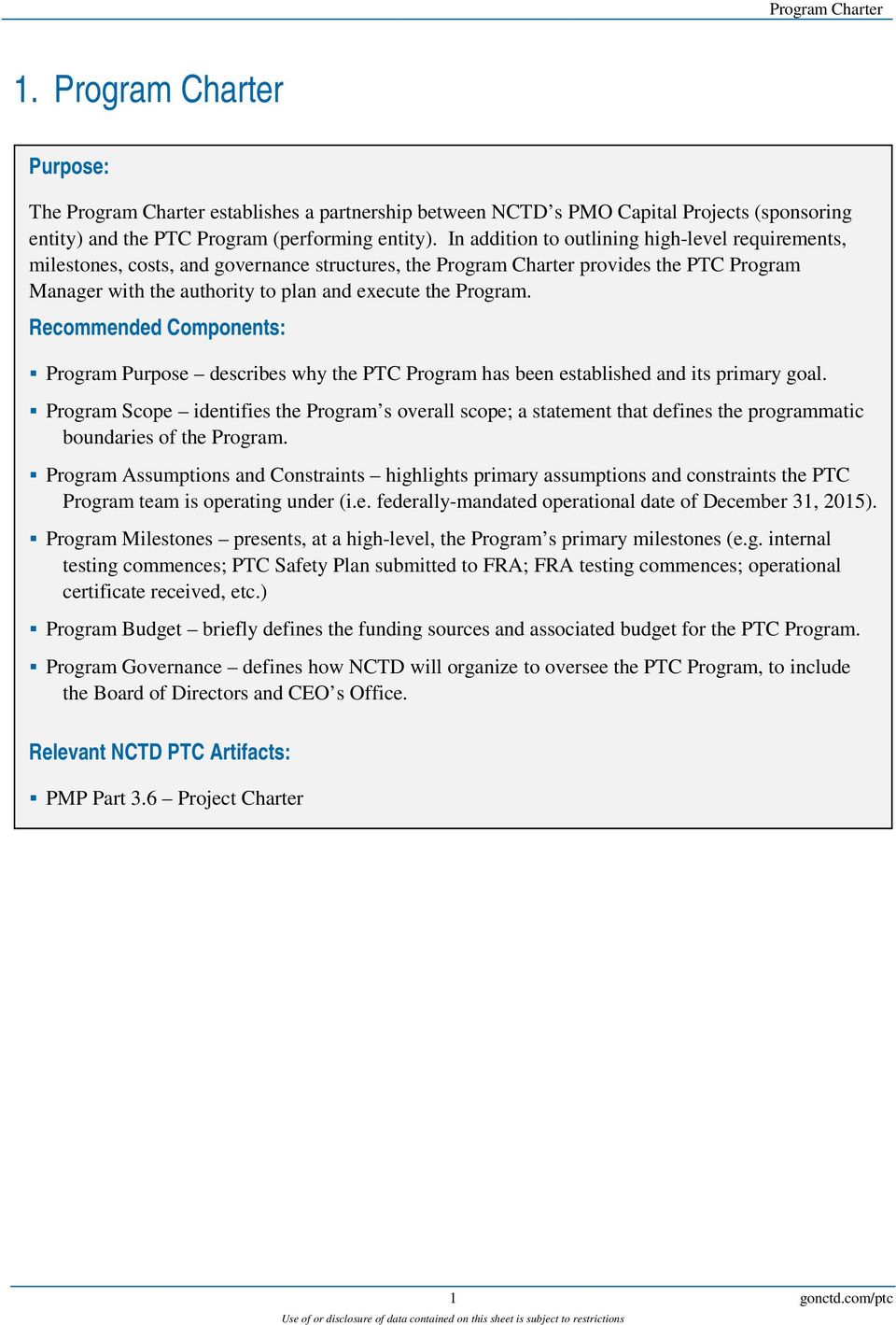
7 Program Charter 1. Program Charter Purpose: The Program Charter establishes a partnership between NCTD s PMO Capital Projects (sponsoring entity) and the PTC Program (performing entity). In addition to outlining high-level requirements, milestones, costs, and governance structures, the Program Charter provides the PTC Program Manager with the authority to plan and execute the Program. Recommended Components: Program Purpose describes why the PTC Program has been established and its primary goal. Program Scope identifies the Program s overall scope; a statement that defines the programmatic boundaries of the Program. Program Assumptions and Constraints highlights primary assumptions and constraints the PTC Program team is operating under (i.e. federally-mandated operational date of December 31, 2015). Program Milestones presents, at a high-level, the Program s primary milestones (e.g. internal testing commences; PTC Safety Plan submitted to FRA; FRA testing commences; operational certificate received, etc.) Program Budget briefly defines the funding sources and associated budget for the PTC Program. Program Governance defines how NCTD will organize to oversee the PTC Program, to include the Board of Directors and CEO s Office. Relevant NCTD PTC Artifacts: PMP Part 3.6 Project Charter 1 gonctd.com/ptc
8 Program Charter 2 gonctd.com/ptc

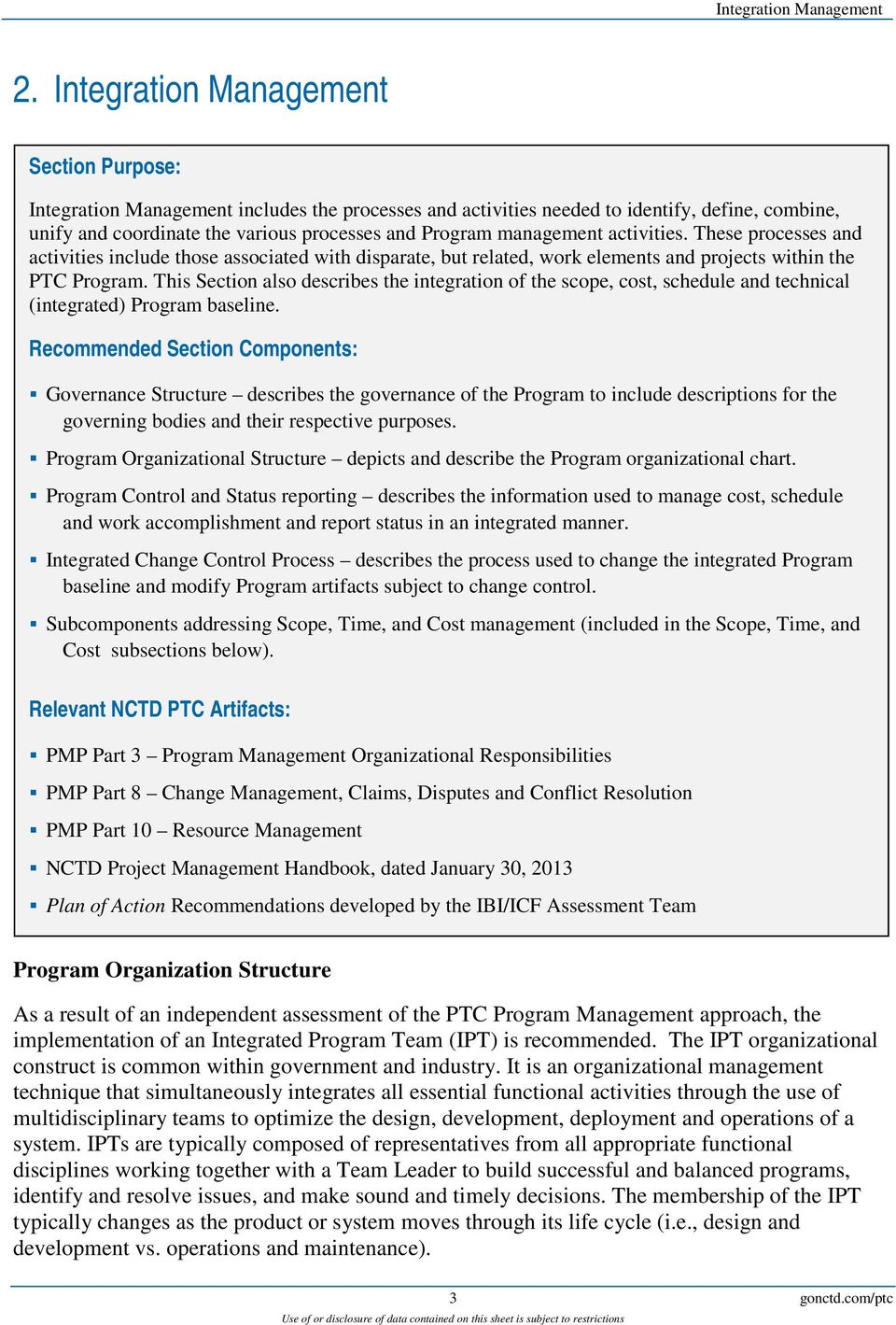
9 Integration Management 2. Integration Management Section Purpose: Integration Management includes the processes and activities needed to identify, define, combine, unify and coordinate the various processes and Program management activities. These processes and activities include those associated with disparate, but related, work elements and projects within the PTC Program. This Section also describes the integration of the scope, cost, schedule and technical (integrated) Program baseline. Recommended Section Components: Governance Structure describes the governance of the Program to include descriptions for the governing bodies and their respective purposes. Program Organizational Structure depicts and describe the Program organizational chart. Program Control and Status reporting describes the information used to manage cost, schedule and work accomplishment and report status in an integrated manner. Integrated Change Control Process describes the process used to change the integrated Program baseline and modify Program artifacts subject to change control. Subcomponents addressing Scope, Time, and Cost management (included in the Scope, Time, and Cost subsections below). Relevant NCTD PTC Artifacts: PMP Part 3 Program Management Organizational Responsibilities PMP Part 8 Change Management, Claims, Disputes and Conflict Resolution PMP Part 10 Resource Management NCTD Project Management Handbook, dated January 30, 2013 Plan of Action Recommendations developed by the IBI/ICF Assessment Team Program Organization Structure As a result of an independent assessment of the PTC Program Management approach, the implementation of an Integrated Program Team (IPT) is recommended. The IPT organizational construct is common within government and industry. It is an organizational management technique that simultaneously integrates all essential functional activities through the use of multidisciplinary teams to optimize the design, development, deployment and operations of a system. IPTs are typically composed of representatives from all appropriate functional disciplines working together with a Team Leader to build successful and balanced programs, identify and resolve issues, and make sound and timely decisions. The membership of the IPT typically changes as the product or system moves through its life cycle (i.e., design and development vs. operations and maintenance). 3 gonctd.com/ptc
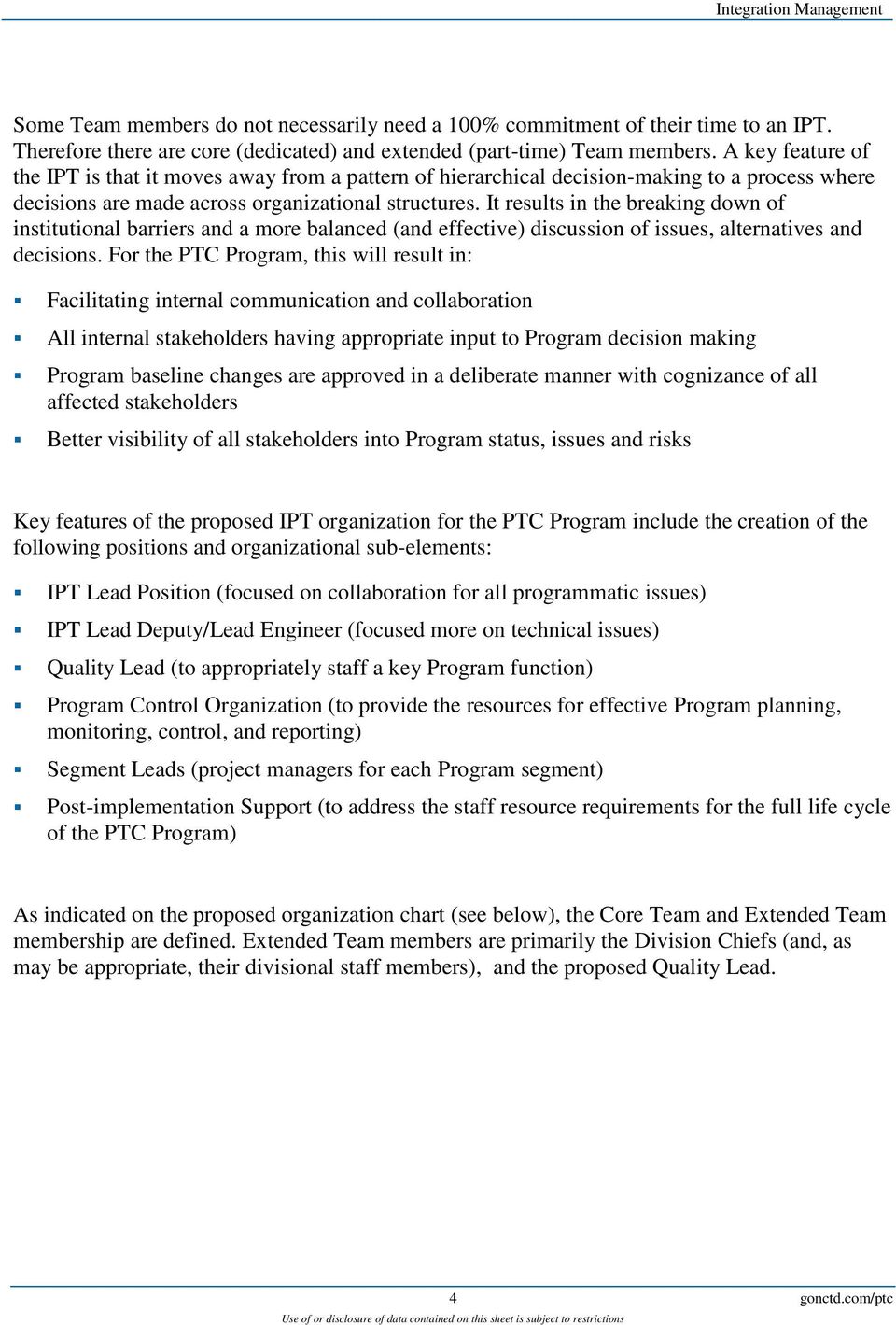
10 Integration Management Some Team members do not necessarily need a 100% commitment of their time to an IPT. Therefore there are core (dedicated) and extended (part-time) Team members. A key feature of the IPT is that it moves away from a pattern of hierarchical decision-making to a process where decisions are made across organizational structures. It results in the breaking down of institutional barriers and a more balanced (and effective) discussion of issues, alternatives and decisions. For the PTC Program, this will result in: Facilitating internal communication and collaboration All internal stakeholders having appropriate input to Program decision making Program baseline changes are approved in a deliberate manner with cognizance of all affected stakeholders Better visibility of all stakeholders into Program status, issues and risks Key features of the proposed IPT organization for the PTC Program include the creation of the following positions and organizational sub-elements: IPT Lead Position (focused on collaboration for all programmatic issues) IPT Lead Deputy/Lead Engineer (focused more on technical issues) Quality Lead (to appropriately staff a key Program function) Program Control Organization (to provide the resources for effective Program planning, monitoring, control, and reporting) Segment Leads (project managers for each Program segment) Post-implementation Support (to address the staff resource requirements for the full life cycle of the PTC Program) As indicated on the proposed organization chart (see below), the Core Team and Extended Team membership are defined. Extended Team members are primarily the Division Chiefs (and, as may be appropriate, their divisional staff members), and the proposed Quality Lead. 4 gonctd.com/ptc
11 Integration Management 5 gonctd.com/ptc

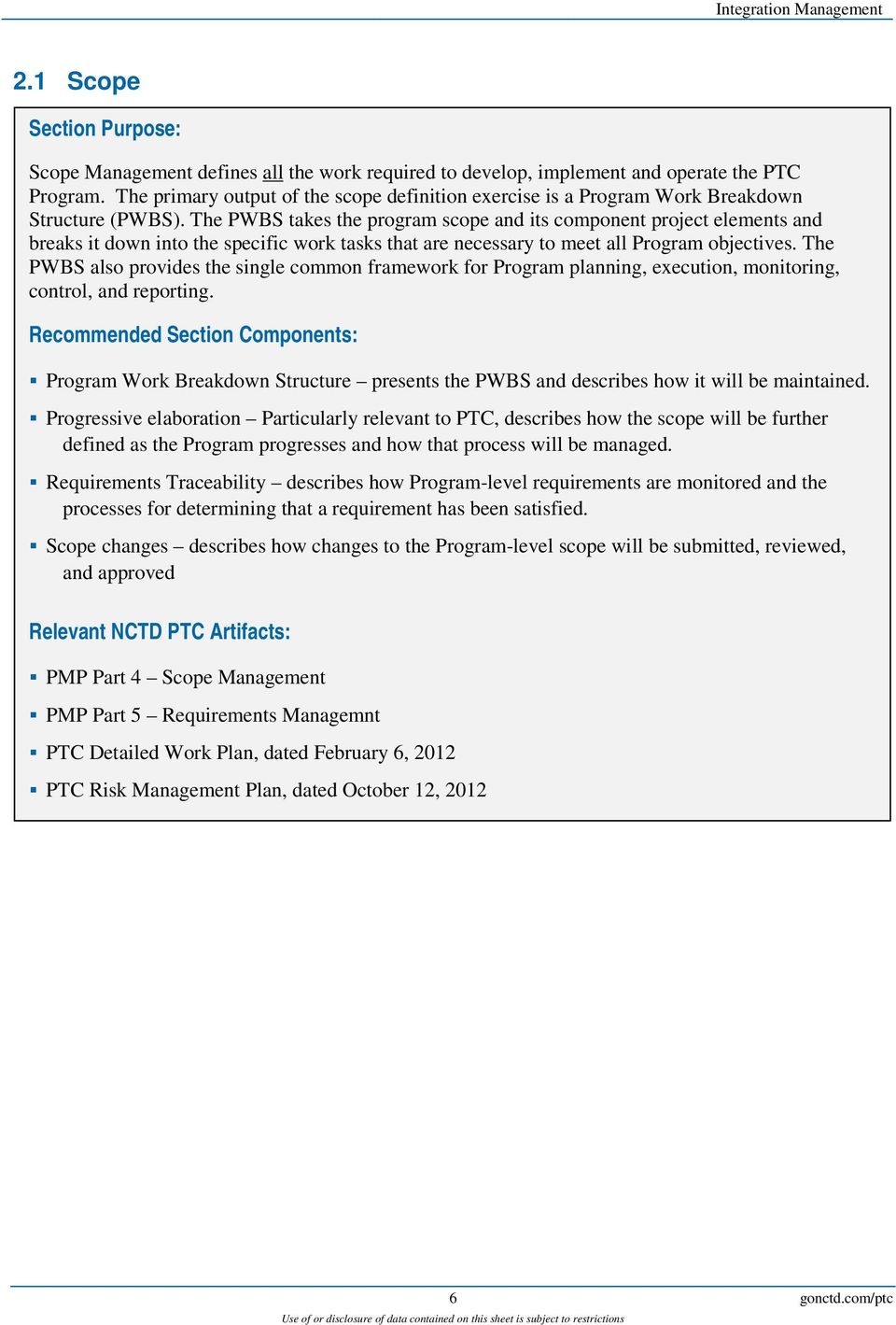
12 Integration Management 2.1 Scope Section Purpose: Scope Management defines all the work required to develop, implement and operate the PTC Program. The primary output of the scope definition exercise is a Program Work Breakdown Structure (PWBS). The PWBS takes the program scope and its component project elements and breaks it down into the specific work tasks that are necessary to meet all Program objectives. The PWBS also provides the single common framework for Program planning, execution, monitoring, control, and reporting. Recommended Section Components: Program Work Breakdown Structure presents the PWBS and describes how it will be maintained. Progressive elaboration Particularly relevant to PTC, describes how the scope will be further defined as the Program progresses and how that process will be managed. Requirements Traceability describes how Program-level requirements are monitored and the processes for determining that a requirement has been satisfied. Scope changes describes how changes to the Program-level scope will be submitted, reviewed, and approved Relevant NCTD PTC Artifacts: PMP Part 4 Scope Management PMP Part 5 Requirements Managemnt PTC Detailed Work Plan, dated February 6, 2012 PTC Risk Management Plan, dated October 12, gonctd.com/ptc
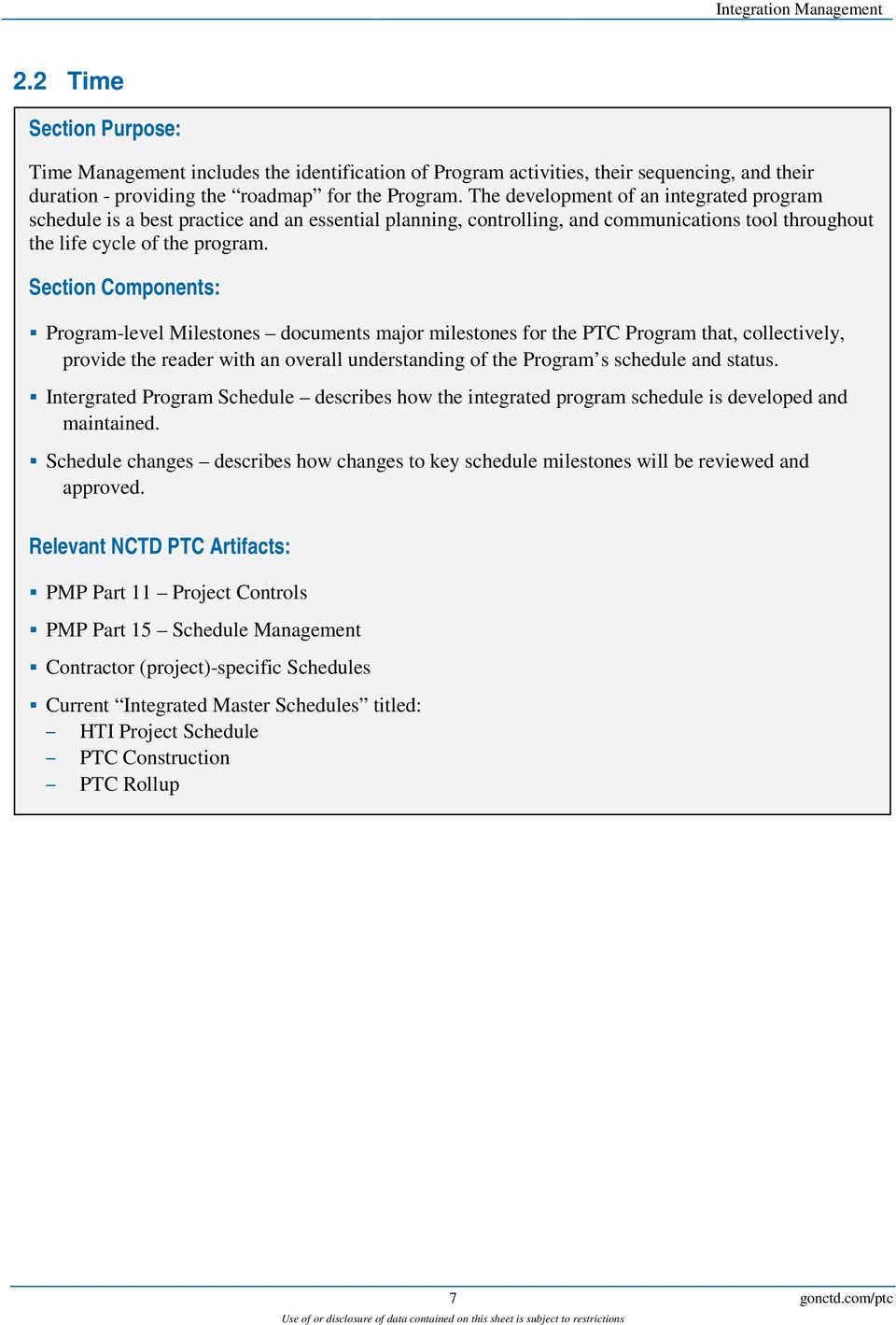
13 Integration Management 2.2 Time Section Purpose: Time Management includes the identification of Program activities, their sequencing, and their duration - providing the roadmap for the Program. The development of an integrated program schedule is a best practice and an essential planning, controlling, and communications tool throughout the life cycle of the program. Section Components: Program-level Milestones documents major milestones for the PTC Program that, collectively, provide the reader with an overall understanding of the Program s schedule and status. Intergrated Program Schedule describes how the integrated program schedule is developed and maintained. Schedule changes describes how changes to key schedule milestones will be reviewed and approved. Relevant NCTD PTC Artifacts: PMP Part 11 Project Controls PMP Part 15 Schedule Management Contractor (project)-specific Schedules Current Integrated Master Schedules titled: HTI Project Schedule PTC Construction PTC Rollup 7 gonctd.com/ptc
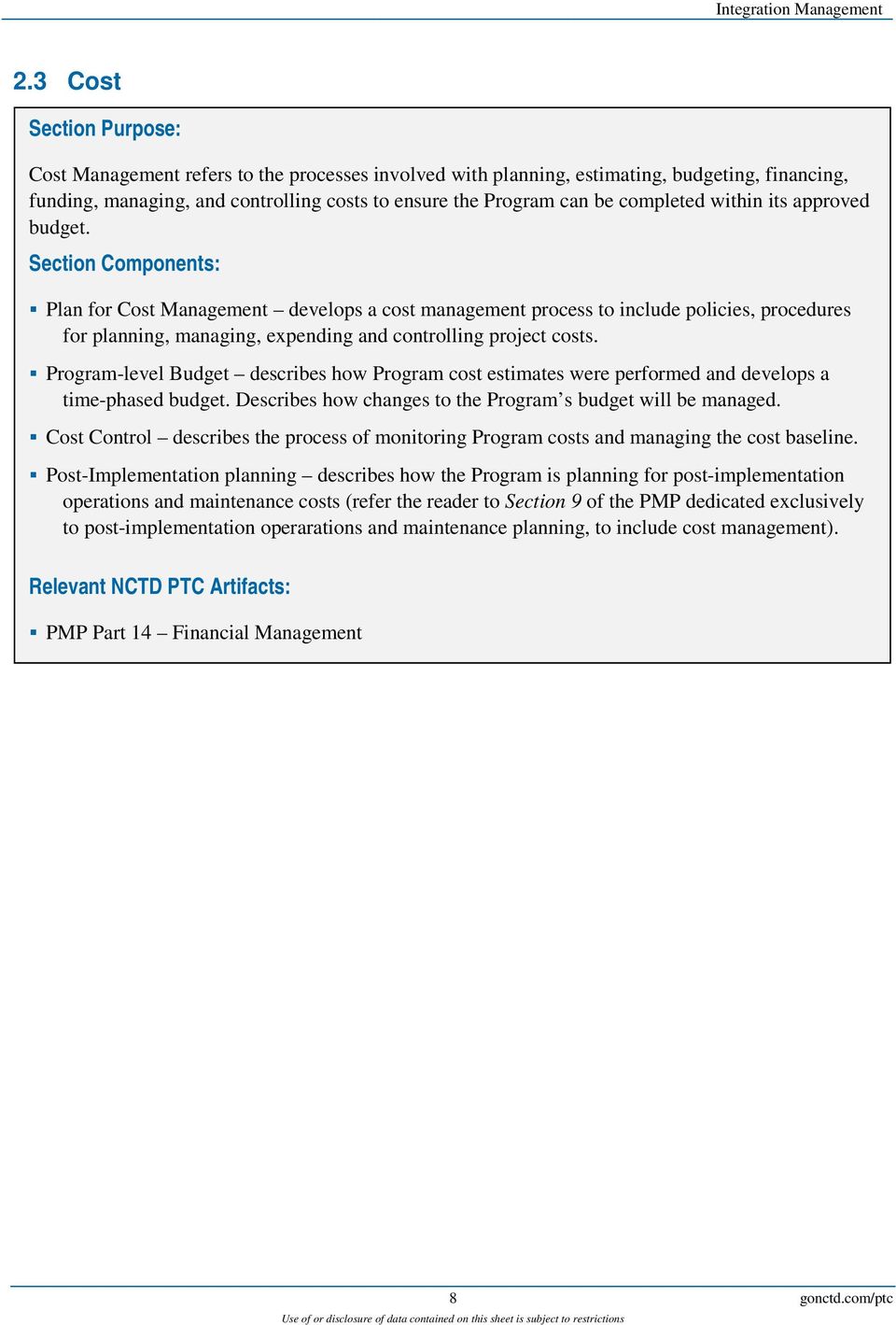
14 Integration Management 2.3 Cost Section Purpose: Cost Management refers to the processes involved with planning, estimating, budgeting, financing, funding, managing, and controlling costs to ensure the Program can be completed within its approved budget. Section Components: Plan for Cost Management develops a cost management process to include policies, procedures for planning, managing, expending and controlling project costs. Program-level Budget describes how Program cost estimates were performed and develops a time-phased budget. Describes how changes to the Program s budget will be managed. Cost Control describes the process of monitoring Program costs and managing the cost baseline. Post-Implementation planning describes how the Program is planning for post-implementation operations and maintenance costs (refer the reader to Section 9 of the PMP dedicated exclusively to post-implementation operarations and maintenance planning, to include cost management). Relevant NCTD PTC Artifacts: PMP Part 14 Financial Management 8 gonctd.com/ptc
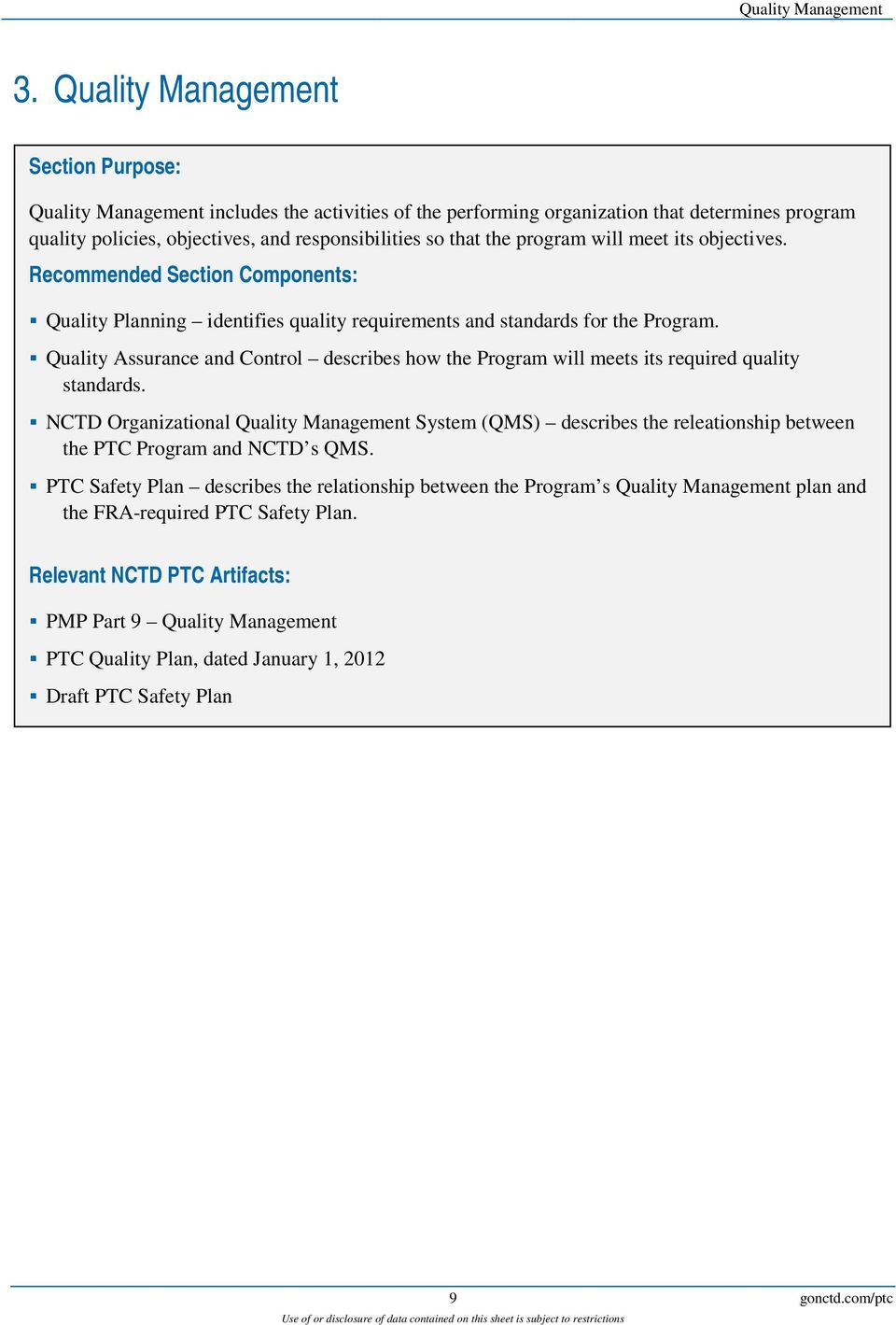
15 Quality Management 3. Quality Management Section Purpose: Quality Management includes the activities of the performing organization that determines program quality policies, objectives, and responsibilities so that the program will meet its objectives. Recommended Section Components: Quality Planning identifies quality requirements and standards for the Program. Quality Assurance and Control describes how the Program will meets its required quality standards. NCTD Organizational Quality Management System (QMS) describes the releationship between the PTC Program and NCTD s QMS. PTC Safety Plan describes the relationship between the Program s Quality Management plan and the FRA-required PTC Safety Plan. Relevant NCTD PTC Artifacts: PMP Part 9 Quality Management PTC Quality Plan, dated January 1, 2012 Draft PTC Safety Plan 9 gonctd.com/ptc
16 Quality Management 10 gonctd.com/ptc

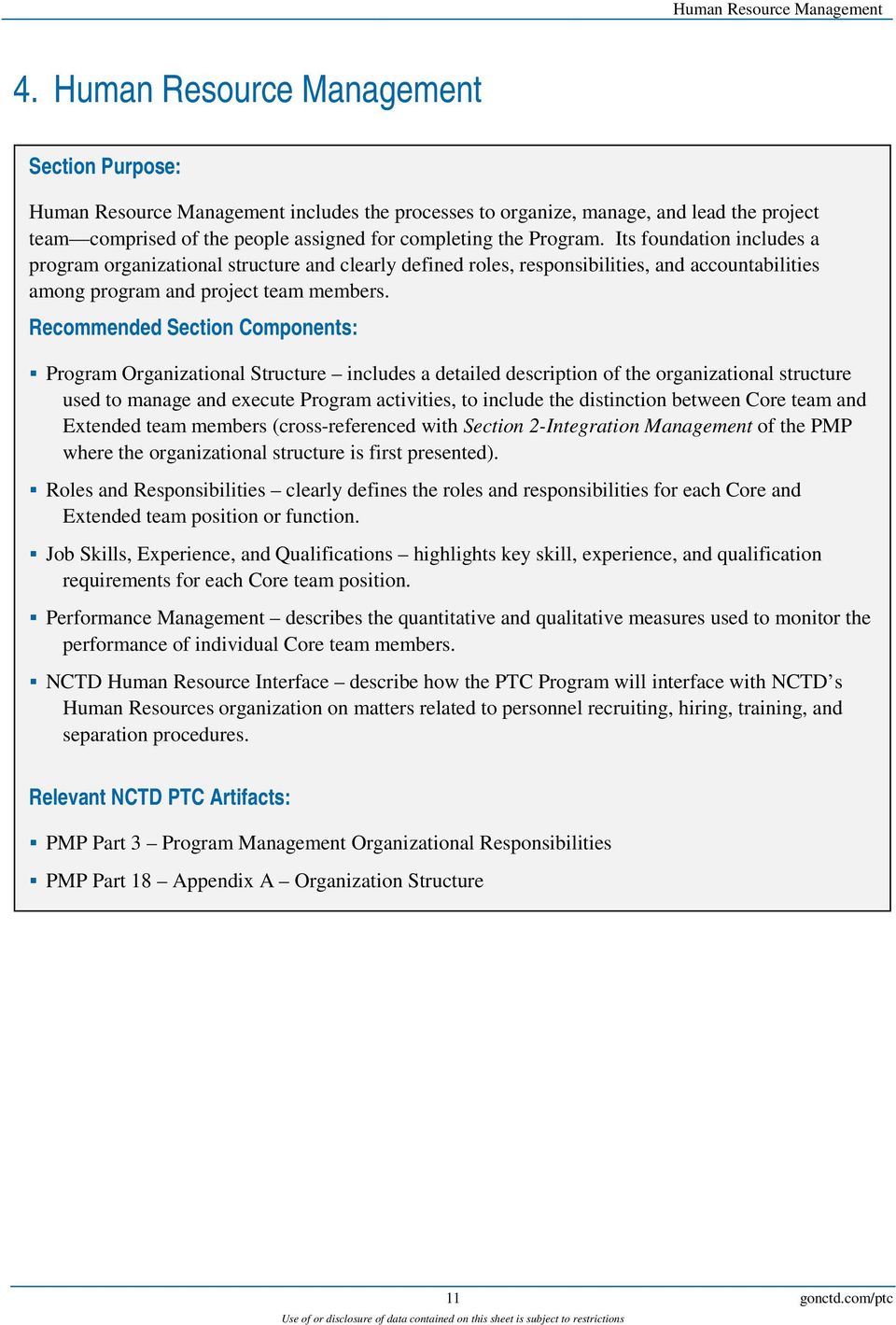
17 Human Resource Management 4. Human Resource Management Section Purpose: Human Resource Management includes the processes to organize, manage, and lead the project team comprised of the people assigned for completing the Program. Its foundation includes a program organizational structure and clearly defined roles, responsibilities, and accountabilities among program and project team members. Recommended Section Components: Program Organizational Structure includes a detailed description of the organizational structure used to manage and execute Program activities, to include the distinction between Core team and Extended team members (cross-referenced with Section 2-Integration Management of the PMP where the organizational structure is first presented). Roles and Responsibilities clearly defines the roles and responsibilities for each Core and Extended team position or function. Job Skills, Experience, and Qualifications highlights key skill, experience, and qualification requirements for each Core team position. Performance Management describes the quantitative and qualitative measures used to monitor the performance of individual Core team members. NCTD Human Resource Interface describe how the PTC Program will interface with NCTD s Human Resources organization on matters related to personnel recruiting, hiring, training, and separation procedures. Relevant NCTD PTC Artifacts: PMP Part 3 Program Management Organizational Responsibilities PMP Part 18 Appendix A Organization Structure 11 gonctd.com/ptc
18 Human Resource Management 12 gonctd.com/ptc

19 Risk Management 5. Risk Management Section Purpose: Risk Management includes the processes of conducting risk identification, analysis, and response planning, and the control of Program risks in order to reduce the likelihood of occurrence and/or impact of a risk. Recommended Section Components: Risk Management Plan describes how the PTC Program will identify, analyze, prioritize, and develop mitigation strategies for Program-level risks. Risk Monitoring and Control describes what processes, options, and actions the Program will use to manage risks once identified. Relevant NCTD PTC Artifacts: PMP Part 6 Risk Management PMP Part 19 Appendix B NCTD PTC Risk Assessment Matrix PTC Risk Management Plan, dated October 10, 2012 PTC Program Risk Registry Individual Project-Level Risk Registries 13 gonctd.com/ptc
20 Risk Management 14 gonctd.com/ptc

21 Procurement Management 6. Procurement Management Section Purpose: Procurement Management refers to the processes followed to obtain the required products and services necessary for the successful implementation of the PTC Program. Recommended Section Components: Procurement Processes describes the processes used to procure products and services, including contract types employed and decision criteria. Approval and Authority Levels outlines the varying levels of procurement authority vested in each position within the Program team. Contract Closeout describes the processes associated with formally closing out service/product contracts after all deliverables and payments have been made. NCTD Procurement Interface describes how the PTC Program will interface with NCTD s Procurement organization. Relevant NCTD PTC Artifacts: PMP Part 3 Program Management Organizational Responsibilities PMP Part 16 Procurement Management 15 gonctd.com/ptc
22 Procurement Management 16 gonctd.com/ptc
23 Stakeholder Management 7. Stakeholder Management Section Purpose: Stakeholder Management includes the activities associated with identifying, categorizing, and tracking all stakeholders (people, groups, organizations) who could impact or be impacted by the Program and may affect the Program s successful implementation. Recommended Section Components: Stakeholder Identification identifies and characterizes internal and external stakeholders based on their influence over and interest in the PTC Program. Stakeholder Engagement Strategies describes Program stakeholder engagement strategies throughout the duration of the Program and defines the metrics used to measure the performance of stakeholder engagement activities. Includes a schedule of engagement that relates to or is driven by other Program activities. Relevant NCTD PTC Artifacts: PMP Part 12 Communications and Outreach Plan PTC Interagency Coordination Plan, dated March 25, 2013 PTC Outreach Plan DRAFT 17 gonctd.com/ptc
24 Stakeholder Management 18 gonctd.com/ptc
25 Communications Management 8. Communications Management Section Purpose: Communications Management includes the activities associated with facilitating timely and appropriate generation, collection, storage, and distribution of Program information and the solicitation and receipt of timely input and feedback from stakeholders and other interested parties. Recommended Section Components: Communications Planning describes how the Program will plan for communications activities in coordination with the Program schedule. Information Distribution outlines how the Program will provide timely and accurate information to Program stakeholders using appropriate media (e.g. face-to-face meetings, collaboration tools, electronic communications, print media, etc.). Feedback Mechanisms outlines how Program stakeholders will be provided with timely and meaningful opportunities to provide input and feedback concerning relevant Program activities and actions. Program Performance Reporting defines how Program performance will be disseminated to the appropriate internal and external stakeholders and the frequency by which this information will be delivered. Relevant NCTD PTC Artifacts: PMP Part 12 Communications and Outreach Plan Individual Project-Level Communications Plans PTC Interagency Coordination Plan, dated March 25, 2013 PTC Outreach Plan DRAFT 19 gonctd.com/ptc
26 Communications Management 20 gonctd.com/ptc
27 Post-Implementation Operations and Maintenance Planning 9. Post-Implementation Operations and Maintenance Planning Section Purpose: Post-Implementation Operation and Maintenance (O&M) Planning includes a description of the PTC Program and lists all the system elements (subsystems) that must be operated and maintained on an on-going basis upon Program implementation, including auxiliary equipment and facilities. Also covered are key stakeholders that rely on the PTC Program s success. This section will refer to a subsidiary PTC Operations and Maintenance Plan (to be developed). and explains how the Plan fits in with related documents such as the operating manuals, and maintenance manuals. The initial version may be quite limited in content, focusing on issues such as staffing, funding, and documentation that need to be addressed well in advance of system startup. Subsequent versions of the Plan will prepared incrementally during system implementation, and revised as needed during on-going system operation. Recommended Plan Components: Introduction/Purpose includes a description of the PTC System and lists all the system elements (subsystems) that are the subject to O&M, including auxiliary equipment and facilities. Resources identifies the budget, funding sources, organization (staffing), infrastructure, and facilities to be used for system operation and maintenance. Operations describes the policies and high-level procedures governing operation of the system and how they relate to the deployment plan, and addresses the activities described in the PTC Program s Concept of Operations, or similar artifact. Maintenance describes the policies and high-level procedures governing maintenance of the PTC System, and addresses both preventative and corrective activities needed to keep the system fully operational. Configuration Management describes how configuration management (CM) will be conducted on PTC-related components (e.g. back office systems, dispatch systems, onboard systems, wayside systems, and the network infrastructure) in a post-implementation environment. Relevant NCTD PTC Artifacts: Current operating and maintenance plans and processes related to: Locomotives and other relevant rolling stock Wayside/Right-of-Way Dispatch Information technology Communications infrastructure Other rail-related maintenance 21 gonctd.com/ptc
28 Post-Implementation Operations and Maintenance Planning 22 gonctd.com/ptc
29
30
Assessment of NCTD Program Management Framework for Positive Train Control Program
 Assessment of NCTD Program Management Framework for Positive Train Control Program Subtask 2: Analysis Gap Analysis Prepared for: Brad Hansen, M.S., PMP Director, PMO Capital Projects May 2013 0 icfi.com/transportation
Assessment of NCTD Program Management Framework for Positive Train Control (PTC) Program. Subtask 1: Discovery Current State Revision 3
 DELIVERABLE Assessment of NCTD Program Management Framework for Positive Train Control (PTC) Program Subtask 1: Discovery Current State Revision 3 Contract Number: 13025-OS Task Order 1 April 2013 Submitted
VA ICJIS. Program Management Plan
 VA ICJIS Program Management Plan 1 08/29/01 Program Management Plan VA Integrated Criminal Justice Information System (ICJIS) Program 1. Introduction. The Commonwealth of Virginia Integrated Criminal Justice
Department of Administration Portfolio Management System 1.3 June 30, 2010
 E 06/ 30/ 2010 EX AM PL 1. 3 06/ 28/ 2010 06/ 24/ 2010 06/ 23/ 2010 06/ 15/ 2010 06/ 18/ 2010 Portfolio System 1.3 June 30, 2010 Contents Section 1. Project Overview... 1 1.1 Project Description... 1 1.2
PROJECT MANAGEMENT PLAN TEMPLATE < PROJECT NAME >
 PROJECT MANAGEMENT PLAN TEMPLATE < PROJECT NAME > Date of Issue: < date > Document Revision #: < version # > Project Manager: < name > Project Management Plan < Insert Project Name > Revision History Name
<name of project> Software Project Management Plan
 The document in this file is adapted from the IEEE standards for Software Project Management Plans, 1058-1998, which conforms to the requirements of ISO standard 12207 Software Life Cycle Processes. Tailor
The 10 Knowledge Areas & ITTOs
 This document is part of a series that explain the newly released PMBOK 5th edition. These documents provide simple explanation and summary of the book. However they do not replace the necessity of reading
Description of Program Management Processes (Initiating, Planning) 2011 PROGstudy.com. All rights reserved
 Description of Program Management Processes (Initiating, Planning) Topics Covered Program Management Process Groups salient features Description of all processes in Initiating Process Group: Initiate Program
Project Management Guidelines
 Project Management Guidelines 1. INTRODUCTION. This Appendix (Project Management Guidelines) sets forth the detailed Project Management Guidelines. 2. PROJECT MANAGEMENT PLAN POLICY AND GUIDELINES OVERVIEW.
Develop Project Charter. Develop Project Management Plan
 Develop Charter Develop Charter is the process of developing documentation that formally authorizes a project or a phase. The documentation includes initial requirements that satisfy stakeholder needs
THE PROJECT MANAGEMENT KNOWLEDGE AREAS
 THE PROJECT MANAGEMENT KNOWLEDGE AREAS 4. Project Integration Management 5. Project Scope Management 6. Project Time Management 7. Project Cost Management 8. Project Quality Management 9. Project Human
This is the software system proposal document for the <name of the project> project sponsored by <name of sponsor>.
 Guide to Preparing the SOFTWARE PROJECT MANAGEMENT PLAN R. Buckley CSc 190 Senior Project Department of Computer Science - College of Engineering and Computer Science California State University, Sacramento
PROJECT MANAGEMENT PLAN Outline VERSION 0.0 STATUS: OUTLINE DATE:
 PROJECT MANAGEMENT PLAN Outline VERSION 0.0 STATUS: OUTLINE DATE: Project Name Project Management Plan Document Information Document Title Version Author Owner Project Management Plan Amendment History
OE PROJECT CHARTER TEMPLATE
 PROJECT : PREPARED BY: DATE (MM/DD/YYYY): Project Name Typically the Project Manager Project Charter Last Modified Date PROJECT CHARTER VERSION HISTORY VERSION DATE (MM/DD/YYYY) COMMENTS (DRAFT, SIGNED,
Minnesota Health Insurance Exchange (MNHIX)
 Minnesota Health Insurance Exchange (MNHIX) 1.2 Plan September 21st, 2012 Version: FINAL v.1.0 11/9/2012 2:58 PM Page 1 of 87 T A B L E O F C O N T E N T S 1 Introduction to the Plan... 12 2 Integration
Overview of: A Guide to the Project Management Body of Knowledge (PMBOK Guide) Fourth Edition
 Overview of A Guide to the Project Management Body of Knowledge (PMBOK Guide) Fourth Edition Overview of: A Guide to the Project Management Body of Knowledge (PMBOK Guide) Fourth Edition 1 Topics for Discussion
Information Technology Project Oversight Framework
 i This Page Intentionally Left Blank i Table of Contents SECTION 1: INTRODUCTION AND OVERVIEW...1 SECTION 2: PROJECT CLASSIFICATION FOR OVERSIGHT...7 SECTION 3: DEPARTMENT PROJECT MANAGEMENT REQUIREMENTS...11
IT Project Management Methodology. Project Scope Management Support Guide
 NATIONAL INFORMATION TECHNOLOGY AUTHORITY - UGANDA IT Project Management Methodology Project Scope Management Support Guide Version 0.3 Version Date Author Change Description 0.1 23 rd Mar, 2013 Gerald
PMO Starter Kit. White Paper
 PMO Starter Kit White Paper January 2011 TABLE OF CONTENTS 1. ABOUT THE PMO STARTER KIT...3 2. INTRODUCTION TO THE PMO STARTER KIT WHITE PAPER...3 3. PMO DEVELOPMENT ROADMAP...4 4. PLAN PHASE...5 4.1 CREATE
System Development and Life-Cycle Management (SDLCM) Methodology
 System Development and Life-Cycle Management (SDLCM) Methodology Subject Type Standard Approval CISSCO Program Director A. PURPOSE This standard specifies the content and format requirements for a Software
- ATTACHMENT - PROGRAM MANAGER DUTIES & RESPONSIBILITIES MARYLAND STATE POLICE W00B0400021
 - ATTACHMENT - PROGRAM MANAGER DUTIES & RESPONSIBILITIES MARYLAND STATE POLICE W00B0400021 About this document this is a detailed description of typical Project Manager (PM) duties, responsibilities, and
Principles of Execution. Tips and Techniques for Effective Project Portfolio Management
 Principles of Execution Tips and Techniques for Effective Project Management Roadmap Develop A Shared Vision for Management Understanding the Difference between Project Management Reviews and Management
PROJECT MANAGEMENT METHODOLOGY SECTION 3 -- PLANNING PHASE
 PROJECT MANAGEMENT METHODOLOGY SECTION 3 -- PLANNING PHASE Table of Contents Introduction...3-1 Overview...3-1 The Process and the Project Plan...3-1 Project Objectives and Scope...3-1 Work Breakdown Structure...3-1
PHASE 3: PLANNING PHASE
 PHASE 3: PLANNING PHASE The Planning Phase focuses principally on required project planning work. Proper comprehensive project planning is essential to a successful IT project, and incomplete project planning
Manag. Roles. Novemb. ber 20122
 Information Technology Manag gement Framework Roles and Respo onsibilities Version 1.2 Novemb ber 20122 ITM Roles and Version History Version ed By Revision Date Approved By Approval Date Description of
Application of Standard Project Management Processes in Fiber Optic Cable Plant Project Management. Introduction. Alfred Sankara, DigiBridge TelCo
 Application of Standard Project Management Processes in Fiber Optic Cable Plant Project Management Alfred Sankara, DigiBridge TelCo Introduction The Project Management Institute (PMI) is the world's leading
ATTACHMENT 3 SPS PROJECT SENIOR PROGRAM MANAGER (SPM) DUTIES & RESPONSIBILITIES
 1. ROLE DEFINITIONS ATTACHMENT 3 SPS PROJECT SENIOR PROGRAM MANAGER (SPM) DUTIES & RESPONSIBILITIES The purpose of this section is to distinguish among the roles interacting with the SPM obtained through
Supporting Workflow Overview. CSC532 Fall06
 Supporting Workflow Overview CSC532 Fall06 Objectives: Supporting Workflows Define the supporting workflows Understand how to apply the supporting workflows Understand the activities necessary to configure
PHASE 3: PLANNING PHASE
 PHASE 3: PLANNING PHASE The ning Phase focuses principally on required project planning work. Proper comprehensive project planning is essential to a successful IT project, and incomplete project planning
Project Management Plan for
 Project Management Plan for [Project ID] Prepared by: Date: [Name], Project Manager Approved by: Date: [Name], Project Sponsor Approved by: Date: [Name], Executive Manager Table of Contents Project Summary...
MNLARS Project Audit Checklist
 Audit Checklist The following provides a detailed checklist to assist the audit team in reviewing the health of a project. Relevance (at this time) How relevant is this attribute to this project or audit?
Project Management Professional (PMP)
 Project Management Professional (PMP) Duration: 5 days Course Objectives: PMI s Project Management Professional (PMP) credential is the most important industry-recognized certification for project managers.
Best Practices Statement Project Management. Best Practices for Managing State Information Technology Projects
 State of Arkansas Office of Information Technology 124 W. Capitol Ave. Suite 990 Little Rock, AR 72201 501.682.4300 Voice 501.682.4020 Fax http://www.cio.arkansas.gov/techarch Best Practices Statement
STATE BOARD OF ELECTIONS P.O. BOX 6486, ANNAPOLIS, MD 21401-0486 PHONE (410) 269-2840
 MARYLAND STATE BOARD OF ELECTIONS P.O. BOX 6486, ANNAPOLIS, MD 21401-0486 PHONE (410) 269-2840 Bobbie S. Mack, Chairman David J. McManus, Jr., Vice Chairman Rachel T. McGuckian Patrick H. Murray Charles
A Guide To The Project Management Body of Knowledge (PMBOK) Significant Changes from the 3 rd edition to the 4 th edition
 A Guide To The Project Body of Knowledge (PMBOK) Significant Changes from the 3 rd edition to the 4 th edition Major Changes The adoption of the verb-noun format for process names Amplification as to Enterprise
Project Management Plan Template
 Abstract: This is the project management plan document for . This is a controlled document and should be maintained in a configuration environment. Project Management Plan Template Contents REVISION
Initiating Forms COPYRIGHTED MATERIAL 1.0 INITIATING PROCESS GROUP
 1 Initiating Forms 1.0 INITIATING PROCESS GROUP The purpose of the initiating process group is to authorize a project, provide a high-level definition of the project, and identify stakeholders. There are
Organization. Project Name. Project Overview Plan Version # Date
 Project Overview Plan Template Organization Project Name Project Overview Plan Version # Date REVISION HISTORY VERSION # REVISION DATE COMMENT 1 APPROVALS: Authorized Signature DATE 2 Table of Contents
Partnering for Project Success: Project Manager and Business Analyst Collaboration
 Partnering for Project Success: Project Manager and Business Analyst Collaboration By Barbara Carkenord, CBAP, Chris Cartwright, PMP, Robin Grace, CBAP, Larry Goldsmith, PMP, Elizabeth Larson, PMP, CBAP,
IT Project Management Practices Guide
 IT Project Management Practices Guide Introduction The IT Project Management Practices Guide (Guide) contains a repeatable, institutionwide approach for the management of application development and/or
Project Management Methodology
 Project Management Methodology 1/6/2015 PAGE 1 OF 28 Version 2.0 Contents INTRODUCTION... 4 1. Overview... 4 PHASE 1 PROJECT INITIATION... 5 1. Governance Model... 6 2. Project Prioritization Process...
Overview of A Guide to the Project Management Body of Knowledge (PMBOK Guide) Fourth Edition
 Overview of A Guide to the Project Management Body of Knowledge (PMBOK Guide) Fourth Edition Topics for Discussion PMI Foundational Standards Harmonization of PMI s Foundational Standards Top 10 changes
U.S. Department of Education Federal Student Aid
 U.S. Department of Education Federal Student Aid Lifecycle Management Methodology Version 1.3 06/30/15 Final DOCUMENT NUMBER: FSA_TOQA_PROC_STGRW.NA_001 Update History Lifecycle Management Methodology
U.S. Department of Education Federal Student Aid
 U.S. Department of Education Federal Student Aid Lifecycle Management Methodology Stage Gate Review Process Description Version 1.3 06/30/2015 Final DOCUMENT NUMBER: FSA_TOQA_PROC_STGRW.NA_001 Lifecycle
ITRM Guideline CPM 110-01 Date: January 23, 2006 SECTION 4 - PROJECT EXECUTION AND CONTROL PHASE
 PROJECT MANAGEMENT GUIDELINE SECTION 4 - PROJECT EXECUTION AND CONTROL PHASE Table of Contents Introduction... 3 Project Execution and Control Phase Overview... 3 Activities and Documents in the Execution
Project Management Institute. Construction. Extension to. A Guide to the Project Management Body of Knowledge. PMBOK Guide 2000 Edition.
 Project Management Institute Construction Extension to A Guide to the Project Management Body of Knowledge PMBOK Guide 2000 Edition Provisional Construction Extension to A Guide to the Project Management
Contrasting CMMI and the PMBOK. CMMI Technology Conference & User Group November 2005
 Contrasting CMMI and the PMBOK CMMI Technology Conference & User Group November 2005 Wayne Sherer U.S. Army ARDEC Sandy Thrasher, PMP Anteon Corporation Agenda Purpose & Overview Considerations for Comparison
Biometrics Enterprise Architecture Project Management Plan (BMEA PMP)
 Biometrics Enterprise Architecture Project Management Plan (BMEA PMP) Version 1.0 Prepared by: Date: November 24, 2008 Revision History Purpose Revision Date Level 11/17/2009 First Draft 1.0 Responsible
Appendix E Program Management Plan Template
 Appendix E Program Management Plan Template Version 2 March 7, 2005 This page is intentionally left blank. Version 2 March 7, 2005 Title Page Document Control Panel Table of Contents List of Acronyms Definitions
Project Management Certificate (IT Professionals)
 Project Management Certificate (IT Professionals) Whether your field is architecture or information technology, successful planning involves a carefully crafted set of steps to planned and measurable goals.
Minnesota Health Insurance Exchange Project (MNHIX) Deliverable Definition Document (DDD) For Project Management Plan Date: 07-31-2012
 Minnesota Health Insurance Exchange Project (MNHI) Deliverable Definition Document (DDD) For Project Plan Date: 07-31-2012 11/9/2012 1:18 PM Page 1 of 8 1. High Level Deliverable Description The Project
An Oracle White Paper March 2013. Project Management Office Starter Kit
 An Oracle White Paper March 2013 Project Management Office Starter Kit Executive Overview... 1 Introduction... 1 Plan Phase... 2 Create Statement of Purpose and Goals... 2 Define Scope and Target Maturity...
Agenda. 0 Agenda review 2 minutes. 0 Chapter of the week 50 minutes. 0 Q&A of chapter 10 minutes. 0 Break 10 minutes. 0 Exercises 25 minutes
 Agenda 0 Instructor Introduction 3 minutes 0 Agenda review 2 minutes 0 Chapter of the week 50 minutes 0 Q&A of chapter 10 minutes 0 Break 10 minutes 0 Exercises 25 minutes 0 Round table 15 minutes 0 Closure
AIPM PROFESSIONAL COMPETENCY STANDARDS FOR PROJECT MANAGEMENT PART B CERTIFIED PRACTISING PROJECT PRACTITIONER (CPPP)
 AIPM PROFESSIONAL COMPETENCY STANDARDS FOR PROJECT MANAGEMENT PART B CERTIFIED PRACTISING PROJECT PRACTITIONER (CPPP) Copyright: Australian Institute of Project Management Document Information Document
Knowledge Area Inputs, Tools, and Outputs. Knowledge area Process group/process Inputs Tools Outputs
 HUMAN RESOURCE MANAGEMENT Organizational planning Staff Acquisition Project interfaces such as organizational interfaces, technical interfaces and interpersonal interfaces. Staffing requirements Staffing
The Project Management Knowledge Areas as defined by PMI (PMBOK, 2004)
 The Project Management Knowledge Areas as defined by PMI (PMBOK, 2004) is the processes required to ensure that the various elements of the project are properly coordinated. the processes required to ensure
Program Lifecycle Methodology Version 1.7
 Version 1.7 March 30, 2011 REVISION HISTORY VERSION NO. DATE DESCRIPTION AUTHOR 1.0 Initial Draft Hkelley 1.2 10/22/08 Updated with feedback Hkelley 1.3 1/7/2009 Copy edited Kevans 1.4 4/22/2010 Updated
Leveraging RUP, OpenUP, and the PMBOK. Arthur English, GreenLine Systems
 Software Project Management Leveraging RUP, OpenUP, and the PMBOK Arthur English, GreenLine Systems GreenLine Systems Inc. 2003 2013 My Background 30+ years of IT project management experience with both
Project Knowledge Areas
 From Houston S: The Project Manager s Guide to Health Information Technology Implementation. Chicago: HIMSS; 2011; pp 27 39. This book is available on the HIMSS online bookstore at www. himss.org/store.
Project Management Office (PMO)
 Contents I. Overview of Project Management...4 1. Project Management Guide (PMG)...4 1.1 Introduction...4 1.2 Scope...6 1.3 Project Types...6 2. Document Overview, Tailoring, and Guidance...7 3. The Project
WHY DO I NEED A PROGRAM MANAGEMENT OFFICE (AND HOW DO I GET ONE)?
 WHY DO I NEED A PROGRAM MANAGEMENT OFFICE (AND HOW DO I GET ONE)? Due to the often complex and risky nature of projects, many organizations experience pressure for consistency in strategy, communication,
Introduction to the ITS Project Management Methodology
 Introduction to the ITS Project Management Methodology In September 1999 the Joint Legislative Committee on Performance Evaluation and Expenditure Review (PEER) produced a report entitled Major Computer
LEXEVS OPERATIONS AND MAINTENCE SUPPORT PROJECT MANAGEMENT PLAN
 LEXEVS OPERATIONS AND MAINTENCE SUPPORT PROJECT MANAGEMENT PLAN Version Number: 1.0 Version Date: October 1, 2014 VERSION HISTORY Version Number Implemented By Revision Date Approved By Approval Date 1.0
Appendix 2-A. Application and System Development Requirements
 Appendix 2-A. Application and System Development Requirements Introduction AHRQ has set up a Distributed Systems Engineering Lab (DSEL) to support all internal development efforts and provide a facility
Project Management Standards: A Review of Certifications/Certificates
 Project Standards: A Review of Certifications/Certificates Standards for Project Supporting Certification and Certificates Certificate Certification The Project Body of Knowledge PMBOK Guide Projects in
Integration Mgmt / Initiating Process Group 4.1 Develop Project Charter
 1 Mgmt / Initiating Process Group 4.1 Develop Project Charter Project statement of work Business case Agreements Facilitation techniques Project charter 26/02/2013 18:23:36 1 2 Mgmt / Planning Process
PHASE 8: IMPLEMENTATION PHASE
 PHASE 8: IMPLEMENTATION PHASE The Implementation Phase has one key activity: deploying the new system in its target environment. Supporting actions include training end-users and preparing to turn the
INFORMATION TECHNOLOGY PROJECT EXECUTION MODEL GUIDE FOR SMALL AND MEDIUM PROJECTS
 NOT MEASUREMENT SENSITIVE DOE G 415.1-2 INFORMATION TECHNOLOGY PROJECT EXECUTION MODEL GUIDE FOR SMALL AND MEDIUM PROJECTS [This Guide describes acceptable, but not mandatory means for complying with requirements.
Sound Transit Internal Audit Report - No. 2014-3
 Sound Transit Internal Audit Report - No. 2014-3 IT Project Management Report Date: Dec. 26, 2014 Table of Contents Page Background 2 Audit Approach and Methodology 2 Summary of Results 4 Findings & Management
Welcome to the Data Analytic Toolkit PowerPoint presentation an introduction to project management. In this presentation, we will take a brief look
 Welcome to the Data Analytic Toolkit PowerPoint presentation an introduction to project management. In this presentation, we will take a brief look at project management to understand the process and some
Project Type Guide. Project Planning and Management (PPM) V2.0. Custom Development Version 1.1 January 2014. PPM Project Type Custom Development
 Project Planning and Management (PPM) V2.0 Project Type Guide Custom Development Version 1.1 January 2014 Last Revision: 1/22/2014 Page 1 Project Type Guide Summary: Custom Development Custom software
Crosswalk Between Current and New PMP Task Classifications
 Crosswalk Between Current and New PMP Task Classifications Domain 01 Initiating the Project Conduct project selection methods (e.g., cost benefit analysis, selection criteria) through meetings with the
Design Consultant Project Management Requirements
 Design Consultant Project Management Requirements Version 2 April 25, 2013 AWTP Program Design Consultant Contents 1.0 Introduction... 1 2.0 General Management... 1 3.0 Project Management Plan... 1 4.0
Computing Services Network Project Methodology
 Computing Services Network Project Prepared By: Todd Brindley, CSN Project Version # 1.0 Updated on 09/15/2008 Version 1.0 Page 1 MANAGEMENT PLANNING Project : Version Control Version Date Author Change
5.2. 5.2 Template for IT Project Plan. Template for IT Project Plan. [Project Acronym and Name]
![5.2. 5.2 Template for IT Project Plan. Template for IT Project Plan. [Project Acronym and Name]](/thumbs/40/21194013.jpg "5.2. 5.2 Template for IT Project Plan. Template for IT Project Plan. [Project Acronym and Name]") 231 5.2 Template for IT Project Plan Name of the Tool: Source: Usage: Description: Template for IT Project Plan GIZ This template has been designed as a tool to support the planning of IT projects for
231 5.2 Template for IT Project Plan Name of the Tool: Source: Usage: Description: Template for IT Project Plan GIZ This template has been designed as a tool to support the planning of IT projects for
Module 1 Diploma of Project Management
 Module 1 Diploma of Project Management Project Management Fundamentals in association with This two day course takes participants through all aspects of Project Management and provides in depth examination
HKITPC Competency Definition
 HKITPC Competency Definition for the Certification copyright 2011 HKITPC HKITPC Competency Definition Document Number: HKCS-CD-L1L2 Version: 1.0 Date: June 2011 Prepared by Hong Kong IT Professional Certification
Project Governance Plan Next Generation 9-1-1 Project Oregon Military Department, Office of Emergency Management, 9-1-1 Program (The OEM 9-1-1)
 Oregon Military Department, Office of Emergency Management, 9-1-1 Program (The OEM 9-1-1) Date: October 1, 2014 Version: 3.1 DOCUMENT REVISION HISTORY Version Date Changes Updated By 0.1 02/13/014 Initial
THE COMPLETE PROJECT MANAGEMENT METHODOLOGY AND TOOLKIT
 THE COMPLETE PROJECT MANAGEMENT METHODOLOGY AND TOOLKIT GERARD M. HILL CRC Press Taylor & Francis Group Boca Raton London New York CRC Press is an imprint of the Taylor & Francis Croup, an informa business
Request for Proposals
 Request for Proposals Connected Responder: Public Safety and Emergency Response Community Connected Vehicle Interest, Context and Business Case Development RFP Schedule RFP Release Date: April 30, 2015
Template K Implementation Requirements Instructions for RFP Response RFP #
 Template K Implementation Requirements Instructions for RFP Response Table of Contents 1.0 Project Management Approach... 3 1.1 Program and Project Management... 3 1.2 Change Management Plan... 3 1.3 Relationship
Project Management Professional PMP PMBOK 5
 Project Management Professional PMP PMBOK 5 What are the Course Objectives? By the end of this training you will: Acquire the relevant knowledge and skills required to clear the PMP certification exam
PROJECT MANAGEMENT FOR NON-PROJECT MANAGERS
 PROJECT MANAGEMENT FOR NON-PROJECT MANAGERS NADC PTAC 2929 3 rd Ave., N., Suite 300 Billings, MT 59101 P. (406) 259-3804 F. (406) 259-4569 ww.nadc-nabn.org HIGHLINER CONSULTING GROUP, LLC. 255 E. Fireweed
TREASURY INSPECTOR GENERAL FOR TAX ADMINISTRATION
 TREASURY INSPECTOR GENERAL FOR TAX ADMINISTRATION The Customer Account Data Engine 2 Systems Development Guidelines; However, Process Improvements Are Needed to Address Inconsistencies September 30, Year
PPM V2.0 Frequently Asked Questions (FAQs) U.S. Department of Housing and Urban Development
 PPM V2.0 Frequently Asked Questions (FAQs) U.S. Department of Housing and Urban Development December 2015 1. Getting Started with PPM Life Cycle 2. PPM Life Cycle Process 3. PPM V2.0 and Project Types
Project Start Up. Start-Up Check List. Why a Project Check List? What is a Project Check List? Initial Release 1.0 Date: January 1997
 Why a Project Check List? A good way to ensure that all start-up tasks are completed prior to actually starting the project is to develop a start-up check list. The check list can be developed and then
The Key to a Successful KM Project
 Introduction An integrated PKM methodology enables organizations to maximize their investments by ensuring initiatives are on time and within budget, while sharing project challenges and successes that
Draft Document STATE OF MICHIGAN. SACWIS Planning Department of Human Services Strategic Implementation Plan: Project Staffing
 STATE OF MICHIGAN SACWIS Planning Department of Human Services Strategic Implementation Plan: Project Staffing Executive Summary The State of Michigan has dedicated integrated team of resources for the
Minnesota Health Insurance Exchange (MNHIX)
 Minnesota Health Insurance Exchange (MNHIX) Project Status Report Week Ending: 09-19-2012 Page - 1 Executive Summary The Executive Summary provides an executive level review of general project activities,
NUMBER: 12.PM-004 RESPONSIBILITY: Office of Project Support Services REVISION: 4 APPROVED BY: TITLE SUBJECT: Head, Office of Project Support Services
 SUBJECT: FERMI RESEARCH ALLIANCE PROCEDURES PROJECT MANAGEMENT NUMBER: 12.PM-004 RESPONSIBILITY: Office of Project Support Services REVISION: 4 APPROVED BY: TITLE Head, Office of Project Support Services
Frequently Asked Questions in Project Management
 Frequently Asked Questions in Project Management 1. Question: What is Project Management? Answer: Project Management is the collection and application of skills, knowledge, processes, and activities to
PROJECT PLAN TEMPLATE
 Treasury Board of Canada Secretariat Secrétariat du Conseil du Trésor du Canada Enhanced Management Framework for Information Management/Information Technology PROJECT PLAN TEMPLATE Document Revision Draft
<PROJECT NAME> PROJECT MANAGEMENT PLAN
 PROJECT MANAGEMENT PLAN Version VERSION HISTORY [Provide information on how the development and distribution of the Project Management Plan was controlled and tracked.
Project Scope Management in PMBOK made easy
 By Dr. TD Jainendrakumar The main objective of any project is to fulfill the scope of the project on time and within the budget. What is Project Scope? Scope refers to all the work involved in creating
Errata 1 st Printing. Errata 2 nd Printing
 Errata 1 st Printing NOTE: The following errata only pertain to the first printing of the PMBOK Guide Fifth Edition. In order to verify the print run of your book (or PDF), refer to the bottom of the copyright
Project Management Guidelines
 Project Management Guidelines Overview Section 86-1506 (5) directs the NITC to adopt guidelines regarding project planning and management. The goal of project management is to achieve the objectives of
AIPM PROFESSIONAL COMPETENCY STANDARDS FOR PROJECT MANAGEMENT PART C CERTIFIED PRACTISING PROJECT MANAGER (CPPM)
 AIPM PROFESSIONAL COMPETENCY STANDARDS FOR PROJECT MANAGEMENT PART C CERTIFIED PRACTISING PROJECT MANAGER (CPPM) February 2010 Version 1.12 Copyright: Australian Institute of Project Management Document
Resource Management. Determining and managing the people resources on projects can be complex as:
 Baseline Resource Management RESOURCE MANAGEMENT Purpose To provide a procedure and associated guidelines to facilitate the management of project people resources. Overview This Phase is used to establish