
Introduction to the ITS Project Management Methodology
|
|
|
- Cordelia Jodie Robinson
- 10 years ago
- Views:
Transcription
1 Introduction to the ITS Project Management Methodology In September 1999 the Joint Legislative Committee on Performance Evaluation and Expenditure Review (PEER) produced a report entitled Major Computer Systems in Mississippi s State Agencies: A Review of Their Development and Implementation. The study was undertaken as a result of less than successful application development projects in the state. Among Peer s recommendations were the following: ITS should develop comprehensive computer system project management guidelines and require state agencies to use them. (p. viii) Under its authority to approve or disapprove contracts as specified in MISS. CODE ANN , ITS should require as precondition to contract approval that agencies follow the promulgated guidelines and requirements in performing feasibility studies of proposed systems and in designing, developing, and implementing computer systems improved by the ITS board. (p. ix) At a minimum, the ITS Board should require an annual independent quality assurance assessment of each computer system project The purpose of the annual independent quality assurance assessment is to have an independent review of the project to identify problems that could cause the project to be over budget or delay its implementation This review should be conducted by ITS unless ITS staff are participating in the design, development, and implementation of the system, in which case an independent consultant should conduct the review. (p. ix) The results of the independent quality assurance assessment, along with recommendations for addressing any problems noted in the project, should be reported to the ITS Board. The ITS Board should endorse recommendations it believes are needed to correct problems noted and, if problems persist, take aggressive action to ensure that such problems are addressed. Such action could range from refusal to approve further change orders on troubled projects directing the ITS Executive Director to cancel a project vendor s contract, if warranted. (p. ix) ITS agreed with those recommendations and has since developed this methodology in response. 1

2 State of Mississippi Project Management Methodology Function: Project Initiation 1. Include Project In Agency IT Plan Description: Each year agencies prepare a three-year Strategic Information Technology Plan. It is important that agencies consider projects in prior years rather than waiting until the current year to show a project on the plan for the first time. For example, if a agency is planning a significant project to start in FY 2002, the project should be included at the latest in the plan for FY , which they would turn in by August This gives the agency the opportunity to adequately plan and budget for the project. All projects in the plan should include a project rating. The Project Rating is a process whereby the agency and ITS determine if a project should be classified as a Strategic Project. All projects on the agencies plan should be matched against the four criteria for Mission Critical Systems. For any project matching one or more of the criteria, the entire Project Rating package must be complete. Any project falling in a high-risk level or high severity level on the Project Rating will be classified as a strategic project and will be subject to oversight. Responsible: Agency Planning Committee ITS Strategic Services Division Inputs: Agency 5-Year Business Plan Techniques: Strategic Information Technology Planning Guidelines Strategic Project Rating Guidelines Outputs: Agency Information Technology Plan Project Rating 2. Prepare Initial Planning Report (IPR) PMBOK: High Level of all Core Planning Processes/11.1 Risk Identification/11.2 Risk Quantification/11.3 Risk Response Development Description: The IPR is a process whereby the agency documents objectives, functional requirements, technical environment, and proposed solution, all in support of the project. The purpose of this activity is to provide adequate planning for the project. Responsible: Agency ITS Information Systems Services Division or Strategic Services Division Inputs: Agency IT Plan Project Rating Techniques: Initial Planning Report Guidelines Outputs: Initial Planning Report 2

3 Standards: The following standards apply to this project management activity: Initial Planning Report Standards 3. Conduct ITS Review of Initial Planning Report Description: ITS reviews the Initial Planning Report to determine if the agency has adequately planned for the project. The committee may send the report back to the agency for additional work if not adequate. Responsible: ITS Review Committee Agency IT Director Inputs: Initial Planning Report Project Rating Techniques: Initial Planning Report Guidelines Outputs: Standards: Initial Planning Report Review Document The following standards apply to this project management activity: Feasibility Study Standards 4. Recommend Project To ITS Board Description: Based on a adequate Initial Planning Report, ITS and the agency ask the ITS Board for approval to proceed with a Strategic Project. Responsible: Agency ITS Review Committee ITS Board Inputs: Project Rating Initial Planning Report Techniques: NA Outputs: Board Approval 5. Submit CP-28 for Project (Note - if there is no procurement associated with this project, this step is not required) Description: The agency submits a CP-28 to ITS for the Strategic Project. Responsible: Agency Inputs: Initial Planning Report Board Approval Techniques: NA Outputs: CP Assign an ITS Project Oversight Coordinator Description: Upon receipt of the CP-28, ITS assigns a ISS Consultant to the project as the ITS Project Oversight Coordinator. 3

4 Responsible: ITS Information Systems Services Division ITS Project Oversight Coordinator Inputs: CP-28 Techniques: NA Outputs: Assigned Consultant 7. Conduct the RFP Process (Note - if there is no procurement associated with this project, this step is not required) PMBOK: 9.1 Organizational Planning/9.2 Staff Acquisition/12.1 Procurement Planning/12.2 Solicitation Planning Description: ITS and the agency create and issue the RFP, hold vendor conferences, develop a scoring methodology, etc. Responsible: Agency Staff ITS Information Systems Services Division ITS Project Oversight Coordinator Other ITS Divisions Vendors Inputs: Initial Planning Report CP-28 ITS Procurement Handbook Techniques: NA Outputs: RFP Scoring Methodology 8. Select Winning Vendor (Note - if there is no procurement associated with this project, this step is not required) Description: ITS and the agency evaluate vendor proposals, score proposals based on the scoring methodology, and select the lowest and best vendor. Responsible: Agency Staff ITS Information Systems Services Division ITS Project Oversight Coordinator Inputs: RFP Vendor proposals ITS Procurement Handbook Techniques: Scoring methodology Outputs: Chosen Vendor Backup Documentation Recommendation Writeup 9. Recommend Winning Vendor To ITS Board (Note - if there is no procurement associated with this project, this step is not required) 4

5 Description: ITS and the agency present the chosen vendor to the ITS Board for approval. Responsible: Agency ITS Information Systems Services Division ITS Project Oversight Coordinator ITS Board Inputs: Winning Vendor Recommendation Writeup Techniques: Scoring Methodology Outputs: Board Approval 10. Negotiate Contract With Winning Vendor (Note - if there is no procurement associated with this project, this step is not required) Description: Based on ITS Board approval of the chosen vendor, ITS and the agency work with the vendor to negotiate a contract acceptable to both. Responsible: Agency ITS Information Systems Services Division ITS Project Oversight Coordinator ITS Attorney Winning Vendor Inputs: Proposed Contract(s) RFP Vendor Proposal Techniques: Contract Negotiation Techniques Outputs: Executed Contract 11. Initiate the Project/Contract Description: The development activities of the project are officially begun with this task. This should include a kickoff overview meeting for all members of the project and any actions needed for organizational purposes. Responsible: Agency Project Director & Project Manager, Development Contractor Project Manager, QA Contractor Project Manager, ITS Project Oversight Coordinator, Other Project Members Inputs: Project Documentation Techniques: Project Organization Team Building Outputs: Positive Project Start 5

6 State of Mississippi Project Management Methodology Function: Project Planning Note: Every process contained in the Project Planning function can be performed several times during the life cycle of the project: Some of the processes will be performed at a high level during Project Initiation as part of the Feasibility Study process and as part of the Conduct the RFP process. All of the processes will be performed at the beginning of the project to ensure that all of the project entities (Development Contractor, QA Consultant, State Technical, State Functional, ITS Project Oversight Coordinator) agree on the plan. All of the processes will be performed at the beginning of each subsequent phase of the project. ITS recommends that strategic projects be divided into small, easy-to-manage phases. Each phase is planned at a high level until that phase is ready to execute, at which time the plan is developed into a detailed one. 1. Plan the Scope of the Project CMM: Level 2 Software Project Planning ESP: 1. Understand Context - Define Approach PMBOK: 5.2 Scope Planning Description: This process involves developing a written scope statement and a scope management plan. The scope statement is a narrative document that accurately describes the objectives and major deliverables of the project. The scope management plan should identify the steps that will be taken to manage the scope of the project. This should include ensuring that: 1) work is not performed out of scope and 2) there is a mechanism, such as a change order process, for changing the scope if necessary. The planning of the scope may take place at three distinctly different times during a project. These are: 1) during the IT Planning/Feasibility Study process, 2) at the actual beginning of the project when all project entities are together, and 3) at the beginning of each phase. It is important to understand that the scope may/will be different each time due to the availability of more recent information. Responsible: Agency Project Director & Project Manager, Development Contractor Project Manager, QA Contractor Project Manager, ITS Project Oversight Coordinator Inputs: Project Feasibility Study Prior Scope Documents Assumptions Constraints Contract(s) Techniques: Project Management Methodology Analysis of prior project documents 6

7 Outputs: Cost/Benefit Analysis Alternatives Considered Expert Judgement Refined Statement of Project Scope Scope Management Plan 2. Initiate Work Breakdown Structure CMM: Level 2 Software Project Planning ESP: 1. Understand Context - Define Approach PMBOK: 5.3 Scope Definition Description: This process involves breaking down the major project deliverables into smaller, more manageable components. The purpose is to identify subdeliverables that can be more easily managed and controlled than the large deliverables. This is the task where the Work Breakdown Structure (WBS) initially comes into play. Responsible: Agency Project director & Project Manager, Development Contractor Project Manager, QA Contractor Project Manager Inputs: Statement of Project Scope Assumptions Constraints Techniques: Project Management Methodology Work Breakdown Structure Templates Decomposition Project Management Software Outputs: Work Breakdown Structure - containing major deliverables broken down into sub-deliverables. 3. Define Project Tasks CMM: Level 2 Software Project Planning ESP: 1. Understand Context - Define Approach PMBOK: 6.1 Activity Definition Description: This process involves defining and documenting the tasks necessary for the completion of all deliverables. This is the point where the high-level WBS entities are extended by the placement of detail tasks to support them. For example, you may have a WBS entity called Confirm Functional Requirements. The WBS after adding tasks for producing that deliverable could be: Confirm Functional Requirements Identity Functional Requirements Team Meet with Functional Requirements Team To Review Requirements Modify Functional Requirements Based On Meeting(s) 7
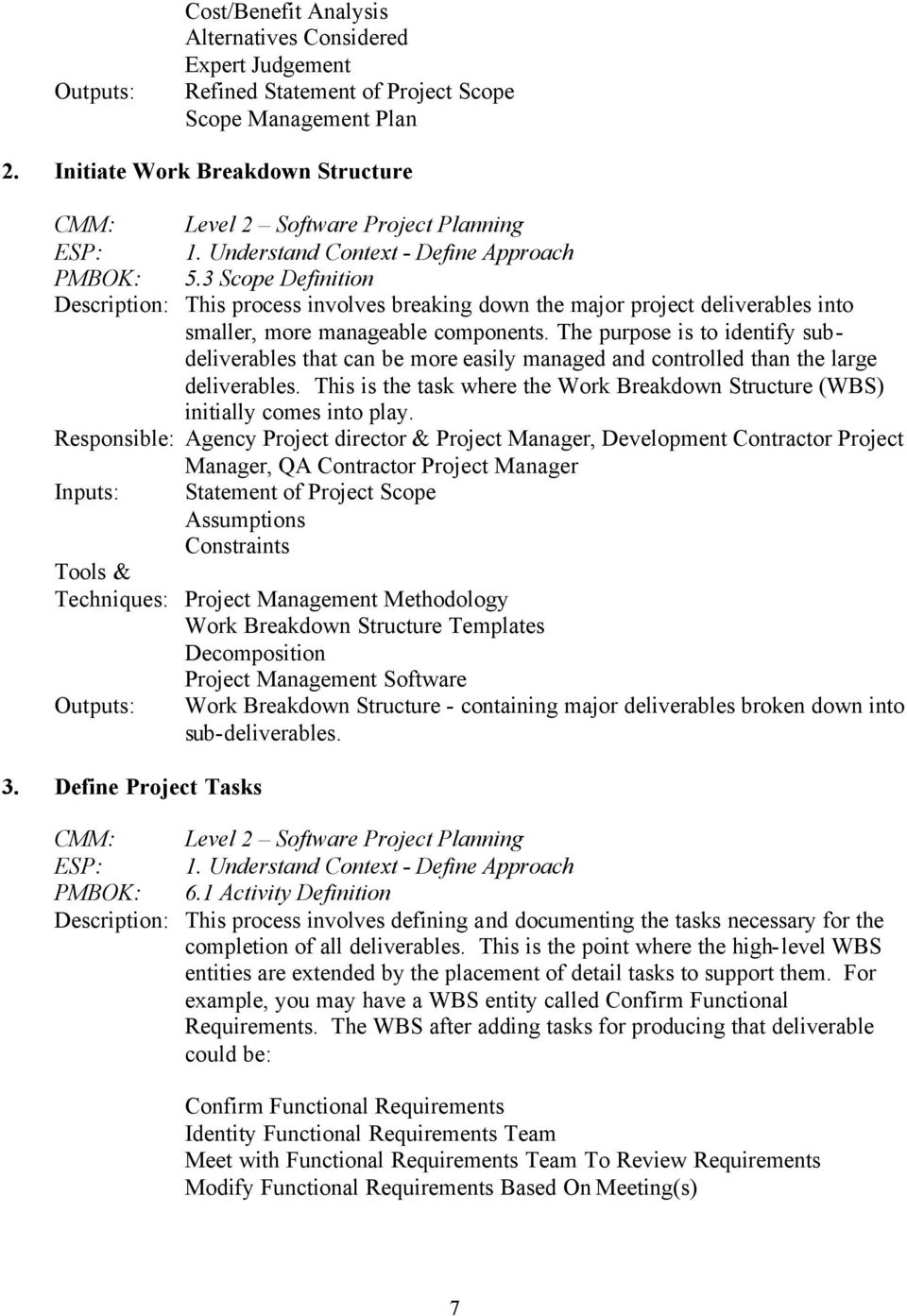
8 Receive Confirmation from Functional Requirements Team on Modified Requirements Responsible: Agency Project Director & Project Manager, Development Contractor Project Manager, QA Contractor Project Manager Inputs: Statement of Project Scope Work Breakdown Structure Assumptions Constraints Techniques: Project Management Methodology Work Breakdown Structure Templates Decomposition Project Management Software Outputs: 4. Plan Project Resources Update to Work Breakdown Structure - containing deliverables and tasks needed to produce deliverables. CMM: Level 2 Software Project Planning ESP: 1. Understand Context - Define Approach PMBOK: 7.1 Resource Planning Description: This process involves the identification and quantification of the resources (people, including stakeholders; hardware; software) that will be assigned to the project to ensure performance of project tasks. Responsible: Agency Project Director & Project Manager, Development Contractor Project Manager, QA Contractor Project Manager Inputs: Feasibility Study Work Breakdown Structure Scope Statement Resource Pool Documentation (personnel, hardware, software) Organizational Policies Techniques: Project Management Methodology Expert Judgement Alternatives Identification Project Management Software Outputs: Resource Requirements - Documentation of what types of resources and capabilities are needed for the various tasks in the Work Breakdown Structure. 5. Define Project Task Dependencies CMM: ESP: PMBOK: Level 2 Software Project Planning 1. Understand Context - Define Approach 6.2 Activity Sequencing 8

9 Description: This process involves determining the dependencies of project tasks. Often, the start of a particular task depends upon the completion of one or more other tasks. For example, Task C may not be able to start before the completion of Tasks A and B. This would more than likely be because Task C requires information produced in A and B. The creation of network diagrams effectively illustrates the effect that understanding of dependencies can have on project schedules. Responsible: Agency Project Director & Project Manager, Development Contractor Project Manager, QA Contractor Project Manager Inputs: Work Breakdown Structure Known Dependencies (mandatory, discretionary, external) Assumptions Constraints Techniques: Project Management Methodology Precedence Diagramming Techniques Network Templates Project Management Software Outputs: Network Diagram Updates to Work Breakdown Structure containing dependencies between tasks. 6. Estimate the Duration of Project Tasks CMM: Level 2 Software Project Planning ESP: 1. Understand Context - Develop/Update Estimate of Situation PMBOK: 6.3 Activity Duration Estimating Description: This process involves estimating the amount of time it will take to complete each task. Responsible: Agency Project Director & Project Manager, Development Contractor Project Manager, QA Contractor Project Manager Inputs: Work Breakdown Structure Assumptions Constraints Resource Requirements Techniques: Project Management Methodology Expert Judgement Top-down Estimating Simulation Project Management Software Outputs: Task Duration Estimates Basis of Estimates Updates to Work Breakdown Structure containing task duration 7. Create Project Cost Management Plan 9

10 CMM: Level 2 Software Project Planning ESP: 1. Understand Context - Develop/Update Estimate of Situation PMBOK: 7.2 Cost Estimating Description: This process involves developing estimates of the cost of performing the project based on the resource estimates developed earlier and developing a cost management plan. The cost management plan should identify the steps that will be taken to manage the costs of the project. This should include ensuring that: 1) all project costs are accounted for, 2) cost overruns are highlighted and explained and 3) there is a mechanism for changing the cost estimates if necessary. The planning of the costs may take place at three distinctly different times during a project. These are: 1) during the IT Planning/Feasibility Study process, 2) at the actual beginning of the project, and 3) at the beginning of each phase. Responsible: Agency Project Director & Project Manager, Development Contractor Project Manager, QA Contractor Project Manager Inputs: Work Breakdown Structure Resource Requirements Resource Rates Task Duration Estimates Techniques: Project Management Methodology Top-Down Estimating Bottom-Up Estimating Project Management Software Outputs: Cost Estimates Cost Management Plan 8. Develop Project Schedule CMM: Level 2 Software Project Planning ESP: 1. Understand Context -Develop/Update Estimate of Situation PMBOK: 6.4 Schedule Development Description: This process involves determining beginning and ending dates for project activities and the development of a schedule management plan. Responsible: Agency Project Director & Project Manager, Development Contractor Project Manager, QA Contractor Project Manager Inputs: Project Network Diagram Activity Duration Estimates Resource Requirements Resource Pool Calendars Constraints Assumptions Known time delays Techniques: Project Management Methodology 10

11 Outputs: CPM PERT Simulation Resource Leveling Project Management Software Project Schedule Supporting Detail Schedule Management Plan Resource Requirement Updates 9. Identify Project Roles and Responsibilities (Note - This process, on a very high level, will more than likely be performed first by the agency during the Feasibility Study, which is a part of Project Initiation. It is documented here because it is crucial that the process be performed again as part of the overall planning for the project when all project entities are together, possibly for the first time. It is also a process that can be performed many times during a project as new roles and responsibilities are defined.) CMM: Level 2 Software Project Planning ESP: None identified PMBOK: 9.1 Organizational Planning Description: This process involves the identification, documentation, and assignment of project roles, responsibilities, and reportability. Responsible: Agency Project Director & Project Manager, Development Contractor Project Manager, QA Contractor Project Manager Inputs: Staffing Requirements Constraints Techniques: Project Management Methodology Role Standards Agency s Human Resource Practices Stakeholder Analysis Outputs: Roles and Responsibilities Staffing Management Plans Project Organization Chart Training Needs Standards: The following standards apply to this project management activity: Project Role Standards 10. Acquire Project Staff (Note - This process, on a very high level, will more than likely be performed first by the agency during the Feasibility Study, which is a part of Project Initiation. It will also be performed first by the contractor when they prepare their proposal. It is documented here because it is crucial that the process be performed again as part of the overall planning for the project when all project entities are together, possibly for the first time. It is also a process that can be performed many times during a project as new roles and responsibilities are defined.). 11

12 CMM: Level 2 Software Project Planning ESP: None identified PMBOK: 9.2 Staff Acquisition Description: This process involves acquiring the staff necessary for filling all the roles identified for the project. Responsible: Agency Project Director & Project Manager, Development Contractor Project Manager, QA Contractor Project Manager Inputs: Staffing Management Plans Development Contractor Proposal Project Contract Staffing Pool Description Recruiting Practices Techniques: Project Management Methodology Role Standards Negotiations Pre-assignment Procurement Outputs: Project Staff Assigned Project Team Directory Standards: The following standards apply to this project management activity: Project Role Standards 11. Identify Project Risks CMM: Level 2 Software Project Planning ESP: 2. Analyze Risks - Perform Risk Analysis PMBOK: 11.1 Risk Identification Description: This process involves identifying and documenting all of the risks that may affect the project. Responsible: Agency Project Director & Project Manager, Development Contractor Project Manager, QA Contractor Project Manager, Other Stakeholders, ITS Project Oversight Coordinator Inputs: Other Planning Outputs Historical Information Constraints Techniques: Project Management Methodology Risk Management Methodology Project Risk Management Standards Interviews Questionnaires Brainstorming Outputs: Sources of Risks Potential Risk Events Risk Symptoms 12

13 Standards: Inputs to Other Processes Risk Identification Questionnaires The following standards apply to this project management activity: Project Risk Management Standards 12. Analyze Project Risks CMM: Level 2 Software Project Planning ESP: 2. Analyze Risks - Perform Risk Analysis 2. Analyze Risks - Review Risk Analysis PMBOK: 11.2 Risk Quantification Description: This process involves the analysis of identified risks to determine those risks that must be addressed by a Risk management Plan. Responsible: Agency Project Director & Project Manager, Development Contractor Project Manager, QA Contractor Project Manager, Other Stakeholders, ITS Project Oversight Coordinator Inputs: Stakeholder Risk Tolerances Sources of Risks Potential Risk Events Cost Estimates Activity Duration Estimates Techniques: Project Management Methodology Risk Management Methodology Project Risk Management Standards Expected Monetary Value Expert Judgement Risk Assessment Workshops Outputs: Standards: Opportunities To Pursue Threats To Respond To Opportunities To Ignore Threats To Accept The following standards apply to this project management activity: Project Risk Management Standards 13. Develop Risk Management Strategies CMM: Level 2 Software Project Planning ESP 2. Analyze Risks - Plan Risk Aversion 2. Analyze Risks - Commit to Risk Aversion Strategy PMBOK: 11.3 Risk Response Development Description: This process involves the development of responses to the opportunities and threats identified in the previous step. Responsible: Agency Project Director & Project Manager, Development Contractor Project Manager, QA Contractor Project Manager, Other Stakeholders, ITS Project Oversight Coordinator 13
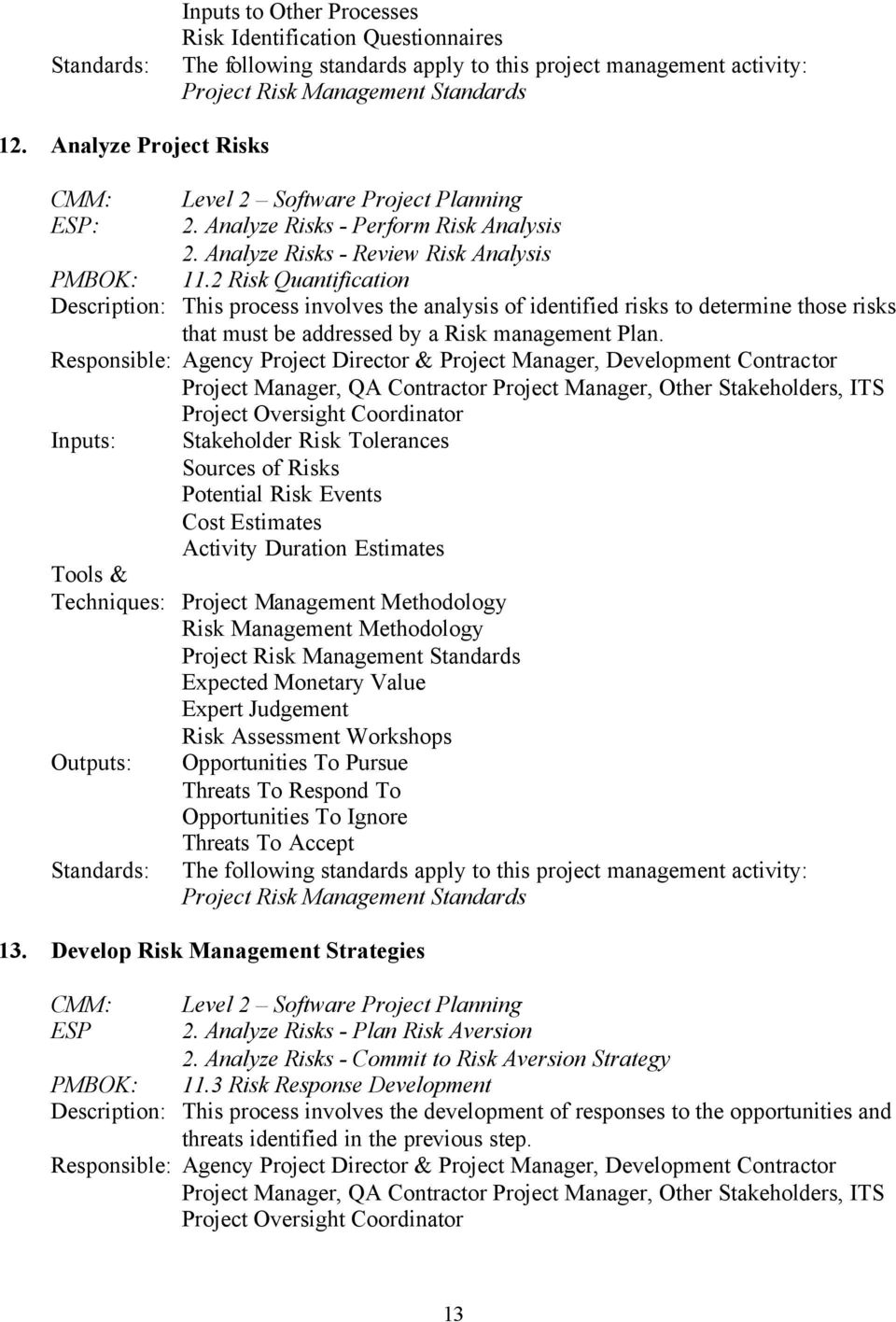
14 Inputs: Opportunities To Pursue Threats To Respond To Opportunities To Ignore Threats To Accept Techniques: Project Management Methodology Risk Management Methodology Project Risk Management Standards Procurement Contingency Planning Alternative Strategies Insurance Outputs: Risk Management Strategies Inputs to Other Processes Contingency Plans Contractual Agreements Standards: The following standards apply to this project management activity: Project Risk Management Standards 14. Develop Quality Management Plan CMM: Level 2 Software Project Planning PMBOK: 8.1 Develop Quality Plan Description: This process involves identification of quality standards that are relevant to the project and the development of a plan to address them. Responsible: Agency Project Director & Project Manager, Development Contractor Project Manager, QA Contractor Project Manager Inputs: Quality Policies Scope Statement Standards Other Process Outputs Techniques: Project Management Methodology Quality Assurance Methodology Outputs: Quality Management Plan Quality Checklists Quality Definitions Inputs To Other Processes Standards: The following standards apply to this project management activity: Quality Standards 15. Prepare Project Communications Management Plan CMM: PMBOK: Level 2 Software Project Planning 10.1 Communications Planning 14
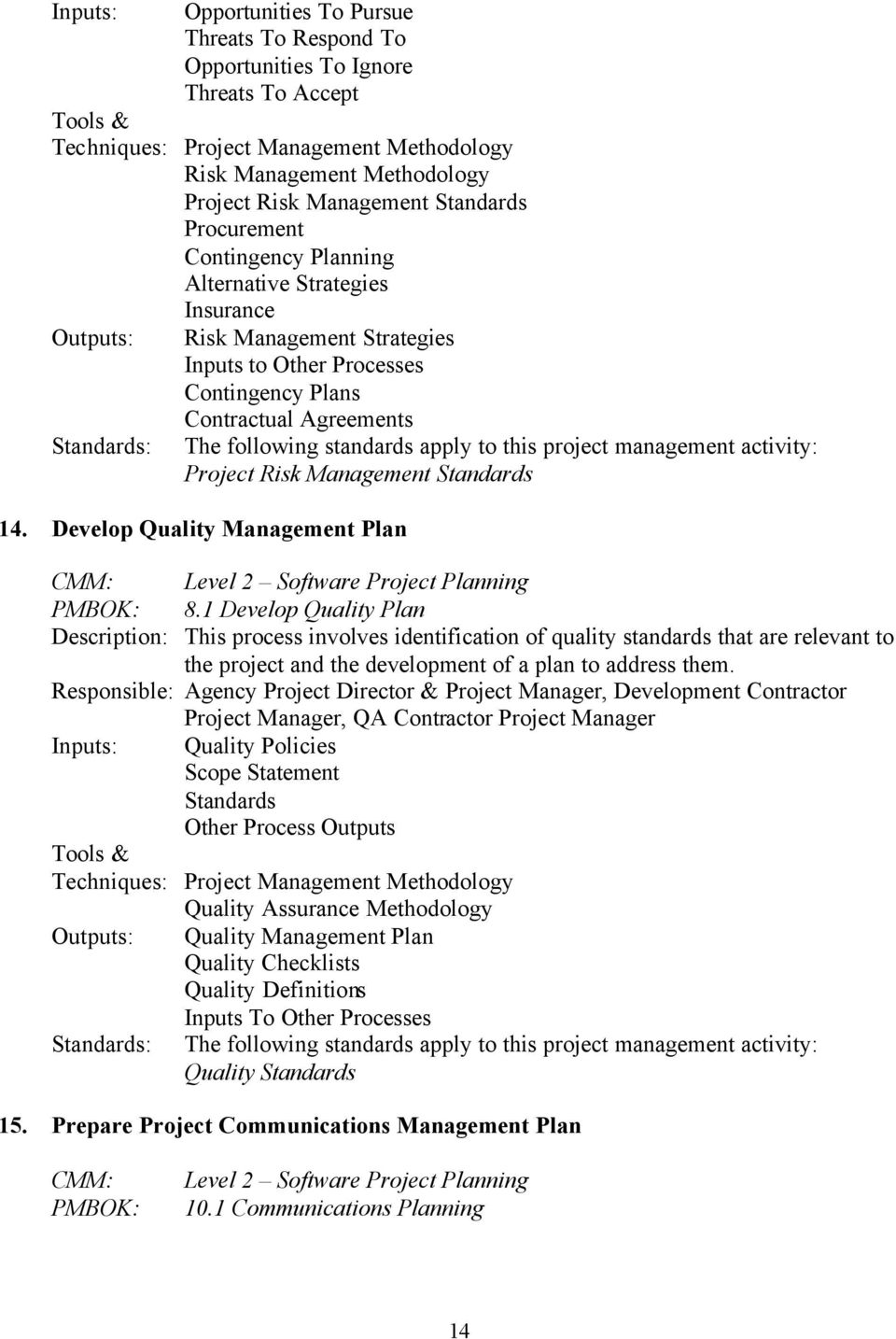
15 Description: This process involves the identification and documentation of the project stakeholders needs for communications from and about the project. Responsible: Agency Project Director & Project Manager, Development Contractor Project Manager, QA Contractor Project Manager, Other Stakeholders Inputs: Project Status Meetings Standard Project Status Reports Standard Project Issues Standard Communications Requirements Communications Technology Constraints Assumptions Techniques: Project Management Methodology Stakeholder Analysis Outputs: Standards: 16. Prepare Overall Project Plan Communications Management Plan Note: The Communications Management Plan must address status reporting and issues reporting needs to the ITS Board. The following standards apply to this project management activity: Project Status Meetings Standards Project Status Reporting Standards Project Issues Standards CMM: Level 2 Software Project Planning PMBOK: 4.1 Project Plan Development Description: This process involves the consolidation of the results of all planning processes into a coherent document that will be used during project execution and project control processes. Responsible: Agency Project Director & Project Manager, Development Contractor Project Manager, QA Contractor Project Manager, ITS Project Oversight Coordinator Inputs: Outputs From Other Planning Processes Historical Information Organizational Policies Constraints Assumptions Techniques: Project Management Methodology Project Management Software Outputs: Project Plan Supporting Detail 15

16 1. Execute the Project Plan State of Mississippi Project Management Methodology Function: Project Executing ESP: 4. Develop Product Develop and Verify Product PMBOK: 4.2 Project Plan Execution Description: This process is the most costly and time-consuming process of the entire project. This process involves the coordination and direction of all of the project entities from both technical and organizational perspectives. Note: The project must follow an industry standard application development methodology. Responsible: Agency project management, Development Contractor project management, QA Contractor project management Inputs: Project Plan Supporting Detail Organizational Policies Corrective Action Techniques: General Management Skills Technology Skills and Knowledge Status Meetings Project Management Software Organizational Procedures Outputs: Work Results Change Requests Standard: The following standards apply to this project management activity: Change Management Standard Application Development Methodology Standard 2. Verify Project Scope ESP: 4. Develop Product Develop and Verify Product PMBOK: 5.4 Scope Verification Description: This process involves the review of project work and the verification that all work performed is correct and satisfactory and is within the scope of the project. Responsible: Agency project management, Development Contractor project management, QA Contractor project management Inputs: Work Results Product Documentation QA Contractor Reports Scope Management Plan Techniques: Inspection Outputs: Formal Acceptance 16
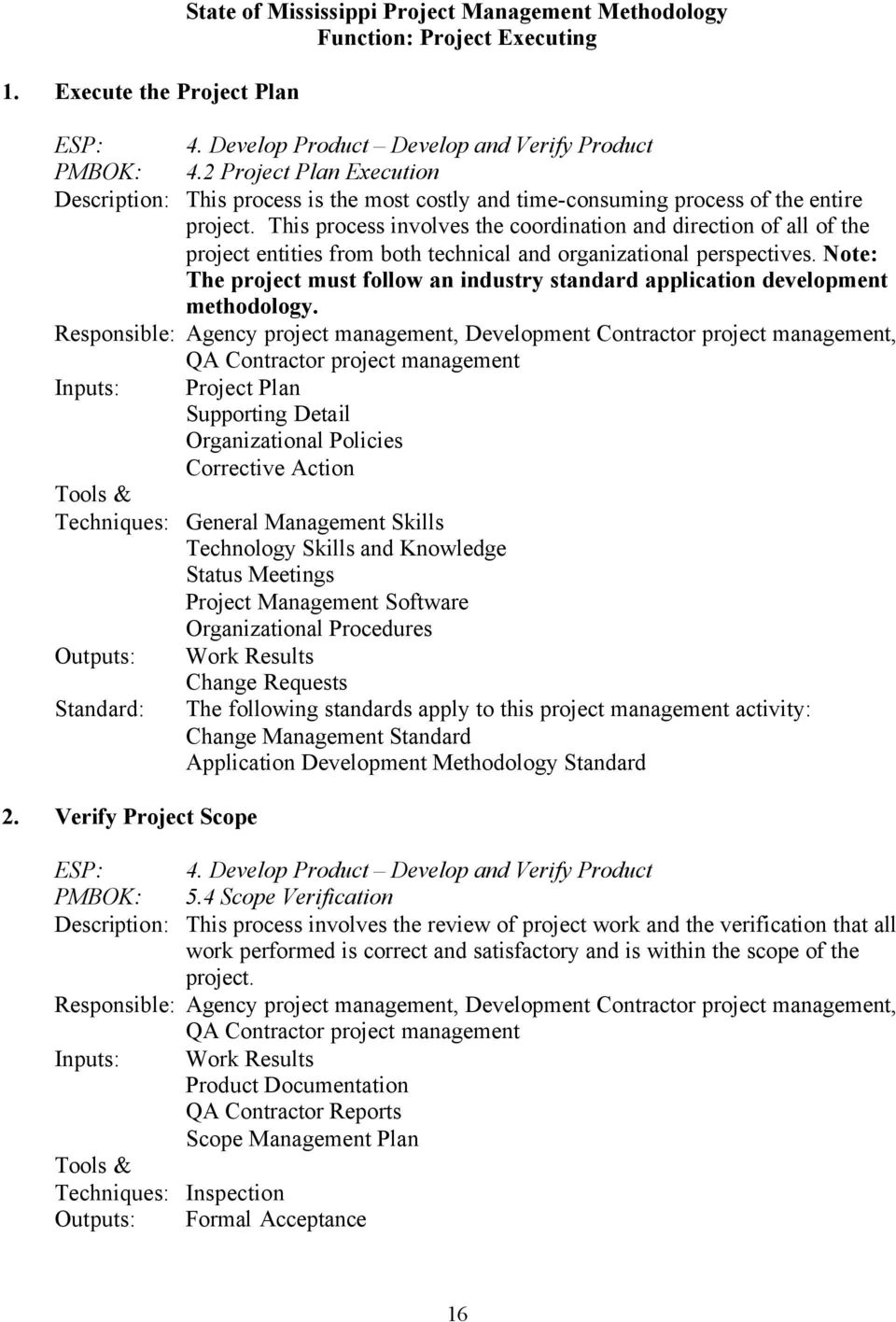
17 3. Verify Project Resources Description: This process involves the review of project resources and the verification that resources are being allocated to the project as planned in the Project Planning function Plan Project Resources. Responsible: Agency Project Manager, Development Contractor Project Manager, QA Contractor Project Manager Inputs: Work Results Resource Requirements QA Contractor Reports Techniques: Inspection Outputs: Formal Acceptance 4. Maintain and Update Project Plan Description: This process involves the continuous review of the project plan and modification to the plan based on situations encountered. Responsible: Agency Project Manager, Development Contractor Project Manager, QA Contractor Project Manager Inputs: Techniques: Inspection Outputs: Project Plan Work Results Resource Requirements QA Contractor Reports Project Management Software Modified Plan 5. Perform Project Communications ESP: 4. Develop Product Monitor and Review PMBOK: 10.2 Information Distribution Description: This process involves the implementation of the Communications Management Plan. It ensures that stakeholders receive adequate communications of project correspondence, memos, reports, and documents describing the project. Responsible: Agency Project Manager, Development Contractor Project Manager, QA Contractor Project Manager Inputs: Communications Management Plan Work Results Project Plan Techniques: Communications Skills Information Distribution Systems 17

18 Outputs: Standards: Project Records The following standards apply to this project management activity: Project Status Meeting Standards Project Status Reporting Standards 6. Perform Project Team Professional Development PMBOK: 9.3 Team Development Description: This process involves the development of project individuals and teams to be able to carry out their roles in the most effective way for the success of the project. The process also includes assuring that knowledge transfer occurs from the Development Contractor to the State. Responsible: Agency Project Manager, Development Contractor Project Manager, QA Contractor Project Manager, ITS Project Oversight Coordinator Inputs: Project Staff Project Plan Staffing Management Plan Staff performance Reports External Feedback Techniques: Team Building Activities General Management Skills Reward and Recognition Systems Training Outputs: Performance Improvements Input to Performance Appraisals Knowledge Transfer 7. Perform Quality Assurance Assessments CMM: Level 2 Software Quality Assurance PMBOK: 8.2 Quality Assurance Description: This process involves overall monitoring of the project by the ITS Project Oversight Coordinator or a separate QA Contractor to ensure that quality practices are being followed by the State, Development Contractor, and the QA Contractor and that the project is progressing in a satisfactory manner. This process includes periodic Quality Assurance Assessments. Responsible: ITS Project Oversight Coordinator or Independent QA Contractor Inputs: Quality Management Plan Work Results Quality Definitions Quality Checklists Techniques: Quality Assurance Methodology Quality Audits Outputs: Quality Improvements 18
19 Standards: Project Quality Assurance Review Report The following standards apply to this project management activity: Quality Assurance Standards 8. Perform Project Contract Administration CMM: Level 2 Software Subcontract Management PMBOK: 12.4 Contract Administration Description: This process involves ensuring that the Development Contractor s contract and the QA Contractor s contract are met by their performance. Responsible: ITS Project Oversight Coordinator and Agency Contract Management Inputs: Contract Work Results Change Requests Contractors Invoices Techniques: Contract Change Control System Performance Reporting Payment System Outputs: Correspondence Contract Changes Payment Requests Standards: The following standards apply to this project management activity: Change Management Standards Contract Management Standards 19
20 State of Mississippi Project Management Methodology Function: Project Controlling 1. Prepare Performance Reporting CMM: Level 2 Software Project Tracking and Oversight ESP: 5. Manage and Plan Review Progress PMBOK: 10.3 Performance Reporting Description: This process involves the preparation and dissemination of project performance information to stakeholders. Responsible: Agency Project Manager, Development Contractor Project Manager, QA Contractor Project Manager Inputs: Project Plan Work Results Other project Records Techniques: Performance Reviews Variance Analysis Trend Analysis Earned Value Analysis Information Distribution Tools and Techniques Outputs: Status Meetings, Performance Reports (Status Reports, Actuals vs Estimates, Issues, etc) Standards: The following standards apply to this project management activity: Project Status Meeting Standards Status Reporting Standards Project Issues Standards 2. Conduct Project Scope Change Control CMM: Level 2 Software Project Tracking and Oversight ESP: 5. Manage and Plan Project Change Control PMBOK: 5.5 Scope Change Control Description: This process involves ensuring that scope changes are beneficial, recognizing that a scope change has occurred and managing the scope change. Responsible: Agency Project Manager, Development Contractor Project Manager, QA Contractor Project Manager Inputs: Work Breakdown Structure Performance Reports Change Requests Scope Management Plan Contract Techniques: Scope Change Control System Performance Measurement Additional Planning 20

21 Outputs: Standards: Scope Changes Corrective Action Lessons Learned The following standards apply to this project management activity: Change Management Standards Contract Management Standards 3. Conduct Project Schedule Change Control CMM: Level 2 Software Project Tracking and Oversight ESP: 5. Manage and Plan Project Change Control PMBOK: 6.5 Schedule Control Description: This process involves ensuring that schedule changes are beneficial, recognizing that a schedule change has occurred, and managing the schedule change. Responsible: Agency Project Manager, Development Contractor Project Manager, QA Contractor Project Manager Inputs: Project Schedule Performance Reports Change Requests Schedule Management Plan Contract Risk Management Plan Techniques: Schedule Change Control System Performance Measurement Additional Planning Project Management Software Outputs: Schedule Updates Corrective Action Lessons Learned Standards: The following standards apply to this project management activity: Change Management Standards Contract Management Standards 4. Conduct Project Cost Change Control CMM: Level 2 Software Project Tracking and Oversight ESP: 5. Manage and Plan Project Change Control PMBOK: 7.5 Cost Control Description: This process involves ensuring that cost changes are beneficial, recognizing that a cost change has occurred and managing the cost change. Responsible: Agency Project Manager, Development Contractor Project Manager, QA Contractor Project Manager Inputs: Cost Baseline Performance Reports 21
22 Change Requests Cost Management Plan Contract Risk Management Plan Techniques: Cost Change Control System Performance Measurement Additional Planning Computerized Tools Outputs: Revised cost Estimates Budget Updates Corrective Action Estimate at Completion Lessons Learned Standards: The following standards apply to this project management activity: Change Management Standards Contract Management Standards 5. Conduct Project Change Control CMM: Level 2 Software Project Tracking and Oversight ESP: 5. Manage and Plan Project Change Control PMBOK: 4.3 Overall Project Change Control Description: This process involves the final determination and justification of the need for scope, schedule, and cost changes, reflecting the changes in the Project Plan and Project Scope, monitoring that the changes are implemented, and coordinating the changes across the entire project Responsible: Agency Project Manage, Development Contractor Project Manager, QA Contractor Project Manager Inputs: Project Plan Project Scope Performance Reports Change Requests Techniques: Change Control System Configuration Management Performance Measurement Additional Planning Project Management Information System Outputs: Project plan Updates Corrective Action Lessons Learned Standards: Change Management Standards Contract Management Standards 6. Conduct Project Quality Control 22
23 CMM: Level 2 Software Quality Assurance ESP: 5. Manage and Plan Review Progress PMBOK: 8.3 Quality Control Description: This process involves the monitoring and testing of project results and deliverables to determine if they comply with project plans and requirements. Responsible: Agency Project Manager, Development Contractor Project Manager, QA Contractor Project Manager Inputs: Work Results Test Plans Quality Management Plan Quality Definitions Quality Checklists Techniques: Inspection Control Charts Pareto Diagrams Statistical Sampling Trend Analysis Functional and Technical Testing Outputs: Quality Improvements Acceptance Decisions Rework Completed Checklists Process Adjustments 7. Conduct Risk Management Control CMM: Level 2 Software Project Tracking and Oversight ESP: 3. Plan Development Execute Risk Aversion PMBOK: 11.4 Risk Response Control Description: This process involves executing the Risk Management Strategies over the project in order to ensure the projects response to risks. Responsible: Agency project management, Development Contractor project management, QA Contractor project management Inputs: Risk Management Strategies Actual Risk Events Additional Risk Identification Techniques: Workarounds Additional Risk Response Development Outputs: Corrective Action Updates To Risk Management Plan Standards: The following standards apply to this project management activity: Risk Management Standards 23
24 State of Mississippi Project Management Methodology Function: Project Closing 1. Perform Phase or Project Contract Closing PMBOK: 12.3 Contract Closing Description: This process involves generating, gathering, and disseminating information needed to formalize the closing of a phase or of the project. Responsible: Agency project management, Development Contractor project management, QA Contractor project management Inputs: Contract and supporting documentation Techniques: Contract Administration Outputs: Contract File Formal Acceptance and Closure 2. Perform Phase or Project Administrative Closing PMBOK: 10.4 Administrative Closure Description: This process involves verification and documentation of phase or project results. Responsible: Agency project management, Development Contractor project management, QA Contractor project management Inputs: Performance Documentation Project Product Documentation Other Project Records Techniques: Performance Reporting Outputs: Project Archives Formal Acceptance Lessons Learned Best Practices 24
25 Standard: Project Issues State of Mississippi Project Management Methodology Project Management Standards An issue is a need for a decision or action that is holding up the progress of some project activity. Projects must maintain a database of issues. The database should contain: Issue Description Issue Identification Date Person Identifying the Issue Person(s) Assigned To the Issue Resolution Issue Resolution Date Description of the Resolution of the Issue Issue Type (Functional or Technical) Outstanding Issues must be identified and discussed during Project Status Meetings and on Project Status Reports.
26 State of Mississippi Project Management Methodology Project Management Standards Standard: Project Management References In the development of the State of Mississippi Project Management Methodology, two references were used. Those references are being included as standard references in support of the methodology. The references are: 1. A Guide To The Project Management Body of Knowledge(PMBOK) - This document is produced by the Standards Committee of the Project Management Institute. The document covers all aspects of the project management discipline and is used worldwide as a reference, textbook, and methodology source. The State of Mississippi Project Management Methodology indicates on each process what the corresponding process(es) are in the PMBOK. 2. Evolutionary Spiral Process (ESP) Model Guidebook - Volume 1 Concepts and Principles - This document is produced by the Software Productivity Consortium. The document describes a flexible way to respond dynamically to the unique circumstances present in a software development effort. The ESP model encourages users to seek alternative solutions for satisfying project objectives within identified constraints and to make decisions that eliminate alternatives from further consideration while keeping other options open. An overview of the ESP process follows: State of Mississippi Project Management Methodology Overview of the Evolutionary Spiral Process (ESP) The ESP Model provides a method that can be used to plan and evolve your project development process incrementally based on current project situations. ESP focuses on high-risk items early in the development life cycle, preventing them being hidden in the hope that they will go away. ESP measures project progress by how well the project is meeting the defined objectives and reducing the risks. There are 5 steps to the ESP Model. Each step is performed once during a cycle (phase). A spiral is one or more cycles (phases) that accomplish a specific objective, usually to complete a project. The steps and their activities are: 1. Understand Context This step is similar in function as the scoping activities in the Project Management Methodology. The activities are: A. Define Approach Stakeholders Objectives Alternatives Constraints
27 B. Develop/Update Estimate of the Situation Scope of Spiral Process Drivers Mission and History Stakeholders and Expectations Spiral Objectives and Success Criteria Current Cycle Objectives Inherited Decisions and Assumptions Characteristics of Known Requirements and Operations Known Constraints Factors Affecting Success of Spiral and Current Cycle C. Review Context 2. Analyze Risks Perform risk analysis to help identify, address, and eliminate risk items before they become threats to stakeholder win conditions, successful software operation, or overall spiral success. A. Perform Risk Analysis Identify Risks Attempt to identify all of the risks to your spiral and current cycle objectives. Analyze Risks Once the risks have been identified, you categorize them and determine the likelihood and consequence of them occurring. Evaluate Risks Evaluate the risks to identify potential risk aversion strategies and examine the impact of the strategy on a particular risk. B. Review Risk Analysis this is a team review of the risks identified, analyzed and evaluated above. C. Plan Risk Aversion Evaluate and select risk aversion strategies to be followed. D. Commit to Risk Aversion Strategy Brief stakeholders on previous activities and solicit their commitment to the risk aversion strategies selected by the project team. 3. Plan Development Plan and schedule the development and development support activities. A. Execute Risk Aversion Perform to the risk aversion plan and select one or more alternatives. B. Review Alternatives Review the selected alternatives,
28 C. Plan and Schedule Identify, organize, schedule, and assign resources to technical activities after any risks associated with development alternatives for the cycle have been averted. D. Commit to Plan Review and commit to the cycle plan for the current cycle development activities. 4. Develop Product Perform, monitor, and review the development and development support activities. A. Develop and Verify Product Perform the development activities to produce deliverables and to verify that deliverables meet requirements, development goals, and development success criteria. B. Monitor and Review Monitor and review the technical development activities as they are performed. C. Review Technical Product Review the product to ensure that cycle objectives, development goals, and development success criteria were met. 5. Manage and Plan Take stock of progress based on the outcome and lessons learned during the cycle, compare actual results against cycle objectives, reevaluate and update spiral planning documents and decide what to do next. A. Product Change Control Place the product produced as a result of Step 4 under product change control. B. Review Progress Evaluate development plan actuals versus estimates, success criteria, and lessons learned. Update process drivers, including spiral objectives, success criteria, alternatives, constraints, risks, estimates. C. Update Spiral Planning Documents Update all planning documents, as necessary, to record actual progress, reflect lessons learned, update estimates based on actual data, and update process drivers. D. Commit to Proceed Review updates to the spiral planning documents and commit to proceed with next cycle. Typically over the life of a project using ESP, risk levels decrease significantly over time, thus reducing the amount of time needed to be spent on ESP activities.
29 Standard: Initial Planning Report State of Mississippi Project Management Methodology Project Management Standards Agencies must prepare a Initial Planning Report (IPR) for every strategic project. The IPR should be prepared in accordance with the State of Mississippi Initial Planning Report Guidelines.
30 State of Mississippi Project Management Methodology Project Management Standards Standard: Project Risk Management Every project must identify, categorize, analyze, and mitigate risks. The management of the associated processes must follow a risk assessment and management methodology such as the one specified in the State of Mississippi Risk Management Methodology.
31 Standard: Project Roles State of Mississippi Project Management Methodology Project Role Standards for the State Project Team Projects must contain key roles for carrying out the project activities. Recommended roles are: Project Director - This agency person, if present, is usually functionally-oriented with management experience in the functionality being addressed by the project. This person has overall direction responsibilities (agency, ITS, and vendors) over the project and coordinates all non-technical project activities between division and department directors to ensure that the necessary user resources are available. Project Advisor - If the project is a large one and the agency has a Project Manager, this is a ITS person who has the responsibility of providing advice to the Project Director and/or the Project Manager, performing Independent QA Assessments, and managing the contract. Project Manager - This person works closely with Contractor Project Managers and is responsible for managing the day-to day activities of state staff. Technical Team Leader- This person, if present, will usually be responsible for state technical personnel resources on the project. Technical Team Member - This person works on the project in a technical role, usually as part of a development team. Functional Team Leader - This is a person with a high level of functional knowledge and management support who is responsible for a team of functional users who work on the project. Functional Team Member (State) - This is a person, with knowledge of specific functionality, who will perform key input, review, and testing activities on the project. Project Steering Committee Member - This is usually an Agency or ITS management person. In a typical agency, all departments or divisions affected by the project should be represented on the steering committee. Project Stakeholders - Individuals and organizations who are actively involved in the project, or whose interests may be positively or negatively affected as a result of project execution or successful project completion.
32 8/28/2000 Standard: Project Status Meetings State of Mississippi Project Management Methodology Project Management Standards Project Status Meetings must be held on at least a bi-weekly basis. Attendees of status meetings should include at a minimum: State Project Director State Project Manager State Functional Team Leader State Technical Team Leader Development Contractor Project Manager QA Contractor Project Manager ITS Project Oversight Coordinator Agenda items for status meetings should include: Review of Outstanding Project Issues or New Issues Review of Project Status (QA and Development) Risk Management Status Identification and Discussion of Task Overruns Identification and Discussion of Resource Shortages Identification and Discussion of Potential Scope Changes Review of Knowledge Transfer Status Minutes of the status meeting should be distributed to attendees no later than the second working day after the meeting
33 8/28/2000 Standard: Project Status Reporting State of Mississippi Project Management Methodology Project Management Standards Project Status Reports must be completed on a monthly basis by the Development Vendor Project Manager and the QA Vendor Project Manager. Recipients of status reports should include: State Project Director State Project Manager State Functional Team Leader State Technical Team Leader Development Contractor Project Manager QA Contractor Project Manager ITS Project Oversight Coordinator Items for Status Reports should include: Completed Activities for the Previous Month Deliverables Completed Ahead of or On Schedule Deliverables Completed Behind Schedule - identify actions taken to maintain overall Phase schedule. Deliverables Running Behind Schedule - identify actions taken to maintain overall Phase schedule. Planned Activities for the Upcoming Month Outstanding Project Issues at End of Month Project Resource Shortages Potential Scope Changes Phase To Date Gantt Chart Showing Projected and Actual Project Status Reports should be distributed to recipients no later than the fifth working day after the end of the month.
34 Standard: Project Quality State of Mississippi Project Management Methodology Project Quality Standards The following standards apply to quality on projects: 1. Quality Assurance Assessments must be performed for all strategic projects on a quarterly or semi-annual interval, determined by ITS and the agency at the time of project initiation based on the complexity, severity, risks, and costs of the project. The ITS Board may recommend a change in assessment interval at any time. A quality assurance assessment will be performed by the ITS Project Oversight Coordinator (IPOC) or, if the project is managed by ITS, an independent contractor. A quality assurance assessment uses the Quality Assurance Assessment Guidelines as the methodology for performing the assessment. These guidelines may be amended on certain projects by agreement of ITS and the project agency. The results of a quality assurance assessment will be presented to the project agency and to the ITS Board. 2. Each strategic project must develop a Quality Management Plan. This plan must specify the quality objectives of the project and internal activities of the project to ensure that the deliverables and other outputs of the project meet those objectives. This plan will become a part of the overall project plan. 3. Each strategic project must perform Project Quality Control throughout the life cycle of the project. Project quality control consists of those activities that monitor and test project results to determine if they comply with plans and requirements.
35 Project Rating for Mission Critical Systems 1. Automated systems that are essential to the agency to complete required legal obligations or legislatively mandated business functions. 2. Any system that by failing could jeopardize the health, safety, or financial well being of the citizens or employees of the State of Mississippi. 3. Systems responsible for the administration of benefits to the public, the exchange of data with other governmental jurisdictions and business taxpayers, or otherwise required for the state to meet its legal obligations to the public and its employees. 4. Systems under the state s control that link to mission critical systems and that, if altered, could undermine the state s integrity. Project Rating for Severity Level High Medium Impact on Citizens * Direct contact with citizens including benefits to, payment by, and transactions with individuals. * Indirect impact on citizens - activity management systems that support decisions are viewed as important by the public. Visibility * Highly visible to public and Legislature. * Total budget of $$$$$ or more. * Multiple agency involvement. * Some visibility to the Legislature; the system or the program(s) it supports are likely to be subject to hearings. Low * Agency operations * Internal agency only. Impact on State Operations * Statewide or multiple agency impact. * Mainframe acquisitions and networks. Nil Consequence * Inability to meet legislative mandate or agency mission. * Loss of significant funding. * Agency wide. * Potential failure of aging systems. * Work group. * Loss of opportunity for improved service delivery or efficiency.
36 Project Rating for Risk Level High Medium Low Organizational Impact * Significant change to business rules. * Complex business processes. * Multiple organizations involved. * Moderate changes to business rules. * Medium complexity. * Insignificant or no change to business rules. * Low complexity business process(es). Development Effort Technology Capability * High development * Emerging. * Immature and system * Unproven. organization. integration costs. * New for state. * Uses ad-hoc * Over 3 years in processes. development. * Agency track * More than 30 record suggests staff years. inability to mitigate risk on project requiring a give level of * Up to 30 staff years. * $$$$$ * 2-3 years in development. * Under 10 staff years. * Under $$$$$$. * Under 2 years in development. * Proven in industry or at state level. * New to agency or program areas. * Standard, proven agency technology. development effort. * Maturing organization. * Agency track record indicates reasonable level of success but without the structure for repeatability. * Mature organization. * Agency track record indicates strong ability to mitigate risk to a project requiring a given level of development effort. * Stable organization, documented and repeatable processes for tracking status, problems, and change.
37 Project Rating for Oversight High Severity Level l Level 2 Level 3 Medium Severity None Level 1 Level 2 Low Severity None None Level 1 Low Risk Medium Risk High Risk Oversight Criteria Level 3 Level 2 Level 1 Justification & Approval Decision * Agency executive approval * ITS review and comment * Board approval * Agency executive approval * ITS review and comment * Agency executive approval with option of ITS consultation Project Management Approach/Execution Oversight * Board approval * Indepednt Validation * Prototype required at &Verification as discretion of ITS indicated * Private sector participation * ITS discretionary encouraged or required * Reported as part of plan * Agency executive approval * Internal or external QA * ITS support * ITS audit as indicated * Reported as part of plan * Agency-defined methods * Internal QA at agency determination * May be reported as part of portfolio
38 Role Identification ITS Project Oversight Coordinator (IPOC) Role Responsibilities: Assist the Agency with Initial Planning Report - Actually performing the study for a client agency or assisting them in the performance of the study. At a minimum, this role should involve high-level assistance the first time an agency is performing an Initial Planning Report. See Project Initiation - Step2. Facilitate the ITS Review of the Initial Planning Report - Work with the ITS Review Committee and the client agency IT Director to ensure the compliance of the Initial Planning Report. See Project Initiation - Step 3. Recommend Project To ITS Board - Based on acceptable review of the project Initial Planning Report, represent the ITS Review Committee and the client agency by presenting the project to the ITS Board. See Project Initiation - Step 4. Lead the Procurement Effort - Based on Board approval of the project, work with the client agency and ITS to conduct the RFP process, select the winning vendor(s), recommend the winning vendor to the ITS Board, and negotiate the contract with the winning vendor(s). See Project Initiation - Steps Participate in Project Planning - At the beginning of the project, and the beginning of subsequent phases, work with the project team on the development of the project plan. See Project Planning - Steps Note: Depending on the size and complexity of the project, Steps (Risk Management) and Step 16 (Overall Project Plan) may be the only planning activities the in which the role would need to participate. Participate in Project Status Meetings - Attend all or selected status meetings. For example, if the project has an informal status meeting weekly and a formal status meeting monthly, the role may want to attend the monthly meeting. See Project Controlling - Step 1. Review Project Status Reports - Receive all project status reports and review for correctness, issues, unresolved problems, etc. See Project Controlling - Step 1. Review Selected Deliverables - Based on the nature of the project, review deliverables that are considered to be key to the success of the project. For example, this review may include General Design Documents, Testing Results, Training Plan, etc. See Project Controlling - Step 6. Perform Periodic QA Assessments - Perform periodic assessments of the project as defined in the Quality Assurance Assessment Guidelines. See Project Execution - Step 7. Perform Project Management Mentoring - As needed, perform mentoring to client agency staff on Project Management and Quality Assurance techniques. Perform Problem Resolution - As needed, assist the client agency in resolving project problems. Perform Contract Administration - Ensure that the Client Agency, the Development Contractor and the QA Contractor are fulfilling their contractual obligations. See Project Execution - Step 8. Project Closing - Work with project staff to document lessons learned on the project. See Project Closing - Step 2.
39 Advocate - Represents the best interests of the agency, the vendor(s), and ITS in situations where to do so adds value to the project.
40 DEPARTMENT OF INFORMATION TECHNOLOGY SERVICES QUALITY ASSURANCE ASSESSMENT GUIDELINES
41 Published July, ITS Information Systems Services Division ITS QUALITY ASSURANCE ASSESSMENT GUIDELINES TABLE OF CONTENTS I. INTRODUCTION...1 II. OBJECTIVES...2 III. IV. PREPARING FOR THE ASSESSMENT...3 CONDUCTING THE ASSESSMENT...4 V. CONDUCTING THE POST-ASSESSMENT EVALUATION...5 VI. PROJECT MANAGEMENT ASSESSMENT CHECKLIST...6 VII. ASSESSING A INDEPENDENT QUALITY ASSURANCE FUNCTION...10 VIII. INDEPENDENT QUALITY ASSURANCE ASSESSMENT CHECKLIST...11
42 I. INTRODUCTION ITS is dedicated to ensuring that all projects designated as strategic follow Project Management and Quality Assurance Guidelines and result in a quality product. The purpose of the assessment process is to provide a mechanism for periodically assessing how effectively State agencies and vendors are managing projects and implementing quality assurance techniques into their projects. The results of the assessments provide continuous feedback to the projects, facilitating identification and correction of individual project discrepancies, enhancement of QA and Project Management guidelines, and retraining of Project Managers in their use. Sections VII and VIII are included in these guidelines to address the assessment of Independent Quality Assurance (IQA) functions on strategic projects and provide a checklist for IQA functions. Quality Assurance Assessment Guidelines Revised:December 27,
43 II. OBJECTIVES The objectives for the quality assurance assessments are as follows: 1. To improve the effectiveness of the project management and independent quality assurance functions on strategic state projects. 2. To evaluate the degree of success with which strategic projects are managed. 3. To provide a periodic assessment of the health of a strategic project conducted by a entity that is not involved in the day-to-day activities of the project. 4. To provide early identification of projects in trouble, and recommendations for rehabilitation of such projects. Quality Assurance Assessment Guidelines Revised:December 27,
44 III. PREPARING FOR THE ASSESSMENT It is important to notify affected agencies/individuals in advance about pending Quality Assurance (QA) Assessments in order to schedule a convenient time for all participants. In some cases, people may be out of town or the timing may be especially bad for the project; such as a tight deadline for a deliverable. Listed below are steps in preparing for the assessment: 1. Approximately one month prior to the planned assessment for a large project, or two weeks for a small project, submit a memorandum to the Client Project Director (if any), the development and quality assurance Vendor Project Manager(s) (if any), and the Client Information Technology (IT) Director outlining the desired schedule for the assessment. For a small project, the correspondence may only need to go to the Client IT Director. Copies of this memorandum and all assessment related correspondence should be sent to the ISS Director and anyone participating in the actual assessment. The memorandum should outline the planned agenda for performing the assessment, including suggested dates and times for each activity and explanations of what will occur in each activity. Also, include a list of deliverables or other items that will be reviewed. The memorandum should solicit corrections to dates and times. 2. Upon receipt of confirmation or corrections to dates and times, make any necessary modifications to the agenda and submit to the same correspondents. 3. Prepare checklists for the project, using previously created templates and modifying as needed for anything unique to the project. This should be included, along with results of previous assessments of the same project, in the work papers that will be used for the assessment. 4. Prior to the starting date of the assessment, contact the Client Project Director or IT Director to ensure that the needed resources are available to start the assessment. Quality Assurance Assessment Guidelines Revised:December 27,
45 IV. CONDUCTING THE ASSESSMENT The assessment should be conducted in a professional, helpful manner, that encourages rather than discourages. ITS is assessing a project in this process, not the abilities of any individuals. The following suggested process for conducting the assessment, and the accompanying checklist, would be for a large project. It would need to be scaled down, as necessary by the QA Assessor based on project size and complexity. 1. Interview ISS and other ITS management to receive an overview of the project situation. 2. Interview any ITS staff assigned to or working with the project. 3. Interview the Project Director (if any) and other key functional personnel from the client agency. 4. Interview the Quality Assurance and Development Vendor Project Manager(s) (if any). 5. Interview the IT Director and other key IT personnel from the client agency who are assigned to or supporting the project. 6. Review Project Plans, status reports, and time reports. 7. Review requirements tracking and issue tracking mechanisms. 8. Conduct an overview of project deliverables. Following are some suggestions for the QA Assessor to keep in mind while conducting the assessment: The QA Assessor should take all precautions to assure that the assessment is conducted in such a way as to cause minimal, if any, disruption of the project. Interviews should be brief and to the point. However, if someone, particularly from the client agency, wishes to elaborate on any issues, they should be allowed. When holding interviews, the QA Assessor should be aware of the need for privacy if sensitive issues need to be discussed. The QA Assessor should be careful to convey a positive, helpful image about the assessment process. The assessment is being held to determine the health of the project. Negative issues must be followed up on, but care should be taken not to dwell on them in such a way as to cause additional problems on the project. Note: Sections VI and VIII are checklists intended to assist the QA Assessor in performing the process. The checklists should be modified, as needed, for the particular project being assessed. Quality Assurance Assessment Guidelines Revised:December 27,
46 V. CONDUCTING THE POST-ASSESSMENT EVALUATION The post-assessment evaluation should begin immediately after the assessment has been concluded. This process involves analysis and evaluation of the information obtained during the assessment and the preparation of a QA Assessment Report. Following are suggested steps for this process: 1. Review notes, checklists, and other materials gathered during the assessment. 2. Analyze and classify the information. Information should be organized into the following major classifications: Project Strengths: Project strengths is narrative information about the positive things being done by the project. The results of the assessment should not dwell on negatives only. The positive things about the project should be emphasized. Client Agency Challenges: Client agency challenges is narrative information about the inadequate things observed about the project resulting from problems at the client agency. Project Challenges: Project challenges is narrative information about the inadequate things observed about the project resulting from insufficient project management and/or quality assurance. ITS Challenges: ITS challenges is narrative information about the inadequate things observed about the project resulting from problems at ITS in its role of facilitating and supporting strategic projects. Each challenge identified above and its effect on the project should be described. 3. Develop recommendations for addressing the client agency challenges, project challenges, and ITS challenges. 4. Prepare the first draft of the QA Assessment Report. This should be reviewed with ISS management. 5. Make necessary modifications based on the review. 6. Meet with ISS management and management of the project to discuss all points in the report and to ensure that all parties know their responsibilities. Generally, these responsibilities should be: The Project Director, Quality Assurance and Development Vendor Project Manager(s), and the Client IT Director will be responsible for addressing the client agency and project challenges. ITS management will be responsible for addressing the ITS challenges. 7. These responsibilities are finalized and the final document is produced and distributed. 8. The QA Assessment Report is presented to the ITS Board at the next meeting after completion of the assessment. 9. ITS Board recommendations become action items and are included into the final document by a repetition of steps 6 and 7. Quality Assurance Assessment Guidelines Revised:December 27,
47 VI. PROJECT MANAGEMENT ASSESSMENT CHECKLIST This checklist is representative of the types of questions that should be asked about the management of the project. These questions and the answers to them should elicit other questions. For example, many of the questions ask if something was done and should be answered with a "yes" or "no". If the answer is "no", the next question may be "why not?" The answer to that question may bring up still other questions. Many potential problems may be uncovered in this way. QUESTION 1. Were objectives developed for the project and approved by ITS and the client agency prior to the start of the project? 2. Have the attainment of these objectives been communicated to project personnel? 3. Were constraints identified for the project and approved by the client agency prior to the start of the project? 4. Have the constraints been communicated to project personnel? 5. Were risks assessed for the project resulting in a Risk Management Plan that was approved by the client agency? COMMENTS If so, has the Risk Management Plan been followed and 6. updated when necessary? 7. Was a Project Plan developed for the project including: Work Breakdown Structure Roles and Responsibilities Estimates and Schedules GANTT Chart Deliverables 8. What techniques were used in estimating work for project tasks? 9. Was the ITS Project Management Methodology reflected in the Project Plan? 10. Was the Project Plan reviewed and approved by client agency management prior to the start of the project? 11. Is the Project Plan currently in use? 12. Are project personnel aware of the Project Plan and its importance? 13. Are project personnel aware of where the tasks they are working on are reflected on the Project Plan and where the project stands on schedule and estimates? 14. Is the Project Plan periodically reviewed and modified, as necessary? 15. Are schedules and estimates continuously reviewed and modified, as necessary, based on actual experience? 16. If so, are client agency management and ITS management aware of the revisions? If so, are project personnel aware of the revisions? Is the monetary budget of the project monitored closely to assure that the project will stay within budget? 19. Are the proper client agency resources dedicated or available to the project? If not, have commitments of these resources been requested? Are the proper ITS resources dedicated to the project? 22. If not, what steps have been taken to try to obtain them? 23. Have project standards been developed? 24. Do all project members understand their roles and responsibilities on the project and who fills the other roles and responsibilities? 25. Has the project development environment been established? 26. If so, is it functioning properly? Quality Assurance Assessment Guidelines Revised:December 27,
48 27. Has special training been obtained for project members, if necessary? 28. Are client agency approvals received in writing on a deliverable prior to starting on a deliverable that is dependent on the successful completion of the first deliverable? 29. Are efforts made to keep the project within scope? 30. Have there been scope changes on the project? Are scope changes highlighted and documented to the client agency along with the affect they will have on the project? What process was used to ensure that scope changes are justified and that project resources (people, hardware, software, funds) are adequate to handle the change? What process was used to ensure that scope changes included 33. analysis of all completed deliverables to determine any rework needed. 34. Do deliverables reflect good software engineering techniques? 35. Have the proper people been involved in the review of project deliverables? 36. Are internal Quality Assurance practices being applied such as: Continuous emphasis of importance of producing a quality product? QA testing of all deliverables. Acceptance testing by client functional and technical staff. Full acceptance of and cooperation with the Independent Quality Assurance function (if any)? Use of a requirements tracking mechanism? Use of an issues tracking mechanism? Internal walkthroughs on deliverables prior to presentation to the client agency? 37. Are conflict resolution procedures identified and used for the project? 38. Are project priorities continuously reviewed and adjusted as necessary? 39. If so, are client agency management and project personnel aware of new priorities? 40. If roles and/or responsibilities change on the project, are client agency management and project personnel aware of changes? 41. Are project status meetings held regularly to update key project members and client agency personnel on status and issues? 42. Are agendas prepared for project meetings? Are meeting notes distributed to all attendees of project meetings? 43. Are unresolved issues allowed to remain unresolved to the point where they affect project progress? 44. Has adequate change control been established on the project? 45. Are there any problems with ITS involvement in the project? If so, how have they been handled? Have all ITS problems been resolved? 48. Has a steering committee been established for the project? If so, is it active? Are any client agency personnel reporting to managers on the project? If so, have management agreements been reached for them? Quality Assurance Assessment Guidelines Revised:December 27,
49 Is there a good relationship with between the Development Vendor and the client agency? If not, what are the reasons? What steps have been taken to address the situation? Is the Development Vendor performing adequately on the project? 55. If not, what are some examples and what is being done about it? 56. Is adequate time being captured for project members to determine problems on work estimates or schedules? 57. Are project time reports being produced that allow for early warning of problems with work overages or missed deadlines? If so, are these reports being monitored adequately? Are tasks or activities that show signs that they may go over on estimates analyzed to determine the problems and then a plan developed for addressing the problems? 60. IS client agency management informed of overages or missed deadlines, along with causes and ways to keep similar occurrences from happening? 61. Are project status reports prepared for client agency management and ITS that reflect the true status of the project and emphasize the issues that are affecting the progress of the project? 62. Is project documentation adequate and easily available for review? 63. Is the client agency satisfied with the way that the project is progressing? If not, what are the major complaints? Is the Development Vendor Project Manager aware of the client agency major complaints? If so, what is being done to address them? Is the Development Vendor (if any) satisfied with the way the project is progressing? If not, what are the major complaints? Is the client agency aware of the vendor complaints? If so, what is being done to address them? Have recommendations from the last Quality Assurance Assessment been implemented? If not, what are the reasons? If so, what are the results? VII. ASSESSING A INDEPENDENT QUALITY ASSURANCE (IQA) FUNCTION INTRODUCTION In addition to Project Management functions on strategic projects, vendors can also provide the Independent Quality Assurance functions on such projects. These guidelines provide information to guide the QA Assessor in the activities necessary to provide independent QA monitoring of the effectiveness of Independent Quality Assurance functions on strategic projects. All activities for the assessment of the Independent Quality Assurance function should be conducted as part of the overall project assessment and are the same as for assessing the management of the project except as specified below: The Quality Assurance Project Manager and key QA team members are to be interviewed for both assessments. Quality Assurance Assessment Guidelines Revised:December 27,
50 A different checklist should be used for the Independent Quality Assurance assessment (see Section VIII for the checklist). The assessment of Independent Quality Assurance focuses on activities specified in the Independent Quality Assurance Guidelines. The Post-Assessment Evaluation should contain a separate section, structured the same as the one for management of the project and dealing with Independent Quality Assurance issues. Quality Assurance Assessment Guidelines Revised:December 27,
51 VIII. ITS INDEPENDENT QUALITY ASSURANCE ASSESSMENT CHECKLIST This checklist is representative of the types of questions that should be asked about the Independent Quality Assurance (IQA) function on a project. These questions and the answers to them should elicit other questions. For example, many of the questions ask if something was done and should be answered with a "yes" or "no". If the answer is "no", the next question may be "why not?" The answer to that question may bring up still other questions. Many potential problems may be uncovered in this way. QUESTION 1. Was a Project Plan developed for the IQA function? 2. Does the IQA Project Plan closely follow the activities and deliverables of the project? 3. What techniques were used in estimating work for IQA tasks? 4. Was the IQA Project Plan reviewed and approved by ITS prior to the start of the project? 5. Was the IQA Project Plan reviewed and approved by client agency management prior to the start of the project? 6. Is the IQA Project Plan currently in use? 7. Are IQA personnel aware of the IQA Project Plan, its importance, and how it ties in with the overall Project Plan? 8. Are IQA personnel aware of where the tasks they are working on are reflected on the IQA Project Plan and where IQA stands on schedule and estimates? 9. Is the IQA Work Plan periodically reviewed and modified, as necessary? 10. Is the IQA function properly staffed to deal technically and functionally with the number of development project activities and deliverables? COMMENTS If not, what has been done to address the situation? Have IQA review checklists been created or modified to reflect the methodology used on the project and other project specific situations? 13. Are these checklists being used in the review processes? 14. Are IQA deliverables being met on time? 15. Are Deliverable Review Documents (DRD) being adequately prepared? 16. Are issues identified in DRDs being adequately addressed by the project? 17. Is there a good IQA relationship with the Client agency? If not, what are the reasons? What steps have been taken to address the situation? Is there a good IQA relationship with the Development Vendor? If not, what are the reasons? What steps have been taken to address the situation? Is there a good IQA relationship with State project members? If not what are the reasons? What steps have been taken to 22. address the situation? 23. Is the IQA function seen as an overall asset to the project or as a liability? 24. Are requirements tracking mechanisms functioning effectively? 25. Are issue tracking mechanisms functioning effectively? 26. Is adequate time available for review of deliverables by IQA? 27. Are IQA findings and recommendations followed up on by the Client Agency and the Development vendor? Quality Assurance Assessment Guidelines Revised:December 27,
52 Have recommendations from the last assessment been implemented? If not, what are the reasons? If so, what are the results? Quality Assurance Assessment Guidelines Revised:December 27,
53 1.0 PROJECT OBJECTIVES Initial Planning Report Guidelines Project objectives define the results that must be achieved for a proposed solution to effective. These objectives are the success factors against which the agency can measure the responsiveness of the recommended alternative. It is essential that: each objective relate to a problem or opportunity that is to be addressed by the proposed project each objective be stated in programmatic and observable/measurable terms each objective be realistically achievable In establishing objectives, decide whether the response should be concerned with costs, agency operations or both. If the response relates to the cost of one or programs, determine whether it should be expected to reduce costs, avoid costs, or increase revenue. If the response relates to operations (how a program provides services or creates products), determine if responding to the problem will improve timeliness or quality. Improvements in the timeliness and quality of program operations must be related to established program requirements. In addition, applications of information technology are ordinarily expected to pay for themselves. The department should be able to translate operational improvements into reduced costs. Establishment of business-oriented objectives should generally include the following steps: Setting general objectives: Once a program process has been identified as a candidate for enhancement through the application of information technology, objectives should be stated in broad terms, such as to decrease costs, increase revenues, increase service levels, or avoid additional costs in meeting an increased workload. Analyzing the program process: With the general objectives in mind, the program process can be analyzed in terms of information flow and management to determine how information technology may contribute to the accomplishment of those objectives. Automation of a program process can not be accomplished in an effective manner without a thorough study and understanding of the processes affected. Identify the operational areas in which change would directly contribute to the accomplishment of the general objectives. For example, if a general objective is to reduce program backlog without increasing program costs, a target might be to reduce the average time or effort required to locate needed records. Setting specific program objectives: Develop specific program objectives for improving the program process. If the analysis of the program process indicates that the application of information technology is warranted, establish objectives that are specific and can be quanitified, such as: reduce the average amount of employee overtime worked by?? hours per month, thereby saving $$$ per year. It is typically not enough to say that a new system will be faster than its predecessor. The department should be able to describe how the increased speed will translate into program cost or operational improvements. 2.0 FUNCTIONAL REQUIREMENTS This section should provide a complete description of the essential characteristics that the proposed solution much incorporate to satisfy each objective. For example, an objective might be to mail 98% of the benefit checks by the end of the fifth working day of each month. A related functional requirement might be that the response must be capable of producing a certain number of checks during one work
54 shift. Describe the functional requirements in sufficient detail for executive and program management staff to understand the functions to be performed by the information technology. In defining the function requirements, consider the following questions: Input What types of data must be collected and entered into the system? What are the sources of the data? Who will be responsible for data entry? What is the input medium? How is the data grouped? What is the volume of data? Are there seasonal and cyclical variations? What is the expected accuracy and completeness? Files What are the general characteristics of the databases or files that will be maintained? How will the data be grouped? What are the volumes of data? What is the frequency of updates? What are the security requirements? What is the period of time that the data must be maintained? Outputs What types of output, such as printed reports or displays, must be provided? What are the output requirements in terms of content, media, frequency and distribution? Software If software is required, how must the software interact with existing and planned software in your agency or the State Data Center? What operating systems, utility programs, and applications will be used? Hardware What hardware (including telecommunications equipment) is required? How must this equipment interact with other existing and planned equipment in your agency or the State Data Center? Other Requirements Are there any special requirements in terms of staffing and training? Are there any special characteristics of agency program and technical staff that will impact the project? Are there any special risks associated with maintaining the integrity of the data? Are there disaster recovery issues that need to be addressed? 3.0 TECHNICAL ENVIRONMENT Agency staff will find it helpful to review the organizational, managerial, and technical environment within which the proposed solution will be implemented. Identify assumptions and constraints that affect the problem or opportunity and that will impact the implementation of an acceptable solution. Consider the following factors: 1. The expected operational life of a proposed solution.
55 2. The necessary interaction of a proposed solution with other systems, agency programs, and organizations (such as sharing of information or intergovernmental data exchange). 3. Financial constraints, including fiscal year limitations. 4. Anticipated changes in equipment, software, or the operating environment. 5. Availability of personnel resources for development and operation of information management applications, including required special skills and new positions. 4.0 PROPOSED SOLUTION This section identifies the alternative which best satisfies the previously defined objectives and functional requirements. It also provides additional information on the course of action proposed in the FSR. This section should incorporate sufficient detail to allow decision-makers to confirm the advantages and disadvantages of the recommended alternative in terms of: objectives and functional requirements overall program costs and benefits resources (time, funding, people, expertise) potential risks associated with each alternative 4.1 Solution Description Identify the proposed solution and discuss the business process upon implementation of the solution; graphic representation may be included, if applicable. Address each of the following subjects, if applicable to the solution: 1. Hardware: What type of equipment will the proposed solution require? Provide sufficient detail regarding the equipment components, such as processors, workstations, peripherals, and communications devices to allow a complete understanding of the requirements. 2. Software: What are the software requirements associated with the solution? Include operating system software, application software, and database management. 3. Development approach: Will any necessary application development be completed in- house by technical staff, by contract staff, or will a commercial off-the-shelf solution be purchased? Will the project team use a structured development methodology and, if so, does the project team have experience with the use of the methodology? 4. Integration issues: Are there other systems with which the solution much interoperate, and who will be responsible for ensuring successful integration? 5. Technical interfaces: Are there other systems, either internal or external, with which the proposed solution is required to interface? If so, are there any significant issues in establishing the interface, and how will this be accomplished? 6. Personnel requirements: Identify the expected personnel resource requirements, in terms of staffing for development, implementation, maintenance, and on-going operation of the proposed solution. 7. Training requirements: Describe the training requirements for the technical staff to develop, operate, and maintain the system. Also, briefly describe he agency s training plan for preparing program staff to use the system.
56 8. Ongoing maintenance: How will the agency provide for ongoing operations and maintenance of the system? What are the availability requirements of the proposed system? 9. Impact on end users: What is the anticipated impact of the new system on its end users and what actions are planned to address these issues? Consider change acceptance, training needs, and modifications in the way in which work activities will be completed. 10. Impact on existing system: What is the expected impact on the existing system? If the existing system will need to be supported for a period of time, have resources for this effort been considered? Have data conversion issues been addressed? If the proposed solution would divert staff or other resources from other projects, indicate the effect of such a diversion on agency programs. 11. Consistency with overall plan: Discuss the alignment of the proposed project with the agency Five Year Strategic Plan and Information Technology Plan. 12. Impact on current infrastructure: Will the proposed solution require any changes tot he agency s existing technology infrastructure? Will additional processing or communications capacity be required to support the solution, and have related costs been included? 13. Impact on Data Center: If the solution requires processing support from the State Data Center, has the agency coordinated with the Data Center? Does sufficient support capability currently exist at the Data Center, or will the Data Center s infrastructure need to be augmented? 14. Backup and operational recovery: What are the business requirements for recovery of the proposed IT system following a site or regional disaster, and how will the agency address those requirements on an ongoing basis? Identify all one-time and ongoing costs associated with the proposed operational recovery plan. 15. Sources of funding: Explain how the proposed alternative is to be funded by fiscal year. If the project is to be funded from multiple sources, indicate the percentage from each Is source. Also indicate whether funds have been budgeted for this purpose.
57 1. Purpose of Risk Management Methodology Risk Management Methodology This methodology describes the standardized, structured process the project uses to identify, categorize, analyze, and mitigate risks. This methodology also describes the method used to determine risk status and measure the progress of risk mitigation efforts. In addition, this methodology contains the results of the risk identification (i.e., a risk list), categorization (i.e., risks grouped by category), analysis (i.e., risk analysis tables), and mitigation planning (i.e., mitigation strategies, analysis of the strategies, planned implementation, and results of implementing the planned mitigations). The risk management approach documented in this methodology is based on proven risk management techniques developed by the Software Productivity Consortium. The Consortium and its members have successfully applied this methodology on numerous programs/projects, and the methodology is reliable, adaptable, and well suited to the current project. The key ingredients of this methodology are: 1. A dedicated risk analyst is responsible for the risk analysis and management with a reporting line directly to Product Assurance (or Management, as appropriate). The risk analyst has been trained in the methodology (or is experienced with the methodology) and has been dedicated to the project. The risk analyst is also an integral part of the project team thus ensuring a comprehensive appraisal is conducted. 2. The risk management method is consistent and comprehensive. This method identifies, analyzes, and evaluates technical and non-technical risks. Risks are categorized to aid in analysis, selection of mitigation strategies, and tracking related risks. That is, risks that are tightly coupled or linked in some way are assigned to the same category because they are best tracked and evaluated together. Examination of the risk relationships provides insight into how the risks interact and their potential project impact. The risk analysis provides criteria for determining which risks are sufficiently significant and must be mitigated and continuously monitored. 3. Periodic risk reviews are conducted. During the reviews significant risks are re-analyzed and the progress of their mitigation efforts determined. Also, during the reviews, newly identified risks, or risks that were not considered significant, are reexamined. The methodology is then reapplied. The following section, Section 2., describes in more detail the risk management methodology that is used on the project and includes techniques that ensure that risks, once identified, are properly tracked and mitigation strategies implemented at the appropriate time. 2. The Risk Management Method The 7 steps in risk management are: 1. Determine Objectives and Stakeholders 2. Identify Risks 3. Analyze Risks 4. Review Risk Analysis 5. Evaluate Mitigation Strategies 6. Plan Risk Mitigation 7. Mitigate Risks 1
58 These steps are repeatedly performed, in order, during the life of the project. 2.1 Determine Objectives and Stakeholders Project objectives scope the work to be done and ensure the work stays focused on the activities that determine project success. Understanding the project objectives helps limit the number of risks that must be analyzed, because risks that do not jeopardize project success can be eliminated from consideration. The stakeholders are those who have a vested interest in the project or its outcome. Identification of the project stakeholders ensures that the stakeholder perspectives are considered during risk identification and mitigation. Although not all stakeholders participate in the risk management process, all stakeholders are represented. Stakeholders - Users K-12 Community Colleges and Universities State Agencies (Internet Data Transfer, Special Apps) Libraries Stakeholders - Other Legislature Governor ITS BellSouth Vtel Cisco GE Capital DTX Objectives - Users No loss of current capability - (2) More bandwidth - (1) More secure environment (n) Reliability Availability Transition of services Constraints - Users No interruptions current service - by stakeholder Reliability Availability Cost of change to user Federal Regulations Objectives - Legislature & Governor 2
59 No complaints System to support their programs Constraints - Legislature & Governor No more money Objectives - ITS & Partners Keep partners and users happy - (2) Smooth transition Proactive in regard to user needs - (1) Network efficiency Cost savings ($/bandwidth cost is lower) Make money Deploy technology Constraints - ITS & Partners Budgets Federal regulations Resources (People, Infrastructure, $) Management Tools 2.2 Identify Risks Risk identification is achieved by executing the following tasks: 1) Examination of project documentation. During the examination, the risk analyst and stakeholder representatives look for conflicting or ambiguous statements, assumptions, and differences between current capabilities and perceived needs. 2) Brainstorming session(s). Stakeholders meet and discuss possible risk areas. 3) Completion of a risk identification questionnaire. A blank questionnaire is attached. (See Table 2.) 4) Risk categorization. Risks are grouped into 6-20 groupings of related risks. Categorization schemes may be facetted or hierarchical depending on the number of risks that have been identified and how they relate to each other. 2.3 Analyze Risks During risk identification, the stakeholders enter the risks they have identified and grouped into a risk table (see Table 1.) The table contains a unique identifier for each risk, the risk s name, a brief description of the risk, and the risk s grouping. 3
60 Table 1. Risk Table Original Current Risk ID # Risk Name Description Risk Grouping Risk Timing Risk Trigger P C R E Risk Mitigation Results P C RE Risk Table Entries. The following describes the entries in Table 1 Item 1. Risk ID # - Sequential number Item 2. Risk Name - Identification of risk - entered by risk identifier (any stakeholder) Item 3. Risk Description - Description of risk - entered by risk identifier Item 4. Risk Grouping - Group that relates this risk to other risks that will impact this risk or that will be impacted by this risk - entered by risk identifier, updated by risk analyst Item 5. Risk Timing - When the risk must be mitigated - entered by the risk identifier, updated by the risk analyst Item 6. Risk Trigger - Early warning signs that will indicate the occurrence of the risk - entered by the risk identifier, updated by risk analyst Items 7-9 Are computed for original risk Item 7. P- Probability of risk occurring- determined by the risk analyst Item 8. C - Consequence if risk occurs - determined by the risk analyst Item 9. RE - Risk exposure (Risk Exposure = Probability x Consequence) - computed Item 10. Risk Mitigation Options - Different strategies that might be used to mitigate the risk - entered by risk analyst after talking to affected groups Item 11. Results - Results of the risk mitigation strategy entered by those who performed the risk mitigation or the risk analyst Items are computed based on the results of executing the risk mitigation as planned Item 12. P - Probability of risk occurring- determined by the risk analyst Item 13. C - Consequence if risk occurs - determined by the risk analyst Item 14. RE - Risk exposure (Risk Exposure = Probability x Consequence) computed Items are repeated for every risk iteration. The risk analyst computes the probability and expected consequence for each risk in the risk table. Both probability and consequence are determined by examining the factors that contribute to the risk and calculating a weighted average of the factors. The risk factors for the risk probability, P, are in Figure 2. The risk factors for the risk consequence, C, are in Figure 3. Experience has proven that using risk factors to establish the risk measures helps the risk analyst consider all aspects of the risk and, consequently, provides a more accurate analysis of the risk than can be determined by simple inspection. 4
61 The risk analyst also considers the temporal aspects of the risk. When is the risk most likely to occur? How frequently will the risk occur and will its impact change over time? Consideration of issues like these helps the risk analyst determine the profile of the risks over time. After individual risk analysis is performed, the risk analyst examines the risk groupings to determine how the risks will interact with each other. As the risk analysis continues, the risk calculations and the groupings are revised so that more accurate risk measures can be created. These risk measures are the main input for creation of the detailed risk management methodology. For each risk, P and C are plotted on an ISO-risk contour (see Figure 4.) The ISO-risk contour helps the risk analyst and the stakeholders visually compare the results of the risk analysis. However, the ISO-risk contours are a static representation of the risk analysis. They represent the risk calculations at a specific point in time. Another technique, the risk referent, is used to communicate risk exposure over time. Risk referents help the risk analyst and the program manager understand the interaction between the life-cycle phases and the risk groupings. (More details regarding the use of the risk referent are described in Section 2.6.) 0.1 Low 0.3 Moderate 0.5 High 0.7 Very High 0.9 Extremely High Figure 2. P Table Maturity Factor Complexity Factor Dependency Factor Stability Factor Technology exists and can be Simple relative to current Entirely within project control External factors will not used as is environment make any changes Technology requires minor Minor complexity relative to Depends on existing product External factors will make changes before use (<25%) current environment supplied from outside organization minor changes (<25%) Technology requires major Moderately complex relative Depends on supply and External factors will make changes before to current environment modifications of existing production major changes (<50%) from outside organization Technology requires significant design and engineering before use (<75%) State of the art, some research done Significantly complex relative to current environment Extremely complex relative to current environment Depends on new development from outside organization Depends on finding development from outside organization External factors will make significant changes (<75%) External factors will make constant changes 5
62 0.1 Low 0.3 Minor 0.5 Moderate 0.7 Significant 0.9 Catastrophic Figure 3. C Table Capability Factor P. R. Factor Cost Factor Schedule Factor Minimal or no consequences, Occasional harsh write-ups in Budget estimate not exceeded, Negligible impact on other unimportant the newspaper some transfer of money development schedules, changes compensated by available slack Small reduction in capability (10% requirements not met) Some reduction in capability (25% requirements not met) Significant Capabilities missing (50% requirements net met) Technical goals cannot be achieved Called before Legislature or Investigative body Cost estimates exceed budget by 1 to 5% Unfavorable public opinion Cost estimates exceed budget by 5 to 20% Budget cuts as political retribution Severe pressure to replace key officials Cost estimates exceed budget by 20 to 50% Cost estimates increased in excess of 50% Minor slip in schedules (less than 1 month), small adjustments in milestones required Other schedules slip in excess of 3 months, a few projects are shelved Other schedules slip up to 12 months; many projects are shelved Other schedules slip more than twelve months; most projects are shelved The risk profiles, ISO-risk contours, and risk referents are evaluated by the risk analyst. The purpose of the evaluation is to prioritize the risks and determine which risks and risk groupings will have significant impact on the program and warrant risk mitigation. In large programs/projects, all risks can not be actively tracked and controlled. Prioritizing risks is an approach for determining which risks will be managed. 2.4 Review Risk Analysis The stakeholders review the results of the risk analysis to ensure that all risks are identified and that the relative impacts of the various risks are consistent. After the review is complete, the risk analyst makes changes, as appropriate, based on review comments, and stakeholder consensus is reached. Consensus does not necessarily mean that all stakeholders agree, but that there is no strong minority dissension among the stakeholders. 6
63 Figure 4. ISO-Risk Contour Chart ISO-Risk Contours Probability R =.1 R =.2 R =.3 R =.4 R =.5 R =.6 R =.7 R =.8 R =.9 R =.95 R = Consequence 2.5 Evaluate Mitigation Strategies The risk analyst works with stakeholders to develop risk mitigation strategies for each risk or risk group. The results of the risk analysis and the causes, sources, and components of each risk are considered when formulating risk mitigation strategies. The risk analyst also considers the interactions of risks and the impact each mitigation strategy may have on other risks. A matrix is developed which maps each mitigation strategy to one or more risks. The matrix provides a visual representation of which risk will be impacted by a specific strategy. Note: impact may be positive or negative. That is, some mitigation strategies will positively impact one risk while negatively impacting another. For example, providing necessary training for selected personnel positively impacts the risk of reduced productivity because the staff has insufficient skills to efficiently perform the necessary tasks. However, there may be a risk of not meeting the schedule commitments based on the number of tasks to be performed and the currently available staff to perform them. This risk would be negatively impacted by the mitigation strategy of sending the current staff to training since it would reduce the hours available to perform the scheduled tasks. The risk analyst evaluates the potential risk mitigation strategies for each risk on the priority list. The risk analyst selects the appropriate mitigation strategies based on a prediction of how each of the strategies will impact the probability and consequence of the risk and the costs associated with implementing the strategy. Once a strategy has been selected, the execution of the strategy is added to the project plan and the results of the execution of the strategy are recorded in the risk table. 2.6 Plan Risk Mitigation 7
64 Planning risk mitigation ensures that the selected mitigation strategies are executed at the correct time. And, in many cases, the timing is critical for a strategy to succeed. Consequently, it is important to look for and recognize the warning signs that indicate the risk condition is approaching. These warning signs are called risk triggers. For example, if 10 skilled staff members are needed to perform a specific task, as that start date for the task approaches, there should be increasing confidence that the identified staff will be available. An appropriate set of risk triggers for this risk is: Trigger #1 - x% of the needed staff is not identified and committed to the program by 2 months Trigger #2 - prior to the task start x+y% of the needed staff is not identified and committed to the program by 1 month prior to the start date Trigger #3 - x+y+z% of the needed staff is not identified and committed to the program by 2 weeks prior to the task start date And so on. Notice that the triggers indicate what is needed and when it is needed. If any of the trigger conditions occur, the action plan for the selected mitigation strategy is implemented. In the above example, the mitigation strategies are trigger related. The mitigation strategy for the first trigger condition might be to consider outside hires. The mitigation strategy for the second trigger condition might be to consider internal transfers and identify a number of consultants that could provide the skills temporarily, if needed. And the mitigation strategy for the third trigger condition might be to commence contracting with the identified consultants. Thus, risk triggers are a way to ensure the appropriate risk mitigation strategy is implemented at the right time. The risk triggers and their associated mitigation strategies are part of this risk management methodology and are input to the overall project plan. The risk referent is a plan for the amount of risk that will be tolerated throughout the contract. A sample risk referent is shown in Figure 6. The risk exposures for all of the risks (or for each risk group) are summed to determine the risk referent for a particular point in time. The planned risk mitigation strategies are then estimated to determine how the risk exposure should be impacted over time. As the project progresses, the risk exposure for the risks are computed and compared with the plan. The deviation of actual risk exposures from the planned risk referent is handled just as deviations from other plans are handled. If the actual risk exposures are within the referent values, no additional action is required. If, however, the actual risk exposures are above the referent values, additional mitigation action is required. 2.7 Mitigate Risks Risk mitigation is the execution of the risk plan. However, to effectively mitigate risks, the steps in the risk management method (i.e., steps 1-7) need to be performed regularly. The risk table should be reviewed periodically by the risk analyst and the other stakeholders, and risk status should be a part of the regular status reports. 3. Summary This is a proactive risk management approach. Performing a risk analysis prior to estimating the program parameters enables the team to maintain project control and provide quality products within the proposed cost and schedule. We have successfully applied this method in the past on tightly constrained programs/projects and feel comfortable and confident with the approach. 8
65 Figure 5a. Initial Risk Referent Referent Time Figure 5b. Risk Referent Tracked Against Actuals Referent Actual estimated risk exposure Time 9
66 RISK IDENTIFICATION QUESTIONNAIRE This table is used by the risk analysis to identify sources of risk to the project. The risk Analyst regularly assesses the completeness of the project documents to identify project risks. This table is organized in terms of three major classes of risk: - Organizational Risks. These risks involve the aspects of the different approaches and capabilities that an organization can bring to a software-intensive development. Organizational risks are subdivided into organizational structure, organizational politics, organizational capability, and individual personnel capability risks. - Process Risks. These risks involve the aspects of software/system engineering approaches used to develop the software-intensive system in question. Process risks are subdivided into life-cycle processes, phase-independent activities, phase-dependent activities, methods and automation risks. For the phase dependent activities, only the Project Definition phase was investigated for risks at this time. The other phases will be investigated at the appropriate time in the development. - Product Risks. These risks are inherent within the software-intensive system itself. Product risks are subdivided into algorithm, architecture, and physical risks. This questionnaire was based on the questionnaire developed by the Software Productivity Consortium. The Software Productivity Consortium has refined their questionnaire over the past four years based on inputs from member companies who have used the questionnaire and by investigating other questionnaires such as the risk questionnaire proposed by the SEI. A yes answer to a question implies lack of risk, and a? or no answer implies that a risk exists. 1
67 Organizational Risks Risk Question Y? N Notes Organizational Structure Is the organization's current structure adequate to support this project Have all managers for the project been designated? Has management authority and responsibility been clearly established and accepted? Do all managers communicate timely and effectively both up and down the organizational structure? Do those responsible for decisions consistently make good, rational choices? Other Organizational Policies Have conflicting organizational objectives been identified and resolved? Do personnel cooperate effectively across functional and organizational boundaries? Are all personnel oriented toward quality procedures? Is organizational morale good? Other 2
68 Risk Question Y? N Notes Organizational Capability Are the current support facilities sufficient for the project's needs? Is current customer support sufficient for the project's needs? Is the current customer communication sufficient for the project's needs? Are current policy guidelines clear, appropriate, and sufficient for the project's needs? Do the current procedures create plans that are sufficiently accurate and detailed for the project? Are existing procedures adequate for monitoring the status of the project? Are existing directing procedures appropriate and sufficient for the needs of this project? Are current staffing procedures sufficient for the needs of this project? Does the project currently have staffing for all currently required technical skills? Are all contract agreements and understandings in writing? Is the contract vehicle or customer agreement appropriate for this project? Is the current contract administration appropriate and sufficient for the needs of this project? Are the organization's standards sufficient and appropriate for the needs of this project? Is the staff adequately trained to accurately complete all the work required for this project? Is personnel turnover within the expected range? Is the current level of personnel back-up adequate to ensure proper completion of the project? Other 3
69 Risk Question Y? N Notes Individual Capability Do project personnel have sufficient relevant experience to perform their duties? Have all critical personnel previously performed in their current position? Do all project personnel have sufficient experience in the organization? Do all of the involved managers understand the project well enough to make informed decisions? Are the estimators known to produce estimates that are sufficiently accurate and precise for the project's needs? Are the available computer facilities sufficient and appropriate for all the needs of the project staff? Is current computer system and tool training sufficient and appropriate for the needs of the project staff? Other Subcontractor Management Is the coordination with subcontractors documented? Is the coordination with subcontractors appropriate and sufficient? Are all subcontract agreements and understandings in writing? Are the subcontract vehicles appropriate for this project? Is the current subcontract administration appropriate and sufficient for the needs of this project? Are there several possible suppliers for each segment (i.e., is competitive acquisition possible)? Do subcontractors have track records of quality, on time delivery? Do subcontractors practice effective risk management? Other 4
70 PROCESS RISKS Risk Question Y? N Notes PHASE-INDEPENDENT* Is resource management adequate to the needs of the project? Are the project objectives clear and feasible? Are the budget estimates stable, reasonable, and precedented? Are the schedule estimates stable, reasonable, and precedented? Is existing cost and schedule monitoring sufficient and appropriate to the needs of the project? Are all support requirements specified and understood? Are all evolution requirements specified and understood? Is sufficient budget available for unanticipated updates? Is sufficient time scheduled for unanticipated updates? Is the available process documentation adequate for the needs of the project? Is the available product documentation adequate for the needs of the project? Is the available development tool documentation adequate for the needs of the project? Are contingency plans and reserves adequate to cover all likely situations? Is the amount of anticipated reuse of components reasonable and adequate for the project's needs? Is current productivity adequate to meet the budget and schedule? Is the likelihood of exceeding the project's budget acceptable? Is the likely schedule slippage acceptable? Other 5
71 Risk Question Y? N Notes Configuration Management Is the existing identification of components sufficient and appropriate for the project's needs? Is the existing configuration control of components sufficient and appropriate for the project's needs? Is the auditing of components sufficient and appropriate for the project's needs? Is the existing status accounting sufficient and appropriate for the project's needs? Other Quality Management Are the existing risk management practices sufficient and appropriate for the project's needs? Are the existing verification and validation techniques sufficient and appropriate for the project's needs? Other Methods Do the methods adequately support all aspects of the development project? Do the methods adequately support the application domain? Do the methods adequately embed sound engineering principles? Other Automation Do the selected tools adequately support the selected methods? Do the selected tools provide adequate support throughout the product development? Are the selected tools adequately integrated with one another and with the development environment? Are the selected tools well documented and easy to use? Other 6
72 Risk Question Y? N Notes PHASE-DEPENDENT Project Definition Are you sure that everybody understands the RFP or customer request? Are all required technologies stable and familiar? Is the customer's mission stable and familiar? Is the scope of work stable and well understood? Are all assumptions documented and based on a reasonable interpretation of the situation? Are the completion criteria well defined (can a test procedure be written to verify the completion criteria)? Are the user's current operations defined? Does the documentation of the user's operations reflect the way things are currently done? Are all assumptions about the user's current operations documented? Is there a clear distinction among the user's organizational roles? Is each current activity assigned to one responsible user role? Are the user's lines of reporting clear and effective? Is the user s current operations stable? Is the definition of the user's current operations verifiable? Are the user's current operations under change control? Do the user's internal operations currently control all of their inputs? Is the current training program sufficient and appropriate for the user's needs? Do you have sufficient understanding of how the data maintained by the system is used? Is the client sure that what they have requested is what they actually need? 7
73 Risk Question Y? N Notes Have all required technologies been used previously in a similar context? Other Concept of Operations Are all critical operations identified? Are all external interfaces documented? Are all changes to external interfaces under our control or visible to us? Are all changes to external systems under our control or visible to us? Is the planned system better than all the rejected alternatives? Are the user's planned operations supported within the project constraints? Are all assumptions about the user's planned operations documented? Is each intermediate stage well enough defined to represent as a system? Are the transitions between the stages well defined? Have human factors issues affecting the system deployment been sufficiently addressed? Can the user organization absorb each change in the time frame requested? Is the time required to deploy the system reasonable for the developers? Can the user organization function well at the end of each intermediate stage? Are the user s planned operations well-defined (look for words like "better," "more efficient")? Are the user's planned operations verifiable? Does every operation trace back to the mission (is there a reason for the change)? Are all proposed business or mission processes compatible with each other? 8
74 Risk Question Y? N When all changes are completed, will the user organization be operating under the concept of operations? Are the degraded modes reasonable and adequate for all expected situations? Are the maintenance modes reasonable and adequate for all expected situations? Is each planned activity assigned to one responsible user role? Are the new operations easy to perform (not overly demanding)? Do the documented changes include all actions necessary to get to the planned operations or mission? Are the planned changes within the project constraints? Will the changes be acceptable to user personnel (e.g., not decrease morale)? Will changes in the user's staffing profile be easy to effect? Are assumptions about the user's facilities and services explicitly stated? Are assumptions about the user's facilities and services reasonable? Can the user's facility and service changes be made without disrupting the organization? Are you confident that all facility and service changes will be well managed? Are assumptions about the need for the user's business or mission data stated? Are the new lines of reporting clear and effective? Are assumptions about the training requirements explicitly stated? Are assumptions about the training requirements reasonable? Do the current user personnel match the input into the training profile? Is existing training sufficient for new processes? 9
75 Risk Question Y? N Notes Are the available training facilities adequate? Other Requirements Do existing and planned prototypes provide a realistic interpretation of the system? Are all requirements justified (does each one address a specific direct or indirect business or mission need)? Are the requirement specifications unambiguous? Are all requirements compatible with each other? Are the requirement specifications testable? Are the functional requirements complete and feasible? Are the safety requirements clear and reasonable? Are the reliability requirements clear and reasonable? Have all other nonfunctional requirements been considered? If the requirements are satisfied, will the system match the new business process or mission? For each shall in the specification, is the requirement needed for the system to fulfill its purpose? Is every requirement specific (can they be verified by a test procedure)? Do the defined tests provide adequate coverage? Has every requirement been validated (matches user's needs and expectations)? Can the requirements be allocated into stages? Are the requirements reasonable to implement (not unusually demanding)? Are all new support requirements identified? Are all applicable standards included? Are all cited standards applicable? 10
76 Risk Question Y? N Notes Have all new facility requirements (power, cooling, etc.) been identified? Other Design Is the current architecture description accurate? Is each segment description complete? Are all required changes documented? Are all segment architecture (hardware, network, software, database, etc.) elements identified? Are all segment architecture elements described? Is each segment defined well enough to develop an acceptance test procedure for that segment? Are all segment architecture element descriptions complete? Can each segment architecture element be mapped to a specific planned requirement? Are derived requirements for the segment compatible with the project requirements? Is the planned architecture within the project constraints? Are all architecture elements (hardware, network, software, database, etc.) identified? Are all architecture elements described? Are all architecture element descriptions complete? Are all architecture elements justified (traceable to requirements)? Are all interfaces between architectural elements described clearly and completely? Is the attainment of the system requirements well within the architecture's ability? Are all modifications to the architecture (hardware, network, software, database, etc.) elements described? Can a mapping from the existing system to the planned architecture be developed? 11
77 Risk Question Y? N Notes Are all modifications to the architecture element descriptions complete? Can each modification be mapped to a specific requirement? Are all modifications to the interfaces between elements described? Is the new architecture designed in a modular fashion? Does the architecture allow for reasonable growth? Is the architecture and design flexible enough to absorb unanticipated changes? Is the new architecture designed to take advantage of newer technology? Have the feasibility and predictability of any new technology been evaluated? Is the design straightforward (not overly complex)? Does the design provide for efficient implementation? Are the design specifications unambiguous and consistent? Are the design specifications feasible? Are the design specifications testable? Do the design specifications satisfy the requirements accurately? Do the design specifications satisfy the requirements completely? Are internal interfaces clear and adequate? Is the build strategy consistent with the planned changes in the user's business process or mission? Is the rationale for each build clear and convincing? Can elements of each build be deployed in the existing environment? Are the system integration processes defined? 12
78 Risk Question Y? N Notes Are the system integration processes feasible? Are the system integration processes testable? Do the integration procedures adequately identify undiscovered logic errors? Do the integration procedures adequately identify undiscovered timing errors? Do the integration procedures adequately identify undiscovered throughput errors? Do the integration procedures adequately identify undiscovered recovery errors? Other Implementation Are the system components known to be of good quality? Does the implementation allow for reasonable growth? Does the implementation take advantage of newer technology? Has the feasibility and predictability of substituting new technology been evaluated? Is the implementation straightforward (not overly complex)? Does the implementation satisfy the design specification accurately? Does the implementation satisfy the design specification completely? Are internal interfaces clear and adequate? Is the implementation adequately defined by the product design? Are all nonfunctional (e.g., reliability) requirements satisfied? Are assigned personnel capable of performing all likely updates? Other 13
79 Risk Question Y? N Notes Installation Do the installation procedures adequately identify required materials? Do the installation procedures adequately identify site specific data? Do the installation procedures adequately define all power requirements? Have all sites been surveyed prior to installation? Are local laws regarding installation materials and procedures understood? Have proper plans been made to minimize impact to current operations? Are all materials marked properly before shipment to installation site? Are sufficient spare parts and consumables identified and available? Is the installation straightforward (not overly complex)? Does the installation plan include an accurate current layout? Do sufficient test procedures exist to verify proper installation? Is all necessary equipment defined and available for installation? Are assigned personnel capable of performing all installation procedures? Other Deployment Has each site received the necessary training? Are all affected personnel certified for the new system? Are all maintenance procedures documented and available to site personnel? Have all hot line connections been made? Have all personnel been checked out on the new system? Risk Question Y? N Notes 14
80 Have all consumables necessary for operation been deployed to site? Are all materials marked properly before shipment to site? Are sufficient spare parts and consumables identified and available? Is the implementation straightforward (not overly complex)? Have all installation procedures been successfully completed? Have proper contractor personnel been identified to support site as needed? Is all necessary support equipment defined and available for use at site? Are site personnel now capable of operating the system? Other 15
81 PRODUCT RISKS Risk Question Y? N Notes Architecture Does the architecture provide a modular structure for the product? Are all defined interfaces necessary and appropriate? Are all defined components necessary and appropriate? Will any planned decentralized processing provide adequate and reliable performance? Will any planned decentralized database processing provide adequate and reliable performance? Will any planned decentralized control provide adequate and reliable performance? Other 16
82 Risk Question Y? N Notes Physical Realization Does the selected computer system provide adequate processing power? Does the selected computer system provide adequate memory? Does the communications environment provide adequate bandwidth? Have all availability requirements been met? Does each system component have sufficient reliability to meet system reliability? Have all maintainability requirements been verified? Does system usability match the ability of intended users? Have all interfaces to external systems been defined and implemented? Other Producability Can the system be reproduced for each deployed site? Other 17
83 Risk Spreadsheet.xls Risk # Name Original P Factors P Weights C Factors C Weights P C RE MT CP DP ST MT CP DP ST TCH PR $ SCH TCH PR $ SCH Page 1
84 Risk Spreadsheet.xls Total Risk Exposure 0.00 Page 2
85 ISO-Risk Contours Probability R =.1 R =.2 R =.3 R =.4 R =.5 R =.6 R =.7 R =.8 R =.9 R =.95 R = Consequence
Managing IT Projects. Chapter 2 The PMI Framework
 Managing IT Projects Chapter 2 The PMI Framework The PMI Framework The Project Management Institute,USA is an internationally acclaimed organization Devoted to Creation & sharing of knowledge in the area
Project Management Body of Knowledge (PMBOK) (An Overview of the Knowledge Areas)
 Project Management Body of Knowledge (PMBOK) (An Overview of the Knowledge Areas) Nutek, Inc. 3829 Quarton Road, Suite 102 Bloomfield Hills, Michigan 48302, USA. Phone: 248-540-4827, Email: [email protected]
Knowledge Area Inputs, Tools, and Outputs. Knowledge area Process group/process Inputs Tools Outputs
 HUMAN RESOURCE MANAGEMENT Organizational planning Staff Acquisition Project interfaces such as organizational interfaces, technical interfaces and interpersonal interfaces. Staffing requirements Staffing
Input, Output and Tools of all Processes
 1 CIS12-3 IT Project Management Input, Output and Tools of all Processes Marc Conrad D104 (Park Square Building) [email protected] 26/02/2013 18:22:06 Marc Conrad - University of Luton 1 2 Mgmt /
Develop Project Charter. Develop Project Management Plan
 Develop Charter Develop Charter is the process of developing documentation that formally authorizes a project or a phase. The documentation includes initial requirements that satisfy stakeholder needs
Quick Reference Guide Interactive PDF Project Management Processes for a Project
 Project Processes for a Project Click the Knowledge Area title (below and left in blue underline) to view the details of each Process Group. Project Process Groups and Knowledge Areas Mapping Project Process
The 10 Knowledge Areas & ITTOs
 This document is part of a series that explain the newly released PMBOK 5th edition. These documents provide simple explanation and summary of the book. However they do not replace the necessity of reading
Integration Mgmt / Initiating Process Group 4.1 Develop Project Charter
 1 Mgmt / Initiating Process Group 4.1 Develop Project Charter Project statement of work Business case Agreements Facilitation techniques Project charter 26/02/2013 18:23:36 1 2 Mgmt / Planning Process
PMP Project Management Professional Study Guide, Third Edition
 PMP Project Management Professional Study Guide, Third Edition Joseph Phillips McGraw-Hill is an independent entity from the Project Management Institute, Inc. and is not affiliated with the Project Management
Project Integration Management
 Integration Initiating ning Executing Monitoring & Controlling Closing 4.1 Develop Charter Statement Of Work Business Case 4.2 Develop 4.3 Direct and Manage Work 4.4 Monitor and Control Work 4.5 Perform
PROJECT MANAGEMENT PLAN TEMPLATE < PROJECT NAME >
 PROJECT MANAGEMENT PLAN TEMPLATE < PROJECT NAME > Date of Issue: < date > Document Revision #: < version # > Project Manager: < name > Project Management Plan < Insert Project Name > Revision History Name
A COMPARISON OF PRINCE2 AGAINST PMBOK
 Introduction This comparison takes each part of the PMBOK and gives an opinion on what match there is with elements of the PRINCE2 method. It can be used in any discussion of the respective merits of the
MNLARS Project Audit Checklist
 Audit Checklist The following provides a detailed checklist to assist the audit team in reviewing the health of a project. Relevance (at this time) How relevant is this attribute to this project or audit?
Project Management Guidelines
 Project Management Guidelines 1. INTRODUCTION. This Appendix (Project Management Guidelines) sets forth the detailed Project Management Guidelines. 2. PROJECT MANAGEMENT PLAN POLICY AND GUIDELINES OVERVIEW.
Project Management Institute (PMBOK 2000) PMP Preparation Worksheet
 Project Integration Management Processes required to ensure that the various elements of the project are properly coordinated to meet / exceed stakeholder expectations. Project Plan Development Other ning
Project Management Standards: A Review of Certifications/Certificates
 Project Standards: A Review of Certifications/Certificates Standards for Project Supporting Certification and Certificates Certificate Certification The Project Body of Knowledge PMBOK Guide Projects in
Best Practices Statement Project Management. Best Practices for Managing State Information Technology Projects
 State of Arkansas Office of Information Technology 124 W. Capitol Ave. Suite 990 Little Rock, AR 72201 501.682.4300 Voice 501.682.4020 Fax http://www.cio.arkansas.gov/techarch Best Practices Statement
THE PROJECT MANAGEMENT KNOWLEDGE AREAS
 THE PROJECT MANAGEMENT KNOWLEDGE AREAS 4. Project Integration Management 5. Project Scope Management 6. Project Time Management 7. Project Cost Management 8. Project Quality Management 9. Project Human
Interpreting the Management Process in IEEE/EIA 12207 with the Help of PMBOK
 Interpreting the Management Process in IEEE/EIA 12207 with the Help of PMBOK Lewis Gray, Ph.D., PMP Abelia Fairfax, Virginia USA www.abelia.com Copyright 2002 by Abelia Corporation. All rights reserved
ATTACHMENT 3 SPS PROJECT SENIOR PROGRAM MANAGER (SPM) DUTIES & RESPONSIBILITIES
 1. ROLE DEFINITIONS ATTACHMENT 3 SPS PROJECT SENIOR PROGRAM MANAGER (SPM) DUTIES & RESPONSIBILITIES The purpose of this section is to distinguish among the roles interacting with the SPM obtained through
Certification Preparation Course LATVIKON (R.E.P.)Centre
 PMP Certification Preparation Course LATVIKON (R.E.P.)Centre ABOUT THIS COURSE Your ability as a project manager to demonstrate best practices in Project Management both on the job and through professional
Minnesota Health Insurance Exchange (MNHIX)
 Minnesota Health Insurance Exchange (MNHIX) 1.2 Plan September 21st, 2012 Version: FINAL v.1.0 11/9/2012 2:58 PM Page 1 of 87 T A B L E O F C O N T E N T S 1 Introduction to the Plan... 12 2 Integration
PHASE 3: PLANNING PHASE
 PHASE 3: PLANNING PHASE The ning Phase focuses principally on required project planning work. Proper comprehensive project planning is essential to a successful IT project, and incomplete project planning
PHASE 3: PLANNING PHASE
 PHASE 3: PLANNING PHASE The Planning Phase focuses principally on required project planning work. Proper comprehensive project planning is essential to a successful IT project, and incomplete project planning
PROJECT RISK MANAGEMENT
 PROJECT RISK MANAGEMENT DEFINITION OF A RISK OR RISK EVENT: A discrete occurrence that may affect the project for good or bad. DEFINITION OF A PROBLEM OR UNCERTAINTY: An uncommon state of nature, characterized
The Project Management Knowledge Areas as defined by PMI (PMBOK, 2004)
 The Project Management Knowledge Areas as defined by PMI (PMBOK, 2004) is the processes required to ensure that the various elements of the project are properly coordinated. the processes required to ensure
Project Management Topics
 S E C T I O N II T W O Project Management Topics SECTION II: PROJECT MANAGEMENT TOPICS TABLE OF CONTENTS Introduction 3 1. PROJECT TRIAGE 5 1.1 Gather the Data 7 1.2 Review and Analyze the Data 10 1.3
CPM -100: Principles of Project Management
 CPM -100: Principles of Project Management Lesson E: Risk and Procurement Management Presented by Sam Lane [email protected] Ph: 703-883-7149 Presented at the IPM 2002 Fall Conference Prepared by the Washington,
PMP Examination Tasks Puzzle game
 PMP Examination Tasks Puzzle game Here is a great game to play to test your knowledge of the tasks you will be tested on in the actual examination. What we have done is take each of the domain tasks in
Crosswalk Between Current and New PMP Task Classifications
 Crosswalk Between Current and New PMP Task Classifications Domain 01 Initiating the Project Conduct project selection methods (e.g., cost benefit analysis, selection criteria) through meetings with the
Project Management Plan for
 Project Management Plan for [Project ID] Prepared by: Date: [Name], Project Manager Approved by: Date: [Name], Project Sponsor Approved by: Date: [Name], Executive Manager Table of Contents Project Summary...
- ATTACHMENT - PROGRAM MANAGER DUTIES & RESPONSIBILITIES MARYLAND STATE POLICE W00B0400021
 - ATTACHMENT - PROGRAM MANAGER DUTIES & RESPONSIBILITIES MARYLAND STATE POLICE W00B0400021 About this document this is a detailed description of typical Project Manager (PM) duties, responsibilities, and
AIPM PROFESSIONAL COMPETENCY STANDARDS FOR PROJECT MANAGEMENT PART B CERTIFIED PRACTISING PROJECT PRACTITIONER (CPPP)
 AIPM PROFESSIONAL COMPETENCY STANDARDS FOR PROJECT MANAGEMENT PART B CERTIFIED PRACTISING PROJECT PRACTITIONER (CPPP) Copyright: Australian Institute of Project Management Document Information Document
Guidelines. Project Management Methodology. & Step-by-Step Guide to Managing Successful Projects
 Project Management Methodology Guidelines Project Management Methodology & Step-by-Step Guide to Managing Successful Projects Table of Contents Table of Contents 1. Project Management Overview...1 1.1.
PMP SAMPLE QUESTIONS BASED ON PMBOK 5TH EDITION
 PMP SAMPLE QUESTIONS http://www.tutorialspoint.com/pmp-exams/pmp_sample_questions_set2.htm Copyright tutorialspoint.com BASED ON PMBOK 5TH EDITION Here are 200 more objective type sample questions and
Application of Standard Project Management Processes in Fiber Optic Cable Plant Project Management. Introduction. Alfred Sankara, DigiBridge TelCo
 Application of Standard Project Management Processes in Fiber Optic Cable Plant Project Management Alfred Sankara, DigiBridge TelCo Introduction The Project Management Institute (PMI) is the world's leading
Project Risk Management
 Project Risk Management Study Notes PMI, PMP, CAPM, PMBOK, PM Network and the PMI Registered Education Provider logo are registered marks of the Project Management Institute, Inc. Points to Note Risk Management
Project Management Office (PMO)
 Contents I. Overview of Project Management...4 1. Project Management Guide (PMG)...4 1.1 Introduction...4 1.2 Scope...6 1.3 Project Types...6 2. Document Overview, Tailoring, and Guidance...7 3. The Project
Project Management Guidebook
 METHOD 12 3 empowering managers to succeed Project Management Guidebook ISBN 0-473-10445-8 A bout this e-book This e-book was created by Method123 (see www.method123.com) to help provide you with a simple
Project Audit & Review Checklist. The following provides a detailed checklist to assist the PPO with reviewing the health of a project:
 Project Audit & Review Checklist The following provides a detailed checklist to assist the PPO with reviewing the health of a project: Relevance (at this time) Theory & Practice (How relevant is this attribute
PROJECT MANAGEMENT PLAN CHECKLIST
 PROJECT MANAGEMENT PLAN CHECKLIST The project management plan is a comprehensive document that defines each area of your project. The final document will contain all the required plans you need to manage,
Project Management Process. Prepared by Jay Knape
 Project Management Process Prepared by Jay Knape PMI Project Project is... temporary endeavor undertaken to produce a unique products, service or result. UITS Project Definition For Columbus State University
Making project management indispensable for business results. Project Management 101
 Making project management indispensable for business results. Project Management 101 Donald E. Moore, MBA, PMP, President of PMI NB Kelly Barter, Chapter Manager of PMI NB AGM April 28, 2011 Topics of
Information Technology Project Oversight Framework
 i This Page Intentionally Left Blank i Table of Contents SECTION 1: INTRODUCTION AND OVERVIEW...1 SECTION 2: PROJECT CLASSIFICATION FOR OVERSIGHT...7 SECTION 3: DEPARTMENT PROJECT MANAGEMENT REQUIREMENTS...11
AIPM PROFESSIONAL COMPETENCY STANDARDS FOR PROJECT MANAGEMENT PART C CERTIFIED PRACTISING PROJECT MANAGER (CPPM)
 AIPM PROFESSIONAL COMPETENCY STANDARDS FOR PROJECT MANAGEMENT PART C CERTIFIED PRACTISING PROJECT MANAGER (CPPM) February 2010 Version 1.12 Copyright: Australian Institute of Project Management Document
Biometrics Enterprise Architecture Project Management Plan (BMEA PMP)
 Biometrics Enterprise Architecture Project Management Plan (BMEA PMP) Version 1.0 Prepared by: Date: November 24, 2008 Revision History Purpose Revision Date Level 11/17/2009 First Draft 1.0 Responsible
Department of Administration Portfolio Management System 1.3 June 30, 2010
 E 06/ 30/ 2010 EX AM PL 1. 3 06/ 28/ 2010 06/ 24/ 2010 06/ 23/ 2010 06/ 15/ 2010 06/ 18/ 2010 Portfolio System 1.3 June 30, 2010 Contents Section 1. Project Overview... 1 1.1 Project Description... 1 1.2
The Plan s Journey From Scope to WBS to Schedule
 The Plan s Journey From Scope to WBS to Schedule Presented by: Rick Clare, CBAP, PMP, OCP, CSM PM Centers USA, LLC. 2013 Company Background Consulting and Training (Virtual, Public and Private Training)
PROJECT MANAGEMENT PROFESSIONAL CERTIFIED ASSOCIATE IN PROJECT MANAGEMENT (PMP & CAPM) EXAM PREPARATION WORKSHOP
 TSE015 PROJECT MANAGEMENT PROFESSIONAL CERTIFIED ASSOCIATE IN PROJECT MANAGEMENT (PMP & CAPM) EXAM PREPARATION WORKSHOP Course Outline I. Introduction and Course Objectives A. About PMI B. PMP and CAPM
Project Management Professional (PMP) Examination Content Outline
 Project Management Professional (PMP) Examination Content Outline Project Management Institute Project Management Professional (PMP ) Examination Content Outline Revised August 2011 Published by: Project
<name of project> Software Project Management Plan
 The document in this file is adapted from the IEEE standards for Software Project Management Plans, 1058-1998, which conforms to the requirements of ISO standard 12207 Software Life Cycle Processes. Tailor
Project Management Certificate (IT Professionals)
 Project Management Certificate (IT Professionals) Whether your field is architecture or information technology, successful planning involves a carefully crafted set of steps to planned and measurable goals.
MAPPING OF PROJECT MANAGEMENT METHODS AND TECHNIQUES TO SOFTWARE ENGINEERING PROCESSES
 MAPPING OF PROJECT MANAGEMENT METHODS AND TECHNIQUES TO SOFTWARE ENGINEERING PROCESSES Daniel V. EPSTEIN, PMP Kyrgyzstan Turkey Manas University. Bishkek, Kyrgyz Republic Abbreviations SEI CMM Software
www.aryanengineering.com Email: [email protected]
 What is PMP Certification exam? www.aryanengineering.com PMP stands for Project Management Professional certification exam. PMP, is one of the most respected and globally recognized certification is offered
Minnesota Health Insurance Exchange Project (MNHIX) Deliverable Definition Document (DDD) For Project Management Plan Date: 07-31-2012
 Minnesota Health Insurance Exchange Project (MNHI) Deliverable Definition Document (DDD) For Project Plan Date: 07-31-2012 11/9/2012 1:18 PM Page 1 of 8 1. High Level Deliverable Description The Project
Audit of Veterans Health Administration Blood Bank Modernization Project
 Department of Veterans Affairs Office of Inspector General Audit of Veterans Health Administration Blood Bank Modernization Project Report No. 06-03424-70 February 8, 2008 VA Office of Inspector General
1.1 Identification This is the Subcontractor Management Plan, document number XYZ035, for the SYSTEM Z project.
 A Sample contractor Management Plan 1.0 INTRODUCTION 1.1 Identification This is the contractor Management Plan, document number YZ035, for the SYSTEM Z project. 1.2 Purpose The contractor Management Plan
PROJECT MANAGEMENT METHODOLOGY SECTION 3 -- PLANNING PHASE
 PROJECT MANAGEMENT METHODOLOGY SECTION 3 -- PLANNING PHASE Table of Contents Introduction...3-1 Overview...3-1 The Process and the Project Plan...3-1 Project Objectives and Scope...3-1 Work Breakdown Structure...3-1
How to successfully manage your mega-project
 BUILDING, CONSTRUCTION & REAL ESTATE How to successfully manage your mega-project Part II Stakeholder communication and project controls integration kpmg.com 2 Building, Construction & Real Estate How
<project name> COMMUNICATIONS PLAN
 COMMUNICATIONS PLAN Version [n.n Month Day, Year] Project Sponsor: [Name of Business Sponsor] Project Manager: [Name of Project Manager] Project Number: [Number Assigned to the Project] Document History
Project Management Manual Update 2006. Transportation Department City of Edmonton
 Project Management Manual Update 2006 Transportation Department City of Edmonton Project Management Manual for Transportation Projects EXECUTIVE SUMMARY This document has been updated to fulfill the requirements
ITRM Guideline CPM 110-01 Date: January 23, 2006 SECTION 4 - PROJECT EXECUTION AND CONTROL PHASE
 PROJECT MANAGEMENT GUIDELINE SECTION 4 - PROJECT EXECUTION AND CONTROL PHASE Table of Contents Introduction... 3 Project Execution and Control Phase Overview... 3 Activities and Documents in the Execution
Software Quality Subcontractor Survey Questionnaire INSTRUCTIONS FOR PURCHASE ORDER ATTACHMENT Q-201
 PURCHASE ORDER ATTACHMENT Q-201A Software Quality Subcontractor Survey Questionnaire INSTRUCTIONS FOR PURCHASE ORDER ATTACHMENT Q-201 1. A qualified employee shall be selected by the Software Quality Manager
Program Lifecycle Methodology Version 1.7
 Version 1.7 March 30, 2011 REVISION HISTORY VERSION NO. DATE DESCRIPTION AUTHOR 1.0 Initial Draft Hkelley 1.2 10/22/08 Updated with feedback Hkelley 1.3 1/7/2009 Copy edited Kevans 1.4 4/22/2010 Updated
Project Management Methodology
 Project Management Methodology 1/6/2015 PAGE 1 OF 28 Version 2.0 Contents INTRODUCTION... 4 1. Overview... 4 PHASE 1 PROJECT INITIATION... 5 1. Governance Model... 6 2. Project Prioritization Process...
Description of Program Management Processes (Initiating, Planning) 2011 PROGstudy.com. All rights reserved
 Description of Program Management Processes (Initiating, Planning) Topics Covered Program Management Process Groups salient features Description of all processes in Initiating Process Group: Initiate Program
10 Critical Steps to Create a Project Plan
 10 Critical Steps to Create a Project Plan Elizabeth Larson, PMP, CBAP and Richard Larson, PMP, CBAP Principals, Watermark Learning, Inc. Industry Article Watermark Learning 7300 Metro Blvd, Suite 207
SWEBOK Certification Program. Software Engineering Management
 SWEBOK Certification Program Software Engineering Management Copyright Statement Copyright 2011. All rights reserved. No part of this publication may be reproduced, stored in a retrieval system, or transmitted
NFSA Project Management Guidelines
 NFSA Project Management Guidelines Project Management Guide Purpose of this Guide This Guide outlines the NFSA Project Management Guidelines, and includes: NFSA Project Life Cycle Governance Roles and
State of Michigan (SOM) August 2013. Department of Technology, Management & Budget
 State of Michigan (SOM) PROJECT MANAGEMENT KEY TERMS, DEFINITIONS AND ACRONYMS August 2013 Department of Technology, Management & Budget Table of Contents Table of Contents Key Terms, Definitions, and
A Guide To The Project Management Body of Knowledge (PMBOK) Significant Changes from the 3 rd edition to the 4 th edition
 A Guide To The Project Body of Knowledge (PMBOK) Significant Changes from the 3 rd edition to the 4 th edition Major Changes The adoption of the verb-noun format for process names Amplification as to Enterprise
PBL: Project Management. Competency: Project Definition
 Competency: Project Definition 1. Define project management and the context of modern project management. 2. Describe how to manage projects throughout the five major process groups. 3. Define the characteristics
PMI Risk Management Professional (PMI-RMP ) - Practice Standard and Certification Overview
 PMI Risk Management Professional (PMI-RMP ) - Practice Standard and Certification Overview Sante Torino PMI-RMP, IPMA Level B Head of Risk Management Major Programmes, Selex ES / Land&Naval Systems Division
10.1 Communications Planning 10.2 Information Distribution Figure 10 1 10.3 Performance Reporting 10.1 Communications Planning 10.
 PROJECT 10 COMMUNICATIONS MANAGEMENT Project Communications Management includes the processes required to ensure timely and appropriate generation, collection, dissemination, storage, and ultimate disposition
PHASE 8: IMPLEMENTATION PHASE
 PHASE 8: IMPLEMENTATION PHASE The Implementation Phase has one key activity: deploying the new system in its target environment. Supporting actions include training end-users and preparing to turn the
REQUEST FOR EXPRESSIONS OF INTEREST (CONSULTANT SERVICES)
 REQUEST FOR EXPRESSIONS OF INTEREST (CONSULTANT SERVICES) Consultancy services for Systems Integration and IT project management Client: Central Bank of Yemen Country: Republic of Yemen Project: Financial
Certification Exam Objectives: PK0-003
 Certification Exam Objectives: PK0-003 INTRODUCTION The CompTIA Project + examination is designed for business professionals involved with projects. This exam will certify that the successful candidate
Appeals Case Management System Project. Scope Management Plan. November 20, 2014
 Appeals Case Management System Project Version 1.0 Health and Human Services Agency, Office of Systems Integration Template Revision History REVISION HISTORY REVISION # DATE OF RELEASE OWNER SUMMARY OF
pm4dev, 2007 management for development series The Project Management Processes PROJECT MANAGEMENT FOR DEVELOPMENT ORGANIZATIONS
 pm4dev, 2007 management for development series The Project Management Processes PROJECT MANAGEMENT FOR DEVELOPMENT ORGANIZATIONS PROJECT MANAGEMENT FOR DEVELOPMENT ORGANIZATIONS A methodology to manage
PROJECT MANAGEMENT FRAMEWORK
 PROJECT MANAGEMENT FRAMEWORK DOCUMENT INFORMATION DOCUMENT TYPE: DOCUMENT STATUS: POLICY OWNER POSITION: INTERNAL COMMITTEE ENDORSEMENT: APPROVED BY: Strategic document Approved Executive Assistant to
PMP SAMPLE QUESTIONS BASED ON PMBOK 5TH EDITION
 PMP SAMPLE QUESTIONS http://www.tutorialspoint.com/pmp-exams/pmp_sample_questions.htm Copyright tutorialspoint.com BASED ON PMBOK 5TH EDITION Here are 200 more objective type sample questions and their
ICT Project Management
 THE UNITED REPUBLIC OF TANZANIA PRESIDENT S OFFICE PUBLIC SERVICE MANAGEMENT ICT Project Management A Step-by-step Guidebook for Managing ICT Projects and Risks Version 1.0 Date Release 04 Jan 2010 Contact
PROJECT RISK MANAGEMENT
 11 PROJECT RISK MANAGEMENT Project Risk Management includes the processes concerned with identifying, analyzing, and responding to project risk. It includes maximizing the results of positive events and
Project Start Up. Start-Up Check List. Why a Project Check List? What is a Project Check List? Initial Release 1.0 Date: January 1997
 Why a Project Check List? A good way to ensure that all start-up tasks are completed prior to actually starting the project is to develop a start-up check list. The check list can be developed and then
Project Management Professional (PMP) Examination Content Outline
 Project Management Professional (PMP) Examination Content Outline Project Management Institute Project Management Professional (PMP) Examination Content Outline June 2015 Published by: Project Management
4 Project Implementation and Monitoring
 4 Project Implementation and Monitoring Version 3, 29 July 2014 Contents 4. Implementation and Monitoring... 2 4.1 Project Implementation... 3 4.1.1 Setting up project implementation... 3 4.1.2 Development
CDC UNIFIED PROCESS PRACTICES GUIDE
 Purpose The purpose of this document is to provide guidance on the practice called Project Close-Out and to describe the practice overview, requirements, best practices, activities, and key terms related
PROJECT PROCUREMENT MANAGEMENT
 12 PROJECT PROCUREMENT MANAGEMENT Project Procurement Management includes the processes required to acquire goods and services from outside the performing organization. For simplicity, goods and services,
ITRM Guideline CPM 110-01 Date: January 23, 2006 SECTION 5 PROJECT CLOSEOUT PHASE
 PROJECT MANAGEMENT GUIDELINE SECTION 5 PROJECT CLOSEOUT PHASE Table of Contents Introduction... 3 Project Closeout Phase... 3 Activities and Documents in the Closeout Phase... 4 Project Closeout Task...
PHASE 9: OPERATIONS AND MAINTENANCE PHASE
 PHASE 9: OPERATIONS AND MAINTENANCE PHASE During the Operations and Maintenance Phase, the information system s availability and performance in executing the work for which it was designed is maintained.
Project Management Institute. Construction. Extension to. A Guide to the Project Management Body of Knowledge. PMBOK Guide 2000 Edition.
 Project Management Institute Construction Extension to A Guide to the Project Management Body of Knowledge PMBOK Guide 2000 Edition Provisional Construction Extension to A Guide to the Project Management
PMP Exam Preparation Answer Key
 Chapter 2 Answers 1) d) They are all of equal importance unless otherwise stated The Triple Constraint of Project Management is that Scope, Time, and Cost are all equal unless otherwise defined as such.
Camber Quality Assurance (QA) Approach
 Camber Quality Assurance (QA) Approach Camber s QA approach brings a tested, systematic methodology, ensuring that our customers receive the highest quality products and services, delivered via efficient
General Notes Time allowed 1 hour. Answer all 60 multiple choice questions Use the proforma answer sheet provided.
 Introductory Certificate The APM Project Fundamentals Qualification. Examination paper Candidate Number Date Location Examination Paper Sample Paper v1.4 General Notes Time allowed 1 hour. Answer all 60
Demonstrate and apply knowledge of project management in
 Demonstrate and apply knowledge of project management in mechanical engineering 22918 version 2 Page 1 of 5 Level 6 Credits 15 Purpose This unit standard is intended primarily for use in diploma courses
Construction Management Standards of Practice
 Construction Management Standards of Practice 2010 Edition Advancing Professional Construction/ Program Management Worldwide. 7926 Jones Branch Drive, Suite 800 McLean, VA 22102-3303 USA 703.356.2622 703.356.6388
Assessment of NCTD Program Management Framework for Positive Train Control Program
 Assessment of NCTD Program Management Framework for Positive Train Control Program Subtask 2: Analysis Gap Analysis Prepared for: Brad Hansen, M.S., PMP Director, PMO Capital Projects May 2013 0 icfi.com/transportation
SENTINEL AUDIT V: STATUS OF
 SENTINEL AUDIT V: STATUS OF THE FEDERAL BUREAU OF INVESTIGATION S CASE MANAGEMENT SYSTEM U.S. Department of Justice Office of the Inspector General Audit Division Audit Report 10-03 November 2009 Redacted