
1. The forward curve
|
|
|
- Bernard Owens
- 9 years ago
- Views:
Transcription
1 1. The forward curve Andrew Lesniewsi January 28, 2008 Contents 1 LIBOR and LIBOR based instruments Forward rate agreements LIBOR futures Swaps Valuation of LIBOR based instruments Zero coupon bonds Valuation of FRAs and forward rates Valuation of swaps and swap rates Valuation of forward starting swaps Building a LIBOR forward curve Bootstrapping techniques Smoothing B-splines fitting Pros and cons of the two methods Curve sensitivities and position hedging Input perturbation sensitivities Regression based sensitivities A B-splines and smoothing B-splines 16 1 LIBOR and LIBOR based instruments LIBOR (= London Interban Offered Rate) is the interest rate at which bans borrow large amounts of money from each other. It is a widely used benchmar for short term (overnight to 1 year) interest rates. Daily fixings of LIBOR are published by the British Baning Association on each London business day at 11 a.m. 1
2 2 Interest Rate & Credit Models London time. These fixings are calculated from quotes provided by a number of participating bans. LIBOR is not a ris free rate, but it is close to it: the participating bans have high credit ratings. LIBOR is offered in ten major currencies: GBP, USD, EUR, JPY, CHF, CAD, AUD, DKK, SED, and NZD. Throughout this course we shall assume a single currency, namely the USD. In the USD, LIBOR applies to deposits that begin two business days from the current date (this is called the spot date) and whose maturity is on an anniversary date (say, 3 months) of that settlement date. Determining the anniversary date follows two rules: (a) If the anniversary date is not a business day, move forward to the next business day, except if this taes you over a calendar month end, in which case you move bac to the last business day. This rule is nown as modified following business day convention. (b) If the settlement date is the last business day of a calendar month, all anniversary dates are last business days of their calendar months. In addition to spot transactions, there are a variety of vanilla LIBOR based instruments actively trading both on exchanges and over the counter: LIBOR futures, forward rate agreements. The marets for LIBOR based instruments are among the world s largest financial marets. The significance of these instruments is that: (a) They allow portfolio managers and other financial professionals effectively hedge their interest rates exposure. (b) One can use them to synthetically create desired future cash flows and thus effectively manage assets versus liabilities. (c) They allow maret participants easily express their views on future levels of interest rates. 1.1 Forward rate agreements Forward rate agreements (FRAs) are over the counter (OTC) instruments. In a FRA transaction, one of the counterparties (A) agrees to pay the other counterparty (B) LIBOR settling t years from now applied to a certain notional amount (say, $100mm. In exchange, counterparty B pays counterparty A a pre-agreed interest rate (say, 3.05%) applied to the same notional. The contract matures on an anniversary T (say, 3 months) of the settlement date, and interest is computed on an act/360 day count basis. Anniversary dates generally follow the same modified

3 Lecture 1 3 following business day convention as the LIBOR. FRAs are quoted in terms of the annualized forward interest rate applied to the accrual period of the transaction. 1.2 LIBOR futures LIBOR futures (nown also as the Eurodollar futures) are exchange traded futures contracts (they trade on the Chicago Mercantile Exchange) on the 3 month LIBOR rate. They are similar to FRAs, except that their terms (such as maturity dates) are regulated by the exchange. Each of the contracts assumes the notional principal of $1,000,00. Interest on these contracts is computed on an act/360 day count basis. Eurodollar futures are structured so that a single contract pays $25 for each 1 basis point movement in LIBOR. The maret convention is to quote the rates R on the Eurodollar futures in terms of the price defined as 100 (1 R). Consequently, Eurodollar futures quotes are linear in interest rates, unlie LIBOR deposits, FRAs, and swaps (described below) which are non-linear ( convex ) in interest rates. We shall return to this point in Lecture 3. At any time, 44 Eurodollar contracts are listed: 40 quarterly contracts maturing on the third Wednesday of the months March, June, September, and December over the next 10 years. Of these contracts, only the first 20 are liquid, the open interest in the remaining 20 being minimal. Their maturity dates are the 3 month anniversary dates of these value dates. As it happens, the third Wednesday of a month has the convenient characteristic that it is never a New Yor or London holiday and its anniversary dates are always good business days. 4 serial contracts maturing on the third Wednesday of the nearest four months not covered by the above quarterly contracts. Of these 4 contracts, typically the first two are liquid. 1.3 Swaps A (fixed for floating) swap is an OTC transaction in which two counterparties agree to exchange periodic interest payments on a prespecified notional amount. One counterparty (the fixed payer) agrees to pay periodically the other counterparty (the fixed receiver) a fixed coupon (say, 5.35% per annum) in exchange for receiving periodic LIBOR applied to the same notional. Spot starting swaps based on LIBOR begin on a start date 2 business days from the current date and mature and pay interest on anniversary dates that use the
4 4 Interest Rate & Credit Models same modified following business day conventions as the LIBOR index. Interest is usually computed on an act/360 day basis on the floating side of the swap and on 30/360 day basis in the fixed side of the pay. Typically, fixed payment dates ( coupon dates ) are semiannual (every 6 months), and floating payment dates are quarterly (every 3 months) to correspond to a 3 month LIBOR. In addition to spot starting swaps, forward starting swaps are routinely traded. In a forward starting swap, the first accrual period can be any business day beyond spot. Swaps (spot and forward starting) are quoted in terms of the fixed coupon. 2 Valuation of LIBOR based instruments In this lecture we are concerned with valuation and ris management of noncontingent (but not necessarily nown) future cash flows. The building blocs required are: (a) Discount factors, which allow one to calculate present value of money received in the future. (b) Forward rates, which allow one to mae assumptions as to the future levels of rates. 2.1 Zero coupon bonds A zero coupon bond (or discount bond) for maturity T is an instrument which pays $1 T years from now. We denote its maret value by P (0, T ) > 0. It is thus the present value (abbreviated PV) of $1 guaranteed to be paid at time T. The maret does not contain enough information in order to determine the prices of zero coupon bonds for all values of T, and arbitrary choices have to be made. Later in this lecture we will discuss how to do this in ways that are consistent with all the available information. In the meantime, we will be using these prices in order to calculate present values of future cash flows (both guaranteed and contingent), and refer to P (0, T ) as the discount factor for time T. Consider a forward contract on a zero coupon bond: at some future time t < T, we deliver to the counterparty $1 of a zero coupon bond of final maturity T. What is the fair price P (t, T ) paid at delivery? We calculate it using the following no arbitrage argument which provides a ris-free replication of the forward trade in terms of spot trades. 1. We buy $1 of a zero coupon bond of maturity T today for the price of P (0, T ).
5 Lecture We finance this purchase by short selling a zero coupon bond of maturity t and notional P (0, T ) /P (0, t) for overall zero initial cost. 3. In order to mae the trade self-financing, we need to charge this amount at delivery. Thus, P (t, T ) = P (0, T ) P (0, t). (1) The forward price P (t, T ) is also called the (forward) discount factor for maturity T and value date t. Two important facts about discount factors are 1 : (a) P (t, T ) < 1, (2) i.e. the value of a dollar in the future is less than the its value now. (b) P (t, T ) < 0, (3) T which means that the future value of a dollar decreases as the payment date gets pushed further away. 2.2 Valuation of FRAs and forward rates Discount factors can be expressed in terms of interest rates. A convenient, albeit purely theoretical concept is that of the continuously compounded instantaneous forward rate f (t). In terms of f (t), ( T ) P (t, T ) = exp f (s) ds. (4) t This equation is merely the definition of f (t), and expresses the discount factor as the result of continuous discounting of the value of a dollar between the value and maturity dates. Conversely, the instantaneous forward rate can be computed from the discount factor: f (t) = 1 P (t, T ) P (t, T ) T T =t = T log P (t, T ) T =t. 1 In some marets, these properties are nown to have been violated. (5)

6 6 Interest Rate & Credit Models The forward rate F (t, T ) for the time t and maturity T is defined as the (annual) interest rate on a FRA starting at t and ending at T. This is the pre-agreed fixed interest rate on a FRA contract. In order to compute it, let δ denote the day count factor for the period spanned by the FRA. Then, and thus P (t, T ) = δf (t, T ), F (t, T ) = 1 ( ) 1 δ P (t, T ) 1 = 1 ( T ) exp f (s) ds 1. δ Econometric studies of historical rates data show that forward rates are poor predictors of future interest rates. Rather, they reflect the evolving current consensus maret sentiment about the future levels of rates. Their true economic significance lies in the fact that a variety of instruments whose values derive from the levels of forward rates (such as swaps) can be liquidly traded and used to hedge against adverse future levels of rates. 2.3 Valuation of swaps and swap rates We first consider a spot starting swap. Let T 1 <... < T nfixed denote the coupon dates of the swap, and let T 0 = 0. The PV of the interest payments on the fixed leg of a swap is calculated by adding up the PVs of all future cash flows: PV fixed = n fixed j=1 t (6) α j CP (0, T j ), (7) where C is the coupon rate, P (0, T j ) are the discount factors, and α j are the day count fractions applying to each semi-annual period (the number of days based on a 30/360 day count divided by 360). It is useful to write this formula as where L = PV fixed = CL, (8) n fixed j=1 is called the level (or the DVO1) of the swap. α j P (0, T j ), (9)

7 Lecture 1 7 where For the floating leg, the valuation formula reads: n float PV floating = δ j L j P (0, T j ), (10) j=1 L j = F (T j 1, T j ) = 1 ( ) 1 δ j P (T j 1, T j ) 1 (11) is the 3 month LIBOR forward rate for settlement at T j 1, P (0, T j ) (here T 0 = 0) is the discount factor and δ j is the day count fraction applying to each quarterly period (the number of days based on a act/360 day count divided by 360). An important fact about swap valuation is that PV floating = 1 P (0, T mat ), (12) where T mat denotes the maturity of the swap. This equation, stated as PV floating + P (0, T mat ) = 1, expresses the fact that a spot settled floating rate bond, paying LIBOR and repaying the principal at maturity, is always valued at par 2. The proof of (12) is straightforward: n float PV floating = δ j L j P (0, T j ) j=1 n float ( = j=1 n float 1 P (T j 1, T j ) 1 ) P (0, T j ) = (P (0, T j 1 ) P (0, T j )) j=1 = 1 P (0, T nfloat ). The PV of a swap is the difference between the PVs of the fixed and floating legs (in this order!): PV swap = PV fixed PV floating. 2 This is not strictly true once LIBOR has been fixed, as in a seasoned swap.
8 8 Interest Rate & Credit Models A brea-even (or mid-maret) swap has zero PV: PV fixed = PV floating. That uniquely determines the coupon on a mid-maret swap: called the (mid-maret) swap rate. S (T mat ) = 1 P (0, T mat) L 2.4 Valuation of forward starting swaps, (13) Valuation of forward starting swaps is similar to the valuation of spot starting swaps. Let T 1 <... < T nfixed denote the coupon dates of the swap, and let T 0 = T start > 0 denote the settlement date of the swap. The basic property of the floating leg of a swap reads now: The coupon on a brea-even swap is now PV floating = P (0, T start ) P (0, T mat ). (14) S (T start, T mat ) = P (0, T start) P (0, T mat ) L, (15) where the level function of the forward starting swap is again given by (9). It is instructive to rewrite this equation as S (T start, T mat ) = 1 P (T start, T mat ) L (T start ) where the forward level function is now given by L (T start ) = n fixed j=1, (16) α j P (T start, T j ). (17) It means that the forward swap rate is given by the same expression as the spot swap rate with the discount factors replaced by the forward discount factors! 3 Building a LIBOR forward curve So far we have been assuming that all discount factors P (t, T ), or equivalently, all forward rates F (t, T ) are nown. Now we will discuss the methods of calculating these quantities from the available maret information. The result can be presented in the various equivalent forms:
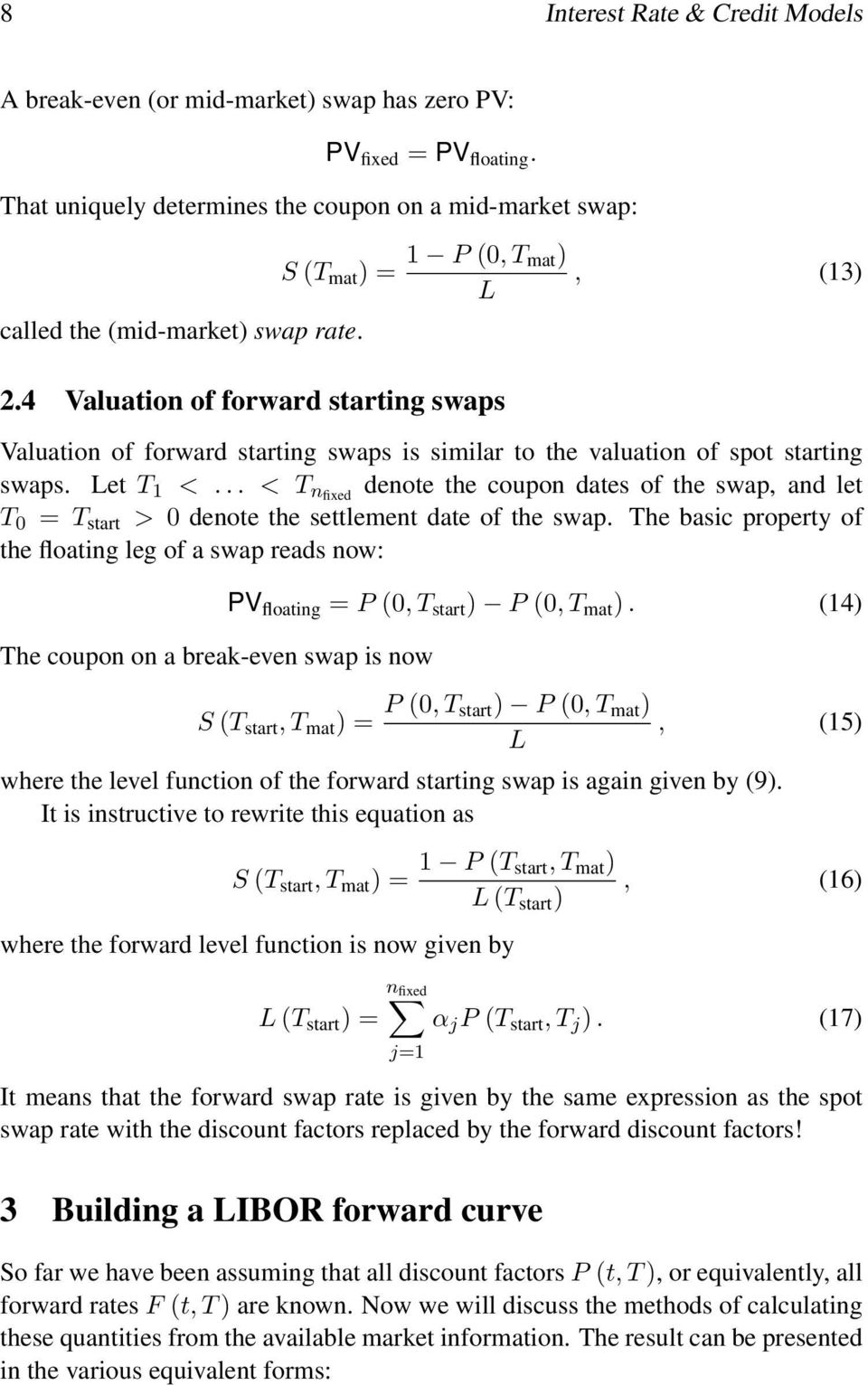
9 Lecture 1 9 (a) As a function t F (t, T ) with fixed tenor T t (say, T t = 3 months). This is called the forward curve. (b) As a function T P (0, T ). This is called the discount curve (or zero coupon curve). (c) As a collection of spot starting swap rates for all tenors. This is called the par swap curve. The curve construction should be based on the prices of liquidly traded benchmar securities. As this set of securities is incomplete, we need a robust and efficient method involving interpolation and, if necessary, extrapolation. These benchmar instruments include deposit rates, Eurodollar futures and a number of benchmar swaps. Benchmar swaps are typically spot starting, and have maturities from 1 year to 40 years and share the same set of coupon dates. For example, one could use the following set of instruments: (a) Overnight, 1 wee, 2 wee, 1 month, 2 month, and 3 month deposit rates. (b) The first 8 Eurodollar contracts. (c) Spot starting swaps with maturities 2, 3, 4, 5, 7, 10, 12, 15, 20, 25, and 30 years. 3.1 Bootstrapping techniques The standard (and oldest) method for building a LIBOR forward curve uses bootstrapping, and consists in the following. Suppose that we now the discount factors P (0, T j ), j = 1,..., N, (18) for all standard maturities T j spaced (say) every 3 months. It is important to choose these maturities so that they include the coupon dates of the benchmar swaps. Then, P (T j 1, T j ) = P (0, T j) P (0, T j 1 ), and so we we can calculate the forward rates for all standard maturities: F (T j 1, T j ) = 1 ( ) 1 δ j P (T j 1, T j ) 1. That does not really solve the problem yet, because we are now faced with the issue of computing the forward rates for non-standard settlements T (say, a 3 month
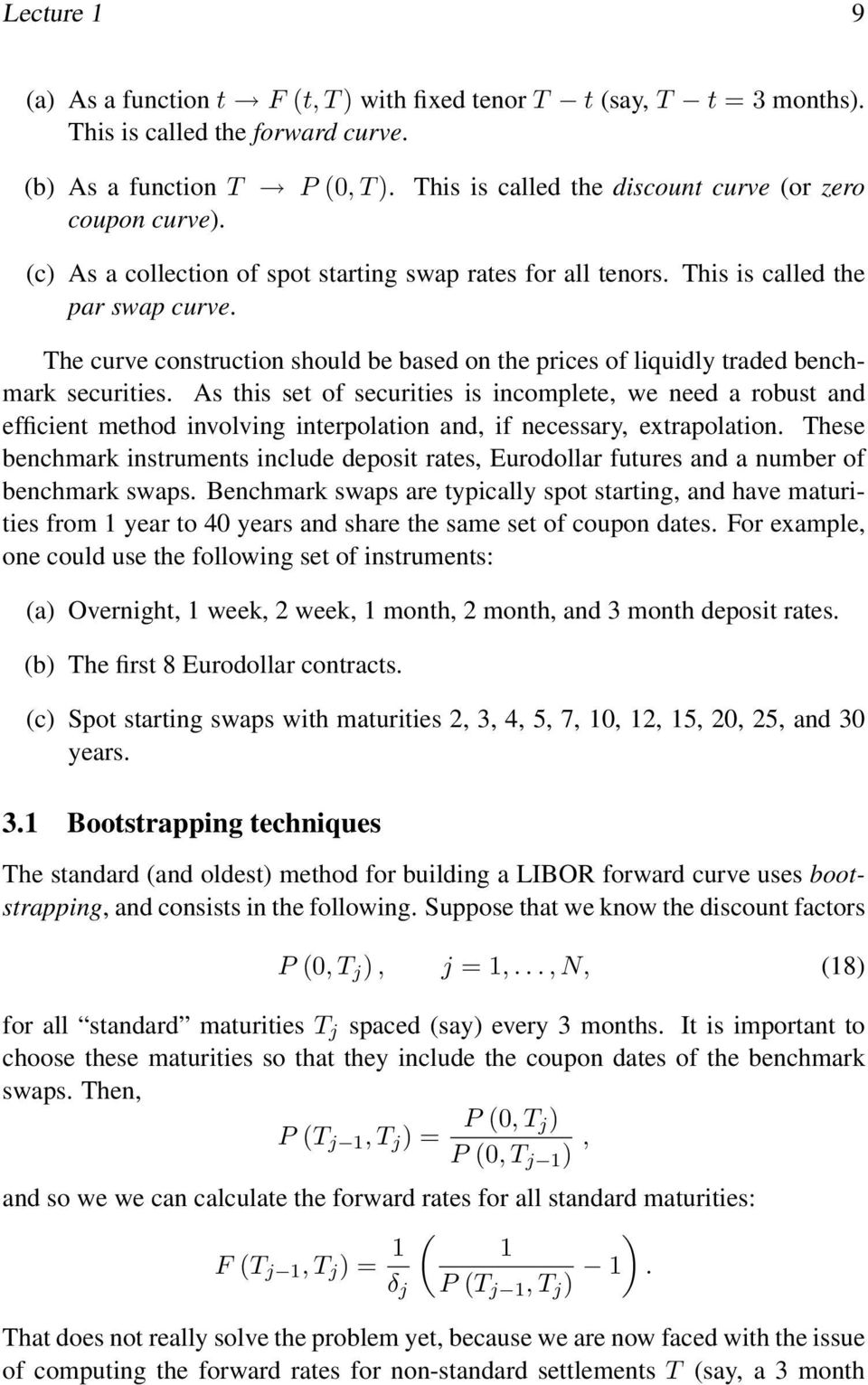
10 10 Interest Rate & Credit Models forward settling 4 months from now). We compute these forwards by means of interpolation. There is no standard for interpolation and various schemes have been proposed. Here is a partial list: (a) Linear interpolation of the discount factors: P (0, T ) = for T j 1 T T j. T j T T j T j 1 P (0, T j 1 ) + T T j 1 T j T j 1 P (0, T j ), (b) Linear interpolation of the log discount factors: log P (0, T ) = T j T T j T j 1 log P (0, T j 1 ) + T T j 1 T j T j 1 log P (0, T j ), for T j 1 T T j. (c) Constant instantaneous forward rate. We assume that f (t) = f j = const, i.e. P (T j 1, T j ) = exp ( f j (T j T j 1 )). This implies that 1 f j = log P (T j 1, T j ), T j T j 1 for all j, and we can now easily carry out the integration T t f (s) ds in the definition of P (t, T ) with arbitrary t and T. (d) Linear instantaneous forward rate. Instantaneous forward rates are assumed linear between the benchmar maturities and continuous throughout. This is a refinement of scheme (c) which requires matching the values of the instantaneous rate at the benchmar maturities. (e) Quadratic instantaneous forward rate. Instantaneous forward rates are assumed quadratic between the benchmar maturities and continuously once differentiable throughout. This is a further refinement of scheme (c) which requires matching the values and the first derivatives of the instantaneous rate at the benchmar maturities. How do we determine the discount factors (18) for the standard maturities? This usually proceeds in three steps:

11 Lecture 1 11 (a) Build the short end (approximately, the first 3 months) of the curve using LIBOR deposit rates and, possibly, some Eurodollar futures 3. This step will involve some interpolation. (b) Build the intermediate (somewhere between 3 months and 5 years) part of the curve using the (convexity-adjusted) Eurodollar futures. The starting date for the first future has its discount rate set by interpolation from the already built short end of the curve. With the addition of each consecutive future contract to the curve the discount factor for its starting date is either (a) interpolated from the existing curve if it starts earlier than the end date of the last contract, or (b) extrapolated from the end date of the previous future. Any of the interpolation schemes described above can be used. (c) Build the long end of the curve using swap rates as par coupon rates. Observe first that for a swap of maturity T mat we can calculate the discount factor P (0, T mat ) in terms of the discount factors to the earlier coupon dates: P (0, T mat ) = 1 S (T mat) n 1 j=1 α jp (0, T j ). 1 + α n S (T mat ) We begin by interpolating the discount factors for coupon dates that fall within the previously built segment of the curve, and continue by inductively applying the above formula. The problem is, of course, that we do not have maret data for swaps with maturities falling on all standard dates (benchmar swaps have typically maturities 2 years, 3 years, 4 years, 5 years,...) and interpolation is again necessary to deal with the intermediate dates. With regard to step (c) above we should mention that it is not a good idea to linearly interpolate par swap rates of different maturities (say, interpolate the 10 year rate and the 30 year rate in order to compute the 19 year rate). A better approach is to use one of the instantaneous forward rate interpolation schemes. 3.2 Smoothing B-splines fitting In this approach, we wor directly with the instantaneous forward rate f (t) which we represent as a cubic B-spline (see the Appendix for the definition and properties of B-splines). We assume that the curve starts at T 0 = 0 and ends at T max (say, 30 years), and choose K not points t 3,..., t N+4, with t 3 <... < t 0 = 0 < t 1 <... < t N = T max <... < t N+4, 3 This will certainly be true, if the front contract is close to expiration, and if one decides to include the serial contracts into the benchmar instruments.

12 12 Interest Rate & Credit Models and let B (t) B (3) (t), = 3, 2,..., be the -the basis function corresponding to these not points. We represent f (t) as a linear combination of the basis functions: f(t) = N+4 = 3 f B (t). (19) Note that, in this representation, the discount factors are simple functions of the f s: ( ) N+4 P (t, T ) = exp γ (t, T ) f, (20) where the coefficients γ (t, T ) = = 3 T t B (t) dt (21) can be easily computed using the algorithm presented in the Appendix. Our goal is to choose the coefficients f in (19) consistently with the maret data. This will be achieved by minimizing a suitable objective function. Suppose now that we are given a number of benchmar rates: (a) Deposit rates D 1 = F (0, T 1 ),..., F m = F (0, T m ), whose current maret values are D 1,... D m. (b) Forward rates F 1 = F (t 1, T 1 ),..., F n = F (t n, T n ), whose current maret values are F 1,... F n. The tenors of the different rates (t j, T j ) may overlap with each other and the tenors of the deposit and swap rates. (c) Swap rates S 1,..., S p, whose current maret values are S 1,... S p. As a consequence of (20), all these rates are simple and explicit functions of the f s. For example, a forward rate is written as ( ( F (t, T ) = 1 N+4 ) ) exp γ (t, T ) f 1. δ = 3 Denote the benchmar rates by R 1,..., R m+n+p, and consider the following objective function: Q(f 3,..., f N+4 ) = 1 2 m+n+p j=1 (R j R j ) λ Tmax T 0 f (t) 2 dt, (22) where λ is a non-negative constant. The second term on the right hand side of (3.2) is a Tihonov regularizer, and its purpose is to penalize the wiggliness of
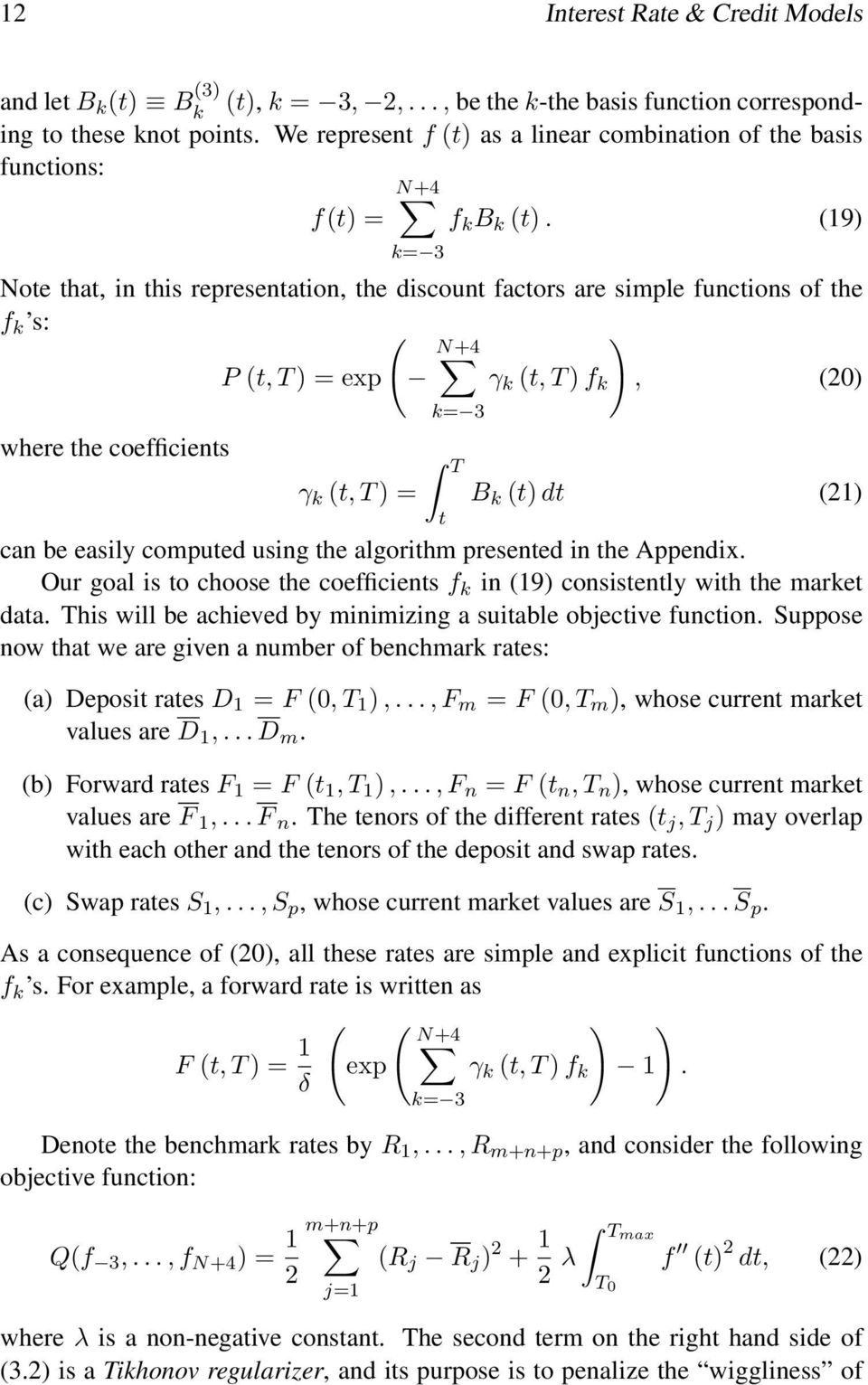
13 Lecture 1 13 f (t) at the expense of the accuracy of the fit. Its magnitude is determined by the magnitude of λ: the bigger the value of λ, the smoother the instantaneous forward rate at the expense of the fit. One may choose to refine the Tihonov regularizer by replacing it with Tmax T 0 λ (t) f (t) 2 dt, where λ (t) is a non-negative (usually, piecewise constant) function. Experience shows that it is a good idea to choose λ (t) smaller in the short end and larger in the bac end of the curve. The minimum of (3.2) can be found by means of standard Newton-type optimization algorithms such as the Levenberg-Marquardt algorithm (see e.g. [4]). The Levenberg-Marquardt algorithm applies to an objective function which can be written as a sum of squares of residuals. This algorithm requires explicit formulas for the partial derivatives of the residuals with respect to the parameters of the problem. In our case, these derivatives can be readily computed. 3.3 Pros and cons of the two methods Both methods explained above have their advantages and disadvantages. For the bootstrapping method, the list of pros and cons includes: (a) Simplicity, bootstrapping does not require using optimization algorithms, all calculations are essentially done in closed form. (b) Calculated swap rates fit exactly the benchmar swap rates. (c) It is difficult to fit the short end of the curve where many instruments with overlapping tenors exist. (d) Some of the interpolation schemes lead to saw-toothed shaped forwards which may lead to unstable pricing. (e) The forward curve tends to be wiggly. The list of pros and cons for the smoothing B-splines fitting method includes: (a) The method requires optimization, and thus is slightly slower. (b) Calculated swap rates are very close, but typically not equal, to the benchmar swap rates. (c) There is no issue with overlapping tenors on instruments in the short end.
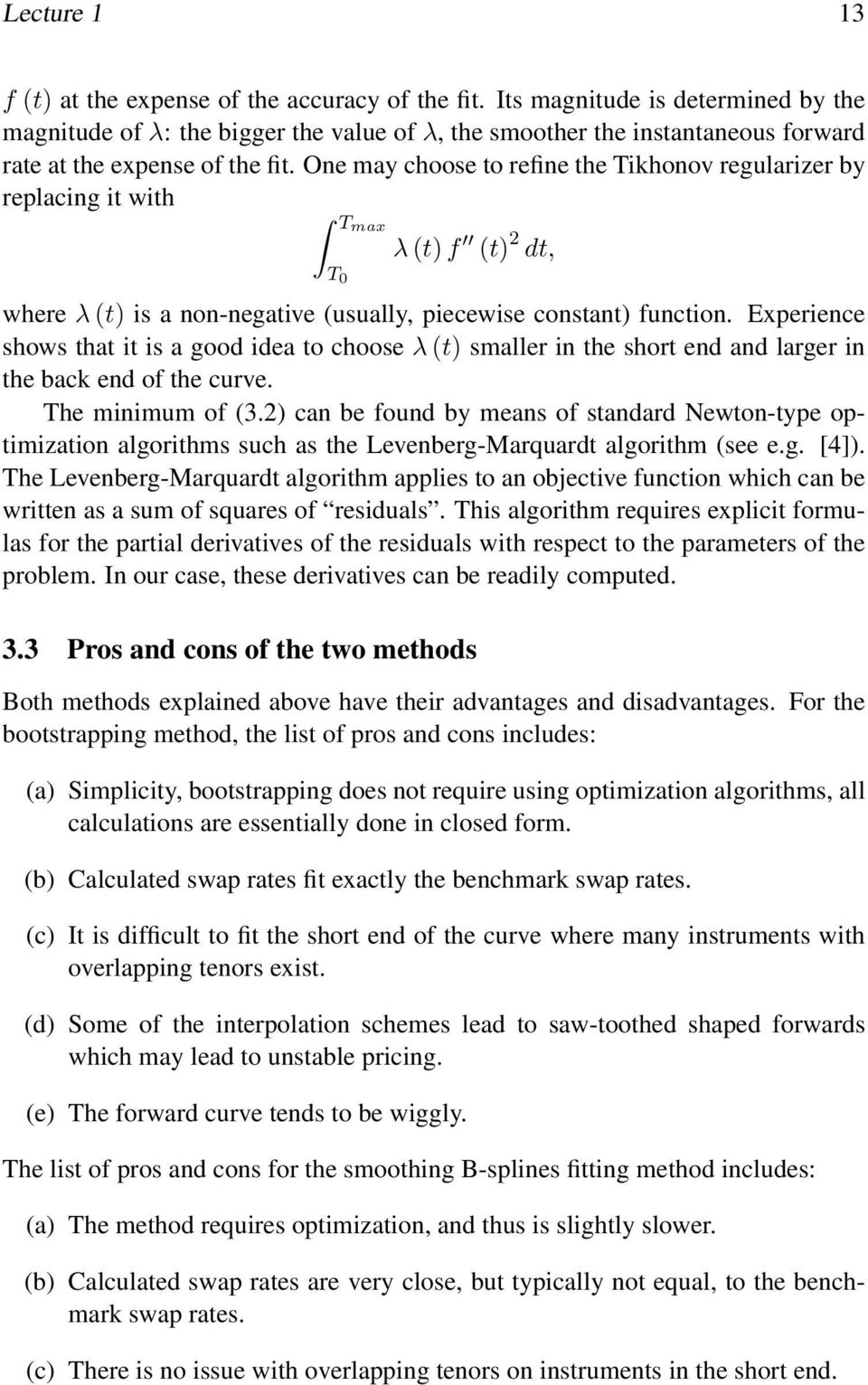
14 14 Interest Rate & Credit Models (d) The forward curve is smooth. Other considerations, such as suitability for ris management, will be discussed later. 4 Curve sensitivities and position hedging A common problem faced by portfolio managers and traders is to hedge the interest rate exposure of a portfolio of fixed income securities such as bonds, swaps, options, etc. The ey issue is to quantify this exposure and offset it (if desired) by taing positions in liquid vanilla instruments. We let Π denote this portfolio, whose details are not important to us right now. 4.1 Input perturbation sensitivities In this approach we compute the sensitivities of the portfolio to the benchmar instruments used in the curve construction, and replicate the ris of the portfolio by means of a portfolio consisting of the suitably weighted benchmar instruments. (a) Compute the partial DVO1s of the portfolio Π to each of the benchmar instruments B i : We shift each of the benchmar rates down 1 bp and calculate the corresponding changes δ i Π in the PV. (b) Compute the DVO1s δ i B i of the PVs of the benchmar instruments under these shifts. (c) The hedge ratios i of the portfolio to the benchmars are given by: i = δ iπ δ i B i. This way of computing portfolio ris wors well together with the bootstrapping method of building the curve. 4.2 Regression based sensitivities An alternative and more robust approach consists in computing the sensitivities of the portfolio to a number of virtual scenarios, and expressing these sensitivities in terms of the sensitivities of a suitably selected hedging portfolio. We proceed as follows. First, we select the hedging portfolio and the scenarios. This should be done judiciously, based on the understanding of the riss of the portfolio and liquidity of instruments intended as hedges.

15 Lecture 1 15 (a) Choose a hedging portfolio consisting of vanilla instruments such as (spot or forward starting) swaps, Eurodollar futures, forward rate agreements, etc: Π hedge = {B 1,..., B n }. (b) Let C 0 denote the current forward curve (the base scenario ). Choose a number of new micro scenarios C 1,..., C p by perturbing a segment of C 0. For example, C 1 could result from C 0 by shifting the first 3 month segment down by 1 bp. We then compute the sensitivities of the portfolio and the hedging portfolio under these curve shifts: (a) The vector δπ of portfolio s sensitivities under these scenarios is δ i Π = Π (C i ) Π (C 0 ), i = 1,..., p, where by Π (C i ) we denote the value of the portfolio given the shifted forward curve C i. (b) The matrix δb of sensitivities of the hedging instruments to these scenarios is δ i B j = B j (C i ) B j (C 0 ). To avoid accidental colinearities between its rows or columns, one should always use more scenario than hedging instruments. Finally, we translate the ris of the portfolio to the vector of hedge ratios with respect to the instruments in the hedging portfolio. The vector of hedge ratios is calculated by minimizing L ( ) = 1 2 δb δπ λ Q 2. Here, λ is an appropriately chosen small smoothness parameter (similar to the Tihonov regularizer!), and Q is the smoothing operator (say, the identity matrix). Explicitly, = ( (δb) t δb + λq t Q ) 1 (δb) t δπ, where the superscript t denotes matrix transposition. One can thin of the component j as the sensitivity of the portfolio to the hedging instrument B j. This method of calculating portfolio sensitivities is called the ridge regression method. It is very robust, and allows one to view the portfolio ris in a flexible way. One can use it together with both curve building techniques described above.

16 16 Interest Rate & Credit Models A B-splines and smoothing B-splines We collect here a number of basic facts about B-splines. For a complete presentation, see [1]. A spline of degree d is a function f (t) such that: (a) f (t) is piecewise polynomial of degree d. That means that one can partition the real line into non-overlapping intervals such that, on each of these intervals, f (t) is a polynomial of degree d. (b) f (t) has d 1 continuous derivatives. That means that the polynomials mentioned above are glued together in a maximally smooth way. Splines of low degree (such as d = 3, in which case they are called cubic splines) provide a convenient and robust framewor for data interpolation. A particular type of splines are B-splines. A B-spline of degree d 0 is a function f (t) of the form f (t) = = f B (d) (t), (23) { } where B (d) (t) is a family of basis functions defined as follows. We choose a sequence of not points:... < t 1 < t 0 < t 1 <... < t <..., (24) and set We then define recursively: B (0) (t) = { 1, if t t < t +1. 0, otherwise. (25) B (d) (t) = t t t +d t B (d 1) (t) + t +d+1 t t +d+1 t +1 B (d 1) +1 (t). (26) Clearly, each B (d) (t) is a spline of degree d. Here are some ey properties of the basis functions: B (d) (t) 0, (27) and B (d) (t) = 0, (28)
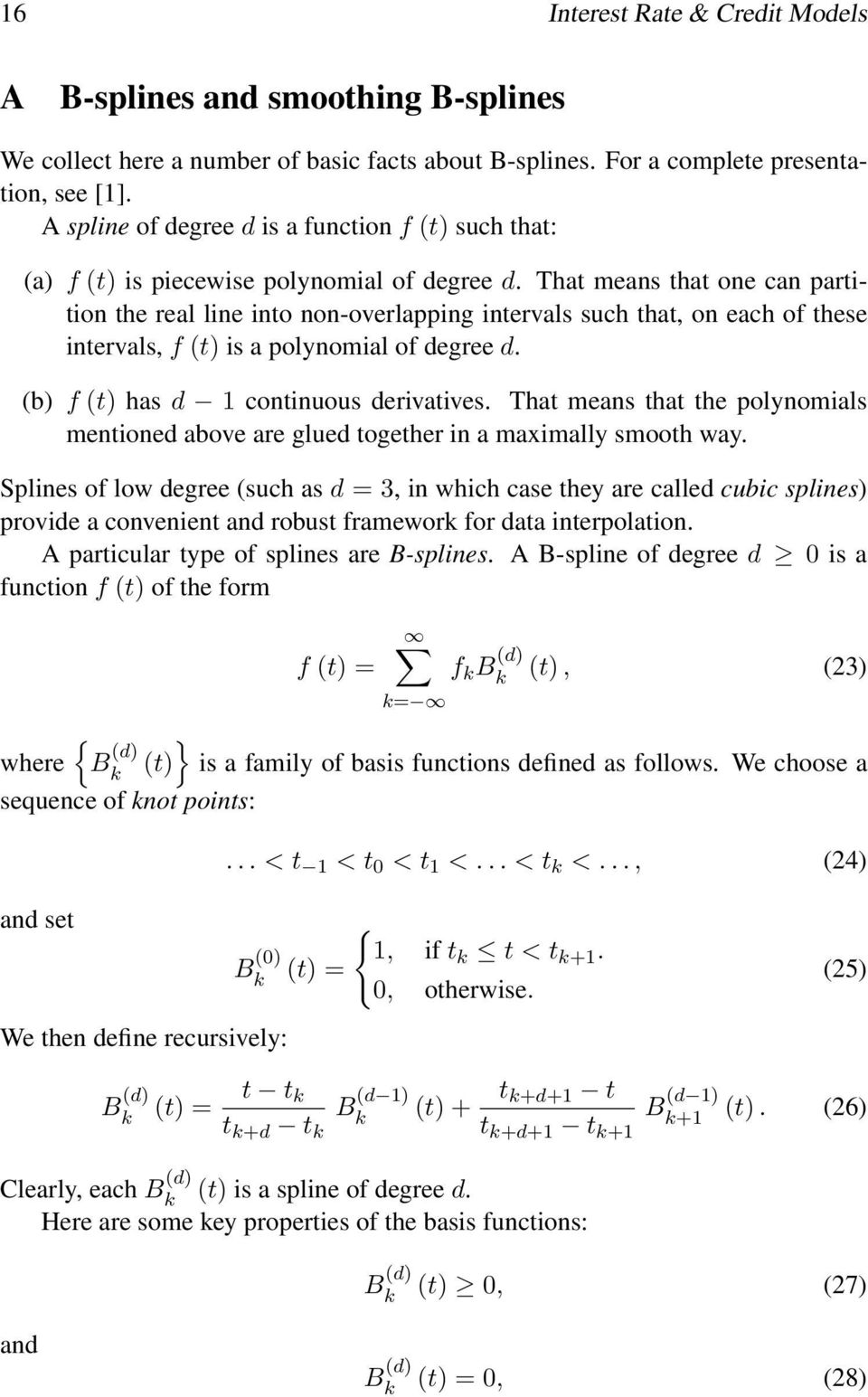
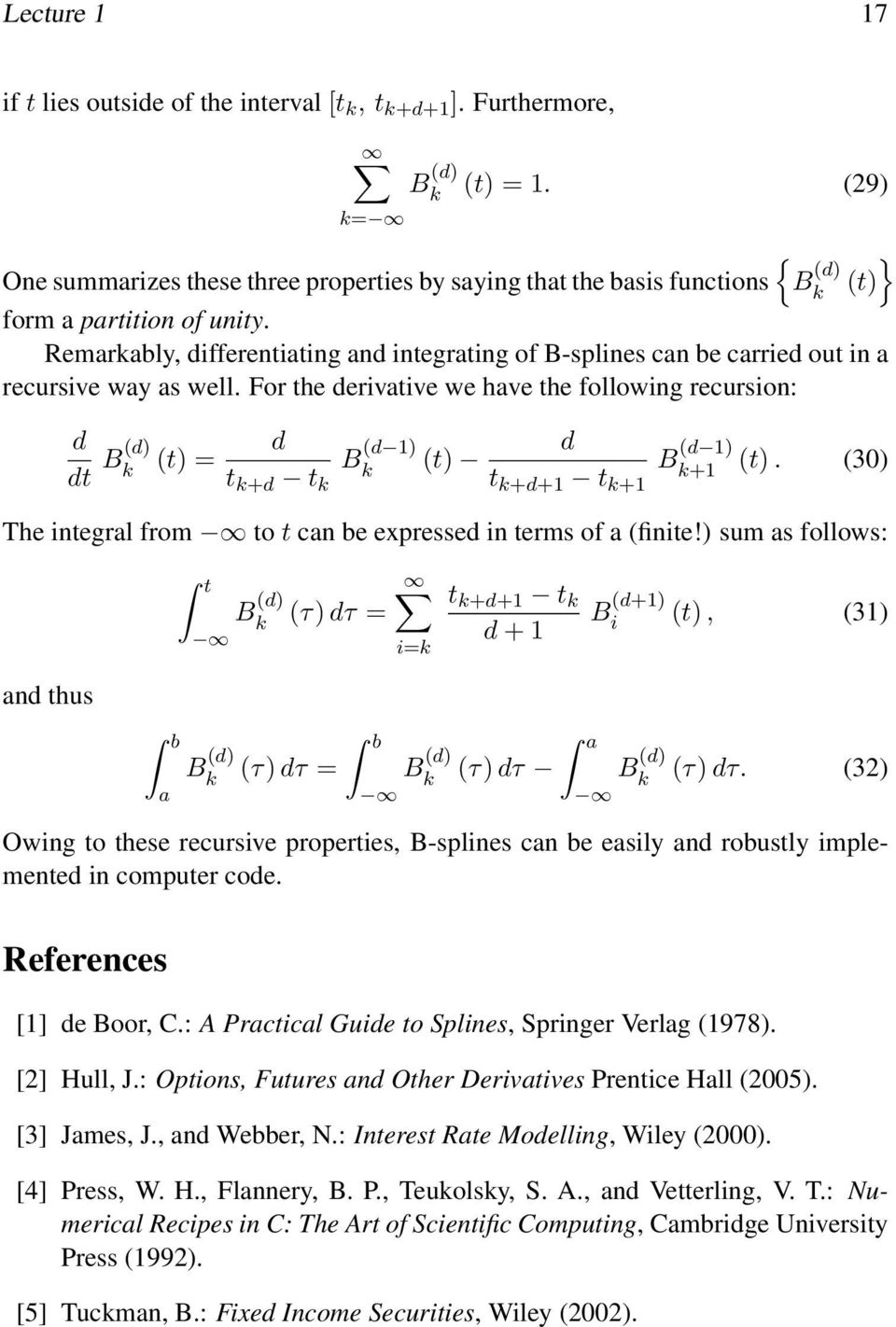
17 Lecture 1 17 if t lies outside of the interval [t, t +d+1 ]. Furthermore, = B (d) (t) = 1. (29) { One summarizes these three properties by saying that the basis functions B (d) } (t) form a partition of unity. Remarably, differentiating and integrating of B-splines can be carried out in a recursive way as well. For the derivative we have the following recursion: d dt B(d) (t) = d B (d 1) t +d t (t) d t +d+1 t +1 B (d 1) +1 (t). (30) The integral from to t can be expressed in terms of a (finite!) sum as follows: t B (d) (τ) dτ = i= t +d+1 t d + 1 B (d+1) i (t), (31) and thus b a b B (d) (τ) dτ = a B (d) (τ) dτ B (d) (τ) dτ. (32) Owing to these recursive properties, B-splines can be easily and robustly implemented in computer code. References [1] de Boor, C.: A Practical Guide to Splines, Springer Verlag (1978). [2] Hull, J.: Options, Futures and Other Derivatives Prentice Hall (2005). [3] James, J., and Webber, N.: Interest Rate Modelling, Wiley (2000). [4] Press, W. H., Flannery, B. P., Teuolsy, S. A., and Vetterling, V. T.: Numerical Recipes in C: The Art of Scientific Computing, Cambridge University Press (1992). [5] Tucman, B.: Fixed Income Securities, Wiley (2002).
INTEREST RATES AND FX MODELS
 INTEREST RATES AND FX MODELS 1. LIBOR and OIS Andrew Lesniewsi Courant Institute of Mathematical Sciences New Yor University New Yor January 26, 2012 2 Interest Rates & FX Models Contents 1 Introduction
Eurodollar Futures, and Forwards
 5 Eurodollar Futures, and Forwards In this chapter we will learn about Eurodollar Deposits Eurodollar Futures Contracts, Hedging strategies using ED Futures, Forward Rate Agreements, Pricing FRAs. Hedging
INTEREST RATES AND FX MODELS
 INTEREST RATES AND FX MODELS 8. Portfolio greeks Andrew Lesniewski Courant Institute of Mathematical Sciences New York University New York March 27, 2013 2 Interest Rates & FX Models Contents 1 Introduction
Margin Calculation Methodology and Derivatives and Repo Valuation Methodology
 Margin Calculation Methodology and Derivatives and Repo Valuation Methodology 1 Overview This document presents the valuation formulas for interest rate derivatives and repo transactions implemented in
Bootstrapping the interest-rate term structure
 Bootstrapping the interest-rate term structure Marco Marchioro www.marchioro.org October 20 th, 2012 Bootstrapping the interest-rate term structure 1 Summary (1/2) Market quotes of deposit rates, IR futures,
MONEY MARKET FUTURES. FINANCE TRAINER International Money Market Futures / Page 1 of 22
 MONEY MARKET FUTURES 1. Conventions and Contract Specifications... 3 2. Main Markets of Money Market Futures... 7 3. Exchange and Clearing House... 8 4. The Margin System... 9 5. Comparison: Money Market
Building a Smooth Yield Curve. University of Chicago. Jeff Greco
 Building a Smooth Yield Curve University of Chicago Jeff Greco email: [email protected] Preliminaries As before, we will use continuously compounding Act/365 rates for both the zero coupon rates
Manual for SOA Exam FM/CAS Exam 2.
 Manual for SOA Exam FM/CAS Exam 2. Chapter 7. Derivatives markets. c 2009. Miguel A. Arcones. All rights reserved. Extract from: Arcones Manual for the SOA Exam FM/CAS Exam 2, Financial Mathematics. Fall
Finance 350: Problem Set 6 Alternative Solutions
 Finance 350: Problem Set 6 Alternative Solutions Note: Where appropriate, the final answer for each problem is given in bold italics for those not interested in the discussion of the solution. I. Formulas
FIN 472 Fixed-Income Securities Forward Rates
 FIN 472 Fixed-Income Securities Forward Rates Professor Robert B.H. Hauswald Kogod School of Business, AU Interest-Rate Forwards Review of yield curve analysis Forwards yet another use of yield curve forward
The Money Market. Juan Barragan ECP January 2009
 The Money Market Juan Barragan ECP January 2009 The Money Market Central Banks They drive the Money Market. They make funds available to commercial banks. They ensure liquidity. Funds available for a short
550.444 Introduction to Financial Derivatives
 550.444 Introduction to Financial Derivatives Week of October 7, 2013 Interest Rate Futures Where we are Last week: Forward & Futures Prices/Value (Chapter 5, OFOD) This week: Interest Rate Futures (Chapter
Learning Curve Interest Rate Futures Contracts Moorad Choudhry
 Learning Curve Interest Rate Futures Contracts Moorad Choudhry YieldCurve.com 2004 Page 1 The market in short-term interest rate derivatives is a large and liquid one, and the instruments involved are
Analytical Research Series
 EUROPEAN FIXED INCOME RESEARCH Analytical Research Series INTRODUCTION TO ASSET SWAPS Dominic O Kane January 2000 Lehman Brothers International (Europe) Pub Code 403 Summary An asset swap is a synthetic
BERMUDA MONETARY AUTHORITY DETERMINATION OF DISCOUNT RATES FOR ECONOMIC BALANCE SHEET FRAMEWORK July 2015
 BERMUDA MONETARY AUTHORITY DETERMINATION OF DISCOUNT RATES FOR ECONOMIC BALANC CE SHEET FRAMEWORK July 2015 Contents I. BACKGROUND... 3 II. DETERMINATION OF DISCOUNT RATES... 4 III. STANDARD APPROACH...
SwapEx Contract Specifications. USD LIBOR Interest Rate Swaps: Fixedto-Floating
 SwapEx Contract Specifications USD LIBOR Interest Rate Swaps: Fixedto-Floating There are two types of USD LIBOR Interest Rate Swaps; Fixed-to-Floating contracts available for trading on SwapEx: Fixed Rate
Eris Interest Rate Swap Futures: Flex Contract Specifications
 Eris Interest Rate Swap Futures: Flex Contract Specifications Trading Hours Contract Structure Contract Size Trading Conventions Swap Futures Leg Conventions Effective Date Cash Flow Alignment Date ( CFAD
CFA Level -2 Derivatives - I
 CFA Level -2 Derivatives - I EduPristine www.edupristine.com Agenda Forwards Markets and Contracts Future Markets and Contracts Option Markets and Contracts 1 Forwards Markets and Contracts 2 Pricing and
Assumptions: No transaction cost, same rate for borrowing/lending, no default/counterparty risk
 Derivatives Why? Allow easier methods to short sell a stock without a broker lending it. Facilitates hedging easily Allows the ability to take long/short position on less available commodities (Rice, Cotton,
Interest Rate Futures. Chapter 6
 Interest Rate Futures Chapter 6 1 Day Count Convention The day count convention defines: The period of time to which the interest rate applies. The period of time used to calculate accrued interest (relevant
INTEREST RATE SWAP (IRS)
 INTEREST RATE SWAP (IRS) 1. Interest Rate Swap (IRS)... 4 1.1 Terminology... 4 1.2 Application... 11 1.3 EONIA Swap... 19 1.4 Pricing and Mark to Market Revaluation of IRS... 22 2. Cross Currency Swap...
Equity-index-linked swaps
 Equity-index-linked swaps Equivalent to portfolios of forward contracts calling for the exchange of cash flows based on two different investment rates: a variable debt rate (e.g. 3-month LIBOR) and the
Advanced forms of currency swaps
 Advanced forms of currency swaps Basis swaps Basis swaps involve swapping one floating index rate for another. Banks may need to use basis swaps to arrange a currency swap for the customers. Example A
BOND FUTURES. 1. Terminology... 2 2. Application... 11. FINANCE TRAINER International Bond Futures / Page 1 of 12
 BOND FUTURES 1. Terminology... 2 2. Application... 11 FINANCE TRAINER International Bond Futures / Page 1 of 12 1. Terminology A future is a contract to either sell or buy a certain underlying on a specified
Derivatives Interest Rate Futures. Professor André Farber Solvay Brussels School of Economics and Management Université Libre de Bruxelles
 Derivatives Interest Rate Futures Professor André Farber Solvay Brussels School of Economics and Management Université Libre de Bruxelles Interest Rate Derivatives Forward rate agreement (FRA): OTC contract
Introduction to swaps
 Introduction to swaps Steven C. Mann M.J. Neeley School of Business Texas Christian University incorporating ideas from Teaching interest rate and currency swaps" by Keith C. Brown (Texas-Austin) and Donald
The Irony In The Derivatives Discounting
 The Irony In The Derivatives Discounting Marc Henrard Head of Quantitative Research, Banking Department, Bank for International Settlements, CH-4002 Basel (Switzerland), e-mail: [email protected] Abstract
Hedging Illiquid FX Options: An Empirical Analysis of Alternative Hedging Strategies
 Hedging Illiquid FX Options: An Empirical Analysis of Alternative Hedging Strategies Drazen Pesjak Supervised by A.A. Tsvetkov 1, D. Posthuma 2 and S.A. Borovkova 3 MSc. Thesis Finance HONOURS TRACK Quantitative
LIFE INSURANCE AND WEALTH MANAGEMENT PRACTICE COMMITTEE AND GENERAL INSURANCE PRACTICE COMMITTEE
 LIFE INSURANCE AND WEALTH MANAGEMENT PRACTICE COMMITTEE AND GENERAL INSURANCE PRACTICE COMMITTEE Information Note: Discount Rates for APRA Capital Standards Contents 1. Status of Information Note 3 2.
Fixed-Income Securities. Assignment
 FIN 472 Professor Robert B.H. Hauswald Fixed-Income Securities Kogod School of Business, AU Assignment Please be reminded that you are expected to use contemporary computer software to solve the following
Interest Rate and Currency Swaps
 Interest Rate and Currency Swaps Eiteman et al., Chapter 14 Winter 2004 Bond Basics Consider the following: Zero-Coupon Zero-Coupon One-Year Implied Maturity Bond Yield Bond Price Forward Rate t r 0 (0,t)
4. ANNEXURE 3 : PART 3 - FOREIGN EXCHANGE POSITION RISK
 Annexure 3 (PRR) - Part 3, Clause 18 - Foreign Exchange Position Risk Amount 4 ANNEXURE 3 : PART 3 - FOREIGN EXCHANGE POSITION RISK (a) CLAUSE 18 - FOREIGN EXCHANGE POSITION RISK AMOUNT (i) Rule PART 3
MONEY MARKET SUBCOMMITEE(MMS) FLOATING RATE NOTE PRICING SPECIFICATION
 MONEY MARKET SUBCOMMITEE(MMS) FLOATING RATE NOTE PRICING SPECIFICATION This document outlines the use of the margin discounting methodology to price vanilla money market floating rate notes as endorsed
YIELD CURVE GENERATION
 1 YIELD CURVE GENERATION Dr Philip Symes Agenda 2 I. INTRODUCTION II. YIELD CURVES III. TYPES OF YIELD CURVES IV. USES OF YIELD CURVES V. YIELD TO MATURITY VI. BOND PRICING & VALUATION Introduction 3 A
2 Stock Price. Figure S1.1 Profit from long position in Problem 1.13
 Problem 1.11. A cattle farmer expects to have 12, pounds of live cattle to sell in three months. The livecattle futures contract on the Chicago Mercantile Exchange is for the delivery of 4, pounds of cattle.
Learning Curve An introduction to the use of the Bloomberg system in swaps analysis Received: 1st July, 2002
 Learning Curve An introduction to the use of the Bloomberg system in swaps analysis Received: 1st July, 2002 Aaron Nematnejad works in the fixed income analytics team at Bloomberg L.P. in London. He graduated
Understanding Cross Currency Swaps. A Guide for Microfinance Practitioners
 Understanding Cross Currency Swaps A Guide for Microfinance Practitioners Cross Currency Swaps Use: A Currency Swap is the best way to fully hedge a loan transaction as the terms can be structured to exactly
CREATING A CORPORATE BOND SPOT YIELD CURVE FOR PENSION DISCOUNTING DEPARTMENT OF THE TREASURY OFFICE OF ECONOMIC POLICY WHITE PAPER FEBRUARY 7, 2005
 CREATING A CORPORATE BOND SPOT YIELD CURVE FOR PENSION DISCOUNTING I. Introduction DEPARTMENT OF THE TREASURY OFFICE OF ECONOMIC POLICY WHITE PAPER FEBRUARY 7, 2005 Plan sponsors, plan participants and
Interest Rate Volatility
 Interest Rate Volatility I. Volatility in fixed income markets Andrew Lesniewski Baruch College and Posnania Inc First Baruch Volatility Workshop New York June 16-18, 2015 Outline Linear interest rate
Introduction, Forwards and Futures
 Introduction, Forwards and Futures Liuren Wu Zicklin School of Business, Baruch College Fall, 2007 (Hull chapters: 1,2,3,5) Liuren Wu Introduction, Forwards & Futures Option Pricing, Fall, 2007 1 / 35
Hedging with Futures and Options: Supplementary Material. Global Financial Management
 Hedging with Futures and Options: Supplementary Material Global Financial Management Fuqua School of Business Duke University 1 Hedging Stock Market Risk: S&P500 Futures Contract A futures contract on
I NTEREST RATE BOOTSTRAPPING EXPLAINED. Abstract
 I NTEREST RATE BOOTSTRAPPING EPLAINED German Bernhart AIA Investment GmbH Sonnenstraße 9, 833 München, Germany germanbernhart@xaiacom Date: February 8, 23 Abstract The aim of this document is to describe
Lecture 12. Options Strategies
 Lecture 12. Options Strategies Introduction to Options Strategies Options, Futures, Derivatives 10/15/07 back to start 1 Solutions Problem 6:23: Assume that a bank can borrow or lend money at the same
Floating rate Payments 6m Libor. Fixed rate payments 1 300000 337500-37500 2 300000 337500-37500 3 300000 337500-37500 4 300000 325000-25000
 Introduction: Interest rate swaps are used to hedge interest rate risks as well as to take on interest rate risks. If a treasurer is of the view that interest rates will be falling in the future, he may
Determination of Forward and Futures Prices
 Determination of Forward and Futures Prices Options, Futures, and Other Derivatives, 8th Edition, Copyright John C. Hull 2012 Short selling A popular trading (arbitrage) strategy is the shortselling or
Learning Curve Forward Rate Agreements Anuk Teasdale
 Learning Curve Forward Rate Agreements Anuk Teasdale YieldCurve.com 2004 Page 1 In this article we review the forward rate agreement. Money market derivatives are priced on the basis of the forward rate,
ASSET LIABILITY MANAGEMENT Significance and Basic Methods. Dr Philip Symes. Philip Symes, 2006
 1 ASSET LIABILITY MANAGEMENT Significance and Basic Methods Dr Philip Symes Introduction 2 Asset liability management (ALM) is the management of financial assets by a company to make returns. ALM is necessary
 DERIVATIVES Presented by Sade Odunaiya Partner, Risk Management Alliance Consulting DERIVATIVES Introduction Forward Rate Agreements FRA Swaps Futures Options Summary INTRODUCTION Financial Market Participants
Understanding Futures on the DTCC GCF Repo Index
 Understanding Futures on the DTCC GCF Repo Index White Paper June 2014 This material may not be reproduced or redistributed in whole or in part without the express, prior written consent of Intercontinental
INTEREST RATES AND FX MODELS
 INTEREST RATES AND FX MODELS 4. Convexity and CMS Andrew Lesniewski Courant Institute of Mathematical Sciences New York University New York February 20, 2013 2 Interest Rates & FX Models Contents 1 Introduction
The interest volatility surface
 The interest volatility surface David Kohlberg Kandidatuppsats i matematisk statistik Bachelor Thesis in Mathematical Statistics Kandidatuppsats 2011:7 Matematisk statistik Juni 2011 www.math.su.se Matematisk
Risk-based profit and loss attribution
 Ris-based profit and loss attribution Oliver Locwood FIA 9 Louise Croft Birmingham B4 5NY United Kingdom E-mail: [email protected] Abstract The impending Solvency II regulatory regime in the European
With the derivative markets having changed dramatically since the 2008 financial crisis,
 Avoiding Collateral Surprises: Managing Multi-Currency CSAs Anna Barbashova, Numerix - 24 Jan 2013 This article explores multi-currency credit support annexes (CSAs) in the derivatives area and their potential
Fixed Income Portfolio Management. Interest rate sensitivity, duration, and convexity
 Fixed Income ortfolio Management Interest rate sensitivity, duration, and convexity assive bond portfolio management Active bond portfolio management Interest rate swaps 1 Interest rate sensitivity, duration,
Fixed Income Arbitrage
 Risk & Return Fixed Income Arbitrage: Nickels in Front of a Steamroller by Jefferson Duarte Francis A. Longstaff Fan Yu Fixed Income Arbitrage Broad set of market-neutral strategies intended to exploit
Caps and Floors. John Crosby
 Caps and Floors John Crosby Glasgow University My website is: http://www.john-crosby.co.uk If you spot any typos or errors, please email me. My email address is on my website Lecture given 19th February
EURODOLLAR FUTURES PRICING. Robert T. Daigler. Florida International University. and. Visiting Scholar. Graduate School of Business
 EURODOLLAR FUTURES PRICING Robert T. Daigler Florida International University and Visiting Scholar Graduate School of Business Stanford University 1990-91 Jumiaty Nurawan Jakarta, Indonesia The Financial
Zero-Coupon Bonds (Pure Discount Bonds)
 Zero-Coupon Bonds (Pure Discount Bonds) The price of a zero-coupon bond that pays F dollars in n periods is F/(1 + r) n, where r is the interest rate per period. Can meet future obligations without reinvestment
FIXED-INCOME SECURITIES. Chapter 11. Forwards and Futures
 FIXED-INCOME SECURITIES Chapter 11 Forwards and Futures Outline Futures and Forwards Types of Contracts Trading Mechanics Trading Strategies Futures Pricing Uses of Futures Futures and Forwards Forward
Chapter 5 Financial Forwards and Futures
 Chapter 5 Financial Forwards and Futures Question 5.1. Four different ways to sell a share of stock that has a price S(0) at time 0. Question 5.2. Description Get Paid at Lose Ownership of Receive Payment
Introduction to Eris Exchange Interest Rate Swap Futures
 Introduction to Eris Exchange Interest Rate Swap Futures Overview Eris Exchange interest rate swap futures ( Eris contracts ) have been designed to replicate the net cash flows associated with plain-vanilla,
Tenor Adjustments for a Basis Swap
 Tenor Adjustments for a Basis Swap by Chandrakant Maheshwari Praveen Maheshwari Table of Contents 1. Introduction 3 2. Tenor Adjustment Methodology for a Basis Swap 3 3. Why this Tenor Spread so important
Buy = Pay Fixed, Receive Float -or- Pay Float +/- Spread, Receive Float Sell = Receive Fixed, Pay Float -or- Receive Float +/- Spread, Pay Float
 VIA Electronic Submission Office of the Secretariat Commodity Futures Trading Commission Three Lafayette Centre 1155 21 st Street, N.W. Washington, DC 20581 Re: Javelin SEF, LLC To Whom It May Concern,
CS 522 Computational Tools and Methods in Finance Robert Jarrow Lecture 1: Equity Options
 CS 5 Computational Tools and Methods in Finance Robert Jarrow Lecture 1: Equity Options 1. Definitions Equity. The common stock of a corporation. Traded on organized exchanges (NYSE, AMEX, NASDAQ). A common
Alliance Consulting BOND YIELDS & DURATION ANALYSIS. Bond Yields & Duration Analysis Page 1
 BOND YIELDS & DURATION ANALYSIS Bond Yields & Duration Analysis Page 1 COMPUTING BOND YIELDS Sources of returns on bond investments The returns from investment in bonds come from the following: 1. Periodic
Problems and Solutions
 1 CHAPTER 1 Problems 1.1 Problems on Bonds Exercise 1.1 On 12/04/01, consider a fixed-coupon bond whose features are the following: face value: $1,000 coupon rate: 8% coupon frequency: semiannual maturity:
VALUATION OF PLAIN VANILLA INTEREST RATES SWAPS
 Graduate School of Business Administration University of Virginia VALUATION OF PLAIN VANILLA INTEREST RATES SWAPS Interest-rate swaps have grown tremendously over the last 10 years. With this development,
CHAPTER 1 Splines and B-splines an Introduction
 CHAPTER 1 Splines and B-splines an Introduction In this first chapter, we consider the following fundamental problem: Given a set of points in the plane, determine a smooth curve that approximates the
NASDAQ OMX CASH FLOW MARGIN
 NASDAQ OMX CASH FLOW MARGIN Margin methodology guide for Nordic fixed income products. 11/3/2015 NASDAQ OMX Stockholm (NOMX) EXECUTIVE SUMMARY This document describes the NASDAQ OMX Cash Flow Margin (CFM)
Vilnius University. Faculty of Mathematics and Informatics. Gintautas Bareikis
 Vilnius University Faculty of Mathematics and Informatics Gintautas Bareikis CONTENT Chapter 1. SIMPLE AND COMPOUND INTEREST 1.1 Simple interest......................................................................
FINANCIAL MATHEMATICS MONEY MARKET
 FINANCIAL MATHEMATICS MONEY MARKET 1. Methods of Interest Calculation, Yield Curve and Quotation... 2 1.1 Methods to Calculate Interest... 2 1.2 The Yield Curve... 6 1.3 Interpolation... 8 1.4 Quotation...
MATHEMATICS OF FINANCE AND INVESTMENT
 MATHEMATICS OF FINANCE AND INVESTMENT G. I. FALIN Department of Probability Theory Faculty of Mechanics & Mathematics Moscow State Lomonosov University Moscow 119992 [email protected] 2 G.I.Falin. Mathematics
A Teaching Note on Pricing and Valuing Interest Rate Swaps Using LIBOR and OIS Discounting
 A Teaching Note on Pricing and Valuing Interest Rate Swaps Using LIBOR and OIS Discounting June 202 Donald J. Smith Associate Professor of Finance Boston University School of Management 595 Commonwealth
Bond Price Arithmetic
 1 Bond Price Arithmetic The purpose of this chapter is: To review the basics of the time value of money. This involves reviewing discounting guaranteed future cash flows at annual, semiannual and continuously
Introduction. example of a AA curve appears at the end of this presentation.
 1 Introduction The High Quality Market (HQM) Corporate Bond Yield Curve for the Pension Protection Act (PPA) uses a methodology developed at Treasury to construct yield curves from extended regressions
IFRS Practice Issues for Banks:
 IFRS Practice Issues for Banks: Fair value measurement of derivatives the basics September 2012 kpmg.com/ifrs Contents Highlighting the path to fair value for derivatives 1 1. Introduction 2 2. How are
CHAPTER 14 INTEREST RATE AND CURRENCY SWAPS SUGGESTED ANSWERS AND SOLUTIONS TO END-OF-CHAPTER QUESTIONS AND PROBLEMS
 CHAPTER 14 INTEREST RATE AND CURRENCY SWAPS SUGGESTED ANSWERS AND SOLUTIONS TO END-OF-CHAPTER QUESTIONS AND PROBLEMS QUESTIONS 1. Describe the difference between a swap broker and a swap dealer. Answer:
Solutions to Practice Questions (Bonds)
 Fuqua Business School Duke University FIN 350 Global Financial Management Solutions to Practice Questions (Bonds). These practice questions are a suplement to the problem sets, and are intended for those
FINANCE 1. DESS Gestion des Risques/Ingéniérie Mathématique Université d EVRY VAL D ESSONNE EXERCICES CORRIGES. Philippe PRIAULET
 FINANCE 1 DESS Gestion des Risques/Ingéniérie Mathématique Université d EVRY VAL D ESSONNE EXERCICES CORRIGES Philippe PRIAULET 1 Exercise 1 On 12/04/01 consider a fixed coupon bond whose features are
Application of Interest Rate Swaps in Indian Insurance Industry Amruth Krishnan Rohit Ajgaonkar Guide: G.LN.Sarma
 Institute of Actuaries of India Application of Interest Rate Swaps in Indian Insurance Industry Amruth Krishnan Rohit Ajgaonkar Guide: G.LN.Sarma 21 st IFS Seminar Indian Actuarial Profession Serving the
FX Derivatives Terminology. Education Module: 5. Dated July 2002. FX Derivatives Terminology
 Education Module: 5 Dated July 2002 Foreign Exchange Options Option Markets and Terminology A American Options American Options are options that are exercisable for early value at any time during the term
Creating Forward-Starting Swaps with DSFs
 INTEREST RATES Creating -Starting Swaps with s JULY 23, 2013 John W. Labuszewski Managing Director Research & Product Development 312-466-7469 [email protected] CME Group introduced its Deliverable Swap
Hot Topics in Financial Markets Lecture 1: The Libor Scandal
 Hot Topics in Financial Markets Lecture 1: The Libor Scandal Spot and Forward Interest Rates Libor Libor-Dependent Financial Instruments The Scandal 2 Spot Interest Rates Bond Market The yield on a bond
FORWARD RATE AGREEMENT (FRA)
 FORWARD RATE AGREEMENT (FRA) 1. Terminology... 3 2. Hedging with FRAs... 9 3. Determination of Forward Interest Rates (FRA)... 11 3.1 The Principle of Forward Interest Rates... 11 3.2 Highest and Lowest
Interest Rate Futures Pricing, Hedging, Trading Analysis and Applications
 Interest Rate Futures Pricing, Hedging, Trading Analysis and Applications Vincent Chia Last Updated on 30 Nov 2010 [email protected] Agenda 1. Financial Instruments 2. Pricing Methodology
Guaranteed Annuity Options
 Guaranteed Annuity Options Hansjörg Furrer Market-consistent Actuarial Valuation ETH Zürich, Frühjahrssemester 2008 Guaranteed Annuity Options Contents A. Guaranteed Annuity Options B. Valuation and Risk
Chapter 15 OPTIONS ON MONEY MARKET FUTURES
 Page 218 The information in this chapter was last updated in 1993. Since the money market evolves very rapidly, recent developments may have superseded some of the content of this chapter. Chapter 15 OPTIONS
FX Domain Kick-start for Testers
 FX Domain Kick-start for Testers A brief introduction to key FX elements. Discussion Document by Mark Crowther, Principle Test Architect Tien Hua, Senior Test Analyst Table of Contents Introduction...
6. Foreign Currency Options
 6. Foreign Currency Options So far, we have studied contracts whose payoffs are contingent on the spot rate (foreign currency forward and foreign currency futures). he payoffs from these instruments are
THE FUNDAMENTAL THEOREM OF ARBITRAGE PRICING
 THE FUNDAMENTAL THEOREM OF ARBITRAGE PRICING 1. Introduction The Black-Scholes theory, which is the main subject of this course and its sequel, is based on the Efficient Market Hypothesis, that arbitrages
Dataline A look at current financial reporting issues
 Dataline A look at current financial reporting issues No. 2013-25 December 10, 2013 What s inside: Overview...1 Background... 2 OIS discounting an illustration... 3 Implications for market participants...
CURRENT STANDARDS ON FIXED INCOME
 CURRENT STANDARDS ON FIXED INCOME PRICING FIXED INCOME SECURITIES AGAINST AN INTEREST SWAP CURVE December 2012 CNO Association régie par la loi du 1 er juillet 1901 8 rue du Mail 75002 Paris http://www.cnofrance.org
Debt Instruments Set 2
 Debt Instruments Set 2 Backus/October 29, 1998 Bond Arithmetic 0. Overview Zeros and coupon bonds Spot rates and yields Day count conventions Replication and arbitrage Forward rates Yields and returns
The Pricing and Valuation of Swaps 1
 The Pricing and Valuation of Swaps 1 I. Introduction The size and continued growth of the global market for OTC derivative products such as swaps, forwards, and option contracts attests to their increasing
Computational Finance Options
 1 Options 1 1 Options Computational Finance Options An option gives the holder of the option the right, but not the obligation to do something. Conversely, if you sell an option, you may be obliged to
How To Know Market Risk
 Chapter 6 Market Risk for Single Trading Positions Market risk is the risk that the market value of trading positions will be adversely influenced by changes in prices and/or interest rates. For banks,
Variance swaps and CBOE S&P 500 variance futures
 Variance swaps and CBOE S&P 500 variance futures by Lewis Biscamp and Tim Weithers, Chicago Trading Company, LLC Over the past several years, equity-index volatility products have emerged as an asset class
Coupon Bonds and Zeroes
 Coupon Bonds and Zeroes Concepts and Buzzwords Coupon bonds Zero-coupon bonds Bond replication No-arbitrage price relationships Zero rates Zeroes STRIPS Dedication Implied zeroes Semi-annual compounding
Forwards and Futures
 Prof. Alex Shapiro Lecture Notes 16 Forwards and Futures I. Readings and Suggested Practice Problems II. Forward Contracts III. Futures Contracts IV. Forward-Spot Parity V. Stock Index Forward-Spot Parity