
SourceForge Enterprise Edition 4.4 SP1 User Guide
|
|
|
- Millicent Jefferson
- 9 years ago
- Views:
Transcription
1 SourceForge Enterprise Edition 4.4 SP1 User Guide

2 SourceForge Enterprise Edition 4.4, Service Pack 1 Part Number: Last Revision: January 2008 Copyright 2008 CollabNet, Inc. All rights reserved. CollabNet is a trademark or registered trademark of CollabNet, Inc., in the U.S. and other countries. All other trademarks, brand names, or product names belong to their respective holders. CollabNet makes no representation with respect to accuracy or completeness of document, and specifically disclaims any implied warranties for any purpose and shall in no event be liable for any loss of profit or any other commercial damage, including but not limited to special, incidental, consequential, or other damages. Please send comments and questions to: Documentation Team CollabNet Inc Marina Blvd., Suite 600 Brisbane, CA U.S.A. [email protected]
3 Contents 1 CHAPTER 1 Getting Started 1 35 Introduction to SourceForge Logging in and out of SourceForge Navigating in SourceForge Searching in SourceForge Browsing project categories Finding and joining a project Leaving a project Creating a project Managing your account Getting support CHAPTER 2 Trackers 35 Finding artifacts in a tracker Creating a tracker artifact Creating a tracker artifact using Editing a tracker artifact Editing a tracker artifact using Editing multiple artifacts Moving a tracker artifact Associating tracker artifacts with other SourceForge items Dependencies between tracker artifacts Creating and configuring a tracker Configuring tracker workflow i

4 75 Creating a tracker workflow Viewing tracker overviews with the Project Dashboard Exporting tracker artifacts CHAPTER 3 Documents Finding and viewing a document Creating a document Editing a document Starting a document review Managing the document review process Reviewing a document Reviewing a document using Associating documents with other SourceForge items Administering documents Administering the document manager CHAPTER 4 Tasks Viewing your assigned tasks Finding tasks Viewing task dependencies Updating task status Creating a task Creating task dependencies Editing a task Associating tasks with other SourceForge items Administering tasks Administering task folders Configuring task exceptions and workflow Viewing task overviews with the Project Dashboard CHAPTER 5 Source Code 157 Viewing code commits Viewing code Checking code into the SCM repository Associating code commits with other SourceForge items Creating an SCM repository ii

5 173 Storing SSH keys in SourceForge Administering SCM CHAPTER 6 Discussions Browsing forums Posting to a forum Communicating with mailing lists Associating forum messages with other SourceForge items Administering forums and mailing lists Viewing a news item Posting a news item Deleting a news item CHAPTER 7 Releases Downloading a release Creating a package Creating a release Adding files to a release Editing a release Editing a package Associating releases with other SourceForge items Administering releases CHAPTER 8 Wiki Starting a Wiki Adding Wiki content Creating additional Wiki pages Creating a Wiki project home page Searching a Wiki Wiki syntax CHAPTER 9 Reports 219 Saving and reusing reports Reporting on tasks Contents iii

6 235 Reporting on tracker artifacts CHAPTER 10 Project Administration Controlling project access Role-based access control Managing project membership Creating a project template Editing project settings Creating a linked application Editing a linked application Reordering linked applications Categorizing a project CHAPTER 11 Monitoring Monitoring an item Viewing your monitored items list Configuring monitoring frequency Adding a user to a monitored item CHAPTER 12 SourceForge Administration 283 Creating a new user account Finding and managing users Creating a new project Finding and managing projects Creating a site-wide linked application Editing a site-wide linked application Administering SCM integration Integrating an unmanaged CVS repository with SourceForge Verifying server status Configuring security settings Configuring project categorization APPENDIX A SourceForge Explorer 329 Installing SourceForge Explorer Logging in to SourceForge Explorer Browsing with SourceForge Explorer iv

7 Viewing SourceForge items Editing SourceForge items Creating SourceForge items Using drag & drop Configuring your display Exporting to.csv or Microsoft Excel APPENDIX B Microsoft Project Integration 367 Installing the SourceForge Task Manager Add-in for Microsoft Project Synchronizing task data with SourceForge Microsoft Project journaling Fields saved with Microsoft Project synchronization APPENDIX C Microsoft Office Integration 383 Installing the SourceForge Document Manager Add-in for Microsoft Office Saving a document in SourceForge Opening a document from SourceForge Updating a SourceForge document Index 395 Contents v

8 vi

9 About This Book Target audience This User Guide provides instructions for using and administering SourceForge Enterprise Edition 4.4. This book is for general users, developers, managers, and administrators of SourceForge Enterprise Edition 4.4 SP1 installations. Related documentation Related materials SourceForge Enterprise Edition 4.4 Installation and Administration Guide SourceForge Enterprise Edition 4.4 Getting Started Guide SourceForge Enterprise Edition 4.4 Release Notes SourceForge Explorer 2.0 User Guide SourceForge Enterprise Edition 4.4 Software Development Kit (SDK) vii

10 viii

11 CHAPTER 1 Getting Started Welcome to SourceForge Enterprise Edition 4.4, Service Pack 1! This chapter is for new users. It covers the basics of creating an account, navigating in SourceForge, finding and joining projects, and getting help. Users who are familiar with SourceForge from a previous version can also benefit from thischapter. SourceForge Enterprise Edition 4.4 adds additional breadth and depth of functionality over previous versions. See the SourceForge Enterprise Edition 4.4 Service Pack 1 Release Notes for a complete list of what s new. Thischapter covers the following topics: Introduction to SourceForge on page 2 SourceForge consists of a suite of integrated management and project tools with extensive collaboration and security features, plus tight integration with popular third-party tools such as CVS, Subversion, Perforce, Microsoft Project, and Microsoft Office.Creating an account on page 2 Logging in and out of SourceForge on page 6 Navigating in SourceForge on page 8 Searching in SourceForge on page 15 Browsing project categories on page 22 Finding and joining a project on page 23 Leaving a project on page 25 Creating a project on page 26 Managing your account on page 28 Resetting a lost password on page 31 1

12 Introduction to SourceForge Introduction to SourceForge SourceForge is a secure, centralized, enterprise-proven solution for optimizing and managing distributed development. SourceForge delivers a collaborative development environment that unifies disconnected teams and tools, helping to foster collaboration and innovation while improving project efficiency. And unlike loosely integrated point products, only SourceForge offers the ability to access centralized development assets in any way you wish, whether in the native Web interface, from your Windows desktop, from your IDE, or from a Microsoft Office application. SourceForge consists of a suite of integrated management and project tools with extensive collaboration and security features, plus tight integration with popular third-party tools such as CVS, Subversion, Perforce, Microsoft Project, and Microsoft Office.Creating an account You must have a SourceForge account before you can join and participate in projects. Users without SourceForge accounts can access a limited amount of SourceForge data, but a user name and password are required for most activities. Account creation for your organization s SourceForge installation is handled in one of the following two ways: SourceForge supports authentication through corporate LDAP directories. If your organization s SourceForge installation authenticates through a corporate LDAP directory, you will log in to SourceForge using your LDAP user name and password. If not, you will need to create your own user name and password to log in to SourceForge. 2

13 Introduction to SourceForge You can tell whether or not your organization s SourceForge installation authenticates through an LDAP directory by looking at the New Users section of the SourceForge home page. Figure 1. New Users section with LDAP authentication Figure 2. New Users section without LDAP authentication Getting Started 3

14 Introduction to SourceForge To create a new account with LDAP authentication 1. In the Log In to SourceForge section of the SourceForge home page, enter your corporate LDAP user name and password. Your user name and password are most likely the user name and password with which you log in to your corporate network. Figure 3. Log In to SourceForge section of SourceForge home page 2. Click Log In. The Create SourceForge Account page is displayed. Figure 4. Create SourceForge Account page 3. Re-enter your LDAP password. 4. Enter your full name and address. When you are finished, click Create. SourceForge displays a success message telling you to check your to activate your account. 5. Check your at the address that you provided. Follow the link in the to the Log In page. 6. Enter your user name and password. Then click Log In. Your SourceForge account is now activated. 4

15 Introduction to SourceForge To create a new account without LDAP authentication 1. Click Create an Account in the New Users section of the SourceForge home page. 2. The Create User page is displayed. Figure 5. Create New SourceForge Account page 3. Enter a user name for your account. Your user name must be between 1 and 15 characters long, can contain only alpha-numeric characters without spaces, and must contain at least one letter. The first character must be a letter. 4. Enter and confirm a password. Password lengths and types are configurable by the SourceForge administrator. If you select a password that does not meet your organization s password criteria, you will receive an error message that indicates the security requirements that were not met by your selection. 5. Fill in the rest of the fields as indicated. Required fields are indicated by a red asterisk*. When you are finished, click Create. SourceForge displays a success message telling you to check your to activate your account. 6. Check your at the address that you provided. Follow the link in the to the Log In page. 7. Enter your user name and password. Then click Log In. Your SourceForge account is now activated. Getting Started 5

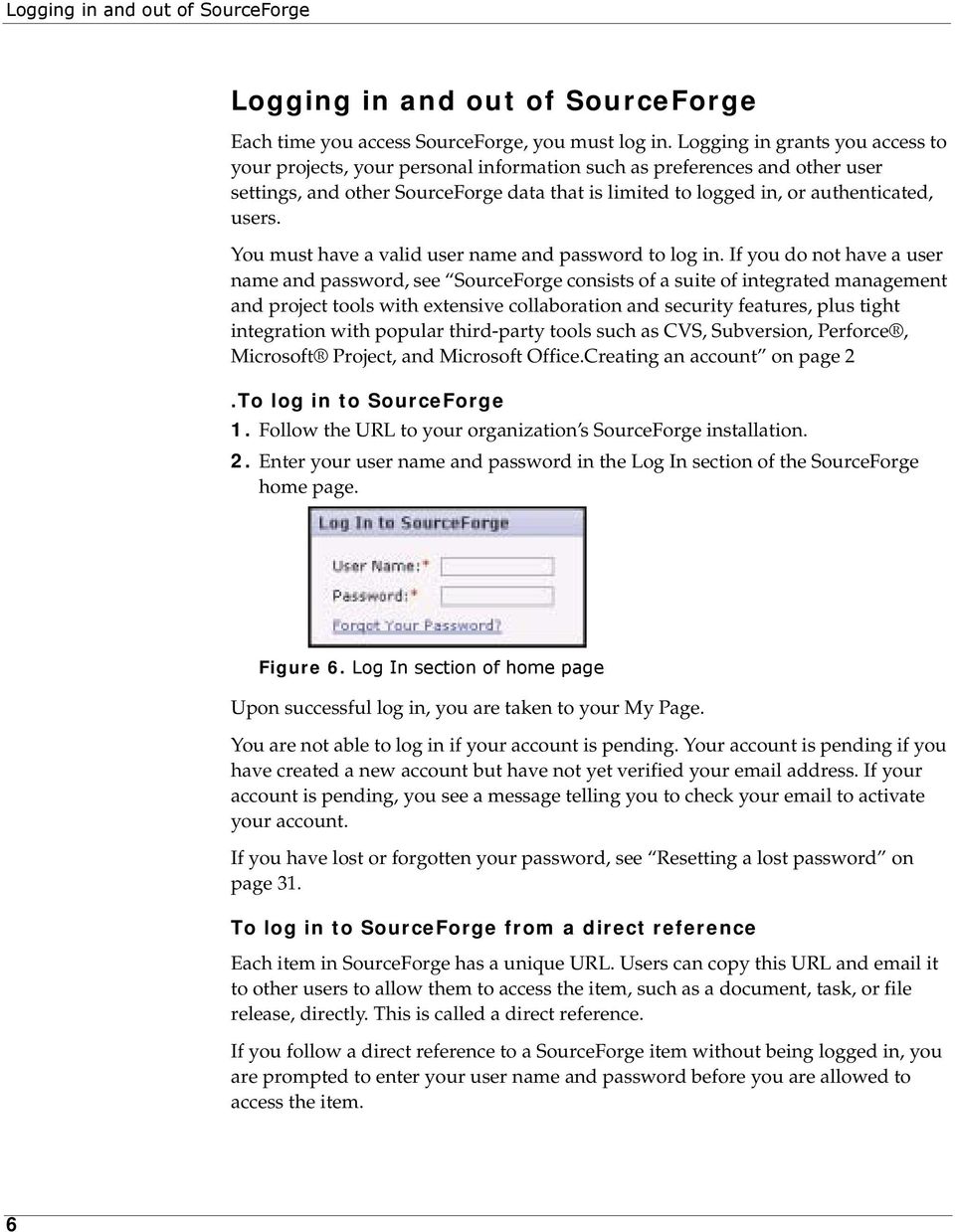
16 Logging in and out of SourceForge Logging in and out of SourceForge Each time you access SourceForge, you must log in. Logging in grants you access to your projects, your personal information such as preferences and other user settings, and other SourceForge data that is limited to logged in, or authenticated, users. You must have a valid user name and password to log in. If you do not have a user name and password, see SourceForge consists of a suite of integrated management and project tools with extensive collaboration and security features, plus tight integration with popular third-party tools such as CVS, Subversion, Perforce, Microsoft Project, and Microsoft Office.Creating an account on page 2.To log in to SourceForge 1. Follow the URL to your organization s SourceForge installation. 2. Enter your user name and password in the Log In section of the SourceForge home page. Figure 6. Log In section of home page Upon successful log in, you are taken to your My Page. You are not able to log in if your account is pending. Your account is pending if you have created a new account but have not yet verified your address. If your account is pending, you see a message telling you to check your to activate your account. If you have lost or forgotten your password, see Resetting a lost password on page 31. To log in to SourceForge from a direct reference Each item in SourceForge has a unique URL. Users can copy this URL and it to other users to allow them to access the item, such as a document, task, or file release, directly. This is called a direct reference. If you follow a direct reference to a SourceForge item without being logged in, you are prompted to enter your user name and password before you are allowed to access the item. 6
17 Logging in and out of SourceForge Note - Your access to any item is governed by your role-based access control permissions, and by each project s default access permissions. If you do not have permission to view an item, you will not be able to view it by following a direct reference. To log out of SourceForge When you are finished using SourceForge, log out by clicking the top right corner of any page. icon in the Getting Started 7

18 Navigating in SourceForge Navigating in SourceForge The SourceForge interface consists primarily of a series of navigation bars and a workspace. You can select from four navigation bars, depending on which activities you are performing. The options in the navigation bar govern which activities you can perform in the workspace. In addition to the workspace, you can also access a variety of summary information on the SourceForge home page, the project home page, and your personal My Page. This section provides an overview of how to navigate in SourceForge. 8

19 Navigating in SourceForge SourceForge home page After following the URL to your organization s SourceForge installation, you are taken to the SourceForge home page. The SourceForge home page provides summary information about all of the projects and activities in SourceForge. You can also log in to SourceForge from the SourceForge home page. The following information is displayed on the SourceForge home page: SourceForge navigation bar - The SourceForge navigation bar is displayed at the top of all SourceForge pages. Before you log in, the SourceForge navigation bar offers only the Home, Projects, and Search options. To display the full SourceForge navigation bar, you must log in. Log In to SourceForge - The Log In to SourceForge section enables registered users to log in or to retrieve a lost password. New users can also click Create an Account to request a SourceForge account. Most Active Projects - The Most Active Projects section displays summary information and links to the five most active projects in SourceForge. Project activity is calculated based on actions performed in each project, such as creating, editing, or downloading items. Quick Links - The Quick Links section provides links to instructional documentation. SourceForge News - The SourceForge News section displays the most recent news from SourceForge projects. SourceForge Activity - Statistics about the numbers of SourceForge users and registered projects are displayed in graphical format. You do not need a user name and password to access the SourceForge home page. You will see information from only the projects that you are allowed to view, based on each project s access settings. Getting Started 9

20 Navigating in SourceForge My Page After logging in to SourceForge, you are taken to your My Page. Your My Page is a personal workspace where you can manage your personal information, your preferences, and your assigned activities. Figure 7. My Page The following items are displayed on your My Page: SourceForge navigation bar - After logging in to SourceForge, the full SourceForge navigation bar is displayed at the top of the page. Whenever you are logged in, the SourceForge navigation bar is displayed on all pages in SourceForge. From the SourceForge navigation bar, you can do the following: Click Home to return to the SourceForge home page. Click My Workspace to return to your My Page and to access your personal navigation bar. Click Projects to access the projects of which you are a member, or to browse for other projects. Click Search to search for data in SourceForge. 10

21 Navigating in SourceForge If you are a SourceForge administrator, you can also click Admin to access administrative functions. If you are not a SourceForge administrator, the Admin link is not displayed. Personal navigation bar - After accessing your My Page, either by logging in or by clicking My Workspace in the SourceForge navigation bar, your personal navigation bar is displayed. From your personal navigation bar, you can do the following: Click Dashboard to view your Project Dashboard. You can access the Project Dashboard only if you have the appropriate permissions. Click Projects to create a new project or to manage your project membership. Click Monitoring to view your monitored items or to manage your monitoring preferences. Click My Settings to manage your user account. Click My Page to return to your My Page. My Recent Projects - Your My Recent Projects list displays a list of your most recently accessed projects. Click the name of a project to go to the project home page. My Recent History - Your My Recent History list displays a list of the items that you have most recently created or edited. Click the name of an item to go to its details page. My Items - Your My Page workspace provides consolidated views of all of your SourceForge items. All items that are assigned to you, were created by you, or are awaiting your approval are displayed. Items are displayed from all projects of which you are a member. From your My Page workspace, you can do the following: Click Items Assigned to Me to view all of the open tasks, tracker artifacts, and document reviews currently assigned to you. Click Items Created by Me to view all of the tasks, tracker artifacts, and document reviews that you have created. Click News to view recent news from all projects of which you are a member. If you are an application or project administrator in one or more SourceForge projects, you can also click Items Awaiting My Approval to view a list of all requests for task changes, requests to join projects, and requests to leave projects. Click the title of an item to go to the item s approve request page. Getting Started 11
22 Navigating in SourceForge Project home page After choosing a project from your Projects menu, or after clicking the title of a project from your My Projects page, your My Page, or other location in SourceForge, you are taken to the project home page. The project home page provides summary information about the project. You can also request to join or leave a project from the project home page. Figure 8. Project home page SourceForge navigation bar - Whenever you are logged in, the SourceForge navigation bar is displayed on all pages in SourceForge. From the SourceForge navigation bar, you can do the following: Click Home to return to the SourceForge home page. Click My Workspace to return to your My Page and to access your personal navigation bar. Click Project Categories to view project categorization. Click Projects to access your projects or to browse for other projects. Click Search to search for data in SourceForge. If you are a SourceForge administrator, you can also click Admin to access administrative functions. If you are not a SourceForge administrator, the Admin link is not displayed. 12
23 Navigating in SourceForge Project navigation bar - After entering a project, the project navigation bar displays. The project navigation bar provides you with access to all project applications. Project Home - The Project Home section displays the project description, the date of project creation, and a button to request to join the project. Project Members - The Project Members section displays the number of project members and the list of project administrators. Project News - Project news displays at the bottom of the project home page. Note - News is the only project application that is accessed and administered from the project home page. Click Create to post a news item. Click Delete to delete a news item. Project Statistics - Recent statistics for tasks, trackers, documents, and file releases are displayed in graphical format. For each graph, you can click Enlarge Graph to display an expanded view of the graph in a separate window. From the expanded view, you can modify the parameters used to generate the graph, then click update to generate a new, custom graph. Changes made to the graph in the expanded view are not saved or reflected in the graph on the project home page. The Project Statistics section can be modified to display other information if the project uses a Project Home Wiki page. Getting Started 13
24 Navigating in SourceForge SourceForge administration navigation If you are a SourceForge administrator, you can click Admin in the SourceForge navigation bar to access administrative functions. After clicking Admin, the SourceForge administration navigation bar is displayed. Figure 9. SourceForge administration navigation bar See Chapter 12, SourceForge Administration on page 283 for details on performing SourceForge administration tasks. 14
25 Searching in SourceForge Searching in SourceForge The search function allows you to search for items throughout SourceForge. You can limit your search in a number of ways to assist you in locating items. You can also Quick Jump to go directly to an item using its unique identifier. The search function searches all SourceForge applications except integrated SCM repositories. You can search text-based file attachments and text comments. You can also search binary document attachments such as Microsoft Word, Microsoft Excel, and Adobe Acrobat files. Getting Started 15
26 Searching in SourceForge Searching by keyword If you want to search for items containing one or more keywords, use the Search option from the Search menu. If you know an item s unique identifier and want to jump directly to it, use the Quick Jump option. When using the SourceForge sitewide search, to see all results containing all or part of your search term you must use wildcards as specified in Restricting your search on page 21. You do not need to use wildcards when filtering lists of items. To search by keyword 1. Log in to SourceForge. If you are not logged in, you can search only projects and items that have been designated public. 2. In the SourceForge navigation bar, choose Search from the Search menu. You can initiate a search from any page in SourceForge. The Search Criteria page is displayed. Figure 10. Search Criteria page 3. Enter the keywords for the search. See Restricting your search on page 20 for wildcards and other ways to restrict your search. 4. Specify whether you want to search tracker artifact attachments. 5. Specify whether you want to search comments. Comments include tracker artifact comments and task comments. 16
27 Searching in SourceForge 6. Select the areas of SourceForge in which you want to search. Projects - Projects searches all project applications and metadata such as project description. However, project URL names are not included in search results. Users - Users searches all user details. Applications - The In menu allows you to specify the applications in which you want to search. 7. Select the projects in which you want to search. All Projects - All Projects searches all projects to which you have access. Specific projects - The In Projects menu allows you to specify the projects in which you want to search. 8. For documents, specify whether you want to search all document versions or only active document versions. Searching only active document versions allows you to eliminate search results for outdated documents. Click Search. The Search Results page is displayed. Figure 11. Search Results page Your search results are displayed organized by SourceForge application. Only items that your project membership and permissions allow you to see are displayed. A search score is displayed that indicates the relevance of each result to your search criteria. To view an item, click its title. To revise your search criteria, expand the + next to the search criteria. Make the desired changes, then click Search. The search results matching the new criteria are displayed. Getting Started 17
28 Searching in SourceForge Searching by unique identifier Each item in SourceForge has a unique identifier. If you know this identifier, you can go directly to it using the Quick Jump option. You can find an item s unique identifier in the ID field. For example, a task s unique identifier is found in the Task ID field, and a tracker artifact s unique identifier is found in the Artifact ID field. You can also use the Quick Jump option to go directly to an item in your history. To search by unique identifier 1. Log in to SourceForge. If you are not logged in, you can search only public items in public projects. 2. In the SourceForge navigation bar, choose Quick Jump from the Search menu. You can initiate a Quick Jump search from any page in SourceForge. The Jump to Item(s) window is displayed. Figure 12. Jump to Item(s) window 3. Identify the items to which you want to jump. To jump to an item that is not in your history, check the Unique IDs radio button and enter the item s unique identifier. To jump to an item in your history, check the History radio button and highlight the item in the list. To select multiple items, use the Ctrl key. To search for multiple items, enter each item s unique identifier separated by commas. Then click Go. Note - Unique identifiers are case-sensitive. 18
29 Searching in SourceForge If you enter a single unique identifier, you are taken to the item s details page. If you enter multiple unique identifiers, you are taken to the Search Results page. To view an item, click its title. Getting Started 19
30 Searching in SourceForge Restricting your search You can search using the following search criteria. Single term - A single word. Single term searches look for all search results that match the search text. For example, a search entry of doc only returns search results of doc. Multiple terms - Multiple words. Multiple term searches look for all search results that match any of the words in the search text. For example, a search entry of document plan returns search results of document, test plan, and document plan. Phrase - A group of words surrounded by double quotes, such as product requirements. Only search results containing the entire phrase are returned. Terms and phrases can be combined with boolean operators for more complex searches. Boolean operators - You can refine your search using the following boolean operators: OR : OR between two terms returns search results containing either of the terms. This is the default operator used if no other operator is specified. AND: AND between two terms returns only search results containing both of the terms. +: The + operator before a term makes the term required. Only search results containing the terms are returned. - or NOT: The - or NOT operator before a term returns only search results that do not contain the term. NEAR: The NEAR operator between two terms looks for the two terms close to each other. Grouping - You can group boolean searches using parentheses. For example, (doc OR test) AND plan returns search results containing doc plan and test plan. Wildcard searches - To look for search results with a single character replaced, use the? symbol. For example, to look for search results with text or test, enter te?t. To look for search results with multiple characters replaced, use the * symbol. For example, to look for search results with test, tests, or tester, enter test* 20
31 Searching in SourceForge You can use wildcard symbols in the middle or at the end of a search, but not as the first character of a search. Fuzzy searches - To look for search results with spelling similar to the search term entered, use the ~ symbol as the last character of the search. For example, to look for search results with spelling similar to roam, enter roam~. This returns search results such as foam and roams. Special characters - If you have any of the following special characters in your search text, you must escape them by enclosing the entire phrase in double quotes. + - &! ( ) { } [ ] ^ " ~ *? : \ For example, to look for search results containing product-development, enter product-development. Excluded words - The following words are considered stop words and are not searchable on their own: a, an, and, are, as, at, be, but, by, for, if, in, into, is, it, no, not, of, on, or, s, such, t, that, the, their, then, there, these, they, this, to, was, will, with Getting Started 21
32 Browsing project categories Browsing project categories The SourceForge Project Categories page allows users to browse projects according to a configurable categorization system. SourceForge administrators are responsible for setting up the categorization taxonomy for the site. All project administrators can then use this taxonomy to categorize their projects. From the Project Categories page, you can browse for projects by category, search for projects by keyword, and view project statistics for categorized projects. To browse project categories 1. Log in to SourceForge. If you are not logged in, you can browse only public projects. 2. Click Project Categories in the SourceForge navigation bar. The Project Categories page is displayed.the Project Categories tree displays the hierarchy of project categories. To browse projects by category, navigate through the Project Categories tree. Statistics for each project in the selected project category are displayed. Use Include Subcategories to include or exclude projects in lower levels of the categorization hierarchy. Use Details to view project-specific details: project creation date, last file release date, and all the projects categories. To search for projects, enter the keywords in the Search bar. See Restricting your search on page 20 for wildcards and other ways to restrict your search. Clicking the project name takes you to the project s home page. Clicking the package name takes you to the project s package details page. 22
33 Finding and joining a project Finding and joining a project SourceForge data is organized into projects. A project is a workspace where project members can use each of the SourceForge applications to collaborate and to create, store, and share project data. Any registered SourceForge user can create a project, subject to approval by a SourceForge administrator. After a new project is approved, the project creator can then configure project applications, add project members, and create and assign roles to govern specific access permissions for each user. Any registered SourceForge user can also request membership in any SourceForge project. All requests to join projects are submitted to the project s administrators for approval. To find and join a project 1. Log in to SourceForge. Your My Page is displayed. 2. Click Projects in your personal navigation bar. The list of projects of which you are a member is displayed. 3. Click the All Projects tab. The list of all SourceForge projects is displayed. You will see only the projects that you are allowed to view, based on your user type and each project s access settings. Figure 13. All Projects list 4. Select the project that you want to join by checking the radio button. Then click Request Membership. Getting Started 23
34 Finding and joining a project The Request Project Membership page is displayed. Figure 14. Request Project Membership page 5. Enter any comments that you want to send with your request. Then click Submit. Your request is now submitted to the project administrator for approval. You will receive an notification when your request is either approved or denied. You can also request project membership from the project home page. Each project home page has a Join this Project link. To request project membership, click Join this Project. You are taken to the Request Project Membership page described in Step 4 above. 24
35 Leaving a project Leaving a project To leave a project, you must submit a request to the project administrator. The project administrator can approve or deny your request to leave the project. To leave a project 1. Log in to SourceForge. Your My Page is displayed. 2. Click Projects in your personal navigation bar. 3. The list of projects of which you are a member is displayed. Select the project that you want to leave by checking the radio button. Then click Remove Myself from Project. The Leave Project page is displayed. Figure 15. Leave Project page 4. Enter any comments that you want to send with your request. Then click Save. Your request is now submitted to the project administrator for approval. You will receive an notification when your request is either approved or denied. Getting Started 25
36 Creating a project Creating a project SourceForge data is organized into projects. A project is a workspace where project members can use each of the SourceForge applications to collaborate and to create, store, and share project data. How you choose to organize your SourceForge projects is up to you and your organization. You might choose to create one large, centralized SourceForge project in which to manage all of your organization s development work. Or you might choose instead to create a number of smaller projects for each team or sub-project. Any registered SourceForge user can create a project, subject to approval by a SourceForge administrator. To create a new project 1. Log in to SourceForge. Your My Page is displayed. 2. Click Projects in your personal navigation bar. 26
37 Creating a project 3. The list of projects of which you are a member is displayed. Click Create Project. 4. The Create Project page is displayed. Enter a name for the project. This is the name that will appear in all project lists and on the project home page. 5. (Optional) Enter a URL name for the project. This is a name that will appear in the project s URL. 6. Enter a description for the project. 7. (Optional) Select a project template. A project template is used to pre-populate new projects with the structure and configuration of an existing project. If you do not want to use a project template, choose <None>. To read a project template description, click the Templates tab on your projects list. For more information on what is copied with a project template, see Creating a project template on page 258. When you are finished, click Create. The project is now submitted to the SourceForge administrator for approval. You will receive an notification when the SourceForge administrator approves your project. When your project is approved, you are assigned the Founder Project Admin role and made a project administrator. You can access the project from your My Projects page or from the Projects menu in your SourceForge navigation bar. If your project is rejected, you will receive an notification. Getting Started 27
38 Managing your account Managing your account After you have created an account, you will have a User Details page that displays your account details, user preferences, and SSH authorization keys. From this page, you can edit your user details, set your monitoring preferences, change your password, and manage your SSH authorization keys. This section describes how to update your user details and change your password. For information on setting your monitoring preferences, see Configuring monitoring frequency on page 275. For information on managing your SSH authorization keys, see Storing SSH keys in SourceForge on page
39 Managing your account Updating your user details Your user details are your name and address. To update your user details 1. Log in to SourceForge. Your My Page is displayed. 2. Click My Settings in your personal navigation bar. Your User Details page is displayed. Figure 16. User Details page 3. Click Edit. The Edit User Information page is displayed. Figure 17. Edit User Information page 4. Edit the desired information. Then click Update. If you entered a new address, you must check your and follow the link provided before the change will be saved. Changes to your name are saved immediately. Getting Started 29
40 Managing your account Changing your password This process allows you to change your password when you are logged in to SourceForge. If you have lost or forgotten your password, see Resetting a lost password on page 31. Note - You cannot change your SourceForge password if your organization s SourceForge installation authenticates against an LDAP directory. You must change your password in your corporate LDAP system. When you change your password in your corporate LDAP system, it is changed automatically in SourceForge. To change your password 1. Log in to SourceForge. Your My Page is displayed. 2. Click My Settings in your personal navigation bar. Your User Details page is displayed. 3. Click Change Password. The Change Password page is displayed. Figure 18. Change Password page 4. Enter your old password. 5. Enter and confirm your new password. Password lengths and types are configurable by the SourceForge administrator. If you select a password that does not meet your organization s password criteria, you will receive an error message that indicates the security requirements that were not met by your selection. Then click Update. You are prompted to log in with your new password to confirm the change. Note - If you have access to an SCM server, your SCM password is changed automatically when you change your SourceForge password. 30
41 Managing your account Resetting a lost password If you lose or forget your password, you can reset it and create a new one. SourceForge will verify your user name and address before allowing you to reset your password. Note - You cannot reset your SourceForge password if your organization s Source- Forge installation authenticates against an LDAP directory. You must reset your password in your corporate LDAP system. When you change your password in your corporate LDAP system, it is changed automatically in SourceForge. To reset your password 1. Follow the URL to your organization s SourceForge installation. 2. Click Forgot Your Password? in the Log In to SourceForge section of the SourceForge home page. The Account Password Retrieval page is displayed. Figure 19. Account Password Retrieval page 3. Enter the user name associated with your SourceForge account. Then click Send . SourceForge sends an to confirm your address. 4. Check your and click the link provided to reset your password. You are taken to the Reset Password page. Figure 20. Reset Password page 5. Enter and confirm a new password. Password lengths and types are configurable by the SourceForge administrator. If you select a password that does not meet your organization s password Getting Started 31
42 Managing your account criteria, you will receive an error message that indicates the security requirements that were not met by your selection. Then click Reset Password. You are taken to a login page to log in with your new password. Note - If you have access to an SCM server, your SCM password is reset automatically when you reset your SourceForge password. 32
43 Getting support Getting support Many resources are available to help you if you have problems with SourceForge. (name, phone, and required) Phone: (M-F 8am-5pm PT) Create a case: (self-service portal) Support Offerings Online purchasing and support offering information is at products/comparison/. CollabNet standard support offering information is at support/index.html. For answers to your questions about CollabNet support offerings, please contact CollabNet. Documentation feedback To provide feedback on the hardcopy or online SourceForge documentation, send to [email protected] Please provide the specific page numbers or online Help topics when reporting documentation errors, or when providing documentation feedback. Getting Started 33
44 Getting support Using the Help system SourceForge provides a context-sensitive Help system to provide users with quick access to product documentation. Every page in SourceForge displays a Help icon in the top right corner of the page. Click the Help icon to display the Help options for the page. Figure 21. Help options Help for this Page - Displays the Help topic most appropriate to your current page. You can then navigate to other Help topics as needed. Help Contents - Displays the Help system opened to the Contents page. Help Index - Displays the Help system opened to the index. User Guide - Launches the SourceForge User Guide. About SourceForge - Displays information about VA Software and SourceForge, including product version information. 34
45 CHAPTER 2 Trackers The SourceForge issue tracking system enables development teams to track and manage issues such as product defects, feature requirements, and support requests. In each SourceForge project, you can create any number of trackers based on the types of data that you want to track. For each tracker, you can define values for status, category, and other default fields. You can create your own user-defined fields to capture additional data that is specific to your project or organization. You can also create tracker workflows to specify the criteria necessary for users to change tracker status values. Individual tracker entries are referred to as tracker artifacts. The role-based access control system enables you to control which project members are allowed to view, create, and edit tracker artifacts. Summary information about the number and status of project tracker artifacts is provided on each project s Tracker Summary page. The Project Dashboard also provides an at-a-glance overview of the status of each project member s projects, including information on the number and status of the tasks and tracker artifacts in each project, and project overrun and underrun statistics. This chapter covers the following topics: Finding artifacts in a tracker on page 36 Creating a tracker artifact on page 41 Editing a tracker artifact on page 45 Moving a tracker artifact on page 51 Associating tracker artifacts with other SourceForge items on page 53 Creating and configuring a tracker on page 58 Configuring tracker workflow on page 68 Viewing tracker overviews with the Project Dashboard on page 71 Exporting tracker artifacts on page 73 35
46 Finding artifacts in a tracker Finding artifacts in a tracker There are several ways to find a specific artifact or set of artifacts in an artifact tracker. Configure which columns are visible in your list of artifacts. Filter the artifacts in the tracker. Search for keywords, date ranges, or specific field values. Selecting Columns You can select the columns you want to see on any list artifacts page. You set your column preferences for each tracker independently. To choose which columns you see 1. Click the down arrow next to the Select Columns button, and choose Configure. The popup window for configuring columns is displayed. Available columns are in the listing on the left. Selected columns are in the listing on the right. Artifact ID : Title, Priority and Status are required columns. 2. Choose columns that you wish to add from the listing on the left, and click the right arrow button to move them to the Selected Columns list. Note - Selecting more columns can increase the time required to load the listing page. 3. Choose columns that you wish to remove from the listing on the right, and click the left arrow button to move them. 4. Use the Move Up and Move Down buttons to change the display order of the columns. 5. Click the Apply button. To save your column layout 1. Click the down arrow next to the Select Columns button and choose Save. A popup window for naming your preference appears. 2. Enter a name in the Preference Name field. 3. Click the Save button. To delete a saved format 1. Click the down arrow next to the Select Columns button and choose Delete. 36
47 Finding artifacts in a tracker 2. Select the name of the preference you wish to delete from the list. 3. Click the Delete button. To revert to the default columns 1. Click the down arrow next to the Select Columns button. 2. Click Default. Filtering tracker artifacts You can use filters to find tracker artifacts or groups of tracker artifacts. The filter option is available on every item list view. To filter tracker artifacts 1. Click Tracker in the project navigation bar. The Tracker Summary page is displayed. 2. Click the title of the tracker in which you want to filter. The tracker artifact list view is displayed. 3. Click the filter button to activate the filter. Filter menus are displayed at the top of each column. 4. Filter the list of tracker artifacts using one or more filter menus. To find a tracker artifact by its ID, title, or partial title, enter the data in the Artifact ID or Title field. To find a tracker artifact by any other field, choose values from the dropdown filter menus. To narrow your filter results, filter by more than one field. 5. Click the down arrow on the filter button to Apply Filter, or click the Apply Filter button at the bottom of the page. All tracker artifacts meeting your filter criteria are displayed. To save a tracker filter 1. Click the down arrow next to the Filters button and choose Save. 2. Enter a name for your filter. 3. Click the Save button. To apply an existing filter 1. Click the down arrow next to the Filters button. Trackers 37
48 Finding artifacts in a tracker 2. Click the filter name you wish to apply. To remove the filter and display the unfiltered list, click Remove Filter. To remove the filter menus, click the filter button again. Special characters You can use the following special characters to filter data: <, >, <=, >=, and %. The percent sign is used for partial text filtering. Searching for tracker artifacts If you need to search on fields that are not pre-defined by the filter, or if the filter returns a large number of results, the Search Tracker option allows you to refine your search further. You can search for tracker artifacts by: Keywords Artifact ID Date ranges for submission and last modification Values in all default fields You can also search comments, attachments, and user-defined fields. To search for tracker artifacts 1. Click Tracker in the project navigation bar. The list of project trackers is displayed. 2. Click the title of the tracker in which you want to search. The tracker artifact list view is displayed. 3. Click Search Tracker. The Tracker Search Criteria page is displayed. 4. Enter the keywords for the search. When using the Tracker search, to see all results containing all or part of your search term you must use wildcards as specified in Restricting your search on page
49 Finding artifacts in a tracker 5. Select the areas that you want to search by checking the boxes: Title - Searches for keywords in the Artifact Title field. Description - Searches for keywords in the Artifact Description field. All Text Fields - Searches all text fields, excluding user-defined text fields. Include Comments - Searches tracker artifact comments. Include Attachments - Searches files attached to tracker artifacts. 6. If you are searching for a specific tracker artifact, and know its artifact ID, enter the artifact ID. 7. Optionally, select date ranges for submit date or last modified date. Click the icon to select dates from a calendar. 8. Optionally, select field values for any or all of the remaining tracker fields. When you are finished, click Search. All tracker artifacts matching your search criteria are displayed. Figure 22. Tracker search results To view an tracker artifact, click its title. To revise your search criteria, expand the + next to the tracker search criteria. Make the desired changes, then click Search. The search results matching the new criteria are displayed. To save your search 1. Click the down arrow next to the Searches button. 2. Choose the Save option from the list. 3. Enter a name for your search. 4. Click the Save button. To run a saved search 1. Click the down arrow next to the Searches button. 2. Click the name of the search you wish to run. Trackers 39
50 Finding artifacts in a tracker To delete a saved search 1. Click the down arrow next to the Searches button. 2. Choose the Delete option from the list. A popup window appears with a list of your saved searches. 3. Choose the name of the search you wish to delete. 4. Click the Delete button. 40
51 Creating a tracker artifact Creating a tracker artifact Individual tracker entries are referred to as tracker artifacts. Tracker artifacts are used to report and track bugs, feature requests, support requests, and any other type of issue where ownership, status, and activity must be managed. To create a tracker artifact 1. Click Tracker in the project navigation bar. The Tracker Summary page is displayed. Figure 23. Tracker Summary page 2. Click the title of the tracker in which you want to create the artifact. The artifact list view is displayed. 3. Click Submit New Artifact. Trackers 41
52 Creating a tracker artifact The Submit Artifact page is displayed. Figure 24. Submit Artifact page Note - The fields on your Submit Artifact page can vary based on your administrator s selection of required, optional, and user-defined fields. 4. Enter a title and description for the artifact. Title and description are always required fields. 5. Complete all other required fields identified by red asterisks*. Optionally, complete any other fields not identified by asterisks. Default fields include: Group, Status, Category, and Customer Values for these fields are defined by your administrator. Priority Priority values range from 1 (highest) to 5 (lowest) Reported in Release If the artifact represents a bug or other issue that was discovered in a file release, for example a bug in a product release, choose the release from the 42
53 Creating a tracker artifact drop-down list. The drop-down list does not include releases assigned a pending status. Estimated Hours Enter the estimated number of hours required to complete the activity described in the artifact. 6. Assign the artifact to a project member. Your administrator might choose to configure the tracker to automatically assign artifacts to individuals based on artifact criteria. To automatically assign artifacts, do not choose a name from the Assigned To drop-down list. The default value is None. To specify the person to whom the artifact should be assigned, choose a name from the Assigned To drop-down list. Note - Only project members and people who have artifacts assigned to them appear in the drop-down list. To assign the artifact to someone who is not a project member and hasn t had an artifact assigned to them yet, look for that person in the people picker next to the drop-down list. 7. (Optional) Add a file attachment. Click Browse to browse for the file. 8. When you are finished: Click Save to save the artifact and return to the artifact list view. Click Save and View to save the artifact and display the artifact details. Trackers 43
54 Creating a tracker artifact using Creating a tracker artifact using You can also create a tracker artifact by sending an to the tracker. You do not have to be logged in to SourceForge to submit a tracker artifact using , but you must have the tracker submit permission for the tracker to which you are submitting. To create a tracker artifact using Send an message to the following address: <tracker id>@<sourceforge server> You can find the tracker id on the artifact list view page. Fields are mapped as shown in the following table. Field To Subject Body Attachments Tracker Field Tracker address Artifact title Artifact description Attachments 44
55 Editing a tracker artifact Editing a tracker artifact At any time after a tracker artifact is created, users with the appropriate permissions can edit it. Generally, the project member to whom the tracker artifact is assigned will edit it to update the status, for example from Open to Fixed, or to add a comment regarding work completed or additional information required. However, any project member with the appropriate permissions can add comments to the tracker artifact. Managers might also edit a tracker artifact to change its priority, to return it to the submitter for additional clarification, or to assign it to a project member for resolution or action. Edits to the status field may be limited based on tracker workflows. Tracker workflow allows project administrators to define the criteria necessary for users to change status values. For example, an administrator can configure a workflow specifying that only users with the role QA Engineer can change an artifact s status from Open to Closed. To edit a tracker artifact 1. Click Tracker in the project navigation bar. The list of project trackers is displayed. 2. Find the tracker artifact that you want to edit. Use the filter if needed to find the desired artifact. (See Finding artifacts in a tracker on page 36.) 3. Click the artifact title. The Artifact Details page is displayed. Trackers 45
56 Editing a tracker artifact The Artifact Details page is divided into three sections; the upper section for the artifact details, the middle section for all other fields, and the lower section for the artifact comments. Figure 25. Artifact Details page 4. To edit the artifact title or description, click Edit. 46
57 Editing a tracker artifact The Edit Artifact Details page is displayed. Figure 26. Edit Artifact Details page 5. Make the desired changes. Then click Save. Your changes are saved and you are returned to the Artifact Details page. 6. To edit all other fields, make the desired changes in the lower section of the page. Editable fields are displayed on the Status / Comments tab. After an issue is fixed, the user can choose from a drop-down list of all non-pending releases in the project to identify the release in which the issue was fixed. When you are finished, click Update. All updates to the artifact are recorded in the Comments section of the Status / Comments tab. Trackers 47
58 Editing a tracker artifact using Editing a tracker artifact using You can also edit a tracker artifact by sending an to the tracker. You can add a comment or an attachment to an artifact using . To edit any other fields, you must make the changes in SourceForge. You do not have to be logged in to SourceForge to edit a tracker artifact using , but you must have the tracker edit permission for the tracker containing the artifact that you want to edit. To edit a tracker artifact using Send an message to the following address: <artifact id>@<sourceforge server> You can find the artifact id on the Artifact Details page. Fields are mapped as shown in the following table. Field To Body Attachments Artifact Field Artifact address Artifact comments Attachments You can also add a comment or an attachment to a tracker artifact that you are monitoring by responding to the monitoring notification. 48
59 Editing multiple artifacts Editing multiple artifacts If you want to make the same edits to multiple tracker artifacts simultaneously, you can do so using the Mass Update function. You can mass update a selection of artifacts, for example those returned by a filter, or all artifacts in a selected tracker. To edit multiple artifacts 1. Click Tracker in the project navigation bar. The list of project trackers is displayed. 2. Find the tracker artifacts that you want to edit. Use the filter if needed to find the desired artifacts. (See Finding artifacts in a tracker on page 36.) 3. Select the artifacts that you want to edit by checking the boxes. Then click Mass Update. Note - If the artifacts that you want to edit are displayed on more than one page, you do not need to select them. You will be able to select all on the next screen. The Mass Update page is displayed. Figure 27. Mass Update page Trackers 49
60 Editing multiple artifacts 4. Choose which artifacts you want to update: Selected - Updates only the artifacts that you selected. Results Set - Updates all artifacts returned by your filter, or all artifacts in the tracker if you did not apply a filter. Choose Results Set when the artifacts span multiple pages and you cannot select them all. 5. Make the changes: To update the value in a single-select field, choose a new value from the dropdown list. To update the value in a text-entry field, enter new text and check the Update box. To add a comment, enter the text in the Comment Text field. When you are finished, click Update. The changes are now applied to all selected artifacts. 50
61 Moving a tracker artifact Moving a tracker artifact You can move tracker artifacts between any trackers in the same project, or between trackers in different projects. This allows you to reorganize data stored in the tracker as needed. To move a tracker artifact between projects, you must have the tracker administration permission in both the source and destination projects. If the project members to whom the tracker artifacts are assigned have the appropriate permissions in the destination project, the tracker artifacts are automatically reassigned to the same project members. If not, you are offered several options for reassigning them. If both trackers use the same user-defined fields and field values, values in these fields are retained. If each tracker uses different user-defined fields or field values: Values are set to the default value, if one was specified by the tracker administrator. Default values are mandatory for required fields. Values are set to None, if no default value was specified by the tracker administrator. Move tracker artifacts using the Cut and Paste buttons. You can move one or more tracker artifacts in the same operation. To move a tracker artifact 1. Click Tracker in the project navigation bar. The list of project trackers is displayed. 2. Click the title of the tracker containing the tracker artifact that you want to move. 3. Check the box next to the tracker artifact or artifacts that you want to move. Then click Cut. SourceForge removes the tracker artifacts and places them on the clipboard. The Paste button is displayed. 4. Navigate to the tracker into which you want to paste the tracker artifacts. Note - To move the tracker artifacts into another project, first navigate to the destination project using your Projects menu. Trackers 51
62 Moving a tracker artifact 5. Click Paste. If all artifact assignees have the appropriate permissions in the destination tracker, the tracker artifacts are now moved. If not, the Paste Artifacts window tells you how many tracker artifacts cannot be reassigned automatically.. Figure 28. Paste Artifacts window Choose one of the following methods to reassign any unassigned tracker artifacts: Reassign Artifacts to: - Assigns all unassigned tracker artifacts to a project member that you select from the drop-down menu. Myself - Reassigns all unassigned tracker artifacts to yourself. When you are finished, click Next. The tracker artifacts are now moved to the destination tracker. The details of the move are recorded in the Change Log tab of the Artifact Details page. 52
63 Associating tracker artifacts with other SourceForge items Associating tracker artifacts with other SourceForge items If desired, you can create associations between tracker artifacts and other SourceForge items such as documents or tasks. Creating associations between items enables you to define relationships, track dependencies, and enforce workflow rules. Some example uses for tracker artifact associations include: Associating tracker artifacts with a requirements document. Associating tracker artifacts with tasks that are dependent upon closure of the artifacts. Associating tracker artifacts such as bugs and feature requests with the file releases in which the artifacts are discovered and addressed. (See Chapter 7, Releases on page 193.) Associating tracker artifacts with documents, tasks, or forums To associate a tracker artifact with a document, task, or forum 1. Click Tracker in the project navigation bar. The list of project trackers is displayed. 2. Find the tracker artifact with which you want to create an association. Use the filter if needed to find the desired artifact. (See Finding artifacts in a tracker on page 36.) 3. Click the artifact title. The Artifact Details page is displayed. 4. Click the Associations tab. The list of existing associations is displayed. Figure 29. Tracker Artifact Associations page 5. Click Add. Trackers 53
64 Associating tracker artifacts with other SourceForge items The Add Association Wizard window is displayed. Figure 30. Add Association Wizard window 6. By checking the radio button, choose a method to identify the items with which you want to associate the artifact: Enter Item ID - If you know the item s ID, you can enter it directly. Add From History - The History is a list of items that you have submitted or edited. The History can contain items of any item type. Then click Next. The Add Association comments window is displayed. Figure 31. Add Association comments window 7. Enter any comments describing the association. Click Finish and Add Another to add additional associations. Click Finish to return to the Artifact Details page. Associating tracker artifacts with file releases In addition to adding associations from the Artifact Details page, you can also identify associations between tracker artifacts and the file releases in which they were discovered and fixed. A file release, or release, is a group of one or more files 54
65 Associating tracker artifacts with other SourceForge items that are published as a unit, such as a software product release. File release associations are especially useful for tracking the source and resolution of bugs and feature requests. Tracker artifacts associated with file releases are also displayed separately, providing a simple mechanism for tracking all issues that were discovered in or fixed in a specific file release. The tracker provides the following default fields that must be enabled to track file release associations: Reported in Release - When submitting a new artifact, the user can choose from a drop-down list of all releases in the project to identify the release in which the issue was discovered. Fixed in Release - After the issue is fixed, the user can choose from a drop-down list of all releases in the project to identify the release in which the issue was fixed. The drop-down lists do not include releases assigned a pending status. To associate a tracker artifact with the releases in which it was discovered and fixed 1. From the Project Administration page, enable both the Reported in Release and Fixed in Release fields. See Enabling or disabling fields on page When submitting a new artifact, choose the release in which the issue was discovered from the Reported in Release drop-down list. See Creating a tracker artifact on page 41. The drop-down list automatically contains all releases in the project. Figure 32. Reported in Release drop-down list 3. After the issue is fixed in a release, update the artifact by choosing the release in which the issue was resolved from the Fixed in Release drop-down list. See Editing a tracker artifact on page 45. The drop-down list automatically contains all releases in the project, including any that were added since the artifact was submitted. Trackers 55
66 Associating tracker artifacts with other SourceForge items The associated tracker artifacts are displayed on the Release Details page in the Reported Tracker Artifacts and Fixed Tracker Artifacts sections. Figure 33. Reported Tracker Artifacts section of Release Details page Associating tracker artifacts with source code When checking in files to your SCM repository, you can create links to one or more tracker artifacts. These associations can be used to track the relationship between code and the bugs, feature requests, or other tracker artifacts that the code addresses. You can create tracker artifact associations from whatever interface you normally use to check code into your SCM repository. You do not have to log in to SourceForge. For instructions on creating associations between source code and tracker artifacts, see Creating associations with a code commit on page
67 Dependencies between tracker artifacts Dependencies between tracker artifacts To organize your work with tracker artifacts, you can arrange your artifacts hierarchically. A tracker artifact can be a parent or a child to another artifact. A child artifact can have only one parent. A parent artifact can have any number of children. A parent artifact cannot be closed if a child is open. Assigning a parent to an artifact 1. On an artifact page, click the Dependencies tab. 2. Does the parent artifact already exist? If yes, click the Choose Parent button. In the pop-up, type in the artifact ID or choose from the list of your recently edited artifacts. If no, click the Create New Parent button. Fill in the form the same way as you would for submitting an unrelated artifact. 3. Click the Next button. 4. Enter a comment that describes the relationship, if appropriate. 5. Click the Finish button. Note - If the Choose Parent or Create New Parent button is not visible, the artifact already has a parent artifact. Removing dependencies To remove a parent dependency, click the Remove button. To remove a child dependency, click the checkbox next to the individual child artifact, and then click the Remove button. Trackers 57
68 Creating and configuring a tracker Creating and configuring a tracker When you create a tracker, you can configure it to support the needs of your organization. For example, you can configure tracker workflows to specify the criteria necessary for users to change status values. 1. Create the tracker with a default set of fields and values. 2. Enable or disable fields. 3. Set fields as required or optional. 4. Create user-defined fields. 5. Configure the values for single-select fields. 6. Configure auto-assignment. Creating a tracker You can create a new tracker or adapt an existing one. Create a new tracker. Do this if the activities you are tracking have little in common with other activities on the site. For example, if you are developing a new component, you may want to design a tracker that component s specific needs. Clone an existing tracker. Do this if you can find another tracker on the site that tracks activities similar to the activities your new tracker will handle. For example, if you are planning a new release of an existing product, you might clone a tracker that was used to track the previous release. To create a new tracker 1. Click Project Admin in the project navigation bar. 2. Click Tracker Settings. 3. Click Create. 4. Enter a name and description for the tracker. 5. Click Create. The tracker is created. Before entering artifacts, configure the tracker fields and auto-assignment. Instructions for configuring tracker fields and auto-assignment are included in the following sections. To clone a tracker When you clone an existing tracker, you create a new tracker with all the fields that were in the original tracker, but none of the data. You can clone a tracker from any 58
69 Creating and configuring a tracker project you have access to on the site, including projects where you don t have Project Admin permissions. Note - If the original tracker is in the same project, auto-assignment and workflow information are copied to the new tracker. 1. Click Project Admin in the project navigation bar. 2. Click Tracker Settings. 3. If the tracker you want to clone is in this project: a. Select it from the Trackers list. b. Click Clone > Clone Tracker. c. In the Cloning Tracker window, give the new tracker a name and a description. 4. If the tracker you want to clone is in another project: a. Click Clone > External Tracker. b. In the Cloning External Tracker window, provide the ID of the existing tracker. A tracker ID is the word tracker followed by some digits, such as tracker1163. c. In the Cloning External Tracker window, give the new tracker a name and a description. 5. Click Create. The new tracker appears in your projects Trackers list. Enabling or disabling fields Most tracker fields can be enabled or disabled. If a field is disabled, it cannot be displayed on the Create Artifact page. Disabled fields are accessible only to tracker administrators on the Tracker Fields page. Note - If you want to prevent users from entering data into a field when submitting an artifact, but still want the field to be displayed on the Edit Artifact and Tracker Search pages, do not disable the field. Uncheck the Display on Submit box on the Edit Field page. (See Changing the display order of fields on page 60.) To enable or disable fields 1. Click Project Admin in the project navigation bar. 2. Click Tracker Settings. The list of current trackers is displayed. 3. Click the title of the tracker that you want to configure. Trackers 59
70 Creating and configuring a tracker The Tracker Fields page is displayed. 4. Select the fields that you want to enable or disable by checking the radio buttons. You can enable or disable any field with the user-defined or configurable field type. However, you cannot disable all fields with the configurable field type. Click Disable to disable fields and remove them from the Submit Artifact page. Click Enable to enable fields and allow them to be configured and displayed. Note - Data in disabled fields is still searchable, but disabled fields do not appear as inputs on the Search pages. Changing the display order of fields You can change that order in which tracker fields are displayed on the submit and artifact detail screens. Changing the display order 1. To change the location of a field in the display order, drag the row you wish to move to where you want it. 2. When you are satisfied with your order, click the Apply Changes button. 3. To revert to your last saved ordering, click the Discard Changes button. Note - The Artifact ID, Title and Description fields cannot be moved. Adding separators Separators allow you to group fields visually on your artifact display and submit pages. 1. Click the Add Separator button on the bottom of the page. A new separator is added to the bottom of the field list. 2. Drag and drop the separator where you want it. 3. Click the Apply Changes button to save your preferences. Setting required or optional fields Most tracker fields can be set as required or optional. If a field is set as required, it is marked with a red asterisk* on the Submit Artifact page and users are not able to submit artifacts without completing it. Required and optional fields can be set on a per-tracker basis. System-defined fields and the Status field cannot be made optional. 60
71 Creating and configuring a tracker To set required or optional fields 1. Click Project Admin in the project navigation bar. 2. Click Tracker Settings. The list of current trackers is displayed. 3. Click the title of the tracker you want to configure. The Tracker Fields page is displayed. 4. Click the name of the field that you want to set as required or optional. By default, only the Title, Description, Artifact ID, Priority, and Status fields are set as required. The Edit Field page is displayed. Figure 34. Edit Field page 5. Check or uncheck the Required box to set a field as required or optional. Required fields automatically display on the Submit Artifact page. 6. For optional fields, check or uncheck the Display On Submit box. This specifies whether the field will display on the Submit Artifact page. When you are finished, click Save Field. Creating user-defined fields If you want to track data that is not captured by the default set of fields, you can create user-defined fields. You can create the following number of user-defined fields in each tracker: Up to 12 text entry fields Up to 18 single select fields An unlimited number of multiple select fields Up to 18 date fields An unlimited number of user fields Note - Creating a large number of multiple select and user fields may cause performance issues. Trackers 61
72 Creating and configuring a tracker To create a user-defined field 1. Click Project Admin in the project navigation bar. 2. Click Tracker Settings. The list of existing trackers is displayed. 3. Click the name of the tracker to which you want to add a user-defined field. The Tracker Fields page is displayed. 4. Click Add. The Create Field page is displayed. Create Field page 5. Enter a name for the field. 6. Choose a display type from the Input Type drop-down menu. Text Entry - Allows the submitter to enter a body of text. Single Select - Allows the submitter to select a value from a drop-down list. Multiple Select - Allows the submitter to select one or more values from a drop-down list. Date - Allows the submitter to select a date from a calendar. User - Allows the submitter to select another SourceForge user. The remaining fields are displayed based on your selection. 62
73 Creating and configuring a tracker 7. Check or uncheck the Required box to set the field as required or optional. Checking the Required box automatically displays the field on the Submit Artifact page. 8. For optional fields, check or uncheck the Display on Submit box. This defines whether the field will appear on the Submit Artifact page. 9. Choose whether you want the field enabled or disabled. By default, new fields are enabled. 10.If you chose the Text Entry display type, do the following: In the Field Width field, specify the number of characters for each line. In the Field Height field, specify the number of lines. Note - The maximum number of characters in a text entry field is If you make the field required, you must specify a default value in the Default Value field. This value is applied to existing artifacts and artifacts that are moved from another tracker. 11.When you define a User field, you can choose to include only project members or to include all users by selecting the appropriate radio button. Note - If you define a User field as required, you must specify one or more users. If you define a Date field as required, the default is today. When you are finished, click Save Field. If you chose the Text Entry display type, you are finished. To add field values If you chose the Single Select or Multiple Select display type, the Values section is displayed. Figure 35. Values section of Create Field page Trackers 63
74 Creating and configuring a tracker 1. Click Add to add a new value. An additional blank line is inserted into the Values list. 2. Enter a name for the field value. If you want to make the field value the default field value, check the checkbox. Then click Save Field. Note - You cannot leave a field value blank. 3. Repeat steps 1 and 2 until you have added all field values. 4. If desired, specify the order in which field values will be displayed by clicking Move Up and Move Down. When you are finished, click Save Field. Configuring tracker field values You can configure the available field values for all default and user-defined tracker fields with the Single Select or Multiple Select input type. When creating a userdefined field, you are given the opportunity to add tracker field values. You can also add, edit, or delete values at any time. To configure tracker field values 1. Click Project Admin in the project navigation bar. 2. Click Tracker Settings. The list of existing trackers is displayed. 3. Click the name of the tracker that you want to configure. The Tracker Fields page is displayed. 4. Click the name of the field whose values you want to edit. The Edit Field page is displayed. Figure 36. Values section of Edit Field page 64
75 Creating and configuring a tracker 5. Configure the field values as desired. To add a new value, click Add, then enter the desired value. To rename a value, edit the existing text. Caution - If you rename a value, the value is renamed in all existing artifacts. To delete a value, check the box, then click Delete. Caution - If you delete a value, the value is changed to None in all existing artifacts. Choose a default field value from the fields entered by checking the Default Value checkbox. The default field value is used when moving tracker artifacts between trackers. When editing the values of the Status field, you are also asked to define the status meaning for each value, as shown in Figure 36 on page 64. This status meaning is used in Advanced Search to define which values are returned when searching for open or closed artifacts. 6. If desired, specify the order in which field values will be displayed by clicking Move Up and Move Down. When you are finished, click Save Field. All values are now available in the selection menu for the field. Configuring auto assignment You can configure the tracker to automatically assign newly submitted artifacts to specific individuals. You can assign artifacts to individuals based on the values entered by the submitter in the artifact category or release field. To configure auto assignment 1. Click Project Admin in the project navigation bar. 2. Click Tracker Settings. The list of existing trackers is displayed. 3. Click the name of the tracker that you want to configure. The Tracker Fields page is displayed. 4. Click the Auto Assignment tab. Trackers 65
76 Creating and configuring a tracker The Auto Assignment page is displayed. Figure 37. Auto Assignment page 5. Select Auto Assign By Category or Auto Assign By Release. You cannot auto assign by both category and release simultaneously. 6. For each category or release value, choose a project member from the Automatically Assign To drop-down menu. The drop-down menu contains all project members with the tracker edit permission. Click the icon to display a list of project members to whom you can autoassign artifacts. Choose None if you do not want artifacts with a specific value automatically assigned. When you are finished, click Save. Whenever a new artifact is submitted, it is assigned automatically to the individual specified based on its category or release value. The assignee receives an notification and the artifact appears on his or her My Page. 66
77 Creating and configuring a tracker Editing a tracker Editing a tracker lets you change the name or description of the tracker. To create and configure tracker fields and field values, see Creating and configuring a tracker on page 58. To edit a tracker 1. Click Project Admin in the project navigation bar. 2. Click Tracker Settings. The list of existing trackers is displayed. 3. Click the name of the tracker that you want to edit. 4. Click Edit. The Edit Tracker page is displayed. Figure 38. Edit Tracker page 5. Make the desired changes. Then click Save. Trackers 67
78 Configuring tracker workflow Configuring tracker workflow Tracker workflow allows administrators to specify the criteria necessary for users to change tracker status values. Using tracker workflow, administrators can define the following workflow rules: Status transitions that a user can make based on an artifact s current status. For example, if an artifact is Open, you can specify that it can be changed to Pending or Cannot Reproduce, but not to Closed. Status transitions that a user can make based on his or her role. For example, if an artifact is Pending, you can specify that only users with the role QA Engineer can change it to Closed. Field values that a user must provide when making a specific status change. For example, if an artifact is Closed, you can specify that a user must enter a comment in the Comments field before changing the artifact s status to Open. You can also require an attachment. You can create a workflow for each combination of tracker status values in a tracker. 68
79 Creating a tracker workflow Creating a tracker workflow Before creating a tracker workflow, you must do all of the following: Create a tracker. Define the tracker status values. Define the project roles. You can now create a workflow for any combination of tracker status values in the tracker. To create a tracker workflow 1. Click Project Admin in the project navigation bar. 2. Click Tracker Settings. The list of existing trackers is displayed. 3. Select a tracker. 4. Click the Workflow tab. The Workflow page is displayed. The Workflow page lists all of your status values and the tracker workflow that you have configured. Workflow page 5. Click the status value for which you want to create a workflow. The Edit Field Transition Status page is displayed. Edit Field Transition Statuses page Note - By default, the Any workflow is displayed. This means that you are defining workflow rules for the transition from the status that you selected to any other status. 6. To create a new workflow to a specific status, select a status value from the Create Transition to Status drop-down menu. Click Add. Trackers 69
80 Creating a tracker workflow A new workflow is added. The Any workflow is changed to Remaining Statuses. Figure 39. New workflow 7. In the Roles to Make this Transition section, select the roles that are allowed to make the status transition. In the example above, only users with the QA Engineer role are allowed to change artifacts from Open to Cannot Reproduce. To disallow a status transition, check No Permissions. No user can make this transition, regardless of roles. 8. In the Required Field(s) for Status Transition section, select the fields for which the user must provide values. Fields that are already required do not appear in this list. When you are finished, click Save. The workflow is now saved. When a user submits or edits the status of a tracker artifact, he or she sees only the options that are allowed by the workflow. Fields for which a value is required are indicated with a red asterisk. If a user attempts to change the status of an artifact without providing any required field values, an error message is displayed. 70
81 Viewing tracker overviews with the Project Dashboard Viewing tracker overviews with the Project Dashboard The Project Dashboard serves as the view into all enterprise development projects managed within SourceForge, whether in-house, offshore, nearshore, or outsourced. The Project Dashboard provides managers with an at-a-glance overview of the status of each of their projects. It provides summary information on the number and status of the tasks and tracker artifacts in each project, and calculates project overrun and underrun statistics. It also provides overview information such as project start and end dates and project ranking. You can view the Project Dashboard if you have both the View Tracker and View Task permissions for one or more projects. Only those projects for which you have both the View Tracker and View Task permissions are displayed on your Project Dashboard. To view the Project Dashboard 1. Click My Workspace in the SourceForge navigation bar. 2. Click Dashboard. Your Project Dashboard is displayed. Figure 40. Project Dashboard For each project, the Project Dashboard displays the following information: Project Activity ranking - The activity of the project in relation to all other SourceForge projects. Start / End Date - The start and end date of the project, based on the start and end dates of all project tasks. Trackers 71
82 Viewing tracker overviews with the Project Dashboard Task Status - The status of the project, based on the rolled-up status of all project tasks and task folders. You can configure the roll up criteria for each project from the project s Task Manager Settings page. Status History - The history of the project s rolled-up status color. These figures are calculated in real time, but do not calculate time that the project s status was Not Started or Completed. Click the status bar to go to the project s Task Summary page. Task and Tracker Hours - The project s current overrun or underrun, based on the difference between estimated and actual hours spent on project tasks and tracker artifacts. Only completed and closed tasks and tracker artifacts, with values in the estimated and actual hours fields, contribute to the overrun or underrun calculations. Tracker Status - The number of open tracker artifacts in the project, per priority value. The number of open tracker artifacts is indicated in parentheses. Click the status bar to go to the project s Tracker Summary page. 72
83 Exporting tracker artifacts Exporting tracker artifacts Exporting tracker artifacts allows you to create a.csv,.xml, or tab-delimited file that you can then use in other applications. You can export tracker artifacts from the artifact list view, the Search Results page, the Tracker Search Results page, and from Tracker reports. This example shows how to export tracker artifacts from the artifact list view. To export tracker artifacts 1. Click Tracker in the project navigation bar. The list of project trackers is displayed. 2. Click the title of the tracker containing the artifacts that you want to export. The artifact list view is displayed. 3. Select the artifacts that you want to export by checking the boxes. Use the filter if needed to find the desired artifacts. (See Finding artifacts in a tracker on page 36.) Then click Export. The Export Data window is displayed. Export Data window 4. Select an export format. CSV Tab-delimited XML Trackers 73
84 Exporting tracker artifacts 5. Select the fields that you want to export and move them from the Available Columns list to the Selected Columns list. Use the > button to move a single selected field. Use the >> button to move all fields. 6. When you are finished, click Next. The Export Data confirmation window is displayed and you are prompted to save the file. Click the link provided if you want to save the file again. Export Data confirmation window 74
85 CHAPTER 3 Documents The SourceForge document management system provides project members with a centralized repository for creating, storing, and managing project documents. You can create text documents within SourceForge, or upload binary documents from your file system. The document management system enables you to submit documents for review by other project members and actively manage the document review cycle to completion. SourceForge maintains a complete history of all review responses, providing proof of document approvals for future reference. The role-based access control permissions system enables you to control which project members are allowed to view, create, and edit documents. This chapter covers the following topics: Finding and viewing a document on page 76 Creating a document on page 81 Starting a document review on page 87 Managing the document review process on page 90 Reviewing a document on page 98 Reviewing a document using on page 100 Associating documents with other SourceForge items on page 101 Administering the document manager on page
86 Finding and viewing a document Finding and viewing a document There are several ways to find and view a document within a SourceForge project. You can find and view a document by navigating to it, by searching for it, or by viewing it from a URL or unique identifier. You can also open a document from SourceForge directly into the following Microsoft Office applications: Word, Excel, Project, or PowerPoint. For more information, see Opening a document from SourceForge on page 389. Navigating to a document If you think you know where a document is posted, or would like to browse to see what documents are available, you can find a document by navigation. To navigate to a document 1. Click Documents in the project navigation bar. The root folder document list is displayed. The document tree is shown on the left side of the screen and the list of documents in the root folder is shown on the right. Figure 41. Root folder document list 2. Expand the document tree by clicking the + icon next to a folder. This reveals any subfolders in the folder. 3. Display the documents in a folder by clicking on the folder s title. The documents in the folder are shown on the right side of the screen. 4. If desired, use the arrow keys to sort documents in the list by document name, size, last edited by, or last edit date. 5. To view or save a document, click the file type icon to the left of the document name. Documents with file types that can be viewed in a browser, such as HTML and text, are displayed in a SourceForge window. You are prompted to open or save documents with file types that cannot be viewed in a browser. 76
87 Finding and viewing a document 6. To view additional information about the document, click the document name. Documents 77
88 Finding and viewing a document Searching for a document If you do not know where a document is located, you can find it by searching. You can search for a document by its title, its content, the project or folder in which it is located, and other criteria such as file type or creation date. If you do not know which project to search, or want to search for documents and other types of items simultaneously, use global search. See Searching in SourceForge on page 15. To search for a document 1. Click Documents in the project navigation bar. The root folder document list is displayed. If you want to search all document folders, remain in the root folder. If you want to restrict your search to a specific document folder, navigate to that folder. 2. Click Search Documents. The Document Search Criteria page is displayed. Figure 42. Document Search Criteria page 3. Enter the desired search criteria. 78
89 Finding and viewing a document When using the Document search, to see all results containing all or part of your search term you must use wildcards as specified in Restricting your search on page 21. To search by name - Enter the text of the document name in the Search Name field. To search by name or description - Enter the text in the Search Keywords field and check the Search Name and Description box To search by document content - Enter the text in the Search Keywords field and check the Search Within Document box. To search all document versions - By default, searches are performed on active document versions only. To expand your search to all document versions, check the Search All Versions box. To search by location - If you know the document is located in the current folder, check the current folder in the Category field. Otherwise, the default Root Category searches all document folders in the project. To search by author - Enter the user name in the Edited or Updated By field. Click the icon to display a list of project members. To search by date ranges - If you know approximately when the document was created or last edited, enter the start and end dates for the search and click Search. Click the icon to select dates from a calendar. 4. When you are finished entering search criteria, click Search. A lists of documents matching your search criteria is displayed. Figure 43. Search Results page From this page, you can open or view the details of each document. To refine your search, click + Document Search Criteria to display the Document Search page. Documents 79
90 Finding and viewing a document Viewing document details Each document in SourceForge provides a Document Details page where you can access detailed information about the document. To view document details 1. Navigate to the document. (See Finding and viewing a document on page 76.) 2. Click the document name. The Document Details page is displayed. Figure 44. Document Details page From the Document Details page, you can perform the following activities: View details about the document such as the name, description, file type, and size. View the document status, including whether it is locked for editing. Identify and contact the author of each document version. View the version history of the document. View any items associated with the document. View or edit the document as permitted by the document status and your permissions. Begin or stop monitoring the document. 80
91 Creating a document Creating a document You can create a document either by uploading a file or by entering the text directly into SourceForge. When creating a document, you can also identify the document status. You can also create a document in SourceForge directly from one of the following Microsoft Office applications: Word, Excel, Project, or PowerPoint. For more information, see Saving a document in SourceForge on page 386. SourceForge automatically detects the file extension for many common file types. To create a document 1. Click Documents in the project navigation bar. The root folder document list is displayed. 2. Using the document tree, navigate to the folder in which you want to create the document. You can create a document in the root document folder or any other document folder. 3. Click Create. The Create Document page is displayed. 4. Enter a name and description for the document. 5. Identify the document status. Draft - Indicates that the document is not yet completed. Final - Indicates that the document is finished. 6. In the Association field, select the SourceForge item this document is related to. 7. If you want to lock the document to prevent others from editing it, check Lock Document. (See Locking a document on page 86.) 8. Select the document creation method. Check Upload From File to upload a document. Click Browse to browse to the desired file. Check Create Online to enter the content as text. A Text field is displayed to allow for text entry. 9. If desired, enter any version comments associated with the specific document version. Documents 81
92 Creating a document 10.When you are finished: Click Save to save the document and return to the document list view. Click Save and View Document to save the document and display the document details. 82
93 Editing a document Editing a document Any project member with the Document Edit permission can edit a document. SourceForge automatically maintains the version history of each document, including the person who posted each version, its status, and any version comments. You can also copy a document or move it from one document folder to another. Updating a document Updating a document allows you to upload a new document version, or change any of the details about a document such as name, description, or lock status. You can also update a document in SourceForge directly from one of the following Microsoft Office applications: Word, Excel, Project, or PowerPoint. For more information, see Updating a SourceForge document on page 372. To update a document 1. Click Documents in the project navigation bar. The root folder document list is displayed. 2. Using the document tree, navigate to the folder containing the document that you want to edit. 3. Select the document that you want to edit by clicking the document name. The Document Details page is displayed. 4. Click Edit/Update. Documents 83
94 Editing a document The Edit Document page is displayed. Figure 45. Edit Document page 5. Update the document as desired. Update the name or description by entering new text in the appropriate field. Change the status value if desired. If you want to lock the document to prevent others from editing it, check Lock Document. Update a binary document by checking Upload From File, then browsing for the updated file. Update a text document by checking Create Online, then editing the document text. 6. Optionally, enter a version comment to describe the changes made. Click Save. The document is now updated. 84
95 Editing a document Updating the active document version SourceForge stores every document version that you or any other user posts. When you open a document from the document list view, you open the active document version. When you open a document s Document Details page, you see the information about the active document version. The Versions section of the Document Details page displays a list of all document versions and indicates which one is currently active. By default, the most recently posted document version is the active version, but you can change the active version at any time. To update the active document version 1. Click Documents in the project navigation bar. The root folder document list is displayed. 2. Using the document tree, navigate to the folder containing the document. 3. Select the document by clicking its name. The Document Details page is displayed. In the Versions section, the active document is indicated with a check in the Active column. Figure 46. Versions section of Document Details page 4. Select the version that you want to make the active version by checking the radio button. Then click Mark As Active. The selected document version is now the active version. Documents 85
96 Editing a document Locking a document While you are working on a document, you can lock it to prevent others from editing it, and then posting new versions to SourceForge. When a document is locked, any user with the document view permission can view or download the document, but only document administrators and the document creator can post new versions to SourceForge. Locking a document does not prevent it from being edited in its native application. You can lock a document when creating it or at any time afterward. To lock a document 1. Navigate to the Document Details page. Confirm that the lock status is currently Unlocked 2. Click Edit/Update. The Edit Document page is displayed. 3. Lock the document by checking the Lock Document box. Then click Save. The document is now locked. It is represented by the view. icon in the document list To unlock a document 1. Navigate to the Document Details page. Confirm that the lock status is currently Locked 2. Click Edit/Update. The Edit Document page is displayed. 3. Unlock the document by unchecking the Lock Document box. Then click Save. The document is now unlocked. All project members with the Document Edit permission can now update the document. 86
97 Starting a document review Starting a document review The document management system enables you to submit documents for review by other project members and actively manage the document review cycle to completion. SourceForge maintains a complete history of all review responses, providing proof of document approvals for future reference. At any time after a document is created in SourceForge, you can start a document review. When starting a review, you are asked to select required and optional reviewers, set a due date for the review, and enter any message text that you want included in the that will be sent to reviewers. If you want to add your own comments to a review, add yourself as a reviewer. Before starting a document review, you must create the document in SourceForge. See Creating a document on page 81. To start a document review 1. Click Documents in the project navigation bar. The root folder document list is displayed. 2. Using the document tree, navigate to the folder containing the desired document. 3. Click the title of the document. The Document Details page is displayed. 4. Click the Review tab. A list of all open and closed reviews is displayed. Note - You cannot start a new review while another review is open on the same document. See Closing a document review on page 97. Figure 47. Document review list 5. Click Start a Review. The Start a Review button is displayed only when the document has no open reviews. Documents 87
98 Starting a document review The Start a Review Cycle page is displayed. Figure 48. Start a Review Cycle page 6. Enter a name for the review. 7. Enter a due date for reviews. Click the icon to select dates from a calendar. Documents will be due at 12:00AM midnight on the date selected. Therefore, you might wish to add an extra day to your review. For example, if you want all document reviews to be completed by end-of-day Tuesday, select Wednesday as the review end date. 8. Select the required and optional reviewers. Click the icon to display a list of project members with the document view permission. 9. Enter any message text that you want included in the that will be sent to reviewers. 10.Select whether you want the document sent as an attachment to the . The URL to the document is included in the regardless of whether the document is attached. Click Save. The document is now submitted for review. All reviewers receive an with the details of the review, any message text that you entered, and a link to the Review Details page where they can download the document and post review responses. 88
99 Starting a document review The document status is changed to Review and remains so until the review is closed. Documents 89
100 Managing the document review process Managing the document review process After starting a document review, you can check the status of the review from your My Page, or get a more detailed status report from the Review Details page. From your My Page When you start a document review, a new entry is created in the My Document Reviews section of your My Page. This entry provides a summary of the status of the review, including the number of reviewers who have submitted their responses, the review due date, and the project in which the document is posted. Figure 49. My Document Reviews section of My Page Clicking the document title takes you to the Review Details page where you can view additional review details, read review responses, edit, or close the review. From the Review Details page The Review Details page provides a consolidated view of the status of the review. It allows you to view the following information: The details of the review such as the document name and version, due date, and open or closed status A list of outstanding reviewers All review responses posted to date 90
101 Managing the document review process You can also edit the review details, send a reminder to outstanding reviewers, or close the review from the Review Details page. Figure 50. Review Details page The Review Details page also provides an area for reviewers to submit review responses. Only users identified as reviewers see the Submit a Response section. Documents 91
102 Managing the document review process Navigating to the Review Details page The Review Details page is the starting point for managing all document review activities. To edit a review, read review responses, send reminder s, or close a review, you must first navigate to the Review Details page. To navigate to the Review Details page 1. Click Documents in the project navigation bar. The root folder document list is displayed. 2. Using the document tree, navigate to the folder containing the desired document. 3. Click the title of the document. The Document Details page is displayed. 4. Click the Review tab. A summary of all open and closed reviews is displayed. 5. Click the title of the desired review. The Review Details page is displayed. 92
103 Managing the document review process Reading review responses After starting a document review, you receive notifications whenever a reviewer posts review responses. You can read the review responses from the or from the Review Details page. From the Review Details page, you can read all reviews that have submitted for the document. To read review responses from the Review Details page Navigate to the Review Details page. (See Navigating to the Review Details page on page 92.) Review comments are listed in the bottom section of the page. Figure 51. Responses section of Review Details page To view any attached document, click the file name. Note - You can also reach the Review Details page by clicking the link provided in any related notification or by clicking the title of the review in the My Document Reviews section of your My Page. Documents 93
104 Managing the document review process Editing review details At any time after a review is started, you can edit the review details. You can edit the review name, the required and optional reviewers, and the due date. When you edit review details, impacted reviewers are sent an notification with the details of the change. To edit review details 1. Navigate to the Review Details page. (See Navigating to the Review Details page on page 92.) The review details are listed in the top section of the page. Figure 52. Review Details page 2. Click Edit. The Edit Review Cycle page is displayed. Figure 53. Edit Review Cycle page 3. Make the desired changes. Click the Click the icon to select dates from a calendar. icon to display a list of project members from whom you can select. 94
105 Managing the document review process 4. Click Save. When adding reviewers, new reviewers receive an with the details of the review. When removing reviewers, removed reviewers receive an telling them that their reviews are no longer necessary. When changing the due date, outstanding reviewers receive an with the new due date. Documents 95
106 Managing the document review process Sending a reminder At any time after a review is started, you can send a reminder to reviewers who have not yet submitted their responses. To send a reminder 1. Navigate to the Review Details page. (See Navigating to the Review Details page on page 92.) The outstanding required and optional reviewers are listed in the top section of the page. Figure 54. Review Details page 2. Click Send Reminder . The Send Reminder page is displayed. Figure 55. Send Reminder page 3. Enter the message text that you want included in the Select whether you want the document sent as an attachment to the . The URL to the document is included in the regardless of whether the document is attached. Click Send. The is sent to all reviewers who have not yet submitted responses. 96
107 Managing the document review process Closing a document review After a document review is completed, or at any time, you can close the review. You can close a review at any time, whether or not the due date has passed. You must close any outstanding reviews on a particular document before you can start a new one. Reviews are never closed automatically. To close a document review 1. Navigate to the Review Details page. (See Navigating to the Review Details page on page 92.) 2. Click Close Review. The Close Review page is displayed. Figure 56. Close Review page 3. Select whether you want to change the document status to Final or Draft. Then click OK. The review is now closed. Any reviewers with outstanding reviews receive notifications that the review is now closed. No additional review responses can be submitted. Documents 97
108 Reviewing a document Reviewing a document When you are identified as a reviewer in a document review, you receive an notification containing the details of the review. The details include the due date, whether you are a required or optional reviewer, any message text entered by the review submitter, and a link to submit your response. The document may also be attached to the . When you are identified as a reviewer, a new entry is also created in the Documents Awaiting Review section of your My Page. This entry provides a summary of the review, including the review due date, the project in which the document is posted, and the person who is requesting your review. Figure 57. Documents Awaiting Review section of My Page Clicking the document title takes you to the Review Details page where you can download the document, post your review responses, and read the responses posted by other reviewers. To review a document 1. Click the link provided in either: The notification you received with the review details The title of the document in the Documents Awaiting Review section of your My Page The Review Details page is displayed. 98
109 Reviewing a document The Submit a Response section is in the center of the page. Figure 58. Submit a Response section of Review Details page 2. Enter your response text in the Response field. 3. If desired, use the browse button to attach a marked-up copy of the document or other attachment. Click Submit. Your response is now submitted. The review submitter receives an notification containing your response and your response comments are displayed in the Responses section of the Review Details page. Documents 99
110 Reviewing a document using Reviewing a document using You can also submit a document review using . You do not have to be logged in to SourceForge to submit a document review using . To submit a document review using Send an message to the following address: <document review id>@<sourceforge server> You can find the document review id on the Review Details page. Fields are mapped as shown in the following table. Field To Body Attachments Document Review Field Document review address Review comments Attachments You can also submit a document review by replying to the monitoring notification that you receive when you are assigned a document review. 100
111 Associating documents with other SourceForge items Associating documents with other SourceForge items If desired, you can create associations between documents and other SourceForge items such as tasks, tracker artifacts, file releases, or news items. Creating associations between items enables you to define relationships, track dependencies, and enforce workflow rules. Some example uses for document associations include: Associating a requirements document with supporting feature requests or bugs in the tracker. Associating a document with the task that requires it as a deliverable. Associating a master document, such as a product plan, with other supporting documents such as a test plan or beta plan. Associating a product announcement document to a file release. Note - Your site may require documents to be associated with a tracker artifact. For information about setting this up, see Requiring documents to be associated with artifacts on page 298. To associate a document with another item 1. Click Documents in the project navigation bar. The root folder document list is displayed. 2. Using the document tree, navigate to the folder containing the document to which you want to add an association. Select the document by checking the box, then click Details. The Document Details page is displayed. 3. Click the Associations tab. The list of existing associations is displayed. Figure 59. Document Associations page 4. Click Add. Documents 101
112 Associating documents with other SourceForge items The Add Association Wizard window is displayed. Figure 60. Add Association Wizard window 5. By checking the radio button, choose a method to identify the items with which you want to associate the artifact: Enter Item ID - If you know the item s ID, you can enter it directly. Add From History - The History is a list of items that you have submitted or edited. The History can contain items of any item type. Then click Next. The Add Association comments window is displayed. Figure 61. Add Association comments window 6. Enter any comments describing the association. Click Finish and Add Another to add additional associations. Click Finish to return to the Document Details page. 102
113 Administering documents Administering documents Project members with the Document Admin permission can perform all document administrative functions such as copying, moving, and deleting documents. They can also create and administer document folders. Copying a document If desired, you can make a copy of a document that has already been posted. Copying a document is useful if a given document belongs logically to two or more document folders. Maintaining a copy in each folder can aid users in locating it. Note, however, that each copy must be maintained separately. Edits made to one copy are not propagated to other copies. Copying a document can also be used if you want to use an existing document as a template for creating a new document. When making a copy of a document, reference to the source document is maintained in the document title and the Associations tab. To copy a document 1. Click Documents in the project navigation bar. The root folder document list is displayed. 2. Using the document tree, navigate to the folder containing the document that you want to copy. 3. Check the box next to the document that you want to copy. Then click Copy. SourceForge creates a copy of the document and places it on the clipboard. The Paste button is displayed. 4. Navigate to the folder where you want to place the copy. You can place a document copy in the same folder or a different folder. Then click Paste. When prompted, confirm that you want to place the copy in the selected folder. The document copy is now placed in the selected folder. The name of the document is: Copy of <Document Name> The reference to the source document is also maintained in the Associations section of the Document Details page. Documents 103
114 Administering documents Moving a document At any time after a document is posted, you can move it either to another document folder within the project, or to a document folder in another project. This allows you to reorganize documents as needed. To move a document between projects, you must have the document administration permission in both the source and destination projects. Move documents using the Cut and Paste buttons. You can move one or more documents in the same operation. You cannot move a document while it has an open review. To move a document 1. Click Documents in the project navigation bar. The root folder document list is displayed. 2. Using the document tree, navigate to the folder containing the document that you want to move. 3. Check the box next to the document that you want to move. Then click Cut. SourceForge removes the document and places it on the clipboard. The Paste button is displayed. 4. Navigate to the folder where you want to move the document. Note - To move the document into another project, first navigate to the destination project using your Projects menu. Then click Paste. The document is now moved to the selected folder. 104
115 Administering documents Deleting a document If you no longer need a document, you can delete it. Deleting a document deletes all of the document s versions, plus the document s details and review history. You must be a document administrator to delete documents. To delete a document 1. Click Documents in the project navigation bar. The root folder document list is displayed. 2. Using the document tree, navigate to the folder containing the document that you want to delete. 3. Choose the document that you want to delete by checking the box. Then click Delete. When prompted, confirm that you want to delete the document. The document is deleted. Documents 105
116 Administering the document manager Administering the document manager Project members with the Document Admin permission can create, edit, move, reorder, and delete document folders. Creating a document folder Document folders are functionally similar to file directories. They allow you to organize your documents in a logical, hierarchical manner using labels that are meaningful to you and your organization. You can create folders in the root folder or as subfolders in any other folder. There is no limit to the number of folders you can create. To create a document folder 1. Click Documents in the project navigation bar. The root folder document list is displayed. 2. Using the document tree, navigate to the location where you want to place the folder. You can create a folder in the root folder or in any other folder. 3. Click New. The Create Folder window is displayed. Figure 62. Create Folder window 4. Enter a name for the folder. Click Save. The folder is created. 106
117 Administering the document manager Renaming a document folder If desired, you can rename a document folder. To rename a document folder 1. Click Documents in the project navigation bar. The root folder document list is displayed. 2. Using the document tree, navigate to the folder that you want to rename. Click the title to select it. 3. Choose the Rename option from the Edit menu. Figure 63. Rename option The Rename Document Folder window is displayed. Figure 64. Rename Document Folder window 4. Enter a new name for the folder. Then click Save. The folder is now renamed. Documents 107
118 Administering the document manager Moving a document folder If desired, you can move a document folder within a project. You can move a folder in the following ways: From the root folder to a subfolder From a subfolder to the root folder From a subfolder to another subfolder When you move a document folder, any documents and subfolders that it contains are also moved to the destination folder. Project members monitoring the destination folder will continue to receive monitoring notifications after a folder is moved. Project members not monitoring the destination folder will not receive further monitoring notifications. To move a document folder 1. Click Documents in the project navigation bar. The root folder document list is displayed. 2. Using the document tree, navigate to the folder that you want to move. Click the title to select it. 3. Choose the Cut option from the Edit menu. 4. Using the document tree, navigate to the folder into which you want to move the selected folder. You can move a folder into the root folder or into any other folder. Click the title of the folder to select it. 5. Choose the Paste option from the Edit menu. The folder is now moved to the destination folder. 108
119 Administering the document manager Reordering document folders By default, document folders are ordered according to when they were created. New document folders are added to the end of the document tree. If you want to change the order in which document folders are displayed, you can either alphabetize them or reorder them as desired. You can reorder the document folders in the root folder, or the subfolders in any folder. If you want to move a folder to another folder, see Moving a document folder on page 108. To reorder document folders 1. Click Documents in the project navigation bar. The root folder document list is displayed. 2. Using the document tree, navigate to the folder containing the subfolders that you want to reorder. Click the title to select it. 3. Choose the Reorder Subfolders option from the Edit menu. Figure 65. Reorder Subfolders option The Reorder Subfolders window is displayed. Figure 66. Reorder Subfolders window Documents 109
120 Administering the document manager 4. Reorder the subfolders as follows: To alphabetize the subfolders, click Alphabetize. To reorder a specific folder, select it by clicking the title. Then click Move Up or Move Down until the folder is in the correct order. Click Save. Note - After you reorder folders, you cannot restore them automatically to their original order. You must reorder them manually. 110
121 Administering the document manager Deleting a document folder If you no longer need a document folder, you can delete it. Caution - Deleting a document folder deletes all of the documents within it. Delete a document folder only if you are sure that you no longer need any of the documents within it. Move any documents that you want to save. To delete a document folder 1. Click Documents in the project navigation bar. The root folder document list is displayed. 2. Using the document tree, navigate to the folder that you want to delete. 3. Choose the Delete option from the document folder Edit menu. Figure 67. Delete option You see one of the following prompts: If the folder is empty, you are prompted to confirm that you want to delete the folder. If the folder contains one or more documents, you are prompted to confirm that you want to delete the folder and all of the documents within it. If the folder contains one or more documents that you do not have permission to delete, you get a message telling you that you cannot delete the folder. Documents 111
122 Administering the document manager 112
123 CHAPTER 4 Tasks SourceForge provides a comprehensive task management system to help you actively manage your project plans. You can create tasks directly in SourceForge, or automatically generate all of your project tasks from project plans developed in Microsoft Project. Project members can view their assigned tasks from their My Pages, and enter status updates on all tasks using a simple interface. Project managers can configure a variety of task exception handling criteria to provide high visibility into task status and to enforce task workflow rules. Task exception handling criteria include automatic overdue task notices and change request approval. Summary information about the number and status of project tasks is provided on each project s Task Summary page. The Project Dashboard also provides an at-a-glance overview of the status of each project member s projects, including information on the number and status of the tasks and tracker artifacts in each project, and project overrun and underrun statistics. This chapter covers the following topics: Viewing your assigned tasks on page 114 Updating task status on page 123 Creating a task on page 125 Creating task dependencies on page 129 Editing a task on page 132 Associating tasks with other SourceForge items on page 135 Administering tasks on page 137 Configuring task exceptions and workflow on page 145 Viewing task overviews with the Project Dashboard on page
124 Viewing your assigned tasks Viewing your assigned tasks All of your assigned tasks are displayed in the My Tasks section of your My Page. Your My Page provides a central location where you can view and manage all tasks assigned to you from all projects of which you are a member. You can also view your tasks on a project-specific basis from the Tasks section of each project. To view assigned tasks from your My Page 1. Click My Workspace in the SourceForge navigation bar. Your My Page is displayed. Figure 68. My Tasks section of My Page If more that 20 tasks are assigned to you, the View All button displays. 2. Click View All to view additional detail about all of your assigned tasks. Your complete My Tasks list is displayed. Figure 69. My Tasks list 114
125 Viewing your assigned tasks If desired, sort or filter to find specific tasks. Use the arrow keys to sort the tasks in your list by any displayed field. Click the filter icon to activate the filter. You can filter by any field or combination of fields in the detail view. Clicking on the task name takes you to the task details. To enter status updates for your assigned tasks, see Updating task status on page 123. Tasks 115
126 Finding tasks Finding tasks The task manager contains a comprehensive search system that enables you to find a specific task or set of tasks quickly. The filter allows you to filter the tasks in a task folder by a number of pre-defined fields. The Search Tasks option allows you to refine your search by adding keywords, specifying date ranges, or searching for specific field values. Filtering tasks The filter option is available on every item list view in SourceForge. Filtering allows you to search for a task or group or tasks using a number of pre-defined fields. To filter tasks 1. Click Tasks in the project navigation bar. The Task Summary page is displayed. Figure 70. Task Summary page 2. Click the title of the task folder that you want to filter. 116
127 Finding tasks The Tasks list is displayed. Figure 71. Tasks list 3. Click the filter icon to activate the filter. Filter menus are displayed at the top of each column. Figure 72. Filter menus 4. Filter the list of tasks using one or more filter menus. To find a task by its ID, title, or partial title, enter the data in the Task ID or Name field. To find a task by any other field, choose the desired values from the dropdown filter menus. You can filter by more than one field to narrow your filter results. For example, the example in the figure above filters for all Priority 2 tasks with status Alert. 5. When you are finished entering your filter criteria, click Apply Filter. All tasks meeting your filter criteria are displayed. To remove the filter and display the unfiltered list, click Remove Filter. To remove the filter menus, click the filter icon again. To use special characters You can use the following special characters to filter data: <, >, <=, >=, and %. The percent sign is used for partial text filtering. Tasks 117
128 Finding tasks Searching for tasks If you need to search on fields that are not pre-defined by the task filter, or if the filter returns a large number of results, the Search Tasks option allows you to refine your search further. You can search for tasks by: Keywords Task ID Date ranges for start and end dates Assigned to and Created by Task folder Status Priority You can also search the task progress fields: Accomplished, Planned, and Issues. To search for tasks 1. Click Tasks in the project navigation bar. The Task Summary page is displayed. 2. Click Task Search. You can search any task folder in the project from the Task Search page. 118
129 Finding tasks The Task Search Criteria page is displayed. Figure 73. Task Search Criteria page 3. Enter the keywords for the search. When using the Task search, to see all results containing all or part of your search term you must use wildcards as specified in Restricting your search on page Select the areas that you want to search by checking the boxes: Name - Searches for keywords in the Task Name field. Description - Searches for keywords in the Task Description field. Task Progress - Searches the task progress fields: Accomplished, Planned, and Issues. 5. If you are searching for a specific task, and know its task ID, enter the task ID. 6. Optionally, select date ranges for start date or end date. 7. Optionally, select one or more Assigned To or Created By project members. Click the icon to display a list of project members with permissions to edit or create tasks. 8. Optionally, select the Task Folder or Task Folders in which you want to search. 9. Optionally, select values for Status and Priority. Tasks 119
130 Finding tasks Click Search. All tasks matching your search criteria are displayed. Figure 74. Task search results To view a task, click its name. To revise your search criteria, expand the + next to the task search criteria. Make the desired changes, then click Search. The search results matching the new criteria are displayed. 120
131 Viewing task dependencies Viewing task dependencies Task dependencies allow you to establish relationships between tasks. Dependencies help to frame a task in the context of a larger project plan, by illustrating what must be done prior to a given task and what will be done after the task is complete. There are two types of task dependencies: Predecessors are other tasks on which a task depends. For example, before you can complete the task Finalize project plan, you might need another project member to complete a predecessor task Hire new staff. Successors are tasks that depend on your task. In this example, Finalize project plan is a successor task to Hire new staff. When looking at a task s details page, you can view its predecessor and successor tasks. To view task dependencies 1. Click Tasks in the project navigation bar. The Task Summary page is displayed. 2. Using the task tree, navigate to the task folder containing the task that you want to view. 3. Click the task name. The Task Details page is displayed. 4. Click the Dependencies tab. The list of predecessor and successor tasks is displayed. Figure 75. Task Dependencies page Tasks 121
132 Viewing task dependencies For each predecessor and successor task, you can see the person to whom the task is assigned, any issues with the task, the start and end dates, and the hours spent on the task. For additional information about a predecessor or successor task, including that task s predecessors and successors, click the task name. 122
133 Updating task status Updating task status If you are assigned a task, you must periodically update its status. You can provide task status reports for all of your assigned tasks from a single page. The frequency of required task status updates is determined by each project s administrator. You might receive warning messages if you do not provide timely task status updates. If you want to enter a status update for only one task, you can do so from the Task Progress section of the Task Details page. To enter your task status report 1. Click Tasks in the project navigation bar. The Task Summary page is displayed. 2. Click the My Task Progress tab. Your My Task Progress page displays a list of all tasks assigned to you. Figure 76. My Task Progress page 3. Enter your task status updates in the Accomplished, Planned, and Issues fields. Accomplished - Use this field to enter any accomplishments since your last update. Planned - Use this field to enter your planned work on the task. Issues - Use this field to report any issues with the task. 4. If applicable, change the task status. Project administrators can require approval for changes to task status. If change approval is required, you are notified when you submit your status report. Tasks 123
134 Updating task status 5. When you are finished: Click Save Page to finish and save your changes. If your tasks cover more than one page, click Save Page and View Next to proceed to the next page. 124
135 Creating a task Creating a task There are two ways to create a task. You can create a task manually by entering data directly into SourceForge. You can also synchronize a task list with a Microsoft Project file, automating much of the task creation process and allowing you to create a large number of tasks quickly. Creating a task in SourceForge You can create a task either by entering the task data directly into SourceForge, or by synchronizing task data with Microsoft Project. For information on creating tasks from Microsoft Project, see Synchronizing task data with SourceForge on page 370. To create a task in SourceForge 1. Click Tasks in the project navigation bar. The Task Summary page is displayed. Figure 77. Task Summary page 2. Using the task tree, navigate to the task folder in which you want to create the task. 3. Click the title of the task folder. The list of tasks in the task folder is displayed. 4. Click Create. Tasks 125
136 Creating a task The Create Task page is displayed. Figure 78. Create Task page 5. Enter a name and description for the task. 6. Assign the task a priority between 1 (highest) to 5 (lowest). 7. Assign the task to an individual. Click the icon to display a list of project members to whom you can assign the task. 8. Assign the task a status. Not Started OK Warning Alert Complete 9. Assign the task a start and end date. Click the icon to select dates from a calendar. 10.(Optional) Enter the estimated number of hours needed to complete the task in the Estimated Hours field. 126
137 Creating a task 11.Specify whether the task is based on a 5-day or 7-day calendar. 5-day calendars count only Monday through Friday as work days. 7-day calendars also count Saturday and Sunday. The calendar that you select determines whether you can assign a start or end date on a weekend. It is also applicable when working with task dependencies. See Editing a task on page 132 for additional information. 12.When you are finished: Click Save and View Task to save the task and view the task details page. Click Save to save the task and return to the task list. Tasks 127
138 Creating a task Creating tasks from Microsoft Project The SourceForge Microsoft Project integration allows you to synchronize project plans between Microsoft Project and SourceForge. By creating detailed project plans in Microsoft Project, you can take advantage of the advanced project planning features of Microsoft Project, including detailed cost and effort projections. After your project plan is completed, you can log in to SourceForge from within Microsoft Project and synchronize the task data from your project plan with a SourceForge task folder. Once your task data is synchronized with SourceForge, you can then execute your project tasks using the advanced status reporting capabilities, task exception management, and project visibility tools that SourceForge provides. At any time, you can re-synchronize any changes made to task data in either SourceForge or Microsoft Project. For detailed information on installing and using the SourceForge Task Manager Add-in for Microsoft Project, see Microsoft Project Integration on page
139 Creating task dependencies Creating task dependencies Task dependencies allow you to establish relationships between tasks. Project managers can create dependencies between any two or more tasks in a project. Dependencies are used to frame a task in the context of a larger project plan, by illustrating what must be done prior to a given task and what will be done after the task is complete. There are two types of task dependencies: Predecessors are other tasks on which a task depends. For example, before you can complete a task Finalize project plan, you might need another project member to complete a predecessor task Hire new staff. Successors are tasks that depend on your task. In this example, Finalize project plan is a successor task to Hire new staff. A task cannot be dependent on itself. You cannot make a task both a predecessor and a successor to another single task. If you attempt to do so, you will receive a circular dependency error. To create task dependencies 1. Click Tasks in the project navigation bar. The Task Summary page is displayed. 2. Using the task tree, navigate to the task folder containing the task to which you want to add dependencies. 3. Click the task name. The Task Details page is displayed. 4. Click the Dependencies tab. Tasks 129
140 Creating task dependencies The list of existing predecessor and successor tasks is displayed. Figure 79. Task Dependencies page 5. To add a predecessor task, click Add in the Predecessors section. To add a successor task, click Add in the Successors section. The Add Predecessor / Add Successor window is displayed. Figure 80. Add Predecessor / Add Successor window 6. By checking the radio button, choose a method to identify the task with which you want to create a dependency: Enter Task ID - If you know the task ID, you can enter it directly. Add from History - The History is a list of tasks that you have submitted or edited. Note - To create multiple dependencies, enter multiple task IDs separated by commas, or use the ctrl key and select multiple tasks from the history list. You cannot simultaneously enter a task ID and select a task from the history list. 130
141 Creating task dependencies Then click Next. The Add Predecessor / Add Successor window displays your associations. Figure 81. Add Predecessor / Add Successor window Click Finish and Add Another to add additional dependencies. Click Finish to return to the Task Details page. To remove a task dependency 1. Follow steps 1-4 in To create task dependencies on page Select the dependency that you want to remove by checking the box, then click Remove. Tasks 131
142 Editing a task Editing a task Editing a task is a management activity that involves changing task details such as assignee, start and end dates, and dependencies. You can also change the task status from this page; however, you cannot enter a status update. For information on entering a status update, see Updating task status on page 123. To edit a task 1. Click Tasks in the project navigation bar. The Task Summary page is displayed. 2. Using the task tree, navigate to the task folder containing the task that you want to edit. 3. Click the task name. The Task Details page is displayed. Figure 82. Task Details page 4. Click Edit. 132
143 Editing a task The Edit Task page is displayed. Figure 83. Edit Task page 5. Make the changes. If desired, enter change comments associated with the edit. Click Update. If you change the end date of a task that has dependent successor tasks, you are prompted to confirm whether you want to change the start and end dates of the successor tasks. The number of days by which each dependent successor task is changed depends on whether it is based on a 5-day or 7-day calendar. For example, if a successor task normally starts on a Friday, and is moved out two days by a change in a predecessor task, its new start date is calculated as follows: If it is based on a 7-day calendar, its new start date is Sunday. If it is based on a 5-day calendar, its new start date is Tuesday. Tasks 133
144 Editing a task Note - You are not prompted to edit predecessor tasks. Figure 84. Change Dependent Task Dates page To change the start and end dates of all successor tasks, click Move Dependent Task Dates Forward/Backward x Days. All dependent task dates are moved forward or backward by the same number of days that the original task end date was moved forward or backward. To apply the date change to only the selected task, without changing the start and end dates of any successor tasks, click Do Not Change Dependent Task Dates. If your task end date change impacts successor tasks that you do not have permission to view, these tasks are not changed. If your task end date change impacts successor tasks that you have permission to view, but not to edit, these tasks are marked for change approval by an administrator. The start and end dates for tasks that you have permission to edit are changed. Successors of tasks that are marked for change approval are not changed until approved by an administrator. Note - From this page, you cannot change the start and end dates of successor tasks selectively. You must change all or none of them.if you want to edit the start and end dates of selected successor tasks only, select Do Not Change Dependent Task Dates from this page, then edit each selected task manually. To delete a task 1. Follow steps 1 and 2 in To edit a task on page Select the task that you want to delete by checking the box, then click Delete. 134
145 Associating tasks with other SourceForge items Associating tasks with other SourceForge items If desired, you can create associations between tasks and other SourceForge items such as documents, tracker artifacts, file releases, or code commits. Creating associations between items enables you to define relationships, track dependencies, and enforce workflow rules. Some example uses for task associations include: Associating tasks with a master document describing the project, such as a project plan. Associating a task with the deliverables it requires, such as a requirements document, completed code, or a file release. Associating a task with items on which it is dependent, such as closed tracker artifacts. To associate a task with another item 1. Click Tasks in the project navigation bar. The Task Summary page is displayed. 2. Using the tree, navigate to the task folder containing the task to which you want to add an association. Click the task name. The Task Details page is displayed. 3. Click the Associations tab. The list of existing associations is displayed. Figure 85. Task Associations page 4. Click Add. Tasks 135
146 Associating tasks with other SourceForge items The Add Association Wizard window is displayed. Figure 86. Add Association Wizard window 5. By checking the radio button, choose a method to identify the items with which you want to associate the artifact: Enter Item ID - If you know the item s ID, you can enter it directly. Add From History - The History is a list of items that you have submitted or edited. The History can contain items of any item type. Then click Next. The Add Association comments window is displayed. Figure 87. Add Association comments window 6. Enter any comments describing the association. Click Finish and Add Another to add additional associations. Click Finish to return to the Task Details page. 136
147 Administering tasks Administering tasks Project members with the Task Admin permission can perform all task administrative functions such as copying and moving tasks. They can also create and administer task folders. Copying a task Copying a task is useful if you want to use an existing task as a template for creating a new task with many of the same attributes. When making a copy of a task, reference to the source task is maintained in the task name and history. To copy a task 1. Click Tasks in the project navigation bar. The Task Summary page is displayed. 2. Using the task tree, navigate to the task folder containing the task that you want to copy. 3. Check the box next to the task that you want to copy. Then click Copy. SourceForge creates a copy of the task and places it on the clipboard. The Paste button is displayed. 4. Navigate to the folder where you want to place the copy. You can place a copy in the same task folder or a different task folder. Then click Paste. When prompted, confirm that you want to place the copy in the selected folder. The task copy is now placed in the selected folder. The name of the task is: Copy of <Task Name> The reference to the source task is also maintained in the Associations section of the Task Details page. Tasks 137
148 Administering tasks Moving a task At any time after a task is created, you can move it either to another task folder within the project, or to a task folder in another project. This allows you to reorganize tasks as needed. To move a task between projects, you must have the task administration permission in both the source and destination projects. If the project members to whom the tasks are assigned have the appropriate permissions in the destination project, the tasks are automatically reassigned to the same project members. If not, you are offered several options for reassigning them. Move tasks using the Cut and Paste buttons. You can move one or more tasks in the same operation. Note - If you move tasks across projects, the dependencies, resources, and change approval settings might be changed. To move a task 1. Click Tasks in the project navigation bar. The Task Summary page is displayed. 2. Using the task tree, navigate to the task folder containing the task that you want to move. 3. Check the boxes next to the task or tasks that you want to move. Then click Cut. SourceForge removes the tasks and places them on the clipboard. The Paste button is displayed. 4. Navigate to the folder where you want to move the tasks. Note - To move the tasks into another project, first navigate to the destination project using your Projects menu. 138
149 Administering tasks Then click Paste. If the destination folder is in the same project, the tasks are now moved. If the destination folder is in a different project, the Paste Tasks window is displayed. Figure 88. Paste Tasks window If the project members to whom the tasks are assigned have the appropriate permissions in the destination project, the tasks are reassigned automatically to the same project members. If not, the Paste Tasks window tells you how many tasks cannot be reassigned automatically. Choose one of the following methods to reassign any unassigned tasks: Reassign Tasks to: - Assigns all unassigned tasks to a project member that you select from the drop-down menu. Myself - Reassigns all unassigned tasks to yourself. Click Next. The tasks are now moved to the destination folder. The history of the move is recorded in the task history. Tasks 139
150 Administering task folders Administering task folders Project members with the Task Admin permission can create and administer task folders. They can also perform task administrative functions. Creating a task folder Task folders are functionally similar to file directories. They allow you to organize your tasks in a logical, hierarchical manner using labels that are meaningful to you and your organization. Task folders can be used to divide tasks according to work group or project phase. You can create folders in the root folder or as subfolders in any other folder. There is no limit to the number of folders you can create. To create a task folder 1. Click Tasks in the project navigation bar. The Task Summary page is displayed. 2. Using the task tree, navigate to the location where you want to place the task folder. You can create a task folder in the root folder or in any other task folder. 3. Click New. The New Task Folder window is displayed. Figure 89. New Task Folder window 4. Enter a name for the task folder. Then click Save. The task folder is created. 140
151 Administering task folders Renaming a task folder If desired, you can rename a task folder. To rename a task folder 1. Click Tasks in the project navigation bar. The Task Summary page is displayed. 2. Using the task tree, navigate to the task folder that you want to rename. Click the title to select it. 3. Choose the Rename option from the Edit menu. Figure 90. Rename option The Rename Task Folder window is displayed. Figure 91. Rename Task Folder window 4. Enter a new name for the folder. Then click Save. The folder is now renamed. Tasks 141
152 Administering task folders Reordering task folders By default, task folders are ordered according to when they were created. New task folders are added to the end of the task tree. If you want to change the order in which task folders are displayed, you can either alphabetize them or reorder them as desired. You can reorder the task folders in the root directory, or the subfolders in any folder. To reorder task folders 1. Click Tasks in the project navigation bar. The Task Summary page is displayed. 2. Using the task tree, navigate to the folder containing the subfolders that you want to reorder. Click the title to select it. 3. Choose the Reorder Subfolders option from the Edit menu. Figure 92. Reorder Subfolders option The Reorder Subfolders window is displayed. Figure 93. Reorder Subfolders window 142
153 Administering task folders 4. Reorder the subfolders as follows: To alphabetize the subfolders, click Alphabetize. To reorder a specific folder, select it by clicking the title. Then click Move Up or Move Down until the folder is in the correct order. Click Save. Note - After you reorder folders, you cannot restore them automatically to their original order. You must reorder them manually. Tasks 143
154 Administering task folders Deleting a task folder If you no longer need a task folder, you can delete it. Caution - Deleting a task folder deletes all of the tasks within it. Delete a task folder only if you are sure that you no longer need any of the tasks within it. Move any tasks that you want to save before deleting the task folder. To delete a task folder 1. Click Tasks in the project navigation bar. The Task Summary page is displayed. 2. Using the task tree, navigate to the task folder that you want to delete. Click the title to select it. 3. Choose the Delete option from the Edit menu. Figure 94. Delete option 4. When prompted, confirm that you want to delete the task folder. The task folder is deleted. 144
155 Configuring task exceptions and workflow Configuring task exceptions and workflow Task administrators can configure a variety of task exception handling criteria to provide high visibility into task status and to enforce task workflow rules. Task exception handling criteria include automatic overdue task notices and change request approval. Task administrators can also set the default task calendar, either 5-day or 7-day, and can view the task workload of each project member. Tasks 145
156 Configuring task exceptions and workflow Enabling overdue task alerts Overdue task alerts provide notifications to task owners, task administrators, and other selected project members when tasks become overdue. You can configure the number of days that a task must be overdue before an overdue task alert is sent. You can also select the recipients of the overdue task alert. To enable overdue task alerts 1. Click Project Admin in the project navigation bar. The Project Admin menu is displayed. 2. Click Task Settings. 3. Click the Alerts tab. The Alerts page is displayed. Figure 95. Alerts page 4. Specify the number of days that a task must be overdue before an overdue task alert is sent. You must check the box and fill in a number. 146
157 Configuring task exceptions and workflow 5. Specify the recipients of overdue task alerts. Project Role Members - If you check the box and choose a role, all project members who are assigned that role receive overdue task alerts. Note - If you select roles or project members that do not have the task view permission, these project members will receive Permission Denied errors when attempting to access overdue tasks. Specific Project Members - If you want specific project members to receive overdue task alerts, check the box and click the icon to select from a list of project members. Task Creator - If you check the Task Creator box, the task creator receives overdue task alerts. The person to whom the task is assigned automatically receives overdue task alerts. Click Save. Overdue task alerts are now enabled for all tasks in the project. Tasks 147
158 Configuring task exceptions and workflow Enabling change approval Change approval enables task administrators to require approval for changes made to tasks by project members. Requiring change approval keeps you informed about changes to task status, dates, dependencies, and other changes that can affect the project plan. You can select the fields for which you want require change approval. Whenever a user makes a change to a field for which change approval is required, the change request is placed in the Change Requests section of the Task Summary page. The change request is also displayed in the Items Pending My Approval section of each task administrator s My Page. Changes made by task administrators do not require approval. To enable change approval 1. Click Project Admin in the project navigation bar. The Project Admin menu is displayed. 2. Click Task Settings. 3. Click the Change Approval tab. The Change Approval page is displayed. Figure 96. Change Approval page 4. Check the boxes next to the fields for which you want to enable change approval. Click Save. Change approval is now enabled for all future changes made to the selected fields. 148
159 Configuring task exceptions and workflow Approving or rejecting a change request When change approval is enabled, changes made by project members to selected task fields must be approved by a task administrator before the changes are accepted. Change requests are placed in the Change Requests section of the Task Summary page. Change requests are also displayed in the Items Pending My Approval section of each task administrator s My Page. To approve or reject a change request 1. Click Tasks in the project navigation bar. The Task Summary page is displayed. 2. Click the Change Requests tab. The list of pending change requests is displayed. Figure 97. Pending change requests 3. Approve or reject a change request by doing one of the following: If you do not need to view the request details, select the task by checking the box. Click Approve Selected to approve the request. Click Reject Selected to deny the request. If you want to view the request details or add a comment before approving or rejecting the change, click the task name. Tasks 149
160 Configuring task exceptions and workflow Requested changes are detailed in the Change Requests section of the Task Details page. Figure 98. Change Requests section of Task Details page If desired, enter approval or rejection comments. Click Approve Change to approve the request. Click Reject Change to deny the request. If you approve a task end date change that impacts dependent successor tasks, you are asked to confirm whether you want to change the start and end dates of the successor tasks. You must approve or reject each task end date change individually. Note - You can also approve or reject change requests from the Items Awaiting My Approval section of your My Page. In the Tasks Awaiting Approval section, click the task name to view the request details, add a comment if desired, and approve or reject the request. 150
161 Configuring task exceptions and workflow Configuring task status rollup colors The status of each task is represented by a status color. The status of each task folder is also represented by a status color. A task folder s status color represents an accumulation of the status colors of the tasks in the folder. You can configure the percentage of tasks that must be represented by a given status color before the color rolls up to the task folder. The status colors of the task folders also roll up to the project according to the same criteria. To configure task status rollup colors 1. Click Project Admin in the project navigation bar. The Project Admin menu is displayed. 2. Click Task Settings. The Task Status Rollup page is displayed. Figure 99. Task Status Rollup page 3. Enter your desired criteria. The preceding figure shows the following examples: A task folder is represented by red when at least 10% of its tasks are red. A task folder is represented by green when at least 10% of its tasks are green. A task folder is represented by gray only when at least 80% of its tasks are complete. When one or more criteria are met simultaneously, the task folder is represented by the most critical of the applicable status values. For example, using the criteria in the preceding figure, if 10% of the tasks in a task folder are yellow and 75% of the tasks in the same folder are gray, the task folder is represented by yellow. Tasks 151
162 Configuring task exceptions and workflow Viewing task workloads Viewing a project s task workloads enables you to view the tasks assigned each project member, including status, due date, and estimated and actual hours. Task workload information can assist you in planning projects, assigning tasks, and allocating resources. To view task workloads 1. Click Tasks in the project navigation bar. The Task Summary page is displayed. 2. Click the Workload tab. The Workload page is displayed. Figure 100. Workload page The Workload page displays the following information for each project member: The number of assigned tasks, organized by status value. The total number of incomplete tasks. The total number of estimated and actual hours for all tasks. 152
163 Configuring task exceptions and workflow Configuring the default task calendar For each task, you can specify whether it is based on a 5-day or a 7-day calendar. 5- day calendars count only Monday through Friday as work days. 7-day calendars also count Saturday and Sunday. For each SourceForge project, you can specify a default task calendar. This selection will be the default calendar applied to all new tasks. However, you can override this value on a per-task basis. To configure the default task calendar 1. Click Project Admin in the project navigation bar. The Project Admin menu is displayed. 2. Click Task Settings. 3. Click the Default Task Calendar tab. The Default Task Calendar page is displayed. Figure 101. Default Task Calendar page 4. From the drop-down menu, choose whether you want a 5-day or 7-day calendar as the default for the project. Then click Save. Your default task calendar will be applied to all new tasks. It does not update existing tasks. Tasks 153
164 Viewing task overviews with the Project Dashboard Viewing task overviews with the Project Dashboard The Project Dashboard serves as the view into all enterprise development projects managed within SourceForge, whether in-house, offshore, nearshore, or outsourced. The Project Dashboard provides managers with an at-a-glance overview of the status of each of their projects. It provides summary information on the number and status of the tasks and tracker artifacts in each project, and calculates project overrun and underrun statistics. It also provides overview information such as project start and end dates and project ranking. You can view the Project Dashboard if you have both the View Tracker and View Task permissions for one or more projects. Only those projects for which you have both the View Tracker and View Task permissions are displayed on your Project Dashboard. To view the Project Dashboard 1. Click My Workspace in the SourceForge navigation bar. 2. Click Dashboard. Your Project Dashboard is displayed. Figure 102. Project Dashboard For each project, the Project Dashboard displays the following information: Project Activity ranking - The activity of the project in relation to all other SourceForge projects. Start / End Date - The start and end date of the project, based on the start and end dates of all project tasks. 154
165 Viewing task overviews with the Project Dashboard Task Status - The status of the project, based on the rolled-up status of all project tasks and task folders. You can configure the roll up criteria for each project from the project s Task Manager Settings page. Status History - The history of the project s rolled-up status color. These figures are calculated in real time, but do not calculate time that the project s status was Not Started or Completed. Click the status bar to go to the project s Task Summary page. Task and Tracker Hours - The project s current overrun or underrun, based on the difference between estimated and actual hours spent on project tasks and tracker artifacts. Only completed and closed tasks and tracker artifacts, with values in the estimated and actual hours fields, contribute to the overrun or underrun calculations. Tracker Status - The number of open tracker artifacts in the project, per priority value. The number of open tracker artifacts is indicated in parentheses. Click the status bar to go to the project s Tracker Summary page. Tasks 155
166 Viewing task overviews with the Project Dashboard 156
167 CHAPTER 5 Source Code SourceForge is fully integrated with your CVS, Subversion, or Perforce code repository. From within SourceForge, users can browse the contents of a project s SCM repositories, and view detailed information about code commits, changed files, and associations with other SourceForge items. SourceForge provides view access to your code repositories and integration with other SourceForge applications, but it does not replace your SCM tool. For additional information on working with CVS, see the following URL: For additional information on working with Subversion, see the following URL: For additional information on working with Perforce, see the following URL: This chapter covers the following topics: Viewing code commits on page 158 Viewing code on page 160 Checking code into the SCM repository on page 162 Associating code commits with other SourceForge items on page 163 Creating an SCM repository on page 167 Storing SSH keys in SourceForge on page 169 Administering SCM on page
168 Viewing code commits Viewing code commits SourceForge is fully integrated with your CVS, Subversion, or Perforce code repository. From within SourceForge, you can browse a list of code commits made to each repository. For each code commit, you can view the list of files that were checked in, the version history of each file, and any associations that were created to other SourceForge items such as tracker artifacts or tasks. To view code commits 1. Click Source Code in the project navigation bar. The list of project repositories is displayed. 2. Select the repository in which you want to view code commits by checking the radio button. Then click View Commits. The Repository Details page is displayed. Figure 103. Repository Details page The Commits section of the Repository Details page lists all of the code commits in the repository. By default, it shows the commits made over the preceding 7 days. For each code commit, you can see: The code commit name. The name of the developer who made the code commit. Any code commit message entered by the developer. The date on which the code commit was made. 3. If you want to filter the list of code commits, click the filter icon to activate the filter. 158
169 Viewing code commits Filter menus are displayed at the top of each column. You can filter by commit name, committed by, and code commit date ranges. Enter the filter criteria, then click Apply Filter. 4. To view the details of a commit, click its title. The Commit Details page is displayed. Figure 104. Commit Details page The Files section of the Commit Details page lists all files that were checked in with the code commit, including the version number of each file and the last operation that was performed, such as modified, deleted, moved, copied, or added. To view the file information, click the file name. To view the latest version of the file, click the file version. 5. To view any associations that were created to other SourceForge items, click the Associations tab. The list of existing associations is displayed. Figure 105. Associations section of Commit Details page Source Code 159
170 Viewing code Viewing code SourceForge provides web interfaces for browsing your CVS or Subversion code repositories. From these web interfaces, you can view the contents of each file in a repository, plus additional information about each file such as revision history, comments, date and time of submission, and branch and tag information. You can also view differences, or diffs, between any two files. To view code in a CVS or Subversion repository 1. Click Source Code in the project navigation bar. The list of project repositories is displayed. 2. Select the repository in which you want to view code by checking the radio button. Then click Browse Repository. The Code Repository Browser is displayed. Figure 106. Code Repository Browser For each file, the revision number, time since check in, author, and last log entry are displayed. To show only files in a specific branch or with a specific tag, choose a value from the Show only files with tag menu. 3. To view a file, or to view the diffs between two files, click the file name. 160
171 Viewing code The file view is displayed. Figure 107. File view To view only files in a specific branch, choose a value from the View only Branch menu, then click View Branch. To sort the files by commit date or revision number, choose a value from the Sort log by menu, then click Sort. 4. To view a specific version of the file, click download. To view the annotated file, click annotate. 5. To view the differences between two files, you can either: Click [select for diffs] next to each of the two files that you want to compare. Enter the file revision numbers in the Diffs between boxes at the bottom of the page. Choose a type of diff display from the Type of Diff drop-down menu. Then click Get Diffs. The differences between the two files are displayed. Source Code 161
172 Checking code into the SCM repository Checking code into the SCM repository From within SourceForge, users can browse the contents of a project s SCM repositories, and view detailed information about code commits, changed files, and associations with other SourceForge items. However, SourceForge is not intended to replace your SCM tool, and code must be checked in using either CVS, Subversion, or Perforce. For additional information on working with CVS, see the following URL: For additional information on working with Subversion, see the following URL: For additional information on working with Perforce, see the following URL: 162
173 Associating code commits with other SourceForge items Associating code commits with other SourceForge items If desired, you can create associations between code commits and other SourceForge items such as tracker artifacts or documents. Creating associations between items enables you to define relationships, track dependencies, and enforce workflow rules. A common use case for code commit associations is associating code commits with the tracker artifact that the code commit addresses. For example, if a bug is filed in the tracker and assigned to a developer for resolution, the developer can associate the code commit with the tracker artifact when checking in files. This provides traceability between code and the source of the requirement. You can also associate code commits with other SourceForge items at any time after the code commit is made. Source Code 163
174 Associating code commits with other SourceForge items Creating associations with a code commit When checking in files to your SCM repository, you can create links to one or more tracker artifacts or other SourceForge items. A project administrator can make associations mandatory for all code commits. These associations can be used to track the relationship between code and the bugs, feature requests, or other tracker artifacts that the code addresses. Associations can also be used to track relationships between code commits and other SourceForge items such as tasks or documents. You can create tracker artifact associations from whatever interface you normally use to check code into your SCM repository. You do not have to log in to SourceForge. Use the same syntax for commits to CVS, Subversion, and Perforce repositories. To create associations with a code commit When making a code commit, add the associate command in the commit message as follows: [<item id>] The item id is the SourceForge item ID, such as the tracker artifact ID or task ID. To associate a commit with multiple SourceForge items, separate the item ids with commas. All associations are displayed in the Associations section of the Commit Details page. Figure 108. Associations section of Commit Details page The Comment section lists the comments made with each commit. Note - SourceForge item IDs are always letters followed by four or more numbers, such as task1029 or artf To create an association, enclose the item ID in square brackets, for example: [task1029]. 164
175 Associating code commits with other SourceForge items Creating associations after a code commit At any time after a code commit is made, you can create associations between the code commit and other SourceForge items such as tasks or documents. Creating associations between items enables you to define relationships, track dependencies, and enforce workflow rules. Some example uses for code commit associations include: Associating code commits with the bugs, feature requests, or other tracker artifacts that the code addresses. Associating code commits with the task requiring its completion. Associating code commits with requirements documents. To create associations after a code commit 1. Click Source Code in the project navigation bar. The list of project repositories is displayed. 2. Select the repository containing the code commit with which you want to create an association. Then click View Commits. The Repository Details page is displayed. 3. Click the name of the commit with which you want to create an association. The Commit Details page is displayed. 4. Click the Associations tab. The list of existing associations is displayed. Figure 109. Associations section of Commit Details page 5. Click Add. Source Code 165
176 Associating code commits with other SourceForge items The Add Association Wizard window is displayed. Figure 110. Add Association Wizard window 6. By checking the radio button, choose a method to identify the items with which you want to associate the artifact: Enter Item ID - If you know the item s ID, you can enter it directly. Add From History - The History is a list of items that you have submitted or edited. The History can contain items of any item type. Then click Next. The Add Association comments window is displayed. Figure 111. Add Association comments window 7. Enter any comments describing the association. Click Finish and Add Another to add additional associations. Click Finish to return to the Commit Details page. 166
177 Creating an SCM repository Creating an SCM repository Before you can create an SCM repository, a site administrator must first add one or more SCM servers to the SourceForge environment. You can create one or more SCM repositories for each project. To create a new SCM repository 1. Click Source Code in the project navigation bar. The list of project repositories is displayed. Figure 112. Project repositories list 2. Click Create Repository. The Create Repository page is displayed. Figure 113. Create Repository page 3. Enter the directory name for the repository. Note - For CVS repositories, the directory name is the name of the directory relative to the CVS server s repository root directory. A UNIX group by the same name is also created to enforce permissions. 4. Enter a name and description for the repository. Source Code 167
178 Creating an SCM repository 5. Choose the server on which you want to create the repository. The menu contains all of the SCM servers that the SourceForge administrators have added to the SourceForge environment. 6. Check whether you want to require an association for each code commit. 7. (Optional) If the SCM server that you chose requires approval for new repositories, enter your request comments in the text window. Click Save. Your request for a new repository is submitted for approval. If the SCM server that you chose does not require approval for new repositories, the repository is created. If the SCM server that you chose requires approval for new repositories, a SourceForge administrator must approve your repository before it is created. By default, repository requests on unmanaged SCM servers require approval, because the SCM administrator must manually create the repository. You will receive an notification when your repository is created. You will also receive an notification if your request for a new repository is denied. 168
179 Storing SSH keys in SourceForge Storing SSH keys in SourceForge Secure shell (SSH) is a tool for secure data transfer over insecure networks. It uses either password-based authentication or public-key cryptography to confirm your identity, authenticate you to the remote host, and encrypt data transmission. All access to SourceForge CVS repositories is authenticated using SSH. By default, SSH uses password-based authentication. If you do not want to enter your password each time you access CVS, you can create a set of SSH authorization keys and use the public-key method for automatic authentication. To use the public-key method, you must first create a set of SSH authorization keys. The set consists of a private key and a public key. The private key must be stored on the client machine from which you are accessing the SourceForge SCM repository. The public key must be stored in SourceForge. You can store multiple SSH authorization keys in SourceForge, but only one for each client machine. To generate an SSH key pair Each SSH client software provides its own mechanism for key pair generation. Please refer to your SSH client software documentation for instructions on generating an SSH key pair. For a list of recommended SSH client software, see the SourceForge.net article SourceForge.net: SSHClient Instructions at: To store an SSH key in SourceForge 1. Log in to SourceForge. Your My Page is displayed. 2. Click My Settings in your personal navigation bar. Your User Details page is displayed. 3. Click Authorization Keys. Source Code 169
180 Storing SSH keys in SourceForge 4. The Authorization Keys page is displayed. Copy the public key from the.pub file in your SSH installation directory. Paste the public key into the Authorized Keys field. To enter multiple public keys, separate them by carriage returns. Then click Update. Your SSH authorization key is now saved. When you log in to the SourceForge CVS repository, SSH will automatically check your private key against the public key stored in SourceForge and perform the authentication. You will not have to enter your password. 170
181 Administering SCM Administering SCM Project SCM administrators are responsible for managing project members SCM access permissions. SourceForge administrators are responsible for managing integrations with SCM servers, approving requests for new SCM repositories, and manually adding or deleting user accounts on unmanaged SCM servers. Enabling SCM access for a user To access the SCM repository, a user must have the appropriate role permissions or be allowed to access the repository through the project s default access settings. For more information on creating a role to provide the desired SCM permissions, see Creating a role on page 243. Available SCM permissions are: Repository admin Commit changes View repository For more information on configuring a project s default access setting, see Configuring project access settings on page 238 When a new SCM server is integrated with SourceForge, every SourceForge user with permission to access the SCM server is sent an stating that an account has been added for the user on the SCM server. The user is prompted to follow a link and confirm his or her SourceForge password. The SCM password is then set to the user s SourceForge password. This same process occurs when a new user is created on SourceForge. If a user changes his or her SourceForge password, the SCM password is also changed. If a user is assigned a role providing access to a non-managed SCM server, a request is submitted to the SourceForge administrator to create the user on the SCM server manually. When the SourceForge administrator has created the user account on the SCM server, the user receives an confirmation. Source Code 171
182 Administering SCM Removing SCM access from a user SCM access can be removed from a user by doing one of the following: Remove the role providing the desired SCM permissions from the user. (See Assigning roles to a project member on page 247.) Remove the user from the project. (See Removing a user from a project on page 257.) In either case: If the SCM server that hosts the repository is managed by SourceForge, the user s access is removed immediately. If the SCM server that hosts the repository is not managed by SourceForge, all SourceForge administrators are sent an requesting that the change be made manually. The request is placed in the SCM Access Requests section of the Integrations page for approval. Both the project administrator and the user receive notifications when the SourceForge administrator has made the requested change. 172
183 CHAPTER 6 Discussions SourceForge discussions provide workspaces where project members can discuss project-related topics. Discussion methods include discussion forums, mailing lists, and project news. Discussion forums and mailing lists are closely integrated. Forum administrators can choose to enable a mailing list for each project forum. A mailing list extends the discussion forum functionality to allow project members to post messages to the forum using . Project members can also submit news items that are displayed on the project home page. SourceForge archives all news items, forum posts, and mailing list communications. By using the SourceForge discussion applications, you can create a comprehensive archive of all project communications. This chapter covers the following topics: Browsing forums on page 174 Posting to a forum on page 176 Communicating with mailing lists on page 180 Associating forum messages with other SourceForge items on page 182 Administering forums and mailing lists on page 184 Viewing a news item on page 189 Posting a news item on page 190 Deleting a news item on page
184 Browsing forums Browsing forums Forums are workspaces where project members can discuss project-related topics. Project members with permission to access forums can browse the project s forums to keep up to date on project-related discussions. To browse forums 1. Click Discussions in the project navigation bar. The Forum Summary page is displayed. Figure 114. Forum Summary page The Forum Summary page displays a list of all project forums, and summary information about each forum s activity. 2. Click a forum name. The Topic Summary page is displayed. Figure 115. Topic Summary page 174
185 Browsing forums The Topic Summary page displays a list of all forum topics and summary information about each forum topic s activity. 3. Click a topic name. The Forum Topic page is displayed. Figure 116. Forum Topic page The Forum Topic page displays all messages that have been posted in response to the original forum topic. You can configure your view in the following ways: To set the number of messages that display on each page, choose a value from the View menu, then click Update. To display threaded messages display, choose one of the following options, then click Update. Nested - by Reply - Displays threaded messages in a hierarchical, nested format of up to 20 layers. This is the default display. Flat - Chronological - Displays all messages in chronological order with no nesting. Discussions 175
186 Posting to a forum Posting to a forum When posting a message to a forum, you can either create a new topic or respond to an existing topic. If the forum administrator has enabled mailing lists, you can also post to a forum using . Creating a forum topic A forum can have any number of topics. Topics start a message thread to which other users can reply. Create a new forum topic to begin discussion of a new subject. To create a forum topic 1. Click Discussions in the project navigation bar. The Forum Summary page is displayed. Figure 117. Forum Summary page 2. Click the title of the forum in which you want to create a topic. 176
187 Posting to a forum The Topic Summary page is displayed. Figure 118. Topic Summary page 3. Click Create. The Create a Topic page is displayed. Figure 119. Create a Topic page 4. Enter a description of the topic in the Subject field. 5. Enter the message text in the Message field. After the topic is created, other users can reply to this message. 6. (Optional) If you want to add an attachment to the topic, click Browse to select the file. Click Save. The forum topic is created. Discussions 177
188 Posting to a forum Posting a reply to a forum message You can post a message in any topic in any forum to which you have access. You can also post a message in reply to the topic starter s original message or to another user s follow-up message. If you want to create a new topic, see Creating a forum topic on page 176. To post a reply to a forum message 1. Click Discussions in the project navigation bar. The Forum Summary page is displayed. 2. Navigate to the forum topic in which you want to post a message. See Browsing forums on page In the section containing the message to which you want to respond, do one of the following: Click Quote to quote the original message in your response message. The Post a Reply page is displayed with the original message quoted. Figure 120. Post a Reply page with quoted message Click Reply to omit the original message from your response message. The Post a Reply page is displayed without the original message. Figure 121. Post a Reply page without quoted message 178
189 Posting to a forum 4. Enter the message text. 5. (Optional) If you want to add an attachment to the message, click Browse to select the file. Click Save. The forum message is now posted. Other project members can reply to it using the same process. Discussions 179
190 Communicating with mailing lists Communicating with mailing lists Discussion forums and mailing lists are closely integrated. Forum administrators can choose to enable a mailing list for each project forum. If a mailing list is enabled, project members can use to do the following: Create a forum topic by sending an to the forum. Create a reply to a forum post by replying to an notification. Subscribing to a mailing list To post to a forum using , you must subscribe to the forum s mailing list by monitoring the associated discussion forum. All mailing list communications are posted to the forum, and are fully archived and threaded. To subscribe to a mailing list Monitor the forum. See Monitoring a folder on page 272. Creating a forum post using If the forum administrator has enabled a mailing list, you can create a forum topic by sending an message to the forum. You can also reply to an existing post by replying to the notification. Note - You must monitor the forum to send and receive forum posts using . See Monitoring a folder on page 272. The address for the forum is displayed on the Topic Summary page. If a mailing list is not enabled, you will not see an address on the Topic Summary page. To find the address for a forum 1. Click Discussions in the project navigation bar. The Forum Summary page is displayed. 2. Click the title of the forum in which you want to create a forum topic. 180
191 Communicating with mailing lists The Topic Summary page is displayed. Figure 122. Topic Summary page The address is listed in the Mailing List field. To create a forum topic using Send an message to the address listed on the Topic Summary page. Fields are mapped as shown in the following table. Field To Subject Body Attachments Forum Topic Field Forum address Title of forum topic Text of forum topic Attachments To reply to an existing forum post using Reply to the notification containing the forum post. Your reply is posted to the discussion thread. Note - When a new forum topic is created, project members monitoring the forum receive two notifications: one entitled Topic Created and one containing the text of the post. You can reply to only the post . Discussions 181
192 Associating forum messages with other SourceForge items Associating forum messages with other SourceForge items If desired, you can create associations between forum messages and other SourceForge items such as documents, tracker artifacts, file releases, code commits, or tasks. Creating associations between items enables you to define relationships, track dependencies, and enforce workflow rules. A common use for forum messages associations is associating a forum message with a task, document, or other item that the forum is used to discuss. To associate a forum message with another item 1. Click Discussions in the project navigation bar. The Forum Summary page is displayed. 2. Navigate to the forum message with which you want to create an association. See Browsing forums on page 174. Any existing associations are displayed in the Associations section. 3. Click Associate. The Add Association Wizard window is displayed. Figure 123. Add Association Wizard window 4. By checking the radio button, choose a method to identify the items with which you want to associate the artifact: Enter Item ID - If you know the item s ID, you can enter it directly. Add From History - The History is a list of items that you have submitted or edited. The History can contain items of any item type. Then click Next. 182
193 Associating forum messages with other SourceForge items The Add Association comments window is displayed. Figure 124. Add Association comments window 5. Enter any comments describing the association. Click Finish and Add Another to add additional associations. Click Finish to return to the Forum Topic page. Discussions 183
194 Administering forums and mailing lists Administering forums and mailing lists Forum administrators are responsible for creating and administering forums, including editing or deleting unwanted forums and deleting unwanted forum posts. Forum administrators are also responsible for enabling mailing lists with forums. Creating a forum and mailing list A forum administrator can create discussion forums to which project members with the appropriate permissions can post messages. Discussion forums can also function as mailing lists if the forum administrator enables mailing lists. If a mailing list is enabled, project members can use to do the following: Create a new forum topic by sending an to the forum. Create a reply to a forum post by replying to an notification. To create a forum 1. Click Discussions in the project navigation bar. The Forum Summary page is displayed. Figure 125. Forum Summary page 2. Click Create. 184
195 Administering forums and mailing lists The Create Discussion Forum page is displayed. Figure 126. Create Discussion Forum page 3. Enter a title and description for the forum. 4. If you want the forum to also function as a mailing list, check Enable Mailing List and enter a name for the mailing list in the blank Mailing List field. The mailing list name must be unique within a project. Then click Save. The discussion forum is created. If you enabled a mailing list, all project members monitoring the forum will receive notifications whenever a new forum topic or forum message is posted. Discussions 185
196 Administering forums and mailing lists Editing a forum or mailing list Editing a forum lets you change the name or description of the forum. You can also edit, enable, or disable a mailing list. Note - If you change a mailing list address, project members monitoring the forum will receive a notification with the new address. New messages sent to the old address will bounce. They will not be posted to the forum. To edit a forum or mailing list 1. Click Discussions in the project navigation bar. The Forum Summary page is displayed. 2. Select the forum that you want to edit by checking the box. Then click Edit. The Edit Forum page is displayed. Figure 127. Edit Forum page 3. Make the desired changes. Then click Save. 186
197 Administering forums and mailing lists Deleting a forum message You can delete any forum message that you no longer want displayed. However, You cannot delete the topic starter s original message without deleting the entire topic. To delete a forum message 1. Click Discussions in the project navigation bar. The Forum Summary page is displayed. 2. Navigate to the forum message that you want to delete. See Browsing forums on page Click Delete. When prompted, confirm that you want to delete the forum message. The forum message is deleted. Discussions 187
198 Administering forums and mailing lists Deleting a forum topic If you no longer want a forum topic in your project, you can delete it. Caution - Deleting a forum topic deletes all of the forum messages within it. Delete a forum topic only if you are sure that you no longer need any of the forum messages within it. To delete a forum topic 1. Click Discussions in the project navigation bar. The Forum Summary page is displayed. 2. Click the title of the forum containing the forum topic that you want to delete. The Forum Topic page is displayed. 3. Select the forum topic that you want to delete by checking the box. Then click Delete. When prompted, confirm that you want to delete the forum topic. The forum topic is deleted. 188
199 Viewing a news item Viewing a news item News items are displayed on the project home page and on the News tab of each user s My Page. News items from each project are also displayed automatically on the SourceForge home page. To view a news item Navigate to the project home page. From within the project, click Project Home in the project navigation bar. From anywhere else in SourceForge, choose the project from the Projects menu in the SourceForge navigation bar. The project home page is displayed. The title, author, date submitted, and text of each news item are shown in the bottom section of the page. Discussions 189
200 Posting a news item Posting a news item News items are posted and displayed on the project home page. News items are also displayed on the SourceForge home page. To post a news item 1. Navigate to the home page of the project in which you want to post the news item. From within the project, click Project Home in the project navigation bar. From anywhere in SourceForge, choose the project from the Projects menu in the SourceForge navigation bar. 2. In the Project News section, click Add. The Create News Post page is displayed. Figure 128. Create News Post page 3. Enter a title for the news item. 4. Enter the text for the news item in the message field. The news item can be up to 4000 characters long, including spaces. Click Add. The news item is submitted. It is displayed on the project home page and the SourceForge home page immediately. 190
201 Deleting a news item Deleting a news item You can delete any news item that you no longer want displayed on the project home page. Deleting a news item from a project also deletes it from the SourceForge home page. To delete a news item 1. Navigate to the project home page. From within the project, click Project Home in the project navigation bar. From anywhere in SourceForge, choose the project from the Projects menu in the SourceForge navigation bar. 2. In the Project News section, click Delete next to the news item that you want to delete. When prompted, confirm that you want to delete the news item. The news item is deleted. Discussions 191
202 Deleting a news item 192
203 CHAPTER 7 Releases The SourceForge file release system enables users to publish files and groups of files to selected audiences. The file release system is organized in a hierarchical structure of packages, releases, and files. A package is a folder into which you can publish multiple related releases. A release is a group of one or more files that are published as a unit. Each release can also have a maturity level attribute to describe its state of maturity. Maturity levels are predefined and include development build, alpha, beta, and general availability. Using role-based access control, administrators can control which project members can access each package or release. This chapter covers the following topics: Downloading a release on page 194 Creating a package on page 195 Creating a release on page 196 Adding files to a release on page 197 Editing a release on page 198 Editing a package on page 201 Associating releases with other SourceForge items on page 202 Administering releases on page
204 Downloading a release Downloading a release Downloading a release downloads all of the release s files in a single.zip file. To download a release 1. Click Releases in the project navigation bar. The Package Summary page is displayed. 2. Click the title of the package containing the release that you want to download. The Package Details page is displayed. 3. Click the title of the release. The Release Details page is displayed. 4. Click Download Release. SourceForge prepares the compressed file in.zip format. You are prompted to open or save the file. 194
205 Creating a package Creating a package Before you can create releases and post individual files, you must create a package. A package is a folder into which one or more related releases are published. For example, you might create a package to represent a product deliverable or major component. You can then create releases within the package for product builds or other groups of files. To create a package 1. Click Releases in the project navigation bar. The Package Summary page is displayed. Figure 129. Package Summary page 2. Click Create. The Create Package page is displayed. Figure 130. Create Package page 3. Enter a title and description for the package. Then click Save. The package is created. Releases 195
206 Creating a release Creating a release After you have created a package, you can create a release. A release is a group of one or more files that are published as a unit. To create a release 1. Click Releases in the project navigation bar. The Package Summary page is displayed. 2. Click the title of the package in which you want to create the release. The Package Details page is displayed. 3. Click Add. The Create Release page is displayed. Figure 131. Create Release page 4. Enter a name and description for the release. 5. Set the status value for the release. Pending - Releases with pending status are not visible in the drop-down lists displayed when you set Reported In Release and Fixed In Release fields in an artifact. Use pending status when you have created a release but have not yet finished adding files. Active - Releases with active status are visible in the drop-down lists displayed when you set Reported In Release and Fixed In Release fields in an artifact. 6. Set the maturity value for the release. Maturity levels are predefined and include development build, alpha, beta, and general availability. Click Save. The release is created and you can begin adding files. 196
207 Adding files to a release Adding files to a release After you have created a release, you can add one or more files. All files in a release are published as a unit. Project members can download the entire release in a single.zip file, or download only selected files. To add files to a release 1. Click Releases in the project navigation bar. The Package Summary page is displayed. 2. Click the title of the package containing the release. The Package Details page is displayed. 3. Click the title of the release. The Release Details page is displayed. 4. Click Add. The Add File page is displayed. Figure 132. Add File page 5. Browse to the desired file, then click Save. The file is added and you are returned to the Release Details page. 6. Repeat steps 4 and 5 until all files are added. After you have added your files, you might wish to change the status of the release from pending to active. This will allow users with appropriate permissions to select the release when entering or updating an artifact. You can also change the maturity level if needed. To change the status or maturity level of a release, click Edit on the Release Details page. Releases 197
208 Editing a release Editing a release At any time after a release is created, you can add, update, or remove files. You can also update the status and maturity level of the release. Updating files in a release Updating a file in a release allows you to replace an existing file with a new file. To update a file in a release 1. Click Releases in the project navigation bar. The Package Summary page is displayed. 2. Click the title of the package containing the release. The Package Details page is displayed. 3. Click the title of the release containing the file that you want to update. The Release Details page is displayed. 4. Select the file that you want to update by checking the box. Then click Update. The Update File window is displayed. Figure 133. Update File window 5. Browse to the file with which you want to replace the current file. Then click Save. The file is now updated. 198
209 Editing a release Deleting files from a release If a file is no longer needed, you can delete it from the release. To delete a file from a release 1. Click Releases in the project navigation bar. The Package Summary page is displayed. 2. Click the title of the package containing the desired release. The Package Details page is displayed. 3. Click the title of the release containing the file that you want to delete. The Release Details page is displayed. 4. Choose the file that you want to delete by checking the box. Then click Delete. When prompted, confirm that you want to delete the file. The file is deleted. Releases 199
210 Editing a release Updating release attributes Release attributes are maturity level and status. Maturity levels are attributes used to describe a file release. Maturity levels are predefined and include development build, alpha, beta, and general availability. You can change a release s maturity level at any time. Status values are Active or Pending. To update release attributes 1. Click Releases in the project navigation bar. The Package Summary page is displayed. 2. Click the title of the package containing the release. The Package Details page is displayed. 3. Click the title of the release containing the file that you want to delete. The Release Details page is displayed. 4. Click Edit. The Edit Release page is displayed. Figure 134. Edit Release page 5. To edit the status or maturity value, choose a new value from the drop-down menu. Then click Save. 200
211 Editing a package Editing a package Editing a package enables you to change the package name or description. To edit a package 1. Click Releases in the project navigation bar. The Package Summary page is displayed. 2. Select the package that you want to edit by checking the box. Then click Edit. The Edit Package page is displayed. Figure 135. Edit Package page 3. Make the desired changes. Then click Save. Releases 201
212 Associating releases with other SourceForge items Associating releases with other SourceForge items If desired, you can create associations between file releases and other SourceForge items such as documents or tasks. Creating associations between items enables you to define relationships, track dependencies, and enforce workflow rules. Some example uses for release associations include: Associating a release with a requirements document. Associating a beta release with a task relating to managing the beta program. Associating a release with tracker artifacts representing bugs fixed in the release. You can also associate tracker artifacts such as bugs and feature requests with the file releases in which the artifacts are discovered and addressed. This is a different process that allows you to capture additional data in the associated artifacts. See Associating tracker artifacts with file releases on page 54 for additional detail on this process. To associate a release with another SourceForge item 1. Click Releases in the project navigation bar. The Package Summary page is displayed. 2. Click the title of the package containing the release with which you want to create an association. The Package Details page is displayed. 3. Click the title of the release. The Release Details page is displayed. 4. Click the Associations tab. The list of existing associations is displayed. Figure 136. Release Associations page 5. Click Add. 202
213 Associating releases with other SourceForge items The Add Association Wizard window is displayed. Figure 137. Add Association Wizard window 6. By checking the radio button, choose a method to identify the items with which you want to associate the artifact: Enter Item ID - If you know the item s ID, you can enter it directly. Add From History - The History is a list of items that you have submitted or edited. The History can contain items of any item type. Then click Next. The Add Association comments window is displayed. Figure 138. Add Association comments window 7. Enter any comments describing the association. Click Finish and Add Another to add additional associations. Click Finish to return to the Release Details page. Releases 203
214 Administering releases Administering releases Release administrators are responsible for creating and administering packages and releases. Deleting a package If you no longer need a package, you can delete it. Caution - Deleting a package deletes all of the releases and files within it. Delete a package only if you are sure that you no longer need any of the releases and files within it. To delete a package 1. Click Releases in the project navigation bar. The Package Summary page is displayed. 2. Choose the package that you want to delete by checking the box. 3. Click Delete. When prompted, confirm that you want to delete the package. The package and all of the releases and files within it are now deleted. 204
215 Administering releases Deleting a release If you no longer need a release, you can delete it. Caution - Deleting a release deletes all of the files within it. Delete a release only if you are sure that you no longer need any of the files within it. To delete a release 1. Click Releases in the project navigation bar. The Package Summary page is displayed. 2. Click the title of the package containing the release that you want to delete. The Package Details page is displayed. 3. Select the release that you want to delete by checking the box. 4. Click Delete. When prompted, confirm that you want to delete the release. The release and all of the files within it are now deleted. Releases 205
216 Administering releases 206
217 CHAPTER 8 Wiki The SourceForge Wiki allows you to create an unlimited number of Wiki pages in each SourceForge project. Wikis provide a tool for managing unstructured, linkable content. Wiki content is a combination of plain text, markup for font elements such as bold or italics, headers, bulleted and numbered lists, and linked content. The SourceForge Wiki provides a new linking mechanism that allows you to create links between SourceForge items on a Wiki page or in any text field in any SourceForge tool. You can create links by entering the item id into the Wiki page or other text field. No additional Wiki syntax is required. You can also replace the statistics graphs on the project home page with a Wiki page and replace the SourceForge project home page logo with your own graphic. This chapter covers the following topics: Starting a Wiki on page 208 Adding Wiki content on page 210 Creating additional Wiki pages on page 211 Creating a Wiki project home page on page 212 Searching a Wiki on page 214 Wiki syntax on page
218 Starting a Wiki Starting a Wiki Every SourceForge project starts with a blank Wiki. You do not need to create a Wiki before you can begin adding content. After a Wiki is started, any user with the appropriate permissions can add or edit content; however, you cannot delete all of the content to start over with a new, blank Wiki. To start a Wiki 1. Click Wiki in the project navigation bar. The Wiki home page is displayed. 2. Click Edit. Figure 139. The Editing Home page is displayed. 3. Begin entering your Wiki text. Wiki content is a combination of plain text, markup for font elements such as bold or italics, headers, bulleted and numbered lists, and linked content. 208
219 Starting a Wiki You can customize your Wiki entry by following any of these optional steps: Use the buttons at the top of the text area to add Wiki markup to your text. You can also enter Wiki syntax directly into the text area. For an explanation of the buttons and a Wiki syntax reference, click Syntax Reference or see Wiki syntax on page 216. To insert a link to another SourceForge item, enter the item id. You do not need additional Wiki syntax to create the link. To change the size of the display window, choose a value from the Field Height drop-down menu. To add an attachment, click Add Attachment, then browse for the desired file. To add a version comment, enter a comment in the Version Comment field. 4. When you are finished: Click Preview Changes to preview how your Wiki content will look. You can make further edits from the Previewing Home page before saving your changes. Click Update to save your changes. Your Wiki is now started. Wiki 209
220 Adding Wiki content Adding Wiki content After a Wiki is created, any user with the Wiki create/edit/view permission can add or edit Wiki content. You can also add associations or attachments, or create additional Wiki pages. For more information creating additional Wiki pages, see Creating additional Wiki pages on page 211. You can delete sections of the existing content, but you cannot delete all of it to start over with a new, blank Wiki. To add Wiki content 1. Click Wiki in the project navigation bar. The Wiki content entered previously is displayed in the top section. To view additional information associated with the Wiki, click View Details. The following information is displayed: Version history Associations Attachments Back Links Back Links trace the links between pages in the Wiki. 2. Click Edit. 3. Change the Wiki content as desired. (See Starting a Wiki on page 208 for instructions on entering Wiki content.) 4. Click Preview Changes to preview how your Wiki content will look. You can make further edits from the Previewing home page before saving your changes. 5. Click Update to save your changes. Viewing differences between Wiki versions 1. Click the Show Details button. 2. On the Versions tab, choose the page versions you want to compare. In the From column, select the original version of the page. In the To column, select the changed version of the page. 3. Click Compare. 210
221 Creating additional Wiki pages Creating additional Wiki pages A Wiki can have any number of Wiki pages. All Wiki pages are linked, and their relationships are traced on the Back Links tab of each Wiki page. To create an additional Wiki page 1. Click Wiki in the project navigation bar. The Wiki home page is displayed. 2. Click Edit. The Edit Home page is displayed. 3. Click the Wiki page icon at the point where you want to insert a link to the new Wiki page. A set of brackets [] is displayed in the Wiki content. 4. Insert the text for the link between the brackets. For example, Please post comments about [test results] here. Then click Update. Figure 140. The Wiki Home page is displayed. It contains a link to the new Wiki page. 5. Click the Wiki link. The Create Wiki page is displayed. See Starting a Wiki on page 208 for instructions on entering Wiki content. Click Save. The new Wiki page is created. The back link to the page from which it was created is displayed on the Back Links tab of the Details section. Wiki 211
222 Creating a Wiki project home page Creating a Wiki project home page You can use Wiki to replace the project statistics graphs on the project home page. You can also replace the SourceForge project home page logo with your own graphic. To create a Wiki project home page 1. Click Project Admin in the project navigation bar. Figure 141. The Project Settings page is displayed. 2. Select Show Wiki Page. Then click Save. 3. Click Project Home. The project home page is displayed. At this point, the project home page still displays the project statistics graphs. 212
223 Creating a Wiki project home page 4. Click Edit. Figure 142. The Editing Project Home Page is displayed. The following Wiki syntax represents the four project statistics graphs on the project home page: [sf:taskstatistics] [sf:artifactstatistics] [sf:documentstatistics] [sf:frsstatistics] 5. Enter your Wiki content. See Starting a Wiki on page 208 for instructions on entering Wiki content. To remove any or all of the project statistics graphs, delete the associated Wiki syntax. To replace the project home page graphic, add an attachment with the filename project_logo. The file must be a graphics file. When you are finished: Click Preview Changes to preview how your Wiki content will look. You can make further edits from the Previewing Home page before saving your changes. Click Update to save your changes. Figure 143. The Wiki page is now displayed on the project home page. Wiki 213
224 Searching a Wiki Searching a Wiki You can use Search Wiki Pages to search the content of a project Wiki. To search a Wiki 1. Click Wiki in the project navigation bar. The Wiki home page is displayed. 2. Click Search Wiki Pages. Figure 144. The Wiki Pages Search Criteria page is displayed. 3. Enter your search criteria. When using the Wiki Pages Search, to see all results containing all or part of your search term you must use wildcards as specified in Restricting your search on page 21. To search Wiki content - Enter the search keywords in the in the Search Text field. To search all Wiki page versions - By default, searches are performed on active Wiki page versions only. To expand your search to all Wiki page versions, check the Search All Versions box. To search Wiki attachments- Enter the text in the Search Text field and check the Include Attachments box. To search by date ranges - If you know approximately when the Wiki content was created or last edited, enter the start and end dates for the search and click Search. Click the icon to select dates from a calendar. To search by author - Enter the user name in the Created or Edited By field. Click the icon to display a list of project members. 214
225 Searching a Wiki 4. When you are finished entering search criteria, click Search. A lists of Wiki pages matching your search criteria is displayed. To refine your search, click + Wiki Pages Search Criteria to display the Wiki Pages Search Criteria page. Wiki 215
226 Wiki syntax Wiki syntax This section explains the use of the buttons on the Wiki Edit page. It also provides a Wiki syntax reference for entering Wiki syntax directly into your Wiki content. Wiki buttons Wiki button Action Creates bold text. Creates italic text. Creates a link to a new Wiki page. Creates a bulleted list. Creates a numbered list. Creates a horizontal rule. Creates a level 1 (large) header. Creates a level 2 (medium) header. 216
227 Wiki syntax Wiki syntax Wiki syntax Action ---- Creates a horizontal rule. \\ Creates a line break. [link] Creates a link to a new Wiki page called "link. If the link is a complete URL, a link to the URL is created. If the link points to a.gif,.jpg, or.png image, the image is rendered directly in the page. [title link] Creates a link to a new Wiki page called link with the text title displayed for the URL. If the link is a complete URL, a link to the URL is created. If the link points to a.gif,.jpg, or.png image, the image is rendered directly on the page with title as ALT text. [WikiPageName/ attachmentname ] Embeds an attachment in the page. If the attachment is a.gif,.jpg, or.png image file, the attachment is shown in the page; otherwise, the name of the attachment displays as a downloadable link. After adding attachments, the exact syntax for including the current page s attachments is shown next to each attachment s name in the Attachments section of the Edit Wiki page. You can use the same syntax to embed attachments from other wiki pages in the same project. ~TestText Disables link creation for a CamelCase word. 1 [[link]!!!text!!text!text text 2 _text_ {{text}} *text #text ;term:ex head1 head2 Creates the text "[link]." Creates a level 1 (large) header. Creates a level 2 (medium) header. Creates a level 3 (small) header. Creates italic text. Creates bold text. Creates monospaced text. Creates a bulleted list item. Creates a numbered list item. Creates a definition for the word term' with the explanation ex. Creates a table column with header text head1 in the first cell and head2 in the second cell. Wiki 217
228 Wiki syntax Wiki syntax col1 col2 {{{text}}} Action Create a table row containing the text col1 in the first cell and col2 in the second cell. Add any number of columns by adding more pipe characters. Any space immediately before or after the pipe are ignored. Creates pre-formatted text. 1 CamelCase words are two or more uppercase words with no spaces. By default, a CamelCase word automatically creates a link to a new Wiki page. 2 Use two single quotes. Additional Wiki syntax %%( font-size: 150%; color: red; )Hello, world!%% Defines a CSS style command. Enter a blank line to start a new paragraph. 218
229 CHAPTER 9 Reports SourceForge enables users to generate a variety of reports on project contents and activities. Reports are highly configurable and can report on data from trackers and tasks. Task reports can report on data in a single project or across multiple projects. Tracker reports can report on data in a single tracker or across multiple trackers in a project. Project members can define report templates that are saved for future re-use by other project members. Saved report templates can be modified by each user for customized output. After running a report, you can export the report data into a.csv,.xml, or tab-delimited file. This chapter covers the following topics: Saving and reusing reports on page 220 Reporting on tasks on page 227 Reporting on tracker artifacts on page
230 Saving and reusing reports Saving and reusing reports To run a report, you must first define the report criteria and save it in a report template. After saving the report template, you can then run the report at any time with a single click. Other project members with the necessary permissions can also use the report template. If desired, you can modify the report criteria each time you use the report template. For example, you might want to run the same report each week, using all of the same report criteria except the start and end dates. Report results contain only those items that you have permission to view. Other project members might get different results when running the same report. 220
231 Saving and reusing reports Saving a report template Before you can run a report, you must first define the report criteria and save it in a report template. To save a report template 1. Click Reports in the project navigation bar. The List Reports page displays a list of existing report templates. Figure 145. List Reports page 2. From the drop-down menu, choose a type of report template. Available report types are: Task Report - Reports on the numbers of tasks assigned to each user. Tracker Report- Reports on the numbers of artifacts submitted to selected project trackers. Then click New. The Task or Tracker Report Criteria page is displayed. 3. Select your desired report criteria. The fields on the Report Criteria page differ for each report type. Click Generate Report. The report results are displayed and the template is saved. Reports 221
232 Saving and reusing reports Running a report After you have saved a report template, you can run the report at any time by clicking on the title. The report data is regenerated each time the report is run. If desired, you can modify the report criteria before generating the report data. For example, you might want to run the same report each week, using all of the same report criteria except the start and end dates. Report results contain only those items that you have permission to view. Other project members might get different results when running the same report. To run a report 1. Click Reports in the project navigation bar. The Report Templates page displays a list of existing report templates. 2. Click the title of the desired report template. The Report page is displayed. The Report Summary tab displays your results in graphical format. Figure 146. Report Summary page The Report Details tab displays your results in tabular format. Figure 147. Report Details page 222
233 Saving and reusing reports If you want to edit the report criteria, click Edit. Make the changes, then click Generate Report. The report is automatically regenerated with the new criteria. The new criteria is also saved in the report template for future use. Reports 223
234 Saving and reusing reports Exporting report results If you want to save your report results, you can export the data to a.csv,.xml, or tab-delimited file. Note: If you created a report that includes trackers with different user-defined fields and select the Export button on the Report Summary page, the only fields that will be displayed in Export Data window are the fields that appear in all trackers. If you want to export user-defined fields, click the Report Details tab and select Export button for a specific tracker. To export report results 1. Click Reports in the project navigation bar. The Report Templates page displays a list of existing report templates. 2. Click the title of the report template. The Report page is displayed. 3. Click Export. The Export Data window is displayed. Figure 148. Export Data window 4. Select an export format. CSV Tab-delimited XML 224
235 Saving and reusing reports 5. Select the fields that you want to export and move them from the Available Columns list to the Selected Columns list. Use the > button to move a single field. Use the >> button to move all fields. 6. Click Export. The Export Data confirmation window is displayed and you are prompted to save the file. Click the link provided if you want to save the file again. Figure 149. Export Data confirmation window Reports 225
236 Saving and reusing reports Deleting a report template If you no longer need a report template, you can delete it. To delete a report template 1. Click Reports in the project navigation bar. The List Reports page displays a list of existing report templates. Figure 150. List Reports page 2. Select the report template that you want to delete by checking the box. Then click Delete. When prompted, confirm that you want to delete the report template. The report template is deleted. 226
237 Reporting on tasks Reporting on tasks Task reports display selected summary data about project tasks. Project members can generate reports on the tasks in a selected project or across multiple projects. To generate a report, you must first define the report criteria in a template. You can then run the report at any time with a single click. Report results contain only those items that you have permission to view. Other project members might get different results when running the same report. To create a task report template 1. Click Reports in the project navigation bar. You can enter the Reports area from any project of which you are a member. The List Reports page displays a list of existing report templates. Figure 151. List Reports page 2. Choose Task Report from the drop-down menu. Then click New. Reports 227
238 Reporting on tasks The Task Report Criteria page is displayed. Figure 152. Task Report Criteria page 3. Enter a name and description for your report. 4. Select the project or projects from which you want task data to be reported. 5. Optionally, select the status and priority values for the tasks to be included in your report. 6. Optionally, select one or more Assigned To or Created By project members. Click the icon to display a list of project members with permissions to edit or create tasks. 7. Optionally, select date ranges for start date or end date. 8. Select the fields that you want displayed in your report. Click Generate Report. 228
239 Reporting on tasks Your report results are displayed. The Report Summary tab displays your results in graphical format. Figure 153. Report Summary page The Report Details tab displays your results in tabular format. Figure 154. Report Details page If you want to edit the report criteria, click Edit. Make the changes, then click Generate Report. The report is automatically regenerated with the new criteria. The new criteria is also saved in the report template for future use. Reports 229
240 Reporting on tracker artifacts Reporting on tracker artifacts Tracker reports display summary information on the number, category, submission dates, and other criteria associated with tracker artifacts. A tracker report can cover the tracker artifacts in a selected tracker or across all trackers in a project To generate a report, you must first define the report criteria in a template. You can then run the report at any time with a single click. Report results contain only those items that you have permission to view. Other project members might get different results when running the same report. To create a tracker report template 1. Click Reports in the project navigation bar. The List Reports page displays a list of existing report templates. Figure 155. List Reports page 2. Choose Tracker Report from the drop-down menu. Then click New. The Tracker Report Criteria: Step 1 of 2 page is displayed. 230
241 Reporting on tracker artifacts This step enables you to define report criteria that are common across all selected trackers. Figure 156. Tracker Report Criteria: Step 1 of 2 page 3. Enter a name and description for your report. 4. Select the tracker or trackers from which you want tracker artifact data to be reported. 5. Optionally, select field values for artifact priority or maturity. 6. Optionally, select date ranges for create date, last edited date, or closed date. 7. Optionally, select one or more Assigned To or Created By project members. Click the icon to display a list of project members with permissions to edit or create tracker artifacts. Click Next. The Tracker Report Criteria: Step 2 of 2 page is displayed. Reports 231
242 Reporting on tracker artifacts This step enables you to define report criteria that are specific to each selected tracker. Figure 157. Tracker Report Criteria: Step 2 of 2 page 8. Select values for any or all of the remaining tracker fields. Click Generate Report. Your report results are displayed. The Report Summary tab displays your results in graphical format. Figure 158. Report Summary page 232
243 Reporting on tracker artifacts The Report Details tab displays your results in tabular format. Figure 159. Report Details page If you want to edit the report criteria, click Edit. Make the desired changes, then click Generate Report. The report is automatically regenerated with the new criteria. The new criteria is also saved in the report template for future use. Reports 233
244 Reporting on tracker artifacts 234
245 CHAPTER 10 Project Administration Project administrators are responsible for managing access to projects. Project administrators can control project access in the following ways: Designating a project as private, public, or gated community. Gated community projects can be accessed only by project members and unrestricted users. Specifying global application access permissions. Creating and assigning roles to govern individual project members access permissions. Adding and removing users from a project. Approving requests for project membership. Project administrators can also create project templates, and create linked applications. Project templates are used to pre-populate new projects with the trackers, discussion forums, task and document folders, and roles from the source project. Linked applications are external applications or URLs that you can make available from within your SourceForge project. This chapter covers the following topics: Controlling project access on page 236 Controlling project access on page 236 Role-based access control on page 241 Editing project settings on page 261 Managing project membership on page 252 Creating a project template on page 258 Creating a linked application on page 262 Categorizing a project on page
246 Controlling project access Controlling project access Access to each SourceForge project is controlled through a combination of the following elements: The project s access setting. Each project can be public, private, or gated community. The project s membership. Each SourceForge user s user type. Restricted users can access only public projects and projects of which they are members. Unrestricted users can access all projects except private projects of which they are not members. Project access is not the same as project membership. Project access allows a user to view a project in SourceForge. The user can see the project in the All Projects list, visit the project home page, and browse selected project data. A restricted user may be able to access a project without being a project member. A project s access setting determines which types of users can access the project. The access settings are: Private - Private projects can only be accessed by project members. Private projects do not appear on the SourceForge home page, in the All Projects list, or in search or reporting results to users who are not project members. Create a private project when you want to strictly limit project access. Gated community - Gated community projects can be accessed by project members and by unrestricted users. As with private projects, gated community projects are not visible to users who are not allowed to access them. Create a gated community project when you want to exclude restricted users, but do not need to exclude other, unrestricted users. For example, your organization might wish to designate all contractors or outsourced staff as restricted users. They will not be able to see any gated community projects, but all of your full-time, regular staff will retain access. Public - Public projects can be accessed by all users. Create a public project when you have no need to restrict access. 236
247 Controlling project access The following table shows which user types can access projects with each project access setting. Unrestricted user Restricted user Unrestricted user Restricted user Project member Project member Table 1. Project access permissions for each user type Non-project member Private Yes Yes No No Gated Community Yes Yes Yes No Public Yes Yes Yes Yes For further instructions on setting up access to your project, see: Non-project member Configuring project access settings on page 238 for instructions on designating your project as private, gated community, or public. Configuring application permissions on page 239 for instructions on specifying global access to project data. Role-based access control on page 241 for instructions on controlling individual project members access to specific project data. Creating a new user account on page 284 for instructions on creating a restricted or unrestricted user. Adding a user to a project on page 254 for instructions on adding project members. Project Administration 237
248 Controlling project access Configuring project access settings By default, all new projects are created as private projects. Only project members can access private projects. If you want to change your project to a public or gated community project, you can do so at any time. To configure project access settings 1. Click Project Admin in the project navigation bar. The Project Admin menu is displayed. 2. Click Permissions, then click the Default Access Permissions tab. The project s current access setting is displayed. Figure 160. Current project access setting 3. Click Edit. The Edit Default Access Permissions page is displayed. Figure 161. Edit Default Access Permissions page 4. Select a project access permission by checking the radio button. Private - Private projects can only be accessed by project members. Gated community - Gated community projects can be accessed by project members and by unrestricted users. Public - Public projects can be accessed by all users. Users who do not have access to a project cannot see it on the SourceForge home page, in the All Projects list, or in search or reporting results. When you are finished, click Next> to configure the application access settings for the project. See Configuring application permissions on page
249 Controlling project access Configuring application permissions After you identify your project as private, gated community, or public, you can further permit or restrict access to individual applications within the project. For each application tasks, documents, file releases, trackers, and discussion forums you can assign permissions globally based on user type. Application permissions supplement role-based access control (RBAC.) These global settings help you reduce the need to create and assign numerous, similar roles. For example, if you know that you want all project members to be able to view and submit to all project trackers, you can specify this permission using application permissions. You need to configure these settings only once. All current and future project members will be able to view and submit to all trackers without having the tracker view/submit permission assigned to them via a role. You can configure application permissions for the following user classes: Users with Role Permissions All project members All project members & all unrestricted users All logged-in users All users Only project members with appropriate RBAC permissions. All project members. All unrestricted users, whether or not they are project members, plus all project members. All restricted and unrestricted users (all logged-in users,) whether or not they are project members. All users, whether or not they are logged in or have SourceForge accounts. Table 2. Application permissions based on user type Project Administration 239
250 Controlling project access You can configure application permissions only for users with permission to access the project, based on the project s access setting and individuals user types. Private Gated Community Public Users with Role Permissions Yes Yes Yes All project members Yes Yes Yes All project members & all unrestricted users No Yes Yes All logged-in users No No Yes All users No No Yes Table 3. User types available for application permissions To configure application permissions 1. Configure your project access settings as described in Controlling project access on page 236. After you configure your project access settings and click Next >, the Edit Default Access Application Permissions page is displayed. 2. Click the + symbol to expand the section for which you want to assign permissions. 3. For each application and resource, choose a user type from the drop-down menus. You can specify access to top-level folders, but not to specific subfolders. All users of the selected type will have the specified permissions: view, submit/ view, or post/view. For discussion forums and trackers, you can also specify submit or post permissions. Click Finish. If you want to control access to an application or resource that is not displayed on the Edit Default Access Application Permissions page, you can do so using rolebased access control (RBAC.) See Role-based access control on page
251 Role-based access control Role-based access control The role-based access control system allows project administrators to define specific access permissions for individual project members or groups of users. This is done through roles. Project administrators create roles, which they then assign to project members. A role is a list of applications and resources that users with that role can and cannot access. A role also lists the permissions that users are allowed for each application and resource. A project member can be assigned multiple roles. If a project member is assigned a role that provides a specific permission, and one that does not, the user is allowed that permission. Permissions are cumulative. Note - A user on the site can have a role in a project by being a member of a group that has that role, even if the user is not directly a project member. For example, you can assign a tracker artifact to a user who is not a member of the project if that user is a member of a group that has Submit/View permission for that tracker. Applications are the functional areas of SourceForge such as the tracker, tasks, and releases. All areas shown in the project navigation bar are applications. Resources are the specific contents of each application. Some examples are: The tracker application might contain a bugs tracker and a feature request tracker. These are the tracker resources. A project can contain multiple SCM repositories. These are the SCM resources. Permissions are the activities that users can perform within a given application or resource. Generally, the permissions available for each application and resource are: View Allows users to view and download items, but not to create or edit items, administer folders, or edit application settings. Create or Submit Allows users to create new items, but not to edit items, administer folders, or edit application settings. Users with the create or submit permission also have the view permission. Edit Allows users to edit items, but not to administer folders or edit application settings. Users with the edit permission also have the create / submit and view permissions. Administer Project Administration 241
252 Role-based access control Allows users to create and edit items, administer folders, and edit application settings. Users with the administer permission also have the edit, create or submit, and view permissions. 242
253 Role-based access control Creating a role A role defines the applications that project members with that role can and cannot access, and the specific permissions that project members are allowed for each application. Any project administrator can create and assign a role. To create a role 1. Click Project Admin in the project navigation bar. The Project Admin menu is displayed. 2. Click Permissions. The list of existing roles is displayed. Figure 162. Roles list 3. Click Create. The Create Role page is displayed. Figure 163. Create Role page 4. Enter a name and description for the role. Then click Save. Project Administration 243
254 Role-based access control The Role Permissions page is displayed. Figure 164. Role Permissions page 5. For each application displayed on the left side of the page, select the desired permissions and resources. You can specify access to individual top-level folders, but not to specific subfolders. Note - Before clicking Save, make sure to select permissions and resources for each application. Click Save. The role is created. You can assign it to project members at any time. 244
255 Role-based access control Creating a project administrator role A project administrator is responsible for managing a project s users and roles. Unless the project creator is a SourceForge administrator, the project creator is assigned the Founder Project Admin role, a special role granting all project and application administration permissions for the project. If desired, you can assign other project members the Founder Project Admin role. To give other project members project administration permissions, without all of the application administration permissions, the project creator must create a project administrator role containing the Project Admin permission. Note - By default, project administrators do not have application administration permissions, such as Tracker Admin or Task Admin. Application administration permissions can be included in a project administrator role, but must be assigned separately. To create a project administrator role To create a project administrator role, follow the steps for creating a role. (See Creating a role on page 243.) On the Role Permissions page, select Project Admin Permissions. If you want the role to contain only the project administrator permissions to manage users and roles, Project Admin Permissions is all you need to select. If you want the role to contain additional application administration or other permissions, check the additional permissions. Figure 165. Role Permissions page Click Save. Project Administration 245
256 Role-based access control All project members assigned this role have project administrator permissions to manage the project s users and roles. Editing a role Editing a role enables you to change the permissions associated with the role. Caution - When you edit a role, all project members with that role will be given the updated permissions automatically. To edit a role 1. Click Project Admin in the project navigation bar. The Project Admin menu is displayed. 2. Click Permissions. The list of existing roles is displayed. 3. Click the title of the role you want to edit. The Role page is displayed with the current permissions checked. Figure 166. Role page 4. Make the desired changes. To edit the title or description of the role, click Edit. To edit the role permissions, choose an application from the left side of the page and select or deselect permissions and resources. To edit the project members to whom the role is assigned, click Assigned Project Members. 246
257 Role-based access control Click Save. Assigning roles to a project member A project member can have any number of roles. The project member has all of the access permissions allowed by all of the assigned roles, plus any permissions that may have been assigned globally using application permissions. Permissions are cumulative. For more information on global permissions, see Configuring application permissions on page 239. To assign roles to a project member 1. Click Project Admin in the project navigation bar. The Project Admin Menu is displayed. 2. Click Permissions, then click the User-Role Matrix tab. The user-role matrix is displayed. Figure 167. User-Role Matrix The user-role matrix lists all project members on the left and all available roles on the top. 3. Select the roles for each project member. Click Save. The roles are now assigned to each project member. Project Administration 247
258 Role-based access control Assigning project members to a role A role can be assigned to any number of project members. While the user-role matrix provides a convenient way to add project members to a role, it can become unwieldy if the project has a large number of users or roles. This section provides an alternative approach. To assign project members to a role 1. Click Project Admin in the project navigation bar. The Project Admin menu is displayed. 2. Click Permissions. The list of existing roles is displayed. Figure 168. Roles list 3. Click the name of the role that you want to assign to project members. The Role Permissions page is displayed. 4. Click the Assigned Project Members tab. The Assigned Project Members page is displayed. 248
259 Role-based access control The Assigned Project Members page shows all users who are currently assigned the role Figure 169. Assigned Project Members page. 5. Click Add. The Find a User window is displayed. Figure 170. Find a User window 6. Select the project members that you want to add and move them from the Found Users list to the Selected Users list. Click Add to move selected users. Click Add All to move all users. If needed, search by full or partial user name or full name to find the desired project members. Click OK. The project members are now assigned the role. Project Administration 249
260 Role-based access control Assigning roles to a user group A user group can have any number of roles. Each member of the user group has all of the access permissions allowed by all of the assigned roles, plus any permissions that may have been assigned globally using application permissions. Permissions are cumulative. For more information on global permissions, see Configuring application permissions on page 239. To assign roles to a user group 1. Click Project Admin in the project navigation bar. The Project Admin Menu is displayed. 2. Click Permissions, then click the Group-Role Matrix tab. The user group-role matrix lists all user groups with a role in the project on the left, and all available roles on the top. 3. Select a role. 4. Click Add to add a global user group to that role. 5. Click Save. The roles are now assigned to the user group. 250
261 Role-based access control Assigning user groups to a role If your site has a lot of groups or roles, the user group-role matrix may become unwieldy. In that case, try this alternative method. To assign user groups to a role 1. Click Project Admin in the project navigation bar. The Project Admin menu is displayed. 2. Click Permissions. 3. Click the name of the role that you want to assign to user groups. The Role Permissions page is displayed. 4. Click the Assigned Groups tab. The Assigned Groups page is displayed. The Assigned Groups page shows all user groups who are currently assigned the role. 5. Click Add. 6. Type some of the group s name in the Name (search) box and click Find. 7. In the Find a user group window, select the user groups that you want to add, and click Finish. The user groups are now assigned the role. Project Administration 251
262 Managing project membership Managing project membership There are two ways that a project administrator can add or remove users from a project. SourceForge users can submit requests to join or leave a project. These requests are then routed to the project administrator for approval or denial. Project administrators can also add or remove members from a project at any time without a request. Approving or rejecting a request for project membership When a SourceForge user submits a request for project membership, the request is placed in the User Membership section of the Project Administration page, pending approval by a project administrator. The request is also displayed in the Items Pending My Approval section of each project administrator s My Page. To approve or reject a request for project membership 1. Click Project Admin in the project navigation bar. The Project Admin menu is displayed. 2. Click User Membership, then click the Pending Requests tab. The list of users who have submitted requests for project membership is displayed. Figure 171. Pending Requests page 3. In the Users Requesting to Join Project section, select the user that you want to approve or reject by checking the check box. Click Approve to approve the request and add the user to the project. Click Reject to deny the request. If you want to view the user details or add a comment before approving or rejecting the request, click the user name. 252
263 Managing project membership The user receives an notification when the request is approved or rejected. Project Administration 253
264 Managing project membership Adding a user to a project You can add any registered SourceForge user to a project. You can also assign roles to the user while you are adding the user to the project. To add a user to a project 1. Click Project Admin in the project navigation bar. The Project Admin menu is displayed. 2. Click User Membership. 3. The list of current project members is displayed. Click Add. The Add User page is displayed. Figure 172. Add User page 4. Find the user by entering search text. Search text is case-insensitive. You can search by full or partial full name or user name. Results matching your search criteria are displayed. 5. Select the user, then click Next. The Add User page is displayed. Figure 173. Add User page 254
265 Managing project membership 6. Select the roles for the user. Click Finish to finish and return to the Project Membership page. Click Finish and Add Another to add another user. Project Administration 255
266 Managing project membership Approving or rejecting a request to leave a project When a SourceForge user wants to leave a project, he or she must submit a request. The request is placed in the User Membership section of the Project Administration page, pending approval by a project administrator. The request is also displayed in the Items Pending My Approval section of each project administrator s My Page. To approve or reject a request to leave a project 1. Click Project Admin in the project navigation bar. The Project Admin menu is displayed. 2. Click User Membership, then click the Pending Requests tab. The list of users who have submitted requests to leave the project is displayed. Figure 174. Pending Requests list 3. In the Users Requesting to Leave Project section, select the user whose request you want to approve or reject by checking the check box. Click Approve to approve the request and remove the user from the project. Click Reject to deny the request. If you want to view the user details or add a comment before approving or rejecting the request, click the user name. The user receives an notification when the request is approved or rejected. 256
267 Managing project membership Removing a user from a project At any time, you can remove a user from a project. When you remove a user from a project, all items such as tasks and tracker artifacts that were assigned to the user are now assigned to None. To remove a user from a project 1. Click Project Admin in the project navigation bar. The Project Admin menu is displayed. 2. Click User Membership. 3. The list of current project members is displayed.select the user you want to remove by checking the radio buttons. Then click Remove. When prompted, confirm that you want to remove the user. The user is now removed from the project. Project Administration 257
268 Creating a project template Creating a project template Project administrators can use an existing project to create a project template. A project template is used to pre-populate new projects with the structure and configuration of the source project. Project templates allow you to create and configure new projects quickly, enforce organizational standards, and facilitate process improvement. When creating a new project, you can choose any project template created by any project administrator. You can also create a new project without using a template. Project templates do not appear in any project list. They are used only to create new projects. The following table lists the elements that are and are not copied from the source project: Copied Trackers Discussion forums Task folders Document folders Roles Management control settings 1 Tracker flex fields and default values Directory structures Tracker workflow configurationvc Not Copied Tracker artifacts Forum posts Tasks Documents Project membership News CVS, Subversion, or Perforce repositories Code commit data 1 Such as overdue task notifications and change requests. To create a project template 1. Click Project Admin in the project navigation bar. 258
269 Creating a project template The Project Settings page is displayed. Figure 175. Project Settings page Project Administration 259
270 Creating a project template 2. Click Create Project Template. The Create Template window is displayed. Figure 176. Create Template window 3. Enter a name and description for the template. Then click OK. The project template is created. The template name and description are displayed on the Template tab of the Projects list, accessible from your personal navigation bar. The template is also available for use by all users when creating new projects. For information on creating a new project using a project template, see Creating a project on page
271 Editing project settings Editing project settings At any time, you can edit the project name or description. You can also replace the statistics graphs on the project home page with a Wiki page. For additional information, see Creating a Wiki project home page on page 212. To edit project settings 1. Click Project Admin in the project navigation bar. The Project Settings page is displayed. Figure 177. Project Settings page 2. Make the edits. Then click Save. Project Administration 261
272 Creating a linked application Creating a linked application Linked applications are external applications or URLs that you can make available from within your SourceForge project. Creating linked applications allows you to incorporate the following types of applications into your SourceForge project: Third party applications Internally developed applications Integrations developed using the SourceForge SOAP APIs Company intranet sites External websites After creating a linked application, a button is added to your project navigation bar. Clicking the button displays the linked application in the main SourceForge project window. You can create as many linked applications per project as you wish. However, because each linked application adds a button to the project navigation bar, creating a large number of linked applications can cause horizontal scrolling. SourceForge administrators can also create site-wide linked applications that appear in all SourceForge projects. For information on creating sitewide linked applications, see Creating a site-wide linked application on page 299. To create a linked application 1. Click Project Admin in the project navigation bar. The Project Admin menu is displayed. 2. Click Linked Applications. The Linked Applications page is displayed. Figure 178. Linked Applications page The Linked Applications page displays a list of all currently linked applications in the project. 262
273 Creating a linked application 3. Click Create. The Create Linked Application page is displayed. Figure 179. Create Linked Application page 4. Enter a name for the linked application. This name is displayed with the icon in the project navigation bar. 5. Enter the server location or URL for the linked application. 6. (Optional) Check whether you want to enable single sign-on for the linked application. Note - This option is only available if you are a SourceForge administrator. If you check this box, access to the linked application will be managed through the SourceForge authentication system. Users will not be required to log in to the linked application after they have logged in to SourceForge. If you do not check this box, users will be required to log in to the linked application using its native authentication system. 7. Click Browse to select an icon for the linked application. The icon must be a gif,.jpg, or.png file. This icon is displayed with the linked application name in the project navigation bar. Click Save. Project Administration 263
274 Creating a linked application A button for the linked application is added to your project navigation bar. Clicking it displays the application in the main SourceForge project window. Figure 180. A MoinMoin wiki as a linked application 264
275 Editing a linked application Editing a linked application At any time, you can edit the details of a linked application. To edit a linked application 1. Click Project Admin in the project navigation bar. The Project Admin menu is displayed. 2. Click Linked Applications. The Linked Applications page is displayed. 3. Select the application that you want to edit by checking the box. Then click Edit. The Edit Linked Application page is displayed. Figure 181. Edit Linked Application page 4. Make the edits. You can edit the application name and URL. If you are a SourceForge administrator, you can also edit the single sign-on status. You cannot change the application icon. Click Save. Project Administration 265
276 Reordering linked applications Reordering linked applications By default, linked application buttons are displayed in the project navigation bar in the order in which they were added. If desired, you can change the order in which the buttons are displayed. To reorder linked applications 1. Click Project Admin in the project navigation bar. The Project Admin menu is displayed. 2. Click Linked Applications. The Linked Applications page is displayed. 3. Click Reorder. The Reorder Linked Applications window is displayed. Figure 182. Reorder Linked Applications window 4. To reorder a specific linked application, select it by clicking the title. Then click Move Up or Move Down until the linked application is in the correct order. Click Save. 266
277 Categorizing a project Categorizing a project Project categorization allows project administrators to categorize a project where appropriate in the categorization hierarchy. SourceForge administrators are responsible for setting up the categorization taxonomy for the site. All project administrators can then use this taxonomy to categorize their projects. You can select one or more project categories to categorize your project. Your project will appear in these categories to users browsing projects from the main Project Categories page. To categorize a project 1. Click Project Admin in the project navigation bar. The Project Admin menu is displayed. 2. Click the Project Categorization tab. The Project Categorization page is displayed. Figure 183. Project Categorization page The Project Categorization page lists all project categories in which the project is currently categorized. Project Administration 267
278 Categorizing a project 3. Click Add. The Select Category window is displayed. Figure 184. Select Category window The Select Category window displays the entire project categorization taxonomy. 4. Navigate to the project category in which you want to categorize your project. Then click Add. Your project is now categorized in the selected project category. You can repeat this process to categorize your project in any number of project categories. 268
279 CHAPTER 11 Monitoring Monitoring provides users with notifications whenever another user makes a change to a monitored item. Monitoring also provides an easy way for users to locate items of interest across multiple projects. By monitoring items of interest, you are kept up to date automatically on all changes without having to log in to SourceForge periodically to check the status of each item. In each project of which you are a member, you can monitor individual items, folders, and entire applications. You can configure the frequency of notifications to suit your personal preferences, and suspend monitoring messages entirely if you are out of the office or for any reason do not want to receive messages. This chapter covers the following topics: Monitoring an item on page 270 Viewing your monitored items list on page 274 Configuring monitoring frequency on page 275 Adding a user to a monitored item on page 280 For details on monitoring specific items, see the individual application chapters. 269
280 Monitoring an item Monitoring an item Many items within each SourceForge application can be monitored. These items include: Entire applications, such as all tasks or all documents. Folders, such as task folders or document folders. All items in a tracker, forum, or package. Individual items, such as a task, a document, a tracker artifact, or a release. You can tell by looking at each item whether you are currently monitoring it and how to begin or end monitoring it. For each item, list of items, or folder, you see a Monitor button or menu option. If you are currently monitoring an item, the Monitor button or menu option is replaced by a Stop Monitoring button or menu option, and the monitoring icon is displayed. 270
281 Monitoring an item Monitoring an individual item Monitoring an item provides you with notifications whenever the item is edited. You automatically begin monitoring an item in the following cases: If you create the item If you edit the item You do not receive monitoring notifications for changes that you make to a monitored item. To monitor an item 1. Navigate to the folder containing the item or items that you want to begin monitoring. 2. Select the item or items that you want to begin monitoring by checking the boxes. 3. Mouseover the Monitor down arrow, then choose Monitor Selected. Figure 185. Monitor Selected option You are now monitoring all selected items. The icon is displayed in the item list view and the monitored items appear in the monitored items list on your personal Monitoring page. To stop monitoring an item To stop monitoring an item, select it by checking the box. Then mouseover the Monitor down arrow and choose Stop Monitoring Selected. You can also stop monitoring any item from the monitored items list on your personal Monitoring page. Monitoring 271
282 Monitoring an item Monitoring a folder Monitoring a folder provides you with notifications whenever a new item is created or an existing item is edited in the folder. Folders include the following: Document folders Task folders Trackers Forums Packages You do not receive monitoring notifications for changes that you make to any item in a monitored folder. To monitor a folder 1. Navigate to the folder that you want to begin monitoring. 2. Mouseover the Monitor down arrow, then choose Monitor Current Folder. Figure 186. Monitor Current Folder option You are now monitoring the folder. The icon is displayed in the top row of the list view, and the monitored folder appears in the monitored items list on your personal Monitoring page. To stop monitoring a folder To stop monitoring a document folder, mouseover the Monitor down arrow, then choose Stop Monitoring Folder. You can also stop monitoring any item from the monitored items list on your personal Monitoring page. 272
283 Monitoring an item Monitoring an application To monitor an entire application, such as all trackers or all documents in a project, you must select it from your personal Monitoring page. Monitoring an application monitors all items and folders within the application. Unlike individual items, lists of items, and folders, monitoring entire applications cannot be enabled from within a project. To monitor an application 1. Click My Workspace in the SourceForge navigation bar. Your My Page is displayed. 2. Click Monitoring in your personal navigation bar. Your personal Monitoring page is displayed. 3. From the Projects and Preferences menu, choose the project in which you want to monitor an application. Your All Monitored Objects list for the selected project is displayed. 4. Click the Monitored Applications tab. Your Monitored Applications page is displayed. Figure 187. Monitored Applications page 5. Select the applications that you want to begin monitoring. Then click Save. You are now monitoring the selected applications. Monitoring 273
284 Viewing your monitored items list Viewing your monitored items list All of your monitored items appear in your personal Monitoring page. From this list, you can view or stop monitoring any item you are currently monitoring. You can also monitor entire applications from this page. To view your monitored items list 1. Click My Workspace in the SourceForge navigation bar. Your My Page is displayed. 2. Click Monitoring in your personal navigation bar. Your personal Monitoring page is displayed. Figure 188. Personal Monitoring page Your personal Monitoring page lists all items you are currently monitoring. Click the item name to view each item. To view your monitored items for a specific project, choose the project from the Projects and Preferences menu. To stop monitoring an item To stop monitoring an item from your personal Monitoring page, select the item you want to stop monitoring by checking the box, then click Stop Monitoring. 274
285 Configuring monitoring frequency Configuring monitoring frequency From your My Settings page, you can set a global default for how frequently you want to receive monitoring notifications. This setting governs the frequency of notifications for all projects, applications, and items that you are monitoring. If desired, you can then configure the frequency of notifications for each monitored application on a project level. This is an optional step that allows you to further personalize your monitoring preferences. Configuring global monitoring frequency Your global monitoring frequency setting governs how frequently you receive monitoring notifications for all projects, applications, and items that you are monitoring. To configure global monitoring frequency 1. Click My Workspace in the SourceForge navigation bar. Your My Page is displayed. 2. Click My Settings in your personal navigation bar. Your User Details page is displayed. The User Preferences section is displayed at the bottom of the page. Figure 189. User Preferences section of My Page 3. Choose one of the following notification preferences from the drop-down list: Per Change - You will receive a unique notification for each change to a monitored item. Daily Digest - You will receive one notification each day containing a digest of all changes made to monitored items in the preceding twenty-four hours. Don t Send - You will not receive notifications for changes to monitored items. Use this option when you are on vacation or want to temporarily suspend monitoring notifications. Click Save. Monitoring 275
286 Configuring monitoring frequency If you want to further personalize your monitoring preferences on an application level, see Configuring application monitoring frequency on page
287 Configuring monitoring frequency Configuring application monitoring frequency Before configuring application monitoring frequency settings, you must first set a global default from your My Settings page. (See Configuring global monitoring frequency on page 275.) If desired, you can then configure the frequency of notifications for each monitored application on a project level. This is an optional step that allows you to further personalize your monitoring preferences. If you do not configure your application monitoring frequency settings, your global setting applies. To configure application monitoring frequency 1. Click My Workspace in the SourceForge navigation bar. Your My Page is displayed. 2. Click Monitoring in your personal navigation bar. Your personal Monitoring page is displayed. 3. From the Projects and Preferences menu, choose the project in which you want to configure monitoring frequency. Your All Monitored Objects list for the selected project is displayed. 4. Click the Notification Preferences tab. The Notification Preferences page is displayed. Figure Notification Preferences page 5. For each application that you are monitoring, choose one of the following notification preferences: Monitoring 277
288 Configuring monitoring frequency You can choose a different preference for each monitored application. Per Change - You will receive a unique notification for each change to a monitored item. Daily Digest - You will receive one notification each day containing a digest of all changes made to monitored items in the preceding twenty-four hours. Don t Send - You will not receive notifications for changes to monitored items. You may wish to use this option when you are on vacation or want to temporarily suspend monitoring notifications. Click Save. 278
289 Adding a user to a monitored item Adding a user to a monitored item Users with the appropriate permissions can see who is monitoring an item. They can also add other users to the monitored item. Users added to a monitored item will begin monitoring the item. After a user is added to a monitored item, the user can continue monitoring the item, configure monitoring preferences for the item, or discontinue monitoring the item. Seeing who is monitoring an item To see who is monitoring an item or folder, you can check the Users Monitoring This Item list. To see who is monitoring an item 1. Navigate to the item. 2. Select the item by checking the box, then click Details. You can also click the item name. The item s Details page is displayed. 3. Click Users Monitoring. The Users Monitoring This Item window is displayed. Figure 191. Users Monitoring This Item window The Users Monitoring This Item window displays a list of all users that are monitoring the item. Monitoring 279
290 Adding a user to a monitored item Adding a user to a monitored item If a user is not monitoring an item, you can add the user to the monitored item list. The user will begin monitoring the item. After a user is added to a monitored item, the user can continue monitoring the item, configure monitoring preferences for the item, or discontinue monitoring the item. To add a user to a monitored item 1. Navigate to the item to which you want to add a user. 2. Select the item by checking the box, then click Details. You can also click the item name. The item s Details page is displayed. 3. Click Users Monitoring. 4. The Users Monitoring This Item window is displayed. 5. Click Add. Figure 192. A list of available project members is displayed. 6. Select the user or users that you want to add to the monitored item. Click Add. When you are finished, click OK. The users are now added to the monitored item. 280
291 Adding a user to a monitored item Filtering with x-headers You can use X-headers to sort and filter s sent by SourceForge. Depending on the context of the message, custom headers (X-headers) are added to the . The customer headers can be used by agents and clients to filter and sort . For example, both Outlook and Thunderbird support filtering on custom headers. Possible usage scenarios include: Use X-SourceForge-ProjectId, X-SourceForge-Forum, and X- SourceForgeFolderId to sort into different folders depending on the project, discussion forum, or tracker. Use X-SourceForge-AssignedTo to flag tasks or artifacts that are assigned to you. Use X-SourceForge-Artifact-Monitoring to flag artifacts that you have created, modified, commented on, or been assigned to. This is useful if you are monitoring a high-traffic tracker to identify artifacts that you have touched. Monitoring 281
292 Adding a user to a monitored item The following table describes available X-headers: X-header Example Description X-SourceForge- ServerName Table 4. X-Headers 1 Values include: Documents, Wiki, Source Code, SourceForge, Tasks, Tracker, Discussion, and File Releases. 2 Values include: Tracker, Artifact, Document Folder, Document, Document Version, Wiki Page, Wiki Page Version, Task Folder, Task, FRS Package, FRS Release, Discussion Forum, Discussion Topic, SCM Repository, and SCM Commit. 3 Values include: collab.net For artifacts: Open, Closed, Pending, or user-defined. For tasks: Not Started, OK, Complete, Warning, or Alert. For documents: Draft, Review, or Final. For document reviews: Open or Closed. 4 If value is false, you are monitoring the folder, not the artifact. Hostname portion of SourceForge URL. X-SourceForge-ProjectId proj1006 Project ID, if applicable. X-SourceForge- Application Tracker Application, if applicable. 1 X-SourceForge-FolderId tracker1005 If the object is a folder, the object s ID, or the ID of the object s container. X-SourceForge-Type Artifact The type of the object, if applicable. 2 X-SourceForge- AssignedTo admin User assigned to artifact or task. X-SourceForge-Status Open Status of artifacts, tasks, documents, and document reviews. 3 X-SourceForge-Forum New user forum For posts, this is the forum title. X-SourceForge-Artifact- Monitoring true For artifacts, true if the user is monitoring the artifact directly
293 CHAPTER 12 SourceForge Administration SourceForge administrators are responsible for administering users, projects, and integrations with external tools such as software configuration management (SCM) systems. SourceForge administrators can create new user accounts and new projects. SourceForge administrators are also responsible for designating restricted users, approving new project requests submitted by other SourceForge users, configuring project categorization, and administering integrations with SCM and other systems such as linked applications. SourceForge administrators have unlimited access to all data in SourceForge. This chaptercovers the following topics: Creating a new user account on page 284 Finding and managing users on page 286 Creating a new project on page 294 Finding and managing projects on page 296 Creating a site-wide linked application on page 299 Administering SCM integration on page 302 Approving an SCM repository request on page 306 Editing SCM integration details on page 308 Integrating an unmanaged CVS repository with SourceForge on page 309 Configuring security settings on page 319 Configuring project categorization on page
294 Creating a new user account Creating a new user account SourceForge administrators can create a user accounts without SourceForge sending a validation to confirm the user s addresses. When creating a new user account, you must assign the user one of the following user types: SourceForge administrator, unrestricted user, or restricted user. Note - If your SourceForge installation authenticates against an LDAP directory, SourceForge administrators cannot create new user accounts. To create a Source- Forge account, each user must log in to SourceForge using his or her LDAP user name and password. To create a new user account 1. Click Admin in the SourceForge navigation bar. The site administration navigation bar is displayed. 2. Click Users. The SourceForge user list is displayed. 3. Click Create. The Create New SourceForge Account page is displayed. Figure 193. Create New SourceForge Account page 4. Enter a user name for the user. Your user name must be between 1 and 15 characters long, can contain only alpha-numeric characters without spaces, and must contain at least one letter. The first character must be a letter. 5. Enter and confirm a password for the user. 6. Enter the user s full name. 284
295 Creating a new user account 7. Enter the user s address. Unlike with user self-registration, the address will not be validated before creating the account. 8. Choose a user type by checking one of the following radio buttons. SourceForge administrator - SourceForge administrators have unlimited access to all data in SourceForge. Restricted user - Restricted users can only access projects of which they are members. If you do not check Restricted user, the user will be unrestricted. Unrestricted users can access all projects that have not been made private by a project administrator. You can choose only one user type for each user. 9. If you want a welcome message sent to the user, check Send Welcome Message. Then click Create. The user account is created. SourceForge Administration 285
296 Finding and managing users Finding and managing users SourceForge administrators can administer user accounts, including user details and account status. Finding a user SourceForge administrators can search a list of all SourceForge users, and filter by a number of criteria. To find a user 1. Click Admin in the SourceForge navigation bar. The site administration navigation bar is displayed. 2. Click Users. The Users page is displayed. 3. Click the icon to activate the filter. Filter menus are displayed at the top of each column. Figure 194. Users page 4. Filter the user list using one or more filter menus. Full name or user name - Filters by full or partial user name or full name. Search text is case-insensitive. address -Filters by full or partial address such as domain name. Status - Filters by active, pending, deactivated, or deleted users You can filter by more than one field to narrow your search results. 5. When you are finished entering your filter criteria, click Apply Filter. All users meeting your filter criteria are displayed. 286
297 Finding and managing users To remove the filter and display the unfiltered list, click Remove Filter. To view additional information about a user or to edit a user s account, click the user name. See Editing a user account on page 288. SourceForge Administration 287
298 Finding and managing users Editing a user account A SourceForge administrator can access and edit the details of a user s account. This includes resetting a user s password and changing a user s account status. Note - If your SourceForge installation authenticates against an LDAP directory, SourceForge administrators cannot reset user passwords. Passwords must be reset in the LDAP system. You cannot make any of the following edits to the SourceForge admin account: delete it, change the status to anything but active, remove the SourceForge admin flag, or mark it as a restricted user. To edit a user account 1. Click Admin in the SourceForge navigation bar. The site administration navigation bar is displayed. 2. Click Users. The All Users list is displayed. 3. Find the user whose account you want to edit. Use the filter if needed to find the desired user. (See Finding a user on page 286.) 4. Click the user name. The User Details page is displayed. Figure 195. User Details page 5. Click Edit. 288
299 Finding and managing users The Edit User Information page is displayed. Figure 196. Edit User Information page Edit the desired information, then click Update. SourceForge Administration 289
300 Finding and managing users Editing user account status A SourceForge administrator can edit the status of multiple user accounts simultaneously from the All Users list. SourceForge administrators can also follow this process to approve multiple pending new accounts. You cannot make any of the following edits to the SourceForge admin account: delete it, change the status to anything but active, remove the SourceForge admin flag, or mark it as a restricted user. To edit user account status 1. Click Admin in the SourceForge navigation bar. The site administration navigation bar is displayed. 2. Click Users. The Users page is displayed. Figure 197. Users page 3. Select the users whose status you want to edit by checking the boxes. Use the filter if needed to find the desired users. 4. Click the desired status change button. Delete - Deleted users are removed from all projects. All assigned items are removed from the user. Deleted users do not count against your SourceForge license count. Deactivate - Deactivated users cannot log in to SourceForge and do not receive notification messages, but they remain members of projects and selection lists. Activate - Active users have full use of SourceForge, subject to RBAC permissions. 290
301 Finding and managing users Note - Pending users have requested an account but have not yet confirmed their addresses. SourceForge Administration 291
302 Finding and managing users Creating a user group A user group is a collection of users that shares a set of permissions in the application. A user can have permissions in a project by virtue of being part of a user group even if that user is not directly a member of the project. For more information on global permissions, see Controlling project access on page 236. To create a user group 1. Click Admin in the project navigation bar. 2. On the Site Administration page, click Groups. 3. Click Create, then provide the name and description of the new group. For information about giving the group members appropriate permissions on the site, see 292
303 Finding and managing users Resetting the admin account password This section is applicable only if your SourceForge installation authenticates against an LDAP directory. If it does not, you can reset the password for the admin account by following the Forgot Your Password link from the SourceForge home page. To reset the admin account password 1. Visit the following URL: The Admin Account Password Retrieval page is displayed. Figure 198. Admin Account Password Retrieval page 2. Click Send . SourceForge sends an to the address specified for the admin user. 3. Check your and click the link provided to reset your password. You are taken to the Reset Password page. Figure 199. Reset Password page 4. Enter and confirm a new password. 5. Then click Reset Password. You are taken to a log in page to log in with your new password. SourceForge Administration 293
304 Creating a new project Creating a new project SourceForge administrators can create new projects without having to submit them for approval. When a SourceForge administrator creates a new project, he or she is not made a member of the project, and the Founder Project Admin role is not created. To designate a project administrator, you must add the user to the project, then create and assign a project administrator role manually. To create a new project 1. Click Admin in the SourceForge navigation bar. The site administration navigation bar is displayed. 2. Click Projects. The list of SourceForge projects is displayed. 3. Click Create. The Create Project page is displayed. Figure 200. Create Project page 4. Enter a name for the project. This is the name that will appear in all project lists and on the project home page. 5. (Optional) Enter a name for the project. This is a name that will appear in the project s URL. 6. Enter a description for the project. 7. Select a project template. A project template is used to pre-populate new projects with the structure and configuration of an existing project. If you do not want to use a project template, choose <None>. For more information on what is copied with a project template, see Creating a project template on page
305 Creating a new project Click Create. The project is created. To add project members, see Adding a user to a project on page 254. SourceForge Administration 295
306 Finding and managing projects Finding and managing projects SourceForge administrators are responsible for approving new project requests. SourceForge administrators can also edit the name and details of any project. Editing a project SourceForge administrators can edit the name and description of any project. To edit a project 1. Click Admin in the SourceForge navigation bar. The SourceForge administration navigation bar is displayed. 2. Click Projects. The SourceForge project list is displayed. 3. Find the project you want to edit. Use the filter if needed to find the project. 4. Click the project name. The project home page is displayed. 5. Click Project Admin The Project Settings page is displayed. Figure 201. Project Settings page 6. Make the changes. Then click Save. 296
307 Finding and managing projects Approving new projects Any registered SourceForge user can submit a new project request. A new project will be activated only after being approved by a site administrator. Before approving a new project, you have the option to review the project details. To approve new projects 1. Click Admin in the SourceForge navigation bar. The site administration navigation bar is displayed. 2. Click Projects. The SourceForge project list is displayed. 3. Click the Pending Projects tab. The Pending Projects page is displayed. Figure 202. Pending Projects page 4. Select the projects that you want to approve by checking the boxes. To view the project details or to enter a comment before approving or rejecting a project, click the project name. 5. Click Approve to approve the project and move it to the All Projects page with status Active. Click Reject to reject the project and remove it from the list. The project requester receives an notification when the project is approved or rejected. If you entered a comment, it also appears in the notification. SourceForge Administration 297
308 Finding and managing projects Requiring documents to be associated with artifacts If your site requires document associations, users who create a document anywhere on the site must associate the document with an artifact. This can help reduce the problem of orphan documents, or documents that are abandoned because they are not connected to any tracked activity. To specify whether document associations are required In the <SOURCEFORGE_INSTALL_DIR>/sourceforge_home/etc/ sourceforge_configuration.properties file, set the following flags to true or false. sf.requireassociationondocumentcreate=true [false] sf.allowedassociationtypeondocumentcreate=[trackerartifact] any sf.requireartifacttobeopenondocumentassociation=true [false] The default values are in brackets. Deleting a project If you no longer need a project or any of the data in it, you can delete it. Deleting a project deletes everything in the project except its associated SCM repositories, which are maintained on the SCM server. Caution - Deleting a project deletes all of the data within it, with the exception of SCM data. Delete a project only if you are sure that you no longer need any of the data within it. Move any items that you want to save. 1. Click Admin in the SourceForge navigation bar. The site administration navigation bar is displayed. 2. Click Projects. The SourceForge project list is displayed. 3. Choose the project that you want to delete by checking the box. Then click Delete. The project is deleted. 298
309 Creating a site-wide linked application Creating a site-wide linked application Linked applications are external applications or URLs that you can make available from within your SourceForge project. SourceForge administrators can also create site-wide linked applications that appear in all SourceForge projects. Site-wide linked applications are especially useful for incorporating corporate standard external applications, such as a company intranet sites, into your SourceForge installation. Creating site-wide linked applications allows you to incorporate the following types of applications into all of your SourceForge projects. Third party applications Internally developed applications Integrations developed using the SourceForge SOAP APIs Company intranet sites External websites After creating a site-wide linked application, a link is added to the SourceForge navigation bar. Clicking the link displays the linked application in the main SourceForge window. To create a site-wide linked application 1. Click Admin in the SourceForge navigation bar. The site administration navigation bar is displayed. 2. Click Integrations. Then click Site-wide Linked Applications. The Site-wide Linked Applications page is displayed. Figure 203. Site-wide Linked Applications page The Site-wide Linked Applications page displays a list of all existing site-wide linked applications. SourceForge Administration 299
310 Creating a site-wide linked application 3. Click Create. The Create Site-wide Linked Application page is displayed. Figure 204. Create Site-wide Linked Application page 4. Enter a name for the linked application. This name is displayed on the link in the SourceForge navigation bar. 5. Enter the server location or URL for the linked application. 6. Check whether you want to enable single sign-on for the linked application. If you check this box, access to the linked application will be managed through the SourceForge authentication system. Users will not be required to log in to the linked application after they have logged in to SourceForge. If you do not check this box, users will be required to log in to the linked application using its native authentication system. Click Save. A link for the site-wide linked application is added to your SourceForge navigation bar. Clicking it displays the application in the main SourceForge window. 300
311 Editing a site-wide linked application Editing a site-wide linked application At any time, you can edit the details of a site-wide linked application. To edit a site-wide linked application 1. Click Admin in the SourceForge navigation bar. The site administration navigation bar is displayed. 2. Click Integrations. Then click Site-wide Linked Applications. The Site-wide Linked Applications page is displayed. 3. Click the name of the linked application that you want to edit. The Edit Site-wide Linked Application page is displayed. Figure 205. Edit Site-wide Linked Application page 4. Make the edits. Click Save. SourceForge Administration 301
312 Administering SCM integration Administering SCM integration SourceForge administrators can add an SCM server to the SourceForge environment at any time after SourceForge installation is complete. SourceForge administrators have the option of adding either managed or unmanaged SCM servers to their SourceForge environment. A managed SCM server is one that is fully managed by SourceForge. SourceForge: Creates the repositories Adds and removes users Enables or disables user access to the repositories. Both new SCM servers and those with existing repositories can be managed by SourceForge. An unmanaged SCM server is one that is not managed by SourceForge. All repository and user creation and management must be done manually. An unmanaged SCM server is used when: SourceForge must not make any changes to the users or repositories on an SCM server. An SCM server has existing repositories that cannot be changed to adhere to SourceForge standards. Note - All Subversion servers are managed by SourceForge. Because authentication is done directly through Apache to SourceForge, no local users or groups must be created on the SCM server. After you have added an SCM server to your SourceForge environment, all projects can establish repositories on the server. 302
313 Administering SCM integration Adding an SCM server Add a managed SCM server when you want SourceForge to manage repository and user creation and management. Add an unmanaged repository when all repository and user creation and management must be done manually. The CVS, Subversion, and Perforce options are available with all SourceForge installations. The SCM Adapter option allows you to exchange commit data with any SCM application with which you have created an integration using the SourceForge SOAP APIs. If your organization has not created such an integration, this option will not function To add an SCM server 1. Click Admin in the SourceForge navigation bar. The site administration navigation bar is displayed. 2. Click Integrations. The SCM Integrations page is displayed. Figure 206. SCM Integrations page 3. Click Create. The Create Integration page is displayed. Figure 207. Create Integration page SourceForge Administration 303
314 Administering SCM integration 4. Enter a name and description for the integration. 5. Choose the type of SCM server. The options are: CVS Perforce SCM Adapter Subversion Unmanaged CVS Based on the SCM server type, the remaining fields are displayed. The SCM Adapter option will only function if you have created your own SCM integration using the SourceForge SOAP APIs. 6. Supply the correct host name for the Soap Service Host. The default localhost will work only if the SCM server is on the same server as the SourceForge server. 7. Leave the default values in the SOAP Service Port and Requires Approval fields. 8. Change the Repository Root value if you want to store the repository on your server in a different location. The repository root is the top-level directory under which all CVS repositories reside. 9. For unmanaged servers, supply the correct SCM Viewer URL. The default localhost will not allow users to browse SCM repositories. 10.Enter true or false in the Requires Approval field. True requires SourceForge administrator approval for all repositories created on the server. By default, unmanaged servers require SourceForge administrator approval for all repositories, since repositories must be created and integrated manually. False allows users to create repositories on the server without SourceForge administrator approval. Click Save. SourceForge attempts to validate the SCM viewer URL. If SourceForge cannot validate the URL, you can either correct it if you have entered it incorrectly, or save with errors if the URL is different for an end user than it is for the SourceForge server, for example if you have a firewall in place. If you are adding a managed SCM server, it is now added. All projects can now establish repositories on the server. 304
315 Administering SCM integration If you are adding an unmanaged SCM server, all projects can now request repositories on the server. A SourceForge administrator must create and integrate them manually. SourceForge Administration 305
316 Administering SCM integration Approving an SCM repository request When adding an SCM server integration, you have the option to require SourceForge administrator approval for all repositories created on the server. When a user requests an SCM repository on an SCM server for which you have required approval, a SourceForge administrator must approve the request before the repository is created. When a user requests an SCM repository on a managed SCM server, the repository is created automatically after it is approved by a SourceForge administrator. Note - Before approving an SCM repository request for an unmanaged SCM server, a SourceForge administrator must create and integrate the repository manually. (See Integrating an unmanaged CVS repository with SourceForge on page 309.) To approve an SCM repository request 1. Click Admin in the SourceForge navigation bar. The site administration navigation bar is displayed. 2. Click Integrations. The SCM Integrations page is displayed. 3. Click the Pending SCM Integrations tab. The list of pending SCM repository requests is displayed. Figure 208. Pending SCM Integrations page 4. Select the SCM repositories that you want to approve by checking the boxes. To view the repository details or to enter a comment before approving or rejecting a repository request, click the repository name. 5. Click Approve to approve the repository. Click Reject to reject the project and remove it from the list. The repository requester receives an notification when the repository is approved or rejected. If you entered a comment, it also appears in the notification. 306
317 Administering SCM integration Approving unmanaged SCM access requests An unmanaged SCM server is one that is not managed by SourceForge. All repository and user creation and management must be done manually. When a project administrator assigns a role that provides SCM access to a project member, a SourceForge administrator must manually create the user account on the SCM server. Because user creation is not managed by SourceForge, SourceForge cannot verify that the user account has been created. A SourceForge administrator must confirm that he or she has created the account. Requests for SCM access removal are also submitted for manual confirmation by a SourceForge administrator. To approve unmanaged SCM access requests 1. Click Admin in the SourceForge navigation bar. The site administration navigation bar is displayed. 2. Click Integrations. The SCM Integrations page is displayed. 3. Click the SCM Access Requests tab. The list of pending SCM access requests is displayed. Figure 209. SCM Access Requests page 4. Create the requested user account on the unmanaged SCM server. 5. After the user account is created, check the box next to the request. Then click Approve. The user receives an notification that the user account has been created. SourceForge Administration 307
318 Administering SCM integration Editing SCM integration details If needed, you can edit the details of an SCM integration. This allows you to move or reconfigure an SCM server without having to re-add the integration to SourceForge. If you edit or lose the permissions on your SCM server, use the Synchronize Permissions button on the SCM Integrations page to recreate the correct permissions on your SCM server from SourceForge. To edit SCM integration details 1. Click Admin in the SourceForge navigation bar. The site administration navigation bar is displayed. 2. Click Integrations. The SCM Integrations page is displayed. 3. Click the title of the SCM integration that you want to edit. The Edit Integration page is displayed. Figure 210. Edit Integration page 4. Make the necessary edits. Then click Save. 308
319 Integrating an unmanaged CVS repository with SourceForge Integrating an unmanaged CVS repository with SourceForge When a user requests an CVS repository on an unmanaged CVS server, a SourceForge administrator must create and integrate the repository manually. After creating the repository, you must modify two triggers, verifymsg and loginfo, to complete the integration with SourceForge. The triggers must be modified manually, because much of the information in the triggers is specific to your SourceForge installation. Each trigger must be modified to run a.java program. This section provides an annotated example and instructions on modifying and installing the trigger files. Note - You must create the CVS repository before you can modify and install the trigger files. SourceForge Administration 309
320 Integrating an unmanaged CVS repository with SourceForge Creating the modified verifymsg trigger file For an annotated example of how to create a modified verifymsg trigger file by following these instructions, see page 311. To create the modified verifymsg trigger file 1. Check out the module CVSROOT from the CVS repository. The CVSROOT module is automatically created in all new CVS repositories, and contains the verifymsg and loginfo files. When created, the files contain only comments. 2. Begin modifying the file by inserting.* followed by a tab. This enables SourceForge to see all modules in the repository. 3. Modify the path to your Java home directory as indicated below. Add it to the file, followed by a single space. Example /usr/local/java/j2sdk1.4.1_01/bin/java -cp Modifications Replace /usr/local/java/j2sdk1.4.1_01/ with the directory in which you have installed Java. 4. Modify the paths to the.jar files as shown in the following table. Then add them to the file separated by colons. Examples /yourdirectory/sourceforge_home/lib/saaj.jar /yourdirectory/sourceforge_home/lib/axis- 1.1rc1-va.jar /yourdirectory/sourceforge_home/lib/ saturn.jar /yourdirectory/sourceforge_home/lib/jaxrpc.jar /yourdirectory/sourceforge_home/lib/ externalintegration.jar /yourdirectory/sourceforge_home/lib/ commons-discovery.jar /yourdirectory/sourceforge_home/lib/ commons-logging.jar /yourdirectory/sourceforge_home/lib/log4j jar Modifications Replace /yourdirectory/ with the directory in which you have installed SourceForge. 310
321 Integrating an unmanaged CVS repository with SourceForge 5. Modify the parameters as follows: Examples -Dintegration.name=exsy1001 -Dcvs.cvsroot=$CVSROOT -Dappserver.url= services/scmlistener -Dcvs.username=$USER -Dlog4j.configuration=file:/yourdirectory/ sourceforge_home/etc/externalintegration/ log4j.xml -Dexternalintegration.triggers.log.dir=/tmp Modifications Replace exsy1001 with the ID of your SCM server integration with SourceForge. To find the ID, click Admin > Integrations > Integration Name. The ID is displayed at the end of the URL. No change Replace localhost with the name of your machine running SourceForge. If needed, replace 8080 with your SOAP server port. No change Replace /yourdirectory/ with the directory in which you have installed SourceForge. No change 6. Add the following Java class containing the body of the trigger: com.vasoftware.sf.externalintegration.triggers.cvstriggers.verify Message 7. Check your file against the completed example shown on page When you are finished, check the modified file back into your CVS repository. Repeat the process for the loginfo trigger file. Note - If you make an error in the file, then check it back into your CVS repository, all commits made to the repository will fail. To correct the file, you cannot simply check it out and fix it. You must fix it on the repository. After fixing the file on the repository, you must then check it out, fix it again, then check it back in. Annotated example verifymsg trigger file The following shows an example of how to create a trigger file by following the instructions on the previous pages. The trigger file must be a single line with no line breaks. Content added at each step is shown in bold. Data that you must modify is shown in italics. 1. No example. The file contains only comments at this point. 2. Insert.* followed by a tab. SourceForge Administration 311
322 Integrating an unmanaged CVS repository with SourceForge.* 3. Add the path to your Java home directory, followed by a single space..* /usr/local/java/j2sdk1.4.1_01/bin/java -cp 4. Add the.jar files separated by colons..* /usr/local/java/j2sdk1.4.1_01/bin/java -cp /yourdirectory/ sourceforge_home/lib/saaj.jar:/yourdirectory/sourceforge_home/ lib/axis-1.1rc1-va.jar:/yourdirectory/sourceforge_home/lib/ saturn.jar:/yourdirectory/sourceforge_home/lib/jaxrpc.jar:/ yourdirectory/sourceforge_home/lib/externalintegration.jar:/ yourdirectory/sourceforge_home/lib/commons-discovery.jar:/ yourdirectory/sourceforge_home/lib/commons-logging.jar:/ yourdirectory/sourceforge_home/lib/log4j jar 5. Add the parameters, each preceded by a space..* /usr/local/java/j2sdk1.4.1_01/bin/java -cp /yourdirectory/ sourceforge_home/lib/saaj.jar:/yourdirectory/sourceforge_home/ lib/axis-1.1rc1-va.jar:/yourdirectory/sourceforge_home/lib/ saturn.jar:/yourdirectory/sourceforge_home/lib/jaxrpc.jar:/ yourdirectory/sourceforge_home/lib/externalintegration.jar:/ yourdirectory/sourceforge_home/lib/commons-discovery.jar:/ yourdirectory/sourceforge_home/lib/commons-logging.jar:/ yourdirectory/sourceforge_home/lib/log4j jar - Dintegration.name=exsy1001 -Dcvs.cvsroot=$CVSROOT - Dappserver.url= -Dcvs.username=$USER -Dlog4j.configuration=file:/yourdirectory/ sourceforge_home/etc/externalintegration/log4j.xml - Dexternalintegration.triggers.log.dir=/tmp 6. Add the Java class..* /usr/local/java/j2sdk1.4.1_01/bin/java -cp /yourdirectory/ sourceforge_home/lib/saaj.jar:/yourdirectory/sourceforge_home/ lib/axis-1.1rc1-va.jar:/yourdirectory/sourceforge_home/lib/ saturn.jar:/yourdirectory/sourceforge_home/lib/jaxrpc.jar:/ yourdirectory/sourceforge_home/lib/externalintegration.jar:/ yourdirectory/sourceforge_home/lib/commons-discovery.jar:/ yourdirectory/sourceforge_home/lib/commons-logging.jar:/ yourdirectory/sourceforge_home/lib/log4j jar - Dintegration.name=exsy1001 -Dcvs.cvsroot=$CVSROOT - Dappserver.url= -Dcvs.username=$USER -Dlog4j.configuration=file:/yourdirectory/ sourceforge_home/etc/externalintegration/log4j.xml - Dexternalintegration.triggers.log.dir=/tmp com.vasoftware.sf.externalintegration.triggers.cvstriggers.verify Message 312
323 Integrating an unmanaged CVS repository with SourceForge Completed verifymsg trigger file.* /usr/local/java/j2sdk1.4.1_01/bin/java -cp /yourdirectory/ sourceforge_home/lib/saaj.jar:/yourdirectory/sourceforge_home/lib/ axis-1.1rc1-va.jar:/yourdirectory/sourceforge_home/lib/saturn.jar:/ yourdirectory/sourceforge_home/lib/jaxrpc.jar:/yourdirectory/ sourceforge_home/lib/externalintegration.jar:/yourdirectory/ sourceforge_home/lib/commons-discovery.jar:/yourdirectory/ sourceforge_home/lib/commons-logging.jar:/yourdirectory/ sourceforge_home/lib/log4j jar -Dintegration.name=exsy Dcvs.cvsroot=$CVSROOT -Dappserver.url= services/scmlistener -Dcvs.username=$USER - Dlog4j.configuration=file:/yourdirectory/sourceforge_home/etc/ externalintegration/log4j.xml - Dexternalintegration.triggers.log.dir=/tmp com.vasoftware.sf.externalintegration.triggers.cvstriggers.verifymes sage SourceForge Administration 313
324 Integrating an unmanaged CVS repository with SourceForge Creating the modified loginfo trigger file For an annotated example of how to create a modified loginfo trigger file by following these instructions, see page 317. Creating the modified loginfo trigger file 1. Check out the module CVSROOT from the CVS repository. The CVSROOT module is automatically created in all new CVS repositories, and contains the verifymsg and loginfo files. When created, the files contain only comments. 2. Begin modifying the file by inserting ALL followed by a tab. This enables SourceForge to see all modules in the repository. 3. Modify the path to your Java home directory as indicated below. Add it to the file, followed by a single space. Example /usr/local/java/j2sdk1.4.1_01/bin/java -cp Modifications Replace /usr/local/java/j2sdk1.4.1_01/ with the directory in which you have installed Java. 4. Modify the paths to the.jar files as shown in the following table. Then add them to the file separated by colons. Examples /yourdirectory/sourceforge_home/lib/saaj.jar /yourdirectory/sourceforge_home/lib/axis- 1.1rc1-va.jar /yourdirectory/sourceforge_home/lib/ saturn.jar /yourdirectory/sourceforge_home/lib/jaxrpc.jar /yourdirectory/sourceforge_home/lib/ externalintegration.jar /yourdirectory/sourceforge_home/lib/ commons-discovery.jar /yourdirectory/sourceforge_home/lib/ commons-logging.jar /yourdirectory/sourceforge_home/lib/log4j jar Modifications Replace /yourdirectory/ with the directory in which you have installed SourceForge. 314
325 Integrating an unmanaged CVS repository with SourceForge 5. Modify the parameters as follows: Examples -Dintegration.name=exsy1001 -Dcvs.cvsroot=$CVSROOT -Dappserver.url= services/scmlistener -Dcvs.username=$USER -Dlog4j.configuration=file:/yourdirectory/ sourceforge_home/etc/externalintegration/ log4j.xml -Dexternalintegration.triggers.log.dir=/tmp Modifications Replace exsy1001 with the ID of your SCM server integration with SourceForge. To find the ID, click Admin > Integrations > Integration Name. The ID is displayed at the end of the URL. No change Replace localhost with the name of your machine running SourceForge. If needed, replace 8080 with your SOAP server port. No change Replace /yourdirectory/ with the directory in which you have installed SourceForge. No change 6. Add the following Java class containing the body of the trigger: com.vasoftware.sf.externalintegration.triggers.cvstriggers.loginf o %{svv} 7. Check your file against the completed example shown on page When you are finished, check the modified file back into your CVS repository. If you have not already done so, repeat the process for the verifymsg trigger file. Note - If you make an error in the file, commits made to the repository will not fail, but you will receive error messages. Annotated example loginfo trigger file The following shows an example of how to create a modified loginfo trigger file by following the instructions on the previous pages. The trigger file must be a single line with no line breaks. Content added at each step is shown in bold. Data that you must modify is shown in italics. 1. No example. The file contains only comments at this point. 2. Insert ALL followed by a tab. ALL 3. Add the path to your Java home directory, followed by a single space. SourceForge Administration 315
326 Integrating an unmanaged CVS repository with SourceForge ALL /usr/local/java/j2sdk1.4.1_01/bin/java -cp 4. Add the.jar files separated by colons. ALL /usr/local/java/j2sdk1.4.1_01/bin/java -cp /yourdirectory/ sourceforge_home/lib/saaj.jar:/yourdirectory/sourceforge_home/ lib/axis-1.1rc1-va.jar:/yourdirectory/sourceforge_home/lib/ saturn.jar:/yourdirectory/sourceforge_home/lib/jaxrpc.jar:/ yourdirectory/sourceforge_home/lib/externalintegration.jar:/ yourdirectory/sourceforge_home/lib/commons-discovery.jar:/ yourdirectory/sourceforge_home/lib/commons-logging.jar:/ yourdirectory/sourceforge_home/lib/log4j jar 5. Add the parameters, each preceded by a space. ALL /usr/local/java/j2sdk1.4.1_01/bin/java -cp /yourdirectory/ sourceforge_home/lib/saaj.jar:/yourdirectory/sourceforge_home/ lib/axis-1.1rc1-va.jar:/yourdirectory/sourceforge_home/lib/ saturn.jar:/yourdirectory/sourceforge_home/lib/jaxrpc.jar:/ yourdirectory/sourceforge_home/lib/externalintegration.jar:/ yourdirectory/sourceforge_home/lib/commons-discovery.jar:/ yourdirectory/sourceforge_home/lib/commons-logging.jar:/ yourdirectory/sourceforge_home/lib/log4j jar - Dintegration.name=exsy1001 -Dcvs.cvsroot=$CVSROOT - Dappserver.url= -Dcvs.username=$USER -Dlog4j.configuration=file:/yourdirectory/ sourceforge_home/etc/externalintegration/log4j.xml - Dexternalintegration.triggers.log.dir=/tmp 6. Add the Java class. ALL /usr/local/java/j2sdk1.4.1_01/bin/java -cp /yourdirectory/ sourceforge_home/lib/saaj.jar:/yourdirectory/sourceforge_home/ lib/axis-1.1rc1-va.jar:/yourdirectory/sourceforge_home/lib/ saturn.jar:/yourdirectory/sourceforge_home/lib/jaxrpc.jar:/ yourdirectory/sourceforge_home/lib/externalintegration.jar:/ yourdirectory/sourceforge_home/lib/commons-discovery.jar:/ yourdirectory/sourceforge_home/lib/commons-logging.jar:/ yourdirectory/sourceforge_home/lib/log4j jar - Dintegration.name=exsy1001 -Dcvs.cvsroot=$CVSROOT - Dappserver.url= -Dcvs.username=$USER -Dlog4j.configuration=file:/yourdirectory/ sourceforge_home/etc/externalintegration/log4j.xml - Dexternalintegration.triggers.log.dir=/tmp com.vasoftware.sf.externalintegration.triggers.cvstriggers.loginf o 316
327 Integrating an unmanaged CVS repository with SourceForge Completed loginfo trigger file ALL /usr/local/java/j2sdk1.4.1_01/bin/java -cp /yourdirectory/ sourceforge_home/lib/saaj.jar:/yourdirectory/sourceforge_home/lib/ axis-1.1rc1-va.jar:/yourdirectory/sourceforge_home/lib/saturn.jar:/ yourdirectory/sourceforge_home/lib/jaxrpc.jar:/yourdirectory/ sourceforge_home/lib/externalintegration.jar:/yourdirectory/ sourceforge_home/lib/commons-discovery.jar:/yourdirectory/ sourceforge_home/lib/commons-logging.jar:/yourdirectory/ sourceforge_home/lib/log4j jar -Dintegration.name=exsy Dcvs.cvsroot=$CVSROOT -Dappserver.url= services/scmlistener -Dcvs.username=$USER - Dlog4j.configuration=file:/yourdirectory/sourceforge_home/etc/ externalintegration/log4j.xml - Dexternalintegration.triggers.log.dir=/tmp com.vasoftware.sf.externalintegration.triggers.cvstriggers.loginfo %{svv} SourceForge Administration 317
328 Verifying server status Verifying server status SourceForge provides a Server Status page that tells administrators whether the following servers are running and connected to the main SourceForge server: SOAP server server Search server All integrated SCM servers For each server, you see one of the following status messages: OK - The server is running and connected to the main SourceForge server. Could Not Connect - The server is not running or is not connected to the main SourceForge server. Note - The Server Status page provides only the current status of each server. It is not a diagnostic tool, and you must correct any connection or configuration issues on the server in question. To verify server status 1. Click Admin in the SourceForge navigation bar. The site administration navigation bar is displayed. 2. Click Server Status. The Server Status page is displayed. Figure 211. Server Status page The Server Status page provides the connection status of all SourceForge servers. 318
329 Configuring security settings Configuring security settings SourceForge provides a number of configuration settings that allow you to maintain high network security standards within your organization. Setting password requirements For security reasons, you might want to enforce a password policy that requires certain password characteristics. You can specify the following characteristics: Minimum number of characters At least one number At least one non-alphanumeric character Mixed upper and lower-case characters To set password requirements Set the following flags to true or false. All flags are in the <SOURCEFORGE_INSTALL_DIR>/sourceforge_home/etc/ sourceforge_configuration.properties file. Default values are indicated by brackets. system.password.min-length=[5] password.requiresnumber=true [false] password.requiresnonalphanum=true [false] password.requiresmixedcase=true [false] SourceForge Administration 319
330 Configuring security settings Preventing cross-site scripting (XSS) By using the upload document function, an attacker could potentially upload an HTML page to SourceForge that contains active code, such as JavaScript. This active code would then be executed by clients browsers when they view the page. To prevent an attack of this sort, SourceForge provides an option to specify whether or not HTML code is displayed in SourceForge. This flag applies to all documents, tracker, task, and forum attachments, and files in the file release system. To configure safe download mode Set the sf.safedownloadmode flag to one of the following values. The flag is located in the <SOURCEFORGE_INSTALL_DIR>/sourceforge_home/etc/ sourceforge_configuration.properties file. none: All file types that can be displayed inline are displayed inline, including HTML and text. This is the SourceForge default. html: HTML files are not displayed inline. All other file types that can be displayed inline are displayed inline, such as text. When a user tries to launch an HTML file, he or she is prompted to download and save the file locally. all: No file types are displayed inline. When a user tries to launch any file, he or she is prompted to download and save the file locally. 320
331 Configuring project categorization Configuring project categorization Project categorization provides a way for users to browse the projects in SourceForge according to a categorization hierarchy. The SourceForge administrator defines the categories that will be used. All project administrators can then categorize their projects according to this categorization hierarchy. By default, Project Categorization is disabled. The SourceForge administrator can project categorization on a site-wide basis. SourceForge Administration 321
332 Configuring project categorization Adding project categories SourceForge administrators are responsible for setting up the categorization taxonomy for the site. All project administrators can then use this taxonomy to categorize their projects. You can create any number of top-level categories and any number of sub-category levels. To add project categories 1. Click Admin in the SourceForge navigation bar. The site administration navigation bar is displayed. 2. Click Categories. The Project Categories page is displayed. Figure 212. Project Categories page The Project Categories tree displays the hierarchy of existing categories. 3. In the Project Categories tree, navigate to the location where you want to create the new category. Highlighting Project Categories creates a new top-level category. Highlighting any category creates a sub-category beneath it. 322
333 Configuring project categorization 4. Click New. The Create Category window is displayed. Figure 213. Create Category window 5. Enter a name and description for the category. Then click Save. The category is created. It appears in the Project Categories navigation tree, and is available for use by all project administrators when categorizing their projects. SourceForge Administration 323
334 Configuring project categorization Editing a project category If needed, you can edit the name and description of any project category. To edit a project category 1. Click Admin in the SourceForge navigation bar. The site administration navigation bar is displayed. 2. Click Categories. The Project Categories page is displayed. Figure 214. Project Categories page The Project Categories tree displays the hierarchy of existing categories. 3. In the Project Categories tree, navigate to the category that you want to edit. 4. Make the edits. Then click Update. 324
335 Configuring project categorization Moving a project category At any time after a project category is created, you can move it to another location in the project categorization hierarchy. This allows you to reorganize project categories as needed. You can move a project category in the following ways: From a top-level category to a sub-category From a sub-category to a top-level category From a sub-category to another sub-category When you move a project category, any sub-categories that it contains are also moved to the destination category. Move project categories using the Cut and Paste options from the Edit menu. To move a project category 1. Click Admin in the SourceForge navigation bar. The site administration navigation bar is displayed. 2. Click Categories. The Project Categories page is displayed. Figure 215. Project Categories page The Project Categories tree displays the hierarchy of existing categories. 3. Using the document tree, navigate to the project category that you want to move. 4. Choose the Cut option from the Edit menu. SourceForge removes the project category and places it on the clipboard. 5. Navigate to the location to which you want to move the selected project category. You can move a project category either to the root category or into any other project category. SourceForge Administration 325
336 Configuring project categorization 6. Choose the Paste option from the Edit menu. The project category is now moved to the selected destination. 326
337 Configuring project categorization Deleting a project category If you no longer need a project category, you can delete it. When you delete a project category, all of its sub-categories are deleted also. To delete a project category 1. Click Admin in the SourceForge navigation bar. The site administration navigation bar is displayed. 2. Click Categories. The Project Categories page is displayed The Project Categories tree displays the hierarchy of existing categories. 3. Using the document tree, navigate to the project category that you want to delete. 4. Choose the Delete option from the Edit menu. When prompted, confirm that you want to delete the project category. The project category and all of its sub-categories are deleted. SourceForge Administration 327
338 Configuring project categorization Disabling project categorization By default, project categorization is disabled for new SourceForge installations. If you do not want or need project categorization, you can disable it on a site-wide basis. Disabling project categorization does not delete any categorization that you may have configured previously. To disable project categorization 1. Click Admin in the SourceForge navigation bar. The site administration navigation bar is displayed. 2. Click Categories. The Project Categories page is displayed. Figure 216. Project Categories page 3. Select Disabled. Then click Update. Project categorization is disabled for your SourceForge installation. 328
339 APPENDIX A SourceForge Explorer SourceForge Explorer is a native Microsoft Windows.NET application that allows users to browse and edit the contents of their SourceForge projects in a manner familiar to Windows users. With SourceForge Explorer, you can manipulate SourceForge items in ways that are common to Windows interfaces, but that are not possible using the SourceForge web interface. Some examples are right-clicking for a list of available actions, and using drag & drop to move items and folders. SourceForge Explorer was developed using the SourceForge XML Web Services SOAP APIs. In addition to being a valuable extension to SourceForge, SourceForge Explorer is an example of the type of integrated application that can be developed using the SourceForge Software Development Kit (SDK). The SourceForge SDK, including full JavaDoc, is available at: This section covers the following topics: Installing SourceForge Explorer on page 330 Logging in to SourceForge Explorer on page 331 Browsing with SourceForge Explorer on page 333 Viewing SourceForge items on page 342 Creating SourceForge items on page 349 Using drag & drop on page 353 Configuring your display on page 360 Exporting to.csv or Microsoft Excel on page
340 Installing SourceForge Explorer Installing SourceForge Explorer Check with your SourceForge administrator to get the SourceForge Explorer installation file. System requirements SourceForge Explorer requires the following: Windows XP or Windows 2000 You must also have the Microsoft.NET Framework Version 1.1 installed. You can download it at no charge from the following URL: Follow the link for Microsoft.NET Framework Version 1.1 Redistributable. To install SourceForge Explorer 1. Ensure that you have the Microsoft.NET Framework installed. 2. Copy the SourceForge Explorer installation.msi file from the location provided by your SourceForge administrator. Save the.msi file anywhere on your hard drive. 3. Launch the.msi file to begin the installation process. The Setup Wizard is displayed. 4. Click Next until you reach the License Agreement window. After reading the license agreement, select the I Agree radio button, then click Next. The Shortcut Creation window is displayed. 5. Choose the locations where you want to create SourceForge Explorer shortcuts. Then click Next. Select Installation Folder window is displayed. 6. Select the directory where you want to install SourceForge Explorer. Select whether you want SourceForge Explorer to be available to just you, or to anyone using your computer. 7. Click Next until the installation process begins. When the installation is complete, the Installation Complete window is displayed. Click Close to exit. SourceForge Explorer is now installed. 330
341 Logging in to SourceForge Explorer Logging in to SourceForge Explorer SourceForge Explorer allows you to create multiple profiles containing your login information and connection settings. You may wish to create different profiles to run multiple instances of SourceForge Explorer simultaneously, or if you use different SSL or proxy settings when connecting to SourceForge Explorer from a remote office. The first time you log into SourceForge Explorer, you will be prompted to create your default profile. You then can add additional profiles if needed. To create your default profile 1. Launch SourceForge Explorer. The Profile Manager window is displayed. 2. Click Add. The Create Profile window is displayed. Figure 217. Create Profile window 3. Enter the following information: Account Name - A name for your profile. Logon Information - Your SourceForge user name and password. Server Information - The server address of your organization s SourceForge installation. Do not enter the or before the server name. For more detailed connection settings, click More Settings. SourceForge Explorer 331
342 Logging in to SourceForge Explorer Click OK. You are returned to the Profile Manager window. Click Cancel. SourceForge Explorer is launched. If you do not create any additional profiles, SourceForge Explorer will connect to SourceForge using this profile in the future. To create additional profiles 1. Launch SourceForge Explorer. 2. From the Tools menu, choose Profile Manager. The Profile Manager window is displayed. Figure 218. Profile Manager window 3. Click Add. The Create Profile window is displayed. 4. Fill in the required information for the new profile. Click OK. Your new profile is now created. Each time you log in to SourceForge Explorer, you are prompted to choose one of your profiles. To make a selected profile display first in the profile selection drop-down menu, set it as the default profile. 332
343 Browsing with SourceForge Explorer Browsing with SourceForge Explorer SourceForge Explorer provides a Windows-like interface that allows users to browse and edit the contents of their SourceForge projects in a manner familiar to Windows users. You can browse the documents, tasks, tracker artifacts, and file releases in all projects in which you have the appropriate permissions. You can also browse the items on your My Page. With SourceForge Explorer, you can manipulate items in ways that are common to Windows interfaces, but that are not possible using the SourceForge web interface. You can do the following: Right-click an item for a list of available actions. Drag-and-drop to move items. Drag column borders to resize. Browsing project data With SourceForge Explorer, browsing SourceForge project data is similar to browsing a Windows file manager. To browse project data 1. Log in to SourceForge Explorer. See Logging in to SourceForge Explorer on page 331. SourceForge Explorer is launched. Figure 219. SourceForge Explorer SourceForge Explorer 333
344 Browsing with SourceForge Explorer The left pane displays all of the SourceForge projects to which you have access. Click the name of a project to navigate through its document folders, file release packages, task folders, and trackers. The right pane displays the contents of the folder selected in the left pane. The right pane also provides a toolbar that allows you to configure the column display and to create and manage filters. The application toolbar at the top displays shortcut icons for the actions that you can perform on the selected item or folder, such as Create, Edit, and Open in SourceForge. This bar displays the same list of actions that you see when rightclicking an item or folder. Available actions To view an item, double-click it. For documents, the document is launched in its native application. For all other items and folders, SourceForge is launched and the item s details page is displayed. For a list of available actions, right-click an item or folder. For most items, the available actions are: Open in SourceForge Launches SourceForge and displays the item s details page. Create Shortcut on Desktop Places a shortcut to the item on your desktop. Refresh Synchronizes any changes made to the item in SourceForge. Rename Allows you to rename the item. Create Association Allows you to create associations with other SourceForge items. Update Field Allows you to edit the values of selected fields. See Updating field values on page 344 for additional information. 334
345 Browsing with SourceForge Explorer Other actions are available only for specific types of items. Action Types of item Description Update Document Documents only Allows you to browse your file system and select a new version of a document to upload to SourceForge. New Document Document folders only Allows you to browse your file system and select a document to upload to SourceForge. Create [Package / Release / Task] Create [Task / Document] Folder Folders only Task and document folders only Launches SourceForge and displays the create item page. Displays the Create Folder window. Add File File releases only Allows you to browse your file system and select a file to add to the release. SourceForge Explorer 335
346 Browsing with SourceForge Explorer Browsing your My Page SourceForge Explorer provides a My Page view that lists all of your assigned tracker artifacts and tasks, documents awaiting your review, and your submitted tracker artifacts and tasks. This is the same information that you can view on your My Page in the SourceForge web interface. To browse your My Page 1. Launch SourceForge Explorer. 2. Select My Page from the navigation tree in the left pane. The list of your assigned tracker artifacts is displayed in the right pane. Figure 220. My Page To browse your assigned tasks, documents awaiting your review, or your submitted tracker artifacts or tasks, click the tabs in the right pane. 336
347 Browsing with SourceForge Explorer Creating User Views SourceForge Explorer allows you to create User Views. A User View displays the My Page of another SourceForge user. This is the same information that the user sees on his or her My Page in the SourceForge web interface, subject to your rolebased access control permissions. To create a User View 1. Launch SourceForge Explorer. 2. Select User Views from the navigation tree in the left pane. 3. Right-click to display the available options menu, then choose Create View on User. A list of all available users is displayed. 4. Select the user. The User View is created. To view the user s My Page, click the user name in the left navigation bar. Figure 221. User View The user s My Page contains all of the information available in the SourceForge web interface, including the user s assigned tracker artifacts and tasks, documents awaiting review, and submitted tracker artifacts and tasks. You will see only the items that your role-based access control permissions allow you to see. SourceForge Explorer 337
348 Browsing with SourceForge Explorer Organizing folders and items SourceForge Explorer enables you to organize your SourceForge folders and items in the same way that you can organize files using your Windows file manager. You can move, copy, and delete any folder or item using SourceForge Explorer. You can use any of the following methods to organize SourceForge items: Right-click the item, then select an option from the available options menu. Use the action buttons in the application toolbar. Move items using drag & drop. See Using drag & drop on page 353. To move an item 1. Select the item that you want to move. If you want to move multiple items, use the Ctrl key to select them. 2. Do one of the following: Right-click the item to display the available options menu, then choose Cut. Click the Cut button in the application toolbar. SourceForge removes the item and places it on the clipboard. 3. Navigate to the folder into which you want to move the item. Select the folder by clicking it. 4. Do one of the following: Right-click the folder to display the available options menu, then choose Paste. Click the Paste button in the application toolbar. The item is now moved to the new location. 338
349 Browsing with SourceForge Explorer To copy an item 1. Select the item that you want to copy. If you want to copy multiple items, use the Ctrl key to select them. 2. Do one of the following: Right-click the item to display the available options menu, then choose Copy. Click the Copy button in the application toolbar. SourceForge creates a copy of the item and places it on the clipboard. 3. Navigate to the folder into which you want to copy the item. Select the folder by clicking it. 4. Do one of the following: Right-click the folder to display the available options menu, then choose Paste. Click the Paste button in the application toolbar. A copy of the item is created in the new location. To delete an item 1. Select the item that you want to delete. If you want to delete multiple items, use the Ctrl key to select them. 2. Do one of the following: Right-click the item to display the available options menu, then choose Delete. Click the Delete button in the application toolbar. When prompted, confirm that you want to delete the item. The item is deleted. SourceForge Explorer 339
350 Browsing with SourceForge Explorer Working offline SourceForge Explorer allows you to browse SourceForge data and perform many activities offline. If you are disconnected from an active network connection, SourceForge Explorer automatically goes into offline mode. You can do the following while working offline: Browse cached SourceForge data. Create desktop shortcuts. Configure your column display. Create and edit filters. Export data to Microsoft Excel. You cannot do any of the following while working offline: Create new items or folders. Open documents. Edit items. Download file releases. Search SourceForge data. Before you can browse SourceForge data, the data must be cached for offline use. When you browse a folder s contents in SourceForge Explorer, it is automatically cached. You can also cache the data in selected folders manually. To cache SourceForge data manually 1. Navigate to the folder that you want to make available for offline use. 2. Right-click the to display the available options menu. Then choose Make this Folder Available Offline. SourceForge Explorer caches the folder data and makes it available for offline use. To work offline To begin working offline, do one of the following: Click Work Offline on the login window. From the SourceForge Explorer File menu, choose Work Offline. Disconnect from your active network connection. To resume working online, do one of the following: From the SourceForge Explorer File menu, deselect Work Offline. Reconnect to an active network connection. 340
351 Browsing with SourceForge Explorer Searching in SourceForge SourceForge Explorer allows you to search SourceForge data. Initiating a search from within SourceForge Explorer launches the Search page in the SourceForge. To search in SourceForge 1. From the SourceForge Explorer Tools menu, choose Search SourceForge. SourceForge is launched and displays the SourceForge Search Criteria page. 2. Enter your search criteria. For additional instructions on searching in SourceForge, see Searching in SourceForge on page 15. SourceForge Explorer 341
352 Viewing SourceForge items Viewing SourceForge items SourceForge Explorer displays many item details. For each item type, you can select which data columns are displayed and the order in which they are displayed. (See Configuring column display on page 360.) If you want to view all of the information stored in SourceForge for a selected item, do one the following: To view a document or a file in a file release, double-click it. The file launches in its native application. To view a task or tracker artifact, double-click it or click Open in SourceForge from the application toolbar. SourceForge launches and displays the item s details page. To view a folder, task or tracker summary page, document details page, or project home page, right-click, then choose Open in SourceForge. You can also click Open in SourceForge from the application toolbar. 342
353 Editing SourceForge items Editing SourceForge items Some items are editable from within SourceForge Explorer. For example, you can edit a document using drag & drop. SourceForge Explorer also allows you to update selected field values for some items from within SourceForge Explorer. To allow you to make other edits, SourceForge Explorer launches the SourceForge web interface to the appropriate item details page. Changes made to an item via the SourceForge web interface are accessible immediately in SourceForge Explorer, and vice-versa. SourceForge Explorer 343
354 Editing SourceForge items Updating field values You can use SourceForge Explorer to update one or more SourceForge field values. You can update one or more documents, packages, file releases, tasks, or tracker artifacts simultaneously. When updating tracker artifacts, tracker workflow rules may limit the changes that you can make to the status field. For additional information, see Configuring tracker workflow on page 68. Note - You cannot update the tracker fields Reported in Release or Fixed in Release using SourceForge Explorer. You must update these fields in SourceForge. To update field values 1. Select the item that you want to update. To update multiple items, select them using the Ctrl key. 2. Right-click to display the available options menu, then choose Update Field. A menu of all available fields is displayed. Figure 222. Update Field menus 3. Choose the field that you want to update. Based on the field type, one the following will be displayed: A menu of all available field values. A calendar to select start or end dates. A window to enter a field value, such as estimated hours. 4. Choose or enter the value that you want to apply to the selected items. If prompted, click OK. 344
355 Editing SourceForge items The value is now applied to all selected items. SourceForge Explorer 345
356 Editing SourceForge items Editing lists of items SourceForge Explorer provides a simple, chart-based method of editing lists of items simultaneously. This is an alternative to the updating field values method described in Updating field values on page 344. Note - You cannot update the tracker fields Reported in Release or Fixed in Release using SourceForge Explorer. You must update these fields in SourceForge. To edit a list of items 1. Navigate to the folder containing the items that you want to edit. Select them by using the Ctrl key. 2. Click Edit List. The Edit List view is displayed. Figure 223. Edit List view All editable fields are represented by a down arrow. 3. To edit a field value, click the down arrow and select from the available options. Click Save. If you want to edit a field that is not editable from the Edit List view, see Editing items in SourceForge on page
357 Editing SourceForge items Editing items in SourceForge For items or fields that are not editable from within SourceForge Explorer, you can launch the SourceForge web interface to the appropriate item details page. Changes made to an item via the SourceForge web interface are accessible immediately in SourceForge Explorer, and vice-versa. To edit an item or folder 1. Select the item that you want to edit. 2. Do one of the following: Right-click the item to display the available options menu, then choose Edit in SourceForge. Click the Edit in SourceForge button in the application toolbar. SourceForge launches and displays the item s Edit page. 3. Make the edits. Then click Update. The edits are saved. You can also edit a document from within SourceForge Explorer using drag & drop. See To update a document on page 356. To update multiple SourceForge items, see Editing lists of items on page 346. SourceForge Explorer 347
358 Editing SourceForge items Creating desktop shortcuts You can create a desktop shortcut for any SourceForge item, folder, or project that you wish to access often. Following a desktop shortcut to a document launches the document in its native application. Following a desktop shortcut to any other item, folder, or project launches SourceForge and displays the item s details page. To create a desktop shortcut 1. Select the item to which you want to create a desktop shortcut. If you want to create shortcuts to multiple items, use the Ctrl key to select them 2. Do one of the following: Right-click the item to display the available options menu, then choose Create Shortcut on Desktop. Click the Create Shortcut on Desktop button in the application toolbar. A shortcut is placed on your desktop. 348
359 Creating SourceForge items Creating SourceForge items You can use SourceForge Explorer to create many SourceForge items. You can create the following items: Document folders Task folders File release packages Documents Tasks File releases Tracker artifacts To create a tracker, you must use the SourceForge web interface. When you create an item or folder using SourceForge Explorer, it is synchronized immediately with SourceForge and available via the SourceForge web interface. To create a document folder or task folder 1. Navigate to the location where you want to place the folder. You can create a folder in a root folder or in any other folder. 2. Do one of the following: Right-click the folder to display the available options menu, then choose Create [Document/Task] Folder. Click the Create New Folder button in the application toolbar. The Create New [Document/Task] Folder window is displayed. Figure 224. Create New [Document / Task] Folder window 3. Enter a name for the folder. Then click OK. The folder is created. SourceForge Explorer 349
360 Creating SourceForge items To create a package 1. Navigate to the File Releases section in which you want to create the package. 2. Do one of the following: Right-click to display the available options menu, then choose Create Package. Click the Create New Folder button in the application toolbar. The Create New Package window is displayed. Figure 225. Create New Package window 3. Enter a name and description for the package. Then click OK. The package is created. 350
361 Creating SourceForge items To create a file release 1. Navigate to the package in which you want to create the release. 2. Do one of the following: Right-click the package to display the available options menu, then choose Create Release. Click Create New Folder in the application toolbar. The Create New Release window is displayed. Figure 226. Create New Release window 3. Enter a name and description for the release. 4. Choose whether the release status is Active or Pending. 5. Choose a maturity level from the Maturity drop-down menu. Then click OK. The release is created. To add files to a release 1. Navigate to the release to which you want to add a file. 2. Right-click to display the available options menu, then choose Add File. Your Windows file browser is displayed. 3. Browse to the desired file, then click Open. The file is added to the release. SourceForge Explorer 351
362 Creating SourceForge items To create a task or tracker artifact 1. Navigate to the task folder in which you want to create the task, or the tracker in which you want to create the tracker artifact. 2. Do one of the following: Right-click the folder or tracker to display the available options menu, then choose Create Task or Submit Artifact. Click Create New Object in the application toolbar. SourceForge is launched and displays the appropriate Create Item page. For additional instructions on creating a task, see Creating a task on page 125. For additional instructions on creating a tracker artifact, see Creating a tracker artifact on page
363 Using drag & drop Using drag & drop Drag & drop allows you to manipulate items in a manner common to Windows interfaces. You can perform a variety of actions by dragging item icons between SourceForge Explorer and your desktop, between two SourceForge Explorer windows, or between locations within a single SourceForge Explorer window. You can use drag & drop in SourceForge Explorer to perform the following actions: Creating a desktop shortcut. Drag the item icon from SourceForge Explorer to your desktop. Downloading a document. Drag the document icon from SourceForge Explorer to your desktop. Moving items and folders. Drag the item or folder to its new location within SourceForge Explorer. Creating a document in SourceForge. See Creating a document in SourceForge on page 354. Updating a document in SourceForge. See Updating a document in SourceForge on page 356. Creating associations. See Creating associations on page 357. SourceForge Explorer 353
364 Using drag & drop Creating a document in SourceForge Drag & drop provides a simple way to create a document in SourceForge. Documents created using drag & drop are available immediately via the SourceForge web interface. To create a document 1. In SourceForge Explorer, navigate to the folder in which you want to create the document. 2. From your desktop or Windows file manager, drag the document file into the selected SourceForge Explorer folder. The Upload details for [document name] window is displayed. 3. If desired, uncheck Use Filename and enter a name for the document. By default, the document filename is used as the SourceForge document name. 4. Enter an optional description and version comment for the document. 5. Choose a status for the document. By default, documents are created in draft status. 6. Select the SourceForge item that the document is associated with. 7. If you want to lock the document, check Locked. Click OK. The document is created in SourceForge. 354
365 Using drag & drop To create multiple documents To create multiple documents simultaneously, use the Ctrl key to select the files from your desktop or Windows file manager. Follow the steps in To create a document on page 354, with the following exception: When you drag multiple documents into SourceForge Explorer, the Upload details for [document name] window is displayed. Figure 227. Upload details for [document name] window To apply the same document details to all of the documents, enter the document details, check Apply Settings to All Documents, then click OK. To enter different document details for each document, do not check Apply Settings to All Documents. You are prompted to enter document details for each document. SourceForge Explorer 355
366 Using drag & drop Updating a document in SourceForge After a document is created in SourceForge, you can update it with a new version by using drag & drop. To update a document 1. In SourceForge Explorer, navigate to the document folder containing the document that you want to update. 2. From your desktop or Windows file manager, drag the updated document file onto the document folder in SourceForge Explorer. The Upload details for [document name] window is displayed. Figure 228. Upload details for [document name] window 3. Edit the document details as needed. Then click OK. The document is updated. 356
367 Using drag & drop Creating associations The SourceForge associations system allows you to create associations between any two or more SourceForge items. Creating associations between items enables you to define relationships, track dependencies, and enforce workflow rules. Using SourceForge Explorer, you can create associations in one of two ways: Select one or more items, then launch the Create Association window. Launch two SourceForge Explorer windows, then use drag & drop to create associations. SourceForge Explorer also allows you to create multiple associations at once, a function that is not available when using the SourceForge web interface. To create an association with the Create Association window 1. Navigate to the first item with which you want to create an association. If you want to create an association with multiple items, use the Ctrl key to select them. 2. Do one of the following: Right-click the item to display the available options menu, then choose Create Association. Click Create Association in the application toolbar. The Create Association window is displayed. Figure 229. Create Association window 3. Enter the item IDs of the item with which you want to create an association. To create associations with multiple items, separate the item IDs with commas. 4. (Optional) Enter any comments describing the association. SourceForge Explorer 357
368 Using drag & drop If you are creating more than one association: To apply the same comment to all of the associations, enter the comment, check Apply to All, then click OK. To enter different comments for each association, do not check Apply to All. You will be prompted to enter comments for each association. The association is saved. All associations are displayed in the SourceForge web interface, in the Associations section of each item s Details page. 358
369 Using drag & drop To create an association using drag & drop 1. Navigate to the first item with which you want to create an association. 2. From the SourceForge Explorer File menu, choose Open New Window. A new SourceForge Explorer window is launched. 3. In the new SourceForge Explorer window, navigate to the second item with which you want to create an association. If you want to create an association with multiple items, use the Ctrl key to select them. 4. Drag the selected item or items onto the item in the first SourceForge Explorer window. The Create Association window is displayed. Figure 230. Create Association window 5. (Optional) Enter any comments describing the association. If you are creating more than one association: To apply the same comment to all of the associations, enter the comment, check Apply to All, then click OK. To enter different comments for each association, do not check Apply to All. You will be prompted to enter comments for each association. The association is saved. All associations are displayed in the SourceForge web interface, in the Associations section of each item s Details page. SourceForge Explorer 359
370 Configuring your display Configuring your display SourceForge Explorer provides several user-configurable display options. For each type of item (folder, document, file release, task, tracker artifact), you can select which columns are displayed and specify the display order. You can also sort data by column, and create and save filters. Configuring column display For each type of item, you can select which columns are displayed. You can also rearrange the display order. Changes that you make to a selected folder s column display are persistent across all folders of the same type. For example, if you rearrange the columns that display in one project s document folders, the same columns will be displayed in all projects document folders. To configure column display 1. Navigate to the folder that you want to configure. 2. Click Configure Columns. The Column Display Properties window is displayed. Figure 231. Column Display Properties window 3. Uncheck the columns that you do not want displayed. By default, all available columns are displayed. 4. To rearrange the column display order, select a column by clicking the name. Then click Up or Down. Click OK. To restore your column display to its default settings, click Reset to Default. 360
371 Configuring your display Sorting and filtering SourceForge Explorer allows you to sort column data alphabetically with a single click. In addition, you can create custom filters and save them for future reuse. You can create and save separate filters for each item type (document, task, file release, tracker artifact). Filters that you save for a selected document folder, task folder, or file release package are available for use on all folders of the same type in any project. Only tracker filters are specific to the tracker in which they were created. You can filter only lists of items. You cannot filter lists of folders. To sort by column To sort the data in a column alphabetically, click the column title. To reverse the sort, click the column title again. To create and save a filter To create a filter, you must select one or more filter criteria. You can then save the filter for future reuse on any folder of the same type. 1. Navigate to the folder that you want to filter. 2. From the Filters menu, choose New Filter. The Apply Filter window is displayed. Figure 232. Apply Filter window 3. From the first drop-down menu, choose a field by which you want to filter. 4. From the second drop-down menu, choose a field value by which you want to filter. SourceForge Explorer 361
372 Configuring your display 5. To add additional filter criteria, click Add. When you have finished adding all filter criteria, click Apply. Your filter criteria are applied to the list. 6. (Optional) To save the filter for future reuse, choose Save Filter from the Filters menu. The Save Filter window is displayed. Figure 233. Save Filter window Enter a name for the filter, then click OK. The saved filter is now available for reuse on all folders of the same type. To apply a saved filter To apply a saved filter, navigate to the folder that you want to filter, then choose a filter from the Saved Filters section of your Filters menu. The name of the saved filter is displayed in the toolbar. To clear a filter To clear a filter from a list, you can do one of the following: Choose Clear Filter from the Filters menu. Click the Clear Filter icon in the toolbar. 362
373 Configuring your display To edit a saved filter 1. Apply the filter to a list. 2. From the Filters menu, choose Edit Filter. The Apply Filter window is displayed. Figure 234. Apply Filter window 3. Add or remove filter criteria as needed. When you are finished: Click Save to save the changes to the filter and filter the selected list. Click Apply to apply the changes to the selected list without saving them to the filter. Note - If you apply changes to a list without saving them to the filter, the name of the filter is displayed in the toolbar as Filter Name (modified). SourceForge Explorer 363
374 Exporting to.csv or Microsoft Excel Exporting to.csv or Microsoft Excel From SourceForge Explorer, you can export the details of any list of items into a.csv file or directly into Microsoft Excel. Exporting a list of items allows you to do the following: Capture a snapshot of the data in SourceForge at any given time. Manipulate SourceForge data in Microsoft Excel. Create charts, graphs, and reports using external reporting applications. You can export the details of any list of documents, file releases, tasks, or tracker artifacts. Exporting saves only the items details into the.csv or Microsoft Excel file. It does not export any documents or files. To export items 1. Navigate to the list of items that you want to export. Use the filter if desired to identify specific items. See Sorting and filtering on page 361. Note: The data in all displayed columns is exported. For information on configuring your column display, see Configuring column display on page Select the items that you want to export. Use the Ctrl key to select multiple items or Ctrl-A to select all items in a list. 3. From the SourceForge Explorer File Menu, choose Export. Then choose to CSV or Microsoft Excel. Figure 235. Export items 364
375 Exporting to.csv or Microsoft Excel If you choose to CSV, SourceForge Explorer exports the data into a.csv file and prompts you to save it locally. If you choose Microsoft Excel, SourceForge Explorer exports the data into a.csv file and displays it in Microsoft Excel. The.CSV file is saved in a temp directory. It is recommended that you save the file to another location if you wish to retain it. SourceForge Explorer 365
376 Exporting to.csv or Microsoft Excel 366
377 APPENDIX B Microsoft Project Integration The SourceForge Microsoft Project integration allows you to synchronize project plans between Microsoft Project and SourceForge. By creating detailed project plans in Microsoft Project, you can take advantage of the advanced project planning features of Microsoft Project, including detailed cost and effort projections. After your project plan is completed, you can log in to SourceForge from within Microsoft Project and synchronize the task data from your project plan with a SourceForge task folder. Once your task data is synchronized with SourceForge, you can then execute your project tasks using the advanced status reporting capabilities, task exception management, and project visibility tools that SourceForge provides. At any time, you can re-synchronize any changes made to task data in either SourceForge or Microsoft Project. This appendix covers the following topics: Installing the SourceForge Task Manager Add-in for Microsoft Project on page 368 Synchronizing task data with SourceForge on page 370 Fields saved with Microsoft Project synchronization on page
378 Installing the SourceForge Task Manager Add-in for Microsoft Project Installing the SourceForge Task Manager Add-in for Microsoft Project Before you can synchronize task data between Microsoft Project and SourceForge, you must install the SourceForge Task Manager Add-in for Microsoft Project. Check with your SourceForge administrator to get the SourceForge Task Manager Add-in for Microsoft Project. If you have installed a previous version of the SourceForge Task Manager Add-in for Microsoft Project or the SourceForge Plugin for Microsoft Project, you must uninstall it before installing the new version. See Uninstalling the SourceForge Task Manager Add-in for Microsoft Project on page 369. System requirements The SourceForge Task Manager Add-in for Microsoft Project requires the following: Microsoft Project 2002 on Windows XP or Windows 2000 Microsoft Project 2003 on Windows XP or Windows 2000 You must also have the Microsoft.NET Framework Version 1.1 installed. You can download it at no charge from the following URL: Follow the link for Microsoft.NET Framework Version 1.1 Redistributable. If you do not have the Microsoft.NET Framework installed, you must download and install it before installing the SourceForge Task Manager Add-in for Microsoft Project. You will be prompted to download it during the add-in installation process, but you will be required to restart the add-in installer. To install the SourceForge Task Manager Add-in for Microsoft Project 1. Ensure that you have the Microsoft.NET Framework installed. 2. Copy the SourceForge Task Manager Add-in for Microsoft Project files from the location provided by your SourceForge administrator. The add-in files are delivered in a single.msi file. Save the.msi file anywhere on your hard drive. 3. Launch the.msi file to begin the installation process. The Setup Wizard is displayed. 4. Click Next until you reach the Select Installation Folder window. Select the directory where you want to install the add-in. 368
379 Installing the SourceForge Task Manager Add-in for Microsoft Project Select whether you want the add-in to be available to just you, or to anyone using your computer. 5. Click Next until the installation process begins. When the installation is complete, the Installation Complete window is displayed. Click Close to exit. The SourceForge Task Manager Add-in for Microsoft Project is now installed. Uninstalling the SourceForge Task Manager Add-in for Microsoft Project To uninstall the SourceForge Task Manager Add-in for Microsoft Project, launch the.msi file again. You will be prompted to uninstall the add-in. To remove the SourceForge options from your File menu, you must reset the menu bar manually in Microsoft Project. To reset your menu bar manually, select Customize from the Microsoft Project Tools menu. On the Toolbars tab, check Menu Bar, then click Reset. Microsoft Project Integration 369
380 Synchronizing task data with SourceForge Synchronizing task data with SourceForge To synchronize task data with SourceForge, you must first install the SourceForge Task Manager Add-in for Microsoft Project. (See Installing the SourceForge Task Manager Add-in for Microsoft Project on page 368.) After installing the add-in, a SourceForge option is added to your Microsoft Project File menu. The SourceForge option contains the following: Synchronize with SourceForge Use this option to synchronize task data between Microsoft Project and SourceForge. Caution - When you synchronize task data between Microsoft Project and Source- Forge, the data in only certain fields is retained. (See Fields saved with Microsoft Project synchronization on page 307.) Before you begin To synchronize task data, your Microsoft Internet Explorer proxy settings must be configured correctly to access the Internet, whether or not you are using Microsoft Internet Explorer as your Web browser. If you receive a connection error when synchronizing task data, check with your system administrator for your organization s proxy settings. You must have the task administration permission for the SourceForge project with which you want to synchronize your Microsoft Project plan. To synchronize task data with SourceForge 1. Open Microsoft Project. 2. Open the Microsoft Project file that you want to synchronize with SourceForge. Note - You can also synchronize using a blank Microsoft Project file. Use this method if you want to do a one-way import from SourceForge to Microsoft Project. 3. From the File menu, choose SourceForge > Synchronize with SourceForge. 370
381 Synchronizing task data with SourceForge The Login to SourceForge window is displayed. Figure 236. Login to SourceForge window 4. Enter the following information: Your SourceForge user name and password The server name of your organization s SourceForge installation Note - Do not enter the or before the server name. Then click Login. The SourceForge Selection Dialog window is displayed. Figure 237. SourceForge Selection Dialog window Microsoft Project Integration 371
382 Synchronizing task data with SourceForge 5. From the SourceForge Selection Dialog window, choose the SourceForge project and task folder with which you want to synchronize your Microsoft Project plan. The window contains all SourceForge projects of which you are a member, and all task folders in each project. Then click Next. 6. If your Microsoft Project plan contains any conflicts that would prevent successful synchronization, the Incompatible Tasks window is displayed. A list of issues that can cause your synchronization to fail is listed in Troubleshooting on page 380. Figure 238. Incompatible Tasks window Click Cancel, then correct any issues identified in the Incompatible Tasks window Repeat Step 5 until all synchronization issues are corrected. 372
383 Synchronizing task data with SourceForge 7. If a resource name in Microsoft Project exactly matches a user name in SourceForge, tasks are assigned automatically to that SourceForge user. If one or more tasks are assigned to resource names that do not have an exact match in SourceForge, the Resource Assignment window is displayed. Figure 239. Resource Assignment window For all tasks that do not have exact resource matches: Choose whether to assign them to yourself, or to any project member with the appropriate permissions. Choose whether or not to apply the resource mapping to all tasks assigned to that resource. Click OK. Microsoft Project Integration 373
384 Synchronizing task data with SourceForge The Synchronization Summary window is displayed. Figure 240. Synchronization Summary window The Synchronization Summary window lists the following: All of the tasks that were added or deleted in SourceForge that will be imported into Microsoft Project. All of the tasks that were added or deleted in Microsoft Project that will be exported to SourceForge. Changes to task details are not displayed on the Synchronization Summary page. 8. To proceed with the synchronization, click OK. Clicking OK will synchronize all of the added or deleted tasks. You cannot select only certain tasks to synchronize. If you do not have any conflicting task changes, your tasks are now synchronized.you are asked whether you want to save the changes to your Microsoft Project plan. You must save the changes from your first synchronization, to establish the relationship between your Microsoft Project plan and the SourceForge task folder. If you choose not to save, your synchronization changes will not be saved in Microsoft Project and you will not be able to perform subsequent synchronizations with that task folder. After you have saved synchronization 374
385 Synchronizing task data with SourceForge changes once, you can then choose not to save your changes to Microsoft Project. However, your changes are always saved in SourceForge. Note - Use this method if you want to do a one-way export from Microsoft Project to SourceForge. If you have conflicting task changes, the Task Conflict window is displayed. Figure 241. Task Conflict window A Task Conflict window is displayed for each task to which you have made conflicting changes in SourceForge and Microsoft Project. 9. For each task conflict, choose which value you want to apply: Click Use MS Project Values to use all values assigned in Microsoft Project. Click Use SourceForge Values to use all values assigned in SourceForge. You can also click the up/down arrows in the Select Value column to choose which value to apply to each field. Note - When editing start and end dates, you must choose both values from the same source. For example, you cannot choose a start date from SourceForge and an end date from Microsoft Project. Click Next. Your tasks are now synchronized, and you are asked whether you want to save the changes to your Microsoft Project plan. For future synchronizations, your Microsoft Project plan is now bound to the SourceForge task folder with which you synchronized. You will not be prompted to select a task folder after the first synchronization. Microsoft Project Integration 375
386 Synchronizing task data with SourceForge If you want to synchronize your Microsoft Project plan with a different task folder, you must unbind it from SourceForge. To unbind your Microsoft Project plan from SourceForge, choose Unbind Project Plan from SourceForge from your Microsoft Project Tools > SourceForge Options menu. After you unbind your Microsoft Project plan, you will not be able to synchronize it with the original task folder, but you can synchronize it with any other task folder. 376
387 Microsoft Project journaling Microsoft Project journaling Synchronization between SourceForge and Microsoft Project is accomplished using an automatically-generated journal file. This file is created by Microsoft Project and placed in the same directory in which your Microsoft Project file is saved. The filename is the same as that of your Microsoft Project file, with a.sfj extension. If you share a Microsoft Project file with another SourceForge user who has the SourceForge Task Manager Add-in for Microsoft Project installed, you must also send the accompanying journal file. Without the journal file in the same directory as the Microsoft Project file, your synchronization will fail and your data can be lost. If another user attempts to edit or synchronize the Microsoft Project file without the journal file, he or she will be prompted to locate the missing journal file manually. If you share a Microsoft Project file with another SourceForge user who does not have the SourceForge Task Manager Add-in for Microsoft Project installed, the file will function normally without the journal file. If you have a Microsoft Project file that you were synchronizing with SourceForge Enterprise Edition version 4.1 Service Pack 3 or earlier, you will be prompted to migrate to the new journal file when you first try to synchronize the file with SourceForge Enterprise Edition. Microsoft Project Integration 377
388 Fields saved with Microsoft Project synchronization Fields saved with Microsoft Project synchronization Microsoft Project allows users to track data using a large number of fields. Many of these fields map directly to fields used by SourceForge. Data in these fields is retained when synchronizing task data between Microsoft Project and SourceForge. Some fields, however, are unique to either SourceForge or Microsoft Project. Data in these fields is not synchronized. Fields fully retained The following SourceForge and Microsoft Project fields are fully synchronized when using the SourceForge Task Manager Add-in for Microsoft Project. The values in all other Microsoft Project fields are retained in the Microsoft Project plan, but are not synchronized with SourceForge. Microsoft Project field Task dependencies are also fully retained. SourceForge field Name Name Description Description Priority 1 Priority 1 Start Start Date Finish End Date Resource Name Assigned To Number19 2 Estimated Hours 2 (Work / 60 minutes) Number20 2 Actual Hours 2 (Actual Work / 60 minutes) Text19 3 Status 3 (Colored icon) % Complete Status 3 (Colored icon) Predecessors and Successors Predecessor and successor dependencies Text 16, Text17, Text18 4 Accomplishments, Planned, Issues Microsoft Project and SourceForge fields that are not listed in this section are not retained when synchronizing task data. 378
389 Fields saved with Microsoft Project synchronization 1 When synchronizing task data between Microsoft Project and SourceForge, priority values are mapped as follows. Priority values (in parentheses) entered in Microsoft Project are rounded when synchronizing. SourceForge priority 1 = Microsoft Project priority 100 (1-199) SourceForge priority 2 = Microsoft Project priority 300 ( ) SourceForge priority 3 = Microsoft Project priority 500 ( ) SourceForge priority 4 = Microsoft Project priority 700 ( ) SourceForge priority 5 = Microsoft Project priority 900 ( ) 2 To export hours data to SourceForge, you first must add and populate these fields in Microsoft Project. You also must add these fields manually in Microsoft Project to view any hours data that is imported from SourceForge. Any decimal values entered in these fields will be rounded to integers when synchronizing. Status values 3 If the Microsoft Project Actual Hours value or the % Complete value is greater than 0, then the SourceForge status is set to OK. If the % Complete value is 100%, then the SourceForge status is set to Complete. Otherwise the SourceForge status is set to Not Started. Status values entered in SourceForge can be reflected in Microsoft Project when synchronizing. You must add the field Text19 manually to view status values in Microsoft Project. Accomplishments, planned, and issues values 4 Accomplishments, planned, and issues values entered in SourceForge can be reflected in Microsoft Project when synchronizing. You must add the fields Text16, Text17, and Text18 manually to view status values in Microsoft Project. Reserved fields The following fields are used by the synchronization process. Do not edit these fields. Text 22, Text25 - Text30 Microsoft Project Integration 379
390 Fields saved with Microsoft Project synchronization Troubleshooting Following are some reasons why you might not be able to synchronize between Microsoft Project and SourceForge. Tasks pending change approval - If you have tasks that are pending change approval in SourceForge, you will not be able to synchronize. Address any pending change requests, then try your synchronization again. Tasks with no start or end date and dependencies - If you have a task that has either no start or no end date, and one or more dependencies, you will not be able to synchronize. Add the missing date or remove the dependencies, then try your synchronization again. Milestone dependencies - Milestones with either predecessor or successor dependencies on other milestones or on regular tasks will cause synchronization errors. To remove these errors, remove the milestone dependencies in your Microsoft Project plan, then try your synchronization again. Non task-to-task dependencies - All dependencies must be task-to-task. Predecessor or successor dependencies between a task and a task folder, a task and a critical or milestone task, or any combination thereof, will cause synchronization errors. To remove these errors, remove all non task-to-task dependencies, then try your synchronization again. Non finish-to-start dependencies - All dependencies must be finish-to-start. Microsoft Project supports other types of dependencies, such as start-to-start; however, these are not supported by SourceForge and will cause synchronization errors. To remove these errors, remove all non finish-to-start dependencies, then try your synchronization again. Missing journal file - A Microsoft Project journal file is created automatically with each Microsoft Project file that you synchronize with SourceForge Enterprise Edition 4.4. If this file is missing, you will receive synchronization errors or data loss. To remove these errors, locate the journal file and copy it into the same directory in which your Microsoft Project file is saved. See Microsoft Project journaling on page 377 for additional information. 380
391 Fields saved with Microsoft Project synchronization Following are some reasons why you might see unexpected behavior when synchronizing between Microsoft Project and SourceForge. Blank tasks in empty task folders - If you have an empty task folder in SourceForge, Microsoft Project will create a blank task when synchronizing. This is because Microsoft Project does not have the concept of a task folder, only a parent task. This blank task will remain only until you add one or more tasks in the folder. Microsoft Project dependency handling - Microsoft Project enforces stricter dependency handling than SourceForge does. When synchronizing, if you use SourceForge dates that conflict with Microsoft Project dependency handling, Microsoft Project will adjust your dates. For example, SourceForge allows you to have a task end date later than the start date of a successor task. Microsoft Project does not, and will adjust the start date of the successor task. No Microsoft Project constraint support - Synchronization does not support dependency constraints; for example, where the start date of a successor task equals the end date of a predecessor task plus x number of days. In this scenario, if you change the end date of the predecessor task in SourceForge, then synchronize, Microsoft Project will not adjust the start date of the successor task until the end date of the predecessor task runs up against this start date. Note: This is contrary to the cascading dependency handling behavior in SourceForge. Milestone behavior - Zero-duration milestones in your Microsoft Project plan will not be synchronized with SourceForge. They will remain in your Microsoft Project plan, but will not generate SourceForge tasks. Only milestones with start and end dates and no dependencies will be synchronized with SourceForge. Microsoft Project start date constraints - In your Microsoft Project plan, if you change the start date of a task that has predecessor dependencies, you are shown a popup window asking whether you want to retain the dependency, which might not allow you to change the date, or remove the dependency and change the date. You must exit the popup window and remove the dependency manually, or the change will not be synchronized with SourceForge. Removing the dependency using the popup window can result in synchronization errors. Multiple resource assignments - Microsoft Project allows you to assign a task to multiple resources, and to specify the percentage of time each resource will spend on the task. SourceForge supports only single resource assignment per task. If you have more than resource assigned to a task in Microsoft Project, with or without percentage allocations, this information will be removed during synchronization. The task will be assigned 100% to the first resource specified. Microsoft Project Integration 381
392 Fields saved with Microsoft Project synchronization Gantt chart manipulation - Microsoft Project allows you to manipulate task start and end dates by dragging the task bars on the Gantt chart. Task changes made in this way are not recognized by SourceForge and will not be synchronized. Task notes - Task notes entered in Microsoft Project will not be synchronized. Duration - Microsoft Project allows you to have a task duration specified in hours. When synchronizing, any task with a duration in hours will be rounded up to the nearest whole day. 382
393 APPENDIX C Microsoft Office Integration The SourceForge Microsoft Office integration allows you to save Microsoft Office documents Word, Excel, Project, and PowerPoint directly into SourceForge. You can also open these documents directly from SourceForge, then update them in SourceForge if you make edits that you want to save. This section covers the following topics: Installing the SourceForge Document Manager Add-in for Microsoft Office on page 384 Saving a document in SourceForge on page 386 Opening a document from SourceForge on page 389 Updating a SourceForge document on page
394 Installing the SourceForge Document Manager Add-in for Microsoft Office Installing the SourceForge Document Manager Add-in for Microsoft Office Before you can save to or load from SourceForge, you must install the SourceForge Document Manager Add-in for Microsoft Office. Check with your SourceForge administrator to get the SourceForge Document Manager Add-in for Microsoft Office. System requirements The SourceForge Document Manager Add-in for Microsoft Office requires one of the following: Microsoft Office XP with Service Pack 3 on Windows XP or Windows 2000 OR Any one or more of the following Microsoft Office XP products, with Service Pack 3, on Windows XP or Windows 2000: Word 2002, Excel 2002, Project 2002, or PowerPoint 2002 OR Microsoft Office 2003 with Service Pack 1 on Windows XP or Windows 2000 OR Any one or more of the following Microsoft Office 2003 products, with Service Pack 1, on Windows XP or Windows 2000: Word 2003, Excel 2003, Project 2003, or PowerPoint 2003 You must also have the Microsoft.NET Framework Version 1.1 installed. You can download it at no charge from the following URL: Follow the link for Microsoft.NET Framework Version 1.1 Redistributable. If you do not have the Microsoft.NET Framework installed, you must download and install it before installing the SourceForge Document Manager Add-in for Microsoft Office. You will be prompted to download it during the add-in installation process, but you will be required to restart the add-in installer. To install the SourceForge Document Manager Add-in for Microsoft Office 1. Ensure that you have the Microsoft.NET Framework installed. 2. Copy the SourceForge Document Manager Add-in for Microsoft Office files from the location provided by your SourceForge administrator. The add-in files are delivered in a single.msi file. 384
395 Installing the SourceForge Document Manager Add-in for Microsoft Office Save the.msi file anywhere on your hard drive. 3. Launch the.msi file to begin the installation process. The Setup Wizard is displayed. 4. Click Next until you reach the Select Installation Folder window. Select the directory where you want to install the add-in. Select whether you want the add-in to be available to just you, or to anyone using your computer. 5. Click Next until the installation process begins. When the installation is complete, the Installation Complete window is displayed. Click Close to exit. The SourceForge Document Manager Add-in for Microsoft Office is now installed. Uninstalling the SourceForge Document Manager Add-in for Microsoft Office To uninstall the SourceForge Document Manager Add-in for Microsoft Office, launch the.msi file again. You will be prompted to uninstall the add-in. All Microsoft Office applications must be closed before you can complete the uninstall. To remove the SourceForge options from your File menus, you must reset the menu bar manually in your Microsoft Office application. To reset your menu bar manually, select Customize from the Tools menu of your Microsoft application. On the Toolbars tab, check Menu Bar, then click Reset. You must repeat this process for each Microsoft application that used the add-in. Microsoft Office Integration 385
396 Saving a document in SourceForge Saving a document in SourceForge After installing the SourceForge Document Manager Add-in for Microsoft Office, a SourceForge option is added to the File menu of each of your Microsoft Office applications: Word, Excel, Project, and PowerPoint. Each SourceForge option contains the following: Open from SourceForge Use this option to open a Microsoft Office document that is saved in SourceForge. Save to SourceForge Use this option to save a document from a Microsoft Office application into SourceForge. To save to or load from SourceForge, your Microsoft Internet Explorer proxy settings must be configured correctly to access the Internet, whether or not you are using Microsoft Internet Explorer as your Web browser. If you receive a connection error when saving to or loading from SourceForge, check with your system administrator for organization s proxy settings. To save a document to SourceForge 1. Open your Microsoft application. 2. Open the document that you want to save. 3. From the File menu, choose Save to SourceForge. The Login to SourceForge window is displayed. Figure 242. Login to SourceForge window 386
397 Saving a document in SourceForge 4. Enter the following information: Your SourceForge user name and password The server name of your organization s SourceForge installation Note - Do not enter the or before the server name. Then click Log In. The SourceForge Selection Dialog window is displayed. Figure 243. SourceForge Selection Dialog window The SourceForge Selection Dialog window displays all of the projects and document folders in which you have permission to create documents. 5. Navigate to the document folder in which you want to save the document. Select the folder by clicking the folder name, then click Next. Note - Do not click on an existing document. This will prompt you to update the document. For more information on updating a document, see Updating a SourceForge document on page 391. Microsoft Office Integration 387
398 Saving a document in SourceForge The SourceForge Document Properties window is displayed. Figure 244. SourceForge Document Properties window 6. To enter your own document name, uncheck the Use Filename box, then enter a name in the SourceForge Document Name field. By default, the filename is used as the document name. 7. Enter a description for the document. 8. Select whether the document is in draft or final status. 9. To lock the document and prevent others from editing it, check the Lock Document box. 10.Select the SourceForge item this document is associated with. 11.(Optional) If desired, enter a version comment. Click OK. The document is now saved in SourceForge. You can see the document by navigating to the SourceForge document folder that you selected. After you save a document to SourceForge, future saves will also save in SourceForge. If you want to save a document to a local drive, choose the Save As option from your File menu. 388
399 Opening a document from SourceForge Opening a document from SourceForge After installing the SourceForge Document Manager Add-in for Microsoft Office, two SourceForge options are added to the File menus of your Microsoft Office applications: Word, Excel, Project, and PowerPoint. Each File menu now contains the following additional options: Open from SourceForge Use this option to open a Microsoft Office document that is saved in SourceForge. Save to SourceForge Use this option to save a document from a Microsoft Office application into SourceForge. To save to or load from SourceForge, your Microsoft Internet Explorer proxy settings must be configured correctly to access the Internet, whether or not you are using Microsoft Internet Explorer as your Web browser. If you receive a connection error when saving to or loading from SourceForge, check with your system administrator for organization s proxy settings. To open a document from SourceForge 1. Open your Microsoft application. 2. From the File menu, choose Open from SourceForge. The Login to SourceForge window is displayed. Figure 245. Login to SourceForge window Microsoft Office Integration 389
400 Opening a document from SourceForge 3. Enter the following information: Your SourceForge user name and password The server name of your organization s SourceForge installation Note - Do not enter the or before the server name. Then click Log In. The SourceForge Selection Dialog window is displayed. Figure 246. SourceForge Selection Dialog window The SourceForge Selection Dialog window displays all of the projects, document folders, and documents that you have permission to view. 4. Navigate to the document that you want to open. Select it by clicking the name, then click Next. The document opens in your Microsoft Office application. 390
401 Updating a SourceForge document Updating a SourceForge document When saving a document to SourceForge from a Microsoft Office application, you can choose to create a new SourceForge document or to update a document that is already posted to SourceForge. If you have opened the document from SourceForge, you will be prompted automatically to update SourceForge with the new version whenever you click Save. Note - When updating a document in SourceForge, you cannot change its name or description. To update a SourceForge document 1. Open your Microsoft application. 2. Open the document that you want to save. You can open a document either from SourceForge or from your local file system. 3. From the File menu, choose Save to SourceForge. The Login to SourceForge window is displayed. Figure 247. Login to SourceForge window 4. Enter the following information: Your SourceForge user name and password The URL of your organization s SourceForge installation Note - Do not enter the or before the URL. Then click Log In. Microsoft Office Integration 391
402 Updating a SourceForge document The SourceForge Selection Dialog window is displayed. Figure 248. SourceForge Selection Dialog window The SourceForge Selection Dialog window displays all of the projects, document folders, and documents that you have permission to view. 5. Navigate to the document that you want to update. Select it by clicking the name, then click Next. 392
403 Updating a SourceForge document The SourceForge Document Properties window is displayed. Figure 249. SourceForge Document Properties window 6. Select whether the document is in draft or final status. 7. To lock the document and prevent others from editing it, check the Lock Document box. 8. (Optional) If desired, enter a version comment. Click OK. The new document version is now saved in SourceForge. You can see the updated document by navigating to the document in SourceForge. Microsoft Office Integration 393
404 Updating a SourceForge document 394
405 Index Numerics 5-day or 7-day calendar 127, 133 A access settings application 239 project 238 accessing SCM repository 171 accounts creating 2 creating as a site admin 284 editing 288 editing admin 288 editing status 288, 290 managing 28 updating 29 adding files to releases 197 SCM server managed 303 unmanaged 303 users to projects 252, 254 admin account, editing 288 administering documents 106 forums 184 mailing lists 184 releases 204 SCM 171 task folders 140 tasks 137 applications 241 configuring permissions 239 applications, linked creating 262 creating site-wide 299 editing 265 reordering 266 approving new project membership 252 pending users 294 projects 297 requests to leave projects 256 artifacts, tracker associating with file releases 54 associating with other items 53 creating 41 creating associations 53, 54 creating in SourceForge Explorer 352 creating using 44 cutting 51 editing 45 editing multiple 49 editing using 48 exporting 73 filtering 37 finding 36 moving
406 pasting 51 reporting 230 requiring document associations 298 statistics on project home page 13 assigning roles 247, 248, 250, 251 associations code commits 163, 164, 165 creating with SourceForge Explorer 357, 359 document 298 documents 101 file releases 54 forum messages 182 releases 202 SCM 159, 163, 164, 165 tasks 135 tracker artifacts 53, 54 auto assignment of tracker artifacts 65 C categorization adding category 322 browsing categories 22 categorizing a project 267 creating category 322 deleting category 327 disabling 328 editing category 324 moving category 325 change approval, enabling 148 change requests approving 149 rejecting 149 changing passwords admin 288 admin account 293 LDAP 30 self 30 code see SCM configuring overdue task alerts 146 safe download mode 320 security settings 319 SourceForge Explorer display 360 task calendar 153 task change approval 148 task exceptions and workflow 145 task status rollup colors 151 tracker auto assignment 65 tracker field value status meaning 65 tracker field values 64 trackers 58 copying documents 103 in SourceForge Explorer 339 tasks 137 creating accounts 2 accounts as a site admin 284 associations after code commits 165 associations with code commits 163, 164 associations with documents 101 associations with file releases 54 associations with forum messages 182 associations with releases 202 associations with SourceForge Explorer 357, 359 associations with tasks 135 associations with tracker artifacts 53, 54 document folders 106 document folders in SourceForge Explorer 349 documents 81 documents from Microsoft Office 386 documents in SourceForge Explorer 354, 355 forum messages 178 forum messages with 181 forum topics 176 forum topics using 180 forums 184 mailing lists 184 packages 195 packages in SourceForge Explorer 350 project category Index
407 projects 26 projects as a site admin 294 releases 196 releases in SourceForge Explorer 351 roles 243 roles, project admin 245 SCM repository 167 task folders 140 task folders in SourceForge Explorer 349 tasks 125 tasks in SourceForge Explorer 352 tracker artifacts 41 tracker artifacts in SourceForge Explorer 352 tracker artifacts, 44 tracker fields 61 trackers 58 user accounts as a site admin 284 cross-site scripting prevention 320 cutting documents 104 tracker artifacts 51 CVS see SCM viewing code 160 D Dashboard 11, 71, 154 deleting document folders 111 documents 105 files from releases 199 forum messages 187 forum topics 188 in SourceForge Explorer 339 news 191 packages 204 releases 205 report templates 226 task folders 144 tasks 134 dependencies, tasks creating 129 removing 131 viewing 121 Document Manager Add-in for Microsoft Office 383 Documents requiring artifact association 298 documents active version 85 administering 106 associating with other items 101 copying 103 creating 81 creating associations 101 creating from file 81 creating from Microsoft Office 386 creating in SourceForge Explorer 354, 355 creating online 81 cutting 104 deleting 105 details 80 editing 83 editing from Microsoft Office 391 finding 76 folders creating 106 creating in SourceForge Explorer 349 deleting 111 moving 108 renaming 107 reordering 109 locking 86 moving 104 navigating to 76 opening into Microsoft Office 389 pasting 103, 104 properties 80 reviewing closing a review 97 editing review details 94 managing the review process 90 My Page entries 90 navigating to review page 92 reading responses 93 sending reminder 96 starting a review
408 submitting response 98 submitting response using 100 viewing review details 90 saving 76 searching for 78 statistics on project home page 13 status 81 unlocking 86 updating 83 updating active version 85 updating in SourceForge Explorer 356 viewing 76 viewing from URL 76 downloading releases 194 drag&drop, SourceForge Explorer 353 E editing account status 288, 290 accounts 288 admin account 288 documents 83 documents from Microsoft Office 391 files in releases 198 forums 186 in SourceForge Explorer 343, 347 mailing lists 186 packages 201 project category 324 project description 261 project name 261 projects 296 roles 246 SCM integrations 308 tasks 132 tracker artifacts 45 tracker artifacts, 48 tracker artifacts, multiple 49 tracker field value status meaning 65 tracker field values 64 trackers 67 user account status 288, 290 user accounts 288 see also mailing lists server status 318 exporting report results 224 tracker artifacts 73 with SourceForge Explorer 364 F filtering tasks 116 tracker artifacts 37 with SourceForge Explorer 361 finding documents 76 projects 23 tracker artifacts 36 users 286 folders documents creating 106 deleting 111 moving 108 renaming 107 reordering 109 tasks administering 140 creating 140 deleting 144 renaming 141 reordering 142 forums administering 184 associating with other items 182 browsing 174 creating 184 creating associations 182 creating topics 176 creating topics using 180 deleting messages 187 deleting topics Index
409 editing 186 finding address 180 mailing list communications 180 posting 176 replying to messages 178 replying using 181 subscribing to mailing list 180 G gated community projects 236 generating report templates 221 reports 222 Groups and role-based access control 241 Assigning roles 250 Creating 292 H help context-sensitive Help 34 I integrations, linked creating 262 editing 265 reordering 266 items assigned to me 11 awaiting my approval 11 created by me 11 J joining projects 23 L LDAP changing passwords 30, 31, 288 configuration see Installation Guide creating accounts 2 leaving projects 25 linked applications creating 262 creating site-wide 299 editing 265 reordering 266 locking documents 86 logging in 6 from direct reference 6 logging out 7 lost password 31 M mailing lists administering 184 creating 184 creating forum posts 180 definition 180 editing 186 finding address 180 subscribing to 180 managed SCM server 302 managing accounts 28 mass update in SourceForge Explorer 344, 346 tracker 49 Microsoft Office.NET Framework installation 384 editing SourceForge documents 391 installing SourceForge plugin 384 integration summary 383 opening SourceForge documents 389 plugin system requirements 384 saving to SourceForge 386 uninstalling SourceForge plugin 385 Microsoft Project.NET Framework installation 368 exporting to SourceForge 370 fields saved with import or export 378 installing SourceForge plugin 368 integration summary 367 journaling
410 plugin system requirements 368 uninstalling SourceForge plugin 369 monitoring add users 279, 280 applications 273 configuring application frequency 277 configuring global frequency 275 filtering X-Headers 281 folders 272 individual items 271 items 270 monitored items list 274 stop monitoring 274 stop monitoring folder 272 stop monitoring item 271 users monitoring item 279 most active projects 9 moving documents 104 in SourceForge Explorer 338 tasks 138 tracker artifacts 51 My Page 10 in SourceForge Explorer 336 items assigned to me 11 items awaiting my approval 11 items created by me 11 my items 11 my recent history 11 my recent projects 11 news 11 N navigating in SourceForge 8 My Page 10 personal navigation bar 11 project home page 12 project navigation bar 13 SourceForge home page 9 SourceForge navigation bar 9, 10, 12 navigation site administration navigation bar 14 SourceForge administration 14 news deleting 191 posting 190 project home page 13 SourceForge home page 9 viewing 189 O offline SourceForge Explorer 340 P packages creating 195 creating in SourceForge Explorer 350 deleting 204 editing 201 passwords changing 30 changing admin 293 changing in LDAP 30 resetting lost admin 288 self 31 setting requirements 319 pasting documents 103, 104 tasks 137 tracker artifacts 51 permissions 241 personal navigation bar 11 posting news 190 private projects 236 profiles, SourceForge Explorer 331 project admin 235 project admin roles creating 245 project categorization adding category 322 browsing categories Index
411 categorizing a project 267 creating category 322 deleting category 327 disabling 328 editing category 324 moving category 325 Project Dashboard 11, 71, 154 project home page 12 customizing graphs 13 enlarging graphs 13 news 13 project statistics 13 replacing logo 212 Wiki 212 project members adding to projects 254 removing from projects 257 project navigation bar 13 project templates creating 258 creating project from 26 projects access settings 236 approving new 297 categorizing 267 configuring access settings 238 configuring application permissions 239 creating 26 creating as a site admin 294 editing 296 editing description 261 editing name 261 finding 23 gated community 236 joining 23 leaving 25 private 236 public 236 public projects 236 Q quick jump 18 R RBAC 241 applications 241 assigning roles 247, 248, 250, 251 creating roles 243 creating roles project admin 245 editing roles 246 permissions 241 resources 241 registering accounts 2 rejecting new project membership 252 requests to leave projects 256 releases adding files 197 adding files in SourceForge Explorer 351 administering 204 associating with other items 202 creating 196 creating associations 54 creating in SourceForge Explorer 351 creating packages 195 creating packages in SourceForge Explorer 350 deleting 205 deleting files 199 deleting packages 204 downloading 194 editing packages 201 fixed tracker artifacts 55 modifying 198 reported tracker artifacts 55 statistics on project home page 13 updating attributes 200 updating files 198 updating maturity level 200 updating status 200 removing users from projects 256, 257 reporting deleting report templates 226 tasks
412 tracker artifacts 230 reports exporting results 224 reusing 220 running 222 saving 220 saving report templates 221 saving results 224 repository, SCM approving 306 creating 167 integrating unmanaged CVS 309 resetting passwords admin 288 self 31 resources 241 reviews, documents closing a review 97 editing review details 94 managing the review process 90 My Page entries 90 navigating to review page 92 reading responses 93 sending reminder 96 starting a review 87 submitting response 98 submitting response using 100 viewing review details 90 role-based access control see RBAC Roles 241 roles assigning 247, 248, 250, 251 creating 243 creating project admin 245 editing 246 running reports 222 S safe download mode 320 saving report results 224 report templates 221 SCM administering 171 associating code commits with other items 163, 164, 165 changing password 171 checking in code 162 code commits 162 code repository browser 160 creating associations 163 creating associations after commits 165 creating associations with commits 164 disabling access 172 enabling access 171 managed server 302 removing access 172 repository approving 306 creating 167 integrating unmanaged CVS 309 SCM Adapter 303 server adding managed 303 adding unmanaged 303 editing integration 308 managed 302 synchronize permissions 308 unmanaged 302 unmanaged access requests 307 server status 318 setting password 171 storing SSH keys 169 unmanaged server 302 viewing associations 159 viewing changed files 159 viewing code commits 158 viewing CVS code 160 viewing Subversion code 160 searching 15 by keyword 16 by unique identifier 18 quick jump Index
413 tasks 118 tracker artifacts 38 trackers 38 Wiki 214 with SourceForge Explorer 341 security settings 319 server status, verifying 318 SFE see SourceForge Explorer shortcuts, SourceForge Explorer 348 site administration navigation bar 14 site-wide linked applications 299 SOAP server status 318 software configuration management see SCM SourceForge Document Manager Add-in for Microsoft Office 383 SourceForge Explorer adding files to releases 351 associations 357, 359 available actions 334 browsing 333 configuring display 360 copying items 339 creating documents 354, 355 creating folders 349 creating packages 350 creating releases 351 creating tasks 352 creating tracker artifacts 352 deleting items 339 desktop shortcuts 348 display 334 drag & drop 353 editing items 343, 347 editing lists 346 exporting 364 filtering 361 filters, editing 363 installing 330 logging in 331 mass update 344, 346 moving items 338 My Page 336 navigation 334 offline work 340 profiles 331 searching 341 sorting 361 system requirements 330 updating documents 356 updating fields 344, 346 user views 337 viewing items 342 SourceForge home page 9 activity statistics 9 most active projects 9 news 9 quick links 9 SourceForge navigation bar 9, 10, 12 SourceForge Task Manager Add-in for Microsoft Project 367 sourceforge_configuration.properties 298 Subversion viewing code 160 T Task Manager Add-in for Microsoft Project 367 tasks 5-day or 7-day calendar 127, 133 administering 137 associating with other items 135 change approval, enabling 148 change requests, approving or rejecting 149 copying 137 creating 125 creating associations 135 creating in SourceForge Explorer 352 deleting 134 dependencies, creating 129 dependencies, removing 131 dependencies, viewing 121 editing
414 exceptions 145 filtering 116 folders administering 140 creating 140 creating in SourceForge Explorer 349 deleting 144 renaming 141 reordering 142 moving 138 overdue alerts, enabling 146 pasting 137 Project Dashboard 154 reporting 227 searching 118 statistics on project home page 13 status report 123 status rollup colors 151 task calendar, default 153 updating status 123 viewing 114 viewing your assigned 114 workflow 145 workloads 152 templates, project creating 258 creating project from 26 tool admin 235 tracker artifacts associating with file releases 54 associating with other items 53 creating 41 creating associations 53, 54 creating in SourceForge Explorer 352 creating using 44 cutting 51 editing 45 editing multiple 49 editing using 48 exporting 73 filtering 37 finding 36 moving 51 pasting 51 reporting 230 searching 38 trackers configuring 58 configuring auto assignment 65 configuring field values 64 creating 58 creating user-defined fields 61 disabling fields 59 editing 67 enabling fields 59 field value status meaning 65 optional fields 60 Project Dashboard 71 required fields 60 searching, artifacts, tracker searching 38 statistics on project home page 13 status meaning 65 workflow, creating 69 workflow, overview 68 U unlocking documents 86 unmanaged SCM server 302 updating accounts 29 documents 83 documents active version 85 documents in SourceForge Explorer 356 files in releases 198 task status 123 user accounts creating 2 creating as a site admin 284 editing 288 editing status 288, 290 managing 28 updating 29 user types Index
415 User groups 250, 292 users adding to projects 254 approving or rejecting requests for project membership 252 approving requests to leave projects 256 finding 286 rejecting requests to leave projects 256 removing from projects 257 restricted 236 unrestricted 236 V viewing assigned tasks 114 document details 80 documents 76 in SourceForge Explorer 342 monitored items list 274 news 189 tasks 114 W Wiki adding content 210 adding pages 211 buttons 216 editing 210 on project home page 212 pages 211 searching 214 starting 208 syntax 216 workflow, tracker 68, 69 X XSS prevention
416 406 Index
CollabNet TeamForge 5.3. User Guide
 CollabNet TeamForge 5.3 User Guide CollabNet TeamForge 5.3 TOC 3 Contents Chapter 1: Plan and track anything...11 Estimate effort for agile development...12 Find tracker artifacts...12 Display tracker
FOR WINDOWS FILE SERVERS
 Quest ChangeAuditor FOR WINDOWS FILE SERVERS 5.1 User Guide Copyright Quest Software, Inc. 2010. All rights reserved. This guide contains proprietary information protected by copyright. The software described
Web Application User Guide
 www.novell.com/documentation Web Application User Guide Filr 1.2 November 2015 Legal Notices Novell, Inc., makes no representations or warranties with respect to the contents or use of this documentation,
Site Administrator Guide
 Site Administrator Guide Trademark Notice Blackboard, the Blackboard logos, and the unique trade dress of Blackboard are the trademarks, service marks, trade dress and logos of Blackboard, Inc. All other
Resource Online User Guide JUNE 2013
 Resource Online User Guide JUNE 2013 CHASE PAYMENTECH SOLUTIONS MAKES NO WARRANTY OF ANY KIND, EITHER EXPRESSED OR IMPLIED, WITH REGARD TO THIS MATERIAL, INCLUDING, BUT NOT LIMITED TO, THE IMPLIED WARRANTIES
Table of Contents. 1. Content Approval...1 EVALUATION COPY
 Table of Contents Table of Contents 1. Content Approval...1 Enabling Content Approval...1 Content Approval Workflows...4 Exercise 1: Enabling and Using SharePoint Content Approval...9 Exercise 2: Enabling
ADP Workforce Now Security Guide. Version 2.0-1
 ADP Workforce Now Security Guide Version 2.0-1 ADP Trademarks The ADP logo, ADP, and ADP Workforce Now are registered trademarks of ADP, Inc. Third-Party Trademarks Microsoft, Windows, and Windows NT are
InfoView User s Guide. BusinessObjects Enterprise XI Release 2
 BusinessObjects Enterprise XI Release 2 InfoView User s Guide BusinessObjects Enterprise XI Release 2 Patents Trademarks Copyright Third-party contributors Business Objects owns the following U.S. patents,
Microsoft Windows SharePoint
 Microsoft Windows SharePoint SharePoint Basics Introduction What is Microsoft SharePoint? SharePoint is a tool to connect people and information. It provides a central site for sharing information with
EMC Smarts Network Configuration Manager
 EMC Smarts Network Configuration Manager Version 9.4.1 Advisors User Guide P/N 302-002-279 REV 01 Copyright 2013-2015 EMC Corporation. All rights reserved. Published in the USA. Published October, 2015
EMC Documentum Webtop
 EMC Documentum Webtop Version 6.5 User Guide P/N 300 007 239 A01 EMC Corporation Corporate Headquarters: Hopkinton, MA 01748 9103 1 508 435 1000 www.emc.com Copyright 1994 2008 EMC Corporation. All rights
B a r r a c u d a M e s s a g e A r c h i v e r O u t l o o k A d d - I n U s e r G u i d e. V e r si on 3. 1
 B a r r a c u d a M e s s a g e A r c h i v e r O u t l o o k A d d - I n U s e r G u i d e V e r si on 3. 1 Barracuda Networks, Inc. 3175 S. Winchester Blvd Campbell, CA 95008 http://www.barracuda.com
Dashboard Admin Guide
 MadCap Software Dashboard Admin Guide Pulse Copyright 2014 MadCap Software. All rights reserved. Information in this document is subject to change without notice. The software described in this document
User's Guide. Product Version: 2.5.0 Publication Date: 7/25/2011
 User's Guide Product Version: 2.5.0 Publication Date: 7/25/2011 Copyright 2009-2011, LINOMA SOFTWARE LINOMA SOFTWARE is a division of LINOMA GROUP, Inc. Contents GoAnywhere Services Welcome 6 Getting Started
The United States Office Of Personnel Management eopf Human Resources Specialist Training Manual for eopf Version 4.0.
 The United States Office Of Personnel Management eopf Human Resources Specialist Training Manual for eopf Version 4.0. Copyright 1994-2007 by Northrop Grumman. All rights reserved. Northrop Grumman, the
WebAdmin Guide Manage Filtering with the Netsweeper Policy Server and the Client Filter
 WebAdmin Guide Manage Filtering with the Netsweeper Policy Server and the Client Filter Netsweeper Inc. 104 Dawson Road Guelph, Ontario N1H 1A7 Canada Phone: +1 519-826-5222 Fax: +1 519-826-5228 41 Marlowes
Quest ChangeAuditor 5.1 FOR ACTIVE DIRECTORY. User Guide
 Quest ChangeAuditor FOR ACTIVE DIRECTORY 5.1 User Guide Copyright Quest Software, Inc. 2010. All rights reserved. This guide contains proprietary information protected by copyright. The software described
formerly Help Desk Authority 9.1.2 Quick Start Guide
 formerly Help Desk Authority 9.1.2 Quick Start Guide 2 Contacting Quest Software Email: Mail: Web site: [email protected] Quest Software, Inc. World Headquarters 5 Polaris Way Aliso Viejo, CA 92656 USA www.quest.com
The United States Office Of Personnel Management eopf System Administrator Training Manual for eopf Version 4.0.
 The United States Office Of Personnel Management eopf System Administrator Training Manual for eopf Version 4.0. Copyright 1994-2007 by Northrop Grumman. All rights reserved. Northrop Grumman, the Northrop
Novell ZENworks Asset Management 7.5
 Novell ZENworks Asset Management 7.5 w w w. n o v e l l. c o m October 2006 USING THE WEB CONSOLE Table Of Contents Getting Started with ZENworks Asset Management Web Console... 1 How to Get Started...
AvePoint Tags 1.1 for Microsoft Dynamics CRM. Installation and Configuration Guide
 AvePoint Tags 1.1 for Microsoft Dynamics CRM Installation and Configuration Guide Revision G Issued August 2014 Table of Contents About AvePoint Tags for Microsoft Dynamics CRM... 3 Required Permissions...
Learn About Analysis, Interactive Reports, and Dashboards
 Learn About Analysis, Interactive Reports, and Dashboards This document supports Pentaho Business Analytics Suite 5.0 GA and Pentaho Data Integration 5.0 GA, documentation revision February 3, 2014, copyright
AT&T Business Messaging Account Management
 AT&T Business Messaging Account Management Admin User Guide December 2015 1 Copyright 2015 AT&T Intellectual Property. All rights reserved. AT&T, the AT&T logo and all other AT&T marks contained herein
Version 2.1.x. Barracuda Message Archiver. Outlook Add-In User's Guide
 Version 2.1.x Barracuda Message Archiver Outlook Add-In User's Guide Barracuda Networks Inc. 3175 S. Winchester Blvd Campbell, CA 95008 http://www.barracuda.com Copyright Copyright 2005-2009, Barracuda
DocAve 6 Service Pack 1 Job Monitor
 DocAve 6 Service Pack 1 Job Monitor Reference Guide Revision C Issued September 2012 1 Table of Contents About Job Monitor... 4 Submitting Documentation Feedback to AvePoint... 4 Before You Begin... 5
Manual. CollabNet Subversion Connector to HP Quality Center. Version 1.2
 Manual CollabNet Subversion Connector to HP Quality Center Version 1.2 A BOUT THE CONNECTOR About the Connector The CollabNet Subversion Connector to HP Quality Center enables Quality Center users to
eopf Release E Administrator Training Manual
 eopf Release E Administrator Training Manual i The United States Office Of Personnel Management eopf Administrator Training Manual for eopf v5 eopf Version 4.1, July 2007, March 2008, March 2009; eopf
Alfresco Online Collaboration Tool
 Alfresco Online Collaboration Tool USER MANUAL BECOMING FAMILIAR WITH THE USER INTERFACE... 4 MY DASHBOARD... 4 MY PROFILE... 6 VIEWING YOUR FULL PROFILE... 6 EDITING YOUR PROFILE... 7 CHANGING YOUR PASSWORD...
P R O V I S I O N I N G O R A C L E H Y P E R I O N F I N A N C I A L M A N A G E M E N T
 O R A C L E H Y P E R I O N F I N A N C I A L M A N A G E M E N T, F U S I O N E D I T I O N R E L E A S E 1 1. 1. 1.x P R O V I S I O N I N G O R A C L E H Y P E R I O N F I N A N C I A L M A N A G E
Vodafone Bulk Text. User Guide. Copyright Notice. Copyright Phonovation Ltd
 Vodafone Bulk Text User Guide Copyright Notice Copyright Phonovation Ltd Important Notice: The Information contained in this document is subject to change without notice and should not be construed as
DCA. Document Control & Archiving USER S GUIDE
 DCA Document Control & Archiving USER S GUIDE Decision Management International, Inc. 1111 Third Street West Suite 250 Bradenton, FL 34205 Phone 800-530-0803 FAX 941-744-0314 www.dmius.com Copyright 2002,
Infoview XIR3. User Guide. 1 of 20
 Infoview XIR3 User Guide 1 of 20 1. WHAT IS INFOVIEW?...3 2. LOGGING IN TO INFOVIEW...4 3. NAVIGATING THE INFOVIEW ENVIRONMENT...5 3.1. Home Page... 5 3.2. The Header Panel... 5 3.3. Workspace Panel...
Personal Portfolios on Blackboard
 Personal Portfolios on Blackboard This handout has four parts: 1. Creating Personal Portfolios p. 2-11 2. Creating Personal Artifacts p. 12-17 3. Sharing Personal Portfolios p. 18-22 4. Downloading Personal
WatchDox Administrator's Guide. Application Version 3.7.5
 Application Version 3.7.5 Confidentiality This document contains confidential material that is proprietary WatchDox. The information and ideas herein may not be disclosed to any unauthorized individuals
Easy Manage Helpdesk Guide version 5.4
 Easy Manage Helpdesk Guide version 5.4 Restricted Rights Legend COPYRIGHT Copyright 2011 by EZManage B.V. All rights reserved. No part of this publication or software may be reproduced, transmitted, stored
Delegated Administration Quick Start
 Delegated Administration Quick Start Topic 50200 Delegated Administration Quick Start Updated 22-Oct-2013 Applies to: Web Filter, Web Security, Web Security Gateway, and Web Security Gateway Anywhere,
Table of Contents. Welcome... 2. Login... 3. Password Assistance... 4. Self Registration... 5. Secure Mail... 7. Compose... 8. Drafts...
 Table of Contents Welcome... 2 Login... 3 Password Assistance... 4 Self Registration... 5 Secure Mail... 7 Compose... 8 Drafts... 10 Outbox... 11 Sent Items... 12 View Package Details... 12 File Manager...
ChangeAuditor 6.0. Web Client User Guide
 ChangeAuditor 6.0 Web Client User Guide 2013 Quest Software, Inc. ALL RIGHTS RESERVED This guide contains proprietary information protected by copyright. The software described in this guide is furnished
User Self-Service Configuration Overview
 User Self-Service Configuration Overview Version 8.2 Mobile Service Manager Legal Notice This document, as well as all accompanying documents for this product, is published by Good Technology Corporation
Security Analytics Engine 1.0. Help Desk User Guide
 2015 Dell Inc. ALL RIGHTS RESERVED. This guide contains proprietary information protected by copyright. The software described in this guide is furnished under a software license or nondisclosure agreement.
INVESTOR360º CLIENT USER GUIDE
 INVESTOR360º CLIENT USER GUIDE TABLE OF CONTENTS 1. About Investor360 3 1.1 What does Investor360 provide? 3 1.2 Security 3 2. Logging in to Investor360 4 3. Welcome to Investor360 7 4. Navigating in Investor360
End User Training Guide
 End User Training Guide October 2013 2005-2013 ExpenseWire LLC. All rights reserved. 1 expensewire.com Use of this user documentation is subject to the terms and conditions of the applicable End- User
formerly Help Desk Authority 9.1.3 HDAccess Administrator Guide
 formerly Help Desk Authority 9.1.3 HDAccess Administrator Guide 2 Contacting Quest Software Email: Mail: Web site: [email protected] Quest Software, Inc. World Headquarters 5 Polaris Way Aliso Viejo, CA 92656
Microsoft Project Server 2010 Project Manager s Guide for Project Web App
 Microsoft Project Server 2010 Project Manager s Guide for Project Web App Copyright This document is provided as-is. Information and views expressed in this document, including URL and other Internet Web
PORTAL ADMINISTRATION
 1 Portal Administration User s Guide PORTAL ADMINISTRATION GUIDE Page 1 2 Portal Administration User s Guide Table of Contents Introduction...5 Core Portal Framework Concepts...5 Key Items...5 Layouts...5
Veritas Cluster Server Database Agent for Microsoft SQL Configuration Guide
 Veritas Cluster Server Database Agent for Microsoft SQL Configuration Guide Windows 2000, Windows Server 2003 5.0 11293743 Veritas Cluster Server Database Agent for Microsoft SQL Configuration Guide Copyright
Managed Security Web Portal USER GUIDE
 Managed Security Web Portal USER GUIDE CONTENTS 1.0 Introduction 4 2.0 Login 4 3.0 Portal Layout 4 3.1 Home Tab 5 3.2 Web Filtering Tab 5 3.3 SSL VPN Users Tab 6 4.0 Web Filtering Administration 7 4.1
Bridging People and Process. Bridging People and Process. Bridging People and Process. Bridging People and Process
 USER MANUAL DATAMOTION SECUREMAIL SERVER Bridging People and Process APPLICATION VERSION 1.1 Bridging People and Process Bridging People and Process Bridging People and Process Published By: DataMotion,
Table of Contents. Lesson 5: Assign Delegate...30 Objectives... 30 Assign A Delegate... 30 Edit Delegate Permissions... 33
 Supervisor Manual Table of Contents Lesson 1: Login... 1 Objectives... 1 Log In to IR University... 1 Retrieve Forgotten Password and/or User ID... 3 Using the IR University Help System... 6 Lesson 2:
formerly Help Desk Authority 9.1.3 HDAccess User Manual
 formerly Help Desk Authority 9.1.3 HDAccess User Manual 2 Contacting Quest Software Email: Mail: Web site: [email protected] Quest Software, Inc. World Headquarters 5 Polaris Way Aliso Viejo, CA 92656 USA
IBM Information Server
 IBM Information Server Version 8 Release 1 IBM Information Server Administration Guide SC18-9929-01 IBM Information Server Version 8 Release 1 IBM Information Server Administration Guide SC18-9929-01
Citrix Systems, Inc.
 Citrix Password Manager Quick Deployment Guide Install and Use Password Manager on Presentation Server in Under Two Hours Citrix Systems, Inc. Notice The information in this publication is subject to change
Email Track and Trace. Administration Guide
 Administration Guide Track and Trace Administration Guide Documentation version: 1.0 Legal Notice Legal Notice Copyright 2013 Symantec Corporation. All rights reserved. Symantec, the Symantec Logo, the
Administration and Business Collaboration. User Manual
 Administration and Business Collaboration User Manual Copyright 2007 by Eurekify Ltd., 8 Hasadna Street Raanana 43651, ISRAEL. All Rights Reserved. This document maybe used in its complete form only and
ADP Workforce Now Portal Administrator Guide. Version 1.2
 ADP Workforce Now Portal Administrator Guide Version 1.2 ADP s Trademarks The ADP Logo and ADP are registered trademarks of ADP, Inc. ADP Workforce Now is a trademark of ADP, Inc. Third-Party Trademarks
PrinterOn Mobile Applications for ios and Android
 PrinterOn Mobile Applications for ios and Android Table of Contents 1. Key Features & Functionality... 4 1.1. Printer Discovery... 4 1.1.1. Location-Based Search... 4 1.1.2. Keyword Search... 5 1.1.3.
Module 1 Getting Started
 Module 1 Getting Started Introduction Talent Connect Job Seeker User Guide The goal of the Pure Michigan Talent Connect website is to provide a centralized location for Employers and Job Seekers to connect.
Table of Contents INTRODUCTION... 2 HOME PAGE... 3. Announcements... 7 Personalize & Change Password... 8 Reminders... 9 SERVICE CATALOG...
 Table of Contents INTRODUCTION... 2 HOME PAGE... 3 Announcements... 7 Personalize & Change Password... 8 Reminders... 9 SERVICE CATALOG... 11 Raising a Service Request... 12 Edit the Service Request...
User Guide. DocAve Lotus Notes Migrator for Microsoft Exchange 1.1. Using the DocAve Notes Migrator for Exchange to Perform a Basic Migration
 User Guide DocAve Lotus Notes Migrator for Microsoft Exchange 1.1 Using the DocAve Notes Migrator for Exchange to Perform a Basic Migration This document is intended for anyone wishing to familiarize themselves
DI SHAREPOINT PORTAL. User Guide
 DI SHAREPOINT PORTAL User Guide -1- TABLE OF CONTENTS PREFACE... 3 SECTION 1: DI PORTAL ACCESS... 4 REQUEST USER ACCESS... 4 To register... 4 SIGNING IN TO THE PORTAL... 8 To sign in to the DI Portal...
Version 10.3. End User Help Files. GroupLink Corporation 2014 GroupLink Corporation. All rights reserved
 Version 10.3 End User Help Files GroupLink Corporation 2014 GroupLink Corporation. All rights reserved GroupLink and everything HelpDesk are registered trademarks of GroupLink Corporation. The information
Version 11.0.1. End User Help Files. GroupLink Corporation 2015 GroupLink Corporation. All rights reserved
 Version 11.0.1 End User Help Files GroupLink Corporation 2015 GroupLink Corporation. All rights reserved GroupLink and everything HelpDesk are registered trademarks of GroupLink Corporation. The information
Email Data Protection. Administrator Guide
 Email Data Protection Administrator Guide Email Data Protection Administrator Guide Documentation version: 1.0 Legal Notice Legal Notice Copyright 2015 Symantec Corporation. All rights reserved. Symantec,
Audit Management Reference
 www.novell.com/documentation Audit Management Reference ZENworks 11 Support Pack 3 February 2014 Legal Notices Novell, Inc., makes no representations or warranties with respect to the contents or use of
Microsoft SharePoint 2010 End User Quick Reference Card
 Microsoft SharePoint 2010 End User Quick Reference Card Microsoft SharePoint 2010 brings together the people, documents, information, and ideas of the University into a customizable workspace where everyone
emobile Bulk Text User Guide Copyright Notice Copyright Phonovation Ltd
 emobile Bulk Text User Guide Copyright Notice Copyright Phonovation Ltd Important Notice: The Information contained in this document is subject to change without notice and should not be construed as a
Cloud Services MDM. ios User Guide
 Cloud Services MDM ios User Guide 10/24/2014 CONTENTS Overview... 3 Supported Devices... 3 System Capabilities... 3 Enrollment and Activation... 4 Download the Agent... 4 Enroll Your Device Using the Agent...
Liferay Portal 4.0 - User Guide. Joseph Shum Alexander Chow
 Liferay Portal 4.0 - User Guide Joseph Shum Alexander Chow Liferay Portal 4.0 - User Guide Joseph Shum Alexander Chow Table of Contents Preface... viii User Administration... 1 Overview... 1 Administration
De La Salle University Information Technology Center. Microsoft Windows SharePoint Services and SharePoint Portal Server 2003 READER / CONTRIBUTOR
 De La Salle University Information Technology Center Microsoft Windows SharePoint Services and SharePoint Portal Server 2003 READER / CONTRIBUTOR User s Guide Microsoft Windows SharePoint Services and
To successfully initialize Microsoft Outlook (Outlook) the first time, email settings need to be verified.
 TO: UAN CLIENTS FROM: UAN STAFF DATE: OCTOBER 8, 2008 SUBJECT: Steps for Initial Setup of Microsoft Outlook To successfully initialize Microsoft Outlook (Outlook) the first time, email settings need to
Chapter 15: Forms. User Guide. 1 P a g e
 User Guide Chapter 15 Forms Engine 1 P a g e Table of Contents Introduction... 3 Form Building Basics... 4 1) About Form Templates... 4 2) About Form Instances... 4 Key Information... 4 Accessing the Form
Business Portal for Microsoft Dynamics GP 2010. User s Guide Release 5.1
 Business Portal for Microsoft Dynamics GP 2010 User s Guide Release 5.1 Copyright Copyright 2011 Microsoft. All rights reserved. Limitation of liability This document is provided as-is. Information and
OUTLOOK ANYWHERE CONNECTION GUIDE FOR USERS OF OUTLOOK 2010
 OUTLOOK ANYWHERE CONNECTION GUIDE FOR USERS OF OUTLOOK 2010 CONTENTS What is Outlook Anywhere? Before you begin How do I configure Outlook Anywhere with Outlook 2010? How do I use Outlook Anywhere? I already
Council of Ontario Universities. COFO Online Reporting System. User Manual
 Council of Ontario Universities COFO Online Reporting System User Manual Updated September 2014 Page 1 Updated September 2014 Page 2 Table of Contents 1. Security... 5 Security Roles Defined in the Application...
Legal Notes. Regarding Trademarks. 2012 KYOCERA Document Solutions Inc.
 Legal Notes Unauthorized reproduction of all or part of this guide is prohibited. The information in this guide is subject to change without notice. We cannot be held liable for any problems arising from
HDAccess Administrators User Manual. Help Desk Authority 9.0
 HDAccess Administrators User Manual Help Desk Authority 9.0 2011ScriptLogic Corporation ALL RIGHTS RESERVED. ScriptLogic, the ScriptLogic logo and Point,Click,Done! are trademarks and registered trademarks
NetBak Replicator 4.0 User Manual Version 1.0
 NetBak Replicator 4.0 User Manual Version 1.0 Copyright 2012. QNAP Systems, Inc. All Rights Reserved. 1 NetBak Replicator 1. Notice... 3 2. Install NetBak Replicator Software... 4 2.1 System Requirements...
User Manual for Web. Help Desk Authority 9.0
 User Manual for Web Help Desk Authority 9.0 2011ScriptLogic Corporation ALL RIGHTS RESERVED. ScriptLogic, the ScriptLogic logo and Point,Click,Done! are trademarks and registered trademarks of ScriptLogic
Using the SimNet Course Manager
 Using the SimNet Course Manager Using the SimNet Course Manager Contents Overview...3 Requirements...3 Navigation...3 Action Menus...3 Sorting Lists...4 Expanding and Collapsing Sections...4 Instructor
V-Requester Add-in for Microsoft Outlook
 V-Requester Add-in for Microsoft Outlook User Guide This document will guide in configuring and using the V-Requester for Microsoft Outlook. Copyright 2014 V-Link http://www.vlink.is Page 1 Contents Introduction...
Photo Library. Help Guide
 Photo Library Help Guide SUMMARY 1. WHO Photo Library Intranet: login 1 2. Search 2 1/ Quick search 2 2/ Advanced search 2 3/ Highlights 2 3. Tips for the research 3 4. Results display 4 1/ Display modes
ADP Workforce Now Portal Administrator Guide. Version 2.0 2.0-1
 ADP Workforce Now Portal Administrator Guide Version 2.0 2.0-1 ADP Trademarks The ADP logo, ADP, and ADP Workforce Now are registered trademarks of ADP, Inc. Third-Party Trademarks Microsoft, Windows,
Supply Chain Finance WinFinance
 Supply Chain Finance WinFinance Customer User Guide Westpac Banking Corporation 2009 This document is copyright protected. Apart from any fair dealing for the purpose of private study, research criticism
For further support information, refer to the Help Resources appendix. To comment on the documentation, send an email to [email protected].
 Technical Support and Product Information tk20.com Tk20 Corporate Headquarters 10801 MoPac Expressway, Suite 740, Austin, Texas 78759 USA Tel: 512-401-2000 For further support information, refer to the
User Management Guide
 AlienVault Unified Security Management (USM) 4.x-5.x User Management Guide USM v4.x-5.x User Management Guide, rev 1 Copyright 2015 AlienVault, Inc. All rights reserved. The AlienVault Logo, AlienVault,
BLUECIELO MERIDIAN ASSET MANAGEMENT MODULE 2014
 BLUECIELO MERIDIAN ASSET MANAGEMENT MODULE 2014 User's Guide Manual BlueCielo ECM Solutions bluecieloecm.com December 09 2014 LEGAL NOTICE 2014 BlueCielo ECM Solutions B. V. Polarisavenue 1 2132 JH Hoofddorp
AvePoint SearchAll 3.0.2 for Microsoft Dynamics CRM
 AvePoint SearchAll 3.0.2 for Microsoft Dynamics CRM Installation and Configuration Guide Revision E Issued April 2014 1 Table of Contents Overview... 3 Before You Begin... 4 Supported and Unsupported Web
Government buyer user manual System Requirements and Administration Version 2.0
 Queensland Government etendering website Government buyer user manual System Requirements and Administration Version 2.0 July 2011 etender Help Desk phone 07 3836 0141 Table of contents 1 Introduction...
Blackbaud Sphere & The Raiser s Edge Integration Guide
 Blackbaud Sphere & The Raiser s Edge Integration Guide 101311 Blackbaud Sphere 2011 Blackbaud, Inc. This publication, or any part thereof, may not be reproduced or transmitted in any form or by any means,
Table of Contents INTRODUCTION... 2 HOME... 3. Dashboard... 5 Reminders... 8 Announcements... 12 Preferences... 13 Recent Items... 15 REQUESTS...
 Table of Contents INTRODUCTION... 2 HOME... 3 Dashboard... 5 Reminders... 8 Announcements... 12 Preferences... 13 Recent Items... 15 REQUESTS... 16 Request List View... 17 Requests based on Filters...
User Guide QAD Customer Relationship Management. Introduction Sales Management Marketing Management Customer Service Reference
 User Guide QAD Customer Relationship Management Introduction Sales Management Marketing Management Customer Service Reference 70-3192-6.6.3 QAD CRM 6.6.3 September 2014 This document contains proprietary
PCLaw 11.0. Administration Guide
 PCLaw 11.0 Administration Guide About this guide This guide provides a list of tasks for installing PCLaw Practice Management Software. If you need additional information, refer to the PCLaw Support Center.
Administration Quick Start
 www.novell.com/documentation Administration Quick Start ZENworks 11 Support Pack 3 February 2014 Legal Notices Novell, Inc., makes no representations or warranties with respect to the contents or use of
Wave IP 2.0 SP1. Wave ViewPoint User Guide
 Wave IP 2.0 SP1 Wave ViewPoint User Guide 2011 by Vertical Communications, Inc. All rights reserved. Vertical Communications and the Vertical Communications logo and combinations thereof and Vertical ViewPoint
NetClient CS Document Management Portal User Guide
 GOFILEROOM NetClient CS Document Management Portal User Guide version 10.x TL 25027 (5/7/12) Copyright Information Text copyright 2002-2012 by Thomson Reuters. All rights reserved. Video display images
PowerSchool Parent Portal User Guide. PowerSchool 7.x Student Information System
 PowerSchool 7.x Student Information System Released December 2011 Document Owner: Documentation Services This edition applies to Release 7.1 of the [product name] software and to all subsequent releases
User guide. Tax & Accounting. Version 4.1. Last updated April 16, 2010. Copyright 2010 Thomson Reuters/ONESOURCE. All Rights Reserved
 Onesource Fileroom User guide Version 4.1 Last updated April 16, 2010 Tax & Accounting Copyright 2010 Thomson Reuters/ONESOURCE. Proprietary Materials No use of these Proprietary materials is permitted