
ADP Workforce Now Security Guide. Version 2.0-1
|
|
|
- Adam Rice
- 10 years ago
- Views:
Transcription
1 ADP Workforce Now Security Guide Version 2.0-1
2 ADP Trademarks The ADP logo, ADP, and ADP Workforce Now are registered trademarks of ADP, Inc. Third-Party Trademarks Microsoft, Windows, and Windows NT are registered trademarks of Microsoft Corporation in the United States and other countries. Adobe, the Adobe logo, Acrobat, the Acrobat logo, and Reader are registered trademarks of Adobe Systems Incorporated in the United States and/or other countries. Copyright ADP, Inc. All rights reserved. U.S. Government Restricted Rights. The Software and written materials accompanying the Software are commercial computer software or commercial computer software documentation. Absent a written agreement to the contrary, the Government s rights with respect to such Software or materials are limited by the terms of the applicable product/service license agreement, pursuant to FAR' (a) and/or DFARS' (a), as applicable. The information contained herein constitutes proprietary and confidential information of ADP. It must not be copied, transmitted, or distributed in any form or by any means, electronic, mechanical, or other, including photocopy, recording, or any information storage and retrieval system, without the express written permission of ADP. ADP provides this publication as is without warranty of any kind, either express or implied, including, but not limited to, the implied warranties of merchantability or fitness for a particular purpose. ADP is not responsible for any technical inaccuracies or typographical errors which may be contained in this publication. Changes are periodically made to the information herein, and such changes will be incorporated in new editions of this publication. ADP may make improvements and/or changes in the product and/or the programs described in this publication at any time without notice.
3 Contents Contents Introduction to ADP Workforce Now About This Guide vii Types of Users vii Navigating the Site viii Where to Find Training and Help viii Importance of Logging Off ix i vii Chapter 1 Planning User Access 1 What Does the Security Master Do? The Security Master Setup Call After the Call Security Master Resources The ADP Workforce Now Security Hierarchy Levels of the Security Hierarchy Filling in the Security Template Example: A Completed Security Template Column Descriptions Planning for Security Management Setup Planning the Level of Access for ADP Workforce Now Planning User Access Restrictions for the ADP Workforce Now Web Site and Modules.. 14 Filling in the ADP Internet Product Security Registration Form Chapter 2 Setting Up Users in ADP Security Management Service 17 Setting Up the Security Master Before You Begin Downloading a Digital Certificate System Requirements and Setup Tasks Microsoft Internet Explorer with Windows XP Microsoft Internet Explorer with Windows Vista /Windows Mozilla Firefox and Non-Internet Explorer ADP Workforce Now i Security Guide
4 Contents Logging On to ADP Security Management Service Setting Up Additional Users Setting Up Additional Users Assigning the ADP Workforce Now Profile to a User Assigning the Support Center Profile to a User Next Steps Performing User Maintenance Tasks Assigning a Security Role Adding a New User Finding a User Suspending a User Activating a User Deleting a User Updating User Information Resetting a Password Issuing Admin Access Assign/Remove Product Profiles Company Maintenance Tasks Viewing Your Company Information Updating Your Company Information Setting Up The Self Service Registration Pass Code Personal Identification Code (PIC) Management Creating Additional Product Profiles Adding a Product Profile Updating a Product Profile Deleting a Product Profile Reports Report Tasks Running a Report Viewing a Report Output Refreshing a Report Cancelling a Report Viewing a Historic Report Output Deleting a Report Contact Information Maintenance Tasks Account Security Maintenance Tasks Changing Your Password Changing Your Security Questions and Answers Security Guide ii ADP Workforce Now

5 Contents About Your Security Information Service Access Maintenance Tasks Viewing Your Services Adding a Service Deleting a Service Chapter 3 Setting User Access in ADP Workforce Now 57 Logging On to the ADP Workforce Now Home Page Managing Security Groups Default Security Groups Automatically Created Custom Security Groups Viewing the Security Groups That Are Set Up for You Adding a Custom Security Group Changing a Security Group Deleting a Custom Security Group Viewing User Permissions and Security Group Assignments Managing Membership Rules Adding a Membership Rule Testing a Membership Rule Fixing a Membership Rule That Isn t Working Correctly Assigning and Unassigning Membership Rules Changing a Membership Rule Deleting a Membership Rule Chapter 4 Setting User Access for HR & Benefits 97 Assigning the HR & Benefits Profile to a User Accessing the HR & Benefits Module Changing User Access Using Corporate Groups Chapter 5 Setting User Access for Payroll 107 Assigning the Payroll Profile to a User Accessing the Payroll Module ADP Workforce Now iii Security Guide
6 Contents Setting Up User Profiles Adding a New User Profile Changing a User Profile Deleting a User Profile Changing User Information Deleting a User Chapter 6 Setting User Access for Time & Attendance 123 Assigning the Time & Attendance Profile to a User Accessing the Time & Attendance Module The Time & Attendance Setup Page Managing Time & Attendance Security Groups Creating a Security Group Creating Security Groups by Copying Existing Security Groups Assigning Employees to Security Groups Assigning User Access to Security Groups Editing a Security Group's Configuration Managing User Access Assigning Time & Attendance Access to Employees Assigning User Access to Security Groups Viewing Security Group Assignments Configuring Which Users Are Allowed to Emulate a Selected User Changing an Active User's Status to Inactive Reactivating an Inactive User Deleting a User s Access to Time & Attendance Configuring Supervisor Users to Emulate Other Supervisors Allowing a User to Access Locked Pay Cycles Deleting User Access from Time & Attendance Chapter 7 Setting Up Custom Security Groups for New Hire Checklists 157 Naming the Employee and Manager Groups Assigning Permissions to the Employee and Manager Groups Appendix A: Selecting Membership Rule Attributes and Values 161 Table 1. Payroll Module Table 2. HR & Benefits Module Security Guide iv ADP Workforce Now
7 Contents Table 3. Time & Attendance Module ADP Workforce Now v Security Guide
8 Contents Security Guide vi ADP Workforce Now

9 Introduction to ADP Workforce Now About This Guide Types of Users ADP Workforce Now is a Web-based, fully integrated workforce management solution that gives your organization a single point of access to payroll, HR and benefits, and time and attendance information. This secure, easy-to-use solution gives you everything you need to maximize your workforce and communicate with your employees. ADP Workforce Now is tailored to meet the needs of your business. Therefore, menus and menu options that you see will vary based on your role and the services your company is using. As a security master, you have the important task of assigning your employees to the appropriate security groups in ADP Workforce Now. Security groups determine what users can see and do on the site. When setting up security groups, carefully consider employees job functions and what information employees need to access. The ADP Workforce Now Security Guide provides concepts and step-by-step instructions for planning and implementing user access security for your company. This guide contains detailed information about assigning employees to security groups, creating custom security groups, setting user permissions (access to specific features in ADP Workforce Now), and defining membership rules. ADP Workforce Now has four default types of users: Employee - views and updates personal information Manager - supervises employee tasks and manages work events Practitioner - adds and modifies content related to HR and benefits, payroll, and time and attendance data Portal Administrator - controls user privileges and the appearance of the ADP Workforce Now Web site The tasks these users can perform and the pages available to them depend on the ADP modules purchased and the business decisions of the company. ADP Workforce Now vii Security Guide

10 Introduction to ADP Workforce Now Navigating the Site ADP Workforce Now has a customized view based on the company s setup and the role of the user (employee, manager, practitioner, or portal administrator). For example, the menus and menu items that an employee sees are different than those of the portal administrator. To perform security access tasks, make sure the role displayed in the Role Selector is Portal Administrator. Role Selector Menu item Where to Find Training and Help You can access portal administrator training by clicking the Support Center link in the header at the top right of the site. Clicking this link takes you to the ADP Support Center. In the ADP Support Center, you can find additional information and guides, training materials, and other support information. For help with a specific task, click (Help) on individual pages. Assistance for Other Users ADP Workforce Now offers task assistance for employees, managers, and practitioners. Task assistance is an easy-to-use reference that contains information on job-related or personal tasks. For example, managers might use task assistance to learn how to promote an employee. Newly married employees might use task assistance to find out how to make changes to their personal information. Users can access task assistance from the Support link in the header at the top right of the site. The content they see is based on their role. Security Guide viii ADP Workforce Now

11 Introduction to ADP Workforce Now Importance of Logging Off It is important that you log off ADP Workforce Now to ensure that no one else can access your site and view your personal information. 1 In the header at the top right of the site, click Log Off. 2 Click OK to confirm your action. 3 Close your browser window. ADP Workforce Now ix Security Guide

12 Introduction to ADP Workforce Now Security Guide x ADP Workforce Now

13 Chapter 1 Planning User Access ADP Workforce Now provides powerful tools for securing user access to the workforce management information at your organization. Providing thorough security around user access requires a partnership between ADP, who offers expertise in workforce management technologies and methodologies, and your staff, who understand how people need to see and use information at your company. ADP collaborates with key personnel in your organization most notably, a trusted, high-access user called the security master to ensure a comprehensive and successful implementation of user access security for your company. This chapter provides concepts and instructions to support this collaborative process. Your primary task in this chapter is to work with your ADP representative to gather the information necessary so you can set up users and secure user access to ADP Workforce Now. This chapter covers the following concepts: The tasks commonly performed by the security master The security hierarchy in ADP Workforce Now The forms necessary to gather information and plan user access The process of planning user access for your company ADP Workforce Now 1 Security Guide

14 Planning User Access What Does the Security Master Do? The security master is responsible for: Setting up users with the appropriate role in the ADP security management service, the technology that authenticates users and authorizes them to log on to ADP Workforce Now Determining exactly how much information users should be able to see and use in ADP Workforce Now Working with your ADP representative to properly set up users so they have the appropriate amount of access Implementing user access for the ADP Workforce Now Web site Implementing user access for the ADP Workforce Now modules your company is using Maintaining user access for example, updating access to content as the user s role changes, resetting passwords, and reissuing digital certificates Acting as the main point of contact for staff at your company who use ADP Workforce Now - for example, coordinating questions and inquiries from users and communicating these issues to your ADP representative Your ADP representative will assist you with getting started with these tasks by providing support and education about how to think about and implement user access. Security Guide 2 ADP Workforce Now

15 Planning User Access The Security Master Setup Call After the Call The Security Master Setup call occurs at the beginning of the planning process. During this virtual meeting, you (as the security master) and your ADP representative share information about the security process and begin to plan user access for ADP Workforce Now. During this meeting: Your ADP representative guides you through the registration process and confirms you can log on to ADP Workforce Now. Your ADP representative provides you with important resources you need to complete the planning process. These resources include: ADP Workforce Now Security Template ADP Internet Product Security Registration form ADP Workforce Now Security Guide (the guide you are reading now) Your ADP representative shows you where to download these resources. You can also refer to Security Master Resources on page 3 for download instructions. Your ADP representative explains important concepts, such as the ADP Workforce Now security hierarchy and the process for planning user access. You and your ADP representative discuss how to use the ADP Internet Product Security Registration form and Security Template to gather the information needed when setting up user access security in the ADP security management service and ADP Workforce Now. After this call, you will do the following: Review the ADP Workforce Now Security Tour, which covers the concepts discussed in the meeting. (Your ADP representative will provide details on how to access this tour.) Work independently to complete the ADP Internet Product Security Registration form for each user and to fill in the Security Template. Once you have completed these tasks, you and your ADP representative will meet again to talk over questions about implementing user access and to walk through a few examples of setting up user access, based on the information you gathered on the ADP Internet Product Security Registration forms and Security Template. Note: A Security Master Final Review will occur after you have set up user access for your company. This is a check back to make sure that everything has been set up correctly. Security Master Resources During the Security Master Setup call, you and your ADP representative discuss a variety of information to assist you with planning user access. These resources include: ADP Workforce Now Security Tour ADP Workforce Now Security Template ADP Internet Product Security Registration form ADP Workforce Now Security Guide These resources are available on the ADP Workforce Now Web site. ADP Workforce Now 3 Security Guide
16 Planning User Access Note: You must complete the security management setup and ADP Workforce Now registration before you have access to the page where these resources are located. Your ADP representative will help you to successfully complete these processes. You can also refer to Chapters 2 and 3 of this guide for details. To access the security master planning resources, follow these steps: 1 Log on to ADP Workforce Now as a portal administrator. 2 Choose Home >Administrator Resources. Security Guide 4 ADP Workforce Now
17 Planning User Access The ADP Workforce Now Security Hierarchy This diagram shows the ADP technologies, process flow, and pertinent user roles required to set up secure user access to ADP Workforce Now. The security hierarchy has three levels: (1) ADP security management service implementation, (2) ADP Workforce Now Web site implementation, and (3) ADP Workforce Now module implementation. Security Levels Security Groups ADP Workforce Now 5 Security Guide
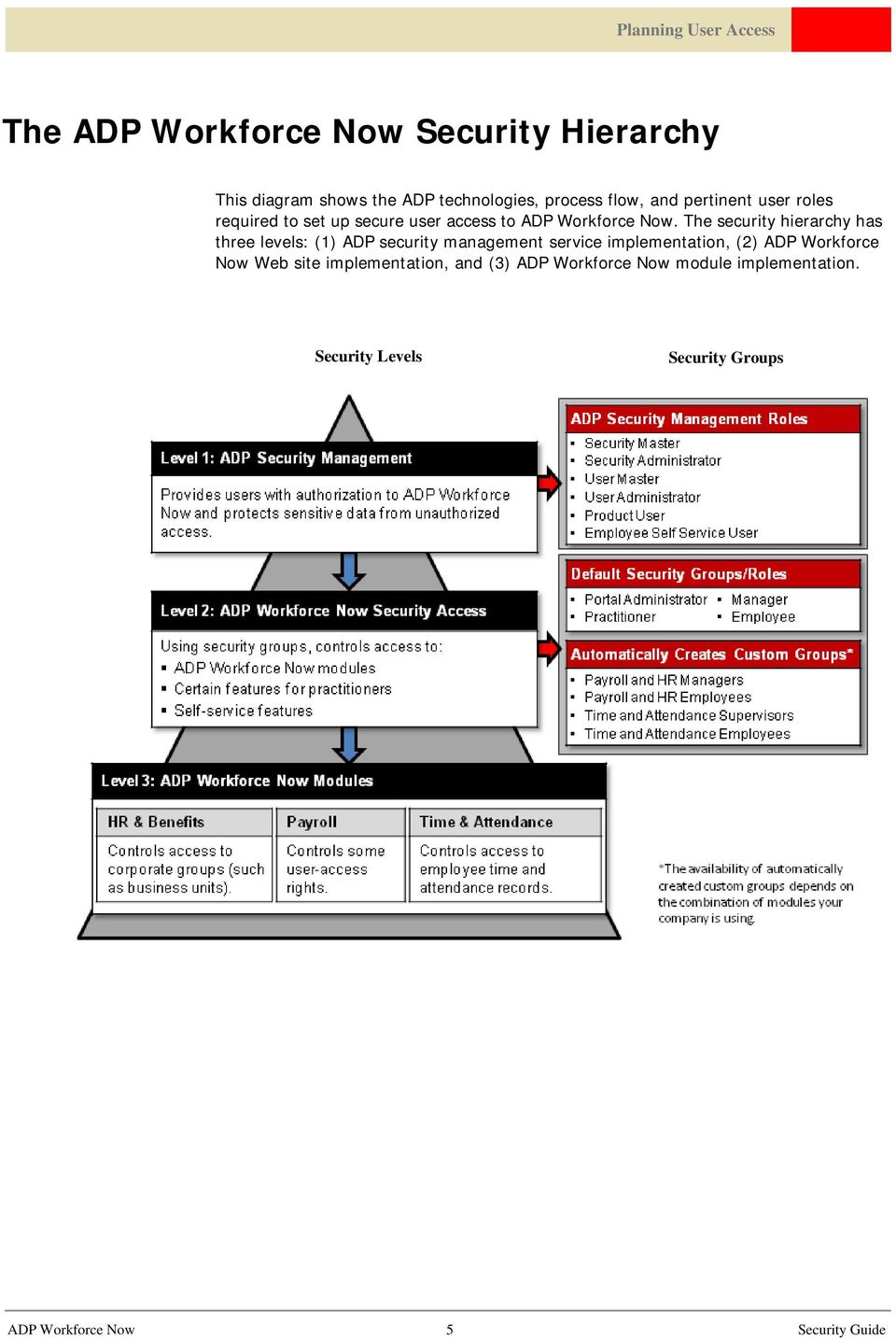
18 Planning User Access Levels of the Security Hierarchy While you, as the security master, begin to work with your ADP representative to plan and implement user-access security, you are granted full access to ADP security management and ADP Workforce Now. Your ADP representative assigns these privileges to you to make sure you can access all content. Level 1: ADP Security Management During the first level of security implementation, selected users are set up through the ADP security management service, which provides authentication and authorization to ADP Internet services. During this phase, The security master is established to oversee all additional security administrators, user masters, user administrators, and product users. Digital certificates are issued to all security masters, security administrators, user masters, user administrators, and product users to authenticate their identity. The digital certificate is a web ID card that must be installed on the user s computer. The digital certificate provides users with broader access to ADP Workforce Now - for example, the ability to view information about employees other than themselves and to make changes to the way users can access employee records. This extra level of security is needed to ensure the integrity of ADP s services. As the security master, you have the highest level of access of any digital certificate user and can use any aspect of ADP Workforce Now that your company is using. Other digital certificate users have more restricted rights. For example, they might be able to perform certain functions or access only certain modules of ADP Workforce Now. It is your responsibility as security master to determine exactly what these rights should be and set them up in ADP Workforce Now. Important: You do not need to provide digital certificates to all users of ADP Workforce Now. In fact, most users the self service users can register with ADP Workforce Now to get a username and password without getting a digital certificate. Self service users typically can view only their own information. ADP Workforce Now managers (also self service users) can access information about the employees who report to them. However, they do not have security privileges and are not able to change the way other users access ADP Workforce Now. Level 2: ADP Workforce Now Web site After the security management setup, the security master sets up digital certificate users with ADP Workforce Now access. Your ADP representative has set up the security master with complete portal administrator privileges, so you can access all content in ADP Workforce Now. During this phase: You assign the digital certificate users set up in the security management service to one of the default security access groups (portal administrators and practitioners). Users can be assigned to both groups if they should have full access. These groups control which content these users can view and what tasks they can perform in ADP Workforce Now. Both the ADP Workforce Now Web site and the HR & Benefits module are impacted at this stage. You will make very specific decisions about the content employees can see and use in ADP Workforce Now and, if your company is using it, the HR & Benefits module. Portal administrators gain access to the Security Access menu, where they can control the content other users can see and use. Security Guide 6 ADP Workforce Now

19 Planning User Access Practitioners gain access to the modules identified in their security management product profiles. Level 3: ADP Workforce Now modules The final stage of implementing security access is to set up ADP Workforce Now module access - that is, which aspects of the HR & Benefits, Payroll, and Time & Attendance modules (if your company is using them) can each employee access? You will again make very specific decisions about the content employees can see and use in each of the modules. As you work through the planning tasks in this chapter, you will fill out a form, called the Security Template, that helps you to understand how to think about user access security at your company. Working with your ADP representative, you will implement the security plan as you work through the security levels in this guide. ADP Workforce Now 7 Security Guide
20 Planning User Access Filling in the Security Template As your ADP representative explained during the Security Master Setup call, the purpose of the Security Template is to help you to understand: The types of user access you can restrict The methodology for securing user access in ADP Workforce Now Important: You do not have to identify every access restriction on the Security Template. The purpose of filling in the template with these restrictions is to work with your ADP representative to develop a methodology that you can then implement consistently in ADP Workforce Now and the modules. The Security Template includes columns that begin with high-level user information in left-most columns and work toward more detailed user restrictions as you progress to the right. During the discussions in the Security Master Setup call, your ADP representative might modify the columns in this form to meet your needs. However, this basic methodology - working from general to more specific - should continue to be the case. Tip: The Security Template provides sample scenarios to help you understand how to plan for and assign access to the different users in your company. Security Guide 8 ADP Workforce Now

21 Planning User Access Example: A Completed Security Template The examples in this chapter are provided in the Security Template on the Sample Security Templates tab. Refer to the Security Template for more information about these scenarios. ADP Workforce Now 9 Security Guide
22 Planning User Access Column Descriptions The following table describes the columns on the Security Template. Column User s Name & Job Title Security Role ADP Workforce Now Modules Description Enter the user s name and job title. Note: You only need to list users who require a digital certificate. Select the ADP security management role that should be assigned to the user: Security Master* Security Administrator User Master User Administrator Product User *You can assign the security master role to a backup security master. This person can perform tasks during the absence of the security master. Based on the ADP Workforce Now modules your company is using, select which module(s) should be assigned to the user s security management profile: All modules Payroll HR & Benefits Time & Attendance Payroll and HR & Benefits Payroll and Time & Attendance HR & Benefits and Time & Attendance These modules are assigned to the user s security management profile. ADP Workforce Now Security Group Select the default security group(s) to which the user belongs: Portal Administrator Practitioner Both The Portal Administrator and Practitioner groups require digital certificates, so it is important to identify any users who belong to these groups. Access Level Company Code, Business Unit, or Department Restrictions Select whether the user has full or partial access to ADP modules or module features (that is, entire modules or restricted access within the modules). If the user has full access, you don t need to fill out additional columns. The next several columns help you to define the type of content a user with partial access can or cannot see and use. Some users have access restrictions based on the organizational unit where they work for example, a company code, business unit, or department. State that the user has full access if the user does not have any access restrictions. If the user has partial restrictions, briefly state what those restrictions are. Security Guide 10 ADP Workforce Now
23 Planning User Access Benefit Restrictions Pay Rate Restrictions Additional Restrictions Indicate whether the user can see and/or change employee benefits. For example, some organizations have a benefits administrator who is responsible for overseeing benefits. In this case, the benefits administrator would be able to see and change benefits content, but other administrators, such as the payroll administrator, would not have access to this information. Indicate whether the user can see and/or change pay rates. Some users should not see pay rates. For example, you might set up a payroll administrator to see the hours employees work, but you don t want that person to see the rate of pay for other employees. This is a free-form column in which you can place any notes about user access that you think are important to consider. Planning for Security Management Setup Security Management Roles Setting up users in the ADP security management service is required for any user who needs a digital certificate to log on to ADP Workforce Now, including the security master. Working with your ADP representative during this phase, you must identify each of these users and identify their level of access in the ADP security management service. Fill in the following columns in the Security Template to identify all users who must be set up in the security management service with a digital certificate so they can then register for ADP Workforce Now: User s Name & Job Title ADP Security Management Role ADP Workforce Now Modules In addition to the security master, the ADP security management service has four security roles to which you can assign users. As a security master, you are responsible for identifying which type of access users should have and assigning them to the appropriate role during security management setup. Users in a security role (those who have a digital certificate) can manage other users in the same security role or in lower security roles. In the Security Role column of the Security Template, you identify which security role the user should have. Important: It is critical that you assign users to the appropriate ADP security role. Assigning a user to the wrong role can mean that person has access to sensitive information that he or she should not see. This is a significant security risk. ADP Workforce Now 11 Security Guide
24 Planning User Access Role Description Security Master Security Administrator User Master User Administrator Product User A security master is a highly trusted user who has complete access to all the ADP services your company uses. This user can create new security administrators, perform all the tasks of the security administrator, and maintain users in other security roles. The security master should already be identified. You are only logging this role on this template in case you need to make notes concerning this person s access (in the Additional Restrictions column). A security administrator is a highly trusted user who has complete access to all the ADP services your company uses. This user can create new product users and assign the security management roles of user master, user administrator, or product user to users. He or she can create self-service users who require early access to your ADP services (if available to your company). This user can reset passwords, issue/reissue digital certificates, and issue/reissue personal identification codes (if available to your company). This user can also use security management service to manage access to ADP services for user masters, user administrators, product users, and self-service users. A user master can assign the user administrator role to product users or self-service users and perform all user administrator tasks. This user can also issue/reissue personal identification codes (if available to your company), modify self-service users information, and approve or deny self-service users registering before their information is available to ADP (if available to your company). A user administrator can perform security tasks such as resetting passwords and reissuing digital certificates. This user can also suspend or activate self-service users. A product user can access specific ADP modules. This user cannot perform administrative security tasks such as resetting passwords and reissuing digital certificates in the ADP security management service. Planning the Level of Access for ADP Workforce Now As security master, you must identify the default security groups and level of access for users who require a digital certificate. On the Security Template, provide the following information for each user who will need to be set up in the ADP security management service: In the ADP Workforce Now Security Group column, add the core security group(s) to which the user belongs. Since only portal administrators and practitioners require digital certificates, you only need to identify users who belong to these two groups. (Refer to Core Default Groups Requiring Digital Certificates on page 13 for more information.) In the Access Level column, identify whether the user should have full or partial access to ADP Workforce Now. Security Guide 12 ADP Workforce Now
25 Planning User Access Important: For all users who have full access, such as the security master, the Security Template is now complete. Example: Security Master Users on the Security Template In this example, Jill Smith acts as a backup to Bob Collins, the security master. Core Default Groups Requiring Digital Certificates You can assign users to one or more default security groups so they view the appropriate content on the ADP Workforce Now Web site. These groups also affect the kind of information users can see in the ADP Workforce Now modules. Note: Chapter 3, Setting User Access in ADP Workforce Now on page 57, states that ADP Workforce Now actually has four (not two) core default security groups. However, only portal administrators and practitioners require digital certificates, so you only need to identify these two groups on the Security Template. Therefore, only these groups are discussed here. Default Security Group Administrator (Portal Administrator) Practitioner How Users Are Assigned Users are automatically assigned the Portal Administrator role when you set them up with the ADP Workforce Now profile in security management service. The portal administrator requires a digital certificate and controls user access privileges and the appearance of the ADP Workforce Now Web site. Users are automatically assigned the Practitioner role when you set them up with the ADP Workforce Now profile in security management service. Practitioner users require digital certificates and can access the services to which they have been assigned from those being used by their company. For example, a practitioner might only be assigned to the HR & Benefits module, even though the company is using all ADP modules. ADP Workforce Now 13 Security Guide
26 Planning User Access Planning User Access Restrictions for the ADP Workforce Now Web Site and Modules The next planning task is to determine the restrictions on seeing and using content for each user. These restrictions affect the ADP Workforce Now Web site and HR & Benefits, Payroll, and Time & Attendance modules. To determine what restrictions are important: Brainstorm with your ADP representative about the types of user information you can restrict. You might find it helpful to see a demo of the areas of ADP Workforce Now where you will set up user access. You can also review the sample scenarios provided in the Security Template. Meet with key staff in your company (such as the security administrators, user masters, user administrators, and product users you have identified on the Security Template) to determine what kinds of access restrictions they believe are important for the jobs they, and the people who might report to them, perform. Important: You do not have to identify every restriction on the Security Template. The purpose of filling in the template with these restrictions is to work with your ADP representative to develop a methodology that you can then implement consistently in ADP Workforce Now. For details on these steps, refer to the chapter that describes the module (Chapters 4 through 6). Example: Access Restrictions on the Security Template On the Security Template, certain users are identified as having partial access. For each of these users, note these access restrictions in the last four columns on the right side of the Security Template. Security Guide 14 ADP Workforce Now
27 Planning User Access Filling in the ADP Internet Product Security Registration Form During the Security Master Setup call, your ADP representative provided you with a user information form called the ADP Internet Product Security Registration form. Each staff member in your company who requires a digital certificate to access ADP Workforce Now must fill in this form and return it to you. This information is necessary to set up these users in the security management service. Complete these steps: 1 Distribute a copy of the ADP Internet Product Security Registration form to all staff members who require a digital certificate to access ADP Workforce Now (that is, all portal administrators and practitioners). Ask them to fill out the form neatly and accurately and return it to you. Note: Only portal administrators and practitioners need to fill out this form, since they are the only users who require digital certificates. 2 Gather all completed ADP Internet Product Security Registration forms from the staff members. Verify that all information has been filled out completely, including selecting the security question and answer at the bottom of the form. 3 Inform the staff members that they should expect a confirmation from ADP. Staff members must follow the process in that to download the digital certificate. If staff members do not receive the within a reasonable amount of time, they should contact you so you can reissue the certificate or follow up with ADP. ADP Workforce Now 15 Security Guide
28 Planning User Access Security Guide 16 ADP Workforce Now
29 Chapter 2 Setting Up Users in ADP Security Management Service You have completed initial planning with your ADP representative and understand how you want to secure user access at your company. The process of securing user access begins with the ADP security management service, which controls user access to all ADP Internet services and ensures that unauthorized users are not able to access sensitive data. As the security master, you can use the ADP security management service to set up the security administrators, user masters, user administrators, and product users at your company who should be able to access ADP Workforce Now. This chapter provides details on how to do the following: Complete the setup process for the security master (which should already be underway) Set up security administrators, user masters, user administrators, and product users Assign users to a product profile Maintain user profiles, such as updating personal information, resetting passwords, and reissuing digital certificates Tip: Details on all of these tasks, along with answers to frequently asked questions, are provided in ADP's security management service online help PDF. After setting up all users in the ADP security management service, refer to Chapters 3-6 to complete user access for the ADP Workforce Now modules and features. ADP Workforce Now 17 Security Guide
30 Setting Up Users in ADP Security Management Service Setting Up the Security Master As the security master, you are responsible for identifying, setting up, and maintaining each user in your company who should be able to access ADP Workforce Now. Before you can set up user access for others, you must complete the ADP security management service registration process described in this chapter. Your ADP representative will guide you through the security management process. Note: If you have identified a backup security master, that person should also complete this process. Before You Begin Before you set up users, you must work with your ADP representative to register as a security master in the ADP security management service. During initial planning, you should have provided your ADP representative with the contact information needed to set you up as a security master. Refer to Chapter 1, Planning User Access on page 1, if you have not yet had this conversation. By now, you should have received a system-generated message that contains the information you need to download your digital certificate. If you have not received this , contact your ADP representative. Downloading a Digital Certificate You must download your digital certificate before you can log on to the security management service for the first time. The digital certificate identifies you as a security master for ADP Workforce Now. Note: Be sure to download the digital certificate on the computer from which you plan to access the security management service and ADP Workforce Now. The digital certificate permits access only on the computer where it is installed. The certificate is valid for two years. 60 days before the expiration date, you will receive an notification with instructions for renewing the certificate. On the computer you will use to perform administrative tasks, follow these steps: 1 Open your browser, and then open the system-generated confirmation . 2 Copy the URL from the , paste it into the browser address field, and then click Go. 3 On the Register for ADP Services page, copy the user ID and access code from the confirmation and paste them in the appropriate fields. Important: Make sure you don't copy extra spaces before or after the access code. If you have already registered and have an ADP services user ID and password, proceed to step 6. 4 Select the security question, and enter the answer. Security Guide 18 ADP Workforce Now
31 Setting Up Users in ADP Security Management Service 5 Create and confirm the password for your account. Passwords must conform to the following rules: Your password must be at least eight characters long and must contain at least one letter and one number. Your password is case-sensitive. Your password can include special characters # $) and spaces. Your password cannot repeat any character more than four times. For example, AAAAAA11 is not permitted. You cannot reuse your last four passwords. Note: For added security, your password expires every six months. Before your password is about to expire, you will be prompted to select a new password when you log in to your ADP service. Your new password is effective immediately. 6 Click Submit to complete the registration process and start to download the digital certificate. 7 The ADP Digital Certificate Download Process page will be displayed with the additional tasks that must be completed before you can download the ADP digital certificate. Important: Depending on the operating system and internet browser you use, you may be required to complete additional setup tasks before you can download the ADP digital certificate. For more information, refer to System Requirements and Setup Tasks on page Follow the instructions on the page, complete the setup tasks and click Download Certificate to download your digital certificate. 9 You will receive a few security alerts. When prompted, click Yes to continue. Note: For information to export, import, and verify the ADP digital certificate, navigate to the security management service. On the home page, select the Resources section to access the Administrator access with digital certificate Quick Reference Card. ADP Workforce Now 19 Security Guide
32 Setting Up Users in ADP Security Management Service System Requirements and Setup Tasks The requirements for the operating system and internet browser you use can vary based on the ADP services your company is using. Depending on the operating system and internet browser you use, you may be required to complete additional setup tasks before you can download the ADP digital certificate. Important: You must complete the additional tasks displayed on the ADP Digital Certificate Download Process page before downloading the ADP digital certificate. Microsoft Internet Explorer with Windows XP Enable ActiveX Download Install ActiveX Your browser s security setting for Download Signed ActiveX Controls must be set to either Prompt or Enable. Do the following to check this setting: 1 Select Internet Options from the Internet Explorer Tools menu. 2 Select the Security tab and click the Trusted Sites icon. 3 Click Custom Level and then verify that the Download signed ActiveX controls setting is set to either Prompt or Enable. 4 Click OK to close the Security Settings window. 5 Click OK to close the Internet Options window. Depending on your computer setup, you may see a warning message in the Information bar. To display the hidden contents of the page, do the following: 1 Click on the warning message in the Information bar. 2 Click Allow Blocked Content option. 3 In the Security Warning window, click Yes. Microsoft Internet Explorer with Windows Vista /Windows 7 Download the ADP Root Certificate Complete the following steps before downloading the ADP digital certificate: On the ADP Digital Certificate Download Process page, click the Download and Install Root Certificate link. Do the following to complete this process: 1 In the File Download - Security Warning window, click Save. 2 In the Save As window, accept the default file location and file name, and then click Save. Security Guide 20 ADP Workforce Now
33 Setting Up Users in ADP Security Management Service Add ADP To Trusted Sites 3 In the Download Complete window, click Open. 4 In the Internet Explorer Security window, click Allow. 5 In the Certificate window, click Install Certificate. 6 On the Welcome to the Certificate Import Wizard page, click Next. 7 On the Certificate Store page, click Place all certificates in the following store, and then click Browse. 8 In the Select Certificate Store window, click Trusted Root Certification Authorities, click OK, click Next, and then click Finish. 9 In the Security Warning window, click Yes. 10 In the Certificate Import Wizard window, click OK. 11 Click OK to close the Certificate window. 1 From the Internet Explorer Tools menu, select Internet Options. 2 In the Internet Options window, select the Security tab. 3 Click the Trusted sites icon and then click Sites. 4 In the Add this website to the zone field, type then click Add. 5 Make sure that the Require Server Verification For All Sites in this Zone check box is selected, and then click Close. 6 Click OK to close the Internet Options window. Mozilla Firefox and Non-Internet Explorer The steps apply to users with Windows XP/Windows Vista /Windows 7/MAC operating systems. Important: The steps below may slightly vary depending on the operating system and internet browser you use. Download the ADP Root Certificate On the ADP Digital Certificate Download Process page, right-click on the link to Download and Install Root Certificate. Important: Do not close the ADP Digital Certificate Download Process page until you have downloaded your certificate. Do the following to complete this process: 1 Right-click on the link and click Save Link As. 2 In the Enter Name of File to Save to window, browse to select a location to save the file. ADP Workforce Now 21 Security Guide
34 Setting Up Users in ADP Security Management Service 3 In the File Name field, accept the default file name. 4 Select All Files in the Save as Type list and click Save. Important: The root certificate will be saved in the specified location. If you use the Safari browser on MAC, the certificate will be saved as an A.p7s file. You must click on this file to install the certificate. 5 In Firefox, select Tools>Options. 6 Select the Advanced>Encryption tab and click View Certificates. 7 Select the Authorities tab and click Import. 8 In the Select File containing CA certificate(s) to Import window, navigate to locate the saved root certificate, save it, and then click Open. 9 In the Downloading Certificate window, click to select all options and click OK. 10 Click OK to close the Certificate window. Security Guide 22 ADP Workforce Now
35 Setting Up Users in ADP Security Management Service Logging On to ADP Security Management Service Important: Pop-up blockers may interfere with the display of valid pop-up windows (confirmations, forms, reports). ADP recommends that you disable pop-up blockers or set up your pop-up blocker to allow pop-ups for this site. 1 Go to: 2 Click Administrator Login. Digital certificate users click here to log on to ADP Workforce Now. 3 In the Choose a digital certificate window, select your certificate and click OK. The digital certificate is labeled with your first name, last name, ADP and the expiration date of your certificate. ADP Workforce Now 23 Security Guide
36 Setting Up Users in ADP Security Management Service 4 In the Connect window, enter your user ID, password and click OK. Note: This check box is disabled for added security. You cannot select this option. Role Selector 5 In ADP Workforce Now, point to the Role Selector and select Portal Administrator. Select this role to set up user access in ADP Workforce Now. Notice that the menus change when you access the Portal Administrator role. The Security Access menu is now available. 6 Select Security Access > Security Management User Administration. From this menu, you can access the ADP security management service to register users. Security Guide 24 ADP Workforce Now
37 Setting Up Users in ADP Security Management Service 7 On the Welcome page, click login. Select login to open the ADP Netsecure window. Once you have logged on to the ADP security management service, you can set up additional users - such as security administrators and user masters (who can assist you with setting up other users) and product users (who are the daily users of the ADP Workforce Now services). ADP Workforce Now 25 Security Guide
38 Setting Up Users in ADP Security Management Service Setting Up Additional Users Security Guide 26 ADP Workforce Now
39 Setting Up Users in ADP Security Management Service Setting Up Additional Users During the planning process, each security administrator and product user filled out an ADP Internet Product Security Registration form to provide the personal information that must be entered when you set up that user. As you set up these users, you will consult these forms to enter this personal information. Note: You do not need to provide digital certificates to all users of ADP Workforce Now. In fact, most users the self service users can register with ADP Workforce Now to get a username and password but don t require a digital certificate. self service users typically can only view their own information. ADP Workforce Now managers (also self service users) can access information about the employees who report to them. However, they do not have security privileges and are not able to change the way other users access ADP Workforce Now. You can add new security administrators, user masters, user administrators, product users, and Self Service users (if available to your company). Your security masters and security administrators can add other users for your company. This task does not apply to user masters, user administrators, product users, and self service users. The following table lists the user roles that are authorized to add other users: User Role Security Master Security Administrator User Master User Administrator Product User Self Service User Can Add New Security administrator, user master, user administrator, product user, and Self Service user (if available to your company) User master, user administrator, product user, and self service user (if available to your company) This task does not apply This task does not apply. This task does not apply This task does not apply. Go to People > Access & Security > Manage Users & Profiles. 1 Click on the Add New (+) icon. 2 Enter user information. Add User ADP Workforce Now 27 Security Guide
40 Setting Up Users in ADP Security Management Service 3 Enter personal information about the user. Make sure the address is valid and frequently checked by the user. The ADP security management service sends a system-generated confirmation to this address. This provides the user ID, access code, URL, and instructions needed to download the digital certificate, so it is important that it is sent to the correct address. Important: ADP validates the information that your registering employee enters against what you, their employer, entered in the Payroll, HR, Time and Attendance, or other ADP application you use. If the information matches, the user is given access to all of your ADP services at once. If the information does not match, the user might not be able to register or may not have complete access to your ADP services. 4 Click Continue. 5 Select the user type. 6 Select the user role. Select This Option User will be included in... User is an independent contractor... To Add a user whose information is included in the information your company sends to ADP. Note: If ADP cannot verify this user s identity, the user cannot download the certificate. Add a new user not included in your ADP services. 7 Click Next. 8 Assign the product profiles to allow access to ADP services, if required. Note: Refer to Assigning the ADP Workforce Now Profile to a User on page 29 to continue. To assign product profiles later, refer to Assigning the ADP Workforce Now Profile to a User on page 29 9 Click Next. 10 Select the security question and enter the security answer. Note: This step is not required when adding an administrator having access without a digital certificate. 11 Click Next. 12 Review the user information. Note: You can update the address, if required. 13 Click Done. Security Guide 28 ADP Workforce Now
41 Setting Up Users in ADP Security Management Service Assigning the ADP Workforce Now Profile to a User Your ADP representative has created default profiles for each ADP service your company uses. In this section, you will assign the ADP Workforce Now profile to users. All users must have this profile assigned so they can access ADP Workforce Now. To assign the profile to a user, follow these steps: 1 On the View User Info page, click Assign Profiles in the left menu. 2 On the Assign User Profiles page, select HomepagePortal and click >> to move it to the Assigned Profiles list. (This profile represents ADP Workforce Now.) Note: You also might need to select additional profiles. Check with your ADP representative. If you are adding a profile to a user that is from another company but has access to your ADP services, be sure to assign a profile that is delegate enabled. 3 Click Assign Profile. 4 In the Assign User Profile confirmation window, click Move to the Next Step. Do not select Assign Another Profile. You must completely set up the ADP Workforce Now profile before you can assign another profile to the user. Note: Some ADP services require you to enter additional information. Click the URL to enter the additional information. ADP Workforce Now 29 Security Guide
42 Setting Up Users in ADP Security Management Service 5 Click the link, Click here NOW to register for ADP Portal. Click this link. 6 Select whether the user is an administrator, a practitioner, or both. Refer to Column 4 - ADP Workforce Now Security Role on the Security Template to determine which role to choose. 7 Assign the user to the appropriate security group(s). For each role you selected, choose either Default Group or Custom Group(s). If you choose Custom Group(s), move your selection(s) from the Available list to the Selected list. You cannot assign a user to both a default group and a custom group for the same role. Note: If no custom security groups are available, the Custom Group(s) radio button is grayed out. 8 Click Submit. A system-generated will be sent to the user containing a user ID, access code, and the URL to download a digital certificate. Security Guide 30 ADP Workforce Now
43 Setting Up Users in ADP Security Management Service Assigning the Support Center Profile to a User The Support Center profile gives certificate users access to the Support Center Web site, where they can find additional information and training materials. This profile also gives ADP Workforce Now employees, managers, and practitioners access to ADP Workforce Now task assistance. To assign the Support Center product profile, go to People > Access & Security > Product Profiles. 1 Select the user. 2 Click on the user's name. 3 Click to select the Support Center profile and move them to the Selected Product Profiles list. 4 Click Save Changes. Note: The options available may vary based on your security role. For example, if you are the user administrator, the User Admin option will not be available to you. ADP Workforce Now 31 Security Guide
44 Setting Up Users in ADP Security Management Service Next Steps Your next task is to assign a product profile to the user to identify which areas of ADP Workforce Now the user can access. Your ADP representative has created a default profile for each service your company uses. The profile consists of a service, a role, and associated authorization codes (company codes). This profile allows you to control access to each of the ADP services your company is using. Refer to these chapters to assign profiles for the ADP Workforce Now modules: Module Refer to This Chapter HR & Benefits Chapter 4, Setting User Access for HR & Benefits on page 97 Payroll Chapter 5, Setting User Access for Payroll on page 107 Time & Attendance Chapter 6, Setting User Access for Time & Attendance on page 123 Note: Before deciding on the product profile for the user, review the default profiles set up by your ADP representative. Each user must be assigned at least one product profile. Security Guide 32 ADP Workforce Now
45 Setting Up Users in ADP Security Management Service Performing User Maintenance Tasks Security masters or security administrators are responsible for supporting users by doing the following: Note: The options available may vary based on your security role. For example, if you are the user administrator, the User Admin option will not be available to you. Assigning a Security Role Adding a New User Finding a User Suspending or Activating a User Deleting a User Approving or Denying a User Modifying a User s Personal and Status Information Resetting a Password Assigning a Product Profile to a User Note: Need Help? Refer to the Online User Assistance Your ADP service now offers online user assistance with the information you are looking for. You can access the task topics, additional reference information, and view the frequently asked questions. To get started, log in to your ADP service, navigate to the page where you are looking for information, and click the Help icon. Assigning a Security Role Security masters, security administrators, and user masters can assign user-security roles. This task does not apply to user administrators, product users, and Self Service users. Assigning an administrator role will prompt to select the address to send instructions to get started. There are six security roles available, each with varying levels of responsibility/access. The self service user has the lowest level of responsibility (does not requires administrator access) while the security master has the highest level of responsibility. Security Master A security master is a highly trusted user who has complete access to all the ADP services your company uses. Security masters requires administrator access. User in this role can do the following: Create new security administrator. Perform all the tasks of the security administrator. Maintain users in other security roles. Note: If your company does not have a security master and needs to establish security administrators, contact your ADP representative. ADP Workforce Now 33 Security Guide
46 Setting Up Users in ADP Security Management Service Security Administrator A security administrator is a highly trusted user who has complete access to all the ADP services your company uses. A security administrator requires administrator access. User in this role can do the following: Create new user administrators, user masters, and product users. Create Self Service users who require early access to your ADP services (if available to your company based on your ADP services). Assign security roles of product user, user master or user administrator to users. Perform security tasks such as reset passwords, issue/reissue certificates. Issue/reissue personal identification code (if available to your company). Manage access to ADP services for user masters, user administrators, product users, and self service users. If applicable, perform applicant maintenance tasks e.g., reset passwords, suspend, activate, and/or delete applicants. User Master A user master requires administrator access. User in this role can do the following: Assign the user administrator role and product user role. Perform all user administrator tasks. Issue/reissue personal identification code (if available to your company). Modify self service users information. Approve or deny self service users' registering before their information is available to ADP (if available to your company). User Administrator A user administrator requires administrator access. User in this role can do the following: Search for users and applicants (if available to your company). View user information. Perform security tasks such as reset password and issue administrator access. Suspend or activate self service users. If applicable, perform applicant maintenance tasks e.g., reset passwords, suspend, and/or activate applicants. Product User A product user requires administrator access. User in this role can do the following: Administer ADP services e.g., payroll, human resources, or benefits. Access and update personal account information. User cannot perform security administrative functions e.g., reset passwords, issue administrator access. Self Service User Certain ADP services offer employees access to their own personal information (such as pay statements or medical benefits) via self-service functionality. User in this role can do the following: Receive a registration code from your company. Use the registration code to create user ID and password to access your ADP services. Access and update personal account information. Security Guide 34 ADP Workforce Now
47 Setting Up Users in ADP Security Management Service Note: User does not need administrator access. The following table lists the user roles that are authorized to assign other ADP security management user roles: User Role Security Master Security Administrator User Master User Administrator Product User Self Service User Can Assign The Role Of Security administrator, user master, user administrator, product user, and Self Service user User master, user administrator, product user, and Self Service user This task does not apply This task does not apply. This task does not apply This task does not apply. To assign the profile to a user, select Security Access > Security Management User Administration. Then navigate to User Security Roles. 1 Select the user. 2 Click to select the user role to assign to the selected user. 3 Click Save. This is an example to assign the security administrator role. 4 If prompted, click Yes to assign product profiles. 5 To assign product profiles later, refer to Assigning the ADP Workforce Now Profile to a User on page If prompted, select the address to send an with instructions. Note: You can confirm or change the user's address, if required. Depending on your user role, the ability to modify the address may vary. ADP Workforce Now 35 Security Guide
48 Setting Up Users in ADP Security Management Service 7 Click Save. Adding a New User The following table lists the user roles that are authorized to add other users: User Role Security Master Security Administrator User Master User Administrator Product User Self Service User Can Add New Security master, security administrator, user master, user administrator, product user, and self service user. Security master, security administrator, user master, user administrator, product user, and self service user. Security master, security administrator, user master, user administrator, product user, and self service user. Security master, security administrator, user master, user administrator, product user, and self service user. This task does not apply This task does not apply. You can add new security administrators, user masters, user administrators, product users, and self service users (if available to your company). Your security masters and security administrators can add other users for your company. This task does not apply to user masters, user administrators, product users, and self service users. To add a new user, go to People >Access & Security > Manage Users & Profiles. 1 Click on the Add New (+) icon. 2 Enter user information. 3 Click Continue. 4 Select the user type. 5 Select the user role. 6 Click Next. Security Guide 36 ADP Workforce Now
49 Setting Up Users in ADP Security Management Service 7 Assign the product profiles to allow access to ADP services, if required. Note: To assign product profiles later, refer to Assigning the ADP Workforce Now Profile to a User on page Click Next. 9 Select the security question and enter the security answer. Note: This step is not required when adding an administrator having access without a digital certificate. 10 Click Next. 11 Review the user information. Note: You can update the address, if required. 12 Click Done. Finding a User Before you can change details about a user, you must locate the user in the ADP security management service. To do this, go to People > Access & Security > Manage Users & Profiles. 1 Click User ID or User Name and enter all or part of the user ID or user name. Suspending a User The following table lists the user roles that are authorized to suspend/activate other users: User Role Security Master Security Administrator Can Suspend Security master, security administrator, user master, user administrator, product user, and self service user. Security Administrator User master, user administrator, product user, and self service user. ADP Workforce Now 37 Security Guide
50 Setting Up Users in ADP Security Management Service User Role User Master User Administrator Product User Self Service User Can Suspend Self service user. Self service user. This task does not apply This task does not apply. To suspend a user, go to People > Access & Security > Manage Users & Profiles. 1 Select the user. 2 Click on the user's name. 3 In the User Status field, click Suspended. 4 For information on the user roles you can suspend, refer to Access to Suspend/Activate Users. 5 Click Save. 6 Click Yes. Activating a User When needed, you must reactivate the user to allow the user access to ADP services. When you reactivate a user, the user can log onto the security management service and/or access the products or services with his or her original user ID and password. A reactivated user does not have to repeat the registration process. User Role Security Master Security Administrator User Master User Administrator Product User Self Service User Can Activate Security master, security administrator, user master, user administrator, product user, and self service user. Security Administrator User master, user administrator, product user, and self service user. Self service user. Self service user. This task does not apply This task does not apply. To activate a user, go to People > Access & Security > Manage Users & Profiles. 1 Select the user. 2 Click on the user's name. 3 In the User Status field, click Active. 4 For information on the user roles you can activate, refer to Access to Suspend/Activate Users. 5 Click Save. Security Guide 38 ADP Workforce Now
51 Setting Up Users in ADP Security Management Service 6 Click Yes. Deleting a User Important: This task cannot be undone. Once deleted, users cannot log in to access their pay statements, benefits, human resources, etc. The following table lists the user roles that are authorized to delete other users: User Role Security Master Security Administrator User Master User Administrator Product User Self Service User Can Delete Users Security master, security administrator, user master, user administrator, product user, and self service user. Security Administrator User master, user administrator, product user, and self service user. This action does not apply. This action does not apply. This task does not apply This task does not apply. To delete a user, go to People > Access & Security > Manage Users & Profiles. 1 Click on the user's name. 2 View the user information and click Delete. For information on the user roles you can delete, refer to Access to Delete Users. 3 Click Yes. Important: The user and user's information will be deleted permanently from your company records. Updating User Information The following table lists the user roles that are authorized to update information for other users. For example, if you are a security master, you can update information for all the user roles listed. However, if you are a user administrator, you can only update information for other user administrators, product users, and self service users. User Role Security Master Security Administrator User Master Can Update User Information for Security administrator, user master, user administrator, product user, and self service user. User master, user administrator, product user, and self service user. User administrator, product user, and self service user. ADP Workforce Now 39 Security Guide
52 Setting Up Users in ADP Security Management Service User Role User Administrator Product User Self Service User Can Update User Information for Self service user. Note: User administrator can only update the user status.roduct user and self service user. This task does not apply. This task does not apply. To update user information, go to People > Access & Security > Manage Users & Profiles. 1 Select the user. 2 Click on the user's name. 3 Update the user information, as required. Note: The information you can update may vary based on your company set up and the ADP services purchased. 4 Click Save. Note: If you change the address, a system-generated will be automatically sent to the previous address to notify the user of the change. Resetting a Password The following table lists the user roles that are authorized to reset passwords for other users: User Role Security Master Security Administrator User Master Can Reset Password for Security administrator, user master, user administrator, product user, and self service user. Note: Security master can update the contact address or mobile phone number to send the temporary password. User master, user administrator, product user, and self service user. Note: Security administrator can update the contact address or mobile phone number to send the temporary password User administrator, product user, and self service user. Note: User master can update the contact address or mobile phone number of self service user to send the temporary password Security Guide 40 ADP Workforce Now
53 Setting Up Users in ADP Security Management Service User Role User Administrator Product User Self Service User Can Reset Password for Self service user. Note: User administrator cannot update the contact address or mobile phone number of users. This task does not apply. This task does not apply. To reset a user password, go to People > Access & Security > Passwords & Admin Access. 1 Search for the user. 2 Click on the user name to reset the password. 3 Verify the identity of the user. 4 Click Reset Password. 5 Select the address or mobile phone number to send the temporary password. Note: You can confirm or change the user's address or mobile phone number, if required. Depending on your user role, the ability to modify the address may vary. Refer to Access to Reset User Password in the online help. 6 Click Continue. Note: An with the temporary password will be sent to the user and a success message displays on the page. ADP Workforce Now 41 Security Guide
54 Setting Up Users in ADP Security Management Service Issuing Admin Access The following table lists the user roles that are authorized to issue administrator access to other users: User Role Security Master Security Administrator User Master User Administrator Product User Self Service User Can Issue Admin Access For Security administrator, user master, user administrator, product user, and self service user. Note: Security master can update the contact address to send the with instructions. User master, user administrator, product user, and self service user. Note: Security administrator can update the contact address to send the with instructions User administrator, product user, and self service user. Note: User master can update the contact address for self service users Product user and self service user. Note: User administrator can update the contact address for self service users. This task does not apply. This task does not apply. To issue admin access, go to People > Access & Security > Passwords & Admin Access. 1 Search for the user. 2 Click on the user name. 3 Verify the identity of the user. 4 Click Issue Admin Access. 5 Select the address to send an with instructions. Note: You can confirm or change the user's address, if required. Depending on your user role, the ability to modify the address may vary. Refer to Access to Issue Admin Access. 6 Click Continue. Note: An with instructions will be sent to the user and a success message displays on the page. Security Guide 42 ADP Workforce Now
55 Setting Up Users in ADP Security Management Service Assign/Remove Product Profiles The following table lists the user roles that are authorized to assign/remove profile for other users: User Role Security Master Security Administrator User Master User Administrator Product User Self Service User Can Assign/Remove Profiles For Security administrator, user master, user administrator, product user, and self service user. User master, user administrator, product user, and self service user. This task does not apply. This task does not apply. This task does not apply. This task does not apply. To assign a product profile, go to People > Access & Security > Product Profiles. 1 Select the user. 2 Click on the user's name. 3 Click to select the profiles and move them to the Selected Product Profiles list. 4 Click Save. ADP Workforce Now 43 Security Guide
56 Setting Up Users in ADP Security Management Service Company Maintenance Tasks Security masters or security administrators are responsible for supporting their company through the following company maintenance tasks: View Your Company Information Update Your Company Information Set Up the Self Service Registration Pass code Manage Mobile Access for Your Users Manage the Use and Display of Mobile PIN View the Identity Verification Options Customize Your Support Contact Information Add Your Company Branding Creating Additional Product Profiles Adding a Product Profile Updating a Product Profile Deleting a Product Profile Note: In addition to the information contained in this chapter, access the online help by clicking on Help on the toolbar. Online help contains comprehensive information on using the ADP security management service. Viewing Your Company Information Security masters, security administrators, user masters, and user administrators can view your company information. This task does not apply to product users and self service users. To view your company information, select Setup > Company Information > Profile. 1 View your company information available to ADP. 2 Click on another tab or task to navigate away from this page. Updating Your Company Information Security masters, security administrators, user masters, and user administrators can update the company information settings for your company. This task does not apply to product users and self service users. To update your company information, select Setup > Company Information > Profile. 1 Update the company address, web site address (URL), contact of your administrator, and contact phone numbers. 2 Click Save. 3 Click Settings tab. 4 Update the self service registration pass code, mobile access for users, mobile PIN login, and customized support contact information. 5 Click Save. Security Guide 44 ADP Workforce Now
57 Setting Up Users in ADP Security Management Service Setting Up The Self Service Registration Pass Code Security master or security administrator must establish the self service registration pass code for your users. Your registration pass code consists of your client ID and the code you enter separated by a hyphen e.g., your client ID-your code. Note: If your company uses Personal ID Codes (PICs) as the identity verification option during self service registration, users will not need the self service registration pass code. To set up the self-service registration pass code, select Setup > Company Information > Profile > Registration Settings. 1 In the Self Service Registration Pass code field, enter the registration code. 2 Click Save. A letter to encourage employee registration is available on the Home page > Resources section. Customize this letter based on the ADP services your company has purchased. Include the self service registration pass code, the URL to your ADP service web site, and provide it to your self service users (employees, consultants, or contractors). Users use this information to self register and access ADP services. Refer to Self Service Registration process. Personal Identification Code (PIC) Management About Personal ID Codes (PICs) The Personal Identification Code (PIC) is an alphanumeric code that you generate in the ADP security management service for your company users. PICs are randomly generated and distributed to users by . Once issued, users enter PIC during registration to access ADP services. A PIC expires once used or within 15 days, whichever is earlier. If it has been lost or compromised, you can reissue the PIC. Click on the address field to update that information. To take full advantage of PIC, your company should include the Social Security number (SSN) of your users in the information your company sends to ADP. If your company does not include the user s SSN, the user will have limited access to ADP services.contact your ADP representative for more information. Your administrators use the PIC Management feature to do the following tasks: Issue Personal ID Codes (PICs) Issue Personal ID Codes (PICs) to All Users Update Addresses Important: If users do not have a valid address, speak to the user and update the address of the user before you generate PIC. PIC expires within 15 days or when used for registration (whichever occurs earlier). ADP Workforce Now 45 Security Guide
58 Setting Up Users in ADP Security Management Service Issuing Personal ID Codes (PICs) Security masters, security administrators, and user masters can issue Personal ID Codes (PICs). This task does not apply to user administrators, product users, and Self Service users. To issue a personal ID code, select People > Access & Security> Personal ID Codes (PICs). 1 Select an item from the Users list. 2 Click Search. 3 View the search results. Note: You can click in the address field and enter/update the address before issuing the PIC, if required. 4 Click Other Actions. 5 Click Issue All PICs. Note: An with the PIC and instructions to use it during registration will be sent to all users included in your search results. Creating Additional Product Profiles Adding a Product Profile Your ADP representative has created default profiles for each ADP service. You can also create additional product profiles for your company. Additional product profiles do not replace the default product profiles. Security masters and security administrators can add product profiles for your company. This task is not available to user masters, user administrators, product users, and self service users. To assign a product profile, select Setup > Company Information > Profile. 1 Click on the product name. 2 Click (+) to add a new profile. 3 Enter the profile name. 4 Select the role to be associated with the profile. 5 Select the authorization codes. 6 Click Save. Updating a Product Profile Security masters and security administrators can update existing product profiles for your company. This task is not available to user masters, user administrators, product users, and self service users. Security Guide 46 ADP Workforce Now
59 Setting Up Users in ADP Security Management Service To update a product profile, select Setup > Company Information > Profile. 1 Click on the product name. 2 Click on the profile name. 3 Update the profile name and/or the authorization codes. 4 Click Save. Deleting a Product Profile Security masters and security administrators can delete existing product profiles for your company. This task is not available to user masters, user administrators, product users, and self service users. Important: Deleting a product profile removes it from all users to whom it has been assigned. This task cannot be undone. To delete a product profile, select Setup > Company Information > Profile. 1 Click on the product name. 2 Click on the profile name. 3 View the profile details to verify it is the profile to be deleted. Click Delete. Note: You can refer to the online help for more information on the different reports. ADP Workforce Now 47 Security Guide
60 Setting Up Users in ADP Security Management Service Reports You can access reports from Reports > Standard Reports > View/Run Reports. Run reports to get information on your users and the ADP services your company has purchased. Once run, report results can be viewed or saved as a Portable Document Format (.PDF) or Comma Separated Value (.CSV) output. You can view the outputs of current and historic reports with success status. You can run four different reports from Reports > Standard Reports > View/Run Reports. Use This Report User Information Self Service User Status Certified User Status Certificate Expiration To Get basic information on users such as status, user ID, security role, phone number, and business addresses. Get information of self-service users who registered for specific ADP products/services. You can also get information of users who are not registered to your ADP service. This information is available only if your company sends user information to ADP. Get information such as security role, product profile, product role, and authorization codes as applicable. Get the expiration date and time of the digital certificates. Report Tasks Running a Report You can perform any of the following tasks on your reports: Run a Report View a Report Output Refresh a Report Output Cancel a Report View a Report Output History Delete a Report About Reports Types of Reports Frequently Asked Questions To run a report, select Reports > Standard Reports > Run/View Reports > Current. 1 Click on the name of the report you want. 2 Enter or change the report ID as needed. 3 Select filter options. Security Guide 48 ADP Workforce Now
61 Setting Up Users in ADP Security Management Service 4 Select sorting options. 5 Select additional fields. 6 Click Run. Viewing a Report Output You can view outputs of reports that have been executed and are in success status. To do this, select Reports > Standard Reports > Run/View Reports > Current. 1 Click the Action icon next to the report with success status. 2 Click on an output format. Refreshing a Report You can refresh reports that have status as submitted, scheduled, or processing. To do this, select Reports > Standard Reports > Run/View Reports > Current. 1 Click the Action icon next to the selected report. 2 Click Refresh. Note: The status of the selected report will be refreshed. Cancelling a Report You can cancel reports that are in submitted, scheduled, or processing status. To do this, select Reports > Standard Reports > Run/View Reports > Current. 1 Click the Action icon next to the selected report. 2 Click Cancel. Viewing a Historic Report Output You can view the history of a report that was run at different times. To do this, select Reports > Standard Reports > Run/View Reports > Historic. 1 Click the Action icon next to the report you want. 2 Click on an output format. Note: The output options available vary based on the status of the report. Deleting a Report You can delete current and historic reports that have status as submitted, scheduled, or processing. To do this, select Reports > Standard Reports > Run/View Reports > Current. 1 Click the Action icon next to the current or historic report. 2 Click Delete. ADP Workforce Now 49 Security Guide
62 Setting Up Users in ADP Security Management Service 3 In the Confirm Action window, click Yes. Note: To delete one or more historic reports select the reports and click the Delete (-) icon. Security Guide 50 ADP Workforce Now
63 Setting Up Users in ADP Security Management Service Contact Information Maintenance Tasks Changing Your Address You can perform any of the following contact information maintenance tasks: Change Your Address Activate Your Address Request a New Activation Code Change Your Contact Phone Number Activate Your Mobile Phone Number About Activating Your Contact Information About Text Messaging Frequently Asked Questions To change your address, select Myself > Personal Information > Contact Information. 1 In the Work and/or Personal address fields, enter a valid address. 2 Select the address that you access frequently for notification. 3 Click Save. Activating Your Address You must activate your notification address to confirm it belongs to you and can be used when necessary. If you change the address associated with your account, you will receive a notification of change from ADP. To activate your address, select Myself > Personal Information > Activate Your /Mobile Phone. 1 Select the address to send the activation code. 2 Click Send Activation Code(s). 3 Enter the activation code you received from ADP. 4 Click Submit. Requesting a New Activation Code You must activate your address and mobile phone numbers to confirm they belong to you and can be used when necessary.if you did not receive your activation code or your activation code has expired you must request a new activation code. To request a new activation code, select Myself > Personal Information > Activate /Mobile. 1 Select the address and/or cell phone numbers. 2 Click Send Activation Code. ADP Workforce Now 51 Security Guide
64 Setting Up Users in ADP Security Management Service Changing Your Contact Phone Numbers To change your contact phone numbers, select Myself > Personal Information > Contact Information. 1 In the Phone number fields, enter your contact mobile phone numbers. 2 Select the mobile phone number you access frequently to receive text message from ADP. 3 Click Save. Activating Your Mobile Phone Number You must activate your mobile phone numbers to confirm they belong to you and can be used when necessary. If you wish to receive forgotten credentials via your mobile phone, you must activate the mobile phone number associated with your account. If you change your mobile phone number associated with your account, you will receive a notification of change from ADP. To activate your mobile phone number, select Myself > Personal Information > Contact Information > Activate /Mobile. 1 Select the mobile phone number. 2 Click Activate /Mobile. 3 Enter the activation code you received in a text message from ADP. 4 Click Submit. About Activating Your Contact Information To confirm that you are the rightful owner of the contact address and mobile phone numbers associated with your account, ADP requires you to activate your contact information to receive your login information e.g., temporary password, user ID upon your request. If your contact information is not activated, the options to send your login information to your address and/or mobile phone numbers will not be available. Activation can be done in one of the following ways: New employees can complete the activation of contact information during the employee self service registration process.when required, this task can also be performed from the Myself Tab. Existing employees must complete the activation of contact address and/or phone numbers from the Myself Tab. Note: Employees and administrators/practitioners must activate their contact information after updating their account. About Text Messaging ADP supports the use of text messaging to receive your login information e.g., temporary password, user ID upon your request. To get started with this process, you must select to use your mobile phone to receive text messages from ADP upon your request. Security Guide 52 ADP Workforce Now
65 Setting Up Users in ADP Security Management Service To confirm that you are the rightful owner of the contact mobile phone numbers associated with your account, ADP requires you to activate your contact information to receive your login information e.g., temporary password, user ID upon your request. Your mobile phone number must: Have a service from a supported mobile phone carrier. Be able to receive text messages. Not have a text message block. Note: The complete Terms and Conditions associated with this feature is displayed adjacent to the mobile phone number fields on the Myself > Contact Information page. Frequently Asked Questions 1 How do I change my name associated with this account? You can contact your company administrator to update your name in your company records. 2 I changed my name associated with this account. How do I change my user ID? Your user ID was created when you first registered to access ADP services. Changing your name does not change your user ID. You can continue to use your existing user ID and password to access your ADP services. If required, your administrator can delete your user information, user ID from your company records and you can register with your updated name. However, the information previously associated with your record will not be available or associated with your new user ID. Contact your company administrator for assistance. 3 How often should I activate my contact address and mobile phone numbers? After you change your contact address and mobile phone numbers, you should activate it to confirm that is in service and available for use. If your activated mobile work phone becomes your mobile personal phone or vice versa, activation is not required. 4 During password change, why can I not use my previous passwords? To protect your account security, ADP's security policies do not allow the reuse of your last four passwords. 5 Are there any recommendations to increase the password strength? Yes. It is recommended that passwords be 12 or more characters and contain a mix of upper case and lower case letters, numbers, and special characters. For example, the mnemonic, The first time I traveled to a foreign country I was 9 years old can be used to create the password tft!t2@fc1w9y0 using the following techniques: -Use the first letter of most words. -Capitalize all letters in the first half of the alphabet. -Use similar-looking substitutions i.e.,! for 1, 2 for for a, etc. 6 Why are previously selected security answers not displayed on the Security tab? ADP constantly updates its security policies and security questions that you can select from. To protect your account from unauthorized access, previously selected security answers are not displayed. When required, you can select from the current list of questions and enter answers to protect your account. ADP Workforce Now 53 Security Guide
66 Setting Up Users in ADP Security Management Service 7 I m not receiving an with an activation code. What can I do? Check your spam and junk mail folders. 8 I m not receiving activation code via phone. What can I do? You can do one of the following: -Make sure your carrier is supported. Refer to Terms and Conditions on the Myself > Contact Information page. -Make sure your phone number doesn t have a premium message block on it. -If it does, contact your carrier, remove it, and then follow instructions in the Terms and Conditions to turn messaging on. Security Guide 54 ADP Workforce Now
67 Setting Up Users in ADP Security Management Service Account Security Maintenance Tasks Changing Your Password You can perform any of the following account security maintenance tasks: Change Your Password Change Your Security Questions and Security Answers About Your Security Information Go to Myself > Personal Information > Security > Password. 1 To authorize a password change, enter your current password. 2 Enter your new password. 3 Re-enter your new password to confirm. 4 Click Save. Changing Your Security Questions and Answers Go to Preferences > Security > Questions. 1 To authorize this change, enter your current password. 2 To protect your account, select three different security questions. 3 Enter a different security answer for each question. 4 Click Save. About Your Security Information To protect your ADP account, you select three different security questions and enter different security answers. For your security, the security questions and answers already associated with your account are not displayed. If you forget your user ID, and/or password to your ADP account, you can use the Forgot Your Password and Forgot Your User ID links on your ADP service home page to retrieve your login credentials. During this process, you will be prompted to answer the security questions that you established to protect your account. If your entries match the information associated with your account, you identify yourself as the rightful owner of the account and can retrieve your user ID and/or reset your password. If your entries do not match the information associated with your account, you will not be able to retrieve your user ID and/or password. If you are unable to retrieve your account login information, be sure to avoid any typographical errors and retry your request. If the problem persists, contact your company administrator to request your user ID and/or reset your account password. When you log in to your ADP service with your temporary password, you will be prompted to enter and confirm the new password. Use your new password to login to your account. Once you log on, be sure to update your security questions and answers to keep it current. ADP Workforce Now 55 Security Guide
68 Setting Up Users in ADP Security Management Service Service Access Maintenance Tasks Viewing Your Services You can perform any of the following service access maintenance tasks: View Your Services Add a Service Delete a Service Go to Myself > Service Access > Security > Manage Services. 1 View the ADP services that are available to you. Depending on your company setup, you may already have access to the ADP services available to you. 2 Click on a different tab or option to navigate away from this page. Adding a Service Go to Myself > Service Access > Security > Manage Services. 1 Click Add, when available, to add the ADP service available to you. Depending on your company setup, you may already have access to the ADP services available to you. 2 Follow the instructions on the page to complete adding this service. Deleting a Service Go to Myself > Service Access > Security > Manage Services. 1 Click Delete, when available, to delete the ADP service available to you. Depending on your company setup, you may not have access to delete the ADP services available to you. 2 Follow the instructions on the page to complete this task. Security Guide 56 ADP Workforce Now
69 Chapter 3 Setting User Access in ADP Workforce Now As a security master, you were also set up as a portal administrator during the initial planning phase. Portal administrators are responsible for managing security access in ADP Workforce Now for the modules your company is using. After setting up users in the ADP security management service, your next task is to define which aspects of ADP Workforce Now each user should be permitted to see and use. Specifically, you will perform these tasks: Set up security groups to control user access in groups rather than one person at a time Create membership rules to further refine security group access When you complete these tasks, you will have set up user access for this module and features: HR & Benefits module ADP Workforce Now features that affect all users, such as access to content on the company website Note: You must complete the security management process, including assigning the ADP Workforce Now profile to the user, before you can complete the procedures described in this chapter. ADP Workforce Now 57 Security Guide
70 Setting User Access in ADP Workforce Now Logging On to the ADP Workforce Now Home Page You must be logged on to ADP Workforce Now as a portal administrator to set up user access for ADP Workforce Now. Important: During the planning phase, your ADP representative set up the security master and backup security master as a portal administrator. If you are an ADP security master and are unable to perform the procedures in this chapter, check with your ADP representative to make sure you have been assigned the correct security level. To access the Portal Administrator role, follow these steps: Note: Pop-up blockers may interfere with the display of valid pop-up screens (confirmations, forms, reports). ADP recommends that you disable pop-up blockers or set up your pop-up blocker to allow pop-ups for this site. 1 Go to: 2 Click Administrator Login. Digital certificate users click here to log on to ADP Workforce Now. 3 In the Choose a digital certificate window, select the certificate that was issued to you for your access to ADP Workforce Now, and click OK. The digital certificate is labeled with your first name, last name, ADP, and the expiration date of the certificate. Security Guide 58 ADP Workforce Now
71 Setting User Access in ADP Workforce Now 4 In the Connect window, enter your user ID and password, and then click OK. This check box is disabled for added security. You cannot select this option. 5 In ADP Workforce Now, point to the Role Selector and select Portal Administrator. Notice that the menus change when you access the Portal Administrator role. The Security Access menu is now available. 6 Point to the Security Access menu to see the available options. From this menu, you can set up user access in ADP Workforce Now. ADP Workforce Now 59 Security Guide
72 Setting User Access in ADP Workforce Now Managing Security Groups To begin assigning access to groups of users, review the security groups that are provided by ADP Workforce Now and remove permissions from the groups for features that you want to restrict from each group. These groups may include default security groups and automatically created custom security groups, depending on the modules your company is using. Removing a permission is as simple as deselecting the option describing the permission and saving the group. If these groups don t meet your needs, you can create your own custom security groups of users and assign access at a more granular level. For example, you might want to create a security group called Non-Exempt Employees and restrict those employees from accessing specific features. New security groups can only be created after the master file has been loaded. However, a user cannot be assigned to both a default security group and a custom security group of the same employee group type. For example, a user that is included in a custom employee security group that you create is no longer active in the default employee security group. Users can belong to more than one custom security group. Note: You can view security groups that are set up for you and change certain information, such as the description, members, and permissions. You cannot delete a default security group, even if you are a security master, security administrator, or portal administrator. Default Security Groups ADP Workforce Now has four default security groups. You can assign users to one or more of these groups so they view the appropriate content on the ADP Workforce Now Web site. These groups also affect the kind of information users can see in the ADP Workforce Now modules. Default Security Group Administrator (Portal Administrator) Practitioner How Users Are Assigned Users are automatically assigned the Portal Administrator role when you set them up with the ADP Workforce Now profile in ADP Netsecure. The portal administrator requires a digital certificate and can control user access privileges and the appearance of the ADP Workforce Now Web site. Users are automatically assigned the Practitioner role when you set them up with the ADP Workforce Now profile in ADP Netsecure. Practitioner users require digital certificates and can access the services to which they have been assigned from those being used by their company. For example, a practitioner might only be assigned to the HR & Benefits module, even though the company is using all ADP modules. Security Guide 60 ADP Workforce Now
73 Setting User Access in ADP Workforce Now Default Security Group Manager Employee How Users Are Assigned Users are automatically assigned the Manager role when you designate them as managers in one of the modules (Payroll, HR & Benefits, or Time & Attendance). This designation places the user in the Manager default security group as well. Managers supervise employee tasks and oversee work events. All users are automatically assigned the Employee role. You can give employees additional access by assigning them to other security groups. Employees can view and update personal information. Important: Members of these default security groups can include independent contractors, consultants, and 1099 employees who used their Employer Identification number to verify their identify while registering for ADP services. These users have access to certain areas of ADP Workforce Now, depending on the product profiles that were assigned to them. For example, some employees can access ADP services to view their ADP pay statements and/or 1099s. If needed, you can set up custom security groups for these users to further manage what the users can see on the site. For example, you may want certain users to view only the menu options they can access. For information on setting up custom security groups, refer to Adding a Custom Security Group on page 70. Automatically Created Custom Security Groups In ADP Workforce Now, four custom security groups with associated membership rules and permissions are automatically created if your company is using one of these combinations of modules: Payroll and Time & Attendance Payroll, HR & Benefits, and Time & Attendance These groups ensure that employees, supervisors, and managers can see and use the appropriate information. Automatically Created Custom Security Group Payroll and HR Employees Payroll and HR Managers Time and Attendance Employees Time and Attendance Supervisors Description This group contains users who are listed as employees in the Payroll and HR & Benefits modules. This group contains users who are listed as managers in the Payroll and HR & Benefits modules. This group contains users who are listed as employees in the Time & Attendance module. This group contains users who are listed as supervisors in the Time & Attendance module. ADP Workforce Now 61 Security Guide
74 Setting User Access in ADP Workforce Now For example, Michael Jones is an employee whose company is using the Payroll, HR & Benefits, and Time & Attendance modules. Michael has been automatically added to the Payroll and HR Employees group. He has also been automatically added to the Time and Attendance Employees group. When Michael points to the Time & Attendance menu in ADP Workforce Now, he sees all the menu options he is supposed to. He can submit a timecard, enter time off, and review his accruals. Important: When users are moved into automatically created custom security groups of the same employee type as their default security group, they remain in the default group, but as inactive members, with their name and information grayed out. To make these users active in the default group, you need to remove them from the corresponding custom groups. (See Adding or Removing Members from a Security Group on page 79. Membership Rules Each automatically created membership rule has the same name as its associated custom security group. For example, the membership rule name for the Payroll and HR Employees group is Payroll and HR Employees. Important: If you set up a custom security group for terminated employees, you must add an active status to the membership rule for each automatically created custom security group of the employee type. This makes terminated employees inactive in their automatically created custom employee group(s), so the employees do not view content they should not see. For more information, refer to Changing a Rule for an Automatically Created Custom Security Group on page 92. Permissions Because permissions for automatically created custom security groups are already set up, you do not need to make any manual changes to them. The following sample screen shots show the permissions that are automatically set up for each of these groups. Note: These sample screen shots show selections for users whose company is using the Payroll, HR & Benefits, and Time & Attendance modules. Your screens may look slightly different depending on your company setup. Security Guide 62 ADP Workforce Now
75 Setting User Access in ADP Workforce Now Payroll and HR Employees Under Employee Time and Attendance Tab, all features provided by the Time & Attendance module are unchecked. Note: If your company is using the HR & Benefits module, you will see permissions selected under Employee Time and Attendance Tab for features that are provided by the HR & Benefits module, as shown above. ADP Workforce Now 63 Security Guide
76 Setting User Access in ADP Workforce Now Payroll and HR Managers Manager Time and Attendance Tab is unchecked. Under Message Center at a Glance, Time & Attendance Messages is unchecked. Under Manager Reports Tab, Time Attendance Reports is unchecked. Note: Other features under Message Center at a Glance and Manager Reports Tab are selected. The features you see are based on the modules your company is using. Security Guide 64 ADP Workforce Now
77 Setting User Access in ADP Workforce Now Time and Attendance Employees Under Message Center at a Glance, Time & Attendance Messages is selected. HR & Benefits Messages is unchecked. Under Employee Time and Attendance Tab, only features provided by the Time & Attendance module are selected. Note: If your company is using the HR & Benefits module, you will see features unchecked under Employee Time and Attendance Tab for features that are provided by the HR & Benefits module, as shown above. ADP Workforce Now 65 Security Guide
78 Setting User Access in ADP Workforce Now Time and Attendance Supervisors Under Manager Time and Attendance Tab, all features are selected. Under Message Center at a Glance, Time & Attendance Messages is selected. HR & Benefits Messages is unchecked. Under Manager Reports Tab, only Time Attendance Reports is selected. Note: The features you see are based on the modules your company is using. Security Guide 66 ADP Workforce Now
79 Setting User Access in ADP Workforce Now User Assignments The following table shows how Payroll, HR & Benefits, and Time & Attendance users are assigned to the automatically created custom security groups. User Payroll and HR Manager Time and Attendance Supervisor Payroll and HR Employee Time and Attendance Employee Payroll and HR Manager Time and Attendance Supervisor Payroll and HR Manager Time and Attendance Employee Payroll and HR Employee Time and Attendance Supervisor Payroll and HR Employee Time and Attendance Employee Custom Security Group Assignment(s) Payroll and HR Managers Payroll and HR Employees Time and Attendance Supervisors Time and Attendance Employees Payroll and HR Employees Time and Attendance Employees Payroll and HR Managers Payroll and HR Employees Time and Attendance Supervisors Time and Attendance Employees Payroll and HR Managers Payroll and HR Employees Time and Attendance Employees Payroll and HR Employees Time and Attendance Supervisors Time and Attendance Employees Payroll and HR Employees Time and Attendance Employees Viewing the Security Groups That Are Set Up for You When employees register for ADP Workforce Now, they are assigned to one or more of the security groups in ADP Workforce Now. Review the permissions associated with each group so that you are aware of what users in each security group can see and do. 1 Point to Security Access and select Security Groups. The Security Group page lists all security groups that are currently defined. 2 Click the name of the security group you want to see. ADP Workforce Now 67 Security Guide
80 Setting User Access in ADP Workforce Now 3 On the Rules tab, view the membership rules for the security group. In the following example, the Rules tab shows that members of the default administrator security group are also assigned to the default employee and default manager security groups. 4 For a list of users who belong to a security group, select the Members tab. If the check box next to the employee s name is selected, the user is already a member of this group. To locate a specific user, enter information in the search fields and click Find. Tip: To return the complete list, click Get All. Important: The names and information of users in the default employee group and/or default manager group are grayed out if they are members of custom groups of the same type (employee or manager). 5 To see the access rights that users have, select the Permissions tab. If the check box next to the feature is selected, the security group has permission for this feature. Security Guide 68 ADP Workforce Now
81 Setting User Access in ADP Workforce Now Note: Individual users have permissions from all the groups to which they belong. To view the entire list of permissions for an individual user, see Viewing User Permissions and Security Group Assignments on page 83. Click + to expand the list, or click - to collapse the list. If needed, you can change a security group that has been set up for you, such as the corresponding description, members, and permissions. What you can change depends on whether the group is a default security group or a custom security group. For further instructions, refer to Changing a Security Group on page 77. ADP Workforce Now 69 Security Guide
82 Setting User Access in ADP Workforce Now Adding a Custom Security Group If the security groups that are set up for you do not meet your company s needs, you can define your own groups to control user access. For example, you may need to add a custom security group for employees who have worked at the company less than 30 days. The users in this group could have a restricted view of content on the site until they have worked for 30 days or more. Important: The permissions you assign to a security group are accessible to all users in that group. As a result, it is important to make sure you (1) set up the group with the appropriate permissions and (2) add the appropriate users to the group. To create a custom security group, follow these steps: 1 Point to Security Access and select Security Groups. 2 Click Add New. Add New button 3 In the Group Name and Group Description fields, type information to help you identify members that belong to this group. Be sure the name and description differentiate this group from other security groups. The name and description should be clearly understood by you and other administrative users in your company. Security Guide 70 ADP Workforce Now
83 Setting User Access in ADP Workforce Now 4 Select a Group Type. Group type determines the members of a security group and the features and permissions that can be assigned to it. For example, if you select employee in the Group Type field, membership will be restricted to employees and permissions will be restricted to employee features. Employees can belong to multiple group types. For example, Anthony Albright can be a member of an administrator group type and an employee group type. If the two groups have different permissions, Anthony will have access to all the features of both groups. Employees can also belong to multiple custom groups of the same type. For example, John Smith can be a member of the New Jersey Employees group and also part of the HR Employees group. If the two groups have different permissions, John Smith will have access to all the features of both groups. 5 Select a Group Status. You can deactivate a group if you want to temporarily remove it from use. Group status determines whether or not a group is currently used. For example, you may want to create a group for seasonal employees. Group status enables you to switch the group from active to inactive depending on when these seasonal employees start and stop working. 6 Click Save Group. If you selected an active group status, users logging on are immediately impacted. The users already logged on are impacted at their next logon. 7 To further define the security group, select the Rules tab. You can either click a check box to select an existing rule, or click Add Rule to create a new rule. For detailed instructions on adding a rule, refer to Adding a Membership Rule on page 86. Note: If you don t see the Rules tab, speak with your ADP representative. Rules tab ADP Workforce Now 71 Security Guide
84 Setting User Access in ADP Workforce Now 8 To view members who meet the criteria for group type and members who were generated by membership rules, select the Members tab. To add members, click Add Members. To remove members, click to clear the appropriate check boxes. For detailed instructions on adding or removing members, refer to Adding or Removing Members from a Security Group on page 79. Members tab Security Guide 72 ADP Workforce Now
85 Setting User Access in ADP Workforce Now 9 To assign features to this security group and select whether the members can view, update, add, or delete information on the site, select the Permissions tab. Click to select or clear permissions. If the check box next to a feature is selected, users have permission to use this feature. Permissions tab Click + to expand the list, or click - to collapse the list. 10 When you are done with this custom security group, scroll to the bottom of the page and click Save Group. Example: Custom Security Groups for Practitioners You can manage access rights for different practitioners by creating custom security groups for them with the permissions you want them to have. For example, you may have payroll practitioners who only complete certain tasks in the Payroll module, or time and attendance practitioners who only set up schedules and assign them to employees. By restricting permissions, you create partial practitioner access. ADP Workforce Now 73 Security Guide
86 Setting User Access in ADP Workforce Now You can manage practitioner permissions for the Payroll module under Payroll Practitioner Tab. Click + to expand the list, or click - to collapse the list. Choose to mask the display of Social Security numbers and bank deposit account numbers in this area. Security Guide 74 ADP Workforce Now
87 Setting User Access in ADP Workforce Now You can manage practitioner permissions for the Time & Attendance module under Practitioner Time and Attendance Tab. ADP Workforce Now 75 Security Guide
88 Setting User Access in ADP Workforce Now You can manage practitioner permissions for the HR & Benefits module under HR and Benefits Tab. Security Guide 76 ADP Workforce Now
89 Setting User Access in ADP Workforce Now Custom Security Groups for the New Hire Feature If your company is using checklists for new hires that are provided by the New Hire feature, you need to set up custom security groups for the employees and managers to whom these checklists are assigned. Important: You must name these custom security groups correctly and assign permissions carefully. For details, refer to Chapter 7, Setting Up Custom Security Groups for New Hire Checklists on page 157. Changing a Security Group You can change the setup of a security group to better meet your company s needs. Changing an active security group immediately impacts all users in that group who are logging on. Users who have already logged on are affected the next time they log on. You change the description, members, and permissions for all groups. You can also change the status and membership rules for custom groups. 1 Point to Security Access and select Security Groups. 2 Click the name of the security group you want to change. Tip: If your company uses membership rules, you can place your cursor over any custom security group to identify rules assigned to it. Custom security group ADP Workforce Now 77 Security Guide
90 Setting User Access in ADP Workforce Now 3 If needed, change information in the Group Description field. 4 If needed, change information in the Group Status field. This option is only available for custom groups. Important: When you change a group status to active, users in that group who are logging on are immediately impacted. Users in that group who are already logged on are impacted at their next logon. Security Guide 78 ADP Workforce Now
91 Setting User Access in ADP Workforce Now 5 If needed, add or remove membership rules. This option is only available for custom groups. For existing rules, either click to select or click to clear the appropriate check box. To add a new membership rule, click Add Rule. For detailed instructions, refer to Managing Membership Rules on page If needed, add or remove members. Instructions for this task follow in this section of the chapter. 7 If needed, change the permissions for your group. Instructions for this task follow in this section of the chapter. 8 When you are finished making the changes to your security group, scroll to the bottom of the page and click Save Group. Adding or Removing Members from a Security Group Important: The permissions you assign to a security group are accessible to all users in that group. As a result, it is important to make sure you (1) set up the group with the appropriate permissions and (2) add the appropriate users to the group. 1 Point to Security Access and select Security Groups. 2 Select the group name to which you want to add or remove a member. 3 Select the Members tab. Note: If your company does not use the Membership Rules feature, you are automatically on the Members tab when you select the group name. ADP Workforce Now 79 Security Guide
92 Setting User Access in ADP Workforce Now 4 Do one of the following: For an existing member, enter member information (such as last name) and click Find. For a new member, click Add Members. Click to select or clear the check box next to the member's name. Note: If you removed a member who was generated by a rule, that user remains in the member's list with the name and information grayed out and the check box not selected. If you want to make the user active in the group again, click to select the check box next to the user s name. 5 Click Save Group. Important: When users are moved into custom groups of the same employee type as their default security group, they remain in the default group, but as inactive members, with their name and information grayed out. To make these users active in the default group, you need to remove them from the corresponding custom groups. After you do this, the users are automatically made active in the default group. For example, Johnny Mathis is a member of a custom practitioner group that has partial access to payroll data. His name and information are grayed out in the default practitioner group. Johnny Mathis is inactive in the default practitioner group. Security Guide 80 ADP Workforce Now
93 Setting User Access in ADP Workforce Now You want to give Johnny Mathis full access as a practitioner by making him active in the default practitioner group. From the custom practitioner group, click to clear the check box next to Johnny Mathis name. Result: Johnny Mathis is automatically an active member of the default practitioner group. His name and information are no longer grayed out, and the check box next to his name can now be selected. Johnny Mathis is now active in the default practitioner group. Adding Permissions to a Security Group You can give members of a security group permission to access specific features. 1 Point to Security Access and select Security Groups. 2 Select the group name for which you want to add permissions. ADP Workforce Now 81 Security Guide
94 Setting User Access in ADP Workforce Now 3 On the Permissions tab, select the tab name, features, and whether members can view, update, add, or delete information. Note: If you have assigned custom content to a security group, it is included as a permission at the bottom of this page. Click + to expand the list, or click - to collapse the list. 4 Click Save Group. Changing Security Group Permissions To change the ADP Workforce Now features to which members have access to use, select the Permissions tab. If the check box next to a feature is selected, users have permission to use this feature. You can change if necessary. 1 Point to Security Access and select Security Groups. 2 Select the group name for which you want to change permissions. Security Guide 82 ADP Workforce Now
95 Setting User Access in ADP Workforce Now 3 On the Permissions tab, click to select or clear the tab name, features, and whether members can view, update, add, or delete information. Tip: Click the + to view all the features under each category. 4 Click Save Group. Note: If you want to restrict everyone s access to a specific feature, check all of the security groups that have been set up for your company and remove the permission from the groups as needed. To restrict access for one type of user, such as employees, remove the permission from the default security group and all custom security groups of the same user type. Deleting a Custom Security Group Portal administrators can delete custom security groups. Default security groups cannot be deleted. 1 Point to Security Access and select Security Groups. Custom security group Delete option 2 Click to select the radio button next to the custom security group you want to delete. 3 Click Delete. 4 Click OK to confirm your deletion. Viewing User Permissions and Security Group Assignments The View User feature allows portal administrators to see the security groups to which a user belongs as well as the comprehensive permissions for those groups. 1 Point to Security Access and select View User. 2 Enter user information in one or more search fields and click Find. ADP Workforce Now 83 Security Guide
96 Setting User Access in ADP Workforce Now 3 In the list of users, click the user s name. Note: Feature permissions are assigned to a security group and to individual employees. To change user permissions, you must change permissions for the associated security group or create a new security group for the employee. User s name 4 To see the user s permissions, click + to expand the list associated with each feature. Features to which the user has access (assigned through security groups) Security Guide 84 ADP Workforce Now
97 Setting User Access in ADP Workforce Now 5 To see the security groups to which the user belongs, select the Security Groups tab. 6 Click Cancel to return to the View User main page. ADP Workforce Now 85 Security Guide
98 Setting User Access in ADP Workforce Now Managing Membership Rules Important: When adding or creating a membership rule, you must select the correct membership rule attribute and enter the correct value on the Membership Rules page. What you should select and enter depends on the combination of modules your company is using. Refer to the online Help for a list of the membership rule attributes and values. Point to Security Access and select Membership Rules, then click?(help) in the top-right corner of the page. In the left-navigation column, click See more about Membership Rule attributes and values. Membership rules help to define the characteristics of membership in a security group or a work group. When a membership rule is assigned to a security group, members can be granted permission to site features that are different from those of other users. When a membership rule is assigned to a work group, members can be included in the approval or notification of an event that is specific to their function. For example, you can assign the following membership rules to a security group or a work group: All exempt employees All terminated employees Employees with a specific company code Employees that work in the HR department in San Francisco Employees who have been employed for 60 days or more Note: Detailed instructions on setting up work groups are provided in the ADP Workforce Now Portal Administrator Guide. Adding a Membership Rule You can add as many membership rules as needed to accurately define the security group. Be sure to use a descriptive name so it is easy to identify each rule. 1 Point to Security Access and select Membership Rules. 2 Click Add New. Security Guide 86 ADP Workforce Now
99 Setting User Access in ADP Workforce Now 3 On the Membership Rules detail page, enter a rule name and a rule description. Tip: Use language that makes the rule easy to identify when it is assigned to a security group or a work group. 4 If your rule requires a comparison statement, select an attribute and an operator, and enter a value. Then, click Add Comparison. Comparison tab 5 Review your comparison statement in the Rule Preview box at the bottom of the page. If it contains red text, the comparison contains an error that you need to correct before you can continue. Hover your cursor over the red text to identify the problem. Then continue working with your comparison. If your monitor doesn t display the entire page, scroll to the right. Rule Preview ADP Workforce Now 87 Security Guide
100 Setting User Access in ADP Workforce Now 6 If your membership rule requires a calculation statement, select the Calculation tab. In the Attribute field, select a variable, a mathematical symbol, and another variable. Then, select an operator and enter a value. Click Add Calculation. Calculation tab Use the AND and OR operators to connect multiple rule statements. Use AND if employees must meet both criteria OR if they can meet one or the other criteria Example To create a group that includes all hourly employees whose standard hours are less than 30, click AND to connect the two statements: (Employment Rate Type Equals Hourly) AND (Standard Hours < 30.00) To create a group that includes all hourly employees or all active employees, click OR to connect the two statements: (Employment Rate Type Equals Hourly) OR (Employment Status Equals Active) Membership rules are executed in the order entered, and precedence is given to AND operators over OR operators. The following three scenarios demonstrate this execution: 1. A + B + C + D is executed (A+B) or (C+D) 2. A or B + C + D is executed A or (B+C+D) 3. A + B + C or D is executed (A+B+C) or D Example for Scenario 3: Membership Rule: Department Equals AND Location Equals Dallas AND Employment Rate Type Equals Salaried OR Employment Status Equals Active Execution: (Department Equals AND Location Equals Dallas AND Employment Rate Type Equals Salaried) OR (Employment Status Equals Active) The resulting group would consist of all salaried employees who are in Department and the Dallas location AND all active employees (independent of department, location, and employment rate type). Security Guide 88 ADP Workforce Now
101 Setting User Access in ADP Workforce Now 7 Review your calculation statement in the Rule Preview box at the bottom of the page. If it contains red text, the calculation contains an error. Hover your cursor over that text to identify the problem. Then continue working with your calculation. 8 When you are done, click Save. Example: Only Active Employees 1 In the Attribute field, select Employment Status. 2 In the Operator field, select Starts with. 3 In the Value field, type A. Example: All Exempt Employees 4 Click Add Comparison. Your comparison statement displays in the Rule Preview box below. 1 In the Attribute field, select FLSA Status. 2 In the Operator field, select Equals. 3 In the Value field, type Exempt. 4 Click Add Comparison. Your comparison statement displays in the Rule Preview box below. Example: Employees Who Work in the HR Department in San Francisco 1 In the Attribute field, select Department. 2 In the Operator field, select Equals. 3 In the Value field, type Human Resources. 4 Click Add Comparison. Your comparison statement displays in the Rule Preview box. 5 Click AND to add your second statement. 6 Click Add a Comparison/Calculation. 7 In the Attribute field, select Location. 8 In the Operator field, select Equals. 9 In the Value field, type San Francisco. 10 Click Add Comparison. Your second comparison statement displays in the Rule Preview box below. Example: Employees Who Have Been Employed for 60 Days or More 1 In the Attribute field, do the following: Select Current Date as the calculation variable. Select - as the mathematical symbol. Select Hire Date as the second variable. ADP Workforce Now 89 Security Guide
102 Setting User Access in ADP Workforce Now 2 In the Operator field, select >=. 3 In the Value field, type Click Add Calculation. Your calculation statement displays in the Rule Preview box below. Testing a Membership Rule Always test a membership rule after creating or changing it. 1 Point to Security Access and select Security Groups. 2 Click Add New. 3 Enter a group name that will help you to identify the members that belong to this group. 4 Select a group type. 5 From the Rules tab, select the membership rule you created. 6 Click Members to view the members that are generated by your membership rule. If the members are not correct, delete the security group and select Membership Rules to edit the membership rule. Important: An important step in testing a membership rule is to check that you have used the correct attribute and value. Fixing a Membership Rule That Isn t Working Correctly If the membership rule isn t working correctly, select the rule on the Membership Rules page and make sure you have: Selected the correct attribute. For example, you might have selected Employment Status (Active, Terminated, or Leave of Absence) when you meant to choose Employment Rate Type (Hourly or Salaried). Selected the correct calculation or comparison operator. Entered the correct value. Appropriately connected the rule statements with AND or OR. Entered the rule statements in the order they should be executed, with precedence to the AND operators over the OR operators. Assigning and Unassigning Membership Rules Membership rules can be assigned to work groups or custom security groups. A change in membership rule assignments has an immediate impact on users logging on. It may change the groups to which they belong and the features to which they have access. Tip: From the Security Group page, hover your cursor over a custom group name to display a brief description of membership rule assignments. 1 Point to Security Access and select Security Groups. 2 Click to select the appropriate group name. Security Guide 90 ADP Workforce Now
103 Setting User Access in ADP Workforce Now 3 On the Rules tab, click to select or clear the rule you want to assign or unassign. 4 Click Save Group. Changing a Membership Rule Important: A membership rule has an immediate impact on users who are logging on. These rules can change the groups to which the user belongs and the features they can access. If you do not want to affect users, add a new membership rule instead of changing an existing membership rule that already has users assigned. You cannot change a membership rule that is assigned to a security group or a work group. First, you must unassign the rule from any security groups or work groups to which it is assigned. Another option is to create a new rule. 1 Point to Security Access and select Membership Rules. 2 Click the rule you want to change. Rules 3 If necessary, change the rule description. 4 Change the rule. Tip: Click the pencil icon to edit or the X to delete a rule statement. Click Clear Rule to delete the entire rule. ADP Workforce Now 91 Security Guide
104 Setting User Access in ADP Workforce Now 5 Preview your revised rule statement in the Rule Preview box at the bottom of the page. If it contains red text, there is an error that you will need to correct before you continue. Hover your cursor over that text to identify the problem, and revise the rule to correct the problem. Click the rule to change it. 6 When you are done, click Save. 7 Test your rule by assigning it to a security group or a work group. Then, validate the members who are generated by the rule. For more information, refer to Adding a Membership Rule on page 86. Changing a Rule for an Automatically Created Custom Security Group If you set up a custom security group for terminated employees, you must add an active status to the membership rule for each automatically created custom security group of the employee type. This makes terminated employees inactive in their automatically created custom employee group(s), so the employees do not view content they should not see. Important: To change a membership rule for an automatically created custom security group, first unassign the membership rule from the group. Change the rule, and then assign the new rule to the group. 1 Point to Security Access and select Security Groups. 2 Select the group name for which you want to unassign the current membership rule. Security Guide 92 ADP Workforce Now
105 Setting User Access in ADP Workforce Now 3 Unassign the membership rule by clicking to clear it. Click to clear an assigned membership rule. 4 Click Save Group. You are returned to the updated Security Groups page. 5 Point to Security Access and select Membership Rules. 6 Click the rule you want to change. 7 Click AND. 8 Click ADD a Comparison/Calculation. 9 Add a rule statement that defines employment status as active. In the Attribute field, select Employment Status. In the Operator field, select Starts with. In the Value field, type A. 10 Click Add Comparison. 11 Preview your revised rule statement in the Rule Preview box at the bottom of the page, and revise the rule if necessary. 12 When you are done, click Save. 13 Point to Security Access and select Security Groups. 14 Select the group name for which you want to assign the revised membership rule. 15 Click to select the rule you want to assign. ADP Workforce Now 93 Security Guide
106 Setting User Access in ADP Workforce Now 16 Click Save Group. Important: If you add an employment status to one custom security group, you must add an employment status to all custom security groups of the same employee type. This ensures that members of multiple groups see only what you want them to. Deleting a Membership Rule 1 Point to Security Access and select Membership Rules. 2 Click to select the radio button next to the rule you want to delete. Security Guide 94 ADP Workforce Now
107 Setting User Access in ADP Workforce Now 3 Click Delete. Then click OK to confirm your deletion. Tip: If you get a message indicating that the rule is currently assigned, you must remove it from the corresponding security group or work group before deleting it. To identify rule assignments, point to Security Access and select Security Groups. Hover your cursor over the group name. ADP Workforce Now 95 Security Guide
108 Setting User Access in ADP Workforce Now Security Guide 96 ADP Workforce Now
109 Chapter 4 Setting User Access for HR & Benefits Through ADP security management service, you have set up all users who need digital certificates to access the HR & Benefits module of ADP Workforce Now. The next stage of user security for these users is to identify which features of the HR & Benefits module they can use. This chapter provides details on certain aspects of setting up user access in the HR & Benefits module, including: Assigning the HR & Benefits profile to the user Restricting user access by corporate groups For additional details on restricting user access in the HR & Benefits module, refer to Chapter 3, Setting User Access in ADP Workforce Now on page 57. Important: You must complete the security management process, including assigning the HR & Benefits profile, for the user before you can complete the procedures described in this chapter. ADP Workforce Now 97 Security Guide
110 Setting User Access for HR & Benefits Assigning the HR & Benefits Profile to a User Your ADP representative has created a default profile for each module or service your company is using. This profile allows you to control access to each of these services. In this section, you will assign the HR & Benefits profile to any user you set up in ADP Netsecure who should have access to this module. To assign the HR & Benefits profile to a user, follow these steps: 1 Access ADP Netsecure. 2 Find the user. For details on finding a user record in ADP Netsecure, refer to Adding a New User on page 36 in Chapter 2. 3 On the Find User Results page, click the user name or user ID. 4 Click Assign Profiles. 5 From the Available Profiles list, select HRB. (This profile represents the HR & Benefits module.) HR & Benefits profile Note: You might need to select additional profiles. Check with your ADP representative. 6 Click >> to move the profile to the Assigned Profiles list. Tip: You might need to scroll horizontally to see the list of assigned profiles. 7 Click Save Changes. Security Guide 98 ADP Workforce Now
111 Setting User Access for HR & Benefits 8 A window opens with a message that tells you the profile has been saved. Click Move to the Next Step. Do not select Assign Another Profile. You must completely set up the HR & Benefits profile before you can assign another profile to the user. 9 Click the link, Click here NOW to register for HR/Benefits Solution. Click this link. 10 Do one of the following: Click Create a new Non-EE administrative user to indicate a contract or temporary employee. Click Select from existing employees or non-ee users (for all other users). ADP Workforce Now 99 Security Guide
112 Setting User Access for HR & Benefits Important: When selecting from existing employees or non-ee users, enter the last name exactly as it appears in the HR & Benefits module. Otherwise, you will receive an error message that the user cannot be found. Select this option for temporary or contract users. Select this option in most cases. 11 Click Next. Security Guide 100 ADP Workforce Now
113 Setting User Access for HR & Benefits 12 On the Administrative Users tab, select the business units, locations, classes, home departments, and pay groups to which the user should have access. If the user should have no access restrictions, click No (Corporate Group) Restrictions to remove all restrictions of this type. For users who should have access restrictions, select each setting they should be able to access. Press Ctrl and click to select more than one setting. 13 Click Finish. ADP Workforce Now 101 Security Guide
114 Setting User Access for HR & Benefits Accessing the HR & Benefits Module To set up user access in the HR & Benefits module: You must be logged on to ADP Workforce Now as a practitioner. You must be assigned the primary user profile in the HR & Benefits module. Important: During the planning phase, your ADP representative set up the security master as the primary user. If you are an ADP Netsecure security master and are unable to perform the procedures in this chapter, check with your ADP representative to make sure you have been assigned the correct security access. To access the practitioner role, follow these steps: 1 Log on to ADP Workforce Now. 2 Point to the Role Selector and select Practitioner. Notice that the menus change when you access the Practitioner role. The menus for all ADP Workforce Now services are available. 3 Point to the HR & Benefits menu to see the available options. From this menu, you can set up user access in the HR & Benefits module. Security Guide 102 ADP Workforce Now
115 Setting User Access for HR & Benefits Changing User Access Using Corporate Groups In most cases, you will restrict access to the HR & Benefits menu through the same features that control access to the ADP Workforce Now home page. These features are described in Chapter 3, Setting User Access in ADP Workforce Now on page 57. The only rights you should restrict through the HR & Benefits module are for these corporate groups: Business units Locations Classes Home departments Pay groups Do the following: 1 Point to HR & Benefits and select Rights. 2 Click the Administrative Users tab (if necessary). If it is not already active, click this tab. ADP Workforce Now 103 Security Guide
116 Setting User Access for HR & Benefits The color green identifies a primary user. The color black identifies a non-primary user. The color red means the digital certificate has not been loaded, or an error has occurred in the registration process for the user. The + identifies a non-registered user. 3 Select the user. Important: You cannot edit the rights for the primary user. These rights are assigned to the security master. Speak with your ADP representative if you need to adjust security master rights. 4 Click Edit Account. Security Guide 104 ADP Workforce Now
117 Setting User Access for HR & Benefits 5 On the Administrative Users tab, select the business units, locations, classes, home departments, and pay groups to which the user should have access. If the user should have no access restrictions, click No (Corporate Group) Restrictions to remove all restrictions of this type. For users who should have access restrictions, select each setting they should be able to access. Press Ctrl and click to select more than one setting. 6 Click Save Changes. ADP Workforce Now 105 Security Guide
118 Setting User Access for HR & Benefits Security Guide 106 ADP Workforce Now
119 Chapter 5 Setting User Access for Payroll Through the ADP security management service, you have set up all users who need digital certificates. The next stage of user security for these users is to allow them to access the Payroll module and identify which features of the Payroll module they can see and use. This chapter provides details on these additional security features, including: Assigning the Payroll profile to the user Changing a user profile Deleting a user profile Changing a user s name, profile, or access rights Deleting a user Note: You must complete the security management process, including assigning the Payroll profile, to the user before you can complete the procedures described in this chapter. ADP Workforce Now 107 Security Guide
120 Setting User Access for Payroll Assigning the Payroll Profile to a User Your ADP representative has created a default profile for each module/service your company is using. In this section, you will assign the Payroll profile to any user you set up in the ADP security management service who should have access to this module. To assign the Payroll profile, go to People > Access & Security > Product Profiles. 1 Select the user. 2 Click on the user's name. 3 Click to select the PayX2 profile and move it to the Selected Product Profiles list. Payroll profile Note: You might need to select additional profiles. Check with your ADP representative. 4 Click >> to move the profile to the Assigned Profiles list. Tip: You might need to scroll horizontally to see the list of assigned profiles. 5 Click Assign Profile. Security Guide 108 ADP Workforce Now
121 Setting User Access for Payroll 6 A window opens with a message that tells you the profile has been saved. Click Move to the Next Step. Do NOT select Assign Another Profile. You must completely set up the Payroll profile before you can assign another profile to the user. 7 Click the link, Click here NOW to register for Pay expert. Click this link. 8 On the Users page, select Payroll Administrator in the User Profile field. Note: During the planning phase of setting up user access, you noted access restrictions that might affect whether you should use the default user profiles for the Payroll module or create new ones. If a default profile does not meet your needs, you can modify it or create your own user profiles. Speak with your ADP representative to determine whether to use the default profiles or create new ones. ADP Workforce Now 109 Security Guide
122 Setting User Access for Payroll Important: The super user profile can only be assigned to one user in the Payroll module and your ADP representative has already assigned this profile to the security master. Do not assign the ADP support associate user profile to a user unless requested to do so by your ADP representative. Be sure to select the correct user profile for this user. Remember: All access rights in the Payroll module are controlled through this profile. Security Guide 110 ADP Workforce Now
123 Setting User Access for Payroll 9 Select whether the user has full access to all companies or custom access. In this area, set up the level of access the user should have. To Allow the user full access to all types of data for the company Allow the user to access the company, but restrict access to specific types Select This Option Full access to all companies and go to Step 14. Custom access and go to Step Select the appropriate access level for this user. Select the access level from this list. ADP Workforce Now 111 Security Guide
124 Setting User Access for Payroll 11 If you selected custom access, select the access level the user will have to information (such as pay rates and salary history) in the Payroll module. To Allow no access Allow read-only access Allow read/write access Allow access to selected departments within a company Allow access to selected cost numbers within a company Select This Option from the Access Level List None Note: If you change the access level of the user s default current company to none, the default will reset to the parent code. If the user does not have access to the parent code, then the default is set to the company with the highest alphabetical order. Read Only Read/Write By Department, then select the companies that apply. For employees within these departments, the user will have full read/write access to the functions and pages permitted by the user profile. You can set up a maximum of 570 departments. However, ADP recommends a maximum of 200 departments. Hold down the Control key or the Shift key and select multiple departments. Note: If you do not select at least one department for a company, you will not be able to view any employees for the associated company. By Cost Number, and then select the cost numbers that apply. Note: If you do not select at least one cost number for a company, you will not be able to view any employees for the associated company. 12 Click Done. 13 A window confirms you have successfully set up the user in the Payroll module. Click Close. Security Guide 112 ADP Workforce Now
125 Setting User Access for Payroll Accessing the Payroll Module To set up user access in the Payroll module: You must be logged on to ADP Workforce Now as a practitioner. You must also be assigned the super user profile in the Payroll module. Important: During the planning phase, your ADP representative set up the security master as the Payroll super user. If you are an ADP security master and are unable to perform the procedures in this chapter, check with your ADP representative to make sure you have been assigned the correct security level. To access the Practitioner role, follow these steps: 1 Log on to ADP Workforce Now. 2 Point to the Role Selector and select Practitioner. Notice that the menus change when you access the Practitioner portal role. The menus for all Workforce Now services are available. 3 Highlight the Payroll menu to see the available options. From this menu, you can set up all aspects of user access in ADP Workforce Now for the Payroll module. From this menu, you can set up user access in the Payroll module. ADP Workforce Now 113 Security Guide
126 Setting User Access for Payroll Setting Up User Profiles Adding a New User Profile During the planning phase, your ADP representative discussed how the access restrictions you identified relate to the Payroll default user profiles. You might have decided to adjust the default profiles to better suit the needs of your organization. The Payroll user profiles control the type of information that users can view and the functions they can perform in the Payroll module. You selected a user profile when you assigned the Payroll profile to the user. The Payroll module provides the following default profiles: Super user (assigned by your ADP representative to you, as security master) Payroll administrator H/R administrator System administrator Remote Payroll user 1 Select Payroll Setup. 2 From the Setup Tasks menu, select Add New User Profiles. Add New User Profile Security Guide 114 ADP Workforce Now
127 Setting User Access for Payroll 3 On the User Profiles page, enter a unique user profile name. Choose a name that is descriptive, easy to understand, and differentiates the user from other users. 4 Select an option to control Social Security number display in the user interface. Note: It is recommended that you keep the default value of Masked Display (XXX-XX-6789) or select No Display (blank) for user profiles other than Super User. Display of entire employee Social Security numbers is not recommended. The option you select also controls the display of dependent Social Security numbers, Federal IDs, and beneficiary Social Security numbers in the user interface. 5 Select an option to control Social Security number display on reports. Note: It is recommended that you keep the default value of Masked Display (XXX-XX-6789) or select No Display (blank) for user profiles other than Super User. Display of entire employee Social Security numbers is not recommended. The option you select also controls the display of dependent Social Security numbers, Federal IDs, and beneficiary Social Security numbers on reports. 6 Select an option to control bank deposit account number display in the user interface. Note: It is recommended that you keep the default value of Masked Display (XXXXXXXXXXXXX4567) or select No Display (blank) for user profiles other than Super User. Display of entire employee bank deposit account numbers is not recommended. The option you select also controls the display of the transit/aba number on reports. 7 Select an option to control bank deposit account number display on reports. ADP Workforce Now 115 Security Guide
128 Setting User Access for Payroll Note: It is recommended that you keep the default value of Masked Display (XXXXXXXXXXXXX4567) or select No Display (blank) for user profiles other than Super User. Display of entire employee bank deposit account numbers is not recommended. The option you select also controls the display of the transit/aba number on reports. 8 On each tab, select the functions that a user with this profile will be able to perform. Tip: Functions are grouped according to the tasks a user can perform on each page in the Payroll module. 9 Click Done. Changing a User Profile Use the User Profiles page to change the access assigned to a user profile. Changes to a user profile take effect the next time users with this profile log on. Note: You cannot modify the Super User profile. 1 Select Payroll Setup. 2 From the Users category, select User Profiles. 3 Click the user profile you want to change. The profile names are links that when clicked display the details of the profile. Security Guide 116 ADP Workforce Now
129 Setting User Access for Payroll 4 Select options to control Social Security number and bank deposit account number display in the user interface and on reports. Note: If you are changing options for Social Security number display and bank deposit account number display in the user interface and on reports, it is recommended that you keep the default value of Masked Display or select No Display for user profiles other than Super User. Display of entire employee Social Security numbers and bank deposit account numbers is not recommended. The option you select for Social Security number also controls the display of dependent Social Security numbers, Federal IDs, and beneficiary Social Security numbers. The option you select for bank deposit account number also controls the display of the transit/aba number. 5 On each tab, make the appropriate changes and then click Done. Deleting a User Profile You cannot delete a user profile that has users assigned to it. You must first assign the users to another profile and then delete the original profile. Use the Users page to assign users to another profile. Then use the User Profiles page to delete the profile. Note: You cannot delete the super user profile. 1 Select Payroll Setup. 2 From the Users category, select User Profiles. ADP Workforce Now 117 Security Guide
130 Setting User Access for Payroll 3 Click to select the check box next to the user profile you want to delete. A selected check box tags the user profile for deletion. 4 Click Delete. 5 Click OK at the deletion confirmation message. Security Guide 118 ADP Workforce Now
131 Setting User Access for Payroll Changing User Information Use the Users page to change details about the user, such as name, user profile, or access rights. These changes take effect the next time the user logs on. You cannot change a user s ID. You must delete the user ID you want to change and then create a new one. Note: Do not enter a password unless directed to do so by your ADP support representative. 1 Select Payroll Setup Tasks. 2 From the Users category, select Users. 3 Click the name of the user whose details you want to change. Click the link to open the details for a user. ADP Workforce Now 119 Security Guide
132 Setting User Access for Payroll 4 On the detail page for that user, make appropriate changes. Remember: You cannot assign the super user profile. This profile has already been assigned to the security master. 5 If you selected custom access, then select the access level the user will have to information (such as pay rates and salary history) in the Payroll module. Select the access level from this list. To Allow no access Allow read-only access Allow read/write access Select This Option from the Access Level List None Note: If you change the access level of the user s default current company to None, the default will reset to the parent code. If the user does not have access to the parent code, then the default is set to the company with the highest alphabetical order. Read Only Read/Write Security Guide 120 ADP Workforce Now
133 Setting User Access for Payroll To Allow access to selected departments within a company Allow access to selected cost numbers within a company Select This Option from the Access Level List By Department, then select the companies that apply. For employees within these departments, the user will have full Read/Write access to the functions and pages permitted by the user profile. You can set up a maximum of 570 departments. However, ADP recommends a maximum of 200 departments. Hold down the Control key or the Shift key and select multiple departments. Note: If you do not select at least one department for a company, you will not be able to view any employees for the associated company. By Cost Number, and then select the cost numbers that apply. Note: If you do not select at least one cost number for a company, you will not be able to view any employees for the associated company. 6 Click Done. Deleting a User From the Users page, you can delete a user from the Payroll module. 1 Select Payroll Setup. 2 From the Users category, select Users. ADP Workforce Now 121 Security Guide
134 Setting User Access for Payroll 3 Click to select the check box next to the user profile you want to delete. 4 Click Delete. 5 Click OK to confirm the deletion. Security Guide 122 ADP Workforce Now
135 Chapter 6 Setting User Access for Time & Attendance Through the ADP security management service, you have set up all users who need digital certificates to access the Time & Attendance module of ADP Workforce Now. The next stage of user security for these users is to allow them to access the Time & Attendance module and identify which features of the Time & Attendance module they can use. This chapter provides details on these additional security features, including: Assigning the Time & Attendance profile to the user Managing Time & Attendance security groups Managing user access in the Time & Attendance module Note: You must complete the security management process, including assigning the Time & Attendance profile, to the user before you can complete the procedures described in this chapter. ADP Workforce Now 123 Security Guide
136 Setting User Access for Time & Attendance Assigning the Time & Attendance Profile to a User Your ADP representative has created a default profile for each service your company is using. This profile allows you to control access to each of these services. In this section, you will assign the Time & Attendance profile to any user you set up in the ADP security management service who should have access to this module. To assign Time & Attendance profile, go to People > Access & Security > Product Profiles. 1 Select the user. 2 Click on the user's name. 3 Click to select the Time & Attendance profile and move it to the Selected Product Profiles list. 4 Click Assign Profiles. 5 From the Available Profiles list, select the profile for the Time & Attendance module. Time & Attendance profile Note: You also might need to select additional profiles. Check with your ADP representative. 6 Click >> to move the profile to the Assigned Profiles list. Tip: You might need to scroll horizontally to see the list of assign profiles. 7 Click Save Changes. Security Guide 124 ADP Workforce Now
137 Setting User Access for Time & Attendance 8 A window opens with a message that tells you the profile has been saved. Click Move to the Next Step. Do not select Assign Another Profile. You must completely set up the Time & Attendance profile before you can assign another profile to the user. 9 Click the link, Click here NOW to register for ezlabormanager. Click this link. 10 The next window confirms that you have successfully set up the user in the Time & Attendance module. Click Close. Continue to Managing Time & Attendance Security Groups on page 128 to restrict user access in the Time & Attendance module. ADP Workforce Now 125 Security Guide
138 Setting User Access for Time & Attendance Accessing the Time & Attendance Module To set up user access in the Time & Attendance module: You must be logged on to ADP Workforce Now as a practitioner. You must be assigned the EL_ALL user profile in the Time & Attendance module. Important: During the planning phase, your ADP representative set up the security master and backup security master with EL_ALL access in Time & Attendance. If you are an ADP security master and are unable to perform the procedures in this chapter, check with your ADP representative to make sure you have been assigned the correct security access. To access the Practitioner role, follow these steps: 1 Log on to ADP Workforce Now. 2 Point to the Role Selector and select Practitioner. Notice that the menus change when you access the Practitioner role. The menus for all Workforce Now services are now available. 3 Point to the Time & Attendance menu to see the available options. From this menu, you can set up all aspects of user access in ADP Workforce Now. From this menu, you can set up user access in the Time & Attendance module. Security Guide 126 ADP Workforce Now
139 Setting User Access for Time & Attendance The Time & Attendance Setup Page The links on the Setup page are grouped into four sections: Users, Labor Charge Fields, Dates, and General. To manage security, you are most concerned with the Users section. In the Users section, you can set up user access for the Time & Attendance module. Employees vs. Users The Users section contains these options: Security Groups: Allows you to assign employees to Time & Attendance security groups. Security group assignments control which supervisors and administrators can access employee records. Users: Allows you to assign Time & Attendance access rights to employees. Change User Passwords: All passwords are set up through the ADP security management service. This option redirects you to security management to reset user passwords. In Time & Attendance, security groups control who can view and edit employee records. Employees and users have a different relationship to security groups. The following explains the difference: An employee is a person whose Time & Attendance information is recorded in the Time & Attendance module. An employee cannot access the Time & Attendance module unless he/she is also a user. Employees are assigned to a security group. This means they are members of the security group, but they cannot view the records of other employees. A user is an employee who has been given access by an administrator to the Time & Attendance module. A user can access the module to clock in and out, view benefits information, and perform other tasks. Users are assigned access to a security group. This means they can view the employees who are members of security groups to which they have been given access. However, giving a user access does not make the user a member of the security group. ADP Workforce Now 127 Security Guide
140 Setting User Access for Time & Attendance Managing Time & Attendance Security Groups The Time & Attendance module has its own security groups feature. You must set up security groups in the Time & Attendance module to manage security groups in this module. As the security master, you can perform tasks related to Time & Attendance security groups, such as: Create security groups Assign employees to security groups Assign user access to security groups Edit security group descriptions Remove employees from security groups Remove user access to security groups Delete security groups Important: In Chapter 3, Setting User Access in ADP Workforce Now on page 57, you set up security groups to manage access to ADP Workforce Now. These groups do not control access to content in the Time & Attendance module. You must set up separate security groups within the Time & Attendance module to manage access to content in this module. In ADP Workforce Now, four custom security groups with associated membership rules and permissions are automatically created if your company is using one of these combinations of modules: (1) Payroll and Time & Attendance or (2) Payroll, HR & Benefits, and Time & Attendance. These groups are managed through the Security Groups menu option on the Security Access menu. Refer to Chapter 3, Setting User Access in ADP Workforce Now on page 57, for details on these groups. Creating a Security Group To create a security group, follow these steps: 1 Select Time & Attendance > Setup. 2 From the Users section, select Security Groups. Select this option to create a new security group. Security Guide 128 ADP Workforce Now
141 Setting User Access for Time & Attendance 3 On the Security Groups page, click Add New. Add New 4 In the Security Group field, type a unique ID for the new security group. 5 In the Description field, type a short description of the security group. Note: Be sure to choose a descriptive name for the group. If you need to change the name of an existing security group, you must remove all employees from the group, create a new security group with the desired name, and then reassign the employees to the new group. ADP Workforce Now 129 Security Guide
142 Setting User Access for Time & Attendance 6 Select the Employees tab. The Employees tab displays all employees who are currently members of the security group. Since you are creating a new group, no employees are listed yet. 7 Click the Assign Additional Employees link. 8 Click to select the check box for each employee that you want to add to the security group. Security Guide 130 ADP Workforce Now
143 Setting User Access for Time & Attendance 9 Click Done. The Start Date field is automatically filled in with the current date. 10 On the Security Group page, the Start Date field is automatically filled in with the current date. The date in this field indicates when an employee begins being a member of the security group. To change the start date click the button and then selecting a different date 11 To enter an end date on which the employee will stop being a member of the security group, click the button next to the End Date field and then select a date. If you want the employee to be a member of the security group indefinitely, do not enter a date in the End Date field. 12 Select the Users tab. The Users tab displays all users who currently have access to the security group. Users listed on this tab can view and edit the employees who are listed on the Employees tab. (Because you are creating a new security group, no users should be listed on this tab yet.) 13 Click the Assign additional administrator or supervisors link. 14 Click to select the check box for each user who should have access to the security group and then click Done. 15 On the Security Group page, the Start Date field is automatically filled in with the current date. The date in this field indicates when a user can begin accessing the employees in the security group. To change the start date click the button and select a different date. ADP Workforce Now 131 Security Guide
144 Setting User Access for Time & Attendance 16 To enter an end date on which the user will no longer have access to the security group, click the button next to the End Date field and then select an end date. If you want the user to have access to the security group indefinitely, do not enter a date in the End Date field. 17 Click the Users with access to all employees tab to see which users have full access to employee records. This user has full access to all employees. 18 Click Submit. Creating Security Groups by Copying Existing Security Groups Copying a security group is a quick way to create a new security group based on an existing security group ID, description, employee assignments, and user assignments. The security group from which the copy is created remains unchanged in the list of groups. To create a new security group by copying an existing group, follow these steps: 1 Select Time & Attendance > Setup. 2 From the Users section, select Security Groups. Security Guide 132 ADP Workforce Now
145 Setting User Access for Time & Attendance 3 On the Security Groups page, click the button to the right side of the security group that you want to copy. Copy button 4 On the Security Group page, the details of the security group is displayed. Enter a new security group ID in the Security Group field. Edit the fields for the copied employee record to make it unique. 5 In the Description field, create a unique description for the new security group. 6 On the Users tab, make any necessary edits to the list of users who have access to the security group. 7 On the Employees tab, make any necessary edits to the list of employees who are members of the security group. 8 Click Submit. The new security group displays in the list of existing security groups. ADP Workforce Now 133 Security Guide
146 Setting User Access for Time & Attendance Assigning Employees to Security Groups As a security master, you can assign an employee to a security group. Employees are grouped into security groups to control who can access their information in the Time & Attendance module. Note: EL_ALL is a special security group that allows certain administrators to view all employees, regardless of the employees security group settings. If you are setting up a payroll administrator or other administrator who needs access to all employees, add the administrator to the EL_ALL security group. 1 Select Time & Attendance > Setup. 2 From the Users section, select Security Groups. 3 On Security Groups page, click to select the check box next to the security group for which you want to add employees. 4 Click the Employees tab to see all employees who are currently members of the security group. 5 Click the Assign additional employees link. 6 In Employee ID Lookup window, click to select the check box for all those employees you want to add to the group. Note: The Employee ID Lookup window lists only the employees you are allowed to view. Employees are sorted alphabetically by last name. You can quickly change the sort order by clicking the Employee ID or First Name column headings. To search for a specific name in the list, select Last Name from the Column drop-down menu, enter a last name in the Search field, and then click the button. Doing this saves the search option (Last Name in this example) as your default setting for the Column menu in all Employee ID Lookup windows. You can also select First Name or Employee ID from the Column menu, enter a first name or employee ID, and click the button. The First Name or Employee ID option is then saved as the default setting. Security Guide 134 ADP Workforce Now
147 Setting User Access for Time & Attendance 7 Click Done. 8 On the Security Group page, the Start Date field is automatically filled in with the current date. The date in this field indicates when a user can begin accessing the employees in the security group. To change the start date click the button and select a different date. 9 To enter an end date on which the user will no longer have access to the security group, click the button next to the End Date field and then select an end date. If you want the user to have access to the security group indefinitely, do not enter a date in the End Date field. 10 When you have selected all employees you want as members of the security group, click Submit. Assigning User Access to Security Groups As a security master, you can assign security group access to users. When you assign access to a user, the user can view and edit the records of all employees who belong to the security group. Note that assigning a user access to a security group does not make the user a member of the group. It only allows the user access to the records of the employees who are members of the group. Example You supervise the Sales group, and all of your employees are assigned to the Sales security group. You are also a member of the Sales security group, but you cannot see your employees records. Why not? To view an employee's record, you must be assigned access to that employee's security group. Access to employee records is controlled by the security group settings associated with your Time & Attendance user ID, rather than the security groups you and your employee are members of. You are probably set up as a member of the Sales group, but you have not been configured to give you access to employees in the Sales group. Contact your payroll or system administrator to have your user settings changed. To assign security group access to users, follow these steps: 1 Select Time & Attendance > Setup. 2 From the Users section, select Security Groups. 3 In the Security Group ID column, click the security group for which you want to assign access to users. ADP Workforce Now 135 Security Guide
148 Setting User Access for Time & Attendance 4 On the Security Group page, all users who currently have access to the security group are listed. Click the Assign additional users or supervisors link. The Users tab lists all users who have access to this security group. 5 In the User ID Lookup window, click to select the check box next to the users you want to add to the security group and then click Done. Note: The User ID Lookup window lists only the employees you are allowed to view. Employees are sorted alphabetically by last name. You can quickly change the sort order by clicking the Employee ID or First Name column headings. To search for a specific name in the list, select Last Name from the Column drop-down menu, enter a last name in the Search field, and then click the button. Doing this saves the search option (Last Name in this example) as your default setting for the Column menu in all Employee ID Lookup windows. You can also select First Name or Employee ID from the Column menu, enter a first name or employee ID, and click the button. The First Name or Employee ID option is then saved as the default setting. Click to select the check box for the users you want to assign to the group. 6 On the Security Group page, the Start Date field is automatically filled in with the current date. The date in this field indicates when a user can begin accessing the employees in the security group. To change the start date by click the button and select a different date. Security Guide 136 ADP Workforce Now
149 Setting User Access for Time & Attendance 7 To enter an end date on which the user will no longer have access to the security group, click the button next to the End Date field and then select an end date. If you want the user to have access to the security group indefinitely, do not enter a date in the End Date field. 8 When you have selected all users you want to have access to the security group, click Submit. Editing a Security Group's Configuration Editing a Security Group's Description As a security master, you can perform a variety of maintenance tasks to keep security groups up to date. 1 Select Time & Attendance > Setup. 2 From the Users section, select Security Groups. 3 Select the ID for the security group with the description that you want to edit. 4 On the Security Group page, delete the current entry in the Description field and type a new description. Change this field to update the description. 5 Click Submit. Adding Employees to a Security Group 1 Select Time & Attendance > Setup. 2 From the Users section, select Security Groups. 3 Click the Security Group ID for the security group that you want to edit. ADP Workforce Now 137 Security Guide
150 Setting User Access for Time & Attendance 4 On the Security Group page, click the Employees tab. 5 Click the Assign additional employees link. 6 In the Employee ID Lookup window, click to select the check box for each employee you want to add as a member of the security group, and then click Done. 7 On the Security Group page, the Start Date field is automatically filled in with the current date. The date in this field indicates when a user can begin accessing the employees in the security group. To change the start date by click the button and select a different date. 8 To enter an end date on which the user will no longer have access to the security group, click the button next to the End Date field and then select an end date. If you want the user to have access to the security group indefinitely, do not enter a date in the End Date field. 9 To delete employees from the security group, click to select the check box in the Delete column on the Security Group page for each employee that you want to delete. 10 Click Submit. Changing the Users Who Can Access a Security Group 1 Select Time & Attendance > Setup. 2 From the Users section, select Security Groups. 3 Click the Security Group ID for the security group that you want to edit. 4 On the Security Group page, click the Users tab. 5 Click the Assign additional users link. Security Guide 138 ADP Workforce Now
151 Setting User Access for Time & Attendance 6 In the User ID Lookup window, click to select the check box for each user whom you want to have access to the security group and then click Done. Click to select the check box for the user who should be able to access this group. 7 On the Security Group page, the Start Date field is automatically filled in with the current date. The date in this field indicates when a user can begin accessing the employees in the security group. To change the start date by click the button and select a different date. 8 To enter an end date on which the user will no longer have access to the security group, click the button next to the End Date field and then select an end date. If you want the user to have access to the security group indefinitely, do not enter a date in the End Date field. 9 To remove a user's access to the security group, click to select the check box in the Delete column on the Security Group page for each user that you want to remove access from. 10 Click Submit. Viewing a List of Users Who Have Access to All Employees 1 Select Time & Attendance > Setup. 2 From the Users section, select Security Groups. 3 On the Security Groups page, click the ID for any security group in the list. ADP Workforce Now 139 Security Guide
152 Setting User Access for Time & Attendance 4 Click the Users with access to all employees tab. Users with access to all security groups are listed. This group can access all security groups. Note: You cannot edit any of the assignments on this tab. The information is read-only. Removing Employees from Security Groups To remove employees from a security group, follow these steps: 1 Select Time & Attendance > Setup. 2 From the Users section, select Security Groups. 3 In the Security Group ID column, click the security group containing the employee whom you want to remove. 4 Select the Employees tab. The Employees tab lists all employees who are currently members of the security group Security Guide 140 ADP Workforce Now
153 Setting User Access for Time & Attendance 5 In the Delete column, click to select the check box for each employee whom you want to remove from the security group. Click to select the check box for the employee you are removing from this group. 6 Click Submit. Removing User Access to Security Groups If you have the necessary authorization, you can remove a user's access to a security group. When you remove a user's access, he/she can no longer view the records of the employees who belong to the security group. To remove a user's access to a security group: 1 Select Time & Attendance > Setup. 2 From the Users section, select Security Groups. 3 In the Security Group ID column, click the security group containing the user whose access you want to remove. 4 Select the Users tab. The Users tab lists all users who can currently access the security group. ADP Workforce Now 141 Security Guide
154 Setting User Access for Time & Attendance 5 In the Delete column, click to select the check box for each user whose access you want to remove from the security group. Deleting Security Groups 6 Click Submit. As a security master, you can delete security groups that are not currently being used. Important: You cannot delete a security group if one or more employees are assigned to it. To delete a security group, you must first remove all employees from that security group. 1 Select Time & Attendance > Setup. 2 From the Users section, click to select Security Groups. Security Guide 142 ADP Workforce Now
155 Setting User Access for Time & Attendance 3 On the Security Groups page, click to select the check box next to each security group you want to delete. 4 Click Delete. 5 In the confirmation dialog box, click OK. ADP Workforce Now 143 Security Guide
156 Setting User Access for Time & Attendance Managing User Access As a security master, you can perform user-management tasks such as these: Assign Time & Attendance access to employees Assign user access to security groups Change an active user's status to inactive Reactivate inactive users Configure supervisor users to emulate other supervisors Allow a user to access locked pay cycles Delete a user's access from Time & Attendance Important: If you are using the ADP payroll module that has an Integrated Employee Editor (a version of the Time & Attendance Employees and User pages that exists inside the payroll module), you should add users and make changes to user records in that ADP payroll module. Do not make user changes in Time & Attendance. If you are not using an integrated ADP payroll module, you can use the following instructions to add and change user records. Assigning Time & Attendance Access to Employees Some employees are automatically assigned user access to Time & Attendance as part of an import. Use the instructions below to manually assign user access to employees. Note: An employee must already exist in the Time & Attendance database before you can assign user access to the employee. Some employees are automatically assigned user access to Time & Attendance as part of an import. Use the instructions below to manually assign user access to employees. 1 Select Time & Attendance > Setup. 2 In the Users section, click Users. Select this option to assign user access. Security Guide 144 ADP Workforce Now
157 Setting User Access for Time & Attendance 3 On the Users page, click Add New. Add New button 4 On the User detail page, select the General Information option. General Information option 5 In the User ID field, enter the user s ID. 6 Click the button next to the Employee ID field, and then select the employee to whom you want to assign access to Time & Attendance. All users to whom you have access are listed. Tip: To sort the list by user ID, last name, or first name, click the User ID, Last Name, or First Name column heading. To search for a specific name, select Last Name from the Column drop-down menu, enter a last name in the Search field, and then click the button. (You can also search by a user ID or first name.) 7 Click the button next to the Report Group field, and then select the user's report group. ADP Workforce Now 145 Security Guide
158 Setting User Access for Time & Attendance 8 If the user should have administrator rights, click the button next to the User Role field, and then select the appropriate user role. Note: A user role only needs to be defined for administrator users. For supervisors, access to supervisor services and supervisory functions is enabled when you click the Is Supervisor box in the employee record. Do not assign a user role to users who should not have access to administrator services. 9 In the Culture field, select the language in which the Time & Attendance module should be displayed to the user. 10 If you have assigned the user an administrator role and you also want the user have additional capabilities, click to select the Administrator check box. For a list of the additional capabilities, click the icon next to the Administrator check box. Note: If you select the Administrator check box, you must also select a user role in the User Role field. 11 Click Submit. (After you click Submit, you can enter additional information in the user's profile.) Assigning User Access to Security Groups When you assign access to a security group, you are only giving the user access to those groups for supervisory or administrative purposes. You are not making the user a member of the group. Supervisors should be assigned access to all security groups for the employees they manage. Administrators who perform end-of-period operations should be assigned access to a special company-wide security group. To assign access to a security group, follow these steps: Note: If the user you created is a supervisor or an administrator, you must assign the user access to the security groups that contain the employees whose records you want him or her to have access to. If the user needs to have access to all employees in the company (to perform end-of-period operations, for example), select the EL_ALL security group. 1 Select Time & Attendance > Setup. 2 In the Users section, click Users. Security Guide 146 ADP Workforce Now
159 Setting User Access for Time & Attendance 3 On the User detail page, select the Security option and then click Add additional Security Groups. Security option 4 In the Security Group Lookup window, click to select the check box for each security group to which you want to assign the user access and click Done. Click to select the check box for the security group to which you want to assign user access. 5 On the Users page, select the user whose access to security groups you want to configure. All users to whom you have access are listed alphabetically by last name. Tip: To sort the list by user ID, last name, or first name, click the User ID, Last Name, or First Name column heading. To search for a specific name, select Last Name from the Column drop-down menu, enter a last name in the Search field, and then click the button. (You can also search by a user ID or first name.) 6 To assign the user access to other security groups, click the Add additional Security Groups link. 7 In the Security Group Lookup window, click to select the check box next to each security group to which you want the user to have access, and then click Done. ADP Workforce Now 147 Security Guide
160 Setting User Access for Time & Attendance 8 In the Start Date column, the current date is automatically entered in the Start Date field. This date indicates when the user will begin having access to the employees in the security groups. To change this date, click the button to the Start Date field for each security group and then select a different date. 9 To enter a date on which you want the user to stop having access to a security group, click the button next to the End Date field and then select a date. If you want the user to have access to a security group indefinitely, do not enter a date in the End Date field. 10 Click Submit. Note: To view a complete list of security groups to which the user can access in Time & Attendance, click the View Employee - User Security Group Assignments link on the right side of the page. Viewing Security Group Assignments As an administrator you can quickly view the current security group assignments for employees and users that you have access to. 1 Select Time & Attendance > Setup. 2 In the Users section, click Users. 3 Select the User ID for the user whose security group assignment you want to check. All users to whom you have access are listed alphabetically by last name. Tip: To sort the list by user ID or first name, click the User ID or First Name column heading. To search for a specific name, select Last Name from the Column drop-down menu, enter a last name in the Search field, and then click the button. (You can also search by a user ID or first name.) 4 On the User page, click the Security option. Security option All security groups to which the user currently has access are listed. If no security groups have been assigned yet, the list is blank. 5 Click Employee - User Security Group Assignments. Security Guide 148 ADP Workforce Now
161 Setting User Access for Time & Attendance Details of the assignment Under the Users who can access [NAME OF EMPLOYEE] section, the following information is displayed in each column: User (Type): Lists all Time & Attendance users who can view the records of the employee you selected in step 3. Security Group: Lists the security groups to which the selected employee belongs. You can click the security group name to view details about the security group's configuration. (If a user has access to all employees in the company, the Can access all employees message is displayed, which cannot be clicked.) Start Date - End Date: Lists the date the employee became a member of the security group and the date (if any) the employee will stop being a member of the security group. Under the [NAME OF EMPLOYEE] can access section, the following information is displayed in each column: Security Group: Lists all security groups to which the employee you selected in step 3 has access to. You can click the security group name to view details about the security group's configuration. If the employee does not have access to any security groups, this section is blank. Start Date - End Date: Lists the date the employee began having access to the security group and the date (if any) the employee will stop having access to the security group. Employee Count: The number of employees who are members of the security group. ADP Workforce Now 149 Security Guide
162 Setting User Access for Time & Attendance Configuring Which Users Are Allowed to Emulate a Selected User 1 Select Time & Attendance > Setup. 2 In the Users section, click Users. 3 On the Users page, select a user. 4 Select the Emulation option. All users who already have permission to emulate the selected user are listed. If no users have been given permission, the list is blank. Note: Only supervisors and administrators can be emulated. If you selected a user in Step 3 who is not a supervisor or administrator, the Emulation option is not available on the User page. Emulation option 5 Click Add Additional Supervisor Users. 6 In the Supervisor User Lookup window, click to select the check box for each supervisor or administrator you want to give permission to emulate the user and click Done. 7 Click Done. 8 Click Submit. Security Guide 150 ADP Workforce Now
163 Setting User Access for Time & Attendance Changing an Active User's Status to Inactive You can change an active user's status to inactive when the user is temporarily not working. You might need to do this if a user takes maternity leave, for example. When a user's status is inactive, the user cannot access the Time & Attendance application. However, the user's profile is not deleted from Time & Attendance. The status can be changed back to active at any time. The user s settings continue to be stored in the Time & Attendance database so that you do not have to re-enter them if you reactivate the user later. If a user will never again need access to Time & Attendance, you can permanently delete a user's access. Deleting a user permanently removes the individual's access from Time & Attendance, but does not affect the person s employee data. Note: Some employees are automatically assigned user access to Time & Attendance as part of an import. Use the following information when you need to manually change user access for employees. To change an active user's status to inactive: 1 Select Time & Attendance > Setup. 2 In the Users section, click Users. 3 On the Users page, select the user whose status you want to change. All users to whom you have access are listed. Tip: To sort the list by user ID, last name, or first name, click the User ID, Last Name, or First Name column heading. To search for a specific name, select Last Name from the Column drop-down menu, enter a last name in the Search field, and then click the button. (You can also search by a user ID or first name.) 4 Select Status from the menu on the left. 5 On the User page, click Inactivate User. 6 In the confirmation dialog box, click OK. Note: A user's current status displays to the right of the user's name on the User page. When a user's status is inactive, the user still appears in the list of users on the main Users page. To see a list of inactive users, click Activate Users on the Users page. Reactivating an Inactive User You may be asked to reactivate a user who is returning to your company from a leave of absence, such as maternity leave. Your company may also be configured so that if a user enters incorrect login information more than a predetermined number of times, that user's account will be inactivated. The user will then have to contact you to reactivate his/her account. This is done as a security precaution. To reactivate inactive users: 1 Select Time & Attendance > Setup. 2 In the Users section, click Users. ADP Workforce Now 151 Security Guide
164 Setting User Access for Time & Attendance 3 On the top right side of the Users page, click Activate Users. The Activate Users page opens, which lists all inactive users to whom you have access. 4 In the Activate column, click to select the check box for each user you want to activate. Tip: To select all users in the list, click the check box in the header row of the Activate column. 5 Click Activate Selected Users. 6 Click OK. Note: When you click OK, the page is refreshed with the users you selected removed from the list. After the page refreshes, you can activate additional users, or return to the main Users page by clicking the Users link in the You are here path at the top of the page. Deleting a User s Access to Time & Attendance When you delete a user, only the user's access to Time & Attendance is removed. The user's employee record is not changed or deleted. 1 Select Time & Attendance > Setup. 2 In the Users section, click Users. 3 On the Users page, select a user. 4 Click Delete User. Delete User button 5 Click OK. Security Guide 152 ADP Workforce Now
165 Setting User Access for Time & Attendance Configuring Supervisor Users to Emulate Other Supervisors User emulation allows a supervisor or administrator to log on to Time & Attendance as another user to resolve timecard exceptions, run end-of-period operations, and perform other basic supervisor tasks for the other user's employees. This may be required if a supervisor is out sick or on vacation. Tip: If you have permission to emulate another user, log on to Time & Attendance normally, and then click the Options button in the upper-right corner of any main page. In the Options window, click to select the Emulation check box, choose the user you want to emulate from the drop-down menu, and then click Submit. (For more detailed instructions, see Configuring Which Users Are Allowed to Emulate a Selected User on page To Select Time & Attendance > Setup. 2 In the Users section, click Users. 3 On the Users page, select the user for whom you want to configure user emulation. All users to whom you have access are listed. Tip: To sort the list by user ID, last name, or first name, click the User ID, Last Name, or First Name column heading. To search for a specific name, select Last Name from the Column drop-down menu, enter a last name in the Search field, and then click the button. (You can also search by a user ID or first name.) 4 Select the Emulation option. Note: All users who already have permission to emulate the selected user are listed. If no users have been given permission, the list is blank. 5 To remove a user's permission, click to select the check box in the Delete column for each supervisor whose emulating permission you want to remove, and then click Submit. 6 To assign other users permission to emulate the selected user, click the Add additional Supervisor Users link. 7 On the Supervisor User Lookup page, click to select the check box next to each supervisor or administrator you want to give permission to emulate the user. Note that a user must have supervisor rights to emulate other supervisors. Tip: To select all supervisors in the list, click the check box to the left of the User heading. 8 Click Done. 9 On the User page, click Submit. ADP Workforce Now 153 Security Guide
166 Setting User Access for Time & Attendance Allowing a User to Access Locked Pay Cycles When your payroll administrator begins processing payroll for a pay cycle, he or she will lock the pay cycle so that no further changes can be made to employee timecard data for that pay cycle. In some special circumstances, however, an administrator user may need to be able to modify this data after the pay cycle has been locked. For example, an administrator may need to edit a time pair that is causing an exception that is holding up payroll processing. As an administrator, you can assign other administrators permission to access locked pay cycles. Note: If a user has access to a locked pay cycle, he/she can make changes until the pay cycle is rolled. After payroll has been processed and the cycle has been rolled, any changes to the closed pay period must be made with a payroll adjustment. Administrators who do not have access to locked pay cycles can still view data for locked pay cycles, but they will receive an error message if they attempt to edit data for that cycle. To configure access to locked pay cycles, follow these steps: 1 Select Time & Attendance > Setup. 2 In the Users section, click Users. 3 On the Users page, select the user whose access to locked pay cycles you want to configure. All users to whom you have access are listed. Tip: To sort the list by user ID, last name, or first name, click the User ID, Last Name, or First Name column heading. To search for a specific name, select Last Name from the Column drop-down menu, enter a last name in the Search field, and then click the button. (You can also search by a user ID or first name.) 4 Select the Pay Cycle Access option. Pay Cycle Access option Note: All pay cycles to which the user already has access are listed. If no pay cycles have been assigned yet, the list is blank. 5 If you want to delete a user's access to a locked pay cycle, click to select the check box in the Delete column next to the pay cycle you want to delete, and then click Submit. Security Guide 154 ADP Workforce Now
167 Setting User Access for Time & Attendance 6 To assign the user access to other locked pay cycles, click the Add additional Pay Cycles link. Pay Cycle Access option 7 On the Pay Cycle Lookup page, click to select the check box next to each pay cycle to which you want to give the user access, and then click the Done button. Tip: To select all pay cycles in the list, click the check box to the left of the Pay Cycle heading, and then click Done. 8 On the User page, click Submit. ADP Workforce Now 155 Security Guide
168 Setting User Access for Time & Attendance Deleting User Access from Time & Attendance Deleting a user s access removes that user s ability to access the Time & Attendance module. The user's employee record is not changed or deleted. Tip: If you only want to remove access to Time & Attendance temporarily, you can set a user's status to inactive. You can then reactivate the user at any time without having to re-enter the user's data. To permanently delete a user's access to Time & Attendance, follow these steps: 1 Select Time & Attendance > Setup. 2 In the Users section, click Users. All users to whom you have access are listed. Tip: To sort the list by user ID, last name, or first name, click the User ID, Last Name, or First Name column heading. To search for a specific name, select Last Name from the Column drop-down menu, enter a last name in the Search field, and then click the button. (You can also search by a user ID or first name.) 3 Click the user ID of the user you want to delete. The User s information is displayed. 4 Click Delete User. 5 In the confirmation dialog box, click OK. Security Guide 156 ADP Workforce Now
169 Setting Up Custom Security Groups for New Hire Checklists Chapter 7 Setting Up Custom Security Groups for New Hire Checklists The ADP Workforce Now New Hire feature allows portal administrators to create custom checklists to track new hire tasks, such as ordering a computer. Checklists are organized by the employees who will complete the tasks. For example, a checklist can be sent to a technical support employee who sets up phone service and an Internet connection. A checklist can also be sent to a manager who provides training manuals to a new hire and reviews corporate policy guidelines with this person. In order to access checklists and complete assigned tasks, employees must be assigned to the Employee Checklists custom security group. Managers must be assigned to the Manager Checklists custom security group. These groups need to be set up. As a security master, you were also set up as a portal administrator during the initial planning phase. Portal administrators are responsible for setting up security groups to control user access to features in ADP Workforce Now. Important: The Employee Checklists and Manager Checklists custom security groups must be created using these exact names. Permissions for each group must be assigned carefully to ensure that members of these groups see only what they are supposed to. ADP Workforce Now 157 Security Guide
170 Setting Up Custom Security Groups for New Hire Checklists Naming the Employee and Manager Groups When setting up the Employee Checklists and Manager Checklists custom security groups, name the groups exactly as shown in the screen shots that follow. You must capitalize the first letter of both words and include one space between Employee/Manager and Checklists. Employee Checklists group Manager Checklists group Note: Detailed instructions on setting up custom security groups are provided in Chapter 3: Setting User Access in ADP Workforce Now on page 57. Security Guide 158 ADP Workforce Now
171 Setting Up Custom Security Groups for New Hire Checklists Assigning Permissions to the Employee and Manager Groups When setting up the Employee Checklists and Manager Checklists custom security groups, you need to assign permissions carefully. Important: Make sure that members whom you add to the Employee Checklists and Manager Checklists custom security groups keep the same permissions that were assigned to them in other security groups to which they belong. You do not want to expose the users to content they should not see. You do not want to remove existing permissions, either. Example 1: When to Maintain Default Security Group Permissions If all members of the Employee Checklists or Manager Checklists custom security group that you are setting up are being pulled from a default security group of the same employee type, assign the same permissions as this default group. For example, all the members that you assign to the Employee Checklists group are now inactive in the default employee security group. These members will not be able to view the options selected for the default group unless you select the same options for the Employee Checklists group. On the Permissions tab, assign the same permissions as the default security group. In this example, the permissions that are selected for the Employee Checklists custom security group are the same ones selected for the default employee security group. Important: The permissions selected should include the Administrative Activities options that allow users to receive new hire checklists. The screen shot in Example 2 shows where these options are selected. Example 2: When to Assign Only the Administrative Activities Options If members of the Employee Checklists or Manager Checklists custom security group that you are setting up belong to different security groups of the same employee type, only select the Administrative Activities options. These options allow the members to receive new hire checklists that are assigned to them, but they do not change what the individual members currently see and do on the site. ADP Workforce Now 159 Security Guide
172 Setting Up Custom Security Groups for New Hire Checklists For example, some members that you assign to the Manager Checklists custom security group were active users in the default manager security group. Other members belong to more than one custom manager security group. Because these members belong to different security groups, they have access to different areas in ADP Workforce Now. You do not want to change these individual rights. On the Permissions tab, only select the two Administrative Activities options. Click to select Administrative Activities under Message Center at a Glance. Click to select Administrative Activities under Message Center. Click to clear all other permissions. Note: Detailed instructions on setting up custom security groups are provided in Chapter 3: Setting User Access in ADP Workforce Now on page 57. Security Guide 160 ADP Workforce Now
173 Appendix A: Selecting Membership Rule Attributes and Values When adding or changing a membership rule, you will need to select the correct membership rule attributes and enter the correct values on the Membership Rules page. The following tables provide information for selecting membership rule attributes and values based on fields and values in your ADP Workforce Now modules. The attributes and values you select when adding or changing membership rules depend on the combination of modules your company is using. Tables 1, 2, and 3 provide membership rule attributes and values, and the corresponding system of record fields and values, for each module. To find attributes and values, locate the combination of modules your company is using below. Reference the tables listed for your module combination to determine the membership rule attributes and values you should use. If you have Payroll module, HR & Benefits module, and Time & Attendance module Payroll module and HR & Benefits module Payroll module and Time & Attendance module Payroll module Use Table 2, HR & Benefits Module and Table 3, Time & Attendance Module Table 2, HR & Benefits Module Table 1, Payroll Module and Table 3, Time & Attendance Module Table 1, Payroll Module ADP Workforce Now 161 Security Guide
174 Appendix A: Selecting Membership Rule Attributes and Values Table 1. Payroll Module Membership Rule Attribute Payroll Module Field Payroll Module Value(s) Membership Rule Value(s) Notes EEOC Job Classification Code Statutory Compliance VETS / EEO Executive/Senior Level Officials and Managers First/Mid- Level Officials and Managers Professionals Technicians Sales Workers Administrative Support Workers Craft Workers Operatives Laborers and Helpers Service Workers Attribute is valid only if HR functionality is turned on in the Payroll module. Compensation Manager Attribute not used. Location Employee Position Position Location Client-defined Client-defined Membership rule values should match the client-defined values in the module. Time and Attendance Supervisor Attribute not used. Payroll Standard Hours Employee Pay Rates Current Rates Standard Hours Client-defined Client-defined Membership rule values should match the client-defined values in the module. Security Guide 162 ADP Workforce Now
175 Appendix A: Selecting Membership Rule Attributes and Values Pay Group/ Company Code None Assigned by ADP, Inc. Company code assigned by ADP, Inc. Company Code is created and assigned when your company is set up. Department Employee Position Position Home Department Code Client-defined Client-defined In the Payroll module, click the plus sign (+) on the Home Department field to display the Code field. Employment Rate Type Employee Pay Rates Current Rates Rate Hourly Salary Daily Hourly Salaried Daily Employment Status Employee Position Status Current Status Active Terminated Leave Deceased Active Terminated Leave of Absence Deceased FLSA Status Shift Employee Position Position FLSA Employee Position Position Assigned Shift Client-defined Client-defined Membership rule values should match the client-defined values in the module. Client-defined Client-defined Membership rule values should match the client-defined values in the module. Performance Manager Attribute not used. Regular or Temporary Employee Position Position Employee Type CONS CONT COOP TEMP Client-defined TEMP TEMP TEMP TEMP Client-defined If client-defined values are used, the membership rule value should match the client-defined value. Standard Hours Attribute not used. ADP Workforce Now 163 Security Guide
176 Appendix A: Selecting Membership Rule Attributes and Values Bargaining Unit Employee Position Position Union Code Client-defined Client-defined Membership rule values should match the client-defined values in the module. Full or Part Time Employee Position Position Employee Type FTR PTR Clientdefined FTR PTR Clientdefined The Full or Part Time attribute and values are applicable only if FTR or PTR is selected in the Employee Type field in the Payroll module. If client-defined values are used, the membership rule value should match the client-defined value. Job Code Employee Position Position Job Title Code Client-defined Client-defined In the Payroll module, click the plus sign (+) on the Job Title field to display the Code field. Membership rule values should match the client-defined values in the module. Manager Employee Position Position This is a supervisor position check box Check box is selected Manager Security Guide 164 ADP Workforce Now
177 Appendix A: Selecting Membership Rule Attributes and Values Time and Attendance Employee Attribute not used. Hire Date Employee Position Status Hire Date Client-defined Client-defined Membership rule values should match the client-defined values in the module. ADP Workforce Now 165 Security Guide
178 Appendix A: Selecting Membership Rule Attributes and Values Table 2. HR & Benefits Module Membership Rule Attribute HR & Benefits Module Field HR & Benefits Module Value(s) Membership Rule Value(s) Notes EEOC Job Classification Code Compensation Manager Attribute not used. Attribute not used. Location Company Corporate Groups Structure drop-down list Location Add/Edit Location Name Company Corporate Groups Structure drop-down list Location Add/Edit Auxiliary 1 Auxiliary 2 Auxiliary 3 Auxiliary 4 Auxiliary 5 Client-defined Client-defined Depending on how your company is set up, you can establish rules based on the Location Name field or the Auxiliary field, but not both. See the Location Code field in the Integration Profile (Integration Integration Profile). Membership rule values should match the client-defined values in the module. Time and Attendance Supervisor Attribute not used. Payroll Standard Hours Employee Earnings edit/ view Hours per Week Client-defined Client-defined Membership rule values should match the client-defined values in the module. Security Guide 166 ADP Workforce Now
179 Appendix A: Selecting Membership Rule Attributes and Values Pay Group / Company Code Company Corporate Groups Structure drop-down list Pay Group Assigned by ADP, Inc. Company code assigned by ADP, Inc. The Company code is created and assigned when your company pay groups are set up. The Company code is the second, third, and fourth characters in the Pay Group Name. Department Company Corporate Groups Structure drop-down list Department Add/Edit Department Name Company Corporate Groups Structure drop-down list Department Add/Edit Auxiliary 1 Auxiliary 2 Auxiliary 3 Auxiliary 4 Auxiliary 5 Client-defined Client-defined Depending on how your company is set up, you can establish rules based on the Department Name field or the Auxiliary field, but not both. See the Home Department field in the Integration Profile (Integration Integration Profile). Membership rule values should match the client-defined values in the module. Employment Rate Type Employee Earnings edit/view per Hour Week Two Weeks Half Month Month Quarter Year Hourly Salaried Salaried Salaried Salaried Salaried Salaried ADP Workforce Now 167 Security Guide
180 Appendix A: Selecting Membership Rule Attributes and Values Employment Status Employee Status Status Today Active Terminate Retire Place on Leave Deceased (Clientdefined) Active Terminated Retired Leave of Absence Deceased (Clientdefined) Search for an employee in the Employee Management Center, and then select Status. Click edit to display Status Today. Employee Status is Active by default when employees are added in the HR & Benefits module. Define the Deceased value in Company EE Status. Select Terminated in the Type field and add the value. The value must be Deceased for a membership rule to work. If managers are on leave, terminated, retired, or deceased, they are removed from the manager role, so rules based on these values will not apply. FLSA Status HR Jobs FLSA Code Exempt Nonexempt Exempt Nonexempt Select a job from the Job Table and click edit or view to display the FLSA Code field. Security Guide 168 ADP Workforce Now
181 Appendix A: Selecting Membership Rule Attributes and Values Shift Company Custom Fields Client-defined Client-defined A custom field can be defined in the Company Custom Fields tab. Depending on how your company is set up, you can establish rules based on the Assigned Shift field. See the Assigned Shift field in the Integration Profile (Integration Integration Profile). Membership rule values should match the client-defined values in the module. Performance Manager Regular or Temporary Attribute not used. Attribute not used. Standard Hours Attribute not used. Bargaining Unit Attribute not used. Full or Part Time Attribute not used. ADP Workforce Now 169 Security Guide
182 Appendix A: Selecting Membership Rule Attributes and Values Job Code HR Jobs Job Code HR Job Title Name Client-defined Client-defined Depending on how your company is set up, you can establish rules based on job codes or job names, but not both. See the Job Code field in the Integration Profile (Integration Integration Profile). Job codes and job names are assigned by the client when adding jobs on the Add Job Title page. Membership rule values should match the client-defined values in the module. Manager HR Jobs Management Position? Yes radio button is selected Manager The Management Position? field displays on the Add Job Title page or Edit Job Title page after selecting a management position from the Job Table and clicking Add or Edit. Time and Attendance Employee Attribute not used. Hire Date Employee Work edit/ view Date of Hire/Rehire Client-defined Client-defined Membership rule values should match the client-defined values in the module. Security Guide 170 ADP Workforce Now
183 Appendix A: Selecting Membership Rule Attributes and Values Table 3. Time & Attendance Module Membership Rule Attribute Time & Attendance Module Field Time & Attendance Module Value(s) Membership Rule Value(s) Notes EEOC Job Classification Code Compensation Manager Attribute not used. Location Attribute not used. Time and Attendance Supervisor Employee Supervisor Flag Is Supervisor check box Check box is selected Y for employees who are managers or supervisors N for employees who are not managers or supervisors Payroll Standard Hours Pay Group / Company Code Attribute not used. Attribute not used. Department Maintenance Employees Main Department Client-defined Client-defined Membership rule values should match the client-defined values in the module. Employment Rate Type Attribute not used. Employment Status Maintenance Employees Status Employee is Active is selected Active Terminated Employees Status Employee is Inactive is selected Employee Scheduled for Termination is selected Leave of Absence Terminated FLSA Status Attribute not used. ADP Workforce Now 171 Security Guide
184 Appendix A: Selecting Membership Rule Attributes and Values Shift Attribute not used. Performance Manager Regular or Temporary Attribute not used. Standard Hours Bargaining Unit Full or Part Time Attribute not used. Job Code Maintenance Employees Main Job Client-defined Client-defined The Job field in the Time and Attendance module may or may not display depending on how your company was set up. Membership rule values should match the client-defined values in the module. Manager Attribute not used. Time and Attendance Employee None. None. Y for active employees N for terminated employees Hire Date Attribute not used. Security Guide 172 ADP Workforce Now
Employee Quick Reference Guide
 Employee Quick Reference Guide Thank you for using ADP's ipaystatements to view your payroll information. Use this Quick Reference Guide to learn how to view your pay statements, W-2s, 1099s, and adjustments.
Client Administrator Quick Reference Guide
 Client Administrator Quick Reference Guide Thank you for using ADP's ipaystatements to view your payroll information. Use this Quick Reference Guide to learn how to view your pay statement, understand
ADP Workforce Now Portal Administrator Guide. Version 1.2
 ADP Workforce Now Portal Administrator Guide Version 1.2 ADP s Trademarks The ADP Logo and ADP are registered trademarks of ADP, Inc. ADP Workforce Now is a trademark of ADP, Inc. Third-Party Trademarks
ADP Workforce Now Portal Administrator Guide. Version 2.0 2.0-1
 ADP Workforce Now Portal Administrator Guide Version 2.0 2.0-1 ADP Trademarks The ADP logo, ADP, and ADP Workforce Now are registered trademarks of ADP, Inc. Third-Party Trademarks Microsoft, Windows,
Lexis Back Office - Payroll. Getting Started
 Lexis Back Office - Payroll Getting Started ADP's Trademarks The ADP Logo is a registered trademark of ADP of North America. Third-Party Trademarks LexisNexis, Lexis, and the Knowledge Burst logo are registered
Website Administration Security Guide
 Website Administration Security Guide September 2012 TABLE OF CONTENTS Introduction... 1 General Overview... 1 System Requirements... 1 Important Administrator Terms... 2 Security Services Administration...
Resource Online User Guide JUNE 2013
 Resource Online User Guide JUNE 2013 CHASE PAYMENTECH SOLUTIONS MAKES NO WARRANTY OF ANY KIND, EITHER EXPRESSED OR IMPLIED, WITH REGARD TO THIS MATERIAL, INCLUDING, BUT NOT LIMITED TO, THE IMPLIED WARRANTIES
Scheduling Guide Revised August 30, 2010
 Scheduling Guide Revised August 30, 2010 Instructions for creating and managing employee schedules ADP s Trademarks The ADP Logo is a registered trademark of ADP of North America, Inc. ADP Workforce Now
TIBCO Slingshot User Guide
 TIBCO Slingshot User Guide v1.8.1 Copyright 2008-2010 TIBCO Software Inc. ALL RIGHTS RESERVED. Page 1 September 2, 2011 Documentation Information Slingshot Outlook Plug-in Important Information SOME TIBCO
Labour Market Programs Support System. LaMPSS Computer Compatibility Guide
 Labour Market Programs Support System LaMPSS Computer Compatibility Guide Prepared by: LaMPSS Operations Support June 2012 Version: 1.1 2011 Nova Scotia Department of Labour and Advanced Education This
USER GUIDE WEB-BASED SYSTEM CONTROL APPLICATION. www.pesa.com August 2014 Phone: 256.726.9200. Publication: 81-9059-0703-0, Rev. C
 USER GUIDE WEB-BASED SYSTEM CONTROL APPLICATION Publication: 81-9059-0703-0, Rev. C www.pesa.com Phone: 256.726.9200 Thank You for Choosing PESA!! We appreciate your confidence in our products. PESA produces
ADP Self Service Manager s Guide
 ADP Copyright Information Copyright 1993 2010 by ADP, Inc. Portions copyright 1988 1998 PeopleSoft, Inc. Third-Party Copyright Information For copyright information about the third-party software used
DIGIPASS CertiID. Getting Started 3.1.0
 DIGIPASS CertiID Getting Started 3.1.0 Disclaimer Disclaimer of Warranties and Limitations of Liabilities The Product is provided on an 'as is' basis, without any other warranties, or conditions, express
Scotia Bill Payment Remittance Reporting Service
 Payment Services Getting Started Scotia Bill Payment Remittance Reporting Service July 2010 Table of Contents 1 Registration & Login...........................................................3 a. Your
Using the SimNet Course Manager
 Using the SimNet Course Manager Using the SimNet Course Manager Contents Overview...3 Requirements...3 Navigation...3 Action Menus...3 Sorting Lists...4 Expanding and Collapsing Sections...4 Instructor
The cloud server setup program installs the cloud server application, Apache Tomcat, Java Runtime Environment, and PostgreSQL.
 GO-Global Cloud 4.1 QUICK START SETTING UP A WINDOWS CLOUD SERVER AND HOST This guide provides instructions for setting up a cloud server and configuring a host so it can be accessed from the cloud server.
DarwiNet Client Level
 DarwiNet Client Level Table Of Contents Welcome to the Help area for your online payroll system.... 1 Getting Started... 3 Welcome to the Help area for your online payroll system.... 3 Logging In... 4
Recommended Browser Setting for MySBU Portal
 The MySBU portal is built using Microsoft s SharePoint technology framework, therefore, for the best viewing experience, Southwest Baptist University recommends the use of Microsoft s Internet Explorer,
Software License Registration Guide
 Software License Registration Guide When you have purchased new software Chapter 2 Authenticating a License When you would like to use the software on a different PC Chapter 3 Transferring a License to
Trend Micro Incorporated reserves the right to make changes to this document and to the products described herein without notice.
 Trend Micro Incorporated reserves the right to make changes to this document and to the products described herein without notice. Before installing and using the software, please review the readme files,
SafeGuard Enterprise Web Helpdesk. Product version: 6.1
 SafeGuard Enterprise Web Helpdesk Product version: 6.1 Document date: February 2014 Contents 1 SafeGuard web-based Challenge/Response...3 2 Scope of Web Helpdesk...4 3 Installation...5 4 Allow Web Helpdesk
Digital Certificate Renewal(Windows Vista and Windows 7)
 Digital Certificate Renewal(Windows Vista and Windows 7) STEP 1 (must be done before renewing the certificate) Run IE as Administrator Right-click on the Internet Explorer (IE) icon Run as administrator.
PCLaw Administration Guide. Version 13.0
 PCLaw Administration Guide Version 13.0. Copyright and Trademark LexisNexis, Lexis, and the Knowledge Burst logo are registered trademarks of Reed Elsevier Properties Inc., used under license. PCLaw is
Universal Management Service 2015
 Universal Management Service 2015 UMS 2015 Help All rights reserved. No parts of this work may be reproduced in any form or by any means - graphic, electronic, or mechanical, including photocopying, recording,
SAS Business Data Network 3.1
 SAS Business Data Network 3.1 User s Guide SAS Documentation The correct bibliographic citation for this manual is as follows: SAS Institute Inc. 2014. SAS Business Data Network 3.1: User's Guide. Cary,
Administrators Help Manual
 Administrators Help Manual Lepide Active Directory Self Service Lepide Software Private Limited Page 1 Administrators Help Manual for Active Directory Self-Service Lepide Active Directory Self Service
Time & Attendance for ADP Workforce Now. Automatic Data Processing, LLC. ES Canada
 Time & Attendance for ADP Workforce Now Automatic Data Processing, LLC. ES Canada ADP s Trademarks The ADP Logo, ADP, ADP Workforce Now and IN THE BUSINESS OF YOUR SUCCESS are registered trademarks of
BHW Program Portal for Site Points of Contact User Guide
 BHW Program Portal for Site Points of Contact User Guide Last Revised: June 6, 2015 1 Contents Part 1: Purpose of the BHW Program Portal for Site Points of Contact... 5 What is a Site Point of Contact?...
Drake Hosted User Guide
 Drake Hosted User Guide Last Revision Date: 11/23/2015 Support.DrakeSoftware.com (828) 524-8020 Drake Hosted User Guide Copyright The Drake Hosted User Guide, Drake Tax Software, and any other related
Vanderbilt University
 Vanderbilt University Performance Evaluation System Supervisor s Guide Provided by Vanderbilt Human Resources Table of Contents Overview... 3 VPES Evaluation Types... 3 VPES User Types... 4 Need Help?...
Ajera 7 Installation Guide
 Ajera 7 Installation Guide Ajera 7 Installation Guide NOTICE This documentation and the Axium software programs may only be used in accordance with the accompanying Axium Software License and Services
eopf Release E Administrator Training Manual
 eopf Release E Administrator Training Manual i The United States Office Of Personnel Management eopf Administrator Training Manual for eopf v5 eopf Version 4.1, July 2007, March 2008, March 2009; eopf
Administration and Business Collaboration. User Manual
 Administration and Business Collaboration User Manual Copyright 2007 by Eurekify Ltd., 8 Hasadna Street Raanana 43651, ISRAEL. All Rights Reserved. This document maybe used in its complete form only and
Microsoft Dynamics GP. Engineering Data Management Integration Administrator s Guide
 Microsoft Dynamics GP Engineering Data Management Integration Administrator s Guide Copyright Copyright 2007 Microsoft Corporation. All rights reserved. Complying with all applicable copyright laws is
The United States Office Of Personnel Management eopf Human Resources Specialist Training Manual for eopf Version 4.0.
 The United States Office Of Personnel Management eopf Human Resources Specialist Training Manual for eopf Version 4.0. Copyright 1994-2007 by Northrop Grumman. All rights reserved. Northrop Grumman, the
formerly Help Desk Authority 9.1.3 Upgrade Guide
 formerly Help Desk Authority 9.1.3 Upgrade Guide 2 Contacting Quest Software Email: Mail: Web site: [email protected] Quest Software, Inc. World Headquarters 5 Polaris Way Aliso Viejo, CA 92656 USA www.quest.com
System Administration Training Guide. S100 Installation and Site Management
 System Administration Training Guide S100 Installation and Site Management Table of contents System Requirements for Acumatica ERP 4.2... 5 Learning Objects:... 5 Web Browser... 5 Server Software... 5
Cisco UCS Director Payment Gateway Integration Guide, Release 4.1
 First Published: April 16, 2014 Americas Headquarters Cisco Systems, Inc. 170 West Tasman Drive San Jose, CA 95134-1706 USA http://www.cisco.com Tel: 408 526-4000 800 553-NETS (6387) Fax: 408 527-0883
EXPRESSPATH PROVIDER PORTAL USER GUIDE AUGUST 2013
 EXPRESSPATH PROVIDER PORTAL USER GUIDE AUGUST 2013 2013-2020 Express Scripts, Inc. All rights reserved. No part of this publication may be reproduced or transmitted in any form or by any means, electronic
User Manual for Web. Help Desk Authority 9.0
 User Manual for Web Help Desk Authority 9.0 2011ScriptLogic Corporation ALL RIGHTS RESERVED. ScriptLogic, the ScriptLogic logo and Point,Click,Done! are trademarks and registered trademarks of ScriptLogic
Manage Address Book. Administrator's Guide
 Manage Address Book Administrator's Guide November 2012 www.lexmark.com Contents 2 Contents Overview...3 Using Manage Address Book...4 Setting up access control from the application...4 Exporting contacts...4
Salesforce Customer Portal Implementation Guide
 Salesforce Customer Portal Implementation Guide Salesforce, Winter 16 @salesforcedocs Last updated: December 10, 2015 Copyright 2000 2015 salesforce.com, inc. All rights reserved. Salesforce is a registered
AvePoint SearchAll 3.0.2 for Microsoft Dynamics CRM
 AvePoint SearchAll 3.0.2 for Microsoft Dynamics CRM Installation and Configuration Guide Revision E Issued April 2014 1 Table of Contents Overview... 3 Before You Begin... 4 Supported and Unsupported Web
HP Service Manager. Software Version: 9.40 For the supported Windows and Linux operating systems. Application Setup help topics for printing
 HP Service Manager Software Version: 9.40 For the supported Windows and Linux operating systems Application Setup help topics for printing Document Release Date: December 2014 Software Release Date: December
GP REPORTS VIEWER USER GUIDE
 GP Reports Viewer Dynamics GP Reporting Made Easy GP REPORTS VIEWER USER GUIDE For Dynamics GP Version 2015 (Build 5) Dynamics GP Version 2013 (Build 14) Dynamics GP Version 2010 (Build 65) Last updated
Getting Started with Microsoft Outlook with Exchange Online Software from Time Warner Cable Business Class
 Getting Started with Microsoft Outlook with Exchange Online Software from Time Warner Cable Business Class A Guide for Administrators Table of Contents Requirements... 3 1. Activate & Setup Online Software
Citrix Systems, Inc.
 Citrix Password Manager Quick Deployment Guide Install and Use Password Manager on Presentation Server in Under Two Hours Citrix Systems, Inc. Notice The information in this publication is subject to change
Test Lab Guide: Creating a Windows Azure AD and Windows Server AD Environment using Azure AD Sync
 Test Lab Guide: Creating a Windows Azure AD and Windows Server AD Environment using Azure AD Sync Microsoft Corporation Published: December 2014 Author: Mark Grimes Acknowledgements Special thanks to the
CA VPN Client. User Guide for Windows 1.0.2.2
 CA VPN Client User Guide for Windows 1.0.2.2 This Documentation, which includes embedded help systems and electronically distributed materials, (hereinafter referred to as the Documentation ) is for your
Time & Attendance Manager Basics
 Time & Attendance Manager Basics Handout Manual V03261272136EZ18CMB2 2012 ADP, Inc. ADP s Trademarks The ADP Logo, ADP Workforce Now, and ezlabormanager are registered trademarks of ADP, Inc. In the Business
Verizon Remote Access User Guide
 Version 17.12 Last Updated: August 2012 2012 Verizon. All Rights Reserved. The Verizon names and logos and all other names, logos, and slogans identifying Verizon s products and services are trademarks
Viewing Paycheck Information Online - LSUSH Off Campus
 Viewing Paycheck Information Online - LSUSH Off Version Date: March 2013 COPYRIGHT & TRADEMARKS Copyright 1998, 2011, Oracle and/or its affiliates. All rights reserved. Oracle is a registered trademark
Client Side Digital Certificates User Enrolment Guide
 Client Side Digital Certificates User Enrolment Guide Table of Contents 1. INTRODUCTION... 3 2. INSTALLING A NEW CERTIFICATE AUTHORITY... 4 3. ENROLLING THE NEW CSDC... 10 4. CONFIRMING AND EXPORTING THE
SourceForge Enterprise Edition 4.4 SP1 User Guide
 SourceForge Enterprise Edition 4.4 SP1 User Guide SourceForge Enterprise Edition 4.4, Service Pack 1 Part Number: 98-0063 Last Revision: January 2008 Copyright 2008 CollabNet, Inc. All rights reserved.
The United States Office Of Personnel Management eopf System Administrator Training Manual for eopf Version 4.0.
 The United States Office Of Personnel Management eopf System Administrator Training Manual for eopf Version 4.0. Copyright 1994-2007 by Northrop Grumman. All rights reserved. Northrop Grumman, the Northrop
Microsoft Dynamics GP. Workflow Installation Guide Release 10.0
 Microsoft Dynamics GP Workflow Installation Guide Release 10.0 Copyright Copyright 2008 Microsoft Corporation. All rights reserved. Complying with all applicable copyright laws is the responsibility of
AvePoint SearchAll 3.0.2 for Microsoft Dynamics CRM
 AvePoint SearchAll 3.0.2 for Microsoft Dynamics CRM Installation and Configuration Guide Revision C Issued February 2014 1 Table of Contents Overview... 3 Before You Begin... 4 Supported and Unsupported
Release 2.0. Cox Business Online Backup Quick Start Guide
 Cox Business Online Backup Quick Start Guide Release 2.0 Cox Business Online Backup Quick Start Guide i IMPORTANT: You must notify Cox in advance if you would like to move or relocate your telephone Service.
WatchDox for Mac User Guide
 WatchDox for Mac User Guide Version 2.3.0 Confidentiality This document contains confidential material that is proprietary to WatchDox. The information and ideas herein may not be disclosed to any unauthorized
Quick Overview: How to Submit Documents to FM Processing
 i Contents Quick Overview: How to Submit Documents to FM Processing... iii How to Log in to the Document Management System (DMS)... iv How to Search for a Folder... iv How to Add Documents to a Folder...
User Document. Adobe Acrobat 7.0 for Microsoft Windows Group Policy Objects and Active Directory
 Adobe Acrobat 7.0 for Microsoft Windows Group Policy Objects and Active Directory Copyright 2005 Adobe Systems Incorporated. All rights reserved. NOTICE: All information contained herein is the property
Novell ZENworks Asset Management 7.5
 Novell ZENworks Asset Management 7.5 w w w. n o v e l l. c o m October 2006 USING THE WEB CONSOLE Table Of Contents Getting Started with ZENworks Asset Management Web Console... 1 How to Get Started...
FOR WINDOWS FILE SERVERS
 Quest ChangeAuditor FOR WINDOWS FILE SERVERS 5.1 User Guide Copyright Quest Software, Inc. 2010. All rights reserved. This guide contains proprietary information protected by copyright. The software described
ios Team Administration Guide (Legacy)
 ios Team Administration Guide (Legacy) Contents About ios Development Team Administration 5 At a Glance 6 Team Admins Manage Team Membership and Assign Roles in the Member Center 6 Development Devices
Chapter 15: Forms. User Guide. 1 P a g e
 User Guide Chapter 15 Forms Engine 1 P a g e Table of Contents Introduction... 3 Form Building Basics... 4 1) About Form Templates... 4 2) About Form Instances... 4 Key Information... 4 Accessing the Form
Site Administration. User s Guide
 Site Administration User s Guide Copyright 1997-2008. WebEx Communications, Inc. All Rights Reserved. WEBEX and the WEBEX LOGO are trademarks or registered trademarks of WebEx Communications, Inc. in the
Sage 200 Web Time & Expenses Guide
 Sage 200 Web Time & Expenses Guide Sage (UK) Limited Copyright Statement Sage (UK) Limited, 2006. All rights reserved If this documentation includes advice or information relating to any matter other than
User Guide. A guide to online services available through Sircon for Education Providers. DOC CX 08/13/10 02/02 v5
 User Guide A guide to online services available through Sircon for Education Providers DOC CX 08/13/10 02/02 v5 Contents Contents Contents... 2 Introduction... 4 About this Guide... 4 Getting Started...
PROCUREMENT CARD US BANK ACCESS ONLINE SYSTEM USER GUIDE
 PROCUREMENT CARD US BANK ACCESS ONLINE SYSTEM USER GUIDE Contracts and Procurement Procurement Card Program September 2011 Contents Web Browser Security Settings... 3 Internet Explorer Security Settings...
SafeGuard Enterprise Web Helpdesk. Product version: 6 Document date: February 2012
 SafeGuard Enterprise Web Helpdesk Product version: 6 Document date: February 2012 Contents 1 SafeGuard web-based Challenge/Response...3 2 Installation...5 3 Authentication...8 4 Select the Web Helpdesk
Optum Patient Portal. 70 Royal Little Drive. Providence, RI 02904. Copyright 2002-2013 Optum. All rights reserved. Updated: 3/7/13
 Optum Patient Portal 70 Royal Little Drive Providence, RI 02904 Copyright 2002-2013 Optum. All rights reserved. Updated: 3/7/13 Table of Contents 1 Patient Portal Activation...1 1.1 Pre-register a Patient...1
National Fire Incident Reporting System (NFIRS 5.0) NFIRS Data Entry/Validation Tool Users Guide
 National Fire Incident Reporting System (NFIRS 5.0) NFIRS Data Entry/Validation Tool Users Guide NFIRS 5.0 Software Version 5.6 1/7/2009 Department of Homeland Security Federal Emergency Management Agency
How To Set Up Total Recall Web On A Microsoft Memorybook 2.5.2.2 (For A Microtron)
 Total Recall Web Web Module Manual and Customer Quick Reference Guides COPYRIGHT NOTICE Copyright 1994-2009 by DHS Associates, Inc. All Rights Reserved. All TOTAL RECALL, TOTAL RECALL SQL, TOTAL RECALL
Synthetic Monitoring Scripting Framework. User Guide
 Synthetic Monitoring Scripting Framework User Guide Please direct questions about {Compuware Product} or comments on this document to: APM Customer Support FrontLine Support Login Page: http://go.compuware.com
Entrust Managed Services PKI Administrator Guide
 Entrust Managed Services PKI Entrust Managed Services PKI Administrator Guide Document issue: 3.0 Date of issue: May 2009 Copyright 2009 Entrust. All rights reserved. Entrust is a trademark or a registered
Expat Tracker. User Manual. 2010 HR Systems Limited
 Expat Tracker User Manual Expat Tracker Assignee Management Software HR Systems Limited Expat Tracker All rights reserved. No parts of this work may be reproduced in any form or by any means - graphic,
EMC Documentum Webtop
 EMC Documentum Webtop Version 6.5 User Guide P/N 300 007 239 A01 EMC Corporation Corporate Headquarters: Hopkinton, MA 01748 9103 1 508 435 1000 www.emc.com Copyright 1994 2008 EMC Corporation. All rights
User Manual for ADP Manager Self Service
 User Manual for ADP Manager Self Service 1 Introduction to Manager Self Service (MSS) University System of Georgia Training Manual In Manager Self Service (MSS), Employee related data may be entered, updated,
New Online Banking Guide for FIRST time Login
 New Online Banking Guide for FIRST time Login Step 1: Login Enter your existing Online Banking User ID and Password. Click Log-In. Step 2: Accepting terms and Conditions to Proceed Click on See the terms
AvePoint CallAssist 3.2.5 for Microsoft Dynamics CRM. Installation and Configuration Guide
 AvePoint CallAssist 3.2.5 for Microsoft Dynamics CRM Installation and Configuration Guide Revision K Issued November 2014 Table of Contents Overview... 4 Prerequisites... 5 Environment Requirements...
Richmond Systems. Self Service Portal
 Richmond Systems Self Service Portal Contents Introduction... 4 Product Overview... 4 What s New... 4 Configuring the Self Service Portal... 6 Web Admin... 6 Launching the Web Admin Application... 6 Setup
National Fire Incident Reporting System (NFIRS 5.0) NFIRS Data Entry/Validation Tool Users Guide
 National Fire Incident Reporting System (NFIRS 5.0) NFIRS Data Entry/Validation Tool Users Guide NFIRS 5.0 Software Version 5.3 Prepared for: Directorate of Preparedness and Response (FEMA) Prepared by:
End User Guide. Version 2.8.0
 End User Guide Version 8.0 Table of Contents About this Guide... 5 Using this Manual... 5 Audience... 5 RedCarpet Overview... 6 What is RedCarpet?... 6 Who Uses RedCarpet?... 6 How Do I Get Started?...
Lepide Software. LepideAuditor for File Server [CONFIGURATION GUIDE] This guide informs How to configure settings for first time usage of the software
![Lepide Software. LepideAuditor for File Server [CONFIGURATION GUIDE] This guide informs How to configure settings for first time usage of the software](/thumbs/33/16328811.jpg "Lepide Software. LepideAuditor for File Server [CONFIGURATION GUIDE] This guide informs How to configure settings for first time usage of the software") Lepide Software LepideAuditor for File Server [CONFIGURATION GUIDE] This guide informs How to configure settings for first time usage of the software Lepide Software Private Limited, All Rights Reserved
Lepide Software LepideAuditor for File Server [CONFIGURATION GUIDE] This guide informs How to configure settings for first time usage of the software Lepide Software Private Limited, All Rights Reserved
ezlabormanager for Supervisors Handout Manual
 ezlabormanager for Supervisors Handout Manual. V12291072195CANENG_EZ18 2010 ADP, Inc. ADP s Trademarks The ADP Logo and ezlabormanager are registered trademarks of ADP, Inc. Third-Party Trademarks Adobe,
Qvidian Playbooks & Salesforce Setup Guide. Fall Release 2013
 Qvidian Playbooks & Salesforce Setup Guide Fall Release 2013 Last Updated: 11/12/2013 Introduction Welcome to Qvidian Sales Playbooks & Analytics! This guide is directed toward CRM Administrators, Playbook
PCLaw 11.0. Administration Guide
 PCLaw 11.0 Administration Guide About this guide This guide provides a list of tasks for installing PCLaw Practice Management Software. If you need additional information, refer to the PCLaw Support Center.
Adobe Acrobat 9 Deployment on Microsoft Systems Management
 Adobe Acrobat 9 Deployment on Microsoft Systems Management Server white paper TABLE OF CONTENTS 1. Document overview......... 1 2. References............. 1 3. Product overview.......... 1 4. Installing
NASDAQ Web Security Entitlement Installation Guide November 13, 2007
 November 13, 2007 Table of Contents: Copyright 2006, The Nasdaq Stock Market, Inc. All rights reserved.... 2 Chapter 1 - Entitlement Overview... 3 Hardware/Software Requirements...3 NASDAQ Workstation...3
How To Set Up A Firewall Enterprise, Multi Firewall Edition And Virtual Firewall
 Quick Start Guide McAfee Firewall Enterprise, Multi-Firewall Edition model S7032 This quick start guide provides high-level instructions for setting up McAfee Firewall Enterprise, Multi-Firewall Edition
MAS 90. Installation and System Administrator's Guide 4WIN1010-02/04
 MAS 90 Installation and System Administrator's Guide 4WIN1010-02/04 Copyright 1998-2004 Best Software, Inc. All rights reserved. Rev 02 Contents Chapter 1 Introduction 1 How to Use This Manual 1 Graphic
MiGS Merchant Administration User Manual. MiGS User Manual
 MiGS Merchant Administration User Manual MiGS User Manual June 2006 MasterCard International Copyright The information contained in this manual is proprietary and confidential to MasterCard International
Administration Guide
 Administration Guide 021411 Blackbaud Hosting Services 2011 Blackbaud, Inc. This publication, or any part thereof, may not be reproduced or transmitted in any form or by any means, electronic, or mechanical,
User's Guide. Product Version: 2.5.0 Publication Date: 7/25/2011
 User's Guide Product Version: 2.5.0 Publication Date: 7/25/2011 Copyright 2009-2011, LINOMA SOFTWARE LINOMA SOFTWARE is a division of LINOMA GROUP, Inc. Contents GoAnywhere Services Welcome 6 Getting Started
Generating an Apple Push Notification Service Certificate
 www.novell.com/documentation Generating an Apple Push Notification Service Certificate ZENworks Mobile Management 2.6.x January 2013 Legal Notices Novell, Inc., makes no representations or warranties with
WhatsUp Gold v16.2 Installation and Configuration Guide
 WhatsUp Gold v16.2 Installation and Configuration Guide Contents Installing and Configuring Ipswitch WhatsUp Gold v16.2 using WhatsUp Setup Installing WhatsUp Gold using WhatsUp Setup... 1 Security guidelines
Shavlik Patch for Microsoft System Center
 Shavlik Patch for Microsoft System Center User s Guide For use with Microsoft System Center Configuration Manager 2012 Copyright and Trademarks Copyright Copyright 2014 Shavlik. All rights reserved. This
SAS. Cloud. Account Administrator s Guide. SAS Documentation
 SAS Cloud Account Administrator s Guide SAS Documentation The correct bibliographic citation for this manual is as follows: SAS Institute Inc. 2014. SAS Cloud: Account Administrator's Guide. Cary, NC:
Dell Statistica 13.0. Statistica Enterprise Installation Instructions
 Dell Statistica 13.0 2015 Dell Inc. ALL RIGHTS RESERVED. This guide contains proprietary information protected by copyright. The software described in this guide is furnished under a software license or