
TABLE OF CONTENTS INTRODUCTION... 3 GRADUATION...
|
|
|
- Edith Golden
- 9 years ago
- Views:
Transcription
1

2 TABLE OF CONTENTS INTRODUCTION... 3 GRADUATION... 4 GENERAL INFORMATION... 5 TRANSCRIPT SEAL... 5 PREFERRED GRADUATION PROGRAM... 5 CREDITS FOR RECOMMENDED AND DISTINGUISHED PROGRAMS... 6 DISTINGUISHED ACHIEVEMENT PROGRAM... 8 COLLEGE AND CAREER PLANNING... 9 TIMETABLE FOR COLLEGE AND CAREER PLANNING CAREER PLANNING-CHOICES COLLEGE PLANNING AND FINANCIAL AID WEBSITES SCHEDULE CHANGES GENERAL INFORMATION PERMISSIBLE SCHEDULE CHANGES GRADE RELATED ISSUES CLASS RANK HONOR COURSE INFORMATION HONOR ROLL NATIONAL HONOR SOCIETY HONOR COURSES ACCREDITED PRIVATE SCHOOLS MIDDLE SCHOOL COURSES GRADES FOR NEW STUDENTS RECLASSIFICATION REQUIREMENTS EARLY GRADUATION NON-TRADITIONAL CREDIT DUAL CREDIT HOME SCHOOLING TESTING OUT OF A COURSE CREDIT BY ACCELERATION CREDIT BY EXAMINATION ALTERNATE CREDIT SOURCES CREDIT BY CORRESPONDENCE COURSE CREDIT RECOVERY SUMMER SCHOOL EXTRACURRICULAR ELIGIBILITY GENERAL INFORMATION UIL CREDIT REQUIREMENTS GRADE REQUIREMENTS I GRADES GAINING AND LOSING ELIGIBILITY DROPPING A FAILING CLASS UIL WAIVABLE CLASS LIST CREATING YOUR SCHEDULE COURSES APPROVED FOR STATE AND LOCAL CREDIT ADVANCED PLACEMENT AND PREADVANCED PLACEMENT INFORMATION POLICES AND GUIDELINES REQUIRED TAKS TESTS AP COURSE CONTRACT LHS INTERNATIONAL SCHOLARS AND BACCALAUREATE. 35 IB DIPLOMA PROGRAMME 36 GENERAL INFORMATION.. 37 PROGRAM OVERVIEW 38 IDENTIFICATION 41 IB ADMISSION PROCEDURES 41 TIMELINE 41 LHS IB CURRICULUM DIAGRAM.. 42 GROUP 1 ENGLISH LANGUAGE ARTS 43 GROUP 2 OTHER LANGUAGES 44 GROUP 3 INDIVIDUALS AND SOCIETIES 46 GROUP 4 EXPERIMENTAL SCIENCES.. 47 GROUP 5 MATHMATICS 49 GROUP 6 ARTS AND ELECTIVES 51

3 SPECIAL FEATURES OF TH IB DIPLOMA..52 EXAMINATIONS.53 GLOBAL HIGH SCHOOL. 54 GLOBAL ENGLISH/LANGUAGE ARTS GLOBAL MATH..57 GLOBAL SCIENCE.,.58 GLOBAL SOCIAL STUDIES GLOBAL CAREER AND TECHNOLOGY..60 CORE ACADEMIC CLASSES ENGLISH LANGUAGE ARTS.62 MATH..69 SCIENCE 73 SOCIAL STUDIES SUMMER READING LIST..79 SOCIAL STUDIES..80 FOREIGN LANGUAGES.. 84 FRENCH.84 LATIN..85 AMERICAN SIGN LANGUAGE..86 SPANISH 87 FINE ARTS. 88 ART.88 THEATRE ARTS..91 BAND.93 ORCHESTRA...94 CHORAL MUSIC..95 DANCE & VIEWETTES..97 HEALTH/PHYSICAL EDUCATION,,,,.. 98 HEALTH STUDIES. 98 PHYSICAL EDUCATION.. 99 CHEERLEADER.101 ATHLETICS GENERAL INFORMATION 102 FRESHMAN ATHLETIC TRYOUTS. 103 NATIONAL COLLEGIATE ATHLETIC ASSOCIATION ELIGIBILITY 104 ATHLETIC COURSES 105 SERVICE: OFFICE AIDE. 107 MILITARY SCIENCE CAREER AND TECHNOLOGY. 110 CAREER AND TECHNOLOGY CHART OF COURSES. 111 WORK PROGRAMS-CO-OPS.119 AGRICULTURE, FOOD, AND NATURAL RESOURCES CLUSTER.120 ARCHITECTURE AND CONSTRUCTION CLUSTER..123 ARTS, A/V COMMUNICATIONS CLUSTER 126 BUSINESS MANAGEMENT AND INFORMATION CLUSTER 129 EDUCATION AND TRAINING CLUSTER 131 FINANCE CLUSTER 132 HEALTH SCIENCE CLUSTER 133 HOSPITALITY AND TOURISM CLUSTER 136 HUMAN SERVICES CLUSTER..138 INFORMATION TECHNOLOGY CLUSTER 141 LAW, PUBLIC SAFETY, CORRECTIONS AND SECURITY CLUSTER.143 MANUFACTURING CLUSTER 146 MARKETING CLUSTER..149 SCIENCE,TECHNOLOGY, ENGINEERING, AND MATHMATICS CLUSTER TRANSPORTAION, DISTRIBUTION, AND LOGISTICS CLUSTER 153 WORK BASED TRAINING COURSES.155 DUAL CREDIT COLLEGE COURSES.157 LEADERSHIP ORGANIZATIONS CAREER PLANNING AND DEVELOPMENT SPECIAL EDUCATION. 163 GLOSSARY

4 Longview High School 201 Tomlinson Parkway Longview, Texas Making A Difference: One Student At A Time Dear Students and Parents/Guardians: Each spring Longview High School students select courses for their next year s schedule. Descriptions of each course offered by Longview High School are provided in this course selection guide. This guide should prove useful in the selection of the courses for the school year as well as in the setting of long-range academic and career goals. Information such as graduation requirements, Texas Scholar requirements, career and academic planning, and scholarships and financial aid is also provided. Please take time to study the guide and all the possible course selections that are available for your consideration. Longview High School is proud of the wide variety of courses that are available for students to take as required or elective selections. Since decisions made now will greatly affect future endeavors, every possible consideration should be made. If you have any questions or concerns, please feel free to call the school and/or visit with the counselors. Your continued support is welcomed and encouraged as we continue toward the goal of excellence in education. Sincerely, Linda Buie Dean of Instruction 1
5 NON-DISCRIMINATION DECLARATION The Longview Independent School District does not discriminate on the basis of race, religion, color, national origin, sex, or disability in providing educational services, activities, and programs, including vocational programs, in accordance with Title VI of the Civil Rights Act of 1964, as amended; Title IX of the Educational Amendments of 1972; Section 504 of the Rehabilitation Act of 1973, as amended; and Title II of the Americans with Disabilities Act. INTERNET INFORMATION Longview High School provides a number of online resources to parents and students. These include the course selection guide and school announcements. In addition, many teachers are posting class information and assignment calendars. You may view the online resources at 2

6 INTRODUCTION Longview High School encourages students to give careful thought to their selection of courses in terms of graduation requirements and future goals. Students should consider courses that correlate with future career plans. Those who plan to attend college should select advanced academic courses that relate to their future college major or career goals. Others who do not plan to attend college should choose courses that will provide a broad academic background and the skills necessary to obtain career choices. Students should involve teachers, parents, and counselors when making plans for high school and beyond. After being advised by teachers, students should discuss course selections with parents, and with the help of an academic counselor, prepare a written Academic Plan to serve as a guide while they are in high school. Over the course of each student s high school career, the guidance staff will make every effort to monitor the student s progress toward meeting state and local graduation requirements. However, it is extremely important that students and parents take responsibility for ensuring that all graduation requirements are completed in a timely fashion. Course planning and registration should be taken very seriously. Students should select courses and programs that match their interests and academic abilities. Careful consideration should be given to the combination of courses selected and the demand on time for studying, practicing, performing, or competing. Our counseling staff is available to help students and parents plan courses to meet state and local graduation requirements while meeting their career goals. Choices students make during high school will determine the choices available to them for the rest of their lives. Additional education or training gained through college, post-secondary education, technology training, military service, and vocational training can open up a world of opportunities. Students should set a goal that extends beyond high school and focuses on what they need to do now in order to make that goal come true. The Longview Independent School District Course Catalog lists the courses that our high school generally makes available to students. It should be noted, however, that not all of the courses listed are scheduled every year. Since it is not economically feasible to schedule classes in which only a few students enroll, the class may not be offered for the current year. Sufficient numbers of student requests for specific courses then become the determining factor as to whether or not a course is scheduled. This Course Catalog provides a Table of Contents to assist in locating specific areas of information. The first section of the guide contains general information. The second section provides the specific description of courses by department. Descriptions, prerequisites, grade levels, and credits are listed for each course. The last section includes college and career planning information. The Course Catalog is also available online at Students are also encouraged to use the LHS Guidance web site at MISSION Believing in excellence for all, the Longview Independent School District will guarantee the highest level of academic achievement and character development of each learner by providing challenging curriculum and exemplary instruction within a safe environment. 3

7 GRADUATION GENERAL INFORMATION TRANSCRIPT SEAL PREFERRED GRADUATION PROGRAM GRADUATION CREDIT REQUIREMENTS GRADUATION REQUIREMENTS GRADUATION REQUIREMENTS FOR THE RECOMMENDED AND DISTINGUISHED ACHIEVEMENT PROGRAM DISTINGUISHED ACHIEVEMENT PROGRAM 4

8 GENERAL INFORMATION Graduation from Longview High School signifies that students have met the course requirements of the Texas State Board of Education and the Longview Board of Education to include passing all portions of the TAKS test. The counseling staff will make every effort to ensure that students are enrolled in the courses required for graduation. However, parents and students must share the responsibility for students being enrolled in the appropriate courses. Students can meet the credit requirements through one of several graduation plans. The specifics of each plan are listed in this guide. TRANSCRIPT SEAL All Longview High School students who graduate receive identical diplomas, but the Academic Achievement Record (transcript) will be stamped with the state seal reflecting the graduation plan completed by the student. The transcript will reflect the completion of a Recommended, Distinguished, or Minimum graduation plan. The Graduation options and program planning options are explained within this guide. PREFERRED GRADUATION PROGRAM If you take the courses needed to fulfill the Recommended High School Program or the Distinguished Achievement Program, you will be well prepared to enter college, the workforce, or both. These programs are approved by the State Board of Education and endorsed by the Texas Higher Education Coordinating Board as courses of study that will help you become better prepared for the future. All students entering the ninth grade after 2005 will be automatically enrolled in the Recommended Program. GRADUATION CREDIT REQUIREMENTS The credits listed for graduation under each of the state plans depict the minimum number of credits needed to complete state requirements. The Longview Independent School District requires that students accumulate additional credits in order to graduate under these plans. The required additional credits can be in any combination of state and local credits. Note: Longview High School does not offer all of the courses listed in the state graduation plans. Graduation Plan Total Credits Required Recommended Graduation Plan Distinguished Graduation Plan* 26 All 26 must be state credits. 26 All 26 must be state credits. Minimum Graduation Plan ** 22 All 22 must be state credits. * Plus 4 Advanced Measures ** A student may graduate on the Minimum Plan only with permission from the principal. 5
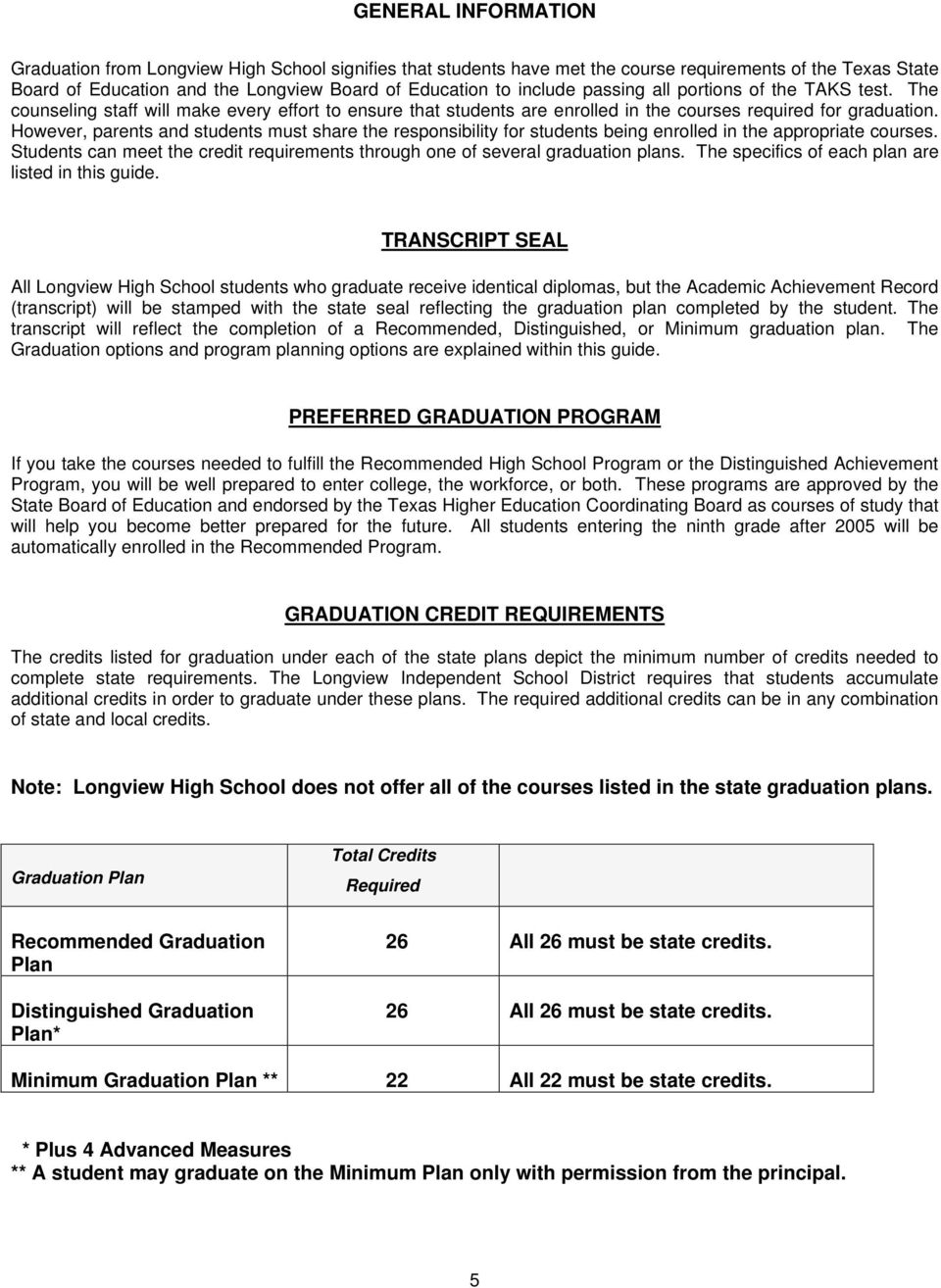
9 SUBJECT AREA ENGLISH STATE BOARD OF EDUCATION RECOMMENDED PROGRAM 4 credits English I, II, III, IV DISTINGUISHED ACHIEVEMENT PROGRAM* 4 credits English I, II, III, IV MATH English I and II for Speakers of Other Languages may be substituted for English I and II only for immigrant students with limited English proficiency. 4 credits: Must include Algebra I, Geometry, Algebra II English I and II for Speakers of Other Languages may be substituted for English I and II only for immigrant students with limited English proficiency. 4 credits: Must include Algebra I, Geometry, Algebra II SCIENCE 4 credits: Must include Biology, Chemistry, and Physics or Integrated Physics and Chemistry (IPC), Biology, and Chemistry or IPC, Biology, Physics, and Lab Science. 4 credits: Must include Biology, Chemistry, and Physics or Integrated Physics and Chemistry (IPC), Biology, and Chemistry or IPC, Biology, Physics, and Lab Science. SOCIAL STUDIES 3 ½ credits World Geography, World History, US History, U.S. Government 3 ½ credits World Geography, World History, U.S. History, U.S. Government ECONOMICS ½ Credit ½ Credit FOREIGN LANGUAGE PHYSICAL EDUCATION 2 credits Any 2 levels of the same language. 3 credits Any 3 levels of the same language. ** ** May include Foundations of Personal Fitness, May include Foundations of Personal Adventure/Outdoor Education, Aerobic Fitness, Adventure/Outdoor Education, Activities, Aerobic Activities, and Team or Individual and Team or Individual Sports. Sports. (Limit 2 credits) (Limit 2 credits) Can substitute: Drill team, marching band, Can substitute: Drill team, marching band, cheerleading, ROTC, athletics, approved privat cheerleading, ROTC, athletics, approved programs. private programs. SPEECH FINE ARTS ½ credit Communication Applications or Professional Communications in the same course Art, Music, Theatre, Dance, Elements of Floral Design ELECTIVES 5 ½ credits 4 ½ credits ½ credit Communication Applications or Professional Communications in the same course Art, Music, Theater, Dance, Elements of Floral Design SPECIALIZATION COMPONENTS In addition to the required credits, students must also complete 4 advanced measures For the Distinguished Achievement Program. TOTAL 26 CREDITS 26 CREDITS 6
10 GRADUATION REQUIREMENTS Note: The College Board Advanced Placement courses and Pre-AP courses may be substituted for requirements in appropriate areas. * If Algebra I is taken in 8 th grade, it must be recorded on the transcript. Three years of math must be completed in 9 th 12 th grade. ** Students who take marching band, upon successful completion of the fall semester, will receive a waiver of the physical education requirement. Athletics, Cheerleading, Drill Team, ROTC, taken in either fall or spring semester may substitute for the physical education requirement. All students are required to complete of physical education for graduation. Students may earn no more than 2 credits toward state graduation requirements in physical education. All physical education credits i.e. Athletics, Drill Team, Cheerleading, beyond these 2 credits must receive local credit only. In addition to credit requirements students must show mastery on ALL state EXIT LEVEL TESTS. Beginning with the freshmen in the Fall of 2011, students will be required to pass a series of EOC (End of Course) exams to meet graduation requirements. These tests are administered in the four core areas English, math, science, and social studies. 7

11 DISTINGUISHED ACHIEVEMENT PROGRAM Purpose: The Distinguished Achievement Program recognizes students who demonstrate levels of performance equivalent to that of college students or work done by professionals in the arts, sciences, business, industry, or in community service. Student performance on advanced measures, other than Advanced Placement tests, may be assessed through an external review process. Traditionally, LHS students have completed their advanced measures with Advanced Placement tests and dual credit classes. Students must obtain approval from their academic counselor prior to pursuing credits for college courses, products of professional quality, or original research/projects. Documentation of completion of the four advanced measures even if this documentation is received after graduation (in the case of AP scores) must be provided. Requirements: Distinguished Achievement Program (26 credits+ 4 Advanced Measures) A student must achieve any combination of four of the following prior to graduation: Test data: A score of three or above on a College Board Advanced Placement examination; A score of four or above on an International Baccalaureate examination; A score on the Preliminary Scholastic Assessment Test (PSAT) that qualifies a student for recognition as a Commended Scholar or higher by the National Merit Scholarship Corporation; as part of the National Hispanic Scholar Program of the College Board; or as part of the National Achievement Scholarship Program for Outstanding Negro Students of the National Merit Scholarship Corporation. The PSAT Score may count as only one advanced measure regardless of the number of honors received by the student. College courses: A grade of 3.0 or higher in a college academic course or a tech-prep articulated college course that is more advanced than any course offered by Longview ISD. Prior approval is required for this category. Original research/project (no more than two of the four advanced measures): Individual product of professional quality as judged by a panel of professionals in the field that is the focus of the project. Students are limited to one advanced measure (individual product) from this category. Prior approval is required for this category. Approved Individual Products/Original Research Projects Award winning Science Fair Projects approved through Longview ISD Science Department Mentor based projects completed through approved mentor courses. Students must be enrolled in an approved course or under the supervision of a Longview ISD teacher to complete an advanced measure in this category. External evaluation of a project must be maintained in the student s cumulative folder and documented on the student s permanent record card. The project must be related to the required curriculum set forth in 19 TAC 74.1 (relating to Essential Knowledge and Skills) and may not be used for more than two of the four advanced measures. 8

12 COLLEGE AND CAREER PLANNING CAREER PLANNING LHS COLLEGE AND CAREER CENTER 9
13 COLLEGE AND CAREER PLANNING TIMETABLE FOR COLLEGE AND CAREER PLANNING FRESHMEN Consider the results of your middle school interest inventory as you make plans for high school. Plan a realistic high school program to meet your needs and future plans. Become aware of vocational and career opportunities. Get to know your high school counselor. Become familiar with requirements of colleges and programs that interest you. Become involved and keep a record of school activities. Make the best grades you can. Attend the College/Career night at Maude Cobb Activity Center. Strive to be a Globe Scholar/Texas Scholar and to graduate on the Distinguished Achievement Program. Choose classes carefully for the sophomore year. SOPHOMORES Plan a realistic program to meet your needs and future plans. Become familiar with the materials and assistance available in the Guidance Office. Start to visit college campuses. Investigate the vocational programs available through your local and area schools. Attend the College/Career Night at Maude Cobb Activity Center. Continue making good grades. Take the PSAT/NMSQT in October. Strive to be a Globe Scholar/Texas Scholar and to graduate on the Advanced or Honors Program. Choose classes carefully for the junior year. JUNIORS Take the PSAT/NMSQT in October. Research college and vocational opportunities. Attend seminars and meetings with college and career representatives who visit Longview High School. Visit colleges or technical schools. Plan to take the SAT or ACT in the spring of your junior year. Continue to perform at your highest level of academic achievement. Continue a thorough self-evaluation of your abilities, interests, and future goals. Discuss educational plans with your parents, teachers, and counselor. Continue to participate in school activities. Make a list of college features that suit your interests, needs, preferences, and abilities. Start to evaluate colleges and to select those that interest you. Request college catalogs, scholarships, financial aid, and housing information. Attend the College/Career Night at Maude Cobb Activity Center. Investigate scholarship and financial aid opportunities. Choose classes carefully for the senior year. SENIORS Check to see that all graduation requirements are being met. Continue to take a full load of classes. Continue seeking vocational and career information. Apply for scholarships and financial aid. Be aware of test registration dates. Take SAT, ACT, THEA, or Accuplacer college entrance examinations early. Submit college and financial aid applications. Attend the College/Career Night at Maude Cobb Activity Center. Make dormitory or other housing arrangements. Request that transcripts be mailed to the colleges to which you have applied. Attend seminars held by college representatives and career people. Notify colleges of your decision once an offer has been made. Continue to perform at your highest level of academic achievement. Request final transcript be mailed to the college or university you plan to attend. Take the THEA, if necessary. 10

14 CAREER PLANNING CHOICES The choices you make during high school will affect the choices available to you during the rest of your life. College, post-secondary education, technology training, military service, and vocational education can open up a world of opportunity for you. Set a goal now to attend college (education beyond high school) and you will be more focused on what you need to accomplish now and in the future. Why should college be your goal? A college education is an investment in your future. It can provide you with opportunities such as: 1. More job opportunities: The world is changing rapidly! Many jobs rely on new technology. In your working life more and more jobs will require education beyond high school. With advanced training, the world is full of opportunities. You will have more choices about the career you pursue. You will also have the ability to change jobs or careers easier later in life. 2. More money: People who go to college generally earn more than people who don t. If you take a look at what you could earn over a lifetime, you will see just how big the income gap is. Information compiled during the 2000 Census indicates an individual with a high school diploma can expect to make $1.2 million over his/her working life, while a college graduate can expect to earn $2.1 million working full-time between ages 25 and 64. An individual with a master s degree is projected to earn $2.5 million, while someone with a professional degree, such as a doctor or lawyer could make up to $4.4 million (2000, U.S. Census Bureau, Lifetime Earnings). 3. Greater knowledge and potential: Advanced training can increase your ability to make wise decisions, to think critically, to explore your interests, consider lifelong goals, and assist your family. LHS COLLEGE & CAREER CENTER The College and Career Center is an excellent resource for researching career fields and planning for post-secondary education. The library site on our web page has Career Cruising, COIN and Bridges.com for your use. These are career guidance programs that will help you discover your interests, and help you learn about careers, occupations, colleges, scholarships, financial aid, career planning and more. 11

15 COLLEGE PLANNING/FINANCIAL AID WEBSITES The Internet can help you in nearly every par of the college search, college admission, financial aid and scholarship search experience. Use search engines wisely and you could save lots of time. For example: You could type in college admissions and get a list of thousands of sights. But it would be better to have a good idea of what you re looking for: lists of college home pages, scholarships, financial aid help college comparisons, Rice University, tips on essays, best colleges in Texas, etc. ACT website Any College.Net BlackExcel:College Help Network CareerShip College Answer College Board Online(SAT Test) or College Express CollegeData.com College Net College Quest College View Compendium of Texas Colleges & Financial Aid Calendar ecampustours.com ETS Net FASTWEB Scholarship Search Financial Aid Need Estimator Financial Aid The Smart Student Free Application for Federal Student Aid Kilgore College National Association for College Admission Counseling National Collegiate Athletic Assn. (NCAA) Minority On-Line Information Service(MOLIS) MyCollegeOptions.com Petersons Education Center Princeton Review Sallie Mae s On-line Scholarship Service Scholarship Resource Network Texas Common Application or all purposes except eligibility. ExPAN Scholarship Service LHS GUIDANCE WEBSITE 12

16 SCHEDULE CHANGES GENERAL INFORMATION PERMISSIBLE CHANGES GENERAL INFORMATION It is extremely important for all Longview High School students to carefully select their courses for the next school year. Students will be held to those classes selected on their course selection sheet in the spring for next year scheduling. A student who drops a class after the fourth week of the first six-week period of a semester will receive a No Credit (NC) for the semester in the entering class. An attendance committee cannot restore credit in this class. Students who are considering enrolling in Advanced, Pre-AP or AP classes should be aware of prerequisite and recommendations for these classes prior to the class selection. Students who drop an honors class prior to the end of the semester will lose all weighted grade points associated with the honors class. PERMISSIBLE SCHEDULE CHANGES The following are acceptable reasons for schedule change requests: Student placed in a class by data entry error Student has credit for the course in which he is enrolled Student is not appropriately prepared for the course ARD Committee decision Cooperative student does not have a job placement Student has failed the course under the same teacher, and another teacher is available A conflict exists between a student and teacher that cannot be resolved Note: By University Interscholastic League (UIL) rule, a student participating in an extracurricular activity who drops a class with a failing grade will become ineligible at the end of the grading period for the duration of the next grading period. 13

17 GRADE RELATED ISSUES CLASS RANK HONOR COURSE INFORMATION HONOR ROLL NATIONAL HONOR SOCIETY HONOR COURSES ACCREDITED PRIVATE SCHOOLS MIDDLE SCHOOLS COURSES GRADES FOR NEW STUDENTS RECLASSIFICATION REQUIREMENTS EARLY GRADUATION 14
18 CLASS RANK The purpose of the class ranking policy is to increase the percentage of students attempting and completing rigorous academic courses in order to successfully prepare students for college or a career. Class ranking shall be determined by dividing the number of accumulated grade points for all four years of high school by the number of courses for which final semester grades were earned. The final class ranking shall be determined at the end of the dual credit college semester during May. This calculation shall be conducted in the same manner for all students graduating, with no distinction between four-year and three-year graduates. All courses shall carry grade points and be included in the calculation for class ranking except for the following: correspondence courses; credit-by-examination, with or without prior instruction; credit recovery courses; pass/fail courses; courses taken in middle or junior high school; credit for courses not recognized by TEA; and credit awarded in a non-accredited instructional setting. If a student retakes a class for which he/she has already received state credit, the student will receive no additional grade points. Audited classes do not receive grade points. A student s class rank is determined by the following procedures: The semester numerical grade given in each class is converted to a point factor. Multiply the point factor times the course attempted to determine a weighted grade point. Add the weighted grade points. Add the number of courses that the student attempted. The total weighted grade points are divided by the total number of courses attempted and rounded off to four places. The student s total is ranked from the highest to the lowest and compared to all other students at the same grade level. The student with the highest weighted grade point average is ranked first in the class. HONOR COURSE INFORMATION Honor courses at Longview High School place greater emphasis on higher-level thinking skills, cognitive concepts and processes, and problem solving skills. Self-discipline, determination, and maturity are essential for success in honors classes. The decision to take an honors course should be made by the student with the advice and consent of parents, appropriate teachers, and counselors. The goal is a confident command of knowledge and skills at the appropriate level for each student. Taking courses that are above or below that level can be detrimental to the student's educational progress. Advanced Placement courses are college courses for secondary students that are taken on the high school campus and are designed to prepare students to take an advanced placement exam in a specific subject area in May of their junior or senior year. Recommendations for honors courses serve as a guide to help students and parents determine the student's ability to be successful in honors classes. Students taking honors classes should meet the following expectations: Passed all subsections of the appropriate state TAKS test or EOC (End of Course) test. Met the minimum recommended grade average and prerequisite course(s). Have a genuine desire to learn the material and a very strong commitment to the strenuous workload associated with honors classes. Note: Homework Students should endeavor to take as many honors courses as they are personally able to handle without overworking. Students who start on homework by 6:00 p.m. (Sunday- Thursday) and are consistently working past midnight to complete the work may be enrolled in too many honors classes. Since AP courses are college classes taken on a high school campus, parents and students must expect a workload, pace, and difficulty level equivalent to that experienced in college. 15

19 CLASS RANKING The purpose of the class ranking policy is to increase the percentage of students attempting and completing rigorous academic courses in order to successfully prepare students for college or a career. Effective January 12, 2009, grade points will be assigned to the grades earned based on the following scale (if the grade was a 100): International Baccalaureate and Advanced Placement 5.5 PreAP/International Scholars/Dual Credit 5.0 Advanced Courses/Honors Courses/Global High Courses 4.5 Regular 4.0 Modified 3.0 HONOR ROLL Honor Roll (3.0 grade point average) and Honor Roll with Distinction (3.5 grade point average) are based on the weighted grade point system. Since weighted grade points are not rounded off for the honor roll, students must have a weighted grade point average greater than 2.99 in order to make the honor roll. Students must pass a class in order to earn weighted grade points in that class. NATIONAL HONOR SOCIETY Membership in the National Honor Society signifies high standards of scholarship, service, leadership, character, and citizenship. Students selected for the National Honor Society must have a minimum cumulative grade point average of at least 3.5 after the fall semester of their sophomore year. Students who do not qualify for induction during the sophomore year may be inducted during their junior or senior year if they meet the requirements. Students who qualify are inducted during the spring semester. HONOR COURSES ADVANCED COURSE LISTING Advanced Accounting II Advanced Anatomy and Physiology of the Human System Advanced Band IV Advanced Business Information Management II Advanced Concert Choir IV Advanced Debate III Health Science Practicum in Health Science I and II Advanced Instrumental Ensemble IV Advanced String Orchestra IV Advanced Technical Theatre IV Advanced Theatre Arts IV Advanced Theatre Production IV Advanced Vocal Ensemble IV Creative and Imaginative Writing Independent Study in English - Academic Decathlon Independent Study in Math - UIL Independent Study in Speech - UIL Honors World History All Project Lead the Way Classes 16

20 PRE-AP COURSE LISTING (Pre-AP) Algebra I (Pre-AP) Algebra II (Pre-AP) Art I (Pre-AP) Studio Art (Pre-AP) Biology (Pre-AP) Computer Science (Pre-AP) Chemistry (Pre-AP) English I (Pre-AP) English II (Pre-AP) French Language III (Pre-AP) Geometry (Pre-AP) Integrated Physics and Chemistry (Pre-AP) Physics (Pre-AP) Pre-Calculus (Pre-AP) Spanish Language III (Pre-AP) World Geography AP COURSE LISTING AP Art History AP Biology AP Calculus AB AP Calculus BC AP Chemistry AP Computer Science A AP Computer Science AB AP Economics AP English Language and Composition AP English Literature and Composition AP Environmental Science AP European History AP French Language AP French Literature AP Human Geography AP Latin Literature AP Latin Vergil AP Physics C: Mechanics AP Psychology AP Spanish Language AP Spanish Literature AP Statistics AP Studio Art AP United States Government and Politics AP United States History AP World History GLOBAL HIGH SCHOOL COURSE LISTING Global English I Global English II Global English III Global Algebra I Global Geometry Global Algebra II Global Pre-Calculus Global Biology Global Chemistry Global Physics Global World Geography Global World History Global U. S. History from Reconstruction Engineering Project Lead the Way Principles of Engineering Robotics and Automation Principles of Information Technology ACCREDITED PRIVATE SCHOOLS For the purposes of this policy, "accredited" shall be defined as accreditation by TEA, an equivalent agency from another state, or an accrediting association recognized by the Commissioner of Education. The district shall accept all credits earned toward state graduation requirements by students in accredited Texas school districts, including credits earned in accredited summer school programs. Credits earned in local credit courses may be transferred at the District s discretion. MIDDLE SCHOOL COURSES The courses listed below, when taught at the middle school level, using high school Texas Essential Knowledge and Skills (TEKS) count for high school credit and meet high school 17

21 requirements for graduation. Middle school courses designated for high school credit on an official transcript from an accredited school will be accepted for credit. Classes taken at the middle school are for credit only and do not count toward class rank, grade point averages (GPA), or eligibility for the National Honor Society. Only the following courses are considered for high school credit: Algebra I Geometry Art I Health Touch System Data Entry Students may take Spanish in middle school, but this class does not count for high school credit. Students may test through Region VII in the summer for credit to be placed in the next level but these tests do not count in the high school class rank. Students who have received high school credit for courses taken at a middle school but feel that they need additional instruction may choose to repeat the course at Longview High School for local credit only. These classes are exempt from class rank. GRADES FOR NEW STUDENTS Students who enroll without current grades are initially given either a NG or a NS for incoming grades. NS stands for New Student. If a student enrolls after a six weeks is completed and does not present official grades from the transferring school, the Registrar enters NS for that six weeks until grade information is received. If the student has a six weeks grade for a scheduled class, the Registrar will enter that grade into Grade Reporting and inform the teacher. If the student was not ever in a scheduled class, the Registrar will change the NS to NG at that time and inform the teacher. NG stands for No Grade. When a student is scheduled into a class in which he has never been enrolled (which means there will be no entry or six weeks grade from the previous school), that student will be given NG for that six weeks by the Registrar. In order for the student to receive credit for that class, he/she must make up that six weeks work to the satisfaction of the teacher. At that time, the teacher will complete a Grade Change form to change the NG to the appropriate numerical grade. RECLASSIFICATION REQUIREMENTS A student must have earned the following Number of credits at the beginning of the school year to be reclassified to a higher-grade level. A student who will reclassify as a senior must meet the additional requirement of having received a grade in both the first and second semesters of English III. Sophomore 6 Junior 12 Senior 18 State Credits 18
22 EARLY GRADUATION Students who want to graduate in less than four years from their entry into the ninth grade must meet the following conditions: The parent(s) or legal guardian(s) must declare in writing by the end of the second semester of the student s sophomore year to the school principal the student s intent to graduate early. The principal must sign in writing permission for the student to graduate early. All state and local requirements must be met for the current graduating class. The principal must give permission to the student to take two English classes concurrently. When two English classes are taken concurrently, only one may be an AP class. 19
23 NON-TRADITIONAL CREDIT DUAL CREDIT HOME SCHOOLING TESTING OUT OF A COURSE ALTERNATE CREDIT SOURCES 20
24 TECHNICAL DUAL CREDIT COURSE LISTING Courses Taught for Technical Dual Credit: College Welding I College Welding II College Auto Technician I College Auto Technician II Course Name College Precision Metal Manufacturing (Machine Shop) College Computer Aided Drafting Manufacturing Engineering (Process Technology) College Medical Terminology COURSES THAT COUNT FOR HIGH SCHOOL AND COLLEGE CREDIT Longview High School offers students an opportunity to earn high school and college credit at the same time. Students may take dual credit courses in the following ways: Students will enroll in a course at a college for both high school and college credit. 1. Students in certain Career and Technology courses may take the class at Longview High School and receive high school credit and college credit from Kilgore College. Students must pass TAKS and take and pass an entrance test which has a fee that must be paid by the student (approximately $30). Students may be granted permission to take approved courses at a local college to fulfill units for high school graduation and gain college credit. The following provisions apply: Students make application to enroll in a course for dual-credit through a written request. The course may be taken concurrently with high school courses or during the summer or evening. Students must be enrolled in five class periods per day at Longview High School during the regular school year. Students must enroll on line with the college. College courses to be taken must be listed on the Dual Credit Request form. The appropriate Longview High School counselor will list the courses for which the student will be granted credit at Longview High School. The student s parent/guardian must sign the form. Courses will be approved on the basis of meeting state content standards (TEKS). Career and Technology courses must teach both the TEKS (high school state required curriculum) and WECM (college requirements) for the student to receive dual credit. Credit for successfully completed college courses shall be earned in one-half to one-unit increments. The student incurs all costs associated with taking the college course and provides the registrar s office with an official college transcript showing the numerical grade received. The grade must be a minimum of "70" to qualify for high school credit. The student must be present at school during the attendance accounting (second) period. 21
25 HOME SCHOOLING Home schooling is not a program supervised by the Longview Independent School District. Students entering Longview High School from non-accredited public, private, or parochial schools, including home schools, shall be placed initially at the discretion of the principal and will be given credit only for courses that the students have passed at an accredited institution. Students and parents may be given a contract with Longview High School stating that credits for home schooled classes may be granted when a student passes the next level classes and all portions of the TAKS test. Students also may make up additional credits by taking credit by examinations. TESTING OUT OF A COURSE (Student has never taken the course) CREDIT BY ACCELERATION Students who would like to test out of a course for which they have not received prior instruction may request an examination for acceleration. The tests are organized to cover a semester of work, and students may take two tests on one day. Students are not limited in the number of courses for which they can test and receive credit. Students who make a score of 90 or above on an examination for acceleration will be awarded credit for the course and will not be allowed to enroll in the class for credit at Longview High School. Students may choose to test on any of six testing dates but are required to register with the appropriate counselor 30 days prior to the testing date. Scores achieved through examination for acceleration do not count on class rank. There is no charge for this service. The parent and student will be required to sign an agreement stipulating the conditions under which the student may take an exam(s) for acceleration and the rules governing the awarding of credit. Region VII will offer the examinations for Accelerations on the following date: TESTING DATES - SUMMER 2012 Dates Place Time June Region VII ESC 8:30 a.m. 1:00 p.m., 1:30 p.m. 5:00 p.m. July Region VII ESC 8:30 a.m. 1:00 p.m., 1:30 p.m. 5:00 p.m. 22
26 COURSES FOR WHICH TESTS ARE AVAILABLE Algebra I 1 st Semester Algebra I 2 nd Semester Algebra 2 1 st Semester Algebra 2 2 nd Semester Business Computer Information Systems -1 st Semester Business Computer Information Systems - 2 nd Semester Biology 1 st Semester Biology 2 nd Semester Computer Science 1 C++ Computer Science 2 C++ Computer Science 1 Pascal Computer Science 2 Pascal Economics with Emphasis on the Free Enterprise System and Its Benefits English I 1 st Semester English I 2 nd Semester English 2 1 st Semester English 2 2 nd Semester English 3 1 st Semester English 3 2 nd Semester English 4 1 st Semester English 4 2 nd Semester French 1 1 st Semester French 1 2 nd Semester French 2 1 st Semester French 2 2 nd Semester Geometry 1 st Semester Geometry 2 nd Semester German 1 1 st Semester German 1 2 nd Semester German 2 1 st Semester German 2 2 nd Semester Health 1 Individual and Family Life Integrated Physics and Chemistry 1 st Semester Integrated Physics and Chemistry 2 nd Semester Foundations of Personal Fitness Precalculus 1 st Semester Precalculus 2 nd Semester Spanish 1 1 st Semester Spanish 1 2 nd Semester Spanish 2 1 st Semester Spanish 2 2 nd Semester Spanish 3 1 st Semester Spanish 3 2 nd Semester U.S. Government U.S. History Studies Since Reconstruction, 1 st Semester U.S. History Studies Since Reconstruction 2 nd Semester World Geography Studies 1 st Semester World Geography Studies 2 nd Semester World History Studies 1 st Semester World History Studies 2nd Semester 23
27 (Student has previously taken the course.) CREDIT BY EXAMINATION Students may use credit by examination to demonstrate mastery in any academic course with prior approval of the principal. The examinations used to earn credit under this policy will assess the student s mastery of the Texas Essential Knowledge and Skills (TEKS). A student must have had prior instruction as determined on review of the student s educational records. In addition, the student shall have received a course grade of at least 60 in order to use credit by examination to make up a failing course grade. Students must make a score of 70 or above on the exam to receive credit for the course. Applications for credit by exam are to be made through the appropriate counselor. Credit-by-exam scores do not count toward class rank, and students are liable for any fees incurred. OTHER ALTERNATE CREDIT SOURCES: CREDIT BY CORRESPONDENCE COURSE A student may take a correspondence course to earn credit in any state-approved course for which a correspondence course is offered. We currently recognize correspondence courses taken through universities approved by the Texas Education Agency. Your counselor will provide specific enrollment information upon request. Students must make a written request to the appropriate counselor to enroll in a correspondence course. Students may earn no more than two credits through correspondence courses. They do not count toward class rank or Honor Roll, and students are liable for any fees incurred. CREDIT RECOVERY The Credit Recovery Program is a part of the dropout prevention at Longview High School. The program is designed to allow students to learn the material and gain credit in a previously taken course in which credit was not earned. Students may not take a class by Credit Recovery if they have excessive absences. The Longview High School Dropout Prevention Coordinator, an assistant principal, counselor, teacher or parent may recommend students for enrollment in the program. Students may request to participate in the program. These classes do not count toward class rank or Honor Roll. SUMMER SCHOOL The Summer School Program at Longview High School. is designed to allow students to learn the material and gain credit in a previously taken course in which credit was not earned or in an enrichment course. The Longview High School counselor must approve a student for enrollment in the program. Students must apply and pay tuition for Summer School programs. These classes do count toward class rank. 24
28 EXTRACURRICULAR ELIGIBILITY GENERAL INFORMATION UIL CREDIT REQUIREMENTS GRADE REQUIREMENTS I GRADES GAINING AND LOSING ELIGIBILITY DROPPING A FAILING CLASS UIL WAIVABLE CLASS LIST 25
29 GENERAL INFORMATION The following requirements are set by the University Interscholastic League (UIL) and/or the Texas Education Agency and apply to both UIL and non-uil extracurricular activities. UIL CREDIT REQUIREMENTS In order to be eligible for UIL activities during the first six-weeks of a school year, students must meet the following requirements. High School year Requirements 1 st year of high school Promoted from 8 th to 9th grade 2 nd year of high school Earned 5 state graduation credits 3 rd year of high school Earned 10 state graduation credits or 5 state graduation credits in the last 12 months 4 th year of high school Earned 15 state graduation credits or 5 state graduation credits in the last 12 months Reclassification requirements are found under Reclassification Requirements. GRADE REQUIREMENTS Students must receive a grade of 70 or above in all non-waivable classes in order to be eligible to participate in extracurricular activities. Note: Students who are given a numerical grade of 69 or below on a teacher s grade sheet in a nonwaivable class are ineligible even if they make up work and receive a passing grade. I GRADES Students receive a numerical grade on their report cards and/or progress reports unless they qualify for an I grade. Students receive an I grade on their report cards and/or progress reports if they have work that has not been turned in due to an absence. Students who have an I grade are ineligible. Students become eligible only if work is completed within a specified time and the new grade is 70 or above (60 or above in a waivable class), and all other grades are passing. GAINING AND LOSING ELIGIBILITY Students who pass all courses for the grading period (six-weeks) remain eligible throughout the next six-weeks grading period. Students who were eligible do not lose their eligibility until seven calendar days after the end of a six-week grading period. Ineligible students must wait seven calendar days after a three-week grading period to regain eligibility. Students may regain eligibility an unlimited Number of times during a school year. All students are eligible during a school break of 5 school days or more. (Currently - Thanksgiving, Christmas and Spring Break.) DROPPING A FAILING CLASS Students may not drop a class in which they have a failing average later than the fourth week of the first six-weeks of the school year without the grade being considered failing for eligibility purposes. Students who drop a class with a failing grade after the first six-weeks of the school year come under the following guidelines: Dropping a class with a failing grade during a three-week evaluation period causes the student to lose eligibility until seven calendar days after the end of the next evaluation period. Dropping a class with a failing grade at the end of a grading period causes a student to lose eligibility until seven calendar days after the end of the three week-evaluation period. Note: Eligibility rules are subject to change by the University Interscholastic League. 26
30 UIL WAIVABLE CLASS LIST The classes listed below are designated as waivable. Students who receive a grade between 60 and 69 in these classes will be granted an eligibility waiver for UIL eligibility purposes. Waivers will be given for a six week period. Only 2 six weeks per year may be waived. Note: Students who are given a numerical grade of 59 or below on a teacher s grade sheet in a waivable class are ineligible even if they make up work and receive a passing grade. The following classes are waivable: Advanced Accounting II Advanced Anatomy and Physiology Advanced Band IV Advanced Business Information Management II Advanced Concert Choir IV Advanced Debate III Advanced Practicum in Health Science I Advanced Instrumental Ensemble IV Advanced String Orchestra IV Advanced Technical Theatre IV Advanced Theatre Arts IV Advanced Theatre Production IV Advanced Vocal Ensemble IV Creative and Imaginative Writing Independent Study in English Academic Decathlon Independent Study in Speech -- UIL (Pre-AP) Algebra I (Pre-AP) Algebra II (Pre-AP) Art I (Pre-AP) Art Studio (Pre-AP) Biology (Pre-AP) Computer Science (Pre-AP) Chemistry (Pre-AP) Computer Science (Pre-AP) English I (Pre-AP) English II (Pre-AP) French Language III (Pre-AP) Geometry (Pre-AP) Integrated Physics and Chemistry The following classes will also be waived for UIL eligibility: Dual credit classes Self-paced classes completed online individually by students or outside the traditional school day (Pre-AP) Physics (Pre-AP) PreCalculus (Pre-AP) Spanish Language III (Pre-AP) World Geography AP Art History AP Biology AP Calculus AB AP Calculus BC AP Chemistry AP Computer Science A & AB AP Economics AP English Language and Composition AP English Literature and Composition AP Environmental Science AP European History AP French Language AP French Literature AP Human Geography AP Latin Literature AP Latin Vergil AP Physics C: Mechanics AP Psychology AP Sculpture AP Spanish Language AP Spanish Literature AP Statistics AP Studio Art AP United States Government and Politics AP United States History AP World History Honors World History GLOBAL High English, math, science, and social studies classes International Baccalaureate classes International Scholars classes 27
31 CREATING YOUR SCHEDULE SCHEDULE EXAMPLES COURSE LIST COURSE DESCRIPTIONS 28
32 COURSES APPROVED FOR STATE CREDIT Accounting I Advanced Accounting II Advanced Animal Science Advanced Animation Advanced Architectural Design Advanced Audio/Video Production Advanced Automotive Technology Advanced Plant and Soil Science Advanced Welding Adventure/Outdoor Education Aerobic Activities Aerospace Engineering Agricultural Facilities Design and Fabrication Algebra American Sign Language Advanced Anatomy and Physiology (Honors) Anatomy and Physiology Animation Astronomy Architectural Design Art Art History Athletics (1 st two years) Audio/Video Production Audio/Video Production Studio Auditory Hearing Education Band Baseball Basketball Bible Survey (as literature and history) Biology Business Information Management I Business Information Management II (Honors) Business Law Calculus Capstone (Communication Applications) Ceramics Chemistry Child Development Child Guidance Choral Music Civil Engineering and Architecture College Auto Technician I College Auto Technician II Commercial Photography Communication Applications (Speech) Competition Drill Team (ROTC) College Auto Technology College Computer Aided Drafting College Medical Terminology College Welding I College Welding II Commercial Arts and Design Computer Maintenance Computer Programming (Honors) Computer Science Computer Technician Cosmetology I, II, Lab Creative and Imaginative Writing Cross Country Running Culinary Arts Dance Debate Digital and Interactive Media Digital Electronics Career Preparation I Career Preparation II Economics Energy, Power, and Transportation Systems Engineering Design and Development Engineering Design Process and Presentation English Language Arts English Language Arts SOL Entrepreneurship Environmental Science Environmental Systems Equine Science European History Fashion Design Fashion Marketing Football Foundations of Personal Fitness French Geology Geometry Golf Health Health Science Horticulture Sciences Hospitality Services Human Geography Independent Study in English Academic Decathlon Independent Study in English Library Science Independent Study in Math UIL Independent Study in Speech UIL Competition Individual and Family Health Individual Sports Instructional Practice in Education and Training Instrumental Ensemble Integrated Physics and Chemistry Interior Design Intramural Team Sports Introduction to Engineering Design Journalism Journalism Newspaper Production Journalism Yearbook Production Keyboarding Latin Law Enforcement I Law Enforcement II Livestock Production Manufacturing Engineering (Process Technology) Marketing Dynamics Mathematical Models with Applications Medical Microbiology Mentorship Newspaper Orchestra Pathophysiology Peer Assistance and Leadership Parenting Education for School Age Parents I & II Personal Fitness (Advanced) Physical Education (1 st year and-ahalf) Physics Practical Writing Skills Practicum in Architectural Design Practicum in Culinary Arts I, II Practicum in Education and Training Practicum in Health Science Practicum in Hospitality and Tourism Practicum in Law, Public Safety, Corrections and Security Practicum in Marketing Dynamics Practicum in Metal Manufacturing (Machine Shop) PreCalculus Principles and Elements of Floral Design Principles of Agriculture, Food and Natural Resources Principles of Architecture and Construction Principles of Arts, A/V Technology and Communication Principles of Business, Marketing and Finance Principles of Education and Training Principles of Engineering Principles of Health Science Principles of Hospitality and Tourism Marketing Principles of Human Services Principles of Information Technology Principles of Law, Public Safety, Corrections and Security Principles of Manufacturing Principles of Transportation, Distribution and Logistics Psychology Reading Reading SOL Robotics and Automation ROTC SAT Score Improvement 29
33 Scientific Research and Design Sculpture Soccer Sociology Softball Spanish Special Education Academics Sports and Entertainment Marketing Statistics String Orchestra Studio Art Swimming Team Sports Technical Theatre Tennis Theatre Arts Theatre Production Touch System Data Entry Track U. S. Government U. S. History UIL Math Viewette Training Viewettes Vocal Ensemble Volleyball Web Technologies Welding I Wildlife, Fisheries and Ecology Management World Geography World History Yearbook Professional Standards in APPROVED FOR LOCAL CREDIT Agribusiness Management and Marketing Agriculture Mechanics & Metal Technologies Practicum in A/V Production Graphic Design and Illustration Advanced Fashion Design Forensic Science Court Systems and Practices Correctional Services Fashion Marking Professional Communications (speech credit) Athletics after 2 state credits (Local credit) Cheerleaders (½ credit) TAKS Math Office Aide () UIL Math () FINE ARTS COURSES Art Art History Band Ceramics Choir Dance Instrumental Ensemble Orchestra Sculpture Studio Art Technical Theatre Theatre Arts Theatre Production Viewettes (dance credit) Vocal Ensembles COURSES REQUIRING AN APPLICATION Advanced Automotive Technology Cosmetology I & II (Dual Credit) Advanced Journalism Literary magazine (2 Semesters) Analysis of Visual Media College Diesel Technology College Drafting Engineering College Manufacturing Engineering (Process Tech) College Medical Terminology College Welding Career Preparation I & II Practicums in: Architectural Design; Culinary Arts; Education and Training; Health Science; Hospitality Services; Law, Public Safety, Corrections and Security; Marketing Dynamics Technical Theatre Independent Study in PreAP Art Studio, AP Studio Art Independent Study in English Library Science Independent Study in English Literary Magazine Instructional Practice in Education and Training Journalism: Newspaper Production Journalism: Yearbook Production Office Aide 30
34 ADVANCED PLACEMENT AND PRE-ADVANCED PLACEMENT INFORMATION POLICIES AND GUIDELINES REQUIRED TAKS and EOC TESTS AP COURSE CONTRACT 31
35 AP/PreAP Guidelines 1. All students registering for an AP class for the school year must complete the AP contract for each AP class scheduled. Both the student and the student s parent/guardian must sign the contract (page 33). 2. Students wishing to drop an AP or PreAP class may drop the class only at the following times: a. end of first two weeks b. end of the first semester 3. Should a student fail for the first semester of a PreAP or AP class, a committee will meet to determine the best course of study for the student in the second semester. The committee will include the teacher, Dean of Instruction, parent, and counselor. 4. All grades earned in the AP or PreAP class will follow the student to the regular class, including summer reading grades if applicable. 5. If a student wishes to enroll in more than four AP classes in one year, that student must meet with a faculty advisory committee to discuss the academic rigor of the schedule. 6. The expectation for enrollment in an AP class is that the student will take the AP examination for the class which will be administered during the May testing administration. 7. Due the academic rigor of AP and PreAP classes, students must pass the appropriate TAKS test the year before enrolling in the AP or PreAP class. Because TAKS scores are not received prior to the spring registration process, students will be allowed to register for the desired AP or PreAP class for the next fall; however, should the student not pass the required TAKS test, that student s schedule will be changed to a regular class during the summer. If a student s schedule has to be changed, he/she will be notified in writing during the summer of the change. 8. Summer reading assessments for ELA will be administered during August prior to the beginning of school. Students not demonstrating mastery on summer reading assessments will be enrolled in regular English classes for the school year. Required TAKS/EOC Tests for PreAP/AP Classes AP Art History ELA TAKS or EOC AP U. S. History ELA TAKS or EOC AP Studio Art (2D, 3D) None required AP European History ELA TAKS or EOC AP English III ELA TAKS or EOC AP Biology ELA TAKS or EOC AP Comp. Science Math TAKS or EOC AP Physics ELA TAKS or EOC AP French None required AP U. S. Govt. ELA TAKS or EOC AP Statistics Math TAKS or EOC AP Chemistry Math TAKS or EOC AP Span. Lang. None required AP Psychology ELA TAKS or EOC AP Calculus AB/BC Math TAKS or EOC AP Economics ELA TAKS or EOC AP World History ELA TAKS or EOC AP Latin None required AP English IV ELA TAKS or EOC PreAP Precalculus Math TAKS or EOC PreAP English I, II ELA EOC PreAP Physics Math TAKS or EOC PreAP Algebra I Math EOC PreAP Biology 8 th Grade Science EOC PreAP Geometry Math EOC PreAP Chemistry Math TAKS PreAP Algebra II Math TAKS pt ROV PreAP World Geo. 8 th Grade ELA EOC 32
36 Course: Longview High School AP Course Contract College Board Advanced Placement courses provide college level studies for high school students who desire and are ready to do college level work. These students demonstrate a strong curiosity about the subject and a willingness to complete hard work. AP courses are taught using college level materials and strategies that will prepare students to take the College Board Advanced Placement Examinations in May. Because of the intensity of AP college classes, students should expect the pace and academic rigor of AP classes to be more stringent than regular classes at the same grade level. Typically, successful AP students are task-oriented students as well as being proficient readers who are able to organize their time and who have parent/guardian support. Students who are already overextended with academics or extracurricular activities should seriously consider whether they have the time to devote to an AP class and/or the number of AP classes in which they enroll. Outside study time is generally at least one to two times the amount of time spent in class per week. Students must have passed the appropriate TAKS test during the year prior to registering for an AP class. Because the TAKS test scores will not be available until after registration is completed, the student may be scheduled for the AP course in the spring, but his/her schedule will be changed during the summer should he/she not pass the appropriate TAKS test for the class. The student will be notified in writing should his/her schedule have to be changed because of TAKS scores. Examples: test. AP English III student must have passed the 10 th grade English Language Arts EOC test. AP World History student must have passed the 9 th grade English Language Arts Student, Parent/Guardian, and Teacher Responsibilities: Student: I agree to take full responsibility Parent/ Guardian to show a commitment to academic excellence. to complete summer assignments as required by grade level and content area. to attend class regularly. to do my own work in order to improve my ability to reason, analyze, and understand. to organize my time and study habits to complete successfully the above named AP course. to take the AP exam in May for this course. to confer with the teacher and take immediate action if I begin to fall behind in the course. I agree to be familiar with the above AP course requirements and exit procedures listed below. I agree to help my son/daughter organize study time in support of class assignments. 33
37 I agree to encourage him/her to communicate with the teacher when discipline or curricular questions or concerns arise. If the situation remains unresolved, I will request an appointment with the teacher. I understand that the coursework for AP classes is stringent and that outside study for each class can amount to one to two times actual school class time. I understand that the summer reading assessments for PreAP and AP English classes will be administered during August prior to the start of school. If I do not pass the assessment, I will be enrolled in regular English for that school year. Teacher I agree to teach the above course at a level and pace in accordance with the College Board recommendation and the Longview ISD curriculum document. Student and parent will be advised within the first six weeks if the student s progress is not adequate. Student progress after the first six weeks will be reported with the normal progress and report card cycles. AP Enrollment Students wanting to enroll in more than FOUR AP classes during the same school year must meet with a faculty advisory committee to discuss the academic rigor required. Exit Policy: A student may exit an AP class at the end of the first two weeks or at semester. To drop an AP course, an AP course withdrawal form must be completed, and the parents must attend a parent conference. When a student drops an AP course, all grades earned in that course follow the student to the other course, including the summer reading grades if applicable. Student Signature: Parent Signature: Date: Teacher Signature: The teacher will sign the contract at the beginning of the year, and a copy of this contract will be sent home to the parent. 34
38 Grades 9-10 Grades Course Guide Tomlinson Parkway Longview, TX
39 International Baccalaureate Diploma Programme The International Baccalaureate Diploma Programme is a comprehensive and challenging pre-university course of study that demands the best from both motivated students and teachers. The program responds to the need for greater challenges and pre-university preparation for academically gifted high school students. The program is designed and administered by the International Baccalaureate Organization, a non-profit educational foundation based in Geneva, Switzerland. The sophisticated two-year curriculum covers a wide range of academic subjects and has stood the test of time for over half a million students in 119 countries since The program encompasses internationally-based standards of achievement. Successful completion of the course work and examinations at the junior/senior level may earn college credit or advanced standing at colleges and universities around the world. The curriculum is designed to provide a broad liberal arts experience for the university bound student. Each student will become proficient in language and mathematical studies, the two most important tools of communication and analysis, and participate in an in-depth exploration in the study of learning and the process of educational inquiry. The resulting educational experience will provide the student with a well-rounded, high academic course of study emphasizing the development of the total individual. Participation in the International Baccalaureate Diploma Programme at Longview High School may begin in the (International Scholars) classes at the freshman/sophomore levels. Students may apply for the (International Scholars) designation during the sixth, seventh, eighth, ninth, or tenth grade years. For students in the Longview Independent School District, application and acceptance to the International Baccalaureate Diploma Programme must occur prior to the Friday prior to the Spring Break vacation of the student s tenth grade/sophomore year. For students transferring into the Longview Independent School District, application and acceptance must occur prior to September 30 th of the student s eleventh grade/junior year. Students transferring from an authorized International Baccalaureate Diploma Programme may enter the program at Longview High School at any time during the eleventh grade/junior year or twelfth grade/senior year. The International Baccalaureate Diploma Programme is for accepted students during their eleventh grade/junior year and twelfth grade/senior year with international exams possible at the end of each year. The final result is a disciplined student who is ready for the challenges of a university and beyond. 36
40 GENERAL INFORMATION The Longview Independent School District (International Scholars) and International Baccalaureate Diploma Programme is immersed in the total program at Longview High School. Longview High School is the traditional high school for the city of Longview, Texas with many of the civic leaders of this community being Longview High School alumni. The approximately 2,000 students represent a true cross-section of the community, with students of all ethnic backgrounds, socioeconomic status, and aptitudes. The Longview High School faculty, many of whom were recruited specifically for the International Baccalaureate Diploma Programme, represents a talented, dedicated group of respected educators. Additionally, the student body is well known as being friendly and accomplished. Over fifty clubs/organizations supplement the extensive course offerings and provide a positive social and academic environment for all students. Patrons and parents are always welcome to visit Longview High School and/or take an active role in any of the many programs on the campus. For further information, contact: Mr. James Brewer (Assistant Superintendent) Ms. Linda Buie (International Baccalaureate Head of School) Ms. Margaret Davis (International Baccalaureate Coordinator) Ms. Vickie Spearman (International Baccalaureate Counselor) Fax: Longview High School 201 Tomlinson Parkway Longview TX INTERNATIONAL BACCALAUREATE ORGANIZATION HEADQUARTERS ORGANIZATION DE BACCALAUREATE INTERNATIONAL Route des Morillons 15 CH-1218 Grand-Saconnex/Geneva Switzerland CURRICULUM AND ASSESSMENT CENTRE International Baccalaureate Organization Peterson House Fortran Road ST. Mellons Cardiff CF3 OLT Wales United Kingdom INTERNATIONAL BACCALAUREATE AMERICAS 475 Riverside Drive, 16 th floor New York, New York [email protected] 37
41 PROGRAM OVERVIEW THE ACADEMICALLY GIFTED ARE SERVED AT LONGVIEW HIGH SCHOOL IN A TWO PHASE PROGRAM BEGINNING WITH PARTICIPATION IN THE INTERNATIONAL SCHOLARS (GRADES 9-10) LEADING TOWARD THE INTERNATIONAL BACCALAUREATE DIPLOMA PROGRAMME COURSEWORK (GRADES 11-12). INTERNATIONAL SCHOLARS Students enrolled in the International Scholars (Pre-International Baccalaureate Diploma Program) will address three broad goals in an effort to develop the whole person and prepare the student for the expectations of the International Baccalaureate courses. The broad goals for the International Scholars phase are as follows: 1. to assist students in making cross-discipline connections by identifying universal themes and analyzing relationships between fields of study; 2. to provide an awareness of long-term value in learning by exposing students to various applications of knowledge in the professional world; 3. to encourage students to utilize knowledge by emphasizing thinking, writing, and productions. Students will be provided multiple opportunities to demonstrate comprehension of concepts through non-conventional modes (video productions, plays, speeches, panel discussions, projects, etc.) As much as possible students will participate in field experiences and have the benefit of special guest speakers. INTERNATIONAL BACCALAUREATE DIPLOMA PROGRAMME General Information I. All students will be enrolled as full IB Diploma students at the beginning of the 11 th grade year. II. Students must complete the following steps if at any time they desire to change from an IB diploma student to an IB Certificate students: A. Show evidence that the student has attended tutorials and worked with the teacher for assistance before requesting permission from the IB administration to change to IB certificates. B. Prior to dropping the Diploma status, a student should schedule conference with the IB Coordinator and Head of School to discuss options for assistance. Only when all options have been pursued, may the student, with parent or guardian present, meet with the IB Coordinator and IB Head of School to request permission to change to IB certificates. III. Student who is granted permission to pursue IB certificates will be dropped from the Theory of Knowledge (TOK) class at the end of the current semester. This is a rule of the International Baccalaureate Organization and no exceptions will be granted. All TOK assignments will need to be completed for the current semester prior to schedule change. If the TOK class includes assignments for the Extended Essay, IB Certificate students will be required to complete an inclass alternate assignment. If the student has not previously completed the Texas Education Agency required Speech course, the student will be required to complete a Speech course at Longview High School because the Speech credit embedded in the two year TOK course will not have been earned. IV. When student become IB Certificate candidates, they are no longer required to complete the Creativity-Action-Service (CAS) requirement or the Extended Essay requirement. 38
42 V. Because the Extended Essay replaces the summer reading requirement for the IB English IV class, IB Certificate candidates will complete a summer reading requirement of assigned books. The books will be selected by the IB English IV teacher prior to the end of the school year. The students will keep dialectic journals over the reading assignments, submit the journals to assigned mentors, and meet with the mentors for significant conversations over the reading. The journals will be due on the first day of the student s senior year. The significant conversations will be scheduled by the mentors. Students admitted to the International Baccalaureate Diploma Programme will be encouraged to tailor their course of study based upon their individual interests and unique needs. The attainment of the International Baccalaureate diploma will be received as an outstanding academic achievement recognized for academic credit and advanced standing at colleges and universities around the world. A sample four year plan is found on the following page of this guide. INTERNATIONAL BACCALAUREATE DIPLOMA PROGRAM CANDIDATES The full diploma candidate must design a course of study that will allow the student to successfully complete examinations in each of the following subject areas: Group 1: Language A English Group 2: Language B Spanish, French, or Latin Group 3: Individuals and Societies History of the Americas Group 4: Experimental Sciences Emphasis in Biology, Chemistry, or Physics Group 5: Mathematics Group 6: Fine Arts and Electives Optional choice of emphasis in one of the following areas Computer Studies Design technology Film Music Theory Psychology Second Language B Second science Visual Arts 39
43 Grade English Language B 9 th English I (IS) Spanish I or II (IS) French I (IS) Latin I (IS) Individuals and Societies World Geography (IS) Other including FLEX Period Fine Art PE or Equivalent Elective Science Mathematics Other Other Biology I (IS) Chemistry I (IS) Algebra I (IS) Geometry (IS) Algebra II (IS) 10 th English II (IS) Spanish II or III (IS) World History AP (IS) Chemistry I (IB) Geometry (IS) Fine Art Elective Elective French II (IS) Physics I (IB) Algebra II (IS) 11 th Creativity- Action- Service begins Extended Essay begins English III (IB) Latin II (IS) Spanish III (IB) or Spanish IV (IB) French III(IB) Latin III (IB) History of the Americas I (IB) (with American History credit embedded) Physics I SL (IB) Biology I SL (IB) Biology III HL (IB) Chemistry I SL (IB) Chemistry III HL (IB) PreCal (IS) Math Studies I SL (IB) Mathematics I SL (IB) Mathematics III HL (IB) Visual Arts I SL (IB) Visual Arts III HL (IB) Music Theory I SL (IB) Music Theory III HL (IB) Psychology I SL (IB) Theory of Knowledge (with Speech credit embedded) Theory of Knowledge (IB) (with Extended Essay embedded) Elective s Psychology III HL (IB) Film I SL (IB) 12 th English IV (IB) Spanish IV (IB) or Spanish V (IB) French IV (IB) Latin IV (IB) History of the Americas II (IB) (with Government embedded) Physics II SL (IB) Biology II SL (IB) Biology IV HL (IB) Math Studies II SL (IB) Mathematics II SL (IB) Mathematics IV HL (IB) Film III HL (IB) Visual Arts II SL (IB) Visual Arts IV HL (IB) Music Theory II SL (IB) Theory of Knowledge (IB) (with CAS and other interviews embedded) Elective s Chemistry II SL (IB) Chemistry IV HL (IB) Music Theory IV HL (IB) Psychology II SL (IB) Psychology IV HL (IB) Film II SL (IB) Film IV HL (IB) Additional Texas Graduation Requirements Physical Education 1Credit (9-12) Fine Arts 1 Credit (9-12) Speech.5 Credit (10-12) *Students testing in Biology HL or Chemistry HL will be required to take Physics for graduation. 40
44 Identification By definition of the Texas Education Code, a gifted student is one who performs at or shows the potential for performing at a remarkable high level of accomplishment when compared to others of the same age, experience or environment, and who exhibits high performance capability in an intellectual, creative, or artistic area, possesses an unusual capacity for leadership or excels in a specifice academic field. In order to recognize and provide appropriately differentiated curriculum for its gifted education, the Longview Independent School District has adopted specific guidelines for identifying students for the International Baccalaureate Diploma Programme. Students are recommended for International Baccalaureate placement based upon one the following criteria: Identified Gifted/Talented by the Longview Independent School District Identified as Gifted/Talented by a public or private school and reviewed by the Longview Independent School District International Baccalaureate Committee comprised of the Diploma Programme Head of School, the Longview Independent School District Director of the IB, and the Longview Independent School District Direct of Instruction/GT Duke University Talent Search State Award or Grand Award Recipient 90 th percentile equivalent score prior to August of 11 th grade year on PSAT Criticial Reading, PSAT Mathematics, PSAT Writing, SAT Critical Reading, SAT Mathematics, SAT Writing, ACT Reading, or ACT Mathematics Committee consideration of report card grades of 90% or above in ELA, Math, Science and Social Studies and/or TAKS Scale Score at commended level for Mathematics or Reading for middle school or high school years prior to August of the 11 th grade year IB Admission Procedures For purposes of placement within the Longview Independent School District (International Scholars) (Pre-IB) or the International Baccalaureate Diploma Programme, a student profile is accumulated and evaluated by a committee comprised of campus and central administration representatives on the following criteria: Student application* Student Learner Profile essay Student test scores *Note: All applicants will be accepted as full diploma students. As such, individual circumstances and aptitudes will be considered when building each individual Diploma Programme course sequences and examinations. Timeline For students entering the 11 th grade: Applications by Longview area students must be received at the Longview Independent School District Office of the IB by March 12, For students enrolling in the 11 th grade from a school/district outside the Longview area: Students new to Longview High School must apply to the IB by September 1 st of their 11 th grade year. For students transferring from an authorized IB World School Diploma Programme: Students will be automatically accepted into the Longview High School Diploma Programme upon enrolling at Longview High School. For students entering the 6 th through 10 th grades: Applications are accepted on a rolling basis through the Longview Independent School District Office of the IB. 41
45 Curriculum Diagram Summer requirements for IB Courses will be posted on the LHS website: International Scholars and International Baccalaureate students are responsible for the posted summer assignments. Summer assignments for the International Baccalaureate Diploma Programme courses are aligned to course requirements and are designed to prepare the student for those required course elements. 42
46 Longview High School offers Language A1-English as an International Baccalaureate group 1 subject. The Language A1 program is a literature course studied in the 'first language' of the environment to which the student has been exposed from an early age or for an extended period. The study of literature enables an exploration of one of the fields of human creativity and artistic ingenuity and provides immense opportunities to encourage independent, original, critical, and clear thinking. Additionally, it promotes a healthy respect for the imagination and a perceptive approach to the understanding and interpretation of literary works both oral and written. Summer requirements for IB Courses will be posted on the LHS website: International Scholars and International Baccalaureate students are responsible for the posted summer assignments. Summer assignments for the International Baccalaureate Diploma Programme courses are aligned to course requirements and are designed to prepare the student for those required course elements. ENGLISH LANGUAGE ARTS English I (International Scholars) 9 1 Prerequisite: IB Admission This class is designed for the advanced student who wishes to pursue the critical study of world literature. Students will be expected to perform close, analytical readings of texts representing a variety of cultures, genres, and historical periods, and they will apply interpretive skills to discover how the meaning of texts is informed by the author s use of literary devices, stylistics, and tone. Students will explore such topics as the mythological Hero s Journey, cultural conceptions of good and evil, the complications of love, and consequences of human choices. This course promotes a mastery of a mature, sophisticated writing style and asks that students make effective use of the writing process to address an academic purpose and audience. An important goal of the course is to help prepare students for the rigors of the International Baccalaureate Program. English II (International Scholars) 10 1 Prerequisite: English I (International Scholars) This course extends and refines the literary concepts introduced in (International Scholars) English I, but concentrates on themes which inherently pervade American literature. Since the literary aspect of the course is concerned with many American writings, the study of a variety of themes coincides with a thorough understanding of the development of Western thought from an American artistic, literary, historic, social, and Group 1 philosophical perspective. The emphasis on American literature requires an ability to appreciate the similarities and differences between literary works from different ages and/or cultures. Lessons and assignments will enable students to engage in independent literary criticism in a manner which reveals a personal response to literature. Students will develop an ability to express ideas with clarity, coherence, conciseness, precision, and fluency in both written and oral communication. English III (IB) 11 1 Prerequisite: English II (International Scholars) English III (IB) is an intensive study of primarily world literature both contemporary and classical. IB English involves a formal study of language and composition. Most student assessment will demonstrate the ability to speak and write fluently on a variety of analytical and interpretive topics. One aspect of the IB English program requires students to develop their own topics as they complete one major written and one major oral assignment on the five world literature texts studied. A further expectation is to learn to value the questions, the process, and not just the answer. The IBO Internal Assessment for this course consists of a minute oral presentation which demonstrates a mastery of critical analysis. English IV (IB) 12 1 Prerequisite: English III (IB) English IV (IB) is an extenuation of the English III IB curriculum, completing the two-year course of study during the junior and senior years. A special focus is placed on preparing students to sit for the International IB English assessments during their senior year. Students will attain skills in critical thinking, reading, and writing as they complete their Extended Essays for submission to IB offices and pursue the study of world literature. One aspect of the IB English program requires students to develop their own topics as they complete one major written and one major oral assignment on the five world literature texts studied Students are required to engage in textual commentary on both seen and unseen pieces of literature, and demonstrate critical thinking and analysis, including questioning skills to unravel authorial influence. Students will gain a new awareness of their importance as readers in the literary tradition by learning to question, challenge, and take ownership of texts through active interpretation. The culmination of the international study fosters individuals who are cognitive of, and sensitive to, cultural and philosophical differences which underlie universal truths. 43
47 Other Languages Language B Modern Languages Group 2 Hispanic community. Longview High School offers studies in Spanish, French, and Latin as International Baccalaureate group 2 subjects. The aim of the language program is focused on language acquisition and development in the four primary language skills: listening, speaking, reading and writing. These language skills will be developed through the study and use of a range of written and spoken material. A successful language B student will learn and assimilate basic language structures, develop language usage in a range of situations and purposes for which and in which the language is related, and learn to communicate effectively in a number of situations and within the culture where the target language is spoken. Spanish I (International Scholars) 9 1 Prerequisite: IB Admission The beginning secondary course emphasizes communication, especially listening and speaking skills, in relevant contexts. The course uses the functional approach that relates each grammar point to its function or role in communication. The designation for (International Scholars) is to group potential diploma candidates to provide the best opportunity for oral practice, pace, and commitment to advanced study. This course will allow for a broadened perspective of culture through field experiences, cultural projects, and a major emphasis on grammar. Spanish II (International Scholars) Prerequisite: Spanish I (International Scholars) This course is the continuation of the Spanish program. Using a function-oriented approach combined with a grammar sequence, the course broadens the student's ability to communicate in Spanish in a variety of contexts. Students will increase their knowledge of Hispanic culture, art, and history. The (International Scholars) course will allow for a broadened perspective of culture through field experiences, cultural projects, and major emphasis on grammar. Spanish III (IB) Prerequisite: Spanish II (International Scholars) This is a fast paced, grammar honing and perfecting course, designed to prepare students for the AP and IB tests. While levels 1 & 2 are foundational, Spanish III is the application of previously learned skills, incorporated with new vocabulary in extended situations. This course will be taught almost entirely in Spanish and will assume student proficiency. It will seek to involve students in cultural and social activities of the Spanish IV (IB) Prerequisite: Spanish III (IB) At this level, students will perfect their written skills, become more orally proficient, and continue to be exposed to aspects of Spanish culture. Students will be expected to converse in Spanish. Students will ameliorate previously acquired skills and will gain confidence in their abilities by the end of this course. Students may prepare to sit for the standard IB exam (written and oral components) as this course is taught entirely in Spanish. Spanish V (IB) Prerequisite: Spanish IV (IB) Students will engage in activities on topics prescribed by the IB. These activities will be the basis of the internal oral assessment. Students will work to demonstrate their ability to compose wellconstructed and idiomatic essays and to comment on texts or topics in relation to content and style. Emphasis will continue to be placed on oral fluency and comprehension. Students may prepare to sit for the standard IB exam (written and oral components) as this course is taught entirely in Spanish. French I (International Scholars) 9 1 Prerequisite: IB Admission The beginning course emphasizes communication, especially listening and speaking skills, in relevant contexts. Audio-lingual instruction for beginning students is in the form of dialogue and pattern drill, built around authentic situations of interest and an organized plan of structure presentation. Certain cultural aspects of the French are also studied. French II (International Scholars) Prerequisite: French I (International Scholars) Students continue the study of the language from level one, including listening, speaking, reading and writing skills, as well as a focus on culture. Using a function-oriented approach combined with a grammar sequence, the course broadens the student's ability to communicate in French in a variety of contexts. Students will increase their knowledge of French culture, art, and history and develop an awareness of a culture that is different from their own. French III (IB) Prerequisite: French II (International Scholars) The aims of the foreign language program in the International Baccalaureate include developing students powers of expression in a second language, providing them with an efficient tool for 44
48 the study of other subjects, and bringing them into contact with ways of thought which differ from their own. At the French III level, students will work toward accuracy in the oral and written forms of the language, both in grammatical exercises and in their own written and spoken comments. They will begin to approach a variety of works in French literature, as well as study aspects of the life and civilization of the countries where French is spoken. This course will be taught almost entirely in French and will assume student s proficiency. French IV (IB) Prerequisite: French III (IB) At this level, students will perfect their writing skills, become more orally proficient and continue to be exposed to aspects of French culture. Students will be expected to converse in French and the class will be conducted in French. Students will ameliorate previously acquired skills and will gain confidence in their abilities by the end of this course. Students may prepare to sit for the standard IB exam (written and oral components) as this course is taught entirely in French. French V (IB) Prerequisite: French IV (IB) Students will work to demonstrate their ability to compose well-constructed and idiomatic essays and to comment on texts or topics in relation to content and style. Emphasis will continue to be placed on oral fluency and comprehension. Students will prepare to sit for the standard IB SL exam both written and oral. Classical Languages Longview High School offers classical language- Latin. The aim of Language B Latin introduces students to the language, literature, and culture of ancient Rome. This ancient civilization has played a vital part in shaping many modern societies and cultures. The course will involve studying the historical and cultural development of the Romans and linguistic skills to develop an understanding of the workings of the language. Latin I (International Scholars) 9 1 Prerequisite: IB Admission The beginning course addresses comprehension of the Latin language through reading. Students develop an understanding of the social and political history of the Pompeiians, Roman British, and Alexandrians, especially during the first century A.D. This is a fascinating approach to Latin based upon a continuous story line about historical characters and situations. As a result, students develop comprehension of grammar and sentence patterns as they as they follow the story. Latin II (International Scholars) Prerequisite: Latin I (International Scholars) This course broadens the student's reading skills, emphasizing varied sentence structure. Major units involve life in Roman-British Bath and Chester and in the city of Rome. The level I story line continues with plots of both political intrigue and comedy. Students learn more sophisticated grammatical points and sentence patterns as they follow the story. Latin III (IB) Prerequisite: Latin II (International Scholars) The aim of this course is to give students the basic linguistic skills they require to read with understanding standard classical authors in the original language. Students are encouraged to read a wider range of literature in translation as a complement to the study texts of the original. Through the reading in the original language and in translation the students develop some understanding of classical civilization and some awareness of its essential differences from, and similarities to their own. Latin IV (IB) 12 1 Prerequisite: Latin III (IB) The aim of the course is to continue developing the basic linguistic skills needed for understanding, translating and appreciating a text in the original language. Through reading in both the Latin and translation, the students will develop an understanding and an appreciation of the historical and cultural background to those texts. This course leads to the IB standard level examination in Latin Language B. Latin V (IB) 12 1 Prerequisite: Latin IV (IB) The aim of this course is to continue developing the more complex linguistic skills needed for fluently reading, understanding and appreciating a text in the original language. Through readings in both Latin and English translation, the students will develop a greater understanding for the Roman culture and the authors studied. In-depth discussion on a variety of topics will enable students to appreciate the historical and cultural background of each text. This course leads the IB standard level examination. 45
49 Individuals and Societies Longview High School offers Individuals and Societies - History of the Americas as an International Baccalaureate group 3 subject. The aim of the history program is to explain trends and developments, continuity and change through time and through individual events. The course is concerned with individuals and societies in the widest context: political, social economic, religious, technological and cultural. An emphasis is placed on "History of Americas" and helps to foster respect and understanding of people and events in cultures different from their own. Longview High School offers Psychology as a group 3 subject elective. The aim of the psychology program offers the opportunity to focus on individuals and societies in the context of a social science. Summer requirements for IB Courses will be posted on the LHS website: International Scholars and International Baccalaureate students are responsible for the posted summer assignments. Summer assignments for the International Baccalaureate Diploma Programme courses are aligned to course requirements and are designed to prepare the student for those required course elements. History World Geography (International Scholars) 9 1 Prerequisite: IB Admission World Geography is a study of the earth s physical and human features and their relationship to human societies. Students will study the earth s surface and the processes that shape it, the relationships between people and environments, and the connections between people and places. The course is intended to help students understand the nature of their world and their place in it. World History (International Scholars) 10 1 Prerequisite: IB Admission International Scholars World History is an introduction to global history with an emphasis on the development of ideas and events that shaped the Twentieth Century. Through group work and individual projects students will complete in-depth research on a variety of historical topics. Students will also develop academic skills in preparation for the advanced IB History of the Americas and Twentieth Century World Topics classes. History of the Americas I (IB) 11 1 Prerequisite: IB Admission IB U.S. History is the first year of a two-year program in history. The course covers U.S. History and government from 1492 to the present, as well as aspects of Canadian and Latin American History. Group 3 Students must possess extended research and writing skills and the ability to engage in critical analysis of common themes in the history of mankind. The course places heavy emphasis on writing and independent reading. The essential elements of U.S. History (AP) are covered in the context of the IB course. Students may sit for the AP Test in May in addition to the HL IB exam after completing senior level World Topics. History of Americas II (IB) 12 1 Prerequisite: History of the Americas I (IB) This course is the second year complement to the U.S. History class, completing a two year curriculum in advanced historical studies including economics. The focus of the course is on four main thematic topics in 20th Century World History, examined from an international, rather than exclusively American perspective. Participants in this course will engage in extensive reading and critical writing assignments, a variety of group and individual extended projects and an Internal Assessment component requiring intensive research on a select related historical subject. Course content explores the various components of historical study, including economic and political systems, international relations, war and its consequences, culminating in the external IB examination in the Spring semester. Psychology I (IB) Prerequisite: IB Admission This course is designed to meet the requirements for Standard Level International Baccalaureate Psychology. The course will focus on the systematic study of human behavior, and entails study of various methods of data collection, statistical analysis, and psychological theory. Importance will be placed on the biological, cognitive and learning perspectives. Heavy emphasis will be placed on writing, critical evaluation, and independent reading. Students will be required to complete an internally assessed research study. Psychology II (IB) Prerequisite: Psychology I (IB) This course is designed to meet the requirements for Higher Level International Baccalaureate Psychology. Studies from Psychology I will be expanded to explore additional psychological theories, perspectives and research methodology techniques. Strong reading, writing and evaluation skills will enable students' success in Psychology II. Students will be required to complete an internally assessed research study. 46
50 Experimental Sciences Longview High School offers Biology, Chemistry and Physics as International Baccalaureate group 4 subjects. The aim of the science program is to become aware of how scientists work and communicate with each other in scientific methodology. Common forms of testing and modification of hypotheses through observation and measurement, under controlled conditions of an experiment along with falsifiability (the property of a hypothesis, conjecture, or theory, that it can be demonstrated to be false) of scientific hypotheses distinguish the experimental sciences from other disciplines and characterizes each of the subjects within group 4. A Group 4 Project that allows students to appreciate the environmental, social and ethical implications of science is required of all IB students. The project is a collaborative experience between IB Biology, IB Chemistry, IB Physics and IB Design Technology students where concepts and perceptions from across the Group 4 disciplines are shared. The intention is that students analyze a topic or problem which can be investigated in each of the science disciplines. Emphasis is placed on interdisciplinary cooperation and the processes involved in scientific investigation, rather than the products of such investigation. Summer requirements for IB Courses will be posted on the LHS website: International Scholars and International Baccalaureate students are responsible for the posted summer assignments. Summer assignments for the International Baccalaureate Diploma Programme courses are aligned to course requirements and are designed to prepare the student for those required course elements. Biology I (International Scholars) 9 1 Prerequisite: IB Admission International Scholars Biology prepares students for IB Biology by laying the foundation in basic and advanced laboratory skills, by teaching students to critically question, analyze, and interpret scientific information, by building oral and written science communication skills, and by instilling an awareness of the limitations of scientific knowledge and its constant state of flux. Students must be prepared to spend a minimum of ½ hour most evenings for Pre-lab reading and/or lab conclusion writings. Strong math skills, reading comprehension, and the ability to critically analyze data are essential to success in this course. All students will learn to develop an advanced level lab manual. Chemistry (International Scholars) 10 1 Prerequisite: IB Admission International Scholars Chemistry is designed for the gifted and/or advanced student requiring honors Group 4 courses or the student who desires a career in science. International Scholars Chemistry involves the study or matter and its properties, structure, composition and the changes matter undergoes. The study of structure and composition of matter includes atomic structure, periodicity of the elements and chemical bonding. The study of the changes of matter includes chemical changes, physical changes and nuclear changes. The study of properties of ionic compounds, molecular compounds, phases of matter, solutions, and acids and bases. A lab notebook will be kept and some of the labs will be open-ended requiring skills not taught in regular chemistry. The problems will require students to use more advanced problemsolving skills and to seek practical applications. This course will prepare the student for the difficult science regimen found at a major university and/or IB Chemistry. Biology II (IB - SL) Prerequisite: IB Admission with Biology I and Chemistry (International Scholars) recommended IB Biology SL is a one year class that may be taken in the student s junior or senior year. If possible, the class will be spread over two years. In this class students will study topics in statistical analysis, cell biology, biochemistry, genetics, human physiology, ecology and evolution. Successful completion of the class qualifies students to take the standard level IB Biology examination. Students will explore the topics through experimentation, critical thinking, reading, independent research, discussions, simulations, modeling, data logging and data mining. Current local and global issues concerning science and society will be used whenever possible. They will also gain knowledge through field trips and guest speakers. IB Biology SL is a process-driven course containing internal and external assessment components. In addition to short-term and longterm laboratory experiences, students demonstrate their ability to design and execute scientific investigations through an interdisciplinary group project. Biology III (IB - HL) 11 1 Prerequisite: IB Admission with Biology I and Chemistry (International Scholars) recommended IB Biology HL is a two year class that begins in the student s junior year and is completed in the student s senior year. This course is designed to meet the needs of students who seek to pass the higher level IB examination in Biology. In addition to the mastery of biological concepts at a collegiate level, this course will promote critical thinking in analysis and interpretation of analytical data. In this course the emphasis is not only on content, but also on the process of scientific inquiry. Topics investigated will include biochemistry, 47
51 cytology, genetics, ecology, evolution, human anatomy, botany and general zoology. IB Biology HL is a process-driven course containing internal and external assessment components. In addition to short- and long-term laboratory experiences, students demonstrate their ability to design and execute scientific investigations through an interdisciplinary group project. Chemistry I (IB) Prerequisite: IB Admission This course is designed to meet the IB requirements for Chemistry SL or the first year of Chemistry HL. It is designed to expand on the knowledge and experimental skills obtained in International Scholars Chemistry and to prepare the student for further study of pure and applied sciences in higher education. It will also help the student to develop the ability to analyze scientific literature critically and to develop manipulative and experimental skills necessary to perform college level scientific investigations. Topics Include Stoichiometry, Atomic Theory, Chemical Bonding, States of Matter, Carbon Chemistry, and the Periodic Table. The second year of HL Chemistry goes on to emphasize carbon chemistry, biochemistry and environmental chemistry. A threehour IB exam is taken at the end of the SL Chemistry course. The IB Internal Assessment for this course includes formal lab reports, informal lab notebook excerpts, and participation in the IB Group 4 Project. analysis, and evaluation in laboratory reports, textbook problems, and testing. Maintenance of a laboratory report portfolio and a working scientist's notebook for evaluation by International Baccalaureate examiners is required. Physics II (IB) 12 1 Prerequisite: Physics I (IB) This course is designed to meet the requirements for the second year of International Baccalaureate SL/ HL Physics. This course expands on all the concepts topics introduced in IB Physics I, and specifically prepares students for the IB SL/HL Physics exam for possible college credit, and entrance into a university physics, math or engineering program. Students demonstrate acquired knowledge through data collection in laboratory experience, data analysis and evaluation in laboratory reports, textbook problems, and testing, and maintain a laboratory report portfolio, in conjunction with a working scientist's notebook for evaluation by International Baccalaureate examiners. Strong math skills, reading comprehension, and the ability to critically analyze data are essential to success in this course. Chemistry II (IB) 12 1 Prerequisite: Chemistry I (IB) This course description pertains to the second year of HL Chemistry only. This course is designed to expand on the knowledge and experimental skills obtained in SL Chemistry and to prepare the student for further study of pure and applied sciences in higher education. It will also help the student to develop the ability to analyze scientific literature critically and to develop manipulative and experimental skills necessary to perform college level scientific investigations. Topics include Organic Chemistry, Environmental Chemistry, Human Biochemistry, as well as a review of topics covered during the SL Chemistry year. The internal assessment for this class includes formal and informal lab reports. A four-and-half-hour IB exam is taken at the end of the HL Chemistry course in the senior year. Participation in the IB Group 4 Project is required once during the two-year program. Physics I (IB) Prerequisite: IB Admission This course is designed to build a foundation in the senior year for Standard Level International Baccalaureate Physics. Students use applied mathematics to solve problems from classical physics to relativity and astrophysics and demonstrate acquired knowledge through data collection in laboratory experience, data 48
52 Mathematics Longview High School offers Math Studies, Mathematics SL, and Mathematics HL as International Baccalaureate group 5 subjects. The aim of the mathematics program is to provide an important key to understanding the world in which we live. Mathematics is central to our understanding of events that occur in the natural world and is studied from the perspectives of a consumer and individual chosen professions. These courses are designed for different types of students: those who wish to study mathematics in depth; those who wish to gain a degree of understanding and competence better to understand their approach to other subjects; and those who may not as yet be aware how mathematics may be relevant to their studies and daily lives. Longview High School offers Computer Science as a group 5 subject elective. The aim of the computer science program is to promote an understanding of logical problem solving as well as a detailed knowledge of how computers operate. Mathematics Algebra I (International Scholars) 9 1 Prerequisite: IB Admission This course is designed to prepare the student who did not take Algebra I in the eighth grade for IB mathematics in the 11th and 12th grades. The course content will be the same as Algebra I but at an accelerated rate and greater depth. Emphasis is placed on higher-level thinking skills and making connections between the concepts. Geometry (International Scholars) Prerequisite: IB Admission The use of manipulatives, problem solving situations, current events, and application to careers/daily living underscores geometry s role in the field of mathematics and as an integral part of the sciences. Exposure to the historical context of geometry, significant mathematicians, language derivatives, etc. pervades the course. Students should anticipate a minimum of ½ hour of study or project of homework per evening. Algebra II (International Scholars) Prerequisite: IB Admission This course will cover all the essential elements of Algebra II, and a number of topics in trigonometry. Applications will be cross-discipline with a real world project each six weeks, allowing students to research career options and apply math in a broadened life contest. Students should anticipate a minimum of 1/2 hour of study or homework on most evenings. Group 5 Precalculus (International Scholars) 10 1 Prerequisite: IB Admission This course is designed for the advance mathematics student who has completed both Algebra I and Geometry in middle school and Algebra II as a ninth grader. Students, who intend to pursue college majors in engineering, mathematics, physics or related field, will be prepared to take Mathematics HL during their 11 th and 12 th grade years. Math Studies SL (IB) Prerequisite: IB Admission This course covers the topics of precalculus. It also includes a study of probability and statistics, and it has business applications throughout. The students are required to choose a project topic and develop it throughout the year. Their work will include research, original problems, and/or applications, suitable for IB internal assessment. Students may take the standard level IB exam at this level. Thus, emphasis on testing format and preparation will be intrinsic to the course. Students should plan on a minimum of 1/2 hour of homework most evenings. Mathematics SL I (IB) Prerequisite: IB Admission This course covers the topics of precalculus. This course prepares students for further study in areas requiring a significant amount of mathematical knowledge, such as economics, psychology, business administration and chemistry. IB Candidates will be prepared to take the Standard Level Mathematical Methods IB Exam during their senior year of study. The focus of the course is the use of mathematical techniques to introduce mathematical concepts in order to provide a sound mathematical background for the student. The course covers a broad range of mathematical topics, thus it is demanding. Students will prepare a portfolio of problems consistent with the topics covered and utilizing modeling, investigation and problem solving techniques as well as technology. This portfolio determines the internally assessed portion of the Mathematics SL IB Exam. Mathematics SL II (IB) 12 1 Prerequisite: Mathematics SL I (IB) This course continues the study of the topics begun in Mathematics I SL. IB Candidates will be prepared to take the Standard Level Mathematical Methods IB Exam during their senior year of study. Students will continue to prepare a portfolio of problems consistent with the topics covered and utilizing modeling, investigation and problem solving techniques as well as technology. This portfolio determines the internally assessed portion of the Mathematics SL IB Exam. 49
53 Mathematics I HL (IB) 11 1 Prerequisite: Algebra II (International Scholars) Recommended: Precalculus (International Scholars) This course will prepare International Baccalaureate candidates to demonstrate mathematical skills, conceptual understanding, and to apply mathematical methods of clear reasoning and thought to problems in many different areas of mathematics. Students will use analytical and evaluative skills to develop portfolio items in calculus, probability and statistics, and abstract algebra. Preparation for external moderation is integral to the course. Students should anticipate a collegiate pace and performance level as the course prepares students for additional mathematics studies at the university level as needed for related subjects such as physics, engineering, and technology. Mathematics HL II (IB) 12 1 Prerequisite: Mathematics HL I This course will prepare International Baccalaureate candidates to demonstrate mathematical skills, conceptual understanding, and to apply mathematical methods of clear reasoning and thought to problems in many different areas of mathematics. Students will use analytical and evaluative skills to develop portfolio items in calculus, probability and statistics, and abstract algebra. Preparation for external moderation is integral to the course. Students should anticipate a collegiate pace and performance level as the course prepares students for additional mathematics studies at the university level as needed for related subjects such as physics, engineering, and technology. 50
54 Arts and Electives Longview High School offers Visual Arts, Music, and Film as International Baccalaureate group 6 subjects. The aim of the fine arts program is to increase the breadth or depth of individual interests. Emphasis is placed on practical production by the student and the exploration of a range of creative work in a global context. The IB group 6 requirement can be fulfilled with a second course from any of the other groups. ART Visual Arts I (IB) Prerequisite: IB Admission The IB Art/Design is an intensive course of study that is student directed and faculty guided with the end goal being the development of the student s portfolio and research notebook for IB. The student is expected to analyze visual characteristics, utilize flexibility and creativity in problem solving in providing solutions to design problems. The student is expected to trace influences of various cultures on contemporary artworks and to analyze career opportunities. The student is expected to create original artwork for a personal portfolio using personal research to develop a variety of visual ideas as well as exhibit and analyze their work and that of others using appropriate art vocabulary. The goal of this course is to enable the student to develop a personal style using the media of their choice and to fulfill the IB Art/Design goals. Group 6 sight singing, ear training, dictation, and composition. A brief study of composers and styles of writing will be included. This course is especially recommended for those students who plan to follow music as a major or minor in college Music Theory II (IB) 12 1 Prerequisite: Music Theory I (IB) Advanced Music Theory is designed for the serious music student who is preparing for future study of music in college. The course includes the continuation of the study of intervals, chords, part writing, sight singing, ear training, dictation, and composition. An in-depth study of music history and harmonic analysis is an important part of this course. FILM The study of world film history, context, and the process of production, while examining its value as one of the major art forms impacting our age. Film I (IB) Prerequisite: IB Admission The student will begin an evaluation of the film process and its differences in our culture and cultures around the world. This course will broaden the student s vision of film culture beyond Hollywood and television. This will include one rough short film completion per semester. Visual Arts II 12 1 Prerequisite: Visual Arts I (IB) The student is expected to create themes for personal artworks, analyze complex visual relationships, and produce an original body of work. Students will evaluate and justify design ideas, study art history for interpretation, and be able to analyze their work and that of others in a historical and cultural context through their personal research. This course is student directed under the guidance of faculty. The goal of this course is to prepare the student for portfolio review and/or college IB Admission. Film II (IB) 12 1 Prerequisite: Film I Using background from previous film studies, students will analysis films. Using film technique and production knowledge students will produce a finished short film per semester. MUSIC THEORY An extensive music program is available to all students. Students pursuing an IB certification in music should enroll in the following courses: Music Theory I (IB) Prerequisite: previous music training Music theory is designed to augment the student s previous music training and experience in band, orchestra, choir, or private study in gaining a thorough understanding of the elements of music. The course includes the study of intervals, chords, part writing, 51
55 Special Features of the International Baccalaureate Diploma The IB Diploma recipient is recognized world-wide as a leader of high academic standing. The ability to think, write (communicate), and assume responsibility within a community are viewed as key attributes of this individual. With this in mind, IB requires all students to complete these three components Theory of Knowledge, Extended Essay, and CAS as essential culminating actions for a diploma candidate Theory of Knowledge (IB) Prerequisite: IB Admission The objective of this course is to encourage the student's interdisciplinary approach to learning by analysis of information taken from various content fields. The course analyzes the role of language and thought in the attainment of knowledge and seeks to inspire critical questioning of "how we learn." The course encourages students to apply knowledge from advanced coursework and expects students to utilize an evaluative process for decision-making. An emphasis on thought in personal creativity and a preview of literary responses to essential works will form the foundation for student inquiry and discussion. A guided research project which integrates the readings from various disciplines and reflects clarity of understanding of underlying philosophical concepts will be the expected product of students. This course fulfills the Theory of Knowledge requirement for the IB diploma and is limited to Full Diploma Candidates who have met all other Diploma requirements. Each student enrolled in this course must have declared himself as a Full Diploma Candidate. Additionally, students may be removed from the class Extended Essay (NGP) The extended essay is a 4000 word essay (approximately 20 double-spaced typed pages) which reflects an original piece of research, analysis, and interpretation written by the student under the direct supervision of a qualified mentor. Students will choose a topic from any content area within IB guidelines and will develop the essay with guidance through TOK classes. The writing gives the students the opportunity for in-depth exploration of a topic with some of the essay writing done during the summer between the junior and senior year under guidance of a mentor or supervisor. The paper replaces the traditional junior/senior research papers and provides much greater opportunity to engage critical thought. Copies of Extended Essays will be bound each year and become part of the permanent collection of the Longview High School library. CAS (Creativity, Action, Service) (NGP) Believing a true leader is one who participates in the aesthetics of life and gives to society as much as he/ she receives, the IB diploma candidate will be expected to contribute a combination of 150 hours of community service, participation (as a performer or observer) in the fine arts, and/or project development for the betterment of mankind. A CAS coordinator will assist students in determining individual choices and in documenting efforts. Students may use hours from service clubs such as National Honor Society as a component of this requirement. 52
56 International Baccalaureate Diploma Examinations Exams are taken over a four week period in May. These exams are externally generated from the International offices, evaluated by external Examiners, and reflect the standards of the IB Education Community. Diploma Candidates Requirements: 1. Must take 2 SL/4HL exams OR 3 SL/3HL exams. 2. A maximum of two SL level exams may be taken in the Junior year. 3. Extended Essay 4. Creativity, Action, & Service approximately 150 hours 5. Theory of Knowledge SL-Standard Level Exam - Requires a minimum of one year of classroom instruction; however, two years will be standard except where the student schedule will not accommodate the second year. One year Standard Level IB courses must be approved by one of the following: the Director of IB and Special Programs, the Diploma Programme Head of School, the Diploma Programme Coordinator, or the Diploma Programme Counselor. HL-Higher Level Exam - Requires two years of classroom instruction Selection of Exams and Levels: TOPIC LEVEL OPTIONS English HL Spanish French Latin History of the Americas Psychology Biology Chemistry Physics Design Technology Math Studies Mathematics Computer Science Visual Arts Music Theory Film SL/HL SL/HL SL/HL HL SL/HL SL/HL SL/HL SL SL/HL SL SL/HL SL/HL SL/HL SL/HL SL/HL TOPIC INTERNAL EXTERNAL English 20% 80% Spanish 20% 80% French 20% 80% Latin 20% 80% History of the 20% 80% Americas Psychology 20% 80% Biology 24% 76% Chemistry 24% 76% Physics 24% 76% Design Technology 36% 64% Math Studies 20% 80% Mathematics 20% 80% Computer Science 35% 65% Visual Arts 40% 60% Music Theory 50% 50% Film 50% 50% University Recognition: Major universities around the world recognize the standards of excellence of the IB Diploma or Certificate. Each university has its own accreditation listing for the amount of advanced standing based on specified exam scores. University recognition information is available at 53
57 GLOBAL HIGH SCHOOL OVERVIEW ENGLISH MATH SCIENCE SOCIAL STUDIES 54
58 Longview Global High School A T-STEM Academy Course Offerings Overview Global High is a school-within-a-school located at the campus of Longview High School. A full four year program, it is part of the Texas High School Project initiative established to encourage students to explore the fields of science, technology, engineering, and mathematics. Global High is also an early college school with the goal of making all attending students college ready. Students attending Global High will have the opportunity to earn up to 60 hours of college credit which would result in the awarding of an Associate s Degree. Hands-on Project Based Learning Global High School is a different setting from the traditional classroom experience. Our goal is to arm all of our students with the skills necessary to be successful in the 21 st Century workplace. These skills include emphasis on problem solving, high-order thinking, analysis, and synthesis of learning. Students will often find themselves working in groups on open ended problems in a hands-on learning environment. All instruction is tied to real world situations as much as possible. Who may attend? Longview Global High is open to all entering freshmen in the 2009 / 10 school year. Students may come from in-district, or out-of-district placement. There is no transfer fee for out-of district students. Entrance to the program at the sophomore level will be limited to available space and subject to a preapproval interview. Weighted Credit Global High Core courses consist of English Language Arts, Science, Social Studies, and Mathematics. Students attending Global High school will receive a additional.5 weighted Grade Point Average in these classes. The weighted GPA is applied at semester and at the end of the year. Students taking Dual Credit courses at Global High will receive a 1.0 weighted Grade Point Average. 55
59 ENGLISH/LANGUAGE ARTS INTRODUCTION English teachers at Global High recognize the importance of language skills in the 21 st Century World. Both practical and technical skills in oral and written communication will be emphasized with concentration on the use of standard formal English as a means of communication. Eng1G (Global) ENGLISH I Grade Placement: 9 English I is designed to include the following essential elements: writing concepts and skills to provide opportunities to participate in the composing process; language concepts and skills to provide opportunities to improve command of standard English in both written and oral language; literature concepts and skills to provide opportunities to read the various forms of literature; concepts and skills to provide opportunities to improve reading comprehension, vocabulary, and logical reasoning skills. Eng2G (Global) ENGLISH II Grade Placement 10: Prerequisite: English I The entire year s course of study will concentrate on reading, writing, speaking, and listening. The core curriculum will include the basic writing concepts and skills necessary for paragraph development and multiple paragraph compositions. In addition, students will learn how to develop research instruments; including citation formats in both MLA and APA styles. Other writing skills will include exploration of descriptive, narrative, expository and argumentative essays. Various forms of literature will be studied to develop language concepts and skills in regard to use of analogies, connotative language, propaganda devices, and expanded vocabulary. Literary concepts and skills will be developed for further recognition of imagery and evaluation of style. Eng3G (Global) ENGLISH III Grade Placement: 11 1credit Prerequisite: English II English III incorporates a study of literary development in the United States using various genres, writers, and social thought. Language concepts and skills will provide opportunities to analyze grammatical structure of sentences, use oral language in a variety of situations, study American dialects, and use analogies and other forms of advanced vocabulary of literature. Writing concepts and skills will provide opportunities to research and write an original research paper. development. Reading concepts and skills will be utilized in the reading and analysis Eng4G-(Global0 ENGLISH IV Grade Placement: 12 Prerequisite: English III English IV incorporates an in-depth analysis of composition skills and a study of British literature. Students will read and interpret at least six British novels during the year with the opportunities for oral and written analyses of literature. Project based learning will be utilized in reading and writing concepts and skills with an intensive study of vocabulary, critical reading and writing needed for college. 56
60 MATHEMATICS INTRODUCTION Mathematics provides the foundation for study and mastery of science, engineering, and technological development. At Global High, students will approach mathematic concepts using real-world hands-on scenarios and be tied heavily to project based learning. College readiness is emphasized with preparation for mastery of TAKS, ACT, and SAT examinations. The TAKS tests in mathematics include 9 th grade (8 th grade TEKS and Algebra I); 10 th grade (8 th grade TEKS and Algebra I tested at higher levels) and 11 th grade (algebra and geometry). Passing the 11 th grade TAKS is required for graduation. Alg1G (Global) Algebra I Grade placement: 9 & 10 In Algebra I students learn concepts, skills, and properties associated with real numbers, equations, and inequalities with study of linear and quadratic functions. The focus is on solving relevant and interesting problem situations through academic and hands-on exploration. GeomG (Global) Geometry Grade Placement: 9 & 10 Prerequisite: Credit in both semesters of Algebra I Course content includes plane, solid, and coordinate geometry. Hands-on and discovery activities allow students to analyze geometric relationships and develop geometric reasoning. Emphasis is on connecting geometry with algebra and meaningful applications. Higher level thinking skills are emphasized through exploration of open ended projects and scenarios. Alg2G (Global) Algebra II Grade Placement: 9-11 Prerequisite: Algebra I and Geometry Course content continues the development of the fundamental concepts and skills introduced in Algebra I and Geometry. Successful completion will prepare a student for future study in higher mathematics and science. Emphasis is placed on preparation for College level Dual Credit courses such as College Algebra, Trigonometry, and Calculus. PCalcG (Global) Pre-Calculus Grade Placement: Prerequisite: Algebra I, Geometry, and Algebra II Course content continues the development of fundamental concepts and skills that were introduced in Algebra II. The core curriculum includes concepts, skills, and applications of equations and inequalities with square roots, rational, exponential, logarithmic, polynomial, absolute value, trigonometric and other special functions. 57
61 SCIENCE INTRODUCTION Students at Global High are expected to approach the science curriculum with the expectation of taking dual credit college science courses in the 11 th and/or 12 th grade years. The foundational courses are biology, chemistry, and physics. The chemistry and physics program will be tied to the study of engineering through cross-curricular projects. Bio1G (Global) Biology Grade placement: 9 This course covers basic and advanced biology concepts, including cell biology, energy transformation, molecular and Mendalian genetics, evolution, natural selection, biodiversity, and ecology. The course concentrates on detailed explanations of concepts, higher-level thinking and problem solving skills in a project based design. ChemG (Global) Chemistry Grade placement: 10 Prerequisite: Successful completion of Biology and Algebra I Chemistry involves the study of matter and its properties, structure, composition, and changes of state. Study of structure and composition of matter includes atomic structure, periodicity of the elements, and chemical bonding. Changes of matter include chemical, physical, nuclear reactions. Properties of matter include properties of ionic compounds, molecular compounds, phases of matter, and study of solutions, acids and bases. The concepts of chemistry will be emphasized using mathematical relationships. Students will spend 40% of time in a lab environment. PhysG (Global) Physics Grade placement: 11 Prerequisite: Passing of two high school math courses and two science courses Physics is the science that studies the nature of matter and energy. The first semester covers mechanics; the second semester includes electricity and magnetism, heat, and the wave properties of light and sound. The concepts of these relationships will be stressed instead of the mathematical relationships. Laboratories will be used to reinforce these concepts. It is desired that the student gain a practical knowledge of physics. SOCIAL STUDIES INTRODUCTION The Social Studies program at Global High emphasizes the relationship of man to his environment, place, and culture in local, geographical, and geopolitical settings and to study how this relationship interplays with peoples of other cultures and settings. The goal of the social studies program is to prepare Global students for success in a postsecondary environment. Students will have opportunities to take Dual Credit college courses in World Civilizations, U.S. History, U.S. Government, and Economics. To achieve this goal, emphasis in placed on group collaboration as well as individual efforts in projects and individual demonstrations of learning. Emphasis will also be placed on formal writing and research as part of the college readiness program. 58
62 WGeoG (Global) World Geography Grade placement: 9 This course is a study of all aspects of physical, political, cultural, and economic geography. An emphasis is placed on the understanding of the five themes of geography location, place, interactions, movement, and regions beginning with a study of local demographics and the application of this knowledge to other countries and environments. This is a foundational course for other social studies subjects and students will be expected to relate their understanding through written, oral, and multi-media instruments. WHisG (Global) World History Grade placement: 10 This course is designed to provide students with the analytical skills and factual knowledge necessary to deal with problems and materials in world history and successfully prepare for Dual Credit college courses Beginning with the ancient riverine civilizations and continuing through the 21 st century, this course charts the development and progress of mankind in art and science, economics, political institutions and government, religion, and culture. Students are expected to emerge with a firm understanding of current social, economic, and political situations through the light of historical awareness. USHisG (Global) United States History Grade Placement: 11 This course covers the time period from Reconstruction to the present with an emphasis on the following: the role geography has played in influencing the development of the U.S.; how the U.S. has grown politically and economically; the social and cultural trends that have occurred in U.S. History, and the development of the three branches of the federal government. Many different activities and methods will be used to teach course content and critical thinking skills. 11 th Grade U.S. History Since Reconstruction is critical to a student s high school graduation as the student must master the TAKS Social Studies Test at the conclusion of the course. USGovGUnited States Government-(Global) Grade Placement: 12 ½ credit Prerequisite: United States History and World History or World Geography Government is the study of political systems; this course is intended to explain the foundations, development, structures and functions of the U.S. political system. Students through project based learning will be provided opportunities to compare various types of governments and reasons for their establishment. This course will give special attention the U.S. Constitution, the Bill of Rights, and the structures and functions of the three branches of the U.S. Government. 59
63 CAREER AND TECHNOLOGY EDUCATION INTRODUCTION Global High School is part of the Texas Science, Technology, Engineering, and Mathematics initiative (T-STEM). As such, certain Career and Technology courses are part of the Core Global curriculum. In this program, students are required to take Principles of Engineering and Principles of Information Technology. We believe that the Principles of Engineering course assists the student in areas of planning and time management (two critical areas within a STEM program) as well as introducing the student to engineering as a possible career field. The Principles of Information Technology course serves as a springboard to gaining 21 st century communication skills. These two courses are required in the freshman year. After the freshman year Global students have the opportunity to select from a number of career and technology courses. The Career and Technology courses Global High School do not receive weighted credit. Engineering Project Lead the Way Introduction to Engineering Design (Global) EngrD PEIMS # N12372T1 Grade placement: 9 Prerequisite: concurrent enrollment or completion of Algebra I See course description within the Career and Technology Education pages in this guide. Principles of Information Technology InfoTc PEIMS # (Global) Grade placement: 9 See course description within the Career and Technology Education pages in this guide. After the freshman year, other Career and Technology Education courses may be taken with approval of the C.T.E. Director and the Global Headmaster. 60
64 CORE ACADEMIC CLASSES ENGLISH MATH SCIENCE SOCIAL STUDIES 61
65 ENGLISH LANGUAGE ARTS - SUMMER READING LIST To become eligible for entry into Pre-Advanced Placement and Advanced Placement English, a student is expected to read summer reading books during the summer. Prior to school starting, students will complete assessments over each book. Throughout the year, these selections will continue to serve as the basis for sharpening their skills. Students who do not demonstrate mastery of the summer reading assignments will be scheduled into regular English for the next school year. Because advanced placement courses are college courses and are designed to prepare students to pass an advanced placement exam, students who elect these courses must expect challenging and intensive reading and writing. Book Availability Local bookstores stock multiple copies of selections listed for summer reading. Students often prefer to purchase their own copies to be able to mark passages as they complete careful reading in preparation for analytical essays that will be written throughout the year. In addition, copies of each summer reading selection will be available in the library at Longview High School for students use during the summer. Since library hours during the summer depend on the summer school schedule, students need to call in advance to verify that the library will be open. Each student will be allowed to check out only two books at a time. Library Hours call to reach the Longview High School Library The summer reading list will be distributed to students during the second half of the 2011 spring semester and will be posted on line. University of Texas at Austin Will Require Admissions Writing Test The University of Texas at Austin has announced that it will require high school seniors who apply to the college to take the writing portion of the SAT I or the ACT beginning in the fall of Bruce Walker, UT's associate vice president and director of admissions, was quoted by the Associated Press Newswire on January 14: "It is important that we let students know early about our writing expectations so they can prepare for this change... I fully expect that other major universities in Texas and beyond also will adopt the writing test as a part of their admissions standards." 62
66 ENGLISH LANGUAGE ARTS Course Subject Grade Credits CrtWrt Creative and Imaginative Writing ½ Eng1 English I 9 1 Eng1Q Pre-AP English I 9 1 Eng2 English II 10 1 Eng2Q Pre-AP English II 10 1 Eng3 English III 11 1 Eng3P AP English Language and Composition 11 1 Eng4 English IV 12 1 En4Pg AP English Literature and Composition 12 1 Deca1 Independent Study in English */Academic Decathlon Deca2 Independent Study in English */Academic Decathlon Deca3 Independent Study in English */Academic Decathlon LibSc1 Independent Study in English*/ Library Science LibSc2 Independent Study in English*/ Library Science Rdg180 Reading I READ 180 Program 9 ½ Sat SAT Score Improvement ½ Bible Bible as Literature INTRODUCTION Teachers of English at Longview High School aim to provide students with lifetime tools for thinking as we lead them to discover and refine processes for reading, conferencing, and writing. Our emphasis reflects the belief of Francis Bacon, the first English essayist, who wrote: Reading maketh a full man; conference a ready man; and writing an exact man. The English program gives students extensive instruction in the writing process, literature study, vocabulary development, mechanics and usage, reading comprehension, speaking/listening, and research skills. ENGLISH I Grade Placement: 9 Regular English I is designed to include the following essential elements: writing concepts and skills to provide opportunities to participate in the composing process; language concepts and skills to provide opportunities to improve command of standard English in both written and oral language; literature concepts and skills to provide opportunities to read the various forms of literature; concepts and skills to provide opportunities to improve reading comprehension, vocabulary, and logical reasoning skills. PRE-AP ENGLISH I Grade Placement: 9 Prerequisite: Required summer reading program Recommend: 90 average in regular English or an 80 average in Pre-AP English The core curriculum of Pre-AP English I provides a thorough study of writing, language, literature, and reading concepts and skills including the following essential elements: a review and expansion of grammar, usage, and mechanics skills in the use of well-formed sentences and appropriate words to convey intended meaning; practice in composing descriptive, narrative, and expository multiple paragraph compositions; use of literary terminology; experience in analyzing and interpreting literary selections; word study for vocabulary enrichment; use of reference materials for research. 63
67 ENGLISH II Grade Placement: 10 Prerequisite: English I The entire year's course of study will concentrate on reading, writing, speaking, and listening. The core curriculum will include writing concepts and skills necessary for paragraph development and multiple paragraph compositions; language concepts and skills which will focus on the fundamentals of both oral and written language; literature concepts and skills which will enable students to study the different literary types, including the short story, the novel, drama, and poetry; reading concepts and skills used to emphasize oral and written discourse. The course will be balanced with stress placed on vocabulary expansion. PRE-AP ENGLISH II Grade Placement: 10 Prerequisite: Required summer reading program Recommend: 90 average in regular English I or an 80 average in Pre-AP English I Pre-AP English II will include the following essential elements: writing concepts and skills which will provide the student with opportunities to write descriptive, narrative, expository and argumentative essays and to write an original research paper; language concepts and skills which include recognition and use of analogies, connotative language, propaganda devices, and expanded vocabulary (including SAT enrichment); literary concepts and skills which will incorporate interpretation of imagery, evaluation of style, and creative responses to what is read. ENGLISH III Grade Placement: 11 Prerequisite: English II English III incorporates a study of literary development in the United States using various genres, writers, and social thought. Language concepts and skills will provide opportunities to analyze grammatical structure of sentences, use oral language in a variety of situations, study American dialects, and use analogies and other forms of advanced vocabulary development. Reading concepts and skills will be utilized in the reading and analysis of literature. Writing concepts and skills will provide opportunities to research and write an original research paper. AP ENGLISH LANGUAGE AND COMPOSITION Grade Placement: 11 Prerequisite: Required summer reading program Recommend: 90 average in regular English II or an 80 average in Pre-AP English II AP English Language and Composition, a college course offered at the high school level, will include a study of American literature from the beginning to the present. Students will write a variety of compositions, both creative and analytical. Additional SAT vocabulary enrichment will be included. Students will prepare various essay-style questions. At least one major research project on an American historical subject will be required. This course prepares students to take the Advanced Placement English Language and Composition exam for college credit in English. ENGLISH IV Grade Placement: 12 Prerequisite: English III Regular English IV offers a fused program of in-depth analysis of composition skills and study of the development of British literature. Students will develop the ability to choose effective alternatives of sentence and paragraph development for communicating with given audiences. Opportunities for oral and written analyses of literature will occur as the students read and interpret at least six British novels during the year. This course includes an intensive study of vocabulary and critical reading and writing skills needed for college. 64
68 AP ENGLISH LITERATURE AND COMPOSITION Grade Placement: 12 Prerequisite: Required summer reading program Recommend: 90 average in regular English III or an 80 average in Pre-AP English III AP English Literature and Composition, a college course offered at the high school level, emphasizes writing and language skills. Selected novels, essays, short stories and poems will be the subject of both oral and written analyses as students master various stages of the writing process. This course will also provide opportunities for students to understand the cultural background and literary development of British literature. This course prepares students to take the Advanced Placement English Literature and Composition exam for college credit in English. DUAL CREDIT ENGLISH IV and COLLEGE FRESHMAN ENGLISH Zero Hour Class In this class students will combine the study of British literature from the English IV curriculum with the skills taught in college freshman English. In addition to the British literature, this class also includes a study of informative and persuasive discourse with emphasis on good writing techniques, precise grammatical constructions, and accurate spelling. Students engage in continual composition exercises illustrating the applications of these principles. The second semester of the class also emphasizes critical thinking and writing skills for analysis of subject matter, form, and style of essays, short stories, drama, and poetry. Teaches basic principles of literary criticism and requires comprehensive essays evaluating each of these types of literature and documented term paper evaluating a major literary work. CREATIVE AND IMAGINATIVE WRITING Grade Placement: ½ credit The creative writing class offers opportunities for both accomplished writers and those desiring to improve their writing skills. The class studies various writing techniques and analyzes the writings of other authors. Creative writing will include the following essential elements: students will use figurative language, literary devices, proportion, contrast, suspense, repetition for emphasis, write from various points of view and analyze literary examples. Students are encouraged to produce original work that may be submitted for publication. Students enrolled in the Creative and Imaginative Writing class will be responsible for the publication of the LHS literary magazine, The Lupus. INDEPENDENT STUDY IN ENGLISH* LIBRARY SCIENCE 1st YEAR INDEPENDENT STUDY IN ENGLISH* LIBRARY SCIENCE 2nd YEAR Grade Placement: Prerequisite: Application Required Applications available in Guidance Center An independent study course in the area of English will include activities designed for highachieving students. The student will be provided opportunities to do one or more of the following on a self-selected topic: conducting research, producing original work in print or in another medium, developing an advanced skill, and studying in a specific area of interest related to English, library science, or other approved areas of research. READING I READ 180 PROGRAM Grade Placement: 9 ½ credit Read 180 is a program designed to provide struggling readers with instruction, immediate feedback and individual practice customized to address their unique reading needs. Students also participate in individualized, adjusted instruction at the computer using the Read 180 software program. The computerized instruction adjusts instruction for each student to aide in improving decoding skills, word recognition, fluency, comprehension, vocabulary, and spelling. Note: Students are selected for this course based on their previous TAKS scores. Parental approval is required for admission into the program. 65
69 SAT SCORE IMPROVEMENT Grade Placement: ½ credit (state) Prerequisite: Seniors should enroll during the first semester; eleventh graders should enroll during the second semester; tenth graders may enroll for the second semester only. Recommend: College bound student This course includes intensive study of vocabulary to help students improve their scores on the verbal portions of the SAT test. In addition to vocabulary enhancement, sentence errors and revision, essay writing, critical reading, and test-taking strategies will be reviewed and studied. It is highly recommended for any student who plans to attend college. Seniors are encouraged to enroll in the SAT class during the fall semester, and juniors should enroll during the spring semester. BIBLE AS LITERATURE Grade Placement: 9 12 This course is designed to give a general introduction to the contents and time sequence of the Bible. The course demonstrates the literary qualities of the Bible with an academic study of the Hebrew Scriptures (Old Testament) and a literary overview of the New Testament. It also shows clearly how a basic knowledge of the characters, themes, and motifs of the Bible are important for understanding Western literature and culture. An additional feature of the course is the impact translations of the Bible have had on the English language itself. JOURNALISM Course Subject Grade Credits Jour1 Journalism I News1/New2/News3 Journalism: Newspaper Production I, II, III Yrbk1/Yrbk2/Yrbk3 Journalism: Yearbook Production I, II, III JOURNALISM I Grade Placement: 9 12 Students enrolled in journalism will be provided opportunities to study the history of mass print media in the United States and the contemporary role of mass print media in the United States today. Students will study the basic features of journalism, including editorials, news value of stories, headline composition, etc. Journalistic writing will include attention to style, form, use of quotations, and editing. Current trends in format and publishing techniques, as well as advertising techniques, will be studied. Journalism provides an introduction to newsgathering, writing, interviewing, and the freedom and responsibility of the press. Students need to have an aboveaverage background in applications of grammar to include punctuation rules, correct verb usage, and accurate spelling skills. JOURNALISM: Newspaper Production I JOURNALISM: Newspaper Production II Journalism: Newspaper Production III Grade Placement: Prerequisites: Journalism I, BCIS, Application Required Applications in Guidance Center Recommend: 85 average or above in Pre-AP/AP English, Journalism I In a laboratory environment, students are instructed in the elements and processes used in producing a school newspaper printed monthly. The newspaper, The Long-View, is distributed to LHS students, faculty and community members. Students are provided opportunities to develop personal skills in communication, cooperation, work within time constraints and budget limitations. Students learn to apply skills in covering events and writing articles that reflect school and 66
70 community life, prepare and proofread copy. Also, all newspaper students are required to sell a minimum number of ads per issue to pay for the cost of printing the paper. JOURNALISM: Yearbook Production I JOURNALISM: Yearbook Production II JOURNALISM: Yearbook Production III Grade Placement: Prerequisite: BCIS, Application Required Applications in Guidance Center Recommend: 85 average or above in Pre-AP/AP English, Journalism I In a laboratory environment, students are provided an opportunity to be involved in the sale of advertising, photography, layout, copy reading, artwork, computer design, and other elements of yearbook production. Students are instructed in the elements and processes of producing the school yearbook. Students responsibilities vary from one year to the next to gain experience in different areas. Also, all yearbook students are required to sell a minimum number to ads at the beginning of the year to pay for printing costs. SPEECH Course Subject Grade Credit CommApps Communication Applications* 9-12 ½ Deb1/Deb2 Debate I, II, Deb3A Advanced Debate III * This course will fulfill the speech requirement for graduation. Communication Applications* Grade Placement: 9 12 ½ credit This course is designed to equip students with communication skills necessary to succeed in real world situations. Students will develop an understanding of the communication process, interpersonal and group communication dynamics and have the opportunity to make and evaluate formal and informal presentations. This course meets the speech graduation requirement. DEBATE I DEBATE II ADVANCED DEBATE III Grade Placement: 9 12 Recommend: Strong Language Arts student Students enrolled in debate will develop logical and critical thinking skills through the study of the structure and practical application of cross-examination debate and the Lincoln Douglass debate. Students will interpret, analyze and research the current debate topic to construct affirmative and negative cases and single-issue briefs. Questioning and listening techniques to be used in argumentation will be used in classroom debating and competitive tournament debating. Students will develop skills in extemporaneous speaking and oratory. Some after-school practices are mandatory. Extensive research work is mandatory. Students must participate in at least 4 competitions a semester. Students enrolling in Debate II and III must be approved by the debate coach. 67
71 ENGLISH SPEAKERS OF OTHER LANGUAGES Course Subject Grade Credits Esol1 English I SOL Esol2 English II -- SOL ESLR1 Reading I SOL ESLR2 Reading II SOL EslTut ESL Tutorials Note: A maximum of two of the four units of English required for graduation may be English for Speakers of Other Languages (ESOL). Students are given assistance from a bilingual aid in completing assignments given in mainstream courses. ENGLISH I SOL Grade Placement: 9 12 Prerequisite: Must be a recent immigrant and/or identified need verified by testing,placement by a Language Proficiency Assessment Committee (LPAC) This class is designed to help immigrant students meet the expectations of state TEKS while considering their levels of proficiency and transfer of prior cognitive development. English I SOL students will increase and refine communication skills through listening, speaking, reading and writing activities. The student will be provided an opportunity to plan, draft, and complete written compositions, and read in multiple genres. ENGLISH II SOL Grade Placement: 9 12 Prerequisite: Must be a recent immigrant and/or identified need verified by testing, placement by a Language Proficiency Assessment Committee (LPAC) This course is designed to help immigrant students meet the expectations of state TEKS while considering their levels of proficiency. The English II SOL student will increase and refine communication skills in the English language and are expected to plan, draft, edit, and complete written composition. TAKS reading skills and writing are emphasized. Students will be provided an opportunity to read from multiple genres, including English II Literature. READING I SOL Grade Placement: 9 12 ½ Prerequisite: Identified Speaker of Other Languages This course is designed to help the beginning and intermediate SOL students become more skillful readers. Instruction is provided in the use of word attack skills to decode written language, vocabulary development to understand written materials, and the building of comprehension skills in content selections. Study skills are reinforced through the use of reading cues, context, and application. TAKS skills are incorporated. READING II SOL Grade Placement: 9 12 ½ Prerequisite: Identified Speaker of Other Languages This course is designed to assist the intermediate and advanced SOL students to increase their reading skills and vocabulary according to TEKS expectations. Emphasis is placed on TAKS skills, reading critically, evaluating and expanding reading texts. The student reads in English using a developmental vocabulary to increase comprehension for a variety of texts and purposes. 68
72 MATHEMATICS The goal of the Mathematics Department is to ensure that all students are successful at the highest level of math possible in order for them to have all options available as career and higher educational opportunities are pursued in the twenty-first century. Success in Mathematics classes is dependent upon a student s commitment and dedication to meeting the challenges of higherlevel thinking and problem-solving skills. A student who wants to be successful will complete assignments and attend tutorials as needed. Common to all math classes is the integration of graphing calculators into the curriculum. The use of graphing calculators enables in-depth explorations of math concepts and real-world applications. The TAKS tests in mathematics include 9th grade (8th grade TEKS and Algebra I); 10th grade (8th grade TEKS and Algebra I tested at higher levels); and 11th grade (Algebra I and geometry). Passing the 11th grade TAKS is required for graduation. Thoughts from U.S. Secretary of Education Richard W. Riley (September 15, 1999): Research tells us that the single most important factor in making sure a student gets admitted to a college and completes the college degree is the academic intensity of the student s high school curriculum. From the U.S. Department of Education Office of Educational Research and Improvement (June, 1999) The highest level of mathematics studied in high school has a stronger continuing influence on bachelor s degree completion than does any other pre-college subject. Finishing a course beyond the level of Algebra II (for example, pre-calculus) more than doubles the odds that a student who enters college will complete a bachelor s degree MATHEMATICS Course Subject Grade Credit s Alg1 Algebra I Alg1Q Pre-AP Algebra I 9 1 Geom Geometry GeomQ Pre-AP Geometry Alg2 Algebra II Alg2Q Pre-AP Algebra II Alg3 Algebra III PCalc Pre-Calculus PCalcQ Pre-AP Pre-Calculus CalABP AP Calculus AB 12 1 CalBCP AP Calculus BC 12 1 StatP AP Statistics MthMod Mathematical Models with Applications InStMa 1st Year Independent Study in Math ALGEBRA I Grade Placement: 9 12 In Algebra I students learn concepts, skills and properties associated with real numbers and equations and inequalities with linear and quadratic functions. The focus is on solving relevant and interesting problem situations. Materials that students use in a hands-on approach and lab situations are used to reinforce algebraic skills. 69
73 Pre-AP ALGEBRA I Grade Placement: 9 Prerequisite: Grade of 90 or above in 8th grade Pre-algebra and a score of 80% correct or higher on the eighth grade TAKS test. This course is designed for the strongly motivated math student who did not take Algebra I in the eighth grade but desires to take AP Calculus or AP Statistics as a senior. The course content will be the same as Algebra I but at an accelerated rate and greater depth. Emphasis is placed on higher-level thinking skills and making connections between the concepts. GEOMETRY Grade Placement: 9 12 Prerequisite: Credit in both semesters of Algebra I Course content includes plane, solid and coordinate geometry. Hands-on and discovery activities allow students to analyze geometric relationships and develop geometric reasoning. Emphasis is on connecting geometry with algebra and meaningful applications. Pre-AP GEOMETRY Grade Placement: 9 10 Prerequisite: Pre-AP Algebra I, Grade of 80 or above in 8th grade Algebra I or Pre-AP Algebra I Course content will include all of the knowledge and skills described in geometry. Additional emphasis will be placed on making conjectures and writing mathematical proofs. Higher-level thinking skills are emphasized as connections are made with geometry and other mathematical relationships. ALGEBRA II Grade Placement: Prerequisite: Algebra I and Geometry Course content continues the development of the fundamental concepts and skills that were introduced in Algebra I and reinforced in Geometry. Successful completion will prepare a student for future study in higher mathematics and science. The core curriculum includes concepts, skills, and applications of equations and inequalities with quadratic, square roots, rational, exponential, and logarithmic functions. Conics and problem solving with matrices are developed. Pre-AP ALGEBRA II Grade Placement: Prerequisite: Pre-AP Geometry - Grade of 80 or above in Pre-AP Geometry The course content is designed for serious mathematics students who are preparing to take Pre- AP PreCalculus and AP Calculus or AP Statistics prior to graduation from LHS. Core curriculum of Algebra II will be covered at an accelerated pace with an increased amount of time spent on applications, higher-level thinking skills and generalization of rules. PRECALCULUS Grade Placement: Prerequisite: Geometry and Algebra II Course content continues the development of fundamental concepts and skills that were introduced in Algebra II. The core curriculum includes concepts, skills, and applications of equations and inequalities with square roots, rational, exponential, logarithmic, polynomial, absolute value, trigonometric and other special functions. This course may be waived (for eligibility) if the student earns at least a 60 average. The course does not carry weighted grade points. This course is highly recommended for college-bound students 70
74 Pre-AP PRECALCULUS Grade Placement: Prerequisite: Pre-AP Algebra II - Grade of 80 or above in Pre-AP Algebra II Pre-AP Pre-Calculus is designed for serious math students who are preparing to take AP Calculus as a high school senior. The course covers the knowledge and skills described in PreCalculus at an accelerated rate and with greater depth. Higher level thinking skills are required as connections are made to previous courses and extended to concepts required for calculus. Students who plan to take Calculus as a senior should take Pre-AP Pre-Calculus as a junior. AP CALCULUS AB Grade Placement: 12 Prerequisite: Grade of 80 or above in Pre-AP Pre-Calculus AP Calculus AB is a college course offered at the high school level. AB Calculus is designed to integrate all of a student s mathematical knowledge into a single course; thus, calculus students begin to see mathematics as a whole, rather than just as individual segments. The understanding of the principles of calculus is essential for many fields of study, including mathematics, the sciences, engineering, business, economics, sociology and psychology, computer programming and system analysis. The course content includes derivatives and integrals covered in a onesemester college calculus course. All students prepare for and are encouraged to take the Advanced Placement exam. Success on the exam can earn three to seven semester hours of college math. AP CALCULUS BC Grade Placement: 12 Prerequisite: Pre-AP Pre-Calculus - Grade of 80 or above in Pre-AP Pre-Calculus AP Calculus BC is a college course offered at the high school level. BC Calculus is designed for the serious and gifted math students who desire to prepare for taking the BC Advanced Placement exam. Generally, the BC exam allows qualified students to receive two semesters of college calculus courses. In addition to the content in AB Calculus, students will study polar and parametric equations, vectors, and sequences and series. AP STATISTICS Grade Placement: Prerequisite: Pre-AP Algebra II or Pre-Calculus - with a grade of 85 or above AP Statistics is a college course offered at the high school level. The course is equivalent to an introductory non-calculus based college course. The purpose is to introduce students to the major concepts and tools for collecting, analyzing, and drawing conclusions from data. At least one statistics course is typically required for majors such as engineering, psychology, sociology, health science and business. This course prepares students to take the Advanced Placement exam for college credit in statistics. MATHEMATICAL MODELS WITH APPLICATIONS Grade Placement: Prerequisite: Credit in Algebra I and Geometry; or concurrent enrollment in geometry. The course content requires the students to use algebraic, graphical, and geometric reasoning to solve problems from a variety of advanced applications in both mathematical and nonmathematical situations. Topics include everyday situations involving chance, personal income, credit, financial planning, connection to biology growth and decay, periodic motion, physical laws, and math in art, architecture and music. Students with credit in Algebra II should not take Math Models. Math Models does not satisfy the third math requirement for the Recommended or Distinguished Graduation Program. 71
75 INDEPENDENT STUDY IN MATHEMATICS ½ to Grade Placement: 12 Prerequisite: Grade of 85 or better in Calculus AB or Calculus BC and teacher approval Independent study in mathematics is designed for the serious, self-motivated student who plans to major in mathematics or in a field that requires an emphasis on mathematics. Topics studied will include advanced calculus, logic, proof, and number theory. Independent discovery and reading mathematically will be emphasized. TAKS MATH CLASS 1 local credit Grade Placement: Prerequisite: Application required Application on file in Instructional Technology Office. This class is designed to better prepare students who need additional help or have been unsuccessful on previous math TAKS tests. This class does not count as a math credit toward graduation. ADVANCED MATHEMATICAL DECISION MAKING Advanced Mathematical Decision Making (AMDM) is a mathematics course that follows Algebra I, Geometry, and Algebra II. The course emphasizes statistics and financial applications, and it prepares students to use algebra, geometry, trigonometry, and discrete mathematics to model a range of situations and solve problems. 72
76 SCIENCE From the National Science Teachers of America Report High school physics, chemistry, and biology courses duplicate substantial portions of introductory college courses. Young people who take these high school courses enter college with prior knowledge of the subjects, and they also score higher on entrance exams. They therefore are perceived as having higher ability. They are given scholarships and opportunities to study under the best faculty, so that their prior advantages are rewarded, leading them to continue in these science fields. Young people who did not take these courses in high school, but later show interest, are at such a disadvantage that without special assistance or extraordinary motivation and persistence, they will never be able to compete successfully with their more advantaged peers. --Bill G. Aldridge Executive Director of National Science Teachers of America Four Year Plan: We strongly recommend the following sequence of science classes to prepare our students for success on the science TAKS test: Program 9th 10th 11th 12th Recommended Biology Chemistry Physics GMO Environmental Systems Anatomy & Physiology Astronomy Environmental Systems Scientific Research and Design Pre-AP Pre-AP Biology Pre-AP Chemistry Pre-AP Physics Minimum IPC Biology Chemistry Physics GMO Environmental Systems AP Biology AP Chemistry AP Physics AP Environmental Science Anatomy & Physiology Astronomy Environmental Systems Scientific Research and Design Chemistry Physics GMO Environmental Systems Anatomy & Physiology Courses for Anatomy and Physiology, Medical Microbiology, Pathophysiology, Advanced Animal Science, Advanced Plant and Soil Science, and Forensic Science can be found in the Career and Technical Education Section of this guide. These courses will also count for the 4 th year of science. 73
77 SCIENCE Course Subject Grade Credits IPC Integrated Physics and Chemistry Bio1 Biology Bio1Q Pre-AP Biology Chem Chemistry ChemQ Pre-AP Chemistry Phys Physics PhysQ Pre-AP Physics EnvSys Environmental Systems GMO Geology, Meteorology, Oceanography (GMO) BioAP AP Biology ChemP AP Chemistry PhysBP AP Physics B 12 1 Astrmy Astronomy INTEGRATED PHYSICS AND CHEMISTRY Grade Placement: 9 10 Recommend: Algebra I (at least concurrently) This course integrates the disciplines of physics and chemistry in the following topics: motion, waves, energy transformations, properties of matter, changes in matter, and solution chemistry. In this course, students will participate in laboratory investigations and make informed decisions using critical thinking and scientific problem solving. BIOLOGY Grade Placement: 9 12 Biology is a required course for all graduation plans. In biology, students study the structure and function of cells and viruses; growth and development of organisms; nucleic acids and genetics; biological evolution; taxonomic classification; metabolism and energy transfers in living organisms; homeostasis; ecosystems; and plants and the environment. (PRE-AP) BIOLOGY Grade Placement: 9-10 Prerequisite: Student must have passed the 8th grade TAKS science test. Recommend: Grade of 80 or above in 8th grade advanced science or 90 or above in regular 8th grade science This in-depth study covers all the basic biology concepts including study the structure and function of cells and viruses; growth and development of organisms; nucleic acids and genetics; biological evolution; taxonomic classification; metabolism and energy transfers in living organisms; homeostasis; ecosystems; and plants and the environment. 74
78 CHEMISTRY Grade Placement: Prerequisite: Successful completion of Biology and Algebra I Chemistry involves the study of matter and its properties, structure, composition and changes matter undergoes. The study of the structure and composition of matter includes atomic structure, periodicity of the elements and chemical bonding. The study of the changes of matter includes chemical changes, physical changes and nuclear changes. The study of the properties of matter includes the properties of ionic compounds, molecular compounds, phases of matter, solutions, and acids and bases. The concepts of chemistry will be emphasized over mathematical relationships. Student will spend 40% of class time doing laboratory experiments and being involved in hands-on activities. Students will be given the opportunity to relate the concepts covered to everyday chemistry with interesting practical applications. (PRE-AP) CHEMISTRY Grade Placement: Prerequisite: Successful completion of Biology or Pre-AP Biology and Algebra I or Pre-AP Algebra I with concurrent enrollment in either Algebra II or Pre-AP Geometry Recommend: minimum average of 80 in Pre-AP prerequisites or 90 in regular course prerequisites Pre-AP Chemistry is designed for the gifted and/or advanced student requiring honors courses or the student who desires a career in science. Pre-AP Chemistry involves the study or matter and its properties, structure, composition and the changes matter undergoes. The study of structure and composition of matter includes atomic structure, periodicity of the elements and chemical bonding. The study of the changes of matter includes chemical changes, physical changes and nuclear changes. The study of properties of ionic compounds, molecular compounds, phases of matter, solutions, and acids and bases. The major difference between chemistry and Pre-AP chemistry will be the degree of difficulty of the labs and problems. A lab notebook will be kept and some of the labs will be open-ended requiring skills not taught in regular chemistry. The problems will require students to use more advanced problem-solving skills and to seek practical applications. This course will prepare the student for the difficult science regimen found at a major university and/or AP Chemistry. PHYSICS Grade Placement: Prerequisite: Passing of two high school math courses and two science courses Physics is the science that studies the nature of matter and energy. The first semester covers mechanics; the second semester includes electricity and magnetism, heat, and the wave properties of light and sound. The concepts of these relationships will be stressed instead of the mathematical relationships. Laboratories will be used to reinforce these concepts. It is desired that the student gain a practical knowledge of physics. (PRE-AP) PHYSICS Grade Placement: Prerequisite: Successful completion of Biology, Chemistry, and Algebra II with concurrent enrollment in Pre-Calculus Recommend: 80 average in Pre-AP prerequisites and/or a 90 average in regular classes Pre-AP Physics deals with the material world and its phenomena. Included in the course are the closely related sciences of mechanics, heat, sound, light, electricity, magnetism, and nuclear physics. Mathematics is an integral part of physics. Individual projects will be required. 75
79 ENVIRONMENTAL SYSTEMS Grade Placement: Prerequisite: Student must have completed biology and chemistry. This class is one of the optional classes for the fourth year science requirement for the Recommended and Distinguished graduation plans. This class is not recommended for students planning to graduate on the Minimum plan. In Environmental Systems, students conduct field and laboratory investigations, use scientific methods during investigations, and make informed decisions using critical thinking and scientific problem solving. Students study a variety of topics that include: biotic and abiotic factors in habitats; ecosystems and biomes; interrelationships among resources and an environmental system; sources and flow of energy though an environmental system; relationship between carrying capacity and changes in populations and ecosystems; and changes in environments. GEOLOGY, METEOROLOGY, OCEANOGRAPHY (GMO) Grade Placement Prerequisite: Two units of High School Science In Geology, Meteorology, Oceanography, students conduct field and laboratory investigations, use scientific methods during investigations, and make informed decisions using critical thinking and scientific problem solving. Students study a variety of topics that include: characteristics and conditions of the Earth; formation and history of the Earth; plate tectonics; origin and composition of minerals and rocks and the rock cycle; processes and products of weathering; natural energy resources; interactions in a watershed; characteristics of oceans; characteristics of the atmosphere; and the role of energy in weather and climate. Astronomy Grade Placement: Prerequisite: Student must have completed biology and chemistry. Completion of physics or concurrent enrollment in physics is recommended. This class is one of the optional classes for the fourth year science requirement for the Recommended and Distinguished graduation plans. This class is not recommended for students planning to graduate on the Minimum plan. In Environmental Systems, students conduct field and laboratory investigations, use scientific methods during investigations, and make informed decisions using critical thinking and scientific problem solving. Students study a variety of topics that include: biotic and abiotic factors in habitats; ecosystems and biomes; interrelationships among resources and an environmental system; sources and flow of energy though an environmental system; relationship between carrying capacity and changes in populations and ecosystems; and changes in environments. AP BIOLOGY Grade Placement: Prerequisite: The three basic science classes of Biology, Chemistry, and Physics (at least concurrently) with at least one class at the Pre-AP level Recommend: 80 average in Pre-AP Biology, Pre-AP Chemistry and Pre-AP Physics or 90 average in regular biology, chemistry and physics. AP Biology is a college course offered at the high school level. Students will study advanced level laboratory investigation of chemical reactions that occur in organisms. The study will also include investigation of the biological systems of plants and animals, their economic importance, and factors that influence their development. Mammalian physiology and gross anatomy will be studied. Considerable time outside of class is necessary to be successful. This course prepares students to take the Advanced Placement exam for college credit in biology. 76
80 AP CHEMISTRY Grade Placement: Prerequisite: Pre-AP Chemistry, Pre-Calculus or Pre-AP Pre-Calculus (at least concurrently) and Pre-AP Physics (at least concurrently) Recommend: 80 average in each prerequisite course AP Chemistry is a college freshman level introductory chemistry course offered at high school. This course takes a problem-solving approach that reinforces basic concepts taught in Chemistry. Additional topics include the structure of matter, kinetic theory of gases, chemical equations, chemical kinetics, thermodynamics, electrochemistry and acids and bases. Laboratory work will include qualitative analysis, inquiry based labs and calculator based labs. Considerable time outside of class is necessary for problem solving and laboratory work. The course prepares students to take the Advanced Placement exam for college credit in chemistry. AP PHYSICS B: Grade Placement: 12 Prerequisite: Pre-AP Physics; Pre-Calculus Recommend: Calculus concurrently. AP Physics B is an Algebra-based course and includes topics of both classical and modern physics. It is comparable to a first year college physics course. It is a review and continuation of topics from Pre-AP Physics with emphasis on building a lab notebook and preparing for the AP exam. 77
81 SOCIAL STUDIES In all social studies classes an effort is made to instill the following attitudes, values, and skills for citizenship: respect for self and others, democratic beliefs and personal responsibility, support for the American economic system, and application of social studies skills. The primary goal of LHS is to enable our students to become law-abiding, participating members of society and to equip them with the skills and attitudes necessary to function successfully in life. Therefore, the faculty gives students opportunities to develop respect for themselves and others through class discussions and small group activities, to study those values and beliefs that have been commonly held by Americans for the past two centuries, and to develop life skills that will enable them to become better consumers of information in the coming years. Students who take the core Social Studies offerings provided by Longview High School will learn more about the global village we call Earth in the World Geography classes and they will discover why and how the U.S. has developed the traditions and institutions it has today in the U. S. and World History classes. Students will also receive an introduction to the American free enterprise system in the Economics classes and learn more about their rights and responsibilities as American citizens in the U. S. Government classes. Students desiring to study about group interaction and human behavior may also consider the Sociology course offered at the high school. For enrichment, students are encouraged to take any or all of the AP Social Studies courses offered: AP Human Geography, AP World History, AP European, AP Psychology, AP United States Government and Politics, AP Economics, and AP United States History. All are designed to prepare students to successfully take the AP exams in those disciplines and qualify for college credit. For further information on these courses, please review their individual descriptions. 78
82 SOCIAL STUDIES SUMMER READING LIST To become eligible for entry into Pre-Advanced Placement and Advanced Placement Social Studies, a student is expected to complete a summer reading assignment. During the first six weeks, students will take an objective test over the summer reading assignment; as well as discuss and complete written analyses of sections from the summer reading assignment as an introduction to the skills required and content to be mastered for certain Pre-Advanced Placement and Advanced Placement courses. Throughout the year these readings will continue to be referenced and analyzed in the particular course of study. Because Advanced Placement courses are college courses and are designed to prepare the students to pass the Advanced Placement exam, students who elect to take these courses are required to make a significant commitment of time and effort, and should expect intensive reading and writing assignments throughout the year. The summer readings will be available for sale at local bookstores and online booksellers. Guided Reading Questions will be available at Longview High School and posted on the LHS web site at the Social Studies Department link. Students often prefer to purchase their own copies so as to mark passages and make notes as they closely read a particular work to prepare for analytical essays that will be written throughout the year. In addition, copies of each summer reading selection will be available at Longview High School Library for student s use during the summer. Since library hours during the summer depend on the summer school schedule, students need to call to verify that the library will be open. Pre-AP World Geography The Hot Zone by Richard Preston, ISBN: 13: AP World History The World That Trade Created: Society, Culture, and the World Economy 1400 to the Present, by Kenneth Pomeranz and Steven Topik, ISBN: AP United States History Uncle Tom s Cabin by Harriet Beecher Stowe, ISBN: 79
83 SOCIAL STUDIES Course Subject Grade Credits Eco Economics 12 ½ EcoP AP Economics 12 ½ Psych Psychology ½ PsychP AP Psychology ½ Soc Sociology ½ Govt United States Government 12 ½ GovtP AP United States Government And Politics 12 ½ USHisP AP United States History 11 1 USHis United States History Since Reconstruction 11 1 WGeo World Geography WGeoQ Pre-AP World Geography WHis World History 10 1 WHisH Honors World History 10 1 WHisP AP World History ECONOMICS Grade Placement: 12 ½ credit Prerequisite: United States History and World History or World Geography This one-semester course provides students the opportunity to study the basic characteristics, benefits, and goals of the American Free Enterprise System under the guidance of the Junior Achievement Program. Government's role in the American economic system and international economic relations are also emphasized. Students are provided an opportunity to study basic principles of production, consumption, and distribution of goods and services in a free enterprise environment. AP ECONOMICS Grade Placement: 12 ½ credit Prerequisite: Pre-AP World History or regular level World History Recommend: 90 average in regular history and a 80 average in Pre-AP History AP Economics is a college course offered at the high school level. This is a fast-paced course specifically designed to provide an in-depth study of economics as it relates to the characteristics, benefits, and goals of the American Free Enterprise System. Macro-economics topics emphasized include: comparative world economics systems, marketing, government monetary and fiscal policies, world trade, the stock market, and consumer economics with an emphasis on savings, investments, and insurance. Students must be self-motivated to handle independent study in preparation for class activities. This course fulfills the requirement for Economics/Free Enterprise. This course is intended to prepare the student to be successful on the AP Exam offered by the College Board in the spring. PSYCHOLOGY Grade Placement: ½ credit In this course, students will study the theories of human development, personality, motivation, and learning with emphasis on the collection and analysis of data through hands-on activities. The student will then learn to apply this information to his own life to facilitate greater understanding of himself and others. 80
84 AP PSYCHOLOGY Grade Placement: ½ credit Recommend: 80 average in Pre-AP World History/Geography or 90 average in regular World History/Geography AP Psychology is a college course offered at the high school level. In this course, students study the ways that people and animals think and behave. Students are also introduced to the vocabulary, principles, and methods associated with the major disciplines within psychology. Students enrolled in this course need to be capable of independent, advanced research methods and self-motivated to read and study a large body of material outside of class. This course is intended to prepare the student to be successful on the AP Exam offered by the College Board in the spring. SOCIOLOGY Grade Placement: ½ credit Sociology is the scientific study of individual and group relationships their structure, functions, culture, and interactions with one another. Opportunities will be provided to study the importance of communication, the impact of news and advertising media on selected groups, and the ways in which propaganda is used to influence people. Students will analyze the importance of cultural background, family life, peer groups, and education as they apply to a successful marriage, crime rate, and other social relationships. UNITED STATES GOVERNMENT Grade Placement: 12 ½ credit Prerequisite: United States History and World History or World Geography This course is designed to explain the foundations, development, structures, and functions of the U.S. political system, and students will be provided opportunities to compare various types of governments and reasons for their establishment. Special attention will be paid to the U.S. Constitution, the Bill of Rights, and the structures and functions of the three branches of the U.S. Government. AP United States GOVERNMENT AND POLITICS Grade Placement: 12 ½ credit Prerequisite: Pre-AP World History or regular level World History Recommend: 80 average in a Pre-AP History class or 90 in regular history AP U.S. Government and Politics is a college course offered at the high school level. This is a fast-paced, one- semester course designed to provide intensive study of U. S. governmental structures with particular emphasis on the U. S. Constitution and its impact on national, state, and local issues. Students are expected to be self-motivated, independent learners capable of accomplishing advanced research on selected topics such as political parties, interest groups, civil rights, and civil liberties. This course is intended to prepare the student to be successful on the AP Exam offered by the College Board in the spring. 81
85 AP UNITED STATES HISTORY Grade Placement: 11 Prerequisite: World Geography, and World History Recommend: 90 average in previous regular social studies course or 80 average in previous Pre-AP social studies course AP United States History is a fast paced college course offered at the high school level. The Advanced Placement United States History course is intended to provide students with the analytic skills and factual knowledge necessary to deal critically with the problems and materials in United States history. The course begins with the Pre-Columbian Era and political, social, economic and cultural issues of the present. The course requires extensive textual and related readings on a broad variety of topics in specialized social studies fields in addition to political-constitutional and diplomatic history. The course is not open to students who have credit in U.S. History. This course is intended to prepare the student to be successful on the AP Exam offered by the College Board in the spring. 11th grade AP U.S. History is critical to a student s high school graduation as the student must master the TAKS Social Studies Test at the conclusion of the course. See Page 66 for summer reading requirement. UNITED STATES HISTORY SINCE RECONSTRUCTION Grade Placement: 11 This course covers the time period from Reconstruction to the present with an emphasis on the following: the role geography has played in influencing the development of the U.S.; how the U.S. has grown politically and economically; the social and cultural trends that have occurred in U.S. History, and the development of the three branches of the federal government. Many different activities and methods will be used to teach course content and critical thinking skills. 11th Grade U.S. History Since Reconstruction is critical to a student s high school graduation as the student must master the TAKS Social Studies Test at the conclusion of the course. WORLD GEOGRAPHY Grade Placement: 9 12 This course is a study of all aspects of physical and cultural geography. An emphasis is placed on the five themes of geography: location, place, interactions between people and their environment, movement, and regions. These will be investigated with the idea of promoting a greater understanding and an appreciation of those whose customs, religions, and traditions are dissimilar to ours. PRE-AP WORLD GEOGRAPHY Grade Placement: 9 12 Recommend: 90 average in previous regular social studies course or 80 average in previous Pre-AP social studies course (Pre-AP) World Geography is an integrative study of the earth s physical and human features and their relationship to human societies. Students will study the earth s surface and the processes that shape it, the relationships between people and environments, and the connections between people and places. The course is intended to help students understand the nature of their world and their place in it. See Page 66 for summer reading requirement. Note: This course is open to all students but is primarily for 9th grade students who intend to take AP United States History their junior year. 82
86 WORLD HISTORY Grade Placement: 10 Beginning with the ancient river valley civilizations, this course traces the development of both western and non-western cultures. The historical development of western civilization is traced by examining the Greek and Roman societies, the Middle Ages, the Renaissance, Reformation, Colonization, and the Age of Imperialism. The influence of the major religions upon western thought is also studied. Tracing the cultural development and influence of Russia, India, Japan, China, and Latin America on world events covers the historical development of other regions. HONORS WORLD HISTORY Grade Placement: 10 Recommend: 90 average in previous regular social studies course or 80 average in previous Pre-AP social studies course This course is designed to provide students with the analytical skills and factual knowledge necessary to deal with problems and materials in World History and to teach them the skills they need to successfully complete AP social studies courses. Students will develop the skills necessary to arrive at conclusions based on both factual and inferred evidence and to present reasons and supporting evidence clearly and persuasively in essay format. AP World History Grade Placement: Recommend: 90 average in previous regular social studies course or 80 average in previous Pre-AP social studies course AP World History is a college course offered at the high school level. The Advanced Placement World History course will have as its chronological frame the period from approximately 1000 C. E. to the present. The course is intended to address the impact of interaction among major societies and the impact of technology and demography on people and the environment. The course will also focus on systems of social and gender structure, cultural and intellectual developments and changes in functions and structures of political identities and nation states. This course is intended to prepare the student to be successful on the AP Exam offered by the College Board in the spring. See Page 79 for summer reading requirement.. 83
87 FOREIGN LANGUAGES FRENCH LATIN AMERICAN SIGN LANGUAGE SPANISH Course Subject Grade Credits Fren1 French I Fren2 French II Fren3Q Pre-AP French III Fren4P AP French Language 12 1 Fren5P AP French Literature 12 1 Latn1 Latin I Latn2 Latin II Latn3P AP Latin Literature Latn4P AP Latin Vergil Asl1 American Sign Language I Asl2 American Sign Language II Asl3 American Sign Language III Span1 Spanish I Span2 Spanish II Span3Q Pre-AP Spanish III Span4P AP Spanish Language Span5P AP Spanish Literature FRENCH FRENCH I Grade Placement: 9 12 Prerequisite: Regular English This course provides an introduction to French emphasizing the practical mastery of skills necessary for understanding, speaking, reading, and writing French. The students will be provided opportunities to study the history and culture of the people who speak French as their native tongue. Students will practice the language in controlled situations. 84
88 FRENCH II Grade Placement: 9 12 Prerequisite: French I Recommend: 80 average in French I The second course in French continues to develop the student's abilities to understand, speak, read, and write French with emphasis on vocabulary enrichment and verb structures. Activities are provided to increase interest and appreciation for the French culture and heritage. (PRE-AP) FRENCH III Grade Placement: Prerequisite: French II Recommend: 90 average in regular French II The third course in French provides the opportunity for students to further develop their skills of understanding, speaking, reading, and writing in French. Real-life applications such as openended discussions, situation dialogues, and written correspondence, as well as projects involving student-selected cultural topics, develop the students understanding of French history, culture, and daily life while further building their vocabulary and grammar skills. AP FRENCH LANGUAGE (FRENCH IV) Grade Placement: 12 Prerequisite: Pre-AP French III Recommend: 80 average in Pre-AP French III AP French Language is a college course offered at the high school level. Activities include readings and translations from French classics and publications. Continued emphasis is placed on grammatical structure and pronunciation. The course is conducted primarily in French, providing opportunities for application to real-life situations. This course prepares students to take the Advanced Placement French Language exam or collegiate level placement tests. AP FRENCH LITERATURE (FRENCH V) Grade Placement: 12 Prerequisite: Pre-AP French III Recommend: 80 average in Pre-AP French IV AP French Literature is a college course offered at the high school level. The Advanced Placement Program in French Literature is designed to introduce students with advanced language skills to the formal study of a representative body of literary texts in French. Students will read poetry, drama, and prose and learn to formulate critical opinion and analysis in correct written and oral French. This course prepares students to take the Advanced Placement French Literature exam for college credit or collegiate level placement tests. LATIN LATIN I Grade Placement: 9 11 Prerequisite: Regular English Latin I provides students with an opportunity to develop skills in reading Latin, to formulate a Latin vocabulary, and to develop knowledge of Latin word formations. Instruction is provided in basic principles of Latin grammar. Students study about the geography and history of the ancient world and the everyday life of the Romans of years ago. 85
89 LATIN II Grade Placement: Prerequisite: Latin I Recommend: 80 average in Latin I Latin II extends the experience in vocabulary, grammar, and reading from Latin I. Students are provided opportunities to read selections of original Latin literature and give reasonable sight translations. Students are provided opportunities to demonstrate a greater understanding of English through their study of Latin. AP LATIN LITERATURE Grade Placement: Prerequisite: Latin II Recommend: 90 average in Latin II AP Latin Literature is a college course offered at the high school level. Latin III provides opportunities for reading original Latin literature. Emphasis is placed upon the study of the lives and works of such authors as Catullus, Cicero, and Vergil. Course objectives, projects, and assignments are fully individualized to suit the needs and interests of each student. This course prepares students to take the Advanced Placement exam for college credit in Latin Literature. AP LATIN: VERGIL Grade Placement: Prerequisite: AP Latin Literature Recommend: 80 average in Latin III AP Latin Vergil is a college course offered at the high school level. Students will complete a comprehensive translation of Vergil's Aeneid, Books I IV; an intense investigation of the history of the work and the history implicit in the work. This course prepares students to take the Advanced Placement exam for college credit in Latin Vergil. AMERICAN SIGN LANGUAGE AMERICAN SIGN LANGUAGE I (ASL) Grade Placement: Students enrolled in this class will learn expressive and receptive signing skills that will result in the ability to communicate with deaf individuals. The goal of ASL instruction is to develop competency for communication. Adequate time will be spent in the course building an adequate framework for reaching competency. Vocabulary knowledge is only part of ASL and will be accompanied by grammar, usage, and communicative practice. Students will develop an understanding and sensitivity to the culture and heritage of deaf people. In addition, students will also learn about job opportunities directly related to working with the deaf. AMERICAN SIGN LANGUAGE II (ASL) AMERICAN SIGN LANGUAGE III (ASL) Grade Placement: Prerequisite: American Sign Language I Recommend: 80 average in ASL I This course continues to develop students' abilities in the art of using American Sign Language. 86
90 SPANISH SPANISH I Grade Placement: 9 12 Prerequisite: Regular English This beginning course focuses on the development of communication skills in the areas of listening, speaking, reading, and writing in controlled situations. Students will learn Spanish pronunciation, acquire basic vocabulary sufficient for simple conversations, and practice basic grammatical structures. There is an emphasis on mastery of correct verb usage in all forms of the present tense. SPANISH II Grade Placement: 9 12 Prerequisite: Spanish I Recommend: 80 average in Spanish I This course continues to develop students' abilities in listening, speaking, reading, and writing Spanish. Opportunities are provided for the development of grammatical understandings, word attack skills, and vocabulary enrichment. (PRE-AP) SPANISH III Grade Placement: Prerequisite: Spanish II Recommend: 90 average in Spanish II This course provides students the opportunity to further develop their skills of understanding, speaking, reading, and writing in Spanish. Conducted both in Spanish and English, opportunities will be provided for the student to develop oral discussions from assigned selections and news items, to review formal grammar through paragraph writing, to write personal journals in Spanish, and to read published products to increase an understanding of Spanish history and culture. AP SPANISH LANGUAGE Grade Placement: Prerequisite: Pre-AP Spanish III Recommend: 80 average in Spanish III AP Spanish Language is a college course offered at the high school level. This course will be conducted in Spanish and English with an emphasis in Spanish. It will include reading assignments from Spanish classics and modern Spanish publications. It will require the writing of simple criticisms and analyses in Spanish. Research projects will be required on self-selected topics. Students must produce original products as a result of their research. Opportunities are provided to apply higher language skills to real-life situations. This course prepares students to take the Advanced Placement exam for college credit in Spanish or to take collegiate level placement tests. AP SPANISH LITERATURE Grade Placement: Prerequisite: AP Spanish Language Recommend: 80 average in AP Spanish IV AP Spanish Literature is a college course offered at the high school level. This course prepares students to take the Advanced Placement exam for college credit in Spanish Literature. 87
91 FINE ARTS ART CERAMICS SCULPTURE THEATRE ARTS BAND ORCHESTRA CHORAL MUSIC DANCE VIEWETTES ART Course Subject Grade Credits Art1 Art I Art1Q Pre-AP Art I Art2Dr Drawing II 9-12** 1 Art2Q Pre-AP 2-D Studio Art Art3DA AP 2-D Studio Art ArtHSP AP Art History*** Art2Cm Ceramics I 9-12** 1 Art2SQ Pre-AP Sculpture 9-12 ** Art3SP AP Sculpture Note: Any course in this area will fulfill the required Fine Arts credit. **Art students taking these courses in the 9th grade must have completed Art l for credit at the 8th grade level. ***The AP Art History course may also be taken for Dual Credit through Kilgore College. 88
92 ART I Grade Placement: 9 12 Art I is an introduction to the foundation of the use of the basic art elements and the different art tools and supplies for self-expression. The student will be provided opportunities to design, develop, and create original artworks, and to work in art areas of design, drawing, painting, printmaking, sculpture, and calligraphy. The students will also be provided opportunities to appreciate art (contemporary and past) and see art and artists through visuals and visitations. Art I students will have the opportunities to compete in specified visual arts contests. PRE-AP ART I Grade Placement: 9 11 Pre AP art I is an accelerated introduction to the use of basic elements and principals of design. The student will be provided opportunities to design, develop and create original artworks and to work in are areas of design, drawing painting, printmaking, sculpture, and calligraphy. The students will be provided opportunities to appreciate art (contemporary and past) and see art and artists through visuals and visitations. Pre AP Art I students are expected to compete in specified visual arts contests. DRAWING II Grade Placement: 9-12 Prerequisite: Art I, Application Required Application available in Guidance Center Drawing II includes foundation and advanced study of techniques and materials used in drawing. The student will be provided opportunities to appreciate expressive and representational drawing. Drawing II students will have opportunities to compete in specified visual art contests. Pre-AP 2-D STUDIO ART INDEPENDENT STUDY IN ART Fine Art Grade Placement: 9 12 Prerequisite: Art I, Art II, Application Required The Pre-AP 2-D Studio Art course includes advanced study of creative expression in drawing, painting, printmaking, art appreciation and commercial art. There will be aesthetic growth through visual discrimination and judgment. Emphasis is placed on working towards an art portfolio of original work that will be used during the student s senior year for scholarship competition. Pre-AP 2D Studio Art students will be required to compete in specified Visual Arts contests. Students are expected to participate in after-school community service projects and to attend the art students trip to Houston in the spring semester. AP 2-D STUDIO ART Independent study in art fine art Grade Placement: 9 12 Prerequisite: Art I, Art II or Pre-AP 2D Art Studio, Application Required The AP Studio Art course is designed for highly motivated and self-disciplined students who are interested in pursuing a high level of achievement in studio art. Students will produce up to two portfolios for submission to the College Board that will be assessed for college credit during the AP testing cycle. AP Studio Art students will be required to compete in specified Visual Arts contests. Students are expected to participate in after-school community service projects and to attend the art students trip to Houston in the spring semester. Students must be able to work independently. 89
93 AP ART History (Class may also be taken for dual credit) Grade Placement: Recommend: Pre-AP World History (80 average) or regular World History (90 average) The AP Art History course is a college course offered at the high school level. AP Art History is designed to provide understanding and enjoyment of architecture, sculpture, painting, and other art forms with historical and cultural contexts. Students will examine major forms of artistic expression from the past and present from a variety of cultures and analyze what is seen. This course prepares students to take the Advanced Placement exam for college credit in art history. CERAMICS I Grade Placement: 9 12 Prerequisite: Art I Ceramics introduces students to hand-building and wheel-throwing techniques used to make objects from clay. Students will be provided opportunities to design, develop and create original ceramic artworks. Students will increase understanding and appreciation of self and others through the multi-cultural study of ceramic objects and techniques. HONORS (PRE-AP) SCULPTURE Grade Placement: 9 12 Prerequisite: Art I Pre-AP includes advanced study of creative expression in making freestanding and relief threedimensional objects. Students will be provided opportunities to design, develop, and create original sculptures. Art pieces include works in wood, concrete, and metals. Students will increase their appreciation and understanding of art in this intensive hands-on course. Emphasis is placed on working towards an art portfolio of original work that will be used during the student s senior year for scholarship competition. Pre-AP Sculpture students will be required to compete in specified Visual Arts contests. AP SCULPTURE Grade Placement: 9-12 Prerequisite: Art I, Pre-AP Sculpture, Application Required Application available in Guidance Center AP Sculpture includes advanced study of creative expression in making freestanding and relief three-dimensional objects. Students will be provided opportunities to design, develop, and create original sculptures. Art pieces include works in wood, concrete, and metals. Students will increase in appreciation and understanding of art in this intensive hands-on course. Students will produce a portfolio for submission to the College Board that will be assessed for college credit during the AP testing cycle. AP Sculpture students will be required to compete in specified Visual Arts contests. Students must be able to work independently. 90
94 THEATRE ARTS Course Subject Grade Credits ThArt1 Theatre Arts I ThArt2 Theatre Arts II ThArt3 Theatre Arts III ThArt4 Advanced Theatre Arts IV 12 1 Theatre Production I / After School Theatre Production II / After School Theatre Production III / After School Advanced Theatre Production IV 12 1 Th1Tc Technical Theatre I Th2Tc Technical Theatre II Th3Tc Technical Theatre III Th4TcA Advanced Technical Theatre IV 12 1 ThAtMe Theatre Mentorship 12 1 All courses listed above will fulfill the Fine Arts Credit needed for graduation. THEATRE ARTS I FINE ART Grade Placement: 9 12 Theatre I is designed to provide a foundation in theatre and acquaint the student with drama as a creative art. Students are provided instruction in the following TEKS: expressive use of the body and voice, acting concepts and skills, theatrical production, and aesthetic growth through appreciation of theatrical events. Students gain self-confidence as they participate in the interpretation of dramatic literature through the use of improvisation, the reading of plays, the acting out of scenes in the classroom, and the analysis of live production. Some participation in extracurricular activities is required. THEATRE ARTS II FINE ART Grade Placement: Prerequisite: Theatre Arts I Theatre Arts II is designed for the student who desires more than a fundamental knowledge of theatre. It is a continuation of the cultural contributions of the theatre, its plays, performances, and production styles and techniques. Basic principles of production are studied and applied through performances in various theatrical modes. A children s play will be rehearsed and performed. The student is encouraged to become involved in tournament work and in school productions. Some extracurricular competitions are required. THEATRE ARTS III FINE ART ADVANCED THEATRE ARTS IV FINE ART Grade Placement: Prerequisite: Theatre Arts I, II & III Advanced students in Theatre Arts III and IV are given individual projects that relate to their field of interest--acting, directing, or technical theatre. Emphasis is also placed on contest management and competition. Directing techniques are emphasized with fourth-year students through the direction of one-act plays. The students manage every aspect of the performance. 91
95 THEATRE PRODUCTION I FINE ART After School THEATRE PRODUCTION II FINE ART After School THEATRE PRODUCTION III FINE ART -- After School ADVANCED THEATRE PRODUCTION IV FINE ART - After School Grade Placement: 9 12 Prerequisite: Theatre Arts I and Assignment by director through auditions Theatre Production is a laboratory for the exploration, development, and synthesis of all the elements of theatre. Practical hands-on experience in acting, singing, mime, dance, and stage craft are provided through the preparation and public performance of plays and revues. Students participate in all phases of the production from research and auditions to set construction, safety, and business management. TECHNICAL THEATRE I FINE ART TECHNICAL THEATRE II FINE ART TECHNICAL THEATRE III FINE ART ADVANCED TECHNICAL THEATRE IV FINE ART Grade Placement: Prerequisite: Theatre Arts I or Application Required Applications available in Guidance Center Technical Theatre provides an option for technically oriented students who may not be interested in performing. Theories of design and stagecraft techniques are combined with theatre safety, construction, and operation of the various elements of technical theatre. Students will explore the use of lighting, set building, costumes, makeup, sound, and public relations as they relate to theatre. Opportunities will be provided for students to attend live theatrical events, recognize career opportunities, and evaluate theatrical experiences. Extracurricular participation is required of theatrical stage crews. THEATRE MENTORSHIP Grade Placement: 12 ½ Prerequisite: Application with theatre director. This program involves teaching and directing middle school and elementary students under a classroom teacher mentor. Students learn task commitment and motivation as prerequisites to completing successful projects. Productive questioning techniques, critical reading, time management, and requirements for performing high-level research are taught in this course. Students will need to provide their own transportation because time will be spent with their mentor(s) off campus during the mentorship class time 92
96 MUSIC Course Subject Grade Credits Band1,2,3,4 Band I, II, III, IV Band4A Advanced Band IV 12 1 InEn1,2,3,4 Instrumental Ensemble I, II, III, IV InEn4A Advanced Instrumental Ensemble IV 12 1 Chor1W,2W,3W,4W Women s Choral Music I, II, III, IV Chor1M,2M,3M,4M Men s Choral Music I, II, III, IV Chor1C,2C,3C,4C Concert Choral Music I, II, III, IV Chor4A Advanced Concert Choral Music IV 12 1 VoEn1,2,3,4 Vocal Ensemble I, II, III, IV VoEn4A Advanced Vocal Ensemble IV 12 1 Strg1,2,3,4 String Orchestra I, II, III, IV Strg4A Advanced String Orchestra IV 12 1 Dance1 Dance I Dance2 Dance II View Viewettes All one-credit courses in music will fulfill the Fine Arts credit required for graduation. Marching Band is a P.E. waiver during the 1st semester. BAND BAND I FINE ART Grade Placement: 9 Prerequisite: Middle school band or tryout before director Through large groups, small groups, and individual instruction, band students are instructed in the following essential elements: mental and physical discipline, citizenship through group endeavor, physical conditioning, cultural growth, music theory, proper instrumental technique, creative self-expression, and critical listening for the purpose of making musical value judgments. Band activities include marching and playing, sight reading, solo work, small ensemble playing, development of individual instrumental technique, concert performance, contest competitions, and public appearances (including parades, football games, and concerts). Students are expected to practice after school and participate in scheduled performances. Band is a full year course. Students who enroll in band are expected to complete both semesters. BAND II 10TH FINE ART BAND III 11TH FINE ART BAND IV 12TH FINE ART ADVANCED BAND IV 12TH FINE ART Grade Placement: as indicated Prerequisite: Band courses in sequence or tryouts before director Band II, Band III, and Band IV provide instruction in the same essential elements stated in Band I. Students develop a higher level of skill proficiency both as individuals and as a large group. Students are exposed to and have an opportunity to perform a variety of musical selections. All rehearsals and performances scheduled by the director are required. Band is a full year course. Students who enroll in band are expected to complete both semesters. 93
97 INSTRUMENTAL ENSEMBLE I FINE ART 9th INSTRUMENTAL ENSEMBLE II FINE ART 10TH INSTRUMENTAL ENSEMBLE III FINE ART 11TH INSTRUMENTAL ENSEMBLE IV FINE ART 12th ADVANCED INSTRUMENTAL ENSEMBLE IV FINE ART 12th Grade Placement: as indicated Prerequisite: Concurrent enrollment in band Instrumental Ensemble offers students opportunities to study ensemble techniques, gain playing experience in small instrumental groups, refine musical and technical skills, and be involved in creative self-expression. Class groups are small to ensure individual assistance from the director. ORCHESTRA STRING ORCHESTRA I FINE ART STRING ORCHESTRA II FINE ART STRING ORCHESTRA III FINE ART STRING ORCHESTRA IV FINE ART ADVANCED STRING ORCHESTRA IV FINE ART Grade Placement: 9 12 Prerequisite: Tryout before the director in the spring. Criteria for tryout: working knowledge of positions, 2 octave scales and proficient sight-reading skills. See orchestra director for specific criteria regarding audition. Through large groups, small groups, and individual instruction, orchestra students are instructed in the following essential elements: continued care and handling of instruments, posture and playing position (including breathing techniques), music reading, musical sensitivity through performance and listening, evaluation of musical performance quality, and creative self-expression. Enrichment opportunities provided include a survey of music history and contact with professional musicians. The Longview High School Orchestra provides valuable, positive public relations with the community as they perform with various school and community groups. After-school rehearsals and performances, as scheduled by the director, are required. The individuals and group participate in All-Region competition in the fall and Solo & Ensemble contest and UIL Concert & Sight -Reading contest in the spring. CHORAL MUSIC The majority of concerts and performances by LHS choral organizations take place after school hours and students must arrange their transportation, part-time job schedules, individual activities, and family activities so that they do not interfere with the attendance policy of the choral organization. Individual singers auditioning for chairs in the all-district choir, all-region choir, high school allregion choir, and all-area choir, as well as competitors in UIL vocal solo and ensemble contest, are expected to schedule after-school rehearsal time with the director in order to improve their chances of winning at these various competitions. 94
98 CHORAL UNIFORMS LISD furnishes a black long formal dress for each female student enrolled. The student furnishes personal items, such as black patent flats, and black hose. Male students are furnished a 2-piece black "Peak Style" tuxedo and an accessory set, consisting of a bow tie and cummerbund. The student furnishes personal items, such as long-sleeved white pleated tux shirt with wingtip collar and French cuffs, black socks, dress black patent shoes, studs, and cuff links. WOMENS CHORAL MUSIC I FINE ART 9th WOMENS CHORAL MUSIC II FINE ART 10th WOMENS CHORAL MUSIC III FINE ART 11th WOMENS CHORAL MUSIC IV FINE ART 12th Grade Placement: as indicated Prerequisite: Assignment by the director through invitation or audition, recommendation from middle school director required for 9th graders Designed as a training ground for eventual membership in the Concert Choir or Chorale, these choral organizations provide the same opportunities for vocal development. Students selected for membership learn the basic skills of singing, through the wide and varied use of many musical styles, ranging from classical to "pop". Individual singers are paced at their own speed and are encouraged to enter competitions and contests when they have mastered the musical skills needed and developed the vocal confidence that will provide the successes they seek. All opportunities available to Concert Choir members are also available to members of this organization, including concert performances and trips. MENS CHORAL I FINE ART 9th MENS CHORAL II FINE ART 10th MENS CHORAL III FINE ART 11th MENS CHORAL IV FINE ART 12th Grade Placement: as indicated Prerequisite: Assignment by the director through invitation or audition, recommendation from middle school director required for 9th graders Designed as a training ground for eventual membership in the Concert Choir or Chorale, these choral organizations provide the same opportunities for vocal development. Students selected for membership learn the basic skills of singing, through the wide and varied use of many musical styles, ranging from classical to "pop". Individual singers are paced at their own speed and are encouraged to enter competitions and contests when they have mastered the musical skills needed and developed the vocal confidence that will provide the successes they seek. All opportunities available to Concert Choir members are also available to members of this organization, including concert performances and trips. 95
99 CONCERT CHORAL MUSIC I FINE ART 9th CONCERT CHORAL MUSIC II FINE ART 10th CONCERT CHORAL MUSIC III FINE ART 11th CONCERT CHORAL MUSIC IV FINE ART 12th ADVANCED CONCERT CHORAL MUSIC IV FINE ART 12th Grade Placement: as indicated Prerequisite: Assignment by the director through audition Through large groups, small groups, and individualized instruction, students are provided with musical skills development in the following essential elements: vocal and choral techniques, introduction to music theory, sight singing, music history and literature, critical listening, creative self-expression, and performance activities. The typical student who is selected for this organization is self-motivated, is competition-oriented, and has consistently maintained passing grades in all courses each six weeks of the previous school year. Each member is encouraged to enter TMEA Region Choir Fall Auditions, and each member is expected to enter UIL Vocal Solo Contest in February. Students must attend after school rehearsal. Members must participate in the UIL Concert and Sight-Reading Contest. SINGSATIONS JAZZ VOCAL ENSEMBLE I FINE ART 10 th SINGSATIONS JAZZ VOCAL ENSEMBLE II FINE ART 11TH SINGSATIONS JAZZ VOCAL ENSEMBLE III FINE ART 12th Grade Placement: as indicated Prerequisite: Assignment by the director through audition; concurrent enrollment in Concert Choir This choral organization provides students with exceptional musical talent the opportunity to study and perform in a small group. Membership is limited to 16 singers. Light classics, pop, and jazz styles are the main types of music taught, as well as solos, trios, quartets, and madrigals. VOCAL ENSEMBLE I FINE ART 9th VOCAL ENSEMBLE Ii FINE ART 10TH VOCAL ENSEMBLE Iii FINE ART 11TH VOCAL ENSEMBLE Iv FINE ART 12TH Grade Placement: as indicated Prerequisite: Concurrent enrollment in choir Vocal Ensemble offers students opportunities to study vocal techniques, gain singing experience in small vocal groups, refine musical and technical skills, and be involved in creative self-expression. Class groups are small to ensure individual assistance from the director. Students are required to enter TMEA All-Region auditions and UIL Vocal Solo/Ensemble contest. ADVANCED VOCAL ENSEMBLE IV FINE ART 12 TH Prerequisite: Concurrent enrollment in choir Vocal Ensemble offers students opportunities to study vocal techniques, gain singing experience in small vocal groups, refine musical and technical skills, and be involved in creative self-expression. Class groups are small to ensure individual assistance from the director. Students are required to enter TMEA All-Region auditions and UIL Vocal Solo/Ensemble contest. 96
100 DANCE DANCE I FINE ART Grade Placement: 9 12 Dance I is an introduction to the genres of ballet, tap, modern, and ethnic dance presented in cultural and historical context. Learning the vocabulary, principles, and elements of each style is important. The class focuses on students development of kinesiological body awareness, technical facility, spatial expressiveness, and personal creativity. Fundamental dance skills and techniques are demonstrated by the teacher and practiced by the students during class. Examination of the origins and development of each genre accompanies students technical and creative work. Evaluation of student progress is continual, integrated into the daily teaching process, and made in three primary ways: teacher critique, student self-assessment, and peer response. (Dance I does not count as a PE waiver.) DANCE II FINE ART Grade Placement: Prerequisite: Successful completion of Dance I Dance II builds on the basic technical facility and kinesthetic body awareness attained in Dance I. The class reinforces and refines fundamental skills and allows students to choose a genre among ballet, tap, modern, or ethnic dance as a focus of training. Students will explore the development of different dance styles and the cultural and historical environments in which they exist. Assessment remains a daily, integral part of class work in Dance II with students identifying particularly challenging areas of their training and devising ways to strengthen their performance in these areas. (Dance II does not count as a PE waiver.) VIEWETTES VIEWETTES Grade Placement: Prerequisite: Selected through tryouts; Dance I and/or II optional but highly recommended This organization of students will study advanced dance/drill technique with a team mentality. In addition, students will maintain and promote school spirit, and provide entertainment whenever requested in cooperation with school/community activities. The Viewettes will strive to develop leadership, cooperation, sportsmanship, and high standards of conduct. Viewettes are expected to practice outside of the regular school day as well as spend personal money on required drill team expenses. All potential members must be willing to follow the rules of the approved tryout handbook and all members must be willing to follow the guidelines in the approved Viewette Constitution. PE waiver first semester only DANCE and drill team preparation course Grade Placement: 9-11 Increase flexibility and technique for Viewette tryouts. This course will prepare students for dance team tryouts for focusing on turns, leaps, jumps, kicks, splits, and choreography. PE credit 97
101 HEALTH / PHYSICAL EDUCATION / ATHLETICS HEALTH PHYSICAL EDUCATION ATHLETICS HEALTH STUDIES Course Subject Grade Credits Hlth Health 9-12 ½ HEALTH Grade Placement: 9 12 ½ credit Students will acquire knowledge and behaviors to safeguard their health. Students will be taught how to access accurate information, problem solve, set goals, research health issues, and develop communication skills. They will learn what is required to have a healthy lifestyle and how to maintain their health throughout adulthood. Areas that will be focused upon are fitness, nutrition, hygiene, first aid, safety, lifestyles, diseases, STD, HIV/AIDS, tobacco, alcohol and drugs, and current health issues. 98
102 PHYSICAL EDUCATION The Physical Education program has students acquire knowledge and skills for movement that provide the foundation for enjoyment, continued development through physical activity, and access to a physically active lifestyle. The outcome for which students are aiming is to exhibit a physically active lifestyle and understand the relationship between physical activity and health throughout their life span. Students may not apply more than two units of physical education credit toward fulfillment of state graduation requirements. Students may receive physical education equivalent credit for the following activities: Activity Semester P. E.Credit Athletics 1st, 2nd maximum of 2 Cheerleading 1st maximum of 2 Students may receive P. E. waiver equivalent credit(s) for the following courses: LHS Course Semester P. E. Credit Course Credit Marching Band 1 st waiver Fine Arts (Band) ROTC 1st, 2nd waiver Elective Viewettes 1st waiver Fine Arts (Dance) Dance 1 st waiver Fine Arts Note: By Texas Education Agency rule, only the semester indicated counts as a Physical Education waiver. Longview Ballet Company* Students who participate in the Longview Ballet Company program of classical ballet will be awarded state graduation credit for physical education at a rate of.5 credits per semester of participation. A maximum of 2 physical education equivalent credits may be earned through this program. *Principal s approval needed. Course Subject Grade Credits PE1B Foundations of Personal Fitness (Males) 9-12 ½ PE1G Foundations of Personal Fitness (Females) 9-12 ½ PEAOEB Adventure/Outdoor Education (Males) 9-12 ½ PEAOEG Adventure/Outdoor Education (Females) 9-12 ½ PEIS1B,2B,3B Individual Sports I, II, III (Males) 9-12 ½ PEIS1G,2G,3G Individual Sports I, II, III (Females) 9-12 ½ PEAA1G,2G,3G Aerobic Activities I, II, III (Females) 9-12 ½ PETS1B,2B,3B Team Sports I, II, III (Males) 9-12 ½ PETS1G,2G,3G Team Sports I, II, III (Females) 9-12 ½ ChrldF,ChrldV Cheerleaders 9-12 ½ PE 99
103 FOUNDATIONS OF PERSONAL FITNESS MALES FOUNDATIONS OF PERSONAL FITNESS FEMALES Grade Placement: 9 12 ½ credit The purpose of this course is to motivate students to strive for a lifetime of personal fitness, emphasizing health-related components of physical fitness. This course imparts the knowledge and skills of becoming fit as well as achieving some degree of fitness within the class. The concept of wellness, or reaching optimal levels of health, is the basis of the class and is exemplified by one of the course objectives of the student designing his own personal fitness program. This course is the prerequisite for all other physical education courses. ADVANCED PERSONAL FITNESS Grade Placement: ½ credit Prerequisite: Foundations of Personal Fitness or Athletics and Health The Advanced Personal Fitness course is designed to meet the applicable physical education standards as determined by the Texas Education Agency (TEKS). The course standards do require students to participate in daily and weekly cardiovascular, flexibility, strength, and endurance activities. Students who are unable to participate in such physical exercises will be unable to complete the requirements. Students who have an Individual Education Plan (IEP) or some other physical limitation that prevents them from participating in such activities should enroll in an Adaptive Physical Education course, which is currently offered through the Special Education department. Adventure/Outdoor Education MALES Adventure/Outdoor Education FEMALES Grade Placement: 9 12 ½ credit Prerequisite: Foundations of Personal Fitness Students are expected to develop competency in outdoor activities that provide both enjoyment and challenges. They will select activities that promote respect for the environment and can be enjoyed throughout their lifetime. Activities from which to choose will include water sports and safety, backpacking, camping, hiking, and orienteering. INDIVIDUAL SPORTS MALES 1st TIME TAKEN INDIVIDUAL SPORTS MALES 2nd TIME TAKEN INDIVIDUAL SPORTS MALES 3RD TIME TAKEN INDIVIDUAL SPORTS FEMALES 1st TIME TAKEN INDIVIDUAL SPORTS FEMALES 2nd TIME TAKEN INDIVIDUAL SPORTS FEMALES 3RD TIME TAKEN Grade Placement: 9 12 ½ credit Prerequisite: Foundations of Personal Fitness This class provides the students an opportunity to participate in a wide range of individual sports that can be used for a lifetime. Students will continue to develop the health-related fitness skills by selecting enjoyable individual sports activities. The student will be expected to exhibit a level of competency in two or more individual sports that may include badminton, bicycling, bowling, golf, table tennis, tennis, track and field, or weight training. 100
104 AEROBIC ACTIVITIES FEMALES 1ST TIME TAKEN AEROBIC ACTIVITIES FEMALES 2nd TIME TAKEN AEROBIC ACTIVITIES FEMALES 3RD TIME TAKEN AEROBIC ACTIVITIES MALES 1ST TIME TAKEN AEROBIC ACTIVITIES MALES 2ND TIME TAKEN AEROBIC ACTIVITIES MALES 3RD TIME TAKEN Grade Placement: 9 12 ½ credit Prerequisite: Foundations of Personal Fitness This class will offer a variety of aerobic activities that promote health-related fitness. The student will be expected to design a personal fitness program that uses aerobic activities as a foundation. The student will be expected to achieve a level of competency in two or more of the following aerobic activities: aerobic dance, cycling, jogging, power walking, step aerobics, or slide aerobics. TEAM SPORTS MALES 1st TIME TAKEN TEAM SPORTS MALES 2nd TIME TAKEN TEAM SPORTS Males 3RD TIME TAKEN TEAM SPORTS FEMALES 1st TIME TAKEN TEAM SPORTS FEMALES 2nd TIME TAKEN TEAM SPORTS FEMALES 3RD TIME TAKEN Grade Placement: 9 12 ½ credit Prerequisite: Foundations of Personal Fitness This course requires students to develop health-related fitness and an appreciation for teamwork and fair play. Team sports is less concerned with acquiring physical fitness during the course than reinforcing the concept of incorporating physical activity into a lifestyle beyond the high school years. The student will be required to demonstrate a level of competency in many movement forms and proficiency in two or more team sports that may include basketball, flag football, floor hockey, soccer, softball, or volleyball. FRESHMAN CHEERLEADERS J.V. CHEERLEADERS Varsity CHEERLEADERS Grade Placement: 9 12 ½ state P. E. credit ½ local elective credit Prerequisite: Selected through tryouts before a panel of judges Cheerleading offers the students an opportunity to participate in a group devoted to the fostering of school spirit and motivation. The students also improve skills necessary to become proficient in their motions and drills. Instructions in safety, strategy, and fitness are stressed to maintain a successful and satisfying program. There will be three separate cheerleading squads with a separate tryout held for the mascot. Attendance at scheduled athletic events is required by school policy. Participation in after-school practices and attendance at all games scheduled by the sponsor are mandatory. 101
105 ATHLETICS GENERAL INFORMATION FRESHMEN ATHLETIC TRYOUTS NCAA ELIGIBILITY GENERAL INFORMATION The vision of the Longview Athletic Program is to be recognized as a high school sports model by exemplifying the principles and practices of a championship high school in both the sport and academics of high school athletics. We intend to achieve statewide status as a high school through unwavering commitment to integrity, service and quality, while emphasizing the partnership among our community, fans, coaches, players, staff and administration. Student Objectives: Given an 18-week period, the learner will understand the concept of team building, learning to adapt to competitive competition and individual skills in weight lifting, speed and agility at the high school level. Major Activities: Individual fundamentals Concepts and team building Individual skill improvement: weight lifting, agility and speed exercises Minimum Requirements for Course: The athlete will be required to suit out and participate in all activities. The athlete will be required to attend all after school practices and competitions. The athlete will be required to pass all academic classes. The athlete who becomes ineligible will be required to suit out and participate during the athletic period. Grading System: The athlete will be required to suit out and participate during the athletic period. The athlete will be required to attend after school practices and competitions. Assessment of Student Performance: The athlete will be evaluated on the following: Understanding Competitive competition Individual improvement TEKS Objectives: Physical Education B1, B2, C1, C2, C3, C4, C5, C6, B1, B2, C1, C2, C3, C4, C5, C6, C7 Note: Students may receive only two state credits in physical education for athletics. All credits earned in athletics after two credits are earned as local credits. 102
106 FRESHMAN ATHLETIC TRYOUTS Boys and Girls Basketball Boys Coach: Casey Jones Telephone: Girls Coach: Keith Smith Telephone: Successfully competed at the 8th grade level Recommendation of 8th grade coach Skills and conditioning test in the fall of their 9th grade year and evaluation in a scrimmage Football Coach: John King Telephone: Signed up and given an opportunity Boys and Girls Golf Boys Coach: Larry Cloninger Telephone: Girls Coach: Michael Palmer Telephone: Interview with coaches at the middle schools Invited to the golf course for tryouts Selected on ability, behavior, and academic record Softball Girls Coach: Barielle Sims Telephone: Signed up and given an opportunity Volleyball Girls Coach: Chaka Jackson Telephone: Successfully competed at the 8th grade Tryouts before school beginning first week in August Recommended by coach Good behavior and a good academic record Swimming Coach: D. C. Ward Telephone: Tryouts the first full week in May Signed up and given an opportunity after tryouts Boys Soccer Boys Coach: James Wright Telephone: Successfully participated at the 8th grade level Recommendation of 8th grade coach By coach s approval only Girls Soccer Girls Coach: Chris Yoder Telephone: Signed up and given an opportunity Freshmen can choose the soccer class Cross Country / Track Boys Coach: Chris Clay Telephone: Recommendation of their 8th grade coach or distinction in the city meet to make the class Additional tryouts held in January to make team Tennis Coach: Isaac Anders Telephone: Recommendation of their 8th grade coach Skills test at the middle school Selected on ability, behavior, and academic record Baseball Coach: Bernie Martinez Telephone: Opportunity by tryout the first week in February Student Transfers Must be eligible according to UIL rules Must contact coach of desired sport and have his/her approval before being permitted to enroll Coaches may ask students to demonstrate their athletic skills 103
107 NATIONAL COLLEGIATE ATHLETIC ASSOCIATION ELIGIBILITY Prospective college student athletes will be advised by the head coach in their particular sport and provided current information through the athletic office. Additional information may be obtained through visiting web sites or by ordering the publications listed below. The NCAA Initial-Eligibility Clearinghouse, located in Iowa City, Iowa, is the organization that handles ALL inquiries regarding an individual's initial eligibility status. The Clearinghouse operates a Web site at which maintains and processes all of the initial-eligibility certifications. This site will provide you with information about initial-eligibility at NCAA Division I and II member colleges and universities. The Clearinghouse serves three main constituent groups: prospective student-athletes, high school administrators, and NCAA member institutions. Some of the pages accessed from this site require pre-registration or PIN-protected information. The following publications are available to students and their parents. All high-school athletes wishing to compete in college must register with the Initial-Eligibility Clearinghouse. Information about the Clearinghouse can be found in the Guide for the College- Bound Student Athlete. The NCAA national office does not handle initial-eligibility certifications. Please do not contact the NCAA national office with inquiries regarding an individual's initial eligibility status, including whether transcripts, student release forms, etc., were received or about when you will be cleared. The Clearinghouse maintains and processes all of the initial-eligibility certifications. Guide for the College-Bound Student Athlete - cbsa The most important publication for all high-school athletes preparing to compete at the college level. This book summarizes the rules and regulations in an easy-to-read form. It includes guidelines relating to recruiting, eligibility, financial aid and college freshman eligibility requirements for Divisions I and II. One free printed copy is also available by calling 1-800/ Transfer Guide This book contains academic and general eligibility requirements as well as recruiting regulations for student-athletes who attend a two-year college and plan to transfer to an NCAA school or who attend a four-year college and plan to transfer to an NCAA school. One free printed copy is also available by calling 1-800/ To register with the Clearinghouse call 1-800/ to order a copy of the NCAA Guide for the College-Bound Student-Athlete, which contains a copy of the student release form and Clearinghouse brochure. Student Athletes are encouraged by the NCAA to register online at Student Athletes should register in the fall of their senior year. IMPORTANT: If a student registers for the NCAA online, an icon will appear on the computer screen that reads Student Authorization Forms. The student should click on the icon and print the forms. The student should then submit these forms to the registrar. The registrar must submit a hard copy of the forms with the transcript. 104
108 ATHLETICS Course Subject Grade Credits BsblV Baseball- Varsity BsblJV Baseball Junior Varsity BskbFG Freshman Basketball Girls 9 1 BskbJG JV Basketball Girls BskbVG Varsity Basketball Girls BskbFB Freshman Basketball Boys 9 1 BskbJB JV Basketball Boys BskbVB Varsity Basketball - Boys Ftb1F Freshmen Football GolfVB Golf Boys GolfVG Golf Girls SocVG Varsity Soccer Girls SocVB Varsity Soccer Boys SfblV Varsity Softball -- Girls Swim V Varsity Swimming TenisV Varsity Tennis TrakVG Varsity Track Girls TrakVB Varsity Track Boys VlblV Varsity Volleyball BASEBALL VARSITY BASEBALL JUNIOR VARSITY Grade Placement: Prerequisite: On schedule for graduation, selected through tryouts Baseball teams participate in UIL competition. FRESHMAN BASKETBALL GIRLS JUNIOR VARSITY BASKETBALL GIRLS VARSITY BASKETBALL GIRLS FRESHMAN BASKETBALL BOYS JUNIOR VARSITY BASKETBALL BOYS VARSITY BASKETBALL BOYS Grade Placement: as assigned Prerequisite: On schedule for graduation, selected through tryouts Basketball teams participate in UIL competition. FRESHMAN FOOTBALL JUNIOR VARSITY FOOTBALL VARSITY FOOTBALl Grade Placement: as assigned Prerequisite: On schedule for graduation, selected through tryouts Football teams participate in UIL competition. GOLF BOYS GOLF GIRLS Grade Placement: 9 12 Prerequisite: On schedule for graduation, selected through tryouts Golf teams participate in UIL competition. 105
109 VARSITY SOCCER GIRLS VARSITY SOCCER BOYS Grade Placement: as assigned Prerequisite: On schedule for graduation, selected through tryouts Soccer teams participate in UIL competition. VARSITY SOFTBALL -- GIRLS Grade Placement: 9 12 Prerequisite: On schedule for graduation, selected through tryout The softball team participates in UIL competition. VARSITY SWIMMING (9-12) Grade Placement: as assigned Prerequisite: On schedule for graduation, selected through tryouts Swimming teams participate in UIL competition. VARSITY TENNIS Grade Placement: 9 12 as assigned Prerequisite: On schedule for graduation, selected through tryouts Tennis teams participate in UIL competition. VARSITY TRACK GIRLS VARSITY TRACK BOYS Grade Placement: 9 12 as classified Prerequisite: On schedule for graduation, selected through tryouts Track teams participate in UIL competition. VARSITY VOLLEYBALL Grade Placement: 9 12 as classified Prerequisite: On schedule for graduation, selected through tryouts Volleyball teams participate in UIL competition. 106
110 SERVICE Course Subject Grade Credits OffAid Office Aide 12 ½ -1 OFFICE AIDE Grade Placement: 12 ½ 1 local credit Prerequisite: Application and Teachers Recommendations Required Applications available in Guidance Center A limited number of students will be selected; therefore, student placement will be made using a point system that uses attendance, discipline, and teachers recommendations for scoring. Students will be assigned to an office (Principal's Office, Attendance Office, Receptionist, Counselor's Office). Students will gain experience in a "job simulation". Responsibility, dependability, self-discipline, and eagerness to work are a must. Assigned duties necessitate skills that are on grade level. Students interested should make application with his/her grade level counselor. 107
111 MILITARY SCIENCE COMPETITION DRILL TEAM RESERVE OFFICER TRAINING Course Subject Grade Credits ROTCT1 Competition Drill Team I 2nd Semester 9 ½ ROTCT2 Competition Drill Team II ROTCT3 Competition Drill Team III ROTCT4 Competition Drill Team IV 12 1 ROTC1 Reserve Officer Training I ROTC2 Reserve Officer Training II ROTC3 Reserve Officer Training III ROTC4 Reserve Officer Training IV 12 1 ROTC is a P.E. Waiver COMPETITION DRILL TEAM I 2nd SEMESTER ½ credit COMPETITION DRILL TEAM II COMPETITION DRILL TEAM III COMPETITION DRILL TEAM IV Grade Placement: 9 12 Prerequisite: Reserve Officer Training I 1st Semester Selected students will be trained and drilled in a leadership laboratory situation. Emphasis will be on building teams to compete against other JROTC teams under UIL guidance. Students will be expected to maintain the highest standards of conduct, personal appearance, physical fitness, and academic achievement. RESERVE OFFICER TRAINING I Grade Placement: 9 12 This course is designed to develop concepts of leadership, to motivate students to become concerned citizens, and to motivate students to assume a leadership position in tomorrow's world. Subjects such as leadership theory, customs and courtesies shown the national flag, map reading and land navigation, first-aid, oral communications, history of the U. S. Army and ROTC, citizenship and community service, and dismounted drill are used to develop a sense of citizenship, promote teamwork, and enhance a positive self-image. (P. E. waiver) RESERVE OFFICER TRAINING II Grade Placement: Prerequisite: Reserve Officer Training I The students' knowledge and understanding of leadership and citizenship will be further developed through study and practical application. Subject areas include additional study of maps and land navigation, leadership theory, and first-aid. The additional areas of marksmanship and gun safety, organizational structure, and American military history will be addressed. (P. E. waiver) 108
112 RESERVE OFFICER TRAINING III Grade Placement: Prerequisite: Reserve Officer Training II Emphasis will be on the practical application of leadership and instructional abilities in the classroom and in a leadership laboratory situation. Students will be assigned to positions of responsibility with the Corps of Cadets. Emphasis will be on planning, organizing, organizational needs assessment, motivational techniques, and development of standards of excellence. Citizenship and community service will be studied in depth. Written communication will also be studied. RESERVE OFFICER TRAINING IV Grade Placement: 12 Prerequisite: Reserve Officer Training III Selected students will be assigned to the highest leadership and staff position within the Corps of Cadets. Practical application of leadership principles, problem-solving processes, and management techniques will be emphasized. Students will be expected to maintain the highest standards of conduct, personal appearance, physical fitness, and academic achievement. 109
113 CAREER AND TECHNICAL EDUCATION INTRODUCTION Career and Technical Education courses are designed to prepare students in the technical and professional skills necessary to succeed in today s high-demand occupational environment. Students have the opportunity to utilize their academic skills in chosen career clusters. These programs provide a variety of elective courses from which students are allowed to select and are in addition to the academic courses required for graduation. Career and Technical education can help a student explore his/her potential and establish future career goals. Career education may assist students by providing them with a means for enhanced earning potential while attending post-secondary education/training. Career education courses encourage students to develop a personal career plan and provide information for post-secondary education opportunities. Students may choose to gain college credit by taking Dual Credit courses or Tech Prep courses in which students receive community college credit for technical courses completed in high school. Several courses prepare students for employment certifications/licensures. CAREER PLANNING All individuals are encouraged to contact the Career and Technical Education Department and the counselors at Longview High School. We welcome the opportunity to assist you in any career-related questions. The counselors will be able to assist you with the following tasks: To help you gain the latest occupational information To help expand and consider other career options. To help you narrow potential occupations. To help you plan your educational courses. To help you by providing and interpreting career interest assessment. To help in preparing your individualized four-year plan for high school. To help explain and establish your TECH PREP program. To enroll in CTE Dual Credit Programs ASSURANCE OF NONDISCRIMINATION No student shall be denied the right to participate in any school program, education service, or activity because of the student s race, religion, color, sex, national origin, or disability. Longview Independent School District does not discriminate on the basis of race, religion, color, national origin, sex or disability in providing educational services, activities, and programs, in accordance with Title VI of the Civil Rights Act of 1964, as amended; Title IX of the Educational Amendments of 1972; Section 504 of the Rehabilitation Act of 1973, as amended; and Title II of the Americans with Disabilities Act. 110
114 Career and Technical Education Chart of Courses by Cluster Area Agriculture, Food and Natural Resources Cluster Course PEIMS Number Number PrnAg PRINAFNR LiveSt LIVEPROD EquSci EQUINSCI Course Name Grade Level Credit Prerequisite Courses Principles of Agriculture, Food, and Natural Resources Livestock Production ½ Equine Science ½ Approval Process AnimSc ADVANSCI Advanced Animal Science 12 1 from Ag Courses 4 th Science AgStd PROSAFNR AgBus AGRBUSMM WldMgt WFECMGT Professional Standards in Agribusiness Agribusiness Management and Marketing Wildlife, Fisheries and Ecology Management FFA Member FFA Member 9-12 ½ HortSc HORTISCI Horticulture Science ½ AdPlSc ADVPSSCI Advanced Plant and Soil Science 12 1 from Ag courses 4 th Science AgMech AGMECHMT Agriculture Mechanics & Metal Technologies AgFac AGFDFAB Agricultural Facilities Design and Fabrication Architecture and Construction Cluster Course PEIMS Number Number PrnArc PRINARCH IntDsn INTERDSN Course Name Principles of Architecture and Construction Grade Credits Level Interior Design ½ Prerequisite Courses Approval Process 111
115 ArcDsn ARCHDSN AdvArc ADVARCH PrcArc PRACADSN DftgD D ADVENGDP BLD Mtn BUILDMAN Plumbg PIPLTECH AdPlum ADVPIPL Architectural Design Advanced Architectural Design Practicum in Architectural Design College Engineering Drafting Building Maintenance Technology Piping and Plumbing Technology Adv. Piping and Plumbing Technology Architectural Design 12 2 Arch Design I & Application / Adv. Arch Instructor Design Approval Passed All Areas of TAKS Test / College Application / Dual Credit Form / Pass College Entrance Exam Piping and Plumbing I Arts, AV Technology and Communications Cluster Course PEIMS Number Number PrnAV PRINAAVTC Animat ANIMAT AdvAni ADVANIM AVProd AVPROD AdAVPr ADVAVPRO PracAV PRACTAVT GraphD GRAPHDI FashDn FASHDSN AdFash ADVFASHD ProCom PROFCOMM Course Name Principles of Arts, A/V Technology & Communication Grade Credits Level Animation Advanced Animation Audio/Video Production Advanced Audio/Video Production Practicum in Audio/Video Production Graphic Design & Illustration Prerequisite Courses Animation Principles of Arts, AV Tech & Communication Audio/Video Production 12 2 Advanced A/V Prod Approval Process Application / Teacher Approval Fashion Design Students must supply their own sewing Advanced Fashion Design supplies and materials Fashion Design Professional Communications 9-12 ½ This course satisfies the graduation requirement for speech. 112
116 Business Management and Administration Cluster Course PEIMS Number Number PrnBus PRINBMF TSData TSDATAE BIM BUSIM1 BIM2A AD BUSIM2 Course Name Principles of Business, Marketing and Finance Touch System Data Entry Business Information Management I Advanced Business Information Management II Grade Credits Level 9-11 ½ 9-10 ½ None Prerequisite Courses Business Information Management I Approval Process Education and Training Cluster Course PEIMS Number Number PrnEd PRINEDTR Course Name Principles of Education and Training Grade Credits Level 9-12 ½ Prerequisite Courses Approval Process EduTrn INPREDTR PracEd PRACEDTR Instructional Practices in Education and Training Practicum in Education and Training Instructor Approval /Good Discipline and Attendance / Must follow dress code explicitly with tucked shirts, 12 2 Instructional Practices in Education and Training belts, collared shirt, ID and NO SAGGING clothes. Students must follow the elementary dress code on the campus where they mentor. Finance Cluster Course Number PEIMS Number Course Name Grade Level Credits Prerequisite Courses Approval Process PrnBus PRINBMF Principles of Business, Marketing and Finance 9-11 ½ Acct ACCOUNT1 Acct2A AD ACCOUNT2 Accounting I Advanced Accounting II Accounting I 113
117 Health Science Cluster Course PEIMS Number Number PrnHSc PRINHLSC Course Name Principles of Health Science Grade Credits Level 9-12 ½ Prerequisite Courses Approval Process HthScA AD HLTHSCI Health Science Principles of Health Science and Biology PrcHSA AD PRACHLSC Practicum in Health Science Health Science Application and Teacher Approval / Age 17 / 3.0 Overall GPA, 3.0 Math GPA, 3.0 Science GPA, Tuberculosis test, Proof of Hepatitis B Vaccine MedTmD D MEDTERM College Medical Terminology ½ Passed All Areas of TAKS Test / College Application / Dual Credit Form / Pass College Entrance Exam / Students must purchase this Textbook from KC bookstore. AdA&PA AD ANATPHYS AnaPhy ANATPHYS Advanced Anatomy and Physiology Anatomy and Physiology 12 1 Biology & Chemistry and 1 Health Science Course Biology & Chemistry For Medical Science Majors MicBio MICRO Medical Microbiology 12 ½ Patho PATHO Pathophysiology 12 ½ 114
118 Hospitality and Tourism Cluster Course PEIMS Number Number PrnHos PRINHOSP CulArt CULARTS PrcCul PRACCUL PrCul PRACCUL2 HosSrv HOSPSRVS PrcHos PRACHOSP Course Name Principles of Hospitality and Tourism Marketing Grade Credits Level 9-11 ½ Prerequisite Courses Approval Process Culinary Arts Practicum in Culinary Arts* Culinary Arts and a Passing Score $40 Certification Testing Fee must be paid at time of registration Practicum in Culinary Arts II Hospitality Services Practicum in Hospitality and Tourism on ServSafe Test 12 2 Practicum in Culinary Arts Hospitality Services Human Services Cluster Course PEIMS Number Number PrnHSv PRINHUSR ChdDev CHILDDEV ChdGui CHILDGUI PrtEd1 N PAEDSAP1 PrtEd2 N PAEDSAP2 Cosmt COSMET1 Cosmt COSMET2 Course Name Principles of Human Services Child Development Grade Credits Level 9-12 ½ Prerequisite Courses Child Guidance Child Development Parenting Education for School Age Parents I Parenting Education for School Age Parents II Approval Process 9-12 ½-1 Teen Parent or Pregnant Teen ½-1 Teen Parent or Pregnant Teen Cosmetology Application / Interview and Instructor approval/ Registration fee of $25 paid upon acceptance prior to summer/ Beautician Kit must be purchased ½ must be paid upon acceptance. (prior to summer) and ½ on 1 st day of school Cosmetology II 12 3 Cosmetology clock hours, application and instructor approval 115
119 Information Technology Cluster Course PEIMS Number Number PrnInf PRINIT ComMtn COMPMTN ComTch COMPTECH DigMed DIMEDIA WebTch WEBTECH Course Name Principles of Information Technology Computer Maintenance Computer Technician Digital and Interactive Media Web Technologies Grade Credits Level Prerequisite Courses Computer Maintenance Approval Process Law, Public Safety, Corrections, and Security Cluster Course Number PEIMS Number PrnLaw PRINLPCS LawEn LAWENF1 LawEn LAWENF2 ForSci FORENSCI Course Name Principles of Law, Public Safety, Corrections and Security Law Enforcement I Law Enforcement II Forensic Science Grade Level Credits 9-12 ½ Prerequisite Courses Approval Process Pass Criminal History Check Law Pass Criminal Enforcement I History Check Biology & Chemistry CrtSys COURTSP Court Systems and Practices Law Enforcement I Pass Criminal History Check, CorSrv CORRSRVS PrcLaw PRACLPCS Correctional Services Practicum in Law, Public Safety, Corrections and Security 12 1 Principles of Law and Law Enforcement I 12 2 in Law, Public Safety and Corrections Pass Criminal History Check, Application / Instructor Approval, Pass Criminal History Check, Purchase Shirt 116
120 Manufacturing Cluster Course PEIMS Number Number PrnMfg PRINMAN Weld WELD Weld1D D WELD Weld2D D ADVWELD PrTecD D MANUENG Course Name Grade Credits Level /2 Prerequisite Courses Approval Process Principles of Manufacturing Welding Student must furnish his/her shop clothes and Welding gloves College Welding I College Welding II College Process Technology College Welding I Pass all parts of TAKS Tests /Student must furnish his/her shop clothes and Welding gloves /Application /College Entrance Exam Pass all parts of TAKS tests / College Application / College Entrance Exam required Marketing Cluster Course PEIMS Number Number PrnBus PRINBMF PrnHos PRINHOSP FashMk FASHMKTG Entrep ENTREP SptMkt SPORTSEM MktDyn MKTGDYN PrcMkt PRACMKTG Course Name Principles of Business, Marketing and Finance Principles of Hospitality and Tourism Marketing Fashion Marketing Grade Credits Level 9-11 ½ 9-10 ½ Entrepreneurship 9-12 ½ Sports and Entertainment Marketing Marketing Dynamics Practicum in Marketing Dynamics Prerequisite Courses Approval Process Age 16 / Personal 12 3 Marketing Dynamics Transportation / Good Attendance and Discipline / Must be employed in a public setting in a marketing job within the first 15 Days of School / May not work for parent / must be taken all year 117
121 Science, Technology, Engineering and Mathematics Cluster Course Number IED-A POE-A DE-A CEA-A CIM-A AERO- A EDD-A PEIMS Number N AD IED N AD POE N AD DE N AD CEA N AD CIM N AD AERO N AD EDD Project Lead the Way - Pre-Engineering Courses Course Name Introduction to Engineering Design (PLTW Core) Principles of Engineering (PLTW Core) Digital Electronics (PLTW Core) Civil Engineering and Architecture (PLTW Specialization) Computer Integrated Manufacturing (PLTW Specialization) Aerospace Engineering (PLTW Specialization) Engineering Design and Development Grade Level Credits Prerequisite Courses Algebra I (may be concurrent) Concurrent with Pre-Calculus Geometry and IED Core PLTW courses Core PLTW courses Core PLTW courses + 1 PLTW specialization Approval Process Transportation, Distribution and Logistics Cluster Course PEIMS Number Number PrnTrn PRINTDL EnPrTr EPTSYS Auto1D DSL1D Auto2D DSL2D D AUTOTECH D ADVAUTOT Course Name Principles of Transportation, Distribution and Logistics Energy, Power and Transportation Systems College Diesel Equipment Technology I College Diesel Equipment Technology II Grade Credits Level 9-12 ½ 9-12 ½ Prerequisite Courses Approval Process Application /College College Tech I Entrance Exam / Work clothes/tuition 118
122 Work Based Learning Courses Course PEIMS Number Number CPrep CAREERP1 CPrep CAREERP2 Course Name Career Preparation I (must be taken both semesters) Career Preparation II (must be taken both semesters) Grade Level Credits Waiver /Credit Prerequisite Courses Approval Process P.E. Application and CTE Director Approval / Age 12 3 P.E. Career Preparation I 16 / Personal Transportation / Good Attendance and Discipline / Must be employed within the first 15 Days of School / Must work in a public setting not for your parents Dual Credit College Courses Course PEIMS Number Number Weld1D D WELD Weld2D D ADVWELD Auto1D DSL1D Auto2D DSL2D D AUTOTECH D ADVAUTOT DftgD D ADVENGDP PrTecD D MANUENG MedTmD D MEDTERM Course Name College Welding I College Welding II College Diesel Equipment Technology I College Diesel Technology II College Computer Aided Drafting College Process Technology College Medical Terminology Grade Level Credits Prerequisite Courses 12 2 College Welding I College Diesel Tech I Approval Process Pass all portions of the TAKS Test / Dual Credit Application / College Application / College Entrance Exam / Student must furnish his/her shop clothes, work boots and Welding gloves Passed TAKS Tests / College Application / Dual Credit Application /Passing score on College Entrance Exam Passed TAKS Tests / College Application / Dual Credit Application /Passing score on College Entrance Exam ½ Passed All Areas of TAKS Test / College Application / Dual Credit Form / Pass College Entrance Exam / Students must purchase this Textbook from KC bookstore. 119
123 Agriculture, Food and Natural Resources Cluster The production, processing, marketing, distribution, financing, and development of agricultural commodities and resources including food, fiber, wood products, natural resources, horticulture, and other plant and animal products/resources. RELATED CAREERS Agricultural Scientist Agricultural Engineer Technical Sales Rep. Coop Extension Service Biological Scientist Ag Technician - Textile Fish and Game Warden Farmer/Farmer Manager Quality Control Landscape Architect Forester and Conservationist Technician-Food Agricultural Science Teacher Range Manager Crop Protection Hazardous Material Technician Horticulturist Production Specialist Course Number PEIMS Number PrnAg PRINAFNR Course Name Principles of Agriculture, Food, and Natural Resources Grade Credit Level Prerequisite Courses Approval Process LiveSt LIVEPROD EquSci EQUINSCI AnimSc ADVANSCI Livestock Production ½ Equine Science ½ Advanced Animal Science 12 1 from Ag Courses 4 th Science AgStd PROSAFNR AgBus AGRBUSMM WldMgt WFECMGT Professional Standards in Agribusiness Agribusiness Management and Marketing Wildlife, Fisheries and Ecology Management ½ HortSc HORTISCI Horticulture Science ½ AdPlSc ADVPSSCI Advanced Plant and Soil Science 12 1 from Ag courses 4 th Science AgMech AGMECHMT Agriculture Mechanics & Metal Technologies AgFac AGFDFAB Agricultural Facilities Design and Fabrication
124 Agriculture, Food and Natural Resources Coherent Sequences Principles of Agriculture, Food and Natural Resources Horticulture Science Agricultural Mechanics Livestock And Metal Technology Production Professional Standards Agricultural Facilities Equine Science In Agribusiness Design and Fabrication Wildlife, Fisheries Agribusiness Management Professional Standards and Ecology And Marketing In Agribusiness Management Advanced Plant and Agribusiness Management Advanced Soil Science and Marketing Animal Science Professional Standards in Agribusiness PrnAg PRINCIPLES OF AGRICULTURE, FOOD AND NATURAL RESOURCES Grade Placement: 9 12 This course prepares students for careers in the broad field of agriculture, food and natural resources. Students will develop knowledge and skills regarding career opportunities, personal development, globalization, entry requirements and industry details, practices and expectations. LiveSt LIVESTOCK PRODUCTION Grade Placement: ½ credit This course prepares the student for careers in animal systems. Animal species to be addressed in this course may include, but not limited to, beef cattle, dairy cattle, swine, sheep, goats, and poultry. EquSci EQUINE SCIENCE Grade Placement: ½ credit Develop knowledge and skills pertaining to the selection, nutrition, reproduction, health, and management of horses, donkeys and mules. AnimSc ADVANCED ANIMAL SCIENCE Grade Placement: 12 Requirements: from Ag Science Cluster This course prepares students for a career in the field of animal science. Students will acquire academic skills and knowledge of animal systems and learn about career opportunities. 121
125 AgStd PROFESSIONAL STANDARDS IN AGRIBUSINESS Grade Placement: Requirements: FFA members only This course primarily focuses on leadership, communications, employer-employee relations, and problem solving as related to agribusiness. Special emphasis will be given to leadership skills and FFA competitions. AgBus AGRIBUSINESS MANAGEMENT AND MARKETING Grade Placement: Requirements: FFA members only This course primarily focuses on leadership, communications, employer-employee relations, and problem solving as related to agribusiness. Special emphasis will be given to leadership skills and FFA competitions. WldMgt WILDLIFE, FISHERIES, AND ECOLOGY MANAGEMENT Grade Placement: 9 12 ½ credit A course designed to examine the management of game and non-game species, fish, and aqua crops and their ecological needs as related to current agricultural practices. HortSc HORTICULTURE SCIENCE Grade Placement: ½ credit This course explores careers that involve growing, caring for, and developing a market for various plants and flowers. Learn the basic principles of plant production, greenhouse management, and landscaping. AdPlSc ADVANCED PLANT AND SOIL SCIENCE Grade Placement: 12 Prerequisite: 1 Credit from the Ag Science Cluster Students will learn how plant and soil science influences a vast body of knowledge, that there are still applications to be discovered, and that plant and soil science is the basis for many other fields of science. Investigations, laboratory practices, and field exercises are to be used to develop an understanding of current plant and soil science. AgMech AGRICULTURAL MECHANICS AND METAL TECHNOLOGY Grade Placement: Prerequisite: Principles of Agriculture, Food and Natural Resources This course is designed to develop an understanding of agricultural mechanics as it relates to safety and skills in tool operation, electrical wiring, plumbing, carpentry, fencing, concrete, and metal working techniques. AgFac AGRICULTURAL FACILITIES DESIGN AND FABRICATION Grade Placement: A course designed to develop skills in the design and building of agricultural structures. Students will demonstrate use of concrete and masonry, perform electrical wiring, install fencing, and comply with government codes and regulations, in the building of agricultural structures using approved construction techniques. 122
126 Architecture and Construction Cluster Careers in designing, planning, managing, building and maintaining the construction environment. RELATED CAREERS Draftsman Home Builder Interior Decorator Home Designer Landscape Designer Computer Engineer Mechanical Engineer Landscape Architect Architect General Contractor Product Designer Electrician Civil Engineering Construction Trades Supervisor Machinist Course Number PEIMS Number PrnArc PRINARCH IntDsn INTERDSN ArcDsn ARCHDSN AdvArc ADVARCH PrcArc PRACADSN DftgD D ADVENGDP Bld Mtn BUILDMAN Plumbg PIPLTECH AdPlum ADVPIPL Course Name Principles of Architecture and Construction Grade Credits Level Interior Design ½ Architectural Design Advanced Architectural Design Practicum in Architectural Design College Engineering Drafting Building Maintenance Technology Piping and Plumb. Technology Adv. Piping and Plumb. Technology Prerequisite Courses Approval Process Architectural Design 12 2 Arch Design I & Application / Adv. Arch Instructor Design Approval Passed All Areas of TAKS Test / College Application / Dual Credit Form / Pass College Entrance Exam Piping and Plumbing I 123
127 Architecture and Construction Coherent Sequences Principles of Architecture and Construction Interior Design Architectural Design Building Maintenance Piping and Plumbing Advanced Architectural Design Advanced Piping &Plumbing Practicum in Architectural Design Dual Credit College Engineering Drafting PrnArc PRINCIPLES OF ARCHITECTURE AND CONSTRUCTION Grade Placement: 9 12 This course provides an overview to the various fields of architecture, interior design, construction science, and construction technology. Students will use information technology applications specific to architecture and construction access, manage, integrate and create information. These skills include , internet applications, writing and publishing applications, spreadsheet applications, databases, and computer based equipment involving embedded processors. Basic hand tool usage and safety is also included as needed to complete projects. IntDsn INTERIOR DESIGN Grade Placement: ½ credit This course addresses psychological, physiological, and sociological needs of individuals by enhancing the environments in which they live and work. Students will learn skills related to interior and exterior environments, construction, and furnishings to make wise consumer decisions and compete in industry. ArcDsn ARCHITECTURAL DESIGN Grade Placement: This course is designed to provide pre-college training for the profession of architecture. Students will focus on design, design history, techniques, and tools related to the production of drawings, renderings, and scaled models for commercial or residential architectural projects. Instruction introduces the realities of job pressures through the meeting of project deadlines in both individual and group projects. AdvArc ADVANCED ARCHITECTURAL DESIGN Prerequisite: Architectural Design Grade Placement: credits This course allows students advanced training in the field of architecture and construction science. Student will apply the concepts and skills of the trade to simulated and actual work situations. The training will expand to three-dimensional and animated renderings of architectural projects. 124
128 PracArc PRACTICUM IN ARCHITECTURAL DESIGN Prerequisite: Architectural Design and Advanced Architectural Design Grade Placement: 12 2 credits An independent study and/or occupationally specific course designed to provide classroom technical instruction and/or on-the-job training experiences. Job specific skilled training is provided through the use of school-based pre-employment laboratory training or training plans by local training sponsors in areas compatible with identified career goals. DftgD COLLEGE ENGINEERING DRAFTING (Dual Credit Kilgore College) Grade Placement: credits Requirements: College entrance exam / Passed TAKS tests / Application This course is designed to provide skill-specific training for employment in engineering and drafting careers at a college level. Emphasis is on sketching, lettering, dimensioning, and line development; use of descriptive geometry; development of electrical and electronic drawings; mechanical, welding and architectural drawings; fundamentals of computer aided drafting (CAD); safety; leadership; and career opportunities. Bldmtn BUILDING MAINTENANCE TECHNOLOGY Grade Placement: This course allows students to gain knowledge and skills specific to those needed to enter the field of building maintenance as a building maintenance technician or supervisor to secure a foundation for a postsecondary degree in construction management, architecture, or engineering. Students acquire knowledge and skills in plumbing, electrical and Heating, Ventilation, and Air Conditioning (HVAC) systems. Additionally, students learn methods for repair and installation of drywall, roof, and installation systems. Plumbg PIPING AND PLUMBING TECHNOLOGY (PLUMBING TECHNOLOGY CLASS) Grade Placement: The Plumbing Technology program can prepare you to work in all phases of the plumbing field. You can gain the skills to perform plumbing tasks that include repairs and remodels, as well as new construction in the commercial or residential industry.the program uses the skills acquired in the Plumbing program as a foundation and provides additional training and skills at a more in-depth level. Blueprints and isometrics,potable water and gas piping,systems,drain waste and vent systems,heating systems, service and repair, stoppages This course provides students with the knowledge and skills needed to enter industry as a plumber, pipe fitter, or building maintenance technician or supervisor or prepare for a postsecondary degree in construction management, architecture, or engineering. Students acquire knowledge and skills in tool usage, safety, pipefitting, drainage, building codes, and water supply. ADPlum ADVANCED PIPING AND PLUMBING TECHNOLOGY Grade Placement credits In this course students gain advanced knowledge and skills specific to those needed to enter the industry as a plumber, pipe fitter, or building maintenance technician or supervisor or prepare for a postsecondary degree in mechanical engineering. Students acquire knowledge and skills in industrial pipe fitting, motorized equipment, oxy-fuel cutting, and water, chemical, steam, compressed air, and oil pipe systems. 125
129 Arts, A/V and Communications Cluster Designing, producing, exhibiting, performing, writing, and publishing multimedia content including visual and performing arts and design, journalism, and entertainment services. RELATED CAREERS Movie Producer Video Editor Camera Operator Newscaster Actor Production Director Writer 3D Artist Animator Commercial Designer Story Board Artist Journalist Actor/Actress Seamstress Fashion Designer Course PEIMS Number Number PrnAV PRINAAVTC Animat ANIMAT AdvAni ADVANIM AVProd AVPROD AdAVPr ADVAVPRO PracAV PRACTAVT GraphD GRAPHDI FashDn FASHDSN AdFash ADVFASHD ProCom PROFCOMM Course Name Principles of Arts, A/V Technology & Communication Grade Credits Level 9-12 ½ Animation Advanced Animation Audio/Video Production Advanced Audio/Video Production Practicum in Audio/Video Production Graphic Design & Illustration Prerequisite Courses Animation Principles of Arts, AV Tech & Communication Audio/Video Production 12 2 Advanced A/V Prod Approval Process Fashion Design Students must supply their own sewing Advanced Fashion Design supplies and materials Fashion Design Professional Communications 9-12 ½ This course satisfies the graduation requirement for speech. Arts, A/V Technology and Communication Coherent Sequences Principles of Arts, A/V Technology & Communications / Professional Communications Audio/Video Fashion Graphic Design Production and Illustration Advanced Audio/ Advanced Animation Video Production Fashion Practicum in Fashion Advanced Audio/Video Production Marketing Animation 126
130 PrnAV PRINCIPLES OF ARTS, A/V TECHNOLOGY AND COMMUNICATIONS Grade Placement: 9 12 ½ credit Video production is probably the most universally known of all visual media and is an integral component of many technology applications. The student will apply information technology applications when completing Arts, A/V Technology and Communications cluster projects. The student is expected to user personal information management, , Internet, writing and publishing, presentation, and spreadsheet or database applications. Animat ANIMATION Grade Placement: A technical course designed to develop advanced knowledge and skills in using computers for all aspects of motion graphics. Students use specialized computer software to create models, draw characters, backgrounds, vehicles, scenes, or objects, and to design and produce multimedia presentations that use pictures and sound to deliver a message. AdvAni ADVANCED ANIMATION Grade Placement: credits Prerequisite: Animation This course is designed to provide job-specific training for entry-level employment I computer animation. Designed as a continuation to 3-D scenes and computer animation using industry standard software and hardware, and will include storyboarding. Design and composition will be used to create 3-D scenes. This course will enhance skill development in modeling, materials development, camera placement, lighting, effective composition, storyboarding and animation. AVProd AUDIO / VIDEO PRODUCTION Prerequisite: Principles of Arts, A/V Technology & Communication Grade Placement: Students will learn how to produce broadcast journalism shows by creating various productions to include the LHS NEWS on cable television. Students in this course will demonstrate the ability to access, analyze, evaluate, and produce communication in a variety of forms. Students will focus on preproduction, production, and post-production audio and video activities. They will study laws and ethical considerations that affect broadcast journalism, learn the role and function of broadcast journalism; critique and analyze the significance of visual representations. AdAVPr ADVANCED AUDIO / VIDEO PRODUCTION Grade Placement: credits Prerequisite: Audio / Video Production This is a continuation of the learning process from Audio/Video Production. Students will develop an increasing understanding of the industry with a focus on pre-production, production and post-production audio and video activities. 127
131 PracAV PRACTICUM IN AUDIO / VIDEO PRODUCTION Grade Placement: 12 2 credits Prerequisite: Advanced A/V Production Requirements: Application and Instructor Approval This is a continuation of the learning process from Advanced Audio/Video Production. Students will develop an increasing understanding of the industry with a focus on pre-production, production and postproduction audio and video activities in a studio environment. GraphD GRAPHIC DESIGN & ILLUSTRATION Grade Placement: This course is a project-oriented technical course where students learn to communicate using pictures and images. Students will use personal information management, , Internet, writing and publishing, presentation, and spreadsheet or database applications for art and design projects. Activities include digital drawing and painting, computer graphic design, computer image composition, digital photography, computer photo editing, and printing processes. Projects can include Web pages, brochures, shirt printing, posters, cartoons, animation, or any graphic communication. FashDn FASHION DESIGN Grade Placement: This course is designed to address the textiles and apparel industries, textile design and production, apparel design practices and influences, and career preparation. Instruction includes knowledge and skills of the design industry, fibers, fabrics, textile and apparel manufacturing systems, product marketing techniques, technology applications, international impact of the textiles and apparel industries, federal regulations, and career options. Students will demonstrate effective repair, alteration, and construction techniques for the current fashion industry. Students must supply their own sewing supplies and material. AdFash ADVANCED FASHION DESIGN Grade Placement: credits This course is designed to address the textiles and apparel industries, textile design and production, apparel design practices and influences, and career preparation. Instruction includes knowledge and skills of the design industry, fibers, fabrics, textile and apparel manufacturing systems, product marketing techniques, technology applications, international impact of the textiles and apparel industries, federal regulations, and career options. Student will produce quality fashion products and demonstrate basic techniques in personal fashion image analysis. ProCom Professional Communications Grade Placement: 9-12 ½ credit This course blends written, oral, and graphic communication in a career-based environment. Career in the global economy require individuals to be creative and have a strong background in computer and technology applications, a strong and solid academic foundation, and a proficiency in professional oral and written communication. Therefore, students will be expected to develop and expand the ability to write, read, edit, speak, listen, apply software applications, manipulate computer graphics, and conduct Internet research. 128
132 Business Management and Administration Cluster Business Management and Administration careers encompass planning, organizing, directing and evaluating business functions essential to efficient and productive business operations. Business Management and Administration career opportunities are available in every sector of the economy. RELATED CAREERS Accountant & Auditor Computer Programmer Medical Secretary Bank Manager Court Reporter Management Consultant Buyer, Wholesale & Retail Professional Athlete Real Estate Manager City Manager Educational Administrator Stockbroker Claims Adjuster Entrepreneur Telecommunications Specialist Course PEIMS Number Number PrnBus PRINBMF TSData TSDATAE BIM BUSIM1 BIM2A AD BUSIM2 Course Name Principles of Business, Marketing and Finance Touch System Data Entry Business Information Management I Advanced Business Information Management II Grade Credits Level 9-11 ½ 9-10 ½ Prerequisite Courses Business Information Management I Approval Process Business Management and Administration Coherent Sequence Principles of Business, Marketing and Finance Touch System Data Entry Business Information Management I Advanced Business Information Management II PrnBus PRINCIPLES OF BUSINESS, MARKETING AND FINANCE Grade Placement 9 11 ½ credit Students will gain knowledge and skills in economies and private enterprise systems, the impact of global business, marketing of goods and services, advertising, and product pricing. Students develop a foundation in the economical, financial, technological, international, social, and ethical aspects of business to become competent consumers, employees, and entrepreneurs. 129
133 TSData TOUCH SYSTEM DATA ENTRY Grade Placement: 9 10 ½ credit Touch system of data entry is the most important computer skill needed in this age of technology. Basic keyboarding skills are acquired through correct techniques, drills for speed and accuracy, and application of skills through construction of finished documents such as letters, memos, and reports. Students will need to apply touch system data entry for production of business documents. BIM1 BUSINESS INFORMATION MANAGEMENT I Grade Placement: 9-12 Students will learn computer skills necessary to be successful in College or in a career. Students study the computer technology necessary to process word documents, create spreadsheets, develop a database, and use desktop publishing techniques to produce specific business documents. Students will begin the class by learning and/or improving basic keyboarding techniques. In addition, students exchange information via telecommunications technology and develop presentation management skills. This course provides the computer skills all students will need in their college course work, as well as at home or in a business career. Industry certification skills will be taught to lead to IC3 or MOS certifications. BIM2A ADVANCED BUSINESS INFORMATION MANAGEMENT II Grade Placement: Prerequisite: Business Information Management I Students will apply technical skills to address business applications of emerging technologies, create complex word-processing documents, develop sophisticated spreadsheets using charts and graphs, and make an electronic presentation using appropriate multimedia software. Students will be encouraged to participate in UIL Computer Applications. 130
134 Education and Training Cluster Planning, managing and providing education and training services, and related learning support services. RELATED CAREERS Family Counselor School Counselor Career Counselor Child Psychologist Child Care Specialist Public Relations Specialist Elementary Teacher Sports Coach School Administrator Course PEIMS Number Number PrnEd PRINEDTR EduTrn INPREDTR PracEd PRACEDTR Course Name Principles of Education and Training Instructional Practices in Education and Training Practicum in Education and Training Grade Credits Level 9-12 ½ Prerequisite Courses Approval Process Application and Interview with Instructor and CTE Director/ Instructor Approval /Good 12 2 Instructional Practices in Education and Training Discipline and Attendance / Must follow dress code explicitly with tucked shirts, belts, collared shirt, ID and NO SAGGING clothes. Students must follow the elementary dress code on the campus where they mentor. Education and Training Coherent Sequences Principles of Education and Training Instructional Practices in Education and Training Practicum in Education and Training PrnEd PRINCIPLES OF EDUCATION AND TRAINING Grade Placement: /2 credit The course will introduce learners to various careers available within the Education and Training career cluster. Students use self-knowledge, educational, and career information to analyze various careers in education. Students will develop a graduation plan for a specific career choice in the student s interest. EduTrn INSTRUCTIONAL PRACTICE IN EDUCATION AND TRAINING Grade Placement: credits Prerequisite: Application / Instructor approval This course is a field-based internship which provides students background knowledge of child and adolescent development principles as well as effective teaching and training practices. Students work under the joint direction and supervision of both a teacher with knowledge of early childhood education and exemplary educators in direct instructional roles with school-aged students. PracEd PRACTICUM IN EDUCATION AND TRAINING Grade Placement: 12 2 credits Prerequisite: Application / Instructor approval This course is a is a field-based internship which provides students additional opportunities to plan and direct individualized instruction and group activities, prepare instructional materials, assist with record keeping, make physical arrangements, and complete other responsibilities of classroom teachers. 131
135 Finance Cluster Planning, services for financial and investment planning, banking, insurance, and business financial management. RELATED CAREERS Accountant Auditor Bank Manager Cost Analyst Management Consultant Financial Secretary Buyer, Wholesale & Retail CPA Real Estate Manager Educational Administrator Stockbroker Entrepreneur Course Number PEIMS Number PrnBus PRINBMF Acct ACCOUNT1 Acct2A AD ACCOUNT2 Course Name Grade Level Credits Principles of Business, 9-11 ½ Marketing and Finance Accounting I Prerequisite Courses Advanced Accounting II Accounting I Approval Process Finance Coherent Sequences Principles of Business, Marketing and Finance Accounting I Accounting II PrnBus PRINCIPLES OF BUSINESS, MARKETING AND FINANCE Grade Placement 9 11 ½ credit Students will gain knowledge and skills in economies and private enterprise systems, the impact of global business, marketing of goods and services, advertising, and product pricing. Students develop a foundation in the economical, financial, technological, international, social, and ethical aspects of business to become competent consumers, employees, and entrepreneurs. Acct1 ACCOUNTING I Grade Placement: Students will investigate the field of accounting, including how it is impacted by industry standards as well as economic, financial, technological, international, social, legal, and ethical factors. Students reflect on the knowledge as they engage in the process of recording, classifying, summarizing, analyzing, and communicating accounting information. Students formulate and interpret financial information for use in management decision making. Acct2A ADVANCED ACCOUNTING II Grade Placement: Prerequisite: Accounting I Students continue the investigation of the field of accounting, including how it is impacted by industry standards as well as economic, financial, technological, international, social, legal, and ethical factors. Students reflect on this knowledge as they engage in various managerial and cost accounting activities. Students formulate and interpret financial information for use in management decision making. 132
136 Health Science Cluster Planning, managing, and providing therapeutic services, diagnostic services, health information, support services, and biotechnology research and development. RELATED CAREERS Physician Nurse Pharmacist Dentist Emergency Services Veterinary Services Therapist (Physical, Respiratory, etc.) Radiology Lab Sciences Administration Nutrition Sports Medicine Psychology Optometrist Vision Care Course PEIMS Number Number PrnHSc PRINHLSC Course Name Principles of Health Science Grade Credits Level 9-12 ½ Prerequisite Courses Approval Process HthScA AD HLTHSCI PrcHSA AD PRACHLSC MedTmD D MEDTERM AdA&PA AD ANATPHYS AnaPhy ANATPHYS MicBio MICRO Patho PATHO Health Science Principles of Health Science and Biology Practicum in Health Science College Medical Terminology Advanced Anatomy and Physiology Anatomy and Physiology Medical Microbiology Health Science Pathophysiology 12 ½ Age 17 / 3.0 Overall GPA, 3.0 Math GPA, 3.0 Science GPA, Tuberculosis test, Proof of Hepatitis B Vaccine ½ Passed All Areas of TAKS Test / College Application / Dual Credit Form / Pass College Entrance Exam / Students must purchase this Textbook from KC bookstore For Medical Science Majors 12 1 Biology and Chemistry 12 ½ 4 th Science 4 th Science 133
137 Health Science Coherent Sequences Principles of Health Science Health Science Practicum in Health Science I Medical Microbiology Anatomy and College Medical / Pathophysiology Physiology Terminology PrnHSc PRINCIPLES OF HEALTH SCIENCE Grade Placement: 9 12 ½ credit Students will identify the employment opportunities, technology and safety requirements of diagnostic, therapeutic, health informatics, support services, and biotechnology research and development systems that function individually and collaboratively to provide comprehensive health care. Ethical and legal responsibilities of the medical professions will be covered as well as maintaining a safe environment. A full year of this course satisfies the Health credit required for graduation. HthScA HEALTH SCIENCE Grade Placement: Prerequisite: Principles of Health Science In this course students develop health care knowledge and skills through a combination of hands-on and classroom-based activities and instruction. Students focus on client care, safe practices in a health care setting, work-related communication skills, and the legal and ethical challenges of the health care environment while preparing for work-based experiences in health care. PrcHSA PRACTICUM IN HEALTH SCIENCE Grade Placement: credits Prerequisite: Health Science Requirements: 17 years old, 3.0 GPA OVERALL and in Math and Science, TB Test, Application, Instructor Approval, Proof of Hepatitis B Vaccine, CPR certification required during class This course provides knowledge and skills for health-related careers and emphasizes medical law and ethics. This course is taught in conjunction with the local hospital using laboratory experiences, clinical rotations and job shadowing at the local hospitals as well as classroom assignments. Certification fees are charged for CPR and state certification exams. MedTmD COLLEGE MEDICAL TERMINOLOGY Grade Placement: ½ credit Requirement: Passed college entrance exam or exempt, college application. Must purchase textbook. Students will learn the structure of medical terms, including prefixes, suffixes, word roots, combining forms, and singular and plural forms, plus medical abbreviations and acronyms. The course allows students to achieve comprehension of medical vocabulary appropriate to medical procedures, human anatomy and physiology, and pathophysiology. 134
138 AdA&PA Advanced ANATOMY AND PHYSIOLOGY OF HUMAN SYSTEMS Grade Placement: science credit Prerequisite: Biology and Chemistry and previous or concurrent enrollment in one of the health career science courses; Plans to pursue a medical career This course is a preparatory course for the college anatomy and physiology courses that are required for the admission to many health care career programs, for example nursing, physical therapy, medical technology, radiology, sports medicine. This course is designed to study the form and function of the human body. Students will perform labs as they relate to the human physiology as well as anatomical dissections. The student will study individual systems and the roles they play in creating a living, functioning, and homeostatic organism. This course will satisfy the requirement for a 4 th year science. AnaPhy ANATOMY AND PHYSIOLOGY OF HUMAN SYSTEMS Grade Placement: science credit Prerequisite: Biology and Chemistry This course is designed to study the form and function of the human body. The student will study individual systems and the roles they play in creating a living, functioning, and homeostatic organism. Students will perform labs as they relate to human physiology and may be required to perform organ dissections. This course will satisfy the requirement for a 4 th year science. MicBio MEDICAL MICROBIOLOGY Grade Placement: 12 ½ credit Students will explore the microbial world, studying topics such as pathogenic and non-pathogenic micro organisms, laboratory procedures, identifying microorganisms, drug resistant organisms, and emerging diseases. Patho PATHOPHYSIOLOGY Grade Placement: 12 ½ credit Students will study disease processes and how humans are affected. Emphasis is placed on prevention and treatment of disease. Students will differentiate between normal and abnormal physiology. 135
139 Hospitality and Tourism Cluster Hospitality & Tourism encompasses the management, marketing and operations of restaurants and other foodservices, lodging, attractions, recreation events and travel related services. RELATED CAREERS Hotel/Motel Manager Public Relations Specialist Dietitian Chef Cruise Ship Director Product Developer Waiter/ Waitress Travel Agent Reservation Agent Cook Caterer Food Quality Agent Course PEIMS Number Number PrnHos PRINHOSP CulArt CULARTS PrcCul PRACCUL PrCul PRACCUL2 HosSrv HOSPSRVS PrcHos PRACHOSP Course Name Principles of Hospitality and Tourism Marketing Grade Credits Level 9-10 ½ Prerequisite Courses Approval Process Culinary Arts Practicum in Culinary Arts* Culinary Arts and a Passing Score $40 Certification Testing Fee must be paid at time of registration Practicum in Culinary Arts II Hospitality Services Practicum in Hospitality and Tourism on ServSafe Test 12 2 Practicum in Culinary Arts Principles of Hosp. & Tourism 12 2 Hospitality Services Application / Teacher Approval Hospitality and Tourism Coherent Sequences Principles of Hospitality and Tourism Hospitality Services Practicum in Hospitality And Tourism Culinary Arts Practicum in Culinary Arts Practicum in Culinary Arts II PrnHos PRINCIPLES OF HOSPITALITY AND TOURISM MARKETING Grade Placement: 9 10 ½ credit This course is an introduction to the Hospitality and Tourism Cluster. The course will address the needs of the student to develop successful and meaningful life skills in order to plan their career. The content will provide an introduction to various components of the hospitality and tourism industry. Students will receive an overview of the careers that encompass the management, marketing and operations of restaurants and other foodservices, lodging, attractions, recreation events and travel related services in hospitality and tourism. 136
140 CulArt CULINARY ARTS Grade Placement: credits Requirements: Industry Certification Test Fee $40, Application and Instructor Approval This course will include the fundamentals and principles in the art of cooking and the science of baking and includes management and production skills and techniques. Student must pursue ServSafe certification. PrcCul PRACTICUM IN CULINARY ARTS Grade Placement: credits Prerequisite: Culinary Arts Requirements: Students must be ServSafe Certified to enroll. Application/ Instructor Approval This course provides job specific training for entry-level employment in the food service and hospitality industries. Instruction includes operation and management of food service establishments, marketing strategies, quantity food production skills, food presentation and service techniques, and technology applications in the foodservice industry. PrCul2 PRACTICUM IN CULINARY ARTS II Grade Placement: 12 2 credits Prerequisites: Practicum in Culinary Arts Requirements: Serv Safe Certified to Enroll This course provides job specific training for entry-level employment in the food service and hospitality industries. Instruction includes operation and management of food service establishments, marketing strategies, quantity food production skills, food presentation and service techniques. HosSrv HOSPITALITY SERVICES Grade Placement: Prerequisite: Principles of Hospitality and Tourism If you enjoy working with people and are interested in an exciting career in the hospitality industry, this hands-on experience is for you. This course will focus on employment opportunities and help each student discover more about exciting jobs such as hotel manager, restaurant manager, travel agent, etc. Content includes an orientation to supportive operations such as sales and marketing, quantity food production, human resources, accounting, and security. PrcHos PRACTICUM IN HOSPITALITY AND TOURISM Grade Placement: 12 2 credits Prerequisite: Hospitality Services Students enrolled in this Hospitality Internship will complete a series of on-site rotations in local hotels, restaurants, and other hospitality-related businesses in the community. These rotations focus on employment opportunities and help each student discover more about exciting jobs such as hotel manager, restaurant manager, travel agent, etc. 137
141 Human Services Cluster Preparing individuals for employment in career pathways that relate to families and human needs. RELATED CAREERS Nail Technician Beauty Consultant State Board Examiner Hair Stylist State Inspector Cosmetology Instructor Make-up Artist Teacher s Aide Pre-School Teacher Daycare Worker Social Worker Child Care Manager Course PEIMS Number Number PrnHSv PRINHUSR ChdDev CHILDDEV ChdGui CHILDGUI PrtEd1 N PAEDSAP1 PrtEd2 N PAEDSAP2 Cosmt COSMET1 Cosmt COSMET2 Course Name Principles of Human Services Child Development Grade Credits Level 9-12 ½ Prerequisite Courses Child Guidance Child Development Parenting Education for School Age Parents I Parenting Education for School Age Parents II Approval Process 9-12 ½-1 Teen Parent or Pregnant Teen ½-1 Teen Parent or Pregnant Teen Cosmetology College Application / Interview and Instructor approval/ Registration fee of $25 paid upon acceptance prior to summer/ Beautician Kit must be purchased ½ must be paid upon acceptance. (prior to summer) and ½ on 1 st day of school Cosmetology II Cosmetology clock hours, application and instructor approval Human Services Coherent Sequences Principles of Human Services Child Development Cosmetology 1 Child Guidance Cosmetology 2 & Cosmetology Lab 138
142 PrnHSv PRINCIPLES OF HUMAN SERVICES Grade Placement: 9 12 ½ credit This course will enable students to investigate careers in counseling and mental health, early childhood development, family and community, and personal care services. ChdDev CHILD DEVELOPMENT Grade Placement: Students will learn skills related to child growth and development from prenatal to toddlers equipping individuals with basic caregiver skills. Individuals use these skills to promote the well-being and healthy development of children and investigate careers related to the care and education of children. ChdGui CHILD GUIDANCE Grade Placement: credits Requirement: Application / Instructor Approval, Tuberculosis test If you love small children want to learn all you can about their growth and development, and would like to explore a career related to early childhood and elementary education, this is the course for you. Students will be introduced to theories and practices in early childhood care and education and have opportunities to observe children in a variety of settings. They will spend each week in the classroom and participate in a lab experience working in pre-kindergarten and kindergarten classes in elementary schools, licensed child care facilities, and child development centers. PrtEd1 or PrtEd2 PARENTING EDUCATION FOR SCHOOL AGE PARENTS I, II Grade Placement: 9 12 ½ - Requirement: Teen Parent or Pregnant Teen This course is offered for pregnant or parenting teenagers. The content supplies prospective parents and students who are currently parents with skills and knowledge of child development, family roles, and parenting responsibilities. 139
143 Cosmt1 COSMETOLOGY I Grade Placement: credits Requirements: Application, Interview and Instructor Approval. Students accepted for enrollment will be required to purchase an all inclusive cosmetology supply kit which is will include all supplies needed for the class and the state board. Student are also responsible for a student registration fee of $25 to the Texas Department of Licensing and Regulation (TDLR) prior to enrollment. These kits are required for the student s state board exam. One half of the cost is due prior to summer and ½ due when school starts. Are you interested in preparing for an exciting career while still in high school? Cosmetology students acquire the skills and learn the technical information required by the Texas Cosmetology Commission to be licensed cosmetologists in the state of Texas. This license will include Hair, Skin care, and Nails. Students enrolled in Cosmetology I are required to complete 500 clock hours. All hours will transfer to any beauty school in Texas. Cosmt2 COSMETOLOGY II Grade Placement: 12 3 credits Prerequisite: Application / Instructor Approval, Cosmetology I and 500 clock hours Requirements: TDLR Examination Fee and License Cost Cosmetology II is a continuation of Cosmetology I. This course emphasizes all operations and techniques necessary for Cosmetology. Students enrolled in the course are expected to develop the skills and acquire the knowledge related to cosmetology which includes a preparation for the state board exam. Passing this examination qualifies the student to work as a cosmetologist in the state of Texas. Students enrolled in Cosmetology II are required to complete 500 clock hours and State Boards practical requirements. Students are expected to take the state exam. Students are expected to pay for their own testing expenses. In order to take the state board exam each student must have a high school diploma. Upon passing the exam the state will inform you of the cost of the license. There is an examination fee. 140
144 Information Technology Cluster Building Linkages in IT Occupations Framework: For Entry Level, Technical, and Professional Careers Related to the Design, Development, Support and Management of Hardware, Software, Multimedia, and Systems Integration Services. RELATED CAREERS Computer Programmer Telecommunications Specialist Technology Manager Court Reporter Management Consultant Network Technician Computer Repair Technician Educational Tech Specialist Network Administrator Web Page Designer Entrepreneur Administrative Assistant Course PEIMS Number Number PrnInf PRINIT ComMtn COMPMTN ComTch COMPTECH DigMed DIMEDIA WebTch WEBTECH Course Name Principles of Information Technology Computer Maintenance Computer Technician Digital and Interactive Media Web Technologies Grade Credits Level Prerequisite Courses Computer Maintenance Approval Process Information Technology Coherent Sequences Principles of Information Technology Computer Maintenance Digital and Interactive Media Computer Technician Web Technologies PrnInf PRINCIPLES OF INFORMATION TECHNOLOGY Grade Placement: 9 12 A computer-based course develops skills for career development in the field of Information Technology. Students will learn skills to enhance employability, terminology, legal and ethical responsibilities, time management, , Internet searches and safety, hardware components, software classifications; analyze network systems, word processing, data bases, spreadsheets and presentation management. 141
145 ComMtn COMPUTER MAINTENANCE Grade Placement: Students learn the principles of computer maintenance to include basic knowledge of electrical/electronic theory, computer hardware principles, and board level components related to the installation, diagnosis, service, and repair of computer systems. ComTch COMPUTER TECHNICIAN Grade Placement: credit Students gain knowledge and skills in the area of computer technologies to include advanced knowledge of electrical/electronic theory, computer principles, and components related to the installation, diagnosis, service, and repair of computer-based technology systems. DigMed DIGITAL AND INTERACTIVE MEDIA Grade Placement: Students will analyze and assess current and emerging technologies, while designing and creating multimedia projects that address customer needs and/or resolve a problem. The knowledge and skills acquired and practiced will enable students to successfully perform and interact in a technology driven society. WebTch WEB TECHNOLOGIES Grade Placement: This course provides an opportunity for students to learn about computer hardware, software, and networks associated with the World Wide Web. Students learning will concentrate on design, creation, management, and evaluation of web pages/ sites using HTML coding, JavaScript and web production software such as Dream Weaver. Students will also learn about computer ethics, acceptable use, and copyright requirements. 142
146 Law, Public Safety, Corrections, and Security Cluster Planning, managing, and providing legal, public safety, protective services and homeland security, including professional and technical support services. RELATED CAREERS Airport Security Corrections Officer Hotel Security Bodyguard Detective Probation and Parole Border Patrol Drug Enforcement Agent Attorney Central Intelligent Agent FBI Agent Peace Officer Corporate Security Arson Investigator 911 Emergency Operator Course Number PEIMS Number PrnLaw PRINLPCS LawEn LAWENF1 LawEn LAWENF2 ForSci FORENSCI Course Name Principles of Law, Public Safety, Corrections and Security Law Enforcement I Law Enforcement II Forensic Science Grade Level Credits 9-12 ½ Prerequisite Courses Approval Process Pass Criminal History Check Law Pass Criminal History Enforcement 1 Check Biology & Chemistry CrtSys COURTSP Court Systems and Practices Law Enforcement I Pass Criminal History Check, CorSrv CORRSRVS PrcLaw PRACLPCS Correctional Services Practicum in Law, Public Safety, Corrections and Security 12 1 Principles of Law and Law Enforcement I 12 2 in Law, Public Safety and Corrections Pass Criminal History Check, Application / Instructor Approval, Pass Criminal History Check, Purchase Shirt Law, Public Safety, Corrections and Security Coherent Sequences Principles of Law, Public Safety, Corrections, And Security Law Enforcement I Law Enforcement II Court Systems and Practices Practicum in Law Correctional Systems Forensic Science 143
147 PrnLaw PRINCIPLES OF LAW, PUBLIC SAFETY, CORRECTIONS AND SECURITY Grade Placement: 9 12 ½ credit This course introduces students to agencies and professions in law enforcement, security, corrections and fire and emergency management services. Students will examine the roles and responsibilities of the police, courts, corrections, private security and the protective agencies of fire and emergency services. LawEn1 LAW ENFORCEMENT I Grade Placement: Requirement: Pass Criminal History Check This course is an overview of the history, organization and functions of local, state and federal law enforcement agencies. This course includes the role of constitutional law, law enforcement terminology and the classification and element of crime. LawEn2 LAW ENFORCEMENT II Grade Placement: Prerequisite: Law Enforcement I Requirement: Pass Criminal History Check This course provides the knowledge and skills necessary for entering the law enforcement profession. This course includes the ethical and legal responsibilities, operation of police and emergency telecommunication equipment, and courtroom testimony. Students will learn proper collection and preservation of evidence, interrogation methods, use of forensic science and case preparation. ForSci FORENSIC SCIENCE Grade Placement: Credit: 4 th Science Credit Prerequisite: Biology and Chemistry This course uses a structured and scientific approach to the investigation of crimes of assault, abuse and neglect, domestic violence, accidental death, homicide, and the psychology of criminal behavior. Students will learn terminology and investigative procedures related to crime scene, questioning, interviewing, criminal behavior characteristics, truth detection, and scientific procedures used to solve crimes. Students will collect and analyze evidence through case studies and simulated crime scenes such as fingerprint analysis, ballistics, and blood splatter analysis. CrtSys COURT SYSTEMS AND PRACTICES Grade Placement: Prerequisite: Law Enforcement I Requirement: Pass Criminal History Check This course identifies the roles of judicial officers and the trial processes from pretrial to sentencing and examines the types and rules of evidence. Emphasis is place on constitutional laws from criminal procedures such as search and seizure, stop and frisk, and interrogation. This is an overview of federal and state court systems. 144
148 CorSrv CORRECTIONAL SERVICES Grade Placement: 12 Prerequisite: Law Enforcement I Requirement: Pass Criminal History Check / Certification Fee for Test Students prepare for certification required for employment as a correctional officer. The students will learn the role and responsibilities of a correctional officer; discuss relevant rules, regulations, and laws; and discuss defensive tactics, restraint techniques, and first aid procedures as used in the correctional setting. PrcLaw PRACTICUM IN LAW, PUBLIC SAFETY, CORRECTIONS AND SECURITY Grade Placement: credits Prerequisite: Successful Completion of in the Law Enforcement Cluster. Requirement: Application, Teacher Approval, Pass criminal history check, purchase ID and shirt If you are interested in preparing for a career in criminal justice, the Criminal Justice Internship program is for you. Through Longview High School s partnership with the Longview Police Department, the Gregg County Sheriff s Office, and the Gregg County Court System, each student will complete a series of rotations that focus on the practical aspects of both law enforcement and the courts system. Students must spend one period in class each day and one hour at the intern site. 145
149 Manufacturing Cluster Planning, managing and performing the processing of materials into intermediate or final products and related professional and technical support activities such as production planning and control, maintenance and manufacturing/process engineering. RELATED CAREERS Agricultural Mechanization Mechanics and Repairers Tool & Die Maker Computer Engineering Technician Diesel Engine Mechanic Welder / Welding Tech Instrumentation Technician Aviation Systems Metal Workers Mechanical Engineering Machinist / Machine Technician Auto Designer Mechanical Technology Technician Machine Shop Assistant Marine Maintenance Course PEIMS Number Number PrnMfg PRINMAN Weld WELD Weld1D D WELD Weld2D D ADVWELD PrTchD D MANUENG Course Name Grade Credit Level s /2 Prerequisite Courses Approval Process Principles of Manufacturing Welding Student must furnish his/her shop clothes and Welding gloves College Welding I College Welding II College Process Technology College Welding I Pass all parts of TAKS Tests /Student must furnish his/her shop clothes and Welding gloves /Application /College Entrance Exam Pass all parts of TAKS tests / College Application / College Entrance Exam required Manufacturing Coherent Sequences Principles of Manufacturing Welding College Process Technology College Welding II College Welding II 146
150 PrnMfg PRINCIPLES OF MANUFACTURING Grade Placement: 9 12 ½ credit Students gain knowledge and skills in the application, design, production, and assessment of products, services, and systems and how those skills and knowledge are applied to manufacturing. This course will study the design of technology, the efficient production of technology, and the assessment of the effects of technology to prepare students for success in the modern world. Weld WELDING Grade Placement: Requirements: Students must furnish their welding gloves, protective clothes and shoes. Instruction is designed to provide job-specific training for entry-level employment in welding careers. Using the latest equipment, students will develop skills in gas welding, MIG welding, SMAW welding, plasma and oxy-fuel cutting, gas tungsten arc welding. Students are required to furnish their welding gloves, protective clothes and shoes. Each student must sign a safety pledge and complete safety training before going into the shop. Weld1D COLLEGE WELDING I Grade Placement: credits Requirements: Students must have passed TAKS tests. College Application and Acceptance, Students must furnish their welding gloves, protective clothes and shoes. Welders are in high demand in East Texas and around the nation. Earn college credit and a valuable work skill to prepare you for your future. Instruction is designed to provide job-specific training for entrylevel employment in welding careers. Students are required to furnish their welding gloves and protective clothes. Each student must sign a safety pledge and complete safety training before going into the shop. Weld2D COLLEGE WELDING II Grade Placement: 12 2 credits Requirements: Students must have passed TAKS tests. College Application and Acceptance, Students must furnish their welding gloves, protective clothes and shoes. Earn college credit and a valuable work skill to prepare you for your future. Instruction is designed to provide job-specific training for employment and higher level college welding course work if desired.. Students are required to furnish their welding gloves and protective clothes. Each student must sign a safety pledge and complete safety training before going into the shop. Second year instruction enhances job-specific training for employment in welding careers. 147
151 PrTchD COLLEGE MANUFACTURING ENGINEERING - PROCESS TECHNOLOGY (Dual Credit Kilgore College) Grade Placement: credits Prerequisite: College entrance exam / Passed TAKS tests / Application, Chemistry Process technologists are in high demand in East Texas and around the nation. The starting wages of approximately $64,000 per year. Process Technology spans many industries from petrochemical to the pharmaceutical industry. In our area, Texas Eastman is one of several companies looking for Process Technology graduates to hire on a continuing basis. Earn up to 6 hours of college credit by taking this course. This course is designed to teach the fundamentals and process operations of various industry including operator roles, responsibilities and expectations, plant terminology and the operating considerations of process equipment. 148
152 Marketing Cluster Planning, managing, and performing marketing activities to reach organizational objectives. RELATED CAREERS Advertising Director International Marketing Buyers/Purchasing Agent Hotel/Motel Management Marketing Instructor Financial Manager Travel Services Marketing Fashion Marketing Broker Restaurant Management Store Manager Display Designer Fashion Consultant Distribution Manager Product Designer Course PEIMS Number Number PrnBus PRINBMF PrnHos PRINHOSP FashMk FASHMKTG Entrep ENTREP SptMkt SPORTSEM MktDyn MKTGDYN PrcMkt PRACMKTG Course Name Principles of Business, Marketing and Finance Principles of Hospitality and Tourism Marketing Grade Credits Level 9-12 ½ 9-10 ½ Fashion Marketing Entrepreneurship 9-12 ½ Sports and Entertainment Marketing Marketing Dynamics Practicum in Marketing Dynamics Prerequisite Courses Approval Process Age 16 / Personal 12 3 Marketing Dynamics Transportation / Good Attendance and Discipline / Must be employed in a public setting in a marketing job within the first 15 Days of School / May not work for parent / must be taken all year Marketing Coherent Sequences Principles of Business, Marketing, and Finance / Principles of Hospitality and Tourism Marketing Entreprenuership Fashion Marketing Sports and Entertainment Marketing Marketing Dynamics Practicum in Marketing Dynamics 149
153 PrnBus PRINCIPLES OF BUSINESS, MARKETING AND FINANCE Grade Placement 9 12 ½ credit Students learn skills to strengthen individual performance in the workplace and in society and to make a successful transition to the workforce and/or postsecondary education. Students develop a foundation in the economical, financial, technological, international, social, and ethical aspects of business to become competent consumers, employees, and entrepreneurs. PrnHos PRINCIPLES OF HOSPITALITY AND TOURISM MARKETING Grade Placement: 9 10 ½ credit This course will provide an introduction to various components of marketing the hospitality and tourism industry. Students will receive an overview of the careers that encompass the management, marketing and operations of restaurants and other foodservices, lodging, attractions, recreation events and travel related services in hospitality and tourism. FashMk FASHION MARKETING Grade Placement Students will learn about the various business functions of the fashion industry. Students will gain knowledge and skills of promotion, textiles, merchandising, mathematics, selling, visual merchandising, and career opportunities. Entrep ENTREPRENEURSHIP Grade Placement 9 12 ½ credit Students gain knowledge and skills that help them to be proficient in the marketing areas associated with distribution, financing, marketing-information management, pricing, product planning, promotion, purchasing, risk management, and selling skills needed to help customers make good buying decisions and to solve small business problems. SptMkt SPORTS AND ENTERTAINMENT MARKETING Grade Placement: Sports and entertainment marketing is a specialized marketing course designed to offer students an opportunity to gain knowledge and develop skills related to the growing sports and entertainment industry. Students will develop skills in the areas of facility design, merchandising, advertising, public relations/ publicity, event marketing, sponsoring, ticket distribution, and career opportunities. MKTGDYN MARKETING DYNAMICS Career Preparation Grade Placement: credits Prerequisite: Course must be taken both semesters and the student must be enrolled and employed in a Marketing job within the first 15 days of school. Students gain knowledge and skills that help them to be proficient in one or more of the marketing areas. This course will emphasize the principles of business and marketing, the concepts of economics and free enterprise, and the understanding of human resource skills that an effective marketer must possess. Students must attend this class each day and work in a local business 15 to 20 hours a week. PRACMKTG PRACTICUM IN MARKETING DYNAMICS Grade Placement: 12 3 credits Prerequisite: Marketing Dynamics. Course must be taken both semesters and the student must be enrolled and employed in a Marketing job within the first 15 days of school. Learn management techniques, earn high school credit for working, and prepare to own or manage a business. This course emphasizes day-to-day management functions performed by marketing professionals.. Students must attend this class each day and work 15 to 20 hours a week. 150
154 Science, Technology, Engineering and Mathematics Cluster Planning, managing, and providing scientific research and professional and technical services including laboratory and testing services, and research and development services. RELATED CAREERS Aerospace Engineer Computer Engineer Civil Engineer Air Traffic Controller Product Designer Mechanical Engineer Architect Manufacturing Supervisor Robotics Technician Construction Supervisor Welding Engineering Surveyor Course PEIMS Number Number IED-A N AD -IED POE-A DE-A CEA-A CIM-A N AD-POE N AD -DE N AD-CEA N AD - CIM AERO-A N AD-AERO EDD-A N AD-EDD Project Lead the Way - Pre-Engineering Courses Course Name Introduction to Engineering Design (PLTW Core) Principles of Engineering (PLTW Core) Digital Electronics (PLTW Core) Civil Engineering and Architecture (PLTW Specialization) Computer Integrated Manufacturing (PLTW Specialization) Aerospace Engineering (PLTW Specialization) Engineering Design and Development Grade Level Credits Prerequisite Courses Algebra I (concurrently) Concurrent with Pre-Calculus Geometry and IED Core PLTW courses Core PLTW courses Core PLTW courses + 1 PLTW specialization Approval Process Teacher Approval All courses in this cluster are advanced courses with weighted GPA as they are taught following PLTW dual credit nationwide standards Science, Technology, Engineering and Mathematics Coherent Sequence Introduction to Engineering Design Digital Electronics Principles of Engineering Civil Engineering and Architecture Aerospace Engineering Computer Integrated Manufacturing Engineering Design and Development 151
155 IED-A INTRODUCTION TO ENGINEERING DESIGN Grade Placement: 9 12 Prerequisite: Algebra I concurrently (Project Lead the Way foundation course ) This course teaches problem-solving skills using a design development process. Models of product solutions are created, analyzed and communicated using solid modeling computer design software. DE-A DIGITAL ELECTRONICS Grade Placement: 9 12 Prerequisite: Geometry and Intro Engineering Design (Project Lead the Way foundation course) This course teaches applied logic that encompasses the application of electronic circuits and devices. Computer simulation software is used to design and test digital circuitry prior to the actual construction of circuits and devices. POE-A PRINCIPLES OF ENGINEERING Grade Placement: 9 12 Prerequisite: Concurrent with Pre Calculus and IED (Project Lead the Way foundation course) A course that helps students understand the field of engineering / engineering technology. Exploring various technology systems and manufacturing processes help students learn how engineers and technicians use math, science and technology in an engineering problem solving process to benefit people. The course includes concerns about social and political consequences of technological change. CEA-A CIVIL ENGINEERING AND ARCHITECTURE Grade Placement: Prerequisite: 3 core PLTW courses (Project Lead the Way Specialization) This course teaches applied logic that encompasses the application of electronic circuits and devices. Computer simulation software is used to design and test digital circuitry prior to the actual construction of circuits and devices. CIM-A COMPUTER INTEGRATED MANUFACTURING Grade Placement: Prerequisite: 3 core PLTW courses (Project Lead the Way Specialization) This course teaches design of manufacturing projects using computer software to design and build prototypes. AERO-A AEROSPACE ENGINEERING Grade Placement: Prerequisite: 3 PLTW foundation courses (Project Lead the Way Specialization) Through hands-on engineering projects developed with NASA, students learn about aerodynamics, astronautics, space-life sciences, and systems engineering (which includes the study of intelligent vehicles like the Mars rovers Spirit and Opportunity). EDD-A ENGINEERING DESIGN AND DEVELOPMENT Grade Placement: 12 Requirement: 3 PLTW foundation courses + 1 PLTW Specialization course Teacher Approval (PLTW Capstone course) An engineering research course in which students work in teams to research, design and construct a solution to an open-ended engineering problem. Students apply principles developed in the four preceding courses and are guided by a community mentor. They must present progress reports, submit a final written report and defend their solutions to a panel of outside reviewers at the end of the school year. 152
156 Planning, management, and movement of people, materials, and goods by road, pipeline, air, rail and water and related professional and technical support services such as transportation infrastructure planning and management, logistics services, mobile equipment and facility maintenance. RELATED CAREERS Auto Mechanic Heavy Equipment Mechanic Automobile Service Advisor Aircraft Mechanic Numerical Control Machine Heating/Cooling Mechanic Small Engine Mechanic Instrumentation Specialist Diesel Engine Mechanic Farm Equipment Mechanic Die Cast Operator Industrial Machine Technician Automobile Collision Tech Auto Salesman Auto Design Engineer Course PEIMS Number Number PrnTrn PRINTDL EnPrTr EPTSYS Auto1D D AUTOTECH Auto2D D ADVAUTOT Course Name Principles of Transportation, Distribution and Logistics Energy, Power and Transportation Systems College Auto Technician I College Auto Technician II Grade Credits Level 9-12 ½ 9-12 ½ Prerequisite Courses Approval Process Application 12 2 College Auto Tech I /College Entrance Exam / Work clothes/college Tuition Transportation Coherent Sequence Principles Transportation, Distribution and Logistics Energy, Power and Transportation Systems Diesel Equipment Technology I Diesel Equipment Technology II PrnTrn PRINCIPLES OF TRANSPORTATION, DISTRIBUTION AND LOGISTICS Grade Placement: 9-12 ½ credit Students will learn the knowledge and skills in the proper application, design and production of technology as it relates to the transportation, distribution and logistics industries; and the assessment of the effects of technology in the modern world of Transportation. 153
157 EnPrTr ENERGY, POWER AND TRANSPORTATION SYSTEMS Grade Placement: 9-12 ½ credit Students will learn the knowledge and skills needed to understand the interaction between various vehicle systems, the logistics used to move goods and services to consumers, and the components of transportation infrastructure. Students will safely use hand and power tools and equipment commonly used in the maintenance and repair of engines. Auto1 AUTOMOTIVE TECHNOLOGY Grade Placement: Students will learn the function of the major automotive/diesel systems and the principles of diagnosing and servicing these systems. Students gain knowledge and skills in the repair and maintenance of vehicle systems. DSL1D (DEMR 1330) College Diesel Equipment Technology (Steering and Suspension) (Dual Credit - TSTC) Grade Placement: credit Requirements: College Entrance Exam Taken Prior to Enrollment, College Application, Dual Credit Application, Tuition. Students are required to provide safety glasses and appropriate clothing for working in the shop. In this course a study of the design, function, maintenance, and repair of steering and suspension systems will be done. Emphasis on troubleshooting and repair of failed components will be performed. The Diesel Equipment Technology program is provided by TSTC Marshall and will teach students the skills and knowledge needed to be entry-level employees to heavy equipment industries all over East Texas. Excavators, dump trucks, bulldozers, BobCats, tractors, These monstrous machines that construct our highways, shopping centers, and homes are advanced machines that require welltrained and highly skilled technicians to repair and maintain them. Experience the power of becoming a much-in-demand, qualified Diesel Equipment Technology student. Trucking, construction, agriculture, airline ground support services, off-shore drilling, forestry, and marine and public transportation all depend on diesel power. With the increased use of highly sophisticated pneumatic, hydraulic, and electronic systems on heavy equipment today, successful students find many opportunities for employment. DSL 2D (DEMR 1405) COLLEGE DIESEL EQUIPMENT TECHNOLOGY (Basic Electrical Systems) ( Dual Credit -TSTC) Grade Placement: credits Requirements: College Entrance Exam Taken Prior to Enrollment, Application, Dual Credit Application, Tuition. Students are required to provide safety glasses and appropriate clothing for working in the shop. Basic principles of electrical systems of diesel powered equipment. With emphasis on starters, alternators, and batteries. Instruction covers electrical fundamentals, safety, The proper use of test equipment, as well as testing/diagnosis of lighting, and accessory equipment, starting and charging systems. The Diesel equipment Technology program is provided by TSTC Marshall and will teach students the skills and knowledge needed to be entry-level employees to heavy equipment industries all over East Texas. The student can complete a one-year certificate in high school or continue at TXTC Marshall for a college degree. 154
158 Work Based Training Courses Course PEIMS Number Number CPrep CPrep Course Name Career Preparation I (must be taken both semesters) Career Preparation II (must be taken both semesters) Grade Level Credits Waiver /Credit Prerequisite Courses Approval Process Application and CTE Director 12 3 Career Prep I Approval / Age 16 / Personal Transportation / Good Attendance and Discipline / Must be employed within the first 15 Days of School / Employed in public setting not for your parents inside Longview city limits CPrep1 CAREER PREPARATION I AND II Grade Placement: credits Prerequisite: Application and Approval of CTE Director This course is a work-based instructional arrangement, which develops essential knowledge and skills through classroom technical knowledge and on-the-job training station (job), and supervised coordinated training with area employers. Students must provide proof of employment by providing the teacher a copy of a company check showing federal withholding. Students are required to work a minimum of 15 hours per week. Students must be employed by the first week of school in order to remain in the program. CAREER PREPARATION WORK PROGRAMS -- CO-OPS Students may choose to receive 3 high school elective credits per year for attending one Career Preparation class and working hours per week in a related career field. Student may receive a P.E. Waiver of ½ credit per semester for career preparation courses. Students must have an approved employment location by the end of the first week of school in order to earn credit and remain in the course. All students must take the course all year, no one is allowed to enter for one semester. Students are released from school 2 periods early in order to report to their employment location. Students will receive instruction concerning work ethics, attitude, employers expectations, and goal setting. Students will be monitored at the employment location and receive on-the-job experience and training. The majority of these students tend to graduate with increased earning potential. Students must be 16 years old to be considered and their attendance and grades will be evaluated. Enrollment is by application only and must be approved by the Career and Technology Director. Students should review the different career options and choose a job based on individual career interests. Prerequisite for all work programs: 1) Age 16 or older 2) Application approved by the Career and Technology Director 3) Transportation that allows them to leave the school campus within 15 minutes of the dismissal from class for their work periods, 4) A safe job in a public setting in their chosen career pathway that obeys all child labor laws and is located in the Longview city limits. 155
159 CAREER PREPARATION COURSES Marketing Dynamics & Marketing Management Employment placement must be in a related marketing area including: Fashion Marketing, Food Marketing, Hotel Management, Restaurant Management, Services Marketing, Travel & Tourism, Sports Marketing, General Merchandising, etc. Career Preparation I & II Employment placement may be in any Career Cluster area. Instruction in class will stress employability skills, work ethics, attitude, employers expectations and goal setting. Rules of the Cooperative Training Programs Students who apply for the cooperative education program must meet specific qualifications and must acquire a training position suitable for their career interest to be enrolled in the program. Students shall remain in the same cooperative education program for the entire school year. Students may not enroll at mid-year. Students will receive three state credits for successful completion of the course. Students will remain in the same training station throughout the school year. The training station must be in a public business located inside the city of Longview. To maintain fairness, students may not work for their parents. Any change of job requires prior approval of the instructor, parents and employer. Students will be in attendance at school and the workplace each school day. If prevented from attending classes, student will notify the coordinator and the training supervisor prior to the beginning of the school day. If absent from school, the student may not report to their training station. Students have 15 minutes to leave campus after dismissal from class. Student will notify coordinator of any concerns, problems, or unusual circumstances related to their training station that may, in any manner, affect their performance at school or work. Students will be required to attend an employer/employee function with their employer as their guest. Students will obey the student code of conduct, school policies and parking and traffic regulations while commuting to and from their training stations. Students will be subject to removal from the cooperative education program and will lose three state credits for any of the following: If student is dismissed from their training station with reason. If student displays an uncooperative attitude toward the instructor/coordinator, their training sponsor, or any school official. Excessive tardies or absences. If Student fails to maintain dress and grooming standards. If student displays unbecoming conduct at school or at the training station. Other related instances as determined by school administration. 156
160 Dual Credit College Courses Course Number PEIMS Number Weld1D D WELD Weld2D D ADVWELD DSL1D D AUTOTECH DSL2D D ADVAUTOT DftgD D ADVENGDP PrTchD D MANUENG MedTmD D MEDTERM Course Name College Welding I College Welding II College Diesel Equipment Technology I College Diesel Equipment Technology II College Computer Aided Drafting College Process Technology College Medical Terminology Grade Level Credits Prerequisite Courses 12 2 College Welding I College Auto Tech I Approval Process Pass all portions of the TAKS Test / Dual Credit Application / College Application / College Entrance Exam / Student must furnish his/her shop clothes, work boots and Welding gloves Passed TAKS Tests / College Application / Dual Credit Application /Passing score on College Entrance Exam Passed TAKS Tests / College Application / Dual Credit Application /Passing score on College Entrance Exam ½ Passed All Areas of TAKS Test / College Application / Dual Credit Form / Pass College Entrance Exam / Students must purchase this Textbook from KC bookstore. Weld1D COLLEGE WELDING I (Dual Credit Kilgore College) Weld2D COLLEGE WELDING II Grade Placement: Prerequisite: College entrance exam/ Application / Pass TAKS tests 2 credits Welders are in high demand in East Texas and around the nation. Earn college credit and a valuable work skill to prepare you for your future. Instruction is designed to provide job-specific training for entry-level employment in welding careers. Welding I and Welding II are exciting handson courses that prepare students for employment and higher level college welding course work if desired. Using the latest equipment, students will develop skills in gas welding, MIG welding, SMAW welding, plasma and oxyfuel cutting, gas tungsten arc welding. Second year instruction enhances job-specific training for employment in welding careers. Students are required to furnish their welding gloves and protective clothes. Each student must sign a safety pledge and complete safety training before going into the shop. 157
161 DSL1D (DEMR 1330) College Diesel Equipment Technology (Steering and Suspension) (Dual Credit - TSTC) Grade Placement: credit Requirements: College Entrance Exam Taken Prior to Enrollment, College Application, Dual Credit Application, Tuition. Students are required to provide safety glasses and appropriate clothing for working in the shop. In this course a study of the design, function, maintenance, and repair of steering and suspension systems will be done. Emphasis on troubleshooting and repair of failed components will be performed. The Diesel Equipment Technology program is provided by TSTC Marshall and will teach students the skills and knowledge needed to be entry-level employees to heavy equipment industries all over East Texas. Excavators, dump trucks, bulldozers, BobCats, tractors, These monstrous machines that construct our highways, shopping centers, and homes are advanced machines that require welltrained and highly skilled technicians to repair and maintain them. Experience the power of becoming a much-in-demand, qualified Diesel Equipment Technology student. Trucking, construction, agriculture, airline ground support services, off-shore drilling, forestry, and marine and public transportation all depend on diesel power. With the increased use of highly sophisticated pneumatic, hydraulic, and electronic systems on heavy equipment today, successful students find many opportunities for employment. DSL 2D (DEMR 1405) COLLEGE DIESEL EQUIPMENT TECHNOLOGY (Basic Electrical Systems) ( Dual Credit -TSTC) Grade Placement: credits Requirements: College Entrance Exam Taken Prior to Enrollment, Application, Dual Credit Application, Tuition. Students are required to provide safety glasses and appropriate clothing for working in the shop. Basic principles of electrical systems of diesel powered equipment. With emphasis on starters, alternators, and batteries. Instruction covers electrical fundamentals, safety, The proper use of test equipment, as well as testing/diagnosis of lighting, and accessory equipment, starting and charging systems. The Diesel equipment Technology program is provided by TSTC Marshall and will teach students the skills and knowledge needed to be entry-level employees to heavy equipment industries all over East Texas. The student can complete a one-year certificate in high school or continue at TXTC Marshall for a college degree. 158
162 PrTchD COLLEGE PROCESS TECHNOLOGY (Dual Credit Kilgore College) Grade Placement: credits Prerequisite: College entrance exam / Passed TAKS tests / Application, Chemistry Process technologists are in high demand in East Texas and around the nation. The starting wages of approximately $64,000 per year. Process Technology spans many industries from petrochemical to the pharmaceutical industry. In our area, Texas Eastman is one of several companies looking for Process Technology graduates to hire on a continuing basis. Earn up to 6 hours of college credit by taking this course. This course is designed to teach the fundamentals and process operations of various industry including operator roles, responsibilities and expectations, plant terminology and the operating considerations of process equipment. DftgD COLLEGE ENGINEERING DRAFTING (Dual Credit Kilgore College) Grade Placement: credits Requirements: College entrance exam / Passed TAKS tests / Application This course is designed to provide skill-specific training for employment in engineering and drafting careers at a college level. Emphasis is on sketching, lettering, dimensioning, and line development; use of descriptive geometry; development of electrical and electronic drawings; mechanical, welding and architectural drawings; fundamentals of computer aided drafting (CAD); safety; leadership; and career opportunities. MedTmD COLLEGE MEDICAL TERMINOLOGY (Dual Credit Kilgore College) Grade Placement: ½ credits Prerequisite: College entrance exam / Passed TAKS tests / Application A course designed to develop a working knowledge of the language of medicine. Students will build skills by learning prefixes, suffixes, roots, and abbreviations. By relating terms to body systems, students identify proper use of words in a medical environment. Knowledge of medical terminology enhances the student s ability to successfully secure employment or pursue advanced education in health science. 159
163 LEADERSHIP ORGANIZATIONS (CLUBS) Leadership training is an essential component in Career and Technical Education programs. These organizations serve as a cohesive agent in the worldwide networking of education, business, and industry. Competitive events enhance career preparations, workplace competencies, self-confidence, and the instructional program. DECA (Distributive Education Clubs of America Marketing) DECA is a student organization which provides well-planned activities that can be integrated into the curriculum and projects that promote occupational competence for students. DECA is committed to building relationships between education and the business community that will enhance the career and educational development of students. FBLA (Future Business Leaders of America) FBLA is a student organization that contributes to the advancement of leadership, citizenship, personal growth, academic, and technological skill. Competitive events enhance career/job preparation, workplace competencies, self-confidence, and the instructional program. FCCLA (Family, Career and Community Leaders of America) FCCLA is a student organization that provides opportunities for personal growth and leadership development through Family and Consumer Sciences Education. Focusing on the multiple roles of family member, wage earner, and community leader, FCCLA members develop skills for life through personal development, creative and critical thinking, interpersonal communications, practical knowledge, and career preparation. FFA FFA is a student organization that contributes to the advancement of leadership, citizenship, personal growth, academic, and technological skills. Competitive events enhance career/job preparation, workplace competencies, self-confidence, and the instructional program. HOSA (Health Occupations Students of America) HOSA is a student organization that provides opportunities for leadership development, knowledge and skill recognition through the competitive events program, and community service projects. By networking with health care professionals, students receive guidance in selecting and pursuing a health career. Skills USA Skills USA is a student organization which provides students quality education experiences in leadership, teamwork, citizenship and character development. It builds and reinforces selfconfidence, work attitudes and communications skills. Skills USA provides students competitions in all areas of Career and Technology that reward them for excellence. Skills USA will help students acquire a combination of academic skills, employability skills and technical skills to give them the best chance for a rewarding career. TSA (Technology Students of America) TSA is a student organization which provides students, enrolled in Technology Education, an avenue by which leadership, citizenship, and technical skills are provided as an integral part of the instructional program. Leadership training is provided through curriculum activities in which students learn to conduct and participate constructively in organized meetings, speak effectively before groups, work cooperatively with others, solve problems, and compete as individuals. TSA assists students in the achievement of technologically related competencies in the areas of bio-related technology, communication, engineering, electronics, graphics, design, manufacturing, and research and development. NTHS (National Technical Honor Society) NTHS is the honor society that rewards outstanding career and technology students. Participants must be recommended by the staff based on performance, behavior, and leadership involvement. 160
164 CAREER PLANNING AND DEVELOPMENT Career development is a comprehensive and sequential educational concept designed to provide individuals with the necessary information and experiences to prepare them for living and working in an ever-changing economy, society, and environment. The Principles classes in each cluster are developmental instructional courses designed to prepare students to have a greater understanding of educational and career opportunities and options and to assist them in making meaningful and informed career choices. The objectives of the Career and Technical Education Department at Longview High School in preparing young people to live and work in the ever-evolving future are as follows: To provide all students an opportunity to gain an understanding of their own interests, abilities, aptitudes, and strengths. To provide all young people an opportunity to develop an individual portfolio of valuable career development foundation skills. To provide young people an opportunity to gain valuable career information and related job training options and opportunities. To provide an opportunity for all young people to become acquainted with various forms of employment and to develop job acquisition and job retention skills. To provide all young people an opportunity to experience hands-on activities for selfappraisal purposes and for exploratory career experiences. To provide all young people an opportunity to develop a tentative career and educational plan relevant to their individual interests, abilities, aptitudes, and goals. Want to Earn College Credit While in High School? Longview ISD provides a large number of programs that prepare students for post high school experiences such as college/university, business school, technical school, military service, fine arts participation, and full-time employment. The programs offered at our high schools allow a student to select the program that prepares them to meet the challenges of the future they have chosen. Building skills in their area of interest through a coherent sequence of high school classes allows the students to be well prepared to enter college, technical school, or the work force. Planning ahead and using your time wisely not only can help you build your skills but also can earn you college credit while taking courses in high school. Students can include courses in their graduation plans that may apply toward academic and/or technical degrees at colleges and universities statewide. Students may earn college credits immediately, earn banked credit (Tech- Prep Credit), or prepare to test-out of a college degree requirement. High school courses taken for this purpose should help advance a student s career goal and/or count toward a two or four year college degree in a student s area of interest. METHODS TO GAIN COLLEGE CREDIT High school students participating in Tech Prep Programs may earn college credit by a methods listed below. They must make a B or above in their high school class and probably have to take a comprehensive exam at the end of the class to prove competency and expertise. These classes may count as an Advanced Measure on the Distinguished Achievement Graduation plan for high school graduation. The College Board Advanced Placement Program (AP Exams) Dual Credit by Concurrent Enrollment College Credit by Statewide or Local Articulation (Tech Prep) 161
165 Recommended Graduation Plan Distinguished Achievement Plan Student Name: Grade: Student ID #: College/Career Objective: Date: Course (Credits) 9 th Grade 10 th Grade 11 th Grade 12 th Grade English (4) Pre AP/AP or Regular or SOL English I English II English III English IV Math (4) Algebra I or Geometry Geometry or Algebra II Algebra II, Algebra III or Pre-Calculus Pre-Calculus, or Calculus AP Pre AP/AP or Regular Science (4) Pre AP/AP or Regular BIOLOGY I Chemistry I or IPC Physics or Chemistry Physics or 4 th Science Social Studies (3.5) Pre AP/AP or Regular World Geography, World History U.S. History U.S. Government Economics (.5) AP or Regular Other Languages (2) (3 for DAP) Economics (.5) P.E. (1.0) Speech (.5) Fine Arts (1) Electives Distinguished Achievement (4 measures) Totals 162
166 SPECIAL EDUCATION 1. Students who qualify for Special Education services may graduate from Longview High School according to one of the following provisions: or a. The ARD Committee determines that the student has satisfactorily completed the minimum academic credit requirements for graduation applicable to students in the regular education program, including satisfactory performance on the exit-level assessment instrument; b. The student has satisfactorily completed the stat s or district s (whichever is greater) minimum curriculum and credit requirements for graduation applicable to students in general education and has been exempted from the exit-level assessment instrument under TEC, (1) (2) (B). 2. The ARD Committee determines that the student has completed requirements specified in the Individual Educational Plan (IEP), resulting in one of the following: Full-time employment, based on the student's abilities and local employment opportunities, in addition to sufficient self-help skills to enable the student to maintain employment without direct and on-going educational support of the District. Demonstrated mastery of specific employability skills and self-help skills that do not require direct on-going educational support of the District. Employability and self-help skills are those skills directly related to the preparation of the students for employment, including general skills necessary for employment. Access to services that are not within the legal responsibility of public education, or employment, or to educational options for which the student has been prepared by the academic program. 3. The ARD Committee determines that the student no longer meets age eligibility requirements and has completed the requirements specified in the IEP. Note: Students in special education must pass each section of the Exit-Level TAKS test for which they are eligible, as specified in their IEP, to receive a high school diploma. SPECIAL EDUCATION COURSE OFFERINGS Special education academic courses are designed to provide a well-balanced curriculum for students with special learning needs. The essential elements represent those core knowledge, skills, and competencies all students should learn to be effective and productive members of society. Instruction in special education academic courses is presented through modification of content, methods, and pacing to meet the needs of the individual learner. The Auditorially Impaired or VEH impaired designation indicates modifications are made in the content, methods, and pacing to meet the needs of the individual learner. Note: Placement in any special education resource class must be as a result of an ARD Committee decision. AUDITORIALLY IMPAIRED EDUCATION A necessary prerequisite for all deaf education courses is a designation of "Auditorially handicapped" by an ARD Committee. Special methods and techniques of teaching the hearing impaired are utilized in all of the courses listed below. Scope and sequence of course content for each student is determined by the student's present skill level and the ARD Committee's placement. DYSLEXIA In accordance with state law, Texas Education Code Section and Texas Administrative Code Section 74.28, Longview High School provides appropriate instructional services for students identified with dyslexia or a related disorder. Instruction is provided on the LHS campus during the instructional day. 163
167 ENGLISH The courses listed below are for students eligible for Special Education Services. Admission, Review and Dismissal (ARD) Committee and Instructional arrangement determine enrollment. BASIC ENGLISH I Grade Placement: 9 Students continue to increase and refine communications skills. Students work on writing skills and edit for clarity and correct use of conventions and mechanics. Students work on reading skills by reading from multiple genres. BASIC ENGLISH II Grade Placement: 10 Students continue to work on communication skills. Students work on writing skills and edit papers for clarity and the correct use of conventions and mechanics. Students practice all forms of writing. Students work on reading skills by reading in multiple genres. BASIC ENGLISH III Grade Placement: 11 Students continue to work on communication skills. Students work on writing skills and edit papers for clarity and the correct use of conventions and mechanics. Students practice all forms of writing with an emphasis placed on business forms of writing. Students work on reading skills by reading from multiple genres. BASIC ENGLISH IV Grade Placement: 12 Students continue to work on communication skills. Students practice writing in a variety of forms including business, personal, and literary. Students work on reading skills by reading from multiple genres. ENGLISH I ALT ENGLISH II ALT ENGLISH III ALT APPLIED ENGLISH IV APPLIED ENGLISH V 1 local credit APPLIED ENGLISH VI 1 local credit APPLIED ENGLISH VII 1 local credit APPLIED ENGLISH VIII 1 local credit Grade Placement: 9 12 These courses will concentrate on English usage, English mechanics, spelling, and written and oral expression to help the student progress toward mastery of the basic skills of English. BASIC ENGLISH I DE BASIC ENGLISH II DE BASIC ENGLISH III DE BASIC ENGLISH IV DE Grade Placement: 9 12 Basic English courses are designated to help hearing-impaired students master expressive and receptive communication skills in written and oral forms. Core curriculum for each course is based on the TEKS as described in the appropriate SE English Language Arts Academics Section. BASIC PRACTICAL WRITING DE 164
168 Grade Placement: 9 12 ½ Basic Practical Writing is designed to develop writing skills of hearing-impaired students. Core curriculum for this course is based on the TEKS as described in the Special Education Academics Section. BASIC READING DE Grade Placement: 9 12 ½ Basic Reading Improvement is designed to develop reading skills of hearing-impaired students who function two or more years below grade level. Core curriculum for the course is based on the TEKS as described in the Special Education Academics section. STUDY SKILLS DE Grade Placement: 9-12 MATH The courses listed below are for students eligible for Special Education Services. Admission, Review and Dismissal (ARD) Committee and Instructional arrangement determine enrollment. BASIC ALGEBRA I Grade Placement: 9 12 Students study the use of symbols to study relationships among quantities. Students study functions to represent and model problem situations. Students work in many situations to set up equations and use a variety of methods to solve these equations. Students use a variety of representations, tools, and technology to solve meaningful problems. BASIC GEOMETRY Grade Placement: Students continue to build on personal math foundations as they expand their understanding through other mathematical experiences. Students use geometric thinking to understand mathematical concepts. Students study properties and relationships having to do with size, shape, location, direction and orientation. Students use geometric properties and a variety of tools and technology to solve problems. 165
169 BASIC MATHEMATICAL MODELS WITH APPLICATIONS Grade Placement: Students continue to build on to their personal math foundation as they expand their understanding through other mathematical experiences. Students use mathematical methods and solve real-life applied problems involving money, data, chance, patterns, music, design, and science. Students use a variety of representations, tools, and technology to solve applied problems. ALGEBRA I ALT GEOMETRY ALT APPLIED MATH MODELS APPLIED MATHEMATICS IV 1 local credit APPLIED MATHEMATICS V 1 local credit APPLIED MATHEMATICS VI 1 local credit APPLIED MATHEMATICS VII 1 local credit APPLIED MATHEMATICS VIII 1 local credit Grade Placement: 9 12 Numeration, time, measurement, money, computation, addition, subtraction, multiplication, division, and problem solving skills will be covered in these courses. BASIC ALGEBRA I DE BASIC GEOMETRY DE Grade Placement: 9 12 Basic math courses are designed to provide successful mathematical experiences for hearing-impaired students who function two or more years below grade level. Core curriculum for each course is based on the TEKS as described in the Special Education Academics section. SOCIAL STUDIES The courses listed below are for students eligible for Special Education Services. Admission, Review and Dismissal (ARD) Committee and Instructional arrangement determine enrollment. WORLD HISTORY ALT Grade Placement: 10 The major emphasis is on the study of significant people, events, and issues from earliest times to the present. Students study important events and issues in western civilization as well as civilizations in other parts of the world UNITED STATES HISTORY ALT Grade Placement: 11 The major emphasis is on the study of significant people, events, and issues from early America to the present. The course includes the role that geography has played in influencing the development of the U. S. and the social and cultural trends that have occurred in U. S. History. BASIC UNITED STATES GOVERNMENT Grade Placement: 12 ½ credit Students focus on the principles and beliefs upon which the United States was founded and on the structure, functions, and powers of government at the national, state, and local levels. Possible topics include: major political ideas, federalism, checks and balances, separation of powers, popular sovereignty, and individual rights. 166
170 BASIC ECONOMICS Grade Placement: 12 ½ credit Students study the rights and responsibilities of consumers and businesses. Students study such topics as supply and demand, role of financial institutions, types of business ownership, and economic ideas from philosophers and historic documents. BASIC WORLD GEOGRAPHY Grade Placement: 9 12 This course is a study of physical and cultural geography. An emphasis is placed on the five themes of geography: location, place, interaction between people and their environment; movement and regions. BASIC WORLD GEOGRAPHY DE BASIC UNITED STATES HISTORY DE BASIC WORLD HISTORY DE BASIC UNITED STATES GOVERNMENT DE BASIC ECONOMICS DE Grade Placement: 9 12 Basic Social Studies DE classes are designed to provide hearing-impaired students who function two or more years below grade level with successful experiences in the area of history. Core curriculum for each course is based on the TEKS as described in the Special Education Academics section. APPLIED GOVERNMENT ½ state credit APPLIED ECONOMICS I ½ state credit APPLIED ECONOMICS II 1 local credit Grade Placement: 9 12 The basic concepts of state and national government are presented in these courses. Laws, forms of government, the election process, the judicial system, laws pertaining to the local community, and individual rights and responsibilities are stressed to the students. APPLIED COMMUNICATION APPLICATION ½ state credit SPECIAL TOPICS IN SOCIAL STUDIES I ½ state credit SPECIAL TOPICS IN SOCIAL STUDIES II ½ state credit APPLIED PERSONAL / SOCIAL SKILLS III ½ state credit APPLIED PERSONAL / SOCIAL SKILLS IV ½ state credit APPLIED PERSONAL SOCIAL SKILLS V ½ state credit APPLIED PERSONAL SOCIAL SKILLS VI ½ state credit Grade Placement: 9 12 Teaches communication skills necessary to succeed in real world situations. Students will prepare individual presentations. Students will also demonstrate functional communication skills for daily living. CAREER & TECHNOLOGY EDUCATION The courses listed below are for students eligible for Special Education Services. Admission, Review and Dismissal (ARD) Committee and Instructional arrangement determine enrollment. 167
171 TECHNOLOGY EDUCATION APPLIED COMPUTER APPLICATION Grade Placement: 1 state credit Prerequisite: Placement by ARD decision This is an introductory course. Through the study of technology applications foundations including technology-related terms, concepts, and data input strategies, students learn employability skills. Students will acquire information by identifying the task requirements, making a plan for using technology, and using technology to access and produce information. Students will explore the concept of technology as a tool that supports the workplace. MARKETING EDUCATION OCCUPATIONAL PREPARATION CLASS Grade Placement: credit by ARD This instructional arrangement is for providing services to a student who is placed on a job with regularly scheduled direct involvement by Special Education Personnel in the implementation of the student s IEP. This instructional arrangement applies to students in full-time and part-time employment, or in community based instruction. Classroom instruction may occur prior to any kind of work placement. Students will master objectives that will prepare them for employment, managing resources and exploring career clusters. Students are introduced to portfolios and resume. Students build their personal portfolio focusing on what the student can do and under what conditions he/she can do it. BASIC CAREER STUDIES I DE BASIC CAREER STUDIES II DE Grade Placement: 9 12 ½ credit This course is designed to help the hearing-impaired individual function successfully in future job and consumer-related skills. The core curriculum will include concepts in skills related to occupational clusters, attitudes toward work, relationships with persons at work, and training resources available in the community. APPLIED DAILY LIVING WORLD GEOGRAPHY ALT WORLD HISTORY ALT U. S. HISTORY ALT APPLIED INDIVIDUAL AND FAMILY LIFE 1 local credit APPLIED PSYCHOLOGY 1 local credit APPLIED SOCIOLOGY 1 local credit Grade Placement: 9 12 Students will learn concepts of community awareness, state and local history, pre and post-civil War, American history, the basic concepts of world history, and political/physical world geography. Students will apply knowledge of cultural differences as well as socially accepted behaviors for their functional daily living. APPLIED PHYSICAL EDUCATION I APPLIED PHYSICAL EDUCATION II APPLIED PHYSICAL EDUCATION III APPLIED INDIVIDUAL SPORTS IV APPLIED INDIVIDUAL SPORTS V APPLIED INDIVIDUAL SPORTS VI APPLIED INDIVIDUAL SPORTS VII APPLIED INDIVIDUAL SPORTS VIII local credit 1 local credit 1 local credit 1 local credit 1 local credit 1 local credit
172 APPLIED FOUNDATIONS OF PERSONAL FITNESS APPLIED ADV/OUTDOOR EDUCATION APPLIED AEROBICS ½ or ½ or ½ or Grade Placement: 9 12 Gross motor skills, basic physical fitness, team game participation, social recreation, table games, basic first aid and community recreation sources are included. The student will be expected to demonstrate physical fitness and recreation skills. APPLIED HEALTH I ½ state credit APPLIED HEALTH II 1 local credit Grade Placement: 9 12 These courses will stress the importance of good nutrition and exercise. The body, its parts and functions, as well as safety rules in the home, medicine, emergency first aid, the effects of drug abuse, adequate dental care, and related health career field and qualifications are included in these courses. BASIC HEALTH DE Grade Placement: 9 12 ½ credit Basic Health is designed to provide hearing-impaired students who function two or more years below grade level with appropriate health instruction. Core curriculum for the course is based on the TEKS as described in the Special Education Academics section. SCIENCE The courses listed below are for students eligible for Special Education Services. Admission, Review and Dismissal (ARD) Committee and Instructional arrangement determine enrollment. BASIC INTEGRATED PHYSICS AND CHEMISTRY Grade Placement: 9 12 Students conduct field and laboratory investigations and make informal decisions using critical-thinking and scientific problem solving. Students will study topics such as motion, waves, energy transformations, properties of matter, change in matter, and solution chemistry. BASIC BIOLOGY Grade Placement: 9 12 Students study a variety of topics such as structure and functions of cells and viruses, growth and development of organisms, cells, tissues, organs, nucleic acids, genetics, biological evolution, taxonomy, metabolism, living systems, homeostasis, ecosystems, plants, and the environment. BASIC INTEGRATED PHYSICS AND CHEMISTRY DE BASIC BIOLOGY DE Grade Placement: 9 12 Basic Science is designed to provide successful science experiences for the hearing-impaired student who functions two or more years below grade level. Core curriculum for each course is based on the TEKS as described in the Special Education Academics sections. BIOLOGY ALT CHEMISTRY ALT PHYSICS ALT APPLIED INTEGRATED PHYSICS AND CHEMISTRY APPLIED SCIENCE III APPLIED SCIENCE IV APPLIED SCIENCE V APPLIED SCIENCE VI 1 local credit 1 local credit 1 local credit 1 local credit 169
173 APPLIED SCIENCE VII 1 local credit APPLIED SCIENCE VIII 1 local credit Grade Placement: 9 12 Concepts in basic earth science, biology, physical science, and ecology will be presented. Students will demonstrate mastery of these concepts as determined by the ARD Committee. APPLIED ART I APPLIED ART II APPLIED MUSIC I APPLIED MUSIC II 1credit VAC P.A.E.S. LAB I IV LAB I APPLIED CAREER PREPARATION I LAB II APPLIED CAREER PREPARATION II LAB III APPLIED PROBLEMS AND SOLUTIONS I LAB IV APPLIED PROBLEMS AND SOLUTIONS II PAES operates in a simulated work environment that provides students with real knowledge that is relevant to their lives. Students are encouraged to become independent problem solvers and develop higher order thinking skills. PAES is used in High School for those students who are enrolled in Life Skills classes. There are five complete PAES Components: 1) Business/Marketing 2) Computer Technology 3) Consumer/Service 4) Construction/Industrial 5)Processing/Production GLOSSARY OF TERMS ACT: This is a nationally accepted college admissions test designed to act as one indicator of a student s potential to be academically successful at the college level. Admission, Review, and Dismissal (ARD) Committee: The ARD committee is a committee established to make decisions concerning the educational placement and program of a student who qualifies for special services. Advanced Placement (AP): Advanced placement classes are college classes taken at Longview High School. Students have the option of taking AP tests for college credit. Results are scored from one to five with most colleges awarding credit for scores of three or above on AP exams. These courses offer rigorous academic challenges but are extremely rewarding for students who can meet the tough standards. Career and Technology Education (CATE): Career and Technology Education refers to a body of courses that are designed to help students identify careers and build skills necessary for success in the world of work. Students who graduate after participating in CT courses will be prepared to go directly to work, technical school, or attend two-year or four-year colleges to continue their career preparation. 170
174 Career Pathway: A broad area of study encompassing many closely-related occupations based upon the nature of the work and/or knowledge, skills, and aptitudes required of the related occupations. These areas of study are flexible and overlapping in nature, allowing students to change as new knowledge and experiences are acquired. Cooperative Education: A method of instruction of career and Technology Education for individuals who, through written arrangements between the school and an employer (training sponsor), receive instruction, including a coherent sequence of courses (including general courses and related career and technology education instruction), by alternation of study in school with on-the-job training in an approved occupational field. English for Speakers of Other Languages (ESOL): This is a program designed specifically for students who speak a language other than English as their first language. It is intended to enhance the learning ability of limited English proficiency students to the extent that they become competent in the comprehension, speaking, reading, and composition of the English language. Individualized Educational Plan (IEP): A plan that includes the specific learning objects and goals for a particular pupil who has been identified as a special education student. PSAT: The PSAT is the qualifying test for scholarships cosponsored by the College Board and National Merit Scholarship Corporation. Taken during their junior year, it measures the students verbal, math and writing skills. SAT: This is a nationally-accepted college admissions test designed to act as one indicator of a student s potential to be academically successful at the college level. Special Education (SE): An educational program specifically designed to meet the needs of students with varying disabilities that affect learning. Texas Assessment of Knowledge and Skills (TAKS): The TAKS is a completely new type of testing program. It includes questions taken from the content of specific courses and attempts to ask questions using real life situations. TAKS was developed to better reflect good instructional practice and more accurately measure student learning. Texas Education Agency: The agency given the authority to interpret and administer the Texas Education Code. University Interscholastic League (UIL): The UIL is the governing body over inter-school contests in Texas. The UIL organizes and supervises contests that assist in preparing students for citizenship. It aims to provide healthy, character-building, educational activities carried out under rules providing for good sportsmanship and fair play for all participants. Contests are supervised in the areas of academics, athletics, and music. Waivable Classes: Students who are in classes that have been designated as honor classes by the Longview Independent School District (Advanced, Pre-AP, AP, IB, or International Scholars) may have a grade that is between 60 and 69 (failing) set aside by the principal for eligibility purposes. If a class is waived, the student retains the failing grade for all purposes except eligibility. 171
FAIRFIELD HIGH SCHOOL ACADEMIC HANDBOOK
 FAIRFIELD HIGH SCHOOL ACADEMIC HANDBOOK It is the policy of Fairfield High School not to discriminate on the basis of race, color, national origin, sex, age, or handicap in all courses and programs as
Texas Private High School Certification. TEXAS Grant Admission to a Texas Public University Top 10 Percent Scholarship
 Texas Private High School Certification TEXAS Grant Admission to a Texas Public University Top 10 Percent Scholarship UPDATED 06/2014 - EFFECTIVE FALL 2013 Certification of Course Completion Equivalent
Texas Private High School Certification. Admission to a Texas Public University Top 10 Percent Scholarship
 Texas Private High School Certification Admission to a Texas Public University Top 10 Percent Scholarship UPDATED 4-2014 - EFFECTIVE FALL 2014 Certification of Course Completion Equivalent BACKGROUND INFORMATION
House Bill 5 and High School Graduation Requirements
 House Bill 5 and High School Graduation Requirements Foundation High School Program HB 5 gives the SBOE decision-making authority in a number of areas related to the new high school graduation requirements.
COURSE SELECTION PROCESS
 COURSE SELECTION PROCESS Franklin Central High School Our vision is to have the most sought after graduates by colleges, universities, and the world of work! Diploma Options Class of 2016+ Core 40 Requirements
GRADUATION REQUIREMENTS
 GRADUATION REQUIREMENTS The Virginia Board of Education of the Commonwealth of Virginia establishes graduation requirements for all Virginia public schools. The Board of Education of the Chesapeake Public
School Guidelines, 2015-2016 Graduation Requirements
 DISTINGUISHED LEVEL OF English Language Arts* Four Credits English I, II, III, and an advanced course. The fourth credit of English may be satisfied by: English IV, English Research/Technical Writing,
NORTH EAST ISD HIGH SCHOOL COURSE CATALOG 2014 2015
 Robert E Lee HS Douglas MacArthur HS Winston Churchill HS International School of the Americas NORTH EAST ISD HIGH SCHOOL COURSE CATALOG 2014 2015 Theodore Roosevelt HS James Madison HS Ronald Reagan HS
Graduation Plans Students who entered 9 th grade before the 2014-2015 school year
 Graduation Plans Students who entered 9 th grade before the 2014-2015 school year All students should plan to graduate on the Recommended or Distinguished Achievement Program. Students should take rigorous
Coastal Carolina University Catalog 2004/2005 ADMISSIONS
 ADMISSIONS 25 ADMISSION INFORMATION The Office of Admissions is committed to marketing the University and attracting students who seek to attend a comprehensive liberal arts institution. As a team, we
High School Curriculum Certification Admission to a Texas Public University OR Top 10 Percent Scholarship OR TEXAS Grant
 High School Curriculum Certification Admission to a Texas Public University OR Top 10 Percent Scholarship OR TEXAS Grant UPDATED 11 26 09 EFFECTIVE FALL 2009 Certification of Course Completion Equivalent
Graduation Toolkit. Texas Education Agency. Foundation High School Program. Information for Planning Your High School Years & Beyond
 Texas Education Agency Graduation Toolkit Information for Planning Your High School Years & Beyond including information about the new Foundation High School Program Overview Benefits Choices Checklists
HB5 Foundation High School Programs
 HB5 Foundation High School Programs Foundation High School Program 22 Credits 4 English Credits: English I, II, III, one advanced English course 3 Math Credits: Algebra I, Geometry, one credit in any authorized
NORTH EAST ISD HIGH SCHOOL COURSE CATALOG 2015 2016
 Robert E Lee HS Douglas MacArthur HS Winston Churchill HS International School of the Americas NORTH EAST ISD HIGH SCHOOL COURSE CATALOG 2015 2016 Theodore Roosevelt HS James Madison HS Ronald Reagan HS
Putting the Pieces Together...A Guide to Life After High School
 Putting the Pieces Together...A Guide to Life After High School 2 Year University (Community College/junior college 2-year universities are schools that offer the core classes and offer associates degrees.
High School Registration Graduation Requirements
 High School Registration Graduation Requirements Beginning with the class of 2013, students will complete the Future-Ready course of study. These courses are designed so that all students graduate prepared
Texas Private High School Certification. TEXAS Grant Admission to a Texas Public University Top 10 Percent Scholarship
 myutsa ID HS Rank / Texas Private High School Certification TEXAS Grant Admission to a Texas Public University Top 10 Percent Scholarship EFFECTIVE 11-26-09 Certification of Completion of Courses Equivalent
TABLE OF CONTENTS DEPARTMENT COURSES:
 TABLE OF CONTENTS Mission Statement of Educational Apostolate 02 Beckman System Exit Standards 03 Semester Hour Credit 04 Graduation Requirements 04 Graduation Ceremony Participation 04 Postsecondary Requirements
INDIANA S NEW HIGH SCHOOL COURSE AND CREDIT REQUIREMENTS
 Updated 6/15/06 Indiana State Board of Education FREQUENTLY ASKED QUESTIONS REGARDING INDIANA S NEW HIGH SCHOOL COURSE AND CREDIT REQUIREMENTS June 2006 TABLE OF CONTENTS General Information and Brief
Graduation Toolkit. Graduation Program - Overview. Distinguished Level of Achievement - Benefits. Texas High School Diploma - Steps
 Texas Education Agency Graduation Toolkit Graduation Program - Overview Distinguished Level of Achievement - Benefits Texas High School Diploma - Steps Endorsements - Choices Graduation Program - Checklists
Godley High School Class of 2019 Course Selection Guide
 Godley High School Class of 09 Course Selection Guide 0-06 Plan for the future because that s where you are going to spend the rest of your life. ~Mark Twain~ TO THE STUDENTS Students: This Course Catalog
Engaging Families: Answering K-12 Family Questions About College To Career Readiness
 Engaging Families: Answering K-12 Family Questions About College To Career Readiness AUGUST 12, 2015 1 Key Topic Endorsements/ New Grad Plans/ 2015 Legislative Update Career Exploration Advanced Academics
Florida s Guide to Public High School Graduation
 Florida s Guide to Public High School Graduation It s a Major Opportunity! For Students Entering Ninth Grade in 2008-2009 Florida Department of Education 2008 1 High School Graduation Programs Overview
Montgomery. High School. Course Selection Guide. Prepare yourself for success.
 2012 Montgomery High School Course Selection Guide Prepare yourself for success. 2013 22825 Highway 105 West Montgomery, Texas 77356 Ph: 936/597-6401 Fax: 936/597-6415 Dear Montgomery High School Students
CLARK COUNTY SCHOOL DISTRICT REGULATION HIGH SCHOOL GRADUATION REQUIREMENTS R-5127
 CLARK COUNTY SCHOOL DISTRICT REGULATION HIGH SCHOOL GRADUATION REQUIREMENTS R-5127 I. Graduation Requirements To receive a diploma signifying graduation from a Clark County School District high school,
WELCOME TO WASHINGTON HIGH SCHOOL
 WELCOME TO WASHINGTON HIGH SCHOOL CLASS OF 2019 [email protected] remember to update parent email info 1 Choices Are you ready for all of the choices that you have to make? The things you do in high
EDEN PRAIRIE HIGH SCHOOL REGISTRATION GUIDE. 2015-2016 School Year
 EDEN PRAIRIE HIGH SCHOOL REGISTRATION GUIDE 2015-2016 School Year INTRODUCTION This registration packet and the annual Course Offerings Guide have been prepared to assist students with making important
LEWISVILLE ISD 2015-2016 HIGH SCHOOL COURSE DESCRIPTION GUIDE
 LEWISVILLE ISD 2015-2016 HIGH SCHOOL COURSE DESCRIPTION GUIDE Flower Mound High School FMHS 9 th Grade Campus Hebron High School HHS 9 th Grade Campus Lewisville High School LHS Harmon 9 th /10 th Grade
An International Baccalaureate World School PROFILE 2011-2012. Mission Statement
 DENTON HIGH SCHOOL An International Baccalaureate World School PROFILE 2011-2012 Mission Statement Denton High School, in partnership with the home and community, is dedicated to the development of knowledgeable,
High School Certification Office of Admissions & Recruitment
 Out of State Applicants Admission to a Texas Public University EFFECTIVE FALL 2009 Certification of Course Completion Equivalent to Recommended High School Program BACKGROUND INFORMATION The Texas Legislature
Texas Education Agency Dual Credit Frequently Asked Questions
 Texas Education Agency Dual Credit Frequently Asked Questions General Information About Dual Credit 1. What is dual credit? Dual credit is a process through which a student may earn high school credit
Florida s Guide to Public High School Graduation
 Florida s Guide to Public High School Graduation It s a Major Opportunity! For Students Entering Ninth Grade in 2007-2008 Florida Department of Education 2007 High School Graduation Programs Overview If
Program Information. DAP: Distinguished Achievement Program Explained For students who entered 9 th grade prior to 2014-2015
 Program Information DAP: Distinguished Achievement Program Explained For students who entered 9 th grade prior to 2014-2015 A student may earn a Distinguished Achievement Seal to be affixed to his or her
CLARK COUNTY SCHOOL DISTRICT REGULATION HIGH SCHOOL GRADUATION REQUIREMENTS R-5127
 CLARK COUNTY SCHOOL DISTRICT REGULATION HIGH SCHOOL GRADUATION REQUIREMENTS R-5127 I. Graduation Requirements To receive a diploma signifying graduation from a Clark County School District high school,
UNDERGRADUATE APPLICATION AND REQUIREMENTS
 www.nku.edu E-Mail: [email protected] Office of Admissions, Lucas Administrative Center 400 Nunn Drive, Highland Heights, KY 41099 UNDERGRADUATE APPLICATION AND REQUIREMENTS Northern Kentucky University
Aledo High School. Don R. Daniel Ninth Grade Campus. 2015-2016 Course Description Book
 Aledo High School Don R. Daniel Ninth Grade Campus 2015-2016 Course Description Book Table of Contents (Click on page number to jump to that page) GENERAL INFORMATION... 5 STUDENT LOAD... 5 JUNIOR AND
EDEN PRAIRIE HIGH SCHOOL REGISTRATION GUIDE for the 2013-2014 School Year
 EDEN PRAIRIE HIGH SCHOOL REGISTRATION GUIDE for the 2013-2014 School Year Class of 2015/2016/2017 INTRODUCTION This registration packet and the annual Course Offerings Guide have been prepared to assist
Frisco Independent School District last updated 8/14/12
 1 Frisco ISD Mission Statement By providing a unique learning environment that maximizes student opportunity and invests in meaningful relationships, the mission of the Frisco Independent School District
State of Texas Assessments of Academic Readiness (STAAR) Frequently Asked Questions For Parents and Students
 State of Texas Assessments of Academic Readiness (STAAR) Frequently Asked Questions For Parents and Students Table of Contents STAAR GENERAL QUESTIONS... 2 STAAR END-OF-COURSE (EOC) TESTS FOR HIGH SCHOOL
Heritage High School Home of the Coyotes. Class of 2015 Registration for Senior Classes
 Heritage High School Home of the Coyotes Class of 2015 Registration for Senior Classes Your Four-Year Plan! Last year during registration, you should have completed your course selections for senior year!
FOR STUDENTS ENTERING 9 TH GRADE IN 2014 2015 IT IS IMPORTANT THAT THE STUDENT KEEP THIS CATALOG UNTIL GRADUATION
 FOR STUDENTS ENTERING 9 TH GRADE IN 2014 2015 IT IS IMPORTANT THAT THE STUDENT KEEP THIS CATALOG UNTIL GRADUATION The Plano ISD website address for the Course Catalog is as follows: http://www.pisd.edu/students/courses/index.shtml.
CURRICULUM. Texas Association of School Administrators
 HB 5 Aycock Accountability, Assessment, and Curriculum Requirements Due to the dense content of HB 5, the following summary is organized into four broad categories: (1) curriculum, (2) assessment, (3)
PREPARING FOR LIFE AFTER HIGH SCHOOL
 PREPARING FOR LIFE AFTER HIGH SCHOOL A College/Career Preparation Checklist Produced by the Winter Haven Academic Booster Club To complete online visit www.whhsabc.com WELCOME TO WINTER HAVEN! The Winter
Lake Dallas High School 2013 2014 Planning and Course Description Guide
 Lake Dallas High School 2013 2014 Planning and Course Description Guide Contents Lake Dallas High School... 3 Lake Dallas High School Mission Statement... 3 Course Selection and Request for Changes...
CMCSS Academic Catalog 2012-2013 Table of Contents
 CMCSS Academic Catalog 2012-2013 Table of Contents Planning for High School and Future Careers Introduction..ii EXPLORE, PLAN, ACT Readiness Benchmark Scores.......ii Graduation Requirements.....iii Focused
Seniors. Visit your school guidance counselor to see if you are on track for college.
 College planning starts your Freshman year of High School and continues throughout your high school years. The following timelines can be used as a guide to help you stay on track. SEPTEMBER: Seniors Make
Earning College Credit in High School Katy ISD offers three methods by which students may obtain college credit while in high school.
 Earning in High School Katy ISD offers three methods by which students may obtain college credit while in high school. The Advanced Placement Program (page 18) The Program (page 19) Articulated Credit
ONLINE up in the library February 27 28 during THEOLOGY class. This is only 3 weeks away!!
 Sophomore Year You will request sophomore classes ONLINE up in the library on Thursday or Friday, February 27 or 28 during THEOLOGY class. This is only 3 weeks away!! Registration Fee Reserves your spot
Review your plan of study each year after adjusting to the current course schedule.
 Develop a Four-Year Plan of Study Your School Counselor will help you plan your four years of high school in such a manner that your course selections will meet graduation requirements and help you in
Miami-Dade County Public Schools
 Please note that the information included in this document may be revised, pending legislative changes resulting from the 2016 legislative session. The changes would be in effect for the 2016-2017 school
Diploma Requirements Procedure (up to the Class of 2016) Hoover City Schools September 2013
 Note: These requirements apply to students who enrolled in the ninth (9 th ) grade before the 2013-14 school year. Graduation Credential Options The following sections describe the various options for
COURSE DESCRIPTION GUIDE HIGH SCHOOL GRADES 10-12 MESQUITE INDEPENDENT SCHOOL DISTRICT
 COURSE DESCRIPTION GUIDE HIGH SCHOOL GRADES 10-12 MESQUITE INDEPENDENT SCHOOL DISTRICT 2014-2015 High School Course Description Guide Grades 10 through 12 Linda Henrie, Ed.D. Superintendent of Schools
THE SCHOOL BOARD OF MIAMI-DADE COUNTY, FLORIDA
 Miami-Dade County Public Schools CURRICULUM BULLETIN 2013-2014 THE SCHOOL BOARD OF MIAMI-DADE COUNTY, FLORIDA Ms. Perla Tabares Hantman, Chair Dr. Martin Karp, Vice Chair Dr. Dorothy Bendross-Mindingall
Admissions. Office of Admissions. Admission. When to Apply. How to Apply. Undergraduate Admission Directly from High School
 Iowa State University 2015-2016 1 Admissions Office of Admissions Director Katharine Johnson Suski Admission When to Apply Applicants for the fall semester are encouraged to apply during the fall of the
Twelfth Grade Student Intervention and Support Courses AP Courses: AP Independent Study: Concurrent Enrollment Courses GTI Career Courses
 Cyprus High School As a 12 th grade student, you are almost ready to graduate! It s time to review your first three years and make sure you are online to graduate and prepared for college and/or a career
2005-2007. Admission. View from main gate
 Admission View from main gate 23 Wofford College admits, on a competitive basis, men and women of good character who demonstrate the potential for successful academic work at Wofford. The college seeks
8 th Grade Parent Meeting
 8 th Grade Parent Meeting Indiana s Graduation Requirements (Class of 2016 & Beyond) Rigorous Preparation Core 40 with Academic Honors Core 40 Core 40 with Technical Honors Postsecondary Success College
Class of 2016. Finding Success at Hellgate
 Class of 2016 Finding Success at Hellgate Learning Goals Understand graduation requirements and number of credits needed Learn about classes offered through Hellgate Learn about Q (formerly Zangle) Understand
Michigan Merit Curriculum
 Michigan Merit Curriculum East Grand Rapids Public Schools Educating and inspiring each student to navigate successfully in a global community East Grand Rapids Public Schools 2915 Hall Street SE Grand
Admission Standards 2011-2012 FIRST-TIME ENTERING STUDENTS
 FIRST-TIME ENTERING STUDENTS Minimum High School Performance Criteria for Admission of First-Time-Entering Students Option 2 Option 3 Option 1 Minimum GPA and Minimum GPA 1 in the Minimum ACT/ SAT Class
ONLINE up in the library February 27 28 during THEOLOGY class. This is only 3 weeks away!!
 Sophomore Year Students will request sophomore classes ONLINE up in the library on Thursday or Friday, February 27 or 28 during THEOLOGY class. This is only 3 weeks away!! Registration Fee Reserves one
8 TH GRADE PARENT COLLEGE INFORMATION PROGRAM
 8 TH GRADE PARENT COLLEGE INFORMATION PROGRAM Amy Skinner, MJHS Counselor Pam Tackett, MHS Counselor, Grades 9-10 Amanda Leszczuk, MHS Counselor, Grades 11 12 LEARNING TARGETS 1. Familiarize yourself with
60% - Summative Test, labs, DIA. 40% - Formatives Reading logs, Class work, Home work
 60% - Summative Test, labs, DIA 40% - Formatives Reading logs, Class work, Home work 3 Language Arts 3 Math 3 Science 3 Social Studies Reading is a district requirement Student s must pass 5 out of 7 classes
230 Units Pass Algebra 1 Pass California High School Exit Exam 40 Service Hours
 Welcome to 230 Units Pass Algebra 1 Pass California High School Exit Exam 40 Service Hours All 9 th graders are in courses required for graduation Most 9 th graders are in College Prep classes Both College
College Planning & Financial Aid Guide
 College Planning & Financial Aid Guide Table of Contents Why College?... 01 Learn More, Earn More Make a Plan for Higher Education...02 Your High School Curriculum Recommended High School Program...03
SOPHOMORE GUIDE to Successful College Planning
 SOPHOMORE GUIDE to Successful College Planning Artwork by: Jose O. Vigil Bell Multicultural Senior High School Class of 2000 Graduate COPYRIGHT 2003 DISTRICT OF COLUMBIA COLLEGE ACCESS PROGRAM. ALL RIGHTS
TEXAS STATE BOARD OF EDUCATION
 TEXAS STATE BOARD OF EDUCATION CAPITOL OFFICE: TEXAS EDUCATION AGENCY 1701 N. CONGRESS AVENUE 512.463.9007 (O) 512.936.4319 (F) [email protected] DISTRICT OFFICE: P.O. BOX 276406 SAN ANTONIO,
TENNESSEE STATE BOARD OF EDUCATION
 TENNESSEE STATE BOARD OF EDUCATION HIGH SCHOOL POLICY 2.103 ELEMENTS OF SCHOOL-WIDE REFORM The following policy will be effective beginning with the ninth grade class entering high school during the 2009-2010
How To Get To College
 Guidelines for High School Students How To Get To College A Guide to Preparing for the California State University Sponsored by: The California State University and the Boeing Company What Classes Should
Grade 9. 1. Create a four- year high school plan. Think about what you d like to accomplish in the next four years.
 Community/Four- Year College/ Trade School Student Timeline There are some steps you can take as a ninth- and 10th- grader to make sure you re on the right track for college. Here s a list to help you
SCHEDULING PRESENTATION
 SCHEDULING PRESENTATION Class of 2017 Credits Earn 1 credit for every semester class you pass. Passing is a D- Should have 20 by end of soph. year to be on track for Core 40 Need to make up credits? Summer
VHS Dual Enrollment Procedures and Guidelines
 VHS Dual Enrollment Procedures and Guidelines Steps you need to take in order to become a dual enrollment student: 1. You need to meet with your counselor to discuss all of the aspects of dual enrollment.
State of Texas Assessments of Academic Readiness (STAAR TM ) Questions and Answers (Q&As) Updated March 9, 2012
 State of Texas Assessments of Academic Readiness (STAAR TM ) Questions and Answers (Q&As) Updated March 9, 2012 [As policies are finalized, these Q&As will be updated. Updates are marked with.] Note that
SECONDARY CHESAPEAKE PUBLIC SCHOOLS CATALOG A STUDENT HANDBOOK & COURSE OF STUDY GUIDE. Secondary Student Catalog 1
 CHESAPEAKE PUBLIC SCHOOLS A STUDENT HANDBOOK & COURSE OF STUDY GUIDE SECONDARY CATALOG 2013 REVISED 2/2013 Secondary Student Catalog 1 Secondary Student Catalog 2 The most current revisions to this publication
Dual Enrollment. Frequently Asked Questions. General
 Dual Enrollment Dual enrollment is an acceleration mechanism that allows students to pursue an advanced curriculum relevant to their individual postsecondary interests. Each year, over 50,000 students
Admission Standards 2015-2016 FIRST-TIME ENTERING STUDENTS
 Oklahoma State University Oklahoma State Regents for Higher Education FIRST-TIME ENTERING STUDENTS Minimum High School Performance Criteria for Admission of First-Time-Entering Students Minimum ACT/ SAT
ACC Early College Start, Dual Credit, and Concurrent Enrollment Classes
 ACC Early College Start, Dual Credit, and Concurrent Enrollment Classes Juniors and seniors, you can start earning college credit before graduating from high school. Austin Community College enrolls eligible
Welcome to SE Campus! Dual Credit Program
 Welcome to SE Campus! Dual Credit Program Dual Credit at TCC-SE This program: Expands academic options for college-bound high school students. Minimizes the duplication of courses taken in high school
Welcome to the Sioux Falls School District High Schools!
 Welcome to the Sioux Falls School District High Schools! Dear Students, We welcome you and your parents/guardians to the Sioux Falls School District High Schools. We believe that high school can be full
GUIDELINES RELATED TO SCHEDULING
 GUIDELINES RELATED TO SCHEDULING SENIOR PRIVILEGE AM/ SENIOR PRIVILEGE PM Seniors who can meet ALL graduation requirements with a shortened schedule, and who have confirmation that personal transportation
LOS ANGELES UNIFIED SCHOOL DISTRICT Policy Bulletin
 TITLE: NUMBER: ISSUER: Graduation Requirements for the Graduating Classes of 2014 and 2015 BUL-5186.0 DATE: February 11, 2011 Judy Elliott, Chief Academic Officer Office of Curriculum, Instruction, and
Belton ISD Secondary Course Planning Guide 2016-2017
 Belton ISD Secondary Course Planning Guide 2016-2017 Belton High School 600 Lake Road Belton, TX 76513 254.215.2200 Belton New Tech High School @ Waskow 320 N. Blair Belton, TX 76513 254.215.2500 Lake
A SACS Accredited Distance Education School
 Thank you for requesting information on The Ogburn School, where you can earn a high school diploma through convenient home study. When you enroll with us your tuition includes: enrollment in a private
Within the context of this policy, the following definitions apply:
 GRADUATION REQUIREMENTS BOARD OF EDUCATION Effective: July 1, 2015 I. Policy Statement The Board of Education is committed to ensuring that each student in the Howard County Public School System (HCPSS)
2012-13 Indian Creek High School Curriculum Guide
 2012-13 Indian Creek High School Curriculum Guide March 1, 2012 Prepared for Indian Creek High School Students, Parents, and Family by Mr. Steve N. Cowser, Principal Table of Contents A Letter to Parents...
High School & College Resources
 High School & College Resources Year-by-Year CHECKLIST! 9 th Grade Talk with your counselor and inform them that you want to attend a 4-yr college or university and that you need to schedule college prep
Conroe Independent School District Program of Studies 2014-2015
 Conroe Independent School District Program of Studies 2014-2015 Caney Creek High School Conroe High School Hauke Academic Alternative School Oak Ridge High School The Woodlands College Park High School
Foundation + Endorsement = Distinguished Level of Achievement
 What does this mean for my learner? A learner entering Grade 9 in the 2014-2015 school year and thereafter shall enroll in the courses necessary to complete the curriculum requirements for the Foundation
OFFERINGS GUIDE HIGH SCHOOL COURSE SPOTSYLVANIA COUNTY PUBLIC SCHOOLS CHANCELLOR HIGH 2014-2015 COURTLAND HIGH MASSAPONAX HIGH RIVERBEND HIGH
 SPOTSYLVANIA COUNTY PUBLIC SCHOOLS HIGH SCHOOL COURSE 2014-2015 OFFERINGS GUIDE CHANCELLOR HIGH COURTLAND HIGH MASSAPONAX HIGH RIVERBEND HIGH SPOTSYLVANIA HIGH CAREER & TECH CENTER WWW.SPOTSYLVANIA.K12.VA.US
GRADUATION REQUIREMENTS FOR THE ALABAMA OCCUPATIONAL DIPLOMA
 GRADUATION REQUIREMENTS FOR THE ALABAMA OCCUPATIONAL DIPLOMA This diploma is available for student with disabilities as defined by the Individuals with Disabilities Education Act (Public Law 101-576).
Things You Need To Know
 Things You Need To Know Civil Rights Compliance Statement Garrett High School has a policy of providing equal opportunity. All Courses are open to all students regardless of race, color, gender, disabilities,
Auburn Junior High School. What you need to know
 Auburn Junior High School What you need to know 9 th Grade Facts 9 th grade is considered high school! Credits are earned for all courses! Grades count/gpa begins! 9 th Grade Facts Grade Point Average
Admissions. Campus Visits and Admission Application
 Admissions Campus Visits and Admission Application Several opportunities are available for prospective students to gain a personal view of life on the Hannibal-LaGrange University campus. Tours, entertainment,
Karns High School College/Career Planning Guide 2013-2014
 Karns High School College/Career Planning Guide 2013-2014 Table of Contents -Senior Year Planning Calendar- -Graduation Requirements & GPA- -Advanced Placement/Dual Enrollment- -College Admissions Tests-
Shelby County Board of Education GRADUATION REQUIREMENTS
 Shelby County Board of Education GRADUATION REQUIREMENTS 5004 Issued Date: 08/26/10 Revised: 05/28/13 Effective: 07/01/13 I. PURPOSE To identify requirements for graduation for Shelby County Schools. II.