
MOVING FORWARD WITH LIDAR REMOTE SENSING: AIRBORNE ASSESSMENT OF FOREST CANOPY PARAMETERS
|
|
|
- Jeffrey Robertson
- 10 years ago
- Views:
Transcription
1 MOVING FORWARD WITH LIDAR REMOTE SENSING: AIRBORNE ASSESSMENT OF FOREST CANOPY PARAMETERS Alicia M. Rutledge Sorin C. Popescu Spatial Sciences Laboratory Department of Forest Science Texas A&M University 1500 Research Parkway, Suite B215 College Station, Texas Curt Stripling Texas Forest Service Forest Resource Protection 301 Tarrow, Suite 304 College Station, Texas Acknowledgements Kaiguang Zhao, Graduate Research Assistant, TAMU Forest Science Muge Mutlu, Graduate Research Assistant, TAMU Forest Science Abstract The use of airborne Light Detection and Ranging (LIDAR) to evaluate forest canopy parameters is vital in order to properly address both forest management and ecological concerns. This study was conducted in the Piney Woods region of East Texas around Huntsville, Coldspring and Livingston. The overall goal of this paper is to develop the use of airborne laser methods in evaluating various canopy parameters such as percent canopy cover and Leaf Area Index (LAI). Both these parameters are of interest in determining biomass and carbon models as well as fuel loads. Scanning LIDAR can be used to assess both canopy cover and LAI as well as fuel loads. The primary objective of this project is to develop scanning LIDAR methods to estimate LAI and canopy cover over both coniferous and hardwood forests. For accuracy purposes, the parameters of interest are assessed by both airborne and ground-based methods. Measurements by all methods are compared and LIDAR canopy data is evaluated for accuracy. The methods described in this study show great potential for driving changes in forest inventory practices concerning the accurate assessment of canopy parameters. Keywords: LIDAR, Percent Canopy Cover, LAI, Height Bins

2 Introduction This project attempts to determine the percent canopy cover and leaf area index (LAI) of a region through use of LIDAR. Percent canopy cover, also known as canopy closure, is defined as the percent of a forest area occupied by the vertical projection of tree crowns. LAI is defined as the one sided green leaf area per unit ground area. These parameters are especially important in estimating carbon models and biomass, but are also useful in studying carbon sequestration. Percent canopy cover and LAI are also helpful in examining global climate change, fuel models, and fire risk, as well as aiding in forest inventory and management. The use of airborne LIDAR to evaluate forest canopy parameters is vital in order to properly address both forest management and ecological concerns in a timely and cost-effective manner. Objectives This project attempts to meet the following goals: 1) to develop scanning LIDAR methods to estimate LAI and canopy cover over both coniferous and hardwood forests; 2) to develop a frame to fuse scanning LIDAR data with multispectral imagery and improve estimates over large areas from local to regional scales; 3) to generate maps of percent canopy cover and LAI for the study region. Study Area The region to be studied is the Piney Woods near Huntsville, Texas, shown in Figure 1. It is composed of 18.20sq.mi. and contains part of Sam Houston National Forest with an urban interface. In situ data is used for accuracy assessment purposes. This data is from sixty-two plots in the study area, taken from May to July, These sixty-two plots were inventoried and their canopies photographed using a hemispherical lens. Methods Figure 2 demonstrates the methodology used in this study. Note that LIDAR data is used to generate both LIDAR-derived canopy cover and a canopy height model (CHM). Airborne LIDAR has been shown to be accurate in estimating biophysical parameters of forest stands (Popescu et al. 2004). LIDAR Data Height Bin Approach Band Math, LIDARderived Canopy Cover Canopy Height Model (CHM) Statistical data extraction Linear Regression Band Math Final Maps Multispectral Data (Quickbird) NDVI Figure 1: Study Area In situ data: Hemispherical Photos Hemiview Analysis LAI and Canopy Cover Figure 2: Methodology The normalized difference vegetation index (NDVI) calculated from Quickbird data can be used to estimate LAI (Curren et al. 1992; White et al. 1997). Statistical data is

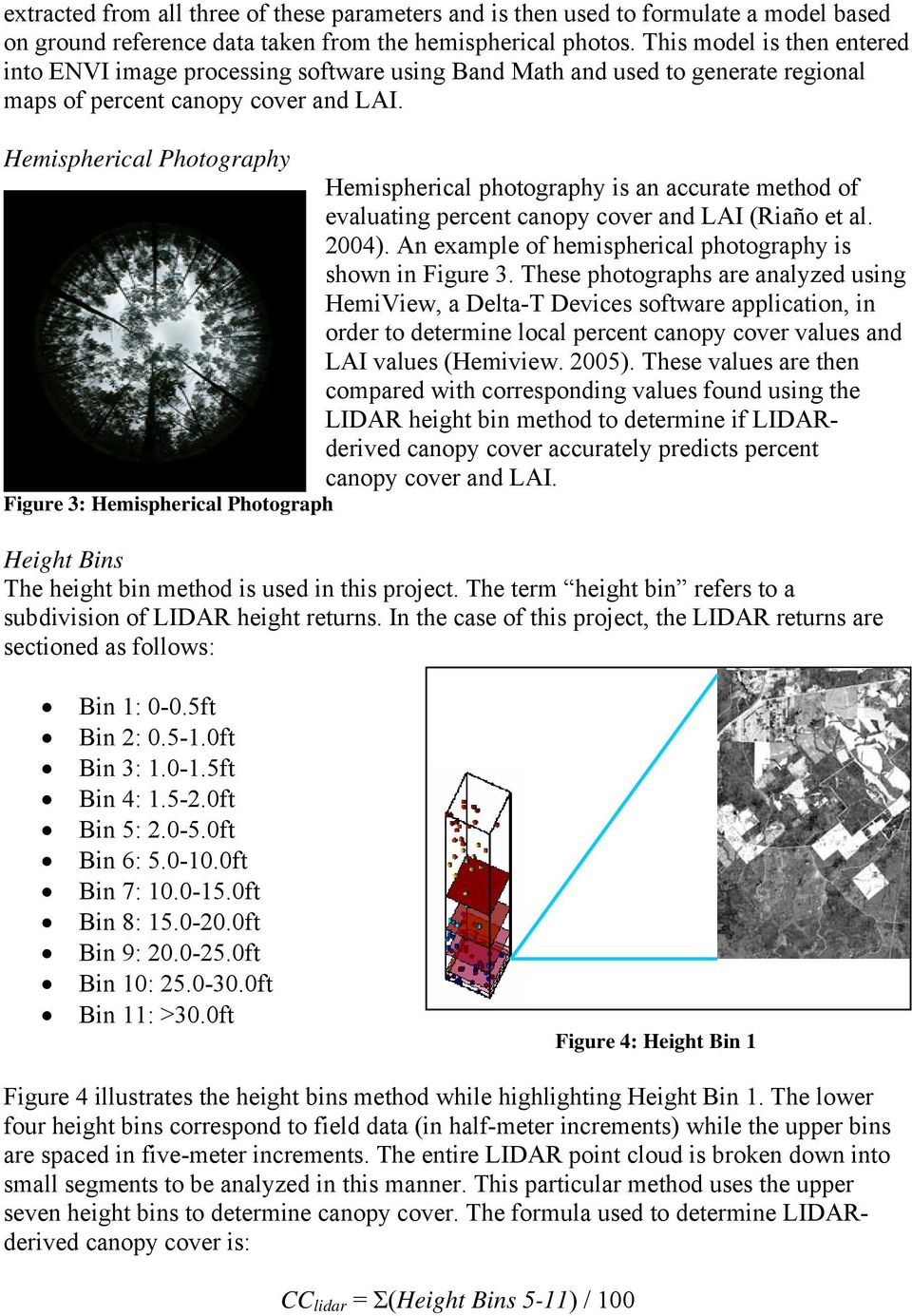
3 extracted from all three of these parameters and is then used to formulate a model based on ground reference data taken from the hemispherical photos. This model is then entered into ENVI image processing software using Band Math and used to generate regional maps of percent canopy cover and LAI. Hemispherical Photography Hemispherical photography is an accurate method of evaluating percent canopy cover and LAI (Riaño et al. 2004). An example of hemispherical photography is shown in Figure 3. These photographs are analyzed using HemiView, a Delta-T Devices software application, in order to determine local percent canopy cover values and LAI values (Hemiview. 2005). These values are then compared with corresponding values found using the LIDAR height bin method to determine if LIDARderived canopy cover accurately predicts percent canopy cover and LAI. Figure 3: Hemispherical Photograph Height Bins The height bin method is used in this project. The term height bin refers to a subdivision of LIDAR height returns. In the case of this project, the LIDAR returns are sectioned as follows: Bin 1: 0-0.5ft Bin 2: ft Bin 3: ft Bin 4: ft Bin 5: ft Bin 6: ft Bin 7: ft Bin 8: ft Bin 9: ft Bin 10: ft Bin 11: >30.0ft Figure 4: Height Bin 1 Figure 4 illustrates the height bins method while highlighting Height Bin 1. The lower four height bins correspond to field data (in half-meter increments) while the upper bins are spaced in five-meter increments. The entire LIDAR point cloud is broken down into small segments to be analyzed in this manner. This particular method uses the upper seven height bins to determine canopy cover. The formula used to determine LIDARderived canopy cover is: CC lidar = Σ(Height Bins 5-11) / 100
4 This LIDAR-derived canopy cover is used to successfully formulate linear models of percent canopy cover and LAI. Linear Regression Linear regressions are performed using SAS software in order to relate various statistical properties of the LIDAR and MSS data to in situ data. The following parameters are used in the regression equations: x cc_lidar = mean, LIDAR-derived canopy cover s cc_lidar = standard deviation, LIDAR-derived canopy cover x ndvi = mean, NDVI s ndvi = standard deviation, NDVI X chm = maximum value, CHM x chm = mean, Canopy Height Model (CHM) s chm = standard deviation, CHM CC = percent canopy cover LAI = leaf area index Results Four regressions are performed, resulting in the following models: Model 1: Percent canopy cover using all available variables CC all_var = x cc_lidar x ndvi, R 2 = Model 2: Percent canopy cover using only LIDAR-based variables CC lidar_var = x cc_lidar X chm, R 2 = Model 3: LAI using all available variables LAI all_var = x cc_lidar, R 2 = Model 4: LAI using only LIDAR-based variables LAI lidar_var = x cc_lidar, R 2 = All variables left in the models are significant at the 0.15 level. Models 3 and 4 are identical, indicating that only LIDAR-based variables are significant in predicting LAI. Therefore, only one set of graphical results is shown. Below, in Figures 5, 6 and 7, the predicted (regression) results are compared to the observed (in situ) results for both percent canopy cover and LAI. As one can easily determine from these graphical representations of the regressions, Model 1 is superior to Model 2 for percent canopy cover. Model 3 is chosen as the default model for LAI.

5 Canopy Cover Regression Results - All Variables Canopy Cover Regression Results - LIDAR variables only Predicted Values R 2 = Predicted Values R 2 = Predicted Values Observed Values Figure 5: Canopy Cover, All Variables Leaf Area Index (LAI) Regression Results R 2 = Observed Values Figure 7: LAI Regression Observed Values Figure 6: Canopy Cover, LIDAR Variables The correlation coefficient for the percent canopy cover regression using both LIDAR and NDVI statistics (Model 1) is approximately 0.47 and the correlation coefficient for the LAI regression (Model 3) is approximately Thus Models 1 and 3 are chosen to generate regional maps of canopy cover and LAI, shown in Figures 8 and 9. Figure 8: Percent Canopy Cover Figure 9: Leaf Area Index

6 Discussion and Conclusions As one can see from the correlation coefficients and Figures 5 and 7, the predicted regression results for LAI (LAI) are highly correlated with the actual results, and the predicted results for canopy cover (CC) are fairly correlated as well. While more work is needed to refine these particular models, the height bin method has shown much potential for being a future standard method of LIDAR analysis in determining percent canopy cover and LAI. This method could one day be used in analysis packages, as it allows one to depict the vertical distribution of a forest canopy. References CURREN, P.J., DUNGAN, J.L., GHOLZ, H.L Seasonal LAI in Slash Pine Estimated with Landsat TM. Remote Sens. Environ. 39:3-13. HEMIVIEW ONLINE DOCUMENTATION Dynamax Inc., Houston, Texas. POPESCU, S.C., AND WYNNE, R. H Seeing the trees in the Forest: Using Lidar and Multispectral Data Fusion with Local Filtering and Variable Window Size for Estimating Tree Height. Photogrammteric Engineering & Remote Sensing 70(5): RIAÑO, D., VALLADARES, F., CONDÉS, S., CHUVIECO, E Estimation of leaf area index and covered ground from airborne laser scanner (Lidar) in two contrasting forests. Agricultural and Forest Meteorology. 124: WHITE, J.D., RUNNING, S.W., NEMANI, R., KEANE, R.E., RYAN, K.C Measurement and remote sensing of LAI in Rocky Mountain montane ecosystems. Can. J. Remote Sensing. 27:

LiDAR remote sensing to individual tree processing: A comparison between high and low pulse density in Florida, United States of America
 LiDAR remote sensing to individual tree processing: A comparison between high and low pulse density in Florida, United States of America Carlos Alberto Silva 1 Andrew Hudak 2 Robert Liebermann 2 Kevin
CARBON BALANCE IN BIOMASS OF MAIN FOREST TREE SPECIES IN POLAND
 CARBON BALANCE IN BIOMASS OF MAIN FOREST TREE SPECIES IN POLAND PAWEŁ STRZELIŃSKI Department of Forest Management Poznan University of Life Science TOMASZ ZAWIŁA-NIEDŹWIECKI Forest Research Institute in
Cost Considerations of Using LiDAR for Timber Inventory 1
 Cost Considerations of Using LiDAR for Timber Inventory 1 Bart K. Tilley, Ian A. Munn 3, David L. Evans 4, Robert C. Parker 5, and Scott D. Roberts 6 Acknowledgements: Mississippi State University College
Application of airborne remote sensing for forest data collection
 Application of airborne remote sensing for forest data collection Gatis Erins, Foran Baltic The Foran SingleTree method based on a laser system developed by the Swedish Defense Research Agency is the first
Photogrammetric Point Clouds
 Photogrammetric Point Clouds Origins of digital point clouds: Basics have been around since the 1980s. Images had to be referenced to one another. The user had to specify either where the camera was in
Lidar Remote Sensing for Forestry Applications
 Lidar Remote Sensing for Forestry Applications Ralph O. Dubayah* and Jason B. Drake** Department of Geography, University of Maryland, College Park, MD 0 *[email protected] **[email protected] 1
RESOLUTION MERGE OF 1:35.000 SCALE AERIAL PHOTOGRAPHS WITH LANDSAT 7 ETM IMAGERY
 RESOLUTION MERGE OF 1:35.000 SCALE AERIAL PHOTOGRAPHS WITH LANDSAT 7 ETM IMAGERY M. Erdogan, H.H. Maras, A. Yilmaz, Ö.T. Özerbil General Command of Mapping 06100 Dikimevi, Ankara, TURKEY - (mustafa.erdogan;
LiDAR for vegetation applications
 LiDAR for vegetation applications UoL MSc Remote Sensing Dr Lewis [email protected] Introduction Introduction to LiDAR RS for vegetation Review instruments and observational concepts Discuss applications
Urban Ecosystem Analysis Atlanta Metro Area Calculating the Value of Nature
 August 2001 Urban Ecosystem Analysis Atlanta Metro Area Calculating the Value of Nature Report Contents 2 Project Overview and Major Findings 3 Regional Analysis 4 Local Analysis 6 Using Regional Data
Nature Values Screening Using Object-Based Image Analysis of Very High Resolution Remote Sensing Data
 Nature Values Screening Using Object-Based Image Analysis of Very High Resolution Remote Sensing Data Aleksi Räsänen*, Anssi Lensu, Markku Kuitunen Environmental Science and Technology Dept. of Biological
Geospatial Software Solutions for the Environment and Natural Resources
 Geospatial Software Solutions for the Environment and Natural Resources Manage and Preserve the Environment and its Natural Resources Our environment and the natural resources it provides play a growing
ANALYSIS OF FOREST CHANGE IN FIRE DAMAGE AREA USING SATELLITE IMAGES
 ANALYSIS OF FOREST CHANGE IN FIRE DAMAGE AREA USING SATELLITE IMAGES Joon Mook Kang, Professor Joon Kyu Park, Ph.D Min Gyu Kim, Ph.D._Candidate Dept of Civil Engineering, Chungnam National University 220
Resolutions of Remote Sensing
 Resolutions of Remote Sensing 1. Spatial (what area and how detailed) 2. Spectral (what colors bands) 3. Temporal (time of day/season/year) 4. Radiometric (color depth) Spatial Resolution describes how
VCS REDD Methodology Module. Methods for monitoring forest cover changes in REDD project activities
 1 VCS REDD Methodology Module Methods for monitoring forest cover changes in REDD project activities Version 1.0 May 2009 I. SCOPE, APPLICABILITY, DATA REQUIREMENT AND OUTPUT PARAMETERS Scope This module
FOREST PARAMETER ESTIMATION BY LIDAR DATA PROCESSING
 P.-F. Mursa Forest parameter estimation by LIDAR data processing FOREST PARAMETER ESTIMATION BY LIDAR DATA PROCESSING Paula-Florina MURSA, Master Student Military Technical Academy, [email protected]
Information Contents of High Resolution Satellite Images
 Information Contents of High Resolution Satellite Images H. Topan, G. Büyüksalih Zonguldak Karelmas University K. Jacobsen University of Hannover, Germany Keywords: satellite images, mapping, resolution,
dynamic vegetation model to a semi-arid
 Application of a conceptual distributed dynamic vegetation model to a semi-arid basin, SE of Spain By: M. Pasquato, C. Medici and F. Francés Universidad Politécnica de Valencia - Spain Research Institute
Introduction to Imagery and Raster Data in ArcGIS
 Esri International User Conference San Diego, California Technical Workshops July 25, 2012 Introduction to Imagery and Raster Data in ArcGIS Simon Woo slides Cody Benkelman - demos Overview of Presentation
ASSESSING EFFECTS OF LASER POINT DENSITY ON BIOPHYSICAL STAND PROPERTIES DERIVED FROM AIRBORNE LASER SCANNER DATA IN MATURE FOREST
 ISPRS Workshop on Laser Scanning 2007 and SilviLaser 2007, Espoo, September 12-14, 2007, Finland ASSESSING EFFECTS OF LASER POINT DENSITY ON BIOPHYSICAL STAND PROPERTIES DERIVED FROM AIRBORNE LASER SCANNER
Integrated Global Carbon Observations. Beverly Law Prof. Global Change Forest Science Science Chair, AmeriFlux Network Oregon State University
 Integrated Global Carbon Observations Beverly Law Prof. Global Change Forest Science Science Chair, AmeriFlux Network Oregon State University Total Anthropogenic Emissions 2008 Total Anthropogenic CO 2
EVALUATION OF AIRBORNE LIDAR DIGITAL TERRAIN MAPPING FOR HIGHWAY CORRIDOR PLANNING AND DESIGN
 Waheed Uddin Director, Center for Advanced Infrastructure Technology, Carrier Hall 203 The University of Mississippi, University, MS 38677-1848, USA [email protected] KEY WORDS: Terrain, mapping, airborne,
Review for Introduction to Remote Sensing: Science Concepts and Technology
 Review for Introduction to Remote Sensing: Science Concepts and Technology Ann Johnson Associate Director [email protected] Funded by National Science Foundation Advanced Technological Education program [DUE
Spectral Response for DigitalGlobe Earth Imaging Instruments
 Spectral Response for DigitalGlobe Earth Imaging Instruments IKONOS The IKONOS satellite carries a high resolution panchromatic band covering most of the silicon response and four lower resolution spectral
Digital Remote Sensing Data Processing Digital Remote Sensing Data Processing and Analysis: An Introduction and Analysis: An Introduction
 Digital Remote Sensing Data Processing Digital Remote Sensing Data Processing and Analysis: An Introduction and Analysis: An Introduction Content Remote sensing data Spatial, spectral, radiometric and
Development of Method for LST (Land Surface Temperature) Detection Using Big Data of Landsat TM Images and AWS
 Development of Method for LST (Land Surface Temperature) Detection Using Big Data of Landsat TM Images and AWS Myung-Hee Jo¹, Sung Jae Kim², Jin-Ho Lee 3 ¹ Department of Aeronautical Satellite System Engineering,
LIDAR and Digital Elevation Data
 LIDAR and Digital Elevation Data Light Detection and Ranging (LIDAR) is being used by the North Carolina Floodplain Mapping Program to generate digital elevation data. These highly accurate topographic
Urban Tree Planting Quantification Guidance
 Urban Tree Planting Quantification Guidance June 2014 This document provides guidance for quantifying an Urban Tree Planting (UTP) Project s carbon stocks, both for purposes of estimating a project s baseline
See Lab 8, Natural Resource Canada RS Tutorial web pages Tues 3/24 Supervised land cover classification See Lab 9, NR Canada RS Tutorial web pages
 SFR 406 Remote Sensing, Image Interpretation and Forest Mapping EXAM # 2 (23 April 2015) REVIEW SHEET www.umaine.edu/mial/courses/sfr406/index.htm (Lecture powerpoint & notes) TOPICS COVERED ON 2 nd EXAM:
Automatic land-cover map production of agricultural areas using supervised classification of SPOT4(Take5) and Landsat-8 image time series.
 Automatic land-cover map production of agricultural areas using supervised classification of SPOT4(Take5) and Landsat-8 image time series. Jordi Inglada 2014/11/18 SPOT4/Take5 User Workshop 2014/11/18
METHODOLOGY FOR LANDSLIDE SUSCEPTIBILITY AND HAZARD MAPPING USING GIS AND SDI
 The 8th International Conference on Geo-information for Disaster Management Intelligent Systems for Crisis Management METHODOLOGY FOR LANDSLIDE SUSCEPTIBILITY AND HAZARD MAPPING USING GIS AND SDI T. Fernández
UPPER COLUMBIA BASIN NETWORK VEGETATION CLASSIFICATION AND MAPPING PROGRAM
 UPPER COLUMBIA BASIN NETWORK VEGETATION CLASSIFICATION AND MAPPING PROGRAM The Upper Columbia Basin Network (UCBN) includes nine parks with significant natural resources in the states of Idaho, Montana,
GEOGG142 GMES Calibration & validation of EO products
 GEOGG142 GMES Calibration & validation of EO products Dr. Mat Disney [email protected] Pearson Building room 113 020 7679 0592 www.geog.ucl.ac.uk/~mdisney Outline Calibration & validation Example:
MAPPING MINNEAPOLIS URBAN TREE CANOPY. Why is Tree Canopy Important? Project Background. Mapping Minneapolis Urban Tree Canopy.
 MAPPING MINNEAPOLIS URBAN TREE CANOPY Why is Tree Canopy Important? Trees are an important component of urban environments. In addition to their aesthetic value, trees have significant economic and environmental
SEMANTIC LABELLING OF URBAN POINT CLOUD DATA
 SEMANTIC LABELLING OF URBAN POINT CLOUD DATA A.M.Ramiya a, Rama Rao Nidamanuri a, R Krishnan a Dept. of Earth and Space Science, Indian Institute of Space Science and Technology, Thiruvananthapuram,Kerala
Mapping Forest-Fire Damage with Envisat
 Mapping Forest-Fire Damage with Envisat Mapping Forest-Fire Damage Federico González-Alonso, S. Merino-de-Miguel, S. García-Gigorro, A. Roldán-Zamarrón & J.M. Cuevas Remote Sensing Laboratory, INIA, Ministry
Let s SAR: Mapping and monitoring of land cover change with ALOS/ALOS-2 L-band data
 Let s SAR: Mapping and monitoring of land cover change with ALOS/ALOS-2 L-band data Rajesh Bahadur THAPA, Masanobu SHIMADA, Takeshi MOTOHKA, Manabu WATANABE and Shinichi [email protected]; [email protected]
Data Management Framework for the North American Carbon Program
 Data Management Framework for the North American Carbon Program Bob Cook, Peter Thornton, and the Steering Committee Image courtesy of NASA/GSFC NACP Data Management Planning Workshop New Orleans, LA January
National Inventory of Landscapes in Sweden
 Key messages Approaching the landscape perspective in monitoring experiences in the Swedish NILS program Johan Svensson, Future Forest Monitoring, 091112 Landscape level approaches are necessary to deal
REGISTRATION OF LASER SCANNING POINT CLOUDS AND AERIAL IMAGES USING EITHER ARTIFICIAL OR NATURAL TIE FEATURES
 REGISTRATION OF LASER SCANNING POINT CLOUDS AND AERIAL IMAGES USING EITHER ARTIFICIAL OR NATURAL TIE FEATURES P. Rönnholm a, *, H. Haggrén a a Aalto University School of Engineering, Department of Real
3D Model of the City Using LiDAR and Visualization of Flood in Three-Dimension
 3D Model of the City Using LiDAR and Visualization of Flood in Three-Dimension R.Queen Suraajini, Department of Civil Engineering, College of Engineering Guindy, Anna University, India, [email protected]
AN INTEGRATED WORKFLOW FOR LIDAR / OPTICAL DATA MAPPING FOR SECURITY APPLICATIONS
 AN INTEGRATED WORKFLOW FOR LIDAR / OPTICAL DATA MAPPING FOR SECURITY APPLICATIONS Dirk Tiede, Thomas Blaschke Z_GIS; Centre for GeoInformatics, University of Salzburg, Hellbrunnerstrasse 34, 5020 Salzburg,
Analysis of Climatic and Environmental Changes Using CLEARS Web-GIS Information-Computational System: Siberia Case Study
 Analysis of Climatic and Environmental Changes Using CLEARS Web-GIS Information-Computational System: Siberia Case Study A G Titov 1,2, E P Gordov 1,2, I G Okladnikov 1,2, T M Shulgina 1 1 Institute of
Land Use/Land Cover Map of the Central Facility of ARM in the Southern Great Plains Site Using DOE s Multi-Spectral Thermal Imager Satellite Images
 Land Use/Land Cover Map of the Central Facility of ARM in the Southern Great Plains Site Using DOE s Multi-Spectral Thermal Imager Satellite Images S. E. Báez Cazull Pre-Service Teacher Program University
Understanding Raster Data
 Introduction The following document is intended to provide a basic understanding of raster data. Raster data layers (commonly referred to as grids) are the essential data layers used in all tools developed
National and Sub-national Carbon monitoring tools developed at the WHRC
 National and Sub-national Carbon monitoring tools developed at the WHRC Nadine Laporte Woods Hole Research Center A. Baccini, W. Walker, S. Goetz, M. Sun, J. Kellndorfer Kigali, 20 th June 2011 Why measuring
.FOR. Forest inventory and monitoring quality
 .FOR Forest inventory and monitoring quality FOR : the asset to manage your forest patrimony 2 1..FOR Presentation.FOR is an association of Belgian companies, created in 2010 and supported by a university
RULE INHERITANCE IN OBJECT-BASED IMAGE CLASSIFICATION FOR URBAN LAND COVER MAPPING INTRODUCTION
 RULE INHERITANCE IN OBJECT-BASED IMAGE CLASSIFICATION FOR URBAN LAND COVER MAPPING Ejaz Hussain, Jie Shan {ehussain, jshan}@ecn.purdue.edu} Geomatics Engineering, School of Civil Engineering, Purdue University
Effects of landscape-level fuel treatments on carbon emissions and storage over a 50 yr time cycle
 Effects of landscape-level fuel treatments on carbon emissions and storage over a 50 yr time cycle Kevin Osborne A, Christopher Dicus A F, Clint Isbell B, Alan Ager C, David Weise D, Micheal Landram E
Lidar 101: Intro to Lidar. Jason Stoker USGS EROS / SAIC
 Lidar 101: Intro to Lidar Jason Stoker USGS EROS / SAIC Lidar Light Detection and Ranging Laser altimetry ALTM (Airborne laser terrain mapping) Airborne laser scanning Lidar Laser IMU (INS) GPS Scanning
APPLICATIONS OF LIDAR IN WILDFIRE MANAGEMENT
 APPLICATIONS OF LIDAR IN WILDFIRE MANAGEMENT AN OPPORTUNITY IN BRITISH COLUMBIA Janice Burns FRST 497 4/1/2012 ABSTRACT British Columbia s Wildfire Management Branch is undergoing a transformation from
REMOTE SENSING FOR FOREST RESOURCE MANAGEMENT: CCRS ADVANCES IN ELECTRO-OPTICAL AND RADAR IMAGING SYSTEMS
 REMOTE SENSING FOR FOREST RESOURCE MANAGEMENT: CCRS ADVANCES IN ELECTRO-OPTICAL AND RADAR IMAGING SYSTEMS S.M. Till, A.L. Gray and F.J. Ahern Canada Centre for Remote Sensing 2464 Sheffield Road, Ottawa,
Field Techniques Manual: GIS, GPS and Remote Sensing
 Field Techniques Manual: GIS, GPS and Remote Sensing Section A: Introduction Chapter 1: GIS, GPS, Remote Sensing and Fieldwork 1 GIS, GPS, Remote Sensing and Fieldwork The widespread use of computers
LEROY MERLÍN FUNDACIÓN JUAN XXIII-IBERMAIL. A Study of Forest Biomass Sustainability SHOUF BIOSPHERE RESERVE, LEBANON THERMAL BIOMASS PROJECT 2013
 December 203 SHOUF BIOSPHERE RESERVE, LEBANON THERMAL BIOMASS PROJECT 203 A Study of Forest Biomass Sustainability GRUPO SYLVESTRIS SL CL Asura 34 bis Madrid 28043. SPAIN. Tel.: +34 609 04 42 6 Tel.:+34
Climate and Weather. This document explains where we obtain weather and climate data and how we incorporate it into metrics:
 OVERVIEW Climate and Weather The climate of the area where your property is located and the annual fluctuations you experience in weather conditions can affect how much energy you need to operate your
Digital Classification and Mapping of Urban Tree Cover: City of Minneapolis
 Digital Classification and Mapping of Urban Tree Cover: City of Minneapolis FINAL REPORT April 12, 2011 Marvin Bauer, Donald Kilberg, Molly Martin and Zecharya Tagar Remote Sensing and Geospatial Analysis
STATE OF NEVADA Department of Administration Division of Human Resource Management CLASS SPECIFICATION
 STATE OF NEVADA Department of Administration Division of Human Resource Management CLASS SPECIFICATION TITLE PHOTOGRAMMETRIST/CARTOGRAPHER V 39 6.102 PHOTOGRAMMETRIST/CARTOGRAPHER II 33 6.110 PHOTOGRAMMETRIST/CARTOGRAPHER
ENVI THE PREMIER SOFTWARE FOR EXTRACTING INFORMATION FROM GEOSPATIAL IMAGERY.
 ENVI THE PREMIER SOFTWARE FOR EXTRACTING INFORMATION FROM GEOSPATIAL IMAGERY. ENVI Imagery Becomes Knowledge ENVI software uses proven scientific methods and automated processes to help you turn geospatial
Remote Sensing and Land Use Classification: Supervised vs. Unsupervised Classification Glen Busch
 Remote Sensing and Land Use Classification: Supervised vs. Unsupervised Classification Glen Busch Introduction In this time of large-scale planning and land management on public lands, managers are increasingly
Nationwide forest estimates in Sweden using satellite data and airborne LiDAR. (Or: going from 2 D to 3D)
 Nationwide forest estimates in Sweden using satellite data and airborne LiDAR (Or: going from 2 D to 3D) Håkan Olsson Mats Nilsson, Johan Fransson, Henrik Persson and Mikael Egberth (SLU) Umeå Svante Larsson
Image Analysis CHAPTER 16 16.1 ANALYSIS PROCEDURES
 CHAPTER 16 Image Analysis 16.1 ANALYSIS PROCEDURES Studies for various disciplines require different technical approaches, but there is a generalized pattern for geology, soils, range, wetlands, archeology,
Environmental Remote Sensing GEOG 2021
 Environmental Remote Sensing GEOG 2021 Lecture 4 Image classification 2 Purpose categorising data data abstraction / simplification data interpretation mapping for land cover mapping use land cover class
IMPERVIOUS SURFACE MAPPING UTILIZING HIGH RESOLUTION IMAGERIES. Authors: B. Acharya, K. Pomper, B. Gyawali, K. Bhattarai, T.
 IMPERVIOUS SURFACE MAPPING UTILIZING HIGH RESOLUTION IMAGERIES Authors: B. Acharya, K. Pomper, B. Gyawali, K. Bhattarai, T. Tsegaye ABSTRACT Accurate mapping of artificial or natural impervious surfaces
MODIS IMAGES RESTORATION FOR VNIR BANDS ON FIRE SMOKE AFFECTED AREA
 MODIS IMAGES RESTORATION FOR VNIR BANDS ON FIRE SMOKE AFFECTED AREA Li-Yu Chang and Chi-Farn Chen Center for Space and Remote Sensing Research, National Central University, No. 300, Zhongda Rd., Zhongli
ASSESSMENT OF FOREST RECOVERY AFTER FIRE USING LANDSAT TM IMAGES AND GIS TECHNIQUES: A CASE STUDY OF MAE WONG NATIONAL PARK, THAILAND
 ASSESSMENT OF FOREST RECOVERY AFTER FIRE USING LANDSAT TM IMAGES AND GIS TECHNIQUES: A CASE STUDY OF MAE WONG NATIONAL PARK, THAILAND Sunee Sriboonpong 1 Yousif Ali Hussin 2 Alfred de Gier 2 1 Forest Resource
WATER BODY EXTRACTION FROM MULTI SPECTRAL IMAGE BY SPECTRAL PATTERN ANALYSIS
 WATER BODY EXTRACTION FROM MULTI SPECTRAL IMAGE BY SPECTRAL PATTERN ANALYSIS Nguyen Dinh Duong Department of Environmental Information Study and Analysis, Institute of Geography, 18 Hoang Quoc Viet Rd.,
The National Park Service Inventory & Monitoring Program Student Opportunities
 NPS Inventory and Monitoring Program The National Park Service Inventory & Monitoring Program Student Opportunities Sara Stevens Program Manager NPS Inventory and Monitoring Program NPS Programs at URI
Evaluation of surface runoff conditions. scanner in an intensive apple orchard
 Evaluation of surface runoff conditions by high resolution terrestrial laser scanner in an intensive apple orchard János Tamás 1, Péter Riczu 1, Attila Nagy 1, Éva Lehoczky 2 1 Faculty of Agricultural
Index. Aridosols, 94, 95, 97, 98, 99
 Index Accessory information, satellite imagery, 68-69, 73-78 Aerial photography, Aero-neg film, 133 black and white film, 132-33 black and white infra-red film, 132-133 colour film, 133 colour infra-red
Sub-pixel mapping: A comparison of techniques
 Sub-pixel mapping: A comparison of techniques Koen C. Mertens, Lieven P.C. Verbeke & Robert R. De Wulf Laboratory of Forest Management and Spatial Information Techniques, Ghent University, 9000 Gent, Belgium
Using Remote Sensing Imagery to Evaluate Post-Wildfire Damage in Southern California
 Graham Emde GEOG 3230 Advanced Remote Sensing February 22, 2013 Lab #1 Using Remote Sensing Imagery to Evaluate Post-Wildfire Damage in Southern California Introduction Wildfires are a common disturbance
Soil Moisture Estimation Using Active DTS at MOISST Site
 MOISST Workhsop, 2014 Soil Moisture Estimation Using Active DTS at MOISST Site June 4, 2014 Chadi Sayde, Daniel Moreno, John Selker Department of Biological and Ecological Engineering Oregon State University,
Objectives. Raster Data Discrete Classes. Spatial Information in Natural Resources FANR 3800. Review the raster data model
 Spatial Information in Natural Resources FANR 3800 Raster Analysis Objectives Review the raster data model Understand how raster analysis fundamentally differs from vector analysis Become familiar with
The YellowScan system: A test on the oppida of Nages/Roque de Viou (Languedoc, France) Tristan Allouis, PhD Research and Development, L'Avion Jaune
 The YellowScan system: A test on the oppida of Nages/Roque de Viou (Languedoc, France) Tristan Allouis, PhD Research and Development, L'Avion Jaune L'Avion Jaune : Earth observation data provider UAVs
APPLICATION OF GOOGLE EARTH FOR THE DEVELOPMENT OF BASE MAP IN THE CASE OF GISH ABBAY SEKELA, AMHARA STATE, ETHIOPIA
 APPLICATION OF GOOGLE EARTH FOR THE DEVELOPMENT OF BASE MAP IN THE CASE OF GISH ABBAY SEKELA, AMHARA STATE, ETHIOPIA Abineh Tilahun Department of Geography and environmental studies, Adigrat University,
P.M. Rich, W.A. Hetrick, S.C. Saving Biological Sciences University of Kansas Lawrence, KS 66045
 USING VIEWSHED MODELS TO CALCULATE INTERCEPTED SOLAR RADIATION: APPLICATIONS IN ECOLOGY by P.M. Rich, W.A. Hetrick, S.C. Saving Biological Sciences University of Kansas Lawrence, KS 66045 R.O. Dubayah
Numerical Analysis of Texas Cone Penetration Test
 International Journal of Applied Science and Technology Vol. 2 No. 3; March 2012 Numerical Analysis of Texas Cone Penetration Test Nutan Palla Project Engineer, Tolunay-Wong Engineers, Inc. 10710 S Sam
Productivity in Cloud Forests in the Andes
 Productivity in Cloud Forests in the Andes Carbon cycle measurements and model results from JULES Toby Marthews http://marthews.tripod.com Leeds, 10th June 2010 at the Oxford University Centre for the
Jeongho SEO, Kyeonghak LEE, Raehyun KIM Korea Forest Research Institute. 6~8. Sept. 2007 Kuala Lumpur, Malaysia
 5 th Workshop on GHG Inventory in Asia Jeongho SEO, Kyeonghak LEE, Raehyun KIM Korea Forest Research Institute 6~8. Sept. 2007 Kuala Lumpur, Malaysia Contents 1/ 32 Background 2/ 32 Land Use and Forestry
Urban Ecosystem Analysis For the Houston Gulf Coast Region Calculating the Value of Nature
 December 2000 Urban Ecosystem Analysis For the Houston Gulf Coast Region Calculating the Value of Nature Report Contents 2-3 Project Overview and Major Findings 4 Regional Level Analysis 5-7 Local Level