
GSK928MA Milling Machine CNC System. User Manual. GSK CNC Equipment
|
|
|
- Rafe Harper
- 10 years ago
- Views:
Transcription
1 GSK928MA Milling Machine CNC System User Manual GSK CNC Equipment
2 The operating manual describes all matters concerning the operation of the system in detail as much as possible. However, it is impractical to give particular descriptions of all unnecessary and/or unavailable works on the system due to the text size limit of the manual, specific operations of the product and other causes. Therefore, the matters not specified herein may be considered impractical or unavailable. This operating manual is the property of GSK CNC Equipment Co., Ltd. All rights reserved. It is against the law for any organization or individual to publish or reprint this manual without the express written permission of GSK and the latter reserves the right to ascertain their legal liability. Dear user, We are really grateful for your patronage and purchase of GSK928M milling CNC system made by GSK CNC Equipment Co., Ltd. Company Profile As an industrial base of numerical control (NC) products in south China and an enterprise undertaking the state s Plan 863 Middle-grade Numerical Control System Industrialization Supporting Technology, GSK has been committed to the development and manufacture of NC systems for machine tools and servo/step motor drive units for years. GSK actively promotes machine tool NC innovation and offers NC technical training and trade services of numerical controlled machine tools integrating science, engineering and trading. Our products support more than 50 domestic manufacturers of machine tools with after-sales service network through the country. With a yield in the lead in China for four years in succession, GSK series products are in great demand in the domestic demand and have sold as far as to Southeast Asia at high cost-performance ratio. Field Technical Support Service Field support services are available when you encounter problems insolvable through telephone. GSK CNC Equipment Company Limited will designate a technical support engineer to the field to solve technical problems for you. All specification and designs are subject to change without notice Sincerely thanks for your friendly support for our products.

3 Contents Programming 1 Introduction Axis Definition Machine zero Reference point Coordinate System Programming Coordinates Input Unit and Range of Coordinate Program Configuration Tool Path of Rapid Positioning Offset of System Coordinate Initial and Modal of System Initial Status of System Start of Program End of Program Main Program and Subprogram Backlash Compensation R Reference Plane S, T, M Function, D, H, F, FEED% S Function T Function M Function (Auxiliary Function) D, H Function F, Feed% G Function (Preparatory Function) G Function for Defining Programming State of the System G0 Rapid Positioning (Modal, Initial) G1 Linear Interpolation (Modal) G2, G3 Circular Interpolation (Modal) G4 Dwell G10 G11 Rough Milling in Concave Groove of Inner Circular G12 /G13 Finish Milling of Inner Circle G14 /G15 Fine Milling of Outer Circle G22 System Parameter Setting (Modal) G23 Conditional Jump G27 Machine Zero Inspection G28 Rapid Traverse to Reference Point via Middle Point G31 Rapid Return to the R Reference Plane G34/ G35 Rough Milling of the Rectangle concave Groove

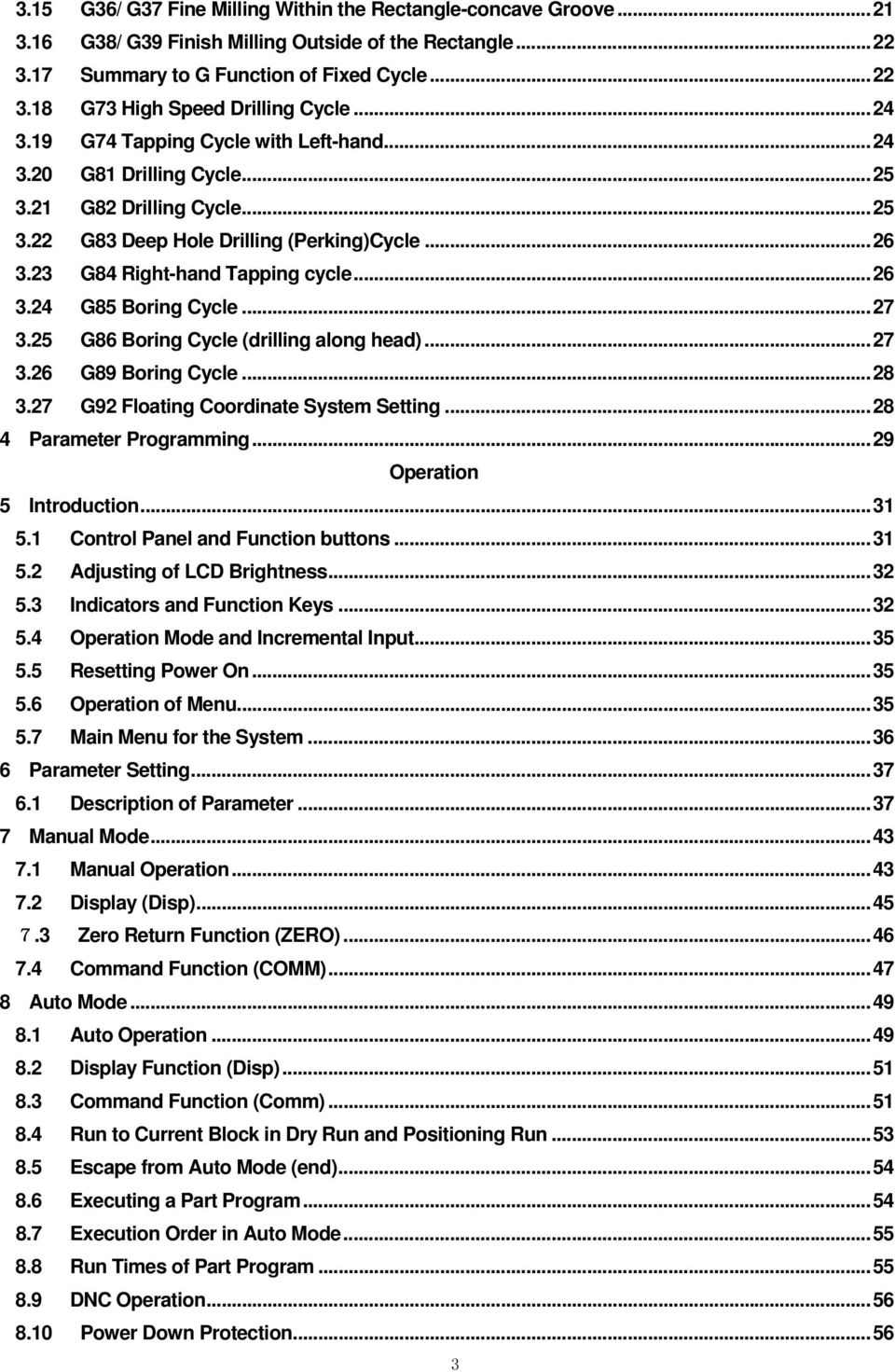
4 3.15 G36/ G37 Fine Milling Within the Rectangle-concave Groove G38/ G39 Finish Milling Outside of the Rectangle Summary to G Function of Fixed Cycle G73 High Speed Drilling Cycle G74 Tapping Cycle with Left-hand G81 Drilling Cycle G82 Drilling Cycle G83 Deep Hole Drilling (Perking)Cycle G84 Right-hand Tapping cycle G85 Boring Cycle G86 Boring Cycle (drilling along head) G89 Boring Cycle G92 Floating Coordinate System Setting Parameter Programming...29 Operation 5 Introduction Control Panel and Function buttons Adjusting of LCD Brightness Indicators and Function Keys Operation Mode and Incremental Input Resetting Power On Operation of Menu Main Menu for the System Parameter Setting Description of Parameter Manual Mode Manual Operation Display (Disp) Zero Return Function (ZERO) Command Function (COMM) Auto Mode Auto Operation Display Function (Disp) Command Function (Comm) Run to Current Block in Dry Run and Positioning Run Escape from Auto Mode (end) Executing a Part Program Execution Order in Auto Mode Run Times of Part Program DNC Operation Power Down Protection
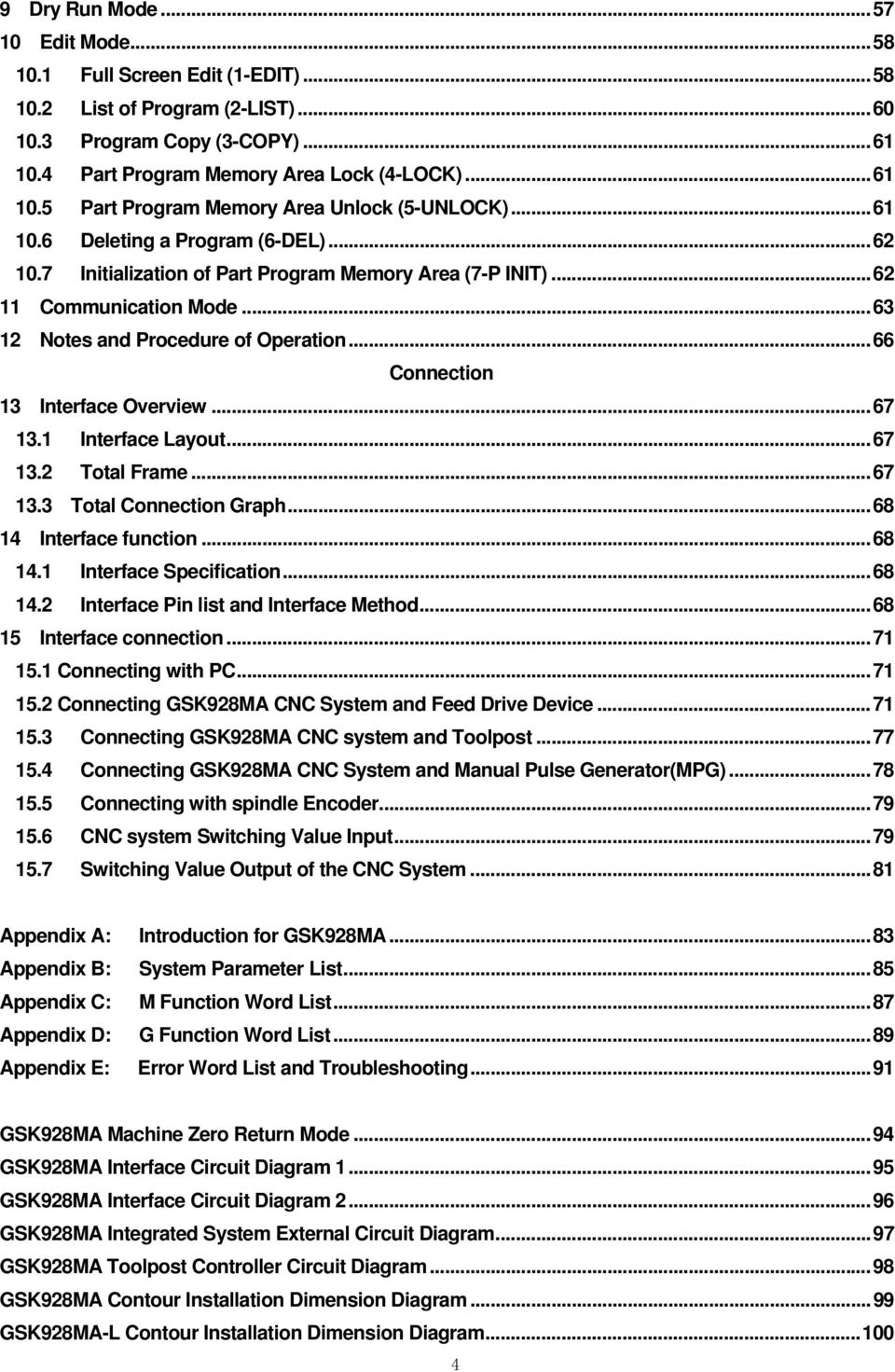
5 9 Dry Run Mode Edit Mode Full Screen Edit (1-EDIT) List of Program (2-LIST) Program Copy (3-COPY) Part Program Memory Area Lock (4-LOCK) Part Program Memory Area Unlock (5-UNLOCK) Deleting a Program (6-DEL) Initialization of Part Program Memory Area (7-P INIT) Communication Mode Notes and Procedure of Operation...66 Connection 13 Interface Overview Interface Layout Total Frame Total Connection Graph Interface function Interface Specification Interface Pin list and Interface Method Interface connection Connecting with PC Connecting GSK928MA CNC System and Feed Drive Device Connecting GSK928MA CNC system and Toolpost Connecting GSK928MA CNC System and Manual Pulse Generator(MPG) Connecting with spindle Encoder CNC system Switching Value Input Switching Value Output of the CNC System...81 Appendix A: Appendix B: Appendix C: Appendix D: Appendix E: Introduction for GSK928MA...83 System Parameter List...85 M Function Word List...87 G Function Word List...89 Error Word List and Troubleshooting...91 GSK928MA Machine Zero Return Mode...94 GSK928MA Interface Circuit Diagram GSK928MA Interface Circuit Diagram GSK928MA Integrated System External Circuit Diagram...97 GSK928MA Toolpost Controller Circuit Diagram...98 GSK928MA Contour Installation Dimension Diagram...99 GSK928MA-L Contour Installation Dimension Diagram
6 Programming 1 Introduction 1.1 Axis Definition This is the CNC system with three or four coordinates for the milling machine and drill machine etc. A rectangular coordinate system combined of X axis, Z axis, Y axis and C(or A)axis is used to execute the positioning and interpolation operation in this CNC system. X axis is denoted to left and right direction and Y axis to clockwise and counterclockwise direction for milling machine in the horizontal plane, Z axis is denoted to vertical one for worktable(or milling cutter)and C (A) axis is an additional one(the 4 th axis). Whether A or C is used as the 4th axis in programming axis is confirmed by the C bit of No.10 system parameter No.10. A positive direction is defined to the tool moving away from the workpiece; otherwise it is negative direction as follows: Z Y 刀 具 工 件 X 机 床 1.2 Machine zero Machine zero is a fixed point close to the proximity switch on a machine tool. Usually the reference point is set at the maximum stroke of X, Y, Z axis in the positive direction. Do not use its function, supported by the system without installing the machine zero. There must be a machine zero deceleration switch before machine zero. It is unavailable for the 4th axis to use the machine zero function 1.3 Reference point The position used for executing part programs is defined to reference point), namely, the starting point of tool or the origin point of machining [instead of (0, 0) of coordinate system]. 1.4 Coordinate System In this system, a program is programmed based on the workpiece coordinate system (that s to say the workpiece coordinate system is equal to the programming coordinate system), it is suggested that the user should position the X, Y, Z axis s zero with G0 instruction at the first block in the program. It can also define a floating coordinate system by instruction G92 in the program, and for 5

7 the convenience of programming, G92 can be used repeatedly in the program. The system will remember the position of machine zero and reference point. After executing the instruction G27 (return to the machine zero and test the step out), G28 (return to the reference point through the specified point), M02, M30, M31, the system will be changed from the floating coordinate system to the workpiece coordinate system. Parameter from No.61 to No.84 is the position of G54 tog59 coordinate system in the reference workpiece coordinate system, which can be modified to change the position of No.1 to No.6 workpiece coordinate system in the reference workpiece coordinate system. And the coordinate of current coordinate system can also be set in Manual mode. If the current coordinate system is not the reference workpiece coordinate system, the corresponding code of current coordinate system will be displayed at the bottom of the screen in the Manual or Auto mode: G92/G54/ /G59. In Manual mode, the current coordinate system can be switched instruction operation, and the workpiece coordinate system can also be selected by G54~G59 instruction in program. After execution of G27/G28/M02/M30 instruction or machine zero return, the system will be switched to reference workpiece coordinate system. When the workpiece coordinate system is selected by G54~G59 instruction in part program, the instructions can be in the same program block with interpolation and rapid positioning G instruction, and it will be executed firstly. 1.5 Programming Coordinates We can program with absolute coordinates (G90) and relative (incremental) coordinates (G91), incremental coordinates are contrast to the current position s coordinate. 1.6 Input Unit and Range of Coordinate Rectangle coordinate is used in the system. The least input unit of the coordinate value is 0.01mm. The maximum instruction value is ± Axis name Least input unit Least output unit X axis 0.01mm 0.01mm Z axis 0.01mm 0.01mm Y axis 0.01mm 0.01mm A(C) axis 0.01mm Actual move depending on the design of machine 1.7 Program Configuration The part program consists of a number of program blocks. Each block specifies the S function of the spindle speed, tool function (H for tool length compensation, D for tool corner radius compensation), miscellaneous function (M function) and preparation function (G function) for rapid positioning and cutting feed. And each block consists of a number of words; the word begins with an English character followed by a value. The block begins with word N (block number), followed by other words, and ends with Enter key. Each block must consist of a sequence number for indicating the CNC operation sequence at the 6

8 beginning of the block and a <Enter> code for indicating the end of the block. A Letter N followed by a numerical value specifies the sequence number. For example: N10 G0 X50 Y100 Z20 Block No.10, rapid positioning N20 G91 G0 X-30 Z-10 Block No.20, relative programming, rapid positioning N30 G1 Z-50 F40 Block No.30, linear interpolation (linear cutting) N40 G17 G2 X-10 Y-5 R10 Block No.40, circular interpolation N50 G0 Y60 Z60 Block No.50, rapid positioning N60 G28 X0 M2 Block No.60, return to starting point, program ending For the above, N30,G1,Z-50,F40 etc. are called for words, the beginning character of word stands for significance of word, and the following digits are the word value. For the expression of value range, here N4 represents that the word value range is 4-bit integer(0~9999). And the range for X±5.2 is from to (i.e. maximum 5 integral bit and maximum 2 decimal bit, + and- sign is allowable) The configuration of one block of program in this system is designated as follows: / N5 X±5.2 Y±5.2 Z±5.2 A±5.2 C±5.2 I±5.2 J±5.2 K±5.2 U5.2 V5.2 W5.2 P5 Q5.2 R±5.2 D1 H1 L5 F5.2 S2 T1 M2 / Optional block skip code. When a slash is specified at the beginning of a block, this block is an optional block. When the optional block skip indicator on the operation panel is light, the information in the block with a slash heading will be ignored in Auto mode, and One touch of the <skip> key can switch off the optional skip function. N Block sequence number ranged from 0 to 65535; it is a default, and it must be the first sign of the block if it contains N. (It can be omitted in DNC.) Preparatory function, several G instructions for defining states and one G instruction for acting can be specified in the same block X,Y,Z Coordinate value ranging from to in each axis;,a,c Absolute(G90) or relative(g91) value; Whether A or C is available in programming to the forth axis is confirmed by the C bit of No.10 parameter. I,J,K The position K of the center of circle, which is relative to the starting point in circular interpolation. K is denoted to the spindle speed in tapping. P Dwell time; Parameter number; Program number; R Arc radius, the reference plane(r plane) in the fixed cycle D The number for tools(0~9);used for the tool radius compensation; L Repetition count ranges from ;The number of holes to be drilled; H The number for length of tools(0~9);used for the tool length compensation; F Cutting feedrate, the unit is mm/min or mm/r; S T Spindle speed; The function of tool change; 7
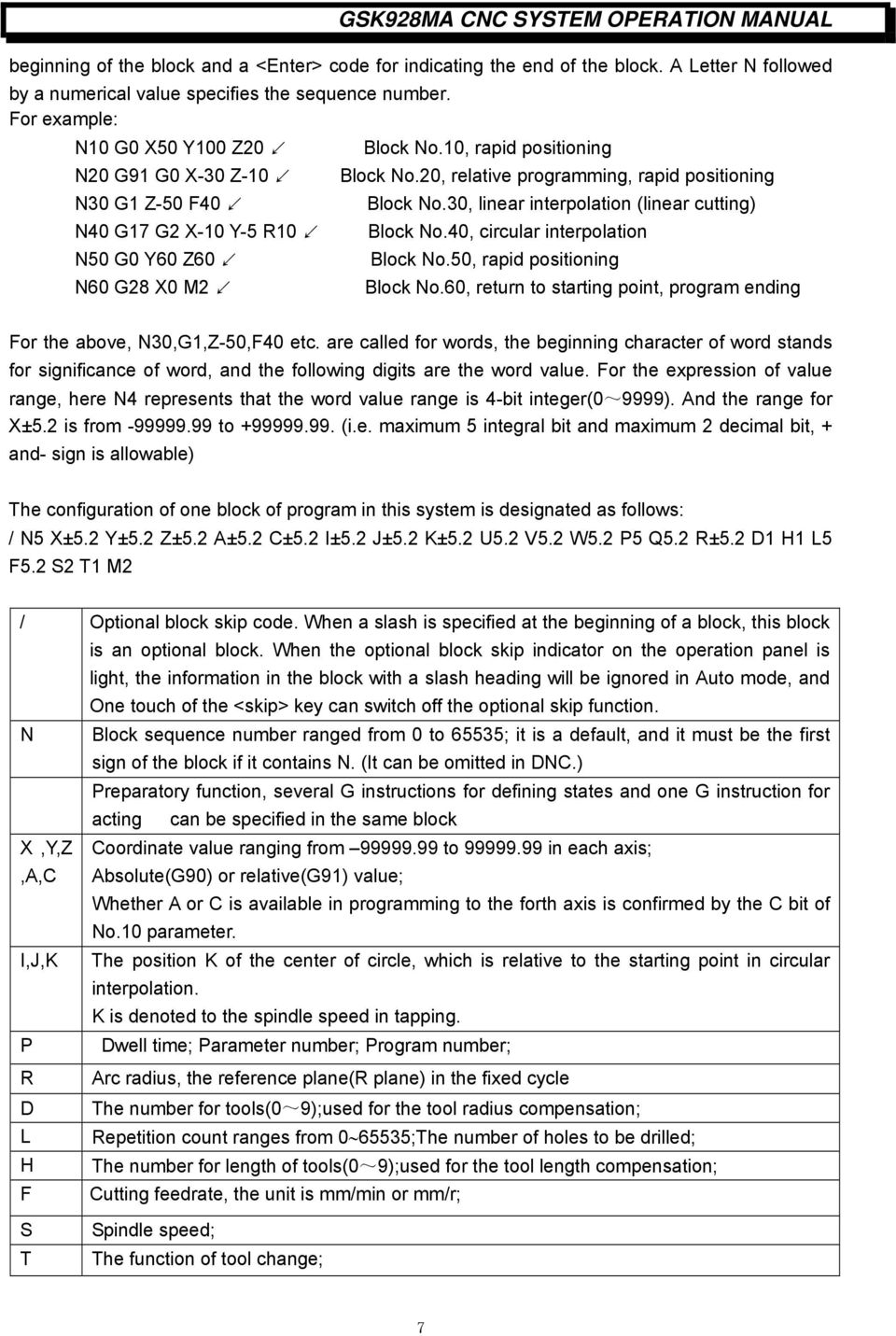
9 M Auxiliary function for the starting and stop of spindle,water pump and the inputting and outputting by user; Enter code, End of block code; Free format is used for program block. Except the requirement of the beginning with /, N, other word (a letter following by a numerical value) may be put in any sequence. And the block ends with the ENTER sign. 1.8 Tool Path of Rapid Positioning The sequence of rapid positioning is as follows: It s Z axis, X axis, Y axis, the 4th axis in turn when the direction of Z axis is positive. It s X axis, Y axis, the 4th axis, Z axis in turn when the direction of Z axis is negative. It s X axis, Y axis, the 4th axis in turn when there is no positioning in Z axis. 1.9 Offset of System Coordinate The offset of the system coordinate (coordinate offset in X, Y, Z, C axis direction) can be set by parameter No. 55, 56, 57, and 58 respectively, which can be redound to adjust the machining remainder conveniently, without modifying the program Initial and Modal of System Initial status is defined that t the programming status before the program runs. It is the default status of the system when power-on. The modal is defined that the corresponding word is valid after the instruction is specified until another block is specified. Another meaning for the modal: the word does not be input again in the following block for the same function after it is set Initial Status of System The initial status of this system after power on is listed as follows: Item Status Description Programming mode G90 Programming with the absolute coordinate G17 Selecting X-Y plane for circular interpolation G40 Canceling tool radius compensation G49 Canceling tool length compensation Using reference coordinate system Item Status Description G80 Modal data in non-fixed cycle G94 Speed state in feed per minute G98 Return starting point in fixed cycle Modal G code G0 Rapid positioning 8
10 Rapid traverse rate Depending on parameter No.1 (G0 SPD) Cutting feedrate Depending on parameter No.2 (G1 F) Current status: Item Work coordinate value Spindle Description Current coordinate, the tool position after the latest Auto operation or Manual operation. Current status 1.12 Start of Program At the beginning of program executing, the tool nose tool should be at the position in which the tool be changed. It is suggested that G00 X_ Y_Z_ should be programmed in the first block of the program to position the tool to the starting point in absolute coordinate; otherwise the program will not run normally End of Program Usually, M2, M30, or M31 is specified in the last block of the program to end the executing of the program; M2: Indicating the end of the program and stopping the spindle, turning off the coolant pump. M30: End of program. M31: End program and restart the program; Before executing these instructions, make sure the tool back to the starting point of the workpiece coordinate system with the execution of G28 instruction. After the execution of the program, the system will return to workpiece coordinate system with the cancellation of tool offset Main Program and Subprogram Subprogram comprised by a number of program blocks is contained in the main program is identified by the sequence number of the first block of it. At the last block of the subprogram, M99 must be specified. Subprogram is generally arranged after M2 or M30 of the main program. The subprogram can be called by M98 instruction. Three-embedded subprogram call at most can be executed using M98 instruction in this CNC system. For example: subprogram call using M98 instruction N40 P1000 L10 M98 N1000 G1 X-6 N1010 X-30 Z-30 N1020 Z-20 N1030 X-10 Z-30 N1040 G0 X45 Z80 M99 10 times the subprogram No.1000 is to be repeated. beginning of subprogram end of subprogram 9
11 1.15 Backlash Compensation The backlash compensation value is stored as system parameter in the system parameter memory area, Parameter No. 11, 12,13,14 are used for X,Y, Z and the 4th axis backlash compensation respectively. If the compensation value of each axis is set to 0.00, it means no compensation, if it is set other than 0.00 in this case, the backlash compensation will be given automatically by the CNC system (circular interpolation can backlash compensate automatically if the circular interpolation automatically exceeds the quadrant) R Reference Plane R reference plane is laid high from some height of X-Y plane. It s higher than the workpiece but not too high, which can be redound to lift the cutting tool in Z direction and rapid traverse in X,Y direction at R reference plane while fixed cycle processing is in progress machining (drilling or groove rough milling). It can be defined by program using R word. 10
12 2 S, T, M Function, D, H, F, FEED% 2.1 S Function S function is namely the S word in a block used for specifying the spindle speed. When using 4-bit switching value encoder output to specify the spindle speed: Set No. 54 to be of 4-bit switching value encoder output corresponding to 0.00, S0~S15 to control the spindle speed. At the same time, S0~S255 corresponds to output 0~10V analog voltage. When using analog signals (0~10V) to specify the spindle speed: S function can be used directly to specify the spindle speed (rev per minute) by setting No. 54, No.59 (the spindle speed when outputting 5V voltage signal) and S function is directly used for the spindle speed. Please read the chapter: Parameter Setting T Function T function is used for the control of tool change on the toolpost, in which the tool number is expressed by a digit from 0~8(The current tool can be directly used as No.0 tool without rotating the toolpost). It is relative to the No.98 parameter of the CNC system: When the No.98 parameter is less than or equal to 0.00, it means that the automatic toolpost for tool change is not fixed on the machine and the T function can be executed in Manual mode, but the locking time of the toolpost reverse rotation is very short, and the T word will not be shown without the execution of T function in the operation interface of Auto, Manual, Dry run mode etc.. While the Auto mode is running to the T function word, the system will pause, and the manual tool change can be performed by operator. Press <RUN> key to go on program execution after the tool change is done. When the No.98 parameter is more than 0.00, it means that the automatic toolpost for tool change has been fixed on the machine and the No.98 parameter represents the locking time (usually 1s) of toolpost reverse rotation. If the tool number expressed by digits is not the current tool when T function is being executed, the toolpost will be rotated to the required tool by the system instructions. 2.3 M Function (Auxiliary Function) M0 Program ends. After executing other instructions of the block, stop the spindle, and cut off the coolant, point to the next block without the further running, waiting for pressing the RUN key to go on running the block. M2 End of program. Stop the spindle, switch off the coolant, and cancel the coordinate offset specified by G92 and the tool offset to return to the initial block. After executing M2 instruction, the system will be switched to the reference workpiece coordinate system. M3 Spindle clockwise rotation; M4 Spindle counterclockwise rotation; M5 Spindle stop; 11
13 M6 Invalid compatible function; M8 Coolant On; M9 Coolant Off; M12 Pause: waiting for pressing <RUN> key. (pressing <emergency> key to stop running). M20 Setting the outputting of user 1 to 1; M21 Setting the outputting of user 1 to 0; M22 Setting the outputting of user 2 to 1; M23 Setting the outputting of user 2 to 0; M24 Setting the outputting of user 3 to 1; M25 Setting the outputting of user 3 to 0; M27 The system coordinate to be zero, and cancel the machine zero return. M28 Reset the coordinate value of the 4th axis (A or C axis). M30 End of program and cancellation of tool offset and return to the start block of the program (without running). After a block containing M30 is executed, the CNC system will be switched to the reference workpiece coordinate system M31 End of program, processing cycle. Cancel the tool offset and return to the initial program. After executing M31, the system is switched to the reference workpiece coordinate system. M32 Lubrication On; M33 Lubrication Off; M60 When the output of user 1 is 1, the system waits; when the output of user 1 is 0, the system executes the other blocks in the same block or the next block. M61 When the output of user 1 is 0, the system waits; when the output of user 1 is 1, the system executes the other blocks in the same block or the next block. M60/M61 may be in the same block with G function and be executed firstly which can improve the process execution speed instead of G90/G91 instruction. M90 The program skips to the block specified by D when the output of user 1 is 0. Format : N_ M90 P_ P is the skipping block number (If the input is 1, executing the next block by sequence number) M91 The program skips to the block specified by D when the output of user 1 is 1. Format: N_ M90 P_ P is the skipping block number (If the input is 0, executing the next block by sequence number) M92 Unconditional skip to the block specified by D, Format: N_ M90 P_ P is the skipping block number M93 Skipping when output of user 2 is 0. Format: N_ M90 P_ P is the skipping block number (If the input is 1, execute the next block in order) M94 Skipping when output of user 2 is 1. 12

14 Format: N_ M90 P_ P is the skipping block number (If the input is 0, execute the next block in order) M98 Calling of subprogram Format: N_ D_ L_ M98 P is the start block number of subprogram, L is calling times (omission for once), and three-loop subprogram call at most can be executed using M98 instruction. M99 End and return of subprogram. Note: 1) M0, M2, M30, M31, M99 after G function is executed; 2) M90, M91, M92, M93, M94, M98 is the single format (other G function can't be with G90, G91 function at a time) 3) Other M function which is in the same block with other functions will be executed first (i.e. It will be executed before G function). 2.4 D, H Function D Cutting tool radius number (0~9) which is used for tool radius compensation. The tool radius value of D1-D9 can be set by parameter respectively. H Cutting tool length number (0 ~ 9) which is used for and being used in tool length compensation. The tool length value of H1-H9 can be set by parameter respectively. The tool radius number can be specified by D word (D1-D9, D0 means tool radius value is 0) in program. The function of tool radius compensation is fit in V3.0 version software and above of the system. And all software versions are used for the tool radius compensation of circle groove and rectangle groove processing cycle. The tool length number can be specified by H word (H1-H9, H0 means tool length value is 0) in program and does tool length compensation with G43 or G F, Feed% F word can be used freely in the block for specifying cutting feedrate. F is effective till the new value of F is set (The rapid traverse speed and the initial cutting feedrate can also be set by Parameter NO.1 and No.2). F: 0.01~ mm/min FEED% is used as feedrate override, range: 0%,10%,20%,..., 150%, which can be adjusted by pressing < Feed%> key and < Feed%>key. The feedrate override can be adjusted in running. 13
15 3 G Function (Preparatory Function) 3.1 G Function for Defining Programming State of the System Programming state of system is specified by these G functions as follows. They are modal which means they are valid unless the programming state is changed. The initial is the programming state that the part program is to be executed. The following G can be used in one program block with other G functions and at most 6 G functions can be used in the same block. G17 Initial state, select X-Y plane for circular interpolation G18 Select Z-X plane for circular interpolation G19 Select Y-Z plane for circular interpolation G40 Initial state, cancel tool radius compensation G43 Tool length compensation + G44 Tool length compensation G49 Initial state, cancel tool length compensation G54 Initial state, select the 1 st workpiece coordinate system G55 Initial state, select the 2 nd workpiece coordinate system G56 Initial state, select the 3 rd workpiece coordinate system G57 Initial state, select the 4 th workpiece coordinate system G58 Initial state, select the 5 th workpiece coordinate system G59 Initial state, select the 6 th workpiece coordinate system G80 Initial state, cancel the modal data of fixed cycle (use G98 instruction simultaneously) G90 Initial state, do programming with absolute coordinate. X, Y, Z word values mean the absolute coordinate values. G91 programming with incremental coordinate. X, Y, Z word values mean the incremental coordinate values (the increment relative to the starting point of the current block). G94 Initial state, set the feedrate per minute. The unit of cutting feedrate set by F word is mm/min, i.e. the millimetres of feeding per minute G95 Set the feedrate per rev. The unit of cutting feedrate set by F word is mm/r, i.e. the millimetres of feeding per rev of spindle. The spindle pulse encoder (1200 pulses per rev) must be fixed firstly before using G95 function. G98 Initial state, return to the start plane in fixed cycle. G99 Return to the R reference plane in fixed cycle. G09,G60,G61,G64 :Invalid compatible function G0 Rapid Positioning (Modal, Initial) Format : N_ G0 X _Y_ Z _ C_( or A_) X, Y,Z, C(or A) is the coordinate absolute value (G91) or relative value(g90) of end point to be positioned in work coordinate system. The needless axis can be omitted. The rapid traverse speed is specified by parameter No.1 and can be modified by pressing parameter key. The sequence of positioning is as follows: Position Z, X, Y, 4 th axis in turn when Z axis is positive (the cutter rising off the workpiece). 14
16 It s the X, Y, the 4 th, Z axis in turn when the Z axis is negative. Whether A or C is valid in programming to the 4 th axis is specified by C bit of parameter NO G1 Linear Interpolation (Modal) Format : N_ G1 X _Y_ Z _ C_( or A_) X, Y, Z is the end point coordinate absolute value or relative value to be interpolated in work coordinate system. The axis that has no movement can be omitted. F is feedrate, if it is omitted, the last feedrate F which has been executed will be used. The feedrate of initial state (initial modal data) can be specified by system parameter No.2. Whether A or C is valid in programming to the 4th axis is specified by C bit of system parameter NO G2, G3 Circular Interpolation (Modal) Format : G17 G2 X_ Y_ N_ G18 Z_ X_ R_ F_ G19 G3 Y_ Z_ Or: G17 G2 X_ Y_ I_ J_ N_ G18 Z_ X_ I_ K_ F_ G19 G3 Y_ Z_ J_ K_ The first type of format is that the programming is done by arc radius R; the second type of format is that the programming is done by the position that the circle center relative to the starting point (current position): G2: Clockwise direction (CW) G3: Counterclockwise direction (CCW), see diagram X,Y, Z: The end point coordinate value (absolute coordinate value for G90, incremental coordinate value for G91) of arc in work coordinate system, can be omitted for the axis with no moving I: Distance with X-direction from starting point to center point. J: Distance with Y-direction from starting point to center point. K: Distance with Z-direction from starting point to center point. R: Radius of arc. If R>0, the arc is less than or equal to 180 is commanded; Else, if R<0, the arc is more than or equal to 180 G17,G18,G19 Select X-Y plane, Y-Z plane, Z-X plane respectively. F: Feedrate along the arc, which can be omitted In circular interpolation, the tool is feeding by cutting speed. In circular 15

17 interpolation, the tool is automatically cross quadrant with the backlash compensation. G17 X-Y plane G18 Z-X plane G19 Y-Z plane Y X Z G3 G3 G3 G2 X G2 Z G2 Y 3. 5 G4 Dwell Format: N_ G4 P_ or N_ G4 X_ The unit of P is 1%s, and X is s: e.g. P250 is 2.5s, X1.5 is 1.5s G10 G11 Rough Milling in Concave Groove of Inner Circular Format: G10 CCW rough milling inner circle: G10 N_ R_ Z_ I_ W_ Q_ K_ V_ D_ F_ M02 G11 CW rough milling inner circle: G11 N_ R_ Z_ I_ W_ Q_ K_ V_ D_ F_ M02 R The position of R reference plane. It is absolute coordinate value in Z direction in G90 and relative plane far from the starting point in Z direction of current block in G91, which is easy to position in X-Y direction on R plane rapidly and lift tool in Z direction. Z The height of concave groove. It is absolute coordinate value in G90 and position relative to R plane in G91. I The radius of concave groove. It must longer than the radius of the current tool. W The first cutting height.(blow R reference plane)w>0. Q The increment in each cutting in Z direction. Q>0 K The width increment in cutting. It s usually shorter than the diameter of tool. K>0. V The distance far from the last machining plane in fast cutting. W>V>0. D The number of tool radius (1-9), which can be specified by parameter No.15 to 23. D0 means tool radius value is 0. R, Z, W, V and Q are modal data in fixed cycle. The process of rough milling inner circle for concave groove is as follows: (1) Move the tool to R reference plane in Z direction rapidly. (2) Cut the height of W downward (cutting speed). (3) Mill an I-radius circle helically with the increment of K every time (compensation for the radius of tool is specified automatically by system). (4) Return to R reference plane rapidly in Z direction. (5) Orient to the center of the circle in X-Y direction rapidly. 16

18 (6) Orient to the plane V from the last machining plane in Z direction rapidly. (7) Cut the height of (Q+V) downward in Z direction. (8) Repeat above procedure No. (3) to (7) to finish cutting the total height. (9) Return to the starting point in Z direction (G98) or R reference plane (G99). "r" in following graph is the radius of tool relative to D (compensation for the radius of tool is specified automatically by system) G12 /G13 Finish Milling of Inner Circle Format: G12 CCW fine mill inner circle. G13 CW fine mill inner circle. G13 G12 N_ I_ J_ D_ F_ I The radius of the circle J The distance between the starting point and the center of the circle D The tool radius number (1-9), which can be specified by parameter No.15 to 23. D0 means the radius value is 0. The end point of the tool: G12: G13: The letter r in following graph is the radius of tool relative to D (compensation for the radius of tool is specified automatically by system). Y r 4 I 1 2 X J

19 3. 8 G14 /G15 Fine Milling of Outer Circle GSK928MA CNC SYSTEM OPERATION MANUAL Format: G14 CCW fine milling of outer circle. G14 N_ I_ J_ D_ F_ G15 CW fine mill of outer circle G15. I The radius of the circle J The distance between the starting point and the center of the circle D The tool radius number (1-9), which can be specified by parameter No.15 to 23. D0 means the radius value is 0. The path of the tool: G14: G15: The letter r in following graph is the radius of tool relative to D (The compensation for the radius of tool is specified automatically by system). Y 3 1 x r 4 I 2 J 3. 9 G22 System Parameter Setting (Modal) Format: N_ G22 P_ L_ X_ Y_ Z_ P=1~99 : System parameter number, refer to chapter of system parameter setting for details. X, Y, Z: The data used to calculate L=0~19 : Calculation factors as follows: L=0: Set the system parameter No.P =0. L=1: Set system parameter No.P =X; L=2: Set system parameter No.P=-X. L=3: Set system Parameter No.P= Abs (X); (the absolute value of X) L=4: Set system parameter No.P=original value + X L=5: Set system parameter No.P=original value - X L=6: Set system parameter No.P =X+Y 18
20 L=7: Set system parameter No.P =X-Y L=8: Set system parameter No.P =-X+Y L=9: Set system parameter No.P =-X-Y L=10: Set system parameter No.P =2X L=11: Set system parameter No.P =X/2 L=12: Set system Parameter No. P=X * (The value of lower byte of Y); The value of lower byte: L=13: Set system parameter No.P =X / (The value of lower byte of Y); The value of lower byte: L=14: Set system parameter No.P =X*Y/Z L=15: Set system parameter No. P=Root(X*Y) L=16: Set system parameter No. P=Root(X**2+Y**2) L=17: Set system parameter No. P=Root(X**2-Y**2) L=18: Set system parameter No. P=max (X,Y) L=19: Set system parameter No. P=min (X,Y) L=20: Set system parameter No. P=mod(X,Y) The data which range are integers from to are stored by 4 bytes in the system. While calculating by parameters, be sure to use the effective data. It is 1 for the system while 0.01 is displayed. Notice: The calculation is done all by integers in the system, and 0.01 corresponds to 1 of the internal integers which range from to G23 Conditional Jump Format: N_ G23 P_ X_ Y_ Z_ L_ P: System parameter number 1~99; L: Sequence number of the block jump to(range: 0~65535); X, Y, Z: Conditional value (there should be at least one conditional value to be specified in the block): If one of the conditions below is satisfied, control will jump to the block with sequence number specified by L, else, control executes the next block sequentially. If X is specified and the value of parameter = X, jump to No. L block; If Y is specified and the value of parameter >Y, jump to No. L block; If Z is specified and the value of parameter <Z, jump to No. L block; 3.11 G27 Machine Zero Inspection Format: N_ G27 The tool offset will be cancelled and system will return to workpiece coordinate system in G27. The system will be positioned to the machine zero and the stepout will be inspectioned by system. Before executing G27 instruction, make sure that the tool is in the negative direction of the reference point deceleration signal. If machine zero hasn t been built by machine tool builder or the machine zero return operation has never been executed, alarm E45 will be displayed. If any step has been detected lost after the system executes the machine zero return, alarm E41/E42 /E43 will 19
21 be displayed. When Bit E41 of Parameter No.10 is 0 and stepout is detected, alarm E41/E42/E43 will be displayed. When Bit E41 of parameter No.10 is 1 and only the deviation is larger than 0.02mm, alarm E41/E42/E43 will be displayed. The system does not detect the stepout when G27, M28 instructions are in the same block, i.e. alarm E41/E42 /E43 will not be displayed. After the execution of G27/G28/M02/M30 instruction or machine zero return and reference point return operation, the system will be switched to the reference workpiece coordinate system G28 Rapid Traverse to Reference Point via Middle Point Format: N_ G28 X_ Y_ Z_ A_(or C_) This instruction is used to position the tool to the middle point, and then to traverse to the reference point at rapid traverse speed. The tool offset compensations is cancelled after reference point return. After the execution of G27/G28/M02/M30 instruction or machine zero return and reference point return operation, the system will be switched to the reference workpiece coordinate system G31 Rapid Return to the R Reference Plane Format: N_G31 Return to the R reference plane in Z direction rapidly G34/ G35 Rough Milling of the Rectangle concave Groove Format: G34 CCW milling G35 CW milling G34 N_ G35 R_ Z_ I_ J_ K_ W_ Q_ V_ U_ D_F_ R The position of R reference plane. It s the absolute value in G90 and the position relative to the starting point of the current block in G91. Z The height of groove. It s the absolute value in G90 and the position relative to the R reference plane. W The cutting height in first milling, W>0. Q The incremental height in each cutting, Q>0. V The distance from the last machining plane when moving the tool rapidly, V>0. K The incremental width in each cutting and usually shorter than the radius of the tool, K>0. I The width of the rectangle-concave groove in X direction, I>0. J The width of the rectangle-concave groove in Z direction, J>0. U The corner radius of the rectangle-concave groove, U 0. D The tool radius number (1-9), which can be specified by parameter No.15 to 23. D0 means the radius value is 0. R, Z, W, V, Q is the modal data in the fixed cycle. The process is as follows (the rectangle center is the starting point): (1) Moving down to the R reference plane in Z direction. 20
22 (2) Cutting the height W at cutting feedrate. (3) Milling the rectangular plane with the increment K from center to outside. (The compensation for the radius of tool is specified by system automatically.) (4) Return to the R reference plane rapidly in Z direction. (5) Orienting to the center of the rectangle rapidly in X-Y direction. (6) Moving down in Z direction and orienting to the position with the distance V from the last machining plane. (7) Cutting the length (Q+V) down in Z direction. (8) Repeating the above procedure No. (3) to (7) to finish machining the rectangular plane for the total cutting height. (9) Rapid return to the starting point in Z direction (G98) or to the R reference plane (G99). In following graph r is the radius of tool relative to D (The compensation for the radius of tool is specified automatically by the system). Y r k J X I U 3.15 G36/ G37 Fine Milling Within the Rectangle-concave Groove Format: G36 CCW milling G37 CW milling G36 N_ G37 I_ J_ D_ K_ U_ F_ I, J The width of the rectangle along X and Y axis respectively K The distance between the starting point of program and the rectangle side in X direction. U The chamfer radius. There is no chamfer when U is omitted. D The tool radius number (1-9), which can be specified by parameter No.15 to 23. D0 means the radius value is 0. The cycle process: G36: G37: The letter r in following graph is the radius of tool relative to D (The compensation for the radius of tool is specified automatically by the system). 21
23 r r J Y X U I K 3.16 G38/ G39 Finish Milling Outside of the Rectangle Format :G38 CCW milling G39 CW milling G38 N_ G39 I_ J_ K_ U_ D_ F_ I,J The width of the rectangle along X and Y axis respectively K The distance between the starting point of program and the rectangle side. U The chamfer radius. D The tool radius number (1-9), which can be specified by parameter No.15 to 23. D0 means the radius value is 0. The tool path: G38: G39: The letter r in following graph is the radius of tool relative to D (The compensation for the radius of tool is specified automatically by system). U J 3 K 1 4 Y X 2 I r 3.17 Summary to G Function of Fixed Cycle Circular concave groove rough milling cycle, rectangular concave groove rough milling cycle, drilling cycle, boring cycle and taping cycle can be realized by G function of fixed cycle, which is comprised of G10,G11,G34,G35,G73~G89. The usual process is as follows: (1) Orienting to the hole rapidly in X-Y plane (This function is not involved within G10, G11, G34, and G35). (2) Moving down to the R reference plane rapidly in Z direction (The R reference plane is between the starting point and the X-Y plane of workpiece and close to the workpiece 22
24 plane). (3) Milling the first height in Z direction. (4) Milling the height with the increment every time in Z direction. (5) Operation in hole bottom or plane. (6) Return to the R reference plane or to the starting point (G98) alongz axis. (7) Circulate from (1) to (6) to perform drilling of the holes on the line if L word is in the program (This function is not involved within G10, G11, G34, G35). The usual format is as follows: G98 N_ G_ X_ Y_ R_ Z_ W_ Q_ P_ U_ V_ L_ K_ F_ G99 X, Y The position of the hole in X-Y plane. R The coordinate value of the R reference plane (It s the absolute position in G90 and the position relative to the starting point in G91). Z The hole depth(it s the absolute value in G90 and the position relative to the R reference plane in G91). W The first cutting depth (calculate it from the R reference plane, W>0). Q The increment of cutting depth in Z direction. P The delay time in the hole bottom(unit: 1/100s) U The distance of lifting the tool during high speed drilling cycle (G73).U>0 V The distance from the last machining plane in high speed drilling cycle(g73) or deep hole drilling cycle(g83), V>0. L Drilling cycle of holes with the numbers L from the starting point (the starting point of the K block) to the position with the XY coordinate The spindle speed per minute in G74, G84. It s used to calculate the speed in acceleration and deceleration in tapping. F The machining speed. R Z W Q U V word is the modal value in fixed cycle. If they are specified in advance and not changed, they needn t to be input again in the sequential blocks with the G function of fixed cycle. They can be cancelled by G80 instruction. It can return to the starting point of the block by using G98 instruction in Z direction after the cycle (initial and modal). It can return to the R reference plane in Z direction by using G99 instruction after the cycle (modal). If there is L word in the fixed cycle of G73-G98, L holes will be machined circularly on the line from the current X-Y plane to the end point with X-Y coordinate specified by the block. The distance between each adjacent hole is equal. There is no hole in the current position (the starting point of the block) and the last hole will be located in the end point. The illustration is as follows: 23
25 End point 终 点 Starting point 起 点 L G73 High Speed Drilling Cycle Format: N_ G73 X_ Y_ R_ Z_ W_ Q_ U_ V_ F_ X,Y The hole position in X-Y plane. R The coordinate value of the R reference plane (It s the absolute position in G90 and the position relative to the starting point of the block in G91). Z The hole depth(it s the absolute value in G90 and the position relative to the R reference plane in G91). W The first cutting depth (calculating it from the R reference plane), W>0. U The distance of rapid lifting of cutters, U>0 V The distance to the last machining plane in rapid cutting, U>0, U V Q The increment of cutting depth in Z direction, Q>0. R Z W U V Q is the modal data in fixed cycle. The cycle process is as follows: (1) Rapid positioning to the X-Y plane. (2) Rapid traverse down to the R reference plane in Z direction. (3) Cutting a depth equal to W firstly in Z direction. (4) Rapid traverse up a distance U. (5) Rapid traverse a distance (U-V) down. (6) Cutting a depth (Q+V) down. (7) Repeating the procedure No. (4), (5), (6), till tool feeds to the bottom of the hole in Z direction. (8) Rapidly return to the starting point (G98) or the R reference plane (G99). (9) If there is L word in the block, then repeating the procedure No.(1)-(8) to complete L holes G74 Tapping Cycle with Left-hand Format: Metric I_ N_ G74 X_ Y_ R_ Z_ P_ K_ Inch J_ X,Y The position of X-Y plane. R The coordinate value of the R reference plane (It s the absolute position in G90 and the position relative to the starting point in G91). Z The hole depth (the absolute position in G90 and the position relative to the R reference plane in G91). 24
26 I For metric thread, tooth: 0.01~12.00(mm). J For inch thread, tooth: 2.12~ P Number of initial pulse in tapping (0-1119) (When the machine installed with a 1200pulses/ rev. encoder).usually P can be omitted (i.e. P0). K It is the spindle speed per minute, and it is used to calculate the speed in acceleration and deceleration in tapping. R and Z are the modal data of the fixed cycle. A 1200pulses/ rev. spindle encoder should be fixed for tapping. The operation procedure: (1) Positioning the hole in X-Y plane. (2) Rapidly traversing down to the R reference plane. (3) Spindle rotating counterclockwise. (4) Tapping to the hole bottom. (5) Stopping the spindle. (6) The spindle rotating clockwise and tapping up to the R reference plane. (7) Stopping the spindle. (8) Rapidly return to the starting point (G98) or the R reference plane (G99). (9) If there is L word I in the block, then repeat the procedure (1)~(8) to complete holes G81 Drilling Cycle Format: N_ G81 X_ Y_ R_ Z_ F_ X,Y The position of X-Y plane. R The coordinate value of the R reference plane (It s the absolute position in G90 and the position relative to the starting point in G91). Z The hole depth(it s the absolute value in G90 and the position relative to the R reference plane in G91). R and Z are the modal data. The operation procedure: (1) Positioning the hole in X-Y plane. (2) Rapidly traversing down to the R reference plane. (3) Drilling down in Z direction. (4) Rapidly return to the starting point (G98) or the R reference plane (G99). (5) If There is L word in the block, then repeating the procedure (1)~(4) to complete L holes G82 Drilling Cycle Format: N_ G82 X_ Y_ R_ Z_ P_ F_ X,Y The position of X-Y plane. R The coordinate value of the R reference plane (It s the absolute position in G90 and the position relative to the starting point in G91). Z The hole depth(it s the absolute value in G90 and the position relative to the R reference plane in G91). R and Z are the modal data of fixed cycle. 25
27 The operation procedure: (1) Positioning the hole in X-Y plane. (2) Rapidly traversing down to the R reference plane. (3) Drilling down in Z direction and pausing for the time specified by P at the hole bottom. (4) Rapidly return to the starting point (G98) or the R reference plane (G99). If There is L word in the block, then repeating the procedure (1)~(4) to complete L holes G83 Deep Hole Drilling (Perking)Cycle Format: N_G83 X_ Y_ R_ Z_ W_ Q_ V_ F_ X,Y The position of the hole in X-Y plane. R The coordinate value of the R reference plane (It s the absolute position in G90 and the position relative to the starting point of the block in G91). Z The hole depth(it s the absolute value in G90 and the position relative to the R reference plane in G91). W The first cutting depth (calculated from the R reference plane, W>0). V The distance to the last machining plane during rapidly traversing W>V>0. Q The machining increment in Z direction. R W V Q are modal data of fixed cycle, Z is the non-modal data. If Z is omitted in the block, the tool will feed for W value, then rapidly move counterclockwise and stop. No alarm occurs in the CNC system. The operation procedure: (1) Positioning in X-Y plane. (2) Rapidly traversing down to the R reference plane. (3) Cutting a depth W firstly. (4) Rapidly traversing up back to the R reference plane. (5) Rapidly traversing down to the position with the distance V from the end machining plane. (6) Drilling a depth (Q+V) down. (7) Repeating the procedure (4) ~ (6) to reach the hole bottom. (8) Rapidly return to the starting point or the R reference plane. (9) If There is L word in the block, then repeating the procedure (1)~(8) to complete L holes G84 Right-hand Tapping cycle Format: Metric I_ N_ G84 X_ Y_ R_ Z_ P_ K_ Inch J_ X,Y R The position of X-Y plane. The coordinate value of the R reference plane (It s the absolute position in G90 and the position relative to the starting point in G91). 26
28 Z The hole depth(the absolute position in G90 and the position relative to the R reference plane) I For metric thread, tooth: 0.01~12.00(mm). J For inch thread, tooth: 0.01~200.00(teeth/inch). P Number of initial pulse in tapping (0-1119) (when the machine installed with a 1200pulses/ rev. spindle encoder).usually P can be omitted (i.e. P0). K It is the spindle speed per minute for thread cutting, and is used to calculate the speed in acceleration and deceleration in tapping by the system. R and Z are the modal data for fixed cycle. A 1200pulses/ rev. spindle encoder is used in tapping. The operation procedure: (1) Positioning the hole in X-Y plane. (2) Rapidly traversing down to the R reference plane. (3) The spindle rotating clockwise. (4) Tapping to the hole bottom. (5) Stopping the spindle. (6) The spindle rotating counterclockwise and tapping up to the R reference plane. (7) Stopping the spindle. (8) Rapidly return to the starting point (G98) or the R reference plane (G99). If There is L word in the block, then repeating the procedure (1)~(8) to complete L holes G85 Boring Cycle Format: N_G85_ X_ Y_ R_ Z_ F_ X,Y The position of X-Y plane. R The coordinate value of the R reference plane (It s the absolute position in G90 and the position relative to the starting point in G91). Z The hole depth(it s the absolute value in G90 and the position relative to the R reference plane in G91). R and Z are the modal data. The operation procedure: (1) Positioning the hole in X-Y plane. (2) Rapidly traversing down to the R reference plane. (3) Drilling down in Z direction with the speed specified by F word. (4) Rapidly traversing up to the R plane with the speed specified by F word. (5) If There is L word in the block, then repeating the procedure (1)~(4) to complete L holes. (6) Rapidly return to the starting point in G G86 Boring Cycle (drilling along head) Format: X,Y N_ G86 X_ Y_ R_ Z_ F_ The position of X-Y plane. 27
29 R The coordinate value of the R reference plane (It s the absolute position in G90 and the position relative to the starting point in G91). Z The hole depth(it s the absolute value in G90 and the position relative to the R reference plane in G91). R and Z are the modal data. The operation procedure: (1) Positioning the hole in X-Y plane. (2) Rapidly traversing down to the R reference plane. (3) Drilling down in Z direction at the speed specified by F. (4) Stopping the spindle. (5) Rapidly return to the R reference plane (G99) or the starting point (G98). (6) If There is L word in the block, then repeating the procedure (1)~(5) to complete L holes G89 Boring Cycle Format: N_ G89 X_ Y_ R_ Z_ P_ F_ X,Y The position of X-Y plane. R The coordinate value of the R reference plane (It s the absolute position in G90 and the position relative to the starting point in G91). Z The hole depth(it s the absolute value in G90 and the position relative to the starting point in G91). R and Z are the modal data. The operation procedure: (1) Positioning the hole in X-Y plane. (2) Rapidly traversing down to the R reference plane. (3) Drilling down in Z direction at the speed specified by F and pausing at the hole bottom for the time specified by P. (4) Rapidly traversing up to the R reference plane at the speed specified by F in Z direction. (5) If There is L word in the block, then repeating the procedure (1)~(4) to complete L holes. (6) Rapidly return to the starting point in G G92 Floating Coordinate System Setting Format: N_ G92 X_ Y_ Z_ C(or A)_ X, Y, Z, and C: the floating coordinate value of current position. An absolute positioning must be executed at the initial block of part program. For the convenience of the programming, the floating coordinate system can be freely defined in the program. The system can automatically execute the conversion between reference point and machine zero. Furthermore, the system can automatically return to the workpiece coordinate system after executing G27, G28, M02, M30, M31 or return to the machine zero and reference point. 28
30 4 Parameter Programming The parameter programming use the value of the system parameter as the value of certain words in the program block, A changeable parameter value can make the program flexible and versatile by applying the function of parameter programming (parameter can be modified by G22). Combining with the G23 function to skip, some complex cutting cycle and special cycle part programs for user can be achieved. There are a total of 99 parameters available in this system. The number of the parameter is ranged for For the parameter No.1~84,attention should be paid in programming for the influence of the parameter change to the relative function of the system. And parameter No can be used flexible in parameter programming by user. The words X, Y, Z, U, V, W, Q, F, I, J, K, R can be specified in parameter programming. The format of these words in parameter programming is expressed as follows: Word letter + * + Parameter number. Note: Only integer can be calculated in system, 0.01 corresponds to the interior integer 1.The range of parameter value is to Be cautious to use G22 for preventing it from overflowing. For example : N200 G0 X*70 Y*71 The value of the X is the value of parameter No.70; the value of the Y is the value of the parameter No. 71. Example: using parameter programming to achieve the triangle cutting cycle. The coordinate value of the starting point of the cycle in X-Y plane is (200.00, ) and the tool has been positioned to the starting point. The program is as follows: N10 G0 X200 Z300 Z0 (Rapidly positioning ) N30 G22 P62 X8 L1 (Setting parameter No.62 P62=8.00 : The first cutting depth in X direction) N40 G23 P62 Z150 L60 (judging: whether the total cutting depth in X direction<150.00? ) N50 G22 P62 X150 L1 ( false, cutting depth P62= ) N60 P61 X*62 Y200 Z150 L14 (Parameter No.61: cutting depth in Y direction P61 = L62*200/150) N90 P60 X*62 L2 (Parameter No.60 P60= - P62 ) N100 P79 X*61 L2 (Parameter No.79 P79= - P61 ) N110 G91 G0 X*60 (Rapidly moving in X direction) N120 G1 X*62 Y*79 (Cutting slantwise) N130 G90 G0 Y*61 (Rapidly traversing to starting point in Y direction) N140 G23 P62 X150 L180 (If the total cutting depth in X direction =150, cycle ends) N150 G22 P62 X8 L4 (The cutting depth in X direction ) N160 M92 D40 (Skipping to the block No.40, i.e. N40) N180 M2 (Cycle ending: Stopping the spindle, end of program) 29
31 Y Rapid 快 速 traversing 进 Feedrate 给 速 度 X 30
32 Operation 5 Introduction 5.1 Control Panel and Function buttons Page change keys and cursor move keys for edit mode <Page Up> < > <Page Down> Cursor move keys for edit mode < > < > < > Spindle Forward Spindle Stop Coolant Lubrication Auto Feedrate Override Manual Feedrate Override Spindle Backward Tool Change Manual Step Increment MPG in X direction Z+ Y+ 4- MPG in Y direction X+ X- MPG in Z direction 4+ Y- Z- The key in the center is <rapid moving>key and state indicator. Round keys are feed directions selection keys.(manual move keys for axis) Run Pause,F 31
33 正 转 冷 却 停 止 润 滑 反 转 换 刀 参 数 显 示 命 令 功 放 上 档 单 段 跳 段 退 出 回 零 插 入 删 除 回 车 暂 停 运 行 The Layout for GSK928MA Operation Panel 5.2 Adjusting of LCD Brightness This system adopts LCD screen as monitor which has a lattice 160X128. In any non-edit mode, press <A/X> and < I/U> keys can adjust the brightness of the LCD to obtain the best display effect. 5.3 Indicators and Function Keys <Spindle clockwise> key and indicator: In Manual or Auto mode, When <spindle clockwise> key is 32
34 pressed or M03 is executed, the indicator is on. It means the spindle is in a clockwise state. <Spindle stop> key and indicator: When <spindle stop> key is pressed or M05 is executed in Auto mode or in Manual mode, the indicator for <Spindle clockwise> and <Spindle counterclockwise> is not on. It means the spindle is in a stop state. <Spindle counterclockwise> key and indicator: In Manual or Auto mode, pressing this key (spindle speed being input) or M04 is executed, the indicator is on. It means the spindle is in a counterclockwise state. <Coolant> key and indicator: Pressing this key in Manual or Auto mode or M8, M9 is executed; the indicator is on or off. It means the coolant is in an open (on) or close (off) state. <Lubrication> key and indicator: Pressing this key in Manual or Auto mode or M32, M33 is executed, the indicator is on or off. It means the lubrication is in an open (on) or close (off) state. <Tool change>key: The T function is relative to the parameter No.98: When the parameter No , it means the automatic toolpost has not been fixed on the machine, and T function can be executed in Manual mode, but the reverse rotation locking time of the toolpost is very short. And T code will not be shown without the execution of T function in Manual, Auto, and Dry run mode. When it is running to the T word in the Auto mode, the system will pause. And manual tool change can be performed by operator. Press <RUN> key to go on the execution of the program after the tool changing. When the parameter No.98>0.00, it means the automatic toolpost has been fixed on the machine, and the parameter No.98 represents the reverse rotation locking time of the toolpost. (usually 1s). When T function is executing, if the number for tool expressed by digits does not correspond to the current tool, the toolpost will be rotated by system control to the required tool. <MPG in X direction> key and indicator: when this key is pressed in Manual mode, X axis can be moved by MPG, and the indicator is ON/OFF. < MPG in Y direction>key and indicator: when this key is pressed in Manual mode, Y axis can be moved by MPG, and the indicator is ON/OFF. < MPG in Z direction> key and indicator: When this key is pressed in Manual mode, Z axis can be moved by MPG, and the indicator is ON/OFF. Manual move keys will not be valid when MPG takes effect <Rapid traverse> key and indicator: In Manual mode, the indicator will switch between on and off. When the indicator is on, the manual speed is the rapid positioning speed specified by parameter No.1 (G0 SPD). When the indicator is not on, the manual speed is the cutting feedrate set by parameter No.2 (G1 F). In the MPG mode, the MPG feeding rate is 10 when the <rapid feed> indicator is on (ten steps for the corresponding axis for a scale of MPG), 1 for the indicator off (one step for the corresponding axis for a scale of MPG). <X-> <X+> <Z-> <Z+> <Y-> <Y+> key: function keys for manual feed of axes. Note: It is invalid for manual feed keys in MPG mode. < Feedrate override> and < Feedrate override> keys: Increasing or decreasing the cutting 33
35 feedrate override for Auto mode. (0%,10%,,150%) Selecting the manual feedrate in Manual mode < Step Increment> < Step Increment>Keys: Selecting the step increment for Manual mode. < >< >< >< > keys: Cursor shift keys for editing < > also be used as backspace key in data inputting. <Page Up >, <Page Down> keys: paging down or up for editing <Ins> key: In Edit mode, using this key to switch the inserting or amending function<del> key: In edit mode, using this key to delete the number, word and block; in data input in Manual mode, using this key to cancel the data input; when selecting the menu, using this key to escape. <Par> key: Setting parameter in Manual, Dry run or Auto mode. <Disp> key: By pressing this key to display detail information of the system status in Manual, Dry run mode or Auto mode. <Comm> key: By pressing this key to call Instructions menu in Manual, Dry run, Auto or edit mode. <Enter>key: By pressing this key to confirm the data input, end one block; when selecting menu item, using this key to cancel the selecting. <Esc> key: By pressing this key to escape from the current menu selecting or exit the current status or operation mode. <Zero/Reference point>key: By pressing this key to execute the machine zero return and the reference point return function or starting point return function, and cancel the system coordinate offset and tool offset. <Drive> key and indicator: When the indicator is on, the control power supply will be output to stepper motor or servomotor. When the indicator is off, the control power supply to stepper motor or servomotor is disabled. Selecting the drive state by pressing this key, and pressing twice to switch on (from disabled to enabled) or switch off the drive (against misoperation). <Single> key and indicator: The program being executed is in single block, i.e. the program pauses after executing a block by pressing <RUN> key once. When the single block indicator is off, it means the continuous running state, such as Auto or Dry run mode. The program will be continuously executed by pressing <RUN> key without stopping between sequential blocks, till the end of the program. Switch between the single state and the continuous state can be achieved by pressing the <Single> key. <Skip> key and Indicator: Switch between the invalid state and the valid state for block skipping can be achieved by pressing the <Skip> key. When the indicator is on, the block skipping is valid and the optional block (with / ahead) is skipped (without executing); and Indicator off for the invalid of the block skipping, the optional block (with / ahead) is executed. <Shift> key and indicator: Some keys have two characters on their key top, by pressing < Shift>key to make the indicator on, then press the key with two characters to input the shift character. If <Shift> key is not pressed (with indicator off), the key with no shift character will be input. Switch in shift state can be achieved by pressing <Shift> key. It s valid only once. <Run> key: Press this key to start the process running, some functions need to be confirmed by pressing <Run> key to be executed. <Feed hold>key: when this key is pressed in Auto or Manual mode, the feeding or the program executing will stop. In Manual mode, the axial feeding will stop. In Auto mode, 34
36 alarm No. E19 will be displayed after tool stops, press <Run> key to go on the running, press <Esc> key to interrupt the program executing without the stopping of the spindle). Manual mode will be called by the system to execute the machine zero return and reference point return etc. (the system will exit the manual mode to return to Auto mode). The functions of <Run> key and <Feed hold>key can be used respectively by external interface. 5.4 Operation Mode and Incremental Input This system is operated in menu mode. The main menu will be displayed when the system is reset by power. Various operations with machine zero return and reference point return and command submenus can be selected in the main menu mode. In the various operations, some function keys can also be used to perform some functions except the command submenu: In the parameter setting interface, relative value (incremental value) can be input while inputting the value (coordinate, speed, offset value etc.) with decimal fraction manually: Press <Page Up >, <Page Down> keys before inputting, if D is displayed before cursor, it means the relative value is to be input. If D is not displayed, it means the actual value is to be input. The relative value is either positive or negative, while the relative value is being input: the actual input value=original value+ the relative value input 5.5 Resetting Power On The system will be reset after power on. The following process will be executed step by step after resetting: 1System memory testing, if error occurs in system memory testing, the corresponding alarm(e68,e69,e95,e96,e98,e99) will be displayed; 2 System parameter area testing (if error occurs, alarm E94 will be displayed, in this case, press any key to initialize the parameter area); 3Part program area testing,( if error occurs, alarm E93 will be displayed, in this case, press any key to initialize the part program area. 4 Displaying main menu if above mentioned tests are finished properly; The state of I/O interface when resetting is as following: Value of all output are 0 when resetting. The tool offset, system coordinate offset and system coordinate value will not be changed when resetting. 5.6 Operation of Menu The operation method of main menu, operation mode menu, reference point return and machine return menu, command menu are all the same. After the menu is being displayed, press the numerical key 1~7 to select the corresponding function of the menu, and the function of the menu will not be executed if one of the keys of <Del>, <Exit>, <Enter>is pressed, 35
37 5.7 Main Menu for the System GSK 1-MANUAL 2-AUTO 3-DRY RUN 4-EDIT 5-COM 6-PAR SET 7-CNC VER GUANGZHOU GSK928MA After turning on the power and pressing the <Reset> key, or exiting from any operation mode, the main menu will be displayed. Press numerical key <1>~<6> to select the operation mode. Press <7> to display the edition version of the system at the bottom of the screen: M V Pressing any key to return to main menu. 36
38 6 Parameter Setting There are totally 99 parameters in this CNC system with power down protection. In main menu, press <6> key to enter into parameter setting screen, in Auto mode, Dry run mode and Manual mode, press <Par> key to enter parameter setting screen. Parameters are displayed in 10 pages and 10 parameters in each page. In each screen, the Number, current value and the English meaning (abbreviation) of the parameters are displayed. The Chinese meaning of the cursor position parameter is displayed at the bottom of the LCD screen. Parameter setting operation: 1. Press <Page Up >, <Page Down> keys to change the pages, each one of those 10 pages is an option for user. 2. Press < > or < > key to move the cursor to the parameter to be modified. 3. Press < Enter> key to modify the current parameter: Input the new value of the parameter (or input the relative value by pressing <Page Up >, <Page Down> keys to display D) and then press < Enter> key to confirm it; 4. To initialize the parameter area, press <0> key and then press <Enter> key, INIT Y_ will be displayed. Press <Y> key to perform the initialization operation: The backlash data, tool offset value and the deceleration/ acceleration data of each axis and all other parameters will be reset; 5.The desired parameter can be positioned immediately by pressing two of the numerical keys (ranging from 01 to 80). 6.Press [ESC] key to exit parameter setting (with the parameter taking effect) and return to the main menu screen or the call mode. 6.1 Description of Parameter PAR SET ***** Parameter No.01 ~ 10 (initial value) 01_ G0 SPD Rapid traverse: for rapid positioning of G0 and Manual rapid traverse 02 G1 F Cutting feedrate: For G1 and Manual lower feed 03 STEP Step increment: No.1 gear in Manual mode. 04 STEP Step increment: No.2 gear in Manual mode. 05 STEP3 0.1 Step increment: No.3 gear in Manual mode. 06 STEP Step increment: No.4 gear in Manual mode. 07 STEP Step increment: No.5 gear in Manual mode. 08 STEP Step increment: No.6 gear in Manual mode. 09 STEP Step increment: No.7 gear in Manual mode. 10 X+Y+Z+C RAPID System status: alarm of each axis and direction specification 37
39 Parameter No.1: Rapid traverse speed for program. Usually, it is unnecessary to use H word to specify the rapid traverse speed in programming. In Manual mode, the speed is the reference speed for rapid traverse, which can be adjusted by rapid traverse speed override: (25%, 50%, 75% and 100%) In Auto mode, rapid traverse speed override is not available. Parameter NO.2: Setting the initial feedrate for part programs, in Manual mode, it is used to set the reference feedrate of tool movement. (Feedrate override in Manual mode: 10%, 20% to 150%), Feedrate override in Auto mode is 0%,10%,20%, 至 150%. Parameter No.3-9: 7-gear step increments setting in Manual mode. Parameter No.10: 16-bit Parameter for various status setting of the system, each bit can be modified by inputting 1 or 0, one can only press enter key to modify the last 8 bits after modifying the previous 8 bits. Move < > or < > key to position the cursor to the corresponding bit to be modified. Parameter NO.10 is not influenced by initialization. Each bit s description of parameter No.10 is as follow: X + Y + Z + C+ The 4 th axis direction: 0, 1 for motor rotation direction C0A1:The 4 th axis selection, 0=C-axis, 1=A-axis Z direction: 0,1 for motor rotation direction Z axis alarm detection: 1= detecting Y axis driver alarm input 0=no detection Y axis motor rotation direction: 0, 1 Y axis driver alarm detection: 1= detecting Z axis driver alarm input 0=no detection X axis motor rotation direction: 0, 1 X axis driver alarm detection: 1= detecting X axis driver alarm input 0=no detection B J DE FGHI ID-I: Reserved ID-H: Reserved E41 alarm Dwell in rapid Lock Display Language Over stroke signal detection Emergent stop signal detection ID-I Reserved ID-H Reserved E41 alarm(machine 0: Alarm when any stepout is detected; zero detection) 1: Alarm only when stepout over 0.02mm is detected Dwell in rapid traverse 0:Dwell for 0.1s in G00; 1:No dwell in G00 Lock 0: 38
40 Display Language Over stroke signal detection Emergent stop signal detection 1: Parameter No.10-14,39-54,59 are locked(modification disabled) 1: English 0: Chinese 1: Detection enable; 0; detection disable 1: Detection enable; 0: detection disable SET PAR 11 GAP X GAP Y GAP Z GAP C T-D T-D T-D T-D T-D T-D Backlash Parameter No (initial value) Backlash compensation: X axis (0~2.55) Backlash compensation: Y axis (0~2.55) Backlash compensation: Z axis (0~2.55) Backlash compensation: 4 axis (0~2.55) Tool radius of T1( ) Tool radius of T2( ) Tool radius of T3( ) Tool radius of T4( ) Tool radius of T5( ) Tool radius of T6( ) PAR SET Parameter No (Initial value) 21_ T-D Radius: Tool radius of T 7( ) 22 T-D Radius: Tool radius of T 8( ) 23 T-D Radius: Tool radius of T 9( ) 24 T-H Length: Tool length value of T 1( ) 25 T-H Length: Tool length value of T 2( ) 26 T-H Length: Tool length value of T 3( ) 27 T-H Length: Tool length value of T 4( ) 28 T-H Length: Tool length value of T 5( ) 29 T-H Length: Tool length value of T 6( ) 30 T-H Length: Tool length value of T 7( ) Radius PAR SET 31 T-H T-H X+LMT X-LMT Y+LMT Y-LMT Parameter No (Initial value) Length: Tool length value of T 8( ) Length: Tool length value of T 9( ) Stroke limit: X+ software stroke limit (workpiece coordinate system) Stroke limit: X- software stroke limit (workpiece coordinate system) Stroke limit: Y+ software stroke limit (workpiece coordinate system) Stroke limit: Y- software stroke limit (workpiece coordinate system) Stroke limit: Z+ software stroke limit (workpiece coordinate 39
41 37 Z+LMT Z-LMT X BEG Y BEG Length system) Stroke limit: Z- software stroke limit (workpiece coordinate system) Initial speed: initial speed of X axis (mm/min) Initial speed: initial speed of Y axis (mm/min) PAR SET 41 Z BEG C BEG X UP Y UP Z UP C UP X TOP Y TOP Z TOP C TOP Initial speed Parameter No.41 to 50(initial value) Initial speed: initial speed of Z axis (mm/min) Initial speed: initial speed of the 4 th axis (mm/min) Acceleration time constant: X axis acceleration time Acceleration time constant: Y axis acceleration time Acceleration time constant: Z axis acceleration time Acceleration time constant: the 4 th axis acceleration time Speed limit: X axis speed limit(mm/min) Speed limit: Y axis speed limit(mm/min) Speed limit: Z axis speed limit(mm/min) Speed limit: the 4 th axis speed limit(mm/min) PAR SET 51 M-TIME M5WAIT M5WAIT S128=5V OFST X OFST Y OFST Z OFST C S _ RUN-NB 0.00 Pieces Parameter No.51 to 60(initial value) Pulse: output time of pulse when the spindle starting or stopping(0-2.55s). Dwell time: dwell time of output when braking the spindle (0-2.55s). Dwell time: holding time of output when braking the spindle (0-2.55s) Speed: the first gear speed corresponding to 5V analog voltage output of the spindle Offset: system offset in X direction. Offset: system offset in Y direction. Offset: system offset in Z direction. Offset: system offset in the 4 th axis direction. Speed: the second gear speed corresponding to 5V analog voltage output of the spindle Pieces: program running times (2 bits of the decimal fraction for the program number). The software stroke is used for limiting the stroke in Manual or Auto mode in workpiece coordinate system. 40
42 The setting of the initial speed and acceleration time (acceleration time =deceleration time) constant of each axis can make the axis movement smooth. Note: Acceleration time constant is used to set the acceleration time from 120mm/min to 10000mm/min in linear acceleration or deceleration control; the unit of time constant is second. It is suggested that exponential acceleration or deceleration control should be used that the actual acceleration time will be longer than the setting time, which can be reduced for the acceleration time of axes by the practice. When parameter No.1 is set enough large, positioning can be done with the maxium speed (limited speed) in each axis direction. When Parameter No.51 is set for 0, the spindle stop and start signals are lasting signals, otherwise it is pulse signal. When parameter No.52, 53 are set for 0, spindle brake signal will not be output, if parameter No.53 is not set for 0, as soon as M05 signal is output, it will dwell for the time set by parameter No.52 and output brake signals and dwell for the time set by parameter No.53. When parameter No. 54 is set for 0, instruction S0-S255 is corresponding to the analog output of the spindle between 0V and 10V. (S255: 5V) When using analog spindle, parameter No.54 can be set for 0 to execute S128 function (spindle clockwise, which corresponds to 5V analog voltage). If S function is executed later, rotation per minute can be used for it. i.e. if 1200 r/m speed is needed, use the the execution of S1200. There maybe are some deviations in practice. When the two-gear analogue spindle is in use, parameter No. 59 can be set like parameter No.54, Two-gear analog spindle is used if the parameter No.54, 59 both are not set for 0. It can be switched by inputting 2 by the user. The first gear speed will be used when inputting 2 by user for 0(off), and inputting 2 for 1(on), the second speed will be used. In order to adjust machining allowance or machining precision, offset is usually set for a small value. PAR SET 61_ G54 X G54 Y G54 Z G54 C G55 X G55 Y G55 Z G55 C G56 X G56 Y 0.00 COODINATE PAR SET 91_ OTHER OTHER OTHER OTHER OTHER OTHER OTHER OTHER OTHER
43 Parameter No.61 to 84 is set for the position of G54~G99 coordinate system in the reference workpiece coordinate system. The position of the 1 st to the 6 th workpiece coordinate system in reference workpiece coordinate system can be changed by modifying the parameter. And current coordinate system can also be set in Manual mode. When the parameter No , it means the automatic toolpost has not been fixed on the machine, and T function can be executed in Manual mode, but the reverse rotation locking time of the toolpost is very short. And T code will not be shown without the execution of T function in the Manual, Auto, and Dry run mode. When it is running to the T word in the Auto mode, the system will pause. And manual tool change can be performed by operator. Press <RUN> key to go on the execution of the program after the tool changing. When the parameter No.98>0.00, it means the automatic toolpost has been fixed on the machine, and the parameter No.98 represents the reverse rotation locking time of the toolpost. (Usually 1s). When T function is executing, if the number for tool expressed by digits does not correspond to the current tool, the toolpost will be rotated by system control to the required tool. Parameter No.85 to No.99 is used for programming of parameter. Other parameters from No.1 to 15 are not listed. 42
44 7 Manual Mode 7.1 Manual Operation Manual mode can be selected from system main menu or called under Auto mode. When Manual mode is selected: MANUAL E61 Alarm number is displayed at the top right corner I0.00 F I: current step increment; F: the current feedrate X Current X axis s absolute coordinate value Y Current Y axis s absolute coordinate value Z 0.00 Current Z axis s absolute coordinate value C0.00 S1200 C or A : the 4th axis s current absolute coordinate value U D0 H0 V W 3.22 U,V,W: the movement amount after Manual mode was selected S: actual spindle speed D: current tool radius number H: tool length number, if G92 is set, G92 will be displayed. If the current coordinate system is not the workpiece reference coordinate system, the corresponding codes G92/G54/ /G59 of the current coordinate system will be displayed in the coordinate display screen of Auto and Manual mode. Function keys under Manual mode: <Spindle clockwise> key and the indicator: By pressing <Spindle clockwise> key and then enter spindle speed to rotate the spindle in clockwise direction. When spindle clockwise key is pressed or M03 is executed, the indicator is on. <Spindle stop> key and the indicator: When <spindle stop> key is pressed, the spindle will be stopped. When <Spindle stop> key is pressed or M05 is executed, the indicators of <Spindle clockwise> and <Spindle counterclockwise> is not on which means the spindle is stopped. <Spindle counterclockwise> key and the indicator: When < Spindle counterclockwise> key is pressed or M04 is executed, this indicator is on which means the spindle is rotating counterclockwise. <Coolant> key and the indicator: When pressing this key or M08 (M09) is executed, the indicator is on (off), it means coolant is switched on (off). <Lubrication> key and the indicator: By pressing this key to turn on or turn off the lubrication. When the lubrication is switched on or M32 (M33) is executed, the indicator is on (off). <Tool change>: When the parameter No , it means the automatic toolpost has not been fixed on the machine, and T function can't be executed in Manual mode. When it is running to the T word in the Auto mode, the system will pause. And manual tool change can be performed by operator. Press <RUN> key to go on the execution of the program after the tool changing. 43
45 When the parameter No.98>0.00, it means the automatic toolpost has been fixed on the machine, and the parameter No.98 represents the reverse rotation locking time of the toolpost (usually 1s). When T function is executing, if the number for tool expressed by digits does not correspond to the current tool, the toolpost will be rotated by system control to the required tool. <X MPG>: Press this key to make the indicator ON/OFF, when the indicator is on, it means MPG is effective on X axis. <Y MPG > Press this key to make the indicator ON/OFF, when the indicator is on, it means MPG is effective on Y axis. <Z MPG > Press this key to make the indicator ON/OFF, when the indicator is on, it means MPG is effective on Z axis. <Rapid traverse> key and the indicator: By pressing this key to turn on or off the indicator, when this indicator is on, the moving speed in Manual mode is the rapid positioning speed set by parameter No.1. When this indicator is not on, the moving speed in Manual mode is the feeding speed set by parameter No.2. In MPG mode. When this indicator is on, the MPG is 10(a scale for MPG corresponding to 10 steps in the corresponding axis, i.e. 0.10). When this indicator is not on, it corresponds to 1 step in the corresponding axis, i.e <X-> <X+> <Z-> <Z+> <Y-> <Y+> key: Manual feed axis direction selection. It can be operated by the step value I and speed F displayed on the second line of the screen. When the step increment is I0.00, it is continuous moving, namely, pressing moving key to begin move, releasing it to stop moving. When the step increment is not I0.00, pressing the move key to move the distance of I in the corresponding direction, and stopping moving by pressing <Feed hold> key in the process. Note: when the MPG is in use, the manual move key is invalid. < Feedrate override): if < Rapid traverse > is not on, using the parameter No.2 to multiply the current rate(10%,20%,,150%) to get the speed F. If < Rapid traverse > is on, using the parameter No.1 to multiply the current rate(10 %,20 %,,150%) to get the speed F. < Feedrate override>: if < Rapid traverse > is not on, using the parameter No.2 to multiply the current rate(10%,20%,,150%) to get the speed F. If < Rapid traverse > is on, using the parameter No.1 to multiply the current rate(10%,20 %,,150%) to get the speed F. < Step Increment> < Step Increment>Keys: Press these keys to select the step increment. <S>key: By pressing this key followed by numerical value to execute spindle rotation function: Pressing <S>key, S_ will display at the bottom of the screen, key in the value and then press <Enter>, the new S function will be executed. There are two types of output interface to control spindle rotation: 4-bit code output and 0-10V analog voltage output. When the 4-bit code is output, parameter No.54 must be set for 0, while the value of S ranging from 0 to 15. When using analog spindle, set parameter No.54 for 0 and Manual mode (spindle clockwise and inputting 128 for S corresponding to 5V analog output). The last line of the screen displays the corresponding spindle speed per minute, input the value to the parameter No.54. If the S function (Manual and Auto) is executed later, speed per 44
46 minute can be used for S. (e.g. S800 represents the spindle speed is 800 r/m). When two-gear analog spindle is used, parameter No.59 can be set like No.54. Inputting of 2 by user can be used to switch two gear analog spindle speeds. <M>key: By Pressing M key followed by the following Value, and then press <Enter> key, the corresponding M function will be executed: 3, 4, 5, 8, 9, 20, 21, 22, 23, 24, 25, 27, 28, 32, 33. Before pressing < Enter> key, press < Esc >key will cancel the inputting. M27 can be used for the system reset while new system is being installed. <Par> Key: By pressing this key to view or set system parameter. <Disp> key: By pressing this key to display the system status. <Machine zero return/reference point return> key: By pressing this key to select its menu screen (Reference point return or machine zero return). <Comm>key: By pressing this key to select command menu screen. (Positioning or coordinate setting) <Run>key: By pressing this key to run one program after the machine zero return and reference point return operation is done. <Feed hold>key: When this key is pressed, the tool movement will be stopped. <Esc> key: By pressing this key to return to main menu screen or Auto mode screen from Manual mode (when Manual mode is called in Auto mode). 7.2 Display (Disp) In Manual mode, press <Disp>key to display: (Press any key to return to Manual mode): MANUAL DISP ****** M. ZER P. ZER M. ZER: The coordinate value of machine zero in X X the workpiece coordinate system (no sense for non- machine zero) Y Y P. ZER: The coordinate value of reference point Z Z C0.00 L.POS L.POS: The starting point of the last block X 0.03 Y 1.00 Z 0.00 C 0.00 aaaaa bbbbbbbb The current status of the I/O interface cccc ddd PPR 2400 (Number of pulses *2) per rev input from spindle encoder RPM The current spindle speed (r/min) Current status of I/O interfaces: aaaaaa: Bit No.1-4: T1, T2, T3, T4. 45
47 Bit No.5 and 6: user input NO.1, user input No.2 bbbbbbbb: Bit No. 1, 2, 3: X, Z, Y machine zero input; Bit No. 4, 5, 6: Alarm input of Z, X, Y driver. Bit No.7, 8: positive/negative direction over stroke signals input. cccc: Bit No.1, 2, 3: machine zero return deceleration signal input of X-, Z- and Y axis. Bit No. 4: Emergent stop signal input. ddd: Bit No.1: Z signal input (revs signal) of spindle encoder. Bit No.2: A signal input of spindle encoder (1200pulse/rev) or manual pulse encoder. Bit No.3: MPG direction signal input (MPG is effective by conversion of AB signal). 7.3 Zero Return Function (ZERO) Press Zero key, the following screen displays: ZERO 1-X M.ZERO 2-Y M.ZERO 3-Z M.ZERO 4-XYZ M.ZERO 5-PRG ZERO X axis machine zero return Y axis machine zero return Z axis machine zero return X, Y, Z axis machine zero return Program reference point return Press numerical key (1-5) to select the corresponding item, * will be displayed behind the selected item, and RUN_ will be displayed on the right top of the screen, Press <Run> key to perform Zero return operation. When Item 5 is selected to execute the reference point return, the incremental coordinate value (from current position) of the program reference point will be displayed at the bottom of the screen. When machine zero return is performed, the machine zero coordinate will remain in the system. G27 can be executed to return to the machine zero and inspection whether lost stop occurred or not (if stepout occurred, alarm E41/E42/E43 will be displayed). If the machine zero return function is performed by pressing <Machine zero return/reference point return> key, the stepout cannot be inspected, but the deviation due to stepout can be eliminated. The machine zero return/reference point return is performed at rapid traverse speed (In Auto mode, the machine zero return/reference point is performed at rapid traverse speed specified by G00), machine zero return/reference point will cancel the tool offset, and the system will return to workpiece coordinate system. If <Feed.Hold > is pressed in the machine zero return/reference point return, alarm E64 will be displayed. Usually, the machine zero is set at the maximum stroke position in the positive direction of each axis. In machine zero return/reference point return, the system will move in the positive direction rapidly until it reaches the deceleration signal of machine zero return/reference point return, after it escapes from the deceleration signal and has detected the zero signal to get to its middle position 46
48 and take it as the machine zero. There is no machine zero function in the 4th (A or C) axis. GSK928MA CNC SYSTEM OPERATION MANUAL 7.4 Command Function (COMM) Press Comm key, the following screen displays: MANUAL ***** COMM 1-MOVE 2-SET XYZ 3 COORDINATE SYSTEM 0-6_ Press one of <Esc>, <Del>, <Enter> key to return to Manual mode. Press numerical key 1-3, the corresponding item will be selected, and the selected item will display with * on the right: 1 MOVE: When item 1 is selected, "X " will be displayed at the bottom of the screen, X is the current position, key in the numerical value(position to go) : (1) Absolute move of tool: key in the numerical value directly and then press <Enter>key. (2) Incremental move of tool: press <page up> or<page down> key in the operation panel, till D_ is displayed instead of X_, key in the value, and then press <Enter>key. (3) Press <Enter > key without numerical value keyed in, no movement is to be performed in X axis. After X axis value is keyed in. "Y will be displayed, key in the Y axis value ( the same with X axis), control will move the tool to the position with keyed in coordinate value at rapid traverse speed. (4) Similar to X value, key in the Z axis or the 4 th axis (A or C) value, then press <Enter> key to confirm it. When the 4 th axis value is input, the system will rapidly move to the specified position with the current speed in Manual mode. Note: During operation of X, Y and Z axis value input, positioning will not be executed if <Esc> key is pressed. 2 SET X Y Z Coordinate system setting (once the coordinate system has been set, the system will clear the sign of machine zero, which means the machine zero return is not executed.) This function is used to set a new workpiece coordinate system (if G92 was set, this function is used to set the floating coordinate system), the current position is set with a keyed in coordinate value, and thus a new coordinate system is set. 47
49 The current absolute coordinate position of XYZC will be displayed at the bottom of the screen, input respectively (similar to command 1-input by moving) to complete the coordinate setting of the workpiece in current coordinate system. When new workpiece coordinate system is set, the actual position of reference point is keep unchanged. Just the value of the coordinate of the reference point has been changed respectively with the relative position unchanged. If the current coordinate system is one of G54-G59(the 1 st to 6 th workpiece coordinate system), the system will update the parameter No automatically after the coordinate is set by command 2. 3-Coordinate system: (selecting the current coordinate system) Input 0 for workpiece reference coordinate system, input 1~6 for the 1 st to 6 th workpiece coordinate system. 48
50 8 Auto Mode 8.1 Auto Operation Auto mode is used for program running for part machining. When Auto mode is select from main menu, (if alarm E92 is displayed, it indicates that there is no program stored in the part program memory area. In this case, press any key to return to main menu. Otherwise, the following message will be displayed: RUN P.. The number of the latest program is displayed (0-99). _ Key in the number of the program to be executed (0-100). If the program with keyed in number is empty, alarm E86 will be displayed, press any key to re-key in the program number. If <ESC> key is pressed during input, system will return to main menu. If < Enter > key is pressed without keying in any number, the current program displayed will be executed. If number 100 is input, system will enter DNC mode. (Machining model: connecting with PC by RS232 serial port, with machining while as transmitting) Prompt: "DNC INPUT._ " and wait for PC to transmit program. When finishing transmitting or 1KB program being transmitted, Auto mode is entered (press <Run> key to start running).during waiting of program transmitting, D key can be pressed to exit DNC mode and return to the main menu. In Auto mode, the screen displays: AUTO E62 Alarm number will be displayed at the top right corner N30 G1 X3 W-5 F300 N40 G2 U-30 W8 R50 N50 G1 U-20 Z30 Program content The first block is the previous block executed The middle block is the current block The 3 rd block is the next block unexecuted. X Y Z X, Y, Z is the absolute coordinate of Current position U 0.00 S1600 U, V,W: Remainder of positioning or interpolation V 0.00 D0 H0 S: Spindle speed D: Current tool radius number W 0.00 H: Tool length number C 0.00 C( or A): Absolute coordinate value of the 4 th axis F %100 F: Current cutting feedrate: %100 feedrate override When the AUTO B is displayed on the left top of the screen, it means Dry run mode; AUTO C displayed means Dry run is executed to the specified block. While the Auto mode is in waiting status, functions can be achieved by pressing the following keys: 49
51 <Spindle clockwise> key and the indicator: By pressing <Spindle clockwise> key and then enter spindle speed to rotate the spindle in clockwise direction. When spindle clockwise key is pressed or M03 is executed, the indicator is on. <Spindle stop> key and the indicator: When <spindle stop> key is pressed, the spindle will be stopped. When <Spindle stop> key is pressed or M05 is executed, the indicators of <Spindle clockwise> and <Spindle counterclockwise> is not on which means the spindle is stopped. <Spindle counterclockwise> key and the indicator: When < Spindle counterclockwise> key is pressed or M04 is executed, this indicator is on which means the spindle is rotating counterclockwise. <Coolant> key and the indicator: When pressing this key or M08 (M09) is executed, the indicator is on (off), it means coolant is switched on (off). <Lubrication> key and the indicator: By pressing this key to turn on or turn off the lubrication. When the lubrication is switched on or M32 (M33) is executed, the indicator is on (off). <Tool change>: When the parameter No , it means the automatic toolpost has not been fixed on the machine, and T function can't be executed in Manual mode. When it is running to the T word in the Auto mode, the system will pause. And manual tool change can be performed by operator. Press <RUN> key to go on the execution of the program after the tool changing. When the parameter No.98>0.00, it means the automatic toolpost has been fixed on the machine, and the parameter No.98 represents the reverse rotation locking time of the toolpost. (Usually 1s). When T function is executing, if the number for tool expressed by digits does not correspond to the current tool, the toolpost will be rotated by system control to the required tool. <S>key: By pressing this key followed by numerical value to execute spindle rotation function: Pressing <S>key, S_ will be displayed at the bottom of the screen, key in the value and then press <Enter>, the new S function will be executed. There are two types of output interface to control spindle rotation: 4-bit code output and 0-10V analog voltage output. When the 4-bit code is output, parameter No.54 must be set for 0, while the value of S ranging from 0 to 15. When using analog spindle, set parameter No.54 for 0 and Manual mode (spindle clockwise and inputting 128 for S corresponding to 5V analog output). The last line of the screen displays the corresponding spindle speed per minute, input the value to the parameter No.54. If the S function (Manual and Auto) is executed later, speed per minute can be used for S. (e.g. S800 represents the spindle speed is 800 r/m). When two gear analog spindle is used, parameter No.59 can be set like No.54. Inputting of 2 by user can be used to switch two gear analog spindle speeds. <M>key: By Pressing M key followed by the following Value, and then press <Enter> key, the corresponding M function will be executed: 3, 4, 5, 8, 9, 20, 21, 22, 23, 24, 25, 27, 28, 32, 33. Before pressing < Enter> key, press < Esc >key will cancel the inputting. <Par> Key: By pressing this key to view or set system parameter. <Disp> key: By pressing this key to display the system status. <Zero> key: By pressing this key to select Zero return menu screen (Reference point return or machine zero return). <Comm>key: By pressing this key to select command menu screen. <Esc>: when < Esc> key is pressed ESC Y_ " will be displayed at the right top of the screen, 50
52 Press<Y> key to exit the Auto mode and control returns to main menu. <Run>: By pressing this key to run the program. <Feed.Hold>: By press the key to hold the feed of tool, when this key is pressed during Auto operation, alarm E19 will be displayed. < Feedrate> or < Feedrate>: In Auto mode, no matter the program is running or not, the cutting feedrate can be adjusted by pressing < Feedrate> or < Feedrate> key. The cutting feed multiplier will be adjusted in real time in running. The actual feed speed is that the current feed speed F is multiplied by the multiplier(0 %,10 %,,150 % ). When the multiplier is 0, the interpolation will be stopped while the interpolation is being executing. < Feedrate> increasing the current speed by 10%(maximum 150%) < Feedrate>decreasing the current speed by 10%( moving stop till to 0%) 8.2 Display Function (Disp) In Auto mode, when the program is not running, press <Disp> key, and the following message will be displayed: AUTO**** DISP M.ZER P.ZER X X Y Y Z Z C0.00 C0.00 L.POS X 0.03 Y 1.00 Z 0.00 C 0.00 M.ZER Machine zero in workpiece coordinate system (no sense for non- Machine zero) Position of Workpiece coordinate system zero in P.ZER position of reference point L.POS: The starting point of the latest block Current block G90G17 G1 D0 H0 G43 G94 M98 N500 D900 L30 20 State of M98 performing will be displayed if subprogram is called. Total calling times of M98,executed times Press any key to return to the state of running waiting in Auto mode. 8.3 Command Function (Comm) When the control is in the state waiting for program running (the program running is held), press < Comm> key, the following message will be displayed: 51
53 AUTO COMM 1-MANUAL 2-EDIT 3-TEST M.ZERO 4-B TO CURRENT 5 -RUN AT POSITION 6 -NEXT BLOCK By pressing <Esc>key, <Del>key or <Enter> key to exit from command function screen and back to the waiting state. Press numerical key 1 to 6 to select the corresponding function. 1-MANUAL Manual operation called. Refer to chapter of Manual mode for the detail of manual operation. Auto mode can be returned after Exiting from mode. 2-EDIT Current part program editing When Edit mode is called, the cursor is in the current program block (the block latest executed), Edit function is enabled in DNC operation. Note: when the control return to Auto mode from Edit mode, the block that cursor is in will be treated as current block. 3-TEST M.ZERO Machine zero return inspection. (Before this function is being executed, make sure that the tool is in the negative direction of the zero deceleration signal) This function is used to inspection whether stepout has occurred or not, the system prompts: Y_ Press <Y> key: the system will rapidly position to the machine zero and inspection its deviation to the reserved machine zero of the system. If Alarm E45 is displayed, it means that the machine zero return operation has not been performed after power on (or the machine zero has not been fixed on the machine). If alarm E41 or E42 or E43 is displayed, it means machine zero return has been completed but stepout has occurred in X axis or Y axis or Z axis. Press any other key will cancel the machine zero return inspection. There is no machine zero return function in the 4 th axis. 4-B TO CURRENT Dry running of the part program from the start of the program to current block When this item is selected, the system prompts: Y_ Press <Y> Key to execute the Dry running of the program to the current block. 52
54 Pressing any other key will cancel the operation and return to the waiting state in Auto mode. (Block numbers executed is displayed at the bottom of screen in DNC mode is corresponding to 1.) 5 -RUN AT POSITION The relative movement, which is between the current position and the starting point of the current block, is displayed at the bottom of screen. Prompts: RUN_ Press <RUN> key to position to the starting point of the current block by linear interpolation and executing the current block. Press any other keys to return to Auto mode without executing it. 6 -NEXT BLOCK Prompts: Y_ Press <Y>key to skip to next block. Press any other keys to return to Auto mode without executing it. This instruction can be executed to skip incompatible block in DNC mode. 8.4 Run to Current Block in Dry Run and Positioning Run This function is used to start the machining of a part from a certain block, which is not the first of the program. It is very useful for restarting an interrupted machining. In some situation, when we want to restart a machining, we do not want to restart from the head of the program, by using this function, we can restart it from a certain point (which is starting point of interrupted block or a starting point of a certain block we want the machining to be restarted). In DNC mode, the blocks which have been executed will be recorded by the system, it may rapidly position to the 15 th blocks from the start of the blocks that have been executed to go on machining if the system has been stopped by some reasons. 1. If the machine zero is used, error caused by stopping etc. should be cancelled by return to machine zero in Manual mode. 2. Move the tool to the starting point of machining by Manual mode 3. Entering into Manual mode, Entering into EDIT in Auto mode by the 2 nd function of <Comm>and position the cursor to the block corresponding to machining position. Return to Auto mode (the block the cursor is in is the current block). (The 2 nd function of <Comm> is not required in DNC) 4. Calling B TO CURRENT: The system runs from the beginning of the program to the specified block (not executed) and stops in Dry run mode (executing the program without performing real action and movement). 5. Calling RUN AT POSITION to machine practically. The function must be used carefully to ensure that the workpiece coordinate system is not changed and the machining position in the mid process is consistent with the programming position of the block selected 53
55 8.5 Escape from Auto Mode (end) GSK928MA CNC SYSTEM OPERATION MANUAL In Auto mode, when control is in the state of waiting for program executing, Press <Esc> key, ESC Y_ " will be displayed in the first line of the screen. Repress <Y> key, the control will escape from Auto mode and return to main menu. If press other keys, the control will not exit from Auto mode. 8.6 Executing a Part Program When control is in the state of waiting for program executing, by pressing running key, the part program will be executed from current block. * If error (the block content is not conforming to the programming) occurred in the current block, alarm E25 will be displayed E25, by pressing any key to return to the state of waiting for program executing. * If system error occurs, E. RUN_ will be displayed, press <Run> key to run the program and ignore the error, press any other key to cancel the program executing. * If the program has not been executed before this executing operation, and the current block is not the first block of the program, E35 RUN_ will be displayed, by pressing <Run> key to run the program and ignore the alarm, press any other key to cancel the program executing. * If the current block was interrupted (< feed hold> key was pressed during its executing and E19 alarm was displayed) in previous operation, E77 RUN_ " will be displayed to indicate that the starting point of the current block has been changed. In this case, do not run the program to avoid accident. It is better to move the tool to the starting point of the current block in Manual mode and run it or execute it by RUN AT POSITION function. In this case, pressing <RUN>key to execute the program (ignoring the starting point of the block), press other key to return to the state of waiting for executing. If the above-mentioned error does not occur, the control goes to program running state. During program running, if <Feed.hold> is pressed, E19_ will be displayed at the right top of the screen that means the feed is holding. During feed holding, user can change the spindle speed by manual start-stop control (by <Spindle clockwise>< Spindle stop>< Spindle counterclockwise >keys on the panel). Press < Run> key to go on running. If the spindle is stop when < Run> key is pressed, M05_ " will be displayed on the right top of the screen. Press < Run> key one more time to go on running, press other key to return to the alarm E19. Pressing <.Esc > or <Del> key: exiting running and entering into machine zero return and reference point return of Manual mode (error occurring in the block will make the system to return to Auto mode), When the system is in feed hold state, feedrate can be adjusted by pressing< Feedrate>< Feedrate > keys; the spindle start and stop can be controlled by pressing <Spindle clockwise> < Spindle stop> < Spindle counterclockwise >keys. Feedrate override adjusting during Auto operation: Cutting feedrate can be adjusted by pressing < Feedrate> or< Feedrate>key in real time. During running, <Single> key and <Skip> key is effective : 54
56 By pressing <Single> key to make the indicator for <Single> on or off. When the indicator is on (in single mode), after a block is executed, the system will be in a state of wait for executing. When the indicator is off, after a block is executed, the system will go on executing the following block without stopping till the end of the program (the program will be ended by M2, M30, M31 functions) By pressing <Skip> key to make the indicator for <Skip> on or off. When the indicator is on, the block headed with / will not be executed. When the indicator is off, the block headed with / will be executed. When M12 is being executed, M12_ will be displayed, the program will be executed by pressing <Run> key. Error E19 will be displayed if <Feed hold>key is pressed and the system will be in a state of waiting for executing. If other key is pressed it will be ineffective. While T function is being executed: If the parameter No.98 0,(without fixing automatic toolpost), Ta will be displayed(a for tool number). The system will go on executing program if <RUN> key is pressed. If <Feed hold>key is pressed, Error E19 will be displayed and the system will be in a state of waiting for executing. If other key is pressed it will be ineffective. When the parameter No.98>0.00, it means the automatic toolpost has been fixed on the machine, and the parameter No.98 represents the reverse rotation locking time of the toolpost. (Usually 1s). When T function is executing, if the number for tool expressed by digits does not correspond to the current tool, the toolpost will be rotated by system control to the required tool. 8.7 Execution Order in Auto Mode When more than one instruction is specified in a block, the instructions will be executed in the following ways: (If M12 is specified in a block with other instructions, M12 will be executed first) 1) When an S word is specified with other instructions in the same block, executing the other instructions upon completion of the S function execution; 2) If T function is specified with the other instructions in the same block, executing the other instructions upon completion of the T function execution; 3) If one of the following M word is specified, executing the other instructions upon completion of the M function execution: M3, 4,5,8,9,20-25,27,28,32,33,60,61; 4) If F word is specified, new rapid positioning and feeding speed will be set; 5) Executing G function; 6) If one of the following M words is specified, executing the other instructions upon completion of instructions as following execution, M0, 2, 30, 31, 90-94, 98, Run Times of Part Program When M02 or M30 or M31 in the last block of the program is executed, parameter No.60 will be renewed to indicate the running times. The integer section of parameter No.60 indicates the total 55
57 running times of the program executed, the decimal section of this parameter indicates the number of program. When a new program is being executed, parameter No.60 will be reset automatically. 8.9 DNC Operation Firstly position the tool to starting point of machining(reference point)in Manual mode and define the program of No. 100 in Auto mode (No.100 program corresponds to DNC). The system prompts: DNC INPUT..._ It means system is in DNC mode and waiting for transmitting of program. (If error E68 is displayed, DNC mode cannot be entered for less than 5120 bytes free memory till deleting some program in Edit mode.) PC: enter DOS or WINDOWS98 operating system and skip to the catalog consisting of file DNC1.EXE (serial port 1) and file DNC2.EXE (serial port2), then run DNC1 or DNC2 in DOS system. System Prompt: DNC FILE: _ Input the catalogue and file name to transmit program and program content of GSK928MA which has been transmitted will be displayed on screen simultaneously. The part program will be filtered by DNC1.EXE and DNC2.EXE files: 1. Ridding the lines headed with characters O: (or %$) 2. Ridding the 3-bit or above digits to be the 2-bit decimals Note: Press <Crtl> + <C> on PC to cancel program transmitting. The system will return to DOS system after finishing transmitting. After receiving the program transmitted or the content over 500 bytes, GSK928MA system will enter into the waiting status of Auto mode. All functions in Auto mode except EDIT can be called for. The program in DNC mode can be run by pressing <RUN> key. Note: Press D to cancel waiting during transmitting. Press <Page Up> to switch renewing of the coordinate value displaying. The running of DNC will be quicker and smoother without the renewing of the coordinate value Power Down Protection If the power down happens in the waiting or running status in Auto mode, after reset, the position of the starting point of the program, the system coordinate value, the tool status are the same to ones in power down. But due to the inertia of the machine and the drive of the step motor, small deviation may occur between the actual position and the stored system coordinate data. If the power is down in Dry run mode or C mode (i.e. B TO CURRENT function), the system coordinate is usually not consistent with the actual position. 56
58 9 Dry Run Mode Dry run mode (3- BLANK under Main menu) is used for inspecting the grammar error of the program. Before machining is started, the Dry run is performed to inspection whether the words and blocks are matched to the program and the correctness of the word values by which to get the end point coordinate value of each block instead of doing the specific interpolation calculation and inputting and outputting. The system does no action. The execution of blocks can change the coordinate of the system and program status by which the logic errors of programming can be inspected by system. Except the interpolation and I/O control, the use of Dry run mode is similar to that of Auto mode. But the difference is as follows: 1) The 1st function <MANUAL> of <Comm> is unavailable for Dry run mode. 2) The 3rd function < TEST M.ZERO > of <Comm> is unavailable for Dry run mode. 3) When the 4 th function < B TO CURRENT > of <Comm> is used, the pressing of <Y>key for confirmation is not required as that in Auto mode. 4) Auto B will be displayed on the left top of the screen in Dry run mode. 5) Dry running can be stopped by pressing <Single> key with the indicator on. In Dry run mode, the actual position of system is usually not consistent with the coordinate of the system. When entering Dry run mode, the data of system coordinate, tool status, reference point of program will be protected by system, and they will be recovered when exiting the Dry run mode. If the power is down in Dry run mode, the data can t be recovered after resetting by power. 57
59 10 Edit Mode This CNC system provides 27K bytes memory storage for part program. Maximum of 100 programs can be stored in the part program memory. (0 to 99). The program is stored by ASCII codes with the length limited by memory size. Select Edit Mode (System main menu: 4-EDIT): EDIT **** 1-EDIT 2-LIST 3-COPY 4-LOCK 5-UNLOCK 6-DEL 7-ProINIT To exit from Edit mode, press <Del>, <Esc>, <Enter> or <0> key. Key in the option Number (1-7) to select the option Full Screen Edit (1-EDIT) When Full Screen Edit mode is selected, the following is displayed: EDIT P3 _ Current program number Key in the number of the program to be edited, press <Enter>key to enter into Full Screen Edit mode(press <Esc> key to return to main menu).(if EDIT is called in Auto mode or Dry run mode, the Full Screen Edit screen will be displayed directly): The program content displaying: EDIT P3 EDIT No.3 program ---TOP--- The start of No.3 program N10_ X110 Z50 N20... W-20 Content of the program; End sign of the block(<enter>key) If new program is to be edited, the following message will be displayed: 58
60 - -TOP END- - --TOP--- The start of the program; Cursor is flickering (insert status); N10 will be inserted automatically by pressing<enter> key; ---END-- The end of the program. Descriptions of program edit keys: <Ins>: Insert key, switch the input status between modifying and inserting. In inserting status, the cursor is flickering with full light (inserting for initial entering), the letters or digits being inputting will be inserted to the front of the cursor. In modifying state, the cursor is flickering with the bottom line. The letter of digit in the cursor position will be replaced by the letter or digit being input. <Del> key: Delete the character in cursor position. If the cursor is in the position of the letter, the letter and the digits following will be deleted (i.e. deleting a word). If the cursor is in the beginning of the block headed with N, the whole block will be deleted (logic line ended with the <Enter>sign). < > key: This key is used to shift the cursor to the previous line. < > key: This key is used to shift the cursor to the next line. < > key : This key is used to shift the cursor to the previous character. < > key: This key is used to shift the cursor to the next character. <Page up>key: This key is used to shift the cursor to the previous page. <Page down>key: This key is used to shift the cursor to the next page. <Shift>+ < >: (press <shift> key first, then press< > key) shifting the cursor to the start of the previous block; <Shift>+ < > : Shifting the cursor to the start of next block. <Shift>+ <Page up/down> key: Shifting the cursor to the start or the end of the program. At the start of the program, the following message is displayed: ---TOP--- the start of program At the end of the program, the following message is displayed: ---END--- the end of program and program number <Comm>key: When the <Comm> key is pressed; the sub menu is displayed: COMM 1-SERCH 2-INSERT P 3-N STEP Press <Esc>, <Del> or <Enter> key to return to Full Screen Edit mode. Key in the item number ( 1~3 ) to select the item: 1-SERCH 59
61 Word or character searching A special word or character is searched for from the current positioning the clockwise direction: Prompt: search _ Keying in the word to be searched (10 characters at most) COMM 1-SERCH _ 2-INSERT P 3-N STEP Press < enter> key to start the search. If the word or character is found, the cursor will be positioned to the corresponding position. If the special word was not found, Alarm E86 is displayed, press any key to return to the Full screen edit mode. 2-INSERT P Inserting a program before the cursor location: Prompt: INSERT _ Input the program number to be inserted; COMM 1-SERCH 2-INSERT P _ 3-N STEP If the program to be inserted is empty, alarm E86 will be displayed, press any key to return to the full screen edit mode. If the program to be inserted is exactly the program being edited, SAME P will be indicated and the insertion is prohibited, press any key to return to full serene edit mode. 3-N STEP Set increment value of auto sequence number. Prompt: step of block 10 _ current step, inputting new step(0~100) COMM 1-SERCH 2-INSERT P 3-N STEP 10 _ If the value input is larger than 100, the current value will not be changed. <Esc> key: if <ESC> key is pressed in full screen edit mode, control will return to the previous main menu in Edit mode. When called by Auto/Dry run mode, it will return to Auto or Dry run mode and the block that the cursor is in will be taken as the current block. Note: 1) When the cursor is in the end of the program, if < Enter> key is pressed, the new sequence number generated will be inserted after the current position if the increment value of the sequence number is not zero; 2) If the current program to be edited is empty, press <Enter> key, the sequence number of the first block is inserted automatically; 3) If the increment value is set for 0, the step will be set for 10 when the edit mode is re-selected List of Program (2-LIST) The following message is displayed: 60
62 FREE P Indicating the free space of the part program memory and the number of the programs. If there is program in the program memory, press any key to display (pressing <Del> or <Esc> to exit) (return if program memory is empty): P01-40 P1 program with 40 blocks... P P68 program with 105 blocks Press page up/down key to display more program message; Press<Esc>, <Del> and <Enter> to return to the last menu Program Copy (3-COPY) The following message is displayed: Prompt: COPY P_ P_ EDIT **** 1-EDIT 2-LIST 3-COPY P_ P_ is flickering 4-LOCK 5-UNLOCK 6-DEL 7-P INIT Enter the number of the source program (0 99); Then input the number of the destination program (0 99); If the source program is empty, go on input the number of the source program; Alarm E90 will be displayed if program memory is full, press any key to go on; If the destination is not empty, the following message is displayed: OVER Y_ Press <Y> to cover the source program, press any other key to escape; If the copy operation is correct, one can continue the next copy operation Part Program Memory Area Lock (4-LOCK) If the part program memory area is locked, the program in the memory area cannot be edited but can be viewed. When 4_lock is selected, Y_ is displayed, press < Y> key to confirm the Lock operation, press any key to cancel lock operation Part Program Memory Area Unlock (5-UNLOCK) When 5-UNLOCK is selected, the Part program Memory Area is unlocked. Only in unlock mode, can part program be input and modified. Prompt: unlock program memory Pressing U N L K <Enter> key sequentially: 61
63 OK will be displayed, and press any key to exit (unlocked); If the key out of the above-mentioned is pressed or is not pressed sequentially, it will return back directly (locked) Deleting a Program (6-DEL) When 6-DEL is selected, the following message is displayed: Prompt: DEL P_ Key in the program number(0~99), if <Esc> key is pressed, it will exit(exiting if inputting value is more than 99); Prompt: Y_ Press <Y> key, the program with the keyed in number will be deleted (no deleting for pressing other key) Initialization of Part Program Memory Area (7-P INIT) When 7- P INIT is selected, the following message will be displayed: P INIT Y_ Press <Y> key, the Part program memory area will be initialized. Press any other key to cancel the initialization operation. Explanation for errors (pressing any key to go on after displaying): E86 Word is not found in editing or the program to be copied is empty; E88 Memory is locked, inputting and modifying is prohibited in editing; E90 Inserting is disabled for the program full memory; E91 Inspecting fault for current program. 62
64 11 Communication Mode Communication mode is used for data transmission between the CNC of GSK928ma and the Personal computer (PC). A cable is necessary for this operation. When Communication Mode is selected (main menu 5), the following message is displayed: COM ***** 1-FROM PC 2-TO PC To cancel this operation, press <Del>, <Esc> or <Enter> key to return to the main menu. Selecting the communication mode by keying in the number1~2 respectively: 1-FROM PC Inputting program data from PC, when this mode is selected, the following message is displayed: Prompt: COM ***** 1-FROM PC BEGIN P_ Key in the number(0~99) of the first program (if the number keyed in is out of range or <ESC> key is pressed, the input operation will be cancelled): COM ***** 1-FROM PC BEGIN P6 END P_ Key in the number(0~99) of the last program(if the number keyed in is out of range or <ESC> key is pressed, the input operation will be cancelled): COM ***** 1-FROM PC BEGIN P6 END P_ DEL IN Y_ is flickering Y_ Press Y to delete the programs..." will flicker at the bottom of the screen to indicate the input operation is in process. Start the output operation with the PC to perform the communication. Press 63
65 other key to exit without inputting. 2-TO PC: Prompt: BEGIN P_ Key in the number(0~99) of the first program (0~99), if the number keyed in is out of range or <ESC> key is pressed, the input operation will be cancelled); END P_ Key in the number(0~99) of the last program(if the number keyed in is out of range or <ESC> key is pressed, the input operation will be cancelled); Y_ If the program from the first one to the last one is empty, the input operation will be cancelled; Press<Y> key, will be displayed which means that the program is being output(the PC should be in inputting state); If other key is pressed, no outputting is being on and return to the last menu. During data inputting operation, the program number which is being received is displayed. When transmission is completed, the buzzer buzzes. If < Esc> key is pressed during transmission, the transmission will be interrupted. During data outputting operation, the program number which is being sent is displayed. When transmission is completed, the buzzer buzzes. If < Esc> key is pressed during transmission, the transmission will be interrupted. The transmission between GSK928MA CNC system and PC is done by the RS232C serial connection. The special cables and software CD for tools can be provided to the user as the optional parts of the GSK928MA CNC system. The transmission of the part program can be done by the execution of 928A.EXE file in the software CD. 1.PC => GSK928A; 2.GSK928A => PC; Operation procedure: Connect GSK928MA by the serial port of PC, and make the GSK928MA system to be in communication mode. Start DOS or the WINDOWS operating system of PC, and execute the file 928A.EXE to select the item by the prompt in the screen(the file 928A2.EXE communicates using serial port 2 of PC): 1. PC => GSK928MA; 2. GSK928MA => PC; The first and the last program numbers (0 99) should be input when programs are being transmitted from PC to GSK928MA CNC system. The part programs in PC must be stored in the current directory with the file name PRGxx.GSK. (xx is the program number 00 99). The transmission can be interrupted by pressing Ctrl+ C key. Information indication is displayed during the transmission. The file PRG00.GSK ~ PRG99.GS can be edited by the edit tools of PC. * PC: PRG00.GSK ~PRG99.GSK: N10 X100 Y50 Z200 N20 G2 X51.56 Y R712.5 F N900 G91 G28 X0 M2 64
66 The program file format of PRG00.GSK ~PRG99.GSK is as following: (one line, one block) N10 X100 Y50 Z200 N20 G2 X51.56 Y R712.5 F N900 G91 G28 X0 M2 65
67 12 Notes and Procedure of Operation Before using this system, set the following parameters properly: Parameter NO.1 (The initial rapid traverse speed in Auto mode): G0 SPD Parameter No.2 (the initial cutting feedrate in Auto mode): G1 F Parameter NO.10: Alarm, movement direction for each axis, types of acceleration/ deceleration, enable / disable inspection of axis stroke limits and emergent stop signal Parameter NO.11-14(backlash compensations of X, Y, Z and the 4 th axis): GAP X--GAP C Tool radius and length System offset of each axis Acceleration and deceleration control parameter for each axis Time parameter for output interface System coordinate offset (parameters No. 55 to 58) General procedure of CNC from part programming to part machining: 1) Prepare the program from a part drawing, and input the programs to the CNC via Edit mode. 2) Inspect whether the logic of program is right in Dry run mode; modify the mistake block in Edit mode. 3) Prepare the tools for machining and the workpiece for trial run 4). Enter into Manual mode, move the tool to the desired position by handle and MPG, set the system coordinate using <Comm> No.2 in Manual mode; 5) Enter into Manual mode, run the part program for trial run; 6). Modify the program in edit mode; 7).Repeat the procedure from 4 th step to 6 th step till the program requirement is completely met. If Machine zero is available, Zero sign must be cancelled by M27 instruction before setting the coordinate system. After workpiece coordinate system being set, perform machine zero return operation to make the system store the position data of the machine zero. Stepout of step motor can be detected by G27 instruction at the end of the program. The starting point of the part program needs not to be reset after the CNC system is re-powered. In this way, the program can be run after machine zero return operation is performed. Note: It is suggested that G00 X... Y Z... instruction should be used in the first block of the program to give an absolute coordinate positioning. 66
68 Connection 13 Interface Overview 13.1 Interface Layout 13.2 Total Frame 67
69 13.3 Total Connection Graph 14 Interface function 14.1 Interface Specification 14.2 Interface Pin list and Interface Method 68
70 69
71 70
72 15 Interface connection 15.1 Connecting with PC GSK928MA CNC system exchange and transmit data between communication interface(x2) and PC, and its interface signal is as follows: Pin Name Specification Direction 1 GND 2 NC RXD NC TXD NC RTS CTS NC Data receiving Data transmitting NC NC 3:RXD 5:TXD 1:GND Connecting GSK928MA CNC system and external PC PC RS232 X1 Cable length<15m RXD TXD GND PE CNC device TXD 1 3 RXD GND 15.2 Connecting GSK928MA CNC System and Feed Drive Device GSK928MA CNC system can match with reaction stepper motor driver, compound stepper motor driver, AC servomotor driver by motor driver interface. Interface signal definitions as follows: X, Z axis: 71
73 Pin Name Specification 1 ZALM Z axis driver alarm input terminal 2 XPU X axis pulse 3 XEN X axis enabling(or amplifying) 4 ZPU Z axis pulse 5 COM Common earthing 6 5V Power supply 7 XO X axis zero pulse 8 24V Power supply 9 XALM X axis driver alarm input terminal 10 XDIR X direction 11 ZEN Z axis enabling(or amplifying)) 12 ZDIR Z direction 13 COM Common earthing 14 5V Power supply 15 ZO Z zero pulse 1:ZALM 2:XPU 3:XEN 4:ZPU 5:COM 6:5V 7:XO 8:24V 9:XALM 10:XDIR 11:ZEN 12:ZDIR 13:COM 14:5V 15:ZO 72
74 Y axis : Pin Name Specification 3 5V Power supply 6 YAL Y axis alarm 7 COM Common earthing 8 24V Power supply 9 DV Amplifying 10 YPU Y axis pulse 11 YDR Y direction 14 YO Y axis zero pulse 15 COM Common earthing 3:5V 6:YAL 7:COM 8:24V 9:DV 10:YPU 11:YPR 14:YO 15:COM Connecting GSK928MA CNC system and compound stepper motor driver Connection graph between GSK928MA CNC system and DY3 X axis: X5: GSK928MA Metal shell <15m shield cable XPU XDR DV COM XAl +5V CP- Dir- EN- ALM CP+ Dir+ EN+ COM DY3 driver Metal shell L N PE U V W P D R T Motor power supply Power supply to driver Compound stepper motor Single phase AC220V Y axis: 73
75 X6: GSK928MA Metal shell <15m shield cable YPU YDR DV Yal +5V COM CP- Dir- EN- ALM CP+ Dir+ EN+ COM DY3 driver 14 Metal shell L N PE U V W P D R T Motor power supply Power supply to driver Compound stepper motor Single phase AC220V Z axis: X5: GSK928MA Metal shell <15m shield cable ZPU ZDIR DV ZAL +5V COM CP- 9 Dir- 10 EN- 11 ALM 6 CP+ 1 Dir+ 2 EN+ 3 COM 14 Metal shell DY3 driver L N PE U V W P D R T Motor power suply Power supply to driver Compound stepper motor Single phase AC220V Connecting GSK928MA CNC system and reaction stepper motor driver Connection graph between GSK928MA CNC system and DY3 X axis: 74
76 X5: GSK928MA Metal shell <15m shield cable XPU XDR DV XAL +5V COM FREE- CP- Dir- ALM CP+ Dir+ FREE+ COM DF3 driver 9 Metal shell IN AC220V OUT AC220V A+ A- B+ B- C+ C- Power supply to driver Motor power supply Screw fan Single phase AC220V Reaction stepper motor Y axis: X6 GSK928MA Metal shell <15m shield cable YPU YDR DV YAL +5V COM CP- Dir- FREE- ALM CP+ Dir+ FREE+ COM DF3 driver 8 9 Metal shell IN AC220V OUT AC220V A+ A- B+ B- C+ C- Motor power supply Power supply for driver Screw fan Single phase AC220V Reaction stepper motor Z axis: 75
77 X5 GSK928MA Metal shell <15m shield cable ZPU ZDR DV ZAL +5V COM FREE- CP- Dir- ALM CP+ Dir+ FREE+ COM DF3 driver 8 9 Metal shell IN AC220V OUT AC220V A+ A- B+ B- C+ C- Power supply to driver Motor power supply Screw fan Single phase AC220V Reaction stepper motor Connecting GSK928MA CNC system and AC servo driver Connection graph between GSK928MA CNC system and AC servo driver X axis: <15m shield X5: cable GSK928MA GSKDA98 driver XPU XDR DV XAL +5V +24V 13 COM 7 Metal shell X0 /PULS /SIGN SON AlM PULS SIGN COM+ COM ZCOM RSTP DG DG FSTP CZ Metal shell R S T PE U V W P D r t Encoder feedback signal Motor power supply Power supply to driver AC servomotor Threephase AC220V Y axis: 76
78 X6: GSK928MA Metal shell +24V 15 COM <15m shield cable YPU YDR DV YAL +5V Y0 /PULS /SIGN SON AlM PULS SIGN COM+ COM ZCOM RSTP DG DG FSTP CZ GSKDA98 driver Metal shell R S T PE U V W P D r t Encoder feedback signal Motor power supply Power supply to driver AC servomotor Threephase AC220V Z axis: X5: GSK928MA Metal shell +24V 13 COM <15m shield cable ZPU ZDR DV ZAL +5V Z0 /PULS /SIGN SON AlM PULS SIGN COM+ COM ZCOM RSTP DG DG FSTP CZ GSKDA98 driver Metal shell R S T PE U V W P D r t Encoder feedback signal Motor power supply Power supply to driver AC servomotor Threephase AC220V 15.3 Connecting GSK928MA CNC system and Toolpost Connection graph between GSK928MA CNC system and toolpost Interface signal definitions as follows: 77
79 X6 Y axis toolpost DB15 1:TL- 2:TL+ 3:5V 4: T4 5: T2 6:YAL 7:COM 8:+24V female 9:DV 10:YPU 11:YDR 12:T3 13:T1 14:YO 15:COM Pin Name Definition 1 TL- Toolpost CCW 2 TL+ Toolpost CW 3 5V 5V power supply 4 T4 No. 4 tool 5 T2 No. 2 tool 6 YAL Y axis alarm 7 COM Common earthing 8 24V 24V power supply 9 DV Amplifying 10 YPU Y axis pulse 11 YDR Y direction 12 T3 No.3 tool 13 T1 No.1 tool 14 YO Y axis zero return 15 COM Common earthing 15.4 Connecting GSK928MA CNC System and Manual Pulse Generator(MPG) Connection graph between GSK928MA CNC system and toolpost Interface signal definitions as follows: Connection graph between GSK928MA CNC system and MPG 78
80 15.5 Connecting with spindle Encoder Connecting GSK928MA CNC system with the spindle encoder by X3 interface to control the lubrication switch. Interface signal definitions as follows: Connection graph between GSK928MA CNC system and the spindle encoder The spindle encoder is only used for CNC turning system Spindle encoder Z <15m shield cable MZO CNC side 0V A 5V COM MPU 5V CNC system Switching Value Input GSK928MA CNC system has 16 channels switching value input. Interface signal definitions as follows: 79
81 Pin Name Function 1 Y0 Y zero pulse 1 : Y0 2 : X0 3 : ST 4 : SP+ 5 : M91 6 : YDC 7 : XDC X7 input DB15 female 9 : Z0 10 : SP 11 : SP- 12 : M93 13 : ES 14 : ZDC 15 : COM X0 ST SP+ M91 YDC XDC +24V Z0 X zero pulse Start Positive limit User input 1 Y deceleration X deceleration Power supply+ Z zero pulse 8 : +24V 10 SP Stop 11 SP- Negative limit 12 M93 User input 2 13 ES Emergent stop 14 ZDC Z deceleration 15 COM Common earthing Input signal connection 1) The CNC system detects the machine state and signal direction through the signal input: from machine to CNC system 2) SP is the signal for external dwell operation key; ST is the signal for external cycle start key; ESP is the signal for emergent stop button. SP, ST use the normally-open contact of mechanical contact switch; ESP uses the normally-close contact of locked mechanical contact switch. The sketch map of connection is as follows: 0V ST SP ESP X7 input interface 3) XDC, YDC,ZDC signals are the deceleration signals of machine zero return for X,Y, Zaxis respectively which use the normally-close contacts of switch. They are effective when 80
82 breaking off with OV. The corresponding parameter: see parameters No.10, 55, 56. 4) XO, YO, ZO signals are the machine zero signals for X,Y, Z axis respectively, They are effective when switching on with OV. 5) SP+, SP- signals are the positive and negative limit signals of switch for X-,Y-, Z-axis respectively which use the normally-close contact of switch, They are effective when breaking off with OV. The corresponding parameter: see parameter No.10. 6) M90/M91,M93/M94 signals are all the input signals by user. It is as follows: M90: If user 1 input 0, it jumps. Format : N_ D_ M90 D is the block number to jump to( If the user input 1, it executes next block.) M91: If user 1 input 1, it jumps. Format : N_ D_ M91 D is the block number to jump to( If the user input 1, it executes next block.) M93: If user 2 input 0, it jumps. Format : N_ D_ M93 D is the block number to jump to( If the user input 1, it executes next block.) M94: If user 2 input 1, it jumps. Format : N_ D_ M94 D is the block number to jump to( If the user input 0, it executes next block.) 15.7 Switching Value Output of the CNC System GSK928MA CNC system has 16 channels switching value output. Interface signal definitions are as follows: Pin Name Function 1 S8 Spindle speed 8 X1 output 2 S2 Spindle speed 2 DB15 female 3 M20/21 User output 1 1: S8 2: S2 9:SVC 10:S4 4 5 M24/25 SBK User output 3 Spindle brake 3:M20/21 11:S1 6 M4 Spindle CCW 4:M24/25 12:M22/23 7 M3 Spindle CW 5:SBK 6:M4 7:M3 8:+24V 13:M8/9 14:M5 15:COM V SVC S4 Power supply + Analog spindle Spindle speed 4 11 S1 Spindle speed 1 12 M22/23 User output 13 M8/9 Coolant switch 14 M5 Spindle stop 15 COM Common earthing Connection of output signal 1) The CNC output signal is used for driving the relay and indicator in machine and controlling 81
83 the actions of machine, its signal direction is from CNC system to machine 2)Except for SVC signal, all the other signals are drived by ULN2803 COMistor array with max. loading current 200mA. When the signal is effective, the COMistor will be switched on with the common terminal voltage +24 V. 3) Spark inhibitor must be used when inductance loading such as relay etc. is connected along the machine. And spark inhibitor must be close to loading(within 20cm). when the capacitance loading is connected along machine, current-limiting resistor must be connected in series. 4)S01, S02, S04, S08 signals are used when multi-speed motor is selected for the spindle which can be controlled for 16 gears speed in code mode 5) M instructions of M03, M04, M05 for spindle M03 is for spindle forward, M04 is for spindle backward, M05 is for spindle stop. The corresponding parameters: see parameters No.45, 46, 47. 6) M08, M08 Coolant ON/OFF M08 is for coolant ON,M09 is for coolant OFF(no output of interior signal). 7) SVC signal The signal (0~10V DC voltage) is used for speed control of spindle motor when using converter for the timing of machine spindle. The corresponding parameters: see parameters No.48, 52. 8) SBKsignal SBK is the signal for spindle brake. The corresponding parameters: see parameters No.45, 46, 47. 9) M20/M21/M22/M23/M24/M25 is the signal for user output which is defined as follows: M20: Set for 1 for user1 output M21: Reset for user1 output M22: Set for 1 for user2 output M23: Reset for user2 output M24: Set for 1 for user3 output 82
84 Appendix A: Introduction for GSK928MA GSK928MA CNC system adopt with the double CPU system comprised by 8-bit SCM (89C51) and 16-bit SCM (80C196) from INTEL Company. The Chinese-English menu operation mode is applied in its software design, and in hardware the interface of I/O which has abundant functions and a good capability of anti-disturbance have been processed by photoelectric isolator. The main performance of it is as following: 28KB program area: 100 part program with the number 0~100 and power down protection; RS232 interface: For transmission of program with PC; Monitor: 160*128 LCD, operation prompt with Chinese-English menu mode for various functions; Additional axis: The added control functions of the 4 th axis; User interface: Added user input port 2 and user output port 3 which can be judged or set by program besides the S, T, M function interface; Optional MPG: 1, 10 handle rate for the easy movement for each axis; Machine zero: Stepout of running can be detected by the special machine zero detecting function to ensure the machining precision except for the machine zero rapid return function; Spindle control: CW and CCW rotation start-stop control, 4-bit code or 2 shift speed by D/A frequency controller; Parameter programming: Complex machining cycle and special application can be achieved by the combination of the parameter and part program; Drilling and tapping: Drilling and tapping cycle, multi-hole drilling cycle; Circular and rectangle groove cycle: Rough and finish milling cycle for circular concave groove with the tool radius compensation, finish milling cycle for outer circle, rough and finish milling for rectangle groove, finish milling outside rectangle; Circular interpolation: Programming by I, J, K or R, crossing quadrant automatically, automatic backlash compensation, automatic acceleration-deceleration control and optimum algorithm, good finish; Optimum interpolation algorithm: The theoretical error of line, arc, any curve interpolation< 0.01mm, good finish; F function: Setting from the range of 0.01~ mm/min, 0.01~2.00 mm/r; Feedrate override: Real time adjustment from the range of 0%,10%,20%,,150%; Edit function: Full screen edit with the functions of insertion, rewriting, canceling digit and words, block, program number being generated automatically, program copying etc.; Manual function: 15 grade manual speed, 7 grade modifiable manual increment, rapid positioning by the increment and absolute coordinate provided Dry run mode: Especially for the inspecting, debugging, and modification of the part program; Auto mode: Abundant operations and practical instructions with the status and data of G, F, S, T, M functions being displayed in real time; For the pre-process and the interpolation calculation of data by two CPU chips, the transmitting between blocks is rapid with no halting occurring in ordinary CNC system; The automatic counting function for the workpiece; Convenient adjustment of system coordinate offset for the programming and the machining 83
85 allowance Smooth and stable control of acceleration/deceleration, which can be adjusted by parameters 84
86 Appendix B: System Parameter List 01 G0 SPD Moving rate of G0 rapid positioning, and rapid traverse speed in Manual mode 02 G1 F Cutting feedrate for G1, feedrate for Manual mode 03 STEP1 Step increment: Step increment for 1 st gear in Manual mode 10 X+ Y + Z +C+ System status: Direction setting for each axis; setting for emergent stop, over stroke, language, types of acceleration or deceleration 11 GAP X Backlash compensation(0~2.55) of X axis. 12 GAP Y Backlash compensation(0~2.55) of Y axis. 13 GAP Z Backlash compensation(0~2.55) of Z axis. 15 T-D1 Radius: radius value of tool No T-D9 Radius: radius value of tool No T-H1 Length: length value of tool No T-H9 Length: length value of tool No X+LMT Stroke limit : X+ software stroke limit. 34 X-LMT Stroke limit: X- software stroke limit. 35 Y+LMT Stroke limit: Y+ software stroke limit. 36 Y-LMT Stroke limit: Y- software stroke limit. 37 Z+LMT Stroke limit: Z+ software stroke limit. 38 Z-LMT Stroke limit: Z- software stroke limit. 39 X BEG Initial speed of X axis (mm/min) 40 Y BEG Initial speed of Y axis (mm/min) 41 Z BEG Initial speed of Z axis (mm/min) 42 C BEG Initial speed of the 4 th axis (mm/min) 43 X UP Acceleration time constant of X axis(s, the time from F120 to F10000) 44 Y UP Acceleration time constant of Y axis(s, the time from F120 to F10000) 45 Z UP Acceleration time constant of Z axis(s, the time from F120 to F10000) 46 C UP Acceleration time constant of the 4 th axis(s, the time from F120 to F10000) 47 X TOP X axis speed limit (mm/min) 48 Y TOP Y axis speed limit (mm/min) 49 Z TOP Z axis speed limit (mm/min) 50 C TOP the axis speed limit (mm/min) 51 M-TIME Pulse: pulse output time of M03, 04, 05. (s) 52 M5WAIT1 Dwell time: brake output dwell time for M05(s.) 53 M5WAIT2 Dwell time: brake output retaining time for M05 (s) 54 S128=5V Speed: the 1 st spindle speed when output analog voltage is 5V 55 OFST X Offset: X axis offset value of system coordinate. 56 OFST Y Offset: Y axis offset value of system coordinate 57 OFST Z Offset: Z axis offset value of system coordinate 58 OFST C Offset: the 4th axis offset value of system coordinate 59 S129 speed: the 2 nd spindle speed when output analog voltage is 5V, effective for 1 when 2 is input 60 RUN-NB Parts count: Counts the times of program running 85
87 61 G54 X Coordinate: positions of G54-G59 in (the 1 st to the 6 th ) workpiece coordinate system for parameter No OTHER1 Parameter No. 1 to 15: reserved for parameters No for user. 98 OTHER15 Parameter No.98: used as the locking time of toolpost reverse rotation 86
88 Appendix C: M Function Word List M0 Program ends. Stop the spindle and the coolant after other instructions are executed. And enter into the next block without the further executing. Waiting for the execution for the next block till <Run> key is pressed. M2 End of program. Stop the spindle and coolant, cancel the coordinate and tool offset specified by G93 and in case of G92, the system returns to machine coordinate system and start block of the program (with no execution). M3 Spindle clockwise rotation; M4 Spindle counterclockwise rotation; M5 Spindle stop; M6 Invalid compatible function; M8 Coolant On; M9 Coolant Off; M12 Waiting for executing: Go on running by pressing <Enter> key (stops for pressing <Feed hold> or <Emergency> key). M20 set for "1 for user 1 output; M21 User1 option output reset; M22 set for "1 for user2 output; M23 User2 option output reset; M24 set for "1 for user 3 output; M25 User3 output reset; M27 Reset the system coordinate value, and cancel the machine zero sign (machine zero return operation has not been performed) M28 Reset the coordinate value of the 4 th axis (A or C-axis). M30 End of program. Cancel tool offset and return to the start block of the program and wait; M31 End of program. Cancel tool offset and return to the start block of the program and execute it; M32 Lubrication On; M33 Lubrication Off; M60 Inputting 1 by user1 for waiting, 0 for the other instruction execution of the current and next block; M61 Inputting 0 by user1 for waiting, 1 for the other instruction execution of the current and next block; M90 Control jumps when User1 input is 0, Format: N_ M90 P _, P is the block number to jump to(if the input is 1, control will execute next block); M91 Control jumps when User1 input is 1, Format: N_ M91 P _, P is the block number to jump to(if the input is 0, control will execute next block); M92 Unconditional jumping, when M92 is executed, control jumps to the block specified by D, Format: N_ M92 P_, P is the block number to jump to; 87
89 M93 Control jumps when User2 output is 0. Format: N_ M93 P_ P is the block number to jump to(if the input is 1, control will execute next block) M94 control jumps when User2 output is 1. Format: N_ M94 P_ P is the block number to jump to(if the input is 1, control will execute next block); M98 Calling of subprogram, Format: N_ D_ L_ M98 P is the start block number of subprogram, L is the calling times(1 for omission); M99 End and return of subprogram; 88
90 Appendix D: G Function Word List G0 Positioning: G1 Linear cutting: N_ G0 X_ Y_ Z_ N_ G1 X_ Y_ Z_ F_ G2 CW circular cutting: G2 G17 X_ Y_ I_ J_ N_ G18 X_ Z_ R or I_ K_ F_ G3 CCW circular cutting: G3 G19 Y_ Z_ J_ K_ G4 Dwelling: N_G4 P_ or N_G4 P_ G10 CCW rough milling in inner circle: G11 CW rough milling in inner circle: N_ G10 G11 R_ Z_ I_ W_ Q_ K_ V_ D_ F_ G12 CCW finish milling in inner circle G12 N_ G13 CW finish milling in inner circle: G13 I_J_D_F_ G14 CCW finish milling in outer circle: G14 N_ G15 CW finish milling in outer circle: G15 I_J_D_F_ G17 Selecting X-Y plane G18 Selecting Z-X plane G19 Selecting Y-Z plane G22 System Parameter setting N_ G22 P L_ X_Y_Z_ G23 Conditional Jump N_ G23 X_ Y_ Z_ P_ L_ G27 Machine zero Return Inspection N_ G27 X_ Y_ Z_ G28 Return to Reference Point via Middle Point N_ G28 X_ Y_ Z_ G29 Positioning via the Middle Point of G28 N_ G29 X_ Y_ Z_ G31 Return to the R Reference Plane N_ G31 G34 CCW rough milling inside the rectangle N_ G35 CWrough milling inside the rectangle G34 G35 R_ Z_ I_ J_ K_ W_ Q_ V_ U_ D_ F_ G36 CCW finish milling inside the rectangle G37 CW finish milling inside the rectangle N_ G36 G37 I_ J_ K_ U_ D_ F_ 89
91 G38 CCW finish milling outside the rectangle G38 N_ I_ J_ K_ U_ D_ F_ G39 CW finish milling outside the rectangle G39 G40 Cancelling tool radius compensation G43 Tool length compensation + G44 Tool length compensation - G49 Cancelling tool length compensation G54 Selecting the 1 st workpiece coordinate system G55 Selecting the 2 nd workpiece coordinate system G56 Selecting the 3 rd workpiece coordinate system G57 Selecting the 4 th workpiece coordinate system G58 Selecting the 5 th workpiece coordinate system G59 Selecting the 6 th workpiece coordinate system G73 High Speed Drilling Cycle N_ G73 X_ Y_ Z_ R_ W_ Q_ U_ V_ F_ (Metric) I_ G74 Tapping Cycle with Left-hand N_ G74 X_ Y_ R_ Z_ P_ K_ (Inch) J_ G85 Boring Cycle N_ G85 X_ Y_ R_ Z_ F_ G86 Counterboring Cycle N_ G86 X_ Y_ R_ Z_ F_ G89 Boring Cycle N_ G89 X_ Y_ R_ Z_ P_ F_ G90 Programming with absolute coordinate value G91 Programming with incremental coordinate value G92 Floating coordinate system setting N_ G92 X_ Y_ Z_ G94 Feedrate per minute (initial, modal) G95 Feedrate per rev (modal) G98 Return to original plane G99 Return to R reference plane G9, G60, G61, G64 Invalid compatible functions 90
92 Appendix E: Error Word List and Troubleshooting E1: Pointer error, the address of the block does not point to the corresponding memory area; Treatment: Return to main menu and re-enter the Auto mode E2 End of a program (with no content following); E3 Necessary words are not specified in the block; E4 No sequence number; E5 An unallowable word was specified in the current block; E6 The word was followed by an illegal value; E7 An word was specified repeatedly; E8 Necessary word for G function or M function was not specified; E9 Unusable word was specified; E10 Unusable G word was specified; E11 Unusable S word was specified; E12 Unusable T word was specified; E13 There is no executable word in the current block; E14 Unusable M word was specified; E15 The current block is too long or there are no contents or no End of Block sign (Enter sign) in it; E17 Word I, K or R was not specified in block containing circular interpolation instruction; E19 Feed stops, the <feed hold> key on the operation panel was pressed during operation; E21 The M30, M31 or M2 word was not specified at the end of the program; E23 The program calling layer is more than 3 or M99 executing error (M99 is executed under no M98); E24 M99 executing error (when M99 instruction is being executed, M99 can not be executed again); E25 Part program error, program is unexcitable; E26 M99 executing error, when return data of M98 is false (inconsistent to the calling value of L, P); E27 Skipping or subprogram calling or return error, block specified was not found; E32 Circular interpolation word error: Both I and K are zero or the end point is not on the circle, sometimes it was caused by calculation error and can be modified by reducing or increasing 0.01 for the respective parameter; E35 Program was not executed from the first block of the program; Treatment: Do not execute the program by pressing <Run> key, it is suggested that G00 X, Y and rapid absolute positioning for Z axis is specified in the first block; E37 Return for the unavailable position signal for the tool when T function is being executed; Treatment: Inspection the tool number, toolpost signal or the system hardware. E41 G27 execution and Machine zero return error: Machine zero return completed, stepout in X direction was detected; see bit E41 of parameter No.10; E42 G27 execution and Machine zero return error: Machine zero return completed, stepout in Y direction was detected; see bit E42 of parameter No.10; E43 G27 execution and Machine zero return error: Machine zero return completed, stepout in Z direction was detected; see bit E43 of parameter No.10; 91
93 E45 Machine zero return function has not been executed and G27 can t be executed or Machine zero return can t be detected; E48 In Auto mode of Dry run mode, when COMM-4 is to be executed(dry run to specified block, i.e. C state), M2, M30 or M31 is being executed and control cannot be located to the specified block; E49 Spindle stop error (tapping); E50 Value of S function can t be more than 225 when parameter No.54 is set for 0; E53 R reference plane is not defined or under the machining plane in fixed cycle; E54 There is no Z value in the fixed cycle or the plane corresponding to the Z value is above the reference plane(r plane), or below U 0, V 0, W>Z, or the value is incorrect; E55 Word value is deficient in fixed cycle; E56 U<V in G73 operation; E61 X axis driver power not ready(the detection of the driver alarm signal is disable when the corresponding bit of parameter No.10 is set for 0); E62 Y axis driver power not ready(the detection of the driver alarm signal is disable when the corresponding bit of parameter No.10 is set for 0); E63 Z axis driver power not ready (the detection of the driver alarm signal is disable when the corresponding bit of parameter No.10 is set for 0); E64 Machine machine zero return and reference point return error: machine zero deceleration signals can t be detected after mm movement has been made in positive direction. Or machine zero signal couldn t be detected in a movement of 60mm after deceleration signal was detected. Or< Feed.Hold > key was pressed during machine machine zero return and reference point return; E67 Emergent stop. If emergent stop signal was detected, the spindle stop signal will be sent to stop the spindle; Treatment: The emergent stop bit of parameter No.10 can be set for 0 and system will not detect the input of emergent stop signal; Release the external emergent stop key or switch on the emergent stop signal input; E68 80C196 EPROM (29C010) chip error, contact the machine tool dealer for service; E69 89C51 EPROM (29C010) chip error, contact the machine tool dealer for service; E71 Over stroke (software) of the end point of axis movement; programming error, over stroke in Manual mode Treatment : Initialize the parameter area or modify the software stroke limit (Parameter No.31~34), reset the system coordinate by M27 instruction; E72 Spindle can t be stopped in tapping operation till exceeding thread bottom 20.00mm; E74 Over stroke of movement, positive or negative stroke limit input signal break off has been detected; Treatment : Move the tool in the opposite direction of the over stroke to go back to the limit in Manual mode, set the limit bit of Parameter No.10 for 0 if over stroke input signal is disabled; E77 The block to be executed was interrupted by Feed hold function; error will occur if this block is executed forcefully; E78 An unusable word is specified in G function block; E79 System data access error (81C55); E86 In Edit mode, the word to be searched was not found, or the program with specified program 92
94 number was found empty; E88 Part program memory area locked and program cannot be edited; E89 Data error when part program is input via communication mode; E90 The part program memory area is full; E91 Part program error, inspection and modify the part program carefully; E92 The is no program in part program memory area and Auto mode is disabled; E93 The Part program memory area has not been initialized, system will initialize the program memory area automatically; E94 System parameter area error, the system will initialize it; E95 Memory for 80C196 error, contact the machine tool dealer for service; E96 RAM error of 81C55 inspecting by 80C196, contact the machine tool dealer for service; E98 RAM error of 81C55 inspecting by 89C51, contact the machine tool dealer for service; E99 System RAM error (62256), contact the machine tool dealer for service. 93
95 GSK928MA Machine Zero Return Mode GSK928MA CNC SYSTEM OPERATION MANUAL 94
96 GSK928MA Interface Circuit Diagram 1 95
97 GSK928MA Interface Circuit Diagram 2 96
98 GSK928MA Integrated System External Circuit Diagram 97
99 GSK928MA Toolpost Controller Circuit Diagram 98
100 GSK928MA Contour Installation Dimension Diagram 功 放 上 档 单 段 跳 段 退 出 回 零 参 数 显 示 命 令 插 入 删 除 回 车 正 转 冷 却 暂 停 停 止 润 滑 反 转 换 刀 运 行 GSK928MA contour installation dimension diagram 99
101 GSK928MA-L Contour Installation Dimension Diagram 功 放 上 档 单 段 跳 段 退 出 回 零 命 令 参 数 显 示 删 除 插 入 回 车 正 转 冷 却 暂 停 停 止 润 滑 反 转 换 刀 运 行 GSK928MA-L contour installation dimension diagram 100
102 功 放 上 档 单 段 跳 段 退 出 回 零 命 令 参 数 显 示 删 除 插 入 回 车 Aviation socket Max. dimension GSK928MA Intergrated contour installation dimension 101
103 Add: No.52, 1 st. Street, Luochong North Road, Luochongwei, Guangzhou, , China Website: [email protected] Tel: / Fax: All specification and designs are subject to change without notice August. 2006/Edition 2 Suit for software version:v September. 2006/Printing
ME 1355 CAD/CAM LABORATORY CNC MILLING PROGRAM. Study of G Codes and M Codes to Write Manual Part Programming for Fanuc Control Systems
 ME 1355 CAD/CAM LABORATORY CNC MILLING PROGRAM Ex.No.1 Study of G Codes and M Codes to Write Manual Part Programming for Fanuc Control Systems PREPARATORY FUNCTION ( G CODES ) The preparatory functions
Mach4 CNC Controller Mill Programming Guide Version 1.0
 Mach4 CNC Controller Mill Programming Guide Version 1.0 1 Copyright 2014 Newfangled Solutions, Artsoft USA, All Rights Reserved The following are registered trademarks of Microsoft Corporation: Microsoft,
CNC Programming. Lecture 25. Engineering 475 Automated Production Systems
 CNC Programming Lecture 25 Engineering 475 Automated Production Systems Information Needed by a CNC Machine 1. Preparatory Information: units, incremental or absolute positioning 2. Coordinates: X,Y,Z,
G and M Programming for CNC Milling Machines. Denford Limited Birds Royd Brighouse West Yorkshire England HD6 1NB Tel: +44 (0) 1484 712264
 COMPUTERISED MACHINES AND SYSTEMS G and M Programming for CNC Milling Machines Denford Limited Birds Royd Brighouse West Yorkshire England HD6 1NB Tel: +44 (0) 1484 712264 G AND M Fax: PROGRAMMING +44
Course outline. Know Your Machine From A Programmer s Viewpoint 11 If you ve had experience with conventional (non-cnc) machine tools 11
 Course outline Know Your Machine From A Programmer s Viewpoint 11 If you ve had experience with conventional (non-cnc) machine tools 11 Machine Configurations 13 Vertical machining centers 13 C-frame style
Presentation on CNC MACHINES. By: Hafiz Muhammad Rizwan
 Presentation on CNC MACHINES By: Hafiz Muhammad Rizwan WELCOME CNC Machines What is a CNC Machine? CNC : Computer Numerical Control Conventionally, an operator decides and adjusts various machines parameters
Mill Series Training Manual. Haas CNC Mill Programming
 Haas Factory Outlet A Division of Productivity Inc Mill Series Training Manual Haas CNC Mill Programming Revised 042814 (Printed 04-2014) This Manual is the Property of Productivity Inc The document may
H6C-M Mill CNC Controller
 H6C-M Mill CNC Controller Manual (Suitable for the controller: H6C-M H6CL-M H9C-M H9CL-M) Ver Jan, 2011 HUST Automation Inc. No. 80 Kon Yei Road, Toufen, Miaoli, Taiwan Tel: 886-37-623242 Fax: 886-37-
CNCTRAIN. Cnc Simulation Systems, 1985,2009
 CNCTRAIN Cnc Simulation Systems, 1985,2009 p2 Table of Contents CNCTRAIN 4 Introduction 4 CNCWRITE 6 CNCwrite Milling Example 6 CNCwrite Turning Example 7 CNCwrite Slots on Circle Example 8 G and M Code
Copyright. Adtech (Shenzhen) Technology Co., Ltd. (Adtech hereafter) is in possession of the
 ADT-CNC4620 CNC4620 Lathe Control System Programming Manual Adtech (Shenzhen) Technology Co., Ltd. Add: F/5, Bldg/27-29, Tianxia IC Industrial Park, Yiyuan Rd, Nanshan District, Shenzhen Postal code: 518052
Part Programming Commands
 Part Programming Commands Page 1 of 49 Part Programming This chapter details the part programming codes used to run your Excellon machines automatically. The CNC-7, like all Excellon machines, has a set
GSK980TD Turning Machine CNC System. User Manual. GSK CNC Equipment
 GSK980TD Turning Machine CNC System User Manual GSK CNC Equipment Preface Warning! Please read the user manual and a user manual from machine manufacturer completely before installation, programming and
Proficiency Test For Machining Center
 Proficiency Test For Machining Center Name: Date: Section One: General CNC Questions 1) The spindle speed for a particular tool in a program is incorrect and you wish to reduce it. The kind of CNC word
FAGOR CNC 8055 ia-mc Control
 FAGOR CNC 8055 ia-mc Control The Fagor 8055 i/a-mc CNC control combines value & reliability with a featured packed modular control. This control was built for the shop environment with a rugged keyboard
Summary Of GCODE Commands By Category (HTT0196)
 Summary Of GCODE Commands By Category (HTT0196) SET UP COMMANDS CODE COMMAND FORMAT PURPOSE PAGE # F Feed Speed Fn Designates feed rate, or rate 05 of movement, of the axes. G4 Dwell Time G4/d Specifies
Signature Norman Crepeau Special Condition Subject to prior sale Johnford ST60B. CNC Turning Center
 Mr. Will Rood B & B Precise Products 25 Neck Road Benton, ME 04901 Date June 3, 2008 Quote # 06032008 Valid for 30 Days Quoted by Norman Signature Norman Crepeau Special Condition Subject to prior sale
TL-Series Sub-Spindle Operator s Addendum
 3 4 5 11 9 TL-Series Sub-Spindle Operator s Addendum 2 1 12 10 6 7 8 20HP VECTOR DUAL DRIVE LIVE TOOLING SUB SPINDLE 2008 Haas Automation, Inc. 96-0037 rev L 9/08 1 1. Introduction Specific M codes are
FANUC Series 0 -MODEL D. For Machining Center System USER S MANUAL B-64304EN-2/01
 FANUC Series 0 -MODEL D FANUC Series 0 * * Mate-MODEL D For Machining Center System USER S MANUAL B-64304EN-2/01 No part of this manual may be reproduced in any form. All specifications and designs are
SAMSUNG Machine Tools
 SAMSUNG Machine Tools LCV 55 / 65 / 8 VERTICAL MACHINING CENTERS SMEC Co., Ltd. 6671, Gasulri, Daesanmyeon, Changwonsi Gyeongsangnamdo, Korea 641921 Tel +82 55 25 4832(48) Fax +82 55 25 491(492) http://www.esmec.com
ISO Dialects for SINUMERIK
 Brief Description 1 Programming 2 Cycles and Contour Definition 3 SINUMERIK 802D sl/840d/840d sl 840Di/840Di sl/810d ISO Dialects for SINUMERIK Description of Functions Start-Up 4 Boundary Conditions 5
MITSUBISHI CNC M700V Series, M70 Series Simple programming function NAVI MILL / NAVI LATHE
 MITSUBISHI CNC M700V Series, M70 Series Simple programming function NAVI MILL / NAVI LATHE U s e r Friendly Programming function with simple operation "NAVI MILL" "NAVI LATHE" ~Installed in M700V/M70 Series~
G10 Data Setting Command
 G10 Data Setting Command Though it s barely mentioned in most basic CNC courses, the G10 command is an extremely important basic CNC feature It allows you to input data from within CNC programs This data
HUST Lathe CNC Controller
 HUST Lathe CNC Controller Manual Model: HUST CNC H4CL-T Version: Sep 2006 Table of Contents TABLE OF CONTENTS 1 Main Features of CNC Lathe Controller 1-1 2 Operation 2-1 2.1 Basic Operation 2-1 Startup
Queensborough Community College NSF Tech ASCEND
 Queensborough Community College NSF Tech ASCEND Computer Numerical Control (CNC) Component Student Manual Prepared by Prof. Joseph Goldenberg, MET&DD Department 2003 Edition Table of Contents Introduction
INTRODUCTION. Definition
 Definition INTRODUCTION Computer Numerical Control (CNC) is one in which the functions and motions of a machine tool are controlled by means of a prepared program containing coded alphanumeric data. CNC
SAMSUNG Machine Tools
 SAMSUNG Machine Tools VERTICAL MACHINING CENTER SMEC Co., Ltd. 666, Gasul-ri, Daesan-myeon, Changwon-si Gyeongsangnam-do, Korea 641-921 Tel +82 55 250 4800 Fax +82 55 253 5355 http://www.esmec.com www.esmec.com
5. Tutorial. Starting FlashCut CNC
 FlashCut CNC Section 5 Tutorial 259 5. Tutorial Starting FlashCut CNC To start FlashCut CNC, click on the Start button, select Programs, select FlashCut CNC 4, then select the FlashCut CNC 4 icon. A dialog
H6C-T Lathe CNC Controller
 H6C-T Lathe CNC Controller Manual Ver Mar., 2011 HUST Automation Inc. No. 80 Kon Yei Road, Toufen, Miaoli, Taiwan Tel: 886-37-623242 Fax: 886-37- 623241 Table of Contents TABLE OF CONTENTS 1 H6C-T Main
3300M CNC Control Editing, Part Programming and Running simple program
 3300M CNC Control diting, Part Programming and Running simple program Writen by Robin Baker F2 dit to enter editor. F1 F2 F3 F4 F5 F6 F7 F8 F9 Teach Draw Drill Pocket Mill Tool Calc Sub Misc xit Dimension
Setting up the DeskCNC controller.
 1) Determine the steps to linear motion ratios for each axis. 2 2) Determine Maximum velocity (speed). 3 3) Setting up the software Machine Tab 4 4) Setting up the software DeskCNC Setup Tab 5 5) Setting
CNC 8055 / CNC 8055i SELF-TEACHING MANUAL ( TC OPTION) (REF 0607) (Ref 0607)
 CNC 8055 / CNC 8055i (REF 0607) SELF-TEACHING MANUAL ( TC OPTION) (Ref 0607) All rights reserved. No part of this documentation may be copied, transcribed, stored in a data backup system or translated
Module 5. CNC Machines. Version 2 EE IIT, Kharagpur 1
 Module 5 CNC Machines Version 2 EE IIT, Kharagpur 1 Lesson 23 Introduction to Computer Numerically Controlled (CNC) Machines Version 2 EE IIT, Kharagpur 2 Instructional Objectives After learning the lesson
HC4300 Portable Flame/Plasma Cutting Machine Control System User Manual
 HC4300 Portable Flame/Plasma Cutting Machine Control System User Manual Operation Skills Adtech (Shenzhen) CNC Technology Co., LTD Address: F/5, 36th Building, MaJiaLong Industrial Park, Nanshan District,
FACULTY OF ENGINEERING UNIVERSITY OF STELLENBOSCH USER INSTRUCTIONS FOR LEADWELL VMC40 NUMERICALLY CONTROLED MILLING MACHINE
 FACULTY OF ENGINEERING UNIVERSITY OF STELLENBOSCH USER INSTRUCTIONS FOR LEADWELL VMC40 NUMERICALLY CONTROLED MILLING MACHINE 18 Junie 2014 Prof AH Basson TABLE OF CONTENTS 1. Safety Precautions... 2 2.
JCUT CNC Router 3030A/6090/8090/1212/60150/1218/1224/1325/1530/A/B
 JCUT CNC Router 3030A/6090/8090/1212/60150/1218/1224/1325/1530/A/B User s Operation Manual Jinan Jcut CNC Equipment Co., Ltd. Content Content... 1 Ⅰ. Introduction of wiring of CNC router.......2.2 Ⅱ.Install
B.1 LIST OF ALARM CODES
 B. ALARM LIST APPENDIX B 62755EN/01 B.1 LIST OF ALARM CODES (1) Program errors /Alarms on program and operation (P/S alarm) 000 PLEASE TURN OFF POWER A parameter which requires the power off was input,
CNC Applications. Introduction to Machining Centers
 CNC Applications Introduction to Machining Centers Machining Centers A machining center is simply a CNC milling machine with an automatic tool changer and an enclosure. There are a number of different
SmartCut EVS Series CNC Mills Combination of CNC technology and manual capability SC EVS-350B CNC SC EVS-550B CNC
 Summit Machine Tool Manufacturing L.L.C. SmartCut EVS Series CNC Mills Combination of CNC technology and manual capability SC EVS-350B CNC SC EVS-550B CNC Summit Machine Tool Manufacturing L.L.C. SmartCut
BRIDGEPORT CNC DX32. Programmer s Manual
 @@@@@@@@@@@@@@@@@@@@@@@@@@@@@@@@@@@@@@@@@@@@@@@@@@@@@@@@@@@@@@@@@@@@@@@@@@@@@@@@@@@@@@@@@@@@@@@@@@@@@@@@@@@@@@@@@@@@@@@@@@@@@@@@@@@@@@@@@@@@@@@@@@@@@@@@@@@@@@@@@@@@@@@@@@@@@@@@@@@@@@@@@@@@@@@@@@@@@@@@@@@@@@@@@@@@@@@@@@@@@@@@@@@@@@@@@@@@@@@@@@@@@@@@@@@@@@@@@@@@@@@@@@@@@@@@@@@@@@@@@@@@@@@@@@@@@@@@@@@@@@@@@@@@@@@@@@@@@@@@@@@@@@@@@@@@@@@@@@@@@@@@@@@@@@@@@@@@@@@@@@@@@@@@@@@@@@@@@@@@@@@@@@@@@@@@@@@@@@@@@@@@@@@@@@@@@@e
UNIT 1 INTRODUCTION TO NC MACHINE TOOLS
 UNIT 1 INTRODUCTION TO NC MACHINE TOOLS Structure 1.1 Introduction Objectives 1.2 NC Machines 1.2.1 Types of NC Machine 1.2.2 Controlled Axes 1.2.3 Basic Components of NC Machines 1.2.4 Problems with Conventional
Shop-Talk Cad/Cam The language between man and machine!
 Shop-Talk Cad/Cam The language between man and machine! The job shop progamming solution Its so simple even a CaveMan can use it! CNC Solutions, Inc. 13955 Murphy Road #122 Stafford, TX 77477 TEL: 832-407-4455
Renishaw 2008. apply innovation TM. Calibrating 5-axis machines to improve part accuracy. 5Align
 Calibrating 5-axis machines to improve part accuracy 5Align Productive Process Pyramid TM Understanding and tracking machine behaviour Process verification Thermal compensation In-cycle process control
HUST H9C CNC OPERATION MANUAL. (Suitable for the controller: H6C. Feb., 2011
 HUST H9C CNC OPERATION MANUAL (Suitable for the controller: H6C H6CL H9C H9CL) Feb., 2011 HUST Automation Inc. No. 80 Industry Rd., Toufen, Miaoli, Taiwan Tel: 886 37 623242 Fax: 886 37 623241 CONTENTS
Radius Compensation G40, G41, & G42 (cutter radius compensation for machining centers, tool nose radius compensation for turning centers)
 Radius Compensation G40, G41, & G42 (cutter radius compensation for machining centers, tool nose radius compensation for turning centers) These features are commonly well covered in most basic CNC courses.
CNC Applications. Tool Radius Compensation for Machining Centers
 CNC Applications Tool Radius Compensation for Machining Centers Why Cutter Diameter Compensation? When machining finished surfaces with the side of a milling cutter (generally called profiling), the accuracy
HIGH PRODUCTION DUAL DRIVE HORIZONTAL MACHINING CENTER
 HIGH PRODUCTION DUAL DRIVE HORIZONTAL MACHINING CENTER 14001 認 可 登 錄 14001 認 可 登 錄 1 Introducing all new H630B high speed horizontal machining center. Incorporates state of the art Dual Drive technology
CNC Applications. Programming Arcs
 CNC Applications Programming Arcs Why Program Arcs? Many components have radius features which require machining. Arc programming on turning centers eliminates the need for form tools and results in a
INTRODUCTION TO COMPUTER NUMERICAL CONTROL
 Unit -7 : CNC MACHINING CENTERS INTRODUCTION TO COMPUTER NUMERICAL CONTROL The variety being demanded in view of the varying tastes of the consumer calls for a very small batch sizes. Small batch sizes
SINUMERIK 810/840D DIN Programming for Milling
 SINUMERIK 810/840D DIN Programming for Milling Training Manual Edition 2008.01 Training Documentation SINUMERIK 810/840D Operating and Programming DIN - Milling Valid for: Control SINUMERIK 810/840D Edition
Computer-Aided Numerical Control (CNC) Programming and Operation; Lathe Introduction, Advanced Mills
 1 of 6 9/9/2014 3:59 PM I. Catalog Information Credit- Degree applicable Effective Quarter: Fall 2014 MCNC 75B Computer-Aided Numerical Control (CNC) Programming and Operation; Lathe Introduction, Advanced
Surface Machining. NATIONAL INSTITUTE FOR AVIATION RESEARCH Wichita State University. Revision 5.13 Copyright 2004. All rights reserved.
 Surface Machining NATIONAL INSTITUTE FOR AVIATION RESEARCH Wichita State University Revision 5.13 Copyright 2004. All rights reserved. www.cadcamlab.org None of this material may be reproduced, used or
POSITIONING AND CONTOURING CONTROL SYSTEM APCI-8001, APCI-8008 AND CPCI-8004. G-Code Interface. Rev. 6/052015. www.addi-data.com
 POSITIONING AND CONTOURING CONTROL SYSTEM APCI-8001, APCI-8008 AND CPCI-8004 G-Code Interface Rev. 6/052015 www.addi-data.com CONTENTS 3 1 Procedure for processing G-code program files...7 1.1 The McuWIN
Home"" """"> ar.cn.de.en.es.fr.id.it.ph.po.ru.sw
 Home"" """"> ar.cn.de.en.es.fr.id.it.ph.po.ru.sw Milling of Grooves, Elongated Slots and Break-throughs - Course: Techniques for machining of material. Trainees' handbook of lessons (Institut fr Berufliche
Machine Tool Control. Besides these TNCs, HEIDENHAIN also supplies controls for other areas of application, such as lathes.
 Machine Tool Control Contouring controls for milling, drilling, boring machines and machining centers TNC contouring controls from HEIDENHAIN for milling, drilling, boring machines and machining centers
CNC Turning Training CNC MILLING / ROUTING TRAINING GUIDE. www.denford.co.uk Page 1
 CNC Turning Training www.denford.co.uk Page 1 Table of contents Introduction... 3 Start the VR Turning Software... 3 Configure the software for the machine... 4 Load your CNC file... 5 Configure the tooling...
Sample. CNC Programming product family... CNC Programming: Basics & Tutorial Textbook. & CNC Programming: Reference Book. CNC Programming: Workbook
 CNC Programming product family... CNC Programming: Basics & Tutorial Textbook CNC Programming: Reference Book CNC Programming: Workbook CNC Programming: Workbook - Instructor Edition CNC Programming: Basics
CNCTRAIN OVERVIEW CNC Simulation Systems 1995 2008
 CNCTRAIN OVERVIEW CNC Simulation Systems 1995 2008 p2 Table of Contents Getting Started 4 Select a control system 5 Setting the Best Screen Layout 6 Loading Cnc Files 7 Simulation Modes 9 Running the Simulation
Teachware CNC Technology
 Teachware CNC Technology Contents CNC Basics CNC Turning CNC Milling CAD/CAM Turning & Milling CNC Basics - Excerpt MTS TeachWare Student s Book - MTS GmbH 1999 MTS Mathematisch Technische Software-Entwicklung
TwinCAT NC Configuration
 TwinCAT NC Configuration NC Tasks The NC-System (Numeric Control) has 2 tasks 1 is the SVB task and the SAF task. The SVB task is the setpoint generator and generates the velocity and position control
Lathe Series Training Manual. Live Tool for Haas Lathe (including DS)
 Haas Factory Outlet A Division of Productivity Inc Lathe Series Training Manual Live Tool for Haas Lathe (including DS) Created 020112-Rev 121012, Rev2-091014 This Manual is the Property of Productivity
http://www.i-max.top
 http://www.i-max.top Intelligent NC. Simple to operate, like a press. Requires no special skill Secure clamping of complex shapes Multi-task machining without reclamping Program supply system for quick
2.008 Design & Manufacturing II
 2.008 Design & Manufacturing II The CAD/CAM Labs Lab I Process Planning G-Code Mastercam Lathe Lab II Mastercam Mill Check G-Code Lab III CNC Mill & Lathe Machining OBJECTIVE 2 BACKGROUND 2 LAB EXERCISES
Easy Machining Center Setup
 White Paper Document No. MWA-072-EN_01_1404 April 2014 Easy Machining Center Setup Using FANUC s Direct Input of Workpiece Origin Setting Measured and Tool Length Measurement features to easily establish
Understanding Gcode Commands as used for Image Engraving
 Understanding Gcode Commands as used for Image Engraving February 2015 John Champlain and Jeff Woodcock Introduction Reading and understanding gcodes is helpful for trouble-shooting cnc engraving processes,
SINUMERIK 802D sl840d/ 840D sl 840Di/840Di sl/810d. Programming Manual ISO Turning. Programming Basics 1. Commands Calling Axis Movements 2
 Programming Basics 1 SINUMERIK 802D sl840d/ 840D sl 840Di/840Di sl/810d Programming Manual ISO Turning Commands Calling Axis Movements 2 Movement Control Commands 3 Programming Guide Enhanced Level Commands
NCGuide Academic packages
 White Paper Document No. MWA-017-EN_06_1407 July 2014 NCGuide Academic packages Authentic FANUC CNC software on a PC for the most effective learning environment 1 Introduction 5 1.1 NCGuide Academic Packages...
What software do I need to run a CNC mill?
 The premier source of tooling, parts, and accessories for bench top machinists. What software do I need to run a CNC mill? Creating a part on a CNC mill is a three phase process. The part is drawn in a
Pos. Qty. Article Description Price / Drilling capacity in steel 60 Ø 25 mm Tapping capacity M 20 Milling capacity in steel 60 150 cm³/min.
 Offer 1 1 Vertical CNC-machining centre model FZ 12 W Magnum Completely refurbished pre-owned machine Updated in 2015 Year of construction: depends, weight 4.000 kg Scope of delivery: Column moving machining
MILLPWR Setup Access Code
 MILLPWR Setup Access Code An access code must be entered before the installation setup parameters can be accessed or changed. IMPORTANT The access code is 8891. Refer to Section 7, Setup. IMPORTANT Supervisors
DRO Function guide: Zero setting 1/2 calculation mm/inch conversion INC/ABS conversion
 Digital Readout Standard Type Machine Tool Type Metrology Standard Type Metrology Enhanced Type Single Axis Type Linear Scale Exchanger SW-3000 series SW-4000 series DC-3000 series DC-5000 series WE-100
WORKBOOK PROGRAMMING AND SUPERVISION OF CNC MACHINES
 WORKBOOK PROGRAMMING AND SUPERVISION OF CNC MACHINES LUBLIN 2014 Projekt współfinansowany ze ś rodków Unii Europejskiej w ramach Europejskiego Funduszu Społecznego Author: Radosław Cechowicz Desktop publishing:
Scripting Language Reference. SimpleBGC 32bit
 Scripting Language Reference SimpleBGC 32bit Firmware ver.: 2.5x Updated: 05.08.2015 Overview Scripting language is intended to control a gimbal by user-written program. This program is uploaded to controller
Chapter 2: Computer Aided Manufacturing TECH 4/53350 1
 Chapter 2: CNC Fundamentals & Vocabulary Computer Aided Manufacturing TECH 4/53350 1 CNC Learning objectives The Cartesian Coordinate System Motion Direction of CNC Mill and Lathe Types of Coordinate System
Overview. Milling Machine Fundamentals. Safety. Shop Etiquette. Vehicle Projects Machine Shop
 Overview Milling Machine Fundamentals Wayne Staats, UW-Madison FSAE Safety Shop Etiquette Before Machining Indicating Calculating Feeds and Speeds Machining Maintenance Safety Respect the machines Common
Introduction to Autodesk Inventor for F1 in Schools
 Introduction to Autodesk Inventor for F1 in Schools F1 in Schools Race Car In this course you will be introduced to Autodesk Inventor, which is the centerpiece of Autodesk s digital prototyping strategy
SAMSUNG Machine Tools PL60 CNC TURNING CENTER
 SAMSUNG Machine Tools PL60 CNC TURNING CENTER SAMSUNG'S Advanced Engineering and Machine Design Cast iron structure for superior dampening characteristics and thermal displacement Rigid 45 degree slant
CNC Portal Milling Machine FZ 50. CNC Power Milling Technology
 CNC Portal Milling Machine FZ 5 CNC Power Milling Technology FZ 5 Portal Milling Machine for Heavy Cutting The newly developed portal milling machine FZ 5 is based on a flexible machine design which can
A cut above the rest. sprintcut. CNC Wirecut EDM
 ZAXS I sprintcut Z AXIS sprintcut 4 axes CNC Precision LM guideways for all axes Max. cutting speed : 2 16 mm / min. (With Ø.25 special soft brass wire on 5 mm thick HCHCr (steel) workpiece) 2 14 mm /
DRAFTING MANUAL. Gears (Bevel and Hypoid) Drafting Practice
 Page 1 1.0 General This section provides the basis for uniformity in engineering gears drawings and their technical data for gears with intersecting axes (bevel gears), and nonparallel, nonintersecting
Machining Center Equipped with Unparalleled Rigidity and Agility NHX6300
 Press Release Mori Seiki Co., Ltd. Head Office: 2-35-16 Meieki, Nakamura-ku, Nagoya City 450-0002, Japan TEL: +81(0)52-587-1830 FAX: +81(0)52-587-1833 January 24, 2013 Machining Center Equipped with Unparalleled
CNC 8055 MC. Self-teaching manual REF. 1010
 CNC 8055 MC Self-teaching manual REF. 1010 All rights reserved. No part of this documentation may be transmitted, transcribed, stored in a backup device or translated into another language without Fagor
Introduction to Autodesk Inventor for F1 in Schools
 F1 in Schools race car Introduction to Autodesk Inventor for F1 in Schools In this course you will be introduced to Autodesk Inventor, which is the centerpiece of Autodesk s Digital Prototyping strategy
Speed-Mat Rectangle Cutter
 Speed-Mat Rectangle Cutter 1 Honeycomb baseboard. 2 Left hold down. 14 3 Bottom hold down. 4 4 Left / right rule. 8 5 8 5 Left / right rule pointer. 1 6 Top / bottom rule. 7 Top / bottom rule pointer.
MET 306 Activity 6. Using Pro/MFG Milling Operations Creo 2.0. Machining a Mast Step
 Using Pro/MFG Milling Operations Creo 2.0 Machining a Mast Step If the Trim option is grayed out when trimming the mill volume, Save (making sure the.asm file is going to the correct subdirectory), Exit
CNC Applications Speed and Feed Calculations
 CNC Applications Speed and Feed Calculations Photo courtesy ISCAR Metals. Turning Center Cutters What types of cutters are used on CNC turning Centers? Carbide (and other hard materials) insert turning
13-1. This chapter explains how to use different objects.
 13-1 13.Objects This chapter explains how to use different objects. 13.1. Bit Lamp... 13-3 13.2. Word Lamp... 13-5 13.3. Set Bit... 13-9 13.4. Set Word... 13-11 13.5. Function Key... 13-18 13.6. Toggle
Motion Program 1000 Contains the G-code Subroutines OPEN PROG 1000 CLEAR ; G00: Rapid mode (N0 is implied)
 G-Code Program Example Turbo PMAC s capability for accepting and executing RS-274 (G-code) programs gives the user great power and flexibility in creating and running programs that describe path motion
HOBBING MACHINE TYPE ZFWZ 8000x40
 Inventory number 416/635 Year of production 1973 Serial number 7160 HOBBING MACHINE TYPE ZFWZ 8000x40 Application The machine is provided for milling cylindrical, helical and helix cogwheels. The tooth
WORKBOOK MODELING OF MULTI- MEMBER MACHINES
 WORKBOOK MODELING OF MULTI- MEMBER MACHINES LUBLIN 2014 0 Author: Mirosław Ferdynus Desktop publishing: Mirosław Ferdynus Technical editor: Mirosław Ferdynus Figures: Mirosław Ferdynus Cover and graphic
PCB Prototyping Machine. Auto Lab. Tutorial MITS Electronics
 PCB Prototyping Machine Auto Lab Tutorial MITS Electronics REVISION: October 1, 2011 1st edition CONTENTS: Design Pro Applications Import Gerber Files Import Drill File Auto Drill Generate Outline Generate
BLE Series. Data setting software MEXE02 OPERATING MANUAL. Tabel of contents 1 Synchronization with the driver...2 2 Monitor function...
 HP-5046 Data setting software MEXE02 BLE Series OPERATING MANUAL Thank you for purchasing an Oriental Motor product. This operating manual describes product handling procedures and safety precautions.
CAD/CAM DESIGN TOOLS. Software supplied with all new and upgraded Boxford Lathes, Mills and Routers
 CAD/CAM DESIGN TOOLS Software supplied with all new and upgraded Boxford Lathes, Mills and Routers The Boxford CAD/CAM Design Tools software is a unique suite of integrated CAD and CAM tools designed specifically
RENISHAW measuring OMP 40 system EN3M0-0 Edgecam Advanced Milling ENS-M0-G EdgeCam Solid Machinist for Granite
 1 Horizontal Machining Center MATSUURA Model: H-Plus 300 PC 5 Year: 2008 Control: Matsuura G-Tech 30i No. of pallets: 5 Size (each) 300 x 300 mm. Table indexation: 1 Index speed: 1,5 sek./90 Index speed:
Introduction. Notes on Reading This Manual
 Introduction This instruction manual describes how to use NC Analyzer. Incorrect handling may lead to unforeseen accidents, so make sure to read this instruction manual thoroughly before operation to ensure
AXIS DESIGNATION IN NC PART PROGRAMMING
 AXIS DESIGNATION IN NC PART PROGRAMMING 1 FUNCTIONS PERFORMED BY THE CONTROL SYSTEM OF NC MACHINE TOOL DISPLACEMENT OF SLIDE MEMBERS. ANGULAR ROTATION OF THE CIRCULAR TABLE. STOP / START MAIN SPINDLE.
TEST PROJECT TEACHER GUIDELINES
 TEST PROJECT TEACHER GUIDELINES Mastercam Intro to CAD/CAM Objectives You will create the geometry for Pen Base & Acylic Plaque, and then generate a toolpath to machine the part on a CNC machine. This
SpaceClaim Introduction Training Session. A SpaceClaim Support Document
 SpaceClaim Introduction Training Session A SpaceClaim Support Document In this class we will walk through the basic tools used to create and modify models in SpaceClaim. Introduction We will focus on:
CATIA Drafting TABLE OF CONTENTS
 TABLE OF CONTENTS Introduction...1 Drafting...2 Drawing Screen...3 Pull-down Menus...4 File...4 Edit...5 View...6 Insert...7 Tools...8 Drafting Workbench...9 Views and Sheets...9 Dimensions and Annotations...10
Pos. Qty. Article Description Price / Clamping surface 1.300 x 430 mm Additional table load 1200 kg 3 T-slots 14 H12 for mounting on fixture, etc..
 Offer 1 1 Vertical CNC-machining centre model STAMA MC 531 Completely refurbished pre-owned machine Year of construction: 1998, Weight: 8.000 kg Machine-No. 1113 (Picture similiar) Scope of delivery: Technical