
Console Port Server Installation, Administration, and User Guide
|
|
|
- Agatha Goodwin
- 10 years ago
- Views:
Transcription
1 Console Port Server Installation, Administration, and User Guide Models AP9301, AP9302, AP9303 Software Version PCMCIA Slot 2 1 American Power Coversion Corporation Release Date: December 2006 Part Number: A

2 Entire contents copyright 2006 American Power Conversion Corporation. All rights reserved. Reproduction in whole or in part without permission is prohibited. APC, the APC logo, and InfraStruXure are trademarks of American Power Conversion Corporation. All other trademarks, product names, and corporate names are the property of their respective owners and are used for informational purposes only.

3 Table of Contents Before You Begin vii Audience vii Document Organization vii Related Documents ix Typographic and Other Conventions ix Additional Resources x Chapter 1: Introduction 1 Overview Product Models and Configurations Connectors on the CPS Accessing CPS and Connected Devices Web Manager Prerequisites for Using the Web Manager Types of Users Security Authentication VPN Packet Filtering on CPS Structure of IP Filtering Chain Rule Add Rule and Edit Rule Options SNMP Notifications, Alarms, and Data Buffering Syslog Servers Prerequisites for Logging to Syslog Servers Administering Users of Connected Devices Planning Access to Connected Devices Configuring Access to Connected Devices Table of Contents i

4 CPS and Power Management Configuring Power Management Configuring Ports for Power Management by Authorized Users.. 20 Configuring Ports for Power Management Using the CLI Options for Managing Power Power Management Through the Web Manager Power Management from the CPS Command Line Chapter 2: Installation and Configuration 22 Shipping Box Contents Important Pre-installation Requirements Java Plug-In Requirement for Serial Port Access Basic Installation Procedures Installing the CPS Making an Ethernet Connection Connecting Servers and Other Devices to CPS Making a Direct Connection to Configure the Network Parameters Applying Power to the CPS and the Connected Devices Configuring the Network Parameters Performing Basic Network Configuration Using the wiz Command 31 Selecting A Security Profile Using the Web Manager Adding Users and Configuring Ports Using the Web Manager Enabling Ports and Assigning Users Other Methods of Accessing the Web Manager Using a Dynamic IP Address to Access the Web Manager Using the Default IP Address to Access the Web Manager Installing PCMCIA Cards Connecting APC Switched Rack PDUs (rpdus) Chapter 3: Web Manager for Regular Users 39 Using the Web Management Interface (WMI) Features of Regular User Forms Connect Connect to CPS Connect to Serial Ports Port Access Requirements ii Table of Contents

5 Connection Protocols for Serial Ports rpdu Power Mgmt Outlets Manager View rpdus Info rpdu Multi-Outlet Ctrl Chapter 4: Web Manager for Administrators 53 APC Web Manager Prerequisites for Using the Web Manager Common Tasks for CPS Administrators Common Features of Administrator Forms Buttons and CPS Information Logging Into the Web Manager Overview of Administrative Modes Wizard Mode Expert Mode Chapter 5: Configuring CPS in Wizard Mode 64 Step 1: Security Profile Serial Port Settings and Security Profiles Selecting or Configuring a Security Profile Step 2: Network Settings Configuring the Network Settings Step 3: Port Profile Setting Parameters for All Serial Ports Step 4: Access Adding a User Deleting a User Changing a Password Step 5: Data Buffering Configuring Data Buffering Step 6: System Log Adding a Syslog Server Deleting a Syslog Server Table of Contents iii

6 Chapter 6: Configuring the CPS in Expert Mode 89 Overview of Menus and Forms Mapping of the Expert Mode Menus and Forms Description of Forms in Expert Mode Chapter 7: Applications Menu and Form 97 Applications Connect Connecting to the CPS Connecting to a Device Through a Serial Port rpdu Power Mgmt Outlets Manager View rpdus Info Users Manager Configuration rpdu Multi-Outlet Ctrl Prerequisites for Multi-Outlet Control Power Management Icons IPMI Power Management Terminal Profile Menu Chapter 8: Network Menu and Forms 124 Network Host Settings Configuring Host Settings [Expert] Syslog Configuring Syslogging for Serial Ports and Specifying Message Filtering PCMCIA Management Configuring a Modem PCMCIA Card Configuring an ISDN PCMCIA Card Configuring a GSM PCMCIA Card Configuring an Ethernet PCMCIA Card Configuring a PCMCIA Compact Flash Card or a PCMCIA Hard Disk Drive iv Table of Contents

7 Configuring a Wireless LAN PCMCIA Card Configuring a CDMA PCMCIA Card Ejecting a PCMCIA Card VPN Connections SNMP Firewall Configuration Host Table Static Routes Chapter 9: Security Menu and Forms 177 Users and Groups Adding a User Adding a Group Active Ports Sessions Authentication Configuring Authentication for CPS Logins Configuring Authentication Servers for Logins to CPS and Connected Devices User Authorization on TACACS Security Profiles Serial Port Settings and Security Profiles To Select or Configure a Security Profile Chapter 10: Ports Menu and Forms 203 Physical Ports General Connection Profiles Console Access Server (CAS) Profile Connection Protocols Terminal Server (TS) Profile Connection Protocols Bidirectional Telnet Protocol Modem and Power Management Connection Protocols Access Authentication Methods and Fallback Mechanism Data Buffering Multi User Power Management Other Virtual Ports Ports Status Ports Statistics Table of Contents v

8 Chapter 11: Administration Menu and Forms 253 System Information Notifications Notifications Entry Pager Notifications Entry SNMP Trap Notifications Entry Serial Ports Alarm Notification Time/Date Setting Time and Date with NTP Boot Configuration Backup Configuration Upgrade Firmware Reboot Online Help Appendix A: Technical Specifications 279 Appendix B: Safety, Regulatory, and Compliance Information 280 Glossary 286 Index 301 vi Table of Contents

9 Audience Before You Begin This installation, administration, and user s guide provides background information and procedures for installing, configuring, and administering the APC Console Port Server and for accessing connected servers and other connected devices. Audience This manual is intended for installers and system administrators of the CPS and for users who may be authorized to connect to devices, to manage power through the CPS, and to monitor the CPS s temperature. This content describes configuration, administration, and use of the CPS only. It does not describe how to set up and administer other external services or servers that the CPS may access for authentication, system logging, IPMI control, SNMP notifications, data logging, file sharing, or other purposes. The information contained herein assumes that users who are authorized to connect to servers and other devices through the CPS already know how to use the connected devices. Document Organization The document contains the following chapters: Chapter 1: Introduction An overview of the features of the APC Console Port Server and necessary prerequisite information for understanding the rest of the information in this guide. Chapter 2: Installation and Configuration A list of tasks for installing and configuring the APC Console Port Server and connecting devices, with pointers to the needed background information and procedures. Chapter 3: Web Manager for Regular Users Describes how authorized users use the Web Manager to access devices that are connected to ports on the CPS. Chapter 4: Web Manager for Administrators Explains how the CPS administrator uses the Web Manager to add and delete users, define port access, and perform other common administration tasks. Chapter 5: Configuring CPS in Wizard Mode Describes the 6-step procedure to configure the APC Console Port Server in Wizard mode. Selecting a Security Profile, configure network Before You Begin vii

10 Document Organization settings, configure serial ports and access, and configure settings such as data buffering and system logging. Chapter 6: Configuring the CPS in Expert Mode Provides an introduction to the Expert mode. Describes the forms in each section, and provides a mapping to each form with a link to the desired section. Chapter 7: Applications Menu and Form Provides an overview of each form associated with the Applications menu, describes the functionality of the individual elements in each form, and provides step-by-step configuration procedures. Chapter 8: Network Menu and Forms Provides an overview of each form associated with the Network menu, describes the functionality of the individual elements in each form, and provides step-by-step configuration procedures. Chapter 9: Security Menu and Forms Provides an overview of each form associated with the Security menu, describes the functionality of the individual elements in each form, and provides step-by-step configuration procedures. Chapter 10: Ports Menu and Forms Provides an overview of each form associated with the Ports menu, describes the functionality of the individual elements in each form, and provides step-by-step configuration procedures. Chapter 11: Administration Menu and Forms Provides an overview of each form associated with the Administration menu, describes the functionality of the individual elements in each form, and provides step-by-step configuration procedures. Appendix A: Technical Specifications Provides hardware specifications. Appendix B: Safety, Regulatory, and Compliance Information Details safety information. Index Provides a way to look up terms. In the online version of this manual, clicking the terms in the index brings you to where they are used in the manual. viii APC Console Port Server Installation, Administration, and Users Guide

11 Related Documents Related Documents Additional documents regarding the APC CPS are on the Documentation CD shipped with the product and are also available at: by searching under the product s name. APC Console Port Server Command Reference Guide APC Console Port Server Installation, Administration, and User s Guide Updated versions of the documentation will be posted on the downloads section of the APC web site in the APC Console Port Server section when APC releases new versions of the software. A hard-copy version of this document can be ordered through your APC sales representative. Typographic and Other Conventions The following table describes the typographic conventions used in APC manuals. Table 2-1: Typographic Conventions Typeface Meaning Example Links Hypertext links or URLs See Emphasis Filename or Command User type Titles Emphasized words or terms New words or terms Names of commands, files, and directories; on-screen computer output. What you type in an example, compared to what the computer displays See the APC Console Port Server Quick Start Guide. Edit the pslave.conf file. [root] ifconfig eth0 Before You Begin ix

12 Additional Resources The following table describes other terms and conventions. Table 2-2: Other Terms and Conventions Term or Convention Meaning Examples Hot keys Navigation shortcuts When hot keys are shown with a plus (+) between two or three keys means that they must be pressed at the same time. Shortcuts use the greater than symbol (>) to indicate how to navigate to Web Manager forms. Pressing Ctrl+p brings up the IPMI power management. Select Port>Physical Ports>Modify Selected Ports>Power Management Additional Resources APC offers technical training and firmware upgrades. For all APC related online services including documentation, training, and technical support, visit the APC Web site, and enter the product model or product family into the search engine to access more information. For firmware upgrades for your CPS, visit the APC Software/Firmware Downloads Web page, and enter the product model or product family into the search engine. x APC Console Port Server Installation, Administration, and Users Guide

13 Chapter 1: Introduction This chapter introduces the APC Console Port Server family of console servers, provides an overview of its features, and briefly describes the features for understanding the information and procedures in the rest of this manual. Overview Page 2 APC Console Port Server Models and Configurations Page 3 Connectors on the APC Console Port Server Page 4 Methods of Accessing CPS and Connected Devices Page 4 Web Manager Page 5 Prerequisites for Using the Web Manager Page 5 Types of Users Page 6 Security Features Page 6 Authentication Page 8 VPN Page 10 Packet Filtering Page 10 SNMP Page 16 Notifications, Alarms, and Data Buffering Page 16 Administering Users of Connected Devices Page 17 Power Management Page 18

14 Overview Overview Each product in the APC Console Port Server family is a 1U device that serves as a single access point for using and administering servers and other devices. The following figures show the front of the CPS. Figure 1-1: CPS Models AP9301 and AP9302 Front Panel PCMCIA Slot 2 1 Figure 1-2: CPS Model AP9303 Front Panel The following figure shows the back of an AP9302 with its Serial, Ethernet, and Console ports. Figure 1-3: CPS 16-port Back with Connectors 2 APC Console Port Server Installation, Administration, and User s Guide

15 Product Models and Configurations Product Models and Configurations Table 1-1: Model Numbers and Configuration Options Model Number Serial Ports AP AP AP See Appendix A for hardware specifications. The following figures illustrate the APC Console Port Server family of console servers. Figure 1-4: 8-port Console Port Server (AP9301) Figure 1-5: 16-port Console Port Server (AP9302) Figure 1-6: 32-port Console Port Server (AP9303) Introduction 3

16 Connectors on the CPS Connectors on the CPS The following figure depicts the connectors on the back of a CPS AP9301. Serial Ports Ethernet Port Console Port Figure 1-7: CPS Connectors (AP port unit shown) The number of serial ports and power supplies depends on the model. Accessing CPS and Connected Devices You can access CPS and the connected servers or devices locally or remotely using any of the following methods. Using the Web Manager through LAN/WAN IP networks. Using a modem, ISDN, GSM, or CDMA optional PCMCIA card. Using the Web Manager you can login and launch a console session such as Telnet or SSH to connect to the console of devices that are connected to the CPS s serial ports. By connecting a computer running a terminal emulation program, an CPS administrator can log into the CPS box and enter commands in the CPS shell or use the Command Line Interface (CLI) tool. Note: Only one user logged in as root or admin can have an active CLI or Web Manager session. A second user who connects through the CLI or the Web Manager as the root or admin can either abort the session or close the other user s session. Note: If there are cron jobs running through automated scripts, a root or admin user login can cause the automated cron jobs to fail. 4 APC Console Port Server Installation, Administration, and User s Guide

17 Web Manager Web Manager CPS administrators perform most tasks through the Web Manager, either locally or from a remote location. The Web Manager runs in a browser and provides a real-time view of all the equipment that is connected to the CPS. The CPS administrator can use the Web Manager to configure users and ports. An authorized user can access connected devices through the Web Manager to troubleshoot, maintain, recycle power, and reboot connected devices. Access the Web Manager using one of the following methods: Through the IP Network. Through a dial-in or callback connection with one of the following devices: An optional external modem connected to one of the serial ports. A modem on an optional PCMCIA modem card. An optional CDMA, GSM, or ISDN card. Prerequisites for Using the Web Manager The prerequisites described in this section must be complete before anyone can access the Web Manager. If you have questions about any of the following prerequisites, contact your system or network administrator. Basic network parameters must be defined on the CPS so the Web Manager can be launched over the network. See Performing Basic Network Configuration Using the wiz Command on page 31. The IP address of the CPS must be known. When DHCP is enabled, a leased IP address is assigned to the CPS. The leased IP address may change every time the CPS reboots. You must know the dynamically-assigned IP address to access the Web Manager through the browser. Determine the dynamically-assigned IP address in one of the following ways: Make an inquiry to the DHCP server on the subnet that the CPS resides, using the MAC address (The MAC address is on a label at the bottom of the CPS). Connect to CPS remotely using Telnet or SSH. Use the ifconfig command. Connect directly to the CPS and use the ifconfig command through a terminal emulator application. Introduction 5

18 Types of Users A user account must be defined on the Web Manager. By default, the Admin user has an account on the Web Manager. An administrator can add regular user accounts to grant access to the connected servers or devices using the Web Manager. Types of Users CPS supports the following user account types: The root user, who can manage the CPS and its connected devices. The root user performs the initial network configuration. Access privileges are full read/write and management. Note: For secure access to the connected servers or devices, change the default password apc before setting up the CPS. Users who can be part of an Admin group with administrative privileges. This may be a regular user who can perform the same tasks as an administrator. Regular users who can access the connected devices through the serial ports for which they are authorized. Regular users have limited access to the Web Manager features. Security The APC Console Port Server includes a set of security profiles that consists of predefined parameters to control access to CPS and its serial ports. This feature provides more control over the services that are active at any one time. As an additional security measure, all serial ports are disabled by default, which allows the administrator to enable and assign individual ports to users. The following table shows the available security profiles and the active services under each profile. See Security Profiles on page 194 for detailed information and procedures. Table 1-2: Enabled services to access the CPS under each security profile. Access to CPS Secure Moderate Open Default 1 Custom Telnet SSHv1 6 APC Console Port Server Installation, Administration, and User s Guide

19 Security Access to CPS Secure Moderate Open Default 1 Custom (Continu ed) SSHv2 Allow SSH root access HTTP HTTPS HTTP redirection to HTTPS 1 The Default security profile parameters are the same as Moderate profile parameters. Table 1-3: Enabled services to access the serial ports under each profile. Access to Serial Ports Secure Moderate Open Default 1 Custom Console (Telnet) Console (SSH) Console (Raw) Serial Port Authentication Bidirect (Dynamic Mode Support) 1 The Default security profile parameters are the same as Moderate profile parameters. Table 1-4: Enabled protocols for each profile shown with a check mark. Other Services Secure Moderate Open Default 1 Custom SNMP RPC ICMP FTP Introduction 7

20 Authentication Other Services Secure Moderate Open Default 1 Custom IPSec 1-The Default security profile parameters are the same as Moderate profile parameters. Authentication The CPS supports a number of authentication methods that can help the administrator with the user management. Authentication can be performed locally or with a remote server, such as RADIUS, TACACS+, LDAP, or Kerberos. An authentication security fallback mechanism is also employed; the CPS follows an alternate defined rule when the authentication server is down or does not authenticate the user. The following table lists the supported authentication methods. Table 1-5: CPS Supported Authentication Methods Authentication Type Definition None Kerberos Kerberos/Local KerberosDownLocal LDAP LDAP/Local LDAPDownLocal Local No authentication. Authentication is performed using a Kerberos server. Kerberos authentication is tried first, switching to Local authentication if unsuccessful. Local authentication is performed only when the Kerberos server is down. Authentication is performed against an LDAP database using an LDAP server. LDAP authentication is tried first, switching to Local if unsuccessful. Local authentication is performed only when the LDAP server is down. Authentication is performed locally. For example using the /etc/ passwd file. 8 APC Console Port Server Installation, Administration, and User s Guide

21 VPN Authentication Type Local/Radius Local/TACACS+ Local/NIS NIS NIS/Local NISDownLocal Radius Radius/Local RadiusDownLocal TACACS+ TACACS+/Local TACACS+DownLocal Definition Authentication is performed locally first, switching to Radius if unsuccessful. Authentication is performed locally first, switching to TACACS+ if unsuccessful. Authentication is performed locally first, switching to NIS if unsuccessful. NIS authentication is performed. NIS authentication is tried first, switching to Local if unsuccessful. Local authentication is performed only when the NIS server is down. Authentication is performed using a Radius authentication server. Radius authentication is tried first, switching to Local if unsuccessful. Local authentication is performed only when the Radius server is down. Authentication is performed using a TACACS+ authentication server. TACACS+ authentication is tried first, switching to Local if unsuccessful. Local authentication is tried only when the TACACS+ server is down. VPN The CPS administrator can set up VPN connections to establish encrypted communications between the CPS and a host on a remote network. The encryption creates a security tunnel for a dedicated communications. Introduction 9
22 Packet Filtering on CPS You can use the VPN features of the CPS to create the following types of connections: A secure tunnel between the CPS and a gateway at a remote location so every machine on the subnet at the remote location has a secure connection with the CPS. A secure tunnel between CPS and a single remote host. To set up a security gateway, install IPSec on any machine that does networking over IP, including routers, firewall machines, application servers, and end-user machines. The ESP and AH authentication protocols are supported. RSA Public Keys and Shared Secret are also supported. For detailed information or to configure a VPN connection, see VPN Connections on page 149. Packet Filtering on CPS The CPS administrator can configure the box to filter packets like a firewall. IP filtering is controlled by chains and rules. Structure of IP Filtering The Firewall Configuration form in the Web Manager is structured on two levels: The view table of the Firewall Configuration form which contains a list of chains. The chains which contain the rules that control filtering. Chain A chain is a named profile that includes one or more rules that define the following: A set of characteristics to look for in a packet What to do with any packet that has all the defined characteristics The CPS filter table contains a number of built-in chains. The CPS administrator can define additional chains and can edit the built-in chains. The built-in chains are referenced according to the type of packet they handle as shown in the following list: INPUT For incoming packets. FORWARD For packets being routed through CPS. OUTPUT For outgoing packets. As defined in the rules for the default chains, all input and output packets, and packets being forwarded are accepted. 10 APC Console Port Server Installation, Administration, and User s Guide
23 Packet Filtering on CPS Rule Each chain can have one or more rules that define the following: The packet characteristics being filtered. The packet is checked for characteristics defined in the rule. For example, a specific IP header, input and output interfaces, TCP flags and protocol. What to do when the packet matches the rule. The packet can be handled according to a specified target policy such as accepted, dropped, returned, logged, or rejected. When a packet is filtered, its characteristics are compared against the rules one-by-one. All defined characteristics must match. If no rules are found, the default action for that chain is applied. Administrators can specify packet filtering by completing the following tasks: Add a new chain and specify rules for that chain Add new rules to existing chains Edit a built-in chain or delete the built-in chain rules Add Rule and Edit Rule Options When you add or edit a rule, you can define any of the options described in the following table. Filter Options Source IP and Mask Destination IP and Mask Description If you specify a source IP address, incoming packets are filtered for the specified IP address. If you specify a destination IP address, outgoing packets are filtered for the specified IP address. If you fill in a source or destination mask, incoming or outgoing packets are filtered for IP addresses from the subnetwork in the specified netmask. Introduction 11
24 Packet Filtering on CPS Filter Options Protocol Input Interface Output Interface Fragments Description Select a protocol for filtering. Options: ALL Numeric Protocol Options TCP Protocol Options UDP Protocol Options ICMP Protocol Options The input interface (ethn) used by the incoming packet. The output interface (ethn) used by the outgoing packet. The types of packets to be filtered: All packets 2nd, 3rd... fragmented packets Non-fragmented and 1st fragmented packets You can flag any of the above elements with inverted so that the target action is performed on packets that do not match any of the criteria specified in that line. For example, if you select DROP as the target action, specify Inverted for a source IP address, and do not specify any other criteria in the rule, packets that arrive from a source IP address other than the one specified are dropped. Numeric Protocol Options If you select Numeric as the protocol when specifying a rule, you must specify the number. TCP Protocol Options If you select TCP as the protocol when specifying a rule, you can define the following options. Field/Menu Option Source Port - OR - Destination Port Definition Specify a source or destination port number for filtering. You can also specify a range, so that TCP packets are filtered for any port number within the range. 12 APC Console Port Server Installation, Administration, and User s Guide
25 Packet Filtering on CPS Field/Menu Option TCP Flags Definition Specifying any of the flags [SYN (synchronize), ACK (acknowledge), FIN (finish), RST (reset), URG (urgent), PSH (push)], and one of the conditions (Any, Set, or Unset), filters TCP packets for the specified flag and the selected condition. UDP Protocol Options When you select UDP as a protocol when specifying a rule, you can select the UDP options defined in the following table. Table 1-6: UDP Protocol Packet Filtering Options Field Source Port - OR - Destination Port Definition Specify a source or destination port number for filtering. You can specify a source or destination port number for filtering in the Source Port field. You can also specify a second number so that UDP packets are filtered for any port number within the range. ICMP Protocol Options When you select ICMP as a protocol when specifying a rule, you can select the following ICMP options: all echo-reply destination-unreachable network-unreachable host-unreachable protocol-unreachable port-unreachable fragmentation-needed source-route-failed network-unknown host-unknown network-prohibited host-prohibited TOS-network-unreachable TOS-host-unreachable Introduction 13
26 Packet Filtering on CPS communication-prohibited host-precedence violation precedence-cutoff source-quench redirect network-redirect host-redirect TOS-network-redirect TOS-host-redirect echo-request router-advertisement router-solicitation time-exceeded ttl-zero-during-transit ttl-zero-during-reassembly parameter-problem ip-header-bad required-option-missing timestamp-request timestamp-reply address-mask-request address-mask-reply Target Actions The Target is the action to be performed on an IP packet that matches all the criteria specified in a rule. The target actions are: ACCEPT DROP RETURN LOG REJECT If the LOG and REJECT targets are selected, additional options are available. 14 APC Console Port Server Installation, Administration, and User s Guide
27 Packet Filtering on CPS Options for the LOG Target: Table 1-7: LOG Target Action Options Options Definition Log Level Log Prefix TCP Sequence TCP Options IP Options emerg alert crit err warning notice info debug The prefix to use in the log entry. Includes the TCP sequence in the log. Includes TCP options in the log. Includes IP options in the log. Options for the REJECT Target: icmp-net-unreachable icmp-host-unreachable icmp-port-unreachable icmp-proto-unreachable icmp-net-prohibited icmp-host-prohibited echo-reply tcp-reset Firewall Configuration Procedures To define packet filtering using the Web Manager, see the following pages: To Add a Chain Page 170 To Edit a Chain Page 170 To Add a Rule Page 171 To Edit a Rule Page 172 Introduction 15
28 SNMP SNMP The CPS administrator can activate the Simple Network Management Protocol (SNMP) agent that resides on the CPS. The SNMP agent sends notifications about significant events or traps to an SNMP management application. The CPS SNMP agent supports SNMPv1/v2 and SNMPv3. To configure SNMP, see To Configure SNMP on page 156. To configure one or more serial ports to send SNMP traps, see SNMP Trap Notifications Entry on page 263. Notifications, Alarms, and Data Buffering The CPS administrator can set up logging, notifications, and alarms to alert administrators about problems. System generated messages on CPS and the connected servers or devices can be sent to syslog servers for handling. The administrator can also configure data buffering to store data from communication on serial ports for monitoring. Data from communication with serial-connected consoles can be stored locally in the CPS s flash memory, or remotely (either on an NFS server or a syslog server). Syslog Servers Messages about the CPS and connected servers or devices can be sent to a central logging servers, called syslog servers. Console data from devices connected to serial ports can be stored in data buffer files on syslog servers. By default logging and data buffering are not done. Prerequisites for Logging to Syslog Servers Before configuring syslogging, ensure that the syslog server is pre-configured with a public IP address, and that it is accessible from CPS. Obtain the following information from the syslog server s administrator. The IP address of the syslog server The facility number for messages coming from the CPS. Facility numbers are used on the syslog server for handling messages generated by multiple devices. 16 APC Console Port Server Installation, Administration, and User s Guide
29 Administering Users of Connected Devices Facility Numbers for Syslog Messages Each syslog server has seven local facility numbers (Local0 to Local7). The administrator of the syslog server can assign the facility numbers to different devices, or to groups of devices at different locations. An Example of Using Facility Numbers The syslog system administrator sets up a server called syslogger to handle log messages from two CPS boxes. One CPS is located in St. Louis, Missouri, and the other CPS is in West Kingston, Rhode Island. The syslog server s administrator wants to aggregate messages from the St. Louis CPS into the local1 facility, and to aggregate messages from West Kingston CPS into the local2 facility. On syslogger the system administrator has configured the system logging utility to write messages from the local1 facility to the /var/log/stl-config file and the messages from the local2 facility to the /var/log/wk-config file. If you were in Chicago and identifying the syslog server using the Web Manager, according to this example, you would select the facility number Local2 from the Facility Number pull-down menu on the Syslog form. Administering Users of Connected Devices The CPS administrator can perform the following tasks to enable access to connected servers, rpdus, or other devices. Planning Access to Connected Devices Perform the following tasks to minimize issues that may arise during software configuration. Create a list of servers or devices to connect to the serial ports. Create a list of users with the type of access each user requires. Create a matrix of users and required access to each connected server or device. Create meaningful aliases to assign to port numbers. List all devices that need to be connected to rpdus and the users who need to access them. Introduction 17
30 CPS and Power Management Configuring Access to Connected Devices While installing the CPS, connect the servers, devices, and any rpdus to the serial ports. During software configuration, perform the following tasks: Table 1-8: Tasks for Configuring Access to Connected Devices Task Where documented Configure a serial port connection protocol for a console connection Page 212 Configure user access to serial ports Page 225 Configure a serial port for rpdu or IPMI power management Page 238 Configure a user for rpdu power management Page 239 CPS and Power Management CPS enables users with power management permissions to power off, power on, and reboot devices. The CPS offers the following power management options: Remote power management of servers that have IPMI controllers. The CPS's implementation of the Intelligent Platform Management Interface (IPMI) protocol lets authorized users manage power for servers that have embedded IPMI controllers. IPMI servers do not need to be connected to the CPS because their IPMI controllers respond to out-of-band IPMI commands. Authorized users can also perform IPMI power management of serially-connected devices. The CPS uses IPMI V1.5. Remote power management of devices that are plugged into an rpdu that is connected to CPS 18 APC Console Port Server Installation, Administration, and User s Guide
31 CPS and Power Management The rack power distribution unit (rpdu) can be connected to any serial port. The diagram below shows a typical setup of the CPS and an rpdu. RS-232 Multiple APC rpdus POWER POWER POWER POWER POWER RS-232 Router POWER ETHERNET Unix Servers SAN Device RS-232 POWER RS-232 Switch Out-of-Band POWER Management Station PCMCIA Card GSM V90 ISDN Wireless APC AP9303 Console Port Server Firewall ETHERNET Management Station Figure 1-8: rpdu Integration With CPS Introduction 19
32 CPS and Power Management Configuring Power Management Administrators can perform power management through the Web Manager, assign power management permissions to users, configure IPMI devices, and configure ports for power management. The following table list the tasks for power management and where they are described. Table 1-9: Tasks for Configuring Power Management Task Configure users to manage power on rpdus Identify servers for IPMI power management Configure ports for power management by authorized users Where Documented To Configure a User for rpdu Power Management While Connected To a Serial Port on page 239 To Delete, Add, or Edit an IPMI Device to Enable or Disable IPMI Power Management on page 117 To Configure a Serial Port for rpdu or IPMI Power Management on page 118 Configuring Ports for Power Management by Authorized Users Administrators of connected devices who have power management permissions can manage power while connected by using a hot key to bring up a power management screen. For IPMI power management, the default hot key is Ctrl+p. For rpdu power management, the default hot key is Ctrl+Shift+I. Configuring Ports for Power Management Using the CLI CPS administrators can use the CLI command with the config ipmi options to manage power on IPMI devices while logged into the CPS. The ipmitool command is documented in the APC Console Port Server Command Reference Guide. 20 APC Console Port Server Installation, Administration, and User s Guide
33 CPS and Power Management Options for Managing Power Authorized users can perform power management through CPS in three ways: From forms in the Web Manager From a power management screen while logged into a device From the command line while logged into CPS An authorized user with administrative privileges can perform rpdu and IPMI power management. A Regular User with permissions to the connected devices can perform rpdu power management. Power Management Through the Web Manager Users with power management permissions can perform power management through the two options available on the Web Manager. Table 1-10: Power Management Options in the Web Manager Form Name Where Documented rpdu Power Mgmt rpdu Power Mgmt. on page 101 To View Status, Lock, Unlock, Rename, or Cycle Power Outlets on page 104 IPMI Power Mgmt IPMI Power Management on page 114 To Delete, Add, or Edit an IPMI Device to Enable or Disable IPMI Power Management on page 117 To Manage Power on an IPMI Device on page 118 Power Management from the CPS Command Line CPS administrators can use the ipmitool command to manage power on IPMI devices while logged into the CPS. The ipmitool command is documented in the APC Console Port Server Command Reference Guide. Introduction 21
34 Chapter 2: Installation and Configuration This chapter covers the topics listed in the following table. Shipping Box Contents page 23 Important Pre-Installation Requirements page 25 Basic Installation Procedures page 27 Other Methods of Accessing the Web Manager page 36 Installing PCMCIA Cards page 37 Connecting PM rpdus page APC Console Port Server Installation, Administration, and User s Guide
35 The following figure illustrates an example of an CPS configured with connected devices. Figure 2-1:CPS Setup Example Chapter 2: Installation and Configuration 23
36 Shipping Box Contents Shipping Box Contents The shipping box contains the CPS along with the items described in Table 2-1. The entry for each part provides its part number, description, and purpose. Table 2-1: Shipping Box Contents for CPS8 CPS32 R Description Purpose Documentation CD CPS Installation and Configuration sheet Power cable. One cable is included with the single power supply CPSs (AP9301, AP9302) Two cables are included with the dual power supply CPS (AP9303). Declaration of Conformity Product Registration RJ45 to DB25M straight-thru cable (APC part number AP9308) Mounting brackets (2) Screws (8) PDF copies of this guide, the Console Port Server Quick-Reference Guide, and the Console Port Server Command Reference Guide. Basic installation guide in printed format. Connect the CPS to a power source. The destination country defines the type of cord that is shipped, based on the country s standard power outlet. Contact APC Customer Support if you have special requirements. Regulatory information for line voltage products with a microprocessor. Product registration form. Use for modems and other DCE devices. Use to mount the CPS to a rack or cabinet. Brackets for wall mounting are available. 24 APC Console Port Server Installation, Administration, and User s Guide
37 Important Pre-installation Requirements Important Pre-installation Requirements Before installing and configuring CPS, ensure that you have the following: Root Access on your local UNIX machine in order to use the serial ports. An appropriate Terminal application for your operating system. IP address, DNS, Network Mask, and Gateway addresses of your server or terminal, the CPS, and the machine to which the CPS is connected. A Web browser that supports the CPS Web Manager (e.g., Netscape, Internet Explorer 6.0, or Mozilla Firefox). Java 2 Runtime Environment (JRE) version or later. (J2RE is available for download from Java Plug-In Requirement for Serial Port Access The JRE version or later must be installed for a user to be able to access a serial port using the Java applet viewing window. After you download and install J2RE version or later, check your browser configuration to see if the Java plug-in is configured with your browser. To Check Java Plug-in Support in the Browser To check Internet Explorer on Windows: a. Go to Tools > Internet Options > Advanced b. Scroll to the Java section, with a check box that says Use Java 2 v If an option similar to the above figure does not appear, JRE is not installed on your system. If the option appears, but the checkbox is not enabled, your browser is not activated to use the Java plug-in that came with JRE. Mark the checkbox to enable the Java plug-in. To check Netscape or Mozilla on Windows: a. Go to Edit > Preferences >Advanced. b. Check the Enable Java checkbox. Chapter 2: Installation and Configuration 25
38 Basic Installation Procedures c. To see what version of the Java plug-in is registered: i. Go to Help > About Plug-ins. ii. Scroll to the Java Plug-in section. iii.check whether the registered Java plug-in is the same as the version you installed. To Install JRE Version or Later and Register the Plug-in 1. Make sure that JRE or later is installed on the computer. Download the JRE from The Web site automatically checks your configuration and installs the latest version of JRE if one is not available. 2. If JRE is already installed on your system and you just want to activate your browser, do the following steps. a. Go to your system's Control Panel > Java Plug-in > Browser b. Enable the browser for Java Plug-in. c. Test your browser to see if the correct Java Plug-in is being used. Basic Installation Procedures Table 2-2: CPS Basic Installation Tasks Task Where Documented Mount the CPS Installing the CPS on page 28 Make an Ethernet connection Making an Ethernet Connection on page 28 Connect servers and other devices to be managed through the CPS Make a direct connection to prepare CPS for basic network configuration Apply power to the CPS and the connected devices Perform basic network configuration Select a security profile using the Web Manager Connecting Servers and Other Devices to CPS on page 29 Making a Direct Connection to Configure the Network Parameters on page 29 Applying Power to the CPS and the Connected Devices on page 30 Performing Basic Network Configuration Using the wiz Command on page 31 Selecting A Security Profile Using the Web Manager on page APC Console Port Server Installation, Administration, and User s Guide
39 Basic Installation Procedures Installing the CPS You will need a hex screwdriver, and nuts and bolts to secure the CPS in the rack. 1. Install the brackets on to the front or back edges of the box using a screwdriver and the provided screws. brackets 2. Install the CPS in a secure position using the nuts and bolts (not provided). Note: To ensure safety, see Appendix B: Safety Guidelines. Making an Ethernet Connection Note: You can use the RJ-45 straight-through cable and the appropriate adapter provided in the product box to assemble a console cable. All adapters have an RJ-45 connector on one end and either a DB25 or DB9 male or female connector on the other end. 1. Connect the RJ-45 end of the cable to the port labeled Console on the CPS. 2. Connect the adapter end of the cable to the console port of your server or device. 3. Connect a patch cable from the CPS port labeled 10/100Base-T to an Ethernet hub or switch. Connecting Servers and Other Devices to CPS Before connecting servers or devices to the CPS, complete the following tasks: Make sure the configuration of servers or devices to be connected is complete. Work with the administrator of the servers or devices to ensure all the following prerequisites are met: All devices are installed and fully configured. Chapter 2: Installation and Configuration 27
40 Basic Installation Procedures User accounts exist for the users who need access to the server or device. If a device will use remote authentication, make sure that the authentication servers are installed and fully configured The server s administrator has provided the IP address and other method-specific information which you need to configure the authentication server on the CPS. To Connect Devices to Serial Ports Using patch cables with RJ-45 connectors and DB-9 console adapters, assemble crossover cables to connect the CPS serial ports to the device s console port. Note: After the CPS is installed, specify the authentication method to the CPS and the serial ports to which each device is connected. See Authentication on page 184 for more information on configuring authentication to CPS, and Physical Ports on page 205 for detailed information on configuring the serial ports. Making a Direct Connection to Configure the Network Parameters Perform the following steps to connect a terminal or a computer to the console port of the CPS. This procedure assumes you know how to use a terminal or terminal emulation program. On a PC, ensure that a terminal emulation program such as HyperTerminal is installed on the Windows operating system. On a computer running a UNIX-based operating system, such as Solaris or Linux, make sure that a compatible terminal emulator such as Kermit or Minicom is installed. To Connect to the Console Port 1. Install and launch your serial communication software on a terminal or a computer. For example, if you are using a PC, use HyperTerminal to perform the initial configuration of the CPS directly through your PC s COM port. 2. Open HyperTerminal. Path: Start > All Programs > Accessories > Communications > HyperTerminal 3. Start a New Connection session, select an available COM port, and enter the following console parameters. Bits per second: 9600 bps 28 APC Console Port Server Installation, Administration, and User s Guide
41 Basic Installation Procedures Data bits: 8 bits Parity: None Stop bit: 1 Flow control: None Applying Power to the CPS and the Connected Devices To avoid problems with components on connected devices, complete the following procedures in order. To Apply Power to the CPS 1. Make sure the CPS s power switch is off. 2. Plug in the power cable. 3. Turn the CPS s power switch on. Note: If your CPS model is equipped with dual power supplies, make sure you turn both power switches on. After system initialization, an audible alarm may activate if one of the power supplies is off. To Turn Power On Connected Devices Complete the physical connection of the devices to the CPS before you turn on the power switches of the connected devices. Configuring the Network Parameters Obtain the following information from the system administrator: Hostname An IP address for the CPS Domain name DNS IP address Gateway IP address Network mask IP address of the NTP server (if you are using a time/date server) Chapter 2: Installation and Configuration 29
42 Basic Installation Procedures Performing Basic Network Configuration Using the wiz Command The following procedure assumes that a hardware connection is made between the CPS s console port and the COM port of a computer. To Log Into the CPS Through the Console From your terminal emulation application, log into the console port as root. CPS login: root Password: apc Note: For secure access to the connected servers or devices, change the default password (apc) before setting up the CPS. To Change the Root Password 1. Enter the passwd command. [root@cas root]# passwd 2. Enter a new password when prompted. New password: new_password Re-enter new password: new_password Password changed A Security Advisory appears the first time CPS receives power, or when the unit is reset to factory default parameters. To Use the wiz Command to Configure Network Parameters 1. Launch the Configuration Wizard by entering the wiz command. [root@cas root]# wiz 2. The system runs the configuration wizard. At the prompt, enter n to change the defaults. Set to defaults (y/n)[n]: n 30 APC Console Port Server Installation, Administration, and User s Guide
43 Basic Installation Procedures 3. Enter your hostname, or press Enter to accept the default hostname. Hostname [CAS]: branch_cps 4. Press Enter to keep DHCP enabled, or press n to specify a static IP address for CPS. By default, the CPS uses the IP address provided by the DHCP server. If your network does not use DHCP, the CPS uses the default IP address Do you want to use DHCP to automatically assign an IP for your system? (y/n)[y] : 5. To change the default static IP address, see your network administrator to obtain a valid IP address. System IP[ ]: CPS_IP_address 6. Enter the domain name. Domain name[apc.com]: domain_name 7. Enter the IP address for the Primary DNS (domain name) server. Primary DNS Server[ ] : DNS_server_IP_address 8. Enter the IP address for the gateway. Gateway IP[eth0] : gateway_ip_address 9. Enter the netmask for the subnetwork. Network Mask[#] : netmask 10. The network configuration parameters appear. Enter y after the prompts shown in the following screen example. Are all these parameters correct? (y/n)[n]: y Chapter 2: Installation and Configuration 31
44 Basic Installation Procedures Do you want to activate your configurations now? (y/n)[y]: y Do you want to save your configuration to Flash? (y/n)[n]: y 11. To confirm the configuration, enter the ifconfig command. 12. After the initial configuration, select a security profile using the Web Manager. Note: The first time you login to the Web Manager, you must select a Security Profile. Selecting A Security Profile Using the Web Manager Note: Ask your system administrator for the IP address of the CPS. By default, the CPS uses the IP address provided by the DHCP server. If your network does not use DHCP, the default CPS IP address is After the initial configuration, connect to the Web Manager by entering the IP address of the CPS in a supported browser. To Select a Security Profile Select a pre-defined Security Profile, or define a Custom profile for specific services. The profiles are: Secured: Disables all protocols except SSHv2, HTTPS, and SSH to Serial Ports. Moderate: Enables SSHv1, SSHv2, HTTP, HTTPS, Telnet, SSH and Raw connections to Serial Ports, ICMP, and HTTP redirection to HTTPS. Open: Enables all services, Telnet, SSHv1, SSHv2, HTTP, HTTPS, SNMP, RPC, ICMP and Telnet, SSH and Raw connections to Serial Ports. Default: Sets the profile to the same configuration as Moderate. Custom: Enable or disable individual protocols and services, and configure access to ports. For detailed information on Security Profiles, see Security Profiles on page APC Console Port Server Installation, Administration, and User s Guide
45 Basic Installation Procedures The administrator can perform the following tasks using the Web Manager. Administer CPS and its connected devices. Configure user and group permissions. Access the serial ports and the connected devices. Adding Users and Configuring Ports Using the Web Manager Enabling Ports and Assigning Users Note: By default, all serial ports of the CPS are disabled. The administrator can add users, enable or disable the serial ports, and select and assign specific users to individual ports. For detailed information on managing users and ports see Chapter 9: Security Menu and Forms on page 177 and Chapter 10: Ports Menu and Forms on page 203. For additional configuration and administration options, and related information, see the chapters listed in the following table. Topic Installation and Configuration Process. For Regular Users - How to use the Web Manager to access servers and connected devices. Web Manager in Wizard Mode. Web Manager in Expert Mode. Where Documented Chapter 2: Installation and Configuration on page 22 Chapter 3: Web Manager for Regular Users on page 39 Chapter 5: Configuring CPS in Wizard Mode on page 64 Chapter 6: Configuring the CPS in Expert Mode on page 89 Chapter 2: Installation and Configuration 33
46 Other Methods of Accessing the Web Manager Other Methods of Accessing the Web Manager You can access the Web Manager using either DHCP or the default IP address. These methods require additional setup and configuration which could be specific to the network configuration of your site. Using a Dynamic IP Address to Access the Web Manager This procedure assumes that DHCP is enabled, and that you are able to obtain the dynamic IP address that is currently assigned to CPS. 1. Install the CPS. 2. Connect computers and other devices to be managed through the CPS. 3. Apply power to the CPS and connected devices. 4. Obtain the CPS s current IP address. 5. Enter the CPS s IP address in the browser s address window. 6. Log in to the CPS and finish configuring users and other settings using the Web Manager. Using the Default IP Address to Access the Web Manager The default IP address for the CPS is This procedure assumes that you are able to temporarily change the IP address of a computer that is on the same subnet as the CPS. 1. On a computer that resides on the same subnet as the CPS, change the network portion of the IP address of that computer to For example, change the computer s IP address to For the host portion of the IP address, you can use any number except 10, 0, or Open a browser on the computer whose address you changed, enter the CPS s default IP address, to open the Web Manager, and log in. 34 APC Console Port Server Installation, Administration, and User s Guide
47 Installing PCMCIA Cards Installing PCMCIA Cards The front panel of the CPS has two PCMCIA card slots. You can insert and configure one card in each of the slots. To see a list of supported PCMICA cards, see the APC Web site, To Install a PCMCIA Card 1. Insert the PCMCIA card into slot 1 or slot Use the Web Manager to configure the PCMCIA card. Note: A hard disk PCMCIA card is automatically mounted once it is inserted, and it needs no configuration. To Remove a PCMCIA Card Caution: Always use the Web Manager to eject a PCMCIA card. Any other method may cause a kernel panic. 1. Eject the card by using the Eject button on the Web Manager s PCMCIA Management form, Expert > Network > PCMCIA Management > Eject. 2. Physically remove the card from the slot. To Configure a PCMCIA Card See To Configure a PCMCIA Card on page 133, and then see the sections related to the type of card you need to configure. Connecting APC Switched Rack PDUs (rpdus) Connect APC Switched Rack Power Distribution Units (rpdus) to the serial ports on the CPS by purchasing an RG-45 to RG-12 cable (APC part number AP9317). Note: To use the integrated power features in the CPS to manage an APC rpdu, the rpdu must have firmware version or higher. The latest firmware version is available at the APC Software/Firmware Downloads Web page, Chapter 2: Installation and Configuration 35
48 Connecting APC Switched Rack PDUs (rpdus) The following table lists the tasks for connecting rpdu units and managing power. Table 2-3: Tasks Related to Connecting rpdus Task Configure serial ports for power management protocol. How the administrators perform rpdu power management using the Web Manager How the regular users manager power outlets using the Web Manager Configure users for rpdu power management Configure servers for IPMI power management while connected. Where Documented To Configure a Serial Port for rpdu or IPMI Power Management on page 118 rpdu Power Mgmt. on page 101 To Close an SSH Session on page 45 To Configure Users to Manage Power Outlets on rpdus on page 108 To Delete, Add, or Edit an IPMI Device to Enable or Disable IPMI Power Management on page APC Console Port Server Installation, Administration, and User s Guide
49 Chapter 3: Web Manager for Regular Users This chapter describes the requirements and the procedures for Regular Users to use the Web Manager. Regular users are those who have configured accounts on the CPS with limited access rights. Regular users can perform the following tasks using the Web Manager. Access computers and devices that are connected to the serial ports on the CPS. Perform rpdu power management. Change their current password. This chapter contains the following topics: Using the Web Manager page 39 Features of Regular User Forms page 41 Connect Form page 42 rpdu Power Management page 46 rpdu Multi-Outlet Control page 50 Security page 52 Using the Web Management Interface (WMI) CPS users perform most tasks through the APC Web Management Interface (WMI). The WMI runs in a browser and provides a real-time view of all the equipment that is connected to the CPS. The CPS administrator can use the WMI to configure users and ports. An authorized user can access connected devices through the WMI to troubleshoot, maintain, recycle power, and reboot connected devices.
50 Logging into the WMI 1. Connect your Web browser to CPS by typing in the Console Access Server s IP address, provided to you by your system administrator, into the browser s address field (e.g., ). Note: See Chapter 2 for the requirements to use the Web Manager Interface. 2. Press Enter. The system brings up the CPS WMI Login form. 3. Type in your username and password provided to you by your system administrator. Figure 3-1: Regular User > WMI Login form 40 APC Console Port Server Installation, Administration, and Users Guide
51 Features of Regular User Forms The following figure shows features of the WMI when regular users log in. Form area Logout button and CPS information area Menu Figure 3-2: Regular User Form The form in the middle changes according to which menu option is selected. The following table illustrates the functions that are common to all the forms. Table 3-1: Common Screen Information Form Area Purpose Click this button to log out. Displays the hostname and IP address assigned during initial configuration, and the model number of the CPS. Features of Regular User Forms 41
52 Table 3-1: Common Screen Information (Continued) Form Area Purpose Brings up the online help. Connect When you select the Connect option, the following form appears. Figure 3-3: Regular User > Connect Form You can use this form to connect to the CPS console, or to one of the serial ports as described in the following sections. Connect to CPS on page 42 Connect to Serial Ports on page 44 Permission to access a port or perform power management is granted by the CPS administrator when your user account is created. Contact your administrator to gain authorization to access the serial port that the server or devices is connected to. Connect to CPS When you click the Connect to CPS radio button on the Connect form, a Java applet viewer appears running an SSH session on the CPS. The following figure shows the Java applet when you connect to the CPS. Note that in the Connected to message in the below figure at the top of the screen the IP address of the CPS followed by the session type, in this case ssh. 42 APC Console Port Server Installation, Administration, and Users Guide
53 Figure 3-4: Java Applet The following table describes the available buttons in the Java applet: Table 3-2: Java Applet Buttons Button Purpose To send a break to the terminal To disconnect from the Java applet Select the left icon to reconnect to the server or device; or select the right icon to end the session and disconnect from the Java applet. Connect 43
54 Connect to Serial Ports The list of serial ports includes the port names or administrator-defined aliases only for ports you have permission to access. If the list is empty or does not include a port you need to access, contact your CPS system administrator. Port Access Requirements When you connect to a serial port to access a server or another device, access rights to the specific serial port on CPS is required. Your system administrator can help with authorization to a specific CPS ports to which your server or device is connected. Note: If an authentication server is set up in your network, an authentication method and the related parameters should be set up to allow access to the connected devices. Consult your system administrator for configuring the authentication method. When you select a port from the Serial pull-down list and click the Connect button, a Java applet viewer appears. A Connected to message in a gray at the top of the screen shows the IP address of the CPS, followed by the TCP port number. See an example of the Java applet in Figure 3-4. Connection Protocols for Serial Ports You can access a server or a device connected to a serial port by using the connection protocol specified for the port. There are a number of connection protocols for the serial ports, which your system administrator can setup depending on your requirements. The following table shows the protocols the CPS administrator can choose for the serial ports. Table 3-3: Serial Ports Connection Protocols Connection Type Console Access Server (CAS) Terminal Server (TS) Dial-up Other Protocol Telnet, SSH, Telnet&SSH, Raw Telnet, SSHv1, SSHv2, Local Terminal, Raw Socket PPP-No Auth., PPP, SLIP, CSLIP Power Management, Bi-directional Telnet 44 APC Console Port Server Installation, Administration, and Users Guide
55 TCP Port Numbers for Serial Ports The TCP port numbers by default start at 7001 for serial port 1 and increments up to the number of serial ports that your CPS unit has. For example, a CPS with eight serial ports have TCP ports 7001 through The CPS administrator may change the default port numbers, so if you use the defaults and they fail, check with the administrator to find which port numbers to use. To Use Telnet to Connect to a Device Through a Serial Port For this procedure, you need the hostname of the CPS or its IP address and the TCP port number for the serial port to which the device is connected. To use Telnet in a shell, enter the following command: telnet hostname IP_address TCP_port_number To Close a Telnet Session Enter the Telnet hotkey defined for the client. The default is Ctrl ] and q to quit. To Use SSH to Connect to a Device Through a Serial Port For this procedure, you need the username configured to access the serial port, the TCP port number, and the hostname of the CPS or its IP address. To use ssh in a shell, enter the following command: ssh -l username:tcp_port_number CPS_IP_address To Close an SSH Session Enter the hotkey defined for the SSH client followed by a period. ; the default is ~. Note: Make sure you enter the escape character followed by a period at the beginning of a line to close the SSH session. Connect 45
56 rpdu Power Mgmt. rpdu or Rack Power Distribution Units management allows you to manage the power outlets on the PM products. If you have permission to manage outlets on an rpdu, then when you select the rpdu Power Mgmt. option, two tabs appear at the top of the form, as shown in the following figure, Outlets Manager and View rpdus Info. Figure 3-5: Regular User > rpdu Power Mgmt. Forms You can access the forms under the rpdu Power Mgmt. menu to manage outlets or view rpdus information. 46 APC Console Port Server Installation, Administration, and Users Guide
57 Outlets Manager When you go to rpdu Power Mgmt.>Outlets Manager tab, the message shown in the following figure appears if: You do not have permission to manage power on any of the rpdu outlets. The CPS cannot detect an rpdu configured for power management. If you see this message, contact the CPS administrator for help. Figure 3-6: Regular User > Outlets Manager (no permissions) The following form appears if you have permission to manage power on one or more outlets. Figure 3-7: Regular User > Outlets Manager (with permissions) rpdu Power Mgmt. 47
58 The form shows separate entries for each serial port configured for power management, a name for the configured serial port if one is defined by the administrator, and the number of rpdus connected. The matrix displays a line item for each outlet you are authorized to manage. The authorized user can do the following for any listed outlet: Edit the outlet name. Enter a name to identify the server or device plugged into the outlet. Edit the power up interval. The power up interval is the time interval (in seconds) that the system waits between turning on the currently-selected outlet and the next outlet. The default is 30 seconds. Cycle Turn power briefly off and on again. Turn the power On/Off to the outlet. The following table describes the buttons that correspond to the operations described above: Button Purpose Opens a dialog box to Edit an Outlet name, and the Power Up Interval. Turn power briefly off and then on again. Turn power On/Off. Table 3-4: Regular User > Outlet Management Buttons 48 APC Console Port Server Installation, Administration, and Users Guide
59 View rpdus Info When you go to rpdu Power Mgmt.>View rpdus Info, the form appears as shown in the following figure. Figure 3-8: Regular User > View rpdus Info The following information is displayed for each port that is configured for power management. Table 3-5: Name Syslog Buzzer Description Either a default name or administrator-configured name. Informs whether syslogging has been configured for messages from this rpdu. Whether a buzzer has been configured to sound when a specified alarm threshold is exceeded. Example PM ON ON Number of Outlets Total number of outlets on a connected rpdu. 8 Over Current Protection Informs whether over-current protection is enabled (to prevent outlets from being turned on if the current on the rpdu exceeds the specified threshold). OFF rpdu Power Mgmt. 49
60 Table 3-6: Description Example Model rpdu model number PM8 15A Software Version rpdu firmware version Alarm Threshold Number of amperes, when reached, that will trigger an alarm or syslog message 15.0A Current Current level (in amperes) on the rpdu 0.0A rpdu Multi-Outlet Ctrl Selecting rpdu Multi-Outlet Control form allows you to view and manage the power on a group of outlets that provide power to a multi power supply server or device connected to a serial port. Whether the outlets that the multi power supply device is connected to are on the same PM or not, the outlets can be grouped together and managed simultaneously from this form. When you select rpdu Multi-Outlet Ctrl form, Figure 3-9 appears if the following statements are true: 1. There is no multi-outlet device defined. 2. Power Management is not enabled for the serial port the device is connected to. 3. CPS cannot detect an rpdu configured for power management. Contact the CPS administrator for help if you see this message. 50 APC Console Port Server Installation, Administration, and Users Guide
61 Figure 3-9: Regular User > rpdu Multi-Outlet (no permissions) The following form appears if you have permission to view and control the outlets that a multi power supply server or device is connected to. Figure 3-10: Regular User > rpdu Multi-Outlet (with permissions) Notice in the above figure that the first line of each group, the light bulb, the lock icon, and the Cycle button operate over the entire group. The light bulb and lock icons next to the individual outlets are used to display the status of each outlet but cannot be used to control the individual outlets. The following table describes the icons in the first line of each group. rpdu Multi-Outlet Ctrl 51
62 Table 3-7: Regular User > rpdu Multi-Outlet Ctrl. Form Icons Button Purpose A grey light bulb icon indicates that the group is off. A yellow light bulb indicates that the group is on. Clicking the light bulb icon changes the power status of all of the outlets in the group. Turn power briefly off and on again Note: Only one outlet needs to be powered on for the entire group to be considered on. In this case, it takes two clicks to turn the power off the entire group instead of the one click, when all of the outlets are in the same state. The first click turns the other outlets on so that all the outlets are in the same state; the second click turns all of the outlets off. The Cycle button operates only if all outlets of a group are turned on. Note: The PU (Power Up) interval parameter configured for each outlet plays an important role in the power up sequence of multi-outlet devices. The next outlet in the group turns on only after the power up interval specified for the current outlet has elapsed. This parameter can be configured through the rpdu Power Mgmt. form. See To Close an SSH Session on page APC Console Port Server Installation, Administration, and Users Guide
63 Chapter 4: Web Manager for Administrators This chapter is for system administrators who use the Web Manager to configure the CPS, and for CPS users. For information on how to configure CPS using VI or the Command Line Interface (CLI), see the APC Console Port Server Command Reference Guide. The CPS Web Manager for administrators describes two modes of operation, Wizard and Expert. This chapter provides an overview of the Web Manager forms. The subsequent chapters describe the menus, forms, and the configuration procedures of the Web Manager in Wizard and Expert modes. If you are a regular user, see Chapter 3: Web Manager for Regular Users on page 39. The sections listed in the following table provides background information related to CPS administrators use of the Web Manager, including explanations of the types of information to be entered in each of the forms, and links to all the procedures performed in each mode. APC Web Manager Page 53 Common Tasks for CPS Administrators Page 54 Common Features of Administrators forms Page 56 Logging into the Web Manager Page 58 Overview of Administrative Modes Page 61 APC Web Manager CPS administrators perform most tasks through the APC Web Manager either locally or from a remote location. The Web Manager provides a real-time view of the equipment that is connected to the CPS. The CPS administrator can use the Web Manager to configure users and ports. An authorized user can access connected devices through the Web Manager to troubleshoot, maintain, recycle power, and reboot connected devices.
64 Web Manager for Administrators Access to the Web Manager can be through any of the following methods: Through an Ethernet protocol network. Through a dial-up protocol such as: An optional modem connected to one of the serial ports. An optional modem card inserted into one of the PCMCIA slots. An optional CDMA wireless, GSM, or ISDN card. Prerequisites for Using the Web Manager The prerequisites described in this section must be completed before anyone can access the Web Manager. If you have questions about any of the following prerequisites, contact your system or network administrator. Basic network parameters must be defined on the CPS so the Web Manager can be launched over the network. The IP address of the CPS must be known. Note: If DHCP is enabled on CPS, the IP address is not fixed. Anyone wanting to access the CPS must find out the currently-assigned IP address each time. If DHCP is enabled and you do not know how to find out the current IP address of the CPS, contact your system administrator for help. A user account must be defined on the Web Manager. By default, the root has an account on the Web Manager. An administrator with root access can add regular user accounts to access connected devices. Common Tasks for CPS Administrators The following table shows some of the common tasks that are performed by an administrator and links to the process and procedure for performing the task. Table 4-1: Administrator > Common Administrative Tasks Task Set up users and groups to access connected devices. Where Documented Users and Groups on page APC Console Port Server Installation, Administration, and User s Guide
65 Common Tasks for CPS Administrators Task Set up user authentication to access serial ports. Configure serial ports for power management. Assign users permissions to manage outlets on connected rpdus. Set up local or remote data buffering, and specify alarms for one or more serial ports. Set up logging of system messages to a syslog server. Configure devices for IPMI power management. Select an authentication method for accessing connected devices. Where Documented Access on page 224 To Configure a Power Management Protocol for an rpdu on page 219 To Configure Users to Manage Power Outlets on rpdus on page 108 To Configure Data Buffering for Serial Ports on page 231 To Choose a Method for Sending Notifications for Serial Port Data Buffering Events on page 258 To Specify Names, Alarms, Syslogging, and Over Current Protection for rpdus on page 109 Configuring Syslogging for Serial Ports and Specifying Message Filtering on page 131 IPMI Power Management on page 114 Authentication on page 184 Configure packet filtering. Firewall Configuration on page 158 Web Manager for Administrators 55
66 Web Manager for Administrators Common Features of Administrator Forms The common features of all Web Manager forms for CPS administrators are described in the following sections. Buttons and CPS Information Getting more information Buttons and CPS Information The following figure shows the control buttons that display at the bottom of the form when the logged-in user is an administrator. Figure 4-1: Administrator > Web Manager Buttons The following table describes the uses for each control button. Table 4-2: Administrator > Web Manager Buttons Button Name back try changes cancel changes apply changes reload page Help next Use Only appears in Wizard mode. Returns the previous form. Tests the changes entered on the current form without saving them. Cancels all unsaved changes. Applies all unsaved changes. Reloads the page. Brings up the online help. Only appears in Wizard mode. Goes to the next form. The unsaved changes button appears on the lower right hand corner of the Web Manager and a graphical LED blinks red whenever the current user has made any changes and has not yet saved the changes. 56 APC Console Port Server Installation, Administration, and User s Guide
67 Common Features of Administrator Forms Table 4-2: Administrator > Web Manager Buttons Button Name Use The no unsaved changes button appears and a graphical LED appears in green when no changes have been made that need to be saved. The various Web Manager actions for trying, saving, and restoring configuration changes are summarized in the following table. Table 4-3: Administrator > Options for Trying, Saving, and Restoring Configuration Changes Task Action Result try changes cancel changes apply changes Click the try changes button. Click the cancel changes button. Click the apply changes button. Updates the appropriate configuration files. Changes are preserved if you log in and log out, and even if you restart the system. Changes stay in effect unless the cancel changes button is clicked. The changes can be restored at any time until the apply changes button is clicked. Restores the configuration files from the backup that was created the last time changes were applied. If try changes has not been previously clicked, updates the appropriate configuration files. Overwrites the backed-up copy of the configuration files. Web Manager for Administrators 57
68 Web Manager for Administrators The following table illustrates the information that displays in the upper right corner of all Web Manager forms. Table 4-4: Administrator > Logout Button and Other Information in the Upper Right Form Area Purpose Click this button to log out. Displays the hostname, IP address assigned during initial configuration, and the model number of the APC Console Port Server. Logging Into the Web Manager The following procedure describes the login process to the Web Manager, and what should be expected the first time you login to CPS. 1. To bring up the Web Manager, enter the IP address of the CPS in the address field of your browser. For example, Note: Devices such as the CPS are usually assigned a static IP addresses. If DHCP is enabled, you must find out the dynamically-assigned IP address each time you need to run the Web Manager. To find a dynamically-assigned IP address, you must make an inquiry to the DHCP server using the MAC address (a 12-digit hexadecimal number, which is on a label on the CPS). Check with the system administrator who configured the basic network parameters to find the assigned IP address. If there is no DHCP server, use the CPS s default static IP address: a. If DHCP is disabled, use a static IP address assigned by the administrator. b. If DHCP is enabled, enter the dynamically-assigned IP address. The Login page appears. 58 APC Console Port Server Installation, Administration, and User s Guide
69 Logging Into the Web Manager Figure 4-2: Administrator > Web Manager Login Form 2. Log in as root and type in the root password. The default password is apc. Caution:It is important to change the root password as soon as possible to avoid security breaches. If another administrator is already logged in, the dialog box shown in the following screen example appears. Figure 4-3: Administrator > Multi Administrator Login Message 3. Click the appropriate radio button and then click Apply. Note: The following Security Advisory appears the first time CPS is accessed. Disable the pop-up blocker of your browser to enable this dialog box to appear. Web Manager for Administrators 59
70 Web Manager for Administrators Figure 4-4: Administrator > Security Advisory Message 60 APC Console Port Server Installation, Administration, and User s Guide
71 Overview of Administrative Modes Overview of Administrative Modes The CPS Web Manager operates in two modes, Wizard Mode and Expert Mode. Wizard Mode In Wizard mode, the Expert button displays. In Expert mode, the Wizard button displays. Clicking these buttons toggles between Wizard and Expert mode. Expert is the default mode. The Wizard mode is designed to simplify the setup and configuration process by guiding the administrator through six configuration steps. When you log in to CPS as an administrator or as a user with administrative privileges, by default the system point to Expert Mode>Ports>Ports Status form. To change to the Wizard Mode, click on the Wizard button located in the left bottom corner of the menu panel. Shown below is a typical form of the CPS web interface in Wizard Mode. The user entry form varies depending on the selected menu item. Figure 4-5: Example of Web Manager Form in Wizard Mode Web Manager for Administrators 61
72 Web Manager for Administrators Expert Mode Designed for advanced users, this is the default mode when you log in to the CPS. If you are in the Wizard mode, you can change to Expert mode by clicking on the Expert' button at the left bottom corner of the menu panel. Shown below is a typical CPS screen in Expert Mode. The main difference in the interface when you switch between the two modes, is the addition of a top menu bar in the Expert Mode to support more detailed and customized configuration. In Expert mode the top menu bar contains the primary commands, and the left menu panel contains the secondary commands. Based on what you select from the top menu bar, the left menu selections will change accordingly. Occasionally, an Expert Mode menu selection has multiple forms, which are identified by tabs such as the one shown in Figure 4-6. Figure 4-6: Example of Web Manager Form in Expert Mode 62 APC Console Port Server Installation, Administration, and User s Guide
73 Overview of Administrative Modes The chapters shown below describe the Wizard and Expert configuration modes in detail, introduces the menu elements in the Expert mode, and describe the underlying procedures. Table 4-5: Administrator > CPS Configuration and Expert Menus Chapters Configuring the CPS in Wizard Mode Chapter 5: Configuring CPS in Wizard Mode Configuring the CPS in Expert Mode Applications Menu [Expert] Network Menu [Expert] Security Menu [Expert] Ports Menu [Expert] Administration Menu [Expert] Chapter 6: Configuring the CPS in Expert Mode Chapter 7: Applications Menu and Form Chapter 8: Network Menu and Forms Chapter 9: Security Menu and Forms Chapter 10: Ports Menu and Forms Chapter 11: Administration Menu and Forms Web Manager for Administrators 63
74 Chapter 5: Configuring CPS in Wizard Mode There are six configuration steps displayed in the menu panel of the Web Manager in Wizard mode. The following table lists the sections where the steps are described in this manual. Step 1: Security Profile Page 64 Step 2: Network Settings Page 71 Step 3: Port Profile Page 74 Step 4: Access Page 77 Step 5: Data Buffering Page 81 Step 6: System Log Page 86 Step 1: Security Profile A Security Profile consists of a set of parameters that can be configured in order to have more control over the services that are active at any time. There are three pre-defined security profiles, Secured, Moderate, Open, and an option to configure a Custom profile. A fifth option, Default sets the parameters to the same as Moderate. The following tables illustrate the properties for each of the Security Profiles. The enabled services in each profile is designated with a check mark. Table 5-1: Wizard > Enabled services to access the CPS box for each security profile. Access to CPS Secured Moderate Open Default Custom Telnet SSHv1 Port 22 SSHv2 Port 22
75 Step 1: Security Profile Access to CPS Allow SSH root access Secured Moderate Open Default Custom HTTP Port 80 HTTPS Port 443 HTTP redirection to HTTPS Table 5-2: Wizard > Enabled services to access the serial ports for each profile. Access to Serial Ports Secured Moderate Open Default Custom Console (Telnet) Console (SSH) Console (Raw) Serial Port Authentication Bidirect (Dynamic Mode Support) Table 5-3: Wizard > Enabled protocols for each profile shown with a check mark. Other Services Secured Moderate Open Default Custom SNMP RPC Configuring CPS in Wizard Mode 65
76 Step 1: Security Profile Other Services Secured Moderate Open Default Custom ICMP FTP IPSec The first step in configuring your APC Console Port Server is to select a Security Profile. One of the following situations is applicable when you start the CPS unit. 1. CPS is starting for the first time, or after a reset to factory default. In this situation when you boot CPS and login as an administrator to the Web Manager, a security warning dialog box appears. The Web Manager is redirected to Step1: Security Profile in the Wizard mode. Further navigation to other sections of the Web Manager is not possible without selecting or configuring a Security Profile. Once you select or configure a Security Profile and apply the changes, CPS Web Manager restarts for the security configuration to take effect. 2. CPS firmware is upgraded and the system is restarting with the new firmware. In this situation the CPS was already in use and certain configuration parameters were saved in the flash memory. In this case CPS automatically retrieves the Custom Security Profile parameters saved in the flash memory and behaves as it was a normal reboot. 3. CPS is restarting normally. In this situation CPS detects the pre-defined security profile. You can continue working in the Web Manager. Serial Port Settings and Security Profiles All serial ports on CPS units shipped from the factory are disabled by default. The administrator can enable ports individually or collectively and assign specific users to individual ports. 66 APC Console Port Server Installation, Administration, and User s Guide
77 Step 1: Security Profile The following figure shows the default factory settings of serial ports: Figure 5-1: Administrator > Physical Ports Factory Settings If you reconfigure the Security Profile and restart the Web Manager, you need to make sure the serial ports protocols and access methods match the selected security profile. The following reminder dialog box appears before you proceed to Step2: Network Setting. Figure 5-2: Security and Serial Ports Configuration Alert Configuring CPS in Wizard Mode 67
78 Step 1: Security Profile Selecting or Configuring a Security Profile The following procedure assumes you have installed a new CPS at your site, or you have reset the unit to factory default. 1. Enter the assigned IP address of the CPS in your browser and login as an administrator. The following security warning dialog box appears. Figure 5-3: Security Advisory Dialog Box Note: Your browser s pop-up blocker should be disabled for this dialog box to appear. 68 APC Console Port Server Installation, Administration, and User s Guide
79 Step 1: Security Profile 2. Review the Security Advisory and click the Close button. 3. The Web Manager is redirected to Wizard > Step 1: Security Profile. The following form is displayed. Figure 5-4: Wizard > Step 1: Security Profile Form Configuring CPS in Wizard Mode 69
80 Step 1: Security Profile 4. Select a pre-defined Security Profile by pressing one of the Secured, Moderate, Open, or Default profiles, or create a Custom profile. The following dialog box appears when you select the Custom profile. Figure 5-5: Custom Security Profile Dialog Box Caution:Take the required precautions to understand the potential impacts of each individual service configured under the Custom profile See Table 5-1 on page 64 and the subsequent tables for a comparison of the available services in each security profile. See the Glossary for a definition of the available services. 70 APC Console Port Server Installation, Administration, and User s Guide
81 Step 2: Network Settings Note: It is not possible to continue working in the Web Manager without selecting a Security Profile. The following dialog box appears if you try to navigate to other sections of the Web Manager. 5. Once you select a security profile or configure a custom profile and apply the changes, the CPS Web Manager restarts in order for the changes to take effect. The following dialog box appears. 6. Select apply changes to save the configuration to flash. The CPS Web Manager restarts. 7. Login after Web Manager restarts and click on the Wizard button to switch to Wizard mode. 8. Proceed to Step 2: Network Settings. Step 2: Network Settings Selecting Step 2: Network Settings brings up a form for reconfiguring existing network settings. During initial setup of the CPS, the administrator configures the basic network settings that are required to enable logins through the Web Manager. You can skip this step if the current settings are correct. Configuring CPS in Wizard Mode 71
82 Step 2: Network Settings In preparation to configure network settings collect the following information and proceed with the network configuration procedure. Hostname An IP address for CPS Domain name DNS server s IP address Gateway IP address Network mask NTP server s IP address (if you are using a time/date server) In Expert mode, under Network menu, you can specify additional networking-related information and perform other advanced configuration tasks. If DHCP is disabled, the form appears as shown in the following figure. Figure 5-6: Wizard > Step 2: Network Settings - DHCP disabled. 72 APC Console Port Server Installation, Administration, and User s Guide
83 Step 2: Network Settings If DHCP is enabled, the form appears as shown in the following figure. Figure 5-7: Wizard > Step 2: Network Settings - DHCP enabled. Configuring the Network Settings 1. Select Step 2: Network Settings. The system brings up the DHCP form. By default DHCP is active. Note: If DHCP is enabled, a local DHCP server assigns CPS a dynamic IP address that can change. The administrator chooses whether or not to use DHCP during initial setup. 2. If you are using DHCP, proceed to Step 3: Port Profile, if not, click on the checkbox to deselect DHCP and enter your network settings manually. 3. Enter the following network information: Host Name IP addresses Network Mask Domain Name DNS Server Gateway IP 4. Select apply changes to save configuration to flash. Configuring CPS in Wizard Mode 73
84 Step 3: Port Profile 5. Select the Next button, or proceed to Step 3: Port Profile. Step 3: Port Profile Selecting Step 3: Port Profile brings up a form for configuring the Console Access Profile (CAP). The protocol used to access the serial ports can be configured in this form. Figure 5-8: Wizard > Step 3: Port Profile In Wizard mode, the system assumes that all devices will be connected to the serial ports with the same parameter values. If you need to assign different parameters to the serial ports that each server or device is connected to, use the Expert mode, Ports > Physical Ports to assign individual port parameters. Note: By default, all Serial Ports are disabled. The administrator can enable ports and assign specific users to individual ports through the Expert mode. 74 APC Console Port Server Installation, Administration, and User s Guide
85 Step 3: Port Profile The following table lists the parameters with the available options and a brief description for each. Parameter Options Description Connection Protocol Flow Control Parity Baud Rate (Kbps) Data Size Stop Bits Console (Telnet) [Default] Console (SSH) Console (TelnetSSH) Console (Raw) None [Default] Hardware Software None [Default] Odd Even 9600 [Default] Options range from Kbps 8 [Default] Options range from [Default] Options are either 1 or 2 Sets the protocol to be used to connect to devices that are connected to serial ports. Console (SSH) encrypts data and authentication information. Console (TelnetSSH) allows users to connect using either protocol. Console (Raw) is for unnegotiated plain socket connections. Use Expert mode if you want to specify any of several other connection protocols that are listed under Ports>Physical Ports>Modify>General. Must match the flow control method of the devices connected to all serial ports. Must match the parity used by the devices connected to all serial ports. Must match the baud rates of the devices connected to all serial ports. Must match the number of data bits used by the devices connected to all ports. Must match the number of stop bits used by the devices connected to all ports. Configuring CPS in Wizard Mode 75
86 Step 3: Port Profile Parameter Options Description Authentication Required Check for enabled. Unchecked for disabled. [Default] If the Authentication Required is enabled, user authentication is enforced using the local passwd database. To specify other authentication methods such as RADIUS, TACACS+, LDAP, Kerberos, or NIS go to Expert mode and select Security>Authentication. Expert mode provides additional options for custom configuration of serial ports. For example, to assign an alias to a serial port, to specify individual parameters to the serial ports or groups of serial ports, or to utilize any of several other connection protocols. For information on configuring serial ports in expert mode, see Chapter 10: Ports Menu and Forms on page 203. Setting Parameters for All Serial Ports This step configures all serial ports with the same values. Use this form if all the devices connected to the serial ports on CPS can run using the same connection protocol with the same speed. In addition you need to make sure the values you specify here are the same as those in effect on the connected devices. If the connected devices require different connection protocols and speed, configure individual settings in Expert mode > Ports > Physical Ports. See Chapter 10: Ports Menu and Forms on page 203 for more detail. 1. Select a protocol from the Connection Protocol pull-down menu. The options are Console (Telnet), Console (SSH), Console (TelnetSSH), or Console (Raw). The default is Console (Telnet). 2. To change the flow control, select None, Hardware, or Software from the Flow Control pull-down menu. The default is None. 3. To change the parity, select None, Odd, or Even from the Parity pull-down menu. The default is None. 76 APC Console Port Server Installation, Administration, and User s Guide
87 Step 4: Access 4. To change the baud rate, select an option from 2400 to Kbps from the Baud Rate pull-down menu. The default is 9600, which is the most common baud rate for devices. 5. To change the data size, select an option from 5 to 8 from the Data Size pull-down menu. The default is To change the stop bits, select 1 or 2 from the Stop Bits pull-down menu. The default is To change whether authentication is required, check the Authentication Required checkbox for enabled or leave it unchecked for disabled. 8. Select apply changes' to save configuration to flash. 9. Select the Next button or proceed to the next section, Step 4: Access. Step 4: Access Selecting Step 4: Access brings up a form shown in the following figure, which allows you to add or delete user accounts, and set or change existing passwords. Additionally, administrative privileges can be granted to added users by adding the user accounts to an admin group, enabling them to administer the connected devices without the ability to change the configuration of the CPS. By default, any user can access any port as long as they have a valid user ID and password. Figure 5-9: Wizard > Step 4:Access Configuring CPS in Wizard Mode 77
88 Step 4: Access The Access form lists the currently defined Users and has Add, Change Password, and Delete buttons. In the Users list by default, there is a root account that cannot be deleted. The root has access privileges to all the Web Manager s functionality as well as access to all the serial ports on the CPS. Clicking the Add button, brings up the following form: Figure 5-10: Wizard > Step 4: Access Add User Dialog Box The following table defines the information required in the fields. Table 5-4: Wizard > Add User Dialog: Field Names and Definitions Field Name User Name Password and Repeat Password Definition The username for the account being added. The password for the account. 78 APC Console Port Server Installation, Administration, and User s Guide
89 Step 4: Access Table 5-4: Wizard > Add User Dialog: Field Names and Definitions Field Name Group [dropdown list] Shell Comments Definition The choices in the Group menu are Regular User [Default] or Admin. Note: To configure a user to be able to perform administrative functions, select the Admin group. To define a new group, go to the Expert mode and select Security > Users and Groups. Select whether the user of this group is a NonBio [Default] or a BioUser. The BioUser group should only be selected if authentication will be made through a Bio (biometric authentication). Optional. The default shell when the user makes an ssh or a telnet connection. Choices are: sh [Default] or bash. Optional notes about the user s role or configuration. If you click the Change Password button, the following dialog box appears. Adding a User 1. Select Step 3: Access The Access form displays. Figure 5-11: Wizard > Step 4: Change Password Dialog Box Configuring CPS in Wizard Mode 79
90 Step 4: Access 2. Click Add. The Add User dialog box appears. 3. Enter the username and password in the User Name and Password fields, and enter the password again in the Repeat Password field. 4. Select from the Group menu options. a. To create a regular user account without administrator privileges, select Regular User [Default] from the Group pull-down menu. b. To create an account with administrator privileges, select Admin from the Group pull-down menus. Note: To define a new group, switch to Expert mode, and select Security > Users and Groups. 5. Select whether the user of this group is a NonBio or a BioUser. The BioUser group should only be selected if authentication is made through the APC Bio (biometric authentication). 6. Enter the default shell in the Shell field (optional). 7. Enter comments to identify the user s role or configuration in the Comments field (optional). 8. Click OK. 9. Click the apply changes button. Deleting a User 1. Select Step 3: Access. The Access form displays. 2. Select the user name to delete. 3. Click Delete. 4. Click apply changes. 80 APC Console Port Server Installation, Administration, and User s Guide
91 Step 5: Data Buffering Changing a Password Caution: Leaving the default root password unchanged leaves the CPS and connected devices open to anyone who knows the default password and the CPS s IP address. For security reasons, change the root password from the default apc as soon as possible. 1. Select Step 3: Access. The Access form displays. 2. Select the name of the user whose password you want to change. 3. Click Change Password. The Change User Password dialog box displays. 4. Enter the new password in both fields, and click OK. 5. Click apply changes. Step 5: Data Buffering Selecting Step 5: Data Buffering brings up a form to allow logging the console data to a data buffer file either locally in CPS or remotely to an external storage source such as an NFS server or Syslog server. The following figure shows the form when Enable Data Buffering is inactive. Figure 5-12: Wizard > Step 5: Data Buffering [Inactive] Configuring CPS in Wizard Mode 81
92 Step 5: Data Buffering Once data buffering is enabled, the form displays a number of fields. The displayed fields depends on whether selected Destination is Local or Remote. The values set in this form apply to all serial ports. Data buffering allows a site to save a record of all communication during a serial port connection session. You can set up data buffer files to be stored either in local files on the CPS s flash memory or on the hard disk of an external server, such as an NFS or Syslog server. The following figure shows the form when Data Buffering is set to enabled, and the Destination is set to Local. Figure 5-13: Wizard > Step 5: Data Buffering [Local] 82 APC Console Port Server Installation, Administration, and User s Guide
93 Step 5: Data Buffering The following figure shows the form when data buffering is set to Destination Remote : Figure 5-14: Wizard > Step 5: Data Buffering [Remote] The following table provides description for each field whether local or remote destination is selected. Table 5-5: Wizard > Data Buffering Field Names and Definitions Field Name Destination Mode Definition Where the buffer files should be stored. Local, for example, flash, or Remote on a server. For Local Destination - Select Linear for sequential files, or Circular for non-sequential format. Local data buffering stores data in circular or linear mode. In circular mode, data is written into the specified local data file until the upper limit on the file size is reached; then the data is overwritten starting from the top of the file as additional data comes in. Circular buffering requires the administrator to set up processes to examine the data during the timeframe before the data is overwritten by new data. Configuring CPS in Wizard Mode 83
94 Step 5: Data Buffering Field Name File Size (Bytes) Record the timestamp... NFS File Path Show Menu Definition For Local Destination. Sets the value for this field to be greater than zero. If enabled, the system inserts a timestamp in the buffer. For Remote Destination. Includes the path where the data buffer file should be stored. Defines the options you want to show in the menu of the buffer file. Note: Make sure that enough disk space is available to store the files in the location you select. Sequentially-written files can quickly grow to exceed the storage capacity of the local flash memory or remote hard drive. Data buffering should only be done if processes are in place to monitor the stored data. The following table shows the differences between remote and local data buffering. Option Remote server Local files Description Data is stored in files sequentially. The NFS server must be configured with the mount point shared (exported). In linear mode, data is written into a continuous sequence of files, and the file spaces is not reused. The administrator needs to allow enough space for the expected amount of data, and take measures such as moving unneeded data files off line, to ensure data does not outgrow the available space. Set a file size greater than zero. Make sure the file size does not exceed the space available on the CPS s flash memory. If needed, you can supplement the flash memory module by installing a flash memory card (with an adapter) or other storage device in a PCMCIA slot. Note: You can perform advanced configuration in Expert mode including the option of setting up data buffering separately for individual or groups of serial ports. 84 APC Console Port Server Installation, Administration, and User s Guide
95 Step 5: Data Buffering Configuring Data Buffering 1. Select Step 4: Data Buffering 2. Click the Enable Data Buffering checkbox. The Destination pull-down menu appears. 3. Select a location for the data files from the Destination pull-down menu (either Local or Remote ). Additional pull-down menus and fields appear, depending on which destination is selected. 4. Configure the destination. a. If the destination is local, perform the following steps: i. From the Mode pull-down menu, select Circular or Linear data buffering. ii. Type a file size in bytes into the File Size (Bytes) field. The file size should be greater than zero. Configuring CPS in Wizard Mode 85
96 Step 6: System Log b. If the destination is remote, perform the following steps: i. In the NFS File Path field, enter the pathname for the mount point of the directory where data buffer file is to be stored. For example, if the mount point directory s pathname is <server name or IP address>:<remote path>, enter <server name or IP address>:<remote path> in the field. Note: The NFS server must already be configured with the mount point shared (exported), and the shared directory from the NFS server must be mounted on the CPS. ii. To cause a timestamp to be saved with the data in the data buffer file, enable the Record the timestamp in the data buffering file. iii. Select an option from the Show Menu pull-down menu. The choices are: show all options, No, Show data buffering file only, and Show without the erase options. 5. Click apply changes. Step 6: System Log Selecting Step 6: System Log brings up a form for identifying one or more syslog servers to receive syslog messages generated by the CPS serial ports. Syslogging for rpdus is also possible, if rpdu power management is configured. See Chapter 7: Applications Menu and Form on page APC Console Port Server Installation, Administration, and User s Guide
97 Step 6: System Log The form appears as shown in the following figure. Figure 5-15: Wizard > Step 6: System Log Note: To configure syslog with data buffering features for specific ports, switch to the Expert Mode, Ports > Physical Ports > Modify Selected Ports > Data Buffering. Before setting up syslogging, make sure an pre-configured syslog server is available on the same network as the CPS. Obtain the following information from the syslog server s administrator. The IP address of the syslog server. The facility number for messages coming from the CPS. See Syslog Servers on page 16 for information about how facility numbers are used. Adding a Syslog Server This procedure assumes you have the following information: The IP address of the syslog server The facility number for messages coming from the CPS 1. Select Step 6: System Log. The System Log form displays. Configuring CPS in Wizard Mode 87
98 Step 6: System Log 2. From the Facility Number drop-down menu, select the facility number. 3. In the New Syslog Server field, enter the IP address of a syslog server, and then click the Add button. (Repeat this step until all syslog servers are listed.) 4. The new server(s) appear in the Syslog Servers list. 5. Click apply changes. Deleting a Syslog Server 1. From the Syslog Server list, select the syslog server that you want to delete from the current facility location, and then select Delete. 2. Click apply changes. The chapters shown below describe the Expert configuration mode in detail, introduce the menu elements in the Expert mode, and describe the procedures. Table 5-6: CPS Configuration and Expert Menus Chapters Configuring the CPS in Expert Mode Chapter 6: Configuring the CPS in Expert Mode Applications Menu [Expert] Network Menu [Expert] Security Menu [Expert] Ports Menu [Expert] Administration Menu [Expert] Chapter 7: Applications Menu and Form Chapter 8: Network Menu and Forms Chapter 9: Security Menu and Forms Chapter 10: Ports Menu and Forms Chapter 11: Administration Menu and Forms 88 APC Console Port Server Installation, Administration, and User s Guide
99 Chapter 6: Configuring the CPS in Expert Mode This chapter provides an overview of configuring the CPS Web Manager in Expert Mode. The following chapters introduce the Expert mode forms and functionality. The Expert mode is designed for the advanced user administrator who needs to configure the CPS beyond the capabilities of the basic wizard mode. This chapter includes the following topics:. Overview of Menus and Forms Page 90 Mapping of the Expert Mode Menus and Form Page 91 A Description on Forms and a Reference to Where the Details are Documented. Page 92
100 Overview of Menus and Forms Overview of Menus and Forms If you are in Wizard mode and need to perform advanced configuration, click the Expert button at the bottom of the left menu panel to switch to Expert mode. If the Wizard button displays at the lower left of the screen, you are in Expert mode. The top menu bar contains the primary commands, and the left menu panel contains the secondary commands. Based on what you select from the top menu bar, the left menu panel selections change accordingly. Occasionally, a menu selection comprise of multiple forms as shown in the following figure. These forms are identified by their tabs. Select the tab to access the desired form. Top Menu Left Menu Tabs (Not Shown) Form Area Wizard/Expert Command buttons Figure 6-1: Expert Mode Screen Elements Note: Procedures in this manual use shortcuts to tell how to get to Web Manager forms. For example, a step telling the user to access the Outlets Manager form uses this convention: In Expert mode, go to Applications> rpdu Power Mgmt.>Outlets Manager 90 APC Console Port Server Installation, Administration, and User s Guide
101 Mapping of the Expert Mode Menus and Forms Mapping of the Expert Mode Menus and Forms The following table illustrates a mapping of the menus and forms available in Expert mode. If you are viewing this document online, click any term highlighted in blue to go to the section where the form is described. Table 6-1: Expert Mode Menu and Forms Applications Network Security Connect rpdu Power Mgmt. Outlets Manager View rpdus Info Users Manager Configuration rpdu Multi-Outlet Ctrl IPMI Power Management Terminal Profile Menu Ports Physical Ports Modify Selected/All Ports General Access Data Buffering Multi User Power Management Other Virtual Ports Ports Status Ports Statistics Host Settings Syslog PCMCIA Management VPN Connections SNMP Firewall Configuration Host Table Static Routes Administration System Information Notifications Time/Date Boot Configuration Backup Configuration Upgrade Firmware Reboot Online Help Users and Groups Active Ports Sessions Authentication Auth Type RADIUS Tacacs+ Ldap Kerberos NIS Security Profiles Configuring CPS in Expert Mode 91
102 Description of Forms in Expert Mode Description of Forms in Expert Mode The following table briefly describes the functionality of each menu and the related forms. For detailed procedures, see the section of the manual listed under Where Documented. Table 6-2: Expert > Applications Form Use This Form To: Where Documented Connect rpdu Power Mgmt. rpdu Multi-Outlet Ctrl IPMI Power Mgmt. Terminal Profile Menu Connect to the CPS shell through a secure SSH session, or connect to a specific serial port. Manage power outlets on the PM family of Rack Power Distribution Units. From here you may power remote machines on and off, check the status and lock the power outlet in the on or off state to prevent accidental changes. Manage all power outlets of a multi-outlet device connected to the PM family of Rack Power Distribution Units in one single operation. Manage IPMI devices. Power on and off remote machines, and check their current status. Configure a menu of commands that will be presented to the user when they power on their computer terminal and login to the CPS. This is a special application used only when the CPS is being used as a server with terminals attached. Chapter 7, Connect Chapter 7, rpdu Power Mgmt. Chapter 7, rpdu Multi-Outlet Ctrl Chapter 7, IPMI Power Management Chapter 7, Terminal Profile Menu 92 APC Console Port Server Installation, Administration, and User s Guide
103 Description of Forms in Expert Mode Table 6-3: Expert > Network Menu Selection Use this menu to: Where Documented Host Settings Syslog PCMCIA Management VPN Connections SNMP Firewall Configuration Host Table Configure host connections, including: Ethernet Port connections, DNS Service, and Name Service Access. Configure how CPS will handle its syslog messages. CPS generates syslog messages related to users connecting to ports, login failures and other information that can be used for audit and control purposes. Configure the optional PCMCIA cards. CPS supports several PCMCIA cards including modem, ISDN, wireless and wired NICs, Compact Flash and IDE drives for data buffer storage. Configure one or more VPN connections to other systems or CPS attached devices. Configure Simple Network Management Protocol (SNMP) with community names, OID and user names. SNMPv1, v2 and v3 are supported. This section and the dialog boxes guide you to configure the required parameters. Configure static IP tables, and how packets should be filtered. View information about the local network environment. View table of hosts; create, edit, and delete hosts. Chapter 8, Host Settings Chapter 8, Syslog Chapter 8, PCMCIA Management Chapter 8, VPN Connections Chapter 8, SNMP Chapter 8, Firewall Configuration Chapter 8, Host Table Configuring CPS in Expert Mode 93
104 Description of Forms in Expert Mode Table 6-3: Expert > Network Menu Selection Use this menu to: Where Documented Static Routes To add routes manually. Static routes are a very quick and effective way to route data from one subnet to different subnets. Chapter 8, Static Routes Table 6-4: Expert > Security Menu Selection Use this menu to: Where Documented Users and Groups Active Port Sessions Authentication Security Profiles Table 6-5: Expert > Ports Create or edit users and groups, establish or change their passwords, access rights and privileges. Show the active sessions, as well as their identifications, features and usage statistics. Enter the authentication method used to access CPS. Select a pre-defined Security Profile, or choose Custom Profile to configure individual settings. Chapter 9, Users and Groups Chapter 9, Active Ports Sessions Chapter 9, Authentication Chapter 9, Security Profiles Menu Selection Use this menu to: Where Documented Physical Ports Activates or deactivates serial ports. Set the parameters for each or all ports. Configure specific parameters for the serial ports where rpdu devices are connected. Chapter 10, Physical Ports 94 APC Console Port Server Installation, Administration, and User s Guide
105 Description of Forms in Expert Mode Table 6-5: Expert > Ports Menu Selection Use this menu to: Where Documented Virtual Ports Port Status Ports Statistics Perform Clustering. One CPS can be used as a Master to control other CPS (slaves) units. All ports of the slave unit appear as if they are in the master unit. This section shows how to define and configure the slaves. View the current status of each port. The information provided here are: RS232 Signal Status and user connected to each port. View information on the data reception Rx bytes and transmission Tx bytes on each physical port. View current CAS user(s), Baud rate, frame, parity, break and overruns. Chapter 10, Virtual Ports Chapter 10, Ports Status Chapter 10, Ports Statistics Table 6-6: Administration Menu Selection Use this menu to: Where Documented System Information Notifications View information on the system hardware, version, file system and PCMCIA cards loaded Configure the alarm strings and the destination of the notification. CPS can send notification by , pager or SNMP trap in the occurrence of any system warnings and alarms. Chapter 11, System Information Chapter 11, Notifications Configuring CPS in Expert Mode 95
106 Description of Forms in Expert Mode Table 6-6: Administration Menu Selection Use this menu to: Where Documented Time/Date Boot Configuration Backup Configuration Set the time zone and configure the system s Date and Time. Network Time Protocol (NTP) can also be used. Configure CPS to boot from its internal firmware or from the network. Defines the settings for loading the operating system in the event that the CPS fails to boot successfully. The CPS can boot from its internal firmware or from the network. This section configures the required parameters. Use a FTP server to save and retrieve your CPS configuration; use a storage device to store your configuration. Chapter 11, Time/Date Chapter 11, Boot Configuration Chapter 11, Backup Configuration Upgrade Firmware Upload/upgrade new firmware. Chapter 11, Upgrade Firmware Reboot Reboot the CPS system. Chapter 11, Reboot Online Help Configure a path to a local server for storing the online help files. Chapter 11, Online Help 96 APC Console Port Server Installation, Administration, and User s Guide
107 Chapter 7: Applications Menu and Form This chapter describes the Applications menu and the related forms. The following table provides a description of the left menu panel and links to the detailed information and procedures. Table 7-1: Expert > Applications Menu Menu Selection Use this menu to: Where Documented Connect rpdu Power Mgmt. rpdu Multi-Outlet Ctrl IPMI Power Mgmt. Terminal Profile Menu Connect to the CPS shell via a secure SSH session or connect to the serial ports. Manage power outlets on the PM family of Rack Power Distribution Units. From here you may power remote machines on and off, check the status, and lock the power outlet in the on or off state to prevent accidental changes. Manage all power outlets of a multi-outlet server or device connected to the PM in one single operation. Manage IPMI (Intelligent Platform Management Interface) devices. Power on/off remote machines and check their current status. Configure a menu of commands that will be presented to the user when they power on their computer terminal and login to the CPS. This is a special application used only when the CPS is being used as server with terminals attached. Page 98 Page 101 Page 110 Page 114 Page 121
108 Applications Applications Under Applications in Expert mode, five options appear in the left menu panel as shown in the following figure. The options are Connect, rpdu Power Mgmt., rpdu Multi Outlet Ctrl, IPMI Power Mgmt., and Terminal Profile Menu. Connect Figure 7-1: Expert > Applications Menu Options Selecting the Connect form under Applications brings up the form shown in the following figure. Figure 7-2: Expert > Applications > Connect Form 98 Applications Menu & Form
109 Connect Using the Connect form, you can connect directly to CPS, or to the devices that are connected to the serial ports. Connect to CPS Clicking the Connect to CPS radio button and clicking the Connect button, brings up a Java applet running an ssh session similar to the following figure. Figure 7-3: Expert > ssh session Java Applet Note: SSH root access is enabled when the security profile is set to Moderate or Open. If a Secured security profile is selected, you need to switch to a Custom security profile, Applications Menu & Form 99
110 Connect and enable allow root access option. For more information, see Chapter 9: Security Menu and Forms on page 177. Serial The Serial pull-down menu lists all the serial port numbers or the administrator-assigned aliases that a user is authorized to access. Selecting a port number or alias and clicking Connect brings up a Java applet with a connection protocol that the serial port is configured for. For example, if the serial port is named PM and configured for power management, when you press the Connect button a form similar to the following figure appears. Figure 7-4: Expert > Serial Port Java Applet Note the difference between Connect to CPS and Serial connections in the Connected to grey bar circled in red in the above two figures. 100 Applications Menu & Form
111 rpdu Power Mgmt. If authentication is in effect for the port, you must supply a username and password to log into the device. Connecting to the CPS This procedure logs you into the CPS as a Regular User in a ssh session. 1. In Expert mode, go to Applications > Connect. 2. Click the Connect to CPS radio button. 3. Click the Connect button. A Java applet viewer appears. If your security profile is set to Moderate or Open you receive a root prompt, otherwise, an authentication form appears. You cannot authenticate unless you change the security profile to Custom and enable allow root access. Connecting to a Device Through a Serial Port 1. Go to Applications > Connect in Expert mode. 2. Click the Serial radio button. 3. Select a port number or alias from the Serial pull-down menu. 4. Click Connect. A Java applet viewer appears. If authentication is specified for the selected port you are prompted to log in. If not, you are automatically logged in. rpdu Power Mgmt. Selecting rpdu Power Mgmt. brings up the five tabs shown in the following figure. Using the rpdu power management forms you can manage the power to the connected devices only if a serial port is configured for power management. Applications Menu & Form 101
112 rpdu Power Mgmt. Figure 7-5: Expert > rpdu Power Mgmt. Tab Options For the procedure, see To Configure a Serial Port for rpdu or IPMI Power Management on page 118. The following table provides links to descriptions and procedures for the forms of the rpdu Power Mgmt. tabs. Outlets Manager Page 102 View rpdus Info Page 105 Users Manager Page 107 Configuration Page 109 Outlets Manager On the Outlets Manager form under Applications>rPDU Power Mgmt., you can do the following tasks for all outlets on all connected rpdus. Check the status of outlets Turn outlets on and off Cycle (Briefly switching the outlet off and on) Lock outlets in the on or off state to prevent accidental changes Unlock the outlets Assign an alias to the outlet (to identify the device for which it provides power) 102 Applications Menu & Form
113 rpdu Power Mgmt. Change the power up interval. The power up interval is the time interval (in seconds) that the system waits between turning on the currently-selected outlet and the next outlet. Save the current configuration to Flash memory. The following figure shows an Outlets Manager form: Figure 7-6: Expert > Applications > rpdu Power Mgmt. > Outlets Manager The following table illustrates what each icon indicates. Table 7-2: Expert > Outlets Manager Icons Description Button Purpose Yellow bulbs indicate an outlet is switched on.gray indicates an outlet is switched off. An orange Reboot button is active next to each outlet that is on. Applications Menu & Form 103
114 rpdu Power Mgmt. Clicking the Edit button brings up the following dialog box. Figure 7-7: Expert > Edit Outlets Dialog Box You can specify a name for the outlet, for example, the server or device name, and change the power up interval. Note: The power up interval is the amount of time (in seconds) that elapses after the selected outlet is turned on before another outlet can be turned on. To View Status, Lock, Unlock, Rename, or Cycle Power Outlets 1. Go to Applications > rpdu Power Mgmt. > Outlets Manager The Outlets Manager form appears. 2. To switch an outlet on or off, click the adjacent light bulb. 3. To lock or unlock an outlet, click the adjacent padlock. 4. To momentarily power an outlet off and then on again, click the adjacent Cycle button. 5. To change the outlet s name or the power up interval, click the adjacent Edit button. The Edit Outlet dialog box appears. a. To change the name assigned to the outlet, enter a new name in the Outlet Name field. b. To change the time between when this outlet is turned on and another can be turned on, change the default 0.50 number of seconds in the Power Up Interval field. 104 Applications Menu & Form
115 rpdu Power Mgmt. 6. Click OK. 7. Click the Save Outlets State button. 8. Click apply changes. View rpdus Info Select Applications > rpdu Power Mgmt. > View rpdus Info tab. The following form appears. Figure 7-8: rpdu Power Mgmt. > View rpdus Info The figure shows the information displayed when two eight-outlet, 15A rpdus are cascaded through Serial Port 1. The rpdu is configured for syslogging, an alarm buzzer, and over current protection. The configuration is done through the rpdu Power Mgmt Configuration form. The following table describes the information viewable on the View rpdus Info form. The information shown in the table appears for each serial port that is configured for power management. For example, Figure 7-9 displays Serial Port 1: General Information configured for power management. Applications Menu & Form 105
116 rpdu Power Mgmt. Table 7-3: Expert > View rpdus General Information Description Example Name Buzzer Syslog Over Current Protection Either a default name or administratorconfigured name appears. Whether a buzzer has been configured to sound when a specified alarm threshold has reached. Whether syslogging has been configured for messages from this rpdu. Whether over current protection is enabled. Over Current Protection is to prevent outlets from being turned on, if the current on the rpdu exceeds the specified threshold. PM ON when the buzzer is configured ON when syslogging is configured OFF when over current protection is not enabled View the following information about each rpdu that is configured through a serial port: Description Example Model Model number [Model No.] 15A Software Version Firmware version Alarm Threshold Number of amperes that triggers an alarm or syslog message if it is reached 15.0 A Current Current level on the rpdu 0.0 A Maximum Detected Temperature Maximum Detected Maximum current detected Temperature on the rpdu (Displayed if equipped with a temperature sensor.) Maximum temperature detected on the rpdu 0.4 A N/A N/A 106 Applications Menu & Form
117 rpdu Power Mgmt. To View and Reset rpdu Information 1. Go to Applications > rpdu Power Mgmt. >View rpdus Info. The View rpdus Info form appears. 2. To clear the stored values for the maximum detected current, select the Clear Max Detected Current button. 3. To clear the stored values for the maximum detected temperature, click the Clear Max Detected Temperature button. Users Manager On the Users Manager form under Applications > rpdu Power Mgmt., you can assign users to outlets. The following figure shows the form with two users listed for an rpdu. The rpdu is connected to serial port 1 configured for power management. Figure 7-9: rpdu Power Mgmt> Users Manager If more than one serial port is configured for power management, multiple users lists appear, one for each rpdu power management port. Applications Menu & Form 107
118 rpdu Power Mgmt. Clicking Add brings up the following dialog box where you can specify one or more comma-separated user names and one or more outlets. Figure 7-10: Expert > rpdu Power Mgmt. > Users Manager > Add User When a user is added, their name is added to the list on the Users Manager form, as shown in the following figure. Figure 7-11: Expert > rpdu Power Mgmt. > Users Manager > Add User To Configure Users to Manage Power Outlets on rpdus 1. Go to Applications > rpdu Power Mgmt. > Users Manager. The Users Manager form appears. 2. To disable a user s ability to manage power, select the username from the Users Information list and then click Delete. 3. To edit a user, select the username from the Users Information list and then click Edit. The Add/Edit User x Outlets dialog box appears. 4. To add a new user, click Add. 108 Applications Menu & Form
119 rpdu Power Mgmt. The Add/Edit User x Outlets dialog box appears. 5. In the Add/Edit User x Outlets dialog box, do the following as appropriate. a. Enter the username in the User field. b. Enter or modify the numbers of the outlets to which the user is assigned in the Outlets field. Use a comma to separate outlet numbers, and use a hyphen to indicate a range of outlets (for example: 1, 3, 4, 6-8). 6. Click OK. The Users Information list displays the changes. 7. Click apply changes. Configuration On the Configuration form under Applications > rpdu Power Mgmt., you can specify the following: An alias for the rpdu A threshold current between 1 and xx amperes. (The maximum current depends on the rpdu model. Refer to View rpdus Info section to determine your rpdu model. Any of the following actions to occur if the threshold current is exceeded on the rpdu. Over-current protection. If enabled, the outlets on the rpdu cannot be turned on, when the current on the rpdu exceeds the selected threshold. Syslog messages are generated Buzzer sounds if the current exceeds the defined threshold The Configuration form shows an entry for each serial port that has an PM rpdu connected to, and is configured for power management. To Specify Names, Alarms, Syslogging, and Over Current Protection for rpdus Perform this procedure if you want to specify an alias or configure a threshold current to trigger alarms, syslogging, or over-current protection for an rpdu. 1. Go to Applications > rpdu Power Mgmt. > Configuration. 2. The Configuration form displays entries for all ports configured for power management. Perform the following steps for each rpdu. Applications Menu & Form 109
120 rpdu Multi-Outlet Ctrl a. Assign a name to the rpdu in the Name field, if desired. b. For each rpdu, click the appropriate check boxes to enable or disable Over Current Protection, the generation of Syslog files, and the sounding of a Buzzer. All of the selected actions occur if a defined threshold is exceeded on the rpdu. c. If enabling over-current protection, a buzzer, or alarm notification, select an Alarm Threshold from the pull-down menu. 3. Click apply changes. rpdu Multi-Outlet Ctrl Selecting Applications > rpdu Multi-Outlet Ctrl display the following form used for managing power on a group of outlets that provide power to a multi power supply server or device connected to a serial port. Figure 7-12: Expert > Applications > rpdu Multi-Outlet Ctrl Whether the power supplies are connected to the same rpdu or not, all outlets that are configured to the same serial port can be treated as a group and controlled simultaneously from this form. 110 Applications Menu & Form
121 rpdu Multi-Outlet Ctrl The following form displays if Multi-Outlet Ctrl is not configured. For the procedure, see To Configure a Serial Port for rpdu or IPMI Power Management on page 118. Figure 7-13: Expert > Applications > Multi-Outlet Ctrl [not configured] Applications Menu & Form 111
122 rpdu Multi-Outlet Ctrl Prerequisites for Multi-Outlet Control In order to control groups of outlets from the rpdu Multi-Outlet Control page, the following prerequisites must be met. An rpdu must be plugged into one of the serial ports, and that serial port must be configured for power management. A device connected to a serial port must be plugged into at least two outlets on the rpdu. The rpdu and the outlet numbers to which the device is plugged must be configured on the serial port that the device is connected to. Power Management Icons In the first line of each group, the light bulb and the lock icons as well as the Cycle button operate over the entire group. The light bulb next to the individual outlets is used to display the status of the outlet but cannot be used to control the outlet. Figure 7-14: Expert > Applications > Multi-Outlet Control Icons 112 Applications Menu & Form
123 rpdu Multi-Outlet Ctrl The icons in the first line of each group are described in the following table. Table 7-4: Expert > rpdu Multi-Outlet Ctrl form icons Button Purpose A grey light bulb icon indicates that the group is off. A yellow light bulb indicates that the group is on. Clicking the light bulb icon once changes the power status of all of the outlets in the group. Turn power briefly off and then on again Note: Only one outlet needs to be powered on or unlocked in order for the entire group to be considered on or unlocked. In this case, you must click the light bulb icon twice to turn the power off or to lock the entire group. (one click is sufficient when all of the outlets are in the same state). The first click turns the other outlets on or unlocks them so that all the outlets are in the same state; the second click turns all of the outlets off or locks them. The Cycle button operates only if all outlets of a group are turned on. Note: The power up interval parameter configured for each outlet plays an important role in the power up sequence of multi-outlet devices because the next outlet in the group turns on only after the power up interval specified for the current outlet has elapsed. To configure this parameter go to Applications > rpdu Power Mgmt > Outlets Manager > Edit. To Power On or Power Off a Group of Outlets in the Same Power State Use these instructions if all of the outlets in a group are in the same state. 1. Go to Applications > rpdu Multi-Outlet Ctrl. 2. To apply power to the group of outlets in OFF state, click the grey light bulb adjacent to the group name. 3. To remove power from the group of outlets in ON state, click the yellow light bulb adjacent to the group name. Applications Menu & Form 113
124 IPMI Power Management To Power On or Power Off a Group of Outlets in Different Power States Use these instructions if not all of the outlets in a group are turned either off or on. 1. Go to Applications > rpdu Multi-Outlet Ctrl. 2. To power on the group, click the yellow light bulb adjacent to the group name. All of the outlets turn on. 3. To power off the group, do the following steps: a. Click the yellow light bulb icon adjacent to the group name once to turn all of the outlets off. All of the outlets are in the same state. b. To turn all of the outlets on, click the grey light bulb icon adjacent to the group name. To Turn the Power of a Group of Outlets Off and On Again This procedure works only with groups of outlets that are all turned on. 1. Go to Applications > rpdu Multi-Outlet Ctrl. 2. Make sure that all of the outlets are turned on For information about turning on all outlets, see To Power On or Power Off a Group of Outlets in the Same Power State on page Click the Cycle button adjacent to the group name. IPMI Power Management Intelligent Platform Management Interface or IPMI refers to the monitoring and control functions that are built into the platform hardware and primarily is used for monitoring a server s hardware such as temperature, voltage, and errors. On the IPMI Power Mgmt. form under Applications, you can enable and perform power management of devices that have IPMI controllers. 114 Applications Menu & Form
125 IPMI Power Management As shown in the following figure, if no IPMI devices have been added previously, only the Add button appears. Figure 7-15: Expert > Applications > IPMI Power Mgmt. When an Add or Edit button is pressed, a form appears for adding or editing a device. Figure 7-16: Expert > IPMI Power Mgmt. Add/Edit IPMI Device Dialog Boxes After you fill out the fields or make changes and save the changes, the device is added to the IPMI Devices list or the configuration for the device is changed. The following figure shows an entry for an IPMI server. Applications Menu & Form 115
126 IPMI Power Management Figure 7-17: Expert > IPMI Power Mgmt. Device Entry Example Once an IP address for a device is added to the list of IPMI devices on this form, any user authorized for power management can turn power on and off and cycle power for the IPMI device through the Web Manager. Also, users authorized to connect to serial ports can perform IPMI power management on a serially-connected device while connected. To configure power management of IPMI devices the following CPS information must be obtained from the IPMI device s administrator. Field Name Device Alias IP Address Authentication type Access Level Username Password Description Optional IP address of the device on the network None, Straight Password, MD5, MD2 (User/Operator/Administrator) Default is User. Default is NULL user. Password for administering the remote device The information is updated in the /etc/portslave/pslave.conf and /etc/ IPMIServer.conf files. The admin or user in the admin group can Add, Edit, or Delete an IPMI device in an IPMI Devices List. The user with power management privileges can manage power on listed IPMI devices. The following table describes the icons available in the IPMI Power Mgmt. form. 116 Applications Menu & Form
127 IPMI Power Management Table 7-5: Expert > IPMI Power Mgmt. Form Icons Button Purpose A yellow light bulb indicates the current state of the device. Clicking the light bulb icon toggles the state of the device. When the status is unknown, a question mark appears instead of the light bulb. A question mark indicates either of the following conditions. The device was added or deleted and the changes were not saved. The device did not answer IPMI requests. Turn power briefly off and then on again Add and configure a new IPMI device. Select an IPMI device to review or change its configuration. Delete an IPMI device. To Delete, Add, or Edit an IPMI Device to Enable or Disable IPMI Power Management 1. Go to Applications> IPMI Power Mgmt. The IPMI Power Management form appears. 2. To delete a previously added IPMI device, click the Delete button on the line with the device s name. 3. To add a device, click the Add button, and perform the following steps. a. Enter an alias for the device in the Alias: field, if desired. b. Enter the IP address of the IPMI device in the IP Address field. c. Choose an authentication type, if desired, from the Authentication Type pull-down menu. d. Choose a user permission type from the Access Level pull-down menu. The default is User. e. Enter a Username. Applications Menu & Form 117
128 IPMI Power Management f. Enter a password for administering the remote device in the Password field and go to Step To edit the configuration for a device, click the Edit button on the line with the device s name, and make the desired changes on the Edit dialog box. 5. Click OK. 6. Click apply changes. To Manage Power on an IPMI Device 1. Go to Applications > IPMI Power Mgmt. Entries for all previously-defined IPMI devices appear on the form. 2. To toggle the state of a device, click the adjacent light bulb icon. 3. To briefly turn the power off then on again, click the Cycle button. To Configure a Serial Port for rpdu or IPMI Power Management 1. Go to Ports > Physical Ports 2. To select a port or ports to modify, click the appropriate Modify Ports button, and then the Power Management tab. Note that you will need to use a Console connection protocol to activate the Power Management tab. 3. To enable Power Management of a device connected to the current port and plugged into a connected rpdu, click Enable Power Management on this port Applications Menu & Form
129 IPMI Power Management The following form appears. Figure 7-18: Expert > Serial Port > Power Management > Enable Power Management 4. Click the Add button The Add Outlet dialog box appears. Figure 7-19: Expert > Power Management Add Outlet Dialog Box 5. Enter the outlet number(s) separated by commas into which the device is connected. 6. Click OK. The power management port and the specified outlet numbers display on the PowerMgmt Port list. Applications Menu & Form 119
130 IPMI Power Management 7. Enter the power management hot key in the Power Management Key field. Enter a caret (^) for the escape key, as in ^p. The caret stands for the Ctrl key. To Configure a User for rpdu Power Management While Connected To a Serial Port Perform this procedure to allow a user to perform power management for a device while connected to the device through one of the CPS s serial ports. 1. To allow everyone with access permissions for this port to perform power management on this port, click the Allow All Users radio button. 2. To restrict power management on this port to a restricted list of users authorized to access this port, click the Allow Users/Groups. Figure 7-20: Expert > Serial Port > Power Management > User Permissions (Detail) 3. Enter a valid username or groupname in the New User/Group field, and click Add. 4. Click Done. 5. Click apply changes. To Enable IPMI Power Management of an IPMI Device Connected to the Currently-selected Port 1. Check the checkbox next to Enable IPMI on this port. The IPMI key and IPMI Server fields appear. Figure 7-21: Expert > Serial Port > Power Management > Enable IPMI 120 Applications Menu & Form
131 Terminal Profile Menu 2. Enter an IPMI hot key. A device user connected to this serial port can use this hot key to bring up the IPMI power management screen while connected to the port. Enter the key combination in the IPMI key field with ^ (e.g., ^I). The caret (^) stands for the Ctrl key. Note: The default IPMI hot key is ^I. The hexadecimal code for the <Ctrl-I> is the same as the keyboard s <Tab> key. You can change the default IPMI hotkey. 3. Select the name of the previously-added IPMI device from the IPMI Server pull-down menu. 4. Click Done. 5. Click apply changes. Terminal Profile Menu On the Terminal Profile Menu form under Applications, you can define a terminal command menu. This menu is used if a terminal is connected to one of the serial ports and is configured as a local terminal. A computer terminal configured as a local terminal launches a session directly on the CPS with access to the Linux commands on the CPS unless you configure a menu here. The following figure shows an empty menu. Figure 7-22: Expert > Applications > Terminal Profile Menu Applications Menu & Form 121
132 Terminal Profile Menu The menu can contain any command recognized by the Linux operating system on the CPS. The most common use of this feature is to create multiple menu options for launching SSH sessions on remote hosts. When you click Add, the Add Option dialog box appears, as shown in the following figure. Figure 7-23: Expert >Terminal Profile Menu Add Option Dialog Box For example, you can create a menu called SSH to Servers with options that launch SSH connections to several servers, such as the one shown in the following screen example. Figure 7-24: Expert > Terminal Profile Menu Example The command menu appears when the terminal receives power. 122 Applications Menu & Form
133 Terminal Profile Menu To Create a Menu for a Local Computer Terminal 1. Go to Applications > Terminal Profile Menu. The Terminal Profile menu displays. 2. Enter a title for the menu in the Menu title field. 3. To edit an existing menu option, select the Action Name from the table and then click Edit. 4. To add a new menu option, click Add. The Add Option dialog box appears. a. Enter a title for the menu option in the Title field. b. Enter an action or command to be executed when the user clicks the menu option in the Action/Command field. c. Click OK. 5. Click apply changes. Applications Menu & Form 123
134 Chapter 8: Network Menu and Forms This chapter describes the Network menu and the related forms. The following table provides a description of the left menu panel and links to the detailed information and procedures. Table 8-1: Expert > Network Menu Menu Selection Use this menu to: Where Documented Host Settings Syslog PCMCIA Management VPN Connections SNMP Configure the network parameters such as Host Name, IP addresses, DNS services, Gateway, and Bonding Configure how the CPS will handle its syslog messages. The CPS generates syslog messages related to users connecting to ports, login failures and other information that can be used for audit and control purposes. Configure the optional PCMCIA cards. CPS supports several PCMCIA cards including modem, ISDN, GSM, CDMA, wireless LAN, Ethernet LAN, Compact Flash, and IDE drives for data buffer storage. Configure one or more VPN connections to other systems or CPS attached devices. Configure Simple Network Management Protocol (SNMP) with community names, OID and user names. This section and the dialog boxes guide you to configure the required parameters. Page 125 Page 130 Page 132 Page 149 Page 153
135 Network Menu Selection Use this menu to: Where Documented Firewall Configuration Host Tables Static Routes Network Configure static IP tables, and how packets should be filtered. View information about the local network environment. View table of hosts; create, edit, and delete hosts. To manually add routes. Static routes are a very quick and effective way to route data from one subnet to different subnets. Page 158 Page 172 Page 173 Host Settings When you select Network > Host Settings, the following form appears. Figure 8-1: Expert > Network > Host Settings [DHCP Enabled] Web Manager for Administrators 125
136 Network If the DHCP is not enabled, then other options appear on the form as shown in the following figure. Figure 8-2: Expert > Network > Host Settings [DHCP Disabled] The following table provides a brief definition of the Host Settings form fields. Filed Name Host Name Console Banner Field Definition The fully qualified domain name identifying the specific host computer on the network. A text string designed to appear on the console upon logging into and exiting from a port as a way to verify or identify the particular port connection. 126 Web Manager for Administrators
137 Network Filed Name Primary IP Secondary IP Network Mask Secondary Network Mask MTU DNS Server Secondary DNS Server Domain Name Gateway IP Bonding Field Definition IP address of the CPS unit. The secondary IP address of the CPS unit. By configuring a second IP address, the unit will be available for more than one network. The 32-bit number used to group IP addresses together or to indicate the range of IP addresses for a subnet. Optional. Maximum Transmission Unit used by the TCP protocol. Address of the Domain Name Server. Address of the backup Domain Name Server. The name that identifies the domain, for example, domainname.com. The IP address to the gateway on the subnet. Enables redundancy for the Ethernet devices using the standard Ethernet interface as the primary mode of access and a PCMCIA card as a secondary mode of access. If bonding is enabled, the following values should be set. Miimon: The interval in which the active interface is checked to see if it is still communicating (in milliseconds). Updelay: The time that the system will wait to make the primary interface active after it has been detected as up (in milliseconds). Web Manager for Administrators 127
138 Network Caution:If you have set IP Filtering rules before bonding is activated, the interface reference in the firewall configuration will be eth0. You need to change the interface to bond0 in order to reference the bonded interface. See the APC Console Port Server Command Reference Guide for more information. Configuring Host Settings [Expert] 1. Go to Network > Host Settings. The Host Settings form appears. 2. By default, the DHCP is enabled. To disable DHCP, click the checkbox to remove the check mark. Additional fields appear. 3. Enter the name assigned to the IP address of the CPS in the Host Name field. 4. Enter a console banner in the Console Banner field. The console banner appears on the console upon logging into and exiting from a port as a way to verify or identify the particular port connection 5. Under Ethernet Port, complete or edit the following fields, as necessary. a. Enter the IP address of the CPS in the Primary IP field. b. Enter the netmask in the Network Mask field. c. If the CPS has a second Ethernet card in a PCMCIA slot, enter the CPS s second IP address in the Secondary IP field. d. Specify the network mask of the secondary IP in the Secondary Network Mask field. e. Specify the desired maximum transmission unit in the Maximum Transmission Unit field. 6. Under DNS Service specify or change the following information, if desired. a. Enter the address of the domain name server in the Primary DNS Server field. b. If there is a backup DNS server, enter the address of the secondary DNS in the Primary DNS Server field c. Enter the domain in the Domain Name field. 128 Web Manager for Administrators
139 Network d. Enter the IP address of the gateway in the Gateway IP field. 7. If you are done go to step 9. If you are enabling Bonding continue to step To activate Bonding place a check mark in the Enabled field. Miimon and Updelay fields appear. a. Enter a positive integer in the Miimon field. This value represents the interval in which the active interface is checked to see if it is still communicating, measured in milliseconds. b. Enter a positive integer in the Updelay field. This value represents the time that the system will wait to make the primary interface active after it has been detected as up, measured in milliseconds. 9. Click apply changes. Web Manager for Administrators 129
140 Network Syslog When you select Network > Syslog, the form shown in the following figure appears. Figure 8-3: Expert > Network > Syslog You can use the Syslog form to configure how the CPS handles system logged messages. The Syslog form allows you to do the following: Specify one or more syslog servers to receive syslog messages related to ports. Specify rules for filtering messages. 130 Web Manager for Administrators
141 Network The top field on the form CAS Ports Facility is used to tell CPS where to send syslog messages. You can specify a facility number for the messages from serial ports. Obtain the facility numbers from the syslog server s administrator. You can send the syslog messages to: The console port for logging the messages even if no user is logged in) To all sessions where the root user is logged in To one or more syslog servers. You can add or remove syslog servers. The bottom part of the form has filtering rules for specifying which types of messages are forwarded based on the following criteria: Severity level: Emergency, Alert, Critical, Error, Warning, Notice, Info, Debug Category CAS log; Data Buffering log; Web log; or System log. Configuring Syslogging for Serial Ports and Specifying Message Filtering 1. Go to Network > Syslog in Expert mode. The Syslog form appears. 2. Select a facility number for messages generated by serial ports by selecting the number from the CAS Ports Facility pull-down menu. 3. Select a destination for the Syslog messages by clicking the checkbox next to one or all of the options: Console, Root User, or Server. 4. Add a syslog server to the Syslog Servers list, by entering its IP address in the New Syslog Server field, and clicking the Add>> button. 5. Configure the message filtering as per your requirements. 6. Click apply changes. Web Manager for Administrators 131
142 Network PCMCIA Management The PCMCIA features is available only on the APC 32-port Model AP9303 CPS unit. To expand the capabilities of your AP9303 CPS, use the following procedures to use PCMCIA cards with the unit. When Network > PCMCIA Management is selected the following form appears. Figure 8-4: Expert > Network > PCMCIA Management You can use the PCMCIA management form to configure the following types of PCMCIA cards: 10/100 Base-T Ethernet b Wireless LAN V.90 Modem ISDN GSM CDMA Compact Flash IDE Hard Disk Note: You can insert a card at any time and the corresponding driver should load automatically. Before removing a card, however, you must use the Web Manager to eject the card and stop the system from using the card. If you install an IDE PCMCIA card in a slot, it automatically mounts and no configuration is necessary through this form. For a list of the supported PCMCIA cards, see the APC Web site, Search for Console Port Server PCMCIA and select the result that points to the supported PCMCIA cards. 132 Web Manager for Administrators
143 Network To Configure a PCMCIA Card 1. Go to Network > PCMCIA Management. The PCMCIA Management form appears. 2. Insert the card into the PCMCIA slot on the front of the CPS and Click the Insert button for the slot in which you installed the PCMCIA card. The following dialog box appears. 3. Click OK. The card information appears under the Card Type column as shown in the following figure. 4. Click the Configure button. Web Manager for Administrators 133
144 Network 5. The Slot dialog box appears. Select the PCMCIA card type to configure from the pulldown menu. 6. Follow the procedure that corresponds to the type of the PCMCIA card you have installed. Configuring a Modem PCMCIA Card Page 137 Configuring an ISDN PCMCIA Card Page 138 Configuring a GSM PCMCIA Card Page 141 Configuring an Ethernet PCMCIA Card Page 142 Configuring a PCMCIA Compact Flash Card or a PCMCIA Hard Disk Drive Page 144 Configuring a Wireless LAN PCMCIA Card Page 145 Configuring a CDMA PCMCIA Card Page Web Manager for Administrators
145 Network Configuring a Modem PCMCIA Card You can use the PCMCIA Management form under Network to enable a remote user to call into the CPS through an installed modem PCMCIA card. When you select Modem from the pull-down menu, the dialog box shown in the following figure appears. Figure 8-5: Expert > PCMCIA Modem Card Configuration Dialog Box The following table provides a brief description of the fields available in the Modem dialog box. Field Name [PCMCIA Card] PPP Local IP Remote IP Call Back Phone Number Definition Pull-down menu to select the type of PCMCIA card that you are using. Check box to enable point-to-point protocol. The local IP address of the PCMCIA card. The remote IP address of the PCMCIA card. Check box to enable the callback security feature. The phone number that the CPS uses to call back. Web Manager for Administrators 135
146 Network If you click the PPP checkbox, additional fields for a local and remote IP address and a Call Back checkbox appear, as shown in the following figure. Figure 8-6: Expert > Modem PCMCIA Card Configuration Dialog Box - PPP If you enable Call Back, the Phone Number field appears on the Slot dialog box, as shown in the following figure. Figure 8-7: Expert > Modem PCMCIA Card Configuration Dialog Box - Call Back 136 Web Manager for Administrators
147 Network To Configure a Modem PCMCIA Card 1. Install the modem card and select Modem from the pull-down menu on the PCMCIA Management form. 2. To enable PPP, do the following steps: a. Check the PPP checkbox. b. The Local IP and the Remote IP fields, and the Call Back check box appear on the Slot dialog box. c. Enter an IP address in the Local IP field, if desired. By default, the IP address of the CPS is used. Only change the IP address if you have a specific reason to do so. d. In the Remote IP field, specify the IP address to assign to the other end of the PPP connection, if desired. By default, the IP address is assigned. Only change the IP address if you have a specific reason to do so. 3. To enable call back, do the following: a. Check the Call Back check box. The Phone Number field appears on the Slot dialog box. b. Enter a number to use to call back the modem. 4. Click OK. 5. Click apply changes. Configuring an ISDN PCMCIA Card You can use the PCMCIA Management form under Network to enable users to connect to the CPS through an ISDN PCMCIA card. When you select ISDN from the pull-down menu, the dialog box shown in the following figure appears. Web Manager for Administrators 137
148 Network Figure 8-8: Expert > ISDN PCMCIA Card Configuration Dialog Box The following table provides a brief description of the fields available in the ISDN dialog box. Field Name [PCMCIA Card] Local IP Remote IP Call Back Phone Number Definition Select ISDN from the pull-down menu. The local IP address of the PCMCIA card. The remote IP address of the PCMCIA card. Check box to enable the callback security feature. The phone number that CPS uses to call back. To Configure an ISDN PCMCIA Card 1. Install the ISDN card and select ISDN from the pull-down menu on the PCMCIA Management form. The Local IP and Remote IP fields and the Call Back check box appear on the Slot dialog box. 138 Web Manager for Administrators
149 Network 2. Enter an IP address in the Local IP field, if desired. By default, the IP address of the CPS is used. Only change the IP address if you have a specific reason to do so. 3. In the Remote IP field, specify the IP address to assign to the other end of the PPP connection, if desired. By default, the IP address is assigned. Only change the IP address if you have a specific reason to do so. 4. To enable call back, do the following: a. Check the Call Back check box. The Phone Number field appears on the Slot dialog box. b. Enter a number for CPS to use to call back modem. 5. Click OK. 6. Click apply changes. Configuring a GSM PCMCIA Card You can use the PCMCIA Management form under Network to enable a remote user to call into the CPS through an installed and configured GSM PCMCIA card. When you select GSM from the pull-down menu, the dialog box shown in the following figure appears. Figure 8-9: Expert > GSM PCMCIA Card Configuration Dialog Box Web Manager for Administrators 139
150 Network When the Call Back checkbox is checked, the Phone Number field appears as shown in the following figure. Figure 8-10: Expert > GSM PCMCIA Card Configuration Dialog Box Call Back The following table provides a brief description of the fields available in the GSM dialog box. Table 8-2: Expert > Form Fields For a GSM Card Field Name Definition [PCMCIA Card] Local IP Remote IP Pin Number Call Back Phone Number Select GSM from the pull-down menu. The local IP address of the PCMCIA card. The remote IP address of the PCMCIA card. The personal identification number associated with the GSM. Check box to enable the callback security feature. The phone number that CPS uses to call back. 140 Web Manager for Administrators
151 Network To Configure a GSM PCMCIA Card 1. Install the GSM card and select GSM from the pull-down menu on the PCMCIA Management form. The Local IP, Remote IP, and Pin Number fields and the Call Back check box appear on the Slot dialog box. 2. Enter an IP address in the Local IP field, if desired. By default, the IP address of CPS is used. Only change the IP address if you have a specific reason to do so. 3. In the Remote IP field, specify the IP address to assign to the other end of the PPP connection, if desired. By default, the IP address is assigned. Only change the IP address if you have a specific reason to do so. 4. Enter a personal identification number known to the owner of the GSM card in the PIN Number field. 5. To enable call back, do the following: a. Check the Call Back check box. The Phone Number field appears on the Slot dialog box. b. Enter a number for the CPS to use to call back the GSM phone. 6. Click OK. 7. Click apply changes. Web Manager for Administrators 141
152 Network Configuring an Ethernet PCMCIA Card You can use the PCMCIA Management form under Network to configure an Ethernet PCMCIA card. When you select Ethernet from the pull-down menu, the dialog box shown in the following figure appears. Figure 8-11: Expert > Ethernet PCMCIA Card Configuration Dialog Box The following table provides a brief description of the fields available in the Ethernet dialog box Table 8-3: Expert > Form Fields for an Ethernet Card. Field Name Definition [PCMCIA Card] IP Address Network Address Select Ethernet from the Pull-down menu. The local IP address of the Ethernet. The network address of the Ethernet. To Configure an Ethernet PCMCIA Card 1. Install the Ethernet card and select Ethernet from the pull-down menu on the PCMCIA Management form. The IP Address and Network Mask fields appear on the Slot dialog box. 2. In the IP address field, enter the IP address to assign to the Ethernet port. 142 Web Manager for Administrators
153 Network 3. In the Network Mask field, enter the netmask to assign to the subnet. 4. Click OK. 5. Click apply changes. Configuring a PCMCIA Compact Flash Card or a PCMCIA Hard Disk Drive You can use the PCMCIA Management form under Network to configure a PCMCIA Compact Flash card or a PCMCIA Hard Disk Drive. When you select Compact Flash/Hard Disk from the pull-down menu, the dialog box shown in the following figure appears. Figure 8-12: Expert > PCMCIA Compact Flash/Hard Disk Configuration Dialog Box The following table provides a brief description of the fields available in the Compact Flash/ Hard Disk dialog box. Table 8-4: Expert > Form Fields for a Compact Flash/Hard Disk Field Name Definition [PCMCIA Card] Enable Use for Data Buffering Select Compact Flash/Hard Disk from the Pull-down menu. Check box to enable the storage device. Check box to use the storage device for data buffering. Web Manager for Administrators 143
154 Network To Configure a Compact Flash PCMCIA Card or a PCMCIA Hard Disk Drive 1. Install the compact flash card or the hard disk drive and select Compact Flash/Hard Disk from the pull-down menu on the PCMCIA Management form. The Enable checkbox appears on the Slot dialog box. 2. Click the Enable checkbox. The Use for data buffering checkbox appear on the Slot dialog box. 3. If desired, uncheck the Use for data buffering checkbox. Default is checked. 4. Click OK. 5. Click apply changes. Configuring a Wireless LAN PCMCIA Card You can use the PCMCIA Management form under Network to configure a Wireless LAN PCMCIA card. When you select Wireless LAN from the pull-down menu, the dialog box shown in the following figure appears. Figure 8-13: Expert > PCMCIA Wireless LAN Card Configuration Dialog Box 144 Web Manager for Administrators
155 Network The following table provides a brief description of the fields available in the Wireless LAN dialog box. Table 8-5: Expert > Form Fields for a Wireless LAN Card. Field Name Definition [PCMCIA Card] IP Address Network Mask MyPrivateNet (ESSID) Channel Encrypted Key Pull-down box to select the type of PCMCIA card that you are using. The local IP address of the Ethernet. The network address of the Ethernet. The unique identifier for the wireless access point. The communication channel with the access point. The translation of data into code during transmission. The key or password to decode the encrypted data. To Configure a Wireless LAN PCMCIA Card 1. Install the wireless LAN card and select Wireless LAN from the pull-down menu on the PCMCIA Management form. 2. In the IP address field, enter an IP address. 3. In the Network Mask field, enter the netmask for the subnet. 4. In the MyPrivateNet (ESSID) field, enter the SSID for communicating with others in your network. 5. In the Channel field, enter a channel number. 6. Click the Encrypted checkbox, if an encrypted data communication is required. 7. Enter a unique key for decoding the encrypted data. 8. Click OK. Web Manager for Administrators 145
156 Network 9. Click apply changes. Configuring a CDMA PCMCIA Card You can use the PCMCIA Management form under Network to configure a CDMA PCMCIA card. When you select CDMA from the pull-down menu, the dialog box shown in the following figure appears. Figure 8-14: Expert > PCMCIA CDMA Card Configuration Dialog Box CDMA cards are modem cards that makes it possible for CPS to receive a dial-in connection and support callback feature using the ppp protocol. The following table provides a brief description of the fields available in the CDMA dialog box. Table 8-6: Expert > Form Fields for a CDMA Card. Field Name Definition [PCMCIA Card] Local IP Remote IP Pull-down box to select the type of PCMCIA card that you are using. The local IP address of the CDMA card used by the ppp connection. The remote IP address of the CDMA card used by the ppp connection. 146 Web Manager for Administrators
157 Network Field Name Speed Additional Initialization Call Back Phone Number Definition The speed used by CPS to access the card. Additional initialization parameter to be sent to the card. CDMA configuration has a default command sequence to initialize the card, but if additional initialization command is required by the card, it will be added to default command sequence. For example, additional initialization parameters may be required in communication networks of some countries. Check box to enable the callback security feature The phone number that CPS uses to call back. To Configure a CDMA PCMCIA Card 1. Install the CDMA card and select CDMA from the pull-down menu on the PCMCIA Management form. 2. In the Local IP field, enter the local IP address. 3. In the Remote IP field, enter the remote IP address. 4. Form the Speed pull-down menu, select the speed defined by the specifications of the CDMA card you are using. 5. In the Additional Initialization field, enter additional parameters if required by the card. 6. To enable call back, do the following: a. Check the Call Back check box. The Phone Number field appears on the Slot dialog box. b. Enter a number for the CPS to use to call back the CDMA card. 7. Click OK. 8. Click apply changes. Web Manager for Administrators 147
158 Network Ejecting a PCMCIA Card Use the Eject button on the PCMCIA management form to eject any PCMCIA card before physically ejecting it. Any other method can cause a kernel panic. To Eject a PCMCIA Card From the Card Slot 1. Go to Network > PCMCIA Management. The PCMCIA Management form appears. 2. Click the Eject button adjacent to the card you want to remove. The card type clears under the Card Type column. 3. Click apply changes. 4. Physically remove the card from the PCMCIA slot on the front of the CPS. 148 Web Manager for Administrators
159 Network VPN Connections VPN, or Virtual Private Network enables a secured communication between CPS and a remote network by utilizing a gateway, and creating a secured tunnel between CPS and the gateway. IPSec is the protocol used to construct the secure tunnel. IPSec provides encryption and authentication services at the IP level of the protocol stack. When VPN Connections is selected under Network, the form shown in the following figure appears. Figure 8-15: Expert > Network > VPN Connections You can use the form to add a VPN connection or edit one that is already in the list. When you click the Edit or Add buttons, a New/Modify Connection form appears, as shown in the following figure. The form displays different fields depending on which option is selected, RSA Public Keys or Shared Secret. Web Manager for Administrators 149
160 Network Figure 8-16: Expert > VPN New/Modify Connection Dialog Box The remote gateway is referred to as the Remote or Right host, and the CPS is referred to as the Local or Left host. If left and right are not directly connected, then you must also specify a NextHop IP address. The next hop for the remote or right host is the IP address of the router to which the remote host or gateway running IPSec sends packets when delivering them to the left host. The next hop for the left host is the IP address of the router to which the CPS sends packets to for delivery to the right host. A Fully Qualified Domain Name in the ID fields for both the Local ( Left ) host and the Remote ( Right ) host where the IPSec negotiation takes place should be indicated. The following table describes the fields and options on the form. Check with your system administrator who defined and configured the security protocols, if needed. The information must match exactly on both ends, local and remote. 150 Web Manager for Administrators
161 Network Table 8-7: Expert > Field and Menu Options for Configuring a VPN Connection Field Name Definition Connection Name Authentication Protocol Authentication Method ID IP Address NextHop Subnet RSA Key (If RSA Public Keys is selected) Pre-Shared Secret (If Shared Secret is selected) Any descriptive name you want to use to identify this connection such as MYCOMPANYDOMAIN-VPN. The authentication protocol used, either ESP (Encapsulating Security Payload) or AH (Authentication Header). Authentication method used, either RSA Public Keys or Shared Secret. This is the hostname that a local system and a remote system use for IPSec negotiation and authentication. It can be a Fully Qualified Domain Name preceded For example, [email protected] The IP address of the host. The router through which the CPS (on the left side) or the remote host (on the right side) sends packets to the host on the other side. The netmask of the subnetwork where the host resides. Note: Use CIDR notation. The IP number followed by a slash and the number of one bits in the binary notation of the netmask. For example, /24 indicates an IP address where the first 24 bits are used as the network address. This is the same as You need to generate a public key for the CPS and find out the key used on the remote gateway. You can use copy and paste to enter the key in the RSA Key field. Pre-shared password between left and right users. Web Manager for Administrators 151
162 Network Field Name Boot Action Definition The boot action configured for the host, either Ignore, Add, Start. To Configure VPN To enable VPN, make sure that IPSec is enabled on the Network > Services form. 1. Go to Network > VPN Connections. The VPN Connections form appears. 2. To edit a VPN connection, select the name of the VPN connection, and click the Edit button. 3. To add a VPN Connection, click the Add button. The New/Modify Connection dialog box appears. 4. Enter any descriptive name you choose for the connection in the Connection Name field. 5. Select either ESP or AH from the Authentication Protocol pull-down menu. 6. Select Shared Secret or RSA Public Keys from the Authentication Method pulldown menu. 7. Set up the right and left hosts by doing the following steps. a. Enter the fully qualified domain name of the hosts in the ID fields. These are the hostnames where the IPSec negotiation and authentication happens. For example, [email protected] b. Enter the IP address of the host in the IP Address fields. c. Enter the IP address of the router through which the host s packets reach the Internet in the NextHop fields. d. Enter the netmask for the subnet in the Subnet fields in CIDR notation. For example, /24 which translates to e. If RSA Key is selected, generate the key for the CPS (left host) and find out the key from the remote gateway (right host). You can use copy and paste to enter the key in the RSA Key field. f. If Shared Secret is selected, enter the shared secret in the Pre-Shared Secret field. 152 Web Manager for Administrators
163 Network 8. Select either Ignore, Add, or Start from the Boot Action pull-down menu. 9. Click OK. 10. Click apply changes. SNMP SNMP or Simple Network Management Protocol is a set of protocols for managing complex networks. SNMP works by sending messages, called protocol data units (PDUs) to different parts of a network. SNMP-compliant devices (agents), store data about themselves in Management Information Bases (MIBs) and return this data to the SNMP requesters. The CPS SNMP agent supports SNMPv1/v2 and v3. To use SNMP v1 or v2, you must specify a community name, a source IP address or a range of IP addresses, an object ID (OID), and permission (read-write or read-only). SNMP v3 requires user name, password, OID, and permission. Web Manager for Administrators 153
164 Network Selecting Network > SNMP brings up the form shown in the following figure. Figure 8-17: Expert > Network > SNMP You can use this form to enable notifications about significant events or traps from CPS to an SNMP management application, such as HP Openview, Novell NMS, IBM NetView, or Sun Net Manager. 154 Web Manager for Administrators
165 Network The following table explains the required parameters to complete the SNMP form and the associated dialog boxes. Table 8-8: Expert > Fields and Menu Options for SNMP Configuration Field or Menu Option Description SysContact SysLocation Community Source OID Permission User Name and Password The address of the CPS s administrator, for example, [email protected]. The physical location of the CPS. SNMP v1 and v2 only. A Community defines an access environment. The type of access is classified under Permission : either read only or read write. The most common community is public. Take caution in using a public community name as it is commonly known. By default, the public community cannot access SNMP information on the CPS. SNMP v1 and v2 only. Valid entries are default or a subnet address, for example, /24. Object Identifier. Each managed object has a unique identifier. Read Only access to the entire MIB (Management Information Base) except for SNMP configuration objects. Read/Write access to the entire MIB except for SNMP configuration objects. SNMP v3 only. Web Manager for Administrators 155
166 Network Clicking the Add or Edit buttons under SNMPv1/SNMPv2 Configuration brings up the New/Mod SNMP v1 v2 Configuration dialog box, as shown in the following figure. Figure 8-18: Expert > New/Mod SNMP v1 v2 Configuration Dialog Box Clicking the Add or Edit buttons under SNMPv3 Configuration brings up the New/ Mod SNMP v3 Configuration dialog box, as shown in the following figure. Figure 8-19: Expert > New/Mod SNMP v3 Configuration Dialog Box To Configure SNMP 1. Go to Networks > SNMP. The SNMP form appears. 2. To enable any version of SNMP, do the following: To add an SNMPv1/SNMPv2 entry, press the Add button under the SNMPv1/ SNMPv2 Configuration table. 156 Web Manager for Administrators
167 Network To add an SNMPv3 entry, press the Add button at the bottom of the SNMPv3 Configuration table. The New/Modify SNMP Daemon Configuration dialog box appears. 3. To edit any SNMP configuration, complete the following steps. a. To edit an SNMPv1/SNMPv2 entry, select the entry from the SNMPv1/SNMPv2 Configuration list and click the Edit button. b. To edit an SNMPv3 entry, select an entry from the SNMPv3 Configuration list and click the Edit button. The New/Modify SNMP Daemon Configuration dialog box appears. 4. For SNMPv1 or SNMPv2 configuration, enter or change the following information: a. Enter the community name in the Community field. b. Enter the source IP address or range of IP addresses in the Source field. 5. For SNMPv3 configuration, enter or change the following information: a. Enter the user name in the User name field. b. Enter the password in the Password field. Note: The SNMPv3 password must be less than 31 characters. 6. For any version of SNMP, complete the following steps. a. Enter the unique object identifier for the object in the OID field. b. Choose Read Only or Read/Write from the Permission field. 7. Click OK. 8. Click apply changes Note: In addition to SNMP configuration described in this section, you need to make sure SNMP service is enabled and configured for one or more serial ports in order to send SNMP traps. The related tasks are listed in the following table. To configure one or more serial ports to send SNMP traps, see SNMP Trap Notifications Entry on page 263. Web Manager for Administrators 157
168 Network Firewall Configuration Firewall configuration, also known as IP filtering, refers to the selective blocking of the passage of IP packets between global and local networks. The filtering is based on rules that describe the characteristics of the packet. For example, the contents of the IP header, the input/ output interface, or the protocol. This feature is used mainly in firewall applications to filter the packets that could potentially harm the network system or generate unnecessary traffic in the network. Selecting Network > Firewall Configuration brings up the form shown in the following figure. Figure 8-20: Expert > Network > Firewall Configuration You can use the Firewall Configuration form to enable firewall on CPS. You can define rules to allow or disallow packets, and configure filtering of packets that are sent and received through CPS. Packet filtering relies on defined chains and rules. See Packet Filtering on CPS on page 10 for details. Each entry in the list on the Firewall Configuration form represents a chain with a set of rules. 158 Web Manager for Administrators
169 Network The list by default has three built-in chains, as shown in the previous figure. The chains accept all INPUT, FORWARD, and OUTPUT packets. You can use the Edit, Delete, Add, and Edit Rules buttons on the form to do the following to configure packet filtering: Edit default chains Delete user-added chains Add new chains Edit rules for chains Edit Button Selecting one of the default chains and pressing the Edit button, the Edit Chain dialog box shown in the following figure appears. Figure 8-21: Expert > Firewall Configuration Edit Chain Dialog Box Only the policy can be edited for a default chain. The options are ACCEPT, and DROP. Note: User-defined chains cannot be edited. If a user-defined chain is selected for editing, the message shown in the following figure appears. Figure 8-22: Firewall Configuration User-defined Chain Message Web Manager for Administrators 159
170 Network Delete Button If one of the user-defined chains is selected and the Delete button is pressed the chain is deleted. Note: Default chains cannot be deleted. If one of the default chains is selected and the Delete button is pressed the message shown in the following figure appears. Figure 8-23: Firewall Configuration Delete Default Chain Message Add Button If the Add button is pressed under, the Add Chain dialog box shown in the following figure appears. Figure 8-24: Expert > Firewall Configuration Add Chain Dialog Box Adding a chain only creates a named entry for the chain. Rules must be configured for the chain after it is added to the list of chains. 160 Web Manager for Administrators
171 Network Edit Rules Button If the Edit Rules button is pressed, a form appears with a list of headings like the one shown in the following figure. The example shows the OUTPUT chain selected for editing. Figure 8-25: Firewall Configuration Edit Rules for chain_name Form and Buttons Pressing the Add button opens the Add Rule dialog box. Selecting a Rule and pressing the Edit button opens the Edit Rule dialog box. Selecting a rule and pressing the Up and Down buttons moves the rule up and down the list. Options on the Add Rule and Edit Rule Dialog Boxes The Add Rule and Edit Rule dialog boxes have the fields and options shown in the following figure. Web Manager for Administrators 161
172 Network Figure 8-26: Expert > Firewall Configuration Add Rule and Edit Rule Dialog Boxes Inverted Checkboxes If the Inverted checkbox is enabled for the corresponding option, the target action is performed on packets that do not match any of the criteria specified in that line. For example, you select DROP as the target action from the Target drop-down list, check Inverted on the line with the Source IP, and do not specify any other criteria in the rule, any packets arriving from any other source IP address than the one specified are dropped. Target Pull-down Menu Options The Target pull-down menu shows the action to be performed on an IP packet that matches all the criteria specified in a rule. The kernel can be configured to ACCEPT, DROP, RETURN, LOG or REJECT the packet by sending a message, translating the source or the destination IP address, or sending the packet to another user-defined chain. The default target pull-down menu is shown in the following figure. Figure 8-27: Firewall Configuration Add Rule and Edit Rule Target Menu Options Source or Destination IP and Mask If you add a value in the Source IP field, incoming packets are filtered for the specified IP address, and if you add a value in the Destination IP field, outgoing packets are filtered for 162 Web Manager for Administrators
173 Network the specified IP address. A value in the Mask field, means incoming or outgoing packets are filtered for IP addresses from the network in the specified subnet. The source and destination IP and related fields are shown in the following figure. Figure 8-28: Firewall Configuration Add Rule and Edit Rule Source and Destination IP and Mask Fields Protocol You can select a protocol for filtering. The Protocol pull-down menu is shown in the following figure. Figure 8-29: Firewall Configuration Add Rule and Edit Rule Protocol Menu Options The additional fields that appear for each protocol are explained in the following sections. Numeric Protocol Fields If Numeric is selected as the protocol when specifying a rule, a text field appears to the right of the menu for the desired number, as shown in the following figure. Web Manager for Administrators 163
174 Network Figure 8-30: Firewall Configuration Add Rule and Edit Rule Numeric Protocol Fields TCP Protocol Fields If TCP is selected as the protocol when specifying a rule, the additional fields shown in the following figure appear on the bottom of the form. Figure 8-31: Firewall Configuration Add Rule and Edit Rule TCP Protocol Fields and Menu Options The following table defines the fields and menu options in the TCP Options Section. Table 8-9: Expert > TCP Options Fields Field/Menu Option Definition Source Port - OR - Destination Port -ANDto TCP Flags A port number for filtering in the Source Port or Destination Port field. A range of IP address can be specified by adding a second port number in the to field. TCP packets are filtered for for the range of specified IP addresses. The TCP flags cause packets to be filtered for the specified flag and the selected condition. The flags are: SYN (synchronize), ACK (acknowledge), FIN (finish), RST (reset), URG (urgent) or PSH (push), and the conditions are either Any, Set, or Unset. 164 Web Manager for Administrators
175 Network Field/Menu Option Inverted Definition By checking this box, The TCP options are Inverted. Inverting an item negates the selected rules. Rules will apply to everything except the selected options. UDP Protocol Fields If UDP is selected as a protocol when specifying a rule, the additional fields shown in the following figure appear at the bottom of the form. Figure 8-32: Firewall Configuration Add Rule and Edit Rule UDP Protocol Fields The following table defines the fields in the UDP Options Section. Table 8-10: Expert > UDP Options Fields Field Source Port - OR - Destination Port -ANDto Inverted Definition A port number for filtering in the Source Port or Destination Port field. A range of IP address can be specified by adding a second port number in the to field. TCP packets are filtered for for the range of specified IP addresses. By checking this box, The UDP options are Inverted. Inverting an item negates the selected rules. Rules will apply to everything except the selected options. ICMP Protocol Fields If ICMP is selected as a protocol, the ICMP Type pull-down menu appears in the ICMP Options Section at the bottom of the Firewall Configuration form. The following figure shows the options. Web Manager for Administrators 165
176 Network Figure 8-33: Firewall Configuration Add Rule and Edit Rule ICMP Type Menu Options Input Interface, Output Interface, and Fragments If an interface (such as eth0 or eth1) is entered in the Input Interface field, incoming packets are filtered for the specified interface. If an interface is entered in the Output Interface field, outgoing packets are filtered for the specified interface. The input and output 166 Web Manager for Administrators
177 Network interface fields are shown in the following figure along with the options on the Fragments pull-down menu. Figure 8-34: Firewall Configuration Input and Output Interface Fields and Fragments Menu Options The following table defines the fields in the above figure. Table 8-11: Expert > Firewall Configuration Input and Output Interface, and Fragments Fields Definitions. Field Definition Input Interface Output Interface Inverted Fragments The input interface (ethn) for the packet The output interface (ethn) for the packet Inverting an item negates the selected rules. Rules will apply to everything except the selected options. The types of packets to be filtered: All packets 2nd, 3rd... fragmented packets Non-fragmented and 1st fragmented packets Web Manager for Administrators 167
178 Network LOG Target If you select LOG from the Target field, the fields and menus shown in the following figure appear in the LOG Options Section at the bottom of the form. Figure 8-35: Firewall Configuration Add Rule and Edit Rule LOG Target Fields The following table defines the menu options and fields in the LOG Options Section. Table 8-12: Expert > Target LOG Options Selection Fields Field or Menu Name Definition Log Level One of the options in the pull-down menu: Log Prefix TCP Sequence TCP Options IP Options The prefix is included in the log entry. Includes the TCP sequence in the log. Includes TCP options in the log. Includes IP options in the log. 168 Web Manager for Administrators
179 Network REJECT Target If REJECT is selected from the Target pull-down menu, the following pull-down menu appears: Figure 8-36: Firewall Configuration Add Rule and Edit Rule REJECT Target Menu Options Any Reject with option causes the input packet to be dropped and a reply packet of the specified type to be sent. Field Name Reject with icmp-netunreachable icmp-hostunreachable icmp-portunreachable icmp-protounreachable icmp-net-prohibited Definition Reject with means that the filter will drop the input packet and send back a reply packet according to any of the reject types listed below. ICMP network unreachable alias. ICMP host unreachable alias. ICMP port unreachable alias. ICMP protocol unreachable alias. ICMP network prohibited alias. Web Manager for Administrators 169
180 Network Field Name icmp-hostprohibited echo-reply tcp-reset Definition ICMP host prohibited alias. Echo reply alias. TCP RST packet alias. Note: The packets are matched (using tcp flags and appropriate reject type) with the REJECT target. Firewall Configuration Procedures The following sections describe the procedures for defining packet filtering: To Add a Chain 1. Go to Network > Firewall Configuration. 2. Click Add. The Add Chain dialog box appears. 3. Enter the name of the chain to be added in the Name field and then click OK. Note: Spaces are not allowed in the chain name. The name of the new chain appears in the list. 4. Finish defining the chain by adding one or more rules, as described in To Add a Rule. To Edit a Chain Perform this procedure if you want to change the policy for a default chain. Note: User-defined chains cannot be edited. If you want to rename a chain you added, delete it and create a new one. 170 Web Manager for Administrators
181 Network 1. Go to Network > Firewall Configuration 2. Select one of the default chains from Chain list, and then click the Edit button. If you select a user-defined chain, the dialog box shown in the following figure appears. If you select one of the default chains, the Edit Chain dialog box appears. 3. Select the desired policy from the Policy pull-down menu, and then click OK. 4. Click apply changes. 5. To edit any rules for this chain, go to To Edit a Rule. To Add a Rule 1. Go to Network > Firewall Configuration 2. Select the chain to which you want to add a rule from Chain list, and then click the Edit Rules button. 3. Click the Add Rule button. The Add Rule dialog box appears. 4. Configure the rule as desired. For definitions of the fields in this form see Firewall Configuration on page 158. Web Manager for Administrators 171
182 Network 5. Click OK. 6. Click apply changes. To Edit a Rule 1. Go to Network > Firewall Configuration 2. Select the chain that you want to edit from the list and click the Edit Rules button. The Edit Rules form appears. 3. Select the rule to be edited from the Rules list, and then click the Edit button. The Edit Rule dialog box appears. 4. Modify the rule as desired. For definitions of the fields in this form see Firewall Configuration on page Click OK. 6. Click apply changes. Host Table The Host Table form enables you to keep a table of host names and IP addresses that comprise your local network, and provide information on your environment. Selecting Network > Host Tables brings up the form shown in the following figure. Figure 8-37: Expert > Network > Host Tables 172 Web Manager for Administrators
183 Network To Define the CPS s IP Address and Hostname 1. Go to Network > Host Tables The Host Tables form appears. 2. To edit a host, select the host IP address from the list and click the Edit button. (You can use the Up and Down buttons to navigate through the list.) 3. To add a host, click the Add button. The host table dialog box appears. 4. Enter the new or modified host address in the IP Address field, and the host name in the Name field, and then click OK. 5. To delete a host, select the host you wish to delete and click Delete. 6. Click apply changes. Static Routes The Static Routes form allows you to manually add routes. The Routing Table defines which interface should transmit an IP packet based on destination IP information. Static routes are a quick and effective way to route data from one subnet to another. Selecting Network > Static Routes brings up the form shown in the following figure. Figure 8-38: Expert > Network > Static Routes Clicking the Edit or Add buttons brings up a form shown in the following figure. Web Manager for Administrators 173
184 Network Figure 8-39: Expert > Static Routes Add and Edit Dialog Boxes Default Route The example shows the fields and menus that appear when the Default route type is selected from the Route pull-down menu. The following figure shows the fields and menus that appear when the Network route type is selected from the Route pull-down menu. Figure 8-40: Expert > Static Routes Add and Edit Dialog Boxes Network Route 174 Web Manager for Administrators
185 Network The following figure shows the fields and menus that appear when the Host route type is selected from the Route pull-down menu. Figure 8-41: Expert > Static Routes Add and Edit Dialog Boxes Host Route Table 8-13: Fields to configure when you select a routing type from the New/Modify Route dialog boxes: Field or Menu Name Definition Route Network IP Network Mask Host IP Go to [Adjacent field] Metric Choices are Default, Network, or Host. Appears only when Network route is selected. Type the IP address of the destination network. Appears only when Network route is selected. Type the netmask of the destination network. Appears only when Host route is selected. Type the IP address of the destination host. Choices are Gateway or Interface. Type the IP address of the gateway or the name of the interface. Type the number of hops to the destination. Web Manager for Administrators 175
186 Network To Configure Static Routes [Expert] See Table 8-13 on page 175 for the field descriptions. 1. Go to Network > Static Routes The Static Routes form appears. To edit a static route, select a route from the Static Routes list, and then select the Edit button. To add a static route, select the Add button from the form. The system invokes the New/Modify Route dialog box. 2. Choose Default, Network, or Host from the Route pull-down menu. 3. If you selected Network, complete the following steps. a. Enter the IP address of the destination network in the Network IP field. b. Enter the netmask of the destination network in the Network Mask field. 4. If you selected Host, type the IP address of the destination host in the Host IP field. 5. Select Gateway or Interface from the Go to pull-down menu and enter the address of the gateway or the name of the interface in the adjacent field. 6. Click apply changes. 176 Web Manager for Administrators
187 Chapter 9: Security Menu and Forms This chapter describes the Security menu and its related forms. The following table provides a description of the left menu panel and links to the detailed information and procedures. Table 9-1: Expert > Security Menu Menu Selection Use this menu to: Where Documented Users and Groups Active Port Sessions Authentication Create or edit users and groups, establish or change their passwords, and access rights and privileges. Show the active sessions, as well as their identifications, features and usage statistics. Enter the authentication method used to access CPS. Page 177 Page 182 Page 184 Security Profiles Page 194 Users and Groups Users and Groups form allows you to do the following tasks: Set up user access to the CPS Web Manager Assign users to specific groups that share common access rights Assign or change passwords Create new groups and add to the group list.
188 Users and Groups The two groups to which you can assign a user are: Admin - Read/Write Access Regular User - Limited Read/Write Access Caution:There is only one root user for the initial setup of the CPS by the administrator. The username is root, and the default password is apc. For security purposes, change the default password. Selecting Security > Users & Groups in Expert mode brings up the form shown in the following figure. Figure 9-1: Expert > Security > Users and Groups Form You can use the Users and Groups form to do the following: Add or delete users Assign or change user passwords Add or delete groups Add users to a group Delete users from a group 178 Web Manager for Administrators
189 Users and Groups Adding a User If you click the Add button on the Security > Users and Groups form under the Users List, the following dialog box appears. Figure 9-2: Expert > Security > Users and Groups > Add User Dialog Box The following table describes the fields in the Add User dialog box. Table 9-2: Expert > Add User Dialog Field Names and Definitions Field Name User Name Password Group Shell Comments Definition Name of the user to be added. The password associated with the user name. On the Group pull-down menu, select Regular User [Default] or Admin. Note: To configure a user to be able to perform all administrative functions, select the Admin group. Optional. The default shell is /bin/sh when the user makes an SSH or telnet connection. Optional notes about the user s role or configuration. Web Manager for Administrators 179
190 Users and Groups Adding a Group If you click the Add button on the Security > Users and Groups form under the Group List, the following dialog box appears. Figure 9-3: Expert > Security > Users and Groups > Add Group Dialog Box You can add a new group by entering a group name and a comma-separated list of users. To Add a User 1. Go to Security > Users and Groups The Users and Groups form displays. 2. Click Add. The Add User dialog box displays. 3. Enter the name in the User Name field. 4. Enter the password in the Password and Repeat Password fields. 5. Assign a group from the Group pull-down menu. 6. Optional: Select a shell from the Shell pull-down menu. 7. Optional: Enter information, as desired, about the user s role or responsibilities. 8. Click OK. 9. Click apply changes. 180 Web Manager for Administrators
191 Users and Groups To Delete a User or Group 1. Go to Security > Users and Groups The Users & Groups form displays. 2. Select the name of a user or group to delete. 3. Click Delete. 4. Click apply changes. To Change a User s Password 1. Go to Security > Users and Groups The Users and Groups form displays. 2. Select the name of the user whose password you want to change. 3. Click Change Password. The Change User Password dialog box displays. 4. Enter the new password in the New Password field and enter it again in the Repeat New Password field. 5. Click OK. 6. Click apply changes. To Add a Group 1. Go to Security > Users and Groups The Users & Groups form displays. 2. Under the list of groups, click Add. The Add Group dialog box displays. 3. Enter the name for the new group in the Group Name field. 4. Enter one user name or multiple comma-separated user names in the Users field. 5. Click OK. 6. Click apply changes. Web Manager for Administrators 181
192 Active Ports Sessions To Modify a Group 1. Go to Security > Users and Groups The Users and Groups form displays. 2. Select the name of a group to modify. 3. Click Edit. The Edit Group form displays. 4. Add or delete users from the group as desired. 5. Click OK. 6. Click apply changes. Active Ports Sessions Selecting Security > Active Ports Sessions brings up the form shown in the following figure. Figure 9-4: Expert > Security > Active Ports Sessions The Active Ports Sessions form provides status and usage information related to all active serial ports sessions. You can use the form to view who is logged into each port and the processes they are running. Open sessions are displayed with their identification and statistical data, the related data such as CPU usage for a specific client, JCPU processes, and PCPU processing time. The Kill Sessions and Refresh buttons either end or refresh the selected session. 182 Web Manager for Administrators
193 Active Ports Sessions The following table defines the active ports sessions form fields. Table 9-3: Expert > Active Ports Sessions Information. Field Name Definition User TTY From Login Idle JCPU PCPU What First eight characters of the username. Connection method. Where the network connection is from. Login time in hours and minutes. If login was not on the same day, the date of login also appears. How long since last activity. The amount of CPU time consumed by all active processes including currently running background jobs. The amount of CPU time consumed by the current process. Name of the current process. To View, Kill, or Refresh Active User Sessions 1. Go to Security > Active Ports Sessions in Expert mode. The Active Ports Sessions form appears. 2. To refresh the display, click the Refresh button. If you are using this form to view the information you are done. 3. To kill a session, select the desired session and click the Kill Sessions button. Web Manager for Administrators 183
194 Authentication Authentication Selecting Security > Authentication brings up the form shown in the following figure, which is comprised of six tabs. Figure 9-5: Expert > Security > Authentication Use the Authentication forms to complete the following tasks: Select a method for authenticating logins to CPS. Identify authentication servers that are configured for logins to CPS or to the serial ports. 184 Web Manager for Administrators
195 Authentication Configuring Authentication for CPS Logins The default authentication method for CPS is Local. You can either accept the default or select another authentication method from the Unit Authentication pull-down menu on the AuthType form. Figure 9-6: Expert > Security > Authentication > AuthType Form Any authentication method selected for CPS is used for authentication of any user attempting to log into the CPS through Telnet, SSH, or the Web Manager. To Configure the CPS Login Authentication Method 1. Go to Security > Authentication. The AuthType form displays, as shown in the figure To specify an authentication method for login to CPS, select a method from the Unit Authentication pull-down menu. 3. Click apply changes. 4. Make sure an authentication server is specified for the selected authentication type. Configuring Authentication Servers for Logins to CPS and Connected Devices If you are configuring any authentication method other than Local, make sure an authentication server is set up for that method. Web Manager for Administrators 185
196 Authentication The following is a summary of the things you need to know about setting up authentication servers. CPS must be on the same subnet as the authentication server. Each authentication server must be configured and operational. The CPS administrator should obtain the necessary information from each authentication server administrator, in order set up and identify those servers on CPS. For example, if LDAP authentication were to be used for logins to CPS and Kerberos for logins to serial ports, then CPS needs to have network access to an LDAP and a Kerberos authentication server. The administrator needs to perform setup on CPS for both types of authentication servers. The administrator completes the appropriate form through the Web Manger Expert > Security > Authentication to setup an authentication server for every authentication method to be used by CPS and its ports. The following table lists the procedures that apply to each authentication method. Table 9-4: Tasks for Setting up Authentication Servers. Method Variations Procedures RADIUS TACACS+ LDAP Kerberos NIS RADIUS, Local/RADIUS, RADIUS/ Local, or RADIUS/DownLocal TACACS+, Local/TACACS+, TACACS+/Local, or TACACS+/ DownLocal LDAP, LDAP/Local, or LDAPDownLocal Kerberos, Kerberos/Local, or KerberosDownLocal NIS, Local/NIS, NIS/Local, or NISDownLocal See To Configure a RADIUS Authentication Server on page 187 See To Configure a TACACS+ Authentication Server on page 187 See To Configure an LDAP Authentication Server on page 189 See To Configure a Kerberos Authentication Server on page 191 See To Configure a NIS Authentication Server on page Web Manager for Administrators
197 Authentication To Configure a RADIUS Authentication Server Perform the following procedure to configure a RADIUS authentication server when CPS or any of its ports are configured to use RADIUS authentication method or any of its variations (Local/RADIUS, RADIUS/Local, or RADIUS/DownLocal). 1. Go to Security > Authentication > RADIUS in Expert mode. The RADIUS form displays as shown in the following figure. Figure 9-7: Expert > Security > Authentication > Radius 2. Fill in the form according to your local RADIUS server configuration. 3. Click apply changes. The changes are stored in /etc/raddb/server on CPS. To Configure a TACACS+ Authentication Server Perform the following procedure to configure a TACACS+ authentication server when CPS or any of its ports are configured to use TACACS+ authentication method or any of its variations (Local/TACACS+, TACACS+/Local, or TACACS+/DownLocal). 1. Go to Security > Authentication > TACACS+ in Expert mode. The TACACS+ form appears as shown in the following figure. Web Manager for Administrators 187
198 Authentication Figure 9-8: Expert > Security > Authentication > TACACS+ 2. Fill in the form according to your local TACACS+ server configuration. 3. To apply Authorization in addition to authentication to the box and ports, select the Enable Raccess Authorization check box. By default Raccess Authorization is disabled, and no additional authorization is implemented. When Raccess Authorization is enabled, the authorization level of users trying to access CPS or its ports using TACACS+ authentication is checked. Users with administrator privileges have administrative access, and users with regular user privileges have regular user access. 4. To specify a time out period in seconds for each authentication attempt, type a number in the Timeout field. If the authentication server does not respond to the client s login attempt before the specified time period, the login attempt is cancelled. The user may retry depending on the number specified in the Retries field on this form. 5. To specify a number of times the user can request authentication verification from the server before sending an authentication failure message to the user, enter a number in the Retries field. 188 Web Manager for Administrators
199 Authentication 6. Click apply changes. The changes are stored in /etc/tacplus.conf on the CPS. User Authorization on TACACS+ Using an authorization method in addition to authentication provides an extra level of system security. Selecting Security > Authentication > TACACS+ in Expert mode brings up the TACACS+ form where an administrators can configure a TACACS+ authentication server and can also enable user authorization checking. By checking the Enable Raccess Authorization check box, an additional level of security checking is implemented. After each user is successfully authenticated through the standard login procedure, the CPS uses TACACS+ to authorize whether or not each user is allowed to access specific serial ports. By default the Enable Raccess Authorization is disabled allowing all users full authorization. When this feature is enabled by placing a check mark in the box, users are denied access unless they have the proper authorization, which must be set on the TACACS+ authentication server itself. The following table lists the task necessary for enabling authorization to serial ports on the CPS. To Configure an LDAP Authentication Server Perform the following procedure to configure an LDAP authentication server when the CPS or any of its ports are configured to use the LDAP authentication method or any of its variations (LDAP, LDAP/Local, or LDAPDownLocal). Before starting this procedure, find out the following information from the LDAP server administrator: The distinguished name of the search base The LDAP domain name Whether to use secure LDAP The authentication server s IP address You can enter information in the following fields, but an entry is not required: LDAP User Name LDAP Password LDAP Login Attribute Web Manager for Administrators 189
200 Authentication Work with the LDAP server administrator to ensure that the following types of accounts are set up on the LDAP server and that the administrators of the CPS and the connected devices know the passwords assigned to the accounts: An account for admin If LDAP authentication is specified for the CPS, accounts for all users who need to log into the CPS to administer connected devices. If LDAP authentication is specified for serial ports, accounts for users who need administrative access to the connected devices. 1. Go to Security > Authentication > LDAP in Expert mode. The LDAP form displays with LDAP Server and LDAP Base fields filled in from with the current values in the /etc/ldap.conf file. Figure 9-9: Expert > Security > Authentication > LDAP 2. Supply the IP address of the LDAP server in the LDAP Server field. 3. If the LDAP authentication server uses a different distinguished name for the search base than the one displayed in the LDAP Base field, change the definition. The default distinguished name is dc, as in dc=value,dc=value. If the distinguished name on the LDAP server is o, then replace dc in the base field with o, as in o=value,o=value. 4. Replace the default base name with the name of your LDAP domain. For example, for the LDAP domain name apc.com, the correct entry is: dc=apc,dc=com. 190 Web Manager for Administrators
201 Authentication 5. Enable Secure LDAP, if required. 6. Enter optional information in LDAP User Name, LDAP Password, and LDAP Login Attribute fields. 7. Click apply changes. The changes are stored in /etc/ldap.conf on the CPS. To Configure a Kerberos Authentication Server Perform the following procedure to configure a Kerberos authentication server when CPS or any of its ports is configured to use Kerberos authentication method or any of its variations (Kerberos, Kerberos/Local, or KerberosDownLocal). Before starting this procedure, find out the following information from the Kerberos server s administrator: Realm name and KDC address Host name and IP address for the Kerberos server Also, work with the Kerberos server s administrator to ensure that following types of accounts are set up on the Kerberos server and that the administrators of the CPS and connected devices know the passwords assigned to the accounts: An account for admin If Kerberos authentication is specified for CPS, accounts for all users who need to log into the CPS to administer connected devices. If Kerberos authentication is specified for the serial ports, accounts for users who need administrative access to connected devices 1. Make sure an entry for the CPS and the Kerberos server exist in the CPS s /etc/hosts file. a. Go to Network > Host Table in Expert mode. The Host Table form appears. b. Add an entry for CPS if none exists and an entry for the Kerberos server. i. Click Add. ii. The New/Modify Host dialog appears. Enter the address in the IP Address field. iii. Enter the name in the Name field. iv. Enter an optional alias in the Alias field. Web Manager for Administrators 191
202 Authentication 2. Make sure that time, date, and time zone settings are synchronized on the CPS and on the Kerberos server. Note: Kerberos authentication depends on time synchronization. Time and date synchronization can be achieved by setting both CPS and the Kerberos server to use the same NTP server. a. To specify an NTP server, see To Configure Time and Date Using an NTP Server on page 267. b. To manually set the time and date on the CPS, see To Manually Set the Time and Date on page 267. c. Work with the Kerberos authentication server administrator to synchronize the time and date between CPS and the Kerberos server. 3. Set the time zone on CPS by going to Administration > Time/Date in Expert mode as per the following figure. The default is GMT. Figure 9-10: Expert > Administration > Time/Date 4. Go to Security > Authentication> Kerberos in Expert mode. 192 Web Manager for Administrators
203 Authentication The Kerberos form displays as shown in the following figure. Figure 9-11: Expert > Security > Authentication > Kerberos 5. Fill in the form according to your local setup of the Kerberos server. 6. Click apply changes. To Configure a NIS Authentication Server Perform the following procedure to configure a NIS authentication server when CPS or any of its ports is configured to use NIS authentication method or any of its variations (Local/NIS, NIS/Local, or NISDownLocal). 1. Go to Security > Authentication > NIS in Expert mode. Web Manager for Administrators 193
204 Security Profiles The NIS form displays as shown in the following figure. Figure 9-12: Expert > Security > Authentication > NIS 2. Fill in the form according to your configuration of the NIS server. 3. Click apply changes. Security Profiles Selecting Security > Security Profile brings up the form shown in the following figure. Figure 9-13: Expert > Security > Security Profile A Security Profile consists of a set of parameters that can be configured in order to have more control over the services that are active at any time. There are three pre-defined security 194 Web Manager for Administrators
205 Security Profiles profiles, Secured, Moderate, Open, and an option to configure a Custom profile. A fifth option, Default sets the parameters to the same as Moderate. The following tables illustrate the properties for each of the Security Profiles. The enabled services in each profile is designated with a check mark. Table 9-5: Expert > Enabled services to access the CPS box for each security profile. Access to CPS Secured Moderate Open Default Custom Telnet SSHv1 Port 22 SSHv2 Port 22 Allow SSH root access HTTP Port 80 HTTPS Port 443 HTTP redirection to HTTPS Table 9-6: Expert > Enabled services to access the serial ports for each profile. Access to Serial Ports Secured Moderate Open Default Custom Console (Telnet) Console (SSH) Console (Raw) Serial Port Authentication Web Manager for Administrators 195
206 Security Profiles Access to Serial Ports Bidirect (Dynamic Mode Support) Secured Moderate Open Default Custom Table 9-7: Expert > Enabled protocols for each profile shown with a check mark. Other Services SNMP RPC Secured Moderate Open Default Custom ICMP FTP IPSec The first step in configuring your APC Console Port Server is to define a Security Profile. One of the following situations is applicable when you boot up the CPS unit. 1. CPS is starting for the first time, or after a reset to factory default parameters. In this situation when you boot CPS up and login as an administrator to the Web Manager, a security warning dialog box appears. The Web Manager is redirected to Step1: Security Profile in the Wizard mode. Further navigation to other sections of the Web Manager is not possible without selecting or configuring a Security Profile. Once you select or configure a Security Profile and save the changes CPS restarts. 2. CPS firmware is upgraded and the system is restarting with the new firmware. In this situation the CPS was already in use and certain configuration parameters were saved in the flash memory. In this case CPS automatically retrieves the Custom Security Profile parameters saved in the flash memory and behaves as it was a normal reboot. 3. CPS is restarting normally. In this situation the system detects the pre-defined security profile. You can continue working in the Web Manager. 196 Web Manager for Administrators
207 Security Profiles Serial Port Settings and Security Profiles All serial ports on CPS units shipped from the factory are disabled by default. The administrator can enable ports individually or collectively and assign specific users to individual ports. The following figure shows the default factory settings of serial ports. Figure 9-14: Expert > Physical Ports Default Factory Settings The following situations apply to serial ports when you modify or change a security profile. If you reconfigure the security profile and restart the Web manager, you need to make sure the serial ports protocols and access methods match the selected security profile. The following reminder dialog box appears when you access Ports in Expert mode. Figure 9-15: Security Profile and Serial Ports Configuration Alert Web Manager for Administrators 197
208 Security Profiles If the serial port connection protocol is incompatible with the selected security profile the following dialog box appears when you try to access Expert > Ports > Physical Ports. Figure 9-16: Serial Ports Protocol Incompatibility Dialog Box 198 Web Manager for Administrators
209 Security Profiles To Select or Configure a Security Profile The following procedure assumes you have installed a new CPS at your site, or you have reset the unit to factory default. 1. Enter the assigned IP address of the CPS in your browser and login as an administrator. The following security warning dialog box appears. Figure 9-17: Security Advisory Dialog Box Web Manager for Administrators 199
210 Security Profiles Note: Your browser s pop-up blocker should be disabled for this dialog box to appear. 2. Review the Security Advisory and click the Close button. 3. The Web Manager is redirected to Wizard > Step 1: Security Profile The following form is displayed. Figure 9-18: Wizard > Step 1: Security Profile Form 4. Select a pre-defined Security Profile by pressing one of the Secured, Moderate, Open, or Default profiles, or create a Custom profile. 200 Web Manager for Administrators
211 Security Profiles The following dialog box appears when you select the Custom profile. Figure 9-19: Custom Security Profile Dialog Box Caution:Take the required precautions to understand the potential impacts of each individual service configured under the Custom profile. See Table 9-5 on page 195, and the subsequent tables for a comparison of the available services in each security profile. See the Glossary for a definition on some of the available services. Web Manager for Administrators 201
212 Security Profiles Note: It is not possible to continue working in the Web Manager without selecting a Security Profile. The following dialog box appears if you try to navigate to other sections of the Web Manager. 5. Once you select a security profile or configure a custom profile and apply the changes, the CPS Web Manager restarts in order for the changes to take effect. The following dialog box appears. 6. Select apply changes to save the configuration to Flash. CPS Web Manager restarts. 7. Login after Web Manager restarts. 8. The Web Manager defaults to Ports > Ports Status page. Proceed to the forms and the related tasks outlined in the table below. Table 9-8: Configuring CPS in Expert Mode Configure Users and Groups Users and Groups on page 177 Configure Serial Ports Physical Ports on page 205 Configure Network Settings Host Settings on page 125 Configure rpdu Power Management rpdu Power Mgmt. on page Web Manager for Administrators
213 Chapter 10: Ports Menu and Forms This chapter describes the Ports menu and the related forms. The following table provides a description of the left menu panel in the Web Manager and links to the detailed information and procedures. Table 10-1: Expert > Ports Menu Menu Selection Use this menu to: Where Documented Physical Ports Virtual Ports Port Status Ports Statistics Activate or deactivate the serial ports. Set the parameters for each or all ports. Configure specific parameters for the serial ports where rpdu devices are connected. Perform Clustering. This section shows how to define and configure slaves. One CPS can be used as a Master to control other CPS (slaves) units. All ports of the slave unit appear as if they are part of the master unit. View the current status of each port. The information provided here are RS232 Signal Status and user connected to each port. View information on the data reception (Rx bytes) and transmission (Tx bytes) on each physical port. View current CAS user(s), Baud rate, frame, parity, break, and overruns. Page 205 Page 244 Page 250 Page 251
214 The Ports section of CPS configuration in Expert Mode provides the following menu choices: Physical Ports Allows you to view and modify the physical port settings. Virtual Ports Allows you to view and modify the slave port settings. Ports Status Allows you to view ports connection status. Ports Statistics Allows you to view serial ports connection statistics. Selecting Ports in Expert mode brings up the form shown in the following figure. Figure 10-1: Expert > Ports Using the forms described in the following sections, you can perform custom configuration of serial ports. 204 Ports Menu & Forms
215 Physical Ports Physical Ports In Expert mode, select Ports > Physical Ports to view the following form: Figure 10-2: Expert > Ports > Physical Ports Using this form you can enable or disable ports, and configure parameters for individual or a group of serial ports. You can select contiguous serial ports on the form by using the [Shift] key, or non-contiguous ports by using the [Ctrl] key on your keyboard. You can Enable Selected Ports or Disable Selected Ports by pressing the corresponding button. You can select the Modify All Ports button to specify the same parameters for all the serial ports, or you can select Modify Selected Ports button, and set values for an individual or a group of ports. Selecting Modify Selected Ports or Modify All Ports option brings up a form with the following six tabs: Figure 10-3: Expert > Ports > Physical Ports > Modify... Ports Tab Options Ports Menu & Forms 205
216 Physical Ports To Select One or More Serial Ports 1. Go to Ports > Physical Ports in Expert mode. The Physical Ports form appears. 2. To select a port or ports, do one of the following steps. To select a single port, click the port. To select multiple ports in a range, click the first port in the list and then hold down the Shift key while selecting another port or ports. To select multiple ports that are not in a range, click the first port in the list, and then hold down the Ctrl key while selecting another port. 206 Ports Menu & Forms
217 Physical Ports 3. Go to the desired procedure from the following list. To Configure a Serial Port Connection Protocol for a Console Connection Page 212 To Configure User Access to Serial Ports Page 225 To Configure Data Buffering for Serial Ports Page 231 To Configure Multiple Sessions and Port Sniffing for One or More Serial Ports Page 234 To Configure a Serial Port for rpdu or IPMI Power Management Page 238 To Configure a User for rpdu Power Management While Connected To a Serial Port To Configure TCP Port Number, STTY Options, Break Interval, and the Login Banner for a Serial Port Connected to a Console Page 239 Page 243 To Enable or Disable Serial Ports 1. Go to Ports > Physical Ports, and select a port or ports to modify. 2. To enable selected ports, click the Enable Selected Ports button. 3. To disable selected ports, click the Disable Selected Ports button. Note: By default, all Serial Ports are disabled from the factory. The Administrator can activate and assign specific users to individual physical ports. 4. Click apply changes. Ports Menu & Forms 207
218 Physical Ports General Under Ports > Physical Ports in Expert Mode, if you select one or more ports from the ports list and click the Modify Selected Ports button, the General form appears as shown in the following form. Figure 10-4: Expert > Ports > Physical Ports > General Form The General form allows you to define general port settings, connect to an rpdu port, and select the connection type to a serial port (SSH, Telnet, or both). The number(s) of the selected port(s) displays next to the Done button at the bottom of the form in the format: Selected ports #:N, where N stands for the port number. Connection Profiles The following sections describe the available connection protocols for each connection profile to the serial ports. Console Access Server (CAS) Page 209 Terminal Server (TS) Page 209 Bidirectional Telnet Page 211 Modem (RAS) Page 212 Power Management Page Ports Menu & Forms
219 Physical Ports Console Access Server (CAS) Profile Connection Protocols When a serial port is connected to the console port on a device, a Console Access Server (CAS) profile must be defined for the serial port. Selecting the appropriate connection protocol on the Ports > Physical Ports > General is part of defining the CAS profile. The CAS connection protocols apply in the following cases: When a user access the serial port through the Web Manager, the session automatically uses the specified protocol to connect to the console of the connected device. When a user logs in remotely to the serial port, access is allowed only for the selected protocol. If another protocol is used then access is denied. For example, if you specify the Console (SSH) protocol, the user can use ssh but cannot use telnet to access the serial port. The following table shows the options from the list of connection protocols when CPS serial port is connected to the console port of a server or a device. Table 10-2: Expert > Console Connection Protocols Protocol Name Console (Telnet) Console (SSH) Console (TelnetSSH) Console (Raw) Result Authorized users can use telnet to connect to the console of the connected device. Authorized users can use ssh to connect to the console of the connected device. Authorized users can use telnet and/or ssh to connect to the console of the connected device simultaneously. When multiple sessions feature is configured, simultaneous telnet and/or ssh sessions are allowed through the serial port. Authorized users can make a Raw Socket connection to the console of the connected device. Terminal Server (TS) Profile Connection Protocols When a computer terminal is connected to the console port on a device, a Terminal Server (TS) profile must be defined for the serial port. Ports Menu & Forms 209
220 Physical Ports Selecting the appropriate connection protocol on the Ports > Physical Ports > General form is part of defining the TS profile. You can configure serial ports to support computer terminals in the following two ways: Dedicate a terminal to access a single remote server by means of either Telnet, SSHv1, SSHv2, or Raw Socket connections. Enable a terminal to access multiple servers through CPS. The TS profile must specify the TCP port number, the terminal type, and the IP address for the remote host on the Ports > Physical Ports > Other form. The following table describes the connection protocols that can be selected if a terminal is connected to the selected serial port. Table 10-3: Expert > Terminal Server (TS) Connected Protocols Protocol Name Telnet SSHv1 SSHv2 Local Terminal Result Dedicates a computer terminal that is connected to a serial port to access a server using the Telnet protocol. When the attached terminal is powered on, CPS opens a Telnet session on the server. The server s IP address should be specified on the Other form, Ports > Physical Ports > Other. Dedicates a computer terminal that is connected to the selected serial port to access a server using the SSHv1 protocol. When the attached terminal is powered on, the CPS opens an SSHv1 session on the server. The server s IP address should be specified on the Other form, Ports > Physical Ports > Other. Dedicates a computer terminal that is connected to the selected serial port to access a server using the SSHv2 protocol. When the attached terminal is powered on, the CPS opens a SSHv2 session on the server. The server s IP address should be specified on the Other form, Ports > Physical Ports > Other. Dedicates a computer terminal that is connected to the selected serial port for connecting to CPS. When the attached terminal is powered on, CPS opens a Telnet session on itself. The user then can use any of the CPS s Linux commands. You can also create a terminal profile menu, Applications > Terminal Profile Menu that enables the user to quickly launch sessions on any number of remote hosts. 210 Ports Menu & Forms
221 Physical Ports Table 10-3: Expert > Terminal Server (TS) Connected Protocols (Continued) Protocol Name Raw Socket Result Dedicates a computer terminal that is connected to the selected serial port to access a specific remote host using the Raw Socket protocol. When the attached terminal is powered on, the CPS opens a Raw Socket session on the host using an IP address and TCP port number that should be specified on the Other form, Ports > Physical Ports > Other. Bidirectional Telnet Protocol Bidirectional Telnet protocol can be selected from the Ports > Physical Ports > General from. Bidirectional Telnet supports both a CAS profile Telnet connection, and a TS profile menu shell. Both connection protocols are supported on one port, however, connections cannot be opened simultaneously. Note: The Console profile features such as data buffering, multiple users, and event notifications are not available under this protocol. When the attached terminal is powered on and the keyboard s [Enter] key is pressed, a login banner and a login prompt is displayed. Note: If the user does not login within a configurable timeframe, the serial port returns to an idle state. The timeout period can be configured through the Web Manager Ports > Physical Ports > Access form. The administrator can build custom menus using the Terminal Profile Menu form accessible from Web Manager, Applications > Terminal Profile Menu, or from a terminal window using the menush_cfg command. You should specify the bidirectional shell command, /bin/ menush in the Web Manager, Ports > Physical Ports > Access form. Ports Menu & Forms 211
222 Physical Ports Modem and Power Management Connection Protocols The following table shows the connection protocols for modems or PM rpdus connected to the serial ports. Table 10-4: Expert > Protocols for Serial Ports Connected to Modems or rpdus Protocol Name PPP-No Auth PPP SLIP CSLIP Power Management Result Starts a PPP session without interactive authentication required. Assumes the specified CPS serial port is connected to an external modem. Starts a PPP session with authentication required. Assumes the specified CPS serial port is connected to an external modem. Starts a SLIP session. Assumes the specified CPS serial port is connected to an external modem. Starts a CSLIP session. Assumes the specified CPS serial port is connected to an external modem. Configures the serial port for power management. Assumes an PM rpdu is connected to the serial port. To Configure a Serial Port Connection Protocol for a Console Connection This procedure assumes that the selected serial port is physically connected to a console port on a device. 1. Go to Ports > Physical Ports in Expert mode, select a port or ports to modify, click the appropriate Modify Ports button. The General form appears. The port configuration section includes six forms in tabbed format as shown in the following figure. Figure 10-5: Expert > Ports > Physical Ports > Console Connection Active Tabs 2. Click the General tab. 212 Ports Menu & Forms
223 Physical Ports The General form appears with the number(s) of the selected port(s) next to the Done button at the bottom of the form, and all the active tabs in yellow. Figure 10-6: Expert > Ports > Physical Ports > Console Connection 3. To change the connection protocol, select one of the options from the Connection Protocol pull-down menu: Console (Telnet), Console (SSH), Console (Telnet & SSH), or Console (Raw). The default is Console (Telnet). Figure 10-7: Connection Protocols > Console 4. If you want to change any of the other current settings, see To Configure Serial Port Settings to Match the connected devices on page 222. Ports Menu & Forms 213
224 Physical Ports 5. To further configure the serial port s connection protocol: For user access and authentication methods see Access on page 224. To specify the TCP Port number, configure modem initialization options, and configure PPP options, see Other on page 240. To Configure a Serial Port Connection Protocol for a Bidirectional Telnet This procedure assumes that the selected serial port is physically connected to a terminal. For more information on Bidirectional Telnet connection protocol see Bidirectional Telnet Protocol on page Go to Ports > Physical Ports in Expert mode, select a port or ports to modify, click the appropriate Modify Ports button. The General form appears. The port configuration section includes six forms in tabbed format as shown in the following figure. Figure 10-8: Expert > Ports > Physical Ports > Bidirectional Telnet Active Tabs 2. Click the General tab. The General form appears with the number(s) of the selected port(s) next to the Done button at the bottom of the form, and the active tabs highlighted in yellow. Figure 10-9: Expert > Ports > Physical Ports > Bidirectional Telnet Connection 214 Ports Menu & Forms
225 Physical Ports 3. To change the connection protocol, select Bidirectional Telnet from the Connection Protocol pull-down men. Figure 10-10: Connection Protocols > Bidirectional Telnet 4. If you want to change any of the other current settings, see To Configure Serial Port Settings to Match the connected devices on page Go to Access tab and configure the following settings: In the Authorized Users/Groups field restrict or deny access to a serial port by specifying one or more users or groups. From the Type pull-down menu, select an authentication type for the serial port. The default is no authentication (Type=None). In the BidirectionLogin Timeout field enter the time for the serial port to return to idle state. When the username is not entered in the terminal window after the login banner is displayed, the serial port returns to an idle state. The default timeout value is 60 seconds. In the BidirectionShell Command field enter the menu shell command, for example, /bin/menush to build a custom menu for the TS profile. 6. To customize a menu shell, go to Web Manager > Applications > Terminal Profile Menu form. For more information on configuring a menu shell, see Terminal Profile Menu on page 121. To Configure a Serial Port Connection Protocol for a Terminal Server This procedure assumes that the selected serial port is physically connected to a terminal. For more information on Terminal Server connection protocols see Terminal Server (TS) Profile Connection Protocols on page 209. Ports Menu & Forms 215
226 Physical Ports 1. Go to Ports > Physical Ports in Expert mode, select a port or ports to modify, click the appropriate Modify Ports button. The General form appears. The port configuration section includes six forms in tabbed format as shown in the following figure. Figure 10-11: Expert > Ports > Physical Ports > Terminal Server Active Tabs 2. Click the General tab. The General form appears with the number(s) of the selected port(s) next to the Done button at the bottom of the form, and the active tabs highlighted in yellow. Figure 10-12: Expert > Ports > Physical Ports > Terminal Server Connection 216 Ports Menu & Forms
227 Physical Ports 3. To change the connection protocol, select a Terminal Server connection from the Connection Protocol pull-down men, Telnet, SSHv1, SSHv2, Local Terminal, or Raw Socket. Figure 10-13: Connection Protocols > Terminal Server 4. To configure a terminal to automatically connect to CPS, do the following steps. a. Select Local Terminal from the Connection Protocol pull-down menu. b. Define a terminal profile menu. Terminal Profile Menu form is at Expert > Applications > Terminal Profile Menu. 5. To configure a terminal to automatically connect to a server, do the following steps. a. Select Telnet, SSHv1, SSHv2, or Raw Socket from the Connection Protocol pull-down menu. b. Specify authorized users/groups and the authentication method in the Access form. c. Specify the TCP Port number, the IP address of the remote host, and the terminal type using the Other form. The Other form is located at Ports > Physical Ports > Modify Selected Ports > Other. 6. If you are finished, click Done. 7. Click apply changes. Ports Menu & Forms 217
228 Physical Ports To Configure a Serial Port Connection Protocol for an External Modem This procedure assumes that the selected serial port is physically connected to an external modem. 1. Go to Ports > Physical Ports in Expert mode, select a port or ports to modify, and click the appropriate Modify Ports button. The General form appears. The port configuration section includes six forms in tabbed format as shown in the following figure. Figure 10-14: Expert > Ports > Physical Ports > Modem Connection Active Tabs 2. Click the General tab. The General form appears with the number(s) of the selected port(s) next to the Done button at the bottom of the form, and the active tabs highlighted in yellow. Figure 10-15: Expert > Ports > Physical Ports > Modem Connection 218 Ports Menu & Forms
229 Physical Ports 3. To change the connection protocol, select one of the options from the Connection Protocol pull-down menu: PPP-No Auth., PPP, SLIP, or CSLIP. Figure 10-16: Connection Protocols > Modem 4. If you want to change any of the other current settings, see To Configure Serial Port Settings to Match the connected devices on page To further configure the serial port s connection protocol: For user access and authentication methods, see Access on page 224. To specify the TCP Port number, and configure modem initialization and PPP options see Other on page If you are finished, click Done. 7. Click apply changes. To Configure a Power Management Protocol for an rpdu This procedure assumes that an rpdu is physically connected to the selected serial port. 1. In Expert mode, go to Ports > Physical Ports, select a port or ports to modify, and click the appropriate Modify Ports button. The General form appears. The port configuration section includes six forms in tabbed format as shown in the following figure. Figure 10-17: Expert > Ports > Physical Ports > Power Management Active Tabs Ports Menu & Forms 219
230 Physical Ports 2. Click the General tab. The General form appears with the number(s) of the selected port(s) next to the Done button at the bottom of the form. Figure 10-18: Expert > Ports > Physical Ports > Power Management Connection 3. To change the connection protocol, select Power Management from the Connection Protocol pull-down menu. Figure 10-19: Connection Protocols > Power Management 4. Enter the name for the rpdu in the Alias field. 220 Ports Menu & Forms
231 Physical Ports 5. Select an access method to the rpdu from the Allow Access by drop-down menu. The options are SSH, Telnet, or SSH and Telnet. Selecting an access option activates the Access and Other tabs. 6. Go to Access tab. a. Enter the users/groups that are authorized to access the serial port. b. Select an authentication type for the serial port from the pull-down menu. Figure 10-20: Access > Authentication Types Note: Authentication type None is not a valid option when the serial port is configured for Power Management connection protocol. The system defaults to Local if no authentication type is selected. 7. Go to Other tab. a. A default TCP port number is displayed in the TCP Port field. Enter an alternate port number if you are overriding the default. b. Enable Biometric Authentication Required if you are using a Bio device. Note: Biometric Authentication Required field is available when the selected access method is SSH or SSH and Telnet. Ports Menu & Forms 221
232 Physical Ports 8. If you are finished, click Done. 9. Click apply changes. To Associate an Alias to a Serial Port An alias (name) can be associated to a port when it s individually selected for modification. To associate an alias to a port perform the following steps. 1. Go to Ports > Physical Ports in Expert mode, select a port to modify, and click the Modify Ports button. 2. Enter the desired string in the Alias field. 3. Click Done. 4. Click apply changes. Note: The Alias field cannot be set if you select the Modify All Ports. To Configure Serial Port Settings to Match the connected devices The settings for a serial port must match the connection settings on the connected device. 1. Go to Ports > Physical Ports in Expert mode, and select a port or ports to modify. The General form appears. Figure 10-21: Expert > Ports > Physical Ports > Serial Port Settings 222 Ports Menu & Forms
233 Physical Ports 2. To change the baud rate, select an option from 2400 to Kbps from the Baud Rate pull-down menu. The default is 9600, which is the most common baud rate for serially-managed devices. 3. To change the flow control, select None, Hardware, or Software from the Flow Control pull-down menu. The default is None. 4. To change the parity, select None, Odd, or Even from the Parity pull-down menu. The default is None. 5. To change the data size, select an option from 5 to 8 from the Data pull-down menu. The default is To change the stop bits, select 1 or 2 from the stop bits pull-down menu. The default is To change whether the DCD (Data Carrier Detect) State is disregarded or not, select either Disregard or Regard. 8. Click Done. 9. Click apply changes. Ports Menu & Forms 223
234 Physical Ports Access Under Ports > Physical Ports in Expert Mode, after you select one or more serial ports, and click the Modify Port(s), select the Access form from the tabbed menu. The following form appears. (If the rpdu is not connected, you cannot select the Access tab.) Figure 10-22: Expert > Ports > Physical Ports > Access Form The following table describes the menu and fields on the Access form. Field Authorized Users/Groups Description Restrict or deny access to a serial port by specifying one or more users or groups. You can deny access to one or more users or groups by entering an exclamation point (!) before the user or group name. For example, to explicitly deny access to a user called noadmin and enable access only to a single user called johnd you would enter the following:!noadmin,johnd Important: The names in the example are separated by a comma. 224 Ports Menu & Forms
235 Physical Ports Field Type Description Select an authentication type for the serial port from the pulldown list. The default is no authentication (Type=None). Note: Authentication type None is not a valid option when the serial port is configured for Power Management connection protocol. The system defaults to Local if no authentication type is selected. BidirectionLogin Timeout Configure the time for the serial port to return to idle state, if the username is not typed in the terminal after the login banner is displayed. The default timeout value is 60 seconds. This field is available only when a Bidirectional Telnet protocol is selected from Ports > Physical Ports > General > Connection Protocol. BidirectionShell Command Specify the menu shell command in this field, for example, /bin/ menush and build a custom menu for the TS profile using Web Manager > Applications > Terminal Profile Menu form. This field is available only when a Bidirectional Telnet protocol is selected from Ports > Physical Ports > General > Connection Protocol. To Configure User Access to Serial Ports Use this procedure if you want to specify a list of authorized users or groups. 1. Go to Ports > Physical Ports in Expert mode, and select a port or ports to modify. 2. Click the Access tab. The Access form appears. 3. To restrict access to one or more users or to a group of users, enter previously defined user or group names in the Authorized Users/Groups field, with the names separated by commas. 4. To deny access to one or more users or groups, preface the user or group names with an exclamation point (!). 5. Click Done. 6. Click apply changes. Ports Menu & Forms 225
236 Physical Ports Authentication Methods and Fallback Mechanism The following table provides a brief description of the authentication methods. When an authentication method is configured to be performed by an authentication server such as Kerberos, LDAP, RADIUS, or TACACS+, the user can get access denial if either the authentication server is down, or it does not authenticate him/her. An authentication fallback mechanism can be defined in case the first authentication level fails. See the following table on authentication methods and fallback mechanisms. Table 10-5: Expert > Authentication Methods Authentication Type Definition None Kerberos Kerberos/Local KerberosDownLocal LDAP LDAP/Local LDAPDownLocal No authentication. Authentication is performed using a Kerberos server. Kerberos authentication is tried first, switching to Local if unsuccessful. Local authentication is performed only when the Kerberos server is down. Authentication is performed against an LDAP database using an LDAP server. LDAP authentication is tried first, switching to Local if unsuccessful. Local authentication is performed only when the LDAP server is down. Local Authentication is performed locally. For example, using the / etc/passwd file. Local/Radius Local/TACACS+ Local/NIS Authentication is performed locally first, switching to Radius if unsuccessful. Authentication is performed locally first, switching to TACACS+ if unsuccessful. Authentication is performed locally first, switching to NIS if unsuccessful. 226 Ports Menu & Forms
237 Physical Ports Authentication Type NIS NIS/Local NISDownLocal Radius Radius/Local RadiusDownLocal TACACS+ TACACS+/Local TACACS+DownLocal Definition NIS authentication is performed. NIS authentication is tried first, switching to Local if unsuccessful. Local authentication is performed only when the NIS server is down. Authentication is performed using a Radius authentication server. Radius authentication is tried first, switching to Local if unsuccessful. Local authentication is performed only when the Radius server is down. Authentication is performed using a TACACS+ authentication server. TACACS+ authentication is tried first, switching to Local if unsuccessful. Local authentication is tried only when the TACACS+ server is down. To Configure a Serial Port Login Authentication Method This procedure configures an authentication method that applies to logins to devices connected to serial ports. You can select different methods for individual ports or for groups of ports. 1. Go to Ports > Physical Ports in Expert mode, and select a port or ports to modify. 2. Click the Access tab. 3. To select an authentication method, select one of the options in the Type menu. 4. Click Done. 5. Click apply changes. The changes are stored in /etc/portslave/pslave.conf on CPS. Ports Menu & Forms 227
238 Physical Ports 6. Make sure that an authentication server is specified for the selected authentication type. The following table lists the procedures that apply to each authentication method. Table 10-6: Expert > Procedures to Configure an Authentication Server Authentication Method Kerberos, Kerberos/Local, or Kerberos/ DownLocal LDAP, LDAP/Local, or LDAP/DownLocal NIS, Local/NIS, NIS/Local, or NIS/ DownLocal RADIUS, Local/RADIUS, RADIUS/Local, or RADIUS/DownLocal TACACSPlus, Local/TACACSPlus, TACACSPlus/Local, or TACACSPlusDownLocal Where Documented To Configure a Kerberos Authentication Server on page 191. To Configure an LDAP Authentication Server on page 189. To Configure a NIS Authentication Server on page 193. To Configure a RADIUS Authentication Server on page 187. To Configure a TACACS+ Authentication Server on page 187. Data Buffering Under Ports > Physical Ports in Expert Mode, after you select one or more serial ports, and click Modify Port(s), you can select the Data Buffering form from the tabbed menu. The following form appears. Figure 10-23: Expert > Ports > Physical Ports > Data Buffering 228 Ports Menu & Forms
239 Physical Ports There are different fields on this form depending on whether one or both options are enabled. The form displays Enable Data Buffering and Buffer to Syslog options. If Enable Data Buffering is active, the form displays different fields depending on whether Local or Remote are selected from the Destination menu. If Buffer to Syslog is checked, data buffer files are sent to the syslog server. Note: Go to Wizard > Step 5:System Log, or Expert > Network > Syslog to set up a syslog server. The following form shows both checkboxes ( Enable Data Buffering and Buffer to Syslog ) and the Local destination selected. Figure 10-24: Expert > Ports > Physical Ports > Data Buffering The following table describes the fields available in the data buffering form. Table 10-7: Expert > Data Buffering Form Fields Field Name Destination Definition Location for the data files. Either Local or Remote Ports Menu & Forms 229
240 Physical Ports Table 10-7: Expert > Data Buffering Form Fields Field Name Mode (Local Destination) File Size (Bytes) (Local Destination) NFS File Path (Remote Destination) Record the timestamp... Show Menu Syslog Server Facility Number Syslog Buffer Size Buffer SysLog at all times Buffer SysLog only when nobody is connected to the port Definition circular or linear. In circular mode, data is written into the specified local data file until the upper limit on the file size is reached; then the data is overwritten starting from the top of the file as additional data comes in. Circular buffering requires the administrator to set up processes to examine the data during the timeframe before the data is overwritten by new data. The maximum file size for the data buffer file. The file size must be greater than zero. The path for the mount point of the directory where data buffer file is to be stored. Note: The NFS server must already be configured with the mount point shared (exported), and the shared directory from the NFS server must be mounted on the CPS. Save a timestamp with the data in the data buffer file. Options for the buffer file. The IP address for the preconfigured Syslog server. Choose a facility number to assign to CPS. Obtain the facility number for CPS from the system administrator of the syslog server. The facility number is included in any syslog message generated from CPS. The server s administrator can use facility numbers to isolate logs from individual devices into individual files. Options range from Local0 to Local7. Maximum size of the buffer in the Syslog server. As indicated. As indicated. 230 Ports Menu & Forms
241 Physical Ports To Configure Data Buffering for Serial Ports Perform this procedure if you want to configure data buffering. Obtain the facility number for the CPS from the system administrator of the syslog server. Options range from Local0 to Local7. 1. Go to Ports > Physical Ports in Expert mode, and select a port or ports to modify. 2. Select the Data Buffering tab. The Data Buffering form displays. 3. Select Enable Data Buffering and perform the following steps. a. From the Destination pull-down menu, choose Local or Remote to specify whether the data buffer files are stored locally or remotely on a file server. b. If you chose Local from the Destination pull-down menu, do the following: i. Choose Circular or Linear from the Mode pull-down menu. ii. Enter a size larger than 0 in the File Size (Bytes) field. c. If you chose Remote from the Destination pull-down menu, enter the NFS mount point for the directory where data buffer file is to be stored in the NFS File Path field. Note: If you are configuring data buffer files to be stored remotely, make sure that a system administrator has already configured an NFS server and shared the mount point. d. Click the checkbox next to Record the timestamp in the data buffering file to specify whether to include a timestamp with the data. e. From the Show Menu pull-down menu, choose among the following options: Show all options No Show data buffering file only Show without the erase options 4. If you checked Buffer to Syslog, perform the following steps. a. Enter the IP address of the syslog server in the Syslog Server field. b. Choose an option from the Facility Number pull-down menu. Ports Menu & Forms 231
242 Physical Ports Note: Obtain the facility number from the system administrator of the syslog server. Options range from Local0 to Local7. c. Enter the maximum size of the buffer in the Syslog Buffer Size field. d. Click the radio button next to one of the following options: Buffer Syslog at all times Buffer only when nobody is connected to the port 5. Click Done. 6. Click apply changes. To configure alarm notifications to be sent based on the type of buffered data, use the Notifications form, Expert > Administration > Notifications. Multi User Under Ports > Physical Ports in Expert Mode, after you select one or more serial ports, and click the Modify Port(s), you can select the Multi User form from the tabbed menu. The following form appears. Figure 10-25: Expert > Port > Physical Ports >Multi User The Multi User form enables you to open more than one session from the same serial port. Multiple users can connect simultaneously to a serial port. To connect to a port or start a shared session, the user must have permission to access the port. If you allow multiple sessions 232 Ports Menu & Forms
243 Physical Ports through Allow Multiple Sessions drop-down menu, the Privilege Users field should be populated with the usernames who have access rights. The following table describes the available fields on the Multi User Form. Table 10-8: Expert > Multi User Form Fields Field Name Definition Allow Multiple Sessions Sniff Mode Privilege Users Menu Hotkey Notify Users Options are No, Yes (show menu), Read/Write (do not show menu), and ReadOnly (do not show menu). See Table 10-9 for more detail. Allow sniffing on multiple user connection to a serial port. Users with access rights to a multi user shared session. The hotkey for accessing the menu. Checkbox to enable notify users of session access. The following table describes the options from the Allow Multiple Sessions pull-down menu. Menu Option No Yes (show menu) Read/Write (do not show menu) Description Do not allow multiple sessions. Only two users can connect to the same port simultaneously. One shared session and one normal session are allowed. More than two simultaneous users can connect to the same serial port. A Sniffer menu is presented to the user and they can choose to: Open a sniff session Open a read/write session Cancel a connection Send a message to other users connected to the same serial port. Read/write sessions are opened, and the sniffer menu won t be presented. Ports Menu & Forms 233
244 Physical Ports Menu Option ReadOnly (do not show menu) Description Read only sessions are opened, and the sniffer menu won t be presented. To Configure Multiple Sessions and Port Sniffing for One or More Serial Ports 1. Go to Ports > Physical Ports in Expert mode, and select a port or ports to modify. 2. Click the Multi User tab. 3. To allow or to prevent multiple sessions, select an option from the Allow Multiple Sessions pull-down menu. The options are: No, Yes (show menu), Read/Write (do not show menu), ReadOnly. 4. To configure the type of data that displays on the monitor in a port-sharing session, select an option from the Sniff Mode pull-down menu. 5. If you have allowed multiple sessions, complete the following fields. a. Add usernames to the Privilege Users field. b. Enter a hot key in the Menu Hotkey field to display the sniffer menu on the monitor. The default shown is [^z]. The caret stands for the Ctrl key. c. Enable the Notify Users field, if desired. 6. Click Done. 7. Click apply changes. 234 Ports Menu & Forms
245 Physical Ports Power Management Under Ports > Physical Ports in Expert Mode, after you select one or more serial ports, and click the Modify Port(s), you can select the Power Management form from the tabbed menu. The following form appears. Figure 10-26: Expert > Ports > Physical Ports > Power Management You can use this form to make it possible for a user who is connected to a device through the selected serial port to perform power management. While connected to the device, the user brings up a power management menu or dialog box by entering a hot key. Note: Enable power management on this form refers to rpdu power management, Applications > rpdu Power Mgmt. Additional fields appear on the form if Enable Power management on this port and Enable IPMI on this port are checked, as shown in the following figure. Ports Menu & Forms 235
246 Physical Ports Figure 10-27: Expert > Ports > Physical Ports > Power Management The following table describes the available fields in the power management form. Table 10-9: Expert > Power Management Form Fields Field Name Definition Enable Power Management on this Port Enable IPMI on this port IPMI Key (available only if IPMI is enabled) IPMI Server (available only if IPMI is enabled) PowerMgmt Port Check mark to enable Power Management on the the selected port(s). Check mark to enable IPMI on the selected port(s). The key sequence which the authorized user(s) can use to perform IPMI power management. The default for IPMI power management is Ctrl+Shift+i (^I) Select the device configured for IPMI power management. View listbox for the PM enabled ports and the assigned outlet numbers. 236 Ports Menu & Forms
247 Physical Ports Field Name Power Management Key Definition The key sequence which the authorized user(s) can use to perform power management. The default for rpdu power management is Ctrl+p (^p) Allow All Users Allow Users/Groups New User/Group Radio button to allow all users to perform power management on the configured port. Radio button to allow only selected users or groups to perform power management on the configured port. Entry field to add a new user/group (available only if Allow Users/ Groups radio button is selected) Allowed Users/Groups (available only if Allow Users/ Groups radio button is selected) View list box of authorized users or groups. Power management while connected to a port is possible only when one or both of the following conditions are true. The device connected to CPS is plugged into an PM rpdu and is configured for power management. The device connected to CPS is a server with an IPMI controller and the server is added to the IPMI device list. To see the list of previously configured IPMI devices, or to add a new IPMI device, go to Applications > IPMI Power Mgmt. Ports Menu & Forms 237
248 Physical Ports If you click Enable power management and click the Add button, the Add Outlet dialog box appears, as shown in the following figure. In this dialog box, you can specify the PM rpdu and the outlet number(s) into which the device is plugged. Figure 10-28: Expert > Ports > Physical Ports > Power Management > Add Outlets Dialog Box The PM on the Power Management Alias pull-down menu in the example figure indicates that a serial port is configured for power management, and an rpdu is connected to the configured port. Entered outlet numbers are separated by commas. You would specify outlet number 1,2,3,4 as shown in the figure. To Configure a Serial Port for rpdu or IPMI Power Management 1. Go to Ports > Physical Ports, select a port or ports to modify, click the appropriate Modify Ports button, and the Power Management tab. 2. To enable Power Management of a device connected to the current port and plugged into a connected rpdu, click Enable Power Management on this port. and perform the following steps. a. Select the name of a port configured for power management and click the Add button. The Add Outlet dialog box appears. b. Enter the outlet number(s) into which the device is connected to separated by commas. c. Click OK. The power management port and the specified outlet numbers display on the PowerMgmt Port list. 238 Ports Menu & Forms
249 Physical Ports d. Enter the power management hot key in the Power Management Key field. Enter a caret (^) for the escape key, as in ^p. The caret stands for the Ctrl key. If you want to configure IPMI power management on this port, continue to Step 3. If you are done, go to Step To enable IPMI Power Management of an IPMI device connected to the currently selected port, do the following steps. This procedure assumes you have added the connected IPMI device in the Applications > IPMI Power Mgmt. form. a. Click the Enable IPMI on this port checkbox The IPMI key and IPMI Server fields appear. b. Enter a key in the IPMI key field. Enter the key combination in the IPMI key field with ^, as in ^i. The caret (^) stands for the Ctrl key. The administrator of the device connected to this serial port uses this hot key to bring up the IPMI power management screen. c. Select the name of the IPMI device from the IPMI Server pull-down menu. 4. Click Done. 5. Click apply changes. To Configure a User for rpdu Power Management While Connected To a Serial Port Perform this procedure to allow a user to perform power management on a device while connected to it through one of the CPS s serial ports. 1. Configure a serial port for rpdu power management as described in the previous section. Ports Menu & Forms 239
250 Physical Ports 2. To permit everyone to perform power management on this port, click the Allow All Users radio button. Figure 10-29: Expert > Ports > Physical Ports > Power Management>Allow All Users 3. To restrict power management on this port to a set of users authorized to access this port, click the Allow Users/Groups. Figure 10-30: Expert > Ports > Physical Ports > Power Management > Allow Users/Groups 4. Enter a valid username or groupname in the New User/Group field, and click Add. 5. Click Done. 6. Click apply changes. Other Under Ports > Physical Ports in Expert Mode, after you select one or more serial ports, and click the Modify Port(s), you can select the Other form from the tabbed menu to configure other options. The following form appears. 240 Ports Menu & Forms
251 Physical Ports Figure 10-31: Expert > Ports > Physical Ports > Other Form You can use this form to configure other settings. The options on this form may be less common settings. The following table describes the available fields in the Other form. Table 10-10: Expert > Ports > Physical Ports > Other Form Fields Field Name Definition TCP Port Port IP Alias The TCP Port number for a serial port. The TCP port numbers by default start from 7001 and increment by +1 up to the number of serial ports that the CPS unit has. For example, an CPS unit with 8 serial ports have TCP port numbers 7001 through A name (alias) for the IP of the selected port. A port IP alias field appear when a console (CAS) profile is selected from the Connection Protocol pull-down menu on the General form. Ports Menu & Forms 241
252 Physical Ports Field Name Windows EMS Biometric Authentication Required TCP Keep-alive Interval Idle Timeout STTY Options Break Interval Break Sequence Login Banner Host to Connect Terminal Type Definition Checkbox to enable Windows EMS (Emergency Management Services). Appears only when a console (CAS) profile is selected from the Connection Protocol drop-down menu on the General form. Adds another layer of security by using the Bio authentication scanner. This option is available when a Console (SSH), or a Console (TelnetSSH) profile is selected from the Connection Protocol pull-down menu on the General form. Specifies the time interval between the periodic polling by the system to check client processes and connectivity. The maximum time (in seconds) that a session can be idle before the user is logged off. Set terminal options. Usually 250 to 500 milliseconds. It s a logical zero on the TXD or RXD lines to reset the communications line. Usually a character sequence ~break (Ctrl-b) Enter the text you wish to appear as a login banner when logging into a terminal. This field should be populated with the IP address of the device you are connecting to. The field is displayed when a terminal server (TS) profile is selected from the Connection Protocol drop-down menu on the General form. This field should be populated with the terminal type when connecting to a host system. The field is displayed when a terminal server (TS) profile is selected from the Connection Protocol drop-down menu on the General form. 242 Ports Menu & Forms
253 Physical Ports To Configure TCP Port Number, STTY Options, Break Interval, and the Login Banner for a Serial Port Connected to a Console 1. Go to Ports > Physical Ports in Expert mode, and select a port or ports to modify. 2. Select the Other tab. 3. To change the port number for the serial port, enter another number in the TCP Port field. 4. To assign a name to the port s IP address, enter an alias in the Port IP Alias field. (Console connection protocol only) 5. If connecting to a Microsoft Windows Server 2003 operating system through the Emergency Management Services (EMS) console, enable the Windows EMS. (Console connection protocol only) 6. If using Bio for an additional layer of security, enable Biometric Authentication Required field. (Console SSH connection protocol only) 7. To change the keep-alive interval, enter another number in the TCP Keep-alive Interval field. 8. To change the idle timeout interval, enter another value in the Idle Timeout field. 9. Specify stty options, if desired, in the STTY Options field. 10. To change the break interval, enter a new number in the Break Interval field. 11. To change the break sequence, enter a new sequence in the Break Sequence field. 12. To change the content of the login banner, enter new content in the Login Banner field. 13. Click Done. 14. Click apply changes. To Configure Terminal Server Connection Options Do this procedure if you have connected a computer terminal to a serial port. 1. Select the port and choose a terminal server (TS) profile from the Connection Protocol drop-down menu on General form. 2. Select the Other tab. The Other form appears. Ports Menu & Forms 243
254 Virtual Ports 3. To change the port number used to access the serial port, enter another number in the TCP Port field. 4. To change the keep-alive interval, enter another number in the TCP Keep-alive Interval field. 5. To change the idle timeout interval, enter another value in the Idle Timeout field. 6. Specify stty options, if desired, in the STTY Options field. 7. To change the break interval, enter a new number in the Break Interval field. 8. To change the break sequence, enter a new sequence in the Break Sequence field. 9. To change the content of the login banner, enter new text in the Login Banner field. 10. For a dedicated terminal, enter the IP address of the desired host in the Host to Connect field. 11. Enter the type of terminal in the Terminal Type field. 12. Click Done. 13. Click apply changes. Virtual Ports When Virtual Ports is selected under Ports > Virtual Ports in Expert mode, the following form appears. Figure 10-32: Expert > Ports > Virtual Ports The virtual ports form allows you to perform clustering of CPS units. The CPS clustering is designed to allow a large number of serial ports (up to 1024) to be configured and virtually accessed through one IP address. 244 Ports Menu & Forms
255 Virtual Ports Note: Clustering only works for ports that are configured as CAS profile. You can use one CPS as the master unit to control other CPS units as slaves. The ports on the slave unit(s) appears as if they are part of the master unit. Note: Multiple rpdus should only be connected through the serial port of the master CPS unit when you are configuring a cluster. To define and configure slave units: When you click the Add or Edit button on the Ports > Virtual Ports form, the following dialog box appears. Figure 10-33: Expert > Ports > Virtual Ports > New/Modify Port Dialog Box The following table describes the fields available in the Virtual Ports New/Modify Port dialog box. Ports Menu & Forms 245
256 Virtual Ports Table 10-11: Expert > New/Modify Port Dialog Box Fields Field Name Definition Number of Ports Number of ports on each slave unit. Choices are 8, 16 and 32. First Local Port Number Local IP First Local TCP Port No. Remote IP First Remote TCP Port Number Protocol The first unallocated port number for the slave. For example, if the master unit has 16 ports, ports 1-16 are allocated. The First Local Port Number is then 17. The IP address for the master CPS or it can be the global IP address of the cluster in the network. The first TCP port number for the slave. For example, if the master unit has 16 ports, the allocated TCP port numbers to the master are The First Local TCP Port No. is then This is a virtual TCP port number. The IP address of the slave. The first TCP port number of the slave. The default is The communication protocol used by the slave. The options are Telnet or SSH. 246 Ports Menu & Forms
257 Virtual Ports Once you have configured the slave CPS unit and defined the cluster parameters, the slave serial ports and the connected devices are accessible from the master CPS unit under Applications > Connect > Serial pull-down menu as shown in the following figure. Figure 10-34: Expert > Applications > Connect > Serial pull-down menu To Cluster CPS Units or Modify Cluster Configuration Use this procedure if you want to cluster CPS units and add or modify ports. Note: CPS boxes should be connected individually to an IP network. The units should not be cascaded. 1. Go to Ports > Virtual Ports in Expert mode, and click the Add button to add new slave ports, or click the Edit button to edit a slave port. The New/Modify Port dialog box appears. Ports Menu & Forms 247
258 Virtual Ports Figure 10-35: Expert > Ports > Virtual Ports > New/Modify Port Dialog Box 2. From the drop-down menu select the number of ports that you want to assign as slaves. Choices are 8, 16 and Enter the First Local Port Number. This is the first port number on the master, after the last port number on the master. 4. Enter the Local IP address. This is the IP address of the master. 5. Enter the First Local TCP Port Number. This is the first TCP port number on the master, after the last port number on the master. 6. Enter the Remote IP address. This is the IP address of the slave. 7. Enter the First Remote TCP Port Number. This is the first TCP port number of the slave. The default is Ports Menu & Forms
259 Virtual Ports 8. Select the communication protocol between the master and the slave from the Protocol pull-down menu. The options are Telnet or SSH. To Assign Names to Slave Ports in the Cluster Pressing the Port Names button on the New/Modify Port dialog box, brings up the form shown in the following figure. Figure 10-36: Expert > Ports > Virtual Ports > New/Modify > Port Names Dialog box Use this form to assign a name or alias to the slave ports in the cluster. Use a naming convention for effective management of the CPS units and the connected devices on your network. Ports Menu & Forms 249
260 Ports Status Ports Status Selecting Ports > Port Status in Expert mode, brings up the following read-only form, which displays tabular serial port status information. Figure 10-37: Expert > Ports > Ports Status (Read-Only) The information in the following table is available in the Ports Status read-only form. All users have access to this form. The information on this page gets updated when you click the Refresh button. Table 10-12: Expert > Port Status Read-Only Form Column Name Description Port Alias RS232 Signal Status Current User(s) The serial port number. Displays the name (alias) for the serial port if one is assigned by the administrator. Serial Communication Signal Status Displays the user(s) connected to each serial port. 250 Ports Menu & Forms
261 Ports Statistics Ports Statistics Selecting Ports > Port Statistics in Expert mode, brings up the following read-only form. Figure 10-38: Expert > Ports > Port Statistics (Read-Only) The following information is available in the Ports Statistics read-only form. All users have access to this form. The information on this page gets updated when you click the Refresh button. Table 10-13: Expert > Ports>Port Status Read-Only Form Column Name Description Port Alias Baud Rate Tx Bytes The serial port number. Displays the name (alias) for the serial port if one is assigned by the administrator. The measure of how fast data is moving between devices. Data transmitted. Ports Menu & Forms 251
262 Ports Statistics Column Name Rx Bytes Frame Parity Break Overrun Description Data received. A formatted packet of data usually associated with the Data- Link layer. Error checking bit appended to a data packet. A method of checking the accuracy of transmitted characters. Parity is usually not used, but can be odd or even. A None parity means that data has not exchanged. An out-of-band signal on an RS-232 serial port that involves making the Tx data line active for more than two whole character times (or about 2ms on a 9600bps line). The amount of time it takes for the new data to overwrite the older unread data. 252 Ports Menu & Forms
263 Chapter 11: Administration Menu and Forms This chapter describes the Administration menu and the related forms. The following table provides a description of the left menu panel links to the detailed information and procedures. Table 11-1: Expert > Administration Menu Menu Selection Use this menu to: Where Documented System Information Notifications Time/Date Boot Configuration View information on the system hardware, version, file system and PCMCIA cards loaded. Configure the alarm strings and the destination of the notification. CPS can send notification by , pager or SNMP trap in the occurrence of any system warnings and alarms. Set the time zone and configure the system s date and time manually, or use Network Time Protocol (NTP). Configure CPS to boot from its internal firmware or from the network. This section defines the settings for loading the operating system in the event that the CPS fails to boot successfully. CPS can boot from its internal firmware or from the network. Page 255 Page 257 Page 266 Page 268
264 Menu Selection Use this menu to: Where Documented Backup Config Upgrade Firmware Configure an FTP server to save and retrieve your CPS configuration, or choose a storage device to store your configuration. Upload or upgrade to a new firmware. Page 271 Page 274 Reboot Reboot the CPS. Page 277 Online Help Configure a path to a local server for storing the online help files. Page Web Manager for Administrators
265 System Information System Information Selecting Administration > System information in Expert mode brings up the following information form. Figure 11-1: Expert > Administration > System Information Web Manager for Administrators 255
266 System Information You can use the form to view the following information: Information System CPU Memory Parameters Kernel Version Current Date Up Time Power Supply State CPU Type Clock Speed Revision Bogomips MemTotal MemFree Buffers Cached SwapCached Active Inactive HighTotal HighFree LowTotal LowFree SwapTotal SwapFree Dirty Writeback Mapped Slab CommitLimit Committed_AS PageTables VmallocTotal VmallocUsed VmallocChunk 256 Web Manager for Administrators
267 Notifications Information Parameters PCMCIA Socket 0 and Socket 1 Identification, Configuration, and Status RAMDisk Usage Filesystem 1k-blocks Used Available Use% Mounted To View System Information 1. Go to Administration > System Information in Expert mode. The System Information form appears. 2. To view all the information scroll down the form. Notifications Selecting Administration > Notifications in Expert mode brings up the following form. Figure 11-2: Expert > Administration > Notifications Web Manager for Administrators 257
268 Notifications You can use this form to set up alarm notifications about system issues, problems, or other events of interest that occur on the devices that are connected to the serial ports. You can configure notifications to be sent to users through , pager or SNMP traps. The following table describes the available fields in the Notifications form. Table 11-2: Expert > Notifications Form Fields Field Name Notification Alarm for Data Buffering [unlabeled view table] [unlabeled dropdown list] Definition Enable by placing a check mark in this field. List of alarm types and triggers. , Pager, or SNMP Notification methods. Clicking the Add button or selecting a previously specified event and clicking the Edit button brings up the Notifications Entry dialog box. The form allows you to define alarm trigger actions and specify how to handle them. Different fields appear on the dialog boxes depending on whether , Pager, or SNMP trap notification have been selected from the Notifications form. To Choose a Method for Sending Notifications for Serial Port Data Buffering Events 1. Go to Administration > Notifications in Expert mode. The Notifications form appears. 2. Enable Notification Alarm for Data Buffering by clicking the checkbox. 3. Select , Pager, or SNMP trap from the pull-down menu. 4. To create a new entry for an event to trigger an alarm or notification, click the Add button. 5. To edit a previously-configured trigger, click the Edit button. 6. Depending on your notification method selection, see one of the following sections of this chapter: Notifications Entry Pager Notifications Entry 258 Web Manager for Administrators
269 Notifications SNMP Trap Notifications Entry Serial Ports Alarm Notification Notifications Entry When you go to Administration > Notifications, select from the pull-down menu, and click on Add or Edit button the following dialog box appears. Figure 11-3: Expert > Administration > Notifications > > Add/Edit Dialog box The following table describes the available fields in the notification entry dialog box. Web Manager for Administrators 259
270 Notifications Table 11-3: Expert > Notifications Dialog Box Fields Field Name Definition Alarm Trigger [untitled dropdown field] To/From/Subject/Body SMTP Server IP SMTP Port The trigger expression used to generate an alarm. The first time you specify an alarm trigger the pull-down menu is empty. A new trigger gets listed in the menu after it is created. The for the designated recipient of the alarm notification. The IP address of the SMTP server. The port used by the SMTP server. To Configure a Trigger for Notification for Serial Ports 1. Go to Administration > Notifications in Expert mode, and select from the pull-down menu. If desired, enable Notification Alarm for Data Buffering for an alarm to sound when the trigger action occurs; and click either Add or Edit. The Notifications Entry dialog box appears. 2. Specify the event you want to trigger a notification in the Alarm Trigger field. 3. If you need to edit an existing notification select it from the drop-down list and proceed. 4. Enter or change the recipient for the notification in the To field. 5. Enter or change the sender address in the From field. 6. Enter or change the subject in the Subject field. 7. Enter or edit the text message in the Body field. 8. Enter or change the SMTP server s IP address in the SMTP Server field. 9. Enter or change the SMTP port number in the SMTP Port field. 10. Click OK. 11. Click apply changes. 260 Web Manager for Administrators
271 Notifications Pager Notifications Entry When you go to Administration > Notifications, select Pager from the pull-down menu, and click on Add or Edit button the following dialog box appears. Figure 11-4: Expert > Administration > Notifications > Pager > Add/Edit Dialog box The following table describes the available fields in the pager notification entry dialog box. Field Name Alarm Trigger Definition The trigger expression used to generate an alarm. Web Manager for Administrators 261
272 Notifications Field Name [untitled dropdown field] Pager Number Text SMS User Name SMS Server SMS Port Definition The first time you specify an alarm trigger the pull-down menu is empty. A new trigger gets listed in the menu after it is created. The pager number of the notification recipient. The text message for the pager. The user name of the notification recipient. The name or the IP address of the SMS server. The port used by the SMS server. To Configure a Trigger for Pager Notification for Serial Ports 1. Go to Administration > Notifications in Expert mode, and select Pager from the pull-down menu. If desired, enable Notification Alarm for Data Buffering for an alarm to sound when the trigger action occurs; and click either Add or Edit. The Notifications Entry dialog box appears. 2. Specify the event you want to trigger a notification in the Alarm Trigger field. 3. If you need to edit an existing notification select it from the drop-down list and proceed. 4. Enter or change the pager number in the Pager Number field. 5. Enter or edit the text that describes the event in the Text field. 6. Enter or change the Short Message Services (SMS) username, the SMS server s IP address or name, and the SMS port number in the SMS User Name, SMS Server, and SMS Port fields respectively. 7. Click OK. 8. Click apply changes. 262 Web Manager for Administrators
273 Notifications SNMP Trap Notifications Entry When you go to Administration > Notifications, select SNMP Trap from the pull-down menu, and click on Add or Edit button the following dialog box appears. Figure 11-5: Expert > Administration > Notifications > SNMP Trap > Add/Edit Dialog box SNMP traps are event notifications that are sent to a list of responsible parties that are set up to receive alerts for the managed systems. Any SNMP enabled device generates Fault Reports (Traps) that are defined in the Management Information Base (MIB). The trap definition varies with the SNMPv1 and SNMPv2, which defines the messaging format. Web Manager for Administrators 263
274 Notifications The following table describes the available fields in the SNMP trap notification entry dialog box. Field Name Alarm Trigger [untitled dropdown field] OID Type Value Trap Number Community Server Body Definition The trigger expression used to generate an SNMP trap. The first time you specify an alarm trigger the pull-down menu is empty. A new trigger gets listed in the menu after it is created. The value that uniquely identifies an object to the SNMP agent. The trap type defined in the Management Information Base (MIB). The choices are: Cold Start Warm Start Link Down Link Up Authentication Failure EGP Neighbor Loss Enterprise Specific The password used to authenticate the traps. The IP address of the server running the SNMP. The content of the notification. To Configure a Trigger for SNMP Trap Notification for Serial Ports 1. Go to Administration > Notifications in Expert mode, select SNMP Trap from the pulldown menu. If desired, enable Notification Alarm for Data Buffering for an alarm to sound when the trigger action occurs; and click either Add or Edit. The Notifications Entry dialog box appears 2. Specify the event you want to trigger a notification in the Alarm Trigger field. 3. If you need to edit an existing notification select it from the drop-down list and proceed. 264 Web Manager for Administrators
275 Notifications 4. Enter or change the number in the OID Type Value field. 5. Accept the trap number or select a new one from the Trap Number pull-down menu. 6. Enter a community in the Community field. 7. Enter the IP address of the SMTP Server. 8. Enter a message in the Body text area. 9. Click OK. 10. Click apply changes. Serial Ports Alarm Notification You can configure the notification entry form to monitor the DCD signal, such that the system will generate an alarm in any of the following events. A serial console cable is removed from the console server A device/server attached to the console is powered down. The configuration also enables you to detect, if a modem that is in use, is still powered on and active. To Configure a Trigger for Serial Port Alarm Notification 1. Go to Administration > Notifications in Expert mode. 2. Enable the checkbox for Notification Alarm for Data Buffering. 3. Select , Pager, or SNMP Trap from the pull-down menu. 4. Click the Add button. 5. Enter Port in the Alarm Trigger field. 6. Configure the parameters selected in step 3, , Pager, or SNMP Trap. See Notifications on page Click OK. 8. Click apply Changes. Web Manager for Administrators 265
276 Time/Date Time/Date Selecting Administration > Time/Date in Expert mode brings up the form shown in the following figure. Figure 11-6: Expert > Administration > Time/Date You can use the Time/Date form in Expert mode to set the CPS s time and date in one of the following two methods. Manual configuration by entering the time and date in the form Set up using the NTP server Enabling Network Time Protocol (NTP) synchronizes the CPS s system clock with an NTP server, which maintains the true time (the average of many high-accuracy clocks around the world). If you enable the Network Time Protocol, the following form appears. Figure 11-7: Expert > Administration > Time/Date > NTP Enable 266 Web Manager for Administrators
277 Time/Date Setting Time and Date with NTP NTP (Network Time Protocol) is an Internet standard protocol which enables your system clock to be synchronized with the true time, defined as the average of many high-accuracy clocks around the world. NTP is disabled by default. To Manually Set the Time and Date 1. Go to Administration > Time/Date in Expert mode. The Time/Date form appears. 2. Select a time zone from the Timezone pull-down list. 3. Select Disable from the Network Time Protocol menu. 4. Type the date and time in the fields provided. 5. Click apply changes. To Configure Time and Date Using an NTP Server 1. Go to Administration > Time/Date in Expert mode. The Time/Date form appears. 2. Select a time zone from the Timezone pull-down list. 3. Select Enable from the Network Time Protocol pull-down menu. The NTP Server field appears. 4. Type the IP address of the NTP server in the NTP Server field. 5. Click OK. 6. Click apply changes. Web Manager for Administrators 267
278 Boot Configuration Boot Configuration Selecting Administration > Boot Configuration in Expert mode brings up the form shown in the following figure. Figure 11-8: Expert > Administration > Boot Configuration Boot configuration defines the location from where CPS loads the operating system. The CPS can boot from its internal firmware or from the network. By default, CPS boots from flash memory. If you need to boot from the network, you need to make sure the following prerequisites are met. A TFTP or BOOTP server must be available on the network. An upgraded CPS boot image file must be downloaded from APC and available on the TFTP or BOOTP server. CPS must be configured with a fixed IP address. The boot filename and the IP address of the TFTP or BOOTP server is known. The following table describes the boot configuration form fields. Field Name IP Address assigned to Ethernet Definition A fixed IP address or a DHCP assigned IP address to the CPS unit. 268 Web Manager for Administrators
279 Boot Configuration Field Name Watchdog Timer Unit boot from Boot Type Boot File Name Server s IP Address Console Speed Flash Test RAM Test Fast Ethernet Fast Ethernet Max. Interrupt Events Definition Whether the watchdog timer is active or Inactive. If the watchdog timer is active, the CPS reboots if the software crashes. Specify whether to boot CPS from flash or from the network. Select to boot from a TFTP server, a BOOTP server, or both. Filename of the boot program. The IP address of the TFTP or the BOOTP server. An alternative console speed from 4800 to (9600 is the default). Select to test boot from the Flash card. You can Skip this test or do a Full test. Select to test boot from RAM. You can Skip this test, do a Quick test, or a Full test. The speed of the Ethernet connection. Select the appropriate Ethernet setting if you need to change the Auto Negotiation (default value) 100BaseT Half-Duplex 100BaseT Full-Duplex 10BaseT Half-Duplex 10BaseT Full-Duplex The maximum number of packets that the CPU handles before an interrupt (0 is the default). To Configure CPS Boot 1. Go to Administration > Boot Configuration in Expert mode. The Boot Configuration form appears. Web Manager for Administrators 269
280 Boot Configuration 2. Enter the IP address of the CPS in the IP Address assigned to Ethernet field. 3. Accept or change the selected option in the Watchdog Timer field. 4. Select to boot from Flash or Network from the Unit boot from menu. 5. Select TFTP, BOOTP, or Both from the Boot Type menu if you have selected Network from the Unit boot from in step Accept or change the filename of the boot program in the Boot File Name field. 7. If specifying network boot, do the following steps. a. Enter the IP address of the TFTP, or BOOTP server in the Server s IP Address field. b. Select a console speed from the Console Speed pull-down menu to match the speed of the terminal you are using on the console port of the CPS. c. Select Skip or Full from the Flash Test pull-down menu to bypass or run a test on the flash memory at boot time. d. Select Skip, Quick, or Full from the RAM Test pull-down menu to bypass or run a test on the RAM at boot time. e. Choose an Ethernet speed from the Fast Ethernet pull-down menu. f. Specify the maximum number of packets that the CPU handles before an interrupt in the Fast Ethernet Max. Interrupt Events field. 8. Click apply changes. 270 Web Manager for Administrators
281 Backup Configuration Backup Configuration Selecting Administration > Backup Config in Expert mode brings up the form shown in the following figure. Figure 11-9: Expert > Administration > Backup Config The Type pull-down menu options on this form are FTP and Storage Device. The storage device can be either a compact flash or an IDE PCMCIA drive. Use an FTP server to save and retrieve your CPS configuration. For the backup configuration to work, the FTP server must be on the same subnet. Ensure that it is accessible from CPS by pinging the FTP server. Use a storage device such as a compact flash or an IDE PCMCIA drive to save your configuration. The following table describes the available fields and buttons in the Backup Config form if FTP is selected. Field Server IP Definition IP address of an FTP server on the same subnet as the CPS. (Verify accessibility by pinging the FTP server.) Web Manager for Administrators 271
282 Backup Configuration Field Path and Filename Definition Path of a directory on the FTP server where you have write access for saving the backup copy of the configuration file. Specify a filename if you want to save the file under another name. For example, to save the configuration file VCPS_v2.6.0.bin in a directory called /upload on the FTP server, you would enter the following in the Path and Filename field: /upload/vcps_v2.6.0.bin Username and Password Save Load Obtain the username and password to use from the FTP server s administrator. Saves the configuration Downloads a previously saved copy of the configuration file from the selected device. When Storage Device is selected from the Type pull-down menu, the following form appears. Figure 11-10: Expert > Administration > Backup Config > Storage Device The following table describes the available fields when Storage Device is selected from the Type drop-down menu. 272 Web Manager for Administrators
283 Backup Configuration Table 11-4: Expert > Backup Config Type Storage Device Form Field Name Definition Default Configuration Replace Configuration The system saves the configuration in the storage device but does not override the internal flash configuration after reboot. The system saves the configuration in the storage device with a flag REPLACE that is used by the RESTORECONF utility to override the internal flash configuration after reboot. To Back Up or Restore the Configuration Files using an FTP Server 1. Go to Administration > Backup Config in Expert mode. The Backup Config form appears. 2. Select FTP from the Type pull-down menu. 3. Enter the IP address of the FTP server in the Server IP field. 4. Enter the directory path on the FTP server where you have write permissions in the Path and Filename field. Enter the filename after the directory path. For example, /upload/ <filename>. 5. Enter the username and password provided by your system administrator for the FTP server. 6. To backup a copy of the current configuration files, press the Save button. 7. To download a previously saved copy of the configuration files, press the Load button. To Back Up or Restore the Configuration Files using a Storage Device 1. Go to Administration > Backup Config in Expert mode. The Backup Config form appears. 1. Select Storage Device from the Type pull-down menu. 2. To backup a copy of the current configuration files, select Default Configuration and press the Save button. 3. To restore a copy of the configuration files saved on the storage device without replacing the internal flash configuration, select Default Configuration and press the Load button. Web Manager for Administrators 273
284 Upgrade Firmware 4. Click apply changes 5. Reboot the system. See Administration > Reboot for details, if needed. 6. To replace the configuration saved on the storage device previously, select Replace Configuration and press the Save button. 7. To restore a copy of the configuration files saved on the storage device, and replace the internal flash configuration, select Replace Configuration and press the Load button. 8. Click apply changes 9. Reboot the system. See Administration > Reboot for details, if needed. Upgrade Firmware Selecting Administration > Upgrade Firmware in Expert mode brings up the form shown in the following figure. Figure 11-11: Expert > Administration > Upgrade Firmware You can use this form to configure an automated upgrade of the CPS s firmware which includes the Kernel, applications, and configuration files. To upgrade firmware, see the APC Software/Firmware downloads Web page, Use the product selection menu to find the Console Port Server firmware. Note: Check the file name for the upgrade version and read the upgrade instructions carefully. Distinct procedures are required depending on the version from which you are upgrading. 274 Web Manager for Administrators
285 Upgrade Firmware The following table describes the fields in the Upgrade Firmware form. Table 11-5: Expert > Upgrade Firmware Form Fields Field/Menu Name Definition Type Firmware Download Site Username Password Pathname and File Name Run Checksum FTP is the only supported type. New firmware for the APC Console Port Server can be located on the APC firmware download page, Username recognized by the FTP server. The APC FTP username for download is anonymous Password associated with the username. You can use any password for anonymous login in the password field. Firmware downloads are accessible from the APC Web site, An example of the firmware filename might be: APC-AP9301-Linux V_2.6.0a Runs the checksum program to verify the accuracy of the uploaded data. To Upgrade the Firmware of the CPS This procedure is for upgrading the latest release of the CPS s firmware. The upgrade installs the software on the flash memory. 1. See the APC firmware download page, 2. Using the Filter by Software/Firmware pulldown, select Firmware Upgrades - APC Console Port Server, then click the Submit button.the following figure shows the APC downloads main page and the pulldown menu. Web Manager for Administrators 275
286 Upgrade Firmware Figure 11-12: APC s Software/Firmware Downloads Web Page 3. Select the firmware revision to download and press Continue. 4. Choose one of the file types you wish to download (typically.bin or.md5) and press Continue for that type. Note: If you are registered to download software, click on Login to go to the Download page. If you are not registered, click on the Register to Download button, fill out and Submit the online form, then login for the Download page. 5. From the Download page, click the Download Now button and choose the FTP server where you would like the file to reside locally. 6. From the CPS screen Administration>Upgrade Firmware, choose FTP from the Type menu. (FTP is the only supported type). 7. Enter the URL of the server in the FTP Site field. The APC address is: Enter the username recognized by the FTP server in the Username field. The APC username for firmware downloads is anonymous. 276 Web Manager for Administrators
287 Reboot 8. Enter the password associated with the username on the FTP server in the Password field. The APC interface accepts any password for anonymous login. 9. Search for and select the desired firmware revision you downloaded. 10. Click.the Upgrade Now button. 11. Click cancel changes if you need to restore the backed-up configuration files. Reboot Selecting Administration > Reboot in Expert mode opens the following form. Figure 11-13: Expert > Administration > Reboot Clicking the Reboot button reboots the CPS. To Reboot the CPS 1. Go to Administration > Reboot in Expert mode. 2. Click the Reboot button. A confirmation dialog box appears. 3. Click OK. Web Manager for Administrators 277
288 Online Help Online Help Selecting Administration > Online Help in Expert mode opens the following form. Figure 11-14: Expert > Administration > Online Help From any form in the Web Manager; pressing the Help button opens a new window and redirect its content to the configured path for the online help documentation. The CPS administrator can download the online help, and reconfigure the path to a local server where the online help can be stored. The CPS firmware stores the new link in flash and accesses the online help files whenever the help button is clicked. To Configure the Online Help Path 1. In the CPS Web Manager, navigate to Administration > Online Help in Expert mode. See the preceding figure. 2. In the Online Help Path field, configure the path to: Web Manager for Administrators
289 Appendix A: Technical Specifications The following table lists the Console Port Server hardware specifications: CPU Memory Interfaces Power Operating Temperature Storage Temperature Humidity Dimensions CPS 8-32 Certification MPC855T (PowerPC Dual-CPU) 128MB DIMM SDRAM / 16MB CompactFlash 1 Ethernet 10/100BT on RJ45 1 RS232 Console on RJ45 RS232 Serial Ports on RJ45 PCMCIA slots (Model AP9303 only) supporting: Secondary Ethernet, Wireless networking, CDMA, GPRS, GSM, V.90 modems, ISDN. Internal VAC, 50/60 Hz Optional Dual entry, redundant power supplies 50 F to 112 F (10 C to 44 C) -40 F to 185 F (-40 C to 85 C) 5% to 90% non-condensating 17 x 8.5 x 1.75 in (43.18 x x 4.45 cm) FCC Part 15, A EN55022, A (CE) EN55024 UL 1950 Solaris Ready
290 Appendix B: Safety, Regulatory, and Compliance Information The following Safety Information for Console Port Server is described in this appendix. Safety Guidelines for Rack-Mounting the CPS page 280 Safety Precautions for Operating the CPS page 281 Working inside the CPS page 282 Replacing the Battery page 283 FCC Warning Statement page 283 Notice About FCC Compliance for all Console Port Server Models page 284 Canadian DOC Notice page 284 Aviso de Precaución S-Mark Argentina page 284 Trabajar dentro del Console Port Server page 285 Batería page 285 Safety Guidelines for Rack-Mounting the CPS The following considerations should be taken into account when rack-mounting the Console Port Server. Temperature The manufacturer's maximum recommended ambient temperature for the Console Port Server is 122ºF (50ºC). Elevated Operating Ambient Temperature If the CPS is installed in a closed or multi-unit rack assembly, the operating ambient temperature of the rack environment may be greater than room ambient temperature.
291 Appendix B: Safety, Regulatory, and Compliance Information Therefore, consideration should be given to installing the equipment in an environment compatible with the manufacturer s maximum rated ambient temperature. See above. Reduced Air Flow Installation of the equipment in a rack should be such that the amount of air flow required for safe operation of the equipment is not compromised. Mechanical Loading Mounting of the equipment in the rack should be such that a hazardous condition is not achieved due to uneven mechanical loading. Circuit Overloading Consideration should be given to the connection of the equipment to the supply circuit and the effect that overloading of circuits might have on overcurrent protection and supply wiring. Appropriate consideration of equipment nameplate ratings should be used when addressing this concern. Reliable Earthing Reliable earthing of rack-mounted equipment should be maintained. Particular attention should be given to supply connections other than direct connections to the branch circuit, such as power strips or extension cords. Safety Precautions for Operating the Console Port Server Please read all the following safety guidelines to protect yourself and your Console Port Server. Caution: Do not operate your Console Port Server with the cover removed. Caution: To avoid shorting out your Console Port Server when disconnecting the network cable, first unplug the cable from the Host Server, unplug external power (if applicable) from the equipment, and then unplug the cable from the network jack. When reconnecting a Safety, Regulatory, and Compliance Information 281
292 Appendix B: Safety, Regulatory, and Compliance Information network cable to the back of the equipment, first plug the cable into the network jack, and then into the Host Server equipment. Caution: To help prevent electric shock, plug the Console Port Server into a properly grounded power source. The cable is equipped with a three-prong plug to help ensure proper grounding. Do not use adapter plugs or remove the grounding prong from the cable. If you have to use an extension cable, use a three-wire cable with properly grounded plugs. Caution: To help protect the Console Port Server from electrical power fluctuations, use a surge suppressor, line conditioner, or uninterruptible power supply. Be sure that nothing rests on the cables of the CPS and that they are not located where they can be stepped on or tripped over. Do not spill food or liquids on CPS. Caution: Do not push any objects through the openings of the Console Port Server. Doing so can cause fire or electric shock by shorting out interior components. Caution: Keep your Console Port Server away from heat sources and do not block host s cooling vents. Working Inside the Console Port Server Do not attempt to service the CPS yourself, except when following instructions from APC Customer Support personnel. In the latter case, first take the following precautions: 1. Turn the CPS off. 2. Ground yourself by touching an unpainted metal surface on the back of the equipment before touching anything inside the unit. Electrostatic Discharge (ESD) Precautions When handling any electronic component or assembly, you must observe the following antistatic precautions to prevent damage. Always wear a grounded wrist strap when working around printed circuit boards. Treat all assemblies, components, and interface connections as static-sensitive. 282 Safety, Regulatory, and Compliance Information
293 Appendix B: Safety, Regulatory, and Compliance Information Avoid working in carpeted areas. Keep body movement to a minimum while removing or installing boards to minimize the buildup of static charge. Replacing the Battery Caution: There is the danger of explosion if the battery is replaced incorrectly. Replace the battery only with the same or equivalent type recommended by the manufacturer. Dispose of used batteries according to the manufacturer's instructions. Caution: Bei Einsetzen einer falschen Batterie besteht Explosionsgefahr. Ersetzen Sie die Batterie nur durch den gleichen oder vom Hersteller empfohlenen Batterietyp. Entsorgen Sie die benutzten Batterien nach den Anweisungen des Herstellers. Attention!: AIl y a risque d explosion si la batterie est remplacée par une batterie de type incorrect. Mettre au rebut les batteries usagées conformént aux instructions. FCC Warning Statement The Console Port Server has been tested and found to comply with the limits for Class A digital devices, pursuant to Part 15 of the FCC rules. These limits are designed to provide reasonable protection against harmful interference when the equipment is operated in a commercial environment. This equipment generates, uses, and can radiate radio frequency energy and, if not installed and used in accordance with the Installation & Service Manual, may cause harmful interference to radio communications. Operation of this equipment in a residential area is likely to cause harmful interference in which case the user is required to correct the problem at his or her own expense. Safety, Regulatory, and Compliance Information 283
294 Appendix B: Safety, Regulatory, and Compliance Information Notice About FCC Compliance for all Console Port Server Models To comply with FCC standards, the Console Port Server requires the use of a shielded CAT-5 cable for the Ethernet interface. Notice that this cable is not supplied with either of the products and must be provided by the customer. Canadian DOC Notice The Console Port Server does not exceed the Class A limits for radio noise emissions from digital apparatus set out in the Radio Interference Regulations of the Canadian Department of Communications. L Console Port Server n émete pas de bruits radioélectriques dépassant les limites applicables aux appareils numériques de la classe A prescrites dans le règlement sur le brouillage radioélectrique edicté par le Ministère des Communications du Canada. Aviso de Precaución S-Mark Argentina Por favor de leer todos los avisos de precaución como medida preventiva para el operador y el Console Port Server. Caution: No hacer funcionar el Console Port Server con la tapa abierta. Caution: Para prevenir un corto circuito en el Console Port Server al desconectarlo de la red, primero desconectar el cable del equipo y luego el cable que conecta a la red. Para conectar el equipo a la red, primero conectar el cable a la red y luego al equipo. Caution: Asegurarse que el equipo este conectado a tierra, para prevenir un shock eléctrico. El cable eléctrico del equipo viene con tres clavijas para conectar asegurar conexión a tierra. No use adaptadores o quite la clavija de tierra. Si se tiene que utilizar una extensión, utilice una que tenga tres cables con clavija para conexión a tierra. Para proteger al Console Port Server de fluctuaciones en corriente eléctrica, utilice una fuente eléctrica de respaldo. Asegurarse de que nada descanse sobre los cables del Console Port Server, y que los cables no obstruyan el paso. Asegurarse de no dejar caer alimentos o bebidas en elapc 284 Safety, Regulatory, and Compliance Information
295 Appendix B: Safety, Regulatory, and Compliance Information Console Port Server Installation, Administration, and User s Guide Console Port Server. Si esto ocurre, avise a APC Corporation. Caution: No empuje ningún tipo de objeto en los compartimientos del Console Port Server. Hacer esto podría ocasionar un incendio o causar un corto circuito dentro del equipo. Caution: Mantenga el Console Port Server fuera del alcancé de calentadores, y asegurarse de no tapar la ventilación del equipo. Caution: El Console Port Server con alimentación de corriente directa (CD) solo debe ser instalado en áreas con restricción y de acuerdo a los artículos , , y del National Electrical Code, ANSI/NFPA 701, Edición Para conectar la corriente directa (CD) al sistema, utilice cable de 0.75 mm (18 AWG). Instalar el interruptor corriente directa (CD) aprobado por UL entre la fuente de alimentación y el Console Port Server. El limite mínimo del interruptor deberá ser 2 amperes, con conductor de 0.75 mm (18 AWG). Trabajar dentro del Console Port Server No intente dar servicio al Console Port Server, solo que este bajo la dirección de Soporte Técnico de APC. Si este es el caso, tome las siguientes precauciones: Apague el Console Port Server. Asegurase que este tocando tierra antes de tocar cualquier otra cosa, que puede ser al tocar la parte trasera del equipo. Batería Caution: Una batería nueva puede explotar, si no esta instalada correctamente. Remplace la batería cuando sea necesario solo con el mismo tipo recomendado por el fabricante de la batería. Deshacerse de la batería de acuerdo a las instrucciones del fabricante de la batería. Safety, Regulatory, and Compliance Information 285
296 Glossary Authentication The process by which a user s identity is checked within the network to ensure that the user has access to the requested resources. Basic In/Out System Chips on the motherboard of a computer containing read-only data. BIOS Memory instructions that are used to start up a computer. The operating system of a PC also makes use of BIOS instructions and settings to access hardware components such as a disk drive. Some BIOS/CMOS settings can be set to scan for viruses, causing problems for some installation programs. Baud Rate The baud rate is a measure of the number of symbols (characters) transmitted per unit of time. Each symbol will normally consist of a number of bits, so the baud rate will only be the same as the bit rate when there is one bit per symbol. The term originated as a measure for the transmission of telegraph characters. It has little application today except in terms of modem operation. It is recommended that all data rates are referred to in bps, rather than baud (which is easy to misunderstand). Additionally, baud rate cannot be equated to bandwidth unless the number of bits per symbol is known. BogoMips BogoMips (from bogus and MIPS). Unscientific measurement of CPU speed made by the Linux kernel when it boots to calibrate an internal busy-loop. Bonding (Linux) Ability to detect communication failure transparently, and switch from one LAN connection to another. The Linux bonding driver has the ability to detect link failure and reroute network traffic around a failed link in a manner transparent to the application. It also has the ability (with certain network switches) to aggregate network traffic in all working links to achieve higher throughput. The bonding driver accomplishes this by enslaving all of the Ethernet ports
297 in the bond to the same Ethernet MAC address, which ensures the proper routing of packets across the links. Boot To start a computer so that it is ready to run programs for the user. A PC can be booted either by turning its power on, (Cold Boot) or by pressing Ctrl+Alt+Del (Warm Boot). Break Signal A break signal is a logical zero on a TXD or RXD lines for a period of time, usually 250 to 500 milliseconds. Normally a receive or transmit data signal stays at the mark (on=1) voltage until the next character is transferred. A Break is sometimes used to reset the communications line or change the operating mode of communications hardware. Breaks at a serial console port are interpreted by Sun servers as a signal to suspend operation and switch to monitor mode. Checksum A computed value which depends on the contents of a block of data and which is transmitted or stored along with the data in order to detect corruption of the data. The receiving system recomputes the checksum based upon the received data and compares this value with the one sent with the data. If the two values are the same, the receiver has some confidence that the data was received correctly. CIDR Notation Classless Inter Domain Routing (CIDR) is a method for assigning IP addresses without using the standard IP address classes like Class A, Class B or Class C. In CIDR notation, an IP address is represented as A.B.C.D /n, where /n is called the IP prefix or network prefix. The IP prefix identifies the number of significant bits used to identify a network. For example, /18 means, the first 18 bits are used to represent the network and the remaining 14 bits are used to identify hosts. Common prefixes are 8, 16, 24, and 32. CLI Command line interface. An interface that allows use of text commands. Through CLI, individual commands can be given to the computer one at a time using the keyboard.apc products run the Linux operating system, and most APC products provide CLI access. Administrators type CLI on the command line of the Linux shell. The APC CLI tool provides many commands and nested parameters in a format called the CLI parameter tree. Glossary 287
298 Cluster A cluster is a group of one or more computers working as a group to execute a certain task. From the user standpoint, a cluster acts as a large computer system. Console Access Server (CAS) A CAS has an Ethernet LAN connection and many RS-232 serial ports. It connects to the console ports of servers and networking equipment and allows convenient and secure access from a single location. Community The community name acts as a password and is used to authenticate messages sent between an SNMP client and a router containing an SNMP server. The community name is sent in every packet between the client and the server. Console Terminal used to configure network devices at boot (start-up) time. Also used to refer to the keyboard, video and mouse user interface to a server. Console Port Most of the equipment in a data center (servers, routers, switches, UPS, PBX, etc.) has a serial console port for out-of-band management purposes. DHCP Dynamic Host Configuration Protocol. A protocol for automatic TCP/IP configuration that provides static and dynamic address allocation and management. DHCP enables individual computers on an IP network to extract their configurations from a server (the 'DHCP server') or servers, in particular, servers that have no exact information about the individual computers until they request the information. The overall purpose of this is to reduce the work necessary to administer a large IP network. The most significant piece of information distributed in this manner is the IP address. DNS Server Domain Name Server. The computer you use to access the DNS to allow you to contact other computers on the Internet. The server keeps a database of host computers and their IP addresses. 288 Glossary
299 Domain Name The unique name that identifies an Internet site. Domain Names always have two or more parts separated by dots; on the left is the most specific, and on the right is the most general. A given machine may have more than one Domain Name but a given Domain Name points to only one machine. For example, the domain names: matisse.net, mail.matisse.net, workshop.matisse.net can all refer to the same machine, but each domain name can refer to no more than one machine. Usually, all of the machines on a given Network will have the same thing as the right-hand portion of their Domain Names (matisse.net in the examples above). It is also possible for a Domain Name to exist but not be connected to an actual machine. This is often done so that a group or business can have an Internet address without having to establish a real Internet site. In these cases, some real Internet machine must handle the mail on behalf of the listed Domain Name. Escape Sequence A sequence of special characters that sends a command to a device or program. Typically, an escape sequence begins with an escape character, but this is not universally true. An escape sequence is commonly used when the computer and the peripheral have only a single channel in which to send information back and forth. If the device in question is dumb and can only do one thing with the information being sent to it (for instance, print it) then there is no need for an escape sequence. However most devices have more than one capability, and thus need some way to tell data from commands. Ethernet A LAN cable-and-access protocol that uses twisted-pair or coaxial cables and CSMA/CD (Carrier Sense Multiple Access with Collision Detection), a method for sharing devices over a common medium. Ethernet runs at 10 Mbps; Fast Ethernet runs at 100 Mbps. Ethernet is the most common type of LAN. Flash Flash refers to a type of memory that can be erased and reprogrammed in units of memory known as blocks rather than one byte at a time; thus, making updating to memory easier. Flow Control A method of controlling the amount of data that two devices exchange. In data communications, flow control prevents one modem from flooding the other with data. If Glossary 289
300 data comes in faster than it can be processed, the receiving side stores the data in a buffer. When the buffer is nearly full, the receiving side signals the sending side to stop until the buffer has space again. Between hardware (such as your modem and your computer), hardware flow control is used; between modems, software flow control is used. FTP Short for File Transfer Protocol. The protocol for exchanging files over the Internet. FTP works in the same way as HTTP for transferring web pages from a server to a user's browser. FTP uses the Internet's TCP/IP protocols to enable data transfer. Hot-Swap Ability to remove and add hardware to a computer system without powering off the system. ICMP Internet Control Message Protocol is an Internet protocol sent in response to errors in TCP/IP messages. It is an error reporting protocol between a host and a gateway. ICMP uses Internet Protocol (IP) datagrams (or packets), but the messages are processed by the IP software and are not directly apparent to the application user. In-band Network Management When the management data in a computer network is accessed using the same network that carries the data, this is called in-band management. IP Address A 32-bit address assigned to hosts using TCP/IP. For IPV4 (Internet Protocol Version 4), it belongs to one of five classes (A-E) and is expressed as four octets separated by periods formatted as dotted decimals. Each address has a network number, an optional sub network number and a host number. The first two numbers are used for routing, while the host number addresses an individual host within the network or sub network. A subnet mask is used to extract network and sub network information from the IP address. IP packet filtering This is a set of facilities in network equipment that allows the filtering of data packets based on source/destination addresses, protocol, TCP port number and other parameters. Packet filtering is one of the main functions of a firewall. 290 Glossary
301 IPsec Short for IP Security Protocol, IPsec is an extended IP protocol that provides encrypted security services. These services enable authentication, as well as for access and trustwothiness control. IPsec provides similar services as SSL, but it works on a network layer. Through IPsec you can create encrypted tunnels (VPN) or encrypt traffic between two hosts. ISDN A set of communications standards allowing a single wire or optical fibre to carry voice, digital network services and video. ISDN is intended to eventually replace the plain old telephone system. Kerberos Kerberos was created by MIT as a solution to network security problems. The Kerberos protocol uses strong cryptography so that a client can prove its identity to a server (and vice versa) across an insecure network connection. It works by assigning a unique key called a ticket to each user that logs on to the network. The ticket is then embedded in messages to identify the sender of the message. After a client and server has used Kerberos to prove their identity, they can also encrypt all of their communications to assure privacy and data integrity as they go about their business. LDAP Lightweight Directory Access Protocol. A software protocol for enabling anyone to locate organizations, individuals, and other resources such as files and devices in a network, whether on the Internet or on a corporate intranet. LDAP is a lightweight (smaller amount of code) version of DAP (Directory Access Protocol), which is part of X.500, a standard for directory services in a network. MAC Medium Access Control. Internationally unique hardware identification address that is assigned to the NIC (Network Interface Card) which interfaces the node to the LAN. Masquerading Where a system acts on behalf of other systems, such as when an ISP server accesses network services on behalf of a dial-up user. Glossary 291
302 MTU Short for Maximum Transmission Unit, the largest physical packet size, measured in bytes, that a network can transmit. Any messages larger than the MTU are divided into smaller packets before being sent. Every network has a different MTU, which is set by the network administrator. On Windows, you can set the MTU of your machine. This defines the maximum size of the packets sent from your computer onto the network. Ideally, you want the MTU to be the same as the smallest MTU of all the networks between your machine and a message's final destination. Otherwise, if your messages are larger than one of the intervening MTUs, they will get broken up (fragmented), which slows down transmission speeds. Trial and error is the only sure way of finding the optimal MTU, but there are some guidelines that can help. For example, the MTU of many PPP connections is 576, so if you connect to the Internet via PPP, you might want to set your machine's MTU to 576 too. Most Ethernet networks, on the other hand, have an MTU of NEBS NEBS (Network Equipment Building Systems) Compliance means that equipment has been tested and proven to meet the NEBS requirements commonly adhered to by several telecommunications carriers. The requirements are in place to ensure that telecommunications equipment poses no risk or safety hazard to people, nearby equipment, or to the physical location where the equipment operates, and that equipment is reliable and dependable during both normal and abnormal conditions. Tests address heat release, surface temperature, fire resistance, electromagnetic compatibility, electrical safety, and manufacturing component characteristics, among other attributes. Network Mask A 32-bit number used to group IP addresses together or to indicate the range of IP addresses on a single IP network/subnet/supernet. There is a group of addresses assigned to each network segment. For example, the mask groups together 254 IP addresses. If we have, as another example, a sub-network with mask , the addresses we may assign to computers on the sub-network are to , with a broadcast address of A number used by software to separate the local subnet address from the rest of a given Internet protocol address Network masks divide IP addresses into two parts (network address 292 Glossary
303 and address of a particular host within the network). Mask have the same form as IP addresses (i.e ), however, its value is needed to be understood as a 32-bit number with certain number of ones on the left end and zeros as the rest. The mask cannot have an arbitrary value. The primary function of a subnet mask is to define the number of IP hosts that participate in an IP subnet. Computers in the same IP subnet should not require a router for network communication. NFS Network File System is a protocol suite developed and licensed by Sun Microsystems that allows different makes of computers running different operating systems to share files and disk storage. NFS is implemented using a connectionless protocol (UDP) in order to make it stateless. NTP Network Time Protocol. A standard for synchronizing your system clock with the ``true time'', defined as the average of many high-accuracy clocks around the world. Object Identifiers (OID) The SNMP manager or the management application uses a well-defined naming syntax to specify the variables to the SNMP agent. Object names in this syntax are called Object Identifiers (Object IDs or OIDs). OIDs are series of numbers that uniquely identify an object to an SNMP agent. OIDs are arranged in a hierarchical, inverted tree structure. The OID tree begins with the root and expands into branches. Each point in the OID tree is called a node and each node will have one or more branches, or will terminate with a leaf node. The format of OID is a sequence of numbers with dots in between. There are two roots for Object Identifiers, namely iso and ccit. iso starts with.1 and ccit starts with.0. Most Object Identifiers start with , where 1=iso, 3=org, 6= dod, 1 = internet. The Internet sub-tree branches into mgmt and private. To understand the concept of relative and absolute Object Identifiers, let us consider the AdventNet Object Identifier It specifies the path from the root of the tree. The root does not have a name or a number but the initial 1 in this OID is directly below root. This is called an absolute OID. However, a path to the variable may be specified relative to some node in the OID tree. For example, specifies the syscontact object in the system group, relative to the Internet ( ) node in the OID tree. This is called a relative OID. Glossary 293
304 Off-Line Data Buffering This is a CAS feature that allows capture of console data even when there is no one connected to the port. OID See Object Identifier. OOBI Out-of-Band Infrastructure, an integrated systems approach to remote administration. Consists of components that provide secure, alternate path to connect to and manage an organization s production network remotely. Packet A packet is a basic communication data unit used when transmitting information from one computer to another. The maximum length of a packet depends on the communication medium. As an example, in Ethernet networks the maximum length is1500 bytes. A data packet can be divided into two parts: the header part and the data part. The header contains information needed for communication between nodes; the data is the body of the packet that is ultimately received by the application. Parity In serial communications, the parity bit is used in a simple error detection algorithm. As a stream of data bits is formed, an extra bit, called the parity bit, is added. This bit is set on (1) or off (0), depending on the serial communications parameters set in the UART chip. The following lists the available parity parameters and their meanings: Odd Parity bit set so that there is an odd number of 1 bits Even Parity bit set so that there is an even number of 1 bits None Parity bit is ignored, value is indeterminate PCMCIA Personal Computer Memory Card International Association. An organization consisting of some 500 companies that has developed a standard for small, credit card-sized devices, called PC Cards. Originally designed for adding memory to portable computers, the PCMCIA 294 Glossary
305 standard has been expanded several times and is now suitable for many types of devices including network cards (NICs). The PCMCIA 2.1 Standard was published in As a result, PC users can be assured of standard attachments for any peripheral device that follows the standard. Port A port is a 16-bit number (the allowed range being 1 through 65535) used by the TCP and UDP protocols at the transport layer. Ports are used to address applications (services) that run on a computer. If there was only a single network application running on the computer, there would be no need for port numbers and the IP address only would suffice for addressing services. However, several applications may run at once on a particular computer and we need to differentiate among them. This is what port numbers are used for. Thus, a port number may be seen as an address of an application within the computer. PPP Point-to-Point Protocol. This protocol is a way to connect your computer to the Internet over telephone lines. PPP is replacing an older protocol, SLIP, as it is more stable and has more error-checking features. PPP has been a widely-used Internet standard for sending datagrams over a communications link. The PPP standard is described in RFC 1661 by the Point-to-Point Working Group of the Internet Engineering Task Force (IETF). PPP is commonly used when remote computers call an Internet service provider (ISP) or a corporate server that is configured to receive incoming calls. Profile Usage setup of the ACS either as a Console Access Server (CAS), a Terminal Server, or a Remote Access Server. RADIUS Remote Authentication Dial-In User Service is a client/server protocol and software that enables remote access servers to communicate with a central server to authenticate dial-in users and authorize their access to the requested system or service. RADIUS allows a company to maintain user profiles in a central database that all remote servers can share. Glossary 295
306 RISC Reduced Instruction Set Computer. This describes a computer processor architecture that uses a reduced set of instructions (and achieves performance by executing those instructions very fast.) Most UNIX servers (Sun Sparc, HP, IBM RS6000, Compaq Alpha) were designed with a processor using a RISC architecture. The Intel x86 architecture. Root Access Root is the term for a very highly privileged administrative user (particularly in Unix environments). When an ISP grants you root access, it means you will have full control of the server. With full control, you will be able to install any software and access any file on that server. Routing Table The Routing Table defines which interface should transmit an IP packet based on destination IP information. RPC Short for Remote Procedure Call. A type of protocol that allows a program on one computer to execute a program on a server. Using RPC, a system developer do not need to develop specific procedures for the server. The client program sends a message to the server with appropriate arguments and the server returns a message containing the results of the program executed. Secure Shell (SSH) SSH has the same functionality as Telnet (see definition for Telnet), but adds security by encrypting data before sending it through the network. Server Farm A collection of servers running in the same location (see Cluster). SMTP Simple Mail Transfer Protocol. Specifies the format of messages that an SMTP client on one computer can use to send electronic mail to an SMTP server on another computer. 296 Glossary
307 SNMP Short for Simple Network Management Protocol, a set of protocols for managing complex networks. The first versions of SNMP were developed in the early 1980s. SNMP works by sending messages, called protocol data units (PDUs), to different parts of a network. SNMP-compliant devices, called agents, store data about themselves in Management Information Bases (MIBs) and return this data to the SNMP requesters. (Source: Webopedia) SNMP Traps Notifications or Event Reports are occurrences of Events in a Managed system, sent to a list of managers configured to receive Events for that managed system. These Event Reports are called Traps in SNMP. The Traps provide the value of one or more instances of management information. Any SNMP enabled Device generates Fault Reports (Traps) that are defined in the MIB (which the SNMP Agent has implemented). The Trap Definition vary with the SNMP Version (which defines the messaging format), but the information contained in these are essentially identical. The major difference between the two message formats is in identifying the events. Stop Bit A bit that signals the end of a unit of transmission on a serial line.a stop bit may be transmitted after the end of each byte or character. Subnet Mask A bit mask used to select bits from an Internet address for subnet addressing. Also known as Address Mask. SSH (Secure Shell) A protocol which permits secure remote access over a network from one computer to another. SSH negotiates and establishes an encrypted connection between an SSH client and an SSH server. STTY Set the options for a terminal device interface. Glossary 297
308 This command prints information about your terminal settings. The information printed is the same as if you had typed stty while interacting with a shell. The stty utility sets or reports on terminal I/O characteristics for the device that is its standard input. Without options or operands specified, it reports the settings of certain characteristics, usually those that differ from implementation-dependent defaults. Otherwise, it modifies the terminal state according to the specified operands. TACACS Terminal Access Controller Access Control System. Authentication protocol, developed by the DDN community, that provides remote access authentication and related services, such as event logging. User passwords are administered in a central database rather than in individual routers, providing an easily scalable network security solution. TACACS+ Terminal Access Controller Access Control System Plus. A protocol that provides remote access authentication, authorization, and related accounting and logging services commonly used in UNIX networks. TCP Keep-Alive Interval The time interval between the periodic polling of all inactive TCP/IP connections, checking that the client processes really are still there. After a certain period of inactivity on an established connection, the server's TCP/IP software will begin to send test packets to the client, which must be acknowledged. After a preset number of 'probe' packets has been ignored by the client, the server assumes the worst and the connection is closed. The keep-alive timer provides the capability to know if the client's host has either crashed and is down or crashed and rebooted. Telnet A terminal emulation program for TCP/IP networks such as the Internet. The Telnet program runs on your computer and connects your PC to a server on the network. You can then enter commands through the Telnet program and they will be executed as if you were entering them directly on the server console 298 Glossary
309 Terminal Server A terminal server has one Ethernet LAN port and many RS-232 serial ports. It is used to connect many terminals to the network. Because they have the same physical interfaces, terminal servers are sometimes used as console access servers. TTY 1. In Unix, refers to any terminal; sometimes used to refer to the particular terminal controlling a given job (it is also the name of a Unix command which outputs the name of the current controlling terminal). 2. Also in Unix, any serial port, whether or not the device connected to it is a terminal; so called because under Unix such devices have names of the form tty. UDP User Datagram Protocol uses a special type of packet called a datagram. Datagrams do not require a response; they are one way only (connectionless). Datagrams are usually used for streaming media because an occasional packet loss will not affect the final product of the transmission. U Rack Height Unit A standard computer rack has an internal width of 17 inches. Rack space on a standard rack is measured in units of height (U). One U is 1.75 inches. A device that has a height of 3.5 inches takes 2U of rack space. VPN Virtual Private Networking allows local area networks to communicate across wide area networks, typically over an encrypted channel. See also: IPsec. Watchdog Timer A watchdog timer (WDT) is a device or electronic card that performs a specific operation after a certain period of time if something goes wrong with an electronic system and the system does not recover on its own. A common problem is for a machine or operating system to lock up if two parts or programs conflict, or, in an operating system, if memory management trouble occurs. In some cases, the system will eventually recover on its own, but this may take an unknown and perhaps extended length of time. Glossary 299
310 A watchdog timer can be programmed to perform a warm boot (restarting the system) after a certain number of seconds during which a program or computer fails to respond following the most recent mouse click or keyboard action. The timer can also be used for other purposes, for example, to actuate the refresh (or reload) button in a Web browser if a Web site does not fully load after a certain length of time following the entry of a Uniform Resource Locator (URL). 300 Glossary
311 Index A access 224 allow SSH root 7, 65, 195 root 296 SSH root 99 access requirements, port 44 access server (CAS) profile, console 209 (CAS), console 208, 288 access to connected devices configuring 18 planning 17 accessing CPS 4 accessing the web manager, other methods of 36 action, boot 152 active ports sessions 182 add rule 12 adding a group 180 a user 179 users 35 admin 178 administering users 17 administrative modes, overview of 61 administrator forms, common features of 56 administrators, common tasks for CPS 54 administrators, web manager for 53 alarm notification 265 notification, serial ports 265 threshold 50, 106 trigger 260 alarms 16 alias 251 alias, port IP 241 allow multiple sessions 233 SSH root access 7, 65, 195 APC CPS, working inside the 282 applications menu & forms 97 assigning users 35 audience vii authentication 8, 184, 286 biometric 242 for CPS logins, configuring 185 methods 151, 226 protocols 151 serial port 7, 65, 195 servers, configuring 185 authorization raccess 188 user 189 authorized users/groups 224 authtype 185 B backup configuration 271 banner, console 126 banner, login 242 basic installation procedures 27 battery, replacing 283 baud rate 75, 251, 286 bidirectional 211 bidirectional Telnet 208 bidirectionlogin timeout 225 Index 301
312 bidirectionshell command 225 biometric authentication 242 BIOS 286 BogoMips 286 bonding 127, 286 boot action 152 boot configuration 268 boot, to configure CPS 269 bootp 268 box contents, shipping 23 brackets, mounting 24 break 252 break interval 242 break sequence 242 break signal 287 buffer size, syslog 230 buffering data 16, 228 off-line data 294 buzzer 49, 106 bytes, RX 252 bytes, TX 251 C cable, straight-thru 24 call back 135 Canadian doc notice 284 CAS console access server 208, 288 profile, console access server 209 CD, documentation 24 CDMA 4 CDMA PCMCIA cards, configuring 146 certification, NEBS 282 chain 10 channel 145 checksum 287 CLI 287 CLI, configuring ports for power management using 20 cluster 288 command line, power management 21 command, wiz 31 common features of administrator forms 56 common tasks for CPS administrators 54 community 155, 264, 288 compact flash 132 compact flash PCMCIA cards, configuring 143 configuration 109 backup 271 boot 268 firewall 158 configuring access to connected devices 18 authentication for CPS logins 185 authentication servers 185 CDMA PCMCIA cards 146 compact flash PCMCIA cards 143 CPS in Expert mode 89 CPS in Wizard mode 64 Ethernet PCMCIA cards 142 GSM PCMCIA cards 139 ISDN PCMCIA cards 137 modem PCMCIA cards 135 network parameters 31 ports 35 ports for power management 20 ports for power management using CLI APC Console Port Server Installation, Administration, and User s Guide
313 power management 20 wireless LAN PCMCIA cards 144 connect 42, 98 connect to CPS 42 connect to serial ports 44 connect, host to 242 connecting CPS PM rpdus 38 connecting servers to CPS 29 connection protocol 44, 75 protocol modem 212 protocol power management 212 protocols terminal server (TS) profile 209 connection name 151 connection profiles 208 connections, vpn 149 connectors on the APC Console Port Server 4 console 288 access server CAS 208, 288 access server CAS profile 209 banner 126 raw 209 SSH 209 Telnet 209 TelnetSSH 209 contents, shipping box 23 CPS accessing 4 administrators, common tasks for 54 boot, to configure 269 command line, power management from 21 connect to 42 connecting servers to 29 connectors on the 4 firmware, to upgrade 275 in Expert mode, configuring 89 in Wizard mode, configuring 64 logins, configuring authentication for 185 mounting 28 packet filtering 10 to reboot 277 working inside the APC 282 CPS PM rpdus, connecting 38 CPS, connectors on the 4 CPU usage 182 CSLIP 212 current 50, 106 custom, security profile 34, 64, 195 D data buffering 16, 228 Destination 83 File Size 84 Local files 84 Mode 83 NFS File Path 84 off-line 294 Remote server 84 time stamp 84, 230 data size 75 data buffering events 258 default IPaddress 36 default, security profile 34, 64, 195 destination local 230 port 13 remote 230 Index 303
314 detected maximum 106 DHCP 36, 54, 288 DNS server 127, 288 documentation CD 24 documents, related ix domain name 127, 289 dynamic mode support 7, 65, 196 E ejecting PCMCIA cards 148 notification 260 notifications 259 emergency management service (EMS) 242 EMS 242 EMS, emergency management service 242 EMS, windows 242 enabling ports 35 encrypted 145 escape sequence 289 ESSID 145 Ethernet 269, 289 Ethernet PCMCIA cards, configuring 142 events, data buffering 258 Expert mode 62 configuring CPS in 89 menus and forms mapping 91 F facility numbers 17, 230 fallback mechanism 226 FCC compliance 284 FCC warning statement 283 file path, NFS 230 filtering, IP packet 290 filtering, structure of IP 10 firewall configuration 158 firmware, to upgrade the CPS s 275 flash 269, 289 flow control 75, 289 forms administration 253 applications 97 common features of administrator 56 mapping, Expert mode 91 network 124 regular user 41 security 177 fragments 12, 167 frame 252 FTP 8, 66, 196, 271, 290 FTP server, using 273 FTP site 275 G gateway IP 127 group, adding 180 groups, users 177 GSM 4 GSM PCMCIA cards, configuring 139 H hard disk, IDE 132 host name 126 host settings 125 host table 172 host to connect 242 hotkey 233 hotkeys x 304 APC Console Port Server Installation, Administration, and User s Guide
315 hot-swap 290 http 7, 65, 195 http redirection to https 7, 65, 195 https 7, 65, 195 I ICMP 8, 66, 196, 290 ICMP protocol 14 icons, power management 112 IDE 271 IDE hard disk 132 IDE timeout 242 identifiers (OID), object 293 info, view rpdus 49, 105 input interface 12, 167 installation and configuration 22 installation procedures, basic 27 installing PCMCIA cards 37 inverted checkbox 162 IP gateway 127 local 135, 246 packet filtering 290 primary 127 remote 135, 246 IP alias, port 241 IP filtering, structure of 10 IPaddress, default 36 IPMI key 236 IPMI power management 114 IPMI server 236 IPsec 8, 66, 196, 291 ISDN 4, 291 ISDN PCMCIA cards, configuring 137 J Java plug-in 25 JCPU 183 K keep-alive interval, TCP 242, 298 Kerberos 8, 192, 226, 291 Kerberos/local 8, 186, 226 Kerberosdownlocal 8, 186, 226 key, IPMI 236 key, power management 237 key, RSA 151 L LDAP 8, 186, 226, 291 LDAP/local 8, 186, 226 LDAPdownlocal 9, 186, 226 local destination 230 local IP 135, 246 local port number 246 local TCP port number 246 local terminal 210 local/nis 9, 186, 226 local/radius 9, 186, 226 local/tacacs+ 9, 186, 226 log level 168 log prefix 168 logging into the web manager 58 logging to syslog servers, prerequisites for 17 login banner 242 logins, configuring authentication for CPS 185 Index 305
316 M MAC 291 management information base (MIB) 153, 263 management, rpdu power 46 mapping, Expert mode menus and forms 91 masquerading 291 master 245 maximum detected 106 menu & forms administration 253 applications 97 network 124 security 177 menus and forms mapping, Expert mode 91 methods of accessing the web manager, other 36 MIB 153, 263 management information base 153, 263 MIIMON 127 mode Expert 62 wizard 61 modem connection protocol 212 PCMCIA cards, configuring 135 RAS 208 moderate, security profile 6, 34, 64, 195 modes, overview of administrative 61 mounting brackets 24 mounting the CPS 28 MTU 127, 292 multi-outlet control, prerequisites for 112 multi-outlet ctrl, rpdu 50, 110 multiple sessions, allow 233 multi-user 232 N navigation shortcuts x NEBS 292 NEBS certification 282 network mask 127, 292 network menu & forms 124 network parameters, configuring 31 nexthop 151 NFS 293 NFS file path 230 NIS 9, 186, 227 NIS/local 9, 186, 227 NISdownlocal 9, 186, 227 notification alarm pager 262 serial ports alarm 265 SNMP trap 264 notifications 16, 257 NTP 192, 266, 293 server, using 267 setting time and date 267 setting time and date with 267 number local TCP port 246 remote TCP port 246 trap APC Console Port Server Installation, Administration, and User s Guide
317 O object identifiers (OID) 293 off-line data buffering 294 OID 155, 294 OID, object identifiers 293 Online Help 278 OOBI 294 open, security profile 6, 34, 64, 195 options for managing power 21 options, stty 242 options, TCP 168 other methods of accessing the web manager 36 outlets manager 47, 102 output interface 12, 167 over current protection 49, 106 overrun 252 overview of administrative modes 61 P packet 294 packet filtering on CPS 10 packet filtering, IP 290 pager notification 262 parity 75, 252, 294 PCMCIA 294 PCMCIA cards configuring CDMA 146 configuring compact flash 143 configuring Ethernet 142 configuring GSM 139 configuring ISDN 137 configuring modem 135 configuring wireless LAN 144 ejecting 148 installing 37 PCMCIA management 132 PCPU 183 PCPU processing time 182 physical ports 205 planning access to connected devices 17 plug-in, Java 25 PM rpdus, connecting CPS 38 port 295 destination 13 powermgmt 236 source 13 TCP 241 port access requirements 44 port IP alias 241 port number local 246 local TCP 246 remote TCP 246 TCP 45 ports configuring 35 enabling 35 for power management, configuring 20 physical 205 statistics 251 status 250 virtual 244 power management 18, 212 configuring 20 configuring ports for 20 connection protocol 212 from CPS command line 21 icons 112 Index 307
318 IPMI 114 key 237 rpdu 46 through the web manager 21 using CLI, configuring ports for 20 power, options for managing 21 powermgmt port 236 ppp 135, 212, 295 ppp-no auth 212 pre-installation requirements 25 prerequisites for logging to syslog servers 17 multi-outlet control 112 using the web manager 5, 54 pre-shared secret 151 primary IP 127 privilege users 233 product models and configurations 3 profiles connection 208 security 194 serial port settings and security 66, 197 protocol 246 authentication 151 connection 44, 75 ICMP 14 modem connection 212 power management connection 212 terminal server (TS) profile connection 209 UDP 13 pu interval 52 Q quickstart guide 24 R raccess 188 raccess authorization 188 Radius 9, 186, 227, 295 Radius/downlocal 186 Radius/local 9, 186, 227 Radiusdownlocal 9, 227 RAM 269 RAS 208 RAS, modem 208 raw socket 211 raw, console 209 reboot 277 reboot the CPS 277 record time stamp 230 regular user 178 regular user forms 41 regular users, web manager 39 related documents ix remote destination 230 remote IP 135, 246 remote TCP port number 246 replacing the battery 283 requirements, port access 44 requirements, pre-installation 25 RISC 296 root 4, 6, 31 access 296 access, allow SSH 7, 65, 195 access, SSH 99 routes, static APC Console Port Server Installation, Administration, and User s Guide
319 routing table 296 RPC 7, 65, 196, 296 rpdu multi-outlet ctrl 50, 110 power mgmt. 46 rpdus info, view 49, 105 rpdus, connecting CPS PM 38 RS232 signal 250 RSA key 151 rule, add 12 run checksum 275 RX bytes 252 S safety precautions 281 secure shell (SSH) 296 secure shell, SSH 297 secured, security profile 6, 34, 64, 195 security profile custom 34, 64, 195 profile default 34, 64, 195 profile moderate 6, 34, 64, 195 profile open 6, 34, 64, 195 profile secured 6, 34, 64, 195 profile, selecting 34 security advisory 59, 68 security menu & forms 177 security profiles 194 security profiles, and serial port settings 66, 197 selecting a security profile 34 serial port authentication 7, 65, 195 serial port settings and security profiles 66, 197 serial ports alarm notification 265 serial ports, connect to 44 servers, syslog 16 sessions, active ports 182 sessions, allow multiple 233 set the time and date 267 setting time and date with NTP 267 settings, host 125 shell 79 shipping box contents 23 shortcuts, navigation x simple network management protocol (SNMP) 153 slave 245 SLIP 212 SMS 262 SMTP 260, 296 sniff mode 233 SNMP 7, 16, 65, 153, 196 SNMP trap notification 264 SNMP trap notifications 263 SNMP traps 297 SNMP, simple network management protocol 153 SNMPv1 263 SNMPv2 263 SSH (secure shell) 297 SSH root access 99 SSH root access, allow 7, 65, 195 SSH, console 209 SSH, secure shell 296 SSHv1 7, 64, 195, 210 SSHv2 7, 64, 195, 210 static routes 173 statistics, ports 251 status, ports 250 stop bit 297 Index 309
320 stop bits 75 storage device 271 storage device, using 273 straight-thru cable 24 structure of IP filtering 10 stty 297 stty options 242 subnet 151 subnet mask 297 swapcached 256 syscontact 155 syslocation 155 syslog 49, 106, 130 buffer size 230 server 230 servers 16 servers, prerequisites for logging 17 system information 255 system information, to view 257 T table, host 172 table, routing 296 TACACS 298 TACACS+ 186, 227, 298 TACACS+/downlocal 186 TACACS+/local 9, 186, 227 TACACS+downlocal 9, 227 TCP flags 13, 164 keep-alive interval 242, 298 options 168 port 241 port number, local 246 port number, remote 246 port numbers 45 sequence 168 Telnet 6, 64, 195, 210, 298 Telnet, bidirectional 208, 211, 214 Telnet, console 209 TelnetSSH, console 209 temperature 106 terminal profile menu 121 terminal server 299 terminal server (TS) 208 terminal server (TS) profile connection protocols 209 terminal type 242 terminal, local 210 TFTP 268 time/date 266 timer, watchdog 269, 299 to configure CPS boot 269 to reboot the CPS 277 to set the time and date 267 to upgrade the CPS s firmware 275 to view system information 257 trap notification, SNMP 264 trap number 264 traps, SNMP 297 trigger, alarm 260 TS profile connection protocols, terminal server 209 TS, terminal server 208 TTY 183, 299 TX bytes 251 U UDP 299 UDP protocol APC Console Port Server Installation, Administration, and User s Guide
321 updelay 127 upgrade CPS s firmware 275 firmware 274 usage, CPU 182 user adding 179 multi 232 regular 178 user authorization 189 user forms, regular 41 users adding 35 administering 17 assigning 35 privilege 233 types of 6 users and groups 177 users manager 107 users/groups, authorized 224 using a storage device 273 using an FTP server 273 using an NTP server 267 using the web manager, prerequisites for 5, 54 W watchdog timer 269, 299 web manager 5 logging into 58 other methods of accessing 36 power management 21 prerequisites for using 5, 54 web manager for administrators 53 web manager for regular users 39 windows EMS 242 wireless LAN PCMCIA cards, configuring 144 wiz command 31 wizard mode 61 Wizard mode, configuring CPS in 64 working inside the APC CPS 282 V view rpdus info 49, 105 view system information 257 virtual 203 virtual ports 244 vpn 10, 299 vpn connections 149 Index 311
BLACK BOX Advanced Console Server
 BLACK BOX Advanced Console Server Installation, Administration, and User s Guide Software Version 2.6.0 BLACK BOX Corporation 1000 Park Drive Lawrence, PA 15055-1018 877-877-2269 http://www.blackbox.com
CYCLADES ACS 5000 Installation/Administration/User Guide
 CYCLADES ACS 5000 Installation/Administration/User Guide FCC Warning Statement The Cyclades ACS 5000 advanced console server has been tested and found to comply with the limits for Class A digital devices,
ACS v6000. Installation/Administration/User Guide
 ACS v6000 Installation/Administration/User Guide ACS v6000 Installation/Administration/User Guide Avocent, the Avocent logo, The Power of Being There, DSView and Cyclades are trademarks or registered
Firewall VPN Router. Quick Installation Guide M73-APO09-380
 Firewall VPN Router Quick Installation Guide M73-APO09-380 Firewall VPN Router Overview The Firewall VPN Router provides three 10/100Mbit Ethernet network interface ports which are the Internal/LAN, External/WAN,
Multi-Homing Dual WAN Firewall Router
 Multi-Homing Dual WAN Firewall Router Quick Installation Guide M73-APO09-400 Multi-Homing Dual WAN Firewall Router Overview The Multi-Homing Dual WAN Firewall Router provides three 10/100Mbit Ethernet
Securely manage data center and network equipment from anywhere in the world.
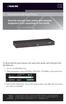 LES1516A LES1532A LES1548A Secure Server with Cisco Pinout Securely manage data center and network equipment from anywhere in the world. To download the user manual, this quick start guide, and software
50-Port 10/100/1000Mbps with 4 Shared SFP. Managed Gigabit Switch WGSW-50040. Quick Installation Guide
 50-Port 10/100/1000Mbps with 4 Shared SFP Managed Gigabit Switch WGSW-50040 Quick Installation Guide Table of Contents 1. Package Content... 3 2. Switch Management... 4 3. Requirements... 5 4. Terminal
How to Log On... 15 Main Screen... 18 Control Console Menus... 21. How to Log On... 24 Summary Page... 27 Navigation Menu... 29
 Contents Introduction--1 Product Description.................................. 1 Access Procedures.................................... 3 How to Recover From a Lost Password..................... 6 Upgrading
QUICK START GUIDE. Cisco S170 Web Security Appliance. Web Security Appliance
 1 0 0 0 1 1 QUICK START GUIDE Web Security Appliance Web Security Appliance Cisco S170 303417 Cisco S170 Web Security Appliance 1 Welcome 2 Before You Begin 3 Document Network Settings 4 Plan the Installation
QUICK START GUIDE. Cisco C170 Email Security Appliance
 1 0 0 1 QUICK START GUIDE Email Security Appliance Cisco C170 303357 Cisco C170 Email Security Appliance 1 Welcome 2 Before You Begin 3 Document Network Settings 4 Plan the Installation 5 Install the Appliance
Network Management Card. User Manual
 User Manual 1 Contents Contents 2 Chapter 1 Overview 3 1.1 NMC package contents 4 1.2 NMC CD Resources 4 1.3 Features 4 1.4 NMC Applications 5 Chapter 2 NMC parameters setting via serial COM port 6 2.1
Dominion KX II-101-V2
 Dominion KX II-101-V2 Quick Setup Guide Thank you for your purchase of the Dominion KX II-101-V2, the economical, full-featured, single-port digital KVM-over-IP device. For details on using the KX II-101-V2,
User s Guide Digi CM
 User s Guide Digi CM 90000301-88_G Digi International Inc. 2005. All rights reserved. Digi, Digi International, the Digi logo, Digi CM, the Making Device Networking Easy logo, Digi One, and RealPort are
USER S GUIDE Switched Rack PDU
 Contents Introduction--1 Product Description....................................... 1 Access Procedures....................................... 3 Recover From a Lost Password..............................
Unpacking the Product. Rack Installation. Then, use the screws provided with the equipment rack to mount the firewall in the rack.
 About This Guide This guide contains step-by-step instructions for setting up the D-Link DFL-260E/860E Firewall. Please note that the model you have purchased may appear slightly different from those shown
Connecting the DG-102S VoIP Gateway to your network
 Contents of Package: DG-102S VoIP Station Gateway Power adapter CD-ROM, including User s Manual Quick Install Guide Requirements: RS-232 Console Cable Two RJ-45 CAT-5 Straight-Through Cables For more information
Version Filename Part Number Opcode V_3.3.0-5 FL0536-013.bin FL0536-013.bin.md5 FL0564-007.pkg
 This document outlines: Cyclades ACS Advanced Console Server Appliances Release Notes Version 3.3.0-5 September 24 nd 2010 1. Update Instructions 2. Appliance Firmware Version Information 3. Enhancements
Gigabyte Content Management System Console User s Guide. Version: 0.1
 Gigabyte Content Management System Console User s Guide Version: 0.1 Table of Contents Using Your Gigabyte Content Management System Console... 2 Gigabyte Content Management System Key Features and Functions...
USER MANUAL GUIMGR Graphical User Interface Manager for FRM301/FRM401 Media Racks
 USER MANUAL GUIMGR Graphical User Interface Manager for FRM301/FRM401 Media Racks CTC Union Technologies Co., Ltd. Far Eastern Vienna Technology Center (Neihu Technology Park) 8F, No. 60 Zhouzi St. Neihu,
your Gateway Windows network installationguide 802.11b wireless series Router model WBR-100 Configuring Installing
 your Gateway Windows network installationguide 802.11b wireless series Router model WBR-100 Installing Configuring Contents 1 Introduction...................................................... 1 Features...........................................................
Symantec Database Security and Audit 3100 Series Appliance. Getting Started Guide
 Symantec Database Security and Audit 3100 Series Appliance Getting Started Guide Symantec Database Security and Audit 3100 Series Getting Started Guide The software described in this book is furnished
Network-Enabled Devices, AOS v.5.x.x. Content and Purpose of This Guide...1 User Management...2 Types of user accounts2
 Contents Introduction--1 Content and Purpose of This Guide...........................1 User Management.........................................2 Types of user accounts2 Security--3 Security Features.........................................3
Cisco S380 and Cisco S680 Web Security Appliance
 QUICK START GUIDE Cisco S380 and Cisco S680 Web Security Appliance 1 Welcome 2 Before You Begin 3 Document Network Settings 4 Plan the Installation 5 Install the Appliance in a Rack 6 Plug In the Appliance
Dominion PX. General Questions. What is Dominion PX (PX)?
 Dominion PX Question General Questions What is Dominion PX (PX)? Is Raritan new to the rack power distribution unit market? Can the PX be used as a stand-alone device? Does PX work with Raritan s CommandCenter
Unified Access Point Administrator's Guide
 Unified Access Point Administrator's Guide Product Model: DWL-3600AP DWL-6600AP DWL-8600AP Unified Wired & Wireless Access System Release 2.0 November 2011 Copyright 2011. All rights reserved. November
Technical Notes TN 1 - ETG 3000. FactoryCast Gateway TSX ETG 3021 / 3022 modules. How to Setup a GPRS Connection?
 FactoryCast Gateway TSX ETG 3021 / 3022 modules How to Setup a GPRS Connection? 1 2 Table of Contents 1- GPRS Overview... 4 Introduction... 4 GPRS overview... 4 GPRS communications... 4 GPRS connections...
10/2011 - English Edition 1. Quick Start Guide. NWA1100N-CE CloudEnabled Business N Wireless Access Point
 10/2011 - English Edition 1 Quick Start Guide NWA1100N-CE CloudEnabled Business N Wireless Access Point Package Contents - 1 x ZyXEL NWA1100N-CE Access Point - 2 x Detachable Antennas - 1 x Power Adapter
SSL-VPN 200 Getting Started Guide
 Secure Remote Access Solutions APPLIANCES SonicWALL SSL-VPN Series SSL-VPN 200 Getting Started Guide SonicWALL SSL-VPN 200 Appliance Getting Started Guide Thank you for your purchase of the SonicWALL SSL-VPN
Release Notes for Dominion SX Firmware 3.1.6
 Release Notes for Dominion SX Firmware 3.1.6 Release Notes Version: 4.0 Release Notes Date: December 4, 2008 Effective: Immediately Applicability: The 3.1.6 Release is applicable to the Dominion SX. SX
PN5212/PN5320/PN7212/PN7320
 PN522/PN5/PN722/PN7 Over the NET Distribution Units ALTUSEN Over the NET products are Distribution Units that offer outlet level control combined with remote access to give IT administrators the ability
3.5 EXTERNAL NETWORK HDD. User s Manual
 3.5 EXTERNAL NETWORK HDD User s Manual Table of Content Before You Use Key Features H/W Installation Illustration of Product LED Definition NETWORK HDD Assembly Setup the Network HDD Home Disk Utility
Barracuda Link Balancer Administrator s Guide
 Barracuda Link Balancer Administrator s Guide Version 1.0 Barracuda Networks Inc. 3175 S. Winchester Blvd. Campbell, CA 95008 http://www.barracuda.com Copyright Notice Copyright 2008, Barracuda Networks
Thank for choosing the Dominion KX III, the industry's highest performance enterprise-class, secure, digital KVM (Keyboard, Video, Mouse) switch.
 QS Rule Dominion KX III Quick Setup Guide Thank for choosing the Dominion KX III, the industry's highest performance enterprise-class, secure, digital KVM (Keyboard, Video, Mouse) switch. This Quick Setup
Gigabyte Management Console User s Guide (For ASPEED AST 2400 Chipset)
 Gigabyte Management Console User s Guide (For ASPEED AST 2400 Chipset) Version: 1.4 Table of Contents Using Your Gigabyte Management Console... 3 Gigabyte Management Console Key Features and Functions...
Prestige 202H Plus. Quick Start Guide. ISDN Internet Access Router. Version 3.40 12/2004
 Prestige 202H Plus ISDN Internet Access Router Quick Start Guide Version 3.40 12/2004 Table of Contents 1 Introducing the Prestige...3 2 Hardware Installation...4 2.1 Rear Panel...4 2.2 The Front Panel
ZyWALL 5. Internet Security Appliance. Quick Start Guide Version 3.62 (XD.0) May 2004
 ZyWALL 5 Internet Security Appliance Quick Start Guide Version 3.62 (XD.0) May 2004 Introducing the ZyWALL The ZyWALL 5 is the ideal secure gateway for all data passing between the Internet and the LAN.
Chapter 8 Router and Network Management
 Chapter 8 Router and Network Management This chapter describes how to use the network management features of your ProSafe Dual WAN Gigabit Firewall with SSL & IPsec VPN. These features can be found by
Management Software. Web Browser User s Guide AT-S106. For the AT-GS950/48 Gigabit Ethernet Smart Switch. Version 1.0.0. 613-001339 Rev.
 Management Software AT-S106 Web Browser User s Guide For the AT-GS950/48 Gigabit Ethernet Smart Switch Version 1.0.0 613-001339 Rev. A Copyright 2010 Allied Telesis, Inc. All rights reserved. No part of
SANGFOR SSL VPN. Quick Start Guide
 SANGFOR SSL VPN Quick Start Guide This document is intended to assist users to install, debug, configure and maintain SANGFOR SSL VPN device quickly and efficiently. Please read the followings carefully
Broadband Router ALL1294B
 Broadband Router ALL1294B Broadband Internet Access 4-Port Switching Hub User's Guide Table of Contents CHAPTER 1 INTRODUCTION... 1 Broadband Router Features... 1 Package Contents... 3 Physical Details...
Multi-Homing Security Gateway
 Multi-Homing Security Gateway MH-5000 Quick Installation Guide 1 Before You Begin It s best to use a computer with an Ethernet adapter for configuring the MH-5000. The default IP address for the MH-5000
Vantage RADIUS 50. Quick Start Guide Version 1.0 3/2005
 Vantage RADIUS 50 Quick Start Guide Version 1.0 3/2005 1 Introducing Vantage RADIUS 50 The Vantage RADIUS (Remote Authentication Dial-In User Service) 50 (referred to in this guide as Vantage RADIUS)
VMware vcenter Log Insight Getting Started Guide
 VMware vcenter Log Insight Getting Started Guide vcenter Log Insight 1.5 This document supports the version of each product listed and supports all subsequent versions until the document is replaced by
NMS300 Network Management System
 NMS300 Network Management System User Manual June 2013 202-11289-01 350 East Plumeria Drive San Jose, CA 95134 USA Support Thank you for purchasing this NETGEAR product. After installing your device, locate
OfficeConnect Internet Firewall 25 Internet Firewall DMZ. QuickStart Guide (3C16770, 3C16771)
 OfficeConnect Internet Firewall 25 Internet Firewall DMZ QuickStart Guide (3C16770, 3C16771) Checking Package Contents Getting Started Thank you for purchasing the OfficeConnect Internet Firewall. The
http://docs.trendmicro.com
 Trend Micro Incorporated reserves the right to make changes to this document and to the products described herein without notice. Before installing and using the product, please review the readme files,
QUICK START GUIDE Cisco M380 and Cisco M680 Content Security Management Appliance
 QUICK START GUIDE Cisco M380 and Cisco M680 Content Security Management Appliance 1 Welcome 2 Before You Begin 3 Document Network Settings 4 Plan the Installation 5 Install the Appliance in a Rack 6 Plug
Starting a Management Session
 Management Software AT-S63 Starting a Management Session AT-S63 Version 2.2.0 for the AT-9400 Layer 2+ Switches AT-S63 Version 3.0.0 for the AT-9400 Basic Layer 3 Switches 613-000817 Rev. A Copyright 2007
TW100-BRF114 Firewall Router. User's Guide. Cable/DSL Internet Access. 4-Port Switching Hub
 TW100-BRF114 Firewall Router Cable/DSL Internet Access 4-Port Switching Hub User's Guide Table of Contents CHAPTER 1 INTRODUCTION...1 TW100-BRF114 Features...1 Package Contents...3 Physical Details...
DRO-210i LOAD BALANCING ROUTER. Review Package Contents
 DRO-210i LOAD BALANCING ROUTER Review Package Contents Make sure that the package contains the following items. DRO-210i Load Balancing Router 2 Straight Ethernet Cables 1 Cross Over Ethernet Cable 1 Power
Barracuda Link Balancer
 Barracuda Networks Technical Documentation Barracuda Link Balancer Administrator s Guide Version 2.2 RECLAIM YOUR NETWORK Copyright Notice Copyright 2004-2011, Barracuda Networks www.barracuda.com v2.2-110503-01-0503
MAX T1/E1. Quick Start Guide. VoIP Gateway. Version 1.0
 MAX T1/E1 TM VoIP Gateway Quick Start Guide Version 1.0 Contents INTRODUCTION 1 Hardware Needed Software Needed 1 1 NET2PHONE MAX SET UP Hardware Set Up Software Set Up Set Up Internet Protocol (IP) Address
Quick Start Guide. RV 120W Wireless-N VPN Firewall. Cisco Small Business
 Quick Start Guide Cisco Small Business RV 120W Wireless-N VPN Firewall Package Contents Wireless-N VPN Firewall Ethernet Cable Power Adapter Quick Start Guide Documentation and Software on CD-ROM Welcome
Setup Manual and Programming Reference. RGA Ethernet Adapter. Stanford Research Systems. Revision 1.05 (11/2010)
 Setup Manual and Programming Reference Stanford Research Systems Revision 1.05 (11/2010) Certification Stanford Research Systems certifies that this product met its published specifications at the time
Broadband Router User s Manual
 Broadband Router User s Manual Table of Contents Chapter 1 Introduction...4 1.1 The Broadband Router......4 1.2 Physical Features of Broadband Router...4 1.3 Non-Physical Features of Broadband Router..
LotWan Appliance User Guide USER GUIDE
 LotWan Appliance User Guide USER GUIDE Copyright Information Copyright 2014, Beijing AppEx Networks Corporation The description, illustrations, pictures, methods and other information contain in this document
How to Set Up Your NSM4000 Appliance
 How to Set Up Your NSM4000 Appliance Juniper Networks NSM4000 is an appliance version of Network and Security Manager (NSM), a software application that centralizes control and management of your Juniper
Management Software. User s Guide AT-S84. For the AT-9000/24 Layer 2 Gigabit Ethernet Switch. Version 1.1. 613-000368 Rev. B
 Management Software AT-S84 User s Guide For the AT-9000/24 Layer 2 Gigabit Ethernet Switch Version 1.1 613-000368 Rev. B Copyright 2006 Allied Telesyn, Inc. All rights reserved. No part of this publication
Overview of WebMux Load Balancer and Live Communications Server 2005
 AVANU Load Balancing for Microsoft Office Live Communications Server 2005 WebMux Delivers Improved Reliability, Availability and Scalability Overview of WebMux Load Balancer and Live Communications Server
Innominate mguard Version 6
 Innominate mguard Version 6 Configuration Examples mguard smart mguard PCI mguard blade mguard industrial RS EAGLE mguard mguard delta Innominate Security Technologies AG Albert-Einstein-Str. 14 12489
Phone Adapter. with 2 Ports for Voice-over-IP. Installation and Troubleshooting Guide. Model No. PAP2 Ver. 2. Voice
 Phone Adapter with 2 Ports for Voice-over-IP Voice Installation and Troubleshooting Guide Model No. PAP2 Ver. 2 Copyright and Trademarks Specifications are subject to change without notice. Linksys is
SecureLinx Spider Duo Quick Start Guide
 SecureLinx Spider Duo Quick Start Guide SecureLinx Spider Duo Quick Start Guide SecureLinx Spider Duo QUICK START GUIDE CONTENTS Overview... 2 What s In The Box... 3 Installation and Network Settings...
XMS Quick Start Guide
 812-0055-002D XMS Quick Start Guide Overview of Quick Start Steps This guide will quickly get you up and running with the Xirrus Management System (XMS). It includes instructions for setting up the XMS
DPXR4X1A-16NP, DPXS20A-16AU-M,
 - 1 - Release Notes for Dominion PX Software Version 1.3.5 (firmware version will be displayed as 01.03.05 in the GUI after an upgrade) Version: DPX 1.3.5 Release Notes, Revision 1.1 Date: June 8, 2009
CounterACT 7.0 Single CounterACT Appliance
 CounterACT 7.0 Single CounterACT Appliance Quick Installation Guide Table of Contents Welcome to CounterACT Version 7.0....3 Included in your CounterACT Package....3 Overview...4 1. Create a Deployment
TW100-BRV204 VPN Firewall Router
 TW100-BRV204 VPN Firewall Router Cable/DSL Internet Access 4-Port Switching Hub User's Guide Table of Contents CHAPTER 1 INTRODUCTION... 1 TW100-BRV204 Features... 1 Package Contents... 3 Physical Details...
DSL-2600U. User Manual V 1.0
 DSL-2600U User Manual V 1.0 CONTENTS 1. OVERVIEW...3 1.1 ABOUT ADSL...3 1.2 ABOUT ADSL2/2+...3 1.3 FEATURES...3 2 SPECIFICATION...4 2.1 INDICATOR AND INTERFACE...4 2.2 HARDWARE CONNECTION...4 2.3 LED STATUS
http://docs.trendmicro.com
 Trend Micro Incorporated reserves the right to make changes to this document and to the products described herein without notice. Before installing and using the product, please review the readme files,
User Manual. Onsight Management Suite Version 5.1. Another Innovation by Librestream
 User Manual Onsight Management Suite Version 5.1 Another Innovation by Librestream Doc #: 400075-06 May 2012 Information in this document is subject to change without notice. Reproduction in any manner
SIP Proxy Server. Administrator Installation and Configuration Guide. V2.31b. 09SIPXM.SY2.31b.EN3
 SIP Proxy Server Administrator Installation and Configuration Guide V2.31b 09SIPXM.SY2.31b.EN3 DSG, DSG logo, InterPBX, InterServer, Blaze Series, VG5000, VG7000, IP590, IP580, IP500, IP510, InterConsole,
Wireless Router Setup Manual
 Wireless Router Setup Manual NETGEAR, Inc. 4500 Great America Parkway Santa Clara, CA 95054 USA 208-10082-02 2006-04 2006 by NETGEAR, Inc. All rights reserved. Trademarks NETGEAR is a trademark of Netgear,
eprism Email Security Suite
 Guide eprism 2505 eprism Email Security Suite 800-782-3762 www.edgewave.com 2001 2012 EdgeWave. All rights reserved. The EdgeWave logo is a trademark of EdgeWave Inc. All other trademarks and registered
LevelOne. User Manual. FBR-1430 VPN Broadband Router, 1W 4L V1.0
 LevelOne FBR-1430 VPN Broadband Router, 1W 4L User Manual V1.0 Table of Contents CHAPTER 1 INTRODUCTION... 1 VPN BROADBAND ROUTER FEATURES... 1 Internet Access Features... 1 Advanced Internet Functions...
OnCommand Performance Manager 1.1
 OnCommand Performance Manager 1.1 Installation and Setup Guide For Red Hat Enterprise Linux NetApp, Inc. 495 East Java Drive Sunnyvale, CA 94089 U.S. Telephone: +1 (408) 822-6000 Fax: +1 (408) 822-4501
Broadband Router ESG-103. User s Guide
 Broadband Router ESG-103 User s Guide FCC Warning This equipment has been tested and found to comply with the limits for Class A & Class B digital device, pursuant to Part 15 of the FCC rules. These limits
Security Correlation Server Quick Installation Guide
 orrelogtm Security Correlation Server Quick Installation Guide This guide provides brief information on how to install the CorreLog Server system on a Microsoft Windows platform. This information can also
Installing and Using the vnios Trial
 Installing and Using the vnios Trial The vnios Trial is a software package designed for efficient evaluation of the Infoblox vnios appliance platform. Providing the complete suite of DNS, DHCP and IPAM
Network Management Card
 Network Management Card AP9617 AP9618 AP9619 Installation and Quick-Start Manual How to Avoid Equipment Damage Disconnect UPS power You do not need to turn off a Symmetra or a Silcon model UPS to install
Prestige 324. Prestige 324. Intelligent Broadband Sharing Gateway. Version 3.60 January 2003 Quick Start Guide
 Prestige 324 Intelligent Broadband Sharing Gateway Version 3.60 January 2003 Quick Start Guide 1 Introducing the Prestige The Prestige is a broadband sharing gateway with a built-in four-port 10/100 Mbps
Executive Summary and Purpose
 ver,1.0 Hardening and Securing Opengear Devices Copyright Opengear Inc. 2013. All Rights Reserved. Information in this document is subject to change without notice and does not represent a commitment on
Extreme Control Center, NAC, and Purview Virtual Appliance Installation Guide
 Extreme Control Center, NAC, and Purview Virtual Appliance Installation Guide 9034968 Published April 2016 Copyright 2016 All rights reserved. Legal Notice Extreme Networks, Inc. reserves the right to
vcloud Director User's Guide
 vcloud Director 5.5 This document supports the version of each product listed and supports all subsequent versions until the document is replaced by a new edition. To check for more recent editions of
Unified Threat Management
 Unified Threat Management QUICK START GUIDE CR35iNG Appliance Document Version: PL QSG 35iNG/96000-10.04.5.0.007/250121014 DEFAULTS Default IP addresses Ethernet Port IP Address Zone A 172.16.16.16/255.255.255.0
Installation and Operations Manual SX16 SX32
 Installation and Operations Manual SX16 SX32 This page intentionally left blank. Installation and Operations Manual SX16 SX32 UL C US 1F61 I.T.E. LISTED Copyright 2003 Raritan Computer, Inc. DSX-0A-E October
Broadband ADSL2+ Modem DM111PSPv2
 Broadband ADSL2+ Modem DM111PSPv2 User Manual 350 East Plumeria Drive San Jose, CA 95134 USA August 2011 202-10913-01 v1.0 2011 NETGEAR, Inc. All rights reserved No part of this publication may be reproduced,
Debugging Network Communications. 1 Check the Network Cabling
 Debugging Network Communications Situation: you have a computer and your NetBurner device on a network, but you cannot communicate between the two. This application note provides a set of debugging steps
c. Securely insert the Ethernet cable from your cable or DSL modem into the Internet port (B) on the WGT634U. Broadband modem
 Start Here Follow these instructions to set up your router. Verify That Basic Requirements Are Met Assure that the following requirements are met: You have your broadband Internet service settings handy.
User s Guide. Network Management Card AP9631-IBM
 User s Guide Network Management Card AP9631-IBM Contents Introduction... 1 Product Description....................................... 1 Features................................................ 1 Initial
Chapter 4 Management. Viewing the Activity Log
 Chapter 4 Management This chapter describes how to use the management features of your NETGEAR WG102 ProSafe 802.11g Wireless Access Point. To get to these features, connect to the WG102 as described in
QuickSpecs. Overview. Compaq Remote Insight Lights-Out Edition
 Overview M ODELS Remote Insight Lights-Out Edition 157866-001 New Remote Insight Lights-Out Edition provides virtual graphical control using any standard browser to your remote or data centre server, giving
Security Correlation Server Quick Installation Guide
 orrelog Security Correlation Server Quick Installation Guide This guide provides brief information on how to install the CorreLog Server system on a Microsoft Windows platform. This information can also
Meraki MX50 Hardware Installation Guide
 Meraki MX50 Hardware Installation Guide January 2011 Copyright 2010, Meraki, Inc. www.meraki.com 660 Alabama St. San Francisco, California 94110 Phone: +1 415 632 5800 Fax: +1 415 632 5899 Copyright: 2010
Chapter 3 Management. Remote Management
 Chapter 3 Management This chapter describes how to use the management features of your ProSafe 802.11a/g Dual Band Wireless Access Point WAG102. To access these features, connect to the WAG102 as described
Ethernet Interface Manual Thermal / Label Printer. Rev. 1.01 Metapace T-1. Metapace T-2 Metapace L-1 Metapace L-2
 Ethernet Interface Manual Thermal / Label Printer Rev. 1.01 Metapace T-1 Metapace T-2 Metapace L-1 Metapace L-2 Table of contents 1. Interface setting Guiding...3 2. Manual Information...4 3. Interface
Installing Management Applications on VNX for File
 EMC VNX Series Release 8.1 Installing Management Applications on VNX for File P/N 300-015-111 Rev 01 EMC Corporation Corporate Headquarters: Hopkinton, MA 01748-9103 1-508-435-1000 www.emc.com Copyright
Prestige 324 Quick Start Guide. Prestige 324. Intelligent Broadband Sharing Gateway. Version V3.61(JF.0) May 2004 Quick Start Guide
 Prestige 324 Intelligent Broadband Sharing Gateway Version V3.61(JF.0) May 2004 Quick Start Guide 1 1 Introducing the Prestige The Prestige is a broadband sharing gateway with a built-in four-port 10/100
Chapter 6 Using Network Monitoring Tools
 Chapter 6 Using Network Monitoring Tools This chapter describes how to use the maintenance features of your Wireless-G Router Model WGR614v9. You can access these features by selecting the items under
Barracuda IM Firewall Administrator s Guide
 Barracuda IM Firewall Administrator s Guide Version 3.0 Barracuda Networks Inc. 3175 S. Winchester Blvd Campbell, CA 95008 http://www.barracuda.com Copyright Notice Copyright 2007, Barracuda Networks www.barracuda.com
3.1 RS-232/422/485 Pinout:PORT1-4(RJ-45) RJ-45 RS-232 RS-422 RS-485 PIN1 TXD PIN2 RXD PIN3 GND PIN4 PIN5 T+ 485+ PIN6 T- 485- PIN7 R+ PIN8 R-
 MODEL ATC-2004 TCP/IP TO RS-232/422/485 CONVERTER User s Manual 1.1 Introduction The ATC-2004 is a 4 Port RS232/RS485 to TCP/IP converter integrated with a robust system and network management features
Application Notes for Configuring Dorado Software Redcell Enterprise Bundle using SNMP with Avaya Communication Manager - Issue 1.
 Avaya Solution & Interoperability Test Lab Application Notes for Configuring Dorado Software Redcell Enterprise Bundle using SNMP with Avaya Communication Manager - Issue 1.0 Abstract These Application