
Jollibee Foods Corporation and Subsidiaries
|
|
|
- Agnes Cross
- 10 years ago
- Views:
Transcription
1 Jollibee Foods Corporation and Subsidiaries Consolidated Financial Statements December 31, 2013 and 2012 and Years Ended December 31, 2013, 2012 and 2011 and Independent Auditors Report

2 SyCip Gorres Velayo & Co Ayala Avenue 1226 Makati City Philippines Tel: (632) Fax: (632) ey.com/ph BOA/PRC Reg. No. 0001, December 28, 2012, valid until December 31, 2015 SEC Accreditation No FR-3 (Group A), November 15, 2012, valid until November 16, 2015 INDEPENDENT AUDITORS REPORT The Stockholders and the Board of Directors Jollibee Foods Corporation We have audited the accompanying consolidated financial statements of Jollibee Foods Corporation and its subsidiaries, which comprise the consolidated statements of financial position as at December 31, 2013 and 2012, and the consolidated statements of comprehensive income, statements of changes in equity and statements of cash flows for each of the three years in the period ended December 31, 2013, and a summary of significant accounting policies and other explanatory information. Management s Responsibility for the Consolidated Financial Statements Management is responsible for the preparation and fair presentation of these consolidated financial statements in accordance with Philippine Financial Reporting Standards, and for such internal control as management determines is necessary to enable the preparation of consolidated financial statements that are free from material misstatement, whether due to fraud or error. Auditors Responsibility Our responsibility is to express an opinion on these consolidated financial statements based on our audits. We conducted our audits in accordance with Philippine Standards on Auditing. Those standards require that we comply with ethical requirements and plan and perform the audit to obtain reasonable assurance about whether the consolidated financial statements are free from material misstatement. An audit involves performing procedures to obtain audit evidence about the amounts and disclosures in the consolidated financial statements. The procedures selected depend on the auditor s judgment, including the assessment of the risks of material misstatement of the consolidated financial statements, whether due to fraud or error. In making those risk assessments, the auditor considers internal control relevant to the entity s preparation and fair presentation of the consolidated financial statements in order to design audit procedures that are appropriate in the circumstances, but not for the purpose of expressing an opinion on the effectiveness of the entity s internal control. An audit also includes evaluating the appropriateness of accounting policies used and the reasonableness of accounting estimates made by management, as well as evaluating the overall presentation of the consolidated financial statements. We believe that the audit evidence we have obtained is sufficient and appropriate to provide a basis for our audit opinion. A member firm of Ernst & Young Global Limited

3 - 2 - Opinion In our opinion, the consolidated financial statements present fairly, in all material respects, the financial position of Jollibee Foods Corporation and its subsidiaries as at December 31, 2013 and 2012, and their financial performance and their cash flows for each of the three years in the period ended December 31, 2013 in accordance with Philippine Financial Reporting Standards. SYCIP GORRES VELAYO & CO. Marydith C. Miguel Partner CPA Certificate No SEC Accreditation No AR-3 (Group A), January 18, 2013, valid until January 17, 2016 Tax Identification No BIR Accreditation No , April 11, 2012, valid until April 10, 2015 PTR No , January 2, 2014, Makati City April 7, 2014 A member firm of Ernst & Young Global Limited
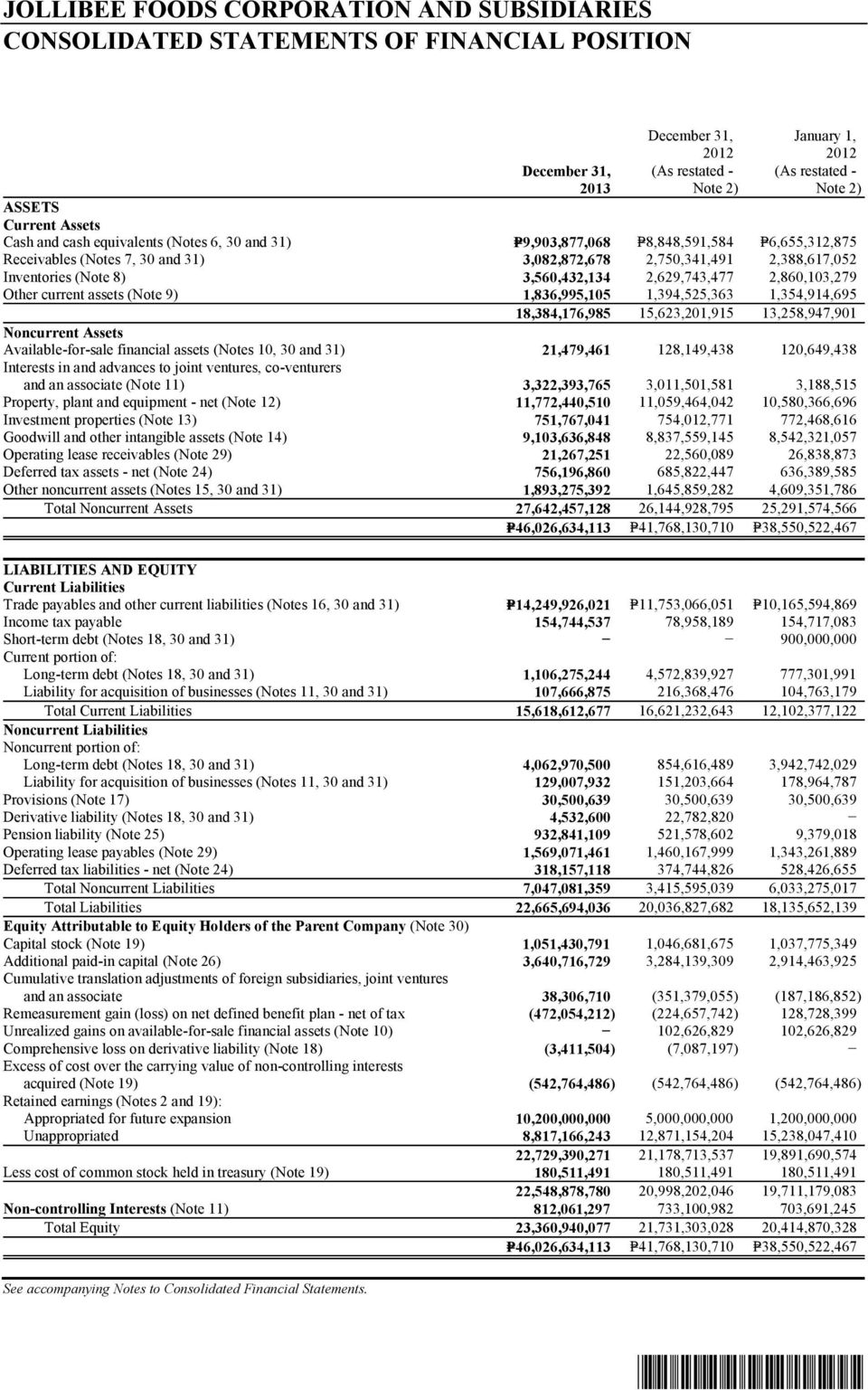
4 JOLLIBEE FOODS CORPORATION AND SUBSIDIARIES CONSOLIDATED STATEMENTS OF FINANCIAL POSITION December 31, 2013 December 31, 2012 (As restated - Note 2) January 1, 2012 (As restated - Note 2) ASSETS Current Assets Cash and cash equivalents (Notes 6, 30 and 31) P=9,903,877,068 P=8,848,591,584 P=6,655,312,875 Receivables (Notes 7, 30 and 31) 3,082,872,678 2,750,341,491 2,388,617,052 Inventories (Note 8) 3,560,432,134 2,629,743,477 2,860,103,279 Other current assets (Note 9) 1,836,995,105 1,394,525,363 1,354,914,695 18,384,176,985 15,623,201,915 13,258,947,901 Noncurrent Assets Available-for-sale financial assets (Notes 10, 30 and 31) 21,479, ,149, ,649,438 Interests in and advances to joint ventures, co-venturers and an associate (Note 11) 3,322,393,765 3,011,501,581 3,188,515 Property, plant and equipment - net (Note 12) 11,772,440,510 11,059,464,042 10,580,366,696 Investment properties (Note 13) 751,767, ,012, ,468,616 Goodwill and other intangible assets (Note 14) 9,103,636,848 8,837,559,145 8,542,321,057 Operating lease receivables (Note 29) 21,267,251 22,560,089 26,838,873 Deferred tax assets - net (Note 24) 756,196, ,822, ,389,585 Other noncurrent assets (Notes 15, 30 and 31) 1,893,275,392 1,645,859,282 4,609,351,786 Total Noncurrent Assets 27,642,457,128 26,144,928,795 25,291,574,566 P=46,026,634,113 P=41,768,130,710 P=38,550,522,467 LIABILITIES AND EQUITY Current Liabilities Trade payables and other current liabilities (Notes 16, 30 and 31) P=14,249,926,021 P=11,753,066,051 P=10,165,594,869 Income tax payable 154,744,537 78,958, ,717,083 Short-term debt (Notes 18, 30 and 31) 900,000,000 Current portion of: Long-term debt (Notes 18, 30 and 31) 1,106,275,244 4,572,839, ,301,991 Liability for acquisition of businesses (Notes 11, 30 and 31) 107,666, ,368, ,763,179 Total Current Liabilities 15,618,612,677 16,621,232,643 12,102,377,122 Noncurrent Liabilities Noncurrent portion of: Long-term debt (Notes 18, 30 and 31) 4,062,970, ,616,489 3,942,742,029 Liability for acquisition of businesses (Notes 11, 30 and 31) 129,007, ,203, ,964,787 Provisions (Note 17) 30,500,639 30,500,639 30,500,639 Derivative liability (Notes 18, 30 and 31) 4,532,600 22,782,820 Pension liability (Note 25) 932,841, ,578,602 9,379,018 Operating lease payables (Note 29) 1,569,071,461 1,460,167,999 1,343,261,889 Deferred tax liabilities - net (Note 24) 318,157, ,744, ,426,655 Total Noncurrent Liabilities 7,047,081,359 3,415,595,039 6,033,275,017 Total Liabilities 22,665,694,036 20,036,827,682 18,135,652,139 Equity Attributable to Equity Holders of the Parent Company (Note 30) Capital stock (Note 19) 1,051,430,791 1,046,681,675 1,037,775,349 Additional paid-in capital (Note 26) 3,640,716,729 3,284,139,309 2,914,463,925 Cumulative translation adjustments of foreign subsidiaries, joint ventures and an associate 38,306,710 (351,379,055) (187,186,852) Remeasurement gain (loss) on net defined benefit plan - net of tax (472,054,212) (224,657,742) 128,728,399 Unrealized gains on available-for-sale financial assets (Note 10) 102,626, ,626,829 Comprehensive loss on derivative liability (Note 18) (3,411,504) (7,087,197) Excess of cost over the carrying value of non-controlling interests acquired (Note 19) (542,764,486) (542,764,486) (542,764,486) Retained earnings (Notes 2 and 19): Appropriated for future expansion 10,200,000,000 5,000,000,000 1,200,000,000 Unappropriated 8,817,166,243 12,871,154,204 15,238,047,410 22,729,390,271 21,178,713,537 19,891,690,574 Less cost of common stock held in treasury (Note 19) 180,511, ,511, ,511,491 22,548,878,780 20,998,202,046 19,711,179,083 Non-controlling Interests (Note 11) 812,061, ,100, ,691,245 Total Equity 23,360,940,077 21,731,303,028 20,414,870,328 P=46,026,634,113 P=41,768,130,710 P=38,550,522,467 See accompanying Notes to Consolidated Financial Statements.
5 JOLLIBEE FOODS CORPORATION AND SUBSIDIARIES CONSOLIDATED STATEMENTS OF COMPREHENSIVE INCOME Years Ended December (As restated - Note 2) 2011 (As restated - Note 2) REVENUES Net sales P=76,313,489,585 P=67,493,953,521 P=59,266,444,340 Royalty, franchise fees and others (Note 20) 3,969,279,614 3,565,085,633 3,288,482,719 80,282,769,199 71,059,039,154 62,554,927,059 COST OF SALES (Note 21) 65,284,763,064 58,435,498,743 51,366,071,947 GROSS PROFIT 14,998,006,135 12,623,540,411 11,188,855,112 EXPENSES General and administrative expenses (Note 22) 7,427,887,196 6,908,802,947 5,939,317,810 Advertising and promotions 1,639,022,544 1,369,719,679 1,310,113,894 9,066,909,740 8,278,522,626 7,249,431,704 INTEREST INCOME (EXPENSE) (Note 23) Interest income 245,573, ,114, ,763,236 Interest expense (152,920,028) (206,012,700) (291,342,791) 92,653,780 64,101,457 (111,579,555) EQUITY IN NET EARNINGS (LOSSES) OF JOINT VENTURES AND AN ASSOCIATE (Note 11) (115,560,608) (50,954,378) 299,710 OTHER INCOME (Note 23) 337,325, ,534, ,813,617 INCOME BEFORE INCOME TAX 6,245,514,598 4,861,699,703 4,394,957,180 PROVISION FOR INCOME TAX (Note 24) Current 1,521,966,682 1,277,160,734 1,187,563,865 Deferred 741,389 (127,456,683) (77,386,893) 1,522,708,071 1,149,704,051 1,110,176,972 NET INCOME 4,722,806,527 3,711,995,652 3,284,780,208 OTHER COMPREHENSIVE INCOME (LOSS) Other comprehensive income to be reclassified to profit or loss in subsequent periods: Cumulative translation adjustments of foreign subsidiaries, joint ventures and associates 414,851,757 (169,424,928) 133,206,626 Comprehensive gain (loss) on derivative liability (Note 18) 6,806,839 (13,124,439) Unrealized loss on available-for-sale financial assets - net of tax (Note 10) (102,626,829) (4,537,748) Other comprehensive income not to be reclassified to profit or loss in subsequent periods: Remeasurement gains (losses) on net defined benefit plan - net of tax (247,396,470) (353,386,141) 128,728,399 71,635,297 (535,935,508) 257,397,277 TOTAL COMPREHENSIVE INCOME P=4,794,441,824 P=3,176,060,144 P=3,542,177,485 Net Income Attributable to: Equity holders of the Parent Company (Note 28) P=4,671,559,394 P=3,727,084,297 P=3,262,644,224 Non-controlling interests 51,247,133 (15,088,645) 22,135,984 P=4,722,806,527 P=3,711,995,652 P=3,284,780,208 Total Comprehensive Income Attributable to: Equity holders of the Parent Company P=4,714,897,551 P=3,202,418,756 P=3,516,670,668 Non-controlling interests 79,544,273 (26,358,612) 25,506,817 P=4,794,441,824 P=3,176,060,144 P=3,542,177,485 Earnings Per Share for Net Income Attributable to Equity Holders of the Parent Company (Note 28) Basic P=4.450 P=3.577 P=3.168 Diluted See accompanying Notes to Consolidated Financial Statements.

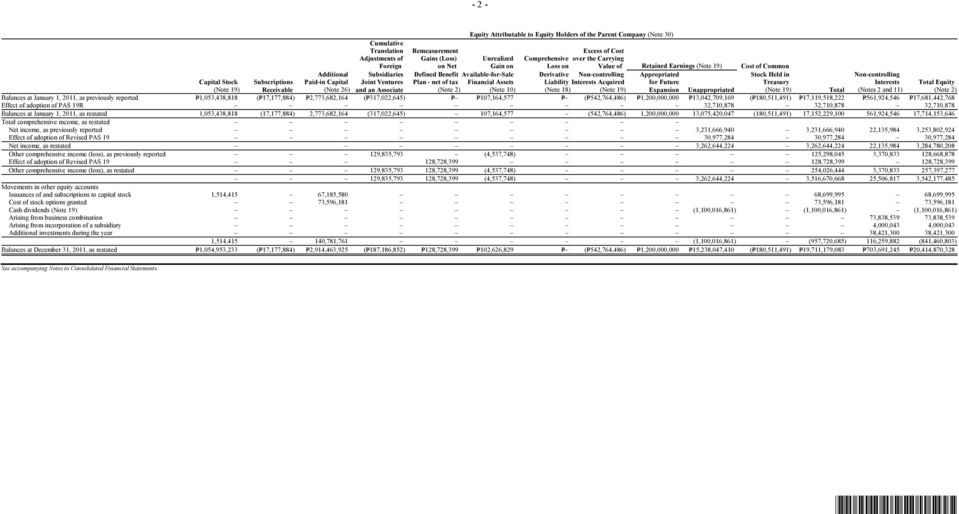
6 JOLLIBEE FOODS CORPORATION AND SUBSIDIARIES CONSOLIDATED STATEMENTS OF CHANGES IN EQUITY FOR THE YEARS ENDED DECEMBER 31, 2013, 2012 and 2011 Equity Attributable to Equity Holders of the Parent Company (Note 30) Cumulative Translation Remeasurement Excess of Cost Adjustments of Gains (Loss) Unrealized Comprehensive over the Carrying Foreign on Net Gain on Loss on Value of Retained Earnings (Note 19) Cost of Common Additional Subsidiaries Defined Benefit Available-for-Sale Derivative Non-controlling Appropriated Stock Held in Non-controlling Capital Stock Subscriptions Paid-in Capital Joint Ventures Plan - net of tax Financial Assets Liability Interests Acquired for Future Treasury Interests Total Equity (Note 19) Receivable (Note 26) and an Associate (Note 2) (Note 10) (Note 18) (Note 19) Expansion Unappropriated (Note 19) Total (Notes 2 and 11) (Note 2) Balances at January 1, 2013, as previously reported P=1,063,859,559 (P=17,177,884) P=3,284,139,309 (P=351,379,055) P= P=102,626,829 (P=7,087,197) (P=542,764,486) P=5,000,000,000 P=12,808,533,096 (P=180,511,491) P=21,160,238,680 P=733,100,982 P=21,893,339,662 Effect of adoption of Revised PAS 19 (224,657,742) 62,621,108 (162,036,634) (162,036,634) Balance at January 1, 2013 (As restated - Note 2) 1,063,859,559 (17,177,884) 3,284,139,309 (351,379,055) (224,657,742) 102,626,829 (7,087,197) (542,764,486) 5,000,000,000 12,871,154,204 (180,511,491) 20,998,202, ,100,982 21,731,303,028 Net income 4,671,559,394 4,671,559,394 51,247,133 4,722,806,527 Other comprehensive income (loss) 389,685,765 (247,396,470) (102,626,829) 3,675,693 43,338,159 28,297,138 71,635,297 Total comprehensive income (loss) 389,685,765 (247,396,470) (102,626,829) 3,675,693 4,671,559,394 4,714,897,553 79,544,271 4,794,441,824 Movements in other equity accounts: Issuances of and subscriptions to capital stock 4,749, ,158, ,907, ,907,795 Cost of stock options granted 150,418, ,418, ,418,741 Cash dividends (Note 19) (3,525,547,355) (3,525,547,355) (3,525,547,355) Cash dividends received by non-controlling interest (30,000,000) (30,000,000) Appropriation during the year (Note 19) 5,200,000,000 (5,200,000,000) Additional investments during the year 29,416,044 29,416,044 4,749, ,577,420 5,200,000,000 (8,725,547,355) (3,164,220,819) (583,956) (3,164,804,775) Balances at December 31, 2013 P=1,068,608,675 (P=17,177,884) P=3,640,716,729 P=38,306,710 (P=472,054,212) P= (P=3,411,504) (P=542,764,486) P=10,200,000,000 P=8,817,166,243 (P=180,511,491) P=22,548,878,780 P=812,061,297 P=23,360,940,077 Balances at January 1, 2012, as previously reported P=1,054,953,233 (P=17,177,884) P=2,914,463,925 (P=187,186,852) P= P=102,626,829 P= (P=542,764,486) P=1,200,000,000 P=15,174,359,248 (P=180,511,491) P=19,518,762,522 P=703,691,245 P=20,222,453,767 Effect of adoption of Revised PAS ,728,399 63,688, ,416, ,416,561 Balance at January 1, 2012, as restated 1,054,953,233 (17,177,884) 2,914,463,925 (187,186,852) 128,728, ,626,829 (542,764,486) 1,200,000,000 15,238,047,410 (180,511,491) 19,711,179, ,691,245 20,414,870,328 Total comprehensive income, as restated: Net income, as previously reported 3,728,151,351 3,728,151,351 (15,088,645) 3,713,062,706 Effect of adoption of Revised PAS 19 (1,067,054) (1,067,054) (1,067,054) Net income, as restated 3,727,084,297 3,727,084,297 (15,088,645) 3,711,995,652 Other comprehensive income (loss), as previously restated (164,192,203) (7,087,197) (171,279,400) (11,269,967) (182,549,367) Effect of adoption of Revised PAS 19 (353,386,141) (353,386,141) (353,386,141) Other comprehensive loss, as restated (164,192,203) (353,386,141) (7,087,197) (524,665,541) (11,269,967) (535,935,508) (164,192,203) (353,386,141) (7,087,197) 3,727,084,297 3,202,418,756 (26,358,612) 3,176,060,144 Movements in other equity accounts: Issuances of and subscriptions to capital stock 8,906, ,691, ,597, ,597,337 Cost of stock options granted 76,984,373 76,984,373 76,984,373 Cash dividends (Note 19) (2,293,977,503) (2,293,977,503) (2,293,977,503) Cash dividends received by non-controlling interest (45,000,000) (45,000,000) Arising from business combination 20,895,511 20,895,511 Appropriation during the year (Note 19) 3,800,000,000 (3,800,000,000) Additional investments during the year 59,148,000 59,148,000 Arising from incorporation of a subsidiary 20,724,838 20,724,838 8,906, ,675,384 3,800,000,000 (6,093,977,503) (1,915,395,793) 55,768,349 (1,859,627,444) Balances at December 31, 2012, as restated P=1,063,859,559 (P=17,177,884) P=3,284,139,309 (P=351,379,055) (P=224,657,742) P=102,626,829 (P=7,087,197) (P=542,764,486) P=5,000,000,000 P=12,871,154,204 (P=180,511,491) P=20,998,202,046 P=733,100,982 P=21,731,303,028

7 - 2 - Equity Attributable to Equity Holders of the Parent Company (Note 30) Cumulative Translation Remeasurement Excess of Cost Adjustments of Gains (Loss) Unrealized Comprehensive over the Carrying Foreign on Net Gain on Loss on Value of Retained Earnings (Note 19) Cost of Common Additional Subsidiaries Defined Benefit Available-for-Sale Derivative Non-controlling Appropriated Stock Held in Non-controlling Capital Stock Subscriptions Paid-in Capital Joint Ventures Plan - net of tax Financial Assets Liability Interests Acquired for Future Treasury Interests Total Equity (Note 19) Receivable (Note 26) and an Associate (Note 2) (Note 10) (Note 18) (Note 19) Expansion Unappropriated (Note 19) Total (Notes 2 and 11) (Note 2) Balances at January 1, 2011, as previously reported P=1,053,438,818 (P=17,177,884) P=2,773,682,164 (P=317,022,645) P= P=107,164,577 P= (P=542,764,486) P=1,200,000,000 P=13,042,709,169 (P=180,511,491) P=17,119,518,222 P=561,924,546 P=17,681,442,768 Effect of adoption of PAS 19R 32,710,878 32,710,878 32,710,878 Balances at January 1, 2011, as restated 1,053,438,818 (17,177,884) 2,773,682,164 (317,022,645) 107,164,577 (542,764,486) 1,200,000,000 13,075,420,047 (180,511,491) 17,152,229, ,924,546 17,714,153,646 Total comprehensive income, as restated Net income, as previously reported 3,231,666,940 3,231,666,940 22,135,984 3,253,802,924 Effect of adoption of Revised PAS 19 30,977,284 30,977,284 30,977,284 Net income, as restated 3,262,644,224 3,262,644,224 22,135,984 3,284,780,208 Other comprehensive income (loss), as previously reported 129,835,793 (4,537,748) 125,298,045 3,370, ,668,878 Effect of adoption of Revised PAS ,728, ,728, ,728,399 Other comprehensive income (loss), as restated 129,835, ,728,399 (4,537,748) 254,026,444 3,370, ,397, ,835, ,728,399 (4,537,748) 3,262,644,224 3,516,670,668 25,506,817 3,542,177,485 Movements in other equity accounts Issuances of and subscriptions to capital stock 1,514,415 67,185,580 68,699,995 68,699,995 Cost of stock options granted 73,596,181 73,596,181 73,596,181 Cash dividends (Note 19) (1,100,016,861) (1,100,016,861) (1,100,016,861) Arising from business combination 73,838,539 73,838,539 Arising from incorporation of a subsidiary 4,000,043 4,000,043 Additional investments during the year 38,421,300 38,421,300 1,514, ,781,761 (1,100,016,861) (957,720,685) 116,259,882 (841,460,803) Balances at December 31, 2011, as restated P=1,054,953,233 (P=17,177,884) P=2,914,463,925 (P=187,186,852) P=128,728,399 P=102,626,829 P= (P=542,764,486) P=1,200,000,000 P=15,238,047,410 (P=180,511,491) P=19,711,179,083 P=703,691,245 P=20,414,870,328 See accompanying Notes to Consolidated Financial Statements.
8 JOLLIBEE FOODS CORPORATION AND SUBSIDIARIES CONSOLIDATED STATEMENTS OF CASH FLOWS Years Ended December (As restated - Note 2) 2011 (As restated - Note 2) CASH FLOWS FROM OPERATING ACTIVITIES Income before income tax P=6,245,514,598 P=4,861,699,703 P=4,394,957,180 Adjustments for: Depreciation and amortization (Notes 12, 13, 21 and 22) 3,072,455,820 2,705,626,363 2,401,593,897 Loss on disposals and retirements of : Property, plant and equipment - net (Note 12) 446,158, ,088, ,294,908 Investment properties (Note 13) 1,542,484 Available-for-sale (AFS) financial assets (Note 10) 229,360 Write off of AFS financial asset (Note 10) 4,343,148 Interest income (Note 23) (245,573,808) (270,114,157) (179,763,236) Interest expense (Note 23) 152,920, ,012, ,342,791 Deferred rent amortization - net (Note 29) 110,196, ,184, ,565,058 Movement in pension liability (Notes 21, 22 and 25) 86,990,769 56,017,397 49,056,944 Stock options expense (Note 26) 150,418,741 76,984,373 73,596,181 Impairment losses on: Receivables (Notes 7 and 22) 11,206,210 97,559,491 Inventories (Notes 8 and 22) 9,367,464 Property, plant and equipment, investment properties and security and other deposits (Note 22) (13,300,000) 53,677,361 Contingencies (Note 22) 1,102,608 Equity in net loss (earnings) of joint ventures and an associate (Note 11) 115,560,608 50,954,378 (299,710) Net unrealized foreign exchange loss (gain) (34,235,766) (30,892,981) 4,582,117 Income before working capital changes 10,113,125,703 8,247,340,165 7,434,155,490 Decreases (increases) in: Receivables (324,828,093) (214,752,618) (314,201,325) Inventories (940,056,121) 243,401,297 (693,934,034) Other current assets (447,087,313) 308,051,784 (227,403,532) Increases in trade payables and other current liabilities 2,040,310, ,004, ,520,729 Net cash generated from operations 10,441,465,031 9,442,045,435 6,982,137,328 Interest received 224,956, ,963, ,417,626 Income taxes paid (1,446,921,723) (1,363,045,319) (1,206,994,209) Net cash provided by operating activities 9,219,500,197 8,237,963,925 5,880,560,745 CASH FLOWS FROM INVESTING ACTIVITIES Acquisitions of: Property, plant and equipment (Note 12) (3,907,875,891) (3,755,906,880) (3,700,449,259) Intangible assets (Note 14) (267,270,178) Subsidiaries - net of cash acquired (Note 11) (127,585,219) (637,662,433) Interest in a joint venture (Note 11) (103,608,000) (98,040,000) Available-for-sale financial assets (Note 10) (300,000) (7,500,000) Investment property (Note 13) (8,011,386) Collection from (advances to) a joint venture (170,125,640) (105,179,193) 18,733,666 Proceeds from disposals of: Property, plant and equipment 50,662,989 41,167,841 31,976,343 Investment properties 599,048 Recovery from a joint venture (Note 11) 2,403,795 Increase in long-term loan receivable (Note 15) (1,753,600,000) Deposit for future business transaction (Note 15) (1,096,000,000) Decrease (increase) in other noncurrent assets 109,573, ,332,173 (11,750,343) Net cash used in investing activities (4,288,943,532) (3,883,708,435) (7,156,763,412) CASH FLOWS FROM FINANCING ACTIVITIES Payments of: Cash dividends (Note 19) (3,232,637,120) (2,274,367,485) (1,196,621,682) Short-term debt (Note 18) (900,000,000) (342,030,865) Long-term debt (Note 18) (3,149,351,766) (728,863,892) (2,379,825,785) Liability for acquisition of businesses (Note 11) (149,814,984) (108,696,000) (178,125,110) (Forward)

9 - 2 - Years Ended December (As restated - Note 2) 2011 (As restated - Note 2) Proceeds from: Long-term debt (Note 18) P=2,582,580,000 P=1,700,800,000 P=3,131,020,350 Issuances of and subscriptions to capital stock 210,907, ,597,337 68,699,995 Short-term debt (Note 18) 900,000,000 Interest paid (141,263,440) (194,335,697) (284,118,329) Contributions from non-controlling interests 29,416,042 79,872,838 42,421,343 Dividends paid to non-controlling interests (30,000,000) (45,000,000) Net cash used in financing activities (3,880,163,473) (2,168,992,899) (238,580,083) NET INCREASE (DECREASE) IN CASH AND CASH EQUIVALENTS 1,050,393,192 2,185,262,591 (1,514,782,750) EFFECT OF EXCHANGE RATE CHANGES ON CASH AND CASH EQUIVALENTS 4,892,292 8,016,118 (393,676) CASH AND CASH EQUIVALENTS AT BEGINNING OF YEAR 8,848,591,584 6,655,312,875 8,170,489,301 CASH AND CASH EQUIVALENTS AT END OF YEAR (Note 6) P=9,903,877,068 P=8,848,591,584 P=6,655,312,875 See accompanying Notes to Consolidated Financial Statements.

10 JOLLIBEE FOODS CORPORATION AND SUBSIDIARIES NOTES TO CONSOLIDATED FINANCIAL STATEMENTS 1. Corporate Information Jollibee Foods Corporation (the Parent Company) was incorporated in the Philippines. The Parent Company and its subsidiaries (collectively referred to as the Jollibee Group ) are involved primarily in the development, operation and franchising of quick service restaurants under the trade names Jollibee, Chowking, Greenwich, Red Ribbon, Yong He King, Hong Zhuang Yuan, Mang Inasal, Burger King, San Pin Wang and 12 Hotpot. The other activities of the Jollibee Group include manufacturing and property leasing in support of the quick service restaurant systems and other business activities (see Notes 2 and 5). The common shares of the Parent Company were listed and have been traded in the Philippine Stock Exchange (PSE) beginning July 14, The registered office address of the Parent Company is 10th Floor, Jollibee Plaza Building, No. 10 Emerald Avenue, Ortigas Centre, Pasig City. The consolidated financial statements as at December 31, 2013 and 2012 and January 1, 2012 and for each of the three years in the period ended December 31, 2013 were reviewed and recommended for approval by the Audit Committee as well as approved and authorized for issuance by the Board of Directors (BOD) on April 07, Basis of Preparation, Statement of Compliance, Accounting Policies, Restatement of Comparative Financial Statements and Basis of Consolidation Basis of Preparation The consolidated financial statements of the Jollibee Group have been prepared on a historical cost basis, except for the derivative liability and certain available-for-sale (AFS) financial assets, which are measured at fair value. The consolidated financial statements are presented in Philippine peso, which is the Parent Company s functional and presentation currency. Statement of Compliance The accompanying financial statements have been prepared in compliance with Philippine Financial Reporting Standards (PFRS). Changes in Accounting Policies The accounting policies adopted are consistent with those of the previous financial year, except for the adoption of the following new PFRSs and amendments to existing PFRS and PAS which became effective on January 1, 2013: Amendments to PFRS 1, First-time Adoption of Philippine Financial Reporting Standards - Government Loans The amendments to PFRS 1 require first-time adopters to apply the requirements of PAS 20, Accounting for Government Grants and Disclosure of Government Assistance, prospectively to government loans existing at the date of transition to PFRS. However, entities may choose to apply the requirements of PAS 39, Financial Instruments: Recognition and Measurement, and PAS 20 to government loans retrospectively if the information needed to do so had been obtained at the time of initially accounting for those loans. These amendments are not relevant to the Jollibee Group.
11 - 2 - Amendments to PFRS 7, Financial Instruments: Disclosures - Offsetting Financial Assets and Financial Liabilities These amendments require an entity to disclose information about rights of set-off and related arrangements (such as collateral agreements). The new disclosures are required for all recognized financial instruments that are set-off in accordance with PAS 32. These disclosures also apply to recognized financial instruments that are subject to an enforceable master netting arrangement or similar agreement, irrespective of whether they are set-off in accordance with PAS 32. The amendments require entities to disclose, in a tabular format, unless another format is more appropriate, the following minimum quantitative information. This is presented separately for financial assets and financial liabilities recognized at the end of the reporting period: a) The gross amounts of those recognized financial assets and recognized financial liabilities; b) The amounts that are set-off in accordance with the criteria in PAS 32 when determining the net amounts presented in the statement of financial position; c) The net amounts presented in the statement of financial position; d) The amounts subject to an enforceable master netting arrangement or similar agreement that are not otherwise included in (b) above, including: i. Amounts related to recognized financial instruments that do not meet some or all of the offsetting criteria in PAS 32; and ii. Amounts related to financial collateral (including cash collateral); and e) The net amount after deducting the amounts in (d) from the amounts in (c) above. The amendments affect disclosures only and have no impact on the Jollibee Group s financial position or performance. PFRS 10, Consolidated Financial Statements The Jollibee Group adopted PFRS 10 in the current year. PFRS 10 replaced the portion of PAS 27, Consolidated and Separate Financial Statements. It also included the issues raised in Standing Interpretations Committee (SIC) 12, Consolidation - Special Purpose Entities. PFRS 10 established a single control model that applied to all entities including special purpose entities. The changes introduced by PFRS 10 require management to exercise significant judgment to determine which entities are controlled, and therefore, are required to be consolidated by a parent, compared with the requirements that were in PAS 27. The adoption of the new standard did not have a significant impact on the financial position and performance of the Jollibee Group. PFRS 11, Joint Arrangements PFRS 11 replaced PAS 31, Interests in Joint Ventures, and SIC 13, Jointly Controlled Entities Non-Monetary Contributions by Venturers. PFRS 11 removed the option to account for jointly controlled entities using proportionate consolidation. Instead, jointly controlled entities that meet the definition of a joint venture must be accounted for using the equity method. The adoption of the new standard did not have a significant impact on the financial position and performance of the Jollibee Group.
12 - 3 - PFRS 12, Disclosure of Interests in Other Entities PFRS 12 sets out the requirements for disclosures relating to an entity s interests in subsidiaries, joint arrangements, associates and structured entities. The requirements in PFRS 12 are more comprehensive than the previously existing disclosure requirements for subsidiaries (for example, where a subsidiary is controlled with less than a majority of voting rights). While the Jollibee Group has subsidiaries with material non-controlling interests, joint ventures and an associate, there are no unconsolidated structured entities. PFRS 12 disclosures are provided in Note 11to the consolidated financial statements. PFRS 13, Fair Value Measurement PFRS 13 establishes a single source of guidance under PFRS for all fair value measurements. PFRS 13 does not change when an entity is required to use fair value, but rather provides guidance on how to measure fair value under PFRS when fair value is required or permitted. The application of PFRS 13 has not materially impacted the fair value measurements carried out by the Jollibee Group. PFRS 13 also requires specific disclosures on fair values, some of which replace existing disclosure requirements in other standards, including PFRS 7. The Jollibee Group provides these disclosures in the individual notes relating to the assets and liabilities whose fair values were determined. Fair value hierarchy is provided in Note 31. Amendments to PAS 1, Presentation of Financial Statements - Presentation of Items of Other Comprehensive Income or OCI The amendments to PAS 1 introduced a grouping of items presented in OCI. Items that will be reclassified (or recycled ) to profit or loss at a future point in time (for example, upon derecognition or settlement) will be presented separately from items that will never be recycled. The amendments affect presentation only and have no impact on the Jollibee Group s financial position or performance. PAS 19, Employee Benefits (Revised) For defined benefit plans, the Revised PAS 19 requires all actuarial gains and losses to be recognized in OCI and unvested past service costs previously recognized over the average vesting period to be recognized immediately in profit or loss when incurred. Prior to adoption of the Revised PAS 19, the Jollibee Group recognized actuarial gains and losses as income or expense when the net cumulative unrecognized gains and losses for each individual plan at the end of the previous period exceeded 10% of the higher of the present value of the defined benefit obligation and the fair value of the plan assets and recognized unvested past service costs as an expense on a straight-line basis over the average vesting period until the benefits become vested. Upon adoption of the Revised PAS 19, the Jollibee Group changed its accounting policy to recognize all actuarial gains and losses in OCI and all past service costs in profit or loss in the period they occur. The Revised PAS 19 replaced the interest cost and expected return on plan assets with the concept of net interest on defined benefit liability or asset which is calculated by multiplying the net balance sheet defined benefit liability or asset by the discount rate used to measure the employee benefit obligation, each as at the beginning of the annual period.

13 - 4 - The Revised PAS 19 also amended the definition of short-term employee benefits and requires employee benefits to be classified as short-term based on expected timing of settlement rather than the employee s entitlement to the benefits. In addition, the Revised PAS 19 modifies the timing of recognition for termination benefits. The modification requires the termination benefits to be recognized at the earlier of when the offer cannot be withdrawn or when the related restructuring costs are recognized. Changes to definition of short-term employee benefits and timing of recognition for termination benefits do not have any impact to the Jollibee Group s financial position and financial performance. The Jollibee Group applied Revised PAS 19 retrospectively in the current period in accordance with the transitional provisions set out in the revised standard. The opening consolidated statement of financial position of the earliest comparative period presented, January 1, 2012, and the comparative figures have been accordingly restated. The changes in accounting policies have been applied retrospectively. The effects of adoption on the consolidated financial statements are as follows: December 31, 2013 December 31, 2012 January 1, 2012 Consolidated statements of financial position Increase (decrease) in: Pension liability P=406,535,327 P=502,437,895 (P=269,295,496) Deferred tax assets - net 117,994, ,984,700 (53,607,127) Pension remeasurement gains/losses (288,541,155) (353,386,141) 128,728,399 Retained earnings (1,067,054) (1,067,054) 63,688,162 Years Ended Consolidated statements of comprehensive income Increase (decrease) in: General and administrative expenses P= P=1,477,996 (P=86,959,970) Income before income tax 1,477,996 86,959,970 Provision for income tax (410,942) (23,271,808) Net income (1,067,054) 63,688,162 Net income attributable to: Equity holders of the Parent Company (1,067,054) 63,688,162 Non-controlling interests Basic earnings per share (0.001) Diluted earnings per share (0.001) Remeasurement gain (loss) on net defined benefit plan (350,596,092) (500,959,899) 182,335,526 Income tax relating to pension remeasurement gains/losses (103,199,623) (147,573,758) 53,607,127 Other comprehensive income (247,396,469) (353,386,141) 128,728,399 Total comprehensive income (247,396,469) (354,453,195) 192,416,561 Total comprehensive income attributable to: Equity holders of the parent (247,396,469) (354,453,195) 192,416,561 Non-controlling interests The adoption did not have an impact on consolidated statement of cash flows.

14 - 5 - This revised standard also requires more extensive disclosures. The disclosures are provided in Note 25. Revised PAS 19 has been applied retrospectively, with following permitted exceptions: a) The carrying amounts of other assets have not been adjusted for changes in employee benefit costs that were included before 1 January 2012; and b) Sensitivity disclosures for the defined benefit obligation for comparative period, December 31, 2012, have not been provided. PAS 27, Separate Financial Statements (As Revised in 2011) As a consequence of the issuance of the new PFRS 10, Consolidated Financial Statements, and PFRS 12, Disclosure of Interests in Other Entities, what remains of PAS 27 is limited to accounting for subsidiaries, jointly controlled entities, and associates in the separate financial statements. The adoption of the amended PAS 27 did not have a significant impact on the separate or stand-alone financial statements of the entities in the Jollibee Group. PAS 28, Investments in Associates and Joint Ventures (As Revised in 2011) As a consequence of the issuance of the new PFRS 11, Joint Arrangements, and PFRS 12, Disclosure of Interests in Other Entities, PAS 28 has been renamed PAS 28, Investments in Associates and Joint Ventures, and describes the application of the equity method to investments in joint ventures in addition to associates. The adoption of the amended PAS 28 did not have a significant impact on the separate or stand-alone financial statements of the entities in the Jollibee Group. Philippine Interpretation of International Financial Reporting Interpretations Committee (IFRIC) 20, Stripping Costs in the Production Phase of a Surface Mine This interpretation applies to waste removal (stripping) costs incurred in surface mining activity, during the production phase of the mine. The interpretation addresses the accounting for the benefit from the stripping activity. This new interpretation is not relevant to the Jollibee Group. Annual Improvements to PFRSs ( Cycle) The Annual Improvements to PFRSs ( Cycle) contain non-urgent but necessary amendments to PFRSs. The Jollibee Group adopted these amendments for the current year. PFRS 1, First-time Adoption of PFRS - Borrowing Costs The amendment clarifies that, upon adoption of PFRS, an entity that capitalized borrowing costs in accordance with its previous generally accepted accounting principles, may carry forward, without any adjustment, the amount previously capitalized in its opening statement of financial position at the date of transition. Subsequent to the adoption of PFRS, borrowing costs are recognized in accordance with PAS 23, Borrowing Costs. The amendment does not apply to the Jollibee Group.
15 - 6 - PAS 1, Presentation of Financial Statements - Clarification of the Requirements for Comparative Information These amendments clarify the requirements for comparative information that are disclosed voluntarily and those that are mandatory due to retrospective application of an accounting policy, or retrospective restatement or reclassification of items in the financial statements. An entity must include comparative information in the related notes to the financial statements when it voluntarily provides comparative information beyond the minimum required comparative period. The additional comparative period does not need to contain a complete set of financial statements. On the other hand, supporting notes for the third statement of financial position (mandatory when there is a retrospective application of an accounting policy, or retrospective restatement or reclassification of items in the financial statements) are not required. As a result, the Jollibee Group has not included comparative information in respect of the opening statement of financial position as at January 1, 2012 relating to the accounts affected by the adoption of the Revised PAS 19. The amendments affect disclosures only and have no impact on the Jollibee Group s financial position or performance. PAS 16, Property, Plant and Equipment - Classification of Servicing Equipment The amendment clarifies that spare parts, stand-by equipment and servicing equipment should be recognized as property, plant and equipment when they meet the definition of property, plant and equipment and should be recognized as inventory if otherwise. The amendment does not have any significant impact on the Jollibee Group s financial position or performance. PAS 32, Financial Instruments: Presentation - Tax Effect of Distribution to Holders of Equity Instruments The amendment clarifies that income taxes relating to distributions to equity holders and to transaction costs of an equity transaction are accounted for in accordance with PAS 12, Income Taxes. The amendment does not have any significant impact on the Jollibee Group s financial position or performance. PAS 34, Interim Financial Reporting - Interim Financial Reporting and Segment Information for Total Assets and Liabilities The amendment clarifies that the total assets and liabilities for a particular reportable segment need to be disclosed only when the amounts are regularly provided to the chief operating decision maker and there has been a material change from the amount disclosed in the entity s previous annual financial statements for that reportable segment. The amendment affects disclosures only and has no impact on the Jollibee Group s financial position or performance.

16 - 7 - Early Adoption of Amendments to Standards On January 1, 2013, the Jollibee Group early adopted the Amendments to PAS 36, Impairment of Assets - Recoverable Amount Disclosures for Non-Financial Assets. These amendments remove the unintended consequences of PFRS 13 on the disclosures required under PAS 36. In addition, these amendments require disclosure of the recoverable amounts for the assets or cash-generating units (CGUs) for which impairment loss has been recognized or reversed during the period. These amendments are effective retrospectively for annual periods beginning on or after January 1, 2014 with earlier application permitted, provided PFRS 13 is also applied. The amendments affect disclosures only and has no significant impact on the Jollibee Group s financial position or performance. New Accounting Standards, Interpretations and Amendments to Existing Standards Effective Subsequent to December 31, 2013 The Jollibee Group will adopt the following revised standards, interpretations and amendments when these become effective. Effective January 1, 2014 (Unless otherwise indicated) Amendments to PFRS 10, PFRS 12 and PAS 27, Investment Entities These amendments are effective for annual periods beginning on or after January 1, They provide an exception to the consolidation requirement for entities that meet the definition of an investment entity under PFRS 10. The exception to consolidation requires investment entities to account for subsidiaries at fair value through profit or loss. It is not expected that this amendment would be relevant to the Jollibee Group since none of the entities in the Jollibee Group would qualify to be an investment entity under PFRS 10. Philippine Interpretation IFRIC 21, Levies Philippine IFRIC 21 clarifies that an entity recognizes a liability for a levy when the activity that triggers payment, as identified by the relevant legislation, occurs. For a levy that is triggered upon reaching a minimum threshold, the interpretation clarifies that no liability should be anticipated before the specified minimum threshold is reached. Philippine IFRIC 21 is effective for annual periods beginning on or after January 1, The Jollibee Group does not expect that Philippine IFRIC 21 will have material financial impact in its future financial statements. Amendments to PAS 32, Financial Instruments: Presentation - Offsetting Financial Assets and Financial Liabilities These amendments to PAS 32 clarify the meaning of currently has a legally enforceable right to set-off and also clarify the application of the PAS 32 offsetting criteria to settlement systems (such as central clearing house systems) which apply gross settlement mechanisms that are not simultaneous. The amendments will have no significant impact on the Jollibee Group s financial position or performance.
17 - 8 - Amendments to PAS 39, Financial Instruments: Recognition and Measurement - Novation of Derivatives and Continuation of Hedge Accounting These amendments provide relief from discontinuing hedge accounting when novation of a derivative designated as a hedging instrument meets certain criteria. These amendments are effective for annual periods beginning on or after January 1, The Jollibee Group has not novated its derivatives during the current period. However, these amendments would be considered for future novations. Effective January 1, 2015 (Unless otherwise indicated) Amendments to PAS 19, Employee Benefits - Defined Benefit Plans: Employee Contributions The amendments apply to contributions from employees or third parties to defined benefit plans. Contributions that are set out in the formal terms of the plan shall be accounted for as reductions to current service costs if they are linked to service or as part of the remeasurements of the net defined benefit asset or liability if they are not linked to service. Contributions that are discretionary shall be accounted for as reductions of current service cost upon payment of these contributions to the plans. The amendments to PAS 19 are to be retrospectively applied for annual periods beginning on or after July 1, The amendment will have no significant impact on the Jollibee Group s financial position or performance. Annual Improvements to PFRSs ( Cycle) The Annual Improvements to PFRSs ( Cycle) contain non-urgent but necessary amendments to the following standards: PFRS 2, Share-based Payment - Definition of Vesting Condition The amendment revised the definitions of vesting condition and market condition and added the definitions of performance condition and service condition to clarify various issues. This amendment shall be prospectively applied to share-based payment transactions for which the grant date is on or after July 1, The amendments will have no significant impact on the Jollibee Group s financial position or performance. PFRS 3, Business Combinations - Accounting for Contingent Consideration in a Business Combination The amendment clarifies that a contingent consideration that meets the definition of a financial instrument should be classified as a financial liability or as equity in accordance with PAS 32. Contingent consideration that is not classified as equity is subsequently measured at fair value through profit or loss whether or not it falls within the scope of PFRS 9 (or PAS 39, if PFRS 9 is not yet adopted). The amendment shall be prospectively applied to business combinations for which the acquisition date is on or after July 1, The Jollibee Group shall consider this amendment for future business combinations.

18 - 9 - PFRS 8, Operating Segments - Aggregation of Operating Segments and Reconciliation of the Total of the Reportable Segments Assets to the Entity s Assets The amendments require entities to disclose the judgment made by management in aggregating two or more operating segments. This disclosure should include a brief description of the operating segments that have been aggregated in this way and the economic indicators that have been assessed in determining that the aggregated operating segments share similar economic characteristics. The amendments also clarify that an entity shall provide reconciliations of the total of the reportable segments assets to the entity s assets if such amounts are regularly provided to the chief operating decision maker. These amendments are effective for annual periods beginning on or after July 1, 2014 and are applied retrospectively. The amendments will have no impact on the Jollibee Group s financial position or performance. PFRS 13, Fair Value Measurement - Short-term Receivables and Payables The amendment clarifies that short-term receivables and payables with no stated interest rates can be held at invoice amounts when the effect of discounting is immaterial. The amendment is immaterial to the Jollibee Group s financial position or performance. PAS 16, Property, Plant and Equipment - Revaluation Method - Proportionate Restatement of Accumulated Depreciation The amendment clarifies that, upon revaluation of an item of property, plant and equipment, the carrying amount of the asset shall be adjusted to the revalued amount, and the asset shall be treated in one of the following ways: a) The gross carrying amount is adjusted in a manner that is consistent with the revaluation of the carrying amount of the asset. The accumulated depreciation at the date of revaluation is adjusted to equal the difference between the gross carrying amount and the carrying amount of the asset after taking into account any accumulated impairment losses. b) The accumulated depreciation is eliminated against the gross carrying amount of the asset. The amendment is effective for annual periods beginning on or after July 1, The amendment shall apply to all revaluations recognized in annual periods beginning on or after the date of initial application of this amendment and in the immediately preceding annual period. The amendment will have no impact on the Jollibee Group s financial position or performance. PAS 24, Related Party Disclosures - Key Management Personnel The amendments clarify that an entity is a related party of the reporting entity if the said entity, or any member of a group for which it is a part of, provides key management personnel services to the reporting entity or to the parent company of the reporting entity. The amendments also clarify that a reporting entity that obtains management personnel services from another entity (also referred to as management entity) is not required to disclose the compensation paid or payable by the management entity to its employees or directors. The reporting entity is required to disclose the amounts incurred for the key management personnel services provided by a separate management entity. The amendments are effective for annual periods beginning on or after July 1, 2014 and are applied retrospectively. The amendments will affect disclosures only and will have no significant impact on the Jollibee Group s financial position or performance.

19 PAS 38, Intangible Assets - Revaluation Method - Proportionate Restatement of Accumulated Amortization The amendments clarify that, upon revaluation of an intangible asset, the carrying amount of the asset shall be adjusted to the revalued amount, and the asset shall be treated in one of the following ways: a) The gross carrying amount is adjusted in a manner that is consistent with the revaluation of the carrying amount of the asset. The accumulated amortization at the date of revaluation is adjusted to equal the difference between the gross carrying amount and the carrying amount of the asset after taking into account any accumulated impairment losses. b) The accumulated amortization is eliminated against the gross carrying amount of the asset. The amendments also clarify that the amount of the adjustment of the accumulated amortization should form part of the increase or decrease in the carrying amount accounted for in accordance with the standard. The amendments are effective for annual periods beginning on or after July 1, The amendments shall apply to all revaluations recognized in annual periods beginning on or after the date of initial application of this amendment and in the immediately preceding annual period. The amendments will have no impact on the Jollibee Group s financial position or performance. Annual Improvements to PFRSs ( Cycle) The Annual Improvements to PFRSs ( Cycle) contain non-urgent but necessary amendments to the following standards: PFRS 1, First-time Adoption of Philippine Financial Reporting Standards - Meaning of Effective PFRSs The amendment clarifies that an entity may choose to apply either a current standard or a new standard that is not yet mandatory, but that permits early application, provided either standard is applied consistently throughout the periods presented in the entity s first PFRS financial statements. This amendment is not applicable to the Jollibee Group. PFRS 3, Business Combinations - Scope Exceptions for Joint Arrangements The amendment clarifies that PFRS 3 does not apply to the accounting for the formation of a joint arrangement in the financial statements of the joint arrangement itself. The amendment is effective for annual periods beginning on or after July 1, 2014 and is applied prospectively. This amendment will not have any significant impact on the Jollibee Group s financial position and performance.

20 PFRS 13, Fair Value Measurement - Portfolio Exception The amendment clarifies that the portfolio exception in PFRS 13 can be applied to financial assets, financial liabilities and other contracts. The amendment is effective for annual periods beginning on or after July 1, 2014 and is applied prospectively. The amendment will have no significant impact on the Jollibee Group s financial position or performance. PAS 40, Investment Property The amendment clarifies the interrelationship between PFRS 3 and PAS 40 when classifying property as investment property or owner-occupied property. The amendment stated that judgment is needed when determining whether the acquisition of investment property is the acquisition of an asset or a group of assets or a business combination within the scope of PFRS 3. This judgment is based on the guidance of PFRS 3. This amendment is effective for annual periods beginning on or after July 1, 2014 and is applied prospectively. The amendment will have no significant impact on the Jollibee Group s financial position or performance. With No Mandatory Effective Date PFRS 9, Financial Instruments PFRS 9, as issued, reflects the first and third phases of the project to replace PAS 39 and applies to the classification and measurement of financial assets and liabilities and hedge accounting, respectively. Work on the second phase, which relates to impairment of financial instruments, and the limited amendments to the classification and measurement model hedge accounting is still ongoing, with a view to replace PAS 39 in its entirety. PFRS 9 requires all financial assets to be measured at fair value at initial recognition. A debt financial asset may, if the fair value option (FVO) is not invoked, be subsequently measured at amortized cost if it is held within a business model that has the objective to hold the assets to collect the contractual cash flows and its contractual terms give rise, on specified dates, to cash flows that are solely payments of principal and interest on the principal outstanding. All other debt instruments are subsequently measured at fair value through profit or loss. All equity financial assets are measured at fair value either through OCI or profit or loss. Equity financial assets held for trading must be measured at fair value through profit or loss. For FVO liabilities designated as at FVPL using the fair value option, the amount of change in the fair value of a liability that is attributable to changes in credit risk must be presented in OCI. The remainder of the change in fair value is presented in profit or loss, unless presentation of the fair value change relating to the entity s own credit risk in respect of the liability s credit risk in OCI would create or enlarge an accounting mismatch in profit or loss. All other PAS 39 classification and measurement requirements for financial liabilities have been carried forward to PFRS 9, including the embedded derivative bifurcation separation rules and the criteria for using the FVO. The adoption of the first phase of PFRS 9 will have an effect on the classification and measurement of the Jollibee Group s financial assets, but will potentially have no impact on the classification and measurement of financial liabilities.

21 On hedge accounting, PFRS 9 replaces the rules-based hedge accounting model of PAS 39 with a more principles-based approach. Changes include replacing the rulesbased hedge effectiveness test with an objectives-based test that focuses on the economic relationship between the hedged item and the hedging instrument, and the effect of credit risk on that economic relationship; allowing risk components to be designated as the hedged item, not only for financial items, but also for non-financial items, provided that the risk component is separately identifiable and reliably measurable; and allowing the time value of an option, the forward element of a forward contract and any foreign currency basis spread to be excluded from the designation of a financial instrument as the hedging instrument and accounted for as costs of hedging. PFRS 9 also requires more extensive disclosures for hedge accounting. PFRS 9 currently has no mandatory effective date. PFRS 9 may be applied before the completion of the limited amendments to the classification and measurement model and impairment methodology. The Jollibee Group will not adopt the standard before the completion of the limited amendments and the second phase of the project. With Deferred Effective Date Philippine Interpretation IFRIC 15, Agreements of Construction of Real Estate This interpretation covers accounting for revenue and associated expenses by entities that undertake the construction of real estate directly or through subcontractors. The interpretation requires that revenue on construction of real estate be recognized only upon completion, except when such contract qualifies as construction contract to be accounted for under PAS 11, Construction Contracts, or involves rendering of services in which case revenue is recognized based on stage of completion. Contracts involving provision of services with the construction materials and where the risks and reward of ownership are transferred to the buyer on a continuous basis will also be accounted for based on stage of completion. The Securities and Exchange Commission (SEC) and the Financial Reporting Standards Council have deferred the effectivity of this interpretation until the final Revenue standard is issued by the International Accounting Standards Board and an evaluation of the requirements of the final Revenue standard against the practices of the Philippine real estate industry is completed. The amendment will not have significant impact on the Jollibee Group s statements of financial position and performance. Restatement of Comparative 2012 Financial Statements On March 9, 2012, the Jollibee Group, through its wholly-owned subsidiary, completed its acquisition of 55% of Guangxi San Pin Wang Food and Beverage Management Company ( San Pin Wang ) which operates the San Pin Wang noodle business in South China for a total acquisition cost of People s Republic of China (PRC) renminbi (RMB) 30 million (or P=195.9 million). In 2013, the valuation of the acquired net assets was completed resulting to the recognition of a contingent consideration and deferred tax asset and a corresponding increase in the amount of goodwill amounting to P=121.7 million (see Note 14). In accordance with PFRS 3, the Jollibee Group restated its comparative 2012 consolidated financial statements to reflect the results of the recognition of the contingent consideration as if the information existed as of the acquisition date.
22 Basis of Consolidation The consolidated financial statements comprise the financial statements of the Parent Company and its subsidiaries as at December 31, 2013 and 2012 of each year and for the three years ended December 31, 2013, 2012 and Control is achieved when the Jollibee Group is exposed, or has rights, to variable returns from its involvement with the investee and has the ability to affect those returns through its power over the investee. Specifically, the Jollibee Group controls an investee if and only if the Jollibee Group has: Power over the investee (i.e., existing rights that give it the current ability to direct the relevant activities of the investee); Exposure, or rights, to variable returns from its involvement with the investee; and The ability to use its power over the investee to affect its returns. When the Jollibee Group has less than a majority of the voting or similar rights of an investee, the Jollibee Group considers all relevant facts and circumstances in assessing whether it has power over an investee, including: The contractual arrangement with the other vote holders of the investee; Rights arising from other contractual arrangements; or The Jollibee Group s voting rights and potential voting rights. The Jollibee Group re-assesses whether or not it controls an investee if facts and circumstances indicate that there are changes to one or more of the three elements of control. Consolidation of a subsidiary begins when the Jollibee Group obtains control over the subsidiary and ceases when the Jollibee Group loses control of the subsidiary. Assets, liabilities, income and expenses of a subsidiary acquired or disposed of during the year are included in the consolidated financial statements from the date the Jollibee Group gains control until the date the Jollibee Group ceases to control the subsidiary. Profit or loss and each component of OCI are attributed to the equity holders of the Parent Company and to the non-controlling interests, even if this results in the non-controlling interests having a deficit balance. When necessary, adjustments are made to the financial statements of subsidiaries to bring their accounting policies into line with the Jollibee Group s accounting policies. All intra-group assets and liabilities, equity, income, expenses and cash flows relating to transactions between members of the Jollibee Group are eliminated in full on consolidation. A change in the ownership interest of a subsidiary, without a loss of control, is accounted for as an equity transaction. If the Jollibee Group loses control over a subsidiary, it: Derecognizes the assets (including goodwill) and liabilities of the subsidiary; Derecognizes the carrying amount of any non-controlling interests; Derecognizes the cumulative translation differences recorded in equity; Recognizes the fair value of the consideration received; Recognizes the fair value of any investment retained; Recognizes any surplus or deficit in profit or loss; and Reclassifies the parent s share of components previously recognized in OCI to profit or loss or retained earnings, as appropriate, as would be required if the Jollibee Group had directly disposed of the related assets or liabilities.
23 Non-controlling interests represent the interests in the subsidiaries not held by the Parent Company, and are presented separately in the consolidated statement of income and within equity in the consolidated balance sheet, separately from equity attributable to holders of the Parent Company. The consolidated financial statements include the accounts of the Parent Company and the following wholly-owned and majority-owned subsidiaries as at December 31, 2013 and 2012: Country of IncorporationPrincipal Activities Direct Ownership Indirect Ownership Direct Ownership Indirect Ownership Fresh N Famous Foods, Inc. (Fresh N Famous): Philippines Food service Chowking Food Corporation USA United States of America (USA) Holding company Zenith Foods Corporation (Zenith) Philippines Food service Freemont Foods Corporation (Freemont) Philippines Food service RRB Holdings, Inc. (RRBHI): Philippines Holding company Red Ribbon Bakeshop, Inc. (RRBI) Philippines Food service Red Ribbon Bakeshop, Inc. USA (RRBI USA) USA Food service Mang Inasal Philippines Inc. (Mang Inasal) Philippines Food service (Forward) Grandworth Resources Corporation (Grandworth): Philippines Leasing Adgraphix, Inc. (Adgraphix) Philippines Digital printing IConnect Multimedia Network, Inc. (IConnect) Philippines Advertising JC Properties & Ventures Corp. Philippines Inactive Honeybee Foods Corporation (Honeybee): USA Food service Tokyo Teriyaki Corporation (TTC) USA Food service Jollibee Worldwide Pte. Ltd. (JWPL): Singapore Holding company Regional Operating Headquarters of JWPL (JWS) Philippines Financial accounting, human resources and logistics services Golden Plate Pte., Ltd. (GPPL) Singapore Holding company Golden Beeworks Pte. Ltd. Singapore Food service Beijing New Hongzhuangyuan Food and Beverage Management Co., Ltd. (Hong Zhuang Yuan) PRC Food service Southsea Binaries Ltd. (Southsea) British Virgin Island (BVI) Holding company Shanghai Yong He King Food and Beverage Co., Ltd. PRC Food service Beijing Yong He King Food and Beverage Co., Ltd. PRC Food service Shenzhen Yong He King Food and Beverage Co., Ltd. PRC Food service Hangzhou Yongtong Food and Beverage Co., Ltd. PRC Food service Hangzhou Yong He Food and Beverage Co., Ltd. PRC Food service Wuhan Yong He King Food and Beverage Co., Ltd. PRC Food service Tianjin Yong He King Food and Beverage Co., Ltd. PRC Food service Guangxi San Pin Wang Food and Beverage Management Company Limited (San Pin Wang) PRC Food service Jollibee Foods Processing Co. Ltd. (JFPPL) Singapore Holding company Jollibee Foods Processing (Anhui) Co. Ltd. PRC Food service JSF Investments Pte. Ltd. (JSF) Singapore Holding company Chow Fun Holdings LLC (Chow Fun) USA Food service Jollibee (China) Food & Beverage Management Co. Ltd. (formerly Shanghai Chunlv Co. Ltd) PRC Management company Jollibee International (BVI) Ltd. (JIBL): BVI Holding company Jollibee Vietnam Corporation Ltd. Vietnam Food service PT Chowking Indonesia Indonesia Food service PT Jollibee Indonesia Indonesia Dormant Jollibee (Hong Kong) Limited and Subsidiaries Hong Kong Dormant Belmont Enterprises Ventures Limited (Belmont): BVI Holding company Shanghai Belmont Enterprises Management and Business management Adviser Co., Ltd. (SBEMAC) PRC service Yong He Holdings Co., Ltd.: BVI Holding company Centenary Ventures Limited BVI Holding company Colossus Global Limited (a) BVI Dormant 100 Granite Management Limited (a) BVI Dormant 100 Cosmic Resources Limited (a) BVI Dormant 100 All Great Resources Limited (a) BVI Dormant 100 Chanceux, Inc. - Philippines Holding company BKTitans, Inc. (BKTitans) - Philippines Holding company PFN Holdings, Corp. - Philippines Holding company Perf Restaurants, Inc. (a) Philippines Food service Donut Magic Phils., Inc. (Donut Magic) (b) Philippines Dormant Ice Cream Copenhagen Phils., Inc. (ICCP) (b) Philippines Dormant Mary s Foods Corporation (Mary s) (b) Philippines Dormant QSR Builders, Inc. Philippines Inactive Jollibee USA USA Dormant (a) BVI dormant entities were dissolved on May 1, (b) Perf Restaurants, Inc. also holds shares in Perf Trinoma and Perf MOA. (c) On June 18, 2004, the stockholders of the Jollibee Group approved the Plan of Merger of the three dormant companies. The application is pending approval from the SEC as at December 31, 2013.
24 Significant Accounting Policies The Jollibee Group presents assets and liabilities in the consolidated statement of financial position based on current/noncurrent classification. An asset is classified as current when it is: Expected to be realized or intended to be sold or consumed in normal the operating cycle; Held primarily for the purpose of trading; Expected to be realized within twelve months after the reporting period; or Cash or cash equivalent unless restricted from being exchanged or used to settle a liability for at least twelve months after the reporting period. All other assets are classified as noncurrent. A liability is classified as current when: It is expected to be settled in the normal operating cycle; It is held primarily for the purpose of trading; It is due to be settled within twelve months after the reporting period; or There is no unconditional right to defer the settlement of the liability for at least twelve months after the reporting period. The Jollibee Group classifies all other liabilities as noncurrent. Deferred tax assets and liabilities are classified as noncurrent assets and liabilities. Fair Value Measurement Fair value is the price that would be received to sell an asset or paid to transfer a liability in an orderly transaction between market participants at the measurement date. The fair value measurement is based on the presumption that the transaction to sell the asset or transfer the liability takes place either: In the principal market for the asset or liability; or In the absence of a principal market, in the most advantageous market for the asset or liability. The principal or the most advantageous market must be accessible by the Jollibee Group. The fair value of an asset or a liability is measured using the assumptions that market participants would use when pricing the asset or liability, assuming that market participants act in their economic best interest. A fair value measurement of a non-financial asset takes into account a market participant s ability to generate economic benefits by using the asset in its highest and best use or by selling it to another market participant that would use the asset in its highest and best use. The fair value for financial instruments traded in active markets at the reporting date is based on their quoted price or binding dealer price quotations, without any deduction for transaction costs. Where the Jollibee Group has financial assets and financial liabilities with offsetting positions in market risks or counterparty credit risk, it has elected to use the measurement exception to measure the fair value of its net risk exposure by applying the bid or ask price to the net open position as appropriate. For all other financial instruments not traded in an active market, the fair value is determined by using valuation techniques deemed to be appropriate in the circumstances. Valuation techniques include the market approach (i.e., using recent arm s length market transactions adjusted as necessary and reference to the current market value of another instrument that is substantially the same) and the income approach (i.e., discounted cash flow analysis and option pricing models making as much use of available an supportable market data as possible).
25 The Jollibee Group uses valuation techniques that are appropriate in the circumstances and for which sufficient data are available to measure fair value, maximizing the use of relevant observable inputs and minimizing the use of unobservable inputs. All assets and liabilities for which fair value is measured or disclosed in the financial statements are categorized within the fair value hierarchy, described, as follows, based on the lowest-level input that is significant to the fair value measurement as a whole: Level 1 - Quoted (unadjusted) market prices in active markets for identical assets or liabilities Level 2 - Valuation techniques for which the lowest-level input that is significant to the fair value measurement is directly or indirectly observable Level 3 - Valuation techniques for which the lowest-level input that is significant to the fair value measurement is unobservable For assets and liabilities that are recognized in the consolidated financial statements on a recurring basis, the Jollibee Group determines whether transfers have occurred between levels in the hierarchy by reassessing categorization (based on the lowest-level input that is significant to the fair value measurement as a whole) at the end of each reporting period. The Jollibee Group s management determines the policies and procedures for both recurring fair value measurement and non-recurring measurement. At each reporting date, the management analyzes the movements in the values of assets and liabilities which are required to be remeasured or reassessed as per the Jollibee Group s accounting policies. For this analysis, the management verifies the major inputs applied in the latest valuation by agreeing the information in the valuation computation to contracts and other relevant documents. For the purpose of fair value disclosures, the Jollibee Group has determined classes of assets and liabilities based on the nature, characteristics and risks of the asset or liability and the level of the fair value hierarchy as explained above. Cash and Cash Equivalents Cash includes cash on hand and in banks. Cash equivalents are short-term, highly liquid investments that are readily convertible to known amounts of cash with original maturities of three months or less from the date of acquisition and are subject to an insignificant risk of change in value. Financial Instruments Date of Recognition. The Jollibee Group recognizes a financial asset or a financial liability in the consolidated statements of financial position when it becomes a party to the contractual provisions of an instrument. In the case of a regular way purchase or sale of financial assets, recognition and derecognition, as applicable, is done using trade date accounting. A regular way purchase or sale is a purchase or sale of a financial asset under a contract whose terms require delivery of the asset within the time frame established generally by regulation or convention in the market place concerned. Financial instruments are classified as liability or equity in accordance with the substance of the contractual arrangement. Interest, dividends, gains or losses relating to financial instruments or a component that is financial liability are reported as expense or income. Distribution to holders of financial instruments classified as equity is charged directly to equity, net of any related income tax benefits.
26 Initial Recognition and Measurement. Financial instruments are recognized initially at fair value, which is the fair value of the consideration given (in case of an asset) or received (in case of a liability). Transaction costs that are directly attributable to the acquisition or issue of the financial instruments are included in the initial measurement of all financial assets and liabilities, except for financial assets and liabilities measured at fair value through profit or loss (FVPL). Subsequent to initial recognition, the Jollibee Group classifies its financial instruments in the following categories: financial assets and financial liabilities at FVPL, loans and receivables, heldto-maturity (HTM) investments, AFS financial assets, other financial liabilities and derivatives designated as hedging instruments in an effective hedge. The classification depends on the purpose for which the instruments are acquired and as liabilities were incurred whether they are quoted in an active market. Management determines the classification of its financial instruments at initial recognition and, where allowed and appropriate, re-evaluates this classification at every reporting date. For all other financial instruments not traded in an active market, the fair value is determined using appropriate valuation techniques. Valuation techniques include net present value techniques, comparison to similar instruments for which observable market prices exist, option pricing models and other relevant valuation models for which sufficient data are available to measure fair value, maximizing the use of relevant observable inputs and minimizing the use of unobservable inputs. Determination of Amortized Cost. The amortized cost of financial instruments is computed using the effective interest method less any allowance for impairment. The calculation takes into account any premium or discount on acquisition and includes transaction costs and fees that are integral part of the effective interest. Day 1 Difference. Where the transaction price in a non-active market is different from the fair value of other observable current market transactions in the same instrument or based on a valuation technique whose variables include only data from observable market, the Jollibee Group recognizes the difference between the transaction price and fair value (a Day 1 difference) in profit or loss unless it qualifies for recognition as some other type of asset or liability. In cases where unobservable data is used, the difference between the transaction price and model value is only recognized in profit or loss when the inputs become observable or when the instrument is derecognized. For each transaction, the Jollibee Group determines the appropriate method of recognizing the Day 1 difference amount. Financial Assets Financial Assets at FVPL. Financial assets at FVPL include financial assets held-for-trading and financial assets designated as at FVPL upon initial recognition. Financial assets are classified as held-for-trading if they are acquired for the purpose of selling in the near term. Gains or losses on investments held-for-trading are recognized in profit or loss. Financial assets may be designated as at FVPL at initial recognition if the following criteria are met: the designation eliminates or significantly reduces the inconsistent treatment that would otherwise arise from measuring the assets or recognizing gains or losses on them on a different basis;
27 the assets are part of a group of financial assets which are managed and their performance evaluated on a fair value basis, in accordance with a documented risk management strategy; or the financial asset contains an embedded derivative, unless the embedded derivative does not significantly modify the cash flows or it is clear, with little or no analysis, that it would not be separately recorded. The Jollibee Group has no financial assets at FVPL as at December 31, 2013 and Loans and Receivables. Loans and receivables are non-derivative financial assets with fixed or determinable payments that are not quoted in an active market. They are not entered into with the intention of immediate or short-term resale and are not classified or designated as AFS financial assets or financial assets at FVPL. After initial measurement, such financial assets are subsequently measured at amortized cost using the effective interest method, less any impairment in value. Amortized cost is calculated by taking into account any discount or premium on acquisition and fees or costs that are an integral part of effective interest rate (EIR). Gains and losses are recognized in profit or loss when the loans and receivables are derecognized or impaired, as well as through the amortization process. The Jollibee Group s cash and cash equivalents, receivables, and security and other deposits are classified under this category. HTM Investments. Non-derivative financial assets with fixed or determinable payments and fixed maturity are classified as HTM when there is a positive intention and ability to hold to maturity. Financial assets intended to be held for an undefined period are not included in this category. HTM investments are subsequently measured at amortized cost. This cost is computed as the amount initially recognized minus principal repayments, plus or minus the cumulative amortization using the effective interest method of any difference between the initially recognized amount and the maturity amount less allowance for impairment. Amortized cost is calculated by taking into account any discount or premium on acquisition and fees or costs that are an integral part of effective interest rate. Gains and losses are recognized in profit or loss when the financial assets are derecognized or impaired, as well as through the amortization process. The Jollibee Group has no HTM investments as at December 31, 2013 and AFS Financial Assets. AFS financial assets are non-derivative financial assets that are designated in this category or are not classified in any of the other categories. AFS financial assets include equity and debt securities. Equity investments classified as AFS are those which are intended to be held for an indefinite period of time and are neither classified as held-for-trading nor designated as at FVPL. Debt securities are those which are intended to be held for an indefinite period of time and which may be sold in response to needs of liquidity or in response to changes in market conditions. After initial measurement, AFS financial assets are subsequently measured at fair value with unrealized gains or losses recognized as Unrealized gains on available-for-sale financial assets account in other comprehensive income until the financial asset is derecognized or determined to be impaired at which time the accumulated gains or losses previously reported in other comprehensive income are included in profit or loss. Interest earned while holding AFS financial asset is reported as interest income using effective interest rate method. If the fair value cannot be measured reliably, AFS financial assets are measured at cost, being the fair value of the consideration paid for the acquisition of the investment, less any impairment in value. All transaction costs directly attributable to the acquisition are also included in the cost of investment.
28 The Jollibee Group evaluates whether the ability and intention to sell its AFS financial assets in the near term is still appropriate. When in rare circumstances, the Jollibee Group is unable to trade these financial assets due to inactive markets; the Jollibee Group may elect to reclassify these financial assets if the management has the ability and intention to hold the assets for foreseeable future or until maturity. For a financial asset reclassified from AFS category, the fair value carrying amount at the date of reclassification becomes its new amortized cost and any previous gain or loss on the asset that has been recognized in equity is amortized to profit or loss over the remaining life of the investment using effective interest rate method. Any difference between the new amortized cost and the maturity amount is also amortized over the remaining life of the asset using the EIR. If the asset is subsequently determined to be impaired, then the amount recorded in equity is reclassified to profit or loss. The Jollibee Group s investments in club shares are classified under this category as at December 31, Club shares and shares in public utility companies were classified under this category as at December 31, Financial Liabilities Financial Liabilities at FVPL. Financial liabilities at FVPL include financial liabilities that are held-for-trading and financial liabilities designated as at FVPL upon initial recognition. Financial liabilities are classified as held-for-trading if acquired for the purpose of repurchasing in the near term. Gains or losses on liabilities held-for-trading are recognized in profit or loss. The Jollibee Group has no financial liability classified under this category as at December 31, 2013 and Derivative Financial Instruments and Hedge Accounting. The Jollibee Group uses currency swaps to manage its foreign exchange and interest rate risk exposures on its United States Dollar (USD) denominated variable rate loan. Accruals of interest on the receive-and pay-legs of the cross-currency swap are recorded as interest expense in the consolidated statements of comprehensive income. Derivative financial instruments are initially recognized at fair value on the date on which a derivative contract is entered into and are subsequently measured at fair value. Derivatives are carried as assets when the fair value is positive and as liabilities when the fair value is negative. Any gains or losses arising from changes in fair value on derivatives that do not qualify for hedge accounting are taken directly to profit or loss. For the purpose of hedge accounting, derivatives can be designated as cash flow hedges or fair value hedges, depending on the type of risk exposure. At the inception of a hedge relationship, the Jollibee Group formally designates and documents the hedge relationship to which the Jollibee Group wishes to apply hedge accounting and the risk management objective and strategy for undertaking the hedge. The documentation includes identification of the hedging instrument, the hedged item or transaction, the nature of the risk being hedged and how the entity will assess the hedging instrument s effectiveness in offsetting the exposure to changes in the hedged item s fair value or cash flows attributable to the hedged risk. Such hedges are expected to be highly effective in achieving offsetting changes in fair value or cash flows and are assessed on an ongoing basis to determine that they actually have been highly effective throughout the financial reporting periods for which they were designated.
29 The Jollibee Group accounts for its cross-currency swaps as cash flow hedges of foreign exchange and interest rate exposure on its outstanding floating rate US-denominated loan of Perf (see Note 18). Cash Flow Hedge. Cash flow hedges are hedges on the exposure to variability of cash flows that are attributable to a particular risk associated with a recognized asset, liability or a highly probable forecast transaction and could affect profit or loss. The effective portion of the gain or loss on the hedging instrument is recognized in the consolidated statements of comprehensive income and directly in equity, while the ineffective portion is recognized immediately in profit or loss. Amounts taken to equity are transferred to the profit or loss when the hedged transaction affects profit or loss, such as when hedged financial income or expense is recognized or when a forecast sale or purchase occurs. Where the hedged item is the cost of a nonfinancial asset or liability, the amounts taken to equity are transferred to the initial carrying amount of the nonfinancial asset or liability. If the forecast transaction is no longer expected to occur, amounts previously recognized in equity are transferred to the consolidated statements of comprehensive income. If the hedging instrument expires or is sold, terminated or exercised without replacement or rollover, or if its designation as a hedge is revoked, amounts previously recognized in equity remain in equity until the forecast transaction occurs. If the related transaction is not expected to occur, the amount is recognized in the profit or loss. Other Financial Liabilities. This category pertains to financial liabilities that are not held-for-trading or not designated as at FVPL upon the inception of the liability where the substance of the contractual arrangements results in the Jollibee Group having an obligation either to deliver cash or another financial asset to the holder, or to exchange financial assets or financial liabilities with the holder under conditions that are potentially unfavorable to the Jollibee Group. These include liabilities arising from operations or borrowings. Other financial liabilities are recognized initially at fair value and are subsequently carried at amortized cost, taking into account the impact of applying the effective interest method of amortization (or accretion) for any related premium, discount and any directly attributable transaction costs. Gains and losses are recognized in profit or loss when the liabilities are derecognized, as well as through the amortization process. This category includes long-term debt (including current portion), liability for acquisition of businesses (including current portion), trade payables and other current liabilities (excluding local and other taxes, and unearned revenue from gift certificates) and operating lease payable. The components of issued financial instruments that contain both liability and equity elements are accounted for separately, with the equity component being assigned the residual amount after deducting from the instrument as a whole the amount separately determined as the fair value of the liability component on the date of issue. Debt Issue Costs Debt issue costs are deducted against long-term debt and are amortized over the terms of the related borrowings using the effective interest method.
30 Impairment of Financial Assets The Jollibee Group assesses at each reporting date whether a financial asset or a group of financial assets is impaired. A financial asset or a group of financial assets is deemed to be impaired if there is objective evidence of impairment as a result of one or more events that occurred after the initial recognition of the asset (an incurred loss event) and that the loss event has an impact on the estimated future cash flows of the financial asset or a group of financial assets that can be reliably estimated. Objective evidence of impairment may include indications that the borrower or a group of borrowers is experiencing significant financial difficulty, default or delinquency in interest or principal payments, the probability that they will enter bankruptcy or other financial reorganization and where observable data indicate that there is measurable decrease in the estimated future cash flows, such as changes in arrears or economic conditions that correlate with defaults. Loans and Receivables. The Jollibee Group first assesses whether objective evidence of impairment exists individually for financial assets that are individually significant or collectively for financial assets that are not individually significant. If it is determined that no objective evidence of impairment exists for an individually assessed financial asset, whether significant or not, the asset is included in a group of financial assets with similar credit risk characteristics and that group of financial assets is collectively assessed for impairment. Factors considered in individual assessment are payment history, past-due status and term, development affecting companies and specific issues with respect to the accounts. The collective assessment would require the Jollibee Group to group its receivables based on the credit risk characteristics (customer type, payment history, past-due status and term) of the customers. Changes in circumstances may cause future assessment of credit risk to be materially different from current assessments, which could require an increase or decrease in the allowance account. The Jollibee Group also considers factors, such as, the type of assets, the financial condition or near term prospect of the related company or account, and the intent and ability to hold on the assets long enough to allow any anticipated recovery. Assets that are individually assessed for impairment and for which an impairment loss is, or continues to be recognized, are not included in the collective assessment of impairment. If there is objective evidence that an impairment loss on loans and receivables has been incurred, the amount of loss is measured as the difference between the asset s carrying amount and the present value of estimated future cash flows (excluding future credit losses that have not been incurred) discounted at the financial asset s original effective interest rate (i.e., the effective interest rate computed at initial recognition). If a loan has a variable interest rate, the discount rate for measuring any impairment loss is the current effective interest rate. The carrying amount of the asset is reduced through the use of an allowance account and the amount of loss is recognized in profit or loss under General and administrative expenses account. Interest income continues to be recognized based on the original effective interest rate of the asset. Loans and receivables, together with the associated allowance, are written off when there is no realistic prospect of future recovery. If, in a subsequent year, the amount of the estimated impairment loss decreases because an event occurring after the impairment was recognized, the previously recognized impairment loss is reversed. Any subsequent reversal of an impairment loss is recognized in profit or loss, to the extent that carrying value of asset does not exceed its amortized cost at the reversal date.
31 Quoted AFS Equity Investments. In the case of equity investments classified as AFS financial assets, an objective evidence of impairment would include a significant or prolonged decline in the fair value of the investments below its cost. Significant is to be evaluated against the original cost of the investment and prolonged against the period in which the fair value has been below its original cost. When there is evidence of impairment, the cumulative loss which is measured as the difference between the acquisition cost and the current fair value, less any impairment loss on that financial asset previously recognized in other comprehensive income under Unrealized gain (loss) on available-for-sale financial assets account, is removed from equity and recognized in the profit or loss. Impairment losses on equity investments are not reversed through profit or loss; increases in fair value after impairment are recognized directly as other comprehensive income. Derecognition of Financial Assets and Liabilities Financial Assets. A financial asset (or, where applicable a part of a financial asset or part of a group of similar financial assets) is derecognized when: (a) the rights to receive cash flows from the asset have expired; (b) the Jollibee Group retains the right to receive cash flows from the asset, but has assumed an obligation to pay them in full without material delay to a third party under a pass-through arrangement; or (c) the Jollibee Group has transferred its rights to receive cash flows from the asset and either (i) has transferred substantially all the risks and rewards of the asset, or (ii) has neither transferred nor retained substantially all the risks and rewards of the asset, but has transferred control of the asset. When the Jollibee Group has transferred its rights to receive cash flows from the asset or has entered into a pass-through arrangement, and neither transferred nor retained substantially all the risks and rewards of the asset nor transferred control of the asset, the asset is recognized to the extent of the Jollibee Group s continuing involvement in the asset. In that case, the Jollibee Group also recognizes an associated liability. The transferred asset and the associated liability are measured on a basis that reflects the rights and obligations that the Jollibee Group has retained. Continuing involvement that takes the form of a guarantee over the transferred asset is measured at the lower of the original carrying amount of the asset and the maximum amount of the consideration that the Jollibee Group could be required to pay. Financial Liabilities. A financial liability is derecognized when the obligation under the liability is discharged, cancelled or has expired. When an existing financial liability is replaced by another from the same lender on substantially different terms, or the terms of an existing liability are substantially modified, such an exchange or modification is treated as a derecognition of the original liability and the recognition of a new liability, and the difference in the respective carrying amounts is recognized in profit or loss. Offsetting Financial Instruments Financial assets and financial liabilities are offset and the net amount is reported in the consolidated statements of financial position if, and only if, there is a currently enforceable legal right to offset the recognized amounts and there is an intention to settle on a net basis, or to realize the asset and settle the liability simultaneously.
32 Inventories Inventories are valued at the lower of cost and net realizable value. Costs are accounted for as follows: Processed inventories - Standard costing basis, which costs are reviewed every quarter and, if necessary, revised in the light of current conditions. Cost includes direct materials and labor and a proportion of manufacturing overhead costs based on normal operating capacity. Food supplies, packaging, store and other supplies, and novelty items - Standard costing, which is reviewed on a quarterly basis and revised as necessary to approximate current costs. Net realizable value of processed inventories is the estimated selling price in the ordinary course of business, less estimated costs of completion and the estimated costs necessary to make the sale. Net realizable value of food supplies, packaging, store and other supplies is the current replacement cost. Net realizable value of novelty items is the estimated selling price in the ordinary course of business, less the estimated costs necessary to make the sale. Other Current Assets Other current assets include deposits which pertain to advance payments to suppliers to be applied for future purchases, prepaid expenses which are paid in advance and recorded as asset before these are utilized; and creditable withholding taxes, which represent claims for refund with the Bureau of Internal Revenue. Property, Plant and Equipment Property, plant and equipment, except land, are stated at cost less accumulated depreciation and amortization and any accumulated impairment in value. Such cost includes the cost of replacing part of property, plant and equipment at the time that cost is incurred, if the recognition criteria are met, and excludes the costs of day-to-day servicing. Land is stated at cost less any impairment in value. The initial cost of property, plant and equipment consists of its purchase price, including import duties and taxes and any other costs directly attributable in bringing the asset to its working condition and location for its intended use. Expenditures incurred after the property, plant and equipment have been put into operation, such as repairs and maintenance, are normally charged to income in the year in which the costs are incurred. In situations where it can be clearly demonstrated that the expenditures have resulted in an increase in the future economic benefits expected to be obtained from the use of an item of property, plant and equipment beyond its originally assessed standard of performance, the expenditures are capitalized as additional costs of property, plant and equipment.
33 Depreciation and amortization are calculated on a straight-line basis over the following estimated useful lives of the assets: Land improvements Plant, buildings, condominium units and improvements Leasehold rights and improvements Office, store and food processing equipment Furniture and fixtures Transportation equipment 5 years 5-40 years 2-10 years or term of the lease, whichever is shorter 2-15 years 3-5 years 3-5 years An item of property, plant and equipment is derecognized upon disposal or when no future economic benefits are expected from its use or disposal. Any gain or loss arising on derecognition of the asset (calculated as the difference between the disposal proceeds and the carrying amount of the asset) is included in profit or loss in the period the asset is derecognized. The residual values, if any, useful lives and depreciation and amortization method of the assets are reviewed and adjusted, if appropriate, at each financial period. When each major inspection is performed, its cost is recognized in the carrying amount of the property, plant and equipment as a replacement if the recognition criteria are satisfied. Construction in progress represents structures under construction and is stated at cost less any impairment in value. This includes the cost of construction and other direct costs. Cost also includes interest on borrowed funds incurred during the construction period. Construction in progress is not depreciated until such time that the relevant assets are completed and readily for use. Fully depreciated assets are retained in the accounts until they are no longer in use and no further depreciation and amortization is credited or charged to profit or loss. Investment Properties Investment properties consist of land and buildings and building improvements held by the Jollibee Group for capital appreciation and rental purposes. Investment properties, except land, are carried at cost, including transaction costs, less accumulated depreciation and amortization and any impairment in value. Cost also includes the cost of replacing part of an existing investment property at the time that cost is incurred if the recognition criteria are met; and excludes the costs of day-to-day servicing of an investment property. Land is carried at cost less any impairment in value. The depreciation of buildings and building improvements are calculated on a straight-line basis over the estimated useful lives of the assets which are five (5) to twenty (20) years. The residual values, if any, useful lives and method of depreciation and amortization of the assets are reviewed and adjusted, if appropriate, at each financial year-end. Investment property is derecognized when either it has been disposed of or when the investment property is permanently withdrawn from use and no future economic benefit is expected from its disposal. Any gains or losses on the retirement or disposal of an investment property are recognized in profit or loss in the year of retirement or disposal.
34 Transfers to investment property are made only when there is a change in use, evidenced by ending of owner-occupation, or commencement of an operating lease to another party. Transfers from investment property are made only when there is a change in use, evidenced by commencement of owner-occupation or commencement of development with a view to sell. Business Combinations Business combinations are accounted for using the acquisition method. Applying the acquisition method requires the (a) determination whether the Jollibee Group will be identified as the acquirer, (b) determination of the acquisition-date, (c) recognition and measurement of the identifiable assets acquired, liabilities assumed and any non-controlling interest in the acquiree and (d) recognition and measurement of goodwill or a gain from a bargain purchase. When the Jollibee Group acquires a business, it assesses the financial assets and liabilities assumed for appropriate classification and designation in accordance with the contractual terms, economic circumstances and pertinent conditions as at acquisition date. The cost of an acquisition is measured as the aggregate of the (a) consideration transferred by the Jollibee Group, measured at acquisition-date fair value, (b) amount of any non-controlling interest in the acquiree and (c) acquisition-date fair value of the Jollibee Group s previously held equity interest in the acquiree in a business combination achieved in stages. Acquisition costs incurred are expensed and included in General and administrative expenses account in the consolidated statements of comprehensive income. Initial Measurement of Non-controlling Interest. For each business combination, the Jollibee Group measures the non-controlling interest in the acquiree using the proportionate share of the acquiree s identifiable net assets. Business Combination Achieved in Stages. In a business combination achieved in stages, the Jollibee Group remeasures its previously held equity interests in the acquiree at its acquisition-date fair value and recognizes the resulting gain or loss, if any, in profit or loss. Measurement Period. If the initial accounting for a business combination is incomplete by the end of the reporting period in which the combination occurs, the Jollibee Group reports in its consolidated financial statements provisional amounts for the items for which the accounting is incomplete. The measurement period ends as soon as the Jollibee Group receives the information it was seeking about facts and circumstances that existed as at the acquisition-date or learns that more information is not obtainable. The measurement period does not exceed one year from the acquisition-date. Contingent Consideration or Earn-out. Any contingent consideration or earn-out to be transferred by the Jollibee Group is recognized at fair value at the acquisition date. Subsequent changes to the fair value of the contingent consideration which is deemed to be an asset or liability, is recognized either in profit or loss or as a change to OCI. If the contingent consideration is classified as equity, it should not be remeasured until it is finally settled within equity. Goodwill or Gain on a Bargain Purchase Initial Measurement of Goodwill or Gain on a Bargain Purchase. Goodwill is initially measured by the Jollibee Group at cost being the excess of the total consideration transferred over the net identifiable assets acquired and liabilities assumed. If this consideration is lower than the fair value of the net assets of the subsidiary acquired, the difference is recognized in profit or loss as gain on a bargain purchase. Before recognizing a gain on a bargain purchase, the Jollibee Group determines whether it has correctly identified all of the assets acquired and all of the liabilities assumed and recognize any additional assets or liabilities that are identified in that review.
35 Subsequent Measurement of Goodwill. Following initial recognition, goodwill is measured at cost less any accumulated impairment losses. Impairment Testing of Goodwill. For the purpose of impairment testing, goodwill acquired in a business combination is, from the acquisition-date, allocated to each of the Jollibee Group s cash-generating units (CGU), or groups of CGUs, that are expected to benefit from the synergies of the combination, irrespective of whether other assets or liabilities of the acquiree are assigned to those units or groups of units. Each unit or group of units to which the goodwill is allocated: represents the lowest level within the Jollibee Group at which the goodwill is monitored for internal management purposes; and is not larger than an operating segment as defined in PFRS 8, Operating Segments, before aggregation. Frequency of Impairment Testing. Irrespective of whether there is any indication of impairment, the Jollibee Group tests goodwill acquired in a business combination for impairment annually as at September 30 and more frequently when circumstances indicate that the carrying amount is impaired. Allocation of Impairment Loss. An impairment loss is recognized for a CGU if the recoverable amount of the unit or group of units is less than the carrying amount of the unit or group of units. The impairment loss is allocated to reduce the carrying amount of the assets of the unit or group of units first to reduce the carrying amount of goodwill allocated to the CGU or group of units and then to the other assets of the unit or group of units pro rata on the basis of the carrying amount of each asset in the unit or group of units. Intangible Assets Intangible assets acquired separately are measured at cost on initial recognition. Following initial recognition, intangible assets are carried at cost less any accumulated amortization and any accumulated impairment loss. The useful lives of intangible assets are assessed at the individual asset level as either finite or indefinite. Intangible assets with finite lives are amortized over the useful economic life using the straightline method and assessed for impairment whenever there is an indication that the intangible assets may be impaired. At a minimum, the amortization period and the amortization method for an intangible asset with a finite useful life are reviewed at least at each financial year-end. Changes in the expected useful life or the expected pattern of consumption of future economic benefits embodied in the asset are accounted for by changing the amortization period or method, as appropriate, and treated as changes in accounting estimates. Intangible assets with indefinite useful lives are tested for impairment annually either individually or at the CGU level. Such intangible assets are not amortized. The useful life of an intangible asset with an indefinite life is reviewed annually to determine whether the indefinite life assessment continues to be supportable. If not, the change in the useful life assessment from indefinite to finite is made on a prospective basis. The estimated useful lives used in amortizing computer software and other intangible assets are disclosed in Note 14. Gains or losses arising from derecognition of an intangible asset are measured as the difference between the net disposal proceeds and the carrying amount of the asset, and are recognized in profit or loss when the asset is derecognized.
36 Interests in and Advances to Joint Ventures, Co-venturers and an Associate An associate is an entity in which the Jollibee Group has significant influence and which is neither a subsidiary nor a joint venture. A joint venture is a contractual arrangement whereby two or more parties (venturers) undertake an economic activity that is subject to joint control. Joint control exists only when the strategic financial and operating decisions relating to the activity require the unanimous consent of the venturers. A jointly controlled entity is a joint venture that involves the establishment of a company, partnership or other entity to engage in economic activity that the Jollibee Group jointly controls with its fellow venturer. The considerations made in determining joint controls are similar to those necessary to determine control over subsidiaries. The Jollibee Group s investments in its associate and joint ventures are accounted for using the equity method based on the percentage share of ownership and capitalization. Interests in joint ventures are accounted for under the equity method from the date the joint control is obtained. Under the equity method, the investment in an associates or joint ventures are carried in the consolidated statements of financial position at cost plus the Jollibee Group s share in postacquisition changes in the net assets of an associate or joint ventures, less any impairment in value. Goodwill relating to the associate or joint ventures is included in the carrying amount of the investment and is not amortized. The consolidated statements of comprehensive income include the Jollibee Group s share in the financial performance of the associate or joint ventures. The Jollibee Group s share in profit (loss) of the associate is shown on the face of the consolidated statements of comprehensive income as Equity in net earnings (loss) of joint ventures and an associate, which is the profit (loss) attributable to equity holders of the joint ventures and an associate. When the Jollibee Group s share of losses in the associate or joint ventures equals or exceeds its interest, including any other unsecured receivables, the Jollibee Group does not recognize further losses, unless it has incurred obligations or made payments on behalf of the associate or joint ventures. Where there has been a change recognized directly in the equity of the associate or joint venture, the Jollibee Group recognizes its share in any changes and discloses this, when applicable, in the consolidated statements of changes in equity. The reporting dates of the Parent Company and the associate or joint ventures are identical and the latter s accounting policies conform to those used by the Parent Company for like transactions and events in similar circumstances. Unrealized gains arising from transactions with the associate or joint ventures are eliminated to the extent of the Jollibee Group s interests in the associates or joint ventures against the related investments. Unrealized losses are eliminated similarly but only to the extent that there is no evidence of impairment in the asset transferred. The Jollibee Group ceases to use the equity method of accounting on the date from which it no longer has joint control in the joint ventures, no longer has significant influence over an associate, or when the interest becomes held for sale. Upon loss of significant influence over the associate or joint control over the joint ventures, the Jollibee Group measures and recognizes its remaining investment at its fair value. Any difference between the carrying amount of the associate or former jointly controlled entities upon loss of significant influence or joint control, and the fair value of the remaining investment and proceeds from disposal is recognized in profit or loss. When the remaining interest in joint ventures constitutes significant influence, it is accounted for as interest in an associate.
37 Impairment of Nonfinancial Assets The carrying values of interests in and advances to joint ventures, co-venturers and associate, property, plant and equipment, investment properties, goodwill and other intangible assets are reviewed for impairment when events or changes in circumstances indicate that the carrying value may not be recoverable. If any such indication exists, and if the carrying value exceeds the estimated recoverable amount, the assets or CGU are written down to their recoverable amounts. The recoverable amount of the asset is the greater of fair value less costs to sell or value in use. The fair value less costs to sell is the amount obtainable from the sale of an asset in an arm slength transaction between knowledgeable, willing parties, less costs of disposal. In assessing value in use, the estimated future cash flows are discounted to their present value using a pre-tax discount rate that reflects current market assessments of the time value of money and the risks specific to the asset. For an asset that does not generate largely independent cash inflows, the recoverable amount is determined for the CGU to which the asset belongs. Impairment losses are recognized in profit or loss in those expense categories consistent with the function of the impaired asset. For nonfinancial assets, excluding goodwill, an assessment is made at each reporting date as to whether there is any indication that previously recognized impairment losses may no longer exist or may have decreased. If such indication exists, the recoverable amount is estimated. A previously recognized impairment loss is reversed only if there has been a change in the estimates used to determine the asset s recoverable amount since the last impairment loss was recognized. If that is the case, the carrying amount of the asset is increased to its recoverable amount. That increased amount cannot exceed the carrying amount that would have been determined, net of depreciation and amortization, had no impairment loss been recognized for the asset in prior years. Such reversal is recognized in profit or loss. After such a reversal, the depreciation charge is adjusted in future periods to allocate the asset s revised carrying amount, less any residual value on a systematic basis over its remaining useful life. Equity Capital Stock and Additional Paid-in Capital. Capital stock is measured at par value for all shares issued. Incremental costs incurred directly attributable to the issuance of new shares are shown in equity as a deduction from proceeds, net of tax. Proceeds and/or fair value of considerations received in excess of par value, if any, are recognized as additional paid-in capital. Retained Earnings. Retained earnings represent the Jollibee Group s accumulated earnings, net of dividends declared. Dividends. The Jollibee Group recognizes a liability to make cash distribution to its equity holders when the distribution is authorized and the distribution is no longer at the discretion of the Group. As per the corporate laws in the Philippines, a distribution is authorized when it is approved by the BOD. A corresponding amount is recognized directly in the equity. Dividends for the year that are approved after the financial reporting date are dealt with as an event after the reporting period. Treasury Shares. Acquisitions of treasury shares are recorded at cost. The total cost of treasury shares is shown in the consolidated statements of financial position as a deduction from the total equity. Upon re-issuance or resale of the treasury shares, cost of common stock held in treasury account is credited for the cost of the treasury shares determined using the simple average method. Gain on sale is credited to additional paid-in capital. Losses are charged against additional paid-in capital but only to the extent of previous gain from original issuance, sale or retirement for the same class of stock. Otherwise, losses are charged to retained earnings.
38 Subscriptions Receivable. Subscriptions receivable represents common stock subscribed and issued by the Parent Company but payment from the shareholders has not yet been received, regardless of when payment is made. Revenue Revenue is recognized when it is probable that the economic benefits associated with the transaction will flow to the Jollibee Group and the amount of revenue can be reliably measured. Revenue is measured at the fair value of the consideration received or receivable, taking into account contractually defined terms of payment and excluding discounts, rebates, sales taxes and duties. The Jollibee Group assesses its revenue arrangements against specific criteria in order to determine if it is acting as principal or agent. The Jollibee Group has concluded that it is acting as a principal in all of its revenue arrangements since it is the primary obligor in all the revenue arrangements, has pricing latitude, and is also exposed to credit risks. The following specific recognition criteria must also be met before revenue is recognized: Sale of Goods. Revenue from sale of goods is recognized when the significant risks and rewards of ownership of the goods have passed to the customers, which is normally upon delivery. Sales returns and sales discounts are deducted from sales to arrive at net sales shown in profit or loss. Royalty Fees. Revenue from royalty fees is recognized as the royalty accrues in accordance with the terms of the agreement calculated as a percentage of the franchisees net sales. Franchise Fees. Revenue from franchise fees is recognized when all services or conditions relating to a transaction have been substantially performed. Service Fees. Revenue is recognized in the period in which the service has been rendered. Rent Income. Rent income from operating leases is recognized on a straight-line basis over the lease terms. For income tax reporting, rent income is continued to be recognized on the basis of the terms of the lease agreements. Interest Income. Interest income is recognized as the interest accrues, taking into account the effective yield on the asset. Other Income. Other income is recognized when there is an incidental economic benefit, other than the usual business operations, that will flow to the Jollibee Group through an increase in asset or reduction in liability and that can be measured reliably. Cost and Expenses Costs and expenses are recognized when a decrease in future economic benefit related to a decrease of an asset or an increase of a liability has arisen that can be measured reliably. Costs and expenses are recognized in profit or loss on the basis of systematic and rational allocation procedures when economic benefits are expected to arise over several accounting periods and the association with income can only be broadly or indirectly determined; or immediately when expenditure produces no future economic benefits or when, and to the extent that, future economic benefits do not qualify, cease to qualify, for recognition in the Jollibee Group s statement of financial position as an asset.
39 Advertising and promotions expenses include costs incurred for advertising schemes and promotional activities for new products. The amount of expenses incurred by the Jollibee Group is reduced by the network advertising and promotional costs reimbursed by the Jollibee Group s franchisees and subsidiaries. Pension Benefits The net defined benefit liability or asset is the aggregate of the present value of the defined benefit obligation at the end of the reporting period reduced by the fair value of plan assets (if any), adjusted for any effect of limiting a net defined benefit asset to the asset ceiling. The asset ceiling is the present value of any economic benefits available in the form of refunds from the plan or reductions in future contributions to the plan. The cost of providing benefits under the defined benefit plans is actuarially determined using the projected unit credit method. Defined benefit costs comprise the following: Service cost Net interest on the net defined benefit liability or asset Remeasurements of net defined benefit liability or asset Service costs which include current service costs, past service costs and gains or losses on nonroutine settlements are recognized as expense in profit or loss. Past service costs are recognized when plan amendment or curtailment occurs. These amounts are calculated periodically by independent qualified actuaries. Net interest on the net defined benefit liability or asset is the change during the period in the net defined benefit liability or asset that arises from the passage of time which is determined by applying the discount rate based on government bonds to the net defined benefit liability or asset. Net interest on the net defined benefit liability or asset is recognized as expense or income in profit or loss. Remeasurements comprising actuarial gains and losses, return on plan assets and any change in the effect of the asset ceiling (excluding net interest on defined benefit liability) are recognized immediately in other comprehensive income in the period in which they arise. Remeasurements are not reclassified to profit or loss in subsequent periods. Plan assets are assets that are held by a long-term employee benefit fund or qualifying insurance policies. Plan assets are not available to the creditors of the Jollibee Group, nor can they be paid directly to the Jollibee Group. Fair value of plan assets is based on market price information. When no market price is available, the fair value of plan assets is estimated by discounting expected future cash flows using a discount rate that reflects both the risk associated with the plan assets and the maturity or expected disposal date of those assets (or, if they have no maturity, the expected period until the settlement of the related obligations). If the fair value of the plan assets is higher than the present value of the defined benefit obligation, the measurement of the resulting defined benefit asset is limited to the present value of economic benefits available in the form of refunds from the plan or reductions in future contributions to the plan. The Jollibee Group s right to be reimbursed of some or all of the expenditure required to settle a defined benefit obligation is recognized as a separate asset at fair value when and only when reimbursement is virtually certain.
40 The Jollibee Group also participates in various government-defined contribution schemes for the PRC-based and USA-based subsidiaries. Under these schemes, pension benefits of existing and retired employees are guaranteed by the local pension benefit plan, and each subsidiary has no further obligations beyond the annual contribution. Employee Leave Entitlement Employee entitlements to annual leave are recognized as a liability when they are accrued to the employees. The undiscounted liability for leave expected to be settled wholly before twelve months after the end of the annual reporting period is recognized for services rendered by employees up to the end of the reporting period. Share-based Payments The Jollibee Group has stock option plans granting its management and employees an option to purchase a fixed number of shares of stock at a stated price during a specified period (equitysettled transactions). The cost of the options granted to the Jollibee Group s management and employees that becomes vested is recognized in profit or loss over the period in which the performance and/or service conditions are fulfilled, ending on the date on which the relevant management and employees become fully entitled to the award ( vesting date ). The fair value is determined using the Black-Scholes Option Pricing Model. The cumulative expense recognized for the share-based transactions at each reporting date until the vesting date reflects the extent to which the vesting period has expired and the Jollibee Group s best estimate of the number of equity instruments that will ultimately vest. The charge or credit in profit or loss or the investment account for a period represents the movement in cumulative expense recognized as of the beginning and end of that period. No expense is recognized for awards that do not ultimately vest, except for awards where vesting is conditional upon a market condition, which are treated as vested irrespective of whether or not the market condition is satisfied, provided that all other performance conditions are satisfied. Where the terms of a share-based award are modified, as a minimum, an expense is recognized as if the terms had not been modified. In addition, an expense is recognized for any modification, which increases the total fair value of the share-based payment agreement, or is otherwise beneficial to the management and employee as measured at the date of modification. Where a share-based award is cancelled, it is treated as if it had vested on the date of cancellation, and any expense not yet recognized for the award is recognized immediately. However, if a new award is substituted for the cancelled award, and designated as a replacement award on the date that it is granted, the cancelled and new awards are treated as if there were a modification of the original award. Research and Development Costs Research costs are expensed as incurred. Development cost incurred on an individual project is capitalized when its future recoverability can reasonably be regarded as assured. Any expenditure capitalized is amortized in line with the expected future sales from the related project.
41 Leases The determination of whether an arrangement is, or contains a lease is based on the substance of the agreement at inception date of whether the fulfillment of the arrangement is dependent on the use of a specific asset or assets or the arrangement conveys a right to use the asset even if that is not explicitly specified in the agreement. Jollibee Group as Lessee. Leases which do not transfer to the Jollibee Group substantially all the risks and benefits of ownership of the asset are classified as operating leases. Operating lease payments are recognized as expense in profit or loss on a straight-line basis over the lease term and carried at amortized cost. The related accretion is recognized as interest income and the amortization as rent expense. Associated costs, such as maintenance and insurance, are expensed as incurred. Jollibee Group as Lessor. Leases which do not transfer to the lessee substantially all the risks and benefits of ownership of the asset are classified as operating leases. Initial direct costs incurred in negotiating an operating lease are added to the carrying amount of the leased asset and recognized over the lease term on the same basis as rent income. Rent income from operating leases is recognized as income in profit or loss on a straight-line basis over the lease term. Contingent rents are recognized as revenue in the period in which they are earned. Provisions Provisions are recognized when the Jollibee Group has a present obligation (legal or constructive) as a result of a past event, it is probable that an outflow of resources embodying economic benefits will be required to settle the obligation and a reliable estimate can be made of the amount of the obligation. If the effect of the time value of money is material, provisions are determined by discounting the expected future cash flows at a pre-tax rate that reflects current market assessment of the time value of money and, where appropriate, the risks specific to the liability. Where discounting is used, the increase in the provision due to the passage of time is recognized as interest expense. Foreign Currency Transactions and Translations The consolidated financial statements are presented in Philippine peso, which is the Parent Company s functional and presentation currency. Each entity in the Jollibee Group determines its own functional currency and items included in the financial statements of each entity are measured using that functional currency. Transactions in foreign currencies are recorded in Philippine peso using the exchange rate at the date of the transaction. Monetary assets and liabilities denominated in foreign currencies are restated using the closing rate of exchange at reporting date. All differences are recognized in profit or loss. Non-monetary items that are measured in terms of historical cost in a foreign currency are translated using the exchange rates as at the dates of the initial transactions. The functional currencies of the Jollibee Group s foreign operations are US dollar (USD), RMB, Indonesia rupiah, Vietnam dong and Hong Kong dollar. As of the reporting date, the assets and liabilities of foreign subsidiaries are translated into the presentation currency of the Parent Company at the rate of exchange ruling at the reporting date while the income and expense accounts are translated at the weighted average exchange rates for the year. The resulting translation differences are included in the consolidated statements of changes in equity under the account Cumulative translation adjustments of foreign subsidiaries, joint ventures and an associate and in other comprehensive income. On disposal of a foreign subsidiary, the accumulated exchange differences are recognized in profit or loss.
42 Taxes Current Tax. Current tax liabilities for the current and prior periods are measured at the amount expected to be paid to the tax authority. The tax rates and tax laws used to compute the amount are those that are enacted or substantively enacted at reporting date. Current income tax relating to items recognized directly in equity is recognized in equity and not in the profit or loss. Management periodically evaluates positions taken in the tax returns with respect to situations in which applicable tax regulations are subject to interpretation and establishes provisions where appropriate. Deferred Tax. Deferred tax is provided using balance sheet liability method, on all temporary differences at reporting date between the tax bases of assets and liabilities and their carrying amounts for financial reporting purposes. Deferred tax assets are recognized for all deductible temporary differences and carryforward benefits of unused tax credits from excess of minimum corporate income tax (MCIT) over regular corporate income tax (RCIT) and net operating loss carryover (NOLCO), to the extent that it is probable that taxable profit will be available against which the deductible temporary differences and carryforward benefits of excess of MCIT over RCIT and NOLCO can be utilized except: where the deferred tax asset relating to the deductible temporary difference arises from the initial recognition of an asset or liability in a transaction that is not a business combination and, at the time of the transaction, affects neither the accounting profit nor taxable profit; and in respect of deductible temporary differences associated with investments in subsidiaries and interest in a joint venture, deferred tax assets are recognized only to the extent that it is probable that the temporary differences will reverse in the foreseeable future and taxable profit will be available against which the temporary differences can be utilized. The carrying amount of deferred tax assets is reviewed at each reporting date and reduced to the extent that it is no longer probable that sufficient taxable profit will be available to allow all or part of the deferred tax assets to be utilized. Unrecognized deferred tax assets are reassessed at each reporting date and are recognized to the extent that it has become probable that future taxable profit will allow the deferred tax assets to be recovered. Deferred tax liabilities are recognized for all taxable temporary differences, except: where the deferred tax liability arises from the initial recognition of goodwill or of an asset or liability in a transaction that is not a business combination and, at the time of the transactions, affects neither the accounting profit nor taxable profit; and in respect of taxable temporary differences associated with investments in subsidiaries and interest in a joint venture, where the timing of the reversal of the temporary differences can be controlled and it is probable that the temporary differences will not reverse in the foreseeable future. Deferred tax assets and liabilities are measured at the tax rates that are expected to apply to the year when the asset is realized or the liability is settled, based on tax rates and tax laws that have been enacted or substantially enacted at the reporting date. Deferred tax relating to items recognized outside profit or loss. Deferred tax items are recognized in correlation to the underlying transaction either in OCI or directly in equity.
43 Tax benefits acquired as part of a business combination, but not satisfying the criteria for separate recognition at that date, are recognized subsequently if new information about facts and circumstances change. The adjustment is either treated as reduction in goodwill, as long as it does not exceed goodwill, if it was incurred during the measurement period or recognize in profit or loss. Deferred tax assets and liabilities are offset, if a legally enforceable right exists to set off current tax assets against current tax liabilities and the deferred taxes relate to the same taxable entity and the same taxation authority. Value Added Tax (VAT). Revenue, expenses and assets are recognized net of the amount of tax, except: where the tax incurred on a purchase of assets or services is not recoverable from the taxation authority, in which case the tax is recognized as part of the cost of acquisition of the asset or as part of the expense item as applicable; and receivables and payables that are stated with the amount of tax included. The net amount of tax recoverable from, or payable to, the taxation authority is included as part of Other current assets or Trade payables and other current liabilities accounts in the consolidated statements of financial position. Earnings per Share (EPS) Attributable to Equity Holders of the Parent Company Basic EPS is calculated by dividing the net income for the year attributable to the equity holders of the Parent Company by the weighted average number of common shares outstanding during the year, after considering the retroactive effect of stock dividend declaration, if any. Diluted EPS is computed by dividing the net income for the year attributable to the equity holders of the Parent Company by the weighted average number of common shares outstanding during the period, adjusted for any potential common shares resulting from the assumed exercise of outstanding stock options. Outstanding stock options will have dilutive effect under the treasury stock method only when the average market price of the underlying common share during the period exceeds the exercise price of the option. Where the EPS effect of the shares to be issued to management and employees under the stock option plan would be anti-dilutive, the basic and diluted EPS would be stated at the same amount. Contingencies Contingent liabilities are not recognized in the consolidated financial statements but are disclosed unless the possibility of an outflow of resources embodying economic benefits is remote. Contingent assets are not recognized in the consolidated financial statements but are disclosed when an inflow of economic benefits is probable. Business Segments The Jollibee Group is organized and managed separately according to the nature of operations and geographical locations of businesses. The three major operating businesses of the Jollibee Group are food service, franchising and leasing while geographical segments are segregated to Philippine businesses and international businesses. These operating and geographical businesses are the basis upon which the Jollibee Group reports its primary segment information presented in Note 5.
44 Events after the Reporting Period Post year-end events that provide additional information about the Jollibee Group s financial position at reporting date (adjusting events) are reflected in the Jollibee Group s consolidated financial statements. Post year-end events that are not adjusting events are disclosed in the notes to consolidated financial statements when material. 4. Significant Accounting Judgments, Estimates and Assumptions The preparation of the consolidated financial statements requires management to make judgments, estimates and assumptions that affect the reported amounts on the consolidated financial statements and related notes at the end of the reporting period. However, uncertainty about these assumptions and estimates could result in outcomes that could require a material adjustment to the carrying amount of the affected asset or liability in the future. The Jollibee Group believes the following represents a summary of these significant judgments, estimates and assumptions and the related impact and associated risks on the Jollibee Group s consolidated financial statements. Judgments In the process of applying the Jollibee Group s accounting policies, management has made the following judgments, apart from those involving estimations, which have the most significant effect on the amounts recognized in the consolidated financial statements. Functional Currency. Management has determined that the functional and presentation currency of the Parent Company and its Philippine-based subsidiaries is the Philippine peso, being the currency of the primary environment in which the Parent Company and its major subsidiaries operate. The functional currencies of its foreign operations are determined as the currency in the country where the subsidiary operates. For consolidation purposes, the foreign subsidiaries balances are translated to Philippine peso which is the Parent Company s functional and presentation currency. Operating Lease Commitments - Jollibee Group as Lessee. The Jollibee Group has entered into commercial property leases for its Quick Service Restaurants and offices as a lessee. Management has determined, based on an evaluation of the terms and condition of the arrangements that all the significant risks and benefits of ownership of these properties, which the Jollibee Group leases under operating lease arrangements, remain with the lessors. Accordingly, the leases are accounted for as operating leases. Rent expense amounted to P=6,287.3 million, P=5,895.9 million and P=5,131.8 million in 2013, 2012 and 2011, respectively (see Notes 21, 22 and 29). Operating Lease Commitments - Jollibee Group as Lessor. The Jollibee Group has entered into commercial property leases on its investment property portfolio and various sublease agreements. Management has determined, based on an evaluation of the terms and conditions of the arrangements, that the Jollibee Group retains all the significant risks and benefits of ownership of the properties which are leased out. Accordingly, the leases are accounted for as operating leases. Rent income amounted to P=97.5 million, P=93.6 million and P=88.4 million in 2013, 2012 and 2011, respectively (see Notes 20 and 29).
45 Assessing Joint Control of an Arrangement and the Type of Arrangement. Joint control is the contractually agreed sharing of control of an arrangement which exists only when decisions about the relevant activities require the unanimous consent of the parties sharing control. The Jollibee Group assessed that it has joint control in all joint arrangements by virtue of a contractual agreement with other stockholders. The Jollibee Group s joint ventures have separate legal entity and the shareholders have right to their net assets (see Note 11). Impairment of AFS Financial Assets - Significant or Prolonged Decline in Fair Value and Calculation of Impairment Loss. The Jollibee Group determines that an AFS financial asset is impaired when there has been a significant or prolonged decline in the fair value below its cost. The Jollibee Group determines that a decline in fair value of greater than 20% of cost is considered to be a significant decline and a decline for a period of more than 12 months is considered to be a prolonged decline. This determination of what is significant or prolonged requires judgment. In making this judgment, the Jollibee Group evaluates, among other factors, the normal volatility in price. In addition, impairment may be appropriate when there is evidence of deterioration in the financial health of the investee, industry and sector performance. To compute for the impairment of AFS equity instruments, the Jollibee Group expands its analysis to consider changes in the investee s industry and sector performance, legal and regulatory framework, changes in technology, and other factors that affect the recoverability of the Jollibee Group s investments. There were no provisions for impairment loss on AFS financial assets in 2013, 2012 and The carrying amount of AFS financial assets amounted to P=21.5 million and P=128.1 million as at December 31, 2013 and 2012, respectively (see Note 10). Estimates and Assumptions The key estimates and assumptions concerning the future and other key sources of estimation uncertainty at reporting date that has a significant risk of causing a material adjustment to the carrying amounts of assets and liabilities within the next financial year are discussed below. Impairment Loss on Receivables. The Jollibee Group maintains an allowance for impairment losses at a level considered adequate to provide for potential uncollectible receivables. The level of allowance is evaluated on the basis of factors that affect the collectability of the accounts. These factors include, but are not limited to, the length of the Jollibee Group s relationship with the customers and counterparties, average age of accounts and collection experience. The Jollibee Group performs a regular review of the age and status of these accounts, designed to identify accounts with objective evidence of impairment and provide the appropriate allowance for impairment losses. The review is done quarterly and annually using a combination of specific and collective assessments. The amount and timing of recorded expenses for any period would differ if the Jollibee Group made different judgments or utilized different methodologies. An increase in allowance account would increase general and administrative expenses and decrease current assets. Provision for impairment loss on receivables in 2013, 2012 and 2011 amounted to P=34.0 million, P=97.6 million and P=33.6 million, respectively, resulting from specific and collective assessments. The carrying amount of receivables amounted to P=3,082.9 million and P=2,750.3 million as at December 31, 2013 and 2012, respectively (see Note 7 and 22). Net Realizable Value of Inventories. The Jollibee Group writes down inventories to net realizable value, through the use of an allowance account, whenever the net realizable value of inventories becomes lower than the cost due to damage, physical deterioration, obsolescence, changes in price levels or other causes.
46 The estimates of net realizable value are based on the most reliable evidence available at the time the estimates are made of the amounts the inventories are expected to be realized. These estimates take into consideration fluctuations of prices or costs directly relating to events occurring after reporting date to the extent that such events confirm conditions existing at reporting date. The allowance account is reviewed on a regular basis to reflect the accurate valuation in the financial records. The Jollibee Group assessed that the net realizable value for some inventories is lower than cost, hence, it recognized provision for inventory obsolescence amounting to P=9.4 million, P=2.2 million and P=6.1 million in 2013, 2012 and 2011, respectively (see Note 22). In addition, reversal of previously recognized provisions amounting to P=13.3 million was recognized in 2012, while no reversal was recognized in 2013 and 2011 (see Note 22). The Jollibee Group also wroteoff allowance for inventory obsolescence amounting to P=4.4 million in 2012, respectively. No write-off was made in The carrying amount of inventories amounted to P=3,560.4 million and P=2,629.7 million as at December 31, 2013 and 2012, respectively (see Note 8). Estimation of Useful Lives of Property, Plant and Equipment and Investment Properties. The Jollibee Group estimates the useful lives of property, plant and equipment and investment properties based on the period over which the property, plant and equipment and investment properties are expected to be available for use and on the collective assessment of the industry practice, internal technical evaluation and experience with similar assets. The estimated useful lives of property, plant and equipment and investment properties are reviewed periodically and updated if expectations differ from previous estimates due to physical wear and tear, technical or commercial obsolescence and legal or other limits in the use of property, plant and equipment and investment properties. However, it is possible that future financial performance could be materially affected by changes in the estimates brought about by changes in the factors mentioned above. The amount and timing of recording the depreciation and amortization for any period would be affected by changes in these factors and circumstances. A reduction in the estimated useful lives of property, plant and equipment and investment properties would increase the recorded depreciation and amortization and decrease noncurrent assets. There was no change in the estimated useful lives of property, plant and equipment and investment properties in 2013, 2012 and Impairment of Goodwill and Other Intangible Assets. The Jollibee Group determines whether goodwill and other intangible assets with indefinite useful life is impaired at least on an annual basis or more frequently if events or changes in circumstances indicate that the carrying value may be impaired. This requires an estimation of the value in use of the CGU to which the goodwill is allocated. Estimating the value in use requires the Jollibee Group to make an estimate of the expected future cash flows from the CGU and also to choose a suitable discount rate in order to calculate the present value of those cash flows. Management has determined that goodwill and other intangible assets are not impaired. The carrying amount of goodwill and other intangible assets amounted to P=9,103.6 million and P=8,837.6 million as at December 31, 2013 and 2012, respectively (see Notes 2 and 14).
47 Estimating the Fair Values of Acquiree s Identifiable Assets and Liabilities. Where the fair values of the acquiree s identifiable assets and liabilities cannot be derived from active markets, the Jollibee Group determined the fair values using internal valuation techniques and generally accepted valuation approaches. The inputs to these valuation approaches are taken from historical experience and observable markets where possible, but where this is not feasible, estimates are used in establishing fair values. The estimates may include discount rates and assumptions used in cash flow projections. The fair values of the identifiable net assets acquired from San Pin Wang in 2012 amounted to P=46.4 million (see Note 11). Impairment of Property, Plant and Equipment and Investment Properties. The Jollibee Group performs impairment review of property, plant and equipment and investment properties when certain impairment indicators are present. Determining the fair value of assets, which requires the determination of future cash flows expected to be generated from the continued use and ultimate disposition of such assets, requires the Jollibee Group to make estimates and assumptions that can materially affect the consolidated financial statements. Future events could cause the Jollibee Group to conclude that the assets are impaired. Any resulting impairment loss could have a material adverse impact on the Jollibee Group s financial position and performance. Reversal of impairment loss amounted to P=13.3 million in 2013 while provision for impairment loss amounted to P=29.5 million and nil in 2012 and 2011, respectively (see Note 22). The aggregate carrying values of property, plant and equipment and investment properties amounted to P=12,524.2 million and P=11,813.5 million as at December 31, 2013 and 2012, respectively (see Notes 12 and 13). Realizability of Deferred Tax Assets. The carrying amounts of deferred tax assets at each reporting date is reviewed and reduced to the extent that there are no longer sufficient taxable profits available to allow all or part of the deferred tax assets to be utilized. The Jollibee Group s assessment on the recognition of deferred tax assets on deductible temporary differences and carryforward benefits of excess of MCIT over RCIT and NOLCO is based on the forecasted taxable income. This forecast is based on past results and future expectations on revenue and expenses. The carrying amount of deferred tax assets - net amounted to P=756.2 million and P=685.8 million as at December 31, 2013 and 2012, respectively (see Notes 2 and 24). Present Value of Defined Benefit Obligation. The cost of defined benefit pension plans and other post-employment medical benefits as well as the present value of the defined benefit obligation are determined using actuarial valuations. The actuarial valuation involves making various assumptions. These assumptions include, among others, discount rate and rate of increase in compensation. Due to the complexity of the valuation, the underlying assumptions and its long-term nature, defined benefit obligations are highly sensitive to changes in these assumptions. All assumptions are reviewed at each reporting date. In determining the appropriate discount rate, management considers the interest rates of government bonds that are denominated in the currency in which the benefits will be paid, with extrapolated maturities corresponding to the expected duration of the defined benefit obligation. The mortality rate is based on publicly available mortality tables for the specific country and is modified accordingly with estimates of mortality improvements. Future salary increases and pension increases are based on expected future inflation rates for the specific country.
48 The carrying amount of pension liability amounted to P=932.8 million and P=521.6 million as at December 31, 2013 and 2012, respectively (see Note 25). Share-based Payments. The Parent Company measures the cost of its equity-settled transactions with management and employees by reference to the fair value of the equity instruments at the grant date. Estimating fair value for share-based payment transactions requires determining the most appropriate valuation model, which is dependent on the terms and conditions of the grant. The estimate also requires determining the most appropriate inputs to the valuation model including the expected life of the share option, volatility and dividend yield and making assumptions about these inputs. The fair value of the share option is being determined using the Black-Scholes Option Pricing Model. The expected life of the stock options is based on the expected exercise behavior of the stock option holders and is not necessarily indicative of the exercise patterns that may occur. The volatility is based on the average historical price volatility which may be different from the expected volatility of the shares of the Parent Company. Total expense arising from share-based payment recognized by the Jollibee Group amounted to P=150.4 million, P=77.0 million and P=73.6 million in 2013, 2012 and 2011, respectively (see Notes 22 and 26). Fair Value of Financial Assets and Liabilities. The Jollibee Group carries certain financial assets and liabilities at fair value, which requires extensive use of accounting estimates and judgments. The significant components of fair value measurement were determined using verifiable objective evidence (i.e., foreign exchange rates, interest rates, volatility rates). The amount of changes in fair value would differ if the different valuation methodologies and assumptions are utilized. Any changes the fair value of these financial assets and liabilities would directly affect profit or loss. The fair value of financial assets and liabilities are discussed in Note 31. Contingent Consideration or Earn-out. The Jollibee Group has an existing joint venture agreement with contingent consideration or earn-out provisions. This requires the estimation of payout associated with the probability-weighted discounted cash flow model, taking into consideration the specific conditions outlined in the purchase agreement that must be met to satisfy the contingency. The Jollibee Group has recognized a contingent consideration amounting to RMB17.5 million (P=121.7 million) in 2012 (see Notes 2 and 11). Provisions. The Jollibee Group recognizes a provision for an obligation resulting from a past event when it has assessed that it is probable that an outflow of resources will be required to settle the obligation and a reliable estimate can be made of the amount of the obligation. These assessments are made based on available evidence, including the opinion of experts. Future events and developments may result in changes in these assessments which may impact the financial condition and results of operations. There were no additional provisions recorded in 2013, 2012 and Total outstanding provisions for legal claims and restructuring costs amounted to P=30.5 million as at December 31, 2013 and 2012 (see Note 17). Contingencies. The Jollibee Group is currently involved in litigations, claims and disputes which are normal to its business. The estimate of the probable costs for the resolution of these claims has been developed in consultation with the Jollibee Group s legal counsels and based upon an analysis of potential results (see Note 29).
49 Segment Information For management purposes, the Jollibee Group is organized into segments based on the nature of the products and services offered and geographical locations. The Executive Management Committee monitors the operating results of its segments separately for resource allocation and performance assessment. Segment results are evaluated based on operating profit or loss and is measured consistently with operating profit or loss in the consolidated financial statements. Business Segments The Jollibee Group s operating businesses are organized and managed separately according to the nature of the products and services provided, with each segment representing a strategic business unit that offers different products and serves different markets. The food service segment is involved in the operations of quick service restaurants and the manufacture of food products to be sold to Jollibee Group-owned and franchised quick service restaurants outlets. The franchising segment is involved in the franchising of the Jollibee Group s quick service restaurants store concepts. The leasing segment leases store sites mainly to the Jollibee Group s independent franchisees. The following tables present certain information on revenue, expenses, assets and liabilities and other segment information of the different business segments as at and for the years ended December 31, 2013 and 2012 and 2011: 2013 Food Service Franchising Leasing Eliminations Consolidated (In Thousands) Revenue from external customers P=76,595,268 P=3,503,960 P=183,541 P= P=80,282,769 Inter-segment revenue 23,891, ,299 3,130,550 (27,687,176) Segment revenue 100,486,595 4,169,259 3,314,091 (27,687,176) 80,282,769 Segment expenses (98,060,904) (665,299) (3,281,467) 27,687,176 (74,320,494) Impairment losses on property, plant and equipment, investment properties, receivables, inventory and contingencies (31,178) (31,178) Equity in net loss of joint ventures and an associate (115,561) (115,561) Other segment income 329,816 7, ,325 Segment result P=2,608,768 P=3,503,960 P=40,133 P= 6,152,861 Interest income 245,574 Interest expense (152,920) Income before income tax 6,245,515 Provision for income tax (1,522,708) Net income P=4,722,807 Assets and Liabilities Segment assets P=44,909,353 P= P=361,084 P= P=45,270,437 Deferred tax assets 740,289 15, ,197 Consolidated assets 45,649,642 P= P=376,992 P= P=46,026,634 Segment liabilities P=16,913,356 P= P=110,190 P= P=17,023,546 Deferred tax liabilities 315,170 2, ,157 Long-term debt - including current portion 5,169,246 5,169,246 Income tax payable 152,387 2, ,745 Consolidated liabilities P=22,550,159 P= P=115,535 P= P=22,665,694 Other Segment Information Capital expenditures P=4,175,146 P= P= P= P=4,175,146 Depreciation and amortization 3,063,998 8,458 3,072,456
50 (As restated) Food Service Franchising Leasing Eliminations Consolidated (In Thousands) Revenue from external customers P=67,751,942 P=3,143,620 P=163,477 P= P=71,059,039 Inter-segment revenue 21,173, ,947 1,889,953 (23,623,446) Segment revenue 88,925,488 3,703,567 2,053,430 (23,623,446) 71,059,039 Segment expenses (87,603,459) (559,947) (2,120,384) 23,623,446 (66,660,344) Impairment losses on property, plant and equipment, investment properties and security deposit (53,677) (53,677) Equity in net loss of joint ventures and an associate (50,954) (50,954) Other segment income 488,029 15, ,535 Segment result P=1,705,427 P=3,143,620 (P=51,448) P= 4,797,599 (Forward) Interest income P=270,114 Interest expense (206,013) Income before income tax 4,861,700 Provision for income tax (1,149,704) Net income P=3,711,996 Assets and Liabilities Segment assets P=40,637,819 P= P=444,490 P= P=41,082,309 Deferred tax assets 667,539 18, ,822 Consolidated assets P=41,305,358 P= P=462,773 P= P=41,768,131 Segment liabilities P=14,032,646 P= P=123,023 P= P=14,155,669 Deferred tax liabilities 371,280 3, ,745 Long-term debt - including current portion 5,427,456 5,427,456 Income tax payable 77,361 1,597 78,958 Consolidated liabilities P=19,908,743 P= P=128,085 P= P=20,036,828 Other Segment Information Capital expenditures P=3,755,907 P= P= P= P=3,755,907 Depreciation and amortization 2,700,694 4,942 2,705, (As restated) Food Service Franchising Leasing Eliminations Consolidated (In Thousands) Revenue from external customers P=59,513,806 P=2,893,497 P=147,624 P= P=62,554,927 Inter-segment revenue 8,331, ,801 1,000,582 (9,780,871) Segment revenue 67,845,294 3,342,298 1,148,206 (9,780,871) 62,554,927 Segment expenses (66,726,218) (448,801) (1,221,356) 9,780,871 (58,615,504) Equity in net earnings of joint ventures and an associate Other segment income 557,655 9, ,814 Segment result P=1,677,031 P=2,893,497 (P=63,991) P= 4,506,537 Interest income 179,763 Interest expense (291,343) Income before income tax 4,394,957 Provision for income tax (1,110,177) Net income P=3,284,780 Assets and Liabilities Segment assets P=37,533,049 P= P=381,083 P= P=37,914,132 Deferred tax assets 616,660 19, ,390 Consolidated assets P=38,149,709 P= P=400,813 P= P=38,550,522 Segment liabilities P=12,743,376 P= (P=10,912) P= P=12,732,464 Deferred tax liabilities 524,082 4, ,427 Long-term debt - including current portion 4,720,044 4,720,044 Income tax payable 153,606 1, ,717 Consolidated liabilities P=18,141,108 P= (P=5,456) P= P=18,135,652 Other Segment Information Capital expenditures P=3,708,461 P= P= P= P=3,708,461 Depreciation and amortization 2,393,467 8,127 2,401,594
51 Geographical Segments The Jollibee Group s geographical segments are based on the location of the assets producing revenues in the Philippines and in other locations (which includes PRC and USA). Sales to external customers disclosed in the geographical segments are based on the geographical location of the customers. Majority of the Jollibee Group s revenues were generated from the Philippines, which is the Jollibee Group s country of domicile. The Jollibee Group does not have a single external customer which revenue amounts to 10% or more of the Jollibee Group s revenues. The following table presents revenues, segment assets and capital expenditures of the Jollibee Group s geographical segments: 2013 Philippines International Eliminations Consolidated (In Thousands) Segment revenue P=62,002,412 P=18,439,768 (P=159,411) P=80,282,769 Segment assets 29,402,035 15,868,402 45,270,437 Capital expenditures 2,686,332 1,488,814 4,175, Philippines International Eliminations Consolidated (In Thousands) Segment revenue P=55,680,452 P=15,668,586 (P=289,999) P=71,059,039 Segment assets 26,439,607 14,642,702 41,082,309 Capital expenditures 2,250,655 1,505,252 3,755, (As restated) Philippines International Eliminations Consolidated Segment revenue P=50,235,281 P=12,475,708 (P=156,062) P=62,554,927 Segment assets 24,446,432 13,467,700 37,914,132 Capital expenditures 2,263,819 1,444,642 3,708, Cash and Cash Equivalents This account consists of: Cash on hand P=220,019,290 P=194,069,517 Cash in banks 4,313,506,109 3,289,593,582 Short-term deposits 5,370,351,669 5,364,928,485 P=9,903,877,068 P=8,848,591,584 Cash in banks earn interest at the respective savings or special demand deposit rates. Short-term deposits are made for varying periods of up to three months depending on the immediate cash requirements of the Jollibee Group, and earn interest at the respective short-term deposit rates.
52 Interest income earned from cash in banks and short-term deposits amounted to P=145.6 million, P=159.9 million and P=101.1 million in 2013, 2012 and 2011, respectively (see Note 23). 7. Receivables This account consists of: Trade P=3,128,358,963 P=2,714,763,623 Less allowance for impairment loss 274,461, ,138,120 2,853,897,168 2,454,625,503 Advances to employees 112,214,103 95,502,388 Current portion of employee car plan receivables 33,366,298 50,300,588 Others 83,395, ,913,012 P=3,082,872,678 P=2,750,341,491 Trade receivables are noninterest-bearing and are generally on day terms. Advances to employees, current portion of employee car plan receivables and other receivables are normally collectible within the next financial year. The movements in the allowance for impairment loss for trade receivables as at December 31 are as follows: Balance at beginning of year P=260,138,120 P=164,744,992 Provisions (Note 22) 34,007,984 97,559,491 Write-offs (22,801,774) (1,113,709) Translation adjustments 3,117,465 (1,052,654) Balance at end of year P=274,461,795 P=260,138,120 The provisions in 2013 and 2012 resulted from specific and collective impairment assessments performed by the Jollibee Group. 8. Inventories This account consists of: At cost: Food supplies and processed inventories P=3,390,581,280 P=2,498,077,691 Packaging, store and other supplies 119,209, ,104,894 3,509,791,192 2,616,182,585 At net realizable value - Novelty items 50,640,942 13,560,892 Total inventories at lower of cost and net realizable value P=3,560,432,134 P=2,629,743,477 The cost of novelty items carried at net realizable value amounted to P=67.2 million and P=20.8 million as at December 31, 2013 and 2012, respectively.
53 The movements in the allowance for inventory obsolescence as at December 31 are as follows: Balance at beginning of year P=7,198,880 P=22,731,966 Provisions (Note 22) 9,367,464 2,154,527 Reversals (Note 22) (13,316,722) Write-offs (4,370,891) Balance at end of year P=16,566,344 P=7,198,880 The Jollibee Group performs an aging analysis of food supplies and packaging materials on hand in determining the amount of provision or reversal to be recognized. Based on this assessment, the Company booked provisions for inventory obsolescence amounting to P= 9.4 million and P= 2.2 million in 2013 and 2012, respectively. 9. Other Current Assets This account consists of: Deposits to suppliers and others P=840,873,736 P=567,340,190 Prepaid expenses: Rent 465,306, ,171,321 Taxes 297,092, ,878,704 Insurance and other prepayments 147,069, ,314,639 Supplies 86,653,768 75,820,509 P=1,836,995,105 P=1,394,525,363 Deposits to suppliers are generally applied to purchase of inventories and availment of services within the next financial year. Prepaid expenses consist of the unexpired portion of insurance, advertising, prepaid car plan and other expenses paid in advance. Supplies pertain to the unused office and operating supplies as at the end of the year. Prepaid taxes mainly represent creditable withholding taxes that can be applied in the following year against the corporate income tax of the Jollibee Group. 10. Available-for-Sale Financial Assets This account consists mainly of shares in golf and leisure clubs as at December 31, 2013 and of shares in golf and leisure clubs and shares in public utility companies as at December 31, The movements on the carrying value of AFS financial assets are as follows: Balance at beginning of year P=128,149,438 P=120,649,438 Additions 300,000 7,500,000 Changes in fair value (102,626,829) Write-off (4,343,148) Balance at end of year P=21,479,461 P=128,149,438
54 The net unrealized loss on AFS financial assets presented in the consolidated statements of financial position amounted to nil and P=102.6 million as at December 31, 2013 and 2012, respectively. The change in fair value in 2013 was as a result of the reversal of previously recorded OCI of certain public utility companies shares out of AFS to Other receivables as they have already been called for redemption. There were no movements in 2013 and Business Combinations, Incorporation of New Subsidiaries, and Interests in and Advances to Joint Ventures, Co-venturers and Associate A. Business Combinations Business Combination through Acquisition of Equity Shares Acquisition in 2012 San Pin Wang. On March 9, 2012, the Jollibee Group, through JWPL, completed its acquisition of 55% of Guangxi San Pin Wang Food and Beverage Management Company Limited ( San Pin Wang ) which operates the San Pin Wang beef noodle business in South China for a total acquisition cost of RMB30.0 million (P=195.9 million). The Jollibee Group paid RMB20.0 million (P=135.1 million) as of December 31, The remaining RMB10.0 million (P=67.6 million) was paid in March The remaining 45% is held by Guangxi Zong Kai Food Beverage Investment Company Limited ( GZK ). Subsequent to the acquisition date, the Jollibee Group and GZK contributed additional investments amounting to RMB11.0 million (P=74.6 million) and RMB9.0 million (P=59.2 million), respectively. The primary reason for the acquisition of San Pin Wang is to expand the Jollibee Group s chain of quick service restaurants and to serve high-quality but affordable noodles to urban areas in China. As part of the purchase agreement with GZK, a contingent consideration has been agreed. This consideration is contingent upon a target net income after tax of San Pin Wang for the next three years. In May 2013, the Jollibee Group paid RMB7.5 million (P=50.1 million) as the contingent consideration for the year The remaining contingent consideration is due for final measurement and payment to the former shareholders in May The fair values of the identifiable assets acquired and liabilities assumed as at the date of acquisition were as follows: Cash and cash equivalents P=7,525,090 Receivables 2,894,103 Inventories 13,041,495 Other current assets 31,336,869 Property, plant and equipment (Note 12) 71,613,166 Other noncurrent assets 13,891,399 Total identifiable assets acquired 140,302,122 Less - Trade payables and other current liabilities 93,867,653 Net identifiable assets acquired P=46,434,469
55 The amount of provisional goodwill initially recorded at acquisition date amounted to RMB25.2 million (P=170.4 million). As a result of the finalization in 2013, the Jollibee Group recognized additional goodwill amounting to RMB17.3 (P=121.7 million). Total goodwill recognized for this business combination upon finalization amounted to P=292.1 million, determined as follows: Fair value of consideration transferred: Cash P=135,110,309 Subscription payable 60,826,786 Contingent consideration 121,743,395 Total 317,680,490 Non-controlling interests share in the net assets acquired 20,895,511 Aggregate amount 338,576,001 Less acquisition - date fair value of net assets acquired 46,434,469 Goodwill (Notes 2 and 14) P=292,141,532 Goodwill pertains to the value of expected synergy arising from the business combination. The fair value of acquired receivables approximates their carrying value. No impairment loss was provided on these receivables. The net cash outflow on the acquisition is as follows: Cash paid on acquisition P=135,110,309 Less cash acquired from subsidiary 7,525,090 P=127,585,219 San Pin Wang contributed RMB106.0 million (P=709.6 million) and RMB 0.94 million (P=6.5 million) from the date of acquisition to December 31, 2012 to the consolidated revenue and consolidated net income for the period, respectively. If the business combination had taken place at the beginning of 2012, consolidated revenue and consolidated net income for the year would have been RMB10,640.7 million (P=71,212.6 million) and RMB539.6 million (P=3,712.2 million), respectively. Below is the rollforward analysis of the unpaid purchase considerations as at December 31, 2013 and 2012: 2013 Balance at January 1, 2013 P=185,522,383 Accretion 1,772,743 Settlements (115,254,984) Translation adjustments (388,423) Balance at December 31, 2013 P=71,651,719 In original currency RMB9,800,000 Current portion of liability Noncurrent portion of liability P= P=71,651,719
56 Fixed consideration P=60,826,786 Contingent consideration (Note 2) 121,743, ,570,181 Accretion 5,391,461 Translation adjustments (2,439,259) Balance at December 31, 2012 P=185,522,383 In original currency RMB28,086,050 Current portion of liability P=113,870,663 Noncurrent portion of liability P=71,651,720 Acquisitions in 2011 and Prior Burger King. On September 30, 2011, the Jollibee Group, through the Parent Company, acquired a majority ownership of the entity, BKTitans, Inc. which operates Burger King in the Philippines. The Parent Company invested P=65.5 million to purchase 54% equity interest in BKTitans, Inc., owner of Perf Restaurants, Inc. (or collectively the BK Group), the sole franchisee of the Burger King Brand in the Philippines. Advances were made to the BK Group prior to its acquisition in The Jollibee Group s primary reason for the business combination is to gain presence in the premium price segment of the hamburger category in the fast food market. Mang Inasal. On November 22, 2010, the Jollibee Group, through the Parent Company, acquired 70% of the issued and outstanding shares of Mang Inasal from Injap Investments, Inc. (the seller), owner and operator of Mang Inasal restaurant business in the Philippines, for a total acquisition cost of P=2,976.2 million. The Jollibee Group paid P=2,700.0 million as of December 31, The present value of the remaining 10% of the purchase price is payable over a 3-year period as follows: 50% 12 months from November 22, 2010 (closing date) 25% 24 months from closing date 25% 36 months from closing date The balance of liability for acquisition of Mang Inasal as at December 31, 2013 and 2012 are as follows: Balance at beginning of year P=72,292,267 P=141,737,289 Payment (75,000,000) Accretion (Note 23) 2,707,733 5,554,978 Balance at end of year P=75,000,000 P=72,292,267 As at December 31, 2013, the Jollibee Group has not yet settled the final installment payment of P=75.0 million pending fulfillment of certain conditions in the contract.
57 The liability for acquisition of Mang Inasal was classified under Current portion of liability for acquisition of businesses in the statements of financial position as at December 31, 2013 and 2012, respectively. The Jollibee Group s primary reason for the business combination is to grow Mang Inasal s sales from existing stores through application of the Jollibee Group s knowledge of consumers and available recipes and products, continued expansion of Mang Inasal s store network, cost improvement on its raw materials and operational efficiency by applying the Jollibee Group s technology and scale. Business Combination through Purchase of Assets Chowking US Operations. On May 27, 2011, the Jollibee Group, through its wholly-owned subsidiary, TTC, entered into an Asset Purchase Agreement with Fortune Capital Corporation, owner and operator of all Chowking stores in the US as the master licensee therein, to purchase the latter s property and equipment, inventories and security deposits of its twenty (20) existing stores. The purchase consideration amounted to USD16.0 million (P=693.3 million). The Jollibee Group paid USD 12.0 million (P=520.0 million) of the total consideration as of December 31, The balance shall be paid over the next five (5) years. First and second year payments of the outstanding balance were paid in May 2012 and 2013 amounting to USD 0.8 million (P=33.7 million) and USD 0.8 million (P=34.6 million), respectively. The balance of liability for acquisition of Chowking US operations as at December 31, 2013 and 2012 is as follows: Balance at beginning of year P=109,757,490 P=141,990,657 Accretion (Note 23) 6,620,533 10,298,401 Payment (34,560,000) (33,696,000) Translation adjustments 8,205,065 (8,835,568) Balance at end of year P=90,023,088 P=109,757,490 In original currency USD2,026,908 USD2,673,750 Current portion of liability P=32,666,875 P=30,205,546 Noncurrent portion of liability 57,356,213 79,551,944 P=90,023,088 P=109,757,490 With this acquisition, the Jollibee Group is poised to take a more active role to further the growth of the Chowking business in the USA. Business Combination Achieved in Stages Chow Fun. On March 31, 2011, the Jollibee Group, through its wholly-owned subsidiary, JWPL, acquired from Aspen Partners, LLC 2,400 shares of Chow Fun Holdings, LLC ( Chow Fun ) for USD3.2 million (P=139.6 million), bringing up its equity share in Chow Fun to 80.55%. The Jollibee Group (through JWPL) previously held 13.89% equity share in Chow Fun. Chow Fun is the developer and owner of Jinja Bar and Bistro in New Mexico, USA.
58 The carrying amount of the previously held equity interest in Chow Fun was presented as part of AFS financial assets in Prior to the business combination, the previously held equity interest was remeasured at the acquisition-date fair value resulting to a loss amounting to P=12.8 million which was recognized in the statements of comprehensive income under General and administrative expenses account in The Jollibee Group s objective in this venture is to enhance its capability in developing Asian food restaurant concepts for the mainstream consumers in the United States as part of its long-term strategy. Fair Values of Net Identifiable Assets Acquired The fair values of the identifiable assets acquired and liabilities assumed from Mang Inasal, BK Group, Chowking US Operations, and Chow Fun as at the dates of acquisitions were as follows: Mang Inasal BK Group Chowking US Operations Chow Fun Cash and cash equivalents P=132,213,023 P=17,071,231 P= P=4,870,336 Receivables 113,733,554 5,951, ,325 Inventories 126,423,715 13,302,567 14,515,550 3,883,969 Other current assets 557,888 3,245,199 3,073,027 Property, plant and equipment* 263,083, ,303, ,106, ,912,607 Trademark 2,004,255,942 Deferred tax assets 3,323,559 Other noncurrent assets 26,086,618 50,269,948 6,322,410 Total identifiable assets acquired 2,666,354, ,467, ,944, ,071,264 Less: Trade payables and other current liabilities 271,381, ,691,196 23,760,278 Long-term liabilities 77,128,142 Income tax payable 59,145,715 1,102,058 Deferred tax liabilities 628,717,866 30,976,291 6,889,470 Pension liability 3,199,600 Total identifiable liabilities assumed 959,244, ,969,145 6,889, ,888,420 Net identifiable assets acquired P=1,707,109,445 P=111,498,774 P=276,055,430 P=17,182,844 * The carrying amount of Mang Inasal and BK Group s property, plant and equipment amounted to P=171.6 million and P=119.9 million, respectively, at the date of acquisition. Goodwill Arising from Business Combinations Goodwill acquired in business combinations in 2011 and prior years was determined as follows: Mang Inasal BK Group Chowking US Operations Chow Fun Fair value of consideration transferred: Cash P=2,700,000,000 P= P=519,960,000 P=139,644,000 Advances 65,454,545 Liability 276,243, ,950,677 Total 2,976,243,250 65,454, ,910, ,644,000 Non-controlling interests share in the net assets acquired 512,132,834 51,289,436 3,340,345 Previously held equity interests (13.89%) 29,092,500 Aggregate amount 3,488,376, ,743, ,910, ,076,845 Less acquisition - date fair value of net assets acquired 1,707,109, ,498, ,055,430 17,182,844 Goodwill (Note 14) P=1,781,266,639 P=5,245,207 P=383,855,247 P=154,894,001
59 The net cash outflows on the acquisitions are as follows: Cash paid: Mang Inasal P= P=2,700,000,000 BK Group Chowking US Operations 519,960,000 Chow Fun 139,644, ,604,000 2,700,000,000 Less cash acquired from subsidiary: Mang Inasal 132,213,023 BK Group 17,071,231 Chowking US Operations Chow Fun 4,870,336 21,941, ,213,023 P=637,662,433 P=2,567,786,977 Acquirees Contribution to Consolidated Revenues and Consolidated Net Income During the Year of Acquisition The BK Group, Chowking US Operations, and Chow Fun contributed P=719.4 million and P=23.6 million from the date of acquisition to December 31, 2011 to the consolidated revenue and net income for the period, respectively. If the business combinations had taken place at the beginning of 2011, consolidated revenue and net income for the year would have been P=63,170.9 million and P=3,262.1 million, respectively. B. Incorporation of New Subsidiaries Golden Beeworks Pte. Ltd. (Golden Beeworks). On May 16, 2012, the Jollibee Group, through GPPL, entered into an agreement to form Golden Beeworks together with Beeworks, Inc ( Beeworks ), to own and operate Jollibee stores in Singapore. Under the agreement, the parties will establish Golden Beeworks in Singapore which will be owned 60% by GPPL and 40% by Beeworks. GPPL will have full management control of the company, while leveraging on Beework s experience, reputation and network to establish the Jollibee brand in Singapore. The initial funding for Golden Beeworks is USD1.0 million. Golden Beeworks was incorporated on July 19, 2012 and started its commercial operation on March 12, As at December 31, 2013, capital contributions of the Jollibee Group to Golden Beeworks amounted to P=45.1 million. C. Partly-owned Subsidiaries with Material Non-Controlling Interest Financial information of subsidiaries that have material non-controlling interests are provided below: Proportion of equity interest held by non-controlling interests: Country of incorporation and operation Mang Inasal Philippines 30% 30% JFPACL Singapore 30% 30% San Pin Wang People s Republic of China 45% 45%
60 Summarized Statement of Comprehensive Income for 2013 Mang Inasal JFPPL San Pin Wang Revenues P=5,024,650,246 P=922,513,905 P=88,524,112 Net income (loss) 243,925,820 (23,880,385) (22,758,697) Net income (loss) attributable to non-controlling interests 73,177,746 (7,164,115) (10,241,414) Other comprehensive income (loss) (858,376) 33,534,645 28,127,143 Other comprehensive income (loss) attributable to non-controlling interests (257,513) 10,060,393 12,657,214 Total comprehensive income 243,067,445 9,654,260 5,368,446 Dividends paid to non-controlling interests 30,000,000 Summarized Statement of Comprehensive Income for 2012 Mang Inasal JFPPL San Pin Wang Revenues P=4,808,345,023 P=36,365,967 P=1,112,306,669 Net income (loss) 168,479,571 (24,756,569) 10,822,549 Net income (loss) attributable to non-controlling interests 50,543,871 (7,426,971) 4,870,147 Other comprehensive income (loss) 1,011 (3,220,775) Other comprehensive income (loss) attributable to non-controlling interests 303 (1,449,349) Total comprehensive income 168,479,571 (24,755,558) 7,601,774 Dividends paid to non-controlling interests 45,000,000 Summarized Statement of Financial Position as at December 31, 2013 Mang Inasal JFPPL San Pin Wang Current assets P=1,160,523,661 P=401,781,653 P=199,066,935 Noncurrent assets 336,151, ,901, ,677,352 Current liabilities 833,984, ,682, ,270,638 Noncurrent liabilities 129,446, ,580,000 2,684,049 Total equity 533,244, ,420, ,789,600 Equity attributable to non-controlling interests 159,973, ,426,195 82,705,320 Summarized Statement of Financial Position as at December 31, 2012 Mang Inasal JFPPL San Pin Wang Current assets P=889,286,750 P=6,014,729 P=139,346,180 Noncurrent assets 320,748, ,255, ,871,703 Current liabilities 701,260,666 28,913,277 60,400,592 Noncurrent liabilities 118,729,387 Total equity 390,044, ,357, ,817,291 Equity attributable to non-controlling interests 117,013,495 67,607,133 84,517,781
61 Summarized Cash Flow Information for 2013 Mang Inasal JFPPL San Pin Wang Net cash provided by (used in) operating activities P=360,181,397 (P=97,598,466) (P=4,249,883) Net cash used in investing activities (69,758,734) (41,977,010) (34,800,901) Net cash provided by (used in) financing activities (100,000,000) 177,580,000 Net increase (decrease) in cash and cash equivalents 190,556,600 38,004,524 (39,050,784) Summarized Cash Flow Information for 2012 Mang Inasal JFPPL San Pin Wang Net cash provided by operating (used in) activities P=414,847,292 P=125,497,481 (P=51,336,402) Net cash used in investing activities (117,069,644) (109,662,093) (39,009,357) Net cash provided by (used in) financing activities (150,000,000) (13,299,879) 133,778,486 Net increase in cash and cash equivalents 147,777,648 2,535,509 43,432,727 D. Interests in and Advances to Joint Ventures, Co-venturers and Associate Interests in and advances to SuperFoods joint ventures and co-venturers P=3,113,802,292 P=2,891,167,600 Interest in joint venture - Wowprime 157,675,953 98,040,000 3,271,478,245 2,989,207,600 Interest in an associate 50,915,520 22,293,981 P=3,322,393,765 P=3,011,501,581 SuperFoods Group. On January 20, 2012, upon fulfillment of certain legal and regulatory requirements in Vietnam, the Jollibee Group, through JWPL, acquired effective ownership of 50% share in the business of the SuperFoods Group through formation of joint ventures. This consists of a 49% share in SF Vung Tau Joint Stock Company, organized in Vietnam, and a 60% share in Blue Sky Holding Limited in Hongkong (the SuperFoods Holding Companies). The formation of joint ventures is an implementation of the Framework Agreement made on May 20, 2011 between the Jollibee Group, through JWPL and its partner, Viet Thai International Joint Stock Company and Viet Thai International Company limited (collectively, Superfoods Group). The Framework Agreement provided for the Jollibee Group to contribute a total of USD25 million to gain 50% effective ownership of the joint ventures. Loans and deposits were made to Superfoods Group and co-venturers prior to the formation of the joint ventures in Pursuant to the Framework Agreement, the preliminary consideration for the 50% share in Superfoods Group amounted to a cash payment of USD25 million in 2011.
62 The Supplemental Agreement further provides the following formula that might result in additional payment on the part of JWPL in 2016: (a) The actual EBITDA results of Superfoods Group multiplied by specified multiples reduced by its net debt and multiplied by 30% weight recognized for the First Portion Measurement Period (January 1-December 31, 2012) and the actual EBITDA results of Superfoods Group multiplied by specified multiples reduced by its net debt and multiplied by 20% weight recognized for the Second Portion Measurement Period (for July 1, 2015 to June 30, 2016); the resulting amount of which will be compared with: (b) The aggregate balance of Interests in the joint ventures and Advances to joint ventures and co-venturers and accrued interests as of June 30, If the resulting amount of the above formula is positive (contingent consideration): (a) The co-venturers shall sell its 1 share in JSF Investments to JWPL for a purchase price equal to the Loan to co-venturers and accrued interests (the Outstanding Balance) and the proceeds shall be used by the co-venturers to repay the Loan; and (b) The contingent consideration is payable in cash to the co-venturers. If the result of the above formula is negative (negative earnout): (a) The co-venturers shall still sell its 1 share in JSF Investments to JWPL at USD1.0; (b) The co-venturers shall repay the loan if the consolidated EBITDA of the Superfoods Holding Companies for the Second Portion Measurement Period is: i. above USD25.0 million, the Outstanding Balance shall be deemed paid; ii. USD25.0 million or below, JSF Investments shall have the right to acquire such number of shares in the Superfoods Holding Companies as would satisfy the repayment of the Outstanding Balances; iii. Negative as a result of which the Outstanding Balance cannot be fully satisfied even if JSF Investments acquires 100% of the co-venturers shares in Superfoods Holding Companies, the deficiency shall be paid to JSF Investments in cash. The co-venturers shall have a period of 6 months from the last day of the Second Portion Measurement Period within which to repay the Outstanding Balance in cash, before JSF Investments may exercise its option to be paid with shares of Superfoods Holding Companies. If JSF Investments exercises its option to be paid in shares of Superfoods Holding Companies, the coventurers shall, within a 6 month period from JSF Investments exercise of its option, have the right to acquire additional equity in Superfoods Holding Companies to the extent required to restore the ownership interest of the co-venturers and JSF Investments to the proportion prior to exercise of the option; provided that the co-venturers acquisition of additional equity shall be at the same valuation applied to JSF Investments. JWPL shall be required to pay the co-venturers an additional amount based upon achieving a positive amount resulting from the above formula. Based on management s assessment using the above earn-out formula, no additional consideration needs to be recognized as of January 20, 2012, December 31, 2012 and December 31, 2013.
63 In accordance with the Framework Agreement, JWPL, through its 99%-owned subsidiary JSF, extended loans to the SuperFoods Group with the details as follows: Loan to Co-venturers Loan to the owners of the SuperFoods Group amounting to USD35.0 million (P=1,523.9 million), extended on June 30, 2011, is payable in June The loan bears interest of 5% per annum payable in lump sum also in June The loan is agreed to be used for general corporate purposes. Total interest from this loan amounted to USD1.4 million (P=60.1 million), USD 1.8 million (P=75.1 million) and USD 1.0 million (P=43.3 million) for the years ended December 30, 2013, 2012 and 2011, respectively. The USD35.0 million loan is secured by a mortgage by the co-venturers of all their shares in SuperFoods Holding Companies. On April 30, 2013, an additional loan was extended to SuperFoods Group amounting to USD1.0 million (P=44.4 million) payable in February The loan bears interest of 5% per annum payable in lump sum also in February The loan is agreed to be used for general corporate purposes. Total interest from this loan amounted to USD0.04 million (P=1.5 million) in On August 22, 2013, an additional loan was extended to SuperFoods Group amounting to USD1.0 million (P=44.4 million) payable in August The loan bears interest of 5% per annum payable in lump sum also in August The loan is agreed to be used for general corporate purposes. Total interest from this loan amounted to USD0.02 million (P=0.8 million) in Loan to Blue Sky On June 10, 2011, a loan was extended to Blue Sky Holdings Limited (Blue Sky), the Hong Kongbased joint venture, amounting to USD5.0 million (P=222.0 million) payable in June The loan bears interest of 5% per annum payable also in June Total interest from this loan amounted to USD.25 million (P=10.8 million), USD0.25 million (P=10.7 million) and USD0.14 million (P=6.0 million) for the years ended December 31, 2013, 2012 and 2011, respectively. On May 7, 2012, an additional loan was extended to Blue Sky amounting to USD2.5 million (P=111.0 million) payable in May The loan bears interest of 5% per annum payable also in May Total interest from this loan amounted to USD0.13 million (P=5.4 million) and USD.08 million (P=3.4 million) for the years ended December 31, 2013 and 2012, respectively. The details of Jollibee Group s interests in SuperFoods joint venture and advances to co-venturers as at December 31, 2013 and 2012 are as follows: Interest in a joint venture cost P=1,086,562,975 P=1,086,562,975 Equity in net loss: Balance at the beginning of year (72,463,639) Equity in net loss for the year (100,445,720) (72,463,639) (172,909,359) (72,463,639) Advances to the joint ventures and co-venturer: Balance at beginning of year 1,877,068,264 2,903,505,390 Additions 88,790, ,179,193 Accrual of interest 81,335,640 84,322,262 Translation adjustments 152,954,772 (129,375,606) Reclassification (1,086,562,975) Balance at end of year 2,200,148,676 1,877,068,264 P=3,113,802,292 P=2,891,167,600
64 The aggregate amounts as of December 31, 2013 and 2012 of SuperFoods Group are as follows: Current assets P=402,113,549 P=307,047,808 Noncurrent assets 980,914,259 1,102,444,542 Total assets P=1,383,027,808 P=1,409,492,350 Current liabilities P=473,141,806 P=989,978,288 Noncurrent liabilities 609,348,409 (162,086,786) Total liabilities P=1,082,490,215 P=827,891,503 The amounts of assets and liabilities above include the following: Cash and cash equivalents P=88,194,498 P=92,074,877 Current financial liabilities (excluding trade payables and other current liabilities and provisions) 336,217, ,408,408 Noncurrent financial liabilities (excluding provisions) 609,348,409 (162,086,786) The amounts of the income and expenses account include the following: Revenues P=1,936,000,491 P=1,458,754,050 Net income (200,891,440) (144,927,278) Other comprehensive income Total comprehensive income (200,891,440) (144,927,278) Dividends received from the joint venture Depreciation and amortization P=118,111,479 P=67,310,382 Interest income 3,395,889 1,163,122 Interest expense 53,280,507 26,607,655 Provision for income tax 84,749 Reconciliation of the above summarized financial information to the carrying amount of the interest in the associate recognized in the consolidated financial statements: Net assets P=300,537,593 P=581,600,847 Proportion of the Jollibee Group s ownership 50% 50% 150,268, ,800,424 Goodwill 674,794, ,794,753 Cumulative translation adjustments 88,590,066 48,504,159 P=913,653,616 P=1,014,099,336
65 Wowprime. On August 22, 2012, the Jollibee Group, through JWPL and GPPL, entered into an agreement with Hoppime Ltd., a subsidiary of Wowprime Corporation of Taiwan (Wowprime) and some key executives of Wowprime, to establish a joint venture entity to own and operate the 12 Hotpot brand in the People s Republic of China, Hong Kong and Macau. The 12 Hotpot restaurant is known in Taiwan for its low-priced hot dishes. The joint venture entity, incorporated as WJ Investments Limited (WJ), is 48% owned by the Jollibee Group and 48% by Wowprime s subsidiary and executives. The remaining 4% is owned by certain individuals with experience in the retail sector in China. Through their subsidiaries, Jollibee Group and Wowprime will share equal control and management of WJ. The Jollibee Group has invested USD2.4 million (P=98.0 million) as at December 31, The first store started commercial operations in January On October 31, 2013, the Jollibee Group invested an additional USD2.4 million (P=103.6 million). The details of Jollibee Group s interest in Wowprime joint venture as at December 31, 2013 and 2012 are as follows: Balance at beginning of year P=98,040,000 P= Investment during the year 103,608,000 98,040,000 Equity in net loss for the year (43,972,047) Balance at end of year P=157,675,953 P=98,040,000 The aggregate amounts as at December 31, 2013 and 2012 pertaining to Wowprime are as follows: Current assets P=280,636,849 P=4,085,110 Noncurrent assets 95,707, ,165,000 Total assets P=376,344,621 P=204,250,110 Current liabilities P=23,160,593 P= The amounts of assets and liabilities above include the following: Cash and cash equivalents P=255,653,861 P=4,085,110 Current financial liabilities (excluding trade payables and other current liabilities and provisions) 15,594,727 4,105,110 The amounts of the income and expenses account include the following: Revenues P=48,433,607 P= Net income (loss) (91,608,431) 427 Total comprehensive income (91,608,431) Depreciation and amortization P=7,787,242 P= Interest income 731,
66 Reconciliation of the above summarized financial information to the carrying amount of the interest in the joint venture recognized in the consolidated financial statements: Net assets P=353,184,028 P=204,250,000 Proportion of the Jollibee Group s ownership 48% 48% 169,528,333 98,040,000 Cumulative translation adjustments (11,852,380) P=157,675,953 P=98,040,000 Interest in an Associate Entrek. The Jollibee Group, through JIBL, has 1/3 or 33.33% ownership over Entrek (B) SDN BHD (Entrek), a company that operates Jollibee stores in Brunei. As of December 31, 2011, the Jollibee Group s investment in Entrek is carried at nil due to its equity share in the previous losses of Entrek. As at and for the year ended December 31, 2012, the Jollibee Group recognized its investment in the associate and equity in net earnings amounting to P=22.3 million coming from Entrek s improved operations. The details of the Jollibee Group s interest in an associate as at December 31, 2013 and 2012 are as follows: Interests in an associate - cost P=16,660,000 P=16,660,000 Cumulative equity in net earnings (loss): Balance at beginning of year 5,633,981 (16,660,000) Equity in net earnings during the year 28,621,539 22,293,981 Balance at end of year 34,255,520 5,633,981 P=50,915,520 P=22,293,981 The aggregate amounts as at December 31, 2013 and 2012 related to the Jollibee group s interest in Entrek follow: Current assets P=333,980,312 P=195,456,140 Noncurrent assets 83,117,796 97,210,858 Total assets P=417,098,108 P=292,666,998 Current liabilities P=202,049,401 P=168,895, Revenues P=507,409,777 P=429,912,606 Total comprehensive income 85,864,160 66,884,984 Reconciliation of the above summarized financial information to the carrying amount of the interest in the associate recognized in the consolidated financial statements: Net assets P=215,048,707 P=123,771,299 Proportion of the Jollibee Group s ownership 33.33% 33.33% 71,682,902 41,257,100 (Forward)
67 Write off of investment in 2011 (P=16,660,000) (P=16,660,000) Cumulative translation adjustments (4,107,382) (2,303,119) P=50,915,520 P=22,293,981 E. Cessation of Operations of Manong Pepe Karinderia On April 9, 2011, the Jollibee Group, through its wholly-owned subsidiary, Fresh N Famous, discontinued the operations of its Manong Pepe Karinderia business unit. The move is part of the Jollibee Group s plan to concentrate resources in building larger quick service restaurant businesses. The cessation of operation of Manong Pepe Karinderia did not have a material impact on the Jollibee Group s consolidated financial statements. 12. Property, Plant and Equipment The rollforward analysis of property, plant and equipment are as follows: Land and Land Plant, Buildings, Condominium Units and Leasehold Rights and Improvements Improvements Improvements Land and Land Improvements Office, Store and Food Processing Equipment 2013 Furniture and Fixtures Transportation Equipment Construction in Progress Total (In Thousands) Cost Balance at beginning of year P=661,794 P=1,678,661 P=11,683,920 P=10,190,137 P=923,867 P=361,975 P=292,754 P=25,793,108 Additions 5,704 1,201,548 1,416, ,420 52,518 1,096,563 3,907,876 Retirements and disposals (865,474) (811,874) (187,167) (44,368) (240,946) (2,149,829) Reclassifications (Note 13) ,967 79,943 3,388 1,962 (612,260) 854 Translation adjustments 4,420 13, , ,124 12,999 4,486 11, ,052 Balance at end of year 666,214 1,698,277 12,985,033 11,045, , , ,004 28,208,061 Accumulated Depreciation and Amortization Balance at beginning of year 7, ,534 6,064,413 7,045, , ,672 14,704,144 Depreciation and amortization (Notes 21 and 22) ,534 1,607,616 1,229, ,933 46,024 3,059,551 Retirements and disposals (678,604) (759,932) (177,943) (35,674) (1,652,153) Reclassifications (1,106) 43 (12) 1,075 Translation adjustments ,889 93,754 5,972 2, ,878 Balance at end of year 7, ,755 7,197,208 7,608, , ,673 16,419,420 Accumulated Impairment Losses Balance at beginning of year 29,500 29,500 Reversal of impairment during the year (Note 22) (13,300) (13,300) Balance at end of year 16,200 16,200 Net Book Value P=658,901 P=977,522 P=5,787,825 P=3,420,278 P=270,011 P=109,900 P=548,004 P=11,772, Plant, Buildings, Condominium Leasehold Units and Rights and Office, Store and Food Processing Equipment Furniture and Transportation Fixtures Equipment Construction in Progress Improvements Improvements Total (In Thousands) Cost Balance at beginning of year P=679,254 P=966,833 P=11,203,440 P=9,210,906 P=877,229 P=404,697 P=672,799 P=24,015,158 Additions 2, ,670 1,343,646 1,106,655 97,220 38, ,632 3,755,907 Business combination (Note 11) 2,906 39,122 41,801 5,833 1,742 2,274 93,678 Retirements and disposals (38,316) (1,069,962) (445,367) (43,004) (38,025) (12,377) (1,647,051) Reclassifications (Note 13) (15,773) (7,304) 395, ,364 (1,969) (41,087) (713,556) (23,596) Translation adjustments (3,687) (6,128) (228,055) (84,222) (11,442) (3,436) (64,018) (400,988) Balance at end of year 661,794 1,678,661 11,683,920 10,190, , , ,754 25,793,108 Accumulated Depreciation and Amortization Balance at beginning of year 7, ,836 5,566,671 6,330, , ,405 13,434,791 Depreciation and amortization (Notes 21 and 22) ,535 1,369,815 1,105, ,007 45,344 2,692,414 Business combination (Note 11) 277 6,960 12,684 1, ,065 Retirements and disposals (10,434) (864,279) (347,909) (36,303) (29,869) (1,288,794) Reclassifications (177) (65,043) 78,511 (3,767) (1,222) (8,302) Translation adjustments (4,637) (93,265) (51,425) (4,465) (2,540) (156,332) Balance at end of year 7, ,534 6,064,413 7,045, , ,672 14,704,144 Accumulated Impairment Losses Balance at beginning of year Impairment loss during the year (Note 22) 29,500 29,500 Balance at end of year 29,500 29,500 Net Book Value P=654,608 P=1,010,127 P=5,619,507 P=3,114,844 P=258,321 P=109,303 P=292,754 P=11,059,464
68 The cost of fully depreciated property, plant and equipment still in use amounted to P=7,448.7 million and P=5,809.3 million as at December 31, 2013 and 2012, respectively. Loss on disposals and retirements of property, plant and equipment amounted to P=446.2 million, P=358.2 million and P=216.3 million in 2013, 2012, and 2011, respectively. Construction in progress account mainly pertains to costs incurred for ongoing construction of plants and properties, including soon-to-open stores. In 2012, the Jollibee Group performed preliminary impairment assessments of its store fixed assets after the typhoon and other calamities given that there is an indication that the carrying value may not be fully recoverable. As a result, the Jollibee Group provided allowance for impairment loss on office, store and food processing equipment amounting to P=29.5 million. In 2013, the Jollibee Group reassessed the recoverable amount of the office, store and food processing equipment of which reassessment process includes actual inspection of the Jollibee Group s existing assets. Consequently, the Jollibee Group recognized a reversal of impairment loss amounting to P=13.3 million as a result of the reassessment of impairment previously recognized. 13. Investment Properties The rollforward analysis of this account follows: 2013 Land Buildings and Building Improvements Total (In Thousands) Cost Balance at beginning of year P=714,455 P=323,086 P=1,037,541 Translation adjustments 12,944 12,944 Balance at end of year 714, ,030 1,050,485 Accumulated Depreciation and Amortization Balance at beginning of year 237, ,081 Depreciation (Notes 21 and 22) 12,905 12,905 Translation adjustments 2,285 2,285 Balance at end of year 252, ,271 Accumulated Impairment Losses Balance at beginning and end of year 46,447 46,447 Net Book Value P=668,008 P=83,759 P=751, Land Buildings and Building Improvements Total (In Thousands) Cost Balance at beginning of year P=692,858 P=333,654 P=1,026,512 Retirements and disposals (1,999) (4,264) (6,263) Translation adjustments (6,304) (6,304) Reclassifications (Note 12) 23,596 23,596 Balance at end of year (Carried Forward) 714, ,086 1,037,541
69 Land Buildings and Building Improvements Total (In Thousands) Balance at end of year (Brought Forward) P=714,455 P=323,086 P=1,037,541 Accumulated Depreciation and Amortization Balance at beginning of year 228, ,773 Depreciation (Notes 21 and 22) 13,212 13,212 Retirements and disposals (4,121) (4,121) Translation adjustments (783) (783) Balance at end of year 237, ,081 Accumulated Impairment Losses Balance at beginning of year P=25,270 P= P=25,270 Impairment loss during the year (Note 22) 21,177 21,177 Balance at end of year 46,447 46,447 Net Book Value P=668,008 P=86,005 P=754,013 In 2012, the Jollibee Group transferred certain land with carrying amount of P=23.6 million as at December 31, 2012 from property, plant and equipment to investment property due to end of owner-occupation. The cost of fully depreciated buildings still being leased out by the Jollibee Group amounted to P=202.0 million as at December 31, 2013 and The Jollibee Group s investment properties have aggregate fair values of P=1,348.7 million as at December 31, 2013 and 2012 as determined by independent appraisers, Asian Appraisal and Tan - Gatue Appraisal Associates, Inc. in The management does not expect a significant change in the fair value in 2013 and The valuations performed by the independent appraisers are in accordance with recognized professional appraisal standards. In determining the fair value of the investment properties, the independent appraisers used the market data approach for land and cost approach for buildings and building improvements. For land, fair value is based on sales and listings of comparable properties within the vicinity after adjustments for differences in location, size and shape of the lot, time elements and other factors between the properties and their comparable properties. For buildings and building improvements, fair value is based on the current cost of replacement of the properties in accordance with prevailing market prices for materials, labor, and contractors overhead, profit and fees in the locality after adjustments for depreciation due to physical deterioration, functional and economic obsolescence based on personal inspection of the buildings and building improvements and in comparison to similar new properties. Fair value hierarchy disclosures for investment properties have been provided in Note 31. Rent income derived from income-generating properties amounted to P=31.1 million, P=32.0 million and P=56.8 million in 2013, 2012 and 2011, respectively (see Notes 20 and 29). Direct operating costs relating to the investment properties that generated rent income recognized under Cost of sales and General and administrative expenses accounts in the consolidated statements of comprehensive income amounted to P=23.2 million, P=21.5 million and P=26.5 million in 2013, 2012 and 2011, respectively. No investment properties as at December 31, 2013 and 2012 have been pledged as security or collateral for the Company s debts.
70 Goodwill and Other Intangible Assets This account consists of: 2012 (As restated - see Notes 2 and 11) 2013 Goodwill P=6,822,526,341 P=6,822,526,341 Trademark 2,004,255,942 2,004,255,942 Computer software 267,270,178 Other intangible assets, net of accumulated amortization 9,584,387 10,776,862 P=9,103,636,848 P=8,837,559,145 Goodwill and trademark Goodwill and trademark are acquired through business combinations related to the following food restaurants: 2012 (As restated see Note 2) Goodwill: Hong Zhuang Yuan P=2,497,252,906 P=2,497,252,906 Mang Inasal (Note 11) 1,781,266,639 1,781,266,639 Red Ribbon Bakeshop: Philippine operations 737,939, ,939,101 US operations 434,651, ,651,055 Yong He King: Yong He King 429,016, ,016,109 Hangzhou Yonghe 106,264, ,264,544 Chowking US operations (Note 11) 383,855, ,855,247 San Pin Wang (Note 11) 292,141, ,141,532 Chow Fun (Note 11) 154,894, ,894,001 Burger King Group (Note 11) 5,245,207 5,245,207 Total goodwill 6,822,526,341 6,822,526,341 Trademark - Mang Inasal (Note 11) 2,004,255,942 2,004,255,942 Goodwill and trademark P=8,826,782,283 P=8,826,782,283 The rollforward analysis of goodwill follows: 2012 (As restated see Note 2) Balance at beginning of year P=6,882,526,341 P=6,530,384,809 Additions 292,141,532 Balance at end of year P=6,882,526,341 P=6,822,526,341
71 Computer software The Jollibee Group s computer software pertains to its Enterprise Resource Planning (ERP) System. The Jollibee Group expects the asset to be available for use starting July 1, 2014 and will have an estimated useful life of five years. Other intangible assets The rollforward analysis of other intangible assets as of December 31, 2013 and 2012 is as follows: Cost: Balance at beginning of year P=16,034,234 P=10,486,380 Additions 2,018,670 5,547,854 Balance at end of year P=18,052,904 P=16,034,234 Accumulated amortization: Balance at beginning of year P=5,257,372 P=2,806,074 Amortization 3,211,145 2,451,298 Balance at end of year P=8,468,517 P=5,257,372 Net book value: At December 31 P=9,584,387 P=10,776,862 At January 1 10,776,862 7,680,306 Impairment Testing of Goodwill and Trademark Goodwill acquired through business combinations have been allocated to nine (9) groups of CGUs, which are subsidiaries of the Parent Company, owned directly or indirectly. The recoverable amounts of the groups of CGUs have been determined based on value in use calculations using cash flow projections from financial budgets approved by BOD covering a fiveyear period. The calculation of value in use is most sensitive to the following assumptions which vary per geographical location: CGUs Geographical Location Pre-tax Discount Rate Long-term Growth Rate Hong Zhuang Yuan PRC 11.83% 7.80% Mang Inasal Philippines 9.69% 6.80% Red Ribbon Bakeshop: Philippine operations Philippines 9.69% 6.80% US operations USA 9.12% 3.50% Yong He King PRC 11.83% 7.80% Chowking US Operations USA 9.12% 3.50% Chow Fun USA 9.12% 3.50% Burger King Philippines 9.69% 6.80% San Pin Wang PRC 11.83% 7.80%
72 Key assumptions with respect to the calculation of value in use of the groups of CGUs as at December 31, 2013 and 2012 on which management had based its cash flow projection to undertake impairment testing of goodwill are as follows: a) Discount rates - discount rates represent the current market assessment of the risks specific to each CGU, regarding the time value of money and individual risks of the underlying assets which have not been incorporated in the cash flow estimates. The discount rate calculation is based on the specific circumstances of the Jollibee Group and its CGUs and derived from its weighted average cost of capital (WACC). The WACC takes into account both debt and equity. The cost of equity is derived using the Capital Asset Pricing Model (CAPM). The cost of debt is based on the interest bearing borrowings the Jollibee Group is obliged to service. CGU-specific risk is incorporated by applying individual beta factors. The beta factors are evaluated annually based on publicly available market data. b) Long-term growth rates - rates are determined with consideration of historical and projected results, as well as the economic environment in which the CGUs operate. c) Earnings Before Interest, Taxes, Depreciation and Amortization (EBITDA) margin - is based on the most recent value achieved in the year preceding the start of the budget period, and adjusted for planned efficiency improvement, if any. No impairment loss was recognized for goodwill and trademark for the three years ended December 2013, 2012 and Other Noncurrent Assets This account consists of: Security and other deposits - net of allowance of P=3.0 million in 2012 (Notes 30 and 31) P=1,360,230,842 P=1,161,089,780 Noncurrent portion of: Rent and other long-term prepayments 239,797, ,658,848 Employee car plan receivables (Notes 30 and 31) 106,011,234 93,029,410 Deferred rent expense 61,261,913 68,937,730 Deferred compensation 13,433,144 13,866,716 Returnable containers 21,303,019 19,657,734 Other assets 91,237,373 63,619,064 P=1,893,275,392 P=1,645,859,282 Security and other deposits represent deposits for operating leases entered into by the Jollibee Group as lessee, including returnable containers and other deposits. The security deposits are recoverable from the lessors at the end of the lease term, which ranges from three to twenty years. These are presented at amortized cost. The discount rates used range from 0.23%% to 8.65% in 2013 and The difference between the fair value at initial recognition and the notional amount of the security deposits is charged to Deferred rent expense account and amortized on straight-line basis over the lease terms. Accretion of interest on the liability from acquisition of businesses and customers deposits amounted to P=19.1 million, P=20.2 million and P=18.7 million in 2013, 2012 and 2011, respectively (see Note 23).
73 Trade Payables and Other Current Liabilities This account consists of: Trade P=6,006,639,836 P=4,717,064,438 Accruals for: Local and other taxes 1,650,647,422 1,534,231,068 Salaries, wages and employee benefits 1,516,033,345 1,304,409,208 Advertising and promotions 1,022,817, ,335,875 Rent 534,417, ,127,663 Utilities 329,764, ,883,386 Freight 197,069, ,388,956 Operating supplies 174,724, ,022,870 Repairs and maintenance 143,883, ,788,156 Professional fees 114,884,136 91,207,804 Store operations, corporate events and others 1,572,317,710 1,115,089,028 Customers deposits 602,100, ,180,289 Unearned revenue from gift certificates 47,629,038 75,881,257 Dividends payable 29,374,422 26,173,052 Other current liabilities 307,622, ,283,001 P=14,249,926,021 P=11,753,066,051 Trade payables to suppliers are noninterest-bearing and are normally settled on a 30-day term. Accrued expenses, local and other taxes and customers deposits are noninterest-bearing and are normally settled within the next financial year. 17. Provisions The Jollibee Group has outstanding provisions amounting to P=30.5 million as at December 31, 2013 and 2012, consisting mainly of provisions for legal claims. Provisions for legal claims, which amounted to P=29.3 million, include estimates of legal services, settlement amounts and other costs of claims made against the Jollibee Group. Other information on the claims is not disclosed as this may prejudice the Jollibee Group s position on such claims. The Jollibee Group s management, after consultation with its legal counsel, believes that the provisions are sufficient to meet the costs related to the claims. 18. Short-term and Long-term Debts Short-term Debt The P=900.0 million short-term debt in 2011 consists of unsecured short-term bank loan of the Parent Company with an interest rate of 2.63% per annum, was paid in full, including accrued interest, on April 17, Interest expense recognized on short-term debt amounted to P=14.8 million and P=78.9 million in 2012 and 2011, respectively (see Note 23).
74 Long-term Debt As at December 31, the long-term debt consists of the following: Principal P=5,176,745,744 P=5,437,753,211 Unamortized debt issue cost (7,500,000) (10,296,795) P=5,169,245,744 P=5,427,456,416 The details of long-term debt follow: USD-denominated: Loan 1 P=1,775,800,000 P= Loan 2 443,950,000 1,231,500,000 Loan 3 329,362, ,998,808 Loan 4 799,110,000 Loan 5 177,580,000 Loan 6 287,350,000 Loan 7 533,650,000 Loan 8 821,000,000 Loan 9 1,058,211 PHP-denominated: Loan 10 1,496,329,397 Loan 11 1,492,500,000 Loan ,943, ,570,000 5,169,245,744 5,427,456,416 Less current portion 1,106,275,244 4,572,839,927 P=4,062,970,500 P=854,616,489 USD-denominated loans of JWPL. Loan 1 consists of a 5-year unsecured loan acquired from a local bank on February 25, 2013 amounting to USD40.0 million (or P=1,632.0 million) subject to quarterly interest repricing with one-time option to fix in the future. The interest rate is based on three-month U.S. Dollar London Interbank Offered Rate (USD LIBOR) plus spread of 100 basis points. The principal is payable in 16 quarterly installments commencing on May 26, 2014 up to February 26, 2018, the date of maturity. Loan 2 consists of a 3-year unsecured loan acquired from a local bank on April 29, 2011 amounting to USD40.0 million (or P=1,712.0 million) with fixed interest rate of 2.53% per annum. The principal is payable in 4 semi-annual installment commencing on October 29, 2012 up to April 28, 2014, the date of maturity. Loan 3 consists of a 3-year unsecured loan acquired from a foreign bank on May 9, 2011 amounting to USD30.0 million (or P=1,287.9 million) with fixed interest rate of 2.72% per annum. The principal is payable in 4 semi-annual installment commencing on November 9, 2012 up to May 8, 2014, the date of maturity. Loan 4 consists of a 4-year unsecured loan acquired from a local bank on October 25, 2013 amounting to USD18.0 million (or P=777.8 million) with an interest rate based on three-month USD LIBOR plus spread of 1.00% subject to interest repricing every quarter. The principal is payable in 12 quarterly installment commencing on January 25, 2015 up to October 25, 2017, the date of maturity.
75 The loan agreements above provide certain restrictions and requirements principally with respect to maintenance of required financial ratios and material change in ownership or control. As at December 31, 2013 and 2012, the Jollibee Group is in compliance with the terms of its loan covenants. USD-denominated loan of JFPPL. Loan 5 consists of a 5-year unsecured loan acquired from a local bank on May 8, 2013 amounting to USD4.0 million (or P=163.3 million) with an interest rate based on three-month USD LIBOR plus spread of 100 basis points subject to repricing every quarter. The principal is payable on May 7, 2018, the date of maturity. Loans 6, 7 and 8 availed by JWPL amounting to USD7.0 million (or P=299.6 million), USD13.0 million (or P=553.7 million), and USD20.0 million (or P=864.4 million), respectively, consist of three loans obtained from a local bank with a recalibrated fixed interest rate of 2.55% per annum each on March 1, March 9 and May 29, 2012, respectively. The loans have a term of 2 years and will mature on February 28, March 7 and May 28, 2014, respectively. However, the loans were preterminated by Jollibee Group and paid in full, including accrued interest, in February USD-denominated loan of RRBI USA. Loan 9 consists of a 5-year unsecured loan acquired from a foreign bank in December 2007 amounting to USD1.9 million with an interest rate of 6.50% per annum. The principal is payable in 60 monthly installments commencing on January 1, 2008 up to January 1, 2013, the date of maturity. The loan was fully paid in January PHP-denominated loans of the Parent Company. On December 16, 2011, the Parent Company refinanced its existing loans with MBTC by availing a P=1,500.0 million term loan (Loan 10). The proceeds from the loan were originally used for working capital purposes. The principal is payable upon maturity on December 16, 2013 with a coupon rate of 3.9% payable on a quarterly basis. The Company incurred debt issue costs of P=7.5 million, representing documentary stamp tax, in relation to this loan in On December 9, 2013, the Parent Company refinanced the loan by availing from MBTC a term loan of the same amount (Loan 11). The new loan is payable over five years and six months from the date of drawdown with annual principal repayments of P=15.0 million starting on the 30 th month from the date of drawdown and P=1,455.0 million upon maturity. The loan is subject to a variable interest rate based on three-month Philippine Dealing System Treasury Fixing (PDST-F) rate plus spread of 1.25%, which is payable and is reset on a quarterly basis, and to an interest rate floor based on the Bangko Sentral ng Pilipinas (BSP) Overnight Reverse Repurchase Agreement Rate. The loan was drawn on December 16, 2013 and will mature on June 17, The Parent Company incurred debt issue costs of P=7.5 million, representing documentary stamp tax, in relation to this loan in Under the loan agreement with MBTC, the Parent Company has an option to convert the variable interest rate into a fixed interest rate based on the PDST-F rate for the remaining term of the loan and the spread of 1.00% on any interest payment date. The Parent Company also has an option to prepay the loan in full or in multiples of P=10.0 million on any interest payment date.
76 The balance of the Company s long-term debt as at December 31, 2013 and 2012 is as follows: Principal P=1,500,000,000 P=1,500,000,000 Less unamortized debt issue cost (7,500,000) (3,670,604) 1,492,500,000 1,496,329,396 Less current portion 1,496,329,396 P=1,492,500,000 P= The movements in unamortized debt issue cost in 2013 and 2012 are as follows: Balance at beginning of year P=10,296,795 P=17,957,381 Additions 7,500,000 Amortization (10,296,795) (7,660,586) Balance at end of year P=7,500,000 P=10,296,795 Under the loan agreement, the Parent Company is subject to certain debt covenants which include among others the maintenance of a required Debt-to-Equity ratio and Debt-to-EBITDA ratio not to exceed 3.0. The Parent Company is in compliance with these debt covenants as at December 31, 2013 and PHP-denominated loan of Perf Restaurants, Inc.(Perf). Loan 12 was originally a 5-year unsecured USD-denominated loan availed on December 20, 2011 by Perf. On the same day, the loan of USD3.4 million (or P=149.2 million) bearing fixed interest rate of 5.32% per annum. The loan contains certain restrictive covenants and requirements with respect to the following: (a) Maintenance of the following ratios for the duration of the loan agreements: (1) minimum debt service coverage of 1.5:1; and (2) maximum debt to (EBITDA) of 4:1. (b) Restrictions on changes in ownership structure; incurrence of any additional loans with term of more than one year; repayment of intercompany borrowings from the Parent Company except those agreed upon signing of this Facility Agreement; investing or entering into any business substantially different from the business in which Perf is presently engaged; and enter into merger or consolidation, except where Perf is the surviving corporation, and the Parent Company remains as the majority beneficial owner of the surviving corporation. As at December 31, 2013 and 2012, Perf is in compliance with the terms of the loan agreement. Derivative, Hedges and Hedge Effectiveness Testing In 2012, Loan 12 was converted into a deliverable cross-currency swap transaction to hedge in full the foreign currency risk and interest rate risk on its floating rate. Under the cross-currency swap, Perf received at inception PHP notional amount of P=149.2 million and paid USD notional amount of USD3.4 million based on the PHP/USD spot reference rate of P= At every interest payment date, Perf will receive variable interest based on 3-month US LIBOR plus spread and will pay fix interest rate. At maturity date, Perf will receive USD notional amount of USD3.4 million and pay PHP notional amount of P=149.2 million. The USD receipts from the cross-currency swap correspond with the expected interest fixed principal amount due on the hedged loan. Similar with the hedged loan, the cross-currency swap is non-amortizing and will mature on December 21, 2016.
77 Effectively, the cross-currency swap transformed the floating rate USD loan into a fixed rate PHP loan. Since the critical terms of the hedged loan and cross-currency swap matched, the hedge was assessed to be highly effective. As such, there was no ineffectiveness recognized in the profit or loss for the years ended December 31, 2013 and The movement in fair value of cash flow hedge presented in equity under other comprehensive loss in 2013 and 2012 follows: Balance at beginning of year P=13,124,439 P= Changes in fair value of the cash flow hedge (20,212,711) 22,782,820 Foreign exchange revaluation 13,405,872 (9,658,381) Balance at end of year 6,317,600 13,124,439 Non-controlling interests share (2,906,096) (6,037,242) P=3,411,504 P=7,087,197 The foreign exchange revaluation of the hedged loan, amounting to P=13.4 million and P=9.7 million, was recognized in other comprehensive loss on derivative liability in 2013 and 2012, respectively. The net movement in the fair value of the Company s derivative liability for the years ended December 31, 2013 and 2012 follows: Balance at beginning of year P=22,782,820 P= Net changes in fair value (20,212,711) 22,782,820 Settlements 1,962,491 Balance at end of year P=4,532,600 P=22,782,820 Interest expense recognized on long-term debt amounted to P=133.8 million, P=171.1 million and P=193.7 million in 2013, 2012 and 2011, respectively (see Note 23). 19. Equity a. Capital Stock The movements in the number of shares are as follows: Authorized - P=1 par value P=1,450,000,000 P=1,450,000,000 Issued and subscribed: Balance at beginning of the year P=1,063,859,559 P=1,054,953,233 Issuances during the year 4,749,116 8,906,326 Balance at end of year 1,068,608,675 1,063,859,559 Subscription receivable (17,177,884) (17,177,884) P=1,051,430,791 P=1,046,681,675
78 The total number of shareholders of the Parent Company is 3,244 and 3,325 as at December 31, 2013 and 2012, respectively. b. Treasury Shares The cost of common stock of the Parent Company held in treasury of P=180.5 million consists of 16,447,340 shares as at December 31, 2013 and c. Excess of Cost over the Carrying Value of Non-controlling Interests Acquired The amount of excess of cost over the carrying value of non-controlling interests acquired as at December 31, 2013 and 2012, recognized as part of Equity Attributable to Equity Holders of the Parent Company section in the consolidated statements of financial position, resulted from the following acquisitions of non-controlling interests: 20% of Greenwich in 2006 P=168,257,659 15% of Belmont in ,720,914 40% of Adgraphix in 2010 (1,214,087) P=542,764,486 d. Retained Earnings The Jollibee Group has a cash dividend policy of declaring one-third of the Jollibee Group s net income for the year as cash dividends. It uses best estimate of its net income as basis for declaring cash dividends. Actual cash dividends per share declared as a percentage of the EPS are 75.5%, 61.5% and 33.8% in 2013, 2012 and 2011, respectively. The Parent Company s retained earnings available for dividend declaration, computed based on the guidelines provided in SEC Memorandum Circular No. 11, amounted to P=7,895.7 million and P=11,617.3 million as at December 31, 2013 and 2012, respectively. The Parent Company s cash dividend declarations for 2013, 2012 and 2011 follow: Cash Dividend per Share Total Cash Dividends Declared Declaration Date Record Date Payment Date 2013 April 11 May 7 May 30 P=0.65 P=680,017,923 August 6 September 19 October ,099,932,206 November 12 November 29 December ,597,226 P=3.36 P=3,525,547, April 12 May 9 May 31 P=0.58 P=602,206,230 November 12 December 3 December ,044,303,255 November 12 December 3 December ,468,018 P=2.20 P=2,293,977, April 13 May 5 May 31 P=0.50 P=513,586,071 November 4 November 22 December ,430,790 P=1.07 P=1,100,016,861
79 An important part of Jollibee Group s growth strategy is the acquisition of new businesses in the Philippines and abroad. Examples were acquisitions of 85% of Yonghe King in 2004 in PRC (P=1,200.0 million), 100% of Red Ribbon in 2005 (P=1,700.0 million), the remaining 20% minority share in Greenwich in 2007 (P=384.0 million), the remaining 15% share of Yonghe King in 2007 (P=413.7 million), 100% of Hong Zhuang Yuan restaurant chain in PRC in 2008 (P=2,600.0 million), 70% of Mang Inasal in 2010 (P=2,976.2 million), 100% of Chowking US Operations in 2011 (P=693.3 million), 55% of San Pin Wang (P=195.9 million plus a contingent consideration) and 48% of WJ Investments Limited (P=98.0 million) in The Jollibee Group plans to continue to make substantial acquisitions in the coming years. The Jollibee Group uses its cash generated from operations to finance these acquisitions and capital expenditures. These limit the amount of cash dividends that it can declare and pay making the level of the retained earnings higher than the paid-up capital stock. In support of the Jollibee Group s strategy, the BOD approved the appropriation of P=5,200.0 million and P=3,800.0 million on April 11, 2013 and February 15, 2012, respectively, for future expansion and capital expenditure. Thus as at December 31, 2013 and 2012, the details of the appropriated retained earnings follow: Projects Timeline Acquisition of Businesses P=7,600,000,000 P=5,000,000,000 Capital Expenditures ,600,000,000 P=10,200,000,000 P=5,000,000,000 The unappropriated retained earnings of the Parent Company is also restricted to the extent of cost of common stock held in treasury amounting to P=180.5 million in both years as well as the undistributed retained earnings of its subsidiaries which amounted to P=629.2 million and P=719.3 as at December 31, 2013 and 2012, respectively. 20. Royalty, Franchise Fees and Others The Jollibee Group has existing Royalty and Franchise Agreements with independent franchisees for the latter to operate quick service restaurant outlets under the Jollibee, Chowking, Greenwich, Red Ribbon, Mang Inasal, Yong He King and Hong Zhuang Yuan concepts and trade names. In consideration thereof, the franchisees agree to pay franchise fees and monthly royalty fees equivalent to a certain percentage of the franchisees net sales. The franchisees also reimburse the Jollibee Group a share in the network advertising and promotional activities based on certain percentages of the former s net sales. This account consists of: Royalty fees P=3,470,663,663 P=3,103,707,056 P=2,832,972,317 Franchise fees 104,671, ,902, ,673,840 Rent income (Note 29) 97,500,225 93,552,079 88,362,582 Service fees 86,040,358 69,925,324 59,261,700 Other revenues 210,404, ,999, ,212,280 P=3,969,279,614 P=3,565,085,633 P=3,288,482,719
80 Cost of Sales This account consists of: (As restated - see Note 2) 2011 (As restated - see Note 2) Cost of inventories P=38,227,726,820 P=33,898,232,334 P=29,809,091,674 Personnel costs: Salaries, wages and employee benefits 8,416,655,196 7,771,959,348 6,896,745,053 Pension expense (Note 25) 102,196,339 57,928,961 45,213,324 Rent (Note 29) 5,962,800,559 5,499,468,204 4,830,622,917 Electricity and other utilities 3,443,712,321 3,245,101,747 2,738,766,887 Depreciation and amortization (Notes 12 and 13) 2,811,677,195 2,477,433,446 2,188,138,252 Supplies 1,809,763,316 1,712,100,856 1,438,771,466 Contracted services and professional fees 1,733,982,204 1,237,433,220 1,034,756,176 Repairs and maintenance 809,564, ,242, ,944,943 Security and janitorial 325,281, ,667, ,104,115 Communication 135,038, ,488, ,814,775 Entertainment, amusement and recreation 26,748,242 31,015,693 27,245,491 Others 1,479,616,348 1,424,426,678 1,345,856,874 P=65,284,763,064 P=58,435,498,743 P=51,366,071, General and Administrative Expenses This account consists of: 2012 (As restated - see Note 2) 2011 (As restated - see Note 2) 2013 Personnel costs: Salaries, wages and employee benefits P=3,731,010,808 P=3,104,737,878 P=2,828,734,808 Stock options expense (Note 26) 150,418,741 76,984,373 73,596,182 Pension expense (Note 25) 104,094,430 44,443,247 74,821,548 Taxes and licenses 885,250, ,134, ,967,654 Transportation and travel 339,949, ,910, ,157,362 Rent (Note 29) 324,481, ,384, ,131,941 Professional fees 290,661, ,376, ,142,725 Depreciation and amortization (Notes 12 and 13) 260,778, ,192, ,455,645 Entertainment, amusement and recreation 105,201, ,401, ,224,257 Donations 92,513,001 68,199,176 37,125,360 (Forward)
81 (As restated - see Note 2) 2011 (As restated - see Note 2) 2013 Repairs and maintenance P=88,207,428 P=43,774,873 P=49,141,586 Communication 80,101,891 87,824,802 80,021,816 Contracted services 73,413,676 49,912,515 37,878,401 Training 59,429,198 71,311,451 40,349,256 Provision for impairment losses on: Receivables (Note 7) 34,007,984 97,559,491 33,643,066 Inventory (Note 8) 9,367,464 2,154,527 6,097,571 Contingencies 1,102,608 Property, plant and equipment (Note 12) 29,500,000 Investment property (Note 13) 21,177,361 Security and other deposits (Note 15) 3,000,000 Supplies 52,966,197 59,372,615 60,553,898 Electricity and other utilities 51,858,492 58,686,416 57,143,954 Reversals of: Inventory (Note 8) (13,316,722) Property, plant and equipment (Note 12) (13,300,000) Security and janitorial 18,596,895 22,168,913 26,209,649 Insurance 12,275,733 10,284,642 15,357,507 Corporate events and others 675,498, ,626, ,563,624 P=7,427,887,196 P=6,908,802,947 P=5,939,317, Interest Income (Expense) and Other Income (Expense) Interest income: Cash and cash equivalents (Note 6) P=145,624,891 P=159,897,257 P=101,123,638 Accretion of interest on refundable deposits and employee car plan receivables (Note 15) 18,909,301 21,613,453 24,062,575 Loan and advances (Note 18) 81,039,616 88,603,447 54,577,023 P=245,573,808 P=270,114,157 P=179,763,236 Interest expense: Long-term debt (Note 18) (P=133,771,329) (P=171,059,541) (P=193,702,854) Short-term debt (Note 18) (14,799,129) (78,916,052) Accretion of interest on the liability from acquisition of businesses and customers deposits (Notes 11 and 15) (19,148,699) (20,154,030) (18,723,885) (P=152,920,028) (P=206,012,700) (P=291,342,791)
82 Other income (expense): Rebates and suppliers incentives P=122,379,003 P=76,099,289 P=103,475,060 Write-off of other liabilities 97,044, ,136, ,556,985 Foreign exchange gain (loss) - net 46,628,738 (25,371,670) (63,571,440) Charges to franchisees 24,360,500 43,898,382 34,672,903 Penalties and charges 17,438,114 16,063,313 16,135,487 Pre-termination of operating leases 13,058,342 43,765,252 11,335,719 Other rentals 6,820,323 6,977,700 9,881,900 Insurance claims and others 9,595,192 49,966,033 45,327,003 P=337,325,031 P=503,534,839 P=566,813, Income Taxes The Jollibee Group s provision for current income tax consists of the following: Final tax withheld on: Royalty and franchise fee income P=753,663,087 P=691,731,651 P=566,346,862 Interest income 40,615,554 28,094,896 17,314,010 RCIT: With itemized deduction 414,800, ,169, ,091,709 With optional standard deduction 175,871, ,164, ,619,231 Dividend income 1,477,233 MCIT 135,539,174 30,192,053 P=1,521,966,682 P=1,277,160,734 P=1,187,563,865 On December 18, 2008, the BIR issued Revenue Regulations No , which implemented the provisions of Republic Act 9504 (R.A. 9504) on Optional Standard Deduction (OSD). This regulation allowed both individuals and corporate taxpayers to use OSD in computing for taxable income. Corporations may elect a standard deduction equivalent to 40% of gross income, as provided by law, in lieu of the itemized allowed deductions. For the years ended December 31, 2013 and 2012, Zenith, Grandworth and RRBHI, whollyowned subsidiaries, elected to use OSD in computing for its taxable income. The total tax benefits from the availment of OSD amounted to P=60.0 million, P=47.8 million and P=43.8 million in 2013, 2012 and 2011, respectively.
83 The components of the Jollibee Group s recognized net deferred tax assets follow: December 31, 2013 December 31, 2012 (As restated - see Note 2) Deferred tax assets: Operating lease payables P=227,428,655 P=219,848,606 NOLCO: PRC-based entities 233,568, ,552,028 Philippine-based entities 77,033,807 43,966,714 Pension liability and other benefits 121,663,646 68,729,092 Accumulated impairment loss in value of property, plant and equipment, investment properties, and other nonfinancial assets 41,093,608 5,794,113 Unamortized past service costs 27,770,876 33,495,695 Excess of MCIT over RCIT 20,616,788 12,127,543 Allowance for impairment loss on receivables 14,181,539 30,999,167 Unaccreted discount on security deposits and employee car plan receivables 9,073,014 6,877,119 Unrealized foreign exchange loss 2,599, ,018 Allowance for inventory obsolescence 2,159,664 Others 7,513,467 6,831, ,543, ,017,558 Deferred tax liabilities: Unaccreted discount on product security deposit 8,110,116 Pension asset 5,341,747 9,182,244 Deferred rent expense 3,742,190 7,428,308 Operating lease receivables 2,407,133 2,068,542 Unrealized foreign exchange gain 1,968, Others 4,777,031 2,516,001 26,346,280 21,195,111 Deferred tax assets - net P=756,196,860 P=685,822,447 The components of the Jollibee Group s recognized net deferred tax liabilities follow: December 31, 2013 December 31, 2012 (As restated - see Note 2) Deferred tax assets: Operating lease payables P=184,292,117 P=181,588,491 Pension liability and other benefits 171,799, ,190,021 Unrealized foreign exchange loss 98,883,194 31,449,913 Allowance for impairment loss on receivables 22,688,381 20,967,552 (Forward)
84 December 31, 2013 December 31, 2012 (As restated - see Note 2) Accumulated impairment loss in value of property, plant and equipment, investment properties, and other nonfinancial assets P=17,165,614 P=17,565,477 Unamortized past service costs 13,948,206 16,737,848 Unaccreted discount on security deposits and employee car plan receivables 13,944,952 16,716,317 Provisions for legal claims 9,150,192 9,150,192 Excess of MCIT over RCIT 2,204,170 Others 2, , ,078, ,518,042 Deferred tax liabilities: Excess of fair value over book value of identifiable assets of acquired businesses 705,641, ,144,665 Unrealized foreign exchange gain 111,144,838 20,969,516 Prepaid rent 23,436,251 22,416,209 Deferred rent expense 9,531,966 10,457,718 Operating lease receivables 22,926 1,081,056 Others 2,457,595 5,193, ,235, ,262,868 Deferred tax liabilities - net P=318,157,118 P=374,744,826 The rollforward analysis of the net deferred tax assets and liabilities follows: December 31, 2012 (As restated - see Note 2) December 31, 2013 Balance at beginning of year P=311,077,621 P=107,962,930 Provisions (741,389) 127,456,683 Application of excess of MCIT over RCIT (1,874,880) (62,011,755) Income tax effect of other remeasurements of net defined benefit plan 103,199, ,573,758 Translation adjustments 26,378,767 (9,903,995) P=438,039,742 P=311,077,621 OSD The availment of the OSD method also affected the recognition of several deferred tax assets and liabilities. Deferred tax assets and liabilities, for which the related income and expense are not considered in determining gross income for income tax purposes, are not recognized. This is because the manner by which the Jollibee Group expects to recover or settle the underlying assets and liabilities, for which the deferred tax assets and liabilities were initially recognized, would not result to any future tax consequence under the OSD method. Meanwhile, deferred tax assets and liabilities, for which the related income and expense are considered in determining gross income for income tax purposes, are recognized only to the extent of their future tax consequence under OSD method. Hence, the tax base of these deferred tax assets and liabilities is reduced by the 40% allowable deduction provided for under the OSD method.
85 Accordingly, the Jollibee Group s deferred tax assets and liabilities, which were not recognized due to the use of the OSD method in future years, are as follows: December 31, 2013 December 31, 2012 (As restated - see Note 2) Deferred tax assets: Allowance for impairment losses on: Investment properties P=10,334,189 P=10,334,189 Receivables 3,963,705 3,963,705 Inventory 25,858 Other noncurrent assets 3,676,834 1,641,000 Operating lease payables 14,185,024 15,634,527 Pension liability 8,001,665 5,447,126 Unamortized past service costs 627, ,019 Unaccreted discount on financial instruments 350, ,256 Unrealized foreign exchange loss 4,735 Others 118, ,376 41,282,682 38,352,933 Deferred tax liabilities: Operating lease receivables 8,300,360 9,403,417 Deferred rent expense 201, ,514 Others 247, ,000 8,749,458 10,081,931 P=32,533,224 P=28,271,002 As at December 31, 2013, NOLCO and excess of MCIT over RCIT of the Philippine-based entities that can be claimed as deductions from taxable income and income tax due, respectively, are as follow: Excess of Year Incurred/Paid Carry Forward Benefit up to NOLCO MCIT over RCIT 2013 December 31, 2016 P=121,422,688 P=16,383, December 31, ,356,669 6,437,160 P=256,779,357 P=22,820,958 The PRC enterprise income tax law provides that income tax rates are unified at 25%. As of December 31, 2013, NOLCO of the PRC-based entities that can be claimed as deductions from taxable income are as follows: Year Incurred Carry Forward Benefit Up to Tax Losses Deferred Tax at 25% 2013 December 31, 2018 P=198,770,320 P=49,692, December 31, ,236, ,309, December 31, ,018,116 47,754, December 31, ,438,672 19,859, December 31, ,809, ,377 P=934,272,707 P=233,568,177
86 The following are the movements in deferred tax assets on NOLCO of the PRC-based entities: Balance at beginning of year P=275,552,028 P=178,380,252 P=174,770,129 Additions 49,692, ,655,557 73,275,766 Write-off (85,576,892) (13,893,801) (73,363,383) Utilized during the year (20,017,365) Translation adjustments 13,917,826 (7,858,032) 4,859,496 Increase in effective tax rate 1,250,624 Expired (37,731,948) (2,412,380) Balance at end of year P=233,568,177 P=275,552,028 P=178,380,252 The reconciliation of provision for income tax computed at the statutory income tax rates to provision for income tax as shown in the consolidated statements of comprehensive income are as follows: 2012 (As restated) 2011 (As restated) 2013 Provision for income tax at statutory income tax rates P=1,873,654,379 P=1,458,509,911 P=1,318,487,154 Income tax effects of: Effect of different tax rate for royalty and franchise fees and interest income (395,069,768) (359,171,819) (292,576,022) Expired/written off NOLCO and excess of MCIT over RCIT 6,384,855 51,625,749 83,661,073 Difference between OSD and itemized deductions (54,787,415) (47,781,922) (43,785,314) Nondeductible expenses 52,598,260 27,788,407 38,688,395 Unrecorded tax losses of BK Group 4,861,207 11,323,577 18,125,689 Net movement in unrecognized DTA 2,540,695 (4,138,108) Others 32,525,858 11,548,256 (12,424,003) P=1,522,708,071 P=1,149,704,051 P=1,110,176, Pension Liability Defined Benefit Plan The Parent Company and certain Philippine-based subsidiaries have funded, non-contributory defined benefit pension plan covering all permanent employees. The benefits are based on employees projected salaries and number of years of service. The funds are administered by a trustee bank. Subject to the specific instructions provided by Jollibee Group in writing, the Jollibee Group directs the trustee bank to hold, invest, and reinvest the funds and keep the same invested, in its sole discretion, without distinction between principal and income in, but not limited to, certain government securities and bonds, term loans, short-term fixed income securities and other loans and investments. Under the existing regulatory framework, R.A requires a provision for retirement pay to qualified private sector employees in the absence of any retirement plan in the entity, provided however that the employee s retirement benefits under any collective bargaining and other agreements shall not be less than those provided under the law. The law does not require minimum funding of the plan.
87 The following tables summarize the components of provision for pension expense, included under Cost of sales and General and administrative expenses accounts in the consolidated statement of comprehensive income and pension liability account in the consolidated statements of financial position, which are based on the latest actuarial valuation. Changes in pension liability of the Jollibee Group in 2013 are as follows: Present Value of Defined Benefit Obligation Fair Value of Plan Assets Pension Liability At January 1, 2013, as restated P=1,879,417,452 P=1,357,838,850 P=521,578,602 Pension expense (Notes 21 and 22): Current service cost 162,902, ,902,800 Net interest 120,486,015 80,944,803 39,541,212 Adjustments due to curtailment 3,846,757 3,846, ,235,572 80,944, ,290,769 Less benefits paid 169,833, ,509,013 26,324,355 Remeasurements in other comprehensive income: Return on plan assets (excluding amount included in net interest) 58,504,692 (58,504,692) Actuarial changes arising from changes in financial assumptions 159,546, ,546,177 Actuarial changes due to experience adjustment 249,554, ,554, ,100,785 58,504, ,596,093 Contributions 119,300,000 (119,300,000) At December 31, 2013 P=2,405,920,441 P=1,473,079,332 P=932,841,109 Changes in pension liability of the Jollibee Group in 2012 are as follows: Present Value of Defined Benefit Obligation Fair Value of Plan Assets Pension Liability At January 1, 2012, as restated P=1,302,672,393 P=1,293,293,375 P=9,379,018 Pension expense (Notes 21 and 22): Current service cost 99,266,478 99,266,478 Net interest 108,018, ,912,344 3,105, ,284, ,912, ,372,208 Less benefits paid 178,078, ,300,505 44,777,712 Remeasurements in other comprehensive income: Return on plan assets (excluding amount included in net interest) 46,578,825 (46,578,825) Actuarial changes arising from changes in financial assumptions 180,380, ,380,738 Actuarial changes due to experience adjustment 367,157, ,157, ,538,724 46,578, ,959,899 Contributions 46,354,811 (46,354,811) At December 31, 2012, as restated P=1,879,417,452 P=1,357,838,850 P=521,578,602
88 The maximum economic benefit available is a combination of expected refunds from the plan and reductions in future contributions. The overall expected rate of return on plan assets is determined based on the market prices prevailing on that date, applicable to the period which the obligation is to be settled. The following table presents the estimated fair values of the assets of the plan: December 31, 2013 December 31, 2012 Cash and cash equivalents P=152,755,806 P=58,002,779 Investments in government debt securities 973,525, ,931,235 Investment in quoted equity securities Holding firms 95,381,636 76,370,495 Property 63,636,911 43,015,008 Food, beverage & tobacco 58,864, ,421,815 Telecommunications 48,697,750 2,418,680 Banks 30,966,661 45,773,280 Electricity, energy, power & water 12,337,971 46,175,322 Others 31,985,361 16,393,271 Interest and dividends receivable 30,984,022 17,455,532 Fund liabilities (26,056,807) (44,121,567) P=1,473,079,332 P=1,357,835,850 The plan s assets and investments consist of the following: Investments in equity securities consist of listed equity securities including investment in equity securities of the Parent Company for certain retirement plans of the Jollibee Group (see Note 27). Investments in government securities which consist of retail treasury bonds that bear interest ranging from 5.50%-7.38% and have maturities from August 2020 to October 2037 and fixedrate treasury notes that bear interest ranging from 4.42%-9.91% and have maturities from February 2015 to August Investments in debt securities consist of long-term corporate bonds in the power sector, which bear interest ranging from 6.30%-7.75% maturing on April Other financial assets held by the retirement plan are primarily accrued interest income on cash and cash equivalents, debt instruments and other securities. Pension costs as well as the present value of the pension liability are determined using actuarial valuations. The actuarial valuation involves making various assumptions. The principal assumptions used in determining pension for the defined benefit plans are shown below: December 31, 2013 December 31, 2012 January 1, 2012 Discount rate 5.00% % 5.70% % 6.50% % Salary increase rate 6.50% % 7.00% % 5.00% %
89 The sensitivity analysis below has been determined based on reasonably possible changes of each significant assumption on the defined benefit obligation as of the end of the reporting period, assuming if all other assumptions were held constant: December 31, 2013 Increase (Decrease) Philippine Plan Discount rates basis points (P=757,777,465) basis points 1,029,419,507 Future salary increases +0.50% P=1,015,034, % (778,272,017) Shown below is the maturity analysis of the undiscounted benefit payments as at December 31, 2013: December 31, 2013 Less than 1 year P=223,365,460 More than 1 year to 5 years 921,649,113 More than 5 years to 10 years 930,779,042 The Jollibee Group does not have a formal asset-liability matching strategy. The overall investment policy and strategy of the retirement plan is based on the client suitability assessment, as provided by its trust bank, in compliance with the Bangko Sentral ng Pilipinas requirements. It does not, however, ensure that there will be sufficient assets to pay the retirement benefits as they fall due while attempting to mitigate the various risks of the plan. The plan assets are primarily exposed to financial risks such as liquidity risk and price risk. Liquidity risk pertains to the plan s ability to meet its obligation to the employees upon retirement. To effectively manage liquidity risk, the trustee bank maintains assets in cash and short-term deposits. Price risk pertains mainly to fluctuation in market prices of the retirement funds marketable securities. In order to effectively manage price risk, the trustee bank continuously assesses these risks by closely monitoring the market value of the securities and implementing prudent investment strategies. The Jollibee Group expects to contribute P=237.1 million to the defined benefit pension plans in The average duration of the defined benefit obligation is 10 years as at December 31, 2013 and 2012, respectively. Defined Contribution Plan The employees of the PRC-domiciled and USA-based subsidiaries of the Jollibee Group are members of a state-managed pension benefit scheme operated by the national governments. These subsidiaries are required to contribute a specified percentage of their payroll costs to the pension benefit scheme to fund the benefits. The only obligation of these subsidiaries with respect to the pension benefit scheme is to make the specified contributions. The contributions made to the scheme and recognized as part of other employee benefits amounted to P=156.8 million P=280.2 million, and P=121.2 million in 2013, 2012 and 2011, respectively.
90 Stock Option Plans Senior Management Stock Option and Incentive Plan On December 17, 2002, the SEC approved the exemption requested by the Jollibee Group on the registration requirements of the 101,500,000 options underlying the Parent Company s common shares to be issued pursuant to the Jollibee Group s Senior Management Stock Option and Incentive Plan (the Plan). The Plan covers selected key members of management of the Jollibee Group, certain subsidiaries and designated affiliated entities. The Plan is divided into two programs, namely, the Management Stock Option Program (MSOP) and the Executive Long-term Incentive Program (ELTIP). The MSOP provides a yearly stock option grant program based on company and individual performance while the ELTIP provides stock ownership as an incentive to reinforce entrepreneurial and long-term ownership behavior of executive participants. MSOP. The MSOP is a yearly stock option grant program open to members of the corporate management committee of the Jollibee Group and members of the management committee, key talents and designated consultants of some of the business units. Each MSOP cycle refers to the period commencing on the MSOP grant date and ending on the last day of the MSOP exercise period. Vesting is conditional on the employment of the employeeparticipants to the Jollibee Group within the vesting period. The options will vest at the rate of one-third of the total options granted on each anniversary of the MSOP grant date until the third anniversary. The exercise price of the stock options is determined by the Jollibee Group with reference to prevailing market prices over the three months immediately preceding the date of grant for the 1st up to the 7th MSOP cycle. Starting with the 8th MSOP cycle, the exercise price of the option is determined by the Jollibee Group with reference to the market closing price as at date of grant. The stock options expire eight years after grant date. The Jollibee Group does not pay cash as a form of settlement. On July 1, 2004, the Compensation Committee of the Jollibee Group granted 2,385,000 options under the 1st MSOP cycle to eligible participants. The options will vest at the rate of one-third of the total options granted from the start of the grant date on each anniversary date which will start after a year from the MSOP grant date. One-third of the options granted, or 795,000 options, vested and may be exercised starting July 1, 2005 and expired on June 30, On July 1, 2005 to 2013, the Compensation Committee granted series of MSOP grants under the 2nd to 10th MSOP cycle to eligible participants. The options vest similar to the 1st MSOP cycle. The movements in the number of stock options outstanding and related weighted average exercise prices (WAEP) are as follows: Number of Options WAEP Number of Options WAEP Number of Options WAEP Total options granted as at end of year 33,404,194 P= ,808,694 P= ,790,664 P=46.89 Outstanding at beginning of year 16,788,056 P= ,505,395 P= ,904,997 P=43.46 Options granted during the year 3,595, ,018, ,516, Options exercised during the year (3,373,561) (3,375,915) (1,507,813) Options forfeited during the year (94,058) (359,454) (408,759) Outstanding at end of year 16,915,937 P= ,788,056 P= ,505,395 P=52.39 Exercisable at end of year 10,216,427 P= ,367,798 P= ,424,829 P=40.10
91 The average share price is P=143.27, P= and P=85.48 in 2013, 2012 and 2011, respectively. The weighted average remaining contractual life for the stock options outstanding as of December 31, 2013, 2012 and 2011 is 4.83 years, 4.66 years and 4.88 years, respectively. The weighted average fair value of stock options granted in 2013, 2012 and 2011 is P=30.55, P=23.43 and P=23.67, respectively. The fair value of share options as at the date of grant is estimated using the Black-Scholes Option Pricing Model, taking into account, the terms and conditions upon which the options were granted. The option style used for this plan is the American style because this option plan allows exercise before the maturity date. The inputs to the model used for the options granted on the dates of grant for each MSOP cycle are shown below: Risk-free Interest Rate Expected Life of the Option Stock Price on Grant Date MSOP Cycle Year of Grant Dividend Yield Expected Volatility Exercise Price 1st % 36.91% 6.20% 5-7 years P=24.00 P= nd % 36.91% 6.20% 5-7 years rd % 36.91% 6.20% 5-7 years th % 28.06% 6.41% 3-4 years th % 26.79% 8.38% 3-4 years th % 30.37% 5.28% 3-4 years th % 29.72% 5.25% 3-4 years th % 34.53% 4.18% 3-4 years th % 28.72% 3.50% 3-4 years th % 29.38% 2.68% 3-4 years The expected life of the stock options is based on historical data and current expectations and is not necessarily indicative of exercise patterns that may occur. The expected volatility reflects the assumption that the historical volatility over a period similar to the life of the options is indicative of future trends, which may also not necessarily be the actual outcome. ELTIP. The ELTIP entitlement is given to members of the corporate management committee. Each ELTIP cycle refers to the period commencing on the ELTIP entitlement date and ending on the last day of the ELTIP exercise period. Actual grant and vesting is conditional upon achievement of the Jollibee Group s minimum medium to long-term goals and individual targets in a given period, and the employment of the employee-participants to the Jollibee Group within the vesting period. If the goals are achieved, the options will be granted. Starting with the 3rd ELTIP cycle, a percentage of the options to be granted are based on the percentage of growth in annual earnings per share such that 100%, 50% or 25% of the options granted when percentage of growth in annual earnings per share are 12% and above, 10% to less than 12% or 8% to less than 10%, respectively. The exercise price of the stock options is determined by the Jollibee Group with reference to prevailing market prices over the three months immediately preceding the date of entitlement. The Jollibee Group does not pay cash as a form of settlement. Starting with the 3rd ELTIP cycle, the exercise price of the option is determined by the Jollibee Group with reference to the closing market price as of the date of grant. On July 1, 2004, the Compensation Committee gave an entitlement of 22,750,000 options under the 1st ELTIP cycle to eligible participants. The options will vest at the rate of one-third of the total options granted on each anniversary date which will start after a year of the ELTIP grant date. One-third of the options granted, or 7,583,333 options, vested and may be exercised starting July 1, 2007 and expired on June 30, On July 1, 2008 and October 19, 2012, a total entitlement of 20,399,999 and 24,350,000 options was given to eligible participants under the 2nd and 3rd ELTIP cycle, respectively.
92 The movements in the number of stock options outstanding for the 2nd and 3rd ELTIP cycles and related WAEP for the years ended December 31, 2013, 2012 and 2011 follow: Number of Options WAEP Number of Options WAEP Number of Options WAEP Total options given as of end of year 67,499,999 P= ,749,999 P= ,149,999 P=29.38 Outstanding at beginning of year 37,811,665 P= ,674,569 P= ,661,735 P=32.72 Options granted during the year 750, ,600, , Options exercised during the year (1,375,555) (12,962,905) (787,166) Options forfeited during the year (499,999) (2,950,000) Outstanding at end of year 37,186,110 P= ,811,665 P= ,674,569 P=32.52 Exercisable at end of year 12,836,110 P= ,411,665 P= ,224,570 P=20.00 The weighted average remaining contractual life for the stock options outstanding as of 2013, 2012 and 2011 is 5.30 years, 5.68 years and 3.02 years, respectively. The fair value of stock options granted is P=22.96 in 2013 and The fair value of share options as at the date of grant is estimated using the Black-Scholes Option Pricing Model, taking into account the terms and conditions upon which the options were granted. The option style used for this plan is the American style because this option plan allows exercise before the maturity date. The stock options granted under the 2nd and 3rd ELTIP cycles will expire on April 30, 2017 and 2020, respectively. The inputs to the model used for the options granted on the dates of grant for each ELTIP cycle is shown below: Expected Life of the Option Stock Price on Grant Date ELTIP Cycle Year of Grant Dividend Yield Expected Volatility Risk-free Interest Rate Exercise Price 1 st % 36.91% 6.20% 5 years P=24.00 P= nd % 26.79% 8.38% 3-4 years rd % 28.74% 3.60% 3-4 years The expected life of the stock options is based on historical data and current expectations and is not necessarily indicative of exercise patterns that may occur. The expected volatility reflects the assumption that the historical volatility over a period similar to the life of the options is indicative of future trends, which may also not necessarily be the actual outcome. The cost of the stock options expense charged to operations under General and administrative expenses account amounted to P=150.4 million, P=77.0 million and P=73.6 million in 2013, 2012 and 2011, respectively (see Note 22). 27. Related Party Transactions The Jollibee Group has transactions within and among the consolidated entities and related parties. A related party is an entity that has the ability to control or exercise significant influence, directly or indirectly, over the other party in making financial and operating decisions. Transactions between members of the Jollibee Group and the related balances are eliminated at consolidation and are no longer included in the disclosures.
93 Compensation of Key Management Personnel of the Jollibee Group The aggregate compensation and benefits to key management personnel of the Jollibee Group in 2013, 2012 and 2011 are as follows: 2012 (As restated - see Note 2) 2011 (As restated - see Note 2) 2013 Salaries and short-term benefits P=584,663,115 P=442,497,940 P=391,620,377 Stock options expense (Note 26) 150,418,741 76,984,373 73,596,182 Net pension expense 46,292,773 41,900,346 28,897,958 Employee car plan and other long-term benefits 34,443,875 28,405,255 25,322,690 P=815,818,504 P=589,787,914 P=519,437,207 Transactions with the Retirement Plans As at and for the years ended December 31, 2013 and 2012, certain retirement funds of the Jollibee Group include investment in equity securities of the Parent Company with details as follows: Number of shares 179, ,130 Cost P=6,503,796 P=25,598,922 Market value 31,003,941 79,777,260 Unrealized gain P=24,500,145 P=54,178, Earnings Per Share Basic and diluted EPS are computed as follows: 2012 (As restated - see Note 2) 2011 (As restated - see Note 2) 2013 (a) Net income attributable to the equity holders of the Parent Company P=4,671,559,394 P=3,727,084,297 P=3,262,644,224 (b) Weighted average number of shares - basic 1,049,704,316 1,041,923,753 1,029,743,055 Weighted average number of shares outstanding under the stock option plan 54,309,458 33,470,157 21,979,743 Weighted average number of shares that would have been purchased at fair market value (32,513,336) (14,521,214) (7,827,084) (c) Adjusted weighted average shares - diluted 1,071,500,438 1,060,872,696 1,043,895,714 EPS: Basic (a/b) P=4.450 P=3.577 P=3.168 Diluted (a/c) There were no anti-dilutive options outstanding as at December 31, 2013 and 2012.
94 Commitments and Contingencies a. Operating lease commitments - Jollibee Group as lessee The Jollibee Group has various operating lease commitments for quick service restaurant outlets and offices. The noncancellable periods of the leases range from 3 to 20 years, mostly containing renewal options. Some of the leases contain escalation clauses. The lease contracts on certain sales outlets provide for the payment of additional rentals based on certain percentages of sales of the outlets. Rent payments in accordance with the terms of the lease agreements amounted to P=6,294.7 million, P=5,779.0 million and P=4,955.5 million in 2013, 2012 and 2011, respectively. The future minimum lease payments for the noncancellable periods of the operating leases follows: Within one year P=2,500,831,215 P=2,391,671,677 P=2,407,191,659 After one year but not more than five years 8,090,153,478 7,953,687,706 8,699,820,241 More than five years 3,911,301,278 5,965,097,801 5,546,484,166 P=14,502,285,971 P=16,310,457,184 P=16,653,496,066 Rent expense recognized on a straight-line basis amounted to P=6,287.3 million, P=5,895.9 million and P=5,131.8 million in 2013, 2012 and 2011, respectively (see Notes 21 and 22). The difference of rent expense recognized under the straight-line method and the rent amounts due in accordance with the terms of the lease agreements amounting to P=7.4 million and P=116.9 million in 2013 and 2012, respectively, are charged to Operating lease payables account in the consolidated statements of financial position. b. Operating lease commitments - Jollibee Group as lessor The Jollibee Group entered into commercial property leases for its investment property units and various sublease agreements. Noncancellable periods of the lease range from 3 to 20 years, mostly containing renewal options. All leases include a clause to enable upward revision of the rent charges on an annual basis based on prevailing market conditions. Rent income in accordance with the terms of the lease agreements amounted to P=98.7 million, P=97.8 million and P=94.6 million in 2013, 2012 and 2011, respectively. The future minimum rent receivables for the noncancellable periods of the operating leases follows: Within one year P=2,184,390 P=25,350,190 P=25,856,500 After one year but not more than five years 5,223,839 41,607,749 66,466,637 More than five years 2,314,149 P=7,408,229 P=69,272,088 P=92,323,137
95 Rent income recognized on a straight-line basis amounted to P=97.5 million, P=93.6 million and P=88.4 million in 2013, 2012 and 2011, respectively (see Note 20). The difference of rent income recognized under the straight-line method and the rent amounts in accordance with the terms of the lease agreements amounting to P=1.2 million and P=4.2 million in 2013 and 2012, respectively, are included under Operating lease receivables account in the consolidated statements of financial position. c. Contingencies The Jollibee Group is involved in litigations, claims and disputes which are normal to its business. Management believes that the ultimate liability, if any, with respect to these litigations, claims and disputes will not materially affect the financial position and financial performance of the Jollibee Group. Thus, other than the provisions in Note 17, there were no other provisions made for contingencies. 30. Financial Risk Management Objectives and Policies The Jollibee Group s principal financial instruments comprise cash and cash equivalents and receivables. The main purpose of these financial instruments is to obtain financing for the Jollibee Group s operations. The Jollibee Group has other financial assets and liabilities such as other noncurrent assets and trade payables and other current liabilities which arise directly from its operations. The main risks arising from these financial instruments are credit risk and liquidity risk. The Jollibee Group does not engage in any long-term debt and foreign currency-denominated transactions that may cause exposure to interest rate risk and foreign currency risk, respectively. The policies for managing each of these risks are summarized as follows: Equity Price Risk The Jollibee Group is not exposed to significant equity price risk on its investment in quoted equity securities consisting of investment in club shares and shares of public utility companies. Interest Rate Risk Interest rate risk arises from the possibility that the fair value or future cash flows of a financial instruments will fluctuate because of changes in market interest rates. The Jollibee Group s exposure to interest rate risk relates primarily to Perf s long-term debt with floating interest rates. Floating rate financial instruments are subject to cash flow interest rate risk. The Company s interest rate exposure management policy centers on reducing the Company s overall interest expense and exposure to changes in the interest rates. To manage the interest rate risk related to the Company s long-term debt, the Company uses a derivative instrument to fix the interest rate over the term of the debt (see Note 18). There is minimal exposure on the other sources of the Jollibee Group s interest rate risk. These other sources are from the Jollibee Group s cash in bank, short-term deposits, refundable deposits and employees car plan receivables.
96 The following table demonstrates the sensitivity to a reasonably possible change in interest rates, with all other variables held constant, of the Company s equity as at December 31, The impact on the Company s equity is due to changes in the fair value of cross-currency swaps designated as cash flow hedges. Increase/ Decrease in Basis Points Effect in Profit or Loss Before Income Tax Effect in Equity Before Income Tax 2013 USD +100 (101,186) (110,395) , ,129 PHP +100 (4,522,944) (4,900,986) ,877,210 5,111,152 Increase/ Decrease in Basis Points Effect in Profit or Loss Before Income Tax Effect in Equity Before Income Tax 2012 USD +100 (9,209) (9,209) ,699 5,699 PHP +100 (378,029) (378,029) , ,944 Foreign Currency Risk The Jollibee Group s exposure to foreign currency risk arises from the Parent Company s investments outside the Philippines, which are mainly in PRC and USA. While the foreign businesses have been rapidly growing, the net assets of foreign businesses account for only 10.84% and 15.57% of the consolidated net assets of the Jollibee Group as at December 31, 2013 and 2012, respectively. Therefore, the total exposure to foreign exchange risk of the Jollibee Group is still not significant. The Jollibee Group also has transactional foreign currency exposures. Such exposure arises from the Jollibee Group s Philippine operations cash and cash equivalents, receivables and long-term debt in foreign currencies. The Jollibee Group s exposure to interest rate risk relates primarily to Perf s long-term debt with floating interest rates. Floating rate financial instruments are subject to cash flow interest rate risk. The Company s interest rate exposure management policy centers on reducing the Company s overall interest expense and exposure to changes in the interest rates. The following table shows the Jollibee Group s Philippine operations foreign currencydenominated monetary assets and liabilities and their peso equivalents as at December 31: PHP Equivalent USD RMB PHP Equivalent USD RMB Assets Cash and cash equivalents 1,095,583 8,074 48,697,439 2,193,789 8,072 90,108,394 Receivables 388,260 17,236, ,184 9,366,953 Long-term debt (3,400,000) (150,943,000) (3,400,000) (139,570,000) Net exposure (1,916,157) 8,074 (85,008,749) (978,027) 8,072 (40,094,653)
97 Foreign Currency Risk Sensitivity Analysis The Jollibee Group has recognized in its profit or loss, foreign currency exchange gain (loss) included under Other income account which amounted to P=46.6 million, (P=25.4 million) and (P=63.6 million) on its net foreign currency-denominated assets in 2013, 2012 and 2011, respectively (see Note 23). This resulted from the movements of the Philippine peso against the USD and RMB as shown in the following table: Peso to USD RMB December 31, December 31, The following table demonstrates the sensitivity to a reasonably possible change in USD and RMB to Philippine peso exchange rate, with all other variables held constant, of the Jollibee Group s income before income tax (due to changes in the fair value of monetary assets and liabilities) as at December 31: USD RMB Appreciation (Depreciation) of P= against Foreign Currency Effect on Income Before Income Tax Effect on Effect on Income Equity Before Before Income Income Tax Tax (In Thousands) Effect on Equity Before Income Tax P=1.50 (P=2,874) (P=2,874) (P=1,467) (P=1,467) (1.50) 2,874 2,874 1,467 1, (1,916) (1,916) (978) (978) (1.00) 1,916 1, (7.7) (7.7) (0.95) (7.7) (7.7) (5.1) (5.1) (0.63) (5.1) (5.1) Credit Risk Credit risk is the risk that a customer or counterparty fails to fulfill its contractual obligations to the Jollibee Group. This includes risk of non-payment by borrowers and issuers, failed settlement of transactions and default on outstanding contracts. The Jollibee Group has a strict credit policy. Its credit transactions are with franchisees that have gone through rigorous screening before granting them the franchise. The credit terms are very short, while deposits and advance payments are also required before rendering the service or delivering the goods, thus, mitigating the possibility of non-collection. In cases of non-collection, defaults of the debtors are not tolerated; the exposure is contained the moment a default occurs and transactions that will increase the exposure of the Jollibee Group are not permitted. The Jollibee Group has no significant concentration of credit risk with counterparty. The Jollibee Group s franchisee profile is such that no single franchisee accounts for more than 5% of the total system wide sales of the Jollibee Group.
98 The aging analysis of loans and receivables as at December 31 are as follows: 2013 Neither Past Due nor Past Due but not Impaired (Age in Days) Total Impaired Over 120 Impaired (In Millions) Cash and cash equivalents* P=9,683.9 P=9,683.9 P= P= P= P= P= Receivables: Trade 3, , Employee car plan receivables** Advances to employees Other receivables*** Other noncurrent assets: Security and other deposits 1, ,360.2 Operating lease receivable P=14,522.2 P=13,176.1 P=294.3 P=92.3 P=91.0 P=594.0 P= Neither Past Due nor Past Due but not Impaired (Age in Days) Total Impaired Over 120 Impaired (In Millions) Cash and cash equivalents* P=8,654.5 P=8,654.5 P= P= P= P= P= Receivables: Trade 2, , Employee car plan receivables** Advances to employees Other receivables*** Other noncurrent assets: Security and other deposits 1, , Operating lease receivable P=12,934 P=11,904.3 P=286.9 P=64.0 P=74.8 P=340.9 P=263.1 * *Excluding cash on hand amounting to P=220.0 million and P=194.1 million in 2013 and 2012, respectively. **Including noncurrent portion of employee car plan receivables. ***Excluding receivables from government agencies amounting to P=6.6 million and P=7.7 million in 2013 and 2012, respectively. Credit Risk Exposure and Concentration. The table below shows the maximum exposure to credit risk of the Jollibee Group as at December 31, without considering the effects of collaterals and other credit risk mitigation techniques: 2013 Gross Maximum Exposure (a) Fair Value and Financial Effect of Collateral or Credit Enhancement (b) Net Exposure* (c) = (a) - (b) (In Millions) Financial Assets Loans and Receivables Cash and cash equivalents* P=9,683.9 P=129.1 P=9,554.8** Receivables: Trade 3, ,031.6*** Employee car plan receivables Advances to employees Other receivables**** Other noncurrent assets: Security and other deposits 1, ,360.2 Operating lease receivable P=14,522.2 P=225.9 P=14,296.3
99 Fair Value and Financial Effect of Gross Maximum Exposure (a) Collateral or Credit Enhancement (b) Net Exposure* (c) = (a) - (b) Financial Assets (In Millions) Loans and receivables: Cash and cash equivalents* P=8,654.5 P=122.1 P=8,532.4** Receivables***: Trade 2, ,502.0*** Employee car plan receivables Advances to employees Other receivables**** Other noncurrent assets: Security and other deposits 1, ,161.1 Operating lease receivable P=12,934.0 P=334.9 P=12,599.1 * * Excluding cash on hand amounting to P=220.0 million and P=194.1 million in 2013 and 2012, respectively. * ** Gross financial assets after taking into account insurance bank deposits for cash and cash equivalents. **** Gross financial assets after taking into account payables to the same counterparty. **** Excluding receivables from government agencies amounting to P=6.6 million and P=7.7 million in 2013 and 2012, respectively. With respect to credit risk arising from financial assets of the Jollibee Group, the Jollibee Group s exposure to credit risk arises from default of the counterparty, with a maximum exposure equal to the carrying amount of these instruments. Credit Quality. The tables below show the credit quality by class of financial assets that are neither past due nor impaired, based on the Jollibee Group s credit rating system as at December 31, 2013 and Neither Past Due nor Impaired Total A B C (In Millions) Past Due or Impaired Loans and Receivables Cash and cash equivalents* P=9,683.9 P=9,683.9 P= P= P= Receivables: Trade 3, , ,346.1 Employee car plan receivables** Advances to employees Other receivables*** Other noncurrent assets Security and other deposits 1, ,360.2 Operating lease receivable P=14,522.2 P=12,565.0 P=539.5 P=71.6 P=1, Neither Past Due nor Impaired Past Due or Total A B C Impaired (In Millions) Loans and Receivables Cash and cash equivalents* P=8,654.5 P=8,654.5 P= P= P= Receivables: Trade 2, , ,026.7 Employee car plan receivables** Advances to employees Other receivables*** Other noncurrent assets: Security and other deposits 1, , Operating lease receivable P=12,934.0 P=11,497.1 P=367.7 P=39.5 P=1,029.7 *Excluding cash on hand amounting to P=220.0 million and P=194.1 million in 2013 and 2012, respectively. **Including noncurrent portion of employee car plan receivables.
100 ***Excluding receivables from government agencies amounting to P=6.6 million and P=7.7 million in 2013 and 2012, respectively. The credit quality of financial assets is managed by the Jollibee Group using internal credit ratings, as shown below: A - B - C - For counterparty that is not expected by the Jollibee Group to default in settling its obligations, thus, credit risk exposure is minimal. This counterparty normally includes financial institutions, related parties and customers who pay on or before due date. For counterparty with tolerable delays (normally from 1 to 30 days) in settling its obligations to the Jollibee Group. The delays may be due to cut-off differences and/or clarifications on contracts/billings. For counterparty who consistently defaults in settling its obligation, but with continuing business transactions with the Jollibee Group, and may be or actually referred to legal and/or subjected to cash before delivery (CBD) scheme. Under this scheme, the customer s credit line is suspended and all subsequent orders are paid in cash before delivery. The CBD status will only be lifted upon full settlement of the receivables and approval of management. Thereafter, the regular credit term and normal billing and collection processes will resume. Liquidity Risk The Jollibee Group s exposure to liquidity risk refers to the risk that its financial liabilities are not serviced in a timely manner and that its working capital requirements and planned capital expenditures are not met. To manage this exposure and to ensure sufficient liquidity levels, the Jollibee Group closely monitors its cash flows. On a weekly basis, the Jollibee Group s Cash and Banking Team monitors its collections, expenditures and any excess/deficiency in the working capital requirements, by preparing cash position reports that present actual and projected cash flows for the subsequent week. Cash outflows resulting from major expenditures are planned so that money market placements are available in time with the planned major expenditure. In addition, the Jollibee Group has shortterm cash deposits and has available credit lines with accredited banking institutions, in case there is a sudden deficiency. The Jollibee Group maintains a level of cash and cash equivalents deemed sufficient to finance the operations. No changes were made in the objectives, policies or processes of the Jollibee Group during the years ended December 31, 2013 and The Jollibee Group s financial assets, which have maturity of less than 12 months and are used to meet its short-term liquidity needs, are cash and cash equivalents and trade receivables amounting to P=9,683.9 million and P=3,076.3 million, respectively, as at December 31, 2013 and P=8,654.5 million and P=2,742.6 million, respectively, as at December 31, The tables below summarize the maturity profile of the Jollibee Group s financial liabilities based on the contractual undiscounted cash flows as at December 31: 2013 Due and Demandable Less than 1 Year 1 to 5 Years Over 5 Years Total Financial Assets Loans and receivables: Cash and cash equivalents P=4,533,525,399 P=5,370,351,669 P= - P= - P=9,903,877,068 Receivables: Trade 1,071,558,963 1,782,338, ,853,897,168 Employee car plan receivables* - 139,377, ,377,532 Advances to employees - 112,214, ,214,103 Other receivables** - 76,835, ,835,563 (Forward)
101 Due and Demandable Less than 1 Year 1 to 5 Years Over 5 Years Total Other noncurrent assets: Security and other deposits P= - P= - P=1,230,748,216 P=129,482,626 P=1,360,230,842 Operating lease receivable - 2,260,812 5,223,837 13,782,602 21,267,251 Total 5,605,084,362 7,483,377,884 1,235,972, ,265,228 14,467,699,527 Financial Liabilities Trade payables and other current liabilities*** - 11,035,616, ,035,616,216 Long-term debt (including current portion) - 1,106,275,244 2,594,907,750 1,468,062,750 5,169,245,744 Liability for acquisition of businesses (including current portion) - 107,666, ,007, ,674,807 Operating lease payable - 144,730, ,650, ,689,615 1,569,071,461-12,394,289,312 3,218,566,551 2,397,752,365 18,010,608,228 Net Financial Assets (Liabilities) P=5,605,084,362 (P=4,910,911,428) (P=1,982,594,498) (P=2,254,487,137) (P=3,542,908,701) 2012 Due and Demandable Less than 1 Year 1 to 5 Years Over 5 Years Total Financial Assets Loans and receivables: Cash and cash equivalents P=3,483,663,099 P=5,364,928,485 P= - P= - P=8,848,591,584 Receivables: Trade 506,367,595 1,948,258, ,454,626,503 Employee car plan receivables** - 143,329, ,329,998 Advances to employees 95,502, ,502,388 Other receivables*** 130,494,012 11,669, ,163,885 Other noncurrent assets: Security and other deposits - - 1,161,089,780-1,161,089,780 Operating lease receivable - 1,453,888 7,276,424 13,829,777 22,560,089 4,216,027,094 7,469,641,152 1,168,366,204 13,829,777 12,867,864,227 Financial Liabilities Trade payables and other current liabilities**** - 8,838,544, ,838,544,518 Long-term debt (including current portion) - 4,572,839, ,616,489-5,427,456,416 Liability for acquisition of businesses (including current portion) - 216,368, ,203, ,572,140 Operating lease payable - 113,122, ,089, ,955,406 1,460,167,999-13,740,875,627 1,519,910, ,955,406 16,093,741,073 Net Financial Assets (Liabilities) P=4,216,027,094 (P=6,271,234,475) (P=351,543,836) (P=819,125,629) (P=-3,225,876,846) *Including noncurrent portion of employee car plan receivables **Excluding receivables from government agencies amounting to P=6.6 million and P=7.7 million in 2013 and 2012, respectively. ***Excluding other Accrued salaries, wages and employee benefits, Output VAT ad other local taxes and Unearned revenue from gift certificates. Capital Management Capital includes equity attributable to equity holders of the Parent Company. The primary objective of the Jollibee Group s capital management is to ensure that it maintains a strong credit rating and healthy capital ratios in order to support its business and maximize shareholder value. The Jollibee Group has sufficient capitalization. The Jollibee Group generates cash flows from operations sufficient to finance its organic growth. It declares cash dividends representing about one-third of its consolidated net income, a ratio that would still leave some additional cash for future acquisitions. If needed, the Jollibee Group would borrow money for acquisitions of new businesses. As at December 31, 2013 and 2012, the Jollibee Group s debt ratio and net debt ratio are as follows: Debt Ratio Total debt (a) P=22,665,694,036 P=20,036,827,682 Total equity attributable to equity holders of the Parent Company 22,548,878,780 20,998,202,046 Total debt and equity attributable to equity holders of the Parent Company (b) P=45,214,572,816 P=41,035,029,728 Debt ratio (a/b) 50% 49%
102 Net Debt Ratio Total debt P=22,665,694,036 P=20,036,827,682 Less cash and cash equivalents 9,903,877,068 8,848,591,584 Net debt (a) 12,761,816,968 11,188,236,098 Total equity attributable to equity holders of the Parent Company 22,548,878,780 20,998,202,046 Total net debt and equity attributable to equity holders of the Parent Company (b) P=35,310,695,748 P=32,186,438,144 Net debt ratio (a/b) 36% 35% 31. Fair Value of Financial Assets and Liabilities The fair value of the financial assets and liabilities is included at the amount at which the instrument could be exchanged in a current transaction between willing parties, other than in a forced or liquidation sale. The following methods and assumptions were used to estimate the fair values: Financial Instruments whose Carrying Amounts Approximate Fair Value. Management has determined that the carrying amounts of the following financial assets and financial liabilities based on their notional amounts reasonably approximate their fair values because of their shortterm maturities Financial Assets Cash and cash equivalents P=9,903,877,068 P=8,848,591,584 Receivables: Trade 2,853,897,168 2,454,625,503 Current portion of employee car plan receivable 33,366,298 50,300,588 Advances to employees 112,214,103 95,502,388 Other receivables* 76,835, ,163,885 Operating lease receivable 21,267,251 22,560,089 P=13,001,457,401 P=11,613,744,037 Other Financial Liabilities Trade payables and other current liabilities** P=11,035,616,216 P=8,838,544,518 Operating lease payable 1,569,071,461 1,460,167,999 P=12,604,687,677 P=10,298,712,517 * *Excluding receivables from government agencies amounting to P=6,559,596 and P=7,749,127 in 2013 and 2012, respectively. **Excluding Accrued salaries, wages and employee benefits, Output VAT and other local taxes and Unearned revenue from gift certificates. Cash and Cash Equivalents, Receivables, and Trade Payables and Other Current Liabilities The management assessed that cash and cash equivalents, receivables, employee car plan receivables, trade payables and other current liabilities approximate their carrying amounts largely due to the short-term maturities of these instruments.
103 Financial Instruments Carried at Amounts Other than Fair Value Financial Assets Security deposits and other noncurrent assets: Security deposits P=1,414,161,439 P=1,206,391,545 Noncurrent portion of employee car plan receivables 116,155,190 98,986,724 AFS Financial Assets Investments in club shares and shares of public utility companies 21,479, ,149,438 P=1,551,796,090 P=1,433,527,707 There were no transfers between Level 1 and Level 2 fair value measurements, and no transfers into and out of Level 3 fair value measurements during the year. AFS Financial Assets The fair value of investments that are traded in organized financial markets are determined by reference to quoted market bid prices at the close of business at reporting date. The Jollibee Group does not have the intention to dispose these financial assets in the near term. Financial Instruments Carried at other than Fair Value Management has determined that the estimated fair value of security and other deposits, noncurrent portion of employee car plan receivables, long-term debt and liability for acquisition of businesses are based on the discounted value of future cash flows using applicable rates as follows: Security and other deposits 0.23% 8.65% 2.01% 5.50% Employee car plan receivables 0.36% 8.84% 1.95% 4.11% The following table provides the fair value measurement hierarchy of the Jollibee Group s recurring financial assets and liabilities. Quantitative disclosure fair value measurement hierarchy for assets as at December 31, 2013: Fair Value Measurement Using Date of Valuation Total Quoted Prices in Active Markets (Level 1) Significant Observable Inputs (Level 2) Significant Unobservable Inputs (Level 3) Assets measured at fair value: Available-for-sale financial assets Quoted equity shares - club shares December 31, 2013 P=21,479,461 P=21,479,461 P= - P= - Assets for which fair values are disclosed: Investment properties: Land December 31, ,455, ,455,447 Building December 31, ,029, ,029,815 Other noncurrent assets: Security and other deposits December 31, ,414,161, ,414,161,439 Employee car plan receivables December 31, ,155, ,155,190
104 Quantitative fair value measurement hierarchy for assets as at December 31, 2012: Date of Valuation Fair Value Measurement Using Quoted Significant Prices in Observable Active Markets Inputs (Level 1) (Level 2) Significant Unobservable Inputs (Level 3) Total Assets measured at fair value: Available-for-sale financial assets Quoted equity shares - Club shares December 31, 2012 P=128,149,438 P=128,149,438 P= - P= - Assets for which fair values are disclosed: Investment properties: Land December 31, ,455, ,455,447 Building December 31, ,085, ,085,398 Other noncurrent assets: Security and other deposits December 31, ,206,391, ,206,391,545 Employee car plan receivables December 31, ,986, ,986,724 Quantitative fair value measurement hierarchy for liabilities as at December 31, 2013: Fair Value Measurement Using Date of Valuation Total Quoted Prices in Active Markets (Level 1) Significant Observable Inputs (Level 2) Significant Unobservable Inputs (Level 3) Liabilities measured at fair value: Derivative liability December 31, 2013 P=4,532,600 P= - P=4,532,600 P= - Contingent consideration December 31, ,743, ,743,395 Quantitative disclosure fair value measurement hierarchy for liabilities as at December 31, 2012: Fair Value Measurement Using Significant Quoted Prices in Observable Active Markets Inputs (Level 1) (Level 2) Significant Unobservable Inputs (Level 3) Date of Valuation Total Liabilities measured at fair value: Derivative liability December 31, 2012 P=22,782,820 P= - P=22,782,820 P= - Contingent consideration December 31, ,743, ,743,395 Description of significant unobservable input to the measurement of the contingent consideration as at December 31, 2013 is as follow: Contingent consideration Valuation Technique Significant Unobservable Input Range of Input Sensitivity of the Input to Fair Value Multiple-scenario Revenue growth rate used 7.8% to 25.0% Increase (decrease) in the discount weighted-probability to forecast EBITDA would increase (decrease) the fair approach value. 32. Events after the Reporting Period Capital Infusions to Subsidiaries On January 7, 2014, the BOD approved the Parent Company s additional investments in JWPL in the total amount of USD52.5 million and to Honeybee in the total amount of USD0.8 million. The Parent Company subscribes to approximately to 66,468,928 shares of JWPL.
105 Signing of Joint Venture Agreement On February 25, 2014, the Jollibee Group, through GPPL, signed a joint agreement with Golden Crown Foods LLC (GCFL) to establish a joint venture entity to own and operate the Jollibee brand in the United Arab Emirates. The Jollibee Group shall own 49% of the joint venture entity while GCFL will own 51%. GPPL and GCFL will share control and management of the joint venture entity equally. The initial funding for the formation of the joint venture entity is approximately USD0.08 million. Dividend Declaration On April, 7, 2014, the BOD approved a regular cash dividend of P=0.75 a share of common stock to all stockholders of record as of May 8, Consequently, the cash dividend is expected to be paid out by May 30, The cash dividend is 15.4% higher than the P=0.65 regular dividend a share declared in April Loan from Bank of Philippine Islands (BPI) On April 7, 2014, the BOD authorized the Company to apply for and secure from BPI loans or other financial accommodations or credit facilities in the aggregate principal amount of P=800.0 million. 33. Non-cash Transactions In 2013, the Jollibee Group s principal non-cash transactions under investing activities pertains to the reclassification of trademark and patents under Other noncurrent assets account to Intangible assets account amounting to P=9.8 million. In 2013, the Jollibee Group s principal non-cash transaction under financing activities pertains to the refinancing of Parent Company s loan with MBTC amounting to P=1,500.0 million within five (5) years and six (6) months from December 9, The Jollibee Group s principal non-cash transaction under financing activities in 2012 pertains to the extension of the terms of two short-term loans that have both matured in 2011 totaling P=1,500.0 million, combined to form a new loan which are now due to be paid in 2013, under a new loan agreement. The Jollibee Group s non-cash transaction under investing activities in 2012 pertains to the formation of joint ventures with 50% equity interest in SuperFoods Group and 54% equity interest in BK Group through advances given prior to 2012.
Center for Agriculture and Rural Development (CARD) Mutual Benefit Association, Inc. (A Nonstock, Not-for-Profit Association)
 Center for Agriculture and Rural Development (CARD) Mutual Benefit Association, Inc. (A Nonstock, Not-for-Profit Association) Financial Statements December 31, 2013 and 2012 and Independent Auditors Report
Generali Pilipinas Life Assurance Company, Inc. (A Wholly Owned Subsidiary of Generali Pilipinas Holding Company, Inc.)
 Generali Pilipinas Life Assurance Company, Inc. (A Wholly Owned Subsidiary of Generali Pilipinas Holding Company, Inc.) Financial Statements December 31, 2014 and 2013 and Independent Auditors Report A
ACER INCORPORATED AND SUBSIDIARIES. Consolidated Balance Sheets
 Consolidated Balance Sheets June 30, 2015, December 31, 2014, and (June 30, 2015 and 2014 are reviewed, not audited) Assets 2015.6.30 2014.12.31 2014.6.30 Current assets: Cash and cash equivalents $ 36,400,657
Consolidated financial statements
 Summary of significant accounting policies Basis of preparation DSM s consolidated financial statements have been prepared in accordance with International Financial Reporting Standards (IFRS) as adopted
Shin Kong Investment Trust Co., Ltd. Financial Statements for the Years Ended December 31, 2014 and 2013 and Independent Auditors Report
 Shin Kong Investment Trust Co., Ltd. Financial Statements for the Years Ended, 2014 and 2013 and Independent Auditors Report INDEPENDENT AUDITORS REPORT The Board of Directors and stockholder Shin Kong
Management s Responsibility for the Financial Statements
 SGV & CO SyCip Gorres Velayo & Co. 6760 Ayala Avenue 1226 Makati City Philippines Phone: (632) 891-0307 Fax: (632) 819-0872 www.sgv.com.ph BOA/PRC Reg. No. 0001 SEC Accreditation No. 0012-FR-1 INDEPENDENT
UNITED COCONUT PLANTERS LIFE ASSURANCE CORPORATION
 UNITED COCONUT PLANTERS LIFE ASSURANCE CORPORATION SEPARATE FINANCIAL STATEMENTS December 31, 2014 and 2013 ABCD R.G. Manabat & Co. Telephone +63 (2) 885 7000 The KPMG Center, 9/F Fax +63 (2) 894 1985
Note 2 SIGNIFICANT ACCOUNTING
 Note 2 SIGNIFICANT ACCOUNTING POLICIES BASIS FOR THE PREPARATION OF THE FINANCIAL STATEMENTS The consolidated financial statements have been prepared in accordance with International Financial Reporting
Philippine Financial Reporting Standards (Adopted by SEC as of December 31, 2011)
 Standards (Adopted by SEC as of December 31, 2011) Philippine Financial Reporting Framework for the Preparation and Presentation of Financial Statements Conceptual Framework Phase A: Objectives and qualitative
KOREAN AIR LINES CO., LTD. AND SUBSIDIARIES. Consolidated Financial Statements
 Consolidated Financial Statements December 31, 2015 (With Independent Auditors Report Thereon) Contents Page Independent Auditors Report 1 Consolidated Statements of Financial Position 3 Consolidated Statements
Address: 296, Jen Ai Road, Sec. 4, Taipei, Taiwan, R.O.C. Telephone: 886-2-2755-1399
 Consolidated Statements For The Years Ended 2013 and With Independent Auditors Report The reader is advised that these financial statements have been prepared originally in Chinese. These financial statements
CONSOLIDATED FINANCIAL STATEMENTS AND NOTES
 CONSOLIDATED FINANCIAL STATEMENTS AND NOTES Consolidated Income Statements p.2 Statements of profit or loss and other comprehensive Income p.3 Statements of financial position p.4 Consolidated Cash Flow
CEZ GROUP CONSOLIDATED FINANCIAL STATEMENTS PREPARED IN ACCORDANCE WITH INTERNATIONAL FINANCIAL REPORTING STANDARDS AS OF DECEMBER 31, 2011
 CEZ GROUP CONSOLIDATED FINANCIAL STATEMENTS PREPARED IN ACCORDANCE WITH INTERNATIONAL FINANCIAL REPORTING STANDARDS AS OF DECEMBER 31, 2011 TOGETHER WITH INDEPENDENT AUDITOR S REPORT INDEPENDENT AUDITOR'S
Model financial statements for the year ended 30 June 2011
 Model financial statements for the year ended Illustrative example of general purpose financial statements prepared in accordance with the Financial Reporting Act 1993, the Companies Act 1993, applying
Consolidated Financial Statements. FUJIFILM Holdings Corporation and Subsidiaries. March 31, 2015 with Report of Independent Auditors
 Consolidated Financial Statements FUJIFILM Holdings Corporation and Subsidiaries March 31, 2015 with Report of Independent Auditors Consolidated Financial Statements March 31, 2015 Contents Report of Independent
Consolidated financial statements
 Consolidated financial statements Year ended December 31, 2009 (in blank) Consolidated Financial Statements 2 CONSOLIDATED INCOME STATEMENT... 6 STATEMENT OF COMPREHENSIVE INCOME... 7 CONSOLIDATED STATEMENT
IFRS Illustrative Consolidated Financial Statements 2014
 IFRS Illustrative Consolidated Financial Statements 2014 1 PKF International Limited administers a network of legally independent member firms which carry on separate businesses under the PKF Name. PKF
FUBON LIFE INSURANCE CO., LTD. AND SUBSIDIARIES. CONSOLIDATED INTERIM FINANCIAL STATEMENTS June 30, 2014 and 2013
 CONSOLIDATED INTERIM FINANCIAL STATEMENTS 2014 and (with Independent Accountants Report Thereon) Address: 14F, No. 108, Sec. 1, Tun Hua S. Road, Taipei, Taiwan Telephone: 886-2-8771-6699 - 1 - 2014 and
Adviser alert Example Consolidated Financial Statements 2012
 Adviser alert Example Consolidated Financial Statements 2012 October 2012 Overview The Grant Thornton International IFRS team has published the 2012 version of the Reporting under IFRS: Example Consolidated
Near East Bank Limited And its Subsidiary. Consolidated financial statements as at and for the year ended December 31, 2012
 Near East Bank Limited And its Subsidiary Consolidated financial statements as at and for the year ended 2012 Consolidated statement of income...1 Consolidated statement of comprehensive income......2
Samsung Life Insurance Co., Ltd. Separate Financial Statements March 31, 2013 and 2012
 Separate Financial Statements Index Page(s) Report of Independent Auditors 1-2 Separate Financial Statements Statements of Financial Position 3 Statements of Comprehensive Income 4 5 Statements of Changes
Consolidated Balance Sheets
 Consolidated Balance Sheets March 31 2015 2014 2015 Assets: Current assets Cash and cash equivalents 726,888 604,571 $ 6,057,400 Marketable securities 19,033 16,635 158,608 Notes and accounts receivable:
CEZ GROUP CONSOLIDATED FINANCIAL STATEMENTS PREPARED IN ACCORDANCE WITH INTERNATIONAL FINANCIAL REPORTING STANDARDS AS OF DECEMBER 31, 2010
 CEZ GROUP CONSOLIDATED FINANCIAL STATEMENTS PREPARED IN ACCORDANCE WITH INTERNATIONAL FINANCIAL REPORTING STANDARDS AS OF DECEMBER 31, 2010 TOGETHER WITH INDEPENDENT AUDITOR S REPORT INDEPENDENT AUDITOR'S
CONSOLIDATED FINANCIAL INFORMATION
 www.legrand.com CONSOLIDATED FINANCIAL INFORMATION AS OF DECEMBER 31, LEGRAND STATUTORY AUDITORS REPORT ON THE CONSOLIDATED FINANCIAL STATEMENTS FOR THE YEAR ENDED DECEMBER 31, PricewaterhouseCoopers Audit
IFrS. Disclosure checklist. July 2011. kpmg.com/ifrs
 IFrS Disclosure checklist July 2011 kpmg.com/ifrs Contents What s new? 1 1. General presentation 2 1.1 Presentation of financial statements 2 1.2 Changes in equity 12 1.3 Statement of cash flows 13 1.4
Consolidated financial statements 2014. Zurich Insurance Group Annual Report 2014
 Consolidated financial statements 2014 Annual Report 2014 2 Annual results 2014 Consolidated financial statements Contents Consolidated income statements 3 Consolidated statements of comprehensive income
Transition to International Financial Reporting Standards
 Transition to International Financial Reporting Standards Topps Tiles Plc In accordance with IFRS 1, First-time adoption of International Financial Reporting Standards ( IFRS ), Topps Tiles Plc, ( Topps
Principal Accounting Policies
 1. Basis of Preparation The accounts have been prepared in accordance with Hong Kong Financial Reporting Standards ( HKFRS ). The accounts have been prepared under the historical cost convention as modified
ASPE at a Glance. Standards Included in Topic
 ASPE AT A GLANCE ASPE AT A GLANCE This publication has been compiled to assist users in gaining a high level overview of Accounting Standards for Private Enterprises (ASPE) included in Part II of the CPA
SINOCHEM HONG KONG (GROUP) COMPANY LIMITED. Report of the Directors and Audited Consolidated Financial Statements.
 Report of the Directors and Audited Consolidated Financial Statements CONTENTS Pages REPORT OF THE DIRECTORS 1-2 INDEPENDENT AUDITORS REPORT 3 AUDITED FINANCIAL STATEMENTS Consolidated statement of comprehensive
Illustrative financial statements
 IFRS Illustrative financial statements October 2012 kpmg.com/ifrs 1 Contents What s new 2 About this publication 3 Independent auditors report on consolidated financial statements 5 Consolidated financial
Cathay Life Insurance Co., Ltd. Financial Statements As of December 31, 2006 and 2007 With Independent Auditors Report
 Financial Statements With Independent Auditors Report The reader is advised that these financial statements have been prepared originally in Chinese. These financial statements do not include additional
Statutory Financial Statements
 Statutory Financial Statements for the year ended December 31, 2007 by Kardan NV, Amsterdam, the Netherlands Consolidated IFRS Financial Statements Consolidated IFRS Balance Sheet 54 Consolidated IFRS
ILLUSTRATIVE FINANCIAL STATEMENTS YEAR ENDED 31 DECEMBER 2013 International Financial Reporting Standards
 ILLUSTRATIVE FINANCIAL STATEMENTS YEAR ENDED 31 DECEMBER 2013 International Financial Reporting Standards 2 A Layout (International) Group Ltd Annual report and financial statements For the year ended
Cathay Life Insurance Co., Ltd. Financial Statements For The Three Months Ended March 31, 2012 and 2011 With Independent Auditors Review Report
 Financial Statements For The Three Months Ended March 31, 2012 and 2011 With Independent Auditors Review Report The reader is advised that these financial statements have been prepared originally in Chinese.
Summary of Significant Accounting Policies FOR THE FINANCIAL YEAR ENDED 31 MARCH 2014
 46 Unless otherwise stated, the following accounting policies have been applied consistently in dealing with items which are considered material in relation to the financial statements. The Company and
EKO FAKTORİNG A.Ş. FINANCIAL STATEMENTS AT 31 DECEMBER 2013 TOGETHER WITH INDEPENDENT AUDITOR S REPORT
 FINANCIAL STATEMENTS TOGETHER WITH INDEPENDENT AUDITOR S REPORT FINANCIAL STATEMENTS CONTENTS PAGES BALANCE SHEET (STATEMENT OF FINANCIAL POSITION)... 1 STATEMENT OF COMPREHENSIVE INCOME... 2 STATEMENT
IFRS. Disclosure checklist. August 2012. kpmg.com/ifrs
 IFRS Disclosure checklist August 2012 kpmg.com/ifrs Contents About this publication 1 What s new? 2 The Checklist 3 1. General presentation 3 1.1 Presentation of financial statements 3 1.2 Changes in equity
Notes to Consolidated Financial Statements Note 1: Basis of Presentation
 NOTES TO CONSOLIDATED FINANCIAL STATEMENTS to Consolidated Financial Statements Note 1: Basis of Presentation Bank of Montreal ( the bank ) is a public company incorporated in Canada having its registered
Consolidated balance sheet
 83 Consolidated balance sheet December 31 Non-current assets Goodwill 14 675.1 978.4 Other intangible assets 14 317.4 303.8 Property, plant, and equipment 15 530.7 492.0 Investment in associates 16 2.5
FUBON LIFE INSURANCE CO., LTD. AND SUBSIDIARIES. CONDENSED CONSOLIDATED INTERIM FINANCIAL STATEMENTS JUNE 30, 2013 and 2012
 FUBON LIFE INSURANCE CO., LTD. AND SUBSIDIARIES CONDENSED CONSOLIDATED INTERIM FINANCIAL STATEMENTS JUNE 30, 2013 and 2012 (with Independent Auditors Report Thereon) Address: 14F, No. 108, Sec. 1, Tun
OMAN INSURANCE COMPANY P.S.C. AND SUBSIDIARIES. Consolidated financial statements and independent auditor s report for the year ended 31 December 2013
 OMAN INSURANCE COMPANY P.S.C. AND SUBSIDIARIES Consolidated financial statements and independent auditor s report for the year ended 31 December 2013 OMAN INSURANCE COMPANY P.S.C. AND SUBSIDIARIES Contents
Annual Report 2009 Financial Information
 Annual Report 2009 Financial Information Financial Information 2009 Contents 01 Chief Executive Officer and Chief Financial Officer s Responsibility Statement 02 2009 Consolidated Financial Statements
The consolidated financial statements of
 Our 2014 financial statements The consolidated financial statements of plc and its subsidiaries (the Group) for the year ended 31 December 2014 have been prepared in accordance with International Financial
Financial statements: contents
 Section 5 Financial statements 115 Financial statements: contents Consolidated financial statements Independent auditors report to the members of Pearson plc 116 Consolidated income statement 123 Consolidated
ATS AUTOMATION TOOLING SYSTEMS INC. Annual Audited Consolidated Financial Statements
 Annual Audited Consolidated Financial Statements For the year ended March 31, 2014 MANAGEMENT S RESPONSIBILITY FOR FINANCIAL REPORTING The preparation and presentation of the Company s consolidated financial
CEZ GROUP CONSOLIDATED FINANCIAL STATEMENTS PREPARED IN ACCORDANCE WITH INTERNATIONAL FINANCIAL REPORTING STANDARDS AS OF DECEMBER 31, 2015
 CEZ GROUP CONSOLIDATED FINANCIAL STATEMENTS PREPARED IN ACCORDANCE WITH INTERNATIONAL FINANCIAL REPORTING STANDARDS AS OF DECEMBER 31, 2015 PRELIMINARY UNAUDITED ACCOUNTS Prepared as of March 14, 2016
Brussels, March 2014 Summary of significant accounting policies
 Brussels, March 2014 Summary of significant accounting policies Tessenderlo Chemie NV (hereafter referred to as the "company"), the parent company, is domiciled in Belgium. The consolidated financial statements
HON HAI PRECISION INDUSTRY CO., LTD. AND SUBSIDIARIES
 HON HAI PRECISION INDUSTRY CO., LTD. AND SUBSIDIARIES CONSOLIDATED FINANCIAL STATEMENTS AND REPORT OF INDEPENDENT ACCOUNTANTS DECEMBER 31, 2013 AND 2012 ------------------------------------------------------------------------------------------------------------------------------------
WAM ACQUISITION, S.A.
 CONSOLIDATED STATEMENT OF FINANCIAL POSITION FOR THE YEARS ENDED ASSETS 31/12/2009 31/12/2008 31/12/2007 Tangible assets (note 7) Land and buildings 87,200 87,870 90,327 Data processing hardware and software
Presentation of Items of Other Comprehensive Income. (Amendments to SB-FRS 1)
 STATUTORY BOARD FINANCIAL REPORTING STANDARD SB-FRS 1 Presentation of Items of Other Comprehensive Income (Amendments to SB-FRS 1) This standard applies for annual periods beginning on or after 1 July
MATRIX IT LTD. AND ITS SUBSIDIARIES CONSOLIDATED FINANCIAL STATEMENTS
 CONSOLIDATED FINANCIAL STATEMENTS AS OF DECEMBER 31, 2013 CONSOLIDATED FINANCIAL STATEMENTS AS OF DECEMBER 31, 2013 NIS IN THOUSANDS INDEX Page Auditors' Reports 2-4 Consolidated Statements of Financial
Consolidated Balance Sheets March 31, 2001 and 2000
 Financial Statements SEIKAGAKU CORPORATION AND CONSOLIDATED SUBSIDIARIES Consolidated Balance Sheets March 31, 2001 and 2000 Assets Current assets: Cash and cash equivalents... Short-term investments (Note
Consolidated Statement of Profit or Loss (in million Euro)
 Consolidated Statement of Profit or Loss (in million Euro) Q2 2012 Q2 2013 % H1 2012 H1 2013 % Restated * change Restated * change Revenue 779 732-6.0% 1,513 1,437-5.0% Cost of sales (553) (521) -5.8%
Summary of significant accounting policies
 1 (14) Summary of significant accounting policies The principal accounting policies applied in the preparation of Neste's consolidated financial statements are set out below. These policies have been consistently
CONSOLIDATED FINANCIAL STATEMENTS
 CONSOLIDATED FINANCIAL STATEMENTS * * * The accompanying notes are part of the consolidated financial statements. Contents Consolidated Income Statement... 3 Consolidated Statement of Comprehensive Income...
Investments and advances... 313,669
 Consolidated Financial Statements of the Company The consolidated balance sheet, statement of income, and statement of equity of the Company are as follows. Please note the Company s consolidated financial
Consolidated financial statements of MTY Food Group Inc. November 30, 2015 and 2014
 Consolidated financial statements of MTY Food Group Inc. Independent auditor s report...1 2 Consolidated statements of income... 3 Consolidated statements of comprehensive income... 4 Consolidated statements
PART III. Consolidated Financial Statements of Hitachi, Ltd. and Subsidiaries: Independent Auditors Report 47
 PART III Item 17. Financial Statements Consolidated Financial Statements of Hitachi, Ltd. and Subsidiaries: Schedule: Page Number Independent Auditors Report 47 Consolidated Balance Sheets as of March
Consolidated Financial Statements (In Canadian dollars) ACUITYADS INC. Years ended December 31, 2013, 2012 and 2011
 Consolidated Financial Statements ACUITYADS INC. KPMG LLP Telephone (416) 228-7000 Yonge Corporate Centre Fax (416) 228-7123 4100 Yonge Street Suite 200 Internet www.kpmg.ca Toronto ON M2P 2H3 Canada To
TCS Financial Solutions Australia (Holdings) Pty Limited. ABN 61 003 653 549 Financial Statements for the year ended 31 March 2015
 TCS Financial Solutions Australia (Holdings) Pty Limited ABN 61 003 653 549 Financial Statements for the year ended 31 March 2015 Contents Page Directors' report 3 Statement of profit or loss and other
ČEZ, a. s. FINANCIAL STATEMENTS PREPARED IN ACCORDANCE WITH INTERNATIONAL FINANCIAL REPORTING STANDARDS AS OF DECEMBER 31, 2015
 ČEZ, a. s. FINANCIAL STATEMENTS PREPARED IN ACCORDANCE WITH INTERNATIONAL FINANCIAL REPORTING STANDARDS AS OF DECEMBER 31, 2015 PRELIMINARY UNAUDITED ACCOUNTS Prepared as of March 14, 2016 ČEZ, a. s. BALANCE
Consolidated financial statements 2011
 Consolidated financial statements 2011 Page 1 4.2 Consolidated financial statements 4.2.1 Consolidated income statement ( million) 2011 2010 Sales of goods and services 41,192 37,654 Sales financing revenues
Financial Statements
 Financial Statements Years ended March 31,2002 and 2003 Contents Consolidated Financial Statements...1 Report of Independent Auditors on Consolidated Financial Statements...2 Consolidated Balance Sheets...3
(Amounts in millions of Canadian dollars except for per share amounts and where otherwise stated. All amounts stated in US dollars are in millions.
 Notes to the Consolidated Financial Statements (Amounts in millions of Canadian dollars except for per share amounts and where otherwise stated. All amounts stated in US dollars are in millions.) 1. Significant
Reporting under IFRSs. Example consolidated financial statements 2013 and guidance notes
 Reporting under IFRSs Example consolidated financial statements 2013 and guidance notes Important Disclaimer: This document has been developed as an information resource. It is intended as a guide only
Consolidated Statement of Financial Position Sumitomo Corporation and Subsidiaries As of March 31, 2016 and 2015. Millions of U.S.
 Consolidated Statement of Financial Position Sumitomo Corporation and Subsidiaries As of March 31, 2016 and 2015 ASSETS Current assets: Cash and cash equivalents 868,755 895,875 $ 7,757 Time deposits 11,930
Consolidated Statement of Profit or Loss (in million Euro)
 Consolidated Statement of Profit or Loss (in million Euro) Q3 2013 Q3 2014 % change 9m 2013 9m 2014 % change Revenue 689 636-7.7% 2,126 1,909-10.2% Cost of sales (497) (440) -11.5% (1,520) (1,324) -12.9%
Content. 3 Group Financial Statements. 68 Financial Statements of Schindler Holding Ltd. 86 Compensation Report. 102 Corporate Governance
 Each day Schindler moves one billion people. Financial Statements 2013 Content 3 Group Financial Statements 68 Financial Statements of Schindler Holding Ltd. 86 Compensation Report 102 Corporate Governance
Suruhanjaya Syarikat Malaysia Taxonomy Tagging List Templates ssmt_20131231
 Suruhanjaya Syarikat Malaysia Taxonomy Tagging List Templates ssmt_20131231 A view of financial and non financial elements as may be presented in set of financial statements. Content Page [010000] Filing
Fiat Group Consolidated Financial Statements
 Fiat Group 120 Income Statement 121 Statement of Comprehensive Income 122 Statement of Position 124 Statement of Cash Flows 125 Statement of Changes in Equity 126 Income Statement pursuant to Consob Resolution
The Kansai Electric Power Company, Incorporated and Subsidiaries
 The Kansai Electric Power Company, Incorporated and Subsidiaries Consolidated Financial Statements for the Years Ended March 31, 2003 and 2002 and for the Six Months Ended September 30, 2003 and 2002 The
CSCBANK S.A.L. (FORMERLY CREDITCARD SERVICES COMPANY S.A.L.)
 CSCBANK S.A.L. (FORMERLY CREDITCARD SERVICES COMPANY S.A.L.) CONSOLIDATED FINANCIAL STATEMENTS AND INDEPENDENT AUDITORS REPORT YEAR ENDED DECEMBER 31, 2010 CSCBANK S.A.L. (FORMERLY CREDITCARD SERVICES
IFRS Hot Topics. Full Text Edition February 2013. ottopics...
 IFRS Hot Topics Full Text Edition February 2013 ottopics... Grant Thornton International Ltd (Grant Thornton International) and the member firms are not a worldwide partnership. Services are delivered
Financials. Ahold Annual Report 2014 63. Financials
 at a glance Financials Annual Report 2014 63 Financials Financial statements 64 Consolidated income statement 65 Consolidated statement of comprehensive income 66 Consolidated balance sheet 67 Consolidated
CONSOLIDATED INCOME STATEMENT FOR THE FINANCIAL YEAR ENDED 25 DECEMBER 2015
 56 Neptune Orient Lines Limited (incorporated in Singapore) and its Subsidiaries Annual Report CONSOLIDATED INCOME STATEMENT FOR THE FINANCIAL YEAR ENDED 25 DECEMBER Continuing operations Revenue 4 5,382,596
Example Consolidated Financial Statements. International Financial Reporting Standards (IFRS) Illustrative Corporation Group 31 December 2010
 Example Consolidated Financial Statements International Financial Reporting Standards (IFRS) Illustrative Corporation Group 1 Introduction 2010 The preparation of financial statements in accordance with
CONSOLIDATED FINANCIAL STATEMENTS AND NOTES
 CONSOLIDATED FINANCIAL STATEMENTS AND NOTES Consolidated Income Statements p.2 Statements of profit or loss and other comprehensive Income p.3 Statements of financial position p.4 Consolidated Cash Flow
Significant Accounting Policies
 Apart from the accounting policies presented within the corresponding notes to the financial statements, other significant accounting policies are set out below. These policies have been consistently applied
ENGHOUSE SYSTEMS LIMITED
 First Quarter Report January 31, 2012 March 6, 2012 To our Shareholders, First quarter revenue was $30.5 million, compared to $28.6 million in the first quarter last year. Results from operating activities
Condensed Consolidated Interim Financial Statements Q4 2014. aegon.com
 Condensed Consolidated Interim Financial Statements Q4 2014 aegon.com The Hague, February 19, 2015 Table of contents Condensed consolidated income statement 2 Condensed consolidated statement of comprehensive
UNITED STATES SECURITIES AND EXCHANGE COMMISSION WASHINGTON, DC 20549 FORM 10 - Q
 UNITED STATES SECURITIES AND EXCHANGE COMMISSION WASHINGTON, DC 20549 FORM 10 - Q QUARTERLY REPORT PURSUANT TO SECTION 13 or 15(d) OF THE SECURITIES EXCHANGE ACT OF 1934 FOR THE QUARTER ENDED JUNE 30,
Mood Media Corporation
 Consolidated Financial Statements Mood Media Corporation For the year ended 1 INDEPENDENT AUDITORS REPORT To the Shareholders of Mood Media Corporation We have audited the accompanying consolidated financial
Preliminary Final report
 Appendix 4E Rule 4.3A Preliminary Final report AMCOR LIMITED ABN 62 000 017 372 1. Details of the reporting period and the previous corresponding period Reporting Period: Year Ended Previous Corresponding
Contents. 3 Group Financial Statements. 68 Financial Statements of Schindler Holding Ltd. 84 Compensation Report. 102 Corporate Governance
 Investing in people and technology. Financial Statements 2014 Contents 3 Group Financial Statements 68 Financial Statements of Schindler Holding Ltd. 84 Compensation Report 102 Corporate Governance The
IFRS for SMEs IFRS Swiss GAAP FER
 IFRS for SMEs IFRS Swiss GAAP FER Similarities and differences 2009 Edition IFRS for SMEs IFRS Swiss GAAP FER Similarities and differences 2009 Edition This PricewaterhouseCoopers publication is for those
G8 Education Limited ABN: 95 123 828 553. Accounting Policies
 G8 Education Limited ABN: 95 123 828 553 Accounting Policies Table of Contents Note 1: Summary of significant accounting policies... 3 (a) Basis of preparation... 3 (b) Principles of consolidation... 3
Acal plc. Accounting policies March 2006
 Acal plc Accounting policies March 2006 Basis of preparation The consolidated financial statements of Acal plc and all its subsidiaries have been prepared in accordance with International Financial Reporting
Singapore Illustrative Financial Statements 2013
 Singapore Illustrative Financial Statements 2013 About KPMG KPMG is one of the world s leading networks of professional services firms. With more than 152,000 professionals worldwide, KPMG member firms