
CONSOLIDATED FINANCIAL INFORMATION
|
|
|
- Clement Allen
- 10 years ago
- Views:
Transcription
1 CONSOLIDATED FINANCIAL INFORMATION AS OF DECEMBER 31,

2 LEGRAND STATUTORY AUDITORS REPORT ON THE CONSOLIDATED FINANCIAL STATEMENTS FOR THE YEAR ENDED DECEMBER 31,
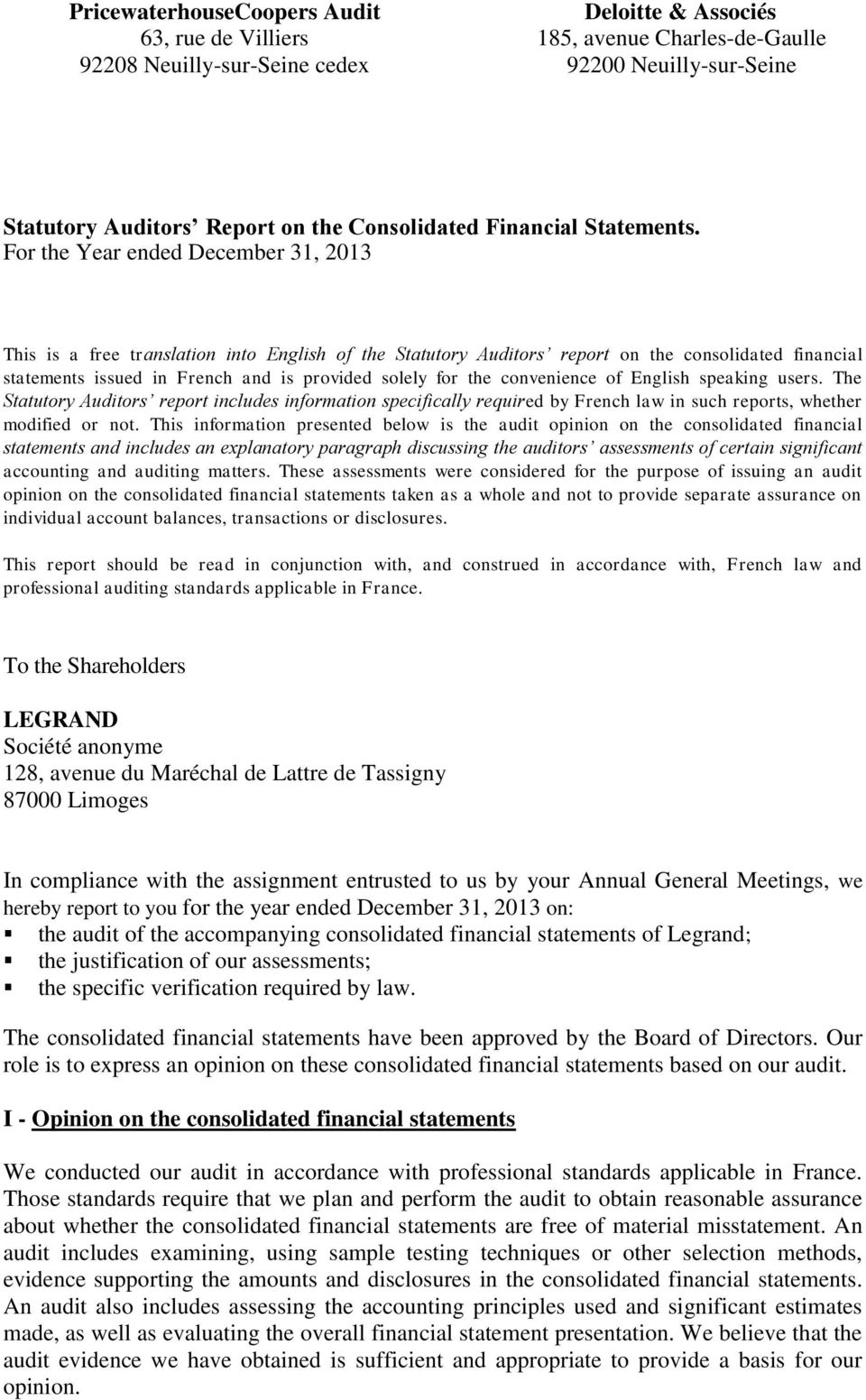
3 PricewaterhouseCoopers Audit 63, rue de Villiers Neuilly-sur-Seine cedex Deloitte & Associés 185, avenue Charles-de-Gaulle Neuilly-sur-Seine Statutory Auditors Report on the Consolidated Financial Statements. For the Year ended This is a free translation into English of the Statutory Auditors report on the consolidated financial statements issued in French and is provided solely for the convenience of English speaking users. The Statutory Auditors report includes information specifically required by French law in such reports, whether modified or not. This information presented below is the audit opinion on the consolidated financial statements and includes an explanatory paragraph discussing the auditors assessments of certain significant accounting and auditing matters. These assessments were considered for the purpose of issuing an audit opinion on the consolidated financial statements taken as a whole and not to provide separate assurance on individual account balances, transactions or disclosures. This report should be read in conjunction with, and construed in accordance with, French law and professional auditing standards applicable in France. To the Shareholders LEGRAND Société anonyme 128, avenue du Maréchal de Lattre de Tassigny Limoges In compliance with the assignment entrusted to us by your Annual General Meetings, we hereby report to you for the year ended on: the audit of the accompanying consolidated financial statements of Legrand; the justification of our assessments; the specific verification required by law. The consolidated financial statements have been approved by the Board of Directors. Our role is to express an opinion on these consolidated financial statements based on our audit. I - Opinion on the consolidated financial statements We conducted our audit in accordance with professional standards applicable in France. Those standards require that we plan and perform the audit to obtain reasonable assurance about whether the consolidated financial statements are free of material misstatement. An audit includes examining, using sample testing techniques or other selection methods, evidence supporting the amounts and disclosures in the consolidated financial statements. An audit also includes assessing the accounting principles used and significant estimates made, as well as evaluating the overall financial statement presentation. We believe that the audit evidence we have obtained is sufficient and appropriate to provide a basis for our opinion.
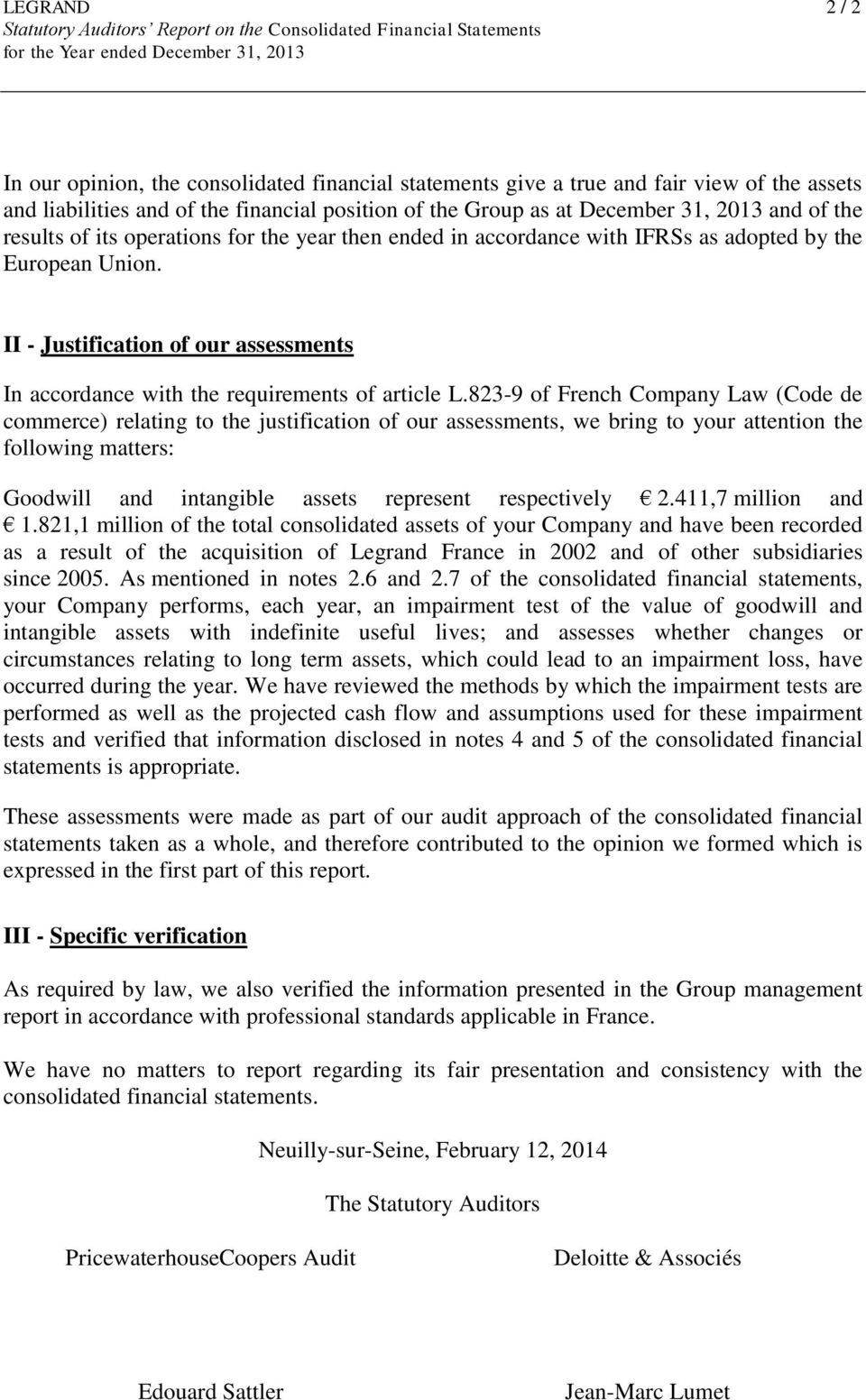
4 LEGRAND Statutory Auditors Report on the Consolidated Financial Statements for the Year ended 2 / 2 In our opinion, the consolidated financial statements give a true and fair view of the assets and liabilities and of the financial position of the Group as at and of the results of its operations for the year then ended in accordance with IFRSs as adopted by the European Union. II - Justification of our assessments In accordance with the requirements of article L of French Company Law (Code de commerce) relating to the justification of our assessments, we bring to your attention the following matters: Goodwill and intangible assets represent respectively 2.411,7 million and 1.821,1 million of the total consolidated assets of your Company and have been recorded as a result of the acquisition of Legrand France in 2002 and of other subsidiaries since As mentioned in notes 2.6 and 2.7 of the consolidated financial statements, your Company performs, each year, an impairment test of the value of goodwill and intangible assets with indefinite useful lives; and assesses whether changes or circumstances relating to long term assets, which could lead to an impairment loss, have occurred during the year. We have reviewed the methods by which the impairment tests are performed as well as the projected cash flow and assumptions used for these impairment tests and verified that information disclosed in notes 4 and 5 of the consolidated financial statements is appropriate. These assessments were made as part of our audit approach of the consolidated financial statements taken as a whole, and therefore contributed to the opinion we formed which is expressed in the first part of this report. III - Specific verification As required by law, we also verified the information presented in the Group management report in accordance with professional standards applicable in France. We have no matters to report regarding its fair presentation and consistency with the consolidated financial statements. Neuilly-sur-Seine, February 12, 2014 The Statutory Auditors PricewaterhouseCoopers Audit Deloitte & Associés Edouard Sattler Jean-Marc Lumet
5 LEGRAND CONSOLIDATED FINANCIAL STATEMENTS DECEMBER 31, CONTENTS Consolidated Statement of Income 2 Consolidated Balance Sheet 3 Consolidated Statement of Cash Flows 5 Consolidated Statement of Changes in Equity 6 Notes to the Consolidated Financial Statements 7-1-
6 Consolidated Statement of Income Legrand 12 months ended Revenue (Note 2.11) 4, ,466.7 Operating expenses Cost of sales (2,156.6) (2,157.8) Administrative and selling expenses (1,184.4) (1,197.1) Research and development costs (197.8) (197.0) Other operating income (expense) (Note 18.2) (72.2) (66.8) Operating profit (Note 18) Financial expense (Note 19.2) (87.7) (102.5) Financial income (Note 19.2) Exchange gains (losses) (Note 19.1) (1.8) (11.7) Total net financial expense (82.6) (93.4) Profit before tax Income tax expense (Note 20) (233.5) (247.6) Profit for the period Attributable to: Legrand Minority interests Basic earnings per share (euros) (Notes 2.18 and 11.2) Diluted earnings per share (euros) (Notes 2.18 and 11.2) Statement of Comprehensive Income 12 months ended Profit for the period Items that may be reclassified subsequently to profit or loss Translation reserves (Notes 2.3 and 13.2) (194.1) (35.9) Income tax relating to components of other comprehensive income (3.1) (0.8) Items that will not be reclassified to profit or loss Actuarial gains and losses (Notes 2.16 and 16) 14.7 (23.8) Deferred taxes on actuarial gains and losses (4.9) 7.2 Comprehensive income for the period Attributable to: Legrand Minority interests The accompanying Notes are an integral part of these financial statements. Consolidated financial statements -2-

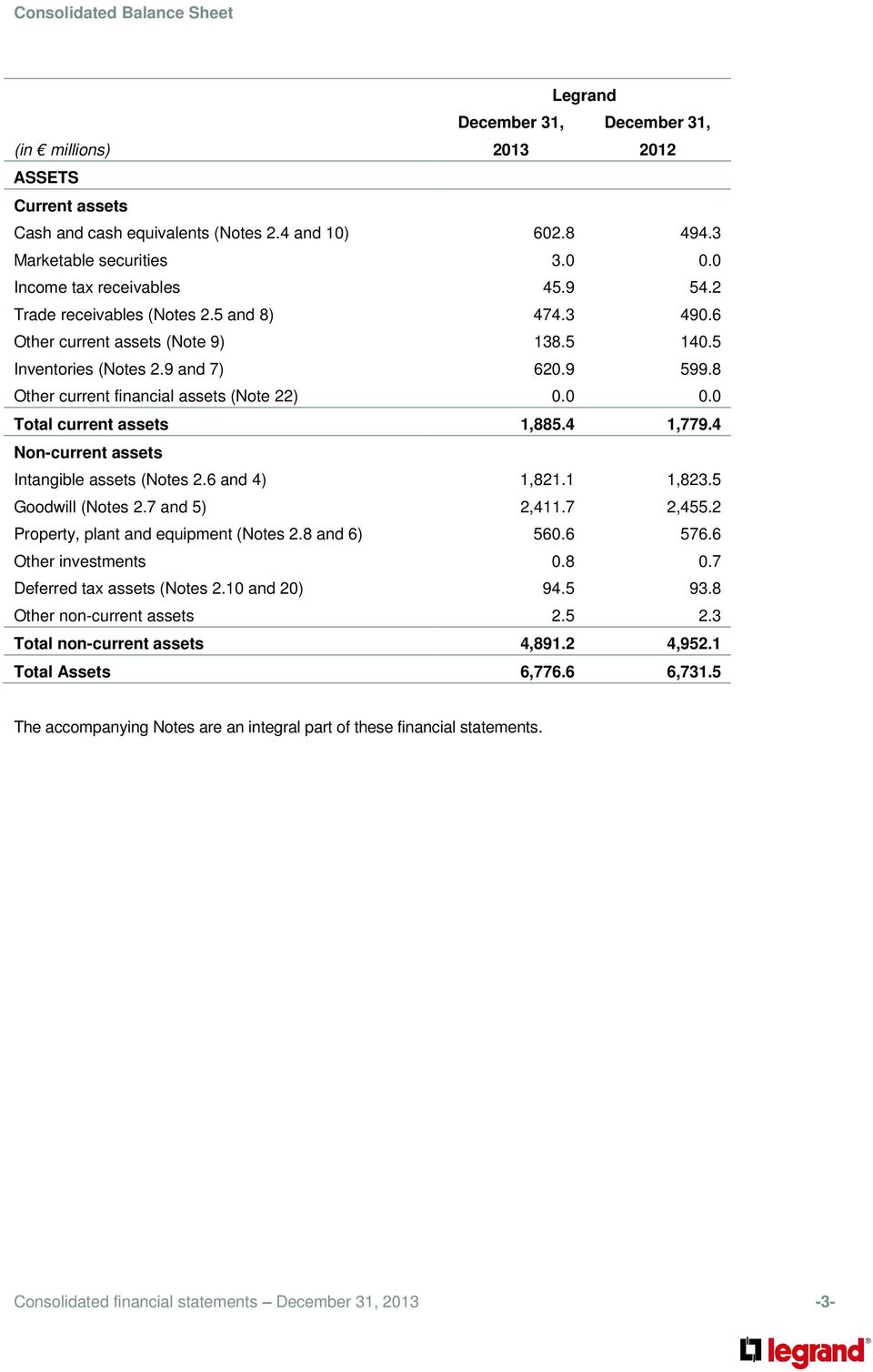
7 Consolidated Balance Sheet Legrand ASSETS Current assets Cash and cash equivalents (Notes 2.4 and 10) Marketable securities Income tax receivables Trade receivables (Notes 2.5 and 8) Other current assets (Note 9) Inventories (Notes 2.9 and 7) Other current financial assets (Note 22) Total current assets 1, ,779.4 Non-current assets Intangible assets (Notes 2.6 and 4) 1, ,823.5 Goodwill (Notes 2.7 and 5) 2, ,455.2 Property, plant and equipment (Notes 2.8 and 6) Other investments Deferred tax assets (Notes 2.10 and 20) Other non-current assets Total non-current assets 4, ,952.1 Total Assets 6, ,731.5 The accompanying Notes are an integral part of these financial statements. Consolidated financial statements -3-
8 Legrand LIABILITIES AND EQUITY Current liabilities Short-term borrowings (Notes 2.19 and 14.2) Income tax payable Trade payables Short-term provisions (Note 15) Other current liabilities (Note 17) Other current financial liabilities (Note 22) Total current liabilities 1, ,124.4 Non-current liabilities Deferred tax liabilities (Notes 2.10 and 20) Long-term provisions (Note 15 and 16.2) Other non-current liabilities Provisions for pensions and other post-employment benefits (Notes 2.16 and 16.1) Long-term borrowings (Notes 2.19 and 14.1) 1, ,496.7 Total non-current liabilities 2, ,416.5 Equity Share capital (Note 11) 1, ,057.5 Retained earnings (Note 13.1) 2, ,335.9 Translation reserves (Note 13.2) (400.8) (208.3) Equity attributable to equity holders of Legrand 3, ,185.1 Minority interests Total equity 3, ,190.6 Total Liabilities and Equity 6, ,731.5 The accompanying Notes are an integral part of these financial statements. Consolidated financial statements -4-

9 Consolidated Statement of Cash Flows Legrand 12 months ended Profit for the period Reconciliation of profit for the period to net cash provided by/(used in) operating activities: Depreciation expense (Note 18.1) Amortization expense (Note 18.1) Amortization of development costs (Note 18.1) Amortization of financial expense Impairment of goodwill (Notes 5 and 18.2) Changes in deferred taxes (10.6) 10.8 Changes in other non-current assets and liabilities (Notes 15 and 16) Exchange (gains)/losses, net (4.9) 8.8 Other adjustments (Gains)/losses on sales of assets, net (0.5) (2.5) Changes in operating assets and liabilities: Inventories (Note 7) (49.9) 15.8 Trade receivables (Note 8) (22.9) 65.0 Trade payables 30.3 (1.3) Other operating assets and liabilities 14.6 (65.8) Net cash provided by/(used in) operating activities Net proceeds from sales of fixed and financial assets Capital expenditure (Notes 4 and 6) (103.9) (92.5) Capitalized development costs (29.1) (28.1) Changes in non-current financial assets and liabilities (2.7) (0.2) Acquisitions of subsidiaries, net of cash acquired (Note 3) (131.7) (187.9) Net cash provided by/(used in) investing activities (263.1) (300.3) Proceeds from issues of share capital and premium (Note 11) Net sales (buybacks) of treasury shares and transactions under the liquidity contract (Note 11) (30.1) (6.9) Dividends paid to equity holders of Legrand* (265.1) (245.0) Dividends paid by Legrand subsidiaries (3.8) (1.3) Proceeds from new borrowings and drawdowns (Note 14) Repayment of borrowings (Note 14) (16.5) (514.9) Debt issuance costs 0.0 (3.6) Increase (reduction) in bank overdrafts (3.3) (82.9) Acquisitions of ownership interests with no gain of control (Note 3) (1.7) (8.1) Net cash provided by/(used in) financing activities (294.7) (426.2) Effect of exchange rate changes on cash and cash equivalents (25.6) (6.7) Increase (decrease) in cash and cash equivalents Cash and cash equivalents at the beginning of the period Cash and cash equivalents at the end of the period (Note 10) Items included in cash flows: Free cash flow** (Note 24) Interest paid during the period Income taxes paid during the period *see consolidated statement of changes in equity **normalized free cash flow is presented in Note 24 The accompanying Notes are an integral part of these financial statements. Consolidated financial statements -5-

10 Consolidated Statement of Changes in Equity Equity attributable to equity holders of Legrand Minority interests equity Share Retained Translation capital earnings reserves TOTAL As of , ,064.3 (172.1) 2, ,949.2 Profit for the period Other comprehensive income (17.4) (36.2) (53.6) 0.3 (53.3) Total comprehensive income (36.2) Dividends paid (245.0) (245.0) (1.3) (246.3) Issues of share capital and premium Net sales (buybacks) of treasury shares and transactions under the liquidity contract (6.9) (6.9) (6.9) Change in scope of consolidation** (12.2) (12.2) 1.7 (10.5) Current taxes on share buybacks (0.5) (0.5) (0.5) Stock options As of 1, ,335.9 (208.3) 3, ,190.6 Profit for the period Other comprehensive income 6.7 (192.5) (185.8) (1.6) (187.4) Total comprehensive income (192.5) IAS 19 amendments* (5.3) (5.3) (5.3) Dividends paid (265.1) (265.1) (3.8) (268.9) Issues of share capital and premium (Note 11) Net sales (buybacks) of treasury shares and transactions under the liquidity contract (Note 11) (30.1) (30.1) (30.1) Change in scope of consolidation** (35.3) (35.3) 8.4 (26.9) Current taxes on share buybacks (0.4) (0.4) (0.4) Stock options (Note 12.1) As of 1, ,575.8 (400.8) 3, ,248.7 Total * see Note **changes in scope of consolidation correspond mainly to acquisitions of additional shares in companies already consolidated in the Group s financial statements The accompanying Notes are an integral part of these financial statements. Consolidated financial statements -6-

11 NOTES TO THE CONSOLIDATED FINANCIAL STATEMENTS Detailed table of contents Note 1 - General information 8 Note 2 - Accounting policies 8 Note 3 - Changes in the scope of consolidation 23 Note 4 - Intangible assets (Note 2.6) 24 Note 5 - Goodwill (Note 2.7) 26 Note 6 - Property, plant and equipment (Note 2.8) 29 Note 7 - Inventories (Note 2.9) 31 Note 8 - Trade receivables (Note 2.5) 31 Note 9 - Other current assets 32 Note 10 - Cash and cash equivalents (Note 2.4) 32 Note 11 - Share capital and earnings per share (Note 2.18) 33 Note 12 - Stock option plans, performance share plans and employee profit-sharing (Note 2.14) 35 Note 13 - Retained earnings and translation reserves 38 Note 14 - Long-term and short-term borrowings (Note 2.19) 39 Note 15 - Provisions 42 Note 16 - Pensions and other post-employment defined benefit obligations (Note 2.16) 43 Note 17 - Other current liabilities 48 Note 18 - Analysis of certain expenses 49 Note 19 - Total net financial expense 49 Note 20 - Income tax expense (current and deferred) (Note 2.10) 50 Note 21 - Off-balance sheet commitments and contingent liabilities 52 Note 22 - Financial instruments and management of financial risks 53 Note 23 - Information relating to corporate officers 60 Note 24 - Information by geographical segment (Note 2.17) 61 Note 25 - Quarterly data unaudited 63 Note 26 - List of consolidated companies 66 Note 27 - Subsequent events 67 Consolidated financial statements -7-

12 Note 1 - General information Legrand ( the Company ) along with its subsidiaries (together Legrand or the Group ) is the global specialist in electrical and digital building infrastructures. The Group has manufacturing and/or distribution subsidiaries and offices in more than 80 countries, and sells its products in about 180 countries. Its key markets are France (21%), Italy (11%), the United States and Canada (17%), the Rest of Europe (18%) and the Rest of the World (33%), with a steadily rising contribution from the new economies (close to 40% of the consolidated total in ). The Company is a société anonyme (public limited company) incorporated and domiciled in France. Its registered office is located at 128, avenue du Maréchal de Lattre de Tassigny, Limoges (France). The Registration Document was filed with the AMF on March 28, under no. D The consolidated financial statements were approved by the Board of Directors on February 12, All amounts are presented in millions of euros unless otherwise specified. Some totals may include rounding differences. Note 2 - Accounting policies As a company incorporated in France, Legrand is governed by French company laws, including the provisions of the Commercial Code. The consolidated financial statements cover the 12 months ended. They have been prepared in accordance with the International Financial Reporting Standards (IFRS) and International Financial Reporting Interpretation Committee (IFRIC) interpretations adopted by the European Union and applicable or authorized for early adoption from January 1,. None of the IFRSs issued by the International Accounting Standards Board (IASB) that have not been adopted for use in the European Union are applicable to the Group. The IFRSs adopted by the European Union as of can be downloaded from the IAS/IFRS Standards and Interpretations page of the European Commission s website: The preparation of financial statements in accordance with IFRS requires the use of certain critical accounting estimates. It also requires management to exercise judgment in applying the Company s accounting policies. The areas involving a specific degree of judgment or complexity, or areas where assumptions and estimates are significant to the consolidated financial statements are disclosed in Note The consolidated financial statements have been prepared using the historical cost convention, except for some classes of assets and liabilities in accordance with IFRS. The classes concerned are mentioned in the notes below. Consolidated financial statements -8-

13 2.1 New standards, amendments and interpretations New standards, amendments and interpretations with mandatory application from January 1,, and applied by the Group in early Amendments to IAS 1 - Presentation of items of other comprehensive income. This amendment was published by IASB in June 2011 and has been applied by the Group in early. This amendment requires separate subtotals for: elements of «comprehensive income for the period» that could be reclassified ultimately into net income in the consolidated statement of income showing separately the related taxes, and elements of «comprehensive income for the period» that cannot be reclassified into net income, showing separately the related taxes New standards, amendments and interpretations applied by the Group after January 1, that have no impact on its financial statements IFRS 13 Fair Value Measurement In May 2011, IASB issued guidance for measuring fair value and for the related disclosures required in the notes to financial statements. The guidance is designed to establish a single framework for fair value measurement under IASs and IFRSs. Amendments to IAS 12 Deferred Tax: Recovery of Underlying Assets In December 2010, the IASB issued amendments to IAS 12 entitled Deferred Tax: Recovery of Underlying Assets. The amendments introduce a presumption that the carrying amount of an asset is fully recovered upon its sale, unless it is recovered otherwise. Amendments to IFRS 7 Disclosures: Offsetting Financial Assets and Financial Liabilities In December 2011, the IASB issued additional provisions on the information to be provided in the notes to the consolidated financial statements regarding agreements offsetting financial assets and financial liabilities New standards, amendments and interpretations applied by the Group after January 1, that have an impact on its financial statements Amendments to IAS 19 Employee Benefits In June 2011, the IASB published amendments to IAS 19 Employee Benefits concerning the recognition of defined benefit plans. These amendments concern, in particular, elimination of the corridor method of accounting for actuarial gains and losses, the immediate recognition of all past service costs and the use of high quality corporate bond yields to determine the discount rate for calculating the net interest cost of employee benefit obligations to the exclusion of other benchmarks. Consolidated financial statements -9-

14 The revised standard, which applies retrospectively, has had the following impacts: The Group s commitments to its employees are fully recognized at the end of each financial period, as it is no longer possible to amortize past service costs resulting from plan amendments over the remaining work life of the employees concerned; Unamortized past service costs were accounted for in retained earnings, for their value net of tax during the period of application of the revised standard; The effects of any changes in defined benefit plans after January 1, are recognized directly in income statement in operating profit in the period in which they occur; The expected return on plan assets is set as being equal to the discount rate used to determine the present value of the projected benefit obligations. The different impacts of the revised standard in can be summarized as follows: As of January 1, As of Net increase in pension liability (8.9) (8.0) Net increase in deferred tax assets Net decrease in shareholders equity (5.8) (5.3) Actuarial gains and losses Decrease in personnel costs Increase in financial expenses - (1.6) Deferred tax income Decrease in net income - (0.5) The impact of these adjustments are not material, therefore no restatements have been made to the balance sheet and income statement New standards, amendments and interpretations not applicable to the Group until future periods Standards and interpretations adopted by the European Union Consolidated Financial Statements, Joint Arrangements and Disclosure of Interests In May 2011, the IASB issued new standards IFRS 10 Consolidated Financial Statements, IFRS 11 Joint Arrangements and IFRS 12 Disclosure of Interests in Other Entities as well as the resulting amendments to IAS 27, reissued as Separate Financial Statements, and IAS 28, reissued as Investments in Associates and Joint Ventures. IFRS 10 Consolidated Financial Statements introduces a single consolidation framework for all types of investee entities, based on the concept of control. Consolidated financial statements -10-

15 The new IFRS 11 Joint Arrangements introduces new requirements in recognizing joint arrangements, with in particular the use of the equity method to account for joint ventures. The new IFRS 12 Disclosure of Interests in Other Entities integrates into a single standard the disclosures required for interests in subsidiaries, joint arrangements, associates and unconsolidated structured entities. These new standards are applicable to annual periods beginning on or after January 1, They are not expected to materially impact the consolidated financial statements, as the Group exercises exclusive control over all its consolidated subsidiaries. These new standards will not be early applied. Amendments to IAS 32 Financial Instruments Disclosures: Offsetting Financial Assets and Financial Liabilities In December 2011, the IASB published amendments to IAS 32 Financial Instruments Disclosures: Offsetting Financial Assets and Financial Liabilities clarifying the rules for offsetting financial assets and liabilities. The amendments to IAS 32 are applicable retrospectively and are effective for annual periods beginning on or after January 1, Their impact on the Group s consolidated financial statements is not expected to be material. Amendments to IAS 36 Recoverable Amount Disclosures for Non-Financial Assets In May, the IASB published amendments to IAS 36 that require disclosure of the valuation techniques used, as well as of the key assumptions used in the current measurement and previous measurement of fair value when an impairment loss has been recognized (or reversed in the case of assets other than goodwill). The amendments are applicable prospectively for annual periods beginning on or after January 1, Their impact on the Group s consolidated financial statements is not expected to be material. Amendment to IAS 39 Novation of Derivatives and Continuation of Hedge Accounting In June, the IASB published an amendment to IAS 39 that allows hedge accounting to be continued in certain situations where a derivative is novated (i.e., the parties to a contract agree to replace their original contract with a new one). The amendment is applicable for annual periods beginning on or after January 1, In accordance with IAS 8, it is applicable retrospectively. Its impact on the Group s consolidated financial statements is not expected to be material. Standards and interpretations not yet adopted by the European Union IFRS 9 Financial Instruments In November 2009, the IASB published IFRS 9 Financial Instruments to replace IAS 39 Financial Instruments: Recognition and Measurement. IFRS 9 uses a single approach to determine whether a financial asset is measured at amortized cost or fair value, replacing the many different rules in IAS 39. The approach in IFRS 9 is based on how Consolidated financial statements -11-

16 an entity manages its financial instruments (its business model) and the contractual cash flow characteristics of the financial asset. The new standard also requires a single impairment method to be used, replacing the many different impairment methods in IAS 39. In October 2010, the IASB issued additions to IFRS 9 Financial Instruments for financial liability accounting. Under the new requirements, which concern the classification and measurement of financial liabilities, an entity choosing to measure a liability at fair value will present the portion of the change in its fair value due to changes in the entity s own credit risk in the other comprehensive income (OCI) section of the income statement, rather than within profit and loss. IFRS 9 and its amendments have not yet been adopted for use in the European Union. IFRIC 21 Levies In May, the IFRS Interpretation Committee issued IFRIC 21 Levies which aims to clarify the trigger event for the provisioning for all taxes other than income taxes. This interpretation will modify existing practices for annual taxes whose payment is triggered, for an entity, by being in operations on a specified date or by achieving a certain level of activity. IFRIC 21 is effective for annual periods beginning on or after 1 January Its impact should be recognized retrospectively in accordance with IAS 8. IFRIC 21 has not yet been approved by European Union. The Group is reviewing these standards, interpretations and amendments to determine their possible impact on the disclosures in the consolidated financial statements. 2.2 Basis of consolidation Subsidiaries controlled by the Group are fully consolidated. Control is defined as the power to govern the financial and operating policies of an entity so as to obtain benefits from its activities. Subsidiaries are consolidated from the date when effective control is transferred to the Group. They are deconsolidated from the date on which control ceases. Associates are entities over which the Group has significant influence but not control. Significant influence is generally considered to be exercised when the Group holds 20 to 50% of the voting rights. Investments in associates are initially recognized at cost and are subsequently accounted for by the equity method. The Group does not hold interests accounted for under the equity method. 2.3 Foreign currency translation Items included in the financial statements of each Group entity are measured using the currency of the primary economic environment in which the entity operates (the functional currency ). The consolidated financial statements are presented in euros, which is the Company s functional and presentation currency. Consolidated financial statements -12-

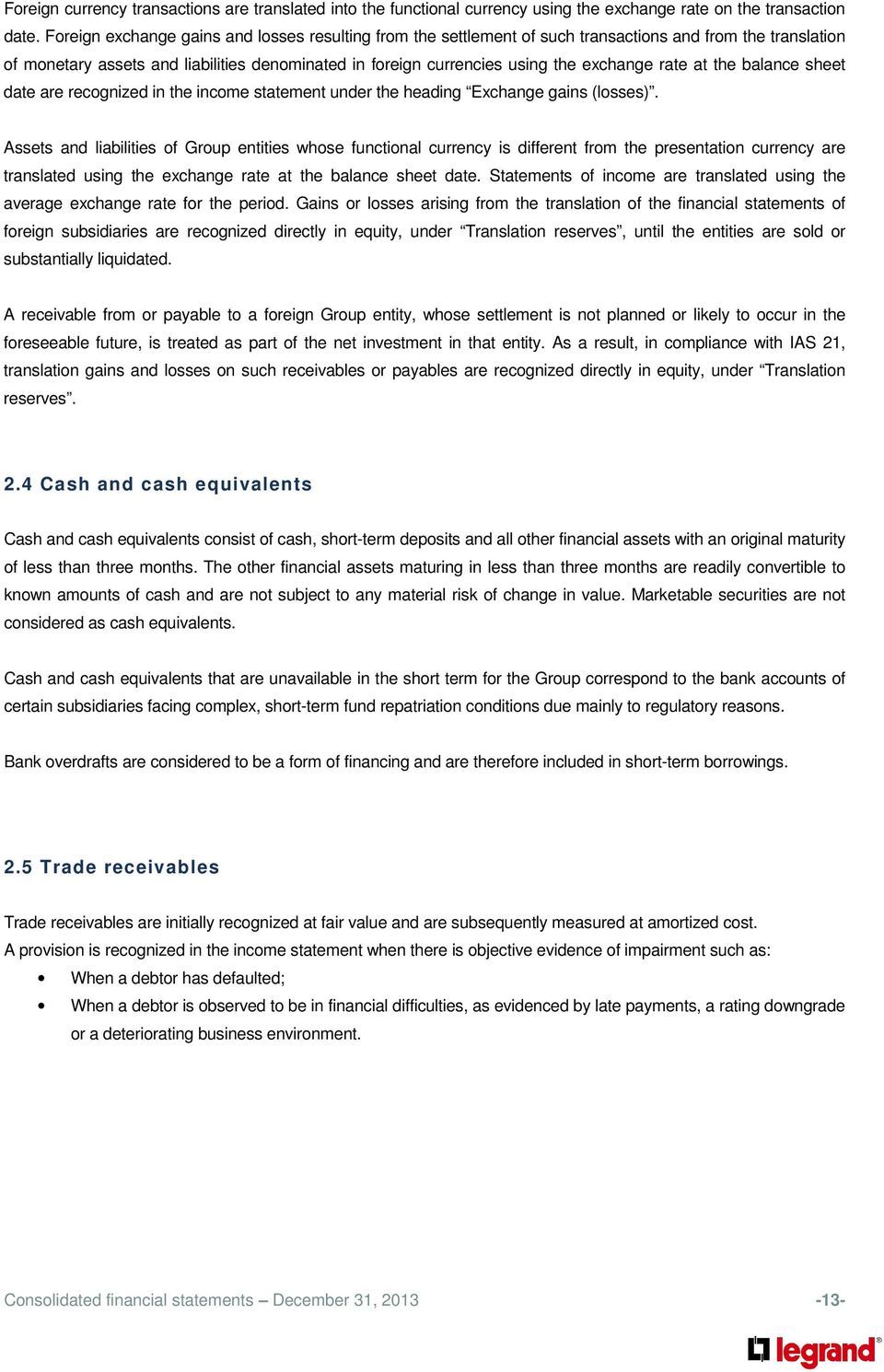
17 Foreign currency transactions are translated into the functional currency using the exchange rate on the transaction date. Foreign exchange gains and losses resulting from the settlement of such transactions and from the translation of monetary assets and liabilities denominated in foreign currencies using the exchange rate at the balance sheet date are recognized in the income statement under the heading Exchange gains (losses). Assets and liabilities of Group entities whose functional currency is different from the presentation currency are translated using the exchange rate at the balance sheet date. Statements of income are translated using the average exchange rate for the period. Gains or losses arising from the translation of the financial statements of foreign subsidiaries are recognized directly in equity, under Translation reserves, until the entities are sold or substantially liquidated. A receivable from or payable to a foreign Group entity, whose settlement is not planned or likely to occur in the foreseeable future, is treated as part of the net investment in that entity. As a result, in compliance with IAS 21, translation gains and losses on such receivables or payables are recognized directly in equity, under Translation reserves. 2.4 Cash and cash equivalents Cash and cash equivalents consist of cash, short-term deposits and all other financial assets with an original maturity of less than three months. The other financial assets maturing in less than three months are readily convertible to known amounts of cash and are not subject to any material risk of change in value. Marketable securities are not considered as cash equivalents. Cash and cash equivalents that are unavailable in the short term for the Group correspond to the bank accounts of certain subsidiaries facing complex, short-term fund repatriation conditions due mainly to regulatory reasons. Bank overdrafts are considered to be a form of financing and are therefore included in short-term borrowings. 2.5 Trade receivables Trade receivables are initially recognized at fair value and are subsequently measured at amortized cost. A provision is recognized in the income statement when there is objective evidence of impairment such as: When a debtor has defaulted; When a debtor is observed to be in financial difficulties, as evidenced by late payments, a rating downgrade or a deteriorating business environment. Consolidated financial statements -13-
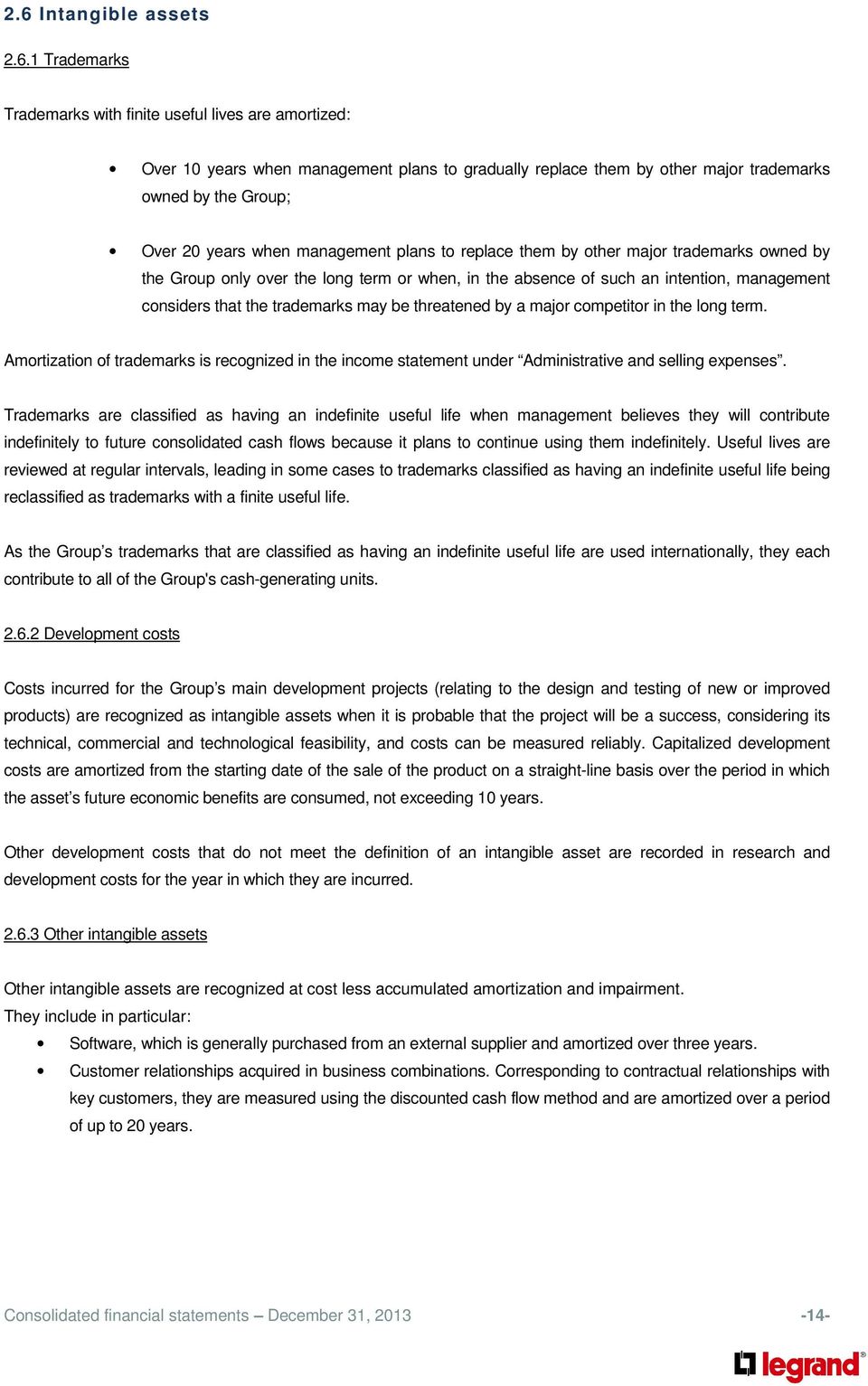
18 2.6 Intangible assets Trademarks Trademarks with finite useful lives are amortized: Over 10 years when management plans to gradually replace them by other major trademarks owned by the Group; Over 20 years when management plans to replace them by other major trademarks owned by the Group only over the long term or when, in the absence of such an intention, management considers that the trademarks may be threatened by a major competitor in the long term. Amortization of trademarks is recognized in the income statement under Administrative and selling expenses. Trademarks are classified as having an indefinite useful life when management believes they will contribute indefinitely to future consolidated cash flows because it plans to continue using them indefinitely. Useful lives are reviewed at regular intervals, leading in some cases to trademarks classified as having an indefinite useful life being reclassified as trademarks with a finite useful life. As the Group s trademarks that are classified as having an indefinite useful life are used internationally, they each contribute to all of the Group's cash-generating units Development costs Costs incurred for the Group s main development projects (relating to the design and testing of new or improved products) are recognized as intangible assets when it is probable that the project will be a success, considering its technical, commercial and technological feasibility, and costs can be measured reliably. Capitalized development costs are amortized from the starting date of the sale of the product on a straight-line basis over the period in which the asset s future economic benefits are consumed, not exceeding 10 years. Other development costs that do not meet the definition of an intangible asset are recorded in research and development costs for the year in which they are incurred Other intangible assets Other intangible assets are recognized at cost less accumulated amortization and impairment. They include in particular: Software, which is generally purchased from an external supplier and amortized over three years. Customer relationships acquired in business combinations. Corresponding to contractual relationships with key customers, they are measured using the discounted cash flow method and are amortized over a period of up to 20 years. Consolidated financial statements -14-
19 2.6.4 Impairment tests on intangible assets except goodwill When events or changes in market environment indicate that an intangible asset or item of property, plant and equipment may be impaired, the item concerned is tested for impairment to determine whether its carrying amount is greater than its recoverable amount, defined as the higher of fair value less costs to sell and value in use. Fair value less costs to sell is the best estimate of the amount obtainable from the sale of an asset or cashgenerating unit in an arm s length transaction between knowledgeable, willing parties, less the costs of disposal. Value in use is the present value of the future cash flows expected to be derived from the use and subsequent sale of the asset. For further information, see Note An impairment loss is recognized for the amount by which the asset s carrying amount exceeds its recoverable amount. Impairment losses on intangible assets may be reversed in subsequent periods if the impairment has decreased, provided that the increased carrying amount of the asset does not exceed the amount that would have been determined had no impairment loss been recognized. Each trademark with an indefinite useful life is tested for impairment separately, in the fourth quarter of each year and whenever events or changes in circumstances indicate that the carrying amount may not be recoverable. Impairment tests are performed using the relief from royalty method. This method consists of measuring the royalties that the company would have to pay to license in the trademark from a third party. The theoretical value ot these royalties is then measured by estimating future revenue generated by the trademark over its useful life, as if the trademark were to be owned by a third party.this theoretical value is then compared to the trademark net book value. 2.7 Goodwill Business combinations For each combination, the Group decides to use: i. Either the full goodwill method, which consists of allocating goodwill to minority interests. Under this method, goodwill is the difference between a) the consideration paid to acquire the business combination plus the fair value of the non-controlling interests in the combination and b) the fair value at date of acquisition of the identifiable net assets acquired and liabilities assumed. ii. Or the partial goodwill method, whereby no goodwill is allocated to minority interets. Under this method, goodwill is the difference between a) the consideration paid to acquire the business combination and b) the portion of the acquisition date fair value of the identifiable net assets acquired and liabilities assumed that is attributable to the Group. Consolidated financial statements -15-

20 The cost of business combinations, as determined on the date when control is acquired, corresponds to the fair value of the acquired entities. As such, it does not include acquisition-related costs and expenses but does include contingent consideration at fair value. Changes in the percentage of interest held in a controlled entity are recorded directly in equity without recognizing any additional goodwill Impairment tests on goodwill Goodwill is tested for impairment annually, in the fourth quarter of each year, and whenever events or changes in circumstance indicate that the carrying amount may not be recoverable. For impairment testing purposes, goodwill is allocated to a cash-generating unit (CGU) or a group of CGUs, corresponding to the lowest level at which goodwill is monitored. Within the Legrand Group, CGUs are defined as corresponding to individual countries or to a group of countries, when they either have similar market characteristics or are managed as a single unit. The need to record an impairment loss is assessed by comparing the carrying amount of the CGU s assets and liabilities, including goodwill, and their recoverable amount, defined as the higher of fair value less costs to sell and value in use. Value in use is estimated based on discounted cash flows for the next five years and a terminal value calculated from the final year of the projection period. The cash flow data used for the calculation is taken from the most recent medium-term business plans approved by Group management. Business plan projections are based on the latest available external forecasts of trends in the Group s markets. Cash flows beyond the projection period of five years are estimated by applying a stable growth rate. The discount rates applied derive from the capital asset pricing model. They are calculated for each individual country, based on financial market and/or valuation services firm data (average data over the last three years). The cost of debt used in the calculations is the same for all individual countries (being equal to the Group s cost of debt). Fair value less costs to sell is the best estimate of the amount obtainable from the sale of an asset or cashgenerating unit in an arm s length transaction between knowledgeable, willing parties, less the costs of disposal. An impairment loss is recognized when the carrying amount is less than the recoverable amount. Impairment losses recognized on goodwill are irreversible. 2.8 Property, plant and equipment Land, buildings, machinery and equipment, and other fixed assets are carried at cost less accumulated depreciation and any accumulated impairment losses. Impairment tests are performed annually and whenever events or changes in circumstances indicate that the assets carrying amount may not be recoverable. Assets acquired under lease agreements that transfer substantially most of the risks and rewards of ownership to the Group are capitalized on the basis of the present value of future minimum lease payments and are depreciated over Consolidated financial statements -16-

21 the shorter of the lease contract period and the asset's useful life determined in accordance with Group policies (see below). Depreciation is calculated on a straight-line basis over the estimated useful lives of the respective assets; the most commonly adopted useful lives are the following: Light buildings years Standard buildings years Machinery and equipment... 8 to 10 years Tooling... 5 years Office furniture and equipment... 5 to 10 years The depreciable amount of assets is determined after deducting their residual value when the amounts involved are material. Each part of an item of property, plant and equipment with a useful life that is significantly different to the useful lives of other parts is depreciated separately. Assets held for sale are measured at the lower of their carrying amount and fair value less costs to sell. 2.9 Inventories Inventories are measured at the lower of cost (of acquisition or production) or net realizable value, with cost determined principally on a first-in, first-out (FIFO) basis. The production cost of finished goods and work in progress comprises raw materials, direct labor, other direct costs and related production overheads (based on normal operating capacity). It excludes borrowing costs. Net realizable value is the estimated selling price in the ordinary course of business, less applicable variable selling expenses Deferred taxes In accordance with IAS 12, deferred taxes are recognized for temporary differences between the tax bases of assets and liabilities and their carrying amount in the consolidated balance sheet. Deferred tax assets and liabilities are measured at the tax rates that are expected to apply in the period when the asset is realized or the liability is settled, based on tax rates that have been enacted or substantively enacted by the balance sheet date. Deferred tax assets are recognized to the extent that it is probable that future taxable profit will be available against which the temporary differences can be utilized. Deferred tax assets and deferred tax liabilities are offset when the entity has a legally enforceable right of offset and they relate to income taxes levied by the same taxation authority Revenue recognition Revenues from the sale of goods are recognized when all of the following conditions have been satisfied: (i) the significant risks and rewards of ownership of the goods have been transferred to the buyer; (ii) the seller retains Consolidated financial statements -17-
22 neither continuing managerial involvement to the degree usually associated with ownership nor effective control over the goods sold; (iii) the amount of revenue can be measured reliably; (iv) it is probable that the economic benefits associated with the transaction will flow to the seller; and (v) the costs incurred or to be incurred in respect of the transaction can be measured reliably. For the Group, this policy results in the recognition of revenue when ownership title and the risk of loss are transferred to the buyer, which is generally upon shipment. The Group offers some sales incentives to customers, consisting primarily of volume rebates and cash discounts. Volume rebates are typically based on three, six, and twelve-month arrangements with customers, and rarely extend beyond one year. Based on the trade of the current period, such rebates are recognized on a monthly basis as a reduction in revenue from the underlying transactions that reflect progress by the customer towards earning the rebate, with a corresponding deduction from the customer s trade receivables balance Valuation of financial instruments Hierarchical classification of financial instruments Under the amended IFRS 7, financial instruments are classified in a three-level hierarchy based on the inputs used to measure their fair value, as follows: Level 1: quoted prices for similar instruments; Level 2: directly observable market inputs other than level 1 inputs; Level 3: inputs not based on observable market data Measurement of financial instruments The carrying amounts of cash, short-term deposits, accounts receivable, accounts payable, accrued expenses and short-term borrowings approximate their fair value because of these instruments short maturities. For short-term investments, comprised of marketable securities, fair value corresponds to the securities market price. The fair value of long-term borrowings is estimated on the basis of interest rates currently available for issuance of debt with similar terms and remaining maturities. The fair value of interest rate swap agreements is the estimated amount that the counterparty would receive or pay to terminate the agreements, and is calculated as the present value of the estimated future cash flows Non-derivative financial instruments designated as hedges Under IAS 39, non-derivative financial instruments may be designated as hedges only when they are used to hedge foreign currency risk and provided that they qualify for hedge accounting. Accordingly, in the case of hedges of a net investment in a foreign operation, the portion of the gain or loss on the hedging instrument that is deemed to be an effective hedge is recognized in equity, as required under paragraph 102 of IAS 39. Consolidated financial statements -18-
23 Derivatives Group policy consists of not entering into any transactions of a speculative nature involving financial instruments. All transactions in these instruments are entered into exclusively for the purpose of managing or hedging currency or interest rate risks, and changes in the prices of raw materials. For this purpose, the Group periodically enters into contracts such as swaps, caps, options, futures and forward contracts, according to the nature of its exposure. Accounting treatment of derivative instruments Derivatives are initially recognized at fair value at the contract inception date and are subsequently remeasured at fair value at each reporting date. The method of recognizing the resulting gain or loss depends on whether the derivative qualifies for hedge accounting, and if so, the nature of the item being hedged. Put on non-controlling interests In the particular case of puts written on non-controlling interests without any transfer of risks and benefits, the contractual obligation to purchase these equity instruments is recognized as a liability by adjusting equity in application of IAS 32. Any subsequent changes in the liability are recorded in equity. Other derivative instruments In the case of other derivative instruments, the Group analyzes the substance of each transaction and recognizes any changes in fair value in accordance with IAS 39. The fair values of derivative instruments used for hedging purposes are disclosed in Note Environmental and product liabilities In accordance with IAS 37, the Group recognizes losses and accrues liabilities relating to environmental and product liability matters. A loss is recognized if available information indicates that it is probable and reasonably estimable. In the event that a loss is neither probable nor reasonably estimable but remains possible, the contingency is disclosed in the notes to the consolidated financial statements. Losses arising from environmental liabilities are measured on a best-estimate basis, case by case, based on available information. Losses arising from product liability issues are estimated on the basis of current facts and circumstances, past experience, the number of claims and the expected cost of administering, defending and, in some cases, settling such cases. In accordance with IFRIC 6 - Liabilities arising from Participating in a Specific Market - Waste Electrical and Electronic Equipment, the Group manages waste equipment under the European Union Directive on waste electrical and electronic equipment by paying financial contributions to a recycling platform Share-based payment transactions Share-based payment plans have been implemented, which are settled in either equity or cash. Consolidated financial statements -19-
24 Equity-settled share-based payment transactions The cost of stock options or performance shares is measured at the fair value of the award on the grant date, using the Black & Scholes option pricing model or the binomial model, and is recognized in the income statement under Employee benefits expense on a straight-line basis over the vesting period with a corresponding adjustment to equity. Changes in the fair value of stock options after the grant date are not taken into account. The expense recognized by crediting equity is adjusted at each period-end during the vesting period to take into account changes in the number of shares that are expected to be delivered to employees when the performance shares vest or the stock options are exercised Cash-settled share-based payment transactions When granting long-term employee benefits plans indexed to the share price, the value of the awarded instruments is estimated according to the conditions defined at the plan s inception. This value is remeasured at each period-end and the resulting increase or decrease in expense is recognized as an adjustment to provisions Transfers and use of financial assets In accordance with IAS 39, financial assets are derecognized when the associated cash flows and substantially all the related risks and rewards have been transferred Pension and other post employment benefit obligations Pension obligations Group companies operate various pension plans. The plans are funded through payments to insurance companies or trustee-administered funds, determined by periodic actuarial calculations. The Group has both defined contribution and defined benefit plans. Defined contribution plans A defined contribution plan is a pension plan under which the Group pays fixed contributions into a separate entity. Contributions are recognized as an expense for the period of payment. The Group has no legal or constructive obligations to pay further contributions if the fund does not hold sufficient assets to pay all employees the benefits relating to employee service in current and prior periods. Defined benefit plans A defined benefit plan is a pension plan that defines an amount of pension benefit that an employee will receive on retirement, usually dependent on one or more factors such as age, years of service and end-of-career salary. The liability recognized in the balance sheet for defined benefit pension plans is the present value of the defined benefit obligation at the balance sheet date, less the fair value of plan assets. The past service cost arising from changes to pension benefit plans is expensed in full as incurred. Consolidated financial statements -20-
25 The Group recognizes all actuarial gains and losses outside profit or loss, in the Statement Of Recognized Income and Expense (Statement of comprehensive income), as allowed under IAS 19, paragraph 120C (revised). Defined benefit obligations are calculated using the projected unit credit method. This method takes into account estimated years of service at retirement, final salaries, life expectancy and staff turnover, based on actuarial assumptions. The present value of the defined benefit obligation is determined by discounting the estimated future cash outflows using interest rates of investment grade corporate bonds that are denominated in the currency in which the benefits will be paid and have terms to maturity approximating the period to payment of the related pension liability Other post-employment benefit obligations Some Group companies provide post-employment healthcare benefits to their retirees. The entitlement to these benefits is usually conditional on the employee remaining with the company up to retirement age and completion of a minimum service period. The benefits are treated as post-employment benefits under the defined benefit scheme Other long-term employee benefits The Group has implemented plans providing long-term employee benefits to employees, which are recognized in provisions in accordance with IAS Segment information The Group is organized for management purposes by country and by geographical segment. Hence, allocation of resources to the various segments and assessement of each segment's performance are performed by the Group management on a country basis Basic and diluted earnings per share Basic earnings per share are calculated by dividing net profit attributable to equity holders of Legrand by the weighted number of ordinary shares outstanding during the period. Diluted earnings per share are calculated according to the treasury stock method, by dividing profit attributable to equity holders of Legrand by the weighted average number of ordinary shares outstanding during the period, plus the number of dilutive potential ordinary shares. The weighted average number of ordinary shares outstanding used in these calculations is adjusted for the share buybacks and sales carried out during the period and does not take into account shares held in treasury. Consolidated financial statements -21-
26 2.19 Short- and long-term borrowings Short- and long-term borrowings mainly comprise bonds and bank loans. They are initially recognized at fair value, taking into account any transaction costs directly attributable to the issue, and are subsequently measured at amortized cost, using the effective interest method Borrowing costs In accordance with the revised version of IAS 23, borrowing costs that are directly attributable to the acquisition, construction or production of a qualifying asset are included in the cost of that asset. A qualifying asset is an asset that necessarily takes a substantial period of time to get ready for its intended use or sale. Other borrowing costs are recognized as an expense for the period in which they were incurred Use of estimates The preparation of financial statements in conformity with generally accepted accounting principles requires management to make estimates and assumptions that are reflected in the reported amounts of assets and liabilities and disclosures of contingent assets and liabilities as of the date of the financial statements and the reported amounts of revenues and expenses during the reporting period. Actual results may differ from those estimates. Estimates and judgments are continually evaluated. They are based on historical experience and other factors, including expectations of future events, and are believed to be reasonable under the circumstances Impairment of goodwill and intangible assets Trademarks with indefinite useful lives and goodwill are tested for impairment at least once a year and whenever events or changes in circumstances indicate that the carrying amount may not be recoverable, in accordance with the accounting policies presented in Notes and Intangible assets with finite useful lives are amortized over their estimated useful lives and are tested for impairment when there is any indication that their recoverable amount may be less than their carrying amount. Future events could cause the Group to conclude that evidence exists that certain intangible assets acquired in a business combination are impaired. Any resulting impairment loss could have a material adverse effect on the Group s consolidated financial condition and results of operations. The discounted cash flow estimates used for impairment tests on goodwill and trademarks with indefinite useful lives are based to a significant extent on management s judgment Accounting for income taxes As part of the process of preparing the consolidated financial statements, the Group is required to estimate income taxes in each of the jurisdictions in which it operates. This involves estimating the actual current tax exposure and assessing temporary differences resulting from differing treatment of items such as deferred revenue or prepaid Consolidated financial statements -22-
27 expenses for tax and accounting purposes. These differences result in deferred tax assets and liabilities, which are reported in the consolidated balance sheet. The Group must then assess the probability that deferred tax assets will be recovered from future taxable profit. Deferred tax assets are recognized only when it is probable that sufficient taxable profit will be available, based on management-approved taxable profit forecasts. The Group has not recognized all of its deferred tax assets because it is not probable that some of them will be recovered before they expire. The amounts involved mainly concern operating losses carried forward and foreign income tax credits. The assessment is based on estimates of future taxable profit by jurisdiction in which the Group operates and the period over which the deferred tax assets are recoverable Other assets and liabilities based on estimates Other assets and liabilities based on estimates include provisions for pensions and other post-employment benefits, impairment of trade receivables, inventories and financial assets, stock options, provisions for contingencies and charges, capitalized development costs, and any annual volume rebates offered to customers. Note 3 - Changes in the scope of consolidation The contributions to the Group s consolidated financial statements of companies acquired since January 1, were as follows: March 31 June 30 September 30 December 31 Megapower 3 months profit 6 months profit 9 months profit 12 months profit Aegide Balance sheet only 4 months profit 7 months profit 10 months profit Numeric UPS Balance sheet only 4 months profit 7 months profit NuVo Technologies Balance sheet only March 31 June 30 September 30 December 31 Aegide 3 months profit 6 months profit 9 months profit 12 months profit Numeric UPS 3 months profit 6 months profit 9 months profit 12 months profit NuVo Technologies 3 months profit 6 months profit 9 months profit 12 months profit Daneva Balance sheet only 6 months profit 9 months profit 12 months profit Seico Balance sheet only 5 months profit 8 months profit 11 months profit S2S Balance sheet only Balance sheet only 8 months profit Adlec Power Balance sheet only 5 months profit Tynetec Balance sheet only 5 months profit In, companies consolidated in and on the basis presented in the above tables contributed million to consolidated revenue and 8.8 million to consolidated profit for the period. All of these companies are fully consolidated. Consolidated financial statements -23-
28 The main acquisitions carried out in were as follows: - The acquisition of 51% of Daneva was completed after approval from the local competition authorities, with an option to take full control from April Daneva reported revenue of around 27 million in. - The Group acquired Seico, the Saudi market leader in industrial metal cable trays. Seico reported around 23 million in revenue in. - The Group acquired S2S, a French uninterruptible power supply company with more than 20 million in revenue in. - The Group acquired a majority stake in Adlec Power, one of the major Indian manufacturers of switchboards. It acquired 70% of the shares with an option to take full control from July Based in the region of Delhi, Adlec Power has annual sales of approximately 23 million. - The Group acquired Tynetec, a frontrunner in systems dedicated to assisted living in United Kingdom with annual sales over 15 million. In all, acquisitions of subsidiaries (net of cash acquired), minority interests and shares in non-consolidated entities came to a total of million in, versus million in. Of this, acquisitions of subsidiaries (net of cash acquired) accounted for million in, compared with million in. Note 4 - Intangible assets (Note 2.6) Intangible assets are as follows: Trademarks with indefinite useful lives 1, ,408.0 Trademarks with finite useful lives Developed technology Other intangible assets , ,823.5 The Legrand and Bticino brands represent close to 98% of the total value of trademarks with indefinite useful lives. Trademarks can be analyzed as follows: At the beginning of the period 1, , Acquisitions Adjustments Disposals Translation adjustments (25.2) (7.9) 1, ,749.3 Less accumulated amortization and impairment (120.5) (105.0) At the end of the period 1, ,644.3 Consolidated financial statements -24-
29 To date, no impairment has been recognized for these trademarks. Trademarks with indefinite useful lives are tested for impairment annually and whenever events or changes in circumstances indicate that their carrying amount may exceed their recoverable amount. The following impairment testing parameters were used in the period ended : Recoverable amount Carrying amount of trademarks with indefinite useful lives Value in use Discount rate Growth rate to (before tax) perpetuity Value in use 1, % to 9.9% 2.8% to 3.2% No impairment was recognized in the period ended. Sensitivity tests were performed on the discount rates and long-term growth rates used for impairment testing purposes. Based on the results of these tests, a 50-basis point change in these rates would not lead to any impairment losses being recognized on trademarks with an indefinite useful life. The following impairment testing parameters were used in the period ended : Recoverable amount Carrying amount of trademarks with indefinite useful lives Value in use Discount rate Growth rate to (before tax) perpetuity Value in use 1, % to 10.3% 2.8% to 3.1% No impairment was recognized in the period ended. Developed technology can be analyzed as follows: At the beginning of the period Acquisitions Disposals Translation adjustments (3.3) (1.8) Less accumulated amortization and impairment (574.8) (576.5) At the end of the period Consolidated financial statements -25-
30 To date, no impairment has been recognized for these items. Other intangible assets can be analyzed as follows: Capitalized development costs Software Other Less accumulated amortization and impairment (258.9) (224.5) At the end of the period To date, no impairment has been recognized for these items. Amortization and impairment expense related to other intangible assets amounted to 45.3 million in, of which 27.7 million concerned capitalized developed technology and 11.3 million software. Amortization and impairment expense related to other intangible assets amounted to 41.1 million in, of which 24.2 million concerned capitalized developed technology and 11.4 million software. Amortization expense for trademarks and developed technology for each of the next five years is expected to be as follows: Developed Trademarks Total technology Note 5 - Goodwill (Note 2.7) Goodwill can be analyzed as follows: France Italy Rest of Europe USA/Canada Rest of the World , ,455.2 The geographic allocation of goodwill is based on the acquired company s value, determined as of the date of the business combination, taking into account synergies with other Group companies. Consolidated financial statements -26-
31 In the Rest of Europe and Rest of the World regions, no final amount of goodwill allocated to a cash-generating unit (CGU) represents more than 10% of total goodwill. Changes in goodwill can be analyzed as follows: Gross value at the beginning of the period 2, , Acquisitions Adjustments (42.4) (65.2) - Translation adjustments (112.2) (27.9) Gross value at the end of the period 2, ,493.3 Impairment value at the beginning of the period (38.1) (37.4) - Impairment losses Translation adjustments 2.3 (0.7) Impairment value at the end of the period (35.8) (38.1) Net value at the end of the period 2, ,455.2 Adjustments correspond to the difference between provisional and final goodwill. For impairment testing purposes, goodwill has been allocated to various countries, grouping CGUs which represent the lowest level at which goodwill is monitored. France, Italy and USA/Canada are each considered to be a single CGU, whereas the Rest of Europe and Rest of the World segments are made up of several CGUs. These CGUs are tested for impairment annually, and whenever events or changes in circumstances indicate that their value may be impaired, by comparing their carrying amount, including goodwill, to their value in use. Value in use corresponds to the present value of the future cash flows expected to be derived from the subsidiaries included in the cash-generating unit. As required by IAS 36, it is calculated by applying pre-tax discount rates to pretax future cash flows. Goodwill arising on partial acquisitions has been measured using the partial goodwill method (Note 2.7.1). Goodwill is tested for impairment annually and whenever events or changes in circumstances indicate that its carrying amount may exceed its recoverable amount. The following impairment testing parameters were used in the period ended : Value in use Carrying Recoverable Discount rate Growth rate to amount of amount (before tax) perpetuity goodwill France % 2% Italy % 2% Rest of Europe Value in use to 20.4% 2 to 5% USA/Canada % 3% Rest of the World to 18.6% 2 to 5% 2,411.7 Consolidated financial statements -27-
32 No goodwill impairment losses were identified in the period ended. Sensitivity tests performed on the discount rates, long-term growth rates and operating margin rates showed that a 50 basis point unfavorable change in each of these three parameters would not lead to any material impairment of goodwill on an individual basis for each CGU. The following impairment testing parameters were used in the period ended : Value in use Carrying Recoverable Discount rate Growth rate to amount of amount (before tax) perpetuity goodwill France % 2% Italy % 2% Rest of Europe Value in use to 18.7% 2 to 5% USA/Canada % 3% Rest of the World to 20.9% 2 to 5% 2,455.2 No goodwill impairment losses were identified in the period ended. For business combinations, the fair values of the identifiable assets acquired and liabilities and contingent liabilities assumed are determined on a provisional basis. As a result, the related goodwill is subject to adjustment during the year following the provisional allocation. Acquisition prices for the twelve months ended and have been allocated as follows: 12 months ended - Trademarks Deferred taxes on trademarks (3.4) (10.1) - Developed technology Deferred taxes on developed technology 0.0 (2.4) - Other intangible assets Deferred taxes on other intangible assets 0.0 (1.2) - Goodwill Consolidated financial statements -28-
33 Note 6 - Property, plant and equipment (Note 2.8) 6.1 Analysis of changes in property, plant and equipment Changes in property, plant and equipment in can be analyzed as follows: December 31, Machinery and equipment Assets under construction and other Land Buildings Total Gross value At the beginning of the period , ,529.3 Acquisitions Disposals (0.7) (10.4) (40.6) (16.2) (67.9) Transfers and changes in scope of consolidation (41.1) 25.9 Translation adjustments (1.5) (10.2) (37.1) (11.7) (60.5) At the end of the period , ,522.2 Depreciation and impairment At the beginning of the period (8.2) (354.5) (1,375.9) (214.1) (1,952.7) Depreciation expense (0.6) (19.0) (68.7) (13.2) (101.5) Reversals Transfers and changes in scope of consolidation 0.0 (3.7) (24.2) 16.6 (11.3) Translation adjustments At the end of the period (8.1) (362.7) (1,402.8) (188.0) (1,961.6) Net value At the beginning of the period Acquisitions / Depreciation (0.6) (9.3) (27.4) 31.2 (6.1) Disposals / Reversals 0.0 (0.8) (1.1) (1.3) (3.2) Transfers and changes in scope of consolidation (24.5) 14.6 Translation adjustments (1.5) (5.3) (10.6) (3.9) (21.3) At the end of the period Total property, plant and equipment includes 10.3 million corresponding to assets held for sale, which are measured at the lower of their carrying amount and fair value less costs to sell. Consolidated financial statements -29-
34 Changes in property, plant and equipment in can be analyzed as follows: December 31, Machinery and equipment Assets under construction and other Land Buildings Total Gross value At the beginning of the period , ,534.5 Acquisitions Disposals 0.0 (10.2) (64.7) (15.4) (90.3) Transfers and changes in scope of consolidation (27.7) 9.0 Translation adjustments (0.2) (0.8) (4.3) (0.5) (5.8) At the end of the period , ,529.3 Depreciation and impairment At the beginning of the period (7.6) (341.9) (1,366.4) (212.7) (1,928.6) Depreciation expense (0.6) (20.6) (70.9) (13.1) (105.2) Reversals Transfers and changes in scope of consolidation 0.0 (0.2) (4.5) (1.9) (6.6) Translation adjustments (0.2) 2.3 At the end of the period (8.2) (354.5) (1,375.9) (214.1) (1,952.7) Net value At the beginning of the period Acquisitions / Depreciation (0.6) (17.1) (35.8) 30.2 (23.3) Disposals / Reversals 0.0 (2.3) (1.0) (1.6) (4.9) Transfers and changes in scope of consolidation (29.6) 2.4 Translation adjustments (0.2) (0.5) (2.1) (0.7) (3.5) At the end of the period Property, plant and equipment include the following assets held under finance leases: Land Buildings Machinery and equipment Less accumulated depreciation (39.7) (38.9) Finance lease liabilities are presented in the balance sheets as follows: Long-term borrowings Short-term borrowings Consolidated financial statements -30-
35 6.4 Future minimum lease payments under finance leases are as follows: Due in less than one year Due in one to two years Due in two to three years Due in three to four years Due in four to five years Due beyond five years Of which accrued interest (0.7) (1.9) Net present value of future minimum lease payments Note 7 - Inventories (Note 2.9) Inventories are as follows: Purchased raw materials and components Sub-assemblies, work in progress Finished products Less impairment (105.0) (110.5) Note 8 - Trade receivables (Note 2.5) In, the Group derived over 95% of its revenue from sales to distributors of electrical equipment. The two largest distributors accounted for approximately 23% of consolidated net revenue and no other distributor accounted for more than 5% of consolidated net revenue. Trade accounts and notes receivable Less impairment (64.4) (62.0) Consolidated financial statements -31-
36 The factoring contract terms qualify the receivables for derecognition under IAS 39. The amount derecognized as of was 25.8 million ( 21.0 million as of ). Past-due trade receivables can be analyzed as follows: Less than 3 months past due From 3 to 12 months past due More than 12 months past due Provisions for impairment of past-due trade receivables amounted to 56.2 million as of ( 54.6 million as of ). These provisions break down as follows: Provisions for receivables less than 3 months past due Provisions for receivables 3 to 12 months past due Provisions for receivables more than 12 months past due Note 9 - Other current assets Other current assets are as follows: Employee advances Other receivables Prepayments Prepaid and recoverable taxes other than income tax These assets are valued at historical cost and there are no events or special circumstances indicating that they may be impaired. Note 10 - Cash and cash equivalents (Note 2.4) Cash and cash equivalents totaled million as of and corresponded primarily to deposits with an original maturity of less than three months (Note ). Out of this amount, about 15.2 million were not available in the short term for the Group. Consolidated financial statements -32-
37 Note 11 - Share capital and earnings per share (Note 2.18) Share capital as of amounted to 1,062,362,068 represented by 265,590,517 ordinary shares with a par value of 4 each, for 277,225,674 voting rights. Changes in share capital were as follows: Number of shares Par value Share capital (euros) Premiums (euros) As of 264,374, ,057,499,500 1,089,552,202 Exercise of options under the 2007 plan 413, ,654,304 8,767,811 Exercise of options under the 2008 plan 325, ,300,192 5,389,296 Exercise of options under the 2009 plan 475, ,900,848 4,333,933 Exercise of options under the 2010 plan 1, ,224 32,183 As of 265,590, ,062,362,068 1,108,075,425 Share capital consists exclusively of ordinary shares, each with a par value of 4. Fully paid-up shares held in registered form in the name of the same shareholder for at least two years carry double voting rights. In, 1,215,642 shares were issued under the 2007 to 2010 stock option plans, resulting in a 4.9 million capital increase with a 18.5 million premium Share buyback program and transactions under the liquidity contract Share buyback program As of, the Group held 51,584 shares in treasury. During, it acquired a further 860,000 shares, at a cost of 30,155,062, and allocated 848,557 shares to employees under performance share plans. As of, the Group held 63,027 shares under the program, acquired at a total cost of 1,572,484. These shares are being held for the following purposes: - For allocation upon exercise of performance share plans (58,106 shares purchased at a cost of 1,449,853) and - For allocation to employees who choose to re-invest their profit-shares in Legrand stock through a corporate mutual fund (4,921 shares purchased at a cost of 122,631) Liquidity contract On May 29, 2007, the Group appointed a financial institution to maintain a liquid market for its ordinary shares on the NYSE Euronext Paris market under a liquidity contract complying with the Code of Conduct issued by the AMAFI (French Financial Markets Association) approved by the AMF on March 22, Consolidated financial statements -33-
38 Cash used to purchase shares under the liquidity contract is capped at 15.0 million. As of, the Group held 107,500 shares under this contract, purchased at a total cost of 4,285,428. During, transactions under the liquidity contract led to a cash inflow of 72,390 corresponding to net purchases of 7,500 shares Earnings per share Basic and diluted earnings per share, calculated on the basis of the average number of ordinary shares outstanding during the period, are as follows: Profit attributable to equity holders of Legrand A Number of ordinary shares outstanding: - At the period-end 265,590, ,374,875 - O/w held in treasury 170, ,584 - Average for the period (excluding shares held in treasury) B 264,932, ,401,182 - Average for the period after dilution (excluding shares held in treasury) C 268,941, ,012,909 Number of stock options and performance share grants outstanding at the period end 7,429,316 9,620,375 Sales (buybacks) of shares and transactions under the liquidity contract (net during the period) (867,500) (289,500) Shares allocated during the period under performance share plans 848, ,452 Basic earnings per share (euros) (Note 2.18) A/B Diluted earnings per share (euros) (Note 2.18) A/C Dividend per share (euros) During, the Group: - Issued 1,215,642 shares under the stock option plans. - Transferred 848,557 shares under performance share plans, out of the 860,000 shares bought back for this purpose in. - Bought back a net 7,500 shares under the liquidity contract. These movements were taken into account on an accrual basis in the computation of the average number of ordinary shares outstanding during the period, in accordance with IAS 33. If the shares had been issued and Consolidated financial statements -34-
39 bought back on January 1,, earnings per share and diluted earnings per share would have amounted to and respectively for the twelve months ended. During, the Group: - Issued 985,880 shares under the stock option plans, - Transferred 698,452 shares under performance share plans, - Sold a net 130,500 shares under the liquidity contract. These movements were taken into account on an accruals basis in the computation of the average number of ordinary shares outstanding during the period, in accordance with IAS 33. If the shares had been issued and bought back on January 1,, basic earnings per share and diluted earnings per share would have amounted to and respectively for the twelve months ended. Note 12 - Stock option plans, performance share plans and employee profitsharing (Note 2.14) to Legrand performance share plans and stock option plans Performance share plans No performance share plans have been implemented since the Plan. As explained in Note 16.2, long term employee benefits plans were implemented in. The following performance share plans were approved by the Company s Board of Directors in previous years: 2009 Plan 2010 Plan 2011 Plan Date approved by shareholders May 15, 2007 May 15, 2007 May 27, 2010 May 26, 2011 Grant date March 4, 2009 March 4, 2010 March 3, 2011 March 7, Total number of share rights granted 288, ,556 1,592, ,656 o/w to Executive Directors 23,491 62, ,888 30,710 Gilles Schnepp 12,075 38,373 65,737 30,710 Olivier Bazil 11,416 23,790 62,151 French tax residents: March 5, 2011 French tax residents: March 5, French tax residents: March 4, Plan French tax residents: March 8, 2014 End of vesting period Non-residents: March 5, Non-residents: March 5, 2014 Non-residents: March 4, 2015 Non-residents: March 8, 2016 French tax residents: March 6, French tax residents: March 6, 2014 French tax residents: March 5, 2015 French tax residents: March 9, 2016 End of lock-up period Non-residents: March 5, Non-residents: March 5, 2014 Non-residents: March 4, 2015 Non-residents: March 8, 2016 Number of shares acquired as of (263,246) (406,046) (710,271) (338) Number of share rights cancelled or forfeited (25,717) (57,778) (71,407) (22,039) Share rights outstanding at end of period 0 432, , ,279 Consolidated financial statements -35-
40 (1) 2009 Plan: This plan concerns performance share rights granted in 2009 in respect of 2008 performance. The Board of Directors set the 2008 economic earnings* target for the 2009 Plan at the start of Based on the Group s actual economic earnings compared with the target, Gilles Schnepp and Olivier Bazil were awarded a certain number of performance share rights determined by the Board of Directors at its March 4, 2009 meeting. (2) 2010 Plan: This plan concerns performance share rights granted in 2010 in respect of 2009 performance. The Board of Directors set the 2009 economic earnings* target for the 2010 Plan at the start of Based on the Group s actual economic earnings compared with the target, Gilles Schnepp and Olivier Bazil were awarded a certain number of performance share rights determined by the Board of Directors at its March 4, 2010 meeting. The number of rights was deliberately limited, on beneficiaries suggestion. (3) 2011 Plan: This plan concerns performance share rights granted in 2011 in respect of 2010 performance. The Board of Directors set the 2010 economic earnings* target for the 2011 Plan at the start of Based on the Group s actual economic earnings compared with the target, Gilles Schnepp and Olivier Bazil were awarded a certain number of performance share rights determined by the Board of Directors at its March 3, 2011 meeting. In addition, starting with the 2011 Plan, a second set of performance conditions decided by the Board of Directors applies to substantially all of the performance share rights granted to executive directors. They include an external performance condition (consolidated net margin compared with the margins reported by Legrand s peer group over a four-year period) and two internal performance conditions (economic earnings* and economic margin performance over successive four-year periods). In summary, shares granted to executive directors under the 2011 Plan in respect of 2010 are subject to two sets of performance conditions, one applicable at the date of grant and the other at the end of the vesting period. (4) Plan: For this plan, which concerns 2011 performance, the Board of Directors set the 2011 economic earnings* target at the start of At its March 7, meeting, the Board of Directors granted 30,710 performance share rights to Gilles Schnepp based on actual 2011 economic earnings* compared with the target. In addition, on the recommendation of the Nominations and Compensation Committee, the Board decided to adjust the vesting conditions by setting more challenging performance objectives. If these objectives are not met, some or all of the performance shares may not vest. Based on the new objectives, the shares in the initial grant will not vest in their entirety unless the Company demonstrates an ability to create value over the long term by achieving growth in economic earnings* over the four-year period immediately preceding the vesting date. However, if this first condition is not met, Mr. Schnepp may still retain the right to some of the shares based on a second condition, i.e. whether the Group's economic margin performance exceeded that of the companies in its peer group over the same period. * Adjusted operating profit less cost of capital employed. If all these shares were to vest (i.e. 2,207,045 shares), the Company's capital would be diluted by 0.8% as of. A total of 27,911 of performance share rights were granted under the Plan (based on 2011 performance) to the ten grantees other than executive directors who received the greatest number of rights. Consolidated financial statements -36-
41 Stock option plans No stock option plans have been implemented since the 2010 Plan. The following stock option plans were approved by the Company s Board of Directors in previous years: 2007 Plan 2008 Plan 2009 Plan 2010 Plan Date approved by shareholders May 15, 2007 May 15, 2007 May 15, 2007 May 15, 2007 Grant date May 15, 2007 March 5, 2008 March 4, 2009 March 4, 2010 Total number of options granted 1,638,137 2,015,239 1,185,812 3,254,726 o/w to Executive Directors 79, ,231 93, ,646 Gilles Schnepp 40,745 72,583 48, ,351 Olivier Bazil 38,536 68,648 45,664 83,295 Start of exercise period May 16, 2011 March 6, March 5, March 5, 2014 Expiry of exercise period May 15, 2017 March 5, 2018 March 4, 2019 March 4, 2020 Exercise price Exercise terms (plans comprising several tranches) Number of options exercised as of Average closing price over the 20 trading days preceding the grant date (1) (2) Average closing price over the 20 trading days preceding the grant date (1) (3) Average closing price over the 20 trading days preceding the grant date (1) (4) Average closing price over the 20 trading days preceding the grant date (1) (5) (866,732) (965,250) (477,796) (5,509) Number of options cancelled or forfeited (107,421) (121,239) (107,612) (220,084) Stock options outstanding at end of period 663, , ,404 3,029,133 (1) Options vest after a maximum of four years, except in the event of resignation or termination for willful misconduct. (2) The 2007 stock options were granted based on the Company s 2006 economic earnings* compared with the target set for that year. (3) The 2008 stock options were granted based on the Company s 2007 economic earnings* compared with the target set for that year. (4) The 2009 stock options were granted based on the Company s 2008 economic earnings* compared with the target set for that year. The Board of Directors set the 2008 economic earnings* target for the 2009 Plan at the start of Based on actual performance compared with the target, Gilles Schnepp and Olivier Bazil were awarded a certain number of stock options determined by the Board of Directors at its March 4, 2009 meeting. (5) The 2010 stock options were granted based on the Company s 2009 economic earnings* compared with the target set for that year. The Board of Directors set the 2009 economic earnings* target for the 2010 Plan at the start of Based on actual performance compared with the target, Gilles Schnepp and Olivier Bazil were awarded a certain number of stock options that was determined by the Board of Directors at its March 4, 2010 meeting. The number of options was deliberately limited, on beneficiaries suggestion. * Adjusted operating profit less cost of capital employed. Consolidated financial statements -37-
42 The weighted average price of shares purchased by employees upon exercise of stock options in was If all these options were to be exercised (i.e. 5,222,271 options), the Company's capital would be diluted by a maximum of 2.0% (this is a maximum dilution as it does not take into account the exercise price of these options) as of Valuation model applied to stock option plans The fair value of share-based payment instruments is measured at the grant date, using the Black & Scholes option-pricing model or the binomial model, based on the following assumptions: Assumptions 2007 Plan 2008 Plan 2009 Plan 2010 Plan Risk-free rate 4.35% 3.40% 2.25% 2.91% Expected volatility 28.70% 30.00% 38.40% 28.00% Expected return 1.98% 3.47% 5.00% 3.20% Options granted under all of these plans are considered as having a 5-year life IFRS 2 charges In accordance with IFRS 2, a charge of 20.4 million was recorded for (: 30.0 million) for all of these plans combined. See also Note 16.2 for long term employee benefits plans implemented in Employee profit-sharing Under French law, the French entities in the Group are required to pay profit shares to employees when their aftertax profit exceeds a certain level. Amounts accrued are generally payable to employees after a period of five years. In addition to this obligation, a number of the Group s French entities and foreign subsidiaries have set up discretionary profit-sharing plans. Under these plans, employees receive a portion of the entity s profit calculated on the basis of predetermined formulas negotiated by each entity. An accrual of 30.2 million was recorded in for statutory and discretionary profit-sharing plans (: 35.8 million). Note 13 - Retained earnings and translation reserves 13.1 Retained earnings Consolidated retained earnings of Legrand and its subsidiaries as of amounted to 2,575.8 million. As of the same date, the parent company Legrand had retained earnings including profit of the period of 1,383.2 million available for distribution. Consolidated financial statements -38-
43 13.2 Translation reserves As explained in Note 2.3, the translation reserve reflects the effects of currency fluctuations on the financial statements of subsidiaries when they are translated into euros. The translation reserve records the impact of fluctuations in the following currencies: US dollar (156.3) (148.8) Other currencies (244.5) (59.5) (400.8) (208.3) The Group operates in more than 80 countries. It is mainly exposed to a dozen of currencies other than euro and US dollar, out of which brazilian real, indian roupee, turkish lira, chilean peso, australian dollar, and russian rouble have had the largest impact on translation reserve during. As explained in Note 2.12, unrealized foreign exchange gains and losses on US dollar-denominated 8½% Debentures (Yankee bonds) are recognized in the translation reserve. Gains on these bonds recognized in the translation reserve in amounted to 12.2 million, resulting in a net negative balance of 2.8 million as at. In addition, as indicated in Note 2.3, translation gains and losses on receivables or payables treated as part of a net investment in the related foreign Group entity. Losses recognized in the translation reserve in amounted to 0.8 million, resulting in a net negative balance of 4.8 million as at. Note 14 - Long-term and short-term borrowings (Note 2.19) 14.1 Long-term borrowings The Group actively manages its debt. Through diversified sources of financing, it increases the resources available to support medium-term business growth while guaranteeing a robust financial position over the long term. Long-term borrowings can be analyzed as follows: 8 ½% debentures Bonds 1, ,104.3 Other borrowings* , ,507.1 Debt issuance costs (8.5) (10.4) 1, ,496.7 *Including 55.2 million corresponding to private placement notes held by employees through the Legrand Obligations Privées corporate mutual fund ( 61.7 million at ). Consolidated financial statements -39-
44 Long-term borrowings (excluding debt issuance costs) are denominated in the following currencies: Euro 1, ,117.6 US dollar Other currencies , ,507.1 Long-term borrowings (excluding debt issuance costs) as of can be analyzed by maturity as follows: 8 ½% Bonds Other debentures borrowings Due in one to two years Due in two to three years Due in three to four years Due in four to five years Due beyond five years , Long-term borrowings (excluding debt issuance costs) as of can be analyzed by maturity as follows: 8 ½% Bonds Other debentures borrowings Due in one to two years Due in two to three years Due in three to four years Due in four to five years Due beyond five years , Average interest rates on borrowings are as follows: 8½% debentures 8.50% 8.50% Bonds 3.73% 3.77% Other borrowings 2.17% 3.04% These borrowings are secured as follows: Assets mortgaged or pledged as collateral Guarantees given to banks Guarantees given to other organizations Consolidated financial statements -40-
45 Credit Facility In October 2011, the Group signed an agreement with six banks to set up a million revolving multicurrency facility (2011 Credit Facility) utilizable through drawdowns. The five-year facility may be extended for two successive one-year periods. As the banks have agreed to the two one-year extensions, the 2011 Credit Facility will expire in October Funds drawn down are subject to an interest rate equivalent to Euribor/Libor plus a margin determined on the basis of the Group s credit rating. As of, this spread was 55 bps. In addition, the 2011 Credit Facility does not contain any covenants ½% Debentures (Yankee bonds) On February 14, 1995, Legrand France issued $400.0 million worth of 8½% debentures due February 15, 2025, through a public placement in the United States. Interest on the debentures is payable semi-annually in arrears on February 15 and August 15 of each year, beginning August 15, The debentures are not subject to any sinking fund and are not redeemable prior to maturity, except upon the occurrence of certain changes in the law requiring the payment of amounts in addition to the principal and interest. Should Legrand France be prevented by law from paying any such additional amounts, early redemption would generally be mandatory or, if such amounts could be paid, Legrand France may, at its option, redeem all but not part of the debentures in advance. In December, a number of debenture holders offered the Group to buy back their securities, also known as Yankee bonds. Acting on this offer, the Group decided to acquire Yankee bonds with an aggregate face value of $6.5 million. The acquired debentures were subsequently cancelled Bonds In February 2010, the Group carried out a million 4.25% seven-year bond issue. The bonds will be redeemable at maturity on February 24, In March 2011, the Group carried out a million 4.375% seven-year bond issue. The bonds will be redeemable at maturity on March 21, In April, the Group carried out a million 3.375% ten-year bond issue. The bonds will be redeemable at maturity on April 19, Unused credit lines As of, the Group had access to drawdown capacity of million on the 2011 revolving Credit Facility. Consolidated financial statements -41-
46 14.2 Short-term borrowings Short-term borrowings can be analyzed as follows: Commercial paper Other borrowings Note 15 - Provisions Changes in provisions in first-half are as follows: Products guarantee Claims and litigation Fiscal and employee risks Restructuring Other Total At beginning of period Changes in scope of consolidation Increases Utilizations (4.2) (3.3) (5.7) (11.8) (9.5) (34.5) Reversals of surplus provisions (2.7) (13.9) (4.1) (0.6) (8.2) (29.5) Reclassifications (4.8) 10.1 (20.5) (1.6) 9.0 (7.8) Translation adjustments (0.8) (1.9) (0.6) (2.3) (6.6) (12.2) At end of period Of which non-current portion Other provisions include long term provisions for employee benefits, including mainly a 13.0 million provision for the long-term employee benefits described in Note 16.2 (see also consolidated statement of equity for stocks options plans and performance shares plans previously granted and described in Note 12). Other provisions also include a 13.0 million provision for environmental risks corresponding mainly to the depollution costs for property assets held for sale. Changes in provisions in were as follows: Products guarantee Claims and litigation Fiscal and employee risks Restructuring Other Total At beginning of period Changes in scope of consolidation Increases Utilizations (2.3) (6.2) (0.8) (9.9) (10.3) (29.5) Reversals of surplus provisions (0.8) (23.3) (0.9) (5.2) (12.1) (42.3) Reclassifications (1.2) (1.8) 1.0 Translation adjustments (0.2) (1.2) (0.2) (0.7) (0.3) (2.6) At end of period Of which non-current portion Consolidated financial statements -42-
47 Note 16 - Pensions and other post-employment defined benefit obligations (Note 2.16) 16.1 Pension and other post-employment defined benefit obligations Pension and other post-employment defined benefit obligations may be analyzed as follows. France (Note ) Italy (Note ) United Kingdom (Note ) United States (Note ) Other countries Total pension and other post-employment defined benefit obligations Of which current portion The total amount of those liabilities is million as of ( million as of ) and is analyzed in Note , which shows total liabilities of million as of ( million as of, less unrecognized past service cost of 8.0 million) less total assets of million as of ( million as of ). Consolidated financial statements -43-
48 Analysis of pension and other post-employment defined benefit obligations The total (current and non-current) obligation under the Group s pension and other post-employment benefit plans, consisting primarily of plans in France, Italy, the United States and the United Kingdom, is as follows: Defined benefit obligation Projected benefit obligation at beginning of period Service cost Interest cost Benefits paid (17.8) (17.3) Employee contributions Plan amendments Actuarial loss/(gain) (7.1) 29.5 Curtailments, settlements, special termination benefits (0.1) (1.3) Translation adjustments (7.0) 0.2 Other (0.8) 0.0 Projected benefit obligation at end of period (I) Unrecognized past service cost (II) Fair value of plan assets Fair value of plan assets at beginning of period Expected return on plan assets Employer contributions Employee contributions Benefits paid (13.2) (12.5) Actuarial (loss)/gain Translation adjustments (4.3) 0.2 Fair value of plan assets at end of period (III) Liability recognized in the balance sheet (I) - (II) - (III) Current liability Non-current liability Actuarial gains recognized in equity (comprehensive income for the period) as of amounted to 14.7 million ( 9.8 million after tax), out of which 0.5 million stemmed from changes in demographic assumptions and 10.4 million from changes in financial assumptions. The discount rates used are determined by reference to the yield on high quality bonds based on the following benchmark indices: Euro zone: iboxx Corporates AA 10+ United Kingdom: iboxx Corporates AA 15+ United States: Citibank Pension Liability Index Consolidated financial statements -44-
49 Sensitivity tests were performed on: - The discount rate. According to the results of these tests, a 50-basis point reduction in the rate would lead to the recognition of additional actuarial losses of around 21.1 million and would increase the liability as of by the same amount. - The rate of future salary increases. According to the results of these tests, a 50-basis point increase in the rate would lead to the recognition of additional actuarial losses of around 6.1 million and would increase the liability as of by the same amount. Discounted future payments for the Group s pension and other post-employment benefit plans are as follows: and beyond The impact on profit is as follows: Service cost (8.7) (7.6) Net interest cost (4.7) (3.7) Other (0.6) 0.4 (14.0) (10.9) The weighted-average allocation of pension plan assets is as follows as of : (as a percentage) France United Kingdom United States Weighted total Equity instruments Debt instruments Insurance funds Provisions for retirement benefits and supplementary pension benefits in France The provisions recorded in the consolidated balance sheet concern the unvested entitlements of active employees. The Group has no obligation with respect to the vested entitlements of former employees, as the benefits were settled at the time of their retirement, either directly or through payments to insurance companies in full discharge of the liability. The main defined benefit plan applicable in France concerns statutory length-of-service awards, under which all retiring employees are eligible for a lump-sum payment calculated pro rata to their length of service. This payment is defined either in the collective bargaining agreement to which their company is a party or in a separate company- Consolidated financial statements -45-
50 level agreement, whichever is more advantageous to the employee. The amount generally varies depending on the employee category (manager/non-manager). In France, provisions recorded in the consolidated balance sheet amount to 89.9 million as of ( 79.8 million as of ), corresponding to the difference between the projected benefit obligation of 92.1 million as of ( 90.9 million as of, less unrecognized past service cost of 8.0 million) and the fair value of the related plan assets of 2.2 million as of ( 3.1 million as of ).. The projected benefit obligation is computed on the basis of staff turnover and mortality assumptions, estimated rates of salary increases and an estimated discount rate. In France, the calculation was based on a salary increase rate of 3.0%, a discount rate and an expected return on plan assets of 3.0% (3.0% and 3.0% in ). The provisions recorded in the consolidated balance sheet correspond to the portion of the total obligation remaining payable by the Group; this amount is equal to the difference between the total obligation recalculated at each balance sheet date, based on the actuarial assumptions described above, and the net residual value of the plan assets at that date Provisions for termination benefits in Italy In Italy, a termination benefit is awarded to employees regardless of the reason for their departure. Since January 1, 2007, these benefits have been paid either into an independently managed pension fund or to the Italian social security service (INPS). As from that date, the Italian termination benefit plans have been qualified as defined contribution plans under IFRS. Termination benefit obligations arising prior to January 1, 2007 continue to be accounted for under IFRS as defined benefit plans, based on revised actuarial estimates that exclude the effect of future salary increases. The resulting provisions for termination benefits, which correspond to the obligation as of 2006 plus the ensuing actuarial revisions, amounted to 37.3 million as of ( 40.0 million as of ). The calculations for these provisions are based on a discount rate of 3.0% in (4.0% in ) Provisions for retirement benefits and other post-employment benefits in the United Kingdom The UK plan is a trustee-administered plan governed by article 153 of the 2004 Finance Act. Benefits are paid directly out of funds consisting of contributions paid by the company and by plan participants. Contributions are calculated as a percentage of each participant's salary while he or she is employed by the UK subsidiary. Upon retirement, participants may choose to receive a lump sum representing up to 25% of their total benefit entitlement, and a regular pension whose amount depends on the amount of the lump-sum payment, if any. The plan's trustees include three people employed by the subsidiary and two former employees who have retired. They are advised by an independent actuary. The plan has been closed to new entrants since May Consolidated financial statements -46-
51 Active plan participants account for 2.6% of the projected benefit obligation, participants who are no longer accumulating benefit entitlements for 46.5% and retired participants for 50.9%. Plan assets include equities for 46.0%, debt securities for 47.4% and insurance funds for 6.6%. All of these assets are marked to market. The provisions recorded in the consolidated balance sheet amounted to 8.3 million as of ( 11.9 million as of ), corresponding to the difference between the projected benefit obligation of 80.9 million ( 82.7 million as of ) and the fair value of the related plan assets of 72.6 million ( 70.8 million as of ). The projected benefit obligation is computed on the basis of staff turnover and mortality assumptions, estimated rates of salary increases and an estimated discount rate. The calculation was based on a salary increase rate of 4.4%, a discount rate and an expected return on plan assets of 4.4% (3.8% and 4.0% in ) Provisions for retirement benefits and other post-employment benefits in the United States In the United States, the Group provides pension benefits for employees and health care and life insurance for certain retired employees. The Legrand North America Retirement Plan is covered by a plan document in force since January 2002 that was last amended in January The minimum funding requirement is determined based on Section 430 of the Internal Revenue Code. The trustee-administered plan is funded by employer contributions. Benefits for certain salaried plan participants at a percentage of their salary, which varies based on the participant s seniority. Benefits for certain hourly plan participants are a flat dollar amount based on the participant s seniority. Salaried participants may choose to receive benefits either in a single lump sum payment or as a regular pension. Hourly participants receive benefits as a regular pension. To meet its obligations under the plan, the Group has set up a Trust with Prudential Financial, Inc. The trust assets include several different investment funds. The current trustee is Legrand North America. The Wiremold Company is the Plan Administrator and the Custodian is Prudential Financial, Inc. The plan has been closed to new entrants since August 2006 for salaried employees and since April 2009 for hourly employees. Active plan participants account for 27.0% of the projected benefit obligation, participants who are no longer accumulating benefit entitlements for 14.1% and retired participants for 58.9%. Plan assets include equities (mainly US companies) for 66.5%, debt securities (mainly US bonds) for 31.4% and insurance funds for 2.1%. All of these assets are marked to market. The funding policy consists of ensuring that the legal minimum funding requirement is met at all times. Consolidated financial statements -47-
52 The provisions recorded in the consolidated balance sheet amounted to 8.7 million as of ( 25.7 million as of ), corresponding to the difference between the projected benefit obligation of 65.1 million ( 77.2 million as of ) and the fair value of the related plan assets of 56.4 million ( 51.5 million as of ). The projected benefit obligation is computed on the basis of staff turnover and mortality assumptions, estimated rates of salary increases and an estimated discount rate. The calculation was based on a salary increase rate of 3.5%, a discount rate and an expected return on plan assets of 4.5% (3.5% and 3.5% in ) Other long-term employee benefits On March 6,, the Board of Directors approved the implementation of long-term employee benefits plans for members of the Group Executive Committee, including the Chairman and Chief executive Officer and for other employees deemed to be key for the Group, assuming the grantee is still present within the Group after a vesting period of three years. In addition to the grantee being still present within the Group, the plans can, as the case maybe, depend on the Group s future achievement of economic performance with or without indexation on the share price. The plan based on the share price will be cash-settled and, in accordance with IFRS 2, the corresponding liability has thus been recorded in the balance sheet and will be remeasured at each period-end until the transaction is settled. The other plans qualify as long-term employee benefit plans, with corresponding provision recognized in compliance with IAS 19. For the twelve months ended, an expense of 13.0 million was recognized in operating profit in respect to these plans. See also Note 12.1 for stocks options plans and performance shares plans previously granted, and Note for IFRS 2 charges accounted for in previous and actual periods. Note 17 - Other current liabilities Other current liabilities can be analyzed as follows: Tax liabilities Accrued employee benefits expense Statutory and discretionary profit-sharing reserve Payables related to fixed asset purchases Accrued expenses Accrued interest Deferred revenue Pension and other post-employment benefit obligations Other current liabilities Consolidated financial statements -48-
53 Note 18 - Analysis of certain expenses 18.1 Analysis of operating expenses Operating expenses include the following categories of costs: Raw materials and component costs (1,437.8) (1,415.9) Salaries and payroll taxes (1,113.3) (1,120.0) Employee profit-sharing (30.2) (35.8) Total personnel costs (1,143.5) (1,155.8) Depreciation expense (101.5) (105.2) Amortization expense (66.9) (61.1) As of the Group had 33,272 employees on the payroll ( : 33,079) Analysis of other operating income and expense Restructuring costs (29.3) (25.5) Goodwill impairment Other (42.9) (41.3) (72.2) (66.8) Note 19 - Total net financial expense 19.1 Exchange gains (losses) Exchange gains (losses) (1.8) (11.7) 19.2 Net financial expense Financial income Change in fair value of financial instruments Total financial income Financial expense (87.7) (102.1) Change in fair value of financial instruments 0.0 (0.4) Total financial expense (87.7) (102.5) Net financial expense (80.8) (81.7) Financial expense corresponds essentially to interest costs on borrowings (Note 14). Consolidated financial statements -49-
54 Following the application of IAS 19 revised in (see note 2.1.3), the expected return on assets and interest costs on the defined benefit obligation are presented as a net amount in financial expenses. As a reminder, the expected return on assets accounted for in financial income in amounted to 7.3 million. Note 20 - Income tax expense (current and deferred) (Note 2.10) Income tax expense consists of the following: Current taxes: France (70.7) (72.1) Outside France (167.7) (166.0) (238.4) (238.1) Deferred taxes: France (5.7) 5.0 Outside France 10.6 (14.5) 4.9 (9.5) Total income tax expense: France (76.4) (67.1) Outside France (157.1) (180.5) (233.5) (247.6) The reconciliation of total income tax expense for the period to income tax calculated at the standard tax rate in France is as follows, based on profit before tax of million in versus million in : (Tax rate) Standard French income tax rate 34.43% 34.43% Increases (reductions): - Additional contributions in France 0.66% 0.32% - Effect of foreign income tax rates (5.01%) (4.61%) - Non-taxable items (0.10%) 1.60% - Income taxable at specific rates 0.55% 0.68% - Other 0.00% 0.36% 30.53% 32.78% Impact on deferred taxes of: - Changes in tax rates 0.05% 0.12% - Recognition or non-recognition of deferred tax assets (0.13%) (0.08%) Effective tax rate 30.45% 32.82% Consolidated financial statements -50-
55 Deferred taxes recorded in the balance sheet result from temporary differences between the carrying amount of assets and liabilities and their tax base and can be analyzed as follows: Deferred taxes recorded by French companies (309.2) (300.0) Deferred taxes recorded by foreign companies (258.1) (255.0) (567.3) (555.0) Origin of deferred taxes: - Impairment losses on inventories and receivables Margin on inventories Recognized operating losses carried forward Finance leases (13.5) (14.9) - Fixed assets (131.5) (144.2) - Trademarks (532.7) (535.7) - Developed technology (1.3) (1.9) - Other provisions Statutory profit-sharing Pensions and other post-employment benefits Fair value adjustments to derivative instruments (2.0) (2.1) - Other (31.9) (4.0) (567.3) (555.0) - Of which deferred tax assets Of which deferred tax liabilities (661.8) (648.8) Short and long-term deferred taxes can be analyzed as follows: Deferred taxes short term Deferred taxes long term (641.2) (638.8) (567.3) (555.0) Tax losses carried forward break down as follows: Recognized operating losses carried forward Recognized deferred tax assets Unrecognized operating losses carried forward Unrecognized deferred tax assets Total net operating losses carried forward The recognized deferred tax assets are expected to be utilized no later than five years from the period-end. Consolidated financial statements -51-
56 Note 21 - Off-balance sheet commitments and contingent liabilities 21.1 Specific transactions Specific commitments and their expiry dates are discussed in the following notes: - Note 6: Property, plant and equipment, - Note 14: Long-term and short term borrowings, - Note 16: Pension and other post-employment benefit obligations Routine transactions Operating leases The Group uses certain facilities under lease agreements and leases certain equipment. There are no special restrictions related to these operating leases. Future minimum rental commitments under leases are detailed below: Due within one year Due in one to two years Due in two to three years Due in three to four years Due in four to five years Due beyond five years Commitments to purchase property, plant and equipment Commitments to purchase property, plant and equipment amounted to 6.2 million as of Contingent liabilities The Group is involved in a number of claims and legal proceedings arising in the normal course of business. In the opinion of management, all such matters have been adequately provided for or are without merit, and are of such nature that, should the outcome nevertheless be unfavorable to the Group, they should not have a material adverse effect on the Group s consolidated financial position or results of operations. Consolidated financial statements -52-
57 Note 22 - Financial instruments and management of financial risks Financial instruments Derivatives Financial income and expense, net Equity Book value designation Exchange rate derivatives Forwards and options designated as fair value hedges 3.1 (0.1) FVH* Forward contracts designated as net investment hedges NIH** Commodity derivatives Futures and options FVH* Interest rate derivatives Interest rate caps FVH* 3.1 (0.1) *Fair Value Hedge ** Net Investment Hedge IFRS All financial instruments are classified in Level 2 of the fair value hierarchy described in Note Impact of financial instruments Impact on financial income and 12 months ended Impact on equity Translation expense, net Fair value adjustment Trade receivables Trade payables Borrowings (71.1) 12.2 Derivatives 3.1 (68.0) 12.2 Other Debentures denominated in US dollars ( Yankee bonds ) are designated as hedges of the foreign currency risk associated with the net investment in the United States (see discussion of net investment hedges in Note 2.12). Consolidated financial statements -53-
58 Breakdown of balance sheet items by type of financial instrument Carrying Fair Type of financial instrument Instruments designated at fair value through Receivables, payables and borrowings at amount value profit or loss amortized cost Derivatives amount ASSETS Current assets Trade receivables Other current financial assets Total current assets Carrying EQUITY AND LIABILITIES Current liabilities Short-term borrowings Trade payables Other current financial liabilities Total current liabilities Non-current liabilities Long-term borrowings 1, , , ,496.7 Total non-current liabilities 1, , , ,496.7 Only items classified as Other current financial assets and liabilities are measured at fair value. In accordance with IFRS 13, fair value measurement of other current financial assets takes counterparty default risk into account. In light of the Group s credit rating, the measurement of other current financial liabilities is subject to insignificant credit risk Management of financial risks The Group s cash management strategy is based on overall financial risk management principles and involves taking specific measures to manage the risks associated with interest rates, exchange rates, commodity prices and the investment of available cash. The Group does not conduct any trading in financial instruments, in line with its policy of not carrying out any speculative transactions. All transactions involving derivative financial instruments are conducted with the sole purpose of managing interest rate, exchange rate and commodity risks and as such are limited in duration and value. This strategy is centralized at Group level. Its implementation is deployed by the Financing and Treasury Department who recommends appropriate measures and implements them after they have been validated by the Corporate Finance Department and Group General management. A detailed reporting system has been set up to permit Consolidated financial statements -54-
59 permanent close tracking of the Group's positions and effective oversight of the management of the financial risks described in this note. Current financial assets and liabilities are measured based on observable market data and are as follows: Other current financial assets Swaps Financial derivatives with a positive fair value Other current financial liabilities Swaps Financial derivatives with a negative fair value Interest rate risk As part of an interest rate risk management policy aimed mainly at managing the risk of a rate increase, the Group has structured its debt into a combination of fixed and variable rate financing. Net debt (excluding debt issuance costs) breaks down as follows between fixed and variable interest rates before the effect of hedging instruments: Financial assets* Due within 1 year Due in 1 to 2 years Due in 2 to 3 years Due in 3 to 4 years Due in 4 to 5 years Due beyond 5 years Total Total Fixed rate Variable rate Financial liabilities** Fixed rate (3.5) (4.9) (24.8) (316.2) (410.1) (679.5) (1,439.0) (1,465.6) Variable rate (83.4) (2.3) (20.4) (20.1) (9.5) (7.3) (143.0) (121.6) Net exposure Fixed rate (3.5) (4.9) (24.8) (316.2) (410.1) (679.5) (1,439.0) (1,465.6) Variable rate (2.3) (20.4) (20.1) (9.5) (7.3) *Financial assets: cash and marketable securities **Financial liabilities: borrowings (excluding debt issuance costs) Interest rate hedging instruments consist of caps and swaps and are described below. Consolidated financial statements -55-
60 Caps Variable-rate debt is hedged by interest-rate instruments with maturities of no more than three years. These contracts are mainly caps, in line with the Group s policy of setting an upper limit on interest rates while retaining the opportunity to benefit from more favorable rate changes. The portfolio of caps on euro-denominated debt breaks down as follows: Average guaranteed Period covered Notional amount Benchmark rate rate including premium July December month Euribor 4.72% The caps expired on January 1, 2014 and have not been rolled over. The caps do not fulfill the criteria for the application of hedge accounting under IAS 39 and have therefore been measured at fair value and recognized in Other current financial assets, in an amount equal to zero as of ( : 0.0 million). The effect of changes in fair value on consolidated profit was zero in (: 0.2 million loss), amount recognized in Net financial expense (Note 20.2). Interest-rate swaps In April 2011, the Group purchased interest rate swaps on a notional amount of million expiring on March 21, In 2011, the Group cancelled the interest rate swaps and accordingly adjusted the hedged debt by 12.3 million. In accordance with IAS 39, this adjustment will be amortized to profit or loss as a deduction to financial expense in the period through March 2015, i.e. over the initial life of the swaps. The gain recognized in was 3.5 million ( 3.5 million in ). Further interest rate swaps may be set up in the future, based on changes in market conditions. Sensitivity The following table shows the sensitivity of net debt to changes in interest rates, before hedging instruments: Impact on profit before tax Impact on equity before tax Impact on profit before tax Impact on equity before tax Impact of a 100-bps increase in interest rates Impact of a 100-bps decrease in interest rates (4.1) (4.1) (1.5) (1.5) Consolidated financial statements -56-
61 The impact of a 100 basis point increase in interest rates would result in a gain of 3.1 million due to a net positive exposure to variable rate. Conversely, the impact of a 100 basis points decrease in interest rates would result in a loss of 4.1 million Currency risk The Group operates in international markets and is therefore exposed to risks through its use of several different currencies. The following table shows the breakdown of net debt (excluding debt issuance costs) by currency: Financial assets* Financial liabilities** Net exposure before hedging Hedging Net exposure after hedging Net exposure after hedging Euro ,170.8 (866.0) (12.9) (878.9) (1,021.8) US dollar (240.6) 0.0 (240.6) (202.6) Other currencies ,582.0 (976.2) 0.0 (976.2) (1,092.9) *Financial assets: cash and marketable securities **Financial liabilities: borrowings (excluding debt issuance costs) The following table shows the sensitivity of gross debt to changes in the exchange rate of the euro against other currencies, before hedging instruments: Impact on profit before tax Impact on equity before tax Impact on profit before tax 10% increase 10% increase Impact on equity before tax US dollar Other currencies Impact on profit before tax Impact on equity before tax Impact on profit before tax 10% decrease 10% decrease Impact on equity before tax US dollar (1.2) (26.6) (4.6) (34.2) Other currencies (1.3) (10.6) (10.1) (10.1) Consolidated financial statements -57-
62 Natural hedges are preferred, in particular by balancing the breakdown by currency of net debt with the breakdown by currency of operating profit. If required, when acquisition of an asset is financed using a currency other than the functional currency of the country, the Group may enter into forward-contracts to hedge its exchange rate risk. As of the Group has set up forward contracts in Australian dollars which have a positive net fair value of 0.1 million, reported in Other current financial assets ( : negative net fair value of 0.5 million, reported in Other current financial liabilities ). Operating assets and liabilities break down as follows by reporting currency: Operating Operating Net assets* liabilities** exposure Net exposure Euro (582.2) (141.2) (138.5) US dollar (101.8) Other currencies (326.5) ,233.7 (1,010.5) *Operating assets: trade receivables, inventories and other receivables, net of impairment **Operating liabilities: trade payables, short-term provisions and other current liabilities The table below presents the breakdown of net sales and operating expenses by currency as of : Net sales Operating expenses Euro 1, % 1, % US dollar % % Other currencies 1, % 1, % 4, % 3, % As shown in the above table, natural hedges are also set up by matching costs and revenues in each of the Group s operating currencies. Residual amounts are hedged by options to limit the Group s exposure to fluctuations in the main currencies concerned. These hedges are for periods of less than 18 months. No such hedges were entered into in. The Group estimates that, all other things being equal, a 10% increase in the exchange rate of the euro against all other currencies applied to figures would have resulted in a decrease in net revenue of approximately million and a decrease in operating profit of approximately 36.9 million, while a 10% decrease would have resulted in an increase in net revenue of approximately million and an increase in operating profit of approximately 40.6 million. In the same way, a 10% increase applied to figures would have resulted in a decrease in net revenue of approximately million and a decrease in operating profit of approximately 35.7 million, while a 10% decrease would have resulted in an increase in net revenue of approximately million and an increase in operating profit of approximately 39.3 million. Consolidated financial statements -58-
63 Commodity risk The Group is exposed to commodity risk arising from changes in the price of raw materials. Raw materials purchases amounted to around million in. A 10% increase in the price of all the raw materials used by the Group would theoretically feed through to around a 43.0 million increase in annual purchasing costs. The Group believes that it could, circumstances permitting; raise the prices of its products in the short term to offset the overall adverse impact of any such increases. Additionally, the Group can set up specific derivative financial instruments (options) for limited amounts and periods to hedge part of the risk of an unfavorable change in copper and certain other raw material prices. The Group did not set up any such hedging contracts in Credit risk Credit risk covers both: - Risks related to outstanding customer receivables. - Counterparty risks with financial institutions. As explained in note 8, a substantial portion of Group revenue is generated with two major distributors. Other revenue is essentially derived from distributors of electrical products but sales are diversified due to the large number of customers and their geographic dispersion. The Group actively manages its credit risk by establishing regularly reviewed individual credit limits for each customer, constantly monitoring collection of its outstanding receivables and systematically chasing up past due receivables. In addition, the situation is reviewed regularly with the Corporate Finance Department. When the Group is in a position to do so, it can resort to either credit insurance or factoring. Financial instruments that may potentially expose the Group to counterparty risk are principally cash equivalents, short-term investments and hedging instruments. These assets are placed with well-rated financial institutions or Corporates with the aim of fragmenting the exposure to these counterparties. Those strategies are decided and monitored by the Corporate Finance Department, which ensures a daily follow up of notations and Credit Default Swap rates of any one of these counterparties Liquidity risk The Group considers that managing liquidity risk depends primarily on having access to diversified sources of financing as to their origin and maturity. This approach represents the basis of the Group s financing policy. The total amount of net debt ( million as of ) is fully financed by financing facilities expiring at the earliest in 2017 and at the latest in The average maturity of gross debt is seven years. Legrand is rated A- Stable Outlook by Standard & Poor s, attesting to the strength of the Group s business model and balance sheet. Consolidated financial statements -59-
64 Rating agency Long term debt Outlook S&P A- Stable Note 23 - Information relating to corporate officers The Group identified corporate officers as being its related parties. It considers that, as per IAS 24 corporate officers are the members of the board of directors. Compensation and benefits provided to the members of the board of directors for their services are detailed in the following table : Compensation (amounts paid during the period) Fixed compensation Variable compensation Other short-term benefits (1) Pension benefits and other post-employment benefits (2) Other long-term benefits (charge for the period) (3) Termination benefits (charge for the period) Share-based payments (charge for the period) (4) (1) Other short-term benefits include director s fees and benefits in kind. (2) Change in the obligation s present value (in accordance with IAS 19). (3) As per the long-term employee benefits plans described in Note (4) As per the performance share plans and the stock option plans described in Note 12. Consolidated financial statements -60-
65 Note 24 - Information by geographical segment (Note 2.17) The information by geographical segment presented below corresponds to the information used by the Group General management to allocate resources to the various segments and to assess each segment's performance. It is extracted from the Group s consolidated reporting system. Geographical segments Items not 12 months ended Europe USA/ Rest of allocated to Total France Italy Others Canada the world segments Revenue to third parties 1, , ,460.4 Cost of sales (391.2) (184.0) (465.7) (378.8) (736.9) (2,156.6) Administrative and selling expenses, R&D costs (403.2) (163.8) (200.2) (269.2) (345.8) (1,382.2) Other operating income (expense) (14.3) (5.6) (4.4) (13.6) (34.3) (72.2) Operating profit of which acquisition-related amortization, expense and income* accounted for in administrative and selling expenses, R&D costs (6.0) 0.0 (2.6) (10.7) (13.6) (32.9) accounted for in other operating income (expense) of which goodwill impairment 0.0 Adjusted operating profit of which depreciation expense (30.5) (22.9) (13.3) (9.0) (25.1) (100.8) - of which amortization expense (3.5) (4.1) (1.1) (2.0) (1.1) (11.8) - of which amortization of development costs (19.6) (7.1) 0.0 (0.7) (0.3) (27.7) - of which restructuring costs (15.1) (1.1) (0.5) (4.2) (8.4) (29.3) Net cash provided by operating activities Net proceeds from sales of fixed and financial assets Capital expenditure (23.6) (16.7) (25.3) (8.8) (29.5) (103.9) Capitalized development costs (22.6) (5.7) (0.2) (0.4) (0.2) (29.1) Free cash flow** Normalized free cash flow*** Normalized free cash flow as % of sales 13.2% Current operating assets excluding taxes ,233.7 Net tangible assets Current operating liabilities excluding taxes ,010.5 * Amortization of intangible assets remeasured as part of the purchase price allocation process, plus any acquisitionrelated expense and income. ** Free cash flow is defined as the sum of net cash provided by operating activities and net proceeds from sales of fixed and financial assets minus capital expenditure and capitalized development costs. *** Normalized free cash flow is defined as the sum of (i) net cash provided by operating activities, based on a constant like-for-like working capital to revenue ratio of 10%, and (ii) the net proceeds from sales of non-current assets minus (iii) capital expenditure and capitalized development costs. Consolidated financial statements -61-
66 Geographical segments Items not 12 months ended Europe USA/ Rest of allocated to Total France Italy Others Canada the world segments Revenue to third parties 1, , ,466.7 Cost of sales (396.9) (221.2) (472.5) (365.3) (701.9) (2,157.8) Administrative and selling expenses, R&D costs (415.2) (172.8) (204.8) (269.9) (331.4) (1,394.1) Other operating income (expense) (13.6) (3.3) (22.5) (3.6) (23.8) (66.8) Operating profit of which acquisition-related amortization, expense and income* accounted for in administrative and selling expenses, R&D costs (4.7) 0.0 (2.6) (10.7) (11.3) (29.3) accounted for in other operating income (expense) of which goodwill impairment 0.0 Adjusted operating profit of which depreciation expense (32.8) (23.8) (15.7) (9.5) (22.6) (104.4) - of which amortization expense (4.0) (3.9) (1.0) (1.8) (1.5) (12.2) - of which amortization of development costs (14.7) (7.4) 0.0 (1.0) (1.1) (24.2) - of which restructuring costs (12.0) (1.5) (3.7) (0.4) (7.9) (25.5) Net cash provided by operating activities Net proceeds from sales of fixed and financial assets Capital expenditure (20.9) (16.7) (16.1) (10.7) (28.1) (92.5) Capitalized development costs (20.3) (6.6) (0.2) (0.5) (0.5) (28.1) Free cash flow** Normalized free cash flow*** Normalized free cash flow as % of sales 13.9% Current operating assets excluding taxes ,230.9 Net tangible assets Current operating liabilities excluding taxes ,027.2 *Amortization of intangible assets remeasured as part of the purchase price allocation process, plus any acquisitionrelated expense and income. ** Free cash flow is defined as the sum of net cash provided by operating activities and net proceeds from sales of fixed and financial assets minus capital expenditure and capitalized development costs. *** Normalized free cash flow is defined as the sum of (i) net cash provided by operating activities, based on a constant like-for-like working capital to revenue ratio of 10%, and (ii) the net proceeds from sales of non-current assets minus (iii) capital expenditure and capitalized development costs. Consolidated financial statements -62-
67 Note 25 - Quarterly data unaudited 25.1 Quarterly revenue by geographical segment (billing region) 1 st quarter 1 st quarter France Italy Rest of Europe USA/Canada Rest of the world Total 1, , nd quarter 2 nd quarter France Italy Rest of Europe USA/Canada Rest of the world Total 1, , rd quarter 3 rd quarter France Italy Rest of Europe USA/Canada Rest of the world Total 1, , th quarter 4 th quarter France Italy Rest of Europe USA/Canada Rest of the world Total 1, ,131.9 Consolidated financial statements -63-
68 25.2 Quarterly income statements 1 st quarter 1 st quarter Revenue 1, ,086.2 Operating expenses Cost of sales (525.5) (509.3) Administrative and selling expenses (297.9) (302.8) Research and development costs (50.6) (49.6) Other operating income (expense) (10.3) (8.6) Operating profit Financial expense (22.9) (25.0) Financial income Exchange gains (losses) (3.9) (5.1) Total net financial expense (23.7) (25.4) Profit before tax Income tax expense (60.1) (66.5) Profit for the period Attributable to: - Equity holders of Legrand Minority interests nd quarter 2 nd quarter Revenue 1, ,137.5 Operating expenses Cost of sales (553.0) (542.0) Administrative and selling expenses (303.1) (302.3) Research and development costs (49.9) (46.2) Other operating income (expense) (21.6) (18.6) Operating profit Financial expense (20.0) (26.0) Financial income Exchange gains (losses) (2.2) (5.5) Total net financial expense (22.0) (25.7) Profit before tax Income tax expense (65.1) (57.3) Profit for the period Attributable to: - Equity holders of Legrand Minority interests Consolidated financial statements -64-
69 3 rd quarter 3 rd quarter Revenue 1, ,111.1 Operating expenses Cost of sales (517.9) (546.1) Administrative and selling expenses (283.5) (291.6) Research and development costs (45.2) (49.8) Other operating income (expense) (13.1) (12.9) Operating profit Finance costs (21.2) (25.6) Financial income Exchange gains (losses) 4.0 (1.6) Total net finance expense (15.7) (22.8) Profit before tax Income tax expense (56.3) (65.8) Profit for the period Attributable to: - Equity holders of Legrand Minority interests th quarter 4 th quarter Revenue 1, ,131.9 Operating expenses Cost of sales (560.2) (560.4) Administrative and selling expenses (299.9) (300.4) Research and development costs (52.1) (51.4) Other operating income (expense) (27.2) (26.7) Operating profit Financial expense (23.6) (25.9) Financial income Exchange gains (losses) Total net financial expense (21.2) (19.5) Profit before tax Income tax expense (52.0) (58.0) Profit for the period Attributable to: - Equity holders of Legrand Minority interests Consolidated financial statements -65-
70 Note 26 - List of consolidated companies The consolidated financial statements comprise the financial statements of Legrand and its 160 subsidiaries. All Legrand Group subsidiaries are fully consolidated. The main fully consolidated operating subsidiaries as of are as follows: French subsidiaries Groupe Arnould Legrand France Legrand SNC Foreign subsidiaries Bticino Bticino Chile Ltda Bticino de Mexico SA de CV Cablofil Inc Daneva DongGuan Rocom Electric EMB Electrical Industries GL Eletro-Eletronicos Ltda HDL Da Amazonia Industria Eletronica Ltda Inform Elektronik Kontaktor Legrand Legrand Colombia Legrand Electric Legrand Electrical Legrand Elektrik Legrand Group Belgium Legrand Group España Legrand Group Pty Ltd Legrand Home Systems Legrand Polska Legrand SNC FZE Legrand Zrt Middle Atlantic Products Inc Minkels BV Novateur Electrical and Digital Systems (NEDS) Ortronics Inc. Pass & Seymour Inc. Shidean TCL International Electrical TCL Wuxi WattStopper Wiremold Company Italy Chile Mexico United States Brazil China Egypt Brazil Brazil Turkey Russia Russia Colombia United Kingdom China Turkey Belgium Spain Australia United States Poland United Arab Emirates Hungary United States Nederland India United States United States China China China United States United States Consolidated financial statements -66-
71 At all subsidiaries were wholly owned except for Alborz Electrical Industries Ltd, Kontaktor, Legrand Polska and Shidean, which were all over 96%-owned, Seico, which is 90%-owned, Megapower, which is 80%-owned, Adlec Power, which is 70%-owned, and Daneva, which is 51%-owned. Note 27 - Subsequent events On February 5, 2014, the Group announced the purchase of Lastar Inc., a frontunner in pre-terminated solutions for Voice-Data-Image (VDI) and audio-video (A/V) networks in the United States. With facilities based primarily in the United States and in China, Lastar Inc. has annual sales of around $130 million. On February 6, 2014, the Group announced in addition the purchase of a majority stake in Neat, Spain's leader in assisted living and a major player in this market Europe-wide. It acquired 51% of the shares with an option to take full control from Based in Madrid, Neat has annual revenues of over 15 million. The completion of these two transactions is subject to customary conditions precedent. Consolidated financial statements -67-
72 COMPANY HEADQUARTERS 128, avenue de Lattre de Tassigny Limoges Cedex, France +33 (0)
Consolidated financial statements
 Summary of significant accounting policies Basis of preparation DSM s consolidated financial statements have been prepared in accordance with International Financial Reporting Standards (IFRS) as adopted
Note 2 SIGNIFICANT ACCOUNTING
 Note 2 SIGNIFICANT ACCOUNTING POLICIES BASIS FOR THE PREPARATION OF THE FINANCIAL STATEMENTS The consolidated financial statements have been prepared in accordance with International Financial Reporting
Brussels, March 2014 Summary of significant accounting policies
 Brussels, March 2014 Summary of significant accounting policies Tessenderlo Chemie NV (hereafter referred to as the "company"), the parent company, is domiciled in Belgium. The consolidated financial statements
Principal Accounting Policies
 1. Basis of Preparation The accounts have been prepared in accordance with Hong Kong Financial Reporting Standards ( HKFRS ). The accounts have been prepared under the historical cost convention as modified
SAMPLE MANUFACTURING COMPANY LIMITED CONSOLIDATED FINANCIAL STATEMENTS. Year ended December 31, 2011
 SAMPLE MANUFACTURING COMPANY LIMITED CONSOLIDATED FINANCIAL STATEMENTS Year ended SAMPLE MANUFACTURING COMPANY LIMITED CONSOLIDATED FINANCIAL STATEMENTS For the year ended The information contained in
Acal plc. Accounting policies March 2006
 Acal plc Accounting policies March 2006 Basis of preparation The consolidated financial statements of Acal plc and all its subsidiaries have been prepared in accordance with International Financial Reporting
NOTES TO THE ANNUAL FINANCIAL STATEMENTSNOTE
 NOTES TO THE ANNUAL FINANCIAL STATEMENTSNOTE Notes to the ANNUAL FINANCIAL STATEMENTS 19 1. SUMMARY OF SIGNIFICANT ACCOUNTING POLICIES The principal accounting policies adopted in the preparation of these
ACCOUNTING POLICIES. for the year ended 30 June 2014
 ACCOUNTING POLICIES REPORTING ENTITIES City Lodge Hotels Limited (the company) is a company domiciled in South Africa. The group financial statements of the company as at and comprise the company and its
MATRIX IT LTD. AND ITS SUBSIDIARIES CONSOLIDATED FINANCIAL STATEMENTS
 CONSOLIDATED FINANCIAL STATEMENTS AS OF DECEMBER 31, 2013 CONSOLIDATED FINANCIAL STATEMENTS AS OF DECEMBER 31, 2013 NIS IN THOUSANDS INDEX Page Auditors' Reports 2-4 Consolidated Statements of Financial
(Amounts in millions of Canadian dollars except for per share amounts and where otherwise stated. All amounts stated in US dollars are in millions.
 Notes to the Consolidated Financial Statements (Amounts in millions of Canadian dollars except for per share amounts and where otherwise stated. All amounts stated in US dollars are in millions.) 1. Significant
Summary of Significant Accounting Policies FOR THE FINANCIAL YEAR ENDED 31 MARCH 2014
 46 Unless otherwise stated, the following accounting policies have been applied consistently in dealing with items which are considered material in relation to the financial statements. The Company and
Financial statements: contents
 Section 5 Financial statements 115 Financial statements: contents Consolidated financial statements Independent auditors report to the members of Pearson plc 116 Consolidated income statement 123 Consolidated
G8 Education Limited ABN: 95 123 828 553. Accounting Policies
 G8 Education Limited ABN: 95 123 828 553 Accounting Policies Table of Contents Note 1: Summary of significant accounting policies... 3 (a) Basis of preparation... 3 (b) Principles of consolidation... 3
The consolidated financial statements of
 Our 2014 financial statements The consolidated financial statements of plc and its subsidiaries (the Group) for the year ended 31 December 2014 have been prepared in accordance with International Financial
Transition to International Financial Reporting Standards
 Transition to International Financial Reporting Standards Topps Tiles Plc In accordance with IFRS 1, First-time adoption of International Financial Reporting Standards ( IFRS ), Topps Tiles Plc, ( Topps
In addition, Outokumpu has adopted the following amended standards as of January 1, 2009:
 1. Corporate information Outokumpu Oyj is a Finnish public limited liability company organised under the laws of Finland and domiciled in Espoo. The parent company, Outokumpu Oyj, has been listed on the
Residual carrying amounts and expected useful lives are reviewed at each reporting date and adjusted if necessary.
 87 Accounting Policies Intangible assets a) Goodwill Goodwill represents the excess of the cost of an acquisition over the fair value of identifiable net assets and liabilities of the acquired company
Consolidated Financial Statements Notes to the Consolidated Financial Statements for Fiscal Year 2014
 171 The most important exchange rates applied in the consolidated financial statements developed as follows in relation to the euro: Currency Average rate Closing rate Country 1 EUR = 2014 2013 2014 2013
Volex Group plc. Transition to International Financial Reporting Standards Supporting document for 2 October 2005 Interim Statement. 1.
 Volex Group plc Transition to International Financial Reporting Standards Supporting document for 2 October 2005 Interim Statement 1. Introduction The consolidated financial statements of Volex Group plc
Summary of significant accounting policies
 1 (14) Summary of significant accounting policies The principal accounting policies applied in the preparation of Neste's consolidated financial statements are set out below. These policies have been consistently
SIGNIFICANT GROUP ACCOUNTING POLICIES
 SIGNIFICANT GROUP ACCOUNTING POLICIES Basis of consolidation Subsidiaries Subsidiaries are all entities over which the Group has the sole right to exercise control over the operations and govern the financial
ATS AUTOMATION TOOLING SYSTEMS INC. Annual Audited Consolidated Financial Statements
 Annual Audited Consolidated Financial Statements For the year ended March 31, 2014 MANAGEMENT S RESPONSIBILITY FOR FINANCIAL REPORTING The preparation and presentation of the Company s consolidated financial
NOTES TO THE FINANCIAL STATEMENTS
 NOTES TO THE FINANCIAL STATEMENTS 1 SIGNIFICANT ACCOUNTING POLICIES (a) Statement of compliance These financial statements have been prepared in accordance with all applicable Hong Kong Financial Reporting
Consolidated Financial Statements. FUJIFILM Holdings Corporation and Subsidiaries. March 31, 2015 with Report of Independent Auditors
 Consolidated Financial Statements FUJIFILM Holdings Corporation and Subsidiaries March 31, 2015 with Report of Independent Auditors Consolidated Financial Statements March 31, 2015 Contents Report of Independent
Consolidated Statement of Financial Position Sumitomo Corporation and Subsidiaries As of March 31, 2016 and 2015. Millions of U.S.
 Consolidated Statement of Financial Position Sumitomo Corporation and Subsidiaries As of March 31, 2016 and 2015 ASSETS Current assets: Cash and cash equivalents 868,755 895,875 $ 7,757 Time deposits 11,930
ANNUAL FINANCIAL RESULTS
 ANNUAL FINANCIAL RESULTS Directors Statement The directors of Air New Zealand Limited are pleased to present to shareholders the Annual Report* and financial statements for Air New Zealand and its controlled
CONSOLIDATED FINANCIAL STATEMENTS AND NOTES
 CONSOLIDATED FINANCIAL STATEMENTS AND NOTES Consolidated Income Statements p.2 Statements of profit or loss and other comprehensive Income p.3 Statements of financial position p.4 Consolidated Cash Flow
Financials. Ahold Annual Report 2014 63. Financials
 at a glance Financials Annual Report 2014 63 Financials Financial statements 64 Consolidated income statement 65 Consolidated statement of comprehensive income 66 Consolidated balance sheet 67 Consolidated
Significant Accounting Policies
 Apart from the accounting policies presented within the corresponding notes to the financial statements, other significant accounting policies are set out below. These policies have been consistently applied
ANNUAL FINANCIAL RESULTS
 ANNUAL FINANCIAL RESULTS For the year ended 31 July 2013 ANNUAL FINANCIAL RESULTS 2013 FONTERRA CO-OPERATIVE GROUP LIMITED Contents: DIRECTORS STATEMENT... 1 INCOME STATEMENT... 2 STATEMENT OF COMPREHENSIVE
Mood Media Corporation
 Consolidated Financial Statements Mood Media Corporation For the year ended 1 INDEPENDENT AUDITORS REPORT To the Shareholders of Mood Media Corporation We have audited the accompanying consolidated financial
ANNUAL FINANCIAL RESULTS FOR THE YEAR ENDED 31 JULY 2014 FONTERRA ANNUAL FINANCIAL RESULTS 2014 A
 ANNUAL FINANCIAL RESULTS FOR THE YEAR ENDED 31 JULY 2014 FONTERRA ANNUAL FINANCIAL RESULTS 2014 A CONTENTS DIRECTORS STATEMENT 1 INCOME STATEMENT 2 STATEMENT OF COMPREHENSIVE INCOME 3 STATEMENT OF FINANCIAL
Shin Kong Investment Trust Co., Ltd. Financial Statements for the Years Ended December 31, 2014 and 2013 and Independent Auditors Report
 Shin Kong Investment Trust Co., Ltd. Financial Statements for the Years Ended, 2014 and 2013 and Independent Auditors Report INDEPENDENT AUDITORS REPORT The Board of Directors and stockholder Shin Kong
CONSOLIDATED FINANCIAL STATEMENTS * * *
 CONSOLIDATED FINANCIAL STATEMENTS * * * KPMG Audit Division of KPMG S.A. 480 avenue du Prado CS 90021 13272 Marseille Cedex 08 Deloitte & Associés Les Docks Atrium 10.4 10 place de la Joliette 13002 Marseille
Jollibee Foods Corporation and Subsidiaries
 Jollibee Foods Corporation and Subsidiaries Consolidated Financial Statements December 31, 2013 and 2012 and Years Ended December 31, 2013, 2012 and 2011 and Independent Auditors Report SyCip Gorres Velayo
Consolidated financial statements of MTY Food Group Inc. November 30, 2015 and 2014
 Consolidated financial statements of MTY Food Group Inc. Independent auditor s report...1 2 Consolidated statements of income... 3 Consolidated statements of comprehensive income... 4 Consolidated statements
Samsung Life Insurance Co., Ltd. Separate Financial Statements March 31, 2013 and 2012
 Separate Financial Statements Index Page(s) Report of Independent Auditors 1-2 Separate Financial Statements Statements of Financial Position 3 Statements of Comprehensive Income 4 5 Statements of Changes
151 Company Income Statement 152 Company Balance Sheet 154 Notes to the Company Financial Statements
 65 Annual Report and Accounts 2014 Consolidated, Company and Food Financial Statements 2014 Page Consolidated Financial Statements, presented in euro and prepared in accordance with IFRS and the requirements
EXPLANATORY NOTES. 1. Summary of accounting policies
 1. Summary of accounting policies Reporting Entity Taranaki Regional Council is a regional local authority governed by the Local Government Act 2002. The Taranaki Regional Council group (TRC) consists
NOTES TO THE COMPANY FINANCIAL STATEMENTS
 FINANCIAL S 78 79 80 81 82 CONSOLIDATED INCOME CONSOLIDATED OF COMPREHENSIVE INCOME CONSOLIDATED OF FINANCIAL POSITION CONSOLIDATED OF CONSOLIDATED OF CHANGES IN EQUITY 83 NOTES TO THE CONSOLIDATED FINANCIAL
Consolidated Financial Statements (In Canadian dollars) ACUITYADS INC. Years ended December 31, 2013, 2012 and 2011
 Consolidated Financial Statements ACUITYADS INC. KPMG LLP Telephone (416) 228-7000 Yonge Corporate Centre Fax (416) 228-7123 4100 Yonge Street Suite 200 Internet www.kpmg.ca Toronto ON M2P 2H3 Canada To
Notes to Consolidated Financial Statements Note 1: Basis of Presentation
 NOTES TO CONSOLIDATED FINANCIAL STATEMENTS to Consolidated Financial Statements Note 1: Basis of Presentation Bank of Montreal ( the bank ) is a public company incorporated in Canada having its registered
1. Accounting policies for consolidated financial statements
 1 1. Accounting policies for consolidated financial statements Corporate information The Sanoma Group comprises three reporting segments: Media, News and Learning. The Media segment consists of four strategic
NOTES TO THE FINANCIAL STATEMENTS For the financial year ended 31 March 2012
 For the financial year ended 31 March These notes form an integral part of and should be read in conjunction with the accompanying financial statements. 1. GENERAL The Company, Singapore Telecommunications
WWW.SIEMENS.COM/AR/CONSOLIDATED- FINANCIAL-STATEMENTS
 The Consolidated Financial Statements are prepared in accordance with International Financial Reporting Standards (IFRS) as adopted by the European Union (EU), the supplementary requirements of German
Consolidated financial statements
 Rexam Annual Report 83 Consolidated financial statements Consolidated financial statements: Independent auditors report to the members of Rexam PLC 84 Consolidated income statement 87 Consolidated statement
D. Consolidated Financial Statements
 Consolidated 254 D.1 Consolidated Statements of Income 255 D.2 Consolidated Statements of Comprehensive Income 256 D.3 Consolidated Statements of Financial Position 257 D.4 Consolidated Statements of Cash
SAMPLE MANUFACTURING COMPANY LIMITED CONSOLIDATED FINANCIAL STATEMENTS. Year ended December 31, 2012
 SAMPLE MANUFACTURING COMPANY LIMITED CONSOLIDATED FINANCIAL STATEMENTS Year ended SAMPLE MANUFACTURING COMPANY LIMITED CONSOLIDATED FINANCIAL STATEMENTS For the year ended The information contained in
12.31.2014 CONSOLIDATED FINANCIAL STATEMENTS. (Unaudited figures)
 12.31.2014 CONSOLIDATED FINANCIAL STATEMENTS (Unaudited figures) CONTENTS Consolidated financial statements Consolidated balance sheet 1 Consolidated income statement 3 Statement of net income and unrealised
Annual Report 2009 Financial Information
 Annual Report 2009 Financial Information Financial Information 2009 Contents 01 Chief Executive Officer and Chief Financial Officer s Responsibility Statement 02 2009 Consolidated Financial Statements
ILLUSTRATIVE FINANCIAL STATEMENTS YEAR ENDED 31 DECEMBER 2013 International Financial Reporting Standards
 ILLUSTRATIVE FINANCIAL STATEMENTS YEAR ENDED 31 DECEMBER 2013 International Financial Reporting Standards 2 A Layout (International) Group Ltd Annual report and financial statements For the year ended
A&W Food Services of Canada Inc. Consolidated Financial Statements December 30, 2012 and January 1, 2012 (in thousands of dollars)
 A&W Food Services of Canada Inc. Consolidated Financial Statements December 30, and January 1, (in thousands of dollars) February 12, 2013 Independent Auditor s Report To the Shareholders of A&W Food Services
Preliminary Final report
 Appendix 4E Rule 4.3A Preliminary Final report AMCOR LIMITED ABN 62 000 017 372 1. Details of the reporting period and the previous corresponding period Reporting Period: Year Ended Previous Corresponding
Fiat Group Consolidated Financial Statements
 Fiat Group 120 Income Statement 121 Statement of Comprehensive Income 122 Statement of Position 124 Statement of Cash Flows 125 Statement of Changes in Equity 126 Income Statement pursuant to Consob Resolution
OJSC PhosAgro. Consolidated Financial Statements for the year ended 31 December 2012
 Consolidated Financial Statements for the year ended 31 December 2012 Contents Auditors Report Consolidated Statement of Comprehensive Income 5 Consolidated Statement of Financial Position 6 Consolidated
INGENICO GROUP Consolidated Financial Statements
 INGENICO GROUP Consolidated Financial Statements December 31, 2014 Ingenico Consolidated Financial Statements December 31, 2014 I. CONSOLIDATED INCOME STATEMENTS For the years ended December 31, 2014 and
Empire Company Limited Consolidated Financial Statements May 7, 2016
 Consolidated Financial Statements CONTENTS Independent Auditor s Report... 1-2 Consolidated Balance Sheets... 3 Consolidated Statements of (Loss) Earnings... 4 Consolidated Statements of Comprehensive
Consolidated financial statements 2011
 Consolidated financial statements 2011 Page 1 4.2 Consolidated financial statements 4.2.1 Consolidated income statement ( million) 2011 2010 Sales of goods and services 41,192 37,654 Sales financing revenues
Grenville Strategic Royalty Corp (formally Troon Ventures Ltd.) Consolidated Financial Statements For the Year Ended December 31, 2014
 Grenville Strategic Royalty Corp (formally Troon Ventures Ltd.) Consolidated Financial Statements For the Year Ended Contents Independent Auditors Report... 2 Consolidated Statements of Financial Position...
Interim report to the shareholders for the six months ended March 31, 2012
 Interim report to the shareholders for the six months ended March 31, 2012 CASTING AND EXTRUSION AUTOMOTIVE SOLUTIONS NOTICE TO READER The attached consolidated financial statements have been prepared
Condensed Consolidated Statement of Operations and Comprehensive Income (Loss) 3. Condensed Consolidated Balance Sheet 4
 CONSOLIDATED FINANCIAL STATEMENTS For the fiscal year ended March 31, 2014 INDEX Page Condensed Consolidated Statement of Operations and Comprehensive Income (Loss) 3 Condensed Consolidated Balance Sheet
The statements are presented in pounds sterling and have been prepared under IFRS using the historical cost convention.
 Note 1 to the financial information Basis of accounting ITE Group Plc is a UK listed company and together with its subsidiary operations is hereafter referred to as the Company. The Company is required
QUINSAM CAPITAL CORPORATION INTERIM FINANCIAL STATEMENTS FOR THE THIRD QUARTER ENDED SEPTEMBER 30, 2015 (UNAUDITED AND EXPRESSED IN CANADIAN DOLLARS)
 INTERIM FINANCIAL STATEMENTS FOR THE THIRD QUARTER ENDED SEPTEMBER 30, (UNAUDITED AND EXPRESSED IN CANADIAN DOLLARS) NOTICE TO READER Under National Instrument 51-102, Part 4, subsection 4.3(3) (a), if
Financial Results. 46 2013 Annual Report - Financial Review
 Financial Results Managements Statement of Responsibility for Financial Reporting Independent Auditors Report Consolidated Financial Statements Consolidated Statements of Earnings Consolidated Statements
CONTENTS FINANCIAL STATEMENTS. Responsibility statement 136 Independent auditor s report to the members of Anglo American plc 137
 FINANCIAL STATEMENTS CONTENTS Responsibility statement 136 Independent auditor s report to the members of Anglo American plc 137 Principal statements Consolidated income statement 138 Consolidated statement
Consolidated financial statements 2014. Zurich Insurance Group Annual Report 2014
 Consolidated financial statements 2014 Annual Report 2014 2 Annual results 2014 Consolidated financial statements Contents Consolidated income statements 3 Consolidated statements of comprehensive income
Consolidated Financial Statements
 Consolidated Financial Statements March 19, 2015 Independent Auditor s Report To the Members of Assiniboine Credit Union Limited We have audited the accompanying consolidated financial statements of Assiniboine
Consolidated Financial Statements of. Years ended September 30, 2015 and 2014
 Consolidated Financial Statements of Years ended September 30, 2015 and 2014 1 KPMG LLP Telephone 519-747-8800 115 King Street South, 2 nd Floor Fax 519-747-8830 Waterloo ON N2J 5A3 Internet www.kpmg.ca
Notes to the Consolidated Financial Statements
 Deutsche Bank 2 Consolidated Financial Statements 289 Notes to the Consolidated Financial Statements 1 Significant Accounting Policies and Critical Accounting Estimates Notes to the Consolidated Financial
Microfinance Organization Credo LLC Financial statements
 LLC Financial statements Year ended 31 December 2015, together with independent auditor s report Financial statements Contents Independent auditors report Financial statements Statement of financial position...
Accounting policies. General information. Comparatives for 2011. Summary of significant accounting policies. Changes in accounting policies
 Accounting policies General information This document constitutes the Annual Report and Financial Statements in accordance with UK Listing Rules requirements and the Annual Report on Form 20-F in accordance
TCS Financial Solutions Australia (Holdings) Pty Limited. ABN 61 003 653 549 Financial Statements for the year ended 31 March 2015
 TCS Financial Solutions Australia (Holdings) Pty Limited ABN 61 003 653 549 Financial Statements for the year ended 31 March 2015 Contents Page Directors' report 3 Statement of profit or loss and other
Ahold Annual Report 2012 73 Ahold at a glance Our strategy Our performance Governance Financials Investors
 Ahold Annual Report 73 Ahold at a glance Our strategy Our performance Governance Financials Investors Consolidated income statement Consolidated statement of comprehensive income Consolidated balance sheet
EKO FAKTORİNG A.Ş. FINANCIAL STATEMENTS AT 31 DECEMBER 2013 TOGETHER WITH INDEPENDENT AUDITOR S REPORT
 FINANCIAL STATEMENTS TOGETHER WITH INDEPENDENT AUDITOR S REPORT FINANCIAL STATEMENTS CONTENTS PAGES BALANCE SHEET (STATEMENT OF FINANCIAL POSITION)... 1 STATEMENT OF COMPREHENSIVE INCOME... 2 STATEMENT
136 ST ENGINEERING / ABOVE & BEYOND
 136 ST ENGINEERING / ABOVE & BEYOND Independent auditors report Members of the Company Singapore Technologies Engineering Ltd Report on the financial STATEMENTS We have audited the accompanying financial
TURKISH BANK A.Ş. CONSOLIDATED FINANCIAL STATEMENTS FOR THE YEAR ENDED 31 DECEMBER 2008
 CONSOLIDATED FINANCIAL STATEMENTS FOR THE YEAR ENDED 31 DECEMBER 2008 To the Board of Directors of Turkish Bank A.Ş. Đstanbul INDEPENDENT AUDITOR S REPORT We have audited the accompanying consolidated
5N PLUS INC. Condensed Interim Consolidated Financial Statements (Unaudited) For the three month periods ended March 31, 2016 and 2015 (in thousands
 Condensed Interim Consolidated Financial Statements (Unaudited) (in thousands of United States dollars) Condensed Interim Consolidated Statements of Financial Position (in thousands of United States dollars)
Bone Therapeutics. Consolidated Financial Statements For the years ended 31 December 2012 and 2013
 Bone Therapeutics Consolidated Financial Statements For the years ended 31 December 2012 and 2013 1 TABLE OF CONTENTS Consolidated statement of financial position... 3 Consolidated statement of comprehensive
Abbey plc ( Abbey or the Company ) Interim Statement for the six months ended 31 October 2007
 Abbey plc ( Abbey or the Company ) Interim Statement for the six months ended 31 October 2007 The Board of Abbey plc reports a profit before taxation of 18.20m which compares with a profit of 22.57m for
Statements Chapter 5 CHAPTER 5 STATEMENTS I. FINANCIAL STATEMENTS 70 II. CORPORATE RESPONSIBILITY STATEMENTS 149
 CHAPTER 5 STATEMENTS I. FINANCIAL STATEMENTS 70 II. CORPORATE RESPONSIBILITY STATEMENTS 149 69 I. FINANCIAL STATEMENTS Consolidated statement of financial position 71 Consolidated income statement 72 Consolidated
 Consolidated statement of total comprehensive income For the Years Ended 31 December 2013 and 2012 2013 2012 Note w 000 w 000 Revenue 4 71,514 46,007 Cost of sales 5 (31,273) (21,926) Gross profit 40,241
Accounting policies for the year ended 31 March 2009
 Accounting policies for the year ended 31 March 2009 A. Basis of preparation of consolidated financial statements under IFRS National Grid s principal activities involve the transmission and distribution
Notice of no Auditor Review of Interim Financial Report 2. Consolidated Interim Statements of Financial Position 3
 Consolidated Interim Financial Statements For the six months ended June 30, 2014 Index Page Notice of no Auditor Review of Interim Financial Report 2 Consolidated Interim Financial Statements Consolidated
Statutory Financial Statements
 Statutory Financial Statements for the year ended December 31, 2007 by Kardan NV, Amsterdam, the Netherlands Consolidated IFRS Financial Statements Consolidated IFRS Balance Sheet 54 Consolidated IFRS
THE YARMOUTH MUTUAL FIRE INSURANCE COMPANY Financial Statements For the year ended December 31, 2014
 Financial Statements For the year ended Financial Statements For the year ended Table of Contents Page Independent Auditor's Report 2 Statement of Financial Position 3 Statement of Comprehensive Income
VASSETI (UK) PLC CONSOLIDATED FINANCIAL STATEMENTS FOR THE SIX MONTHS ENDED 30 JUNE 2013
 CONSOLIDATED FINANCIAL STATEMENTS FOR THE SIX MONTHS ENDED 30 JUNE 2013 INTERIM MANAGEMENT REPORT (UNAUDITED) FOR THE 6 MONTHS ENDED 30 JUNE 2013 1. Key Risks and uncertainties Risks and uncertainties
Lenta Limited and subsidiaries Consolidated financial statements. For the year ended 31 December 2014
 Consolidated financial statements For the year ended Contents Page Statement of management s responsibilities for the preparation and approval of the consolidated financial statements for the year ended...2
accounting policies for the year ended 31 march 2009
 The annual financial statements are prepared on the historical cost basis, unless otherwise indicated, in accordance with International Financial Reporting Standards (IFRS), the requirements of the Companies
Roche Capital Market Ltd Financial Statements 2009
 R Roche Capital Market Ltd Financial Statements 2009 1 Roche Capital Market Ltd, Financial Statements Reference numbers indicate corresponding Notes to the Financial Statements. Roche Capital Market Ltd,
Cathay Life Insurance Co., Ltd. Financial Statements For The Three Months Ended March 31, 2012 and 2011 With Independent Auditors Review Report
 Financial Statements For The Three Months Ended March 31, 2012 and 2011 With Independent Auditors Review Report The reader is advised that these financial statements have been prepared originally in Chinese.
ENGHOUSE SYSTEMS LIMITED
 First Quarter Report January 31, 2012 March 6, 2012 To our Shareholders, First quarter revenue was $30.5 million, compared to $28.6 million in the first quarter last year. Results from operating activities