
Financial statements: contents
|
|
|
- Harold Wiggins
- 9 years ago
- Views:
Transcription
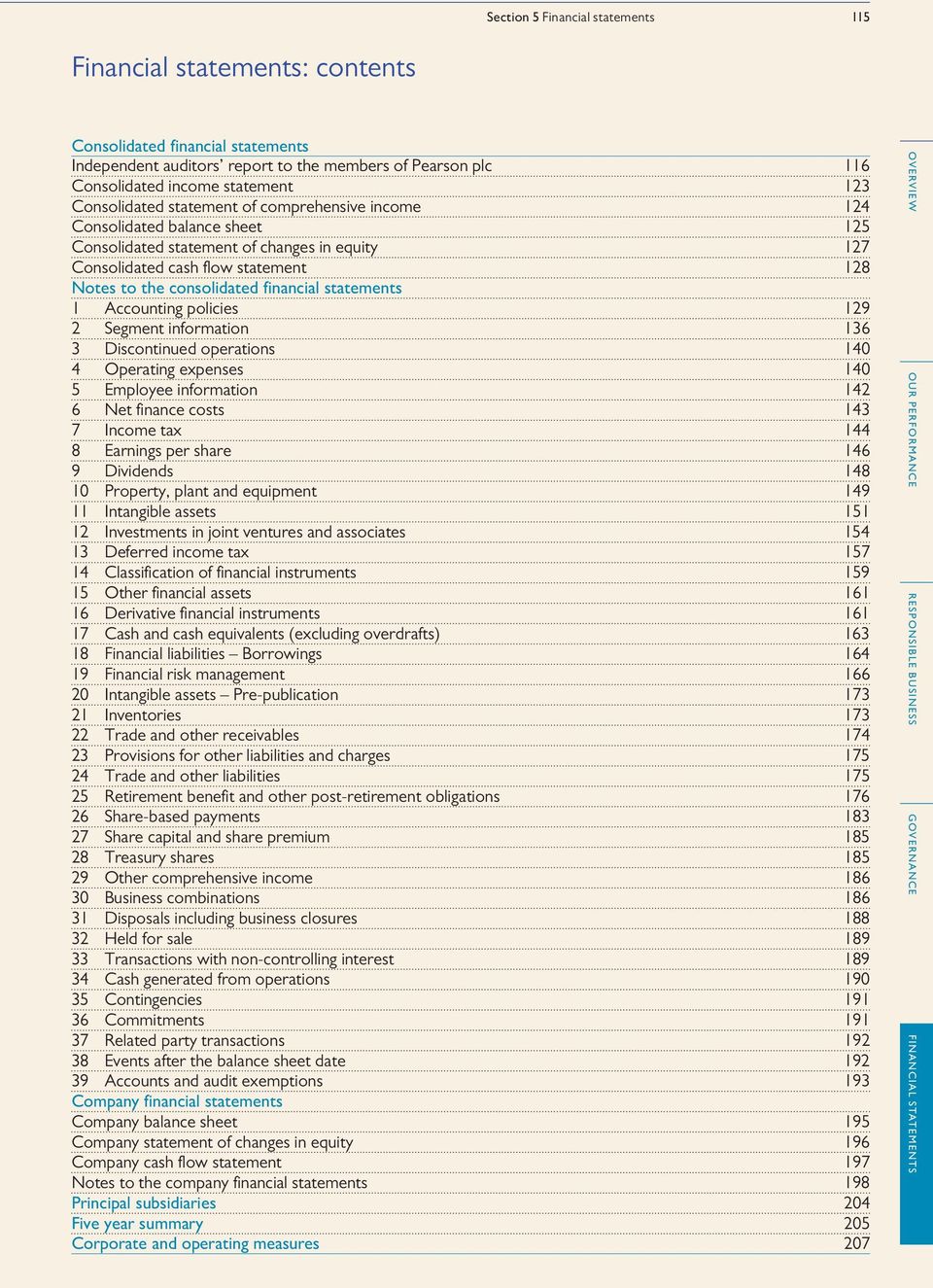
1 Section 5 Financial statements 115 Financial statements: contents Consolidated financial statements Independent auditors report to the members of Pearson plc 116 Consolidated income statement 123 Consolidated statement of comprehensive income 124 Consolidated balance sheet 125 Consolidated statement of changes in equity 127 Consolidated cash flow statement 128 Notes to the consolidated financial statements 1 Accounting policies Segment information Discontinued operations Operating expenses Employee information Net finance costs Income tax Earnings per share Dividends Property, plant and equipment Intangible assets Investments in joint ventures and associates Deferred income tax Classification of financial instruments Other financial assets Derivative financial instruments Cash and cash equivalents (excluding overdrafts) Financial liabilities Borrowings Financial risk management Intangible assets Pre-publication Inventories Trade and other receivables Provisions for other liabilities and charges Trade and other liabilities Retirement benefit and other post-retirement obligations Share-based payments Share capital and share premium Treasury shares Other comprehensive income Business combinations Disposals including business closures Held for sale Transactions with non-controlling interest Cash generated from operations Contingencies Commitments Related party transactions Events after the balance sheet date Accounts and audit exemptions 193 Company financial statements Company balance sheet 195 Company statement of changes in equity 196 Company cash flow statement 197 Notes to the company financial statements 198 Principal subsidiaries 204 Five year summary 205 Corporate and operating measures 207
2 116 Pearson plc Annual report and accounts 2013 Independent auditors report to the members of Pearson plc Report on the financial statements Our opinion In our opinion: The financial statements, defined below, give a true and fair view of the state of the Group s and company s affairs as at 31 December 2013 and of the Group s profit and of the Group s and company s cash flows for the year then ended; The consolidated financial statements have been properly prepared in accordance with International Financial Reporting Standards (IFRSs) as adopted by the European Union; The company financial statements have been properly prepared in accordance with IFRSs as adopted by the European Union and as applied in accordance with the provisions of the Companies Act 2006; and The financial statements have been prepared in accordance with the requirements of the Companies Act 2006 and, as regards the consolidated financial statements, Article 4 of the IAS Regulation. This opinion is to be read in the context of what we say in the remainder of this report. Separate opinion in relation to IFRSs as issued by the IASB As explained in note 1 to the financial statements, the Group, in addition to applying IFRSs as adopted by the European Union, has also applied IFRSs as issued by the International Accounting Standards Board (IASB). In our opinion the consolidated financial statements comply with IFRSs as issued by the IASB. What we have audited The consolidated financial statements and company financial statements (the financial statements ), which are prepared by Pearson plc, comprise: the consolidated and company balance sheet as at 31 December 2013; the consolidated income statement and statement of comprehensive income for the year then ended; the consolidated and company statements of changes in equity and cash flow statements for the year then ended; and the notes to the financial statements, which include a summary of significant accounting policies and other explanatory information. The financial reporting framework that has been applied in their preparation comprises applicable law and IFRSs as adopted by the European Union and, as regards the company, as applied in accordance with the provisions of the Companies Act Certain disclosures required by the financial reporting framework have been presented elsewhere in the annual report and accounts (the annual report ), rather than in the notes to the financial statements. These are cross-referenced from the financial statements and are identified as audited. What an audit of financial statements involves We conducted our audit in accordance with International Standards on Auditing (UK and Ireland) (ISAs (UK & Ireland)). An audit involves obtaining evidence about the amounts and disclosures in the financial statements sufficient to give reasonable assurance that the financial statements are free from material misstatement, whether caused by fraud or error. This includes an assessment of: whether the accounting policies are appropriate to the Group s and company s circumstances and have been consistently applied and adequately disclosed; the reasonableness of significant accounting estimates made by the directors; and the overall presentation of the financial statements. In addition, we read all the financial and non-financial information in the annual report to identify material inconsistencies with the audited financial statements and to identify any information that is apparently materially incorrect based on, or materially inconsistent with, the knowledge acquired by us in the course of performing the audit. If we become aware of any apparent material misstatements or inconsistencies we consider the implications for our report.
3 Section 5 Financial statements 117 Overview of our audit approach Materiality We set certain thresholds for materiality. These helped us to determine the nature, timing and extent of our audit procedures and to evaluate the effect of misstatements, both individually and on the financial statements as a whole. Using our professional judgement, we determined materiality for the consolidated financial statements as a whole to be 32m. This is based on 5% of profit before tax, after adjusting for non-recurring items such as gain on disposal of subsidiaries, this being an appropriate measure of the group s underlying performance. We agreed with the audit committee that we would report to them misstatements identified during our audit above 2m as well as misstatements below that amount that, in our view, warranted reporting for qualitative reasons. Overview of the scope of our audit The Group is organised into four business segments, being North American Education, International Education, Professional and FT Group, plus the investment in associate Penguin Random House. Each segment comprises a number of reporting units. The consolidated financial statements comprise these reporting units plus the Group s centralised functions. In establishing the overall approach to the Group audit, we determined the type of work that needed to be performed at the reporting units by us, as the Group engagement team, or component auditors within PwC UK and from other PwC network firms operating under our instruction. Where the work was performed by component auditors, we determined the level of involvement we needed to have in the audit work at those reporting units to be able to conclude whether sufficient appropriate audit evidence had been obtained as a basis for our opinion on the consolidated financial statements as a whole. Across these segments, we identified two reporting units in the US and UK that required an audit of their complete financial information due to size alone, plus a further nine reporting units in the US, UK, Brazil, China and South Africa that required specified procedures on certain transactions and balances. We also obtained an audit opinion on the financial information of the associate Penguin Random House. Our audit work at these reporting units and at head office gave us coverage of approximately 80% of the Group s profit before tax. This, together with procedures at the consolidated Group level and at the Group s shared service centres, provided the evidence we needed for our opinion on the consolidated financial statements taken as a whole. Areas of particular audit focus In preparing the financial statements, the directors made a number of subjective judgements, for example in respect of significant accounting estimates that involved making assumptions and considering future events that are inherently uncertain. We primarily focused our work in these areas by assessing the directors judgements against available evidence, forming our own judgements, and evaluating the disclosures in the financial statements. In our audit, we tested and examined information, using sampling and other auditing techniques, to the extent we considered necessary to provide a reasonable basis for us to draw conclusions. We obtained audit evidence through testing the effectiveness of controls, substantive procedures or a combination of both. We considered the following areas to be those that required particular focus in the current year. This is not a complete list of all risks or areas of focus identified by our audit. We discussed these areas of focus with the audit committee. Their report on those matters that they considered to be significant issues in relation to the financial statements is set out on pages 68 and 69.
4 118 Pearson plc Annual report and accounts 2013 Independent auditors report to the members of Pearson plc continued Area of focus Risk of fraud in revenue recognition Auditing standards require us to consider the risk of fraud in revenue recognition. We focused on material products and services where revenue recognition practices are particularly complex and subject to estimates, being: multiple element arrangements, such as the provision of supplementary (print or digital) materials or training with textbooks, where revenue is recognised for each element as if it were an individual contractual arrangement requiring the estimation of its fair value; and certain long-term contracts in the Education segments, where revenue is recognised using estimated percentage of completion based on costs. Risk of management override of internal controls Auditing standards require us to consider the risk of management override of internal controls. Penguin Random House transaction On 1 July 2013, management announced the completion of the Penguin Random House combination which resulted in a number of complex accounting and business model changes as follows: disposal accounting, including the gain on the sale; valuation of the new business and intangible assets; and associate accounting, including alignment of accounting policies and presentation of results in the consolidated financial statements. We focused on this area because it was a complex transaction which required the directors to exercise a significant level of judgement. How the scope of our audit addressed the area of focus We evaluated the relevant systems and tested the internal controls over the accurate and complete recording of revenue. We assessed the accounting treatment of new contracts at inception, including examination of evidence supporting key assumptions and estimates. We assessed the profitability and percentage of completion estimates made for material long-term revenue contracts and assessed multiple-element arrangements and the related fair value allocations. We performed substantive testing of revenue recorded during the year and evaluated any changes in estimates to determine if they were indicators of management bias. We also tested manual journals posted to revenue to determine their appropriateness and compliance with Group revenue recognition policies. We assessed the overall control environment of the Group, including the arrangements for staff to whistleblow inappropriate actions, and interviewed senior management and the Group s internal audit function. We examined the significant accounting estimates and judgements relevant to the financial statements for evidence of bias by the directors that may represent a risk of material misstatement due to fraud. We also tested manual journal entries, including consolidation entries, and incorporated elements of unpredictability in the nature, timing and extent of our audit procedures. We evaluated the directors assessment of this transaction as a disposal of a business segment and an acquisition. We evaluated the valuation of the business and associated gain on disposal. We also assessed the resulting associate accounting including the fair value acquisition adjustments such as recognition of intangible assets and alignment of accounting policies and their application. For the valuation exercises we assessed the directors cash flow forecasts, comparing them to board approved plans and challenged the underlying assumptions.
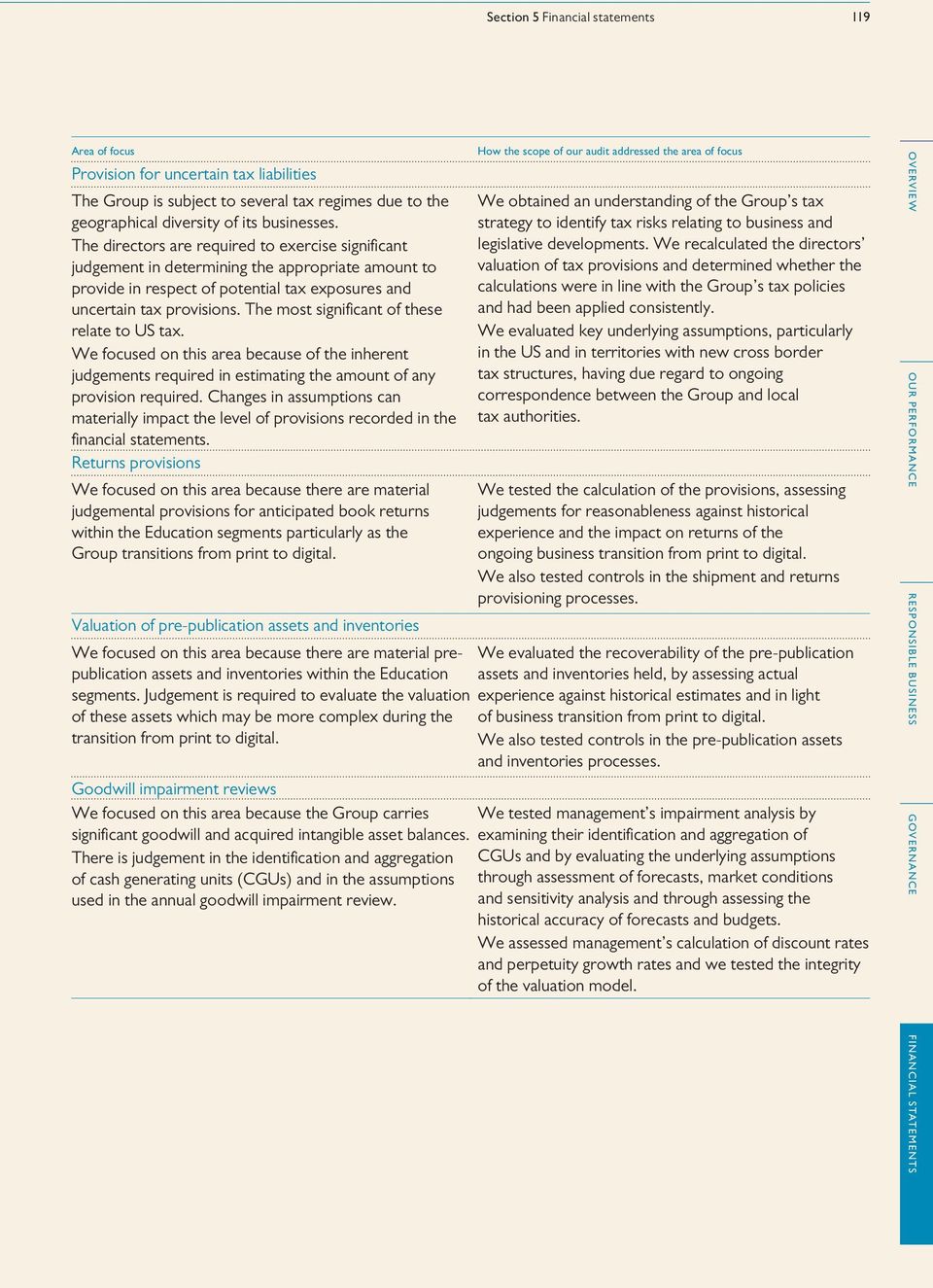
5 Section 5 Financial statements 119 Area of focus Provision for uncertain tax liabilities The Group is subject to several tax regimes due to the geographical diversity of its businesses. The directors are required to exercise significant judgement in determining the appropriate amount to provide in respect of potential tax exposures and uncertain tax provisions. The most significant of these relate to US tax. We focused on this area because of the inherent judgements required in estimating the amount of any provision required. Changes in assumptions can materially impact the level of provisions recorded in the financial statements. Returns provisions We focused on this area because there are material judgemental provisions for anticipated book returns within the Education segments particularly as the Group transitions from print to digital. How the scope of our audit addressed the area of focus We obtained an understanding of the Group s tax strategy to identify tax risks relating to business and legislative developments. We recalculated the directors valuation of tax provisions and determined whether the calculations were in line with the Group s tax policies and had been applied consistently. We evaluated key underlying assumptions, particularly in the US and in territories with new cross border tax structures, having due regard to ongoing correspondence between the Group and local tax authorities. We tested the calculation of the provisions, assessing judgements for reasonableness against historical experience and the impact on returns of the ongoing business transition from print to digital. We also tested controls in the shipment and returns provisioning processes. Valuation of pre-publication assets and inventories We focused on this area because there are material prepublication assets and inventories within the Education assets and inventories held, by assessing actual We evaluated the recoverability of the pre-publication segments. Judgement is required to evaluate the valuation experience against historical estimates and in light of these assets which may be more complex during the of business transition from print to digital. transition from print to digital. We also tested controls in the pre-publication assets and inventories processes. Goodwill impairment reviews We focused on this area because the Group carries significant goodwill and acquired intangible asset balances. There is judgement in the identification and aggregation of cash generating units (CGUs) and in the assumptions used in the annual goodwill impairment review. We tested management s impairment analysis by examining their identification and aggregation of CGUs and by evaluating the underlying assumptions through assessment of forecasts, market conditions and sensitivity analysis and through assessing the historical accuracy of forecasts and budgets. We assessed management s calculation of discount rates and perpetuity growth rates and we tested the integrity of the valuation model.
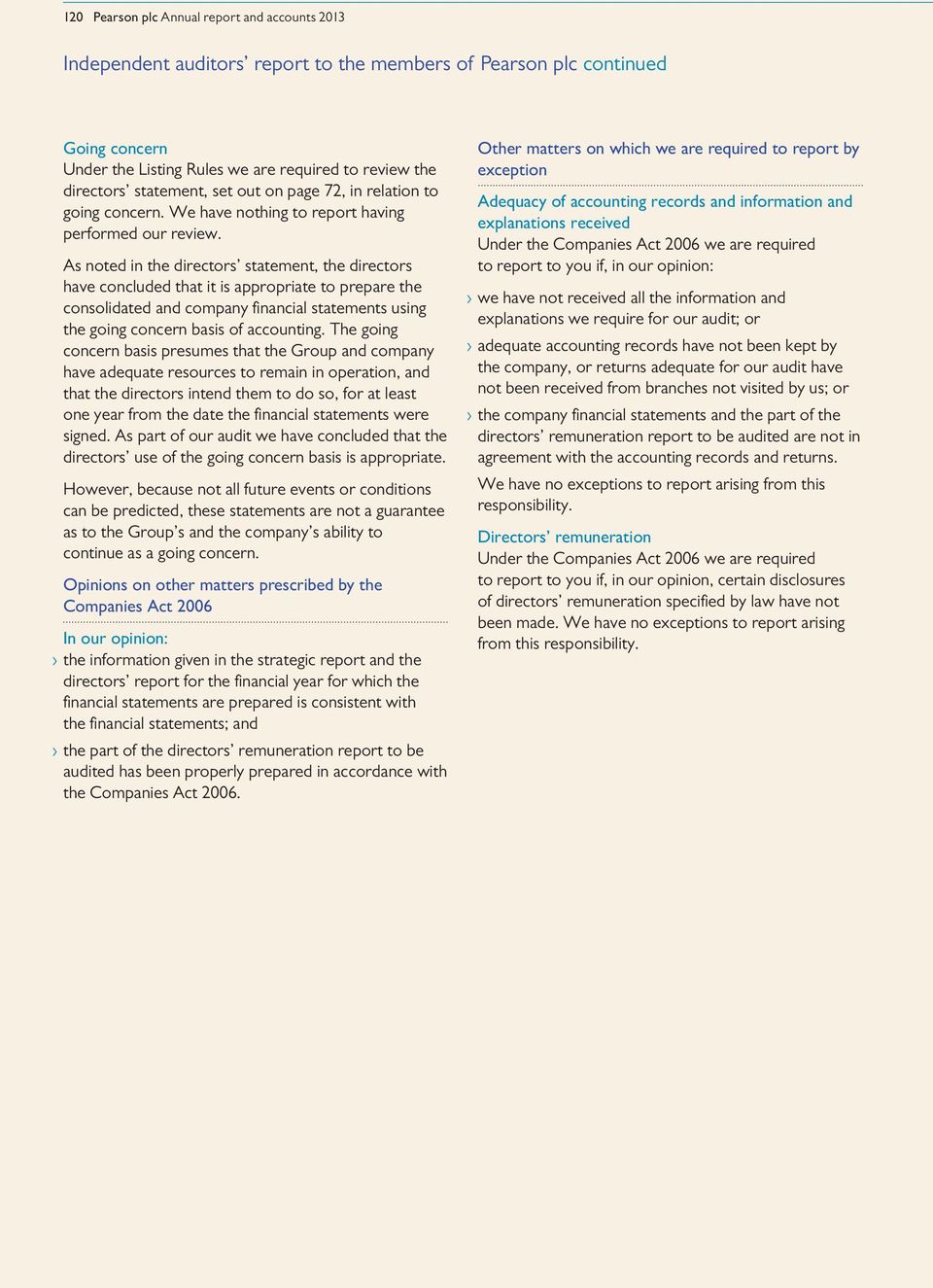
6 120 Pearson plc Annual report and accounts 2013 Independent auditors report to the members of Pearson plc continued Going concern Under the Listing Rules we are required to review the directors statement, set out on page 72, in relation to going concern. We have nothing to report having performed our review. As noted in the directors statement, the directors have concluded that it is appropriate to prepare the consolidated and company financial statements using the going concern basis of accounting. The going concern basis presumes that the Group and company have adequate resources to remain in operation, and that the directors intend them to do so, for at least one year from the date the financial statements were signed. As part of our audit we have concluded that the directors use of the going concern basis is appropriate. However, because not all future events or conditions can be predicted, these statements are not a guarantee as to the Group s and the company s ability to continue as a going concern. Opinions on other matters prescribed by the Companies Act 2006 In our opinion: the information given in the strategic report and the directors report for the financial year for which the financial statements are prepared is consistent with the financial statements; and the part of the directors remuneration report to be audited has been properly prepared in accordance with the Companies Act Other matters on which we are required to report by exception Adequacy of accounting records and information and explanations received Under the Companies Act 2006 we are required to report to you if, in our opinion: we have not received all the information and explanations we require for our audit; or adequate accounting records have not been kept by the company, or returns adequate for our audit have not been received from branches not visited by us; or the company financial statements and the part of the directors remuneration report to be audited are not in agreement with the accounting records and returns. We have no exceptions to report arising from this responsibility. Directors remuneration Under the Companies Act 2006 we are required to report to you if, in our opinion, certain disclosures of directors remuneration specified by law have not been made. We have no exceptions to report arising from this responsibility.
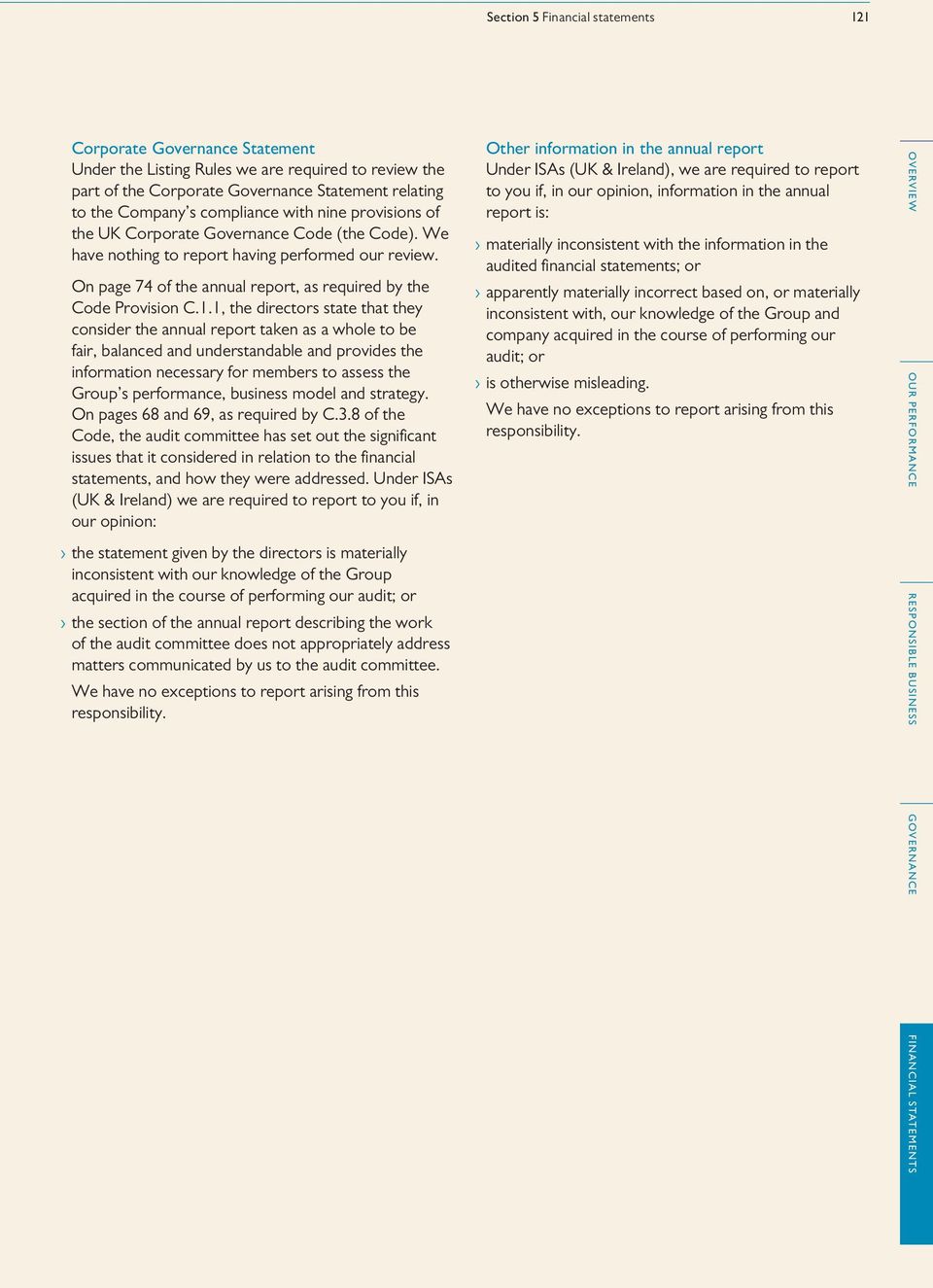
7 Section 5 Financial statements 121 Corporate Governance Statement Under the Listing Rules we are required to review the part of the Corporate Governance Statement relating to the Company s compliance with nine provisions of the UK Corporate Governance Code (the Code). We have nothing to report having performed our review. On page 74 of the annual report, as required by the Code Provision C.1.1, the directors state that they consider the annual report taken as a whole to be fair, balanced and understandable and provides the information necessary for members to assess the Group s performance, business model and strategy. On pages 68 and 69, as required by C.3.8 of the Code, the audit committee has set out the significant issues that it considered in relation to the financial statements, and how they were addressed. Under ISAs (UK & Ireland) we are required to report to you if, in our opinion: the statement given by the directors is materially inconsistent with our knowledge of the Group acquired in the course of performing our audit; or the section of the annual report describing the work of the audit committee does not appropriately address matters communicated by us to the audit committee. We have no exceptions to report arising from this responsibility. Other information in the annual report Under ISAs (UK & Ireland), we are required to report to you if, in our opinion, information in the annual report is: materially inconsistent with the information in the audited financial statements; or apparently materially incorrect based on, or materially inconsistent with, our knowledge of the Group and company acquired in the course of performing our audit; or is otherwise misleading. We have no exceptions to report arising from this responsibility.
8 122 Pearson plc Annual report and accounts 2013 Independent auditors report to the members of Pearson plc continued Responsibilities for the financial statements and the audit Our responsibilities and those of the directors As explained more fully in the statement of directors responsibilities set out on page 74, the directors are responsible for the preparation of the consolidated and company financial statements and for being satisfied that they give a true and fair view. Our responsibility is to audit and express an opinion on the consolidated and company financial statements in accordance with applicable law and ISAs (UK & Ireland). Those standards require us to comply with the Auditing Practices Board s Ethical Standards for Auditors. This report, including the opinions, has been prepared for and only for the company s members as a body in accordance with Chapter 3 of Part 16 of the Companies Act 2006 and for no other purpose. We do not, in giving these opinions, accept or assume responsibility for any other purpose or to any other person to whom this report is shown or into whose hands it may come save where expressly agreed by our prior consent in writing. Stuart Newman (Senior Statutory Auditor) For and on behalf of PricewaterhouseCoopers LLP Chartered Accountants and Statutory Auditors London, United Kingdom 10 March 2014 Notes: (a) The maintenance and integrity of the Pearson plc website is the responsibility of the directors; the work carried out by the auditors does not involve consideration of these matters and, accordingly, the auditors accept no responsibility for any changes that may have occurred to the financial statements since they were initially presented on the website. (b) Legislation in the United Kingdom governing the preparation and dissemination of financial statements may differ from legislation in other jurisdictions.

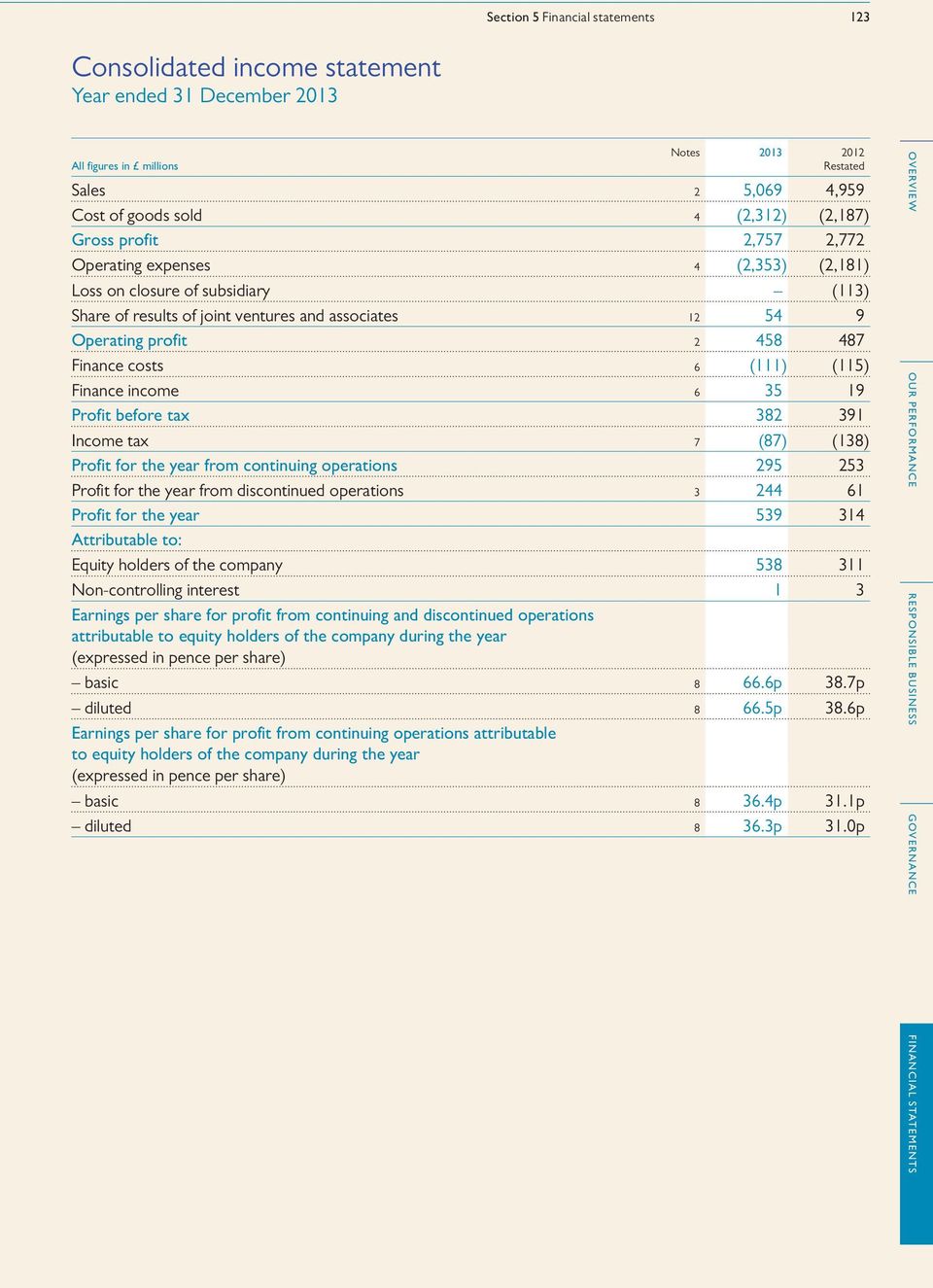
9 Section 5 Financial statements 123 Consolidated income statement Year ended 31 December 2013 Notes Restated Sales 2 5,069 4,959 Cost of goods sold 4 (2,312) (2,187) Gross profit 2,757 2,772 Operating expenses 4 (2,353) (2,181) Loss on closure of subsidiary (113) Share of results of joint ventures and associates Operating profit Finance costs 6 (111) (115) Finance income Profit before tax Income tax 7 (87) (138) Profit for the year from continuing operations Profit for the year from discontinued operations Profit for the year Attributable to: Equity holders of the company Non-controlling interest 1 3 Earnings per share for profit from continuing and discontinued operations attributable to equity holders of the company during the year (expressed in pence per share) basic p 38.7p diluted p 38.6p Earnings per share for profit from continuing operations attributable to equity holders of the company during the year (expressed in pence per share) basic p 31.1p diluted p 31.0p
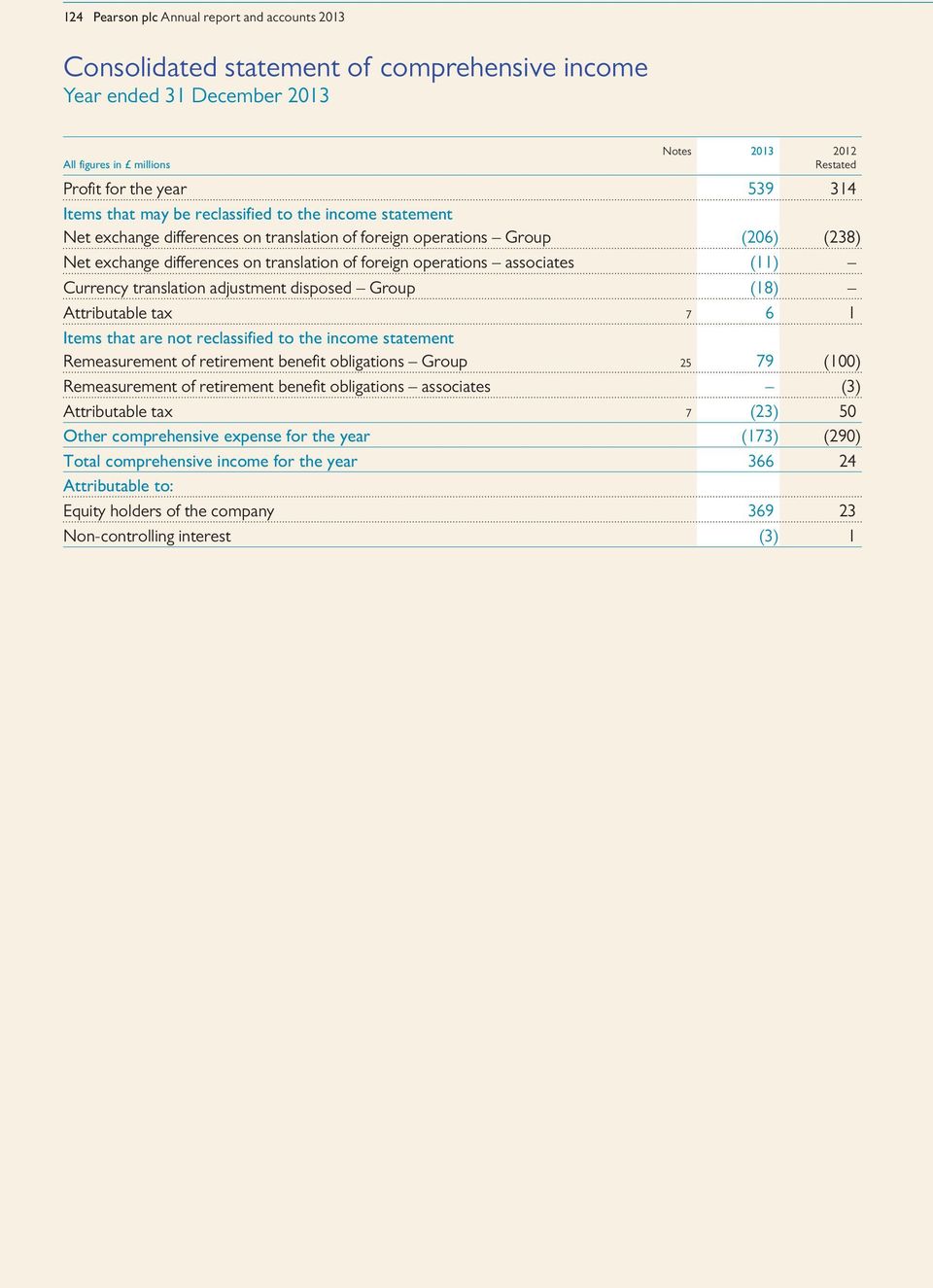
10 124 Pearson plc Annual report and accounts 2013 Consolidated statement of comprehensive income Year ended 31 December 2013 Notes Restated Profit for the year Items that may be reclassified to the income statement Net exchange differences on translation of foreign operations Group (206) (238) Net exchange differences on translation of foreign operations associates (11) Currency translation adjustment disposed Group (18) Attributable tax Items that are not reclassified to the income statement Remeasurement of retirement benefit obligations Group (100) Remeasurement of retirement benefit obligations associates (3) Attributable tax 7 (23) 50 Other comprehensive expense for the year (173) (290) Total comprehensive income for the year Attributable to: Equity holders of the company Non-controlling interest (3) 1
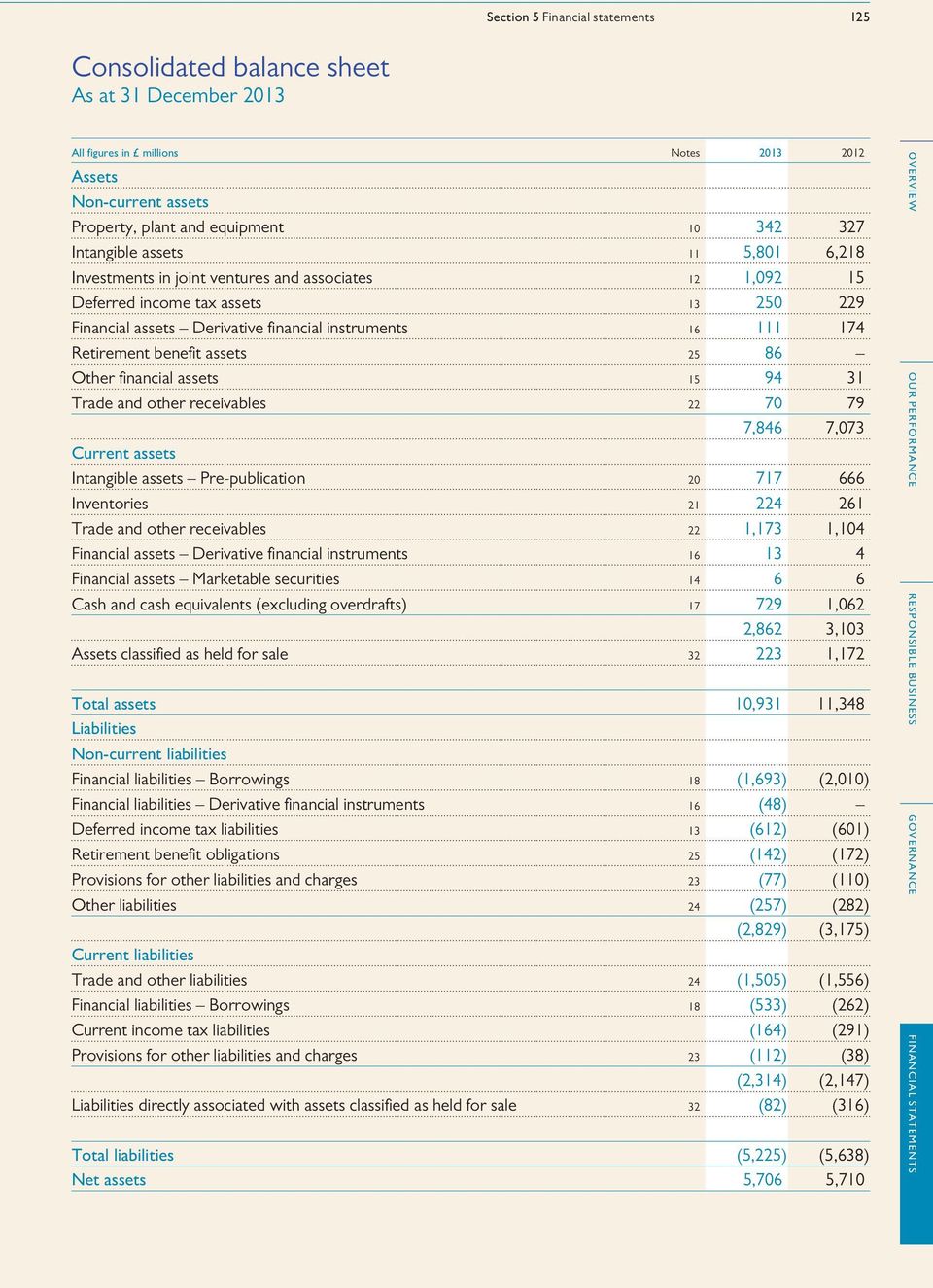
11 Section 5 Financial statements 125 Consolidated balance sheet As at 31 December 2013 Notes Assets Non-current assets Property, plant and equipment Intangible assets 11 5,801 6,218 Investments in joint ventures and associates 12 1, Deferred income tax assets Financial assets Derivative financial instruments Retirement benefit assets Other financial assets Trade and other receivables ,846 7,073 Current assets Intangible assets Pre-publication Inventories Trade and other receivables 22 1,173 1,104 Financial assets Derivative financial instruments Financial assets Marketable securities Cash and cash equivalents (excluding overdrafts) ,062 2,862 3,103 Assets classified as held for sale ,172 Total assets 10,931 11,348 Liabilities Non-current liabilities Financial liabilities Borrowings 18 (1,693) (2,010) Financial liabilities Derivative financial instruments 16 (48) Deferred income tax liabilities 13 (612) (601) Retirement benefit obligations 25 (142) (172) Provisions for other liabilities and charges 23 (77) (110) Other liabilities 24 (257) (282) (2,829) (3,175) Current liabilities Trade and other liabilities 24 (1,505) (1,556) Financial liabilities Borrowings 18 (533) (262) Current income tax liabilities (164) (291) Provisions for other liabilities and charges 23 (112) (38) (2,314) (2,147) Liabilities directly associated with assets classified as held for sale 32 (82) (316) Total liabilities (5,225) (5,638) Net assets 5,706 5,710
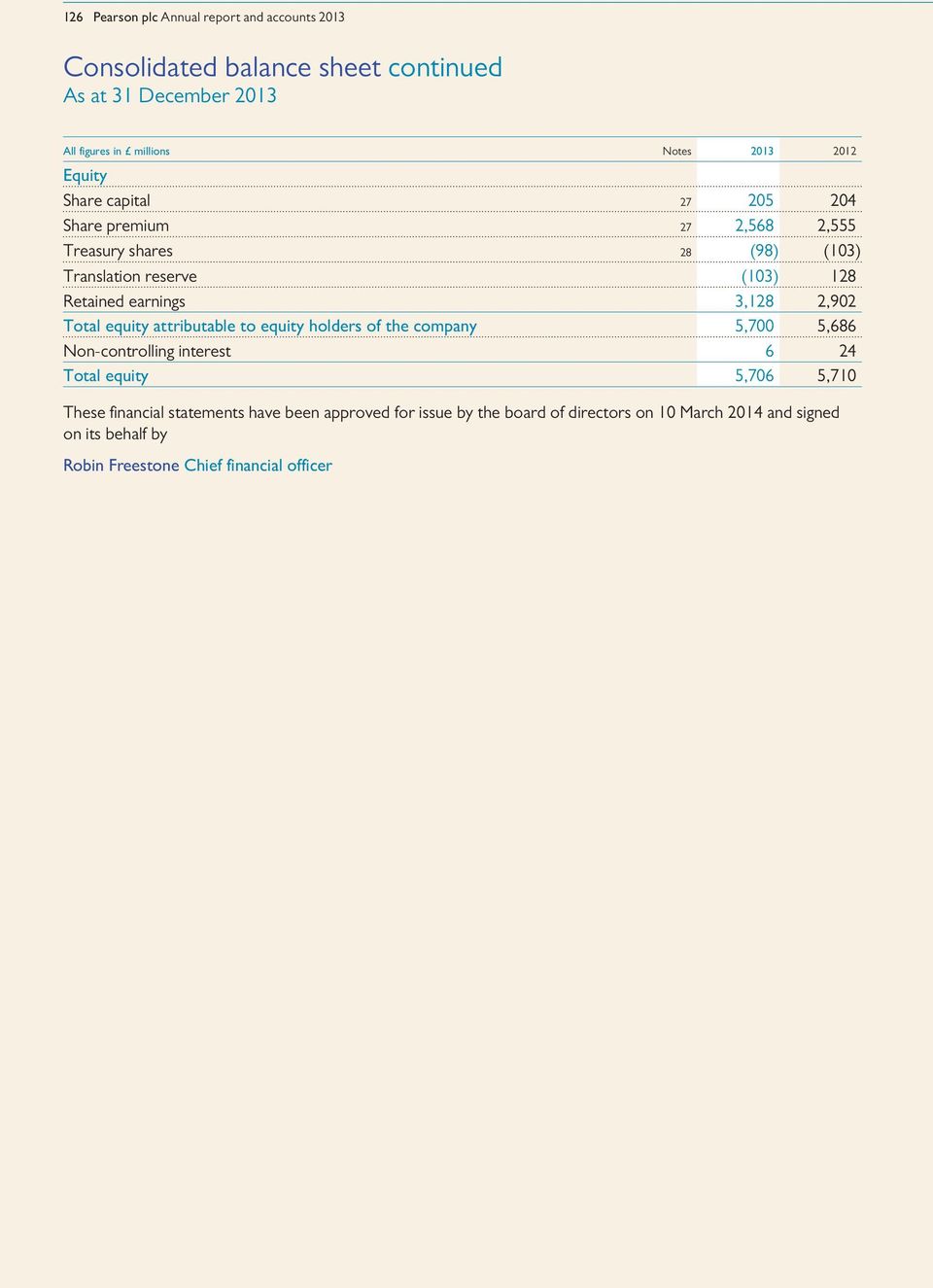
12 126 Pearson plc Annual report and accounts 2013 Consolidated balance sheet continued As at 31 December 2013 Notes Equity Share capital Share premium 27 2,568 2,555 Treasury shares 28 (98) (103) Translation reserve (103) 128 Retained earnings 3,128 2,902 Total equity attributable to equity holders of the company 5,700 5,686 Non-controlling interest 6 24 Total equity 5,706 5,710 These financial statements have been approved for issue by the board of directors on 10 March 2014 and signed on its behalf by Robin Freestone Chief financial officer
13 Consolidated statement of changes in equity Year ended 31 December 2013 Section 5 Financial statements 127 Share capital Share premium Equity attributable to equity holders of the company Treasury shares Translation reserve Retained earnings Total Noncontrolling interest At 1 January ,555 (103) 128 2,902 5, ,710 Profit for the year Other comprehensive expense (231) 62 (169) (4) (173) Equity-settled transactions Tax on equity-settled transactions Issue of ordinary shares under share option schemes Purchase of treasury shares (47) (47) (47) Release of treasury shares 52 (52) Put options over non-controlling interest Changes in non-controlling interest (15) (2) Dividends (372) (372) (372) At 31 December ,568 (98) (103) 3,128 5, ,706 Share capital Share premium Equity attributable to equity holders of the company Treasury shares Translation reserve Retained earnings Total Noncontrolling interest Total equity Restated At 1 January ,544 (149) 364 2,980 5, ,962 Profit for the year Other comprehensive expense (236) (52) (288) (2) (290) Equity-settled transactions Tax on equity-settled transactions (6) (6) (6) Issue of ordinary shares under share option schemes Purchase of treasury shares Release of treasury shares 46 (46) Put options over non-controlling interest Changes in non-controlling interest (10) (10) 6 (4) Dividends (346) (346) (2) (348) At 31 December ,555 (103) 128 2,902 5, ,710 The translation reserve includes exchange differences arising from the translation of the net investment in foreign operations and of borrowings and other currency instruments designated as hedges of such investments. Total equity

14 128 Pearson plc Annual report and accounts 2013 Consolidated cash flow statement Year ended 31 December 2013 Notes Cash flows from operating activities Net cash generated from operations Interest paid (82) (75) Tax paid (246) (65) Net cash generated from operating activities Cash flows from investing activities Acquisition of subsidiaries, net of cash acquired 30 (48) (716) Acquisition of joint ventures and associates (10) (39) Purchase of investments (64) (10) Purchase of property, plant and equipment (118) (78) Purchase of intangible assets (64) (73) Disposal of subsidiaries, net of cash disposed 31 (132) (11) Proceeds from sale of associates 2 Proceeds from sale of investments 2 Proceeds from sale of property, plant and equipment Proceeds from sale of intangible assets 2 3 Proceeds from sale of liquid resources Investment in liquid resources (14) (19) Interest received 9 9 Dividends received from joint ventures and associates Net cash used in investing activities (330) (883) Cash flows from financing activities Proceeds from issue of ordinary shares Purchase of treasury shares 28 (47) Proceeds from borrowings Loans to related parties (44) Loans advanced (5) Liquid resources acquired (1) Repayment of borrowings (225) Finance lease principal payments (8) (8) Dividends paid to company s shareholders 9 (372) (346) Dividends paid to non-controlling interest (2) Transactions with non-controlling interest 33 (76) (4) Net cash used in financing activities (444) (23) Effects of exchange rate changes on cash and cash equivalents 21 (24) Net decrease in cash and cash equivalents (397) (154) Cash and cash equivalents at beginning of year 1,137 1,291 Cash and cash equivalents at end of year ,137 The consolidated cash flow statement includes discontinued operations (see note 3).

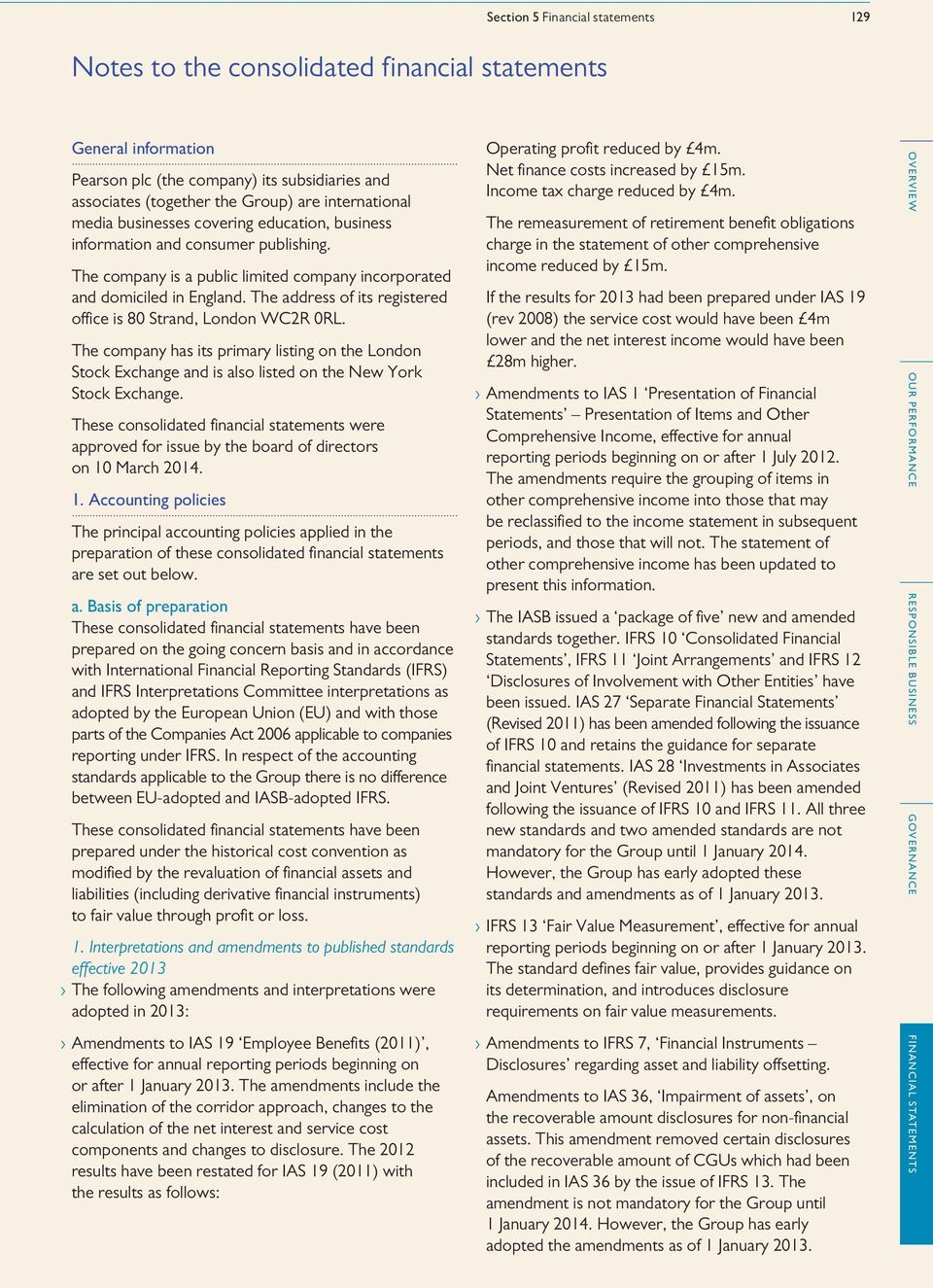
15 Notes to the consolidated financial statements Section 5 Financial statements 129 General information Pearson plc (the company) its subsidiaries and associates (together the Group) are international media businesses covering education, business information and consumer publishing. The company is a public limited company incorporated and domiciled in England. The address of its registered office is 80 Strand, London WC2R 0RL. The company has its primary listing on the London Stock Exchange and is also listed on the New York Stock Exchange. These consolidated financial statements were approved for issue by the board of directors on 10 March Accounting policies The principal accounting policies applied in the preparation of these consolidated financial statements are set out below. a. Basis of preparation These consolidated financial statements have been prepared on the going concern basis and in accordance with International Financial Reporting Standards (IFRS) and IFRS Interpretations Committee interpretations as adopted by the European Union (EU) and with those parts of the Companies Act 2006 applicable to companies reporting under IFRS. In respect of the accounting standards applicable to the Group there is no difference between EU-adopted and IASB-adopted IFRS. These consolidated financial statements have been prepared under the historical cost convention as modified by the revaluation of financial assets and liabilities (including derivative financial instruments) to fair value through profit or loss. 1. Interpretations and amendments to published standards effective 2013 The following amendments and interpretations were adopted in 2013: Amendments to IAS 19 Employee Benefits (2011), effective for annual reporting periods beginning on or after 1 January The amendments include the elimination of the corridor approach, changes to the calculation of the net interest and service cost components and changes to disclosure. The 2012 results have been restated for IAS 19 (2011) with the results as follows: Operating profit reduced by 4m. Net finance costs increased by 15m. Income tax charge reduced by 4m. The remeasurement of retirement benefit obligations charge in the statement of other comprehensive income reduced by 15m. If the results for 2013 had been prepared under IAS 19 (rev 2008) the service cost would have been 4m lower and the net interest income would have been 28m higher. Amendments to IAS 1 Presentation of Financial Statements Presentation of Items and Other Comprehensive Income, effective for annual reporting periods beginning on or after 1 July The amendments require the grouping of items in other comprehensive income into those that may be reclassified to the income statement in subsequent periods, and those that will not. The statement of other comprehensive income has been updated to present this information. The IASB issued a package of five new and amended standards together. IFRS 10 Consolidated Financial Statements, IFRS 11 Joint Arrangements and IFRS 12 Disclosures of Involvement with Other Entities have been issued. IAS 27 Separate Financial Statements (Revised 2011) has been amended following the issuance of IFRS 10 and retains the guidance for separate financial statements. IAS 28 Investments in Associates and Joint Ventures (Revised 2011) has been amended following the issuance of IFRS 10 and IFRS 11. All three new standards and two amended standards are not mandatory for the Group until 1 January However, the Group has early adopted these standards and amendments as of 1 January IFRS 13 Fair Value Measurement, effective for annual reporting periods beginning on or after 1 January The standard defines fair value, provides guidance on its determination, and introduces disclosure requirements on fair value measurements. Amendments to IFRS 7, Financial Instruments Disclosures regarding asset and liability offsetting. Amendments to IAS 36, Impairment of assets, on the recoverable amount disclosures for non-financial assets. This amendment removed certain disclosures of the recoverable amount of CGUs which had been included in IAS 36 by the issue of IFRS 13. The amendment is not mandatory for the Group until 1 January However, the Group has early adopted the amendments as of 1 January 2013.
16 130 Pearson plc Annual report and accounts 2013 Notes to the consolidated financial statements continued 1. Accounting policies continued a. Basis of preparation continued With the exception of IAS 19 Employee Benefits (2011), the adoption of these new pronouncements from 1 January 2013, does not have a material impact on the consolidated financial statements. Disclosure requirements have been updated as required. 2. Standards, interpretations and amendments to published standards that are not yet effective The Group has not early adopted the following new pronouncements that are not yet effective: IFRS 9 Financial Instruments, effective for annual reporting periods beginning on or after 1 January The new standard details the requirements for the classification, measurement and recognition of financial assets and liabilities. The Group is yet to assess the full impact of IFRS 9, and will do so once the remaining sections of the standard are completed. IFRIC 21, Levies details the accounting for an obligation to pay a levy that is not income tax. As the Group is not currently subjected to significant levies the impact on the Group is not material. 3. Critical accounting assumptions and judgements The preparation of financial statements in conformity with IFRS requires the use of certain critical accounting assumptions. It also requires management to exercise its judgement in the process of applying the Group s accounting policies. The areas requiring a higher degree of judgement or complexity, or areas where assumptions and estimates are significant to the consolidated financial statements, are discussed in the relevant accounting policies under the following headings: Intangible assets: Goodwill Intangible assets: Pre-publication assets Taxation Employee benefits: Pension obligations Revenue recognition b. Consolidation 1. Business combinations The acquisition method of accounting is used to account for business combinations. The consideration transferred for the acquisition of a subsidiary is the fair value of the assets transferred, the liabilities incurred and the equity interest issued by the Group. The consideration transferred includes the fair value of any asset or liability resulting from a contingent consideration arrangement. Acquisition related costs are expensed as incurred in the operating expenses line of the income statement. Identifiable assets and contingent assets acquired and identifiable liabilities and contingent liabilities assumed in a business combination are measured initially at their fair values at the acquisition date. For material acquisitions, the fair value of the acquired intangible assets is determined by an independent valuer. The excess of the consideration transferred, the amount of any non-controlling interest in the acquiree and the acquisition date fair value of any previous equity interest in the acquiree over the fair value of the identifiable net assets acquired is recorded as goodwill. See note 1e(1) for the accounting policy on goodwill. If this is less than the fair value of the net assets of the subsidiary acquired, in the case of a bargain purchase, the difference is recognised directly in the income statement. On an acquisition-by-acquisition basis, the Group recognises any non-controlling interest in the acquiree either at fair value or at the non-controlling interest s proportionate share of the acquiree s net assets. 2. Subsidiaries Subsidiaries are entities over which the Group has control. The Group controls an entity when the Group is exposed to, or has rights to, variable returns from its involvement with the entity and has the ability to affect those returns through its power over the entity. Subsidiaries are fully consolidated from the date on which control is transferred to the Group. They are deconsolidated from the date that control ceases. 3. Transactions with non-controlling interests Transactions with non-controlling interests that do not result in loss of control are accounted for as equity transactions, that is as transactions with the owners in their capacity as owners. Any surplus or deficit arising from disposals to a non-controlling interest is recorded in equity. For purchases from a non-controlling interest, the difference between consideration paid and the relevant share acquired of the carrying value of the subsidiary is recorded in equity. 4. Joint ventures and associates Joint ventures are entities in which the Group holds an interest on a long-term basis and has rights to the net assets through contractually agreed sharing of control. Associates are entities over which the Group has significant influence but not the power to control the financial and operating policies, generally accompanying a shareholding of between 20% and 50% of the voting rights. Investments in joint ventures and associates are accounted for by the equity method and are initially recognised at the fair value of consideration transferred.

17 Section 5 Financial statements Accounting policies continued b. Consolidation continued The Group s share of its joint ventures and associates post-acquisition profits or losses is recognised in the income statement and its share of post-acquisition movements in reserves is recognised in reserves. The Group s share of its joint ventures and associates results is recognised as a component of operating profit as these operations form part of the core publishing business of the Group and are an integral part of existing wholly-owned businesses. The cumulative post-acquisition movements are adjusted against the carrying amount of the investment. When the Group s share of losses in a joint venture or associate equals or exceeds its interest in the joint venture or associate the Group does not recognise further losses unless the Group has incurred obligations or made payments on behalf of the joint venture or associate. c. Foreign currency translation 1. Functional and presentation currency Items included in the financial statements of each of the Group s entities are measured using the currency of the primary economic environment in which the entity operates (the functional currency ). The consolidated financial statements are presented in sterling, which is the company s functional and presentation currency. 2. Transactions and balances Foreign currency transactions are translated into the functional currency using the exchange rates prevailing at the dates of the transactions. Foreign exchange gains and losses resulting from the settlement of such transactions and from the translation at year end exchange rates of monetary assets and liabilities denominated in foreign currencies are recognised in the income statement, except when deferred in equity as qualifying net investment hedges. 3. Group companies The results and financial position of all Group companies that have a functional currency different from the presentation currency are translated into the presentation currency as follows: i) assets and liabilities are translated at the closing rate at the date of the balance sheet; ii) income and expenses are translated at average exchange rates; iii) all resulting exchange differences are recognised as a separate component of equity. On consolidation, exchange differences arising from the translation of the net investment in foreign entities, and of borrowings and other currency instruments designated as hedges of such investments, are taken to shareholders equity. The Group treats specific inter-company loan balances, which are not intended to be repaid in the foreseeable future, as part of its net investment. When a foreign operation is sold, such exchange differences are recognised in the income statement as part of the gain or loss on sale. The principal overseas currency for the Group is the US dollar. The average rate for the year against sterling was $1.57 (2012: $1.59) and the year end rate was $1.66 (2012: $1.63). d. Property, plant and equipment Property, plant and equipment are stated at historical cost less depreciation. Cost includes the original purchase price of the asset and the costs attributable to bringing the asset to its working condition for intended use. Land is not depreciated. Depreciation on other assets is calculated using the straight-line method to allocate their cost less their residual values over their estimated useful lives as follows: Buildings (freehold): Buildings (leasehold): Plant and equipment: years over the period of the lease 3 10 years The assets residual values and useful lives are reviewed, and adjusted if appropriate, at each balance sheet date. The carrying value of an asset is written down to its recoverable amount if the carrying value of the asset is greater than its estimated recoverable amount. e. Intangible assets 1. Goodwill For the acquisition of subsidiaries made on or after 1 January 2010 goodwill represents the excess of the consideration transferred, the amount of any non-controlling interest in the acquiree and the acquisition date fair value of any previous equity interest in the acquiree over the fair value of the identifiable net assets acquired. For the acquisition of subsidiaries made from the date of transition to IFRS to 31 December 2009 goodwill represents the excess of the cost of an acquisition over the fair value of the Group s share of the net identifiable assets acquired. Goodwill on acquisitions of subsidiaries is included in intangible assets. Goodwill on acquisition of associates and joint ventures represents the excess of the cost of
18 132 Pearson plc Annual report and accounts 2013 Notes to the consolidated financial statements continued 1. Accounting policies continued e. Intangible assets continued an acquisition over the fair value of the Group s share of the net identifiable assets acquired. Goodwill on acquisitions of associates and joint ventures is included in investments in associates and joint ventures. Goodwill is tested annually for impairment and carried at cost less accumulated impairment losses. An impairment loss is recognised to the extent that the carrying value of goodwill exceeds the recoverable amount. The recoverable amount is the higher of fair value less costs to sell and value in use. These calculations require the use of estimates and significant management judgement. A description of the key assumptions and sensitivities is included in note 11. Goodwill is allocated to aggregated cash-generating units for the purpose of impairment testing. The allocation is made to those aggregated cash-generating units that are expected to benefit from the business combination in which the goodwill arose. Gains and losses on the disposal of an entity include the carrying amount of goodwill relating to the entity sold. IFRS 3 Business Combinations has not been applied retrospectively to business combinations before the date of transition to IFRS. 2. Acquired software Software separately acquired for internal use is capitalised at cost. Software acquired in material business combinations is capitalised at its fair value as determined by an independent valuer. Acquired software is amortised on a straight-line basis over its estimated useful life of between three and eight years. 3. Internally developed software Internal and external costs incurred during the preliminary stage of developing computer software for internal use are expensed as incurred. Internal and external costs incurred to develop computer software for internal use during the application development stage are capitalised if the Group expects economic benefits from the development. Capitalisation in the application development stage begins once the Group can reliably measure the expenditure attributable to the software development and has demonstrated its intention to complete and use the software. Internally developed software is amortised on a straight-line basis over its estimated useful life of between three and eight years. 4. Acquired intangible assets Acquired intangible assets include customer lists and relationships, trademarks and brands, publishing rights, content and technology. These assets are capitalised on acquisition at cost and included in intangible assets. Intangible assets acquired in material business combinations are capitalised at their fair value as determined by an independent valuer. Intangible assets are amortised over their estimated useful lives of between two and 20 years, using an amortisation method that reflects the pattern of their consumption. 5. Pre-publication assets Pre-publication assets represent direct costs incurred in the development of educational programmes and titles prior to their publication. These costs are recognised as current intangible assets where the title will generate probable future economic benefits and costs can be measured reliably. Pre-publication assets are amortised upon publication of the title over estimated economic lives of five years or less, being an estimate of the expected operating life cycle of the title, with a higher proportion of the amortisation taken in the earlier years. The investment in pre-publication assets has been disclosed as part of cash generated from operations in the cash flow statement (see note 34). The assessment of the recoverability of pre-publication assets and the determination of the amortisation profile involve a significant degree of judgement based on historical trends and management estimation of future potential sales. An incorrect amortisation profile could result in excess amounts being carried forward as intangible assets that would otherwise have been written off to the income statement in an earlier period. Reviews are performed regularly to estimate recoverability of pre-publication assets. The carrying amount of pre-publication assets is set out in note 20. f. Other financial assets Other financial assets, designated as available for sale investments, are non-derivative financial assets measured at estimated fair value. Changes in the fair value are recorded in equity in the fair value reserve. On the subsequent disposal of the asset, the net fair value gains or losses are taken to the income statement.
19 Section 5 Financial statements Accounting policies continued g. Inventories Inventories are stated at the lower of cost and net realisable value. Cost is determined using the first in first out (FIFO) method. The cost of finished goods and work in progress comprises raw materials, direct labour, other direct costs and related production overheads. Net realisable value is the estimated selling price in the ordinary course of business, less estimated costs necessary to make the sale. Provisions are made for slow moving and obsolete stock. h. Royalty advances Advances of royalties to authors are included within trade and other receivables when the advance is paid less any provision required to adjust the advance to its net realisable value. The realisable value of royalty advances relies on a degree of management judgement in determining the profitability of individual author contracts. If the estimated realisable value of author contracts is overstated, this will have an adverse effect on operating profits as these excess amounts will be written off. The recoverability of royalty advances is based upon an annual detailed management review of the age of the advance, the future sales projections for new authors and prior sales history of repeat authors. The royalty advance is expensed at the contracted or effective royalty rate as the related revenues are earned. Royalty advances which will be consumed within one year are held in current assets. Royalty advances which will be consumed after one year are held in non-current assets. i. Cash and cash equivalents Cash and cash equivalents in the cash flow statement include cash in hand, deposits held on call with banks, other short-term highly liquid investments with original maturities of three months or less, and bank overdrafts. Bank overdrafts are included in borrowings in current liabilities in the balance sheet. Short-term deposits and marketable securities with maturities of greater than three months do not qualify as cash and cash equivalents. Movements on these financial instruments are classified as cash flows from financing activities in the cash flow statement where these amounts are used to offset the borrowings of the Group or as cash flows from investing activities where these amounts are held to generate an investment return. j. Share capital Ordinary shares are classified as equity. Incremental costs directly attributable to the issue of new shares or options are shown in equity as a deduction, net of tax, from the proceeds. Where any Group company purchases the company s equity share capital (treasury shares) the consideration paid, including any directly attributable incremental costs, net of income taxes, is deducted from equity attributable to the company s equity holders until the shares are cancelled, reissued or disposed of. Where such shares are subsequently sold or reissued, any consideration received, net of any directly attributable transaction costs and the related income tax effects, is included in equity attributable to the company s equity holders. k. Borrowings Borrowings are recognised initially at fair value, which is proceeds received net of transaction costs incurred. Borrowings are subsequently stated at amortised cost with any difference between the proceeds (net of transaction costs) and the redemption value being recognised in the income statement over the period of the borrowings using the effective interest method. Accrued interest is included as part of borrowings. Where a debt instrument is in a fair value hedging relationship, an adjustment is made to its carrying value in the income statement to reflect the hedged risk. Interest on borrowings is expensed in the income statement as incurred. l. Derivative financial instruments Derivatives are recognised at fair value and remeasured at each balance sheet date. The fair value of derivatives is determined by using market data and the use of established estimation techniques such as discounted cash flow and option valuation models. The Group designates certain of the derivative instruments within its portfolio to be hedges of the fair value of its bonds (fair value hedges) or hedges of net investments in foreign operations (net investment hedges).
20 134 Pearson plc Annual report and accounts 2013 Notes to the consolidated financial statements continued 1. Accounting policies continued l. Derivative financial instruments continued Changes in the fair value of derivatives that are designated and qualify as fair value hedges are recorded in the income statement, together with any changes in the fair value of the hedged asset or liability that are attributable to the hedged risk. The effective portion of changes in the fair value of derivatives that are designated and qualify as net investment hedges are recognised in other comprehensive income. Gains and losses accumulated in equity are included in the income statement when the corresponding foreign operation is disposed of. Gains or losses relating to the ineffective portion are recognised immediately in finance income or finance costs in the income statement. Certain derivatives do not qualify or are not designated as hedging instruments. Such derivatives are classified at fair value and any movement in their fair value is recognised immediately in finance income or finance costs in the income statement. m. Taxation Current tax is recognised on the amounts expected to be paid or recovered under the tax rates and laws that have been enacted or substantively enacted at the balance sheet date. Deferred income tax is provided, using the liability method, on temporary differences arising between the tax bases of assets and liabilities and their carrying amounts. Deferred income tax is determined using tax rates and laws that have been enacted or substantively enacted by the balance sheet date and are expected to apply when the related deferred tax asset is realised or the deferred income tax liability is settled. Deferred tax assets are recognised to the extent that it is probable that future taxable profit will be available against which the temporary differences can be utilised. Deferred income tax is provided in respect of the undistributed earnings of subsidiaries other than where it is intended that those undistributed earnings will not be remitted in the foreseeable future. Current and deferred tax are recognised in the income statement, except when the tax relates to items charged or credited directly to equity or other comprehensive income, in which case the tax is also recognised in equity or other comprehensive income. The Group is subject to income taxes in numerous jurisdictions. Significant judgement is required in determining the estimates in relation to the worldwide provision for income taxes. There are many transactions and calculations for which the ultimate tax determination is uncertain during the ordinary course of business. The Group recognises liabilities for anticipated tax audit issues based on estimates of whether additional taxes will be due. Where the final tax outcome of these matters is different from the amounts that were initially recorded, such differences will impact the income tax and deferred tax provisions in the period in which such determination is made. Deferred tax assets and liabilities require management judgement in determining the amounts to be recognised. In particular, significant judgement is used when assessing the extent to which deferred tax assets should be recognised with consideration given to the timing and level of future taxable income together with any future tax planning strategies. n. Employee benefits 1. Pension obligations The retirement benefit asset and obligation recognised in the balance sheet represents the net of the present value of the defined benefit obligation and the fair value of plan assets at the balance sheet date. The defined benefit obligation is calculated annually by independent actuaries using the projected unit credit method. The present value of the defined benefit obligation is determined by discounting estimated future cash flows using yields on high quality corporate bonds which have terms to maturity approximating the terms of the related liability. The determination of the pension cost and defined benefit obligation of the Group s defined benefit pension schemes depends on the selection of certain assumptions, which include the discount rate, inflation rate, salary growth and longevity. Actuarial gains and losses arising from experience adjustments and changes in actuarial assumptions are charged or credited to equity in other comprehensive income in the period in which they arise. The service cost, representing benefits accruing over the year, is included in the income statement as an operating cost. Net interest is calculated by applying the discount rate to the net defined benefit obligation and is presented as finance costs or finance income.
21 Section 5 Financial statements Accounting policies continued n. Employee benefits continued Obligations for contributions to defined contribution pension plans are recognised as an operating expense in the income statement as incurred. 2. Other post-retirement obligations The expected costs of post-retirement healthcare and life assurance benefits are accrued over the period of employment, using a similar accounting methodology as for defined benefit pension obligations. The liabilities and costs relating to significant other post-retirement obligations are assessed annually by independent qualified actuaries. 3. Share-based payments The fair value of options or shares granted under the Group s share and option plans is recognised as an employee expense after taking into account the Group s best estimate of the number of awards expected to vest. Fair value is measured at the date of grant and is spread over the vesting period of the option or share. The fair value of the options granted is measured using an option model that is most appropriate to the award. The fair value of shares awarded is measured using the share price at the date of grant unless another method is more appropriate. Any proceeds received are credited to share capital and share premium when the options are exercised. o. Provisions Provisions are recognised if the Group has a present legal or constructive obligation as a result of past events, it is more likely than not that an outflow of resources will be required to settle the obligation and the amount can be reliably estimated. Provisions are discounted to present value where the effect is material. The Group recognises a provision for deferred consideration at fair value. The Group recognises a provision for onerous lease contracts when the expected benefits to be derived from a contract are less than the unavoidable costs of meeting the obligations under the contract. The provision is based on the present value of future payments for surplus leased properties under noncancellable operating leases, net of estimated subleasing income. p. Revenue recognition Revenue comprises the fair value of the consideration received or receivable for the sale of goods and services net of sales taxes, rebates and discounts, and after eliminating sales within the Group. Revenue from the sale of books is recognised when title passes. A provision for anticipated returns is made based primarily on historical return rates. If these estimates do not reflect actual returns in future periods then revenues could be understated or overstated for a particular period. Circulation and advertising revenue is recognised when the newspaper or other publication is published. Subscription revenue is recognised on a straight-line basis over the life of the subscription. Where a contractual arrangement consists of two or more separate elements that can be provided to customers either on a stand-alone basis or as an optional extra, such as the provision of supplementary materials with textbooks, revenue is recognised for each element as if it were an individual contractual arrangement. Revenue from multi-year contractual arrangements, such as contracts to process qualifying tests for individual professions and government departments, is recognised as performance occurs. The assumptions, risks, and uncertainties inherent in long-term contract accounting can affect the amounts and timing of revenue and related expenses reported. Certain of these arrangements, either as a result of a single service spanning more than one reporting period or where the contract requires the provision of a number of services that together constitute a single project, are treated as long-term contracts with revenue recognised on a percentage of completion basis. Losses on contracts are recognised in the period in which the loss first becomes foreseeable. Contract losses are determined to be the amount by which estimated total costs of the contract exceed the estimated total revenues that will be generated by the contract. On certain contracts, where the Group acts as agent, only commissions and fees receivable for services rendered are recognised as revenue. Any third-party costs incurred on behalf of the principal that are rechargeable under the contractual arrangement are not included in revenue.
22 136 Pearson plc Annual report and accounts 2013 Notes to the consolidated financial statements continued 1. Accounting policies continued p. Revenue recognition continued Income from recharges of freight and other activities which are incidental to the normal revenue generating activities is included in other income. q. Leases Leases of property, plant and equipment where the Group has substantially all the risks and rewards of ownership are classified as finance leases. Finance leases are capitalised at the commencement of the lease at the lower of the fair value of the leased property and the present value of the minimum lease payments. Each lease payment is allocated between the liability and finance charges to achieve a constant rate on the finance balance outstanding. The corresponding rental obligations, net of finance charges, are included in financial liabilities borrowings. The interest element of the finance cost is charged to the income statement over the lease period to produce a constant periodic rate of interest on the remaining balance of the liability for each period. The property, plant and equipment acquired under finance leases are depreciated over the shorter of the useful life of the asset or the lease term. Leases where a significant portion of the risks and rewards of ownership are retained by the lessor are classified as operating leases by the lessee. Payments made under operating leases (net of any incentives received from the lessor) are charged to the income statement on a straight-line basis over the period of the lease. r. Dividends Dividends are recorded in the Group s financial statements in the period in which they are approved by the company s shareholders. s. Assets and liabilities held for sale Assets and liabilities are classified as held for sale and stated at the lower of carrying amount and fair value less costs to sell if it is intended to recover their carrying amount principally through a sale transaction rather than through continuing use. No depreciation is charged in respect of non-current assets classified as held for sale. Amounts relating to non-current assets and liabilities held for sale are classified as discontinued operations in the income statement where appropriate. t. Trade receivables Trade receivables are stated at fair value after provision for bad and doubtful debts and anticipated future sales returns (see also note 1p). 2. Segment information The Group is organised into the following business segments: Continuing operations: North American Education Educational publishing, assessment and testing for the school and higher education market within the USA and Canada; International Education Educational publishing, assessment and testing for the school and higher education market outside of North America; Professional Business and technology publishing, training, testing and certification for professional bodies; FT Group Publisher of the Financial Times, business magazines and specialist information. In addition the Group separately discloses the results of the Penguin Random House (PRH) associate. The results of the Penguin segment to 30 June 2013 and the Mergermarket business (previously included as part of the FT Group) are shown as discontinued in both 2012 and 2013.
23 Section 5 Financial statements Segment information continued For more detail on the services and products included in each business segment refer to the strategic report. Notes North American Education International Education Professional FT Discontinued Group PRH Corporate operations Continuing operations Sales (external) 2,779 1, ,069 Sales (inter-segment) Adjusted operating profit Intangible charges (92) (60) (12) (2) (30) (196) Acquisition costs (2) (9) (1) (12) Other net gains and losses (16) (16) Operating profit Finance costs 6 (111) Finance income 6 35 Profit before tax 382 Income tax 7 (87) Profit for the year from continuing operations 295 Segment assets 5,544 2, ,839 Joint ventures Associates , ,089 Total assets 5,545 2, , , Group Other segment items Share of results of joint ventures and associates 12 (1) (4) Capital expenditure 10, Pre-publication investment Depreciation Amortisation 11,
24 138 Pearson plc Annual report and accounts 2013 Notes to the consolidated financial statements continued 2. Segment information continued Notes North American Education International Education Professional FT Group Corporate Discontinued operations 2012 Restated Continuing operations Sales (external) 2,658 1, ,959 Sales (inter-segment) Adjusted operating profit Intangible charges (66) (73) (37) (3) (179) Acquisition costs (7) (8) (1) (4) (20) Other net gains and losses (123) (123) Operating profit (124) Finance costs 6 (115) Finance income 6 19 Profit before tax 391 Income tax 7 (138) Profit for the year from continuing operations 253 Group Segment assets 5,449 2, ,246 1,145 11,306 Joint ventures Associates Total assets 5,450 2, ,246 1,172 11,348 Other segment items Share of results of joint ventures and associates 12 (3) (11) 23 9 Capital expenditure 10, Pre-publication investment Depreciation Amortisation 11, In 2013, sales from the provision of goods were 2,867m (2012: 2,946m) and sales from the provision of services were 2,202m (2012: 2,013m). Sales from the Group s educational publishing, consumer publishing and newspaper business are classified as being from the provision of goods and sales from its assessment and testing and other service businesses are classified as being from the provision of services. Included in other net gains and losses in continuing operations in 2013 is a loss on the disposal of the Japanese school and local publishing assets and in 2012 is a loss on closure of Pearson in Practice ( 113m) and an impairment loss on a joint venture ( 10m).
25 Section 5 Financial statements Segment information continued Corporate costs are allocated to business segments including discontinued operations on an appropriate basis depending on the nature of the cost and therefore the segment result is equal to the Group operating profit. Inter-segment pricing is determined on an arm s-length basis. Segment assets consist of property, plant and equipment, intangible assets, inventories, receivables, deferred taxation and other financial assets and exclude cash and cash equivalents and derivative assets. Corporate assets comprise cash and cash equivalents, marketable securities and derivative financial instruments. Capital expenditure comprises additions to property, plant and equipment and software (see notes 10 and 11). Property, plant and equipment and intangible assets acquired through business combination were 202m (2012: 296m) (see note 30). Capital expenditure, depreciation and amortisation include amounts relating to discontinued operations. The Group operates in the following main geographic areas: Sales Non-current assets Continuing operations UK , Other European countries USA 2,913 2,756 5,026 4,496 Canada Asia Pacific Other countries Total continuing 5,069 4,959 7,305 6,639 Discontinued operations UK Other European countries USA Canada Asia Pacific Other countries 8 17 Total discontinued 621 1,153 Total 5,690 6,112 7,305 6,639 Sales are allocated based on the country in which the customer is located. This does not differ materially from the location where the order is received. The geographical split of non-current assets is based on the subsidiary s country of domicile. This is not materially different to the location of the assets. Non-current assets comprise property, plant and equipment, intangible assets, investments in joint ventures and associates and trade and other receivables.
26 140 Pearson plc Annual report and accounts 2013 Notes to the consolidated financial statements continued 3. Discontinued operations Discontinued operations relate to Penguin and Mergermarket. An analysis of the results and cash flows of discontinued operations is as follows: Penguin Mergermarket Total Penguin Mergermarket Total Sales , ,153 Operating profit Finance income 1 1 Profit before tax Attributable tax expense (9) (9) (18) (19) (6) (25) Profit after tax Profit on disposal of Penguin before tax Attributable tax benefit Mergermarket transaction costs (8) (8) Profit for the year from discontinued operations Operating cash flows Investing cash flows (6) (2) (8) (81) (24) (105) Financing cash flows (8) (29) (37) 10 (6) 4 Total cash flows 22 (9) (4) 8 4. Operating expenses Restated By function: Cost of goods sold 2,312 2,187 Operating expenses Distribution costs Selling, marketing and product development costs 1, Administrative and other expenses 1,162 1,242 Restructuring costs 176 Other net gains and losses Other income (118) (78) Total net operating expenses 2,353 2,181 Total 4,665 4,368 Included in other income in 2013 is service fee income from Penguin Random House of 28m.
27 Section 5 Financial statements Operating expenses continued Notes Restated By nature: Royalties expensed Other product costs Employee benefit expense 5 2,100 1,866 Contract labour Employee related expense Promotional costs Depreciation of property, plant and equipment Amortisation of software Amortisation of intangible assets Other Amortisation of intangible assets Pre-publication Property and facilities Technology and communications Professional and outsourced services Other general and administrative costs Capitalised costs (199) (162) Acquisition costs Other net gains and losses Other income (118) (78) Total 4,665 4,368 During the year the Group obtained the following services from the Group s auditors: The audit of parent company and consolidated financial statements 4 4 The audit of the company s subsidiaries 2 2 Total audit fees 6 6 Other assurance services 1 1 Total assurance services 1 1 Tax compliance services 2 1 Tax advisory services 2 1 Total tax services 4 2 Total non-audit services 5 3 Total 11 9 Reconciliation between audit and non-audit service fees is shown below: Group audit fees including fees for attestation under section 404 of the Sarbanes-Oxley Act 6 6 Non-audit fees 5 3 Total 11 9 Fees for attestation under section 404 of the Sarbanes-Oxley Act are allocated between fees payable for the audits of consolidated and subsidiary accounts. Non-audit fees for 2013 includes 3m for assurance and tax services related to the Penguin Random House transaction.
28 142 Pearson plc Annual report and accounts 2013 Notes to the consolidated financial statements continued 5. Employee information Notes Restated Employee benefit expense Wages and salaries (including termination benefits and restructuring costs) 1,836 1,610 Social security costs Share-based payment costs Retirement benefits defined contribution plans Retirement benefits defined benefit plans Other post-retirement benefits 25 4 Total 2,100 1,866 The details of the emoluments of the directors of Pearson plc are shown in the report on directors remuneration. Average number employed Employee numbers North American Education 19,670 18,552 International Education 16,113 16,751 Professional 3,357 3,706 FT Group 2,216 2,243 Other Continuing operations 42,115 42,135 The employee benefit expense relating to discontinued operations was 168m (2012: 265m) and the average number employed was 3,592 (2012: 5,387).
29 Section 5 Financial statements Net finance costs Notes Restated Interest payable (82) (75) Net finance costs in respect of retirement benefits 25 (3) (2) Finance cost of put options, deferred consideration associated with acquisitions and other interest charges related to transactions (9) (27) Net foreign exchange losses (8) Other losses on financial instruments in a hedging relationship: fair value hedges (1) Other losses on financial instruments not in a hedging relationship: derivatives (17) (2) Finance costs (111) (115) Interest receivable Net foreign exchange gains 20 9 Other gains on financial instruments in a hedging relationship: fair value hedges 1 Other gains on financial instruments not in a hedging relationship: derivatives 4 Finance income Net finance costs (76) (96) Analysed as: Net interest payable reflected in adjusted earnings (72) (65) Other net finance costs (4) (31) Total net finance costs (76) (96) The net gain of 1m on fair value hedges in 2013 (2012: net loss of 1m) comprises a gain of 95m (2012: gain of 7m) on the underlying bonds, offset by a loss of 94m (2012: loss of 8m) on the related derivative financial instruments.
30 144 Pearson plc Annual report and accounts 2013 Notes to the consolidated financial statements continued 7. Income tax Notes Restated Current tax Charge in respect of current year (129) (147) Adjustments in respect of prior years (7) 18 Total current tax charge (136) (129) Deferred tax In respect of temporary differences 14 (45) Other adjustments in respect of prior years Total deferred tax credit/(charge) (9) Total tax charge (87) (138) The adjustments in respect of prior years in 2013 mainly relate to changes in estimates arising from uncertain tax positions following settlements with tax authorities in the year. The tax on the Group s profit before tax differs from the theoretical amount that would arise using the UK tax rate as follows: Restated Profit before tax Tax calculated at UK rate (2013: 23.25%, 2012: 24.5%) (89) (96) Effect of overseas tax rates (13) (51) Joint venture and associate income reported net of tax 13 2 Net expense not subject to tax (14) (15) Loss on sale of businesses not subject to tax (6) (28) Utilisation of previously unrecognised tax losses and credits 1 2 Unutilised tax losses (7) (6) Adjustments in respect of prior years Total tax charge (87) (138) UK (13) (14) Overseas (74) (124) Total tax charge (87) (138) Tax rate reflected in earnings 22.8% 35.3%
31 Section 5 Financial statements Income tax continued The tax rate reflected in adjusted earnings is calculated as follows: Restated Profit before tax Adjustments: Other net gains and losses Acquisition costs Amortisation of acquired intangibles Other net finance costs 4 31 Adjusted profit before tax continuing operations Adjusted profit before tax discontinued operations Total adjusted profit before tax Total tax charge (87) (138) Adjustments: Tax charge on other net gains and losses 32 Tax benefit on acquisition costs (2) (5) Tax benefit on amortisation of acquired intangibles (51) (54) Tax benefit on other net finance costs (1) (1) Tax amortisation benefit on goodwill and intangibles Adjusted income tax charge continuing operations (79) (162) Adjusted income tax charge discontinued operations (18) (38) Total adjusted income tax charge (97) (200) Tax rate reflected in adjusted earnings 14.6% 23.1% The tax (charge)/benefit recognised in other comprehensive income is as follows: Restated Remeasurement of retirement benefit obligations (23) 50 Net exchange differences on translation of foreign operations 6 1 (17) 51 A tax charge of nil (2012: tax benefit 6m) relating to share-based payments has been recognised directly in equity.
32 146 Pearson plc Annual report and accounts 2013 Notes to the consolidated financial statements continued 8. Earnings per share Basic Basic earnings per share is calculated by dividing the profit attributable to equity shareholders of the company by the weighted average number of ordinary shares in issue during the year, excluding ordinary shares purchased by the company and held as treasury shares. Diluted Diluted earnings per share is calculated by adjusting the weighted average number of ordinary shares to take account of all dilutive potential ordinary shares and adjusting the profit attributable, if applicable, to account for any tax consequences that might arise from conversion of those shares. Notes Restated Profit for the year from continuing operations Non-controlling interest (1) (3) Earnings from continuing operations Profit for the year from discontinued operations Non-controlling interest Earnings Weighted average number of shares (millions) Effect of dilutive share options (millions) Weighted average number of shares (millions) for diluted earnings Earnings per share from continuing and discontinued operations Basic 66.6p 38.7p Diluted 66.5p 38.6p Earnings per share from continuing operations Basic 36.4p 31.1p Diluted 36.3p 31.0p Earnings per share from discontinued operations Basic 30.2p 7.6p Diluted 30.2p 7.6p Adjusted In order to show results from operating activities on a consistent basis, an adjusted earnings per share is presented. The company s definition of adjusted earnings per share may not be comparable to other similarly titled measures reported by other companies. Adjusted earnings includes the results from continuing and discontinued operations. The following items are excluded from adjusted earnings: Other net gains and losses represent profits and losses on the acquisition and disposal of subsidiaries, joint ventures, associates and other financial assets that are included within continuing or discontinued operations but which distort the performance of the Group. Amortisation of acquired intangibles, acquisition costs and movements in contingent acquisition consideration are also excluded from adjusted earnings as these items are not considered to be fully reflective of the underlying performance of the Group.
33 Section 5 Financial statements Earnings per share continued Other net finance income/costs include finance costs in respect of retirement benefits, finance costs of put options and deferred consideration and foreign exchange and other gains and losses. Finance costs relating to retirement benefits are excluded as the Group s interpretation is that the new presentation under IAS 19 (revised) does not reflect the economic substance of the underlying assets and liabilities. Finance costs of put options and deferred consideration are excluded as they relate to future earn outs and similar payments on acquisitions and do not reflect cash expended. Foreign exchange and other gains and losses are excluded as they represent short-term fluctuations in market value and are subject to significant volatility. Other gains and losses may not be realised in due course as it is normally the intention to hold the related instruments to maturity. Other net finance costs of Group companies are included in finance costs or finance income as appropriate. Other net finance costs of joint ventures and associates are included within the share of results of joint ventures and associates within operating profit. Tax on the above items is excluded from adjusted earnings. Where relevant the Group also excludes the benefit from recognising previously unrecognised pre-acquisition and capital losses. The Group includes the benefit of tax amortisation of goodwill and intangibles as this benefit more accurately aligns the adjusted tax charge with the expected rate of cash tax payments. Non-controlling interest for the above items is excluded from adjusted earnings. The following tables reconcile statutory earnings to adjusted earnings. Statutory income statement Discontinued operations Other net gains and losses Acquisition costs Intangible charges Other net finance income/ costs Tax amortisation benefit 2013 Adjusted income statement Operating profit Net finance costs (76) 4 (72) Profit before tax Income tax (87) (18) 32 (2) (51) (1) 30 (97) Profit for the year from continuing operations Profit for the year from discontinued operations 244 (36) (209) 2 (1) Profit for the year 539 (161) Non-controlling interest (1) (1) Earnings 538 (161) Weighted average number of shares (millions) Adjusted earnings per share 66.6p 70.1p
34 148 Pearson plc Annual report and accounts 2013 Notes to the consolidated financial statements continued 8. Earnings per share continued Statutory income statement Discontinued operations Other net gains and losses Acquisition costs Intangible charges Other net finance income/ costs Tax amortisation benefit 2012 Restated Adjusted income statement Operating profit Net finance costs (96) 31 (65) Profit before tax Income tax (138) (38) (5) (54) (1) 36 (200) Profit for the year from continuing operations Profit for the year from discontinued operations 61 (85) Profit for the year Non-controlling interest (3) (3) Earnings Weighted average number of shares (millions) Adjusted earnings per share 38.7p 82.6p 9. Dividends Final paid in respect of prior year 30.0p (2012: 28.0p) Interim paid in respect of current year 16.0p (2012: 15.0p) The directors are proposing a final dividend in respect of the financial year ended 31 December 2013 of 32.0p per share which will absorb an estimated 259m of shareholders funds. It will be paid on 2 May 2014 to shareholders who are on the register of members on 4 April These financial statements do not reflect this dividend.
35 Section 5 Financial statements Property, plant and equipment Land and buildings Plant and equipment Assets in course of construction Cost At 1 January ,081 Exchange differences (9) (23) (32) Additions Disposals (2) (20) (22) Acquisition through business combination Disposal through business disposal (1) (4) (5) Reclassifications 8 (8) Transfer from/(to) software 9 (27) (18) Transfer from pre-publication 3 3 Transfer to assets held for sale (32) (102) (1) (135) At 31 December Exchange differences (5) (14) (19) Additions Disposals (13) (78) (91) Acquisition through business combination 3 3 Disposal through business disposal (1) (2) (3) Reclassifications 9 (1) (8) Transfer from software 3 3 Transfer from assets held for sale 9 9 Transfer to assets held for sale (7) (7) At 31 December Total
36 150 Pearson plc Annual report and accounts 2013 Notes to the consolidated financial statements continued 10. Property, plant and equipment continued Land and buildings Plant and equipment Assets in course of construction Depreciation At 1 January 2012 (187) (511) (698) Exchange differences Charge for the year (21) (59) (80) Disposals Acquisition through business combination (1) (6) (7) Disposal through business disposal 2 2 Reclassifications (8) 8 Transfer (from)/to software (3) 7 4 Transfer to assets held for sale At 31 December 2012 (195) (445) (640) Exchange differences Charge for the year (25) (57) (82) Disposals Acquisition through business combination (2) (2) Transfer from assets held for sale (1) (1) Transfer to assets held for sale 5 5 At 31 December 2013 (210) (423) (633) Carrying amounts At 1 January At 31 December At 31 December Depreciation expense of 24m (2012: 23m) has been included in the income statement in cost of goods sold and 57m (2012: 49m) in operating expenses. In m (2012: 8m) relates to discontinued operations. The Group leases certain equipment under a number of finance lease agreements. The net carrying amount of leased plant and equipment included within property, plant and equipment was 11m (2012: 17m). Total
37 Section 5 Financial statements Intangible assets Goodwill Software Acquired customer lists, contracts and relationships Acquired trademarks and brands Acquired publishing rights Other intangibles acquired Cost At 1 January , ,130 Exchange differences (213) (13) (26) (11) (9) (18) (290) Additions internal development Additions purchased Disposals (11) (11) Acquisition through business combination Disposal through business disposal (50) (89) (2) (141) Transfer from PPE Transfer to assets held for sale (364) (42) (19) (9) (7) (441) At 31 December , ,131 Exchange differences (122) (6) (25) (8) (12) (11) (184) Additions internal development Additions purchased Disposals (50) (50) Acquisition through business combination (133) Disposal through business disposal (6) (1) (7) Reclassifications (10) (1) 11 Transfer to PPE (3) (3) Transfer to assets held for sale (150) (29) (12) (2) (193) At 31 December , ,823 Total
38 152 Pearson plc Annual report and accounts 2013 Notes to the consolidated financial statements continued 11. Intangible assets continued Goodwill Software Acquired customer lists, contracts and relationships Acquired trademarks and brands Acquired publishing rights Other intangibles acquired Amortisation At 1 January 2012 (296) (168) (63) (128) (133) (788) Exchange differences Charge for the year (54) (90) (27) (20) (46) (237) Disposals 8 8 Acquisition through business combination (7) (7) Disposal through business disposal Transfer from PPE (4) (4) Transfer to assets held for sale At 31 December 2012 (312) (204) (86) (139) (172) (913) Exchange differences Charge for the year (59) (78) (21) (15) (54) (227) Disposals Disposal through business disposal 1 1 Transfer to assets held for sale At 31 December 2013 (316) (249) (93) (148) (216) (1,022) Carrying amounts At 1 January , ,342 At 31 December , ,218 At 31 December , ,801 Goodwill The goodwill carrying value of 4,666m relates to acquisitions completed after 1 January Prior to 1 January 1998 all goodwill was written off to reserves on the date of acquisition. For acquisitions completed between 1 January 1998 and 31 December 2002 no value was ascribed to intangibles other than goodwill and the goodwill on each acquisition was amortised over a period of up to 20 years. On adoption of IFRS on 1 January 2003, the Group chose not to restate the goodwill balance and at that date the balance was frozen (i.e. amortisation ceased). If goodwill had been restated then a significant value would have been ascribed to other intangible assets, which would be subject to amortisation, and the carrying value of goodwill would be significantly lower. For acquisitions completed after 1 January 2003 value has been ascribed to other intangible assets which are amortised. Other intangible assets Other intangibles acquired include content, technology and software rights. Intangible assets are valued separately for each acquisition and the primary method of valuation used is the discounted cash flow method. The majority of acquired intangibles are amortised using the unit of production method which is based on the pattern of benefits embodied in the asset. Amortisation of 15m (2012: 10m) is included in the income statement in cost of goods sold and 210m (2012: 218m including an impairment of 21m relating to Pearson in Practice) in operating expenses. In m (2012: 9m) of amortisation relates to discontinued operations. Total
39 Section 5 Financial statements Intangible assets continued The range of useful economic lives for each major class of intangible asset (excluding goodwill and software) is shown below: Class of intangible asset Acquired customer lists, contracts and relationships Acquired trademarks and brands Acquired publishing rights Other intangibles acquired The expected amortisation profile of acquired intangible assets is shown below: One to five years Six to ten years 2013 Useful economic life More than ten years 3 20 years 2 20 years 5 20 years 2 20 years Class of intangible asset Acquired customer lists, contracts and relationships Acquired trademarks and brands Acquired publishing rights Other intangibles acquired Impairment tests for cash-generating units containing goodwill Impairment tests have been carried out where appropriate as described below. The recoverable amount for each unit tested exceeds its carrying value. Goodwill is allocated to, and monitored at the level of, nine aggregated cash-generating units (CGUs) within the business segments as follows: 2013 Total US Education Publishing 2,225 2,384 US School Assessment and Information Canada International Emerging Markets International UK International Rest of World Professional Publishing Professional Assessment and Training Pearson Education total 4,616 4,874 Financial Times Continuing operations 4,666 4,925 Mergermarket 152 Discontinued operations 152 Total 4,666 5,077
40 154 Pearson plc Annual report and accounts 2013 Notes to the consolidated financial statements continued 11. Intangible assets continued Impairment tests for cash-generating units containing goodwill continued The recoverable amount of each CGU is based on value in use calculations. Goodwill is tested for impairment annually. Other than goodwill there are no intangible assets with indefinite lives. The goodwill is generally denominated in the currency of the relevant cash flows and therefore the impairment review is not materially sensitive to exchange rate fluctuations. Key assumptions The value in use calculations use cash flow projections based on financial budgets approved by management covering a five-year period. The key assumptions used by management in the value in use calculations were: Discount rates The discount rate is based on the risk-free rate for government bonds, adjusted for a risk premium to reflect the increased risk in investing in equities. The risk premium adjustment is assessed for each specific CGU. The average pre-tax discount rates used are in the range of 10.7% to 13.8% for the Pearson Education businesses (2012: 9.8% to 12.7%) and 11.3% for the Financial Times (2012: 11.5%). Perpetuity growth rates A perpetuity growth rate of 2.0% was used for cash flows subsequent to the approved budget period for all CGUs in 2013 (2012: 2.0%). This perpetuity growth rate is a conservative rate and is considered to be lower than the long-term historic growth rates of the underlying territories in which the CGU operates and the long-term growth rate prospects of the sectors in which the CGU operates. Cash flow growth rates The cash flow growth rates are derived from management s latest forecast of sales taking into consideration experience of operating margins achieved in the CGU. Historically, such forecasts have been reasonably accurate. Sensitivities The Group s impairment review is sensitive to a change in assumptions used, most notably the discount rates, the perpetuity growth rates and expected future cash flows. Based on the Group s sensitivity analysis, a reasonably possible change in any of these assumptions is unlikely to cause an impairment in any of the CGUs. 12. Investments in joint ventures and associates The amounts recognised in the balance sheet are as follows: Associates 1,089 7 Joint ventures 3 8 Total 1, The amounts recognised in the income statement are as follows: Associates Joint ventures (2) (14) Total 54 9
41 Section 5 Financial statements Investments in joint ventures and associates continued Investment in associates The Group has the following material associates: Principal place of business % Ownership interest Nature of relationship Measurement method Penguin Random House Global 47 Note 1 Equity* The Economist Newspaper Ltd UK 50 Note 2 Equity* *Neither associate has a quoted market price. Note 1 On 1 July 2013 Penguin Random House was formed, upon the completion of an agreement between Pearson and Bertelsmann to merge their respective trade publishing companies, Penguin and Random House, with the parent companies owning 47% and 53% of the combined business respectively. The shareholder agreement includes protection rights for Pearson as the minority shareholder including rights to dividends. Note 2 The Group has a 50% interest in The Economist Newspaper Ltd, publisher of one of the world s leading weekly business and current affairs magazines. The summarised financial information of the material associates is detailed below: Penguin Random House Economist Economist Assets Current assets 1, Non-current assets 1, Liabilities Current liabilities (905) (190) (202) Non-current liabilities (455) (60) (78) Net assets 1, Sales 1, Profit from continuing operations Other comprehensive (expense)/income (34) 9 (6) Total comprehensive income Dividends received from associate The information above reflects the amounts presented in the financial statements of the associates, adjusted for fair value and similar adjustments.
42 156 Pearson plc Annual report and accounts 2013 Notes to the consolidated financial statements continued 12. Investments in joint ventures and associates continued Investment in associates continued A reconciliation of the summarised financial information to the carrying value of the material associates is shown below: Penguin Random House Economist Economist Opening net assets Exchange differences (68) (1) Profit for the period Other comprehensive income (34) 9 (6) Dividends (91) (41) (41) Additions 1,338 Distribution from associate in excess of carrying value 2 Reversal of distribution from associate in excess of carrying value (4) Closing net assets 1, Share of net assets Goodwill 501 Carrying value of associate 1,070 8 Information on other individually immaterial associates is detailed below: Loss from continuing operations (1) Other comprehensive income Total comprehensive expense (1) Transactions with material associates The Group has loans to Penguin Random House which are unsecured and interest is calculated based on market rates. The amount outstanding at 31 December 2013 was 44m. The Group also has a current asset receivable of 14m from Penguin Random House arising from the provision of services. Included in other income (note 4) is 28m of service fees. Investment in joint ventures Information on joint ventures, all of which are individually immaterial, is detailed below: Loss from continuing operations (2) (14) Other comprehensive income Total comprehensive expense (2) (14)
43 Section 5 Financial statements Deferred income tax Deferred income tax assets Deferred income tax liabilities (612) (601) Net deferred income tax (362) (372) Substantially all of the deferred tax assets are expected to be recovered after more than one year. Deferred income tax assets and liabilities may be offset when there is a legally enforceable right to offset current income tax assets against current income tax liabilities and when the deferred income taxes relate to the same fiscal authority. At 31 December 2013 the Group has unrecognised deferred income tax assets of 4m (2012: 13m) in respect of UK losses, 11m (2012: 14m) in respect of US losses and approximately 36m (2012: 30m) in respect of losses in other territories. None of the unrecognised UK losses have expiry dates associated with them. The US losses relate to state taxes and therefore have expiry periods of between 5 and 20 years. The recognition of the deferred income tax assets is supported by management s forecasts of the future profitability of the relevant business units. The movement on the net deferred income tax account is as follows: Notes Restated At beginning of year (372) (333) Exchange differences 9 14 Income statement benefit/(charge) 7 47 (13) Acquisition through business combination 30 (37) (67) Disposal through business disposal Tax charge to other comprehensive income or equity (35) 34 Transfer to current tax 25 Transfer to assets held for sale 1 (18) At end of year (362) (372) Included in the income statement above for 2013 is a 2m charge (2012: 4m charge) relating to discontinued operations.
44 158 Pearson plc Annual report and accounts 2013 Notes to the consolidated financial statements continued 13. Deferred income tax continued The movement in deferred income tax assets and liabilities during the year is as follows: Trading losses Goodwill and intangibles Returns provisions Retirement benefit obligations Other Total Restated Deferred income tax assets At 1 January Exchange differences (3) (1) (5) (9) Acquisition through business combination Income statement charge (13) (16) (1) (33) (63) Tax benefit/(charge) to other comprehensive income or equity 39 (6) 33 Transfer to assets held for sale (2) (25) (9) (2) (38) At 31 December Exchange differences (1) (1) (4) (6) Acquisition through business combination Income statement (charge)/benefit (24) (5) Tax charge to other comprehensive income or equity (36) (36) Transfer to current tax Transfer from assets held for sale 7 (7) Transfer to assets held for sale (1) (1) At 31 December Other deferred income tax assets include temporary differences on share-based payments, inventory and other provisions. Goodwill and intangibles Other Total Deferred income tax liabilities At 1 January 2012 (464) (156) (620) Exchange differences Acquisition through business combination (65) (21) (86) Disposal through business disposal Income statement benefit Tax benefit to other comprehensive income or equity 1 1 Transfer to assets held for sale At 31 December 2012 (475) (126) (601) Exchange differences Acquisition through business combination (61) 3 (58) Income statement (charge)/benefit (61) Tax benefit to other comprehensive income or equity 1 1 Transfer to assets held for sale 2 2 At 31 December 2013 (584) (28) (612) Other deferred income tax liabilities include temporary differences in respect of depreciation and royalty advances.
45 Section 5 Financial statements Classification of financial instruments The accounting classification of each class of the Group s financial assets and financial liabilities, together with their fair values, is as follows: Notes Available for sale Derivatives deemed held for trading Derivatives in hedging relationships Fair value Other liabilities Loans and receivables Amortised cost Other liabilities Total carrying value 2013 Total market value Investments in unlisted securities continuing operations Cash and cash equivalents continuing operations Cash and cash equivalents classified within assets held for sale Marketable securities Derivative financial instruments Trade receivables continuing operations Trade receivables classified within assets held for sale Total financial assets ,672 1,896 1,896 Derivative financial instruments 16 (16) (32) (48) (48) Trade payables continuing operations 24 (316) (316) (316) Trade payables classified within liabilities held for sale (1) (1) (1) Bank loans and overdrafts continuing operations 18 (47) (47) (47) Borrowings due within one year 18 (508) (508) (514) Borrowings due after more than one year 18 (1,671) (1,671) (1,683) Total financial liabilities (16) (32) (2,543) (2,591) (2,609)
46 160 Pearson plc Annual report and accounts 2013 Notes to the consolidated financial statements continued 14. Classification of financial instruments continued 2012 Fair value Amortised cost Notes Available for sale Derivatives deemed held for trading Derivatives in hedging relationships Other liabilities Loans and receivables Other liabilities Total carrying value Total market value Investments in unlisted securities continuing operations Investments in unlisted securities classified within assets held for sale Cash and cash equivalents continuing operations 17 1,062 1,062 1,062 Cash and cash equivalents classified within assets held for sale Marketable securities Derivative financial instruments Trade receivables continuing operations Trade receivables classified within assets held for sale Total financial assets ,309 2,525 2,525 Trade payables continuing operations 24 (337) (337) (337) Trade payables classified within liabilities held for sale (148) (148) (148) Other financial liabilities put options over non-controlling interest 24 (68) (68) (68) Bank loans and overdrafts continuing operations 18 (55) (55) (55) Bank loans and overdrafts classified within liabilities held for sale 32 (7) (7) (7) Borrowings due within one year 18 (229) (229) (228) Borrowings due after more than one year 18 (1,988) (1,988) (2,043) Total financial liabilities (68) (2,764) (2,832) (2,886)
47 Section 5 Financial statements Classification of financial instruments continued Certain of the Group s derivative financial instruments are classified as held for trading either as they do not meet the hedge accounting criteria specified in IAS 39 Financial Instruments: Recognition and Measurement or the Group has chosen not to seek hedge accounting for these instruments. None of these derivatives are held for speculative trading purposes. Transactions in derivative financial instruments are only undertaken to manage risks arising from underlying business activity, in accordance with the Group s treasury policy as described in note 19. The Group designates certain qualifying derivative financial instruments as hedges of the fair value of its bonds (fair value hedges). Changes in the fair value of these derivative financial instruments are recorded in the income statement, together with any change in the fair value of the hedged liability attributable to the hedged risk. The Group also designates certain of its borrowings and derivative financial instruments as hedges of its investments in foreign operations (net investment hedges). Movements in the fair value of these financial instruments (to the extent they are effective) are recognised in other comprehensive income. None of the Group s financial assets or liabilities are designated at fair value through the income statement upon initial recognition. More detail on the Group s accounting for financial instruments is included in the Group s accounting policies. The Group s approach to managing risks in relation to financial instruments is described in note Other financial assets At beginning of year Exchange differences (2) Acquisition of investments Disposal of investments (2) Transfer to assets held for sale (1) At end of year Other financial assets comprise non-current unlisted securities. 16. Derivative financial instruments The Group s approach to the management of financial risks is set out in note 19. The Group s outstanding derivative financial instruments are as follows: Gross notional amounts Assets Liabilities Gross notional amounts Assets Liabilities Interest rate derivatives in a fair value hedge relationship 1, (32) 1, Interest rate derivatives not in a hedge relationship (16) 61 1 Cross-currency rate derivatives in a net investment hedge relationship Total 2, (48) 1, Analysed as expiring: In less than one year Later than one year and not later than five years 1, Later than five years 604 (48) Total 2, (48) 1,
48 162 Pearson plc Annual report and accounts 2013 Notes to the consolidated financial statements continued 16. Derivative financial instruments continued The carrying value of the above derivative financial instruments equals their fair value. Fair values are determined by using market data and the use of established estimation techniques such as discounted cash flow and option valuation models. At the end of 2013, the currency split of the mark-to-market values of rate derivatives, including the exchange of principal on cross-currency rate derivatives, was US dollar (151)m, sterling 243m and South African rand (16)m (2012: US dollar (59)m, sterling 257m and South African rand (20)m). The fixed interest rates on outstanding rate derivative contracts at the end of 2013 range from 1.10% to 9.28% (2012: 3.65% to 9.28%) and the floating rates are based on LIBOR in US dollar and sterling. The Group s portfolio of rate derivatives is diversified by maturity, counterparty and type. Natural offsets between transactions within the portfolio and the designation of certain derivatives as hedges significantly reduce the risk of income statement volatility. The sensitivity of the portfolio to changes in market rates is set out in note 19. Derivative financial assets and liabilities subject to offsetting arrangements are as follows: Gross derivative assets m Gross derivative liabilities m Net derivative assets/ liabilities m Gross derivative assets m Gross derivative liabilities m Net derivative assets/ liabilities m Counterparties in an asset position 122 (12) Counterparties in a liability position 2 (36) (34) Total as presented in the balance sheet 124 (48) All of the Group s derivative financial instruments are subject to enforceable netting arrangements with individual counterparties, allowing net settlement in the event of default of either party. Offset arrangements in respect of cash balances are shown in note 17. Counterparty exposure from all derivatives is managed, together with that from deposits and bank account balances, within credit limits that reflect published credit ratings and by reference to other market measures (e.g. market prices for credit default swaps) to ensure that there is no significant risk to any one counterparty. No single derivative transaction had a market value (positive or negative) at the balance sheet date that exceeded 3% of the Group s consolidated total equity. In accordance with IAS 39 Financial Instruments: Recognition and Measurement the Group has reviewed all of its material contracts for embedded derivatives that are required to be separately accounted for if they do not meet certain requirements, and has concluded that there are no material embedded derivatives.
49 Section 5 Financial statements Cash and cash equivalents (excluding overdrafts) Cash at bank and in hand Short-term bank deposits Continuing operations 729 1,062 Cash at bank and in hand classified within assets held for sale ,177 Short-term bank deposits are invested with banks and earn interest at the prevailing short-term deposit rates. At the end of 2013 the currency split of cash and cash equivalents was US dollar 28% (2012: 47%), sterling 18% (2012: 25%), euro 5% (2012: 3%) and other 49% (2012: 25%). Cash and cash equivalents have fair values that approximate to their carrying value due to their short-term nature. Cash and cash equivalents include the following for the purpose of the cash flow statement: Cash and cash equivalents continuing operations 729 1,062 Cash at bank and in hand classified within assets held for sale Bank overdrafts continuing operations (25) (33) Bank overdrafts classified within liabilities held for sale (7) 740 1,137 The Group has the following cash pooling arrangements in US dollars, sterling and euro, where both the company and the bank have a legal right of offset. Offset asset Offset liability Net offset asset/liability Offset asset Offset liability Net offset asset/liability US dollars 298 (299) (1) 39 (37) 2 Sterling 1,018 (1,027) (9) 982 (1,057) (75) Euro 6 (5) 1 11 (11) Total for continuing operations as presented in the balance sheet (9) (73) In addition to the above, the Group had offset US dollar, sterling and euro asset balances of 1m, 16m and nil respectively in respect of discontinued operations at the end of At the end of 2012, the Group had a sterling offset asset of 74m in respect of discontinued operations. Offset arrangements in respect of derivatives are shown in note 16.
50 164 Pearson plc Annual report and accounts 2013 Notes to the consolidated financial statements continued 18. Financial liabilities Borrowings The Group s current and non-current borrowings are as follows: Non-current 5.7% US Dollar Bonds 2014 (nominal amount $400m) % Sterling Bonds 2014 (nominal amount 250m) % Sterling Bonds 2015 (nominal amount 300m) % US Dollar Notes 2016 (nominal amount $350m) % Global Dollar Bonds 2018 (nominal amount $550m) % US Dollar Notes 2018 (nominal amount $300m) % US Dollar Notes 2022 (nominal amount $500m) % US Dollar Notes 2023 (nominal amount $500m) 286 Bank loans and overdrafts Finance lease liabilities 5 7 1,693 2,010 Current Due within one year or on-demand: 5.5% Global Dollar Bonds 2013 (nominal amount $350m) % US Dollar Bonds 2014 (nominal amount $400m) % Sterling Bonds 2014 (nominal amount 250m) 254 Bank loans and overdrafts Finance lease liabilities Total borrowings continuing operations 2,226 2,272 Bank overdrafts classified within liabilities held for sale 7 Total borrowings 2,226 2,279 Included in the non-current borrowings above is 9m of accrued interest (2012: 11m). Included in the current borrowings above is 4m of accrued interest (2012: 2m). The maturity of the Group s non-current borrowing is as follows: Between one and two years Between two and five years Over five years ,693 2,010
51 Section 5 Financial statements Financial liabilities Borrowings continued The carrying amounts and market values of borrowings are as follows: Effective interest rate Carrying value Market value Carrying value Bank loans and overdrafts n/a % Global Dollar Bonds % % US Dollar Bonds % % Sterling Bonds % % Sterling Bonds % % US Dollar Notes % % Global Dollar Bonds % % US Dollar Notes % % US Dollar Notes % % US Dollar Notes % Finance lease liabilities n/a Continuing operations 2,226 2,244 2,272 2,326 Bank overdrafts classified within liabilities held for sale n/a 7 7 2,226 2,244 2,279 2,333 The market values stated above are based on clean market prices at the year end or, where these are not available, on the quoted market prices of comparable debt issued by other companies. The effective interest rates above relate to the underlying debt instruments. Market value The carrying amounts of the Group s borrowings are denominated in the following currencies: US dollar 1,645 1,684 Sterling Other ,226 2,279 The Group has the following undrawn capacity on its committed borrowing facilities as at 31 December: Floating rate expiring within one year expiring beyond one year 1,057 1,077 1,057 1,077 In addition to the above facilities, there are a number of short-term facilities that are utilised in the normal course of business. All of the Group s borrowings are unsecured. In respect of finance lease obligations, the rights to the leased asset revert to the lessor in the event of default.
52 166 Pearson plc Annual report and accounts 2013 Notes to the consolidated financial statements continued 18. Financial liabilities Borrowings continued The maturity of the Group s finance lease obligations is as follows: Finance lease liabilities minimum lease payments Not later than one year 6 10 Later than one year and not later than two years 4 4 Later than two years and not later than three years 1 3 Later than three years and not later than four years Later than four years and not later than five years Later than five years Future finance charges on finance leases Present value of finance lease liabilities The present value of finance lease liabilities is as follows: Not later than one year 6 10 Later than one year and not later than five years 5 7 Later than five years The carrying amounts of the Group s lease obligations approximate their fair value. 19. Financial risk management The Group s approach to the management of financial risks together with sensitivity analyses of its financial instruments is set out below. Treasury policy The Group holds financial instruments for two principal purposes: to finance its operations and to manage the interest rate and currency risks arising from its operations and its sources of finance. The Group finances its operations by a mixture of cash flows from operations, short-term borrowings from banks and commercial paper markets, and longer term loans from banks and capital markets. The Group borrows principally in US dollars and sterling, at both floating and fixed rates of interest, using derivative financial instruments ( derivatives ), where appropriate, to generate the desired effective currency profile and interest rate basis. The derivatives used for this purpose are principally rate swaps, rate caps and collars, currency rate swaps and forward foreign exchange contracts. The main risks arising from the Group s financial instruments are interest rate risk, liquidity and refinancing risk, counterparty risk and foreign currency risk. These risks are managed by the chief financial officer under policies approved by the board, which are summarised overleaf. All the treasury policies remained unchanged throughout, except for revisions to the Group s bank counterparty risk limits and related approval processes and a change to permitted investment instruments for some operating companies. The audit committee receives reports on the Group s treasury activities, policies and procedures. The treasury department is not a profit centre and its activities are subject to regular internal audit.
53 Section 5 Financial statements Financial risk management continued Interest rate risk management The Group s exposure to interest rate fluctuations on its borrowings is managed by borrowing on a fixed rate basis and by entering into rate swaps, rate caps and forward rate agreements. The Group s policy objective has continued to be to set a target proportion of its forecast borrowings (taken at the year end, with cash netted against floating rate debt and before certain adjustments for IAS 39 Financial Instruments: Recognition and Measurement ) to be hedged (i.e. fixed or capped at the year end) over the next four years, subject to a maximum of 65% and a minimum that starts at 40% and falls by 10% at each year end. At the end of 2013 the fixed to floating hedging ratio, on the above basis, was approximately 45%:55%. A simultaneous 1% change on 1 January 2014 in the Group s variable interest rates in US dollar and sterling, taking into account forecast seasonal debt, would have a 11m effect on profit before tax. Use of interest rate derivatives The policy described in the section above creates a group of derivatives, under which the Group is a payer of fixed rates and a receiver of floating rates. The Group also aims to avoid undue exposure to a single interest rate setting. Reflecting this objective, the Group has predominantly swapped its fixed rate bond issues to floating rate at their launch. This creates a second group of derivatives, under which the Group is a receiver of fixed rates and a payer of floating rates. The Group s accounting objective in its use of interest rate derivatives is to minimise the impact on the income statement of changes in the mark-to-market value of its derivative portfolio as a whole. It uses duration calculations to estimate the sensitivity of the derivatives to movements in market rates. The Group also identifies which derivatives are eligible for fair value hedge accounting (which reduces sharply the income statement impact of changes in the market value of a derivative). The Group then balances the total portfolio between hedgeaccounted and pooled segments, so that the expected movement on the pooled segment is minimal. Liquidity and refinancing risk management The Group s objective is to secure continuity of funding at a reasonable cost. To do this it seeks to arrange committed funding for a variety of maturities from a diversity of sources. The Group s policy objective has been that the weighted average maturity of its core gross borrowings (treating short-term advances as having the final maturity of the facilities available to refinance them) should be between three and ten years. At the end of 2013 the average maturity of gross borrowings was 4.2 years (2012: 3.9 years) of which bonds represented 97% (2012: 97%) of these borrowings. The Group believes that ready access to different funding markets also helps to reduce its liquidity risk, and that published credit ratings and published financial policies improve such access. All of the Group s credit ratings remained unchanged during the year. The long-term ratings are Baa1 from Moody s and BBB+ from Standard & Poor s, and the short-term ratings are P2 and A2 respectively. In January 2014 Moody s changed the outlook on their short-term and long-term ratings from Stable to Negative. The Group s policy is to strive to maintain a rating of Baa1/BBB+ over the long term. The Group will also continue to use internally a range of ratios to monitor and manage its finances. These include interest cover, net debt to operating profit and cash flow to debt measures. The Group also maintains undrawn committed borrowing facilities. At the end of 2013 the committed facilities amounted to 1,057m and their weighted average maturity was 1.9 years.
54 168 Pearson plc Annual report and accounts 2013 Notes to the consolidated financial statements continued 19. Financial risk management continued Analysis of Group debt, including the impact of derivatives The following tables analyse the Group s sources of funding and the impact of derivatives on the Group s debt instruments. The Group s net debt position is set out below: Cash and cash equivalents 729 1,062 Marketable securities 6 6 Derivative financial instruments Bank loans, overdrafts and loan notes (47) (55) Bonds (2,168) (2,200) Finance lease liabilities (11) (17) Continuing operations (1,415) (1,026) Cash and cash equivalents classified within assets held for sale Bank loans, overdrafts and loan notes classified within liabilities held for sale (7) Net debt (1,379) (918) The split of net debt between fixed and floating rate, stated after the impact of rate derivatives, is as follows: Fixed rate Floating rate Total 1, Gross borrowings, after the impact of cross-currency rate derivatives, analysed by currency are as follows: US dollar 1,849 1,883 Sterling Other Total 2,226 2,279 As at 31 December 2013 the exposure of the borrowings of the Group to interest rate changes when the borrowings re-price is as follows: Less than one year One to five years More than five years Re-pricing profile of borrowings 533 1, ,226 Effect of rate derivatives 1,026 (422) (604) Total 1, (35) 2,226 Total
55 Section 5 Financial statements Financial risk management continued The maturity of contracted cash flows associated with the Group s financial liabilities are as follows: USD GBP Other Total Not later than one year Later than one year and not later than five years 1, ,106 Later than five years Total 2, ,617 Analysed as: Bonds 1, ,522 Rate derivatives inflows (350) (248) (598) Rate derivatives outflows Trade payables Total 2, ,617 USD GBP Other Total Not later than one year Later than one year and not later than five years ,104 Later than five years Total 2, ,724 Analysed as: Bonds 1, ,476 Rate derivatives inflows (326) (264) (590) Rate derivatives outflows Trade payables Total 2, ,724 All cash flow projections shown above are on an undiscounted basis. Any cash flows based on a floating rate are calculated using interest rates as set at the date of the last rate reset. Where this is not possible, floating rates are based on interest rates prevailing at 31 December in the relevant year. All derivative amounts are shown gross, although the Group net settles these amounts wherever possible. Any amounts drawn under revolving credit facilities and commercial paper are assumed to mature at the maturity date of the relevant facility, with interest calculated as payable in each calendar year up to and including the date of maturity of the facility. Financial counterparty risk management Counterparty credit limits, which take published credit rating and other factors into account, are set to cover our total aggregate exposure to a single financial institution. The limits applicable to published credit ratings bands are approved by the chief financial officer within guidelines approved by the board. Exposures and limits applicable to each financial institution are reviewed on a regular basis
56 170 Pearson plc Annual report and accounts 2013 Notes to the consolidated financial statements continued 19. Financial risk management continued Foreign currency risk management Although the Group is based in the UK, it has its most significant investment in overseas operations. The most significant currency for the Group is the US dollar. The Group s policy on routine transactional conversions between currencies (for example, the collection of receivables, and the settlement of payables or interest) remains that these should be transacted at the relevant spot exchange rate. The majority of the Group s operations are domestic within their country of operation. No unremitted profits are hedged with foreign exchange contracts, as the company judges it inappropriate to hedge non-cash flow translational exposure with cash flow instruments. However, the Group does seek to create a natural hedge of this exposure through its policy of aligning approximately the currency composition of its core net borrowings (after the impact of cross-currency rate derivatives) with its forecast operating profit before depreciation and amortisation. This policy aims to soften the impact of changes in foreign exchange rates on consolidated interest cover and earnings. The policy above applies only to currencies that account for more than 15% of Group operating profit before depreciation and amortisation, which currently is only the US dollar. The Group still borrows small amounts in other currencies, typically for seasonal working capital needs. Our policy does not require existing currency debt to be terminated to match declines in that currency s share of Group operating profit before depreciation and amortisation. In addition, currencies that account for less than 15% of Group operating profit before depreciation and amortisation can be included in the above hedging process at the request of the chief financial officer. Included within year end net debt, the net borrowings/(cash) in the hedging currencies above (taking into account the effect of cross-currency swaps) were: US dollar 1,631m, sterling 202m and South African rand (21)m. Use of currency debt and currency derivatives The Group uses both currency denominated debt and derivative instruments to implement the above policy. Its intention is that gains/losses on the derivatives and debt offset the losses/gains on the foreign currency assets and income. Each quarter the value of hedging instruments is monitored against the assets in the relevant currency and, where practical, a decision is made whether to treat the debt or derivative as a net investment hedge (permitting foreign exchange movements on it to be taken to reserves) for the purposes of IAS 39. Financial instruments fair value measurement The following table provides an analysis of those financial instruments that are measured subsequent to initial recognition at fair value, grouped into levels 1 to 3, based on the degree to which the fair value is observable: Level 1 fair value measurements are those derived from unadjusted quoted prices in active markets for identical assets or liabilities; Level 2 fair value measurements are those derived from inputs, other than quoted prices included within level 1, that are observable for the asset or liability, either directly (as prices) or indirectly (derived from prices); and Level 3 fair value measurements are those derived from valuation techniques that include inputs for the asset or liability that are not based on observable market data (unobservable inputs).
57 Section 5 Financial statements Financial risk management continued Financial instruments fair value measurement continued Level 1 Level 2 Level 3 Total Level 1 Level 2 Level 3 Total Financial assets at fair value Derivative financial assets Marketable securities Available for sale financial assets Investments in unlisted securities continuing operations Investments in unlisted securities classified within assets held for sale 1 1 Financial liabilities at fair value Derivative financial liabilities (48) (48) Other financial liabilities put options over non-controlling interest (68) (68) Total (37) 147 The following table analyses the movements in level 3 fair value measurements: Investments in unlisted securities Other financial liabilities Investments in unlisted securities Other financial liabilities At beginning of year 31 (68) 26 (86) Exchange differences 9 (2) 5 Additions Fair value movements (8) (25) Transfer to assets classified as held for sale (1) Disposals 67 (2) 38 At end of year (68) The fair value of the investments in unlisted securities is determined by reference to the financial performance of the underlying asset and amounts realised on the sale of similar assets. In 2012, the fair value of other financial liabilities represents the present value of the estimated future liability.
58 172 Pearson plc Annual report and accounts 2013 Notes to the consolidated financial statements continued 19. Financial risk management continued Financial instruments sensitivity analysis As at 31 December 2013 the sensitivity of the carrying value of the Group s financial instruments to fluctuations in interest rates and exchange rates is as follows: Carrying value Impact of 1% increase in interest rates Impact of 1% Impact of 10% decrease in strengthening in interest rates sterling Impact of 10% weakening in sterling Investments in unlisted securities continuing operations 94 (9) 10 Cash and cash equivalents continuing operations 729 (56) 68 Cash and cash equivalents classified within assets held for sale 36 (2) 2 Marketable securities 6 Derivative financial instruments 76 (54) (18) Bonds (2,168) 58 (62) 147 (179) Other borrowings continuing operations (58) 5 (5) Other net financial assets continuing operations 566 (43) 53 Other net financial assets classified within assets and liabilities held for sale 24 (1) 1 Total financial instruments (695) 4 (3) 56 (68) The table shows the sensitivities of the fair values of each class of financial instruments to an isolated change in either interest rates or foreign exchange rates. The class Other net financial assets comprises trade assets less trade liabilities. The sensitivities of derivative instruments are calculated using established estimation techniques such as discounted cash flow and option valuation models. Where modelling an interest rate decrease of 1% led to negative interest rates, these points on the yield curve were adjusted to 0%. A large proportion of the movements shown above would impact equity rather than the income statement, due to the location and functional currency of the entities in which they arise and the availability of net investment hedge treatment. The changes in valuations are estimates of the impact of changes in market variables and are not a prediction of future events or anticipated gains or losses.
59 Section 5 Financial statements Intangible assets Pre-publication Cost At beginning of year 1,876 1,965 Exchange differences (46) (74) Additions Disposal through business disposal (29) Disposals (234) (188) Acquisition through business combination 2 14 Transfer to property, plant and equipment (3) Transfer to assets classified as held for sale (202) At end of year 1,933 1,876 Amortisation At beginning of year (1,210) (1,315) Exchange differences Charge for the year (308) (316) Disposal through business disposal 23 Disposals Acquisition through business combination (1) (8) Transfer to assets classified as held for sale 186 At end of year (1,216) (1,210) Carrying amounts At end of year Included in the above are pre-publication assets amounting to 480m (2012: 431m) which will be realised in more than one year. Amortisation is included in the income statement in cost of goods sold. In 2013 nil (2012: 33m) relates to discontinued operations. 21. Inventories Raw materials Work in progress Finished goods The cost of inventories relating to continuing operations recognised as an expense and included in the income statement in cost of goods sold amounted to 472m (2012: 512m). In m (2012: 71m) of inventory provisions was charged in the income statement. None of the inventory is pledged as security.
60 174 Pearson plc Annual report and accounts 2013 Notes to the consolidated financial statements continued 22. Trade and other receivables Current Trade receivables Royalty advances Prepayments and accrued income Other receivables ,173 1,104 Non-current Trade receivables Royalty advances 8 13 Prepayments and accrued income Other receivables Trade receivables are stated at fair value, net of provisions for bad and doubtful debts and anticipated future sales returns. The movements on the provision for bad and doubtful debts are as follows: At beginning of year (55) (102) Exchange differences 5 4 Income statement movements (27) (21) Utilised Acquisition through business combination (1) Transfer to assets classified as held for sale 1 12 At end of year (58) (55) Concentrations of credit risk with respect to trade receivables are limited due to the Group s large number of customers, who are internationally dispersed. The ageing of the Group s trade receivables is as follows: Within due date Up to three months past due date Three to six months past due date Six to nine months past due date Nine to 12 months past due date 9 7 More than 12 months past due date 1 5 Total trade receivables 1,045 1,070 Less: provision for sales returns (163) (187) Net trade receivables The Group reviews its bad debt provision at least twice a year following a detailed review of receivable balances and historic payment profiles. Management believe all the remaining receivable balances are fully recoverable.
61 Section 5 Financial statements Provisions for other liabilities and charges Deferred consideration Property Disposals and closures Legal and other At 1 January Exchange differences (1) (1) (2) Charged to income statement Released to income statement (4) (1) (5) Deferred consideration on acquisition 2 2 Utilised (4) (17) (15) (66) (102) Transfer from liabilities held for sale Transfer to liabilities held for sale (3) (1) (4) At 31 December Analysis of provisions: Deferred consideration Property Disposals and closures Legal and other Current Non-current Current Non-current Deferred consideration primarily relates to the formation of a venture in the US Professional business in Disposals and closures include retirement benefit obligations and other liabilities related to the disposal of Penguin. Legal and other includes litigation in relation to ebooks which was settled in full during 2013, as well as other provisions in relation to legal claims, contract disputes and potential contract losses. 24. Trade and other liabilities Trade payables Social security and other taxes Accruals Deferred income Interest payable Put options over non-controlling interest 68 Other liabilities ,762 1,838 Less: non-current portion Accruals Deferred income Interest payable Put options over non-controlling interest 25 Other liabilities Current portion 1,505 1,556 Total 2013 Total 2012
62 176 Pearson plc Annual report and accounts 2013 Notes to the consolidated financial statements continued 24. Trade and other liabilities continued The carrying value of the Group s trade and other liabilities approximates its fair value. The deferred income balance comprises principally multi year obligations to deliver workbooks to adoption customers in school businesses; advance payments in assessment, testing and training businesses; subscription income in school, college and newspaper businesses; and obligations to deliver digital content in future years. The put options over non-controlling interest in 2012 are the fair value of options held by the non-controlling interests in the Group s Southern African and Indian businesses. 25. Retirement benefit and other post-retirement obligations Background The Group operates a number of defined benefit and defined contribution retirement plans throughout the world. The largest plan is the Pearson Group Pension Plan (UK Group plan) in the UK, which is sectionalised to provide both defined benefit and defined contribution pension benefits. The defined benefit section was closed to new members from 1 November The defined contributions section, opened in 2003, is open to new and existing employees. Finally, there is a separate section within the UK Group plan set up for auto-enrolment. The defined benefit section of the UK Group plan is a final salary pension plan which provides benefits to members in the form of a guaranteed level of pension payable for life. The level of benefits depends on the length of service and final pensionable pay. The UK Group plan is funded with benefit payments from trustee administered funds. The UK Group plan is administered in accordance with the Trust Deed and Rules in the interests of its beneficiaries by Pearson Group Pension Trustee Limited. At 31 December 2013 the UK Group plan has approximately 26,500 members, analysed in the following table: % Active Deferred Pensioners Total Defined benefit Defined contribution Total The other major defined benefit plans are based in the US. These are also final salary pension plans which provide benefits to members in the form of a guaranteed pension payable for life, with the level of benefits dependent on length of service and final pensionable pay. The majority of the US plans are funded. The Group also has several post-retirement medical benefit plans (PRMBs), principally in the US. PRMBs are unfunded but are accounted for and valued similarly to defined benefit pension plans. The defined benefit schemes expose the Group to actuarial risks, such as life expectancy, inflation risks, and investment risk including asset volatility and changes in bond yields. The Group is not exposed to any unusual, entity specific or plan specific risks.
63 Section 5 Financial statements Retirement benefit and other post-retirement obligations continued Assumptions The principal assumptions used for the UK Group plan and the US PRMB are shown below. Weighted average assumptions have been shown for the other plans, which primarily relate to US pension plans. % UK Group plan Other plans PRMB UK Group plan Inflation Rate used to discount plan liabilities Expected rate of increase in salaries Expected rate of increase for pensions in payment and deferred pensions 2.3 to to 5.1 Initial rate of increase in healthcare rate Ultimate rate of increase in healthcare rate The UK discount rate is based on corporate bond yields adjusted to reflect the duration of liabilities. The US discount rate is set by reference to a US bond portfolio matching model. The inflation rate for the UK Group plan of 3.4% reflects the RPI rate. In line with changes to legislation in 2010, certain benefits have been calculated with reference to CPI as the inflationary measure and in these instances a rate of 2.6% has been used. The expected rate of increase in salaries has been set at 3.9% for 2013 with a short-term assumption of 3.0% for three years. For the UK plan, the mortality base table assumptions have been derived from the SAPS all pensioners tables for males and the SAPS normal health pensioners tables for females, adjusted to reflect the observed experience of the plan, with CMI model improvement factors. A 1.5% long term rate improvement on the CMI model is applied for males, and 1.25% for females. For the US plans, the RP2000 table projected to 2020 is used, reflecting the mortality assumption most prevalent in the US. Using the above tables, the remaining average life expectancy in years of a pensioner retiring at age 65 on the balance sheet date for the UK Group plan and US plans is as follows: Other plans PRMB UK US Male Female The remaining average life expectancy in years of a pensioner retiring at age 65, 20 years after the balance sheet date, for the UK and US Group plans is as follows: UK US Male Female
64 178 Pearson plc Annual report and accounts 2013 Notes to the consolidated financial statements continued 25. Retirement benefit and other post-retirement obligations continued Financial statement information The amounts recognised in the income statement are as follows: UK Group plan Defined benefit other Sub-total 2013 Defined contribution PRMB Total Current service cost Curtailments (4) (4) Administration expenses Total operating expense Interest on plan assets (95) (6) (101) (101) Interest on plan liabilities Net finance (income)/expense (1) Net income statement charge UK Group plan Defined benefit other Sub-total 2012 Restated Defined contribution PRMB Total Current service cost Administration expenses Total operating expense Interest on plan assets (98) (6) (104) (104) Interest on plan liabilities Net finance (income)/expense (2) 1 (1) 3 2 Net income statement charge Included within the 2013 results are discontinued operations consisting of a 2m charge (2012: 4m charge) relating to defined benefit schemes and a 6m charge (2012: 9m charge) relating to defined contribution schemes. The amounts recognised in the balance sheet are as follows: UK Group plan Other funded plans Other unfunded plans Total UK Group plan Other funded plans Other unfunded plans Fair value of plan assets 2, ,509 2, ,327 Present value of defined benefit obligation (2,267) (171) (20) (2,458) (2,181) (196) (24) (2,401) Net pension asset/(liability) 86 (15) (20) 51 (19) (31) (24) (74) Other post-retirement medical benefit obligation (77) (89) Other pension accruals (30) (35) Net retirement benefit obligations (56) (198) Analysed as: Retirement benefit assets 86 Retirement benefit obligations (142) (198) Total
65 Section 5 Financial statements Retirement benefit and other post-retirement obligations continued Included within the 2012 retirement benefit obligation is a liability of 26m which relates to Penguin and is classified as held for sale. During 2013 this was transferred back from held for sale to pension liabilities. The following gains/(losses) have been recognised in other comprehensive income: Restated Amounts recognised for defined benefit plans 70 (95) Amounts recognised for post-retirement medical benefit plans 9 (5) Total recognised in year 79 (100) The fair value of plan assets comprises the following: % UK Group plan Other funded plans Total UK Group plan Equities Bonds Property Other The plan assets do not include any of the Group s own financial instruments, or any property occupied by the Group. The table below further disaggregates the UK Group plan assets into additional categories and those assets which have a quoted market price in an active market and those that do not: % Quoted market price No quoted market price Other funded plans Total Quoted market price No quoted market price UK equities Non-UK equities Fixed-interest securities Index-linked securities Property 9 10 Other Total The liquidity profile of the UK Group plan assets is as follows: % Liquid call <1 month Less liquid call 1 3 months 2 2 Illiquid call > 3 months 26 25
66 180 Pearson plc Annual report and accounts 2013 Notes to the consolidated financial statements continued 25. Retirement benefit and other post-retirement obligations continued Changes in the values of plan assets and liabilities of the retirement benefit plans are as follows: UK Group plan Other plans Restated Total UK Group plan Fair value of plan assets Opening fair value of plan assets 2, ,327 2, ,157 Exchange differences (2) (2) (5) (5) Interest on plan assets Return on plans assets excluding interest Contributions by employer Contributions by employee Benefits paid (86) (24) (110) (78) (11) (89) Acquisition through business combination Closing fair value of plan assets 2, ,509 2, ,327 Present value of defined benefit obligation Opening defined benefit obligation (2,181) (220) (2,401) (1,983) (197) (2,180) Exchange differences Current service cost (22) (3) (25) (23) (3) (26) Administration expenses (4) (4) (4) (4) Interest cost (94) (7) (101) (96) (7) (103) Actuarial gains/(losses) experience Actuarial gains/(losses) demographic 1 1 (14) (14) Actuarial gains/(losses) financial (55) 9 (46) (170) (14) (184) Contributions by employee (2) (2) (2) (2) Benefits paid Acquisition through business combination (11) (19) (30) Closing defined benefit obligation (2,267) (191) (2,458) (2,181) (220) (2,401) Other plans Total The weighted average duration of the defined benefit obligation is 15.8 years for the UK and 9.4 years for the US.
67 Section 5 Financial statements Retirement benefit and other post-retirement obligations continued Changes in the value of the US PRMB are as follows: Opening defined benefit obligation (89) (85) Exchange differences 1 4 Current service cost (4) (4) Curtailments 4 Interest cost (3) (3) Actuarial gains/(losses) experience 2 Actuarial gains/(losses) financial 9 (7) Benefits paid 5 4 Closing defined benefit obligation (77) (89) Funding The UK Group plan is self-administered with the plan s assets being held independently of the Group in trust. The trustee of the plan is required to act in the best interest of the plan s beneficiaries. Assets of the plan are divided into two elements; matching assets, which are assets that produce cashflows that can be expected to match the cashflows for a proportion of the membership, and include UK and overseas bonds, inflation linked property and infrastructure; return seeking assets, which are assets invested with a longer term horizon to generate the returns needed to provide the remaining expected cashflows for the beneficiaries, and include equities, property and alternative asset classes. The benchmark allocation is 60% matching and 40% return seeking assets. The most recent triennial actuarial valuation for funding purposes was completed as at 1 January 2012 and this valuation revealed a funding shortfall. The Group has agreed that the funding shortfall will be eliminated by June In 2013 the Group contributed 56m (2012: 48m) towards the funding shortfall. Following the completion of the triennial funding valuation the Group has agreed to contribute 41m per annum until 2017 in excess of regular contributions. In addition, a mechanism has been agreed for the Group to make supplementary payments up to a maximum of 15m per annum if certain conditions are met. If such payments are made they are expected to accelerate the end date for extinguishing the deficit. Regular contributions to the plan in respect of the defined benefit sections are estimated to be 18m for The Group expects to contribute $12m in 2014 and $12m in 2015 to its US defined benefit pension plans.
68 182 Pearson plc Annual report and accounts 2013 Notes to the consolidated financial statements continued 25. Retirement benefit and other post-retirement obligations continued Sensitivities The effect of a one percentage point increase and decrease in the discount rate on the defined benefit obligation and the total pension expense is as follows: 1% increase 1% decrease Effect: (Decrease)/increase in defined benefit obligation UK Group plan (316.0) (Decrease)/increase in defined benefit obligation US plan (16.1) 20.0 The effect of members living one year more or one year less on the defined benefit obligation is as follows: 1 year increase year decrease Effect: Increase/(decrease) in defined benefit obligation UK Group plan 79.2 (76.2) Increase/(decrease) in defined benefit obligation US plan 4.2 (4.8) The effect of a half percentage point increase and decrease in the inflation rate is as follows: 0.5% increase 0.5% decrease Effect: Increase/(decrease) in defined benefit obligation UK Group plan (99.5) Increase/(decrease) in defined benefit obligation US plan 0.2 (0.3) The above sensitivity analyses are based on a change in an assumption while holding all other assumptions constant, although in practice this is unlikely to occur and changes in some assumptions may be correlated. When calculating these sensitivities the same method has been applied to calculate the defined benefit obligation as has been applied when calculating the liability recognised in the balance sheet. This methodology is the same as prior periods. 2013
69 Section 5 Financial statements Share-based payments The Group recognised the following charges in the income statement in respect of its equity-settled share-based payment plans: Pearson plans Share-based payment charges included in discontinued operations amounted to 2m (2012: 4m). The Group operates the following equity-settled employee option and share plans: Worldwide Save for Shares Plan Since 1994, the Group has operated a Save-As-You-Earn plan for UK employees. In 1998, the Group introduced a Worldwide Save for Shares Plan. Under these plans, employees can save a portion of their monthly salary over periods of three, five or seven years. At the end of this period, the employee has the option to purchase ordinary shares with the accumulated funds at a purchase price equal to 80% of the market price prevailing at the time of the commencement of the employee s participation in the plan. Options that are not exercised within six months of the end of the savings period lapse unconditionally. Employee Stock Purchase Plan In 2000, the Group established an Employee Stock Purchase Plan which allows all employees in the US to save a portion of their monthly salary over six-month periods. At the end of the period, the employee has the option to purchase ADRs with their accumulated funds at a purchase price equal to 85% of the lower of the market price prevailing at the beginning or end of the period. Long-Term Incentive Plan This plan was first introduced in 2001, renewed in 2006 and again in The plan consists of restricted shares. The vesting of restricted shares is normally dependent on continuing service over a three to five-year period, and in the case of senior management upon the satisfaction of corporate performance targets over a three-year period. These targets may be based on market and/or non-market performance criteria. Restricted shares awarded to senior management in May and October 2013, and May 2012 vest dependent on relative total shareholder return, return on invested capital and earnings per share growth. The award was split equally across all three measures. Other restricted shares awarded in 2013 and 2012 vest depending on continuing service over a threeyear period. Annual Bonus Share Matching Plan This plan permits executive directors and senior executives around the Group to invest up to 50% of any after tax annual bonus in Pearson shares. If these shares are held and the Group meets an earnings per share growth target, the company will match them on a gross basis of up to one matching share for every invested share i.e. the maximum number of matching shares is equal to the number of shares that could have been acquired with the amount of the pre-tax annual bonus taken in invested shares. The number and weighted average exercise prices of share options granted under the Group s plans are as follows: Number of share options 000s Weighted average exercise price Number of share options 000s Weighted average exercise price Outstanding at beginning of year 3, , Granted during the year , Exercised during the year (820) 7.12 (840) 5.59 Forfeited during the year (516) 8.75 (294) 7.84 Expired during the year (8) 5.75 (17) 5.60 Outstanding at end of year 2, , Options exercisable at end of year
70 184 Pearson plc Annual report and accounts 2013 Notes to the consolidated financial statements continued 26. Share-based payments continued Options were exercised regularly throughout the year. The weighted average share price during the year was (2012: 12.01). Early exercises arising from redundancy, retirement or death are treated as an acceleration of vesting and the Group therefore recognises in the income statement the amount that otherwise would have been recognised for services received over the remainder of the original vesting period. The options outstanding at the end of the year have weighted average remaining contractual lives and exercise prices as follows: Range of exercise prices Number of share options 000s Weighted average contractual life Years Number of share options 000s Weighted average contractual life Years , , >10 2, , In 2013 and 2012 options were granted under the Worldwide Save for Shares Plan. The weighted average estimated fair value for the options granted was calculated using a Black-Scholes option pricing model. The weighted average estimated fair values and the inputs into the Black-Scholes model are as follows: 2013 Weighted average 2012 Weighted average Fair value Weighted average share price Weighted average exercise price Expected volatility 22.05% 23.62% Expected life 3.8 years 3.8 years Risk free rate 0.53% 0.74% Expected dividend yield 3.84% 3.65% Forfeiture rate 3.3% 3.3% The expected volatility is based on the historic volatility of the company s share price over the previous three to seven years depending on the vesting term of the options. The following shares were granted under restricted share arrangements: Number of shares 000s Weighted average fair value Number of shares 000s Weighted average fair value Long-Term Incentive Plan 3, , Annual Bonus Share Matching Plan The fair value of shares granted under the Long-Term Incentive Plan that vest unconditionally is determined using the share price at the date of grant. The number of shares expected to vest is adjusted, based on historical experience, to account for potential forfeitures. Restricted shares granted under the Annual Bonus Share Matching Plan are valued using the share price at the date of grant. Participants under both plans are entitled to dividends during the vesting period and therefore the share price is not discounted.
71 Section 5 Financial statements Share-based payments continued Restricted shares with a market performance condition were valued by an independent actuary using a Monte Carlo model. Restricted shares with a non-market performance condition were fair valued based on the share price at the date of grant. Non-market performance conditions are taken into consideration by adjusting the number of shares expected to vest based on the most likely outcome of the relevant performance criteria. 27. Share capital and share premium Number of shares 000s Ordinary shares m Share premium m At 1 January , ,544 Issue of ordinary shares share option schemes 1, At 31 December , ,555 Issue of ordinary shares share option schemes 1, At 31 December , ,568 The ordinary shares have a par value of 25p per share (2012: 25p per share). All issued shares are fully paid. All shares have the same rights. The Group manages its capital to ensure that entities in the Group will be able to continue as a going concern while maximising the return to shareholders through the optimisation of the debt and equity balance. The capital structure of the Group consists of debt (see note 18), cash and cash equivalents (see note 17) and equity attributable to equity holders of the parent, comprising issued capital, reserves and retained earnings. The Group reviews its capital structure on a regular basis and will balance its overall capital structure through payments of dividends, new share issues as well as the issue of new debt or the redemption of existing debt in line with the financial risk policies outlined in note Treasury shares Pearson plc Number of shares 000s m At 1 January , Purchase of treasury shares Release of treasury shares (4,563) (46) At 31 December , Purchase of treasury shares 4, Release of treasury shares (4,931) (52) At 31 December , The Group holds Pearson plc shares in trust to satisfy its obligations under its restricted share plans (see note 26). These shares, representing 1.1% (2012: 1.2%) of called-up share capital, are treated as treasury shares for accounting purposes and have a par value of 25p per share. The nominal value of Pearson plc treasury shares amounts to 2.3m (2012: 2.5m). At 31 December 2013 the market value of Pearson plc treasury shares was 124.4m (2012: 120.0m).
72 186 Pearson plc Annual report and accounts 2013 Notes to the consolidated financial statements continued 29. Other comprehensive income 2013 Attributable to equity holders of the company Translation reserve Retained earnings Total Noncontrolling interest Items that may be reclassified to the income statement Net exchange differences on translation of foreign operations Group (202) (202) (4) (206) Net exchange differences on translation of foreign operations associate (11) (11) (11) Currency translation adjustment disposed subsidiaries (18) (18) (18) Attributable tax Items that are not reclassified to the income statement Remeasurement of retirement benefit obligations Group Remeasurement of retirement benefit obligations associate Attributable tax (23) (23) (23) Other comprehensive expense for the year (231) 62 (169) (4) (173) Total Attributable to equity holders of the company Translation reserve Retained earnings Total Noncontrolling interest 2012 Restated Items that may be reclassified to the income statement Net exchange differences on translation of foreign operations Group (236) (236) (2) (238) Attributable tax Items that are not reclassified to the income statement Remeasurement of retirement benefit obligations Group (100) (100) (100) Remeasurement of retirement benefit obligations associate (3) (3) (3) Attributable tax Other comprehensive expense for the year (236) (52) (288) (2) (290) 30. Business combinations There were no significant acquisitions in Adjustments have been made in respect of prior year acquisitions in 2013 and include the recognition of intangibles of 185m on the EmbanetCompass acquisition. The acquisition was made in late 2012 and was provisionally accounted for as at 31 December Total
73 Section 5 Financial statements Business combinations continued Provisional values for the assets and liabilities arising from acquisitions completed in the year together with adjustments to prior year acquisitions are as follows: Notes Current year Prior year Total fair value Total fair value Property, plant and equipment Intangible assets Intangible assets Pre-publication Inventories Trade and other receivables Cash and cash equivalents (excluding overdrafts) Net deferred income tax assets/(liabilities) 13 2 (39) (37) (67) Retirement benefit obligations (2) Provisions for other liabilities and charges (1) Trade and other liabilities (6) (1) (7) (111) Current income tax liabilities (1) Net assets acquired at fair value Goodwill (152) (133) 505 Fair value of previously held interest arising on stepped acquisition (7) (7) Total Satisfied by: Cash (25) (6) (31) (682) Deferred consideration (2) (2) (6) Net prior year adjustments 3 3 Total consideration (27) (3) (30) (688) The goodwill arising on these acquisitions results from cost and revenue synergies and from benefits that cannot be separately recognised. A provisional value of 6m of goodwill arising on 2013 acquisitions is expected to be deductible for tax purposes (2012: nil). Intangible assets acquired in 2012 and recognised in 2013 have the following useful economic lives: EmbanetCompass: customer lists, contracts and relationships 3 17 years; trademarks and brands two years. Intangible assets acquired in 2013 are classified as other intangible assets and have useful lives of 3 10 years.
74 188 Pearson plc Annual report and accounts 2013 Notes to the consolidated financial statements continued 30. Business combinations continued Cash flow on acquisitions Cash Current year acquisitions (25) (682) Deferred payments for prior year acquisitions and other items (6) (31) Cash and cash equivalents acquired 2 34 Acquisition costs and other acquisition liabilities paid (19) (37) Net cash outflow (48) (716) In total, acquisitions of subsidiaries completed in the year contributed an additional 15m of sales but did not contribute a material amount to operating profit. There would not have been a material difference to either sales or profits had these acquisitions completed on 1 January Disposals including business closures Penguin Other Total Disposal of subsidiaries Property, plant and equipment (39) (3) (42) (3) Intangible assets (43) (43) (45) Investment in joint ventures and associates (22) (22) Other financial assets (1) (1) Intangible assets Pre-publication (20) (6) (26) Inventories (91) (3) (94) Trade and other receivables (447) (6) (453) Cash and cash equivalents (excluding overdrafts) (34) (3) (37) Net deferred income tax (assets)/liabilities (22) (22) 11 Retirement benefit obligations 4 4 Provisions for other liabilities and charges 7 7 Trade and other liabilities Non-controlling interest 3 3 Attributable goodwill (370) (6) (376) (50) Cumulative translation adjustment Net assets disposed (837) (13) (850) (87) Cash received 3 3 Fair value of associate acquired 1,160 1,160 Costs (121) (14) (135) (26) Gain/(loss) on disposal 202 (24) 178 (113) The gain on disposal of Penguin arises from the measurement at fair value of the associate investment acquired in Penguin Random House.
75 Section 5 Financial statements Disposals including business closures continued Cash flow from disposals Cash current year disposals 3 Cash and cash equivalents disposed (37) Costs and other disposal liabilities paid (98) (11) Net cash outflow (132) (11) The disposal in 2012 includes the write down of assets resulting from the closure of Pearson in Practice. 32. Held for sale Assets classified as held for sale in 2012 relate to Penguin and in 2013 to Mergermarket. Notes Property, plant and equipment Intangible assets Investments in joint ventures and associates 27 Deferred income tax assets Other financial assets 15 1 Trade and other receivables Intangible assets Pre-publication Inventories 80 Cash and cash equivalents (excluding overdrafts) Assets classified as held for sale 223 1,172 Financial liabilities Borrowings 18 (7) Deferred income tax liabilities 13 (2) (20) Retirement benefit obligations 25 (26) Provisions for other liabilities and charges 23 (4) (29) Trade and other liabilities (71) (234) Current income tax liabilities (5) Liabilities directly associated with assets classified as held for sale (82) (316) Net assets classified as held for sale Transactions with non-controlling interest In 2013 the Group purchased non-controlling interests in the Southern African business for 65m, and in the Indian business for 11m. In 2012 the Group increased its investments in its subsidiaries in China at a cost of 4m.
76 190 Pearson plc Annual report and accounts 2013 Notes to the consolidated financial statements continued 34. Cash generated from operations Notes Profit Adjustments for: Income tax Depreciation Intangible charges Amortisation of other intangible assets Net finance costs Share of results of joint ventures and associates 12 (54) (9) (Profit)/loss on disposals (187) 113 Acquisition costs Costs on formation of Penguin Random House 32 Net foreign exchange adjustment from transactions (40) (21) Share-based payment costs Pre-publication (77) (55) Inventories Trade and other receivables (50) (94) Trade and other liabilities 72 Retirement benefit obligations (57) (37) Provisions for other liabilities and charges (3) (5) Net cash generated from operations Dividends from joint ventures and associates Purchase of property, plant and equipment (118) (78) Purchase of intangible assets (64) (73) Proceeds from sale of property, plant and equipment 28 1 Proceeds from sale of intangible assets 2 3 Finance lease principal payments (8) (8) Operating cash flow Operating tax paid (191) (65) Net operating finance costs paid (73) (66) Operating free cash flow Non-operating tax paid (55) Free cash flow Dividends paid (including to non-controlling interests) (372) (348) Net movement of funds from operations (103) 309 Acquisitions and disposals (net of tax) (326) (780) Loans advanced (including to related parties) (49) Purchase of treasury shares (47) New equity Other movements on financial instruments (9) Net movement of funds (520) (460) Exchange movements on net debt Total movement in net debt (461) (419)
77 Section 5 Financial statements Cash generated from operations continued Net cash generated from operations is translated at an exchange rate approximating to the rate at the date of cash flow. The difference between this rate and the average rate used to translate profit gives rise to a currency adjustment in the reconciliation between net profit and net cash generated from operations. This adjustment reflects the timing difference between recognition of profit and the related cash receipts or payments. Operating cash flow, operating free cash flow and total free cash flow are non-gaap measures and have been disclosed as they are part of Pearson s corporate and operating measures. In the cash flow statement, proceeds from sale of property, plant and equipment comprise: Net book amount 19 1 Profit on sale of property, plant and equipment 9 Proceeds from sale of property, plant and equipment Contingencies There are contingent Group liabilities that arise in the normal course of business in respect of indemnities, warranties and guarantees in relation to former subsidiaries and in respect of guarantees in relation to subsidiaries, joint ventures and associates. In addition there are contingent liabilities of the Group in respect of legal claims, contract disputes, royalties, copyright fees, permissions and other rights. None of these claims are expected to result in a material gain or loss to the Group. 36. Commitments There were no commitments for capital expenditure contracted for at the balance sheet date but not yet incurred. The Group leases various offices and warehouses under non-cancellable operating lease agreements. The leases have varying terms and renewal rights. The Group also leases various plant and equipment under operating lease agreements, also with varying terms. Lease expenditure charged to the income statement was 183m (2012: 169m). The future aggregate minimum lease payments in respect of operating leases are as follows: Not later than one year Later than one year and not later than two years Later than two years and not later than three years Later than three years and not later than four years Later than four years and not later than five years Later than five years ,403 1,678
78 192 Pearson plc Annual report and accounts 2013 Notes to the consolidated financial statements continued 37. Related party transactions Joint ventures and associates Amounts advanced to joint ventures and associates during the year and at the balance sheet date are set out in note 12. Apart from transactions with the Group s joint ventures and associates, there were no other material related party transactions. Key management personnel Key management personnel are deemed to be the members of the board of directors of Pearson plc. It is this board which had responsibility for planning, directing and controlling the activities of the Group in Key management personnel compensation is disclosed in the directors remuneration report. There were no other material related party transactions. No guarantees have been provided to related parties. 38. Events after the balance sheet date On 4 February 2014, the Group completed the sale of Mergermarket for 382m. On 11 February 2014, the Group acquired 100% of Grupo Multi, the leading English Language Training company in Brazil, for approximately 435m in cash plus the assumption of 57m of debt.
79 Section 5 Financial statements Accounts and audit exemptions The Pearson plc subsidiary companies listed below are exempt from the requirements of the Companies Act 2006 relating to the audit of individual accounts by virtue of section 479A. Company number Company number Aldwych Finance Ltd Pearson Education Ltd ASET Ltd Pearson Funding Four plc ASET Group Ltd Pearson Funding One plc ASET Management Ltd Pearson Funding Two plc ASET Solutions Ltd Pearson Heinemann Ltd Blue Wharf Ltd Pearson in Practice ATA Ltd Burmedia Investments Ltd Pearson in Practice Holdings Ltd Edexcel Ltd Pearson in Practice Skills Based Learning Ltd Education Development International plc Pearson in Practice Technology Ltd Embankment Finance Ltd Pearson International Finance Ltd envq Ltd Pearson Loan Finance No.2 Unltd EQL Assessment Ltd Pearson Loan Finance No.3 Ltd Escape Studios Ltd Pearson Loan Finance No.4 Ltd Financial Times (ASC) Ltd Pearson Loan Finance Unltd Financial Times Group Ltd Pearson Management Services Ltd Fronter UK Ltd Pearson Overseas Holdings Ltd FT Business Information Ltd Pearson PRH Holdings Ltd FT Labs Ltd Pearson Professional Holdings Ltd FT Personal Finance Ltd Pearson Services Ltd Goal Ltd Pearson Shared Services Ltd Green Wharf Ltd Peter Honey Publications Ltd Icodeon Ltd Sector Training Ltd Joint Examining Board Ltd St Clements Press (1988) Ltd Longman Group (Overseas Holdings) Ltd Testchange Ltd Midlands Educational Technology Ltd The Coaching Space Ltd Pearson Affordable Learning Fund Ltd The Financial Times (Benelux) Ltd Pearson Amsterdam Finance Ltd The Financial Times (France) Ltd Pearson Australia Finance Unltd The Financial Times (Japan) Ltd Pearson Books Ltd The Financial Times (M-M UK) Ltd Pearson Canada Finance Unltd The Financial Times (Spain) Ltd Pearson College Ltd The Financial Times Ltd Pearson Dollar Finance plc TQ Catalis Ltd Pearson Dollar Finance Two plc TQ Clapham Ltd Pearson Education Holdings Ltd TQ Global Ltd Pearson Education Investments Ltd TQ Holdings Ltd
80 194 Pearson plc Annual report and accounts 2013 Notes to the consolidated financial statements continued 39. Accounts and audit exemptions continued The Pearson plc subsidiary companies listed below are exempt from the requirements of the Companies Act 2006 to prepare individual accounts by virtue of section 394A. Company number Company number Exec-Appointments Ltd Medley Global Advisors Ltd FDI Intelligence Ltd N The Financial News Ltd Financial Times Business Ltd The Financial Times (Switzerland) Ltd Financial Times Electronic Publishing Ltd The Financial Times (Zhongwen) Ltd Financial Times Investor Ltd Throgmorton Publications Ltd Mandatewire Ltd
81 Section 5 Financial statements 195 Company balance sheet As at 31 December 2013 Notes Assets Non-current assets Investments in subsidiaries 2 8,537 9,108 Amounts due from subsidiaries 2,009 2,021 Financial assets Derivative financial instruments ,657 11,303 Current assets Amounts due from subsidiaries Amounts due from related parties 44 Prepayments 4 Current income tax assets 24 Financial assets Derivative financial instruments Cash and cash equivalents (excluding overdrafts) ,229 Total assets 11,512 12,532 Liabilities Non-current liabilities Amounts due to subsidiaries (3,553) (4,227) Financial liabilities Borrowings 5 (202) (473) Financial liabilities Derivative financial instruments 6 (48) (3,803) (4,700) Current liabilities Amounts due to subsidiaries (1,256) (1,953) Current income tax liabilities (13) Financial liabilities Borrowings 5 (766) (618) Provisions for other liabilities and charges 7 (42) (2,064) (2,584) Total liabilities (5,867) (7,284) Net assets 5,645 5,248 Equity Share capital Share premium 8 2,568 2,555 Treasury shares 9 (22) (27) Special reserve Retained earnings 2,447 2,069 Total equity attributable to equity holders of the company 5,645 5,248 These financial statements have been approved for issue by the board of directors on 10 March 2014 and signed on its behalf by Robin Freestone Chief financial officer 10 March 2014
82 196 Pearson plc Annual report and accounts 2013 Company statement of changes in equity Year ended 31 December 2013 Share capital Share premium Treasury shares Equity attributable to equity holders of the company Special reserve Retained earnings At 1 January ,555 (27) 447 2,069 5,248 Profit for the year Issue of ordinary shares under share option schemes* Purchase of treasury shares (47) (47) Release of treasury shares 52 (52) Dividends (372) (372) At 31 December ,568 (22) 447 2,447 5,645 Total Share capital Share premium Treasury shares Equity attributable to equity holders of the company Special reserve Retained earnings At 1 January ,544 (94) 447 1,450 4,551 Profit for the year 1,011 1,011 Issue of ordinary shares under share option schemes* Contributions from subsidiaries for treasury shares Release of treasury shares 46 (46) Dividends (346) (346) At 31 December ,555 (27) 447 2,069 5,248 The special reserve represents the cumulative effect of cancellation of the company s share premium account. Included within retained earnings is an amount of 131m (2012: 131m) relating to profit on intra-group disposals that is not distributable. *Full details of the share-based payment plans are disclosed in note 26 to the consolidated financial statements. Total
83 Section 5 Financial statements 197 Company cash flow statement Year ended 31 December 2013 Notes Cash flows from operating activities Net profit 802 1,011 Adjustments for: Income tax (51) (39) Net finance costs Amounts due to subsidiaries (1,053) (427) Net cash (used in)/generated from operations (135) 648 Interest paid (82) (93) Tax received Net cash (used in)/generated from operating activities (203) 598 Cash flows from investing activities Disposal of subsidiaries, net of cash disposed 482 Interest received 10 1 Net cash received from investing activities Cash flows from financing activities Proceeds from issue of ordinary shares Net purchase of treasury shares (48) Loans to related parties (44) Repayment of borrowings (1) Dividends paid to company s shareholders (372) (346) Net cash used in financing activities (450) (336) Effects of exchange rate changes on cash and cash equivalents 18 (4) Net (decrease)/increase in cash and cash equivalents (143) 259 Cash and cash equivalents at beginning of year 25 (234) Cash and cash equivalents at end of year 4 (118) 25
84 198 Pearson plc Annual report and accounts 2013 Notes to the company financial statements 1. Accounting policies The financial statements on pages 195 to 203 comprise the separate financial statements of Pearson plc. As permitted by section 408 of the Companies Act 2006, only the consolidated income statement and statement of comprehensive income has been presented. The company has no employees. The accounting policies applied in the preparation of these company financial statements are the same as those set out in note 1 to the consolidated financial statements with the addition of the following: Investments Investments in subsidiaries are stated at cost less provision for impairment, with the exception of certain hedged investments that are held in a foreign currency and revalued at each balance sheet date. 2. Investments in subsidiaries At beginning of year 9,108 9,056 Subscription for share capital in subsidiaries Disposals/liquidations (985) Currency revaluations (10) (58) At end of year 8,537 9, Financial risk management The company s financial instruments comprise amounts due to/from subsidiary undertakings, cash and cash equivalents, derivative financial instruments and current and non-current borrowings. Derivative financial instruments are held at fair value, with all other financial instruments held at amortised cost. The company s approach to the management of financial risks is consistent with the Group s treasury policy, as discussed in note 19 to the consolidated financial statements. The company believes the value of its financial assets to be fully recoverable. The company designates certain of its qualifying derivative financial instruments as hedges of the fair value of its bonds (fair value hedges). Changes in the fair value of these derivative financial instruments are recorded in the income statement, together with any change in the fair value of the hedged liability attributable to the hedged risk. The carrying value of the company s financial instruments is exposed to movements in interest rates and foreign currency exchange rates (primarily US dollars). The company estimates that a 1% increase in interest rates would result in a 47m decrease in the carrying value of its financial instruments, with a 1% decrease in interest rates resulting in a 50m increase in their carrying value. The company also estimates that a 10% strengthening in sterling would decrease the carrying value of its financial instruments by 126m, while a 10% decrease in the value of sterling would increase the carrying value by 129m. These increases and decreases in carrying value would be recorded through the income statement. Sensitivities are calculated using estimation techniques such as discounted cash flow and option valuation models. Where modelling an interest rate decrease of 1% led to negative interest rates, these points on the yield curve were adjusted to 0%.
85 Section 5 Financial statements Financial risk management continued The maturity of contracted cash flows on the company s borrowings and all of its derivative financial instruments are as follows: USD GBP Other Total Not later than one year (20) Later than one year and not later than five years 287 (212) 75 Later than five years (39) (39) Total Analysed as: Bonds Rate derivatives inflows (350) (248) (598) Rate derivatives outflows Total USD GBP Other Total Not later than one year (26) 3 1 (22) Later than one year and not later than five years Later than five years Total Analysed as: Bonds Rate derivatives inflows (326) (264) (590) Rate derivatives outflows Total All cash flow projections shown above are on an undiscounted basis. Any cash flows based on a floating rate are calculated using interest rates as set at the date of the last rate reset. Where this is not possible, floating rates are based on interest rates prevailing at 31 December in the relevant year. All derivative amounts are shown gross, although the company net settles these amounts wherever possible Any amounts drawn under revolving credit facilities and commercial paper are assumed to mature at the maturity date of the relevant facility, with interest calculated as payable in each calendar year up to and including the date of maturity of the facility.
86 200 Pearson plc Annual report and accounts 2013 Notes to the company financial statements continued 4. Cash and cash equivalents (excluding overdrafts) Cash at bank and in hand Short-term bank deposits Short-term bank deposits are invested with banks and earn interest at the prevailing short-term deposit rates. At the end of 2013 the currency split of cash and cash equivalents was US dollar 76% (2012: 63%) and sterling 24% (2012: 37%). Cash and cash equivalents have fair values that approximate to their carrying amounts due to their short-term nature. Cash and cash equivalents include the following for the purpose of the cash flow statement: Cash and cash equivalents Bank overdrafts (512) (618) (118) Financial liabilities Borrowings Non-current 7.0% Sterling Bonds 2014 (nominal amount 250m) % US Dollar Notes 2018 (nominal amount $300m) Current Due within one year or on-demand: 7.0% Sterling Bonds 2014 (nominal amount 250m) 254 Bank loans and overdrafts Total borrowings 968 1,091 Included in non-current borrowings above is nil of accrued interest (2012: 3m). Included in current borrowings above is 3m of accrued interest (2012: nil).
87 Section 5 Financial statements Financial liabilities Borrowings continued The maturity of the company s non-current borrowings is as follows: Between one and two years 256 Between two and five years 202 Over five years As at 31 December 2013 the exposure to interest rate changes of the borrowings and amounts due to subsidiaries when the borrowings re-price is as follows: Less than one year One to five years More than five years Re-pricing profile of borrowings Amounts due to subsidiaries 1,256 2, ,809 Effect of rate derivatives 1,026 (422) (604) 3,048 2, ,777 The carrying amounts and market values of borrowings are as follows: Effective interest rate Carrying amount Total Market value Carrying amount Bank loans and overdrafts n/a % Sterling Bonds % % US dollar Notes % ,091 1,101 The market values are based on clean market prices at the year end or, where these are not available, on the quoted market prices of comparable debt issued by other companies. The effective interest rates above relate to the underlying debt instruments. The carrying amounts of the company s borrowings are denominated in the following currencies: US dollar Sterling Euro ,091 Market value
88 202 Pearson plc Annual report and accounts 2013 Notes to the company financial statements continued 6. Derivative financial instruments The company s outstanding derivative financial instruments are as follows: Gross notional amounts Assets Liabilities Gross notional amounts Assets Liabilities Interest rate derivatives in a fair value hedge relationship Interest rate derivatives not in a hedge relationship 1, (48) 1, Cross-currency derivatives Total 2, (48) 1, Analysed as expiring: In less than one year Later than one year and not later than five years 1, Later than five years 604 (48) Total 2, (48) 1, The carrying value of the above derivative financial instruments equals their fair value. Fair values are determined by using market data and the use of established estimation techniques such as discounted cash flow and option valuation models. 7. Provisions for other liabilities and charges Provisions in the year comprise liabilities assumed on the closure of the business of a group subsidiary. It is anticipated that the provision will be utilised in less than one year. 8. Share capital and share premium Number of shares 000s Ordinary shares m Share premium m At 1 January , ,544 Issue of ordinary shares share option schemes 1, At 31 December , ,555 Issue of ordinary shares share option schemes 1, At 31 December , ,568 The ordinary shares have a par value of 25p per share (2012: 25p per share). All issued shares are fully paid. All shares have the same rights.
89 Section 5 Financial statements Treasury shares Number of shares 000s m At 1 January , Purchase of treasury shares Contribution from subsidiaries (21) Release of treasury shares (4,563) (46) At 31 December , Purchase of treasury shares 4, Release of treasury shares (4,931) (52) At 31 December , The company holds its own shares in trust to satisfy its obligations under its restricted share plans. These shares are treated as treasury shares for accounting purposes and have a par value of 25p per share. The nominal value of the company s treasury shares amounts to 2.3m (2012: 2.5m). At 31 December 2013 the market value of the company s treasury shares was 124.4m (2012: 120.0m). 10. Contingencies There are contingent liabilities that arise in the normal course of business in respect of indemnities, warranties and guarantees in relation to former subsidiaries and in respect of guarantees in relation to subsidiaries. In addition there are contingent liabilities in respect of legal claims. None of these claims are expected to result in a material gain or loss to the company. 11. Audit fees Statutory audit fees relating to the company were 35,000 (2012: 35,000). 12. Related party transactions Subsidiaries The company transacts and has outstanding balances with its subsidiaries. Amounts due from subsidiaries and amounts due to subsidiaries are disclosed on the face of the company balance sheet. These loans are generally unsecured and interest is calculated based on market rates. The company has interest payable to subsidiaries for the year of 144m (2012: 171m) and interest receivable from subsidiaries for the year of 59m (2012: 64m). Management fees payable to subsidiaries in respect of centrally provided services amounted to 55m (2012: 47m). Dividends received from subsidiaries were 1,363m (2012: 1,124m). Associates Amounts due from related parties, disclosed on the face of the company balance sheet, relate to loans to Penguin Random House, an associate of the Group. These loans are unsecured and interest is calculated based on market rates. Key management personnel Key management personnel are deemed to be the members of the board of directors of the company. It is this board which has responsibility for planning, directing and controlling the activities of the company. Key management personnel compensation is disclosed in the report on directors remuneration in the consolidated financial statements. There were no other material related party transactions.
90 204 Pearson plc Annual report and accounts 2013 Principal subsidiaries The principal operating subsidiaries at 31 December 2013 are listed below. They operate mainly in the countries of incorporation or registration. The investments are in equity share capital and they are all 100% owned. Country of incorporation or registration Pearson Education Pearson Education Inc. Pearson Education Ltd NCS Pearson Inc. FT Group The Financial Times Ltd US England US England The company has taken advantage of the exemption under Section 410(2) of the Companies Act 2006 by providing information only in relation to subsidiary undertakings whose results or financial position, in the opinion of the directors, principally affected the financial statements. A complete list of subsidiary and associated undertakings will be included in the next Pearson plc annual return filed with the Registrar of Companies.
91 Section 5 Financial statements 205 Five-year summary Restated 2012 Restated 2013 Sales North American Education 2,470 2,640 2,584 2,658 2,779 International Education 1,035 1,234 1,424 1,568 1,539 Professional Education 3,780 4,207 4,390 4,616 4,728 FT Group Continuing 4,068 4,532 4,728 4,959 5,069 Discontinued 1,556 1,427 1,134 1, Total sales 5,624 5,959 5,862 6,112 5,690 Adjusted operating profit North American Education International Education Professional Education FT Group Penguin Random House 50 Continuing Discontinued Total adjusted operating profit Operating margin continuing 14.9% 16.2% 17.0% 16.3% 13.5% Adjusted earnings Total adjusted operating profit Net finance costs (97) (85) (55) (65) (72) Income tax (194) (215) (196) (200) (97) Non-controlling interest (44) (17) 1 (3) (1) Adjusted earnings Weighted average number of shares (millions) Adjusted earnings per share 65.4p 77.5p 86.0p 82.6p 70.1p 2011 and 2012 have been restated to reflect the adoption of IAS 19 revised. Prior periods have not been restated.
92 206 Pearson plc Annual report and accounts 2013 Five-year summary continued Restated 2012 Restated 2013 Cash flow Operating cash flow 913 1, Operating cash conversion 106% 113% 105% 85% 80% Operating free cash flow Operating free cash flow per share 90.5p 112.8p 96.5p 81.7p 40.1p Total free cash flow Total free cash flow per share 90.5p 112.8p 96.5p 81.7p 33.3p Net assets 4,636 5,605 5,962 5,710 5,706 Net debt 1, ,379 Return on invested capital (gross basis) Total adjusted operating profit Cash tax paid (103) (85) (151) (65) (191) Return Average invested capital 8,504 8,315 8,731 9,578 10,130 Return on invested capital 8.9% 10.3% 9.0% 9.1% 5.4% Dividend per share 35.5p 38.7p 42.0p 45.0p 48.0p
93 Section 5 Financial statements 207 Corporate and operating measures Pearson s corporate and operating measures include the results of Mergermarket throughout 2013 as the business was wholly-owned during that period. Sales underlying and constant exchange rate movement Sales movement excluding Penguin and excluding the impact of acquisitions and disposals and movements in exchange rates Underlying increase 29 Portfolio changes 70 Exchange differences 19 Total sales increase 118 Underlying increase 1% Constant exchange rate increase 2% Adjusted income statement Reconciliation of the consolidated income statement to the adjusted numbers presented as non-gaap measures in the financial statements. Statutory income statement Discontinued operations Other net gains and losses Acquisition costs Intangible charges Other net finance income/ costs Tax amortisation benefit 2013 Adjusted income statement Operating profit Net finance costs (76) 4 (72) Profit before tax Income tax (87) (18) 32 (2) (51) (1) 30 (97) Profit for the year from continuing operations Profit for the year from discontinued operations 244 (36) (209) 2 (1) Profit for the year 539 (161) Non-controlling interest (1) (1) Earnings 538 (161)
94 208 Pearson plc Annual report and accounts 2013 Corporate and operating measures continued Adjusted income statement continued Statutory income statement Discontinued operations Other net gains and losses Acquisition costs Intangible charges Other net finance income/ costs Tax amortisation benefit 2012 Adjusted income statement Operating profit Net finance costs (96) 31 (65) Profit before tax Income tax (138) (38) (5) (54) (1) 36 (200) Profit for the year from continuing operations Profit for the year from discontinued operations 61 (85) Profit for the year Non-controlling interest (3) (3) Earnings Adjusted operating profit underlying and constant exchange rate movement Operating profit movement excluding the impact of acquisitions, disposals and movements in exchange rates Underlying decrease (222) Portfolio changes 30 Exchange differences (4) Total adjusted operating profit decrease (196) Underlying decrease (23)% Constant exchange rate decrease (21)% The underlying and constant exchange rate decreases above primarily reflect the impact of restructuring charges booked during Excluding the impact of these restructuring charges, underlying and constant exchange rate operating profits have decreased 9% and 6% respectively.
95 Section 5 Financial statements 209 Free cash flow per share Operating cash flow for continuing and discontinued operations before tax and finance charges, divided by the weighted average number of shares in issue Adjusted operating profit Cash conversion 80% 85% Operating cash flow Operating tax paid (191) (65) Net operating finance costs paid (73) (66) Total operating free cash flow Non-operating tax paid (55) Total free cash flow Weighted average number of shares in issue (millions) Operating free cash flow per share 40.1p 81.7p Total free cash flow per share 33.3p 81.7p Return on invested capital Invested capital Total adjusted operating profit Operating tax paid (191) (65) Return Average goodwill and other intangibles 8,903 8,550 Average net operating assets 1,227 1,028 Average invested capital 10,130 9,578 Return on invested capital 5.4% 9.1% Return on invested capital is calculated as total adjusted operating profit less operating cash tax paid expressed as a percentage of average invested capital. Invested capital includes the original unamortised goodwill and intangibles.
Consolidated financial statements
 Rexam Annual Report 83 Consolidated financial statements Consolidated financial statements: Independent auditors report to the members of Rexam PLC 84 Consolidated income statement 87 Consolidated statement
The consolidated financial statements of
 Our 2014 financial statements The consolidated financial statements of plc and its subsidiaries (the Group) for the year ended 31 December 2014 have been prepared in accordance with International Financial
Acal plc. Accounting policies March 2006
 Acal plc Accounting policies March 2006 Basis of preparation The consolidated financial statements of Acal plc and all its subsidiaries have been prepared in accordance with International Financial Reporting
Volex Group plc. Transition to International Financial Reporting Standards Supporting document for 2 October 2005 Interim Statement. 1.
 Volex Group plc Transition to International Financial Reporting Standards Supporting document for 2 October 2005 Interim Statement 1. Introduction The consolidated financial statements of Volex Group plc
136 ST ENGINEERING / ABOVE & BEYOND
 136 ST ENGINEERING / ABOVE & BEYOND Independent auditors report Members of the Company Singapore Technologies Engineering Ltd Report on the financial STATEMENTS We have audited the accompanying financial
Transition to International Financial Reporting Standards
 Transition to International Financial Reporting Standards Topps Tiles Plc In accordance with IFRS 1, First-time adoption of International Financial Reporting Standards ( IFRS ), Topps Tiles Plc, ( Topps
Principal Accounting Policies
 1. Basis of Preparation The accounts have been prepared in accordance with Hong Kong Financial Reporting Standards ( HKFRS ). The accounts have been prepared under the historical cost convention as modified
The statements are presented in pounds sterling and have been prepared under IFRS using the historical cost convention.
 Note 1 to the financial information Basis of accounting ITE Group Plc is a UK listed company and together with its subsidiary operations is hereafter referred to as the Company. The Company is required
Contents. Audit report on the Company financial statements 120. Directors statement of responsibility 69
 Contents Directors statement of responsibility 69 Audit report on internal controls 70 Critical accounting estimates 71 Audit report on the consolidated financial statements 73 Consolidated financial statements
Note 2 SIGNIFICANT ACCOUNTING
 Note 2 SIGNIFICANT ACCOUNTING POLICIES BASIS FOR THE PREPARATION OF THE FINANCIAL STATEMENTS The consolidated financial statements have been prepared in accordance with International Financial Reporting
NOTES TO THE ANNUAL FINANCIAL STATEMENTSNOTE
 NOTES TO THE ANNUAL FINANCIAL STATEMENTSNOTE Notes to the ANNUAL FINANCIAL STATEMENTS 19 1. SUMMARY OF SIGNIFICANT ACCOUNTING POLICIES The principal accounting policies adopted in the preparation of these
ACCOUNTING POLICIES. for the year ended 30 June 2014
 ACCOUNTING POLICIES REPORTING ENTITIES City Lodge Hotels Limited (the company) is a company domiciled in South Africa. The group financial statements of the company as at and comprise the company and its
financial statements 175 Independent Auditors report
 TUI Travel PLC Annual Report & Accounts Strategic REPORT Business and financial review Shareholder information 103 103 GROUP financial statements 104 Independent Auditors report (Group) 107 Consolidated
Accounting policies. General information. Comparatives for 2011. Summary of significant accounting policies. Changes in accounting policies
 Accounting policies General information This document constitutes the Annual Report and Financial Statements in accordance with UK Listing Rules requirements and the Annual Report on Form 20-F in accordance
15 September 2011 VOLEX PLC ( Volex or the Group ) Transition to US Dollar reporting Restatement of historical financial information in US Dollars
 15 September VOLEX PLC ( Volex or the Group ) Transition to US Dollar reporting Restatement of historical financial information in US Dollars As communicated in our annual financial statements for the
Consolidated financial statements
 Summary of significant accounting policies Basis of preparation DSM s consolidated financial statements have been prepared in accordance with International Financial Reporting Standards (IFRS) as adopted
ANNUAL FINANCIAL RESULTS
 ANNUAL FINANCIAL RESULTS For the year ended 31 July 2013 ANNUAL FINANCIAL RESULTS 2013 FONTERRA CO-OPERATIVE GROUP LIMITED Contents: DIRECTORS STATEMENT... 1 INCOME STATEMENT... 2 STATEMENT OF COMPREHENSIVE
ANNUAL FINANCIAL RESULTS FOR THE YEAR ENDED 31 JULY 2014 FONTERRA ANNUAL FINANCIAL RESULTS 2014 A
 ANNUAL FINANCIAL RESULTS FOR THE YEAR ENDED 31 JULY 2014 FONTERRA ANNUAL FINANCIAL RESULTS 2014 A CONTENTS DIRECTORS STATEMENT 1 INCOME STATEMENT 2 STATEMENT OF COMPREHENSIVE INCOME 3 STATEMENT OF FINANCIAL
ANNUAL FINANCIAL RESULTS
 ANNUAL FINANCIAL RESULTS Directors Statement The directors of Air New Zealand Limited are pleased to present to shareholders the Annual Report* and financial statements for Air New Zealand and its controlled
To the members of British American Tobacco p.l.c.
 Independent auditors report To the members of British American Tobacco p.l.c. Report on the Group financial statements Our opinion In our opinion, British American Tobacco p.l.c. s Group financial statements
SAMPLE MANUFACTURING COMPANY LIMITED CONSOLIDATED FINANCIAL STATEMENTS. Year ended December 31, 2011
 SAMPLE MANUFACTURING COMPANY LIMITED CONSOLIDATED FINANCIAL STATEMENTS Year ended SAMPLE MANUFACTURING COMPANY LIMITED CONSOLIDATED FINANCIAL STATEMENTS For the year ended The information contained in
G8 Education Limited ABN: 95 123 828 553. Accounting Policies
 G8 Education Limited ABN: 95 123 828 553 Accounting Policies Table of Contents Note 1: Summary of significant accounting policies... 3 (a) Basis of preparation... 3 (b) Principles of consolidation... 3
EXPLANATORY NOTES. 1. Summary of accounting policies
 1. Summary of accounting policies Reporting Entity Taranaki Regional Council is a regional local authority governed by the Local Government Act 2002. The Taranaki Regional Council group (TRC) consists
SIGNIFICANT GROUP ACCOUNTING POLICIES
 SIGNIFICANT GROUP ACCOUNTING POLICIES Basis of consolidation Subsidiaries Subsidiaries are all entities over which the Group has the sole right to exercise control over the operations and govern the financial
Preliminary Final report
 Appendix 4E Rule 4.3A Preliminary Final report AMCOR LIMITED ABN 62 000 017 372 1. Details of the reporting period and the previous corresponding period Reporting Period: Year Ended Previous Corresponding
Summary of Significant Accounting Policies FOR THE FINANCIAL YEAR ENDED 31 MARCH 2014
 46 Unless otherwise stated, the following accounting policies have been applied consistently in dealing with items which are considered material in relation to the financial statements. The Company and
Accounting policies for the year ended 31 March 2009
 Accounting policies for the year ended 31 March 2009 A. Basis of preparation of consolidated financial statements under IFRS National Grid s principal activities involve the transmission and distribution
ILLUSTRATIVE FINANCIAL STATEMENTS YEAR ENDED 31 DECEMBER 2013 International Financial Reporting Standards
 ILLUSTRATIVE FINANCIAL STATEMENTS YEAR ENDED 31 DECEMBER 2013 International Financial Reporting Standards 2 A Layout (International) Group Ltd Annual report and financial statements For the year ended
Large Company Limited. Report and Accounts. 31 December 2009
 Registered number 123456 Large Company Limited Report and Accounts 31 December 2009 Report and accounts Contents Page Company information 1 Directors' report 2 Statement of directors' responsibilities
90 Statement of directors responsibilities. Independent auditor s reports 91 Group income statement 96 Group statement of comprehensive income 97
 Financial statements 90 Statement of directors responsibilities 91 Consolidated financial statements of the BP group Independent auditor s reports 91 Group income statement 96 Group statement of comprehensive
FINANCIAL STATEMENTS STATEMENT OF DIRECTORS RESPONSIBILITIES
 DISCLAIMER This PDF is a section of the Unilever Annual Report and Accounts. It does not contain sufficient information to allow a full understanding of the results of the Unilever Group and the state
NOTES TO THE COMPANY FINANCIAL STATEMENTS
 FINANCIAL S 78 79 80 81 82 CONSOLIDATED INCOME CONSOLIDATED OF COMPREHENSIVE INCOME CONSOLIDATED OF FINANCIAL POSITION CONSOLIDATED OF CONSOLIDATED OF CHANGES IN EQUITY 83 NOTES TO THE CONSOLIDATED FINANCIAL
151 Company Income Statement 152 Company Balance Sheet 154 Notes to the Company Financial Statements
 65 Annual Report and Accounts 2014 Consolidated, Company and Food Financial Statements 2014 Page Consolidated Financial Statements, presented in euro and prepared in accordance with IFRS and the requirements
Independent auditor s report to the members of PricewaterhouseCoopers LLP
 38 PricewaterhouseCoopers Annual Report Independent auditor s report to the members of PricewaterhouseCoopers Report on the financial statements Our opinion In our opinion: the financial statements, defined
ATS AUTOMATION TOOLING SYSTEMS INC. Annual Audited Consolidated Financial Statements
 Annual Audited Consolidated Financial Statements For the year ended March 31, 2014 MANAGEMENT S RESPONSIBILITY FOR FINANCIAL REPORTING The preparation and presentation of the Company s consolidated financial
CONSOLIDATED FINANCIAL INFORMATION
 www.legrand.com CONSOLIDATED FINANCIAL INFORMATION AS OF DECEMBER 31, LEGRAND STATUTORY AUDITORS REPORT ON THE CONSOLIDATED FINANCIAL STATEMENTS FOR THE YEAR ENDED DECEMBER 31, PricewaterhouseCoopers Audit
NOTES TO THE FINANCIAL STATEMENTS For the financial year ended 31 March 2012
 For the financial year ended 31 March These notes form an integral part of and should be read in conjunction with the accompanying financial statements. 1. GENERAL The Company, Singapore Telecommunications
POLICY MANUAL. Financial Management Significant Accounting Policies (July 2015)
 POLICY 1. Objective To adopt Full Accrual Accounting and all other applicable Accounting Standards. 2. Local Government Reference Local Government Act 1995 Local Government (Financial Management) Regulations
CROSSWORD CYBERSECURITY PLC
 Registered number: 08927013 CROSSWORD CYBERSECURITY PLC AUDITED CONSOLIDATED FINANCIAL STATEMENTS FOR THE PERIOD ENDED 31 DECEMBER 2014 COMPANY INFORMATION DIRECTORS T Ilube J Bottomley Professor D Secher
Abbey plc ( Abbey or the Company ) Interim Statement for the six months ended 31 October 2007
 Abbey plc ( Abbey or the Company ) Interim Statement for the six months ended 31 October 2007 The Board of Abbey plc reports a profit before taxation of 18.20m which compares with a profit of 22.57m for
Example Consolidated Financial Statements. International Financial Reporting Standards (IFRS) Illustrative Corporation Group 31 December 2010
 Example Consolidated Financial Statements International Financial Reporting Standards (IFRS) Illustrative Corporation Group 1 Introduction 2010 The preparation of financial statements in accordance with
Brussels, March 2014 Summary of significant accounting policies
 Brussels, March 2014 Summary of significant accounting policies Tessenderlo Chemie NV (hereafter referred to as the "company"), the parent company, is domiciled in Belgium. The consolidated financial statements
ACCOUNTING POLICY 1.1 FINANCIAL REPORTING. Policy Statement. Definitions. Area covered. This Policy is University-wide.
 POLICY Area covered ACCOUNTING POLICY This Policy is University-wide Approval date 5 May 2016 Policy Statement Intent Scope Effective date 5 May 2016 Next review date 5 May 2019 To establish decisions,
A&W Food Services of Canada Inc. Consolidated Financial Statements December 30, 2012 and January 1, 2012 (in thousands of dollars)
 A&W Food Services of Canada Inc. Consolidated Financial Statements December 30, and January 1, (in thousands of dollars) February 12, 2013 Independent Auditor s Report To the Shareholders of A&W Food Services
Summary of significant accounting policies
 1 (14) Summary of significant accounting policies The principal accounting policies applied in the preparation of Neste's consolidated financial statements are set out below. These policies have been consistently
Significant Accounting Policies
 Apart from the accounting policies presented within the corresponding notes to the financial statements, other significant accounting policies are set out below. These policies have been consistently applied
Model financial statements for the year ended 30 June 2011
 Model financial statements for the year ended Illustrative example of general purpose financial statements prepared in accordance with the Financial Reporting Act 1993, the Companies Act 1993, applying
Consolidated financial statements of MTY Food Group Inc. November 30, 2015 and 2014
 Consolidated financial statements of MTY Food Group Inc. Independent auditor s report...1 2 Consolidated statements of income... 3 Consolidated statements of comprehensive income... 4 Consolidated statements
Acerinox, S.A. and Subsidiaries. Consolidated Annual Accounts 31 December 2014. Consolidated Directors' Report 2014. (With Auditors Report Thereon)
 Acerinox, S.A. and Subsidiaries Consolidated Annual Accounts 31 December 2014 Consolidated Directors' Report 2014 (With Auditors Report Thereon) (Free translation from the original in Spanish. In the event
Financial Statements 2014
 Financial Statements 2014 This financial statement is part of Heijmans annual report 2014. The complete English version of the annual report will be published a number of weeks after the publication of
KOREAN AIR LINES CO., LTD. AND SUBSIDIARIES. Consolidated Financial Statements
 Consolidated Financial Statements December 31, 2015 (With Independent Auditors Report Thereon) Contents Page Independent Auditors Report 1 Consolidated Statements of Financial Position 3 Consolidated Statements
Statutory Financial Statements
 Statutory Financial Statements for the year ended December 31, 2007 by Kardan NV, Amsterdam, the Netherlands Consolidated IFRS Financial Statements Consolidated IFRS Balance Sheet 54 Consolidated IFRS
European Bank for Reconstruction and Development
 European Bank for Reconstruction and Development The Municipal Finance Facility Special Fund Annual Financial Report 31 December 2009 European Bank for Reconstruction and Development The Municipal Finance
1. Parent company accounting policies
 Financial Statements Notes to the parent company financial statements 1. Parent company accounting policies Basis of preparation The separate financial statements of the Company are presented as required
Roche Capital Market Ltd Financial Statements 2009
 R Roche Capital Market Ltd Financial Statements 2009 1 Roche Capital Market Ltd, Financial Statements Reference numbers indicate corresponding Notes to the Financial Statements. Roche Capital Market Ltd,
In addition, Outokumpu has adopted the following amended standards as of January 1, 2009:
 1. Corporate information Outokumpu Oyj is a Finnish public limited liability company organised under the laws of Finland and domiciled in Espoo. The parent company, Outokumpu Oyj, has been listed on the
Fiat Group Consolidated Financial Statements
 Fiat Group 120 Income Statement 121 Statement of Comprehensive Income 122 Statement of Position 124 Statement of Cash Flows 125 Statement of Changes in Equity 126 Income Statement pursuant to Consob Resolution
IFrS. Disclosure checklist. July 2011. kpmg.com/ifrs
 IFrS Disclosure checklist July 2011 kpmg.com/ifrs Contents What s new? 1 1. General presentation 2 1.1 Presentation of financial statements 2 1.2 Changes in equity 12 1.3 Statement of cash flows 13 1.4
Illustrative financial statements
 IFRS Illustrative financial statements October 2012 kpmg.com/ifrs 1 Contents What s new 2 About this publication 3 Independent auditors report on consolidated financial statements 5 Consolidated financial
NOTES TO THE FINANCIAL STATEMENTS FOR THE YEAR ENDED 31 DECEMBER 2014
 1. STATEMENT OF ACCOUNTING POLICIES General information Kingspan Group plc is a public limited company registered and domiciled in Ireland, with its registered office at Dublin Road, Kingscourt, Co Cavan.
Annual Report 2009 Financial Information
 Annual Report 2009 Financial Information Financial Information 2009 Contents 01 Chief Executive Officer and Chief Financial Officer s Responsibility Statement 02 2009 Consolidated Financial Statements
IFRS Illustrative Consolidated Financial Statements 2014
 IFRS Illustrative Consolidated Financial Statements 2014 1 PKF International Limited administers a network of legally independent member firms which carry on separate businesses under the PKF Name. PKF
Contents. Directors Statement of Responsibility 83. Audit Report on the Consolidated Financial Statements 132. Audit Report on Internal Controls 84
 Vodafone Financials Contents Directors Statement of Responsibility 83 Audit Report on the Consolidated Financial Statements 132 Audit Report on Internal Controls 84 Audit Report on the Company Financial
What science can do. AstraZeneca Annual Report and Form 20-F Information 2014
 What science can do Financial Statements Group Accounting Policies Basis of accounting and preparation of financial information The Consolidated Financial Statements have been prepared under the historical
2 This Standard shall be applied by all entities that are investors with joint control of, or significant influence over, an investee.
 International Accounting Standard 28 Investments in Associates and Joint Ventures Objective 1 The objective of this Standard is to prescribe the accounting for investments in associates and to set out
CONTENTS FINANCIAL STATEMENTS. Responsibility statement 136 Independent auditor s report to the members of Anglo American plc 137
 FINANCIAL STATEMENTS CONTENTS Responsibility statement 136 Independent auditor s report to the members of Anglo American plc 137 Principal statements Consolidated income statement 138 Consolidated statement
(Amounts in millions of Canadian dollars except for per share amounts and where otherwise stated. All amounts stated in US dollars are in millions.
 Notes to the Consolidated Financial Statements (Amounts in millions of Canadian dollars except for per share amounts and where otherwise stated. All amounts stated in US dollars are in millions.) 1. Significant
Notes to the Financial Statements
 These notes form an integral part of and should be read in conjunction with the accompanying financial statements. 1. General The Company is a public limited company domiciled and incorporated in Singapore.
Opening doors to new ideas. Interim Report 2007/08
 Opening doors to new ideas Interim Report 2007/08 SPG Media Group Plc Interim Report 2007/08 Contents 2 Chairman s Statement 4 Consolidated Interim Income Statement 5 Consolidated Interim Balance Sheet
Adviser alert Example Consolidated Financial Statements 2011 October 2011
 Adviser alert Example Consolidated Financial Statements 2011 October 2011 Overview The Grant Thornton International IFRS team have published the 2011 version of the Reporting under IFRS: Example Consolidated
Jollibee Foods Corporation and Subsidiaries
 Jollibee Foods Corporation and Subsidiaries Consolidated Financial Statements December 31, 2013 and 2012 and Years Ended December 31, 2013, 2012 and 2011 and Independent Auditors Report SyCip Gorres Velayo
NOTES TO THE FINANCIAL STATEMENTS
 NOTES TO THE FINANCIAL STATEMENTS 1 SIGNIFICANT ACCOUNTING POLICIES (a) Statement of compliance These financial statements have been prepared in accordance with all applicable Hong Kong Financial Reporting
Philippine Financial Reporting Standards (Adopted by SEC as of December 31, 2011)
 Standards (Adopted by SEC as of December 31, 2011) Philippine Financial Reporting Framework for the Preparation and Presentation of Financial Statements Conceptual Framework Phase A: Objectives and qualitative
 Consolidated statement of total comprehensive income For the Years Ended 31 December 2013 and 2012 2013 2012 Note w 000 w 000 Revenue 4 71,514 46,007 Cost of sales 5 (31,273) (21,926) Gross profit 40,241
Example Directors' Report, Auditor's Report and Illustrative Financial Statements for Private Entities prepared in accordance with the HKFRS for
 Example Directors' Report, Auditor's Report and Illustrative Financial Statements for Private Entities prepared in accordance with the HKFRS for Private Entities (with Hong Kong Companies Ordinance disclosures)
MOL Hungarian Oil and Gas Public Limited Company and Subsidiaries
 MOL Hungarian Oil and Gas Public Limited Company and Subsidiaries Consolidated financial statements prepared in accordance with International Financial Reporting Standards together with the independent
TCS Financial Solutions Australia (Holdings) Pty Limited. ABN 61 003 653 549 Financial Statements for the year ended 31 March 2015
 TCS Financial Solutions Australia (Holdings) Pty Limited ABN 61 003 653 549 Financial Statements for the year ended 31 March 2015 Contents Page Directors' report 3 Statement of profit or loss and other
International Accounting Standard 12 Income Taxes
 EC staff consolidated version as of 21 June 2012, EN IAS 12 FOR INFORMATION PURPOSES ONLY International Accounting Standard 12 Income Taxes Objective The objective of this Standard is to prescribe the
SAGICOR FINANCIAL CORPORATION
 Interim Financial Statements Nine-months ended September 30, 2015 FINANCIAL RESULTS FOR THE CHAIRMAN S REVIEW The Sagicor Group recorded net income from continuing operations of US $60.4 million for the
Investments in Associates and Joint Ventures
 International Accounting Standard 28 Investments in Associates and Joint Ventures In April 2001 the International Accounting Standards Board (IASB) adopted IAS 28 Accounting for Investments in Associates,
An Overview. September 2011
 An Overview September 2011 September 2011 Insights into IFRS: An overview 1 INSIGHTS INTO IFRS: AN OVERVIEW Insights into IFRS: An overview brings together all of the individual overview sections from
1. Accounting policies for consolidated financial statements
 1 1. Accounting policies for consolidated financial statements Corporate information The Sanoma Group comprises three reporting segments: Media, News and Learning. The Media segment consists of four strategic
EKO FAKTORİNG A.Ş. FINANCIAL STATEMENTS AT 31 DECEMBER 2013 TOGETHER WITH INDEPENDENT AUDITOR S REPORT
 FINANCIAL STATEMENTS TOGETHER WITH INDEPENDENT AUDITOR S REPORT FINANCIAL STATEMENTS CONTENTS PAGES BALANCE SHEET (STATEMENT OF FINANCIAL POSITION)... 1 STATEMENT OF COMPREHENSIVE INCOME... 2 STATEMENT
Notes on the parent company financial statements
 316 Financial statements Prudential plc Annual Report 2012 Notes on the parent company financial statements 1 Nature of operations Prudential plc (the Company) is a parent holding company. The Company
International Accounting Standard 21 The Effects of Changes in Foreign Exchange Rates
 International Accounting Standard 21 The Effects of Changes in Foreign Exchange Rates Objective 1 An entity may carry on foreign activities in two ways. It may have transactions in foreign currencies or
12.31.2014 CONSOLIDATED FINANCIAL STATEMENTS. (Unaudited figures)
 12.31.2014 CONSOLIDATED FINANCIAL STATEMENTS (Unaudited figures) CONTENTS Consolidated financial statements Consolidated balance sheet 1 Consolidated income statement 3 Statement of net income and unrealised
ASPE at a Glance. Standards Included in Topic
 ASPE AT A GLANCE ASPE AT A GLANCE This publication has been compiled to assist users in gaining a high level overview of Accounting Standards for Private Enterprises (ASPE) included in Part II of the CPA
Statements Chapter 5 CHAPTER 5 STATEMENTS I. FINANCIAL STATEMENTS 70 II. CORPORATE RESPONSIBILITY STATEMENTS 149
 CHAPTER 5 STATEMENTS I. FINANCIAL STATEMENTS 70 II. CORPORATE RESPONSIBILITY STATEMENTS 149 69 I. FINANCIAL STATEMENTS Consolidated statement of financial position 71 Consolidated income statement 72 Consolidated
Accounting policy. for the year ended 30 September 2013
 114 for the year ended 30 September 2013 1. Basis of preparation The principle accounting policies applied in the preparation of these consolidated annual financial statements are set out below. These
MATRIX IT LTD. AND ITS SUBSIDIARIES CONSOLIDATED FINANCIAL STATEMENTS
 CONSOLIDATED FINANCIAL STATEMENTS AS OF DECEMBER 31, 2013 CONSOLIDATED FINANCIAL STATEMENTS AS OF DECEMBER 31, 2013 NIS IN THOUSANDS INDEX Page Auditors' Reports 2-4 Consolidated Statements of Financial
CEZ GROUP CONSOLIDATED FINANCIAL STATEMENTS PREPARED IN ACCORDANCE WITH INTERNATIONAL FINANCIAL REPORTING STANDARDS AS OF DECEMBER 31, 2010
 CEZ GROUP CONSOLIDATED FINANCIAL STATEMENTS PREPARED IN ACCORDANCE WITH INTERNATIONAL FINANCIAL REPORTING STANDARDS AS OF DECEMBER 31, 2010 TOGETHER WITH INDEPENDENT AUDITOR S REPORT INDEPENDENT AUDITOR'S
Banking Department Income Statement for the year to 28 February 2011
 48 Bank of England Annual Report 2011 Banking Department Income Statement for the year to 28 February 2011 Note Profit before tax 4 132 231 Corporation tax net of tax relief on payment to HM Treasury 7
Reporting under IFRSs. Example consolidated financial statements 2013 and guidance notes
 Reporting under IFRSs Example consolidated financial statements 2013 and guidance notes Important Disclaimer: This document has been developed as an information resource. It is intended as a guide only
WAM ACQUISITION, S.A.
 CONSOLIDATED STATEMENT OF FINANCIAL POSITION FOR THE YEARS ENDED ASSETS 31/12/2009 31/12/2008 31/12/2007 Tangible assets (note 7) Land and buildings 87,200 87,870 90,327 Data processing hardware and software
accounting policies for the year ended 31 march 2009
 The annual financial statements are prepared on the historical cost basis, unless otherwise indicated, in accordance with International Financial Reporting Standards (IFRS), the requirements of the Companies
IFRS IN PRACTICE. IAS 7 Statement of Cash Flows
 IFRS IN PRACTICE IAS 7 Statement of Cash Flows 2 IFRS IN PRACTICE - IAS 7 STATEMENT OF CASH FLOWS TABLE OF CONTENTS 1. Introduction 3 2. Definition of cash and cash equivalents 4 2.1. Demand deposits 4
Notes to the Financial Statements For the year ended 31 December 2010
 Overview Business Sustainability Financial Directors Governance Accounts Notes to the Financial Statements For the year ended 2010 NOTE 1 GENERAL Playtech Limited (the Company ) was incorporated in the