
EPOS Manual. Version Produced by: Merlin Software Ltd B.B.I.C. Innovation Way BARNSLEY, S75 1JL
|
|
|
- Bertram Chapman
- 10 years ago
- Views:
Transcription
1 EPOS Manual Version Produced by: Merlin Software Ltd B.B.I.C. Innovation Way BARNSLEY, S75 1JL Telephone: (01226) Fax: (01226) Web: Copyright of Merlin Software Ltd. Page 1

2 TABLE OF CONTENTS INTRODUCTION...4 USING THE MERLIN EPOS HELP FILE...5 INSTALLATION AND SETUP...8 Initial Setup...8 Printer Setup...9 POS Terminal Setup...10 Terminal Details...11 Salesperson Setup...14 OPERATIONAL TERMS...16 Training Company...16 Keyboard Icon...17 Main Point of Sale Screen...18 Main Transaction Window...19 Key Colours...20 Function Keys...21 Passwords...22 Login Screen...23 POINT OF SALE OPERATIONS...25 Selecting a Product...25 Hot Keys...27 Quantities...28 Taking Payment...29 Taking Payment in Different Currencies...30 Quick Payment...31 Selecting Pack Sizes...32 Products Sold By Weight, Volume, Length Or Area...33 Printing & Reprinting Receipts...34 Viewing Transactions...36 F2 Datasearch Key...37 Setting Aside a Transaction...39 Stock Enquiry...41 Logging Out & Exiting the Point of Sale...42 CUSTOMER ACCOUNTS...43 Account Setup & Maintenance...43 Account Sales...46 Account Payments...48 Account Enquiry...50 SUPERVISOR FUNCTIONS...52 General Notes on Supervisor Functions...52 Banking...53 Returns...54 Till Reconciliation...56 Voids...58 Price Changes...59 Copyright of Merlin Software Ltd. Page 2

3 No Sales...60 Till Setup...61 Discounts...62 Copyright of Merlin Software Ltd. Page 3
4 INTRODUCTION Merlin EPOS is a fully functional, easy-to-use Electronic Point of Sale program. It is the 'front end' to the Merlin suite of programs, and is responsible for all the Point of Sale operations that take place in your business. Merlin EPOS is the program that most users will see most of the time. Because of this, it has been designed to offer maximum flexibility and the maximum possible range of features. It is integrated with the Merlin Back Office program through the Merlin Net polling program. This provides a fully featured system for complete control of any retail operation. Click here to view the Initial Setup section if you are configuring Merlin EPOS to use for the first time. Copyright of Merlin Software Ltd. Page 4

5 USING THE MERLIN EPOS HELP FILE The Merlin Help Files are designed to guide you through each of the programs that make up Merlin suite of retail software. Each program - Merlin EPOS, Merlin Back Office and Merlin Net - has its own individual Help File, which covers the features and functions available within that particular program. Screen shots and examples are also included wherever possible, to make following the instructions and operating the Merlin programs as easy as possible. The Help Files are not linked together, because the installation wizard gives you the opportunity to install either the Merlin EPOS or Merlin Back Office program independently, and you might not have the Merlin Net polling program installed at all if it is not appropriate. Therefore, you may encounter references in one Help File that apply to another Help File, but a link will not be provided in case the other file has not been installed. Accessing Merlin Help (a) Context-sensitive help within the Merlin programs The most convenient way to access any of the Merlin Help Files is by pressing the F1 key while you are using any of the Merlin programs. If you are using a touch screen terminal at the point of sale, the equivalent of the F1 key is the special Help key on the screen (denoted by a question mark). The Help Files have been carefully integrated with all the Merlin programs to provide context-sensitive help. This means that the help you receive when you press the F1 key is always appropriate to the function you are performing at that time. Once the Help File is displayed, you are able to use the links that appear on the page to reach other relevant topics, or flick through the pages using the forward (>>) and back (<<) keys on the toolbar at the top of the page. (b) Using help outside the Merlin programs You can also access the Merlin Help Files from the Windows Start Menu by choosing Start Programs Merlin from the Windows Desktop, and choosing the appropriate Help File from the nested menu that appears. The Help File will open at its Contents Page, allowing you to select any of the topcis. You can also access the Index tab, allowing you to search straightaway for terms or key words. Operating Merlin Help To navigate the Merlin Help Files, it is easiest to use a mouse. For cases when this is may not be possible, consult the section below, entitled 'Operating Merlin Help without a mouse'. (a) Links The Help Files function in a similar way to Web Pages. They use a system of links which make it easier for you to access related pages. The links mean that you jump straight to Copyright of Merlin Software Ltd. Page 5

6 the relevant page, rather than having to search for that page in a large manual. Links to other pages are characterised by different coloured, underlined text - the colours of this text may differ depending upon your Windows configuration. Your mouse cursor will change from the usual arrow into a hand with a pointing finger as it moves over the link. This demonstrates that the text is an active link, and not simply text that has been underlined. Clicking on any link with the mouse cursor will move you directly to the page that the link relates to. (b) Toolbar Functions The toolbar at the top of each page also provides access to other functions. The button functions are listed below, along with their alternative keyboard commands. BUTTON KEY FUNCTION >> > Page forward << < Page backwards Contents C Access the Contents Page Index I Access the Index function Back B Return to the previous page Print P Print the current page Operating Merlin Help without a mouse The Merlin Back Office and Merlin Net programs will always require a mouse for their operation. They have been designed for use in the Back Office of a business, on a standard PC. On the other hand, the Merlin EPOS program has been designed for use with standard PCs, PC-based EPOS terminals, and also touch screen terminals. (a) EPOS Terminals If you are running the Merlin EPOS program on an EPOS terminal, you are still able to operate the Merlin Help without the use of a mouse. It is accessed by pressing the F1 key on the EPOS keyboard, from anywhere within the program. You can work the links in the Merlin Help Files using the TAB key. Pressing TAB will move through the links on the page, and pressing ENTER (or RETURN) will jump you to the relevant page. Note: pressing the TAB key will only highlight those links that are in the visible area of the page. Any links that you cannot see as you press TAB will not be accessible. To reach these links, scroll the page up or down using the CURSOR KEYS until the links are visible, then use the TAB key in the same way. Instead of the mouse, you should be able to use the following keys on your EPOS keyboard to operate the commands residing in the toolbar at the top of the page: KEY FUNCTION > Page forward < Page backwards C Access the Contents Page I Access the Index function B Return to the previous page that you viewed Copyright of Merlin Software Ltd. Page 6

7 Note: there is no guarantee that all EPOS keyboards function in the same way, and these keys may not work on all keyboards. Also, if your EPOS keyboard does not have <> keys, you will not be able to page through the Help File. (b) Touch Screen Terminals If you are running the Merlin EPOS program on a touch screen terminal, you are still able to operate the Merlin Help. It is accessed by pressing the special Help key at the main point of sale screen. The links between pages are then operated by by simply touching the underlined text on the screen. In the same way, the functions of the toolbar at the top of each page can be accessed by simply touching the relevant buttons on the toolbar. The only function that you will not be able to operate fully is the Index function, unless you also have access to a keyboard so that you can type in the term or key word that you are looking for. Copyright of Merlin Software Ltd. Page 7

8 INSTALLATION AND SETUP Initial Setup When you first install the Merlin EPOS program on a terminal, you will be presented with the following dialogue. After pressing <OK> you are asked to type in the UNC Path that the EPOS will use. This will point to the directory where the Merlin Data is stored and will usually be \\<computername>\merlinserver. Please refer to the install instructions provided with the Installation software for more details. Once the UNC path has been accepted you will be presented with the Select Company screen similar to the following : When you select the company, the following dialogue is displayed. You are then taken into the POS Terminal Setup screen to allow you to configure the terminal. You must make sure that you enter a unique Terminal Number and the Printer that you are going to use at the Point of Sale before you can use Merlin EPOS. See Printer Setup for more details. The first step is to enter a Terminal Number. Copyright of Merlin Software Ltd. Page 8

9 Printer Setup As part of the initial setup for the Merlin EPOS program, you must also configure the printer that you are going to use for your Point of Sale operations. From Windows Click on the 'Start' button in the left hand corner of the toolbar at the bottom of the screen. From the list that appears, choose 'Settings', then 'Control Panel'. From the Control Panel screen, double click on the 'Printers' icon to open a screen resembling the following: Double click on the 'Add Printer' icon to open the Wizard that will guide you through the installation procedure. Click 'Next' to begin installing the printer, and on the next screen select 'Local Printer', then 'Next' again. Scroll down the list of printer manufacturers at the left hand side of the next screen until you find GENERIC. Click on this option and the description 'Generic/Text Only' should appear in the left hand window. Click 'Next' to move on to the following screen. Select the 'Keep Existing Driver' option, then click 'Next'. From the following screen, select LPT1 from the list, then click 'Next' again. In the next screen the 'Printer Name' field should read 'Generic/Text Only' and Windows will default to 'No' in answer to the question below. Do not change this - simply click 'Next' to move on. Windows will then ask whether you want to print out a test page or not. The choice here is up to you, but a test page will demonstrate that your printer is working correctly. Click 'Finish' to complete the setup. You will notice that a new icon has appeared in the 'Printer' screen to represent your new addition. From the Point of Sale You now need to go into the Merlin EPOS program and access the Till Setup from the main Point of Sale screen. Choose 'Terminal Details' and then click on the 'Printer' tab. From here, click on the down arrow to the right of the first field (labeled 'Printer') and select your newly-added Generic/Text Only printer from the drop-down list that appears. Click 'OK' to save your changes, and you have completed the Printer Setup. Copyright of Merlin Software Ltd. Page 9

10 POS Terminal Setup The POS Terminal Setup must be completed before you can use the Merlin EPOS system properly. However, there are a number of functions that must be performed from the Back Office computer using the Merlin Back Office program. An operator at the Point of Sale would only be able to alter details of these screens if the terminal was not on-line to the Server for any reason. At any other time, these functions can be viewed using the Till Setup button at the Point of Sale, but will carry a red marker to show that you can only view the data. The options that you can change from the Point of Sale are as follows: Terminal Details Hot Key Setup Salesperson Setup Quick Payment The options that you can only view from the Point of Sale are as follows: Company Details Security Levels Reason List Setup Special Offer Setup Exchange Rate Setup The Hot Key option is unique in that you can alter the Hot Key settings for your particular till, but these alterations will not affect any terminal other than your own. For more information on Hot Keys, and the Local and Global aspects of this function, click on the above link. Note: the POS Terminal Setup can also be accessed at any time from the main Point of Sale screen, provided that you have Administrator status on the system. This can be done by pressing the Till Setup key from the row of buttons at the bottom of the screen. If you do not have Administrator status, the Till Setup key will not appear on your screen. Copyright of Merlin Software Ltd. Page 10

11 Terminal Details This screen holds all the details relating to the setup of the terminal on which you are running the Merlin EPOS program. It can be accessed and altered from the Point of Sale using the Till Setup button. General The General tab contains details of the Terminal Number and Location Code of the terminal. The Terminal Number defines a particular terminal on a network. The Location Code tells the system where that terminal is located - you may have different branches of the same company operating in what is effectively the same system. There is also a field which contains the path details for the Back Office Server Drive that your terminal draws information from. The first check box at the bottom of the General tab allows you to choose whether the Merlin EPOS system will pause after payment is taken for each transaction. This will have the advantage that the amount of change to be given will be held on the screen until the operator presses ENTER to begin the next transaction. This box should be ticked if you are using a Cash Drawer. Another two other check boxes at the bottom of the General tab allow you to choose to have the Merlin EPOS program start up automatically when you turn on the till or computer, and to automatically shut down Microsoft Windows when you exit the Merlin EPOS program. This is particularly useful for terminals where no other Windows programs are used except Merlin EPOS for example, tills that are only used for Point of Sale operations. Checking the first box ensures that once Microsoft Windows has started, the Merlin EPOS program will load automatically and open at the Operator Login Screen. Checking the Copyright of Merlin Software Ltd. Page 11
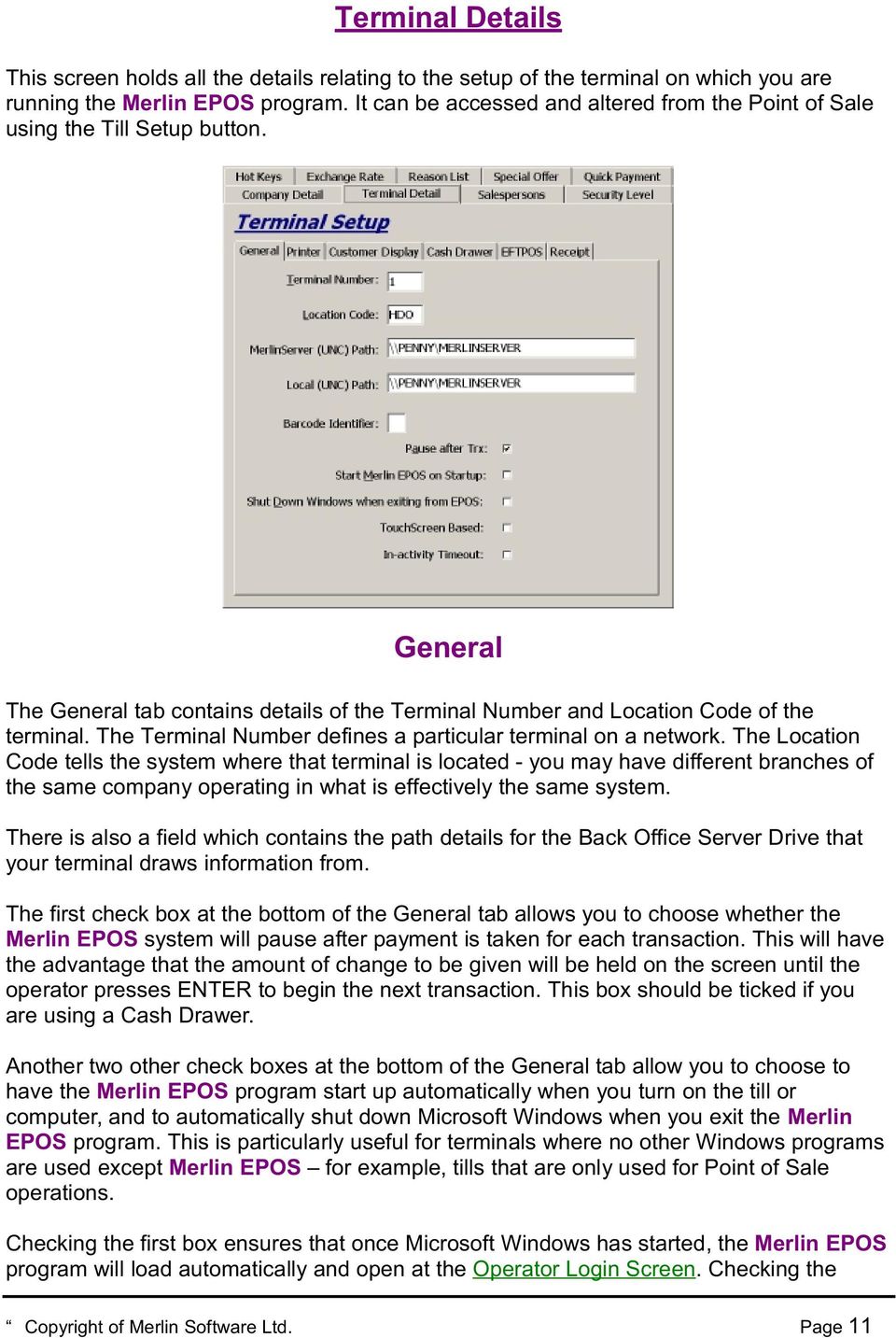
12 second box ensures that closing the Merlin EPOS program will also shut down the operating system, making it safe to turn off the terminal. Towards the bottom of the tab is a check box that allows you to tell the Merlin system whether you are using a touch screen for point of sale operations. Checking this box will mean that the keyboard icon will appear on the main Point of Sale screen, allowing you access to the special pop-up keyboard (see Keyboard Icon for further details). The final check box allows you to set the system's Inactivity Time-Out. If this box is checked, the terminal will automatically revert to the Login Screen after three minutes of inactivity. This is designed to safeguard the security of the Merlin system, so that terminals are not left 'open' unnecessarily. Printer The Printer tab contains the settings details for the Printer that is linked to your terminal. You can also use this screen to choose to have the terminal print out a receipt for every transaction if necessary. To specify a printer, click on the down arrow to the right of the 'Printer' field and select from the drop-down list that appears. For details of setting up your printer to work with the Merlin EPOS program for the first time, see the Printer Setup section. You should not need to change any of the other settings in this tab. Customer Display The Customer Display tab contains the settings for the Customer Display. There is a check box at the top of the tab that you can use to tell the system whether you are actually using a Customer Display or not. You should not need to change any of the other settings in this tab. Cash Drawer The Cash Drawer tab contains the settings for the Cash Drawer. There is a check box at the top of the tab that you can use to tell the system whether you are actually using a Cash Drawer or not. You should not need to change any of the other settings in this tab. EFTPOS The EFTPOS (Electronic Funds Transfer at Point of Sale) tab relates to any Credit or Debit Card settings that your terminal may have. There is a check box at the top of the tab that you can use to tell the system whether you are actually using an EFTPOS facility or not. You should not need to change any of the other settings in this tab. Copyright of Merlin Software Ltd. Page 12

13 Receipt The Receipt tab contains the settings for format of the Till Receipts that your terminal will print. This tab allows you to specify either a 40 column or an 80 column printer for your receipts. It also contains a check box which will determine whether or not your company address prints out on each receipt. There is also a field for you to enter a message which will also appear on every receipt. This may be a 'Welcome' message, or a 'Please call again' message. You can then preview your message to see exactly how it will look on your company receipts. Copyright of Merlin Software Ltd. Page 13

14 Salesperson Setup This screen allows you to set up, and maintain, the details of the people who will be operating the Merlin EPOS system. It can be accessed from the Point of Sale using the Till Setup button. You will need to enter a different code for each Salesperson (or operator) who will be using the system. This code can be up to 3 characters long, and usually consists of the initials of the Salesperson something easy to remember. This screen also allows you to set up, and maintain, the details of any Supervisors or Administrators on the system. For the difference between a Supervisor and an Administrator, see General Notes on Supervisor Functions. To set up a Salesperson To create a new Salesperson on the Merlin EPOS system, click the New button. This will empty all fields so that you can enter your new data. Enter a code to represent the Salesperson (up to 3 characters). This usually consists of the person's initials - something easy to remember. Enter the name of the Salesperson that the code relates to (up to 30 characters). Select the Access Level for this particular Salesperson - note that you must select 1, 2 or 3 to proceed. These relate to the way that you have set up the Access Levels using the Merlin Back Office program. If the person does not need to have access to supervisory functions within the system, then this is all you need to do. Simply click the Save button to store the information and proceed. If you make a mistake at any point in the setup, you can start again by clicking Clear. Copyright of Merlin Software Ltd. Page 14

15 To set up a Supervisor/Administrator To create a new Supervisor or Administrator on the Merlin EPOS system, click the New button. This will empty all fields so that you can enter your new data. Enter a code to represent the person (up to 3 characters). Enter the name of the person that the code relates to (up to 30 characters). Select the Access Level for this particular person. Note that you must select 1, 2 or 3 to proceed. Check the Supervisor and/or Administrator box (see General Notes on Supervisor Functions for details). Enter a password (up to 8 characters). This is the same whether the person has Supervisor or Administrator access rights on the system. Once you have completed the setup, click Save. Copyright of Merlin Software Ltd. Page 15
16 OPERATIONAL TERMS Training Company When you load the Merlin EPOS program, you will be presented with a small screen prompting you to select a Company. It should resemble the following: At this screen, you have the option of choosing either the 'real' Company or the Training Company. Your company name will appear in the 'real' Company box, once the system is configured correctly. The system will default to the 'real' Company. The Training Company is something that users of our systems have found exceptionally useful over the years. The Training Company program is identical in every way to the 'real' Company mode - except that using it does not alter any of the 'live' company data that you depend upon for your business information. This means that users are able to 'practice' using all aspects of the system without ever affecting any of the vital trading data of the business. It is especially suitable for use when training new members of staff in the use of the system, or when you need to give yourself a 'refresher' course on certain system functions. Copyright of Merlin Software Ltd. Page 16

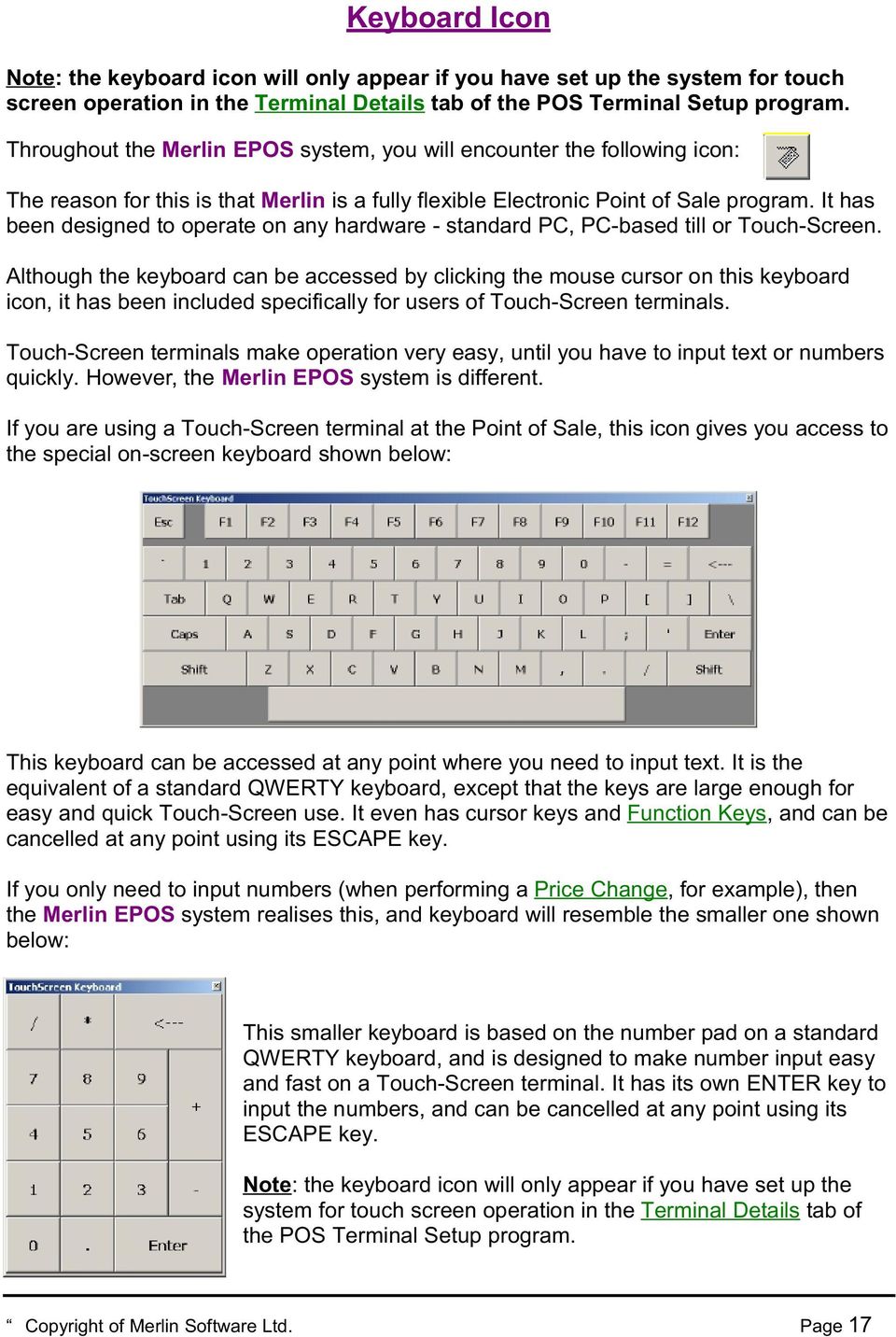
17 Keyboard Icon Note: the keyboard icon will only appear if you have set up the system for touch screen operation in the Terminal Details tab of the POS Terminal Setup program. Throughout the Merlin EPOS system, you will encounter the following icon: The reason for this is that Merlin is a fully flexible Electronic Point of Sale program. It has been designed to operate on any hardware - standard PC, PC-based till or Touch-Screen. Although the keyboard can be accessed by clicking the mouse cursor on this keyboard icon, it has been included specifically for users of Touch-Screen terminals. Touch-Screen terminals make operation very easy, until you have to input text or numbers quickly. However, the Merlin EPOS system is different. If you are using a Touch-Screen terminal at the Point of Sale, this icon gives you access to the special on-screen keyboard shown below: This keyboard can be accessed at any point where you need to input text. It is the equivalent of a standard QWERTY keyboard, except that the keys are large enough for easy and quick Touch-Screen use. It even has cursor keys and Function Keys, and can be cancelled at any point using its ESCAPE key. If you only need to input numbers (when performing a Price Change, for example), then the Merlin EPOS system realises this, and keyboard will resemble the smaller one shown below: This smaller keyboard is based on the number pad on a standard QWERTY keyboard, and is designed to make number input easy and fast on a Touch-Screen terminal. It has its own ENTER key to input the numbers, and can be cancelled at any point using its ESCAPE key. Note: the keyboard icon will only appear if you have set up the system for touch screen operation in the Terminal Details tab of the POS Terminal Setup program. Copyright of Merlin Software Ltd. Page 17
18 Main Point of Sale Screen A term that you will frequently encounter when using the Merlin EPOS help file is 'the main Point of Sale screen'. This term literally refers to the screen from which all the Point of Sale operations take place. It is the screen that most operators will see most of the time, and is pictured below. Note that the screen you see may differ slightly from the one shown. There may be less buttons in the row at the bottom of the screen. This is because the Merlin EPOS system is completely flexible, and allows you to set up different Access Levels for different users of the system. A user who did not have access to the Customer Account and Set Aside functions, therefore, would have spaces in this row of buttons. Only the buttons representing the functions that the user can access will appear on the main Point of Sale screen. Wherever possible, the Merlin EPOS help file will guide you through operational procedures starting from this screen. It will also tell you the colour of the keys that you need to press, to make them easier to spot. Note: for more information on colours relating to the different types of keys, see the Key Colours section. Copyright of Merlin Software Ltd. Page 18

19 Main Transaction Window A term that you will frequently encounter when using the Merlin EPOS help file is 'the main Transaction Window'. This term refers to the large area within the main Point of Sale screen which displays all the details of the current transaction. Upon commencing Point of Sale operations, the main Transaction Window will be empty, as below: All details of the transaction currently in progress are contained in the main Transaction Window. This includes details of all the products that make up the sale, including the quantities and Pack Sizes relating to those products, any Discounts or Special Offers that the customer is entitled to, any Voided lines, etc., etc. The area at the bottom of the window reflects the current total value of the transaction. It is the on-screen equivalent of the customer's receipt. It also displays details of the amounts allocated to each payment type when you are taking a multi-media Payment (see Taking Payment). Note: the Merlin EPOS system works using 'accumulative invoicing'. This means that a customer purchasing five of the same item will not see five separate lines on their receipt, but rather one line with '5' in the quantity field. This also relates to the main Transaction Window, as the operator sees what will eventually appear on the customer receipt. Copyright of Merlin Software Ltd. Page 19

20 Key Colours The Merlin EPOS system uses different coloured keys to denote different types of functions. As a general rule, the following colour scheme applies: General functions, & Function Keys. Payment keys. Supervisor Functions. ENTER and EXIT keys. You may encounter other colours of keys when using the Merlin EPOS system, but as a general rule, the above scheme applies. Copyright of Merlin Software Ltd. Page 20

21 Function Keys Throughout the Merlin EPOS system, and the help file, you will see references to the use of the Function Keys. These are the keys at the very top of a standard QWERTY keyboard, or at the top of the special Electronic Point of Sale keyboards designed by Merlin Software Ltd. Use of these Function Keys remains standard throughout the system, and the rules are as follows: F1: Help key. Press this at any time, and you will receive context-sensitive help on whatever system function you are performing. F2: Datasearch key (see F2 Datasearch key for further details). Pressing this key will allow you to select a record from the list presented. This works for stock, customer records, etc. F3: Clear Record key. This key clears the field you are currently using to enter data. F4: Delete Record key. F5: First Record key. Pressing this key while searching for stock or customer records will jump to the first record in the database. F6: Last Record key. Pressing this key while searching for stock or customer records will jump to the last record in the database. F7: Previous Record key. Pressing this key while searching for stock or customer records will move back to the previous record in the database. F8: Next Record key. Pressing this key while searching for stock or customer details will move on to the next record in the database. F9: Find Record key. F10: Save Record key. Copyright of Merlin Software Ltd. Page 21
22 Passwords Passwords are an important part of the Merlin EPOS system, as they provide protection against the abuse or misuse of Supervisor and/or Administrator Functions. For further details of these functions, see General Notes on Supervisor Functions. Passwords for Supervisors If you are a Supervisor, a box will appear every time you Log In to the system, prompting you to enter your Supervisor Password. This box will appear whether you simply Log In from the main Login Screen, or by scanning a Supervisor Card. Passwords for Everyone The Merlin system can also be set up so that each Salesperson enters a Password as they Log In. This is done simply by entering a Password (up to 10 characters) in the Password field of the Salesperson Setup screen. The person does not need to have Supervisor or Administrator privileges, but the system will still ask for a Password each time they Log In. Copyright of Merlin Software Ltd. Page 22
23 Login Screen This is the main Login Screen, which will appear each time the Merlin EPOS program is loaded. The system will also revert to this screen whenever an operator Logs Out of the Point of Sale (see Logging Out & Shutting Down). You can choose to have the Merlin EPOS system start up at this screen automatically when you turn on the till or computer (see Terminal Details). To begin Point of Sale operations, you need to enter a Salesperson Code in the box provided. This is an individual code which is set up for each Salesperson by a system Administrator (see Salesperson Setup). Note: the system is set up with an initial Salesperson Code of SUP and Password of SUPER. This allows you to get into the system initially, but needs to be changed once users are set up, for security reasons. Entering your Salesperson Code will prompt the system to display your name in the Salesperson Field alongside the code. This name will be linked to each transaction performed on the system, allowing mistakes and/or abuses to be tracked. Depending upon your status, the system may ask you for a password. If it does, enter your password in the box, then proceed. Note: both of these procedures can be performed using the keyboard icon if you are using a touch screen terminal at the point of sale. Copyright of Merlin Software Ltd. Page 23
24 The system will then display the main Point of Sale screen: You are then ready to commence Point of Sale operations. See Selecting a Product for details of how to do this. Copyright of Merlin Software Ltd. Page 24
25 POINT OF SALE OPERATIONS Selecting a Product Once you have Logged In, and you are in the main Point of Sale screen, the cursor defaults to the Product Field (shown below) ready for a sales transaction. From here, there are several ways to select a product using the Merlin EPOS system. Scanning Barcodes The easiest way to select a product is to scan its barcode. The system is designed to be used predominantly with barcodes, so this will probably be the most common method you use for product selection. The system recognises the barcode and enters the appropriate product in the main Transaction Window so that you can check the details of the sale. Once you have scanned the barcodes of all the products that the customer wants to buy, press the Payment key to take payment (see Taking Payment). Using Hot Keys Another quick way to select a product is by using a Hot Key. Simply press the appropriate key on the keyboard, and the product will be entered into the main Transaction Window so that you can check the details of the sale. The Hot Key function is designed for use with your fastest moving product lines, and is especially useful for items such as Daily Newspapers, Cigarettes or popular confectionery items. To take payment for the sale, press the Payment key (see Taking Payment) and proceed as normal. Entering the Product Code If you know it, you can also type in the Product Code in the Product Field. Copyright of Merlin Software Ltd. Page 25
26 The Product Code is the code that you give to each product on your system so that you can identify it. Entering the Product Code at the Point of Sale will only be an option for frequently sold items or items with obvious codes. Staff may remember the codes for frequently sold items, whereas obvious codes (such as MARS for a standard Mars Bar) are easy to remember. If you choose this method of product selection, then you must press the ENTER key to activate the sale. The product will then be entered into the main Transaction Window so that you can check the details of the sale. To take payment, press the Payment key (see Taking Payment). Using the Stock Button If you do not know the Product Code, or do not have the barcode available, you can also use the Stock button. The Stock button is green, and is located in the bottom left hand corner of the main Point of Sale screen. Pressing this button will bring up a further row of buttons - the Stock Search buttons: These buttons perform the following functions: FIRST STOCK: Shows the first item in the stock file. PREV. STOCK: Shows the previous item in the stock file. NEXT STOCK: Shows the next item in the stock file. LAST STOCK: Shows the last item in the stock file. FIND NEAREST: Shows the Product Code nearest to the data currently entered in the Product Field. SEARCH STOCK: Shows the Select a Stock screen - the equivalent of pressing the F2 Datasearch key. CLEAR STOCK: Clears all the data currently entered in the Product Field. STOCK ENQUIRY: Shows information about the product specified. See Stock Enquiry for details. Using the F2 Datasearch Key If you do not know the product code or do not have the barcode available, you can also use the F2 Datasearch key to find the product you need (see F2 Datasearch Key). Copyright of Merlin Software Ltd. Page 26
27 Hot Keys The Merlin EPOS system allows you to set up special Hot Keys, which make it as easy as possible for you to sell your fastest-moving items. The system allows you to allocate a stock item to each of the alphabet keys on the keyboard that you are using (this works for both standard PC keyboards and dedicated EPOS keyboards). At busy times, you can then sell that product by simply pressing the relevant key, rather than having to handle the product and scan in its barcode. Note : if your system is Touch-screen enabled, the hot keys can be accessed by the 'Show Selector' button. This will display a grid of 36 buttons with the Product Codes displayed on the 'live' buttons. The grid can be hidden again by pressing the 'Hide Selector' button. Local & Global The Merlin system provides two settings for Hot Keys - Local and Global, and these can be selected at the point of sale using the 'Change Mode' key. A blue or red marker will appear at the top of the point of sale screen to remind you which mode you are currently using. Local mode allows you to set up Hot Keys that will only apply to one particular till. This must be done at the point of sale through the Hot Key tab of the Till Setup function, and the till must be set to 'Local' mode for the settings to take effect. This can be useful when one particular till is responsible for sales of a particular typeof fastmoving product - such as cigarettes. The Hot Keys on this till can be set up independently of those that apply to other tills. Global mode allows you to set up Hot Keys that will apply to all the tills on your system. This must be done in the Back Office using the Hot Key Setup option from the EPOS Menu. Using this mode, all the tills on a system will have exactly the same Hot Keys, which can be useful in multi-till stores. Note: for Hot Key changes made in the Back Office (Global) to take effect, the user at the point of sale will need to log out and then re-log in to the system. Changes will not take effect until this has taken place. Note: the Hot Key function will only work if the system is set to either the Local or Global Hot Key Mode. You can alternate between Normal, Local and Global Modes on the system by pressing Ctrl+Y, or using the 'Change Mode' key on the special EPOS keyboards designed by Merlin Software Ltd. When set to Normal Mode, the marker box will disappear, and the box will simply appear as a normal part of the grey bar at the top of the screen. Normal Mode allows you to sell items by typing in their Product Codes (see Selecting a Product). Copyright of Merlin Software Ltd. Page 27
28 Quantities To sell a quantity of the same item at the Point of Sale, you do not need to scan the barcode of every single product. Press the Qty X key from the row of buttons at the bottom of the main Point of Sale screen. A box will appear prompting you to enter the appropriate quantity of items: Simply type the quantity in the box and press either OK or ENTER. The system will return you to the main Point of Sale screen. You will notice that an orange box has appeared below the Product field containing the quantity that you specified. The next item entered at the Point of Sale will be automatically multiplied by that amount. This is true regardless of the method that you use to select the product (see Selecting a Product). You will notice that the quantity appears in the main Transaction Window - it will also appear on the customer's receipt. Note: if the customer has a number of items that are the same but are not entered at the Point of Sale at the same time, the Merlin EPOS system will add these items to the quantity field in the main Transaction Window. It will not add another product line for an item which has already appeared. The main Transaction Window, therefore, resembles the receipt that the customer will receive after they pay for their goods. Copyright of Merlin Software Ltd. Page 28
29 Taking Payment When the sale is complete, and you are ready to take payment for the goods, press the white Payment button in the row of buttons at the bottom of the main Point of Sale screen. This will bring up the Payment Screen, and you will be required to select a payment type for the transaction. The different payment options are listed across the bottom of the Payment Screen: CASH, CHEQUE, CREDIT CARD, VOUCHER/COUPON, CREDIT NOTE and CURRENCY. Depending upon the type of transaction you are currently processing, there may also be an option to charge the transaction to a Customer Account (see Account Sales). Selecting a payment type is as simple as pressing the appropriate button. Enter the amount tendered, then press the ENTER Key. If the Merlin EPOS system is set up to pause after each transaction (see Terminal Details), the screen will pause. This will have the effect of holding the change total on the screen for you to check. You will then press the ENTER key again to begin the next transaction. If the system is set up not to pause after each transaction, it will revert to the main Point of Sale screen ready for the next transaction. In both cases, the system requires the Cash Drawer to be closed before another transaction can be started. The Merlin system allows you to take 'multi-media' payments for any transaction. This means that customers can pay by any combination of the payment options available. Simply press the appropriate Payment Key, then enter the amount tendered in that form and press the ENTER Key. The system will register the amount paid and the form of payment in the main Transaction Window, and will wait for payment for the remaining balance. Perform the same routine for each method of payment, until the balance is paid. If you have set up different exchange rates (see Exchange Rate Setup), the system also allows you to take payment for the goods in other currencies. Press the CURRENCY key on your EPOS keyboard or Ctrl + Q on your standard PC keyboard and a screen will be displayed containing all the currencies that are available to use. See the section on taking payment in Different Currencies for more details. Select the currency required and the system will return you to the main Transaction Window. You will still have to specify a payment method (CASH, CHEQUE, etc.), but the value of the transaction will appear in the selected currency. Change will be given in the normal operating currency - usually Sterling. Note: to return to the sale from the payment screen, press the Return to Sale button located in the bottom right hand corner of the screen. Copyright of Merlin Software Ltd. Page 29
30 Taking Payment in Different Currencies When the sale is complete, and you are ready to take payment for the goods, press the white Payment button in the row of buttons at the bottom of the main Point of Sale screen. This will bring up the Payment Screen, and you will be required to select a payment type for the transaction. You will notice that one of the Payment keys is marked Currency. The Merlin EPOS system allows you to set up different Currencies and Exchange Rates, so that you can take payment in whatever Currency you choose. For details of how to set up Currencies and Exchange Rates, see the Exchange Rate Setup section. To take payment in a Currency which is different to the one you usually use, press the Currency button when you are ready to take Payment. This will bring up a screen resembling the following: From this screen you can select the Currency in which the customer wishes to pay for their goods. You can select the required Currency using the cursor keys or pressing the appropriate letter key on the keyboard. You can also click on the required Currency with the mouse cursor. This will return you to the main Point of Sale screen, and you will notice that a flag representing the chosen Currency appears alongside the main Transaction Window. This shows that the system is ready to take payment for the sale in that particular Currency, at the Exchange Rate that you have set (see Exchange Rate Setup in BackOffice). You will still have to specify a Payment type (Cash, Cheque etc.), and then proceed to take payment for the goods in the normal way. Copyright of Merlin Software Ltd. Page 30
31 Quick Payment This screen allows you to set up buttons for certain cash amounts that appear on the Merlin EPOS screen. Although this feature is based mostly for use with a touch screen, if the till has a mouse attached this functionality can be quite useful. The set up screen can be accessed from the Point of Sale by clicking on the Supervisor Functions button followed by Till Setup. For the new buttons to appear on the Point of Sale the box has to be ticked. As you can see you can have up to eight different values set up. These values are added in pence. When you are happy with the way they are set up click Ok at the bottom of the Till Setup window. This will then take you back to the main Point of Sale window. You will notice that the buttons have not appeared anywhere. These will become visible when a product is entered into the Sale Window. Your screen will then look like this. This buttons are designed to speed up transactions on a touch screen. The values here are shown in pounds are generally the amount of the main bank notes in circulation or large coin amounts such as the 2 coin. To sell the item simply click on the amount and the change is shown just as you would normally enter the amount received from the customer. Copyright of Merlin Software Ltd. Page 31
32 Selecting Pack Sizes The Merlin EPOS system allows you to set up Stock items to have different Pack Sizes. This means that if you buy a Product in bulk, you can then split it up for sale as different sized packs of the same Product. An example would be 330ml cans of fizzy drinks that you buy in crates of 24 cans. The Merlin EPOS system will allow you to sell these cans as single units, or in packs of whatever quantities you choose. In this example, you might sell the cans in packs of 4, 6, 12, 18 and 24 - as well as singly. Pack Sizes also relate to Products such as seed or pet food, that you can divide up into packs of differing weight. Pack Sizes have been included in the Merlin EPOS system to make it as flexible as possible, so that you can configure the system to truly suit your business. For further details on Pack Sizes as they relate to Back Office functions, see the Pack Sizes section of the Merlin Back Office Help File. Selling Products by Pack Size If you are selling a Product that has different Pack Sizes, a screen resembling the following will appear once you have selected the Product (see Selecting a Product). You can select the Pack Size that you require by using the cursor keys or the tab key, or by clicking on the one you require with the mouse cursor. This will return you to the main Point of Sale screen, and the sale continues as normal. You will notice that the Pack Size you selected appears in the main Transaction Window alongside the product's EPOS description. Pack Sizes in Special Offers You will also encounter Pack Sizes when setting up Special Offers, because the Merlin system allows you to choose whether to include in the offer all the different Pack Sizes that exist for that Product, or just certain ones. For more information, see the Special Offers section of the Merlin Back Office Help File. Copyright of Merlin Software Ltd. Page 32
33 Products Sold By Weight, Volume, Length Or Area The Merlin EPOS system allows you to sell products not only as individual units, but also by Weight, Volume, Length or Area. Merlin will cope with all of these, and will even allow you to set Pack Sizes to more easily sell standard quantities. For details of setting up products to sell by Weight, Volume, Length or Area, consult the Merlin Back Office Help File. If a product is sold by any of these measurements, an extra step is needed to process the transaction at the Point of Sale. The product is entered in the normal way (see Selecting a Product), but once it has been selected, a box will appear prompting you to enter the quantity of the product that is being sold. The above example is for a product sold by weight. The user needs to input the actual weight that is being sold, and the box notifies them of the item's price. Alternatively you can enter by price and the box will notify you of the weight being sold. You can pick the relevent pack size or measurement. This principle applies to all products sold by Weight, as well as those sold by Volume, Length or Area. Instead of the Pack Size, the main Transaction Window will show the quantity bought, and the price per unit of the product. Copyright of Merlin Software Ltd. Page 33
34 Printing & Reprinting Receipts These two functions are grouped together for convenience, and both are very simple to operate. Printing a receipt To print a receipt for the customer after taking payment for a sale, simply wait until you have completed the sale, then press the Print Receipt button when the system reverts back to the main Point of Sale screen. The system will print a receipt for the last transaction performed on that terminal. The system can be configured to automatically print a receipt for every transaction. To set the system to do this, see Terminal Details. Reprinting a Receipt To reprint a receipt at any time, press the More key located in the bottom right hand corner of the main Point of Sale screen. This will display a further selection of buttons - the Reprint button is located in the bottom left hand corner of this screen. Pressing the Reprint button will bring up a screen allowing you to select the transaction for which a receipt is required. You can search for the appropriate transaction by the Transaction Number, the Till Number, the Salesperson responsible for the sale, the name of the Account that the sale was allocated to, the Total of the sale, and the Date and Time of the sale. Once the transaction is selected, press Proceed. The system will ask whether you want to print the transaction to the screen. Pressing Yes will bring up on the screen an exact copy of the receipt for the transaction. Copyright of Merlin Software Ltd. Page 34
35 You can scroll down this and find the information required - just as you would look down a printed receipt. If you are only looking for a particular detail, this can save you having to waste paper each time you need to check a past receipt. Pressing No will send the reprinted receipt to the printer. Copyright of Merlin Software Ltd. Page 35
36 Viewing Transactions With its powerful use of graphics, the Merlin EPOS system allows you to view details of certain transactions on the screen exactly as though you had printed them out and were reading a receipt or report. This feature can be used when looking at the receipt for a previous transaction (see Printing & Reprinting Receipts), or when using the Till Reconciliation function. It is particularly useful for viewing long reports (such as Till Reconciliations) that you may not need to print out at the time. If you are searching for a particular detail, and do not need to print out the full report, then you can access the information you require quickly and easily - and without wasting paper. When viewing the receipt for a previous transaction, the screen will resemble the following. This box enables you to see an exact on-screen copy of the receipt that the customer received, and lets you scroll down the receipt to view all of it. When printing a Till Reconciliation to the screen rather than the printer, the box that you see will resemble the following. This box allows you to see the contents of the Cash Drawer for that particular terminal in as much detail as you require. It is an exact replica of the Till Reconciliation report that you would have printed out, and you can scroll down the report to view all of it. Copyright of Merlin Software Ltd. Page 36
37 F2 Datasearch Key The F2 Datasearch key is one of the most useful keys in the entire Merlin EPOS system. If at any point within the program you need to search for a record (either a stock item, or a customer record), then this key will prove to be very valuable. Having this key at your disposal will mean that you can always sell every product that exists on your system - regardless of whether the barcode exists or not, whether you are not sure what the product is, or any other reason. Pressing the F2 Datasearch key brings up a fully customisable screen from which you can select any item of stock that exists on your system. Customising the Search You can configure the Stock Search screen to change the order in which the information is displayed. This can be done by clicking with the mouse in the header of the column that you wish to move and, with the mouse button pressed, dragging it to the position where you would like to have it. You can also expand and contract the width of the columns by placing your cursor on the right hand edge of the header where it will change to a double arrow. You can then click and drag to change the width. Finding a Product In the Stock Search screen, you can choose to search for the product in a number of different ways. The first of these is by using the Function Keys. Because you can configure the screen as described above, the contents of the columns Each of the different columns have a Function Key stated next door to the title. For example you can sort on the Product Code by pressing F2 and on Category 1 by pressing F4. Copyright of Merlin Software Ltd. Page 37
38 You can also select any of these by clicking the mouse cursor on the appropriate tab at the top of the screen (the selected tab will be red in colour). Once you have chosen one of the above methods to search the stock database, you can quickly jump to the item you are looking for by typing the first few letters into the Search Text box at the bottom of this screen. Alternatively, you can simply scroll down the screen until you reach the item you are looking for. Once you have found the item you are looking for, press the Proceed key. The system will return you to wherever you were in the Merlin EPOS program before you pressed the key, and the item that you selected will appear in the appropriate field. Note: in certain fields, pressing the F2 Datasearch key will bring up the Customer screen. This allows you to search through all the Customer records held in the database. The Customer screen works in exactly the same way to the Select a Stock screen. Copyright of Merlin Software Ltd. Page 38
39 Setting Aside a Transaction The Merlin EPOS system allows you to easily set a transaction aside for completion at a later time. This is especially useful if a customer realises that they have forgotten something just as you are ready to take payment for the sale, or if they realise that they do not quite have enough money to afford the goods, and need to return for them when they do. The Set Aside function allows you to place the sale to one side, and continue serving other customers. Transactions that have been Set Aside are held on the Back Office Server. This makes the facility more convenient, because Set Aside transactions can be accessed by any operator using any terminal on the system, meaning that customers can complete their transactions at any till. Note: Set Aside is a 'Real-Time' system function, and is only available when the Back Office Server is on-line to the network. The mechanics of the function mean that transactions cannot be Set Aside or recalled when the Server is off-line for any reason. Transactions that have been Set Aside are kept indefinitely within the system. It therefore does not matter how long the customer takes to return for their goods, though it is good practice to clear out these Set Aside transactions on a regular basis. Doing this makes it easier to find current transactions when recalling them to complete the sale. Note: if there are transactions that have been Set Aside on your system, the Set Aside button in the row at the bottom of the main Point of Sale screen will change to show you this. To Set Aside a Transaction It is very easy to Set Aside any transaction. Simply select Set Aside from the row of buttons at the bottom of the main Point of Sale screen. The system will ask you for confirmation that you truly wish to set the transaction aside. Pressing Yes will return you to the main Point of Sale screen ready to begin the next transaction. If you find that you need to set a transaction aside when you have reached the Payment screen, press the Return to Sale key located in the bottom right hand corner of the payment screen. This will return you to the main Point of Sale screen, which will still show the details of the current transaction. then, simply press Set Aside, and proceed as above. To Recall a Set Aside Transaction To recall any transaction that has been Set Aside, make sure that there is no data in the Product field of the main Point of Sale screen. Press the Set Aside button, and a screen will appear containing the details of all the transactions that have previously been Set Copyright of Merlin Software Ltd. Page 39
40 Aside. It will resemble the following: The transactions are displayed in this screen in order of the date and time at which they were started. The screen also shows the number of the terminal where the transaction was Set Aside. Select the transaction required - you can do this by using the cursor keys, or by clicking the mouse cursor on the appropriate transaction. Then press the Proceed key. The system will return to the main Point of Sale screen, which will contain all the details of the Set Aside transaction. You then complete the sale in the normal way (see Taking Payment). Note: if no Set Aside transactions exist on your system, the system will tell you that there are no previous transactions that have been set aside. Copyright of Merlin Software Ltd. Page 40
41 Stock Enquiry The Merlin EPOS system allows you to perform a Stock Enquiry from the Point of Sale. This enables you to check whether a particular Product is in stock, and what quantities are available. From the main Point of Sale screen, press the Stock button - this should be the furthest left from the row of buttons at the bottom of the screen. This will bring up a further row of buttons. These are the Stock Search buttons. From this row, select Stock Enquiry, and you will be returned to the main Point of Sale screen. An orange box will appear just below the Product field to let you know that the Stock Enquiry feature is enabled. Entering a Product Code by any method (see Selecting a Product) once the Stock Enquiry function is enabled tells the system that this is the Product that you need more information about. A further screen will appear, which will resemble the following. From this screen you can see the quantities of this particular Product that are available, and also the cost and different Pack Sizes of the Product. If your system is multi-locational, then you will also be able to see whether the Product is available at other branches. You can also see whether there are any on Purchase Order or on Back Order, for your location and any other branches linked to the same system. When you have found the information you were looking for, press Close at the bottom of the screen to return to the main Point of Sale screen ready for the next transaction. Copyright of Merlin Software Ltd. Page 41
42 Logging Out & Exiting the Point of Sale Logging Out returns the system to the main Login Screen, ready for another operator to enter their Salesperson Code and begin serving. It is important for you to Log Out of the Point of Sale whenever you leave the terminal for any reason. Doing this ensures that each Salesperson is accountable for the transactions that they have processed. The Merlin EPOS system tracks this information. It is especially important for Supervisors to Log Out when they leave a terminal. Failure to do this could result in other members of staff being able to access functions for which they have no authorisation. This is dangerous to the system in many ways, and defeats the purpose of setting up different Security Levels for different Salespeople. To Log Out of the Point of Sale To Log Out of the Merlin EPOS system, press the More key in the bottom right hand corner of the main Point of Sale screen. This will display a further selection of buttons - the Logout button is located in the bottom right hand corner of this screen, next to the Main Menu button. Simply press the Logout button, and the system will revert to the main Login Screen. Another way to do this is simply to press the ESCAPE key while in the main Point of Sale screen. To Exit the Point of Sale To exit the Point of Sale, the terminal must first be displaying the main Login Screen. Press the Exit button in the bottom right hand corner of this screen. You will be asked to confirm that you really do want to close the program. If you select Yes, the Merlin EPOS program will close down, and one of two things may happen. If the terminal has been configured to shut down Microsoft Windows when the Merlin program is closed (see Terminal Details), then the machine will shortly tell you that it is safe to turn it off. If it has not been configured to shut down Microsoft Windows when the Merlin program is closed, then the terminal will return to the Windows desktop. If you select No, the system will simply revert to the main Login Screen for you to continue with Point of Sale operations Copyright of Merlin Software Ltd. Page 42
43 CUSTOMER ACCOUNTS Account Setup & Maintenance The Merlin EPOS system provides you with all the tools that you need to set up and maintain credit accounts for your customers. See also Account Sales, Account Payments and Account Enquiry. To Set Up a Customer Account From the main Point of Sale screen, press the green Account key in the row of buttons at the bottom of the screen. The Customer Account screen is now displayed. To create a new Customer Account, press the New key. This will make all the fields blank for you to enter your new details. Enter a Customer Code for the account - this can be up to 10 characters long, and may consist of the customer's initials, part of their name, etc., etc. Fill in the remaining details for the customer. This is your record of all the Customer's contact details (Address, Telephone Number, Address, etc.), for when you need to get in touch with them. The fields are configured to allow you to enter either a Company Name or a Surname and Title, so that it is just as easy to enter data for an individual as for a company. Account Type The system will not let you save the Customer Account that you have created unless you have specified an Account type for the Customer. Copyright of Merlin Software Ltd. Page 43
44 Clicking on the down arrow to the right of the Account Type box will reveal a drop-down list of the four types of account that the system recognises. These are: Cash, Credit, Savings and Cash on Delivery. Select one of these Account Types using the cursor keys or mouse cursor. Customer Category Customer Category is an optional field which allows you to group your Customers into appropriate categories for the purposes of reporting, etc. Clicking on the down arrow to the right of the Customer Category box will reveal a list of customer types for selection. The list shows the categories that already exist on your system. You can add a category to this list, but not at the Point of Sale - this is a function that must be performed on the Merlin Back Office system. Discount The next field allows you to enter the level of discount to which the customer will be entitled. The 'Discount 'Level' field relates to the five levels of discount that you can apply to each stock item using the Stock Maintain program in the Merlin Back Office system. If you do not specify a discount level, the system will default to None and no discount will be given. There are also two more fields which allow you to specify a Contact Name and an Address for the Account. The 'Contact Name' field may be useful where the Customer Account is held by a business, rather than a single person. Once you are satisfied that all the details are correct, press the Save button to add the new account to the system. Alternatively, if you do not wish to save the details, press the Clear button to empty all the information currently entered. To Amend a Customer Account From the main Point of Sale screen, press the green Account key in the row of buttons at the bottom of the screen. The Customer Account screen is now displayed. Copyright of Merlin Software Ltd. Page 44
45 Select the account you wish to amend by using the keys at the bottom of the screen. Alternatively, you can use the search Function Keys. Pressing F5 displays the first account available, F6 displays the last account available, pressing F7 displays the previous account and F8 displays the next account. Alternatively, pressing F2 displays the Account Search Screen. This is used in the same way as the Select a Stock Screen (see F2 Datasearch Key). Once you have found the appropriate account, alter the details as necessary, then press the Save key. Press OK to return to the main Point of Sale screen. Note: it is also possible to create and maintain accounts using the Merlin Back Office system. Copyright of Merlin Software Ltd. Page 45
46 Account Sales If the customer has an account that is already set up on the system, press the Account key from the row of buttons at the bottom of the screen. This will bring up the Customer Account screen. Select the appropriate account using the arrow buttons at the bottom of the screen. Pressing Proceed will bring up a further menu, from which you can choose to make an Account Sale, Payment or Enquiry. To make an Account Sale From the small Account Menu, press the Sale button. The screen will return to the main Point of Sale screen, but you will notice that the Customer Account Code has appeared in the Account box. Copyright of Merlin Software Ltd. Page 46
47 Because this is now an Account Sale, a new option will appear when the Payment key is pressed. To charge the sale to the account, press the Charged to Acc button, then press ENTER. The transaction has been processed. The main Point of Sale screen will again be displayed, and will have reverted to normal Cashsale operation. Note: the Merlin EPOS system will automatically print out two copies of the customer's receipt for an Account Sale. This happens regardless of whether the system is set to print receipts automatically or not. One copy of the receipt is for the customer to keep, and the other is for your records. The customer signs the copy of the receipt that you keep, as your assurance of payment for the goods. Copyright of Merlin Software Ltd. Page 47
48 Account Payments If the customer has an account that is already set up on the system, press the Account key from the row of buttons at the bottom of the screen. This will bring up the Customer Account screen. Select the appropriate account using the buttons at the bottom of the screen. Pressing Proceed will bring up a further menu, from which you can choose to make an Account Sale, Payment or Enquiry. To make an Account Payment From the small Account Menu, press the Payment button. A bright blue box will appear, prompting you to enter the amount that is to be paid. Copyright of Merlin Software Ltd. Page 48
49 Type in the amount that the customer is paying on their account, and press OK or ENTER. The system will return to the Payment screen, with the amount that the customer is paying in the Balance box at the foot of the main Transaction Window. You specify the method of payment in the same way that you do for a normal sale (see Taking Payment), then press ENTER. The transaction has been processed. The main Point of Sale screen will again be displayed, and will have reverted to normal Cashsale operation. Note: the system will also allow you to accept payment at the same time that a sale is made. This is done in the same way as any multi-media payment (see Taking Payment). For example; a Customer decides to buy goods to the value of 50, pay 20 towards this, and put the rest of the sale on their account. Follow the steps outlined above until you come to take payment. Then select the type of payment that the Customer is giving you (cheque, cash, etc.) first, and enter the value of that payment. The system will register this in the main Transaction Window, and will display the remaining balance to be paid. Take any other form of payment that the Customer is offering, then choose 'Charge to Account' and press ENTER to put the rest of the sale on their account. A transaction consisting of both a sale and a payment will appear on the Account Enquiry screen with an entry in both the Credit and Debit columns. Note: you can also take payments on Customer Accounts using the Allocate Payment screen in the Merlin Back Office program. This is the screen that you must use to allocate payments to invoices. Copyright of Merlin Software Ltd. Page 49
50 Account Enquiry To check the balance of a Customer Account, press the Account key from the row of buttons at the bottom of the main Point of Sale screen. This will bring up the Customer Account screen. Select the appropriate account using the buttons at the bottom of the screen. Pressing Proceed will bring up a further menu, from which you can choose to make an Account Sale, Payment or Enquiry. To make an Account Enquiry From the small Account Menu, press the Enquiry button. This will bring up a further screen showing the history of the Customer Account in question. Copyright of Merlin Software Ltd. Page 50
51 The bar at the top of the screen tells you the Customer Code, the Customer's Name, and their outstanding balance. This will be the outstanding balance as of the last time that the terminal polled. This interval will depend upon the way you have configured the Merlin Net polling program. It also means that if the terminal is connected to a Back-Office Server and this Server fails for any reason, you will know the customer's outstanding balance as of the date and time that this failure occurred. From this screen, you can choose to view all items on the account, or only the open items (those still outstanding). You can also specify a range of dates by which to narrow down your search, if necessary. You can also choose to print out the details of the account which appear on the screen, or to view a specific transaction in greater detail. The main window of the screen shows details of all the sales and payments made on the account in question. Sales appear in the Debit column and payments in the Credit column. The row of boxes at the bottom of this window show the total debits, total credits and total remaining balance on the account. This screen also has the option of a Notepad. Clicking on the tabs at the top of the screen will change the view from Enquiry to Notepad. The Notepad is the place to write any comments about that particular account-holder. These comments will never appear on any receipts or statements - they are purely for staff use. When you are finished in this screen, press Exit in the bottom right hand corner of the screen, or ESCAPE to return to the main Point of Sale screen. Copyright of Merlin Software Ltd. Page 51
52 SUPERVISOR FUNCTIONS General Notes on Supervisor Functions The functions within this section can be broadly defined as Supervisor Functions. They are all accessed by pressing the red Supervisor Function key from the row of buttons at the bottom of the main Point of Sale screen. However, the flexibility of the Merlin EPOS system allows Administrators to configure their systems entirely to suit the way that their business works. This means that you may choose to allow everybody to access the Returns or Discount functions, regardless of whether they have Supervisor status on the system or not. What is the difference between a Supervisor and an Administrator? Because of the flexibility of the Merlin EPOS system, the only system function which cannot be accessed without a password is the Till Setup. This function is only available to Administrators. Therefore, while a Supervisor will have access to functions such as Voids, No Sales, Banking, etc., only an Administrator will have access to the POS Terminal Setup. Supervisor Cards Supervisor cards are provided as standard to businesses running non-evaluation copies of the Merlin EPOS program. If the operator is not entitled to access a system function which is necessary to the completion of the sale (a Price Change, or Void, for example), then the operator would call a Supervisor. The Supervisor carries a card bearing a barcode. This barcode represents a unique number relating only to that Supervisor, and their password. The Supervisor scans in the barcode, in the same way that a product is scanned, and the system asks for the password relating to that card. After the password is input, the Supervisor can access the appropriate functions. For security reasons, once the transaction is completed, the Merlin EPOS system reverts back to non-supervisor mode, so that the operator once again has access only to the functions they are entitled to use. Copyright of Merlin Software Ltd. Page 52
53 Banking From the main Point of Sale screen, press the red Supervisor key from the row of buttons at the bottom of the screen. From the selection of buttons that follows, press the Bank key. This will bring up the Banking screen (similar to the Till Reconciliation screen), which shows details of the current contents of the Cash Drawer. This is where you enter the details of the amounts of money that you are removing from the Cash Drawer for Banking purposes. Select the 'type' of money that you are removing from the Cash Drawer by pressing the appropriate green key at the bottom of the screen. The cursor will jump to the appropriate box ready for you to type in the amount that you are removing. You can also click the mouse cursor in the box and then type in the amount. Do this for each Payment type, and then press the OK key or ENTER, and the transaction is processed. The details of this will appear in the Banking section of your Till Reconciliation. Copyright of Merlin Software Ltd. Page 53
54 Returns From the main Point of Sale screen, press the red Supervisor key from the row of buttons at the bottom of the screen. From the screen that follows, press the Return key. An orange box will appear just below the Product field to let you know that the Returns feature is enabled. Entering a Product Code by any method (see Selecting a Product) once the Return key has been pressed lists the product as being a returned item, and launches the Return Reason screen. You are prompted to enter a reason for the product's return. These reasons relate to the Reason List in the POS Terminal Setup. Select a reason from the list by using the cursor keys, clicking on it with the mouse cursor, or using the search Function Keys. Pressing F5 selects the first reason in the list, F6 selects the last reason in the list, F7 selects the previous reason in the list, and F8 selects the next reason in the list. Once you have selected the appropriate reason for the product's return, press the OK button or press ENTER. You will then be prompted to enter the original selling price of the item. This relates to the refund that the customer will be given, and the item may not currently be the same price that it was when the customer purchased it. The system will default to the current price of the item - if this is still correct, press Proceed or ENTER. If this is not correct, type in the price of the refund to be given, then press Proceed or ENTER. Note: if you have specified that the product is being returned because it is Damaged or Faulty, you will be presented with a further screen. Copyright of Merlin Software Ltd. Page 54
55 This screen allows you to enter details of the fault, so that when a Returns Report is printed, these details can be passed on to the manufacturer. It is not necessary to enter anything into the Fault Description box if you do not want to, but the option is there, and may make things easier at a later point. The system will then return to the main Point of Sale screen where you will notice that the total at the base of the main Transaction Window has been forced negative. This indicates that the customer is owed that amount. Press the Payment key from the row of buttons at the bottom of the screen, then select the method by which the customer will receive their refund. This may be in Cash, but could equally be in the form of a Credit Note, etc. Press ENTER to confirm your choice, and the transaction has been processed. Note: to cancel a Return, press the Cancel button at the bottom of the screen, or press ESCAPE, and you will be returned to the main Point of Sale screen. Credit Notes The system will allow you to print out a Credit Note for a customer, if you select Credit Note as the method of payment for the refund. Then simply press ENTER to process the transaction, then press the Print Receipt key. The details of any Credit Notes issued will appear on your Till Reconciliation. Copyright of Merlin Software Ltd. Page 55
56 Till Reconciliation From the main Point of Sale screen, press the red Supervisor key from the row of buttons at the bottom of the screen. From the selection of buttons that follows, press the Till Rec key. This will bring up the Till Reconciliation screen which shows details of the current contents of the Cash Drawer. It will resemble the following: If this is all you need to know, simply press Cancel or ESCAPE to return to the main Point of Sale screen. If you need more detail, press Print or ENTER. This will bring up the Report Criteria screen. From this screen, you can choose either a summary or a detailed Till Reconciliation, and you can choose to view the report on paper or on the screen. Select these options by pressing the appropriate number keys, or by clicking the mouse cursor on the relevant option. Printer or Screen? You can choose to output the Till Reconciliation either in printed report form, or on the screen. If you choose the Printer option, the report will print out in the normal way. If you choose the Screen option, you will be presented with a transaction viewing box similar to the one shown below. Copyright of Merlin Software Ltd. Page 56
57 This will allow you to see an exact copy on screen of the report which would otherwise have been sent to the printer. This may be useful if you only need to check certain details of a Till Reconciliation, as the actual printing of it may take some time. Summary If you choose Summary, and press Proceed, the system will compile the report. This may take some minutes, depending upon the amount of data that has been processed that day. Once it has finished, the system will print a summary of the day's trading details. This report will show the relevant totals for Sales, No Sales, Banking, Unders/Overs, and Other Payment Details such as Credit Notes issued and redeemed, sales charged to Customer Accounts, and payments made to Accounts. Detailed If you choose Detailed, you can then choose which of the items on the right of the screen to include in the report. The system will default to all of these. You can check or uncheck the boxes by clicking with the mouse cursor, or by typing the relevant letter which appears with an underscore in the word itself. Pressing Proceed causes the system to compile the report - this may take some minutes, depending upon the amount of data that has been processed that day. Once it has finished, the system will print a detailed report of the day's trading details. This report will show every transaction that has been processed that day, including Payment Transactions (divided into different payment types), No Sales, Banking, Unders/Overs, and Other Payment Details such as Credit Notes issued and redeemed, sales charged to Customer Accounts, and payments made to Accounts. Copyright of Merlin Software Ltd. Page 57
58 Voids The Void All and Void Line functions are supervisory functions - you must be a Supervisor to access them. With the appropriate supervisory status on the Merlin EPOS system, you can use these functions to cancel a line in a sales transaction, or the entire transaction if necessary. Note: both the Void All and Void Line functions are only available when you are within a sales transaction. For the functions to work, there must be at least one item in the main Transaction Window for the system to cancel. To Void All of a Transaction Press the Supervisor Function key from the row of buttons at the bottom of the main Point of Sale screen. Then select Void All from the further selection of buttons that appear. A box will appear which will ask you to confirm that you really do want to Void the entire transaction. If you select Yes, the system will return to the main Point of Sale screen awaiting the next sale. To Void a Line Press the Supervisor Function key from the row of buttons at the bottom of the main Point of Sale screen. Then select Void Line from the further selection of buttons that appear. A box will appear asking you for the number of the line that you wish to Void. The system will default to the last line that was entered in the transaction. Type in the line number, then press OK or ENTER. The system will return to the main Point of Sale screen, and the word VOID will have appeared in the price column of the main Transaction Window alongside the voided item. this will also appear on the customer's receipt. You can then complete the transaction as normal (see Taking Payment). Note: you cannot Void a Discount line. If the line that you select contains the Discount that you offered on the item rather than the Product itself, a message will appear telling you that you cannot Void this line. You will be prompted to Void the line containing the actual Product. The main Transaction Window will then display the word Void in the price column for both the Product and its Discount, to show that both were cancelled. Copyright of Merlin Software Ltd. Page 58
59 Price Changes From the main Point of Sale screen, press the red Supervisor key from the row of buttons at the bottom of the screen. From the screen that follows, press the Price Change key. An orange box will appear just below the Product field to let you know that the Price Change feature is enabled. Entering a Product Code by any method (see Selecting a Product) once the Price Change key has been pressed lists the product as being an item whose price need to be changed, and launches the Price Change Reason Screen. You are prompted to enter a reason why you are altering the price of the product. These reasons relate to the Reason List in the POS Terminal Setup. Select a reason from the list by using the cursor keys, clicking on it with the mouse cursor, or using the search Function Keys. Pressing F5 selects the first reason in the list, F6 selects the last reason in the list, F7 selects the previous reason in the list, and F8 selects the next reason in the list. You will then be prompted to enter the new selling price for the item. This is the price you are offering the item for. The price will default to the current price of the item, and you will need to type the changed price over this. Type in the new price for the item and press Proceed or ENTER. The system will return to the main Point of Sale screen, and the transaction continues as normal (see Taking Payment). Copyright of Merlin Software Ltd. Page 59
60 No Sales This function is used to open the Cash Drawer without making a sale. This is necessary when the float is added to the Cash Drawer before business, and again after the business is closed, when the float is removed from the Drawer. It is also necessary at any other time when money is removed from the Cash Drawer without a sale taking place - when money is changed, for example. The No Sale option is also used when cashing up the till, to allow you to enter details of 'Unders' and 'Overs'. From the main Point of Sale screen, press the red Supervisor key from the row of buttons at the bottom of the screen. From the selection of buttons that follows, press the No Sale key. This brings up the No Sale Menu, from which you can choose from the options described above. When you select Add Money, Remove Money, 'Unders' or 'Overs', a screen will appear prompting you to enter the amount of money that you are adding or removing, and also asking whether this is in the form of Cash, Cheques, etc. Once you have completed these details, press Save or ENTER to return to the main Point of Sale screen. The details of any No Sales transactions will appear on your Till Reconciliation. The final option allows you to return to the main Point of Sale screen. You can also do this by pressing the ESCAPE key. Copyright of Merlin Software Ltd. Page 60
61 Till Setup The Till Setup can only be accessed if you have Administrator status on the system. If you do not have Administrator status, the Till Setup key will not appear on your screen. To access the Till Setup at any time (except during a transaction), press the red Supervisor Function key in the row of buttons at the bottom of the main Point of Sale screen. Then select Till Setup from the selection of buttons that appear on the next screen. This will open the POS Terminal Setup screen, allowing access to administrative functions such as altering Salesperson details or changing Terminal Details. If you need to make alterations to any of these administrative functions, change the necessary details, and then press OK to return to the main Point of Sale screen. Copyright of Merlin Software Ltd. Page 61
62 Discounts From the main Point of Sale screen, press the red Supervisor key from the row of buttons at the bottom of the screen. From the screen that follows, press the Discount key. An orange box will appear just below the Product field to let you know that the Discount feature is enabled. Entering a Product Code by any method (see Selecting a Product) once the Discount key has been pressed lists the product as being an item to be discounted, and launches the Discount screen. You are prompted to enter a percentage discount or a value discount for the product. To toggle between the two discount types press the SPACEBAR. Type in the percentage discount or the value of the discount that is to be applied to the product and press Proceed or ENTER. The system will return to the main Point of Sale screen, and the product will appear in the main Transaction Window. Below the product, you will notice a line containing the details of the discount that has been applied to that product - the percentage and the actual value. This will also appear on the customer's receipt. Complete the sale in the normal way (see Taking Payment). Copyright of Merlin Software Ltd. Page 62
Merlin BackOffice Manual
 Merlin BackOffice Manual Telephone +44(0)1226 321213 Facsim ile +44(0)1226 321284 Em ail [email protected] Website w w w.merlinsoft.co.uk Merlin Softw are Ltd Barnsley BIC Innovation Way Barnsley
Getting Started with POS. Omni POS Getting Started Manual. switched on accounting
 Omni POS Getting Started Manual switched on accounting i i Getting Started with Omni POS Table Of Contents Overview...1 Setting up POS...2 Initial Steps...2 Tellers...2 POS Clearing Account...3 Printing...4
How To Use Standard Pos On A Pc Or Macbook Powerbook 2.5.2.2 (Powerbook 2)
 Integrated Point of Sales System for Mac OS X Program version: 6.3.22 110401 2012 HansaWorld Ireland Limited, Dublin, Ireland Preface Standard POS is a powerful point of sales system for small shops and
A Guide To Using. Box-Office 2000. Version 2. By Nortech Software. The main booking screen
 A Guide To Using Box-Office 2000 Version 2 By Nortech Software The main booking screen Contents Features 4 Event Bookings...4 Ticket Book Printing & Layouts...4 Installation 5 Requirements...5 Software
ONE POS User Manual. A brief hand guide for ONE ERP POS SYSTEM MYIT SOLUTION. Latest update on: 03/09/12
 ONE POS User Manual A brief hand guide for ONE ERP POS SYSTEM MYIT SOLUTION Latest update on: 03/09/12 TABLE OF CONTENTS CHAPTER 1 - SETTINGS Database Setup... 3 Printer Configuration... 5 Cash Drawer
Introduction to Mamut Point of Sale
 // Mamut Point of Sale Introduction to Mamut Point of Sale Contents News in Mamut Point of Sale version 3.5... 2 Mamut Point of Sale... 3 Definitions of words and expressions used in the program... 7 Getting
01646 601992 (Office Hours) 07699 731616 (Pager) Contents
 BACK OFFICE MANUAL Contents Introduction... 3 Adding New Sales Items To The EPOS System... 6 To Create A New Product Category... 6 Adding A New PLU... 7 Product Options... 8 Product Modifiers... 9 EPOS
February 2010 Version 6.1
 HansaWorld University Point Of Sales (POS) Training Material HansaWorld Ltd. February 2010 Version 6.1 Table Of Contents INTRODUCTION...5 What is Point Of Sales?...5 THE 4 DIFFERENT WAYS OF USING POS...6
Introduction to MS WINDOWS XP
 Introduction to MS WINDOWS XP Mouse Desktop Windows Applications File handling Introduction to MS Windows XP 2 Table of Contents What is Windows XP?... 3 Windows within Windows... 3 The Desktop... 3 The
Appointment Scheduler
 EZClaim Appointment Scheduler User Guide Last Update: 11/19/2008 Copyright 2008 EZClaim This page intentionally left blank Contents Contents... iii Getting Started... 5 System Requirements... 5 Installing
Inventek Point of Sale 7.0. Quick Start. Sigma Software Solutions, Inc. Manual
 Inventek Point of Sale 7.0 Quick Start Sigma Software Solutions, Inc. Manual Inventek POS Quick Start Login Procedure You are now ready to begin using the Inventek Point of Sale program. To open the software,
Integrated Accounting System for Mac OS X and Windows
 Integrated Accounting System for Mac OS X and Windows Program version: 6.2 110111 2011 HansaWorld Ireland Limited, Dublin, Ireland Preface Books by HansaWorld is a powerful accounting system for the Mac
How to Install Microsoft Windows Server 2008 R2 in VMware ESXi
 How to Install Microsoft Windows Server 2008 R2 in VMware ESXi I am not responsible for your actions or their outcomes, in any way, while reading and/or implementing this tutorial. I will not provide support
[ Learning Outcomes ] [ Learning Objectives ]
![[ Learning Outcomes ] [ Learning Objectives ]](/thumbs/27/9494072.jpg "[ Learning Outcomes ] [ Learning Objectives ]") S A G E P A S T E L P A R T N E R V 1 2 P o i n t o f S a l e [ Point of Sale ] [ Learning Outcomes ] In this module, you are going to explore the Sage Pastel V12 Point of Sale add-on module. You will
S A G E P A S T E L P A R T N E R V 1 2 P o i n t o f S a l e [ Point of Sale ] [ Learning Outcomes ] In this module, you are going to explore the Sage Pastel V12 Point of Sale add-on module. You will
Invoicing 6.3.9 Manual. 2012... Coherent Software Solutions
 Invoicing 6.3.9 Manual 2 Invoicing 6.3.9 Manual Table of Contents Part I Welcome to Aura Invoicing 4 Part II Getting Started with Aura Invoicing 6 Part III Starting a New Till Shift 10 Part IV Processing
Fleet Maintenance Software
 Fleet Maintenance Software Welcome Thank you for taking time to review FleetWise VB Maintenance Management Made Simple. This guide is intended to provide a quick overview of installing the software and
AR Part 1: An Introduction to Accounts Receivable
 AR Part 1: An Introduction to Accounts Receivable Table of Contents 1. Overview... 3 2. Searching for a Customer... 4 3. Transactions... 6 4. Raising a sales invoice... 7 5. Completing a Transaction...
Integrated Accounting System for Mac OS X
 Integrated Accounting System for Mac OS X Program version: 6.3 110401 2011 HansaWorld Ireland Limited, Dublin, Ireland Preface Standard Accounts is a powerful accounting system for Mac OS X. Text in square
Chapter 28. Poi nt of Sale But. FrontDesk v4.1.25. Point of Sale Menus. Voiding Invoices. Redeeming Gift Certificates. Revised on: 06/10/2009
 Chapter 28 Point of Sale FrontDesk v4.1.25 Point of Sale Poi nt of Sale But tons Point of Sale Menus Opening and Closing Register Drawers Making a Sale Voiding Invoices Reprinting Receipts Selling Gift
Contents. SiteBuilder User Manual
 Contents Chapter 1... 3 Getting Started with SiteBuilder... 3 What is SiteBuilder?... 3 How should I use this manual?... 3 How can I get help if I m stuck?... 3 Chapter 2... 5 Creating Your Website...
Integrated Invoicing and Debt Management System for Mac OS X
 Integrated Invoicing and Debt Management System for Mac OS X Program version: 6.3 110401 2011 HansaWorld Ireland Limited, Dublin, Ireland Preface Standard Invoicing is a powerful invoicing and debt management
Windows XP Pro: Basics 1
 NORTHWEST MISSOURI STATE UNIVERSITY ONLINE USER S GUIDE 2004 Windows XP Pro: Basics 1 Getting on the Northwest Network Getting on the Northwest network is easy with a university-provided PC, which has
CAPITAL V8. Capital Business Software Tutorial Series. Introduction to Capital Business Manager V8 User Interface 1.2
 CAPITAL V8 Capital Business Software Tutorial Series Introduction to Capital Business Manager V8 User Interface 1.2 C A P I T A L O F F I C E B U S I N E S S S O F T W A R E Capital Business Software Tutorial
Aura Kitchen Monitor. 2012 Coherent Software Solutions
 Part Introduction I 1 Introduction Introduction Kitchen Items is an alternative method for alerting kitchen staff about new orders waiting to be prepared. When compared to the standard method of passing
WELCOME TO REVEL SYSTEMS RETAIL SERVICE... 5 STARTING YOUR WORK... 6. Logging In to Your POS... 7. Refreshing the POS Settings...
 Retail Service User Guide. Page 2 of 81 Table of Contents WELCOME TO REVEL SYSTEMS RETAIL SERVICE... 5 STARTING YOUR WORK... 6 Logging In to Your POS... 7 Refreshing the POS Settings... 8 Clocking In and
History Explorer. View and Export Logged Print Job Information WHITE PAPER
 History Explorer View and Export Logged Print Job Information WHITE PAPER Contents Overview 3 Logging Information to the System Database 4 Logging Print Job Information from BarTender Designer 4 Logging
DarwiNet Client Level
 DarwiNet Client Level Table Of Contents Welcome to the Help area for your online payroll system.... 1 Getting Started... 3 Welcome to the Help area for your online payroll system.... 3 Logging In... 4
Keep your search simple. Only the last name is required. First name and Phone are optional.
 Creating a new Parts Invoice A Part Invoice is used to record part sales to a customer. When opening a new Parts Invoice, Dealer Logic will assign the next Invoice Number. The date will be the date the
Quick Start Guide. Microinvest Warehouse Pro Light Restaurant
 Quick Start Guide Warehouse Pro Light Restaurant 2013 I. Application Installation During the initial installation of the product, the application gets to know the computer system, on which it shall work
PRACTICE MANAGEMENT SYSTEMS
 PRACTICE MANAGEMENT SYSTEMS P.O. Box 102 Ivanhoe, Victoria, 3079 T: 1300 784 908 F: 1300 784 906 www.ppmp.com.au PPMP - Page 1 of 87 Table of Contents TABLE OF CONTENTS... 2 PROGRAM SETUP WIZARD... 3 ACTIVATION
Enterprise Interface User Guide
 Enterprise Interface User Guide http://www.scientia.com Email: [email protected] Ref: 3094 ISO 9001:2000 / TickIT certified Copyright Scientia Ltd 2010 This document is the exclusive property of Scientia
CFD-FX Trading platform Software User Guide. May 2006
 CFD-FX Trading platform Software User Guide May 2006 CONTENTS Introduction........................................................1 Installing the trading platform........................................1
SLA Online User Guide
 SLA Online User Guide Contents SLA Online User Guide 2 Logging in 2 Home 2 Things to do 2 Upcoming events/calendar 3 News features 3 Services 3 Shopping Basket 3 Appointment/Visit Bookings 4 Quote Requests
CDC Enterprise Inventory Management System. The Basics
 CDC Enterprise Inventory Management System The Basics Page 2 of 71 Table of Contents 1 User Manager:... 6 1.1 Create New User:... 7 1.2 User Permissions... 7 1.3 Edit Existing User:... 8 1.4 Register User:...
NDA-30141 ISSUE 1 STOCK # 200893. CallCenterWorX-Enterprise IMX MAT Quick Reference Guide MAY, 2000. NEC America, Inc.
 NDA-30141 ISSUE 1 STOCK # 200893 CallCenterWorX-Enterprise IMX MAT Quick Reference Guide MAY, 2000 NEC America, Inc. LIABILITY DISCLAIMER NEC America, Inc. reserves the right to change the specifications,
Photocopying and scanning
 Photocopying and scanning Logging in at the copier Scan your card using the Barcode Scanner at the copier Press in the PIN field Enter your PIN, and then press OK. 1 Photocopying 1. Position your document
All V7 registers support barcode printing, except the Sharp 410/420 1A ROM and that limitation is based upon the register.
 Tools Section Barcode Printing These are basic instructions for Version 7 Polling barcode printing. Users will need to have a PLU/UPC file containing either UPC-A, UPC-E, EAN 13 or EAN 8 numbers, label
Point of Sale Procedures. Quick Reference
 Point of Sale Procedures Quick Reference Hard Copy Not Controlled Controlled Copy Available On-line Table of Contents How To Charge to Charge Accounts... 1 Closing an Open Check... 2 Creating a Recipe...
Introduction. Epos tills capture the sales information to ensure you make better decisions
 EPOS FEATURES TILLS Introduction Epos tills capture the sales information to ensure you make better decisions Openxpos stock system has two till versions depending on the product range and serving method
Using Microsoft Office 2013: Outlook. Gerry Kruyer
 Using Microsoft Office 2013: Outlook Table of Contents Outlook 2013 Ribbon... 4 Viewing Inbox... 4 Folders... 4 Home Tab... 5 Background Colour and Themes... 5 Inbox... 6 Reading Pane... 6 Turn off/on
WHAT YOU OWN HOME INVENTORY SOFTWARE
 WHAT YOU OWN HOME INVENTORY Version 4.19 Copyright 2013 M- One Studio, LLC www.m-onestudio.com Contents Getting Started... 1 About WHAT YOU OWN HOME INVENTORY SOFTWARE... 1 Download and Install the Software...
Agency Manager Professional Software Manual
 Agency Manager Professional Software Manual Table Of Contents Navigation Pane... 4 Management Console... 5 Company Details... 5 Company Bank Details... 6 VAT Rate... 6 Currency Setting... 7 Database Users...
Chapter 7: Historical and manual data entry
 Chapter 7: Historical and manual data entry Historical data is comprised of transactions that are dated before the first transaction downloaded for a bank account. You can only enter historical data for
OFBIZ POS USER MANUAL
 OFBIZ POS USER MANUAL Version 9.11 Release Date 2009-11-01 Apache OFBiz (http://ofbiz.apache.org) is a trademark of The Apache Software Foundation Page 1/24 OFBIZ POS USER MANUAL Version 9.11 Release Date
TOPS v3.2.1 Calendar/Scheduler User Guide. By TOPS Software, LLC Clearwater, Florida
 TOPS v3.2.1 Calendar/Scheduler User Guide By TOPS Software, LLC Clearwater, Florida Document History Version Edition Date Document Software Trademark Copyright First Edition Second Edition 02 2007 09-2007
ZeusPOS User s Manual TABLE OF CONTENTS
 ZeusPOS User s Manual TABLE OF CONTENTS ZeusPOS Configuration Pag. Getting Started.. 2 Store Setup.. 4 Software Activation... 5 Employee Setup... 6 Table Setup.. 7 Menu Categories.. 8 Menu Setup.. 9 Items
Microsoft Access 2010 handout
 Microsoft Access 2010 handout Access 2010 is a relational database program you can use to create and manage large quantities of data. You can use Access to manage anything from a home inventory to a giant
Point of Sale Setting up Point of Sale User Guide (POS)
 Point of Sale Setting up Point of Sale User Guide (POS) Page 1 of 11 Table of Contents Setting up Point of Sale for the first time... 4 Point of Sale Activation... 4 Point of Sale Security Settings...
Microsoft Outlook. KNOW HOW: Outlook. Using. Guide for using E-mail, Contacts, Personal Distribution Lists, Signatures and Archives
 Trust Library Services http://www.mtwlibrary.nhs.uk http://mtwweb/cgt/library/default.htm http://mtwlibrary.blogspot.com KNOW HOW: Outlook Using Microsoft Outlook Guide for using E-mail, Contacts, Personal
micros e7 Common Manager Operations COPPERSTATE BUSINESS SYSTEMS (480) 603-3020
 micros e7 Common Manager Operations COPPERSTATE BUSINESS SYSTEMS (480) 603-3020 PROCEDURE: Clocking out an Employee that did not clock 1) Using a Manager Card or ID, enter Manager Procedures 2) Press Employees
Contents SECTION 1 5 SECTION 2 9
 Contents SECTION 1 5 INTRODUCTION 6 STARTING UP 7 Starting the Workstations 7 Running Onetap 7 Logging On 7 Using the On Screen Keyboard 7 Minimise Onetap 8 Restore Onetap 8 Exiting and Shutting Down 9
SMART Ink 1.5. Windows operating systems. Scan the following QR code to view the SMART Ink Help on your smart phone or other mobile device.
 SMART Ink 1.5 Windows operating systems User s guide Scan the following QR code to view the SMART Ink Help on your smart phone or other mobile device. Trademark notice SMART Ink, SMART Notebook, SMART
Password Memory 6 User s Guide
 C O D E : A E R O T E C H N O L O G I E S Password Memory 6 User s Guide 2007-2015 by code:aero technologies Phone: +1 (321) 285.7447 E-mail: [email protected] Table of Contents Password Memory 6... 1
Beginners Guide to CQG FX
 Beginners Guide to CQG FX Table of Contents Logging into CQG FX................................................................. pg. 2 Logging in for the first time (if previously traded on demo)..........................pg.4
Utilities. 2003... ComCash
 Utilities ComCash Utilities All rights reserved. No parts of this work may be reproduced in any form or by any means - graphic, electronic, or mechanical, including photocopying, recording, taping, or
Infusion Business Software Update 8.200
 Infusion Business Software Update 8.200 Administration The re-index process now has an option to complete all the Integrity checks for Customers, Suppliers, Products and Financials along with a History
Outlook Web Access (OWA) User Guide
 Outlook Web Access (OWA) User Guide September 2010 TABLE OF CONTENTS TABLE OF CONTENTS... 2 1.0 INTRODUCTION... 4 1.1 OUTLOOK WEB ACCESS SECURITY CONSIDERATIONS... 4 2.0 GETTING STARTED... 5 2.1 LOGGING
Teacher Training Session 1. Adding a Sub-Site (New Page) Editing a page and page security. Adding content cells. Uploading files and creating folders
 Teacher Training Session 1 Adding a Sub-Site (New Page) Editing a page and page security Adding content cells Uploading files and creating folders Adding Sub Sites Sub Sites are the same as Sub Groups
NEWTON POINT-OF-SALE MANUAL TABLE OF CONTENTS
 TABLE OF CONTENTS 1. ABOUT THIS GUIDE... 2 1.1 WHO SHOULD USE IT... 2 1.2 USING THIS MANUAL... 2 2. NEWTON BASICS... 3 2.1 OPENING NEWTON... 3 2.2 LOGGING ON TO THE SYSTEM... 4 2.3 CLOSING NEWTON... 4
How To Sync Between Quickbooks And Act
 QSalesData User Guide Note: In addition to this User Guide, we have an extensive Online Video Library that you can access from our website: www.qsalesdata.com/onlinevideos Updated: 11/14/2014 Installing
Excel Integrated Reporting
 Excel Integrated Reporting Copyright statement Sage (UK) Limited, 2012. All rights reserved We have written this guide to help you to use the software it relates to. We hope it will be read by and helpful
Business Objects Version 5 : Introduction
 Business Objects Version 5 : Introduction Page 1 TABLE OF CONTENTS Introduction About Business Objects Changing Your Password Retrieving Pre-Defined Reports Formatting Your Report Using the Slice and Dice
ShopMate Operating Manual
 The Retail Data Partnership Ltd ShopMate Operating Manual Version 6.3.0 Telephone No. 01780 480562 Please Note: Your ShopMate EpoS system must always be shut down properly. Switching off rather than shutting
Finance Reporting. Millennium FAST. User Guide Version 4.0. Memorial University of Newfoundland. September 2013
 Millennium FAST Finance Reporting Memorial University of Newfoundland September 2013 User Guide Version 4.0 FAST Finance User Guide Page i Contents Introducing FAST Finance Reporting 4.0... 2 What is FAST
Getting Started Guide. Trimble Accubid Enterprise Software
 Getting Started Guide Trimble Accubid Enterprise Software Revision A August 2013 F Toronto Office Trimble Canada Ltd. 7725 Jane Street Concord, Ontario L4K 1X4 Copyright and Trademarks 2005-2013 Trimble
13 Managing Devices. Your computer is an assembly of many components from different manufacturers. LESSON OBJECTIVES
 LESSON 13 Managing Devices OBJECTIVES After completing this lesson, you will be able to: 1. Open System Properties. 2. Use Device Manager. 3. Understand hardware profiles. 4. Set performance options. Estimated
Index. Page 1. Index 1 2 2 3 4-5 6 6 7 7-8 8-9 9 10 10 11 12 12 13 14 14 15 16 16 16 17-18 18 19 20 20 21 21 21 21
 Index Index School Jotter Manual Logging in Getting the site looking how you want Managing your site, the menu and its pages Editing a page Managing Drafts Managing Media and Files User Accounts and Setting
Ohio University Computer Services Center August, 2002 Crystal Reports Introduction Quick Reference Guide
 Open Crystal Reports From the Windows Start menu choose Programs and then Crystal Reports. Creating a Blank Report Ohio University Computer Services Center August, 2002 Crystal Reports Introduction Quick
Microsoft Outlook 2010
 Microsoft Outlook 2010 Prepared by Computing Services at the Eastman School of Music July 2010 Contents Microsoft Office Interface... 4 File Ribbon Tab... 5 Microsoft Office Quick Access Toolbar... 6 Appearance
User Manual. CashFootprint Retail Point-of-Sale, Professional Edition. Copyright 2011-2013, LotHill Solutions, LLC. All rights reserved.
 CashFootprint Retail Point-of-Sale, Professional Edition User Manual Copyright 2011-2013, LotHill Solutions, LLC. All rights reserved. LotHill Solutions, LLC 8616 Kell Ave. S. Minneapolis, MN 55437 Toll:
2002 Blackbaud, Inc. This publication, or any part thereof, may not be reproduced or transmitted in any form or by any means, electronic, or
 041902 2002 Blackbaud, Inc. This publication, or any part thereof, may not be reproduced or transmitted in any form or by any means, electronic, or mechanical, including photocopying, recording, storage
D-Tech Self Service Configuration Software User Manual
 D-Tech Self Service Configuration Software User Manual Software Version 4 - Released 18.04.2009 Document: 0111 Classification: Customer Author: Marvin Crisp Last Saved 24.03.2010 D-Tech International Limited
Chapter 13: Producing reports
 This Chapter covers how to produce the various kinds of report available in BankLink Practice, as well as options common to all reports: Standard report options Cash flow reports Profit and loss reports
Blackbaud FundWare Accounts Receivable Guide VOLUME 1 SETTING UP ACCOUNTS RECEIVABLE
 Blackbaud FundWare Accounts Receivable Guide VOLUME 1 SETTING UP ACCOUNTS RECEIVABLE VERSION 7.50, JULY 2008 Blackbaud FundWare Accounts Receivable Guide Volume 1 USER GUIDE HISTORY Date Changes June 2000
ONE POS USER MANUAL Copy Right One Touch Ltd, 1992-2014 All Rights Reserved John Mackay Page 1 23/05/2014
 ONE POS USER MANUAL John Mackay Page 1 23/05/2014 Contents 01 - Front Cover 02 - Contents 03 - Introduction 04 - System Setup 08 - Till Mode 09 - Basic Usage (completing a sale) 10 - Printing Receipts
800-02577-TC 3/10 Rev. A
 800-02577-TC 3/10 Rev. A Total Connect Online Help Guide TRADEMARKS Honeywell is a registered trademark of Honeywell International Inc. Windows and Windows Vista are trademarks, or registered trademarks
How To Use Senior Systems Cloud Services
 Senior Systems Cloud Services In this guide... Senior Systems Cloud Services 1 Cloud Services User Guide 2 Working In Your Cloud Environment 3 Cloud Profile Management Tool 6 How To Save Files 8 How To
1.1. Pay In / Pay Out.. 3. 1.2. Payment Mode Master 4-5. 1.3. Unit of Measurement (UOM). 6. 1.4. TAX Master. 7. 1.5. Department Master..
 INDEX 1. MASTERS 1.1. Pay In / Pay Out.. 3 1.2. Payment Mode Master 4-5 1.3. Unit of Measurement (UOM). 6 1.4. TAX Master. 7 1.5. Department Master.. 8-9 1.6. Category Master.10-11 1.7. Stock Keeping Unit
1.5 MONITOR. Schools Accountancy Team INTRODUCTION
 1.5 MONITOR Schools Accountancy Team INTRODUCTION The Monitor software allows an extract showing the current financial position taken from FMS at any time that the user requires. This extract can be saved
Q. The Phone Manager call banner disappears after being displayed for a couple of seconds...5 Q. The Phone Manager icon in the taskbar is blue and
 Phone Manager FAQ s Q. The Phone Manager call banner disappears after being displayed for a couple of seconds...5 Q. The Phone Manager icon in the taskbar is blue and has a cross on it. 5 Q. Some options
Contents. Hardware Configuration... 27 Uninstalling Shortcuts Black...29
 Contents Getting Started...1 Check your Computer meets the Minimum Requirements... 1 Ensure your Computer is Running in Normal Sized Fonts... 7 Ensure your Regional Settings are Correct... 9 Reboot your
StrikeRisk v6.0 IEC/EN 62305-2 Risk Management Software Getting Started
 StrikeRisk v6.0 IEC/EN 62305-2 Risk Management Software Getting Started Contents StrikeRisk v6.0 Introduction 1/1 1 Installing StrikeRisk System requirements Installing StrikeRisk Installation troubleshooting
AccuPOS to MAS90/200 Integration Guide
 AccuPOS to MAS90/200 Integration Guide Part I - MAS90 Company Setup In order to use AccuPOS Point of Sale and have it integrate with MAS90/200 for inventory and accounting purposes, we ask that you setup
Netigate User Guide. Setup... 2. Introduction... 5. Questions... 6. Text box... 7. Text area... 9. Radio buttons...10. Radio buttons Weighted...
 Netigate User Guide Setup... 2 Introduction... 5 Questions... 6 Text box... 7 Text area... 9 Radio buttons...10 Radio buttons Weighted...12 Check box...13 Drop-down...15 Matrix...17 Matrix Weighted...18
Chapter 8: BankLink Coding Reports, BankLink Notes
 Chapter 8: BankLink Coding Reports, BankLink Notes You can use the BankLink Coding Report to list transactions and send them to those clients who can assign the codes themselves. You can also produce a
2B-Inventory for Microsoft RMS and POS Quick Start
 2B-Inventory for Microsoft RMS and POS Quick Start WARNING: When the mobile device s main battery runs low, you will see a popup notification on the mobile device s screen indicating low power. Upon receiving
Monitoring Network DMN
 Monitoring Network DMN User Manual Table of contents Table of contents... 2 1. Product features and capabilities... 3 2. System requirements... 5 3. Getting started with the software... 5 3-1 Installation...
Strategic Asset Tracking System User Guide
 Strategic Asset Tracking System User Guide Contents 1 Overview 2 Web Application 2.1 Logging In 2.2 Navigation 2.3 Assets 2.3.1 Favorites 2.3.3 Purchasing 2.3.4 User Fields 2.3.5 History 2.3.6 Import Data
LETTERS, LABELS & EMAIL
 22 LETTERS, LABELS & EMAIL Now that we have explored the Contacts and Contact Lists sections of the program, you have seen how to enter your contacts and group contacts on lists. You are ready to generate
Welcome to Bridgit @ CSU The Software Used To Data Conference.
 Welcome to Bridgit @ CSU The Software Used To Data Conference. Overview SMART Bridgit software is a client/server application that lets you share programs and information with anyone, anywhere in the world.
Getting Started with Mamut Online Desktop
 // Mamut Business Software Getting Started with Mamut Online Desktop Getting Started with Mamut Online Desktop Contents Welcome to Mamut Online Desktop... 3 Getting Started... 6 Status... 23 Contact...
Decision Support AITS University Administration. Web Intelligence Rich Client 4.1 User Guide
 Decision Support AITS University Administration Web Intelligence Rich Client 4.1 User Guide 2 P age Web Intelligence 4.1 User Guide Web Intelligence 4.1 User Guide Contents Getting Started in Web Intelligence
InterCafe 2004. User Manual
 InterCafe 2004 This manual and the appendant software belong to blue image GmbH Germany and are subject to the appendant license agreements and copyright regulations. 2004 blue image GmbH Manual Version
NJCU WEBSITE TRAINING MANUAL
 NJCU WEBSITE TRAINING MANUAL Submit Support Requests to: http://web.njcu.edu/its/websupport/ (Login with your GothicNet Username and Password.) Table of Contents NJCU WEBSITE TRAINING: Content Contributors...
BusinessMan CRM. Contents. Walkthrough. Computech IT Services Ltd 2011. Tuesday, June 1 st 2014 Technical Document -1015 Version 6.
 Contents. Table of Figures... 2 Businessman Enterprise Overview... 3 System Settings... 3 Human Resources... 4 User Management... 5 Customers... 7 Prospects... 9 Document Management 9 Sales Dashboard...
FSD. Finance One. User Manual. Accounts Receivable
 FSD Finance One User Manual Accounts Receivable Last Update: 15 th December 2011 Accounts Receivable Table of Contents AR2.0 Invoice Entry... 1 AR2.1 Manual Invoice Entry... 1 AR2.3 Manual Invoice Entry
Sunrise Clinical Manager (SCM) View-Only Training
 Sunrise Clinical Manager (SCM) View-Only Training General Use Guide UK Hosp, Staff Education July 06 1 Logging on to SCM At the desktop, double click on the Sunrise Clinical Manager icon. OR At the bottom
What is OneDrive for Business at University of Greenwich? Accessing OneDrive from Office 365
 This guide explains how to access and use the OneDrive for Business cloud based storage system and Microsoft Office Online suite of products via a web browser. What is OneDrive for Business at University
Payco, Inc. Evolution and Employee Portal. Payco Services, Inc.., 2013. 1 Home
 Payco, Inc. Evolution and Employee Portal Payco Services, Inc.., 2013 1 Table of Contents Payco Services, Inc.., 2013 Table of Contents Installing Evolution... 4 Commonly Used Buttons... 5 Employee Information...
How To Use Cleanersmate Software On A Pc Or Mac Or Macbook Or Macintosh (For Pc Or Pc) With A Computer Or Mac (For Mac) With An Ipa Or Mac Xp (For A Mac) On A Computer With
 User Guide Installation... 2 Using CleanersMate... 3 Initial Settings... 3 Clients... 3 Clients Summary Screen... 4 Adding a New Client... 4 Deleting an Existing Client... 4 Editing an Existing Client...