
Name: 1 (5) a b c d e TRUE/FALSE 1 (2) TRUE FALSE. 2 (5) a b c d e. 3 (5) a b c d e 2 (2) TRUE FALSE. 4 (5) a b c d e.
|
|
|
- Bernadette Turner
- 10 years ago
- Views:
Transcription
1 Name: Thursday, February 28 th M375T=M396C Introduction to Actuarial Financial Mathematics Spring 2013, The University of Texas at Austin In-Term Exam I Instructor: Milica Čudina Notes: This is a closed book and closed notes exam. The maximal score on this exam is 100 points. Time: 75 minutes MULTIPLE CHOICE 1 (5) a b c d e TRUE/FALSE 1 (2) TRUE FALSE 2 (2) TRUE FALSE 2 (5) a b c d e 3 (5) a b c d e 4 (5) a b c d e 5 (5) a b c d e FOR GRADER S USE ONLY: DEF N T/F M.C. Σ

2 2 Standing assumptions: No-arbitrage All options are European in style DEFINITIONS 1. (5 points) Write the definition of an arbitrage opportunity. Solution: See your notes.

3 TRUE/FALSE QUESTIONS Please, circle the correct answer on the front page of this exam. 1. (2 pts) Source: Sample FM(DM) Problem #27. The position consisting of one long homeowners insurance contract benefits from falling prices in the underlying asset. Solution: TRUE Recall our comparison of the homeowner s insurance policy to the put option. The payoff of the put option is decreasing in the price of the underlying asset. 2. (2 pts) Consider a portfolio consisting of the following four European options with the same expiration date T on the underlying asset S: long one call with strike 40, long two calls with strike 50, short one call with strike 65. Let S(T ) = 69. Then, the payoff from the above position at time T is less than 60. Solution: FALSE The payoff is (69 40) + 2(69 50) (69 65) = 63. 3

4 4 FREE-RESPONSE PROBLEMS 1. (20 points) Consider a European call option and a European put option on a nondividend-paying stock. Assume: (1) The current price of the stock is $55. (2) The call option currently sells for $0.15 more than the put option. (3) Both options expire in 4 years. (4) Both options have a strike price of $70. Calculate the continuously compounded risk-free interest rate r. Solution: In our usual notation, S(0) = 55, V C (0) V P (0) = 0.15, T = 4, K = 70. We employed a no-arbitrage argument to get the put-call parity: V C (0) V P (0) = S(0) K rt r = 1 ( ) T ln K. S(0) V C (0) + V P (0) Using in the data provided, we get r = 0.06.

5 2. (20 points) Let the initial price of a non-dividend-paying stock be $20 and the risk-free continuously compounded interest rate be r = Assume that the current premium for an at-the-money European put on this asset with expiration date in one year equals $0.50. The premium for the European call with the same strike and expiration date and on the same asset is $1.50. Is there an arbitrage opportunity? If your answer is affirmative, provide an arbitrage portfolio and show that it is an arbitrage portfolio. If your answer is negative, justify it! Solution: One equality which is always true in arbitrage-free market-models is the put-call parity. Let us examine if it holds for the above data. In our usual notation: V C (0) V P (0) = = 1, S(0) Ke rt = 20(1 e 0.05 ) = So, the put-call parity is violated. This observation helps us construct the arbitrage portfolio. Noticing that the portfolio consisting of the outright purchase of the asset and borrowing K rt can be considered to be relatively cheap as compared to the portfolio consisting of the long call and the short put, we decide to do the following at time 0: (1) buy one share of stock, (2) borrow K rt at the risk free rate to be repaid at time T, (3) write a European call option on this asset with strike K and exercise date T, and (4) buy a European put option on this asset with strike K and exercise date T. The initial cost of this portfolio is: S(0) Ke rt (V C (0) V P (0)) < 0. The negative initial cost means that we initially receive money. This money can be invested at the risk-free rate (thus creating a fully-leveraged portfolio) or just kept (at the zero interest rate). At time T, the payoff/worth of our portfolio is always: S(T ) K (S(T ) K) + + (K S (T )) + = 0. Since we started with an inflow of money and broke-even at time T regardless of the final stock price, the above portoflio is an arbitrage portfolio. 5

6 6 3. (20 points) Which of the positions listed will benefit from the underlying asset s price decline? Draw the payoff curves for each position and justify your answer. (i) Short put (ii) Long put (iii) Short call (iv) Short stock (v) Short forward contract Solution: Only the short put is long in the underlying asset.

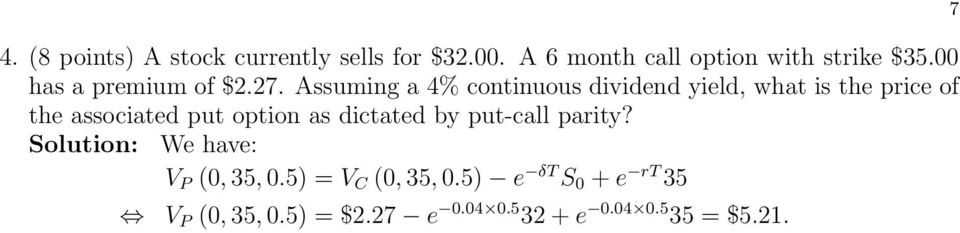
7 4. (8 points) A stock currently sells for $ A 6 month call option with strike $35.00 has a premium of $2.27. Assuming a 4% continuous dividend yield, what is the price of the associated put option as dictated by put-call parity? Solution: We have: V P (0, 35, 0.5) = V C (0, 35, 0.5) e δt S 0 + e rt 35 V P (0, 35, 0.5) = $2.27 e e = $
8 8 MULTIPLE CHOICE QUESTIONS Please, circle the correct answer on the front page of this exam. 1. The initial price of the market index is $900. After 3 months the market index is priced at $920. The nominal rate of interest convertible monthly is 4.8%. The premium on the long call, with a strike price of $930, is $2.00. What is the profit or loss at expiration for this long call? (a) $2.00 loss (b) $2.02 loss (c) $2.02 gain (d) $2.00 gain (e) None of the above. Solution: (b) In our usual notation, the profit is (S(T ) K) + C (1 + j) 3 with C denoting the price of the call and j the effective monthly interest rate. We get ( ) The premium on a 2-month call option on the market index with an exercise price of 1050 is $9.30 when originally purchased. After 2 months the position is closed and the index spot price is If interest rates are 0.5% effective per month, what is the call s profit? (a) $9.30 (b) $9.39 (c) $12.61 (d) $22.00 (e) None of the above. Solution: (c) The value at expiration of the cost of the call is The payoff of the call is = 22. So the profit is = Jafee Corp. common stock is priced at $36.50 per share. The company just paid its $0.50 quarterly dividend. Interest rates are 6.0%. A $35.00 strike European call, maturing in 6 months, sells for $3.20. What is the price P of a 6-month, $35.00 strike put option? (a) 0 P < $1.25 (b) $1.25 P < $1.45 (c) $1.45 P < $1.55 (d) $1.55 P < $1.66 (e) $1.66 P
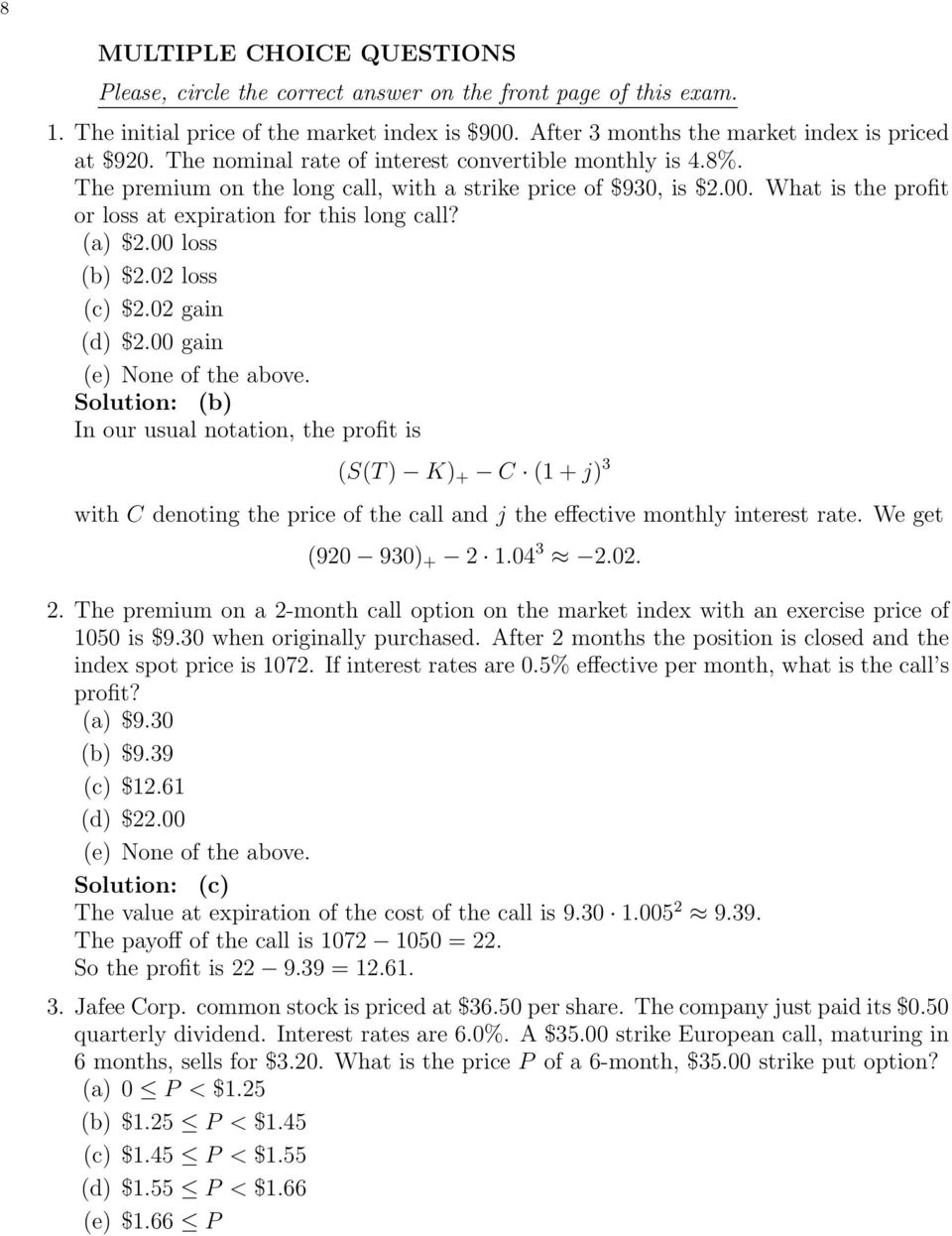
9 9 Solution: (d) V P (0) = V C (0) + Ke rt F P 0,T (S) = V C (0) + Ke rt S(0) + De rt 1 + De rt 2 = e 0.06/ e 0.06/ e 0.06/

10 10 4. (5 points) Consider an investment in S&P 500 Index futures contracts at a price of $1000. The initial margin requirement is 15.0% of the notional value. The maintenance margin is $100. If the continuously compounded interest rate is 5.0% what will the futures price need to be for a margin call to occur 10 days from now? Assume no settlement within the 10 days (i.e., the futures price does not change within the 10 days). (a) $ (b) $ (c) $ (d) $950 (e) None of the above. Solution: (c) Per futures contract, the initial deposit into the margin account is = 150. Over the course of the next 10 days, interest is accrued and the balance in the account at the end of the 10 days is 150e 0.05 (10/365) So, the price of an index futures contract should drop by = to cause a margin call. In other words, the index futures price needs to be = A certain common stock is priced at $74.20 per share. The company just paid its $1.10 quarterly dividend. Assume that the interest rate is r = 6.0%. Consider a $70 strike European call, maturing in 6 months which currently sells for $6.50. How much (arbitrage) profit/loss is made by shorting the corresponding European put whose premium is $2.50? (a) $0.15 loss (b) $0.15 gain (c) $0.36 loss (d) $0.36 gain (e) None of the above. Solution: (b) or (e) We can obtain the no-arbitrage premium of the corresponding put as dictated by put-call parity, as follows: V P (0, K = 70, T = 0.5) = V C (K = 70, T = 0.5) + e rt K S(0) + P V 0,T (Dividends) = e e e = = = Since we have decided to short the put at a premium higher by $0.12, the answer is 0.015e
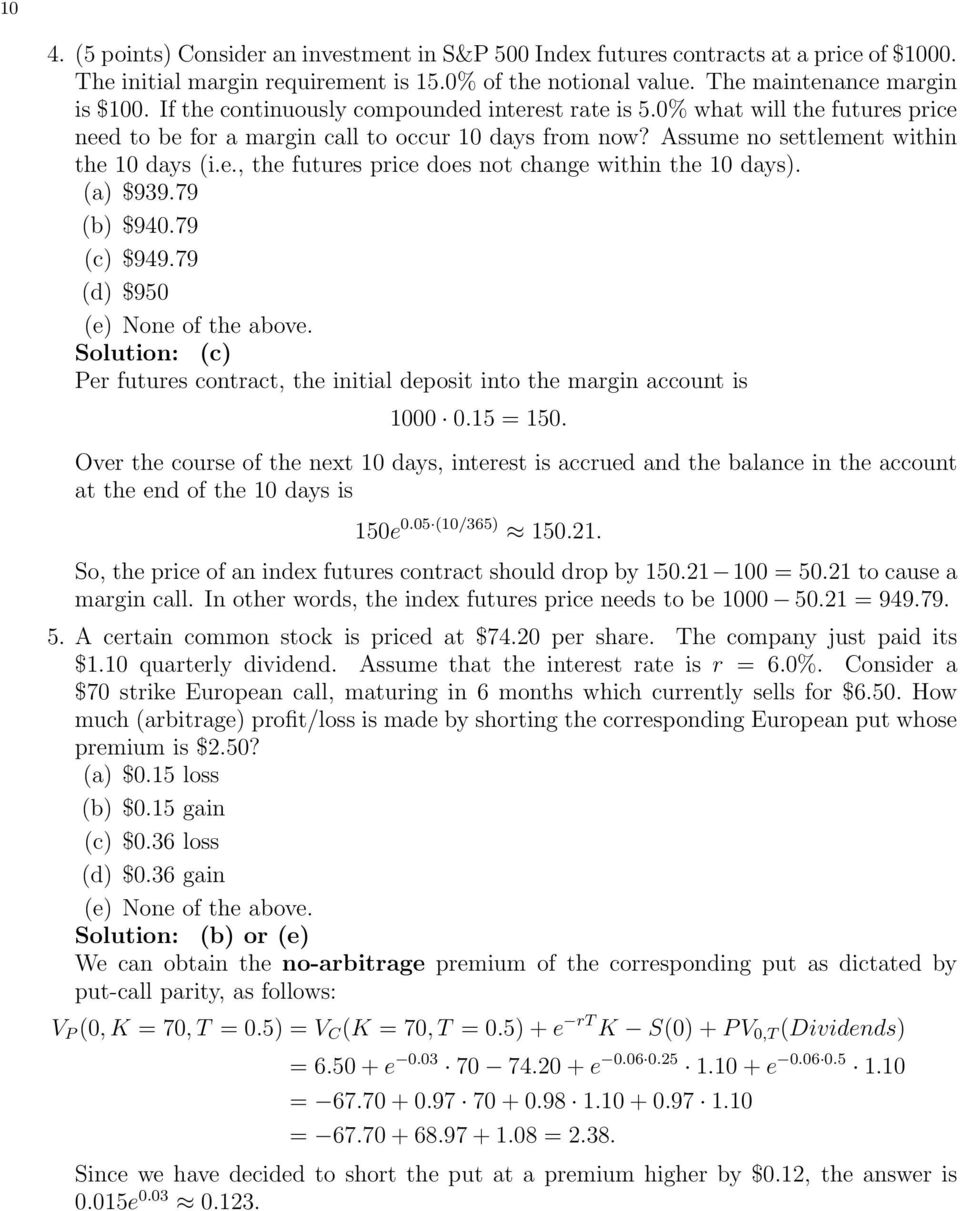
Figure S9.1 Profit from long position in Problem 9.9
 Problem 9.9 Suppose that a European call option to buy a share for $100.00 costs $5.00 and is held until maturity. Under what circumstances will the holder of the option make a profit? Under what circumstances
Finance 436 Futures and Options Review Notes for Final Exam. Chapter 9
 Finance 436 Futures and Options Review Notes for Final Exam Chapter 9 1. Options: call options vs. put options, American options vs. European options 2. Characteristics: option premium, option type, underlying
Call and Put. Options. American and European Options. Option Terminology. Payoffs of European Options. Different Types of Options
 Call and Put Options A call option gives its holder the right to purchase an asset for a specified price, called the strike price, on or before some specified expiration date. A put option gives its holder
American Options. An Undergraduate Introduction to Financial Mathematics. J. Robert Buchanan. J. Robert Buchanan American Options
 American Options An Undergraduate Introduction to Financial Mathematics J. Robert Buchanan 2010 Early Exercise Since American style options give the holder the same rights as European style options plus
Lecture 7: Bounds on Options Prices Steven Skiena. http://www.cs.sunysb.edu/ skiena
 Lecture 7: Bounds on Options Prices Steven Skiena Department of Computer Science State University of New York Stony Brook, NY 11794 4400 http://www.cs.sunysb.edu/ skiena Option Price Quotes Reading the
EC372 Bond and Derivatives Markets Topic #5: Options Markets I: fundamentals
 EC372 Bond and Derivatives Markets Topic #5: Options Markets I: fundamentals R. E. Bailey Department of Economics University of Essex Outline Contents 1 Call options and put options 1 2 Payoffs on options
Options Pricing. This is sometimes referred to as the intrinsic value of the option.
 Options Pricing We will use the example of a call option in discussing the pricing issue. Later, we will turn our attention to the Put-Call Parity Relationship. I. Preliminary Material Recall the payoff
University of Texas at Austin. HW Assignment 7. Butterfly spreads. Convexity. Collars. Ratio spreads.
 HW: 7 Course: M339D/M389D - Intro to Financial Math Page: 1 of 5 University of Texas at Austin HW Assignment 7 Butterfly spreads. Convexity. Collars. Ratio spreads. 7.1. Butterfly spreads and convexity.
CHAPTER 7: PROPERTIES OF STOCK OPTION PRICES
 CHAPER 7: PROPERIES OF SOCK OPION PRICES 7.1 Factors Affecting Option Prices able 7.1 Summary of the Effect on the Price of a Stock Option of Increasing One Variable While Keeping All Other Fixed Variable
Option Properties. Liuren Wu. Zicklin School of Business, Baruch College. Options Markets. (Hull chapter: 9)
 Option Properties Liuren Wu Zicklin School of Business, Baruch College Options Markets (Hull chapter: 9) Liuren Wu (Baruch) Option Properties Options Markets 1 / 17 Notation c: European call option price.
Lecture 5: Put - Call Parity
 Lecture 5: Put - Call Parity Reading: J.C.Hull, Chapter 9 Reminder: basic assumptions 1. There are no arbitrage opportunities, i.e. no party can get a riskless profit. 2. Borrowing and lending are possible
Overview. Option Basics. Options and Derivatives. Professor Lasse H. Pedersen. Option basics and option strategies
 Options and Derivatives Professor Lasse H. Pedersen Prof. Lasse H. Pedersen 1 Overview Option basics and option strategies No-arbitrage bounds on option prices Binomial option pricing Black-Scholes-Merton
Notes for Lecture 2 (February 7)
 CONTINUOUS COMPOUNDING Invest $1 for one year at interest rate r. Annual compounding: you get $(1+r). Semi-annual compounding: you get $(1 + (r/2)) 2. Continuous compounding: you get $e r. Invest $1 for
University of Texas at Austin. HW Assignment 4
 HW: 4 Course: M339D/M389D - Intro to Financial Math Page: 1 of 6 University of Texas at Austin HW Assignment 4 Arbitrage. Put options. Parallels between put options and homeowner s insurance. Digital options.
FIN-40008 FINANCIAL INSTRUMENTS SPRING 2008
 FIN-40008 FINANCIAL INSTRUMENTS SPRING 2008 Options These notes consider the way put and call options and the underlying can be combined to create hedges, spreads and combinations. We will consider the
Use the option quote information shown below to answer the following questions. The underlying stock is currently selling for $83.
 Problems on the Basics of Options used in Finance 2. Understanding Option Quotes Use the option quote information shown below to answer the following questions. The underlying stock is currently selling
OPTIONS MARKETS AND VALUATIONS (CHAPTERS 16 & 17)
 OPTIONS MARKETS AND VALUATIONS (CHAPTERS 16 & 17) WHAT ARE OPTIONS? Derivative securities whose values are derived from the values of the underlying securities. Stock options quotations from WSJ. A call
Option Valuation. Chapter 21
 Option Valuation Chapter 21 Intrinsic and Time Value intrinsic value of in-the-money options = the payoff that could be obtained from the immediate exercise of the option for a call option: stock price
Option Values. Determinants of Call Option Values. CHAPTER 16 Option Valuation. Figure 16.1 Call Option Value Before Expiration
 CHAPTER 16 Option Valuation 16.1 OPTION VALUATION: INTRODUCTION Option Values Intrinsic value - profit that could be made if the option was immediately exercised Call: stock price - exercise price Put:
A) 1.8% B) 1.9% C) 2.0% D) 2.1% E) 2.2%
 1 Exam FM Questions Practice Exam 1 1. Consider the following yield curve: Year Spot Rate 1 5.5% 2 5.0% 3 5.0% 4 4.5% 5 4.0% Find the four year forward rate. A) 1.8% B) 1.9% C) 2.0% D) 2.1% E) 2.2% 2.
SOCIETY OF ACTUARIES FINANCIAL MATHEMATICS. EXAM FM SAMPLE QUESTIONS Financial Economics
 SOCIETY OF ACTUARIES EXAM FM FINANCIAL MATHEMATICS EXAM FM SAMPLE QUESTIONS Financial Economics June 2014 changes Questions 1-30 are from the prior version of this document. They have been edited to conform
Factors Affecting Option Prices
 Factors Affecting Option Prices 1. The current stock price S 0. 2. The option strike price K. 3. The time to expiration T. 4. The volatility of the stock price σ. 5. The risk-free interest rate r. 6. The
Lecture 4: Properties of stock options
 Lecture 4: Properties of stock options Reading: J.C.Hull, Chapter 9 An European call option is an agreement between two parties giving the holder the right to buy a certain asset (e.g. one stock unit)
Manual for SOA Exam FM/CAS Exam 2.
 Manual for SOA Exam FM/CAS Exam 2. Chapter 7. Derivatives markets. c 2009. Miguel A. Arcones. All rights reserved. Extract from: Arcones Manual for the SOA Exam FM/CAS Exam 2, Financial Mathematics. Fall
CHAPTER 22: FUTURES MARKETS
 CHAPTER 22: FUTURES MARKETS PROBLEM SETS 1. There is little hedging or speculative demand for cement futures, since cement prices are fairly stable and predictable. The trading activity necessary to support
Determination of Forward and Futures Prices
 Determination of Forward and Futures Prices Options, Futures, and Other Derivatives, 8th Edition, Copyright John C. Hull 2012 Short selling A popular trading (arbitrage) strategy is the shortselling or
Session IX: Lecturer: Dr. Jose Olmo. Module: Economics of Financial Markets. MSc. Financial Economics
 Session IX: Stock Options: Properties, Mechanics and Valuation Lecturer: Dr. Jose Olmo Module: Economics of Financial Markets MSc. Financial Economics Department of Economics, City University, London Stock
Chapter 5 Financial Forwards and Futures
 Chapter 5 Financial Forwards and Futures Question 5.1. Four different ways to sell a share of stock that has a price S(0) at time 0. Question 5.2. Description Get Paid at Lose Ownership of Receive Payment
Determination of Forward and Futures Prices. Chapter 5
 Determination of Forward and Futures Prices Chapter 5 Fundamentals of Futures and Options Markets, 8th Ed, Ch 5, Copyright John C. Hull 2013 1 Consumption vs Investment Assets Investment assets are assets
Institutional Finance 08: Dynamic Arbitrage to Replicate Non-linear Payoffs. Binomial Option Pricing: Basics (Chapter 10 of McDonald)
 Copyright 2003 Pearson Education, Inc. Slide 08-1 Institutional Finance 08: Dynamic Arbitrage to Replicate Non-linear Payoffs Binomial Option Pricing: Basics (Chapter 10 of McDonald) Originally prepared
Underlying (S) The asset, which the option buyer has the right to buy or sell. Notation: S or S t = S(t)
 INTRODUCTION TO OPTIONS Readings: Hull, Chapters 8, 9, and 10 Part I. Options Basics Options Lexicon Options Payoffs (Payoff diagrams) Calls and Puts as two halves of a forward contract: the Put-Call-Forward
Finance 400 A. Penati - G. Pennacchi. Option Pricing
 Finance 400 A. Penati - G. Pennacchi Option Pricing Earlier we derived general pricing relationships for contingent claims in terms of an equilibrium stochastic discount factor or in terms of elementary
CHAPTER 22: FUTURES MARKETS
 CHAPTER 22: FUTURES MARKETS 1. a. The closing price for the spot index was 1329.78. The dollar value of stocks is thus $250 1329.78 = $332,445. The closing futures price for the March contract was 1364.00,
Trading Strategies Involving Options. Chapter 11
 Trading Strategies Involving Options Chapter 11 1 Strategies to be Considered A risk-free bond and an option to create a principal-protected note A stock and an option Two or more options of the same type
1.1 Some General Relations (for the no dividend case)
 1 American Options Most traded stock options and futures options are of American-type while most index options are of European-type. The central issue is when to exercise? From the holder point of view,
Lecture 12. Options Strategies
 Lecture 12. Options Strategies Introduction to Options Strategies Options, Futures, Derivatives 10/15/07 back to start 1 Solutions Problem 6:23: Assume that a bank can borrow or lend money at the same
2. How is a fund manager motivated to behave with this type of renumeration package?
 MØA 155 PROBLEM SET: Options Exercise 1. Arbitrage [2] In the discussions of some of the models in this course, we relied on the following type of argument: If two investment strategies have the same payoff
1 The Black-Scholes Formula
 1 The Black-Scholes Formula In 1973 Fischer Black and Myron Scholes published a formula - the Black-Scholes formula - for computing the theoretical price of a European call option on a stock. Their paper,
Financial Mathematics Exam
 2014 Exam 2 Syllabus Financial Mathematics Exam The purpose of the syllabus for this examination is to develop knowledge of the fundamental concepts of financial mathematics and how those concepts are
2015 Exam 2 Syllabus Financial Mathematics Exam
 2015 Exam 2 Syllabus Financial Mathematics Exam The syllabus for this exam is defined in the form of learning objectives that set forth, usually in broad terms, what the candidate should be able to do
9 Basics of options, including trading strategies
 ECG590I Asset Pricing. Lecture 9: Basics of options, including trading strategies 1 9 Basics of options, including trading strategies Option: The option of buying (call) or selling (put) an asset. European
Chapter 3: Commodity Forwards and Futures
 Chapter 3: Commodity Forwards and Futures In the previous chapter we study financial forward and futures contracts and we concluded that are all alike. Each commodity forward, however, has some unique
Bond Options, Caps and the Black Model
 Bond Options, Caps and the Black Model Black formula Recall the Black formula for pricing options on futures: C(F, K, σ, r, T, r) = Fe rt N(d 1 ) Ke rt N(d 2 ) where d 1 = 1 [ σ ln( F T K ) + 1 ] 2 σ2
Chapter 21: Options and Corporate Finance
 Chapter 21: Options and Corporate Finance 21.1 a. An option is a contract which gives its owner the right to buy or sell an underlying asset at a fixed price on or before a given date. b. Exercise is the
Chapter 1: Financial Markets and Financial Derivatives
 Chapter 1: Financial Markets and Financial Derivatives 1.1 Financial Markets Financial markets are markets for financial instruments, in which buyers and sellers find each other and create or exchange
FIN 3710. Final (Practice) Exam 05/23/06
 FIN 3710 Investment Analysis Spring 2006 Zicklin School of Business Baruch College Professor Rui Yao FIN 3710 Final (Practice) Exam 05/23/06 NAME: (Please print your name here) PLEDGE: (Sign your name
Chapter 20 Understanding Options
 Chapter 20 Understanding Options Multiple Choice Questions 1. Firms regularly use the following to reduce risk: (I) Currency options (II) Interest-rate options (III) Commodity options D) I, II, and III
TABLE OF CONTENTS. A. Put-Call Parity 1 B. Comparing Options with Respect to Style, Maturity, and Strike 13
 TABLE OF CONTENTS 1. McDonald 9: "Parity and Other Option Relationships" A. Put-Call Parity 1 B. Comparing Options with Respect to Style, Maturity, and Strike 13 2. McDonald 10: "Binomial Option Pricing:
Options. Moty Katzman. September 19, 2014
 Options Moty Katzman September 19, 2014 What are options? Options are contracts conferring certain rights regarding the buying or selling of assets. A European call option gives the owner the right to
Option Payoffs. Problems 11 through 16: Describe (as I have in 1-10) the strategy depicted by each payoff diagram. #11 #12 #13 #14 #15 #16
 Option s Problems 1 through 1: Assume that the stock is currently trading at $2 per share and options and bonds have the prices given in the table below. Depending on the strike price (X) of the option
CHAPTER 11 INTRODUCTION TO SECURITY VALUATION TRUE/FALSE QUESTIONS
 1 CHAPTER 11 INTRODUCTION TO SECURITY VALUATION TRUE/FALSE QUESTIONS (f) 1 The three step valuation process consists of 1) analysis of alternative economies and markets, 2) analysis of alternative industries
Invesco Great Wall Fund Management Co. Shenzhen: June 14, 2008
 : A Stern School of Business New York University Invesco Great Wall Fund Management Co. Shenzhen: June 14, 2008 Outline 1 2 3 4 5 6 se notes review the principles underlying option pricing and some of
Chapter 11 Options. Main Issues. Introduction to Options. Use of Options. Properties of Option Prices. Valuation Models of Options.
 Chapter 11 Options Road Map Part A Introduction to finance. Part B Valuation of assets, given discount rates. Part C Determination of risk-adjusted discount rate. Part D Introduction to derivatives. Forwards
Name Graph Description Payoff Profit Comments. commodity at some point in the future at a prespecified. commodity at some point
 Name Graph Description Payoff Profit Comments Long Commitment to purchase commodity at some point in the future at a prespecified price S T - F S T F No premium Asset price contingency: Always Maximum
Chapter 21 Valuing Options
 Chapter 21 Valuing Options Multiple Choice Questions 1. Relative to the underlying stock, a call option always has: A) A higher beta and a higher standard deviation of return B) A lower beta and a higher
Introduction to Binomial Trees
 11 C H A P T E R Introduction to Binomial Trees A useful and very popular technique for pricing an option involves constructing a binomial tree. This is a diagram that represents di erent possible paths
Lecture 4: Derivatives
 Lecture 4: Derivatives School of Mathematics Introduction to Financial Mathematics, 2015 Lecture 4 1 Financial Derivatives 2 uropean Call and Put Options 3 Payoff Diagrams, Short Selling and Profit Derivatives
On Black-Scholes Equation, Black- Scholes Formula and Binary Option Price
 On Black-Scholes Equation, Black- Scholes Formula and Binary Option Price Abstract: Chi Gao 12/15/2013 I. Black-Scholes Equation is derived using two methods: (1) risk-neutral measure; (2) - hedge. II.
Introduction, Forwards and Futures
 Introduction, Forwards and Futures Liuren Wu Zicklin School of Business, Baruch College Fall, 2007 (Hull chapters: 1,2,3,5) Liuren Wu Introduction, Forwards & Futures Option Pricing, Fall, 2007 1 / 35
TPPE17 Corporate Finance 1(5) SOLUTIONS RE-EXAMS 2014 II + III
 TPPE17 Corporate Finance 1(5) SOLUTIONS RE-EXAMS 2014 II III Instructions 1. Only one problem should be treated on each sheet of paper and only one side of the sheet should be used. 2. The solutions folder
Lecture Notes: Basic Concepts in Option Pricing - The Black and Scholes Model
 Brunel University Msc., EC5504, Financial Engineering Prof Menelaos Karanasos Lecture Notes: Basic Concepts in Option Pricing - The Black and Scholes Model Recall that the price of an option is equal to
CFA Level -2 Derivatives - I
 CFA Level -2 Derivatives - I EduPristine www.edupristine.com Agenda Forwards Markets and Contracts Future Markets and Contracts Option Markets and Contracts 1 Forwards Markets and Contracts 2 Pricing and
Option Premium = Intrinsic. Speculative Value. Value
 Chapters 4/ Part Options: Basic Concepts Options Call Options Put Options Selling Options Reading The Wall Street Journal Combinations of Options Valuing Options An Option-Pricing Formula Investment in
ACTS 4302 SOLUTION TO MIDTERM EXAM Derivatives Markets, Chapters 9, 10, 11, 12, 18. October 21, 2010 (Thurs)
 Problem ACTS 4302 SOLUTION TO MIDTERM EXAM Derivatives Markets, Chapters 9, 0,, 2, 8. October 2, 200 (Thurs) (i) The current exchange rate is 0.0$/. (ii) A four-year dollar-denominated European put option
2 Stock Price. Figure S1.1 Profit from long position in Problem 1.13
 Problem 1.11. A cattle farmer expects to have 12, pounds of live cattle to sell in three months. The livecattle futures contract on the Chicago Mercantile Exchange is for the delivery of 4, pounds of cattle.
Options/1. Prof. Ian Giddy
 Options/1 New York University Stern School of Business Options Prof. Ian Giddy New York University Options Puts and Calls Put-Call Parity Combinations and Trading Strategies Valuation Hedging Options2
How To Value Options In Black-Scholes Model
 Option Pricing Basics Aswath Damodaran Aswath Damodaran 1 What is an option? An option provides the holder with the right to buy or sell a specified quantity of an underlying asset at a fixed price (called
Hedging with Futures and Options: Supplementary Material. Global Financial Management
 Hedging with Futures and Options: Supplementary Material Global Financial Management Fuqua School of Business Duke University 1 Hedging Stock Market Risk: S&P500 Futures Contract A futures contract on
Chapter 8 Financial Options and Applications in Corporate Finance ANSWERS TO END-OF-CHAPTER QUESTIONS
 Chapter 8 Financial Options and Applications in Corporate Finance ANSWERS TO END-OF-CHAPTER QUESTIONS 8-1 a. An option is a contract which gives its holder the right to buy or sell an asset at some predetermined
11 Option. Payoffs and Option Strategies. Answers to Questions and Problems
 11 Option Payoffs and Option Strategies Answers to Questions and Problems 1. Consider a call option with an exercise price of $80 and a cost of $5. Graph the profits and losses at expiration for various
b. June expiration: 95-23 = 95 + 23/32 % = 95.71875% or.9571875.9571875 X $100,000 = $95,718.75.
 ANSWERS FOR FINANCIAL RISK MANAGEMENT A. 2-4 Value of T-bond Futures Contracts a. March expiration: The settle price is stated as a percentage of the face value of the bond with the final "27" being read
Convenient Conventions
 C: call value. P : put value. X: strike price. S: stock price. D: dividend. Convenient Conventions c 2015 Prof. Yuh-Dauh Lyuu, National Taiwan University Page 168 Payoff, Mathematically Speaking The payoff
Part V: Option Pricing Basics
 erivatives & Risk Management First Week: Part A: Option Fundamentals payoffs market microstructure Next 2 Weeks: Part B: Option Pricing fundamentals: intrinsic vs. time value, put-call parity introduction
CHAPTER 20. Financial Options. Chapter Synopsis
 CHAPTER 20 Financial Options Chapter Synopsis 20.1 Option Basics A financial option gives its owner the right, but not the obligation, to buy or sell a financial asset at a fixed price on or until a specified
Options: Valuation and (No) Arbitrage
 Prof. Alex Shapiro Lecture Notes 15 Options: Valuation and (No) Arbitrage I. Readings and Suggested Practice Problems II. Introduction: Objectives and Notation III. No Arbitrage Pricing Bound IV. The Binomial
Assumptions: No transaction cost, same rate for borrowing/lending, no default/counterparty risk
 Derivatives Why? Allow easier methods to short sell a stock without a broker lending it. Facilitates hedging easily Allows the ability to take long/short position on less available commodities (Rice, Cotton,
Lecture 11. Sergei Fedotov. 20912 - Introduction to Financial Mathematics. Sergei Fedotov (University of Manchester) 20912 2010 1 / 7
 Lecture 11 Sergei Fedotov 20912 - Introduction to Financial Mathematics Sergei Fedotov (University of Manchester) 20912 2010 1 / 7 Lecture 11 1 American Put Option Pricing on Binomial Tree 2 Replicating
UCLA Anderson School of Management Daniel Andrei, Derivative Markets 237D, Winter 2014. MFE Midterm. February 2014. Date:
 UCLA Anderson School of Management Daniel Andrei, Derivative Markets 237D, Winter 2014 MFE Midterm February 2014 Date: Your Name: Your Equiz.me email address: Your Signature: 1 This exam is open book,
EXP 481 -- Capital Markets Option Pricing. Options: Definitions. Arbitrage Restrictions on Call Prices. Arbitrage Restrictions on Call Prices 1) C > 0
 EXP 481 -- Capital Markets Option Pricing imple arbitrage relations Payoffs to call options Black-choles model Put-Call Parity Implied Volatility Options: Definitions A call option gives the buyer the
Lecture 12: The Black-Scholes Model Steven Skiena. http://www.cs.sunysb.edu/ skiena
 Lecture 12: The Black-Scholes Model Steven Skiena Department of Computer Science State University of New York Stony Brook, NY 11794 4400 http://www.cs.sunysb.edu/ skiena The Black-Scholes-Merton Model
Review of Basic Options Concepts and Terminology
 Review of Basic Options Concepts and Terminology March 24, 2005 1 Introduction The purchase of an options contract gives the buyer the right to buy call options contract or sell put options contract some
INSTALMENT WARRANT MECHANICS
 INSTALMENT WARRANT MECHANICS Antonie A. Kotzé Financial Chaos Theory [email protected] Abstract Instalment warrants are very popular in Australia and these instruments have been listed by Nedbank
Jorge Cruz Lopez - Bus 316: Derivative Securities. Week 11. The Black-Scholes Model: Hull, Ch. 13.
 Week 11 The Black-Scholes Model: Hull, Ch. 13. 1 The Black-Scholes Model Objective: To show how the Black-Scholes formula is derived and how it can be used to value options. 2 The Black-Scholes Model 1.
SAMPLE MID-TERM QUESTIONS
 SAMPLE MID-TERM QUESTIONS William L. Silber HOW TO PREPARE FOR THE MID- TERM: 1. Study in a group 2. Review the concept questions in the Before and After book 3. When you review the questions listed below,
Finance 350: Problem Set 6 Alternative Solutions
 Finance 350: Problem Set 6 Alternative Solutions Note: Where appropriate, the final answer for each problem is given in bold italics for those not interested in the discussion of the solution. I. Formulas
Lectures. Sergei Fedotov. 20912 - Introduction to Financial Mathematics. No tutorials in the first week
 Lectures Sergei Fedotov 20912 - Introduction to Financial Mathematics No tutorials in the first week Sergei Fedotov (University of Manchester) 20912 2010 1 / 1 Lecture 1 1 Introduction Elementary economics
CHAPTER 15. Option Valuation
 CHAPTER 15 Option Valuation Just what is an option worth? Actually, this is one of the more difficult questions in finance. Option valuation is an esoteric area of finance since it often involves complex
n(n + 1) 2 1 + 2 + + n = 1 r (iii) infinite geometric series: if r < 1 then 1 + 2r + 3r 2 1 e x = 1 + x + x2 3! + for x < 1 ln(1 + x) = x x2 2 + x3 3
 ACTS 4308 FORMULA SUMMARY Section 1: Calculus review and effective rates of interest and discount 1 Some useful finite and infinite series: (i) sum of the first n positive integers: (ii) finite geometric
Introduction to Options. Derivatives
 Introduction to Options Econ 422: Investment, Capital & Finance University of Washington Summer 2010 August 18, 2010 Derivatives A derivative is a security whose payoff or value depends on (is derived
Derivatives: Options
 Derivatives: Options Call Option: The right, but not the obligation, to buy an asset at a specified exercise (or, strike) price on or before a specified date. Put Option: The right, but not the obligation,
FIN-40008 FINANCIAL INSTRUMENTS SPRING 2008. Options
 FIN-40008 FINANCIAL INSTRUMENTS SPRING 2008 Options These notes describe the payoffs to European and American put and call options the so-called plain vanilla options. We consider the payoffs to these
Options, Futures, and Other Derivatives 7 th Edition, Copyright John C. Hull 2008 2
 Mechanics of Options Markets Chapter 8 Options, Futures, and Other Derivatives, 7th Edition, Copyright John C. Hull 2008 1 Review of Option Types A call is an option to buy A put is an option to sell A
Fin 3710 Investment Analysis Professor Rui Yao CHAPTER 14: OPTIONS MARKETS
 HW 6 Fin 3710 Investment Analysis Professor Rui Yao CHAPTER 14: OPTIONS MARKETS 4. Cost Payoff Profit Call option, X = 85 3.82 5.00 +1.18 Put option, X = 85 0.15 0.00-0.15 Call option, X = 90 0.40 0.00-0.40
FINANCIAL ECONOMICS OPTION PRICING
 OPTION PRICING Options are contingency contracts that specify payoffs if stock prices reach specified levels. A call option is the right to buy a stock at a specified price, X, called the strike price.
Option pricing. Vinod Kothari
 Option pricing Vinod Kothari Notation we use this Chapter will be as follows: S o : Price of the share at time 0 S T : Price of the share at time T T : time to maturity of the option r : risk free rate
Options Markets: Introduction
 Options Markets: Introduction Chapter 20 Option Contracts call option = contract that gives the holder the right to purchase an asset at a specified price, on or before a certain date put option = contract
SOCIETY OF ACTUARIES FINANCIAL MATHEMATICS EXAM FM SAMPLE QUESTIONS
 SOCIETY OF ACTUARIES EXAM FM FINANCIAL MATHEMATICS EXAM FM SAMPLE QUESTIONS This page indicates changes made to Study Note FM-09-05. April 28, 2014: Question and solutions 61 were added. January 14, 2014:
1 The Black-Scholes model: extensions and hedging
 1 The Black-Scholes model: extensions and hedging 1.1 Dividends Since we are now in a continuous time framework the dividend paid out at time t (or t ) is given by dd t = D t D t, where as before D denotes