
Invesco Great Wall Fund Management Co. Shenzhen: June 14, 2008
|
|
|
- Cory Heath
- 10 years ago
- Views:
Transcription
1 : A Stern School of Business New York University Invesco Great Wall Fund Management Co. Shenzhen: June 14, 2008
2 Outline

3 se notes review the principles underlying option pricing and some of the key concepts. One objective is to highlight the factors that affect option prices, and to see how and why they matter. We also discuss important concepts such as the option delta and its properties, implied volatility and the volatility skew. For the most part, we focus on the model, but as motivation and illustration, we also briefly examine the binomial model.

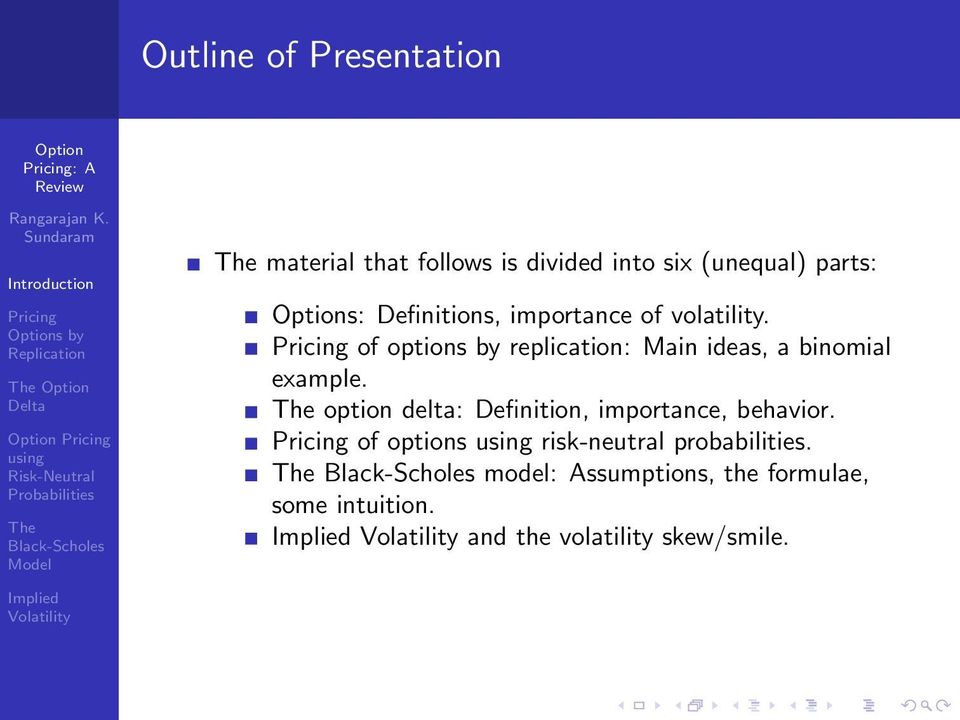
4 Outline of Presentation material that follows is divided into six (unequal) parts: s: Definitions, importance of volatility. of options by replication: Main ideas, a binomial example. option delta: Definition, importance, behavior. of options risk-neutral probabilities. model: Assumptions, the formulae, some intuition. and the volatility skew/smile.
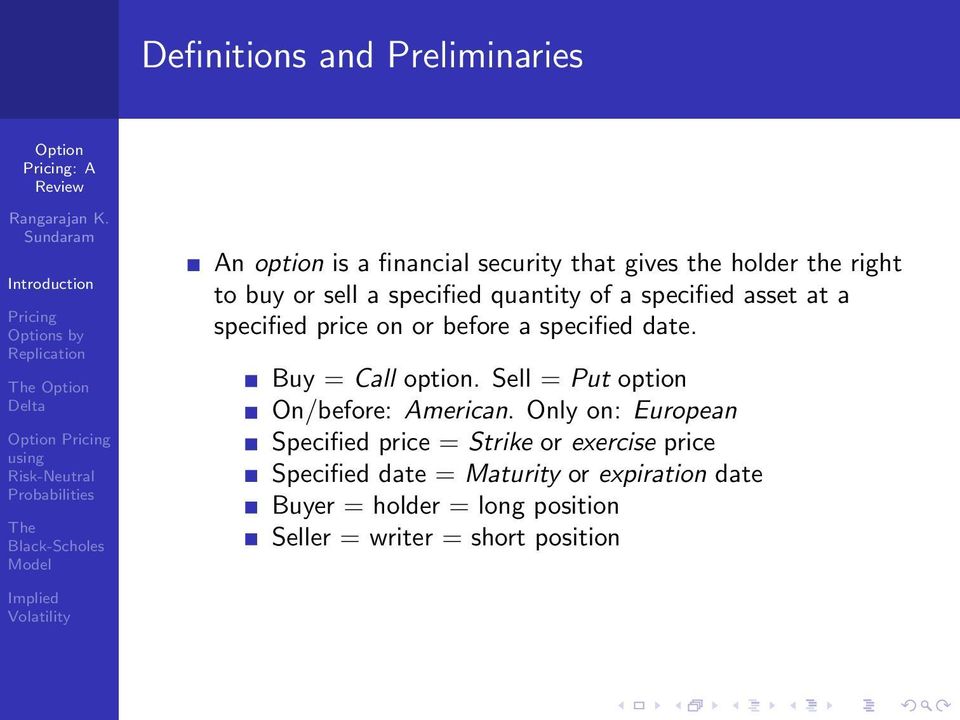
5 Definitions and Preliminaries An option is a financial security that gives the holder the right to buy or sell a specified quantity of a specified asset at a specified price on or before a specified date. Buy = Call option. Sell = Put option On/before: American. Only on: European Specified price = Strike or exercise price Specified date = Maturity or expiration date Buyer = holder = long position Seller = writer = short position
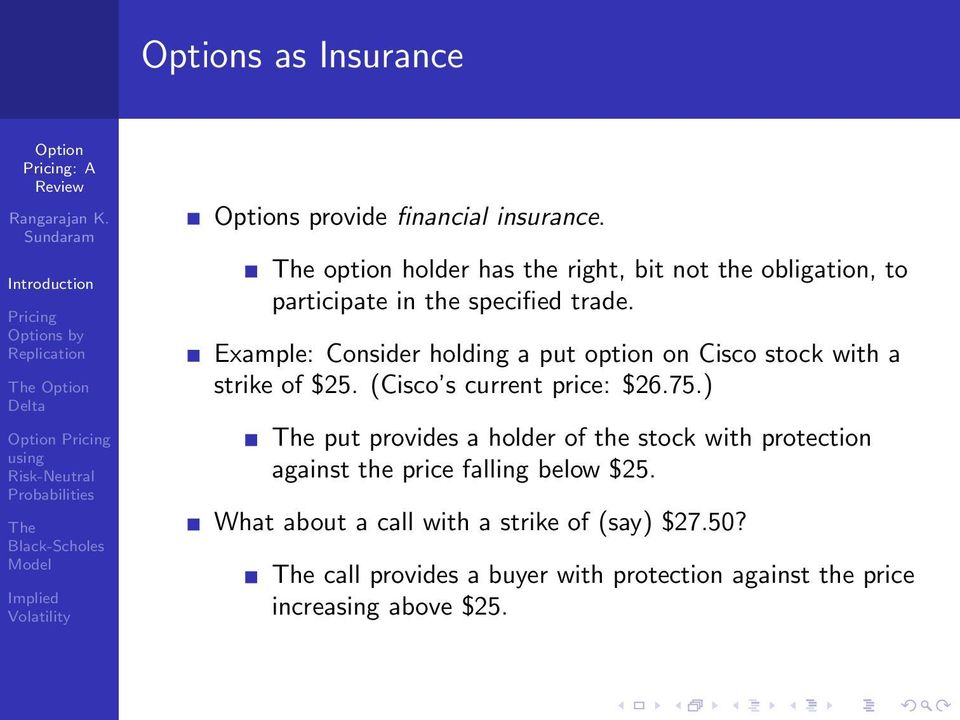
6 s as Insurance s provide financial insurance. option holder has the right, bit not the obligation, to participate in the specified trade. Example: Consider holding a put option on Cisco stock with a strike of $25. (Cisco s current price: $26.75.) put provides a holder of the stock with protection against the price falling below $25. What about a call with a strike of (say) $27.50? call provides a buyer with protection against the price increasing above $25.
7 Premium writer of the option provides this insurance to the holder. In exchange, writer receives an upfront fee called the option price or the option premium. Key question we examine: How is this price determined? What factors matter?
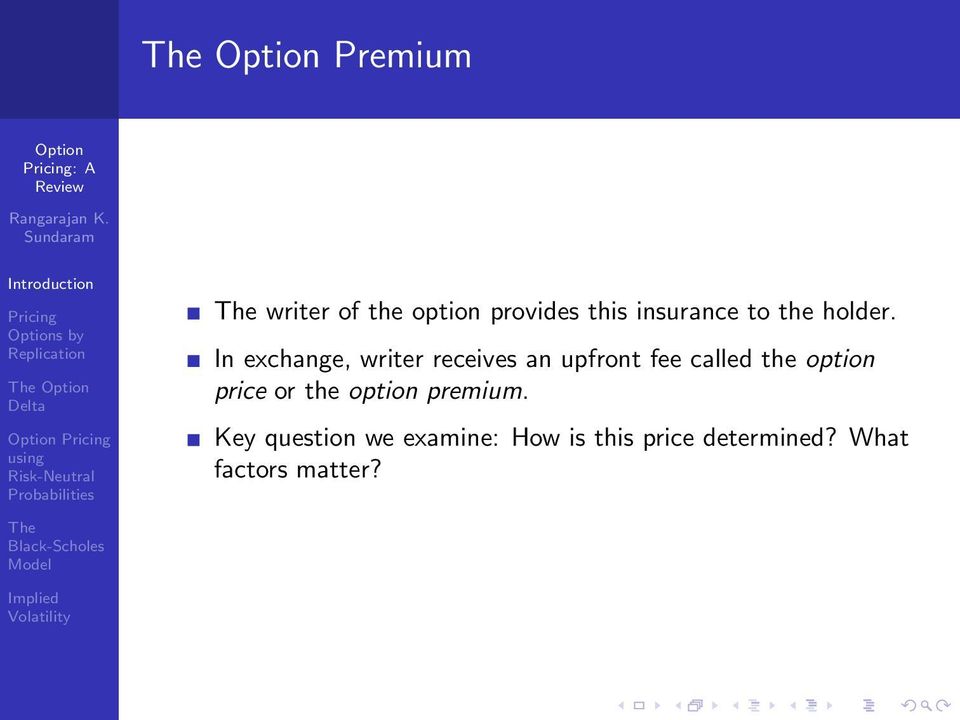
8 Importance of : A Simple Example Suppose current stock price is S = 100. Consider two possible distributions for S T. In each case, suppose that the up and down moves each have probability 1/ Case 1: Low Vol Case 2: High Vol Same mean but second distribution is more volatile.
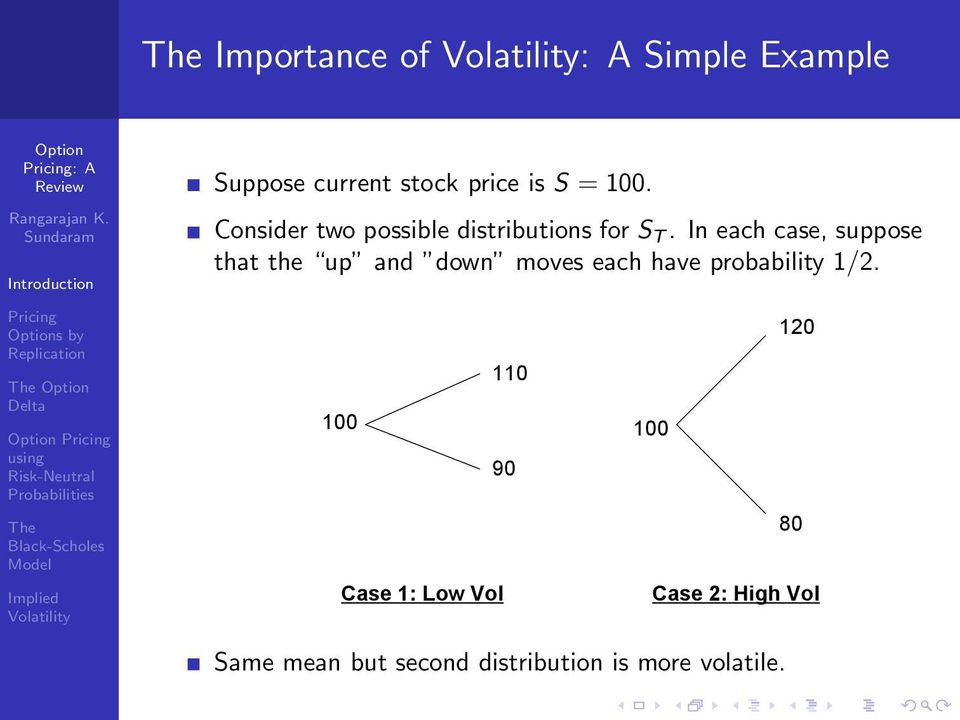
9 Call Payoffs and Consider a call with a strike of K = 100. Payoffs from the call at maturity: 10 C C Call Payoffs: Low Vol Call Payoffs: High Vol second distribution for S T clearly yields superior payoffs.
10 Put Payoffs and Puts similarly benefit from volatility. Consider a put with a strike of K = 100. Payoffs at maturity: 0 0 P 10 Put Payoffs: Low Vol P 20 Put Payoffs: High Vol Once again, the second distribution for S T clearly yields superior payoffs.

11 s and (Cont d) In both cases, the superior payoffs from high volatility are a consequence of optionality. A forward with a delivery price of K = 100 does not similarly benefit from volatility. Thus, all long option positions are also long volatility positions. That is, long option positions increase in value when volatility goes up and decrease in value when volatility goes down. Of course, this means that all written option positions are short volatility positions. Thus, the amount of volatility anticipated over an option s life is a central determinant of option values.

12 Put Call Parity One of the most important results in all of option pricing theory. It relates the prices of otherwise identical European puts and calls: P + S = C + PV (K). Put-call parity is proved by comparing two portfolios and showing that they have the same payoffs at maturity. Portfolio A Long stock, long put with strike K and maturity T. Portfolio B Long call with strike K and maturity T, investment of PV (K) for maturity at T.

13 s and As with all derivatives, the basic idea behind pricing options is replication: we look to create identical payoffs to the option s Long/short positions in the underlying secutiy. Default-risk-free investment/borrowing. Once we have a portfolio that replicates the option, the cost of the option must be equal to the cost of replicating (or synthesizing ) it.
14 (Cont d) As we have just seen, volatility is a primary determinant of option value, so we cannot price options without first modelling volatility. More generally, we need to model uncertainty in the evolution of the price of the underlying security. It is this dimension that makes option pricing more complex than forward pricing. It is also on this dimension that different option pricing models make different assumptions: Discrete ( lattice ) models: e.g., the binomial. Continuous models: e.g.,.

15 (Cont d) Once we have a model of prices evolution, options can be priced by replication: Identify option payoffs at maturity. Set up a portfolio to replicate these payoffs. Value the portfolio and hence price the option. replication process can be technically involved; we illustrate it a simple example a one-period binomial model. From the example, we draw inferences about the replication process in general, and, in particular, about the behavior of the option delta. Using the intuition gained here, we examine the model.
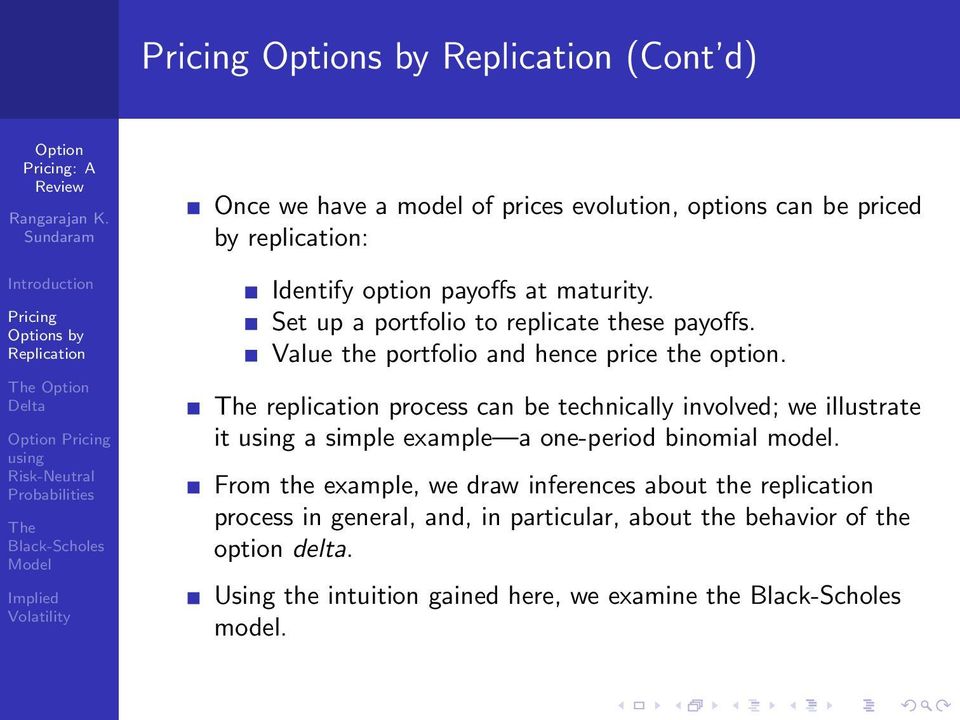
16 A Binomial Example Consider a stock that is currently trading at S = 100. Suppose that one period from now, it will have one of two possible prices: either us = 110 or ds = 90. Suppose further that it is possible to borrow or lend over this period at an interest rate of 2%. What should be the price of a call option that expires in one period and has a strike price of K = 100? What about a similar put option?
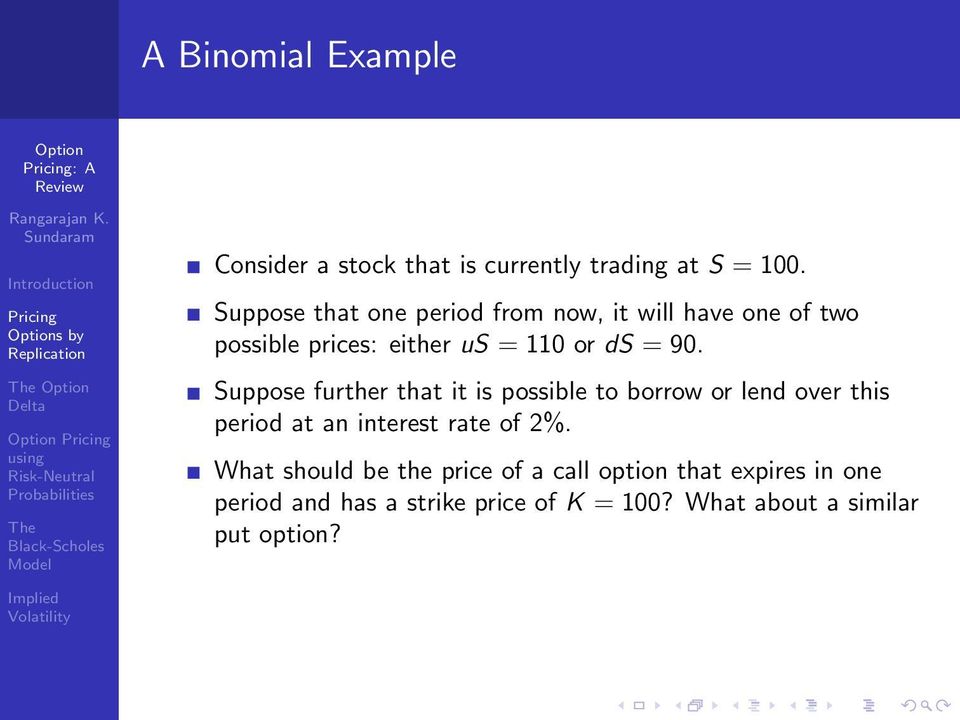
17 the Call We price the call in three steps: First, we identify its possible payoffs at maturity. n, we set up a portfolio to replicate these payoffs. Finally, we compute the cost of this replicating portfolio. Step 1 is simple: the call will be exercised if state u occurs, and not otherwise: Call payoff if us = 10. Call payoff if ds = 0.
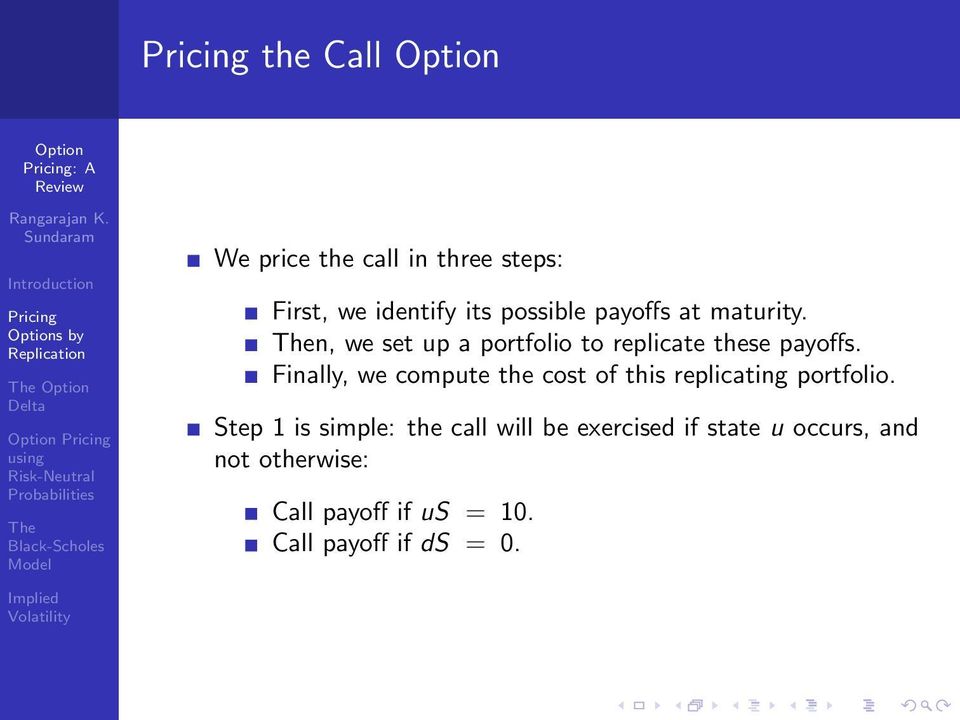
18 Call Problem C Stock Cash Call
19 Replicating Portfolio for the Call To replicate the call, consider the following portfolio: c units of stock. B units of lending/borrowing. Note that c and B can be positive or negative. c > 0: we are buying the stock. c < 0: we are selling the stock. B > 0: we are investing. B < 0: we are borrowing.

20 Replicating Portfolio for the Call For the portfolio to replicate the call, we must have: c (110) + B (1.02) = 10 c (90) + B (1.02) = 0 Solving, we obtain: C = 0.50 B = In words, the following portfolio perfectly replicates the call option: A long position in 0.50 units of the stock. Borrowing of

21 the Call (Cont d) Cost of this portfolio: (0.50) (100) (44.12)(1) = Since the portfolio perfectly replicates the call, we must have C = Any other price leads to arbitrage: If C > 5.88, we can sell the call and buy the replicating portfolio. If C < 5.88, we can buy the call and sell the replicating portfolio.
22 the Put To replicate the put, consider the following portfolio: p units of stock. B units of bond. It can be shown that the replicating portfolio now involves a short position in the stock and investment: p = 0.50: a short position in 0.50 units of the stock. B = : investment of As a consequence, the arbitrage-free price of the put is ( 0.50)(100) = 3.92.
23 Summary prices depend on volatility. Thus, option pricing models begin with a description of volatility, or, more generally, of how the prices of the underlying evolves over time. Given a model of price evolution, options may be priced by replication. Replicating a call involves a long position in the underlying and borrowing. Replicating a put involves a short position in the underlying and investment. A key step in the replication process is identification of the option delta, i.e., the size of the underlying position in the replicating portfolio. We turn to a more detailed examination of the delta now.
24 delta of an option is the number of units of the underlying security that must be used to replicate the option. As such, the delta measures the riskiness of the option in terms of the underlying. For example: if the delta of an option is (say) +0.60, then, roughly speaking, the risk in the option position is the same as the risk in being long 0.60 units of the underlying security. Why roughly speaking?
25 in Hedging Risk delta is central to pricing options by replication. As a consequence, it is also central to hedging written option positions. For example, suppose we have written a call whose delta is currently n, the risk in the call is the same as the risk in a long position in 0.70 units of the underlying. Since we are short the call, we are essentially short 0.70 units of the underlying. Thus, to hedge the position we simply buy 0.70 units of the underlying asset. This is delta hedging.
26 in Aggregating Risk delta enables us to aggregate option risk (on a given underlying) and express it in terms of the underlying. For example, suppose we have a portfolio of stocks on IBM stock with possibly different strikes and maturities: Long 2000 calls (strike K 1, maturity T 1 ), each with a delta of Long 1000 puts (strike K 2, maturity T 2 ), each with a delta of Short 1700 calls (strike K 3, maturity T 3 ), each with a delta of What is the aggregate risk in this portfolio?
27 in Aggregating Risk Each of the first group of options (the strike K 1, maturity T 1 calls) is like being long 0.48 units of the stock. Since the portfolio is long 2,000 of these calls, the aggregate position is akin to being long = 960 units of the stock. Similarly, the second group of options (the strike K 2, maturity T 2 puts) is akin to being short = 550 units of the stock. third group of options (the strike K 3, maturity T 3 calls) is akin to being short = 1071 units of the stock. Thus, the aggregate position is: = 661 or a short position in 661 units of the stock. This can be delta hedged by taking an offsetting long position in the stock.
28 as a Sensitivity measure delta is also a sensitivity measure: it provides a snapshot estimate of the dollar change in the value of a call for a given change in the price of the underlying. For example, suppose the delta of a call is n, holding the call is like holding units of the stock. Thus, a change of $1 in the price of the stock will lead to a change of in the value of the call.
29 Sign of the In the binomial examples, the delta of the call was positive, while that of the put was negative. se properties must always hold. That is: A long call option position is qualitatively like a long position in the underlying security. A long put option position is qualitatively like a short position in the underlying security. Why is this the case?
30 Maximum Value of the Moreover, the delta of a call must always be less than +1. maximum gain in the call s payoff per dollar increase in the price of the underlying is $1. Thus, we never need more than one unit of the underlying in the replicating portfolio. Similarly, the delta of a put must always be greater than 1 since the maximum loss on the put for a $1 increase in the stock price is $1.
31 Depth-in-the-Money ( Moneyness ) and the delta of an option depends in a central way on the option s depth-in-the-money. Consider a call: If S K (i.e., is very high relative to K), the delta of a call will be close to +1. If S K (i.e., is very small relative to K), the delta of the call will be close to zero. In general, as the stock price increases, the delta of the call will increase from 0 to +1.
32 Moneyness and Put s Now, consider a put. If S K, the put is deep out-of-the-money. Its delta will be close to zero. If S K, the put is deep in-the-money. Its delta will be close to 1. In general, as the stock price increases, the delta of the put increases from 1 to 0.
33 Moneyness and s To summarize the dependence on moneyness: delta of a deep out-of-the-money option is close to zero. absolute value of the delta of a deep in-the-money option is close to 1. As the option moves from out-of-the-money to in-the-money, the absolute value of the delta increases from 0 towards 1. behavior of the call and put deltas are illustrated in the figure on the next page.
34 s s Stock Prices Call Put
35 Implications for /Hedging option delta s behavior has an important implication for option replication. In pricing forwards, buy-and-hold strategies in the spot asset suffice to replicate the outcome of the forward contract. In contrast, since an option s depth-in-the-money changes with time, so will its delta. Thus, a static buy-and-hold strategy will not suffice to replicate an option. Rather, one must use a dynamic replication strategy in which the holding of the underlying security is constantly adjusted to reflect the option s changing delta.
36 Summary option delta measures the number of units of the underlying that must be held in a replicating portfolio. As such, the option delta plays many roles:. (-)Hedging. As a sensitivity measure. option delta depends on depth-in-the-money of the option: It is close to unity for deep in-the-money options. It is close to zero for deep out-of-the-money options. Thus, it offers an intuitive feel for the probability the option will finish in-the-money.
37 An alternative approach to identifying the fair value of an option is to use the model s risk-neutral (or risk-adjusted) probabilities. This approach is guaranteed to give the same answer as replication, but is computationally a lot simpler. follows a three-step procedure. Identify the model s risk-neutral probability. Take expectations of the option s payoffs under the risk-neutral probability. Discount these expectations back to the present at the risk-free rate. number obtained in Step 3 is the fair value of the option.
38 Probability risk-neutral probability is that probability under which expected returns on all the model s assets are the same. For example, the binomial model has two assets: the stock which returns u or d, and the risk-free asset which returns R. (R = 1+ the risk-free interest rate.) If q and 1 q denote, respectively, the risk-neutral probabilities of state u and state d, then q must satisfy q u + (1 q) d = R. This means the risk-neutral probability in the binomial model is q = R d u d.
39 n Example Consider the one-period binomial example in which u = 1.10, d = 0.90, and R = In this case, q = = refore, the expected payoffs of the call under the risk-neutral probability is (0.60)(10) + (0.40)(0) = 6. Discounting these payoffs back to the present at the risk-free rate results in = 5.88, which is the same price for the option obtained by replication.
40 Second Example Now consider pricing the put with strike K = 100. expected payoff from the put at maturity is (0.60)(0) + (0.40)(10) = 4. Discounting this back to the present at the risk-free rate, we obtain = 3.92, which is the same price obtained via replication. As these examples show, risk-neutral pricing is computationally much simpler than replication.
41 Balck-Scholes Black Scholes model is unambiguously the best known model of option pricing. Also one of the most widely used: it is the benchmark model for Equities. Stock indices. Currencies. Futures. Moreover, it forms the basis of the Black model that is commonly used to price some interest-rate derivatives such as caps and floors.
42 (Cont d) Technically, the model is much more complex than discrete models like the binomial. In particular, it assumes continuous evolution of uncertainty. options in this framework requires the use of very sophisticated mathematics. What is gained by all this sophistication? prices in the model can be expressed in closed-form, i.e., as particular explicit functions of the parameters. This makes computing option prices and option sensitivities very easy.
43 Assumptions of the main assumption of the model pertains to the evolution of the stock price. This price is taken to evolve according to a geometric Brownian motion. Shorn of technical details, this says essentially that two conditions must be met: Returns on the stock have a lognormal distribution with constant volatility. Stock prices cannot jump (the market cannot gap ).
44 Log-Normal Assumption log-normal assumption says that the (natural) log of returns is normally distributed: if S denotes the current price, and S t the price t years from the present, then ( ) St ln N(µt, σ 2 t). S Mathematically, log-returns and continuously-compounded returns represent the same thing: ( ) St ln = x S t S S = ex S t = Se x. Thus, log-normality says that returns on the stock, expressed in continuously-compounded terms, are normally distributed.
45 number σ is called the volatility of the stock. Thus, volatility in the model refers to the standard deviation of annual log-returns. model takes this volatility to be a constant. In principle, this volatility can be estimated in two ways: From historical data. (This is called historical volatility.) From options prices. (This is called implied volatility.) We discuss the issue of volatility estimation in the last part of this segment. For now, assume the level of volatility is known.
46 Is GBM a Reasonable Assumption? log-normality and no-jumps conditions appear unreasonably restrictive: of markets is typically not constant over time. Market prices do sometimes jump. In particular, the no-jumps assumption appears to rule out dividends. Dividends (and similar predictable jumps) are actually easily handled by the model. other issues are more problematic, and not easily resolved. We discuss them in the last part of this presentation.
47 Prices in the prices in the Black Scholes model may be recovered a replicating portfolio argument. Of course, the construction and maintenence of a replicating portfolio is significantly more technically complex here than in the binomial model. We focus here instead on the final option prices that result and the intuitive content of these prices.
48 Notation t: current time. T : Horizon of the model. (So time-left-to-maturity: T t.) K: strike price of option. S t : current price of stock. S T : stock price at T. µ, σ: Expected return and volatility of stock (annualized). r: risk-free rate of interest. C, P: Prices of call and put (European only).
49 Call Prices in the call-pricing formula in the model is C = S t N(d 1 ) e r(t t) K N(d 2 ) where N( ) is the cumulative standard normal distribution [N(x) is the probability under a standard normal distribution of an observation less than or equal to x], and d 1 = d 2 1 σ T t = d 1 σ T t [ ( ) St ln + (r + 1 ] K 2 σ2 )(T t) This formula has a surprisingly simple interpretation.
50 Call Prices and To replicate a call in general, we must Take a long position in c units of the underlying, and Borrow B c at the risk-free rate. cost of this replicating portfolio which is the call price is C = S t c B c. (1) formula has an identical structure: it too is of the form C = S t [Term 1] [Term 2]. (2)
51 Call Prices and (Cont d) Comparing these structures suggests that c = N(d 1 ). (3) B c = e r(t t) K N(d 2 ). (4) This is exactly correct! formula is obtained precisely by showing that the composition of the replicating portfolio is (3) (4) and substituting this into (1). In particular, N(d 1 ) is just the delta of the call option.
52 Put Prices in the Black Scholes Recall that to replicate a put in general, we must Take a short position in p units of the underlying, and Lend B p at the risk-free rate. Thus, in general, we can write the price of the put as P = B p + S t, p (5) formula identifies the exact composition of p and B p : p = N( d 1 ) B p = PV (K) N( d 2 ) where N( ), d 1, and d 2 are all as defined above.
53 Put Prices in the Black Scholes (Cont d) refore, the price of the put is given by P = PV (K) N( d 2 ) S t N( d 1 ). (6) Expression (6) is the formula for a European put option. Equivalently, since N(x) + N( x) = 1 for any x, we can also write P = S t [N(d 1 ) 1] + PV (K) [1 N(d 2 )] (7)
54 via Alternative way to derive Black Scholes formulae: use risk-neutral (or risk-adjusted) probabilities. To identify option prices in this approach: take expectation of terminal payoffs under the risk-neutral probability measure and discount at the risk-free rate. terminal payofffs of a call option with strike K are given by max{s T K, 0}. refore, the arbitrage-free price of the call option is given by C = e rt E t [max{s T K, 0}] where E t [ ] denotes time t expectations under the risk-neutral measure.
55 via Probs (Cont d) Equivalently, this expression may be written as C = e rt E t [S T K S T K] Splitting up the expectation, we have C = e rt E t [S T S T K] e rt E t [K S T K]. From this to the Black Scholes formula is simply a matter of grinding through the expectations, which are tedious, but not otherwise difficult.
56 via Probs (Cont d) Specifically, it can be shown that e rt E t [S T S T K] = S t N(d 1 ) e rt E t [K S T K] = e rt K N(d 2 ) In particular, N(d 2 ) is the risk-neutral probability that the option finishes in-the-money (i.e., that S T K).
57 Remarks on the Formulae Two remarkable features of the Black Scholes formulae: prices only depend on five variables: S, K, r, T, and σ. Of these five variables, only one the volatility σ is not directly observable. This makes the model easy to implement in practice.
58 Remarks (Cont d) It must also be stressed that these are arbitrage-free prices. That is, they are based on construction of replicating portfolios that perfectly mimic option payoffs at maturity. Thus, if prices differ from these predicted levels, the replicating portfolios can be used to create riskless profits. formulae can also be used to delta-hedge option positions. For example, suppose we have written a call option whose current delta, the formula, is N(d 1 ). To hedge this position, we take a long position in N(d 1 ) units of the underlying. Of course, dynamic hedging is required.
59 Remarks (Cont d) Finally, it must be stressed again that closed-form expressions of this sort for option prices is a rare occurence. particular advantage of having closed forms is that they make computation of option sensitivities (or option greeks ) a simple task. Nonetheless, such closed-form expressions exist in the framework only for European-style options. For example, closed-forms do not exist for American put options. However, it is possible to obtain closed-form solutions for certain classes of exotic options (such as compound options or barrier options).
60 Plotting Prices Closed-forms make it easy to compute option prices in the model: 1 Input values for S t, K, r, T t, and σ. 2 Compute d 1 = [ln(s t /K) + (r + σ 2 /2)(T t)]/[σ T t]. 3 Compute d 2 = d 1 σ T t. 4 Compute N(d 1 ). 5 Compute N(d 2 ). 6 Compute option prices. C = S t N(d 1 ) e r(t t) K N(d 2 ) P = e r(t t) K [1 N(d 2 )] S t [1 N(d 1 )]
61 Plotting Prices (Cont d) following figure illustrates this procedure. Four parameters are held fixed in the figure: K = 100, T t = 0.50, σ = 0.20, r = 0.05 figures plot call and put prices as S varies from 72 to 128. Observe non-linear reaction of option prices to changes in stock price. For deep OTM options, slope 0. For deep ITM options, slope 1. Of course, this slope is precisely the option delta!
62 Plotting Prices Values 25 Call 20 Put Stock Prices
63 Voaltility Given an option price, one can ask the question: what level of volatility is implied by the observed price? This level is the implied volatility. Formally, implied volatility is the volatility level that would make observed option prices consistent with the formula, given values for the other parameters.
64 (Cont d) For example, suppose we are looking at a call on a non-dividend-paying stock. Let K and T t denote the call s strike and time-to-maturity, and let Ĉ be the call s price. Let S t be the stock price and r the interest rate. n, the implied volatility is the unique level σ for which C bs (S, K, T t, r, σ) = Ĉ, where C bs is the call option pricing formula. Note that implied volatility is uniquely defined since C bs is strictly increasing in σ.
65 (Cont d) volatility represents the market s perception of volatility anticipated over the option s lifetime. volatility is thus forward looking. In contrast, historical volatility is backward looking.
66 Smile/Skew In theory, any option (any K or T ) may be used for measuring implied volatility. Thus, if we fix maturity and plot implied volatilities against strike prices, the plot should be a flat line. In practice, in equity markets, implied volatilities for low strikes (corresponding to out-of-the-money puts) are typically much higher than implied volatilties for ATM options. This is the volatility skew. In currency markets (and for many individual equities), the picture is more symmetric with way-from-the-money options having higher implied volatilities than at-the-money options. This is the volatility smile. See the screenshots on the next 4 slides.
67 S&P 500 Voaltility Plot
68 S&P 500 Voaltility Plot
69 USD-GBP Plot
70 USD-GBP Plot
71 Source of the Skew Two sources are normally ascribed for the volatility skew. One is the returns distribution. model assumes log-returns are normally distributed. However, in every financial market, extreme observations are far more likely than predicted by the log-normal distribution. Extreme observations = observations in the tail of the distribution. Empirical distributions exhibit fat tails or leptokurtosis. Empirical log-returns distributions are often also skewed.
72 Source of the Skew (Cont d) Fat tails = model with a constant volatility will underprice out-of-the-money puts relative to those at-the-money. Put differently, correctly priced out-of-the-money puts will reflect a higher implied volatility than at-themoney options. This is exactly the volatility skew! That is, the volatility skew is evidence not only that the lognormal model is not a fully accurate description of reality but also that the market recognizes this shortcoming. As such, there is valuable information in the smile/skew concerning the actual (more accurately, the market s expectation) of the return distribution. For instance: More symmetric smile = Less skewed distribution. Flatter smile/skew = Smaller kurtosis.
73 Source of the Skew (Cont d) other reason commonly given for the volatility skew is that the world as a whole is net long equities, and so there is a positive net demand for protection in the form of puts. This demand for protection, coupled with market frictions, raises the price of out-of-the-money puts relative to those at-the-money, and results in the volatility skew. With currencies, on the other hand, there is greater symmetry since the world is net long both currencies, so there is two-sided demand for protection. Implicit in this argument is Rubinstein s notion of crash-o-phobia, fear of a sudden large downward jump in prices.
74 Generalizing Obvious question: why not generalize the log-normal distribution? Indeed, there may even be a natural generalization. model makes two uncomfortable assumptions: No jumps. Constant volatility. If jumps are added to the log-normal model or if volatility is allowed to be stochastic, the model will exhibit fat tails and even skewness.
75 Generalizing (Cont d) So why don t we just do this? We can, but complexity increases (how many new parameters do we need to estimate?). Jumps & SV have very different dynamic implications. Reality is more complex than either model (indeed, substantially so). Ultimately: better to use a simple model with known shortcomings? On jumps vs stochastic volatility models, see Das, S.R. and R.K. (1999) Of Smiles and Smirks: A Term-Structure Perspective, Journal of Financial and Quantitative Analysis 34(2), pp
The Black-Scholes Model
 Chapter 4 The Black-Scholes Model 4. Introduction Easily the best known model of option pricing, the Black-Scholes model is also one of the most widely used models in practice. It forms the benchmark model
Option Valuation. Chapter 21
 Option Valuation Chapter 21 Intrinsic and Time Value intrinsic value of in-the-money options = the payoff that could be obtained from the immediate exercise of the option for a call option: stock price
Chapter 11 Options. Main Issues. Introduction to Options. Use of Options. Properties of Option Prices. Valuation Models of Options.
 Chapter 11 Options Road Map Part A Introduction to finance. Part B Valuation of assets, given discount rates. Part C Determination of risk-adjusted discount rate. Part D Introduction to derivatives. Forwards
Institutional Finance 08: Dynamic Arbitrage to Replicate Non-linear Payoffs. Binomial Option Pricing: Basics (Chapter 10 of McDonald)
 Copyright 2003 Pearson Education, Inc. Slide 08-1 Institutional Finance 08: Dynamic Arbitrage to Replicate Non-linear Payoffs Binomial Option Pricing: Basics (Chapter 10 of McDonald) Originally prepared
Lecture 21 Options Pricing
 Lecture 21 Options Pricing Readings BM, chapter 20 Reader, Lecture 21 M. Spiegel and R. Stanton, 2000 1 Outline Last lecture: Examples of options Derivatives and risk (mis)management Replication and Put-call
Options: Valuation and (No) Arbitrage
 Prof. Alex Shapiro Lecture Notes 15 Options: Valuation and (No) Arbitrage I. Readings and Suggested Practice Problems II. Introduction: Objectives and Notation III. No Arbitrage Pricing Bound IV. The Binomial
Overview. Option Basics. Options and Derivatives. Professor Lasse H. Pedersen. Option basics and option strategies
 Options and Derivatives Professor Lasse H. Pedersen Prof. Lasse H. Pedersen 1 Overview Option basics and option strategies No-arbitrage bounds on option prices Binomial option pricing Black-Scholes-Merton
Options Pricing. This is sometimes referred to as the intrinsic value of the option.
 Options Pricing We will use the example of a call option in discussing the pricing issue. Later, we will turn our attention to the Put-Call Parity Relationship. I. Preliminary Material Recall the payoff
Introduction to Options. Derivatives
 Introduction to Options Econ 422: Investment, Capital & Finance University of Washington Summer 2010 August 18, 2010 Derivatives A derivative is a security whose payoff or value depends on (is derived
Option Values. Determinants of Call Option Values. CHAPTER 16 Option Valuation. Figure 16.1 Call Option Value Before Expiration
 CHAPTER 16 Option Valuation 16.1 OPTION VALUATION: INTRODUCTION Option Values Intrinsic value - profit that could be made if the option was immediately exercised Call: stock price - exercise price Put:
第 9 讲 : 股 票 期 权 定 价 : B-S 模 型 Valuing Stock Options: The Black-Scholes Model
 1 第 9 讲 : 股 票 期 权 定 价 : B-S 模 型 Valuing Stock Options: The Black-Scholes Model Outline 有 关 股 价 的 假 设 The B-S Model 隐 性 波 动 性 Implied Volatility 红 利 与 期 权 定 价 Dividends and Option Pricing 美 式 期 权 定 价 American
Chapter 20 Understanding Options
 Chapter 20 Understanding Options Multiple Choice Questions 1. Firms regularly use the following to reduce risk: (I) Currency options (II) Interest-rate options (III) Commodity options D) I, II, and III
Financial Options: Pricing and Hedging
 Financial Options: Pricing and Hedging Diagrams Debt Equity Value of Firm s Assets T Value of Firm s Assets T Valuation of distressed debt and equity-linked securities requires an understanding of financial
Option pricing. Vinod Kothari
 Option pricing Vinod Kothari Notation we use this Chapter will be as follows: S o : Price of the share at time 0 S T : Price of the share at time T T : time to maturity of the option r : risk free rate
Jorge Cruz Lopez - Bus 316: Derivative Securities. Week 11. The Black-Scholes Model: Hull, Ch. 13.
 Week 11 The Black-Scholes Model: Hull, Ch. 13. 1 The Black-Scholes Model Objective: To show how the Black-Scholes formula is derived and how it can be used to value options. 2 The Black-Scholes Model 1.
Underlying (S) The asset, which the option buyer has the right to buy or sell. Notation: S or S t = S(t)
 INTRODUCTION TO OPTIONS Readings: Hull, Chapters 8, 9, and 10 Part I. Options Basics Options Lexicon Options Payoffs (Payoff diagrams) Calls and Puts as two halves of a forward contract: the Put-Call-Forward
Caput Derivatives: October 30, 2003
 Caput Derivatives: October 30, 2003 Exam + Answers Total time: 2 hours and 30 minutes. Note 1: You are allowed to use books, course notes, and a calculator. Question 1. [20 points] Consider an investor
American and European. Put Option
 American and European Put Option Analytical Finance I Kinda Sumlaji 1 Table of Contents: 1. Introduction... 3 2. Option Style... 4 3. Put Option 4 3.1 Definition 4 3.2 Payoff at Maturity... 4 3.3 Example
The Black-Scholes Formula
 FIN-40008 FINANCIAL INSTRUMENTS SPRING 2008 The Black-Scholes Formula These notes examine the Black-Scholes formula for European options. The Black-Scholes formula are complex as they are based on the
Lecture Notes: Basic Concepts in Option Pricing - The Black and Scholes Model
 Brunel University Msc., EC5504, Financial Engineering Prof Menelaos Karanasos Lecture Notes: Basic Concepts in Option Pricing - The Black and Scholes Model Recall that the price of an option is equal to
Black-Scholes-Merton approach merits and shortcomings
 Black-Scholes-Merton approach merits and shortcomings Emilia Matei 1005056 EC372 Term Paper. Topic 3 1. Introduction The Black-Scholes and Merton method of modelling derivatives prices was first introduced
The Intuition Behind Option Valuation: A Teaching Note
 The Intuition Behind Option Valuation: A Teaching Note Thomas Grossman Haskayne School of Business University of Calgary Steve Powell Tuck School of Business Dartmouth College Kent L Womack Tuck School
How To Value Options In Black-Scholes Model
 Option Pricing Basics Aswath Damodaran Aswath Damodaran 1 What is an option? An option provides the holder with the right to buy or sell a specified quantity of an underlying asset at a fixed price (called
Convenient Conventions
 C: call value. P : put value. X: strike price. S: stock price. D: dividend. Convenient Conventions c 2015 Prof. Yuh-Dauh Lyuu, National Taiwan University Page 168 Payoff, Mathematically Speaking The payoff
Consider a European call option maturing at time T
 Lecture 10: Multi-period Model Options Black-Scholes-Merton model Prof. Markus K. Brunnermeier 1 Binomial Option Pricing Consider a European call option maturing at time T with ihstrike K: C T =max(s T
American Options. An Undergraduate Introduction to Financial Mathematics. J. Robert Buchanan. J. Robert Buchanan American Options
 American Options An Undergraduate Introduction to Financial Mathematics J. Robert Buchanan 2010 Early Exercise Since American style options give the holder the same rights as European style options plus
Hedging Illiquid FX Options: An Empirical Analysis of Alternative Hedging Strategies
 Hedging Illiquid FX Options: An Empirical Analysis of Alternative Hedging Strategies Drazen Pesjak Supervised by A.A. Tsvetkov 1, D. Posthuma 2 and S.A. Borovkova 3 MSc. Thesis Finance HONOURS TRACK Quantitative
Options/1. Prof. Ian Giddy
 Options/1 New York University Stern School of Business Options Prof. Ian Giddy New York University Options Puts and Calls Put-Call Parity Combinations and Trading Strategies Valuation Hedging Options2
Digital Options. and d 1 = d 2 + σ τ, P int = e rτ[ KN( d 2) FN( d 1) ], with d 2 = ln(f/k) σ2 τ/2
![Digital Options. and d 1 = d 2 + σ τ, P int = e rτ[ KN( d 2) FN( d 1) ], with d 2 = ln(f/k) σ2 τ/2](/thumbs/37/17740647.jpg "Digital Options. and d 1 = d 2 + σ τ, P int = e rτ[ KN( d 2) FN( d 1) ], with d 2 = ln(f/k) σ2 τ/2") Digital Options The manager of a proprietary hedge fund studied the German yield curve and noticed that it used to be quite steep. At the time of the study, the overnight rate was approximately 3%. The
Digital Options The manager of a proprietary hedge fund studied the German yield curve and noticed that it used to be quite steep. At the time of the study, the overnight rate was approximately 3%. The
Finance 436 Futures and Options Review Notes for Final Exam. Chapter 9
 Finance 436 Futures and Options Review Notes for Final Exam Chapter 9 1. Options: call options vs. put options, American options vs. European options 2. Characteristics: option premium, option type, underlying
Black Scholes Merton Approach To Modelling Financial Derivatives Prices Tomas Sinkariovas 0802869. Words: 3441
 Black Scholes Merton Approach To Modelling Financial Derivatives Prices Tomas Sinkariovas 0802869 Words: 3441 1 1. Introduction In this paper I present Black, Scholes (1973) and Merton (1973) (BSM) general
The Promise and Peril of Real Options
 1 The Promise and Peril of Real Options Aswath Damodaran Stern School of Business 44 West Fourth Street New York, NY 10012 [email protected] 2 Abstract In recent years, practitioners and academics
No-Arbitrage Condition of Option Implied Volatility and Bandwidth Selection
 Kamla-Raj 2014 Anthropologist, 17(3): 751-755 (2014) No-Arbitrage Condition of Option Implied Volatility and Bandwidth Selection Milos Kopa 1 and Tomas Tichy 2 1 Institute of Information Theory and Automation
On Black-Scholes Equation, Black- Scholes Formula and Binary Option Price
 On Black-Scholes Equation, Black- Scholes Formula and Binary Option Price Abstract: Chi Gao 12/15/2013 I. Black-Scholes Equation is derived using two methods: (1) risk-neutral measure; (2) - hedge. II.
Chapter 21 Valuing Options
 Chapter 21 Valuing Options Multiple Choice Questions 1. Relative to the underlying stock, a call option always has: A) A higher beta and a higher standard deviation of return B) A lower beta and a higher
Review of Basic Options Concepts and Terminology
 Review of Basic Options Concepts and Terminology March 24, 2005 1 Introduction The purchase of an options contract gives the buyer the right to buy call options contract or sell put options contract some
Part V: Option Pricing Basics
 erivatives & Risk Management First Week: Part A: Option Fundamentals payoffs market microstructure Next 2 Weeks: Part B: Option Pricing fundamentals: intrinsic vs. time value, put-call parity introduction
Options, Derivatives, Risk Management
 1/1 Options, Derivatives, Risk Management (Welch, Chapter 27) Ivo Welch UCLA Anderson School, Corporate Finance, Winter 2014 January 13, 2015 Did you bring your calculator? Did you read these notes and
FINANCIAL ECONOMICS OPTION PRICING
 OPTION PRICING Options are contingency contracts that specify payoffs if stock prices reach specified levels. A call option is the right to buy a stock at a specified price, X, called the strike price.
FIN-40008 FINANCIAL INSTRUMENTS SPRING 2008
 FIN-40008 FINANCIAL INSTRUMENTS SPRING 2008 Options These notes consider the way put and call options and the underlying can be combined to create hedges, spreads and combinations. We will consider the
FIN-40008 FINANCIAL INSTRUMENTS SPRING 2008. Options
 FIN-40008 FINANCIAL INSTRUMENTS SPRING 2008 Options These notes describe the payoffs to European and American put and call options the so-called plain vanilla options. We consider the payoffs to these
Call and Put. Options. American and European Options. Option Terminology. Payoffs of European Options. Different Types of Options
 Call and Put Options A call option gives its holder the right to purchase an asset for a specified price, called the strike price, on or before some specified expiration date. A put option gives its holder
OPTIONS MARKETS AND VALUATIONS (CHAPTERS 16 & 17)
 OPTIONS MARKETS AND VALUATIONS (CHAPTERS 16 & 17) WHAT ARE OPTIONS? Derivative securities whose values are derived from the values of the underlying securities. Stock options quotations from WSJ. A call
Option Pricing Beyond Black-Scholes Dan O Rourke
 Option Pricing Beyond Black-Scholes Dan O Rourke January 2005 1 Black-Scholes Formula (Historical Context) Produced a usable model where all inputs were easily observed Coincided with the introduction
Lecture 4: The Black-Scholes model
 OPTIONS and FUTURES Lecture 4: The Black-Scholes model Philip H. Dybvig Washington University in Saint Louis Black-Scholes option pricing model Lognormal price process Call price Put price Using Black-Scholes
Call Price as a Function of the Stock Price
 Call Price as a Function of the Stock Price Intuitively, the call price should be an increasing function of the stock price. This relationship allows one to develop a theory of option pricing, derived
The Binomial Option Pricing Model André Farber
 1 Solvay Business School Université Libre de Bruxelles The Binomial Option Pricing Model André Farber January 2002 Consider a non-dividend paying stock whose price is initially S 0. Divide time into small
Study on the Volatility Smile of EUR/USD Currency Options and Trading Strategies
 Prof. Joseph Fung, FDS Study on the Volatility Smile of EUR/USD Currency Options and Trading Strategies BY CHEN Duyi 11050098 Finance Concentration LI Ronggang 11050527 Finance Concentration An Honors
One Period Binomial Model
 FIN-40008 FINANCIAL INSTRUMENTS SPRING 2008 One Period Binomial Model These notes consider the one period binomial model to exactly price an option. We will consider three different methods of pricing
CHAPTER 20. Financial Options. Chapter Synopsis
 CHAPTER 20 Financial Options Chapter Synopsis 20.1 Option Basics A financial option gives its owner the right, but not the obligation, to buy or sell a financial asset at a fixed price on or until a specified
Option Premium = Intrinsic. Speculative Value. Value
 Chapters 4/ Part Options: Basic Concepts Options Call Options Put Options Selling Options Reading The Wall Street Journal Combinations of Options Valuing Options An Option-Pricing Formula Investment in
Lecture 6: Option Pricing Using a One-step Binomial Tree. Friday, September 14, 12
 Lecture 6: Option Pricing Using a One-step Binomial Tree An over-simplified model with surprisingly general extensions a single time step from 0 to T two types of traded securities: stock S and a bond
Stock. Call. Put. Bond. Option Fundamentals
 Option Fundamentals Payoff Diagrams hese are the basic building blocks of financial engineering. hey represent the payoffs or terminal values of various investment choices. We shall assume that the maturity
Session IX: Lecturer: Dr. Jose Olmo. Module: Economics of Financial Markets. MSc. Financial Economics
 Session IX: Stock Options: Properties, Mechanics and Valuation Lecturer: Dr. Jose Olmo Module: Economics of Financial Markets MSc. Financial Economics Department of Economics, City University, London Stock
Chapter 1: Financial Markets and Financial Derivatives
 Chapter 1: Financial Markets and Financial Derivatives 1.1 Financial Markets Financial markets are markets for financial instruments, in which buyers and sellers find each other and create or exchange
CS 522 Computational Tools and Methods in Finance Robert Jarrow Lecture 1: Equity Options
 CS 5 Computational Tools and Methods in Finance Robert Jarrow Lecture 1: Equity Options 1. Definitions Equity. The common stock of a corporation. Traded on organized exchanges (NYSE, AMEX, NASDAQ). A common
CHAPTER 5 OPTION PRICING THEORY AND MODELS
 1 CHAPTER 5 OPTION PRICING THEORY AND MODELS In general, the value of any asset is the present value of the expected cash flows on that asset. In this section, we will consider an exception to that rule
Implied Volatility Skews in the Foreign Exchange Market. Empirical Evidence from JPY and GBP: 1997-2002
 Implied Volatility Skews in the Foreign Exchange Market Empirical Evidence from JPY and GBP: 1997-2002 The Leonard N. Stern School of Business Glucksman Institute for Research in Securities Markets Faculty
Chapter 8 Financial Options and Applications in Corporate Finance ANSWERS TO END-OF-CHAPTER QUESTIONS
 Chapter 8 Financial Options and Applications in Corporate Finance ANSWERS TO END-OF-CHAPTER QUESTIONS 8-1 a. An option is a contract which gives its holder the right to buy or sell an asset at some predetermined
OPTIONS and FUTURES Lecture 2: Binomial Option Pricing and Call Options
 OPTIONS and FUTURES Lecture 2: Binomial Option Pricing and Call Options Philip H. Dybvig Washington University in Saint Louis binomial model replicating portfolio single period artificial (risk-neutral)
1 The Black-Scholes Formula
 1 The Black-Scholes Formula In 1973 Fischer Black and Myron Scholes published a formula - the Black-Scholes formula - for computing the theoretical price of a European call option on a stock. Their paper,
TABLE OF CONTENTS. A. Put-Call Parity 1 B. Comparing Options with Respect to Style, Maturity, and Strike 13
 TABLE OF CONTENTS 1. McDonald 9: "Parity and Other Option Relationships" A. Put-Call Parity 1 B. Comparing Options with Respect to Style, Maturity, and Strike 13 2. McDonald 10: "Binomial Option Pricing:
Volatility as an indicator of Supply and Demand for the Option. the price of a stock expressed as a decimal or percentage.
 Option Greeks - Evaluating Option Price Sensitivity to: Price Changes to the Stock Time to Expiration Alterations in Interest Rates Volatility as an indicator of Supply and Demand for the Option Different
Computational Finance Options
 1 Options 1 1 Options Computational Finance Options An option gives the holder of the option the right, but not the obligation to do something. Conversely, if you sell an option, you may be obliged to
Lecture 12: The Black-Scholes Model Steven Skiena. http://www.cs.sunysb.edu/ skiena
 Lecture 12: The Black-Scholes Model Steven Skiena Department of Computer Science State University of New York Stony Brook, NY 11794 4400 http://www.cs.sunysb.edu/ skiena The Black-Scholes-Merton Model
EXP 481 -- Capital Markets Option Pricing. Options: Definitions. Arbitrage Restrictions on Call Prices. Arbitrage Restrictions on Call Prices 1) C > 0
 EXP 481 -- Capital Markets Option Pricing imple arbitrage relations Payoffs to call options Black-choles model Put-Call Parity Implied Volatility Options: Definitions A call option gives the buyer the
Option Properties. Liuren Wu. Zicklin School of Business, Baruch College. Options Markets. (Hull chapter: 9)
 Option Properties Liuren Wu Zicklin School of Business, Baruch College Options Markets (Hull chapter: 9) Liuren Wu (Baruch) Option Properties Options Markets 1 / 17 Notation c: European call option price.
Currency Options (2): Hedging and Valuation
 Overview Chapter 9 (2): Hedging and Overview Overview The Replication Approach The Hedging Approach The Risk-adjusted Probabilities Notation Discussion Binomial Option Pricing Backward Pricing, Dynamic
Chapter 15 OPTIONS ON MONEY MARKET FUTURES
 Page 218 The information in this chapter was last updated in 1993. Since the money market evolves very rapidly, recent developments may have superseded some of the content of this chapter. Chapter 15 OPTIONS
Exam MFE Spring 2007 FINAL ANSWER KEY 1 B 2 A 3 C 4 E 5 D 6 C 7 E 8 C 9 A 10 B 11 D 12 A 13 E 14 E 15 C 16 D 17 B 18 A 19 D
 Exam MFE Spring 2007 FINAL ANSWER KEY Question # Answer 1 B 2 A 3 C 4 E 5 D 6 C 7 E 8 C 9 A 10 B 11 D 12 A 13 E 14 E 15 C 16 D 17 B 18 A 19 D **BEGINNING OF EXAMINATION** ACTUARIAL MODELS FINANCIAL ECONOMICS
Week 13 Introduction to the Greeks and Portfolio Management:
 Week 13 Introduction to the Greeks and Portfolio Management: Hull, Ch. 17; Poitras, Ch.9: I, IIA, IIB, III. 1 Introduction to the Greeks and Portfolio Management Objective: To explain how derivative portfolios
Factors Affecting Option Prices. Ron Shonkwiler ([email protected]) www.math.gatech.edu/ shenk
 1 Factors Affecting Option Prices Ron Shonkwiler ([email protected]) www.math.gatech.edu/ shenk 1 Factors Affecting Option Prices Ron Shonkwiler ([email protected]) www.math.gatech.edu/
Valuing Stock Options: The Black-Scholes-Merton Model. Chapter 13
 Valuing Stock Options: The Black-Scholes-Merton Model Chapter 13 Fundamentals of Futures and Options Markets, 8th Ed, Ch 13, Copyright John C. Hull 2013 1 The Black-Scholes-Merton Random Walk Assumption
CHAPTER 15. Option Valuation
 CHAPTER 15 Option Valuation Just what is an option worth? Actually, this is one of the more difficult questions in finance. Option valuation is an esoteric area of finance since it often involves complex
Fundamentals of Futures and Options (a summary)
 Fundamentals of Futures and Options (a summary) Roger G. Clarke, Harindra de Silva, CFA, and Steven Thorley, CFA Published 2013 by the Research Foundation of CFA Institute Summary prepared by Roger G.
Option Basics. c 2012 Prof. Yuh-Dauh Lyuu, National Taiwan University Page 153
 Option Basics c 2012 Prof. Yuh-Dauh Lyuu, National Taiwan University Page 153 The shift toward options as the center of gravity of finance [... ] Merton H. Miller (1923 2000) c 2012 Prof. Yuh-Dauh Lyuu,
Introduction to Binomial Trees
 11 C H A P T E R Introduction to Binomial Trees A useful and very popular technique for pricing an option involves constructing a binomial tree. This is a diagram that represents di erent possible paths
Lecture 12. Options Strategies
 Lecture 12. Options Strategies Introduction to Options Strategies Options, Futures, Derivatives 10/15/07 back to start 1 Solutions Problem 6:23: Assume that a bank can borrow or lend money at the same
Week 12. Options on Stock Indices and Currencies: Hull, Ch. 15. Employee Stock Options: Hull, Ch. 14.
 Week 12 Options on Stock Indices and Currencies: Hull, Ch. 15. Employee Stock Options: Hull, Ch. 14. 1 Options on Stock Indices and Currencies Objective: To explain the basic asset pricing techniques used
S 1 S 2. Options and Other Derivatives
 Options and Other Derivatives The One-Period Model The previous chapter introduced the following two methods: Replicate the option payoffs with known securities, and calculate the price of the replicating
Bond Options, Caps and the Black Model
 Bond Options, Caps and the Black Model Black formula Recall the Black formula for pricing options on futures: C(F, K, σ, r, T, r) = Fe rt N(d 1 ) Ke rt N(d 2 ) where d 1 = 1 [ σ ln( F T K ) + 1 ] 2 σ2
14 Greeks Letters and Hedging
 ECG590I Asset Pricing. Lecture 14: Greeks Letters and Hedging 1 14 Greeks Letters and Hedging 14.1 Illustration We consider the following example through out this section. A financial institution sold
Black-Scholes and the Volatility Surface
 IEOR E4707: Financial Engineering: Continuous-Time Models Fall 2009 c 2009 by Martin Haugh Black-Scholes and the Volatility Surface When we studied discrete-time models we used martingale pricing to derive
Two-State Option Pricing
 Rendleman and Bartter [1] present a simple two-state model of option pricing. The states of the world evolve like the branches of a tree. Given the current state, there are two possible states next period.
Merton-Black-Scholes model for option pricing. Peter Denteneer. 22 oktober 2009
 Merton-Black-Scholes model for option pricing Instituut{Lorentz voor Theoretische Natuurkunde, LION, Universiteit Leiden 22 oktober 2009 With inspiration from: J. Tinbergen, T.C. Koopmans, E. Majorana,
Lecture 7: Bounds on Options Prices Steven Skiena. http://www.cs.sunysb.edu/ skiena
 Lecture 7: Bounds on Options Prices Steven Skiena Department of Computer Science State University of New York Stony Brook, NY 11794 4400 http://www.cs.sunysb.edu/ skiena Option Price Quotes Reading the
CHAPTER 21: OPTION VALUATION
 CHAPTER 21: OPTION VALUATION 1. Put values also must increase as the volatility of the underlying stock increases. We see this from the parity relation as follows: P = C + PV(X) S 0 + PV(Dividends). Given
Forward Price. The payoff of a forward contract at maturity is S T X. Forward contracts do not involve any initial cash flow.
 Forward Price The payoff of a forward contract at maturity is S T X. Forward contracts do not involve any initial cash flow. The forward price is the delivery price which makes the forward contract zero
Use the option quote information shown below to answer the following questions. The underlying stock is currently selling for $83.
 Problems on the Basics of Options used in Finance 2. Understanding Option Quotes Use the option quote information shown below to answer the following questions. The underlying stock is currently selling
How To Value Real Options
 FIN 673 Pricing Real Options Professor Robert B.H. Hauswald Kogod School of Business, AU From Financial to Real Options Option pricing: a reminder messy and intuitive: lattices (trees) elegant and mysterious:
1 The Black-Scholes model: extensions and hedging
 1 The Black-Scholes model: extensions and hedging 1.1 Dividends Since we are now in a continuous time framework the dividend paid out at time t (or t ) is given by dd t = D t D t, where as before D denotes
FIN 411 -- Investments Option Pricing. Options: Definitions. Arbitrage Restrictions on Call Prices. Arbitrage Restrictions on Call Prices
 FIN 411 -- Investments Option Pricing imple arbitrage relations s to call options Black-choles model Put-Call Parity Implied Volatility Options: Definitions A call option gives the buyer the right, but
FIN 3710. Final (Practice) Exam 05/23/06
 FIN 3710 Investment Analysis Spring 2006 Zicklin School of Business Baruch College Professor Rui Yao FIN 3710 Final (Practice) Exam 05/23/06 NAME: (Please print your name here) PLEDGE: (Sign your name
CHAPTER 21: OPTION VALUATION
 CHAPTER 21: OPTION VALUATION PROBLEM SETS 1. The value of a put option also increases with the volatility of the stock. We see this from the put-call parity theorem as follows: P = C S + PV(X) + PV(Dividends)
2. Exercising the option - buying or selling asset by using option. 3. Strike (or exercise) price - price at which asset may be bought or sold
 Chapter 21 : Options-1 CHAPTER 21. OPTIONS Contents I. INTRODUCTION BASIC TERMS II. VALUATION OF OPTIONS A. Minimum Values of Options B. Maximum Values of Options C. Determinants of Call Value D. Black-Scholes
Research on Option Trading Strategies
 Research on Option Trading Strategies An Interactive Qualifying Project Report: Submitted to the Faculty of the WORCESTER POLYTECHNIC INSTITUTE In partial fulfillment of the requirements for the Degree
Lecture 11: The Greeks and Risk Management
 Lecture 11: The Greeks and Risk Management This lecture studies market risk management from the perspective of an options trader. First, we show how to describe the risk characteristics of derivatives.
UCLA Anderson School of Management Daniel Andrei, Derivative Markets 237D, Winter 2014. MFE Midterm. February 2014. Date:
 UCLA Anderson School of Management Daniel Andrei, Derivative Markets 237D, Winter 2014 MFE Midterm February 2014 Date: Your Name: Your Equiz.me email address: Your Signature: 1 This exam is open book,
CHAPTER 7: PROPERTIES OF STOCK OPTION PRICES
 CHAPER 7: PROPERIES OF SOCK OPION PRICES 7.1 Factors Affecting Option Prices able 7.1 Summary of the Effect on the Price of a Stock Option of Increasing One Variable While Keeping All Other Fixed Variable