
Internal Verification
|
|
|
- Prudence Kelley Crawford
- 10 years ago
- Views:
Transcription
1 GUIDE TO INTERNAL VERIFICATION: (for Non-NVQ qualifications): Process Procedures and Review This guide should be used for those programmes where there is a need to provide candidates with a series of assessment opportunities which have been primarily designed by the teaching, and assessment team to meet the pre-determined module and qualification assessment criteria set by the Awarding Bodies. Candidates are typically taught in groups and follow a pre-planned scheme of work which is planned and delivered using a modular framework to sets of students within specified timeframes. Whilst some candidates may be engaged with some form of employment or work experience, which may provide some opportunities to demonstrate specific learning outcomes, assessment instruments have to be designed to allow all students the opportunity to meet the pre-determined assessment criteria within a vocational context. The assessment criteria often allows for a differentiation in the level of the learning outcome achieved (such as Pass; Merit; Commendation; or Distinction etc). Some awards actively encourage candidates to improve upon their grades and so there needs to be more than one opportunity to achieve the relevant criteria. Whilst there is always scope for initial assessment which may be used to accredit previous learning, the majority of candidates will be working upon similar assignments at similar time intervals. For these reasons the assessor and internal verifier are likely to be involved in firstly devising valid and reliable assessment instruments which should be fit for purpose for all candidates. All such assessment instruments should be internally verified before being issued to candidates. The second role is similar to other qualifications in that assessors and internal verifiers have to ensure that the assessment decisions arrived at are accurate and meet the awarding body criteria. Where candidates fail to meet the minimal criteria there needs to be scope for remedial work to be completed and further assessment. Because of the batching of learning and assessment activities the tracking of candidate progress therefore lends itself readily to the use electronic tracking systems. September 2011 verification.docx Page 1

2 Introduction This guide will help you to manage your Course/Programmes, and to plan and implement internal verification. It is developed alongside two other useful guides, also available on the B&FC Moodle website: Module 5 - College Guide to Assessment Further Education Assessment Boards Contents 1. The internal verifier 2. Internal verification of assignment briefs 3. Internal verification of assessment decisions 4. The internal verification sample 5. Good Practice 6. Internal verification flowchart 7. Definition of terms 8. Standardisation 9. Further Education Assessment Boards 10. Internal verification schedule: template 11. Internal verification schedule: example 12. Internal verification assignment brief: template 13. Internal verification assignment brief: example 14. Internal verification assessment decision: template 15. Internal verification assessment decision: example 16. Quality and Standards Audit Checklist of Internal Verification verification.docx Page 2

3 1-The internal verifier Internal verification is a process undertaken to ensure that: 1. assessment and grading is consistent across the Course/Programme 2. assessment instruments (assignments) are fit for purpose - i.e. they enable the learner to produce evidence which meets the grading criteria/learning outcomes 3. assessment decisions accurately judge learner work (evidence) against the unit grading criteria/learning outcomes The internal verifier role The internal verifier is a College based role and it is of benefit to develop these skills across the delivery team in each principal subject area. The internal verifier should have a good understanding of awarding body assessment requirements and ideally should have subject specific knowledge of the Course/Programme being verified. The internal verifier does not necessarily need to have a formal internal verification qualification for many College Courses/Programmes. (NVQ programmes for some awarding bodies however may still require assessors and verifiers to have appropriate formal qualifications. Please refer to the College Guide to Internal Verification for NVQ and competence-based qualifications). Internal verification documentary evidence should be stored for 3 years after certification. The internal verification process should be monitored in College, by the lead internal verifiers and the Quality and Standards Team. The internal verifier should undertake verification of the following during the various stages of Course/Programme/course delivery: assignment briefs assessment decisions Who should act as an internal verifier? The internal verifier cannot internally verify their own assignment briefs, or their own assessment decisions. It is expected that the internal verifier is one of the assessors in a Course /Programme team. It is an excellent idea to develop the internal verification skills of the whole team over time, including new members of staff. This means the team is skilled rather than being reliant on one person. Ideally, the internal verifier should have two areas of experience: Knowledge and understanding of the Course/Programme area or sector Experience of awarding body assessment requirements. Sometimes this is not possible if there is only one assessor delivering and assessing a particular Course /Programme. In this instance, somebody else needs to act as internal verifier and the next best person would be either someone with subject expertise OR someone familiar with the particular awarding body assessment requirements - but both will need support. A subject specialist will also need to learn about the particular awarding body assessment requirements; A practitioner from another sector with knowledge of awarding body assessment requirements will need support in understanding the subject being internally verified; It may be possible to outsource the internal verification function from a companion school/college which is delivering and assessing a programme from the same sector. verification.docx Page 3

4 2-Internal verification of assignment briefs Timing Assignment briefs should be internally verified before being issued to learners. If any remedial action is identified by the internal verifier, this should be carried out by the assessor prior to issue. This will ensure the brief is fit for purpose and that: Planning the tasks and evidence will allow the learner to address the targeted criteria it is written in a clear and accessible language the learner s role and tasks are vocationally relevant and appropriate to the level of the qualification equal opportunities are incorporated Assignment briefs are often written during the planning and preparation stage and consideration should be given to internal verification before issue to learners at this time. Resources needed the unit specification outlining the unit content and grading criteria the assignment brief the internal verification form for assignment briefs A template is available on the Moodle website, although use of this is not mandatory. We strongly recommend that any template that is used considers the points outlined below. Internally verifying assignment briefs The internal verifier should check that the brief: has accurate unit details has accurate programme details has clear deadlines for assessment shows all relevant grading criteria for the unit(s) covered in the assignment indicates relevant grading criteria targeted against each task clearly states what evidence the learner needs to provide is likely to generate evidence which is appropriate and sufficient is set at the appropriate level has a time period of appropriate duration uses suitable vocational language has a clear presentation format Giving feedback to the assessor The outcome of internal verification should be recorded on the form and this is an audit trail and should be signed and dated by assessor and internal verifier. Rather than just ticking boxes, the feedback section on the form should be used. A rigorous internal verifier will give pointers on what can be done to improve the assessment process. If action is identified by the internal verifier, the assessor should complete this and return it to the internal verifier for sign off. Once the assignment is verified as fit for purpose, it may be issued to the learners. verification.docx Page 4

5 3-Internal verification of assessment decisions Timing For internal verification of assessment decisions to take place, some assessment of learner work should have occurred. Assessment decisions should be internally verified soon after assessment, and not end loaded. This will improve the quality of assessment and not disadvantage the learners. Ideally, it should take place before work is handed back to learners. If any remedial action is identified by the internal verifier, this should be carried out by the assessor before work is handed back to learners. Planning When the programme is being planned, internal verification of assessment decisions should also be planned. An internal verification schedule should be drawn up, covering every unit, every assignment, and every assessor, with proposed dates. Internal verification should be carried out in a timely way throughout the year. It should not be saved until the end of the year. Effective internal verification will guide and support assessors and feedback from the internal verifier will aid their skills development. Resources needed the unit specification outlining the unit content and grading criteria the assignment brief the learners work which has been assessed, if possible showing a range of achievement the internal verification form for assessment decisions A template is available on the Moodle website, although use of this is not mandatory. We strongly recommend that any form which is used considers the points outlined below. Internally verifying the assessment decisions The internal verifier should review the assessor s judgements against the criteria and unit content. They should: check the learner work against the grading criteria and judge whether it has been assessed accurately check that the grading criteria represents the awarding body standard and all learners are measured against this standard check to see if the assessor has taken into account the coverage of the unit content; (Does the assessment reflects the breadth and depth of knowledge and understanding identified in that content?) judge whether the evidence is sufficient to warrant the assessment decision given check the feedback from assessor to learner; (Is it supportive and encouraging further achievement and improvement?) ensure that feedback is linked to the grading criteria The internal verifier is judging the assessor, not the learner, and the focus of the internal verifier s judgement and feedback should always be the assessor. verification.docx Page 5

6 If the internal verifier judges that the work is inaccurately assessed, appropriate action should be identified on the internal verification form. The assessor should re-assess the learner work in the light of the internal verifier s comments and it should be checked again by the internal verifier, signed and dated. It may be necessary for learners to do some additional work. Giving feedback to the assessor The outcome of internal verification should be recorded on the form and this is an audit trail and should be signed and dated by assessor and internal verifier. Rather than just ticking boxes, the feedback section on the form should be used. A rigorous internal verifier will give pointers on what can be done to improve the assessment process. If action is identified by the internal verifier, the assessor should complete this and return it to the internal verifier for sign off. When the internal verifier is satisfied that the work has been assessed accurately, the work can be handed back to the learners. 4-The internal verification sample During the course of the programme, every assessor, every unit and work from every assignment should be sampled. The sample should be constructed in a way that assures the entire assessment process rigorously. There is no algebraic formula to determine sample size but a well constructed sample should consider: the full range of assessment decisions made: work meeting distinction criteria, merit criteria, pass criteria, and no criteria, should all be included in the sample if possible the experience of the assessor: new or inexperienced assessors should have more work internally verified than an experienced assessor new programmes: when a unit or programme is first introduced, the sample should be increased the size of the group of learners: there is a difference to sampling a group of 6 learners to sampling a group of 160 learners issues with previous internal verification: identified at previous external quality assurance reports may increase the sample size Please remember that all assignment briefs should be internally verified before being distributed to learners. 5-Good Practice Internal verification can be undertaken in a number of ways, but the following can be seen as examples of good practice: there is a recognised team of internal verifiers, who meet regularly to ensure standardisation of procedures there is an internal verification policy which promotes a rigorous commitment to quality improvement internal verification processes are agreed and published so that they are clearly understood by all members of delivery teams internal verification forms are standardised across the centre internal verification schedules are drawn up to ensure timely implementation of the process all assessors are involved in the internal verification role standardisation meetings are seen as pivotal staff development the time required to carry out internal verification is acknowledged verification.docx Page 6

7 6-Internal Verification Flow Chart Roles allocated Unit delivery timetabled IV Schedule planned IV SCHEDULE agreed and filed in course file IV: Verifies assignment brief Issues? YES ASSESSOR: Writes assignment brief Action Plan Devised Record sign and date actions carried out Copy of all assignment briefs and completed IV Assessment Brief Form filed in course file NO ASSESSOR: Distributes assessment brief to learners when OK IV: Verifies assessment decisions ASSESSOR: Assesses candidates work and prepares a sample to be verified IV Assessment Decision Forms filed in course file YES Action Plan Devised Issues? Record sign and date actions carried out NO Achievement is tracked Achievement tracked on e- tracker Work returned to learners together with comment s and feedback on how to maintain, improve or rectify outcome Copies of all the above documents kept for three years post certification NB. It may be necessary for learners to complete some additional work which will need to be re-assessed before re-submission the internal verifier. verification.docx Page 7

8 7-DEFINITION OF TERMS Internal Verification Internal Verifier Internal Verification Schedule Internal Verification Quality check carried out within a School, which looks at: every assignment brief to determine if it is fit for purpose a sample of assessment decisions in each unit to determine if they are accurate and meet the awarding body standard Is the person who: carries out the quality checks above can not internally verify their own assessed work does not need formal internal verifier qualification for non- NVQ programmes will need formal internal verifier qualification for most NVQ programmes Is the plan drawn up by the assessment team to ensure all units and all assessors are included in internal verification during the year. The following should be quality assured by internal verification: all programmes all units all assessors all assignment briefs sample of assessed work for each unit/assignment Assessor Assignment Brief Assessment Tracking (Unit level) Assessment Tracking (Programme level) Sample for internal verification The College does not specify the size of the sample, but the assessment team should ensure the process is rigorous. Is the person who: designs the unit assignment brief supports learners to achieve the unit grading criteria makes the final judgement of learner work and gives feedback on learner performance does not need formal internal verifier qualification for non- NVQ programmes will need formal internal verifier qualification for most NVQ programmes Is the document which: identifies tasks/activities which tell learners what to do to demonstrate the skills/understanding/knowledge for each unit should be in a vocational setting, cross referenced to grading criteria, using appropriate language should be internally verified before issue to learners Is a formal record: kept by assessor to show individual grading criteria/outcomes achieved where the learner can see their own progress in achieving the unit which is stored safely for 3 years Is the formal record: kept by internal verifier/programme leader/senior tutor which is a summative document showing final grade/outcome for each unit achieved by each learner which also ensures that the correct units are being delivered where the learner can see progress towards achieving the overall qualification which is stored safely for 3 years Is the sample of assessed learner work which the assessor submits to the Internal Verifier according to the requirements of the Internal Verification Schedule verification.docx Page 8

9 Feedback Sheet Standardisation Is the permanent record of feedback from the assessor which: indicates the learner s level of achievement, cross referenced to grading criteria/learning outcomes should support learners, by guiding them on what to do to improve their assessment performance should only be given once internal verification of the unit is satisfactory Is the process which: helps to standardise assessors where more than one person teaches/assesses the same unit in a within a programme, particularly if delivered at more than one location across College should ensure that the standardisation of assessment briefs is carried out before assessment and internal verification may involve a further activity of standardisation of assessment outcomes where separate teams of assessors and verifiers don t naturally regularly meet or delivery is of a particularly complex nature verification.docx Page 9

10 8-STANDARDISATION When a unit and assignment is delivered and assessed by more than one person, standardisation must be carried out before any formal assessment has taken place and before internal verification. The function of standardisation is to agree the standard by discussing and mutually assessing a sample of learner work and reaching a consensus. Once agreement has been reached, the two or more assessors can then assess individually the learner work for which they are responsible. The internal verification process should then take place and it is acceptable for the assessors to internally verify each other s assessment decisions. Standardisation can also be used as a staff development tool. verification.docx Page 10

11 9-Further Education Assessment Boards The Further Education Assessment Boards are essentially course or programmed based and are conducted in accordance with both College Regulations and individual awarding body requirements. Where however there are a substantial number of programmes with very few units or modules the School may choose to run a number of distinct boards as a de facto School FE Assessment Board where it is more effective to do so. The purpose of the board is for module or unit assessors to confirm candidates individual results and / or grades and to have sight of the results of the candidates other modules which contribute to an either interim or overall award or qualification. As a result of the collating of the outcomes or grades of individual modules or units, there may be a specific overall Qualification Grade or Classification, which also needs to be confirmed by the board. The Assessment Board will therefore also determine the overall outcome for each individual candidate. Such outcomes may include withdrawal from the programme, progression to the next stage of the programme, a notification of performance, a fall-back award, a full award or no award or perhaps some combination of these. The composition of the board should normally be all of those involved with the assessment and / or internal verification of candidates work. It is expected that the Programme Manager or Lead Internal Verifier should chair the process to ensure that board fully meets the specified objectives. Unlike Higher Education Examination/Assessment Boards, the process of moderation of grades is likely to have already occurred during the internal verification and external verification activities carried out within the quality assurance process specified by individual awarding bodies. This in effect means that whilst the grade or module results may have already been determined, there is still an opportunity for any member of the board to seek clarification or re-consideration where any potential errors or omissions may have occurred. There should be a record of the outcomes of the board showing the date, time, place and participants together with a table or spreadsheet or transcript giving both the overall outcome and a detailed breakdown of module or unit grades for each candidate enrolled to the programme. For most further educations programmes which have involved internal assessment the results are usually uploaded to the awarding body using electronic means. Where the inputting of results is performed by, or indeed during, the Assessment Board, an electronic (PDF) or hard copy of the confirmation of results should be obtained so that the certification results can be verified against the results determined at the board. verification.docx Page 11

12 Where the results of the Assessment Board are first recorded in a certified spreadsheet or awarding body report form, which is then passed onto the Achievements Unit for them to input the results, then the electronic (PDF) or hard copy of the confirmation of results should be obtained by them and passed back to the Lead Internal Verifier or Chair of the Board for verification against the results originally determined at the board. Where programmes have a mix of external and internal assessment, the internal assessment results should be subjected to the same formal Further Education Assessment Board, albeit on a smaller scale in terms of participants. It is emphasised that the purpose of the FE Assessment Board is to ensure that the results of assessment have been subjected to a degree of scrutiny by more than one individual prior to the certification claim. Under no circumstances should this responsibility be delegated to any one individual at any time. It is also essential that a permanent record of the outcomes of the board is kept securely, and made available for inspection by those internal and external bodies when conducting an audit. verification.docx Page 12

13 INTERNAL VERIFICATION TEMPLATES and EXAMPLES Internal verification should be planned so that it detects any assessment issues early on in the assessment cycle. It should not be end loaded as this might prohibit on-going remedial work and development of assessors skills and expertise. It is difficult to revisit assessor judgements towards the end of a programme. Remember - every unit, every assignment, every assessor and every site should be included in the internal verification process verification.docx Page 13

14 10-INTERNAL VERIFICATION SCHEDULE TEMPLATE Programme: Year: Assessors: Internal Verifiers: Lead Internal Verifier: Assessor I.V. Unit 1 Unit 2 Unit 3 Date Date Date Date Date Date Date Date Date Hand in Date: Assessor I.V. Unit 4 Unit 5 Unit 6 Date Date Date Date Date Date Date Date Date Hand in Date: verification.docx Page 14

15 11-INTERNAL VERIFICATION SCHEDULE EXAMPLE Programme: BTEC L3 Diploma Art & Design (QCF) Year: 1 st Year 2011/ of 2011/13 Assessors: Jack Frost, Harriet Wallace, Daphne Downs, George Akhtar, Germaine Phitt Internal Verifiers: Daphne Downs, George Akhtar, Harriet Wallace, Germaine Phitt Lead Internal Verifier Jack Frost Assessor I.V. Unit 1 Unit 2 Unit 3 Date Date Date Date Date Date Date Date Date Hand in Date: 3/3/12 12/4/12 20/9/11 1/10/11 1/11/11 20/10/11 25/11/11 Germaine Daphne Phitt Downs 10/3/12 17/4/12 25/10/11 18/12/11 Harriet Germaine Wallace Phitt 27/9/11 8/10/11 8/11/11 George Harriet Akhtar Wallace 27/9/11 8/10/11 8/11/11 Jack Frost Daphne Downs 10/3/12 17/4/12 Assessor I.V. Unit 4 Unit 5 Unit 6 Date Date Date Date Date Date Date Date Date Hand in Date: 8/11/11 1/12/11 9/12/11 5/1/12 22/1/12 2/2/12 7/4/12 15/5/12 Germaine Phitt Daphne Downs Daphne George Downs Akhtar 12/1/12 29/1/12 9/2/12 George Akhtar Harriet Wallace 15/11/11 8/12/11 16/12/11 14/4/12 22/512 verification.docx Page 15

16 12-INTERNAL VERIFICATION - ASSIGNMENT BRIEF TEMPLATE Programme Unit Assessor INTERNAL VERIFIER CHECKLIST Are accurate programme details shown? Are accurate unit details shown? Are clear deadlines for assessment given? Is this assignment for whole or part of a unit? Are Learning Outcomes and Assessment Criteria to be addressed listed? Does each task show which criteria are being addressed? Are these criteria actually addressed by the tasks? Is it clear what evidence the learner needs to generate? Are the activities appropriate? Is there a scenario or vocational context? Is the language and presentation appropriate? Is the timescale for the assignment appropriate? W/P Comments Overall is the assignment fit for purpose? * If No is recorded and the Internal Verifier recommends remedial action before the brief is issued, the Assessor and the Internal Verifier should confirm that the action has been undertaken Internal Verifier Date Lead Internal Verifier Date Action required: Action taken: Assessor Signature Internal Verifier Signature Date Date verification.docx Page 16

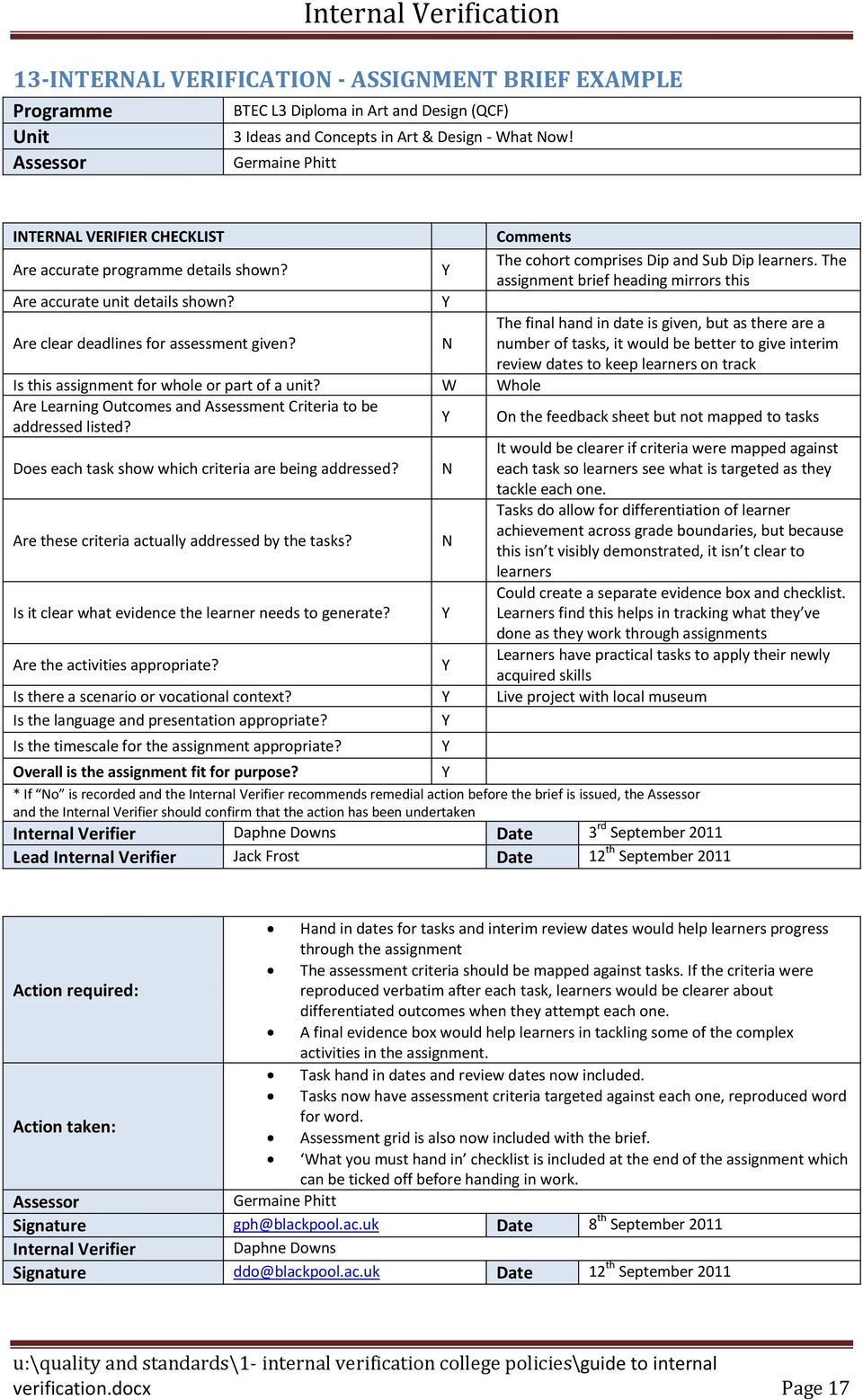
17 13-INTERNAL VERIFICATION - ASSIGNMENT BRIEF EXAMPLE Programme BTEC L3 Diploma in Art and Design (QCF) Unit 3 Ideas and Concepts in Art & Design - What Now! Assessor Germaine Phitt INTERNAL VERIFIER CHECKLIST Comments Are accurate programme details shown? Y The cohort comprises Dip and Sub Dip learners. The assignment brief heading mirrors this Are accurate unit details shown? Y Are clear deadlines for assessment given? N The final hand in date is given, but as there are a number of tasks, it would be better to give interim review dates to keep learners on track Is this assignment for whole or part of a unit? W Whole Are Learning Outcomes and Assessment Criteria to be addressed listed? Y On the feedback sheet but not mapped to tasks Does each task show which criteria are being addressed? N It would be clearer if criteria were mapped against each task so learners see what is targeted as they tackle each one. Are these criteria actually addressed by the tasks? N Tasks do allow for differentiation of learner achievement across grade boundaries, but because this isn t visibly demonstrated, it isn t clear to learners Is it clear what evidence the learner needs to generate? Y Could create a separate evidence box and checklist. Learners find this helps in tracking what they ve done as they work through assignments Learners have practical tasks to apply their newly Are the activities appropriate? Y acquired skills Is there a scenario or vocational context? Y Live project with local museum Is the language and presentation appropriate? Y Is the timescale for the assignment appropriate? Overall is the assignment fit for purpose? Y * If No is recorded and the Internal Verifier recommends remedial action before the brief is issued, the Assessor and the Internal Verifier should confirm that the action has been undertaken Internal Verifier Daphne Downs Date 3 rd September 2011 Lead Internal Verifier Jack Frost Date 12 th September 2011 Y Hand in dates for tasks and interim review dates would help learners progress through the assignment The assessment criteria should be mapped against tasks. If the criteria were Action required: reproduced verbatim after each task, learners would be clearer about differentiated outcomes when they attempt each one. A final evidence box would help learners in tackling some of the complex activities in the assignment. Task hand in dates and review dates now included. Tasks now have assessment criteria targeted against each one, reproduced word for word. Action taken: Assessment grid is also now included with the brief. What you must hand in checklist is included at the end of the assignment which can be ticked off before handing in work. Assessor Germaine Phitt Signature [email protected] Date 8 th September 2011 Internal Verifier Daphne Downs Signature [email protected] Date 12 th September 2011 verification.docx Page 17
18 14-INTERNAL VERIFICATION ASSIGNMENT DECISION TEMPLATE Award Assessor Unit(s) Assignment Title Learner s Name Learning Outcomes listed Which criteria has the assessor awarded? Achieved: Pass: Merit: Distinction: Do the criteria awarded match those targeted by the assignment brief? Has the work been assessed accurately? Details: Details: Does the feedback to the learner: Provide constructive comment Link to relevant grading criteria Identify opportunities for improved performance Agree actions to be undertaken Does the grading decision need amending? Details: Details: Remedial Action Taken: Internal Verifier Lead Internal Verifier Date Date Action Completed Assessor Signature Internal Verifier Signature Date Date Date verification.docx Page 18

19 15-INTERNAL VERIFICATION ASSIGNMENT DECISION Example Award BTEC L3 Diploma Art & Design (QCF) Assessor Germaine Phitt Unit(s) 3 Ideas and Concepts in Art & Design Assignment Title What now! Learner s Name Annie Kent Learning Outcomes listed LO 1, 2, 3 & 4 Which criteria has the assessor awarded? Achieved: Pass: P1, P2, P3, P4 Merit: M1 M2 Distinction: Do the criteria awarded match those targeted by the assignment brief? Has the work been assessed accurately? N* Does the feedback to the learner: Provide constructive comment Link to relevant grading criteria Identify opportunities for improved performance Agree actions to be undertaken Does the grading decision need amending? Y Y Y Details: For this unit the pass criteria awarded are targeted by the tasks completed. The merit and distinction criteria are attempted but not demonstrated consistently. Details: M1 and M2 are not achieved. There isn t sufficient breadth and depth nor independence demonstrated to warrant higher achievement as apparent that the tutor gave much support to the learner. Some encouragement to work more independently would be useful. Details: Annie has produced a great deal of work for the assignment, but much of it is repetitive and lacks the progression of ideas and technical application that ongoing review and evaluation could have produced. The assessor has identified this in tutorials but the work is not at Merit level and requires more originality rather than repeating much of what s been produced for the Pass criteria. There is advice to the learner that there will be further opportunities after half term to develop the M/D skills general Details: Decision for M1 and M2 should be reviewed. Remedial Action Taken: Reassessment of the work has resulted in no Merit criteria being awarded. The learner has been given feedback that she needs to develop the artefacts and the accompanying folders to achieve Merit level. Internal Verifier Daphne Downs Date 14 th December 2010 Lead Internal Verifier Jack Frost [email protected] Date 18 th December 2010 Action Completed YES Date 17 th December 2010 Assessor Signature [email protected] Date 20 th December 2010 Internal Verifier Signature [email protected] Date 20 th December 2010 verification.docx Page 19

20 16-Quality and Standards - Audit Checklist of Internal Verification Checklist Question Outcome Evidence or Action Required Have the roles of Assessor, Internal Verifier (and Lead Internal Verifier) been fully allocated, understood and agreed? Has the planned delivery of units been effectively and fully timetabled? Is there a published and effectively circulated Internal Verification Schedule? Are the full unit specifications and or grading criteria available to all assessors and internal verifiers? Have the assessors written and stored assignment briefs securely? Have all assignment briefs been internally verified? Have the results of internal verification of assessment briefs been recorded on standardised forms? Is there evidence that the internal verifier and assessors have agreed and carried out any necessary amendments prior to issue to the candidates? Are all drafts, original and final assignment briefs and IV records filed securely? Have the assessors completed their assessment decisions in line with the proposed plan? Have assignment decisions been internally verified according to the published schedule? Have the results of internal verification of assessment decisions been recorded on standardised forms? Is there evidence that the internal verifier and assessors have agreed and carried out any remedial actions of assessment decisions prior to the return to the candidates? Is the internal verification sample of assessment decisions sufficient to ensure compliance with national standards? Where candidate work has been resubmitted have the assessment decisions been subjected to further internal verification? Is there effective standardisation where more than one assessment team is involved? Is appropriate feed back given to assessors form internal verifiers? Are internal verification and assessment records stored in a secure place for 3 years after certification? Are all IV records fully and correctly signed and dated? verification.docx Page 20

Quality Management Review
 Quality Management Review Introduction New this year In order to maintain the integrity and currency of our annual review visits to BTEC centres, this process has undergone revision for 2015/16. This revision
C.C.B.C. Community Education Department AGORED CYMRU Guidelines 2013-2014
 C.C.B.C. Community Education Department AGORED CYMRU Guidelines 2013-2014 This booklet is intended to guide you through the Agored qualification process with Caerphilly ACL Department. Agored Cymru is
BTEC International Quality Assurance Handbook 2015-16
 BTEC International Quality Assurance Handbook 2015-16 1. Introduction Contents How to use this handbook... 2 Introduction... 2 WHAT IS QUALITY ASSURANCE?... 2 WHICH QUALIFICATIONS DOES THIS HANDBOOK COVER?...
Quality Assurance for next generation NQF BTEC
 Quality Assurance for Next Generation BTEC 65 Quality Assurance for next generation NQF BTEC Issue 2 November 2012 Contents Which qualifications does this chapter cover?... 67 How are the new NQF BTECs
Standards verification for Entry Level to Level 3
 Standards verification for Entry Level to Level 3 Standards verification is how we check that you are operating appropriate quality assurance and maintaining national standards. This document provides
Assessment Strategy, Version 1. VRQ Qualification. Level 4 Certificate in Waste and Resource Management. Assessment Strategy. Version 2, June 2014 1
 Assessment Strategy, Version 1 VRQ Qualification Level 4 Certificate in Waste and Resource Management Assessment Strategy Version 2, June 2014 1 Contents 1. Guidance and Assessment Strategy... 3 2. People
DAQ Guide 9 December 2008. A Good Practice Guide to Accreditation of Prior Achievement (APA)
 DAQ Guide 9 December 2008 A Good Practice Guide to Accreditation of Prior Achievement (APA) This guide is for De Montfort University staff who want to introduce Accreditation of Prior Achievement (APA),
Certificate of School Business Management
 Inspiring leaders to improve children s lives Schools and academies Certificate of School Business Management Programme handbook Professional development Certificate of School Business Management Programme
BTEC Level 3 Extended Diploma in Business
 Heathcote School & Science College Business Studies Department BTEC Level 3 Extended Diploma in Business Student Course Handbook 2015-16 Name: Teacher/s: Course Introduction Welcome to the BTEC Level 3
Quality Handbook. Part D: Regulations. Section 16c: Taught postgraduate courses. Section16c. Nottingham Trent University
 Nottingham Trent University Quality Handbook Part D: Regulations Section 16c: Taught postgraduate courses Contents Preface... 4 1. Scope of the regulations... 5 2. Changes to the regulations... 5 3. Consultation...
Supporting Teaching and Learning in Schools
 QCF Supporting Teaching and Learning in Schools OCR Level 3 Certificate in Supporting Teaching and Learning in Schools Scheme code 04468 Scheme code 04469 Scheme code 04470 Centre Handbook OCR Level 3
Level 2/3 Certificate in Principles of Business and Administration (4475)
 Level 2/3 Certificate in Principles of Business and Administration (4475) Assessment guide Level 2 501/01596 Level 3 501/0093/2 www.cityandguilds.com April 2012 Version 1.1 About City & Guilds City & Guilds
QCF. Residential childcare. Centre Handbook
 QCF Residential childcare Centre Handbook OCR Level 3 Diploma for Residential Childcare (England) Entry code 10405 OCR Level 5 Diploma in Leadership and Management for Residential Childcare (England) Entry
BTEC Centre Guide to Assessment (Entry Level to Level 3)
 BTEC Centre Guide to Assessment (Entry Level to Level 3) BTEC Centre Guide to Assessment: Entry Level to Level 3 Contents Which qualifications does this guide cover? 3 Important note: updated assessment
BTEC STUDENT HANDBOOK
 BTEC STUDENT HANDBOOK SILVERDALE SCHOOL KLeighton Contents What BTEC qualifications can I study at Silverdale... 2 What is a BTEC... 2 Key features of the BTEC Firsts in Health and Social care... 3 Course
Supporting You. Supporting You. Supporting You. Dedicated website support. Visit the BTEC website for all your BTEC needs;
 Getting Ready to Teach next generation BTEC First for level 2 learners in Construction Course Code:13BVC01 2 Aims and Objectives 1 Supporting You I am a Examinations Officer Teacher Quality Nominee I need
Level 3 IVQs in Teaching, Training and Assessing Learning (1106)
 Level 3 IVQs in Teaching, Training and Assessing Learning (1106) Level 3 IVQ Advanced Diploma in Teaching, Training and Assessing Learning (1106-21) (500/5753/4) www.cityandguilds.com September 2006 Version
Post-accreditation monitoring report: The Chartered Institute of Personnel and Development. June 2007 QCA/07/3407
 Post-accreditation monitoring report: The Chartered Institute of Personnel and Development June 2007 QCA/07/3407 Contents Executive summary... 4 Accreditation conditions... 4 Observations... 5 Introduction...
Assessment Strategy for. Audit Practice, Tax Practice, Management Consulting Practice and Business Accounting Practice.
 Assessment Strategy for Audit Practice, Tax Practice, Management Consulting Practice and Business Accounting Practice December 2013 Introduction This Assessment Strategy has been designed to apply to qualifications
Project Planning With IT
 Unit 17: Project Planning With IT Unit code: QCF Level 3: Credit value: 10 Guided learning hours: 60 Aim and purpose Y/601/7321 BTEC National The aim of this unit is to ensure learners understand the processes
Higher Education Review. A handbook for QAA subscribers and providers with access to funding from HEFCE undergoing review in 2014-15
 Higher Education Review A handbook for QAA subscribers and providers with access to funding from HEFCE undergoing review in 2014-15 June 2014 Contents Higher Education Review: Summary... 1 Part 1: Introduction
Academic Regulations and Procedures: Policy and Principles for Accreditation of Prior Learning
 Policy and Principles for Accreditation of Prior Learning Introduction Following the publication of the Quality Assurance Agency (QAA) Guidelines on Accreditation of Prior Learning (September, 2004), a
UNDERGRADUATE PROGRAMME SPECIFICATION
 UNDERGRADUATE PROGRAMME SPECIFICATION Programme Title: HNC in Applied Technologies Awarding Body: Teaching Institutions: Staffordshire University Barnsley College Shrewsbury College of Arts and Technology
ACADEMIC AWARD REGULATIONS Framework and Regulations for Professional Doctorates. Approval for this regulation given by :
 ACADEMIC AWARD REGULATIONS Framework and Regulations for Professional Doctorates Name of regulation : Purpose of regulation : Approval for this regulation given by : Responsibility for its update : Regulation
Project Management in Marketing Senior Examiner Assessment Report March 2013
 Professional Diploma in Marketing Project Management in Marketing Senior Examiner Assessment Report March 2013 The Chartered Institute of Marketing 2013 Contents This report contains the following information:
QCF. Business Administration. Centre Handbook. OCR Level 2 Diploma in Business Administration Entry code 10383. Oxford Cambridge and RSA
 Oxford Cambridge and RSA QCF Business Administration Centre Handbook OCR Level 2 Diploma in Business Administration Entry code 10383 OCR 2014 September 2014 OCR Level 2 Diploma in Business Administration
BTEC Level 3 Certificate, BTEC Level 3 Subsidiary Diploma, BTEC Level 3 90-credit Diploma, BTEC Level 3 Diploma and BTEC Level 3 Extended Diploma in
 BTEC Level 3 Certificate, BTEC Level 3 Subsidiary Diploma, BTEC Level 3 90-credit Diploma, BTEC Level 3 Diploma and BTEC Level 3 Extended Diploma in Issue 3 Pearson Education Ltd is one of the UK s largest
Honours Degree (top-up) Computing Abbreviated Programme Specification Containing Both Core + Supplementary Information
 Honours Degree (top-up) Computing Abbreviated Programme Specification Containing Both Core + Supplementary Information 1 Awarding Institution / body: Lancaster University 2a Teaching institution: University
What it takes to be an Dental Educational Supervisor now and going forward
 What it takes to be an Dental Educational Supervisor now and going forward December 2015 1 Developing people for health and healthcare www.nwpgmd.nhs.uk/dentistry What it takes to be an Educational Supervisor
Frequently Asked Questions Completing the Educational Base, Further Learning
 Frequently Asked Questions Completing the Educational Base, Further Learning This document should be read in conjunction with the guidance material available on the JBM website, and answers some of the
Level 3 Certificate in assessing candidates using a range of methods (7317)
 Level 3 Certificate in assessing candidates using a range of methods (7317) Candidate guide A1 Assess candidates using a range of methods www.cityandguilds.com November 2004 About City & Guilds City &
Level 5 NVQ in Occupational Health and Safety Practice (3644) Candidate logbook
 Level 5 NVQ in Occupational Health and Safety Practice (3644) Candidate logbook Publications and enquiries The publications listed below are available free of charge from Publications Sales City & Guilds
BTEC Level 1/Level 2 First Award in Business Specification
 BTEC Level 1/Level 2 First Award in Business Specification First teaching September 2012 Issue 2 Pearson Education Limited is one of the UK's largest awarding organisations, offering academic and vocational
Program Information. Certificate IV in Training and Assessment. TAE Institute. Aligned to TAE10 Training Package, release 3.4
 Program Information TAE40110 Information Certificate IV in Training and Assessment TAE Institute Aligned to TAE10 Training Package, release 3.4 TAE40110 Program Information V7 Program Information TAE40110
Quality Handbook. Part D: Regulations. Section 16E: Professional Doctorate Degrees. Section16E. Nottingham Trent University
 Nottingham Trent University Quality Handbook Part D: Regulations Section 16E: Professional Doctorate Degrees Contents Preface... 3 Scope of the regulations... 3 Changes to the regulations... 3 Consultation...
Advance with CIMA. Applying for CIMA Accreditation of Higher Education Programmes
 Advance with CIMA Applying for CIMA Accreditation of Higher Education Programmes Education Directorate February 2014 Contents Contents... 2 Introduction... 3 1.0 Core Principles of Accreditation... 3 1.1
Procedures for Assessment in VCE Studies
 Procedures for Assessment in VCE Studies 2015 Contents Procedures for Assessment in VCE Studies... 1 Introduction... 1 School-based Assessment... 1 Satisfactory completion of VCE units... 1 The VCAA rules
datasheet QCF Contact Centre Operations What is an NVQ?
 QCF Contact Centre Operations Contact Centre Operations Level 2 Certificate (10265) Contact Centre Operations Level 3 Diploma (10268) Contact Centre Operations Level 4 Diploma (10269) OCR s qualifications
Teacher Notes Introduction
 Teacher Notes Introduction Why ICT 4 Life? Wouldn t it be great to have classes of enthusiastic, ICT-capable learners, performing and progressing well? Of course, we see fantastic examples of good practice
Level 5 Certificate/Diploma in Primary Care and Health Management (4419-05/06)
 Level 5 Certificate/Diploma in Primary Care and Health Management (4419-05/06) www.cityandguilds.com March 2012 Version 1.0 Assessment guide for assignments Instructions for assessors and candidates About
Establishing and operating HEA accredited provision policy
 Page 1 of 13 Establishing and operating HEA accredited provision policy 1. Introduction The Higher Education Academy (HEA) accredits initial and continuing professional development provision delivered
Assessment, Recording and Reporting Policy. Committee Responsible: Curriculum & Standards
 The process of assessing, recording and reporting is required to: Inform students, parents and teachers of attainment and progress being made by students in all areas of the curriculum. Allow realistic
QUALITY ASSURANCE MODEL: GUIDANCE NOTES
 QUALITY ASSURANCE MODEL: GUIDANCE NOTES Quality assurance principles, criteria, application process and on-going quality assurance arrangements for becoming an SCQF Credit Rating Body scqf scotland s
Vocational qualifications for 16 to 19 year olds
 Vocational qualifications for 16 to 19 year olds 2017 and 2018 performance tables: technical guidance for awarding organisations Updated March 2015 (Annex F: 2018 Addendum added) Contents Summary 4 About
GUIDANCE FOR BOARDS OF EXAMINERS IN PARTNER COLLEGES. Degrees, Top-up Degrees and Foundation Degrees
 GUIDANCE FOR BOARDS OF EXAMINERS IN PARTNER COLLEGES Degrees, Top-up Degrees and Foundation Degrees Revised February 2015 GUIDANCE FOR BOARDS OF EXAMINERS IN PARTNER COLLEGES Degrees, Top-up degrees and
SCHOOL BUSINESS MANAGEMENT
 ILM Level 5 Diploma SCHOOL BUSINESS MANAGEMENT Cohort One Induction Unit 2016 Getting started... This induction module offers an overview of your Level 5 course and outlines the key information you will
Awarding body monitoring report for: English Speaking Board (International) Ltd (ESB) May 2009. Ofqual/09/4637
 Awarding body monitoring report for: English Speaking Board (International) Ltd (ESB) May 2009 Ofqual/09/4637 2009 Office of the Qualifications and Examinations Regulator 2 Contents Introduction...4 Regulating
CERTIFICATE SUITE QUALIFICATION HANDBOOK
 2016 Suite Cambridge TECHNICALS LEVEL 3 IT CERTIFICATE SUITE QUALIFICATION HANDBOOK OCR Level 3 Cambridge Technical Certificate in IT (05838) OCR Level 3 Cambridge Technical Extended Certificate in IT
CHECKLIST ISO/IEC 17021:2011 Conformity Assessment Requirements for Bodies Providing Audit and Certification of Management Systems
 Date(s) of Evaluation: CHECKLIST ISO/IEC 17021:2011 Conformity Assessment Requirements for Bodies Providing Audit and Certification of Management Systems Assessor(s) & Observer(s): Organization: Area/Field
Distance Learning Policy
 Distance Learning Policy For internal and external use September 2013 Issue 1.0 Quality, Standards and Research Contents Scope of policy 3 Policy statement 3 Regulatory references 7 Policy review date
Specification. Edexcel NVQ qualification. Edexcel Level 3 NVQ Certificate in Management (QCF)
 Specification Edexcel NVQ qualification Edexcel Level 3 NVQ Certificate in Management (QCF) For first registration August 2010 Edexcel, a Pearson company, is the UK s largest awarding organisation offering
Level 3 Advanced Technical Diploma in Business Travel (450) (4782-32)
 Level 3 Advanced Technical Diploma in Business Travel (450) (4782-32) September 2015 Version 1.0 Qualification Handbook Qualification at a glance Industry area City & Guilds qualification number Travel
OIL AND GAS INDUSTRY COMPETENCE ASSESSMENT AND VERIFICATION GUIDELINES
 OIL AND GAS INDUSTRY COMPETENCE ASSESSMENT AND VERIFICATION GUIDELINES September 2013 AMENDMENT Revision 0 released September 2013 PAGES CHANGES MADE BY: CHECKED BY: H Sanderson APPROVED BY: P Lammiman
BTEC Level 3 Certificate, BTEC Level 3 Subsidiary Diploma, BTEC Level 3 90-credit Diploma, BTEC Level 3 Diploma and BTEC Level 3 Extended Diploma in
 BTEC Level 3 Certificate, BTEC Level 3 Subsidiary Diploma, BTEC Level 3 90-credit Diploma, BTEC Level 3 Diploma and BTEC Level 3 Extended Diploma in For first teaching September 2010 90-credit Diploma
Adapted Review for Specific Course Designation by the Quality Assurance Agency for Higher Education
 Adapted Review for Specific Course Designation by the Quality Assurance Agency for Higher Education Empire College London Ltd May 2014 Contents Key findings about Empire College London Ltd... 1 Good practice...
Cleveland College of Art & Design BA (Hons) Fashion Enterprise Programme Handbook 2013-2014 1
 Cleveland College of Art & Design BA (Hons) Fashion Enterprise Programme Handbook 2013-2014 1 BA (Hons) Fashion Enterprise Programme Handbook 2013-2014 Your Programme Handbook provides you with a range
AQH-J1 ACCREDITATION OF PRIOR LEARNING (APL)
 Quality Handbook AQH-J1 ACCREDITATION OF PRIOR LEARNING (APL) Version 8.0 June 2014 A. What is APL? APL is Accreditation of Prior Learning that is the process by which a student can obtain credit towards
Upgrade BSZ40198 to TAE40110
 Upgrade BSZ40198 to TAE40110 What is the Application Process? Step 1 Step 2 Step 3 Step 4 Read the contents of this booklet Complete the enrolment form. Submit your evidence for your application (refer
EDI Level 3 NVQ in Customer Service
 EDI Level 3 NVQ in Customer Service Candidate Pack Effective from: 1 August 2006 Accreditation Number: 100/6105/8 Subject code : N2263 ASNC1235 Vision Statement Our vision is to contribute to the achievements
Assessment Regulations
 2014/15 Assessment Regulations Integrated Masters Degree Awards Approved: 9 July 2014 Contents 1. Introduction 1 2. Application of the Regulations 1 2.1 Status and Scope 1 2.2 Variance from the Regulations
4. The criteria for the award of the Degree of PhD (by Published Works) shall be the same as those established for the Degree of PhD by Research.
 5 th Edition of the Common Academic Regulations for the Degree of PhD (by Published Works) Introduction 1. These pages comprise Regulations for the degree of PhD (by Published Works) of the University
Assessment Guidance for Mentors Expert Witness Advisors (EWA) Assessors and Internal Verifiers
 UPSTREAM OIL & GAS INDUSTRY TECHNICIAN TRAINING PROGRAMME (UOGITTP) Assessment Guidance for Mentors Expert Witness Advisors (EWA) Assessors and Internal Verifiers A.G. Revision D October 2013 Page Page
Level 3 Advanced Technical Diploma in Leisure, Travel and Tourism (450) (4782-31)
 Level 3 Advanced Technical Diploma in Leisure, Travel and Tourism (450) (4782-31) September 2015 Version 1.0 Qualification Handbook Qualification at a glance Industry area City & Guilds qualification number
Quality Handbook. Part D: Regulations. Section 16A: Common Assessment Regulations for Bachelor s and Integrated Master s degrees.
 Nottingham Trent University Quality Handbook Part D: Regulations Section 16: Common ssessment Regulations for Bachelor s and Integrated Master s degrees Contents 1. Principles behind the regulations...
Recognition of Prior Learning, Credit Transfer and National Recognition Policy
 Department Vocational Education & Training Author(s) David Hynes 7.0 Recognition of Prior Learning, Credit Transfer and National Recognition Policy Approved Principal Version 1.0 Authorised Principal AQTF
PROGRAMME SPECIFICATION
 PROGRAMME SPECIFICATION 1. Programme Title BA (Hons) Counselling 2. Name of final Award (s) 3. Awarding body/institution 4. Teaching institution 5. Mode (s) of Delivery GENERAL INFORMATION BA (Hons) Counselling
SQAS Guidelines March 2011
 SQAS Guidelines March 2011 NOTICE OF TERMS OF USE While the advice given in these guidelines has been developed using the best information currently available, it is intended purely as guidance and to
Regulations for Bachelors and Integrated Masters Awards 2015
 Regulations for Bachelors and Integrated Masters Awards 2015 CONTENTS 1 SCOPE OF THESE REGULATIONS... 2 2 GENERAL PRECONDITIONS TO AN AWARD... 2 3 COURSE REQUIREMENTS... 2 4 DURATION OF COURSE... 4 5 MODULE
Level 2 Certificate in Understanding the Safe Handling of Medicines (QCF)
 Skillsfirst Awards Handbook Level 2 Certificate in Understanding the Safe Handling of Medicines (QCF) SHMC2 Suite 215 Fort Dunlop Fort Parkway Birmingham B24 9FD www.skillsfirst.co.uk Contents Page Section
Procedures for validation and accreditation
 Procedures for validation and accreditation Published by the Quality and Academic Support Office, Directorate of Students and Education Support Latest Edition (March 2002, updated August 2009 and 2013
Joint Awarding Body Guidance on Internal Verification of NVQs
 Joint Awarding Body Guidance on Internal Verification of NVQs Joint Awarding Body Guidance on Internal Verification of NVQs 1. Introduction 1.1 This Guidance has been produced by the joint Awarding Body
Forms and Templates. Recognition of Prior Learning Initiative CHC30113
 Recognition of Prior Learning Initiative Forms and Templates RPL Assessment Toolkit for CHC30113 Certificate III in Early Childhood Education and Care CHC30113 CERTIFICATE III Effective July 2013 Commonwealth
datasheet NVQ What is an NVQ? Who are these NVQs for? What is its purpose?
 NVQ OCR Level 1 NVQ in Contact Centre Operations (03447) OCR Level 2 NVQ in Contact Centre Operations (03448) OCR Level 3 NVQ for Contact Centre Professionals (03449) OCR Level 4 NVQ for Contact Centre
Business Management 2012
 Course Specification Business Association of Business Executives (ABE) July 2012 Prepared By Arun Chalise Course Specification 2012 Page 1 Course Specification Business Awarding Institution/Body. Association
CP14 ISSUE 5 DATED 1 st OCTOBER 2015 BINDT Audit Procedure Conformity Assessment and Certification/Verification of Management Systems
 Certification Services Division Newton Building, St George s Avenue Northampton, NN2 6JB United Kingdom Tel: +44(0)1604-893-811. Fax: +44(0)1604-893-868. E-mail: [email protected] CP14 ISSUE 5 DATED 1 st OCTOBER
Australian Transport Council. National Standard for the Administration of Marine Safety SECTION 5
 Australian Transport Council National Standard for the Administration of Marine Safety SECTION 5 APPROVAL AND AUDITING OF REGISTERED TRAINING ORGANISATIONS August 2008 First Published: August 2008 Endorsed
Setting Standards Achieving Success
 Setting Standards Achieving Success Resolve F1 customer service problems Manage a project B5 Provide B10 leadership for your team Manage risk F5 team E14 Support E1 Manage a budget team and virtual working
Edexcel Level 3 Awards and Certificate in Assessing the Quality of Assessment (QCF)
 Edexcel Level 3 Awards and Certificate in Assessing the Quality of Assessment (QCF) Specification Edexcel specialist qualification First teaching September 2010 Issue 2 Pearson Education Ltd is one of
Teaching and Learning Methods
 Programme Specification (Postgraduate) Date amended: 1. Programme Title (EdD) 2. Awarding body or institution University of Leicester 3. a) Mode of Study part time b) Type of Study postgraduate research
QTC Training & Education. Certificate IV of Project Management BSB41507 Study by Correspondence
 Certificate IV of Project Management BSB41507 Study by Correspondence Career-relevant, Accredited and Industry Endorsed Because QTC vocational courses are developed in consultation with relevant industry
Validated Programme Specification
 Validated Programme Specification 1. Awarding Institution/Body Teesside University [TU] 2. Teaching Institution Dearne Valley College 3. Delivery Location(s) [if different from TU] Dearne Valley College,
Level 3 Certificate, Subsidiary Diploma, 90-Credit Diploma, Diploma, Extended Diploma in Countryside Management (0076-03)
 Level 3 Certificate, Subsidiary Diploma, 90-Credit Diploma, Diploma, Extended Diploma in Countryside Management (0076-03) Qualification handbook for centres 500/8559/1 500/8560/8 600/6113/3 500/8561/X
HNC ELECTRICAL & ELECTRONIC ENGINEERING. Programme Specification
 HNC ELECTRICAL & ELECTRONIC ENGINEERING Programme Specification Programme Specification Title of Programme: HNC ELECTRICAL & ELECTRONIC ENGINEERING This specification provides a concise summary of the
Human Resource Management
 Course Specification Human Resource Management Association of Business Executives (ABE) July 2012 Prepared By Arun Chalise Course Specification 2012 Page 1 Course Specification Human Resource Management
IV. Masters Degree Progress Regulations, Taught and Research (excluding MPhil programmes)
 IV. Masters Degree Progress Regulations, Taught and Research (excluding MPhil programmes) These regulations shall be understood in conjunction with requirements laid down in the General Regulations and
How To Pass An Exam In Africa
 6 IBAT College Assessment Standards (HETAC) 6.1 Student Assessment (HETAC) The purpose of assessment is to provide a measure of the extent to which the learning outcomes of the programme and individual
LEVEL QCF. Accredited
 LEVEL QCF Accredited Issue 9 February 2015 Edexcel, BTEC and LCCI qualifications Edexcel, BTEC and LCCI qualifications are awarded by Pearson, the UK s largest awarding body offering academic and vocational
Training, Assessment and Quality Assurance (6317)
 Training, Assessment and Quality Assurance (6317) Frequently asked questions www.cityandguilds.com Aug 2011 Version 1.7 Contents 1. Who developed these qualifications? 4 2. What does TAQA stand for? 4
Managing National Assessment Report. Hamilton Christian School
 Managing National Assessment Report 2014 Hamilton Christian School Managing National Assessment Report Hamilton Christian School Introduction The purpose of the Managing National Assessment (MNA) external
DRAFT 8 th January 2015 Senior Chef Apprenticeship in Culinary Arts Standard Assessment Plan. Introduction
 DRAFT 8 th January 2015 Senior Chef Apprenticeship in Culinary Arts Standard Assessment Plan Introduction Hospitality employers, recognised by the Department for Business Innovation and Skills (BIS) as
WHS Document Management Procedure
 1. Overview The purpose of this procedure is to provide minimum standards for how Wudinna District Council will maintain its WHS Management System documentation so that documents are drafted, maintained,
The California Teaching Performance Assessment (CalTPA) Frequently Asked Questions
 The California Teaching Performance Assessment (CalTPA) Frequently Asked Questions The information presented in this guide is meant to serve as introductory information. After reading this document, candidates
FAQs for Standards to support learning and assessment in practice
 FAQs for Standards to support learning and assessment in practice Background In August 2006, the NMC published Standards to support learning and assessment in practice (SLAiP), replacing previously published
Cambridge International Certificate in Teaching and Learning 6208 Cambridge International Diploma in Teaching and Learning 6209
 Cambridge International Certificate in Teaching and Learning 6208 Cambridge International Diploma in Teaching and Learning 6209 Preface This syllabus sets out the details of the Certificate and Diploma
SPORT AND PHYSICAL ACTIVITY
 2016 Suite Cambridge TECHNICALS LEVEL 3 SPORT AND PHYSICAL ACTIVITY CERTIFICATE SUITE QUALIFICATION HANDBOOK OCR Level 3 Cambridge Technical Certificate in Sport and Physical Activity (05826) OCR Level
Level 2 IVQ Diploma in Training Skills (1106-02)
 Level 2 IVQ Diploma in Training Skills (1106-02) Qualification handbook for centres 500/5784/4 www.cityandguilds.com October 2007 Version 3.0 ( May 2009) About City & Guilds City & Guilds is the UK s leading