
100% Web-Based Labor Management
|
|
|
- Kathleen Blanche Jackson
- 10 years ago
- Views:
Transcription
1 1 XactTime User s Guide 100% Web-Based Labor Management Page 1
2 XactTime User s Guide PART I ABOUT XACTTIME... 5 SYSTEM REQUIREMENTS... 5 ABOUT THIS MANUAL... 5 DISCLAIMER... 5 HOW THIS GUIDE IS ORGANIZED... 5 DEFINITIONS AND SYMBOLS... 6 XACTTIME INTERFACE... 7 TABS AND SUBMENUS... 7 EMPLOYEE HOME PAGE TAB... 8 ADMIN TAB... 9 The Submenu STATUS BOARD TAB SECTIONS AND SUBSECTIONS SECURITY IN XACTTIME ENTERING DATES, TIMES, AND NUMBERS IN XACTTIME NAVIGATING TO COMMONLY USED PAGES Phone Support from PART II GETTING STARTED IMPORT EMPLOYEES LINK IMPORT FILE SPECIFICATIONS IMPORTING EMPLOYEES PART III CONFIGURING THE SYSTEM THE CONFIGURATION PAGE System Configurations General Configuration Page Payroll Policies Page Pay Types Page Pay Adjustment Types Page Holidays Page Hardware Page Schedules Page Custom Personal Fields Page New Employee Defaults BENEFITS PAGE Shift Differential Policies Page Selected Policy Section List of Policies Section Assign Multiple Employees Telephony Section Feature Access Templates Employee Access Group Members IP Access Page PART IV HOW TO USE YOUR CONFIGURED SYSTEM ADMIN HOME PAGE GENERATED REPORTS SECTION Preview a Generated Report Delete a Generated Report LABOR LEVEL FILTER SECTION SEARCH SECTION Perform a Basic Search Search Tips Search Results Section CURRENT EMPLOYEE SECTION Adding an Employee Editing an Employee s Information Deleting an Employee

3 3 XactTime User s Guide TIME SHEET SECTION Adding, Editing, Deleting and Approving a Timesheet SCHEDULE SECTION Edit an Employee s Schedule Schedule Templates Section Assign an Employee to a Schedule Template Express Scheduler ADD PAY ADJUSTMENT SECTION PAY ADJUSTMENTS SECTION Editing Adjustments QUICK MESSAGE SECTION BENEFITS SECTION Recalculating Employee Benefits CUSTOM INFO SECTION Add or Edit Custom Info ADMINISTRATOR FUNCTIONS: THE SUB-MENUS HOME LINK REPORTS LINK Schedule Reports Section My Scheduled Reports Section Other Users Scheduled Reports Viewing a Report that Has Been Generated LABOR LEVEL ASSIGNMENTS LINK SCHEDULES LINK MESSAGE CENTER LINK Modify a message Delete a message IMPORT LINK CONFIGURATION LINK STATUS BOARD TAB Enabling/Disenabling the Status Board Customize the Status Board Navigate to the Admin Home Page for a selected employee PERSONAL SETTINGS BUTTON Section States Employee Home Page Subsection Admin Home Page Section Labor Levels Page General Look & Feel Subsection HELP PAGE PART V USING XACTTIME LOGGING ON Logging Off at the End of a Session EMPLOYEE FUNCTIONS Employee Home Page Actions Section Employee Submitting Timesheets (optional) Employee Submitting Timesheet Express (optional) Status Section Messages Section Hours Worked Section Schedule Section Pay Adjustments Section Adjustments Section Benefits Section Personal Info Section STATUS BOARD TAB PERSONAL SETTINGS ICON Page 3

4 XactTime User s Guide Employee Home Page Section Status Board Page Section General Look & Feel Section

5 5 XactTime User s Guide Part I About XactTime XactTime is a thin-client, 100% Web-based application that offers a fast, easy method of automating employee time and labor management processes. Available anytime and anywhere, all you need to use XactTime is an Internet connection and a Web browser. With XactTime, Administrators can: Manage employee data Review employee timesheets Generate schedules for employees Send companywide messages Organize company departments and jobs Track vacation, sick, and personal time Generate reports Your employees can: Clock in and out Submit timesheets Review schedules Review hours View vacation, sick, and personal time accrued System Requirements XactTime requires an Internet browser that can access secure Web sites. recommends using Internet Explorer 5.0 or higher. About This Manual In addition to providing you with step-by-step information for performing various procedures, this guide will help you get the most out of your XactTime database. Disclaimer strives to keep this guide up-to-date. However, because XactTime is a Web-based application and can be automatically updated via the Internet, you may experience brief periods during which the information contained in this guide does not coincide exactly with the latest version of the application. How This Guide Is Organized The XactTime User Guide is divided into three sections: Part I: Introduction This section introduces XactTime and this guide. It also includes technical support information. Part II: Getting Started This section describes the process of getting started with XactTime including a recommended procedure for implementing the program. Page 5

6 XactTime User s Guide Part III: Configuring your Database This section provides definitions and instructions for configuring your database. Part III: Using XactTime This section provides everything you need to know about using XactTime and is conveniently organized in the same order as the information within XactTime. Definitions and Symbols This guide uses the following terms throughout: Note: Wherever possible, standard computer industry terminology and conventions have been used. Term / Symbol Definition Page Page refers to a Web page within the XactTime site. Section Tab Link Text Box Drop-down Box Radio Button Checkbox Plus Symbol (+) Dash Symbol (-) Select Template Shift Partial Shift Sections subdivide and organize each XactTime page. Tabs similar to the tabs on manila folders appear at the top of every XactTime page. You use tabs to navigate to the appropriate location in XactTime. In this guide, the term link is synonymous with hyperlink and refers to text that when clicked will cause another page to load. A text box is a field on a Web page that allows you to enter information. A drop-down box is a text box that includes an arrow. When you click the arrow, a list of options drops down for you to select. A radio button is a hollow, round selector that appears next to items in a list or group of items. Use radio buttons to select one item in the list or group. Checkboxes indicate a yes or no choice. Every click in the checkbox will alternately select and deselect the item. This guide uses the plus symbol (+) to indicate holding down one key and then pressing another (e.g., CTRL+X or ALT+TAB). This guide uses the dash (-) symbol to indicate pressing a key and a mouse-button at the same time (e.g., CTRL-Click). This guide uses select to indicate using to mouse to highlight an item within a list, or marking a checkbox or a radio button. In XactTime, a template is a set of rules (e.g., policies, weekly schedules, shift differential guidelines) that can be saved and applied to employees. A shift refers to a complete clock cycle in and out. You can also think of this as a block of time. You cannot use this to add a lunch, break, or partial work shift. You use a partial shift to add a lunch, break, or work shift. You cannot use it to add a start and end time for the day.

7 7 XactTime User s Guide XactTime Interface At, one of our highest priorities is presenting information to users logically and intuitively. A navigation bar appears across the top of all the pages making it easy to access the different features within XactTime. We also use consistent color schemes and conventions to guide you through the displayed information. XactTime works like any other Web page, so you can use the Web browsing techniques you already know. Below, you will find the standard conventions used throughout XactTime: Tabs and Submenus The tabs across the top of the navigation bar link you to the main centers within XactTime. Three tabs can display: Figure 0-1: XactTime Tabs Employee Home Admin Home Status Board This tab appears as the employee's name and links to a personalized home page from which the employee may perform all user access functions. The Admin tab links to a central location from which an administrator may perform all the XactTime administrative functions granted to them. Status Board links to a page listing all employees and showing their current work status. XactTime displays different combinations of these three tabs, depending upon the security rights of the person logged on. For example, an employee with only user-level access would not permission to see the Admin tab. The following chart describes the combinations and functions of the three tabs. Person Logged on Employee with User Access Employee with Full Administrative Access Employee with Restricted Administrative Access Admin Logon ID Tabs Displayed Employee Home page Status Board (if the employee s payroll policy has been set up with Status Board access) Employee Home page Admin tab (full access to all admin menu items) Status Board Employee Home page Admin Tab Status Board Admin Tab (full access to all admin menu items) Status Board Page 7

8 XactTime User s Guide Employee Home Page Tab The Employee Home page tab always displays the name of the employee logged on. Clicking the tab displays the employee's personal home page, allowing the employee to clock in and out, submit timesheets, check benefit time, and perform all other permitted functions.

9 9 XactTime User s Guide Admin Tab Clicking the Admin tab displays the Admin Home page, which shows important system and employee data. It also contains links to all administrative functions within XactTime. From the Admin Home page, depending on your security, you can manage employees, link to configuration screens, and generally administer your company s XactTime account. Page 9

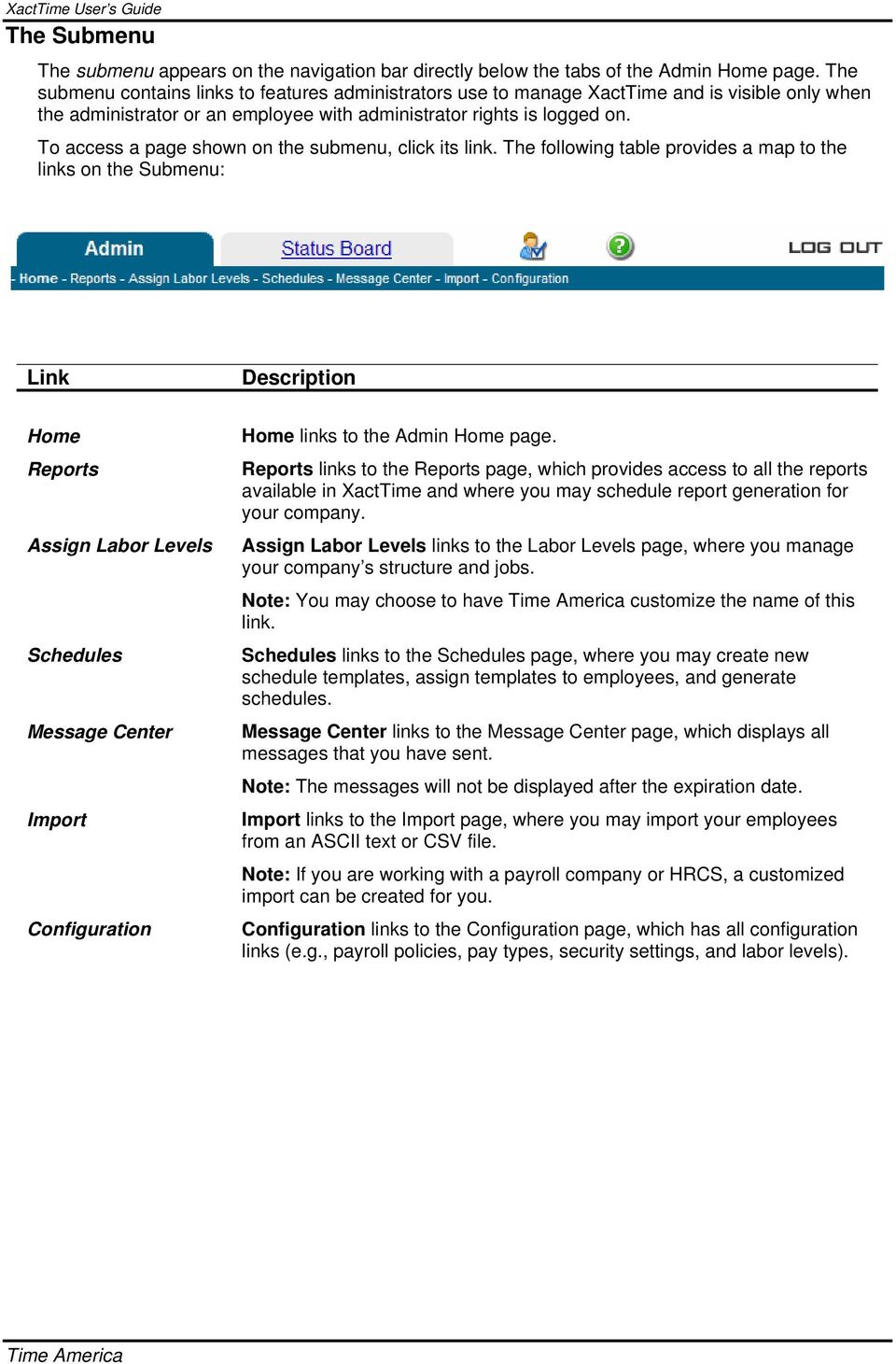
10 XactTime User s Guide The Submenu The submenu appears on the navigation bar directly below the tabs of the Admin Home page. The submenu contains links to features administrators use to manage XactTime and is visible only when the administrator or an employee with administrator rights is logged on. To access a page shown on the submenu, click its link. The following table provides a map to the links on the Submenu: Link Description Home Reports Assign Labor Levels Schedules Message Center Import Configuration Home links to the Admin Home page. Reports links to the Reports page, which provides access to all the reports available in XactTime and where you may schedule report generation for your company. Assign Labor Levels links to the Labor Levels page, where you manage your company s structure and jobs. Note: You may choose to have customize the name of this link. Schedules links to the Schedules page, where you may create new schedule templates, assign templates to employees, and generate schedules. Message Center links to the Message Center page, which displays all messages that you have sent. Note: The messages will not be displayed after the expiration date. Import links to the Import page, where you may import your employees from an ASCII text or CSV file. Note: If you are working with a payroll company or HRCS, a customized import can be created for you. Configuration links to the Configuration page, which has all configuration links (e.g., payroll policies, pay types, security settings, and labor levels).
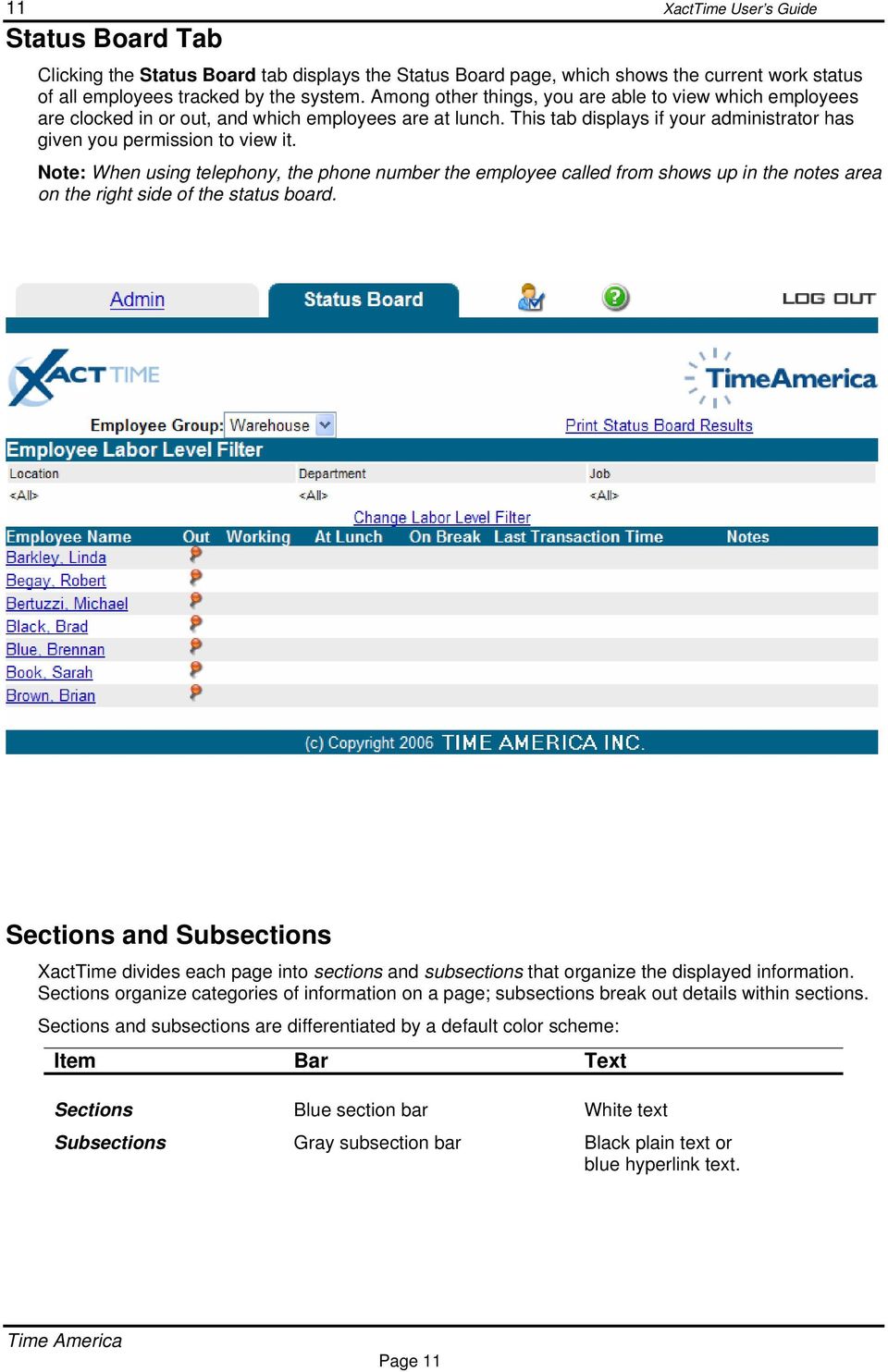
11 11 XactTime User s Guide Status Board Tab Clicking the Status Board tab displays the Status Board page, which shows the current work status of all employees tracked by the system. Among other things, you are able to view which employees are clocked in or out, and which employees are at lunch. This tab displays if your administrator has given you permission to view it. Note: When using telephony, the phone number the employee called from shows up in the notes area on the right side of the status board. Sections and Subsections XactTime divides each page into sections and subsections that organize the displayed information. Sections organize categories of information on a page; subsections break out details within sections. Sections and subsections are differentiated by a default color scheme: Item Bar Text Sections Blue section bar White text Subsections Gray subsection bar Black plain text or blue hyperlink text. Page 11
12 XactTime User s Guide The Personal Settings Icon Minimizing, Maximizing, & Hiding Sections XactTime provides three display options for each section on a page. These options allow you to enlarge, shrink, or completely hide sections, based on what you would like to view and use. For example, there might be certain sections on a page that you use daily, others that you use occasionally, and others that you never use at all. The three options are described below: State Maximized Description In the maximized state, a section s label and its content are visible. We recommend this state for sections you use frequently because it gives you the fastest possible access to a section s contents and actions. When you first visit XactTime, all sections are maximized except for Pay Adjustments. Minimized In this state, the section s label is visible, but its content is not. We recommend this state for sections you use occasionally. Pages with minimized sections load faster because less information needs to be transferred from the XactTime servers to the user s screen. The content of a minimized section is readily maximized by clicking its label. Hidden In this state, neither the section s label nor its content is visible. You will not be able to see the section at all. This state is recommended for sections you rarely or never use. Pages with hidden sections will load faster than pages with maximized or minimized sections. You may change the state of sections being viewed using the techniques below. Maximize a minimized section 1. Click the underlined label or click the Maximize button in the section you wish to maximize. Minimize a maximized section 1. Click the Minimize button in the section you wish to minimize.

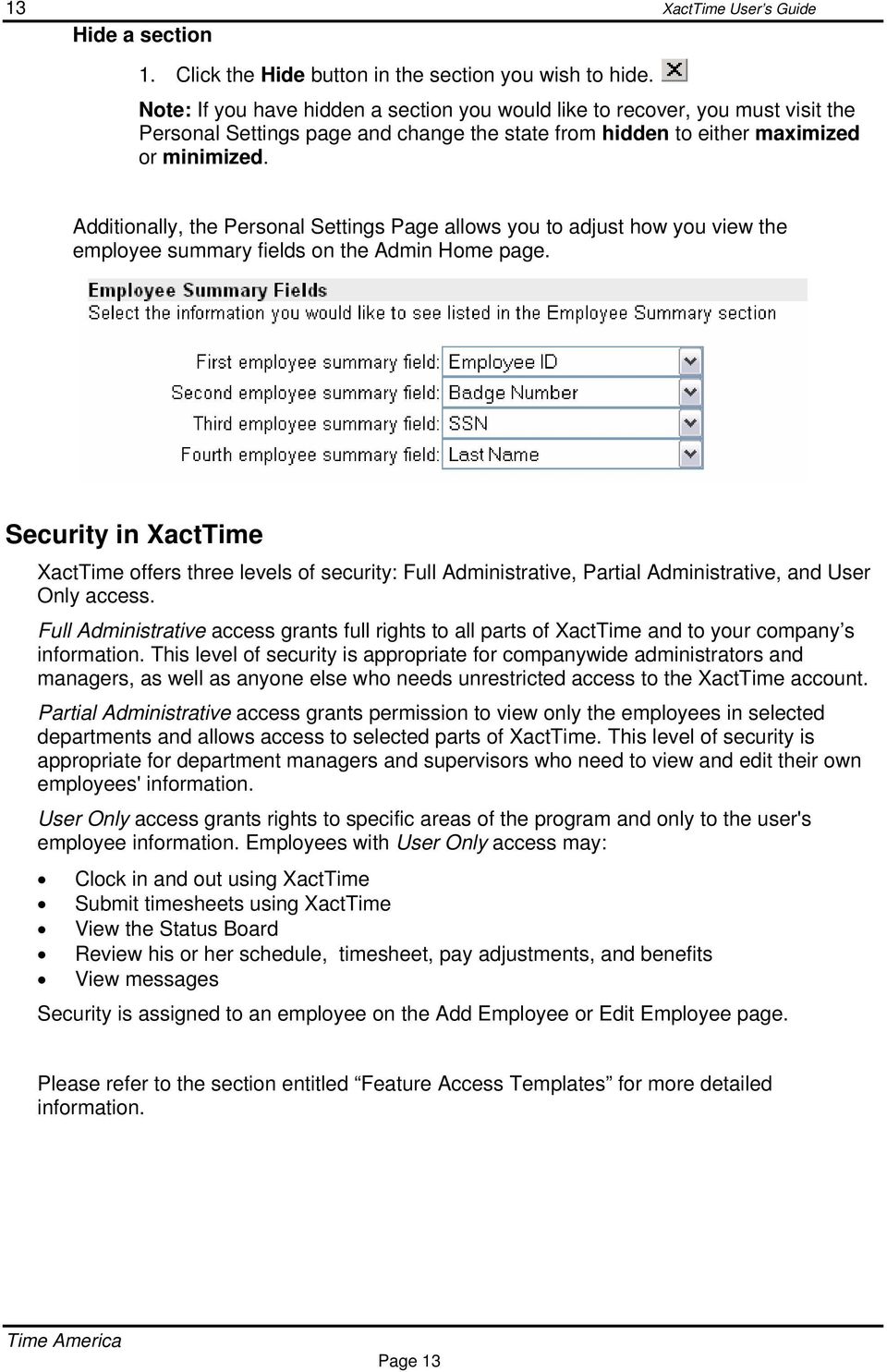
13 13 XactTime User s Guide Hide a section 1. Click the Hide button in the section you wish to hide. Note: If you have hidden a section you would like to recover, you must visit the Personal Settings page and change the state from hidden to either maximized or minimized. Additionally, the Personal Settings Page allows you to adjust how you view the employee summary fields on the Admin Home page. Security in XactTime XactTime offers three levels of security: Full Administrative, Partial Administrative, and User Only access. Full Administrative access grants full rights to all parts of XactTime and to your company s information. This level of security is appropriate for companywide administrators and managers, as well as anyone else who needs unrestricted access to the XactTime account. Partial Administrative access grants permission to view only the employees in selected departments and allows access to selected parts of XactTime. This level of security is appropriate for department managers and supervisors who need to view and edit their own employees' information. User Only access grants rights to specific areas of the program and only to the user's employee information. Employees with User Only access may: Clock in and out using XactTime Submit timesheets using XactTime View the Status Board Review his or her schedule, timesheet, pay adjustments, and benefits View messages Security is assigned to an employee on the Add Employee or Edit Employee page. Please refer to the section entitled Feature Access Templates for more detailed information. Page 13
14 XactTime User s Guide Entering Dates, Times, and Numbers in XactTime XactTime has standard conventions for entering dates, times, and numbers. Dates: Dates may be entered with either dashes or slashes as separators. The following are examples of valid entries: 7/13/01 7/13/ Times: You may enter time in 12-hour format, using A.M. and P.M. to indicate time of day or you may use a 24-hour format, if you prefer. For times at the top of the hour, you do not need to put in the colon and 00. You may also abbreviate A.M. and P.M. to A and P. Spacing does not matter. The following are examples of valid time entries: 8:15 AM 8:15a 8a 9:27P.M. 13:00 Numbers: You may enter numbers in a variety of formats. Typically, you only need to enter the number, without any formatting. A decimal is necessary only when you enter numbers other than zero after the decimal (e.g., 5.76). When entering currency, do not include the dollar sign ($). XactTime automatically formats fields with dollar amount entries to display as currency once you submit the changes. The following are examples of valid entries:

15 15 XactTime User s Guide Navigating to Commonly Used Pages XactTime, like all Web sites, gives you many ways to navigate from page to page. This chapter tells you how to navigate the application. Admin Home Page On the submenu, click Home. Configuration Page On the submenu, click Configuration. Personal Settings Page On the Navigation Bar, click the Personal Settings icon. Page 15

16 XactTime User s Guide XactTime Online Help and support Help is just one click away from wherever you are in XactTime. At the top of every page is a Help icon (depicted in the graphic above) that links to the XactTime Help Center. The Help Center displays the current version of the software as well as a link to this product manual and a number of How-To guides for both supervisors and employees. At the bottom of the page you will also notice the link to our support department, [email protected]. Phone Support from Telephone support is available from our Technical Support Center, Monday through Friday, 10:00 A.M. to 7:00 P.M. Eastern Time. The Technical Support number is (480)

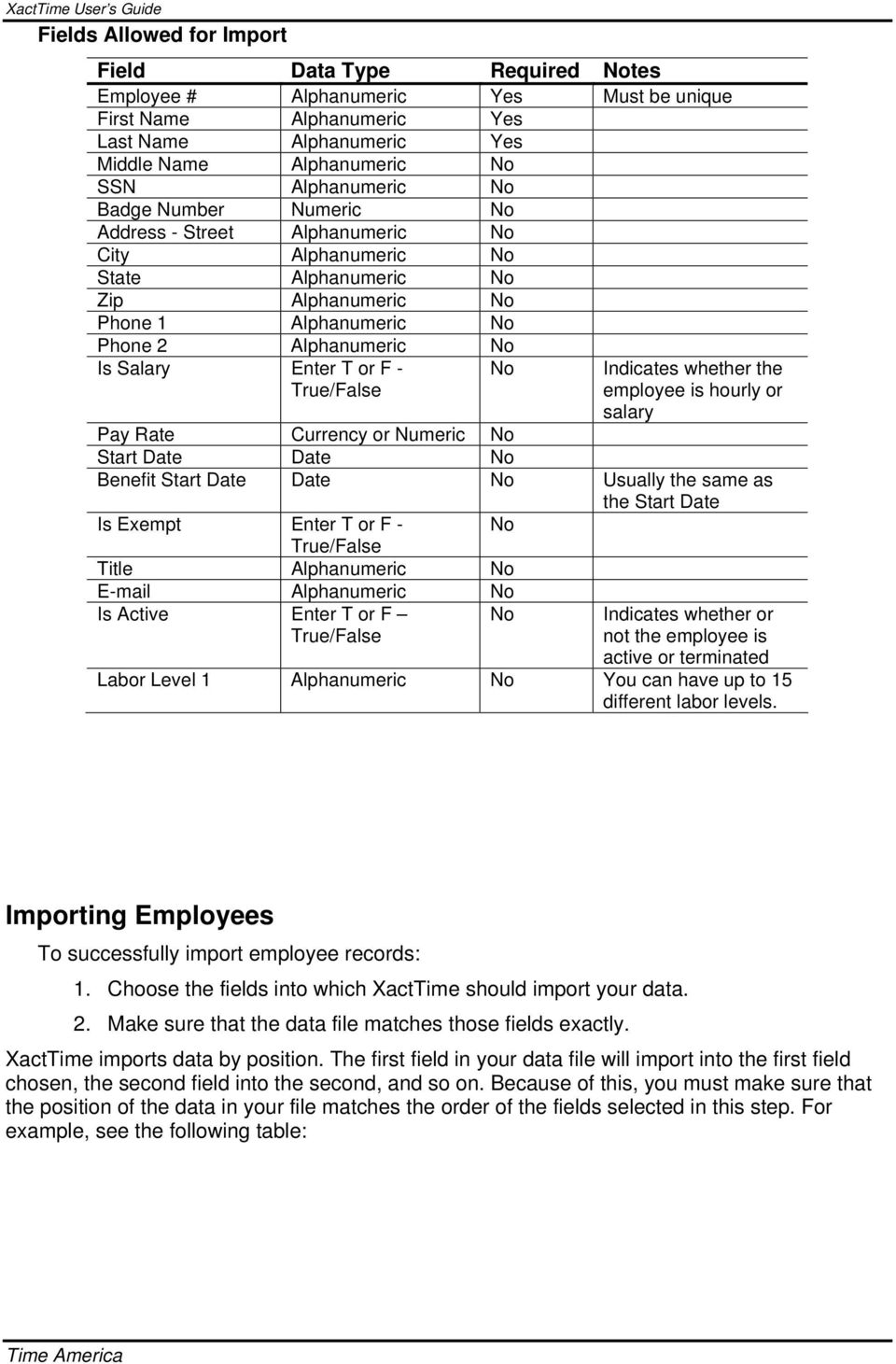
17 17 XactTime User s Guide Part II Getting Started Import Employees Link Importing employees is the quickest way to add your employees to the database. To import successfully, the employee listing must be in a specific format, which is described on the following pages. You may perform multiple imports. Each subsequent import updates and appends your existing records. It updates employee records that currently exist in the XactTime database and adds new employee records based on the unique employee ID number. Note: You may manually add employees individually at any time. You may also use XactTime s custom importing feature, which allows you to use your payroll or HR software to extract employee information for XactTime. Figure II-1: Import Employees Page Import File Specifications You must format your employee listing according to the specifications listed below before importing. The file must be in delimited ASCII text format. Fields may be delimited with any character. You will tell XactTime the field delimiter character during the import process. Fields may have surrounding characters. You will tell XactTime the field surrounding character during the import process. The import file must include the three fields specified below, in the order shown: 1. Employee Number is a required field and must be unique for each employee. 2. First Name is a required field. 3. Last Name is a required field. XactTime imports data by position. You may choose not to import all the fields, but the fields that you import must be in the order specified in the table, Fields Allowed for Import. For example, Last Name must come before SSN, even if Middle Name is not imported. Page 17

18 XactTime User s Guide Fields Allowed for Import Field Data Type Required Notes Employee # Alphanumeric Yes Must be unique First Name Alphanumeric Yes Last Name Alphanumeric Yes Middle Name Alphanumeric No SSN Alphanumeric No Badge Number Numeric No Address - Street Alphanumeric No City Alphanumeric No State Alphanumeric No Zip Alphanumeric No Phone 1 Alphanumeric No Phone 2 Alphanumeric No Is Salary Enter T or F - True/False No Indicates whether the employee is hourly or salary Pay Rate Currency or Numeric No Start Date Date No Benefit Start Date Date No Usually the same as the Start Date Is Exempt Enter T or F - No True/False Title Alphanumeric No Alphanumeric No Is Active Enter T or F True/False No Indicates whether or not the employee is active or terminated Labor Level 1 Alphanumeric No You can have up to 15 different labor levels. Importing Employees To successfully import employee records: 1. Choose the fields into which XactTime should import your data. 2. Make sure that the data file matches those fields exactly. XactTime imports data by position. The first field in your data file will import into the first field chosen, the second field into the second, and so on. Because of this, you must make sure that the position of the data in your file matches the order of the fields selected in this step. For example, see the following table:
19 19 XactTime User s Guide Employee # First Name Last Name SSN Address City State Zip Phone Start Date West John Doe 7777 Elm Street Phoenix AZ /21/ Jane Smith Pennsylvania Tempe AZ /22/ Lorna Doone Mockingbird Lane Scottsdale AZ /21/ John Public Any Street Springfield AZ /23/ Charing New /10/ Chris Matthews Cross Road London AZ Select the fields to be imported into by checking the box next to field name in the Import Employee Page. 4. Before going to the next section, verify that your import file is correctly formatted. This includes making sure that: Your data file is in the correct file format (as above). The required fields are included. The fields in the data file are in the same order as the fields selected on the Import Employee Page. Additional Settings Section These settings define the data format specifications for your import file. Figure II-2: Additional Settings section 1. Fill in the settings as appropriate: Setting Fields are separated with Fields are surrounded with Start import at line Description Enter the text delimiter character used in your import file. Enter the characters, if any, that surround fields in your import file. Leave this field blank if there are no surrounding characters. Enter the starting line for your import file. This default for this setting is "1". If the file you are importing has a header, the number should be 2. Page 19

20 XactTime User s Guide Select File Section At this point, choose the file for import into XactTime. Preview your file carefully because once you click Import, there is no way to reverse the process. 1. Click Browse. Figure II-3: Select File section 2. Navigate to the file you wish to import. 3. Click Open. 4. Click Preview to display your data as it will be imported. The Import Employees Preview page loads. Your data displays exactly as it will import. The approximate time importing will take appears below the preview. 5. Preview the data for errors, including mismatched fields. 6. If you need to make changes, click the Back button of your browser to return to the previous screen and then modify the import settings or the data file. 7. If you do not need to make changes, click Import to begin. A Confirmation page loads when the import is complete. Verify File Section 1. From the main import screen, click on the View Import Logs link. 2. Click the Show drop down to your desired setting; click the Set button. 3. Depending on the setting chosen, the successful or failed logs will show.

21 21 XactTime User s Guide Part III Configuring the System The Configuration Page The Configuration page is segmented into three sections and contains links to all the pages within XactTime that help you configure your company s account. This chapter is organized by the order it appears on the Configuration page (i.e., from left to right and from top to bottom). This is not necessarily the order one must follow when configuring the system. See recommended steps for configuring XactTime for more information on a standard implementation process. System Configurations General Configuration Selecting General Configuration opens the General Configuration page, where you define the basic settings for your company s XactTime account. The information entered here is used for reporting, scheduling, and benefits accruals. Page 21
22 XactTime User s Guide Payroll Policies Selecting Payroll Policies opens the Payroll Policies page, where you manage the Payroll Policies for your company. XactTime uses Payroll Policies to store and apply the rules governing attendance, lunches and breaks, overtime, pay periods, etc. An organization may have more than one set of rules, so XactTime allows you to create many policies. You assign an appropriate payroll policy to each employee. Pay Types Selecting Pay Types opens the Pay Types page, where you manage the Pay Types for your company. Pay Types represent the kinds of time that you wish to track with XactTime. Examples of Pay Types are work, vacation, sick, personal, holiday, and jury duty. Pay Adjustment Types Selecting Pay Adjustment Types opens the Pay Adjustment Types page, where you may manage adjustments to employee earnings. Pay Adjustments are lump sum additions or subtractions to an employee's net or gross pay. Among others, adjustments can be bonuses, tips, and union or professional dues. Holidays Selecting Holidays opens the Holidays page, where you can add an unlimited number of holidays. You assign these lists to employees and denote paid holidays. Closing The Closing link allows an administrator or anyone granted permission to close any pay period once it has passed. Closing a pay period prevents any more edits to that pay period. Re-Open The Re-Open link allows an administrator or anyone granted permission to re-open any pay period closed within a 90-day period. After 90 days have passed, you may not re-open a closed pay period. Hardware Clicking Hardware opens the Hardware page, where you configure and manage the hardware devices that provide data to XactTime. Schedules Clicking Schedules opens the Schedules page, where you manage schedule templates and generate schedules. XactTime allows you to create schedules for your employees. In addition to providing useful information, XactTime also uses schedules for tracking attendance. It compares actual clock in and out times to the scheduled clock in and out time for preparing reports on tardiness and scheduled versus actual work.
23 23 XactTime User s Guide Custom Personal Information Clicking Custom Personal Information opens the Custom Personal Fields page, where you can add an unlimited amount of custom fields. XactTime adds these fields to the Employee Edit screen allowing the administrator to enter specific employee information. New Employee Defaults Clicking New Employee Defaults opens the New Employee Defaults page, where you update the default settings used when new employee records are added. On this page, you establish standard settings for new employees. XactTime enters the standard settings into each new employee s profile to reduce repetitive work. Benefits Clicking Benefits opens the Benefits page, where you manage benefit accruals for your employees. XactTime can automatically calculate the available vacation, sick, and personal time benefits for your employees. These calculations use rules that can account for different accrual methods, seniority rules, and other factors. Benefit time taken is automatically subtracted from the available benefits so that balances are always accurate. Shift Differentials Clicking Shift Differentials opens the Shift Differentials page, where you manage the shift differentials for your company. You use shift differentials to specify monetary premiums for hours worked during certain times of the day. For example, your company might pay an extra 15% to employees who work the graveyard shift. Shift differentials define the hours and amount of extra money paid for these differentials. Telephony On the screen shot above you will notice a blank area between Shift Differentials and the Error Log. This is where the telephony link appears after it has been enabled. To enable the telephony link you must go into the General Configuration page in configuration. Scroll down to the telephony section and click on the checkbox. You must also choose a unique company number that will be used by all of the employees in that company. Once you have saved the changes the telephony link will appear on the Configuration page. Clicking Telephony opens the Telephony page; this is where you set up the Telephony Policies for your company. Telephony is one of the ways your employees can clock in and out. The first step in configuring your Telephony Policy is selecting the Telephony option on the General Configuration page. You will need to select a company number (this can be a number of your choice) and then click the Telephony link to complete the configuration. You are not required to use Telephony, additional fees do apply. Error Log Click here to view errors during a specific date range. Page 23
24 XactTime User s Guide Security Configurations: Feature Access Templates Clicking Feature Access Templates opens the Feature Access Templates page, where you choose which areas of XactTime you would like supervisors or managers to access. You may give users as much or as little access as you like and may change access templates at any time. Employee Group Members Clicking Employee Group Members opens the Employee Group Members page, where you define the employee groups to which your supervisors or managers have access. This is a powerful tool used throughout the XactTime application. You can assign many different features in XactTime by Employee Groups. Timesheet Audit Trails Clicking Timesheet Audit Trails opens the Timesheet Audit Trails page, where you view a record of changes that have been made to employee timesheets by administrators or managers. The Audit Trail will show you the original record, the changed record, who made the change, and when the change was made. Change Administrator Password Clicking Change Administrator Password opens the Change Administrator Password page where you can change the administrator password. To change to a new password you will need to know your old password. IP Access Clicking IP Access opens the IP Access page, where you manage IP access policies, which are rules that describe the IP addresses permitted to access this site. You can also use the IP access policy to limit the ability to punch in and out while outside of your network.
25 25 XactTime User s Guide Labor Levels The Labor Levels section allows you to choose from different configurations, where you manage the levels and departmental hierarchy for your company. It s critical to properly configure your company s labor levels and to fully understand the concepts of this feature. Labor Levels track where employees spend their time. You may associate costs with labor levels and assign employees to more than one level. Note that employees are only able to clock into the labor levels to which they re assigned. Define Labor Levels The Define Labor Levels link allows you to create up to 15 different labor levels. For example, you may define labor levels as region, location, and department. In this instance your company would have three labor levels. Note that you must complete this step before proceeding to Setup Labor Levels. Setup Labor Levels Setup Labor Levels enables you to define the sub-levels of your pre-defined labor levels. In the above example, we have defined three labor levels as region, location, and department. You could drill down further per level. Under Region, you might have Northeast, Northwest, etc. Under locations, you might have a New York Office, and under departments, you may have a sales department. Assign Labor Levels to One Employee The Assign Labor Levels to One Employee link allows you to assign one employee to any defined labor levels. Assign Labor Level to Multiple Employees The Assign Labor Level to Multiple Employees option allows you to assign multiple employees to any defined labor levels. NOTE: The Assign Labor Level descriptions above are only for assigning additional labor levels to the employees NOT for assigning the default labor levels. Default labor levels are assigned in the employees edit employee screen. Page 25
26 XactTime User s Guide General Configuration Page The General Configuration page defines the basic settings for your company s XactTime account. XactTime uses the information entered here for reporting, scheduling, and benefits accruals. 1. Fill in the settings as appropriate: Figure II-4: General Configuration Page a. Company Information: Enter your company s name, address, and phone number. This information is used primarily in printing reports. b. Start of Work Week for Schedule Templates: Sets the day of the week you want your schedule templates to start with. c. Labor Level Settings: Use this section to define how you refer to labor levels. You may call them departments, business units, or any label your company use to define its overall structure of labor divisions.
27 27 XactTime User s Guide d. Benefit Accrual Settings: The settings for benefit accruals define the automatic summation of benefit time (vacation, sick, personal). XactTime calculates available benefits. The date on which the benefits start over is called the accrual reset date. The Global Reset Date option is the date in which the benefits will reset on an annual basis. If the benefits do not reset on an annual basis, choose the Accrual Pay Type Detail Date. The Accrual Pay Type Detail Date enables three reset date options in the benefits section. These options include Calendar Year (January 1 st ), Benefit Start Date (set in each edit employee screen) and Other which allows you to enter your own month and day the benefits will reset every year. The Global Benefit Start Date is the date in which you want XactTime to take over the accrual of your benefits. e. The Supervisor Approval box should stay checked if you wish to allow the supervisors to approve time with exceptions (missing punches). f. Export Matrix: This is a critical section if your company works with a payroll company to export a file of employee hours worked for importation into their software. The export matrix, once configured with your payroll software s codes, allows easy data transfer between the two platforms. 2. Click Apply Changes to save the changes when you complete all entries. Page 27
28 XactTime User s Guide Payroll Policies Page XactTime uses payroll policies to store and apply the rules governing attendance, lunches and breaks, overtime, and pay periods. You may have more than one set of rules within an organization, so XactTime permits you to maintain many payroll policy templates. You assign to each employee the appropriate payroll policy. Payroll policies play a vital role in time management and every employee must be assigned to a payroll policy, therefore you must set at least one payroll policy. XactTime includes a predefined payroll policy titled Default Payroll Policy which may be rename and redefined. You may create additional policies later as well. Selected Policy Section Figure II-5: Payroll Policies Page The Selected Policy section indicates the currently selected payroll policy. Select a payroll policy by clicking its link in the List of Policies section. The Selected Policy section contains the following items: Figure II-6: Selected Policy Section
29 29 XactTime User s Guide Setting Add Link Delete Link Policy Name Members Link Description Click Add to add a new payroll policy. Click Delete to delete the selected policy. This field displays the name of the currently selected policy. This link displays a list of employees assigned to the currently selected policy. List of Policies Section The List of Policies section displays all the payroll policies available in your company s account. The currently selected policy displays in black text in the list and also appears in the Selected Policy section at the top of the page. Select a Payroll Policy Figure II-7: List of Policies Section Click the link for the payroll policy you wish to edit in the Payroll Policy list. The selected payroll policy appears in the Selected Payroll Policy section. Adding, Editing, and Deleting a Payroll Policy Add a new Payroll Policy 1. In the Selected Policy section, Click Add. The Add Payroll Policy page loads. 2. Enter the name for the new payroll policy. 3. Choose the existing payroll policy you wish to copy as the foundation for this new policy. 4. Click Add Policy to complete the entry. The Payroll Policies page loads with the new policy selected. 5. Complete the settings as described in the Payroll Policies Settings section. Editing a Payroll Policy 1. Verify that the policy displayed in the Selected Policy section is the one you wish to edit; if not, select the policy from the List of Policies section. 2. Click the link for the section of the policy you wish to edit. 3. Edit that section as described in the Payroll Policies Settings section. Page 29
30 XactTime User s Guide Delete a Payroll Policy 1. Verify that the policy displayed in the Selected Policy section is the one you wish to delete; if not, select the policy from the List of Policies section. 2. In the Selected Policy section, click Delete. The Confirmation page loads. 3. Click Yes to complete the deletion, or click No to cancel and return to the Payroll Policies page. Payroll Policy Settings Section Payroll Policies contain several different categories of information. Companies may have several payroll policies. The following sections describe these categories and their settings. Note: You must click Apply Changes after modifying each section. This automatically takes you to the next section. Note: When you are editing payroll policies, expand the sections you wish to edit by clicking on the link for the section. Payroll Policy XactTime has a predefined payroll policy titled Default Payroll Policy. You may rename and redefine this policy. You may also create additional policies later. 1. The first time you visit this page, the predefined payroll policy is selected by default. 2. Type a new name for the payroll policy in the Policy Name box. 3. Click Apply Changes to complete the entry. Figure II-8: Payroll Policy Section
31 31 XactTime User s Guide Pay Periods These settings define the pay periods for XactTime. Among other things, XactTime uses these values when scheduling, displaying cost estimates, or filtering reports. Figure II-9: Pay Periods Section The Work Week Start Day is the first day in which weekly overtime begins. 1. Fill in the settings as appropriate: a) Weekly: Sets a one-week pay period. b) Every Two Weeks (odd): Sets a bi-weekly pay period. c) Every Two Weeks (even): Sets a bi-weekly pay period. d) Semi-Monthly: This sets a twice-a-month pay period. Use the drop down arrow to choose the dates on which employees are paid. e) Monthly: This sets a once-a-month pay period. Use the drop down arrow to choose the date on which employees are paid. 2. Click Apply Changes to complete the entry. Attendance Exceptions The attendance exceptions area is no longer in use. The settings have been built into the Tardy report. With this report you can display the employees who have clocked in or out early or late based on a number of minutes set in the report criteria screen. Page 31
32 XactTime User s Guide Round to Schedule The Round to Schedule settings tell XactTime how to round clocked-in or out times to the employee s scheduled time, if the entry falls within a specified timeframe. This setting helps control unauthorized overtime. Note: These settings are not compatible with the Attendance Exception settings. If you plan to use Attendance Exceptions, you must set the values here to zero (0). Figure II-10: Round to Schedule Section 1. The In settings apply only to clock-in times. Fill in the settings as appropriate: a. Up to XX minutes before: Enter how many minutes before the scheduled start time an employee may clock in and still be rounded to schedule. b. Up to XX minutes after: Enter how many minutes after the scheduled start time an employee may clock in and still be rounded to schedule. 2. The Out settings only refer to clock-out times. Fill in the settings as appropriate: a. Up to XX minutes before: Enter how many minutes before the scheduled end time an employee may clock out and still be rounded to schedule. b. Up to XX minutes after: Enter how many minutes before the scheduled end time an employee may clock out and still be rounded to schedule. 3. Click Apply Changes to complete the entry. Note: The changes will not be saved if you do not click Apply Changes.
33 33 XactTime User s Guide Standard Rounding The Standard Rounding settings control how rounding applies for times that are outside the Round to Schedule Times. If the Round to Schedule Times are not set, these settings apply for all clock in or out times. Figure II-11: Standard Rounding Section 1. The In settings apply only to clock-in times and the Out settings apply only to clock-out times. Fill in the settings as appropriate: a. Round to the XX: Choose whether to round to the previous, nearest, or next increment. b. XX minutes: Enter the increment to round to. Enter zero (0) to avoid rounding. 2. Click Apply Changes to complete the entry. Note: The changes will not be saved if you do not click Apply Changes. Page 33
34 XactTime User s Guide Overtime The Overtime settings determine the rates for overtime and how overtime payment is distributed. 1. Fill in your Overtime settings as appropriate. 2. Click Apply Changes to complete the entry. Note: The changes will not be saved if you do not click Apply Changes.
35 35 XactTime User s Guide Advanced Overtime The Advanced Overtime settings allow you to set additional overtime parameters. Figure II-12: Advanced Overtime Section 1. Fill in the settings as appropriate: Click Apply Changes to save your changes. Note: Unscheduled Days/Shifts: Use this setting only if overtime is paid differently for days or shifts not scheduled to be worked. These settings define how overtime accrues on unscheduled days and on unscheduled shifts. a. Pay OT1 or OT2: Select this option to indicate employees are paid overtime for working more than a certain number of hours on unscheduled days. b. Anything over XX hours: Enter the number of hours in an unscheduled day an employee must work before overtime accrues. c. Consecutive Days Overtime: These settings define special overtime for the consecutive days worked. If selected, XactTime pays overtime for the consecutive day. Regular overtime is paid for anything over the number of hours specified in the Regular Overtime Pay by Day field in the Over Time Pay Options section above. Double overtime is paid for anything over the number of hours specified in the Double Overtime Pay by Day field of the Over Time Pay Options section above. d. Enable Seventh Day Overtime: Select this option if, on the seventh consecutive day worked, employees are paid overtime for regular hours and double overtime for anything above regular. Page 35
36 XactTime User s Guide Holiday Timesheet Settings Figure II-13: Holidays Section
37 37 XactTime User s Guide 1. Fill in the settings as appropriate: a. Activate Holidays Rules: These settings define if XactTime will pay holidays and what they will be called. b. Pay Holidays: Select this option to pay holidays within this policy. c. Pay Type: Select the pay type to use for the holiday entry (typically Holiday). d. Holiday Eligibility: These settings define what requirements the employee must meet to receive a holiday. e. Minimum days of employment to qualify: Enter in the number of days that an employee must be employed with the company in order to qualify. f. Employee must be scheduled to work on the holiday: Select this option if the employee should receive the holiday only if they are scheduled to work on that day. g. Qualify employee on scheduled days: Select this option if the employee must work the days they are scheduled in order to receive holiday pay. If not selected, the last day the employee worked before the holiday and/or the next day they worked after the holiday will be used to qualify. h. Required to work: Select which days the employee must work to qualify. i. Minimum minutes before: Enter the number of minutes an employee must work on the day before the holiday. This value is used only if the employee is required to work the day before. j. Minimum minutes after: Enter in the number of minutes an employee must work on the day after the holiday. This value is used only if the employee is required to work the day after. k. Holiday Timesheet Settings: These settings define how and when the employee will receive their holiday hours. i. Apply the Holiday on the Next Day: Select this option if the employee s holiday should be recognized on the day after the date entered in the holiday list. ii. Holiday hours apply towards overtime: Select this option if the holiday hours should be included when calculating overtime pay. iii. Un-worked holiday. a. Minutes to add for each unworked holiday: Enter the number of minutes an employee should receive for holiday hours when they did not work on the holiday. i. Worked holiday. a. Minutes to add for each worked holiday: Enter in the number of minutes an employee should receive for holiday hours when they work on the holiday. b. Multiply worked hours by a factor of XX to increase the holiday time duration: Select this option to pay employees more for time worked on a holiday. If they get eight hours for a worked holiday, the holiday factor is 1.5, and they worked 1 hour on the holiday, they will get 9.5 paid hours on the holiday. 8.5 holiday hours and 1 work hour. l. Holiday Daily Overtime: These settings define how hours will be paid. Note: Daily overtime rules override both standard daily overtime and unscheduled daily overtime settings. m. Pay Overtime anything over XX hours: Select this option if the holiday hours should be paid as overtime. Enter the number of hours an employee must work before overtime begins. n. Pay Double Overtime anything over XX hours: Select this option if the holiday hours should be paid as double overtime. Enter the number of hours an employee must work before double overtime begins. 2. Click Apply Changes to complete the entry. Note: The changes will not be saved if you do not click Apply Changes. Page 37
38 XactTime User s Guide Lunch The Lunch settings control how XactTime collects and calculates lunch times. Figure II-14: Lunch Section 1. Fill in the settings as appropriate: a. Lunch Type: These settings define how XactTime collects lunch times. b. Lunch is not allowed: Choose this option if employees are not allowed to clock in and out for lunch. c. Employees manually clock out for lunch: Choose this option if employees are expected to clock in and out for lunch. d. The system automatically subtracts lunch time from employees shifts: Choose this option if XactTime is to automatically subtract a predefined amount of time for lunch from the employee s shift. Employees are not expected to clock in or out for lunch. Note: Automatic lunches are now being deleted, and then regenerated when an edit occurs within the clock in/out for the shift. Existing business rules will be used during regeneration. Any auto deduct lunches that have been modified and saved will not be deleted or regenerated.
39 39 XactTime User s Guide e. Add Detail: These settings define how XactTime calculates lunch. These settings do not apply if the Lunch is not allowed option is selected. 2. Click Apply Changes to complete the entry. Note: The changes will not be saved if you do not click Apply Changes. Lunch Rounding The Lunch Rounding settings control how XactTime rounds lunch times. Figure II-15: Lunch Rounding Section a. Fill in the settings as appropriate: a. IN Subsection: These settings define how XactTime rounds the In from lunch punch. i. Round to the : Select the rounding option from the drop down menu. For example, Assume you select Nearest and the number of minutes is set to 15. If an employee clocks in at 12:40, the time rounds to 12:45. If an employee clocks in at 12:35 it rounds to 12:30. ii. X minutes: Enter the number of minutes to round by. b. OUT Subsection: These settings define how XactTime rounds the Out for lunch punch. i. Round to the : Select the rounding option from the drop down menu. For example, Assume you select Nearest and the number of minutes is set to 15. If an employee clocks out at 12:40, the time rounds to 12:45. If an employee clocks out at 12:35 it rounds to 12:30. ii. X minutes: Enter the number of minutes to round by. Page 39
40 XactTime User s Guide c. Rounding Options Section: This section sets rounding for lunch to a certain duration if an employee takes a shorter lunch then they are supposed to take. i. Round lunch up to X minutes: Select this option if lunch should be rounded up to a specific amount of time. Enter the amount of time. ii. Use above rounding only if the lunch taken is at least X minutes: Enter the length of lunch an employee must take to enable the lunch rounding. d. Click Apply Changes to complete the entry. Note: The changes will not be saved if you do not click Apply Changes. Breaks The Breaks settings control how XactTime collects and calculates break times. 1. Fill in the settings as appropriate: a. Break Type: These settings define how XactTime collects break times. b. Break is not allowed: Select this option if employees are not allowed to clock in and out for breaks.
41 41 XactTime User s Guide c. Employees manually clock out for breaks: Select this option if employees are expected to clock in and out for breaks and get a fixed number of breaks per day. Enter the number of breaks employees get each day. d. The system automatically subtracts break time from employees; shifts: Select this option if employee breaks will be automatically subtracted from their shifts. Note: Automatic breaks are now being deleted, and then regenerated when an edit occurs within the clock in/out for the shift. Existing business rules will be used during regeneration. Any auto deduct breaks that have been modified and saved will not be deleted or regenerated. i. Add Detail. a. Enter break duration (Allow for XX minutes of break) b. Check box if Break is paid. c. Check box if Break is applied to overtime. d. Select how Auto Break is added. Page 41
42 XactTime User s Guide ii. Click Add to add detail. 2. Click Apply Changes to complete the entry. Note: The changes will not be saved if you do not click Apply Changes. Break Rounding Section The Break Rounding settings define how XactTime distributes paid lunch and break charges. Figure II-45: Break Rounding Section
43 43 XactTime User s Guide 1. Fill in the settings as appropriate. Note: The same rules apply here as in the lunch rounding section. Click Apply changes when you have finished. Employee Settings The Employee Setting section defines parameters for automatic clock-out, yearly hours, and restrictions to schedule. Figure II-46 Employee Settings 1. Fill in the settings as appropriate: a. Automatic Clock Out: Select this option to have XactTime generate the missing clock out when the employee forgets to clock out. b. Default Shift Minutes: Enter the length in minutes of the default shift. Note: The employee will not be paid for this time until a supervisor edits the shift. c. Missing Punch Out Minutes: Enter the number of minutes that must pass, from the clock-in time, before the missing punch is automatically entered. d. Work Year: These settings define how many hours are in a work year. Page 43
44 XactTime User s Guide e. Restrict to Schedule: Employees who are restricted to schedule and clock in for the day have a window before their scheduled time when they are able to clock in. Enter the number of minutes for this window. Maximum value is 60. NOTE: The Enforce Schedule box must be checked in each employees edit employee screen before this rule will take effect. f. Options: These settings define how employees assigned to the payroll policy see the status board, change their passwords, enable the Employee Time Sheet Approval Option and enable the Employee s Timesheet to be populated by their schedule option the option to have only the Administrators to edit employee personal preferences and Timesheet Submission View select. 1) To use the Employee Timesheet to be populated from schedule option, select option and run the Create TimeSheets From Schedule report. Timesheet entries will be generated by running this report. Note: Any timesheet entry for employees using this feature will be deleted and replaced by the entries generated from the assigned schedules. 2) If your employees submit timesheets you need to choose the format for them to submit their timesheet. a. Show start time and duration. b. Show start time and end time. c. Show start time and end time with lunch. d. Show duration only. g. Action Options: Selects Transfer option for employees and to use the Default labor levels or the Employee s Scheduled labor levels. h. Supervisor Edits: Selects the option to require the Supervisor/Manager to add a note when making an edit to an employee timesheet and how a message is sent to the employee when edit is made. 2. Click Apply Changes to complete the entry. Note: The changes will not be saved if you do not click Apply Changes. Timesheet Processing Configuration You must select how your employee s time appears on their timesheets once they clock in. You also must set how many minutes to use to reject duplicate or opposing punches. Duplicate or opposing punches (in & out or IN & in punch) will be surpressed.
45 45 XactTime User s Guide Comp Time Configuration The Comp Time setting determines how to pay out comp time for hours worked instead of OT hours for employees assigned to certain payroll policies. Select Enable Comp Time to put the policy into effect. If you would like users to change their own comp time selection, select that option. Select the pay types (set up in Pay Type configuration) for accruing, posting, and default comp time. If you want to accrue comp time by a factor, denote that factor. Finally, if OT2 hours accrue comp time, select that option. Meal Allowance Configuration Meal Allowances allow XactTime to grant meal allowances based on assigned settings. Page 45
46 XactTime User s Guide 1. Check Enable Meal Allowance to turn on feature. 2. Select Pay adjustment to post entitlement to. 3. Enter maximum amount of meal allowance allowed (dollar/cents value). 4. Enter the number of allowances allowed per week. 5. Choose whether to use Time Qualified or Duration Qualified. a. Time Qualified: Add rule; Must work over HH:MM am for at least XX hours. b. Duration Qualified: Add rule; After XX hours allow one meal. 6. Click Apply Changes to complete the entry. Call Back Configuration Enabling the Call Back feature, allows one of two options for employees who get called back to get paid for that call back. This feature works only via the web login. The employee will have the option in the Actions drop down menu to select the Call Back Action.
47 47 XactTime User s Guide 1. Use Create Time to assign the employee called back a minimum time duration for the call back. Enter in the duration received along with the rate that the time will be paid at. If the Create Time option is selected, the Call Back action will act just like a clock in but allows a guaranteed minimum duration to be assigned. When the shift has ended the user will simply clock out. 2. Use Pay Adjustment is used to pay a specified amount as a Pay Adjustment. Select the Rate at which the Call Back will be paid at, enter amount received along with the call back export code. No clock out is required and no time is posted to the Timesheet. 3. Click Apply Changes to complete the entry. Pay Types Page Use pay types to identify the kinds of time employees spend for your company. For example, in addition to tracking work, you might want to track time spent in training, on jury duty, travel, bereavement leave, and so on. XactTime supports an unlimited number of pay types. Seven pay types are built into XactTime: 1. Work 2. Vacation 3. Sick 4. Personal 5. Holiday 6. Break 7. Lunch These types cannot be deleted, but you can rename all of them except Work, Lunch and Break. Those names and codes must remain the same. Page 47
48 XactTime User s Guide Vacation, sick and personal is accrued benefit pay types. Using the Benefits page, define the rates and method by which these types accrue. Selected Pay Type Section Figure II-16: Pay Types Page The Selected Pay Type section indicates the currently selected pay type. Select a pay type by clicking its link in the Pay Types section. The Selected Pay Type section contains the following items: Setting Add Link Delete Link Pay Type Name ID Description Click Add to add a new pay type. Click Delete to delete the selected policy. The option is not available when one of the seven built-in pay types is selected. Note: XactTime will not allow you to delete a pay type if any time has already been associated with it. Displays the name of the currently selected pay type. Displays the number of the currently selected pay type.
49 49 XactTime User s Guide Pay Types Section The Pay Types section displays all the Pay Types available in your company s account. The currently selected type displays in the list as black text and also appears in the Selected Pay Type section at the top of the screen. Selected Pay Type Section Figure II-17: Pay Types Section 1. Select the pay type you wish to edit or view from the list in the Pay Types section. The selected pay type appears in the Selected Pay Type section. Edit Pay Type Information Section The Edit Pay Type Information section displays the settings for the currently selected pay type. Figure II-18: Edit Pay Type Information Section Page 49
50 XactTime User s Guide Edit a Pay Type 1. In the Selected Pay Type section, verify that the pay type you wish to edit is displayed. If not, select the intended pay type from the Pay Types section. 2. Fill in the following settings as appropriate: a. Number: Enter the number for this pay type. This can be alphanumeric but must be unique. b. Description: Enter a name for this pay type. c. Count towards holiday minimum minutes: If you are paying holidays in XactTime and if the pay type should count towards the holiday minimum minutes qualifier, select this option. 3. Click Apply Changes to complete the entry. Note: The changes will not be saved if you do not click Apply Changes. Adding and Deleting Pay Types Add a Pay Type 1. In the Selected Pay Type section, click Add.The screen refreshes and the new pay type s settings appear in the Edit Pay Type Information section of the page. 2. Fill in the settings as appropriate: a. Number: Enter a number for this pay type. This can be alphanumeric but must be unique. b. Description: Enter a name for this pay type. c. Count towards holiday minimum minutes: If you are paying holidays in XactTime and if the pay type should count towards the holiday minimum minutes qualifier, then select this option. 3. Click Apply Changes to complete the entry. Note: The changes will not be saved if you do not click Apply Changes. Delete a Pay Type XactTime will not allow you to delete a pay type if time has already been associated with it. As an alternative, you may rename a pay type. If you must delete the type, first transfer its entries to another pay type. See the instructions in the Transfer Entries section. 1. In the Selected Pay Type section, verify that the pay type you wish to delete is displayed. 2. Click Delete. The Confirmation page loads. 3. Click Delete Pay Type (where Pay Type is the name of the pay type you selected) to confirm the deletion, or click Cancel to cancel and return to the Pay Types page.
51 51 XactTime User s Guide Pay Adjustment Types Page Use pay adjustments to grant lump sum additions or subtractions to an employee s earnings. This can be useful to track additions such as bonuses and tips, or deductions such as union dues or uniform fees. You must create pay adjustment types before entering adjustments. Pay adjustment types may be either additions or deductions. You may allow employees to enter their own adjustments, as in the case of tips. Enter pay adjustments are entered from the Admin or Employee home pages. Selected Adjustment Type Section Figure II-19: Pay Adjustment Types Page The Selected Adjustment Type section indicates the currently selected adjustment type. The title of this section will be the name of the adjustment type currently selected. Select an adjustment type by clicking its link in the Pay Adjustment Types section. The Selected Adjustment Type section contains the following items: Figure II-20: Selected Adjustment Type Section Setting Add Delete Number Description Click Add to add a new adjustment type. Click Delete to delete the selected type. Note: XactTime will not allow you to delete an adjustment type if any entries have already been associated with it. Displays the number of the currently selected type. Page 51
52 XactTime User s Guide Adjustment Types Section The Adjustment Types section displays all the pay adjustment types available in your company s account. The currently selected type display in black text in the list and in the Selected Adjustment Type section at the top of the page. Select an Adjustment Type Figure II-21: Adjustment Types Section 1. In the Adjustment Types section, click the link for the adjustment type you wish to edit. The selected adjustment type will appear in the Selected Adjustment Type section. Adding, Editing and Deleting Adjustment Types Add an Adjustment Type 1. In the Selected Adjustment Type section, click Add. The screen refreshes and displays the new adjustment type s settings in the Edit Adjustment Type section of the page. 2. Fill in the settings as appropriate: a. Number: Enter the number for this adjustment type. This can be alphanumeric and must be unique. NOTE: This code must match the one in your payroll software if you wish to export the adjustment. b. Description: Enter the name for this adjustment type. c. Employee Entry: Check this option if employees are to be allowed to enter adjustments of this type (e.g., tips). d. Deduction: Check this option if the amount of the adjustment is to be deducted from the employee s earnings. 3. To complete the entry, click Apply Changes. Note: The changes will not be saved if you do not click Apply Changes. Edit an Adjustment type 1. In the Selected Adjustment Type section, verify that the adjustment type you wish to edit is displayed. If not, first select the adjustment type from the Pay Adjustment Types section. 2. Fill in the settings as appropriate: a. Number: Enter the number for this adjustment type. This can be alphanumeric and must be unique. b. Description: Enter the name for this adjustment type. c. Employee Entry: Check this option if employees are to be allowed to enter adjustments of this type (e.g., tips). d. Deduction: Check this option if the amount of the adjustment is to be deducted from the employee s earnings. 3. To complete the entry, click Apply Changes. Note: The changes will not be saved if you do not click Apply Changes.
53 53 XactTime User s Guide Delete an Adjustment Type XactTime will not allow you to delete an adjustment type if entries are already associated with it. 1. In the Selected Adjustment Type section, verify that the adjustment type you wish to delete is displayed. 2. Click Delete. The Confirmation page loads. Holidays Page The Holidays Page allows you to create unlimited holiday lists to denote for which days an employee should receive holiday pay. Selected Holiday List Section Figure II-22: Holidays Page The Selected Holiday list section indicates the currently selected holiday list. The title of this section displays the name of the currently selected list. A holiday list is selected by clicking its link in the List of Fields section. The Selected Holiday List section contains the following items: Figure II-23: Selected Custom Personal Field Section Setting Add Delete Name Members Description Click Add to add a new holiday list. Click Delete to delete the selected field. This displays the current selected holiday list. Click Members to view the employees assigned to this list. Page 53
54 XactTime User s Guide Holiday Lists Section The Holiday Lists section displays all the holiday lists available in your company s account. The currently selected type will display as black text in the list and will appear in the Selected Holiday List section at the top of the screen. Select a Holiday List Figure II-24: List of Fields section 1. Click the link for the holiday list you wish to edit. The selected list appears in the Selected Holiday List section. Assign Multiple Employees Section The Assign Multiple Employee section enables you to assign select employees to the currently selected list. Figure II-25: Quick Assign Adding, Editing & Deleting Holiday Lists Add a Holiday List 1. In the Selected Holiday List section, click Add. The screen refreshes and the New Holiday List section appears on the right side of the screen. Figure II-26: New Holiday List section
55 55 XactTime User s Guide 2. Enter the name of the holiday list. 3. Click Update. This will change the name in the Selected Holiday List section. 4. Click Add Holidays. The Add Holiday page appears. Figure II-27: Add Holiday Page 5. Make the following selections as needed: a. Holiday Name: Enter the name of the holiday. b. Holiday Date: Enter the date of the holiday. c. Active: Select this option if the holiday is an active holiday. d. This holiday lasts for XX day(s): Enter the number of days this holiday includes. Note: This is commonly used with Thanksgiving when an employer gives both Thanksgiving Day and the day after. e. Include Weekends: Select this option if the holiday is longer than one day and if you would like the holiday to fall on a weekend. 6. Click Add Holiday. 7. Repeat Steps 2 through 5 as needed. Edit a Holiday List Name 1. In the Selected Holiday List section, verify that the holiday list you wish to edit is displayed. If not, first select the list from the Holiday List section. 2. Enter the new name for the holiday list. 3. Click Update to complete the entry. Edit a Holiday in the Holiday List 1. In the Selected Holiday List section, verify that the holiday list you wish to edit is displayed. If not, first select the list from the Holiday List section. 2. Click the link of the holiday you wish you edit. 3. Make the appropriate changes. 4. To complete the entry, click Update. Page 55
56 XactTime User s Guide Delete a Holiday List 1. In the Selected Holiday List section, verify that the holiday list you wish to delete is displayed. If not, first select the list from the Holiday List section. 2. Click Delete. The Confirmation page loads. 3. To delete the list, click Yes. Delete a Holiday in the Holiday List 1. In the Selected Holiday List section, verify that the holiday list you wish to edit is displayed. If not, first select the list from the Holiday List section. 2. Click the delete button on the row for the holiday you wish to delete. The Confirmation page loads. 3. To delete the holiday, click Yes. Display Inactive Holidays 1. In the Selected Holiday List section, verify that the holiday list you wish to view is displayed. If not, first select the list from the Holiday List section. 2. Click Show Inactive Holidays. Hide Inactive Holidays 1. In the Selected Holiday List section, verify that the holiday list you wish to view is displayed. If not, first select the list from the Holiday List section. 2. Click Hide Inactive Holidays.
57 57 XactTime User s Guide Hardware Page XactTime allows for the setup up of 5 different types of hardware terminals, TA 7000 series, TA520/530 series, TA 620 Rev 6 series, Hand Punch series and a generic clock. Each type of clock has up to 4 different protocols that can be setup for communication between the hardware client and the clock. 1. Serial - RS-232, one to one relation between clock and polling PC. 2. LAN (LAN of clocks), one to many relationship, up to 32 clocks per polling PC, uses LAN ID to identify clock. 3. Modem (Needs Modem installed on PC), one to many relationship, uses phone number to identify each clock. 4. IP TCP/IP, one to many relationship, uses IP address to identify clock. Selected Terminal Section 1. Add link - used to add a Hardware Terminal 2. Delete link -, used to delete a Hardware Terminal. 3. Selected clock displays next. 4. Download client polling utility (HardwareClient). See the Hardware Client Section for installing and operating the HardwareClient. 5. View terminal file import log link -, click here to view the import logs of punches imported from the Hardware Terminals. 6. Manage hardware zones link -, used to add, delete or edit hardware zones for Hardware Terminals. Page 57
58 XactTime User s Guide Current Zone 1. Add link - add new Hardware Zone. 2. Edit link - edit the name o the Zone. 3. Delete link - deletes currently selected Zone. 4. Selected Zone displays next. Zones 1. Lists all zones, selected zone is underlined. Zone Assignments 1. Assign Multiple Employees link - use to assign multiple employees to a zone. Employees in 1. Lists employees assigned to the selected zone, employees can be removed or set as a supervisor. Employees NOT in 1. List employees not assigned to the selected zone. Check the box to the left of their name and click the Add Employee button to add them to the zone.
59 59 XactTime User s Guide 2. Bells link - used to add, delete or edit bell schedule templates. Note: Available to assign to Hand Readers only, assigned in the Options Section. a. Add - used to add Bell Schedule Template b. Delete link - used to delete currently selected template. c. Edit link - used to edit Bell schedule Detail. d. Add Detail link - used to add Bell Schedule Detail. Select Day, enter time to ring and duration of ring in seconds. List of Selected Terminals Section This section is used to select which terminal to setup or edit. By selecting a terminal from the list, the right column will show the setup details for that selected terminal. To add a clock in the software, click Add just below Selected Terminals Header. All settings will be saved to the database once an Apply Changes button is clicked and the changes have been retrieved by the Hardware Client used to communicate to each added terminal. 1. Adding a terminal. a. Hardware Terminal - enter Description, appropriate Terminal ID, Terminal Type to TA Click Apply Changes. b. Communication - Choose appropriate communication protocol. For TCP/IP, enter terminal s IP address. For serial cable connection, enter type and computer s comm. Port that will be used. For modem connection, select modem s com port, baud rate and enter in the terminals phone number. Note: If using modem, enter in 1 if needed for long distance. Click Apply Changes. Page 59
60 XactTime User s Guide c. Terminal Setup - enter Idle prompt for terminal if one will be used (limited to 20 characters) and badge length. Click Apply Changes. d. Options - Select which zone to be used, the Time Zone that the terminal resides in. Check Enable daylight savings if it applies. Click Apply Changes. e. Labor Level Setup - Select which Labor Levels will be applied to employee s punches. By default, Allow Employee s Default is selected. Click on Change labor level filter link to change defaults. Use the Edit link to make any changes to Labor Level Prompts. Click Apply Changes.
61 61 XactTime User s Guide f. Terminal Mode - Select Terminal s mode, Normal, In Only or Out Only. Select In Only or Out Only if terminal will be used exclusively for that function. Click Enable Swipe & Go function for the terminal. Click Apply Changes. g. Keypad Options - Check which options apply. Allow lunch and break entries enables the terminal to accept lunch and break punches. Allow labor level transfers enables the terminal to accept Labor Level transfers. Allow badgeless entries enables the terminal to accept punches via the keypad. Click Apply Changes. h. Pay Adjustments - check Allow pay adjustment entries to enable terminal to accept pay adjustments. Select Ask for pay adjustments ID or Use default pay adjustment, use drop down menu to select which pay type to use. Ask for pay adjustments ID option require the employee to enter a pay adjustments ID where the Use default pay adjustments ID will use the selected default Pay adjustments type. Click Apply Changes. i. Poll to your PC - check Enable polling to enable the terminal to be automatically polled at selected intervals. Select desired Interval Type, Interval length and a Poll base time. For direct connected terminals along with terminals using TCP/IP connectivity, the polling can be done every minutes. Terminals using a modem to communicate with are slower devices and needs more planning to set up. Contact your implementation specialist or support for assistance. Note: These settings will not take effect until the HardwareClient is run again. Click Apply Changes. Page 61
62 XactTime User s Guide j. Update Terminal - check Enable uploading to enable the terminal to be automatically uploaded to (programmed) at selected intervals. Select desired Interval Type, Interval length and a Poll base time. In most cases, once a day is sufficient (normally done in early AM when use is minimal). Note: These settings will not take effect until the HardwareClient is run again. Click Apply Changes. k. Send Data to Server - check Enable importing to enable the polled data from the terminal to be automatically imported at selected intervals. Select desired Interval Type, Interval length and a Poll base time. For direct connected terminals along with terminals using TCP/IP connectivity, the polling can be done every minutes. Terminals using a modem to communicate with are slower devices and needs more planning to set up. Contact your implementation specialist or support for assistance. Note: These settings will not take effect until Hardware Client is run again. Click Apply Changes
63 63 XactTime User s Guide 2. Adding TA 520 Series terminal. a. Hardware Terminal - enter Description, appropriate Terminal ID, Terminal Type to TA 520/530. Click Apply Changes. b. Communication - Choose appropriate communication protocol. For TCP/IP, enter terminal s IP address (must use a TA Ethernet converter with terminal). For serial cable connection, enter type and computer s comm. Port that will be used. For modem connection, select modem s com port, baud rate and enter in the terminals phone number. Note: If using modem, enter in 1 if needed for long distance. Click Apply Changes. Page 63
64 XactTime User s Guide c. Terminal Setup - enter Idle prompt for terminal if one will be used (limited to 20 characters) and badge length. Click Apply Changes. d. Options - Select which zone to be used, the Time Zone that the terminal resides in. Check Enable daylight savings if it applies. Click Apply Changes. e. Labor Level Setup - Select which Labor Levels will be applied to employee s punches. By default, Allow Employee s Default is selected. Click on Change labor level filter link to change defaults. Use the Edit link to make any changes to Labor Level Prompts. Click Apply Changes.
65 65 XactTime User s Guide f. Terminal Mode - Select Terminal s mode, Normal, In Only or Out Only. Select In Only or Out Only if terminal will be used exclusively for that function. Click Enable Swipe & Go function for the terminal. Click Apply Changes. g. Keypad Options - Check which options apply. Allow lunch and break entries enables the terminal to accept lunch and break punches. Allow Labor Level transfers enables the terminal to accept Labor Level transfers. Allow badgeless entries enables the terminal to accept punches via the keypad. Click Apply Changes. h. Pay Adjustments - check Allow pay adjustment entries to enable terminal to accept pay adjustments. Select Ask for pay adjustments ID or Use default pay adjustment, use drop down menu to select which pay type to use. Ask for pay adjustments ID option require the employee to enter a pay adjustments ID where the Use default pay adjustments ID will use the selected default Pay adjustments type. Click Apply Changes. i. Poll to your PC - check Enable polling to enable the terminal to be automatically polled at selected intervals. Select desired Interval Type, Interval length and a Poll base time. For direct connected terminals along with terminals using TCP/IP connectivity, the polling can be done every minutes. Terminals using a modem to communicate with are slower devices and needs more planning to set up. Contact your implementation specialist or support for assistance. Note: These settings will not take effect until HardwareClient is run again. Click Apply Changes. Page 65
66 XactTime User s Guide j. Update Terminal - check Enable uploading to enable the terminal to be automatically uploaded to (programmed) at selected intervals. Select desired Interval Type, Interval length and a Poll base time. In most cases, once a day is sufficient (normally done in early AM when use is minimal). Note: These settings will not take effect until HardwareClient is run again. Click Apply Changes. k. Send Data to Server - check Enable importing to enable the polled data from the terminal to be automatically imported at selected intervals. Select desired Interval Type, Interval length and a Poll base time. For direct connected terminals along with terminals using TCP/IP connectivity, the polling can be done every minutes. Terminals using a modem to communicate with are slower devices and needs more planning to set up. Contact your implementation specialist or support for assistance. Note: These settings will not take effect until HardwareClient is run again. Click Apply Changes
67 67 XactTime User s Guide 3. Adding TA 620 Rev 6 Series terminal. a. Hardware Terminal, enter Description, appropriate Terminal ID, Terminal Type to TA 620 (Rev. 6). Click Apply Changes. b. Communication - Choose appropriate communication protocol. For TCP/IP, enter terminal s IP address. For serial cable connection, enter type and computer s comm. Port that will be used. For modem connection, select modem s com port, baud rate and enter in the terminals phone number. Note: If using modem, enter in 1 if needed for long distance. Click Apply Changes. Page 67
68 XactTime User s Guide c. Terminal Setup - enter Idle prompt for terminal if one will be used (limited to two 20 characters lines) Number of digits in the badge, starting position of the badge (reading left to right, the number to start reading from), and Total length of badge. Click Apply Changes. d. Options - Select which zone to be used, the Time Zone that the terminal resides in. Check Enable daylight savings if it applies. Click Apply Changes. e. Labor Level Setup - Select which Labor Levels will be applied to employee s punches. By default, Allow Employee s Default is selected. Click on Change labor level filter link to change defaults. Use the Edit link to make any changes to Labor Level Prompts. Click Apply Changes.
69 69 XactTime User s Guide f. Terminal Mode - Select Terminal s mode, Normal, In Only or Out Only. Select In Only or Out Only if terminal will be used exclusively for that function. Click Enable Swipe & Go function for the terminal. Click Apply Changes. g. Keypad Options - Check which options apply. Allow lunch and break entries enables the terminal to accept lunch and break punches. Allow Labor Level transfers enables the terminal to accept Labor Level transfers. Allow badgeless entries enables the terminal to accept punches via the keypad. Click Apply Changes. h. Pay Adjustments - check Allow pay adjustment entries to enable terminal to accept pay adjustments. Select Ask for pay adjustments ID or Use default pay adjustment, use drop down menu to select which pay type to use. Ask for pay adjustments ID option requires the employee to enter a pay adjustments ID where the Use default pay adjustments ID will use the selected default Pay adjustments type. Click Apply Changes. i. Poll to your PC- check Enable polling to enable the terminal to be automatically polled at selected intervals. Select desired Interval Type, Interval length and a Poll base time. For direct connected terminals along with terminals using TCP/IP connectivity, the polling can be done every minutes. Terminals using a modem to communicate with are slower devices and needs more planning to set up. Contact your implementation specialist or support for assistance. Note: These settings will not take effect until HardwareClient is run again. Click Apply Changes. Page 69
70 XactTime User s Guide j. Update Terminal - check Enable uploading to enable the terminal to be automatically uploaded to (programmed) at selected intervals. Select desired Interval Type, Interval length and a Poll base time. In most cases, once a day is sufficient (normally done in early AM when use is minimal). Note: These settings will not take effect until HardwareClient is run again. Click Apply Changes. k. Send Data to Server - check Enable importing to enable the polled data from the terminal to be automatically imported at selected intervals. Select desired Interval Type, Interval length and a Poll base time. For direct connected terminals along with terminals using TCP/IP connectivity, the polling can be done every minutes. Terminals using a modem to communicate with are slower devices and needs more planning to set up. Contact your implementation specialist or support for assistance. Note: These settings will not take effect until HardwareClient is run again. Click Apply Changes
71 71 XactTime User s Guide 4. Adding a HandPunch Series terminal. a. Hardware Terminal - enter Description, appropriate Terminal ID, Terminal Type to HandPunch 50E, HandPunch 1000, HandPunch 2000, HandPunch 3000, HandPunch Click Apply Changes. b. Communication - Choose appropriate communication protocol. For TCP/IP, enter terminal s IP address. For serial cable connection, enter type and computer s comm. Port that will be used. For modem connection, select modem s com port, baud rate and enter in the terminals phone number. Note: If using modem, enter in 1 if needed for long distance. Click Apply Changes. Page 71
72 XactTime User s Guide c. Options - Select which ID used for verification (Badge Number or Employee ID), Bell Schedule Template (Optional), zone to be used, the Time Zone that the terminal resides in. Check Enable daylight savings if it applies. Click Apply Changes. d. Labor Level Setup - Select which Labor Levels will be applied to employee s punches. By default, Allow Employee s Default is selected. Click on Change labor level filter link to change defaults. Use the Edit link to make any changes to Labor Level Prompts. Click Apply Changes.
73 73 XactTime User s Guide e. Terminal Mode - Select Terminal s mode, Normal, In Only or Out Only. Select In Only or Out Only if terminal will be used exclusively for that function. Click Enable Swipe & Go function for the terminal. Check Allow clock in F1 Key or Allow clock out using F1 Key to enable functions on the terminal. Enter number of minutes Schedule End grace period for restrict to schedule if restrict to schedule is used. Check Clear Hand Templates to clear unwanted hand templates from clock. Check Click Apply Changes. f. Keypad Options - Check which options apply. Allow lunch and break entries using F1 Key enables the terminal to accept lunch and break punches when F1 is pressed on the terminal. Allow labor level transfers using F2 key enables the terminal to accept Labor Level transfers when F2 key is pressed on the terminal. Click Apply Changes. g. Pay Adjustments - check to allow pay adjustment entries to enable terminal to accept pay adjustments. Select Ask for pay adjustments ID or Use default pay adjustment, use drop down menu to select which pay type to use. Click Apply Changes. Page 73
74 XactTime User s Guide h. Poll to your PC - check Enable polling to enable the terminal to be automatically polled at selected intervals. Select desired Interval Type, Interval length and a Poll base time. For direct connected terminals along with terminals using TCP/IP connectivity, the polling can be done every minutes. Terminals using a modem to communicate with are slower devices and needs more planning to set up. Contact your implementation specialist or support for assistance. Note: These settings will not take effect until HardwareClient is run again. Click Apply Changes. i. Update Terminal - check Enable uploading to enable the terminal to be automatically uploaded to (programmed) at selected intervals. Select desired Interval Type, Interval length and a Poll base time. In most cases, once a day is sufficient (normally done in early AM when use is minimal). The exception to the above is if Restrict to Schedule is being used. There is a finite amount of memory used to store schedule on the Hand Punch terminal, therefore, the more employees assigned to the terminal, the shorter the interval must be. Contact your implementation specialist or support for assistance. Note: These settings will not take effect until HardwareClient is run again. Click Apply Changes.
75 75 XactTime User s Guide j. Send Data to Server - check Enable uploading to enable the terminal to be automatically uploaded to (programmed) at selected intervals. Select desired Interval Type, Interval length and a Poll base time. In most cases, once a day is sufficient (normally done in early AM when use is minimal). Note: These settings will not take effect until HardwareClient is run again. Click Apply Changes Hardware Client Section The Hardware Client is used to communicate between Hardware terminals and the XactTime database. 1. Downloading Hardware Client. a. Select which computer to use to communicate between the terminals and the XactTime database. Log into XactTime and browse to the Configurations, Hardware Section. Click on the Download client polling utility link and download the HardwareClient install program (HCSetup.exe). Select Save and save to the computer (note download directory). Page 75
76 XactTime User s Guide 2. Installing the HardwareClient. a. Execute the previously downloaded install file (HCSetup.exe). Run through the install wizard (Default directory is C:\Progam Files\HardwareClient and can be changed). b. Go to the Start Menu Button, Programs, Hardware Client, Hardware Client and select. The HardwareClient will open and prompt for the Server URL, Enter in the URL used to login to XactTime, minus the from the front of the URL and /login.asp from the end of the URL. Example: if you use to login into XactTime, use xacttime.taserver.com/site/. Company Alias, use assigned alias. Admin Password, Enter in the XactTime Administrator password. Click OK. c. There maybe a prompt that there is a new version of this software. Click Yes to update to the latest version, follow the install wizard. d. The HardwareClient will appear. 3. Using the HardwareClient.
77 77 XactTime User s Guide a. Once the HardwareClient is open, a list of terminals will appear. These are the terminals that are setup in the Hardware section of XactTime. The Hardware Client can poll a single terminal or be setup to poll multiple terminals. The action menu is used for manual communication to a selected terminal. Options include: i. Poll Terminal and Send ALL Punch files to server. This will poll selected terminal and send all Punches files to the server (there maybe punch files on the computer that are waiting to be imported). Note: This option can be accessed by Right clicking on a selected terminal. ii. Program Terminal using Setup File from Server. This is the recommended method to program each terminal manually. Note: This option can be accessed by Right clicking on a selected terminal. iii. Poll Terminal to Punch file. This option will poll terminal and store punch file on the computer. iv. Send Punch File(s) to Server. This option is used to send stored Punch files to the server, one or more files can be selected using the CTRL key. v. Program Terminal using Local Setup file. This option is used for Troubleshooting. vi. Get Terminal Setup File from Server. This option is used to retrieve current Setup file from XactTime server. vii. Retrieve hand templates and Send ALL Punch Files to Server. Available only on HandPunch terminals, this option is used to retrieve stored hand templates from the terminal. b. Setup Auto Poll. i. Auto Poll can poll a single terminal or can be used to auto poll multiple terminals. The Hardware Client uses setup parameters retrieved from the XactTime server to setup the timed intervals for Auto Poll. To initialize Auto Poll, place a check mark next to the terminal(s) to be Auto Polled, check Start the Polling Application when this window is closed (required to Auto Poll terminals), check Run as a service (requires Windows 2000 or higher) and close. The Hardware Client will now set the polling to run as a service (VMVPolling) and will auto restart in the case of the computer being restarted. ii. Any changes made to the settings in XactTime will not become effective unless the HardwareClient is opened and closed on the polling computer. This process will retrieve the updated settings from the XactTime server. Page 77
78 XactTime User s Guide Schedules Page XactTime allows you create schedules for your employees. In addition to providing useful information, XactTime uses schedules to track attendance, enable rounding to schedules, calculate overtime for unscheduled days, and restrict employees to schedules. XactTime compares actual time clocked in and out to the scheduled time to clock in and out to run reports on tardiness and scheduled versus actual work. Note: In order to use schedules you must create schedule templates, assign templates to employees, and generate schedules. Figure II-28: Schedules Page
79 79 XactTime User s Guide Terminology The following terms are used in schedules: Term Schedule Template Assign Employees Generate Understanding the Process Definition A schedule template consists of one week s worth of daily shift information. Templates indicate a general work pattern (e.g., M-F, 8:00 A.M. to 5:00 P.M.), rather than specific dates and times. You can have an unlimited number of schedule templates, which allows for an unlimited number of work schedule scenarios. Note: An employee may only be assigned to one template. Click the Assign Multiple Employees link to assign employees to the selected schedule template. This option writes daily schedules for all employees for a specific time. XactTime performs this process only when you tell it to. Before beginning, you should understand how XactTime approaches scheduling. Creating schedules is a three-step process: 1. Create schedule templates for your company: Create one week s worth of daily shift information. As described above, a schedule template is a generic pattern indicating the hours that a person works in a one-week period and rather than specific dates and times. Normally, you create schedule templates once, then create or edit templates as you add or change shifts. 2. Assign employees to appropriate templates: This option assigns employees to the schedule template appropriate for them and tells XactTime the pattern to use when generating the employee s schedule. You can also do this from the Admin Home page in the Schedules Templates section. 3. Generate the schedules: This option writes the daily work shifts for all employees during a specified timeframe. Generating schedules is a critical part of the overall process, as it actually writes the schedules for a timeframe. Once you generate schedules, you can review and edit them from the Employee and Admin Home pages. Each employee may view his or her own schedule from the Employee Home page. Page 79
80 XactTime User s Guide Selected Template Section The Selected Template section displays the currently selected template. The settings for this template display in the Schedule Template and Work Times sections on the right side of the page. The Selected Template section contains the following items: Figure II-29: Selected Template Section Setting Add Link Delete Link Express Scheduler Members Link Description Click Add to add a new schedule template. Click Delete to delete the selected template. Directs the user to the Express Scheduler page where they can edit multiple individual users schedules. Displays the number of employees assigned to the currently selected template. Clicking the link shows a list of the members. Add a Schedule Template 1. Click Add in the Selected Template section. The Schedule Template Properties section expands to display the settings for the new template. Fill in the settings as appropriate. a. Template Name: Enter the name you wish to use to refer to the schedule template. b. Access Type: Select Private to permit only to the owner to view, edit, or delete. Select Public View Only to allow anyone to use (assign) the template. Only the owner may edit and delete the template. Select Public Allow Edits to allow anyone to use (assign) and edit the templates. Only the owner or an administrator may delete the template. c. Owner: Select the owner of this template. Note: Once created, only an administrator can change the owner. 2. Click Update Properties to complete the change. Note: The changes will not be saved if you do not click Update Properties. 3. For each shift for each day, enter the following information: a. Start time: Enter the starting time for the shift. b. End Time: Enter the starting time for the shift. 4. Click Update Work Times when all settings are complete. The page refreshes to display your new settings. Note: The settings will not be saved if you do not click Update Work Times.
81 81 XactTime User s Guide Delete a Schedule Template XactTime does not permit you to delete a schedule template if clocked time is already associated with it. 1. Verify that the schedule template you wish to delete is displayed in the Selected Schedule Template section. 2. Click Delete. The Confirmation page loads. 3. Click Delete Schedule Template (where schedule template is the name of the type you selected) to confirm the deletion, or click Cancel to cancel and return to the Schedule Templates page. Generate Schedules Link Generating schedules is a critical part of the process, because it actually writes the schedules. Schedules generate into the future, for a specified timeframe. At the end of that timeframe, you must generate schedules again. XactTime allows you to specify when and how far into the future you want schedules generated. You may choose to generate just once or to set up generation on a recurring basis. The benefit of recurring generation is that XactTime automatically generates schedules each time they need to be done. 1. Click Generate Schedules. The following dialog box appears: Figure II-30: Generate Schedules page 2. Fill in the settings as appropriate: a. Scheduled through date: This field shows the date to which schedules were last generated. When new schedules generate past this date, the system generates schedules for all the employees assigned to schedule templates. When schedules generate for dates prior to the date shown above the system generates schedules only for the selected employees. Page 81
82 XactTime User s Guide b. Generate Schedules One Time: Make sure you have selected the desired template from the main schedules page before proceeding with this step. This step must be done to generate the initial schedule for each employee assigned to that particular template. Note: Schedules can only be generated up to four (4) weeks into the future. c. From: Select the date schedule generation begins. d. To: Select the date schedule generation ends. e. Overwrite Existing Schedules: Click this box if you are updating an employee with an existing schedule. The option will copy the new schedule over the old one. f. Generate schedules for: Select for whom you would like to generate schedules. You can choose from All Employees in this Template that I have access to or the current employee as chosen on the admin home page. You will see their name in (parentheses). g. Generate a Schedule Automatically: Select this option to have XactTime automatically generate schedules on a specified day and for a set period. For example: If you generate every Sunday for four weeks, then every Sunday the system generates schedules far enough out to be sure four weeks' worth of schedules generate beyond the current week. Note: This option can only be done one time and affects every employee assigned to a schedule template. The section is grayed out after it has been enabled. 3. Click Schedule it. The Schedules page opens. Search Section Back on the main schedules page the Search section allows the user to search for a specific template name. Companies with many templates use this section. To find a name: 1. Type the exact name in the Search box. 2. For additional help click Search Tips. Figure II-31: Search Box
83 83 XactTime User s Guide Figure II-32: Search Tips screen List of Templates Section The List of Templates section displays all the schedule templates available in your company s account. The currently selected template displays in the list in black text and also appears in the template section at the top of the page. Select a Schedule Template Figure II-33: List of Templates Section 1. Select the name of the template to edit in the List of Templates section. The selected schedule template appears in the Current Schedule Template section. Show / Hide Public Templates 1. Click the link to toggle from including public templates to hiding public templates. Schedule Template Assignment Section The Schedule Template Assignment section is where you assign one or more employees to the currently selected schedule. You may assign by employee groups to make scheduling easier when you administer large numbers of employees. Figure II-34: Schedule Template Assignment Section Page 83
84 XactTime User s Guide 1. Click Assign Multiple Employees to open the Assign Employees page. Notice that you may assign by employee group or by employees individually. To select multiple employees from the Employees Not Assigned box, click to select the employee and drag the cursor to select all the employees you want to move. Then to move the employees, click the blue arrow pointing to the Employees Assigned to box. Schedule Shifts Section The Scheduled Shifts section is where you specify the number of shifts per day the currently selected schedule template contains. Remember, a shift is an uninterrupted block of time. The number directly corresponds to the number of shift lines per day shown in the Schedule Template settings on the right of the page. When determining how many shifts per day you need, consider all days in the week. Choose the highest number, even if it applies only to one day; (you are able to leave shift entries blank, if necessary). The following examples illustrate how to determine the number of shifts per day you need. Figure II-35: Schedule Shifts Section
85 85 XactTime User s Guide Example 1: An employee works Monday through Friday from 8:00 A.M. to 5:00 P.M. without clocking to a lunch break. For this scenario, use one shift per day, because the time block does not need to break in the middle. Example 2: An employee works Monday through Friday from 8:00 A.M. to 5:00 P.M. with an hour lunch at 1:00 P.M. For this scenario, you would use two shifts to account for the lunch break. The first shift would be 8:00 A.M. to 1:00 P.M.; the second would be 2:00 P.M. to 5:00 P.M. Example 3: An employee works Monday through Wednesday 8:00 A.M. to 5:00 P.M. with an hour lunch taken at noon. Thursday and Friday the employee works a half day, from 8:00 A.M. to 12:00 noon. For this scenario, you would also use two shifts, to account for the lunch breaks on Monday through Wednesday. 1. Fill in the settings as appropriate: a. Shifts per day: Enter the maximum number of shifts per day needed for the selected schedule template. Note: This applies only to the currently selected schedule template. 2. Click Refresh to complete the change. The change will not be made if you do not click Refresh. Schedule Template Section The Schedule Template section displays the settings for the currently selected schedule template. Figure II-36: Schedule Template Settings Section 1. Fill in the settings as appropriate: a. Template Name: Enter a name to use for the schedule template. b. Access Type: Select Private to permit only the owner to view, edit, and delete. Select Public View Only to allow anyone to use (assign) the template. Only the owner may edit or delete the template. Select Public Allow Edits to allow anyone to use (assign) and edit the templates. Only the owner or an administrator may delete the template. c. Owner: Select the owner of this template. Note: Once created, only an administrator can change the owner. 2. Click Update Properties. Page 85
86 XactTime User s Guide Work Times Section The Work Times section displays the daily work times for the schedule. The number of shifts per day specified in the Schedule Shifts section determines how many line items display for each day s entry. Figure II-37: Work Times Section 1. For each shift for each day, enter the following information: a. Start time: Enter the starting time for the shift. Enter times in 12-hour format (e.g., 8:00 A.M., 12:00 P.M., 7:30 P.M.). b. End Time: Enter the starting time for the shift. Enter times in 12-hour format (e.g., 8:00 A.M., 12:00 P.M., 7:30 P.M.). 2. Click Update Work Times when all settings are complete. The page refreshes to display the new settings. Note: The settings will not be saved if you do not click Update Work Times.
87 87 XactTime User s Guide Custom Personal Fields Page The Custom Personal Fields Page allows the user to enter additional fields in the employee file that otherwise would not be tracked. The information is then stored with the employee s file and can be accessed from the Home page. Selected Custom Personal Field Section Figure II-38: Custom Personal Fields Page The Selected Custom Personal Field section indicates the currently selected custom personal field. The title of this section is the name of the currently selected custom field. Select a custom personal field by clicking its link in the List of Fields section. The Selected Custom Personal Field section contains the following items: Figure II-39: Selected Custom Personal Field Section Setting Add Delete Name Description Click Add to add a new custom field. Click Delete to delete the selected field. Note: Deleting a custom personal field will delete this entry for all employees. This displays the current selected custom field. List of Fields Section The List of Fields section displays all the personal custom fields that have been created. Figure II-40: List of Fields section Page 87
88 XactTime User s Guide Select a Field Type 1. In the List of Fields section, click the link for the custom field you wish to edit. The selected Custom Field appears in the Selected Custom Personal Fields section. Adding, Editing and Deleting Custom Personal Fields Add a Custom Field 1. In the Selected Custom Personal Field section, click Add. The screen refreshes and the new custom personal field appears. 2. Enter the name of the custom personal field you would like to track. 3. To complete the entry, click Update. Edit a Custom Field 1. In the Selected Custom Personal Field section, verify that the custom field you wish to edit is displayed. If not, first select the Custom Field from the Custom Personal Field section. 2. Enter the new name for the custom field. 3. To complete the entry, click Update. Delete a Custom Field 1. In the Selected Custom Personal Field section, verify that the custom field you wish to delete is displayed. If not, first select the Custom Field from the Custom Personal Field section. 2. Click Delete. The Confirmation page loads. Note: This custom field will be deleted from all employee files. To confirm deletion, click YES.
89 89 XactTime User s Guide New Employee Defaults The New Employee Defaults settings eliminate redundant data entry by creating a standard profile for new employee records. In addition to new hires, a new employee may be an existing employee whose record you are now adding to XactTime. Figure II-48 New Employee Defaults Page Page 89
90 XactTime User s Guide Employee Information Section The Employee Information section defines the default time zone for new employees. Initially, the default is the Pacific time zone. Figure II-49: Employee Information Section 1. Fill in the settings as appropriate: a. Time Zone: Select the appropriate time zone for new employees. Payroll Information Section The Payroll Information section defines the default payroll settings for new employees. Figure II-50: Payroll Information Section 1. Fill in the settings as appropriate: a. Payroll Policy: Select the default payroll policy template for new employees. b. Employee Type: Select the default tax classification (exempt or non-exempt) for new employees. c. Shift Differential: Choose whether new employees belong to a defined shift differential policy. d. Holiday List: Choose whether new employees belong to a defined holiday list. e. Salary Type: Select whether new employees are either hourly or salary. f. Enforce Schedule: Choose whether new employees are restricted to schedule by default. Employee Labor Levels Under the Employee Labor Levels section, you select new employees default to labor levels that you have defined. This is a useful tool for batch importation of records. Figure II-51 Business Units Section
91 91 XactTime User s Guide Benefits Section This section is no longer used and will be removed in a future version. XactTime no longer has the ability to import benefit balances and the Initial fields found in the edit employee screens should never be used. Web Access Section Figure II-52: Benefits Section The Web Access settings define the default access to XactTime for new employees. Figure II-53: Web Access Section 1. Fill in the settings as appropriate: a. Allow Employees to Access the system through the Web: Select this option if, by default, new employees use the Web to access XactTime. b. Feature Access Template: Select the default security group for new employees. c. Permission to Employee Access Groups: Select Edit if new employees have permission to view specific employee access groups that you establish. d. Login Generation Method: Select the default method for creating log-on names for new employees. This setting takes effect only for imported employee records. Page 91
92 XactTime User s Guide e. Password Generation Method: Select the default method for creating passwords for new employees. This setting takes effect only for imported employee records. f. Allow Employee to clock in/out through the Web: Select this option if, by default, new employees clock in or out through the Web. g. Allow Employees to submit Time Sheets for : Select this option if, by default, new employees may submit timesheets. h. Work Hours: Select this option if, by default, new employees may submit timesheets for work hours. i. Default Clock-In Time: Enter the default clock-in time for timesheets submitted. j. Non-Work Hours (Vac/Sick/Etc): Select this option if, by default, new employees may submit timesheets for non-work hours, such as vacation, sick, or personal time. k. Default Non-Work Hours to Paid : Select this option if XactTime pays non-work hours by default. Hardware Information Section 1. Select up to two hardware zones to assign to employees. Click Update when all settings are complete. Note: The changes will not be saved if you do not click Update.
93 93 XactTime User s Guide Benefits Page Using benefit policies, XactTime can automatically calculate benefits for your employees. These calculations are based upon rules that account for accrual methods, seniority rules, and other factors. Benefit time taken is automatically subtracted from the available benefits so that balances are always accurate. XactTime allows for an unlimited number of policies so that you can accommodate different situations within your company. After the policies are created, you assigned them to employees within the company. You may assign policies to employees from the Benefits, Add Employee, or Edit Employee pages. Selected Benefit Policy Section Figure II-41: Benefits Page The Selected Benefit Policy section displays the currently selected benefit policy. The settings for this policy are displayed under the heading Policy Name on the right side of the page. The Selected Benefit Policy section contains the following items: Figure II-42: Selected Policy Section Setting Add Delete Policy Name Members Description Click Add to add a new benefit policy. Click Delete to delete the selected policy. Displays the name of the currently selected policy. Displays the number of employees that are assigned to the currently selected policy. Clicking Members shows the names of those employees assigned to the selected policy. Page 93
94 XactTime User s Guide Add a Benefit Policy 1. In the Selected Benefit Policy section, click Add. The new policy appears as New Policy in the Selected Benefit Policy section and can be modified on the right side under Policy Name. Delete a Benefit Policy 1. In the Selected Benefit Policy section, verify that the policy displayed is the one you wish to delete. (If not, select the policy from the List of Policies section.) 2. In the Selected Benefit Policy section, click Delete. The Confirmation page loads. 3. To complete the deletion, click Yes, or to cancel and return to the Benefit Policies page, click No. Edit a Benefit Policy 1. In the Selected Benefit Policy section, verify that the policy displayed is the one you wish to edit. (If not, select the policy from the List of Policies section.) 2. Select the pay type you wish to modify by clicking on the link name. 3. Modify the settings in the selected Benefit Pay Type as described in Benefit Policy Setting illustrated below. List of Policies Section The List of Policies section displays all the benefit policies available. The currently selected policy displays in black text in the list and in the Selected Benefit Policy section at the top of the screen. Select a Benefit Policy Figure II-43: List of Policies Section 1. In the List of Policies section, click the link for the policy you wish to edit. The selected benefit policy appears in the Selected Benefit Policy and Policy Name sections. Benefit Maintenance Section The Benefit Maintenance section allows you to manually recalculate or Pay Benefits for an employee s benefits. Figure II-44: Benefit Maintenance Section Calculation Recalculate Option - Recalculates all benefits for one or for a group of employees from a selected date.
95 95 XactTime User s Guide Pay Benefits - This option allows employee accrued pay types to be paid out on a specific transaction date. This process will give all employees a balance of zero on every pay type selected. All negative balances will be displayed on this page but no transactions will be created. Group Assignments Section The Group Assignments section enables you to assign employees to the currently selected policy. You may assign all employees or selected employees to the current benefit policy. Figure II-45: Quick Assign Section Policy Name Section Benefit policies are made up of several different categories of information. The following sections describe these categories and their settings. Note: If you are editing a benefit policy, you can click the link for the section (or pay type) that you wish to expand. Note: It is important to click Apply Changes after modifying each section. Figure II-46: Benefit Policy Section Benefit Policy Name: This section displays the name of the currently selected policy. 1. Enter a name for this policy. 2. To complete the entry, click Apply Changes. Note: The changes will not be saved if you do not click Apply Changes. 3. Under the Policy Name section, click Add Pay Type. The Adding Pay Type to Benefit Policy page appears. Figure II-47: Adding Pay Type to Benefit Policy Screen Page 95
96 XactTime User s Guide 4. Select the pay type you would like to add to this benefit policy by clicking on the link. The pay type heading will appear. The settings in this section determine the method by which XactTime will accrue this pay type within this policy. Figure II-48: Pay Type Section 5. Fill in the settings as appropriate: a. Delete Pay Type: Allows the user to delete this pay type from the selected policy. b. Frequency: Determines the frequency that Accrued Time is granted and the frequency that Time is accrued at. Choices are: Daily, Weekly, Per Pay Period, Monthly, Quarterly, Semi-Annually and Annually. c. Accruing Calculation: Determines how accrued hours are calculated based upon one of two states: on Time Passed (as time passes, 1 day or month) or Hours Worked (Based on a preset amount of hours). For Percent of Hours Worked, enter Number of hours per year based upon (2080 is 40 hours per week for 52 weeks). Select Percent of Hours can t exceed 100% if accrued hours cap at 100%. Select Exclude Overtime from hours worked calculation employees do not accrue benefit time on overtime hours. d. Restriction: Defines daily restrictions for required hours worked, restrict from accruing for a certain length of time form hire date and an employee probation period where time is accrued by no granted while employee is on probation.
97 97 XactTime User s Guide e. Rules: Defines rules for accruing benefits. Allows one or multiple rules for Benefit policy. All assigned rules will show in Rules Section. To add a rule, click Add Rule. i. Start months, defines the month from hire date that benefit rule begins. The starting date should be 0 to start at day 1. A 1 in this field will start accruals after one month of work. ii. End months, defines the month form hire date that benefit rule ends. iii. Hours to Accrue on a X basis:, where XX is the selected accruing basis. Enter in desired amount. iv. Cap available benefit hours at: Caps hours at a specific value. A cap limits the maximum number of hours an employee can have available for this benefit. When an employee's available benefit balance reaches the cap, they will stop having time granted until their available balance falls below the cap. v. All hours accrued over the cap should be transferred to: allows for accrued hours accrued over the cap to be transferred to another Benefit Pay Type. vi. At a factor of: determines the factor used in transferring the hours. This factor is used to multiple the transferred hours, IE, factor.5 would give 1 hour transferred for every 2 hours of benefit time. vii. Cap annual used benefit hours at: limits the hours an employee can use for one benefit year, IE, if cap set to 80, employee can only use 80 hours of benefit time for the assigned annual benefit year. viii. Maximum hours to carry over year to year: sets maximum hours that can be rolled over to new accrual year. f. Reset Date: Defines the reset date for the Benefit Pay Type and when the next benefit period begins. i. Calendar Year (January 1). ii. Benefit Start Date (assigned to each employee in Employee Edit screen) defaults to employee hire date. iii. Other enter month and day (07/01). g. Misc Settings: There are several options to set here. i. Allow up to XX negative hours. This option allows an employee s negative available balance to be limited to a specific amount. ii. Warn when employee goes below allowance, but allow the transaction to occur. Warns administrator when amount being given takes balance below allowance. iii. Display warning when employee goes into negative. Displays warning when balance goes negative when benefit type is given. iv. Allow Adjustments to exceed cap. Allows administrator to adjust benefit balance beyond cap. v. Disable benefit calculations. Disables benefit rules engine, allows for imported balances or manual adjustments only. Note: No rules will be applied to benefit balances. This setting is useful if another application is calculating your benefit accruals, and you are importing them into XactTime to display to your employees. vi. Include future time taken in the time used total for each benefit. Adds any assigned benefit type for a future date to the time used total. vii. Display this benefit type on the employee home page. This will allow each employee to see this benefit Pay type on their Employee home page. viii. Allow employee to request time off for this benefit type should be checked if you wish to allow your employees to request time off for this particular benefit type from their home page. h. To complete the entry, click Apply Changes. Note: The changes will not be saved if you do not click Apply Changes. Repeat steps 3 thru 6 as necessary to add all the pay types for the selected policy. Page 97
98 XactTime User s Guide Shift Differential Policies Page A shift differential policy is a group of rules that describes how your company pays shift premiums. Shift differentials allow you to specify extra monetary amounts paid for hours worked during certain times for the day. For example, your company might pay an extra 15 percent to employees who work the graveyard shift. XactTime uses rules to specify each day, time, and premium in the template. Each shift differential policy can contain multiple rules. Because each employee may only have one shift differential policy assigned, you must include every rule that is likely to apply. Selected Policy Section Figure II-49: Shift Differential Policies Page The Selected Policy section displays the currently selected shift differential policy. The settings for this policy display in the Shift Differential sections on the right side of the page. The Selected Policy section contains the following items: Figure II-50: Selected Policy Section
99 99 XactTime User s Guide Setting Description Add Delete Policy Name Members Click Add to add a new shift differential policy. Click Delete to delete the selected policy. Displays the name of the currently selected policy. Displays the number of employees assigned to the currently selected policy. List of Policies Section The List of Policies section displays all the shift differential policies available in your company s account. The currently selected policy appears in black text in the list and in the Selected Policy section at the top of the page. Select a Shift Differential Policy Figure II-51: List of Policies Section 1. In the List of Policies section, click the policy you wish to edit. The selected shift differential policy appears in the Current Policy section. Assign Multiple Employees The Assign Multiple Employees section enables you to assign employee member groups to the currently selected policy. You may assign all employees or specific employee member groups Figure II-52: Quick Assign Shift Differential Section 1. Click Assign Multiple Employees and select your assignment selection. Setting All Employee Member Groups Description This option selects all employees in the database This option selects the employee member groups to which to assign a policy. Page 99
100 XactTime User s Guide Adding, Editing and Deleting Shift Differentials Add a Shift differential policy 1. In the Selected Policy section, click Add. The shift differential policy section expands to display the settings for the new policy. 2. Enter a name for the shift differential policy. 3. To complete the change, click Update. Note: The changes will not be saved if you do not click Update. 4. Under the Shift Rules section, click Add Rule. The Shift Differential Rule page appears: Figure II-53: Shift Differential Page 5. For each unique rule, enter the following information: a. Shift Code: Enter a code for this shift. It can be alphanumeric. b. Start Time: Enter the start time for the differential. c. End Time: Enter the end time for the differential. d. Create Entry for: Select each day that qualifies for the differential. e. Pay Modification: Define the amount of the differential earning. You may enter both an Additional Pay Factor and an Additional Wage per Hour. f. Additional Pay Factor: Enter the additional percentage of pay earned during the hours specified above. This number must be entered in decimal format. For example, if employees get an additional 15 percent, enter.15. g. Additional Wage Per Hour: Enter the extra dollar amount earned for the hours specified above. 6. When all settings are complete, click Add Rule. The page refreshes to display the settings you have entered. Note: The settings will not be saved if you do not click Add Rule.
101 101 XactTime User s Guide Edit a Shift Differential Policy 1. Verify that the shift differential policy you wish to edit is displayed in the Selected Policy section. 2. Enter a name for the shift differential policy. 3. To complete the change, click Update. Note: The changes will not be saved if you do not click Update. 4. To edit an existing rule, click the link for the day you wish to edit. The Shift Differential Rule page loads. 5. Edit the information as appropriate. See 2Add a Shift differential policy for details. Note: You will not be able to edit the day. 6. When all settings are complete, click Add Rule. The page refreshes to display the settings you have entered. Note: The settings will not be saved if you do not click Add Rule. Delete a Shift Differential Policy Note: XactTime will not allow you to delete a shift differential policy if employees are assigned to it. 1. Verify that the shift differential policy you wish to delete is displayed in the Selected Shift Differential Policy section. 2. Click Delete. The Confirmation page loads. Click YES to delete or NO to cancel. Page 101
102 XactTime User s Guide Telephony Section The Telephony Link will open the Telephony section. This is where you configure your telephony rules and assign your employees to telephony policies. Your employees can clock in and out via the phone if they are assigned to a telephony policy and you have enabled telephony. Note: The Telephony module must be turned on in the General Configuration page before you will see the link on the main configuration page. Adding, Editing and Deleting Telephony Policies Adding a Telephony Policy 1. Click the add link under the List of Telephony Policies Section 2. Enter the name of the new policy in the Edit Telepunch Policy section (upper right hand side of the screen 3. Select the prompts you want your employees to be presented with when they are transferring
103 103 XactTime User s Guide 4. Click Add New under the Labor Level Prompts section Note- This only applies if your employees will be transferring out of their default labor levels. If this does not apply skip to step 5 5. Click Apply Changes 6. Click General Settings in the Telephony Phone Numbers section 7. Select Enable Accurals if you would like your employees to access their benefit accrual balances over the phone 8. Click Apply Changes (if applicable) 9. Click the Standard Telephony Number link to customize the prompts that your employees will be presented with when they call in 10. You can enter customize information in each field or you can use the standard entries 11. Click Apply Changes (if you made any changes) 12. Adding and Removing Access Telephone Numbers Note: This is not required, it can be used to restrict your employees from calling in from noncompany locations. 1. Click Add/Remove Access Telephone Numbers 2. Enter the telephone number 3. Enter a description 4. Click Save Page 103
104 XactTime User s Guide Note: You can import a list of phone numbers using the Import Telephone Numbers Section Assigning a Telephony Policy to Employees 1. Click the Assign Multiple Employees Link 2. Highlight the employees and click the right facing arrow 3. Highlight the phone numbers and click the right facing arrow 4. Click the Back to Telephony Link to return to the main Telephony page
105 105 XactTime User s Guide Feature Access Templates Feature Access Groups are used to grant managers or supervisors access to their employees' records and to certain functions within XactTime. You can give a manager the ability to review and edit employee timesheets, create schedules, print reports, and more. In the Employee Access Group Members section, you specify which employees and functions you want the manager to access, and then assign the feature access template and employee access group to the manager. When the manager logs into XactTime, he or she will be able to see the employees and use the features granted by the Security Group. Note: You do not need to assign regular employees to a security group. Regular user access gives them the ability to track their own time without having to have special access. A full-access, admin security group is built into your XactTime account. This admin security group grants full access to all employees and all functions of XactTime. Page 105
106 XactTime User s Guide Current Feature Access Group The Current Feature Access Group section displays the currently selected feature access group. Select a feature access group by clicking its link in the Feature Access Groups section. The first time you visit the Feature Access Group page, the admin security group displays in the Current Feature Access Group section. This admin feature access group is built into XactTime and grants full access to all employees and all functions. The Current Feature Access Group section contains the following items: Figure II-54: Current Security Group Section Setting Add Link Edit Link Delete Link Feature Access Group Name Link Members Link Description Click Add to add a new feature access group. Click Edit to edit the selected policy. Click Delete to delete the selected policy. Note: XactTime does not allow you to delete a feature access group if any employees are assigned to it. Displays the name of the currently selected feature access group. Click this link to edit the selected policy. This will display the number of members within a group. Clicking this link shows the names of the members. Adding, Editing and Deleting Feature Access Groups Adding a Feature Access Template 1. In the Current Access Group section, click Add. The Add Feature Access Group page loads. 2. Fill in the settings as appropriate: a. Feature Access Group Name: Enter the name for this access group. This can be alphanumeric but must be unique. b. Feature Access Group to Copy: Select an existing access group to copy if the new group you are creating is similar. Note: Department access will not copy. 3. Click Add to complete the entry. Note: The changes will not be saved if you do not click Add. 4. The Feature Access Groups page reloads and the Feature Access Group just created appears in the Current Feature Access Group section. The settings for the new feature access group appear on the right side of the page.
107 107 XactTime User s Guide Note: To select the parameters for the Feature Access Template, just click Yes or No to toggle the option from one setting to the other. Some features prompt you to select whether or not this group may view, add, edit, or delete this option. Select the appropriate Feature settings for selected Feature Access Template: 1. Access to Employees: Access to Employees permits access to the employee file. Access to Edit Initial Times permits the user to edit an individual s initial time balance. Access to Recalculate Benefits permits the user to recalculate an individual s benefits. Note: If a user does not have permissions to edit employees, they will not be able to add or edit pay adjustments or add departments and Jobs from the Employee Home page. 2. Access to Configuration: Access to Configurations first provides access to the Configuration link under the Admin Home page. Second, it permits access to the General Configuration menu. If you restrict access by not allowing the user to edit, then the user will be able to see the settings for general configuration but not be able to edit those. 3. Access to Timesheets: Access to Timesheets gives permission to the timesheet section in the Admin Home page. Selecting No for editing restricts the user from adding a new shift. 4. Access to Payroll Policies and Emp. Defaults: This option gives access to payroll policies and employee default configurations. Typically, this access is only granted to the main administrators. 5. Access to Holidays: This option gives access to holiday configurations. Typically, this access is only granted to the main administrators. 6. Access to Pay Types: This option gives access to the pay types configurations. Typically, this access is only granted to the main administrators. 7. Access to Pay Adjustments: This option gives access to the pay adjustments configurations. Typically, this access is only granted to the main administrators. 8. Access to Pay Adjustments Entries: This option allows the user to add, edit, or delete a pay adjustment. This feature is accessed from the Admin Home page. Note: Verbiage of pay adjustment in XactTime is any type of dollar amount that is not included in hourly pay. 9. Access to Shift Differentials: This feature gives access to the shift differential configurations. Typically, this access is only granted to the main administrators. 10. Access to Schedules: This option gives access to the Schedule page. In addition, this also allows the user to assign and edit schedules from the Admin Home page. 11. Access to Departments: This option gives access to the Departments page. 12. Access to Jobs: This feature gives access to the Jobs page. 13. Access to Security Groups and IP Access: This feature gives access to security groups and IP Access configurations. Typically, this access is only granted to the administrators. Page 107
108 XactTime User s Guide 14. Access to Benefits: This feature gives access to the Benefits Configuration page. 15. Access to Benefits Advanced Features: This feature gives access to adjust benefit balances and recalculate benefits for all employees (to which they have access) from the Benefits Configuration page. 16. Access to Reports: This feature gives access to the reporting functions. 17. Access to Audit Trails: This feature allows viewing of the audit trails. 18. Access to Imports: This feature allows the user to utilize importing. 19. Access to Hardware: This feature gives access to the Hardware Configuration page. 20. Access to Custom Personal Fields: This feature gives access to the Custom Personal fields. 21. View Employees Not in Departments: This feature grants the ability to have access to employees who are not assigned to any department. 22. View/Edit Salary: This feature grants the ability to view and modify employee pay rates or salaries. Deleting a Feature Access Template XactTime does not allow you to delete a security group if any employees are assigned to it. Remove or transfer any security group members prior to deletion. 1. In the Selected Security Group section, verify that the security group you wish to delete is displayed. 1. Click Delete. The Confirmation page loads. 2. Click Delete Security Group (where Security Group is the name of the type you selected) to confirm the deletion, or click Cancel to cancel and return to the Security Groups page. Feature Access Templates The Feature Access Templates section displays all the access groups available in your company s database. The currently selected type displays in the list as black text and also appears in the Current Access Group section at the top of the page. Figure II-55: Security Groups Section Select a Feature Access Group In the Feature Access Templates section click the link for the Access Group you wish to use. The selected access group appears in the Current Feature Access Group section.
109 109 XactTime User s Guide Feature Access Template Assignment The Assign Multiple Employees link enables you to assign employees to the currently selected feature access template. Page 109
110 XactTime User s Guide Employee Access Group Members Employee Access Groups allow you to control which employees supervisors may access. They make it faster and more convenient to assign employees to certain policies. To begin the process, determine how you want to set up your Access Groups. You may want to set up Employee Access Groups for supervisors, so that they can access only those employees for whom they are responsible. You may also want to set up larger Employee Access Groups for system administrators. Adding, Editing and Deleting Employee Access Groups To create an Employee Access Group, click Add in the current access group. In the Add Security Group section, enter a name for your group, check the box if the group will be managed and click Save Changes to save. Adding a Manager to an Access Group 1. To add a Manager to an Access Group, click on Add Manager. 2. Select Main Manager Name using drop down menu. 3. Select Start Date by using Calendar button. 4. Click Create Manager to add manager to the group.
111 111 XactTime User s Guide Note: If the group was previously created, select the desired group. Under Current Group, select group name. This will allow you to choose to have a manager added to the Access Group. Assigning Employees to Access Groups To assign employees to the member groups you have created, you must select the correct member group in the Current Access Group section. Highlight the employees that you would like to assign to that group. Once you have the employees highlighted, click the arrow pointing to the Member of Employee Group box. There is no need to save or update; they are now a part of that employee member group. Employees may be assigned to multiple groups, but you must repeat the process to add them to other member groups. Page 111
112 XactTime User s Guide Timesheet Audit Trails Page The Timesheet Audit Trails page displays the changes made to employee timesheet data through the Admin Home page. Audit trails show the changes made, who made the change, and when the change occurred. Audit Trails display: Modifications made to existing shifts and shift details. Shifts originally added through the Admin Home page. If the shift was approved by the employee or by the supervisor. Figure II-56: Timesheet Audit Trails page Display Audit Trails XactTime allows you to specify the date range and employees for which to display changed records. After you submit the request, XactTime returns a list of modified records that match the criteria you specified. 1. Fill in the settings on the Timesheet Audit Trails page as appropriate: Employee Group Filter: This allows you to choose which employee member group by which to search. Employee Filter/Employee: This allows you to choose specific employees for whom to search. Filter Transaction By: You may search for a transaction-by-transaction time or by the change time. Filter Employees By: Allows you to further narrow your search by looking by employee of by supervisor change. Start Date: Choose the date on which you would like to begin your search. End Date: Choose the date on which you would like to end your search. Get Timesheet: Click Get TimeSheet to retrieve your information.
113 113 XactTime User s Guide IP Access Page IP access policies allow you to control employee access to the XactTime site by restricting the IP addresses from which they can connect to the site. You can use this for preventing employees from clocking in from unauthorized locations such as home. The IP access policy indicates the IP address or addresses that are allowed access to the site. You may specify a particular IP address or a range of addresses. We recommend that you enlist the help of your technology department in obtaining the correct IP address for your employees. By default, XactTime grants employees unlimited access to the site. Assigning an employee to an IP access policy limits the employee to access from the policy-specified addresses only. Figure II-57: IP Access Page Page 113
114 XactTime User s Guide Selected IP Access Policy Section The Selected IP Access section indicates the currently selected IP access policy. Select an IP access policy by clicking its link in the List of Policies section. The Selected IP Access Policy section contains the following items: Figure II-58: Selected IP Access Policy Section Setting Add Delete Name Description Click Add to add a new IP access policy. Click Delete to delete the selected IP access policy. Note: XactTime will not allow you to delete an IP access policy if there are employees assigned to it. Displays the name of the currently selected policy. Assign Multiple Employees The Assign Multiple Employee section enables you to assign select employees to the currently selected IP access policy. Figure II-59: Quick Assign IP Access Policy Section
115 115 XactTime User s Guide IP Template Assignment The Transfer Users section enables you to transfer employees from one IP access policy to another. Figure II-60: Transfer Users Section 1. In the Selected IP Access Policy section, verify that the IP access policy you wish to transfer from is displayed. 2. Use the Transfer To drop-down box to select the IP access policy you wish to transfer to. 3. To complete the transfer, click Transfer. The Confirmation page loads to indicate a successful transfer. Note: The transfer will not occur if you do not click Transfer. Adding, Editing and Deleting IP Policies Add an IP Access Policy 1) In the Selected IP Access Policy section, click Add. The screen refreshes and the new settings for the IP access policy appear on the right side of the page. 2) Type a name for the new IP access policy. 3) To complete the entry, click Update. Note: The changes will not be saved if you do not click Update. 4) The IP Access Rules section contains the following: (a) Site Access: Indicates whether employees should be allowed to access the XactTime site from the addresses specified. The default is Allowed. Clicking Allowed toggles the value to Not Allowed. (b) Punch In/Out: Indicates whether employees should be allowed to punch (in/out, lunch/break, etc.) from the addresses specified. The default is Allowed. Clicking Allowed toggles the value to Not Allowed. 5) The IP Access Mask section contains the following: a. Add mask: Adds a new address or address range to the policy. b. Mask: Displays the IP addresses specified by this policy. 6) Click Add mask to add a new IP address or address range to the policy. The Add IP Address page loads. Figure II-61: Add IP Access Address 7) Enter the IP address you wish to add to this policy. Page 115
116 XactTime User s Guide TIPS: You must enter all four parts of the IP address. You may use "*" as a wildcard to indicate IP address ranges. Examples * Allows access from any address that begins with , where the last three digits may be any numbers. 213*.*.* Allows access from any address that begins with 213, where the last 9 digits may be any numbers. * Allows access from any address. Is the same as entering *.*.*.* i) To complete the entry, click Add Access Address. Note: The changes will not be saved if you do not click Add Access Address. ii) Repeat the previous steps for each address or address range you wish to add to this policy. Delete an IP Access Policy XactTime will not allow you to delete an IP Access Policy if entries are associated with it. 1. In the Selected IP Access Policy section, verify that the IP access policy you wish to delete is displayed. 2. Click Delete. The Confirmation page loads. To confirm the deletion, click Delete IP Access Policy (where IP access policy is the name of the policy you selected). To cancel and return to the IP Access page, click Cancel. Note: XactTime will not allow you to delete a policy if employees are assigned to it. Defining Labor Levels The first step in building your labor levels is to determine how many labor levels your company has. XactTime supports as few as one or as many as fifteen. To set up your labor levels, click Add. Provide a name for the labor level and click Update to save. Setup Labor Levels Once you define your labor levels, you need to Setup Labor Levels. Note in the figure below that you must select the level using the drop-down menu next to Selected Business Unit that you want to build out. In the example below, Region is the first level selected.
117 117 XactTime User s Guide To continue with the setup of your labor levels, you need to click Add under the Selected Labor Level Unit Detail. This opens fields on the right side of the page for you to fill in with your criteria. Note: You must click Save before you can enter the next record. Click Add again to enter another record. Once you complete your first labor level, use the Selected Business Unit drop-down box to choose the next labor level that you would like to configure. Assigning Employees to Labor Levels In XactTime, you have multiple ways to assign employees to different labor levels. You may assign employees one at a time, in multiples, or by employee member groups. Page 117
118 XactTime User s Guide Assigning Labor Levels to One Employee 1. Select the employee you would like to assign using the Employees Filter drop-down box or by typing the name in the Employees Filter text box and clicking Filter.
119 119 XactTime User s Guide 2. To assign the selected employee, highlight the desired labor level by clicking a selection in the box below. You may hold down your CTRL key to select more than item at a time. 3. Once you highlight your selections, click the arrow icon pointing in the direction of the Assigned to box. Assigning Labor Levels to Multiple Employees To assign multiple employees to labor levels: 1. Select either an employee member group from the Employee Group Filter drop-down box or use CTRL-click to select multiple employees. Click the arrow icon pointing to the blank Selected Employees box. Select all labor levels to which you wish to assign your employees and click Save. Note: If you do not click Save your entries will be lost. Page 119
120 XactTime User s Guide Part IV How to Use your Configured System Admin Home Page The Admin Home page is an administrator s workspace. The Admin Home page shows important system and employee data. It also contains links to all administrative functions within XactTime. From the Admin Home page, you can manage employees, link to configuration screens, and generally administer your company s XactTime account. Figure 0-1: Admin Home Page
121 121 XactTime User s Guide Exceptions This section shows all employees with missing clock ins, clock outs and auto clock outs for the date range displayed. Generated Reports With XactTime, you must generate reports from the Reports page, before you can view them. Once a report is generated, it is listed in the Generated Reports section of the Admin Home page, from which you may preview and print reports. You may also delete a generated report from this section. The listing displays the generated report s name and the generation date. Note: The reports listed in this section will be the same under each employee, regardless of the current employee selected for all public reports. Reports are employee-specific only when designated as private reports in the report scheduling process. Figure 0-2: Generated Reports Section Setting Report Name Generated Date Time Delete button Description Click Report Name to view the report. Displays the date the report was generated. Displays the time the report was generated. To delete the report, check the box next to the report and click Delete Marked Reports. Preview a Generated Report 1. Click the desired report s name in the Generated Reports section. The Generated Reports page loads showing your report. Delete a Generated Report 1. Check the box next to the reports you would like to delete. 2. Click Delete Marked Reports. Page 121
122 XactTime User s Guide Labor Level Filter Section The Labor Level Filter section allows you to narrow your employee search by choosing a labor level in which to search. Search Section The Search section of the Admin Home page helps you find employees quickly. You can search by name, employee number, badge number, or social security number. You can also filter to show only the members of a particular department. Tip: Several features in XactTime allow you to perform actions on the results of a search. For example, the Quick Message feature allows you to send messages to all the people in the current search results list. If you wanted to send a message to everyone in the Tax department, you could first perform a search and then use the Quick Message function to send the message. Perform a Basic Search Figure 0-3: Search Section of the Admin Home Page 1. Go to the Search section of the Admin Home page. 2. Fill in the settings as appropriate: a. Search for: Enter the criteria for which you wish to search. See Search Tips for additional assistance. b. Search by: Select the field in which you wish to search. The options are: Last Name, First Name, Badge Number, Employee ID, and SSN. c. Employee Group: Select the employee group in which you wish to search. d. Sort by: Select the field by which you wish to sort. The options are: Last Name, First Name, Badge Number, Employee ID, and SSN. e. Include inactive employees: By default, inactive employees do not appear in the employee listing. Select this option if you wish to display inactive employees. 3. To perform the search, click Search. The Search Results section displays the employees who match the criteria specified. Search Tips Wildcards XactTime allows you to use wildcards in searches. Wildcards represent unknown characters in a search. For example, if all you knew was that Mary s last name started with S, you could use wildcards to fill in for all the characters after the S. Your results would show everyone whose last name begins with S, followed by any other characters.
123 123 XactTime User s Guide Wildcards are helpful in a variety of situations. For example, searching for everyone whose name starts with a particular letter or a range of letters (A through L, for example) or searching for a name that you are not sure how to spell. For even more powerful searches, Wildcards can be used in combination. XactTime recognizes the following wildcard characters. Character Description % Stands for any number of characters. Place this wildcard wherever the unknown characters would be. Example: To find a name: Starting with A: A% With an A in it: %A% Ending with A: %A _ Stands for one character. Place this wildcard wherever the unknown character would be. Example: Sm_th would find Smith and Smyth [ ] Searches for items that match the entries between the brackets; (see the next two items below for examples of entries). [ - ] Searches for items that match the range of values entered between the brackets. Examples: [A-M]% would return anyone whose name began with any character between A and M inclusively. [, ] Searches for items that match any of the values entered between the brackets. [A, L, R]% would return anyone whose name began with A, with L, or with R. ^ Negates a character. For example, ^A would return anyone whose name did NOT begin with A. Examples The following examples describe how to accomplish some common searches. Example 1: Find employees named Smith 1. Fill in the Search fields as follows: a. In Search for enter Smith. b. In Search by select Last Name. c. In Search in, Select the department of your choice (or leave <All Departments> to search all employees in the organization). d. In Sort by select Last Name. Page 123
124 XactTime User s Guide 2. Click Search and the results display in the Search Results section. Example 2: Find employees within a certain department 1. Fill in the Search fields as follows: a. Leave Search for blank. b. In Search by, select Last Name. c. In Search in, select the department of your choice. d. In Sort by, select your preference. 2. Click Search and the results display in the Search Results section. Example 3: Find employees whose last names begin with C 1. Fill in the Search fields as follows: a. In Search for, enter C%. b. In Search by, select Last Name. c. In Search in, select the department of your choice (or leave <All Departments> to search all employees in the organization). d. In Sort by, select your preference. 2. Click Search and the results display in the Search Results section. Example 4: Find employees whose last names contain an S 1. Fill in the Search fields as follows: a. In Search for, enter %S% b. In Search by, select Last Name. c. In Search in, select the department of your choice (or leave <All Departments> to search all employees in the organization). d. In Sort by, select your preference. 2. Click Search and the results display in the Search Results section. Example 5: Find employees whose last names begin with A, L or R 1. Fill in the Search fields as follows: a. In Search for, enter [A, L, R]% b. In Search by, select Last Name. c. In Search in, select the department of your choice (or leave <All Departments> to search all employees in the organization). d. In Sort by, select your preference. 2. Click Search and the results display in the Search Results section. Example 6: Find employees whose last names begin with A through F 1. Fill in the Search fields as follows: a. In Search for, enter [A-F]% b. In Search by, select Last Name. c. In Search in, select the department of your choice (or leave <All Departments> to search all employees in the organization). d. In Sort by, select your preference. 2. Click Search and the results display in the Search Results section.
125 125 XactTime User s Guide Example 7: Find employees whose ID number is between 1 and Fill in the Search fields as follows: a. In Search for, enter [1-100]% b. In Search by, select Employee ID. c. In Search in, select the department of your choice (or leave <All Departments> to search all employees in the organization). d. In Sort by, select your preference. 2. Click Search and the results display in the Search Results section. Search Results Section The Search Results section displays the results of your last search. The number of the presently displayed page and the total number of pages found in the search appears below the list. To navigate to another page, click Next. To skip to a specific page, enter the desired page number and click Go. Tip: Some XactTime features and pages allow you to perform actions on the current search result list. For example, you could assign a department to everyone in the Search Results list. Select an Employee Figure 0-4: Search Results Section In the Search Results list, click the employee s name. The employee s name appears in the Current Employee section. Current Employee and Employee Summary The Current Employee section indicates the currently selected employee. The subsection displays the selected employee s name. The Summary area directly below the subsection shows the selected employee s basic information at a glance. Many of the other sections on this page also reflect the selected employee s information. Page 125
126 XactTime User s Guide The following information is displayed in the Current Employee and Employee Summary sections: Figure 0-5: Current Employee Section Setting Add Edit Employee Name Status Employee ID Badge Number SSN Last Name Description Select this option if you would like to add a new employee to the system. Select this option if you would like to edit the current employee s information (or you can click the employee s name, as described above). Displays the name of the selected employee. Displays whether or not the employee is active. Displays the selected employee s unique employee ID number. Displays the badge number (for use with hardware clocks) of the selected employee. Displays the social security number (SSN) of the selected employee. Displays the last name of the selected employee. Tip: To customize the employee summary fields go to your Personal Settings icon. Adding an Employee 1. In the Current Employee section, click Add. The Add Employee page loads.
127 127 XactTime User s Guide EMPLOYEE INFORMATION section: a. First Name: Enter the employee s first name. This field is required b. Last Name: Enter the employee s last name. This field is required. c. Middle Name: Enter the employee s middle name or initial. d. Title: Enter the employee s business title. e. Employee Number: Enter the unique ID number that will identify this employee. This field is required. This field is alphanumeric. Maximum number of characters is 20. This number must match the employee number in the payroll software. f. Badge Number: Enter the number of the physical badge given to the employee. The badge number must be numeric and must match the number on the physical badge given to the employee. Note: It is not necessary to put in leading zeros. g. Start Date: Enter the employee s hire date. h. End Date: Enter the employee s termination date, if applicable. i. SSN: Enter the employee s social security number. j. Time Zone: Choose the time zone in which the employee works. This field is required. k. Status: Enter whether the employee is Active or Inactive. The Active value is used for employees who are currently working for the company and are clocking in or out. The Inactive value is used for employees who are no longer working for the company and are not clocking in or out. Note: An employee will not be able to clock in or out if his or her status is Inactive. Also, inactive employees do not display in the employee listing (unless the Include Inactive Employees option is selected). CONTACT INFORMATION Section: a. Phone: Enter the employee s primary contact phone number. b. Street: Enter the street address for the employee. c. Phone 2: Enter employee s alternative contact phone number. d. City: Enter the employee s city. e. Enter the employee s address. f. State: Enter the employee s state. g. Zip: Enter the employee s zip code. PAYROLL INFORMATION Section Note: Default departments and default jobs appear only when editing an employee. a. Payroll Policy: Select the payroll policy template that applies for this employee. b. Salary Type: Select the appropriate salary type for the employee. The options are Salaried and Hourly. This setting works in combination with the Pay Rate field below. c. Employee Type: Select the tax status for the employee. The options are Non- Exempt and Exempt. d. Pay Rate: Enter the employee s pay rate. This is calculated according to the option selected in the Salary Type field. Salaries should be yearly. e. Shift Differential: Select the shift differential template for the employee. f. Enforce Schedule: Choose whether the employee is to be restricted to working his or her schedule. If this setting is checked, the employee may only clock in or out when scheduled to clock in or out. g. Holiday List: Select the holiday list applicable for this employee. Page 127
128 XactTime User s Guide DEFAULT LABOR LEVEL Section: a. Click the Change Labor Level link and select the employees default labor levels from the drop down menus. All hours will be assigned to these levels unless otherwise specified by the employee or manager making a manual change. BENEFIT Section: b. Accrual Rule: Select the benefits accrual rule (also called benefit Policy) applicable for this employee. c. Reset Date: Enter the benefits reset date for this employee. In most cases this date should match the employees hire date (start date). Reset dates can be globally set for the entire company or set individually for each employee. If the Use Global Benefits Reset Date option is selected on the General Configuration page, this field displays <global> and cannot be changed. e. Initial Time: This box should not be used at any time. The system will automatically place the carryover hours from the prior year in this field. Do not edit this field, it will effect the calculating of the employees benefit balance. CUSTOM FIELDS Section: These fields are specific to your company. See the Custom Personal Information page for details. Where applicable, enter the corresponding information for each custom field. WEB ACCESS Section: a. Allow this Employee to Access the system through the Web: Check this option if the employee may access to the XactTime Employee page or Admin Home page. If this setting is not checked, the employee will not be able to access XactTime at all. b. Web Login ID: Enter the login ID for this employee. This is the login the employee will use when accessing XactTime. The maximum number of characters is 20. c. Password: Enter the password for this employee. The maximum number of characters is 20. d. Confirm Password: Enter the password for this employee again to confirm it. The maximum number of characters is 20. e. Security Group: Select the appropriate security access for this employee. The options are User Access Only, Admin (full administrative access), and any security group templates (department-restricted administrative access) that may have been created. User Access Only allows the employee to use XactTime to clock in and out and view his or her own benefits, schedule, hours, and messages. It does not allow access to any system-wide centers or settings. For more information, see the Feature Access Templates section. f. IP Access Policy: Select the appropriate IP access policy for this employee. This policy restricts the locations from which the employee may access the XactTime site. g. Allow Employee to clock in/out through the Web: Select this option if the employee may use XactTime to clock in and out, clock to lunches and breaks, and transfer departments and jobs. h. Allow Employee to submit Timesheets for: Select this option if the employee may submit timesheets through XactTime. i. Work Hours: Select this option if the employee may submit timesheets for hours coded as the work pay type. j. Default Clock-In Time: Enter the default clock-in time for work entries submitted through timesheets. k. Non-Work Hours: Select this option if the employee may submit timesheets for hours coded as non-work pay types. This includes hours coded as vacation, sick, personal, etc.
129 129 XactTime User s Guide l. Default Non-Work Hours to Paid : Select this option if hours coded to the nonwork pay types are to be paid by default. m. Track Attendance Only: Click this box if you would like to have the employee only clock in and get a standard amount of hours for that day. The amount of time posted each time the employee clocks in is entered in the Shift Length in Minutes box. 2. To save the entry, click Apply. Note: The employee will not be added and the entry will be lost if you do not click Apply. Editing an Employee s Information 1. In the Current Employee section, verify that the employee you wish to edit is displayed. If not, first select the employee in the Search Results section. 2. In the Current Employee section, click the employee s name or click Edit Employee. The Edit Employee page loads. 3. Fill out the settings as appropriate. For more details on these settings, see Adding an Employee. Deleting an Employee Note: It is not recommended to delete an employee when they leave the company. If you delete an employee you will loose ALL of their time history. We recommend that you make the employee inactive by clicking the Edit Employee link and choosing the inactive radio button. 1. In the Current Employee section, verify that the employee you wish to delete is displayed. If not, first select the employee in the Search Results section. 2. In the Current Employee section, click Delete. The Confirmation page loads. 3. To confirm the deletion, click Yes or to cancel and return to the Admin Home page, click No. Page 129
130 XactTime User s Guide Time Sheet Section The Time Sheet Section is a convenient display of the current employee s hours for the specified week. At a glance, you can view any pay type, which has hours for this period such as work, lunch, break, sick, vacation, and personal as well as totals. You can also edit your employees time from this view. Figure 0-6: Timesheet Section
131 131 XactTime User s Guide Time Sheet Icon s Icons display with the current week s time sheet; the table below identifies their meaning. Icon Description Clicking the expand view icon reveals detailed information about the selected shift and allows you to edit, add, or delete information. Clicking the red X allows you to delete the selected shift. The checkbox icon indicates that a timesheet has been approved by a supervisor The check icon indicates that a timesheet has been approved by an employee The arrow/page icon shows that a timesheet has been modified. The notes icon shows that an employee has entered a note. Hover your mouse over the note to view it. Timesheet Summary Subsection The current week s timesheet summary displays the Regular, OT1, OT2 and Unpaid time. Terminology The following table defines some of the terms used in timesheets; (see the figure of a timesheet below for further reference). Term Shift Work Shift Non-Work Shift Definition A shift is a block of time. A Work shift is a shift defined by a clock in and a clock out, usually entered by the employee punching in and out. Administrators may also enter work shifts for an employee through the Day Timesheet page, if necessary. A Non-work shift is a block of time associated with a pay type other than work and is usually entered by the administrator through the Day Timesheet page. Employees who have been given permission to submit timesheets for non-work hours may also enter non-work shifts. Page 131
132 XactTime User s Guide Term Add A Partial Shift Mass Transaction Editor Definition Select the Add a Partial Shift function to add any of the above details. Allows the user to post a Work Shift, Partial Shift, Non-Work Shift, Pay Adjustment or Delete Transactions for multiple employees at the same time. Adding, Editing, Deleting and Approving a Timesheet Add a Work Shift When an employee is not able to clock in or out normally you may need to add a work shift. For example, this could be useful if the employee is working away from the office while traveling or at training. 1. Click Add Work Shift. The Work Shift page loads. Figure 0-7: Work Shift Page 2. Fill in the settings as appropriate. SHIFT Section a. Clock In: Defines the date and time the employee clocked in. b. Date: Enter the date of the clock in or click the date picker icon to navigate in the calendar. c. Time: Enter the time for the clock in. d. Supervisor Notes: Enter any notes you wish to associate with the clock-in entry. e. Employee Notes: Displays any notes that the employee has entered f. Supervisor Approved: Select this option to approve the shift entered. g. Swipe and Go: Select this option if shift details are Swipe and Go. h. Clock Out: Defines the date and time at which the employee clocked out. i. Date: Enter the date of the clock out. j. Time: Enter the time for the clock out. RECURRENCE Section This section defines a recurring pattern for the shift to be entered. By default, the recurrence is set to zero to indicate that the shift should be entered only once. Entering a number in the recurrence section causes the shift to be duplicated for the number of days specified. Use this when entering the same basic information for several days in a
133 133 XactTime User s Guide row. You could also use this to enter time for an employee out of the office at training for a week, as an example. a. Duplicate this entry for the next XX days: Enter the number of additional days for which to create this entry. b. Include weekends when creating recurring entries: By default, XactTime will duplicate the entries only on weekdays. Select this option if XactTime should also create entries on weekend days. c. Change Labor Levels: Click this link to change the labor level assigned to this shift, by default this labor level is the employee s default labor level. 3. To complete the entry, click Apply. The Time Sheet page will refresh to display the new entry. Note: The shift will not be added if you do not click Apply. Add a Non-Work Shift Use the Add a Non-Work Shift section to enter time associated with any time other than the work pay type. This is used to enter vacation, sick, and personal time used, as well as any custom pay types your company may use. 1. Click Add Non-Work Shift. The Non-Work Shift page loads. 2. Fill in the settings as appropriate: Figure 0-8: Non-Work Shift Page SHIFT (Non-Work) Section: a. Pay Type: Choose the pay type to associate with this shift. b. Date: Enter the date for the shift. c. Number of Hours: Enter the number of hours for the shift. d. Notes: Enter any notes you wish to associate with this shift. e. Employee Notes: Displays employee notes. f. Supervisor Approved: Select this option to approve the non-work time entered. g. Pay Level: Select whether non-work time is paid at regular, OT1, OT2, or unpaid. h. Apply towards OT: Select whether the hours apply towards overtime for the week. Page 133
134 XactTime User s Guide Recurrence Section: This section defines a recurring pattern for the shift to be entered. By the default, the recurrence is set to zero to indicate that the shift should be entered only once. Entering a number in the recurrence section causes the shift to be duplicated for the number of days specified. Use this when entering the same basic information for several days in a row. You could also use this to enter time for an employee out of the office at training for a week, as an example. a. Duplicate this entry for the next XX days: Enter the number of additional days for which to create this entry. 3. To complete the entry, click Add Shift. The Day Timesheet page loads to display the new entry. Note: The shift will not be added if you do not click Add Shift. Mass Transaction Editor: 1. Choose the type of transaction from the drop down menu you wish to post (Work Shift, Non-Work, Partial, Pay Adjustment or Delete Transaction) 2. Select the employees you want to post the transaction to from the box on the left and move them to the box on the right with the single arrow. Note: If you click the double arrow it will move all of the employees over. 3. Enter the transaction information you want to post. 4. Click Apply.
135 135 XactTime User s Guide Edit timesheets: 1. In the Current Employee section, verify that the employee whose timesheet you wish to edit is displayed. 2. Navigate to the week containing the shift you wish to edit. 3. Change the In Time or Out Time cells that correspond to the day you wish to change and click the save icon. Or, edit the shift by clicking the expand timesheet icon,which brings up the timesheet detail page shown below. 4. Change the value in the Time field for Clock In, Clock Out, and Labor Levels, add a note, and click Apply to update the timesheet. Figure 0-9: Timesheet View Delete a Shift Use the Delete a Shift section when a shift is entered in error. This can happen when an employee double punches (i.e., accidentally clocks in or out twice.) Deleting a shift removes only the shift selected. 1. Navigate to the date on which the shift to be edited occurred. 2. Click the Delete Shift icon. The Confirmation page loads. 3. To confirm the deletion, click Yes or to cancel and return to the Day Timesheet page, click No. Add a Partial Shift Use the Add a Partial Shift section to manually enter work, lunch, and break details. This is useful when an employee forgets to clock out to or in from a lunch or break. 1. Click Add a Partial Shift. The Partial Shift page loads. Page 135
136 XactTime User s Guide Figure 0-10: Shift Detail Page 2. Fill in the settings as appropriate: a. Pay Type: Choose clock in, out, start lunch, start break, end lunch, end break or transfer option. b. Date: Enter the date for the detail. This must be the same date as the shift in which you are entering the detail. c. Time: Enter the time for the detail. This must be within the range of the shift in which you are entering the detail. d. Supervisor Notes: Enter a note if appropriate. e. Employee Note: Displays a note that an employee has entered. f. Supervisor Approved: If the shift entered is approved, select this option. g. Swipe and GO: Select this option if detail is Swipe and Go. RECURRENCE Section: This section defines a recurring pattern for the shift to be entered. By the default, the recurrence is set to zero to indicate that the shift should be entered only once. Entering a number in the recurrence section causes the shift to be duplicated for the number of days specified. Use this when entering the same basic information for several days in a row. You could use this to enter time for an employee out of the office at training for a week, for example. Change Labor Level: If a labor level change is necessary, change the labor level before applying changes. Click Apply. The Day Timesheet page loads to display the changes. Note: The detail will not be added if you do not click Apply. Daily Timesheet Approvals/Un-approvals You can approve timesheets on a daily basis from the Time Sheet section. 1. Navigate to the date for which you would like to approve timesheets.
137 137 XactTime User s Guide 2. Above the shift you would like to approve or disapprove, click Supervisor Approved. The link changes to reflect your request. Alternatively, you could try the following procedure. Timesheet Approvals Link Click Time Sheet Approvals link to view the Timesheet Approval page. Use this page to list employees with unapproved or approved time within a specified date range. Once identified, group approvals or unapprovals can then be performed collectively. An asterisk appearing to the right of a day of the week indicates that the timesheet is unapproved. Figure 0-11: Timesheet Approval Page 1. In the Current Employee section, verify that the employee displayed is the one for which you wish to approve or disapprove timesheets (if not, select the name from the Search Results section). 2. On the Admin Home page, click Timesheet Approvals. 3. Fill in the settings as appropriate: a. Date Filter - Based on Payroll Policy: Use the Based on Payroll Policy option to choose a date range specified in one of the policies. You must select a new payroll policy from the pick list to change the payroll policy. b. Previous: Returns to the previous pay period for the selected policy. c. Current Pay Period: Selects the current pay period for the selected policy. d. Next: Advances to the next pay period for the selected policy. e. Date Filter - User Defined: Select the User Defined option to enter any date range. f. Employee Filter: (1) Show employees: The options are with Unapproved-time or that are Approved. Only employees with all their time approved will appear when you select that are Approved. (2) Employee Access Group: Choose from the pick list the appropriate Employee Access Group. g. Results Summary: Shows result from Employee Filter settings Total Employees, Employees with exceptions, and Timesheets not approved by employees. h. Result Filter: Choose form pick list from Show Exceptions only, Employee Unapproved Timesheet or Exception and Unapproved. i. Employee List: Used check boxes to approve. j. Process all employees on this page: use to select all employees to process. Note: Processing a large number of approvals may take some time. Please be patient while the processing takes place. Page 137
138 XactTime User s Guide To finish timesheet approvals, select all the employees that need their timesheets approved and click Approve Checked Employees. This approves the selected employees and generates a timesheet audit trail of the transaction. You may also refer to the legend to explain any icons that may appear next to an employee s name.
139 139 XactTime User s Guide Schedule Section The Schedule section is a convenient display of the current employee s generated schedule for the specified week. Schedules must be generated before they appear here. Figure 0-12: Schedule Section Navigate in Schedule The current week s schedule displays by default, but you may easily navigate to other weeks. 1. Click Previous to scroll to the previous week s data. 2. Click Next to scroll to the next week s data. Edit an Employee s Schedule Changes made to an employee s schedule on this page only affect the days modified; they do not change any other days, any other weeks, or the Schedule Template assigned. 1. Click Edit Schedule to change the employee s schedule. The Week Schedule page loads. Page 139
140 XactTime User s Guide Scheduled Shifts Section Figure 0-13: Week Schedule Page The Scheduled Shifts section displays the number of shifts per day this employee s schedule can accept. A shift is a block of time from clock in to clock out. The number entered on the Scheduled Shifts page corresponds to the number of shift lines per day that appear on the page. When determining how many shifts per day will be needed, take into consideration all days in the week. Choose the highest number, even if it only applies to one day, as you are able to leave shift entries blank, if necessary. Figure 0-14: Scheduled Shifts Section 1. Verify or enter Shifts per day by entering the maximum number of shifts per day needed for the selected Schedule Template. 2. Click Refresh to complete the change. Week Schedule Section In the Week Schedule section, the currently selected employee s weekly schedule displays; (the employee s name appears at the top of the page). The schedule for the current week shows by default, but you may scroll to previous or following weeks by clicking Previous or Next. 1. For each shift for each day that needs to be edited, modify the settings as appropriate: a. Start time: Enter the starting time for the shift. Times should be entered in 12-hour format (e.g., 8:00 A.M. 12:00 P.M., 7:30 P.M., etc.). Tip: Use a and p in place of A.M. and P.M.). b. End Time: Enter the starting time for the shift. Times should be entered in 12-hour format (e.g., 8:00 P.M., 12:00 P.M., 7:30 P.M., etc..). Tip: Use a and p in place of A.M. and P.M.).
141 141 XactTime User s Guide 2. To complete the edits, click Update. The screen refreshes to reflect the changes. Schedule Templates Section Note: The changes will not be saved if you do not click Update. The Schedule Templates section allows you to assign a previously created schedule template to the current employee. The employee s schedule will not change until the next time you generate schedules. For more information on creating and generating schedules, see the. Figure 0-15: Schedule Templates Section Assign an Employee to a Schedule Template Assign templates to employees without a rotating schedule: 1. Click Add. A template drop-down menu appears. 2. Select the schedule template that applies to this employee. 3. To complete the assignment, click Assign. Assign templates to employees with rotating schedules: 1. Click Add. A template drop-down menu appears. 2. Repeat step 1 until the employee shows the correct number of weeks for their rotation. Note: Once all the weeks are added, the schedule rotation weeks are shown in the order they will occur in the future. The date next to the week number indicates the next time that that schedule will occur in the rotation. 3. Select the schedule template for each week in the rotation that applies to this employee. 4. To complete the assignment, click Assign. Page 141
142 XactTime User s Guide Express Scheduler The Express Scheduler allows for a prompt approach to adding weekly schedules for one or many employees. This feature can be accessed through the home page under the schedule section. Access to the Express Schedule can be gained by using the Express Scheduler link in the Schedule Menu. Once in the Express Scheduler, there are prompts for Week Starting date, First and Second Labor Levels to Display, Employee Access Group filter along with a link to Default Labor Level Filter. Week Starting Date: Allows for the selection of the week start date that the Express Scheduler will display. Labor Levels to Display: Allows selection of two labor levels to be displayed in the Express Scheduler. Use the drop down menus to select which levels to display. Employee Access Group filter: Use this feature to filter employees viewed in the Express Scheduler by Employee Access Group. Use the drop down menus to select which group to filter by. Default Labor Level Filter: Use this link to filter employees viewed in the Express Scheduler by Labor Levels.
143 143 XactTime User s Guide Click Apply to apply filter and to return to the setup screen of the Express Scheduler. Once all the filters are set, use the Apply button to take you to the Express Scheduler. The Express Scheduler will show current assigned schedules for selected employees. Page 143
144 XactTime User s Guide To use the Express Scheduler, fill in the appropriate data for desired employee(s) and click Apply Changes. Start and Stop times can be in the following formats: 8 am, 8:00, 08:00, 8 pm, 20:00. Note: AM/PM are not case sensitive. Use the icon to select from lists of labor levels to assign. Use the icon to copy the day s information to the next day.
145 145 XactTime User s Guide Before After Use the icon to delete schedule data for that day. Use the Add Shift button to add another shift for that employee for that week. Apply Changes button Use the at the bottom of the page to apply the changes made to the employee s schedules. Add Pay Adjustment Section The Pay Adjustments section allows you to grant a pay adjustment to the currently selected employee. Pay adjustments are defined on the Pay Adjustments page. Note: This section is hidden by default. Figure 0-16: Pay Adjustments Section 1. In the Current Employee section, verify that the employee to whom you wish to grant the adjustment is displayed. 2. Fill in the settings as appropriate: a. Type: Choose the adjustment type for this adjustment. Page 145
146 XactTime User s Guide b. Date: Enter the date for this adjustment to be posted. c. Amount: Enter the dollar amount for this adjustment. d. Notes: Enter any notes you wish to associate with this adjustment. 3. To complete the entry, click Adjust. Note: The adjustment will not be made if you do not click Adjust. 4. The adjustment appears in the Pay Adjustments Section. Pay Adjustments Section The Adjustments section provides you with a brief look at the current employee s pay adjustments for a selected period. Note: This section is hidden by default. The Adjustments Section includes the following: Figure 0-17: Adjustments Section Field Description Day Date Type Amount Notes Total This field displays the day for which the adjustment was recorded. Clicking this allows you to edit the pay adjustment. This field displays the date for which the adjustment was recorded. This field displays the adjustment type for the pay adjustment. This field displays the monetary amount of the adjustment. This field displays any notes entered when the adjustment was made. This field displays the total of all adjustments for this employee during the selected period. Navigate in Adjustments The current week s adjustments display by default, but you may easily navigate to other weeks. 1. Click Previous to scroll to the previous week s data. 2. Click Next to scroll to the next week s data.
147 147 XactTime User s Guide Editing Adjustments 1. Navigate to the week/day you wish to view or edit. 2. Click expanded view for the one you wish to edit. 3. Edit the settings as defined in the Pay Adjustment section. 4. Click Update. Note: The changes will not be saved if you do not click Update. Quick Message The Quick Message section allows administrators to send messages to employees. Messages can be sent to individuals, all employees in the current search results, or the entire company. Employees receive sent messages when they log onto their home page. To Send a Message 1. Fill in the settings as appropriate: Figure 0-18: Quick Message Section Message: Type the message you wish to send. Expires: Enter the date on which this message should be deleted. Send to: Select the recipient(s) of the message. The options are All, Current, and Search Results. Selecting Current sends the message to the employee displayed in the Current Employee section of the Admin Home page. Selecting All sends the message to all employees in your XactTime database. Page 147
148 XactTime User s Guide Selecting Search Results sends to the employees displayed in the Search Results section of the Admin Home page. 2. To send the message, click Send. The Confirmation page loads to indicate that the message was sent successfully. Benefits Section The Benefits section provides you with a brief look at the current employee s benefit accruals. The Amounts cannot be changed in this view. The Benefits Section includes the following: Figure 0-19: Benefits Section Field Description Pay Type Accrued Used Remaining Viewing a more Detailed Employee Benefits Section This field displays the name of each pay type within the selected employee s benefit policy. This field displays the current benefit hours accrued, based on the benefit template assigned to the employee and the accrual reset date. This field displays the amount of benefit time used by the employee since the previous accrual reset date. This field displays the amount of benefit remaining (i.e., currently available). It takes into account the amount accrued, amount used, and amount manually entered. To access the Detailed Employee Benefits section, click a benefit from the Employee Home page. Figure 0-20: Detailed Benefits Screen
149 149 XactTime User s Guide This section contains the following fields: Field Pay Types Initial Accrued Used Remaining Calc Thru Reset Date Recalculate this employee s benefits Description Displays the name of the pay type. Displays the initial number of hours the employee was given or those that rolled over from the previous accrual period. Displays the number of hours that have been accrued, based on the benefits accrual rules established. Displays the amount of time used or taken by the employee since the accrual reset date. This number is calculated based on the vacation, sick or personal shifts entered for the employee. Displays the current available balance for the employee. XactTime calculates this number using the following formula: (initial time + time accrued) (time used) = time left. Starting time is entered on the Edit Employee page. The benefit has been calculated thru this date. This is the date on which the benefit will be reset. This link opens a page where you may recalculate an employee s benefits. See the Recalculate Employee Benefits section. Recalculating Employee Benefits Access the Recalculate Benefits page from the Detailed Benefits page by clicking Recalculate this employee's benefits. The current totals at the bottom of the page are the current totals to date for the employee selected. 1. In the Current Employee section, verify the employee selected is the employee you wish to edit. From the Admin Home page, click Pay Type. 2. Click Recalculate this employee s benefits. The Recalculate Benefits Screen appears. Figure 0-21: Recalculate Benefits Screen 3. Select the checkboxes next to the pay types you wish to recalculate. 4. Enter the appropriate changes in the Initial time, Initial Time Accrued, or Starting On columns. Page 149
150 XactTime User s Guide 5. Enter in the desired recalculate through date. 6. Click Request Recalculation. The Recalculate Benefits Process screen appears. Figure 0-22: Recalculate Benefits Being Processed Screen Note: Only checked pay types will be recalculated. The Recalculate through Date overrides the benefit accruals Calculate through Date, which is set in the General Configuration section. This date must be prior to today. To recalculate benefits using different recalculate through dates, start with the latest date and work backwards. Each operation will complete and return you to this page. Refresh your browser to see the recalculated values. 7. Review the recalculation by clicking Return to detailed employee benefits. Custom Info Section The Custom Info section displays the current employee s custom personal information. Note: A Custom Personal Information field needs to be added by the Administrator (via the Configuration link) before this field will house any information. Add or Edit Custom Info 1. In the Current Employee section, verify that the employee you wish to edit is displayed. If not, first select the employee in the Search Results section. 2. In the Current Employee section, click the employee s name or click Edit. The Edit Employee page loads. 3. Fill out the Custom Personal Fields as appropriate.
151 151 XactTime User s Guide Administrator Functions: The Sub-Menus Home Link The Admin Home page is an administrator s workspace. The Admin Home page shows important system and employee data. It also contains links to all administrative functions within XactTime. From the Admin Home page, you can manage employees, link to configuration screens, and generally administer your company s XactTime account. Reports Link The Reports page provides access to all the reports available in XactTime and enables you to schedule report generation for your company. Here are some facts regarding XactTime s Report page: Page 151
152 XactTime User s Guide Reports may be made either public or private. Public reports may be viewed by any of your company s XactTime administrators. Only the administrator who requested the report originally may view a private report. You can choose to generate reports immediately, at a particular scheduled time, or on a recurring schedule. The following table defines some terms used in Reports: Term Request Schedule Generate Description Refers to specifying the elements for a report, such as filters, date ranges, and when to schedule the report, etc. A report request does not display any particular data, rather it displays the parameters for the report. Refers to specifying a time and/or recurrence for XactTime to run your report. Refers to running the report at its scheduled time. A generated report displays the particular data specified in the report request. Understanding the Reports Page Reports are scheduled, rather than produced on-demand for several reasons. First, some reports take several minutes to generate, depending on the complexity of the report and the number of employees. Most people prefer to know that the report will be ready in a few minutes and occupy their time doing something other than just sitting and waiting for the report to display. Also, many customers ask for reports at the same time. Scheduling reports allows you to balance requests on your servers, ensuring that everyone receives their reports on time. Finally, reports are queued to their own server so that they do not slow down the response times of customers working in XactTime. Scheduling a report for generation is a simple process: 1. Choose a report to schedule. 2. Provide a name and minor details. 3. Indicate how you would like it scheduled (one time or recurring) and when. 4. Generate the report. You may even request an notification when the report is ready. It s very helpful to schedule some reports on a recurring basis. This enables you to have key reports available at regular intervals, especially if they tend to be requested frequently. For example, if you need a payroll report every Friday at noon for the previous week s hours, you could schedule the report to run every Thursday night at midnight. Then, the report is ready for you automatically, even though you didn t do any work to produce it. Printing and Exporting You may print all XactTime reports and select from several file formats to view the report such as PDF (the best format), RTF, CSV or TIFF.
153 153 XactTime User s Guide Schedule Reports Section The Schedule Reports section displays a list of all the reports available for generation. You choose the report you wish to generate from this section. Page 153
154 XactTime User s Guide Request and Schedule a Report The first step to scheduling a report is to fill out a request form that specifies which report you want, when you need it, and other important parameters. 1. Click the link for the report you wish to schedule. The Report Request page for this report loads. Figure 0-23: Report Request Page 2. The settings available will depend on the report selected. Fill in the settings as appropriate: a. Description: Describes the attributes of the report you have chosen. b. Report Information: Defines how XactTime will refer to this report and who can view it.
155 155 XactTime User s Guide c. Name: Enter the name you wish to use to refer to this report once it has been generated. This name will appear in the Generated Reports section of the Admin Home page. d. Type: Choose whether this will be a public or a private report. Public reports are visible by any administrator in your company. Private reports are visible only to you. e. Generate Report for: Choose which employees will be represented in this report. f. All Employees: Select this option if the report should show data for all employees in the company. g. Labor Level Filter: Select this option if you wish to filter your report by different labor levels. h. Sort by: Select how you would like to sort your employees' information on the report. i. Report Format: Select which file format in which you want your report. j. Extra Option Filters: Select if you want to filter by exempt or non-exempt employees or by salary or hourly employees. k. Date Ranges: Select for which dates you would like to run your report. l. Current pay period: Select this option if you wish the report to include data from the current pay period (as defined by the payroll policy selected in the previous option). m. Previous pay period: Select this option if you wish the report to include data from the previous pay period (as defined by the payroll policy selected in the previous option). n. Yesterday: Select this option if you wish the report to include only yesterday s data. o. Today: Select this option if you wish the report to include only today s data. p. User defined: Select this option if you wish the date range for the report to be user defined. User defined dates are indicated using the report date as a defining point. q. From: Enter the starting date for the data to be included in the report. r. To: Enter the ending date for the data to be included in the report. s. Generate Report: Define when to run the report. t. As soon as possible: Select this option to run the report at the earliest opportunity. u. At this time: Select this option to run the report at a specified time. Also, enter the time at which it should be run. v. In this time zone: Select the time zone that applies to the time entered. This ensures that the report is run at the correct time for you, regardless of what time it is at the XactTime server. w. On Date: Select this option to run the report one time on a specific date, at the time entered above. Enter the date the report should be run. x. Daily: Select this option to run the report every day at the time entered above. y. Include Weekends: Select this option if the daily setting should include weekends. z. Weekly on: Select this option to run the report every week on a particular day of the week. Also, choose the day of the week. aa. Bi-weekly on: Select this option to run the report every other week on a particular day of the week. Also, choose the day of the week. Select Start after next occurrence if XactTime should start running the report after the next time the selected day occurs. bb. Semi-monthly on: Select this option to run the report twice a month, on a particular date. Select the dates on which you wish the report to be run (e.g., on the first and fifteenth, the fifteenth and at the end of the month, etc.) cc. Monthly on day XX of the month: Select this option to run the report once a month on a particular date. Also, enter the date of the month. dd. me at this address when the report is ready: Enter the address to which a notification should be sent, if desired. 3. Click Generate My Report. The Admin Home page loads. 4. When you return to the Reports page, the name of the report request will appear in the My Scheduled Reports list. The expected generation time will appear in the To Be Queued column. If you chose As Soon As Possible for the generation time, Not Scheduled appears because XactTime already generated the report. Page 155
156 XactTime User s Guide My Scheduled Reports Section All of your scheduled reports appear in the My Scheduled Reports section. The section displays the following information: Figure 0-24: My Scheduled Reports Section Setting Report Type Requested Report Name To be Queued Delete Description The type of report to be generated is indicated by an icon in front of the report s name. Displays the name you gave to the report when creating the report request. Displays the next time the report will be generated. Not Scheduled displays if the report request is non-recurring. Delete allows you to delete a report request when it is no longer needed. Review a Report Request or Regenerate a previously Generated Report XactTime indefinitely stores your report request parameters, so that you may use them repeatedly. 1. In the My Scheduled Reports section, click the name of your report request. The Report Request page loads to display the reports settings. 2. To generate the report again, click Generate. Delete a Schedule Report Request If you no longer need a report previously scheduled, you can delete it. 1. Click Delete next to the report request you wish to delete. The Confirmation page loads. 2. To complete the deletion, click Delete Report Name (where Report Name is the name of the report you had selected), or to cancel, click Cancel. 3. When the deletion is complete, you return to the Reports page. The deleted report no longer appears in the list. Other Users Scheduled Reports The Other Users' Schedule Reports section displays a list of the reports scheduled by other users. The information displayed is similar to that of the My Scheduled Reports section. However, its purpose is display only, which means that you are not able to review, display, or change the reports in this section.
157 157 XactTime User s Guide Viewing a Report that Has Been Generated View the generated report from the Generate Reports section on the Admin Home page. Labor Level Assignments Link Labor Levels track where employees spend their time. Employees can be assigned to more than one level and can clock in to any level assigned to them. Schedules Link XactTime allows you create schedules for your employees. In addition to being useful information for you and your employees, schedules are also used by XactTime for tracking attendance. Actual clock in and out times are compared to the scheduled clock in and out time for purposes of running reports on tardiness and scheduled versus actual work. From the Schedules page, you may create new schedule templates, assign templates to employees, and generate schedules. Message Center Link The Message Center page displays all currently active messages. Messages are sent from the Quick Message section on the Admin Home page. The following fields display on this page: Figure 0-25: Message Center Page Field Sender Expires Message Update Delete Description Displays the name of the person who sent the message. Displays the date on which this message expires. The message automatically deletes on that date. Displays the text of the message. You may modify this text by typing in the message box and clicking Update. After making an edit to the message, click Update to save the changes. To delete a message, click Delete. Modify a message You may modify a previously sent message. 1. Modify the message by typing in the Message box. 2. To save the changes, click Update. Note: The changes will not be saved if you do not click Update. The page refreshes and displays the new message. Delete a message You may delete a message before it expires. XactTime deletes the message automatically when it expires. 1. Next to the message you wish to delete, click Delete. The Confirmation page loads. Page 157
158 XactTime User s Guide 2. To confirm the deletion, click Delete or to cancel and return to the Message Center page, click Cancel. Import Link Importing employees is a good choice when first setting up your XactTime account, as it enables you to enter employee records quickly. There are some factors to consider, however, to ensure that you import successfully. First of all, you must put the employee listing in a specific format. Second, you may perform multiple imports. But, keep in mind that each subsequent import updates and appends your current records. An import updates employee records in the XactTime database and adds new employee records, based on the unique Employee ID number. Because you can affect large quantities of data, make sure you re thoroughly prepared and organized prior to beginning any import operation. Configuration Link The Configuration page contains links to all the pages within XactTime that help you configure your company s account. The Configuration page links to other pages within the site that are documented elsewhere in this manual. The instructions in this chapter describe how to use the Configuration page and how to use cross-references to locate appropriate documentation for the linked pages. For more information and details, see the Configuration page. Status Board Tab The Status Board enables you to see at a glance which employees are in, out, at lunch, or at break. The employee s status may be viewed from the Status Board, but it cannot be changed. You can view all employees or filter to see just the employees you need, and you can choose whether regular employees may view the Status Board. The Status Board displays a grid with the following columns: Employee Name Out In At Lunch On Break Notes Colored disks in the columns indicate whether the employee is out for the day, clocked in for the day, at lunch, or at break. For example, a red disk in the Out column indicates that employee has clocked out; a green disk in the Lunch column indicates that the employee is currently clocked out to lunch. The Notes column displays notes that the employee entered at his or her last punch. By default, the Status Board displays all employees. The number of pages needed to list all employees appears at the bottom of the employee listing.
159 159 XactTime User s Guide Enabling/Disenabling the Status Board Figure 0-26: Status Board Page 1. Click Configuration. Payroll policies and employee settings define if employees may view the status board. Customize the Status Board Figure 0-27: Navigation & Filter buttons for Status Board Navigate in the Status Board To navigate to a different page in the Status Board, click Next. Alternatively, type the page number you wish to navigate to and click Go. Filter for a Particular Status You may filter the list to show only employees of a particular status, such as Working, At Lunch, etc. 1. To choose the status you wish to display, click the Filter drop-down menu. 2. To apply the filter, click Filter. Page 159
160 XactTime User s Guide Display the complete employee listing after filtering for a status 1. Click the Filter drop-down menu and select All Types. 2. To apply the filter, click Filter. Filter for a Particular Department You may also filter the list to show only employees from a particular department. 1. Click the Department drop-down menu and select the department you wish to display. 2. To apply the filter, click Filter. Display the complete employee listing after filtering for a department 1. Click the Department drop-down menu and select All Departments. 2. To apply the filter, click Filter. Navigate to the Admin Home Page for a selected employee 1. Click the employee s name. 2. The Admin Home page opens and that employee appears in the Current Employee section. Personal Settings Button XactTime allows each employee to customize his or her own workspace in a variety of ways. The settings that an employee may customize are: The section states on the Employee Home page The section states on the Admin Home page Departments and jobs The number of employees displayed on the Status Board The general appearance of the site, including color schemes and fonts These settings are stored with the employee s user profile, so that they will be available from any authorized computer.
161 161 XactTime User s Guide Figure 0-28: Personal Settings Page Section States In XactTime, you may customize the section states of your employee home page. Sections may be maximized, minimized, or hidden. Understanding these states is helpful when customizing the personal settings for your Employee Home page. The following describes the three section states: State Description Maximized Minimized In the maximized state, a section s label and its content are visible. We recommend this state for sections you use frequently because it gives you the fastest access to a section s contents and actions. When you first visit XactTime, all sections are maximized except for Pay Adjustments. In this state, the section s label is visible, but its content is not. Page 161
162 XactTime User s Guide State Hidden Description We recommend this state for sections you use occasionally. Pages with minimized sections load faster because less information needs to be transferred from the XactTime servers to the user s screen. The content of a minimized section is readily maximized by clicking its label. In this state, neither the section s label nor its content is visible. You cannot see the section at all. This state is recommended for sections you rarely or never use. Pages with hidden sections load faster than pages with maximized or minimized sections. Employee Home Page Subsection You may change the default state for the sections of your Employee Home page. Figure 0-29: Employee Home Page Section 1. Choose the state you wish for each Employee Home page section. Admin Home Page Section Note: This section appears only if you have administrative (either full or departmentrestricted) rights to XactTime. Figure 0-30: Admin Home Page Section
163 163 XactTime User s Guide Sections Change the default state for the sections of your Admin Home page by selecting a state for each section. For more information on the different states available, see Section States. Search Settings Specify how many names to display per page by entering a number in the Search Results section of the Admin Home page. Employee Summary Fields Choose which fields to display in the Current Employee section of the Admin Home page by selecting the fields (up to four) you wish to view. Labor Levels Page You may change the default state for the sections of the Departments page. For more information on the different states available and what they mean, see Section States. Note: This section appears only if you have administrator rights to XactTime. Figure 0-31: Departments Page Section Sections Change the default state for the sections of your Departments page by selecting a state for each section. For more information on the different states, see above. Labor Level(s) The name of this section refers to defined labor levels in your account (e.g., Business Units). You may choose to display the labor level s number next to its name in on-screen views and drop-down lists. 1. To display labor level numbers and names on-screen, click Yes. Or, to display only the labor level name, click No. Status Board Page Subsection You may customize the display and refresh settings for the Status Board page. Figure 0-32: Status Board Page Section Page 163
164 XactTime User s Guide 1. Fill in the settings as appropriate: a. Number of employees to list per page: Enter the number of employees you wish to appear on each page of the Status Board list. b. Status board refreshes every X minutes: Enter how often you wish the Status Board to refresh. Set this to 0 if you do not want it to refresh. General Look & Feel Subsection The General Look & Feel subsection allows you to customize your personal format settings for XactTime. These settings affect all areas of XactTime to which you have access, but they apply only when you are logged on. Other users see their own customized sites. Figure: General Look & Feel Section Fill in the settings as appropriate: 1. Select a theme: Choose a color scheme to apply. 2. Size: Enter a default width (in pixels) for pages in your browser. If you are unsure, leave this setting at Formats: Define a look for page content. 4. Date: Choose a format for displaying dates. 5. Time: Choose a format for displaying time. 6. Time Duration: Choose a format for displaying total times. 7. Full Names: Choose an order for displaying full names. 8. Department Drop Down Lists: Enter the number of previous levels to display in department drop down lists. This enables you to see the full hierarchy of your department structure. Tip: Enter the number of levels in your department hierarchy, less one. For example, if there are three levels in your department structure, enter two.
165 165 XactTime User s Guide 9. General Font Name: Choose a font for regular text. 10. General Font Size: Choose a font size for regular text. 11. Heading Font Name: Choose a font for section and page headings. 12. Heading Font Size: Choose a font size for section and page headings. 13. Session Time Out: Choose the length of time that the system will remain logged-on without any activity from the user. Help Page XactTime provides help to online users. Figure Help Page Section Support link User s Guide link Description Send an requesting support for XactTime. This link can be changed to any address. Contact Tech Support at, Inc. to change this setting. Download a user guide. Page 165
166 XactTime User s Guide Part V Using XactTime Logging On You must log on to XactTime in order to access your company s account. Security permissions are granted based on the Login ID and password that are entered. 1. Navigate to the XactTime Web site 2. Fill in the fields as follows: Field Client ID / Alias Login ID Password Description Type your company s client ID. This was established when your company s account was created. Type your personal XactTime Login ID. Type your personal XactTime password. 3. Click LOGIN. 4. XactTime verifies your access rights and displays the appropriate page based on your security permissions. Logging Off at the End of a Session We recommend that you log off XactTime when you finish using it, so that others cannot view or change your data without authorization. This is particularly important for those with administrator rights, but it applies to all employees equally. Log Out All XactTime page headings display a Log Out icon. 1. From the top, right corner of any page, click Log Out. You return to the XactTime Login page.
167 167 XactTime User s Guide Employee Functions Employee Home Page We designed the Employee Home page to be a one-stop shop for employees to perform common tasks, such as clocking in or out, submitting timesheets, and viewing benefit information. The Employee Home page loads automatically when an employee logs onto XactTime and shows the information only for the employee currently logged on. The page may be customized for each employee. Actions Section The Actions section of your home page allows you to clock in and out, start and end lunches and breaks, and transfer from one job or department to another. You have the option to enter notes about the transaction as well. Figure 0-1: Actions Section Using the Action Command 1. Click the Action drop-down menu and select the action you wish to perform. 2. Click Change Business Units to change a labor level or job level to which you wish to associate the action. Note: Your company may customize the label for this button. 3. In the Notes text box, type a note about the transaction, if you wish. 4. Click Punch to complete the action. Note: The action will not be recorded unless you click Punch. Clocking In 1. Click the Action drop-down menu and select Clock In. 2. In the Notes text box, you may type a note about the transaction. 3. Click Punch to complete the action. Note: The action will not be recorded unless you click Punch. Clocking Out 1. Click the Action drop-down menu and select Clock Out. 2. In the Notes text box, type a note about the transaction, if you wish. Page 167
168 XactTime User s Guide 3. Click Punch to complete the action. Note: The action will not be recorded unless you click Punch. Starting Lunch 1. Click the Action drop-down menu and select Start Lunch. 2. In the Notes text box, you may type a note about the transaction. 3. Click Punch to complete the action. Note: The action will not be recorded unless you click Punch. Ending Lunch 1. Click the Action drop-down menu and select End Lunch. 2. Click Change Business Units to change a labor level or job level with which you wish to associate the action. Note: Your company may customize the label for this button. 3. In the Notes text box, you may type a note about the transaction. 4. Click Punch to complete the action. Note: The action will not be recorded unless you click Punch. Starting Break 1. Click the Action drop-down menu and select Start Break. 2. In the Notes text box, you may type a note about the transaction. 3. Click Punch to complete the action. Note: The action will not be recorded unless you click Punch. Ending Break 1. Click the Action drop-down menu and select End Break. 2. Click Change Business Units to change a labor level or job level with which you wish to associate the action. Note: Your company may customize the label for this button. 3. In the Notes text box, you may type a note about the transaction. 4. Click Punch to complete the action. Note: The action will not be recorded unless you click Punch. Change Labor Levels 1. Click the change labor level link. 2. From the drop-down menu for labor level, select the new department or job to which you wish to change.
169 169 XactTime User s Guide Employee Submitting Timesheets (optional) XactTime allows employees to submit a timesheet as an alternative to clocking in and out. There are four different modes for Submit Time Sheets found in the Employee Setting section of the employee s assigned Payroll Policy. These four modes are Show start time and duration, Show Start Time and End Time, Show Start Time and End Time with Lunch, and Show Duration Only. The timesheet is an online form that allows you to enter the Date, Start Day time, Start Lunch time, End Lunch time, End Day time, Pay Type, and Notes. The form s details are controlled by the selected setting within the assigned Payroll Policy. Note: Any auto deducted breaks or lunches will be applied, whether paid or unpaid. If you see Submit Timesheet link on the Action menu, you may submit electronic timesheets. If it is not visible, your administrator has not enabled that option and you can still clock in using XactTime. The employee has the ability to delete submitted shifts from the Submit Time sheet screen as long as the shift has not been approved by the supervisor or if the pay period has not been locked. Access this page by clicking Submit Timesheet. Submit Time Sheet section for Show Start Time and Duration Date: Default is today s date. Start Day: Defaults to default start time assigned in the Allow Employees to submit Time Sheet for: section, located on the Edit Employee Information screen. Hours: Default is zero hours, enter total hours of shift. Type: Defaults to Work pay type. Use drop down menu to select desired pay type. Notes: Used to enter in any required notes, notes will show up in the Timesheet section. Page 169
170 XactTime User s Guide Submit Time Sheet section for Show Start Time and End Time Date: Default is today s date. Start Day: Defaults to default start time assigned in the Allow Employees to submit Time Sheet for: section, located on the Edit Employee Information screen. End Day: Defaults to a blank window, enter end time of shift. Type: Defaults to Work pay type, use drop down menu to select desired pay type. Notes: Used to enter in any required notes, notes will show up in the Timesheet section.
171 171 XactTime User s Guide Submit Time Sheet section for Show Start Time and End Time with Lunch Date: Default is today s date. Start Day: Defaults to default start time assigned in the Allow Employees to submit Time Sheet for: section, located on the Edit Employee Information screen. Start Lunch: Enter lunch start time. End Lunch: Enter lunch end time. End Day: Defaults to a blank window, enter end time of shift. Type: Defaults to Work pay type, use the drop down menu to select desired pay type. Notes: Used to enter in any required notes. Notes will show up in the Timesheet section. Page 171
172 XactTime User s Guide Submit Time Sheet section for Show Duration Only Date: Default is today s date. Hours: Default is zero hours, enter total hours of shift. Type: Defaults to Work pay type, use drop down menu to select desired pay type. Notes: Used to enter in any required notes, notes will show up in the Timesheet section. Employee Labor Level section
173 173 XactTime User s Guide Assigned Labor Levels: Each default assigned Labor Level will be shown by level and assigned entity. Change Labor Level link: Click on the Change labor level link to alter default assigned levels. Apply button: Click the button to add shift. Hours Worked section To From Date windows: Use to manually enter desired dates to view or use the button to select date using the calendar feature. Use the to apply selected dates. Go to links: Use these select Previous, Current or Next Week/Pay Period. to Employee Submitting Timesheet Express (optional) XactTime allows for a second option in submitting Time sheets. This is called Timesheet Express. The employee using Timesheet Express is allowed to enter one day up to a weeks worth of timesheets at one time. As with Submit Timesheets, Timesheet Express has four different modes found in the Employee Setting section of the employee s assigned Payroll Policy. These four modes are Show Start Time and Duration, Show Start Time and End Time, Show Start Time and End Time with Lunch, and Show Duration Only. The timesheet is an online form that allows you to enter the Date, Start Day time, Start Lunch time, End Lunch time, End Day time, Pay Type, and Notes. The form s details are controlled by the selected setting within the assigned Payroll Policy. Note: 1. Any auto deducted breaks or lunches will be applied, whether paid or unpaid. 2. An employee cannot change an entry once it has been submitted. Only users with administrator rights may change a submitted timesheet. Access this page by clicking Timesheet Express link on the Submit Time Sheet window. Header section Timesheet link: Click to return to Submit Time sheet section. Shifts per day: Enter number of shifts to be displayed per day. Search By: Code use when the exact Labor Level Code is known. Enter the complete code. If the code does not exist or is not assigned to the employee, then you will receive a message stating No match was found for (Labor Level) requested. Page 173
174 XactTime User s Guide Description Use when part of the description is known or if you are searching for a series of descriptions with the same beginning. If you type in a labor level description that starts with co, it will return all labor levels codes that it finds within the search. If only one code exists within that search parameter, the labor level field will be filled with that description. If more than one description matches the search parameter, it will display them in a list and the user can re-enter the correct labor level description. To From Date windows: Use to manually enter desired dates or use the button to select a date using the calendar feature. Click the button to the right of the dates, to apply selected dates. Go to links: Use these to select Previous, Current or Next Week/Pay Period. Submit Timesheet Express section for Show Start Time and Duration Detailed for each day of the work week. Type: Defaults to Work pay type. Use drop down menu to select desired pay type. Start Day: Defaults to default start time assigned in the Allow Employees to submit Time Sheet for: section, located on the Edit Employee Information screen. Hours: Default is zero hours. Enter total hours of shift. Labor Levels: Labor levels will default to assigned levels for each employee. Notes: Used to enter in any required notes, notes will show up in the Timesheet section.
175 175 XactTime User s Guide Submit Time Sheet section for Show Start Time and End Time Detailed for each day of the work week. Type: Defaults to Work pay type, use drop down menu to select desired pay type. Start Day: Defaults to start time assigned in the Allow Employees to submit Time Sheet for: section, located on the Edit Employee Information screen. End Day: Defaults to a blank window, enter end time of shift. Labor Levels: Labor levels will default to assigned levels for each employee. Notes: Used to enter in any required notes, notes will show up in the Timesheet section. Submit Time Sheet section for Show Start Time and End Time with Lunch Detailed for each day of the work week. Type: Defaults to Work pay type, use drop down menu to select desired pay type Start Day: Defaults to start time assigned in the Allow Employees to submit Time Sheet for: section, located on the Edit Employee Information screen. Page 175
176 XactTime User s Guide Start Lunch: Enter lunch start time. End Lunch: Enter lunch end time. End Day: Defaults to a blank window, enter end time of shift. Labor Levels: Labor levels will default to assigned levels for each employee. Notes: Used to enter in any required notes, notes will show up in the Timesheet section. Submit Time Sheet Section for Show Duration Only Detailed for each day of the work week. Type: Defaults to Work pay type, use drop down menu to select desired pay type. Hours: Default is zero hours, enter total hours of shift. Labor Levels: Labor levels will default to assigned levels for each employee. Notes: Used to enter in any required notes, notes will show up in the Timesheet section.
177 177 XactTime User s Guide Status Section The Status section of your home page displays your current work status as one of the following: In Out Lunch Break XactTime determines your status by the last punch you made. For example, if you just clocked in for the day, your status would be In. Example : An employee works Monday through Wednesday 8:00 A.M. to 5:00 P.M. with an hour lunch taken at noon. Thursday and Friday the employee works Messages Section The Messages section allows you to view messages that administrators have sent to employees. Messages can be sent to individuals, a group of people, or the entire company. The messages you see may apply only to you, to your department, or to everyone in the organization. This section contains the following fields: Page 177
178 XactTime User s Guide Field Date Message Delete Description Displays the date the message expires. Displays the text of the message. Clicking Delete allows you to delete the message from your Message list. Hours Worked Section The Hours Worked section allows you to view the hours you have worked. The current week s timesheet is displayed by default. This section contains the following fields: Figure 0-2: Hours Worked Section Field Calendar Icon Type Pay Types Total (bottom) Reg Approval Description Enables user to view dates of time worked and non-worked time. Displays the type of punch associated with the calendar day. Displays the total number of paid hours for the displayed pay type. Displays the total number of paid and unpaid hours by week. Displays the total number of paid hours for the week in each category. Displays if employee or supervisor has approved time for the given dates.
179 179 XactTime User s Guide Schedule Section The Schedule section allows you to view your schedule. XactTime displays the current week s schedule by default. This section contains the following fields Figure 0-3: Schedule Section Field Day/Date Start End Total Time Previous and Next Description Displays the day of the week worked. Displays the start time. Displays the scheduled end time. Displays the total time (in hours). Click Previous to return to prior pages. Click Next to advance to next pages of schedules. Pay Adjustments Section This section allows you to enter a pay adjustment, if your administrator has configured any pay adjustment types for employee entry. You could use this to enter tips, for example. Pay adjustments are defined on the Pay Adjustments page. Note: This section is hidden by default. To maximize or show this section, go to Personal Settings. 1. Select values for the following fields: a. Type: Choose the adjustment type. b. Date: Enter the date to post this adjustment. c. Amount: Enter the amount for this adjustment. d. Notes: Enter any notes you wish to associate with this adjustment. Page 179
180 XactTime User s Guide 2. Click Adjust to complete the entry. Note: The adjustment will not be made if you do not click Adjust. Adjustments Section Pay adjustments are lump-sum additions or subtractions to your pay. If your company is using XactTime to track pay information, you may see the adjustments here. Note: This section is hidden by default. To maximize or show this section, click Personal Settings. This section contains the following fields: Figure 0-4: Adjustment Section Field Day Date Type Amount Notes Description Displays the day of the week the adjustment was made. Displays the date the adjustment was made. Displays the type of adjustment (e.g., bonus, union dues, tips). Displays the amount of the adjustment. Displays any notes regarding the adjustment. Benefits Section The Benefits section allows you to view the number of benefit hours you have accrued, have used, and have remaining. Each benefit has a link that will open the Detailed Benefits page for that employee. See the Detailed Employee Benefits section. This section contains the following fields: Figure 0-5: Benefits Section
181 181 XactTime User s Guide Detailed Employee Benefits Section Clicking on a benefit link from the Employee Home page accesses this section. This section contains the following fields: Field Initial Accrued Used Remaining Calc Thru Figure 0-6: Detailed Benefits Description Displays the number of hours the employee was given upfront or that rolled over from the previous accrual period. Displays the number of hours accrued, based on the benefits accrual rules established. Displays the amount of time used or taken by the employee since the accrual reset date. XactTime calculates this number based on the vacation, sick, or personal shifts entered for the employee. Displays the remaining (i.e., currently available) balance for the employee. This number is calculated on the following formula: (initial time + time accrued) (time used) = time left. Starting time is entered on the Edit Employee page. This is the date through which the benefit has been calculated. Personal Info Section The Personal Info section allows you to change your password. You should change your password the first time you log onto the system and then every 45 days at least. Keep your password private! If someone else knows your password, he or she could log onto XactTime and edit your records. If you forget your password, please see your supervisor or human resources personnel to get a new password. Figure 0-7: Personal Info Section Page 181
182 XactTime User s Guide 1. Click Change Password. 2. Type your old password and then type your new password. 3. Type your new password again to confirm it. 4. Click Change Password to complete the change. Note: The password will not be changed if you do not click Change Password. Figure 0-8: Messages Section Status Board Tab The Status Board enables you to see at a glance which employees are in, out, at lunch, or on break. You may view the employee s status from the Status Board, but you cannot change it. You can view all employees or set a filter to see just the employees you select. You can choose whether regular employees may view the Status Board. The Status Board displays a grid with the following columns: Employee Name Out In At Lunch On Break Notes Color-coded pegs in the columns indicate whether the employee is out for the day, clocked in for the day, at lunch, or at break. For example, a red peg in the Out column indicates that employee has clocked out; and a green peg in the Lunch column indicates that the employee is currently clocked out to lunch. The Notes column displays any notes the employee may have entered at his or her last punch. By default, the Status Board displays all employees. Figure 0-9: Status Board Page Navigate in the Status Board To navigate to a different page in the Status Board, click > to advance one page at a time or type a page number and click Go to advance to a specific page. Click >> to advance to the last page.
183 183 XactTime User s Guide Personal Settings Icon XactTime allows each employee to customize his or her own workspace in several ways. Employees may customize the following settings: The section state for sections on the Employee Home page The number of employees to display on the Status Board The appearance of the site, including color schemes and fonts XactTime stores these settings with the employee s user profile so they will consistent from any computer at which the employee logs on. Click Personal Settings to adjust the settings. Employee Home Page Section This section allows employees to customize what they see when logging onto XactTime. Sections Subsection You may change the default state for the sections included on your Employee Home page. You may set sections to be maximized, minimized, or hidden. Figure 0-10: Employee Home Page Section Choose the state you wish for each section of your Employee Home page by clicking the drop-down arrow and selecting one of the following states. State Maximized Minimized Hidden Description In the maximized state, a section s label and its content are visible. We recommend this state for sections you use frequently because it gives you the fastest possible access to a section s contents and actions. When you first visit XactTime, all sections are maximized. In this state, the section s label is visible, but its content is not. We recommend this state for sections you use occasionally. Pages with minimized sections load faster because less information needs to be transferred from the XactTime servers to the user s screen. You can readily display the content of a minimized section by clicking the label. In this state, neither the section s label nor its content are visible. You will not be able to see the section at all. We recommend this state for sections you rarely or never use. Pages with hidden sections will load faster than pages with maximized or minimized sections. Page 183
184 XactTime User s Guide Timesheets Default Week Subsection This section allows the user to choose the default workweek that will appear when they log on. Status Board Page Section You may customize the display and refresh settings for the Status Board page. Figure 0-11: Status Board Page Section Fill in your settings as appropriate: 1. Number of employees to list per page: Enter the number of employees you wish to appear on each page of the Status Board list. 2. Status board refreshes every X minutes: Enter how often you wish the Status Board to refresh the displayed data. Set this to 0 if you do not want it to automatically refresh. General Look & Feel Section This section allows you to customize the format settings for XactTime when you are logged on. These settings will affect all areas of XactTime to which you have access.
185 185 XactTime User s Guide Figure 0-12: General Look & Feel Section 1. Fill in your settings as appropriate: a. Select a Theme: Choose the color scheme you would like to apply. b. Size: Enter the default width (in pixels) for pages within your browser. If you are unsure, leave this setting at 620. c. Formats: Define the look of for page content. d. Date: Choose the format for displaying dates. e. Time: Choose the format for displaying time. f. Time Duration: Choose the format for displaying durations (totaled times). g. Full Names: Choose the order for displaying full names. h. Labor Level Dropdown Lists: Enter the number of previous levels you wish to display in department drop-down lists. i. General Font Name: Choose the font used for regular text. j. General Font Size: Choose the size of font used for regular text. k. Heading Font Name: Choose the font used for section and page headings. l. Heading Font Size: Choose the font size used for section and page headings. 2. When all settings are complete, click the Submit Changes button. Note: The settings will be lost if you do not click the Submit Changes button. Page 185
Paychex Time and Labor Online User s Guide
 Paychex Time and Labor Online User s Guide This manual is the property of Paychex, Inc. and should never be removed from the office premises without the manager's express permission. Copyright 2014 Paychex,
Dayforce HCM Employee Access Employee Guide
 Dayforce HCM Employee Access Employee Guide Contents Employee Tasks... 2 Dayforce HCM Login... 2 Tool Bar Buttons... 3 Time Entry 4 Time Clock Entry 4 Hours Entry..6 Time In/Out Manually Entered..7 Salaried
Attendance Rx User Guide
 Attendance Rx User Guide Welcome to Attendance Rx The Attendance Rx system allows the user to manage an entire company's time and attendance from a single Windows-based PC. Key Time and Attendance Features:
1. Employee Records. 1a. Identity Management Tool
 1. Employee Records Each employee, in order to be paid through the MyTime system, must have an active MyTime record. The employee record contains information about the employee, such as their name, ID
User s Guide. (For TimeClock Pearl, Version 4)
 by User s Guide (For TimeClock Pearl, Version 4) 2013 Affinity Systems, Inc. All Rights Reserved. Affinity Systems, Inc. 5024 S. Bur Oak, Suite 100 Sioux Falls, SD 57108 www.timeclockpearl.com TimeClock
for 740 N. Plankinton Ave 12463 Rancho Bernardo Rd Suite 730 PMB #157 Milwaukee, Wisconsin 53203 San Diego, CA 92128 (800) 654-0441 (866) 402-8901
 for Integrated Time Systems Advanced Time Concepts 740 N. Plankinton Ave 12463 Rancho Bernardo Rd Suite 730 PMB #157 Milwaukee, Wisconsin 53203 San Diego, CA 92128 www.integratedtime.com www.timesystems.biz
EmpCenter Employee Training for Harvey Mudd College. TR-01: Time and Attendance Employee Functions
 ` EmpCenter Employee Training for Harvey Mudd College TR-01: Time and Attendance Employee Functions LEGAL NOTICES Copyright 2012 WorkForce Software All Rights Reserved. WorkForce Software 38705 Seven Mile
TimeClock Plus Deviations Document Introduction
 TimeClock Plus Deviations Document Introduction After working closely with our customers and taking into account the time and attendance tracking needs of companies of all sizes, we are pleased to debut
Dayforce HCM Manager Timesheet Guide
 Dayforce HCM Manager Timesheet Guide Contents The Timesheet Management Process... 2 Timesheets and Pay Approval... 2 Timesheet Overview... 3 Load the Timesheet.3 Timesheet Display Options.4 Grid View Options.4
This guide provides basic information regarding the Kuali Time system for employees. It includes directions for:
 Kuali Time Employee Guide Using This Guide This guide provides basic information regarding the Kuali Time system for employees. It includes directions for: o Logging in o Understanding timesheet layout
SUPERVISOR USER GUIDE. Rev. 7/18/12
 SUPERVISOR USER GUIDE Rev. 7/18/12 TABLE OF CONTENTS Welcome 3 NOVAtime Support 3 Section 1: Employee User Types 4 Section 2: Accessing NOVAtime 5 Accessing the NOVAtime Launch Site 5 Accessing the NOVAtime
Submit Employee Time Section
 Submit Employee Time Section Located under the Actions section (Employee Home page), the options that allow employees to enter work time transactions in Paychex Time and Labor Online are listed below.
Replicon ADMINISTRATOR S GUIDE
 Replicon ADMINISTRATOR S GUIDE Notices 1999-2014 Replicon, Inc. All rights reserved. All parts of this document are the property of Replicon, Inc. No part of this document may be reproduced in any manner
Payco, Inc. Evolution and Employee Portal. Payco Services, Inc.., 2013. 1 Home
 Payco, Inc. Evolution and Employee Portal Payco Services, Inc.., 2013 1 Table of Contents Payco Services, Inc.., 2013 Table of Contents Installing Evolution... 4 Commonly Used Buttons... 5 Employee Information...
User s Guide. Table of Contents
 09/2009 User s Guide Table of Contents Getting Started 01. Logging In 1.1 Changing Login Name and Password 02. Entering Upgrade Codes Setting Up Your System Establishing Communication 03. Adding Clock
USING THE MODEL IQ 1000 INTELLICLOCK
 USING THE MODEL IQ 1000 INTELLICLOCK The IQ 1000 is an advanced model of time clock with many features and benefits designed to offer you a wide range of options in how you collect your time and attendance
An Employee s Guide to Kronos Workforce Timekeeper
 An Employee s Guide to Kronos Workforce Timekeeper A guide for employees that summarizes the most common employee tasks, which include using the Time card, Time Stamp, as well as viewing reports. Kronos
Universal Time Clock TM Product Manual Software Version 2.0
 TO PLACE AN ORDER CALL: 866-487-4751 OR VISIT: WWW.TIMECLOCKEXPERTS.COM Icon Time Systems Universal Time Clock TM Product Manual Software Version 2.0 SB-100 PRO 2.0 / RTC-1000 2.0 15201 NW Greenbrier Pkwy.,
Sage HRMS 2014 Sage HRMS Payroll Getting Started Guide. October 2013
 Sage HRMS 2014 Sage HRMS Payroll Getting Started Guide October 2013 This is a publication of Sage Software, Inc. Document version: October 18, 2013 Copyright 2013. Sage Software, Inc. All rights reserved.
1. Introduction 3 Overview 1.1 Profiles
 QUICK START GUIDE In this guide, you will find a brief summary of the steps needed to begin using your FingerCheck Workforce Management Solution. To see detailed instructions on all of the features available,
WELCOME TO TIMECLOCK PLUS ONDEMAND (BASIC)!
 WELCOME TO TIMECLOCK PLUS ONDEMAND (BASIC)! To access the bookmarks go to View > Navigation Panels > Bookmarks. This Quick Reference Guide provides basic information to immediately start using TimeClock
Kuali Time: Approver and Payroll Processor Guide
 Kuali Time: Approver and Payroll Processor Guide Table of Contents Overview... 2 Overview of the Approvals/Payroll Processor tab... 2 Monitoring, Reviewing and Correcting Timesheets... 4 Sorting Timesheets
Overview of Kronos iseries Manager
 REVISED: 10/07/2013 Table of Contents OVERVIEW OF KRONOS ISERIES MANAGER... 3 LOGGING INTO KRONOS... 4 TIME LIMIT... 5 CHANGING YOUR PASSWORD... 6 UNDERSTANDING THE DISPLAY... 7 GENIE VIEWS... 8 Hours
CONFIGURING ASCENTIS HR 3 ASCENTIS HR SECURITY 27 CREATING & MAINTAINING BENEFIT PLANS 41 SETTING UP LEAVE & ATTENDANCE POLICIES 71
 Table of Contents CONFIGURING ASCENTIS HR 3 DATA DEPENDENCIES 4 COMPANY INFORMATION 5 KEY TABLES IN SETUP MANAGER 9 REVIEW QUESTIONS: 25 ASCENTIS HR SECURITY 27 DEFINING ROLES 28 CREATING USERS 33 MAINTAINING
timeqplus User Guide Publication: 06-0414-000 Date of Publication: Sept. 12, 2013 Revision:
 timeqplus User Guide Publication: 06-0414-000 Date of Publication: Sept. 12, 2013 Revision: C Contacting Acroprint When contacting customer support, please have your product CD and registration information
TULSA PUBLIC SCHOOLS KRONOS TIME CLOCK MANAGERS MANUAL
 TULSA PUBLIC SCHOOLS KRONOS TIME CLOCK MANAGERS MANUAL July, 2005 Table of Contents page Enrolling Employees 3 Logging into Kronos 3 Scheduling Employees 5 Changing Existing Pattern 10 Time Periods 11
Sage Payroll Services
 SAGE ACCPAC Sage Accpac ERP Sage Payroll Services Integration Guide 2006 Sage Accpac International, Inc. All rights reserved. Sage Software, Sage Software logos, and all Sage Accpac product and service
Electronic Timekeeping System (ETS) Training Manual
 Electronic Timekeeping System (ETS) Training Manual There are three major roles and levels of security that govern the use of ETS and each level of security allows the user access to certain areas, screen,
THE CS TIMECLOCK WEB INTERFACE
 THE CS TIMECLOCK WEB INTERFACE Document Date: May 2011 Document Status: Version 1.10 Program Status: Implemented in CS TimeClocks version 1.22e and later. 2012 by CapeSoft Software TABLE OF CONTENTS INTRODUCTION...
Loyola Marymount University. mytime. Employee Training Guide
 ` Loyola Marymount University mytime Employee Training Guide LEGAL NOTICES Copyright 2011 WorkForce Software All Rights Reserved. WorkForce Software 38705 Seven Mile Road Suite 300 Livonia, MI 48152 www.workforcesoftware.com
Web-Based Time & Labor Management Solutions User Guide for Managers
 Web-Based Time & Labor Management Solutions User Guide for Managers Web-Based Time & Labor Management Solutions - User Guide for Managers Document No.: 05-001 2001-2007 All rights reserved. Under copyright
TimeClock Plus 6.0 Management Application REFERENCE MANUAL
 TimeClock Plus 6.0 Management Application REFERENCE MANUAL TABLE OF CONTENTS Introduction to Electronic Timekeeping...5 Procedural Guidelines...5 Due Dates/Deadlines...5 Work Agreements...6 Access the
Quick Simple Reliable. Universal Time Clock TM Product User Guide RTC-1000 2.5. 2014-01-27 1 P a g e
 Quick Simple Reliable Universal Time Clock TM Product User Guide RTC-1000 5 2014-01-27 1 P a g e Copyright 2014 Icon Time Systems, Inc. All rights reserved. Reproduction of this document in whole or in
Time & Attendance Manager Basics
 Time & Attendance Manager Basics Handout Manual V03261272136EZ18CMB2 2012 ADP, Inc. ADP s Trademarks The ADP Logo, ADP Workforce Now, and ezlabormanager are registered trademarks of ADP, Inc. In the Business
Banner Web Time Entry. Banner Web Time Entry (WTE) Time Entry User Guide
 Banner Web Time Entry Banner Web Time Entry (WTE) Time Entry User Guide Overview Banner s Web Time Entry module automates the time entry collection, calculation and approval process for job assignments.
Getting More From TimeVue User Guide. Includes Getting More From TimeVue Lite and Getting More From TimeVue Full
 Getting More From TimeVue User Guide Includes Getting More From TimeVue Lite and Getting More From TimeVue Full 1 Table of Contents Table of Contents... 2 Getting More From TimeVue Introduction... 3 More
TimeSaver for Hourly Timesheet Employees
 Hourly Timesheet Employees TIMESAVER FOR HOURLY TIMESHEET EMPLOYEES Table of Contents GETTING STARTED LOG-ON AND NAVIGATION... 3 LOGGING ON TO TIMESAVER... 3 INTRODUCING TIMESAVER... 5 USING FULL SCREEN
Self Service Time Entry Time Only
 Self Service Time Entry Time Only Introduction Welcome to this Self Service Time Entry session. This session is intended for employees that report hours worked, leave taken, and other payroll information
100% Web-Based Time & Labor Management White Paper
 100% Web-Based Time & Labor Management White Paper Central Time Clock, Inc. 5-23 50 th Avenue Long Island City, NY 11101 P: (718) 784-4900 F: (718) 472-9491 www.centraltimeclock.com Table of Contents Introduction...
QBClips Payroll Setup Instructions
 BusinessWise Training, Inc. "Power up Your QuickBooks with QBClips 3580 Linden Ave St Paul MN 55110-5132 651-407-7040 651-779-6688, Fax [email protected] www.qbclips.com QBClips Payroll Setup Instructions
Sentric, Inc. Web Pay User Guide
 Sentric, Inc. Web Pay User Guide Thank you for choosing Sentric, Inc as your payroll service provider! This User Guide, in combination with Web Pay training by one of our Implementation Specialists, will
How To Setup & Use Insight Salon & Spa Software Payroll - Australia
 How To Setup & Use Insight Salon & Spa Software Payroll - Australia Introduction The Insight Salon & Spa Software Payroll system is one of the most powerful sections of Insight. It can save you a lot of
ACHieve Access 4.3 User Guide for Corporate Customers
 ACHieve Access 4.3 User Guide for Corporate Customers January 2015 Citizens Bank 1 February 2015 Table of Contents SECTION 1: OVERVIEW... 4 Chapter 1: Introduction... 5 How to Use This Manual... 5 Overview
etime Employee User Guide
 Board of Regents of the University System of Georgia etime Employee User Guide for Approvers/Supervisors Page 1 Content Registering for Self Service.......................................................
TimeClock Plus User s Guide
 TimeClock Plus User s Guide Publication No. EL1016-02 Publication Date: November 2007 This manual contains reference information about software products from Activant Solutions Inc. The software described
Electronic Timekeeping Supervisors Manual
 Swarthmore College Electronic Timekeeping Supervisors Manual Modified from: National Times Systems, Inc. (2007). Attendance on Demand User Manual, 1.11.07. Cinnaminson, NJ. 1 Original publication: Attendance
Online Banking User Guide
 TABLE OF CONTENTS TABLE OF CONTENTS... 1 INTRODUCTION... 4 QUICK REFERENCE... 4 LOG ON... 4 SECURITY PROFILE... 4 ENTITLEMENTS... 4 LOG ON... 5 ENTER YOUR USERNAME... 5 REVIEW SECURE IMAGE AND PHRASE,
Using the NuView Employee Self-Service Module Time Attendance / Time Entry. Introduction. Logging In
 Using the NuView Employee Self-Service Module Time Attendance / Time Entry Introduction The hourly employee self-service time entry process is changing. As Cort-web is phased out, NuView will be implemented
SAGE ACCPAC. Sage Accpac ERP. U.S. Payroll 5.5A. Update Notice
 SAGE ACCPAC Sage Accpac ERP U.S. Payroll 5.5A Update Notice 2008 Sage Software, Inc. All rights reserved. Sage Software, Sage Software logos, and all Sage Accpac product and service names are registered
Fairsail HCM: Guide for HR Managers
 Fairsail HCM: Guide for HR Managers Version 13 FS-HCM-HRM-UG-201511--R013.00 Fairsail 2015. All rights reserved. This document contains information proprietary to Fairsail and may not be reproduced, disclosed,
ezlabormanager for Supervisors Handout Manual
 ezlabormanager for Supervisors Handout Manual. V12291072195CANENG_EZ18 2010 ADP, Inc. ADP s Trademarks The ADP Logo and ezlabormanager are registered trademarks of ADP, Inc. Third-Party Trademarks Adobe,
Kaseya 2. User Guide. Version 7.0. English
 Kaseya 2 Time Tracking User Guide Version 7.0 English September 3, 2014 Agreement The purchase and use of all Software and Services is subject to the Agreement as defined in Kaseya s Click-Accept EULATOS
Kronos (Full/Java) for Supervisors: Quick Reference
 Kronos (Full/Java) for Supervisors: Quick Reference What is the Full (Java) Version of Kronos? Kronos is offered in a full (Java) version and a Basic (HTML) version. Both versions provide the basic functionality
TimeNet (API) portal. 1. Type in user name and password: (note: user name and password is the same as your GHSU email user name and email password)
 TimeNet (API) portal 1. Type in user name and password: (note: user name and password is the same as your GHSU email user name and email password) By checking the Quick badge only, and then clicking on
Alliance Payroll Services, Inc. Millennium Report Writer
 Alliance Payroll Services, Inc. Millennium Report Writer Introduction to Millennium Table of Contents Table of Contents Symbols Used in this Manual Chapter 1 - Overview of Report Writer Tool Accessing
ZeusPOS User s Manual TABLE OF CONTENTS
 ZeusPOS User s Manual TABLE OF CONTENTS ZeusPOS Configuration Pag. Getting Started.. 2 Store Setup.. 4 Software Activation... 5 Employee Setup... 6 Table Setup.. 7 Menu Categories.. 8 Menu Setup.. 9 Items
etime Employee User Guide
 Board of Regents of the University System of Georgia etime Employee User Guide for Approvers/Supervisors 1 Contents etime.... 3 Adding Time and Comments or Viewing Your Time Card....4-7 View Your Time
Bank Account 1 September 2015
 Chapter 8 Training Notes Bank Account 1 September 2015 BANK ACCOUNTS Bank Accounts, or Bank Records, are typically setup in PrintBoss after the application is installed and provide options to work with
Custom Reporting System User Guide
 Citibank Custom Reporting System User Guide April 2012 Version 8.1.1 Transaction Services Citibank Custom Reporting System User Guide Table of Contents Table of Contents User Guide Overview...2 Subscribe
Table of Contents TIME CLOCK...2
 Table of Contents TIME CLOCK...2 PUNCH IN / OUT...2 CLOCK IN / OUT BREAK...2 DAILY WAGE COST...3 Wage Cost Log...4 Wage Cost Setup...4 TODAY S TIME TOTALS...5 PAY PERIOD REPORT...5 PAY PERIOD SUMMARY REPORT...5
Non-Exempt RealTime Online Employee User Guide
 Non-Exempt RealTime Online Employee User Guide Updated 1/8/2015 Table of Contents Introduction... 4 Non-Exempt RealTime Employee Responsibilities and Deadlines... 4 Approval Requirement and Deadline...
Time & Expense Entry WalkThrough
 PRACTICE CS Time & Expense Entry WalkThrough Version 2014.x.x TL 27573a (01/16/2015) Copyright Information Text copyright 2004-2015 by Thomson Reuters. All rights reserved. Video display images copyright
Frequently Asked Questions webta
 Frequently Asked Questions webta Q1. What is webta? Q2. How does webta work? Q3. How do I access webta? Q4. What can I do when I have tried numerous times to log into webta and have been unsuccessful?
Recruiter s Resource Guide
 Recruiter s Resource Guide First Edition 1.29.2015 Contents Section One Recruiting... 3 Accessing Team Georgia Careers... 4 My Setup Preferences... 5 Creating a Requisition... 6 Approving a Requisition...
GENESIS PRO User s Guide 2009
 GENESIS PRO User s Guide 2009 Read This First Welcome Welcome to Time America s Genesis Pro User s Guide. This manual is shipped with each new Genesis Pro software package and is intended solely for use
Online Services through My Direct Care www.mydirectcare.com
 Online Services through My Direct Care www.mydirectcare.com WEB PORTAL Employers and Employees associated with Consumer Direct have access to online services available through a secure website www.mydirectcare.com.
K R O N O S. Time and Attendance System USER S MANUAL
 K R O N O S Time and Attendance System USER S MANUAL 0 TABLE OF CONTENTS 1. Overview 2 2. Accessing the Kronos System 2 3. Sign-on Screen 2 4. User Interface.. 3 5. Editing Employee Timecard.. 5 6. Approving
Payroll Basics for ADP Workforce Now. Automatic Data Processing, LLC ES Canada
 Payroll Basics for ADP Workforce Now Automatic Data Processing, LLC ES Canada PAYROLL LEVEL 1 FOR WORKFORCE NOW ADP s Trademarks The ADP Logo and ADP Workforce Now are registered trademarks of ADP, Inc.
M4 Systems. Advanced Timesheets and Expenses (ATS&E) User Guide
 M4 Systems Advanced Timesheets and Expenses (ATS&E) User Guide M4 Systems Ltd Tel: 0845 5000 777 International: +44 (0)1443 863910 www.m4systems.com www.dynamicsplus.net Table of Contents Operating the
Enterprise etime. Getting Started Participant Guide. ADP Time & Labor Management
 Enterprise etime Getting Started Participant Guide ADP Time & Labor Management Copyright Copyright Copyright Notice Copyright 2007 by Automatic Data Processing, Inc. All Rights Reserved The Enterprise
Manager's Guide to TimeIPS
 Manager's Guide to TimeIPS A training and reference guide for Managers using the TimeIPS time and attendance system. For more information, please contact WorkSmart Systems. To Log in, please go to your
User Manual for Web. Help Desk Authority 9.0
 User Manual for Web Help Desk Authority 9.0 2011ScriptLogic Corporation ALL RIGHTS RESERVED. ScriptLogic, the ScriptLogic logo and Point,Click,Done! are trademarks and registered trademarks of ScriptLogic
Materials prepared by Research Foundation for Mental Hygiene, Inc. Central Office
 LEAVE AND ACCRUAL TRACKING SYSTEM (LATS) USER S GUIDE February 2006 Materials prepared by Research Foundation for Mental Hygiene, Inc. Central Office 1 TABLE OF CONTENTS Logging On...2 LOGGING ON THE FIRST
User Manual. for. OrangeHRM & OrangeHRM Live
 User Manual for OrangeHRM & OrangeHRM Live Table of Contents 1.0 Audience...6 2.0 Foreword...6 Admin Module...6 PIM Personal Information Module...7 ESS - Employee Self Service...7 Leave Module...7 Time
Time & Attendance Supervisor Basics for ADP Workforce Now. Automatic Data Processing, LLC ES Canada
 Time & Attendance Supervisor Basics for ADP Workforce Now Automatic Data Processing, LLC ES Canada ADP s Trademarks The ADP Logo, ADP, ADP Workforce Now and IN THE BUSINESS OF YOUR SUCCESS are registered
iview (v2.0) Administrator Guide Version 1.0
 iview (v2.0) Administrator Guide Version 1.0 Updated 5/2/2008 Overview This administrator guide describes the processes and procedures for setting up, configuring, running and administering the iview Operator
Unanet User Guide: Timesheets & Expenses Getting Started Submitting Timesheets Submitting Expenses Contacts & Support
 Unanet User Guide: Timesheets & Expenses Getting Started Submitting Timesheets Submitting Expenses Contacts & Support 395 West Passaic Street Rochelle Park New Jersey 07662 www.insys.com Getting Started
TOPS v3.2.1 Calendar/Scheduler User Guide. By TOPS Software, LLC Clearwater, Florida
 TOPS v3.2.1 Calendar/Scheduler User Guide By TOPS Software, LLC Clearwater, Florida Document History Version Edition Date Document Software Trademark Copyright First Edition Second Edition 02 2007 09-2007
UCSB. Kronos 6.3. Timekeeper Manual
 UCSB Kronos 6.3 Timekeeper Manual TABLE OF CONTENTS i. Introduction 1 I. Non Exempt Employees 3 II. Exempt Employees 13 III. Managers 19 Definition of a Kronos Manager 21 General Navigation 22 Managing
Exempt Employees ADP etime Training Manual
 Exempt Employees ADP etime Training Manual August 2014 Table of Contents Introduction Page 3 Accessing etime Page 4 How to Request Exception Time Page 6 Retracting Exception Time That Has Not Been Approved
Results CRM 2012 User Manual
 Results CRM 2012 User Manual A Guide to Using Results CRM Standard, Results CRM Plus, & Results CRM Business Suite Table of Contents Installation Instructions... 1 Single User & Evaluation Installation
Microsoft Using an Existing Database Amarillo College Revision Date: July 30, 2008
 Microsoft Amarillo College Revision Date: July 30, 2008 Table of Contents GENERAL INFORMATION... 1 TERMINOLOGY... 1 ADVANTAGES OF USING A DATABASE... 2 A DATABASE SHOULD CONTAIN:... 3 A DATABASE SHOULD
View Payments. User Guide. Online Merchant Services
 View Payments User Guide Online Merchant Services Copyright Statement Copyright 2010 by American Express Company. All rights reserved. No part of this document may be reproduced in any form or by any electronic
Appointment Scheduler
 Appointment Scheduler User s Guide While every attempt is made to ensure both accuracy and completeness of information included in this document, errors can occur, and updates or improvements may be implemented
Affordable Care Act Reporting - Manual
 Terminology Configurations Setup Affordable Care Act Reporting - Manual Employee Profile Mass Change Pay Record ACA Hours ACA Information Tab Employee Status 1094C-1095C ACA Hours Payroll Worksheets Payroll
Contents. Quick Start Steps 1. Welcome to PayClock 3. Product Overview 8. Routine Operations Guide 17
 User's Guide Contents Quick Start Steps 1 Verify the Contents...1 Mount the Terminal (PC600 and FaceIN Only)...1 Verify the System Requirements...1 Install the PayClock Software...2 Open PayClock...2
If you re reading this appendix, you ve probably decided to use Intuit s Basic or
 Running Payroll with an Intuit Payroll Service APPENDIX D If you re reading this appendix, you ve probably decided to use Intuit s Basic or Enhanced Payroll service. (Pages 416 417 of QuickBooks 2015:
VanillaSoft. Administrator s Manual
 VanillaSoft Administrator s Manual Copyright 2009 VanillaSoft Inc. Contents Contents Overview... 5 This Manual...5 Sections...5 Conventions and Terminology...5 VanillaSoft...6 Basics...6 Logging In...7
Strategic Asset Tracking System User Guide
 Strategic Asset Tracking System User Guide Contents 1 Overview 2 Web Application 2.1 Logging In 2.2 Navigation 2.3 Assets 2.3.1 Favorites 2.3.3 Purchasing 2.3.4 User Fields 2.3.5 History 2.3.6 Import Data
EmpowerTime User Guide EMPOWER SOFTWARE SOLUTIONS 315 EAST ROBINSON STREET SUITE 450 ORLANDO FL 32801 MAIN: 800.611.4762 SUPPORT: 800.928.
 EmpowerTime User Guide 9 EMPOWER SOFTWARE SOLUTIONS 315 EAST ROBINSON STREET SUITE 450 ORLANDO FL 32801 MAIN: 800.611.4762 SUPPORT: 800.928.7964 ! ATTENTION Please be aware that this guide is a preliminary
MyFaxCentral User Administration Guide
 faxing simplified. anytime. anywhere. MyFaxCentral User Administration Guide www.myfax.com MyFaxCentral Common Controls...1 Navigation Controls...1 Customize View...1 MyFaxCentral User Administration...2
Web Time Entry for Employees
 Web Time Entry for Employees TABLE OF CONTENTS TITLE PAGE Introduction...I 2012-2013 Bi-Weekly Payroll Calendar...II 2012-2013 Faculty Payroll Calendar...III 2012-2013 Monthly Payroll Calendar... IV 2012-2013
CCBill Traffic Manager
 CCBill Traffic Manager User s Guide V.2, AUGUST 2010 CONTENTS Introduction... 3 Overview... 3 Accessing Traffic Manager... 3 Price Points... 3 Regional Pricing... 4 Basic Mode... 5 Advanced Mode... 5 Initial
Time Clock Procedures. Logging in to Web Clock. Midway ISD Basic Time Clock Operations for Employees
 Time Clock Procedures is intended to provide you with the information to make basic time sheet entries and to do other basic functions. The Time Clock Procedures has more information and reflects the official
Manager Self Service - Time Management Guide for Users Updated on 28 August 2015
 Updated on 28 August 2015 Contents Getting Help... iv Supported Browsers... iv... 1 Approve & Report Employee Time... 1 Approve Reported Time... 2 Adjust Hours... 8 Correct Reported Time... 18 Deny/Push
Release Notes DAISY 4.0
 2010 Release Notes DAISY 4.0 NEW FEATURES Inactivate/Reactivate accounts and patients Enhanced treatment planning AutoRemind electronic appointment confirmation Copyright 2010. DAISY is a registered trademark
Banner Web Time Entry
 Banner Web Time Entry Employee Web Timekeeping Manual TABLE OF CONTENTS Introduction...1 Timeframes and Deadlines...1 Signing onto MyIIT and Web Time Entry...2 Transaction Status...3 Entering Time...4
National Finance Center Office of the Chief Financial Officer U.S. Department of Agriculture December 2012. webta-timekeeper Training Guide
 National Finance Center Office of the Chief Financial Officer U.S. Department of Agriculture December 2012 webta-timekeeper Training Guide Table of Contents Training Objectives and webta Navigation Overview...