
VanillaSoft. Administrator s Manual
|
|
|
- Berniece Cain
- 10 years ago
- Views:
Transcription
1 VanillaSoft Administrator s Manual

2 Copyright 2009 VanillaSoft Inc.

3 Contents Contents Overview... 5 This Manual...5 Sections...5 Conventions and Terminology...5 VanillaSoft...6 Basics...6 Logging In...7 Procedures... 8 Caller Procedures...8 Making Calls...9 Resulting Calls...10 Using the Calendar...11 Adding New Contacts...11 Searching for Contacts...13 Edit Contacts...13 Viewing Assigned Contacts...14 Changing your information...14 Attaching documents (files) to a contact...15 Switching between projects...16 Switching between teams...16 Working with Reports...17 Working with Statistics...17 Administrator Procedures...18 Adding Callers (Users)...19 Assigning Team Result Codes...20 Adding and Editing Contacts...20 Configuring Result Codes...22 Configuring the Call Script...23 Viewing Caller Activity Statistics...23 Viewing the Status of Imported Files...23 Configuring Reports...23 Reference Common Screen Features...24 Menus and Submenus...25 Primary and Secondary Windows...25 Switch to Admin/Switch to Caller...25 Need Support?...26 Test Controls...26 Change Password...27 Logoff...27 Caller Options...28 Home...28 i

4 Contents Contact Name and Address Contact ID Contact Owner Added On: Attached (documents and s) Contact s Time Quick Result Call Call Script Phone Numbers Other Information Call History Result Call Edit Contact Search Contacts Add New Contact My Information...37 My Calendar...39 My Appointments Search Contacts Add New Contact Documents...41 My CRM...42 My Contacts My Reports My Stats Project...45 Administrator Options...46 Projects...46 Project Setup Search Contacts Contact Management Flagged Contacts De-Duping Audio Review Reports Web Leads Users...92 Manage Users Manage User Licenses My Account...96 Dashboard...97 Active Projects Imports Appendix A Scripting Exercise Appendix B Auto-Dialing Introduction ii

5 Contents Installing VanillaSoft dialing controls Configuring Analog Phones Configuring Voice-over-IP (VoIP) Analog Telephone Adapter (ATA) installation Soft phone Installation Configuring Digital PBX s Appendix C Call Recording Introduction General Administrative Settings to Enable Call Recording Centralized versus local recording Call Recording with Corded Phones Troubleshooting Checklist Soft Phones Skype X-Lite/eyeBeam iii

6 Contents iv

7 Overview This Manual Sections This manual has three major sections: Software Overview, Procedures, and Reference. Overview (current section) provides a brief general description of this manual and the software. It is intended to orient you and get you started quickly. Procedures provides specific procedures and information for Callers. Reference describes each of the elements of the software interface. Conventions and Terminology Contact the term contact refers to an individual who is being, or will be called. The term also refers to the information that identifies and describes the individual. A contact is also known as a lead. Caller A Caller makes and results calls. The Caller can also add and edit contacts. Administrator In addition to having all the capabilities of a caller, the Administrator configures software parameters. Result When you finish a call, you should record the outcome of the call; this is called Resulting a Call. A number of predefined but configurable results are available in the system. Administrators can configure results. Lead See Contact above. CRM CRM stands for Customer Relationship Management. VanillaSoft is a CRM application. Menu > Menu > Menu This structure is used in this manual to orient readers with respect to locating the relevant menu. For example, if you see My CRM > My Reports, it means click the My CRM menu then click the My Reports menu.

8 Overview VanillaSoft Basics VanillaSoft is a Web-based lead management software. Its intent is to facilitate the process of sales lead tracking, communication and management. The software has two types of users: Callers and Administrators. Callers use the software to: make calls result calls (assign results to calls) use the calendar add new contacts search for contacts edit contacts view assigned contacts change their own (caller) information (if enabled) attach documents (files) to a contact switch between projects (if enabled) switch between teams (if enabled) work with reports and statistics Administrators use the software to: create calling campaigns create user accounts define routing orders and lead management principles add new contacts run management queries and reports dedupe contacts assign contacts create new fields configure the call scripts create templates 6
9 Logging In To log into VanillaSoft, go to and enter your username and password. Overview For detailed information on all aspects of the VanillaSoft interface see the Reference section. 7
10 Procedures Procedures This section provides procedures for Callers and Administrators. Caller Procedures As a caller you are able to perform the following. make calls result calls (assign results to calls) use the calendar add new contacts search for contacts edit contacts view assigned contacts change your information (if enabled) attach documents (files) to a contact switch between projects (if enabled) switch between teams (if enabled) work with reports work with statistics 8

11 Procedures Making Calls To make a call: 1. View the contact information. VanillaSoft presents contacts to you automatically as configured by the Administrator. 2. Telephone the contact. Automatic dialing may or may not be set up on your computer. If it is set up, it could behave in one of two ways. The software may dial automatically when the contact is presented on screen. You may have to click on the telephone number to dial the call. Otherwise use your telephone as you normally would. 3. Use the Call Script. The Call Script is provided to assist you in your sales approach. Depending on your calling procedures, you may be presented with a single script or branching scripts. Branching scripts allow you to view additional scripts based on the response given by the contact. (For more information on using scripts see Call Script on page (Optional) confirm contact information. Depending on how the contact is configured, you may or may not be able to modify the contact information while it is on the screen. If the configuration allows you to modify the information, click the field and type. 9

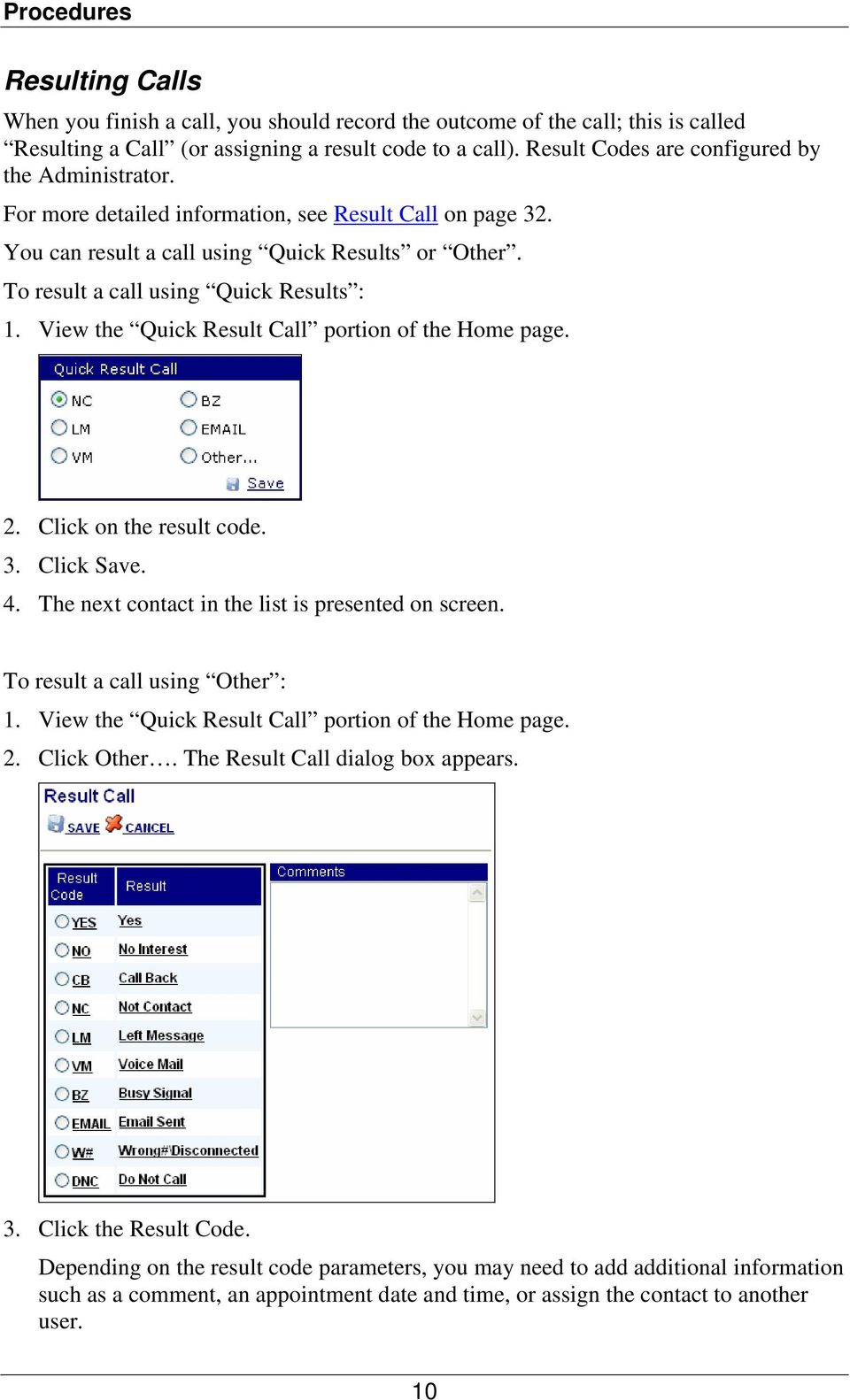
12 Procedures Resulting Calls When you finish a call, you should record the outcome of the call; this is called Resulting a Call (or assigning a result code to a call). Result Codes are configured by the Administrator. For more detailed information, see Result Call on page 32. You can result a call using Quick Results or Other. To result a call using Quick Results : 1. View the Quick Result Call portion of the Home page. 2. Click on the result code. 3. Click Save. 4. The next contact in the list is presented on screen. To result a call using Other : 1. View the Quick Result Call portion of the Home page. 2. Click Other. The Result Call dialog box appears. 3. Click the Result Code. Depending on the result code parameters, you may need to add additional information such as a comment, an appointment date and time, or assign the contact to another user. 10
13 Procedures 4. Click Save. 5. The next contact is presented on screen. Using the Calendar Use My Calendar to view scheduled appointments. If you place your mouse cursor over an appointment, a popup provides details. Use Names shown in Calendar on the top right to display the contact s full name, the company name, or both. You can switch the calendar view by clicking on the tabs to change it from Month to Week to Work Week to a Day view. Use My Appointments to view your appointments in a list. Click the contact ID to display the contact on the Home page. Adding New Contacts Callers can add new contacts from the Home page and from the My Calendar page. To add a contact: 11

14 Procedures 1. Click Add New Contact. The Add New Contact dialog box appears. 2. Add details. 3. Click Save. 12

15 Procedures Searching for Contacts Callers can search for contacts from the Home page and from the My Calendar page. To search for a contact: 1. Click Search Contacts. The Search Contacts dialog box appears. 2. Enter the search parameters. 3. Click Search. If you click search without first entering parameters, a list of the first 500 contacts appear. Edit Contacts Callers can edit contacts from the Home page using Edit Contact. If the Administrator enabled the inline editing feature, callers can edit contact information directly on the Home page by clicking on the field and typing. To edit a contact: 1. Click Edit Contact. The Edit Contact dialog box appears. 2. Change the information as desired. 3. Click Save. 13

16 Procedures Viewing Assigned Contacts To view contacts that have been assigned to you: Go to My CRM > My Contacts. Changing your information Note: This feature can be disabled by the administrator. My Information allows callers to edit their own general and dialing information. See My Information on page

17 Procedures Attaching documents (files) to a contact The software has three features that are associated with attaching documents: Documents (menu item), , and add (attachments). Documents - The Documents menu item lets you view the document library for the current project (the Administrator sets up the document libraries). It is a list of all the electronic files that are associated with the project. Click the underlined file name to view the contents. Click the contact s address to create and send an . Your system may be set up to use the Vanillasoft webmail application or you may be using your computer s default application. Add When you click add. You are prompted to select from the Document Library or to browse your computer for files. To choose from the Document Library. 1 - Select the file. 2 - Select the right arrow ( ). 3 Click Attach. 15

18 Procedures Switching between projects Note: This feature is enabled by the administrator. If enabled, callers can switch back and forth between projects. To switch between projects: 1. Click the (current) Project button in the main menu bar (this button names the current project, for example it may be labeled Template Project ). The menu of available projects appears. 2. Click a menu item to change the current project. The current project changes to the chosen project. The current user is assigned to the selected project. A new contact, one that belongs to the selected project, is presented to the caller. Switching between teams Note: This feature is enabled by the administrator. If enabled, callers can switch back and forth between teams. To switch between teams: 1. Click the (current) Project button (this button names the current project, for example it may be labeled Template Project ). The menu of available projects appears. 2. When you place the mouse cursor over the list, the available teams appear. 3. Click a menu item to select a team. The current team changes to the chosen team. The current user is assigned to the selected team. A new contact, one that belongs to the selected team, is presented to the caller. 16

19 Procedures Working with Reports See My Reports on page 42. Working with Statistics See My Stats on page
20 Procedures Administrator Procedures If you are performing any of the following tasks for the first time, ensure that you have performed the tasks listed in the Quick Start section. This section deals with Administrator items (Make sure you have switched to admin ( )) As an Administrator you are able to perform the following. add callers assign team result codes add and edit contacts configure result codes configure the call script view caller activity statistics view the status of imported files configure reports Administrators also have caller capabilities. 18

21 Procedures Adding Callers (Users) For more detailed information see Users on page 92. To Add a Caller: 1. Click Users > Manage Users. The Active Users page appears. 2. Click Add User. The Add New Caller page appears. 3. Add details. Fields with an asterisk (*) are mandatory. 4. Click Save. Note: For details on setting up Auto-dialing see Appendix B. By clicking on the Manage User Licenses link you can see the individual licenses per account (i.e. dialing, recording) and add or remove licenses as required. 19
22 Procedures Assigning Team Result Codes For more detailed information see Result Codes on 53. To assign result codes to teams, go to Projects > Project Setup > Result codes. Adding and Editing Contacts All users can add Contacts. Administrators have access to additional fields. To add a Contact: 1. Click Projects > Search Contacts. The Search Contacts page appears. 2. Click Add New Contact. The Contact Information page appears. 3. Add details. For field explanations see Search Contacts on page
23 Procedures To Edit a Contact: 1. Click Projects > Search Contacts. The Search Contacts page appears. 2. Enter the parameters for the search. (If you select Search without specifying parameters, all the contacts are listed.) 3. Click Search. The Search Contacts Results page appears. 4. Click the View icon ( ). The Contact Information page appears. For field details see see Search Contacts on page
24 Procedures Configuring Result Codes Result Codes are used by Callers to record call outcomes and assist in determining how the next communication with this contact will proceed. To configure Result Codes: 1. Click Projects > Project Setup > Result Codes. The Result Code page appears. 2. Add details. For detailed information on Result Code configuration see Result Codes on page Click Save Changes. 22
25 Procedures Configuring the Call Script The Call Script is text that the Caller reads to the contact during a call. It is used to assist Callers with their sales approach. To configure the Call Script: 1. Click Projects > Project Setup > Call Script. The Call Script page appears. 2. Add details. Use contact variables to automate the script (add names etc). For detailed information on Result Code configuration see Result Codes on page Click Save Changes. Viewing Caller Activity Statistics See Dashboard on page 97. Viewing the Status of Imported Files See Imports on page 98. Configuring Reports See Reports on page
26 Reference This section covers common screen features plus the screens and screen options available from each of the following main menu options. Caller Options: Home My Information My Calendar Documents My CRM Project Administrator Options: Projects Users My Account Dashboard Common Screen Features VanillaSoft has a number of common interface elements. These include: Menus and Submenus Primary and Secondary Windows Need Support? Phone Setup Button Change Password Button Logoff 24
27 Menus and Submenus VanillaSoft is essentially a menu driven interface. Depending on the menu selected, primary, secondary or tertiary menus may appear. The selected menu option appears as bolded white text. Figure 1 Primary menu Figure 2 Primary and secondary menus Primary and Secondary Windows The VanillaSoft menu options display content on the primary window (directly on the main screen of your Internet browser). However, in some cases, controls that appear on the primary window result in the display of secondary popup dialog boxes. For example, if you click Result Call on the Home page, the Result Call dialog box appears. Switch to Admin/Switch to Caller Figure 3 Secondary Window Switch to Caller/Switch to Admin (found at the top of the screen) toggles you between the Caller view and the Administrator view. Caller view gives you all the options available to a caller. Admin view gives you all the Administrator options. 25
28 Need Support? Need Support? (found in the upper right of the screen) automatically opens an addressed to VanillaSoft Support. You are prompted to enter a comment or ask a question. Test Controls Figure 4 Support Note: This option appears when you are in Caller mode. Use Test Controls to ensure that your browser is configured properly for VanillaSoft. Click Test Controls. The VanillaSoft software performs a number of tests. When you go through the process the first time, VanillaSoft attempts to install a number of ActiveX controls. Please enable the installation of the controls by right-clicking on the yellow bar and choosing <Install ActiveX Control>. Click <Install> on all window boxes that pop up. For further information see the test descriptions that are presented to you on screen and view the online documentation entitled How to Auto-dial and How to Record Calls. 26
29 Change Password Change Password (found in the upper right of the screen) allows you to change your password. Logoff Figure 5 Change Password To exit VanillaSoft, do not simply exit your browser. Use Logoff (found in the upper right of the screen). 27
30 Caller Options This section describes Caller options. Note: If you are currently viewing Administrator options and you want to view Caller options, click Switch to Caller located at the top of the VanillaSoft screen. Home The Home page is the first screen to appear when you log in. Figure 6 Home page You can also gain access to this screen by clicking the Home menu option. This screen is the primary interface for callers, it has a number of elements to assist in call processing. These include: Contact Information Contact s Time Call History Contact ID Quick Result Call Result Call Contact Owner Call Script Edit Contact Added On Telephone Numbers Search Contacts Attached Other Information Add New Contact 28
31 Contact Name and Address Reference Contact information includes the name, company, address, and address. To send an , click the contact address, choose an Administrator-created template if applicable and then process the normally. To edit the contact information, click on the text and type or use Edit Contact (see Edit Contact on page 35). Note: Depending on how Other Information Fields are set up, you or may not be able to edit on screen. Contact ID Each contact has a unique numeric identifier called the Contact ID. It is assigned by the software and cannot be changed. Contact Owner Depending on how you result a call (see Result Call on page 32), you may be given an opportunity to assign the contact to a user. If a call has been resulted in this fashion, the user to whom the contact has been assigned becomes the contact owner. The username for the contact owner is displayed on the contact screen. Added On: The software records the date and time when a contact is added to the system. This date and time is displayed on the contact screen. Attached (documents and s) Use the fields associated with Attached to: keep track of sent s. Click # sent s to view a list. If the was sent with VanillaSoft s Web Form you are able to view the contents. If the was sent using your computer s default application you must open that application to view the contents. keep track of added electronic files. Click # files to view a list. In the list, click the file name to open the attachment. 29
32 add attachments to the contact. Click add. You are prompted to select from the Document Library or to browse your computer for files. To choose from the Document Library. 1 - Select the file. 2 - Select the right arrow ( ). 3 Click Attach. Contact s Time Displays the contact s time of day. Quick Result Call (See Result Call on page 32 for more detail.) Quick Result Call lets you assign a result to a call without having to open the result call dialog box. Result codes appear in the Quick Results section if they do not require additional information such as Schedule an Appointment, User Choice, and Require Comments. To use Quick Result Call, select the result and click Save. Use Other to open the Result Call dialog box. Call Script VanillaSoft has an assortment of scripting and script response options that are set up by the Administrator. Scripts can be single or branching. They can be assigned to projects, teams, and lead statuses. The text that appears can be highly specific and tailored to the campaign. Script responses are links that are associated with a script. When you click on them they can lead you to additional scripts. Script responses can be recorded by the software if 30
33 configured to do so. Responses can be recorded as predefined text or typed text. Responses can also be associated with custom fields such that when you click the response it appears (and is recorded) in the custom field. Reference Figure 7 - Example of a branching script with associated responses. Script association A variety of scripts may be presented to you depending on the current project, team, or lead status. Branching Scripts Figure 7 shows a typical example of a branching script. This particular script has two clickable options ( Interested and Not Interested ). These two options themselves could have associated scripts and responses. Depending on how the script is configured, when you click an option it may (or may not) be recorded in the Script Responses list, or it may (or may not) appear in one of the custom fields. Script Responses The Script Responses button (in the upper right corner of the scripting section) provides a record of script responses. If a response has been configured to capture information, the response text shows up in the response column automatically (see Interested in Figure 8). Figure 8 - Script Responses dialog box. Note: If you enter a manual response and there are no more script branches to choose from, the entry is not saved. This is because the act of choosing the next branch causes the software to save the current text to the Script Responses list. If you want to save the written response, go to Script Responses and add it. To do this: 1 Select the script from the script description drop-down list. 2 Type a response. 3 Click the green plus sign. 4 Click Save. Phone Numbers The Phone Number fields that are defined by the Administrator will appear on the Contact screen where a phone number is present. To edit the telephone numbers use Edit Contact (see Edit Contact on page 35). 31
34 Other Information Other Information provides an interface in which you can view the Lead Status plus custom fields created by the Administrator. To edit Other Information, use Edit Contact (see Edit Contact on page 35) or inline editing if enabled by the Administrator. Note: Depending on how Other Information Fields are set up, you may need to click on Edit Contact and add the field for it to appear if there is not already information in the field. Call History The Call History component of the screen displays a list that summarizes the call history for the current contact. The list includes: call dates call times call durations appointment dates appointment times results caller username comments Result Call When you finish a call, you should record the outcome of the call; this is called Resulting a Call. Result codes are configured by the Administrator. When you select the Result Call button on the Home page, the Result Call dialog box appears. 32
35 Save Figure 9 Result Call Use Save to save your changes and close the dialog box. Cancel Use Cancel to close the dialog box without saving. Result Code The precise result codes that appear depend on the set up that has been provided by the Administrator. However, a result can have a combination of the following characteristics. Results that require a scheduled appointment, specify a retry time, remove the contact from the list, or close the contact permanently. Results that prompt the software to dial the contact s next number, delete the failed number and try the next, or dial the next contact. Results that assign a contact to a specific user, or require that the caller assign the contact to a user. Results that change the lead status. Results that require comments. Comments Use the Comments field to record any notes that are related to the call. Date If you choose a result code that requires an appointment, the calendar appears for the current month and the next month. 33
36 Figure 10 Calendar Use the calendar to choose the date for the appointment. The current date has a grey background. Contact s Time/Caller s Time If you choose a result code that requires an appointment, you are prompted to enter a time. Figure 11 Contact s Time/Caller s Time Use the Contact s Time drop-down list to choose the contact s local time. The Caller s Time is generated automatically. It is calculated using the telephone area code. Note: If the contact is in a different time zone, pay close attention to the difference between the contact s time and the caller s time when scheduling an appointment. You should always choose the contact s time and not your time. Assign to User Figure 12 Assign to User Use Assign to User if the result code requires that a user is assigned to the contact. View Calendar appears if the result code requires that an appointment be scheduled. Click View Calendar to check the appointment schedule of the user to whom the contact is being assigned. Lead Status Figure 13 Lead Status Use Lead Status to assign a lead status to the contact. The Administrator is responsible for building the lead status list. 34
37 Depending on the configuration, the lead status list appears when certain result codes are chosen. This gives the caller the ability to change the Lead Status. Edit Contact Use Edit Contact to edit the details of an existing contact. (See Add New Contact on page 35 for details on specific fields.) Search Contacts Use Search Contacts to find a contact. To perform a search, use the fields that are provided to define the search filters and then click Search. If you click Search without specifying any search parameters. The software lists the first 500 contacts. Figure 14 Search Contacts The following is an example of a Search Result. Click the icon in the first column ( ) to display the contact on your Home page. Add New Contact Figure 15 Search result When you click Add New Contact, the following dialog box appears. Enter the required data and then click SAVE. The new contact appears on the Home page. 35
38 The Phone Numbers section displays the fields that have been created by the Administrator. Use Active and Inactive to display or hide the phone number on the Home page. The Administrator configures the Phone Label and Other Information label names. Fields in the Other Information section are also configurable by the Administrator and can vary in type. Types include: text fields, date fields, and numeric fields. Fields can also be set to accept data as an input or menu. Figure 16 Add New Contact 36
39 My Information Note: This feature can be disabled by the administrator. When you click My Information, the caller s general information appears. My Information allows callers to edit their own general and dialing information. Figure 17 My Information Along with the standard Names, , and phone number fields, the dialog box also provides the following: Project Assignment Use this drop-down menu to specify the project with which you are associated. When you make calls, you are presented with contacts in the project that you specify. This will only appear if enabled by the Administrator. Team Assignment Use this drop-down menu to specify the team with which you are associated (projects can have multiple teams). When you make calls, you are presented with contacts associated with the team that you specify. This will only appear if enabled by the Administrator. Send s Using Options include: Project Default which is the application that the Administrator has assigned to the project (which is one of the following). 37
40 VanillaSoft s Web Form when you a contact, VanillaSoft provides you with a Web based application. Desktop Application when you a contact, your computer s default application is used. Dialing Information Use the Dialing Information dialog box to configure a number of telephone parameters. See the document entitled How to Auto-dial, the link is located at the just above the General Information dialog box. This section only appears if you have a dialing license. For more information contact your Administrator. 38
41 My Calendar When you click My Calendar, the Calendar page appears. Use My Calendar to view appointments. To make an appointment, result a call that requires a scheduled appointment (See Result Call on page 32). Use Names shown in the Calendar to determine which names appear: Company, Full Name, or Both. Use Previous Month and Next Month to change the month and the tabs Month, Week, Work Week, Day to change the display range. Figure 18 My Calendar Place your mouse cursor over an appointment to view more details. 39
42 Figure 19 Calendar mouse-over My Appointments Use the My Appointments button to view a tabular list of your scheduled appointments. Click on the Contact ID to open the contact. Search Contacts (See Search Contacts on page 35) Add New Contact (See Add New Contact on page 35) Figure 20 My Scheduled Appointments 40
43 Documents Documents provides a list of files that are associated with the project. These files are made available by the Administrator. Figure 21 Document library associated with the current project Click an underlined file name to view the file. To add an attachment, use Add (located on the contact screen). Figure 22 The add attachment button. For more information see Attached (documents and s) on page
44 My CRM My CRM provides Customer Relationship Management functionality. It displays a secondary menu that includes: My Contacts My Reports My Stats My Contacts Note: This page may not be visible to some users. Access to this page is enabled by the Administrator. My Contacts displays a tabular list of contacts (comparable to that of a traditional CRM application) that have been assigned to you either through a call result or by the Administrator when the contact was added. You can show all your assigned contacts or use Only show My Contacts due to be routed today (in routing order). Click the icon in the first row to open the contact. Click the address to initiate an . Figure 23 My Contacts My Reports Note: This page is enabled by the Administrator and may not be visible to some users. To use My Reports, the Administrator must first set up access. 42
45 Figure 24 My Reports A list of the reports that have been created for you by the Administrator will be displayed. To run a template report, click the name or the plus sign ( ). The interface that appears depends on the type of report. If the Run As Leads Sheets option is available, then the report will be a printable PDF with each contact on a separate page. Reports are set up in advance and potentially use multiple parameters. Depending on how the report in set up, the user may be able to change certain parameters (such as date range). Figure 25 - Example Custom Report 43
46 My Stats My Stats displays today s or yesterday s calling statistics. Click the icon in the first column or the name to open the contact. Figure 26 Calling Statistics The Stats interface has two parts: Statistics and Calls. Statistics shows: Dials the number of calls made. Contacts the number of calls that resulted in contacting the individual. Contact Positive the number of calls in which the result was positive.* % Positive the percentage of calls in which the result was positive.* Contact Positive the number of calls in which the result was positive.* Contact Negative the number of calls in which the result was negative.* No Contact the number of calls in which the result was no contact.* Unreachable the number of calls in which the contact was unreachable.* Contact Send Info - the number of calls in which information was sent to the contact.* Contact Callback - the number of calls in which the contact needed to be called back.* *Note: as defined by the result code Result Groups. Calls (Today s or Yesterday s) lists: Contact name. 44
47 Company Result Code Call duration in seconds Call time the time the call was presented on screen. Project Project is either inactive (information only) or active (can be clicked). Note: The active or inactive state is configured by the Administrator. If it is inactive, it tells you which project you are on. If it is active, it allows you to choose your project and team. If you choose a new project, the current user is assigned to the selected project and a new contact, one that belongs to the selected project, is presented to the caller. If you choose a new team, the current user is assigned to the selected team and a new contact, one that belongs to the selected team, is presented to the caller. For detailed instructions, see Switching between projects and Switching between teams on page
48 Administrator Options This section describes Administrator options. Note: If you are currently viewing Caller options and you want to view Administrator options, click Switch to Admin located at the top of the VanillaSoft screen. Projects The Projects option found in the Administrator view allows you to Add, Edit, and Delete projects. A project is a collection of contacts, result codes, call scripts, and other related parameters that are brought together under a single name. Typically, a project assists users in carrying out a single campaign or a well defined segment of a single campaign. For instance you may want to define a project called Product A to address the Product A sales campaign, and another one called Product B to address the Product B sales campaign. The Product A project could have different contacts, result codes, and call scripts from the Product B project. Likewise you may want a project called Product A - East, and another one called Product A - West depending on regional approach to sales. You can define as many projects as you want. Figure 27 Project list When you add a project it appears in the project list. Click Manage ( ) or the name to view all the Project menu options. Click Copy to ( ) create a new project from an existing one. 46
49 Select Active to activate or de-activate a project. You may want to de-activate a project if it is not yet ready to be used. Use Active Projects to show only active ones. Use All Projects to show only active and in-active ones. Other items in the Project list provide a number of use statistics (Total Contacts, Flagged Contacts, Closed Contacts, DNC (Do Not Call) Closed Contacts (contacts that are closed because they are on the Do Not Call list), and the DNC Profile which only applies if you are using VanillaSoft s DNC service. When you click Manage (or the project name), the following sub-menus appear: Project Setup Search Contacts Contact Management Flagged Contacts De-Duping Audio Review Reports Web Leads Project Setup When you click Project Setup, the following sub-menus appear. Project Details Result Codes Call Scripts Custom Fields Lead Status Local Prefixes Import Contacts Export Contacts Documents Templates 47
50 Project Details The Project Details dialog box provides basic information about the project. Figure 28 Project Details Project Name: Use this field to modify the name. Dialing: (Progressive or Preview) With progressive the number is dialed as soon as the lead is routed to the caller. With preview the caller clicks the number to dial it. (See Appendix B for more information on telephone and dialing setup.) Dialing Region: The current choices for dialing region are USA, Canada, and US Territories and Mexico. Recording: (Yes or No) Turns on audio recording for the project. (See Appendix C for more information on setting up audio recording). Description: Use this text box to provide a description of the project. Routing Order: Use this drop down list to specify the routing order (all other factors being equal). Choose: First in, first out the first contacts imported are the first to be routed. Last in, first out the last contacts imported are the first to be routed. 48
51 Route New Web Leads as first priority: When selected, New Web Leads are routed first. When unselected, the chosen routing order takes priority. See Web Leads. Calling Periods: Specify the time period (contact s local time) when the contacts in this project can receive calls. You can create exceptions to the general rule by specifying time periods for specific states or provinces. You can also specify that all contacts do not receive calls during their lunch hour (between the hours of 11:45 AM and 1:15 PM). Team Names: ( ) Use this button to add teams to the project. Teams are used in several ways. (For more information see Assigning Team Parameters.) Teams can be used to divide the contacts in a project between different users. For example if a company has people in two locations (Los Angeles, California and New York, NY). The company would like all callers to work within one project, but wants all contacts from California, Texas and Washington to be called from Los Angeles, and all contacts from New York, Massachusetts and North Carolina to be called from New York. By setting up two teams, contacts can be sent to the correct pool of sales people. Teams can also be used in a multi-step sales process. For example, a company may want to divide their sales process into three steps. Step one (Team one): Lead generators call a large group of contacts looking for leads that would be interested in meeting with a representative to discuss the product. Step two (Team two): Leads are passed to a group that is responsible for setting appointments between the contacts and sales executives. Step three (Team three): Sales executives call their assigned contacts (honor the appointments). 49
52 User Quota: ( ) User Quota (Figure 29) and Project Quota (Figure 30) (specified in the Quota Type drop-down list) limit the number of contacts a user or project receives in a day, a week, or a month. The quota is applied towards the number of results for the specified Result Groups (you can specify multiple result groups to be counted towards the quota). For example, a user quota might consist of 25 Contact- Positive and Contact-Callback calls per day (in this case the sum of all the Contact- Positive plus Contact-Callback calls would add up to 25). After the quota is reached, no more contacts are sent to the caller. Under User Quota you can assign the same quota to all the users, or you can set specific quotas for each user. You can also assign quotas to users who switch to this project. Use Warm Leads Only: to specify the lead sources that are to be applied to the quota. ( Lead Source is one of the parameters that defines a contact.) This makes it possible to direct more leads from certain sources to the individuals of your choice. 50
53 Figure 29 - User Quota (by User ) In the case of a Project Quota, the number of calls is applied to the whole project regardless of how many calls have been processed by individual callers. Figure 30 - User Quota (by Project ) Routing Filters: ( ) You can create routing filters based on the State/Province field in the contact address. Filters can be defined for teams or individual users. The user or team only receives contacts from the specified states/provinces. Figure 31 Routing Filters 51
54 Web Leads Distribution: ( ) A Web Lead is a lead that has been captured from your website through an online form. (see Web Leads) or submitted by a lead provider through a form post, XML post or XML . When the website visitor submits the form, the contact information is automatically imported into VanillaSoft. Web Lead Distribution assigns ownership of incoming Web Leads evenly among a group of Callers. Distribution can be: Off Web Leads are distributed to the first available caller. Manual Web Leads are distributed to the specified callers. When this option is selected, you must also indicate which callers are included and whether new Web Leads are assigned only when the caller is within this project, or always. Automatic Web Leads are distributed evenly among all the users in the project. Figure 32 - Web Leads Distribution 52
55 Result Codes Reference The software has 10 predefined result codes. You can add as many as you would like. The codes that are available upon first use of the software are preconfigured for the average user. However, they are highly configurable. Figure 33 - Result Codes Result Code - use this column to add a 5-character abbreviation of the code. Result use this column to describe the code (max 50 characters). Result Groups use this column to categorize the code. Predefined categories include: Contact-Positive Contact-Negative Contact-Send Info Contact-Call back No Contact Unreachable Active use this column to activate or deactivate the code. An inactive result code does not show up on the caller screen. Result Action use this column to assign a specific action associated with the contact. End of Queue minimum. (No Min, 30 minutes to 5 months.) Sends the contact to the end of the queue and defines the minimum wait time for it to reappear automatically to a caller. 53
56 Schedule an appointment. Prompts the caller to schedule an appointment with the contact. Close Contact. Sets a Closed Contact flag on the lead and takes the lead out of circulation. The lead would need to be re-opened and flagged through a Contact Management query in order to bring it back into circulation. Retry In. (30 minutes to 5 months.) Presents the contact to the caller after a predefined time period. Stop Trying (un-flag). Removes the call flag, the lead is no longer presented to the caller until it is flagged again using Contact Management. Dialing Action (automated dialing only) use this column to specify the dialing action that occurs after the code has been assigned. Dial Next Contact. When the call is resulted, the next contact is dialed. Dial Next Number. If there is more than one phone number for a contact, the software dials the next one in the list (home, business, mobile, etc). Disable Number, Dial Next. When the call is resulted, the software disables the previous number so that it cannot be dialed again. Then the next number is dialed. User Assignment use this column to specify whether a user is assigned to the contact. No. No user is assigned User Choice. The caller who is resulting the call determines who is assigned to the contact by choosing from a dropdown list of all users. The list defaults to the current user. Specified User. You are prompted to name a specific user. Specified Team. You are prompted to name a specific team. Lead Status Change use this column to specify whether a lead status is assigned to the contact. (To create statuses go to Project > Project Setup > Lead Status). No. No status is assigned User Choice. The caller who is resulting the call assigns the lead status. Specified Lead Status. You are prompted to choose a default status. Require Comments use this column to specify whether a comment is required when the call is resulted. Save Recording Saves the audio recording file for the call (if setup). Sort use this column to determine the order in which codes are presented to the caller. Note: The following parameters apply to the Project, they are not related to individual result codes. Close Contact after # consecutive no contact attempts. (For the current project) If a No Contact code is assigned a specified number of times consecutively, the software closes the contact. 54
57 Show Quick Call resulting box. (For the current project) The Quick Call resulting box appears on the caller screen and provides quick and easy access to call results. The first five simple result codes will be displayed (i.e. do not require intervention such as entering comments, manually changing the user or lead status, etc). Only show x most recent Call History Results to Callers. (For the current project) You can specify how many call history entries are shown to callers. Hide "No Contact" Call History Results from Callers. (For the current project) Calls with the No Contact status do not appear in the Call History section. Assign Team Result Codes: ( ) Figure 34 - Assign Team Result Code Team Result Codes allow you to assign specific result codes to specific teams. By default all teams see all result codes. To make a result code only visible to a specific team, select that team from the drop-down box. After saving the changes, use Preview Result Codes available to users in Team: to see how the results codes will appear for a specific team. (When you go back to results codes ( ) you will notice that the result codes are categorized according to your team assignments.) (To create teams go to Project Details > Team Names.) Note: Contact records that are not assigned to a team, are routed to the Default Team. 55
58 Call Scripts VanillaSoft offers powerful logical branch scripting capabilities (For an example, see Appendix Scripting Exercise). Scripting allows managers to control the quality and flow of conversations while ensuring that all the information that they want is gathered during the call. Scripts also enhance calling productivity by allowing for one-click information gathering. Since scripts can be complex, involving multiple sub-scripts and branches, they should first be created on paper or in a word processing application before being created in VanillaSoft. Multiple scripts can be associated with a project, and there can be distinct scripts for specific teams or lead statuses. If you create a script and do not want to assign it to any teams or to any lead statuses you must define it as Default or No Lead Status (using Assign Scripts to Teams or Lead Status. One script can be associated with multiple responses. Responses can be associated with sub-scripts. Responses can be recorded in the Other Info (Custom) fields of the caller screen. As a simple example, the Script: Do you like green or yellow shirts? could have two clickable responses Green and Yellow. If you click Green, the term Green could appear in one of the custom fields and an associated sub-script could appear such as Green shirts come in Large, Medium, or Small, which would you prefer, etc. For this type of data collection (you wish to save the text that is clicked on) choose Auto under Record Type. You can also define manual or input responses (under Record Type ) in which you type the response on the caller screen. Figure 35 Call Scripts Add New Script This is the title for the script. 56
59 Drop-down list ( edit, rename, or delete. Reference ) Use the drop-down list to specify the script you wish to Add Sub-Script A Sub-script is the text that is associated with a script. Add a subscript and then type the text in the SubScript Text box. Click Save Changes. Use View Contact Variables to add automated text (for example, use FIRSTNAME and LASTNAME to have the script automatically display the contact s first and last name.) Sub-Scripts Use the SubScripts list to choose the sub-script you would like to edit. Sub-Script Name Use the SubScript Name field to alter the sub-script name. Record Type A sub-script response can be None, Input, or Auto. None means no response is recorded. An input response is one where the caller enters a response manually. When this option is chosen, an input box is displayed below the subscript on the caller screen for the caller to enter information. This is useful when the question is open-ended or when there are a large number of possible responses. Once the agent enters the information in the box and moves to the next subscript, the information is captured and can be reviewed by running a report on the contact. In this case the subscript response is simply used to direct the caller to the next subscript. An auto response is best used when the question being asked has a limited number of possible answers. The classic example is a Yes or No question, but this can also extend to questions such as which is your favorite vegetable: cauliflower, green beans, lettuce, broccoli, peas, corn or squash? The possible responses to an auto question are created using SubScript Responses. These responses are displayed (as hyperlinks in red) directly below the subscript on the caller screen. The caller simply has to click on the appropriate response, the system automatically captures the information and move to the next subscript. This is called one-click information gathering and can significantly boost both the productivity and quality of information gathering during calls. First Script Select this check box if the sub-script that is currently showing is the one that should appear first when the contact is presented on screen. Sub-Script Responses The SubScript Responses section is used to define responses to subscript questions and to define which subscript appears next. To create a new Subscript Response: 1 Type the name of the subscript response (i.e. yes, no, etc) (first column). 2 Choose the Target Subscript (second column). The Target Subscript is the script that appears if the associated response is chosen by the caller. 3 Click the green plus sign to add the response. Note: If you have not yet created all your subscripts, you can return later to specify the target subscript. To view the results of a subscript, log in as a caller assigned to the project and try the different combinations to ensure that the subscript has been properly defined. Sub-Script Text Type Sub-Script text in the SubScript Text box. Click Save Changes. Use View Contact Variables to add automated text (for example, use 57
60 FIRSTNAME and LASTNAME to have the script automatically display the contact s first and last name.) View Contact Variables Use View Contact Variables to see the syntax for adding automated text (for example, use FIRSTNAME and LASTNAME to have the script automatically display the contact s first and last name.) Assign Scripts to Teams or Lead Status ( ) Scripts are associated with projects. They can also be associated with teams or lead statuses within a project (see Figure 36 and Figure 37). (To create teams go to Project Details > Team Names.) (To create lead statuses go to Project > Project Setup > Lead Status). Figure 36 Assign Scripts to Teams Figure 37 Assign Scripts to Lead Statuses 58
61 Assign Script responses to Other Info Labels ( ) If responses are configured as Auto or Input you can have the response feed into one of the Other Info Labels fields (also known as Custom fields ) on the caller screen. Figure 38 Assign Script responses to Other Info Labels Custom Fields (Other Info Fields and Phone Fields) Custom Fields (Other Info Fields) are fields that you can create within a project to facilitate the gathering of additional information. VanillaSoft comes with many standard fields such as First Name, Last Name, and Address. Your projects may require additional information such as Age, Revenue, or Previous Products Purchased. When you click Custom Fields, the following sub-menus appear. Other Info Fields Phone Fields Other Info Fields Figure 39 Other Info Fields 59
62 Add New Use Add New to create a new custom field. Active Use the Active check box to activate or deactivate the custom field. An inactive custom field is not visible to the caller. Field Type There are two options for Field Type: Input and Menu. Input configures the field for manual data entry. The data type field determines what type of information can be entered. Menu configures the field as a drop-down list. When you select Menu the software adds a new field allowing you to add menu items. Menu fields are useful when the range of possibilities is limited and the administrator would like to ensure data integrity during the collection process. One example may be a field such as Existing Customer, its menu items could include Yes or No. Data Type Each Other Info Field can be associated with a data type. This will affect the type of data that can be brought into the field, as well as the filters that can be used in Contact Management queries and Reports. Any Text The field can contain any type of information, including characters and numbers. Number/Currency - The field can contain numbers or currency. This data type can be used when you wish to compare numbers or compute totals and averages in reports using the data in the field. Examples of valid inputs include: 7,000, 7,000.00, $7,000, and $7, Date or Date/Time - The field can contain date or date/time entries. This data type can be used when you wish to compare dates in reporting or contact management. Valid input formats include 11/10/2006, 11/10/ :00 AM, November 10, 2006, and November 10, :00. Validate Data - The Validate Data button can be used when you are converting an existing Other Info Field into a new Data Type. The system checks all of the existing data in the field and reports whether there is any data that is invalid. If invalid data is present, you can locate the relevant contacts by running a Contact Management query using that field and selecting the is invalid filter. The data can then either be corrected manually or by batch update. Visible This option affects how the field is displayed on the caller side. When Always on Form is chosen, the field displays on both the main caller screen (to the right of the script) as well as in the Add and Edit forms regardless of whether any data is present in the field for that contact. When Added by User is selected, then the field is only displayed on the main caller screen and in the Add and Edit forms if there is data in the field for that contact. If no data is present, the user needs to add the field from a dropdown list under Edit Contact Allow Callers to Edit Some companies want their callers to be able to edit. Other companies prefer that data editing is more strictly controlled. When the Allow Callers to Edit checkbox is enabled, callers are able to edit the information in the field. When the Allow Callers to Edit checkbox is disabled, callers can not edit the information. 60
63 Phone Fields Figure 40 Other Info Fields Add New Phone Field Use Add New to create a new phone number field. Active Use the Active check box to activate or deactivate the phone field. An inactive field is not visible by the caller. Order Use the Order arrows to have the phone numbers appear in the desired order on the caller screen. If progressive dialing is enabled, the first active phone number in the list will be dialed. Lead Status Lead Status allows you to assign a status that identifies the state of the contact with respect to sales potential. Three statuses are provided initially. You can add as many as you would like or modify the default entries. Statuses can be associated with a number of other parameters in the software: A specific lead status can be linked to a specific result codes so that when a caller assigns the result code the lead status is assigned at the same time. A lead status can be the caller s choice so that when a call is resulted the caller decides which status to assign. A lead status can be associated with a specific call script so that when a contact with that status is presented to the caller the appropriate script appears as well. You can change the lead status through Edit Contact.. 61
64 Figure 41 Lead Status Default If you set a default, all contacts are assigned the default unless specified otherwise. Active Use the Active check box to activate or deactivate the status. Sort Order Use Sort Order to specify the order in which statuses are presented (wherever they are presented). Local Prefixes In North America the second group of three numbers in a 10-digit telephone number is called the Prefix (the first group of three numbers is the area code. VanillaSoft needs a list of local prefixes so it knows when to dial 1 and the area code and when not to. Use Local Prefixes to import a prefix file in.csv format. (You can use MS-Excel to export a file as.csv.) You can also export prefixes as a.csv file, view prefixes, and delete prefixes. You can specify whether the software dials 10-digit local numbers or 7- digit local numbers. VanillaSoft will accept area codes (i.e. 972) or area codes plus a prefix (i.e ). Figure 42 - Local Prefixes 62
65 Import Contacts If you do not already have a contact information file, use a spreadsheet application such as Microsoft Excel to create one. The spreadsheet columns should correspond to the various data fields (as follows). Figure 43 Contacts on a spreadsheet VanillaSoft imports contact information as Comma Separated Value (.csv) files. To create a.csv file open the contact file, select <Save As>, select <Save as Type>, and select CSV (comma delimited). Note: CSV files only support one worksheet, if your lead file has multiple worksheets, convert each sheet separately to CSV. Also ensure that your file name does not contain any unsupported characters such as #/\*:?"<> or +. These characters may cause errors when importing. To import contacts: 1. Click <Import Contacts>. The following screen appears. 2. Click <Browse> and locate the.csv file. (Import Mapping is explained in step 5.) Use Update Existing Contacts to repopulate fields for existing contacts with the values from the import file. If the import contact is not already in this project, it is added as a new contact 3. Click <Next>. The VanillaSoft Application processes your request and displays the following screen. 63
66 4. Use this screen to map the columns of your.csv file to the provided VanillaSoft fields. To do this click the dropdown lists and choose the appropriate data type. 5. Verify the entire list and ensure that each field is mapped correctly, including phone numbers and Other Info Labels. Once all fields are mapped, you are ready to import the file. If you are going to import several files with the same category headings, you can save the mapping that you have just created. You can choose it (from Import Mapping) the next time that you import a file and the mapping will be done automatically. 6. Click on <Import> to start the file import. When leads are imported they are automatically flagged by the system. This means that they are ready to be sent to callers by the system. Export Contacts You may want to capture all contacts or call history information in a spread-sheet. Use Export Contacts to create.csv files that include: All contacts and last call information The complete call history for all contacts 64
67 Documents Reference Documents lets you create a library associated with the project. Callers can use this library for viewing important information or to attach files or hyperlinks to specific contacts or send them as attachments. Administrators may want to use this library to keep useful project-related files in one spot. You can add files, hyperlinks, and Adobe mail-merge templates. Figure 44 Documents Edit Categories ( ) Use this button to add or edit file categories (for example: Sales or Support ). Add New Use this list to specify the type of entry (files, hyperlinks, mail-merge templates, and mail-merge templates with call history). First Column (File, Hyperlink) Use this column to specify the desired file or hyperlink. (Use Browse to find a file located on your computer. Description Use this field to provide a description of the item. Category Use this field to assign the item to an existing category. Privacy Public files can be attached to s within VanillaSoft and sent out, private files can not be attached to s within VanillaSoft. Mail-merge Only PDF Form documents can be used for mail-merge. These can be created from MS Word documents using Adobe Acrobat Professional. If you require assistance, VanillaSoft can also create mail-merge documents as part of our professional services. Once you have added the mail-merge document, you are presented with a screen in order to map the fields in the document to the appropriate VanillaSoft fields (see Figure 45). Administrators are able to add mail merge templates that include call history. 65
68 Figure 45 - Mail-Merge Document Field Mappings VanillaSoft detects the form fields within the document and displays them in the list. By clicking Click to map a field link beside a field name you can associate it to the appropriate VanillaSoft field. Click Save Changes to finalize. Templates Templates provide users with preconfigured s that can be sent to contacts. You can name the template, add text (and variable text such as contact name), add attachments, and (in the case of VanillaSoft Web ) determine the graphic layout. s can be sent from VanillaSoft either through VanillaSoft s form or through the users desktop application. If the VanillaSoft Web form is used, the is sent out through the VanillaSoft server. The Reply To address is the address located in the My Information section of the user s account, and From is the first and last name of the user. HTML code can be used in s sent using VanillaSoft . When an is sent to a contact, a note indicating that an has been sent is added to the contact record along with the name of the template used and the date sent. A copy of the is also saved and can be viewed from the Caller screen. Users can also use their local client, such as MS Outlook. In this case, when the user selects an template, a message appears in the local client and the relevant template is pasted in. Since the is being sent out by the local client, a copy is saved in the client. A note is added to the contact within VanillaSoft to indicate the name and date of the template that was sent. Unlike the VanillaSoft form, this method does not support HTML code. The templates must therefore be designed in a rich text format (described below). The From address will be that of the client. Attachments can not be predefined in templates sent with a local client, however a link to the document in the document library can be inserted. The type of to be used (VanillaSoft or local) can be configured within the User Settings. By default it is set to the VanillaSoft client. 66
69 Figure 46 Template Available to callers Select this checkbox if you want callers to have access to this template. HTML Body and Plain Text Body - HTML Body is a WYSIWYG (what-you-see-iswhat-you-get) editor that allows you to type in your text and apply HTML 67
70 formatting such as bold, colors, etc. This text is used when the template is sent via the VanillaSoft form. Plain Text Body is a rich text format box, it is used when the template is sent using the local client. The same text that was entered into the WYSIWYG editor can be copied into this box. Remember that any formatting such as bold, colors, underlining, etc will not appear when sent using a local client. This box must be filled out if callers are using templates with a local client. View Contact Variables To insert caller or contact specific information into the , you can use variables. Available variables can be seen if you mouse-over the Contact Variables link. Public Files in Documents Library Use this section to select files you wish to attach to the template. Click the right arrow ( ) to add the file to the template. (Use the left arrow to remove files from the template.) This works for s sent using the VanillaSoft client. Search Contacts This interface is used to display contact information for the purposes of editing that information. Note: This search interface differs from the search capability provided for users, which is intended to help users find contacts and present them on the contact page. To perform a search, use the fields that are provided to define the search filters and then click Search. If you click Search without specifying any search parameters. The software lists the first 500 contacts. Figure 47 Search Contacts To add a contact, click Add New Contact. The Contact Information screen appears. 68
71 Figure 48 Contact Information Enter the required data and then click Save Changes. Phone Number Fields are configurable (see Project Setup > Custom Fields > Phone Fields). Fields in the Other Information section are also configurable (see Project Setup > Custom Fields > Other Info Fields). Specifically this screen adds the following. Call Priority Call Priority can be set to bring one contact up before another. Blank is the highest level followed by 1, 2, 3 etc. If double digits are used a double digit format (01, 02) must be used. Call Flag A Call Flag is used to tell the system that this lead still needs to be contacted or is going to be retried at a later time. Call flags are for leads that are in the calling queue and can be distributed. When uflagged, a lead will sit in the system and will not be routed but can be reflagged at any time through Contact Management. Closed Flag A Closed Flag is used to tell the system that this lead no longer needs to be contacted. The system will no longer distribute closed leads. The Closed Flag adds on an extra level of protection, as it is not possible to reflag closed leads before first reopening them using a Contact Management query that includes the Closed Flag field and updating the contacts so that Closed Flag is false. Contact Owner Use this field to view or change the current contact owner. Add Date This field displays the date the contact was added. Retry Date/Time If a Retry has been specified for this contact, the date and time is shown here. 69
72 Lead Status Use this field to view or change the current lead status. Lead Source Use this field to view or change the lead source. Lead Source Use this field to view or change the lead source , which is used for Lead Status notification.. Scheduled Call Info (Agent) Use this field to view or change the agent (caller) assigned to a scheduled callback. Scheduled Call Info (Date) - Use this field to view or change the date of the scheduled callback. Scheduled Call Info (Contact s Time/Your Time) - Use this field to view or change the time of the scheduled callback. If the time zone of the contact differs from that of the caller, both times are listed (time zone is determined by the telephone area code). Note: Geographically independent numbers such as 800 numbers are assumed to be in the same time zone as the caller. Call History Use this section to view or change the call history. Script Response ( ) Use this button to view or change script responses that have been assigned to this contact. Audio Review ( ) Use this button to listen to any audio recordings that may be associated with this contact. Figure 49 Audio Review ( ) Use this button to view any s that may be associated with this contact. Attachments ( ) Use this button to view any attachments that may be associated with this contact. 70
73 Contact Management Reference The Contact Management feature is a tool for working with your data. Custom queries can be built to find contacts based on any combination of data fields. Contacts can then be viewed, flagged or unflagged, updated, exported or deleted. Contact management can be used to assign calling priority, assign contacts to teams, select which contacts will be called etc. Common Queries Figure 50 Contact Management Five common (pre-built) queries are available. All Records This query returns all records in the project with the contact ID, flag status, first name, and last name. All Open Records This query returns all records in the project that have not been marked as closed along with the contact ID, flag status, first name, last name. Records Attempted Fewer than 5 times This query returns all records in the project for which there are four calls or less in the contact history along with the contact ID, flag status, first name, last name and number of attempted contacts. All Records Not Called in the Last Week This query returns all records in the project that have not been called in the last seven days along with the contact ID, flag status and last call date. All Records Called in the Last Week This query returns all records that have been called in the last seven days along with the contact ID, flag status and last call date. 71
74 Build a New Query ( ) (Custom Queries) Custom queries can be built quickly and easily. To start a query, click Build a New Query. Figure 51 Query Builder (example) Query Description Use this field to name the query. Query Fields - This allows you to select the fields you want included in the query. To select multiple fields, hold down the CTRL key. When all fields have been selected, click on the green plus sign to add them to the query. For a description of all of the available query fields see Table 1. Table 1 VanillaSoft Query Fields Field Name ContactID Prefix Lead Source Closed by DNC Description Each contact is assigned a unique contact ID by VanillaSoft upon import. Prefix (i.e. Mr., Ms., Mrs, Dr.) This field contains the address of the source of the lead. This field can be true or false. True means that VanillaSoft s DNC checking found the contact on the DNC list. 72
75 Closed by DNC Date Last Call Date Last Call Duration Last Call Time Last User Name Last Result Code Last Result Group Last of Comment Result Count to Date Scheduled Call User Current User First Name Middle Name Last Name Suffix Title Company This is the date on which the contact was closed. This field will be blank if the contact is not closed by DNC. This is date on which the contact was last called. Dates should be entered in the following format: month/day/year, i.e. 04/18/2006 for April 18, The duration, in seconds, of the most recent call. The time of the last call. The user name of the last person to call the contact. The result code of the last call to the contact. The result group of the result code of the last call to the contact. The comment entered during the last call to the contact. The total number of calls made to the contact to date. The name of the user to whom a callback or appointment has been assigned. The name of the last person to call the contact. First name of the contact. Middle name of the contact. Last name of the contact. Suffix Title (i.e. President, CEO, etc) Company name Address 1 Address 1 Address 2 Address 2 City State Zip Code City State/Province Zip/Postal Code address of the contact 73
76 Call Priority Added Date Flagged Call Back Date Call Back Time Contact Owner ClosedFlag Team Lead Status Lead Source Other Info Fields Phone Labels Scripts Last Blast Name Blast Name Last Blast Description Blast Description Last Blast UserName Blast UserName Call priority of the contact. Call priorities range from 1 to 99. A blank call priority is the highest, followed by 1 and so on. Therefore, in order for contacts with a call priority of 1 to be routed first, all other contacts must have a call priority of 2 or more. The date that the contact was added to the project. If the contact is flagged to be called, the value of this field is <True>. If the contact is not flagged, the value is <False> The date of a scheduled callback or appointment. The time of a scheduled callback or appointment. Contacts can be assigned a contact owner. Contact owners must be an active user within VanillaSoft. When a contact is closed, this field has a value of <True>. When the contact is not closed, the value is <False>. When a contact is closed it can not be flagged until the closed flag has been removed. The team to which a contact is assigned. The lead status of the contact. If no lead status is assigned, this field will be blank. The source of the lead. Each Other Info field will be listed and can be used for querying purposes. Each phone label will be listed. Each script name will be listed and can be used for querying purposes. Queries can be carried out on the information gathered for a script. The most recent blast name associated to a lead Will work on all blast names associated to a lead, although the query will always display the most recent blast tag for a lead. The most recent blast description associated to a lead Will work on all blast descriptions associated to a lead, although the query will always display the most recent blast description for a lead. Name of the user who created the last blast tag. Name of the user who created any blast tags associated with a lead. Queries can be done on any blast usernames, but the query will always display the most recent blast username in the results. 74
77 Field Filters Use filters to specify the desired contacts. Reference Equal to This filter can be used to search for exact matches in a field. For example, if you wish to find all of the contacts from a particular state, say CA, a query can be built as follows: State - equal to CA. This will query all of the contacts that have CA in the State field. Equal to can only be used with one term (for example querying for State equal to <CA FL> will not find both California and Florida). This filter can be used with dates for the following fields: Last Call Date, Add Date, and Call Back Date. For example, the query Last Call Date equal to 01/01/2006 finds all contacts that were last called on January 1st, The date must be entered in a month/day/year format. Equal to or less than This filter finds contacts where the field information is equal to or less than the entered value. In the case of letters, A has the lowest value and Z the highest. For example, the query: State equal to or less than C finds all contacts where the state in the State field starts with C, D, E, etc but will not return states beginning with A or B (i.e. AL). When this query is used with numbers, it looks for fields where the number is equal to or less than the number used in the query. For example, the query Result Count to Date equal to or less than 4 will return all contacts that have been dialed 4 times or less, but will not return contacts dialed 5 times or more. If being used with Other Info fields that you have created, this filter will only work on numbers if the field has been specified as a Number/Currency field. This query can be used with dates on the following fields: Last Call Date, Added Date, and Call Back Date. For example, the query Call Back Date equal to or less then 04/10/2006 will return all contacts with callbacks/appointments scheduled for April 10th, Equal to or Greater Than This filter can be used in a similar fashion to 2), with the one obvious difference (Greater Than instead of Less Than). Less Than This filter behaves similarly to 2) except that only results less than the query value will be returned. Greater Than This filter behaves similarly to 3) except that only results greater than the query value will be returned. Not Equal to This filter eliminates all contacts where the field content is equal to the query value. Blank This filter returns all contacts where the chosen field contains no information. Not Blank This filter returns all contacts where the chosen field contains information. Begins with This filter returns all contacts where the information in the chosen field begins with the query value. For example, the query State Begins with C will bring back all contacts where the state name begins with C, such as CA, CO and CN. 75
78 Contains This filter returns all contacts where the chosen field contains the query value. For example, the query Lead Status Contains sale could return contacts where the Lead Status is Sale pending, Verbal Sale or even Wholesale. Between This filter returns all contacts where the information in the chosen field lies between the chosen query values. A comma (but no space) must separate the chosen values. In the case of letters, for example, the query State Between B,D returns all contacts where the information in the State field begins with C. In the case of dates, the Query Last Call Date Between 01/01/2006,04/10/2006 returns all contacts where the last call date is between January 1, 2006 and April 10, In This filter operates similarly to the Equal filter, but allows several values to be searched for at the same time. For example, the query State In CA,FL will return all contacts where the state information is equal to CA or FL. When using this filter, the values must be separated by a comma with no additional spaces added. Not In This filter operates similarly to the Not Equal to filter, but allows several values to be excluded at the same time. Select This Query When you select a query the selected query dialog box appears. Figure 52 Selected Query Show Results - This displays each of the selected contacts along with the information for the fields in the query. By clicking on the Contact ID of the contact the Edit Contact window appears for that contact. Once the contacts are displayed, clicking on the Perform Task hyperlink at the top of the page displays the list of actions that can be carried out. 76
79 Flag Contacts This flags all of the contacts returned by the query so that they are routed to callers. Contacts that have been closed (based on the last result code) are not reflagged. Any contacts that have a scheduled callback/appointment will not be routed until the scheduled time. Unflag Contacts This unflags all of the contacts so that they are no longer routed to callers. This does not affect any contacts with scheduled callbacks/appointments. Update Contacts - This brings up the Update Contact window, which allows fields within the query to be updated in batch. For example, to establish a calling priority a query can be built that includes the field Call Priority. Under update contact, the Call Priority field can be chosen and the value 1 placed in the field. When the contact update is completed, all of the contacts are given a call priority of 1. Certain fields can not be updated in batch. These fields are grayed out and can not be selected in the Update Contact window. Export Results - This exports the contacts and all of the query fields to an Excel csv file. Copy Contacts - This allows you to copy contacts to another project. When copying contacts note that an error message appears to inform you of missing or mismatched fields. You will then have the choice to proceed as is, in which case any missing fields will not be copied, or to return and add the fields/result codes to the project into which the contacts are being copied. Delete Contacts - This deletes the contacts from VanillaSoft. It is important to double-check before deleting contacts, as the deletion is permanent and all contact history will be lost. Edit this Query - This will bring the query up along with the query field box so that the query can be modified. Duplicate this Query - This will create a copy of the current query. Remove this query - This will delete the query from VanillaSoft. Blast Tag - This will allow you to apply a blast tag to the leads to indicate a marketing event. (see below) Mail-merge - This will allow you to generate mail-merged documents for the leads based on a template in the Document Library. (see below) Blast Tagging ( ) Blast tagging allows you to mark leads as part of a marketing campaign. The marks show up in the Call History. Take as an example a group of leads to which you would first like to carry out an campaign before following up by phone. Within Contact Management you can build a query that brings up all of the leads that you would like to blast, making sure to include the address field in the query. This data can then be exported to Excel and used for your blast. At the same time, you can choose the <Blast Tag> option in the <Perform Task> link to define a blast tag. You will 77
80 give a name and a description to the blast tag, which will then be used to tag each of the leads. Figure 53 Blast Tag Contacts Blast tagging allows you to bring up leads by marketing campaign and allows callers to see whether a lead was part of a particular marketing campaign. You can query leads by Last Blast Tag or by Blast Tag, and you can use the Last Blast Tag when running reports. Please note that when querying by Blast Tag the system will bring up leads that are tagged with the Blast Tag in question but will always display the most recent Blast Tag for that lead. Mass Mail-Merges It is possible to generate mail-merged documents for a group of leads in one batch, for example in order to carry out a mass mailing. First, build and run the query that brings up all of the desired leads. Under <Perform Task>, choose <Mail-Merge Contacts> and the following screen will appear. From this screen you can select the PDF mail-merge template that you would like to use. You will be able to choose any templates that have been added to the Documents section. Figure 54 Mail Merge Contacts (first) 78
81 The next screen will give you the option of assigning a Blast Tag to the group of leads before generating the mail-merge documents. You can then generate the documents by clicking on the Start Mail-Merge button. Figure 55 Mail Merge Contacts (second) The mail-merge documents will be generated as one PDF file, which can be opened by clicking on the link. Depending on the number of contacts and the size of the document it may take some time for it to complete. This file should then be saved to a local drive, as VanillaSoft does not keep a copy of the file. Flagged Contacts This section provides an overview of the status of contacts that are flagged. Contacts need to be flagged to be available to users. However, even flagged contacts might not be immediately available if: The most recent result code specifies the contact should be tried again at a later time (in 30 minutes, 1 day, 1 week, etc.) The contact s local time falls outside the calling period restrictions (local time based on (all) area codes in the contact record) An appointment has been scheduled in the future (appointments are available to the user even if the contact is not flagged) A contact is owned by a user or a team and not available to anyone else Note: Use Contact Management to Add or Remove contacts to the calling queue by Flagging or Unflagging them. 79
82 Figure 56 Contact Summary for flagged contacts (example) View Routing Queue ( ) This button displays the current routing queue for a variety of user categories (Teams, individual users and users within specific projects). Figure 57 Routing Queue (example) 80
83 De-Duping Use De-duping to search for and delete or close duplicate contacts. More precisely, the interface searches for fields that are duplicates, it is up to the user to determine whether the contacts associated with those fields are duplicates. Figure 58 De-duping Use the De-Dupe By column to specify which fields you would like to search for duplicates. If multiple fields are selected, then all fields must contain the same information for it to be considered a duplicate. Use Display to specify which fields you would like to appear in the list. Ensure that you display enough fields to be able to identify duplicate contacts with a degree of certainty. Click View Duplicates to view the list. (Notice in the following figure that four duplicates have been identified based on the home phone number. However, one real duplicate contact has been identified: Rob Jones, President.) Figure 59 List of duplicates To delete a contact, click a Select checkbox and then Delete Selected. To close a contact, click a Select checkbox and then Close Selected. Use Quick Select and then Apply to select multiple contacts in the list based on the different Quick Select options available. 81
84 Audio Review The Audio Review screen allows to find contacts for which audio files (recorded conversations) have been saved. This only occurs when you have the recording option and the callers are properly configured for recording. Figure 60 Audio review search dialog box Contact ID Use this field to enter the contact ID. If you search on the Contact ID all the audio files associated with that ID are displayed (unless other limiting parameters are entered). Result Code Lists the result codes for which audio files are saved. Select the one you want to search. If you search on the result code all the audio files associated with that code are displayed (unless other limiting parameters are entered). User Name - Lists the user names for this project. If you search on a specific user name all the audio files associated with that user name are displayed (unless other limiting parameters are entered). Date Range Use these fields to specify a date range. If you search on a specific date range all the audio files associated with that date range are displayed (unless other limiting parameters are entered). Recordings can be downloaded to your local computer and stored or distributed if desired. 82
85 Reports The Web Reports page allows you to create real-time, dynamic reports based on your individual business needs. Figure 61 - Web Reports page You can create report categories and assign reports to the categories. When you create a report, you are defining its parameter. Once a report has been created and saved, it can be run as often as you like. Three report types are available. Call Activity Reports Custom Reports (based on last call results) Custom Reports (based on all call results) With custom reports you have a choice of displaying the results on screen or displaying them in a pdf file that is suitable for printing ( Run as Lead Sheets ). You can choose to let callers run reports by selecting Show in Caller's My Reports page. 83
86 Create New Report Call Activity Reports Call Activity Reports always give you access to the same set of parameters. To create a Call Activity Report: 1. Click Create New Report. The Reporting Wizard appears. 2. Choose Call Activity Report Template. 3. Click Next. The Call Activity Report parameters dialog box appears. Figure 62 - Template Report User Specifies which users will be included in the report. Date Range Specifies the time period (Custom Dates specifies specific dates). Show Daily Breakdown Shows activity statistics based on date. If this is deselected, statistics are shown per user. Column Headings Lets you choose between result codes and result code descriptions. Calculate Adds an additional column that adds two response results of you choice. Column Name Names the Calculate column. Calculate Hours Per Adds an additional column that calculates the hour used per specified result code. Column Name Names the Calculate Hours Per column. To run a template report, click the name or the plus sign ( depends on the type of report. ). The interface that appears Figure 63 - Example Call Activity Report 84
87 Custom Reports Reference When you create a report the software provides assistance in the form of an on-screen wizard that leads you from step to step. Note: Trial and error may be required to obtain the desired results. Save your reports after you create them. To create a Custom Report 1. Click Create New Report. The Reporting Wizard appears. 2. Choose the Custom Report Type and all the fields you would like to include as columns in the report. 3. Click Next. 4. Specify your report groupings. For instance, if you select Last Name as the first major grouping (ascending), and First Name as the last major Grouping (decending), the resulting report may start like the following. If you would like to have a count for a particular field then you would need to group by that field. For example, grouping by username will allow you to get a count by user. 5. Click Next. 6. Choose the order in which you would like the columns to appear. 7. Click Next. 8. Use Sort Report By: to further sort the data within each group. 9. Click Next. 10. Choose Summary Report or Detail Report and Summary Information. Summary displaysonly a summary of the fields that you specify in the dialog box. 85
88 Detail Report and Summary Information displays each individual call history as a separate line along with the fields that you have specified in the report. 11. Click Next. 12. Choose filters to limit your results. For instance, you may want to limit the results to the current month, or you may want to limit the results to the members of a specific company. If you enable Parameter Prompt, the user who runs the report will have an option of applying that filter. 13. Save the Report. 14. Run the Report. Edit Report Categories Use Edit Report Categories to create categories, edit categories, and add reports to categories. To create a new category: 1. Click Edit Report Categories. The Manage Category page appears. 2. Type the new category name. 3. Click Add. 4. Click Save Changes. 86
89 To assign a report to a category: 1. Click Edit Report Categories. The Manage Category page appears. 2. Click Edit Assignments for the appropriate category. The Report Manager page appears. Reference 3. Click the unassigned report. 4. Click Assign. 87
90 Web Leads When you click Web Leads, the following sub-menus appear. Incoming Outgoing Incoming Web leads allow you to capture contact information directly from your website. Visitors to your website submit a form and the contact information is automatically imported into VanillaSoft. Web leads can be posted as a standard formpost or as an XML post. The Web leads feature can also be used by Internet lead providers to send your leads directly into your VanillaSoft account. XML s can also be used to integrate leads directly into VanillaSoft, and are configured in the same way as standard Web leads but you will supply the XML address to your lead provider instead of the PostLink address. To add a new web lead, choose a Name, Description and the Location (also called the Return URL) where a prospect is to be redirected after the web form has been submitted (then click the green plus sign). VanillaSoft only captures the web form fields that you define (or map) in advance; to add, modify or delete these fields click on Manage Mappings. (Manage Mappings appears when you add your first Return URL.) Figure 64 Incoming Web Leads (with one defined) Edit Use Edit to change the Name, Description, or any of the following properties: Return URL: The location where the prospect is to be redirected after web form has been submitted. This would not be required if the Weblead is being used to receive leads from your lead provider. Post link: Copy this link into your web form or send it to your lead provider, so that the contact information is sent to VanillaSoft. The address that receives a notification after every web lead import (separate multiple addresses by a comma). Active: Web leads are only imported if this has been selected. Auto-flag: Web leads are automatically flagged to be called. 88
91 Flag Duplicates: If this is not selected, web leads with duplicate phone numbers that are already present in your project will create a new contact but will not be flagged. 89
92 Manage Mappings VanillaSoft only captures the contact information in a web form that has been mapped in advance to the appropriate VanillaSoft fields. Figure 65 Web Lead Mappings Select each VanillaSoft field that will capture contact information in the web form, enter the exact name of the matching Web Form Field (then click the green plus sign). You may need to ask your Webmaster or your lead provider to supply the field names that they will be sending. For an example web form, click on Generate Example Form ( ), copy the HTML into Microsoft Word or Notepad, and save the file as an HTML document, e.g. sample.html. Double-click on the saved file, fill out the required fields and click on Submit. The submitted information will appear shortly in your project. Outgoing Click Add Outgoing Web Lead, the following screen appears. Figure 66 Outgoing Web Lead 90
93 Outgoing Web Lead Reference Outgoing Web leads allow you to send information out of VanillaSoft in the form of either an XML or an HTTP Form post based on the triggers that you define. These can be used to send information automatically from VanillaSoft into applications that accept posts (i.e. hosted CRM) or into local systems or databases using a Web service. WebLead Name The name for the outgoing Web lead. (for example Qualified Clients ). WebLead Description a description of the outgoing Web lead (for example Post qualified contacts to our internal database ). Posting URL This is the Web address where the data will be sent. Post Format Data is sent either as a XML or HTTP Form post. Number of Retries on Error If an error occurs while sending out the data, VanillaSoft will retry this many times every 30 seconds before stopping. on Error Address(es) that are sent a detailed message if an error occurs while sending out the data (separate addresses but commas). Send Data on Last Error If an error occurs while sending out the data and after the configured number of retries the data still could not be sent, VanillaSoft sends the data to the Address(es) in the "Data on Last Error" field. Data on Last Error Adress(es) that will receive a formatted of the data that could not be sent after the configured number of retries. Result Code Triggers Result Code Triggers allows you to select the result codes that will cause the web lead post to be triggered. Each time one of these result codes is used by a caller the system creates an outgoing web lead post. Field Mappings With Field Mappings you determine what information is to be posted as a web lead. First select the VanillaSoft field that you would like posted (for example Company Name ), and then define the Outgoing Field Name. This is the name of the field in the post string, (for example, Business ). You can also define a default post value for a field. This value is used if there is no other value associated with the field. 91
94 Users When you click Users, the following sub-menus appear. Manage Users Manage User Licenses Manage Users Use the Manage Users screen to add and edit user profiles and assign permissions. Figure 67 - Manage Users Edit My Info When selected allows the user to edit the information of the My Information page. Allow Switching When selected allows the user to switch between projects (based on any management restrictions). My Contacts Page When selected allows the user to view the My Contacts page. My Reports Page When selected allows the user to view the My Reports page. Select Project Allows you to assign a user to a project. Team Allows you to assign a user to a team. Active Specifies that the user is active. Active Users ( Inactive Users ( ) Displays only active users. ) Displays only inactive users. 92
95 Add User ( ) Displays the Add User page. There are three types of users, each type can have auto-dialing and/or call-recording. (See Manage User Licenses to change auto-dialing and/or call-recording.) Caller has access to calling capabilities. Other specific capabilities are dictated by the permissions on the Manage Users screen. Administrator Combo has access to administrative and calling capabilities. Limited has access to Calendar, MyContacts, etc. but does not receive routed leads. This login is not designed for users making higher volumes of calls Once you have added a user you must edit the user profile (go to Manage Users and click the edit icon or the underlined username). Edit User is described below. Figure 68 - Add User 93
96 Edit User ( ) Displays the Edit User page. Use this page to change or add user information, configure dialing, set search restrictions, and set switching restrictions (available to the main admin login). Figure 69 Edit User Send s Using The software has three choices: Project Default (set Project Setup > Templates), VanillaSoft s Web Form and Desktop Application. (See Templates for more information.) Active Specify whether the user is active or inactive. Reset Password Resets the users password to match the username. Dialing Information (See Appendix B) Search Restrictions Use this checkbox to prevent the user from viewing contacts that are owned by others. 94
97 Switching Restrictions for this Caller Use this dialog box to specify which projects and teams the user is allowed to work on (switch to). Manage User Licenses Reference This screen lists all users in categories. It is similar to the Manage Users screen, however, it allows you to change the account types for callers and limited users. It also allows you to change the auto-dialing and call recording settings. It does not allow you to change project and team assignments. Figure 70 Active User Accounts 95
98 My Account The My Account screen provides your company contact information. This information is used by VanillaSoft to contact you. DNC ( Figure 71 My Account ) Follow the on-screen instructions. VanillaSoft offers TeleBlock's real-time screening and blocking service of telephone numbers that are on a federal or state Do-Not-Call registry, and fixed numbers that are currently used for a cell phone ("wireless portability"). Contact your VanillaSoft salesperson for more information if you are interested in signing up for DNC. 96
99 Dashboard Active Projects Imports Active Projects This screen displays the status of your active projects. Figure 72 Active Projects Date Range - Select the date range to view calling statistics for any desired span of time. Colored icons provides a quick indication of how long it has been for each user since they resulted their last contact: Green: Less than 10 minutes ago Yellow: Between 10 and 20 minutes ago Red: Over 20 minutes ago Display Choose Display - Result Codes to view result code statistics. Choose Display - Result Groups to view result group statistics. 97
100 Imports Import deals with the status of files that are currently being imported (queue) or have been imported into your VanillaSoft account. 98
101 Appendix A Scripting Exercise Appendix A Scripting Exercise Creating scripts is quite simple, but can require some practice. The following is an exercise in creating a simple script with both input and auto responses. This is for a calling campaign where the company wishes to generate leads for the sale of memberships to a new home renovating center. 1) Create the following subscript names: a) Intro b) Yes Home Renov c) No Home Renov d) Already member elsewhere e) Verify info. f) End call 2) Click on the Intro subscript and add the following text: Hello, may I please speak to PREFIX FIRSTNAME LASTNAME? This is USERALIAS calling from Home Renovators. (If correct person) I am calling to let you know that Home Renovators has recently opened and is offering members savings of up to 30% on their home renovation needs. Would you be interested in saving money on your home renovation projects? Under Record Type, choose auto. Also check the checkbox First Script as this will be the first script that appears each time a new lead is sent to a caller. Click on Save Changes Under SubScript Responses add the following reponses: (i) (ii) Yes linked to the subscript Yes Home Renov No linked to the subscript No Home Renov (iii) Member Elsewhere linked to the subscript Already member elsewhere 3) Click on the Yes Home Renov subscript and add the following text: That is great. To help us send better information, could you tell me approximately how much you spend on home renovations each year? Under Record Type choose input. Click on Save Changes Under SubScript Responses add the following response: Next linked to the subscript Verify Info 99
102 Appendix A Scripting Exercise 4) Click on the No Home Renov subscript and add the following text: Well thank you very much for your time today, and if anything should change please think of Home Renovators. 5) Click on the Already member elsewhere subscript and add the following text: I can appreciate that. However, Home Renovators is the number one provider in the country and can save you the most money. Would you be interested in receiving more information so that you can better evaluate whether your current membership is the best one for you? Under Record Type, choose auto. Click on Save Changes. Under SubScript Responses add the following responses: (i) (ii) Yes linked to Yes Home Renov subscript No" linked to No Home Renov subscript 6) Click on the Verify info subscript and add the following text: I would just like to take a minute to verify your contact information. (Verify the information in the record: first and last name, full address, if present. If there are any differences, click on Edit Contact above and change the information.) Under Record Type, choose auto. Click on Save Changes. Under SubScript Responses, add the following response: Next linked to the subscript End Call. 7) Click on the subscript End Call and add the following text: Thank you very much for your time. You should receive the information shortly. Your script is now complete. Assign a caller login to the project containing the test script and review the script. 100
103 Appendix B Auto-Dialing Appendix B Auto-Dialing Introduction VanillaSoft allows for preview (also called Click-to-Call) and progressive dialing. Note: For digital PBX systems, please read Configuring Digital PBX s. Before proceeding with the auto-dialing installation, please verify the following: Your computer has a Windows operating system (Windows 98, Windows 2000, XP, XP Home or Vista). Your computer has Internet Explorer (IE) 6.0 or higher. You are logged in as the administrator of your computer (verify with your systems administrator or IT person). Security software that may interfere with the installation of controls has been disabled. Installing VanillaSoft dialing controls The first step towards auto-dialing is to install our ActiveX controls. Log into the VanillaSoft caller account on the computer that will be used when making calls. Note: Installation on Vista requires a few extra steps. Before installing the ActiveX controls, 1 Go to Internet Explorer: Tools > Internet Options > Security. 2 Click on the Trusted Sites icon. 3 Click Sites and add to the list. 4 Click OK. 5 Click on Custom level and scroll down to "Initialize and script ActiveX controls not marked as safe." to enable this feature. Click twice on OK and proceed with installation. Step 1 Installing ActiveX Controls Click Test Controls ( ) on the caller page. VanillaSoft attempts to install the ActiveX controls. You may get a prompt stating that an ActiveX installation is being blocked. Enable the installation of the control by right-clicking on the yellow bar and choosing <Install ActiveX Control>. Click <Install> on all window boxes that pop-up to approve the installation of a total of 6 controls, which will be installed one at a time. 101
104 Appendix B Auto-Dialing Following the installation of the controls, the Test Controls page will display a series of tests and indicate which have passed and which have failed. At this stage it is possible that 7a, 7b, 8a, 8b and 9 indicate that they have failed. Log out of the VanillaSoft application, close and restart Internet Explorer and log back into VanillaSoft. Click on Test Controls again. Everything except 9 should now indicate that it has passed. Step 2: Choosing the Line Return to the main VanillaSoft caller screen and click My Information. Go to Dialing Type at the bottom of the screen, and then follow the steps for your type of phone system (Analog, VoIP, or Digital PBX). Configuring Analog Phones Step 1 Selecting the Modem Under Dialing Type (Users > Manage Users > Edit), choose TAPI and then select the computer modem (which will have been detected by the VanillaSoft ActiveX Controls) from the drop-down list. Typically, it is the first entry in the list and will have the word modem in the name. 102
105 Appendix B Auto-Dialing If no modems appear in the drop-down list, then either the computer does not have a modem and one will need to be installed, or the modem is not installed correctly or working properly and you will need to re-install the modem drivers or replace the modem. Click Save. Step 2 Plug the Phone and the Wall Jack into the Computer Modems usually have 2 ports, one should say line the other should say phone. Plug the phone into the phone port on your computer. Use another telephone cord, and plug one end into the computer line port and the other end into the wall jack. Note that laptops typically only have 1 phone port in their modem versus 2 in desktops. In this case you need to plug a Telephone Splitter (from a reputable electronics vendor) into the phone port that will split this port into two ports. After connecting the two telephone cords, check that you have a dial tone on your phone. You are now set up for auto-dialing. To test, create a new contact from the caller screen (using Add Contact) and put in a test phone number to dial. Click on the phone number, and verify that the dialing box appears and that the number is being dialed. When you see the dialing box appear, you should hear the phone being dialed, wait a few seconds and then lift the receiver from the phone. The following is a diagram of the analog setup. 103
106 Appendix B Auto-Dialing 104
107 Appendix B Auto-Dialing Configuring Voice-over-IP (VoIP) The VoIP setup depends on whether you are using a softphone or an Analog Telephone Adapter. If you have a physical phone on your desk that is plugged into a box (supplied by your VoIP provider such as Vonage) then please follow directions for Analog Telephone Adapter (ATA) installation. If there is no physical phone (receiver and dial pad), then please follow directions for Softphone installation. Analog Telephone Adapter (ATA) installation Step 1 Selecting the Modem Under Dialing Type (Users > Manage Users > Edit), choose TAPI and then select the computer modem (which will have been detected by the VanillaSoft ActiveX Controls) from the drop-down list. Typically, it is the first entry in the list and will have the word modem in the name. If no modems appear in the drop-down list, then either the computer does not have a modem and one will need to be installed, or the modem is not installed correctly or working properly and you will need to re-install the modem drivers or replace the modem. Click Save. Step 2 Connecting the Phone, Adapter, Computer, and Wall Jack Modems usually have 2 ports, one should say line the other should say phone. Your phone should currently be plugged into a port of the Analog Telephone Adapter supplied by your VoIP provider. Unplug the phone from the box, and plug it into the phone port on your computer. Use another telephone cord, and plug one end into the computer line port and the other end into the Analog Telephone Adapter. (In other words, you are placing your computer modem between your telephone and the adapter). Note that laptops typically only have 1 phone port in their modem versus 2 in desktops. In this case you need to plug a Telephone Splitter (from a reputable electronics vendor) into the phone port that will split this port into two ports. You are now set up for auto-dialing. To test, create a new contact from the caller screen (using Add Contact) with a test phone number to dial. Click on the phone number, and 105
108 Appendix B Auto-Dialing verify that the dialing box appears and that the number is being dialed. When you see the dialing box appear, you should hear the phone being dialed, wait a few seconds and then lift the receiver from the phone. The following is a diagram of the ATA setup. Soft phone Installation Step 1 Select the Appropriate Soft Phone Under dialing type, choose SIP and then select the appropriate type of soft phone from the drop-down list. Most VoIP providers such as Vonage and Vocalocity use the X- Lite/eyeBeam soft phone. Click Save. You are now set up for auto-dialing. To test, create a new contact from the caller screen (using Add Contact) with a test phone number to dial and ensure that your soft phone is 106
109 Appendix B Auto-Dialing launched. Click on the phone number. You should now see your soft phone dialing the phone number. Note: some users will see a markedly faster connect time by changing the following options inside the X-Lite/eyeBeam soft phone: right-click the soft phone, select SIP Account Settings > Properties > Topology, in this tab there is an option enabled that is called Enable ICE, disable this option, click OK and Close. Configuring Digital PBX s VanillaSoft supports all major PBX brands, including Nortel, Avaya, Cisco, Siemens, Toshiba, NEC, Altigen, Asterisk and more. Most PBX's are TAPI compliant, but often a PBX reseller needs to enable this feature on the switch. A TAPI Service Provider (TSP) is installed on the caller's computer and your local reseller then configures the telephone switch so that it knows which desk phone to ring. It will show up in the TAPI drop-down box in the MyInformation tab typically as your Extension number or the name of the Extension owner. Whenever VanillaSoft 'tells' the switch to dial a number from a computer, the telephone switch does two things: it dials the number, and then it connects that outbound line with your telephone extension. Step 1 TAPI compliance/enabled The first step in installing auto-dialing for a digital PBX is to ensure that the PBX is TAPI compliant and that TAPI has been enabled. From that point installation is similar to that of an analog phone, using the TAPI option and then selecting your extension from the list. The phone will now be ready to auto-dial. Please ensure that if a pre-dial is required (i.e. 9) that it is set under My Information as well. 107
110 Appendix B Auto-Dialing 108
111 Appendix C Call Recording Appendix C Call Recording Introduction VanillaSoft supports call recording on two types of phones: Corded phones, (regular desk phones with a corded handset or headset) Softphones, (software based phones that run from your PC) This appendix has three sections: General Administrative Settings Call Recording with Corded Phones Call Recording Soft Phones General Administrative Settings to Enable Call Recording Recording is turned off by default and can be enabled on three different levels: By User: Add a dialing and recording license to every user that you want to record. Go to Users > Manage User Licenses (then use the Call Recording checkbox). By Project: 1 Click on the project and go to Project Set-up > Project Details. 2 Enable recording for this project (select Recording-Yes). 3 Save. By Result Code: 1 Click on the project and go to Project Set-up > Result Codes. 2 Enable Save Recording for the desired Result Codes. (All calls will be recorded, but only the calls with this setting enabled will be saved.) Centralized versus local recording There are two types of recording: Centralized Local By default recording is set to centralized, and files are uploaded and stored by VanillaSoft. If you would like to store recordings on a local network drive you need to contact your VanillaSoft representative. Once the change is made at VanillaSoft you will need to go to Users (in the Administration screen) and change the recording path to a shared local network directory. It is important that all computers have access to this folder, be it through a local area network or through VPN access such as Windows VPN. When a new user is added, it is important to resave the recording path (click Save Recording Path) to update that user s information. 109
112 Appendix C Call Recording Call Recording with Corded Phones This section only applies if you have a regular phone with a corded handset or headset: 1. Once auto-dialing has been installed, the recording control is installed as well. If autodialing is not yet configured, see the Appendix B. (Make sure to add a dialing and recording license to the user in the admin screen: Users > Manage User licenses) 2. A recording adapter must be installed between the handset and the telephone. The adapter can be ordered from 3. Install the recording adapter as follows: a. Unplug the handset or headset from the phone. b. Plug the handset or headset into the recording adapter. c. Plug the recording adapter into the phone (handset or headset port). d. Plug the remaining 3.5mm audio jack into the Microphone port of the sound card. 4. To test that you are able to record sound from the phone via the recording adapter: a. In Windows go to Start > Run, type in sndrec32[enter] to start Microsoft Sound Recorder. b. Pick up the phone receiver so that you can hear a dial tone. c. Hit the round red recording button on the Sound Recorder. d. If you see the green line moving, you are recording sound, hit the Playback button to make sure that you are recording the sounds on the phone. e. If you don t see or hear anything being recorded, do the following: i. Go to Start > Settings > Control Panel > Sounds and Audio Devices, click on the Voice tab, and check that the correct Voice Recording device is selected. Run Test hardware to test the device. 110
113 Appendix C Call Recording ii. Then click on Volume and select Microphone, adjust the recording volume with the slider. iii. Go back to Sound Recorder and check that you can record the sound on your phone. f. After you successfully hear sounds being recorded you are properly configured for VanillaSoft call recording. 5. Log into your VanillaSoft caller screen. 6. A contact needs to be auto-dialled before recording is activated, click on a phone number, make a test call and result the call with a result code that will save the recording. 7. Review the audio file inside the Admin screen: Go to the project > Audio Review. 111
114 Appendix C Call Recording Troubleshooting Checklist 1. Recording licenses have been enabled. 2. Project has recording enabled. 3. Save recording enabled for at least 1 result code. 4. From the Caller screen, run the Test Controls to ensure that dialing is properly installed (items 1-7 and 9 should indicate that they have passed). 5. Local network share where you are going to store the call recordings can be reached from every computer on your network and is writeable. Soft Phones VanillaSoft recording can also be used with these soft phones: Skype ( X-Lite/eyeBeam from Counterpath ( Skype 1. Install Pamela Professional ( 2. Enable recording: Go to Tools > Options > Call Recording > General, and confirm/enable the following: a. Enable call recording (if you don t want a record warning message and beep, you can disable it here). b. Automatically record outbound calls. c. Automatically record inbound calls. 3. Change additional settings: Go to Tools - Options - General - General, and confirm/enable the following: a. Enable Automatically start on Windows start up. b. Enable Hide to system tray at Pamela startup. c. Disable Bring to front after new message saved. d. Click OK. 4. Set the Pamela Recording Path inside VanillaSoft a. Log into your VanillaSoft caller screen and go to the MyInformation tab. If the MyInformation tab is not present, enable this under Users in the administration screen. b. Under Dialing Information > Recording Path, select Pamela, click Save. If the Dialing Information box or Recording Path is not present, you need to add a recording license under Users > Manage User Licenses in the administration screen. 112
115 Appendix C Call Recording 5. A contact needs to be auto-dialed before recording is activated, click on a phone number, make a test call and result the call with a result code that will save the recording. 6. Review the audio file inside the Admin screen: Go to the project > Audio Review. X-Lite/eyeBeam 1. Set-up automatic call recording inside X-Lite/eyebeam. a. Dial: * * * 7469 on the softphone for Advanced Options b. In the filter box type: record and click on Apply Filter c. Double-click on the option: system:general:auto_record_all_calls, change the value from 0 to 1 d. Close filter window 2. Configure recording path inside VanillaSoft a. Log into the caller screen of VanillaSoft, and click on the MyInformation tab b. Under Line Type, from the SIP drop-down menu select eyebeam/x-lite sip:[number] c. Under Recording Path, from the drop-down menu select X-Lite d. Note: if the user has no recording license you won t see the items under b and c 113
116 Appendix C Call Recording 3. Log into your VanillaSoft caller home page 4. A contact needs to be auto-dialled before recording is activated, click on a phone number, make a test call and result the call with a result code that will save the recording. 5. Review the audio file inside the Admin screen: a. Go to the project > Audio Review b. When it says Ready in the status column, you can click on a file to listen to the recording. 114
Appointment Scheduler
 EZClaim Appointment Scheduler User Guide Last Update: 11/19/2008 Copyright 2008 EZClaim This page intentionally left blank Contents Contents... iii Getting Started... 5 System Requirements... 5 Installing
Contact Management. All Records This query returns all records in the project with the contact ID, flag status, first name, and last name.
 Contact Management The Contact Management feature in VanillaSoft is a powerful tool for working with your data. Custom queries can be built to find contacts based on any combination of data fields within
Strategic Asset Tracking System User Guide
 Strategic Asset Tracking System User Guide Contents 1 Overview 2 Web Application 2.1 Logging In 2.2 Navigation 2.3 Assets 2.3.1 Favorites 2.3.3 Purchasing 2.3.4 User Fields 2.3.5 History 2.3.6 Import Data
ShoreTel Enterprise Contact Center 8 Using Agent Toolbar
 ShoreTel Enterprise Contact Center 8 Using Agent Toolbar November 2012 Legal Notices Document and Software Copyrights Copyright 1998-2012 by ShoreTel Inc., Sunnyvale, California, USA. All rights reserved.
ShoreTel Enterprise Contact Center Using Agent Toolbar
 ShoreTel Enterprise Contact Center Using Agent Toolbar USER GUIDES RELEASE 7 Document and Software Copyrights Copyright 1998 2011 ShoreTel, Inc. All rights reserved. Printed in the United States of America.
Decision Support AITS University Administration. Web Intelligence Rich Client 4.1 User Guide
 Decision Support AITS University Administration Web Intelligence Rich Client 4.1 User Guide 2 P age Web Intelligence 4.1 User Guide Web Intelligence 4.1 User Guide Contents Getting Started in Web Intelligence
Payco, Inc. Evolution and Employee Portal. Payco Services, Inc.., 2013. 1 Home
 Payco, Inc. Evolution and Employee Portal Payco Services, Inc.., 2013 1 Table of Contents Payco Services, Inc.., 2013 Table of Contents Installing Evolution... 4 Commonly Used Buttons... 5 Employee Information...
ShoreTel Contact Center Using ShoreWare Agent Toolbar
 ShoreTel Contact Center Using ShoreWare Agent Toolbar USER GUIDES RELEASE 6 Document and Software Copyrights Copyright 1998 2010 ShoreTel, Inc. All rights reserved. Printed in the United States of America.
Microsoft Access 2010 handout
 Microsoft Access 2010 handout Access 2010 is a relational database program you can use to create and manage large quantities of data. You can use Access to manage anything from a home inventory to a giant
Configuration Manager
 After you have installed Unified Intelligent Contact Management (Unified ICM) and have it running, use the to view and update the configuration information in the Unified ICM database. The configuration
OmniTouch 8400 Instant Communications Suite. My Instant Communicator Desktop User guide. Release 6.7
 OmniTouch 8400 Instant Communications Suite My Instant Communicator Desktop User guide Release 6.7 8AL 90219 USAE ed01 Sept 2012 Table of content MY INSTANT COMMUNICATOR FOR THE PERSONAL COMPUTER... 3
Kaseya 2. User Guide. for VSA 6.3
 Kaseya 2 Ticketing User Guide for VSA 6.3 September 17, 2013 Agreement The purchase and use of all Software and Services is subject to the Agreement as defined in Kaseya s Click-Accept EULA as updated
Kaseya 2. User Guide. Version 7.0. English
 Kaseya 2 Ticketing User Guide Version 7.0 English September 3, 2014 Agreement The purchase and use of all Software and Services is subject to the Agreement as defined in Kaseya s Click-Accept EULATOS as
State of Ohio DMS Solution for Personnel Records Training
 State of Ohio DMS Solution for Personnel Records Training 1 Contents LOGGING IN AND THE BASICS... 3 LOGGING INTO THE DMS... 3 NAVIGATING THE UNITY CLIENT... 4 CREATING PERSONAL PAGES... 6 ADDING WEB LINKS
Hosted VoIP Phone System. Admin Portal User Guide for. Call Center Administration
 Hosted VoIP Phone System Admin Portal User Guide for Call Center Administration Contents Table of Figures... 4 1 About this Guide... 6 2 Accessing the Hosted VoIP Phone System Administration Portal...
Microsoft Access 2010 Part 1: Introduction to Access
 CALIFORNIA STATE UNIVERSITY, LOS ANGELES INFORMATION TECHNOLOGY SERVICES Microsoft Access 2010 Part 1: Introduction to Access Fall 2014, Version 1.2 Table of Contents Introduction...3 Starting Access...3
Module One: Getting Started... 6. Opening Outlook... 6. Setting Up Outlook for the First Time... 7. Understanding the Interface...
 2 CONTENTS Module One: Getting Started... 6 Opening Outlook... 6 Setting Up Outlook for the First Time... 7 Understanding the Interface...12 Using Backstage View...14 Viewing Your Inbox...15 Closing Outlook...17
Webmail Instruction Guide
 Webmail Instruction Guide This document is setup to guide your through the use of the many features of our Webmail system. You may either visit www.safeaccess.com or webmail.safeaccess.com to login with
Salesforce Customer Portal Implementation Guide
 Salesforce Customer Portal Implementation Guide Salesforce, Winter 16 @salesforcedocs Last updated: December 10, 2015 Copyright 2000 2015 salesforce.com, inc. All rights reserved. Salesforce is a registered
EMS User Manual. EMS Workplace 5.2.1 EMS Campus 2.2.1 EMS Enterprise 5.2.1 EMS Legal 5.2.1. Dean Evans & Associates, Inc.
 EMS User Manual EMS Workplace 5.2.1 EMS Campus 2.2.1 EMS Enterprise 5.2.1 EMS Legal 5.2.1 Dean Evans & Associates, Inc. EMS Workplace 5.2.1/EMS Campus 2.2.1/Enterprise 5.2.1/EMS Legal 5.2.1 User Manual
Banner Document Management Suite (BDMS) Web Access Help
 May 10 th, 2011 Banner Document Management Suite (BDMS) Web Access Help Division of Information Technology AppXtender Web Access Help: For questions regarding AppXtender Web Access, please contact the
EmpCenter Employee Training for Harvey Mudd College. TR-01: Time and Attendance Employee Functions
 ` EmpCenter Employee Training for Harvey Mudd College TR-01: Time and Attendance Employee Functions LEGAL NOTICES Copyright 2012 WorkForce Software All Rights Reserved. WorkForce Software 38705 Seven Mile
Supply Chain Finance WinFinance
 Supply Chain Finance WinFinance Customer User Guide Westpac Banking Corporation 2009 This document is copyright protected. Apart from any fair dealing for the purpose of private study, research criticism
Web Mail Classic Web Mail
 April 14 Web Mail Classic Web Mail Version 2.2 Table of Contents 1 Technical Requirements... 4 2 Accessing your Web Mail... 4 3 Web Mail Features... 5 3.1 Home... 5 3.1.1 Mailbox Summary... 5 3.1.2 Announcements...
Using Webmail. Technical Manual: User Guide. Document Updated: 1/07. The Webmail Window. Displaying and Hiding the Full Header.
 Using Webmail Technical Manual: User Guide The Webmail Window To save an attachment: 1. Click once on the attachment name. Or, if there are multiple attachments, click the Save icon to save all attachments
CMS Training Manual. A brief overview of your website s content management system (CMS) with screenshots. CMS Manual
 Training A brief overview of your website s content management system () with screenshots. 1 Contents Logging In:...3 Dashboard:...4 Page List / Search Filter:...5 Common Icons:...6 Adding a New Page:...7
Web Portal User Guide
 Web Portal User Guide Fusion Hosted Voice Web Portal User Guide, Revision 2, September 2013 NCTC North Central 872 Highway 52 Bypass E Lafayette, TN 37083 615-666-2151 www.nctc.com Fusion Hosted Voice
Microsoft Project Server 2010 Project Manager s Guide for Project Web App
 Microsoft Project Server 2010 Project Manager s Guide for Project Web App Copyright This document is provided as-is. Information and views expressed in this document, including URL and other Internet Web
DarwiNet Client Level
 DarwiNet Client Level Table Of Contents Welcome to the Help area for your online payroll system.... 1 Getting Started... 3 Welcome to the Help area for your online payroll system.... 3 Logging In... 4
Virtual EMS User Guide
 EMS Workplace 5.1 EMS Campus 2.1 EMS Enterprise 5.1 EMS Legal 5.1 Dean Evans & Associates, Inc. Copyright Copyright 2009 Dean Evans & Associates, Inc. All rights reserved. No part of this document may
Access to NetSuite should already be configured and working normally before proceeding with this integration.
 Add in Guide for Netsuite May 2012 NetSuite Addin Guide This document will guide you through configuration and basic use of HIPIN s NetSuite addin. It is expected that you are already familiar with the
Qualtrics Survey Tool
 Qualtrics Survey Tool This page left blank intentionally. Table of Contents Overview... 5 Uses for Qualtrics Surveys:... 5 Accessing Qualtrics... 5 My Surveys Tab... 5 Survey Controls... 5 Creating New
Contact Manager and Document Tracking. CampusVue Student User Guide
 Contact Manager and Document Tracking CampusVue Student User Guide Campus Management Corporation Web Site http://www.campusmanagement.com/ E-mail Information: Support: E-mail form on Web site [email protected]
ewebextra OfficeMate Integration User s Guide
 ewebextra OfficeMate Integration User s Guide April 2014 2014 Eyefinity, Inc. All rights reserved. Eyefinity, OfficeMate, ewebextra, and ExamWRITER are registered trademarks of Eyefinity, Inc. All other
EMAIL CAMPAIGNS...5 LIST BUILDER FORMS...
 Basic User Guide Table of Contents INTRODUCTION...1 CAMPAIGNER FEATURES...1 WHO SHOULD READ THIS GUIDE?...1 GETTING STARTED...2 LOGGING IN TO CAMPAIGNER...2 DASHBOARD...3 Modify Your Dashboard...4 EMAIL
user guide This user guide can be used as a whole manual, or sections, depending on the user s access permissions to AgendaOnline.
 user guide This user guide can be used as a whole manual, or sections, depending on the user s access permissions to AgendaOnline. home page...3 General Features... 3 Other Features... 4 navigating agendas...5
Intellect Platform - Tables and Templates Basic Document Management System - A101
 Intellect Platform - Tables and Templates Basic Document Management System - A101 Interneer, Inc. 4/12/2010 Created by Erika Keresztyen 2 Tables and Templates - A101 - Basic Document Management System
Getting Started with Mamut Online Desktop
 // Mamut Business Software Getting Started with Mamut Online Desktop Getting Started with Mamut Online Desktop Contents Welcome to Mamut Online Desktop... 3 Getting Started... 6 Status... 23 Contact...
ewebextra OfficeMate Integration User s Guide
 ewebextra OfficeMate Integration User s Guide September 2013 2013 Eyefinity, Inc. All rights reserved. Eyefinity, OfficeMate, ewebextra, and ExamWRITER are registered trademarks of Eyefinity, Inc. All
Finance Reporting. Millennium FAST. User Guide Version 4.0. Memorial University of Newfoundland. September 2013
 Millennium FAST Finance Reporting Memorial University of Newfoundland September 2013 User Guide Version 4.0 FAST Finance User Guide Page i Contents Introducing FAST Finance Reporting 4.0... 2 What is FAST
SHAREPOINT 2010 FOUNDATION FOR END USERS
 SHAREPOINT 2010 FOUNDATION FOR END USERS WWP Training Limited Page i SharePoint Foundation 2010 for End Users Fundamentals of SharePoint... 6 Accessing SharePoint Foundation 2010... 6 Logging in to your
Enswitch Administrator Guide
 Enswitch Administrator Guide July 2012 Enswitch Administrator Guide 1 Contents 1 Introduction... 5 1.1 The Purpose of this Document...5 1.2 Features...5 1.3 Workflows...5 2 User Enrollment... 6 3 User
Resource Online User Guide JUNE 2013
 Resource Online User Guide JUNE 2013 CHASE PAYMENTECH SOLUTIONS MAKES NO WARRANTY OF ANY KIND, EITHER EXPRESSED OR IMPLIED, WITH REGARD TO THIS MATERIAL, INCLUDING, BUT NOT LIMITED TO, THE IMPLIED WARRANTIES
At the top of the page there are links and sub-links which allow you to perform tasks or view information in different display options.
 APPOINTMENTS TAB P r a c t i c e M a t e M a n u a l 38 OVERVIEW The Appointments Tab is used to set up appointments, reschedule or edit existing appointment information, check patients in and out, and
Assets, Groups & Networks
 Complete. Simple. Affordable Copyright 2014 AlienVault. All rights reserved. AlienVault, AlienVault Unified Security Management, AlienVault USM, AlienVault Open Threat Exchange, AlienVault OTX, Open Threat
Contact Center Administrator Guide
 ServicePattern Version 3.7 Revision SP37-CCADM-42059 Bright Pattern, Inc. 1111 Bayhill Drive, Suite 275, San Bruno, CA 94066 Phone: +1 (650) 529.4099 Fax: +1 (415) 480.1782 www.brightpattern.com 2010-2015
Custom Reporting System User Guide
 Citibank Custom Reporting System User Guide April 2012 Version 8.1.1 Transaction Services Citibank Custom Reporting System User Guide Table of Contents Table of Contents User Guide Overview...2 Subscribe
Ohio University Computer Services Center August, 2002 Crystal Reports Introduction Quick Reference Guide
 Open Crystal Reports From the Windows Start menu choose Programs and then Crystal Reports. Creating a Blank Report Ohio University Computer Services Center August, 2002 Crystal Reports Introduction Quick
AT&T Voice DNA User Guide
 AT&T Voice DNA User Guide Page 1 Table of Contents GET STARTED... 4 Log In... 5 About the User Dashboard... 9 Manage Personal Profile... 15 Manage Messages... 17 View and Use Call Logs... 22 Search the
Telephony Toolbar Corporate. User Guide
 Telephony Toolbar Corporate User Guide Release 7.1 March 2011 Table of Contents 1 About This Guide...7 1.1 Open Telephony Toolbar - Corporate... 7 1.2 First Time Login... 8 1.3 Subsequent Use... 11 2 Using
Blackbaud FundWare Accounts Receivable Guide VOLUME 1 SETTING UP ACCOUNTS RECEIVABLE
 Blackbaud FundWare Accounts Receivable Guide VOLUME 1 SETTING UP ACCOUNTS RECEIVABLE VERSION 7.50, JULY 2008 Blackbaud FundWare Accounts Receivable Guide Volume 1 USER GUIDE HISTORY Date Changes June 2000
User Manual. 3CX VOIP client / Soft phone Version 6.0
 User Manual 3CX VOIP client / Soft phone Version 6.0 Copyright 2006-2008, 3CX ltd. http:// E-mail: [email protected] Information in this document is subject to change without notice. Companies names and data
Hosted IP-PBX Phone System
 Administrator Guide Hosted IP-PBX Phone System Business Voice Systems Metro Connection Services Commercial DirecTV Managed Services Data Center Business Voice Systems Metro Broadband Services Data Center
For further support information, refer to the Help Resources appendix. To comment on the documentation, send an email to [email protected].
 Technical Support and Product Information tk20.com Tk20 Corporate Headquarters 10801 MoPac Expressway, Suite 740, Austin, Texas 78759 USA Tel: 512-401-2000 For further support information, refer to the
The Rehab Documentation Company, Inc. 12/8/11. ReDoc Scheduler. User Guide
 The Rehab Documentation Company, Inc. 12/8/11 ReDoc Scheduler User Guide 12/8/11 Contents CONTENTS CHAPTER 1 INTRODUCTION................................ 1 CHAPTER 2 SETUP........................................
File Management Utility User Guide
 File Management Utility User Guide Legal Notes Unauthorized reproduction of all or part of this guide is prohibited. The information in this guide is subject to change without notice. We cannot be held
ICP Data Entry Module Training document. HHC Data Entry Module Training Document
 HHC Data Entry Module Training Document Contents 1. Introduction... 4 1.1 About this Guide... 4 1.2 Scope... 4 2. Step for testing HHC Data Entry Module.. Error! Bookmark not defined. STEP 1 : ICP HHC
Virtual Office Account Manager Phone System Setup Guide. 8x8 Virtual Office Phone System Setup Guide
 8x8 Virtual Office Version 1.1, October 2011 Contents Introduction...3 System Requirements...4 Supported Operating Systems....4 Required Plug-ins....4 Supported Browsers....4 Required Firewall Ports...4
Email Marketing. User Guide. July 2012. Welcome to AT&T Website Solutions SM
 July 2012 Email Marketing User Guide Welcome to AT&T Website Solutions SM We are focused on providing you the very best web hosting service including all the tools necessary to establish and maintain a
User Manual for Web. Help Desk Authority 9.0
 User Manual for Web Help Desk Authority 9.0 2011ScriptLogic Corporation ALL RIGHTS RESERVED. ScriptLogic, the ScriptLogic logo and Point,Click,Done! are trademarks and registered trademarks of ScriptLogic
Hosted Fax Service User Guide. Version 3.2 March, 2010 This document is subject to change without notice.
 Hosted Fax Service User Guide Version 3.2 March, 2010 This document is subject to change without notice. Table of Contents 1 Quick Start: Sending a Fax by Email... 3 2 Quick Start: Sending a Fax from Web
Virtual Contact Center
 Virtual Contact Center NetSuite Integration Configuration Guide Version 8.0 Revision 1.0 Copyright 2014, 8x8, Inc. All rights reserved. This document is provided for information purposes only and the contents
Chapter 15: Forms. User Guide. 1 P a g e
 User Guide Chapter 15 Forms Engine 1 P a g e Table of Contents Introduction... 3 Form Building Basics... 4 1) About Form Templates... 4 2) About Form Instances... 4 Key Information... 4 Accessing the Form
NETWORK PRINT MONITOR User Guide
 NETWORK PRINT MONITOR User Guide Legal Notes Unauthorized reproduction of all or part of this guide is prohibited. The information in this guide is subject to change without notice. We cannot be held liable
QAD Usability Customization Demo
 QAD Usability Customization Demo Overview This demonstration focuses on one aspect of QAD Enterprise Applications Customization and shows how this functionality supports the vision of the Effective Enterprise;
Netigate User Guide. Setup... 2. Introduction... 5. Questions... 6. Text box... 7. Text area... 9. Radio buttons...10. Radio buttons Weighted...
 Netigate User Guide Setup... 2 Introduction... 5 Questions... 6 Text box... 7 Text area... 9 Radio buttons...10 Radio buttons Weighted...12 Check box...13 Drop-down...15 Matrix...17 Matrix Weighted...18
RESCO MOBILE CRM USER GUIDE. Access your CRM data on any mobile platform ipad, iphone, Android, Windows Phone or Win XP/Vista/7/8
 RESCO MOBILE CRM USER GUIDE Access your CRM data on any mobile platform ipad, iphone, Android, Windows Phone or Win XP/Vista/7/8 Contents Synchronization... 1 1.1. How to synchronize your device... 1 1.2.
QUICK START GUIDE RESOURCE MANAGERS. Last Updated: 04/27/2012
 QUICK START GUIDE RESOURCE MANAGERS Last Updated: 04/27/2012 Table of Contents Introduction... 3 Getting started... 4 Logging into Eclipse... 4 Setting your user preferences... 5 Online help and the Eclipse
Executive Dashboard. User Guide
 Executive Dashboard User Guide 2 Contents Executive Dashboard Overview 3 Naming conventions 3 Getting started 4 Welcome to Socialbakers Executive Dashboard! 4 Comparison View 5 Setting up a comparison
emarketing Manual- Creating a New Email
 emarketing Manual- Creating a New Email Create a new email: You can create a new email by clicking the button labeled Create New Email located at the top of the main page. Once you click this button, a
COMSPHERE 6700 SERIES NETWORK MANAGEMENT SYSTEM
 COMSPHERE 6700 SERIES NETWORK MANAGEMENT SYSTEM SECURITY MANAGER FEATURE SUPPLEMENT Document No. 6700-A2-GB41-30 February 1998 Copyright 1998 Paradyne Corporation. All rights reserved. Printed in U.S.A.
Shaw Business. Auto-Attendant User Guide
 Shaw Business Auto-Attendant User Guide Contents Steps to Setup an Auto-Attendant... 3 Plan your Auto-Attendant structure...4 Prepare custom greetings for each menu and sub-menu... 5 Providing Custom greetings
F9 Integration Manager
 F9 Integration Manager User Guide for use with QuickBooks This guide outlines the integration steps and processes supported for the purposes of financial reporting with F9 Professional and F9 Integration
Redtail Integration. Establishing the Redtail Connection. 1. From the Applications dropdown, choose Setup.
 In this user guide, we will demonstrate how to integrate your Redtail service into the emoney platform. This will allow the Advisor to import and link clients currently in Redtail into emoney. Establishing
Outlook Web Access (OWA) User Guide
 Outlook Web Access (OWA) User Guide September 2010 TABLE OF CONTENTS TABLE OF CONTENTS... 2 1.0 INTRODUCTION... 4 1.1 OUTLOOK WEB ACCESS SECURITY CONSIDERATIONS... 4 2.0 GETTING STARTED... 5 2.1 LOGGING
Chapter 2: Clients, charts of accounts, and bank accounts
 Chapter 2: Clients, charts of accounts, and bank accounts Most operations in BankLink Practice are client specific. These include all work on coding transactions, reporting, and maintaining chart of accounts
Desktop and Plugins from Vonage Business
 Desktop and Plugins from Vonage Business Installation and User Guide The Vonage Business Desktop reinvents the way you interact with your phone service, giving you extra control and convenience to manage
Editor Manual for SharePoint Version 1. 21 December 2005
 Editor Manual for SharePoint Version 1 21 December 2005 ii Table of Contents PREFACE... 1 WORKFLOW... 2 USER ROLES... 3 MANAGING DOCUMENT... 4 UPLOADING DOCUMENTS... 4 NEW DOCUMENT... 6 EDIT IN DATASHEET...
Abstract. For notes detailing the changes in each release, see the MySQL for Excel Release Notes. For legal information, see the Legal Notices.
 MySQL for Excel Abstract This is the MySQL for Excel Reference Manual. It documents MySQL for Excel 1.3 through 1.3.6. Much of the documentation also applies to the previous 1.2 series. For notes detailing
SOS SO S O n O lin n e lin e Bac Ba kup cku ck p u USER MANUAL
 SOS Online Backup USER MANUAL HOW TO INSTALL THE SOFTWARE 1. Download the software from the website: http://www.sosonlinebackup.com/download_the_software.htm 2. Click Run to install when promoted, or alternatively,
Creating & Managing Discussion Forums
 Creating & Managing Discussion Forums This tutorial will step you through creating and managing discussion forums in Blackboard. The tutorial is segmented by feature and where possible links are provided
Contact Center Administrator Guide
 ServicePattern Version 3.6 Revision SP36-CCADM-41855 Bright Pattern, Inc. 1111 Bayhill Drive, Suite 275, San Bruno, CA 94066 Phone: +1 (650) 529.4099 Fax: +1 (415) 480.1782 www.brightpattern.com 2010-2014
iview (v2.0) Administrator Guide Version 1.0
 iview (v2.0) Administrator Guide Version 1.0 Updated 5/2/2008 Overview This administrator guide describes the processes and procedures for setting up, configuring, running and administering the iview Operator
MEETINGONE ONLINE ACCOUNT MANAGEMENT PORTAL HOST / ROOM USER GUIDE
 MEETINGONE ONLINE ACCOUNT MANAGEMENT PORTAL HOST / ROOM USER GUIDE TABLE OF CONTENTS How to Login... 4 Select a Role... 4 Multiple Rooms... 5 Home Tab... 6 Manage Users... 6 Add a New User... 7 Edit an
CONTRACT MANAGEMENT SYSTEM USER S GUIDE VERSION 2.7 (REVISED JULY 2012)
 CONTRACT MANAGEMENT SYSTEM USER S GUIDE VERSION 2.7 (REVISED JULY 2012) VERSION 2.6 (REVISED APRIL 2012)... I INTRODUCTION... 5 Helpful Hints... 5 Pop-Up Blockers... 5 Users... 6 CPUC Staff Administrator...
Appointment Scheduler
 Appointment Scheduler User s Guide While every attempt is made to ensure both accuracy and completeness of information included in this document, errors can occur, and updates or improvements may be implemented
Microsoft Outlook 2010
 Microsoft Outlook 2010 Prepared by Computing Services at the Eastman School of Music July 2010 Contents Microsoft Office Interface... 4 File Ribbon Tab... 5 Microsoft Office Quick Access Toolbar... 6 Appearance
Webmail 6.0 User guide
 Webmail 6.0 User guide Table of Contents Overview...4 What is WebMail 6.0?...4 Login to WebMail 6.0...4 The WebMail 6.0 Main Screen...5 Main Menu...6 Secondary Menu...6 Feature Details...6 Home...7 1)
Optum Patient Portal. 70 Royal Little Drive. Providence, RI 02904. Copyright 2002-2013 Optum. All rights reserved. Updated: 3/7/13
 Optum Patient Portal 70 Royal Little Drive Providence, RI 02904 Copyright 2002-2013 Optum. All rights reserved. Updated: 3/7/13 Table of Contents 1 Patient Portal Activation...1 1.1 Pre-register a Patient...1
Paychex Time and Labor Online User s Guide
 Paychex Time and Labor Online User s Guide This manual is the property of Paychex, Inc. and should never be removed from the office premises without the manager's express permission. Copyright 2014 Paychex,
Oracle Sales Offline. 1 Introduction. User Guide
 Oracle Sales Offline User Guide Release 11i (11.5.9) June 2003 Part No. B10632-01 This document describes functionality to be delivered in the Oracle E-Business Suite 11.5.9 release. If you are implementing
VALUE LINE INVESTMENT SURVEY ONLINE USER S GUIDE VALUE LINE INVESTMENT SURVEY ONLINE. User s Guide
 VALUE LINE INVESTMENT SURVEY ONLINE User s Guide Welcome to Value Line Investment Survey Online. This user guide will show you everything you need to know to access and utilize the wealth of information
Introduction to Microsoft Access XP
 Introduction to Microsoft Access XP Access is the database management system in Microsoft Office. A database is an organized collection of facts about a particular subject. An address book or a library
M4 Systems. Advanced Timesheets and Expenses (ATS&E) User Guide
 M4 Systems Advanced Timesheets and Expenses (ATS&E) User Guide M4 Systems Ltd Tel: 0845 5000 777 International: +44 (0)1443 863910 www.m4systems.com www.dynamicsplus.net Table of Contents Operating the
USER MANUAL FOR INTERNET BANKING (IB) SERVICE
 USER MANUAL FOR INTERNET BANKING (IB) SERVICE Content: Introduction and General questions. Accessing and using Internet Banking. 1. Log In, Log Out and Printing screen/transaction information 2. Inquiries
IBM Unica Leads Version 8 Release 6 May 25, 2012. User Guide
 IBM Unica Leads Version 8 Release 6 May 25, 2012 User Guide Note Before using this information and the product it supports, read the information in Notices on page 33. This edition applies to version 8,
Assistant Enterprise. User Guide. www.lumosnetworks.com 3-27-08
 Assistant Enterprise User Guide www.lumosnetworks.com 3-27-08 Assistant Enterprise (Toolbar) Guide Copyright Notice Trademarks Copyright 2007 BroadSoft, Inc. All rights reserved. Any technical documentation
Refer to the Integration Guides for the Connect solution and the Web Service API for integration instructions and issues.
 Contents 1 Introduction 4 2 Processing Transactions 5 2.1 Transaction Terminology 5 2.2 Using Your Web Browser as a Virtual Point of Sale Machine 6 2.2.1 Processing Sale transactions 6 2.2.2 Selecting
Personal Call Manager User Guide. BCM Business Communications Manager
 Personal Call Manager User Guide BCM Business Communications Manager Document Status: Standard Document Version: 04.01 Document Number: NN40010-104 Date: August 2008 Copyright Nortel Networks 2005 2008