
All contents of this document are: Copyright 2010 NICE Systems Ltd. All rights reserved.
|
|
|
- Griselda Malone
- 10 years ago
- Views:
Transcription
1 NICE Perform express Installation Guide Insight from Interactions TM
2

3 Information in this document is subject to change without notice and does not represent a commitment on the part of NICE Systems Ltd. The systems described in this document are furnished under a license agreement or nondisclosure agreement. All information included in this document, such as text, graphics, photos, logos and images, is the exclusive property of NICE Systems Ltd. and protected by United States and international copyright laws. Permission is granted to view and photocopy (or print) materials from this document for personal, non-commercial use only. Any other copying, distribution, retransmission or modification of the information in this document, whether in electronic or hard copy form, without the express prior written permission of NICE Systems Ltd., is strictly prohibited. In the event of any permitted copying, redistribution or publication of copyrighted material, no changes in, or deletion of, author attribution, trademark legend or copyright notice shall be made. All contents of this document are: Copyright 2010 NICE Systems Ltd. All rights reserved. This product is covered by one or more of the following US patents: 5,185,780 5,216,744 5,274,738 5,289,368 5,325,292 5,446,603 5,457,782 5,911,134 5,937,029 6,044,355 6,192,346 6,246,752 6,249,570 6,252,946 6,252,947 6,542,602 6,615,193 6,694,374 6,728,345 6,775,372 6,856,343 6,865,604 6,871,229 6,880,004 6,937,706 6,970,829 7,010,106 7,010,109 7,058,589 7,085,728 7,240,328 7,305,082 7,333,445 7,346,186 7,383,199 7,436,887 7,474,633 7,532,744 7,545,803 7,546,173 7,581,001 7,587,454 7,599,475 7,631,046 7,660,297 7,683,929 7,705,880 7,714,878 7,716,048 7,720,706 7,738,459 7,751,590 7,761,544 7,770,221 7,788,095 5,339,203 6,115,746 6,311,194 6,785,369 6,959,079 7,152,018 7,386,105 7,573,421 7,664,794 7,725,318 7,801,288 5,396,371 6,122,665 6,330,025 6,785,370 6,965,886 7,203,655 7,392,160 7,577,246 7,665,114 7,728,870 RE41, o View, ACTIMIZE, Actimize logo, Alpha, Customer Feedback, Dispatcher Assessment, Encorder, enicelink, Executive Connect, Executive Insight, FAST, FAST alpha Blue, FAST alpha Silver, FAST Video Security, Freedom, Freedom Connect, IEX, Interaction Capture Unit, Insight from Interactions, Investigator, Last Message Replay, Mirra, My Universe, NICE, NICE logo, NICE Analyzer, NiceCall, NiceCall Focus, NiceCLS, NICE Inform, NICE Learning, NiceLog, NICE Perform, NiceScreen, NICE SmartCenter, NICE Storage Center, NiceTrack, NiceUniverse, NiceUniverse Compact, NiceVision, NiceVision Alto, NiceVision Analytics, NiceVision ControlCenter, NiceVision Digital, NiceVision Harmony, NiceVision Mobile, NiceVision Net, NiceVision NVSAT, NiceVision Pro, Performix, Playback Organizer, Renaissance, Scenario Replay, ScreenSense, Tienna, TotalNet, TotalView, Universe, Wordnet are trademarks and registered trademarks of NICE Systems Ltd. All other registered and unregistered trademarks are the property of their respective owners. Applications to register certain of these marks have been filed in certain countries, including Australia, Brazil, the European Union, Israel, Japan, Mexico, Argentina and the United States. Some of such registrations have matured to registrations. 385A Rev. A1
4 For assistance, contact your local supplier or nearest NICE Systems Customer Service Center: EMEA Region: (Europe, Middle East, Africa) Tel: Fax: APAC Region: (Asia/Pacific) Tel: Fax: The Americas Region: (North, Central, South America) Tel: NICE-611 Fax: Israel: Tel: Fax: NICE invites you to join the NICE User Group (NUG). Visit the NUG Website at and follow the online instructions. International Headquarters-Israel Tel: Fax: United Kingdom Tel: Fax: France Tel: +33-(0) Fax: +33-(0) North America Tel: Fax: Germany Tel: +49-(0) Fax: +49-(0) Hong-Kong Tel: Fax: All queries, comments, and suggestions are welcome! Please For more information about NICE, visit

5 Contents 1 Get Ready for NICE Perform express! 11 NICE Perform express Installation Workflow Quality Management: Evaluations and Screen Recording Setting Up a Workstation or Agent Desktop What Will I Find in Other NICE Perform express Guides? Where are the NICE Perform express Tools? Limitations Time Setup for NICE Perform express 21 Preparing the Server for Daylight Saving Time Setting Time without an NTP Server Setting Time with an NTP Server Installing the Avaya AES TSAPI Client 27 Installing Client Software on the NICE Perform express Setting the SNMP Community Name of the IP Phones to Public Installing NICE Perform express 33 Installing NICE Perform express Software Running the NICE Perform express Installation Wizard Changing Administrator Password Running a Silent Installation Integrating the Support Calendar into MS Outlook Contents 5
6 First-Time Login First-Time Login with NICE Authentication First-Time Login with Windows Authentication (Single Sign-On or SSO) Switching between NICE Authentication and Window Authentication First-Time Licensing: Automatic Activation License Information and Status Manually Activating or Updating a License Configuring NICE Perform express 67 Making the Most of NICE Perform express Configuration Workflow: Save, Apply, Next, or Done? How to Use Predefined CTI and Storage Settings How to Import Channel Mapping Definitions Procedure 1: Choosing the Telephony Environment Procedure 2: Defining CTI and Recording Procedure 3: Configuring Channel Mapping Importing Channel Mapping Procedure 4: Configuring Storage How to Proceed Configuring Remote Storage Configuring Backup without Storage Quality Management: Defining Screen Recording QM Rules Defining Screen Recording Defining Quality Management (QM) Rules Managing Users and Groups 105 Overview Getting Started with the User Administration Application Understanding Displayed User Information Understanding User Types and Privileges Configuring User Privileges Populating the System with Users Contents 6

7 Before You Begin Deleting Users from the System Managing Groups Viewing Groups Adding Groups of Defined Users Deleting Groups Importing Users and Groups from an Excel File Defining Organization Settings Initializing Backup 123 Why You Need to Run a Backup Before You Start Running a First-Time Backup Testing your NICE Perform express 127 express Assistant Workflow Using the express Assistant Step 1: Starting the express Assistant Possible Pitfalls for Step Step 2: (Mixed Environments only) Choosing an Environment Step 3: Verifying Connected Devices and Channels Possible Pitfalls for Step Step 4: Verifying User Mapping Possible Pitfalls for Step Step 5: Recording a Test Interaction Possible Pitfalls for Step Step 6: Playing Back or Saving the Test Interaction Navigating Troubleshooting Windows A Preparing the Avaya DMCC Environment 141 Before You Begin the Integration Preparing a Site that Uses Virtual Extensions for Capturing Audio Contents 7

8 Verify the License for Avaya DMCC Softphone Registration Verifying the License on Communication Manager 5.0 and Lower Verifying the License on Communication Manager 5.1 and Higher Define the Logger s Virtual Extensions Add the Virtual and Observed Extensions to One Device Group Verify the Service Observation Access Code Configure the Devices that will be Observed Configure the Symbolic Name Preparing a Site that Uses Multiple Registration for Capturing Audio Verify the License for Avaya DMCC Softphone Registration Verifying the License on Communication Manager 5.0 and Lower Verifying the License on Communication Manager 5.1 and Higher Configure Extensions for Multiple Registration Configure the Symbolic Name Verifying the Audio Codec Set for the IP Network Region Configuring Encryption for the IP Network Region B Adding Business Data (Additional CTI Fields) 169 Business Data Guidelines Available Business Data Fields for Avaya TSAPI Defining Business Data Deleting Business Data C Importing Channel Mapping and Users 177 Importing Channels from an Import File Creating Import Files for Channel Mapping Monitored Device and Channel Mapping Parameters About the Channel Mapping Import Template Updating Channel Mapping from Import Files Importing a Channel Mapping Import File Importing Users and Groups from an Import File Creating Import Files for Importing Users and Groups Contents 8

9 Groups Tab Users Tab Importing a Group and User Import File D Customizing NICE Perform express 193 Incorporating your Company Logo Adding Customized Text to the Welcome Window E Localization - Language Support 197 How to Install NICE Perform express in Languages Setting the Regional Language Setting Language Preference First-Time Login and Licensing with Language Selection First-Time Login with NICE Authentication First-Time Login with Windows Authentication (Active Directory) F Preparing a Workstation for NICE Perform express 209 Configuring Internet Explorer for NICE Perform express Quality Management: Client Installation for Screen Recording Client Installation Workflow Accessing the Client Installation Files Running the Manual Installation Running the Silent Installation G Configuring ESM Storage 221 Data Retention and Automatic Deletion for ESMs EMC Centera Requirements Configuring EMC Centera Storage Configuring Tivoli Storage Manager Storage Contents 9

10 Blank page for double-sided printing.

11 1 Get Ready for NICE Perform express! NICE Perform express can be easily and quickly installed in just a few hours using a simple and intuitive installation and configuration process. It can be installed and configured either from a central location or at the local site. In organizations where several NICE Perform express systems are installed, it is possible to provide a common configuration for all the systems simultaneously. Then finalize the configuration of each system either remotely or locally. This guide provides instructions for installing and configuring the Avaya DMCC TSAPI Active VoIP telephony environment. Avaya DMCC TSAPI Active VoIP cannot be part of a Mixed Environment. Contents NICE Perform express Installation Workflow...12 Quality Management: Evaluations and Screen Recording...13 Setting Up a Workstation or Agent Desktop...14 What Will I Find in Other NICE Perform express Guides?...15 Where are the NICE Perform express Tools?...18 Limitations...19 Chapter 1: Get Ready for NICE Perform express! 11

12 NICE Perform express Installation Workflow NICE Perform express Installation Workflow The Avaya DMCC TSAPI Active VoIP telephony environment is comprised of the following: Telephony CTI Type CTI Interface Reporting Type Recording Type Avaya CM AES DMCC (CMAPI) CTI Active VoIP Use the following workflow to install and start using your NICE Perform express. Except where indicated, all procedures appear in this guide. Table 1-1: Procedure Page Installer s Notes 1. Prepare a machine for NICE Perform express. See the NICE Perform express Pre-Installation Guide. In a Mixed Environment do this only one time. 2. Time Setup for NICE Perform express In a Mixed Environment do this only one time. 3. Configure the switch for NICE Perform express. Switch configuration is the responsibility of the site administrator. Guidelines are provided in Preparing the Avaya DMCC Environment Installing the Avaya AES TSAPI Client Installing NICE Perform express In a Mixed Environment do this only one time Configuring NICE Perform express Managing Users and Groups Initializing Backup Testing your NICE Perform express 127 See also: Quality Management: Evaluations and Screen Recording on page 13 Setting Up a Workstation or Agent Desktop on page 14 Chapter 1: Get Ready for NICE Perform express! 12

13 Quality Management: Evaluations and Screen Recording Quality Management: Evaluations and Screen Recording If your site has a Quality Management license, you can do the following: 1. Mark interactions for QM monitoring and evaluations. 2. Record screens together with voice interactions. For details on using Quality Management, see the Quality Management Guide. To mark interactions for QM do the following: In the Storage and Rules tab of the Configuration application, create QM rules to mark interactions QM. See Defining Quality Management (QM) Rules on page 99. To record screens do the following: 1. In the Storage and Rules tab of the Configuration application, define screen storage. See Defining Screen Recording on page Create QM rules to initiate screen recording. See Defining Quality Management (QM) Rules on page On all workstations where screens will be recorded, run the Client Installation. See Quality Management: Client Installation for Screen Recording on page 214. On all workstations where screens will be viewed, do the following: Run the Client Installation. See Quality Management: Client Installation for Screen Recording on page 214. Chapter 1: Get Ready for NICE Perform express! 13

14 Setting Up a Workstation or Agent Desktop Setting Up a Workstation or Agent Desktop There are three different workstation scenarios for NICE Perform express users: A user (administrator) logs in to NICE Perform express on the machine where it is installed. A user (administrator) logs in to NICE Perform express on a different machine connected to the NICE Perform express machine for the purpose of managing agents and using NICE Perform express applications. An agent is recorded by NICE Perform express and does not ever log in to NICE Perform express. To prepare a workstation proceed as follows: 4. In the first two scenarios above, the workstation must be prepared according to Configuring Internet Explorer for NICE Perform express on page If you have a Quality Management (QM) license, the NICE Client installation must be run on all machines where agent screens will be recorded or played back. This includes agent workstations where the agent is recorded but never logs in to NICE Perform express. See Quality Management: Client Installation for Screen Recording on page 214. Chapter 1: Get Ready for NICE Perform express! 14

15 What Will I Find in Other NICE Perform express Guides? What Will I Find in Other NICE Perform express Guides? The documentation for NICE Perform express is divided into a number of guides. The following table explains the audience and main tasks for each of these guide types: NICE Perform express Guide Audience Provides Instruction To... Administrator s Guide IT Professional Understand system alerts and backup device status. Update licenses. Verify channel activity. Monitor channels in real time. Define users and groups. Query audit messages. Define extended retention for storage. Central Administration Guide IT Professional Define CTI and storage parameters at one central location for use at all locations (Branches). Deploy CTI and storage definitions to the Branches. Create IT administrators who can access and manage all the Branches. Update existing CTI and Storage configurations at all NICE Perform express Branches. Installation Guides NICE Installer Install the NICE Perform express hardware and software. Configure NICE Perform express for the telephony environment. Prepare the CTI for NICE Perform express. (Guidelines are provided: The CTI setup is the responsibility of its manufacturer.) Interactions Guide: Query and Playback Manager or Agent/Trader Run a built-in query to find interactions and play them back. Create a customized query to find specific interactions. Save an interaction from NICE Perform express to a standard format in order to play it back on any media player. Chapter 1: Get Ready for NICE Perform express! 15

16 What Will I Find in Other NICE Perform express Guides? NICE Perform express Guide (Continued) Audience Provides Instruction To... Maintenance Guide IT Professional, NICE Installer Verify the NICE Perform express system is functioning correctly by means of a Support Calendar. Maintain the NICE databases. Expand an existing NICE Perform express system on the same server and to a replacement machine. Replace faulty boards. Recover a system. Manage NICE Services and logs. Respond to SNMP traps. Manage NICE Perform express versions and updates. Change the server name. (Business Partners only) Migrating from NiceCall Focus III and NiceUniverse 8.9 Business Partner Migrates NiceCall Focus III and NiceUniverse 8.9 systems to NICE Perform express. Pre-Installation Guide NICE Installer Select the correct server/pc for the NICE Perform express system. Harden the machine in order to prepare a secure environment for the NICE Perform express system. Install the required software before installing the NICE Perform express system. Verify the necessary anti-virus requirements. Quality Management Guide Manager, Agent/Trader or IT Professional Configure quality management, which includes setting up screen recording, defining QM rules, monitoring client machines, and defining QM users. Create forms for quality management. Query for interactions marked for QM. Evaluate agents/traders. Generate reports. Chapter 1: Get Ready for NICE Perform express! 16

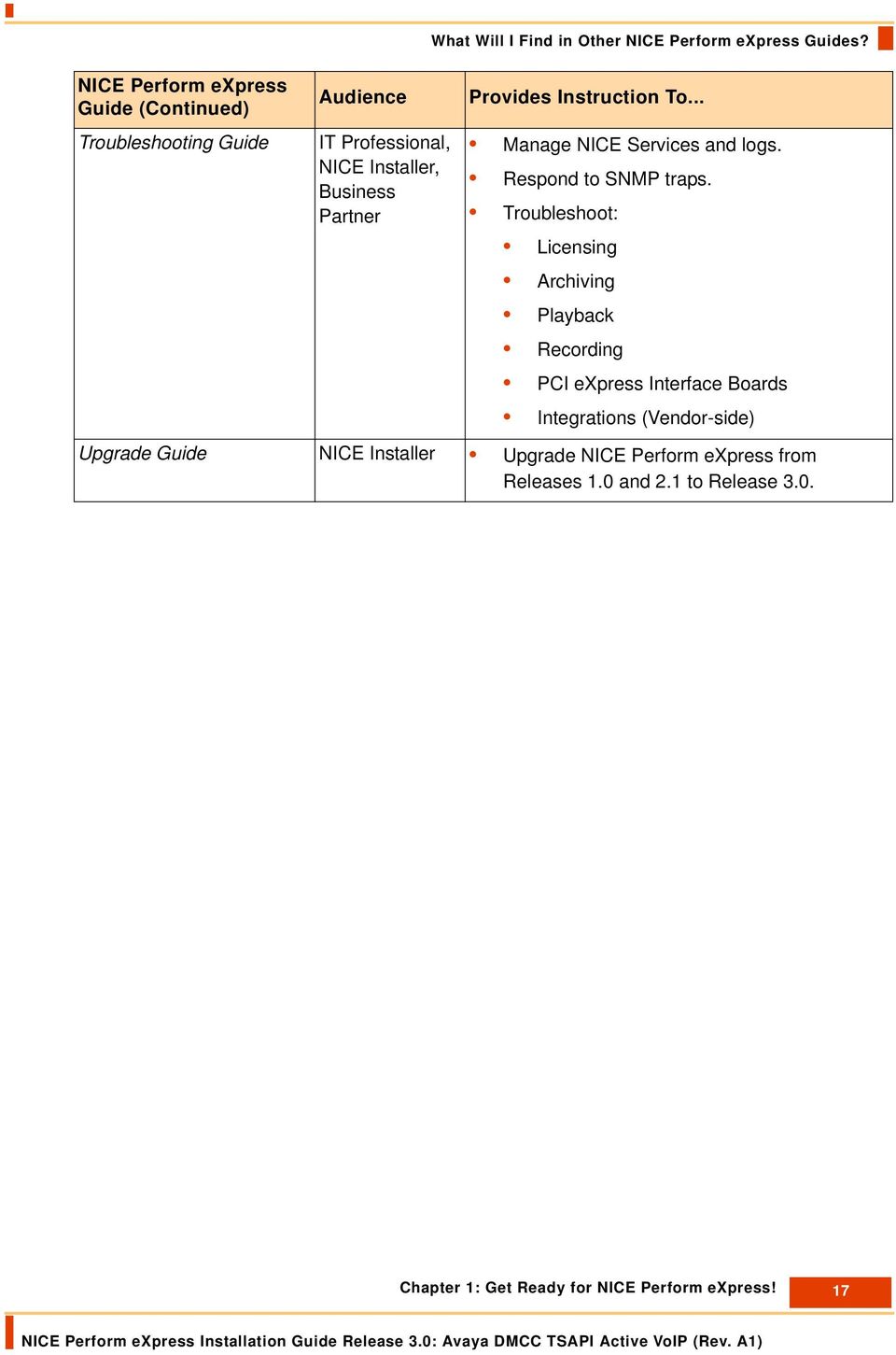
17 What Will I Find in Other NICE Perform express Guides? NICE Perform express Guide (Continued) Audience Provides Instruction To... Troubleshooting Guide IT Professional, NICE Installer, Business Partner Manage NICE Services and logs. Respond to SNMP traps. Troubleshoot: Licensing Archiving Playback Recording PCI express Interface Boards Integrations (Vendor-side) Upgrade Guide NICE Installer Upgrade NICE Perform express from Releases 1.0 and 2.1 to Release 3.0. Chapter 1: Get Ready for NICE Perform express! 17
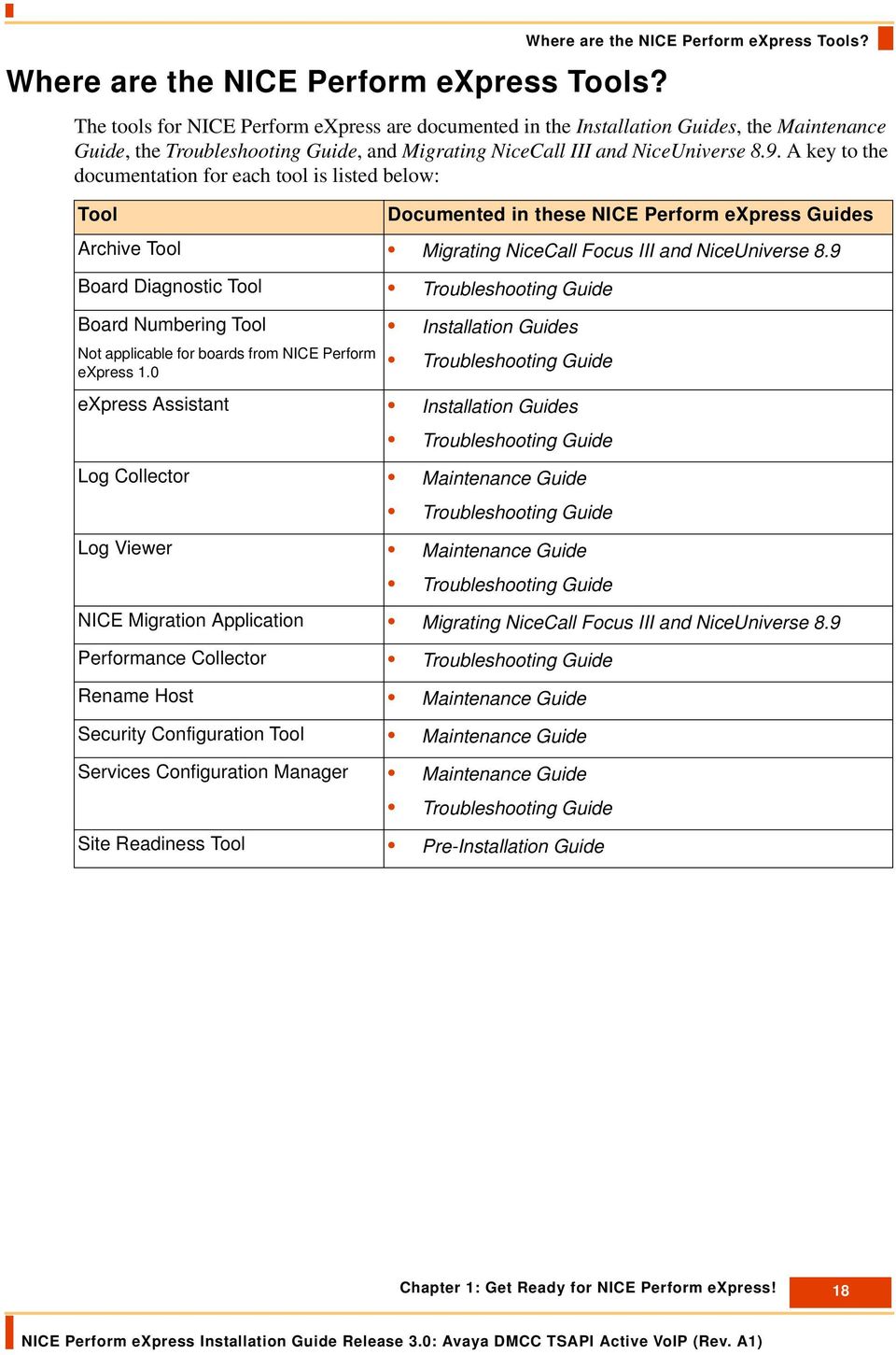
18 Where are the NICE Perform express Tools? Where are the NICE Perform express Tools? The tools for NICE Perform express are documented in the Installation Guides, the Maintenance Guide, the Troubleshooting Guide, and Migrating NiceCall III and NiceUniverse 8.9. A key to the documentation for each tool is listed below: Tool Documented in these NICE Perform express Guides Archive Tool Migrating NiceCall Focus III and NiceUniverse 8.9 Board Diagnostic Tool Troubleshooting Guide Board Numbering Tool Not applicable for boards from NICE Perform express 1.0 Installation Guides Troubleshooting Guide express Assistant Installation Guides Troubleshooting Guide Log Collector Maintenance Guide Troubleshooting Guide Log Viewer Maintenance Guide Troubleshooting Guide NICE Migration Application Migrating NiceCall Focus III and NiceUniverse 8.9 Performance Collector Troubleshooting Guide Rename Host Maintenance Guide Security Configuration Tool Maintenance Guide Services Configuration Manager Maintenance Guide Troubleshooting Guide Site Readiness Tool Pre-Installation Guide Chapter 1: Get Ready for NICE Perform express! 18
19 Limitations Limitations The following limitations are currently in effect for the NICE Perform express 3.0 installation. This installation guide contains only those limitations that directly affect installation. For a complete list of limitations, refer to the latest Release Note. # Known Issues and Limitations 1. Avaya TSAPI is not supported on Windows Active VoIP environments cannot be part of a Mixed Environment. 3. Windows Update installation might cause NICE Perform express installation or NICE Perform express Update Pack installation to fail. Verify that Windows Update installation is not running before beginning installation. 4. From the pre-installation stage onwards, the NICE Perform express machine must be connected to the network at all times. 5. Recording may stop after applying changes to disable or enable use of Backup Devices. Verify that the NTLogger service is started. If the NTLogger service is not started, restart the machine. 6. In a mixed environment, when one environment is deleted, Channel Monitoring might stop working. Workaround: Delete both environments and reconfigure. 7. When migrating from NiceCall Focus III or NiceUniverse 8.9, tapes recorded with compression type PCM µ-law cannot be retrieved by NICE Perform express. Chapter 1: Get Ready for NICE Perform express! 19

20 Blank page for double-sided printing.

21 2 Time Setup for NICE Perform express Before you begin installing your NICE Perform express system, configure your NICE Perform express machine with the correct date, time, and time zone. You must also prepare it for daylight saving time. Once you begin the installation process, you will not be able to reset the date, time, or time zone. WARNING If you make any changes to the Date, Time, or Time Zone after your system is installed, your license will become invalidated. In this event, contact NICE Support and see the Troubleshooting Guide for further information. Contents Preparing the Server for Daylight Saving Time...22 Setting Time without an NTP Server...23 Setting Time with an NTP Server...24 Chapter 2: Time Setup for NICE Perform express 21
22 Preparing the Server for Daylight Saving Time Preparing the Server for Daylight Saving Time Before you begin installing your NICE Perform express system, configure your NICE Perform express machine with the correct date, time, and time zone, and define daylight saving time. Once you begin the installation procedures, you will not be able to reset the date, time, or time zone. WARNING If you make any changes to the Date, Time or Time Zone after your system is installed, your license will become invalidated. In this event, contact NICE Support and see the Troubleshooting Guide for further information. Remember! After you have completed the procedure below, you do not have to reset any clocks or restart your machine when Daylight Savings Time begins or ends. Follow the instructions in one of the following procedures: If your site does not use an NTP server for time synchronization, define Daylight Saving Time on the Time Zone tab as described in Setting Time without an NTP Server on page 23. -or- If your site uses an NTP server for time synchronization, define the server on the Internet Time tab as described in Setting Time with an NTP Server on page 24. Chapter 2: Time Setup for NICE Perform express 22
23 Setting Time without an NTP Server Setting Time without an NTP Server If your environment does not use an NTP server for time synchronization, use the following procedure to set time and prepare for Daylight Saving Time. To set date and time parameters: 1. Right-click the clock in the Notification area, and select Adjust Date/Time. -or- From the Start menu, select Settings > Control Panel. Then double-click Date and Time. The Date and Time window appears. 2. To change the current time, click Change date and time. 3. In the Time zone area, click Change time zone. The Time Zone Settings Window appears. Select this option Select a Time Zone 4. In the Time zone box, select the time zone at your site. 5. Select Automatically adjust clock for Daylight Saving Time. 6. Click OK to close the Time Zone Settings window. 7. Click OK to close the Date and Time window. Chapter 2: Time Setup for NICE Perform express 23
24 Setting Time with an NTP Server Setting Time with an NTP Server If your environment uses an NTP server for time synchronization, use the following procedure to set time and prepare for Daylight Saving Time. To set date and time parameters: 1. Right-click the clock in the Notification area, and select Adjust Date/Time. -or- From the Start menu, select Settings > Control Panel. Then double-click Date and Time. The Date and Time Properties window appears. 2. To change the current time, click Change date and time. Chapter 2: Time Setup for NICE Perform express 24
25 Setting Time with an NTP Server 3. Select the Internet Time tab. 4. Click Change settings. The Internet Time Settings window appears. Select this option Select your NTP Server 5. Select Synchronize with an Internet time server. 6. In the Server field, select your NTP server. Then click Update now. 7. Click OK to close the Internet Time Settings window. 8. Click OK to close the Date and Time window. Chapter 2: Time Setup for NICE Perform express 25
26 Blank page for double-sided printing.
27 3 Installing the Avaya AES TSAPI Client The CTI Client software must be installed on the NICE Perform express. Prior to installing the client software, the CTI must be prepared for NICE Perform express. See Preparing the CTI for NICE Perform express on page 167. Contents Installing Client Software on the NICE Perform express...28 Setting the SNMP Community Name of the IP Phones to Public...30 Chapter 3: Installing the Avaya AES TSAPI Client 27
28 Installing Client Software on the NICE Perform express Installing Client Software on the NICE Perform express In an environment using the AES Server, install the Avaya Application Enablement Services (AES) TSAPI Client on the NICE Perform express. Before beginning this procedure, confirm that the CTI was prepared properly for NICE Perform express. See Preparing the CTI for NICE Perform express on page 167. IMPORTANT The Avaya AES TSAPI Client installed on the NICE Perform express must be version 4.2.1, regardless of the Avaya AES Server version. For further details, see the Integration Description Document (IDD). To install the Avaya AES TSAPI Client software: 1. Insert the AES TSAPI Client installation CD in the CD-ROM drive of the NICE Perform express. The Avaya AES TSAPI installation wizard starts. Figure 3-1 Avaya AES TSAPI Installation Wizard - Setup 2. Click Next. The Choose Destination Location window appears. Chapter 3: Installing the Avaya AES TSAPI Client 28
29 Figure 3-2 Choose Destination Location Window Installing Client Software on the NICE Perform express 3. Click Next. The TCP/IP Name Server Configuration window appears. Figure 3-3 TCP/IP Name Server Configuration Window 4. To configure the TSAPI Service via the TCP/IP: 4.1. In the Host Name or IP address field, enter the IP address of the AES Server. In the TCP Port field, leave the default value. The Add to List button becomes enabled Click Add to List. The IP address and port value appear in the Configured Telephony Services list box. 5. Click Next. The Avaya AES TSAPI Client software files are installed. 6. When the installation is complete, click Finish. Chapter 3: Installing the Avaya AES TSAPI Client 29
30 Setting the SNMP Community Name of the IP Phones to Public Setting the SNMP Community Name of the IP Phones to Public Avaya Firmware release 2.6 and above has created two issues regarding IP address resolution in a dynamic IP environment. These issues are relevant when the RAS Driver communicates with the Avaya IP phones either via the Push Interface or via the SNMP Protocol. Avaya removed the default community name, public, as a security enhancement. As a result, the IP telephones do not respond to SNMP get messages, which means that the IP addresses cannot be resolved. When the RAS Driver communicates with the Avaya IP phones via the SNMP protocol, the phones must have a defined community name. In order to overcome this issue, you need to modify the 46XXsetting.txt file, which is on the TFTP Server. From the 46XXsetting.txt file, the IP phones download their Firmware in order to configure a default value for the SNMP Community string. You can choose one of the following options: Set the community name of the IP phones to public. This will in fact eliminate the Avaya security enhancement. -or- Set the community name of both the IP phones and the NICE Interactions Center to a name of your choice, enabling only specific systems, such as the NICE Systems, to communicate with the IP phones. The Avaya IP phone models that are affected are 4610SW, 4620SW, 4621SW and 4622SW. Chapter 3: Installing the Avaya AES TSAPI Client 30
31 Setting the SNMP Community Name of the IP Phones to Public To set the SNMP community name of the IP phones to public: 1. From the TFTP Server, open the 46XXsetting.txt file. 2. Verify that the string SET SNMPSTRING does not have the pound sign (#), spaces or other characters before it, and that the full command is SET SNMPSTRING public, as shown below. Verify that the string does not have the pound sign, spaces or other characters before it. 3. Save the 46XXsetting.txt file. 4. After modifying the 46XXsetting.txt file, you must restart the relevant IP phones in order for them to read the new settings. Chapter 3: Installing the Avaya AES TSAPI Client 31
32 Blank page for double-sided printing.
33 4 Installing NICE Perform express This section describes installing NICE Perform express and activating your license. NICE Perform express can be installed using the NICE Perform express installation wizard or by running a silent installation. If it becomes necessary at any time to reinstall NICE Perform express, you may require a new license. See the Maintenance Guide for licensing details. If this is a migration from NiceCall Focus III or NiceUniverse 8.9, after installation, log in and activate your license. Do not configure your system at this time. See the Migrating from NiceCall Focus III and NiceUniverse 8.9 guide for further instructions. Contents Installing NICE Perform express Software...34 Running the NICE Perform express Installation Wizard...35 Running a Silent Installation...44 Integrating the Support Calendar into MS Outlook...50 First-Time Login...52 First-Time Login with NICE Authentication...52 First-Time Login with Windows Authentication (Single Sign-On or SSO)...56 Switching between NICE Authentication and Window Authentication...59 First-Time Licensing: Automatic Activation...60 License Information and Status...61 Manually Activating or Updating a License...62 Chapter 4: Installing NICE Perform express 33
34 Installing NICE Perform express Software Installing NICE Perform express Software NICE Perform express can be installed using the Installation Wizard or by running a Silent Installation. Both installation processes install all NICE Perform express components. This is the only installation required for NICE Perform express. WARNING In a VoIP environment, or in a mixed environment where one environment is VoIP: All NICE Perform express NICs that are not connected to the network must be disabled in the OS! Verify that all installed NICs are configured to Auto Negotiation. Auto Negotiation ensures that the maximum speed will be used. During the installation process you will be required to supply a user account to be used by services at logon. This user account must have the following rights: Log on as service Log on as a batch job Act as part of the operating system Create a token object Replace a process-level token Manage auditing and security log If the user account name you enter does not have all of the above rights, the installation process will automatically add them. To run a Silent Installation, you prepare a config file using the template provided with your software. The same config file, with the same parameters, can be used for multiple NICE Perform express installations. To use the Installation Wizard, see Running the NICE Perform express Installation Wizard on page 35. To use the Silent Installation, see Running a Silent Installation on page 44. Chapter 4: Installing NICE Perform express 34
35 Running the NICE Perform express Installation Wizard Installing NICE Perform express Software The NICE Perform express installation wizard takes you through the complete installation process with a few easy steps. This wizard installs all NICE Perform express components. It is the only installation required for NICE Perform express. During the installation process, you might be requested to restart your machine. If this occurs, restart the machine. After restarting, the installation process will automatically continue from the correct point. The installation software includes the Update Pack that was issued during General Availability. However, if an Update Pack is available on the NICE Software Download Center, this indicates that a newer Update Pack must be installed, as part of the installation process, see Step 6. After installation is complete, if a newer Update Pack is issued, see the Maintenance Guide for installation procedures. NOTE: If it becomes necessary at any time to reinstall NICE Perform express, you may require a new license. See the Maintenance Guide for licensing details. To complete the following installation procedure, you will need the following: Access to the NICE Software Download Center. The average number of expected interactions per day and the retention period, so that database sizes can be calculated automatically. A valid User ID with administrative privileges on this machine. To install NICE Perform express: 1. Ensure that all Microsoft management windows (gpedit.msc, services.msc, etc.) are closed. 2. Before you begin: If a CTI Client is required, confirm that it is installed. If you are using Tivoli Storage Manager (TSM) storage, confirm that the TSM client (version 5.5) is installed. If a Backup device is installed, confirm that its driver is installed and that it is enabled in the Device Manager. In a Windows Authentication (Single Sign-On or SSO) environment, NICE Perform express must be installed on a server in the Domain. 3. If your local language is not English, set the Regional Language on the NICE Perform express machine to English. You will be instructed to reset the language after the installation. For instructions, see Setting the Regional Language on page On your local hard drive, create a folder dedicated to NICE Perform express software. Do not create this folder on your desktop! Correct Example: D:\NICE Software Incorrect Example: C:\Documents and Settings\Desktop\NICE Software Chapter 4: Installing NICE Perform express 35
36 Installing NICE Perform express Software 5. From the NICE Software Download Center, copy the NICE Perform express installation folder to the folder created in Step Update Packs are NUP files. If an Update Pack for NICE Perform express 3.0 resides on the NICE Software Download Center do the following: a. From its location on your local hard drive, navigate to:...\nice Perform express\npx3.0\installation\<version number>\npx b. If there is a folder called Updates, open it and delete its contents. If not, add a new folder and name it Updates. Updates c. From the NICE Software Download Center, copy the Update Pack to the Updates folder. There should be only one NUP file in the Updates folder; each Update Pack includes all previous Update Packs. 7. From its location on your local hard drive, navigate to...\nice Perform express\npx3.0\installation\<version number>\npx 8. Double-click Setup.exe. The Security Warning window or the NICE Perform express installation wizard appears. Click Run to start the wizard 9. If the Security Warning appears, click Run. Then the NICE Perform express installation wizard appears. 10. In the NICE Perform express installation wizard click Next. Chapter 4: Installing NICE Perform express 36
37 Installing NICE Perform express Software The License Agreement window appears. 11. Select I accept the licensing terms and conditions. Then click Next. The Target Installation Directories window appears. 12. Accept the default locations for the NICE Software and SQL Server installation folders. If you must change a location, click the relevant Browse button and select the new location. If an SQL Server was installed prior to the NICE Perform express installation, the SQL Server Installation Folder will be read-only. The locations for the Recording Components appear for informative purposes only. They are read-only and cannot be changed. 13. Click Next. Chapter 4: Installing NICE Perform express 37
38 Installing NICE Perform express Software The Database Configuration window appears. Calculated database size NOTE: A red exclamation mark indicates that there is insufficient space available for the databases. Increase the available space on the disk or decrease the retention in the Database Size Calculator area. 14. To change the default location for the databases, click Browse. 15. In the Database Size Calculator area, you can define database retention period using these guidelines: The Database size is automatically calculated. It appears near the bottom of the window. It is determined by the number of interactions you expect per day and the retention period. The default is 8100 interactions per day. Example: You have interactions one day, and only 5000 interactions the following day. All interactions will be recorded, since the average is less than 8100 per day. You can select one of the defaults or define a customized retention period. Options are as follows: 2 Year Retention - database size for 2 years with 8100 interactions per day is shown 10 Year Retention - database size for 10 years with 8100 interactions per day is shown Custom Retention - The Expected Interactions per Day and Year Retention fields become active. Enter a value in each. The database size is calculated and shown. 16. Click Next. Chapter 4: Installing NICE Perform express 38
39 Installing NICE Perform express Software The Log On As window appears. 17. In the Domain\User field, enter a valid user with administrative privileges on this machine using these guidelines: If you are required to use your full domain name, enter your full domain name (servername\username). Example: NICE_Systems\NICE_Services If you are within your site s domain, you can enter only the username. Example: NICE_Services 18. Enter the Password for the Log On user. 19. If a red exclamation mark appears next to the Password with the message User must change password at next logon, see Changing Administrator Password on page 42. Chapter 4: Installing NICE Perform express 39
40 Installing NICE Perform express Software 20. Click Install. NOTE: If the user name you entered in the Log On As window does not have the Log On As Service privilege, a message appears. You have the following options: Yes - Log On As Service privileges are added to the user. Continue this procedure. -or- No - The installation returns to the Log On As window so that you can enter a different user name. Repeat this procedure from Step 17. The Installation Process window appears and installation begins. This procedure can take several hours depending on your database size. During the installation process, a message might appear asking you to restart your machine. If this occurs, click OK and restart your machine. After restart, the installation will automatically continue from the correct point. See the Note below and refer to the displayed Remaining Time in the lower right-hand corner of the window. Remaining Time If an SQL server was installed prior to the NICE Perform express installation, installation for it will not appear now. Chapter 4: Installing NICE Perform express 40
41 Installing NICE Perform express Software NOTE: About 20 minutes into the installation process, you might receive one or several messages as follows. Click Continue Anyway or click Install as appears in the message. 21. When the entire installation process is complete, click Next. The Setup Wizard Completed window appears. 22. Select Yes, I want to restart my computer now. Then click Finish. Your computer restarts. Chapter 4: Installing NICE Perform express 41
42 Installing NICE Perform express Software NICE Perform express is installed. The following are added to your computer: A shortcut to NICE Perform express is placed on your desktop. In the Start menu, the NICE Perform express menu is added with access to various tools used for maintenance and troubleshooting. A list of tools can be found in the introduction to this guide. NICE Perform express adds services to your computer: Note: Services for Screen Recording, MML Logger and MML TrayIcon, are also installed. They are disabled and hidden until Screen Recording is enabled. 23. If your local language is not English, reset the Regional Language on the NICE Perform express machine to your local language. See Setting the Regional Language on page To a schedule routine verifications of the NICE Perform express system to your MS Outlook calendar, see Integrating the Support Calendar into MS Outlook on page Continue with First-Time Login on page 52. Changing Administrator Password Chapter 4: Installing NICE Perform express 42
43 Installing NICE Perform express Software If, during the installation (Step 18 on page 39), a messages appears that User must change password at next logon, this indicates that the user s properties are set to User must change password at next logon. It is not necessary to stop the installation! Incorrect Options Select these Options Do one of the following: 1. Change the user s password: a. Open the Server Manager window, navigate to Configuration > Local Users and Groups > Users. Then right-click the user and select Set Password. Change the password. b. Return to Step 18 on page 39 of the installation. -or- 2. Reset the user s logon properties: Note: Do not choose this option if it interferes with your organization s security policy. a. Open the Server Manager window, navigate to Configuration > Local Users and Groups > Users. Then right-click the user and select Properties. b. Clear User must change password at next logon. c. Select the following: User cannot change password Chapter 4: Installing NICE Perform express 43
44 Installing NICE Perform express Software Password never expires d. Return to Step 18 on page 39 of the installation. Running a Silent Installation You can run a Silent Installation from a prepared config file instead of from the Installation wizard. The installation software includes the Update Pack that was issued during General Availability. However, if an Update Pack is available on the NICE Software Download Center, this indicates that a newer Update Pack must be installed, as part of the installation process, see Step 6. NOTE: If it becomes necessary at any time to reinstall NICE Perform express, you may require a new license. See the Maintenance Guide for licensing details. After installation is complete, if a newer Update Pack is issued, see the Maintenance Guide for installation procedures. During the installation process, the machine will restart itself. This is part of the normal procedure. Advantages of a Silent Installation Parameters for the installation can be prepared beforehand and saved in a configuration file. The same configuration file, with the same parameters, can be used for multiple NICE Perform express installations. Your NICE Perform express installation folder includes the following files for running a Silent Installation: Params.config - Configuration file with parameters required for the installation. Edit the values of these parameters directly in this file. Descriptions of each parameter appear in the Silent Install.bat file. Silent Install.bat - Run this file to install NICE Perform express. This file also includes descriptions of all parameters required by the Params.config file. To see descriptions and default values, open it in a text editor. Silent UnInstall.bat - Run this file to uninstall NICE Perform express. For instructions, see the Maintenance Guide. After you run the Silent Installation, results appear in the FrameworkLogfile.txt file. To run a silent installation: 1. Ensure that all Microsoft management windows (gpedit.msc, services.msc, etc.) are closed. 2. Before you begin: If a CTI Client is required, confirm that it is installed. Chapter 4: Installing NICE Perform express 44
45 Installing NICE Perform express Software If you are using Tivoli Storage Manager (TSM) storage, confirm that the TSM client (version 5.5) is installed. If a Backup device is installed, confirm that its driver is installed and that it is enabled in the Device Manager. In a Windows Authentication (Single Sign-On or SSO) environment, NICE Perform express must be installed on a server in the Domain. 3. If your local language is not English, set the Regional Language on the NICE Perform express machine to English. You will be instructed to reset the language after the installation. For instructions, see Setting the Regional Language on page On your local hard drive, create a folder dedicated to NICE Perform express software. Do not create this folder on your desktop! Correct Example: D:\NICE Software Incorrect Example: C:\Documents and Settings\Desktop\NICE Software 5. From the NICE Software Download Center, copy the NICE Perform express installation folder to the folder created in Step Update Packs are NUP files. If an Update Pack for NICE Perform express 3.0 resides on the NICE Software Download Center do the following: a. From its location on your local hard drive, navigate to...\nice Perform express\npx3.0\installation\<version number>\npx b. If there is a folder called Updates, open it and delete its contents. If not, add a new folder and name it Updates. Updates c. From the NICE Software Download Center, copy the Update Pack to the Updates folder. There should be only one NUP file in the Updates folder; each Update Pack includes all previous Update Packs. 7. From its location on your local hard drive, navigate to...\nice Perform express\npx3.0\installation\<version number>\npx Chapter 4: Installing NICE Perform express 45
46 Installing NICE Perform express Software 8. Open the Params.config file using a text editor. Edit these parameters 9. Enter or edit the default values for the following parameters: Parameter Default Value Description TARGETDIR TARGETDIRSQL TARGETDIRDB D:\Program Files\NICE Systems\NICE Perform express D:\Program Files\Microsoft SQL Server 2008 D:\Program Files\NICE Systems\NICE Perform express\db Directory for the NICE Perform express installation files. Directory for the SQL Server installation files. Directory for the database data and log files. USERNAME No default value provided Username used by services to log on. If this user does not have all of the required rights, they will automatically be added to the user. PASSWORD No default value provided Password for USERNAME. DOMAIN No default value provided Domain name for USERNAME. ADMIN_SERVER_HOST localhost Location of the System Administrator component. This is always localhost and should not be changed. NICE_INTERACTIONS_ SIZE_PLACE_HOLDER MB Size of the nice_interactions database The default value is based on 2 year retention and 8100 calls per day. Chapter 4: Installing NICE Perform express 46
47 Installing NICE Perform express Software Parameter Default Value Description NICE_INTERACTIONS_ LOG_SIZE_PLACE_HO LDER 10% of the nice_interactions database size Size of the nice_interactions log file NICE_RULE_SIZE_PLA CE_HOLDER 1991 MB Size of the nice_rule database The default value is based on 2 year retention and 8100 calls per day NICE_RULE_LOG_SIZE _PLACE_HOLDER 10% of the nice_rule database size Size of the nice_rule log file 10. Save and close the Params.config file. 11. From its location on your local hard drive, open the NICE Perform express installation folder. Then double-click Silent Install.bat to run the installation. 12. The installation starts. About 20 minutes into the installation process, you might receive one or several messages as follows. Click Continue Anyway or click Install as appears in the message. There is no notification that the installation has started or finished. 13. Depending on your database size, this procedure can take several hours. When installation is complete, you will be able to verify the installation in the log file. The log file is located at: Windows 2008: C:\Users\<USERNAME>\AppData\Local\NICE Perform express\frameworklogfile.txt Chapter 4: Installing NICE Perform express 47
48 Installing NICE Perform express Software Windows XP: C:\Documents and Settings\<USERNAME>\Local Settings\Application Data\NICE Perform express\frameworklogfile.txt Sample Log File NICE Perform express is installed. The following are added to your computer: A shortcut to NICE Perform express is placed on your desktop. In the Start menu, the NICE Perform express menu is added with access to various tools used for maintenance and troubleshooting. A list of tools can be found in the introduction to this guide. Chapter 4: Installing NICE Perform express 48
49 NICE Perform express adds services to your computer: Installing NICE Perform express Software Note: Services for Screen Recording, MML Logger and MML TrayIcon, are also installed. They are disabled and hidden until Screen Recording is enabled. 14. If your local language is not English, reset the Regional Language on the NICE Perform express machine to your local language. For instructions, see Setting the Regional Language on page Restart the NICE Perform express machine. 16. To a schedule routine verifications of the NICE Perform express system to your MS Outlook calendar, see Integrating the Support Calendar into MS Outlook on page Continue with First-Time Login on page 52. To uninstall NICE Perform express, see the Maintenance Guide. Chapter 4: Installing NICE Perform express 49
50 Integrating the Support Calendar into MS Outlook Integrating the Support Calendar into MS Outlook You can integrate the Support Calendar into MS Outlook so that reminders for the necessary maintenance checks appear in the Calendar application. An express Support Calendar.rar file is included in the NICE Perform express installation. You extract this RAR file and then import it into MS Outlook. For details of what is included in the Support Calendar, see the Maintenance Guide. To integrate the Support Calendar into MS Outlook: 1. On the NICE Perform express machine, navigate to the installation folder, and extract the express Support Calendar.rar file to the hard drive. This RAR file contains an express Support Calendar.pst file. 2. Copy the express Support Calendar.pst file to the hard drive of the machine that runs MS Outlook. 3. Open MS Outlook, and from the File menu, select Import and Export. The Import and Export Wizard starts. 4. Click Next. The Import a File window appears. Chapter 4: Installing NICE Perform express 50
51 5. Select Personal Folder File (.pst) from the list, and click Next. The Import Personal Folders window appears. Integrating the Support Calendar into MS Outlook 6. In the File to import field, click Browse, and select the express Support Calendar.pst file that you extracted in Step 1 on page Click Next. The Import Personal Folders window appears. 8. Click Finish. The reminders for the Support Calendar are imported into Outlook. Chapter 4: Installing NICE Perform express 51
52 First-Time Login First-Time Login If your NICE Perform express is not installed in English, use the procedures in Localization - Language Support on page 197 in place of the following procedure. In a NICE Authentication environment, continue with First-Time Login with NICE Authentication on page 52. In a Windows Authentication (Single Sign-On or SSO) environment, continue with First-Time Login with Windows Authentication (Single Sign-On or SSO) on page 56. NOTE: You can change your NICE Perform express system from NICE Authentication to Windows Authentication, or back again, after initial log in. In this case, the procedure varies slightly to accommodate existing users. See the Maintenance Guide for details. First-Time Login with NICE Authentication The first time you log in to NICE Perform express you will use the default name nice, and the default password nice. You will be instructed to change the default password. Have prepared a new password and record it in a safe place. Passwords are case-sensitive. To create a different user for login, see Managing Users and Groups on page 105. If you experience any problems opening NICE Perform express, see Configuring Internet Explorer for NICE Perform express on page 210. To log in to NICE Perform express: 1. To open NICE Perform express on the local machine, on the desktop, double-click the NICE Perform express icon. -or- -or- (from a remote server) Open an Internet Explorer window and enter the following URL: Where ServerName is the name of the server where NICE Perform express is installed. Example: NICE Perform express is installed on a server named server1, the URL will be: Chapter 4: Installing NICE Perform express 52
53 First-Time Login The NICE Perform express Welcome window appears. If you experience any problems opening NICE Perform express, see Configuring Internet Explorer for NICE Perform express on page Log in as follows: a. In the Name field, enter nice. b. In the Password field, enter nice. c. Click Login. The Change Password window appears. Note: If you have already logged in using the Central Administration on this same machine, the password was already changed and this window will not appear. Use the same password as for the Central Administration and continue with Step 4. Chapter 4: Installing NICE Perform express 53
54 First-Time Login 3. Complete this window as follows: a. In the Password field, enter nice. b. In the New Password field, enter a new password. Passwords are case-sensitive. c. In the Confirm New Password field, re-enter exactly the same New Password. d. Click Change Password. The NICE Perform express Welcome window reappears. 4. Log in as follows: a. In the Name field, enter nice. b. In the Password field, enter the new password defined in Step 3. c. Click Login. Chapter 4: Installing NICE Perform express 54
55 First-Time Login NICE Perform express opens. Provisional License Automatic Activations appears only when the License status is Provisional NICE Perform express is installed with a default (Provisional) license that has five recording channels and is valid for three months. 5. To view the license expiration date, click the System Settings tab. The Licensing section displays the License Information and Expiration Date. 6. If you have direct internet access from the NICE Perform express machine, continue with First-Time Licensing: Automatic Activation on page 60. -or- If you do not have direct internet access from the NICE Perform express machine, continue with Manually Activating or Updating a License on page 62. Chapter 4: Installing NICE Perform express 55
56 First-Time Login First-Time Login with Windows Authentication (Single Sign-On or SSO) The default authentication mode for NICE Perform express is NICE Authentication. To log in to NICE Perform express for the first time using Windows Authentication (Single Sign-On or SSO), use the Security Configuration Tool, as describe below to switch authentication modes. As part of this procedure, you can define a default domain for all new users. IMPORTANT After you switch to Windows Authentication, you must log off of Windows and log in again using your Superuser OS Login, before you can open up NICE Perform express. This is done as part of the procedure below. To switch to Windows Authentication and log in: 1. On the NICE Perform express machine, from the Start menu, select All Programs > NICE Perform express > Tools > Security Configuration Tool. -or- Open the Security Configuration Tool from its location on your hard drive: D:\Program Files\NICE Systems\NICE Perform express\tools\security Configuration Tool The Security Configuration Tool appears. 2. For Authentication Mode, select Windows. Chapter 4: Installing NICE Perform express 56
57 The Security Configuration Tool changes to reflect the required information. First-Time Login 3. In the Available Domains list, do the following: a. Enter the name of each domain on an empty line. Only NetBIOS domain names are supported. b. Optional. Select one domain as the Default domain. All users who are created without a domain will automatically be added to the default domain. 4. In the User Settings area, do the following: a. Enter the Windows user name for the Superuser Login. The Superuser will not appear in the NICE Perform express User Administration or be seen by any other NICE Perform express user. The Superuser must be a Domain User. b. Select a Superuser domain for the Superuser. To add a domain to this list, add it to the Available Domains list. 5. Optional. To automatically assign a domain to existing users who do not have a domain, select Apply Default Domain. 6. Click Apply to change the authentication mode. 7. Click Exit to exit the tool. You NICE Perform express is now in Windows Authentication mode. If you need to switch back to NICE Authentication, see the Maintenance Guide. If you have any trouble with the Security Configuration Tool, log files are located at: D:\Program Files\NICE Systems\NICE Perform express\tools\security Configuration Tool\Logs 8. Log off of Windows and log in again using your Superuser OS Login (Windows Authentication). Chapter 4: Installing NICE Perform express 57
58 First-Time Login Continue this procedure for first-time login. 9. On the desktop, double-click the NICE Perform express icon. -or- (from a remote server) Open an Internet Explorer window and enter the following URL: Where ServerName is the name of the server where NICE Perform express is installed. Example: NICE Perform express is installed on a server named server1, the URL will be: NICE Perform express opens. If NICE Perform express does not open, confirm that you are correctly logged in to Windows with the Superuser OS Login. Provisional License Automatic Activations appears only when the License status is Provisional NICE Perform express is installed with a default (Provisional) license that has five recording channels and is valid for three months. Chapter 4: Installing NICE Perform express 58
59 First-Time Login 10. To view the license expiration date, click the System Settings tab. The Licensing section displays the License Information and Expiration Date. 11. If you have direct internet access from the NICE Perform express machine, continue with First-Time Licensing: Automatic Activation on page 60. -or- If you do not have direct internet access from the NICE Perform express machine, continue with Manually Activating or Updating a License on page 62. Switching between NICE Authentication and Window Authentication Switching between NICE Authentication and Windows Authentication (also know as Single Sign-On or SSO) or back again is a simple process, however there are some considerations and repercussions to be aware of. For complete details, see Changing Authentication Mode in the Maintenance Guide before proceeding. Chapter 4: Installing NICE Perform express 59
60 First-Time Licensing: Automatic Activation First-Time Licensing: Automatic Activation Your NICE Perform express is installed with a default license that is valid for recording five channels for a three month period. The status of this license is Provisional. You must activate a new license before the temporary one reaches its expiration date. There are two ways to activate a license. If you have direct internet access from the NICE Perform express machine, use Automatic Activation. This option is only available while your license status is Provisional. If you do not have direct internet access from the NICE Perform express machine, use Manual Activation / Update. For instructions, see Manually Activating or Updating a License on page 62. You will require a valid Product Key to complete this process. For a description of license states, see License Information and Status on page 61. To activate a First-Time License: 1. In System Management, click the System Settings tab. Provisional License Automatic Activations appears only when the License status is Provisional The License Information shows the status as Provisional, with an expiration date. You will need to update the license to a permanent one before this expiration date is reached. Chapter 4: Installing NICE Perform express 60
61 First-Time Licensing: Automatic Activation 2. In the Automatic Activation area, enter a valid Product Key. Then click Activate. The license is updated to Activated. You have completed this procedure. Activated License 3. To begin configuring your NICE Perform express, click Sign out. Then log in again and all your tabs will appear. IMPORTANT If you are migrating from NiceCall Focus III or NiceUniverse 8.9, do not configure your system at this time. See the Migrating from NiceCall Focus III and NiceUniverse 8.9 guide for further instructions. License Information and Status The License Information field indicates the current state of your license. License states can be one of the following: Provisional - This is a temporary license. Your initial default license is provisional. A Provisional license is valid for recording five channels for a three month period. Activated - The current license is valid. Expired - Occurs in the following scenarios (Recording continues, however the NICE Perform express interface is locked.): The current license is past its expiration date. NICE Perform express detected a change in hardware on the NICE Perform express machine. A new Product Key is required to activate a new license. NICE Perform express was installed on a Virtual Machine. The license was activated from a remote machine. Unknown - A problem was encountered that does not classify as expired. Recording continues, however the NICE Perform express interface is locked. Locked - Indicates a communications problem between the interface and the license. Recording continues, however the NICE Perform express interface is locked. Chapter 4: Installing NICE Perform express 61
62 Manually Activating or Updating a License Use this procedure in the following scenarios: Manually Activating or Updating a License You are activating a first-time license (Provisional) and do not have direct internet access from the NICE Perform express machine. You are updating an existing license. In this procedure you will be instructed on how to generate a License Information File from your NICE Perform express. Then you will be instructed how to use this License Information File to obtain a valid License Activation File. You will require the following: Access to a machine with internet access to NICE s ExtraNICE site. This does not have to be the same machine as the NICE Perform express machine. A valid ExtraNICE Username and Password. A valid Product Key to obtain your License Activation File from the ExtraNICE. For a description of license states, see License Information and Status on page 61. To manually activate or update a License: 1. In System Management, click the System Settings tab. Automatic Activations appears only when the License status is Provisional Generate Chapter 4: Installing NICE Perform express 62
63 Manually Activating or Updating a License 2. In the Manual Activation / Update area, click Generate. The File Download window appears with the License Information File. 3. Click Save to save the License Information File. The Save As window appears. 4. Select a location for the License Information File (license.c2v). Then click Save. You will need this file to receive your License Activation File. The Download Complete window appears. Chapter 4: Installing NICE Perform express 63
64 Manually Activating or Updating a License 5. Click Close. 6. Transfer the license.c2v file to a machine with Internet access to NICE s ExtraNICE site. 7. On the machine with Internet access to the ExtraNICE do the following: a. Open an Internet Explorer window and enter the following URL: If you have not previously logged in to ExtraNICE, the following window appears. b. Enter a valid ExtraNICE Username and Password. Then click Log On to ExtraNICE. The NICE Perform express License Activation window appears. c. Click Browse and select the License Information File (license.c2v) from Step 6. d. Enter a valid Product Key. Then click Activate. e. Download the corresponding License Activation File (license.v2c). f. Transfer the License Activation file to the NICE Perform express machine. Chapter 4: Installing NICE Perform express 64
65 Manually Activating or Updating a License 8. On the NICE Perform express machine, click Browse and select the License Activation File (license.v2c). 9. Click Activate. The license is updated. 10. Click Sign out. Then log in again and all the tabs will appear. IMPORTANT If you are migrating from NiceCall Focus III or NiceUniverse 8.9, do not configure your system at this time. See the Migrating from NiceCall Focus III and NiceUniverse 8.9 guide for further instructions. Chapter 4: Installing NICE Perform express 65
66 Blank page for double-sided printing.
67 5 Configuring NICE Perform express The Avaya DMCC TSAPI Active VoIP telephony environment is comprised of the following: Telephony CTI Type CTI Interface Reporting Type Recording Type Avaya CM AES DMCC (CMAPI) CTI Active VoIP In the following procedures, you will define the following: CTI and recording parameters. You can use predefined parameters from the Central Administration VoIP channels Devices for monitoring. You can import a previously prepared file Map Service Observation and Multiple Registration (formally Dual Registration) devices to channels for recording. You can import a previously prepared file Data storage and retention rules Quality Management: Define screen recording and Quality Management rules Avaya DMCC TSAPI Active VoIP cannot be part of a mixed environment. Contents Making the Most of NICE Perform express...68 Procedure 1: Choosing the Telephony Environment...71 Procedure 2: Defining CTI and Recording...72 Procedure 3: Configuring Channel Mapping...76 Procedure 4: Configuring Storage...83 Configuring Backup without Storage...95 Quality Management: Defining Screen Recording QM Rules...98 Chapter 5: Configuring NICE Perform express 67
68 Making the Most of NICE Perform express Making the Most of NICE Perform express Before you begin configuring your NICE Perform express, determine if any or all of the following features apply to your system. Note that these sections are not procedures. They provide an overview of each feature. Use the regular configuration procedures beginning with Procedure 1: Choosing the Telephony Environment on page 71. You will be directed when necessary to alter course for these features. Configuration Workflow: Save, Apply, Next, or Done? on page 68 How to Use Predefined CTI and Storage Settings on page 69 How to Import Channel Mapping Definitions on page 70 Configuration Workflow: Save, Apply, Next, or Done? NICE Perform express Configuration is divided into four separate steps. Each one is on its own tabbed page. The application is designed to work much like a wizard; during first-time setup you must click Next at the bottom of each tab to advance to the next tab. Once you have advanced to a tab, or when modifying an existing configuration, you can, at any time, return to a previous tab by clicking the tab. At the bottom of each tabbed page you will see one, two, or three of the following buttons: -or- The first time you configure Storage and Rules you will see the following: The function of each button is determined by the page on which it appears, as follows: Configuration Buttons and their Functions Button Function Is Recording Interrupted? Save Saves data entered on this tab. Does not make it No active in the system. Next IMPORTANT! You must click Apply to activate changes in the system. Same as Save. Also advances to the next tab. Recording is interrupted when a second environment is added on the Telephony Environment tab. Chapter 5: Configuring NICE Perform express 68
69 Configuration Buttons and their Functions (Continued) Apply Saves and activates changes in the system. Note that when you click Apply, all changes from all tabs are applied. One of the sections can cause recording to be interrupted, even if the change is not on the current tab. In a Mixed Environment, when recording is interrupted, it is interrupted on both environments. Recording is not interrupted when changes are made in the following sections: Monitored Devices Channel Mapping Business Data Settings Storage Settings (Storage services restart; recording is not interrupted) Quality Management Settings D-Channels (extension-side environments) Making the Most of NICE Perform express Button Function Is Recording Interrupted? Done Appears only on the Storage and Rules tab during first-time configuration. In a Mixed Environment, appears only when defining the first environment. Saves data entered on this tab and applies all changes from all tabs in your system, enabling recording to begin. After clicking Done, the User Administration opens so you can add Users to your system. Recording is interrupted in an active system when changes are made in the following sections: Telephony CTI Settings Recording Settings Screen Recordings Settings Backup Settings IP Addresses for Devices (Dynamic IP environments) Device Mapping (Nortel CDR and Symposium environments) NEQT to Trunk Group Mapping (Alcatel TSAPI TDM Trunk-side environments) n/a Why? Since Done only appears the very first time, before recording has started, recording cannot be interrupted. How to Use Predefined CTI and Storage Settings Organizations with several NICE Perform express sites can install and use the NICE Perform express Central Administration. Using Central Administration you can predefine CTI settings and Storage settings making them accessible at all your NICE Perform sites. Here s how it works: 1. Central Administration is installed on top of one of your NICE Perform express sites. Chapter 5: Configuring NICE Perform express 69
70 Making the Most of NICE Perform express 2. An IT user creates several different sets of CTI and Storage settings, using the same parameters found in NICE Perform express. 3. In the CTI and Recording tab and the Storage and Rules tab, you will have the option to select one of the predefined CTI settings or Storage settings respectively. The parameters from the Central Administration will be copied to your NICE Perform express. You cannot change them. Changes can be made only in the Central Administration. 4. Recording Settings (channels, etc.) must be defined manually. 5. Business Data must be defined manually. 6. Channel Mapping must be defined automatically, manually, or imported from an external file. 7. Quality Management (QM) rules must be defined manually. To install and use the Central Administration, see the Central Administration Guide. How to Import Channel Mapping Definitions NICE Perform express provides the option to import all monitored device and channel mapping settings from an external Excel file. An easy-to-use template is provided for this purpose. When you import monitored devices and channel mapping settings to a system that already has some definitions, existing definitions are not deleted. If a record is matched, according to the Device Name, then the new record overwrites the old one. If no match is found, the new record is added. Workflow for Importing Channel Mapping Definitions 1. Create an Excel file following the instructions in Importing Channel Mapping and Users. 2. Save the file on your local hard drive. 3. In the Channel Mapping tab, click the Import File button. 4. A window opens where you select and import your file. 5. If a record is matched, according to the Device Name, the new record overwrites the old one. -or- If no match is found, the new record is added. Chapter 5: Configuring NICE Perform express 70
71 Procedure 1: Choosing the Telephony Environment Procedure 1: Choosing the Telephony Environment The first step in configuring NICE Perform express is to choose a Telephony Environment. A Telephony Environment consists of a CTI interface and a recording type. In this procedure choose the Avaya DMCC TSAPI Active VoIP Telephony Environment. Avaya DMCC TSAPI Active VoIP cannot be part of a mixed environment. It can only be defined as the first and only environment. To choose a Telephony Environment: 1. Before you begin, confirm that the CTI is properly configured. See Preparing the Avaya DMCC Environment on page Log in to NICE Perform express and select the Configuration application. The Telephony Environment tab appears. Do not click Add Telephony Environment! 3. From the Telephony Environment drop-down lists, select Avaya and then select Avaya DMCC TSAPI Active VoIP. 4. Click Next. The CTI and Recording tab becomes enabled. 5. Continue with Procedure 2: Defining CTI and Recording on page 72. Chapter 5: Configuring NICE Perform express 71
72 Procedure 2: Defining CTI and Recording Procedure 2: Defining CTI and Recording In this procedure define the following: Telephony CTI settings. You can use predefined parameters from the Central Administration. Recording type and VoIP channels used for recording. To define Telephony CTI and Recording Settings: 1. If the CTI and Recording tab is not active, select it now. The CTI and Recording tab appears. Telephony Environment Telephony CTI Settings Recording Settings 2. If you do not have a predefined Central Administration configuration, continue with Step To use a predefined Central Administration configuration, do the following: a. From the Add Telephony CTI drop-down list, select the Telephony CTI definition. The Telephony CTI fields will be automatically filled. They are read-only and cannot be modified. b. Continue with Step Enter a Telephony CTI name. This will identify your CTI settings for reuse in your system. 5. You will require TLink values for the following steps. TLink values must be supplied by an Avaya Administrator. To determine the TLink value, see Verifying the Secure/Non-Secure Tlink on page 185. Chapter 5: Configuring NICE Perform express 72
73 Procedure 2: Defining CTI and Recording 6. Define the remaining parameters in the Telephony CTI Settings section as follows. Telephony CTI Settings Description/Values Default TSAPI Server Parameters TLink Server connection name. Enter the TLink value. TSAPI/DMCC Server Parameters Login ID Password DMCC Server Parameters AES Server Address AES CMAPI Port AES Secured Connection Devices Symbolic Name Devices Password Observation Code The username for NICE as defined on the AES server. The password for NICE as defined on the AES server. The IP address of the Avaya AES server. The port between the integration and the AES server = a secure TLS/SSL port 4721 = an unsecured TLS/SSL port Yes = AES TLS/SSL connection is secure (4722) No = AES TLS/SSL connection is unsecured (4721) This value must correspond to the value for AES CMAPI Port above. Enter the symbolic name of the list of C-LAN boards on the Media Gateway. Note: Make sure that all extensions have been defined with the same symbolic name. Enter the password of the virtual extensions or devices that will be recorded via dual registration. This is the Security Code that was defined previously on the Media Gateway. Note: Make sure that all extensions have been defined with the same security code. Configured on the Avaya Communication Manager Yes 7. If needed, also define the parameters in the Advanced Telephony CTI Settings section as follows. Chapter 5: Configuring NICE Perform express 73
74 Procedure 2: Defining CTI and Recording Advanced Telephony CTI Description/Values Settings TSAPI/DMCC Server Parameters Use Warm Standby If your environment supports warm standby, select Yes. Additional parameters appear. Note: If your site has Avaya Alternative TLink feature, leave this value as No. The Avaya Alternative Tlink feature is supported in the AES Server version 4.1 and above. AES TSAPI Client automatically selects an alternate TLink (CTI link) when the preferred link is unavailable. TSAPI Server Parameters Standby TLink Appears if Use Warm Standby = Yes DMCC Server DelayBetweenChannelRe-Obse rvation (ms) TSAPI/DMCC Server Parameters Standby Login ID Appears if Use Warm Standby = Yes Standby Password Appears if Use Warm Standby = Yes DMCC Server Parameters Secondary AES Server Address Appears if Use Warm Standby = Yes Secondary AES Secured Connection Appears if Use Warm Standby = Yes Secondary AES CMAPI Port Appears if Use Warm Standby = Yes Secondary server connection name. This parameter is case-sensitive. If recording fails, this is the time delay (in milliseconds) between attempts to retry observation. The username for NICE as defined on the secondary AES server. The password for NICE as defined on the secondary AES server. The IP address of the Avaya AES server. Yes = AES TLS/SSL connection is secure (4722) No = AES TLS/SSL connection is unsecured (4721) This value must correspond to the value for AES CMAPI Port below. The port between the integration and the AES server = a secure TLS/SSL port 4721 = an unsecured TLS/SSL port Default No 2000 Yes 4722 Chapter 5: Configuring NICE Perform express 74
75 Procedure 2: Defining CTI and Recording Advanced Telephony CTI Settings (Continued) TSAPI Server Parameters Maximum Length of Internal Device Treat Type 20 as Treat Type 40 as Description/Values The maximum number of digits in an internal device. Defines whether the Device Type assigned to Type 20 (IMPLICIT_PUBLIC) is trunk or station. Defines whether the Device Type assigned to Type 40 (IMPLICIT_PRIVATE) is trunk or station. Default 6 Trunk Station 8. In the Configured Channels field, enter the number of channels used for this environment. The Licensed Channels field shows the total channels available according to your license. 9. To define Business Data, see Adding Business Data (Additional CTI Fields) on page Scroll down and click one of the following: Save Saves data entered on this tab. Does not make it active in the system. IMPORTANT! After all changes have been save, you must click Apply to activate changes in the system. Next Same as Save. After clicking Next, the Channel Mapping tab appears. Apply Saves and activates changes in the system. If changes are made to the Business Data section only, recording is not interrupted. Interrupts recording in an active system if changes are made in any of the following sections: Telephony CTI Settings Recording Settings Note that when you click Apply, all changes from all tabs are applied. One of the sections can cause recording to be interrupted, even if the change is not on the current tab.. TIP: To return to this or a previous tab, just click the tab. 11. Continue with Procedure 3: Configuring Channel Mapping on page 76. Chapter 5: Configuring NICE Perform express 75
76 Procedure 3: Configuring Channel Mapping Procedure 3: Configuring Channel Mapping In order for NICE Perform express to gather all relevant information, devices must be defined as monitored devices, even if not recorded. To record a device, it must be mapped to a channel. Recording is implemented using Service Observation or Dual Registration (Multiple Registration). The Service Observation method is implemented via virtual IP Softphone extensions (Virtual Extensions) that are registered on the Communication Manager using the DMCC Service. For each Service Observation device, a Virtual Extension must be available. Only Service Observation and Dual Registration (Multiple Registration) devices are mapped to channels. Monitored Devices and Channel Mapping can be configured in one of the following ways: Automatic Channel Mapping - Define the Monitored Devices and then simply click the Automatic Channel Mapping button. Channel Mapping assignments will be automatic and the Channel Mapping section will be filled. Use the procedure in this section. Importing Definitions - Create an Excel sheet with Channel Mapping definitions and import it into your system. NICE Perform express provides a template for this purpose. If you have such a file, proceed to Importing Channel Mapping on page 80 instead of the procedure in this section. To create a file for import, see Creating Import Files for Channel Mapping on page 178. This option also defines the Monitored Devices section. Manually - Enter Monitored Devices and Channel Mapping definitions directly into the appropriate sections of the Channel Mapping tab. Use the procedure in this section. In this procedure you will do the following: 1. Define all CTI Interface devices as Monitored Devices. a. The following must be defined in order to be recorded: Virtual Extension - Virtual Extensions are used for recording Service Observation. There must be one Virtual Extension for each Service Observation device. Service Observation - Service Observation is a feature on the Avaya Communication Manager switch which allows any agent to enter an observation code in a phone unit and dial another extension for observation purposes. You must define a Virtual Extension device for each Service Observation device. For example, if you define 10 Service Observation devices, you must define at least 10 Virtual Extension devices. Service Observation devices do not need to be mapped to Virtual Extension devices, that is done transparently. All Service Observation devices must be mapped to channels. Dual Registration - Also know as Multiple Registration. This is a feature on the Avaya Communication Manager switch (introduced in CM5.0/AES4.1) that enables DMCC clients to register to an existing digital and IP extension and request a replica of the media stream. All Dual Registration devices must be mapped to channels. b. To monitor the following devices, they must also be defined: ACD (hunt group) VDN Chapter 5: Configuring NICE Perform express 76
77 Procedure 3: Configuring Channel Mapping 2. Define Channel Mapping. Map all Service Observation and Dual Registration devices to channels for recording. Tips about Automatic Channel Mapping The following are the rules by which Automatic Channel Mapping operates. Automatic Channel Mapping will not change existing mapping definitions. Channels that were previously mapped will retain their original mapping and be passed over. If you want a specific device mapped to a specific channel, map it before implementing Automatic Channel Mapping. Example: You have 20 channels. Channel 4 is already mapped. Automatic Channel Mapping will map to channels 1-3 and According to the order in which they appear, each device that can be mapped, will be mapped to the next available channel. Example: You defined 20 monitored devices. Devices 1-5 are not recorded, only monitored. Automatic Channel Mapping will map only devices If there are more devices than available channels, devices will be mapped in the order in which they appear until all channels are mapped. Example: You have 20 devices and 15 unmapped channels. The first 15 devices will be mapped to channels. The remaining 5 devices will not be mapped. If you delete a device, the remaining devices will retain their original mappings. The channel to which the deleted device was mapped will remain empty and available to be mapped manually or by the next Automatic Channel Mapping. Example: Devices 1-10 are mapped to channels You delete device 1. Devices 2-10 will remain mapped to channels Channel 1 is now available for mapping. Each time you click Automatic Channel Mapping, any unmapped devices will be mapped to the next available channels. Example: Due to previous mapping and changes in devices, channels 1, 5, and 6 remain available. If you add more devices and then click Automatic Channel Mapping, the first three unmapped devices will be mapped to channels 1, 5, and 6 respectively. Chapter 5: Configuring NICE Perform express 77
78 Procedure 3: Configuring Channel Mapping To configure Devices and Channel Mapping: 1. Select the Channel Mapping tab. Telephony Environment Monitored Devices Channel Mapping 2. To import Channel Mapping configurations from an Import file, use the procedure in Importing Channel Mapping on page 80 in place of this one. 3. In the Monitored Devices section, define all devices being monitored and/or recorded as follows: a. In the Enter Number of Range field, enter a range or single values separated by commas. A range cannot contain more than 100 devices. Device name can contain text characters. Example: 1-10,20,25-30 or , or Ext1,Ext2 b. In the Select Type field, select the type of device: ACD, VDN, Virtual Extension, Service Observation, or Dual Registration (Multiple Registration). c. Click Add. The devices are added to the list. Remember: There must be one Virtual Extension for each Service Observation device. All the devices will automatically be monitored. Only Service Observation and Dual Registration devices can be recorded; they must be mapped to channels. 4. Repeat Step 3 until all devices are added. Chapter 5: Configuring NICE Perform express 78
79 Procedure 3: Configuring Channel Mapping 5. You are now ready to map devices to channels in one of the following ways: To automatically map devices to channels, continue with Step 6. -or- To manually map devices to channels, continue with Step To automatically map devices to channels: TIP: If you want a specific device mapped to a specific channel, map it manually before implementing Automatic Channel Mapping. a. Scroll down and click Automatic Channel Mapping. All Service Observation and Dual Registration devices are automatically mapped to channels. Scroll down to the Channel Mapping section to view the results. If there are more devices than channels, only the first devices will be mapped. b. (optional) In the Channel Name field, edit the default name given to the channel. The Channel Name appears in Channel Monitor. Use a logical name. c. Continue with Step Scroll down to the Channel Mapping section. Each row represents a channel installed in your NICE Perform express system. If you do not see the expected amount of channels, return to Procedure 2: Defining CTI and Recording on page 72 and increase the amount of Configured Channels. You may need to increase the number of channels in your license. 8. To map a device to a channel do the following: a. In the Device Name field, select a device. b. (optional) In the Channel Name field, edit the default name given to the channel. The Channel Name is displayed in Channel Monitor. Use a logical name. 9. Repeat Step 8 for each device. Chapter 5: Configuring NICE Perform express 79
80 Procedure 3: Configuring Channel Mapping 10. Scroll down and click one of the following: Save Saves data entered on this tab. Does not make it active in the system. 11. Continue with Procedure 4: Configuring Storage on page 83. Importing Channel Mapping IMPORTANT! You must click Apply to activate changes in the system. Next Same as Save. After clicking Next, the Storage and Rules tab appears. Apply Saves and activates changes in the system. If changes are made only to the Monitored Devices and Channel Mapping sections, recording is not interrupted. Note that when you click Apply, all changes from all tabs are applied. If changes were made on a different tab that interrupt recording, then recording will be interrupted now. Channel Mapping parameters can be imported from an external Excel file (Import file). To prepare an Import file suitable for Channel Mapping, see Creating Import Files for Channel Mapping on page 178. If Channel Mapping information was defined prior to importing a file, the following occurs: If a match is found, according to the Device Name, between the new import file and existing Channel Mapping definitions, then the entire new record overwrites the old one. If no match is found, the new record is added. Existing records are not deleted. To import the file into NICE Perform express, use the following procedure. To import Channel Mapping parameters: 1. Click the Channel Mapping tab. Telephony Environment Import File 2. Click Import File. Chapter 5: Configuring NICE Perform express 80
81 Procedure 3: Configuring Channel Mapping The Import Channel Mapping window appears. 3. Click Select to browse to, and select the Excel file with the Channel Mapping definitions. 4. Click Import. The Import Channel Mapping window displays the Summary area with summary information. If errors occur, the errors appear under the summary information. Import Summary Information appears here 5. Click Close. The Channel Mapping tab is filled with the data from the Import file. You can edit this data if necessary. However, changes might not be saved if Import is repeated (either with the same, or a different file). 6. Scroll down and click one of the following: Save Saves data entered on this tab. Does not make it active in the system. IMPORTANT! You must click Apply to activate changes in the system. Next Same as Save. After clicking Next, the Storage and Rules tab appears. Chapter 5: Configuring NICE Perform express 81
82 Procedure 3: Configuring Channel Mapping Apply Saves and activates changes in the system. If changes are made only to the Monitored Devices and Channel Mapping sections, recording is not interrupted. Note that when you click Apply, all changes from all tabs are applied. If changes were made on a different tab that interrupt recording, then recording will be interrupted now. 7. Continue with Procedure 4: Configuring Storage on page 83. Chapter 5: Configuring NICE Perform express 82
83 Procedure 4: Configuring Storage Procedure 4: Configuring Storage The following Remote Storages are supported: Network Attached Storage (NAS) Storage Area Network (SAN) Local and shared network paths The following ESMs are supported: EMC Centera Tivoli Storage Manager (TSM) To configure an ESM, see Configuring ESM Storage on page 221. IMPORTANT Both ESMs and Remote Storage require a Remote Storage Path. For the Remote Storage Path, verify the following: The Remote Storage Path must be defined on a dedicated partition or on a network path. The Remote Storage Path must be shared. The permissions for the Remote Storage Path folder must be for the same user account used for the NICE Perform express installation. Data Retention and Automatic Deletion for ESMs and Remote Storage You can attach more than one NICE Perform express system to the same partition. Depending on whether you are using an ESM or Remote Storage, NICE Perform express responds differently when the partition reaches its full capacity. Response is as follows: ESM: When the partition reaches its full capacity, the oldest interactions are automatically deleted. Remote Storage: When the partition reaches its full capacity, one of the following occurs: Oldest interactions are automatically deleted. -or- When retention is enabled, and the retention period is still in effect, new interactions are not stored. See Enabling Retention below. To determine how much storage is left at the configured storage path for all systems combined, see the System Management application, System Status tab, and check the Storage area. Chapter 5: Configuring 83
84 Procedure 4: Configuring Storage Enabling Retention NICE Perform express can be configured with or without data retention. Enabling retention applies the following changes to storage retention: The default number of days to store an interaction goes into effect. The default number of days to extend retention is set. You can create Retention Rules to change the retention for specific groups and calls. When retention is not enabled, interactions are stored on the Remote Storage Path until no space is available. At this point, the oldest interactions are deleted first. Extended Retention is not available in the Interactions application. How to Proceed 1. Complete one of the following: Configuring Remote Storage on page 84 Configuring Backup without Storage on page If required, continue with Quality Management: Defining Screen Recording QM Rules on page 98 Configuring Remote Storage Remote storage options supported by NICE Perform express include NAS, SAN, as well as local and shared network paths. Understanding Retention Rules Retention Rules filter interactions according to specified criteria, such as selected groups or phone numbers, and apply a Retention Period to these interactions. The order in which the rules are created impacts the retention of the interaction. The first rule in the list applies to all the interactions. The second rule applies to the interactions that remain, and so on. Make sure that you plan all Retention Rules before proceeding. For a list of all Retention Rule options, see the table in Step 14 on page 88. To configure remote storage: 1. Click the Storage and Rules tab. Chapter 5: Configuring 84
85 Procedure 4: Configuring Storage Note: The Storage and Rules tab shown below is with Remote Storage options selected. Your initial view might vary. Appears only with a QM license Appears only with a QM license 2. If you do not have a QM license, or if you are not recording screens, continue with Step To record screens (a QM license is required), define a directory for storing screen recordings as follows: a. In the Screen Recording Settings section, select Screen Recording Enabled. The Screen Recording Path and Allocated Space parameters appear. b. In the Screen Recording Path enter the path of a valid local partition for screen storage. IMPORTANT: The path must be a local partition; not a shared partition or a network drive. Do not use partition C or E. Partitions D or F may be used. Example: F:\Screens c. In the Allocated Space enter the size allocated for screen storage. Chapter 5: Configuring 85
86 Procedure 4: Configuring Storage IMPORTANT: The storage path and space that you define cannot be changed! Screen recording takes place only according to Quality Management rules. They will be defined at the end of this procedure. 4. If you do not have a predefined Central Administration configuration, continue with Step To use a predefined Central Administration configuration, do the following: a. In the Select Storage Configuration list select the name of the TSM storage definition. The Storage Configuration fields will be automatically filled. They are read-only and cannot be modified. b. Complete the remaining Storage Settings section as follows: Storage Setting Description Notes Remote Storage Path Enter the storage path, and click. Defines the path where the data is saved before it is moved to the Centera server. IMPORTANT: Do not use the C, D, or E partitions on the NICE Perform express machine. It is recommended to use a network path. Examples: \\npx\archive \\ \archive Notes: If your storage policy supports it, you can add more than one remote storage path. You cannot add the same path twice. This path must be defined on a dedicated partition. The permissions for the Remote Storage Path folder must be for the same user account that was used for the NICE Perform express installation. The oldest data saved at the Remote Storage Path location is automatically deleted as soon as no storage space is detected. Before defining the Remote Storage Path, verify that there is enough free space at the Remote Storage Path location. Archive Screen Appears only in a QM environment To archive screen recordings, select Archive Screen. Then define the Screen Retention Period. If the retention for voice recording is less than the screen retention, screens will be deleted when their voice interaction is deleted. c. Continue with Step For Storage Type, select Remote Storage. 7. In the Storage Name field, enter a name for the storage configuration. Chapter 5: Configuring 86
87 Procedure 4: Configuring Storage Example: NAS_NPeXpress. 8. Complete the Storage Settings section as follows: Storage Setting Description Notes Archiving Timeframe Remote Storage Path Select Continuous to archive at all times, or select a timeframe for archiving to take place at the specified time every day. Enter the storage path, and click. Defines the path where the data is saved before it is moved to the Centera server. IMPORTANT: Do not use the C, D, or E partitions on the NICE Perform express machine. It is recommended to use a network path. Examples: \\npx\archive \\ \archive Notes: If your storage policy supports it, you can add more than one remote storage path. You cannot add the same path twice. This path must be defined on a dedicated partition. The permissions for the Remote Storage Path folder must be for the same user account that was used for the NICE Perform express installation. The oldest data saved at the Remote Storage Path location is automatically deleted as soon as no storage space is detected. Before defining the Remote Storage Path, verify that there is enough free space at the Remote Storage Path location. Archive Screen Appears only in a QM environment Retention Period Days To archive screen recordings, select Archive Screen. Then define the Screen Retention Period. Select the number of days to save the data on the remote storage. When the defined retention period is over, NICE Perform express automatically deletes the data. If the retention for voice recording is less than the screen retention, screens will be deleted when their voice interaction is deleted. If the Retention Period Days value is 0, then there is no retention. Data is stored as long as space is available. When no space is available, the oldest data is deleted. 9. If you are not enabling data retention, clear the Retention Settings Enabled checkbox, and continue to Step 7. Chapter 5: Configuring 87
88 Procedure 4: Configuring Storage IMPORTANT: When retention is not enabled, interactions are stored on the Remote Storage Path until no space is available. At this point, oldest interactions are deleted first. Also, extended retention is not available in the Interactions application. 10. In the Default Retention Period (Days) field, enter the retention period that will apply to interactions not affected by Retention Rules. (See Understanding Retention Rules on page 84.) The maximum value is 10 years. (3,650 days). 11. In the Default Time Period to Extend Retention field, enter the default Extend Retention period that appears in the Interactions application when extending the retention of an interaction. The Extend Retention Period can be longer than the Default Retention Period. Example: if the Default Retention Period is one year, and the Extend Retention Period is two years, the total retention for the interaction is three years. See the Administrator s Guide for more information on Extend Retention. 12. If there is no need to apply a different Retention Period to specific interactions, continue with Step 7 on page Plan all the Retention Rules for your site. The order in which you create the rules impacts the retention of the interaction. The first rule in the list applies to all the interactions. The second rule applies to the interactions that remain, and so on. See Understanding Retention Rules on page For each Retention Rule, do the following: a. Click Add. The Add Rule window appears. Chapter 5: Configuring 88
89 b. Complete the Retention Rule definition as described below: Procedure 4: Configuring Storage Rule Option Description How to... Rule Name (Required field) Descriptive name of the rule. Example: 30 Day Retention - Internal. Enter the name. Retention Period (Required field) Retention period in days to store the interaction that meets the criteria of the rule. Enter the retention value. Groups Filters according to the selected groups. Select a group. To select more than one group, press the Shift or Ctrl key while selecting. Dialed Number Phone Number Call Direction Filters the interactions by a specific incoming or outgoing number. Filters the interactions according to the phone number of the customer associated with the call. If the call is internal, the phone number is the destination of the call. Filters the interactions according to direction. Possible directions are: Incoming Outgoing Enter the number. Enter the number. Select a direction. Advanced Deletion Internal Deletes the audio (and screen recordings) of the filtered interactions and their interaction details. No reference to these interactions are left in the system. Warning: When the Advanced Deletion option is included in a Retention Rule, these interactions can never be played back again. Select Permanently delete interactions and their audio. Chapter 5: Configuring 89
90 c. Click Save. The rule appears in the Retention Rules area. Procedure 4: Configuring Storage d. Repeat Step 14 for each Retention Rule. 15. If a backup device is installed and configured, you can define backup in the Backup Settings section as follows: a. For Use Backup Device, select Yes. b. In the Retention Period (Days) field, enter the retention period to keep data on the backup media. The maximum value is 10 years. (3,650 days). When the retention period is in effect, you cannot overwrite the data on the backup media. 16. In a QM environment, complete Defining Screen Recording and Quality Management (QM). Quality Management rules do the following: Select interactions to be marked as QM Select interactions for screen recording (these interactions will also be marked as QM) Use this procedure to define the criteria by which interactions will be marked for QM. If you are recording screens, these rules will determine which screens are recorded. You can define more than one rule, however an interaction needs only to meet the criteria of one rule, not all of them, to be marked for QM. The rules will be processed in the order in which they appear on the list. Example: If an interaction meets the criteria of the first rule, it will be marked for QM and will not be matched against the remaining rules. Chapter 5: Configuring 90
91 Procedure 4: Configuring Storage To define Quality Management rules: 1. In the Storage and Rules tab, scroll down to the Quality Management Settings area. 2. Click Add. The Add Rule window appears. Screen Recording section appears only if Screen Recording is Enabled Business Data appears only if Business Data fields were added 3. Complete the Quality Management Rule definition as follows: Table 5-1: Quality Management Rule Definition Section Description How to... Rule Name (Required field) Descriptive name of the rule. Enter a name. Example: 30 day Screen Storage Chapter 5: Configuring 91
92 Table 5-1: Quality Management Rule Definition (Continued) Section Description How to... Screen Recording Schedule Sampling Appears only if Screen Recording is enabled. Screens that are recorded are marked as QM. How often and when are the amount of interactions specified in the Sampling section recorded. EXAMPLE: You define Schedule as Daily from 9:00-10:00, and Sampling as 10 interactions per agent. This means that every day between 9:00 and 10:00, up to 10 interactions per agent will be recorded. If an agent has more than 10 interactions, only the first 10 will be recorded. How many interactions will be selected for recording within each Schedule period. Random - The defined number of interactions will be recorded per agent per Schedule period. Percentage - A percentage of interactions will be recorded per Schedule period. Procedure 4: Configuring Storage To record screens that meet the criteria of this rule, select Enabled. Screen Wrap-up Time is the amount of time, after the interaction ends, that screen recording continues. Select Schedule Type and then select the From/To time periods. Click the clock icon to the right of each field to select a time. Select Random or Percentage and then enter the number or percentage of interactions to record. Chapter 5: Configuring 92
93 Table 5-1: Quality Management Rule Definition (Continued) Section Description How to... Procedure 4: Configuring Storage Filter Define a filter for determining which interactions will be marked for QM. An interaction must meet all the criteria in a rule in order to be marked for QM. Groups - Only interactions from the selected groups can be marked for QM. Dialed Number - Only interactions with this number can be marked for QM (incoming or outgoing is defined later in this area). Phone Number - Only interactions with this phone number as the customer associated with the call can be marked for QM. If the call is internal, then Phone Number is the destination of the call. Call Direction - Only interactions in this directions can be marked for QM: Incoming Outgoing Internal Duration greater than/duration less than - The length of an interaction must be within this range in order to be marked for QM. Business Data - If you have Business Data defined, you can define criteria according to Business Data values. If a Business Data field is deleted, then any QM rule based on that field will automatically be deleted as well. To select more than one group, press the Shift or Ctrl key while selecting. 4. In the Add Rule window, click Save. 5. (Optional) Click Save to save the storage settings definition. The definition appears in the Select Storage Configuration drop-down list. WARNING Clicking Apply interrupts recording, resulting in a loss of data! Only click Apply when you have determined that your system is not currently recording. Chapter 5: Configuring 93
94 Procedure 4: Configuring Storage 6. Scroll down and click one of the following: Save Saves data entered on this tab. Does not make it active in the system. IMPORTANT! You must click Apply to activate changes in the system. Apply Saves and activates changes in the system. Interrupts recording in an active system if changes are made in any of the following sections: Screen Recordings Settings Backup Settings In an active system, if changes were made in the following sections, recording will not be interrupted: Storage Settings (Storage services restart; recording is not interrupted) Quality Management Settings Note that when you click Apply, all changes from all tabs are applied. One of the sections can cause recording to be interrupted, even if the change is not on the current tab. In a Mixed Environment, when recording is interrupted, it is interrupted on both environments. Done Appears only during first-time configuration. In a Mixed Environment, appears only when defining the first environment. Saves data entered on this tab and applies all changes from all tabs in your system, enabling recording to begin. After clicking Done, the User Administration opens so that you can begin adding Users to your system. Chapter 5: Configuring 94
95 Configuring Backup without Storage Configuring Backup without Storage Some sites only play back recent calls and do not require the storage and archiving capabilities that NICE Perform express offers. In order to run a NICE Perform express system without storage and archiving, configure the Storage Configuration type to No Storage. To configure backup without storage: 1. Click the Storage and Rules tab. Note: The Storage and Rules tab shown below is with the No Storage options selected and a QM license. Your initial view might vary. Appears only with a QM license Appears only with a QM license 2. If you do not have a QM license continue with Step To record screens (a QM license is required), define a directory for storing screen recordings as follows: a. In the Screen Recording Settings section, select Screen Recording Enabled. The Screen Recording Path and Allocated Space parameters appear. b. In the Screen Recording Path enter the path of a valid local partition for screen storage. IMPORTANT: The path must be a local partition; not a shared partition or a network drive. Example: F:\Screens Chapter 5: Configuring 95
96 c. In the Allocated Space enter the size allocated for screen storage. Configuring Backup without Storage IMPORTANT: The storage path and space that you define cannot be changed! Screen recording takes place only according to Quality Management rules. They will be defined at the end of this procedure. 4. In the Select Storage Configuration drop-down list, select No Storage. 5. If a backup device is installed and configured, you can define backup in the Backup Settings section as follows: a. For Use Backup Device, select Yes. b. In the Retention Period (Days) field, enter the retention period to keep data on the backup media. The maximum value is 10 years. (3,650 days). When the retention period is in effect, you cannot overwrite the data on the backup media. 6. In a QM environment, complete Defining Screen Recording and Quality Management (QM). 7. (Optional) Click Save to save the storage settings definition. WARNING Clicking Apply interrupts recording, resulting in a loss of data! Only click Apply when you have determined that your system is not currently recording. Chapter 5: Configuring 96
97 Configuring Backup without Storage 8. Scroll down and click one of the following: Save Saves data entered on this tab. Does not make it active in the system. IMPORTANT! You must click Apply to activate changes in the system. Apply Saves and activates changes in the system. Interrupts recording in an active system if changes are made in any of the following sections: Screen Recordings Settings Backup Settings In an active system, if changes were made in the following sections, recording will not be interrupted: Storage Settings (Storage services restart; recording is not interrupted) Quality Management Settings Note that when you click Apply, all changes from all tabs are applied. One of the sections can cause recording to be interrupted, even if the change is not on the current tab. In a Mixed Environment, when recording is interrupted, it is interrupted on both environments. Done Appears only during first-time configuration. In a Mixed Environment, appears only when defining the first environment. Saves data entered on this tab and applies all changes from all tabs in your system, enabling recording to begin. After clicking Done, the User Administration opens so that you can begin adding Users to your system. Chapter 5: Configuring 97
98 Quality Management: Defining Screen Recording QM Rules Quality Management: Defining Screen Recording QM Rules If your license includes Quality Management (QM), the Storage and Rules tab will contain sections for Screen Recording Settings and for Quality Management Settings. If you have already defined screen recording while defining Storage or Backup, begin with Defining Quality Management (QM) Rules on page 99. To initiate QM with screen recording, do the following: 1. Define a location on the NICE Perform express machine for screen storage. 2. Define storage retention for archiving screens. 3. Define rules for marking interactions for QM. Begin with Defining Screen Recording on page 98. To initiate QM without screen recording, do the following: Define rules for marking interactions for QM Begin with Defining Quality Management (QM) Rules on page 99. Defining Screen Recording Use this procedure to define the local directory and storage retention for screen recordings. Screens will only be recorded according to Quality Management Rules. If you define Screen Recording but do not define QM rules, screens will not be recorded. IMPORTANT In the following procedure you will be defining the storage path and size of the directory for screen recordings. Once defined, you cannot change the location or size of this directory. To define screen recording: 1. In the Storage and Rules tab, in the Screen Recording Settings section, select Screen Recording Enabled. The Screen Recording Path and Allocated Space parameters appear. Chapter 5: Configuring 98
99 Quality Management: Defining Screen Recording QM Rules 2. In the Screen Recording Path enter the path of a valid local partition for screen storage. If the directory you define does not exist, it will be created now. IMPORTANT: The path must be a local partition, not a shared partition or a network drive. Example: F:\Screens 3. In the Allocated Space, enter the size allocated for screen storage. Be sure that enough free space is available in the defined path. IMPORTANT: The storage path and space that you define cannot be changed! Screen recording takes place only according to Quality Management rules. They will be defined at the end of this procedure. 4. Scroll down to the Storage Settings area and select Archive Screen. The Screen Retention Period (Days) parameter appears. 5. In the Screen Retention Period (Days) field, enter the number of days that screens recordings should be saved. NOTE: If an interaction is deleted due to a rule with Advanced Deletion, the screen recordings for the interaction will be deleted as well. 6. You must define Quality Management Rules to record screens. Continue with Defining Quality Management (QM) Rules on page 99. Defining Quality Management (QM) Rules Quality Management rules do the following: Select interactions to be marked as QM Select interactions for screen recording (these interactions will also be marked as QM) Use this procedure to define the criteria by which interactions will be marked for QM. If you are recording screens, these rules will determine which screens are recorded. Chapter 5: Configuring 99
100 Quality Management: Defining Screen Recording QM Rules You can define more than one rule, however an interaction needs only to meet the criteria of one rule, not all of them, to be marked for QM. The rules will be processed in the order in which they appear on the list. Example: If an interaction meets the criteria of the first rule, it will be marked for QM and will not be matched against the remaining rules. To define Quality Management rules: 1. In the Storage and Rules tab, scroll down to the Quality Management Settings area. 2. Click Add. The Add Rule window appears. Screen Recording section appears only if Screen Recording is Enabled Business Data appears only if Business Data fields were added Chapter 5: Configuring 100
101 3. Complete the Quality Management Rule definition as follows: Table 5-2: Quality Management Rule Definition Quality Management: Defining Screen Recording QM Rules Section Description How to... Rule Name (Required field) Descriptive name of the rule. Enter a name. Example: 30 day Screen Storage Screen Recording Schedule Sampling Appears only if Screen Recording is enabled. Screens that are recorded are marked as QM. How often and when are the amount of interactions specified in the Sampling section recorded. EXAMPLE: You define Schedule as Daily from 9:00-10:00, and Sampling as 10 interactions per agent. This means that every day between 9:00 and 10:00, up to 10 interactions per agent will be recorded. If an agent has more than 10 interactions, only the first 10 will be recorded. How many interactions will be selected for recording within each Schedule period. Random - The defined number of interactions will be recorded per agent per Schedule period. Percentage - A percentage of interactions will be recorded per Schedule period. To record screens that meet the criteria of this rule, select Enabled. Screen Wrap-up Time is the amount of time, after the interaction ends, that screen recording continues. Select Schedule Type and then select the From/To time periods. Click the clock icon to the right of each field to select a time. Select Random or Percentage and then enter the number or percentage of interactions to record. Chapter 5: Configuring 101
102 Table 5-2: Quality Management Rule Definition (Continued) Filter Define a filter for determining which interactions will be marked for QM. An interaction must meet all the criteria in a rule in order to be marked for QM. Groups - Only interactions from the selected groups can be marked for QM. Dialed Number - Only interactions with this number can be marked for QM (incoming or outgoing is defined later in this area). Phone Number - Only interactions with this phone number as the customer associated with the call can be marked for QM. If the call is internal, then Phone Number is the destination of the call. Call Direction - Only interactions in this directions can be marked for QM: Incoming Outgoing Internal Duration greater than/duration less than - The length of an interaction must be within this range in order to be marked for QM. Business Data - If you have Business Data defined, you can define criteria according to Business Data values. If a Business Data field is deleted, then any QM rule based on that field will automatically be deleted as well. 4. In the Add Rule window, click Save. Quality Management: Defining Screen Recording QM Rules Section Description How to... To select more than one group, press the Shift or Ctrl key while selecting. Chapter 5: Configuring 102
103 5. Scroll down and click one of the following: Quality Management: Defining Screen Recording QM Rules Save Saves data entered on this tab. Does not make it active in the system. IMPORTANT! You must click Apply to activate changes in the system. Apply Saves and activates changes in the system. Interrupts recording in an active system if changes are made in any of the following sections: Screen Recordings Settings Backup Settings In an active system, if changes were made in the following sections, recording will not be interrupted: Storage Settings (Storage services restart; recording is not interrupted) Quality Management Settings Note that when you click Apply, all changes from all tabs are applied. One of the sections can cause recording to be interrupted, even if the change is not on the current tab. In a Mixed Environment, when recording is interrupted, it is interrupted on both environments. Done Appears only during first-time configuration. In a Mixed Environment, appears only when defining the first environment. Saves data entered on this tab and applies all changes from all tabs in your system, enabling recording to begin. After clicking Done, the User Administration opens so that you can begin adding Users to your system. Chapter 5: Configuring 103
104 Blank page for double-sided printing.
105 6 Managing Users and Groups The User Administration application enables managing users and groups, as well as defining global settings for the organization. Contents Overview Getting Started with the User Administration Application Understanding Displayed User Information Understanding User Types and Privileges Populating the System with Users Managing Groups Importing Users and Groups from an Excel File Defining Organization Settings Chapter 6: Managing Users and Groups 105
106 Overview Overview The User Administration application enables managing users and groups, as well as defining global settings for the organization. Use the User Administration application to: View NICE Perform express users in their respective groups. See Understanding Displayed User Information on page 108. Add new users by defining their login, permissions, passwords, and other settings. See Populating the System with Users on page 113. Delete a user from NICE Perform express. See Deleting Users from the System on page 116. Add new groups to organize users. See Adding Groups of Defined Users on page 117. Delete a group. See Managing Groups on page 117 and Deleting Groups on page 118. Import an Excel file with pre-defined User and/or Group information. See Importing Users and Groups from an Excel File on page 119. Define password settings and login options for your organization. See Defining Organization Settings on page 120. Impact of the Authentication Mode on User Administration Depending on whether your site uses NICE Authentication or Windows Authentication, you configure different options in the User Administration application. A description of each authentication mode and its impact on the User Administration application is described below: NICE Authentication Mode Users are configured in the User Administration application, where they are assigned a login name and password. Users log in to NICE Perform express by means of their login name and password. Windows Authentication Mode Active Directory users must have a valid user name and domain in order to be configured as NICE Perform express users. In the User Administration application, Active Directory users are configured to be NICE Perform express users. Once they are configured as NICE Perform express users, they are automatically logged in to NICE Perform express. To change the authentication mode, see the Maintenance Guide. Chapter 6: Managing Users and Groups 106
107 Getting Started with the User Administration Application Getting Started with the User Administration Application This section describes how to start the User Administration application and explains the different areas and functionalities of the User Administration window. The User Administration application is started from the NICE Perform express navigation bar. To open the User Administration application: 1. Open NICE Perform express. 2. On the navigation bar, click User Administration. The User Administration application appears, displaying the User Management tab. The functionality of the User Administration application includes: User Management - Enables creating new users, editing existing ones, and deleting users who are no longer part of NICE Perform express. See Understanding User Types and Privileges on page 109. Group Management - Enables creating, editing, and deleting groups. See Managing Groups on page 117. User/Group Import- Enables importing an Excel file with pre-defined user and/or group information. See Importing Users and Groups from an Excel File on page 119. Settings - Enables defining the organizational settings. These settings include the display of the user name, password policy, domain settings, and login options. See Defining Organization Settings on page 120. Chapter 6: Managing Users and Groups 107
108 Understanding Displayed User Information Understanding Displayed User Information The User Administration application summarizes information regarding NICE Perform express users: Table 6-1: User Administration Information Name Description (NICE Authentication only) Name of user (The name display is defined in the Settings tab. See User Name Defining Organization Settings on page 120). User Type See Understanding User Types and Privileges on page 109. Recorded Displays the icon if the user can be recorded. If the user cannot be recorded, no icon is displayed. Note: The Recorded status reflects the user s assigned role as it is defined in the Add or Edit window. Extension Displays the Extension/s or Station/s on which the user is being recorded. Agent ID Displays the Agent ID/s by which the user is identified. Defined as System User Displays whether or not the user is able to login to NICE Perform express. (NICE Authentication only) If defined as a user, the user login name is displayed. Login name OS Login Group Name User Status Displays the MS Windows login name. Displays the user s address. Displays the group to which the user belongs. Displays the user status as one of the following: Active Not Active if user is not logged in for a certain period of time, according to the organization settings. -or- if the user is defined as Not Active (when editing a user, see Understanding User Types and Privileges on page 109). -or- if the user enters an invalid password several times, as defined in the Settings tab. (See Defining Organization Settings on page 120.) Deleted Note: To view deleted users, in the User Management tab, select Show deleted users. Chapter 6: Managing Users and Groups 108
109 Understanding User Types and Privileges Understanding User Types and Privileges The User Administration application enables defining user types in the NICE Perform express system. Each user type has specific privileges. The user types are: Agent Manager IT QM - Only for sites with a Quality Management license. See the Quality Management Guide. Agent An agent is an employee who makes or answers telephone interactions. Each agent is assigned an extension number (in a fixed seating environment) or an agent ID (in a free seating environment). The extension number and the agent IDs are used by NICE Perform express to correlate the recorded interactions to the relevant agent. Agents can have login rights to NICE Perform express. In this case, agents can query and play back their own recordings. If the agent does not have access rights, the agent is defined in the system to ensure that recorded interactions are correctly correlated to this agent s extension or ID. Agent privileges are: View interactions in which the agent participated Query interactions in which the agent participated Play back interactions in which the agent participated Create/modify/delete private queries owned by the user Manager Managers are responsible for several agents. They can query and play back the interactions of their subordinates. If the manager is defined as a recorded manager, the interactions of this manager can also be queried and played back through the Interactions application. In this case, the manager needs to have an extension number or an agent ID. Manager privileges are: View all interactions of the manager s group Query all interactions of the manager s group Create/modify/delete public queries owned by the user Play by any participant in the manager s group IT The NICE Perform express IT user has full access rights to the system and can also query and play back interactions of all the other users in the system. If the IT user is defined as recorded, the interactions of the IT user can be recorded. In this case, the IT user needs to have an extension number or an agent ID. Chapter 6: Managing Users and Groups 109
110 Understanding User Types and Privileges IT privileges are: Access to all NICE Perform express applications. View, query, and play back all user groups Query all interactions Create/modify/delete any public queries Access the User Administration application: Add/modify/delete user Add/modify/delete group Attach User Type (role) (NICE Authentication only) Edit organization password/security settings Modify/delete public queries owned by others Play by any participant Extend the retention of an interaction Find audio directly from the Logger Chapter 6: Managing Users and Groups 110
111 Configuring User Privileges Understanding User Types and Privileges Aside from the default user privileges assigned to each user type, you can add additional privileges to each user type. You configure these additional privileges from the Role Management tab. Table 6-2: Role Management - Additional Privileges by User Type User Type Privilege Description Agent Save interactions Enables saving interactions in ASF Manager Save interactions format in order to play them from other locations. Access the Evaluations application Access the Reporter application Access the Form Designer application Enables evaluating interactions according to a previously created form. Enables generating reports according to specific users and forms. Enables creating forms according to the quality management needs of the organization. Chapter 6: Managing Users and Groups 111
112 Table 6-2: Role Management - Additional Privileges by User Type User Type Privilege Description IT QM Access the Channel Monitor application Access the Interactions application Save interactions Access the Evaluations application Access the Reporter application Access the Form Designer application Access the Channel Monitor application Save interactions Understanding User Types and Privileges Enables playing back recordings of channel activity that were recorded from each channel, as well as monitoring the channel activity in real time. Enables playing back interactions. Enables saving interactions in ASF format in order to play them from other locations. Enables evaluating interactions according to a previously created form. Enables generating reports according to specific users and forms. Enables creating forms according to the quality management needs of the organization. Enables playing back recordings of channel activity that were recorded from each channel, as well as monitoring the channel activity in real time. Enables saving interactions in ASF format in order to play them from other locations. To add privileges to user types: 1. Click the Role Management tab. The Role Management tab appears. 2. Select the additional privileges to add to each user type. See Configuring User Privileges on page 111 for more information. 3. Click Save. Chapter 6: Managing Users and Groups 112
113 Populating the System with Users Populating the System with Users NICE Authentication Only When creating a user, you set their user type, permissions, login name, and password, as well as other settings. Before You Begin NOTE: When there is more than one new user to add, you can create an Excel file based on the available template and import the Excel file rather than adding each new user separately. For details, see Importing Users and Groups from an Excel File on page 119. When configuring managers and agents, you associate each user to a group. Verify that the necessary groups exist before you begin. To record users, you also need the following information: Agent ID for each user with login permissions Extension associated with each Agent ID CTI type for each extension You can add additional privileges to each user type. To configure user privileges, see Configuring User Privileges on page 111. To add a user to a group: 1. From the User Management tab, click Add. The Add User window appears. Chapter 6: Managing Users and Groups 113
114 Populating the System with Users 2. Enter the following information: First Name Last Name 3. In the User Type drop-down list, select a user type (role) to assign to the new user. The Add User window changes depending on the User Type. See Understanding User Types and Privileges on page 109 for a complete list of privileges. Available types are: Table 6-3: Available User Types User Type Query and Playback Access to additional applications Agent without login No rights No access to NICE Perform express and is only recorded. Agent with login Can play back and query Has access to the Interactions application his/her own interactions in NICE Perform express. only. Manager Manager - Recorded IT IT - Recorded Can play back and query his/her subordinates interactions only. Can play back and query his/her and his/her subordinates interactions. Can play back and query all interactions. Can play back and query all interactions (including his/her own). Has access to his or her team member s interactions and public queries. Same as Manager, but his or her interactions are recorded as well. Has access to NICE Perform express applications as defined in the Role Management tab. See Configuring User Privileges on page 111. Same as IT, but his or her interactions are recorded as well. 4. (NICE Authentication Only) In the User Settings area, complete the following: Login Name - Enter a NICE Perform express login name for the new user. Password - Enter a NICE Perform express password for the new user. Password Settings - Select the checkbox if you want the new user to change the password at next login. NOTE: The User Settings area does not appear if you selected Agents without login in Step 3. Chapter 6: Managing Users and Groups 114
115 5. In the Recording Settings area, complete the following information: Populating the System with Users In the Extension drop-down field, select at least one extension. To remove an extension from the list, clear the checkbox. In the Agent ID area: In the ID field, enter an Agent ID. Click Add. From the CTI drop-down list, select a CTI type. To remove an Agent ID from the list, click Delete. NOTE: The Recording Settings area does not appear if you selected non-recorded entities, such as Manager or IT in Step In the Additional Settings area, from the Assign to Group field, select a group according to the user s role as follows. (Managers) Select the group which includes the manager s team members. (Agents) Select the group that is associated with the agent s manager. NOTE: If the group you want does not exist, you can create a new group. See Adding Groups of Defined Users on page Enter the following additional information: OS Login Name - Operating System login name Domain (optional) - Select the name of the domain from the list. (optional) 8. Click Save. Chapter 6: Managing Users and Groups 115
116 Deleting Users from the System Populating the System with Users After deleting a user, you can still query for this user in the Interactions application. However, you cannot edit the user properties. To view deleted users, in the User Management tab, select Show deleted users. The User Status appears as Deleted. To delete a user: 1. From the User Management tab, select a user. 2. Click Delete. 3. The selected User Status changes to Deleted. Chapter 6: Managing Users and Groups 116
117 Managing Groups Managing Groups Defining groups enables creating sets of users. For example, you can define a group for each manager, which would include all the manager s subordinates. This section covers the following topics: Viewing Groups on page 117 Adding Groups of Defined Users on page 117 Deleting Groups on page 118 Before You Begin You need to know the names of the groups and which users they include. Viewing Groups The Group Management window displays a list of groups and a description for each group (if added). The Group Management window is displayed below: Adding Groups of Defined Users For each manager, you add a group to include his or her team members. If you have more than one new group to add, you can create an Excel file based on the available template and import the Excel file rather than adding each new group separately. For details, see Importing Users and Groups from an Excel File on page 119. To add a new group 1. From the Group Management tab, click Add. The Add New Group window appears. 2. In the Group Name field, enter a unique name for the group. 3. In the Description field, enter a description for your new group. Chapter 6: Managing Users and Groups 117
118 Managing Groups 4. Click Insert. Deleting Groups You cannot delete a group with users associated to it - not even if a user in the group was deleted. You cannot delete the group All Users. To delete a group: 1. From the Group Management tab, select a group. 2. Click Delete. The group is deleted from the list of groups. Chapter 6: Managing Users and Groups 118
119 Importing Users and Groups from an Excel File Importing Users and Groups from an Excel File NICE Perform express enables importing existing Excel files with pre-defined users and/or groups. Importing files eliminates the need to retype and define each entry, which saves time and increases accuracy. For more information about creating the Excel file, see Importing Users and Groups from an Import File on page 187. To import an Excel file: 1. From the User Management tab, click Import File. The Import window appears. 2. Click to browse and select the Import file you want to import. 3. Click. The Import window now displays the Summary area with summary and error information. Import Summary Information appears here Error Messages appear here 4. Click Close. The User and Group definitions are imported into the User Administration application. Chapter 6: Managing Users and Groups 119
120 Defining Organization Settings You can define the following organization settings: Format of full name display (last and first) Domains of the users and the default domain Password policy (NICE Authentication Only) Defining Organization Settings Login options (NICE Authentication Only) Options change depending on whether your site uses NICE authentication or Windows authentication. With Windows Authentication, the Settings window appears like this: With NICE Authentication, the Settings window appears like this: Chapter 6: Managing Users and Groups 120
121 Defining Organization Settings To define organization settings: 1. Click the Settings tab. The Settings window appears. 2. In the User Display area, from the Formatted Name field, select the order in which you want the name to appear: Last, First or First, Last. 3. (Optional) In the Domain Settings area, add a domain as follows: a. Click. b. In the Name field, enter the NetBIOS name of the domain. c. To make the new domain the default domain, select Default Domain. d. Click Add to add the domain to the list. 4. (NICE Authentication only) In the Password Policy area, select the password policy you want to impose: Table 6-4: Password Policy Password Policy Password Expiration Password Change New User Password In this field, define: Whether or not the password will expire, and if so after how many days. Whether or not the user can change their password, and if so, when. Whether the user should change their password at the first login. Chapter 6: Managing Users and Groups 121
122 Defining Organization Settings Table 6-4: Password Policy Password Policy Password History In this field, define: Whether past passwords should be saved, and if so, how many passwords should be saved. Password Checking Defines the minimum amount of characters. The minimum number of characters permitted is four. Strict password checking enforces the following restrictions: Spaces cannot be the first or last character. Both numbers and letters must be used together. At least one character must be a capital letter. At least one character must be a special character such as $ Note: ~ is not identified as a special character. An example of such a password is: 1q2w3eG&. 5. (NICE Authentication only) In the Login Options area, select Display login information, if you want the login information to appear each time the user logs in. The last login date and time is displayed as well as the number of failed login attempts. Below is an example of Login Information that appears when a user logs in if this option is selected: 6. (NICE Authentication only) Select when the Login ID should be deactivated: either according to the number of days it is inactive, or according to a number of failed attempts due to an invalid password. 7. Click Save. Chapter 6: Managing Users and Groups 122
123 7 Initializing Backup NICE Perform express is set up to automatically run two types of Backup jobs: Full Backup - Runs once a week, on Saturday Differential Backup - Runs daily If your NICE Perform express system is installed before the first Full Backup is run, then the first time a Differential Backup is run, you will receive an error and backup will fail. To prevent this occurrence, you manually run a Full Backup as part of your system setup. Contents Why You Need to Run a Backup Before You Start Running a First-Time Backup Chapter 7: Initializing Backup 123
124 Why You Need to Run a Backup Before You Start Why You Need to Run a Backup Before You Start NICE Perform express automatically runs a full backup on all NICE databases every Saturday. On the other days of the week, it automatically runs a differential backup to back up the changes to the database since the full backup. When the NICE Perform express system is installed on any day except Saturday, the automatic differential backup fails, since no full backup is available and the following message appears: Cannot perform a differential backup for database "nice_express", because a current database backup does not exist. As a preventive measure, you will now run a full backup job on your NICE Perform express. Chapter 7: Initializing Backup 124
125 Running a First-Time Backup Running a First-Time Backup Full backups are run once a week, on Saturday. On all other days, NICE Perform express runs a differential backup. Use the following procedure to initialize the backup process and make it ready for the first differential backup job. To run an initial backup job: 1. From the Start menu, navigate to Programs > Microsoft SQL Server 2008 > SQL Server Management Studio. The SQL Server Management Studio opens. 2. Expand SQL Server Agent > Jobs, and right-click Nice Full Backup. Select Start Job at Step 3. Select Start Job at Step. Chapter 7: Initializing Backup 125
126 Running a First-Time Backup The Start Job window appears. 4. Click Start to back up all the databases in the NICE Perform express system. The Start Jobs progress window appears to display the status of each backup job as it progresses. Job status is success 5. In the Status column, verify that the status of the backup jobs is Success, and click Close. The NICE Perform express databases are backed up. Chapter 7: Initializing Backup 126
127 8 Testing your NICE Perform express NICE Perform express is installed with a tool especially designed to test your complete installation. The express Assistant tests your NICE Perform express to ensure that the entire system is working. The express Assistant should be run after configuration is complete and users are defined. Run the express Assistant whenever a configuration change is made, such as adding or remapping channels to ensure that the entire system is working. Contents express Assistant Workflow Using the express Assistant Step 1: Starting the express Assistant Step 2: (Mixed Environments only) Choosing an Environment Step 3: Verifying Connected Devices and Channels Step 4: Verifying User Mapping Step 5: Recording a Test Interaction Step 6: Playing Back or Saving the Test Interaction Navigating Troubleshooting Windows Chapter 8: Testing your NICE Perform express 127
128 express Assistant Workflow express Assistant Workflow Below is a flowchart for the express Assistant. For a detailed procedure, see Using the express Assistant on page 129. Chapter 8: Testing your NICE Perform express 128
129 Using the express Assistant Using the express Assistant The following procedure describes how to use the express Assistant. Each step is immediately followed with Possible Pitfalls for that step. For a graphic flow, see express Assistant Workflow on page 128. The express Assistant should be run after configuration is complete and users are defined. If users are not defined, the express Assistant can still test recording on a channel. Step 1: Starting the express Assistant What is verified in this step: If a Telephony Environment has been defined That the latest configuration changes have been applied To start the express Assistant: 1. On the NICE Perform express server, select Start > Programs > NICE Perform express > Tools > express Assistant. The express Assistant Tool opens. 2. In the Welcome window, click Next. In a Mixed Environment, the Choosing Environment window appears. Continue with Step 2: (Mixed Environments only) Choosing an Environment on page 131. In a Single Environment, the Choosing Device window appears. Continue with Step 3: Verifying Connected Devices and Channels on page 132. Chapter 8: Testing your NICE Perform express 129
130 Using the express Assistant Possible Pitfalls for Step 1 The following scenarios can occur as an outcome of Step 1. Telephony Environment not defined An error message appears. What to do: a. Close the message box. b. Close the express Assistant. c. Open NICE Perform express and click the Configuration tab. d. Define your system (Telephony Environment, channels, users, etc.). e. Restart the express Assistant. Changes were saved, but not Applied Changes made in Configuration were saved, but not applied. What to do: a. Open NICE Perform express and click the Configuration tab. b. Click Apply. c. In this window, click Next. In a Mixed Environment, the Choosing Environment window appears. Continue with Step 2: (Mixed Environments only) Choosing an Environment on page 131. In a Single Environment, the Choosing Device window appears. Continue with Step 3: Verifying Connected Devices and Channels on page 132. Chapter 8: Testing your NICE Perform express 130
131 Step 2: (Mixed Environments only) Choosing an Environment Using the express Assistant This step must be preceded by Step 1: Starting the express Assistant on page 129. There is no verification in this step; In a Mixed Environment, select the Telephony Environment being tested. How to choose a Telephony Environment: 1. Select a Telephony Environment. 2. Click Next. The Choosing Device window appears. 3. Continue with Step 3: Verifying Connected Devices and Channels on page 132. Chapter 8: Testing your NICE Perform express 131
132 Step 3: Verifying Connected Devices and Channels Using the express Assistant This step must be preceded by one or both of the following: Step 1: Starting the express Assistant on page 129 Step 2: (Mixed Environments only) Choosing an Environment on page 131 What is verified in this step: That all devices are recognized for recording (visual verification by the tester) That the channel selected for this test is functioning properly It is possible to repeat this step as needed to test several channels How to verify connected devices and channels: 1. Verify that all devices being recorded appear. In Extension and VoIP environments, only devices mapped to channels appear in the express Assistant. In trunk environments, devices do not have to be mapped; therefore all monitored devices appear. 2. Select a device to use for the rest of this test. 3. Click Next. The User Mapping window appears. 4. Continue with Step 4: Verifying User Mapping on page 134. Chapter 8: Testing your NICE Perform express 132
133 Using the express Assistant Possible Pitfalls for Step 3 The following scenarios can occur as an outcome of Step 3. Not all devices appear in the list Note that in Extension and VoIP environments, only devices mapped to channels appear in the express Assistant. In trunk environments, devices do not have to be mapped; therefore all monitored devices appear. What to do: a. Open NICE Perform express and click the Configuration tab. b. In the Channel Mapping tab, add the devices to the list of Monitored Devices. c. If necessary, map the devices to Channels. The selected device is mapped to a channel which is not functioning properly The Channel Problem window appears. Do one of the following: Correct the problem with the channel. Then click Repeat. Select a different device: Click Back. Troubleshoot: Click Troubleshooting. For a troubleshooting overview, see Navigating Troubleshooting Windows on page 138. Ignore the problem: Select Ignore this Problem. Then click Next. Continue with Step 4: Verifying User Mapping on page 134. Chapter 8: Testing your NICE Perform express 133
134 Step 4: Verifying User Mapping Using the express Assistant This step must be preceded by Step 3: Verifying Connected Devices and Channels on page 132. What is verified in this step: That the correct user is mapped to the selected device How to verify user mapping: 1. The User Name and User ID of the User mapped to the selected device are displayed. Verify that the expected user appears. Use the following guidelines: Fixed seating indicates that each agent is directly associated with an extension, in a one-to-one relationship. Free seating indicates that seating is dynamic. The user in this window is the agent currently logged in to the extension. N/A indicates that no agent is currently connected to (fixed seating), or logged in to (free seating) the extension. You can still test the channel for recording. 2. Click Next. The Call Recording window appears. 3. Continue with Step 5: Recording a Test Interaction on page 135 Possible Pitfalls for Step 4 The following scenario can occur as an outcome of Step 4. No User or the User is incorrect What to do: a. Open NICE Perform express and verify/correct one of the following: In the User Administration, correct the User definition. In the Configuration, change the extension mapped to the channel. b. Troubleshoot: Click Troubleshooting. For a troubleshooting overview, see Navigating Troubleshooting Windows on page 138. Chapter 8: Testing your NICE Perform express 134
135 Step 5: Recording a Test Interaction Using the express Assistant This step must be preceded by Step 4: Verifying User Mapping on page 134. What is verified in this step: Incoming and outgoing interactions can be recorded on the selected device How to record a test interaction: 1. To test incoming interactions: From a different phone, dial the indicated extension. -or- To test outgoing interactions: From the indicated extension, dial to a different phone. The progress of the interaction is shown. 2. Click Next. The Searching Call window appears. 3. Continue with Step 6: Playing Back or Saving the Test Interaction on page 137 Possible Pitfalls for Step 5 The following scenario can occur as an outcome of Step 5. Progress does not advance This indicates that the interaction was not automatically detected. You can search this or other devices for an interaction to test playback. What to do: a. Select Interaction was not detected. b. Click Next. Chapter 8: Testing your NICE Perform express 135
136 Using the express Assistant The Searching Call window appear. c. Define a search filter. d. The default is to search only the selected device. To search all devices, mark Search all Devices. e. Click Search. A list of interactions appears. f. Continue with Step 6: Playing Back or Saving the Test Interaction on page 137. Chapter 8: Testing your NICE Perform express 136
137 Step 6: Playing Back or Saving the Test Interaction Using the express Assistant This step must be preceded by Step 5: Recording a Test Interaction on page 135. What is verified in this step: Listen to the interaction from the previous step, or save it to another location. You need a sound card to hear the interaction How to play back or save an interaction: 1. To hear the interaction, select the interaction and click Play. A sound card must be installed on your machine. A playback window does not open. 2. To save the interaction, click Save. 3. To search for and play back or save other interactions, see Possible Pitfalls for Step 5 on page Click Finish. Your NICE Perform express has tested successfully. Chapter 8: Testing your NICE Perform express 137
138 Navigating Troubleshooting Windows Navigating Troubleshooting Windows Troubleshooting is initiated from within the express Assistant. There are two basic troubleshooting windows. The contents of each window is dynamic and changes according to the current state and the choices you make in the Troubleshooting process. A sample of each window is shown below. Informative message Question or Instructions Possible Answers or Results Parameters from the express Assistant that are now being tested The following options are available from all steps: Restart Tool - return to the beginning of the express Assistant. Back to Tool - return to window from where you initiated troubleshooting. Keyboard Shortcuts: Backspace = Back to previous window Enter = Next Up arrow = Select the previous option Down arrow = Select the next option Chapter 8: Testing your NICE Perform express 138
139 Navigating Troubleshooting Windows Troubleshooting Workflow The Troubleshooting window presents a question to help the express Assistant pinpoint the problem. Select one of the possible answers. Then click Next to advance to the next window. Troubleshooting Solutions The Troubleshooting window presents a list of recommended actions to correct the problem determined by the Troubleshooting Workflow. Use this list as a guideline in resolving open issues. Chapter 8: Testing your NICE Perform express 139
140 Blank page for double-sided printing.
141 A Preparing the Avaya DMCC Environment This chapter describes how to prepare the Avaya DMCC environment to integrate with NICE Perform express. Contents Before You Begin the Integration Preparing a Site that Uses Virtual Extensions for Capturing Audio Verify the License for Avaya DMCC Softphone Registration Define the Logger s Virtual Extensions Add the Virtual and Observed Extensions to One Device Group Verify the Service Observation Access Code Configure the Devices that will be Observed Configure the Symbolic Name Preparing a Site that Uses Multiple Registration for Capturing Audio Verify the License for Avaya DMCC Softphone Registration Configure Extensions for Multiple Registration Configure the Symbolic Name Verifying the Audio Codec Set for the IP Network Region Configuring Encryption for the IP Network Region Appendix A: Preparing the Avaya DMCC Environment 141
142 Before You Begin the Integration Before You Begin the Integration Before you begin integrating the Avaya DMCC environment with NICE Perform express, ensure that the following information is available: Table A-1: Installation Checklist Description Avaya DMCC port number Comments In AES the unsecured port is disabled. NICE username and password for Avaya DMCC as defined on AES List of emulated Avaya DMCC soft phones Avaya DMCC symbolic name and password - used for observing each virtual extension or emulated Avaya DMCC soft phone. Virtual IP phones. The symbolic name is the same as the AES OAM switch connection name. The password is the security code configured for the softphone/virtual extension in the Communication Manager. Note: In the NICE Perform express environment, the same symbolic name and password must be defined for all observed extensions. Observation code List of supported codecs (G711A/G711U/G729/G729A/G723) Configured on the Avaya Communication Manager. Configured on the CLANs on which the Avaya DMCC softphones will register. List of supported encryption algorithms (AES_128_Counter/No encryption) Appendix A: Preparing the Avaya DMCC Environment 142
143 Preparing a Site that Uses Virtual Extensions for Capturing Audio Preparing a Site that Uses Virtual Extensions for Capturing Audio This section describes the essential steps for configuring the switch for the NICE Perform express integration with Avaya DMCC. For comprehensive information about configuring the Avaya switch, see the Avaya documentation. IMPORTANT The procedures described in this section should be performed by a certified Avaya technician. To prepare the Avaya Communication Manager for a site that will be using virtual extensions for capturing audio, do the following: 1. Verify the License for Avaya DMCC Softphone Registration. See page Define the Logger s Virtual Extensions. See page Add the Virtual and Observed Extensions to One Device Group. See page Verify the Service Observation Access Code. See page Configure the Devices that will be Observed. See page Configure the Symbolic Name. See page 154. Appendix A: Preparing the Avaya DMCC Environment 143
144 Preparing a Site that Uses Virtual Extensions for Capturing Audio Verify the License for Avaya DMCC Softphone Registration When your site will be using virtual extensions for capturing your audio, make sure you have enough licenses for the NICE integration. This section describes how to verify that you have a sufficient number of licenses. This section describes the following: Verifying the License on Communication Manager 5.0 and Lower on page 144 Verifying the License on Communication Manager 5.1 and Higher on page 145 Verifying the License on Communication Manager 5.0 and Lower To verify the license for the Avaya DMCC softphone registration on CM 5.0 or lower: 1. In the Avaya Site Administration, type display system-parameters customer-options. The Optional Features screen appears. Figure A-1 Optional Features Screen - System Parameters Customer Options 2. Go to page 9 (or 10, depending on your system), and check the Maximum IP registrations by product ID field. This field displays the number of allocated IP_API_A licenses, and the number of licenses that have been used. 3. If you do not have enough IP_API_A licenses or if IP_API_A does not appear in the Product ID list, contact your Avaya representative to contract more licenses. Appendix A: Preparing the Avaya DMCC Environment 144
145 Preparing a Site that Uses Virtual Extensions for Capturing Audio Verifying the License on Communication Manager 5.1 and Higher To verify the license for the Avaya DMCC softphone registration on CM 5.1 or higher: 1. Connect to AES. The AES Welcome window appears. Figure A-2 AES Welcome Window 2. Click WebLM Administration. The Web License Manager Logon window appears. Figure A-3 Web License Manager Window 3. Enter the username and password and press Enter. 4. Select Licensed Products > Application_Enablement. The AES Licensed Features are displayed. 5. Verify that sufficient licenses are defined for DMCC DMC. See below. Appendix A: Preparing the Avaya DMCC Environment 145
146 Figure A-4 AES Licensed Features Window Preparing a Site that Uses Virtual Extensions for Capturing Audio Define the Logger s Virtual Extensions Before the DMCC Server can register the emulated (virtual) extensions on the Media Gateway, the extensions must be defined on the switch. Make sure to define the same Security Code for all virtual extensions. IMPORTANT Each virtual extension must be defined separately as described in this section. To define the Logger s virtual extensions on the switch: 1. Open a console window on the switch and define the following: Extension Type: 4624 NOTE: Extension Type 4624 represents all soft phones. IP Softphone: Y (Yes) Security Code The Security Code value is the extension password. COR: Ensure that the selected COR (Class of Restriction) is configured to enable Service Observation. See Step 2. Appendix A: Preparing the Avaya DMCC Environment 146
147 Figure A-5 Station Definitions - Page 1 Preparing a Site that Uses Virtual Extensions for Capturing Audio 2. Display the COR (Class of Restriction) definitions and define Can be a Service Observer? as Y. This enables all configured virtual extensions or softphones to observe and record. See Figure A-6. Figure A-6 COR (Class of Restriction) Definitions - Page 1 Appendix A: Preparing the Avaya DMCC Environment 147
148 Preparing a Site that Uses Virtual Extensions for Capturing Audio Add the Virtual and Observed Extensions to One Device Group This section describes how to configure the virtual extensions and observed extensions in the same group. To add the virtual and observed extensions to one device group: 1. In Avaya AES, select Administration > Security Databases > Device Groups. The Device Groups are displayed. 2. Select the Device Group and click Edit Device Group. Appendix A: Preparing the Avaya DMCC Environment 148
149 The Add/Edit Device Group window appears. Preparing a Site that Uses Virtual Extensions for Capturing Audio 3. Select all the virtual and observed extensions. 4. Then click Apply Changes. Appendix A: Preparing the Avaya DMCC Environment 149
150 Preparing a Site that Uses Virtual Extensions for Capturing Audio The Apply Changes to Device Group Properties window appears. 5. Click Apply. Appendix A: Preparing the Avaya DMCC Environment 150
151 Verify the Service Observation Access Code Preparing a Site that Uses Virtual Extensions for Capturing Audio The Service Observation Access Code defined on your switch will need to be defined later in NICE Perform express. This section describes how to verify the Service Observation Access Code defined on the switch. To verify the Service Observation Access Code: 1. In the Avaya Site Administration, enter display feature-access-codes and go to page Verify that one of the following Feature Access Code options is defined: Service Observing Listen Only Access Code Service Observing No Talk Access Code Note: While Feature Access Code is configurable on the switch, in NICE Perform, you must enter the identical value that you defined on the switch. From Communication Manager 3.1, the Service Observing No Talk Access Code enables Service Observation to be performed without using TDM timeslots on the Avaya switch. See Figure A-7. Figure A-7 Feature Access Codes - Page 5 Appendix A: Preparing the Avaya DMCC Environment 151
152 Configure the Devices that will be Observed Preparing a Site that Uses Virtual Extensions for Capturing Audio Each device (station) that will be observed must be configured with a COR (Class of Restriction) that enables Service Observation. To configure a device that will be observed: 1. Open a console window on the switch and enter display station <n> where <n> is the extension number you need to observe. Figure A-8 Station Definitions - Page 1 Security Code - this is the password used for observing this extension 2. Locate the COR (Class of Restriction) value. In Figure A-8, the COR value for this station (device) is Enter display cor <COR value for the station you need to observe>. The Class of Restriction screen for the specified COR value is displayed. Appendix A: Preparing the Avaya DMCC Environment 152
153 Figure A-9 Class of Restriction Definitions - Page 1 Preparing a Site that Uses Virtual Extensions for Capturing Audio 4. Define Can Be Service Observed? as Y. 5. Repeat this procedure for all devices (stations) that need to be observed. Appendix A: Preparing the Avaya DMCC Environment 153
154 Configure the Symbolic Name Preparing a Site that Uses Virtual Extensions for Capturing Audio The Avaya AES Server supports up to 16 simultaneous C-LAN connections. This allows the AES Server to provide load balancing across multiple connections and a C-LAN failover mechanism. The symbolic name, or Connection Name, is configured on the Avaya AES Server and represents multiple C-LANs on the Avaya Media Gateways. This allows the recording system to implement redundancy and load sharing over multiple C-LANs by communicating with the symbolic name. Multiple C-LANs are required in implementations of over 300 Avaya DMCC channels. This section describes how to configure the symbolic name. The symbolic name is the Connection Name on the AES, and is case sensitive. In the NPX environment, all observed extensions must be associated with the same symbolic name. To configure the symbolic name: 1. In AES OAM Admin, go to Administration > Switch Connections. Figure A-10 OAM: Switch Connections Connection names Edit CLAN IPs Appendix A: Preparing the Avaya DMCC Environment 154
155 Preparing a Site that Uses Virtual Extensions for Capturing Audio 2. Select the required Connection Name and click Edit CLAN IPs. Figure A-11 OAM: Edit CLAN IPS 3. Enter the host name or IP address of the C-LAN for AES connectivity, and then click Add Name or IP. Repeat for each C-LAN attached to this connection. 4. In the Switch Connections window, click Edit H.323 Gatekeeper. To use the symbolic name feature, the H.323 gatekeeper must be specified. The C-LAN configuration alone is not sufficient. The H.323 IP list can be different from the C-LAN IP list. Figure A-12 OAM: H.323 Gatekeeper 5. Select the required Name or IP Address, or type in the host name or IP address of the H.323 Gatekeeper and click Add Name or IP. Appendix A: Preparing the Avaya DMCC Environment 155
156 Preparing a Site that Uses Virtual Extensions for Capturing Audio 6. Select Administration > Network Configuration > Ports. Figure A-13 OAM: DMCC Server Ports 7. Ensure that the DMCC Server port is enabled. Appendix A: Preparing the Avaya DMCC Environment 156
157 Preparing a Site that Uses Multiple Registration for Capturing Audio Preparing a Site that Uses Multiple Registration for Capturing Audio IMPORTANT The procedures described in this section should be performed by a certified Avaya technician. Multiple Registration is the same as Dual Registration. This section describes the essential steps to configuring the switch for the NICE Perform express integration with Avaya DMCC. For comprehensive information about configuring the Avaya switch, see the Avaya documentation. To prepare the Avaya Communication Manager for a site that will be using Multiple Registration for capturing audio, do the following: 1. Verify the License for Avaya DMCC Softphone Registration. See page Configure Extensions for Multiple Registration. See page Configure the Symbolic Name. See page 162. Appendix A: Preparing the Avaya DMCC Environment 157
158 Preparing a Site that Uses Multiple Registration for Capturing Audio Verify the License for Avaya DMCC Softphone Registration This section describes the following: Verifying the License on Communication Manager 5.0 and Lower on page 158 Verifying the License on Communication Manager 5.1 and Higher on page 159 Verifying the License on Communication Manager 5.0 and Lower To verify the license for the Avaya DMCC softphone registration on CM 5.0 or lower: 1. In the Avaya Site Administration, type display system-parameters customer-options. The Optional Features screen appears. Figure A-14 Optional Features Screen - System Parameters Customer Options 2. Go to page 9 (or 10, depending on your system), and check the Maximum IP registrations by product ID field. This field displays the number of allocated IP_API_A licenses, and the number of licenses that have been used. 3. If you do not have enough IP_API_A licenses or if IP_API_A does not appear in the Product ID list, contact your Avaya representative to contract more licenses. Appendix A: Preparing the Avaya DMCC Environment 158
159 Preparing a Site that Uses Multiple Registration for Capturing Audio Verifying the License on Communication Manager 5.1 and Higher To verify the license for the Avaya DMCC softphone registration on CM 5.1 or higher: 1. Connect to AES. The AES Welcome window appears. Figure A-15 AES Welcome Window 2. Click WebLM Administration. The Web License Manager Logon window appears. Figure A-16 Web License Manager Window 3. Enter the username and password and press Enter. 4. Select Licensed Products > Application_Enablement. The AES Licensed Features are displayed. 5. Verify that sufficient licenses are defined for DMCC DMC. See below. Appendix A: Preparing the Avaya DMCC Environment 159
160 Figure A-17 AES Licensed Features Window Preparing a Site that Uses Multiple Registration for Capturing Audio Configure Extensions for Multiple Registration Before the DMCC Server can register the extensions on the Media Gateway, the extensions must be configured on the switch. This section explains how to configure extensions for multiple registration on Avaya Communication Manager. To configure extensions for multiple registration: 1. Open a console window on the switch and type change station <n>, where <n> is the extension number you need to configure. Change Station Page 1 appears. Figure A-18 Avaya Switch Console - Station Definitions - Page 1 Security Code - this is the password used for observing this extension Appendix A: Preparing the Avaya DMCC Environment 160
161 2. On Page 1, enter the following: Preparing a Site that Uses Multiple Registration for Capturing Audio IP Softphone: Enter Y (Yes) for all phone types. Security Code The Security Code value is the extension password. In the NPX environment, all extensions must be defined with the same Security Code. COR: Ensure that the selected COR (Class of Restriction) is configured to enable Service Observation. See Step Display the COR (Class of Restriction) definitions and define Can be a Service Observer? as Y. This enables the defined extension to observe and record. See Figure A-19. Figure A-19 COR (Class of Restriction) Definitions - Page 1 4. Repeat this procedure for all extensions you need to configure. Appendix A: Preparing the Avaya DMCC Environment 161
162 Configure the Symbolic Name Preparing a Site that Uses Multiple Registration for Capturing Audio The Avaya AES Server supports up to 16 simultaneous C-LAN connections. This allows the AES Server to provide load balancing across multiple connections and a C-LAN failover mechanism. The symbolic name, known as the Connection Name, is configured on the Avaya AES Server and represents multiple C-LANs on the Avaya Media Gateways. This allows the recording system to implement redundancy and load sharing over multiple C-LANs by communicating with the symbolic name. Multiple C-LANs are required in implementations of over 300 Avaya DMCC channels. This section describes how to configure the symbolic name. The symbolic name is the Connection Name on the AES, and is case sensitive. In the NPX environment, all observed extensions must be associated with the same Symbolic Name. To configure the symbolic name: 1. In AES OAM Admin, go to Administration > Switch Connections. Figure A-20 OAM: Switch Connections Connection names Edit CLAN IPs Appendix A: Preparing the Avaya DMCC Environment 162
163 Preparing a Site that Uses Multiple Registration for Capturing Audio 2. Select the required Connection Name and click Edit CLAN IPs. Figure A-21 OAM: Edit CLAN IPS 3. Enter the host name or IP address of the C-LAN for AES connectivity, and then click Add Name or IP. Repeat for each C-LAN attached to this connection. 4. In the Switch Connections window, click Edit H.323 Gatekeeper. To use the symbolic name feature, the H.323 gatekeeper must be specified. The C-LAN configuration alone is not sufficient. The H.323 IP list can be different from the C-LAN IP list. Figure A-22 OAM: H.323 Gatekeeper 5. Select the required Name or IP Address, or type in the host name or IP address of the H.323 Gatekeeper and click Add Name or IP. 6. Redisplay Administration > Switch Connections and click Edit CLAN IPs. 7. Confirm that the IP address status is In Use. Appendix A: Preparing the Avaya DMCC Environment 163
164 Preparing a Site that Uses Multiple Registration for Capturing Audio See Figure A-23. Figure A-23 OAM: CLAN IP - In Use 8. Select Administration > Network Configuration > Ports. Figure A-24 OAM: DMCC Server Ports 9. Ensure that the DMCC Server port is enabled. Appendix A: Preparing the Avaya DMCC Environment 164
165 Verifying the Audio Codec Set for the IP Network Region Verifying the Audio Codec Set for the IP Network Region The codec set defined in NICE Perform express must match the codec set defined on the switch. This section describes how to verify the codec set defined on the switch. To verify the audio codec set for the IP network region: 1. In Avaya Site Administration, enter display ip-codec-set <n> where <n> is the codec-set associated with the IP network region of the extensions that you need to observe. 2. In the Audio Codec column, review the list of compression types. These are the codecs that the switch allows. IMPORTANT Make sure that the CodecList you define in NICE Perform express contains at least one of the compression types defined here. Figure A-25 Avaya Switch Console - IP Codec Set 3. Enter display ip-network-region <n> where <n> is the network region of the extensions that you need to observe. 4. Verify that the defined Codec Set is the ip-codec-set you confirmed above. See Figure A-26. Appendix A: Preparing the Avaya DMCC Environment 165
166 Figure A-26 Avaya Switch Console - IP Network Region - Page 1 Verifying the Audio Codec Set for the IP Network Region Appendix A: Preparing the Avaya DMCC Environment 166
167 Configuring Encryption for the IP Network Region Configuring Encryption for the IP Network Region SRTP encryption is configured on two levels: the signaling (H.323), and the media stream (SRTP). This section describes how to enable SRTP and signaling encryption on Avaya Communication Manager versions 3.1.x, 4.x, and 5.x. To configure encryption: 1. In the Avaya Site Administration, enter display ip-codec-set <n>, where <n> is the codec-set associated with the IP network region of the extensions that you need to observe. The IP Codec Set screen appears. 2. In the Media Encryption section, enter aes. Figure A-27 IP Codec Set - aes Media Encryption Algorithm Enter aes 3. In the Avaya Site Administration, enter display ip-network-region <n>, where <n> is the network region of the extensions that you need to observe. 4. In the network region, enter the IP Codec Set you edited in Steps 1-2. See Figure A-28. Appendix A: Preparing the Avaya DMCC Environment 167
168 Figure A-28 IP Network Region - Media Parameters Configuring Encryption for the IP Network Region 5. Go to Page 2 of the IP Network Region, and under H.323 Security Profiles, enter pin-eke. See Figure A-29. Figure A-29 IP Network Region Screen - H.323 Security Profiles 6. When configuring the CLAN/Medpro, enter the ip-network-region you configured for encryption. In the example in this procedure, to enable SRTP, enter ip-network-region 2. Appendix A: Preparing the Avaya DMCC Environment 168
169 B Adding Business Data (Additional CTI Fields) If Business Data fields are available from the CTI, they can be added to your NICE Perform express system according to the instructions provided. Contents Business Data Guidelines Available Business Data Fields for Avaya TSAPI Defining Business Data Deleting Business Data Appendix B: Adding Business Data (Additional CTI Fields) 169
170 Business Data Guidelines Business Data Guidelines Business Data fields can be added according to the following guidelines: The Name field is case-sensitive! It must exactly match the CTI field name. Take care to enter it correctly! The number of fields of each type and size is as follows: Field Type Text Field Size Number of Available fields Number n/a 6 Text 20 6 Text 30 2 Text 40 8 Text 80 8 Text If you are defining a Text field, then select a Text Field Size according to the following guidelines: 1 byte = 1 character You must select a size that is equal to or greater than the actual or maximum size of the CTI field. The amount of fields of each size is limited. Once you define the maximum amount of fields for a size, you will no longer be able to select that field size. If you select a size that is smaller than the CTI field, information will be truncated. Examples: You have 2 data fields that are 100 bytes each, select Text Field Type = 120 for each. You have 3 data fields that are 100 bytes each, select Text Field Type = 120 for 2 of the data fields. For the third data field, select Text Field Type = 80; the last 20 bytes of information will get truncated. Once you define a field, you can edit only its Alias and Assign to Role values. You cannot edit its Name, Field Type, or Text Field Size. If you delete a Business Data definition, you can later add the same CTI field as a new Business Data field with different parameters. However, all information from the first definition will be lost. Example: You define a Business Data field for ibirthday with alias Birthday and field Number. You then delete this field and redefine ibirthday with alias Birth and field Text 20. All data received from the ibirthday field while ibirthday was defined as Number will be lost. Appendix B: Adding Business Data (Additional CTI Fields) 170
171 Business Data Guidelines Where will you see Business Data? The next time a user, whose Role has access to a Business Data field logs in: There will be an additional column in the Interactions application labeled with the field s Alias name. When defining a query, there will be an additional field for the Business Data, according to the Alias name. Appendix B: Adding Business Data (Additional CTI Fields) 171
172 Available Business Data Fields for Avaya TSAPI Available Business Data Fields for Avaya TSAPI The following Business Data field is available for Avaya TSAPI. For instructions on how to add it, see Defining Business Data on page 173. Appendix B: Adding Business Data (Additional CTI Fields) 172
173 Defining Business Data Defining Business Data Use the following procedure to define Business Data fields. To define Business Data: 1. On the CTI and Recording tab, scroll down to the Business Data Settings section. 2. Click Add. A new row appears. 1. Click Add to start a new row 2. Click Add after completing the information The Name field is case-sensitive! 3. In the Name field, enter the Name of the field exactly as it appears in the CTI. This field is case-sensitive! 4. In the Alias Name field, enter a user-friendly name. This is the name that will appear in queries and as a column heading in the Interactions window. The Alias Name can contain special characters and spaces. 5. To define a numeric field, select Number. The Text Field Size field becomes disabled. Continue with Step 6. -or- To define a text field, select Text. Then use these guidelines to select a Text Field Size. The amount of fields of each type and size is as follows: Type Size Available fields Number n/a 6 Text 20 6 Text 30 2 Text 40 8 Text 80 8 Text Select a Text Field Size that is equal to or greater than the size of the CTI field. If you select a size that is smaller than the CTI field, information will be truncated. Appendix B: Adding Business Data (Additional CTI Fields) 173
174 Defining Business Data Example: The CTI field size is 30. You can select 40. Do not select 20; data will be truncated. Remember: The amount of fields of each size is limited. Once you define the maximum amount of fields for a size, you will no longer be able to select that size. Example: Only two fields are available at size 120. Once you define two different fields as size 120, 120 will no longer appear in the drop-down list. 6. In the Assign to Role field, select the Roles who will have access to this field. 7. In the new row, click Add. 8. Repeat this entire procedure for each Business Data field. 9. Click Save to save your changes. 10. Click Apply to active your changes in the system. Recording is not interrupted. Appendix B: Adding Business Data (Additional CTI Fields) 174
175 Deleting Business Data Deleting Business Data If a Business Data field is deleted, then the following occurs: All filters in Quality Management rules based on the Business Data field are removed. The Quality Management rule that contained the Business Data field will remain. Data saved in the Business Data field will be lost. If the same field is later added again, the previous data will not be found. To delete a Business Data field: 1. On the CTI and Recording tab, scroll down to the Business Data Settings section. 2. Select a row. Then click Delete. A Confirmation message appears. 3. Click OK. 4. Click Save to save your changes. 5. Click Apply to active your changes in the system. Recording is not interrupted. The Business Data field is deleted. Appendix B: Adding Business Data (Additional CTI Fields) 175
176 Blank page for double-sided printing.
177 C Importing Channel Mapping and Users Shared with: All Installation guides (appendix) Administrator s Guide (chapter) NICE Perform express supports the use of Excel file templates for importing channel mapping and user definitions more quickly and efficiently. IMPORTANT To edit the Import file, Microsoft Excel must be installed on the NICE Perform express machine. To view the Import file, Microsoft Excel or Excel Viewer needs to be installed on the NICE Perform express machine. You can download the Excel Viewer from the Microsoft Web site at the following link: Contents Importing Channels from an Import File Importing Users and Groups from an Import File Appendix C: Importing Channel Mapping and Users 177
178 Importing Channels from an Import File Importing Channels from an Import File NICE Perform express supports importing channel mapping definitions using Excel files. This eliminates the need to add each monitored device and to map each channel separately on the Channel Mapping tab in the Configuration application. You can create new Import files or edit existing ones. When you import an existing file that has been edited, channel mapping definitions are updated by the Import file. Important Guidelines In the Configuration application, the monitored devices definitions in the Import file are appended to the monitored devices currently listed in the Channel Mapping tab. However, the channel mapping definitions in the Import file overwrite the channel mapping definitions currently displayed in the Channel Mapping tab. To avoid overwriting existing channel mapping definitions, you must include the existing definitions in the Import file. After importing the channel mapping definitions, always use the Import file to update these definitions. Any changes made directly in the user interface of the Channel Mapping tab will be overwritten the next time an Import file is imported. Each import file can have up to 200 channel mapping entries. If the import file contains more channels than allowed by your license, only the first channels will be imported. This section describes: Creating Import Files for Channel Mapping on page 178 Updating Channel Mapping from Import Files on page 184 Importing a Channel Mapping Import File on page 185 Creating Import Files for Channel Mapping When importing channel mapping definitions, you define the channel mapping parameters in the NPX Channel Mapping Import Template V3.0.xls file. This Import file includes macros that customize the channel mapping parameters according to the telephony environment of your site. Along with the procedure for creating an Import file to import channel mapping, this section also includes: Channel mapping parameters as they appear in the Import file: See Monitored Device and Channel Mapping Parameters on page 181. Background information regarding the Excel file template: See About the Channel Mapping Import Template on page 183. To create files in Excel format for importing channel mapping: 1. From the Channel Mapping tab in the Configuration application, note the existing channel mapping definitions. In Step 9 you will enter this information into the Import file. Appendix C: Importing Channel Mapping and Users 178
179 Importing Channels from an Import File 2. On the NICE Perform express machine, from the Start menu, navigate to All Programs > NICE Perform express > Import Templates. 3. Copy NPX Channel Mapping Import Template V3.0.xls to a location on your hard drive. 4. Open the template file. If prompted, Enable Macros. The RecordingConfiguration tab appears. 5. From the File menu, select Save as and rename the file with a logical name (one containing the name of the telephony environment is recommended). 6. Open the new file you saved in the previous step and from the Select Telephony Environment drop-down list, select a Telephony Environment. 7. In the Number of Channels field, enter the number of channels to be mapped, including those that are already mapped in the Channel Mapping tab of NICE Perform express. Example: If 5 channels were previously mapped, and you are adding 15 more channels, enter the number 20. Enter number of channels here 8. Press the Tab key to select the cell with the GO! button. Then click GO! Important: If the cell with the GO! button is not selected, then the GO! button will not work. The table fills up according to the selected telephony environment and number of channels. 9. Enter information according to the guidelines in Monitored Device and Channel Mapping Parameters on page 181. Appendix C: Importing Channel Mapping and Users 179
180 Importing Channels from an Import File IMPORTANT You must include the channel mapping definitions that are already configured in the Channel Mapping tab of NICE Perform express. These definitions will be overwritten when you import the Import file. 10. In a Mixed Environment you will need two files, one for each environment. Repeat this procedure from Step 4 to create a second file. 11. Proceed to Importing a Channel Mapping Import File on page 185. Appendix C: Importing Channel Mapping and Users 180
181 Importing Channels from an Import File Monitored Device and Channel Mapping Parameters The RecordingConfiguration tab is used to define parameters that are for Channel Mapping in the Configuration. It has four possible sections; only those sections relevant to the selected environment appear. The following table describes all four sections and all possible parameters. Table C-1: Import File Channel Mapping Parameters Section Instructions Parameter Description Channel Mapping A separate row is generated for each channel. Enter the details of the device mapped to each channel in the appropriate row. Each device entered in this section is automatically monitored and does not need to be entered in the Additional Monitored Devices section. Special Considerations: Channel Index Channel Name Device Name Internally generated value. Do not edit this column! Used for easy identification of each channel in the Channel Monitor. Default names are automatically generated. You can edit these names as needed. The number or name of the device being recorded. To use Positions, use this column as follows: Trunks: Mapping is automatic. Define each device in the Additional Monitored Devices section. Positions: Define the To Device from the Extension to Position Mapping section in this section. To map Extensions to Positions, complete this field for all Positions. To map Positions to Extensions, complete this field for all Extensions. Use this value for the To Device field in the Extension to Position Mapping section. Device Type The type of device being recorded. Example: Extension, Turret, Position, Station To map Extensions to Positions, complete this field for all Positions. To map Positions to Extensions, complete this field for all Extensions. IP Address IP address of the telephone extension being recorded. Appendix C: Importing Channel Mapping and Users 181
182 Table C-1: Import File Channel Mapping Parameters (Continued) Importing Channels from an Import File Section Instructions Parameter Description Additional Monitored Devices Define all devices that are monitored but not recorded. All devices must be monitored to obtain relevant information, even if they are not recorded. Device Name The number or name of the device being monitored (not recorded). For BT Syntegra ITS Switch, enter 10 digits. Example: Special Considerations: Trunk: Define all devices. Positions: Define the From Device in this section. Device Type The type of device being monitored (not recorded). Example: IVR, ACD, VDN, Station Trunk with Positions: Define both the Extensions and the Positions. BT Syntegra ITS Switch: This value must be 10 digits long. If necessary, use leading zeros. To enter a range of values, type the first value and drag the column down. Example: IP Addresses for Monitored Devices IP Address IP address of the telephone extensions being monitored. Enter a single IP address. Example: or- Enter a range of IP addresses. Example: * Appendix C: Importing Channel Mapping and Users 182
183 Table C-1: Import File Channel Mapping Parameters (Continued) Importing Channels from an Import File Section Instructions Parameter Description Extension to Position Mapping Trunk: Define both the From Device and To Device in the Additional Monitored Devices section. Extension and VoIP: Use the Device Number from the Channel Mapping section for the To Device. Use the Device Number from the Additional Monitored Devices section for the From Device. Direction From Device Select Extension to Position or Position to Extension. Use this value in the Additional Monitored Devices section. To map Extension to Position, enter the device number/name of an Extension. To map Position to Extension, enter the device number/name of a Position. To Device Use this value in the Channel Mapping section or in the Additional Monitored Devices section (for trunks). To map Extension to Position, enter the device number/name of a Position. To map Position to Extension, enter the device number/name of an Extension. About the Channel Mapping Import Template After installing NICE Perform express, a shortcut to the template for importing channel mapping parameters is located in the Start menu at the following path: All Programs > NICE Perform express > Import Templates. The name of this template is: NPX Channel Mapping Import Template V3.0.xls It is an Excel file that includes the channel mapping parameters according to the telephony environment of the site. Appendix C: Importing Channel Mapping and Users 183
184 Importing Channels from an Import File EXAMPLE: In the example below, the telephony environment is Avaya TSAPI TDM Extension-Side, and the mappings for 10 channels are defined as follows: The Excel file uses macros in order to display the necessary channel mapping parameters for the required telephony environment. IMPORTANT Make sure that the macros are enabled for use with the channel mapping import template. The template consists of two tabs: RecordingConfiguration Metadata - Do not change the information in this tab! When creating a file for import, you enter information in the RecordingConfiguration tab. Updating Channel Mapping from Import Files After creating a channel mapping import file, you can update the parameters in the file and then import the updated information into the Channel Mapping tab. When you import an updated file, only the parameters that have been changed are updated. Example: Your original import file contains 10 channels. You purchase a new license with 20 channels (total of 30 channels). You can use the original import file. Just enter the new number. To update channel mapping from an Import file: 1. Open the Import file that includes the channel mapping parameters you want to change. 2. In the Number of Channels field, enter the additional number of channels to be mapped. Enter number of channels here 3. Press the Tab key, and then click the GO! button. TIP: If the GO! button is not active, make sure that the cursor is not inside a cell that already contains text. The additional channels are added to the file. Appendix C: Importing Channel Mapping and Users 184
185 Importing Channels from an Import File 4. Enter information according to the guidelines in Monitored Device and Channel Mapping Parameters on page Save the file. 6. Proceed to Importing a Channel Mapping Import File on page 185. Importing a Channel Mapping Import File After creating or updating an Import file for importing channel mapping definitions, you import it from the Channel Mapping tab in the Configuration application. To import channel mapping: 1. In the Channel Mapping tab in the Configuration application, click Import File. The Import Channel Mapping window appears. 2. Click to browse and select the Import file for the current telephony environment. IMPORTANT In sites with two telephony environments, verify that you are importing the channel mapping definitions for the correct environment. In this example, channel mapping definitions are imported for Avaya CDR TDM Extension-Side 3. Click. The Import Channel Mapping window now displays the Summary area with summary information. If errors occur, the errors appear under the summary information. Appendix C: Importing Channel Mapping and Users 185
186 Importing Channels from an Import File Import Summary Information appears here 4. Click Close. The Channel Mapping tab is updated with the data from the Import file. Save This will save your changes without applying them. You can continue to work on this page. Save does not make the settings active in your system. You will have to click Next to advance to the next tab. Apply This will apply the new setting to your system and make them active. Only Apply after you have completed all configuration definitions on all tabs and your system is not currently recording. Apply will interrupt recording. WARNING Apply interrupts recording, resulting in a loss of data! Only click Apply when you have determined that your system is not currently recording Next This will save your changes (the same as Save) and will advance to the next tab. TIP: To return to this or a previous tab, just click the tab. After you click Next, the Storage and Archive tab becomes enabled. Appendix C: Importing Channel Mapping and Users 186
187 Importing Users and Groups from an Import File Importing Users and Groups from an Import File NICE Perform express supports importing an XLS file that defines users and groups in the User Administration application. Importing files, especially ones with many users or groups, can save you a great deal of time. Importing files avoids the need to retype and define each entry. Important Guidelines Up to 200 users can be imported at a time. Each time you import the Import file, new users are added to the list of the current users. When users are already defined in the User Administration application, the Import file updates their information. Creating Import Files for Importing Users and Groups NICE Perform express supports importing files in Excel (XLS) format. An Excel template is available that only requires filling in the mandatory fields. The template consists of three tabs: Groups Users Metadata When creating a file for import, enter information in the Groups and Users tabs. IMPORTANT Do not change information in the Metadata tab! Groups Tab Users Tab Assign groups according to Manager team members to allow the manager to run queries on team members interactions. Enter the following information in the Groups tab: Group Name Description When creating a new user, set their user type, permissions, and other settings. Appendix C: Importing Channel Mapping and Users 187
188 Importing Users and Groups from an Import File The table below lists the field name, description, and guidelines you must follow when filling information in the Users tab: Table C-2: Users Tab Description and Guidelines Field Name Description Guideline First Name Last Name User Type Login Name First Name of user (The display is defined in the Settings tab.) Last Name of user (The display is defined in the Settings tab.) The main user types (roles) are: Agent Manager IT QM Each role has a predefined list of privileges. For details, see User Type description in the Administrator s Guide. If defined as a user, the user login name is displayed. Mandatory Mandatory Mandatory Password Login password If you do not enter a password, one of the following occurs, depending on whether the user is new or not: New user - the default password (nice1234) is used. At the first login, the user will be asked to change the password. Existing user - the current password is retained and is not overwritten with the default password. Group The group to which the user belongs. If you defined a group in the Group tab, the group name will appear in a drop-down list in the User tab. If you do not select a group in User tab, the new user will automatically belong to All Users. Appendix C: Importing Channel Mapping and Users 188
189 Table C-2: Users Tab Description and Guidelines (Continued) Field Name Description Guideline Extension CTI for Extension Agent ID CTI for Agent ID OS Login Name Domain Name Extension # 2 CTI for Extension #2 Agent ID #2 CTI for Agent ID # 2 The extension/s on which the user is being recorded. CTI that is associated with the extension. The Agent ID by which the user is identified. CTI that is associated with the Agent ID. The Operating System login name. NetBIOS name of the domain The user s address. The extension/s on which the user is being recorded. CTI that is associated with the second extension. The second Agent ID by which the user is identified. CTI that is associated with the second Agent ID. Importing Users and Groups from an Import File You must enter an extension as it is defined in the Configuration application. For the BT Syntegra ITS Switch, this must be 12 digits long. If necessary, use leading zeros. Example: Note - You can add an additional extension in the Extension # 2 field. In sites with only one CTI, you do not have to enter a CTI. In sites with two CTIs, you must enter a CTI. In sites with only one CTI, you do not have to enter a CTI. In sites with two CTIs, you must enter a CTI. Mandatory You must enter an extension as it is defined in the Configuration application. For the BT Syntegra ITS Switch, this must be 12 digits long. If necessary, use leading zeros. Example: In sites with only one CTI, you do not have to enter a CTI. In sites with two CTIs, you must enter a CTI. Appendix C: Importing Channel Mapping and Users 189
190 Importing Users and Groups from an Import File To create files in Excel format for importing users and groups: 1. From the Start menu, navigate to All Programs > NICE Perform express > Import Templates. 2. Copy NPX Users Import Template V3.0.xls to a location on your hard drive. 3. Double-click the template file to open it. 4. Enter information in the Groups and Users tabs according to the guidelines in Table C-2. Up to 200 users can be imported at a time. 5. Rename and save file. Importing a Group and User Import File You can create or edit users and/or groups via an Excel file, and then import it. To create an Excel file to import, see Creating Import Files for Importing Users and Groups on page 187. To import groups and users: 1. From the User Management tab in the User Administration application, click Import File. The Import window appears. 2. Click to browse and select the Import file you want to import. 3. Click. Appendix C: Importing Channel Mapping and Users 190
191 Importing Users and Groups from an Import File The Import window now displays the Summary area with summary and error information. Import Summary Information appears here Error Messages appear here 4. Click Close. 5. Click Save to save the updated definitions in the User Administration application. WARNING Apply interrupts recording, resulting in a loss of data! Only click Apply when you have determined that your system is not currently recording. 6. Click Apply to apply the User Administration settings to NICE Perform express. Appendix C: Importing Channel Mapping and Users 191
192 Blank page for double-sided printing.
193 D Customizing NICE Perform express You can customize your NICE Perform express with your company logo and/or customized text messages on the Welcome window. Contents Incorporating your Company Logo Adding Customized Text to the Welcome Window Appendix D: Customizing NICE Perform express 193
194 Incorporating your Company Logo Incorporating your Company Logo You can customize your NICE Perform express system to show your company s logo on each NICE Perform express screen. Your logo appears here The file with your logo must meet the following requirements: File format - GIF Size - 58 x 22 pixels To add a customized logo: 1. Confirm that the file with your logo is in GIF format and its size is 58 x 22 pixels. 2. On your NICE Perform express machine, navigate to the following location:...\program Files\NICE Systems\NICE Perform express\applications\webapplicatio ns\customerspecific\images 3. Make a backup copy of logo.gif. You can keep it in the same folder. Example: NICE_logo.gif 4. Rename your logo file logo.gif and place it in the Images folder. Refresh your NICE Perform express application and your custom logo appears. Appendix D: Customizing NICE Perform express 194
195 Adding Customized Text to the Welcome Window Adding Customized Text to the Welcome Window You can add two customized lines of text to the NICE Perform express Welcome window. Custom text The two text lines can be of the following lengths: The Title line is limited to 50 characters. The Description line is limited to 70 characters. To add customized text: 1. On your NICE Perform express machine, navigate to the following location:...\program Files\NICE Systems\NICE Perform express\applications\webapplicatio ns\customerspecific\data 2. Make a backup copy of data.xml. You can keep it in the same folder. Example: NICE_data.xml 3. Open the data.xml file in an xml or text editor. 4. In the value field for logintitle, enter a text string (maximum 50 characters) for the Title line. Appendix D: Customizing NICE Perform express 195
196 Adding Customized Text to the Welcome Window 5. In the value field for logindescription, enter a text string (maximum 70 characters) for the Description line. Enter text here 6. Save the data.xml file. 7. Reset the IIS service on the NICE Perform express as follows: a. Open the Run window. b. Enter iisreset. c. Click OK. Your custom text appears the next time you access NICE Perform express. Appendix D: Customizing NICE Perform express 196
197 E Localization - Language Support NICE Perform express is supported in several languages. To install NICE Perform express, your machine must be set to English. To configure and use NICE Perform express, your machine must be set to your local language. The sequence by which you change language settings and install NICE Perform express is outlined in How to Install NICE Perform express in Languages on page 198. Contents How to Install NICE Perform express in Languages Setting the Regional Language Setting Language Preference First-Time Login and Licensing with Language Selection First-Time Login with NICE Authentication First-Time Login with Windows Authentication (Active Directory) Appendix E: Localization - Language Support 197
198 How to Install NICE Perform express in Languages How to Install NICE Perform express in Languages Use the following workflow to install NICE Perform express in languages other than English. What to do... For instructions see Set the Regional Language to English Setting the Regional Language on page Install NICE Perform express Installing NICE Perform express Software on page 34 -or- Running a Silent Installation on page Reset the Regional Language to the local language 4. Set Language Preference so that the local language has top priority 5. Log into NICE Perform express and do the following: a. Select local language b. Change password (NICE authentication only) c. Activate license Setting the Regional Language on page 199 Setting Language Preference on page 200 First-Time Login and Licensing with Language Selection on page 203 Appendix E: Localization - Language Support 198
199 Setting the Regional Language Setting the Regional Language Before installing NICE Perform express, the Regional Settings on the NICE Perform express machine must be set to English. After the installation is complete, and before logging in to NICE Perform express, reset Regional Settings to your local language. To set Regional Language Settings: 1. From the Start menu, select Start > Settings > Control Panel > Regional and Language Options. The Regional and Language Options window appears. 2. Select the Formats or Regional Options tab. 3. If you are about to install NICE Perform express, a. Select English. Then click OK. b. Continue with one of the following: Installing NICE Perform express Software on page 34 Running a Silent Installation on page If you have completed the installation, then before you log in to NICE Perform express, a. Select you local language. Then Click OK. b. Continue with Setting Language Preference on page 200. Appendix E: Localization - Language Support 199
200 Setting Language Preference Setting Language Preference Before beginning this procedure, confirm that the Regional Language on your machine is set to your local language. For instructions, see Setting the Regional Language on page 199. To use NICE Perform express in your local language, the language must have the highest priority in your Internet Options. Use the following procedure to select a language and set priority. This procedure must be completed on the NICE Perform express machine and on each workstation that accesses the NICE Perform express. The language that has priority determines the language and format of your calendar and how dates appear on your screen. If dates do not appear correctly, verify that the correct language has priority in the Language Preference window using the following procedure. To set Language Preferences in Internet Explorer: 1. Open Internet Explorer and select Tools > Internet Options. The Internet Options window appears. Languages Appendix E: Localization - Language Support 200
201 Setting Language Preference 2. In the Appearance section, click Languages. The Language Preference window appears. The first language in the list has priority 3. If your local language does not appear in the list, do the following: a. Click Add. The Add Language window appears. b. Select a language. Then click OK. If more than one dialect appears for your language, select any of them. The language is added to the list in the Language Preferences window. Appendix E: Localization - Language Support 201
202 Setting Language Preference 4. The Local language must be the first one in the list. To move a language to the top of the list, select the language. Then click Move Up. 5. Click OK to close the Language Preferences window. 6. Click OK to close the Internet Options window. 7. This procedure must be repeated on each workstation that accesses the NICE Perform express. 8. Continue with First-Time Login and Licensing with Language Selection on page 203. Appendix E: Localization - Language Support 202
203 First-Time Login and Licensing with Language Selection First-Time Login and Licensing with Language Selection In a NICE authentication environment, continue with First-Time Login with NICE Authentication on page 203. In a Windows authentication (Active Directory) environment, continue with First-Time Login with Windows Authentication (Active Directory) on page 205. NOTE: You can change your NICE Perform express system from NICE Authentication to Windows Authentication, or back again, after initial log in. In this case, the procedure varies slightly to accommodate existing users. See the Maintenance Guide for details. First-Time Login with NICE Authentication The first time you log in to NICE Perform express you will use the default name, nice, and the default password, nice. You will then do the following: Change the default password. Have prepared a new password and record it in a safe place. Passwords are case-sensitive. Passwords are rated for their level of security. Activate your License key. To create a different user for login, see Managing Users and Groups on page 105. If you experience any problems opening NICE Perform express, see Configuring Internet Explorer for NICE Perform express on page 210. To log in to NICE Perform express: 1. To open NICE Perform express on the local machine, on the desktop, double-click the NICE Perform express icon. -or- -or- (from a remote server) Open an Internet Explorer window and enter the following URL: Where ServerName is the name of the server where NICE Perform express is installed. Example: NICE Perform express is installed on a server named server1, the URL will be: Appendix E: Localization - Language Support 203
204 First-Time Login and Licensing with Language Selection The NICE Perform express Welcome window appears (in English). 2. Log in as follows: a. In the Name field, enter nice. b. In the Password field, enter nice. c. Click Login. The Change Password window appears. 3. Complete the Change Password window as follows: a. In the Password field, enter nice. b. In the New Password field, enter a new password. Passwords are case-sensitive. c. In the Confirm New Password field, re-enter exactly the same New Password. d. Click Change Password. The NICE Perform express Welcome window reappears. Appendix E: Localization - Language Support 204
205 4. Log in as follows: a. In the Name field, enter nice. First-Time Login and Licensing with Language Selection b. In the Password field, enter your new password, defined in Step 3. c. From the Select Language list, select the correct language. d. Click Login. NICE Perform express opens in the correct language. NICE Perform express is installed with a default (Provisional) license that is valid for a limited amount of time. The Licensing section displays the License Information and Expiration Date. 5. If you have direct internet access from the NICE Perform express machine, continue with First-Time Licensing: Automatic Activation on page 60. -or- If you do not have direct internet access from the NICE Perform express machine, continue with Manually Activating or Updating a License on page 62. First-Time Login with Windows Authentication (Active Directory) The default authentication mode for NICE Perform express is NICE authentication. To log in to NICE Perform express for the first time using Windows Authentication, use the Security Configuration Tool, as described below to switch authentication modes. In the following procedure you do the following: Change from NICE authentication to Windows authentication. As part of this process you will define a Superuser with administrative privileges who you will use for first-time login. Activate your License key. If you experience any problems opening NICE Perform express, see Configuring Internet Explorer for NICE Perform express on page 210. To switch to Windows authentication and log in: 1. On the NICE Perform express machine, from the Start menu, select All Programs > NICE Perform express > Tools > Security Configuration Tool. Appendix E: Localization - Language Support 205
206 The Security Configuration Tool appears. First-Time Login and Licensing with Language Selection 2. For Authentication Mode, select Windows. The Security Configuration Tool changes to reflect the required information. 3. In the Available Domains list, do the following: a. Verify that all domains are listed. To add a domain, enter it s name in an empty line. Only NetBIOS domain names are supported. b. Optional. Select one domain as the Default domain. All users who are created without a domain will automatically be added to the default domain. Appendix E: Localization - Language Support 206
207 4. In the User Settings area, do the following: First-Time Login and Licensing with Language Selection a. Enter the Windows user name for the Superuser Login. This must be a user with Administrative privileges. The Superuser will not appear in the NICE Perform express User Administration or be seen by any other NICE Perform express user. b. Select a Superuser domain for the Superuser. To add a domain to this list, add it to the Available Domains list. 5. Optional. To automatically assign a domain to existing users who do not have a domain, select Apply Default Domain. 6. Click Apply to change the authentication mode. 7. Click Exit to exit the tool. You NICE Perform express is now in Windows Authentication mode. Continue this procedure for first-time login. 8. On the desktop, double-click the NICE Perform express icon. -or- (from a remote server) Open an Internet Explorer window and enter the following URL: Where ServerName is the name of the server where NICE Perform express is installed. Example: NICE Perform express is installed on a server named server1, the URL will be: Appendix E: Localization - Language Support 207
208 NICE Perform express opens in English. First-Time Login and Licensing with Language Selection Settings > Language Selection 9. From the Settings menu, select Language Selection. The Language Selection window appears. 10. Select a language and click Close. The NICE Perform express window is refreshed in the correct language. NICE Perform express is installed with a default (Provisional) license that is valid for recording five channels for a three month period. The Licensing section displays the License Information and Expiration Date. 11. If you have direct internet access from the NICE Perform express machine, continue with First-Time Licensing: Automatic Activation on page 60. -or- If you do not have direct internet access from the NICE Perform express machine, continue with Manually Activating or Updating a License on page 62. Appendix E: Localization - Language Support 208
209 F Preparing a Workstation for NICE Perform express There are three different workstation scenarios for NICE Perform express users: A user (administrator) logs in to NICE Perform express on the server where it is installed. A user (administrator) logs in to NICE Perform express on a different machine connected to the NICE Perform express server. An agent is recorded by NICE Perform express and does not ever log in to NICE Perform express. To prepare a workstation proceed as follows: 1. In the first two scenarios above, the workstation must be prepared according to Configuring Internet Explorer for NICE Perform express on page If you have a Quality Management (QM) license, the NICE Client installation must be run on all machines where agent screens will be recorded or played back. This includes all three of the above scenarios. See Quality Management: Client Installation for Screen Recording on page 214. Contents Configuring Internet Explorer for NICE Perform express Quality Management: Client Installation for Screen Recording Appendix F: Preparing a Workstation for NICE Perform express 209
210 Configuring Internet Explorer for NICE Perform express Configuring Internet Explorer for NICE Perform express The following procedure must be completed on any machine where a system user will log in to NICE Perform express. This includes the NICE Perform express machine if you will be logging in to NICE Perform express from there. Workstations where agent are recorded but do not log in to NICE Perform express do not require this procedure. In this procedure you will do the following: 1. Add about:blank as a Trusted Site. This is required to activate buttons that appear in NICE Perform express message boxes. If the NICE Perform express is installed on a Windows 2008 server, this was done as part of the setup. 2. Add the server where NICE Perform express is installed to the Local Intranet Sites. The server name added should be the host name or fully qualified domain name that will be used in the URL to log in to NICE Perform express. To configure Internet Explorer for your workstation: 1. In the Internet Explorer, go to Tools > Internet Options, and click the Security tab. 2. Select Trusted Sites. 3. Click Sites. Appendix F: Preparing a Workstation for NICE Perform express 210
211 Configuring Internet Explorer for NICE Perform express The Trusted Sites window appears. 4. Clear the Require secure verification ( for all sites in this zone checkbox. 5. In the Add this Web site to the zone field, enter about:blank. 6. Click Add. The about:blank site appears in the Web sites area. Appendix F: Preparing a Workstation for NICE Perform express 211
212 Configuring Internet Explorer for NICE Perform express 7. Click OK. 8. On the Security tab, select Local Intranet. Sites 9. Click Sites. 10. In some versions of Internet Explorer, the following window appears. Click Advanced. The Local Intranet window appears. Appendix F: Preparing a Workstation for NICE Perform express 212
213 Configuring Internet Explorer for NICE Perform express Clear 11. Clear the Require secure verification ( for all sites in this zone checkbox. 12. In the Add this Web site to the zone field, enter the URL of the NICE Perform express server. Use the host name or fully qualified domain name that will be used in the URL to log in to NICE Perform express. Example: or Click Add. The URL of the NICE Perform express server appears in the Web sites area. 14. Click OK. Appendix F: Preparing a Workstation for NICE Perform express 213
214 Quality Management: Client Installation for Screen Recording Quality Management: Client Installation for Screen Recording This section is applicable only with a Quality Management (QM) license, and only if screens are being recorded. Prerequisites The site must have a push deployment tool to deliver the NICE Perform express Client installation to each workstation. Administrative privileges are required for the NICE Perform express Client installation. Write privileges are required to the ScreenAgent log folder for the ScreenAgent to save logs..net Framework 2.0. Before You Begin: Verify the ScreenAgent machine hardware and software requirements. See NICE Perform express Pre-Installation Guide. General Information: The Client Installation is currently only for users in the QM environment. Run the Client Installation for users who need to record a screen, or for users who need to view a screen recording. The NICE Perform express Client installation supports both interactive installation and silent installation (see relevant NICE Perform express Installation Guide). Silent installation is recommended for deployment of large sites. Client Installation Workflow 1. Download the Client installation files - see Accessing the Client Installation Files on page Select one of the following installation methods: Running the Manual Installation on page 215 -or- Running the Silent Installation on page 218 IMPORTANT The Client Installation cannot be run on a NICE Perform express server! Appendix F: Preparing a Workstation for NICE Perform express 214
215 Accessing the Client Installation Files Quality Management: Client Installation for Screen Recording To run the Client installation, you must first download the files from the NICE Software Download Center to your computer. To access the Client installation files: 1. From the NICE Software Download Center, copy and paste the Client Installation folder to a folder on your hard drive. Do not paste the folder onto your Desktop! 2. From its location on your local hard drive, navigate to the folder...\npxclientinstall. The NPXClientInstall folder contains the following: NPXClientinstall.exe file. Silent Installation folder, which contains the following files: Params.config Readm.txt Running the Manual Installation The Manual installation method is used to install the Client installation manually, on each workstation. To run the manual Client Installation: 1. From its location on your local hard drive, navigate to the folder...\npxclientinstall. 2. Double-click the NPXClientinstall.exe file. After a few moments the NICE Perform express Client Installation window appears, then the Welcome window appears. 3. Click Next. Appendix F: Preparing a Workstation for NICE Perform express 215
216 The License Agreement window appears. Quality Management: Client Installation for Screen Recording 4. Select I accept the licensing terms and conditions, then click Next. If you are installing the Client Installation on a desktop (and not on a server), the following NICE Perform express Server Location window appears. Appendix F: Preparing a Workstation for NICE Perform express 216
217 Quality Management: Client Installation for Screen Recording If you are installing the Client Installation on a server, the following NICE Perform express Server Location window appears. 5. In the Hostname / IP address field, enter the name of the NICE Perform express server. 6. If you are installing the Client Installation on a desktop (and not on a server), click Next then continue with Step If you are installing the Client Installation on a server, in the Session connection mode area, select one of the following connection modes: Full Desktop sessions -or- Published/Remote Apps sessions 8. Click Next. 9. The Installation Process window appears. Appendix F: Preparing a Workstation for NICE Perform express 217
218 Quality Management: Client Installation for Screen Recording The installation process takes a few minutes, then the Setup Wizard Completed window appears. 10. If the Setup wizard prompts you to restart you computer, you must select Yes, I want to restart my computer now. 11. Click Finish to complete the setup. Running the Silent Installation Use the Silent installation method to distribute the Client installation remotely, to many workstations. To run the silent Client installation: 1. From its location on your local hard drive, navigate to the folder...\npxclientinstall\silent Installation. 2. Using a text editor (such as Notepad), open the Params.config file. 3. Search for the string: NPX_SERVER_HOST. 4. In the value field, enter the Hostname or IP address of your NICE Perform express server. Enter the NICE Perform express server Hostname or IP address Appendix F: Preparing a Workstation for NICE Perform express 218
219 Quality Management: Client Installation for Screen Recording 5. For Citrix servers only, search for TERMINAL_SERVER_TYPE, and enter one of the following values to define a session connection mode: 0 - enter this for a Full Desktop session. 1 - enter this for a Published/Remote Apps session. Note: A Published/Remote Apps session: Citrix Server Published Applications and Microsoft RemoteApps enable a site administrator to publish a specific application to a group of users. In this environment, when a remote user connects to Published Applications or RemoteApps, a session is created and the published application runs inside the session. A Desktop session: A regular session where the user receives a session that contains his entire desktop. Enter a value to define a session connection mode Note: For Client Desktops, this value is not relevant. 6. Save the Params.config file, and verify that the latest file with your changes is in the same folder as the NPXClientinstall.exe file. 7. Double-click the NPXClientinstall.exe file. 8. Restart the computer. Appendix F: Preparing a Workstation for NICE Perform express 219
220 Blank page for double-sided printing.
221 G Configuring ESM Storage NICE Perform express supports the following ESMs: EMC Centera Tivoli Storage Manager (TSM) IMPORTANT ESMs require a Remote Storage Path. For the Remote Storage Path, verify the following: The Remote Storage Path must be defined on a dedicated partition or on a network path. The Remote Storage Path must be shared. The permissions for the Remote Storage Path folder must be for the same user account used for the NICE Perform express installation. Contents Data Retention and Automatic Deletion for ESMs EMC Centera Requirements Configuring EMC Centera Storage Configuring Tivoli Storage Manager Storage Appendix G: Configuring ESM Storage 221
222 Data Retention and Automatic Deletion for ESMs Data Retention and Automatic Deletion for ESMs You can attach more than one NICE Perform express system to the same partition. When the partition reaches its full capacity, the oldest interactions are automatically deleted. To determine how much storage is left at the configured storage path for all systems combined, see the System Management application, System Status tab, and check the Storage area. Enabling Retention NICE Perform express can be configured with or without data retention. Enabling retention applies the following changes to storage retention: The default number of days to store an interaction goes into effect. The default number of days to extend retention is set. You can create Retention Rules to change the retention for specific groups and calls. When retention is not enabled, interactions are stored on the Remote Storage Path until no space is available. At this point, the oldest interactions are deleted first. Extended Retention is not available in the Interactions application. Appendix G: Configuring ESM Storage 222
223 EMC Centera Requirements EMC Centera Requirements This section provides general guidelines for creating a PEA file. It is recommended that the EMC Centera administrator completes the following requirements to use NICE Perform express with EMC Centera: 1. On the Centera server: Create a user account for NICE Perform express. By means of Virtual Pools, define partitions for NICE Perform express and map access permissions to these partitions. See What are Virtual Pools? on page Generate a PEA file for the NICE Perform express account. See What is a PEA File? on page Put the PEA file on the NICE Perform express machine. 4. On the NICE Perform express machine, create a new environment variable named CENTERA_PEA_LOCATION. The value of the environment variable specifies the location of the PEA file. TIP: To create Environmental Variables in Windows 2003: a. Right-click My Computer, and select Properties. b. Select the Advanced tab, and click Environmental Variables. c. In the Environmental Variables window, click New. To create Environment Variables in Windows 2008: a. From the Control Panel, select User Accounts. The User Accounts window appears. b. In the Tasks area, select Change my environment variables. The Environment Variables window appears. c. Click New. Variable name: CENTERA_PEA_LOCATION Variable value: <path of the PEA file> Example: C:\PEAFOLDER\MyPEA.pea What are Virtual Pools? Centera Star 3.0 and higher support Virtual Pools. The Virtual Pools feature adds data segregation capability to a Centera cluster. Clips from one application can be protected from being accessed by other applications using multiple pools. The administrator can determine the operations an application can perform on each pool. Replication and Restore can now also be performed on a subset of Clips by replicating only specific pools. Applications can query only the Clips within the pool(s) that it can access. Using Virtual Pools, administrators can set pool quotas and use quota alerts. In CentraStar 3.0, capacity reporting per pool represents the usage as seen by the customer, and it complements the existing raw cluster capacity reports. Appendix G: Configuring ESM Storage 223
224 EMC Centera Requirements What is a PEA File? Application authentication requires an application to provide credentials to the server before a connection can be established. The required credentials depend on the security protocol that is used. The credentials and specific server capabilities are bound on the server side using application profiles. The credential information will be stored on the client side, in a credential store. The Pool Access Information (PAI) module acts as a front end to this store, hiding the actual implementation from the application layer. The Centera Software Developers Kit (SDK) uses the PAI module to retrieve the necessary information for accessing a Centera cluster from the credential store. PAI modules are shared libraries/dlls that allow you to provide your own PAI module implementation. The default PAI module is an EMC specific PAI module that uses an XML file to describe the pool access information. This file is called the Pool Entry Authorization (PEA) file. Appendix G: Configuring ESM Storage 224
225 Configuring EMC Centera Storage Configuring EMC Centera Storage Using EMC Centera with NICE Perform express requires completing the prerequisites described in EMC Centera Requirements on page 223. The following parameters are required before you can begin the storage configuration. If you are using a Central Administration definition, these parameters were already defined. At least one IP address to an access node on the primary Centera server (For Redundancy) At least one IP address to an access node on the secondary Centera server Understanding Retention Rules Retention Rules filter interactions according to specified criteria, such as selected groups or phone numbers, and apply a Retention Period to these interactions. The order in which the rules are created impacts the retention of the interaction. The first rule in the list applies to all the interactions. The second rule applies to the interactions that remain, and so on. Make sure that you plan all Retention Rules before proceeding. For a list of all Retention Rule options, see the table in Step 15 on page 229. As part of this procedure, if you have a Quality Management (QM) license, you can define Screen recording and Quality Management (QM) rules. To configure EMC Centera storage: 1. Verify that the EMC Centera requirements are implemented as described in EMC Centera Requirements on page Click the Storage and Rules tab. Appendix G: Configuring ESM Storage 225
226 Configuring EMC Centera Storage Note: The Storage and Rules tab shown below is with EMC Centera options selected. Your initial view might vary. Appears only with a QM license Appears only with a QM license 3. If you do not have a QM license, or if you are not recording screens, continue with Step To record screens (a QM license is required), define a directory for storing screen recordings as follows: a. In the Screen Recording Settings section, select Screen Recording Enabled. The Screen Recording Path and Allocated Space parameters appear. b. In the Screen Recording Path enter the path of a valid local partition for screen storage. IMPORTANT: The path must be a local partition; not a shared partition or a network drive. Appendix G: Configuring ESM Storage 226
227 Example: F:\Screens c. In the Allocated Space enter the size allocated for screen storage. Configuring EMC Centera Storage IMPORTANT: The storage path and space that you define cannot be changed! Screen recording takes place only according to Quality Management rules. They will be defined at the end of this procedure. 5. If you do not have a predefined Central Administration configuration, continue with Step To use a predefined Central Administration configuration, do the following: a. In the Select Storage Configuration list select the name of the EMC Centera storage definition. The Storage Configuration fields will be automatically filled. They are read-only and cannot be modified. b. Complete the remaining Storage Settings section as follows: Storage Setting Description Remote Storage Path Enter the storage path, and click. Defines the path where the data is saved before it is moved to the Centera server. IMPORTANT: Do not use the C, D, or E partitions on the NICE Perform express machine. It is recommended to use a network path. Examples: \\npx\archive \\ \archive Notes: If your storage policy supports it, you can add more than one remote storage path. You cannot add the same path twice. Note This path must be defined on a dedicated partition. The permissions for the Remote Storage Path folder must be for the same user account that was used for the NICE Perform express installation. The oldest data saved at the Remote Storage Path location is automatically deleted as soon as no storage space is detected. Before defining the Remote Storage Path, verify that there is enough free space at the Remote Storage Path location. Archive Screen Appears only in a QM environment To archive screen recordings, select Archive Screen. Then define the Screen Retention Period. If the retention for voice recording is less than the screen retention, screens will be deleted when their voice interaction is deleted. c. Continue with Step For Storage Type, select EMC Centera. The storage configuration options change to those required for the EMC Centera ESM. Appendix G: Configuring ESM Storage 227
228 8. In the Storage Name field, enter a name for the storage configuration. Example: Centera_NPeXpress 9. Complete the Storage Settings section as follows: Storage Setting Description Note Primary IP Address Enter an IP address, and click. Secondary IP Address Archiving Timeframe Remote Storage Path Defines the access nodes on the primary Centera server. Enter an IP address, and click. Defines the access nodes on a secondary Centera server in case NICE Perform express fails to connect to the primary Centera server. Select Continuous to archive at all times, or define the timeframe during which archiving will take place daily. Enter the storage path, and click. Defines the path where the data is saved before it is moved to the Centera server. IMPORTANT: Do not use the C, D, or E partitions on the NICE Perform express machine. It is recommended to use a network path. Examples: \\npx\archive \\ \archive Notes: If your storage policy supports it, you can add more than one remote storage path. You cannot add the same path twice. Configuring EMC Centera Storage Define at least one IP address. For internal redundancy within the server, you can define up to four IP addresses. For internal redundancy within the server, you can define up to four IP addresses. This path must be defined on a dedicated partition. The permissions for the Remote Storage Path folder must be for the same user account that was used for the NICE Perform express installation. The oldest data saved at the Remote Storage Path location is automatically deleted as soon as no storage space is detected. Before defining the Remote Storage Path, verify that there is enough free space at the Remote Storage Path location. Archive Screen Appears only in a QM environment To archive screen recordings, select Archive Screen. Then define the Screen Retention Period. If the retention for voice recording is less than the screen retention, screens will be deleted when their voice interaction is deleted. Appendix G: Configuring ESM Storage 228
229 Configuring EMC Centera Storage 10. If you are not enabling data retention, then in the Retention Settings section, clear the Retention Settings Enabled checkbox and continue with Step 18. IMPORTANT: When retention is not enabled, interactions are stored on the Remote Storage Path until no space is available. At this point, oldest interactions are deleted first and Extended Retention is not available in the Interactions application. 11. In the Default Retention Period (Days) field, enter the retention period that will apply to interactions not affected by Retention Rules. (See Understanding Retention Rules on page 225.) The maximum value is 10 years. (3,650 days). 12. In the Default Time Period to Extend Retention field, enter the default Extend Retention period that appears in the Interactions application when extending the retention of an interaction. The Extend Retention Period can be longer than the Default Retention Period. For example, if the Default Retention Period is one year, and the Extend Retention Period is two years, the total retention for the interaction is two years. See the Administrator s Guide for more information on Extend Retention. 13. If there is no need to apply a different Retention Period to specific interactions, continue with Step 18 on page Plan all the Retention Rules for your site. The order in which you create the rules impacts the retention of the interaction. The first rule in the list applies to all the interactions. The second rule applies to the interactions that remain, and so on. See Understanding Retention Rules on page For each Retention Rule, do the following: a. Click Add. The Add Rule window appears. Appendix G: Configuring ESM Storage 229
230 Configuring EMC Centera Storage b. Complete the Retention Rule definition as follows: Rule Option Description How to... Rule Name (Required field) Descriptive name of the rule. Example: 30 Day Retention - Internal. Enter the name. Retention Period Groups Dialed Number Phone Number Call Direction (Required field) Retention period in days to store the interaction that meets the criteria of the rule. Applies rule to interactions with the selected groups. Applies rule to interactions with a specific incoming or outgoing number. Applies rule according to the phone number of the customer associated with the interaction. If the interaction is internal, the phone number is the destination of the interaction. Applies rule according to direction. Possible directions are: Incoming Outgoing Enter the retention value. Select one or more groups. Use the Shift and Ctrl keys to multi-select. Enter the number. Enter the number. Select a direction. Advanced Deletion Internal Deletes the audio (and screen recordings) of the selected interactions and their interaction details. No reference to these interactions are left in the system. WARNING: When the Advanced Deletion option is included in a Retention Rule, these interactions can never be played back again. Select Permanently delete interactions and their audio. c. Click Save. The rule appears in the Retention Rules area. Appendix G: Configuring ESM Storage 230
231 Configuring EMC Centera Storage d. Repeat Step 15 for each Retention Rule. 16. If a backup device is installed and configured, you can define backup in the Backup Settings section as follows: a. For Use Backup Device, select Yes. b. In the Retention Period (Days) field, enter the retention period to keep data on the backup media. The maximum value is 10 years. (3,650 days). When the retention period is in effect, you cannot overwrite the data on the backup media. 17. In a QM environment, proceed to Defining Screen Recording and Quality Management (QM). 18. (Optional) Click Save to save the storage settings definition. The definition appears in the Select Storage Configuration drop-down list. WARNING Clicking Apply interrupts recording, resulting in a loss of data! Only click Apply when you have determined that your system is not currently recording. 19. Do one of the following: Save Saves data entered on this tab. Does not make it active in the system. IMPORTANT! You must click Apply to activate changes in the system. Apply Saves and activates changes in the system. Interrupts recording in an active system if changes are made in any of the following sections: Screen Recordings Settings Backup Settings In an active system, if changes were made in the following sections, recording will not be interrupted: Storage Settings (Storage services restart; recording is not interrupted) Quality Management Settings Note that when you click Apply, all changes from all tabs are applied. One of the sections can cause recording to be interrupted, even if the change is not on the current tab. In a Mixed Environment, when recording is interrupted, it is interrupted on both environments. Appendix G: Configuring ESM Storage 231
232 Configuring EMC Centera Storage Done Appears only during first-time configuration. In a Mixed Environment, appears only when defining the first environment. Saves data entered on this tab and applies all changes from all tabs in your system, enabling recording to begin. After clicking Done, the User Administration opens so that you can begin adding Users to your system. Appendix G: Configuring ESM Storage 232
233 Configuring Tivoli Storage Manager Storage Configuring Tivoli Storage Manager Storage Use the following list to prepare for configuring Tivoli Storage Manager (TSM) storage. The TSM Administrator completes the following: On the TSM server, defines TSM file space by means of the TSM Server Administrator. On the NICE Perform express machine, installs and configures the TSM client (version 5.5). The NICE Perform express Installer verifies that the TSM Server and Client are properly functioning at the site. Specifically for TSM, have the following ready (If you are using a Central Administration definition, these parameters were already defined): Path to the directory of the TSM client installation Path to the TSM client user option file Path to the error log of the TSM client Path to the TSM client configuration file Administrator username for the TSM server Administrator password for the TSM server Username for the TSM client Password for the TSM client Understanding Retention Rules Retention Rules filter interactions according to specified criteria, such as selected groups or phone numbers, and apply a Retention Period to these interactions. The order in which the rules are created impacts the retention of the interaction. The first rule in the list applies to all the interactions. The second rule applies to the interactions that remain, and so on. Make sure that you plan all Retention Rules before proceeding. For a list of all Retention Rule options, see the table in Step 15 on page 229. To configure TSM: 1. Verify that the TSM Administrator did the following: On the TSM server, defined TSM file space by means of the TSM Server Administrator. On the NICE Perform express machine, installed and configured the TSM client (version 5.5). 2. Verify that the TSM Server and Client are properly functioning at the site. 3. Click the Storage and Rules tab. Appendix G: Configuring ESM Storage 233
234 Configuring Tivoli Storage Manager Storage Note: The Storage and Rules tab shown is with TSM options selected. Initial view might vary. Appears only with a QM license Appears only with a QM license 4. If you do not have a QM license, or if you are not recording screens, continue with Step To record screens (a QM license is required), define a directory for storing screen recordings as follows: a. In the Screen Recording Settings section, select Screen Recording Enabled. The Screen Recording Path and Allocated Space parameters appear. b. In the Screen Recording Path enter the path of a valid local partition for screen storage. IMPORTANT: The path must be a local partition; not a shared partition or network drive. Example: F:\Screens Appendix G: Configuring ESM Storage 234
235 Configuring Tivoli Storage Manager Storage c. In the Allocated Space enter the size allocated for screen storage. IMPORTANT: The storage path and space that you define cannot be changed! Screen recording takes place only according to Quality Management rules. They will be defined at the end of this procedure. 6. If you do not have a predefined Central Administration configuration, continue with Step To use a predefined Central Administration configuration, do the following: a. In the Select Storage Configuration list select the name of the TSM storage definition. The Storage Configuration fields will be automatically filled. They are read-only and cannot be modified. b. Complete the remaining Storage Settings section as follows: Storage Setting Description Notes Remote Storage Path Enter the storage path, and click. Defines the path where the data is saved before it is moved to the Centera server. IMPORTANT: Do not use the C, D, or E partitions on the NICE Perform express machine. It is recommended to use a network path. Examples: \\npx\archive \\ \archive Notes: If your storage policy supports it, you can add more than one remote storage path. You cannot add the same path twice. This path must be defined on a dedicated partition. The permissions for the Remote Storage Path folder must be for the same user account that was used for the NICE Perform express installation. The oldest data saved at the Remote Storage Path location is automatically deleted as soon as no storage space is detected. Before defining the Remote Storage Path, verify that there is enough free space at the Remote Storage Path location. Archive Screen Appears only in a QM environment To archive screen recordings, select Archive Screen. Then define the Screen Retention Period. If the retention for voice recording is less than the screen retention, screens will be deleted when their voice interaction is deleted. c. Continue with Step 11. Appendix G: Configuring ESM Storage 235
236 Configuring Tivoli Storage Manager Storage 8. For Storage Type, select TSM. NOTE: The TSM option appears only after installing the Tivoli client on the NICE Perform express machine. The storage configuration options change to those required for the TSM. 9. In the Storage Name field, enter a name for the storage configuration. Example: TSM_NPeXpress 10. Complete the Storage Settings section as follows: Storage Setting Description Notes DSMI Dir Path Path to the directory of the TSM client installation. DSMI Config Path DSMI Log Path Configuration File Path Administrator Username Administrator Password Client Node Username Client Node Password Path to the TSM client user option file. Path to the error log of the TSM client. Path to the TSM client configuration file. Administrator login to the TSM server. Administrator password to the TSM server. Login to the TSM client. Password for the TSM client. Archiving Timeframe Select Continuous to archive at all times, or select a timeframe for archiving to take place at the specified time every day. Appendix G: Configuring ESM Storage 236
237 Configuring Tivoli Storage Manager Storage Storage Setting Description Notes Remote Storage Path Enter the storage path, and click. Defines the path where the data is saved before it is moved to the Centera server. IMPORTANT: Do not use the C, D, or E partitions on the NICE Perform express machine. It is recommended to use a network path. Examples: \\npx\archive \\ \archive Notes: If your storage policy supports it, you can add more than one remote storage path. You cannot add the same path twice. This path must be defined on a dedicated partition. The permissions for the Remote Storage Path folder must be for the same user account that was used for the NICE Perform express installation. The oldest data saved at the Remote Storage Path location is automatically deleted as soon as no storage space is detected. Before defining the Remote Storage Path, verify that there is enough free space at the Remote Storage Path location. Archive Screen Appears only in a QM environment To archive screen recordings, select Archive Screen. Then define the Screen Retention Period. If the retention for voice recording is less than the screen retention, screens will be deleted when their voice interaction is deleted. 11. If you are not enabling data retention, then in the Retention Settings section, clear the Retention Settings Enabled checkbox, and continue to Step 18. IMPORTANT: When retention is not enabled, interactions are stored on the Remote Storage Path until no space is available. At this point, oldest interactions are deleted and Extended Retention is not available in the Interactions application. 12. In the Default Retention Period (Days) field, enter the retention period that will apply to interactions not affected by Retention Rules. (See Understanding Retention Rules on page 233.) The maximum value is 10 years. (3,650 days). 13. In the Default Time Period to Extend Retention field, enter the default Extend Retention period that appears in the Interactions application when extending the retention of an interaction. The Extend Retention Period can be longer than the Default Retention Period. For example, if the Default Retention Period is one year, and the Extend Retention Period is two years, the total retention for the interaction is two years. See the Administrator s Guide for more information on Extend Retention. 14. If there is no need to apply a different Retention Period to specific interactions, continue with Step 18 on page 231. Appendix G: Configuring ESM Storage 237
238 Configuring Tivoli Storage Manager Storage 15. Plan all the Retention Rules for your site. The order in which you create the rules impacts the retention of the interaction. The first rule in the list applies to all the interactions. The second rule applies to the interactions that remain, and so on. See Understanding Retention Rules on page For each Retention Rule, do the following: a. Click Add. The Add Rule window appears. b. Complete the Retention Rule definition as follows: Rule Option Description How to... Rule Name (Required field) Descriptive name of the rule. Example: 30 Day Retention - Internal. Enter the name. Retention Period (Required field) Retention period in days to store the interaction that meets the criteria of the rule. Enter the retention value. Groups Filters according to the selected groups. Select a group. To select more than one group, press the Shift or Ctrl key while selecting. Dialed Number Filters the interactions by a specific incoming or outgoing number. Enter the number. Appendix G: Configuring ESM Storage 238
239 Configuring Tivoli Storage Manager Storage Rule Option Description How to... Phone Number Call Direction Filters the interactions according to the phone number of the customer associated with the call. If the call is internal, the phone number is the destination of the call. Filters the interactions according to direction. Possible directions are: Incoming Outgoing Enter the number. Select a direction. Advanced Deletion Internal Deletes the audio (and screen recordings) of the filtered interactions and their interaction details. No reference to these interactions are left in the system. Warning: When the Advanced Deletion option is included in a Retention Rule, these interactions can never be played back again. Select Permanently delete interactions and their audio. c. Click Save. The rule appears in the Retention Rules area. d. Repeat Step 15 for each Retention Rule. 17. If a backup device is installed and configured, you can define backup in the Backup Settings section as follows: a. For Use Backup Device, select Yes. b. In the Retention Period (Days) field, enter the retention period to keep data on the backup media. The maximum value is 10 years. (3,650 days). When the retention period is in effect, you cannot overwrite the data on the backup media. Appendix G: Configuring ESM Storage 239
240 Configuring Tivoli Storage Manager Storage 18. In a QM environment, proceed to Defining Screen Recording and Quality Management (QM). 19. (Optional) Click Save to save the storage settings definition. The definition appears in the Select Storage Configuration drop-down list. WARNING Clicking Apply interrupts recording, resulting in a loss of data! Only click Apply when you have determined that your system is not currently recording. 20. Do one of the following: Save Saves data entered on this tab. Does not make it active in the system. IMPORTANT! You must click Apply to activate changes in the system. Apply Saves and activates changes in the system. Interrupts recording in an active system if changes are made in any of the following sections: Screen Recordings Settings Backup Settings In an active system, if changes were made in the following sections, recording will not be interrupted: Storage Settings (Storage services restart; recording is not interrupted) Quality Management Settings Note that when you click Apply, all changes from all tabs are applied. One of the sections can cause recording to be interrupted, even if the change is not on the current tab. In a Mixed Environment, when recording is interrupted, it is interrupted on both environments. Done Appears only during first-time configuration. In a Mixed Environment, appears only when defining the first environment. Saves data entered on this tab and applies all changes from all tabs in your system, enabling recording to begin. After clicking Done, the User Administration opens so that you can begin adding Users to your system. Appendix G: Configuring ESM Storage 240
NICE Perform. Insight from Interactions TM
 NICE Perform Insight from Interactions TM NICE Systems Ltd. shall bear no responsibility or liability to a client or to any other person or entity with respect to liability, loss or damage caused or alleged
All contents of this document are: Copyright 2004 NICE Systems Ltd. All rights reserved.
 NICE Systems Ltd. shall bear no responsibility or liability to a client or to any other person or entity with respect to liability, loss or damage caused or alleged to be caused directly or indirectly
All contents of this document are: Copyright 2004 NICE Systems Ltd. All rights reserved.
 NICE Systems Ltd. shall bear no responsibility or liability to a client or to any other person or entity with respect to liability, loss or damage caused or alleged to be caused directly or indirectly
Switch-Side Preparation - Avaya DMCC
 NICE Interaction Management 4.1 NICE Perform 3.2/3.5 Switch-Side Preparation - Avaya DMCC 385A0965-20 Rev. A2 February 2013 Information in this document is subject to change without notice and does not
Version 3.0. User Guide. June 2009 OM812-101-03-00-03-00ENG
 NICE Inform TM Version 3.0 User Guide June 2009 OM812-101-03-00-03-00ENG Insight from Interactions TM This page is left intentionally blank for double-sided printing. NICE Systems Ltd. shall bear no responsibility
NICE REAL-TIME PROCESS OPTIMIZATION. Impacting the Outcome of Every Customer Interaction. www.nice.com
 NICE REAL-TIME PROCESS OPTIMIZATION Impacting the Outcome of Every Customer Interaction The ability to impact customer interactions in real time is critical for improving operational efficiency, enhancing
All contents of this document are: Copyright 2011 NICE Systems Ltd. All rights reserved.
 Information in this document is subject to change without notice and does not represent a commitment on the part of NICE Systems Ltd. The systems described in this document are furnished under a license
VERITAS Backup Exec TM 10.0 for Windows Servers
 VERITAS Backup Exec TM 10.0 for Windows Servers Quick Installation Guide N134418 July 2004 Disclaimer The information contained in this publication is subject to change without notice. VERITAS Software
Complying with PCI DSS
 Complying with PCI DSS Table of Contents Complying with the New PCI DSS Rulings 1 Audio and DTMF Tone Data 2 Agent Screen Data 2 Appendix A 3 Complying with the New PCI DSS Rulings The Payment Card Industry
Diamond II v2.3 Service Pack 4 Installation Manual
 Diamond II v2.3 Service Pack 4 Installation Manual P/N 460987001B ISS 26APR11 Copyright Disclaimer Trademarks and patents Intended use Software license agreement FCC compliance Certification and compliance
Symantec Backup Exec TM 11d for Windows Servers. Quick Installation Guide
 Symantec Backup Exec TM 11d for Windows Servers Quick Installation Guide September 2006 Symantec Legal Notice Copyright 2006 Symantec Corporation. All rights reserved. Symantec, Backup Exec, and the Symantec
1. Set Daylight Savings Time... 3. 2. Create Migrator Account... 3. 3. Assign Migrator Account to Administrator group... 4
 1. Set Daylight Savings Time... 3 a. Have client log into Novell/Local Machine with Administrator Account...3 b. Access Adjust Date/Time...3 c. Make sure the time zone is set to Central Time...3 2. Create
Dell Statistica 13.0. Statistica Enterprise Installation Instructions
 Dell Statistica 13.0 2015 Dell Inc. ALL RIGHTS RESERVED. This guide contains proprietary information protected by copyright. The software described in this guide is furnished under a software license or
Installation Instruction STATISTICA Enterprise Small Business
 Installation Instruction STATISTICA Enterprise Small Business Notes: ❶ The installation of STATISTICA Enterprise Small Business entails two parts: a) a server installation, and b) workstation installations
Third Party Security and Backup Application Guidelines
 Third Party Security and Backup Application Guidelines Third Party Release: Document Revision: Distribution Status: NICE Engage Platform NICE Interaction Management 4.1 NICE Perform 3.2/3.5 B0 Published
TANDBERG MANAGEMENT SUITE 10.0
 TANDBERG MANAGEMENT SUITE 10.0 Installation Manual Getting Started D12786 Rev.16 This document is not to be reproduced in whole or in part without permission in writing from: Contents INTRODUCTION 3 REQUIREMENTS
LifeSize Control Installation Guide
 LifeSize Control Installation Guide April 2005 Part Number 132-00001-001, Version 1.0 Copyright Notice Copyright 2005 LifeSize Communications. All rights reserved. LifeSize Communications has made every
VERITAS Backup Exec 9.1 for Windows Servers Quick Installation Guide
 VERITAS Backup Exec 9.1 for Windows Servers Quick Installation Guide N109548 Disclaimer The information contained in this publication is subject to change without notice. VERITAS Software Corporation makes
WhatsUp Gold v16.1 Installation and Configuration Guide
 WhatsUp Gold v16.1 Installation and Configuration Guide Contents Installing and Configuring Ipswitch WhatsUp Gold v16.1 using WhatsUp Setup Installing WhatsUp Gold using WhatsUp Setup... 1 Security guidelines
Operating System Installation Guide
 Operating System Installation Guide This guide provides instructions on the following: Installing the Windows Server 2008 operating systems on page 1 Installing the Windows Small Business Server 2011 operating
3 Setting up Databases on a Microsoft SQL 7.0 Server
 3 Setting up Databases on a Microsoft SQL 7.0 Server Overview of the Installation Process To set up GoldMine properly, you must follow a sequence of steps to install GoldMine s program files, and the other
STATISTICA VERSION 9 STATISTICA ENTERPRISE INSTALLATION INSTRUCTIONS FOR USE WITH TERMINAL SERVER
 Notes: STATISTICA VERSION 9 STATISTICA ENTERPRISE INSTALLATION INSTRUCTIONS FOR USE WITH TERMINAL SERVER 1. These instructions focus on installation on Windows Terminal Server (WTS), but are applicable
WhatsUp Gold v16.2 Installation and Configuration Guide
 WhatsUp Gold v16.2 Installation and Configuration Guide Contents Installing and Configuring Ipswitch WhatsUp Gold v16.2 using WhatsUp Setup Installing WhatsUp Gold using WhatsUp Setup... 1 Security guidelines
STATISTICA VERSION 12 STATISTICA ENTERPRISE SMALL BUSINESS INSTALLATION INSTRUCTIONS
 STATISTICA VERSION 12 STATISTICA ENTERPRISE SMALL BUSINESS INSTALLATION INSTRUCTIONS Notes 1. The installation of STATISTICA Enterprise Small Business entails two parts: a) a server installation, and b)
Installation Instruction STATISTICA Enterprise Server
 Installation Instruction STATISTICA Enterprise Server Notes: ❶ The installation of STATISTICA Enterprise Server entails two parts: a) a server installation, and b) workstation installations on each of
How To Create An Easybelle History Database On A Microsoft Powerbook 2.5.2 (Windows)
 Introduction EASYLABEL 6 has several new features for saving the history of label formats. This history can include information about when label formats were edited and printed. In order to save this history,
Installation / Migration Guide for Windows 2000/2003 Servers
 PSQL v9 SP1 (9.1) & Installation / Migration Guide for Windows 2000/2003 Servers Ebix, Inc. Corporate Headquarters Concourse Parkway, Suite 3200 Atlanta, GA 30328 USA Phone: 678-281-2020 Fax: 678-281-2019
Installation Guide for Pulse on Windows Server 2012
 MadCap Software Installation Guide for Pulse on Windows Server 2012 Pulse Copyright 2014 MadCap Software. All rights reserved. Information in this document is subject to change without notice. The software
Installation Manual UC for Business Unified Messaging for Exchange 2010
 Installation Manual UC for Business Unified Messaging for Exchange 2010 NEC Corporation nec.com Unified Messaging for Exchange Installation Manual - Exchange 2010 Edition Table of Contents About this Manual...
Spector 360 Deployment Guide. Version 7.3 January 3, 2012
 Spector 360 Deployment Guide Version 7.3 January 3, 2012 Table of Contents Deploy to All Computers... 48 Step 1: Deploy the Servers... 5 Recorder Requirements... 52 Requirements... 5 Control Center Server
Microsoft BackOffice Small Business Server 4.5 Installation Instructions for Compaq Prosignia and ProLiant Servers
 Integration Note October 2000 Prepared by OS Integration Engineering Compaq Computer Corporation Contents Introduction...3 Requirements...3 Minimum Requirements...4 Required Information...5 Additional
Portions of this product were created using LEADTOOLS 1991-2009 LEAD Technologies, Inc. ALL RIGHTS RESERVED.
 Installation Guide Lenel OnGuard 2009 Installation Guide, product version 6.3. This guide is item number DOC-110, revision 1.038, May 2009 Copyright 1992-2009 Lenel Systems International, Inc. Information
Ajera 7 Installation Guide
 Ajera 7 Installation Guide Ajera 7 Installation Guide NOTICE This documentation and the Axium software programs may only be used in accordance with the accompanying Axium Software License and Services
Installation Guide for Pulse on Windows Server 2008R2
 MadCap Software Installation Guide for Pulse on Windows Server 2008R2 Pulse Copyright 2014 MadCap Software. All rights reserved. Information in this document is subject to change without notice. The software
Converting InfoPlus.21 Data to a Microsoft SQL Server 2000 Database
 Technical Bulletin Issue Date August 14, 2003 Converting InfoPlus.21 Data to a Microsoft SQL Server 2000 Database Converting InfoPlus.21 Data to a Microsoft SQL Server 2000 Database...2 Introduction...
Dell SupportAssist Version 2.0 for Dell OpenManage Essentials Quick Start Guide
 Dell SupportAssist Version 2.0 for Dell OpenManage Essentials Quick Start Guide Notes, Cautions, and Warnings NOTE: A NOTE indicates important information that helps you make better use of your computer.
Spector 360 Deployment Guide. Version 7
 Spector 360 Deployment Guide Version 7 December 11, 2009 Table of Contents Deployment Guide...1 Spector 360 DeploymentGuide... 1 Installing Spector 360... 3 Installing Spector 360 Servers (Details)...
Installation Guide: Delta Module Manager Launcher
 Installation Guide: Delta Module Manager Launcher Overview... 2 Delta Module Manager Launcher... 2 Pre-Installation Considerations... 3 Hardware Requirements... 3 Software Requirements... 3 Virtualisation...
Administrator s Guide for the Polycom Video Control Application (VCA)
 Administrator s Guide for the Polycom Video Control Application (VCA) Version 1.1 November 2007 Edition 3725-26448-004/A Trademark Information Polycom and the Polycom logo design are registered trademarks
ZENworks 11 Support Pack 4 Full Disk Encryption Agent Reference. May 2016
 ZENworks 11 Support Pack 4 Full Disk Encryption Agent Reference May 2016 Legal Notice For information about legal notices, trademarks, disclaimers, warranties, export and other use restrictions, U.S. Government
User Manual. Onsight Management Suite Version 5.1. Another Innovation by Librestream
 User Manual Onsight Management Suite Version 5.1 Another Innovation by Librestream Doc #: 400075-06 May 2012 Information in this document is subject to change without notice. Reproduction in any manner
Sage Intelligence Financial Reporting for Sage ERP X3 Version 6.5 Installation Guide
 Sage Intelligence Financial Reporting for Sage ERP X3 Version 6.5 Installation Guide Table of Contents TABLE OF CONTENTS... 3 1.0 INTRODUCTION... 1 1.1 HOW TO USE THIS GUIDE... 1 1.2 TOPIC SUMMARY...
Version 3.8. Installation Guide
 Version 3.8 Installation Guide Copyright 2007 Jetro Platforms, Ltd. All rights reserved. This document is being furnished by Jetro Platforms for information purposes only to licensed users of the Jetro
Redeploying Microsoft CRM 3.0
 Redeploying Microsoft CRM 3.0 2005 Information in this document, including URL and other Internet Web site references, is subject to change without notice. Unless otherwise noted, the example companies,
Core Protection for Virtual Machines 1
 Core Protection for Virtual Machines 1 Comprehensive Threat Protection for Virtual Environments. Installation Guide e Endpoint Security Trend Micro Incorporated reserves the right to make changes to this
STATISTICA VERSION 10 STATISTICA ENTERPRISE SERVER INSTALLATION INSTRUCTIONS
 Notes: STATISTICA VERSION 10 STATISTICA ENTERPRISE SERVER INSTALLATION INSTRUCTIONS 1. The installation of the STATISTICA Enterprise Server entails two parts: a) a server installation, and b) workstation
Symantec Backup Exec 12.5 for Windows Servers. Quick Installation Guide
 Symantec Backup Exec 12.5 for Windows Servers Quick Installation Guide 13897290 Installing Backup Exec This document includes the following topics: System requirements Before you install About the Backup
Metalogix SharePoint Backup. Advanced Installation Guide. Publication Date: August 24, 2015
 Metalogix SharePoint Backup Publication Date: August 24, 2015 All Rights Reserved. This software is protected by copyright law and international treaties. Unauthorized reproduction or distribution of this
Installing and Configuring vcenter Support Assistant
 Installing and Configuring vcenter Support Assistant vcenter Support Assistant 5.5 This document supports the version of each product listed and supports all subsequent versions until the document is replaced
WhatsUp Gold v16.3 Installation and Configuration Guide
 WhatsUp Gold v16.3 Installation and Configuration Guide Contents Installing and Configuring WhatsUp Gold using WhatsUp Setup Installation Overview... 1 Overview... 1 Security considerations... 2 Standard
Topaz Installation Sheet
 Topaz Installation Sheet P/N 460924001E ISS 08FEB12 Content Introduction... 3 Recommended minimum requirements... 3 Setup for Internet Explorer:... 4 Topaz installation... 10 Technical support... 14 Copyright
RSA Authentication Manager 7.1 Basic Exercises
 RSA Authentication Manager 7.1 Basic Exercises Contact Information Go to the RSA corporate web site for regional Customer Support telephone and fax numbers: www.rsa.com Trademarks RSA and the RSA logo
Abila MIP. Installation Guide
 This is a publication of Abila, Inc. Version 2015.x Copyright 2014 Abila, Inc. All rights reserved. Abila, the Abila logos, and the Abila product and service names mentioned herein are registered trademarks
EntraPass WebStation. Installation Manual DN1864-1005
 EntraPass WebStation Installation Manual EntraPass WebStation Installation Manual Table of Contents General Information...1 Copyright Info...1 Technical Support...1 Overview...2 Introduction... 2 Description...
ISSUE TRACK FOR WINDOWS INSTALLATION GUIDE VERSION 4.0.0.XX
 ISSUE TRACK FOR WINDOWS INSTALLATION GUIDE VERSION 4.0.0.XX Contents CONTENTS Chapter 1 Introduction 1-1 Welcome to Issue Track for Windows 1-1 About this Guide 1-1 Product Name 1-1 Documentation Roadmap
TSM for Windows Installation Instructions: Download the latest TSM Client Using the following link:
 TSM for Windows Installation Instructions: Download the latest TSM Client Using the following link: ftp://ftp.software.ibm.com/storage/tivoli-storagemanagement/maintenance/client/v6r2/windows/x32/v623/
Symantec LiveUpdate Administrator. Getting Started Guide
 Symantec LiveUpdate Administrator Getting Started Guide Symantec LiveUpdate Administrator Getting Started Guide The software described in this book is furnished under a license agreement and may be used
There are numerous ways to access monitors:
 Remote Monitors REMOTE MONITORS... 1 Overview... 1 Accessing Monitors... 1 Creating Monitors... 2 Monitor Wizard Options... 11 Editing the Monitor Configuration... 14 Status... 15 Location... 17 Alerting...
Table of Contents. CHAPTER 1 About This Guide... 9. CHAPTER 2 Introduction... 11. CHAPTER 3 Database Backup and Restoration... 15
 Table of Contents CHAPTER 1 About This Guide......................... 9 The Installation Guides....................................... 10 CHAPTER 2 Introduction............................ 11 Required
Version 4.61 or Later. Copyright 2013 Interactive Financial Solutions, Inc. All Rights Reserved. ProviderPro Network Administration Guide.
 Version 4.61 or Later Copyright 2013 Interactive Financial Solutions, Inc. All Rights Reserved. ProviderPro Network Administration Guide. This manual, as well as the software described in it, is furnished
STATISTICA VERSION 11 CONCURRENT NETWORK LICENSE WITH BORROWING INSTALLATION INSTRUCTIONS
 data analysis data mining quality improvement web-based analytics Notes STATISTICA VERSION 11 CONCURRENT NETWORK LICENSE WITH BORROWING INSTALLATION INSTRUCTIONS 1. The installation of the Concurrent network
Getting Started - Client VPN
 Getting Started - Client VPN Symantec Client VPN v9.0 This chapter includes the following topics: What is new in this release on page 2 System requirements on page 3 Documentation on page 3 Upgrading to
Partner. Sage Pastel. Accounting. Installation Guide
 Sage Pastel Accounting Partner Installation Guide Sage Pastel: +27 11 304 3000 Sage Pastel Intl: +27 11 304 3400 www.pastel.co.za www.sagepastel.com [email protected] [email protected] Sage Pastel Accounting
Enterprise Vault Installing and Configuring
 Enterprise Vault Installing and Configuring Enterprise Vault 6.0 Legal Notice Copyright 2005 Symantec Corporation. All rights reserved. Symantec, the Symantec Logo, VERITAS, the VERITAS Logo, and Enterprise
Bosch ReadykeyPRO Unlimited Installation Guide, product version 6.5. This guide is item number DOC-110-2-029, revision 2.029, May 2012.
 Bosch ReadykeyPRO Unlimited Installation Guide, product version 6.5. This guide is item number DOC-110-2-029, revision 2.029, May 2012. Copyright 1995-2012 Lenel Systems International, Inc. Information
Abila MIP. Installation User's Guide
 This is a publication of Abila, Inc. Version 2014.x Copyright 2013 Abila, Inc. All rights reserved. Abila, the Abila logos, and the Abila product and service names mentioned herein are registered trademarks
LepideAuditor Suite for File Server. Installation and Configuration Guide
 LepideAuditor Suite for File Server Installation and Configuration Guide Table of Contents 1. Introduction... 4 2. Requirements and Prerequisites... 4 2.1 Basic System Requirements... 4 2.2 Supported Servers
Reporting for Contact Center Setup and Operations Guide. BCM Contact Center
 Reporting for Contact Center Setup and Operations Guide BCM Contact Center Document Number: NN40040-302 Document Status: Standard Document Version: 04.00 Part Code: N0060637 Date: June 2006 Copyright 2005
CS SoftDent Practice Management Software Installation Guide for Client/Server Configurations
 DE1005-18 CS SoftDent Practice Management Software Installation Guide for Client/Server Configurations Notice Carestream Health, Inc., 2013. No part of this publication may be reproduced, stored in a retrieval
CODESOFT Installation Scenarios
 CODESOFT Installation Scenarios NOTES: CODESOFT is a separate install from existing versions of CODESOFT. You will need to make note of your current settings (default directories, etc.) so you can duplicate
Networking Best Practices Guide. Version 6.5
 Networking Best Practices Guide Version 6.5 Summer 2010 Copyright: 2010, CCH, a Wolters Kluwer business. All rights reserved. Material in this publication may not be reproduced or transmitted in any form
QUANTIFY INSTALLATION GUIDE
 QUANTIFY INSTALLATION GUIDE Thank you for putting your trust in Avontus! This guide reviews the process of installing Quantify software. For Quantify system requirement information, please refer to the
Sophos Disk Encryption License migration guide. Product version: 5.61 Document date: June 2012
 Sophos Disk Encryption License migration guide Product version: 5.61 Document date: June 2012 Contents 1 About this guide...3 2 Add encryption to an existing Sophos security solution...5 3 SDE/SGE 4.x
Nortel Networks Call Center Reporting Set Up and Operation Guide
 Nortel Networks Call Center Reporting Set Up and Operation Guide www.nortelnetworks.com 2001 Nortel Networks P0919439 Issue 07 (24) Table of contents How to use this guide... 5 Introduction...5 How this
Installation Manual Version 8.5 (w/sql Server 2005)
 C ase Manag e m e n t by C l i e n t P rofiles Installation Manual Version 8.5 (w/sql Server 2005) T E C H N O L O G Y F O R T H E B U S I N E S S O F L A W Table of Contents - 2 - Table of Contents SERVER
How To Use Gfi Mailarchiver On A Pc Or Macbook With Gfi Email From A Windows 7.5 (Windows 7) On A Microsoft Mail Server On A Gfi Server On An Ipod Or Gfi.Org (
 GFI MailArchiver for Exchange 4 Manual By GFI Software http://www.gfi.com Email: [email protected] Information in this document is subject to change without notice. Companies, names, and data used in examples
NETWRIX EVENT LOG MANAGER
 NETWRIX EVENT LOG MANAGER QUICK-START GUIDE FOR THE ENTERPRISE EDITION Product Version: 4.0 July/2012. Legal Notice The information in this publication is furnished for information use only, and does not
MGC WebCommander Web Server Manager
 MGC WebCommander Web Server Manager Installation and Configuration Guide Version 8.0 Copyright 2006 Polycom, Inc. All Rights Reserved Catalog No. DOC2138B Version 8.0 Proprietary and Confidential The information
LifeSize Control TM Deployment Guide
 LifeSize Control TM Deployment Guide July 2011 LifeSize Control Deployment Guide 2 LifeSize Control This guide is for network administrators who use LifeSize Control to manage video and voice communications
Veritas Cluster Server Database Agent for Microsoft SQL Configuration Guide
 Veritas Cluster Server Database Agent for Microsoft SQL Configuration Guide Windows 2000, Windows Server 2003 5.0 11293743 Veritas Cluster Server Database Agent for Microsoft SQL Configuration Guide Copyright
AVG 8.5 Anti-Virus Network Edition
 AVG 8.5 Anti-Virus Network Edition User Manual Document revision 85.2 (23. 4. 2009) Copyright AVG Technologies CZ, s.r.o. All rights reserved. All other trademarks are the property of their respective
Copyright 2011 DataNet Quality Systems. All rights reserved. Printed in U.S.A. WinSPC is a registered trademarks of DataNet Quality Systems.
 Copyright 2011 DataNet Quality Systems. All rights reserved. Printed in U.S.A. WinSPC is a registered trademarks of DataNet Quality Systems. All other trademarks or registered trademarks are the property
Reconfiguring VMware vsphere Update Manager
 Reconfiguring VMware vsphere Update Manager vsphere Update Manager 6.0 This document supports the version of each product listed and supports all subsequent versions until the document is replaced by a
Legal Notes. Regarding Trademarks. 2012 KYOCERA Document Solutions Inc.
 Legal Notes Unauthorized reproduction of all or part of this guide is prohibited. The information in this guide is subject to change without notice. We cannot be held liable for any problems arising from
Sage 200 Web Time & Expenses Guide
 Sage 200 Web Time & Expenses Guide Sage (UK) Limited Copyright Statement Sage (UK) Limited, 2006. All rights reserved If this documentation includes advice or information relating to any matter other than
Portions of this product were created using LEADTOOLS 1991-2010 LEAD Technologies, Inc. ALL RIGHTS RESERVED.
 Installation Guide Lenel OnGuard 2010 Installation Guide, product version 6.4. This guide is item number DOC-110, revision 1.045, May 2010 Copyright 1995-2010 Lenel Systems International, Inc. Information
Imaging License Server User Guide
 IMAGING LICENSE SERVER USER GUIDE Imaging License Server User Guide PerkinElmer Viscount Centre II, University of Warwick Science Park, Millburn Hill Road, Coventry, CV4 7HS T +44 (0) 24 7669 2229 F +44
Nice Situator for Electric Utilities and Nerc-Cip Compliance. Copyright 2013 NICE Systems Ltd. All rights reserved.
 Nice Situator for Electric Utilities and Nerc-Cip Compliance Copyright 2013 NICE Systems Ltd. All rights reserved. Important Notice NICE Systems Ltd. shall bear no responsibility or liability to a client
NSi Mobile Installation Guide. Version 6.2
 NSi Mobile Installation Guide Version 6.2 Revision History Version Date 1.0 October 2, 2012 2.0 September 18, 2013 2 CONTENTS TABLE OF CONTENTS PREFACE... 5 Purpose of this Document... 5 Version Compatibility...
MadCap Software. Upgrading Guide. Pulse
 MadCap Software Upgrading Guide Pulse Copyright 2014 MadCap Software. All rights reserved. Information in this document is subject to change without notice. The software described in this document is furnished
InventoryControl for use with QuoteWerks Quick Start Guide
 InventoryControl for use with QuoteWerks Quick Start Guide Copyright 2013 Wasp Barcode Technologies 1400 10 th St. Plano, TX 75074 All Rights Reserved STATEMENTS IN THIS DOCUMENT REGARDING THIRD PARTY
Installing, Uninstalling, and Upgrading Service Monitor
 CHAPTER 2 Installing, Uninstalling, and Upgrading Service Monitor This section contains the following topics: Preparing to Install Service Monitor, page 2-1 Installing Cisco Unified Service Monitor, page
Mobility Services Platform 3.1.1 Software Installation Guide
 Mobility Services Platform 3.1.1 Software Installation Guide Mobility Services Platform 3.1.1 Software Installation Guide 72E-100159-04 Revision D January 2008 2007 by Motorola, Inc. All rights reserved.
NETWRIX EVENT LOG MANAGER
 NETWRIX EVENT LOG MANAGER ADMINISTRATOR S GUIDE Product Version: 4.0 July/2012. Legal Notice The information in this publication is furnished for information use only, and does not constitute a commitment
TIGERPAW EXCHANGE INTEGRATOR SETUP GUIDE V3.6.0 August 26, 2015
 TIGERPAW EXCHANGE INTEGRATOR SETUP GUIDE V3.6.0 August 26, 2015 2201 Thurston Circle Bellevue, NE 68005 www.tigerpawsoftware.com Contents Tigerpaw Exchange Integrator Setup Guide v3.6.0... 1 Contents...