
TYPES, SETS AND CATEGORIES
|
|
|
- Dina Chapman
- 10 years ago
- Views:
Transcription
1 TYPES, SETS AND CATEGORIES John L. Bell This essay is an attempt to sketch the evolution of type theory from its beginnings early in the last century to the present day. Central to the development of the type concept has been its close relationship with set theory to begin with and later its even more intimate relationship with category theory. Since it is effectively impossible to describe these relationships (especially in regard to the latter) with any pretensions to completeness within the space of a comparatively short article, I have elected to offer detailed technical presentations of just a few important instances. 1 THE ORIGINS OF TYPE THEORY The roots of type theory lie in set theory, to be precise, in Bertrand Russell s efforts to resolve the paradoxes besetting set theory at the end of the 19 th century. In analyzing these paradoxes Russell had come to find the set, or class, concept itself philosophically perplexing, and the theory of types can be seen as the outcome of his struggle to resolve these perplexities. But at first he seems to have regarded type theory as little more than a faute de mieux. In June 1901 Russell learned of the set-theoretic paradox, known to Cantor by 1899, that issued from applying the latter s theorem concerning power sets to the class V of all sets. According to that theorem the class of all subclasses of V would, impossibly, have to possess a cardinality exceeding that of V. This stimulated Russell to formulate the paradox that came to bear his name (although it was independently discovered by Zermelo at about the same time) concerning the class of all classes not containing themselves (or predicates not predicable of themselves). Realizing that his paradox applied also to the logical system previously elaborated by Frege in his Grundgesetze, Russell communicated it to Frege in June 1902, occasioning, in the latter s own words, the greatest surprise, and I would almost say, consternation, since it has shaken the basis on which I intended to build arithmetic. Frege responded by attempting to patch up the postulate of his system (Basic Law V) subject to the paradox, fashioning a repair that Russell was initially inclined to endorse (see the final note to Appendix A of The Principles of Mathematics) 1 ). Frege s repair in fact proved inadequate; but in any case Russell had already begun to search for a solution to the paradox as it applied to classes. This led to his proposing the theory, or doctrine, of types. 1 Russell [1903, 1].
2 2 John L. Bell It is of interest to see how Russell s doctrine of types emerges from his analysis of classes in the Principles. He puts forward the following definition of class (p. 515): A class is an object uniquely determined by a propositional function, and determined equally by any equivalent propositional function. Here Russell is, in essence, adopting an extensional view of classes. 2 considers the following possible characterizations of the class notion: He then A class may be identified with (α) the predicate, (β) the class concept,(γ) the concept of the class, (δ) Frege s range, (ε) the numerical conjunction of the terms of the class, (ζ) the whole composed of the terms of the class. To understand what Russell intends by the first three of these, let us follow him in considering the term man. Here (α) then corresponds to the predicate...is human, (β) to the function of man in propositions such as Socrates is a man, and (γ) to the concept of the class of men. Clearly each of these characterizations is intensional in nature, so that none of them can be taken as a satisfactory determination of the notion of the essentially extensional notion of class. Under (δ), Frege s range refers to the device introduced by Frege in the Grundgesetze by which each function is assigned an object called its range in such a way that two functions are assigned the same range precisely when they have identical values for all values of their arguments. This is Basic Law V, which Russell had already shown to be inconsistent. In view of this Russell is led to observe (δ) suffers from a doubt as to their being such an entity, and also from the fact that, if ranges are terms, the contradiction is inevitable. Once again, then, an unsatisfactory determination. Under (ε) we have the class-as-many. Russell regards this notion as logically unobjectionable since he thinks that the existence of classes-as-many is guaranteed ontologically, and so at the very least classes-as-many can always be assumed to exist without falling into contradiction. But classes-as-many suffer from the drawback that they are not single entities, except when the class has only one member. Finally, category (ζ) is the class-as-one. The problem here is that Russell s paradox shows that classes-as one do not always exist. 2 But interestingly Russell earlier remarks (p. 513) that he was led to an extensional view of classes against [his] inclination, and only because of the necessity of discovering some entity determinate for a given propositional function, and the same for any equivalent propositional function. This would seem to be essentially the same reason Frege was led to introduce ranges, or, more pertinently, their special case extensions of concepts. Russell goes on to say that the only entities he has been able to discover which meet the requirements are, first, the class as one of all objects making the given propositional function true, and, second, the class (also as one) of all propositional functions equivalent to the given function. One notes that the first expedient involves a type reduction, and the second a type augmentation.
3 Types, Sets and Categories 3 Russell is accordingly left with no satisfactory way of defining classes. Yet, as he says, without a single object to represent an extension, Mathematics crumbles. In the end he is forced to adopt (ε), the class-as-many, as the definition of a class. This requires abandoning the doctrine that the subject of a proposition is always a single term; instead, it can be essentially many terms. Once this is accepted, one sees that the plural nature of classes does not prevent them from being counted as though each were a genuine unity. But in that case, Russell observes, it then becomes necessary to distinguish (1) terms, (2) classes, (3) classes of classes, and so on ad infinitum. Moreover, these collections will be disjoint, and to able to assert x u requires that the collection to which x belongs should be of a degree one lower than that to which u belongs. This expedient leads to a resolution of the paradox, since x x has now been rendered a meaningless proposition. The hierarchy of collections (1), (2), (3),... is the germ of the doctrine of types. In Appendix B to the Principles, entitled The Doctrine of Types, Russell states that he is putting forward the doctrine tentatively, as affording a possible solution of the contradiction ; but it requires, in all probability, to be transformed into some subtler shape before it can answer all difficulties. He proceeds to explain exactly what he means by a type: Every propositional function ϕ(x)... has, in addition to its range of truth, a range of significance, i.e. a range within which x must lie if ϕ(x) is to be a proposition at all, whether true or false. This is the first point in the theory of types; the second point is that ranges of significance form types, i.e. if x belongs to the range of significance of ϕ(x), then there is a class of objects, the type of x, all of which must also belong to the range of significance of ϕ(x), however ϕ may be varied; and the range of significance is always either a single type or a sum of several whole types. As observed above, Russell believed the doctrine of types to be adequate for resolving the paradox for classes. But according to his definition of type, propositions themselves can serve as the constituting objects for types. Russell proceeds to formulate a paradox for propositions similar to that for classes, which he does not think is resolved by the doctrine of types as he has formulated it. This paradox may be stated in the following way. For any class P of propositions, write P for the proposition every proposition in P is true. Russell makes the key (but as we shall see below, questionable) assumption that, for classes P, Q of propositions, P Q P Q, or equivalently (in classical logic, at least) P = Q P = Q. Now let Q be the class of propositions p for which there is a class P of propositions such that p = P and p P. If one now writes q for Q, then, using (**), q Q q Q. Faced with this conclusion Russell then remarks ( ) ( )

4 4 John L. Bell It is possible of course to hold that propositions themselves are of various types and that their logical products must have propositions of only one type as factors. But this suggestion seems harsh and highly artificial. A number of years were to pass before Russell came finally to adopt this harsh and highly artificial suggestion in the form of the ramified theory of types. Russell remarks that if the identity relation is replaced by the relation of logical equivalence, then there is no reason to uphold implication (*), and the contradiction disappears. But this escape is blocked, according to Russell, because it is quite self-evident that equivalent propositional functions are often not identical. At this point, then, Russell could see no way out of the contradiction. Now in deriving the contradiction it is (*) (or (**)) that is the culprit. Writing Prop for the class of all propositions, each asserts that the map P P is oneone from the class of subclasses of Prop to Prop. And this, as is now well-known (and likely also then to Russell himself), violates Cantor s theorem. In Boolos [1997] it is shown how to prove Cantor s theorem through the provision of explicit counterexamples. 3 We will adapt his argument to produce a counterexample to (**). By Boolos s argument there exists a subclass M of Prop and a strict wellordering of M such that (1) M M and, (2) for p M, p = {q Prop : q p}. 4 Now let N = {q : q M}. Then M N and so it follows from (1) that M N. But, by (1) and (2), M = N. The classes of propositions M and N thus together constitute a counterexample to (**). It is tempting to speculate that, had Russell known of this argument, he might have been led to abandon (*) and so perhaps have been more inclined to accept the adequacy of his early theory of types. Since Russell was by no means convinced that his initial theory of types would prove adequate for resolving the logical paradoxes that had arisen in the foundations of mathematics, he developed a number of other theories in attempting to meet the challenge. But he soon became aware of the inadequacies of these and returned once more to the theory of types. The refined theory of types which resulted from his labours was first outlined in a paper published in 1908: Mathematical logic as based on the theory of types. 5 Russell prefaces his paper by remarking that while the theory he is about to present recommends itself... in the first instance, by the ability to solve certain contradictions, it seems not wholly dependent on this indirect recommendation. For it has also a certain consonance with common sense which makes it inherently credible. It is the the- 3 Boolos s argument is itself an adaptation of the first argument Zermelo used to derive the well-ordering theorem from the axiom of choice. 4 If we express the assertion q p by saying that q is below p, then (2) may be expressed as: for any proposition p M, p is identical with the proposition every proposition below p is true. 5 Russell [1908].
5 Types, Sets and Categories 5 ory s latter feature which, in part, led Russell to put it forward as a foundation for mathematical logic and so also for mathematics. Russell offers an account of the various contradictions with which he is concerned, finding that they all have in common the assumption of a totality such that, if it were legitimate, it would at once be enlarged by new members defined in terms of itself. This leads to the enunciation of the rule which he calls the vicious circle principle, to wit: Whatever involves all of a collection must not be one of a collection, or, conversely: If, provided a certain collection had a total, it would have members only definable in terms of that total, then the said collection has no total. Russell recognizes that this principle, being purely negative, suffices to show that many theories are wrong, but it does not show how the errors are to be rectified. Russell sees a positive theory emerging from an analysis of the use of the term all, and in particular from drawing a careful distinction between it and the term any. While restrictions must, on pain of contradiction, be imposed on the use of all, no such restrictions need be placed on any. Thus all corresponds to the bound variable of universal quantification, which ranges over a type the type of that variable while any corresponds to a free variable for which the name of anything can be substituted, irrespective of type. Russell then proceeds to introduce a theory of types for propositions an expedient which, it will be recalled, he had shunned in 1903 as being harsh and artificial. The entities populating Russell s typed logical universe are in fact of three kinds: individuals, propositions, and (propositional) functions. He defines a type as the range of significance of a propositional function, that is, as the collection of arguments for which the said function has values. Individuals are decreed to occupy the first, or lowest type. Types are assigned to propositions through the device of orders. Thus first-order propositions are those whose quantified variables (if any) are individuals: these form the second type. Second-order propositions or functions are then those whose quantified variables are of at most second type, and so on. From the hierarchy of propositions Russell derives a hierarchy of propositional functions. Now the hierarchy of propositions may be considered one-dimensional in that just a single number is required to specify its position in the hierarchy. The hierarchy of propositional functions, however, is multidimensional since the type of a involves not just its order as a proposition, but also the orders of its arguments, or free variables. It is this feature of Russell s theory of types which led to its being called the ramified theory of types. As Quine 6 has pointed out, the logical universe presented by Russell has a number of ambiguous features. For instance, in Russell s formulation, individuals are objects, but propositions and propositional functions are notations, dependent 6 In his commentary on Russell s paper in Van Heijenoort [1967].

6 6 John L. Bell on the vicissitudes of presentation. That being the case, it is far from clear whether Russell is assigning types to his objects or to his notations. Russell next addresses the question of whether his theory is adequate for the development of mathematics. He gives examples from elementary mathematics to show that the answer is no unless some method is found of reducing the order of a propositional function without affecting the truth or falsehood of its values. To achieve this he introduces the Axiom of Reducibility, which asserts that every function is coextensive with a predicative function (in the same arguments). Here by a predicative function is meant one in which the types of quantified variables do not exceed the types of the arguments. (All others are termed impredicative.) Russell justifies this postulate on the grounds that it has all the useful consequences flowing from the class concept, without having to go so far as to admit the actual presence of classes. As Quine 7 observes, this expedient is oddly devious. If every propositional function is coextensive with a predicative one, then attention could have been confined to these latter from the beginning. In other words, the ramification of types is rendered superfluous; the types of propositional functions could have been made dependent solely on their arguments. Indeed, The axiom of reducibility is self-effacing: if it is true, the ramification it was meant to cope with was pointless to begin with. 8 In the same year (1908) that Russell published his paper on logical types, Ernst Zermelo published his paper Investigations in the foundations of set theory I. 9 In it he presents the first axiomatization of set theory. While both Russell s and Zermelo s theories were intended to furnish a foundation for mathematics a framework, that is, within which the usual development of mathematics could proceed free of contradiction there are a number of differences between the two approaches. Russell had always maintained that mathematics is, at bottom, logic, and his system naturally reflects that conviction. For Russell, once the correct logical framework had been found, mathematics would then follow; hence his concern with the logical paradoxes, and his consequent elaboration of the theory of types as a strategy for circumventing them. Once this had been taken care of, the development of mathematics could proceed along the lines mapped out by the great 19 th century German analysts Weierstrass, Dedekind, and Cantor, whose work had so impressed Russell. In formulating his axiom system for set theory Zermelo was animated by rather different concerns. In 1904 he published his proof that every set could be wellordered. The proof excited considerable controversy, because of its use of the axiom of choice and the vagueness of the set-theoretic background. This led Zermelo to publish a new, improved proof (again based on the axiom of choice, but in a new formulation) of the theorem in 1908, which was itself to be underpinned by the sharpened, axiomatized notion of set presented in Investigations. While designed 7 Op. cit. 8 Op. cit. 9 Zermelo [1908].

7 Types, Sets and Categories 7 to avoid the set-theoretic paradoxes, the primary purpose of Zermelo s system was to provide the working mathematician with a reliable foundational toolkit. While for Russell sets or classes were essentially logical entities, Zermelo treated them as mathematical objects subject to certain axiomatic conditions. The most interesting of these latter is the third, the axiom of separation. This axiom is the counterpart, for sets considered as mathematical objects, of the principle governing their introduction as logical entities, namely, as extensions of propositional functions. Zermelo formulates his axiom by introducing the notion of definite property, and then stipulating that a definite property separates a subset from a previously given set. Sadly, Zermelo s notion of definite property is itself far from being definite, since in its formulation Zermelo invokes the universally valid laws of logic, but neglects to specify what these are. This shortcoming was later rectified, in various ways, by Weyl, Fraenkel, Skolem and von Neumann. Zermelo s system, as modified and extended by the latter three as well as Gödel and Bernays, in due course became the standard foundation of mathematics, a role it still plays today. Type theory has, by contrast, undergone a more tortuous development and has met with a more complex reception. Its initial phase culminated in Whitehead and Russell s monumental trilogy Principia Mathematica 10 of This is a fully elaborated treatment of the framework introduced by Russell in his 1908 paper. It includes both an axiom of infinity and an axiom of reducibility. Classes play a very minor role in Principia. By the time Principia was written, Russell had come to regard classes as dubious logical entities and so sought to avoid having to postulate their existence outright. Russell and Whitehead see the introduction of classes as arising from the necessity to deal with extensions: It is an old dispute whether formal logic should concern itself mainly with intensions or with extensions. In general, logicians whose training was mainly philosophical have decided for intensions, while those whose training was mainly mathematical have decided for extensions. The facts seem to be that, while mathematical logic requires extensions, philosophical logic refuses to supply anything except intensions. Our theory of classes recognizes and reconciles these two apparently opposite facts, by showing that an extension (which is the same as a class) is an incomplete symbol, whose use always acquires its meaning through a reference to an intension. In order to be able to handle extensions, and yet at the same time avoiding any untoward ontological commitments, in Principia classes are introduced, then, as incomplete symbols, that is, symbols whose uses are defined, but [which] themselves are not assumed to mean anything at all. Thus, classes...are merely symbolic or linguistic conveniences, not genuine objects as their members are if they are individuals. In other words, classes are mere shadows. 10 Whitehead and Russell [ ].
8 8 John L. Bell The reconditeness 11 of Principia and its focus on philosophical niceties far removed from the concerns of working mathematicians hardly commended it to them as a practical foundation for their subject. Zermelo s axiomatic approach to classes, by contrast, seemed simpler and closer to the actual practice of mathematics. Nevertheless, the concept of the ramified hierarchy has been an important, if usually unremarked, influence in mathematical logic. For instance, in the 1930s Gödel discovered that, if the ramification of properties over the natural numbers is extended into the transfinite, the process breaks down at level ω 1, the first uncountable ordinal. (This may be considered a provable form of the Axiom of Reducibility.) This led him to introduce the hierarchy of constructible sets which he employed to prove the relative consistency of the continuum hypothesis. Here we have a significant, if indirect, application of type-theoretic ideas to set theory. 2 CRITIQUING RAMIFIED TYPES A number of mathematicians/logicians, notably H. Weyl, L. Chwistek and F. P. Ramsey, attempted to remedy what they had identified as technical deficiencies in Principia. In his Das Kontinuum of 1918 Weyl presents a predicative formulation of mathematical analysis not, as Russell and Whitehead had attempted, by introducing a hierarchy of logically ramified types, which Weyl seems to have regarded as too complicated but rather by confining the comprehension principle to formulas whose bound variables range over just the initial given entities (numbers). Thus he restricts analysis to what can be done in terms of natural numbers with the aid of three basic logical operations, together with the operation of substitution and the process of iteration, i.e., primitive recursion. Weyl recognized that the effect of this restriction would be to render unprovable many of the central results of classical analysis 12 e.g., Dirichlet s principle that any bounded set of real numbers has a least upper bound but he was prepared to accept this as part of the price that must be paid for the security of mathematics. In 1925 Chwistek formulated what he called the theory of constructive types. 13 This is essentially the system of Principia purged of all existential propositions, including the axiom of reducibility. It has the property that each of its symbols 11 In this connection it is worth quoting the following extract from a review of Principia in a 1911 number of the London magazine The Spectator: It is easy to picture the dismay of the innocent person who out of curiosity looks into the later part of the book. He would come upon whole pages without a single word of English below the headline; he would see, instead, scattered in wild profusion, disconnected Greek and Roman letters of every size interspersed with brackets and dots and inverted commas, with arrows and exclamation marks standing on their heads, and with even more fantastic signs for which he would with difficulty so much as find names. 12 This would also have been the case for a ramified type theory lacking the axiom of reducibility. 13 Chwistek [1925].

9 Types, Sets and Categories 9 can be obtained by the application of a finite number of operations applied to a set of initial symbols. Chwistek s system is in fact no stronger than Weyl s. The year 1926 saw the publication of Ramsey s important paper The Foundations of Mathematics. 14 The core of Ramsey s paper is a critique of the logical system of Principia Mathematica, together with a proposal for setting it right. Ramsey identifies three great defects in Principia. The first, that in it only definable classes are admitted, in violation of the extensional attitude of modern mathematics, an essential part of which is the possibility of indefinable classes and relations in extension. He continues The mistake is made not by having a primitive proposition asserting that all classes are definable, but by giving a definition of class which applies only to definable classes, so that all mathematical propositions about some or all classes are misinterpreted. This misinterpretation is not merely objectionable on its own account in a general way, but is especially pernicious in connection with the Multiplicative Axiom, which is a tautology when properly interpreted, but when misinterpreted after the fashion of Principia Mathematica becomes a significant empirical proposition, which there is no reason to suppose true. By the multiplicative axiom Ramsey means the version of the axiom of choice asserting that, for any nonempty family Kof disjoint nonempty sets, there is a set having exactly one member in common with each set in K. Ramsey says that according to the extensional view he takes of classes, the Multiplicative Axiom seems... the most evident tautology. It only becomes really doubtful when the class whose existence it asserts must be one definable by a propositional function of the sort which occurs in Principia. Ramsey shows that the multiplicative axiom (more precisely, its logical equivalent that the cardinalities of any pair of sets are comparable) can in fact be falsified in a Principia-like system in which there are very few atomic propositional functions. Ramsey s chief objection against the theory of types presented in Principia is the fact that, in order to furnish an adequate foundation for mathematics, it requires the introduction of the illegitimate Axiom of Reducibility. Ramsey attributes this to the fact that the authors of Principia have failed to observe that the contradictions whose avoidance is one of the work s chief purposes actually fall into two fundamentally distinct groups. The first of these, of which Russell s paradox is representative, consists of contradictions which, were no provision made against them, would occur in a logical or mathematical system itself. They involve only logical or mathematical terms such as class and number, and show that there must be something wrong with our logic or mathematics. On the other hand the contradictions in the second group, of which the Liar Paradox and the heterological paradox are representative, are not purely logical, and cannot be stated in logical terms alone; for they all contain some reference to thought, language, or symbolism, which are not formal but empirical terms. So they may 14 Ramsey [1926].
10 10 John L. Bell be due not to faulty logic or mathematics, but to faulty ideas concerning thought and language. Ramsey points out that the theory of types really consists of two distinct parts directed respectively against the two groups of contradictions, unified only by being both deduced in a somewhat sloppy way from the vicious circle principle. But it is essential, he says, to consider them separately. The contradictions in the first group can be eliminated by noting that a propositional function cannot meaningfully take itself as argument, which leads to a division of functions and classes into a hierarchy of types according to their possible arguments. As a result, there are functions of individuals, functions of functions of individuals, etc. And then the assertion that a class is a member of itself is neither true nor false, but meaningless. Ramsey regards this part of the theory of types the part which would later evolve into the simple theory of types as unquestionably correct. As for the second part of the theory, which is designed to contend with the second group of contradictions, it requires further distinctions between the different functions which take the same arguments. These distinctions are reflected in the orders of Principia, the classification of functions according to the level of their bound variables. Ramsey agrees that the contradictions in the second group are circumvented by the introduction of orders, but this resolution lands us in an almost equally serious difficulty, for it invalidates many important mathematical arguments which appear to contain exactly the same fallacy as the contradictions. To overcome this deficiency, the authors of Principia introduce the Axiom of Reducibility, a postulate which in Ramsey s view there is no reason to suppose true, whose truth, indeed, would be merely a happy accident and not a logical necessity. Such an axiom, Ramsey asserts, has no place in mathematics, and anything which cannot be proved without using it cannot be regarded as proved at all. Ramsey then considers the question of why the Axiom of Reducibility fails to reproduce the contradictions (those in the second group) the ramified theory of types was explicitly designed to avoid. For in asserting that any function is coextensive with a predicative function the Axiom of Reducibility may appear to lose again whatever was gained by making the distinction. Ramsey says that the reason why these contradictions fail to reappear is their peculiar nature. For they are not purely mathematical, but all involve the ideas of thought or meaning, in a word, they are intensional. If any purely mathematical contradictions were to arise through the conflating of arbitrary with predicative functions, or from the identification of intensionally different, but extensionally equivalent functions, then these contradictions would, says Ramsey, be reinstated by the Axiom of Reducibility, owing to the extensional nature of mathematics, in which [extensionally] equivalent functions are interchangeable. The fact that no such contradictions have been shown to arise underscores the intensional nature of the contradictions in the second group, making it even more probable that they have a psychological or epistemological, and not a purely logical or mathematical solu-
11 Types, Sets and Categories 11 tion. Ramsey s conclusion is that there is something wrong with the account of the matter given in Principia. Ramsey s attitude towards the foundations of mathematics and logic was robustly extensional, and accordingly realist. This realist attitude insulated him from the worries about impredicative definition that had exercised Russell (and Weyl). In Ramsey s view, the distinction of orders of functions is just a complication imposed by the structure of our language and not, unlike the hierarchy of types, something inherent in the way things truly are. Ramsey s suggestion in The Foundations of Mathematics for repairing the defects in Principia reflects his realist orientation. In essence, his proposal is to render the whole apparatus of orders superfluous through the simple expedient of eliminating quantifiers in definitions. So a universal quantifier is then regarded as indicating a conjunction, and an existential quantifier a disjunction, of the collection of propositions obtained from a given propositional function by the substitution of a name of any one of the members of the collection of objects, itself conceived as existing independently of any definition we might envisage, which constitutes the propositional function s range of significance. 15 It does not matter whether it may be impossible in practice to write out the resulting expressions in full. Once the apparatus of orders is abandoned, the simple theory of types remains, and Ramsey was convinced that this would provide an adequate foundation for mathematics. 3 CHURCH S VERSION OF THE SIMPLE THEORY OF TYPES When the ramified structure of the type hierarchy is abandoned, what remains is, as we have seen, a simple theory of types, similar to that which Russell had originally proposed for classes-as-many. Neither Chwistek nor Ramsey produced a detailed formulation of the simple theory of types, although it seems clear that either could have achieved this had he so wished. In fact the first fully worked out formulation is that of Carnap [1929]; later formulations include Tarski [1931] and Gödel [1931]. The form of the simple theory of types which has proved definitive was put forward by Church [1940]. Church s system is based on functions instead of relations or classes, and incorporates certain features of the λ-calculus which had been previously developed by him. Church s system has had a profound influence on computer science, particularly in the areas of automated theorem proving, computational logic, and formal methods. Today the field of type theory (in computer science at least) is largely the study of Church-style systems based on functions with λ-notation. A straightforward version of Church s simple type theory is the following system T On this reckoning, then, the statement Citizen Kane has all the qualities that make a great film would be taken as an abbreviation for something like Citizen Kane is a film, brilliantly directed, superbly photographed, outstandingly performed, excellently scripted, etc. 16 Based on the presentation by Farmer [2006]; here we give a version free of the background
12 12 John L. Bell T is equipped with the following types and terms. Types: I, the type of individuals Ω, the type of propositions or truth values A collection of base types Function types (A B), for any types A,B (we omit the parentheses whenever possible) Terms: Terms are introduced according to the following rules, so that each term t is assigned a type A, written t: A. Variables x A, y A, z A,... of each type A (we omit the subscript whenever possible) Individuals a, b, c,... of type I Function application. If t: A and f: A B, then f(t) : B Function abstraction. If t: B, then (λx A.t) : A B Equality. If t : A, u : A, then t = u : Ω. Terms of type Ω are called propositions or formulas. Notice that T lacks logical operators. It was observed by Henkin [1963] that they can in fact be defined in a system like T. Let ω, ω be variables of type Ω, and let α, β be propositions. Then we write for (λω.ω) = (λω.ω) for (λω. ) = (λω.ω) α for α = α β for α = β α β for λf.f( )( ) = λf.f(α)(β), with f : Ω (Ω Ω) α β for α β α x.α for λx.α = λx. α β for ω[[(α ω) (β ω)] ω] x.α for ω[[ x(α ω) ω] A simple type theory like T, employing just function application, function abstraction, and equality, can serve as a foundation for mathematics in the sense that the usual mathematical structures, e.g. the natural numbers and the reals, admit straightforward formulations within it. And with appropriate axioms (including an axiom of infinity to the effect that the type of individuals is infinite), it can be shown that simple type theory has the same proof-theoretic strength as bounded Zermelo set theory. Church s formulation of the simple theory of types is evidently far from being a faute de mieux; it is, rather, the theory that naturally ensues from an analysis of the function concept. This is well summed up by Robin Gandy: The simple theory of types provides a straightforward, reasonably secure foundation for the greater part of classical mathematics. This is assumption of classical logic.

13 Types, Sets and Categories 13 why a number of authors (Carnap, Gödel, Tarski, Church, Turing) gave a precise formulation of it, and used it as a basis for metamathematical investigations. The theory is straightforward because it embodies two principles which (at least before the advent of modern abstract concepts) were part of the mathematicians normal code of practice. Namely that a variable always has a precisely delimited range, and that a distinction must always be made between a function a and its arguments. [Gandy, 1977, p. 173] 4 TYPES VS. SETS What is the difference between a type and a set? A first thought, naturally, is that types resemble the syntactic or grammatical categories forming the basis of language in that the specification of types furnish the conditions for expressions to be well-formed, or meaningful. Everybody knows (instinctively at least) that the linguistic phrase sees becomes grammatical only when the first blank is filled in with a noun or a noun phrase and the second with a noun, a noun phrase, or an adverb. The typing concept also arises in concrete situations. Consider, for example, an automotive toolkit. Here one is provided with nuts, bolts and wrench bits to attach nuts to bolts. This gives three types: N, B, and S. Then given the instruction Use to attach to, it is implicit that the blanks be filled in with (names of) components of types S, N, and B respectively. This case points up nicely the difference between types and sets. For example, we can consider the concrete set or collection of, say, nuts, of a given toolkit. If (as is so often the case) a few of these go missing, the set of nuts is changed, but not the associated type. The set, that is, the concrete embodiment of the type, is subject to variation, but the type is not. Here is another illustration. We can take two toolkits and amalgamate them. Now while it would be possible to do this simply by jumbling their contents together that is, to take their set-theoretical union, in order for the result to remain a toolkit in the specified sense typing must be respected: the nuts, bolts and wrench bits of each toolkit must be conjoined only with the nuts, bolts and wrench bits, respectively, of the other. Sets and types, while different, are nevertheless clearly related. Indeed, since each type gives rise to the set of entities of that type, a set may be regarded as a type considered in extension. Clearly different types can give rise to the same set: for example those old chestnuts the types rational featherless biped and human being are distinct, but their associated sets are (terrestrially, at least) identical. Now sets may also be regarded as properties considered in extension. This, conjoined with the fact that sets may be regarded as types considered in extension, might suggest that types are just properties. But that would be a mistake.for while the domain of properties is closed under the usual logical operations, these operations are not (in general) defined for types at all. For example, we may
![Namely that a variable always has a precisely delimited range, and that a distinction must always be made between a function a and its arguments. [Gandy, 1977, p. 173] 4 TYPES VS.](/docs-images/40/143569/images/page_13.jpg "SETS What is the difference between a type and a set?")
14 14 John L. Bell consider natural number and circle as types, but we do not similarly admit natural number or circle as defining a type. The realm of types is, in fact, now customarily taken to be closed not under logical operations but under what may be termed mathematical operations. These may include the Cartesian product, the exponential or function type operation, and the power type operation P. Here, for types A, B, A B is the common type of pairs (a, b) with a of type A and b of type B, PA is the type of sets of entities of type A, and A B is the type of correspondences (functions) between entities of types A, B, respectively. The idea that a set may be regarded as a type considered in extension suggests a way of representing (simple) type theory in set theory, viz., just interpret types as sets, and function types A B as the set of functions from (the set corresponding to) A to (the set corresponding to) B. The representation of set theory within type theory is an altogether subtler affair. The problem here is to represent within type theory the membership relation, which is defined for all pairs of sets. An elegant way of doing this has been elaborated by Miquel [2001] using the notions of pointed graph and bisimilarity. A pointed graph is a triple A = (A, R, a) with A a set, R a binary relation on A, and a A. A bisimilarity between two pointed graphs A = (A, R, a) and B = (B, S, b) is a relation between A and B satisfying the conditions: xx A y B[x Rx x y y B(y Sy x y )] yy B x A[y Sy x y x A(x Rx x y)] a b Two pointed graphs A, B are bisimilar, written A B, if there is a bisimilarity between them. It is readily checked that bisimilarity is an equivalence relation. We shall require the transitive closure τ(a) of a set A: this is the set whose elements are A itself, the members of A, the members of members of A, etc. Now let A be the pointed graph (τ(a), τ(a), A). A straightforward induction on rank argument shows that, for any sets A, B, It follows that A B A = B. A B X(X B X ιa ). This last equivalence, 17 which expresses set membership in terms of bisimilarity of pointed graphs shifted bisimilarity furnishes the basis for the representation of sets as types. The idea is to interpret sets as pointed graphs, and then to observe that pointed graphs can be represented as types. 17 While this equivalence was actually proved only for well-founded sets, its purpose is to suggest the form of the type-theoretic representation of the membership relationship for arbitrary (i.e., not necessarily well-founded) sets. ( )

15 Types, Sets and Categories 15 In type-theoretic terms, a pointed graph may be defined as a triple (A, R, a) with A a type, R a term of type A (A Ω), and a a term of type A. The conditions for a bisimilarity between pointed graphs given above and so also the representation of set membership in terms of shifted bisimilarity are then readily translated into the language of type theory. This yields a faithful interpretation of set theory 18 in a certain version of type theory 19 under which sets correspond to pointed graphs and the membership relation corresponds to shifted bisimilarity. 5 CATEGORIES AND TYPES When Eilenberg and Mac Lane first introduced (in 1945) the concepts of category and functor their concerns were far removed from the theory of types. Yet category theory and type theory have proved to have deep connections. In fact categories can themselves be viewed as type theories of a certain kind; this fact alone indicates that type theory is much more closely related to category theory than it is to set theory. In thinking of a category as a type theory, the objects of a category are regarded as types (or sorts) and the arrows as mappings between the corresponding types. Roughly speaking, a category may be thought of a type theory shorn of its syntax. In the 1970s Lambek 20 established that, viewed in this way, cartesian closed categories correspond to the typed λ-calculus. Later Seely [1984] proved that locally Cartesian closed categories correspond to Martin-Löf, or predicative, type theories. Lambek and Dana Scott independently observed that C-monoids, i.e., categories with products and exponentials and a single, nonterminal object correspond to the untyped λ-calculus. The analogy between type theories and categories has since led to what Jacobs [1999] terms a type-theoretic boom, with much input from, and applications to, computer science. 5.1 Cartesian closed categoires and the typed λ-calculus As already mentioned, Lambek has shown that the typed λ-calculus corresponds to a cartesian closed category. Here we give a brief sketch of how this correspondence is established. A typed λ-calculus is a theory formulated within a certain kind of formal language which we shall call a λ-language. A language Λ of this kind is equipped with the following basic symbols: a type symbol 1 ground types A, B, C,... (possibly none of these) function symbols f, g, h,... (possibly none of these) 18 I.e., intuitionistic Zermelo (or even Zermelo-Fraenkel) set theory. 19 To be precise, polymorphic dependent type theory (see below) with a type of propositions. 20 See the reference entries under Lambek and Lambek and Scott.
16 16 John L. Bell variables x A, y A, z A,... of each type A, where a type is as defined below unique entity of type 1. The types of Λ are defined recursively as follows: 1 and each ground type are types A 1... A n is a type whenever A 1,...,A n are, where, if n = 1,A 1... A n is A 1, while if n = 0,A 1...A n is 1 (product types) B A is a type whenever A,B are. Each function symbol f is assigned a signature of the form A B where A,B are types. We normally write f : A B to indicate this. Terms of Λ and their associated types are defined recursively as follows. We write τ : A to indicate that the term τ has type A. Term: type Proviso : 1 x A : A (we shall usually omit the subscript) f(τ) : b f : A B τ : A τ 1,..., τ n : A 1... A n, where τ 1 : A 1,..., τ n : A n τ 1,..., τ n is τ 1 if n = 1, and if n = 0. (τ) i : A i where (τ) i is τ if n = 1 τ : A 1... A n, 1 i n τ σ : B τ : B A σ : A λ x τ : B A x : A τ : B We write τ(x/σ) or τ(σ) for the result of substituting σ at each free occurrence of x in τ, where an occurrence of x is free if it does not appear within a term of the form λ x ρ. A term σ is substitutable for a variable x in a term τ if no variable free in σ becomes bound when so substituted. An equation in Λ is an expression of the form σ = τ, where σ and τ are terms of the same type. A theory in Λ (or simply a λ-theory) is a set T of equations satisfying the following conditions: σ = σ T σ = τ T τ = σ T σ = τ T & τ = υ T σ = υ T σ = υ T τ σ = τ υ T σ = τ T λ x σ = λ x τ T T contains all equations of the following forms: τ = for τ : 1 ( τ 1,..., τ n ) i = τ i τ = (τ) 1,..., (τ) n (λ x τ) σ = τ(x/σ) for all σ substitutable for x in τ

17 Types, Sets and Categories 17 λ x (τ x) = τ for all τ : B A, provided x : A is not free in τ. Now λ-theories comprise the objects of a category λ Th whose arrows are the so-called translations between such theories. Let us define a translation K of a λ-language L into a λ-language L to be a map which assigns to each type A of L a type KA of L and to each function symbol f : A B a function symbol of L of signature KA KB in such a way that K1 = 1, K(A 1... A n ) = KA 1...KA n, K(B A ) = KB KA. Any translation K : L L may be extended to the terms of L in the evident recursive way i.e., by defining Kx A = x KA,K =,K(f(τ)) = Kf(K τ ),K(λ x τ) = λ Kx Kτ, etc. so that if τ : A, then Kτ : KA. We shall sometimes write α K for Kα. If T, T are λ-theories in L, L respectively, a translation K : L L is a translation of T into T, and is written K : T T if, for any equation σ = τ in T, the equation Lσ = Kτ is in T. As we shall see, λ-theories correspond to Cartesian closed categories in such a way as to make the category λ-t h equivalent to the category Cart of Cartesian closed categories. To establish this, we first introduce the notion of an interpretation I of a λ-language L in a cartesian closed category C. This is defined to be an assignment to each type A, of a C-object A I such that: (A 1... A n ) I = (A 1 ) I... (A n ) I, (B A ) I = (B I ) AI 1 I = 1, the terminal object of C, to each function symbol f : A B, a C-arrow f I : A I B I. We shall sometimes write A C or just A for A I. We extend I to terms of L as follows. If τ : B, write x for (x 1,..., x n ), any sequence of variables containing all variables of τ (and call such sequences adequate for τ. Define the C-arrow. recursively as follows: [τ ] x : A 1... A n B [ ] x = A 1... A n 1 [x i ] x = π i : A 1... A n A i [f(τ)] x = f I [τ ] x [ τ 1,..., τ n ] x = [τ 1 ] x,..., [τ n ] x [(τ) i ] x = π i [τ ] x [τ σ] x = ev [τ ] x, [σ] x [λ y τ ] x = [τ ] xy
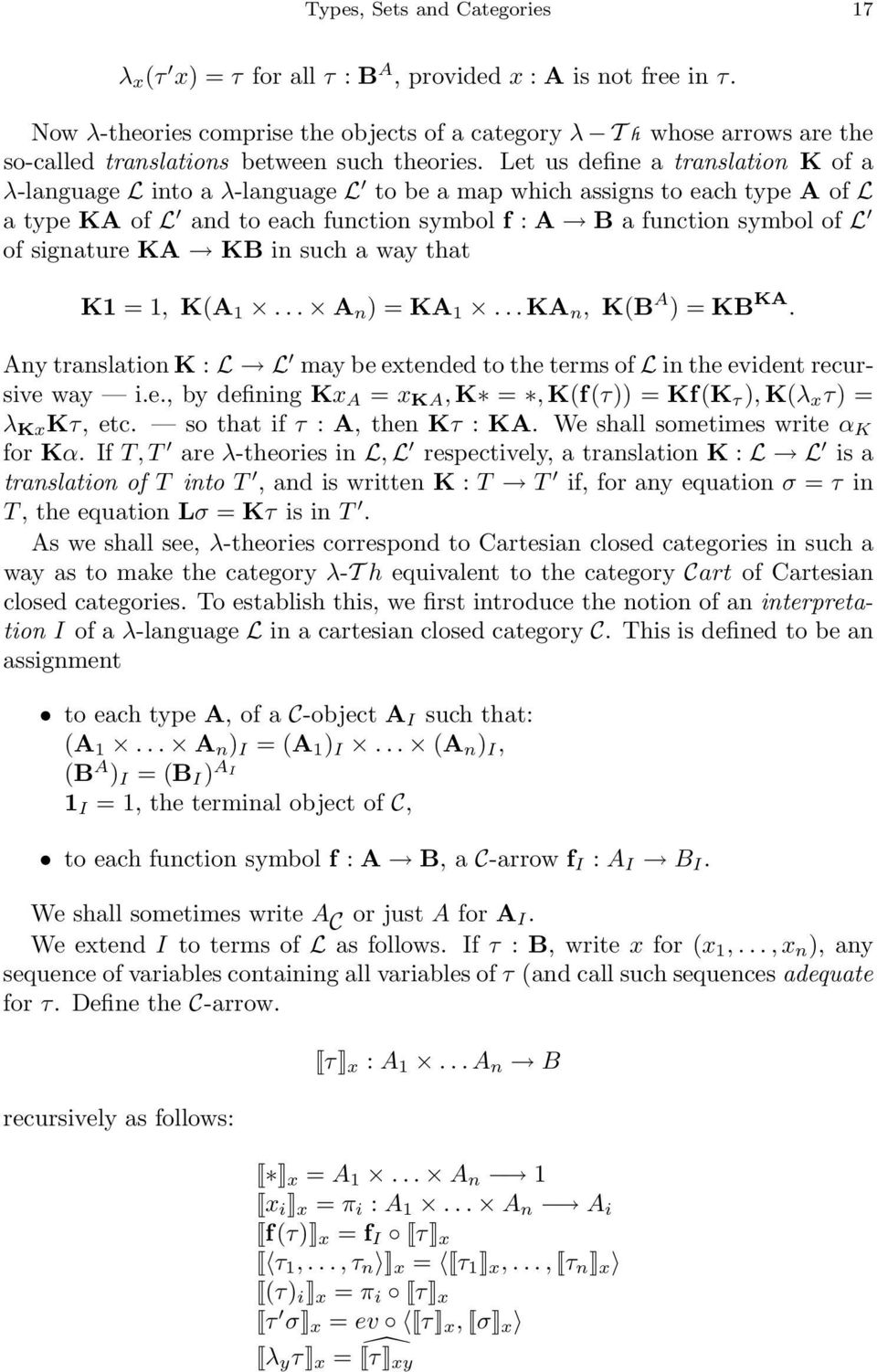
18 18 John L. Bell Here denotes exponential transpose and ev the appropriate evaluation arrow in the definition of the exponential. 21 Next, one shows that any λ-theory T determines a Cartesian closed category C(T). The objects of C(T) are taken to be the types of the language of T. The arrows of C(T) are pairs of the form (x, τ), where τ is a term with no free variables other than x, two such pairs (x, τ) and (y, σ) being identified whenever the equation τ = σ is a member of T. The identity arrow on a type A is the pair (x A, x A ). The composite of (x, τ) : A B and (y, σ) : B C is given by the pair (x, σ(y/τ)). It is now readily checked that C(T) is a Cartesian closed category with terminal object the type 1 and in which products and exponentials are given by the analogous operations on types. Moreover, 1 A = (x A, ) π i = (z, (z) i ) (with z : A 1.. A n ) (z, σ), (z, τ) = (z, σ, τ ) (z, τ) = (x, λ y τ( x, y ) with z : A B, x : A, y : B ev C,A = (y, (y) 2(y) 1 ) with y : C A A. There is a canonical interpretation of L in C(T) which we denote by the same expression C(T) given by A C(T) = A f C(T) = (x,f(x)). A straightforward induction shows that, for any term τ with free variables x = (x 1,..., x n ) of types A 1,...,A n, we have [τ ] x = (z, τ) where z is a variable of type A 1... A n. Inversely, each Cartesian closed category E determines a λ-theory T h(e) in the following way. First, one defines the internal language L E of E: the ground type symbols of L E are taken to match the objects of E other than 1, that is, for each E-object A other than 1 we assume given a ground type A. Next, we with each type symbol A of L E we associate the E-object A E defined by A E = A for ground types A, (A B) E = A E B E, (B A ) E = B A E E. As function symbols in L E we take triples of the form (f,a,b) = f with f : A E B E in E. The signature of f is A B. The natural interpretation denoted by E of L E in E is determined by the assignments 21 For these notions see the Appendix. A E = A for ground types A, (f, A, B) = f.

19 Types, Sets and Categories 19 The λ-theory Th(E) of E is now defined in the following way. Given a pair of terms σ, τ of the same type in L E, write x for the sequence of variables occurring free in either σ or τ. The theory Th(E) consists of all equations σ = τ for which the arrows ([σ] x ) E and ([τ ] x ) E coincide. It can then be shown that the canonical functor F : E C(Th(E)) defined by FA = A for each E-object A Ff = (x,f(x)) for each E-arrow f : A B is an isomorphism of categories. Similarly, for each λ-theory T there is a canonical translation G : T Th(C(T)) given by GA = A for each type A Gf = ((x,f(x),a,b)) for f : A B. This translation is clearly an isomorphism in the category λ-th. Now let Cart be the category whose objects are Cartesian closed categories and whose arrows are functors between these preserving terminal objects, products, and exponentials. The mappings C and Th act as functors λ-th Cart and Cart λ-th respectively; in view of the fact that, for any objects E of Cart, T of λ-th, C(Th(E)) = E and Th(C(T)) = T, these functors are equivalences. Accordingly λ-th and Cart are equivalent categories. This is one exact sense in which a formal theory is completely representable in categorical terms. 5.2 Logical Languages and Local Set Theories What sort of category corresponds to the simple theory of types 22 itself? The answer to this question a(n elementary)topos was provided in 1969 by Lawvere and Tierney, 23 although it was not at first grasped that their work in fact could in fact be seen as answering that question. However, it soon became clear that toposes are associated with a natural version of simple type theory, based on intuitionistic logic, which we shall call intuitionistic type theory. The system to be described here, local set theory, is a modification, due to Zangwill [1977], of that of Joyal and Boileau, later published as their [1981]. It combines the most convenient features of simple type theory and set theory. A full account is given in Bell [1988]. A local set theory is a type-theoretic system built on the same primitive symbols =,, { : } as classical set theory, in which the set-theoretic operations of forming products and powers of types can be performed, and which in addition contains a truth value type acting as the range of values of propositional functions 22 It should be stressed that here by the simple theory of types is meant the theory of types in Church s sense which includes a type of propositions. Without a type of propositions the simple theory of types is essentially just the typed λ-calculus. 23 See Lawvere [1971, 1972].
![The theory Th(E) consists of all equations σ = τ for which the arrows ([σ] x ) E and ([τ ] x ) E coincide.](/docs-images/40/143569/images/page_19.jpg "It can then be shown that the canonical functor F : E C(Th(E)) defined by FA = A for each E-object A Ff = (x,f(x)) for each E-arrow f : A B is an isomorphism of categories.")
20 20 John L. Bell on types. A local set theory is determined by specifying a collection of axioms formulated within a local language defined as follows. A local language L has the following basic symbols: 1 (unit type) Ω (truth value type) S, T, U,... (ground types: possibly none of these) f, g, h,... (function symbols: possibly none of these) x A, y A, z A,... (variables of each type A, where a type is as defined below) (unique entity of type 1) The types of L are defined recursively as follows: 1, Ω are types any ground type is a type A 1... A n is a type whenever A 1,...,A n are, where, if n = 1,A 1... A n is A 1, while if n = 0,A 1... A n is 1 (product types) PA is a type whenever A is (power types) Each function symbol f is assigned a signature of the form A B, where A,B are types; this is indicated by writing f : A B. Terms of L and their associated types are defined recursively as follows. We write τ : A to indicate that the term τ has type A. Term: type Proviso : 1 x A : A f(τ) : B f: A B τ : A τ 1,..., τ n : A 1... A n, where τ 1 : A 1,..., τ n : A n τ 1,..., τ n is τ 1 if n = 1, and if n = 0. (τ) i : A i where (τ) i is τ if n= 1 τ : A 1... A n, 1 i n {x A : α}: PA α : Ω σ = τ: Ω σ, τ of same type σ τ σ : A, τ: PA for some type A Terms of type Ω are called formulas, propositions, or truth values. Notational conventions we shall adopt include:

21 Types, Sets and Categories 21 ω, ω, ω variables of type Ω α, β, γ formulas x, y, z,... x A, y A, z A... τ(x/σ) or τ(σ) result of substituting σ at each free occurrence of x in τ: an occurrence of x is free if it does not appear within {x : α} α β α = β Γ : α sequent notation: Γ a finite set of formulas : α : α A term is closed if it contains no free variables; a closed term of type Ω is called a sentence. The basic axioms for L are as follows: Unity: x 1 = Equality: x = y, α(z/x) : α(z/y) (x, y free for z in α) Products: ( x 1,...,x n ) i = x i x = (x) 1,..., (x) n Comprehension: x {x : α} α The rules of inference for L are: Γ : α Thinning: β, Γ : α Restricted Cut: Substitution: Γ : α α, Γ : β (any free variable of α free in Γ or β) Γ : β Γ : α (τ free for x in Γ and α) Γ(x/τ) : α(x/τ) Extensionality: Equivalence: Γ : x σ x τ (x not free in Γ, σ, τ) Γ : σ = τ α, Γ : β β, Γ : α Γ : α β These axioms and rules of inference yield a system of natural deduction in L. If S is any collection of sequents in L, we say that the sequent Γ : α is deducible from S, and write Γ S α provided there is a deduction of Γ : α using the basic axioms, the sequents in S, and the rules of inference. We shall also write Γ α for Γ α and S α for S α.
22 22 John L. Bell A local set theory in L is a collection S of sequents closed under deducibility from S. Any collection of sequents S generates the local set theory S comprising all the sequents deducible from S. The local set theory in L generated by is called pure local set theory in L. 5.3 Logic in a Local Set Theory The logical operations in L are defined as follows: Logical Operation Definition (true) = α β α, β =, α β (α β) α xα {x : α} = {x : } (false) ω.ω α α α β ω[(α ω β ω) ω] xα ω[ x(α ω) ω] We also write x y for (x = y), x / y for (x y), and!xα for x[α y(α(x/y) x = y)]. It can now be shown that the logical operations on formulas just defined satisfy the axioms and rules of free intuitionistic logic. We present just a few of the relevant derivations. We write Γ 1 : α 1,..., Γ n : α n : β for deducibility of : β from Γ 1 : α 1,..., Γ n : α n. x = x. Derivation: : (x) 1 = x. α α Derivation: ω, ω = ω : ω : ω : ω ω : ω α : α Γ : a Γ : β Γ : α β
23 Types, Sets and Categories 23 Derivation: β : β = α : α = α =, β = : α β α, β = : α β Γ : α Γ, β : α β Γ : α β Γ : α β γ : {x : α} = {x : β} Deriviation: Γ : α β / \ α, Γ : β β, Γ : α x {x : α}, Γ : x {x : β} x {x : β}, Γ : x {x : α} Γ : x {x : α} x {x : β} Γ : {x : a} = {x : β In any local set theory the following Modified Cut Rule holds: (i) (ii) Γ : α α, Γ : β x 1 (x 1 = x 1 ),..., x n (x n = x n ), Γ : β where x 1,...,x n are the free variables of α not occurring freely in Γ or β. Γ : α α, Γ : β Γ : β provided that, whenever A is the type of a free variable of α with no free occurrences in Γ or β, there is a closed 24 term of type A. 5.4 Set Theory in a Local Language We can now introduce the concept of set in a local language. A set-like term is a term of power type; a closed set-like term is called an (L ) set. We shall use upper case italic letters X, Y, Z,... for sets, as well as standard abbreviations such as x X.α for x(x X α). The set theoretic operations and relations are defined as follows. Note that in the definitions of,, and, X and Y must be of the same type: 24 A term is closed if it contains no free variables.
24 24 John L. Bell Operation Definition {x X : α} {x : x X α} X Y x X.x Y X Y {x : x X x Y } X Y {x : x X x Y } x / X (x X) U A or A {x A : } A or {x A : } E X {x : x E x / X} PX {u : u X} U (U : PPA) {x : u U.x u} U (U : PPA) {x : u U.x u} X i {x : i I.x X i } i I X i {x : i I.x X i } i I {τ 1,..., τ n } {x : x = τ 1... x = τ n } {τ : α} {z : x 1... x n (z = τ α)} X Y { x, y : x X y Y } X + Y { {x}, : x X} {, {y} : y Fun(X, Y ) Y } {u : u X Y x X!y Y. x, y u} The standard facts concerning the set-theoretic operations and relations now follow as straightforward consequences of their definitions. Given a term τ such that x 1,..., x n X S τ Y we write ( x 1,..., x n τ) or simply x τ for Clearly we have { x 1,..., x n, τ : x 1,..., x n X}. S ( x 1,..., x n τ)) Fun(X, Y ), and so we may think of ( x 1,..., x n τ) as the function from X to Y determined by τ. We now show that each local set theory determines a topos. Let S be a local set theory in a local language L. Define the relation S on the collection of all L-sets by X S Y iff S X = Y. This is an equivalence relation. An S-set is an equivalence class [X] S which we normally identify with X of L-sets under the relation S. An S-map f: X Y is a triple (f, X, Y ) normally identified with f of S-sets such that S f Y X. X and Y are, respectively, the domain dom(f) and the codomain
25 Types, Sets and Categories 25 cod(f) of f. It is now readily shown that the collection of all S sets and maps forms a category C(S), the category of S-sets, in which the composite of two maps f : X Y and g : Y Z is given by g f = { x, z : y( x, y f y, z g)}. In fact, C(S) is a topos, the topos of sets determined by S. It has terminal object U 1, the product of two objects (S-sets) X, Y is the S-set X Y, with projections given by π 1 = ( x, y x) : X Y X, π 2 = ( x, y x) : X Y Y, its truth-value object is (Ω, t), where t : 1 Ω is the S-map {, }, and the power object of an object X is (PX, e X ), where e X : X PX Ω is the S-map x, z x z. All this is proved in much the same way as for classical set theory. It can also be shown that properties of maps in C(S) are characterized in just the same way as in ordinary set theory, e.g. a map is monic iff it is one-to-one, epic iff it is onto, and an isomorphism iff it is both. This fact will be used implicitly in the sequel. 5.5 Interpreting a Local Language in a Topos: The Soundness and Completeness Theorems Let L be a local language and E a topos. An interpretation I of L in E is an assignment: to each type A, of an E-object A I such that: (A 1... A n ) I = (A 1 ) I... (A n ) I. (PA) I = PA I, 1 I = 1, the terminal object of E, Ω I = Ω, the truth-value object of E. to each function symbol f : A B, an E-arrow f I : A I B I. We shall sometimes write A E or just A for A I. We extend I to terms of L as follows. If τ : B, write x for (x 1,..., x n ), any sequence of variables containing all variables of τ (and call such sequences adequate for τ). Define the E-arrow recursively as follows: [τ ] x : A 1... A n B [ ] x = A [x i ] x = π i : A 1... A n A i [f(τ)] x = f 1 [τ ] x [ τ 1,..., τ n ] x = [τ 1 ] x,..., [τ n ] x [(τ) i ] x = π i [τ ] x [{y : α}] x = ([α(y/u)] ux can)ˆ
26 26 John L. Bell where in this last clause u differs from x 1,..., x n, is free for y in α, y is of type C, (so that B is of type PC), can is the canonical isomorphism C (A 1... A n ) = C A 1... A n, and ˆf is as defined for power objects. 25 To understand why, consider the diagrams C A 1... A n [[α(y/u)]] ux Ω can f C (A 1... A n ) A 1... A n ˆf PC In set theory, ˆf(a 1,..., a n ) = {y C : α(y, a 1,..., a n )}, so we take [{y : α}] x to be ˆf. Finally, [σ = τ ] x = eq c [ σ, τ ] x (with σ, τ : c) [σ τ ] x = e c [ σ, τ ] x (with σ : C, τ : PC and where e c is as defined for power objects) If τ : B is closed, then x may be taken to be the empty sequence. In this case we write [τ ] for τ ; this is an arrow 1 B. We note that [ ] x = [ = ] x = eq [ ] x, [ ] x = T. For any finite set Γ = {α 1,..., α m } of formulas write [Γ] I,x for [α 1 ] I,x... [α m ] I,x if m 1 or T if m = 0. Given a formula α, let x = (x 1,..., x n ) list all the free variables in Γ {α}; write Γ 1 α for [Γ] I,x [α] I,x. Γ I α is read: Γ : α is valid under the interpretation I in E. If S is a local set theory, we say that I is a model of S if every sequent of S is valid under I. Notice that I β iff [β] x = T. So if I is an interpretation in a degenerate topos, i.e., a topos possessing just one object up to isomorphism, then i α for all α. We write: Γ α for Γ I α for every I Γ S α for Γ I α for every model I of S. 25 See Appendix for definitions of all categorical notions used in the sequel.
27 Types, Sets and Categories 27 It can be shown (laboriously) that the basic axioms and rules of inference of any local set theory are valid under every interpretation. This yields the Soundness Theorem. Γ α Γ α Γ S α Γ S α. A local set theory S is said to be consistent if it is not the case that S. The soundness theorem yields the Corollary. Any pure local set theory is consistent. Proof. Set up an interpretation I of L in the topos Finset of finite sets as follows: 1 I = 1, Ω I = {0, 1} = 2, for any ground type A,A I is any nonempty finite set. Extend I to arbitrary types in the obvious way. Finally f I : A I B I is to be any map from A I to B I. If, then α, so I α for any formula α. In particular I u = v, where u, v are variables of type P1. Hence [u] I,uv = [v] I,uv, that is, the two projections P1 P1 P1would have to be identical, a contradiction. Given a local set theory S in a language L, define the canonical interpretation C(S) of L in C(S) by: A C(S) = U A f C(S) = (x f(x)) : U A U B for f : A B. A straightforward induction establishes This yields For: [τ ] C(S),x, = (x τ). Γ C(S) α Γ S α. C(S) α [α] C(S)x = T (x α) = (x ) S α = S α. Since Γ S α S γ α, where γ is the conjunction of all the formulas in Γ, the special case yields the general one. Equivalence (*) may be read as asserting that C(S) is a canonical model of S. This fact yields the Completeness Theorem. ( ) Γ α Γ α Γ S α Γ S α Proof. We know that C(S) is a model of S. Therefore, using (*), Γ S α Γ C(S) α Γ S α.
28 28 John L. Bell 5.6 Every Topos is Linguistic: The Equivalence Theorem A topos of the form C(S) is called a linguistic topos. It can be shown that every topos is, in a certain sense, equivalent to a linguistic one. This fact was apparently established independently by a number of mathematicians: it appears for example, in Fourman [1977], Zangwill [1977], and Boileau and Joyal [1981]. Given a topos E, we exhibit a theory Th(E) and an equivalence E C(Th(E)). The local language L E associated with E also called the internal language of E is defined as follows. The ground type symbols of L E are taken to match the objects of E other than its terminal and truth-value objects, that is, for each E-object A (other than 1, Ω) we assume given a ground type A in L E. Next, we define for each type symbol A an E-object A E by A E = A for ground types A, (A B) E = A E B E 26 (PA) E = P(A E ). The function symbols of L are triples (f,a, B) = f with f : A E B E in E. The signature of f is A B. 27 The natural interpretation denoted by E of L E in E is determined by the assignments A E = A for each ground type A (f,a,b) E = f. The local set theory Th(E), the theory of E, is the theory in L E generated by the collection of all sequents Γ : α such that Γ E α under the natural interpretation of L E in E. Then we have Γ Th(E) α Γ E α. For if Γ α then by Soundness Γ Th(E) Th(E) α, i.e., Γ : α is valid in every model of Th(E). But by definition E is a model of Th(E). It can be shown that the canonical functor F : E C(Th(E)) defined by FA = U A for each E-object A Ff = (x f(x) : U A U B for each E-arrow f : A B is an equivalence of categories. This is the Equivalence Theorem. Finally, we state two more facts about Th(E). A local set theory S in a language L is said to be 26 Note that, if we write C for A B, then while C is a ground type, A B is a product type. Nevertheless C E = (A B) E. 27 Note the following: if f : A B D, in E, then, writing C for A B as in the footnote above, (f,c, D) and (f,a B,D) are both function symbols of L E associated with f. But the former has signature C D, while the latter has the different signature A B D.
29 Types, Sets and Categories 29 well-termed if whenever S!xα, there is a term τ of L whose free variables are those of α with x deleted such that S α(x/τ); well-typed if for any S-set X there is a type symbol A of L such that U A = X in C(S). Then, for any topos E, Th(E) is well-termed and well-typed. 5.7 Translations of Local Set Theories A translation K : L L of a local language L into a local language L is a map which assigns to each type A of L a type KA of L and to each function symbol f : A B of L a function symbol Kf: KA KB of L in such a way that K1 = 1, KΩ = Ω, K(A) 1... A n ) = KA 1... KA n, K(PA) = PKA. Any translation K : L L may be extended to the terms of L in the evident recursive way i.e., by defining K =, K(f(τ)) = Kf(kτ), K(σ τ) = Kσ Kτ, etc so that if τ : A, then Kτ : KA. We shall sometimes write α K for Kα. If S, S are local set theories in L, L respectively, a translation K : L L is a translation of S into S, and is written K : S S if, for any sequent Γ : α of L, Γ S α KΓ S Kα, (*) where if Γ = {α 1,..., α n },KΓ = {Kα 1,..., Kα n }. If the reverse implication to (*) also holds, K is called a conservative translation of S into S. If S is an extension of S and the identity translation of S into S is conservative, S is called a conservative extension of S. There is a natural correspondence between models of S in a topos E and translations of S into Th(E): in particular the identity translation Th(E) Th(E) corresponds to the natural interpretation of Th(E) in E. Now let E, E be toposes with specified terminal objects, products, projection arrows, truth-value objects, power objects and evaluation arrows: a functor F : E E which preserves all these is called a logical functor. It is easily seen that the canonical functor E C(Th(E)) is logical. If K : S S is a translation, then for terms σ, τ of L, S σ = τ implies S Kσ = Kτ, so that K induces a map C K from the class of S-sets to the class of S -sets via C K ([σ] S ) = [Kσ] S. C K is actually a logical functor C(S) C(S ). Writing Loc for the category of local set theories and translations, and T op for the category of toposes and logical functors, C is a functor Loc T op. And reciprocally any logical functor F : E E induces a translation Th(F) : Th(E) Th(E ) in the natural way, so yielding a functor Th: Loc T op. C and Th are almost inverse, making Loc and T op almost equivalent.
30 30 John L. Bell Given a local set theory S in a language L, define a translation K : L L L(S) by KA = U A, Kf = (f, A, B) if f : A B. An easy induction on the formation of terms shows that, for any term τ of L, [τ ] C(S), x = [Kτ ] C(S), K x. It follows from this that K is a conservative translation of S into Th(C(S)). For Γ S α Γ C(S) α KΓ C(S) Kα KΓ Th(C(S)) Kα. Accordingly any local set theory can be conservatively embedded in one which is well-termed and well-typed. A particularly important instance of translation is the adjunction of indeterminates to a local set theory. Let us define a constant of type A in a local language L to be a term of the form f( ), where f : 1 A. Write L(c) for the language obtained from L by adding a new function symbol c : 1 A and write c for c( ). Given a local set theory S in L, and a formula α of L with exactly one free variable x of type A, write S(α) for the theory in L(c) generated by S together with all sequents of the form: β(x/c) where α S β. Since clearly S(α) α(x/c), it follows that S(α) xα. Also, an analysis of derivations establishes that proofs in S(α) are related to proofs in S by the condition: Γ(x/c) S(α) γ(x/c) α, Γ S γ. ( ) for any sequent Γ : γ of L. It is not hard to show that: S xα S(α) is a conservative extension of S S xα S(α) is inconsistent. In S(α), c behaves as an indeterminate of sort α in the sense that it can be arbitrarily assigned any value satisfying α. To be precise, the following can be proved: Let S be a local set theory in a local language L and let K : S S. Then for any constant c of L of type KA such tha t S α K (c ), there is a unique translation K : S(α) S extending K such that K (c) = c. If I is an S-set and α the formula x I, we write S I for S(α) and call it the theory obtained from Sby adjoining an indeterminate element of I. It follows from (*) above that, for any formula γ of L in which i is free for x, S(I) γ(x/c) S i Iγ(x/i). If α is the formula x = x with x : A, then S(α) is written S(A) and called the theory obtained from S by adjoining an indeterminate of type A. In particular, let S 0 be the pure local set theory in the local language L 0 with no ground types or function symbols. Evidently S 0 is an initial object in the category Loc: there is a unique translation of L 0 into any given local set theory S. (Similarly, the topos C(S 0 ) is an initial object in the category top.) Now consider the theory S 0 (A),
31 Types, Sets and Categories 31 where A is a type symbol of L 0 : A may be considered a type symbol of any local language L. If d is a constant of type A in L, and S a local set theory in L, there is then a unique translation K : S 0 (A) S mapping c to d. So S 0 (A) may be considered the universal theory of an indeterminate of type A. 5.8 Classicality and the Choice Principle Let S be a local set theory in a language L. We make the following Definitions. S is classical if S ω(ω ω). This is the full law of excluded middle for S. S is sententially classical if S α α for any sentence α. This is a weakened form of the law of excluded middle. For each S set X : PA let (X) be the set of closed terms τ such that S τ X. X is standard if for any formula α with at most the variable x : A free the following is valid: S is standard if every S-set is so. S α(x/τ) for all τ in (X) S x Xα S is witnessed if for any type symbol A of L and any formula α with at most the variable x : A free the following is valid: S xα S α(x/τ) for some closed term τ : A S is choice if, for any S-sets X, Y and any formula α with at most the variables x, y free the following rule (the choice rule) is valid: S x X y Y α(x, y) S x Xα(x, fx) for some f : X Y S is internally choice if under the conditions of the previous definition x X y Y α(x, y) S f Fun(X, Y ) x X y Y [α(x, y) x, y f]. An S-set X is discrete if S x X y X.x = y x y.
32 32 John L. Bell A complement for an S-set X : PA is an S-set Y : PA such that S X Y = A X Y =. An S-set that has a complement is said to be complemented. Now for some facts concerning these notions. In formulating our arguments we shall assume that our background metatheory is constructive, in that no use of the metalogical law of excluded middle will be made. 1. Any of the following conditions is equivalent to the classicality of S: (i) S Ω = {, } (ii) (iii) (iv) (v) (vi) S ω ω any S-set is complemented, any S-set is discrete, Ω is discrete, S 2 = {0, 1} is well-ordered under the usual ordering, Proof. (iii) If S is classical, clearly {x : x / X} is a complement for X. Conversely, if { } has a complement U, then S ω U (ω = ) ω ω =. Hence S U = { }, whence S Ω = { } U = {, }. (v) If Ω is discrete, then S ω = (ω = ), so S ω ω. (vi) If S is classical, then 2 is trivially well-ordered under the usual well-ordering. Conversely, if 2 is well-ordered, take any formula α, and define X = {x 2 : x = 1 α}. Then X has a least element, a, say. Clearly S a = 0 α, so, since S a = 0 a = 1, we get S a = 1 α, and hence S α α. 2. For well-termed S, S choice S internally choice and witnessed. Proof. Suppose S is choice. If S xα, let u : 1 and define β(u, x) α(x). Then S u 1 x Xβ(u, x). Now choice yields an S-map f : 1 X such that S u 1β(u, f(u)) i.e., S β(, f ) or S α(f ). By well-termedness, f may be taken to be a closed term τ, and we then have S α(τ). So S is witnessed. To derive internal choice from choice, we argue as follows: let X = {x X : y Y α(x, y)}. Then S x X y Y α(x, y). Accordingly choice yields a map f : X Y such that S x X α(x, fx), i.e. S x X y Y [ x, y f α(x, y)]. Now x X y Y α(x, y)] S X = X S f Fun(X, Y )
33 Types, Sets and Categories 33 so Hence x X y Y α(x, y)] S x X y Y [ x, y f α(x, y)]. x X y Y α(x, y) S f Fun(X, Y ) x X y Y [α(x, y) x, y f], as required. The converse is easy. 3. If S is well-termed and well-typed, then S is choice S X (= S(X)) is witnessed for every S-set X. Proof. Suppose S is choice and S(X) yα(y). We may assume that X is of the form U A, in which case α is of the form β(x/c, y) with x : A. From S(X) yβ(x/c, y) we infer S x yβ(x/c, y). So using choice in S and the well-termedness of S we obtain a term τ(x) such that S xβ(x, τ(x)). Hence S(X) β(c, τ(c)), i.e., S(X) α(τ(c)). Therefore S X is witnessed. Conversely, suppose S X is witnessed for every S-set X, and that S x X y Y α(x, y)]. Then S(X) y Y α(c, y)], so there is a closed L X -term τ such that S(X) τ Y α(c, τ). But τ is σ(x/c) for some L-term σ(x). Thus S(X) σ(c) Y α(c, σ(c)), whence S x X[σ(x) Y α(x, σ)]. Defining f = (x σ) : X Y then gives S x Xα(x, fx)] as required. 4. Diaconescu s Theorem. S choice S classical. This is the version, for local set theories, of Diaconescu s [1975] result 28 that any topos in which the axiom of choice holds is Boolean. Proof. Step 1. S choice S I choice for any S-set I. Proof of step 1. Suppose that S is choice, and S(I) x X(c) y Y (c)α(x, y, c). Then Define S x X(i) y Y (i)α(x, y, i). X = { x, i : x X(i) i I}, Y = Y (i). β(u, i) x X(i) i I[u = x, i α(x, y, i) y Y (i)]. i I Then S u X y Y β(u, y). So choice yields f : X Y such that S u X β(u, f u). 28 First presented in purely logical form in Goodman and Myhill [1978].
34 34 John L. Bell i.e., whence S i I x X(i)[α(x, f ( x, i, i) f ( x, i ) Y (i)], S x X(c)[α(x, f ( x, c, c) f ( x, c ) Y (c)], Now define f = (x f ( x, c )). Then f : X(c) Y (c) in S I and This completes the proof of step 1. S(I) x X(c)α(x, fx, c). Step 2. S choice S sententially classical. Proof of step 2. Define 2 = {0, 1} and let X = {u 2 : y.y u}. Then S u X y 2.y u. So by choice there is f : X 2 such that Now let α be any sentence; define S u X.fu u. U = {x 2 : x = 0 α}, V = {x 2 : x = 1 α}, Then S U X V X, so, writing a = fu, b = fv, we have S [a = 0 α] [b = 1 α], whence so that S [a = 0 b = 1] α, S a b α. ( ) But α S U = V S a = b, so that a b S α. It follows from this and (*) that as claimed. This establishes step 2. S α α, Moral of step 2: if pair sets have choice functions, then logic is classical. Step 3 (obvious). S classical S Ω sententially classical. Finally, to prove Diaconescu s theorem, we observe that S choice S Ω choice S Ω sententially classical S classical.
35 Types, Sets and Categories Characterisation of Set We remind the reader that we are assuming that our background metatheory is constructive. For definiteness we will take that metatheory to be intuitionistic set theory IST. Now consider the category Set of sets in IST. Its objects are all sets and its arrows all maps between sets. Set is a topos in with truth-value object P 1. We seek a characterization of Set in terms of its associated local set theory, that is, a characterization of the category of sets in type-theoretic terms. This is to be carried out in a constructive manner. To achieve this, we first define a local set theory S to be full if for each set I in the background metatheory there is a type symbol Î of the language L of S together with a collection {î : i I} of closed terms each of type Î satisfying the following: (i) S î = ĵ i = j. (ii) For any I-indexed family {τ i : i I} of closed terms of common type A, there is a term τ(x) : A, x : Î such that S τ i = τ(î) for all i I, and, for any term σ(x) : A, x : Î, if S τ i = σ(î) for all i I, then S τ = σ. We establish the generalization principle for hatted type symbols: The following is valid for any formula α(x) with x : Î: S α(î) for all i I S xα and similarly for more free variables. In particular, Î is standard. Proof. Assume the premises. Then for any i I we have S α(î) = and it follows from the uniqueness condition that S α(x) =, whence have S xα. Note the following: (i) if S is well-termed and well-typed, then C(S) is full iff the I-indexed sum of 1 exists in C(S) for any (intuitive) set I. Here the I-indexed sum of an object X in a category C is an object I X together with arrows σ i : X I X(i I) such that, for any arrows f i : X A, there is a unique arrow f : I X A such that f i = f σ i for all i I. In Set, I X is the disjoint union of I copies of X, so that, in particular, I 1 is essentially I itself. (ii) S is standard iff 1 is a generator in C(S). Here an object A of a category C is a generator if, for any pair of C-arrows f, g : X Y, f = g whenever f h = g h for all arrows h : A X. Conditions (i) and (ii) are both satisfied by Set.
36 36 John L. Bell We can now prove the Theorem. The following conditions on a well-termed, well-typed consistent local set theory S are equivalent: (i) S is full and standard, (ii) C(S) Set. Proof. Implication (ii) (i) has been discussed above. Now assume that S is full. Since S is well-termed, for any S-map f : X Y we can write f(τ) for each closed term τ such that S τ X. We define functors : C(S) Set,ˆ : Set C(S), which, under the specified conditions, we show to define an equivalence. First, (X) is the set of closed terms τ such that S τ X, where we identify σ, τ if that S σ = τ. Given f : X Y, we define (f) to be the map (τ f(τ)) : (X) (Y ). Next, given I in Set, we define Î to be the S-set U b I. Given f : I J, there is a term f(x) : Ĵ with x : Î such that that f(î) S = f(i) for all i I. We define f : Î Ĵ to be the S-map x f(x). For any set I and any S-set X, we have natural maps η I : I (Î) and ε : (X) X defined as follows: η I (i) = î for i I; S ε( τ) = τ for all τ (X). Clearly η is monic. The same is true of ε since for σ, τ (X), whence S ε( σ) = ε( τ) σ = τ, S x y[ε(x) = ε(y) x = y] by generalization for hatted type symbols. Now suppose that S is standard. We claim that then ε is epic and hence an isomorphism. For we have, for all τ (X), S ε( τ) = τ, whence S yε(y) = τ. Since X is standard, we infer that S x X yε(y) = x, so that ε is onto, hence epic. Using the fact that ε is an isomorphism we can now show that η is epic, and hence also an isomorphism. To do this we require the readily established fact that, for f : I J, f : Î Ĵ is a map in S, and if f is epic, then so is f. Now consider η : Î Î. We note that ε η = 1 bi. ( )
37 Types, Sets and Categories 37 For if i I, then S ε( η(î)) = ε( ηi) = ηi = î It follows by generalization that S x Î ε(ηx) = x, whence (*). Since ε is an isomorphism, it follows easily from (*) that η is an isomorphism, hence also epic. Accordingly η is itself epic, and hence also an isomorphism. We conclude that (,ˆ) define an equivalence between C(S) Set, as required. 6 NEW FORMS OF TYPE THEORY AND THE DOCTRINE OF PROPOSITIONS AS TYPES Type theory took a remarkable turn in the 1980s with the emergence of the propositions as types doctrine. Underlying this doctrine is the idealist notion, traceable to Kant, and central to Brouwerian intuitionism, that the meaning of a proposition does not derive from an absolute standard of truth external to the mind, but resides rather in the evidence for its assertability in the form of a mental construction or proof. Thus the central thesis of the propositions-as-types doctrine is that each proposition is to be identified with the type, set, or assemblage of its proofs. 29 As a result, such proof types, or sets of proofs, have to be accounted the only types, or sets. Strikingly, then, in the propositions as types doctrine, a type, or set, simply is the type, or set, of proofs of a proposition, and, reciprocally, a proposition is just the type, or set, of its proofs. These are truly radical identifications. In a simple type theory or a local set theory, each type is independent of other types and is thus, so to speak, absolute or static; this holds in particular of the type of propositions or truth values. Now formulas or propositional functions in general manifest variation, since their values vary over, or depend on, the domain(s) of their free variables. Because of this they cannot be accurately represented as static types. This limitation makes it impossible for a simple type theory to realize faithfully the propositions as types doctrine. In order to achieve this it is necessary to develop a theory of variable or dependent types, wherein types can depend on, or vary over other types. In a dependent type theory, type symbols may take the form B(x), with x a variable of a given type A : B(x) is then a type dependent on or varying over the type A. 29 This idea was advanced by Curry and Feys [1958] and later by Howard [1980]. As the Curry-Howard correspondence it has come to play an important role in theoretical computer science.
38 38 John L. Bell Such a theory constructive dependent type theory (CDTT) was introduced 30 by Per Martin-Löf [1975; 1982; 1984]. His theory, which has subsequently undergone much development, is also (as its name indicates) the first truly constructive theory of types, in the sense of being both predicative (so in particular it lacks a type of propositions) and based on intuitionistic logic. In introducing it Martin-Löf s purpose was to provide, as he put it in [1975] a full scale system for formalizing intuitionistic mathematics as developed, for example, in the book by Bishop. 31 Martin-Löf s system provides a complete embodiment of the propositions-as-types doctrine. 32 Here is Martin-Löf himself on the latter in [1975]: Every mathematical object is of a certain kind or type. Better, a mathematical object is always given together with its type, that is it is not just an object: it is an object of a certain type.... A type is defined by prescribing what we have to do in order to construct an object of that type... Put differently, a type is well-defined if we understand... what it means to be an object of that type.... Note that it is required, neither that we should be able to generate somehow all the objects of a given type, nor that we should so to say know all of them individually. It is only a question of understanding what it means to be an arbitrary object of the type in question. A proposition is defined by prescribing how we are allowed to prove it, and a proposition holds or is true intuitionistically if there is a proof of it.... Conversely, each type determines a proposition, namely, the proposition that the type in question is nonempty. This is the proposition which we prove by exhibiting an object of the type in question. On this analysis, there appears to be no fundamental difference between propositions and types. Rather, the difference is one of point of view: in the case of a proposition, we are not so much interested in what its proofs are as in whether it has a proof, that is, whether it is true or false, whereas, in the case of a type, we are of course interested in what its objects are and not only in whether it is empty or nonempty. A key element in Martin-Löf s formulation of type theory is the distinction, which goes back to Frege, between propositions and judgments. Propositions (which, as we have seen, in Martin-Löf s systems are identified with types) are syntactical objects on which mathematical operations can be performed and which 30 Dependent types were actually first studied in the late 1960s by de Bruijn and his colleagues at the University of Eindhoven in connection with the AUTOMATH project. CDTT has been employed as a basis for various computational devices employed for the verification of mathematical theories and of software and hardware systems in computer science. 31 I.e. Bishop [1967]. 32 Martin-Löf s original calculus contained a type of all types. This assumption was shown to be inconsistent by Girard [1972]. Martin-Löf accordingly dropped this assumption in later versions of his theory.
39 Types, Sets and Categories 39 bear certain formal relationships to other syntactical objects called proofs. Propositions and proofs are, so to speak, objective constituents of the system. Judgments, on the other hand, typically involve the idealist notion of understanding or grasping the meaning of. Thus, for example, while = 4 is a proposition, = 4 is a proposition and = 4 is a true proposition are judgments. Martin-Löf also follows Frege in taking the rules of inference of logic to concern judgments rather than propositions. Thus, for example, the correct form of the rule of -elimination is not A A B but B A true A B true. B true That is, the rule does not say that the proposition B follows from the propositions A and A B, but that the truth of the proposition B follows from the truth of the proposition A conjoined with that of A B. In general, judgments may be characterized as expressions which appear at the conclusions of rules of inference. Another important respect in which Martin-Löf follows Frege is in his insistence that judgments and formal rules be accompanied by full explanations of their meaning. (This is to be contrasted with the usual model-theoretic semantics which is really nothing more than a translation of one object-language into another.) In particular, the judgment A is a proposition may be made only when one knows what a (canonical) proof of A is, and the judgment A is a true proposition only when one knows how to find such a proof. Judgments, and the notion of truth, are thus seen to be mind-dependent. Martin-Löf s various systems abound in subtle distinctions. For example, in addition to the distinction between proposition and judgment, there is a parallel distinction between type (or set) and category 33 (or species). In order to be able to judge that Ais a category one must be able to tell what kind of objects fall under it, and when they are equal. To be in a position to make the further judgment that a category is a type, or set, one must be able to specify what its canonical or typical, elements are. In judging something to be a set, one must possess sufficient information concerning the its elements to enable quantification over it to make sense. Thus, for example, the natural numbers form a set N, with canonical elements given by: 0 is a canonical element of N, and if n is a canonical element of N, then n + 1 is a canonical element of N. On the other hand the collection of subsets of N forms a category, but not a set. The propositions-as-types doctrine (which for convenience we abbreviate to PAT) gives rise to a correspondence between logical operators and operations on (dependent) types. Let us follow Tait s [1994] exposition of the idea in settheoretic terms. To begin with, consider two propositions/types/sets A and B. 33 In this usage, of course, to be distinguished from the term as employed in its mathematical sense throughout the present article.
40 40 John L. Bell What should be required of a proof f of the implication A B? Just that, given any proof x of A, f should yield a proof of B, that is, f should be a function from A to B. In other words, the proposition A B is just the type of functions from A to B: A B = B A Similarly, all that should be required of a proof c of the conjunction A B is that it should yield proofs x and y of A and B, respectively. From this point of view A B is accordingly just the type A B of all pairs (x, y), with x of type A (we write this as x : A) and y : B. A proof of the disjunction A B is either a proof of A or a proof of B together with the information as to which of A or B it is a proof. That is, if we introduce the type 2 with the two distinct elements 0 and 1, a proof of A B may be identified as a pair (c, n) in which either c is a proof of A and n is 0, or c is a proof of B and n is 1. This means that A B should be construed as the disjoint union A + B of A and B. The true proposition may be identified with the one element type 1 = {0} : 0 thus counts as the unique proof of. The false proposition is taken to be a proposition which lacks a proof altogether: accordingly is identified with the empty set. The negation A of a proposition A is defined as A, which therefore becomes identified with the set A. As we have already said, a proposition A is deemed to be true if it (i.e, the associated type A) has an element, that is, if there is a function 1 A.Accordingly the law of excluded middle for a proposition A becomes the assertion that there is a function 1 A + A. If a and b are objects of type A, we introduce the identity proposition or type a = A b expressing that a and b are identical objects of type A. This proposition is true, that is, the associated type has an element, if and only if a and b are identical. In that case id(a) will denote an object of type a. In PAT one must, as in Martin-Löf s system, distinguish sharply between propositions, which have proofs, and judgements, which do not. For example 0 = 2 0 is a proposition, while 0 is of type 2 is a judgement. Rather than being true or false, a judgement is either assertable, or nonsensical. In order to deal with the quantifiers we require operations defined on families of types, that is, types Φ(x) depending on objects x of some type A. By analogy with the case A B, a proof f of the proposition x : AΦ(x), that is, an object of type x : AΦ(x), should associate with each x : A a proof of Φ(x). So f is just a function with domain A such that, for each x : A, fx is of type Φ(x). That is, x : AΦ(x) is the product Πx : AΦ(x) of the Φ(x)s. We use the λ-notation in writing f as λxfx. A proof of the proposition x : AΦ(x), that is, an object of type x : AΦ(x), should determine an object x : A and a proof y of Φ(x), and vice-versa. So a proof of this proposition is just a pair (x, y) with x : A and y : Φ(x). Therefore x : AΦ(x) is the disjoint union, or coproduct x : AΦ(x) of the Φ(x)s.
41 Types, Sets and Categories 41 To translate all this into the language of CDTT, 34 one uses the following concordance: Logical Set-theoretic Operation Type-theoretic Operation Operation + two-term dependent sum set exponentiation type exponentiation x Cartesian product dependent product Πx:A x i I disjoint sum dependent sum x:a i I Of especial interest is the status of the axiom of choice in this framework. Again following Tait, we introduce the functions σ, π, π of types x : A(Φ(x) x : AΦ(x)), x : AΦ(x) A, and y : ( xφ(x)).φ(π(y)) as follows. If b : A and c : Φ(b), then σbc is (b, c). If d : x : AΦ(x), then d is of the form (b, c) and in that case π(d) = b and π (d) = c. These yield the equations π(σbc) = bπ (σbc) = cσ(πd)(π d) = d. We may take the axiom of choice as the proposition x : A y : BΦ(x, y)) f : B A x : AΦ(x, fx)). (AC) Remarkably, AC is correct under PAT, that is, provable in CDTT, as the following argument shows. Let u be a proof of the antecedent x : A y : BΦ(x, y)). Then, for any x : A, π(ux) is of type B and π (ux) is a proof of Φ(x, πux). So s(u) = λx.π(ux) is of type B A and t(u) = λx.π (ux) is a proof of x : AΦ(x, s(u)x). Accordingly λu.σs(u)t(u) is a proof of x : A y : BΦ(x, y)) x : B A x : AΦ(x, fx)). Put informally, what this shows is that in CDTT the consequent of (AC) means nothing more than its antecedent. Indeed, in many versions of constructive mathematics the assertability of an alternation of quantifiers x yr(x, y) means precisely that one is given a function f for which R(x, fx) holds for all x. We note that in ordinary set theory this argument establishes the isomorphism of the sets x : A y : BΦ(x, y)) and f : B A x : AΦ(x, fx)), but not the validity of the usual axiom of choice. In set theory AC is not represented by this isomorphism, but is rather (equivalent to) the equality in which is replaced by and by, namely x A y B Φ(x, y) = f B A x A Φ(x, fx). 34 For a complete specification of the operations and rules of DCTT, see Chapter 10 of Jacobs [1999] or Gambino and Aczel [2005].
42 42 John L. Bell While in PAT AC is provable, and so a fortiori has no untoward logical consequences, in intuitionistic set theory, or in the internal language of a topos this is far from being the case, for, as Diaconescu s theorem shows, in the latter AC implies the law of excluded middle. In other words, AC interpreted à la propositions as types is tautologous, 35 while construed set-, or topos-theoretically it is anything but, since so construed its affirmation yields classical logic. This prompts the question: what modification needs to be made to the propositions-as-types paradigm so as to yield the topos-theoretic interpretation of AC? An illuminating answer to this question has been given by Maietti [2005] through the use of so-called monotypes (or mono-objects), that is, (dependent) types containing at most one entity or having at most one proof. In Set, mono objects are singletons, that is, sets containing at most one element. Monotypes correspond to monic maps. This can be illustrated concretely by considering the categories Indset of indexed sets and Set of bivariant sets. The objects of Indset are indexed sets of the form M = { i, M i : i I} and those of Set maps A B in Set, with appropriately defined arrows in each case. It can be shown that these two categories are equivalent. If we think of (the objects of) Set as representing simple or static types, then (the objects of) Indset, and hence also of Set, represent dependent or variable types. It is easily seen that a monotype, or object, in Indset, is precisely an object M for which each M i has at most one element. Moreover, under the equivalence between Indset and Set, such an object corresponds to a monic map- object in Set. Now consider Set as a topos. Under the topos-theoretic interpretation in Set, formulas correspond to monic arrows, which in turn correspond to monoobjects in Indset. Carrying this over entirely to Indset yields the sought modification of the propositions-as-types paradigm to bring it into line with the topos-theoretic interpretation of formulas, namely, to take formulas or propositions to correspond to mono-objects, rather than to arbitrary objects. Let us call this the formulas-as-monotypes interpretation. Finally let us reconsider AC under the formulas-as-monotypes interpretation within Set. It will be convenient to rephrase AC as the assertion i I j JM ij f J I i IM if(i) where M ij : i I, j J is any doubly indexed family of propositions (or sets). In the propositions as types interpretation, where (*) corresponds to the existence of an isomorphism between M ij and M if(i). On the other hand, AC i I j J f J I i I 35 Precisely as Ramsey (v. supra) asserted, but in this case for quite different reasons. Ramsey construed, and accepted the truth of, the axiom of choice as asserting the objective existence of choice functions, given extensionally and so independently of the manner in which they might be described. But the intensional nature of constructive mathematics, and, in particular, of DCTT decrees that nothing is given completely independently of its description. This leads to a strong construal of the quantifiers which, as we have observed, trivializes the axiom of choice by rendering the antecedent of the implication constituting it essentially equivalent to the consequent. It is remarkable that the axiom of choice can be considered tautological both from an extensional and from an intensional point of view. ( )
43 Types, Sets and Categories 43 interpreted in the usual way, that is, using the rules of topos semantics, can be presented in the form of the distributive law M ij = M if(i). ( ) i I j J f J I i I In the propositions-as-types interpretation (as applied to Set ), the universal quantifier i I corresponds to the product and the existential quantifier i I i I to the coproduct, or disjoint sum,. Now in the formulas-as-monotypes i I interpretation, wherein formulas correspond to singletons, i I continues to correspond to, since the product of singletons is still a singleton. But the i I interpretation of i I is changed. In fact, the interpretation of i IM i (with each M i a singleton) now becomes [ M i ], where for each set X, [X] = {u : u = i I 0 x.x X} is the canonical singleton associated with X. It follows that, under the formulas-as-monotypes interpretation, the proposition i I j JM ij is interpreted as the singleton and the proposition f J I i IM if(i) as the singleton [ M ij ] (1) j J i I [ f J I i I M if(i) ]. (2) j J Under the formulas-as-monotypes interpretation AC would be construed as asserting the existence of an isomorphism between (1) and (2). Now it is readily seen that to give an element of (1) amounts to no more than affirming that, for every i I, M ij is nonempty. But to give an element of (2) amounts to specifying maps f J I and g with domain I such that i Ig(i) M if(i). It follows that to assert the existence of an isomorphism between (1) and (2), that is, to assert AC under the formulas-as-monotypes interpretation, is tantamount to asserting AC in the form (**), so leading in turn to classical logic. This is in sharp contrast with AC under the propositions-as-types interpretation, where, as we have seen, its assertion is automatically correct and so has no nonconstructive consequences. In the propositions as types interpretation each logical operation corresponds to a categorical operation: to, to +, to exponentiation, to an initial element 0, to exponentiation by 0, to product and to coproduct. This suggests that CDTT should be interpretable in suitable categories, just as local set theories are interpretable in toposes. For some time it was conjectured that the appropriate categories in this respect were the so-called locally Cartesian closed categories:
44 44 John L. Bell these are finitely complete categories E such that, for each object A of E, the slice category E/A is Cartesian closed. (Any topos is locally Cartesian closed.) It was already known that many of the mathematical constructions within a topos could be carried out within a locally Cartesian closed category. In such a category, the notion of variable set, for example an A-indexed set, is represented by an arrow B A of E, that is, by an object of E/A. In the interpretation of CDTT that was explicitly worked out by Seely [1984], types are interpreted as objects, and terms as arrows, of a locally Cartesian closed category E. As Seely points out, this interpretation engenders a systematic ambiguity among the notions of type, predicate and term, and between object and proof: indeed a term of type A is an arrow into A, which is in turn a predicate over A, and an arrow 1 A may be regarded either as an object of type A or as a proof of the proposition A. (This ambiguity is, of course, shared by the propositions as types interpretation.) In precise analogy with the correspondence between local set theories and toposes, Seely establishes a correspondence between theories formulated in Martin-Löf s system constructive dependent type theories and locally Cartesian closed categories. The relationship between type theories and categories is investigated in a general setting in Jacobs [1999]. It is natural to ask what form of set theory is interpretable in CDTT. This has been worked out by Peter Aczel 36 and has become come known as constructive set theory (CST). This is a system of intuitionistic set theory in which the settheoretic operations in reflect those on types in CDTT. n particular CST will admit products and exponentials of sets. But, given the predicative nature of CDTT, CST must also be predicative. This means, in particular, that in CST there can be no set of propositions, and no power sets. A particularly illuminating form of CST 37 employs the distinction between sets and classes, as in Gödel-Bernays set theory. In this version of CST, any predicate determines a class, but only certain classes are sets. Here a class may be thought of as something like a species or category in Martin-Löf s sense, that is, a range of objects all of which share a given property, and whose identity relations are fully determinate, but whose extent is not sufficiently fixed to admit quantification over it. A set, on the other hand, is a class with a fully determinate extent, hence supporting quantification. In CST, the class PA of all subsets the power class of a set A is almost never a set (the only exception being the power class of the empty set). On the other hand the exponential A B of two sets A, B the class of maps from B to A is always a set, so in particular 2 A is always a set. In classical set theory 2 A is essentially the power set of A, which cannot be the case in CST. This means that in CST 2 cannot represent, as it does in classical set theory, the set of propositions or truth values. In classical set theory 2 is P1, the power set of a one-element set, but in CST P1, while of course a class, is not a set. It can be shown that classical set theory is equivalent to CST augmented by the law of excluded middle and the assertion that P1 is a set. 36 See bibliographic entries under Aczel, Aczel and Gambino, and Aczel and Rathjen. 37 See Aczel and Rathjen [2201].
45 Types, Sets and Categories 45 Finally, a word on other forms of type theory that have emerged in the past few decades. Polymorphic type theory admits the presence of type variables, so that a type variable X may occur inside a type A(X). The assignment of types to type variables (or terms) is achieved by the introduction of a new order of entities called kinds. Just as each ordinary term is assigned a type, so each type term is assigned a kind. In particular, there is a kind called Type which represents the kind of all types. 38 Any type A then satisfies the judgment A: Type, and Type itself satisfies the judgment Type: Kind. In addition to Type, the presence of arbitrarily arbitrary subkinds of Type may be assumed. It is also assumed that Kind is closed under the operations corresponding to cartesian product and exponentiation, and that Type is closed under these latter and those corresponding to product and sum over type variables of an arbitrarily given kind. Polymorphic and dependent type theories have been combined in various ways. One form is the Calculus of Constructions of Coquand and Huet [1988]. This has been extended to what Jacobs [1999] calls Full Higher Order Dependent Type Theory, or the full theory for short. In dependent type theory types can depend on types; in polymorphic type theory types can depend on kinds. In the full theory, the dependence is extended to the remaining possibilities: those of kinds on types and kinds on kinds. An account of this, and other amalgamations of polymorphic and dependent type theories, may be found in Jacobs [1999]. APPENDIX: BASIC CONCEPTS OF CATEGORY THEORY A category C is determined by first specifying two classes Ob(C),Arr(C) the collections of C-objects and C-arrows. These collections are subject to the following axioms: Each C-arrow f is assigned a pair of C-objects dom(f), cod(f) called the domain and codomain of f, respectively. To indicate the fact that C-objects X and Y are respectively the domain and codomain of f we write f : X Y or X f Y. The collection of C-arrows with domain X and codomain Y is written C(X, Y ). Each C-object X is assigned a C-arrow 1 X : X X called the identity arrow on X. Each pair f, g of C-arrows such that cod(f) = dom(g) is assigned an arrow g f: dom(f) cod(g) called the composite of f and g. Thus if f : X Y and g : Y Z then g f : X Z. We also write X f Y g Z for g f. Arrows f, g satisfying cod(f) = dom(g) are called composable. Associativity law. For composable arrows (f, g) and (g, h), we have h (g f) = h (g f). 38 This is, of course, not the same as asserting that there is a type of all types, for to do so would be to rekindle Girard s paradox (see note 25 above).
46 46 John L. Bell Identity law. For any arrow f : X Y, we have f 1 X = f = 1 Y f. As a basic example of a category, we have the category Set of sets whose objects are all sets and whose arrows are all maps between sets (strictly, triples (f, A, B) with domain(f) = A and range(f) B.) Other examples of categories are the category of groups, with objects all groups and arrows all group homomorphisms and the category of topological spaces with objects all topological spaces and arrows all continuous maps. Categories with just one object may be identified with monoids, that is, algebraic structures with an associative multiplication and an identity element. A subcategory C of a category D is any category whose class of objects and arrows is included in the class of objects and arrows of D, respectively, and which is closed under domain, codomain, identities, and composition. If, further, for any objects C, C of C, we have C(C, C ) = D(C, C ), we shall say that C is a full subcategory of D. Basic Category-theoretic Definitions Commutative diagram (in category) Initial object Terminal object Element of an object X Diagram of objects and arrows such that the arrow obtained by composing the arrows of any connected path depends only on the endpoints of the path. Object 0 such that, for any object X, there is a unique arrow 0 X (e.g., in Set ) Object 1 such that, for any object X, there is a unique arrow X 1 (e.g. any singleton in Set ) Arrow 1 X Monic arrow X Y Arrow f : X Y such that, for any arrows g, h : Z X, f g = f h g = h (in Set, one-one map) Epic arrow X Y Arrow f : X Y such that, for any arrows g, h : Y Z, g f = h f g = h (in Set, onto map) Isomorphism X = Y Arrow f : X Y for which there is g : Y X such that g f = 1 X, f g = 1 Y
47 Types, Sets and Categories 47 Product of objects X, Y Object X Y with arrows (projections) X π1 X Y such that any diagram Y π2 X g f can be uniquely completed to a commutative diagram Y f X π1 f,g g π2 X Y Y Product of arrows f 1 : X 1 Y 1 f 2 : X 2 Y 2 Unique arrow f 1 f 2 : X 1 X 2 Y 1 Y 2 making the diagram X 1 X 2 π2 π1x X 1 f 1 f 2 2 f1 Y 1 π 1 Y 1 Y 2 π f 2 2 Y Diagonal arrow on object X commute. I.e., f 1 f 2 = f 1 π 1, f 2 π 2. Unique arrow δ X : X X X making the diagram X 1X X π1 δx commute. I.e., δ X = 1 X, 1 X. 1X π2 X X X
48 48 John L. Bell Coproduct of objects X, Y Object X + Y together with a pair of arrows X σ1 X +Y σ2 Y such that for any pair of arrows X f A g Y, there is a unique arrow X + Y h A such that the diagram X σ 1 X + Y σ 2 Y f h g Pullback diagram or square A commutes. Commutative diagram of the form h f g such that for any commutative diagram f g there is a unique! such that! h f g commutes. h is called the pullback of f (along g).
49 Types, Sets and Categories 49 Equalizer of pair of arrows f g Arrow e such that f e = g e and, for any arrow e such that f e = g e there is a unique u such that u e Subobject of an object X Inclusion of subobjects Truth value object or subobject classifier e commutes. Pair (m, Y ), with m a monic arrow Y X For m : Y X, n : Z X, m n iff there is f : Y Z such that n f = m. Object Ω together with arrow t : 1 Ω such that every monic m : (i.e., subobject of ) can be uniquely extended to a pullback diagram of the form l m χ(m) Ω t χ(m) is the characteristic arrow of m. Conversely, any diagram of the form u Ω t 1 must have a pullback. The pullback of u will be written u. It is necessarily monic. The next few definitions assume that the ambient category has a terminal object, products and a subobject classifier. It can be shown that in any such category, every monic arrow has a pullback.
50 50 John L. Bell Partial ordering on arrows to Ω. Intersection of subobjects For u, v : A Ω, u v iff u v. For monics m, n with common codomain A, form the pullback square v u m A n Then the map m u(= n v) is the intersection m n of m and n. Meet of two maps to Ω. For u, v : A Ω, u v = χ(u v). Equality arrow A A Ω eq A = χ(δ A ) Power object of an object An object PX together with an arrow ( evaluation ) X. e X : X PX Ω such that, for any f : X PX Ω, there is a unique arrow f : Y PX such that X Y 1 X ˆf f ex X PX Ω Exponential object of objects Y, X commutes. (In Set, PX is the power set of X and e X the characteristic function of the membership relation between X and PX.) An object Y X, together with an arrow ev: X Y X Y such that, for any arrow f : X Z Y there is a unique arrow f : Z Y X the exponential transpose of f such that the diagram X Z 1 X ˆf f X Y X ev Y commutes. In Set, Y X is the set of all maps X Y and ev is the map that sends (x, f) to f(x).
51 Types, Sets and Categories 51 Product of indexed set {A i : i I} of objects Object A i together with arrows π A i i Ai (i i I i I I) such that, for any arrows f i : B A i (i I) there is a unique arrow h : B A i such that, for each i I, the diagram i I B h i I A i fi π i Coproduct of indexed set {A i : i I} of objects commutes. Object σ A i together with arrows A i i A i (i i I A i i I I) such that, for any arrows f i : A i B(i I) there is a unique arrow h : A i B such that, for each i I, the diagram i I A i σ i i I A i fi π i commutes. B A category is cartesian closed if it has a terminal object, as well as products and exponentials of arbitrary pairs of its objects. It is finitely complete if it has a terminal object, products of arbitrary pairs of its objects, and equalizers. A topos is a category possessing a terminal object, products, a truth-value object, and power objects. It can be shown that every topos is cartesian closed and finitely complete (so that this notion of topos is equivalent to that originally given by Lawvere and Tierney). The category Set of sets is a topos. More on products in a category. A product of objects A 1,..., A n in a category C is an object A 1... A n together with arrows π i : A 1... A n A i for i = 1,..., n, such that, for any arrows f i : B A i, i = 1,..., n, there is a unique arrow, denoted by f 1,..., f n : B A 1... A n such that π i f 1,..., f n = f i, i = 1,..., n. Note that, when n = 0, A 1... A n is the terminal object 1. The category is said to have finite products if A 1... A n exists for all A 1,..., A n. If C has binary products, it has finite products, since we may take A 1... A n to be A 1 (A 2 (... A n )...). It is easily seen that the product operation is, up to isomorphism, commutative
52 52 John L. Bell and associative. The relevant isomorphisms are called canonical isomorphisms. A functor F : C D between two categories C and D is a map that preserves commutative diagrams, that is, assigns to each C-object A a D-object FA and to each C-arrow f : A B a D-arrow Ff : FA FB in such a way that: A f B F FA FB Ff 1 A A F FA 1F A h f Ff g commutes F Fh Fg commutes A functor F : C D is an equivalence if it is an isomorphism up to isomorphism, that is, if it is faithful: Ff = Fg f = g. full: for any h : FA FB there is an f : A B such that h = Ff. dense: for any D-object B there is a C-object A such that B = FA. Two categories are equivalent, written, if there is an equivalence between them. Equivalence is the appropriate notion of identity of form for categories. Given functors F, G : C D, a natural transformation between F and G is a map η from the objects of C to the arrows of D satisfying the following conditions. For each object A of C, ηa is an arrow FA GA in D For each arrow f : A A in C, FA ηa GA Ff Gf FA ηa GA
53 Types, Sets and Categories 53 Finally, two functors F : C D and G : D C and are said to be adjoint to one another if, for any objects A of C, B of D, there is a natural bijection between arrows A GB in C and arrows FA B in D. To be precise, for each such pair A, B we must be given a bijection ϕ AB : C(A, GB) D(FA, B) satisfying the naturality conditions for each f : A A and h : A GB, ϕ AB (h f) = ϕ A B (h) Ff for each g : B B and h : A GB, ϕ AB (Gg h) = g ϕ AB (h). Under these conditions F is said to be left adjoint to G, and G right adjoint to F. BIBLIOGRAPHY [Aczel, 1978] P. Aczel. The type-theoretic interpretation of constructive set theory. In A. Man- Intyre, L. Pacholski, and J. Paris. eds., Logic Colloquium 77., pp North-Holland, [Aczel, 1982] P. Aczel. The type-theoretic interpretation of constructive set theory: choice principles. In A. S. Troelstra and D. van Dalen, eds., The L.E.J. Brouwer Centenary Symposium, pp North-Holland, [Aczel, 1986] P. Aczel. The type-theoretic interpretation of constructive set theory: inductive definitions. In R. Barcan Marcus, G.J.W. Dorn and P. Weinegartner, eds., Logic, methodology and Philosophy of Science VII, pp North-Holland, [Aczel and Gambino, 2002] P. Aczel and N. Gambino. Collection principles in dependent type theory. In P. Callaghan, Z. Luo, J. McKinna and R. Pollack, eds. Types for Proofs and Programs, vol of Lecture Notes on Computer Science, pp Springer, [Aczel and Gambino, 2005] P. Aczel and N. Gambino. The generalized type-theoretic interpretation of constructive set theory, Manuscript available on first author s webpage [Aczel and Rathjen, 2001] P. Aczel and M. Rathjen. Notes on Constructive Set Theory. Technical Report 40, Mittag-Leffler Institute, The Swedish Royal Academy of Sciences, Available on first author s webpage [Bell, 1988] J. L. Bell. Toposes and Local Set Theories: An Introduction. Oxford Logic Guides 14. Oxford: Clarendon Press, [Bishop, 1967] E. Bishop. Foundations of Constructive Analysis. McGraw-Hill, [Boileau, 1975] A. Boileau. Types vs. Topos. Thesis, Univesité de Montreal, [Boileau and Joyal, 1981] A. Boileau and A. Joyal. La logique de topos. J. Symbolic Logic 46, 6 16, [Boolos, 1997] G. Boolos. Constructing Cantorian counterexamples. J. Phil. Logic 26, , [Carnap, 1929] R. Carnap. Abriss der Logistik. Vienna, [Church, 1940] A. Church. A formulation of the simple theory of types. J. Symbolic Logic 1, pp , [Chwistek, 1924] L. Chwistek. Theory of Constructive Types. Cracow, [Coquand, 2006] T. Coquand. Type Theory. Stanford Encyclopedia of Philosophy, 2006 [Coquand and Huet, 1988] T. Coquand and G. Huet. The calculus of constructions. Inf. and Comp. 76(2/3), , [Crole, 1993] R. Crole. Categories for Types. Cambridge University Press, [Curry and Feys, 1958] H. B. Curry and R. Feys. Combinatory Logic. North Holland, [Diaconescu, 1975] R. Diaconescu. Axiom of choice and complementation. Proc. Amer. Math. Soc. 51, 176 8, [Eilenberg and Mac Lane, 1945] S. Eilenberg and S. Mac Lane. General theory of natural equivalences. Trans. Amer. Math. Soc. 58, , Reprinted in Eilenberg, S. and S. Mac Lane, Eilenberg-Mac Lane: Collected Works. New York: Academic Press, 1986.
54 54 John L. Bell [Farmer, 2006] W. Farmer. The Seven Virtues of Simple Type Theory, Manuscript available online at imps.mcmaster.ca/doc/seven-virtues.pdf [Fourman, 1974] M. P. Fourman. Connections between category theory and logic. D. Phil. Thesis, Oxford University, [Fourman, 1977] M. P. Fourman. The logic of topoi. In J. Barwise (ed.) Handbook of Mathematical Logic. Amsterdam: North-Holland, pp , [Fourman et al., 1979] M. P. Fourman, C. J. Mulvey, and D. S. Scott, eds. Applications of Sheaves. Proc. L.M.S. Durham Symposium Springer Lecture Notes in Mathematics 753, [Gandy, 1977] R. O. Gandy. The simple theory of types.logic Colloquium 76, R. Gandy, M. Hyland, eds., North-Holland, Amsterdam, pp , [Girard, 1972] J.-Y. Girard. Interprétation fonctionelle élimination des coupures dans l arithmétique d ordre supérieure. Ph.D. thesis, Université Paris VII, [Gödel, 1931] K. Gödel. Über formal untenscheidbare Sätze der Principia Mathematica und verwandter Systeme I. Monatsh. Math. Phys. vol. 38, pp , Reprinted in English translation in Godel, Collected Works vol. I., S. Feferman et al., eds. Oxford University Press, [Goodman and Myhill, 1978] N. Goodman and J. Myhill. Choice implies excluded middle. Z. Math Logik Grundlag. Math 24, no. 5, 461, [Henkin, 1963] L. Henkin. A theory of propositional types. Fund. Math. vol. 52, pp , [Howard, 1980] W. A. Howard. The formulae-as-types notion of construction. In J. R. Hindlet and J. P. Seldin (eds.), To H. B. Curry: Essays on Combinatorial Logic. Lambda Calculus and Formalism, pp New York and London: Academic Press, [Jacobs, 1999] B. Jacobs. Categorical Logic and Type Theory. Amsterdam: Elsevier, [Johnstone, 1977] P. T. Johnstone. Topos Theory. London: Academic Press, [Johnstone, 2002] P. T. Johnstone. Sketches of an Elephant: A Topos Theory Compendium, Vols. I and II. Oxford Logic Guides Vols. 43 and 44, Oxford: Clarendon Press, [Lambek, 1974] J. Lambek. Functional completeness of cartesian categories. Ann. Math. Logic 6, , [Lambek, 1980a] J. Lambek. From λ-calculus to cartesian closed categories. In J.P. Seldin and J.R. Hindley, eds., To H.B. Curry: Essays on Combinatory Logic, Lambda Calculus and Formalism. London, Academic Press, pp , [Lambek, 1980b] J. Lambek. From types to sets. Adv. In Math. 36, no. 2, , [Lambek and Scott, 1980] J. Lambek and P. J. Scott. Intuitionist type theory and the free topos. J. Pure Appl. Algebra 19, , [Lambek and Scott, 1981] J. Lambek and P. J. Scott. Intuitionist type theory and foundations. J. Philos. Logic 10, no. 1, , [Lambek and Scott, 1986] J. Lambek and P. J. Scott. Introduction to Higher-Order Categorical Logic. Cambridge: Cambridge University Press, [Lawvere, 1971] F. W. Lawvere. Quantifiers and sheaves. In Actes du Congrès Intern. Des Math. Nice 1970, tome I. Paris: Gauthier-Villars, pp , [Lawvere, 1972] F. W. Lawvere. Introduction to Toposes, Algebraic Geometry and Logic. Springer Lecture notes in Math. 274, pp. 1-12, [Maietti, 2005] M. E. Maietti. Modular correspondence between dependent type theories and categories including pretopoi and topoi. Math. Struct. Comp. Sci. 15 6, , [Maietti and Valentini, 1999] M. E. Maietti and S. Valentini. Can you add power-sets to Martin- Löf s intuitionistic set theory? Math. Logic Quarterly 45, , 1999 [Martin-Löf, 1975] P. Martin-Löf. An Intuitionistic theory of types; predicative part. In H. E. Rose and J. C. Shepherdson (eds.), Logic Colloquium 73, pp Amsterdam: North- Holland, [Martin-Löf, 1982] P. Martin-Löf. Constructive mathematics and computer programming. In L. C. Cohen, J. Los, H. Pfeiffer, and K.P. Podewski (eds.), Logic, Methodology and Philosophy of Science VI, pp Amsterdam: North-Holland, [Martin-Löf, 1984] P. Martin-Löf. Intuitionistic Type Theory. Naples: Bibliopolis, [Miquel, 2001] A. Miquel. A strongly normalising Curry-Howard correspondence for IZF set theory. Computer Science Logic, Lecture Notes in Computer Science 2803, pp Springer, 2001.
55 Types, Sets and Categories 55 [Nordström et al., 1990] B. Nordström, K. Petersson, and J. M. Smith. Programming in Martin- Löf s Type Theory. Oxford University Press, [Ramsey, 1926] F. P. Ramsey. The Foundations of Mathematics. Proc. Lond. Math. Soc. 25, , [Russell, 1903] B. Russell. The Principles of Mathematics. Cambridge University Press, [Russell, 1908] B. Russell. Mathematical Logic as based on the theory of types. Am. J. Math. 30, , Reprinted as pp in van Heijenoort, ed. (1967). [Seely, 1984] R. A. G. Seely. Locally cartesian closed categories and type theory. Math. Proc. Camb. Phil. Soc. 95, 33-48, [Seeley, 1987] R. A. G. Seely. Categorical semantics for higher order polymorphic lambda calculus. J. Symbolic Logic 52, , [Tait, 1994] W. W. Tait. The law of excluded middle and the axiom of choice. In Mathematics and Mind, A. George (ed.), pp New York: Oxford University Press, [Tarski, 1931] A. Tarski. Sur les ensembles definissable de nombres réels I. Fund. Math. 17, , [van Heijenoort, 1967] J. van Heijenoort, ed. From Frege to Gödel: A Source Book in Mathematical Logic, Harvard University Press, [Weyl, 1918] H. Weyl. Das Kontinuum. Leipzig: Veit, English translation by S. Pollard and T. Bole as The Continuum: A Critical Examination of the Foundation of Analysis, tr. Kirksville, Mo.: Thomas Jefferson University Press, [Whitehead and Russell, ] A. N. Whitehead and B. Russell. Principia Mathematica. 3 vols., Cambeidge University Press, [Zangwill, 1977] J. Zangwill. Local Set Theory and Topoi. M. Sc. thesis, Bristol University, [Zermelo, 1908] E. Zermelo. Untersuchungen über die Grundlagen der Mengenlehre I. Matematische Annalen 59, , Reprinted as pp of van Heijenoort (1967).
CHAPTER 7 GENERAL PROOF SYSTEMS
 CHAPTER 7 GENERAL PROOF SYSTEMS 1 Introduction Proof systems are built to prove statements. They can be thought as an inference machine with special statements, called provable statements, or sometimes
This chapter is all about cardinality of sets. At first this looks like a
 CHAPTER Cardinality of Sets This chapter is all about cardinality of sets At first this looks like a very simple concept To find the cardinality of a set, just count its elements If A = { a, b, c, d },
This asserts two sets are equal iff they have the same elements, that is, a set is determined by its elements.
 3. Axioms of Set theory Before presenting the axioms of set theory, we first make a few basic comments about the relevant first order logic. We will give a somewhat more detailed discussion later, but
How many numbers there are?
 How many numbers there are? RADEK HONZIK Radek Honzik: Charles University, Department of Logic, Celetná 20, Praha 1, 116 42, Czech Republic [email protected] Contents 1 What are numbers 2 1.1 Natural
INTRODUCTORY SET THEORY
 M.Sc. program in mathematics INTRODUCTORY SET THEORY Katalin Károlyi Department of Applied Analysis, Eötvös Loránd University H-1088 Budapest, Múzeum krt. 6-8. CONTENTS 1. SETS Set, equal sets, subset,
(LMCS, p. 317) V.1. First Order Logic. This is the most powerful, most expressive logic that we will examine.
 (LMCS, p. 317) V.1 First Order Logic This is the most powerful, most expressive logic that we will examine. Our version of first-order logic will use the following symbols: variables connectives (,,,,
WHAT ARE MATHEMATICAL PROOFS AND WHY THEY ARE IMPORTANT?
 WHAT ARE MATHEMATICAL PROOFS AND WHY THEY ARE IMPORTANT? introduction Many students seem to have trouble with the notion of a mathematical proof. People that come to a course like Math 216, who certainly
Theory of Automated Reasoning An Introduction. Antti-Juhani Kaijanaho
 Theory of Automated Reasoning An Introduction Antti-Juhani Kaijanaho Intended as compulsory reading for the Spring 2004 course on Automated Reasononing at Department of Mathematical Information Technology,
Mathematics for Computer Science/Software Engineering. Notes for the course MSM1F3 Dr. R. A. Wilson
 Mathematics for Computer Science/Software Engineering Notes for the course MSM1F3 Dr. R. A. Wilson October 1996 Chapter 1 Logic Lecture no. 1. We introduce the concept of a proposition, which is a statement
An Innocent Investigation
 An Innocent Investigation D. Joyce, Clark University January 2006 The beginning. Have you ever wondered why every number is either even or odd? I don t mean to ask if you ever wondered whether every number
CHAPTER 3. Methods of Proofs. 1. Logical Arguments and Formal Proofs
 CHAPTER 3 Methods of Proofs 1. Logical Arguments and Formal Proofs 1.1. Basic Terminology. An axiom is a statement that is given to be true. A rule of inference is a logical rule that is used to deduce
Summary Last Lecture. Automated Reasoning. Outline of the Lecture. Definition sequent calculus. Theorem (Normalisation and Strong Normalisation)
 Summary Summary Last Lecture sequent calculus Automated Reasoning Georg Moser Institute of Computer Science @ UIBK Winter 013 (Normalisation and Strong Normalisation) let Π be a proof in minimal logic
3. Mathematical Induction
 3. MATHEMATICAL INDUCTION 83 3. Mathematical Induction 3.1. First Principle of Mathematical Induction. Let P (n) be a predicate with domain of discourse (over) the natural numbers N = {0, 1,,...}. If (1)
Discrete Mathematics and Probability Theory Fall 2009 Satish Rao, David Tse Note 2
 CS 70 Discrete Mathematics and Probability Theory Fall 2009 Satish Rao, David Tse Note 2 Proofs Intuitively, the concept of proof should already be familiar We all like to assert things, and few of us
Notes on Richard Dedekind s Was sind und was sollen die Zahlen?
 Notes on Richard Dedekind s Was sind und was sollen die Zahlen? David E. Joyce, Clark University December 2005 Contents Introduction 2 I. Sets and their elements. 2 II. Functions on a set. 5 III. One-to-one
11 Ideals. 11.1 Revisiting Z
 11 Ideals The presentation here is somewhat different than the text. In particular, the sections do not match up. We have seen issues with the failure of unique factorization already, e.g., Z[ 5] = O Q(
Set Theory Basic Concepts and Definitions
 Set Theory Basic Concepts and Definitions The Importance of Set Theory One striking feature of humans is their inherent need and ability to group objects according to specific criteria. Our prehistoric
Handout #1: Mathematical Reasoning
 Math 101 Rumbos Spring 2010 1 Handout #1: Mathematical Reasoning 1 Propositional Logic A proposition is a mathematical statement that it is either true or false; that is, a statement whose certainty or
FIRST YEAR CALCULUS. Chapter 7 CONTINUITY. It is a parabola, and we can draw this parabola without lifting our pencil from the paper.
 FIRST YEAR CALCULUS WWLCHENW L c WWWL W L Chen, 1982, 2008. 2006. This chapter originates from material used by the author at Imperial College, University of London, between 1981 and 1990. It It is is
Regular Languages and Finite Automata
 Regular Languages and Finite Automata 1 Introduction Hing Leung Department of Computer Science New Mexico State University Sep 16, 2010 In 1943, McCulloch and Pitts [4] published a pioneering work on a
Type Theory & Functional Programming
 Type Theory & Functional Programming Simon Thompson Computing Laboratory, University of Kent March 1999 c Simon Thompson, 1999 Not to be reproduced i ii To my parents Preface Constructive Type theory has
Basic Concepts of Point Set Topology Notes for OU course Math 4853 Spring 2011
 Basic Concepts of Point Set Topology Notes for OU course Math 4853 Spring 2011 A. Miller 1. Introduction. The definitions of metric space and topological space were developed in the early 1900 s, largely
Parametric Domain-theoretic models of Linear Abadi & Plotkin Logic
 Parametric Domain-theoretic models of Linear Abadi & Plotkin Logic Lars Birkedal Rasmus Ejlers Møgelberg Rasmus Lerchedahl Petersen IT University Technical Report Series TR-00-7 ISSN 600 600 February 00
! " # The Logic of Descriptions. Logics for Data and Knowledge Representation. Terminology. Overview. Three Basic Features. Some History on DLs
 ,!0((,.+#$),%$(-&.& *,2(-$)%&2.'3&%!&, Logics for Data and Knowledge Representation Alessandro Agostini [email protected] University of Trento Fausto Giunchiglia [email protected] The Logic of Descriptions!$%&'()*$#)
o-minimality and Uniformity in n 1 Graphs
 o-minimality and Uniformity in n 1 Graphs Reid Dale July 10, 2013 Contents 1 Introduction 2 2 Languages and Structures 2 3 Definability and Tame Geometry 4 4 Applications to n 1 Graphs 6 5 Further Directions
Quine on truth by convention
 Quine on truth by convention March 8, 2005 1 Linguistic explanations of necessity and the a priori.............. 1 2 Relative and absolute truth by definition.................... 2 3 Is logic true by convention?...........................
1 if 1 x 0 1 if 0 x 1
 Chapter 3 Continuity In this chapter we begin by defining the fundamental notion of continuity for real valued functions of a single real variable. When trying to decide whether a given function is or
CHAPTER II THE LIMIT OF A SEQUENCE OF NUMBERS DEFINITION OF THE NUMBER e.
 CHAPTER II THE LIMIT OF A SEQUENCE OF NUMBERS DEFINITION OF THE NUMBER e. This chapter contains the beginnings of the most important, and probably the most subtle, notion in mathematical analysis, i.e.,
Dedekind s forgotten axiom and why we should teach it (and why we shouldn t teach mathematical induction in our calculus classes)
 Dedekind s forgotten axiom and why we should teach it (and why we shouldn t teach mathematical induction in our calculus classes) by Jim Propp (UMass Lowell) March 14, 2010 1 / 29 Completeness Three common
DEGREES OF CATEGORICITY AND THE HYPERARITHMETIC HIERARCHY
 DEGREES OF CATEGORICITY AND THE HYPERARITHMETIC HIERARCHY BARBARA F. CSIMA, JOHANNA N. Y. FRANKLIN, AND RICHARD A. SHORE Abstract. We study arithmetic and hyperarithmetic degrees of categoricity. We extend
Predicate Logic Review
 Predicate Logic Review UC Berkeley, Philosophy 142, Spring 2016 John MacFarlane 1 Grammar A term is an individual constant or a variable. An individual constant is a lowercase letter from the beginning
A Beginner s Guide to Modern Set Theory
 A Beginner s Guide to Modern Set Theory Martin Dowd Product of Hyperon Software PO Box 4161 Costa Mesa, CA 92628 www.hyperonsoft.com Copyright c 2010 by Martin Dowd 1. Introduction..... 1 2. Formal logic......
Chapter 4, Arithmetic in F [x] Polynomial arithmetic and the division algorithm.
![Chapter 4, Arithmetic in F [x] Polynomial arithmetic and the division algorithm.](/thumbs/26/8276997.jpg "Chapter 4, Arithmetic in F [x] Polynomial arithmetic and the division algorithm.") Chapter 4, Arithmetic in F [x] Polynomial arithmetic and the division algorithm. We begin by defining the ring of polynomials with coefficients in a ring R. After some preliminary results, we specialize
Chapter 4, Arithmetic in F [x] Polynomial arithmetic and the division algorithm. We begin by defining the ring of polynomials with coefficients in a ring R. After some preliminary results, we specialize
Likewise, we have contradictions: formulas that can only be false, e.g. (p p).
 CHAPTER 4. STATEMENT LOGIC 59 The rightmost column of this truth table contains instances of T and instances of F. Notice that there are no degrees of contingency. If both values are possible, the formula
ON FUNCTIONAL SYMBOL-FREE LOGIC PROGRAMS
 PROCEEDINGS OF THE YEREVAN STATE UNIVERSITY Physical and Mathematical Sciences 2012 1 p. 43 48 ON FUNCTIONAL SYMBOL-FREE LOGIC PROGRAMS I nf or m at i cs L. A. HAYKAZYAN * Chair of Programming and Information
Answer Key for California State Standards: Algebra I
 Algebra I: Symbolic reasoning and calculations with symbols are central in algebra. Through the study of algebra, a student develops an understanding of the symbolic language of mathematics and the sciences.
Set theory as a foundation for mathematics
 V I I I : Set theory as a foundation for mathematics This material is basically supplementary, and it was not covered in the course. In the first section we discuss the basic axioms of set theory and the
ON EXTERNAL OBJECTS By Immanuel Kant From Critique of Pure Reason (1781)
 ON EXTERNAL OBJECTS By Immanuel Kant From Critique of Pure Reason (1781) General Observations on The Transcendental Aesthetic To avoid all misapprehension, it is necessary to explain, as clearly as possible,
MA651 Topology. Lecture 6. Separation Axioms.
 MA651 Topology. Lecture 6. Separation Axioms. This text is based on the following books: Fundamental concepts of topology by Peter O Neil Elements of Mathematics: General Topology by Nicolas Bourbaki Counterexamples
AN INTRODUCTION TO SET THEORY. Professor William A. R. Weiss
 AN INTRODUCTION TO SET THEORY Professor William A. R. Weiss October 2, 2008 2 Contents 0 Introduction 7 1 LOST 11 2 FOUND 19 3 The Axioms of Set Theory 23 4 The Natural Numbers 31 5 The Ordinal Numbers
You know from calculus that functions play a fundamental role in mathematics.
 CHPTER 12 Functions You know from calculus that functions play a fundamental role in mathematics. You likely view a function as a kind of formula that describes a relationship between two (or more) quantities.
It has been contended that it would be possible for a socialist economy to solve
 THE EQUATIONS OF MATHEMATICAL ECONOMICS AND THE PROBLEM OF ECONOMIC CALCULATION IN A SOCIALIST STATE LUDWIG VON MISES I It has been contended that it would be possible for a socialist economy to solve
Lecture 13 of 41. More Propositional and Predicate Logic
 Lecture 13 of 41 More Propositional and Predicate Logic Monday, 20 September 2004 William H. Hsu, KSU http://www.kddresearch.org http://www.cis.ksu.edu/~bhsu Reading: Sections 8.1-8.3, Russell and Norvig
NOTES ON CATEGORIES AND FUNCTORS
 NOTES ON CATEGORIES AND FUNCTORS These notes collect basic definitions and facts about categories and functors that have been mentioned in the Homological Algebra course. For further reading about category
1/9. Locke 1: Critique of Innate Ideas
 1/9 Locke 1: Critique of Innate Ideas This week we are going to begin looking at a new area by turning our attention to the work of John Locke, who is probably the most famous English philosopher of all
INCIDENCE-BETWEENNESS GEOMETRY
 INCIDENCE-BETWEENNESS GEOMETRY MATH 410, CSUSM. SPRING 2008. PROFESSOR AITKEN This document covers the geometry that can be developed with just the axioms related to incidence and betweenness. The full
Chapter 3. Cartesian Products and Relations. 3.1 Cartesian Products
 Chapter 3 Cartesian Products and Relations The material in this chapter is the first real encounter with abstraction. Relations are very general thing they are a special type of subset. After introducing
CHAPTER 2. Logic. 1. Logic Definitions. Notation: Variables are used to represent propositions. The most common variables used are p, q, and r.
 CHAPTER 2 Logic 1. Logic Definitions 1.1. Propositions. Definition 1.1.1. A proposition is a declarative sentence that is either true (denoted either T or 1) or false (denoted either F or 0). Notation:
4. CLASSES OF RINGS 4.1. Classes of Rings class operator A-closed Example 1: product Example 2:
 4. CLASSES OF RINGS 4.1. Classes of Rings Normally we associate, with any property, a set of objects that satisfy that property. But problems can arise when we allow sets to be elements of larger sets
FACTORING POLYNOMIALS IN THE RING OF FORMAL POWER SERIES OVER Z
 FACTORING POLYNOMIALS IN THE RING OF FORMAL POWER SERIES OVER Z DANIEL BIRMAJER, JUAN B GIL, AND MICHAEL WEINER Abstract We consider polynomials with integer coefficients and discuss their factorization
Chapter II. Controlling Cars on a Bridge
 Chapter II. Controlling Cars on a Bridge 1 Introduction The intent of this chapter is to introduce a complete example of a small system development. During this development, you will be made aware of the
CORRELATED TO THE SOUTH CAROLINA COLLEGE AND CAREER-READY FOUNDATIONS IN ALGEBRA
 We Can Early Learning Curriculum PreK Grades 8 12 INSIDE ALGEBRA, GRADES 8 12 CORRELATED TO THE SOUTH CAROLINA COLLEGE AND CAREER-READY FOUNDATIONS IN ALGEBRA April 2016 www.voyagersopris.com Mathematical
1 Sets and Set Notation.
 LINEAR ALGEBRA MATH 27.6 SPRING 23 (COHEN) LECTURE NOTES Sets and Set Notation. Definition (Naive Definition of a Set). A set is any collection of objects, called the elements of that set. We will most
CODING TRUE ARITHMETIC IN THE MEDVEDEV AND MUCHNIK DEGREES
 CODING TRUE ARITHMETIC IN THE MEDVEDEV AND MUCHNIK DEGREES PAUL SHAFER Abstract. We prove that the first-order theory of the Medvedev degrees, the first-order theory of the Muchnik degrees, and the third-order
Lecture 8 The Subjective Theory of Betting on Theories
 Lecture 8 The Subjective Theory of Betting on Theories Patrick Maher Philosophy 517 Spring 2007 Introduction The subjective theory of probability holds that the laws of probability are laws that rational
Undergraduate Notes in Mathematics. Arkansas Tech University Department of Mathematics
 Undergraduate Notes in Mathematics Arkansas Tech University Department of Mathematics An Introductory Single Variable Real Analysis: A Learning Approach through Problem Solving Marcel B. Finan c All Rights
HILBERT S PROGRAM THEN AND NOW
 HILBERT S PROGRAM THEN AND NOW Richard Zach 1 INTRODUCTION Hilbert s program is, in the first instance, a proposal and a research program in the philosophy and foundations of mathematics. It was formulated
ML for the Working Programmer
 ML for the Working Programmer 2nd edition Lawrence C. Paulson University of Cambridge CAMBRIDGE UNIVERSITY PRESS CONTENTS Preface to the Second Edition Preface xiii xv 1 Standard ML 1 Functional Programming
Chapter 1 Verificationism Then and Now
 Chapter 1 Verificationism Then and Now Per Martin-Löf The term veri fi cationism is used in two different ways: the fi rst is in relation to the veri fi cation principle of meaning, which we usually and
Scalable Automated Symbolic Analysis of Administrative Role-Based Access Control Policies by SMT solving
 Scalable Automated Symbolic Analysis of Administrative Role-Based Access Control Policies by SMT solving Alessandro Armando 1,2 and Silvio Ranise 2, 1 DIST, Università degli Studi di Genova, Italia 2 Security
University of Ostrava. Reasoning in Description Logic with Semantic Tableau Binary Trees
 University of Ostrava Institute for Research and Applications of Fuzzy Modeling Reasoning in Description Logic with Semantic Tableau Binary Trees Alena Lukasová Research report No. 63 2005 Submitted/to
Formalization of the CRM: Initial Thoughts
 Formalization of the CRM: Initial Thoughts Carlo Meghini Istituto di Scienza e Tecnologie della Informazione Consiglio Nazionale delle Ricerche Pisa CRM SIG Meeting Iraklio, October 1st, 2014 Outline Overture:
Mathematics Course 111: Algebra I Part IV: Vector Spaces
 Mathematics Course 111: Algebra I Part IV: Vector Spaces D. R. Wilkins Academic Year 1996-7 9 Vector Spaces A vector space over some field K is an algebraic structure consisting of a set V on which are
A Propositional Dynamic Logic for CCS Programs
 A Propositional Dynamic Logic for CCS Programs Mario R. F. Benevides and L. Menasché Schechter {mario,luis}@cos.ufrj.br Abstract This work presents a Propositional Dynamic Logic in which the programs are
Basic Set Theory. 1. Motivation. Fido Sue. Fred Aristotle Bob. LX 502 - Semantics I September 11, 2008
 Basic Set Theory LX 502 - Semantics I September 11, 2008 1. Motivation When you start reading these notes, the first thing you should be asking yourselves is What is Set Theory and why is it relevant?
6 EXTENDING ALGEBRA. 6.0 Introduction. 6.1 The cubic equation. Objectives
 6 EXTENDING ALGEBRA Chapter 6 Extending Algebra Objectives After studying this chapter you should understand techniques whereby equations of cubic degree and higher can be solved; be able to factorise
Lecture 17 : Equivalence and Order Relations DRAFT
 CS/Math 240: Introduction to Discrete Mathematics 3/31/2011 Lecture 17 : Equivalence and Order Relations Instructor: Dieter van Melkebeek Scribe: Dalibor Zelený DRAFT Last lecture we introduced the notion
Gödel s unpublished papers on foundations of mathematics
 Gödel s unpublished papers on foundations of mathematics W. W. Tait Kurt Gödel: Collected Works Volume III [Gödel, 1995] contains a selection from Gödel s Nachlass; it consists of texts of lectures, notes
Generic Polynomials of Degree Three
 Generic Polynomials of Degree Three Benjamin C. Wallace April 2012 1 Introduction In the nineteenth century, the mathematician Évariste Galois discovered an elegant solution to the fundamental problem
The Foundations of Mathematics
 The Foundations of Mathematics c 2005,2006,2007 Kenneth Kunen Kenneth Kunen October 29, 2007 Contents 0 Introduction 3 0.1 Prerequisites.................................. 3 0.2 Logical Notation...............................
Pascal is here expressing a kind of skepticism about the ability of human reason to deliver an answer to this question.
 Pascal s wager So far we have discussed a number of arguments for or against the existence of God. In the reading for today, Pascal asks not Does God exist? but Should we believe in God? What is distinctive
8 Divisibility and prime numbers
 8 Divisibility and prime numbers 8.1 Divisibility In this short section we extend the concept of a multiple from the natural numbers to the integers. We also summarize several other terms that express
CONTENTS 1. Peter Kahn. Spring 2007
 CONTENTS 1 MATH 304: CONSTRUCTING THE REAL NUMBERS Peter Kahn Spring 2007 Contents 2 The Integers 1 2.1 The basic construction.......................... 1 2.2 Adding integers..............................
Fixed-Point Logics and Computation
 1 Fixed-Point Logics and Computation Symposium on the Unusual Effectiveness of Logic in Computer Science University of Cambridge 2 Mathematical Logic Mathematical logic seeks to formalise the process of
A Second Course in Mathematics Concepts for Elementary Teachers: Theory, Problems, and Solutions
 A Second Course in Mathematics Concepts for Elementary Teachers: Theory, Problems, and Solutions Marcel B. Finan Arkansas Tech University c All Rights Reserved First Draft February 8, 2006 1 Contents 25
First-Order Logics and Truth Degrees
 First-Order Logics and Truth Degrees George Metcalfe Mathematics Institute University of Bern LATD 2014, Vienna Summer of Logic, 15-19 July 2014 George Metcalfe (University of Bern) First-Order Logics
Understanding Basic Calculus
 Understanding Basic Calculus S.K. Chung Dedicated to all the people who have helped me in my life. i Preface This book is a revised and expanded version of the lecture notes for Basic Calculus and other
PUTNAM TRAINING POLYNOMIALS. Exercises 1. Find a polynomial with integral coefficients whose zeros include 2 + 5.
 PUTNAM TRAINING POLYNOMIALS (Last updated: November 17, 2015) Remark. This is a list of exercises on polynomials. Miguel A. Lerma Exercises 1. Find a polynomial with integral coefficients whose zeros include
God created the integers and the rest is the work of man. (Leopold Kronecker, in an after-dinner speech at a conference, Berlin, 1886)
 Chapter 2 Numbers God created the integers and the rest is the work of man. (Leopold Kronecker, in an after-dinner speech at a conference, Berlin, 1886) God created the integers and the rest is the work
CS 3719 (Theory of Computation and Algorithms) Lecture 4
 CS 3719 (Theory of Computation and Algorithms) Lecture 4 Antonina Kolokolova January 18, 2012 1 Undecidable languages 1.1 Church-Turing thesis Let s recap how it all started. In 1990, Hilbert stated a
December 4, 2013 MATH 171 BASIC LINEAR ALGEBRA B. KITCHENS
 December 4, 2013 MATH 171 BASIC LINEAR ALGEBRA B KITCHENS The equation 1 Lines in two-dimensional space (1) 2x y = 3 describes a line in two-dimensional space The coefficients of x and y in the equation
To define function and introduce operations on the set of functions. To investigate which of the field properties hold in the set of functions
 Chapter 7 Functions This unit defines and investigates functions as algebraic objects. First, we define functions and discuss various means of representing them. Then we introduce operations on functions
Continued Fractions and the Euclidean Algorithm
 Continued Fractions and the Euclidean Algorithm Lecture notes prepared for MATH 326, Spring 997 Department of Mathematics and Statistics University at Albany William F Hammond Table of Contents Introduction
Degrees of Truth: the formal logic of classical and quantum probabilities as well as fuzzy sets.
 Degrees of Truth: the formal logic of classical and quantum probabilities as well as fuzzy sets. Logic is the study of reasoning. A language of propositions is fundamental to this study as well as true
So let us begin our quest to find the holy grail of real analysis.
 1 Section 5.2 The Complete Ordered Field: Purpose of Section We present an axiomatic description of the real numbers as a complete ordered field. The axioms which describe the arithmetic of the real numbers
Overview of the TACITUS Project
 Overview of the TACITUS Project Jerry R. Hobbs Artificial Intelligence Center SRI International 1 Aims of the Project The specific aim of the TACITUS project is to develop interpretation processes for
Introduction to Mathematical. Philosophy
 Introduction to Mathematical Philosophy by Bertrand Russell Originally published by George Allen & Unwin, Ltd., London. May 1919. Online Corrected Edition version 1.0 (February 5, 2010), based on the second
EQUATIONAL LOGIC AND ABSTRACT ALGEBRA * ABSTRACT
 EQUATIONAL LOGIC AND ABSTRACT ALGEBRA * Taje I. Ramsamujh Florida International University Mathematics Department ABSTRACT Equational logic is a formalization of the deductive methods encountered in studying
Turing Degrees and Definability of the Jump. Theodore A. Slaman. University of California, Berkeley. CJuly, 2005
 Turing Degrees and Definability of the Jump Theodore A. Slaman University of California, Berkeley CJuly, 2005 Outline Lecture 1 Forcing in arithmetic Coding and decoding theorems Automorphisms of countable
Basic Concepts of Set Theory, Functions and Relations
 March 1, 2006 p. 1 Basic Concepts of Set Theory, Functions and Relations 1. Basic Concepts of Set Theory...1 1.1. Sets and elements...1 1.2. Specification of sets...2 1.3. Identity and cardinality...3
x < y iff x < y, or x and y are incomparable and x χ(x,y) < y χ(x,y).
 12. Large cardinals The study, or use, of large cardinals is one of the most active areas of research in set theory currently. There are many provably different kinds of large cardinals whose descriptions
Formal Languages and Automata Theory - Regular Expressions and Finite Automata -
 Formal Languages and Automata Theory - Regular Expressions and Finite Automata - Samarjit Chakraborty Computer Engineering and Networks Laboratory Swiss Federal Institute of Technology (ETH) Zürich March
Lecture 16 : Relations and Functions DRAFT
 CS/Math 240: Introduction to Discrete Mathematics 3/29/2011 Lecture 16 : Relations and Functions Instructor: Dieter van Melkebeek Scribe: Dalibor Zelený DRAFT In Lecture 3, we described a correspondence
Time and Causation in Gödel s Universe.
 Time and Causation in Gödel s Universe. John L. Bell In 1949 the great logician Kurt Gödel constructed the first mathematical models of the universe in which travel into the past is, in theory at least,