
DISCLOSURES ANNUAL EPS CASH FLOWS CGU JUDGEMENT. Guide to annual financial statements Illustrative disclosures CURRENT ASSOCIATE GOING CONCERN
|
|
|
- Bernard Harrell
- 10 years ago
- Views:
Transcription
1 PERFORMANCE BUSINESS COMBINATIONS OPERATING SEGMENTS CASH FLOWS GOING CONCERN PROFIT OR LOSS DISCLOSURES UNCONSOLIDATED STRUCTURED ENTITIES FINANCIAL POSITION PRESENTATION SIGNIFICANT PROPERTY ACQUISITION ASSUMPTIONS COMPARATIVE EQUITY FINANCIAL POSITION SHARE-BASED PAYMENT EPS JOINT ARRANGEMENTS DISCLOSURES HELD-FOR-SALE PENSION IFRS Guide to annual financial statements Illustrative disclosures September 2013 kpmg.com/ifrs ASSETS FAIR VALUE PRESENTATION ACCOUNTING POLICIES SHARE-BASED PAYMENT PERFORMANCE CARRYING AMOUNT UPDATE IMPAIRMENT LOANS BORROWINGS COST CONSOLIDATION PENSION ESTIMATES OFFSETTING PROFIT OR LOSS DISPOSAL IFRS LEASES IFRS ASSUMPTIONS REVENUE DISCONTINUED OPERATIONS PRESENTATION ASSOCIATE FAIR VALUE BUSINESS COMBINATIONS CASH EQUIVALENTS CURRENT TRANSACTIONS EPS INVENTORIES CAPITAL ASSETS CGU NCI ANNUAL DERIVATIVES 2013 JOINT ARRANGEMENTS LIABILITIES CONSOLIDATION OCI FINANCIAL INSTRUMENTS ACCOUNTING POLICIES FINANCIAL POSITION CASH FLOWS FAIR PRESENTATION FAIR VALUE MEASUREMENT ACCOUNTING POLICIES CONTINGENCY RELATED PARTY GOING CONCERN PERFORMANCE OFFSETTING PROFIT OR LOSS MATERIALITY ACQUISITION TAX COMPARATIVE VALUATION UPDATE MATERIALITY PENSION FAIR VALUE STATEMENT SUBSIDIARY EQUITY OPERATING SEGMENTS NON-CONTROLLING INTERESTS PROVISIONS DISCONTINUED OPERATIONS JUDGEMENT TRANSACTIONS SHARE-BASED PAYMENT GROUP IFRS INTANGIBLE ASSETS GOODWILL ESTIMATESOFFSETTINGOCI

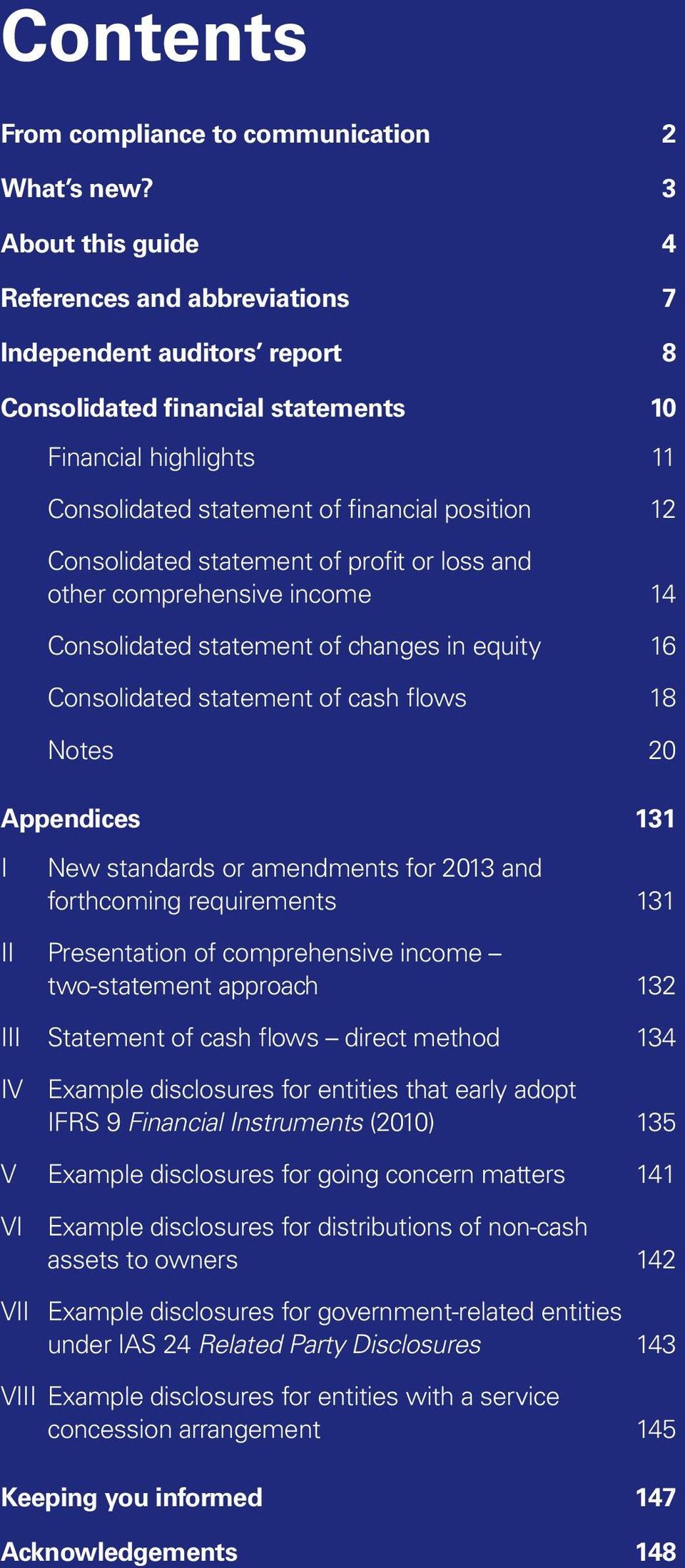
2 Contents From compliance to communication 2 What s new? 3 About this guide 4 References and abbreviations 7 Independent auditors report 8 Consolidated financial statements 10 Financial highlights 11 Consolidated statement of financial position 12 Consolidated statement of profit or loss and other comprehensive income 14 Consolidated statement of changes in equity 16 Consolidated statement of cash flows 18 Notes 20 Appendices 131 I New standards or amendments for 2013 and forthcoming requirements 131 II Presentation of comprehensive income two-statement approach 132 III Statement of cash flows direct method 134 IV Example disclosures for entities that early adopt IFRS 9 Financial Instruments (2010) 135 V Example disclosures for going concern matters 141 VI Example disclosures for distributions of non-cash assets to owners 142 VII Example disclosures for government-related entities under IAS 24 Related Party Disclosures 143 VIII Example disclosures for entities with a service concession arrangement 145 Keeping you informed 147 Acknowledgements 148
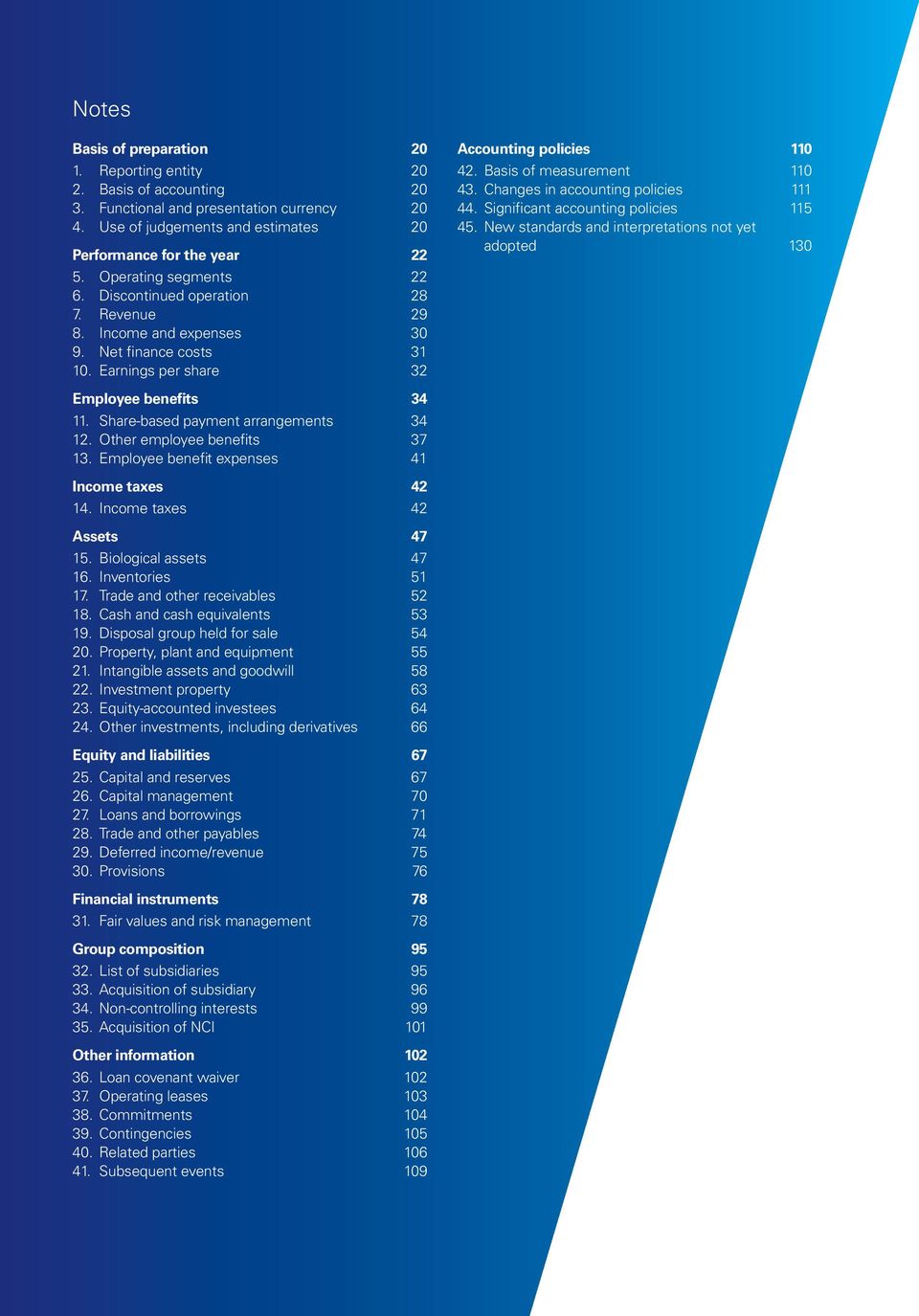
3 Notes Basis of preparation Reporting entity Basis of accounting Functional and presentation currency Use of judgements and estimates 20 Performance for the year Operating segments Discontinued operation Revenue Income and expenses Net finance costs Earnings per share 32 Accounting policies Basis of measurement Changes in accounting policies Significant accounting policies New standards and interpretations not yet adopted 130 Employee benefits Share-based payment arrangements Other employee benefits Employee benefit expenses 41 Income taxes Income taxes 42 Assets Biological assets Inventories Trade and other receivables Cash and cash equivalents Disposal group held for sale Property, plant and equipment Intangible assets and goodwill Investment property Equity-accounted investees Other investments, including derivatives 66 Equity and liabilities Capital and reserves Capital management Loans and borrowings Trade and other payables Deferred income/revenue Provisions 76 Financial instruments Fair values and risk management 78 Group composition List of subsidiaries Acquisition of subsidiary Non-controlling interests Acquisition of NCI 101 Other information Loan covenant waiver Operating leases Commitments Contingencies Related parties Subsequent events 109
4 2 Guide to annual financial statements Illustrative disclosures From compliance to communication: What s your story? 2013 sees a number of new and revised IFRSs come into effect, some of which contain significant new disclosures. This publication, together with the disclosure checklist in our Guide to financial statements suite, illustrates many of the potential disclosure requirements under IFRS. Although understanding the potential disclosure requirements is an important first step towards preparing your financial statements, there is a growing recognition that good financial statements and corporate reports in general have to go beyond mere compliance to better communicate an entity s performance and development. This might entail the use of plain language, the removal of immaterial disclosures and, most significantly, a better integration of financial statement disclosures with other components of the annual report to tell a single coherent story about the entity s business model, strategy, risks and performance. This is no easy task, and cannot be achieved simply by complying with every disclosure listed in IFRS. Every entity has a unique story to tell, and its financial statements should also stand apart if they are to communicate that story effectively. This publication will act as a starting point as you begin your journey, by helping you to understand the presentation requirements of IFRS. But you will still have a lot of thinking to do. After all, only you know your story. Now you need to decide the best way to tell it.

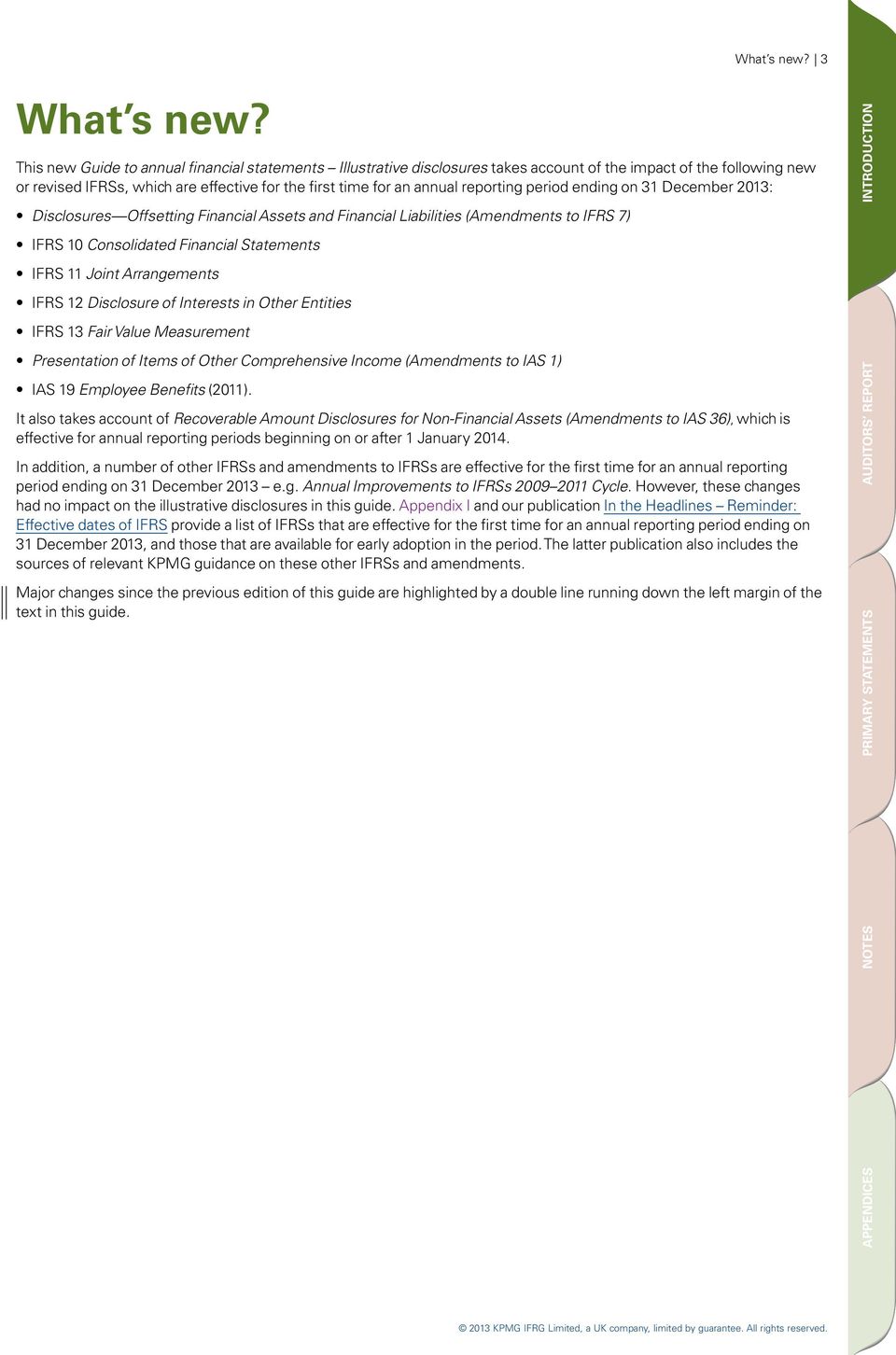
5 What s new? 3 What s new? This new Guide to annual financial statements Illustrative disclosures takes account of the impact of the following new or revised IFRSs, which are effective for the first time for an annual reporting period ending on 31 December 2013: Disclosures Offsetting Financial Assets and Financial Liabilities (Amendments to IFRS 7) IFRS 10 Consolidated Financial Statements IFRS 11 Joint Arrangements IFRS 12 Disclosure of Interests in Other Entities IFRS 13 Fair Value Measurement Presentation of Items of Other Comprehensive Income (Amendments to IAS 1) IAS 19 Employee Benefits (2011). It also takes account of Recoverable Amount Disclosures for Non-Financial Assets (Amendments to IAS 36), which is effective for annual reporting periods beginning on or after 1 January In addition, a number of other IFRSs and amendments to IFRSs are effective for the first time for an annual reporting period ending on 31 December 2013 e.g. Annual Improvements to IFRSs Cycle. However, these changes had no impact on the illustrative disclosures in this guide. Appendix I and our publication In the Headlines Reminder: Effective dates of IFRS provide a list of IFRSs that are effective for the first time for an annual reporting period ending on 31 December 2013, and those that are available for early adoption in the period. The latter publication also includes the sources of relevant KPMG guidance on these other IFRSs and amendments. Major changes since the previous edition of this guide are highlighted by a double line running down the left margin of the text in this guide.
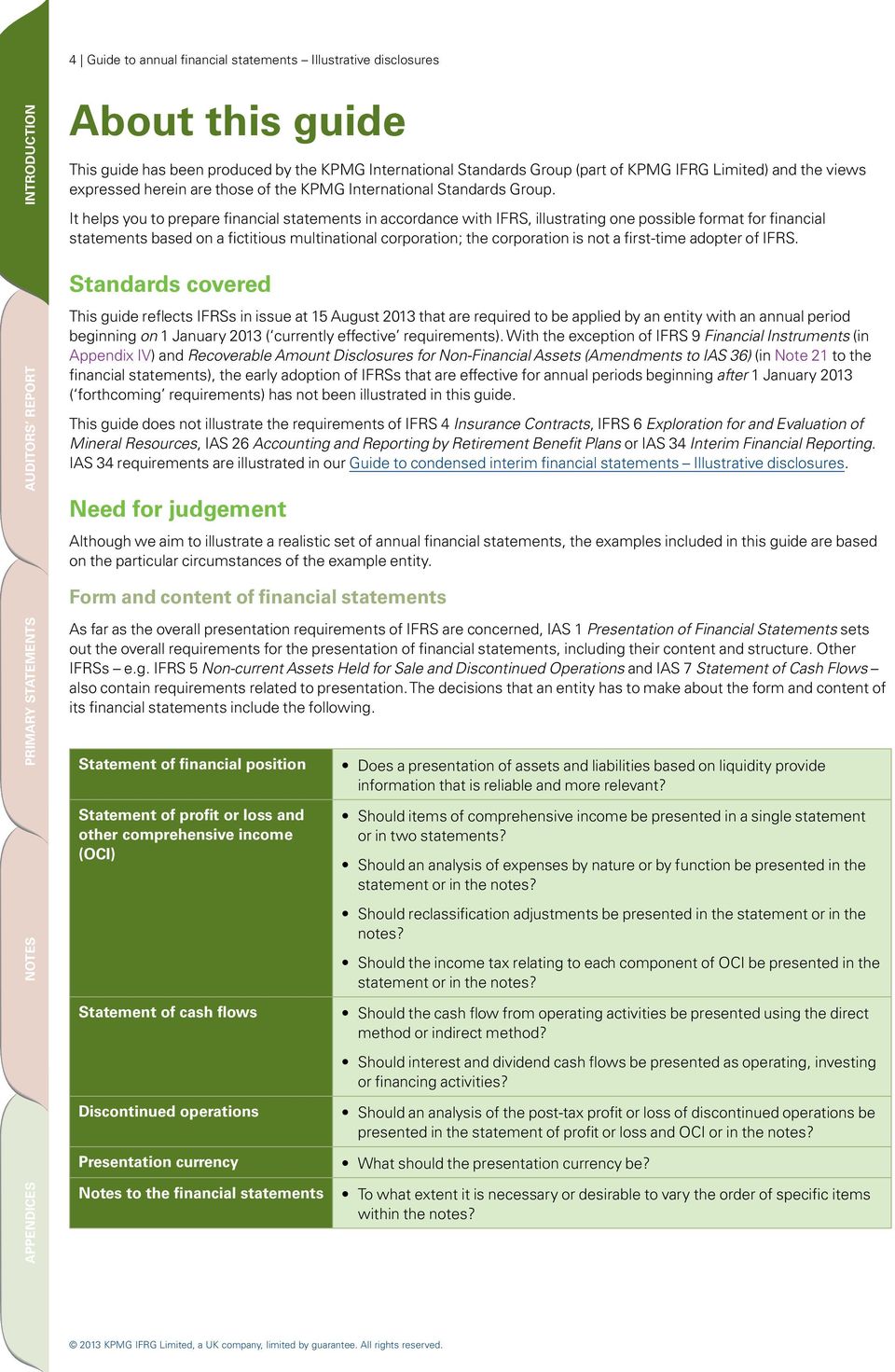
6 4 Guide to annual financial statements Illustrative disclosures About this guide This guide has been produced by the KPMG International Standards Group (part of KPMG IFRG Limited) and the views expressed herein are those of the KPMG International Standards Group. It helps you to prepare financial statements in accordance with IFRS, illustrating one possible format for financial statements based on a fictitious multinational corporation; the corporation is not a first-time adopter of IFRS. Standards covered This guide reflects IFRSs in issue at 15 August 2013 that are required to be applied by an entity with an annual period beginning on 1 January 2013 ( currently effective requirements). With the exception of IFRS 9 Financial Instruments (in Appendix IV) and Recoverable Amount Disclosures for Non-Financial Assets (Amendments to IAS 36) (in Note 21 to the financial statements), the early adoption of IFRSs that are effective for annual periods beginning after 1 January 2013 ( forthcoming requirements) has not been illustrated in this guide. This guide does not illustrate the requirements of IFRS 4 Insurance Contracts, IFRS 6 Exploration for and Evaluation of Mineral Resources, IAS 26 Accounting and Reporting by Retirement Benefit Plans or IAS 34 Interim Financial Reporting. IAS 34 requirements are illustrated in our Guide to condensed interim financial statements Illustrative disclosures. Need for judgement Although we aim to illustrate a realistic set of annual financial statements, the examples included in this guide are based on the particular circumstances of the example entity. Form and content of financial statements As far as the overall presentation requirements of IFRS are concerned, IAS 1 Presentation of Financial Statements sets out the overall requirements for the presentation of financial statements, including their content and structure. Other IFRSs e.g. IFRS 5 Non-current Assets Held for Sale and Discontinued Operations and IAS 7 Statement of Cash Flows also contain requirements related to presentation. The decisions that an entity has to make about the form and content of its financial statements include the following. Statement of financial position Statement of profit or loss and other comprehensive income (OCI) Statement of cash flows Discontinued operations Presentation currency Notes to the financial statements Does a presentation of assets and liabilities based on liquidity provide information that is reliable and more relevant? Should items of comprehensive income be presented in a single statement or in two statements? Should an analysis of expenses by nature or by function be presented in the statement or in the notes? Should reclassification adjustments be presented in the statement or in the notes? Should the income tax relating to each component of OCI be presented in the statement or in the notes? Should the cash flow from operating activities be presented using the direct method or indirect method? Should interest and dividend cash flows be presented as operating, investing or financing activities? Should an analysis of the post-tax profit or loss of discontinued operations be presented in the statement of profit or loss and OCI or in the notes? What should the presentation currency be? To what extent it is necessary or desirable to vary the order of specific items within the notes?
7 About this guide 5 Choice of accounting policies The accounting policies appropriate for an entity depend on the facts and circumstances of that entity, including the accounting policy choices that an entity makes, and may differ from the disclosures presented in this guide. In particular, the accounting policies illustrated should not be relied on for a complete understanding of the requirements of IFRS and should not be used as a substitute for referring to the standards and interpretations themselves. The recognition and measurement requirements of IFRS are discussed in the 10 th edition 2013/14 of our publication Insights into IFRS (find out more at kpmg.com/ifrs). If the financial statements are prepared on the basis of national accounting standards that are modified or adapted from IFRS, then the International Organization of Securities Commissions recommends disclosure of the reporting framework accounting policies and a statement explaining whether the financial statements comply with IFRS and in what regard the standards and the reporting framework used differ from IFRS. In extremely rare circumstances, if management concludes that compliance with a requirement of an IFRS would be so misleading that it would conflict with the objective of financial statements set out in the Conceptual Framework for Financial Reporting, then an entity may depart from the requirement if the relevant regulatory framework requires or otherwise does not prohibit such a departure. Extensive disclosures are required in these circumstances. Illustrative examples This guide is not intended to be seen as a complete illustration of all potential disclosure requirements under IFRS. In addition, the example disclosures presented are intended to explain the relevant disclosure requirements and, therefore, may be more detailed than is necessary. Individual entities should tailor the disclosures to reflect their specific circumstances, including the materiality of the items concerned. In addition, IFRS and its interpretation change over time. Accordingly, this guide should not be used as a substitute for referring to the standards and interpretations themselves. Reporting date A number of terms are used, either in IFRS or in practice, to describe the end of an entity s financial year, including reporting date, end of the reporting period, statement of financial position date, year end and financial year end. Generally, these terms are used interchangeably and have the same meaning. Throughout this guide, we refer to the reporting date. The annual reporting date may change only in exceptional circumstances. If the annual reporting date does change, then the financial statements for that period will cover either more or less than 12 months. In this case, the entity discloses the reason for the change and the fact that the information is not fully comparable. First-time adopters of IFRS This guide assumes that the example entity is not a first-time adopter of IFRS. IFRS 1 First-time Adoption of International Financial Reporting Standards applies to an entity s first financial statements prepared in accordance with IFRS and requires extensive disclosures explaining how the transition from previous GAAP to IFRS affects the reported financial position, financial performance and cash flows of an entity. For more information, see Chapter 6.1 in the 10 th edition 2013/14 of our publication Insights into IFRS and the related guidance in our Guide to financial statements suite. Legal or regulatory requirements When preparing financial statements in accordance with IFRS, an entity should have regard to applicable legal and regulatory requirements. This guide does not consider the requirements of any particular jurisdiction. For example, IFRS does not require the presentation of separate financial statements for the parent entity, and this guide includes only consolidated financial statements. However, in some jurisdictions separate financial statements for the parent entity may also be required. This guide illustrates only the financial statements component of a corporate report and the independent auditors report on the financial statements. However, a corporate report will typically include at least some additional commentary from management, either in accordance with local laws and regulations or at the election of the entity.

8 6 Guide to annual financial statements Illustrative disclosures Generally, local laws and regulations determine the extent of reporting by directors in addition to the presentation of financial statements. IFRS does not contain any requirements for management commentary. However, IAS 1 encourages entities to present, outside the financial statements, a financial review by management. The review describes and explains the main features of the entity s financial performance and financial position, and the principal uncertainties that it faces. Such a report may include a review of: the main factors and influences determining financial performance, including: changes in the environment in which the entity operates; the entity s response to those changes and their effects; and the entity s policy for investment to maintain and enhance financial performance, including its dividend policy; the entity s sources of funding and its targeted ratio of liabilities to equity; and the entity s resources that are not recognised in the statement of financial position in accordance with IFRS. The IASB has also published guidance in the form of an IFRS practice statement Management Commentary that helps entities provide useful management commentary for financial statements prepared in accordance with IFRS.
9 References and abbreviations 7 References and abbreviations References are included in the left-hand margin of this guide to identify their sources. Generally, the references relate only to presentation and disclosure requirements. IAS 1.82(a) Paragraph 82(a) of IAS 1 IAS 36R.126 Paragraph 126 of IAS 36 (2013) [IAS 39.46(a)] Insights Paragraph 46(a) of IAS 39. The square brackets are used only in Note 44 to the financial statements (significant accounting policies) to indicate that the paragraph relates to recognition and measurement requirements, as opposed to presentation and disclosure requirements. Paragraph of the 10 th edition 2013/14 of our publication Insights into IFRS. Disclosures that are applicable only to entities in the scope of IFRS 8 Operating Segments and IAS 33 Earnings per Share. Major changes since the previous edition of this guide. The following abbreviations are used often in this guide. CGU EBITDA NCI Notes OCI Cash-generating unit Earnings before interest, tax, depreciation and amortisation Non-controlling interests Notes to the financial statements Other comprehensive income

10 8 Guide to annual financial statements Illustrative disclosures [Name of the Company] Independent auditors report

11 Independent auditors report 9 Independent auditors report a [Addressee] We have audited the accompanying consolidated financial statements of [name of company] (the Company ), which comprise the consolidated statement of financial position as at 31 December 2013, the consolidated statements of profit or loss and other comprehensive income, changes in equity and cash flows for the year then ended, and notes, comprising a summary of significant accounting policies and other explanatory information. Management s responsibility for the consolidated financial statements Management is responsible for the preparation and fair presentation of these consolidated financial statements in accordance with International Financial Reporting Standards, and for such internal control as management determines is necessary to enable the preparation of consolidated financial statements that are free from material misstatement, whether due to fraud or error. Auditors responsibility Our responsibility is to express an opinion on these consolidated financial statements based on our audit. We conducted our audit in accordance with International Standards on Auditing. Those standards require that we comply with ethical requirements and plan and perform the audit to obtain reasonable assurance about whether the consolidated financial statements are free from material misstatement. An audit involves performing procedures to obtain audit evidence about the amounts and disclosures in the consolidated financial statements. The procedures selected depend on our judgement, including the assessment of the risks of material misstatement of the consolidated financial statements, whether due to fraud or error. In making those risk assessments, we consider internal control relevant to the entity s preparation and fair presentation of the consolidated financial statements in order to design audit procedures that are appropriate in the circumstances, but not for the purpose of expressing an opinion on the effectiveness of the entity s internal control. An audit also includes evaluating the appropriateness of accounting policies used and the reasonableness of accounting estimates made by management, as well as evaluating the overall presentation of the consolidated financial statements. We believe that the audit evidence we have obtained is sufficient and appropriate to provide a basis for our audit opinion. Opinion In our opinion, the consolidated financial statements give a true and fair view of the consolidated financial position of the Company as at 31 December 2013, and of its consolidated financial performance and its consolidated cash flows for the year then ended in accordance with International Financial Reporting Standards. KPMG [Date of report] [Address] a. This example report has been prepared based on International Standard on Auditing 700 Forming an Opinion and Reporting on Financial Statements. Its format does not reflect the legal requirements of any particular jurisdiction.

12 10 Guide to annual financial statements Illustrative disclosures [Name of the Company] Consolidated financial statements 31 December 2013
![disclosures [Name of the Company]](/docs-images/44/14130424/images/page_12.jpg "Consolidated financial statements")
13 Illustrative disclosures Primary Financial statements highlights 11 REVENUE OPERATING PROFIT BASIC EARNINGS PER SHARE Financial highlights DIVIDENDS PER SHARE (thousand euro) (thousand euro) (euro) (cent) 6.3% 7.4% ,716 96,636 10,334 9, REVENUE BY REGION* REVENUE BY SEGMENT* US 20% Other countries 9% [Country X] 29% Forestry 4% Packaging (Discontinued) 7% Other segments 4% Germany 21% Netherlands 21% Recycled Papers 27% Standard Papers 58% * Include revenues of of discontinued operation (see (see Note Note 6 to the 6 to financial the financial statements). statements).
![25 2013 2012 2013 REVENUE BY REGION* 2012 2013 2012 2013 REVENUE BY SEGMENT* 2013 2013 2012 US 20% Other countries 9% [Country X] 29% Forestry 4% Packaging](/docs-images/44/14130424/images/page_13.jpg "(Discontinued) 7% Other segments 4% Germany 21% Netherlands 21% Recycled Papers 27% Standard Papers 58% * Include revenues of of discontinued operation (see (see")
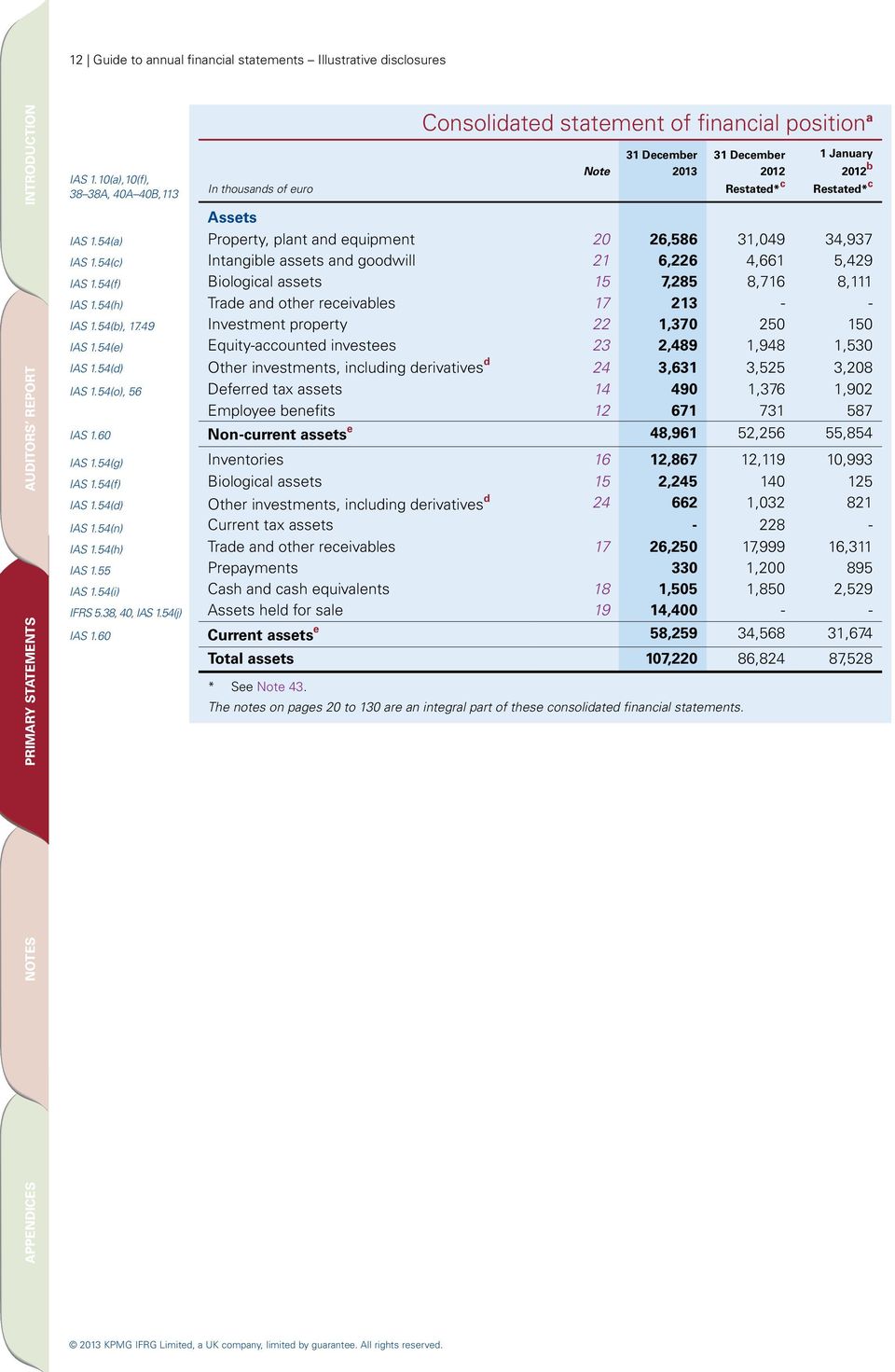
14 12 Guide to annual financial statements Illustrative disclosures IAS 1.10(a),10(f), 38 38A, 40A 40B,113 Consolidated statement of financial position a Note 31 December December January 2012 b In thousands of euro Restated* c Restated* c Assets IAS 1.54(a) Property, plant and equipment 20 26,586 31,049 34,937 IAS 1.54(c) Intangible assets and goodwill 21 6,226 4,661 5,429 IAS 1.54(f) Biological assets 15 7,285 8,716 8,111 IAS 1.54(h) Trade and other receivables IAS 1.54(b), Investment property 22 1, IAS 1.54(e) Equity-accounted investees 23 2,489 1,948 1,530 IAS 1.54(d) Other investments, including derivatives d 24 3,631 3,525 3,208 IAS 1.54(o), 56 Deferred tax assets ,376 1,902 Employee benefits IAS 1.60 Non-current assets e 48,961 52,256 55,854 IAS 1.54(g) Inventories 16 12,867 12,119 10,993 IAS 1.54(f) Biological assets 15 2, IAS 1.54(d) Other investments, including derivatives d , IAS 1.54(n) Current tax assets IAS 1.54(h) Trade and other receivables 17 26,250 17,999 16,311 IAS 1.55 Prepayments 330 1, IAS 1.54(i) Cash and cash equivalents 18 1,505 1,850 2,529 IFRS 5.38, 40, IAS 1.54(j) Assets held for sale 19 14, IAS 1.60 Current assets e 58,259 34,568 31,674 Total assets 107,220 86,824 87,528 * See Note 43. The notes on pages 20 to 130 are an integral part of these consolidated financial statements.
15 Illustrative disclosures Primary statements 13 IAS 1.10(a),10(f), 38 38A, 40A 40B, 113 Consolidated statement of financial position (continued) Note 31 December December January 2012 b In thousands of euro Restated* c Restated* c Equity IAS 1.54(r), 78(e) Share capital 14,979 14,550 14,550 IAS 1.55, 78(e) Share premium 4,777 3,500 3,500 IAS 1.54(r), 78(e) Reserves 1, IAS 1.55, 78(e) Retained earnings 20,886 13,886 8,481 Equity attributable to owners of the Company 41,852 32,385 26,853 IAS 1.54(q) Non-controlling interests 34 3,849 3,109 2,720 Total equity 45,701 35,494 29,573 Liabilities IAS 1.54(m) Loans and borrowings 27 20,942 19,206 21,478 IAS 1.55, 78(d) Employee benefits 11, ,204 IAS 1.54(k) Trade and other payables IAS 1.55, Deferred income/revenue 29 1,415 1,462 - IAS 1.54(l) Provisions 30 1, IAS 1.54(o), 56 Deferred tax liabilities 14 2,954 1,567 1,422 IAS 1.60 Non-current liabilities e 27,543 23,481 25,800 IAS 1.55 Bank overdraft IAS 1.54(n) Current tax liabilities IAS 1.54(m) Loans and borrowings 27 4,390 4,386 2,017 IAS 1.54(k) Trade and other payables 28 23,296 21,813 28,254 IAS 1.55, 11.42(b), Deferred income/revenue IAS 1.54(l) Provisions ,200 1,400 IFRS 5.38, 40, IAS 1.54(p) Liabilities held for sale 19 4, IAS 1.60 Current liabilities e 33,976 27,849 32,155 Total liabilities 61,519 51,330 57,955 Total equity and liabilities 107,220 86,824 87,528 * See Note 43. The notes on pages 20 to 130 are an integral part of these consolidated financial statements. IAS 1.10 a. An entity may also use other titles e.g. balance sheet as long as the meaning is clear and the title not misleading. IAS 1.10(f), 40A b. The Group has presented a third statement of financial position as at the beginning of the preceding period, because the retrospective changes in accounting policies have a material effect on the information in the statement. IAS 8.26, Insights c. The Group has labelled the restated comparative information with the heading restated. In our view, this is necessary to highlight the fact that the comparative information is not the same as the information previously presented in the prior year s financial statements. Insights d. In our view, derivative assets and liabilities should be presented as separate line items in the statement of financial position if they are significant. IAS e. The Group has made a current/non-current distinction in the statement of financial position. An entity may present its assets and liabilities broadly in order of liquidity if such a presentation provides information that is reliable and more relevant. Our publication Guide to annual financial statements Illustrative disclosures for banks provides an example presentation of assets and liabilities in order of liquidity.

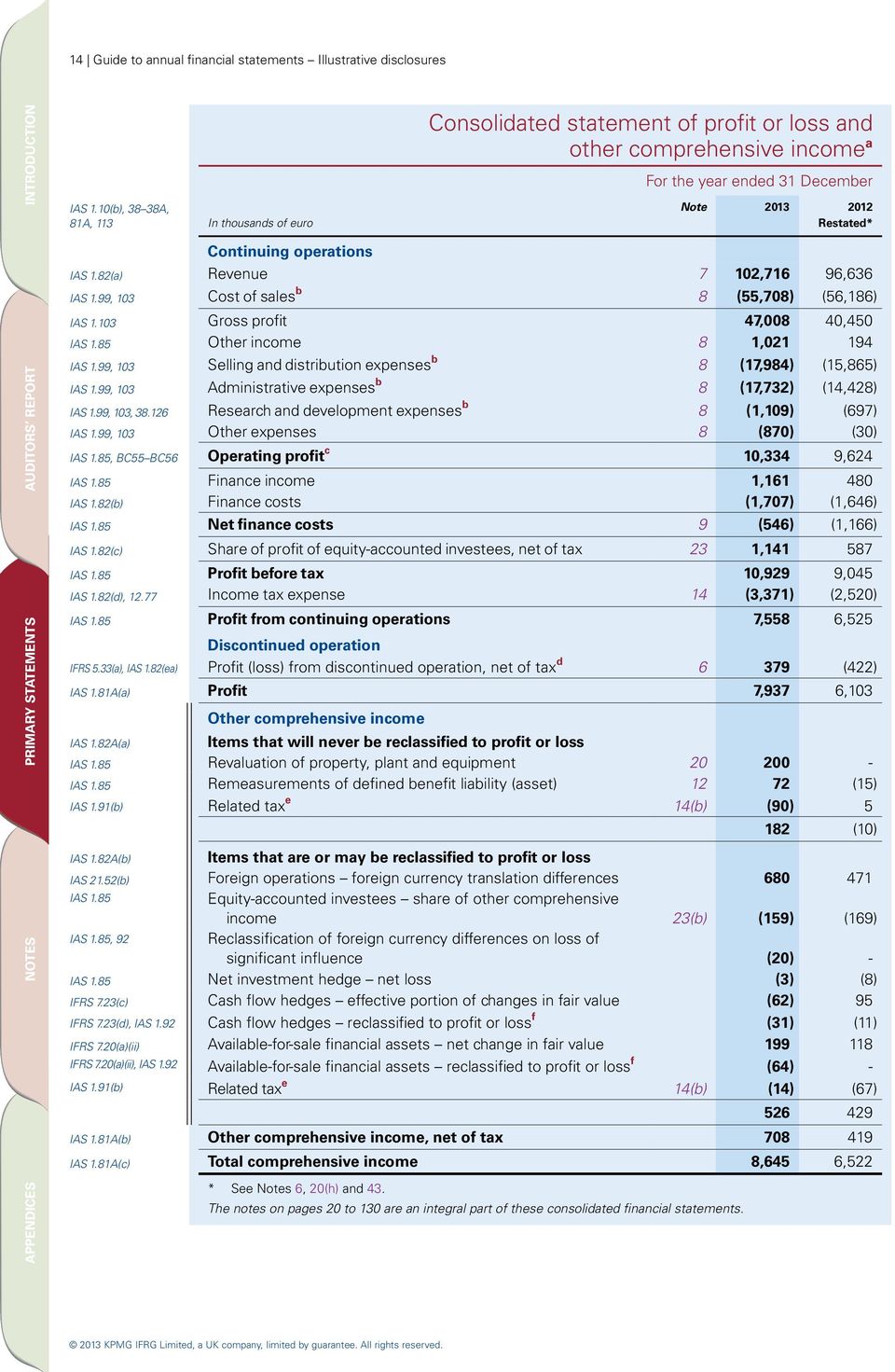
16 14 Guide to annual financial statements Illustrative disclosures IAS 1.10(b), 38 38A, 81A, 113 In thousands of euro Consolidated statement of profit or loss and other comprehensive income a For the year ended 31 December Note Restated* Continuing operations IAS 1.82(a) Revenue 7 102,716 96,636 IAS 1.99, 103 Cost of sales b 8 (55,708) (56,186) IAS Gross profit 47,008 40,450 IAS 1.85 Other income 8 1, IAS 1.99, 103 Selling and distribution expenses b 8 (17,984) (15,865) IAS 1.99, 103 Administrative expenses b 8 (17,732) (14,428) IAS 1.99, 103, Research and development expenses b 8 (1,109) (697) IAS 1.99, 103 Other expenses 8 (870) (30) IAS 1.85, BC55 BC56 Operating profit c 10,334 9,624 IAS 1.85 Finance income 1, IAS 1.82(b) Finance costs (1,707) (1,646) IAS 1.85 Net finance costs 9 (546) (1,166) IAS 1.82(c) Share of profit of equity-accounted investees, net of tax 23 1, IAS 1.85 Profit before tax 10,929 9,045 IAS 1.82(d), Income tax expense 14 (3,371) (2,520) IAS 1.85 Profit from continuing operations 7,558 6,525 Discontinued operation IFRS 5.33(a), IAS 1.82(ea) Profit (loss) from discontinued operation, net of tax d (422) IAS 1.81A(a) Profit 7,937 6,103 Other comprehensive income IAS 1.82A(a) Items that will never be reclassified to profit or loss IAS 1.85 Revaluation of property, plant and equipment IAS 1.85 Remeasurements of defined benefit liability (asset) (15) IAS 1.91(b) Related tax e 14(b) (90) (10) IAS 1.82A(b) Items that are or may be reclassified to profit or loss IAS 21.52(b) Foreign operations foreign currency translation differences IAS 1.85 Equity-accounted investees share of other comprehensive income 23(b) (159) (169) IAS 1.85, 92 Reclassification of foreign currency differences on loss of significant influence (20) - IAS 1.85 Net investment hedge net loss (3) (8) IFRS 7.23(c) Cash flow hedges effective portion of changes in fair value (62) 95 IFRS 7.23(d), IAS 1.92 Cash flow hedges reclassified to profit or loss f (31) (11) IFRS 7.20(a)(ii) Available-for-sale financial assets net change in fair value IFRS 7.20(a)(ii), IAS 1.92 Available-for-sale financial assets reclassified to profit or loss f (64) - IAS 1.91(b) Related tax e 14(b) (14) (67) IAS 1.81A(b) Other comprehensive income, net of tax IAS 1.81A(c) Total comprehensive income 8,645 6,522 * See Notes 6, 20(h) and 43. The notes on pages 20 to 130 are an integral part of these consolidated financial statements.
17 Illustrative disclosures Primary statements 15 IAS 1.10(b), 38 38A, 81A, 113 In thousands of euro Consolidated statement of profit or loss and other comprehensive income (continued) For the year ended 31 December Note Restated* Profit attributable to: IAS 1.81B(a)(ii) Owners of the Company 7,413 5,736 IAS 1.81B(a)(i) Non-controlling interests ,937 6,103 Total comprehensive income attributable to: IAS 1.81B(b)(ii) Owners of the Company 8,094 6,133 IAS 1.81B(b)(i) Non-controlling interests ,645 6,522 IAS 33.4 Earnings per share IAS Basic earnings per share (euro) IAS Diluted earnings per share (euro) Earnings per share continuing operations IAS Basic earnings per share (euro) IAS Diluted earnings per share (euro) * See Notes 6, 20(h) and 43. The notes on pages 20 to 130 are an integral part of these consolidated financial statements. IAS 1.10A a. The Group has elected to present comprehensive using a one-statement approach. For an illustration of the alternative two-statement approach, see Appendix II. IAS b. The Group has elected to analyse expenses recognised in profit or loss based on functions within the Group. Alternatively, an entity may present the analysis based on nature if this presentation provides information that is reliable and more relevant. The analysis may also be presented in the notes. IAS 1.85, BC55 BC56 IFRS 5.33(a) (b), IAS 1.82(ea) c. The Group has elected to present a sub-total of operating profit, even though this term is not defined in IFRS in the context of comprehensive income, and such disclosure is not required. An entity should ensure that the amount disclosed is representative of activities that would normally be regarded as operating, and it would be inappropriate to exclude items clearly related to operations. d. The Group has elected to disclose a single amount of post-tax profit or loss of discontinued operations in the statement of profit or loss and OCI, and has analysed that single amount into revenue, expenses and the pre-tax profit or loss in Note 6. Alternatively, an entity may present the analysis in the statement. IAS e. The Group has elected to present individual components of OCI before related tax with an aggregate amount presented for tax in the statement of profit or loss and OCI, and has provided disclosures related to tax on each component of OCI in Note 14(b). Alternatively, an entity may present individual components of OCI net of related tax in the statement. IAS 1.94 f. The Group has elected to present reclassification adjustments in the statement of profit or loss and OCI. Alternatively, an entity may present these adjustments in the notes.

18 IAS 1.10(c), 108, 113 In thousands of euro Note Share capital Share premium Translation reserve Hedging reserve Consolidated statement of changes in equity Attributable to owners of the Company Fair value reserve Revaluation reserve Treasury share reserve Convertible notes For the year ended 31 December 2013 Retained earnings Total Noncontrolling interests Restated balance at 31 December ,550 3, (280) - 13,886 32,385 3,109 35,494 Total comprehensive income IAS 1.106(d)(i) Profit ,413 7, ,937 IAS 1.106(d)(ii), 106A Other comprehensive income 14(b), 25(d) (62) IAS 1.106(a) Total comprehensive income (62) ,461 8, ,645 IAS 1.106(d)(iii) Transactions with owners of the Company Contributions and distributions Issue of ordinary shares 25(a) 414 1, ,757-1,757 Issue of convertible notes 14(c), 27(c) Treasury shares sold a 25(b) Dividends 25(c) (1,243) (1,243) - (1,243) Equity-settled share-based payment b Share options exercised 25(a) Total contributions and distributions 429 1, (368) 1,458-1,458 Total equity 16 Guide to annual financial statements Illustrative disclosures IAS 1.106(d)(iii) Changes in ownership interests Acquisition of non-controlling interests without a change in control (93) (85) (115) (200) Acquisition of subsidiary with noncontrolling interests Total changes in ownership interests (93) (85) Total transactions with owners of the Company 429 1, (461) 1, ,562 Balance at 31 December ,979 4, (269) ,886 41,852 3,849 45,701 The notes on pages 20 to 130 are an integral part of these consolidated financial statements.

19 Consolidated statement of changes in equity (continued) Attributable to owners of the Company For the year ended 31 December 2012 IAS 1.10(c), 38 38A, 108, 113 In thousands of euro Note Share capital Share premium Translation reserve Hedging reserve Fair value reserve Revaluation reserve Treasury share reserve Convertible notes Retained earnings Total Noncontrolling interests Total equity IAS 1.106(b) Balance at 1 January 2012, as previously reported 14,550 3,500 (129) ,481 26, ,454 Impact of changes in accounting policies ,119 2,119 Restated balance at 1 January ,550 3,500 (129) ,481 26,853 2,720 29,573 Total comprehensive income (restated) IAS 1.106(d)(i) Profit ,736 5, ,103 IAS 1.106(d)(ii), 106A Other comprehensive income 14(b), 25(d) (10) IAS 1.106(a) Total comprehensive income (restated) ,726 6, ,522 IAS 1.106(d)(iii) Transactions with owners of the Company Contributions and distributions Treasury shares acquired a 25(b) (280) - - (280) - (280) Dividends 25(c) (571) (571) - (571) IAS 32.33, Insights Equity-settled share-based payment b Total transactions with owners of the Company (280) - (321) (601) - (601) Restated balance at 31 December ,550 3, (280) - 13,886 32,385 3,109 35,494 The notes on pages 20 to 130 are an integral part of these consolidated financial statements. a. IFRS does not mandate a specific method of presenting treasury shares within equity. Local laws may prescribe the presentation, and an entity may or may not be allowed to recognise a portion of the treasury share transaction against share premium. An entity should take into account its legal environment when determining how to present treasury shares within equity. Whichever method is selected, it should be applied consistently. Insights b. Generally, IFRS 2 Share-based Payment does not address whether an increase in equity recognised in connection with a share-based payment transaction should be presented in a separate component within equity or within retained earnings. In our view, either approach is allowed. The Group has elected to present such increase in retained earnings. Illustrative disclosures Primary statements 17

20 18 Guide to annual financial statements Illustrative disclosures IAS 1.10(d), 38 38A, 113 In thousands of euro Consolidated statement of cash flows For the year ended 31 December Note Restated* IAS 7.18(b) Cash flows from operating activities a Profit b 7,937 6,103 Adjustments for: Depreciation 20(a) 5,001 5,122 Amortisation 21(a) (Reversal of) impairment losses on property, plant and equipment 20(b) (393) 1,123 Impairment losses on intangible assets and goodwill 21(c) Impairment loss on remeasurement of disposal group 19(a) 35 - Change in fair value of biological assets 15(a) (576) (13) Net increase in biological assets due to births 15(a) (11) (15) Increase in fair value of investment property 22(a) (20) (60) Impairment loss on trade receivables 8(b), 31(c) Net finance costs ,166 Share of profit of equity-accounted investees, net of tax 23 (1,141) (587) Gain on sale of property, plant and equipment 8(a) (26) (16) Gain on sale of discontinued operation, net of tax 6 (516) - Equity-settled share-based payment transactions Tax expense 14 3,346 2,513 15,888 16,696 Changes in: Inventories (2,570) (881) Trade and other receivables (15,217) (1,718) Prepayments 870 (305) Trade and other payables 7,185 (6,485) Provisions and employee benefits (34) (1,620) Deferred income/revenue 29 (28) 1,474 Cash generated from operating activities 6,094 7,161 IAS Interest paid c, d (1,314) (1,521) IAS 7.35 Taxes paid (400) (1,911) IAS 7.10 Net cash from operating activities 4,380 3,729 * See Note 43. The notes on pages 20 to 130 are an integral part of these consolidated financial statements.

21 Illustrative disclosures Primary statements 19 IAS 1.10(d), 38 38A, 113 In thousands of euro Consolidated statement of cash flows (continued) For the year ended 31 December Note Restated* Cash flows from investing activities IAS 7.31 Interest received c IAS 7.31 Dividends received c IAS 7.16(b) Proceeds from sale of property, plant and equipment 1, IAS 7.21 Proceeds from sale of investments 1, IAS 7.39 Disposal of discontinued operation, net of cash disposed of e 6 10,890 - IAS 7.39 Acquisition of subsidiary, net of cash acquired 33 (1,799) - IAS 7.16(a) Acquisition of property, plant and equipment 20 (15,657) (2,228) IAS 7.16(a) Acquisition of investment property 22 (300) (40) IAS 7.21 Purchase of non-current biological assets 15(a) (305) (835) IAS 7.16(a) Acquisition of other investments (319) (1,010) IAS Dividends from equity-accounted investees 23(a) 21 - IAS 7.21 Development expenditure (1,235) (503) IAS 7.10 Net cash used in investing activities (6,060) (3,183) Cash flows from financing activities IAS 7.17(a) Proceeds from issue of share capital 25(a) 1,550 - IAS 7.17(c) Proceeds from issue of convertible notes 27(c) 5,000 - IAS 7.17(c) Proceeds from issue of redeemable preference shares 27(d) 2,000 - IAS 7.17(c) Proceeds from new borrowings - 2,500 IAS 7.21 Proceeds from sale of treasury shares 30 - IAS 7.21 Proceeds from exercise of share options 25(a) 50 - IAS 7.16(h) Proceeds from settlement of derivatives 5 11 IAS 7.21 Transaction costs related to loans and borrowings 27(c), (d) (311) - IAS 7.42A Acquisition of non-controlling interests 35 (200) - IAS 7.17(b) Repurchase of treasury shares - (280) IAS 7.17(d) Repayment of borrowings (4,987) (2,445) IAS 7.17(e) Payment of finance lease liabilities (599) (394) IAS 7.31 Dividends paid c 25(c) (1,243) (571) IAS 7.10 Net cash from (used in) financing activities 1,295 (1,179) Net decrease in cash and cash equivalents (385) (633) Cash and cash equivalents at 1 January 1,568 2,226 IAS 7.28 Effect of movements in exchange rates on cash held (12) (25) Cash and cash equivalents at 31 December 18 1,171 1,568 * See Note 43. The notes on pages 20 to 130 are an integral part of these consolidated financial statements. IAS a. The Group has elected to present cash flows from operating activities using the indirect method. Alternatively, an entity may present operating cash flows using the direct method, disclosing major classes of gross cash receipts and payments related to operating activities (see Appendix III). IAS 7.18, 20, A, Insights IAS 7.31, Insights b. The Group has used profit or loss as the starting point for presenting operating cash flows using the indirect method. This is the starting point referred to in IAS 7 Statement of Cash Flows, although the example provided in the appendix to the standard starts with a different figure profit before tax. Because the appendix does not have the same status as the standard, it would be more appropriate to follow the standard. c. In the absence of specific guidance in IFRS, an entity should choose an accounting policy, to be applied consistently, for classifying interest and dividends paid as either operating or financing activities, and interest and dividends received as either operating or investing activities. Insights d. In our view, to the extent that borrowing costs are capitalised in respect of qualifying assets, the cost of acquiring those assets, which would include borrowing costs, should be split in the statement of cash flows. IFRS 5.33(c), Insights e. The Group has elected to present a statement of cash flows that analyses all cash flows in total i.e. including both continuing and discontinued operations; amounts related to discontinued operations are disclosed in Note 6(b). However, in our view cash flows from discontinued operations may be presented in other ways.
22 Accounting policies Other information Group composition Financial instruments Equity & liabilities Assets 20 Guide to annual financial statements Illustrative disclosures IAS 1.10(e) BASIS OF PREPARATION IAS 1.51(a) (b), 138(a) (b) IAS 1.16, 112(a), IAS 1.51(d) (e) IAS IAS 1.125, Reporting entity Notes to the consolidated financial statements a [Name of Company] (the Company ) is domiciled in [Country X]. The Company s registered office is at [address]. These consolidated financial statements comprise the Company and its subsidiaries (collectively the Group and individually Group companies ). The Group is primarily involved in manufacturing paper and paper-related products, cultivating trees and selling wood (see Note 5). 2. Basis of accounting These consolidated financial statements have been prepared in accordance with IFRS. They were authorised for issue by the Company s board of directors on [date]. Details of the Group s accounting policies, including changes during the year, are included in Notes 43 and Functional and presentation currency These consolidated financial statements are presented in euro, which is the Company s functional currency. All amounts have been rounded to the nearest thousand, unless otherwise indicated. 4. Use of judgements and estimates In preparing these consolidated financial statements, management has made judgements, estimates and assumptions that affect the application of the Group s accounting policies and the reported amounts of assets, liabilities, income and expenses. Actual results may differ from these estimates. Estimates and underlying assumptions are reviewed on an ongoing basis. Revisions to estimates are recognised prospectively. (a) Judgements Information about judgements made in applying accounting policies that have the most significant effects on the amounts recognised in the consolidated financial statements is included in the following notes: Note 7 commission revenue: whether the Group acts as an agent in the transaction rather than as a principal; Note 23(a) classification of joint arrangement; Note 27(e) leases: whether an arrangement contains a lease; Note 32(a) consolidation: whether the Group has de facto control over an investee; and Note 37(a) lease classification. (b) Assumptions and estimation uncertainties Information about assumptions and estimation uncertainties that have a significant risk of resulting in a material adjustment in the year ending 31 December 2014 is included in the following notes: Note 12 measurement of defined benefit obligations: key actuarial assumptions; Note 14(g) recognition of deferred tax assets: availability of future taxable profit against which carryforward tax losses can be used; Note 21(c) impairment test: key assumptions underlying recoverable amounts, including the recoverability of development costs; Notes 30 and 39 recognition and measurement of provisions and contingencies: key assumptions about the likelihood and magnitude of an outflow of resources; and Note 33(c) acquisition of subsidiary: fair value measured on a provisional basis. IAS a. Notes are presented in a systematic order and are cross-referred to from items in the primary statements. IAS 1 Presentation of Financial Statements provides an order of notes that entities normally present. However, the standard also indicates that it may be necessary or desirable to vary the order, and that the notes providing information about the basis of preparation and specific accounting policies may be presented as a separate section of the financial statements. The Group has applied its judgement in presenting related information together in cohesive sections. It has also presented the notes sorted from most to least important, as viewed by management. The order presented is only illustrative and entities need to tailor the organisation of the notes to fit their specific circumstances.
23 Illustrative disclosures Notes 21 Basis of preparation 4. Use of judgements and estimates (continued) (b) Assumptions and estimation uncertainties (continued) Measurement of fair values A number of the Group s accounting policies and disclosures require the measurement of fair values, for both financial and non-financial assets and liabilities. Basis of preparation Performance IFRS 13.93(g) The Group has an established control framework with respect to the measurement of fair values. This includes a valuation team that has overall responsibility for overseeing all significant fair value measurements, including Level 3 fair values, and reports directly to the CFO. The valuation team regularly reviews significant unobservable inputs and valuation adjustments. If third party information, such as broker quotes or pricing services, is used to measure fair values, then the valuation team assesses the evidence obtained from the third parties to support the conclusion that such valuations meet the requirements of IFRS, including the level in the fair value hierarchy in which such valuations should be classified. Significant valuation issues are reported to the Group Audit Committee. When measuring the fair value of an asset or a liability, the Group uses market observable data as far as possible. Fair values are categorised into different levels in a fair value hierarchy based on the inputs used in the valuation techniques as follows. Employee benefits Income taxes Level 1: quoted prices (unadjusted) in active markets for identical assets or liabilities. IFRS Level 2: inputs other than quoted prices included in Level 1 that are observable for the asset or liability, either directly (i.e. as prices) or indirectly (i.e. derived from prices). Level 3: inputs for the asset or liability that are not based on observable market data (unobservable inputs). If the inputs used to measure the fair value of an asset or a liability might be categorised in different levels of the fair value hierarchy, then the fair value measurement is categorised in its entirety in the same level of the fair value hierarchy as the lowest level input that is significant to the entire measurement. The Group recognises transfers between levels of the fair value hierarchy at the end of the reporting period during which the change has occurred. Further information about the assumptions made in measuring fair values is included in the following notes: Note 11(b) share-based payment arrangements a ; Note 15(b) biological assets; Note 19(d) disposal group held for sale; Note 22(b) investment property; and Note 31(b) financial instruments. Group composition Financial instruments Equity & liabilities Assets IFRS 13.6(a) a. The Group has included in the list above the reference to the disclosures about measurement of fair values for share-based payment arrangements. However, the measurement and disclosure requirements of IFRS 13 Fair Value Measurement do not apply to these arrangements. Other information Accounting policies
24 Performance Basis of preparation 22 Guide to annual financial statements Illustrative disclosures PERFORMANCE FOR THE YEAR IFRS Operating segments a (a) Basis for segmentation The Group has the following six strategic divisions, which are its reportable segments. These divisions offer different products and services, and are managed separately because they require different technology and marketing strategies. The following summary describes the operations of each reportable segment. Income taxes Employee benefits IAS 41.46(a) Reportable segments Standard Papers Recycled Papers Packaging (sold in May 2013; see Note 6) Forestry Timber Products Operations Buying, manufacturing and distributing pulp and paper Buying, recycling and distributing pulp and paper Designing and manufacturing packaging materials Cultivating and managing forest resources and related services Manufacturing and distributing softwood lumber, plywood, veneer, composite panels, engineered lumber, raw materials and building materials Research and Development Conducting research and development activities Equity & liabilities Assets IFRS 8.16, IAS 41.46(a) IFRS 8.27(a) The Group s CEO reviews internal management reports of each division at least quarterly. Other operations include the cultivation and sale of farm animals (sheep and cattle), the construction of storage units and warehouses, the rental of investment property and the manufacture of furniture and related parts. None of these segments meets the quantitative thresholds for reportable segments in 2013 or There are varying levels of integration between the Forestry and Timber Products segments, and the Standard Papers and Recycled Papers segments. This integration includes transfers of raw materials and shared distribution services, respectively. Inter-segment pricing is determined on an arm s length basis. Accounting policies Other information Group composition Financial instruments IFRS 8.IN13, a. Operating segment disclosures are consistent with the information reviewed by the chief operating decision maker (CODM) and will vary from one entity to another and may not be in accordance with IFRS. To help understand the segment information presented, an entity discloses information about the measurement basis adopted, such as the nature and effects of any differences between the measurements used in reporting segment information and those used in the entity s financial statements, the nature and effect of any asymmetrical allocations to reportable segments and reconciliations of segment information to the corresponding IFRS amounts in the financial statements. The Group s internal measures are consistent with IFRS. Therefore, the reconciling items are limited to items that are not allocated to reportable segments, as opposed to a difference in the basis of preparation of the information.
25 IFRS 8.27 IFRS Operating segments (continued) (b) Information about reportable segments Information related to each reportable segment is set out below. Segment profit before tax, as included in internal management reports reviewed by the Group s CEO, is used to measure performance because management believes that such information is the most relevant in evaluating the results of the respective segments relative to other entities that operate in the same industries. Reportable segments In thousands of euro Standard Papers Restated* Recycled Papers Restated* Packaging (Discontinued)** Restated* Forestry Restated* Timber Products Restated* Research and Development Restated* Total Restated* All other segments Restated* IFRS 8.23(a), 32 External revenues a 64,118 67,092 30,367 22,060 7,543 23,193 3,967 3,646 2,700 2, , ,976 1, IFRS 8.23(b) Inter-segment revenue a ,835 2,681 2,676 1,845 1, ,658 8, Segment revenue 64,118 67,092 30,684 22,383 8,483 26,028 6,648 6,322 4,545 4, , ,727 2,455 1,618 IFRS 8.21(b), 23 Segment profit (loss) before tax 6,627 4,106 5,595 3,811 (162) (466) 1, (263) 1, ,110 9, IFRS 8.23(c) Interest income a IFRS 8.23(d) Interest expense a (589) (577) (397) (355) - - (349) (301) (76) (63) - - (1,411) (1,296) (5) (4) IFRS 8.23(e) Depreciation and amortisation a (1,999) (2,180) (1,487) (1,276) (623) (1,250) (1,069) (696) (233) (201) (189) (165) (5,600) (5,768) (231) (199) IFRS 8.23(g) Share of profit (loss) of equityaccounted investees a 1, , IFRS 8.23(i) Other material non-cash items: a IAS (a) Impairment losses on nonfinancial assets - (1,408) (116) (116) (1,408) - - IAS (b) Reversal of impairment losses on non-financial assets IFRS 8.21(b) Segment assets a 41,054 25,267 23,025 16,003-13,250 24,929 18,222 4,521 3,664 2,323 1,946 95,852 78,352 7,398 3,683 IFRS 8.24(a) Equity-accounted investees 2,209 1, ,489 1, IFRS 8.24(b) Capital expenditure 9,697 1,136 6, , , ,968 2, IFRS 8.21(b) Segment liabilities a 39,399 26,907 12,180 14,316-2,959 6,390 4,540 1,236 1, ,374 50, IFRS 8.29 * As a result of the acquisition of Papyrus Corporation (Papyrus) during 2013 (see Note 33), the Group has changed its internal organisation and the composition of its reportable segments. Accordingly, the Group has restated the operating segment information for the year ended 31 December ** See Note 6. IFRS 8.23 a. The Group has disclosed these amounts for each reportable segment because these are regularly provided to the CODM. Illustrative disclosures Notes 23 Performance for the year Accounting policies Other information Group composition Financial instruments Equity & liabilities Assets Income taxes Employee benefits Performance Basis of preparation
26 Performance Basis of preparation 24 Guide to annual financial statements Illustrative disclosures 5. Operating segments (continued) (b) Information about reportable segments (continued) External revenues* Income taxes Employee benefits Forestry 4% Packaging (Discontinued) 7% Recycled Papers 28% Timber Products 2% Standard Papers 59% Packaging (Discontinued) 19% Recycled Papers 19% Forestry 3% Timber Products 3% Standard Papers 56% Profit before tax* Group composition Financial instruments Equity & liabilities Assets Recycled Papers 43% Assets* Forestry 26% Others 6% Timber Products 5% R&D 2% Standard Papers 51% Standard Papers 43% Others 19% Recycled Papers 39% Forestry 23% Timber Products 5% R&D 3% Standard Papers 42% Standard Papers 32% Accounting policies Other information Recycled Papers 24% Packaging (Discontinued) 17% * As a percentage of total for all reportable segments. Excludes other segments. Recycled Papers 20%
27 Illustrative disclosures Notes 25 Performance for the year 5. Operating segments (continued) (b) Information about reportable segments (continued) Liabilities* Recycled Papers 21% Forestry 11% Timber Products 2% Standard Papers 66% Forestry 9% Packaging (Discontinued) 6% Recycled Papers 28% * As a percentage of total for all reportable segments. Excludes other segments. Timber Products 3% Standard Papers 54% (c) Reconciliations of information on reportable segments to IFRS a on page 22 measures In thousands of euro Note Restated* IFRS 8.28(a) (i) Revenues Total revenue for reportable segments 115, ,727 IFRS 8.28(b) IFRS 8.28(c) IFRS 8.28(d) Revenue for other segments 2,455 1,618 Elimination of inter-segment revenue (7,549) (9,516) Elimination of discontinued operations 6 (7,543) (23,193) Consolidated revenue 102,716 96,636 (ii) Profit before tax Total profit before tax for reportable segments 13,110 9,777 Profit before tax for other segments Elimination of inter-segment profit (1,695) (1,175) Elimination of discontinued operation Unallocated amounts: Other corporate expenses (2,560) (805) Share of profit of equity-accounted investees 23 1, Consolidated profit before tax from continuing operations 10,929 9,045 (iii) Assets Total assets for reportable segments 95,852 78,352 Assets for other segments 7,398 3,683 Equity-accounted investees 23 2,489 1,948 Other unallocated amounts 1,481 2,841 Consolidated total assets 107,220 86,824 (iv) Liabilities Total liabilities for reportable segments 59,374 50,336 Liabilities for other segments Other unallocated amounts 1, Consolidated total liabilities 61,519 51,330 * See Note 43. Assets Equity & liabilities Financial instruments Group composition Other information Accounting policies
28 Accounting policies Other information Group composition Financial instruments Equity & liabilities Assets 26 Guide to annual financial statements Illustrative disclosures 5. Operating segments (continued) (c) Reconciliations of information on reportable segments to IFRS measures (continued) IFRS 8.28(e) (v) Other material items IFRS 8.33(a) (b) 2013 In thousands of euro Reportable segment totals Adjustments Consolidated totals Interest income Interest expense 1, ,413 Capital expenditure 18, ,528 Depreciation and amortisation 5, ,786 Impairment losses on non-financial assets Reversal of impairment losses on non-financial assets In thousands of euro Reportable segment totals Adjustments Consolidated totals Restated* Interest income Interest expense 1, ,299 Capital expenditure 2, ,923 Depreciation and amortisation 5, ,917 Impairment losses on non-financial assets 1,408-1,408 * See Note 43. (d) Geographic information a, b The Standard Papers, Recycled Papers and Forestry segments are managed on a worldwide basis, but operate manufacturing facilities and sales offices primarily in [Country X], the Netherlands, Germany, the UK and the US. The geographic information below analyses the Group s revenue and non-current assets by the Company s country of domicile and other countries. In presenting the following information, segment revenue has been based on the geographic location of customers and segment assets were based on the geographic location of the assets. (i) Revenue In thousands of euro Restated* [Country X] 31,696 34,298 All foreign countries Germany 23,556 25,877 Netherlands 22,654 25,641 UK 4,001 5,300 US 22,643 23,268 Other countries 5,709 5,445 Packaging (discontinued) (7,543) (23,193) 102,716 96,636 * See Note 43. Insights a. In our view, the disclosure of revenue from external customers by region e.g. Europe or Asia is not sufficient if the revenue attributed to an individual foreign country is material. IFRS 8.32, IG5 b. As part of the required entity-wide disclosures, an entity discloses revenue from external customers for each product and service, or each group of similar products and services, regardless of whether the information is used by the CODM in assessing segment performance. Such disclosure is based on the financial information used to produce the entity s financial statements. The Group has not provided additional disclosures in this regard, because the revenue information provided in the overall table of information about reportable segments has already been prepared in accordance with IFRS.
29 IFRS 8.34 Illustrative disclosures Notes 27 Performance for the year 5. Operating segments (continued) (d) Geographic information (continued) (ii) Non-current assets In thousands of euro Restated* [Country X] 15,013 14,273 All foreign countries Germany 6,104 9,877 Netherlands 9,608 8,986 UK 2,002 1,998 US 7,691 7,807 Other countries 1,049 1,735 41,467 44,676 * See Note 43. Non-current assets exclude financial instruments, deferred tax assets, construction contracts in progress and employee benefit assets. (e) Major customer Revenues from one customer of the Group s Standard Papers and Recycled Papers segments represented approximately 20,000 thousand (2012: 17,500 thousand) of the Group s total revenues (see Note 31(c)(ii)). Equity & liabilities Assets Group composition Financial instruments Other information Accounting policies
30 Accounting policies Other information Group composition Financial instruments Equity & liabilities Assets 28 Guide to annual financial statements Illustrative disclosures IFRS 5.30, 41(a) (b), 41(d) 6. Discontinued operation See accounting policy in Note 44(b). In May 2013, the Group sold its entire Packaging segment (see Note 5). Management committed to a plan to sell this segment early in 2013 following a strategic decision to place greater focus on the Group s key competencies being the manufacture of paper used in the printing industry, forestry and the manufacture of timber products. The Packaging segment was not previously classified as held-for-sale or as a discontinued operation. The comparative consolidated statement of profit or loss and OCI has been restated to show the discontinued operation separately from continuing operations. IAS 1.98(e) (a) Results of discontinued operation In thousands of euro Note IFRS 5.33(b)(i) Revenue 7,543 23,193 IFRS 5.33(b)(i) Expenses (7,705) (23,659) IFRS 5.33(b)(i) Results from operating activities (162) (466) IFRS 5.33(b)(ii), IAS 12.81(h)(ii) Income tax 14(a) IFRS 5.33(b)(i) Results from operating activities, net of tax (137) (422) IFRS 5.33(b)(iii) Gain on sale of discontinued operation IFRS 5.33(b)(ii), IAS 12.81(h)(i) Income tax on gain on sale of discontinued operation 14(a) (330) - IFRS 5.33(a) Profit (loss) for the year 379 (422) IAS Basic earnings (loss) per share (euro) a (0.14) IAS Diluted earnings (loss) per share (euro) a (0.14) IFRS 5.33(d) IFRS 5.33(c) The profit from the discontinued operation of 379 thousand (2012: loss of 422 thousand) is attributable entirely to the owners of the Company. Of the profit from continuing operations of 7,558 thousand (2012: 6,525 thousand), an amount of 7,034 thousand is attributable to the owners of the Company (2012: 6,158 thousand). (b) Cash flows from (used in) discontinued operation b In thousands of euro Note Net cash used in operating activities (225) (910) Net cash from investing activities (c) 10,890 - Net cash flow for the year 10,665 (910) IAS 7.40(d) (c) Effect of disposal on the financial position of the Group In thousands of euro Note 2013 Property, plant and equipment (7,986) Inventories (134) Trade and other receivables (3,955) IAS 7.40(c) Cash and cash equivalents (110) Deferred tax liabilities 110 Trade and other payables 1,921 Net assets and liabilities (10,154) IAS 7.40(a) (b) Consideration received, satisfied in cash 11,000 Cash and cash equivalents disposed of (110) Net cash inflow (b) 10,890 IAS a. Alternatively, basic and diluted earnings per share for the discontinued operation may be presented in the statement of profit or loss and OCI. IFRS 5.33(c) b. Alternatively, the disclosure of the net cash flow attributable to the operating, investing and financing activities of the discontinued operation may be presented separately in the statement of cash flows.
31 7. Revenue a Illustrative disclosures Notes 29 Performance for the year See accounting policies in Notes 44(c) and (k). Basis of preparation Performance Continuing operations Other Discontinued operation Rendering of services Sales of goods Discontinued operation (see Note 6) Total Employee benefits Income taxes In thousands of euro Note Restated* Restated* IAS 18.35(b)(i) Sales of goods 98,176 92,690 7,543 23, , ,883 IAS 18.35(b)(ii) Rendering of services 3,120 2, ,120 2,786 IAS 18.35(b)(ii) Commissions IAS 40.75(f)(i) Investment property rentals 37(b) IAS 11.39(a) Construction contract revenue IAS * See Note ,716 96,636 7,543 23, , ,829 In respect of commissions, management considers that the following factors indicate that the Group acts as an agent. The Group neither takes title to nor is exposed to inventory risk related to the goods, and has no significant responsibility in respect of the goods sold. Although the Group collects the revenue from the final customer, all credit risk is borne by the supplier of the goods. The Group cannot vary the selling prices set by the supplier by more than 1%. At 31 December 2013, the Group has deferred revenue of 50 thousand (2012: 38 thousand) relating to its customer loyalty programme (see Note 29). Group composition Financial instruments Equity & liabilities Assets IAS 18.35(b)(iii), Insights a. Although interest and dividends are also referred to as revenue in IAS 18 Revenue, the Group has presented these amounts within finance income (see Note 9). In our experience, this presentation is generally followed by entities other than financial institutions. Other information Accounting policies
32 30 Guide to annual financial statements Illustrative disclosures 8. Income and expenses IAS 1.97 (a) Other income In thousands of euro Note IAS Change in fair value of biological assets Net increase in biological assets due to births IAS 40.76(d) Increase in fair value of investment property 22(a) Government grants 29(a) IAS 1.98(c) Gain on sale of property, plant and equipment Rental income from property subleases 37(a)(ii) , IAS 1.97 (b) Other expenses In thousands of euro Note IFRS 5.41(c) Impairment loss on remeasurement of disposal group 19(a) 35 - IFRS 7.20(e) Impairment loss on trade receivables a 31(c)(ii) Settlement of pre-existing relationship with acquiree 33(a) IAS 1.87 Earthquake-related expenses IAS (c) Expenses by nature Equity & liabilities Assets Other Maintenance Depreciation and amortisation Employee benefits Raw materials and consumables Accounting policies Other information Group composition Financial instruments In thousands of euro Note Restated* Changes in inventories of finished goods and work in progress 16 (1,641) (343) Raw materials and consumables 16 43,716 43,208 IAS Employee benefits 13 22,154 19,439 IAS Depreciation and amortisation 20(a), 21(a) 5,786 5,917 Impairment of property, plant and equipment and goodwill 20, 21 (377) 1,408 Consultancy 4,866 2,732 Advertising 2,550 2,650 Maintenance 12,673 9,957 Lease and contingent rent 37(a)(ii) Other 2,331 1,731 Total cost of sales, selling and distribution, administrative and research and development expenses 92,533 87,176 * See Note 43. a. IFRS is silent about how impairment losses on trade receivables are presented in profit or loss. The Group has presented these amounts as part of other expenses. Other presentations e.g. as finance costs are also possible as long as the disclosure requirements of IFRS 7 Financial Instruments: Disclosures are met.
33 IAS 1.97 Illustrative disclosures Notes 31 Performance for the year 9. Net finance costs See accounting policies in Notes 44(e), (f) and (p). In thousands of euro Interest income on: Note Restated* IFRS 7.20(b) Unimpaired held-to-maturity investments IFRS 7.20(d) Impaired held-to-maturity investments 7 6 IFRS 7.20(b) Loans and receivables IFRS 7.20(b) Available-for-sale financial assets 8 27 IFRS 7.20(b) Total interest income arising from financial assets not measured at fair value through profit or loss a IFRS 3.B64(p)(ii) Remeasurement to fair value of pre-existing interest in acquiree 33(c) Available-for-sale financial assets: IAS 18.35(b)(v) Dividend income IFRS 7.20(a)(ii) Reclassified from OCI 64 - IFRS 7.20(a)(i) Financial assets at fair value through profit or loss net change in fair value: Held-for-trading 74 - Designated on initial recognition IFRS 7.23(d) Cash flow hedges reclassified from OCI Finance income 1, IFRS 7.20(b) Financial liabilities measured at amortised cost interest expense b (1,413) (1,299) IAS 21.52(a) Net foreign exchange loss (138) (293) IAS 37.84(e) Unwind of discount on site restoration provision 30 (60) - IFRS 7.20(e) Held-to-maturity investments impairment loss 31(c)(ii) (60) - IFRS 7.20(a)(i) Change in fair value of contingent consideration 31(b) (20) - IFRS 7.24(b) Cash flow hedges ineffective portion of changes in fair value (15) (13) IFRS 7.24(c) Net investment hedge ineffective portion of changes in fair value (1) - IFRS 7.20(a)(i) Financial assets at fair value through profit or loss net change in fair value: Held-for-trading - (19) Designated on initial recognition - (22) Finance costs (1,707) (1,646) Net finance costs recognised in profit or loss (546) (1,166) * See Note 43. Group composition Financial instruments Equity & liabilities Assets IFRS 7.20(b) a. The Group has provided a disaggregation, by categories of financial assets, of total interest income for financial assets not at fair value through profit or loss. Although this level of disaggregation is optional, an entity is required to disclose separately any material items of income, expense and gains and losses arising from financial assets and financial liabilities. IAS b. The Group has grouped dividends classified as an expense with interest on other liabilities. Alternatively, they may be presented as a separate item. If there are differences between interest and dividends with respect to matters such as tax deductibility, then it is desirable to disclose them separately. Accounting policies Other information
34 Performance Basis of preparation 32 Guide to annual financial statements Illustrative disclosures 10. Earnings per share (a) Basic earnings per share The calculation of basic earnings per share has been based on the following profit attributable to ordinary shareholders and weighted-average number of ordinary shares outstanding. IAS 33.70(a) (i) Profit attributable to ordinary shareholders (basic) Income taxes Employee benefits In thousands of euro Continuing operations Discontinued operation Total Continuing operations Restated* Discontinued operation Restated* Profit (loss) for the year, attributable to the owners of the Company 7, ,413 6,158 (422) 5,736 Dividends on nonredeemable preference shares (see Note 25(c)) (438) - (438) (438) - (438) Profit (loss) attributable to ordinary shareholders 6, ,975 5,720 (422) 5,298 * See Note 6. Total IAS 33.70(b) (ii) Weighted-average number of ordinary shares (basic) Accounting policies Other information Group composition Financial instruments Equity & liabilities Assets In thousands of shares Note Issued ordinary shares at 1 January 25(a)(i) 3,100 3,100 Effect of treasury shares held 25(b)(vi) (49) (40) Effect of share options exercised 25(a)(i) 3 - Effect of shares issued related to a business combination 25(a)(i) 6 - Effect of shares issued in October (a)(i) 23 - Weighted-average number of ordinary shares at 31 December 3,083 3,060 (b) Diluted earnings per share The calculation of diluted earnings per share has been based on the following profit attributable to ordinary shareholders and weighted-average number of ordinary shares outstanding after adjustment for the effects of all dilutive potential ordinary shares. IAS 33.70(a) (i) Profit attributable to ordinary shareholders (diluted) In thousands of euro Continuing operations Discontinued operation Total Continuing operations Restated* Discontinued operation Restated* Profit (loss) attributable to ordinary shareholders (basic) 6, ,975 5,720 (422) 5,298 Interest expense on convertible notes, net of tax Profit (loss) attributable to ordinary shareholders (diluted) 6, ,036 5,720 (422) 5,298 * See Note 6. Total
35 IAS 33.70(b) IAS 33.70(c) Illustrative disclosures Notes 33 Performance for the year 10. Earnings per share (continued) (b) Diluted earnings per share (continued) (ii) Weighted-average number of ordinary shares (diluted) In thousands of shares Note Weighted-average number of ordinary shares (basic) 3,083 3,060 Effect of conversion of convertible notes 27(c) Effect of share options on issue Weighted-average number of ordinary shares (diluted) at 31 December 3,278 3,078 At 31 December 2013, 135,000 options (2012: 44,000) were excluded from the diluted weightedaverage number of ordinary shares calculation because their effect would have been anti-dilutive. The average market value of the Company s shares for the purpose of calculating the dilutive effect of share options was based on quoted market prices for the year during which the options were outstanding. a Group composition Financial instruments Equity & liabilities Assets Insights a. Although it is not specifically required, the Group has disclosed the method used to determine the average market value of the Company s shares for the purpose of calculating the dilutive effect of outstanding share options. Accounting policies Other information
36 Accounting policies Other information Group composition Financial instruments Equity & liabilities Assets 34 Guide to annual financial statements Illustrative disclosures EMPLOYEE BENEFITS 11. Share-based payment arrangements See accounting policy in Note 44(g)(ii). IFRS (a), 50 (a) Description of share-based payment arrangements At 31 December 2013, the Group had the following share-based payment arrangements. (i) Share option programmes (equity-settled) On 1 January 2009 and 1 January 2012, the Group established share option programmes that entitle key management personnel to purchase shares in the Company. On 1 January 2013, a further grant on similar terms was offered to key management personnel and senior employees. Under these programmes, holders of vested options are entitled to purchase shares at the market price of the shares at the grant date. Currently, these programmes are limited to key management personnel and other senior employees. The key terms and conditions related to the grants under these programmes are as follows; all options are to be settled by the physical delivery of shares. Grant date/employees entitled Number of instruments in thousands Vesting conditions Contractual life of options Options granted to key management personnel On 1 January years service from grant date 7 years and 5% increase in operating income in each of the 3 years On 1 January Same as above 10 years On 1 January Same as above 10 years Options granted to senior employees On 1 January years service from grant date 10 years Total share options 925 (ii) Replacement awards (equity-settled) In connection with the acquisition of Papyrus, the Group exchanged equity-settled share-based payment awards held by employees of Papyrus for 150,000 equity-settled share-based payment awards of the Group with a contractual life of nine years from the vesting date (see Note 33(a)). (iii) Share purchase plan (equity-settled) On 1 January 2013, the Group offered 26 of its employees the opportunity to participate in an employee share purchase plan. To participate in the plan, the employees are required to save an amount of 5% of their gross monthly salary, up to a maximum of 300 per month, for a period of 36 months. Under the terms of the plan, at the end of the 36-month period the employees are entitled to purchase shares using funds saved at a price of 20% below the market price at grant date. Only employees that remain in service and save the required amount of their gross monthly salary for 36 consecutive months will become entitled to purchase the shares. Employees who cease their employment, do not save the required amount of their gross monthly salary in any month before the 36-month period expires, or elect not to exercise their options to purchase shares e.g. because the share price is below the exercise price will be refunded their saved amounts. (iv) Share appreciation rights (cash-settled) On 1 January 2010 and 1 January 2013, the Group granted 100,000 and 300,000 share appreciation rights (SARs), respectively, to employees that entitle them to a cash payment after three years of service. The SARs expire at the end of a five-year period after grant date. The amount of the cash payment is determined based on the increase in the share price of the Company between grant date and the time of exercise.
37 Illustrative disclosures Notes 35 Employee benefits 11. Share-based payment arrangements (continued) (a) Description of share-based payment arrangements (continued) (iv) Share appreciation rights (cash-settled) (continued) Details of the liabilities arising from SARs were as follows. Performance Basis of preparation In thousands of euro Note IFRS 2.51(b)(i) Total carrying amount of liabilities for SARs IFRS 2.51(b)(ii) Total intrinsic value of liabilities for vested benefits IFRS 2.46, 47(a)(i), (iii) IFRS 2.47(a)(iii) The liabilities at 31 December 2012 were settled during (b) Measurement of fair values (i) Equity-settled share-based payment arrangements The fair value of the employee share purchase plan (see (a)(iii)) has been measured using Monte Carlo simulation. The fair value of the employee share options (see (a)(i) and (a)(ii)) has been measured using the Black-Scholes formula. Service and non-market performance conditions attached to the transactions were not taken into account in measuring fair value. The requirement that the employee has to save in order to purchase shares under the share purchase plan is a non-vesting condition. This feature has been incorporated into the fair value at grant date by applying a discount to the valuation obtained. The discount has been determined by estimating the probability that the employee will stop saving based on historical behaviour. The inputs used in the measurement of the fair values at grant date of the equity-settled sharebased payment plans were as follows. Share option programmes Key management personnel (see (a)(i)) Senior employees (see (a)(i)) Replacement awards (see (a)(ii)) Share purchase plan (see (a)(iii)) IFRS 2.47(a)(i) Fair value at grant date Share price at grant date Exercise price Expected volatility (weighted average) 40.1% 40.9% 40.1% 42.4% 43.3% Expected life (weighted average) 8.6 years 8.8 years 5.4 years 5.9 years 3.0 years Expected dividends 3.2% 3.2% 3.2% 3.2% 3.2% Risk-free interest rate (based on government bonds) 3.9% 3.8% 3.8% 3.9% 3.9% IFRS 2.47(a)(ii) Expected volatility has been based on an evaluation of the historical volatility of the Company s share price, particularly over the historical period commensurate with the expected term. The expected term of the instruments has been based on historical experience and general option holder behaviour. At 31 December 2013, a total amount of 78 thousand was invested by the participants in the share purchase plan (see Note 40(b)(ii)) and is included in other trade payables (see Note 28). Group composition Financial instruments Equity & liabilities Assets Income taxes Employee benefits Accounting policies Other information
38 Accounting policies Other information Group composition Financial instruments Equity & liabilities Assets 36 Guide to annual financial statements Illustrative disclosures 11. Share-based payment arrangements (continued) (b) Measurement of fair values (continued) (ii) Cash-settled share-based payment arrangement a The fair value of the SARs (see (a)(iv)) has been measured using the Black-Scholes formula. Service and non-market performance conditions attached to the transactions were not taken into account in measuring fair value. The inputs used in the measurement of the fair values at grant date and measurement date of the SARs were as follows. Grant date 1 January 2013 Measurement date 31 December 2013 IFRS 2.52 Fair value Share price Exercise price Expected volatility (weighted-average) 40.3% 43.1% Expected life (weighted-average) 3.6 years 2.8 years Expected dividends 3.2% 3.3% Risk-free interest rate (based on government bonds) 4.4% 4.5% IFRS 2.45(b) Expected volatility has been based on an evaluation of the historical volatility of the Company s share price, particularly over the historical period commensurate with the expected term. The expected term of the instruments has been based on historical experience and general option holder behaviour. (c) Reconciliation of outstanding share options The number and weighted-average exercise prices of share options under the share option programmes (see (a)(i)) and replacement awards (see (a)(ii)) were as follows. In thousands of options Number of options 2013 Weightedaverage exercise price 2013 Number of options 2012 Weightedaverage exercise price 2012 IFRS 2.45(b)(i) Outstanding at 1 January IFRS 2.45(b)(iii) Forfeited during the year (50) (50) IFRS 2.45(b)(iv) Exercised during the year (5) IFRS 2.45(b)(ii) Granted during the year IFRS 2.45(b)(vi) Outstanding at 31 December IFRS 2.45(b)(vii) Exercisable at 31 December IFRS 2.45(d) The options outstanding at 31 December 2013 had an exercise price in the range of 8.08 to (2012: to 10.50) and a weighted-average contractual life of 6.4 years (2012: 5.2 years). IFRS 2.45(c) Insights The weighted-average share price at the date of exercise for share options exercised in 2013 was (2012: no options exercised). (d) Expense recognised in profit or loss For details on the related employee benefit expenses, see Note 13. a. Although it is not specifically required by IFRS 2, the Group has disclosed the information about fair value measurement of its SARs. In our view, these disclosures should be provided for cash-settled share-based payments. For awards granted during the period, disclosures of fair value measurement at grant date and at the reporting date should be given; for awards granted in previous periods but unexercised at the reporting date, disclosures of fair value measurement at the reporting date should be given.
39 Illustrative disclosures Notes 37 Employee benefits 12. Other employee benefits See accounting policies in Notes 44(g)(i), (g)(iii), (g)(iv), (g)(v) and (g)(vi). In thousands of euro Note Restated* Net defined benefit asset (Plan A) (671) (731) Total employee benefit asset (671) (731) Net defined benefit liability (Plan B) Liability for long-service leave IFRS 2.51(b)(i) Cash-settled share-based payment liability Total employee benefit liabilities IAS (a) IAS (b) IAS (a) * See Note 43. For details on the related employee benefit expenses, see Note 13. The Group contributes to the following post-employment defined benefit plans. Plan A entitles a retired employee to receive an annual pension payment. Directors and executive officers (see Note 40(b)(ii)) retire at age 60 and are entitled to receive annual payments equal to 70% of their final salary until the age of 65, at which time their entitlement falls to 50% of their final salary. Other retired employees are entitled to receive annual payments equal to 1/60 of final salary for each year of service that the employee provided. Plan B reimburses certain medical costs for retired employees. The defined benefit plans are administered by a single pension fund that is legally separated from the Group. The board of the pension fund comprises three employee and two employer representatives and an independent chair. The board of the pension fund is required by law to act in the best interests of the plan participants and is responsible for setting certain policies (e.g. investment, contribution and indexation policies) of the fund. These defined benefit plans expose the Group to actuarial risks, such as longevity risk, currency risk, interest rate risk and market (investment) risk. (a) Funding Plan A is fully funded by the Group s subsidiaries, except for the obligation for directors and executive officers, which is funded by the Company. The funding requirements are based on the pension fund s actuarial measurement framework set out in the funding policies of the plan. The funding of Plan A is based on a separate actuarial valuation for funding purposes for which the assumptions may differ from the assumptions above. Employees are not required to contribute to the plans. Plan B is unfunded. The Group has determined that, in accordance with the terms and conditions of the defined benefit plans, and in accordance with statutory requirements (including minimum funding requirements for Plan A) of the plans of the respective jurisdictions, the present value of refunds or reductions in future contributions is not lower than the balance of the total fair value of the plan assets less the total present value of obligations. This determination has been made on a planby-plan basis. As such, no decrease in the defined benefit asset was necessary at 31 December 2013 and 31 December IAS (b) The Group expects to pay 350 thousand in contributions to its defined benefit plans in Accounting policies Other information Group composition Financial instruments Equity & liabilities Assets
40 Accounting policies Other information Group composition Financial instruments Equity & liabilities Assets 38 Guide to annual financial statements Illustrative disclosures 12. Other employee benefits (continued) (b) Movement in net defined benefit (asset) liability The following table shows a reconciliation from the opening balances to the closing balances for net defined benefit liability (asset) and its components. a In thousands of euro Defined benefit obligation Fair value of plan assets Restated* Net defined benefit liability (asset) Restated* IAS Balance at 1 January 3,218 3,198 (3,669) (3,706) (451) (508) Included in profit or loss b IAS (a) Current service cost IAS (d) Past service credit (100) (100) - IAS (b) Interest cost (income) (176) (155) (22) (21) (176) (155) Included in OCI b IAS (c) Remeasurements loss (gain): Actuarial loss (gain) arising from: IAS (c)(ii) - demographic (31) (31) 4 assumptions IAS (c)(iii) - financial assumptions (21) (21) 8 - experience adjustment (30) (30) 6 IAS (c)(i) Return on plan assets (3) 10 (3) excluding interest income IAS (e) Effect of movements in exchange rates (61) (3) Other IAS (f) Contributions paid by the employer - - (299) (379) (299) (379) IAS (g) Benefits paid (588) (635) (36) (61) (588) (635) (335) (440) IAS Balance at 31 December 3,120 3,218 (3,506) (3,669) (386) (451) IAS (c) Represented by: In thousands of euro Net defined benefit asset (Plan A) (671) (731) Net defined benefit liability (Plan B) (386) (451) * See Note 43. During 2013, the pension arrangements for a number of employees in [Country X] were adjusted to reflect new legal requirements in that country regarding the retirement age. As a result of the plan amendment, the Group s defined benefit obligation decreased by 100 thousand (31 December 2012: nil). A corresponding past service credit was recognised in profit or loss during IAS a The Group has more than one defined benefit plan and has generally provided aggregated disclosures in respect of these plans, on the basis that these plans are not exposed to materially different risks. Further disaggregation of some or all of the disclosures e.g. by geographic locations or by different characteristics would be required if this were not the case. b. Although it is not specifically required by IAS 19 Employee Benefits, the Group has disclosed the subtotals of items recognised in profit or loss and OCI.
41 IAS (a)(i), 142 IAS (b) Illustrative disclosures Notes 39 Employee benefits 12. Other employee benefits (continued) (c) Plan assets Plan assets comprise: In thousands of euro Equity securities: Consumer markets Pharmaceuticals Oil and Gas Telecoms Financial institutions ,411 1,689 IAS (c) Government bonds 1,632 1,590 IAS (e) Derivatives: Interest rate swaps Forward foreign currency contracts Longevity swaps IAS Property occupied by the Group IAS Company s own ordinary shares IAS IAS ,506 3,669 All equity securities and government bonds have quoted prices in active markets. All government bonds are issued by European governments and are rated AAA or AA, based on rating agency [y] ratings. At each reporting date, an Asset-Liability Matching (ALM) study is performed by the pension fund s asset manager in which the consequences of the strategic investment policies are analysed. The strategic investment policy of the pension fund can be summarised as follows: a strategic asset mix comprising 40 50% equity securities, 40 50% government bonds and 0 10% other investments; interest rate risk is managed with the objective of reducing the cash flow interest rate risk by 40% through the use of debt instruments (government bonds) and interest rate swaps; currency risk is managed with the objective of reducing the risk by 30% through the use of forward foreign currency contracts; and longevity risk is managed with the objective of reducing the risk by 25% through the use of longevity swaps. (d) Defined benefit obligation (i) Actuarial assumptions The following were the principal actuarial assumptions at the reporting date (expressed as weighted averages) Discount rate 5.1% 4.8% Future salary growth 2.5% 2.5% Future pension growth 3.0% 2.0% Medical cost trend rate 4.5% 4.0% Accounting policies Other information Group composition Financial instruments Equity & liabilities Assets
42 Accounting policies Other information Group composition Financial instruments Equity & liabilities Assets 40 Guide to annual financial statements Illustrative disclosures 12. Other employee benefits (continued) (d) Defined benefit obligation (continued) IAS (i) Actuarial assumptions (continued) IAS IAS (c) IAS 1.125, 129, Assumptions regarding future mortality have been based on published statistics and mortality tables. The current longevities underlying the values of the defined benefit obligation at the reporting date were as follows Plan A Plan B Plan A Plan B Longevity at age 65 for current pensioners Males Females Longevity at age 65 for current members aged 45 Males Females At 31 December 2013, the weighted-average duration of the defined benefit obligation was 17.1 years (2012: 17.5 years). (ii) Sensitivity analysis Reasonably possible changes at the reporting date to one of the relevant actuarial assumptions, holding other assumptions constant, would have affected the defined benefit obligation by the amounts shown below. 31 December 2013 Defined benefit obligation Effect in thousands of euro Increase Decrease Discount rate (1% movement) (335) 350 Future salary growth (1% movement) 180 (172) Future pension growth (1% movement) 175 (168) Medical cost trend rate (1% movement) 380 (250) Future mortality (1% movement) (70) 67 Although the analysis does not take account of the full distribution of cash flows expected under the plan, it does provide an approximation of the sensitivity of the assumptions shown.
43 IAS Illustrative disclosures Notes 41 Employee benefits 13. Employee benefit expenses See accounting policy in Note 44(g). In thousands of euro Note Restated* Wages and salaries 18,285 16,209 Social security contributions 1,468 1,267 IAS Contributions to defined contribution plans Termination benefits Expenses related to post-employment defined benefit plans Increase in liability for long-service leave IFRS 2.51(a) Equity-settled share-based payments IFRS 2.51(a) Cash-settled share-based payments a IFRS 2.IG19, Insights * See Note 43. 8(c) 22,154 19,439 a. The Group has included the remeasurement of the liability in relation to its cash-settled share-based payment arrangement in employee benefit expenses. Alternatively, in our view an entity may include the amount in finance income or finance costs. Accounting policies Other information Group composition Financial instruments Equity & liabilities Assets
44 Accounting policies Other information Group composition Financial instruments Equity & liabilities Assets 42 Guide to annual financial statements Illustrative disclosures 14. Income taxes See accounting policy in Note 44(h). (a) Amounts recognised in profit or loss In thousands of euro Restated* Current tax expense IAS 12.80(a) Current year 988 1,945 IAS 12.80(b) Adjustment for prior years 97 (34) 1,085 1,911 Deferred tax expense IAS 12.80(c) Origination and reversal of temporary differences 2, IAS 12.80(d) Reduction in tax rate (15) - IAS 12.80(f) Recognition of previously unrecognised tax losses (50) (240) IAS 12.80(g) Change in recognised deductible temporary differences (13) 5 2, IAS 12.81(h)(i) (ii) IAS , 12.81(ab) Tax expense on continuing operations 3,371 2,520 * See Note 43. Tax expense on continuing operations excluded the Group s share of tax expense of the Group s equity-accounted investees a of 361 thousand (2012: 261 thousand), which has been included in share of profit of equity-accounted investees, net of tax. The amount also excluded the tax income from the discontinued operation of 25 thousand (2012: 44 thousand) and the tax expense on the gain on sale of the discontinued operation of 330 thousand (2012: nil); both of these were included in profit (loss) from discontinued operation, net of tax (see Note 6). The Group believes that its accruals for tax liabilities are adequate for all open tax years based on its assessment of many factors, including interpretations of tax law and prior experience. (b) Amounts recognised in OCI In thousands of euro Before tax Restated* Tax (expense) benefit Net of tax Before tax Tax (expense) benefit Net of tax Revaluation of property, plant and equipment 200 (66) Remeasurements of defined benefit liability (asset) 72 (24) 48 (15) 5 (10) Foreign operations foreign currency translation differences Reclassification of foreign currency differences on loss of significant influence (20) - (20) Net investment hedge (3) - (3) (8) - (8) Cash flow hedges (93) 31 (62) 84 (28) 56 Available-for-sale financial assets 135 (45) (39) (104) (62) 419 * See Note 43. a. Although it is not specifically required, the Group has disclosed the share of tax of equity-accounted investees, because users may find it useful.
45 Illustrative disclosures Notes 43 Income taxes 14. Income taxes (continued) (c) Amounts recognised directly in equity In thousands of euro Before tax Tax Net of tax Before tax Tax Net of tax IAS 12.81(a) Convertible notes 163 (54) (d) Reconciliation of effective tax rate a, b In thousands of euro Restated* 2012 Restated* IAS 12.81(c) Profit before tax from continuing operations 10,929 9,045 Tax using the Company s domestic tax rate 33.00% 3, % 2,985 Effect of tax rates in foreign jurisdictions (0.36%) (39) (0.57%) (52) Reduction in tax rate (0.14%) (15) - - Non-deductible expenses 2.25% % 36 Effect of share of profit of equity-accounted investees (3.45%) (377) (2.14%) (194) Tax-exempt income (0.22%) (24) (0.77%) (70) Tax incentives (0.20%) (22) (0.70%) (63) Recognition of tax effect of previously unrecognised tax losses (0.46%) (50) (2.65%) (240) Current-year losses for which no deferred tax asset is recognised 0.14% % 127 Change in recognised deductible temporary differences 0.12% % 5 Changes in estimates related to prior years 0.16% 17 (0.16%) (14) 30.84% 3, % 2,520 * See Note 43. Group composition Financial instruments Equity & liabilities Assets IAS a. The Group s reconciliation of the effective tax rate is based on its domestic tax rate, with a reconciling item in respect of tax rates applied by the Group companies in other jurisdictions. The reconciliation of the effective tax rate is based on an applicable tax rate that provides the most meaningful information to users. In some cases, it might be more meaningful to aggregate separate reconciliations prepared using the domestic tax rate in each individual jurisdiction. IAS 12.81(c) b. Rather than presenting either a numerical reconciliation between total tax expense and the product of accounting profit multiplied by the applicable tax rates, or a numerical reconciliation between the average effective tax rate and the applicable tax rate, the Group has elected to present both. Accounting policies Other information
46 Accounting policies Other information Group composition Financial instruments Equity & liabilities Assets Income taxes Employee benefits Performance Basis of preparation 14. Income taxes (continued) IAS 12.81(g)(i) (ii) (e) Movement in deferred tax balances a, b 2013 In thousands of euro Net balance at 1 January Recognised in profit or loss (see (a)) Recognised in OCI (see (b)) Recognised directly in equity (see (c)) Acquired in business combinations (see Note 33(c)) Other (see Notes 6(c) and 19(b)) Net Balance at 31 December Deferred tax assets Deferred tax liabilities Property, plant and equipment 470 1, (210) 2,172 (10) 2,182 Intangible assets (61) 824 Biological assets Investment property Financial assets at fair value through profit or loss Available-for-sale financial assets Held-to-maturity investments - (7) (7) (7) - Derivatives (31) (9) 177 Inventories (41) (5) (40) (83) (83) - Loans and borrowings Employee benefits 149 (74) Equity-settled share-based payment transactions (317) (266) (583) (583) - Provisions (528) (23) - - (6) - (557) (557) - Other items (225) (100) (100) - Carryforward tax loss (386) (50) (436) (436) - Tax liabilities (assets) before set-off 191 2, (250) 2,464 (1,846) 4,310 Set off of tax - 1,356 (1,356) Net tax liabilities (assets) 2,464 (490) 2, Guide to annual financial statements Illustrative disclosures IAS 12.81(g), Insights Insights a. IAS 12 Income Taxes requires disclosure of the amount of recognised deferred tax assets and liabilities in respect of each type of temporary differences. IFRS is unclear on what constitutes a type, and the Group has provided the disclosures based on the classes of assets and liabilities related to the temporary differences. Another possible interpretation is to present disclosures based on the reason for the temporary difference e.g. depreciation. b. In our view, it is not appropriate to disclose gross deductible temporary differences because, under IFRS, it is recognised temporary differences that are required to be disclosed.
47 14. Income taxes (continued) IAS 12.81(g)(i) (ii) (e) Movement in deferred tax balances (continued) 2012 Balance at 31 December In thousands of euro Net balance at 1 January Recognised in profit or loss (see (a)) Restated* Recognised in OCI (see (b)) Restated* Net Deferred tax assets Deferred tax liabilities Property, plant and equipment (320) (373) 843 Intangible assets (94) 495 Biological assets Investment property Financial assets at fair value through profit or loss Available-for-sale financial assets Derivatives (4) 197 Inventories - (41) - (41) (41) - Employee benefits 194 (40) (5) Equity-settled share-based payment transactions (211) (106) - (317) (317) - Provisions (438) (90) - (528) (528) - Other items (158) (67) - (225) (225) - Carryforward tax loss (146) (240) - (386) (386) - Tax (assets) liabilities before set-off (480) (1,968) 2,159 Set off of tax (592) Net tax liabilities (assets) 191 (1,376) 1,567 * See Note 43. Illustrative disclosures Notes 45 Income taxes Accounting policies Other information Group composition Financial instruments Equity & liabilities Assets Income taxes Employee benefits Performance Basis of preparation
48 46 Guide to annual financial statements Illustrative disclosures IAS 12.81(f), 87 IAS 12.82A IAS 12.81(e) 14. Income taxes (continued) (f) Unrecognised deferred tax liabilities a At 31 December 2013, there was a deferred tax liability of 1,523 thousand (2012: 1,146 thousand) for temporary differences of 5,000 thousand (2012: 3,800 thousand) related to investments in subsidiaries and joint venture. However, this liability was not recognised because the Company controls whether the liability will be incurred and management is satisfied that the liability will not be incurred in the foreseeable future. In some of the countries in which the Group operates, local tax laws provide that gains on the disposal of certain assets are tax exempt, provided that the gains are not distributed. At 31 December 2013, total tax-exempt reserves amounted to 540 thousand (2012: 540 thousand), which would result in a tax liability of 178 thousand (2012: 178 thousand) if the subsidiaries paid dividends from these reserves. (g) Unrecognised deferred tax assets Deferred tax assets have not been recognised in respect of the following items, because it is not probable that future taxable profit will be available against which the Group can use the benefits therefrom. In thousands of euro Group composition Financial instruments Equity & liabilities Assets IAS 1.125, 129 Deductible temporary differences (will never expire) Tax losses (expiring in 2015) In 2012, the pilot of a new type of paper was popular with customers and increased a subsidiary s profit from operating activities. As a result, the tax effect of 720 thousand of previously unrecognised tax losses was recognised because management considered it probable that future taxable profits would be available against which such losses can be used. In 2013, an additional 152 thousand of previously unrecognised tax losses was recognised in 2013, following a further change in estimates of the subsidiary s future results from operating activities. Management has determined that the recoverability of the balance of losses of 644 thousand is still in doubt because a trend of profitable growth in the subsidiary has not yet been fully established. If profitable growth continues for a further year, then the remaining unrecognised deferred tax asset will be recognised, resulting in additional tax income of 213 thousand. Accounting policies Other information IAS 12.81(f), 87 a. Although it is not required, in addition to the aggregate amount of temporary differences associated within investments in subsidiaries, branches and associates and interests in joint arrangements for which deferred tax liabilities have not been recognised, the Group has also provided the encouraged disclosure of the amounts of unrecognised deferred tax liabilities.
49 ASSETS Illustrative disclosures Notes 47 Assets 15. Biological assets See accounting policy in Note 44(i). Basis of preparation Performance (a) Reconciliation of carrying amount In thousands of euro Note Livestock Standing timber Standing timber Livestock Total Employee benefits Income taxes IAS Balance at 1 January 2012 (restated)* 7, ,236 IAS 41.50(b) Purchases IAS 41.50(c) Sales - (63) (63) IAS 41.50(g) Net increase due to births 8(a) IAS 41.40, 50(a) Change in fair value less costs to sell: IAS Due to price changes 8(a) IAS Due to physical changes 8(a) (5) 7 2 IAS 41.50(d) Harvested timber transferred to inventories (293) - (293) IAS 41.50(f) Effect of movements in exchange rates IAS Balance at 31 December 2012 (restated)* 7,756 1,100 8,856 Non-current 7, ,716 Current ,756 1,100 8,856 IAS Balance at 1 January ,756 1,100 8,856 IAS 41.50(b) Purchases IAS 41.50(c) Sales - (127) (127) IAS 41.50(g) Net increase due to births 8(a) IAS 41.40, 50(a) Change in fair value less costs to sell: IAS Due to price changes 8(a) (8) IAS Due to physical changes 8(a) IAS 41.50(d) Harvested timber transferred to inventories (135) - (135) IAS 41.50(f) Effect of movements in exchange rates IAS Balance at 31 December ,352 1,178 9,530 Non-current 6,242 1,043 7,285 Current 2, ,245 * See Note 43. 8,352 1,178 9,530 Assets Equity & liabilities Financial instruments Group composition Other information Accounting policies
50 Group composition Financial instruments Equity & liabilities Assets 48 Guide to annual financial statements Illustrative disclosures IAS 41.41, 43, 46(b)(i) IAS 41.41, 43, 46(b)(i) (ii) IFRS 13.93(b) 15. Biological assets (continued) (a) Reconciliation of carrying amount (continued) At 31 December 2013, standing timber comprised approximately 3,310 hectares of pine tree plantations (2012: 3,230 hectares), which ranged from newly established plantations to plantations that were 30 years old. 282 thousand of the standing timber was less than one year old and considered to be immature assets. a At 31 December 2013, livestock comprised 1,875 cattle and 3,781 sheep (2012: 2,160 cattle and 4,010 sheep). 20 thousand of this livestock was less than one year old and considered to be immature assets. During 2013, the Group sold 289 cattle and 286 sheep (2012: 150 cattle and 175 sheep). a (b) Measurement of fair values (i) Fair value hierarchy The fair value measurements for standing timber and livestock of 8,352 thousand and 1,178 thousand respectively have been categorised as Level 3 fair values based on the inputs to the valuation techniques used (see Note 4(b)). (ii) Level 3 fair values The following table shows a reconciliation from the opening balances to the closing balances for Level 3 fair values. In thousands of euro Standing timber Livestock Total IFRS 13.93(e) Balance at 1 January ,756 1,100 8,856 IFRS 13.93(e)(iii) Purchases IFRS 13.93(e)(iii) Harvested timber sold/transferred to inventories (135) (127) (262) IFRS 13.93(e)(i) Gain included in other income IFRS 13.93(f) Change in fair value (realised) IFRS 13.93(f) Change in fair value (unrealised) IFRS 13.93(e)(i) Net increase due to births (unrealised) IFRS 13.93(e)(ii) Gains included in OCI IFRS 13.93(e)(ii) Effect of movements in exchange rates IFRS 13.93(e) Balance at 31 December ,352 1,178 9,530 Accounting policies Other information IAS a. This is an example of encouraged disclosures providing a quantified description of each group of biological assets, distinguishing between mature and immature biological assets, and about the basis for making such distinctions.
51 15. Biological assets (continued) (b) Measurement of fair values (continued) IFRS 13.93(d), 93(h)(i), 99 (ii) Level 3 fair values (continued) Valuation techniques and significant unobservable inputs The following table shows the valuation techniques used in measuring fair values, as well as the significant unobservable inputs used. Type Valuation technique Significant unobservable inputs Inter-relationship between key unobservable inputs and fair value measurement Standing timber Standing timber older than 25 years (the age at which it becomes marketable) Discounted cash flows: The valuation model considers the present value of the net cash flows expected to be generated by the plantation. The cash flow projections include specific estimates for [x] years. The expected net cash flows are discounted using a risk-adjusted discount rate. Estimated future timber market prices per tonne ( , weighted average 16.25). Estimated yields per hectare (6 10, weighted average of 8). Estimated harvest and transportation costs ( %, weighted average 7.5%). Risk-adjusted discount rate ( %, weighted average 8.6%). The estimated fair value would increase (decrease) if: the estimated timber prices per tonne were higher (lower); the estimated yields per hectare were higher (lower); the estimated harvest and transportation costs were lower (higher); or the risk-adjusted discount rates were lower (higher). Younger standing timber Livestock Livestock comprises cattle and sheep, characterised as commercial or breeders Cost technique and discounted cash flows: The Group considers both techniques, and reconciles and weighs the estimates under each technique based on its assessment of the judgement that market participants would apply. The cost technique considers the costs of creating a comparable plantation, taking into account the costs of infrastructure, cultivation and preparation, buying and planting young trees with an estimate of the profit that would apply to this activity. Discounted cash flows consider the present value of the net cash flows expected to be generated by the plantation at maturity, the expected additional biological transformation and the risks associated with the asset; the expected net cash flows are discounted using risk-adjusted discount rates. Market comparison technique: The valuation model is based on the market price of livestock of similar age, weight, breed and genetic make-up. Estimated costs of infrastructure per hectare ( , weighted average 0.95). Estimated costs of cultivation and preparation per hectare ( , weighted average of 0.3). Estimated costs of buying and planting young trees ( , weighted average of 1.25). Estimated future timber market prices per tonne ( , weighted average 17.05). Estimated yields per hectare (6 11, weighted average of 8.6). Risk-adjusted discount rate ( %, weighted average 9.4%). Premiums on the classification as breeders ( %). Premiums on weight over the average of the category (7 25% depending on the category). Premiums on quality (up to 35% depending on the category). The estimated fair value would increase (decrease) if: the estimated costs of infrastructure, cultivation and preparation and buying and planting trees were higher (lower). the estimated timber prices per tonne were higher (lower); the estimated yields per hectare were higher (lower); or the risk-adjusted discount rates were lower (higher). The estimated fair value would increase (decrease) if more (less) livestock were classified as breeders. The estimated fair value of commercial livestock would increase (decrease) if weight and quality premiums increased (decreased). Illustrative disclosures Notes 49 Assets Accounting policies Other information Group composition Financial instruments Equity & liabilities Assets Income taxes Employee benefits Performance Basis of preparation
52 Accounting policies Other information Group composition Financial instruments Equity & liabilities Assets 50 Guide to annual financial statements Illustrative disclosures 15. Biological assets (continued) IAS 41.49(c) (c) Risk management strategy related to agricultural activities The Group is exposed to the following risks relating to its pine tree plantations. (i) Regulatory and environmental risks The Group is subject to laws and regulations in various countries in which it operates. The Group has established environmental policies and procedures aimed at compliance with local environmental and other laws. (ii) Supply and demand risk The Group is exposed to risks arising from fluctuations in the price and sales volume of pine. When possible, the Group manages this risk by aligning its harvest volume to market supply and demand. Management performs regular industry trend analyses for projected harvest volumes and pricing. (iii) Climate and other risks The Group s pine plantations are exposed to the risk of damage from climatic changes, diseases, forest fires and other natural forces. The Group has extensive processes in place aimed at monitoring and mitigating those risks, including regular forest health inspections and industry pest and disease surveys. The Group is also insured against natural disasters such as floods and hurricanes.
53 16. Inventories Illustrative disclosures Notes 51 Assets See accounting policy in Note 44(j). Basis of preparation Performance Finished goods Work in progress Raw materials and consumables In thousands of euro IAS 1.78(c), 2.36(b) Raw materials and consumables 4,860 5,753 IAS 1.78(c), 2.36(b) Work in progress 2,543 1,661 IAS 1.78(c), 2.36(b) Finished goods 5,464 4,705 Inventories 12,867 12,119 IAS 2.36(h) Carrying amount of inventories subject to retention of title clauses 1,650 2,090 IAS 1.98(a), 2.36(d) IAS 2.36(e) (g) In 2013, raw materials and consumables, and changes in work in progress and finished goods included in cost of sales amounted to 42,075 thousand (2012: 42,865 thousand) (see Note 8(c)). During 2012, due to regulatory restrictions imposed on the manufacture of a new product in the Standard Papers segment, the Group tested the related product line for impairment (see Note 21(c)(ii)) and wrote down the related inventories to their net realisable value, which resulted in a loss of 42 thousand. In 2013, following a change in estimates, 10 thousand of the writedown was reversed. In addition, during 2013 inventories of 345 thousand were written down to net realisable value (2012: 125 thousand). The write-downs and reversals are included in cost of sales. a Group composition Financial instruments Equity & liabilities Assets Income taxes Employee benefits Insights a. In our view, for an entity that presents an analysis of expenses by function in the statement of profit or loss and OCI, the write-down of inventories to net realisable value and any reversals should be included in cost of sales. Other information Accounting policies
54 Accounting policies Other information Group composition Financial instruments Equity & liabilities Assets 52 Guide to annual financial statements Illustrative disclosures 17. Trade and other receivables See accounting policies in Notes 44(k), (p)(i) and (p)(ii). In thousands of euro Note Restated* IAS 1.78(b) Trade receivables due from related parties 40(c) 1, Loans to directors 40(b)(i) IAS 1.78(b) Other trade receivables 24,801 17,045 26,115 17,719 IAS 1.78(b), 11.42(a) Construction contracts in progress ,463 17,999 IAS 11.40(a) (b) Non-current Current 26,250 17,999 26,463 17,999 * See Note 43. At 31 December 2013, the aggregated amount of costs incurred and recognised profits (less recognised losses) to date under open construction contracts amounted to 570 thousand (2012: 530 thousand). Progress billings and advances received from customers under open construction contracts amounted to 349 thousand (2012: 380 thousand). IAS 11.40(c) At 31 December 2013, trade receivables included retentions of 200 thousand (2012: 180 thousand) related to construction contracts in progress. Information about the Group s exposure to credit and market risks, and impairment losses for trade and other receivables, excluding construction contracts in progress, is included in Note 31(c).
55 IAS 7.45 IAS 7.48 Illustrative disclosures Notes 53 Assets 18. Cash and cash equivalents See accounting policy in Note 44(p)(ii). In thousands of euro Restated* Bank balances Call deposits 1, Cash and cash equivalents in the statement of financial position 1,505 1,850 Bank overdrafts used for cash management purposes (334) (282) Cash and cash equivalents in the statement of cash flows 1,171 1,568 * See Note 43. The Group has pledged part of its call deposits (see Note 27(a)). Group composition Financial instruments Equity & liabilities Assets Other information Accounting policies
56 Accounting policies Other information Group composition Financial instruments Equity & liabilities Assets 54 Guide to annual financial statements Illustrative disclosures IFRS 5.41(a) (b), (d) 19. Disposal group held for sale a See accounting policy in Note 44(l). In June 2013, management committed to a plan to sell part of a manufacturing facility within the Standard Papers segment. Accordingly, part of that facility is presented as a disposal group held for sale. Efforts to sell the disposal group have started and a sale is expected by April IFRS 5.41(c) (a) Impairment loss relating to the disposal group IFRS 5.38 Impairment losses of 35 thousand for write-downs of the disposal group to the lower of its carrying amount and its fair value less costs to sell have been included in other expenses (see Note 8(b)). The impairment losses have been applied to reduce the carrying amount of property, plant and equipment within the disposal group. (b) Assets and liabilities of disposal group held for sale b At 31 December 2013, the disposal group was stated at fair value less costs to sell and comprised the following assets and liabilities. In thousands of euro Property, plant and equipment 8,129 Inventories 2,775 Trade and other receivables 3,496 Assets held for sale 14,400 In thousands of euro Trade and other payables 4,270 Deferred tax liabilities 14(e) 140 Liabilities held for sale 4,410 IFRS 5.38 (c) Cumulative income or expense included in OCI IFRS 13.93(b) IFRS 13.93(d), 99 There are no cumulative income or expenses included in OCI relating to the disposal group. (d) Measurement of fair values (i) Fair value hierarchy The non-recurring fair value measurement for the disposal group of 10,050 thousand (before costs to sell of 60 thousand) has been categorised as a Level 3 fair value based on the inputs to the valuation technique used (see Note 4(b)). (ii) Valuation technique and significant unobservable inputs The following table shows the valuation technique used in measuring the fair value of the disposal group, as well as the significant unobservable inputs used. Valuation technique Cost technique and discounted cash flows: The Group considers both techniques, and reconciles and weighs the estimates under each technique based on its assessment of the judgement that market participants would apply. The cost technique considers the current replacement costs of replicating the manufacturing facility, including the costs of transportation, installation and start-up. Discounted cash flows consider the present value of the net cash flows expected to be generated from the facility, taking into account the budgeted EBITDA growth rate and budgeted capital expenditure growth rate; the expected net cash flows are discounted using a risk-adjusted discount rate. Note Significant unobservable inputs Budgeted EBITDA growth rate ( %, weighted average 4.7%). Budgeted capital expenditure growth rate (3 4%, weighted average 3.5%). Risk-adjusted discount rate ( %, weighted average 7.7%). a. The part of the Group s manufacturing facility that has been presented as a disposal group held for sale does not meet the definition of a discontinued operation in IFRS 5 Non-current Assets Held for Sale and Discontinued Operations. If it did, then additional disclosures applicable to discontinued operation would have been required. IFRS 5.38 b. The Group has elected to disclose major classes of assets and liabilities classified as held-for-sale in the notes. Alternatively, this information may be provided in the statement of financial position.
57 Illustrative disclosures Notes 55 Assets 20. Property, plant and equipment See accounting policies in Notes 44(m), (q)(ii) and (s). Basis of preparation Performance (a) Reconciliation of carrying amount a In thousands of euro Note Land and buildings Under construction Fixtures and fittings Plant and equipment Land and buildings Plant and equipment Fixtures and fittings Under construction Total Employee benefits Income taxes Cost IAS 16.73(d) Balance at 1 January 2012 (restated)* 7,328 29,509 5,289-42,126 IAS 16.73(e)(i) Additions 193 1, ,408 IAS 16.73(e)(ii) Disposals - (1,081) - - (1,081) IAS 16.73(e)(viii) Effect of movements in exchange rates IAS 16.73(d) Balance at 31 December 2012 (restated)* 7,521 30,284 6,135-43,940 IAS 16.73(d) Balance at 1 January ,521 30,284 6,135-43,940 IAS 16.73(e)(iii) Acquisitions through business combinations 33(c) 185 1, ,955 IAS 16.73(e)(i) Other additions 1,750 9, ,100 16,051 IAS 16.73(e)(ix) Reclassification to investment property depreciation offset (300) (300) IAS 16.73(e)(ix) Revaluation of building reclassified to investment property IAS 16.73(e)(ix) Reclassification to investment property 22(a) (800) (800) IAS 16.73(e)(ii) Reclassification to assets held for sale 19(b) - (9,222) - - (9,222) IAS 16.73(e)(ii) Disposals - (11,972) (2,100) - (14,072) IAS 16.73(e)(viii) Effect of movements in exchange rates IAS 16.73(d) Balance at 31 December ,556 20,305 4,932 4,100 37,893 * See Note 43. Group composition Financial instruments Equity & liabilities Assets IAS 16.73(d) (e), (c), (e) a. Although IAS 16 Property, Plant and Equipment and IAS 38 Intangible Assets only require the reconciliation of carrying amount at the beginning and at the end of the reporting period, the Group has also provided the separate reconciliations of the gross carrying amount and accumulated depreciation. These additional reconciliations are not required and a different format may be used. Other information Accounting policies
58 Accounting policies Other information Group composition Financial instruments Equity & liabilities Assets 56 Guide to annual financial statements Illustrative disclosures 20. Property, plant and equipment (continued) (a) Reconciliation of carrying amount (continued) In thousands of euro Accumulated depreciation and impairment losses Note Land and buildings Plant and equipment Fixtures and fittings Under construction IAS 16.73(d) Balance at 1 January 2012 (restated)* 693 5, ,189 IAS 16.73(e)(vii) Depreciation 8(c) 123 4, ,122 IAS 16.73(e)(v) Impairment loss 21(c) - 1, ,123 IAS 16.73(e)(ii) Disposals - (700) - - (700) IAS 16.73(e)(viii) Effect of movements in exchange rates IAS 16.73(d) Balance at 31 December 2012 (restated)* ,318 1,757-12,891 IAS 16.73(d) Balance at 1 January ,318 1,757-12,891 IAS 16.73(e)(vii) Depreciation 8(c) 120 4, ,001 IAS 16.73(e)(vi) Reversal of impairment loss 21(c) - (393) - - (393) IAS 16.73(e)(ix) Reclassification to investment property depreciation offset (300) (300) IAS 16.73(e)(ii) Reclassification to assets held for sale 19(b) - (1,058) - - (1,058) IAS 16.73(e)(ii) Disposals - (3,808) (1,127) - (4,935) IAS 16.73(e)(viii) Effect of movements in exchange rates IAS 16.73(d) Balance at 31 December ,262 1,409-11,307 IAS 1.78(a), 16.73(e) IAS 36R.126(a) (b) IAS 17.31(a), (e) Carrying amounts At 1 January 2012 (restated)* 6,635 23,952 4,350-34,937 At 31 December 2012 (restated)* 6,705 19,966 4,378-31,049 At 31 December ,920 11,043 3,523 4,100 26,586 * See Note 43. (b) Impairment loss and subsequent reversal During 2012, due to regulatory restrictions imposed on the manufacture of a new product in the Standard Papers segment, the Group tested the related product line for impairment and recognised an impairment loss of 1,123 thousand with respect to plant and equipment. In 2013, 393 thousand of the loss was reversed. Further information about the impairment loss and subsequent reversal is included in Note 21(c)(ii). (c) Leased plant and equipment The Group leases production equipment under a number of finance leases. One of the leases is an arrangement that is not in the legal form of a lease, but is accounted for as a lease based on its terms and conditions (see Note 27(e)). The leased equipment secures lease obligations. At 31 December 2013, the net carrying amount of leased equipment was 1,646 thousand (2012: 1,972 thousand). IAS 7.43 During 2013, the Group acquired equipment under finance lease of 200 thousand (2012: 180 thousand). Some leases provide the Group with the option to buy the equipment at a beneficial price. (d) Security IAS 16.74(a) At 31 December 2013, properties with a carrying amount of 5,000 thousand (2012: 4,700 thousand) were subject to a registered debenture that forms security for bank loans (see Note 27(a)). Total
59 IAS 16.74(b) IAS IFRS 13.93(d) IAS 8.39, IAS 1.41(a) (c) Illustrative disclosures Notes 57 Assets 20. Property, plant and equipment (continued) (e) Property, plant and equipment under construction During 2013, the Group acquired a piece of land for 3,100 thousand, with the intention of constructing a new factory on the site. The Group has started construction and costs incurred up to 31 December 2013 totalled 1,000 thousand (2012: nil). Included in this amount are capitalised borrowing costs related to the acquisition of the land and the construction of the factory of 194 thousand, calculated using a capitalisation rate of 5.2%. (f) Transfer to investment property During 2013, one building was transferred to investment property (see Note 22), because it was no longer used by the Group and it was decided that the building would be leased to a third party. Immediately before transfer, the Group remeasured the property at fair value and recognised a gain of 200 thousand in OCI. The valuation techniques and significant unobservable inputs used in measuring the fair value of the building at the date of transfer were the same as those applied to investment property at the reporting date (see Note 22(b)(ii)). (g) Change in estimates During 2013, the Group conducted an operational efficiency review at one of its plants, which resulted in changes in the expected usage of certain dyeing equipment. The dyeing equipment, which management had previously intended to sell after five years of use, is now expected to remain in production for 12 years from the date of purchase. As a result, the expected useful life of the equipment increased and its estimated residual value decreased. The effect of these changes on actual and expected depreciation expense, included in cost of sales, was as follows. In thousands of euro Later (Decrease) increase in depreciation expense (256) (113) (h) Change in classification During 2013, the Group modified the classification of depreciation expense on certain office space to reflect more appropriately the way in which economic benefits are derived from its use. Comparative amounts in the statement of profit or loss and OCI were restated for consistency. As a result, 120 thousand was reclassified from administrative expenses to selling and distribution expenses. Group composition Financial instruments Equity & liabilities Assets Other information Accounting policies
60 Accounting policies Other information Group composition Financial instruments Equity & liabilities Assets 58 Guide to annual financial statements Illustrative disclosures IFRS 3.B67(d)(i), IAS (c) 21. Intangible assets and goodwill See accounting policies in Notes 44(n) and (q)(ii) a on page 55 (a) Reconciliation of carrying amount In thousands of euro Note Goodwill Development costs Patents and trademarks Goodwill Patents and trademarks Development costs Customer relationships Cost Balance at 1 January 2012 (restated)* 3,545 1,264 4,111-8,920 IAS (e)(i) Acquisitions internally developed IAS (e)(vii) Effect of movements in exchange rates - (171) (75) - (246) IFRS 3.B67(d)(viii), IAS (c) Balance at 31 December 2012 (restated)* 3,545 1,093 4,551-9,189 IFRS 3.B67(d)(i), IAS (c) Balance at 1 January ,545 1,093 4,551-9,189 IFRS 3.B67(d)(ii), IAS (e)(i) Acquisitions through business combinations 33(c), (d) IAS (e)(i) Other acquisitions internally developed - - 1,272-1,272 IAS (e)(vii) Effect of movements in exchange rates IFRS 3.B67(d)(viii), IAS (c) Balance at 31 December ,086 1,449 6, ,633 IFRS 3.B67(d)(i), IAS (c) Accumulated amortisation and impairment losses Balance at 1 January 2012 (restated)* ,801-3,491 IAS (e)(vi) Amortisation 8(c) IAS (e)(iv) Impairment loss 8(c) IAS (e)(vii) Effect of movements in exchange rates - (31) (12) - (43) IFRS 3.B67(d)(viii), IAS (c) Balance at 31 December 2012 (restated)* ,751-4,528 IFRS 3.B67(d)(i), IAS (c) Balance at 1 January ,751-4,528 IAS (e)(vi) Amortisation 8(c) IFRS 3.B67(d)(v) Impairment loss 8(c) IAS (e)(v) Reversal of impairment loss 8(c) - - (100) - (100) IAS (e)(vii) Effect of movements in exchange rates IFRS 3.B67(d)(viii), IAS (c) Balance at 31 December , ,407 Carrying amounts IAS (c) At 1 January 2012 (restated)* 3, ,310-5,429 IAS (c) At 31 December 2012 (restated)* 3, ,661 IAS (c) At 31 December , , ,226 * See Note 43. Total
61 Illustrative disclosures Notes 59 Assets 21. Intangible assets and goodwill (continued) IAS (d) (b) Amortisation The amortisation of patents, trademarks and development costs is allocated to the cost of inventory and is included in cost of sales as inventory is sold; the amortisation of customer relationships is included in cost of sales. Basis of preparation Performance IAS 36R.131(b) IAS 36R.126(a) (b) IAS 36R.132 IAS 1.125, 129 IAS 36R.130(a), 130(d)(i) IAS 36R.130(e) (c) Impairment test Impairment loss and subsequent reversal were recognised in relation to the manufacture of a new product in the Standard Papers segment and the goodwill in the Timber Products cash-generating unit (CGU) as follows. In thousands of euro Note Standard Papers Plant and equipment and development costs (ii) (493) 1,408 Timber Products Goodwill (iii) (Reversal of) impairment loss 8(c) (377) 1,408 The impairment loss and subsequent reversal were included in cost of sales. a (i) Recoverability of development costs b Included in the carrying amount of development costs at 31 December 2013 is an amount of 400 thousand related to a development project for a new process in one of the Group s factories in the Standard Papers segment. The regulatory approval that would allow this new process was delayed; consequently, the benefit of the new process will not be realised as soon as previously expected and management has carried out an impairment test. The recoverable amount of the CGU that included such development costs (the factory using the process) was estimated based on the present value of the future cash flows expected to be derived from the CGU (value in use), assuming that the regulation would be passed by July 2014 and using a pre-tax discount rate of 12% and a terminal value growth rate of 2% from The recoverable amount of the CGU was estimated to be higher than its carrying amount and no impairment was required. Management considers it possible that the regulatory approval may be delayed by a further year to July Such further delay would result in an impairment of approximately 100 thousand in the carrying amount of the factory. (ii) Impairment loss and subsequent reversal in relation to a new product b During 2012, a regulatory inspection revealed that a new product in the Standard Papers segment did not meet certain environmental standards, necessitating substantial changes to the manufacturing process. Before the inspection, the product was expected to be available for sale in 2013; however, as a result of the regulatory restrictions, production and the expected launch date were deferred. Accordingly, management estimated the recoverable amount of the CGU (the product line) in The recoverable amount was estimated based on its value in use, assuming that the production line would go live in August In 2013, following certain changes to the recovery plan, the Group reassessed its estimates and reversed part of the initially recognised impairment. Group composition Financial instruments Equity & liabilities Assets Income taxes Employee benefits IAS 36R.130(g), 132 The estimate of value in use was determined using a pre-tax discount rate of 10.5% (2012: 9.8%) and a terminal value growth rate of 3% from 2018 (2012: 3% from 2017). IAS 36R.126, Insights a. The Group has classified expenses by function and has therefore allocated the impairment loss to the appropriate function. In our view, in the rare case that an impairment loss cannot be allocated to a function, then it should be included in other expenses as a separate line item if it is significant (e.g. impairment of goodwill), with additional information given in a note. IAS 36R.132, 134 b. The Group has disclosed the key assumptions used (discount rate and terminal growth rate) to determine the recoverable amount of assets and CGUs, although such disclosures are required only for CGUs containing goodwill or indefinite-lived intangible assets. Other information Accounting policies
62 Accounting policies Other information Group composition Financial instruments Equity & liabilities Assets 60 Guide to annual financial statements Illustrative disclosures IAS 36R.126(a) (b), 130(b), (d)(ii) IAS 36R.130(e) IAS 36R.134(a) 21. Intangible assets and goodwill (continued) (c) (ii) Impairment test (continued) Impairment loss and subsequent reversal in relation to a new product (continued) The impairment loss and its subsequent reversal were allocated pro rata to the individual assets constituting the production line (part of the Standard Papers segment) as follows. In thousands of euro Note Plant and equipment 20(b) (393) 1,123 Development costs (100) 285 (Reversal of) impairment loss (493) 1,408 At 31 December 2013, the recoverable amount of the CGU was as follows. In thousands of euro Recoverable amount 1,576 1,083 (iii) Impairment testing for CGUs containing goodwill a For the purposes of impairment testing, goodwill has been allocated to the Group s CGUs (operating divisions) as follows. In thousands of euro European Paper manufacturing and distribution 2,676 2,135 Timber Products 960 1,076 3,636 3,211 IAS 36R.135 Multiple units without significant goodwill ,832 3,407 IAS 36R.134(c), (e) IAS 36R.134(e)(i) European Paper manufacturing and distribution The recoverable amount of this CGU was based on fair value less costs of disposal, estimated using discounted cash flows. The fair value measurement was categorised as a Level 3 fair value based on the inputs in the valuation technique used (see Note 4(b)). The key assumptions b used in the estimation of the recoverable amount are set out below. The values assigned to the key assumptions represented management s assessment of future trends in the relevant industries and were based on historical data from both external and internal sources. IAS 36R.134(f)(ii) In percent IAS 36R.134(e)(v) Discount rate IAS 36R.134(e)(iv) Terminal value growth rate IAS 36R.134(e)(i) Budgeted EBITDA growth rate (average of next five years) IAS 36R.134(e)(ii) IAS 36R.134(e)(ii) (iii) The discount rate was a post-tax measure estimated based on the historical industry average weighted-average cost of capital, with a possible debt leveraging of 40% at a market interest rate of 7%. The cash flow projections included specific estimates for five years and a terminal growth rate thereafter. The terminal growth rate was determined based on management s estimate of the long-term compound annual EBITDA growth rate, consistent with the assumption that a market participant would make. IAS 36R.134 a. The Group has provided separate disclosures for different CGUs containing goodwill. Such separate disclosures are required for each CGU for which the carrying amount of goodwill or intangible asset within indefinite useful life allocated to the CGU is significant in comparison to its carrying amount. IAS 36R.134, Insights b. Although IAS 36 Impairment of Assets specifically requires disclosures in respect of discount rates and growth rates used to extrapolate cash flow projections, disclosures about key assumptions are not limited to these two items.
63 IAS 36R.134(e)(ii) Illustrative disclosures Notes 61 Assets 21. Intangible assets and goodwill (continued) (c) Impairment test (continued) (iii) Impairment testing for CGUs containing goodwill (continued) European Paper manufacturing and distribution (continued) Budgeted EBITDA was estimated taking into account past experience, adjusted as follows. Performance Basis of preparation IAS 36R.134(f) Revenue growth was projected taking into account the average growth levels experienced over the past five years and the estimated sales volume and price growth for the next five years. It was assumed that sales price would increase in line with forecast inflation over the next five years. The amounts are probability-weighted. Significant one-off environmental costs have been factored into the budgeted EBITDA, reflecting various potential regulatory developments in a number of European countries in which the CGU operates. Other environmental costs are assumed to grow with inflation in other years. Estimated cash flows related to a restructuring that is expected to be carried out in 2014 were reflected in the budgeted EBITDA. The estimated recoverable amount of the CGU exceeded its carrying amount by approximately 300 thousand (2012: 250 thousand). Management has identified that a reasonably possible change in two key assumptions could cause the carrying amount to exceed the recoverable amount. The following table shows the amount by which these two assumptions would need to change individually for the estimated recoverable amount to be equal to the carrying amount. Change required for carrying amount to equal recoverable amount In percent IAS 36R.134(f)(iii) Discount rate IAS 36R.134(f)(iii) Budgeted EBITDA growth rate (4.4) (3.6) IAS 1.125, 36R.130(f) 134(c) (d) IAS 36R.134(d)(i) Timber Products The recoverable amount of this CGU was based on its value in use, determined by discounting the future cash flows to be generated from the continuing use of the CGU. The carrying amount of the CGU was determined to be higher than its recoverable amount of 960 thousand and an impairment loss of 116 thousand in 2013 (2012: nil) was recognised. The impairment loss was fully allocated to goodwill and included in cost of sales. The key assumptions b on page 59 used in the estimation of value in use were as follows. In percent IAS 36R.134(d)(v) Discount rate IAS 36R.134(d)(iv) Terminal value growth rate IAS 36R.134(d)(i) Budgeted EBITDA growth rate (average of next five years) IAS 36R.134(d)(ii) The discount rate was a pre-tax measure a based on the rate of 10-year government bonds issued by the government in the relevant market and in the same currency as the cash flows, adjusted for a risk premium to reflect both the increased risk of investing in equities generally and the systemic risk of the specific CGU. Group composition Financial instruments Equity & liabilities Assets Income taxes Employee benefits IAS 36R.55, A20, Insights a. IAS 36 prima facie requires value in use to be determined using pre-tax cash flows and a pre-tax discount rate. However, in our experience it is more common to use post-tax cash flows and a post-tax discount rate such as the weighted-average cost of capital. Challenges arise in following a post-tax approach appropriately so that the resulting value in use is consistent with the pre-tax principle. Accounting policies Other information
64 Accounting policies Other information Group composition Financial instruments Equity & liabilities Assets 62 Guide to annual financial statements Illustrative disclosures IAS 36R.134(d)(ii) (iii) IAS 23.26(a) (b) 21. Intangible assets and goodwill (continued) (c) Impairment test (continued) (iii) Impairment testing for CGUs containing goodwill (continued) Timber Products (continued) Five years of cash flows were included in the discounted cash flow model. A long-term growth rate into perpetuity has been determined as the lower of the nominal GDP rates for the countries in which the CGU operates and the long-term compound annual EBITDA growth rate estimated by management. Budgeted EBITDA was based on expectations of future outcomes taking into account past experience, adjusted for the anticipated revenue growth. Revenue growth was projected taking into account the average growth levels experienced over the past five years and the estimated sales volume and price growth for the next five years. It was assumed that sales price would grow at a constant margin above forecast inflation over the next five years, in line with information obtained from external brokers who publish a statistical analysis of long-term market trends. Following the impairment loss recognised in the Group s Timber Products CGU, the recoverable amount was equal to the carrying amount. Therefore, any adverse movement in a key assumption would lead to further impairment. (d) Development costs Included in development costs is an amount of 37 thousand (2012: 12 thousand), that represents borrowing costs capitalised during the year using a capitalisation rate of 5.1% (2012: 5.4%).
65 Illustrative disclosures Notes 63 Assets 22. Investment property See accounting policy in Note 44(o). (a) Reconciliation of carrying amount In thousands of euro Note IAS Balance at 1 January IAS 40.76(a) Acquisitions IAS 40.76(f) Reclassification from property, plant and equipment 20(f) IAS 40.76(d) Change in fair value 8(a) IAS Balance at 31 December 1, IAS 17.56(c) IAS 40.75(e) IFRS 13.93(b) Investment property comprises a number of commercial properties that are leased to third parties. Each of the leases contains an initial non-cancellable period of 10 years, with annual rents indexed to consumer prices. Subsequent renewals are negotiated with the lessee and on average renewal periods are four years. No contingent rents are charged. Further information about these leases is included in Note 37(b). (b) Measurement of fair value (i) Fair value hierarchy The fair value of investment property was determined by external, independent property valuers, having appropriate recognised professional qualifications and recent experience in the location and category of the property being valued. The independent valuers provide the fair value of the Group s investment property portfolio every six months. The fair value measurement for investment property of 1,370 thousand has been categorised as a Level 3 fair value based on the inputs to the valuation technique used (see Note 4(b)). (ii) Level 3 fair value The following table shows a reconciliation from the opening balances to the closing balances for Level 3 fair values. In thousands of euro IFRS 13.93(e) Balance at 1 January IFRS 13.93(e)(iii) Acquisitions and reclassification from property, plant and equipment 1,100 IFRS 13.93(e)(i) Gain included in other income IFRS 13.93(f) Changes in fair value (unrealised) 20 IFRS 13.93(e) Balance at 31 December ,370 IFRS 13.93(d), 93(h)(i), 99 Valuation technique and significant unobservable inputs The following table shows the valuation technique used in measuring the fair value of investment property, as well as the significant unobservable inputs used. Valuation technique Discounted cash flows: The valuation model considers the present value of net cash flows to be generated from the property, taking into account expected rental growth rate, void periods, occupancy rate, lease incentive costs such as rent-free periods and other costs not paid by tenants. The expected net cash flows are discounted using risk-adjusted discount rates. Among other factors, the discount rate estimation considers the quality of a building and its location (prime vs secondary), tenant credit quality and lease terms. Significant unobservable inputs Expected market rental growth (2 3%, weighted average 2.6%). Void periods (average 6 months after the end of each lease). Occupancy rate (90 95%, weighted average 92.5%). Rent-free periods (1-year period on new leases). Risk-adjusted discount rates (5 6.3%, weighted average 5.8%). Inter-relationship between key unobservable inputs and fair value measurement The estimated fair value would increase (decrease) if: expected market rental growth were higher (lower); void periods were shorter (longer); the occupancy rate were higher (lower); rent-free periods were shorter (longer); or the risk-adjusted discount rate were lower (higher). Accounting policies Other information Group composition Financial instruments Equity & liabilities Assets
66 Accounting policies Other information Group composition Financial instruments Equity & liabilities Assets 64 Guide to annual financial statements Illustrative disclosures IFRS 12.20(a), 21(a)(i)-(iii), (b)(iii) IFRS 12.7(c), 20(b), 23(a), B18, IAS IFRS 12.21(b), B12 B Equity-accounted investees a See accounting policy in Note 44(a)(v). In thousands of euro Note Restated* Interest in joint venture (a) 2, Interests in associates (b) 472 1,100 Balance at 31 December 2,489 1,948 * See Note 43. (a) Joint venture b Paletel AG (Paletel) is the only joint arrangement in which the Group participates. It is one of the Group s strategic suppliers and is principally engaged in the production of paper pulp in Himmerland, Denmark. Paletel is not publicly listed. Paletel is structured as a separate vehicle and the Group has a residual interest in the net assets of Paletel. Accordingly, the Group has classified its interest in Paletel as a joint venture. In accordance with the agreement under which Paletel is established, the Group and the other investor in the joint venture have agreed to make additional contributions in proportion to their interests to make up any losses, if required, up to a maximum amount of 6,000 thousand. This commitment has not been recognised in these consolidated financial statements. The following table summarises the financial information of Paletel as included in its own financial statements, adjusted for fair value adjustments at acquisition and differences in accounting policies. The table also reconciles the summarised financial information to the carrying amount of the Group s interest in Paletel. In thousands of euro IFRS 12.21(a)(iv) Percentage ownership interest 40% 40% IFRS 12.B12(b)(ii) Non-current assets 5,953 3,259 IFRS 12.B12(b)(i), B13(a) Current assets (including cash and cash equivalents 2013: 200 thousand, 2012: 150 thousand) IFRS 12.B12(b)(iv), B13(c) Non-current liabilities (including non-current financial liabilities excluding trade and other payables and provisions 2013: 1,211 thousand, 2012: 986 thousand) (1,716) (1,320) IFRS 12.B12(b)(iii), B13(c) Current liabilities (including current financial liabilities excluding trade and other payables and provisions 2013: 422 thousand, 2012: 930 thousand) (543) (1,130) Net assets (100%) 4,283 1,130 Group s share of net assets (40%) 1, Elimination of unrealised profit on downstream sales (96) (4) Goodwill Carrying amount of interest in joint venture 2, IFRS 12.B12(b)(v) Revenue 25,796 21,405 IFRS 12.B13(d) Depreciation and amortisation (445) (350) IFRS 12.B13(f) Interest expense (396) (218) IFRS 12.B13(g) Income tax expense (1,275) (290) IFRS 12.B12(b)(vi), (ix) Profit and total comprehensive income (100%) 3, Profit and total comprehensive income (40%) 1, Elimination of unrealised profit on downstream sales (92) (4) Group s share of profit and total comprehensive income 1, IFRS 12.B12(a) Dividends received by the Group 21 - IFRS a. The extent of disclosures required by IFRS 12 Disclosures of Interests in Other Entities for individually material interests in joint arrangements and associates differs from that for individually immaterial interests. The Group has determined its interest in a joint venture is individually material, but not its interests in associates. IFRS , B12 B13 b. The extent of disclosures required by IFRS 12 for individually material joint ventures and joint operations is different. For example, the disclosures of summarised financial information, fair value (if there is a quoted market price) and commitments are not required for joint operations.
67 IFRS 12.7(b), 9(e), IAS IFRS 12.21(c), B16 IFRS 12.22(c) Illustrative disclosures Notes 65 Assets 23. Equity-accounted investees (continued) (b) Associates The Group has interests in a number of individually immaterial associates. For one of these associates, the Group owns 20% of the equity interests but has less than 20% of the voting rights; however, the Group has determined that it has significant influence because it has representation on the board of the investee. The following table analyses, in aggregate, the carrying amount and share of profit and OCI of these associates. In thousands of euro Carrying amount of interests in associates 472 1,100 Share of: Profit from continuing operations (49) 315 OCI (159) (169) (208) 146 The Group has not recognised losses totalling 15 thousand (2012: nil) in relation to its interests in associates, because the Group has no obligation in respect of these losses. On 31 March 2013, the Group s equity interest in one of its associates, Papyrus, increased from 25 to 90% and Papyrus became a subsidiary from that date (see Note 33). Accordingly, the information presented in the above table includes the results of Papyrus only for the period from 1 January to 31 March During 2013, the Group repaid a loan of 1,000 thousand received from one of its associates (see Note 27). Group composition Financial instruments Equity & liabilities Assets Accounting policies Other information
68 Accounting policies Other information Group composition Financial instruments Equity & liabilities Assets 66 Guide to annual financial statements Illustrative disclosures 24. Other investments, including derivatives See accounting policies in Notes 44(p)(i), (p)(ii), (p)(vi) and (q)(i). In thousands of euro Non-current investments IFRS 7.8(b) Corporate debt securities held-to-maturity 2,436 2,256 IFRS 7.8(d) Corporate debt securities available-for-sale IFRS 7.8(d) Equity securities available-for-sale IFRS 7.8(a) Equity securities designated as at fair value through profit or loss IFRS 7.22(b) Interest rate swaps used for hedging ,631 3,525 Current investments IFRS 7.8(a) Sovereign debt securities held-for-trading IFRS 7.22(b) Forward exchange contracts used for hedging Other forward exchange contracts ,032 IFRS 7.7 Corporate debt securities classified as available-for-sale have stated interest rates of 5.2 to 7.0% (2012: 6.5 to 8.0%) and mature in one to two years. Corporate debt securities classified as heldto-maturity investments have interest rates of 6.3 to 7.8% (2012: 7.5 to 8.3%) and mature in two to five years. IFRS 7.B5(a)(i), (iii) Sovereign debt securities classified as held-for-trading have stated interest rates of 3.5 to 4.0% (2012: 3.2 to 3.8%) and mature within one year. The equity securities have been designated as at fair value through profit or loss because they are managed on a fair value basis and their performance is actively monitored. Information about the Group s exposure to credit and market risks, and fair value measurement, is included in Note 31(c).
69 EQUITY AND LIABILITIES Illustrative disclosures Notes 67 Equity and liabilities 25. Capital and reserves See accounting policies in Notes 44(p)(iv) and (p)(v). (a) Share capital and share premium Ordinary shares Non-redeemable preference shares IAS 1.79(a)(iv) In thousands of shares In issue at 1 January 3,100 3,100 1,750 1,750 Issued for cash Exercise of share options Issued in business combination IAS 1.79(a)(ii) In issue at 31 December fully paid 3,243 3,100 1,750 1,750 IAS 1.79(a)(i), (iii) Authorised par value 3 10,000 10,000 2,000 2,000 IAS 1.79(a)(v) All ordinary shares rank equally with regard to the Company s residual assets. Preference shareholders participate only to the extent of the face value of the shares. (i) Ordinary shares Holders of these shares are entitled to dividends as declared from time to time and are entitled to one vote per share at general meetings of the Company. All rights attached to the Company s shares held by the Group are suspended until those shares are reissued. IAS 1.79(a) IAS 7.43 IAS 1.79(b) Issue of ordinary shares In October 2013, the general meeting of shareholders approved the issue of 130,000 ordinary shares at an exercise price of per share (2012: nil). Additionally, 5,000 ordinary shares were issued as a result of the exercise of vested options arising from the 2009 share option programme granted to key management personnel (2012: nil) (see Note 11). Options were exercised at an average price of 10 per option. 8,000 ordinary shares were also issued during 2013 as a result of the acquisition of Papyrus (see Note 33(a)) (2012: nil). (ii) Non-redeemable preference shares Holders of these shares receive a non-cumulative dividend of cents per share at the Company s discretion, or whenever dividends to ordinary shareholders are declared. They do not have the right to participate in any additional dividends declared for ordinary shareholders. These shares do not have voting rights. (b) Nature and purpose of reserves (i) Translation reserve The translation reserve comprises all foreign currency differences arising from the translation of the financial statements of foreign operations, as well as the effective portion of any foreign currency differences arising from hedges of a net investment in a foreign operation (see Note 44(f)). Group composition Financial instruments Equity & liabilities Assets Accounting policies Other information
70 Performance Basis of preparation 68 Guide to annual financial statements Illustrative disclosures IAS 1.79(b) 25. Capital and reserves (continued) (b) Nature and purpose of reserves (continued) (ii) Hedging reserve The hedging reserve comprises the effective portion of the cumulative net change in the fair value of hedging instruments used in cash flow hedges pending subsequent recognition in profit or loss as the hedged cash flows affect profit or loss (see Note 44(p)(vi)). Group composition Financial instruments Equity & liabilities Assets Income taxes Employee benefits IAS 1.79(b) IAS 1.79(b) IAS 1.79(b) IAS 1.79(b), IAS IAS 1.137(a), 10.13, 12.81(i) (iii) Fair value reserve The fair value reserve comprises the cumulative net change in the fair value of available-for-sale financial assets until the assets are derecognised or impaired (see Note 44(p)(ii)). (iv) Revaluation reserve The revaluation reserve relates to the revaluation of property, plant and equipment immediately before its reclassification as investment property (see Note 20(f)). (v) Convertible notes The reserve for convertible notes comprises the amount allocated to the equity component for the convertible notes issued by the Group in May 2013 (see Note 27(c)). (vi) Treasury share reserve The reserve for the Company s treasury shares comprises the cost of the Company s shares held by the Group. At 31 December 2013, the Group held 48,000 of the Company s shares (2012: 50,000). a (c) Dividends The following dividends were declared and paid by the Company for the year. In thousands of euro cents per qualifying ordinary share (2012: 4.28 cents) cents per non-redeemable preference share (2012: cents) , After the reporting date, the following dividends were proposed by the board of directors. The dividends have not been recognised as liabilities and there are no tax consequences. In thousands of euro cents per qualifying ordinary share (2012: cents) cents per non-redeemable preference share (2012: cents) ,330 1,243 Accounting policies Other information IAS 1.79(a)(vi), a. The Group has elected to disclose the number of treasury shares held in the notes. Alternatively, it can be disclosed in the statement of financial position.
71 IAS 1.106(d)(ii) (d) OCI accumulated in reserves, net of tax a Attributable to owners of the Company 25. Capital and reserves (continued) In thousands of euro Translation reserve (see (b)(i)) Hedging reserve (see (b)(ii)) Fair value reserve (see (b)(iii)) Revaluation reserve (see (b)(iv)) Retained earnings Total NCI (see Note 34) Total OCI 2013 IAS 16.77(f) Revaluation of property, plant and equipment Remeasurements of defined benefit liability (asset) IAS 21.52(b) Foreign operations foreign currency translation differences IAS 21.52(b) Reclassification of foreign currency differences on loss of significant influence (20) (20) - (20) IAS 21.52(b) Net investment hedge net loss (3) (3) - (3) IFRS 7.23(c) Cash flow hedges effective portion of changes in fair value - (41) (41) - (41) IFRS 7.23(d) Cash flow hedges reclassified to profit or loss - (21) (21) - (21) IFRS 7.20(a)(ii) Available-for-sale financial assets net change in fair value IFRS 7.20(a)(ii) Available-for-sale financial assets reclassified to profit or loss - - (43) - - (43) - (43) Total 471 (62) Remeasurements of defined benefit liability (asset) (10) (10) - (10) IAS 21.52(b) Foreign operations foreign currency translation differences IAS 21.52(b) Net investment hedge net loss (8) (8) - (8) IFRS 7.23(c) Cash flow hedges effective portion of changes in fair value IFRS 7.23(d) Cash flow hedges reclassified to profit or loss - (8) (8) - (8) IFRS 7.20(a)(ii) Available-for-sale financial assets net change in fair value Total (restated)* (10) * See Note 43. IAS 1.106A a. The Group has elected to present the disaggregation of changes in each component of equity arising from transactions recognised in OCI in the notes. Alternatively, an entity may present the disaggregation in the statement of changes in equity. Illustrative disclosures Notes 69 Equity and liabilities Accounting policies Other information Group composition Financial instruments Equity & liabilities Assets Income taxes Employee benefits Performance Basis of preparation
72 70 Guide to annual financial statements Illustrative disclosures IAS (a) IAS 1.135(a) IAS 1.135(a) 26. Capital management The Group s policy is to maintain a strong capital base so as to maintain investor, creditor and market confidence and to sustain future development of the business. Management monitors the return on capital as well as the level of dividends to ordinary shareholders. The board of directors seeks to maintain a balance between the higher returns that might be possible with higher levels of borrowings and the advantages and security afforded by a sound capital position. The Group s target is to achieve a return on capital above 23%; in 2013 the return was 29.9% (2012: 24.3%). The weighted-average interest expense on interest-bearing borrowings (excluding liabilities with imputed interest) was 5.8% (2012: 5.5%). Management is considering extending the Group s share option programme beyond key management and other senior employees. Currently, other employees are awarded share appreciation rights and participate in an employee share purchase programme (see Note 11(a)). The Group is in discussions with employee representatives, but no decisions have been made. The Group monitors capital using a ratio of adjusted net debt to adjusted equity. For this purpose, adjusted net debt is defined as total liabilities, comprising interest-bearing loans and borrowings and obligations under finance leases, less cash and cash equivalents. Adjusted equity comprises all components of equity other than amounts accumulated in the hedging reserve. The Group s policy is to keep the ratio below The Group s adjusted net debt to equity ratio at 31 December 2013 was as follows. Group composition Financial instruments Equity & liabilities Assets IAS 1.135(a) In thousands of euro Total liabilities 61,519 51,330 Less: cash and cash equivalents (1,505) (1,850) Net debt 60,014 49,480 Total equity 45,701 35,494 Less: hedging reserve (428) (490) Adjusted equity 45,273 35,004 Net debt to adjusted equity ratio From time to time, the Group purchases its own shares on the market; the timing of these purchases depends on market prices. The shares are primarily intended to be used for issuing shares under the Group s share option programme. Buy and sell decisions are made on a specific transaction basis by the Risk Management Committee; the Group does not have a defined share buy-back plan. Accounting policies Other information
73 IAS 1.77 Illustrative disclosures Notes 71 Equity and liabilities 27. Loans and borrowings See accounting policies in Notes 44(p)(i), (p)(iii), (p)(iv), (p)(v) and (s). In thousands of euro Note Non-current liabilities Secured bank loans 6,576 8,093 Unsecured bond issues 6,136 9,200 Convertible notes 4,678 - Redeemable preference shares 1,939 - Finance lease liabilities 1,613 1,913 20,942 19,206 Current liabilities Current portion of secured bank loans 457 3,000 Unsecured bank loans Unsecured bond issues 3,064 - Dividends on redeemable preference shares 51 - Current portion of finance lease liabilities Loan from associate 40(c) - 1,000 4,390 4,386 Information about the Group s exposure to interest rate, foreign currency and liquidity risk is included in Note 31(c). IFRS 7.7 (a) Terms and repayment schedule The terms and conditions of outstanding loans are as follows. IFRS 7.7, IAS 16.74(a) In thousands of euro Currency Nominal interest rate Year of maturity 31 December December 2012 Face value Carrying amount Face value Carrying amount Secured bank loan CHF 3.90% ,240 1,240 1,257 1,257 Secured bank loan USD 4.70% ,447 1,447 1,521 1,521 Secured bank loan EUR 4.50% ,460 3,460 3,460 3,460 Secured bank loan GBP LIBOR+1% ,855 4,855 Unsecured bank loan EUR 3.80% Unsecured bank loan EUR 5.50% Unsecured bond issues EUR LIBOR+0.5% ,023 1,023 1,023 1,023 Unsecured bond issues EUR LIBOR+1% ,113 5,113 5,113 5,113 Unsecured bond issues EUR LIBOR ,064 3,064 3,064 3,064 Loan from associate EUR 4.80% ,000 1,000 Convertible notes EUR 3.00% ,000 4, Redeemable preference shares EUR 4.40% ,000 1, Dividends on redeemable preference shares EUR Finance lease liabilities EUR % ,663 1,928 3,186 2,182 Total interest-bearing liabilities 26,457 25,332 24,596 23,592 The secured bank loans are secured over land and buildings with a carrying amount of 5,000 thousand (2012: 4,700 thousand) (see Note 20(d)). Additionally, call deposits having a carrying amount of 600 thousand (2012: 600 thousand) (see Note 18) are pledged against certain secured bank loans. Accounting policies Other information Group composition Financial instruments Equity & liabilities Assets
74 Accounting policies Other information Group composition Financial instruments Equity & liabilities Assets 72 Guide to annual financial statements Illustrative disclosures IFRS 7.19 IAS 17.31(b) IAS 17.31(c), (e)(i) (ii) 27. Loans and borrowings (continued) (b) Breach of loan covenant The Group has a secured bank loan with a carrying amount of 3,460 thousand at 31 December 2013 (2012: 3,460 thousand). This loan is repayable in tranches over the next five years. However, the loan contains a covenant stating that at the end of each quarter the Group s debt (defined in the covenant as the Group s loans and borrowings and trade and other payables) cannot exceed 2.5 times the Group s quarterly revenue from continuing operations. The Group exceeded its maximum leverage threshold in the third quarter of 2013, but management obtained a waiver from the bank in October Accordingly, the loan was not payable on demand at 31 December 2013 (see Note 36). (c) Convertible notes In thousands of euro Proceeds from issue of convertible notes (1,250,000 notes at 4 par value) 5,000 Transaction costs (250) Net proceeds 4,750 Amount classified as equity (net of transaction costs of 9 thousand) 14(c) (163) Accreted interest 91 Carrying amount of liability at 31 December ,678 These notes were issued on 29 May They are convertible into 250,000 ordinary shares in May 2016 at the option of the holder. Any unconverted notes become payable on demand. Convertible notes will become payable on demand if the Group s net debt to adjusted equity exceeds 1.95 (see Note 26). (d) Redeemable preference shares In thousands of euro Proceeds from issue of redeemable preference shares 2,000 Transaction costs (61) Carrying amount at 31 December ,939 During 2013, 1,000,000 redeemable preference shares were issued as fully paid with a par value of 2 per share (2012: nil). The redeemable preference shares are mandatorily redeemable at par on 31 May 2019 and the Group is obliged to pay holders of these shares annual dividends of 4.4% of the par amount on 31 May each year until and including on maturity. Redeemable preference shares do not carry the right to vote. Holders of redeemable preference shares participate in the Company s residual assets only to the extent of the face value of the shares. (e) Finance lease liabilities Finance lease liabilities are payable as follows. Future minimum lease payments Interest Note Present value of minimum lease payments In thousands of euro Less than one year Between one and five years 1,128 1, More than five years 1,000 1, ,174 2,663 3, ,004 1,928 2,182 Certain leases provide for additional payments that are contingent on changes in market rents. Contingent rents included in profit or loss amounted to 17 thousand (2012: 15 thousand).
75 IAS 1.122, 17.31(e) Illustrative disclosures Notes 73 Equity and liabilities 27. Loans and borrowings (continued) (e) Finance lease liabilities (continued) Lease of equipment not in the legal form of a lease During 2012, the Group entered into an arrangement whereby a supplier built equipment that the supplier will use to produce a specific chemical used in manufacturing a new product in the American Paper manufacturing and distribution division for a minimum period of 16 years. The Group pays a fixed annual fee over the term of the arrangement, plus a variable charge based on the quantity of chemical delivered. Due to the unusual nature of the product and the manufacturing process, the supplier is unlikely to be able to sell the chemical to other customers. It would not be economically feasible for the supplier to produce the chemical using different equipment. Accordingly, although the arrangement is not in the legal form of a lease, the Group concluded that the arrangement contains a lease of the equipment. The lease was classified as a finance lease. At inception of the arrangement, payments are split into lease payments and payments related to the other elements based on their relative fair values. The imputed finance costs on the liability were determined based on the Group s incremental borrowing rate (6.5%). Group composition Financial instruments Equity & liabilities Assets Accounting policies Other information
76 74 Guide to annual financial statements Illustrative disclosures 28. Trade and other payables See accounting policies in Notes 44(p)(ii) and (p)(vi). In thousands of euro Note Restated* IFRS 7.8(f) Trade payables due to related parties Other trade payables 22,802 20,968 Accrued expenses Trade payables 23,288 21,806 Forward exchange contracts used for hedging 31(c) (e) 8 7 Interest rate swaps used for hedging 31(c) (e) 20 5 Contingent consideration 33(a)(iii) Other payables ,586 21,818 Non-current Current 23,296 21,813 * See Note ,586 21,818 Information about the Group s exposure to currency and liquidity risk is included in Note 31(c). Accounting policies Other information Group composition Financial instruments Equity & liabilities Assets
77 Illustrative disclosures Notes 75 Equity and liabilities 29. Deferred income/revenue See accounting policies in Notes 44(c)(ii), (d) and (k). In thousands of euro Note Government grants a (a) 1,425 1,462 IAS 11.40(b) Customer advances IAS 11.42(b) Billing in advance of work completed Customer loyalty claims b (b), ,602 1,630 Non-current 1,415 1,462 Current (a) Government grants 1,602 1,630 IAS 20.39(b) (c) The Group has been awarded two government grants. One of the grants, received in 2012, amounted to 1,462 thousand and was conditional on the acquisition of factory premises in a specified region. The factory has been in operation since early 2013 and the grant, recognised as deferred income, is being amortised over the useful life of the building. In accordance with the terms of the grant, the Group is prohibited from selling the factory premises for a period of 15 years from the date of the grant. The second grant, received in 2013, was unconditional, amounted to 201 thousand and related to pine trees. It was included in other income when it became receivable (see Note 8(a)). (b) Customer loyalty claims The deferred revenue related to loyalty credits granted of 50 thousand (2012: 38 thousand) has been estimated with reference to the fair value of paper products for which they could be redeemed. This is because the fair value of the loyalty credits is not directly observable. The fair value of the right to buy paper products at a discount for which the loyalty credits can be redeemed takes into account the amount of the discount available to customers that have not earned the loyalty credits and the expected forfeiture rate. Group composition Financial instruments Equity & liabilities Assets IAS a. The Group has elected to present government grants related to assets as deferred income. Alternatively, an entity may present such grants as a deduction in arriving at the carrying amount of the asset. b. Although it is not required by IFRIC 13 Customer Loyalty Programmes, the Group has provided certain disclosures that users may find useful. Additional disclosures may be necessary if a customer loyalty programme is significant. Accounting policies Other information
78 Group composition Financial instruments Equity & liabilities Assets 76 Guide to annual financial statements Illustrative disclosures 30. Provisions See accounting policy in Note 44(r). In thousands of euro Note Warranties Restructuring Site restoration Onerous contracts Legal Total IAS 37.84(a) Balance at 1 January ,600 Assumed in a business combination IAS 37.84(b) Provisions made during the year ,440 IAS 37.84(c) Provisions used during the year (200) (500) (800) - - (1,500) IAS 37.84(d) Provisions reversed during the year a - (100) (100) IAS 37.84(e) Unwind of discount IAS 37.84(a) Balance at 31 December ,670 IAS 37.85(a) (c) IAS 1.98(b), 125, 37.85(a) (b) Non-current ,010 Current (a) Warranties ,670 The provision for warranties relates mainly to paper sold during 2012 and The provision has been estimated based on historical warranty data associated with similar products and services. The Group expects to settle the majority of the liability over the next year. An expected reimbursement of warranty expense incurred of 25 thousand has been included in other trade receivables (see Note 17) following a supplier accepting responsibility for the defective products. (b) Restructuring During 2012, the Group committed to a plan to restructure a product line in the American Paper manufacturing and distribution division due to a decrease in demand as a result of deteriorated economic circumstances. Following the announcement of the plan, the Group recognised a provision of 600 thousand for expected restructuring costs, including contract termination costs, consulting fees and employee termination benefits. Estimated costs were based on the terms of the relevant contracts. The restructuring was completed in 2013, and 500 thousand of the provision was used during the year. The unused provision of 100 thousand was reversed and has been included in cost of sales. During 2013, a provision of 400 thousand was made to cover the costs associated with restructuring part of a manufacturing facility within the Standard Papers segment that will be retained when the remainder of the facility is sold (see Note 19). Estimated restructuring costs mainly include employee termination benefits and are based on a detailed plan agreed between management and employee representatives. The restructuring and the sale are expected to be completed by June Restructuring costs were expensed as incurred. They amounted to 68 thousand in 2013 (2012: nil) and were included in administrative expenses. Accounting policies Other information Insights a. In our view, in the statement of profit or loss and OCI, the reversal of a provision should be presented in the same line item as the original estimate.
79 IAS 37.85(a) IAS 1.125,129, 37.85(a) (b) IAS IAS 37.85(a) (b) IAS 1.125, 37.86(a) (b) Illustrative disclosures Notes 77 Equity and liabilities 30. Provisions (continued) (c) (i) Site restoration France A provision of 800 thousand was made during 2012 in respect of the Group s obligation to rectify environmental damage in France. The required work was completed during 2013 at a cost of 800 thousand. (ii) Romania In accordance with Romanian law, the Group s subsidiary in Romania is required to restore contaminated land to its original condition before the end of During 2013, the Group provided 600 thousand for this purpose. Because of the long-term nature of the liability, the greatest uncertainty in estimating the provision is the costs that will be incurred. In particular, the Group has assumed that the site will be restored using technology and materials that are currently available. The Group has been provided with a range of reasonably possible outcomes of the total cost, which range from 500 thousand to 700 thousand, reflecting different assumptions about pricing of the individual components of the cost. The provision has been calculated using a discount rate of 5.9%, which is the risk-free rate in Romania. The rehabilitation is expected to occur in the next two to three years. The provision has increased compared with the amount of 500 thousand reported in the Company s interim financial statements as at 30 June 2013 due to a change in estimated costs. At the time of preparing the interim financial statements, the extent of restoration work required was uncertain, because the inspection report by the Romanian authorities had not yet been finalised. The estimates were revised subsequently based on the final report. (iii) Acquisition of Papyrus As part of the acquisition of Papyrus, the Group recognised environmental provisions of 150 thousand, measured on a provisional basis (see Note 33(c)). (d) Onerous contracts In 2012, the Group entered into a non-cancellable lease for office space. Due to changes in its activities, the Group stopped using the premises on 30 September 2013 (see Note 37(a)). The lease will expire in The facilities have been sublet for the remaining lease term, but changes in market conditions have meant that the rental income is lower than the rental expense. The obligation for the discounted future payments, net of expected rental income, has been provided for. (e) Legal As a result of the acquisition of Papyrus, the Group assumed a contingent liability of 20 thousand, measured on a provisional basis (see Note 33(c)). Group composition Financial instruments Equity & liabilities Assets Accounting policies Other information
80 Accounting policies Other information Group composition Financial instruments Equity & liabilities Assets Income taxes Employee benefits Performance Basis of preparation FINANCIAL INSTRUMENTS IFRS 7.8, 25, 13.93(a) (b), 97, Financial instruments Fair values and risk management Notes to the consolidated financial statements continued (a) Accounting classifications and fair values a, b The following table shows the carrying amounts and fair values of financial assets and financial liabilities, including their levels in the fair value hierarchy. It does not include fair value information for financial assets and financial liabilities not measured at fair value if the carrying amount is a reasonable approximation of fair value. 31 December 2013 Carrying amount Fair value In thousands of euro Note Designated at fair value Fair value hedging instruments Loans and receivables Held-fortrading Held-tomaturity Availablefor-sale Other financial liabilities Total Level 1 Level 2 Level 3 Total Financial assets measured at fair value Interest rate swaps used for hedging Forward exchange contracts used for hedging Other forward exchange contracts Sovereign debt securities Corporate debt securities Equity securities ,857 Financial assets not measured at fair value c Trade and other receivables , ,115 Cash and cash equivalents , ,505 Corporate debt securities , ,436 2, , ,436 27, ,056 Financial liabilities measured at fair value Interest rate swaps used for hedging (20) (20) - (20) - (20) Forward exchange contracts used for hedging (8) (8) - (8) - (8) Contingent consideration 28 - (270) (270) - - (270) (270) - (270) (28) (298) Financial liabilities not measured at fair value c Bank overdrafts (334) (334) Secured bank loans (7,033) (7,033) - (7,402) - (7,402) Unsecured bank loans (503) (503) - (503) - (503) Unsecured bond issues (9,200) (9,200) - (9,675) - (9,675) Convertible notes liability component (4,678) (4,678) - (5,216) - (5,216) Redeemable preference shares (1,939) (1,939) (1,936) - - (1,936) Dividends payable on redeemable shares (51) (51) (51) - - (51) Finance lease liabilities (1,928) (1,928) - (1,856) - (1,856) Trade payables (23,288) (23,288) (48,954) (48,954) 78 Guide to annual financial statements Illustrative disclosures a. In this table, the Group has disclosed the fair value of each class of financial assets and financial liabilities in a way that permits the information to be compared with the carrying amounts. In addition, it has reconciled the assets to the different categories of financial instruments as defined in IAS 39 Financial Instruments: Recognition and Measurement. This presentation is optional and different presentation methods may be desirable, depending on circumstances. IFRS 7.B1 B3 b. The Group has grouped its financial instruments into classes. Although IFRS 7 does not define classes, as a minimum instruments measured at amortised cost should be distinguished from instruments measured at fair value. IFRS 7.29, c. The Group has not disclosed the fair values for financial instruments such as short-term trade receivables and payables, because their carrying amounts are a reasonable approximation of fair values.
81 Notes to the consolidated financial statements continued 31. Financial instruments Fair values and risk management (continued) (a) Accounting classifications and fair values (continued) 31 December 2012 Carrying amount (restated)* Fair value In thousands of euro Note Held-fortrading Designated at fair value Fair value hedging instruments Loans and receivables Held-tomaturity Availablefor-sale Other financial liabilities Total Level 1 Level 2 Level 3 Total Financial assets measured at fair value Interest rate swaps used for hedging Forward exchange contracts used for hedging Other forward exchange contracts Sovereign debt securities Corporate debt securities Equity securities ,301 Financial assets not measured at fair value Trade and other receivables , ,719 Cash and cash equivalents , ,850 Corporate debt securities , , ,256 19, ,825 Financial liabilities measured at fair value Interest rate swaps used for hedging (5) (5) - (5) - (5) Forward exchange contracts used for hedging (7) (7) - (7) - (7) - - (12) (12) Financial liabilities not measured at fair value Bank overdrafts (282) (282) Secured bank loans (11,093) (11,093) Unsecured bank loans (117) (117) Unsecured bond issues (9,200) (9,200) Loan from associate (1,000) (1,000) Finance lease liabilities (2,182) (2,182) Trade payables (21,806) (21,806) (45,680) (45,680) * See Note 43. Illustrative disclosures Notes 79 Financial instruments Accounting policies Other information Group composition Financial instruments Equity & liabilities Assets Income taxes Employee benefits Performance Basis of preparation
82 Accounting policies Other information Group composition Financial instruments Equity & liabilities Assets 80 Guide to annual financial statements Illustrative disclosures IFRS 13.93(d), (h), 99 IFRS 3.B67(b)(iii) IFRS 13.93(d), 97, Financial instruments Fair values and risk management (continued) (b) Measurement of fair values (i) Valuation techniques and significant unobservable inputs The following tables show the valuation techniques used in measuring Level 2 and Level 3 fair values, as well as the significant unobservable inputs used. Financial instruments measured at fair value Type Contingent consideration Equity securities Forward exchange contracts and interest rate swaps Valuation technique Discounted cash flows: The valuation model considers the present value of expected payment, discounted using a riskadjusted discount rate. The expected payment is determined by considering the possible scenarios of forecast EBITDA, the amount to be paid under each scenario and the probability of each scenario. Market comparison technique: The valuation model is based on market multiples derived from quoted prices of companies comparable to the investee and the expected EBITDA of the investee. The estimate is adjusted for the effect of the non-marketability of the equity securities. Market comparison technique: The fair values are based on broker quotes. Similar contracts are traded in an active market and the quotes reflect the actual transactions in similar instruments. Significant unobservable inputs Forecast annual revenue growth rate (2013: 3 8%). Forecast EBITDA margin (2013: 8%). Risk-adjusted discount rate (2013: 5.5%). Forecast annual revenue growth rate (2013: 2 6%). Forecast EBITDA margin (2013: 4%). Adjusted market multiple (2013: 4 6). Not applicable. Financial instruments not measured at fair value Type Valuation technique Significant unobservable inputs Debt securities Discounted cash flows. Not applicable. Other financial liabilities* Discounted cash flows. Not applicable. Inter-relationship between significant unobservable inputs and fair value measurement The estimated fair value would increase (decrease) if: the annual revenue growth rate were higher (lower); the EBITDA margin were higher (lower); or the risk-adjusted discount rate were lower (higher). Generally, a change in the annual revenue growth rate is accompanied by a directionally similar change in EBITDA margin. The estimated fair value would increase (decrease) if: the annual revenue growth rate were higher (lower); the EBITDA margin were higher (lower); or the adjusted market multiple were higher (lower). Generally, a change in the annual revenue growth rate is accompanied by a directionally similar change in EBITDA margin. Not applicable. * Other financial liabilities include secured and unsecured bank loans, unsecured bond issues, convertible notes liability component and finance lease liabilities.
83 IFRS 13.93(c) Illustrative disclosures Notes 81 Financial instruments 31. Financial instruments Fair values and risk management (continued) (b) Measurement of fair values (continued) (ii) Transfers between Level 1 and 2 At 31 December 2013, available-for-sale corporate debt securities with a carrying amount of 40 thousand were transferred from Level 1 to Level 2 because quoted prices in the market for such debt securities were no longer regularly available. To determine the fair value of such debt securities, management used a valuation technique in which all significant inputs were based on observable market data. There were no transfers from Level 2 to Level 1 in 2013 and no transfers in either direction in (iii) Level 3 fair values Reconciliation of Level 3 fair values The following table shows a reconciliation from the opening balances to the closing balances for Level 3 fair values. In thousands of euro Note Equity securities available-for-sale Contingent consideration Balance at 1 January IFRS 7.27B(c)(ii) Gain included in OCI Net change in fair value 13 - IFRS 7.27B(c)(iii) Purchases Balance at 31 December Balance at 1 January IFRS 13.93(e)(iii) Assumed in a business combination 33(a) - (250) IFRS 13.93(e)(i), (f) Loss included in finance costs Net change in fair value (unrealised) 9 - (20) IFRS 13.93(e)(ii) Gain included in OCI Net change in fair value (unrealised) 18 - IFRS 13.93(e)(iv) Transfers out of Level 3 (243) - Balance at 31 December (270) IFRS 13.93(e)(iv) Transfer out of Level 3 The Group holds an investment in equity shares of MSE Limited, which is classified as available-for-sale, with a fair value of 243 thousand at 31 December 2013 (31 December 2012: 225 thousand). The fair value of the investment was previously categorised as Level 3 at 31 December 2012 (for information on the valuation technique, see (i) above). This was because the shares were not listed on an exchange and there were no recent observable arm s length transactions in the shares. During 2013, MSE Limited listed its equity shares on an exchange and they are currently actively traded in that market. Because the equity shares now have a published price quotation in an active market, the fair value measurement was transferred from Level 3 to Level 1 of the fair value hierarchy at 31 December Group composition Financial instruments Equity & liabilities Assets Accounting policies Other information
84 82 Guide to annual financial statements Illustrative disclosures IFRS 13.93(h)(ii) 31. Financial instruments Fair values and risk management (continued) (b) Measurement of fair values (continued) (iii) Level 3 fair values (continued) Sensitivity analysis For the fair values of contingent consideration and equity securities available-for-sale, reasonably possible changes at the reporting date to one of the significant unobservable inputs, holding other inputs constant, would have the following effects. Contingent consideration Profit or loss Effect in thousands of euro Increase Decrease 31 December 2013 Annual revenue growth rate (0.5% movement) (80) 78 EBITDA margin (0.3% movement) (60) 59 Risk-adjusted discount rate (1% movement) 90 (85) Equity securities available-for-sale OCI, net of tax Effect in thousands of euro Increase Decrease Accounting policies Other information Group composition Financial instruments Equity & liabilities Assets IFRS December 2012 Annual revenue growth rate (0.5% movement) 70 (69) EBITDA margin (0.2% movement) 79 (71) Adjusted market multiple (5% movement) 81 (81) (c) Financial risk management a The Group has exposure to the following risks arising from financial instruments: credit risk (see (c)(ii)) liquidity risk (see (c)(iii)) market risk (see (c)(iv)). (i) Risk management framework The Company s board of directors has overall responsibility for the establishment and oversight of the Group s risk management framework. The board of directors has established the Risk Management Committee, which is responsible for developing and monitoring the Group s risk management policies. The committee reports regularly to the board of directors on its activities. The Group s risk management policies are established to identify and analyse the risks faced by the Group, to set appropriate risk limits and controls and to monitor risks and adherence to limits. Risk management policies and systems are reviewed regularly to reflect changes in market conditions and the Group s activities. The Group, through its training and management standards and procedures, aims to maintain a disciplined and constructive control environment in which all employees understand their roles and obligations. The Group Audit Committee oversees how management monitors compliance with the Group s risk management policies and procedures, and reviews the adequacy of the risk management framework in relation to the risks faced by the Group. The Group Audit Committee is assisted in its oversight role by Internal Audit. Internal Audit undertakes both regular and ad hoc reviews of risk management controls and procedures, the results of which are reported to the Audit Committee. a. The financial risk disclosures presented are only illustrative and reflect the facts and circumstances of the Group. In particular, IFRS 7 requires the disclosure of summary quantitative data about an entity s risk exposure based on information provided internally to an entity s key management personnel, although certain minimum disclosures are also required to the extent that they are not otherwise covered by the disclosures made under the management approach above.
85 IFRS 7.31, 33 IFRS 7.36(a) IFRS 7.33(c) IFRS 7.36(b) Illustrative disclosures Notes 83 Financial instruments 31. Financial instruments Fair values and risk management (continued) (c) Financial risk management (continued) (ii) Credit risk Credit risk is the risk of financial loss to the Group if a customer or counterparty to a financial instrument fails to meet its contractual obligations, and arises principally from the Group s receivables from customers and investments in debt securities. The carrying amount of financial assets represents the maximum credit exposure. Trade and other receivables The Group s exposure to credit risk is influenced mainly by the individual characteristics of each customer. However, management also considers the factors that may influence the credit risk of its customer base, including the default risk of the industry and country in which customers operate. Further details of concentration of revenue are included in Note 5(e). The Risk Management Committee has established a credit policy under which each new customer is analysed individually for creditworthiness before the Group s standard payment and delivery terms and conditions are offered. The Group s review includes external ratings, if they are available, and in some cases bank references. Sale limits are established for each customer and reviewed quarterly. Any sales exceeding those limits require approval from the Risk Management Committee. More than 85% of the Group s customers have been transacting with the Group for over four years, and no impairment loss has been recognised against these customers. In monitoring customer credit risk, customers are grouped according to their credit characteristics, including whether they are an individual or a legal entity, whether they are a wholesale, retail or end-user customer, their geographic location, industry and existence of previous financial difficulties. The Group is closely monitoring the economic environment in the eurozone and is taking actions to limit its exposure to customers in countries experiencing particular economic volatility. In 2013, certain purchase limits have been reduced, particularly for customers operating in [countries a, b, c, d and e], because the Group s experience is that the recent economic volatility has had a greater impact for customers in those countries than for customers in other countries. Goods are sold subject to retention of title clauses, so that in the event of non-payment the Group may have a secured claim. The Group does not otherwise require collateral in respect of trade and other receivables. The Group establishes an allowance for impairment that represents its estimate of incurred losses in respect of trade and other receivables (see Note 44(q)(i)). Group composition Financial instruments Equity & liabilities Assets Accounting policies Other information
86 84 Guide to annual financial statements Illustrative disclosures IFRS 7.34(a), 36(a) IFRS 7.34(a), 36(a) 31. Financial instruments Fair values and risk management (continued) (c) Financial risk management (continued) (ii) Credit risk (continued) Trade and other receivables (continued) At 31 December 2013, the maximum exposure to credit risk for trade and other receivables by geographic region was as follows. a In thousands of euro Carrying amount Restated* [Countries a, b, c, d and e] 843 1,232 Other eurozone countries 14,826 8,050 UK 2,029 2,090 US 7,939 5,938 Other regions ,115 17,719 At 31 December 2013, the maximum exposure to credit risk for trade and other receivables by type of counterparty was as follows. a Carrying amount Accounting policies Other information Group composition Financial instruments Equity & liabilities Assets IFRS 7.34(a), 36(a) IFRS 7.37(a) In thousands of euro Restated* Wholesale customers 19,060 11,231 Retail customers 6,478 5,600 End-user customers Other ,115 17,719 At 31 December 2013, the Group s most significant customer, a European wholesaler, accounted for 8,034 thousand of the trade and other receivables carrying amount (2012: 4,986 thousand). Impairment At 31 December 2013, the ageing of trade and other receivables that were not impaired was as follows. b In thousands of euro Restated* Neither past due nor impaired 23,408 15,057 Past due 1 30 days 2,150 2,360 Past due days Past due days ,888 17,524 * See Note 43. The management believes that the unimpaired amounts that are past due by more than 30 days are still collectible in full, based on historic payment behaviour and extensive analysis of customer credit risk, including underlying customers credit ratings if they are available. IFRS 7.IG18 a. The identification of concentration of risk requires judgement in light of individual entities specific circumstances, and may arise from industry sectors, credit ratings, geographic distribution or a limited number of individual counterparties. IFRS 7.37(a) b. The Group has disclosed an ageing analysis of only its trade and other receivables, because this is the only class of financial assets that were past due but not impaired at the reporting date. Other entities may have other classes of financial assets for which this disclosure requirement is relevant.
87 IFRS 7.36(c) IFRS 7.16 IFRS 7.37(b) Illustrative disclosures Notes 85 Financial instruments 31. Financial instruments Fair values and risk management (continued) (c) Financial risk management (continued) (ii) Credit risk (continued) Trade and other receivables (continued) Impairment (continued) An analysis of the credit quality of trade and other receivables that are neither past due nor impaired is as follows. In thousands of euro Restated* External credit ratings at least A1 from rating agency [x] or A from rating agency [y] 12,775 8,067 Other customers: Four or more years trading history with the Group** 9,014 5,941 Less than four years of trading history with the Group** 1,545 1,004 Higher risk ,408 15,057 * See Note 43. ** Excluding higher risk. The movement in the allowance for impairment in respect of trade and other receivables during the year was as follows. In thousands of euro Individual impairments Collective impairments Balance at 1 January Impairment loss recognised 6 24 Amounts written off (2) - Balance at 31 December Impairment loss recognised Amounts written off (4) - Balance at 31 December At 31 December 2013, there was an impairment loss of 60 thousand related to a customer that was declared bankrupt during the year. Although the goods sold to the customer were subject to a retention of title clause, the Group has no indication that the customer is still in possession of the goods. There was also an impairment loss of 20 thousand related to trade receivables acquired as part of the acquisition of Papyrus (see Note 33(c)). The remainder of the impairment loss at 31 December 2013 related to several customers that have indicated that they are not expecting to be able to pay their outstanding balances, mainly due to economic circumstances. The Group believes that the unimpaired amounts that are past due by more than 30 days are still collectible in full, based on historic payment behaviour and extensive analysis of customer credit risk, including underlying customers credit ratings if they are available. Debt securities Group composition Financial instruments Equity & liabilities Assets The Group limits its exposure to credit risk by investing only in liquid debt securities and only with counterparties that have a credit rating of at least A1 from rating agency [x] and A from rating agency [y]. Accounting policies Other information
88 86 Guide to annual financial statements Illustrative disclosures IFRS 7.34(a), 36(a) IFRS Financial instruments Fair values and risk management (continued) (c) Financial risk management (continued) (ii) Credit risk (continued) Debt securities (continued) The maximum exposure to credit risk for debt securities classified as held-to-maturity, available-forsale, and held-for-trading at the reporting date by geographic region was as follows. Carrying amount In thousands of euro [Country X] 1,625 2,328 [Countries a, b, c, d and e] Other eurozone countries UK US ,797 3,197 Impairment The movement in the allowance for impairment in respect of corporate debt securities held-tomaturity during the year was as follows. In thousands of euro Accounting policies Other information Group composition Financial instruments Equity & liabilities Assets IFRS 7.37(b) IFRS 7.34(a), 36(a), 36(c) IFRS 7.36(c) IFRS 7.31, 33 Balance at 1 January Impairment loss recognised 60 - Balance at 31 December The Group did not have any debt securities that were past due but not impaired at 31 December 2013 or An impairment loss of 60 thousand in respect of held-to-maturity investments was recognised in 2013 because of significant financial difficulties being experienced by the issuers. The Group has no collateral in respect of these investments. Cash and cash equivalents The Group held cash and cash equivalents of 1,505 thousand at 31 December 2013 (2012: 1,850 thousand). The cash and cash equivalents are held with bank and financial institution counterparties, which are rated AA- to AA+, based on rating agency [y] ratings. Derivatives The derivatives are entered into with bank and financial institution counterparties, which are rated AA- to AA+, based on rating agency [y] ratings. Guarantees The Group s policy is to provide financial guarantees only to subsidiaries. At 31 December 2013, the Company has issued a guarantee to certain banks in respect of credit facilities granted to two subsidiaries (see Note 32(b)). (iii) Liquidity risk Liquidity risk is the risk that the Group will encounter difficulty in meeting the obligations associated with its financial liabilities that are settled by delivering cash or another financial asset. The Group s approach to managing liquidity is to ensure, as far as possible, that it will have sufficient liquidity to meet its liabilities when they are due, under both normal and stressed conditions, without incurring unacceptable losses or risking damage to the Group s reputation. The Group uses activity-based costing to cost its products and services, which assists it in monitoring cash flow requirements and optimising its cash return on investments.
89 IFRS 7.31, 33 IFRS 7.34(a), B10A IAS 7.50(a) Illustrative disclosures Notes 87 Financial instruments 31. Financial instruments Fair values and risk management (continued) (c) Financial risk management (continued) (iii) Liquidity risk (continued) The Group aims to maintain the level of its cash and cash equivalents and other highly marketable debt investments at an amount in excess of expected cash outflows on financial liabilities (other than trade payables) over the next 60 days. The ratio of investments to outflows was 1.65 at 31 December 2013 (2012: 1.58). The Group also monitors the level of expected cash inflows on trade and other receivables together with expected cash outflows on trade and other payables. At 31 December 2013, the expected cash flows from trade and other receivables maturing within two months were 12,331 thousand (2012: 8,940 thousand). This excludes the potential impact of extreme circumstances that cannot reasonably be predicted, such as natural disasters. In addition, the Group maintains the following lines of credit. 10 million overdraft facility that is unsecured. Interest would be payable at the rate of Euribor plus 150 basis points (2012: Euribor plus 160 basis points). 15 million that is unsecured and can be drawn down to meet short-term financing needs. The facility has a 30 day maturity that renews automatically at the option of the Group. Interest would be payable at a rate of Euribor plus 100 basis points (2012: Euribor plus 110 basis points). IFRS 7.39(a) IFRS 7.39(a), B11A B11D IFRS 7.39(b), B11A B11D IFRS 7.39, B11, Insights Exposure to liquidity risk The following are the remaining contractual maturities of financial liabilities at the reporting date. The amounts are gross and undiscounted, and include estimated interest payments and exclude the impact of netting agreements. a, b 31 December 2013 In thousands of euro Carrying amount Total 2 months or less Contractual cash flows 2 12 months 1 2 years 2 5 years More than 5 years Non-derivative financial liabilities Contingent consideration 270 (330) (330) - Bank overdrafts 334 (334) (334) Secured bank loans 7,033 (7,831) (89) (420) (1,810) (5,512) - Unsecured bank loan 503 (520) (194) (326) Unsecured bond issues 9,200 (10,272) (59) (3,195) (709) (6,309) - Convertible notes 4,678 (5,375) - (150) (150) (5,075) - Redeemable preference shares 1,939 (2,528) (15) (73) (88) (264) (2,088) Dividends on redeemable preference shares 51 (51) (51) Finance lease liabilities 1,928 (2,663) (178) (357) (450) (678) (1,000) Trade payables 23,288 (23,288) (23,288) ,224 (53,192) (24,208) (4,521) (3,207) (18,168) (3,088) Derivative financial liabilities Interest rate swaps used for hedging (20) (21) (1) (6) (6) (8) - Forward exchange contracts used for hedging: Outflow (8) (152) (91) (61) Inflow (28) (31) (7) (10) (6) (8) - a. The Group has disclosed a contractual maturity analysis for its financial liabilities, which is the minimum disclosure under IFRS 7 in respect of liquidity risk. Because IFRS 7 does not mandate the number of time bands to be used in the analysis, the Group has applied judgement to determine an appropriate number of time bands. Insights b. The Group has included both the interest and principal cash flows in the analysis. In our view, this best represents the liquidity risk being faced by the Group. Equity & liabilities Assets Group composition Financial instruments Accounting policies Other information
90 Accounting policies Other information Group composition Financial instruments Equity & liabilities Assets 88 Guide to annual financial statements Illustrative disclosures IFRS 7.39(a), B11A B11D IFRS 7.39(b), B11A B11D IFRS 7.39(b) (c), B11D IFRS 7.B10A 31. Financial instruments Fair values and risk management (continued) (c) Financial risk management (continued) (iii) Liquidity risk (continued) Exposure to liquidity risk (continued) 31 December 2012 In thousands of euro Carrying amount Restated* Total 2 months or less Contractual cash flows 2 12 months 1 2 years 2 5 years More than 5 years Non-derivative financial liabilities Bank overdrafts 282 (282) (282) Secured bank loans 11,093 (12,112) (720) (3,605) (518) (6,357) (912) Unsecured bank loan 117 (125) (63) (62) Unsecured bond issues 9,200 (10,613) (61) (184) (3,306) (1,703) (5,359) Finance lease liabilities 2,182 (3,186) (177) (354) (458) (666) (1,531) Loan from associate 1,000 (1,048) (8) (1,040) Trade payables 21,806 (21,806) (21,806) ,680 (49,172) (23,117) (5,245) (4,282) (8,726) (7,802) Derivative financial liabilities Interest rate swaps used for hedging (5) (5) - (2) (1) (2) - Forward exchange contracts used for hedging: Outflow (7) (41) (25) (16) Inflow (12) (14) (6) (5) (1) (2) - * See Note 43. The gross inflows/(outflows) disclosed in the above table represent the contractual undiscounted cash flows relating to derivative financial liabilities held for risk management purposes and which are not usually closed out before contractual maturity. The disclosure shows net cash flow amounts for derivatives that are net cash-settled and gross cash inflow and outflow amounts for derivatives that have simultaneous gross cash settlement. As disclosed in Notes 27 and 36, the Group has a secured bank loan that contains a loan covenant. A future breach of covenant may require the Group to repay the loan earlier than indicated in the above table. In addition, as disclosed in Note 27(c), convertible notes will become repayable on demand if the Group s net debt to adjusted equity ratio exceeds The interest payments on variable interest rate loans and bond issues in the table above reflect market forward interest rates at the reporting date and these amounts may change as market interest rates change. The future cash flows on contingent consideration (see Note 33(a)) and derivative instruments may be different from the amount in the above table as interest rates and exchange rates or the relevant conditions underlying the contingency change. Except for these financial liabilities, it is not expected that the cash flows included in the maturity analysis could occur significantly earlier, or at significantly different amounts.
91 IFRS 7.33 IFRS 7.22 IFRS 7.22 Illustrative disclosures Notes 89 Financial instruments 31. Financial instruments Fair values and risk management (continued) (c) Financial risk management (continued) (iv) Market risk Market risk is the risk that changes in market prices such as foreign exchange rates, interest rates and equity prices will affect the Group s income or the value of its holdings of financial instruments. The objective of market risk management is to manage and control market risk exposures within acceptable parameters, while optimising the return. The Group uses derivatives to manage market risks. All such transactions are carried out within the guidelines set by the Risk Management Committee. Generally, the Group seeks to apply hedge accounting to manage volatility in profit or loss. Currency risk The Group is exposed to currency risk to the extent that there is a mismatch between the currencies in which sales, purchases and borrowings are denominated and the respective functional currencies of Group companies. The functional currencies of Group companies are primarily the euro and Swiss francs (CHF). The currencies in which these transactions are primarily denominated are euro, US dollars, sterling and Swiss francs. At any point in time, the Group hedges 75 to 85% of its estimated foreign currency exposure in respect of forecast sales and purchases over the following six months. The Group also hedges at least 80% of all trade receivables and trade payables denominated in a foreign currency. The Group uses forward exchange contracts to hedge its currency risk, most with a maturity of less than one year from the reporting date. Such contracts are generally designated as cash flow hedges. Currency risks related to the principal amounts of the Group s sterling and US dollar bank loans, taken out by euro functional currency Group companies, have been fully hedged using forward contracts that mature on the same dates as the loans are due for repayment. These contracts are designated as cash flow hedges. Generally, borrowings are denominated in currencies that match the cash flows generated by the underlying operations of the Group primarily euro, but also Swiss francs. In addition, interest on borrowings is denominated in the currency of the borrowing. This provides an economic hedge without derivatives being entered into and therefore hedge accounting is not applied in these circumstances. In respect of other monetary assets and liabilities denominated in foreign currencies, the Group s policy is to ensure that its net exposure is kept to an acceptable level by buying or selling foreign currencies at spot rates when necessary to address short-term imbalances. The Group s investment in its Swiss subsidiary, Oy Kossu AG, is hedged by a Swiss francdenominated secured bank loan (carrying amount: 1,240 thousand (2012: 1,257 thousand)), which mitigates the foreign currency translation risk arising from the subsidiary s net assets. The fair value of the borrowing at 31 December 2013 was 1,090 thousand (2012: 1,050 thousand). The loan is designated as a net investment hedge. No ineffectiveness was recognised from the net investment hedge. The Group s investments in other subsidiaries are not hedged. Group composition Financial instruments Equity & liabilities Assets Accounting policies Other information
92 Group composition Financial instruments Equity & liabilities Assets 90 Guide to annual financial statements Illustrative disclosures IFRS 7.34(a) IFRS Financial instruments Fair values and risk management (continued) (c) Financial risk management (continued) (iv) Market risk (continued) Currency risk (continued) Exposure to currency risk The summary quantitative data about the Group s exposure to currency risk as reported to the management of the Group is as follows. 31 December December 2012 In thousands of EUR USD GBP CHF EUR USD GBP CHF Trade receivables 1,977 8,365 2,367-3,099 6,250 1,780 - Secured bank loans - (1,447) (886) (1,240) - (1,521) (4,855) (1,257) Trade payables (876) (7,956) (4,347) - (5,411) (10,245) (2,680) - Net statement of financial position exposure 1,101 (1,038) (2,866) (1,240) (2,312) (5,516) (5,755) (1,257) Next six months forecast sales a 9,000 23,000 12,000-18,700 17,000 24,000 - Next six months forecast purchases a (10,000) (20,000) (8,000) - (9,800) (10,000) (17,000) - Net forecast transaction exposure (1,000) 3,000 4,000-8,900 7,000 7,000 - Forward exchange contracts - (950) (946) - - (1,042) (870) - Net exposure 101 1, (1,240) 6, (1,257) The following significant exchange rates have been applied during the year. b Average rate Year end spot rate euro USD GBP CHF Accounting policies Other information IFRS 7.34(a) a. Disclosure of estimated forecast sales and purchases does not form part of the minimum disclosure requirements in IFRS 7, because estimated forecast sales and purchases are not financial instruments. However, the Group has disclosed this information because it is relevant to an understanding of its exposure to currency risk. In addition, IFRS 7 requires quantitative data about risk exposures to be based on information provided internally to key management personnel and the Group provides forecast sales and purchase information to management as part of its management of currency risk. IFRS 7.31 b. Although it is not specifically required by IFRS, the Group has disclosed the significant exchange rates applied because the information is significant to the Group.
93 IFRS 7.40 Illustrative disclosures Notes 91 Financial instruments 31. Financial instruments Fair values and risk management (continued) (c) Financial risk management (continued) (iv) Market risk (continued) Currency risk (continued) Sensitivity analysis A reasonably possible strengthening (weakening) of the euro, US dollar, sterling or Swiss franc against all other currencies at 31 December would have affected the measurement of financial instruments denominated in a foreign currency and affected equity and profit or loss by the amounts shown below. The analysis assumes that all other variables, in particular interest rates, remain constant and ignores any impact of forecast sales and purchases. Profit or loss Equity, net of tax Effect in thousands of euro Strengthening Weakening Strengthening Weakening 31 December 2013 EUR (9% movement) (33) (25) USD (10% movement) 25 (25) (7) 7 GBP (8% movement) 17 (17) (5) 5 CHF (3% movement) 2 (2) (30) 30 IFRS 7.22 IFRS 7.34(a) 31 December 2012 EUR (10% movement) (37) (28) USD (12% movement) 85 (85) (8) 8 GBP (10% movement) 92 (92) (7) 7 CHF (5% movement) 6 (6) (50) 50 Interest rate risk The Group adopts a policy of ensuring that between 30 and 60% of its interest rate risk exposure is at fixed rate. For the remaining floating-rate borrowings, the Group enters into and designates interest rate swaps as hedges of the variability in cash flows attributable to interest rate risk. Exposure to interest rate risk The interest rate profile of the Group s interest-bearing financial instruments as reported to management of the Group is as follows. Nominal amount In thousands of euro Fixed-rate instruments Financial assets 2,554 2,629 Financial liabilities (15,195) (9,537) (12,641) (6,908) Effect of interest rate swaps (8,000) (7,500) (20,641) (14,408) Variable-rate instruments Financial liabilities (10,086) (14,055) Effect of interest rate swaps 8,000 7,500 (2,086) (6,555) Fair value sensitivity analysis for fixed-rate instruments The Group does not account for any fixed-rate financial assets or financial liabilities at fair value through profit or loss, and the Group does not designate derivatives (interest rate swaps) as hedging instruments under a fair value hedge accounting model. Therefore, a change in interest rates at the reporting date would not affect profit or loss. Equity & liabilities Assets Group composition Financial instruments Accounting policies Other information
94 Accounting policies Other information Group composition Financial instruments Equity & liabilities Assets 92 Guide to annual financial statements Illustrative disclosures IFRS 7.40 IFRS 7.B5(a)(iii) IFRS 7.B5(a)(iii) IFRS Financial instruments Fair values and risk management (continued) (c) Financial risk management (continued) (iv) Market risk (continued) Interest rate risk (continued) Fair value sensitivity analysis for fixed-rate instruments (continued) A change of 100 basis points in interest rates would have increased or decreased equity by 15 thousand after tax (2012: 6 thousand). Cash flow sensitivity analysis for variable-rate instruments A reasonably possible change of 100 basis points in interest rates at the reporting date would have increased (decreased) equity and profit or loss by the amounts shown below. This analysis assumes that all other variables, in particular foreign currency exchange rates, remain constant. Effect in thousands of euro Profit or loss 100 bp increase 100 bp decrease Equity, net of tax 100 bp increase 100 bp decrease 31 December 2013 Variable-rate instruments (66) Interest rate swaps 61 (61) 310 (302) Cash flow sensitivity (net) (5) (302) 31 December 2012 Variable-rate instruments (142) Interest rate swaps 61 (61) 280 (275) Cash flow sensitivity (net) (81) (275) Other market price risk The Group is exposed to equity price risk, which arises from available-for-sale equity securities held for partially meeting the unfunded portion of the Group s defined benefit pension obligations as well as investments measured at fair value through profit or loss. Management of the Group monitors the proportion of equity securities in its investment portfolio based on market indices. Material investments within the portfolio are managed on an individual basis and all buy and sell decisions are approved by the Risk Management Committee. The primary goal of the Group s investment strategy is to maximise investment returns, both to partially meet the Group s unfunded defined benefit obligations and to improve its returns in general. Management is assisted by external advisers in this regard. Certain investments are designated as at fair value through profit or loss because their performance is actively monitored and they are managed on a fair value basis. The primary goal of the Group s investment strategy is to maximise investment returns, both to partially meet the Group s unfunded defined benefit obligations and to improve its returns in general. Management is assisted by external advisers in this regard. Certain investments are designated as at fair value through profit or loss because their performance is actively monitored and they are managed on a fair value basis. Sensitivity analysis equity price risk All of the Group s listed equity investments are listed on either the London Stock Exchange or the New York Stock Exchange. For such investments classified as available-for-sale, a 2% increase in the FTSE 100 plus a 3% increase in the Dow Jones Industrial Average at the reporting date would have increased equity by 28 thousand after tax (2012: an increase of 18 thousand); an equal change in the opposite direction would have decreased equity by 28 thousand after tax (2012: a decrease of 18 thousand). For such investments classified as at fair value through profit or loss, the impact on profit or loss and equity would have been an increase or decrease of 16 thousand after tax (2012: 18 thousand).
95 31. Financial instruments Fair values and risk management (continued) IFRS 7.23(a) (d) Derivative assets and liabilities designated as cash flow hedges The following table indicates the periods in which the cash flows associated with cash flow hedges are expected to occur and the carrying amounts of the related hedging instruments Expected cash flows Expected cash flows In thousands of euro Carrying amount Total 12 months or less More than one year Carrying amount Total 12 months or less More than one year Interest rate swaps Assets Liabilities (20) (21) (7) (14) (5) (5) (2) (3) Forward exchange contracts Assets Liabilities (8) (10) (10) - (7) (9) (9) The following table indicates the periods in which the cash flows associated with cash flow hedges are expected to impact profit or loss and the carrying amounts of the related hedging instruments. In thousands of euro Carrying amount Total Expected cash flows 12 months or less More than one year Carrying amount Total Expected cash flows Interest rate swaps Assets Liabilities (20) (21) (7) (14) (5) (5) (2) (3) Forward exchange contracts Assets Liabilities (8) (10) (8) (2) (7) (9) (8) (1) months or less More than one year Illustrative disclosures Notes 93 Financial instruments Accounting policies Other information Group composition Financial instruments Equity & liabilities Assets Income taxes Employee benefits Performance Basis of preparation
96 Accounting policies Other information Group composition Financial instruments Equity & liabilities Assets 94 Guide to annual financial statements Illustrative disclosures 31. Financial instruments Fair values and risk management (continued) IFRS 7.13B, 13E, B50 (e) Master netting or similar agreements The Group enters into derivative transactions under International Swaps and Derivatives Association (ISDA) master netting agreements. In general, under such agreements the amounts owed by each counterparty on a single day in respect of all transactions outstanding in the same currency are aggregated into a single net amount that is payable by one party to the other. In certain circumstances e.g. when a credit event such as a default occurs, all outstanding transactions under the agreement are terminated, the termination value is assessed and only a single net amount is payable in settlement of all transactions. The ISDA agreements do not meet the criteria for offsetting in the statement of financial position. This is because the Group does not have any currently legally enforceable right to offset recognised amounts, because the right to offset is enforceable only on the occurrence of future events such as a default on the bank loans or other credit events. The following table sets out the carrying amounts of recognised financial instruments that are subject to the above agreements. IFRS 7.13C In thousands of euro Note Gross and net amounts of financial instruments in the statement of financial position Related financial instruments that are not offset Net amount 31 December 2013 Financial assets Other investments, including derivatives Interest rate swaps used for hedging (5) 111 Forward exchange contracts used for hedging (16) 281 Other forward exchange contracts (7) (28) 507 Financial liabilities Trade and other payables Interest rate swaps used for hedging 28 (20) 20 - Forward exchange contracts used for hedging 28 (8) 8 - (28) December 2012 Financial assets Other investments, including derivatives Interest rate swaps used for hedging (2) 129 Forward exchange contracts used for hedging (8) 367 Other forward exchange contracts (2) (12) 583 Financial liabilities Trade and other payables Interest rate swaps used for hedging 28 (5) 5 - Forward exchange contracts used for hedging 28 (7) 7 - (12) 12 -
97 GROUP COMPOSITION IFRS 12.10(a), 12(a) (b) IFRS 12.7(a), 9(b), IAS IFRS 12.10(b)(ii) IFRS Illustrative disclosures Notes 95 Group composition 32. List of subsidiaries See accounting policy in Note 44(a). Set out below is a list of material subsidiaries of the Group. Baguette S.A. France Denmark Germany Romania UK Netherlands Switzerland 100% 100% 100% 100% 100% 100% 100% 100% 100% 100% 100% 100% 90% 90% Papyrus Pty Limited US 90% 25% Mermaid A/S Swissolote AG Switzerland 75% 60% Papier GmbH Maple-leaf Inc Canada 45% 45% The Company Lei Sure Limited Silver Fir S.A. Spain 48% 48% Paper Pabus Co Sloan Bio- Research Co - UK Hemy Payo Products N.V. - Name Principal place of business Ownership interest in 2013 Ownership interest in MayCo US Oy Kossu AG (a) Maple-leaf Inc and Silver Fir S.A. Although the Group owns less than half of Maple-leaf Inc and Silver Fir S.A. and has less than half of their voting power, management has determined that the Group controls these two entities. The Group controls Maple-leaf Inc by virtue of an agreement with its other shareholders; the Group has control over Silver Fir S.A., on a de facto power basis, because the remaining voting rights in the investee are widely dispersed and there is no indication that all other shareholders exercise their votes collectively. (b) Sloan Bio-Research Co and MayCo The Group does not hold any ownership interests in two structured entities, Sloan Bio-Research Co and MayCo. However, based on the terms of agreements under which these entities were established, the Group receives substantially all of the returns related to their operations and net assets (these entities perform research activities exclusively for the Group) and has the current ability to direct these entities activities that most significantly affect these returns. Because the owners interests in these entities are presented as liabilities of the Group, there are no NCI for these entities. The Company has issued guarantees to certain banks in respect of the credit facilities of 700 thousand granted to these entities. - Group composition Financial instruments Equity & liabilities Assets Accounting policies Other information
98 Accounting policies Other information Group composition Financial instruments Equity & liabilities Assets 96 Guide to annual financial statements Illustrative disclosures IFRS 3.B64(a) (c) IFRS 3.B64(d) IFRS 3.B64(q) 33. Acquisition of subsidiary See accounting policy in Note 44(a). On 31 March 2013, the Group acquired 65% of the shares and voting interests in Papyrus. As a result, the Group s equity interest in Papyrus increased from 25 to 90%, obtaining control of Papyrus. Taking control of Papyrus will enable the Group to modernise its production process through access to Papyrus s patented technology. The acquisition is also expected to provide the Group with an increased share of the standard paper market through access to Papyrus s customer base. The Group also expects to reduce costs through economies of scale. In the nine months to 31 December 2013, Papyrus contributed revenue of 20,409 thousand and profit of 762 thousand to the Group s results. If the acquisition had occurred on 1 January 2013, management estimates that consolidated revenue would have been 107,091 thousand, and consolidated profit for the year would have been 8,128 thousand. In determining these amounts, management has assumed that the fair value adjustments, determined provisionally, that arose on the acquisition date would have been the same if the acquisition had occurred on 1 January IFRS 3.B64(f) (a) Consideration transferred The following table summarises the acquisition-date fair value of each major class of consideration transferred. In thousands of euro IFRS 3.B64(f)(i), IAS 7.40(a) Cash 2,500 IAS 7.43 Equity instruments (8,000 ordinary shares) 25(a)(i) 87 Replacement share-based payment awards (ii) 120 IFRS 3.B64(f)(iii) Contingent consideration 31(b)(iii) 250 Settlement of pre-existing relationship 8(b) (326) Total consideration transferred 2,631 IFRS 3.B64(l) (i) Equity instruments issued The fair value of the ordinary shares issued was based on the listed share price of the Company at 31 March 2013 of per share. (ii) Replacement share-based payment awards In accordance with the terms of the acquisition agreement, the Group exchanged equity-settled share-based payment awards held by employees of Papyrus (the acquiree s awards) for equitysettled share-based payment awards of the Company (the replacement awards). The details of the acquiree s awards and replacement awards were as follows. Acquiree s awards Terms and conditions Grant date: 1 April 2012 Market-based measure at acquisition date Vesting date: 31 March 2016 Service condition Replacement awards Note Vesting date: 31 March 2016 Service condition 527 thousand 571 thousand The value of the replacement awards is 520 thousand, after taking into account an estimated forfeiture rate of 9%. The consideration for the business combination includes 120 thousand transferred to employees of Papyrus when the acquiree s awards were substituted by the replacement awards, which relates to past service. The balance of 400 thousand will be recognised as post-acquisition compensation cost. For further details on the replacement awards, see Note 11.
99 IFRS 3.B64(g), B67(b) IFRS 3.B64(l) Illustrative disclosures Notes 97 Group composition 33. Acquisition of subsidiary (continued) (a) Consideration transferred (continued) (iii) Contingent consideration The Group has agreed to pay the selling shareholders in three years time additional consideration of 600 thousand if the acquiree s cumulative EBITDA over the next three years exceeds 10,000 thousand. The Group has included 250 thousand as contingent consideration related to the additional consideration, which represents its fair value at the acquisition date. At 31 December 2013, the contingent consideration had increased to 270 thousand (see Note 28). (iv) Settlement of pre-existing relationship The Group and Papyrus were parties to a long-term supply contract under which Papyrus supplied the Group with timber at a fixed price. Under the contract, the Group could terminate the agreement early by paying Papyrus 326 thousand. This pre-existing relationship was effectively terminated when the Group acquired Papyrus. The Group has attributed 326 thousand of the consideration transferred to the extinguishment of the supply contract, and has included the amount in other expenses (see Note 8(b)). This amount is the lower of the termination amount and the value of the off-market element of the contract. The fair value of the contract at the acquisition date was 600 thousand, of which 400 thousand related to the unfavourable aspect of the contract to the Group relative to market prices. (b) Acquisition-related costs IFRS 3.B64(l), B64(m) IFRS 3.B64(i), IAS 7.40(a) (d) The Group incurred acquisition-related costs of 50 thousand on legal fees and due diligence costs. These costs have been included in administrative expenses. (c) Identifiable assets acquired and liabilities assumed The following table summarises the recognised amounts of assets acquired and liabilities assumed at the acquisition date. In thousands of euro Property, plant and equipment 20(a) 1,955 Intangible assets 21(a) 250 Inventories 825 IFRS 3.B64(h)(i) Trade receivables 848 IAS 7.40(c) Cash and cash equivalents 375 Loans and borrowings (500) Deferred tax liabilities 14(e) (79) Contingent liabilities 30 (20) Site restoration provision 30 (150) Trade and other payables (460) Total identifiable net assets acquired 3,044 Note Group composition Financial instruments Equity & liabilities Assets IFRS 13.BC184 a. The Group has disclosed information about fair value measurement of assets acquired in a business combination because users may find it useful. However, the disclosure requirements of IFRS 13 do not apply to fair value of these assets if they are subsequently measured at other than fair value. Accounting policies Other information
100 Accounting policies Other information Group composition Financial instruments Equity & liabilities Assets 98 Guide to annual financial statements Illustrative disclosures 33. Acquisition of subsidiary (continued) (c) Identifiable assets acquired and liabilities assumed (continued) a on page 97 IFRS 3.61 (i) Measurement of fair values IFRS 3.B64(h)(ii) (iii) IFRS 3.B67(a), IAS IFRS 3.B64(j), B67(c), IAS The valuation techniques used for measuring the fair value of material assets acquired were as follows. Assets acquired Property, plant and equipment Intangible assets Inventories Valuation technique Market comparison technique and cost technique: The valuation model considers quoted market prices for similar items when available, and depreciated replacement cost when appropriate. Depreciated replacement cost reflects adjustments for physical deterioration as well as functional and economic obsolescence. Relief-from-royalty method and multi-period excess earnings method: The relieffrom-royalty method considers the discounted estimated royalty payments that are expected to be avoided as a result of the patents or trademarks being owned. The multi-period excess earnings method considers the present value of net cash flows expected to be generated by the customer relationships, by excluding any cash flows related to contributory assets. Market comparison technique: The fair value is determined based on the estimated selling price in the ordinary course of business less the estimated costs of completion and sale, and a reasonable profit margin based on the effort required to complete and sell the inventories. The trade receivables comprise gross contractual amounts due of 900 thousand, of which 52 thousand was expected to be uncollectible at the acquisition date. Fair values measured on a provisional basis The following amounts have been measured on a provisional basis. The fair value of Papyrus s intangible assets (patented technology and customer relationships) has been measured provisionally pending completion of an independent valuation. Papyrus s contingent liability relates to a claim for contractual penalties made by one of Papyrus s customers. Although the Group acknowledges responsibility, it disputes the amount claimed by the customer of 100 thousand. The claim is expected to go to arbitration in April The recognised fair value of 20 thousand is based on the Group s interpretation of the underlying contract, taking into account the range of possible outcomes of the arbitration process, and is supported by independent legal advice. Papyrus s operations are subject to specific environmental regulations. The Group has conducted a preliminary assessment of site restoration provisions arising from these regulations and has recognised a provisional amount. The Group will continue to review these matters during the measurement period. If new information obtained within one year of the acquisition date about facts and circumstances that existed at the acquisition date identifies adjustments to the above amounts, or any additional provisions that existed at the acquisition date, then the accounting for the acquisition will be revised. (d) Goodwill Goodwill arising from the acquisition has been recognised as follows. In thousands of euro Consideration transferred (a) 2,631 IFRS 3.B64(o)(i), B64(p)(ii) NCI, based on their proportionate interest in the recognised amounts of the assets and liabilities of Papyrus 304 IFRS 3.B64(p)(i) Fair value of pre-existing interest in Papyrus 650 Fair value of identifiable net assets (c) (3,044) Goodwill 21(a) 541 IFRS 3.B64(p)(ii) IFRS 3.B64(e), B64(k) The remeasurement to fair value of the Group s existing 25% interest in Papyrus resulted in a gain of 250 thousand ( 650 thousand less 420 thousand carrying amount of equity-accounted investee at the acquisition date plus 20 thousand of translation reserve reclassified to profit or loss). This amount has been included in finance income (see Note 9). The goodwill is attributable mainly to the skills and technical talent of Papyrus s work force and the synergies expected to be achieved from integrating the company into the Group s existing Standard Papers business. None of the goodwill recognised is expected to be deductible for tax purposes. Note
101 IFRS 12.10(a)(ii), 12, B10 B NCI See accounting policy in Note 44(a)(ii). The following table summarises the information relating to each of the Group s subsidiaries that has material NCI, before any intra-group eliminations. a 31 December 2013 In thousands of euro Papyrus Corporation Oy Kossu AG Swissolote AG Maple-leaf Inc. Silver Fir S.A. NCI percentage 10% 10% 25% 55% 52% Other individually immaterial subsidiaries Intra-group eliminations Total Non-current assets 4,500 9,550 7,438 1,550 4,948 Current assets 1,780 5,120 1, ,272 Non-current liabilities (1,280) (5,230) (6,575) (1,280) (533) Current liabilities (1,478) (5,084) (915) (442) (1,018) Net assets 3,522 4,356 1, ,669 Carrying amount of NCI ,428 7 (35) 3,849 Revenue 20,409 10,930 9,540 8,112 15,882 Profit OCI Total comprehensive income Profit allocated to NCI OCI allocated to NCI Cash flows from operating activities (268) (135) Cash flows from investment activities (120) (46) Cash flows from financing activities (dividends to NCI: nil) 12 (600) (320) Net increase (decrease) in cash and cash equivalents (79) (268) (51) On 31 March 2013, the Group s equity interest in Papyrus increased from 25% to 90% and Papyrus became a subsidiary from that date (see Note 33). Accordingly, the information relating to Papyrus is only for the period from 1 April to 31 December a. Although it is not required by IFRS 12, the Group has reconciled from the summarised financial information about subsidiaries with material NCI to the total amounts in the financial statements, because users may find it useful. Illustrative disclosures Notes 99 Group composition Accounting policies Other information Group composition Financial instruments Equity & liabilities Assets Income taxes Employee benefits Performance Basis of preparation
102 Accounting policies Other information Group composition Financial instruments Equity & liabilities Assets Income taxes Employee benefits Performance Basis of preparation 34. NCI (continued) 31 December 2012 In thousands of euro Oy Kossu AG Swissolote AG Maple-leaf Inc. Silver Fir S.A. Restated* NCI percentage 10% 40% 55% 52% Non-current assets 9,120 7,322 1,394 4,874 Current assets 4,960 1, Non-current liabilities (5,900) (6,900) (1,200) - Current liabilities (4,390) (1,047) (615) (1,152) Net assets 3, ,360 Other individually immaterial subsidiaries Intra-group eliminations Carrying amount of NCI ,267 4 (38) 3,109 Revenue 8,660 9,390 6,259 13,743 Profit OCI Total comprehensive income Profit allocated to NCI (5) (22) 367 OCI allocated to NCI Total 100 Guide to annual financial statements Illustrative disclosures Cash flows from operating activities (100) Cash flows from investment activities (25) (40) (788) (30) Cash flows from financing activities (dividends to NCI: nil) (200) (50) Net increase (decrease) in cash and cash equivalents (68) - * See Note 43.
103 Illustrative disclosures Notes 101 Group composition 35. Acquisition of NCI See accounting policy in Note 44(a). In June 2013, the Group acquired an additional 15% interest in Swissolote for 200 thousand in cash, increasing its ownership from 60 to 75%. The Group recognised: a decrease in NCI of 115 thousand; Performance Basis of preparation IFRS a decrease in retained earnings of 93 thousand; and an increase in the translation reserve of 8 thousand. The carrying amount of Swissolote s net assets in the Group s financial statements on the date of the acquisition was 767 thousand. The following summarises the changes in the Company s ownership interest in Swissolote. In thousands of euro Company s ownership interest at 1 January 392 Effect of increase in Company s ownership interest 115 Share of comprehensive income 290 Company s ownership interest at 31 December Income taxes Employee benefits Group composition Financial instruments Equity & liabilities Assets Accounting policies Other information
104 102 Guide to annual financial statements Illustrative disclosures OTHER INFORMATION IFRS Loan covenant waiver As explained in Note 27(b), the Group exceeded its maximum leverage threshold (loan covenant ratio, calculated as debt to quarterly revenue for continuing operations) associated with a bank loan in the third quarter of The Group obtained a waiver of the breach of covenant in October Subsequent to 31 December 2013, the bank revised the loan covenant ratio from 2.5 to 3.5 times. On the basis of the new covenant and its forecasts, management believes that the risk of the new covenant being breached is low and that the Group will continue as a going concern for the foreseeable future. a Accounting policies Other information Group composition Financial instruments Equity & liabilities Assets a. For example disclosures for entities that have going concern issues, see also Appendix V.
105 Illustrative disclosures Notes 103 Other information 37. Operating leases See accounting policy in Note 44(s). (a) Leases as lessee IAS 17.35(d) The Group leases a number of warehouse and factory facilities under operating leases. The leases typically run for a period of 10 years, with an option to renew the lease after that date. Lease payments are renegotiated every five years to reflect market rentals. Some leases provide for additional rent payments that are based on changes in local price indices. For certain operating leases, the Group is restricted from entering into any sublease arrangements. IAS 1.122, 17.15A The warehouse and factory leases were entered into many years ago as combined leases of land and buildings. The Group determined that the land and building elements of the warehouse and factory leases are operating leases. The rent paid to the landlord is adjusted to market rentals at regular intervals, and the Group does not have interest in the residual value of the land and buildings. As a result, it was determined that substantially all of the risks and rewards of the land and buildings are with the landlord. IAS 17.35(b) One of the leased properties has been sublet by the Group. The lease and sublease expire in Sublease payments of 50 thousand are expected to be received during The Group has recognised a provision of 160 thousand in respect of this lease (see Note 30(d)). IAS 17.35(a) (i) Future minimum lease payments At 31 December, the future minimum lease payments under non-cancellable leases were receivable as follows. In thousands of euro Less than one year Between one and five years More than five years 1,764 1,805 2,600 2,726 (ii) Amounts recognised in profit or loss IAS 17.35(c) In thousands of euro Note Lease expense 8(c) Contingent rent expense 8(c) Sublease income 8(a) (150) (90) (b) Leases as lessor The Group leases out its investment properties (see Note 22). IAS 17.56(a) (i) Future minimum lease payments At 31 December, the future minimum lease payments under non-cancellable leases are receivable as follows. In thousands of euro Less than one year Between one and five years 1,470 1,360 More than five years ,247 1,970 Group composition Financial instruments Equity & liabilities Assets IAS 40.75(f)(i) (iii) (ii) Amounts recognised in profit or loss During 2013, investment property rentals of 310 thousand (2012: 212 thousand) were included in revenue (see Note 7). Maintenance expense, included in cost of sales (see Note 8), was as follows. In thousands of euro Income-generating property Vacant property Accounting policies Other information
106 104 Guide to annual financial statements Illustrative disclosures IAS 16.74(c) IAS 40.75(h) 38. Commitments During 2013, the Group entered into a contract to purchase property, plant and equipment and patents and trademarks in 2014 for 1,465 thousand (2012: nil) and 455 thousand (2012: nil) respectively. The Group is committed to incur capital expenditure of 150 thousand (2012: 45 thousand). The Group s joint venture is committed to incur capital expenditure of 23 thousand (2012: 11 thousand), of which the Group s share is 9 thousand (2012: 4 thousand). These commitments are expected to be settled in The Group has entered into contracts for the management and maintenance of certain commercial properties that are leased to third parties. These contracts will give rise to annual expense of 15 thousand for the next five years. Accounting policies Other information Group composition Financial instruments Equity & liabilities Assets
107 IAS 1.125, Illustrative disclosures Notes 105 Other information 39. Contingencies See accounting policy in Note 44(r). A subsidiary is defending an action brought by an environmental agency in Europe. Although liability is not admitted, if the defence against the action is unsuccessful, then fines and legal costs could amount to 950 thousand, of which 250 thousand would be reimbursable under an insurance policy. Based on legal advice, management believes that the defence against the action will be successful. As part of the acquisition of Papyrus, the Group recognised a contingent liability of 20 thousand in respect of a claim for contractual penalties made by one of Papyrus s customers (see Note 33(c)). Group composition Financial instruments Equity & liabilities Assets Accounting policies Other information
108 Accounting policies Other information Group composition Financial instruments Equity & liabilities Assets 106 Guide to annual financial statements Illustrative disclosures IAS 1.138(c), IAS Related parties a (a) Parent and ultimate controlling party During 2013, a majority of the Company s shares were acquired by Cameron Paper Co from Brown Products Corporation. As a result, the new ultimate controlling party of the Group is AJ Pennypacker. (b) Transactions with key management personnel (i) Loans to directors b During 2013, unsecured loans advanced to directors were 85 thousand (2012: 32 thousand). No interest is payable by the directors, and the loans are repayable in cash in full 12 months after the issue date. At 31 December 2013, the balance outstanding was 78 thousand (2012: 32 thousand) and is included in trade and other receivables (see Note 17). (ii) Key management personnel compensation Key management personnel compensation comprised the following. In thousands of euro IAS 24.17(a) Short-term employee benefits IAS 24.17(b) Post-employment benefits IAS 24.17(c) Other long-term benefits 3 2 IAS 24.17(d) Termination benefits 25 - IAS 24.17(e) Share-based payments , IAS 24.17(d) IAS 24.18(b)(i) Compensation of the Group s key management personnel includes salaries, non-cash benefits and contributions to a post-employment defined benefit plan (see Note 12). Executive officers also participate in the Group s share option programme (see Note 11(a)(i)). Furthermore, employees of the Company are entitled to participate in a share purchase programme (see Note 11(a)(iii)) if they meet the criteria of investing a percentage of each month s salary for a period of 36 months. Consequently, the Group has deducted 78 thousand from the salaries of the employees concerned (including an amount of 37 thousand that relates to key management personnel), to satisfy the criteria. The amounts withheld are included in trade and other payables (see Note 28). As a result of the termination of the employment of one of the Group s executives in France, the executive received an enhanced retirement entitlement. Accordingly, the Group has recognised an expense of 25 thousand during the year (2012: nil). (iii) Key management personnel transactions Directors of the Company control 12% of the voting shares of the Company. A relative of a director of a subsidiary has a 10% share in the Group s joint venture. A number of key management personnel, or their related parties, hold positions in other companies that result in them having control or significant influence over these companies. A number of these companies transacted with the Group during the year. The terms and conditions of these transactions were no more favourable than those available, or which might reasonably be expected to be available, in similar transactions with non-key management personnel related companies on an arm s length basis. a. For example disclosures for government-related entities that apply the exemption in paragraph 25 of IAS 24 Related Party Disclosures, see Appendix VII. IAS b. The Group has aggregated the disclosures about loans to directors. Separate disclosure is required if it is necessary for an understanding of the effects of the related party transactions on the financial statements.
109 IAS 24.18(a) IAS 24.18(b)(i) Illustrative disclosures Notes 107 Other information 40. Related parties (continued) (b) Transactions with key management personnel (continued) (iii) Key management personnel transactions (continued) The aggregate value of transactions and outstanding balances related to key management personnel and entities over which they have control or significant influence were as follows. In thousands of euro Transaction values for the year ended 31 December Balance outstanding as at 31 December Director Transaction FD Adair Legal fees* HW James Repairs and maintenance** BQ Barton Inventory purchases paper*** * The Group used the legal services of Mr FD Adair in relation to advice over the sale of certain non-current assets of the Company. Amounts were billed based on normal market rates for such services and were due and payable under normal payment terms. ** In 2012, the Group entered into a two-year contract with On-Track Limited, a company controlled by Mr HW James, to buy repairs and maintenance services on production equipment. The total contract value is 986 thousand. The contract terms are based on market rates for these types of services and amounts are payable on a quarterly basis for the duration of the contract. *** The Group bought various paper supplies from Alumfab Limited, a company that is controlled by Mr BQ Barton. Amounts were billed based on normal market rates for such supplies and were due and payable under normal payment terms. From time to time directors of the Group, or their related entities, may buy goods from the Group. These purchases are on the same terms and conditions as those entered into by other Group employees or customers. IAS (c) Other related party transactions a Transaction values for the year ended 31 December IAS 24.18(a) (b), 19 In thousands of euro Restated* Balance outstanding as at 31 December Restated* Sale of goods and services Parent of the Group Cameron Paper Co (2012: Brown Products Corporation) Joint venture Associates Purchase of goods Joint venture 1, Others Joint venture Dividends received (see Note 23) Associates Loan and related interest (see Note 27) 5 6-1,000 Group composition Financial instruments Equity & liabilities Assets * See Note 43. Insights a. In our view, an entity is required to disclose the portions of transactions with joint ventures or associates that are not eliminated in the consolidated financial statements. Accounting policies Other information
110 108 Guide to annual financial statements Illustrative disclosures 40. Related parties (continued) IAS (c) Other related party transactions (continued) IAS 24.18(b)(i)-(ii), (c) (d), 23 IAS 1.114(d)(i), All outstanding balances with these related parties are priced on an arm s length basis and are to be settled in cash within two months of the end of the reporting period. None of the balances is secured. No expense has been recognised in the current year or prior year for bad or doubtful debts in respect of amounts owed by related parties. During 2013, there were no transactions or outstanding balances with Brown Products Corporation, the previous parent entity of the Group. No guarantees have been given or received. To support the activities of the joint venture, the Group and the other investors in the joint venture have agreed to make additional contribution in proportion to their interests to make up any losses, if required (see Note 23). Purchase obligations in relation to recycled paper products arise from supply and service contracts signed by the Group. During 2013, the Group entered into an 89 thousand supply financing agreement with Cameron Paper Co. At 31 December 2013, the Group has used 25 thousand of its commitment under the agreement. Accounting policies Other information Group composition Financial instruments Equity & liabilities Assets
111 IAS IAS Illustrative disclosures Notes 109 Other information 41. Subsequent events (a) Restructuring At the end of January 2014, the Group announced its intention to implement a cost-reduction programme and to take further measures to reduce costs. Additionally, to enable the Group to adapt its size to current market conditions, it intends to reduce the Group s workforce by 400 positions worldwide by the end of 2014, by means of non-replacement whenever possible. The Group expects the restructuring associated with the reduction in positions to cost between 600 thousand and 850 thousand in 2014 and (b) Others Subsequent to 31 December 2013, one of the Group s major trade customers went into liquidation following a natural disaster in February 2014 that damaged its operating plant. Of the 100 thousand owed by the customer, the Group expects to recover less than 10 thousand. No allowance for impairment has been made in these consolidated financial statements. On 10 January 2014, one of the premises of Oy Kossu AG, having a carrying amount of 220 thousand, was seriously damaged by fire. Surveyors are in the process of assessing the extent of the loss, following which the Group will file a claim for reimbursement with the insurance company. The Group is unable to estimate the incremental costs relating to refurbishment and temporary shift of production to other locations (in excess of the reimbursement expected). As reported in the interim financial statements, on 22 July 2013 the Group announced its intention to acquire all of the shares of ABC Company for 6,500 thousand. On 4 January 2014, the Group s shareholders approved the transaction and the Group is now awaiting approval from regulatory authorities before proceeding with the acquisition. Management anticipates that this approval will be received by April Subsequent to 31 December 2013, the loan covenant ratio related to a bank loan was revised (see Note 36). Group composition Financial instruments Equity & liabilities Assets Accounting policies Other information
112 110 Guide to annual financial statements Illustrative disclosures ACCOUNTING POLICIES IAS 1.112(a), 117(a) 42. Basis of measurement The consolidated financial statements have been prepared on the historical cost basis except for the following items, which are measured on an alternative basis on each reporting date. Items Derivative financial instruments at fair value through profit or loss Non-derivative financial instruments at fair value through profit or loss Available-for-sale financial assets Contingent consideration assumed in a business combination Biological assets Investment property Liabilities for cash-settled shared-based payment arrangements Net defined benefit (asset) liability Measurement bases Fair value Fair value Fair value Fair value Fair value less costs to sell Fair value Fair value Fair value of plan assets less the present value of the defined benefit obligation, limited as explained in Note 44(g)(iv) Accounting policies Other information Group composition Financial instruments Equity & liabilities Assets
113 IAS 8.28(a) IAS 8.28(b) (d) Illustrative disclosures Notes 111 Accounting policies 43. Changes in accounting policies a Except for the changes below, the Group has consistently applied the accounting policies set out in Note 44 to all periods presented in these consolidated financial statements. The Group has adopted the following new standards and amendments to standards, including any consequential amendments to other standards, with a date of initial application of 1 January a. Disclosures Offsetting Financial Assets and Financial Liabilities (Amendments to IFRS 7) b. IFRS 10 Consolidated Financial Statements (2011) b c. IFRS 11 Joint Arrangements d. IFRS 12 Disclosure of Interests in Other Entities e. IFRS 13 Fair Value Measurement f. Presentation of Items of Other Comprehensive Income (Amendments to IAS 1) g. IAS 19 Employee Benefits (2011) h. Recoverable Amount Disclosures for Non-Financial Assets (Amendments to IAS 36) (2013) The nature and effects of the changes are explained below. (a) Offsetting of financial assets and financial liabilities As a result of the amendments to IFRS 7, the Group has expanded its disclosures about the offsetting of financial assets and financial liabilities (see Note 31(e)). (b) Subsidiaries As a result of IFRS 10 (2011), the Group has changed its accounting policy for determining whether it has control over and consequently whether it consolidates its investees. IFRS 10 (2011) introduces a new control model that focuses on whether the Group has power over an investee, exposure or rights to variable returns from its involvement with the investee and ability to use its power to affect those returns. In accordance with the transitional provisions of IFRS 10 (2011), the Group reassessed the control conclusion for its investees at 1 January As a consequence, the Group has changed its control conclusion in respect of its investment in Silver Fir S.A., which was previously accounted for as an associate using the equity method. Although the Group owns less than half of the voting power of the investee, management has determined that the Group has had control over the investee, on a de facto power basis, since its acquisition on 1 January This is because the Group has held significantly more voting rights of the investee than any other vote holders or organised group of vote holders, and the other shareholdings of the investee have been widely dispersed. Accordingly, the Group applied acquisition accounting to the investment at 1 January 2010, and restated the relevant amounts as if the investee had been consolidated from that date. The quantitative impact of the change is set out in (i) below. IAS a. The description of the nature and effect of the changes in accounting policies presented is only an example, and may not be representative of the nature and effect of the changes for specific entities. For example, for the Group the only change as a result of IAS 19 (2011) is the change in the measurement of the expected return on plan assets, because the Group had already recognised all actuarial gains and losses immediately in OCI under the previous IAS 19 and all other changes as a result of IAS 19 (2011) are assumed to be immaterial. In addition, the adoption of IFRS 11 does not result in significant change to the Group s accounting for its joint arrangements. Some changes as a result of other IFRSs effective from 2013, such as Improvements to IFRSs Cycle, are assumed to be immaterial. For further guidance on the transition issues related to IFRS 11 and IAS 19 (2011), see Chapters 3.6 and 4.4 in the 10 th edition 2013/14 of our publication Insights into IFRS. For a list of new standards or amendments that are effective for the first time in 2013, see Appendix I. b. The Group has used the 2011 label to clarify the version of IFRS 10 that has been adopted. It has not early adopted Investment Entities (Amendments to IFRS 10, IFRS 12 and IAS 27) (October 2012). Accounting policies Other information Group composition Financial instruments Equity & liabilities Assets
114 Accounting policies Other information Group composition Financial instruments Equity & liabilities Assets 112 Guide to annual financial statements Illustrative disclosures IAS Changes in accounting policies (continued) (c) Joint arrangements As a result of IFRS 11, the Group has changed its accounting policy for its interests in joint arrangements. Under IFRS 11, the Group has classified its interests in joint arrangements as either joint operations (if the Group has rights to the assets, and obligations for the liabilities, relating to an arrangement) or joint ventures (if the Group has rights only to the net assets of an arrangement). When making this assessment, the Group considered the structure of the arrangements, the legal form of any separate vehicles, the contractual terms of the arrangements and other facts and circumstances. Previously, the structure of the arrangement was the sole focus of classification. The Group has re-evaluated its involvement in its only joint arrangement and has reclassified the investment from a jointly controlled entity to a joint venture. Notwithstanding the reclassification, the investment continues to be recognised by applying the equity method and there has been no impact on the recognised assets, liabilities and comprehensive income of the Group. (d) Disclosure of interests in other entities As a result of IFRS 12, the Group has expanded its disclosures about its interests in subsidiaries (see Notes 32 and 34) and equity-accounted investees (see Note 23). (e) Fair value measurement IFRS 13 establishes a single framework for measuring fair value and making disclosures about fair value measurements when such measurements are required or permitted by other IFRSs. It unifies the definition of fair value as the price that would be received to sell an asset or paid to transfer a liability in an orderly transaction between market participants at the measurement date. It replaces and expands the disclosure requirements about fair value measurements in other IFRSs, including IFRS 7. As a result, the Group has included additional disclosures in this regard (see Notes 15, 19, 22 and 31). In accordance with the transitional provisions of IFRS 13, the Group has applied the new fair value measurement guidance prospectively and has not provided any comparative information for new disclosures. Notwithstanding the above, the change had no significant impact on the measurements of the Group s assets and liabilities. (f) Presentation of items of OCI As a result of the amendments to IAS 1, the Group has modified the presentation of items of OCI in its statement of profit or loss and OCI, to present separately items that would be reclassified to profit or loss from those that would never be. Comparative information has been re-presented accordingly. (g) Post-employment defined benefit plans As a result of IAS 19 (2011), the Group has changed its accounting policy with respect to the basis for determining the income or expense related to its post-employment defined benefit plans. Under IAS 19 (2011), the Group determines the net interest expense (income) on the net defined benefit liability (asset) for the period by applying the discount rate used to measure the defined benefit obligation at the beginning of the annual period to the then-net defined benefit liability (asset), taking into account any changes in the net defined benefit liability (asset) during the period as a result of contributions and benefit payments. Consequently, the net interest on the net defined benefit liability (asset) now comprises: interest cost on the defined benefit obligation, interest income on plan assets, and interest on the effect on the asset ceiling. Previously, the Group determined interest income on plan assets based on their long-term rate of expected return. The quantitative impact of the change is set out in (i) below. (h) Disclosures of recoverable amount for non-financial assets The Group has early adopted the amendments to IAS 36 (2013). As a result, the Group has expanded its disclosures of recoverable amounts when they are based on fair value less costs of disposals and an impairment is recognised (see Note 21(c)).
115 IAS 8.28(b), (d) Illustrative disclosures Notes 113 Accounting policies 43. Changes in accounting policies (continued) (i) Summary of quantitative impacts a, b The following tables summarise the impacts of the above changes on the Group s financial position, comprehensive income and cash flows. The impacts relate to the consolidation of an additional subsidiary (see (b)) and the changes related to defined benefit plans (see (g)). The Group has taken advantage of the transitional provisions of Consolidated Financial Statements, Joint Arrangements and Disclosure of interests in Other Entities: Transition Guidance (Amendments to IFRS 10, IFRS 11 and IFRS 12), and has not included in the following tables the impact of consolidating the additional subsidiary on the Group s financial position, comprehensive income and cash flows as at and for the year ended 31 December Consolidated statement of financial position IAS 8.28(f)(i), (g) 1 January 2012 Impact of changes in accounting policies In thousands of euro As previously reported Subsidiaries (see (b)) As restated Property, plant and equipment 31,139 3,798 34,937 Intangible assets and goodwill 5, ,429 Biological assets (non-current) 7, ,111 Equity-accounted investees 3,489 (1,959) 1,530 Trade and other receivables (current) 16,533 (222) 16,311 Cash and cash equivalents 2, ,529 Others 18,681-18,681 Total assets 85,104 2,424 87,528 Trade and other payables (current) (27,949) (305) (28,254) Others (29,701) - (29,701) Total liabilities (57,650) (305) (57,955) NCI (601) (2,119) (2,720) Others (26,853) - (26,853) Total equity (27,454) (2,119) (29,573) IAS 8.28(f)(i) 31 December 2012 Impact of changes in accounting policies In thousands of euro As previously reported Subsidiaries (see (b)) As restated Property, plant and equipment 26,827 4,222 31,049 Intangible assets and goodwill 4, ,661 Biological assets (non-current) 8, ,716 Equity-accounted investees 4,044 (2,096) 1,948 Trade and other receivables (current) 18,105 (106) 17,999 Cash and cash equivalents 1, ,850 Others 20,601-20,601 Total assets 83,905 2,919 86,824 Trade and other payables (current) (21,161) (652) (21,813) Others (29,517) - (29,517) Total liabilities (50,678) (652) (51,330) NCI (842) (2,267) (3,109) Others (32,385) - (32,385) Total equity (33,227) (2,267) (35,494) a. The Group has presented the impacts of the changes in accounting policies as required by IAS 8 Accounting Policies, Changes in Accounting Estimates and Errors in a tabular format; however, other forms of presentation may be possible. IAS 8.28(f)(ii) b. The Group has not disclosed the amount of adjustment for earnings per share because it is not material. Accounting policies Other information Group composition Financial instruments Equity & liabilities Assets
116 Accounting policies Other information Group composition Financial instruments Equity & liabilities Assets 114 Guide to annual financial statements Illustrative disclosures 43. Changes in accounting policies (continued) (i) Summary of quantitative impacts (continued) Consolidated statement of profit or loss and OCI IAS 8.28(f)(i) For the year ended 31 December 2012 Impact of changes in accounting policies In thousands of euro As previously reported Subsidiaries (see (b)) Defined benefit plans (see (g)) As restated Revenue 96, ,636 Cost of sales (56,075) (96) (15) (56,186) Selling and distribution expenses (15,857) - (8) (15,865) Administrative expenses (14,410) (16) (2) (14,428) Finance costs (1,644) (2) - (1,646) Share of profit of equity-accounted investees, net of tax 724 (137) Income tax expense (2,404) (124) 8 (2,520) Others (475) - - (475) Profit 5, (17) 6,103 Defined benefit plan remeasurements/defined benefit plan actuarial gains (losses) (40) - 25 (15) Tax on items that will never be reclassified to profit or loss 13 - (8) 5 Other OCI, net of tax Total comprehensive income 6, ,522 IAS 8.28(f)(i) For the year ended 31 December 2013 Impact of changes in accounting policies In thousands of euro Defined benefit plans (see (g)) Cost of sales (9) Selling and distribution expenses (4) Administrative expenses (4) Income tax expense 6 Decrease in profit (11) Defined benefit plan remeasurements 17 Tax on items that will never be reclassified to profit or loss (6) Increase in OCI, net of tax 11 Overall impact on total comprehensive income - Consolidated statement of cash flows For the year ended 31 December 2012 In thousands of euro Impact of changes in accounting policies As previously reported Subsidiaries (see (b)) As restated Net cash from operating activities 3,829 (100) 3,729 Others (4,362) - (4,362) Net decrease in cash and cash equivalents (533) (100) (633)
117 IAS 1.112(a), 117(b), IFRS 5.34, IAS 1.41 Illustrative disclosures Notes 115 Accounting policies 44. Significant accounting policies a Except for the changes explained in Note 43, the Group has consistently applied the following accounting policies to all periods presented in these consolidated financial statements. Certain comparative amounts in the statement of profit or loss and OCI have been reclassified or re-represented, either as a result of a change in the accounting policy regarding the presentation of items of OCI (see Note 43(f)) or a change in the classification of certain depreciation expenses during the current year (see Note 20(h)), or as a result of an operation discontinued during the current year (see Note 6). Set out below is an index of the significant accounting policies, the details of which are available on the pages that follow. a. Basis of consolidation 116 b. Discontinued operation 117 c. Revenue 117 d. Government grants 118 e. Finance income and finance costs 118 f. Foreign currency 119 g. Employee benefits 120 h. Income tax 121 i. Biological assets 122 j. Inventories 122 k. Construction contracts in progress 122 l. Assets held for sale 122 m. Property, plant and equipment 123 n. Intangible assets and goodwill 123 o. Investment property 124 p. Financial instruments 124 q. Impairment 127 r. Provisions 128 s. Leases 129 Group composition Financial instruments Equity & liabilities Assets a. The example accounting policies illustrated reflect the circumstances of the Group on which these financial statements are based, by describing only the specific policies that are relevant to an understanding of the Group s financial statements. For example, the accounting policy for preference shares (Note 44(p)(iv)) is not intended to be a complete description of the classification of such shares in general. These example accounting policies should not be relied on for a complete understanding of IFRS and should not be used as a substitute for referring to the standards and interpretations themselves. To help you identify the underlying requirements in IFRS, references to the recognition and measurement requirements in the IFRSs that are relevant for a particular accounting policy have been included and indicated by square brackets e.g. [IFRS 3.19]. Accounting policies Other information
118 Accounting policies Other information Group composition Financial instruments Equity & liabilities Assets 116 Guide to annual financial statements Illustrative disclosures [IFRS 3.4, 32, 34, 53] [IFRS 3.B52] [IFRS 3.58] [IFRS 3.30, B57 B61] [IFRS 3.19] [IFRS 10.23, B96] [IFRS 10.6, 20] [IFRS 10.25, B98 B99] [IFRS , IAS 28.3] 44. Significant accounting policies (continued) (a) (i) Basis of consolidation Business combinations The Group accounts for business combinations using the acquisition method when control is transferred to the Group (see (a)(iii)). The consideration transferred in the acquisition is generally measured at fair value, as are the identifiable net assets acquired. Any goodwill that arises is tested annually for impairment (see (q)(ii)). Any gain on a bargain purchase is recognised in profit or loss immediately. Transaction costs are expensed as incurred, except if related to the issue of debt or equity securities (see (p)). The consideration transferred does not include amounts related to the settlement of pre-existing relationships. Such amounts are generally recognised in profit or loss. Any contingent consideration payable is measured at fair value at the acquisition date. If the contingent consideration is classified as equity, then it is not remeasured and settlement is accounted for within equity. Otherwise, subsequent changes in the fair value of the contingent consideration are recognised in profit or loss. If share-based payment awards (replacement awards) are required to be exchanged for awards held by the acquiree s employees (acquiree s awards), then all or a portion of the amount of the acquirer s replacement awards is included in measuring the consideration transferred in the business combination. This determination is based on the market-based measure of the replacement awards compared with the market-based measure of the acquiree s awards and the extent to which the replacement awards relate to pre-combination service. (ii) Non-controlling interests NCI are measured at their proportionate share of the acquiree s identifiable net assets at the acquisition date. a Changes in the Group s interest in a subsidiary that do not result in a loss of control are accounted for as equity transactions. (iii) Subsidiaries Subsidiaries are entities controlled by the Group. The Group controls an entity when it is exposed to, or has rights to, variable returns from its involvement with the entity and has the ability to affect those returns through its power over the entity. The financial statements of subsidiaries are included in the consolidated financial statements from the date on which control commences until the date on which control ceases. (iv) Loss of control When the Group loses control over a subsidiary, it derecognises the assets and liabilities of the subsidiary, and any related NCI and other components of equity. Any resulting gain or loss is recognised in profit or loss. Any interest retained in the former subsidiary is measured at fair value when control is lost. (v) Interests in equity-accounted investees b The Group s interests in equity-accounted investees comprise interests in associates and a joint venture. Associates are those entities in which the Group has significant influence, but not control or joint control, over the financial and operating policies. A joint venture is an arrangement in which the Group has joint control, whereby the Group has rights to the net assets of the arrangement, rather than rights to its assets and obligations for its liabilities. IFRS 3.19 a. An entity has a choice on a combination-by-combination basis to measure any NCI in the acquiree at either the proportionate share of the acquiree s identifiable net assets or fair value. The Group has elected the former approach. Insights b. Although it is not illustrated, an entity s equity-accounted investee may have accounting policies for items that do not apply to the investor. In our view, this information should be included in the accounting policy note for equityaccounted investees if it is necessary for an understanding of income from or the carrying amount of equityaccounted investees.
119 [IAS ] [IFRS 10.B86(c), IAS 28.28] [IFRS 5.32] IFRS 5.34 IAS 18.35(a), [IAS 18.14] [IAS ] [IAS 18.13, IFRIC ] Illustrative disclosures Notes 117 Accounting policies 44. Significant accounting policies (continued) (a) (v) Basis of consolidation (continued) Interests in equity-accounted investees (continued) Interests in associates and the joint venture are accounted for using the equity method. They are recognised initially at cost, which includes transaction costs. Subsequent to initial recognition, the consolidated financial statements include the Group s share of the profit or loss and OCI of equityaccounted investees, until the date on which significant influence or joint control ceases. (vi) Transactions eliminated on consolidation Intra-group balances and transactions, and any unrealised income and expenses arising from intra-group transactions, are eliminated. Unrealised gains arising from transactions with equityaccounted investees are eliminated against the investment to the extent of the Group s interest in the investee. a Unrealised losses are eliminated in the same way as unrealised gains, but only to the extent that there is no evidence of impairment. (b) Discontinued operation A discontinued operation is a component of the Group s business, the operations and cash flows of which can be clearly distinguished from the rest of the Group and which: represents a separate major line of business or geographical area of operations; is part of a single co-ordinated plan to dispose of a separate major line of business or geographical area of operations; or is a subsidiary acquired exclusively with a view to re-sale. Classification as a discontinued operation occurs at the earlier of disposal or when the operation meets the criteria to be classified as held-for-sale. When an operation is classified as a discontinued operation, the comparative statement of profit or loss and OCI is re-presented as if the operation had been discontinued from the start of the comparative year. (c) Revenue (i) Sale of goods Revenue is recognised when the significant risks and rewards of ownership have been transferred to the customer, recovery of the consideration is probable, the associated costs and possible return of goods can be estimated reliably, there is no continuing management involvement with the goods, and the amount of revenue can be measured reliably. Revenue is measured net of returns, trade discounts and volume rebates. The timing of the transfer of risks and rewards varies depending on the individual terms of the sales agreement. For sales of timber and paper products, the transfer usually occurs when the product is delivered to the customer s warehouse; however, for some international shipments the transfer occurs on loading the goods onto the relevant carrier at the port. Generally, for such products the customer has no right of return. For sales of livestock, transfer occurs on receipt by the customer. (ii) Loyalty programme Revenue is allocated between the loyalty programme and the other components of the sale. The amount allocated to the loyalty programme is deferred, and is recognised as revenue when the Group has fulfilled its obligations to supply the discounted products under the terms of the programme or when it is no longer probable that the points under the programme will be redeemed. Insights a. In the absence of specific guidance in IFRS, the Group has elected to eliminate unrealised gains and losses resulting from transactions with equity-accounted investees against the investment in the investees. Alternatively, the elimination can be presented as a reduction in the underlying asset e.g. inventory. Accounting policies Other information Group composition Financial instruments Equity & liabilities Assets
120 Accounting policies Other information Group composition Financial instruments Equity & liabilities Assets 118 Guide to annual financial statements Illustrative disclosures IAS 18.35(a), [IAS 18.20] IAS 11.39(b), [IAS 11.11] [IAS 11.22, 32], IAS 11.39(c) [IAS 11.27, 36] [IAS 18.8] [IAS 17.50] IAS 20.39(a), [IAS 20.7, 26, ] 44. Significant accounting policies (continued) (c) Revenue (continued) (iii) Rendering of services The Group is involved in managing forest resources, as well as performing related services. If the services under a single arrangement are rendered in different reporting periods, then the consideration is allocated on a relative fair value basis between the different services. The Group recognises revenue from rendering of services in proportion to the stage of completion of the transaction at the reporting date. The stage of completion is assessed based on surveys of work performed. (iv) Construction contracts Construction contract revenue recognised results from the development of a number of storage units and warehouses for some of the Group s customers in the Timber Products segment. These storage units and warehouses are constructed based on specifically negotiated contracts with customers. Contract revenue includes the initial amount agreed in the contract plus any variations in contract work, claims and incentive payments, to the extent that it is probable that they will result in revenue and can be measured reliably. If the outcome of a construction contract can be estimated reliably, then contract revenue is recognised in profit or loss in proportion to the stage of completion of the contract. The stage of completion is assessed with reference to surveys of work performed. Otherwise, contract revenue is recognised only to the extent of contract costs incurred that are likely to be recoverable. Contract expenses are recognised as incurred unless they create an asset related to future contract activity. An expected loss on a contract is recognised immediately in profit or loss. (v) Commissions If the Group acts in the capacity of an agent rather than as the principal in a transaction, then the revenue recognised is the net amount of commission made by the Group. (vi) Investment property rental income Rental income from investment property is recognised as revenue on a straight-line basis over the term of the lease. Lease incentives granted are recognised as an integral part of the total rental income, over the term of the lease. Rental income from other property is recognised as other income. (d) Government grants The Group recognises an unconditional government grant related to a biological asset in profit or loss as other income when the grant becomes receivable. Other government grants are initially recognised as deferred income at fair value if there is reasonable assurance that they will be received and the Group will comply with the conditions associated with the grant; they are then recognised in profit or loss as other income on a systematic basis over the useful life of the asset. Grants that compensate the Group for expenses incurred are recognised in profit or loss on a systematic basis in the periods in which the expenses are recognised. (e) Finance income and finance costs a The Group s finance income and finance costs include: interest income; interest expense; dividend income; dividends on preference shares issued classified as financial liabilities; the net gain or loss on the disposal of available-for-sale financial assets; Insights a. There is no guidance in IFRS on what is included in finance income and finance costs and the Group has disclosed as part of its accounting policy which items constitute finance income and finance costs.
121 [IAS 21.21] Illustrative disclosures Notes 119 Accounting policies 44. Significant accounting policies (continued) (e) Finance income and finance costs (continued) the net gain or loss on financial assets at fair value through profit or loss; the foreign currency gain or loss on financial assets and financial liabilities; the gain on the remeasurement to fair value of any pre-existing interest in an acquiree in a business combination; the fair value loss on contingent consideration classified as financial liability; impairment losses recognised on financial assets (other than trade receivables); the net gain or loss on hedging instruments that are recognised in profit or loss; and the reclassification of net gains previously recognised in OCI. Interest income or expense is recognised using the effective interest method. Dividend income is recognised in profit or loss on the date that the Group s right to receive payment is established. (f) Foreign currency (i) Foreign currency transactions Transactions in foreign currencies are translated to the respective functional currencies of Group companies at exchange rates at the dates of the transactions. [IAS 21.23] [IAS 39.95(a), 102(a), AG83] [IAS 21.39] [IFRS 10.B94, IAS 21.41] [IAS D] [IAS 21.15] Monetary assets and liabilities denominated in foreign currencies are translated to the functional currency at the exchange rate at the reporting date. Non-monetary assets and liabilities that are measured at fair value in a foreign currency are translated to the functional currency at the exchange rate when the fair value was determined. Foreign currency differences are generally recognised in profit or loss. Non-monetary items that are measured based on historical cost in a foreign currency are not translated. However, foreign currency differences arising from the translation of the following items are recognised in OCI: available-for-sale equity investments (except on impairment, in which case foreign currency differences that have been recognised in OCI are reclassified to profit or loss); a financial liability designated as a hedge of the net investment in a foreign operation to the extent that the hedge is effective (see (iii)); and qualifying cash flow hedges to the extent that the hedges are effective. (ii) Foreign operations The assets and liabilities of foreign operations, including goodwill and fair value adjustments arising on acquisition, are translated into euro at the exchange rates at the reporting date. The income and expenses of foreign operations are translated into euro at the exchange rates at the dates of the transactions. Foreign currency differences are recognised in OCI and accumulated in the translation reserve, except to the extent that the translation difference is allocated to NCI. When a foreign operation is disposed of in its entirety or partially such that control, significant influence or joint control is lost, the cumulative amount in the translation reserve related to that foreign operation is reclassified to profit or loss as part of the gain or loss on disposal. If the Group disposes of part of its interest in a subsidiary but retains control, then the relevant proportion of the cumulative amount is reattributed to NCI. When the Group disposes of only part of an associate or joint venture while retaining significant influence or joint control, the relevant proportion of the cumulative amount is reclassified to profit or loss. If the settlement of a monetary item receivable from or payable to a foreign operation is neither planned nor likely to occur in the foreseeable future, then foreign currency differences arising from such item form part of the net investment in the foreign operation. Accordingly, such differences are recognised in OCI and accumulated in the translation reserve. Equity & liabilities Assets Group composition Financial instruments Accounting policies Other information
122 Accounting policies Other information Group composition Financial instruments Equity & liabilities Assets 120 Guide to annual financial statements Illustrative disclosures [IAS ] [IAS 19.11] [IFRS , 19 21, 21A] [IFRS 2.30, 32] [IAS 19.28, 51] [IAS 19.57, 83] [IAS , IFRIC ] 44. Significant accounting policies (continued) (f) Foreign currency (continued) (iii) Hedge of a net investment in foreign operation The Group applies hedge accounting to foreign currency differences arising between the functional currency of the foreign operation and the Company s functional currency (euro). To the extent that the hedge is effective, foreign currency differences arising on the translation of a financial liability designated as a hedge of a net investment in a foreign operation are recognised in OCI and accumulated in the translation reserve. Any remaining differences are recognised in profit or loss. When the hedged net investment is disposed of, the relevant amount in the translation reserve is transferred to profit or loss as part of the gain or loss on disposal. (g) Employee benefits (i) Short-term employee benefits Short-term employee benefits are expensed as the related service is provided. A liability is recognised for the amount expected to be paid if the Group has a present legal or constructive obligation to pay this amount as a result of past service provided by the employee and the obligation can be estimated reliably. (ii) Share-based payment transactions The grant-date fair value of equity-settled share-based payment awards granted to employees is generally recognised as an expense, with a corresponding increase in equity, over the vesting period of the awards. The amount recognised as an expense is adjusted to reflect the number of awards for which the related service and non-market performance conditions are expected to be met, such that the amount ultimately recognised is based on the number of awards that meet the related service and non-market performance conditions at the vesting date. For share-based payment awards with non-vesting conditions, the grant-date fair value of the share-based payment is measured to reflect such conditions and there is no true-up for differences between expected and actual outcomes. The fair value of the amount payable to employees in respect of SARs, which are settled in cash, is recognised as an expense with a corresponding increase in liabilities, over the period during which the employees become unconditionally entitled to payment. The liability is remeasured at each reporting date and at settlement date based on the fair value of the SARs. Any changes in the liability are recognised in profit or loss. (iii) Defined contribution plans Obligations for contributions to defined contribution plans are expensed as the related service is provided. Prepaid contributions are recognised as an asset to the extent that a cash refund or a reduction in future payments is available. (iv) Defined benefit plans The Group s net obligation in respect of defined benefit plans is calculated separately for each plan by estimating the amount of future benefit that employees have earned in the current and prior periods, discounting that amount and deducting the fair value of any plan assets. The calculation of defined benefit obligations is performed annually by a qualified actuary using the projected unit credit method. When the calculation results in a potential asset for the Group, the recognised asset is limited to the present value of economic benefits available in the form of any future refunds from the plan or reductions in future contributions to the plan. To calculate the present value of economic benefits, consideration is given to any applicable minimum funding requirements.
123 [IAS , ] [IAS , ] [IAS ] Illustrative disclosures Notes 121 Accounting policies 44. Significant accounting policies (continued) (g) Employee benefits (continued) (iv) Defined benefit plans (continued) Remeasurements of the net defined benefit liability, which comprise actuarial gains and losses, the return on plan assets (excluding interest) and the effect of the asset ceiling (if any, excluding interest), are recognised immediately in OCI. The Group determines the net interest expense (income) on the net defined benefit liability (asset) for the period by applying the discount rate used to measure the defined benefit obligation at the beginning of the annual period to the then-net defined benefit liability (asset), taking into account any changes in the net defined benefit liability (asset) during the period as a result of contributions and benefit payments. Net interest expense and other expenses related to defined benefit plans are recognised in profit or loss. When the benefits of a plan are changed or when a plan is curtailed, the resulting change in benefit that relates to past service or the gain or loss on curtailment is recognised immediately in profit or loss. The Group recognises gains and losses on the settlement of a defined benefit plan when the settlement occurs. (v) Other long-term employee benefits The Group s net obligation in respect of long-term employee benefits is the amount of future benefit that employees have earned in return for their service in the current and prior periods. That benefit is discounted to determine its present value. Remeasurements are recognised in profit or loss in the period in which they arise. [IAS ] [IAS 12.58] [IAS 12.2, 12, 46] [IAS 12.15, 24, 39, 44] [IAS 12.56] (vi) Termination benefits Termination benefits are expensed at the earlier of when the Group can no longer withdraw the offer of those benefits and when the Group recognises costs for a restructuring. If benefits are not expected to be settled wholly within 12 months of the end of the reporting period, then they are discounted. (h) Income tax Income tax expense comprises current and deferred tax. It is recognised in profit or loss except to the extent that it relates to a business combination, or items recognised directly in equity or in OCI. (i) Current tax Current tax comprises the expected tax payable or receivable on the taxable income or loss for the year and any adjustment to tax payable or receivable in respect of previous years. It is measured using tax rates enacted or substantively enacted at the reporting date. Current tax also includes any tax arising from dividends. (ii) Deferred tax Deferred tax is recognised in respect of temporary differences between the carrying amounts of assets and liabilities for financial reporting purposes and the amounts used for taxation purposes. Deferred tax is not recognised for: temporary differences on the initial recognition of assets or liabilities in a transaction that is not a business combination and that affects neither accounting nor taxable profit or loss; temporary differences related to investments in subsidiaries, associates and joint arrangements to the extent that the Group is able to control the timing of the reversal of the temporary differences and it is probable that they will not reverse in the foreseeable future; and taxable temporary differences arising on the initial recognition of goodwill. Deferred tax assets are recognised for unused tax losses, unused tax credits and deductible temporary differences to the extent that it is probable that future taxable profits will be available against which they can be used. Deferred tax assets are reviewed at each reporting date and are reduced to the extent that it is no longer probable that the related tax benefit will be realised. Equity & liabilities Assets Group composition Financial instruments Accounting policies Other information
124 Performance Basis of preparation 122 Guide to annual financial statements Illustrative disclosures [IAS 12.47] 44. Significant accounting policies (continued) (h) Income tax (continued) (ii) Deferred tax (continued) Deferred tax is measured at the tax rates that are expected to be applied to temporary differences when they reverse, using tax rates enacted or substantively enacted at the reporting date. Group composition Financial instruments Equity & liabilities Assets Income taxes Employee benefits [IAS 12.51, 51C] [IAS 12.71, 74] [IAS ] IAS 2.36(a), [IAS 2.9, 25] [IAS 2.20] [IAS 11.44] [IFRS 5.6] [IFRS A, 18 23] The measurement of deferred tax reflects the tax consequences that would follow from the manner in which the Group expects, at the reporting date, to recover or settle the carrying amount of its assets and liabilities. For this purpose, the carrying amount of investment property measured at fair value is presumed to be recovered through sale, and the Group has not rebutted this presumption. Deferred tax assets and liabilities are offset only if certain criteria are met. (i) Biological assets Biological assets are measured at fair value less costs to sell, with any change therein recognised in profit or loss. (j) Inventories Inventories are measured at the lower of cost and net realisable value. The cost of inventories is based on the first-in, first-out principle. In the case of manufactured inventories and work in progress, cost includes an appropriate share of production overheads based on normal operating capacity. The cost of standing timber transferred from biological assets is its fair value less costs to sell at the date of harvest. (k) Construction contracts in progress Construction contracts in progress represents the gross amount expected to be collected from customers for contract work performed to date. It is measured at costs incurred plus profits recognised to date (see (c)(iv)) less progress billings and recognised losses. In the statement of financial position, construction contracts in progress for which costs incurred plus recognised profits exceed progress billings and recognised losses are presented as trade and other receivables. Contracts for which progress billings and recognised losses exceed costs incurred plus recognised profits are presented as deferred income/revenue. Advances received from customers are presented as deferred income/revenue. a (l) Assets held for sale Non-current assets, or disposal groups comprising assets and liabilities, are classified as held-forsale if it is highly probable that they will be recovered primarily through sale rather than through continuing use. Such assets, or disposal groups, are generally measured at the lower of their carrying amount and fair value less costs to sell. Any impairment loss on a disposal group is allocated first to goodwill, and then to the remaining assets and liabilities on a pro rata basis, except that no loss is allocated to inventories, financial assets, deferred tax assets, employee benefit assets, investment property or biological assets, which continue to be measured in accordance with the Group s other accounting policies. Impairment losses on initial classification as held-for-sale or held-fordistribution and subsequent gains and losses on remeasurement are recognised in profit or loss. Accounting policies Other information [IFRS 5.25, IAS 28.20] Insights Once classified as held-for-sale, intangible assets and property, plant and equipment are no longer amortised or depreciated, and any equity-accounted investee is no longer equity accounted. a. Although assets or liabilities related to construction contracts in progress are required to be disclosed separately, there is no guidance their characterisation. The Group has presented assets as trade and other receivables or, in the case of liabilities, as deferred revenue. Alternative approaches may be followed.
125 IAS 16.73(a), [IFRS 1.D5, IAS 16.30] [IAS 16.45] [IAS 16.41, 71] [IAS 40.62] [IAS 16.13] IAS 16.73(b), [IAS 16.53, 58, 60] IAS 16.73(c) [IAS 16.51] [IAS ] [IAS ] Illustrative disclosures Notes 123 Accounting policies 44. Significant accounting policies (continued) (m) Property, plant and equipment (i) Recognition and measurement Items of property, plant and equipment are measured at cost less accumulated depreciation and any accumulated impairment losses. The cost of certain items of property, plant and equipment at 1 January 2005, the Group s date of transition to IFRS, was determined with reference to its fair value at that date. a If significant parts of an item of property, plant and equipment have different useful lives, then they are accounted for as separate items (major components) of property, plant and equipment. Any gain or loss on disposal of an item of property, plant and equipment is recognised in profit or loss. (ii) Reclassification to investment property When the use of a property changes from owner-occupied to investment property, the property is remeasured to fair value and reclassified accordingly. Any gain arising on this remeasurement is recognised in profit or loss to the extent that it reverses a previous impairment loss on the specific property, with any remaining gain recognised in OCI and presented in the revaluation reserve. Any loss is recognised in profit or loss. (iii) Subsequent expenditure Subsequent expenditure is capitalised only if it is probable that the future economic benefits associated with the expenditure will flow to the Group. (iv) Depreciation Depreciation is calculated to write off the cost of items of property, plant and equipment less their estimated residual values using the straight-line method over their estimated useful lives, and is generally recognised in profit or loss. Leased assets are depreciated over the shorter of the lease term and their useful lives unless it is reasonably certain that the Group will obtain ownership by the end of the lease term. Land is not depreciated. The estimated useful lives of property, plant and equipment are as follows: buildings: plant and equipment: fixtures and fittings: 40 years 3 12 years 5 10 years. Depreciation methods, useful lives and residual values are reviewed at each reporting date and adjusted if appropriate. (n) Intangible assets and goodwill (i) Goodwill Goodwill arising on the acquisition of subsidiaries is measured at cost less accumulated impairment losses. (ii) Research and development Expenditure on research activities is recognised in profit or loss as incurred. Group composition Financial instruments Equity & liabilities Assets [IAS 38.57, 66, 71, 74] Development expenditure is capitalised only if the expenditure can be measured reliably, the product or process is technically and commercially feasible, future economic benefits are probable and the Group intends to and has sufficient resources to complete development and to use or sell the asset. Otherwise, it is recognised in profit or loss as incurred. Subsequent to initial recognition, development expenditure is measured at cost less accumulated amortisation and any accumulated impairment losses. a. The Group was previously a first-time adopter of IFRS. It has included the accounting policy for the determination of cost of property, plant and equipment at the date of transition to IFRS because it regards such information as relevant to an understanding of its financial statements. Accounting policies Other information
126 Performance Basis of preparation 124 Guide to annual financial statements Illustrative disclosures [IAS 38.74] 44. Significant accounting policies (continued) (n) Intangible assets and goodwill (continued) (iii) Other intangible assets Other intangible assets that are acquired by the Group and have finite useful lives are measured at cost less accumulated amortisation and any accumulated impairment losses. Income taxes Employee benefits [IAS 38.18] IAS (a) (b), [IAS 38.97] (iv) Subsequent expenditure Subsequent expenditure is capitalised only when it increases the future economic benefits embodied in the specific asset to which it relates. All other expenditure, including expenditure on internally generated goodwill and brands, is recognised in profit or loss as incurred. (v) Amortisation Amortisation is calculated to write off the cost of intangible assets less their estimated residual values using the straight-line method over their estimated useful lives, and is generally recognised in profit or loss. Goodwill is not amortised. The estimated useful lives are as follows: patents and trademarks: development costs: customer relationships: 3 20 years 2 5 years 4 5 years. Accounting policies Other information Group composition Financial instruments Equity & liabilities Assets [IAS ] [IAS 40.7, 33, 35] [IAS 16.41, 71] IFRS 7.21 [IAS 39.14, AG53 AG56] [IAS 39.17, 25] [IAS 39.39] Amortisation methods, useful lives and residual values are reviewed at each reporting date and adjusted if appropriate. (o) Investment property Investment property is initially measured at cost and subsequently at fair value with any change therein recognised in profit or loss. Any gain or loss on disposal of investment property (calculated as the difference between the net proceeds from disposal and the carrying amount of the item) is recognised in profit or loss. When investment property that was previously classified as property, plant and equipment is sold, any related amount included in the revaluation reserve (see (m)(ii)) is transferred to retained earnings. (p) Financial instruments The Group classifies non-derivative financial assets into the following categories: financial assets at fair value through profit or loss, held-to-maturity financial assets, loans and receivables and available-for-sale financial assets. The Group classifies non-derivative financial liabilities into the other financial liabilities category. (i) Non-derivative financial assets and financial liabilities recognition and derecognition The Group initially recognises loans and receivables and debt securities issued on the date when they are originated. All other financial assets and financial liabilities are initially recognised on the trade date. The Group derecognises a financial asset when the contractual rights to the cash flows from the asset expire, or it transfers the rights to receive the contractual cash flows in a transaction in which substantially all of the risks and rewards of ownership of the financial asset are transferred, or it neither transfers nor retains substantially all of the risks and rewards of ownership and does not retain control over the transferred asset. Any interest in such derecognised financial assets that is created or retained by the Group is recognised as a separate asset or liability. The Group derecognises a financial liability when its contractual obligations are discharged or cancelled, or expire.
127 [IAS 32.42] IFRS 7.B5(e), [IAS 39.43, 46, 55(a)] [IAS 39.43, 46(b)] [IAS 39.43, 46(a)] IAS 7.45 IFRS 7.B5(b), [IAS 39.43, 46] [IAS 32.35] Illustrative disclosures Notes 125 Accounting policies 44. Significant accounting policies (continued) (p) Financial instruments (continued) (i) Non-derivative financial assets and financial liabilities recognition and derecognition (continued) Financial assets and financial liabilities are offset and the net amount presented in the statement of financial position when, and only when, the Group has a legal right to offset the amounts and intends either to settle them on a net basis or to realise the asset and settle the liability simultaneously. (ii) Non-derivative financial assets measurement Financial assets at fair value through profit or loss A financial asset is classified as at fair value through profit or loss if it is classified as held-for-trading or is designated as such on initial recognition. Directly attributable transaction costs are recognised in profit or loss as incurred. Financial assets at fair value through profit or loss are measured at fair value and changes therein, including any interest or dividend income, are recognised in profit or loss. Held-to-maturity financial assets These assets are initially recognised at fair value plus any directly attributable transaction costs. Subsequent to initial recognition, they are measured at amortised cost using the effective interest method. Loans and receivables These assets are initially recognised at fair value plus any directly attributable transaction costs. Subsequent to initial recognition, they are measured at amortised cost using the effective interest method. Cash and cash equivalents In the statement of cash flows, cash and cash equivalents includes bank overdrafts that are repayable on demand and form an integral part of the Group s cash management. Available-for-sale financial assets These assets are initially recognised at fair value plus any directly attributable transaction costs. Subsequent to initial recognition, they are measured at fair value and changes therein, other than impairment losses and foreign currency differences on debt instruments (see (f)(i)), are recognised in OCI and accumulated in the fair value reserve. When these assets are derecognised, the gain or loss accumulated in equity is reclassified to profit or loss. (iii) Non-derivative financial liabilities measurement Non-derivative financial liabilities are initially recognised at fair value less any directly attributable transaction costs. Subsequent to initial recognition, these liabilities are measured at amortised cost using the effective interest method. (iv) Share capital Ordinary shares Incremental costs directly attributable to the issue of ordinary shares, net of any tax effects, are recognised as a deduction from equity. Group composition Financial instruments Equity & liabilities Assets Accounting policies Other information
128 Accounting policies Other information Group composition Financial instruments Equity & liabilities Assets 126 Guide to annual financial statements Illustrative disclosures [IAS 32.AG25 AG26] [IAS 32.33] [IAS ] [IAS 32.38, AG31, IAS 39.43] [IAS 39.47] [IAS 39.11] [IAS 39.46] [IAS 39.95] 44. Significant accounting policies (continued) (p) Financial instruments (continued) (iv) Share capital (continued) Preference shares The Group s redeemable preference shares are classified as financial liabilities, because they bear non-discretionary dividends and are redeemable in cash by the holders. Non-discretionary dividends thereon are recognised as interest expense in profit or loss as accrued. Non-redeemable preference shares are classified as equity, because they bear discretionary dividends, do not contain any obligations to deliver cash or other financial assets and do not require settlement in a variable number of the Group s equity instruments. Discretionary dividends thereon are recognised as equity distributions on approval by the Company s shareholders. Repurchase and reissue of ordinary shares (treasury shares) When shares recognised as equity are repurchased, the amount of the consideration paid, which includes directly attributable costs, net of any tax effects, is recognised as a deduction from equity. Repurchased shares are classified as treasury shares and are presented in the treasury share reserve. When treasury shares are sold or reissued subsequently, the amount received is recognised as an increase in equity and the resulting surplus or deficit on the transaction is presented within share premium. (v) Compound financial instruments Compound financial instruments issued by the Group comprise convertible notes denominated in euro that can be converted to ordinary shares at the option of the holder, when the number of shares to be issued is fixed and does not vary with changes in fair value. The liability component of compound financial instruments is initially recognised at the fair value of a similar liability that does not have an equity conversion option. The equity component is initially recognised at the difference between the fair value of the compound financial instrument as a whole and the fair value of the liability component. Any directly attributable transaction costs are allocated to the liability and equity components in proportion to their initial carrying amounts. Subsequent to initial recognition, the liability component of a compound financial instrument is measured at amortised cost using the effective interest method. The equity component of a compound financial instrument is not remeasured. Interest related to the financial liability is recognised in profit or loss. On conversion, the financial liability is reclassified to equity and no gain or loss is recognised. (vi) Derivative financial instruments and hedge accounting The Group holds derivative financial instruments to hedge its foreign currency and interest rate risk exposures. Embedded derivatives are separated from the host contract and accounted for separately if certain criteria are met. Derivatives are recognised initially at fair value; any directly attributable transaction costs are recognised in profit or loss as they are incurred. Subsequent to initial recognition, derivatives are measured at fair value, and changes therein are generally recognised in profit or loss. Cash flow hedges When a derivative is designated as a cash flow hedging instrument, the effective portion of changes in the fair value of the derivative is recognised in OCI and accumulated in the hedging reserve. Any ineffective portion of changes in the fair value of the derivative is recognised immediately in profit or loss.
129 [IAS 39.98] [IAS ] [IAS , IAS 28.40] IFRS 7.B5(f) [IAS 39.61] [IAS ] Illustrative disclosures Notes 127 Accounting policies 44. Significant accounting policies (continued) (p) Financial instruments (continued) (vi) Derivative financial instruments and hedge accounting (continued) Cash flow hedges (continued) The amount accumulated in equity is retained in OCI and reclassified to profit or loss in the same period or periods during which the hedged item affects profit or loss. a If the hedging instrument no longer meets the criteria for hedge accounting, expires or is sold, terminated or exercised, or the designation is revoked, then hedge accounting is discontinued prospectively. If the forecast transaction is no longer expected to occur, then the amount accumulated in equity is reclassified to profit or loss. (q) Impairment (i) Non-derivative financial assets Financial assets not classified as at fair value through profit or loss, including an interest in an equityaccounted investee, are assessed at each reporting date to determine whether there is objective evidence of impairment. Objective evidence that financial assets are impaired includes: default or delinquency by a debtor; restructuring of an amount due to the Group on terms that the Group would not consider otherwise; indications that a debtor or issuer will enter bankruptcy; adverse changes in the payment status of borrowers or issuers; the disappearance of an active market for a security; or observable data indicating that there is measurable decrease in expected cash flows from a group of financial assets. For an investment in an equity security, objective evidence of impairment includes a significant or prolonged decline in its fair value below its cost. The Group considers a decline of 20% to be significant and a period of nine months to be prolonged. b Financial assets measured at amortised cost The Group considers evidence of impairment for these assets at both an individual asset and a collective level. All individually significant assets are individually assessed for impairment. Those found not to be impaired are then collectively assessed for any impairment that has been incurred but not yet individually identified. Assets that are not individually significant are collectively assessed for impairment. Collective assessment is carried out by grouping together assets with similar risk characteristics. In assessing collective impairment, the Group uses historical information on the timing of recoveries and the amount of loss incurred, and makes an adjustment if current economic and credit conditions are such that the actual losses are likely to be greater or lesser than suggested by historical trends. Group composition Financial instruments Equity & liabilities Assets IAS , Insights a. For a hedge of a forecast transaction that subsequently results in the recognition of a non-financial item, an entity chooses an accounting policy, to be applied consistently, to either remove the associated gains or losses that were recognised in OCI and include them in the initial cost or other carrying amount of the non-financial item; or retain the associated gains or losses in OCI and reclassify them to profit or loss in the same period or periods during which the non-financial item affects profit or loss. The Group has elected to apply the second approach. Insights b. IFRS does not contain specific quantitative thresholds for significant or prolonged. The Group has established and disclosed the criteria that it applies to determine whether a decline in a quoted market price is significant or prolonged. Accounting policies Other information
130 128 Guide to annual financial statements Illustrative disclosures IFRS 7.B5(d), [IAS ] [IAS ] 44. Significant accounting policies (continued) (q) Impairment (continued) (i) Non-derivative financial assets (continued) Financial assets measured at amortised cost (continued) An impairment loss is calculated as the difference between an asset s carrying amount and the present value of the estimated future cash flows discounted at the asset s original effective interest rate. Losses are recognised in profit or loss and reflected in an allowance account. When the Group considers that there are no realistic prospects of recovery of the asset, the relevant amounts are written off. If the amount of impairment loss subsequently decreases and the decrease can be related objectively to an event occurring after the impairment was recognised, then the previously recognised impairment loss is reversed through profit or loss. Available-for-sale financial assets Impairment losses on available-for-sale financial assets are recognised by reclassifying the losses accumulated in the fair value reserve to profit or loss. The amount reclassified is the difference between the acquisition cost (net of any principal repayment and amortisation) and the current fair value, less any impairment loss previously recognised in profit or loss. If the fair value of an impaired available-for-sale debt security subsequently increases and the increase can be related objectively to an event occurring after the impairment loss was recognised, then the impairment loss is reversed through profit or loss; otherwise, it is reversed through OCI. Group composition Financial instruments Equity & liabilities Assets [IAS ] [IAS 36.9, 10, 59] [IAS 36.18, 80] [IAS 36.6, 30] [IAS 36.59] [IAS ] Equity-accounted investees An impairment loss in respect of an equity-accounted investee is measured by comparing the recoverable amount of the investment with its carrying amount. An impairment loss is recognised in profit or loss, and is reversed if there has been a favourable change in the estimates used to determine the recoverable amount. (ii) Non-financial assets At each reporting date, the Group reviews the carrying amounts of its non-financial assets (other than biological assets, investment property, inventories and deferred tax assets) to determine whether there is any indication of impairment. If any such indication exists, then the asset s recoverable amount is estimated. Goodwill is tested annually for impairment. For impairment testing, assets are grouped together into the smallest group of assets that generates cash inflows from continuing use that are largely independent of the cash inflows of other assets or CGUs. Goodwill arising from a business combination is allocated to CGUs or groups of CGUs that are expected to benefit from the synergies of the combination. The recoverable amount of an asset or CGU is the greater of its value in use and its fair value less costs to sell. Value in use is based on the estimated future cash flows, discounted to their present value using a pre-tax discount rate that reflects current market assessments of the time value of money and the risks specific to the asset or CGU. An impairment loss is recognised if the carrying amount of an asset or CGU exceeds its recoverable amount. Impairment losses are recognised in profit or loss. They are allocated first to reduce the carrying amount of any goodwill allocated to the CGU, and then to reduce the carrying amounts of the other assets in the CGU on a pro rata basis. Accounting policies Other information [IAS , 122, 124] [IAS 37.14, 45, 47, IFRIC 1.8] An impairment loss in respect of goodwill is not reversed. For other assets, an impairment loss is reversed only to the extent that the asset s carrying amount does not exceed the carrying amount that would have been determined, net of depreciation or amortisation, if no impairment loss had been recognised. (r) Provisions Provisions are determined by discounting the expected future cash flows at a pre-tax rate that reflects current market assessments of the time value of money and the risks specific to the liability. The unwinding of the discount is recognised as finance cost.
131 [IAS 37.39] [IAS 37.72] [IAS 37.21] [IAS 37.66, 68] Illustrative disclosures Notes 129 Accounting policies 44. Significant accounting policies (continued) (r) (i) Provisions (continued) Warranties A provision for warranties is recognised when the underlying products or services are sold, based on historical warranty data and a weighting of possible outcomes against their associated probabilities. (ii) Restructuring A provision for restructuring is recognised when the Group has approved a detailed and formal restructuring plan, and the restructuring either has commenced or has been announced publicly. Future operating losses are not provided for. (iii) Site restoration In accordance with the Group s published environmental policy and applicable legal requirements, a provision for site restoration in respect of contaminated land, and the related expense, is recognised when the land is contaminated. (iv) Onerous contracts A provision for onerous contracts is measured at the present value of the lower of the expected cost of terminating the contract and the expected net cost of continuing with the contract. Before a provision is established, the Group recognises any impairment loss on the assets associated with that contract (see (q)(ii)). [IFRIC 4.6, 10] [IFRIC ] [IAS 17.8, 20, 27] [IAS 17.8] [IAS 17.33, SIC-15.3] [IAS 17.25] (s) Leases (i) Determining whether an arrangement contains a lease At inception of an arrangement, the Group determines whether the arrangement is or contains a lease. At inception or on reassessment of an arrangement that contains a lease, the Group separates payments and other consideration required by the arrangement into those for the lease and those for other elements on the basis of their relative fair values. If the Group concludes for a finance lease that it is impracticable to separate the payments reliably, then an asset and a liability are recognised at an amount equal to the fair value of the underlying asset; subsequently, the liability is reduced as payments are made and an imputed finance cost on the liability is recognised using the Group s incremental borrowing rate. (ii) Leased assets Assets held by the Group under leases that transfer to the Group substantially all of the risks and rewards of ownership are classified as finance leases. The leased assets are measured initially at an amount equal to the lower of their fair value and the present value of the minimum lease payments. Subsequent to initial recognition, the assets are accounted for in accordance with the accounting policy applicable to that asset. Assets held under other leases are classified as operating leases and are not recognised in the Group s statement of financial position. (iii) Lease payments Payments made under operating leases are recognised in profit or loss on a straight-line basis over the term of the lease. Lease incentives received are recognised as an integral part of the total lease expense, over the term of the lease. Minimum lease payments made under finance leases are apportioned between the finance expense and the reduction of the outstanding liability. The finance expense is allocated to each period during the lease term so as to produce a constant periodic rate of interest on the remaining balance of the liability. Equity & liabilities Assets Group composition Financial instruments Accounting policies Other information
132 130 Guide to annual financial statements Illustrative disclosures IAS New standards and interpretations not yet adopted a A number of new standards, amendments to standards and interpretations are effective for annual periods beginning after 1 January 2013, and have not been applied in preparing these consolidated financial statements. Those which may be relevant to the Group are set out below. The Group does not plan to adopt these standards early. IFRS 9 Financial Instruments (2010), IFRS 9 Financial Instruments (2009) IFRS 9 (2009) introduces new requirements for the classification and measurement of financial assets. Under IFRS 9 (2009), financial assets are classified and measured based on the business model in which they are held and the characteristics of their contractual cash flows. IFRS 9 (2010) introduces additional changes relating to financial liabilities. The IASB currently has an active project to make limited amendments to the classification and measurement requirements of IFRS 9 and add new requirements to address the impairment of financial assets and hedge accounting. IFRS 9 (2010) and (2009) are effective for annual periods beginning on or after 1 January 2015, with early adoption permitted. The adoption of these standards is expected to have an impact on the Group s financial assets, but no impact on the Group s financial liabilities. Accounting policies Other information Group composition Financial instruments Equity & liabilities Assets IAS 1.31 a. The Group has not included all new IFRSs or amendments to IFRSs, because they will have no or no material effect on its financial statements. Appendix I provides a list of forthcoming requirements that are not yet mandatory for 2013 but are available for early adoption.
133 Appendix I New standards or amendments for 2013 and forthcoming requirements 131 Appendix I New standards or amendments for 2013 and forthcoming requirements Since the October 2012 edition of this guide, a number of standards, amendments to or interpretations of standards have been issued. This Appendix lists these new standards, amendments to or interpretations of standards in issue at 15 August 2013, which were not yet effective for periods beginning on 1 January 2012 and therefore may need to be considered for the first time when preparing IFRS financial statements for an annual period beginning on 1 January This Appendix contains two tables, as follows. New currently effective requirements this table lists the recent changes to IFRS that are required to be adopted in annual periods beginning on 1 January Forthcoming requirements this table lists the recent changes to IFRS that are available for early adoption in annual periods beginning on 1 January 2013, although they are not mandatory until a later period. The tables also include a cross-reference to the relevant sections in this guide that set out the related example disclosures. All of the effective dates in the tables refer to the beginning of an annual accounting period. New currently effective requirements Effective date New standards or amendments Relevant sections in this guide 1 July 2012 Presentation of Items of Other Comprehensive Income (Amendments to IAS 1) Statement of profit or loss and OCI 1 January 2013 Government Loans (Amendments to IFRS 1) a Not applicable Disclosures Offsetting Financial Assets and Financial Liabilities Notes 31(e) and 43 (Amendments to IFRS 7) IFRS 10 Consolidated Financial Statements Notes and 43 IFRS 11 Joint Arrangements Notes 23 and 43 IFRS 12 Disclosure of Interests in Other Entities b Notes 23, and 43 Consolidated Financial Statements, Joint Arrangements and Note 43 Disclosure of Interests in Other Entities: Transition Guidance (Amendments to IFRS 10, IFRS 11 and IFRS 12) IFRS 13 Fair Value Measurement Notes 4(b), 15, 19, 22, 31 and 43 IAS 19 Employee Benefits (2011) Notes 12 and 43 IAS 27 Separate Financial Statements (2011) Not illustrated IAS 28 Investments in Associates and Joint Ventures (2011) Notes 23 and 43 Annual Improvements to IFRSs Cycle Not illustrated IFRIC 20 Stripping Costs in the Production Phase of a Surface Mine Not illustrated Forthcoming requirements Effective date New standards or amendments Relevant sections in this guide 1 January 2014 Offsetting Financial Assets and Financial Liabilities (Amendments Not illustrated to IAS 32) c Investment Entities (Amendments to IFRS 10, IFRS 12 and IAS 27) Not illustrated Recoverable Amount Disclosures for Non-Financial Assets Notes 21 and 43 (Amendments to IAS 36) IFRIC 21 Levies Not illustrated 1 January 2015 IFRS 9 Financial Instruments (2010) d Appendix IV IFRS 9 Financial Instruments (2009) d - a. Applies only to first-time adopters of IFRS. b. An illustration of the disclosures relating to an entity s interests in unconsolidated structured entities is available in Appendix II of our publication Guide to annual financial statements Illustrative disclosures for banks. IAS 32.97L c. Earlier application is permitted if an entity also makes the disclosures required by the amendments to IFRS 7. d. For annual periods beginning before 1 January 2015, an entity may elect to early adopt IFRS 9 (2009) instead of IFRS 9 (2010). For annual periods beginning on or after 1 January 2015, an entity applies IFRS 9 (2010). See footnote (a) on page 135.
134 132 Guide to annual financial statements Illustrative disclosures Appendix II Presentation of comprehensive income two-statement approach IAS 1.10(b), 10A, 38 38A, 81A, 113 In thousands of euro Consolidated income statement a For the year ended 31 December Note Restated* Continuing operations IAS 1.82(a) Revenue 7 102,716 96,636 IAS 1.99, 103 Cost of sales 8 (55,708) (56,186) IAS Gross profit 47,008 40,450 IAS 1.85 Other income 8 1, IAS 1.99, 103 Selling and distribution expenses 8 (17,984) (15,865) IAS 1.99, 103 Administrative expenses 8 (17,732) (14,428) IAS 1.99, 103, Research and development expenses 8 (1,109) (697) IAS 1.99, 103 Other expenses 8 (870) (30) IAS 1.85, BC55 BC56 Operating profit 10,334 9,624 IAS 1.85 Finance income 1, IAS 1.82(b) Finance costs (1,707) (1,646) IAS 1.85 Net finance costs 9 (546) (1,166) IAS 1.82(c) Share of profit of equity-accounted investees, net of tax 23 1, IAS 1.85 Profit before tax 10,929 9,045 IAS 1.82(d), Income tax expense 14 (3,371) (2,520) IAS 1.85 Profit from continuing operations 7,558 6,525 IFRS 5.33(a), IAS 1.82(ea) Discontinued operation Profit (loss) from discontinued operation, net of tax (422) IAS 1.81A(a) Profit 7,937 6,103 Profit attributable to: IAS 1.81B(a)(ii) Owners of the Company 7,413 5,736 IAS 1.81B(a)(i) Non-controlling interests ,937 6,103 IAS 33.4 Earnings per share IAS 33.66, 67A Basic earnings per share (euro) IAS 33.66, 67A Diluted earnings per share (euro) Earnings per share continuing operations IAS 33.66, 67A Basic earnings per share (euro) IAS 33.66, 67A Diluted earnings per share (euro) * See Notes 6, 20(h) and 43. The notes on pages 20 to 130 are an integral part of these consolidated financial statements. IAS 1.10A a. This Appendix illustrates the two-statement approach to the presentation of comprehensive income, consisting of a separate income statement displaying profit or loss, and a second statement displaying the components of OCI.
135 Appendix II Presentation of comprehensive income two-statement approach 133 In thousands of euro Consolidated statement of profit or loss and other comprehensive income For the year ended 31 December Note Restated* IAS 1.10A Profit 7,937 6,103 Other comprehensive income IAS 1.82A(a) Items that will never be reclassified to profit or loss IAS 1.85 Revaluation of property, plant and equipment IAS 1.85 Remeasurements of the defined benefit liability (asset) (15) IAS 1.91(b) Related tax 14(b) (90) (10) IAS 1.82A(b) Items that are or may be reclassified to profit or loss IAS 21.52(b) Foreign operations foreign currency translation differences IAS 1.85 Equity-accounted investees share of other comprehensive income 23(b) (159) (169) IAS 1.85, 92 Reclassification of foreign currency differences on loss of significant influence (20) - IAS 1.85 Net investment hedge net loss (3) (8) IFRS 7.23(c), Cash flow hedges effective portion of changes in fair value (62) 95 IFRS 7.23(d), IAS 1.92 Cash flow hedges reclassified to profit or loss (31) (11) IFRS 7.20(a)(ii) Available-for-sale financial assets net change in fair value IFRS 7.20(a)(ii), IAS 1.92 Available-for-sale financial assets reclassified to profit or loss (64) - IAS 1.91(b) Related tax 14(b) (14) (67) IAS 1.81A(b) Other comprehensive income, net of tax IAS 1.81A(c) Total comprehensive income 8,645 6,522 Total comprehensive income attributable to: IAS 1.81B(b)(ii) Owners of the Company 8,094 6,133 IAS 1.81B(b)(i) Non-controlling interests ,645 6,522 * See Notes 6, 20(h) and 43. The notes on pages 20 to 130 are an integral part of these consolidated financial statements.
136 134 Guide to annual financial statements Illustrative disclosures Appendix III Statement of cash flows direct method IAS 1.10(d), 38 38A, 113 In thousands of euro Consolidated statement of cash flows For the year ended 31 December Note Restated* IAS 7.18(a) Cash flows from operating activities Cash receipts from customers 96,049 97,996 Cash paid to suppliers and employees (89,955) (90,835) Cash generated from operating activities 6,094 7,161 IAS Interest paid (1,314) (1,521) IAS 7.35 Income taxes paid (400) (1,911) IAS 7.10 Net cash from operating activities 4,380 3,729 Cash flows from investing activities IAS 7.31 Interest received IAS 7.31 Dividends received IAS 7.16(b) Proceeds from sale of property, plant and equipment 1, IAS 7.21 Proceeds from sale of investments 1, IAS 7.39 Disposal of discontinued operation, net of cash disposed of 6 10,890 - IAS 7.39 Acquisition of subsidiary, net of cash acquired 33 (1,799) - IAS 7.16(a) Acquisition of property, plant and equipment 20 (15,657) (2,228) IAS 7.16(a) Acquisition of investment property 22 (300) (40) IAS 7.21 Purchase of non-current biological assets 15(a) (305) (835) IAS 7.16(a) Acquisition of other investments (319) (1,010) IAS Dividends from equity-accounted investees 23(a) 21 - IAS 7.21 Development expenditure (1,235) (503) IAS 7.10 Net cash used in investing activities (6,060) (3,183) Cash flows from financing activities IAS 7.17(a) Proceeds from issue of share capital 25(a) 1,550 - IAS 7.17(c) Proceeds from issue of convertible notes 27(c) 5,000 - IAS 7.17(c) Proceeds from issue of redeemable preference shares 27(d) 2,000 - IAS 7.17(c) Proceeds from new borrowings - 2,500 IAS 7.21 Proceeds from sale of treasury shares 30 - IAS 7.21 Proceeds from exercise of share options 25(a) 50 - IAS 7.16(h) Proceeds from settlement of derivatives 5 11 IAS 7.21 Transaction costs related to loans and borrowings 27(c), (d) (311) - IAS 7.42A Acquisition of non-controlling interests 35 (200) - IAS 7.17(b) Repurchase of treasury shares - (280) IAS 7.17(d) Repayment of borrowings (4,987) (2,445) IAS 7.17(e) Payment of finance lease liabilities (599) (394) IAS 7.31 Dividends paid 25(c) (1,243) (571) IAS 7.10 Net cash from (used in) financing activities 1,295 (1,179) Net decrease in cash and cash equivalents (385) (633) Cash and cash equivalents at 1 January 1,568 2,226 IAS 7.28 Effect of movements in exchange rates on cash held (12) (25) Cash and cash equivalents at 31 December 18 1,171 1,568 * See Note 43. The notes on pages 20 to 130 are an integral part of these consolidated financial statements.
137 Appendix IV Example disclosures for entities that early adopt IFRS 9 (2010) 135 Appendix IV Example disclosures for entities that early adopt IFRS 9 (2010) Extracts of notes to the consolidated financial statements a 43. Change in accounting policy (x) Non-derivative financial assets and non-derivative financial liabilities IAS 8.28 The Group early adopted IFRS 9 (2010) with a date of initial application of 1 January IAS 8.28(e) IAS 8.28(f)(i) As a result, the Group has classified its financial assets as subsequently measured at either amortised cost or fair value, depending on its business model for managing those financial assets and the assets contractual cash flow characteristics (see Note 44(p)(ii) Non-derivative financial assets policy applicable from 1 January 2013 ). In accordance with the transitional provisions of IFRS 9 (2010), the Group has not restated prior periods but has classified the financial assets that the Group held at 1 January 2013 retrospectively based on the facts and circumstances of the business model in which the assets were held at that date. As a result of IFRS 9 (2010), 20 thousand ( 14 thousand net of tax) was reclassified at 1 January 2013 from the fair value reserve to other investments, because certain debt securities were reclassified from available-for-sale to financial assets measured at amortised cost. The 6 thousand tax adjustment to the fair value reserve was recognised as a decrease in deferred tax liabilities. A summary of the changes to measurement is set out in (y). b Because the Group does not have any financial liabilities designated at fair value through profit or loss or embedded derivatives, the adoption of IFRS 9 (2010) did not impact the Group s accounting policy for financial liabilities or derivative financial instruments. IFRS , 7.2.2, 7.3.2, IG.IE6, Insights 7A.563 a. This Appendix illustrates one possible format for the potential disclosures required in financial statements for early adoption of IFRS 9 (2010) (see paragraph IE6 of the implementation guidance accompanying IFRS 9 (2010) for another format). Unless otherwise noted, all paragraph references in this Appendix refer to IFRS 9 (2010), as amended by Mandatory Effective Date of IFRS 9 and Transition Disclosures Amendments to IFRS 9 and IFRS 7 (December 2011). The Group had not already applied IFRS 9 (2009), and is therefore required to apply all of the requirements of IFRS 9 (2010) at the same time. For annual periods beginning before 1 January 2015, an entity may elect to apply IFRS 9 (2009) instead of applying IFRS 9 (2010). In particular, in our view, for an entity that sequentially adopts IFRS 9 (2009) then IFRS 9 (2010), it is possible to have two different dates of initial application, one for IFRS 9 (2009) and one for IFRS 9 (2010). IAS 8.28(f)(ii) b. The Group has not disclosed the amount of adjustment for earnings per share because it is not material.
138 IFRS 7.44I IFRS 7.44V(a) 43. Change in accounting policy (continued) (y) Quantitative impact of adoption of IFRS 9 (2010) (i) Non-derivative financial assets Extracts of notes to the consolidated financial statements (continued) The following summarises the classification and measurement changes for the Group s non-derivative financial assets on 1 January 2013, the Group s date of initial application of IFRS 9 (2010). In thousands of euro Note Fair value through profit or loss Original measurement category and carrying amount under IAS 39 Availablefor sale Held-tomaturity Loans and receivables Remeasurements upon application of IFRS 9 (2010) New measurement category and carrying amount under IFRS 9 (2010) Fair value through profit or loss Fair value through OCI IFRS 7.44V(b) Other investments, including derivatives IFRS 7.44T, 44W(b) Corporate debt securities* (20) , ,256 IFRS 7.44W(b) Sovereign debt securities IFRS 7.44W(b) Equity securities** IFRS 7.44V(b) Trade and other receivables , ,719 IFRS 7.44V(b) Cash and cash equivalents , , ,256 19,569 (20) ,178 Amortised cost 136 Guide to annual financial statements Illustrative disclosures IFRS 7.44J(a) * The debt securities categorised as available-for-sale under IAS 39 are held by the Group s treasury unit in a separate portfolio to provide interest income, but may be sold to meet unexpected liquidity shortfalls. The Group considers that these securities are held within a portfolio whose objective is to hold assets to collect the contractual cash flows. These assets have therefore been classified as financial assets measured at amortised cost under IFRS 9 (2010). The effects of remeasurements upon application of IFRS 9 (2010) of 20 thousand, and the related tax of 6 thousand, were recognised as an adjustment to the fair value reserve at 1 January There was no effect on retained earnings (see (x)). IFRS 7.44U At 31 December 2013, the fair value of these assets was 118 thousand. The fair value loss that would have been recognised in OCI for the year ended 31 December 2013 if IFRS 9 (2010) had not been applied is 3 thousand. The annual effective interest rates determined on the date of reclassification are 5.2% to 7%. The interest income recognised for the year ended 31 December 2013 is 9 thousand. IFRS 7.11A ** These equity securities represent investments that the Group intends to hold for the long-term for strategic purposes. As permitted by IFRS 9 (2010), the Group has designated these investments at the date of initial application to be measured at fair value through OCI.
139 Appendix IV Example disclosures for entities that early adopt IFRS 9 (2010) 137 IFRS 7.44S 44W Extracts of notes to the consolidated financial statements (continued) 43. Change in accounting policy (continued) (y) Quantitative impact of adoption of IFRS 9 (2010) (continued) (ii) Derivative financial assets At 31 December 2012, the Group had 595 thousand of derivative financial assets measured at fair value recognised in Other investments, including derivatives in the statement of financial position (see Note 24). The accounting for these instruments and the line item in which they are included in the statement of financial position were unaffected by the adoption of IFRS 9 (2010). IFRS 7.44S 44W (iii) Financial liabilities At 31 December 2012, the Group had the following other financial liabilities measured at amortised cost under IAS 39. In thousands of euro Bank overdrafts Secured bank loans 27 11,093 Unsecured bank loans Unsecured bond issues 27 9,200 Loan from associate 27 1,000 Finance lease liabilities 27 2,182 Trade payables 28 21,806 45,680 After the adoption of IFRS 9 (2010), these financial liabilities continued to be measured at amortised cost, and there were no reclassifications to or from the amortised cost measurement category. These financial liabilities are also included in the same line items in the statement of financial position as at 1 January Additionally, at 31 December 2012 the Group had the 12 thousand of derivative financial liabilities measured at fair value, which were designated as hedging instruments and included in trade and other payables non-current ( 5 thousand) and trade and other payables current ( 7 thousand) in the statement of financial position (see Note 28). The accounting for these hedging instruments and the line items in which they are included in the statement of financial position were unaffected by the adoption of IFRS 9 (2010). Note
140 138 Guide to annual financial statements Illustrative disclosures [IFRS ] [IFRS ] Extracts of notes to the consolidated financial statements (continued) 44. Significant accounting policies (p) Financial instruments (ii) Non-derivative financial assets policy applicable from 1 January 2013 The Group initially recognises financial assets on the trade date at which the Group becomes a party to the contractual provisions of the instrument. Financial assets are initially measured at fair value. If the financial asset is not subsequently accounted for at fair value through profit or loss, then the initial measurement includes transaction costs that are directly attributable to the asset s acquisition or origination. On initial recognition, the Group classifies its financial assets as subsequently measured at either amortised cost or fair value, depending on its business model for managing the financial assets and the contractual cash flow characteristics of the financial assets. Financial assets measured at amortised cost A financial asset is subsequently measured at amortised cost, using the effective interest method and net of any impairment loss, if: the asset is held within a business model whose objective is to hold assets in order to collect contractual cash flows; and the contractual terms of the financial asset give rise, on specified dates, to cash flows that are solely payments of principal and interest. The Group s policy on impairment of financial assets measured at amortised cost is the same as that applied in its consolidated financial statements as at and for the year ended 31 December 2012 for loans and receivables and held-to-maturity investments. Financial assets measured at fair value These assets are measured at fair value and changes therein, including any interest or dividend income, are recognised in profit or loss. However, for investments in equity instruments that are not held for trading, the Group may elect at initial recognition to present gains and losses in OCI. For such investments measured at fair value through OCI, gains and losses are never reclassified to profit or loss, and no impairment is recognised in profit or loss. Dividends earned from such investments are recognised in profit or loss, unless the dividend clearly represents a repayment of part of the cost of the investment. (iii) Non-derivative financial assets policy applicable before 1 January 2013 (IAS 39) The Group initially recognises loans and receivables on the date that they are originated. All other financial assets are initially recognised on the trade date. Financial assets are initially measured at fair value. If the financial asset is not subsequently accounted for at fair value through profit or loss, then the initial measurement includes directly attributable transaction costs. [IAS 39.43, 46(b)] [IAS 39.43, 46(a)] Held-to-maturity financial assets These assets are subsequently measured at amortised cost using the effective interest method. Loans and receivables These assets are subsequently measured at amortised cost using the effective interest method.
141 Appendix IV Example disclosures for entities that early adopt IFRS 9 (2010) 139 IFRS 7.B5(e), [IAS 39.43, 46, 55(a)] [IAS 39.43, 46] Extracts of notes to the consolidated financial statements (continued) 44. Significant accounting policies (continued) (p) Financial instruments (continued) (iii) Non-derivative financial assets policy applicable before 1 January 2013 (IAS 39) (continued) Financial assets at fair value through profit or loss A financial asset is classified as at fair value through profit or loss if it is classified as held-for-trading or is designated as such on initial recognition. Financial assets at fair value through profit or loss are subsequently measured at fair value and changes therein, including any interest or dividend income, are recognised in profit or loss. Available-for-sale financial assets These assets are subsequently measured at fair value and changes therein, other than impairment losses and foreign currency differences on debt instruments, are recognised in OCI and accumulated in the fair value reserve. When these assets are derecognised, the gain or loss accumulated in equity is reclassified to profit or loss.
142 140 Guide to annual financial statements Illustrative disclosures IFRS 7.11A(a) (b) Extracts of notes to the consolidated financial statements (continued) 24. Other investments, including derivatives (x) Financial assets at fair value through OCI The table below analyses investments in equity securities that the Group has designated as at fair value through OCI, because they are held for long-term strategic purposes (see Note 43(y)(i)). IFRS 7.11A(c) (d) In thousands of euro Fair value at 31 December 2013 Dividend income recognised during 2013 Investment in Tall Trees PLC Investment in Aussiepine Limited
143 Appendix V Example disclosures for going concern matters 141 Appendix V Example disclosures for going concern matters Extracts of notes to the consolidated financial statements a 2. Basis of preparation IAS 1.25 (X). Going concern basis of accounting The consolidated financial statements have been prepared on a going concern basis, which assumes that the Group will be able to meet the mandatory repayment terms of the banking facilities as disclosed in Note 31(c). The Group has recognised a net profit after tax of 7,937 thousand for the year ended 31 December 2013 and, as at that date, current assets exceed current liabilities by 22,046 thousand. However, as described in Note X, significant one-off environmental costs are expected in 2014, reflecting various regulatory developments in a number of European countries. In addition to the above, fully drawn banking facilities of 7,012 thousand are subject to review by 30 June The lenders are expected to undertake a review, which will include (but is not limited to) an assessment of: the financial performance of the Group against budget; the progress of compliance with new regulatory requirements; and IAS 1.26 the progress of planned divestments and/or capital raisings to meet repayment requirements. Management believes that the repayment of the facilities will occur as required and is confident that asset sales as disclosed in Note 19 will be finalised before 30 June 2014 and that the proceeds will be sufficient to meet the repayment requirements at that date. Management anticipates that any additional repayments required will be met out of operating cash flows or from alternative forms of capital raising such as further asset sales, a rights or note issue or private placement. Management has access to underwriters and a plan for equity raising if required. Management acknowledges that uncertainty remains over the Group s ability to meet its funding requirements and to refinance or repay its banking facilities as they fall due. However, as described above, management has a reasonable expectation that the Group has adequate resources to continue in operational existence for the foreseeable future. If for any reason the Group is unable to continue as a going concern, then this could have an impact on the Group s ability to realise assets at their recognised values, in particular goodwill and other intangible assets and to extinguish liabilities in the normal course of business at the amounts stated in the consolidated financial statements. IAS 1.25, IAS 10.16(b) a. This Appendix illustrates one possible format for disclosures. Taking account of specific requirements in its jurisdiction, an entity discloses any material uncertainties related to events or conditions that may cast significant doubt on the entity s ability to continue as a going concern, whether they arise during the period or after the end of the reporting period.
144 142 Guide to annual financial statements Illustrative disclosures Appendix VI Example disclosures for distributions of non-cash assets to owners Extracts of notes to the consolidated financial statements a, b (X) Distribution of wholly owned subsidiary to owners of the Company c IFRIC 17.16(a) IFRIC 17.16(b) On 15 May 2013, the board of directors of the Company announced that the Group would distribute all of its shares in Papier GmbH, a wholly owned subsidiary within the Recycled Papers segment, to the Company s shareholders. On authorisation of the distribution, the Group recognised a dividend payable of 12,500 thousand, being the fair value of the assets to be distributed. On 3 June 2013, the shares were distributed. The net assets comprised assets of 17,408 thousand less liabilities of 7,464 thousand as follows. In thousands of euro 2013 Property, plant and equipment 9,650 Investment property 100 Intangible assets 400 Deferred tax assets 225 Inventories 2,900 Trade and other receivables 4,133 Loans and borrowings (3,064) Provisions (200) Deferred tax liabilities (450) Trade and other payables (3,750) Carrying amount of net assets distributed 9,944 Dividend to shareholders 12,500 Carrying amount of net assets distributed (9,944) Gain on distribution to owners of the Company 2,556 c There was no change in the fair value of the assets to be distributed between the date the distribution was approved and the date the dividend was settled. a. This Appendix illustrates the disclosures that may be necessary to provide information about distributions of noncash assets to owners and/or non-current assets (or disposal groups) that are held for distribution (or distributed) to owners. Insights b. It is not clear whether a business that will be disposed of by distribution to owners could be classified as a discontinued operation before its disposal. Although IFRS 5 was amended to extend the requirements in respect of non-current assets or disposal groups held for sale to such items held for distribution to owners, the crossreferencing in the amendments does not extend to discontinued operations. In our view, although the definition of a discontinued operation has not been explicitly extended, classification of non-current assets or disposal groups held for distribution to owners as a discontinued operation is appropriate if the remaining criteria of IFRS 5 are met. IFRIC c. The difference between the dividend paid/payable and the carrying amount of the assets distributed is presented as a separate line item in profit or loss.
145 Appendix VII Example disclosures for government-related entities under IAS Appendix VII Example disclosures for government-related entities under IAS 24 Extracts of notes to the consolidated financial statements a 40. Related parties Example 1: Individually significant transaction because of size of transaction In 2011, a subsidiary entity, Griffin Limited, entered into a procurement agreement with the Department of Commerce of the Government of [Country X], such that Griffin Limited would act as the sole supplier of recycled paper products to the Department s various agencies for a term of three years from 2012 to 2014, with an agreed bulk discount of 10% compared with list prices that Griffin Limited would generally charge on individual orders. The aggregate sales value under the agreement for the year ended 31 December 2013 amounted to 3,500 thousand (2012: 2,800 thousand). As at 31 December 2013, the aggregate amounts due from the Department amounted to 10 thousand (2012: 30 thousand) and were payable under normal 30 days credit terms. Example 2: Individually significant transaction carried out on non-market terms On 30 December 2012, the Department of Finance of the Government of [Country X] contracted Griffin Limited to be the sole designer and supplier of materials for office fit-outs for all of Government. The contract lasts for a term of five years from 2013 to Under the agreement, the Department of Finance will reimburse Griffin Limited for the cost of each fit-out. However, Griffin Limited will not be entitled to earn a margin above cost for this activity. The aggregate sales value under the agreement for the year ended 31 December 2013 amounted to 3,500 thousand. As at 31 December 2013, the aggregate amounts due from the Department amounted to 1,000 thousand and were payable under normal 30 days credit terms. Example 3: Individually significant transaction outside normal day-to-day business operations Pursuant to an agreement dated 1 January 2013, Griffin Limited and the Department of Trade and Enterprise of the Government of [Country X] agreed to participate and co-operate with a third party consortium in the development, funding and operation of a research and development centre. Griffin Limited will also sublease a floor in its headquarters building as an administrative office for the joint operation. As at 31 December 2013, the capital invested in the venture amounted to 700 thousand and total lease payments of 100 thousand were received as rental income. Example 4: Individually significant transaction subject to shareholder approval Griffin Limited currently owns 40% of Galaxy Corp, with the remaining 60% owned by the Department of Commerce of the Government of [Country X] (25%) and Lex Corp (35%), a party indirectly controlled by the Department of Commerce. On 1 December 2013, Griffin Limited entered into a sale-and-purchase agreement (the Agreement) with the Department of Commerce and Lex Corp, such that Griffin Limited will buy their shares in Galaxy Corp at 1 per share, at a total consideration of 6,000 thousand. The terms of the Agreement are subject to independent shareholders approval at the extraordinary general meeting to be held on 1 February On completion of the proposed acquisition, Galaxy Corp will become a wholly owned subsidiary of Griffin Limited. a. This Appendix illustrates a variety of disclosures that an entity may make under paragraph 26 of IAS 24; other formats are possible. We assume that the Group is indirectly controlled by the government of [Country X]. We also assume that, in addition to selling to various private sector entities, products are sold to government agencies and departments of [Country X].
146 144 Guide to annual financial statements Illustrative disclosures Extracts of notes to the consolidated financial statements (continued) 40. Related parties (continued) Example 5: Collectively, but not individually, significant transactions Griffin Limited operates in an economic regime dominated by entities directly or indirectly controlled by the Government of [Country X] through its government authorities, agencies, affiliations and other organisations, collectively referred to as government-related entities. Griffin Limited has transactions with other government-related entities, including but not limited to sales and purchases of goods and ancillary materials, rendering and receiving services, lease of assets, and use of public utilities. These transactions are conducted in the ordinary course of Griffin Limited s business on terms comparable to those with other entities that are not government-related. Griffin Limited has established procurement policies, a pricing strategy and an approval process for purchases and sales of products and services, which are independent of whether the counterparties are government-related entities. For the year ended 31 December 2013, management estimates that the aggregate amount of Griffin Limited s significant transactions with other government-related entities are at least 50% of its sales of recycled paper products and between 30 and 40% of its purchase of materials.
147 Appendix VIII Example disclosures for entities with a service concession arrangement 145 Appendix VIII Example disclosures for entities with a service concession arrangement Extracts of notes to the consolidated financial statements a 44. Significant accounting policies [IFRIC 12.13] [IFRIC 12.17] (X) Revenue (i) Service concession arrangements Revenue related to construction or upgrade services under a service concession arrangement is recognised based on the stage of completion of the work performed, consistent with the Group s accounting policy on recognising revenue on construction contracts. Operation or service revenue is recognised in the period in which the services are provided by the Group. If the Group provides more than one service in a service concession arrangement, then the consideration received is allocated with reference to the relative fair values of the services delivered if the amounts are separately identifiable. (X) Non-derivative financial assets (i) Service concession arrangements The Group recognises a financial asset arising from a service concession arrangement when it has an unconditional contractual right to receive cash or another financial asset from or at the direction of the grantor for the construction or upgrade services provided. Such financial assets are measured at fair value on initial recognition and classified as loans and receivables. Subsequent to initial recognition, the financial assets are measured at amortised cost. If the Group is paid for the construction services partly by a financial asset and partly by an intangible asset, then each component of the consideration is accounted for separately and is initially recognised at the fair value of the consideration (see also accounting policy note on intangible assets below). (X) Intangible assets (i) Service concession arrangements The Group recognises an intangible asset arising from a service concession arrangement when it has a right to charge for use of the concession infrastructure. An intangible asset received as consideration for providing construction or upgrade services in a service concession arrangement is measured at fair value on initial recognition with reference to the fair value of the services provided. Subsequent to initial recognition, the intangible asset is measured at cost, which includes capitalised borrowing costs, less accumulated amortisation and accumulated impairment losses. The estimated useful life of an intangible asset in a service concession arrangement is the period from when the Group is able to charge the public for the use of the infrastructure to the end of the concession period. a. This Appendix illustrates one possible format for the disclosure of a service concession arrangement to help in the preparation of consolidated financial statements. Other presentation formats are possible.
148 146 Guide to annual financial statements Illustrative disclosures SIC-29.6 SIC-29.6(c)(iv) SIC-29.6(c)(v) SIC-29.6(e), 6A Extracts of notes to the consolidated financial statements (continued) (Y) Measurement of fair values Intangible assets The fair value of an intangible asset received as consideration for providing construction services in a service concession arrangement is estimated with reference to the fair value of the construction services provided. The fair value is calculated as the estimated total construction cost plus a profit margin of 5%, which the Group considers a reasonable margin. When the Group receives an intangible asset and a financial asset as consideration for providing construction services in a service concession arrangement, the Group estimates the fair value of intangible assets as the difference between the fair value of the construction services provided and the fair value of the financial asset received. (Z) Service concession arrangement a On 1 July 2013, the Group entered into a service concession agreement with a local township (the grantor) to construct a toll road near one of the Group s forestry operations. The construction of the toll road started in July 2013 and it was completed and available for use on 30 September Under the terms of the agreement, the Group will operate and make the toll road available to the public for a period of five years, starting from 1 October The Group will be responsible for any maintenance services required during the concession period. The Group does not expect major repairs to be necessary during the concession period. The grantor will provide the Group a guaranteed minimum annual payment for each year that the toll road is in operation. Additionally, the Group has received the right to charge users a fee for using the toll road, which the Group will collect and retain; however, this fee is capped to a maximum amount as stated in the service concession agreement. The usage fees collected and earned by the Group are over and above the guaranteed minimum annual payment to be received from the grantor. At the end of the concession period, the toll road will become the property of the grantor and the Group will have no further involvement in its operation or maintenance requirements. The service concession agreement does not contain a renewal option. The rights of the grantor to terminate the agreement include poor performance by the Group and in the event of a material breach in the terms of the agreement. The rights of the Group to terminate the agreement include failure of the grantor to make payment under the agreement, a material breach in the terms of the agreement, and any changes in law that would render it impossible for the Group to fulfil its requirements under the agreement. For the year ended 31 December 2013, the Group has recognised revenue of 350 thousand, consisting of 320 thousand on construction and 30 thousand on operation of the toll road, which is the amount of tolls collected. The Group has recognised profit of 20 thousand, consisting of a profit of 25 thousand on construction and a loss of 5 thousand on operation of the toll road. The revenue recognised in relation to construction in 2013 represents the fair value of the construction services provided in constructing the toll road. The Group has recognised a service concession receivable, initially measured at the fair value of the construction services, of 260 thousand representing the present value of the guaranteed annual minimum payments to be received from the grantor, discounted at a rate of 5%, of which 11 thousand represents accrued interest. IAS 23.26(a) (b), [IFRIC 12.22] The Group has recognised an intangible asset of 95 thousand, of which 5 thousand has been amortised in The intangible asset represents the right to charge users a fee for use of the toll road. Capitalised borrowing costs included in this intangible asset amount to 6 thousand, which was determined based on an estimation of the average interest costs on borrowings of 5.7%. SIC-29.7 a. Disclosures about the nature and extent of service concession arrangements are provided individually for each service concession arrangement or in aggregate for each class of service concession arrangement.
149 Keeping you informed 147 Keeping you informed Visit kpmg.com/ifrs to keep up to date with the latest developments in IFRS and browse our suite of publications. Whether you are new to IFRS or a current user of IFRS, you can find digestible summaries of recent developments, detailed guidance on complex requirements, and practical tools such as illustrative disclosures and checklists. For a local perspective, follow the links to the IFRS resources available from KPMG member firms around the world. All of these publications are relevant for those involved in external IFRS reporting. The In the Headlines series and Insights into IFRS: An overview provide a high-level briefing for audit committees and boards. User need Publication series Purpose Briefing In the Headlines Provides a high-level summary of significant accounting, auditing and governance changes together with their impact on entities. IFRS Newsletters The Balancing Items Highlights recent IASB and FASB discussions on the financial instruments, insurance, leases and revenue projects. Includes an overview, analysis of the potential impact of decisions, current status and anticipated timeline for completion. Focuses on narrow-scope amendments to IFRS. New on the Horizon Considers the requirements of consultation documents such as exposure drafts and provides KPMG s insight. Also available for specific sectors. First Impressions Considers the requirements of new pronouncements and highlights the areas that may result in a change in practice. Also available for specific sectors. Application issues Insights into IFRS IFRS Practice Issues IFRS Handbooks Emphasises the application of IFRS in practice and explains the conclusions that we have reached on many interpretative issues. The overview version provides a high-level briefing for audit committees and boards. Addresses practical application issues that an entity may encounter when applying IFRS. Also available for specific sectors. Includes extensive interpretative guidance and illustrative examples to elaborate or clarify the practical application of a standard. Interim and annual reporting Guide to financial statements Illustrative disclosures Illustrates one possible format for financial statements prepared under IFRS, based on a fictitious multinational corporation. Available for annual and interim periods, and for specific sectors. Guide to financial statements Disclosure checklist Identifies the disclosures required for currently effective requirements for both annual and interim periods. GAAP comparison Sectorspecific issues IFRS compared to US GAAP IFRS Sector Newsletters Application of IFRS Highlights significant differences between IFRS and US GAAP. The overview version provides a high-level briefing for audit committees and boards. Provides a regular update on accounting and regulatory developments that directly impact specific sectors. Illustrates how entities account for and disclose sector-specific issues in their financial statements. Impact of IFRS Provides a high-level introduction to the key IFRS accounting issues for specific sectors and discusses how the transition to IFRS will affect an entity operating in that sector. For access to an extensive range of accounting, auditing and financial reporting guidance and literature, visit KPMG s Accounting Research Online. This web-based subscription service can be a valuable tool for anyone who wants to stay informed in today s dynamic environment. For a free 15-day trial, go to aro.kpmg.com and register today.
150 148 Guide to annual financial statements Illustrative disclosures Acknowledgements We would like to acknowledge the principal contributors to and reviewers of this guide, who include: Ewa Bialkowska James Calvert Tal Davidson Glenn D souza Amy Luchkovich Masafumi Nakane Julie Santoro Chris Spall Jim Tang
151 kpmg.com/ifrs Publication name: Guide to annual financial statements Illustrative disclosures Publication number: Publication date: September 2013 KPMG International Standards Group is part of KPMG IFRG Limited. KPMG International Cooperative ( KPMG International ) is a Swiss entity that serves as a coordinating entity for a network of independent firms operating under the KPMG name. KPMG International provides no audit or other client services. Such services are provided solely by member firms of KPMG International (including sublicensees and subsidiaries) in their respective geographic areas. KPMG International and its member firms are legally distinct and separate entities. They are not and nothing contained herein shall be construed to place these entities in the relationship of parents, subsidiaries, agents, partners, or joint venturers. No member firm has any authority (actual, apparent, implied or otherwise) to obligate or bind KPMG International or any other member firm, nor does KPMG International have any such authority to obligate or bind any member firm, in any manner whatsoever. The information contained herein is of a general nature and is not intended to address the circumstances of any particular individual or entity. Although we endeavour to provide accurate and timely information, there can be no guarantee that such information is accurate as of the date it is received or that it will continue to be accurate in the future. No one should act upon such information without appropriate professional advice after a thorough examination of the particular situation. The KPMG name, logo and cutting through complexity are registered trademarks or trademarks of KPMG International.
DISCLOSURES ANNUAL EPS CGU JUDGEMENT. Guide to annual financial statements Illustrative disclosures CURRENT ASSOCIATE GOING CONCERN INTANGIBLE ASSETS
 PERFORMANCE BUSINESS COMBINATIONS OPERATING SEGMENTS CASH FLOWS GOING CONCERN PROFIT OR LOSS DISCLOSURES UNCONSOLIDATED STRUCTURED ENTITIES FINANCIAL POSITION PRESENTATION SIGNIFICANT PROPERTY ACQUISITION
Illustrative financial statements
 IFRS Illustrative financial statements October 2012 kpmg.com/ifrs 1 Contents What s new 2 About this publication 3 Independent auditors report on consolidated financial statements 5 Consolidated financial
Singapore Illustrative Financial Statements 2013
 Singapore Illustrative Financial Statements 2013 About KPMG KPMG is one of the world s leading networks of professional services firms. With more than 152,000 professionals worldwide, KPMG member firms
IFrS. Disclosure checklist. July 2011. kpmg.com/ifrs
 IFrS Disclosure checklist July 2011 kpmg.com/ifrs Contents What s new? 1 1. General presentation 2 1.1 Presentation of financial statements 2 1.2 Changes in equity 12 1.3 Statement of cash flows 13 1.4
IFRS. Disclosure checklist. August 2012. kpmg.com/ifrs
 IFRS Disclosure checklist August 2012 kpmg.com/ifrs Contents About this publication 1 What s new? 2 The Checklist 3 1. General presentation 3 1.1 Presentation of financial statements 3 1.2 Changes in equity
Reporting under IFRSs. Example consolidated financial statements 2013 and guidance notes
 Reporting under IFRSs Example consolidated financial statements 2013 and guidance notes Important Disclaimer: This document has been developed as an information resource. It is intended as a guide only
FINANCIAL POSITION SHARE-BASED PAYMENT EPS UNIT OF ACCOUNT DISCLOSURES HELD-FOR-SALE PENSION FINANCIAL POSITION PRESENTATION
 PERFORMANCE BUSINESS COMBINATIONS OPERATING SEGMENTS CASH FLOWS GOING CONCERN UNCONSOLIDATED STRUCTURED ENTITIES FINANCIAL POSITION GOODWILL ESTIMATES OFFSETTING OCI PROFIT OR LOSS PRESENTATION DISCLOSURES
Adviser alert Example Consolidated Financial Statements 2012
 Adviser alert Example Consolidated Financial Statements 2012 October 2012 Overview The Grant Thornton International IFRS team has published the 2012 version of the Reporting under IFRS: Example Consolidated
ILLUSTRATIVE FINANCIAL STATEMENTS YEAR ENDED 31 DECEMBER 2013 International Financial Reporting Standards
 ILLUSTRATIVE FINANCIAL STATEMENTS YEAR ENDED 31 DECEMBER 2013 International Financial Reporting Standards 2 A Layout (International) Group Ltd Annual report and financial statements For the year ended
Example Consolidated Financial Statements. International Financial Reporting Standards (IFRS) Illustrative Corporation Group 31 December 2010
 Example Consolidated Financial Statements International Financial Reporting Standards (IFRS) Illustrative Corporation Group 1 Introduction 2010 The preparation of financial statements in accordance with
International Accounting Standard 1 Presentation of Financial Statements
 IAS 1 Presentation of Financial Statements International Accounting Standard 1 Presentation of Financial Statements Objective 1 This Standard prescribes the basis for presentation of general purpose financial
Presentation of Items of Other Comprehensive Income. (Amendments to SB-FRS 1)
 STATUTORY BOARD FINANCIAL REPORTING STANDARD SB-FRS 1 Presentation of Items of Other Comprehensive Income (Amendments to SB-FRS 1) This standard applies for annual periods beginning on or after 1 July
Model financial statements for the year ended 30 June 2011
 Model financial statements for the year ended Illustrative example of general purpose financial statements prepared in accordance with the Financial Reporting Act 1993, the Companies Act 1993, applying
Adviser alert Example Consolidated Financial Statements 2011 October 2011
 Adviser alert Example Consolidated Financial Statements 2011 October 2011 Overview The Grant Thornton International IFRS team have published the 2011 version of the Reporting under IFRS: Example Consolidated
Illustrative financial statements: investment funds. International Financial Reporting Standards March 2010
 Illustrative financial statements: investment funds International Financial Reporting Standards About this publication These illustrative financial statements have been produced by the KPMG International
An Overview. September 2011
 An Overview September 2011 September 2011 Insights into IFRS: An overview 1 INSIGHTS INTO IFRS: AN OVERVIEW Insights into IFRS: An overview brings together all of the individual overview sections from
Illustrative condensed interim financial report
 IFRS Illustrative condensed interim financial report May 2012 kpmg.com/ifrs Contents Independent auditors report on review of interim financial information 5 Condensed consolidated interim financial report
IFRS for SMEs IFRS Swiss GAAP FER
 IFRS for SMEs IFRS Swiss GAAP FER Similarities and differences 2009 Edition IFRS for SMEs IFRS Swiss GAAP FER Similarities and differences 2009 Edition This PricewaterhouseCoopers publication is for those
IFRS Illustrative Consolidated Financial Statements 2014
 IFRS Illustrative Consolidated Financial Statements 2014 1 PKF International Limited administers a network of legally independent member firms which carry on separate businesses under the PKF Name. PKF
Similarities and differences
 www.pwc.ch Similarities and differences IFRS for SMEs IFRS SWISS GAAP FER 2010/11 Edition Some practical examples IFRS for SMEs IFRS SWISS GAAP FER Similarities and differences 2010/11 Edition This PwC
Note 2 SIGNIFICANT ACCOUNTING
 Note 2 SIGNIFICANT ACCOUNTING POLICIES BASIS FOR THE PREPARATION OF THE FINANCIAL STATEMENTS The consolidated financial statements have been prepared in accordance with International Financial Reporting
Presentation of Financial Statements
 HKAS 1 (Revised) Revised May 2014January 2015 Effective for annual periods beginning on or after 1 January 2009 Hong Kong Accounting Standard 1 (Revised) Presentation of Financial Statements COPYRIGHT
Jollibee Foods Corporation and Subsidiaries
 Jollibee Foods Corporation and Subsidiaries Consolidated Financial Statements December 31, 2013 and 2012 and Years Ended December 31, 2013, 2012 and 2011 and Independent Auditors Report SyCip Gorres Velayo
Similarities and differences. A comparison of full IFRS and IFRS for SMEs
 Similarities and differences A comparison of full IFRS and PricewaterhouseCoopers IFRS and corporate governance publications and tools 2009 IFRS technical publications IFRS manual of accounting 2009 PwC
International Financial Reporting Standard 8 Operating Segments
 International Financial Reporting Standard 8 Operating Segments Core principle 1 An entity shall disclose information to enable users of its financial statements to evaluate the nature and financial effects
AUDIT COMMITTEE INSTITUTE. Insights into IFRS. An overview. September 2014. kpmg.com/ifrs
 AUDIT COMMITTEE INSTITUTE Insights into IFRS An overview September 2014 kpmg.com/ifrs 2 Section or Brochure name About the Audit Committee Institute The KPMG-sponsored Audit Committee Institute is a growing
IFRS Hot Topics. Full Text Edition February 2013. ottopics...
 IFRS Hot Topics Full Text Edition February 2013 ottopics... Grant Thornton International Ltd (Grant Thornton International) and the member firms are not a worldwide partnership. Services are delivered
OOREDOO Q.S.C. CONDENSED CONSOLIDATED INTERIM FINANCIAL STATEMENTS 30 SEPTEMBER 2015
 CONDENSED CONSOLIDATED INTERIM FINANCIAL STATEMENTS 30 SEPTEMBER 2015 CONDENSED CONSOLIDATED INTERIM FINANCIAL STATEMENTS As at and for the nine months ended 2015 CONTENTS Page (s) Independent auditors
Example interim financial statements
 Example interim financial statements Grant Thornton CLEARR Example Ltd Page intentionally left blank. Example interim financial statements 1 Foreword Welcome to the December 2014 edition of Example Financial
SAGICOR FINANCIAL CORPORATION
 Interim Financial Statements Nine-months ended September 30, 2015 FINANCIAL RESULTS FOR THE CHAIRMAN S REVIEW The Sagicor Group recorded net income from continuing operations of US $60.4 million for the
In addition, Outokumpu has adopted the following amended standards as of January 1, 2009:
 1. Corporate information Outokumpu Oyj is a Finnish public limited liability company organised under the laws of Finland and domiciled in Espoo. The parent company, Outokumpu Oyj, has been listed on the
Accounting policies. General information. Comparatives for 2011. Summary of significant accounting policies. Changes in accounting policies
 Accounting policies General information This document constitutes the Annual Report and Financial Statements in accordance with UK Listing Rules requirements and the Annual Report on Form 20-F in accordance
NOTES TO THE COMPANY FINANCIAL STATEMENTS
 FINANCIAL S 78 79 80 81 82 CONSOLIDATED INCOME CONSOLIDATED OF COMPREHENSIVE INCOME CONSOLIDATED OF FINANCIAL POSITION CONSOLIDATED OF CONSOLIDATED OF CHANGES IN EQUITY 83 NOTES TO THE CONSOLIDATED FINANCIAL
Consolidated financial statements
 Summary of significant accounting policies Basis of preparation DSM s consolidated financial statements have been prepared in accordance with International Financial Reporting Standards (IFRS) as adopted
Acerinox, S.A. and Subsidiaries. Consolidated Annual Accounts 31 December 2014. Consolidated Directors' Report 2014. (With Auditors Report Thereon)
 Acerinox, S.A. and Subsidiaries Consolidated Annual Accounts 31 December 2014 Consolidated Directors' Report 2014 (With Auditors Report Thereon) (Free translation from the original in Spanish. In the event
Condensed Consolidated Interim Financial Statements Q4 2014. aegon.com
 Condensed Consolidated Interim Financial Statements Q4 2014 aegon.com The Hague, February 19, 2015 Table of contents Condensed consolidated income statement 2 Condensed consolidated statement of comprehensive
February 2015. tpp 15-01. Accounting Policy: Financial Reporting Code for NSW General Government Sector Entities. Policy & Guidelines Paper
 February 2015 15-01 Accounting Policy: Financial Reporting Code for NSW General Government Sector Entities Policy & Guidelines Paper Preface The Financial Reporting Code (the Code) applies to all New South
Acerinox, S.A. and Subsidiaries. Consolidated Annual Accounts 31 December 2013. Consolidated Directors' Report 2013. (With Auditors Report Thereon)
 Acerinox, S.A. and Subsidiaries Consolidated Annual Accounts 31 December 2013 Consolidated Directors' Report 2013 (With Auditors Report Thereon) (Free translation from the original in Spanish. In the event
Preliminary Final report
 Appendix 4E Rule 4.3A Preliminary Final report AMCOR LIMITED ABN 62 000 017 372 1. Details of the reporting period and the previous corresponding period Reporting Period: Year Ended Previous Corresponding
ANNUAL FINANCIAL RESULTS
 ANNUAL FINANCIAL RESULTS For the year ended 31 July 2013 ANNUAL FINANCIAL RESULTS 2013 FONTERRA CO-OPERATIVE GROUP LIMITED Contents: DIRECTORS STATEMENT... 1 INCOME STATEMENT... 2 STATEMENT OF COMPREHENSIVE
Philippine Financial Reporting Standards (Adopted by SEC as of December 31, 2011)
 Standards (Adopted by SEC as of December 31, 2011) Philippine Financial Reporting Framework for the Preparation and Presentation of Financial Statements Conceptual Framework Phase A: Objectives and qualitative
Notes to the consolidated financial statements For the year ended 31 December 2014
 124 Annual report and accounts Notes to the consolidated financial statements For the year ended 31 December 1 Corporate information The consolidated financial statements of Limited (the Company ) for
International Accounting Standard 7 Statement of cash flows *
 International Accounting Standard 7 Statement of cash flows * Objective Information about the cash flows of an entity is useful in providing users of financial statements with a basis to assess the ability
Presentation of Financial Statements
 AASB Standard AASB 101 July 2015 Presentation of Financial Statements Obtaining a copy of this Accounting Standard This Standard is available on the AASB website: www.aasb.gov.au. Australian Accounting
Consolidated Statement of Profit or Loss (in million Euro)
 Consolidated Statement of Profit or Loss (in million Euro) Q2 2012 Q2 2013 % H1 2012 H1 2013 % Restated * change Restated * change Revenue 779 732-6.0% 1,513 1,437-5.0% Cost of sales (553) (521) -5.8%
Presentation of Financial Statements
 Compiled AASB Standard AASB 101 Presentation of Financial Statements This compiled Standard applies to annual reporting periods beginning on or after 1 January 2010. Early application is permitted. It
Investments in Associates and Joint Ventures
 International Accounting Standard 28 Investments in Associates and Joint Ventures In April 2001 the International Accounting Standards Board (IASB) adopted IAS 28 Accounting for Investments in Associates,
IFRS IN PRACTICE. IAS 7 Statement of Cash Flows
 IFRS IN PRACTICE IAS 7 Statement of Cash Flows 2 IFRS IN PRACTICE - IAS 7 STATEMENT OF CASH FLOWS TABLE OF CONTENTS 1. Introduction 3 2. Definition of cash and cash equivalents 4 2.1. Demand deposits 4
ACCOUNTING POLICIES. for the year ended 30 June 2014
 ACCOUNTING POLICIES REPORTING ENTITIES City Lodge Hotels Limited (the company) is a company domiciled in South Africa. The group financial statements of the company as at and comprise the company and its
FRS 102 The Financial Reporting Standard applicable in the UK and Republic of Ireland
 Standard Accounting and Reporting Financial Reporting Council September 2015 FRS 102 The Financial Reporting Standard applicable in the UK and Republic of Ireland The FRC is responsible for promoting high
Adopting the consolidation suite of standards
 IFRS PRACTICE ISSUES Adopting the consolidation suite of standards Transition to IFRSs 10, 11 and 12 January 2013 kpmg.com/ifrs Contents Simplifications provide relief 1 1. Extent of relief depends on
International Accounting Standard 21 The Effects of Changes in Foreign Exchange Rates
 International Accounting Standard 21 The Effects of Changes in Foreign Exchange Rates Objective 1 An entity may carry on foreign activities in two ways. It may have transactions in foreign currencies or
2 This Standard shall be applied by all entities that are investors with joint control of, or significant influence over, an investee.
 International Accounting Standard 28 Investments in Associates and Joint Ventures Objective 1 The objective of this Standard is to prescribe the accounting for investments in associates and to set out
(These incorporate the June 2011 amendments to IAS 1 and are effective for annual periods commencing on, or after, 1 July 2012).
 This booklet contains pro-forma: a) Statement of Comprehensive Income By Nature (page 1), Statement of Comprehensive Income By Function (page 2), and Statement of Financial Position (page 3). AND (IAS
FLUIDRA, S.A. AND SUBSIDIARIES. Consolidated Annual Accounts and Consolidated Directors Report
 FLUIDRA, S.A. AND SUBSIDIARIES Consolidated Annual Accounts and Consolidated Directors Report (Prepared in accordance with International Financial Reporting Standards as adopted by the European Union)
INTERIM FINANCIAL STATEMENTS
 INTERIM FINANCIAL STATEMENTS IAS 34 explained (Including an illustrative example) This publication is presented in two parts. Part I explains IAS 34 Interim Financial Reporting and provides technical
Financial statements: contents
 Section 5 Financial statements 115 Financial statements: contents Consolidated financial statements Independent auditors report to the members of Pearson plc 116 Consolidated income statement 123 Consolidated
NEPAL ACCOUNTING STANDARDS ON PRESENTATION OF FINANCIAL STATEMENTS
 NAS 01 NEPAL ACCOUNTING STANDARDS ON PRESENTATION OF FINANCIAL STATEMENTS CONTENTS Paragraphs OBJECTIVE SCOPE 1-4 PURPOSE OF FINANCIAL STATEMENTS 5 Responsibility for financial statements 6 Components
Fiat Group Consolidated Financial Statements
 Fiat Group 120 Income Statement 121 Statement of Comprehensive Income 122 Statement of Position 124 Statement of Cash Flows 125 Statement of Changes in Equity 126 Income Statement pursuant to Consob Resolution
International Financial Reporting Standard 5 Non-current Assets Held for Sale and Discontinued Operations
 EC staff consolidated version as of 21/06/2012, FOR INFORMATION PURPOSES ONLY EN IFRS 5 International Financial Reporting Standard 5 Non-current Assets Held for Sale and Discontinued Operations Objective
MATRIX IT LTD. AND ITS SUBSIDIARIES CONSOLIDATED FINANCIAL STATEMENTS
 CONSOLIDATED FINANCIAL STATEMENTS AS OF DECEMBER 31, 2013 CONSOLIDATED FINANCIAL STATEMENTS AS OF DECEMBER 31, 2013 NIS IN THOUSANDS INDEX Page Auditors' Reports 2-4 Consolidated Statements of Financial
Principal Accounting Policies
 1. Basis of Preparation The accounts have been prepared in accordance with Hong Kong Financial Reporting Standards ( HKFRS ). The accounts have been prepared under the historical cost convention as modified
2012 FINANCIAL REPORT TO SHAREHOLDERS
 FINANCIAL REPORT TO SHAREHOLDERS CONTENTS Five Year Summary 89 Consolidated Income Statement 96 Consolidated Statement of Comprehensive Income 97 Consolidated Balance Sheet 99 Consolidated Cash Flow Statement
Reporting under the IFRS for SMEs. Illustrative consolidated financial statements and guidance notes
 Reporting under the IFRS for SMEs Illustrative consolidated financial statements and guidance notes Important Disclaimer: This document has been developed as an information resource. It is intended as
Volex Group plc. Transition to International Financial Reporting Standards Supporting document for 2 October 2005 Interim Statement. 1.
 Volex Group plc Transition to International Financial Reporting Standards Supporting document for 2 October 2005 Interim Statement 1. Introduction The consolidated financial statements of Volex Group plc
CONSOLIDATED PROFIT AND LOSS ACCOUNT For the six months ended June 30, 2002
 CONSOLIDATED PROFIT AND LOSS ACCOUNT For the six months ended June 30, 2002 Unaudited Unaudited Note Turnover 2 5,576 5,803 Other net losses (1) (39) 5,575 5,764 Direct costs and operating expenses (1,910)
ANNUAL FINANCIAL RESULTS FOR THE YEAR ENDED 31 JULY 2014 FONTERRA ANNUAL FINANCIAL RESULTS 2014 A
 ANNUAL FINANCIAL RESULTS FOR THE YEAR ENDED 31 JULY 2014 FONTERRA ANNUAL FINANCIAL RESULTS 2014 A CONTENTS DIRECTORS STATEMENT 1 INCOME STATEMENT 2 STATEMENT OF COMPREHENSIVE INCOME 3 STATEMENT OF FINANCIAL
Consolidated Financial Statements
 Consolidated Financial Statements Consolidated Income Statement for the year ended 30 June Consolidated Financial Statements Notes $'000 $'000 Revenue from continuing operations 437,459 336,460 Employee
136 ST ENGINEERING / ABOVE & BEYOND
 136 ST ENGINEERING / ABOVE & BEYOND Independent auditors report Members of the Company Singapore Technologies Engineering Ltd Report on the financial STATEMENTS We have audited the accompanying financial
For personal use only
 General Purpose Financial Statements For the Half-Year Ended 31 December 2013 Financial Statements CONTENTS Pages Directors Report 2 Auditor s Independence Declaration 4 Independent Review Report 5 Directors
IFRS. for SMEs. International Accounting Standards Board (IASB ) Illustrative Financial Statements Presentation and Disclosure Checklist
 2009 International Accounting Standards Board (IASB ) Illustrative Financial Statements Presentation and Disclosure Checklist IFRS for SMEs International Financial Reporting Standard (IFRS ) for Small
Dick Smith Holdings Limited ACN 166 237 841
 Appendix 4D Dick Smith Holdings Limited ACN 166 237 841 Half-year financial report For the 26 weeks ended This half-year financial report is provided to the Australian Securities Exchange (ASX) under ASX
Consolidated financial statements
 Rexam Annual Report 83 Consolidated financial statements Consolidated financial statements: Independent auditors report to the members of Rexam PLC 84 Consolidated income statement 87 Consolidated statement
Statement of Cash Flows
 HKAS 7 Revised February November 2014 Hong Kong Accounting Standard 7 Statement of Cash Flows HKAS 7 COPYRIGHT Copyright 2014 Hong Kong Institute of Certified Public Accountants This Hong Kong Financial
The consolidated financial statements of
 Our 2014 financial statements The consolidated financial statements of plc and its subsidiaries (the Group) for the year ended 31 December 2014 have been prepared in accordance with International Financial
IFRS compared to US GAAP: An overview
 compared to GAAP: An overview November 2014 kpmg.com/ifrs KPMG s Global Institute KPMG s Global Institute provides information and resources to help board and audit committee members gain insight and access
New Zealand Equivalent to International Accounting Standard 1 Presentation of Financial Statements (NZ IAS 1)
 New Zealand Equivalent to International Accounting Standard 1 Presentation of Financial Statements (NZ IAS 1) Issued November 2007 and incorporates amendments up to and including 31 October 2010 other
Abbey plc ( Abbey or the Company ) Interim Statement for the six months ended 31 October 2007
 Abbey plc ( Abbey or the Company ) Interim Statement for the six months ended 31 October 2007 The Board of Abbey plc reports a profit before taxation of 18.20m which compares with a profit of 22.57m for
International Accounting Standard 40 Investment Property
 International Accounting Standard 40 Investment Property Objective 1 The objective of this Standard is to prescribe the accounting treatment for investment property and related disclosure requirements.
A practical guide to segment reporting. September 2008
 A practical guide to segment reporting September 2008 PricewaterhouseCoopers IFRS and corporate governance publications and tools 2008 IFRS technical publications IFRS Manual of Accounting 2008 Provides
International Accounting Standard 28 Investments in Associates
 International Accounting Standard 28 Investments in Associates Scope 1 This Standard shall be applied in accounting for investments in associates. However, it does not apply to investments in associates
ASPE at a Glance. Standards Included in Topic
 ASPE AT A GLANCE ASPE AT A GLANCE This publication has been compiled to assist users in gaining a high level overview of Accounting Standards for Private Enterprises (ASPE) included in Part II of the CPA
Accounting policies for the year ended 31 March 2009
 Accounting policies for the year ended 31 March 2009 A. Basis of preparation of consolidated financial statements under IFRS National Grid s principal activities involve the transmission and distribution
Statutory Financial Statements
 Statutory Financial Statements for the year ended December 31, 2007 by Kardan NV, Amsterdam, the Netherlands Consolidated IFRS Financial Statements Consolidated IFRS Balance Sheet 54 Consolidated IFRS
Icelandair Group hf.
 Icelandair Group hf. Condensed Consolidated Interim Financial Information 1 January - 31 March 2010 ISK Icelandair Group hf. Reykjavíkurflugvöllur 101 Reykjavík Iceland Reg. no. 631205-1780 Contents Endorsement
Investments in Associates
 Indian Accounting Standard (Ind AS) 28 Investments in Associates Investments in Associates Contents Paragraphs SCOPE 1 DEFINITIONS 2-12 Significant Influence 6-10 Equity Method 11-12 APPLICATION OF THE
Module 5 Statement of Comprehensive Income and Income Statement
 IFRS for SMEs (2009) + Q&As IFRS Foundation: Training Material for the IFRS for SMEs Module 5 Statement of Comprehensive Income and Income Statement IFRS Foundation: Training Material for the IFRS for
Indian Accounting Standard (Ind AS) 7 Statement of Cash Flows
 Contents Indian Accounting Standard (Ind AS) 7 Statement of Cash Flows Paragraphs OBJECTIVE SCOPE 1 3 BENEFITS OF CASH FLOW INFORMATION 4 5 DEFINITIONS 6 9 Cash and cash equivalents 7 9 PRESENTATION OF
Transition to International Financial Reporting Standards
 Transition to International Financial Reporting Standards Topps Tiles Plc In accordance with IFRS 1, First-time adoption of International Financial Reporting Standards ( IFRS ), Topps Tiles Plc, ( Topps
Suruhanjaya Syarikat Malaysia Taxonomy Tagging List Templates ssmt_20131231
 Suruhanjaya Syarikat Malaysia Taxonomy Tagging List Templates ssmt_20131231 A view of financial and non financial elements as may be presented in set of financial statements. Content Page [010000] Filing
Indian Accounting Standard (Ind AS) 21 The Effects of Changes in Foreign Exchange Rates
 Indian Accounting Standard (Ind AS) 21 The Effects of Changes in Foreign Exchange Rates Contents Paragraph OBJECTIVE 1-2 SCOPE 3-7 DEFINITIONS 8-16 Elaboration on the definitions 9-16 Functional currency
ANNUAL FINANCIAL RESULTS
 ANNUAL FINANCIAL RESULTS Directors Statement The directors of Air New Zealand Limited are pleased to present to shareholders the Annual Report* and financial statements for Air New Zealand and its controlled
CONSOLIDATED FINANCIAL STATEMENTS AND NOTES
 CONSOLIDATED FINANCIAL STATEMENTS AND NOTES Consolidated Income Statements p.2 Statements of profit or loss and other comprehensive Income p.3 Statements of financial position p.4 Consolidated Cash Flow
International Accounting Standard 27 Consolidated and Separate Financial Statements
 International Accounting Standard 27 Consolidated and Separate Financial Statements Scope 1 This Standard shall be applied in the preparation and presentation of consolidated financial statements for a
151 Company Income Statement 152 Company Balance Sheet 154 Notes to the Company Financial Statements
 65 Annual Report and Accounts 2014 Consolidated, Company and Food Financial Statements 2014 Page Consolidated Financial Statements, presented in euro and prepared in accordance with IFRS and the requirements
International Financial Reporting Standards (IFRS)
 FACT SHEET June 2010 IFRS 3 Business Combinations (This fact sheet is based on the standard as at 1 January 2010.) Important note: This fact sheet is based on the requirements of the International Financial
Acal plc. Accounting policies March 2006
 Acal plc Accounting policies March 2006 Basis of preparation The consolidated financial statements of Acal plc and all its subsidiaries have been prepared in accordance with International Financial Reporting
CONSOLIDATED FINANCIAL INFORMATION
 www.legrand.com CONSOLIDATED FINANCIAL INFORMATION AS OF DECEMBER 31, LEGRAND STATUTORY AUDITORS REPORT ON THE CONSOLIDATED FINANCIAL STATEMENTS FOR THE YEAR ENDED DECEMBER 31, PricewaterhouseCoopers Audit
Summary of significant accounting policies
 1 (14) Summary of significant accounting policies The principal accounting policies applied in the preparation of Neste's consolidated financial statements are set out below. These policies have been consistently