
February tpp Accounting Policy: Financial Reporting Code for NSW General Government Sector Entities. Policy & Guidelines Paper
|
|
|
- Myron Wood
- 10 years ago
- Views:
Transcription
1 February Accounting Policy: Financial Reporting Code for NSW General Government Sector Entities Policy & Guidelines Paper
2 Preface The Financial Reporting Code (the Code) applies to all New South Wales General Government Sector (GGS) entities. This version of the Code is applicable for financial years ending on or after 30 June The application of the Code to GGS entities accurately reflects the current focus of financial reporting in New South Wales. The Consolidated Financial Statements of New South Wales report on the GGS and the total state sector. Similarly, the Budget Papers focus on the GGS. The Code sets out the financial reporting framework for NSW GGS entities outlining the form and content of financial statements, including the accompanying note disclosures. The Code is issued to all GGS entities under delegation from the Treasurer in accordance with the Public Finance and Audit Act It incorporates the requirements of Australian Accounting Standards applicable to GGS entities. To assist entities, the Code cross-references various Accounting Standards, Treasury Circulars and Treasury Policy and Guidelines Papers. The Code does not reflect all Accounting Standard disclosure requirements; rather, it illustrates those Accounting Standards which are typically relevant to a GGS entity. Where an Accounting Standard requires a disclosure not covered by the Code, entities must also include this disclosure in the financial statements. The Code generally does not contemplate a group structure/consolidation. Therefore if preparing consolidated financial statements, please refer to the relevant standards to understand the reporting and disclosure requirements. This edition of the Code supersedes the previous version, issued as NSW Treasury Policy and Guidelines Paper TPP The Code is applicable to all GGS entities for financial years ending on or after 30 June 2015, except for special purpose staff agencies, which are exempt from the requirements of the Code (refer Treasury Circular NSWTC 11/19). The main changes to the Code are summarised in Appendix 4. Some Treasury Circulars may be superseded before financial year end. References to Treasury Circulars in this document should be read as references to the replacement Circulars where applicable. Agencies should refer to Treasury s website for the latest Circulars and Policy Papers Entities may obtain further information concerning the operation of the Code from Treasury s Accounting Policy section. Mark Ronsisvalle for Secretary NSW Treasury February 2015 Treasury Ref: TPP ISBN: [electronic] Note Entities should initially direct general inquiries concerning this document to NSW Treasury s Accounting Policy section: Tel: or [email protected] This publication is available in electronic format only and can be accessed from the NSW Treasury s website [ Please ensure that you access the most current edition of this document from the website. New South Wales Treasury page i

3 Contents: Preface i Executive Summary Overview Reporting Framework Structure of the Code Application 3 Primary Financial Statements 4 Supplementary Financial Statements 17 Notes Summary of Significant Accounting Policies Expenses Excluding Losses Revenue Gain / (Loss) on Disposal Other Gains / (Losses) Conditions on Contributions 54 7 Prior Period Errors Transfer Payments Service Groups of the Entity Current Assets Cash and Cash Equivalents Current/Non-Current Assets Receivables Current/Non-Current Assets - Inventories Current/Non-Current Assets Financial Assets at Fair Value Current/Non-Current Assets Other Financial Assets Non-Current Assets Property, Plant and Equipment Investment Property Intangible Assets Current/Non-Current Assets Other Non-Current Assets (or Disposal Groups) Held for Sale Fair value measurement of non-financial assets Restricted Assets Current Liabilities Payables Current / Non-Current Liabilities Borrowings Current / Non-Current Liabilities Provisions Current / Non-Current Liabilities Other Increase / Decrease in Net Assets from Equity Transfers Commitments for Expenditure Contingent Liabilities and Contingent Assets Budget Review Reconciliation of Cash Flows from Operating Activities to Net Result Non-cash Financing and Investing Activities Trust Funds 92 New South Wales Treasury page ii

4 33. Administered Assets and Liabilities Financial Instruments Events after the Reporting Period 106 APPENDIX 1 - Definitions 107 APPENDIX 2 Key references and acronyms 108 APPENDIX 3 Current Treasury Circulars/Policy Papers 109 APPENDIX 4 Main changes to Financial Reporting Code 110 New South Wales Treasury page iii
5 Executive Summary 1.1 Overview The Financial Reporting Code (the Code) applies to all New South Wales General Government Sector (GGS) entities 1, consistent with the current focus of financial reporting in New South Wales. The Consolidated Financial Statements of New South Wales report on the GGS and the Total State Sector. Similarly, the Budget Papers focus on the GGS. The Code sets out the financial reporting framework for NSW GGS entities. It outlines the form and content of the financial statements, including the note disclosures. The Code incorporates the disclosure requirements of Australian Accounting Standards applicable to NSW GGS entities. The Code, however, generally does not contemplate a group structure/consolidation. Therefore if preparing consolidated financial statements, please refer to the relevant standards to understand the reporting and disclosure requirements. Some Treasury Circulars may be superseded before financial year end. References to Treasury Circulars in this document should be read as references to the replacement Circulars where applicable. Agencies should refer to Treasury s website for the latest Circulars and Policy Papers Reporting Framework In preparing the annual financial statements GGS entities must comply with the Public Finance and Audit Act 1983 (PFAA) and Public Finance and Audit Regulation 2010 (Regulation), Australian Accounting Standards, the Code and other mandatory NSW Treasury accounting policies. In the absence of a specific Accounting Standard, entities should consider the hierarchy of pronouncements as outlined in AASB 108 Accounting Policies, Changes in Accounting Estimates and Errors. In accordance with Accounting Standards and the PFAA and Regulation, financial statements must present fairly the financial position, financial performance and cash flows of the entity. Fair presentation requires the faithful representation of the effects of transactions, other events and conditions in accordance with the definition and recognition criteria for assets, liabilities, income and expenses. Applying Australian Accounting Standards (in conjunction with the PFAA and Regulation and NSW Treasury accounting policies), with additional disclosure when necessary, should result in financial statements that achieve a fair presentation. 1.3 Structure of the Code The Code prescribes a fixed format for the financial statements and the accompanying notes. The Code also provides extensive commentary to assist in the preparation of the financial statements. The commentary material (which is shaded) is non-mandatory and entities should use it only as a guide. 1 With the exception of those special purpose staff agencies that are exempt from the requirements of the Code (refer to Treasury Circular NSWTC 11/19). New South Wales Treasury page 1
6 Entities must follow the fixed format financial statements and note disclosures. In certain circumstances the Treasurer may grant an exemption under the PFAA from the fixed format financial statements in the Code. Circumstances that would warrant an exemption will be rare. Entities need to apply for exemptions from the Code only where the matter is material in amount and / or nature. For example, entities may omit an item in the fixed format financial statements and / or notes (without approval from the Treasurer) where the item is immaterial in amount and / or nature. Entities may also include additional disclosures without applying for an exemption in the following prescribed instances: Additional details relating to the components of items within a prescribed note. The details should appear beneath the prescribed note. Additional disclosures required by an accounting standard but not covered by the Code. These note disclosures should appear with the related subject matter. Further note disclosures on matters of particular relevance to the entity. These note disclosures should appear with the related subject matter. The structure of the Code is as follows: Primary financial statements: - Statement of comprehensive income - Statement of financial position - Statement of changes in equity - Statement of cash flows Supplementary financial statements: - Service group statements - Summary of compliance with financial directives Accompanying notes: - Summary of significant accounting policies - Other note disclosures Appendices: - Definitions - Key References - Current Treasury Circulars / Policy and Guidelines Papers on Accounting Policy Matters - Main changes compared to the previous version of the Code (TPP 14-02). Each set of note disclosures is accompanied by a commentary section that is provided as a guide. Note 1, Summary of significant accounting policies, differs from the other note disclosures as it is an illustrative example only. It should be suitable for most entities, subject to appropriate adaptations. In preparing the accounting policy note, each entity must review its own circumstances, taking into account the requirements in AASB 101 Presentation of Financial Statements and AASB 108 Accounting Policies, Changes in Accounting Estimates and Errors. The Code is primarily a disclosure document. Although it discusses various Accounting Standards, NSW Treasury Circulars and Policy Papers, the Code does not incorporate the requirements of all Standards, Circulars and Policy Papers. The Code, however, provides a cross reference to certain Accounting Standards and NSW Treasury requirements by listing the relevant references adjacent to the disclosure items and the related commentary. An '' reference adjacent to a disclosure or commentary item indicates that the requirement relates to the Code. New South Wales Treasury page 2
7 The Code incorporates key mandatory disclosure requirements of Australian Accounting Standards specifically applicable to NSW GGS entities; i.e. requirements applicable to departments and not-for-profit public sector entities. It is not the intention of the Code to reflect all Accounting Standard disclosure requirements (apart from those specifically applicable to NSW general government sector entities). Where an Accounting Standard requires a disclosure not covered by the Code, entities must include the disclosure in the notes to the financial statements. Unless otherwise stated, references in the Code to Australian Accounting Standards are references to currently operative Accounting Standards. Entities must not early adopt new Standards, unless otherwise determined by NSW Treasury. 1.4 Application The Code is issued as a direction by the Treasurer under section 45E(1)(b) and section 9(2)(n) of the PFAA. The Code is applicable to all NSW GGS entities in respect of financial years ending on or after 30 June The exception is special purpose staff agencies which are exempt from the requirements of the Code per NSWTC 11/19. This Policy Paper supersedes the 2014 edition of the Financial Reporting Code for General Government Sector Entities (TPP 14-02). The main changes to the Code for relate to the application of the new AASB 1055 Budgetary Reporting. These and other changes are summarised in Appendix 4. New South Wales Treasury page 3
8 Primary Financial Statements New South Wales Treasury page 4

9 Statement of comprehensive income for the year ended 30 June 2015 AASB (c) AASB 101.9, 10(b), 38, 41-42, 51(c), 81A-105, AASB , 11-13, AASB AASB (b) Expenses excluding losses Operating expenses Employee related Other operating expenses Depreciation and amortisation Grants and subsidies Finance costs Other expenses Notes 2(a) 2(b) 2(c) 2(d) 2(e) 2(f) Actual 2015 $ 000 Budget 2015 $ 000 Actual 2014 $ 000 Total Expenses excluding losses AASB AASB (a) Framework Revenue Recurrent appropriation Capital appropriation (Transfers to the Crown Entity) Sale of goods and services Investment revenue Retained taxes, fees and fines Grants and contributions Acceptance by the Crown Entity of employee benefits and other liabilities Other revenue Total Revenue Gain / (loss) on disposal Other gains / (losses) 3(a) 3(a) 3(a) 3(b) 3(c) 3(d) 3(e) 3(f) 3(g) 4 5 AASB A(a) Net result Other comprehensive income AASB A(a) Items that will not be reclassified to net result Net increase / (decrease) in property, plant and equipment revaluation surplus Interpretation 1.6 AASB 7.20(a)(ii) Net change in the revaluation surplus arising from a change in the restoration liability Other net increases / (decreases) in equity [specify] AASB A(b) Items that may be reclassified to net result AASB 7.20(a)(ii) Available for sale financial assets - Valuation gains / losses - Transferred to net result on disposal Other net increases / (decreases) in equity [specify] AASB A(b) AASB A(c) Total other comprehensive income TOTAL COMPREHENSIVE INCOME The accompanying notes form part of these financial statements. New South Wales Treasury page 5

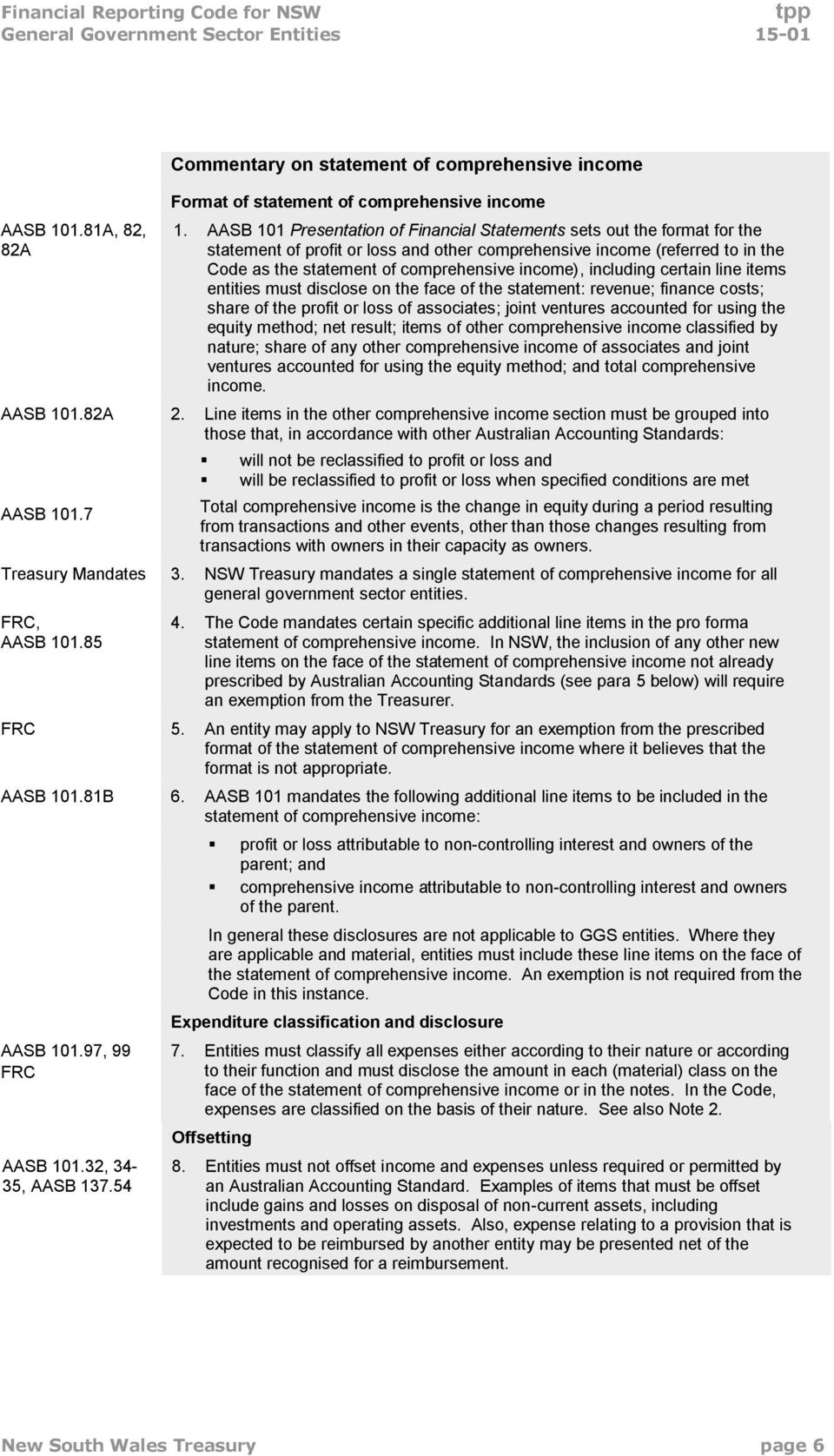
10 AASB A, 82, 82A AASB A AASB Commentary on statement of comprehensive income Format of statement of comprehensive income 1. AASB 101 Presentation of Financial Statements sets out the format for the statement of profit or loss and other comprehensive income (referred to in the Code as the statement of comprehensive income), including certain line items entities must disclose on the face of the statement: revenue; finance costs; share of the profit or loss of associates; joint ventures accounted for using the equity method; net result; items of other comprehensive income classified by nature; share of any other comprehensive income of associates and joint ventures accounted for using the equity method; and total comprehensive income. 2. Line items in the other comprehensive income section must be grouped into those that, in accordance with other Australian Accounting Standards: will not be reclassified to profit or loss and will be reclassified to profit or loss when specified conditions are met Total comprehensive income is the change in equity during a period resulting from transactions and other events, other than those changes resulting from transactions with owners in their capacity as owners. Treasury Mandates 3. NSW Treasury mandates a single statement of comprehensive income for all general government sector entities., AASB The Code mandates certain specific additional line items in the pro forma statement of comprehensive income. In NSW, the inclusion of any other new line items on the face of the statement of comprehensive income not already prescribed by Australian Accounting Standards (see para 5 below) will require an exemption from the Treasurer. 5. An entity may apply to NSW Treasury for an exemption from the prescribed format of the statement of comprehensive income where it believes that the format is not appropriate. AASB B 6. AASB 101 mandates the following additional line items to be included in the statement of comprehensive income: AASB , 99 AASB , 34-35, AASB profit or loss attributable to non-controlling interest and owners of the parent; and comprehensive income attributable to non-controlling interest and owners of the parent. In general these disclosures are not applicable to GGS entities. Where they are applicable and material, entities must include these line items on the face of the statement of comprehensive income. An exemption is not required from the Code in this instance. Expenditure classification and disclosure 7. Entities must classify all expenses either according to their nature or according to their function and must disclose the amount in each (material) class on the face of the statement of comprehensive income or in the notes. In the Code, expenses are classified on the basis of their nature. See also Note 2. Offsetting 8. Entities must not offset income and expenses unless required or permitted by an Australian Accounting Standard. Examples of items that must be offset include gains and losses on disposal of non-current assets, including investments and operating assets. Also, expense relating to a provision that is expected to be reimbursed by another entity may be presented net of the amount recognised for a reimbursement. New South Wales Treasury page 6
11 Material Items AASB Entities shall disclose material items of income and expense separately, either on the face of the statement of comprehensive income or in the notes. AASB Entities shall not present any items of income and expense as extraordinary items, either in the statement of comprehensive income or in the notes. AASB AASB (b), 22, 24 AASB (a) NSWTC 11/19 AASB AASB AASB Proceeds on sale of assets 10. Where an entity must remit either all or a portion of the proceeds on sale of assets to the Crown Entity, such remittances should be included in transfers to the Crown Entity after the line item capital appropriation in the statement of comprehensive income. Net result 11. Entities must include all items of income and expense recognised in a period in profit or loss (i.e. net result) unless an Australian Accounting Standard requires otherwise (e.g. revaluation surplus under AASB 116 Property, Plant and Equipment). Under AASB 108, entities must account for voluntary changes in accounting policy and correction of prior period errors retrospectively by adjusting the opening balance of accumulated funds for the comparative period (or by adjusting the comparative period if the error occurred in that period). Changes in accounting policy resulting from amendments in Australian Accounting Standards should be accounted for in accordance with that standard or in the absence of transitional provisions, retrospectively. Personnel services 12. For entities impacted by NSWTC 11/19 regarding employment arrangements, the face of the statement of comprehensive income must disclose, where applicable: entity receiving personnel services (i.e. statutory body) additional line item under Operating expenses for Personnel services entity providing personnel services (i.e. a public service agency under the Government Sector Employment Act 2013 (GSE Act)) additional line item under Revenue for Personnel services revenue A personnel service entity is referred to as a Staff Agency under the GSE Act. Other comprehensive income 13. The components of other comprehensive income include: changes in revaluation surplus gains and losses on remeasuring available-for-sale financial assets remeasurements of defined benefit plans [where appropriate] 14. The entity shall disclose reclassification adjustments relating to items of other comprehensive income, either in the statement of comprehensive income or in the notes. A reclassification adjustment is included with the related items of other comprehensive income in the period that the adjustment is reclassified to profit or loss. 15. Reclassification adjustments arise, for example, on derecognition of available-for-sale financial assets. They do not arise on changes in revaluation surplus. New South Wales Treasury page 7

12 AASB (c), AASB , AASB (f) AASB Statement of financial position as at 30 June 2015 ASSETS Current Assets Cash and cash equivalents Receivables Inventories Financial assets at fair value Other financial assets Other AASB 5.38 Non-current assets held for sale 19 Notes Actual 2015 $ 000 Budget 2015 $ 000 Actual 2014 $ July 2013* $ 000 Total Current Assets AASB 5.38 Non-Current Assets Receivables Inventories Financial assets at fair value Other financial assets Property, plant and equipment - Land and buildings - Plant and equipment - Infrastructure systems Total property, plant and equipment Investment property Intangible assets Other Total Non-Current Assets Total Assets LIABILITIES Current Liabilities Payables Borrowings Provisions Other Liabilities associated with assets held for sale Total Current Liabilities AASB 5.38 Non-Current Liabilities Borrowings Provisions Other Total Non-Current Liabilities Total Liabilities Net Assets EQUITY 26 Reserves Accumulated funds Amounts recognised in equity relating to assets held for sale Total Equity The accompanying notes form part of these financial statements. * This column is only required when an entity makes retrospective adjustments / restatements (refer commentary following). The column must be omitted where this has not occurred. 19 New South Wales Treasury page 8
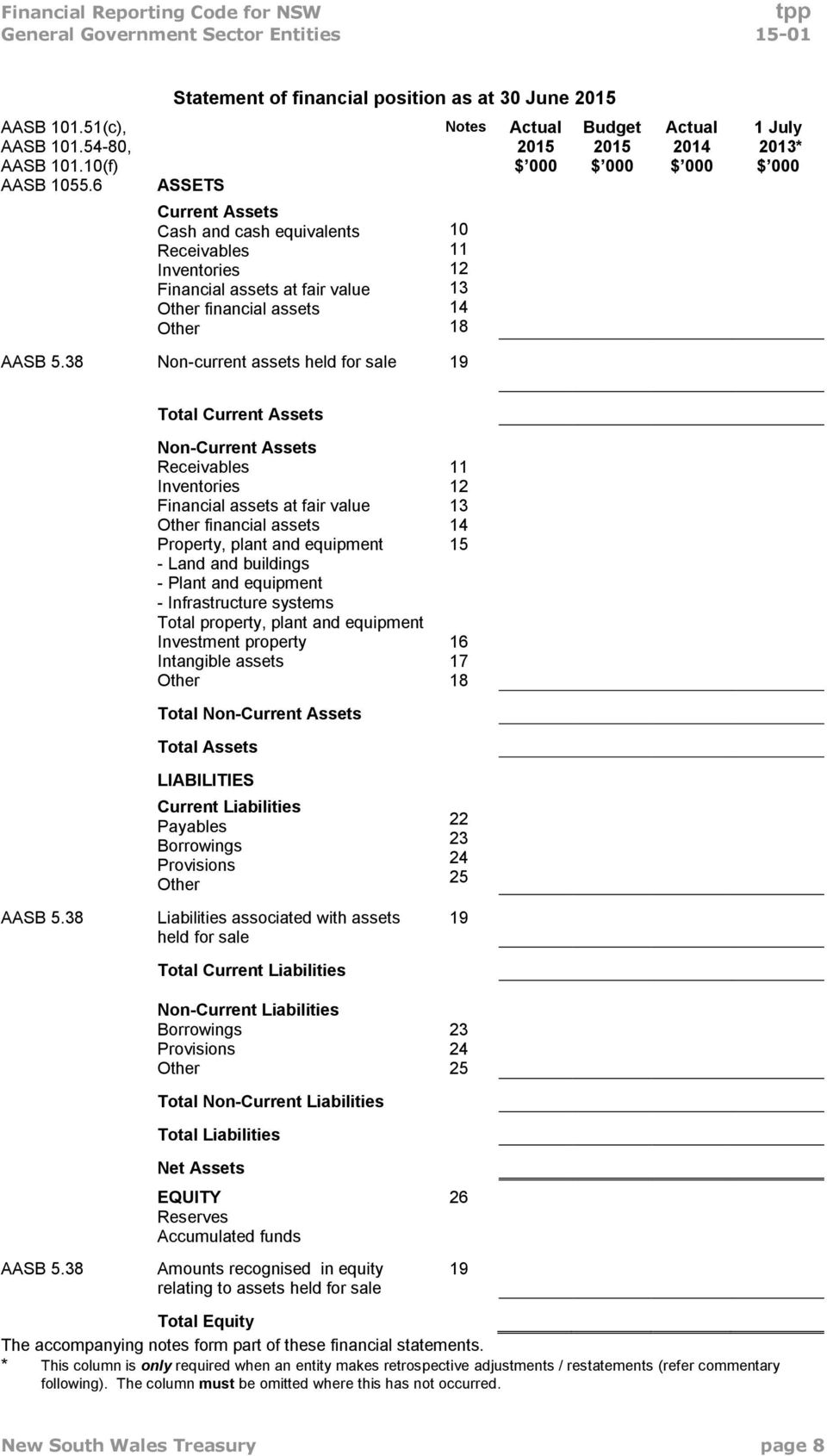
13 AASB AASB AASB Commentary on statement of financial position Presentation of assets and liabilities 1. AASB 101 requires the current / non-current presentation of assets and liabilities unless the liquidity presentation provides more relevant and reliable information. The Code, however, requires GGS entities to adopt the current / non-current categorisation. 2. Assets and liabilities must not be offset, unless an Australian Accounting Standard requires or permits offsetting. An entity shall only offset a financial asset and financial liability and present the net amount in the statement of financial position when the entity has a legally enforceable right to set off; and the entity intends either to settle on a net basis, or to realise the asset and settle the liability simultaneously. AASB The terms 'current asset' and 'current liability' are those items an entity: AASB expects to realise (or settle) in the entity s normal operating cycle or AASB , 70, 71 holds primarily for the purpose of trading or expects to realise (or settle) within twelve months after the reporting period (including AASB 5 held for sale assets and liabilities) or classifies as cash or a cash equivalent unless restricted from being exchanged or used to settle a liability for at least twelve months after the reporting period or does not have an unconditional right to defer settlement of for at least twelve months after the reporting period. 4. Entities should assume a 12 month period when there is no alternative identifiable operating cycle. In NSW, public sector entities generally adopt a 12 month operating cycle. Where an entity intends to adopt a longer time period, they should notify NSW Treasury immediately. AASB In classifying a liability as current or non-current, certain events after the reporting period are ignored. For example, an entity classifies a liability as current where a long-term covenant is breached on or before the end of the reporting period even if, after the end of the reporting period and before the financial statements are authorised for issue, the lender has agreed not to demand payment. AASB (f), 40A-44 Treasury Mandates AASB , 54-55, An additional statement of financial position (represented in the pro forma by the additional column) is required in the statement of financial position as at the beginning of the preceding period only when an entity: applies an accounting policy retrospectively makes a retrospective restatement; e.g. the correction of an error or reclassifies items in the financial statements, and the retrospective application, restatement or reclassification has a material effect on the information in the statement of financial position at the beginning of the preceding period. Therefore, if none of the above has occurred during the year, entities should delete the additional column from the pro forma statement of financial position. When an entity is required to present an additional statement of financial position, it must disclose the information required by paragraphs of AASB 101 (disclosures regarding reclassifications of comparative amounts) and AASB 108 (paras 28, 29 and 49). However, an entity is not required to present the related notes to the opening statement of financial position as at the beginning of the preceding period. Disclosures on the face of the statement of financial position 7. Entities must disclose certain classes of items separately on the face of the statement of financial position. In addition, an entity must disclose, either on the face of the statement of financial position or in the notes, further sub-classifications of the line items presented, classified in a manner appropriate to the entity s operations. In NSW, the inclusion of any new line items on the face of the statement of financial position not already specifically prescribed by Australian Accounting Standards will require an exemption from Treasury. New South Wales Treasury page 9

14 AASB101.51(c) Statement of changes in equity for the year ended 30 June 2015 AASB Balance at 1 July 2014 Changes in accounting policy Correction of errors Restated total equity at 1 July 2014 Notes Accumulated Funds $ 000 Asset Revaluation Surplus $ 000 Other Reserves [specify] $ 000 Total $ 000 AASB (d)(i)-(ii) AASB A AASB (d)(iii) Net result for the year Other comprehensive income Net increase / (decrease) in property, plant and equipment Available for sale financial assets: Valuation gains / (losses) Transfers on disposal Change in restoration liability Other [specify] Total other comprehensive income Total comprehensive income for the year Transactions with owners in their capacity as owners Increase / (decrease) in net assets from equity transfers 26 Balance at 30 June 2015 Balance at 1 July 2013 Changes in accounting policy Correction of errors Restated total equity at 1 July 2013 AASB (d)(i)-(ii) AASB A AASB (d)(iii) Net result for the year Other comprehensive income: Net increase / (decrease) in property, plant and equipment Available for sale financial assets: Valuation gains / (losses) Transfers on disposal Change in restoration liability Other [specify] Total other comprehensive income Total comprehensive income for the year Transactions with owners in their capacity as owners Increase / (decrease) in net assets from equity transfers 26 Balance at 30 June 2014 New South Wales Treasury page 10
![[specify] $ 000 Total $ 000 AASB 101.106(d)(i)-(ii) AASB 101.106A AASB 101.](/docs-images/45/8843381/images/page_14.jpg "106(d)(iii) Net result for the year Other comprehensive income Net increase / (decrease) in property, plant and equipment Available for sale financial assets: Valuation gains / (losses) Transfers on")
15 AASB AASB A Treasury Mandates AASB Commentary on statement of changes in equity Requirements 1. An entity shall present on the face of the statement of changes in equity: total comprehensive income for the period the effects of retrospective application or retrospective restatement recognised in accordance with AASB 108 for each component of equity a reconciliation for each component of equity between the carrying amount at the beginning and end of the period, separately disclosing changes from: profit or loss other comprehensive income and transactions with owners in their capacity as owners, showing separately contributions by and distributions to owners and changes in ownership interests in subsidiaries that do not result in a loss of control. 2. An entity may present an analysis of other comprehensive income by item on the face of the statement of changes of equity or in the notes. NSW Treasury has mandated that the analysis of other comprehensive income by item must be presented on the face of the statement. Adjustments 3. All contributions by or distributions to owners are to be adjusted against the equity account. AASB Retrospective adjustments to effect changes in accounting policies and retrospective restatements to correct errors are not changes in equity. They are adjustments to the opening balance of retained earnings, except when an Australian Accounting Standard requires retrospective adjustment of another component of equity. An entity discloses these adjustments for each prior period and the beginning of the period. New South Wales Treasury page 11

16 Statement of cash flows for the year ended 30 June 2015 AASB (d), 51(c), 111 AASB AASB CASH FLOWS FROM OPERATING ACTIVITIES Payments Employee related Grants and subsidies Finance costs Other Notes Actual 2015 $000 Budget 2015 $000 Actual 2014 $000 Total Payments AASB Receipts Recurrent appropriation Capital appropriation (excluding equity appropriations) Reimbursements from the Crown Entity (Transfers to the Crown Entity) Sale of goods and services Interest received Retained taxes, fees and fines Grants and contributions Other Total Receipts NET CASH FLOWS FROM OPERATING ACTIVITIES 30 CASH FLOWS FROM INVESTING ACTIVITIES Proceeds from sale of land and buildings, plant and equipment and infrastructure systems Proceeds from sale of investments Advance repayments received Purchases of land and buildings, plant and equipment and infrastructure systems Purchases of investments Advances made Other NET CASH FLOWS FROM INVESTING ACTIVITIES TPP 09-3 CASH FLOWS FROM FINANCING ACTIVITIES Capital appropriation equity appropriation Proceeds from borrowings and advances Cash equity injection to for-profit entities Repayment of borrowings and advances Other NET CASH FLOWS FROM FINANCING ACTIVITIES NET INCREASE / (DECREASE) IN CASH Opening cash and cash equivalents Cash transferred in / (out) as a result of administrative restructuring 26 CLOSING CASH AND CASH EQUIVALENTS 10 The accompanying notes form part of these statements. New South Wales Treasury page 12

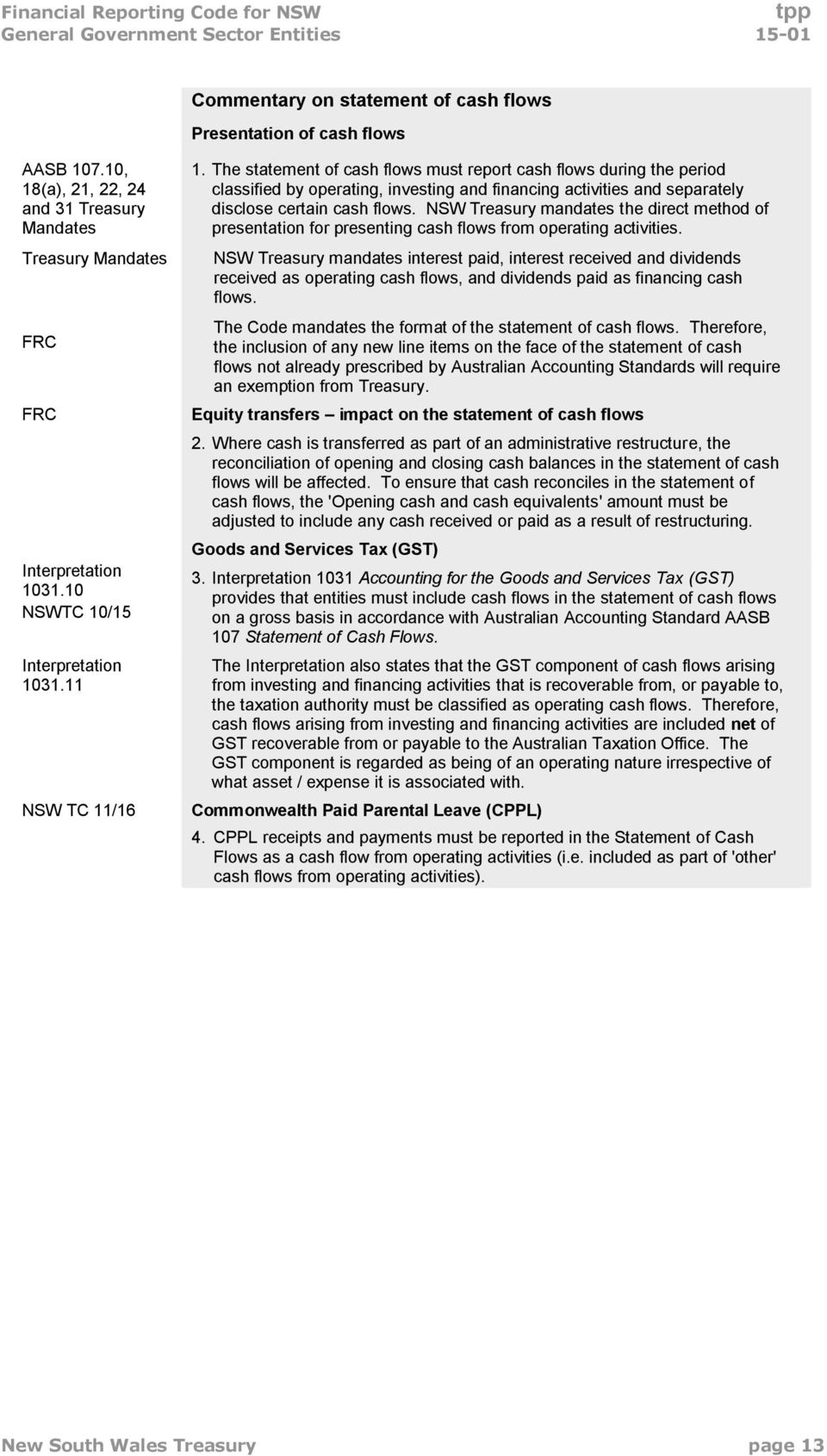
17 Commentary on statement of cash flows Presentation of cash flows AASB , 18(a), 21, 22, 24 and 31 Treasury Mandates Treasury Mandates Interpretation NSWTC 10/15 Interpretation NSW TC 11/16 1. The statement of cash flows must report cash flows during the period classified by operating, investing and financing activities and separately disclose certain cash flows. NSW Treasury mandates the direct method of presentation for presenting cash flows from operating activities. NSW Treasury mandates interest paid, interest received and dividends received as operating cash flows, and dividends paid as financing cash flows. The Code mandates the format of the statement of cash flows. Therefore, the inclusion of any new line items on the face of the statement of cash flows not already prescribed by Australian Accounting Standards will require an exemption from Treasury. Equity transfers impact on the statement of cash flows 2. Where cash is transferred as part of an administrative restructure, the reconciliation of opening and closing cash balances in the statement of cash flows will be affected. To ensure that cash reconciles in the statement of cash flows, the 'Opening cash and cash equivalents' amount must be adjusted to include any cash received or paid as a result of restructuring. Goods and Services Tax (GST) 3. Interpretation 1031 Accounting for the Goods and Services Tax (GST) provides that entities must include cash flows in the statement of cash flows on a gross basis in accordance with Australian Accounting Standard AASB 107 Statement of Cash Flows. The Interpretation also states that the GST component of cash flows arising from investing and financing activities that is recoverable from, or payable to, the taxation authority must be classified as operating cash flows. Therefore, cash flows arising from investing and financing activities are included net of GST recoverable from or payable to the Australian Taxation Office. The GST component is regarded as being of an operating nature irrespective of what asset / expense it is associated with. Commonwealth Paid Parental Leave (CPPL) 4. CPPL receipts and payments must be reported in the Statement of Cash Flows as a cash flow from operating activities (i.e. included as part of 'other' cash flows from operating activities). New South Wales Treasury page 13
18 General commentary on financial statements Budgeted amounts AASB Where an entity s budgeted primary financial statements were presented to Parliament (i.e. in the NSW Government Budget Papers), the entity s financial statements must comply with AASB 1055 Budgetary Reporting. In respect of the actual amount of each item disclosed in the primary financial statements for the current financial year, entities must disclose the corresponding budgeted amount for that item for the current financial year. AASB (a)-(b) AASB , 11, 13 Treasury Mandates AASB (f) AASB AASB (a), 13 The budgeted amounts disclosed must be drawn from the original budgeted financial statements presented to Parliament in respect of the reporting period and must be prepared on the same basis as the financial statements. Subsequent amendments to the original budget (e.g. adjustment for transfer of functions between entities as a result of Administrative Arrangements Orders) are not reflected in the budgetary information. Explaining Variances 2. Major variances between the original budgeted amounts and the actual amounts in the primary financial statements should be explained in Note 29. Where relevant, variances may relate to transfers of functions or restructures. The format of disclosures in Note 29 could include columns to explain the components of the overall variance between the original budget and actual information. For instance, where an entity has been impacted by a restructure, a column disclosing the budget after amendments for the restructure could be included. However these columns should not be referred to as a revised budget. Regardless, major variances between actual amounts and the original budget must be explained. Other requirements under AASB Comparative budgetary information in respect of the previous period need not be disclosed. 4. An entity with administered items included in its original budgeted financial statements presented to Parliament must disclose the corresponding budgeted amount for those items in Note 33 for the current financial year. Entities not required to comply with AASB 1055 AASB AASB Entities for which budgeted financial information was not presented to Parliament do not need to comply with AASB Where these entity s choose to disclose budgeted financial information (as it was not required to be presented to Parliament) the entity s accounting policy and disclosures in respect of budgeted financial information should: state that the entity is not required to comply with AASB 1055, citing the reasons describe the basis of preparation of the budgetary information presented; and disclose who authorised the budget. Consistency of presentation 6. The presentation and classification of items in the financial statements shall be retained from one reporting period to the next unless: it is apparent, following a significant change in the nature of the entity s operations or a review of its financial statements, that another presentation or classification would be more appropriate (having regard to the criteria for the selection and application of accounting policies in AASB 108) or an Australian Accounting Standard requires a change in presentation When making changes in presentation or classification, an entity reclassifies its comparative information, unless impracticable. Entities must disclose the nature and amount of, and reason for, the reclassification. When it is impracticable to reclassify, the entity shall disclose the reason for not reclassifying the amounts and the nature of the adjustments that would have been made if the amounts had been New South Wales Treasury page 14
19 AASB AASB AASB AASB AASB (f), 38B AASB C- 38D AASB AASB 108.5,19,22-25 reclassified. 'Impracticable' is defined as occurring when the entity cannot apply a requirement after making every reasonable effort to do so. Materiality 7. Entities must present each material class of similar items separately in the financial statements. An immaterial item need not be disclosed. An item that is not sufficiently material to warrant separate presentation on the face of the primary statements may nevertheless be sufficiently material to be disclosed separately in the notes. Omissions or misstatements of items are material if they could, individually or collectively, influence the economic decisions that users make on the basis of the financial statements. Materiality depends on the size and nature of the omission or misstatement judged in the surrounding circumstances. The size or nature of the item, or a combination of both, could be the determining factor. Comparative information general 8. In general, an entity must present comparative information for the preceding financial year that corresponds to the disclosures specified for the current financial year, except where an Australian Accounting Standard permits or requires otherwise. Entities must include comparative information for narrative and descriptive information included in the financial statements if it is relevant to an understanding of the financial statements. In some cases, narrative information provided for the preceding period continues to be relevant in the current period; e.g. where an uncertainty was disclosed at the end of one reporting period, which is resolved in the next reporting period. When an entity applies an accounting policy retrospectively or makes a retrospective restatement of items in its financial statements, it must present an additional statement of financial position at the beginning of the preceding period. 9. An entity may present comparative information in addition to the minimum comparative financial statements, as long as that information is prepared in accordance with Australian Accounting Standards. It may comprise one or more of the components of the financial statements (with related note information) (e.g. a third statement of comprehensive income), but it need not comprise a complete set of financial statements (i.e. need not present a third statement for all of the primary financial statements). Comparatives correction of errors 10. An entity shall correct material prior period errors retrospectively in the first financial statements issued after their discovery by restating the comparative amounts for the prior period(s) presented in which the error occurred, where practicable, or, if the error occurred before the earliest prior period presented, by restating the opening balances for the earliest prior period presented. When it is impracticable to determine the period-specific effects of an error on comparative information, the entity shall restate the opening balances for the earliest period for which retrospective restatement is practicable (which may be the current period). When it is impracticable to determine the cumulative effect of an error on all prior periods, the entity shall restate the comparative information to correct the error prospectively from the earliest date practicable. NB: An entity should only correct material prior period errors. Comparatives changes in accounting policy 11. When an entity changes an accounting policy upon initial application of an Australian Accounting Standard that does not include specific transitional provisions applying to that change, or changes an accounting policy voluntarily, it must apply the change retrospectively, where practicable. The entity must adjust the opening balance of each affected component of equity for the earliest prior period presented, and the other comparative amounts disclosed for each prior period presented as if the new accounting policy had always been applied. Where impracticable, the entity must adjust the comparative information to apply the new accounting policy prospectively from the earliest date possible, which may be the current period. The treatment of changes in accounting policy is further discussed in the commentary to Note 1. New South Wales Treasury page 15
20 AASB NSWTC 11/19 Transfer payments 12. Transfer payments are not recognised in the statement of comprehensive income, as the entity does not control these types of payments (see Note 8 on Transfer Payments). Those parts of the recurrent and capital appropriations that are in the nature of transfer payments are not to be recognised in the statement of comprehensive income. Similarly, cash flows resulting from transfer payments are not recognised in the statement of cash flows. Personnel services 13. For entities impacted by NSWTC 11/19 regarding employment arrangements, expenses, revenues, assets and liabilities not referred to elsewhere in the Code must be classified into existing line items in the primary financial statements and dissected in the notes, as appropriate. Special purpose staff agencies are exempt from the requirements of the Code per NSWTC 11/19. New South Wales Treasury page 16
21 Supplementary Financial Statements New South Wales Treasury page 17
22 Supplementary Financial Statements Service group statements for the year ended 30 June 2015 Service Group 1* Service Group 2* Not Attributable Total ENTITY S EXPENSES & INCOME 2015 $ $ $ $ $ $ $ 000 AASB (c) AASB (d) Expenses excluding losses Operating expenses Employee related Other operating expenses Depreciation and amortisation Grants and subsidies Finance costs Other expenses TOTAL EXPENSES EXCLUDING LOSSES Revenue** Recurrent appropriation Capital appropriation (Transfers to the Crown Entity) Sale of goods and services Investment revenue Retained taxes, fees and fines Grants and contributions Acceptance by the Crown Entity of employee benefits and other liabilities Other revenue Total revenue Gain / (loss) on disposal Other gains / (losses) Net result 2014 $ 000 Other Comprehensive Income Increase / (decrease) in revaluation surplus Other [specify] Total Other Comprehensive Income TOTAL COMPREHENSIVE INCOME * The names and purposes of each service group are summarised in Note 9. ** Appropriations are made on an entity basis and not to individual service groups. Consequently, appropriations must be included in the Not Attributable column. Cluster grant funding is also unlikely to be attributable to individual service groups. New South Wales Treasury page 18
23 Supplementary Financial Statements Service group statements (continued) AASB ENTITY S ASSETS & LIABILITIES Service Group 1* $ 000 $ 000 Service Group 2* $ 000 $ 000 Not Attributable $ 000 $ 000 Total $ 000 $ 000 Current Assets Cash and cash equivalents Receivables Inventories Financial assets at fair value Other financial assets Other Non-current assets held for sale Total current assets Non-current Assets Receivables Inventories Financial assets at fair value Other financial assets Property, plant and equipment Investment properties Intangible assets Other Total non-current assets TOTAL ASSETS Current liabilities Payables Borrowings Provisions Other Liabilities associated with assets held for sale Total current liabilities Non-current liabilities Borrowings Provisions Other Total non-current liabilities TOTAL LIABILITIES NET ASSETS * The names and purposes of each service group are summarised in Note 9. New South Wales Treasury page 19
24 Supplementary Financial Statements Service group statements (continued) ADMINISTERED EXPENSES & INCOME Service Group 1* Service Group 2* Not Attributable Total 2015 $ $ $ $ $ $ $ $ 000 AASB (b) Administered Expenses Transfer payments Other Total Administered Expenses AASB (a) Administered Income Transfer receipts Consolidated Fund Taxes, fees and fines Other Total Administered Income Administered Income less Expenses * The names and purposes of each service group are summarised in Note 9. Administered assets and liabilities are disclosed in Note 33 New South Wales Treasury page 20
25 General Government Sector Entities Supplementary Financial Statements Commentary on service group statements AASB 1052 Disaggregated Disclosures is applicable to government departments. The Code extends service group disclosure requirements to other GGS entities where service group information is included in the Budget Papers., AASB (c)-(d) AASB AASB , 19 Expenses and income of an entity 1. AASB 1052 Disaggregated Disclosures requires entities to disclose financial information about service costs and achievements on an activity basis. Entities must disclose expenses and income in the statement of comprehensive income that can be attributable to each of the major service activities of the entity. Separate disclosure is required of each major class of expenses as identified in the service group statements. Separate disclosure is also required of user charges, government contributions and other major classes of income as identified in the service group statements. Where income and expenditure cannot be attributed to a particular service group, the Not Attributable column must be used. Appropriations are made to the entity rather than the service group. Therefore, appropriations must be disclosed in the 'Not Attributable' column. Given that appropriations are not attributable to service groups, there will be a mismatch between income and expenses at a service group level. Assets and liabilities of an entity 2. Entities must also disclose the assets deployed and liabilities incurred that are reliably attributable to their activities. In some instances, it may not be possible to reliably attribute assets and liabilities to each of the activities of the entity. In these circumstances, the Not attributable column should be used. Reconciliation to entity statements and consolidated statements 3. The information disclosed in the service group statements must be aggregated to agree with the related information in the primary financial statements of the entity. 4. Where an entity is a parent entity in an economic entity which has presented consolidated financial statements as required by AASB 10 Consolidated Financial Statements, the service group information must only be disclosed in relation to the economic entity and must be aggregated to agree with the related information in the consolidated financial statements. 5. Where there is only one service group, details of the expenses, income, assets and liabilities are not required in the service group statements as this information is available in the primary financial statements. In such cases, the summary of the administered expenses and income may be produced as a note rather than a supplementary financial statement. Administered Expenses and Income, AASB Administered activities may be defined as those activities that are carried out on behalf of another entity (e.g. the Crown Entity). Therefore, the income and expenses and assets and liabilities relating to those activities should not be recognised in the primary financial statements of the entity., AASB That is, entities will not recognise as assets or income items such as Consolidated Fund - taxes, fees and fines and other amounts which the entity collects but does not control. Similarly an entity will not recognise as income and expenses amounts which the entity is responsible for transferring to eligible beneficiaries consistent with legislation or other authority and which the entity does not control. AASB For example, an entity may be responsible for the levying and / or collection of taxes, fines and fees, the provision of goods and services for which charges are made or the transfer of funds to eligible beneficiaries. Under these arrangements, the entity is not permitted to spend the funds it collects and holds without further authorisation. Administered expenses for NSW GGS entities will predominantly be transfer payments. New South Wales Treasury page 21
26 General Government Sector Entities Supplementary Financial Statements AASB (a)-(b) AASB AASB (c)-(d) AASB TPP Administered expenses and income are not recognised in the statement of comprehensive income but are required to be disclosed in the complete set of financial statements, showing separately: each major class of expense and income and in respect of each of those classes of expenses and income, the amounts that can be attributed to each of the entity s activities and the amounts that cannot be attributed. 9. Administered expenses and income must be reported on the same basis as the entity in terms of the recognition of expenses and income in the financial statements. 10. Administered assets and liabilities must also be disclosed, showing separately each major class of asset / liability. Please refer to Note 33 for disclosure of administered assets and liabilities. Comparative amounts 11. When the presentation or classification of items in the financial statements is amended, an entity shall reclassify comparative amounts unless the reclassification is impracticable. When comparative amounts are reclassified, the entity shall disclose (including as at the beginning of the preceding period) the: nature of the reclassification amount of each item or class of items that is reclassified and reason for the reclassification. When it is impracticable to reclassify comparative amounts, an entity shall disclose the: reason for not reclassifying the amounts and nature of the adjustments that would have been made if the amounts had been reclassified. 12. Comparative information for the service group statements is not required in the first financial report of a new entity, or in relation to functions transferred in to an ongoing entity during the reporting period. However, certain comparative information in regard to the former entity and transferred function is required elsewhere in the notes to the financial statements as a result of TPP New South Wales Treasury page 22
27 General Government Sector Entities ORIGINAL BUDGET APPROPRIATION / EXPENDITURE Appropriation Act s24 PFAA transfers of functions between entities OTHER APPROPRIATIONS / EXPENDITURE Additional Appropriations s21a PFAA special appropriation Treasurer s Advance Section 22 expenditure for certain works and services s26 PFAA Commonwealth specific purpose payments Transfers to / from another entity (per section 32 of the Appropriation Act) [section reference will need to be updated each year] Total Appropriations [Subtotal 2] / Expenditure / Net Claim on Consolidated Fund [Total 1] (includes transfer payments) Amount drawn down against Appropriation [Total 3] Liability to Consolidated Fund* [Total 4] AASB (d) RECURRENT APP N Summary of compliance with financial directives [ENTITIES RECEIVING A DIRECT APPROPRIATION ONLY] EXPENDITURE / NET CLAIM ON EXPENDITURE / NET CLAIM ON EXPENDITURE / NET CLAIM ON CONSOLIDATED CAPITAL CONSOLIDATED RECURRENT CONSOLIDATED CAPITAL FUND APP N FUND APP N FUND APP N $000 $000 $000 $000 $000 $000 $000 $000 The summary of compliance is based on the assumption that Consolidated Fund moneys are spent first (except where otherwise identified or prescribed). [If an entity receives an equity appropriation this should also be disclosed in the summary of complianc e as part of the capital appropriation.] * [If there is a 'Liability to Consolidated Fund', the entity must state that this represents the difference between the 'Amount drawn down against Appropriation' and the 'Expenditure / Net Claim on Consolidated Fund'.] [In the notes, provide details of any material variations between the total recurrent and capital appropriations and actual expenditure / net claim on Consolidated Fund for the year] EXPENDITURE / NET CLAIM ON CONSOLIDATED FUND New South Wales Treasury page 23
28 General Government Sector Entities Supplementary Financial Statements AASB TPP 09-3 TC 14/07 AASB NSWTC 14/07 Commentary on summary of compliance with financial directives [ENTITIES RECEIVING A DIRECT APPROPRIATION ONLY] Parliamentary Appropriations 1. In NSW, the Parliamentary appropriations received by an entity must be recognised as income, except as specified below: 'Equity appropriations' used to fund payments to adjust a for-profit entity s capital structure are recognised as equity injections on receipt by the entity and equity withdrawals on payment to a for-profit entity. Unspent appropriations are recognised as liabilities rather than income, as the authority to spend the money lapses and the unspent amount must be repaid to Consolidated Fund. Format and basis of summary of compliance 2. The summary of compliance discloses the components of the total recurrent and capital appropriation (including any 'equity appropriations'), comprising the original recurrent and capital appropriations and 'other' appropriations. A column is provided to disclose actual expenditure against each item. The summary discloses the 'Total Appropriations'; 'Expenditure / Net Claim on Consolidated Fund'; 'Amount Drawn Down against Appropriation'; and the 'Liability to Consolidated Fund'. Unlike the primary financial statements, the summary includes transfer payments. 3. The summary of compliance is a cash (not an accrual) statement. Therefore 'expenditure' refers to cash payments. The term 'expenditure' has been used for payments for consistency with AASB Pro forma 'Liability to Consolidated Fund' 4. To calculate the 'Liability to Consolidated Fund', a pro-forma has been developed and must be completed by entities and returned to NSW Treasury by the date specified in the Treasury Circular. The form provides most of the source information required in the summary of compliance. 5. The form is divided into four main sections for both recurrent and capital appropriations: A. Net claim on Consolidated Fund: identifies payments made during the financial year that can be met from the Consolidated Fund appropriations. To calculate this amount, entities must start with the relevant cash flow amount from their statement of cash flows. As expenditure is not generally tracked against the source of funds (e.g. user charges as opposed to Consolidated Fund money), this calculation makes the general assumption that Consolidated Fund money is spent first. However where it is known that certain payments are required to be made from other funding sources, then these must be deducted to derive the 'Net Claim on Consolidated Fund Appropriations'. Logically, the 'Net Claim on Consolidated Fund ' cannot exceed the 'Net Available Appropriation'. Any excess, therefore, must represent payments that have been met from funding sources other than Consolidated Fund. Total 1 'Net Claim on Consolidated Fund' is included directly from the form in the summary of compliance. Entities should be able to determine the allocation of 'Expenditure / Net Claim on Consolidated Fund' across the various line items in the summary of compliance. However, if this is not possible, actual expenditure should be first matched with the original appropriation on the 'Appropriation Act' line. New South Wales Treasury page 24
29 General Government Sector Entities Supplementary Financial Statements NSWTC 14/07 B. Net available appropriations: this represents the total appropriations as approved, including all supplementations less any underexpenditure against protected items, first year enhancements, supplementations and Commonwealth funding. Subtotal 2 in this section of the form is included in the summary of compliance as 'Total Appropriations'. C. Amount drawn down against appropriations: this amount is recorded in the Treasury ledgers and can be confirmed from the NSW Treasury print-outs that are made available to entities shortly after year end. Total 3 'Amount drawn down against Appropriation' is included directly from the form in the summary of compliance. D. Liability to Consolidated Fund: a liability will only exist where the 'Amount drawn down against Appropriation' exceeds the 'Net Claim on Consolidated Fund', and the liability is the difference between these two amounts. Total 4 'Liability to Consolidated Fund' is included directly from the form in the summary of compliance and is the difference between Total 3 and Total To assist entities, the summary of compliance cross-references the totals from the pro forma (e.g. 'Total Appropriations [Subtotal 2]'). The references to these totals (i.e. the words '[Subtotal 2]') should not be included in the summary of compliance published in the entity s financial statements. Additional disclosures 7. A small number of disclosures are also required below the summary of compliance: a statement that the summary is based on the assumption that Consolidated Fund moneys are spent first, unless otherwise identified or prescribed. an explanation of how the 'Liability to Consolidated Fund' is calculated (i.e. the difference between 'Amount drawn down against Appropriation' and 'Expenditure / Net Claim on Consolidated Fund'). AASB (d) AASB 1004 requirement to provide details of any material variations between the 'total' recurrent and capital appropriations and actual expenditure for the year. New South Wales Treasury page 25
30 General Government Sector Entities Notes New South Wales Treasury page 26
31 Example Accounting Policy Note AASB (e), Summary of Significant Accounting Policies AASB , TPP 05-4 AASB (b) AASB (e), 51 AASB 10.4,19, B86 AASB AASB , 112 AASB AASB AASB AASB , 125 AASB (d)-(e) (a) (b) Reporting entity The [name of entity], is a NSW government entity. The [name of entity] is a not-for-profit entity (as profit is not its principal objective) and it has no cash generating units. The reporting entity is consolidated as part of the NSW Total State Sector Accounts. The [name of entity] as a reporting entity, comprises all the entities under its control, namely: [provide brief description]. In the process of preparing the consolidated financial statements for the economic entity, consisting of the controlling and controlled entities, all inter-entity transactions and balances have been eliminated, and like transactions and other events are accounted for using uniform accounting policies. These financial statements for the year ended 30 June 2015 have been authorised for issue by the [Secretary / Board / Audit and Risk Committee] on [insert date]. Basis of preparation AASB (c) Statement of compliance AASB 1050 (d) Administered activities The entity s financial statements are general purpose financial statements which have been prepared on an accruals basis and in accordance with: applicable Australian Accounting Standards (which include Australian Accounting Interpretations) the requirements of the Public Finance and Audit Act 1983 and Public Finance and Audit Regulation 2010 and the Financial Reporting Directions published in the Financial Reporting Code for NSW General Government Sector Entities or issued by the Treasurer. Property, plant and equipment, investment property, assets (or disposal groups) held for sale and financial assets at 'fair value through profit or loss' and available for sale are measured at fair value. Other financial statement items are prepared in accordance with the historical cost convention except where specified otherwise. Judgements, key assumptions and estimations management has made are disclosed in the relevant notes to the financial statements. All amounts are rounded to the nearest one thousand dollars and are expressed in Australian currency. The financial statements and notes comply with Australian Accounting Standards, which include Australian Accounting Interpretations. The entity administers, but does not control, certain activities on behalf of the Crown Entity. It is accountable for the transactions relating to those administered activities but does not have the discretion to deploy the resources for the achievement of the entity s own objectives. Transactions and balances relating to the administered activities are not recognised as the entity s income, expenses, assets and liabilities, but are disclosed in the accompanying schedules as 'Administered Income', 'Administered Expenses', 'Administered Assets' and 'Administered Liabilities'. The accrual basis of accounting and applicable accounting standards have been adopted. New South Wales Treasury page 27
32 AASB 123.Aus8.1, (e) Borrowing costs Treasury Mandates Borrowing costs are recognised as expenses in the period in which they are incurred, in accordance with Treasury s Mandate to not-for-profit general government sector entities. (f) Insurance The entity s insurance activities are conducted through the NSW Treasury Managed Fund Scheme of self-insurance for Government entities. The expense (premium) is determined by the Fund Manager based on past claims experience. Interpretation (g) Accounting for the Goods and Services Tax (GST) NSWTC 10/15 Income, expenses and assets are recognised net of the amount of GST, except that the: amount of GST incurred by the entity as a purchaser that is not recoverable from the Australian Taxation Office is recognised as part of an asset s cost of acquisition or as part of an item of expense and receivables and payables are stated with the amount of GST included. Cash flows are included in the statement of cash flows on a gross basis. However, the GST components of cash flows arising from investing and financing activities which are recoverable from, or payable to, the Australian Taxation Office are classified as operating cash flows. AASB 118.9, 35(a) (h) Income recognition AASB Income is measured at the fair value of the consideration or contribution received or receivable. Comments regarding the accounting policies for the recognition of income are discussed below. AASB , 32 (i) Parliamentary appropriations and contributions Except as specified below, parliamentary appropriations and contributions from other bodies (including grants and donations) are recognised as income when the entity obtains control over the assets comprising the appropriations / contributions. Control over appropriations and contributions is normally obtained upon the receipt of cash. Appropriations are not recognised as income in the following circumstances:, TPP 09-3 'Equity appropriations' to fund payments to adjust a for-profit entity s capital structure are recognised as equity injections (i.e. contribution by owners) on receipt and equity withdrawals on payment to a for-profit entity. The reconciliation between the statement of comprehensive income, statement of summary of compliance with financial directives and the total appropriations is disclosed in Note 3(a). AASB (a) AASB , 35(a) Unspent appropriations are recognised as liabilities rather than income, as the authority to spend the money lapses and the unspent amount must be repaid to the Consolidated Fund. The liability is disclosed in Note 25 as part of 'Current liabilities - Other'. The amount will be repaid and the liability will be extinguished next financial year. Any liability in respect of transfer payments is disclosed in Note 33 'Administered assets and liabilities'. (ii) Sale of goods Revenue from the sale of goods is recognised as revenue when the entity transfers the significant risks and rewards of ownership of the assets. (iii) Rendering of services Revenue is recognised when the service is provided or by reference to the stage of completion (based on labour hours incurred to date). New South Wales Treasury page 28
33 AASB 139.9, AG5-AG8 AASB ; AASB AASB 116.6, 15 AASB 116.Aus15.1 AASB 116.6, AASB 13.9 AASB TPP 06-6 AASB , 31, 73-79, TPP AASB TPP AASB AASB , 77, TPP TPP (i) (iv) Investment revenue Interest revenue is recognised using the effective interest method as set out in AASB 139 Financial Instruments: Recognition and Measurement. Rental revenue from operating leases is recognised in accordance with AASB 117 Leases on a straight-line basis over the lease term. Royalty revenue is recognised in accordance with AASB 118 Revenue on an accrual basis in accordance with the substance of the relevant agreement. Dividend revenue is recognised in accordance with AASB 118 when the entity s right to receive payment is established. Assets (i) Acquisitions of assets Assets acquired are initially recognised at cost. Cost is the amount of cash or cash equivalents paid or the fair value of the other consideration given to acquire the asset at the time of its acquisition or construction or, where applicable, the amount attributed to that asset when initially recognised in accordance with the requirements of other Australian Accounting Standards. Assets acquired at no cost, or for nominal consideration, are initially recognised at their fair value at the date of acquisition (see also assets transferred as a result of an equity transfer - Note 1(l)). Fair value is the price that would be received to sell an asset in an orderly transaction between market participants at measurement date. Where payment for an asset is deferred beyond normal credit terms, its cost is the cash price equivalent; i.e. deferred payment amount is effectively discounted over the period of credit. (ii) Capitalisation thresholds Property, plant and equipment and intangible assets costing $5,000 [or amount determined by the entity] and above individually (or forming part of a network costing more than $5,000) are capitalised. (iii) Revaluation of property, plant and equipment Physical non-current assets are valued in accordance with the 'Valuation of Physical Non-Current Assets at Fair Value' Policy and Guidelines Paper (TPP 14-01). This policy adopts fair value in accordance with AASB 13 Fair Value Measurement, AASB 116 Property, Plant and Equipment and AASB 140 Investment Property. Also refer Note 1(i)(xi) on investment property. Property, plant and equipment is measured at the highest and best use by market participants that is physically possible, legally permissible and financially feasible. The highest and best use must be available at a period that is not remote and take into account the characteristics of the asset being measured, including any sociopolitical restrictions imposed by government. In most cases, after taking into account these considerations, the highest and best use is the existing use. In limited circumstances, the highest and best use may be a feasible alternative use, where there are no restrictions on use or where there is a feasible higher restricted alternative use. Fair value of property, plant and equipment is based on a market participants perspective, using valuation techniques (market approach, cost approach, income approach) that maximise relevant observable inputs and minimise unobservable inputs. Also refer Note 15 and Note 20 for further information regarding fair value. The entity revalues each class of property, plant and equipment at least every five years or with sufficient regularity to ensure that the carrying amount of each asset in the class does not differ materially from its fair value at reporting date. The last revaluation was completed on [date] and was based on an independent assessment. Non-specialised assets with short useful lives are measured at depreciated historical cost as an approximation of fair value. The New South Wales Treasury page 29
34 entity has assessed that any difference between fair value and depreciated historical cost is unlikely to be material. AASB (a), AASB 13.B8-B9 TPP AASB (b) TPP AASB 116.Aus39.1 AASB 116.Aus40.1 AASB 116.Aus40.2 TPP 14-01, AASB TPP 14-01, AASB , Aus6.1-Aus6.2 AASB 136.5(a), Framework 83, AASB 116.G1-G4 TPP AASB , TPP AASB TPP AASB , G1-G4 AASB When revaluing non-current assets using the cost approach, the gross amount and the related accumulated depreciation are separately restated. For other assets valued using other valuation techniques, any balances of accumulated depreciation at the revaluation date in respect of those assets are credited to the asset accounts to which they relate. The net asset accounts are then increased or decreased by the revaluation increments or decrements. Revaluation increments are credited directly to revaluation surplus, except that, to the extent that an increment reverses a revaluation decrement in respect of that class of asset previously recognised as an expense in the net result, the increment is recognised immediately as revenue in the net result. Revaluation decrements are recognised immediately as expenses in the net result, except that, to the extent that a credit balance exists in the revaluation surplus in respect of the same class of assets, they are debited directly to the revaluation surplus. As a not-for-profit entity, revaluation increments and decrements are offset against one another within a class of non-current assets, but not otherwise. Where an asset that has previously been revalued is disposed of, any balance remaining in the revaluation surplus in respect of that asset is transferred to accumulated funds. (iv) Impairment of property, plant and equipment As a not-for-profit entity with no cash generating units, impairment under AASB 136 Impairment of Assets is unlikely to arise. As property, plant and equipment is carried at fair value or an amount that approximates fair value, impairment can only arise in the rare circumstances such as where the costs of disposal are material. Specifically, impairment is unlikely for not-for-profit entities given that AASB 136 modifies the recoverable amount test for non-cash generating assets of not-for-profit entities to the higher of fair value less costs of disposal and depreciated replacement cost, where depreciated replacement cost is also fair value. (v) Assets not able to be reliably measured The entity holds certain assets that have not been recognised in the statement of financial position because the entity is unable to measure reliably the value for the assets and those assets are likely to be material. These assets are: [provide details of the quantum, nature and function of assets; reasons for the inability to obtain a reliable value; the heritage significance, where applicable; and an estimate of the annual costs of maintenance or preservation, where applicable] (vi) Depreciation of property, plant and equipment Except for certain heritage assets, depreciation is provided for on a straight-line basis for all depreciable assets so as to write off the depreciable amount of each asset as it is consumed over its useful life to the entity. All material identifiable components of assets are depreciated separately over their useful lives. Land is not a depreciable asset. Certain heritage assets including original artworks and collections and heritage buildings may not have a limited useful life because appropriate curatorial and preservation policies are adopted. Such assets are not subject to depreciation. The decision not to recognise depreciation for these assets is reviewed annually. [Disclose details regarding useful lives or depreciation rates of each New South Wales Treasury page 30
35 class of depreciable assets and other disclosures as required by AASB 116, where applicable] New South Wales Treasury page 31
36 AASB AASB (c) TPP 06-6 AASB AASB 117.8, 20 AASB AASB , AASB AASB , 24, Aus24.1 AASB , 57 AASB , 118(a) AASB AASB (a)-(b) AASB (vii) Major inspection costs When each major inspection is performed, the labour cost of performing major inspections for faults is recognised in the carrying amount of an asset as a replacement of a part, if the recognition criteria are satisfied. (viii) Restoration costs The estimated cost of dismantling and removing an asset and restoring the site is included in the cost of an asset, to the extent it is recognised as a liability. (ix) Maintenance Day-to-day servicing costs or maintenance are charged as expenses as incurred, except where they relate to the replacement of a part or component of an asset, in which case the costs are capitalised and depreciated. (x) Leased assets A distinction is made between finance leases which effectively transfer from the lessor to the lessee substantially all the risks and rewards incidental to ownership of the leased assets, and operating leases under which the lessor does not transfer substantially all the risks and rewards. Where a non-current asset is acquired by means of a finance lease, at the commencement of the lease term, the asset is recognised at its fair value or, if lower, the present value of the minimum lease payments, at the inception of the lease. The corresponding liability is established at the same amount. Lease payments are allocated between the principal component and the interest expense. Operating lease payments are recognised as an expense on a straight-line basis over the lease term. (xi) Investment properties The entity owns properties held to earn rentals and / or for capital appreciation. Investment properties are stated at fair value in the statement of financial position, using the valuation technique that maximises the use of relevant observable inputs. Gains or losses arising from changes in fair value are included in the net result for the year in the period in which they arise. No depreciation is charged on investment properties. (xii) Intangible assets The entity recognises intangible assets only if it is probable that future economic benefits will flow to the entity and the cost of the asset can be measured reliably. Intangible assets are measured initially at cost. Where an asset is acquired at no or nominal cost, the cost is its fair value as at the date of acquisition. All research costs are expensed. Development costs are only capitalised when certain criteria are met. The useful lives of intangible assets are assessed to be finite. Intangible assets are subsequently measured at fair value only if there is an active market. As there is no active market for the entity s intangible assets, the assets are carried at cost less any accumulated amortisation and impairment losses. The entity s intangible assets are amortised using the straight line method over a period of [x] years [specify for each category] Intangible assets are tested for impairment where an indicator of impairment exists. If the recoverable amount is less than its carrying amount, the carrying amount is reduced to recoverable amount and the reduction is recognised as an impairment loss. New South Wales Treasury page 32
37 AASB 139.9, 43, 46(a), 58 AASB , AG84, AASB 7.20(e) AASB 102.6, 9-Aus9.2 Aus10.1, 25, 36-Aus36.1 AASB 139.9, 38, 43-46, 55-57, AG53-56, AASB 7.App.B5, Treasury Mandates, TPP 08-1 AASB 139.9(b)(ii) (xiii) Loans and receivables Loans and receivables are non-derivative financial assets with fixed or determinable payments that are not quoted in an active market. These financial assets are recognised initially at fair value, usually based on the transaction cost, or face value. Subsequent measurement is at amortised cost using the effective interest method, less an allowance for any impairment of receivables. Any changes are recognised in the net result for the year when impaired, derecognised or through the amortisation process. Short-term receivables with no stated interest rate are measured at the original invoice amount where the effect of discounting is immaterial. (xiv) Inventories Inventories held for distribution are stated at cost, adjusted when applicable, for any loss of service potential. A loss of service potential is identified and measured based on the existence of a current replacement cost that is lower than the carrying amount. Inventories (other than those held for distribution) are stated at the lower of cost and net realisable value. Cost is calculated using the [weighted average cost or 'first in first out'] method. The cost of inventories acquired at no cost or for nominal consideration is the current replacement cost as at the date of acquisition. Current replacement cost is the cost the entity would incur to acquire the asset. Net realisable value is the estimated selling price in the ordinary course of business less the estimated costs of completion and the estimated costs necessary to make the sale. (xv) Investments Investments are initially recognised at fair value plus, in the case of investments not at fair value through profit or loss, transaction costs. The entity determines the classification of its financial assets after initial recognition and, when allowed and appropriate, re-evaluates this at each financial year end. Fair value through profit or loss - The entity subsequently measures investments classified as 'held for trading' or designated upon initial recognition 'at fair value through profit or loss' at fair value. Financial assets are classified as 'held for trading' if they are acquired for the purpose of selling in the near term. Derivatives are also classified as held for trading. Gains or losses on these assets are recognised in the net result for the year. The Hour-Glass Investment Facilities are designated at fair value through profit or loss using the second leg of the fair value option under AASB 139.9(b)(ii); i.e. these financial assets are managed and their performance is evaluated on a fair value basis, in accordance with a documented risk management strategy, and information about these assets is provided internally on that basis to the entity s key management personnel. [Explain how designation at fair value through profit or loss is consistent with the entity s documented risk management strategy.] The movement in the fair value of the Hour-Glass Investment Facilities incorporates distributions received as well as unrealised movements in fair value and is reported in the line item 'investment revenue'. New South Wales Treasury page 33
38 AASB (xvi) Impairment of financial assets AASB Held-to-maturity investments Non-derivative financial assets with fixed or determinable payments and fixed maturity that the entity has the positive intention and ability to hold to maturity are classified as 'held-to-maturity'. These investments are measured at amortised cost using the effective interest method. Changes are recognised in the net result for the year when impaired, derecognised or though the amortisation process. Available-for-sale investments - Any investments that do not fall into any other category are accounted for as available-for-sale investments and measured at fair value. Gains or losses on available-for-sale investments are recognised in other comprehensive income until disposed or impaired, at which time the cumulative gain or loss previously recognised in other comprehensive income is recognised in the net result for the year. However, interest calculated using the effective interest method and dividends are recognised in the net result for the year. Purchases or sales of investments under contract that require delivery of the asset within the timeframe established by convention or regulation are recognised on the trade date; i.e. the date the entity commits to purchase or sell the asset. The fair value of investments that are traded at fair value in an active market is determined by reference to quoted current bid prices at the close of business on the statement of financial position date. All financial assets, except those measured at fair value through profit and loss, are subject to an annual review for impairment. An allowance for impairment is established when there is objective evidence that the entity will not be able to collect all amounts due. For financial assets carried at amortised cost, the amount of the allowance is the difference between the asset s carrying amount and the present value of estimated future cash flows, discounted at the effective interest rate. The amount of the impairment loss is recognised in the net result for the year. When an available-for-sale financial asset is impaired, the amount of the cumulative loss is removed from equity and recognised in the net result for the year, based on the difference between the acquisition cost (net of any principal repayment and amortisation) and current fair value, less any impairment loss previously recognised in the net result for the year. Any reversals of impairment losses are reversed through the net result for the year, where there is objective evidence. However, reversals of impairment losses on an investment in an equity instrument classified as 'available-for-sale' must be made through the revaluation surplus. Reversals of impairment losses of financial assets carried at amortised cost cannot result in a carrying amount that exceeds what the carrying amount would have been had there not been an impairment loss. (xvii) Derecognition of financial assets and financial liabilities A financial asset is derecognised when the contractual rights to the cash flows from the financial assets expire; or if the entity transfers the financial asset: where substantially all the risks and rewards have been transferred or where the entity has not transferred substantially all the risks and rewards, if the entity has not retained control. Where the entity has neither transferred nor retained substantially all the risks and rewards or transferred control, the asset is recognised to the extent of the entity s continuing involvement in the asset. A financial liability is derecognised when the obligation specified in the contract is discharged or cancelled or expires. New South Wales Treasury page 34
39 AASB 5.6, 15, 25 (xix) Trust funds Framework 49(a) AASB , 47, TPP08-1 AASB TPP 08-1 AASB 139.9, 43, 47 (j) (xviii) Non-current assets (or disposal groups) held for sale (xx) The entity has certain non-current assets (or disposal groups) classified as held for sale, where their carrying amount will be recovered principally through a sale transaction, not through continuing use. Non-current assets (or disposal groups) held for sale are recognised at the lower of carrying amount and fair value less costs of disposal. These assets are not depreciated while they are classified as held for sale. The entity receives monies in a trustee capacity for various trusts as set out in Note 32. As the entity performs only a custodial role in respect of these monies, and because the monies cannot be used for the achievement of the entity s own objectives, these funds are not recognised in the financial statements. Other Assets Other assets are recognised on a historic cost basis. Liabilities (i) Payables These amounts represent liabilities for goods and services provided to the entity and other amounts. Payables are recognised initially at fair value, usually based on the transaction cost or face value. Subsequent measurement is at amortised cost using the effective interest method. Short-term payables with no stated interest rate are measured at the original invoice amount where the effect of discounting is immaterial. (ii) Borrowings Loans are not held for trading or designated at fair value through profit or loss and are recognised at amortised cost using the effective interest rate method. Gains or losses are recognised in the net result for the year on de-recognition. Finance lease liabilities are determined in accordance with AASB 117 Leases. (iii) Financial Guarantees A financial guarantee contract is a contract that requires the issuer to make specified payments to reimburse the holder for a loss it incurs because a specified debtor fails to make payment when due in accordance with the original or modified terms of a debt instrument. Financial guarantee contracts are recognised as a liability at the time the guarantee is issued and initially recognised at fair value plus, in the case of financial guarantees not at fair value through profit or loss, directly attributable transaction costs, where material. After initial recognition, the liability is measured at the higher of the amount determined in accordance with AASB 137 Provisions, Contingent Liabilities and Contingent Assets and the amount initially recognised, less accumulated amortisation, where appropriate. The entity has reviewed its financial guarantees and determined that there is no material liability to be recognised for financial guarantee contracts as at 30 June 2015 and as at 30 June However, refer Note 28 regarding disclosures on contingent liabilities. (iv) Employee benefits and other provisions AASB (a) Salaries and wages, annual leave, sick leave and on-costs AASB 119.9, 11, 16 Salaries and wages (including non-monetary benefits) and paid NSWTC 14/04 sick leave that are expected to be settled wholly within 12 months after the end of the period in which the employees render the service are recognised and measured at the undiscounted amounts of the benefits. New South Wales Treasury page 35
40 AASB , 18 Annual leave is not expected to be settled wholly before twelve months after the end of the annual reporting period in which the employees render the related service. As such, it is required to be measured at present value in accordance with AASB 119 Employee Benefits (although short-cut methods are permitted). Actuarial advice obtained by Treasury has confirmed that the use of an approach using nominal annual leave plus annual leave on the nominal liability (using X% of the nominal value of annual leave) can be used to approximate the present value of the annual leave liability. The entity has assessed the actuarial advice based on the entity s circumstances and has determined that the effect of discounting is immaterial to annual leave. Unused non-vesting sick leave does not give rise to a liability as it is not considered probable that sick leave taken in the future will be greater than the benefits accrued in the future. AASB , (b) Long service leave and superannuation ,, NSWTC 14/04, NSWTC 14/05 AASB , NSWTC 14/04 NSWTC 14/05, AASB (b), 53 NSWTC 14/04 AASB AASB AASB (c) [Applicable where superannuation and long service leave liabilities are assumed by the Crown Entity. Otherwise tailor accounting policy to your circumstances.] The entity s liabilities for long service leave and defined benefit superannuation are assumed by the Crown Entity. The entity accounts for the liability as having been extinguished, resulting in the amount assumed being shown as part of the non-monetary revenue item described as 'Acceptance by the Crown Entity of employee benefits and other liabilities'. Long service leave is measured at present value in accordance with AASB 119 Employee Benefits. This is based on the application of certain factors (specified in NSWTC 14/04) to employees with five or more years of service, using current rates of pay. These factors were determined based on an actuarial review to approximate present value. The superannuation expense for the financial year is determined by using the formulae specified in the Treasurer s Directions. The expense for certain superannuation schemes (i.e. Basic Benefit and First State Super) is calculated as a percentage of the employees salary. For other superannuation schemes (i.e. State Superannuation Scheme and State Authorities Superannuation Scheme), the expense is calculated as a multiple of the employees superannuation contributions. Consequential on-costs Consequential costs to employment are recognised as liabilities and expenses where the employee benefits to which they relate have been recognised. This includes outstanding amounts of payroll tax, workers compensation insurance premiums and fringe benefits tax. (v) Other Provisions Other provisions exist when: the entity has a present legal or constructive obligation as a result of a past event; it is probable that an outflow of resources will be required to settle the obligation; and a reliable estimate can be made of the amount of the obligation. Any provisions for restructuring are recognised only when an entity has a detailed formal plan and the entity has raised a valid expectation in those affected by the restructuring that it will carry out the restructuring by starting to implement the plan or announcing its main features to those affected. If the effect of the time value of money is material, provisions are discounted at [X]%, which is a pre-tax rate that reflects the current market assessments of the time value of money and the risks specific to the liability. New South Wales Treasury page 36
41 AASB , AASB (k) Fair value hierarchy AASB (b) (l) Equity and reserves Treasury Mandates A number of the entity s accounting policies and disclosures require the measurement of fair values, for both financial and non-financial assets and liabilities. When measuring fair value, the valuation technique used maximises the use of relevant observable inputs and minimises the use of unobservable inputs. Under AASB 13, the entity categorises, for disclosure purposes, the valuation techniques based on the inputs used in the valuation techniques as follows: Level 1 - quoted prices in active markets for identical assets / liabilities that the entity can access at the measurement date. Level 2 inputs other than quoted prices included within Level 1 that are observable, either directly or indirectly. Level 3 inputs that are not based on observable market data (unobservable inputs). The entity recognises transfers between levels of the fair value hierarchy at the end of the reporting period during which the change has occurred. Refer Note 20 and Note 34 for further disclosures regarding fair value measurements of financial and non-financial assets. (i) (ii) Revaluation surplus The revaluation surplus is used to record increments and decrements on the revaluation of non-current assets. This accords with the entity s policy on the revaluation of property, plant and equipment as discussed in note 1(i)(iii). Accumulated Funds The category 'Accumulated Funds' includes all current and prior period retained funds. (iii) Separate reserve accounts are recognised in the financial statements only if such accounts are required by specific legislation or Australian Accounting Standards (e.g. revaluation surplus and foreign currency translation reserve). TPP 09-3 (m) Equity Transfers Interpretation 1038 The transfer of net assets between entities as a result of an AASB administrative restructure, transfers of programs / functions and parts thereof between NSW public sector entities and 'equity appropriations' (refer Note 1(h)(i)) are designated or required by Australian Accounting Standards to be treated as contributions by owners and recognised as an adjustment to 'Accumulated Funds'. This treatment is consistent with AASB 1004 Contributions and Australian Interpretation 1038 Contributions by Owners Made to Wholly-Owned Public Sector Entities. AASB , 75 AASB (n) Budgeted amounts Transfers arising from an administrative restructure involving not-for-profit and for-profit government entities are recognised at the amount at which the assets and liabilities were recognised by the transferor immediately prior to the restructure. Subject to below, in most instances this will approximate fair value. All other equity transfers are recognised at fair value, except for intangibles. Where an intangible has been recognised at (amortised) cost by the transferor because there is no active market, the entity recognises the asset at the transferor s carrying amount. Where the transferor is prohibited from recognising internally generated intangibles, the entity does not recognise that asset. New South Wales Treasury page 37
42 The budgeted amounts are drawn from the original budgeted financial statements presented to Parliament in respect of the reporting period Subsequent amendments to the original budget (e.g. adjustment for transfer of functions between entities as a result of Administrative Arrangements Orders) are not reflected in the budgeted amounts. Major variances between the original budgeted amounts and the actual amounts disclosed in the primary financial statements is explained in Note 29. New South Wales Treasury page 38
43 AASB (o) Comparative information Except when an Australian Accounting Standard permits or requires otherwise, comparative information is presented in respect of the previous period for all amounts reported in the financial statements. AASB (p) Changes in accounting policy, including new or revised Australian Accounting Standards Treasury Mandates AASB (i) Effective for the first time in (ii) The accounting policies applied in are consistent with those of the previous financial year except as a result of the following new or revised Australian Accounting Standards that have been applied for the first time in [specify, where material]. The impact of these Standards in the period of initial application includes [specify information as required in AASB ]. Issued but not yet effective NSW public sector entities are not permitted to early adopt new Australian Accounting Standards, unless Treasury determines otherwise. The following new Australian Accounting Standards have not been applied and are not yet effective [specify refer NSW Treasury Mandates]. The possible impact of these Standards in the period of initial application includes [specify any known or reasonably estimable information]. New South Wales Treasury page 39
44 Commentary on Summary of Significant Accounting Policies Application of illustrative example accounting policy note AASB , AASB 101 Presentation of Financial Statements requires entities to present information about the basis of preparation of the financial statements and the specific accounting policies used. In particular, entities must disclose the measurement basis (or bases) used in preparing the financial statements and the other accounting policies and additional information relevant to an understanding of the financial statements. AASB , This example accounting policy note is intended to be adopted by most entities. However, each entity must review its own circumstances, taking into account the requirements in AASB 101. Where an area or category is not relevant to an entity, then the accounting policy note in relation to that matter should be omitted (e.g. if an entity does not have any available-for-sale investments, then there is no need to have an accounting policy note on this category). Judgements, key assumptions and estimations AASB Entities must disclose the judgements (apart from those involving estimations) management has made in the process of applying the entity s accounting policies that have the most significant effect on the amounts recognised in the financial statements. AASB , AASB AASB AASB 8.Aus2.1 AASB 124.Aus1.3 AASB Entities must disclose information about assumptions concerning the future and estimations that have a significant risk of causing a material adjustment to the carrying amounts of assets and liabilities within the next annual reporting period. Examples of types of disclosures include: the nature of the assumption or estimation uncertainty; sensitivity to the methods, assumptions and estimates, including reasons for sensitivity; expected resolution of an uncertainty and reasonably possible outcomes; and an explanation of changes made to past assumptions. Disclosure of accounting framework 3. The financial statements are to be prepared in accordance with relevant Australian Accounting Standards. 4. AASB 101 requires the summary of accounting policies note to state that the financial statements are general purpose financial statements which have been prepared in accordance with Australian Accounting Standards (which include Australian Interpretations). In addition to the Standards requirements, entities should state that the financial statements have been prepared in accordance with the PFAA and Regulation, the Code and other Directions issued by the Treasurer under the Act. AASB Subject to below, in addition to disclosing that the financial statements and notes comply with Australian Accounting Standards (including Australian Interpretations), an entity whose financial statements and notes comply with IFRSs shall make an explicit and unreserved statement of such compliance in the notes, where the entity complies with all the requirements of IFRSs. AASB 101.Aus16.3 Some Australian Accounting Standards contain requirements specific to not-for-profit entities that are inconsistent with IFRS requirements. A not-forprofit entity will be unable to make an explicit and unreserved statement of compliance with IFRSs and AASB 101 clarifies that not-for-profit entities need not make such a statement. New South Wales Treasury page 40
45 Criteria for Selection and Application of Accounting Policies AASB In the absence of a specific Australian Accounting Standard, the hierarchy of other pronouncements is to be considered, in the following order of preference: requirements in Australian Accounting Standards dealing with similar and related issues the definitions, recognition criteria and measurement concepts for assets, liabilities, income and expenses in the Framework. Management may also consider the most recent pronouncements of other standard setting bodies that use a similar conceptual framework to develop accounting standards, other accounting literature and accepted industry practices, to the extent that these do not conflict with the sources above. Changes in accounting policies AASB A change in an accounting policy must be made only when it: is required by an Australian Accounting Standard or results in the financial statements providing reliable and more relevant information about the effects of transactions, other events or conditions on the entity s financial position, financial performance or cash flows. AASB A change in accounting policy made on initial adoption of an Australian Accounting Standard must be accounted for in accordance with the specific transitional provisions, if any, in that Standard. If the Standard does not include transitional provisions applying to the change or where an entity changes an accounting policy voluntarily, the entity should apply the change retrospectively. AASB When a change in accounting policy is applied retrospectively, the entity calculates the amounts as if the new accounting policy had always been applied by adjusting the opening balance of each affected component of equity for the earliest prior period presented and the other comparative amounts for each prior period. Where it is not practicable to determine the period-specific effects on comparative information, the entity must apply the accounting policy at the beginning of the earliest period for which retrospective application is practicable (i.e. cumulative effect), which may be the current period. When this is impracticable, the new accounting policy must be applied prospectively from the earliest date practicable. AASB Where a new accounting policy or a voluntary change in accounting policy has an effect on the current financial year or any prior period or might have an effect in a subsequent financial year, the summary of accounting policies must disclose, or refer to a note disclosing: the title of the Australian Accounting Standards (where applicable) when applicable, that the change is made in accordance with transitional provisions; a description of these provisions and the effect these transitional provisions might have on future periods the nature of and reasons for the change the amount of the adjustment for the current period and each prior period presented, to the extent practicable, for each financial statement line item affected the amount of the adjustment relating to periods before those presented, to the extent practicable and if retrospective application is impracticable for a particular prior period, or for periods before those presented, the circumstances that led to the existence of the condition and a description of how and from when the change in accounting policy has been applied. Financial statements of subsequent periods need not repeat these disclosures. New South Wales Treasury page 41
46 Reclassification of financial information AASB When the presentation or classification of items in the financial statements is amended, comparative amounts should be reclassified unless impracticable, and the nature and amount of and reason for the reclassification must be disclosed. Reclassification of financial information is further discussed in the 'General commentary on the financial statements'. Reclassification of financial assets AASB A 12. If the entity has reclassified a financial asset as one measured at cost or amortised cost, rather than at fair value or at fair value, rather than at cost or amortised cost, it shall disclose the amount reclassified into and out of each category and the reason for that reclassification (see paragraphs of AASB 139 Financial Instruments: Recognition and Measurement). AASB AASB 10.4, Appendix A NSWTC 11/18 AASB 10.21, B86 AASB NSWTC 11/18 If the entity has reclassified a financial asset out of the fair value through profit or loss category in accordance with paragraph 50B or 50D of AASB 139 or out of the available-for-sale category in accordance with paragraph 50E of AASB 139, it must make additional disclosures under AASB 7, including the amount reclassified. Few entities are expected to be impacted. Reporting periods other than twelve months 13. If the entity s annual financial statements present information for current or prior annual reporting periods that are not equal to twelve months, the entity must disclose the period covered by the financial statements; the reason for a period other than twelve months being used; and the fact that comparative amounts are not comparable where the lengths of the reporting period differ. Reporting entity 14. The consolidated financial statements are those of the economic entity, comprising the entity (parent entity) and all the entities that the entity controls (including controlled commercial activities of an entity). The objective of preparing consolidated financial statements is to reflect the economic entity as a single reporting entity for decision making and accountability purposes, regardless of the activities encompassed by the reporting entity. Notwithstanding the requirement for government entities to prepare consolidated financial statements, the extent of the entities involvement in dissimilar activities is conveyed in the consolidated financial statements by the presentation of disaggregated information on a service group basis. The individual entities that comprise the economic entity (i.e. the parent entity and any controlled entities) are also separate reporting entities in their own right and must prepare financial statements. Controlled entities are subject to the same accounting and auditing requirements as the controlling entity. Further, the annual reporting legislation requires the annual financial statements of a controlled entity to be included in the annual report of the controlling entity. 15. The financial statements of the parent entity must be included as a separate column adjacent to the consolidated financial statements Additional disclosures where compliance with Standards is misleading AASB , Financial statements must present fairly the financial position, financial performance and cash flows of the entity. In the extremely rare circumstances where management concludes that compliance with the Australian Accounting Standards would be so misleading that it would conflict with the objective of financial statements as per the Framework, the entity must make certain additional disclosures, including the reason for coming to this conclusion. New South Wales Treasury page 42
47 2. Expenses Excluding Losses Commentary on expenses AASB , Expenses must be classified either according to their nature or according to their function and the amount in each (material) class must be disclosed, either on the face of the statement of comprehensive income or in the notes. In the Code, expenses must be classified on the basis of their nature. (a) Employee related expenses $ 000 $ 000 Salaries and wages (including annual leave) AASB , Superannuation defined benefit plans 53 Superannuation defined contribution plans Long service leave Workers compensation insurance Payroll tax and fringe benefit tax [Specify other major categories] [Indicate the amount of employee related costs that have been capitalised in particular fixed asset accounts, and therefore excluded from the above; i.e. $X.] Commentary on employee related expenses disclosure 1. The notes to the statement of comprehensive income are to disclose the major items recognised in determining employee related expenses: salaries and wages (including annual leave), superannuation, long service leave, workers compensation insurance, payroll tax and fringe benefits tax and other major categories. TPP Employee related maintenance expenses (i.e. employee expenses associated with day-to-day servicing costs) must be included as part of employee related expenses in the statement of comprehensive income. Such expenses may include in-house trade staff, supervisors and managers directly involved in or related to day-to-day servicing costs. 3. The maintenance expense in Note 2(b) therefore excludes any employee related expenses. However, a reconciliation to 'total maintenance', including 'employee related maintenance', is provided underneath Note 2(b). 4. Further, employee related expenses do not include those employee related costs that have been capitalised as an asset. However, the amounts of various employee-related costs which have been capitalised in particular fixed assets accounts must be separately disclosed in the notes. AASB , 155, 66 and Aus83.1 NSWTC 14/04, NSWTC 14/05, AASB Employee related expenses recognition and measurement 5. Salaries and wages (including non-monetary benefits) are measured on a nominal basis. Annual leave is likely to be regarded as a long term employee benefit that is required to be measured at present value in accordance with AASB 119 (although short-cut methods are permitted). Actuarial advice obtained by Treasury has confirmed that the use of a nominal approach plus the accrued annual leave on annual leave liability (using X% of the nominal value of annual leave) can be used to approximate the present value of the annual leave liability (see also Note 1(j)(iv) and Note 24). However, the entity should assess whether the effect of discounting is immaterial based on the entity s circumstances. 6. The Crown Entity assumes the long service leave and defined benefit superannuation liabilities for certain General Government Sector entities. This means on initial incurrence entities recognise a liability and expense and on assumption of the liability, a revenue equivalent to the liability assumed (see also Note 1(j)(iv) and Note 3(f)). New South Wales Treasury page 43
48 NSWTC 14/04 7. For entities whose long service leave is assumed, long service leave is measured at present value in accordance with AASB 119. This measurement is based on the application of certain factors (as specified in NSWTC 14/04) to employees with five or more years of service, using current rates of pay. These factors were determined based on an actuarial review to approximate present value. NSWTC 14/05 8. Superannuation expense is calculated for the financial year using formulae specified in the Treasurer s Directions., NSWTC 14/04 9. Consequential costs that arise on incurring long service leave and annual leave are not assumed by the Crown Entity and are the responsibility of the entity, except for the related defined benefit superannuation and long service leave accruing whilst on annual leave. (b) Other operating expenses include the following: $ 000 $ 000 AASB AASB (d) AASB 102.Aus36.1(c) AASB (c) AASB Auditor s remuneration - audit of the financial statements Cost of sales Cost of inventories held for distribution Operating lease rental expense - minimum lease payments Maintenance X* A* Insurance Consultants Other contractors Research and development [Specify other major categories] TPP 06-6 *Reconciliation - Total maintenance Maintenance expense contracted labour and other (non-employee related), as above X A Employee related maintenance expense included in Note 2(a) Y B Total maintenance expenses included in Note 2(a) + 2(b) Z C AASB , AASB Commentary on other operating expenses disclosure 1. Separate disclosures are to be made of any material items under 'Other operating expenses'. As a minimum, entities must disclose auditor s remuneration, cost of sales, costs of inventories held for distribution, operating lease rental expenses, maintenance, insurance, consultants, other contractors, research and development and other major categories. TPP As discussed in the commentary to Note 2(a) above, the maintenance expense excludes any employee-related expenses. However, to enable users of the financial statements to determine the total maintenance expense, a reconciliation of maintenance expenses included in employee related expenses at Note 2(a) is also required. NSWTC 11/19 For entities receiving personnel services (as discussed in NSWTC 11/19), the reference to 'employee related maintenance expense' in Note 2(b) above should be read as a reference to 'personnel services maintenance expense'. In effect, this amends the Guidelines for Capitalisation of Expenditure on Property, Plant and equipment (TPP 06-6) to require the total maintenance expense to be dissected into personnel services related maintenance and other maintenance. New South Wales Treasury page 44
49 AASB The Auditor-General audits NSW public sector entities. The entity must disclose in the financial statements the amounts paid or payable to the Auditor-General for an audit of the entity s financial statements., AASB (d), 38 AASB 102.Aus34.1, Aus36.1(c) 4. Entities disclosing revenue from sale of goods must disclose cost of sales relating to the sale of those goods. 'Cost of sales' consists of those costs previously included in the measurement of inventory that has been sold and unallocated production overheads and abnormal amounts of production costs of inventories. 5. When inventories held for distribution by a not-for-profit entity are distributed, the carrying amount of these inventories must be recognised as an expense and disclosed. AASB (c) 6. AASB 117 Leases requires disclosure of the total amount of rental expense recognised in the financial year, with separate amounts for minimum lease payments, contingent rentals, and rental expense arising from sub-leases. AASB , 57 and In accordance with AASB 138 Intangible Assets, all research costs are expensed. Development costs are only capitalised when certain criteria are met. Research and development expenditure recognised as an expense must be disclosed. Consultants and other contractors C A consultant is a person or organisation engaged under contract on a temporary basis to provide recommendations or high level specialist or professional advice to assist decision-making by management. Generally it is the advisory nature of the work that differentiates a consultant from other contractors. OSR Revenue Ruling PTA An other contractor expense in the Code is any individual or organisation (other than a consultant) who is engaged to undertake work that would or could be regarded as normally undertaken by an employee, but internal expertise is not available. Other contractors, however, excludes personnel service expenses (disclosed as a separate line item, per NSWTC 11/19) and contractors related to maintenance (disclosed as part of maintenance expense). 10. Employees are distinct from contractors as they are engaged under a different set of legal arrangements; e.g. taxation, superannuation and workers compensation. The distinction between a contractor and employee is based on the relevant employment law categorisation of the payment. For the most part, in the various State and Commonwealth tax legislation, the categorisation of payments is based on the ordinary or common law distinction of employee / contractor, based on case law. 11. For example, OSR Revenue Ruling No PTA038 refers to a number of factors that should be considered in determining whether a worker is an employee, including whether the worker is subject to control and direction, the practical relationship, whether the contract is to achieve a given result, whether the worker is operating an independent business, risk, power to delegate, and the provision of tools and equipment. 12. At a minimum, however, for an employment relationship to exist there must be a contract of service between the worker and the government entity. For this reason, if the contract is with a labour hire entity rather than the worker (i.e. where a labour hire entity is contracted to provide workers to perform work directly for clients and where the client pays the labour hire entity for this work), then a labour hire worker cannot be regarded as an employee of the government entity. Refer Australian Taxation Office: PAYG withholding and labour hire firms New South Wales Treasury page 45
50 AASB and 75 (c) Depreciation and amortisation expense AASB AASB $ 000 $ 000 Depreciation [Specify for each class of depreciable asset] Amortisation [Specify for each class of asset] [Disclose other additional details as required by AASB 116 and AASB 138] AASB and 40 [Disclose details of a revision of accounting estimate, where applicable] AASB (a), AASB Commentary on depreciation and amortisation expense disclosure 1. Depreciation for each class of depreciable asset is to be disclosed. Amortisation expense is also to be disclosed. AASB , AASB 116 requires, among other things, the disclosure of (refer Note 15): AASB AASB TPP AASB 116.G3-G4 the depreciation methods and useful lives or the depreciation rates used and the accumulated depreciation. Depreciation and amortisation recognition 3. Assets must be depreciated or amortised over their useful lives and the depreciation or amortisation rate reviewed annually in accordance with AASB 116 and AASB 138. Land is not a depreciable asset. In limited instances, heritage assets may not have limited useful lives (because of appropriate curatorial and preservation policies) and are not depreciated. Revision of accounting estimates AASB and As a result of the uncertainties inherent in business and other activities, many items in financial statements cannot be measured with precision but can only be estimated. Estimates may be required, for example, of the useful lives or expected pattern of consumption of future economic benefits of depreciable assets, of bad debts and inventory obsolescence. An estimate may be revised if there are changes in the circumstances on which the estimate was based or as a result of new information, more experience or subsequent developments. AASB The effect of a revision of an accounting estimate must be recognised prospectively by including it as revenue or expense in the statement of comprehensive income in the reporting period in which the accounting estimate is revised, if the revision affects that reporting period only, or in the reporting period of the revision and future reporting periods, if the revision affects both the current and future reporting periods. AASB AASB AASB The nature and amount of a revision of an accounting estimate that affects the reported financial performance or financial position of the current or future reporting period(s) must be disclosed in the notes to the financial statements, except where impracticable for future periods. Where impracticable, an entity must disclose that fact. AASB Where there are difficulties in distinguishing between a change in an accounting policy and a revision of an accounting estimate, the transaction is treated as a revision of an accounting estimate. New South Wales Treasury page 46
51 (d) Grants and subsidies $ 000 $ 000 [Specify major categories] TPP 09-3 Interpretation 1038 Commentary on grants and subsidies expenses disclosure 1. Except in limited circumstances, in the NSW public sector 'grants' have not been designated as contributions by owners under Interpretation 1038 and therefore must be treated as expenses. An exception to this is 'equity appropriations' to fund payments to adjust a for-profit entity s capital structure. For a fuller discussion of this matter, refer to the commentary to Note 3(e). 2. The nature and amount of major categories of grant and subsidy expenses must be disclosed. (e) Finance costs AASB (b) AASB 5.17 $ 000 $ 000 AASB Finance lease interest charges AASB 7.20(b) Interest expense from financial liabilities not at fair value through profit or loss AASB Unwinding of discount rate [Specify other major categories] AASB (b), AASB 7.20, AASB (e) AASB , AASB 123.5, 6 Treasury Mandates Commentary on finance cost expenses disclosure 1. Finance lease interest, interest expense, unwinding of the discount rate and other finance costs are to be separately disclosed. 2. Finance costs include borrowing costs. AASB 137 Provisions, Contingent Liabilities and Contingent Assets provides that the increase in a provision resulting from the unwinding of the discount rate must be recognised as a borrowing cost. Under AASB 123 Borrowing Costs, borrowing costs are interest and other costs incurred in connection with borrowing funds; e.g.: interest on bank overdrafts and short and long-term borrowings amortisation of discounts or premiums relating to borrowings amortisation of ancillary costs incurred in connection with the arrangement of borrowings finance charges in respect of finance leases recognised in accordance with AASB 117 Leases. Borrowing costs are recognised as expenses in the period in which they are incurred, in accordance with Treasury s Mandate to not-for-profit GGS entities. New South Wales Treasury page 47
52 (f) Other expenses $ 000 $ 000 [Specify major categories], AASB AASB 7.20(c) Commentary on other expenses disclosure 1. When items of expense are material, their nature and amount must be disclosed separately. If applicable, this should include fee expense (or income refer Note 3(g)), other than amounts included in determining the effective interest rate, arising from: financial assets or financial liabilities that are not at fair value through profit or loss and trust and other fiduciary activities that result in the holding or investing of assets on behalf of individuals, trusts, retirement benefit plans and other institutions. AASB Revenue Commentary on Revenue AASB Revenue is income that arises in the course of ordinary activities of an entity. Paragraph 35(b) of AASB 118 Revenue requires separate disclosure of certain categories of revenue. (a) Appropriations and Transfers to the Crown Entity Recurrent appropriations $ 000 $ 000 Total recurrent draw-downs from NSW Treasury (per Summary of compliance) Less: Liability to Consolidated Fund (per Summary of compliance) Comprising: Recurrent appropriations (per Statement of comprehensive income) Transfer payments Capital appropriations Total capital draw-downs from NSW Treasury (per Summary of compliance) Less: Liability to Consolidated Fund (per Summary of compliance) TPP 09-3 Comprising: Capital appropriations (per Statement of comprehensive income) Capital appropriations - equity appropriations (recognised as a contribution by owners in equity) Transfer payments New South Wales Treasury page 48
53 Transfers to the Crown Entity Asset sales proceeds transferred Transfers from commercial business unit/s Other transfers [specify] $ 000 $ 000 TPP 09-3 Commentary on Appropriations Recognition 1. Except as specified below, parliamentary appropriations are recognised as revenue when the entity obtains control over the assets comprising the appropriations, which is normally upon the receipt of cash. There are two exceptions to recognising appropriations as revenue: Equity appropriations to fund payments to adjust a for-profit entity's capital structure are recognised as equity injections on receipt by the entity and equity withdrawals on payment to a for-profit entity Unspent appropriations are recognised as liabilities in the statement of financial position (excluding any liability in respect of transfer payments) rather than revenue, as the authority to spend the money lapses and the unspent amount must be repaid to Consolidated Fund. Transfer payments are discussed further in this section and at Note This note reconciles the appropriations drawn down per the summary of compliance with the appropriation revenue recognised in the statement of comprehensive income, the equity appropriation recognised as a contribution by owners and the liability owing to the Consolidated Fund. For further information regarding the calculation of the liability to Consolidated Fund, refer to the commentary to the summary of compliance. Transfer payments AASB The appropriations recognised in the statement of comprehensive income do not include transfer payments. Transfer payments are not controlled by the entity and are therefore not recognised. Gross appropriations (i.e. including transfer payments), are disclosed in the summary of compliance. Refer to Note 8 for further discussion on transfer payments. 4. Entities with transfer payments must specifically state on the face of the statement of comprehensive income that the appropriations recognised are net of transfer payments, as follows: Recurrent appropriations (net of transfer payments) Capital appropriations (net of transfer payments). 5. Entities without any transfer payments are not required to make this note disclosure. Transfers to the Crown Entity 6. Entities must separately disclose transfers to the Crown Entity, including asset sales proceeds transferred and transfers from commercial business units. Where there is only one category of transfers to the Crown Entity, a note disclosure is not required (although, the nature of the transfer should be included on the face of the statement of comprehensive income; e.g. Transfers to the Crown Entity - asset sale proceeds). New South Wales Treasury page 49
54 AASB (b) (b) Sale of goods and services Sale of goods Rendering of services $ 000 $ 000 AASB AASB (b)(i) and (ii) Commentary on sale of goods and services 1. AASB 118 Revenue requires disclosure of user charges recognised as revenue in the statement of comprehensive income. User charges levied by an entity for the sale of goods and rendering of services are to be recognised as revenue when the entity obtains control of the assets that result from them. AASB According to AASB 118, revenue from the sale of goods must be recognised when all the following conditions have been satisfied: AASB The entity has transferred to the buyer the significant risks and rewards of ownership of the goods. The entity retains neither continuing managerial involvement to the degree normally associated with ownership nor effective control over the goods sold. It is probable that the economic benefits associated with the transaction will flow to the entity. The amount of revenue can be measured reliably and The costs incurred or to be incurred in respect of the transaction can be measured reliably. When the outcome of a transaction involving the rendering of services can be estimated reliably, revenue associated with the transaction must be recognised by reference to the stage of completion of the transaction at the reporting date. AASB (b)(i) and (ii) 3. AASB 118 requires separate disclosure and identification of revenue from sale of goods and revenue from the rendering of services., (c) Investment revenue AASB (b) (iii) (v) $ 000 $ 000 AASB 7.20(b) Interest revenue from financial assets not at fair value through profit or loss AASB 7.8(a) TCorp Hour-Glass Investment Facilities designated at fair value through profit or loss TPP 08-1 Rents Royalties Dividends [Specify other major categories] New South Wales Treasury page 50
55 AASB (b) (d) Retained taxes, fees and fines $ 000 $ 000 Taxes [Disclose classes of taxes] Fees [Disclose classes of fees] Fines [Disclose classes of fines] AASB (b) Commentary on retained taxes, fees and fines revenue 1. AASB 118 Revenue requires disclosure of the amount of each significant category of revenue recognised in the statement of comprehensive income. AASB , 15, (e) Grants and contributions 60, $ 000 $ 000 Contributions of assets [Specify other major categories] Interpretation 1038, TPP 09-3 [Disclose other additional details as required by AASB (b), (d), (e)] [Refer also Note 6] Commentary on grants and contributions revenue 1. In NSW, other contributions such as cash grants (to not-for-profit entities), donations, industry and developer contributions have not been designated as 'contributions by owners' under Interpretation 1038 and therefore must be recognised as revenue (subject to the following). AASB NSW Treasury designates only certain transfers as a contribution by owners in accordance with Interpretation 1038, including transfers effected by Public Sector Employment and Management Orders (or equivalent Orders under the Government Sector Employment Act 2013), transfers of programs / functions or parts thereof and 'equity appropriations' that fund payments to adjust a for-profit entity s capital structure. 'Restructures of administrative arrangements' that are subject to AASB 1004 must be accounted for as contributions by owners. 3. However, where an entity is of the view that other contributions are in the nature of a contribution by owners (i.e. equity adjustment), the entity must approach NSW Treasury for designation in accordance with Interpretation 1038 before the date of transfer. 4. For a transfer to be designated as a contribution by owners, the entity will need to demonstrate that the transfer reflects a Government policy decision to increase or decrease the financial resources of the entity (i.e. the entity s equity). TPP A capital (cash) grant will continue to be treated as revenue, unless the payment is intended to fund payments to adjust a for-profit entity s capital structure. For example, where a not-for-profit entity receives a cash grant, this must be treated as revenue rather than equity. This is because not-for-profit entities do not have an established capital structure. Recognition AASB , AASB 1004 Contributions requires contributions (other than contributions by owners) to be recognised as income when the entity obtains control over them. Further, AASB 1004 provides that income is recognised when all the following conditions are satisfied: the entity obtains control of the contribution or the right to receive the contribution; it is probable that the economic benefits comprising the contribution will flow to the entity; and the amount can be measured reliably. New South Wales Treasury page 51
56 AASB AASB 1004 states that the timing of gaining control over contributed assets (and therefore the associated income) will depend upon the arrangements between the transferor and transferee. Control would normally occur when the grant eligibility criteria have been satisfied or the relevant services have been provided, which may coincide with the date of receipt. AASB In determining at what point control is obtained, the guidance in AASB 1004 regarding multi-year grant agreements is relevant. The Standard provides that the entity does not control the contributed assets (and therefore should not recognise revenues) until the transferor has a present obligation that is binding. A present obligation only arises when entitlement conditions are satisfied for payment during a particular payment period. The entity does not gain control of assets under a multi-year agreement until it has met eligibility conditions or provided the relevant services. AASB , Contributions are to be recognised at their fair value. Contributions of services are to be recognised when and only when a fair value of those services can be reliably determined and the services would be purchased if not donated. Disclosure AASB , 9. Disclosure is required of the fair value of goods and services received free of charge, or for nominal consideration, during the financial year. AASB (a)-(b), (d) AASB (e) 10. Entities must separately disclose the amounts and nature of contributions recognised as income during the reporting period: where the related expenditure had not been made as at the reporting date provided specifically for the provision of goods or services over a future period and the periods to which the contributions relate. 11. Entities must disclose amounts and nature of contributions recognised in a prior reporting period that were obtained in respect of the current reporting period. (f) Acceptance by the Crown Entity of employee benefits and other liabilities AASB (b), 39, 63(b) The following liabilities and / or expenses have been assumed by the Crown Entity or other government entities: $'000 $'000 Superannuation defined benefit Long service leave Payroll tax Debt and borrowings [Other major categories] AASB NSWTC 14/05 NSWTC 14/05 Commentary on acceptance by the Crown Entity of employee benefits and other liabilities 1. On initial incurrence of the liability, the entity should recognise a liability and an expense. When the liability is assumed by the Crown Entity, the entity is to recognise income of an amount equivalent to the liability assumed. See also Note 1(j)(iv) and Note 2(a). 2. The defined contribution superannuation liability is the responsibility of each entity. It is not assumed by the Crown Entity. 3. The cost of payroll tax on employer superannuation contributions is met by the Crown Entity for certain entities where the Crown Entity meets the employer superannuation contributions. New South Wales Treasury page 52
57 (g) Other revenue AASB , 18(b) $ 000 $ 000 Forgiveness of liabilities [Specify other major categories] AASB AASB 7.20(c), Commentary on other revenue 1. Separate disclosure is to be made of major categories of other revenue, including forgiveness of liabilities and fee income (refer Note 2(f) above). 4. Gain / (Loss) on Disposal AASB AASB (a) $ 000 $ 000 AASB AASB AASB AASB 7.20(a) [Disclose details of the net gain/loss on disposal of relevant classes] Framework 74-75, AASB (c)-(d) AASB AASB AASB AASB 7.20(a) Commentary on gain / (loss) on disposal 1. Entities are to disclose the net gain/loss on disposal of certain classes of assets, in accordance with Australian Accounting Standards, including: Property, plant and equipment Intangible assets Investment property and Financial instrument categories, as follows: - Financial assets or liabilities at fair value through profit or loss, showing separately those designated as such upon initial recognition and those classified as held for trading (e.g. derivatives) - Available-for-sale financial assets - Held-to-maturity investments - Loans and receivables and - Financial liabilities measured at amortised cost. 5. Other Gains / (Losses) AASB AASB 7.20(e) $ 000 $ 000 AASB (a) [Disclose details of other gains/losses of relevant classes] AASB (e) Aus36.1(d) AASB 5.41 AASB 7.20 AASB (a) AASB (e) AASB Commentary on other gains / losses 1. Entities must disclose material items of gains and losses recognised in the net result, including: Property, plant and equipment revaluations Investment property revaluations Assets held for sale Other gains/losses resulting from each category of financial instrument (refer commentary to Note 4 above) (not otherwise recognised as investment revenue in Note 3(c))Impairment losses for each class of financial and nonfinancial asset and Write-down of inventories 2. AASB 116, AASB 139, AASB 140 and AASB 5 further explain the accounting treatment for revaluation increments and decrements. New South Wales Treasury page 53
58 6. Conditions on Contributions AASB (a) [Disclose details of conditions on contributions where applicable] AASB AASB (e) Commentary on conditions on contributions Fiduciary responsibility 1. Where conditions are placed on contributions, a strong fiduciary responsibility exists for the entity regarding the deployment of those assets. Although those fiduciary responsibilities do not constitute liabilities, information about conditions on contributions is likely to be relevant to the users of the financial statements in assessing the entity s performance and discharge of accountability. Other externally-imposed requirements 2. The financial statements must disclose the nature and probable financial effect of any non-compliance by the entity with externally-imposed requirements (in addition to the disclosure requirements relating to parliamentary appropriations) for the financial year which is relevant to the assessments of the entity s performance, financial position or financing and investing activities. Examples may be non-compliance with grant conditions or other external factors such as environmental and safety requirements. 7. Prior Period Errors AASB [Disclose details of any material prior period errors, as required by AASB 108] AASB AASB AASB AASB Commentary on material prior period errors 1. Errors may occur in respect of the recognition, measurement, presentation or disclosure of elements of the financial statements. For example, errors may be the result of mathematical mistakes, mistakes in applying accounting policies, misinterpretation of facts, fraud or oversights. Potential current period errors discovered in that period are corrected before the financial statements are authorised for issue. 2. A material error made in a prior reporting period must be corrected retrospectively in the first financial statements authorised for issue after the error is discovered by restating the comparative information for the prior period(s) presented in which the error occurred; or, if the error occurred before the earliest prior period presented, by adjusting the opening balances of assets, liabilities and equity for the earliest prior period presented. NB: An entity should only correct material prior period errors. 3. When it is impracticable to determine the period-specific effects of an error on comparative information, the entity must restate the opening balances for the earliest period for which retrospective restatement is practicable; i.e. the cumulative effect (which may be the current period). When this is impracticable, the entity must restate the comparative information to correct the error prospectively from the earliest date practicable. 4. AASB 108 Accounting Policies, Changes in Accounting Estimates and Errors requires that certain disclosures be made in the first financial statements authorised for issue after the prior period error is discovered, including: the nature of the prior period error for each prior period presented, to the extent practicable, the amount of the correction for each financial statement line item affected and the amount of the correction at the beginning of the earliest prior period presented. If retrospective restatement is impracticable for a particular prior period, the circumstances that led to the existence of that condition and a description of how and from when the error has been corrected. New South Wales Treasury page 54
59 AASB (f) 5. An additional statement of financial position (represented in the pro forma by an additional column) is required as at the beginning of the preceding period when an entity restates items retrospectively in its financial statements; e.g. the correction of an error. 8. Transfer Payments, AASB [Disclose broad categories of recipients and amounts transferred] Commentary on transfer payments, AASB , 20 AASB AASB AASB Transfer payments are defined as amounts received by government entities for transfer to eligible beneficiaries consistent with the parameters established by legislation or other authoritative requirements. They are not controlled by the entity. The Code extends this requirement to all GGS entities. Examples of transfer payments may include grants and subsidies received on behalf of other entities which are not controlled by the entity. 2. In some cases, it may not be clear whether the entity controls the amounts to be transferred to eligible beneficiaries; e.g. where amounts are appropriated to entities for subsequent transfer but the entity can exercise significant discretion in respect of the amount or timing of payment, the identity of beneficiaries and the conditions under which the payments are to be made. In such cases, preparers of financial statements will need to use their judgement in deciding whether the entity controls the amounts to be transferred. 3. While transfer payments do not qualify for recognition in the financial statements, information about their nature and amount will be relevant for the assessment of the entity s performance. 4. Relevant details of the broad categories of recipients and the amounts transferred to those recipients are to be reported in the notes. This note disclosure is expected to affect only a few entities in New South Wales. AASB (a) 9. Service Groups of the Entity AASB (a) Service Group 1 [specify name] Purpose: [specify] [Disclose details of service group transfers, where applicable] (b) Service Group 2 [specify name] Purpose: [specify] [Disclose details of service group transfers, where applicable] (c) Service Group 3 [specify name] Purpose: [specify] [Disclose details of service group transfers, where applicable] New South Wales Treasury page 55
60 AASB (a) Commentary on service groups of the entity Identity and purpose of service groups 1. AASB 1052 Disaggregated Disclosures requires disclosure, in summarised form, of the identity and purpose of each major activity undertaken by the entity during the financial year. AASB 1052 applies to government departments. The Code extends service group disclosure requirements to all other GGS entities, where service group information is included in the Budget Papers. Transfer of service groups AASB Where service groups are transferred from one entity to another as a result of administrative restructuring, the transferee entity shall disclose the expenses and income attributable to the transferred service groups for the reporting period, showing separately those expenses and items of income recognised by the transferor during the reporting period. If this disclosure would be impracticable, the entity shall disclose this fact, together with an explanation of why this is the case. AASB TPP 09-3 TPP For each material transfer, the assets and liabilities transferred as a consequence of a restructure of administrative arrangements during the reporting period shall be disclosed by class, and the counterparty entity shall be identified. Where transfers are individually immaterial, the assets and liabilities transferred shall be disclosed on an aggregate basis. Refer Note NSW Treasury s policy requires more detailed disclosures than AASB The notes to the financial statements of transferee entities are to disclose the following information for accountability and comparability for each transferred function or service group: The statement of comprehensive income for each transferred activity / service group for the whole period, showing separately those expenses and revenues recognised by the transferor entity up to the date of transfer Comparative figures for the transferred function or service group The summary of significant accounting policies note of the transferee entity must briefly articulate the policy for recognising the restructure, including details / amounts of assets and liabilities transferred (per AASB ) and, where applicable, adjustments to the value of assets and liabilities as a result of the transfer. Where statutory financial statements are required, the transferor entity must briefly articulate the policy for recognising the restructure, including details / amounts of assets and liabilities transferred (consistent with AASB ) and where applicable, adjustments to the value of assets and liabilities as a result of the transfer. 5. NSW Treasury s policy requires that for any other equity transfer: i.e. involving transfers of parts of service groups / functions etc, the transferor and transferee entity should, as a minimum, briefly articulate in its summary of significant accounting policies note the policy for recognising the equity transfer, including details / amounts of assets and liabilities transferred (consistent with AASB ) and, where applicable, adjustments to the value of assets and liabilities as a result of the transfer. New South Wales Treasury page 56
61 AASB , TPP Example disclosure - transfer of service groups (excluding summary of significant accounting policies note) Note disclosure for Entity B Service Group X was transferred from Entity A to Entity B as a consequence of a restructuring of administrative arrangements with effect from [date]. The following summarises the expenses and income, recognised by Entity A (up to date of transfer) and Entity B (from date of transfer to year end) for the reporting period. Refer Note 26 for details regarding transferred assets and liabilities. Expenses excluding losses Operating expenses Employee related Other operating expenses Depreciation and amortisation Grants and subsidies Finance costs Other expenses Total expenses excluding losses Revenue Recurrent appropriation Capital appropriation (Transfers to the Crown Entity) Sale of goods and services Investment revenue Retained taxes, fees and fines Grants and contributions Acceptance by the Crown Entity of employee benefits and other liabilities Other revenue Total revenue Gain / (loss) on disposal Other gains/ (losses) NET RESULT FOR THE YEAR Other Comprehensive Income Increase / (decrease) in revaluation surplus Other [specify] Total Other Comprehensive Income TOTAL COMPREHENSIVE INCOME FOR THE YEAR Entity A Service Group X 1 July to [transfer date] Entity B Service Group X [transfer date] to 30 June 2015 Service Group X 2014 Service Group X New South Wales Treasury page 57
62 AASB 5 Aus.2.1 TPP 09-3 AASB 5 App A Discontinued operations 6. In limited instances, additional disclosures to those discussed above will be required by the transferor regarding 'discontinued operations' (see AASB 5). AASB 5 does not apply to administrative restructures subject to AASB However, the Standard may affect entities, for example, where there is a transfer of an operation at nil consideration involving a for-profit statutory authority / PTE, where it meets the definition of a discontinued operation. A 'discontinued operation' means a component of an entity that has been disposed of or is classified as held for sale and: represents a separate major line of business or geographical area of operations is part of a single co-ordinated plan to dispose of a separate major line of business or geographical area of operations or is a subsidiary acquired exclusively with a view to resale. 10. Current Assets Cash and Cash Equivalents Cash at bank and on hand Short-term deposits [Specify other major categories] $ 000 $ 000 AASB , AASB , AASB (i) For the purposes of the statement of cash flows, cash and cash equivalents include cash at bank, cash on hand, short-term deposits and bank overdraft [specify others where applicable]. Cash and cash equivalent assets recognised in the statement of financial position are reconciled at the end of the financial year to the statement of cash flows as follows: Cash and cash equivalents (per statement of financial position) Bank overdraft [Specify others where applicable] Closing cash and cash equivalents (per statement of cash flows) Refer Note 34 for details regarding credit risk, liquidity risk and market risk arising from financial instruments. Commentary on cash and cash equivalents AASB Cash and cash equivalents as disclosed in the statement of financial position may differ from the equivalent line item in the statement of cash flows see below. 2. AASB 107 Statement of Cash Flows defines cash to include cash on hand and demand deposits. The term 'cash equivalents' is defined to mean short-term highly liquid investments that are readily convertible to known amounts of cash and are subject to an insignificant risk of changes in value. Bank overdrafts repayable on demand that are integral to the cash management function are included as a component of cash and cash equivalents. AASB AASB 101 Presentation of Financial Statements does not define 'cash and cash equivalents' but it states that assets and liabilities must not be offset unless required or permitted by an Australian Accounting Standard. Cash and cash equivalent assets in the statement of financial position would normally comprise cash on hand, cash at bank and short-term deposits and include deposits in the NSW Treasury Corporation s Hour-Glass cash facility, other Treasury Corporation deposits (less than 90 days) and other at-call deposits that are not quoted in an active market. Bank overdrafts are included within liabilities. New South Wales Treasury page 58
63 4. Therefore, the only difference in the disclosure of 'cash and cash equivalent assets' in AASB 101 in the statement of financial position and AASB 107 is that AASB 107 includes certain borrowings (e.g. bank overdraft) while cash and cash equivalent assets in the statement of financial position do not. AASB Entities must disclose the components of cash and cash equivalents and the policy adopted for determining which items are classified as 'cash and cash equivalents' in the statement of cash flows. The amount of cash as at the end of the financial year in the statement of cash flows must be reconciled to the related item in the statement of financial position. Administrative restructures AASB 7.20(e) AASB (b) 6. Where cash is transferred as part of an administrative restructure, the reconciliation of opening and closing cash balances in the statement of cash flows will be affected. To ensure that cash reconciles in the statement of cash flows, the 'opening cash and cash equivalents' figure is to be adjusted to include any cash received or paid as a result of restructuring. 11. Current / Non-Current Assets Receivables Sale of goods and services Retained taxes, fees and fines Less: Allowance for impairment Prepayments [Specify other major categories] $ 000 $ 000 AASB 7.16 AASB Movement in the allowance for impairment Balance at 1 July Amounts written off during the year Amounts recovered during the year Increase/(decrease) in allowance recognised in profit or loss Balance at 30 June Details regarding credit risk, liquidity risk and market risk, including financial assets that are either past due or impaired, are disclosed in Note 34., AASB 7.20(e), AASB (b) NSWTC 11/19 Commentary on receivables Disclosure 1. The notes are to disclose receivables, distinguishing between sale of goods and services, retained taxes, fees and fines, prepayments and other major categories of receivables (e.g. personnel services receivable for entities providing personnel services per NSWTC 11/19). Any allowance for impairment of receivables is to be shown as a deduction. The current and non-current portions of receivables are to be separately disclosed. AASB Normal trade receivables that are not quoted in an active market will typically be classified as 'loans and receivables' in accordance with AASB 139. AASB The carrying amounts for each of the AASB 139 categories of financial instruments must be separately disclosed, either on the face of the statement of financial position or in the notes to the financial statements. Refer Note 34. New South Wales Treasury page 59
64 AASB When receivables are impaired and the entity records the impairment in a separate account, it must disclose a reconciliation of changes in that account during the period for each class of financial assets. AASB AASB 7 requires quantitative and qualitative disclosures for each type of risk (i.e. credit risk, liquidity risk and market risk) to evaluate the nature and extent of risks from financial instruments to which the entity is exposed, including financial assets that are either past due or impaired. Refer Note 34. AASB , 43A, 46(a), 58, 63, AG76 AASB Interpretation 1031 NSWTC 10/15 AASB A Measurement 6. Loans and receivables (per AASB 139) are recognised initially at fair value (usually based on the transaction cost or face value) and subsequently measured at amortised cost using the effective interest method, less any allowance for impairment. However, if the fair value on initial recognition differs from the transaction cost, the entity must apply AASB 139.AG Short-term receivables with no stated interest rate are measured at the original invoice amount where the effect of discounting is immaterial. 8. AASB 139 requires that all financial assets, except those measured at fair value through profit and loss, must be subject to an annual review for impairment. Impairment losses are incurred only if there is objective evidence of impairment arising from events that impact on the estimated future cash flows of the financial asset or group of financial assets. Goods and Services Tax (GST) 9. Receivables and payables must be stated with the amount of GST included. This also includes accruals. Accruals form part of 'receivables' and 'payables' and should be treated similarly. That is, where an accrual is made, it should include GST, even though a tax invoice may not have been received. This is because an event or transaction has occurred that will give rise to GST payable / receivable in the future. 10. The net amount of GST recoverable from or payable to the taxation authority must be included as part of receivables or payables. Reclassification 11. If the entity has reclassified a financial asset as one measured at cost or amortised cost rather than at fair value or at fair value, rather than at cost or amortised cost, it must disclose the amount reclassified into and out of each category and the reason for that reclassification (see paras of AASB 139). If the entity has reclassified a financial asset out of the fair value through profit or loss category in accordance with paragraph 50B or 50D of AASB 139 or out of the available-for-sale category in accordance with paragraph 50E of AASB 139, it must make additional disclosures under AASB 7, including the amount reclassified. Few entities are expected to be impacted. 12. Current / Non-Current Assets - Inventories AASB , $ 000 $ 000 Aus36.1 Held for distribution [Specify category - at cost or current replacement cost] Held for resale [Specify category at cost or net realisable value] New South Wales Treasury page 60
65 Commentary on inventories AASB , Aus36.1 AASB 102.Aus6.1 AASB 102.9, Aus9.1-2, 36, Aus Entities are to classify inventories into major categories relevant to the entity s operations, e.g. raw materials, work in progress, finished goods, land and buildings (classified as either held for distribution or held for resale). Examples of other inventories include: publications, books and medical supplies. The current and non-current portions are to be separately disclosed. 2. In respect of not-for-profit entities, inventories held for distribution are assets: held for distribution; in the process of production for distribution; or in the form of materials or supplies to be consumed in the production process or in rendering services at no or nominal consideration. 3. Inventories (other than those held for distribution) are stated at the lower of cost and net realisable value. Inventories held for distribution are measured at cost, adjusted when applicable for any loss of service potential. For many inventories held for distribution, a loss of service potential would be identified and measured based on the existence of a current replacement cost that is lower than the carrying amount. 13. Current / Non-Current Assets Financial Assets at Fair Value AASB 7.8(a) $ 000 $ 000 Derivatives TCorp Hour-Glass Investment Facilities [specify facility] Shares [Specify other major categories] Refer to Note 34 for further information regarding fair value measurement, credit risk, liquidity risk and market risk arising from financial instruments. TPP 08-1 AASB AASB 7.8 AASB AASB , AASB Commentary on financial assets at fair value Disclosure 1. The notes are to disclose financial assets at fair value, separately disclosing derivatives, TCorp Hour-Glass investment facilities (other than the Hour- Glass cash facility which is included as 'cash assets'), shares and other major categories. The TCorp Hour-Glass investment facilities that are normally part of the 'financial assets at fair value' category include the strategic cash facility, medium-term growth and long-term growth facilities. The current and non-current portions are to be separately disclosed. However, AASB 101 requires assets held primarily for trading in accordance with AASB 139 to be classified as current assets. 2. The carrying amounts for each of the AASB 139 categories of financial instruments must be separately disclosed, either on the face of the statement of financial position or in the notes to the financial statements. Refer Note AASB 7 requires a variety of quantitative and qualitative disclosures for each type of risk (including credit risk, liquidity risk and market risk) to evaluate the nature and extent of risks arising from financial instruments to which the entity is exposed, including financial assets that are either past due or impaired. AASB 7 and AASB 13 also require certain disclosures regarding fair value measurement. Refer Note 34. Recognition and measurement New South Wales Treasury page 61
66 AASB , AASB 139 requires financial assets classified or designated at 'fair value through profit or loss' (including 'assets held for trading') and 'available-forsale' assets to be valued at fair value. Changes in fair value for availablefor-sale assets are recognised directly in equity, until impaired or disposed, while financial assets 'at fair value through profit or loss' are recognised directly in profit or loss. New South Wales Treasury page 62
67 AASB A financial asset is classified as 'held for trading' if it is: AASB , AASB 139 AG27-33 TPP 08-1 AASB acquired or incurred principally for the purpose of selling or repurchasing it in the near term part of a portfolio of identified financial instruments that are managed together and for which there is evidence of a recent actual pattern of short-term profit taking or a derivative (except for a derivative that is a designated and effective hedging instrument). This also includes embedded derivatives, where required to be separated from the host contract (refer AASB 139, paras 11-13). 6. An embedded derivative is part of a combined instrument that includes both a derivative and a non-derivative host contract. It causes the cash flows of the host contract to be modified based on a variable such as an interest rate or commodity price. An embedded derivative is required to be separated and recorded at fair value, with gains and losses taken through profit and loss, if and only if: the economic substance and risks of the embedded derivative are not closely related to the economic substance and risks of the host contract it would otherwise meet the definition of a derivative on a stand-alone basis and the combined instrument is not measured at fair value with changes in fair value recognised in profit or loss. 7. An entity may designate a financial instrument at 'fair value through profit or loss', in limited circumstances, where: it satisfies the AASB 139 fair value option i.e. there is an accounting mismatch or it is managed and evaluated on a fair value basis the entity determines it is appropriate for its operations (e.g. NSW TCorp) and it is approved by NSW Treasury (except for designation of TCorp Hour- Glass investment facilities refer below). TPP NSW Treasury s Financial Instruments Policy requires that all entities designate TCorp Hour-Glass Investment Facilities at 'fair value through profit or loss', if not otherwise classified as 'held for trading'. Movements in the Hour-Glass Investment Facilities (including distributions) must be recognised as 'investment revenue' Note 3(c). AASB TPP 'Available-for-sale' financial assets are non-derivative financial assets that are designated as available-for-sale or that are not classified as: loans and receivables held-to-maturity investments or financial assets at fair value through profit or loss. Designation as 'available-for-sale' requires NSW Treasury approval refer NSW Treasury s Financial Instruments Policy TPP AASB (c) 10. Investments in equity instruments that do not have a quoted market price in an active market and whose fair value cannot be reliably measured must be measured at cost. Reclassification AASB A 11. If the entity has reclassified a financial asset as one measured at cost or amortised cost rather than at fair value or at fair value, rather than at cost or amortised cost, it must disclose the amount reclassified into and out of each category and the reason for that reclassification (see paras of AASB 139). If the entity has reclassified a financial asset out of the fair value through profit or loss category in accordance with paragraph 50B or 50D of AASB 139 or out of the available-for-sale category in accordance with paragraph 50E of AASB 139, it must make additional disclosures under AASB 7, including the amount reclassified. New South Wales Treasury page 63
68 14. Current / Non-Current Assets Other Financial Assets , $ 000 $ 000 TPP 08-1 Other loans and deposits Advances receivable [Specify other major categories] AASB Refer to Note 34 for further information regarding credit risk, liquidity risk and market risk arising from financial instruments. Commentary on other financial assets Disclosure and recognition 1. The notes are to disclose other financial assets, separately disclosing other loans and deposits (e.g. Treasury Corporation deposits greater than 90 days), advances receivable and other major categories of investments. The current and non-current portions are to be separately disclosed. AASB Other financial assets are generally 'loans and receivables' and 'held-tomaturity' investments in accordance with AASB 139 and are measured at amortised cost, using the effective interest method. AASB The carrying amounts for each of the AASB 139 categories of financial instruments must be separately disclosed, either on the face of the statement of financial position or in the notes to the financial statements. Refer Note 34. AASB AASB 7 requires a variety of quantitative and qualitative disclosures for each type of risk (including credit risk, liquidity risk and market risk) to evaluate the nature and extent of risks arising from financial instruments to which the entity is exposed, including financial assets that are either past due or impaired. Refer Note 34. Loans and receivables AASB Loans and receivables are non-derivative financial assets with fixed or determinable payments that are not quoted in an active market, other than: those classified as held for trading, and those that the entity upon initial recognition designates as at fair value through profit or loss those that the entity upon initial recognition designates as available-for-sale or those for which the holder may not recover substantially all of its initial investment, other than because of credit deterioration, which must be classified as available-for-sale. AASB 139 AG26 6. Common examples of financial instruments that, subject to the above, may be classified as loans and receivables include loan assets, trade receivables, investments in non-quoted debt instruments and deposits held in banks. AASB 139.9, TPP 08-1 Held-to-maturity investments 7. Held-to-maturity investments are non-derivative financial assets with fixed or determinable payments and fixed maturity (e.g. bank bills and bonds) that an entity has the positive intention and ability to hold to maturity, other than those designated as at fair value through profit or loss, available-for-sale or that meet the definition of loans and receivables. There are restrictions on the use of the 'held-to-maturity' category where an entity sells or reclassifies more than an insignificant amount of held-to-maturity investments before maturity (apart from limited circumstances). If this restriction is breached, the category cannot be used for a prescribed period and any remaining financial assets in the category must be reclassified as 'available-for-sale' and recognised at fair value (this applies at the individual entity and whole of government level). AASB 139 AG17 8. Examples of financial assets that could potentially be classified as 'held-tomaturity' include quoted debt securities (such as bonds). However, investments in equity instruments, such as shares, cannot be regarded as 'held-to-maturity' as they do not have a fixed maturity. New South Wales Treasury page 64
69 TPP Given the consequences of incorrect classification, NSW Treasury s Financial Instruments Policy requires that entities can only use the held-to-maturity category after obtaining written approval from NSW Treasury each year. NSW Treasury will require the entity to demonstrate the basis and reasons for the classification. AASB AASB AASB 139 AG 64, TPP 08-1 Impairment 10. AASB 139 requires that all financial assets, except those measured at fair value through profit and loss, must be subject to an annual review for impairment. Impairment losses are incurred only if there is objective evidence of impairment arising from events that impact on the estimated future cash flows of the financial asset or group of financial assets. Interest free or low interest loan 11. In accordance with AASB 139, an interest free or low interest loan or receivable must initially be measured at its fair value (consistent with other financial instruments) and amortised cost thereafter. The fair value of a long-term loan or receivable that carries no or low interest can be estimated as the present value of all future cash receipts discounted using the prevailing market rates of interest for a similar instrument with a similar credit rating. Any additional amount lent is an expense or grant unless it qualifies for recognition as some other type of asset. In the public sector context, the market rate of interest is represented by the NSW TCorp Government bond rate, for the relevant term of the loan. AASB 139.9, 46 AASB AASB A Financial assets at fair value 12. Financial assets that are classified as 'held for trading', designated at 'fair value through profit or loss' or 'available-for-sale' are recognised at fair value subsequent to initial measurement and are disclosed separately (refer Note 13). AASB 101 provides that, where different measurement bases are used for different classes of assets, they should be presented as separate line items in the statement of financial position. Reclassification 13. If the entity has reclassified a financial asset as one measured at cost or amortised cost rather than at fair value or at fair value, rather than at cost or amortised cost, it must disclose the amount reclassified into and out of each category and the reason for that reclassification (see paras of AASB 139). If the entity has reclassified a financial asset out of the fair value through profit or loss category in accordance with paragraph 50B or 50D of AASB 139 or out of the available-for-sale category in accordance with paragraph 50E of AASB 139, it must make additional disclosures under AASB 7, including the amount reclassified. Few entities are expected to be impacted. 15. Non-Current Assets Property, Plant and Equipment AASB (d) At 1 July 2014 fair value Gross carrying amount Accumulated depreciation and impairment Net carrying amount At 30 June 2015 fair value Gross carrying amount Accumulated depreciation and impairment Net carrying amount Land and Buildings Plant and Equipment Infrastructure Systems Leased assets Total [specify class] $ 000 $ 000 $ 000 $ 000 $ 000 New South Wales Treasury page 65
70 AASB (e) Reconciliation A reconciliation of the carrying amount of each class of property, plant and equipment at the beginning and end of the current reporting period is set out below: Leased assets Land and Plant and Infrastructure [specify Buildings Equipment Systems class] Total $ 000 $ 000 $ 000 $ 000 $ 000 Year ended 30 June 2015 Net carrying amount at start of year Additions Assets held for sale Disposals Acquisitions through administrative restructures Net revaluation increment less revaluation decrements Impairment losses* (recognised in other gains/losses ) Depreciation expense Other movements [specify] Net carrying amount at end of year *[For additional details regarding impairment losses / reversals refer AASB ] Further details regarding the fair value measurement of property, plant and equipment are disclosed in Note 20 AASB (d) At 1 July 2013 fair value Gross carrying amount Accumulated depreciation and impairment Net carrying amount Land and Buildings Plant and Equipment Infrastructure Systems Leased assets Total [specify class] $ 000 $ 000 $ 000 $ 000 $ 000 At 30 June 2014 fair value Gross carrying amount Accumulated depreciation and impairment Net carrying amount New South Wales Treasury page 66
71 AASB (e) Reconciliation A reconciliation of the carrying amount of each class of property, plant and equipment at the beginning and end of the prior reporting period is set out below: Leased assets Land and Plant and Infrastructure [specify Buildings Equipment Systems class] Total $ 000 $ 000 $ 000 $ 000 $ 000 Year ended 30 June 2014 Net carrying amount at start of year Additions Assets held for sale Disposals Acquisitions through administrative restructures Net revaluation increment less revaluation decrements Impairment losses* (recognised in other gains / losses ) Depreciation expense Other movements [specify] Net carrying amount at end of year *[For additional details regarding impairment losses / reversals refer AASB ] AASB (a) Commentary on Property, Plant and Equipment Classification 1. The notes to the statement of financial position are to disclose separately 'land and buildings', 'plant and equipment', 'infrastructure systems'. 'Leased assets' [specify class of leased assets], where applicable, are to be disclosed as a sub-category, within the above categories, in the notes to the financial statements. 2. Certain assets within the GGS are normally classified as a separate class of infrastructure systems: for example, roads, bridges, water infrastructure and distribution works, sewerage treatment plants, seawalls and water reticulation systems. Land, buildings, plant or equipment which form an integral part of these infrastructure assets are to be disclosed as part of this class of assets. 3. Surplus property, plant and equipment (not 'held for sale' in accordance with AASB 5) must be included within either 'land and buildings', 'plant and equipment' or 'infrastructure systems'. These assets do not meet the definition of 'financial assets' in the Australian Accounting Standards which only include cash, a contractual right to receive cash and a contractual right to exchange financial instruments or equity instruments. Surplus assets, however, may be disclosed as a separate sub-category within 'land and buildings', 'plant and equipment' and 'infrastructure systems' in the notes. AASB 5.3, However, where property, plant and equipment meet the criteria for 'held for sale' per AASB 5 Non-current Assets Held for Sale and Discontinued Operations, they must be reclassified as current assets and are no longer depreciated. Refer Note 19. New South Wales Treasury page 67
72 Reconciliations AASB (d)-(e) 5. AASB 116 Property, Plant and Equipment requires disclosure of the gross carrying amount and accumulated depreciation for each class of property, plant and equipment at the beginning and end of the reporting period. A reconciliation must also be provided of each class of property, plant and equipment at the beginning and end of the reporting period, disclosing specified categories. AASB 116 TPP AASB TPP Revaluations 6. For an outline of the valuation policies for the NSW Public Sector, see AASB 116, AASB 13 and NSW Treasury Policy and Guidelines Paper 'Valuation of Physical Non-Current Assets at Fair Value' (TPP 14-01). 7. AASB 116 requires entities to measure a class of non-current assets on either the cost basis or fair value basis, subsequent to initial recognition. In accordance with TPP 14-01, NSW Treasury requires entities to adopt fair value in regard to physical non-current assets. TPP For non-specialised assets with short useful lives, recognition at depreciated historical cost is regarded as an acceptable approximation of fair value, in accordance with TPP This is because the entity has assessed that any difference between fair value and depreciated historical cost is unlikely to be material. In accordance with AASB 13, these assets do not require fair value hierarchy disclosures. AASB (a) TPP AASB (b) TPP AASB TPP In accordance with AASB 116, para 35(a) and TPP 14-01, when revaluing noncurrent assets, NSW entities are to separately proportionally restate the gross amount and the related accumulated depreciation when an entity revalues depreciable assets using the cost approach (e.g. depreciated replacement cost). 10. Conversely, where the income approach or market approach is used to revalue assets, any accumulated depreciation must be eliminated against the gross carrying amount of the asset and the net amount restated to the revalued amount of the asset (in accordance with paragraph 35(b) of AASB 116). 11. AASB 116 requires fair value revaluations to be kept up to date. This means revaluations must be made with sufficient regularity to ensure that the carrying amount of each asset in the class does not differ materially from its fair value at the reporting date. To comply with the Standard, TPP includes requirements regarding the conduct of revaluations. For example, entities must conduct a comprehensive revaluation: At least every 3 years for land and buildings, (except infrastructure and land under infrastructure) where the market or income approach is the most appropriate valuation technique for that asset under AASB 13 At least every 5 years for all other classes of property, plant and equipment. TPP Revaluations must be performed in time for Treasury s mandatory early close procedures. Revalued assets must be depreciated based on the revalued amounts from the day after the date of the revaluation. At reporting date the fair value must again be assessed for any material movement in fair value. Where there is an indication that the carrying amount differs materially from fair value entities must update asset values, for example, by using relevant indices to roll forward the balances to year end. TPP TPP includes additional requirements regarding interim revaluations, use of indicators/ indices and external professionally qualified valuers, and the management of a revaluation. New South Wales Treasury page 68
73 AASB 136.5, 6, 9, 59, TPP AASB , Aus6.1, Aus6.2, TPP 05-4, TPP TPP AASB 116.G1-G4 AASB 1004 BC28. TPP 09-3 AASB AASB TPP 09-3 Impairment 14. AASB 136 Impairment of Assets requires an entity to assess at each reporting date whether there is any indication of impairment. If any indication exists, the entity must estimate the recoverable amount. Where the recoverable amount is less than the carrying value, the entity must write down the assets or cash generating unit to recoverable amount. Recoverable amount is defined as the higher of fair value less costs of disposal and value in use. Providing that property, plant and equipment are carried at fair value or an amount that approximates fair value, impairment is considered unlikely particularly for notfor-profit entities. The only difference between an asset s fair value and fair value less costs of disposal is the direct incremental costs attributable to the disposal of the asset. This means that where the disposal costs is negligible (expected to be likely), the recoverable amount of a revalued asset is close to, or greater than, the revalued amount and the recoverable amount need not be estimated. 15. Where disposal costs are not negligible, the revalued asset will be impaired if its value in use is less than its revalued amount. This is considered unlikely for most not-for-profit entities given the definition of value in use. That is, for not-for-profit entities (refer TPP 05-4), 'value in use' is defined as depreciated replacement cost when the future economic benefits of the asset are not primarily dependent on the asset s ability to generate net cash inflows (i.e. non-cash generating assets of not-for-profit entities) and where the entity would, if deprived of the asset, replace its future economic benefits. This means that for non-cash generating assets of not-for-profit entities, value in use is the same as fair value under AASB 13. As a result, revalued assets of not-for-profit entities are unlikely to be impaired, unless the not-for-profit entity has cash generating assets. Assets not able to be reliably measured 16. For those assets which are used by an entity but cannot be reliably valued (e.g. certain heritage assets) and are likely to be material, the following information is to be disclosed (see Note 1(i)(v)): reasons for the inability to obtain a reliable value the quantum, nature and functions of the assets and, where applicable, their heritage significance; and estimate of the annual costs of maintenance / preservation, where applicable. Pre transfer carrying amounts 17. Where assets have been transferred as part of an administrative restructure under AASB 1004, NSW Treasury Policy TPP 09-3 permits a transferee entity to measure assets transferred as part of an administrative restructure at the amounts at which the assets were recognised by the transferor immediately prior to the transfer. These assets need not be revalued until the class of noncurrent assets is next required to be revalued under the Accounting Standards and Treasury s Asset Valuation Policy (TPP 14-01). 18. Subject to paragraph 20 below, in most cases there will not be a material difference between the fair value and the carrying amount of the asset (i.e. where the existing use is the same). This is because AASB 116 provides that where fair value is adopted, revaluations must be made with sufficient regularity to ensure that the carrying amount of each asset in the class does not differ materially from its fair value at the reporting date. Items with significant and volatile changes in fair value may have to be revalued annually. 19. Other equity transfers, not covered by AASB 1004, must be recognised at fair value in accordance with NSW Treasury s Policy (subject to paragraph 20 below). New South Wales Treasury page 69
74 TPP 09-3 AASB AASB AASB Other exceptions to the fair value measurement principle: Where an intangible has been recognised at (amortised) cost by the transferor because there is no active market (AASB ), the transferee recognises the asset at the transferor s carrying amount. Where the transferor does not recognise an internally generated intangible subject to AASB (i.e. internally generated brands, mastheads, customer lists etc.), the transferee must not recognise that asset. Where the only change is that a government controlled entity becomes a subsidiary of another government controlled entity, as described in TPP 09-3 Section 6.5, Treasury s Policy permits, but does not require, entities to measure in the parent entity s financial statements the parent entity s investment in the subsidiary at cost as permitted under AASB 127; and in the consolidated financial statements, the assets and liabilities based on their previous carrying amounts. Fair value disclosures under AASB 13 AASB AASB 13 requires extensive disclosures for assets measured at fair value on a recurring basis (e.g. property, plant and equipment measured on a fair value basis under AASB 116) or non-recurring basis (e.g. assets (or disposal groups) held for sale under AASB 5 measured at fair value less costs to sell) in the statement of financial position after initial recognition. This includes disclosing the valuation techniques and inputs used to develop those measurements and for Level 3 fair value measurements, the effect of the measurements on the net result or other comprehensive income for the period. This is illustrated in Note 20. Non-specialised assets with short useful lives measured using depreciated historical cost as an approximation of fair value do not require fair value hierarchy disclosures under AASB 13. Agreements equally proportionately unperformed (AEPUs) Framework In practice, obligations under contracts that are equally proportionately unperformed are generally not recognised as liabilities in the financial statements. However, such obligations may meet the definition of liabilities and, provided the recognition criteria are met, may qualify for recognition. In such circumstances, recognition of liabilities requires recognition of related assets or expenses. Therefore, where another Australian Accounting Standard sets out requirements for the recognition of assets and liabilities arising from agreements which are equally proportionately unperformed, the requirements of that Standard must be applied. Interpretation , NSWTC 10/15 Goods and Services Tax (GST) 24. Revenues, expenses and assets must be recognised net of the amount of GST, except: The amount of GST incurred by a purchaser that is not recoverable from the taxation authority must be recognised as part of the cost of acquisition of an asset or as part of an item of expense. Receivables and payables must be stated with the amount of GST included. Service Concession Arrangements Interpretation There are significant disclosure requirements for entities with service concession arrangements, including a description of the arrangement; significant terms, nature and extent of rights and obligations; renewal and termination options; and changes in the arrangement during the period. Refer Interpretation 129 para 6. New South Wales Treasury page 70
75 16. Investment Property AASB $ 000 $ 000 Opening balance as at 1 July fair value Additions [separately identify those from acquisitions or subsequent expenditure] Disposals and assets held for sale Net gain / (loss) from fair value adjustment [Other changes] Closing balance as at 30 June fair value AASB (e) AASB (f) Investment properties are valued at fair value by [state whether or not valued by an independent, professionally qualified valuer with recent experience in the location and state the category of investment property.] The following amounts have been recognised in the net result for the year: Rental income Direct operating expenses arising from investment properties that generated rental income Direct operating expenses that did not generate rental income Further details regarding the fair value measurement of investment property are disclosed in Note 20. Commentary on investment property AASB 140.5, Aus Investment property is held to earn rentals or for capital appreciation, or both. However, for not-for-profit entities, property held to meet service delivery objectives rather than to earn rental or for capital appreciation does not meet the definition of investment property and is accounted for under AASB 116 Property, Plant and Equipment. It is expected that investment properties held by GGS not-for-profit entities would be rare. AASB 140.Aus Where an investment property is acquired at no cost or for nominal cost, its cost is deemed to be its fair value as at the date of acquisition. AASB 140.6, 30 TPP 14-01, Treasury Mandates 3. Measurement of investment property after recognition is at either cost or fair value. NSW public sector entities must use the fair value method. Further, NSW public sector entities must classify property interests held by a lessee under an operating lease as investment property, if they would otherwise meet the definition of an investment property. AASB AASB 140 disclosures include: Whether the entity applies the fair value or cost model. If it applies the fair value model, whether, and in what circumstances, property interests held under operating leases are classified and accounted for as an investment property. When classification is difficult, the criteria used to distinguish investment property from owner-occupied property and from property held for sale in the ordinary course of business. Extent to which the fair value is based on a valuation by a qualified and experienced independent valuer. If there has been no such valuation, the entity must disclose that fact. Amounts recognised in profit or loss for: - Rental income - Direct operating expenses (including repairs and maintenance) arising from investment property that either generated or did not generate rental income during the period New South Wales Treasury page 71
76 Existence and amounts of restrictions and Various contractual obligations; e.g. to develop or repair. AASB In addition to the above, the entity must disclose a reconciliation between the carrying amounts of investment property at the beginning and end of the reporting period. AASB AASB 13 requires extensive disclosures for assets measured at fair value on a recurring or non-recurring basis in the statement of financial position after initial recognition. Investment property measured at fair value is an example of a recurring fair value measurement. The required disclosures are illustrated in Note 20. AASB (c)-(e) 17. Intangible Assets At 1 July 2014 Cost (gross carrying amount) Accumulated amortisation and impairment Net carrying amount At 30 June 2015 Cost (gross carrying amount) Accumulated amortisation and impairment Net carrying amount [Other Major Software Categories] Total $ 000 $ 000 $ 000 Year ended 30 June 2015 Net carrying amount at start of year Additions [separately identifying those from internal development or acquired separately] Assets held for sale Impairment losses Amortisation (recognised in depreciation and amortisation ) Other movements [specify] Net carrying amount at end of year [Other Major Software Categories] Total $ 000 $ 000 $ 000 [For additional details regarding impairment losses refer AASB ] New South Wales Treasury page 72
77 Software [Other Major Categories] Total AASB (c)-(e) $ 000 $ 000 $ 000 At 1 July 2013 Cost (gross carrying amount) Accumulated amortisation and impairment Net carrying amount At 30 June 2014 Cost (gross carrying amount) Accumulated amortisation and impairment Net carrying amount Year ended 30 June 2014 Net carrying amount at start of year Additions [separately identifying those from internal development or acquired separately] Assets held for sale Impairment losses Amortisation (recognised in depreciation and amortisation ) Other movements [specify] Net carrying amount at end of year [For additional details regarding impairment losses refer AASB ] AASB , 24, Aus24.1, 78, 81 Commentary on intangible assets 1. The entity recognises intangible assets only if it is probable that future economic benefits will flow to the entity and the cost of the asset can be measured reliably. Intangible assets are initially measured at cost. For a not-for-profit entity, where an asset is acquired at no or nominal cost, the cost is its fair value as at the date of acquisition. Subsequent measurement is at fair value only if there is an active market. It is uncommon for an active market to exist for an intangible asset; in this situation, the asset is carried at cost less any accumulated amortisation and impairment. AASB , All research costs are expensed. Development costs are only capitalised when certain criteria are met. AASB Internally generated brands, mastheads, publishing titles, customer lists and items similar in substance must not be recognised as intangible assets. However, such items may be capitalised where they are externally acquired; i.e. outside of the public sector. AASB , The entity must assess whether the useful life of an intangible asset is finite or indefinite. An intangible asset with a finite life is amortised. Given the history of rapid changes in technology, computer software and many other intangible assets are susceptible to technological obsolescence. Therefore, it is likely their useful life is short. New South Wales Treasury page 73
78 AASB Intangible assets are tested for impairment where an indicator of impairment exists and entities must make certain disclosures where required (refer AASB ). If the recoverable amount is less than its carrying amount, the carrying amount is reduced to recoverable amount and the reduction is recognised as an impairment loss. AASB AASB 138 requires additional disclosures in the rare circumstances where an intangible asset is assessed as having an indefinite useful life. Certain disclosures are also required where intangible assets are acquired by way of government grant. These and other disclosures are detailed at AASB 138, paragraphs AASB AASB 13 also requires extensive disclosures where an entity is able to revalue intangibles to fair value (i.e. where there is an active market). These fair value disclosures for intangible assets are not illustrated in the Code, as the Code assumes that there is no active market for intangibles. However, where intangible assets can be revalued to fair value (as there is an active market), then the AASB 13 disclosures must be made and should be included as part of Note Current / Non-Current Assets Other [Specify major categories] $ 000 $ 000 Commentary on other assets 1. The notes are to disclose major categories of other assets. The current and non-current portions are to be separately disclosed. Other assets are generally recognised at historic cost. AASB Non-Current Assets (or Disposal Groups) Held for Sale $ 000 $ 000 Assets held for sale Land and buildings Plant and equipment Infrastructure systems [Specify other major categories] Liabilities associated with assets held for sale [Specify major categories] $ 000 $ 000 Amounts recognised in other comprehensive income relating to assets held for sale Property, plant and equipment asset revaluation increments / decrements Available-for-sale financial asset revaluation increments / decrements [Specify other major categories] New South Wales Treasury page 74
79 AASB 5.41 AASB 13.93(a) AASB 5.42 [Description of non-current assets (or disposal groups) held for sale, reasons for the classification / measurement as held for sale, description of the facts and circumstances leading to the expected disposal and the expected manner and timing of that disposal.] [If an entity ceases to classify an asset (or disposal group) as held for sale, a description of the facts and circumstances leading to the decision and the effect of the decision on the results of operations.] Further details regarding fair value measurement are disclosed in Note 20. Commentary on assets held for sale AASB 5.3, 15, 20, A non-current asset (or disposal group) must be classified as held for sale where it satisfies strict criteria. Assets held for sale are measured at the lower of carrying amount and fair value less costs of disposal; not depreciated; reclassified from non-current to current; and separately presented in the statement of financial position. An impairment loss is recognised in profit or loss for any initial and subsequent write down from the carrying amount measured immediately before re-measurement to fair value less costs of disposal. AASB 5.Aus2.1, 33, Appendix A, TPP AASB 5 does not apply to the restructuring of administrative arrangements subject to AASB These are addressed in Note 26. However, the discontinued operation requirements may apply where there are restructures involving other NSW public sector entities not subject to AASB Where this is the case, AASB 5 requires additional disclosures on the face of the statement of comprehensive income and in the notes (refer AASB 5, paras 30-37). AASB Additional disclosures are required where non-current assets (or disposal groups) meet the criteria for classification as held for sale after the statement of financial position date. AASB AASB 13 requires extensive disclosures for assets measured at fair value on a recurring or non-recurring basis in the statement of financial position after initial recognition. Assets held for sale measured at fair value less costs to sell is an example of a non-recurring fair value measurement. The required disclosures are illustrated in Note 20. New South Wales Treasury page 75
80 AASB Fair value measurement of non-financial assets AASB 13.93(a), 93(b) AASB (a) 2015 Fair value hierarchy Level 1 Level 2 Level 3 Total fair value $ 000 $ 000 $ 000 $ 000 Property, plant and equipment (Note 15) Land and buildings Plant and equipment Infrastructure systems Investment property (Note 16) Non-current assets (or disposal groups) held for sale (Note 19) [Specify relevant classes] AASB Property, plant and equipment (Note 15) Land and buildings Plant and equipment Infrastructure systems Investment property (Note 16) Non-current assets (or disposal groups) held for sale (Note 19) [Specify relevant classes] Level 1 Level 2 Level 3 Total fair value $ 000 $ 000 $ 000 $ 000 AASB 13.93(c) [There were no transfers between Level 1 or 2 during the periods.] (b) Valuation techniques, inputs and processes For the current and prior year, the entity must disclose the following information: New South Wales Treasury page 76
81 AASB 13.93(d) AASB 13.93(i) AASB 13.93(d), (g), (h)(i) [For recurring and non-recurring Level 2 and Level 3 fair value measurements, a description of the valuation technique(s) and inputs. If there has been a change in valuation technique, the entity must disclose that change and reasons for making it.] [For recurring and non-recurring fair value measurements, if the highest and best use of the asset differs from current use, the entity must disclose this and why the asset is used in a manner that differs from highest and best use.] [Additional disclosure requirements for Level 3 measurements including: quantitative information about significant unobservable inputs, where reasonably available (recurring and non-recurring). a description of the valuation processes used by the entity (recurring and non-recurring). a narrative description of sensitivity to changes in unobservable inputs that may significantly impact on fair value, including description of the interrelationships between those inputs and other unobservable inputs and how they might magnify / mitigate the effect of the changes (recurring). To comply with this disclosure requirement, the narrative description of the sensitivity to changes in unobservable inputs shall include, at a minimum, the unobservable inputs disclosed.] AASB 13.93(e) (c) [N.B. Property, plant and equipment and investment property are examples of recurring fair value measurements, while assets (or disposal groups) held for sale measured at fair value less costs to sell is an example of a nonrecurring fair value measurement. Plant and Equipment measured using depreciated historical cost as an approximation of fair value do not require fair value hierarchy disclosures.] Reconciliation of recurring Level 3 fair value measurements 2015 [Class/es] Total Fair value as at 1 July 2014 Additions Revaluation increments/decrements recognised in Net result included in the line item Other gains/ (losses) Revaluation increments/ decrements recognised in other comprehensive income included in line item /Net increase / (decrease) in property, plant and equipment revaluation surplus Transfers from Level 2 Transfers to Level 2 Disposals Depreciation [Other categories specify] Fair value as at 30 June 2015 Recurring Level 3 Fair value $ 000 $ 000 New South Wales Treasury page 77
82 2014 [Class/es] Total Fair value as at 1 July 2013 Additions Revaluation increments/decrements recognised in Net result included in the line item Other gains/ (losses) Revaluation increments/ decrements recognised in other comprehensive income included in line item /Net increase / (decrease) in property, plant and equipment revaluation surplus Transfers from Level 2 Transfers to Level 2 Disposals Depreciation [Other categories specify] Fair value as at 30 June 2014 Recurring Level 3 Fair value $ 000 $ 000 AASB 13.93(f) AASB 13.93(e)(iv), 95 [For recurring Level 3 fair value measurements disclose the change in unrealised gains/losses for the current and prior period included in the net result for assets held at the end of each reporting period and the line item in which those unrealised gains/losses are recognised]. [For recurring fair value measurements disclose reasons for transfers into or out of Level 3 during the current and prior year]. Refer Note 1(k) for the entity s policy for determining when transfers are deemed to have occurred. Fair value measurement AASB 13 disclosures AASB AASB 13 introduces a comprehensive disclosure framework for fair value measurements. The objective of the disclosures under AASB 13 is to provide information that helps users assess the valuation techniques, inputs and for Level 3 recurring fair value measurements, the effect of the measurements on profit/loss or other comprehensive income for the current and prior period. AASB To meet the disclosure objectives the entity must consider: the level of detail necessary to satisfy the requirements how much emphasis to place on each of the requirements how much aggregation or disaggregation to undertake whether users require additional information to evaluate the quantitative information disclosed. Where disclosures under AASB 13 and other Australian Accounting Standards are insufficient to meet the objectives described above, an entity shall disclose additional information necessary to meet those objectives. AASB AASB 13 sets out the minimum disclosures required for each class of assets and liabilities measured at fair value in the statement of financial position after initial recognition refer AASB 13.93(a) to (i). New South Wales Treasury page 78
83 AASB 13.93(a) 4. Some of the specific AASB 13 disclosure requirements depend on whether fair value measurements are recurring or non-recurring. Recurring fair value measurements are those that other Accounting Standards require or permit in the statement of financial position at the end of each reporting period. But this does not mean that a comprehensive revaluation is performed every reporting period. For example, revaluation of property, plant and equipment under AASB 116 is a recurring fair value measurement under AASB 13. Non-recurring are those that other Accounting Standards require or permit in the statement of financial position in particular circumstances (e.g. under AASB 5). AASB An entity needs to determine appropriate classes on the basis of nature, characteristics and risks of the asset and level of the fair value hierarchy. The number of classes may need to be greater for level 3 valuations as measurements have a greater degree of uncertainty and subjectivity. A single class may include valuations at different levels of the fair value hierarchy, but an entity may need to further disaggregate if different categories indicate the assets are different in nature, characteristics or risks. For example, if the entity determines after considering the nature, characteristics and risks of the asset, that land and buildings needs to be further disaggregated into a number of classes then the proforma disclosure in Note 20 will need to be amended / disaggregated accordingly. AASB An entity must disclose and consistently follow the policy for determining when transfers between levels in hierarchy are deemed to have occurred and must apply the same policy for transfers in and transfers out of levels. This is illustrated in Note 1(k). AASB In addition, an entity must present quantitative disclosures in a table unless another format is more appropriate. 21. Restricted Assets $ 000 $ 000 [Disclosure of restricted assets and the nature of those restrictions.] AASB AASB (a) AASB (d) AASB (g) Commentary on restricted assets 1. Various standards require disclosure of restricted assets and the nature of those restrictions. For example, investments in fixed interest bearing deposits may be restricted assets where these funds represent donations held by the entity to be used for a specific project or purpose. 22. Current Liabilities Payables AASB $ 000 $ 000 Accrued salaries, wages and on-costs Creditors Unearned revenue [Specify other major categories] AASB Details regarding credit risk, liquidity risk and market risk, including a maturity analysis of the above payables are disclosed in Note 34. Commentary on Payables NSWTC 11/19 Disclosure 1. The notes are to disclose separately accrued salaries, wages and on-costs, creditors, unearned revenue and other major categories (e.g. personnel services payable for entities receiving personnel services per NSWTC 11/19). New South Wales Treasury page 79
84 Aggregate employee benefits and related on-costs are reconciled in Note 24. TPP Normal trade payables will typically be classified as non-trading financial liabilities in accordance with AASB and NSW Treasury s Financial Instruments Policy. AASB The carrying amounts for each of the AASB 139 categories of financial instruments must be separately disclosed, either on the face of the statement of financial position or in the notes to the financial statements AASB AASB 7 requires a variety of quantitative and qualitative disclosures for each type of risk (including credit risk, liquidity risk and market risk) to evaluate the nature and extent of risks arising from financial instruments to which the entity is exposed. This includes a maturity analysis for financial liabilities showing the remaining contractual maturities. Refer Note 34. AASB A, 47 Measurement 5. Non-trading financial liabilities (per AASB 139) are recognised initially at fair value (usually based on the transaction cost or face value) and subsequently measured at amortised cost using the effective interest method. However, if the fair value on initial recognition differs from the transaction cost, the entity must apply AASB 139.AG76. AASB 13, TPP Short-term payables with no stated interest rate are measured at the original invoice amount where the effect of discounting is immaterial. Interpretation 1031 Goods and Services Tax (GST) NSWTC 10/15 7. Receivables and payables must be stated with the amount of GST included. This also includes accruals. Accruals form part of 'receivables' and 'payables' and should be treated similarly. That is, where an accrual is made, it should include GST, even though a tax invoice may not have been received. This is because an event or transaction has occurred that will give rise to GST payable/ receivable in the future. NSWTC 11/16 8. The net amount of GST recoverable from or payable to the taxation authority must be included as part of receivables or payables. Commonwealth Paid Parental Leave (CPPL) 9. Where the entity receives CPPL payments but has not yet paid these to employees, the entity must recognise these payments as a liability (payable), as the entity has a present obligation to pay these amounts to employees. 23. Current / Non-Current Liabilities Borrowings AASB (m) $ 000 $ 000 Bank overdraft Treasury advances repayable TCorp borrowings Other loans and deposits Finance leases (see Note 27) [Specify other major categories] AASB , AASB (a) [Disclose the carrying amount/fair value of any assets pledged as security / collateral for liabilities and the related existence and amounts of restrictions on title] Details regarding credit risk, liquidity risk and market risk, including a maturity analysis of the above borrowings are disclosed in Note 34. New South Wales Treasury page 80
85 AASB AASB 7.8 AASB TPP 08-1 TPP 08-1 AASB (c) Commentary on borrowings Disclosure 1. The notes are to separately disclose the following categories: bank overdrafts, NSW Treasury advances repayable, TCorp borrowings, other loans and deposits, finance leases and other major categories (e.g. financial guarantee liabilities, where material refer paras 8-11 below)). Current and non-current portions are to be separately disclosed. 2. The carrying amounts for each of the AASB 139 categories of financial instruments must be separately disclosed, either on the face of the statement of financial position or in the notes to the financial statements. Refer Note Borrowings are generally 'non-trading financial liabilities' per NSW Treasury s Financial Instruments Policy and are measured at amortised cost using the effective interest method in AASB In the rare circumstances where borrowings are held for trading (e.g. derivatives), they must be separately disclosed in a line item in the statement of financial position from other 'borrowings' that are measured at amortised cost. A borrowing can only be designated at fair value through profit or loss in limited circumstances (i.e. satisfies fair value option, appropriate for operations and approved by NSW Treasury). AASB AASB 7 requires a variety of quantitative and qualitative disclosures for each type of risk (including credit risk, liquidity risk and market risk) to evaluate the nature and extent of risks arising from financial instruments to which the entity is exposed. This includes a maturity analysis for financial liabilities showing the remaining contractual maturities. Refer Note 34. AASB 139.AG64 AASB 13, TPP 08-1 Interest free or low interest loan 6. In accordance with AASB 139, an interest free or low interest loan must initially be measured at its fair value (consistent with other financial instruments) and amortised cost thereafter. The fair value of a long-term interest free or low interest loan can be estimated as the present value of all future cash payments discounted using the prevailing market rates of interest for a similar instrument with a similar credit rating. Any additional amount lent is grant revenue. In the public sector context, the market rate of interest is represented by the NSW TCorp government bond rate for the relevant term of the loan. Finance lease AASB The finance lease liability is determined in accordance with AASB 117 Leases. AASB TPP 08-1 Financial guarantee contracts 8. A financial guarantee contract is defined as a contract that requires the issuer to make specified payments to reimburse the holder for a loss it incurs because a specified debtor fails to make payment when due in accordance with the original or modified terms of a debt instrument. TPP In NSW, for entities other than the Crown Entity, financial guarantee contracts are most likely to arise where a financial guarantee relates to debts of parties outside the NSW public sector. Entities should review all contracts for any guarantees (where they are the issuer) that may meet the definition of a financial guarantee contract. New South Wales Treasury page 81
86 AASB , 43A. 47(c), AASB 13 TPP Under AASB 139, financial guarantee contracts must initially be recognised by the issuer at fair value plus, in the case of financial guarantees not at fair value through profit or loss, directly attributable transaction costs. However, if the fair value of the financial asset or financial liability at initial recognition differs from the transaction price, an entity shall apply paragraph AASB 139.AG76. After initial recognition, unless at fair value through profit or loss, the issuer of a financial guarantee contract must measure it at the higher of: the amount determined in accordance with AASB 137 (but under AASB 137, financial guarantees are likely only to be disclosed as contingent liabilities and therefore not recognised unless the specified debtor has defaulted or is likely to default) and the amount initially recognised less, when appropriate, cumulative amortisation recognised in accordance with AASB In determining the fair value, a number of factors should be considered, including the probability of default, the likely loss, the level of gearing, the industry in which the guaranteed party operates and its capital management framework. Common methodologies include the use of interest rate differential analysis and expected liability based on loss events and probability of default. 24. Current / Non-Current Liabilities Provisions Employee benefits and related on-costs 2015 $ $ 000 Annual leave [Specify other major categories] Other Provisions Restoration costs [Specify other major categories] Total Provisions Aggregate employee benefits and related on-costs 2015 $ $ 000 Provisions current Provisions - non-current Accrued salaries, wages and on-costs (Note 22) AASB [For each class of provision (other than employee benefits), entities must disclose a brief description of the nature of the obligation, expected timing of outflows, indication of uncertainties about the amount (including relevant major assumptions) or timing of those outflows and the amount of any related expected reimbursement.] AASB [For each liability line item that combines amounts expected to be settled no more than 12 months after the reporting date and more than 12 months after the reporting date, an entity must disclose the amount expected to be settled after more than 12 months.] AASB Movements in provisions (other than employee benefits) Movements in each class of provision during the financial year, other than employee benefits, are set out below: 2015 [Class] $ 000 [Class] $ 000 Total $ 000 New South Wales Treasury page 82
87 Carrying amount at the beginning of financial year Additional provisions recognised Amounts used Unused amounts reversed Unwinding / change in the discount rate Carrying amount at end of financial year [Comparative information is not required.] NSWTC 11/19 AASB Commentary on employee benefits and other provisions 1. The notes are to separately disclose: employee benefits and related on-costs: including annual leave and other major categories other provisions including major categories (e.g. personnel services liabilities for entities receiving personnel services per NSWTC 11/19). Current and non-current portions are to be separately disclosed. Employee benefits recognition and measurement AASB Employee benefits are defined in AASB 119 Employee Benefits to mean all forms of consideration given by an entity in exchange for services rendered by employees or for the termination of employment. The Standard outlines recognition criteria and disclosure requirements for employee benefits, including salaries and wages (including non-monetary benefits), annual leave, sick leave, long service leave, profit sharing and bonus plans, termination benefits and other post-employment benefits. AASB , The Standard provides that short-term employee benefits such as salaries and wages (including non-monetary benefits) (see note 22), sick leave and other employee benefits (other than termination benefits) that are expected to be settled wholly before 12 months after the end of the period in which the employees render the service must be measured at undiscounted amounts. The Standard requires the remuneration rates to be based on what the entity expects to pay as at each reporting date. AASB , 156 NSWTC 14/04 NSWTC 14/05, NSWTC 14/04 NSWTC 14/04 4. Present value measurement is required for long-term employee benefit liabilities that are not expected to be settled wholly before 12 months after the end of the period in which the employees render the related service (although short-hand measurement techniques can be used). Long- term employee benefits are likely to include annual leave, because annual leave is typically not expected to be settled wholly within 12 months. 5. For certain GGS entities (primarily government departments), long service leave and defined benefit superannuation are normally assumed by the Crown Entity and are therefore not recognised as an employee benefit liability of the entity. These amounts are recognised as an expense and revenue. Refer Notes 1(j)(iv), 2(a) and 3(f). However, for employee benefit liabilities that are not assumed by the Crown Entity, such as certain long service leave related on-costs and additional employee benefit costs that arise on incurring long service leave, including payroll tax, workers compensation insurance, annual leave accrued while on long service leave taken in service and defined contribution superannuation, a liability must be recognised per NSWTC 14/04. Employee benefits disclosure 6. Entities must disclose the aggregate liability and the aggregate asset arising from employee benefits and related on-costs that have been recognised in the financial statements, identifying the current and noncurrent portions, where applicable. On-costs include workers New South Wales Treasury page 83
88 compensation insurance and payroll tax. AASB In accordance with AASB 101, all annual leave and unconditional long NSWTC 14/04 service leave must be classified as a current liability, even where the entity does not expect to settle the liability wholly within 12 months. This does not necessarily align with the distinction between short-term and long-term employee benefits under AASB 119. For example annual leave must be classified as 'current' in the statement of financial position, but it is likely to be recognised and measured, as a long-term employee benefit. AASB Notwithstanding this, AASB 101 provides that for each liability line item that combines amounts expected to be settled no more than 12 months after the reporting date and more than 12 months after the reporting date, an entity must disclose the amount expected to be settled after more than 12 months. Superannuation liabilities 9. Where superannuation is not assumed, there may be an unfunded superannuation liability that must be fully recognised and disclosed by the entity. AASB NSWTC 14/05 AASB 137 AASB 137.5, 7 AASB AASB , 23 AASB 119 and NSWTC 14/05 set out the recognition and disclosure requirements in regard to defined benefit superannuation plans where the superannuation liabilities are not assumed by the Crown. Where the superannuation liabilities are not assumed, information to satisfy the AASB 119 disclosure requirements are provided to entities as part of the annual Superannuation Position Statement issued by Pillar Administration or the Energy Industries Superannuation Scheme. Other provisions- recognition and measurement 10. AASB 137 Provisions, Contingent Liabilities and Contingent Assets prescribes requirements for the recognition, measurement and disclosure of provisions and reimbursements receivable and disclosure of contingent liabilities and assets. Among other things, the Standard generally does not apply to 'employee benefits', which are subject to AASB 119 or 'financial instruments' that are within the scope of AASB 139 Financial Instruments: Recognition and Measurement. The term 'provisions' does not include depreciation and doubtful debts as these are adjustments to the carrying amounts of assets. Provisions are a subset of liabilities. A provision is defined in AASB 137 as a liability of uncertain timing or amount. 11. A provision must be recognised in the statement of financial position when and only when: an entity has a present obligation (legal or constructive) as a result of a past event it is probable (more likely than not) that an outflow of resources embodying economic benefits will be required to settle the obligation and a reliable estimate can be made of the amount of the obligation. AASB A past event that leads to a present obligation is called an obligating event. For an event to be an obligating event, it is necessary that the entity has no realistic alternative to settling the obligation. This is the case only: where the settlement of the obligation can be enforced by law (a legal obligation exists) or in the case of a constructive obligation, where the event (which may be an action of the entity) creates valid expectations in other parties that the entity will discharge the obligation. AASB , 42, 45, The amount recognised as a provision is the best estimate of the expenditure required to settle the present obligation as at the reporting date, taking into account the risks and uncertainties that surround the events and circumstances that affect the provision. Where the effect of the time value of money is material, the amount of a provision shall be the present value of the expenditure expected to be required to settle the obligation. The discount rate shall be a pre-tax discount rate that reflects current market assessments of the time value of money and the risks specific to the liability. The discount rate shall not reflect risks for which New South Wales Treasury page 84
89 NSWTC 11/17 AASB 119 Aus83.1 future cash flow estimates have been adjusted. The discount rate is to be based on the market yield on Commonwealth government bonds as published by the Reserve Bank of Australia, modified to reflect entity / liability specific risks. Reimbursements AASB The Standard provides that when some or all of the expenditure required to settle a provision is expected to be reimbursed by another party, the reimbursement is recognised as a separate asset when, and only when, it is virtually certain that the reimbursement will be received if the entity settles the obligation. AASB In these circumstances the expense recognised in respect of the provision may be presented net of the reimbursement. AASB , 19-22, Appendix C Restoration provisions 16. AASB 137 applies to provisions for the retirement or disposal of long lived assets. Obligations may be legal or constructive. However, it is only those obligations arising from past events that exist independently of an entity s future actions that are recognised as provisions. This may arise as a consequence of installation or as a consequence of using an item. Provisions cannot be recognised for major periodic maintenance or overhauls as there is no present obligation. Examples in the Standard for provisions for restoration / remediation include: penalties or clean-up costs for unlawful environmental damage decommissioning costs of an oil installation or nuclear power station to the extent the entity is obliged to rectify damage already caused Interpretation 1.6, Aus6.1 AASB AASB Any changes in decommissioning and restoration provisions must be accounted for in accordance with Interpretation 1. Under the revaluation model, any decrease in the liability must be credited directly to the asset revaluation surplus, except that it must be recognised in profit/loss to the extent that it reverses a previous revaluation decrease in respect of that class that is recognised in profit or loss. Any increase in the liability must be recognised in profit or loss, except that it must be debited to the revaluation surplus to the extent of any credit balance existing in the reserve for that class. However, where a decrease in the liability exceeds the amount that would have been recognised had the asset been carried under the cost model, the excess must be recognised immediately in profit or loss. Restructuring 18. The Standard specifies the conditions under which provisions for restructurings are recognised, including restructurings occurring as a consequence of an acquisition of an entity or operation, and the costs that are included in such provisions. Restructuring is defined to mean a program that is planned and controlled by the entity s management and materially changes either the scope of a business undertaken by an entity or the manner in which that business is conducted. Onerous contracts AASB , If an entity has an onerous contract, the present obligation under the contract must be recognised and measured as a provision. An onerous contract is a contract under which the entity s unavoidable costs of meeting its obligations under the contract exceed the economic benefits expected to be received. While not explicit in the Australian Accounting Standard, the concept of onerous contracts is only relevant to the public sector in limited circumstances. For example, where a public sector entity provides social benefits by delivering health, education, transport and other social services to the community, any contract to provide such benefits cannot be regarded as an onerous contract. This is because the nature of the benefit is such that there is no expectation that the public sector entity will receive consideration approximately equal to the value of goods and services provided, from the recipients of these benefits (i.e. the community). Other provisions disclosure New South Wales Treasury page 85
90 AASB Entities must disclose material categories of other provisions. AASB 137 requires disclosure for each class of provision of: a brief description of the nature of the obligation and the expected timing of any resulting outflows of economic benefits an indication of the uncertainties about the amount or timing of those outflows. Where necessary to provide adequate information, the entity shall disclose the major assumptions made concerning future events and the amount of any expected reimbursement, stating the amount of any asset recognised for that expected reimbursement. AASB Movements during the reporting period for each class of provision must also be disclosed. Comparatives are not required. AASB Entities are exempt from disclosure in the rare circumstances where disclosure would be expected to seriously prejudice the position of the entity in a dispute with other parties on the subject matter of the provision. However, the entity shall disclose the general nature of the dispute, together with the fact and reason why that information has not been disclosed. 25. Current / Non-Current Liabilities Other Liability to Consolidated Fund [Specify other major categories] $ 000 $ 000 Commentary on other liabilities 1. The notes are to disclose the liability to Consolidated Fund and any major categories of other liabilities. Current and non-current portions are to be separately disclosed. AASB 137.Aus26.1- Aus26.2 Liability to Consolidated Fund 2. Any liability to Consolidated Fund calculated in the summary of compliance with financial directives (excluding any liability in respect of transfer payments) must be recognised as a current liability. Transfer payments are not recognised in an entity s primary financial statements as the entity does not control these types of payments. For further information regarding the calculation of the liability to Consolidated Fund, refer to the commentary to the summary of compliance. Multi-year government grant agreements 3. Where a government entity intends to make payments to other parties, whether as a result of government budget policy, election promises or a statement of intent, this does not of itself create a present obligation which is binding on the government entity. A liability would be recognised only where the government entity is committed in the sense that it has little or no discretion to avoid the sacrifice of future economic benefits. For example, a government entity does not have a present obligation to sacrifice future economic benefits under multi-year public policy grant agreements until the grantee meets conditions, such as grant eligibility criteria, or has provided the services or facilities required by the grant agreement. Where the grantee meets these conditions, only amounts outstanding in relation to current or previous periods satisfy the definition of liabilities. AASB TPP 09-3, 26. Increase / Decrease in Net Assets from Equity Transfers [Details of assets and liabilities transferred in broad categories and a reconciliation to the change in net assets from equity transfers; including comparative figures for the previous financial year for the transferred function or activity.] New South Wales Treasury page 86
91 Commentary on increase / decrease in net assets from equity transfers Contribution by or distribution to owners TPP In NSW, the transfer of net assets as a result of transfers effected by Orders under the Government Sector Employment Act 2013, other transfers of programs / functions or part thereof, equity appropriations and certain other transfers are designated by NSW Treasury as 'contributions by owners'. These transfers are regarded as contributions by owners, in terms of Interpretation 1038 Contributions by Owners made to Wholly- Owned Public Sector Entities, as the Government has in effect made a policy decision to increase the financial resources of a public sector entity (i.e. the entity s equity). Transfers that are a 'restructure of administrative arrangements' with government controlled not-for-profit entities and forprofit government entities subject to AASB 1004 must be recognised as 'contributions by owners'. AASB , Appendix A, AASB 3, Appendix A 2. A 'restructure of administrative arrangements' is defined in AASB 1004 as: The reallocation or reorganisation of assets, liabilities, activities and responsibilities amongst the entities that the government controls that occurs as a consequence of a rearrangement in the way in which activities and responsibilities are prescribed under legislation or other authority are allocated between the government s controlled entities. The scope of the requirements relating to 'restructures of administrative arrangements' is limited to the transfer of a 'business' (as defined in AASB 3). A 'business' is defined in AASB 3 as an integrated set of activities and assets that is capable of being conducted and managed for the purpose of providing a return in the form of dividends, lower costs or other economic benefits directly to investors or other owners, members or participants (AASB 3, Appendix A). Disclosure AASB AASB 1004 requires separate disclosure of the total amounts of any assets and liabilities recognised as a result of a restructuring of administrative arrangements during the financial year. TPP This is further elaborated on in NSW Treasury s Policy. This Policy requires certain disclosures to be made in regard to transfers designated as contributions by owners (i.e. equity transfers), including details / amounts of assets and liabilities transferred. AASB 5.Aus2.1, 33 AASB 1004 (BC 28) TPP 09-3 TPP 09-3 AASB AASB 5 Non-current Assets Held for Sale and Discontinued Operations does not apply to restructuring of administrative arrangements subject to AASB However, the AASB 5 discontinued operation disclosure requirements may apply in limited circumstances where restructures are not subject to AASB Where this is the case, AASB 5 requires additional disclosures. Value of assets and liabilities transferred 6. In determining the value of assets transferred as a result of administrative restructuring that is subject to AASB 1004, assets need not be recognised at their fair values and may be recognised at the amounts at which the assets were recognised by the transferor entity immediately prior to the restructuring of administrative arrangements. 7. Subject to para 8 below, in most instances there will not be a material difference between the fair value and the carrying amount of the asset (i.e. where the existing use is the same). This is because AASB 116 provides that where fair value is adopted, revaluations must be made with sufficient regularity to ensure that the carrying amount does not differ materially from that which would be determined using fair value at the reporting date. 8. For other equity transfers that are not subject to AASB 1004, the transferee must recognise transfers at fair value (subject to para 8 below). Where the existing use of the physical assets is different between the two entities, the transferor s fair value prior to the transfer will be different to the fair value of the asset recognised by the transferee. As a result, the difference in value between the carrying amount previously recognised by the transferor and the fair value to be recognised by the transferee is to be recognised by the transferor in its financial statements immediately prior to New South Wales Treasury page 87
92 TPP 09-3 AASB , 75 AASB AASB transfer. 9. Other exceptions to the fair value measurement principle: Where an intangible has been recognised at (amortised) cost by the transferor because there is no active market (AASB ), the transferee recognises the asset at the transferor s carrying amount. Where the transferor does not recognise an internally generated intangible subject to AASB (i.e. internally generated brands, mastheads, customer lists etc), the transferee must not recognise that asset. Where the only change is that a government controlled entity becomes a subsidiary of another government controlled entity, as described in TPP 09-3 Section 6.5, Treasury s Policy permits but does not require entities to measure in the parent entity s financial statements, the parent entity s investment in the subsidiary at cost as permitted under AASB 127; and in the consolidated financial statements, the assets and liabilities based on their previous carrying amounts. Example note disclosure 9. The following example disclosure relates to an entity that has received / transferred out a service group and that has received an equity appropriation. Example Note Disclosure for Entity A (a) Service Group X was transferred to Entity A from Entity C. (b) Service Group Y was transferred to Entity B from Entity A. (c) Equity appropriation received by Entity A to fund payment to for-profit Entity D. Descriptions of the purposes of the above service groups are in Note 9. Responsibility assumed for Service Group X Assets transferred from Entity C Plant and equipment Liabilities transferred from Entity C Provision for employee benefits Responsibility relinquished for Service Group Y Assets transferred to Entity B Plant and equipment Liabilities transferred to Entity B Provision for employee benefits Equity appropriation received Payment to adjust for-profit Entity D s capital structure (funded from equity Appropriation) Increase in net assets from equity transfers 27. Commitments for Expenditure $ 000 $ 000 (a) Capital Commitments AASB (c) AASB (e) Aggregate capital expenditure for the acquisition of [specify] contracted for at balance date and not provided for: Not later than one year Later than one year and not later than five years Later than five years Total (including GST) AASB (a) (b) Operating Lease Commitments New South Wales Treasury page 88
93 AASB (d) Future non-cancellable operating lease rentals not provided for and payable: Not later than one year Later than one year and not later than five years Later than five years Total (including GST) [General description of the lessee s leasing arrangements] AASB (b) (c) Finance Lease Commitments AASB 7.39(a) Minimum lease payment commitments in relation to finance leases payable as follows: Not later than one year Later than one year and not later than five years Later than five years Minimum lease payments Less: future finance charges Present value of minimum lease payments The present value of finance lease commitments is as follows: Not later than one year Later than one year and not later than five years Later than five years Classified as: Current (Note 23) Non-current (Note 23) AASB (e) NSWTC 10/15 [General description of the lessee s leasing arrangements] [Where applicable, the amount of tax recoverable from or payable to the Australian Taxation Office included within commitments must be disclosed.] Commentary on commitments for expenditure Disclosure AASB AASB 117 Leases requires entities to disclose, in respect of finance leases, a reconciliation between the total of future minimum lease payments at the end of the reporting period, and their present value. In addition, an entity shall disclose the total of future minimum lease payments at the end of the reporting period, and their present value, for each of the following periods: within 12 months 12 months or longer and not longer than five years longer than five years. In respect of non-cancellable operating leases, entities must disclose the total of future minimum lease payments for the same periods as for finance leases above. AASB 12,23(a) 2. Commitments relating to joint ventures and associates must be New South Wales Treasury page 89
94 Interpretation 1031, NSWTC 10/15 AASB AASB AASB separately disclosed from other commitments. Goods and Services Tax (GST) 3. Consistent with Interpretation 1031 Accounting for the Goods and Services Tax (GST), which states that receivables and payables must be stated with the amount of GST included, commitments must also be shown inclusive of GST. However, the amount of any tax recoverable from or payable to the Australian Taxation Office included within commitments must also be disclosed. 28. Contingent Liabilities and Contingent Assets Contingent liabilities $ 000 $ 000 [For each class of contingent liabilities, the following must be disclosed: a brief description of the nature of the contingent liability; an estimate of the potential financial effect (or statement that this is not practicable); an indication of the uncertainties relating to the amount or timing of any outflow; and the possibility of any reimbursement.] [Disclose the carrying amount/fair value of any financial assets pledged as security / collateral for contingent liabilities.] Contingent Assets [For each class of contingent assets, the following must be disclosed: brief description of the nature of the contingent assets; and, where practicable, an estimate of the potential financial effect (or statement that this is not practicable).] Commentary on contingent liabilities and contingent assets AASB AASB 137 provides that contingent liabilities are: possible liabilities that arise from past events, the existence of which will be confirmed only by the occurrence or non -occurrence of one or more uncertain future events not wholly within the control of the entity or provisions that fail either or both the criteria for recognition as liabilities; i.e. not probable or cannot be measured reliably. AASB A contingent asset is a possible asset that arises from past events and whose existence will be confirmed only by the occurrence or nonoccurrence of one or more uncertain future events not wholly within the control of the entity. AASB , 53, 89 AASB , AASB 137 adopts a 'prudent' approach and requires a separate asset to be recognised when the related realisation of revenue or expected recovery receivable is virtually certain. AASB 137 requires disclosure of contingent assets when realisation is probable. Therefore, the AASB 137 treatment of contingent assets and recoveries receivable is inconsistent with the treatment of contingent liabilities because liabilities are recognised when outflows of resources are probable and contingent liabilities are disclosed when the possibility of outflows is higher than remote but less than probable. AASB , The Standard provides that the following information for each class of contingent liabilities and contingent assets must be disclosed: a brief description of the nature of the contingent liability / asset an estimate of the financial effect, or a statement that it is not practicable to make such an estimate when that is the case in relation to contingent liabilities, an indication of the uncertainties relating to the amount or timing of any outflow and the possibility of any reimbursement. AASB , 34, 5. When the probability of the contingent liability is remote, the entity need not make the above disclosures. For contingent assets, the above disclosures are required when the inflow of economic benefits is probable. New South Wales Treasury page 90
95 AASB 12.23(b) 6. Contingent liabilities relating to joint ventures and associates must be separately disclosed from other contingent liabilities. AASB Entities are exempt from disclosure in the rare circumstances where disclosure would be expected to seriously prejudice the position of the entity in a dispute with other parties on the subject matter of the contingent asset or liability. However, the general nature of the dispute, together with the fact and reason why that information has not been disclosed, must be stated. AASB , Appendix C, Ex Examples of contingent liabilities and assets are included in the Standard e.g. legal proceedings where damages are sought from the entity, but where lawyers advise that it is not probable the entity will be found liable. 29. Budget Review AASB (f) Net result The actual net result was lower / higher than budget by $X, primarily due to: [Give detailed reasons for and quantify major variances between original budget and actual for expenses, revenue and gains/losses contributing to the Net Result variance]. AASB (f) Assets and liabilities [Give detailed reasons for and quantify major variances between original budget and actual for current and non-current categories of assets and liabilities]. AASB (f) Cash flows [Give detailed reasons for and quantify material variances between original budget and actual for cash flows from operating, investing and financing activities]. Commentary on budget review AASB (f), Entities are to quantify major variances between actual and original budgeted amounts in the financial statements; and to give detailed reasons for these variances. AASB (f), The nature of budgets means that variances are related to the timing of budget preparation and knowledge of factors at that time. This is the main reason for budget variances and should be explained, together with any other relevant information (e.g. adjustment for transfer of functions between entities as a result of Administrative Arrangements Orders). AASB (b) 3. Entities disclosing budgeted amounts for administered items in Note 33 must explain major variances between the original budgeted and actual figures for these items, and give detailed reasons for the variances. 4. Variances from the original budget may be disclosed in a tabular format, using columns to disclose the original budget amended for restructures or transfers of functions. These columns should not be referred to as a revised budget however, it must be appropriately described. 30. Reconciliation of Cash Flows from Operating Activities to Net Result AASB $ 000 $ 000 AASB 107.Aus20.2 [Reconciliation of cash flows from operating activities to the net result as reported in the statement of comprehensive income] Commentary on reconciliation of cash flows from operating activities to the net result AASB The financial statements shall provide a reconciliation of the net cash flow from New South Wales Treasury page 91
96 AASB 107.Aus20.2 operating activities to profit or loss or net result. 2. Example note disclosure: Net cash used on operating activities Depreciation Allowance for impairment Decrease / (increase) in provisions Increase / (decrease) in prepayments and other assets Decrease / (increase) in creditors Net gain / (loss) on sale of plant and equipment Net result $ 000 $ Non-cash Financing and Investing Activities $ 000 $ 000 AASB [Disclose investing and financing transactions / other events which do not result in cash flows] Commentary on non-cash financing and investing activities 1. Examples include: assets received by donation; plant and equipment acquired by finance lease; liabilities and expenses assumed by the Government; and assets and liabilities assumed or relinquished as a result of restructuring of administrative arrangements. 32. Trust Funds $ 000 $ 000 [Disclosure of types, purposes and movements of trust funds by broad categories] Commentary on trust funds Disclosure of trust funds Framework 49(a) 1. As the entity performs only a custodial role in respect of trust monies, and because the monies cannot be used to obtain benefits from its activities (i.e. the definition criteria for assets are not met), trust funds are not brought to account in the financial statements, but are shown in the notes for information purposes. 2. Example note disclosure: The entity holds money in a Miscellaneous Trust Fund which is used for [specify]. These monies are excluded from the financial statements as the entity cannot use them for the achievement of its objectives. The following is a summary of the transactions in the trust account: Cash balance at the beginning of the financial year Add: Receipts Less: Expenditure Cash balance at the end of the financial year 2015 $ $ 000 New South Wales Treasury page 92
97 AASB (c)-(d), AASB (a), 33. Administered Assets and Liabilities 2015 $ 000 Budget* 2015 $ $ 000 Administered Assets Receivables Land and buildings [Other material categories] Total Administered Assets *This column is only required when an entity has included administered items in its original budgeted financial statements presented to Parliament. The column must be omitted where this has not occurred. [Refer Note 29 for details regarding major variances between budget and actual for 2015] $ 000 Budget* 2015 $ $ 000 Administered Liabilities Liability to Consolidated Fund [Other material categories] Total Administered Liabilities *This column is only required when an entity has included administered items in its original budgeted financial statements presented to Parliament. The column must be omitted where this has not occurred. [Refer Note 29 for details regarding major variances between budget and actual for 2015]. Commentary on administered assets and liabilities AASB An entity may manage government assets in the capacity of an agent and may incur liabilities which may, for example, involve a future disbursement from the Consolidated Fund or other Fund, but which will not involve a reduction of assets controlled by the entity. Assets and liabilities of this type are referred to in AASB 1050 as administered assets and liabilities. AASB (c)-(d) AASB Administered assets and liabilities are not recognised in the statement of financial position but are required by AASB 1050 to be disclosed in the notes, showing separately each major class of asset and liability. The Code extends these requirements to all GGS entities. AASB Administered assets and liabilities are reported on the same basis adopted for the recognition of assets and liabilities in the financial statements. 4. Entities must disclose administered assets and liabilities including receivables, land and buildings and other material categories. Receivables include administered income receivable (e.g. Consolidated Fund - taxes, fees and fines) and any deductions for the allowance for impairment., AASB Any liability to Consolidated Fund calculated in the summary of compliance that relates to transfer payments must be disclosed in the administered assets and liabilities note. For further information regarding the calculation, refer to the commentary to the summary of compliance. AASB (a) 6. An entity with administered items included in its original budgeted financial statements presented to Parliament must disclose the corresponding budgeted amount for these items for the current financial year. AASB (b) 7. Entities disclosing original budgeted amounts for administered items must quantify major variances between the budgeted and actual amounts for these items, and give detailed reasons for the variances in Note 29. New South Wales Treasury page 93
98 34. Financial Instruments AASB 7 [Entities must comply with Australian Accounting Standards AASB 7 Financial Instruments: Disclosures, AASB 132 Financial Instruments: Presentation, AASB 139 Financial Instruments: Recognition and Measurement and AASB 13 Fair Value Measurement.] AASB AASB 7.7 General commentary on disclosure of financial instruments 1. AASB 7 requires detailed disclosures to assist users in assessing the nature and extent of risk related to financial instruments and how they are managed. An entity shall disclose information that enables users of its financial statements to evaluate the significance of financial instruments for its financial position and performance. AASB The Standard allows disclosure of the prescribed information in either a separate note, or across existing notes to the financial statements. The suggested disclosures below are based on the core financial instrument information being presented in one note. The disclosures in this note cover the following main areas: categories of financial instruments (AASB 7.8) fair value (AASB ) financial risk management objectives and policies (AASB ) Other AASB 7 disclosures, however, are disclosed across existing notes to the financial statements. AASB In addition, AASB 13 requires extensive disclosures for assets measured at fair value in the statement of financial position after initial recognition. This includes disclosing the valuation techniques and inputs, and for Level 3, fair value measurements, the effect of the measurements on the net result or other comprehensive income for the period. AASB Entities should modify or add to NSW Treasury s suggested disclosures below to suit their own circumstances, including quantitative disclosures based on information provided internally to the entities key management personnel. The format of presentation is a decision to be made by each entity. The note is based on those financial instruments that are typically held by General Government Sector entities in the NSW Public Sector. AASB 7.31 AASB 7.8 Example note disclosure Note 34 Financial instruments The entity s principal financial instruments are outlined below. These financial instruments arise directly from the entity s operations or are required to finance the entity s operations. The entity does not enter into or trade financial instruments, including derivative financial instruments, for speculative purposes. The entity s main risks arising from financial instruments are outlined below, together with the entity s objectives, policies and processes for measuring and managing risk. Further quantitative and qualitative disclosures are included throughout these financial statements. The [Secretary / Board / Audit and Risk Committee] has overall responsibility for the establishment and oversight of risk management and reviews and agrees policies for managing each of these risks. Risk management policies are established to identify and analyse the risks faced by the entity, to set risk limits and controls and to monitor risks. Compliance with policies is reviewed by the [Audit and Risk Committee / internal auditors] on a continuous basis. (a) Financial instrument categories Financial Assets Note Category Carrying Amount Carrying Amount Class: $ 000 $ 000 Cash and cash equivalents 10 N/A New South Wales Treasury page 94
99 AASB 132.AG12 Receivables 1 11 Loans and receivables (at amortised cost) Financial assets at fair value Other financial assets Financial Liabilities 13 At fair value through profit or loss classified as held for trading At fair value through profit or loss designated as such upon initial recognition Available-for-sale financial assets (at fair value) 14 Loans and receivables (at amortised cost) Held-to-maturity (at amortised cost) Note Category Carrying Carrying Amount Amount Class: $ 000 $ 000 Payables 2 22 Financial liabilities measured at amortised cost Borrowings 23 Financial liabilities measured at amortised cost Notes 1. Excludes statutory receivables and prepayments (i.e. not within scope of AASB 7). 2. Excludes statutory payables and unearned revenue (not within scope of AASB 7). AASB 7.7, (b) Credit Risk [NB: entity must review its own circumstances and amend this note accordingly.] Credit risk arises when there is the possibility that the counterparty will default on their contractual obligations, resulting in a financial loss to the entity. The maximum exposure to credit risk is generally represented by the carrying amount of the financial assets (net of any allowance for impairment). Credit risk arises from the financial assets of the entity, including cash, receivables, and authority deposits. No collateral is held by the entity. The entity has not granted any financial guarantees [details are required to be disclosed where collateral is held or guarantees have been granted]. Credit risk associated with the entity s financial assets, other than receivables, is managed through the selection of counterparties and establishment of minimum credit rating standards. Authority deposits held with NSW TCorp are guaranteed by the State. AASB7.21 B22 AASB 7.21, B22, AASB 7.36(a)-(c) AASB 7.37 Cash Cash comprises cash on hand and bank balances within the NSW Treasury Banking System. Interest is earned on daily bank balances at the monthly average NSW Treasury Corporation (TCorp) 11am unofficial cash rate, adjusted for a management fee to NSW Treasury. The TCorp Hour Glass cash facility is discussed in paragraph (d) below. Receivables - trade debtors All trade debtors are recognised as amounts receivable at balance date. Collectability of trade debtors is reviewed on an ongoing basis. Procedures as established in the Treasurer s Directions are followed to recover outstanding amounts, including letters of demand. Debts which are known to be uncollectible New South Wales Treasury page 95
100 AASB 7.37 AASB 132.AG12 are written off. An allowance for impairment is raised when there is objective evidence that the entity will not be able to collect all amounts due. This evidence includes past experience, and current and expected changes in economic conditions and debtor credit ratings. No interest is earned on trade debtors. Sales are made on [X] day terms. The entity is not materially exposed to concentrations of credit risk to a single trade debtor or group of debtors. Based on past experience, debtors that are not past due (2015: $X; 2014: $Y) and less than [X] months past due (2015: $X; 2014: $Y) are not considered impaired. Together, these represent X% of the total trade debtors. Most of the entity s debtors have a [XXX] credit rating. The only financial assets that are past due or impaired are 'sales of goods and services' in the 'receivables' category of the statement of financial position < 3 months overdue 3 months 6 months overdue > 6 months overdue 2014 < 3 months overdue 3 months 6 months overdue > 6 months overdue Total 1,2 $ 000 Past due but not impaired 1,2 Considered impaired 1,2 Notes 1. Each column in the table reports 'gross receivables'. 2. The ageing analysis excludes statutory receivables, as these are not within the scope of AASB 7 and excludes receivables that are not past due and not impaired. Therefore, the 'total' will not reconcile to the receivables total recognised in the statement of financial position. AASB 7.21, B22-B25, AASB 7.36(a)-(c) AASB 7.37 AASB 7.18, 7.21, B22, AASB 7.39(a) Authority Deposits The entity has placed funds on deposit with TCorp, which has been rated 'AAA' by Standard and Poor s. These deposits are similar to money market or bank deposits and can be placed 'at call' or for a fixed term. For fixed term deposits, the interest rate payable by TCorp is negotiated initially and is fixed for the term of the deposit, while the interest rate payable on at call deposits can vary. The deposits at balance date were earning an average interest rate of [X]% (2014 [X]%), while over the year the weighted average interest rate was [X]% (2014 [X]%) on a weighted average balance during the year of $[X] (2014 $[X]). None of these assets are past due or impaired. (c) Liquidity risk Liquidity risk is the risk that the entity will be unable to meet its payment obligations when they fall due. The entity continuously manages risk through monitoring future cash flows and maturities planning to ensure adequate holding of high quality liquid assets. The objective is to maintain a balance between continuity of funding and flexibility through the use of overdrafts, loans and other advances. [Details of credit standby arrangements of the entity; and a summary of the used and unused loan facilities of the entity, as this is considered a best practice disclosure.] During the current and prior year, there were no defaults of loans payable. No assets have been pledged as collateral. The entity s exposure to liquidity risk is deemed insignificant based on prior periods data and current assessment of risk. The liabilities are recognised for amounts due to be paid in the future for goods or New South Wales Treasury page 96
101 services received, whether or not invoiced. Amounts owing to suppliers (which are unsecured) are settled in accordance with the policy set out in NSW TC 11/12. For small business suppliers, where terms are not specified, payment is made not later than 30 days from date of receipt of a correctly rendered invoice. For other suppliers, if trade terms are not specified, payment is made no later than the end of the month following the month in which an invoice or a statement is received. For small business suppliers, where payment is not made within the specified time period, simple interest must be paid automatically unless an existing contract specifies otherwise. For payments to other suppliers, the Head of an authority (or a person appointed by the Head of an authority) may automatically pay the supplier simple interest. The rate of interest applied during the year was [X]% (2014 [X]%). The table below summarises the maturity profile of the entity s financial liabilities, together with the interest rate exposure. New South Wales Treasury page 97
102 General Government Sector Entities Note 34 Financial Instruments (continued) Maturity analysis and interest rate exposure of financial liabilities AASB 7.31, 34, 39 $ 000 Interest Rate Exposure Maturity Dates 2015 Payables Borrowings: Bank overdraft Advances repayable TCorp borrowings Other loans and deposits Finance leases [Specify other major categories] Weighted Average Effective Int. Rate Nominal Amount 1 Fixed Interest Rate Variable Interest Rate Non-interest bearing < 1 year 1-5 years > 5 years 2014 Payables Borrowings: Bank overdraft Advances repayable TCorp borrowings Other loans and deposits Finance leases [Specify other major categories] Notes: 1. The amounts disclosed are the contractual undiscounted cash flows of each class of financial liabilities based on the earliest date on which the entity can be required to pay. The tables include both interest and principal cash flows and therefore will not reconcile to the statement of financial position. AASB 7.B10A 2. Of the $X disclosed in the 2015 'other loans and deposits' time band 1-5 years, the entity intends to repay $Y in the first quarter of New South Wales Treasury page 98 page 98
103 General Government Sector Entities AASB 7.33 AASB 7.40 B17-21 AASB 7.B22 (d) Market risk Market risk is the risk that the fair value or future cash flows of a financial instrument will fluctuate because of changes in market prices. The entity s exposures to market risk are primarily through interest rate risk on the entity s borrowings and other price risks associated with the movement in the unit price of the Hour Glass Investment Facilities. The entity has no exposure to foreign currency risk and does not enter into commodity contracts. The effect on profit and equity due to a reasonably possible change in risk variable is outlined in the information below, for interest rate risk and other price risk. A reasonably possible change in risk variable has been determined after taking into account the economic environment in which the entity operates and the time frame for the assessment (i.e. until the end of the next annual reporting period). The sensitivity analysis is based on risk exposures in existence at the statement of financial position date. The analysis is performed on the same basis as for The analysis assumes that all other variables remain constant. Interest rate risk Exposure to interest rate risk arises primarily through the entity s interest bearing liabilities. This risk is minimised by undertaking mainly fixed rate borrowings, primarily with NSW TCorp. The entity does not account for any fixed rate financial instruments at fair value through profit or loss or as available-for-sale. Therefore, for these financial instruments, a change in interest rates would not affect profit or loss or equity. A reasonably possible change of +/- X% is used, consistent with current trends in interest rates (based on official RBA interest rate volatility over the last five years). The basis will be reviewed annually and amended where there is a structural change in the level of interest rate volatility. The entity s exposure to interest rate risk is set out below Financial assets Cash and cash equivalents Receivables Financial assets at fair value Other financial assets Financial liabilities Payables Borrowings 2014 Financial assets Cash and cash equivalents Receivables Financial assets at fair value Other financial assets Financial liabilities Payables Borrowings $ 000 Carrying -1% 1% Amount Profit Equity Profit Equity New South Wales Treasury page 99
104 General Government Sector Entities AASB 7.B25 - B28, AASB 7.21 Other price risk TCorp Hour-Glass facilities Exposure to 'other price risk' primarily arises through the investment in the TCorp Hour-Glass Investment Facilities, which are held for strategic rather than trading purposes. The entity has no direct equity investments. The entity holds units in the following Hour-Glass investment trusts: Facility Cash facility Strategic cash facility Mediumterm growth facility Long-term growth facility Investment Sectors Cash and money market instruments Cash and money market instruments Cash, money market instruments, Australian and international bonds, listed property and Australian shares Cash, money market instruments, Australian and international bonds, listed property and Australian shares Investment Horizon Up to 1.5 years 1.5 years to 3 years 3 years to 7 years 7 years and over 2015 $ 000 [Note: Only disclose those facilities in which the entity has an investment (current or prior year)] 2014 $ 000 The unit price of each facility is equal to the total fair value of the net assets held by the facility divided by the number of units on issue for that facility. Unit prices are calculated and published daily. NSW TCorp as trustee for each of the above facilities is required to act in the best interest of the unit holders and to administer the trusts in accordance with the trust deeds. As trustee, TCorp has appointed external managers to manage the performance and risks of each facility in accordance with a mandate agreed by the parties. TCorp has also leveraged off internal expertise to manage certain fixed income assets for the Hour-Glass facilities. A significant portion of the administration of the facilities is outsourced to an external custodian. Investment in the Hour-Glass facilities limits the entity s exposure to risk, as it allows diversification across a pool of funds with different investment horizons and a mix of investments. NSW TCorp provides sensitivity analysis information for each of the Investment facilities, using historically based volatility information collected over a ten year period, quoted at two standard deviations (i.e. 95% probability). The TCorp Hour-Glass Investment facilities are designated at fair value through profit or loss and therefore any change in unit price impacts directly on profit (rather than equity). A reasonably possible change is based on the percentage change in unit price (as advised by TCorp) multiplied by the redemption value as at 30 June each year for each facility (balance from Hour-Glass statement). Hour-Glass Investment Cash facility Hour-Glass Investment Strategic cash facility Hour-Glass Investment Medium-term growth facility Hour-Glass Investment Long-term growth facility Change in unit price +/-V% +/-W% +/-Y% +/-Z% Impact on profit/loss 2015 $ $ 000 New South Wales Treasury page 100
105 General Government Sector Entities AASB (e) Fair value measurement (i) Fair value compared to carrying amount Financial instruments are generally recognised at cost, with the exception of the TCorp Hour-Glass facilities, which are measured at fair value. Except where specified below, the amortised cost of financial instruments recognised in the statement of financial position approximates the fair value, because of the short-term nature of many of the financial instruments. The following table details the financial instruments where the fair value differs from the carrying amount: AASB 13.93(a), (b), 97, AASB 7.25 Financial assets [Describe] $ 000 $ 000 Fair Carrying Fair Value Amount Value Level $ 000 $ 000 Carrying Fair Amount Value Financial liabilities [Describe] AASB 13.93(d) AASB 13.93(b) [For Level 2 and Level 3 fair value measurements, a description of the valuation techniques and the inputs used in the fair value measurement. If there has been a change in valuation technique, the entity must disclose that change and the reason for making it.] (ii) Fair value recognised in the statement of financial position Financial assets at fair value Derivatives TCorp Hour-Glass Invt. Facility Shares [Other categories] 2015 Level 1 Level 2 Level 3 Total $ 000 $ 000 $ 000 $ 000 XX Financial assets at fair value Derivatives TCorp Hour-Glass Invt. Facility Shares [Other categories] 2014 Level 1 Level 2 Level 3 Total $ 000 $ 000 $ 000 $ 000 XX [The tables above include only financial assets, as no financial liabilities were measured at fair value in the statement of financial position.] AASB 13.93(c) AASB 13.93(d) AASB 13.93(d) [There were no transfers between Level 1 or 2 during the periods.] The value of the Hour-Glass Investments is based on the entity's share of the value of the underlying assets of the facility, based on the market value. All of the Hour-Glass facilities are valued using redemption pricing. [For other Level 2 and 3 fair value measurements, a description of the valuation technique(s) and inputs used in the fair value measurement. If there has been a change in valuation technique, the entity must disclose that change and reasons for making it.] New South Wales Treasury page 101
106 General Government Sector Entities AASB 13.93(d), (g), (h) AASB 13.93(e) AASB 13.93(f) AASB 13.93(e)(iv) [Additional disclosure requirements for Level 3 measurements including: - quantitative information about significant unobservable inputs, where reasonably available - a description of the valuation processes used - a narrative description of sensitivity to changes in unobservable inputs that may significantly impact on fair value, including a description of interrelationships between those inputs and other unobservable inputs and how the entity might magnify or mitigate the effects of the changes. To comply with this disclosure requirement, the narrative description of the sensitivity to changes in unobservable inputs shall include, at a minimum, the unobservable inputs disclosed - if significant, the effect of a change to reasonably possible alternative assumptions. How the effect of a change to reflect a reasonably possible alternative assumption was calculated.] (iii) Reconciliation of Level 3 fair value measurements Opening balance 1 July 2014 Total gains or losses -- in net result ( other gains/losses ) -- in other comprehensive income ( other net increases/ decreases in equity ) Purchases Sales Issues Settlements Transfers into Level 3 Transfers out of Level 3 [Other categories specify] Closing balance 30 June 2015 Opening balance 1 July 2013 Total gains or losses -- in net result ( other gains/losses ) -- in other comprehensive income ( other net increases/ decreases in equity ) Purchases Sales Issues Settlements Transfers into Level 3 Transfers out of Level 3 [Other categories specify] Closing balance 30 June 2014 [Class/es] Total Level 3 $ 000 $ 000 [Class/es] Total Level 3 $ 000 $ 000 Of total gains or losses included in the net result, $X ($Y in 2014) relates to assets held at the end of the reporting period. [Disclose reasons for transfers into or out of Level 3]. Refer Note 1(k) for the entity s policy for determining when transfers are deemed to have occurred. End of example note disclosure New South Wales Treasury page 102
107 General Government Sector Entities Detailed commentary on financial instruments Background 1. The commentary below summarises the AASB 7 and AASB 13 disclosure requirements that are illustrated above in the example note disclosure. However, the example note disclosure must be modified by entities to suit their own circumstances. Entities must refer to the source requirements as referenced below to ensure that the disclosure requirements are satisfied. Modifications include removal of irrelevant (or immaterial) disclosures, and the use of narrative disclosures rather than tables, where limited items are disclosed. Categories of financial instruments AASB An entity must disclose the following categories, as defined in AASB 139, either on the face of the statement of financial position or in the notes: Financial assets at fair value through profit or loss, showing separately (i) those designated upon initial recognition; and (ii) those classified as held for trading in accordance with AASB 139 Held-to-maturity investments Loans and receivables Available-for-sale financial assets Financial liabilities at fair value through profit or loss, showing separately (i) those designated upon initial recognition; and (ii) those classified as held for trading in accordance with AASB 139 and Financial liabilities measured at amortised cost. AASB Statutory liabilities or assets 132.AG12 3. Liabilities or assets that are not contractual (e.g. taxes created as a result of statutory requirements imposed by governments, such as GST receivable/payable) are not financial liabilities or financial assets. Therefore, any statutory liabilities or assets are excluded from the scope of AASB 7. AASB Capital management objectives 101.Aus Not-for-profit entities are exempt from the capital management disclosure requirements in AASB AASB AASB 7.App A AASB Nature and extent of risks arising from financial instruments 5. An entity must disclose information to allow users to evaluate the nature and extent of risks arising from financial instruments to which the entity is exposed at the reporting date and how they are managed. These risks include: Credit risk; i.e. the risk that one party to a financial instrument will cause a financial loss for the other party by failing to discharge an obligation. Liquidity risk; i.e. the risk that an entity will encounter difficulty in meeting obligations associated with financial liabilities that are settled by delivering cash or another financial asset. Market risk; i.e. the risk that the fair value or future cash flows of a financial instrument will fluctuate because of changes in market prices. Market risk comprises three types of risk; i.e. currency risk, interest rate risk and other price risk. Qualitative and quantitative disclosures For each type of risk arising from financial instruments, an entity must disclose the exposures to risk and how they arise, its objectives, policies and processes for managing the risk and the methods to measure risk, as well as any changes from the previous period. 7. For each type of risk, an entity must disclose summary quantitative data about its exposure to that risk at the reporting date, based on the information provided internally to key management personnel of the entity (as defined in AASB 124 Related Party Disclosures); for example, the Board or chief executive officer. 8. Entities are also required to disclose the credit risk, liquidity risk and market risk disclosures discussed below, to the extent not already provided (unless the risk is not material) and the concentrations of risk if this is not apparent from the disclosures provided. If the quantitative data disclosed at the reporting date is not representative of the exposure to risk during the period, an entity must provide further information that is representative. New South Wales Treasury page 103
108 General Government Sector Entities To assist in these disclosures, NSW TCorp will provide the following information to entities, where relevant: Unrealised gains / losses on derivatives, including commodity swaps, FX forwards and currency options (AASB 7.20). Contractual maturity analysis for entity liabilities payable to TCorp, based on undiscounted cash flows (including fixed / variable loans) (AASB 7.39). Sensitivity analysis information for each of the TCorp Hour-Glass facilities and for derivatives (AASB 7.40). For managed asset and debt clients, additional qualitative disclosures (see extract below) and certain quantitative disclosures. 10. Suggested disclosures for TCorp managed asset and debt clients: Managed debt portfolios NSW Treasury Corporation (TCorp) manages interest rate risk exposures applicable to specific borrowings of [the entity] in accordance with a debt portfolio mandate agreed between the two parties. TCorp receives a fee for this service. At reporting date the carrying value of borrowings and derivatives (net of funds held at call) managed by TCorp stood at $XX million (2014: $XX million). Managed asset portfolios NSW Treasury Corporation (TCorp) manages credit risk and interest rate risk exposures applicable to specific fixed-interest investments of [the entity] in accordance with an asset portfolio mandate agreed between the two parties. For this service TCorp receives a fee based on the dollar value of the portfolio [and a fixed component if applicable]. The various risks are managed by TCorp within limits stipulated in the portfolio mandate, as summarised below: AASB AASB 7.App B9-B10 AASB 7.37 Credit risk fixed-interest holdings are categorised by the Standard & Poors (S&P) or Moody s credit rating applicable to the underlying securities. The amount of securities held must not exceed the limit for the relevant S&P or Moody s equivalent category. Limits also apply to the amounts that may be held with individual counterparties. To be eligible for investment, counterparties must satisfy minimum credit rating criteria. Monitoring processes ensure that credit rating information is up-to-date and portfolio holdings are maintained within the approved credit limits. Interest rate risk TCorp uses derivatives, primarily interest rate futures, to manage the duration and maturity profile of the portfolio within specified tolerance limits. At reporting date the carrying value of securities, derivatives, and funds at call, managed by TCorp stood at $XX million (2014: $XX million). Credit Risk 11. An entity must disclose by class of financial instrument: The amount that best represents its maximum exposure to credit risk at the reporting date, excluding any collateral held or other credit enhancements. For a financial asset this is typically the gross carrying amount, net of any offsets and impairment losses. This disclosure is not required for financial instruments whose carrying amount best represents the maximum exposure to credit risk. A description of collateral held as security and other credit enhancements, and their financial effect (e.g. a quantification of the extent to which collateral and other credit enhancements mitigate credit risk) in respect of the amount that best represents the maximum exposure to credit risk. Information about the credit quality of financial assets that are neither past due nor impaired. 12. Activities that give rise to credit risk include granting loans and receivables to customers, placing deposits with other entities and granting financial guarantees. For a financial guarantee, the maximum exposure to credit risk is the maximum amount the entity would have to pay if the guarantee is called on, which may be significantly greater than the amount recognised. 13. An entity must disclose by class of financial asset: an analysis of the age of financial assets that are past due as at the reporting date but not impaired; and an analysis of financial assets that are individually determined to be impaired as at the reporting date, including factors the entity considered in determining that they are impaired. New South Wales Treasury page 104
109 General Government Sector Entities AASB 7.38 AASB 7.39 AASB 7.App B10A- B11F AASB 7.B11C (a)-(c) AASB 7.B10A AASB 7.B11E AASB AASB 7.App B17-B21 AASB 7, AASB 13 AASB 7.25 AASB AASB When an entity takes possession during the period of collateral or other credit enhancements that meet the recognition criteria, the entity must disclose for such assets held at the reporting date the nature and carrying amount of the assets; and its policies for disposing of such assets or using them in its operations (when not readily convertible to cash). Liquidity risk 15. An entity must disclose a maturity analysis for non-derivative financial liabilities (including issued financial guarantee contracts) that shows the remaining contractual maturities; a maturity analysis for derivative financial liabilities, including the remaining contractual maturities for those derivative financial liabilities for which contractual maturities are essential for an understanding of the timing of the cash flows; and a description of how it manages the liquidity risk inherent in the above. The amounts disclosed in the contractual maturity analysis are the contractual undiscounted cash flows, which may differ from the amount recognised in the statement of financial position, which is based on discounted cash flows. In preparing this disclosure, an entity shall not separate an embedded derivative from a hybrid (combined) financial instrument. 16. When a counterparty has a choice of when an amount is paid, the liability is included on the basis of the earliest date on which the entity can be required to pay the amount. For issued financial guarantee contracts, the maximum amount of the guarantee is allocated to the earliest period in which the guarantee could be called. 17. An entity discloses summary information about its exposure to liquidity risk based on information provided internally to key management personnel. An entity shall explain how the information is determined. 18. An entity shall disclose a maturity analysis of financial assets it holds for managing liquidity risk if this information is necessary to enable users of the financial statements to evaluate the nature and extent of liquidity risk. Market risk 19. Unless an entity prepares a sensitivity analysis such as value-at-risk (VaR) that reflects interdependencies between risk variables, an entity must disclose a sensitivity analysis for each type of market risk (e.g. interest rate risk, currency risk or other price risk) to which the entity is exposed at the reporting date, showing how profit or loss and equity would have been affected by changes in the relevant risk variable that were reasonably possible at that date. The entity must also disclose the methods and assumptions used in preparing the sensitivity analysis and any changes from the previous period and the reasons for such changes. 20. In determining a reasonably possible change in the relevant risk variable, an entity should consider the economic environment in which it operates (it should not include remote or worst case scenarios or stress tests) and the time frame over which it is making the assessment. The sensitivity analysis must show the effects of changes that are considered to be reasonably possible over the period until its next annual reporting period. Fair value 21. An entity must disclose for each class of financial assets and liabilities (except where, for example, the carrying amount is a reasonable approximation of fair value), the fair value of that class compared to its carrying amount. 22. Where financial instruments are measured at fair value in the statement of financial position after initial recognition, an entity must disclose information to help users assess the valuation techniques, inputs and for level 3 measurements, the effect on the profit/loss or other comprehensive income. 23. In making disclosures, the entity must consider the level of detail necessary, the emphasis on each of the requirements, the level of aggregation and whether users need additional information to evaluate the quantitative information. Where disclosures provided in accordance with the Accounting Standards are insufficient to help users assessments, additional information must be disclosed. New South Wales Treasury page 105
110 General Government Sector Entities AASB 13.93, 97 AASB 13.93(a) AASB AASB AASB AASB 7.28 AASB 7.13A- 13F AASB 7.42A- 42H 24. To help users make their assessments, AASB 13 sets out the minimum disclosures required for each class of assets and liabilities measured at fair value in the statement of financial position after initial recognition refer AASB 13.93(a) to (i). In addition, certain disclosures are also required for financial instruments not measured at fair value in the statement of financial position but for which the fair value is disclosed (AASB 13.97). 25. The illustrative disclosure provided in Note 34 assumes that all fair value disclosures of financial instruments are recurring fair value measurements under AASB An entity needs to determine appropriate classes on the basis of nature, characteristics and risks of the asset and level of the fair value hierarchy. The number of classes may need to be greater for level 3 valuations as measurements have a greater degree of uncertainty and subjectivity. A single class may include valuations at different levels of the fair value hierarchy, but an entity may need to further disaggregate if different categories indicate the assets are different in nature, characteristics or risks. 27. An entity must disclose and consistently follow the policy for determining transfers between levels in hierarchy and must apply the same policy for transfers in and transfers out of levels. Refer Note 1(k). 28. In addition, an entity must present quantitative disclosure in a table unless another format is more appropriate (AASB 13, para 99). 29. In respect of any day one gains or losses, the entity must disclose by class of financial asset or financial liability the: accounting policy for recognising that difference in profit or loss to reflect a change in factors that market participants would consider when pricing and aggregate difference yet to be recognised in profit or loss at the beginning and end of the period and a reconciliation of changes in the balance of this difference. why the entity concluded the transaction price was not the best evidence of fair value, including a description of the evidence that supports the fair value. Offsetting financial assets and financial liabilities 30. Additional disclosures are required for all recognised financial instruments set off in accordance with AASB These disclosures also apply to recognised financial instruments subject to an enforceable master netting arrangement or similar agreement, irrespective of whether they are set off in accordance with AASB Refer AASB 7.13A-13F for details of disclosure requirements. Transfer of financial assets 31. Separate note disclosure is required for transferred financial assets that are: not derecognised in their entirety and derecognised in their entirety but the entity has continuing involvement in the transferred financial assets Please refer to AASB 7.42A-42H for the requirements. 35 Events after the Reporting Period AASB 110 [Disclose details of events after the reporting period as required by AASB 110] Commentary on events after the reporting period AASB AASB 110 Events after the Reporting Period requires disclosure of certain information for material non-adjusting events, including the nature of the event and an estimate of its financial effect or a statement that such an estimate cannot be made. 2. If an entity receives information after the reporting period about conditions that existed at the end of the reporting period, it must update disclosures that relate to these conditions, in the light of the new information. End of audited financial statements New South Wales Treasury page 106
111 APPENDIX 1 - Definitions 'Administered' activities give rise to income and expenses which are not attributable to the entity. The entity may also manage government assets in the capacity of an agent and may incur liabilities which may involve a future disbursement from the Consolidated Fund but which do not involve a sacrifice of the assets that the entity controls. These administered income, expenses, assets and liabilities should not be recognised in the entity s statement of comprehensive income or statement of financial position. 'Department' refers to an entity subject to Division 4A of Part 3 of the Public Finance and Audit Act 1983 'General Government Sector' consists of those public sector entities which provide, in the main, goods and services outside the market mechanism, as well as providing for the transfer of income for public policy purposes in accordance with Australian Bureau of Statistics classification. The major form of financing these goods and services is by taxation, imposed by the State or by the Commonwealth and subsequently passed on to the State. 'Infrastructure systems' means assets that comprise public facilities and which provide essential services and enhance the productive capacity of the economy including roads, bridges, water infrastructure and distribution works, sewerage treatment plants, seawalls and water reticulation systems. 'Restricted assets' means assets whose use by the entity is limited by externally imposed restrictions. 'Taxes, fees and fines' means compulsory levies which are not directly related to the specific provision of goods or services provided by the entity. 'Transfer payments' are amounts received by government entities for transfer to eligible beneficiaries consistent with the parameters established by legislation or other authoritative requirements and are not controlled by the entity. 'User charges' means revenues of the entity, which result from the voluntary acquisition by the purchaser of particular goods or services of direct benefit to the purchaser. New South Wales Treasury page 107
112 APPENDIX 2 Key references and acronyms AASB AGAAP C Framework IAS IASB IFRSs Interpretation Australian Accounting Standards Board Australian Generally Accepted Accounting Principles Department of Premier and Cabinet Circular Financial Reporting Code for General Government Sector Entities Framework for the Preparation and Presentation of Financial Statements (AASB Framework) International Accounting Standards International Accounting Standards Board International Financial Reporting Standards Australian Accounting Interpretation PFAA Public Finance and Audit Act 1983 NSWTC TCorp TPP Treasury Mandates NSW Treasury Circular NSW Treasury Corporation NSW Treasury Policy and Guidelines Paper Treasury Circular Mandates of Options and Major Policy Decisions under Australian Accounting Standards New South Wales Treasury page 108
113 APPENDIX 3 Current Treasury Circulars / Policy and Guidelines Papers on accounting policy matters The NSW Treasury accounting policies issued as Treasury Circulars and Treasury Policy Papers currently in force (at date of publication) are listed below. In addition, entities are required to comply with all future NSW Treasury Circulars and policies on accounting policy matters, where the circular/policy paper specifically indicates that it will be mandatory. Title Financial Reporting Code for NSW General Government Sector Entities Valuation of Physical Non-Current Assets at Fair Value Accounting for Long Service Leave and Annual Leave Mandates of Options and Major Policy Decisions under Australian Accounting Standards Financial and Annual Reporting requirements arising from personnel service arrangements Financial reporting requirements for NSW government entities including those affected by restructures Treasury Circular No TPP TPP NSWTC 14/04 2 NSWTC 15/03 NSWTC 11/19 1 NSWTC 11/18 1 Mandatory / Non Mandatory Mandatory Mandatory Mandatory Mandatory Mandatory Explains mandatory legislative requirements Determining the present value of a provision NSWTC 11/17 Non-mandatory Accounting for Commonwealth Paid Parental Leave NSWTC 11/16 Mandatory Accounting for Superannuation NSWTC 14/05 1 Mandatory Lessor classification of long-term land leases TPP Mandatory Financial Distribution Policy for Government Businesses NSWTC 14/09 Mandatory Accounting for the Goods and Services Tax NSWTC 10/15 Mandatory Contributions by owners made to whollyowned Public Sector Entities TPP 09-3 Mandatory Accounting for Financial Instruments TPP 08-1 Mandatory Accounting for Privately Financed Projects TPP 06-8 Mandatory Guidelines for Capitalisation of Expenditure on Property, Plant and Equipment Distinguishing For-Profit from Not-For-Profit entities Financial Accounting Arrangements for the Crown Entity TPP 06-6 TPP 05-4 NSWTC14/07 1 Mandatory Mandatory Mandatory 2 This circular is currently under review and an updated circular will be issued before year end. References to this circular should be read as references to the replacement Treasury Circular applicable from New South Wales Treasury page 109
114 APPENDIX 4 Main changes in the Financial Reporting Code for NSW General Government Sector Entities (TPP 15-01) compared to the previous version TPP TPP Financial Reporting Code for NSW General Government Sector Entities (the Code) has been updated for changes in Australian Accounting Standards and Treasury policy requirements. The main changes are a result of the new AASB 1055 Budgetary Reporting. Whilst the new/revised consolidation suite of standards (i.e. AASB 10 Consolidated Financial Statements, AASB 11 Joint Arrangements, AASB 12 Disclosure of Interests in Other Entities, AASB 127 Separate Financial Statements and AASB 128 Investments in Associates and Joint Ventures) have introduced a number of new principles, as well as more stringent disclosure requirements, there has been limited changes to the Code as the Code generally does not contemplate a group structure/consolidation. Therefore if preparing consolidated financial statements, please refer to the relevant standards to understand the reporting and disclosure requirements. The Code has also been updated for other miscellaneous amendments to the Accounting Standards and other revised Treasury Circulars and Treasury Policy Papers. For , the following changes have been made to the Code: As a result of the new AASB 1055 Budgetary Reporting: o updated example accounting policy note, Note 1(n) budgeted amounts and Note 29 budget review to reflect changes in budgetary reporting disclosures. o budgeted amounts disclosed in the financial statements must now be drawn from the original budgeted financial statements presented to Parliament in accordance with AASB Previously the Code mandated disclosure of the original budgeted financial statements presented to Parliament as adjusted for section 24 of the PFAA. Any adjustments resulting in major variances between original budget and actual figures should be included in the entity s explanation of major variances in Note 29, and o entities with administered items included in its original budgeted financial statements presented to Parliament must disclose the corresponding original budgeted amounts in Note 33, and explanations for major variances in Note 29, for the current financial year. As a result of the new AASB 10 Consolidated Financial Statements there are minor amendments to update the Code for the new standard and their respective paragraph references. Additional commentary in Note 15 property plant and equipment and Note 20 fair value measurement of non-financial assets to clarify that non-specialised assets with short useful lives measured using depreciated historical cost as an approximation of fair value do not require fair value hierarchy disclosures under AASB 13 Fair Value Measurement. New South Wales Treasury page 110
IFrS. Disclosure checklist. July 2011. kpmg.com/ifrs
 IFrS Disclosure checklist July 2011 kpmg.com/ifrs Contents What s new? 1 1. General presentation 2 1.1 Presentation of financial statements 2 1.2 Changes in equity 12 1.3 Statement of cash flows 13 1.4
International Accounting Standard 1 Presentation of Financial Statements
 IAS 1 Presentation of Financial Statements International Accounting Standard 1 Presentation of Financial Statements Objective 1 This Standard prescribes the basis for presentation of general purpose financial
Presentation of Financial Statements
 AASB Standard AASB 101 July 2015 Presentation of Financial Statements Obtaining a copy of this Accounting Standard This Standard is available on the AASB website: www.aasb.gov.au. Australian Accounting
Presentation of Financial Statements
 Compiled AASB Standard AASB 101 Presentation of Financial Statements This compiled Standard applies to annual reporting periods beginning on or after 1 January 2010. Early application is permitted. It
IFRS. Disclosure checklist. August 2012. kpmg.com/ifrs
 IFRS Disclosure checklist August 2012 kpmg.com/ifrs Contents About this publication 1 What s new? 2 The Checklist 3 1. General presentation 3 1.1 Presentation of financial statements 3 1.2 Changes in equity
Presentation of Financial Statements
 HKAS 1 (Revised) Revised May 2014January 2015 Effective for annual periods beginning on or after 1 January 2009 Hong Kong Accounting Standard 1 (Revised) Presentation of Financial Statements COPYRIGHT
NEPAL ACCOUNTING STANDARDS ON PRESENTATION OF FINANCIAL STATEMENTS
 NAS 01 NEPAL ACCOUNTING STANDARDS ON PRESENTATION OF FINANCIAL STATEMENTS CONTENTS Paragraphs OBJECTIVE SCOPE 1-4 PURPOSE OF FINANCIAL STATEMENTS 5 Responsibility for financial statements 6 Components
New Zealand Equivalent to International Accounting Standard 1 Presentation of Financial Statements (NZ IAS 1)
 New Zealand Equivalent to International Accounting Standard 1 Presentation of Financial Statements (NZ IAS 1) Issued November 2007 and incorporates amendments up to and including 31 October 2010 other
Illustrative financial statements
 IFRS Illustrative financial statements October 2012 kpmg.com/ifrs 1 Contents What s new 2 About this publication 3 Independent auditors report on consolidated financial statements 5 Consolidated financial
Singapore Illustrative Financial Statements 2013
 Singapore Illustrative Financial Statements 2013 About KPMG KPMG is one of the world s leading networks of professional services firms. With more than 152,000 professionals worldwide, KPMG member firms
ACCOUNTING FOR THE EFFECTS OF CHANGES IN FOREIGN CURRENCY EXCHANGE RATES
 Institute of Chartered Accountants of New Zealand FINANCIAL REPORTING NO. 21 1997 FRS-21 Issued 12/97 Amended 04/98 ACCOUNTING FOR THE EFFECTS OF CHANGES IN FOREIGN CURRENCY EXCHANGE RATES Issued by the
Cash Flow Statements
 Compiled Accounting Standard AASB 107 Cash Flow Statements This compiled Standard applies to annual reporting periods beginning on or after 1 July 2007. Early application is permitted. It incorporates
Structure of the Standard
 INTERNATIONAL PUBLIC SECTOR ACCOUNTING STANDARD: FINANCIAL REPORTING UNDER THE CASH BASIS OF ACCOUNTING Structure of the Standard This Standard comprises two parts: Part 1 is mandatory. It sets out the
Business Combinations
 Compiled Accounting Standard AASB 3 Business Combinations This compilation was prepared on 6 March 2006 taking into account amendments made up to and including 22 June 2005. Prepared by the staff of the
IPSAS 3 ACCOUNTING POLICIES, CHANGES IN ACCOUNTING ESTIMATES AND ERRORS
 IPSAS 3 ACCOUNTING POLICIES, CHANGES IN ACCOUNTING ESTIMATES AND ERRORS Acknowledgment This International Public Sector Accounting Standard (IPSAS) is drawn primarily from International Accounting Standard
POLICY MANUAL. Financial Management Significant Accounting Policies (July 2015)
 POLICY 1. Objective To adopt Full Accrual Accounting and all other applicable Accounting Standards. 2. Local Government Reference Local Government Act 1995 Local Government (Financial Management) Regulations
The Effects of Changes in Foreign Exchange Rates
 Compiled AASB Standard AASB 121 The Effects of Changes in Foreign Exchange Rates This compiled Standard applies to annual reporting periods beginning on or after 1 July 2010 but before 1 January 2013.
ASPE at a Glance. Standards Included in Topic
 ASPE AT A GLANCE ASPE AT A GLANCE This publication has been compiled to assist users in gaining a high level overview of Accounting Standards for Private Enterprises (ASPE) included in Part II of the CPA
Presentation of Financial Statements
 Compiled Accounting Standard AASB 101 Presentation of Financial Statements This compiled Standard applies to annual reporting periods beginning on or after 1 January 2006. Early application is permitted.
The Effects of Changes in Foreign Exchange Rates
 Compiled Accounting Standard AASB 121 The Effects of Changes in Foreign Exchange Rates This compiled Standard applies to annual reporting periods ending on or after 28 February 2007. Early application
IPSAS 3 ACCOUNTING POLICIES, CHANGES IN ACCOUNTING ESTIMATES AND ERRORS
 IPSAS 3 ACCOUNTING POLICIES, CHANGES IN ACCOUNTING ESTIMATES AND ERRORS Acknowledgment This International Public Sector Accounting Standard (IPSAS) is drawn primarily from International Accounting Standard
International Accounting Standard 21 The Effects of Changes in Foreign Exchange Rates
 International Accounting Standard 21 The Effects of Changes in Foreign Exchange Rates Objective 1 An entity may carry on foreign activities in two ways. It may have transactions in foreign currencies or
Accounting Standard AASB 1041 July 2001. Revaluation of Non-Current Assets
 Accounting Standard AASB 1041 July 2001 Revaluation of Non-Current Assets Obtaining a Copy of this Accounting Standard Copies of this Standard are available for purchase from the Australian Accounting
Not-for-profit entity requirements in Australian Accounting Standards (Updated December 2008)
 Not-for-profit entity requirements in Australian Accounting Standards This document identifies requirements in Australian Accounting Standards that relate specifically to not-for-profit (NFP) entities.
South Australia. Model Financial Statements
 South Australia Model Financial Statements 2013 Published by the Local Government Association of South Australia under the technical guidance of the South Australian Local Government Financial Management
How To Write A Budget For The Council
 FP5 SIGNIFICANT ACCOUNTING POLICIES - BUDGET Adopted: Audit Committee 20 June 2013 Committee Decision No. 10 Audit Committee Minutes endorsed by Council OMC 18 July 2013 Council Decision No. 2753 AASB
Reporting under IFRSs. Example consolidated financial statements 2013 and guidance notes
 Reporting under IFRSs Example consolidated financial statements 2013 and guidance notes Important Disclaimer: This document has been developed as an information resource. It is intended as a guide only
Example Consolidated Financial Statements. International Financial Reporting Standards (IFRS) Illustrative Corporation Group 31 December 2010
 Example Consolidated Financial Statements International Financial Reporting Standards (IFRS) Illustrative Corporation Group 1 Introduction 2010 The preparation of financial statements in accordance with
International Financial Reporting Standard 5 Non-current Assets Held for Sale and Discontinued Operations
 EC staff consolidated version as of 21/06/2012, FOR INFORMATION PURPOSES ONLY EN IFRS 5 International Financial Reporting Standard 5 Non-current Assets Held for Sale and Discontinued Operations Objective
Financial Instruments: Disclosures
 Compiled Accounting Standard AASB 7 Financial Instruments: Disclosures This compiled Standard applies to annual reporting periods beginning on or after 1 July 2007 but before 1 January 2009 that end on
IFRS for SMEs IFRS Swiss GAAP FER
 IFRS for SMEs IFRS Swiss GAAP FER Similarities and differences 2009 Edition IFRS for SMEs IFRS Swiss GAAP FER Similarities and differences 2009 Edition This PricewaterhouseCoopers publication is for those
Investments in Associates
 Indian Accounting Standard (Ind AS) 28 Investments in Associates Investments in Associates Contents Paragraphs SCOPE 1 DEFINITIONS 2-12 Significant Influence 6-10 Equity Method 11-12 APPLICATION OF THE
How To Account For Revaluation In Australia
 Australian Accounting Standard AAS 38 December 1999 Revaluation of Non-Current Assets Prepared by the Public Sector Accounting Standards Board of the Australian Accounting Research Foundation and by the
First-time Adoption of Hong Kong Financial Reporting Standards
 HKFRS 1 (Revised) Revised July November 2014 Effective for annual periods beginning on or after 1 July 2009 Hong Kong Financial Reporting Standards 1 (Revised) First-time Adoption of Hong Kong Financial
Similarities and differences
 www.pwc.ch Similarities and differences IFRS for SMEs IFRS SWISS GAAP FER 2010/11 Edition Some practical examples IFRS for SMEs IFRS SWISS GAAP FER Similarities and differences 2010/11 Edition This PwC
Adviser alert Example Consolidated Financial Statements 2012
 Adviser alert Example Consolidated Financial Statements 2012 October 2012 Overview The Grant Thornton International IFRS team has published the 2012 version of the Reporting under IFRS: Example Consolidated
International Accounting Standard 28 Investments in Associates
 International Accounting Standard 28 Investments in Associates Scope 1 This Standard shall be applied in accounting for investments in associates. However, it does not apply to investments in associates
NEPAL ACCOUNTING STANDARDS ON BUSINESS COMBINATIONS
 NAS 21 NEPAL ACCOUNTING STANDARDS ON BUSINESS COMBINATIONS CONTENTS Paragraphs OBJECTIVE 1 SCOPE 2-14 Identifying a business combination 5-10 Business combinations involving entities under common control
Investments in Associates and Joint Ventures
 STATUTORY BOARD FINANCIAL REPORTING STANDARD SB-FRS 28 Investments in Associates and Joint Ventures This standard applies for annual periods beginning on or after 1 January 2013. Earlier application is
Jollibee Foods Corporation and Subsidiaries
 Jollibee Foods Corporation and Subsidiaries Consolidated Financial Statements December 31, 2013 and 2012 and Years Ended December 31, 2013, 2012 and 2011 and Independent Auditors Report SyCip Gorres Velayo
NAS 09 NEPAL ACCOUNTING STANDARDS ON INCOME TAXES
 NAS 09 NEPAL ACCOUNTING STANDARDS ON INCOME TAXES CONTENTS Paragraphs OBJECTIVE SCOPE 1-4 DEFINITIONS 5-11 Tax Base 7-11 RECOGNITION OF CURRENT TAX LIABILITIES AND CURRENT TAX ASSETS 12-14 RECOGNITION
International Accounting Standard 8 Accounting Policies, Changes in Accounting Estimates and Errors
 International Accounting Standard 8 Accounting Policies, Changes in Accounting Estimates and Errors Objective 1 The objective of this Standard is to prescribe the criteria for selecting and changing accounting
Statement of Cash Flows
 HKAS 7 Revised February November 2014 Hong Kong Accounting Standard 7 Statement of Cash Flows HKAS 7 COPYRIGHT Copyright 2014 Hong Kong Institute of Certified Public Accountants This Hong Kong Financial
Financial Instruments
 Compiled AASB Standard AASB 9 Financial Instruments This compiled Standard applies to annual reporting periods beginning on or after 1 January 2015. Early application is permitted. It incorporates relevant
Financial Instruments: Disclosures
 STATUTORY BOARD SB-FRS 107 FINANCIAL REPORTING STANDARD Financial Instruments: Disclosures This version of the Statutory Board Financial Reporting Standard does not include amendments that are effective
The Effects of Changes in Foreign Exchange Rates
 HKAS 21 Revised July 2012May 2014 Hong Kong Accounting Standard 21 The Effects of Changes in Foreign Exchange Rates HKAS 21 COPYRIGHT Copyright 2014 Hong Kong Institute of Certified Public Accountants
Model financial statements for the year ended 30 June 2011
 Model financial statements for the year ended Illustrative example of general purpose financial statements prepared in accordance with the Financial Reporting Act 1993, the Companies Act 1993, applying
Superannuation Entities
 AASB Standard AASB 1056 June 2014 Superannuation Entities Obtaining a Copy of this Accounting Standard This Standard is available on the AASB website: www.aasb.gov.au. Alternatively, printed copies of
Indian Accounting Standard (Ind AS) 21 The Effects of Changes in Foreign Exchange Rates
 Indian Accounting Standard (Ind AS) 21 The Effects of Changes in Foreign Exchange Rates Contents Paragraph OBJECTIVE 1-2 SCOPE 3-7 DEFINITIONS 8-16 Elaboration on the definitions 9-16 Functional currency
Accounting Policies, Changes in Accounting Estimates and Errors
 STATUTORY BOARD FINANCIAL REPORTING STANDARD SB-FRS 8 Accounting Policies, Changes in Accounting Estimates and Errors SB-FRS 8 Accounting Policies, Changes in Accounting Estimates and Errors applies to
Sri Lanka Accounting Standard LKAS 28. Investments in Associates
 Sri Lanka Accounting Standard LKAS 28 Investments in Associates CONTENTS SRI LANKA ACCOUNTING STANDARD LKAS 28 INVESTMENTS IN ASSOCIATES paragraphs SCOPE 1 DEFINITIONS 2 12 Significant influence 6 10 Equity
FINANCE POLICY POLICY NO F.6 SIGNIFICANT ACCOUNTING POLICIES. FILE NUMBER FIN 2 ADOPTION DATE 13 June 2002
 POLICY NO F.6 POLICY SUBJECT FILE NUMBER FIN 2 ADOPTION DATE 13 June 2002 Shire of Toodyay Policy Manual FINANCE POLICY SIGNIFICANT ACCOUNTING POLICIES LAST REVIEW 22 July 2014 (Council Resolution No 201/07/14)
IFRS Illustrative Consolidated Financial Statements 2014
 IFRS Illustrative Consolidated Financial Statements 2014 1 PKF International Limited administers a network of legally independent member firms which carry on separate businesses under the PKF Name. PKF
Similarities and differences. A comparison of full IFRS and IFRS for SMEs
 Similarities and differences A comparison of full IFRS and PricewaterhouseCoopers IFRS and corporate governance publications and tools 2009 IFRS technical publications IFRS manual of accounting 2009 PwC
An Overview. September 2011
 An Overview September 2011 September 2011 Insights into IFRS: An overview 1 INSIGHTS INTO IFRS: AN OVERVIEW Insights into IFRS: An overview brings together all of the individual overview sections from
International Accounting Standard 7 Statement of cash flows *
 International Accounting Standard 7 Statement of cash flows * Objective Information about the cash flows of an entity is useful in providing users of financial statements with a basis to assess the ability
NEPAL ACCOUNTING STANDARDS ON CASH FLOW STATEMENTS
 NAS 03 NEPAL ACCOUNTING STANDARDS ON CASH FLOW STATEMENTS CONTENTS Paragraphs OBJECTIVE SCOPE 1-3 BENEFITS OF CASH FLOWS INFORMATION 4-5 DEFINITIONS 6-9 Cash and cash equivalents 7-9 PRESENTATION OF A
International Accounting Standard 27 Consolidated and Separate Financial Statements
 International Accounting Standard 27 Consolidated and Separate Financial Statements Scope 1 This Standard shall be applied in the preparation and presentation of consolidated financial statements for a
TCS Financial Solutions Australia (Holdings) Pty Limited. ABN 61 003 653 549 Financial Statements for the year ended 31 March 2015
 TCS Financial Solutions Australia (Holdings) Pty Limited ABN 61 003 653 549 Financial Statements for the year ended 31 March 2015 Contents Page Directors' report 3 Statement of profit or loss and other
Indian Accounting Standard (Ind AS) 7 Statement of Cash Flows
 Contents Indian Accounting Standard (Ind AS) 7 Statement of Cash Flows Paragraphs OBJECTIVE SCOPE 1 3 BENEFITS OF CASH FLOW INFORMATION 4 5 DEFINITIONS 6 9 Cash and cash equivalents 7 9 PRESENTATION OF
Statement of Cash Flows
 STATUTORY BOARD FINANCIAL REPORTING STANDARD SB-FRS 7 Statement of Cash Flows This version of SB-FRS 7 does not include amendments that are effective for annual periods beginning after 1 January 2014.
Business Combinations
 Compiled AASB Standard AASB 3 Business Combinations This compiled Standard applies to annual reporting periods beginning on or after 1 January 2011 but before 1 January 2013. Early application is permitted.
International Financial Reporting Standard 7. Financial Instruments: Disclosures
 International Financial Reporting Standard 7 Financial Instruments: Disclosures INTERNATIONAL FINANCIAL REPORTING STANDARD AUGUST 2005 International Financial Reporting Standard 7 Financial Instruments:
Investments in Associates and Joint Ventures
 International Accounting Standard 28 Investments in Associates and Joint Ventures In April 2001 the International Accounting Standards Board (IASB) adopted IAS 28 Accounting for Investments in Associates,
IPSAS 4 THE EFFECTS OF CHANGES IN FOREIGN EXCHANGE RATES ACKNOWLEDGMENT
 THE EFFECTS OF CHANGES IN FOREIGN EXCHANGE RATES ACKNOWLEDGMENT This International Public Sector Accounting Standard (IPSAS) is drawn primarily from International Accounting Standard (IAS) 21 (revised
Adviser alert Example Consolidated Financial Statements 2011 October 2011
 Adviser alert Example Consolidated Financial Statements 2011 October 2011 Overview The Grant Thornton International IFRS team have published the 2011 version of the Reporting under IFRS: Example Consolidated
2 This Standard shall be applied by all entities that are investors with joint control of, or significant influence over, an investee.
 International Accounting Standard 28 Investments in Associates and Joint Ventures Objective 1 The objective of this Standard is to prescribe the accounting for investments in associates and to set out
Financial Instruments: Disclosures
 HKFRS 7 Revised May November 2014 Effective for annual periods beginning on or after 1 January 2007 Hong Kong Financial Reporting Standard 7 Financial Instruments: Disclosures FINANCIAL INSTRUMENTS: DISCLOSURES
New Zealand Equivalent to International Accounting Standard 12 Income Taxes (NZ IAS 12)
 New Zealand Equivalent to International Accounting Standard 12 Income Taxes (NZ IAS 12) Issued November 2004 and incorporates amendments up to and including 31 October 2010 other than consequential amendments
G8 Education Limited ABN: 95 123 828 553. Accounting Policies
 G8 Education Limited ABN: 95 123 828 553 Accounting Policies Table of Contents Note 1: Summary of significant accounting policies... 3 (a) Basis of preparation... 3 (b) Principles of consolidation... 3
ILLUSTRATIVE FINANCIAL STATEMENTS YEAR ENDED 31 DECEMBER 2013 International Financial Reporting Standards
 ILLUSTRATIVE FINANCIAL STATEMENTS YEAR ENDED 31 DECEMBER 2013 International Financial Reporting Standards 2 A Layout (International) Group Ltd Annual report and financial statements For the year ended
Sri Lanka Accounting Standard-LKAS 7. Statement of Cash Flows
 Sri Lanka Accounting Standard-LKAS 7 Statement of Cash Flows CONTENTS SRI LANKA ACCOUNTING STANDARD-LKAS 7 STATEMENT OF CASH FLOWS paragraphs OBJECTIVE SCOPE 1 3 BENEFITS OF CASH FLOW INFORMATION 4 5 DEFINITIONS
Sri Lanka Accounting Standard-LKAS 8. Accounting Policies, Changes in Accounting Estimates and Errors
 Sri Lanka Accounting Standard-LKAS 8 Accounting Policies, Changes in Accounting Estimates and Errors -377- Sri Lanka Accounting Standard-LKAS 8 Accounting Policies, Changes in Accounting Estimates and
Impairment of Assets
 Compiled AASB Standard AASB 136 Impairment of Assets This compiled Standard applies to annual reporting periods beginning on or after 1 January 2010. Early application is permitted. It incorporates relevant
Staff working paper Full marked-up draft of the International Financial Reporting Standard for Small and Medium-sized Entities (IFRS for SMEs)
 Full marked-up draft of the IFRS for SMEs Staff working paper Full marked-up draft of the International Financial Reporting Standard for Small and Medium-sized Entities (IFRS for SMEs) This full marked-up
The Effects of Changes in Foreign Exchange Rates
 STATUTORY BOARD FINANCIAL REPORTING STANDARD SB-FRS 21 The Effects of Changes in Foreign Exchange Rates SB-FRS 21 The Effects of Changes in Foreign Exchange Rates was operative for Statutory Boards financial
ACCOUNTING STANDARDS BOARD STANDARD OF GENERALLY RECOGNISED ACCOUNTING PRACTICE PRESENTATION OF FINANCIAL STATEMENTS (GRAP 1)
 ACCOUNTING STANDARDS BOARD STANDARD OF GENERALLY RECOGNISED ACCOUNTING PRACTICE PRESENTATION OF FINANCIAL STATEMENTS (GRAP 1) Issued by the Accounting Standards Board April 2004 Acknowledgement This Standard
International Accounting Standard 40 Investment Property
 International Accounting Standard 40 Investment Property Objective 1 The objective of this Standard is to prescribe the accounting treatment for investment property and related disclosure requirements.
International Financial Reporting Standards (IFRS)
 FACT SHEET September 2011 IAS 12 Income Taxes (This fact sheet is based on the standard as at 1 January 2011.) Important note: This fact sheet is based on the requirements of the International Financial
Australian Ethical World Trust ARSN 123 618 520. Annual Financial Report for the year ended 30 June 2013
 ARSN 123 618 520 Annual Financial Report for the year ended 30 June 2013 (AEWT) Annual Financial Report for the year ended 30 June 2013 Contents Page Directors' Report 1 Statement of Profit or Loss and
Summary of Significant Accounting Policies FOR THE FINANCIAL YEAR ENDED 31 MARCH 2014
 46 Unless otherwise stated, the following accounting policies have been applied consistently in dealing with items which are considered material in relation to the financial statements. The Company and
Similarities and Differences A comparison of IFRS and Luxembourg GAAP
 www.pwc.lu/ifrs Similarities and Differences A comparison of IFRS and Luxembourg GAAP International Financial Reporting Standards June 2013 2 PwC Luxembourg Contents Preface 2 How to use this publication
Section 6 Financial Reporting
 Section 6 Financial Reporting Contents Page 6.1 Financial Reporting Responsibilities... 3 6.1.1 Introduction 3 6.1.2 Reporting Requirements 4 6.1.3 Plan for the Future 6 6.1.4 Annual Budget 8 6.1.5 Budget
The Effects of Changes in Foreign Exchange Rates
 Indian Accounting Standard (Ind AS) 21 The Effects of Changes in Foreign Exchange Rates (This Indian Accounting Standard includes paragraphs set in bold type and plain type, which have equal authority.
DISCLOSURES ANNUAL EPS CASH FLOWS CGU JUDGEMENT. Guide to annual financial statements Illustrative disclosures CURRENT ASSOCIATE GOING CONCERN
 PERFORMANCE BUSINESS COMBINATIONS OPERATING SEGMENTS CASH FLOWS GOING CONCERN PROFIT OR LOSS DISCLOSURES UNCONSOLIDATED STRUCTURED ENTITIES FINANCIAL POSITION PRESENTATION SIGNIFICANT PROPERTY ACQUISITION
ACCOUNTING POLICY 1.1 FINANCIAL REPORTING. Policy Statement. Definitions. Area covered. This Policy is University-wide.
 POLICY Area covered ACCOUNTING POLICY This Policy is University-wide Approval date 5 May 2016 Policy Statement Intent Scope Effective date 5 May 2016 Next review date 5 May 2019 To establish decisions,
Dick Smith Holdings Limited ACN 166 237 841
 Appendix 4D Dick Smith Holdings Limited ACN 166 237 841 Half-year financial report For the 26 weeks ended This half-year financial report is provided to the Australian Securities Exchange (ASX) under ASX
Presentation of Items of Other Comprehensive Income. (Amendments to SB-FRS 1)
 STATUTORY BOARD FINANCIAL REPORTING STANDARD SB-FRS 1 Presentation of Items of Other Comprehensive Income (Amendments to SB-FRS 1) This standard applies for annual periods beginning on or after 1 July
Non-current Assets Held for Sale and Discontinued Operations
 HKFRS 5 Revised June November 2014 Effective for annual periods beginning on or after 1 January 2005 Hong Kong Financial Reporting Standard 5 Non-current Assets Held for Sale and Discontinued Operations
ABN 17 006 852 820 PTY LTD (FORMERLY KNOWN AS AQUAMAX PTY LTD) DIRECTORS REPORT FOR THE YEAR ENDED 30 SEPTEMBER 2015
 DIRECTORS REPORT FOR THE YEAR ENDED 30 SEPTEMBER 2015 In accordance with a resolution of the Directors dated 16 December 2015, the Directors of the Company have pleasure in reporting on the Company for
SHIRE OF CARNARVON POLICY
 SHIRE OF CARNARVON POLICY POLICY NO C010 POLICY SIGNIFICANT ACCOUNTING POLICIES RESPONSIBLE DIRECTORATE CORPORATE COUNCIL ADOPTION Date: 27.5.14 Resolution No. FC 5/5/14 REVIEWED/MODIFIED Date: Resolution
HKAS 12 Revised May November 2014. Hong Kong Accounting Standard 12. Income Taxes
 HKAS 12 Revised May November 2014 Hong Kong Accounting Standard 12 Income Taxes HKAS 12 COPYRIGHT Copyright 2014 Hong Kong Institute of Certified Public Accountants This Hong Kong Financial Reporting Standard
Statutory Financial Reporting Policy
 Statutory Financial Reporting Policy Reference Number: 3.15 12/270185 Type: Council Category: Corporate Services Relevant Community Plan Outcome: Demonstrate effective leadership with strong community
International Financial Reporting Standard 7 Financial Instruments: Disclosures
 EC staff consolidated version as of 21 June 2012, EN EU IFRS 7 FOR INFORMATION PURPOSES ONLY International Financial Reporting Standard 7 Financial Instruments: Disclosures Objective 1 The objective of
NEPAL ACCOUNTING STANDARDS ON INVESTMENT IN ASSOCIATES
 NAS 25 NEPAL ACCOUNTING STANDARDS ON INVESTMENT IN ASSOCIATES CONTENTS Paragraphs SCOPE 1-2 DEFINITIONS 3-13 Significant influence 7-11 Equity method 12-13 APPLICATION OF THE EQUITY METHOD 14-33 Impairment