
Notes to the consolidated financial statements For the year ended 31 December 2014
|
|
|
- Silas Rodgers
- 10 years ago
- Views:
Transcription
1 124 Annual report and accounts Notes to the consolidated financial statements For the year ended 31 December 1 Corporate information The consolidated financial statements of Limited (the Company ) for the year ended 31 December were authorised for issue in accordance with a resolution of the Directors on 24 February Limited is a limited liability company registered and domiciled in Jersey under the Companies (Jersey) Law 1991 and is the holding company for the international group of subsidiaries (together the Group ).The Company s 31 December financial statements are shown on pages 172 to 185. The Group s principal activity is the provision of services to the oil and gas production and processing industry. Information on the Group s subsidiaries and joint ventures, are contained in note 33 to these consolidated financial statements. Information on other related party relationships of the Group is provided in note Summary of significant accounting policies Basis of preparation The consolidated financial statements of the Group have been prepared in accordance with International Financial Reporting Standards (IFRS) as issued by the International Accounting Standards Board (IASB) and applicable requirements of Jersey law. The consolidated financial statements have been prepared on a historical cost basis, except for available-for-sale (AFS) financial assets, derivative financial instruments, financial assets held at fair value through profit and loss and contingent consideration which have been measured at fair value. The consolidated financial statements are presented in United States dollars and all values are rounded to the nearest million (), except when otherwise indicated. Basis of consolidation The consolidated financial statements comprise the financial statements of Limited and its subsidiaries as at 31 December. Control is achieved when the Group is exposed, or has rights, to variable returns from its involvement with the investee and has the ability to affect those returns through its power over the investee. Generally, there is a presumption that a majority of voting rights result in control. To support this presumption and when the Group has less than a majority of the voting or similar rights of an investee, the Group considers all relevant facts and circumstances in assessing whether it has power over an investee, including: The contractual arrangement with the other vote holders of the investee Rights arising from other contractual arrangements The Group s voting rights and potential voting rights The Group re-assesses whether or not it controls an investee if facts and circumstances indicate that there are changes to one or more of the three elements of control. Consolidation of a subsidiary begins when the Group obtains control over the subsidiary and ceases when the Group loses control of the subsidiary. Assets, liabilities, income and expenses of a subsidiary acquired or disposed of during the year are included in the statement of comprehensive income from the date the Group gains control until the date the Group ceases to control the subsidiary. Profit or loss and each component of other comprehensive income are attributed to the Limited shareholders and to the non-controlling interests, even if this results in the non-controlling interests having a deficit balance. When necessary, adjustments are made to the financial statements of subsidiaries to bring their accounting policies into line with the Group s accounting policies. All intra-group assets and liabilities, equity, income, expenses and cash flows relating to transactions between members of the Group are eliminated in full on consolidation. A change in the ownership interest of a subsidiary, without a loss of control, is accounted for as an equity transaction. If the Group loses control over a subsidiary, it derecognises the related assets (including goodwill), liabilities, non-controlling interest and other components of equity while any resultant gain or loss is recognised in profit or loss. Any investment retained is recognised at fair value. Presentation of results presents its results in the income statement to identify separately the contribution of impairments, provision for onerous contract and certain re-measurements in order to provide readers with a clear and consistent presentation of the underlying operating performance of the Group s ongoing business. New standards and interpretations The Group has adopted new and revised Standards and Interpretations issued by the International Accounting Standards Board (IASB) and the International Financial Reporting Interpretations Committee (IFRIC) of the IASB that are relevant to its operations and effective for accounting periods beginning on or after 1 January. The principal effects of the adoption of the relevant new and amended standards and interpretations are discussed below: Offsetting Financial Assets and Financial Liabilities Amendments to IAS 32 These amendments clarify the meaning of currently has a legally enforceable right to set-off and the criteria for non-simultaneous settlement mechanisms of clearing houses to qualify for offsetting and is applied retrospectively. These amendments have no impact on the Group, since none of the entities in the Group has any offsetting arrangements. Novation of Derivatives and Continuation of Hedge Accounting Amendments to IAS 39 These amendments provide relief from discontinuing hedge accounting when novation of a derivative designated as a hedging instrument meets certain criteria and retrospective application is required. These amendments have no impact on the Group as the Group has not novated its derivatives during the current or prior periods. Standards issued but not yet effective Standards issued but not yet effective up to the date of issuance of the Group s financial statements are listed below and include only those standards and interpretations that are likely to have an impact on the disclosures, financial position or performance of the Group at a future date. The Group intends to adopt these standards when they become effective. IFRS 9 Financial Instruments: Classification and Measurement In July, the IASB issued the final version of IFRS 9 Financial Instruments which reflects all phases of the financial instruments project and replaces IAS 39 Financial Instruments: Recognition and Measurement and all previous versions of IFRS 9. The standard introduces new requirements for classification and measurement, impairment, and hedge accounting. IFRS 9 is effective for annual periods beginning on or after 1 January 2018, with early application permitted. Retrospective application is required, but comparative information is not compulsory. The adoption of IFRS 9 will have an effect on the classification and measurement of the Group s financial assets, but no impact on the classification and measurement of the Group s financial liabilities. The Group is currently assessing the impact of IFRS 9 and plans to adopt the new standard on the required effective date.

2 125 Annual report and accounts Strategic report Governance Financial statements IFRS 15 Revenue from Contracts with Customers IFRS 15 was issued in May and will supersede all current revenue recognition requirements under IFRS (e.g. IAS 11 Construction Contracts, IAS 18 Revenue and IFRIC 18 Transfers of Assets from Customers). The new standard will be applied using a five-step model and outlines a core principle of recognising revenue at an amount that reflects the consideration to which the entity expects to be entitled in exchange for transferring goods or services to a customer. The principles in IFRS 15 are more prescriptive and provide a more structured approach to measuring and recognising revenue. Either a full or modified retrospective application is required for annual periods beginning on or after 1 January 2017 with early adoption permitted. The Group is currently assessing the impact of IFRS 15 and plans to adopt the new standard on the required effective date. Significant accounting judgements and estimates Judgements In the process of applying the Group s accounting policies, management has made the following judgements, apart from those involving estimations, which have the most significant effect on the amounts recognised in the consolidated financial statements: revenue recognition on fixed-price engineering, procurement and construction contracts: the Group recognises revenue on fixedprice engineering, procurement and construction contracts using the percentage-of-completion method, based on surveys of work performed. The Group has determined this basis of revenue recognition is the best available measure of progress on such contracts. revenue recognition on consortium contracts: the Group recognises their share of revenue and backlog revenue from contracts agreed as part of consortium. The Group uses the percentage-of-completion method based on surveys of work performed to recognise revenue for the period and then recognises their share of revenue and costs as per the agreed consortium contractual arrangement. In selecting the appropriate accounting treatment, the main considerations are: determination of whether the joint arrangement is a joint venture or joint operation (though not directly related to revenue recognition this element has a material impact on the presentation of revenue for each project); at what point can the revenues, costs and margin from this type of service contract be estimated/reliably measured in accordance with IAS 11; and whether there are any other remaining features unique to the contract that are relevant to the assessment. revenue recognition on Integrated Energy Services (IES) contracts: the Group assesses on a case by case basis the most appropriate treatment for its various of commercial structures which include Risk Service Contracts, Production Enhancement Contracts and Equity Upstream Investments including Production Sharing Contracts (see accounting policies note on page 131 for further details). In selecting the most relevant and reliable accounting policies for IES contracts the main considerations are as follows: determination of whether the joint arrangement is a joint venture or joint operation though not directly related to revenue recognition this element has a material impact on the presentation of revenue for each project whether the multiple service elements under the contract should be bifurcated such as construction phase followed by an operations and maintenance stage whether the Group has legal rights to the production output and therefore are able to book reserves in respect of the project the nature and extent, if any, of volume and price financial exposures under the terms of the contract the extent to which the Group s capital investment is at risk and the mechanism for recoverability under the terms of the contract at what point can the revenues from this type of service contract be estimated/reliably measured in accordance with IAS 18 whether there are any other remaining features unique to the contract that are relevant to the assessment Estimation uncertainty The key assumptions concerning the future and other key sources of estimation uncertainty at the statement of financial position date, that have a significant risk of causing a material adjustment to the carrying amounts of assets and liabilities within the next financial year are discussed below: provisions for liquidated damages claims (LD s): the Group provides for LD claims where there have been significant contract delays and it is considered probable that the customer will successfully pursue such a claim. This requires an estimate of the amount of LD s payable under a claim which involves a number of management judgements and assumptions regarding the amounts to recognise project cost to complete estimates: at each reporting date the Group is required to estimate costs to complete on fixed-price contracts. Estimating costs to complete on such contracts requires the Group to make estimates of future costs to be incurred, based on work to be performed beyond the reporting date. This estimate will impact revenues, cost of sales, work-in-progress, billings in excess of costs and estimated earnings and accrued contract expenses recognition of contract variation orders (VO s): the Group recognises revenues and margins from VO s where it is considered probable that they will be awarded by the customer and this requires management to assess the likelihood of such an award being made by reference to customer communications and other forms of documentary evidence onerous contract provisions: the Group provides for future losses on long-term contracts where it is considered probable that the contract costs are likely to exceed revenues in future years. Estimating these future losses involves a number of assumptions about the achievement of contract performance targets and the likely levels of future cost escalation over time. US$57m was provided at 31 December (: US$ nil) impairment of goodwill: the Group determines whether goodwill is impaired at least on an annual basis. This requires an estimation of the value in use of the cash-generating units to which the goodwill is allocated. Estimating the value in use requires the Group to make an estimate of the expected future cash flows from each cash-generating unit and also to determine a suitable discount rate in order to calculate the present value of those cash flows. The carrying amount of goodwill at 31 December was US$115m (: US$155m) (note 12) deferred tax assets: the Group recognises deferred tax assets on all applicable temporary differences where it is probable that future taxable profits will be available for utilisation. This requires management to make judgements and assumptions regarding the amount of deferred tax that can be recognised based on the magnitude and likelihood of future taxable profits. The carrying amount of deferred tax assets at 31 December was US$34m (: US$37m)

3 126 Annual report and accounts Notes to the consolidated financial statements continued For the year ended 31 December 2 Summary of significant accounting policies continued contingent consideration: the Group assesses the amount of consideration receivable on disposal of non-current assets which requires the estimation of the fair value of additional consideration receivable from third parties. Where it is considered probable that such consideration is due to the Group, these amounts are recognised as receivable. At 31 December US$34m was recognised as a due receivable (: US$ nil) income tax: the Company and its subsidiaries are subject to routine tax audits and also a process whereby tax computations are discussed and agreed with the appropriate authorities. Whilst the ultimate outcome of such tax audits and discussions cannot be determined with certainty, management estimates the level of provisions required for both current and deferred tax on the basis of professional advice and the nature of current discussions with the tax authority concerned recoverable value of property, plant and equipment, intangible oil and gas assets, other intangible assets and other financial assets: the Group determines at each reporting date whether there is any evidence of indicators of impairment in the carrying value of its property, plant and equipment, intangible oil and gas assets, other intangible assets and other financial assets. Where indicators exist, an impairment test is undertaken which requires management to estimate the recoverable value of its assets which is initially based on its value in use. When necessary, fair value less costs of disposal is estimated, for example by reference to quoted market values, similar arm's length transactions involving these assets or risk adjusted discounted cash flow models. For certain oil and gas assets, where impairment triggers were identified, the recoverable amounts for these assets were estimated using fair value less costs of disposal discounted cash flow models. In there were pre-tax impairment charges of US$433m (post-tax US$431m) (: US$ nil) which are explained in note 5. The key sources of estimation uncertainty for these tests are consistent with those disclosed in note 5 and 12 units of production depreciation: estimated proven plus probable reserves are used in determining the depreciation of oil and gas assets such that the depreciation charge is proportional to the depletion of the remaining reserves over their life of production. These calculations require the use of estimates including the amount of economically recoverable reserves and future oil and gas capital expenditure decommissioning costs: the recognition and measurement of decommissioning provisions involves the use of estimates and assumptions which include the existence of an obligation to dismantle and remove a facility or restore the site on which it is located, the appropriate discount rate to use in determining the net present value of the liability, the estimated costs of decommissioning based on internal and external estimates and the payment dates for expected decommissioning costs. As a result, actual costs could differ from estimated cost estimates used to provide for decommissioning obligations. The provision for decommissioning at 31 December of US$189m (: US$136m) represents management s best estimate of the present value of the future decommissioning costs required. Investment in associates and joint ventures An associate is an entity over which the Group has significant influence. Significant influence is the power to participate in the financial and operating policy decisions of the investee, but is not control or joint control over those policies. A joint venture is a type of joint arrangement whereby the parties that have joint control of the arrangement have rights to the net assets of the joint venture. A joint operation is a type of joint arrangement whereby the parties that have joint control of the arrangement have rights to the assets and obligations for the liabilities relating to the arrangement. Joint control is the contractually agreed sharing of control of an arrangement, which exists only when decisions about the relevant activities require unanimous consent of the parties sharing control. The considerations made in determining significant influence or joint control are similar to those necessary to determine control over subsidiaries. The Group s investments in its associate and joint venture are accounted for using the equity method. Under the equity method, the investment in an associate or a joint venture is initially recognised at cost. The carrying amount of the investment is adjusted to recognise changes in the Group s share of net assets of the associate or joint venture since the acquisition date. Goodwill relating to the associate or joint venture is included in the carrying amount of the investment and is neither amortised nor individually tested for impairment. The consolidated income statement reflects the Group s share of the results of operations of the associate or joint venture. Any change in Other Comprehensive Income (OCI) of those investees is presented as part of the Group s OCI. In addition, when there has been a change recognised directly in the equity of the associate or joint venture, the Group recognises its share of any changes, when applicable, in the statement of changes in equity. The aggregate of the Group s share of profit or loss of an associate and a joint venture is shown on the face of the consolidated income statement outside operating profit and represents profit or loss after tax and non-controlling interests in the subsidiaries of the associate or joint venture. Any unrealised gains and losses resulting from transactions between the Group and the associate and joint venture are eliminated to the extent of the interest in its associates and joint ventures. The financial statements of the associate or joint venture are prepared for the same reporting period as the Group. When necessary, adjustments are made to bring the accounting policies in line with those of the Group. After application of the equity method, the Group determines whether it is necessary to recognise an impairment loss on its investment in its associate or joint venture. At each reporting date, the Group determines whether there is objective evidence that the investment in the associate or joint venture is impaired. If there is such evidence, the Group calculates the amount of impairment as the difference between the recoverable amount of the associate or joint venture and its carrying value, then recognises the loss as Selling, general and administration expenses in the consolidated income statement. Upon loss of significant influence over the associate or joint control over the joint venture, the Group measures and recognises any retained investment at its fair value. Any difference between the carrying amount of the associate or joint venture upon loss of significant influence or joint control and the fair value of the retained investment and proceeds from disposal is recognised in consolidated income statement. The Group s interests in joint operations are recognised in relation to its interest in a joint operation s: Assets, including its share of any assets held jointly Liabilities, including its share of any liabilities incurred jointly Revenue from the sale of its share of the output arising from the joint operation Share of the revenue from the sale of the output by the joint operation Expenses, including its share of any expenses incurred jointly

4 127 Annual report and accounts Strategic report Governance Financial statements Under joint operations, the expenses that the Group incurs and its share of the revenue earned is recognised in the consolidated income statement. Assets controlled by the Group and liabilities incurred by it are recognised in the statement of financial position. The statements of financial position of overseas subsidiaries, joint ventures, joint operations and associates are translated into US dollars using the closing rate method, whereby assets and liabilities are translated at the rates of exchange prevailing at the reporting date. The income statements of overseas subsidiaries and joint operations are translated at average exchange rates for the year. Exchange differences arising on the retranslation of net assets are taken directly to other reserves within the statement of changes in equity. On the disposal of a foreign entity, accumulated exchange differences are recognised in the consolidated income statement as a component of the gain or loss on disposal. Property, plant and equipment Property, plant and equipment is stated at cost less accumulated depreciation and any impairment in value. Cost comprises the purchase price or construction cost and any costs directly attributable to making that asset capable of operating as intended. The purchase price or construction cost is the aggregate amount paid and the fair value of any other consideration given to acquire the asset. Depreciation is provided on a straight-line basis, other than on oil and gas assets, at the following rates: Oil and gas facilities 10% 12.5% Plant and equipment 4% 33% Buildings and leasehold improvements 5% 33% (or lease term if shorter) Office furniture and equipment 25% 50% Vehicles 20% 33% Tangible oil and gas assets are depreciated, on a field-by-field basis, using the unit-of-production method based on entitlement to proven and probable reserves, taking account of estimated future development expenditure relating to those reserves, refer to page 42 for life of these fields. Each asset s estimated useful life, residual value and method of depreciation are reviewed and adjusted if appropriate at each financial year end. No depreciation is charged on land or assets under construction. The carrying amount of an item of property, plant and equipment is derecognised on disposal or when no future economic benefits are expected from its use or disposal. The gain or loss arising from the de-recognition of an item of property, plant and equipment is included in the consolidated income statement when the item is derecognised. Gains are not classified as revenue. Non-current assets held for sale Non-current assets or disposal Groups are classified as held for sale when it is expected that the carrying amount of an asset will be recovered principally through sale rather than continuing use. Assets are not depreciated when classified as held for sale. Borrowing costs Borrowing costs directly attributable to the construction of qualifying assets, which are assets that necessarily take a substantial period of time to prepare for their intended use, are added to the cost of those assets, until such time as the assets are substantially ready for their intended use. All other borrowing costs are recognised as interest payable in the consolidated income statement in the period in which they are incurred. Business combinations and goodwill Business combinations are accounted for using the acquisition method. The cost of an acquisition is measured as the aggregate of the consideration transferred measured at acquisition date fair value and the amount of any non-controlling interests in the acquiree. For each business combination, the Group elects whether to measure the noncontrolling interests in the acquiree at fair value or at the proportionate share of the acquiree s identifiable net assets. Acquisition-related costs are expensed as incurred and included in administrative expenses. When the Group acquires a business, it assesses the financial assets and liabilities assumed for appropriate classification and designation in accordance with the contractual terms, economic circumstances and pertinent conditions as at the acquisition date. This includes the separation of embedded derivatives in host contracts by the acquiree. If the business combination is achieved in stages, any previously held equity interest is re-measured at its acquisition date fair value and any resulting gain or loss is recognised in profit or loss. Goodwill is initially measured at cost, being the excess of the aggregate of the consideration transferred and the amount recognised for noncontrolling interests, and any previous interest held, over the net fair value of the identifiable assets acquired and liabilities assumed. If the fair value of the net assets acquired is in excess of the aggregate consideration transferred, the Group reassesses whether it has correctly identified all of the assets acquired and all of the liabilities assumed and reviews the procedures used to measure the amounts to be recognised at the acquisition date. If the reassessment still results in an excess of the fair value of net assets acquired over the aggregate consideration transferred, then the gain is recognised in profit or loss. Following initial recognition, goodwill is measured at cost less any accumulated impairment losses. Goodwill is reviewed for impairment annually or more frequently if events or changes in circumstances indicate that such carrying value may be impaired. All transaction costs associated with business combinations are charged to the consolidated income statement in the year of such combination. For the purpose of impairment testing, goodwill acquired is allocated to the cash-generating units that are expected to benefit from the synergies of the combination. Each unit or units to which goodwill is allocated represents the lowest level within the Group at which the goodwill is monitored for internal management purposes and is not larger than an operating segment determined in accordance with IFRS 8 Operating Segments. Impairment is determined by assessing the recoverable amount of the cash-generating units to which the goodwill relates. Where the recoverable amount of the cash-generating units is less than the carrying amount of the cash-generating units and related goodwill, an impairment loss is recognised. Where goodwill has been allocated to cash-generating units and part of the operation within those units is disposed of, the goodwill associated with the operation disposed of is included in the carrying amount of the operation when determining the gain or loss on disposal of the operation. Goodwill disposed of in this circumstance is measured based on the relative values of the operation disposed of and the value portion of the cash-generating units retained.
5 128 Annual report and accounts Notes to the consolidated financial statements continued For the year ended 31 December 2 Summary of significant accounting policies continued Contingent consideration payable on a business combination When, as part of a business combination, the Group defers a proportion of the total purchase consideration payable for an acquisition, the amount provided for is the acquisition date fair value of the consideration. The unwinding of the discount element is recognised as a finance cost in the consolidated income statement. For business combinations prior to 1 January 2010, all changes in estimated contingent consideration payable on acquisition are adjusted against the carried goodwill. For business combinations after 1 January 2010, changes in estimated contingent consideration payable on acquisition are recognised in the consolidated income statement unless they are measurement period adjustments which arise as a result of additional information obtained after the acquisition date about the facts and circumstances existing at the acquisition date, which are adjusted against carried goodwill. Contingent consideration that is classified as equity is not re-measured and subsequent settlement is accounted for within equity. Intangible assets non oil and gas assets Intangible assets acquired in a business combination are initially measured at cost being their fair values at the date of acquisition and are recognised separately from goodwill where the asset is separable or arises from a contractual or other legal right and its fair value can be measured reliably. After initial recognition, intangible assets are carried at cost less accumulated amortisation and any accumulated impairment losses. Intangible assets with a finite life are amortised over their useful economic life using a straight-line method unless a better method reflecting the pattern in which the asset s future economic benefits are expected to be consumed can be determined. The amortisation charge in respect of intangible assets is included in the selling, general and administration expenses line of the consolidated income statement. The expected useful lives of assets are reviewed on an annual basis. Any change in the useful life or pattern of consumption of the intangible asset is treated as a change in accounting estimate and is accounted for prospectively by changing the amortisation period or method. Intangible assets are tested for impairment whenever there is an indication that the asset may be impaired. Oil and gas assets Capitalised costs The Group s activities in relation to oil and gas assets are limited to assets in the evaluation, development and production phases. Oil and gas evaluation and development expenditure is accounted for using the successful efforts method of accounting. Evaluation expenditures Expenditure directly associated with evaluation (or appraisal) activities is capitalised as an intangible asset. Such costs include the costs of acquiring an interest, appraisal well drilling costs, payments to contractors and an appropriate share of directly attributable overheads incurred during the evaluation phase. For such appraisal activity, which may require drilling of further wells, costs continue to be carried as an asset whilst related hydrocarbons are considered capable of commercial development. Such costs are subject to technical, commercial and management review to confirm the continued intent to develop, or otherwise extract value. When this is no longer the case, the costs are written-off in the income statement. When such assets are declared part of a commercial development, related costs are transferred to tangible oil and gas assets. All intangible oil and gas assets are assessed for any impairment prior to transfer and any impairment loss is recognised in the consolidated income statement. Development expenditures Expenditure relating to development of assets which includes the construction, installation and completion of infrastructure facilities such as platforms, pipelines and development wells, is capitalised within property, plant and equipment. Changes in unit-of-production factors Changes in factors which affect unit-of-production calculations are dealt with prospectively in accordance with the treatment of changes in accounting estimates, not by immediate adjustment of prior years amounts. Decommissioning Provision for future decommissioning costs is made in full when the Group has an obligation to dismantle and remove a facility or an item of plant and to restore the site on which it is located, and when a reasonable estimate of that liability can be made. The amount recognised is the present value of the estimated future expenditure. An amount equivalent to the discounted initial provision for decommissioning costs is capitalised and amortised over the life of the underlying asset on a unit-of-production basis over proven and probable reserves. Any change in the present value of the estimated expenditure is reflected as an adjustment to the provision and the oil and gas asset. The unwinding of the discount applied to future decommissioning provisions is included under finance costs in the consolidated income statement. Impairment of assets (excluding goodwill) At each statement of financial position date, the Group reviews the carrying amounts of its tangible and intangible assets to assess whether there is an indication that those assets may be impaired. If any such indication exists, the Group makes an estimate of the asset s recoverable amount. An asset s recoverable amount is the higher of its fair value less costs of disposal and its value in use. In assessing value in use, the estimated future cash flows attributable to the asset are discounted to their present value using a pre-tax discount rate that reflects current market assessments of the time value of money and the risks specific to the asset. Fair value less costs of disposal is based on the risk-adjusted discounted cash flow models and includes value attributable to contingent resources. A post-tax discount rate is used in such calculations. If the recoverable amount of an asset is estimated to be less than its carrying amount, the carrying amount of the asset is reduced to its recoverable amount. An impairment loss is recognised immediately in the consolidated income statement, unless the relevant asset is carried at a revalued amount, in which case the impairment loss is treated as a revaluation decrease. Where an impairment loss subsequently reverses, the carrying amount of the asset is increased to the revised estimate of its recoverable amount, but so that the increased carrying amount does not exceed the carrying amount that would have been determined had no impairment loss been recognised for the asset in prior years. A reversal of an impairment loss is recognised immediately in the consolidated income statement, unless the relevant asset is carried at a revalued amount, in which case the reversal of the impairment is treated as a revaluation increase. Inventories Inventories are valued at the lower of cost and net realisable value. Net realisable value is the estimated selling price in the ordinary course of business, less estimated costs of completion and the estimated costs necessary to make the sale. Cost comprises purchase price, cost of production, transportation and other directly allocable expenses. Costs of inventories, other than raw materials, are determined using the first-infirst-out method. Costs of raw materials are determined using the weighted average method.
6 129 Annual report and accounts Strategic report Governance Financial statements Work in progress and billings in excess of cost and estimated earnings Fixed price lump sum engineering, procurement and construction contracts are presented in the statement of financial position as follows: for each contract, the accumulated cost incurred, as well as the estimated earnings recognised at the contract s percentage of completion less provision for any anticipated losses, after deducting the progress payments received or receivable from the customers, are shown in current assets in the statement of financial position under work in progress where the payments received or receivable for any contract exceed the cost and estimated earnings less provision for any anticipated losses, the excess is shown as billings in excess of cost and estimated earnings within current liabilities Trade and other receivables Trade receivables are recognised and carried at original invoice amount less an allowance for any amounts estimated to be uncollectable. An estimate for doubtful debts is made when there is objective evidence that the collection of the full amount is no longer probable under the terms of the original invoice. Impaired debts are derecognised when they are assessed as uncollectable. Cash and cash equivalents Cash and cash equivalents consist of cash at bank and in hand and short-term deposits with an original maturity of three months or less. For the purpose of the cash flow statement, cash and cash equivalents consists of cash and cash equivalents as defined above, net of outstanding bank overdrafts. Interest-bearing loans and borrowings All interest-bearing loans and borrowings are initially recognised at the fair value of the consideration received net of issue costs directly attributable to the borrowing. After initial recognition, interest-bearing loans and borrowings are subsequently measured at amortised cost using the effective interest rate method. Amortised cost is calculated by taking into account any issue costs, and any discount or premium on settlement. Provisions Provisions are recognised when the Group has a present legal or constructive obligation as a result of past events, it is probable that an outflow of resources will be required to settle the obligation and a reliable estimate can be made of the amount of the obligation. If the time value of money is material, provisions are discounted using a current pre-tax rate that reflects, where appropriate, the risks specific to the liability. Where discounting is used, the increase in the provision due to the passage of time is recognised in the consolidated income statement as a finance cost. Fair value measurement The Group measures financial instruments, such as derivatives, receivable from customer under Berantai RSC, available-for-sale financial assets and amounts receivable in respect of the development of the Greater Stella Area at fair value at each reporting date. Fair value related disclosures for financial instruments are disclosed in note 32. Fair value is the price that would be received to sell an asset or paid to transfer a liability in an orderly transaction between market participants at the measurement date. The fair value measurement is based on the presumption that the transaction to sell the asset or transfer the liability takes place either: The principal or the most advantageous market must be accessible by the Group. The fair value of an asset or a liability is measured using the assumptions that market participants would use when pricing the asset or liability, assuming that market participants act in their economic best interest. A fair value measurement of a non-financial asset takes into account a market participant's ability to generate economic benefits by using the asset in its highest and best use or by selling it to another market participant that would use the asset in its highest and best use. The Group uses valuation techniques that are appropriate in the circumstances and for which sufficient data are available to measure fair value, maximising the use of relevant observable inputs and minimising the use of unobservable inputs. All assets and liabilities for which fair value is measured or disclosed in the financial statements are categorised within the fair value hierarchy, described as follows, based on the lowest level input that is significant to the fair value measurement as a whole: Level 1 Quoted (unadjusted) market prices in active markets for identical assets or liabilities Level 2 Valuation techniques for which the lowest level input that is significant to the fair value measurement is directly or indirectly observable Level 3 Valuation techniques for which the lowest level input that is significant to the fair value measurement is unobservable For assets and liabilities that are recognised in the financial statements on a recurring basis, the Group determines whether transfers have occurred between Levels in the hierarchy by re-assessing categorisation (based on the lowest level input that is significant to the fair value measurement as a whole) at the end of each reporting period. For the purpose of fair value disclosures, the Group has determined classes of assets and liabilities on the basis of the nature, characteristics and risks of the asset or liability and the level of the fair value hierarchy as explained above. During the year amounts receivable in respect of the development of the Greater Stella Area were transferred from Level 2 to Level 3, due to the use of unobservable inputs involved to fair value the financial asset. Financial assets Initial recognition and measurement Financial assets are classified, at initial recognition, as financial assets at fair value through profit or loss, loans and receivables, held-to-maturity investments, available-for-sale financial assets, or as derivatives designated as hedging instruments in an effective hedge, as appropriate. All financial assets are recognised initially at fair value plus, in the case of financial assets not recorded at fair value through profit or loss, transaction costs that are attributable to the acquisition of the financial asset. Subsequent measurement For purposes of subsequent measurement financial assets are classified in following categories: Financial assets at fair value through profit or loss Loans and receivables Available-for-sale financial assets In the principal market for the asset or liability, or In the absence of a principal market, in the most advantageous market for the asset or liability

7 130 Annual report and accounts Notes to the consolidated financial statements continued For the year ended 31 December 2 Summary of significant accounting policies continued Financial assets at fair value through profit or loss Financial assets at fair value through profit or loss include financial assets held for trading and financial assets designated upon initial recognition at fair value through profit or loss. Financial assets are classified as held for trading if they are acquired for the purpose of selling or repurchasing in the near term. Derivatives, including separated embedded derivatives, are also classified as held for trading unless they are designated as effective hedging instruments as defined by IAS 39. The receivables under the Berantai RSC are classified as fair value through profit or loss financial assets as it is managed and the performance evaluated by management on a fair value basis. Amounts receivable in respect of the development of the Greater Stella Area are also classified as financial assets held at fair value through profit or loss and are measured at the value which management expects would be converted to oil and gas assets upon transfer of legal title of the licence. Financial assets at fair value through profit or loss are carried in the statement of financial position at fair value with net changes in fair value reported in the consolidated income statement. The fair value changes to undesignated forward currency contracts are reported within other operating income/expenses. The fair value changes relating to the internal rate of return under the Berantai RSC receivable are recognised as revenue whereas the unwinding of discount is reported as finance income. Negative fair value changes on the Berantai RSC as a result of changes in the expected recovery of the receivable and negative fair value changes to the amounts receivable in respect of the development of the Greater Stella Area are recorded as an expense in the consolidated income statement (refer to note 5). Loans and receivables Loans and receivables are non-derivative financial assets with fixed or determinable payments that are not quoted in an active market. After initial measurement, such financial assets are subsequently measured at amortised cost using the effective interest rate (EIR) method, less impairment. Amortised cost is calculated by taking into account any discount or premium on acquisition and fees or costs that are an integral part of the EIR. The EIR amortisation is included in finance income in the consolidated income statement. This category generally applies to trade and other receivables. Available-for-sale (AFS) financial assets AFS financial assets include equity investments. Equity investments classified as AFS are those that are neither classified as held-for-trading nor designated at fair value through profit or loss. After initial measurement, AFS financial assets are subsequently measured at fair value with unrealised gains or losses recognised in other comprehensive income and credited in the available-for-sale reserve until the investment is derecognised, at which time the cumulative gain or loss is recognised in consolidated income statement within other operating income /expenses, or the investment is determined to be impaired, when the cumulative loss is reclassified from the AFS reserve to the consolidated income statement in other operating income /expenses. De-recognition of financial assets and liabilities Financial assets A financial asset (or, where applicable a part of a financial asset) is de-recognised where: the rights to receive cash flows from the asset have expired the Group retains the right to receive cash flows from the asset, but has assumed an obligation to pay them in full without material delay to a third-party under a pass-through arrangement; or the Group has transferred its rights to receive cash flows from the asset and either (a) has transferred substantially all the risks and rewards of the asset, or (b) has neither transferred nor retained substantially all the risks and rewards of the asset, but has transferred control of the asset Financial liabilities A financial liability is de-recognised when the obligation under the liability is discharged or cancelled or expires. If an existing financial liability is replaced by another from the same lender, on substantially different terms, or the terms of an existing liability are substantially modified, such an exchange or modification is treated as a de-recognition of the original liability and the recognition of a new liability such that the difference in the respective carrying amounts together with any costs or fees incurred are recognised in the consolidated income statement. Offsetting of financial instruments Financial assets and financial liabilities are offset and the net amount is reported in the consolidated statement of financial position if there is a currently enforceable legal right to offset the recognised amounts and there is an intention to settle on a net basis, to realise the assets and settle the liabilities simultaneously. Pensions and other long-term employment benefits The Group has various defined contribution pension schemes in accordance with the local conditions and practices in the countries in which it operates. The amount charged to the consolidated income statement in respect of pension costs reflects the contributions payable in the year. Differences between contributions payable during the year and contributions actually paid are shown as either accrued liabilities or prepaid assets in the statement of financial position. The Group s other long-term employment benefits are provided in accordance with the labour laws of the countries in which the Group operates, further details of which are given in note 27. Share-based payment transactions Employees (including Directors) of the Group receive remuneration in the form of share-based payment transactions, whereby employees render services in exchange for shares or rights over shares ( equity-settled transactions ). Equity-settled transactions The cost of equity-settled transactions with employees is measured by reference to the fair value at the date on which they are granted. In valuing equity-settled transactions, no account is taken of any service or performance conditions, other than conditions linked to the price of the shares of Limited ( market conditions ), if applicable. The cost of equity-settled transactions is recognised, together with a corresponding increase in equity, over the period in which the relevant employees become fully entitled to the award (the vesting period ). The cumulative expense recognised for equity-settled transactions at each reporting date until the vesting date reflects the extent to which the vesting period has expired and the Group s best estimate of the number of equity instruments that will ultimately vest. The income statement charge or credit for a period represents the movement in cumulative expense recognised as at the beginning and end of that period. No expense is recognised for awards that do not ultimately vest, except for awards where vesting is conditional upon a market or non-vesting condition, which are treated as vesting irrespective of whether or not the market or non-vesting condition is satisfied, provided that all other performance conditions and service conditions are satisfied. Equity awards cancelled are treated as vesting immediately on the date of cancellation, and any expense not recognised for the award at that date is recognised in the consolidated income statement.

8 131 Annual report and accounts Strategic report Governance Financial statements Employee Benefit Trusts The Employee Benefit Trust and the Joint Venture Companies Employee Benefit Trust warehouse ordinary shares purchased to satisfy various new share scheme awards made to the employees of the Company and its joint venture partner employees, which will be transferred to the members of the schemes on their respective vesting dates subject to satisfying any performance conditions of each scheme. The trusts continue to be included in the Group financial statements under IFRS 10. Treasury shares For the purpose of making awards under the Group s employee share schemes, shares in the Company are purchased and held by the Employee Benefit Trust and the Joint Venture Companies Employee Benefit Trust. All these shares have been classified in the statement of financial position as treasury shares within equity. Shares vested during the year are satisfied with these shares. Leases The determination of whether an arrangement is, or contains a lease is based on the substance of the arrangement at inception date and whether the fulfilment of the arrangement is dependent on the use of a specific asset or assets or the arrangement conveys the right to use the asset. Leases are classified as finance leases whenever the terms of the lease transfer substantially all the risks and rewards of ownership to the lessee. All other leases are classified as operating leases. Assets held under finance leases are recognised as non-current assets of the Group at the lower of their fair value at the date of commencement of the lease and the present value of the minimum lease payments. These assets are depreciated on a straight-line basis over the shorter of the useful life of the asset and the lease term. The corresponding liability to the lessor is included in the consolidated statement of financial position as a finance lease obligation. Lease payments are apportioned between finance costs in the income statement and reduction of the lease obligation so as to achieve a constant rate of interest on the remaining balance of the liability. The Group has entered into various operating leases the payments for which are recognised as an expense in the consolidated income statement on a straight-line basis over the lease terms. Revenue recognition Revenue is recognised to the extent that it is probable economic benefits will flow to the Group and the revenue can be reliably measured. The following specific recognition criteria also apply: Onshore Engineering & Construction Revenues from fixed-price lump-sum contracts are recognised using the percentage-of-completion method, based on surveys of work performed once the outcome of a contract can be estimated reliably. In the early stages of contract completion, when the outcome of a contract cannot be estimated reliably, contract revenues are recognised only to the extent of costs incurred that are expected to be recoverable. Revenues from cost-plus-fee contracts are recognised on the basis of costs incurred during the year plus the fee earned measured by the cost-to-cost method. Revenues from reimbursable contracts are recognised in the period in which the services are provided based on the agreed contract schedule of rates. Incentive payments are included in revenue when the contract is sufficiently advanced that it is probable that the specified performance standards will be met or exceeded and the amount of the incentive payments can be measured reliably. Variation orders are only included in revenue when it is probable they will be accepted and can be measured reliably and claims are only included in revenue when negotiations have reached an advanced stage such that it is probable that the claim will be accepted and can be measured reliably. Offshore Projects & Operations, Engineering & Consulting Services and Integrated Energy Services Revenues from reimbursable contracts are recognised in the period in which the services are provided based on the agreed contract schedule of rates. Revenues from fixed-price contracts are recognised on the percentageof-completion method, measured by milestones completed or earned value once the outcome of a contract can be estimated reliably. In the early stages of contract completion, when the outcome of a contract cannot be estimated reliably, contract revenues are recognised only to the extent of costs incurred that are expected to be recoverable. Incentive payments are included in revenue when the contract is sufficiently advanced that it is probable that the specified performance standards will be met or exceeded and the amount of the incentive payments can be measured reliably. Claims are only included in revenue when negotiations have reached an advanced stage such that it is probable the claim will be accepted and can be measured reliably. Integrated Energy Services Equity Upstream Investments Oil and gas revenues comprise the Group s share of sales from the processing or sale of hydrocarbons from the Group s Equity Upstream Investments on an entitlement basis, when the significant risks and rewards of ownership have been passed to the buyer. Production Enhancement Contracts Revenue from production enhancement contracts is recognised based on the volume of hydrocarbons produced in the period and the agreed tariff and the reimbursement arrangement for costs incurred. Risk Services Contract (RSC) Revenue from the Risk Services Contract is recognised as follows: The construction services element of the RSC is accounted for using a percentage-of-completion method at the end of the reporting period measured on the basis of the extent of the schedule of work completed to date. Due to uncertainties about the eventual financial outcome of the construction work no margin is recognised in the early stages of the construction and revenues are only recognised to the extent of costs until the outcome can be estimated reliably The operation and management activities revenues/margins are recognised on a proportionate basis over the life of the contract on the basis of the level of operating expenditure incurred each year The total remuneration fee is a multiple of the estimated capital expenditure (control budget agreed with the customer) with this multiple designed to deliver the contractor s internal rate of return which is determined by the contractor s performance against a matrix of KPI s which include actual cost of field development vs control budget set, the time taken to achieve first gas from the field and the timing of final project completion Provision is made for all losses expected to arise on completion of contracts entered into at the statement of financial position date, whether or not work has commenced on these contracts.

9 132 Annual report and accounts Notes to the consolidated financial statements continued For the year ended 31 December 2 Summary of significant accounting policies continued Payment of cost recovery commences from first oil/gas in equal quarterly instalments over seven years and payment of the remuneration fee commences from the quarter following completion of the construction phase of the project and concludes at the end of the RSC term. These receivable amounts under the RSC are classified as a financial asset at fair value through profit or loss as the contract is managed and the performance evaluated by management on a fair value basis. For measurement purposes, fair value principles are applied to calculate the present value of earned remuneration under the contract by discounting back to present value and then splitting between due within one year and long term receivables within other financial assets (see note 16 on page 149) Pre-contract/bid costs Pre-contract/bid costs incurred are recognised as an expense until there is a high probability that the contract will be awarded, after which all further costs are recognised as assets and expensed over the life of the contract. Income taxes Income tax expense represents the sum of current income tax and deferred tax. Current income tax assets and liabilities for the current and prior periods are measured at the amount expected to be recovered from, or paid to the taxation authorities. Taxable profit differs from profit as reported in the consolidated income statement because it excludes items of income or expense that are taxable or deductible in other years and it further excludes items that are never taxable or deductible. The Group s liability for current tax is calculated using tax rates that have been enacted or substantively enacted by the statement of financial position date. Deferred tax is recognised on all temporary differences at the statement of financial position date between the carrying amounts of assets and liabilities in the financial statements and the corresponding tax bases used in the computation of taxable profit, with the following exceptions: where the temporary difference arises from the initial recognition of goodwill or of an asset or liability in a transaction that is not a business combination that at the time of the transaction affects neither accounting nor taxable profit or loss in respect of taxable temporary differences associated with investments in subsidiaries, associates and joint ventures, where the timing of reversal of the temporary differences can be controlled and it is probable that the temporary differences will not reverse in the foreseeable future; and deferred tax assets are recognised only to the extent that it is probable that a taxable profit will be available against which the deductible temporary differences, carried forward tax credits or tax losses can be utilised The carrying amount of deferred tax assets is reviewed at each statement of financial position date and reduced to the extent that it is no longer probable that sufficient taxable profit will be available to allow all or part of the deferred tax assets to be utilised. Unrecognised deferred tax assets are reassessed at each statement of financial position date and are recognised to the extent that it has become probable that future taxable profit will allow the deferred tax asset to be recovered. Deferred tax assets and liabilities are measured on an undiscounted basis at the tax rates that are expected to apply when the asset is realised or the liability is settled, based on tax rates and tax laws enacted or substantively enacted at the statement of financial position date. Current and deferred tax is charged or credited directly to other comprehensive income or equity if it relates to items that are credited or charged to respectively, other comprehensive income or equity. Otherwise, income tax is recognised in the consolidated income statement. Derivative financial instruments and hedging The Group uses derivative financial instruments such as forward currency contracts and oil price collars and forward contracts to hedge its risks associated with foreign currency and oil price fluctuations. Such derivative financial instruments are initially recognised at fair value on the date on which a derivative contract is entered into and are subsequently remeasured at fair value. Derivatives are carried as assets when the fair value is positive and as liabilities when the fair value is negative. Any gains or losses arising from changes in the fair value of derivatives that do not qualify for hedge accounting are taken to the consolidated income statement. The fair value of forward currency contracts is calculated by reference to current forward exchange rates for contracts with similar maturity profiles. The fair value of oil price collar contracts is determined by reference to market values for similar instruments. For the purposes of hedge accounting, hedges are classified as: fair value hedges when hedging the exposure to changes in the fair value of a recognised asset or liability; or cash flow hedges when hedging exposure to variability in cash flows that is either attributable to a particular risk associated with a recognised asset or liability or a highly probable forecast transaction The Group formally designates and documents the relationship between the hedging instrument and the hedged item at the inception of the transaction, as well as its risk management objectives and strategy for undertaking various hedge transactions. The documentation also includes identification of the hedging instrument, the hedged item or transaction, the nature of risk being hedged and how the Group will assess the hedging instrument s effectiveness in offsetting the exposure to changes in the hedged item s fair value or cash flows attributable to the hedged risk. The Group also documents its assessment, both at hedge inception and on an ongoing basis, of whether the derivatives that are used in the hedging transactions are highly effective in offsetting changes in fair values or cash flows of the hedged items. The treatment of gains and losses arising from revaluing derivatives designated as hedging instruments depends on the nature of the hedging relationship, as follows: Cash flow hedges For cash flow hedges, the effective portion of the gain or loss on the hedging instrument is recognised directly in other comprehensive income in net unrealised gains/(losses) on derivatives, while the ineffective portion is recognised in the consolidated income statement. Amounts taken to other comprehensive income are transferred to the consolidated income statement when the hedged transaction affects the consolidated income statement. If the hedging instrument expires or is sold, terminated or exercised without replacement or rollover, or if its designation as a hedge is revoked, any cumulative gain or loss previously recognised in other comprehensive income remains separately in equity until the forecast transaction occurs and affects the consolidated income statement. When a forecast transaction is no longer expected to occur, the cumulative gain or loss that was reported in other comprehensive income is immediately transferred to the consolidated income statement. Embedded derivatives Contracts are assessed for the existence of embedded derivatives at the date that the Group first becomes party to the contract, with reassessment only if there is a change to the contract that significantly modifies the cash flows. Embedded derivatives which are not clearly and closely related to the underlying asset, liability or transaction are separated and accounted for as standalone derivatives.
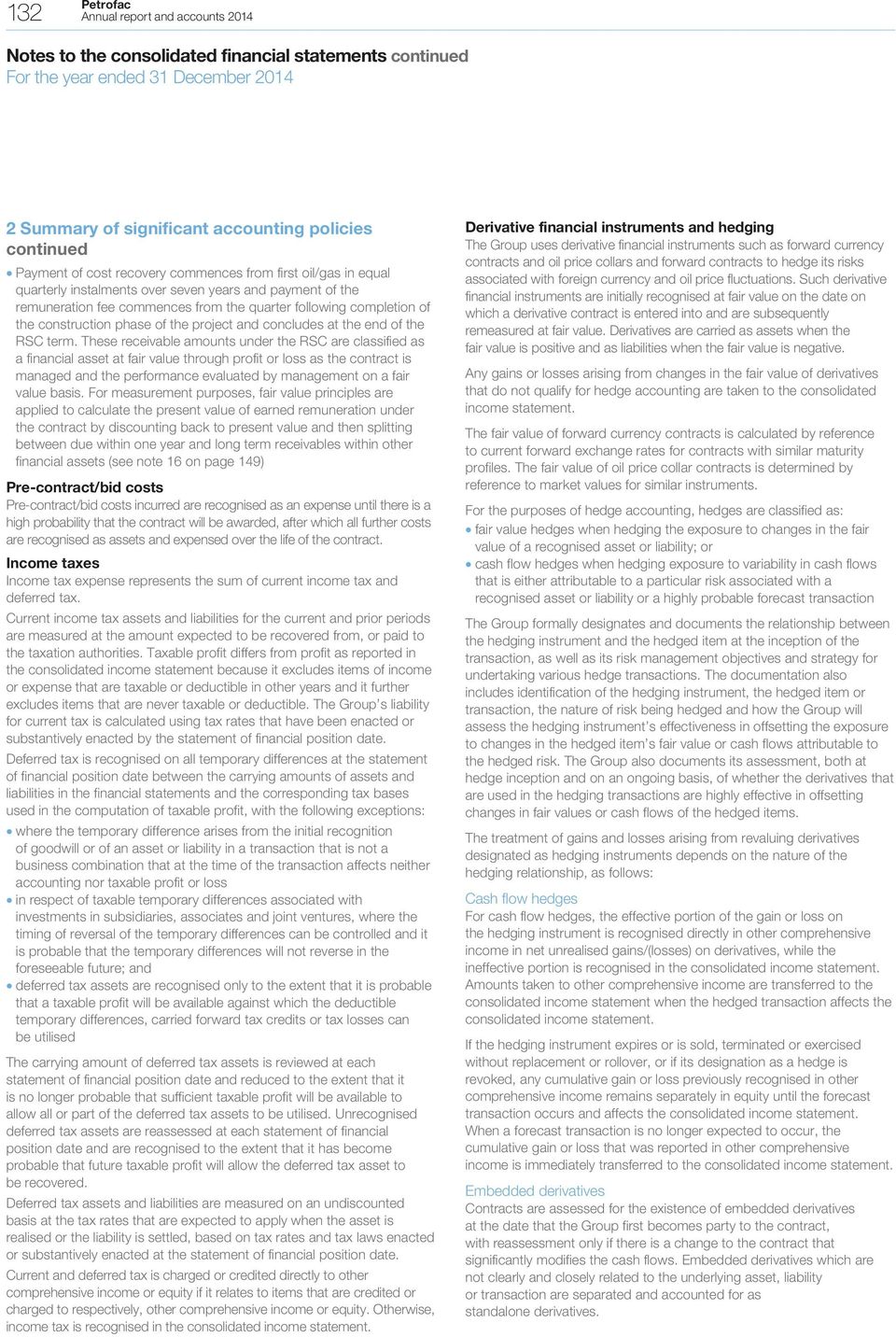
10 133 Annual report and accounts Strategic report Governance Financial statements 3 Segment information The Group delivers its services through the four reporting segments set out below: Onshore Engineering & Construction which provides engineering, procurement and construction project execution services to the onshore oil and gas industry Offshore Projects & Operations which provides offshore engineering, operations and maintenance onshore and offshore and engineering, procurement and construction project execution services to the offshore oil and gas industry Engineering & Consulting Services which provides technical engineering, consultancy, conceptual design, front end engineering and design (FEED) and project management consultancy (PMC) across all sectors including renewables Integrated Energy Services which co-invests with partners in oil and gas production, processing and transportation assets, provides production improvement services under value aligned commercial structures and oil and gas related technical competency training and consultancy services Management separately monitors the trading results of its four reporting segments for the purpose of making an assessment of their performance and for making decisions about how resources are allocated. From 1 January, internal management reporting was changed such that interest costs and income arising from borrowings and cash balances which are not directly attributable to individual operating segments are allocated to Corporate rather than allocated to individual segments. The presentation of profitability for each segment in the 31 December consolidated financial statements reflects this treatment and the 31 December comparative period has been restated accordingly. In addition, as in prior periods certain shareholder services related overheads, intra-group financing and consolidation adjustments are managed at a corporate level and are not allocated to reporting segments. The presentation of the Group results below also separately identifies the effect of asset impairments, provision for onerous contract and remeasurements. Results excluding these non-recurring items are used by management and presented in order to provide readers with a clear and consistent presentation of the underlying operating performance of the business. The following tables represent revenue and profit information relating to the Group s reporting segments for the year ended 31 December. Year ended 31 December Revenue Onshore Engineering & Construction Offshore Projects & Operations Engineering & Consulting Services Integrated Energy Services Corporate & others Consolidation adjustments & eliminations Business performance Integrated Energy Services exceptional items and certain re-measurements External sales 3,207 2, (10) 6,241 6,241 Inter-segment sales (218) Total revenue 3,241 2, (228) 6,241 6,241 Total Segment results (4) (463) 232 Unallocated corporate costs (11) (11) (11) Profit/(loss) before tax and finance income/(costs) (15) (463) 221 Share of profits of associates/joint ventures Finance costs (25) (54) (79) (79) Finance income Profit/(loss) before income tax (67) (463) 171 Income tax (expense)/credit 28 (25) (6) (36) 6 (33) 2 (31) Non-controlling interests (20) (20) (20) Profit/(loss) for the year attributable to Limited shareholders (61) (461) Negative elimination of external sales shown above of US$10m represents a Group adjustment to the overall project percentage of completion on the Laggan-Tormore project as OEC and OPO are reflecting in their segments progress on their own respective shares of the total project scope. 2 Represents release of previously eliminated margin relating to West Desaru and Berantai vessel on disposal of subsidiary.
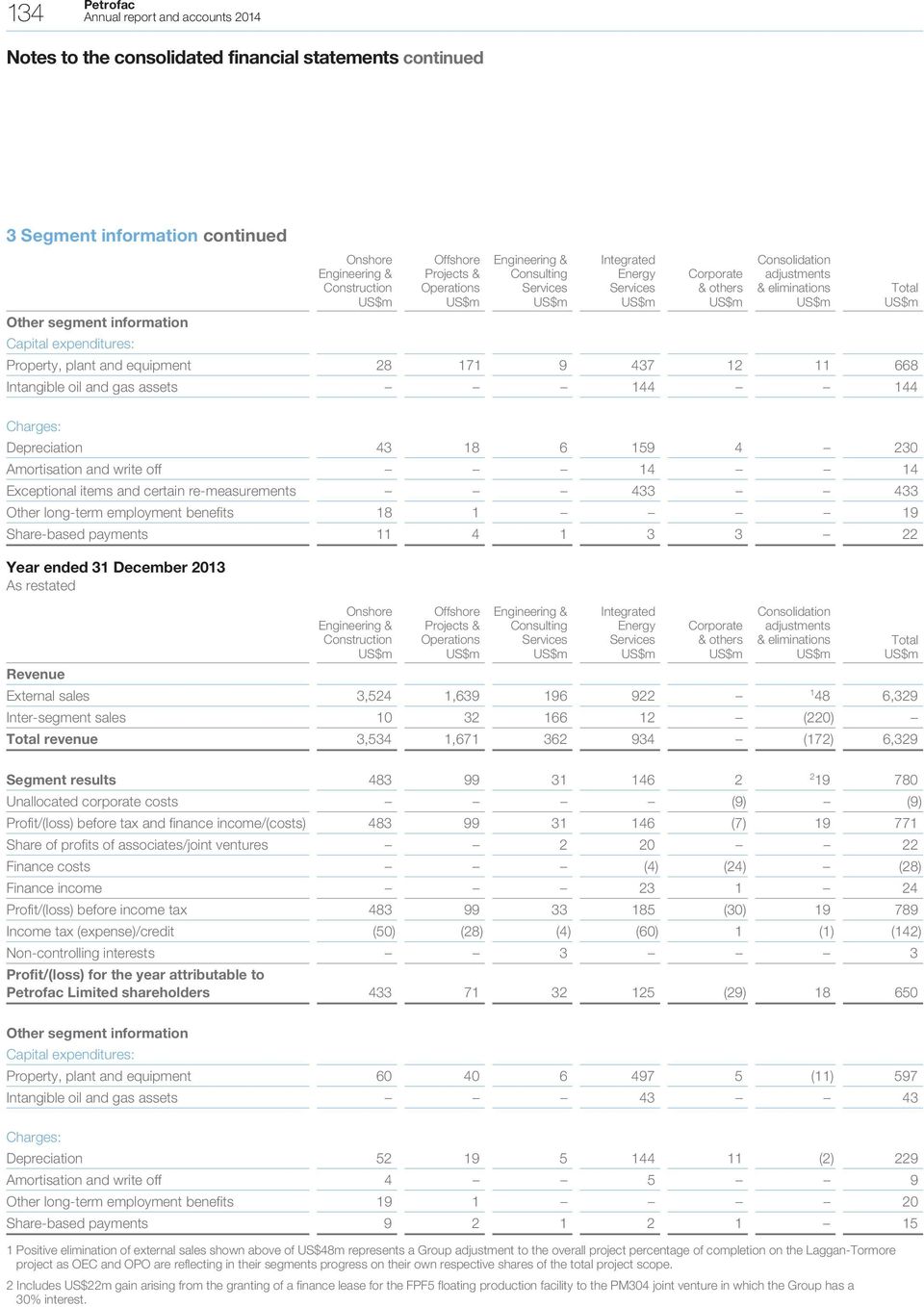
11 134 Annual report and accounts Notes to the consolidated financial statements continued 3 Segment information continued Onshore Engineering & Construction Offshore Projects & Operations Engineering & Consulting Services Integrated Energy Services Corporate & others Consolidation adjustments & eliminations Other segment information Capital expenditures: Property, plant and equipment Intangible oil and gas assets Total Charges: Depreciation Amortisation and write off Exceptional items and certain re-measurements Other long-term employment benefits Share-based payments Year ended 31 December As restated Onshore Engineering & Construction Offshore Projects & Operations Engineering & Consulting Services Integrated Energy Services Corporate & others Consolidation adjustments & eliminations Revenue External sales 3,524 1, ,329 Inter-segment sales (220) Total revenue 3,534 1, (172) 6,329 Total Segment results Unallocated corporate costs (9) (9) Profit/(loss) before tax and finance income/(costs) (7) Share of profits of associates/joint ventures Finance costs (4) (24) (28) Finance income Profit/(loss) before income tax (30) Income tax (expense)/credit (50) (28) (4) (60) 1 (1) (142) Non-controlling interests 3 3 Profit/(loss) for the year attributable to Limited shareholders (29) Other segment information Capital expenditures: Property, plant and equipment (11) 597 Intangible oil and gas assets Charges: Depreciation (2) 229 Amortisation and write off Other long-term employment benefits Share-based payments Positive elimination of external sales shown above of US$48m represents a Group adjustment to the overall project percentage of completion on the Laggan-Tormore project as OEC and OPO are reflecting in their segments progress on their own respective shares of the total project scope. 2 Includes US$22m gain arising from the granting of a finance lease for the FPF5 floating production facility to the PM304 joint venture in which the Group has a 30% interest.
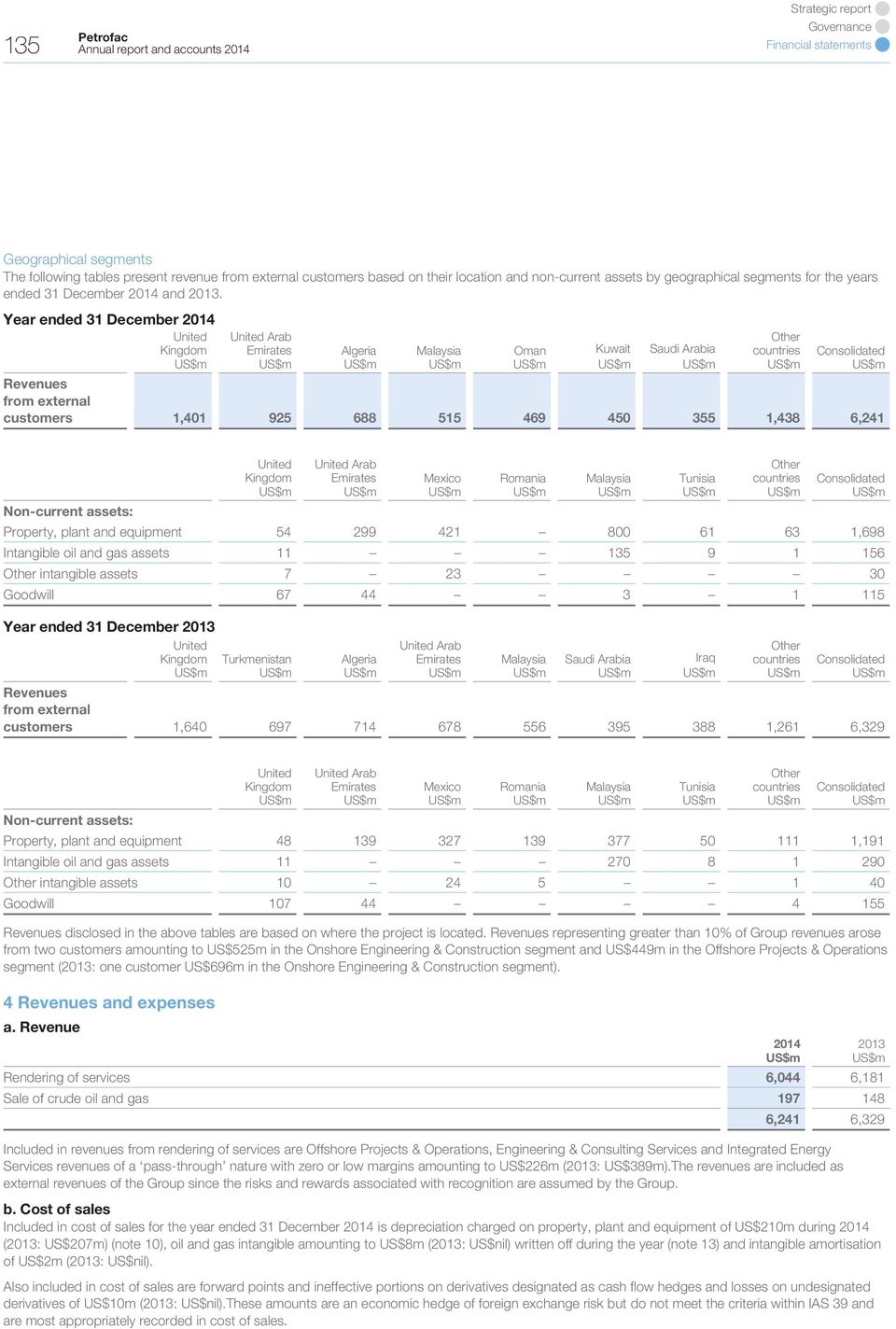
12 135 Annual report and accounts Strategic report Governance Financial statements Geographical segments The following tables present revenue from external customers based on their location and non-current assets by geographical segments for the years ended 31 December and. Year ended 31 December United Kingdom United Arab Emirates Algeria Malaysia Oman Kuwait Saudi Arabia Other countries Consolidated Revenues from external customers 1, ,438 6,241 United Kingdom United Arab Emirates Mexico Romania Malaysia Tunisia Other countries Consolidated Non-current assets: Property, plant and equipment ,698 Intangible oil and gas assets Other intangible assets Goodwill Year ended 31 December United Kingdom Turkmenistan Algeria United Arab Emirates Malaysia Saudi Arabia Iraq Other countries Consolidated Revenues from external customers 1, ,261 6,329 United Kingdom United Arab Emirates Mexico Romania Malaysia Tunisia Other countries Consolidated Non-current assets: Property, plant and equipment ,191 Intangible oil and gas assets Other intangible assets Goodwill Revenues disclosed in the above tables are based on where the project is located. Revenues representing greater than 10% of Group revenues arose from two customers amounting to US$525m in the Onshore Engineering & Construction segment and US$449m in the Offshore Projects & Operations segment (: one customer US$696m in the Onshore Engineering & Construction segment). 4 Revenues and expenses a. Revenue Rendering of services 6,044 6,181 Sale of crude oil and gas ,241 6,329 Included in revenues from rendering of services are Offshore Projects & Operations, Engineering & Consulting Services and Integrated Energy Services revenues of a pass-through nature with zero or low margins amounting to US$226m (: US$389m).The revenues are included as external revenues of the Group since the risks and rewards associated with recognition are assumed by the Group. b. Cost of sales Included in cost of sales for the year ended 31 December is depreciation charged on property, plant and equipment of US$210m during (: US$207m) (note 10), oil and gas intangible amounting to US$8m (: US$nil) written off during the year (note 13) and intangible amortisation of US$2m (: US$nil). Also included in cost of sales are forward points and ineffective portions on derivatives designated as cash flow hedges and losses on undesignated derivatives of US$10m (: US$nil).These amounts are an economic hedge of foreign exchange risk but do not meet the criteria within IAS 39 and are most appropriately recorded in cost of sales.
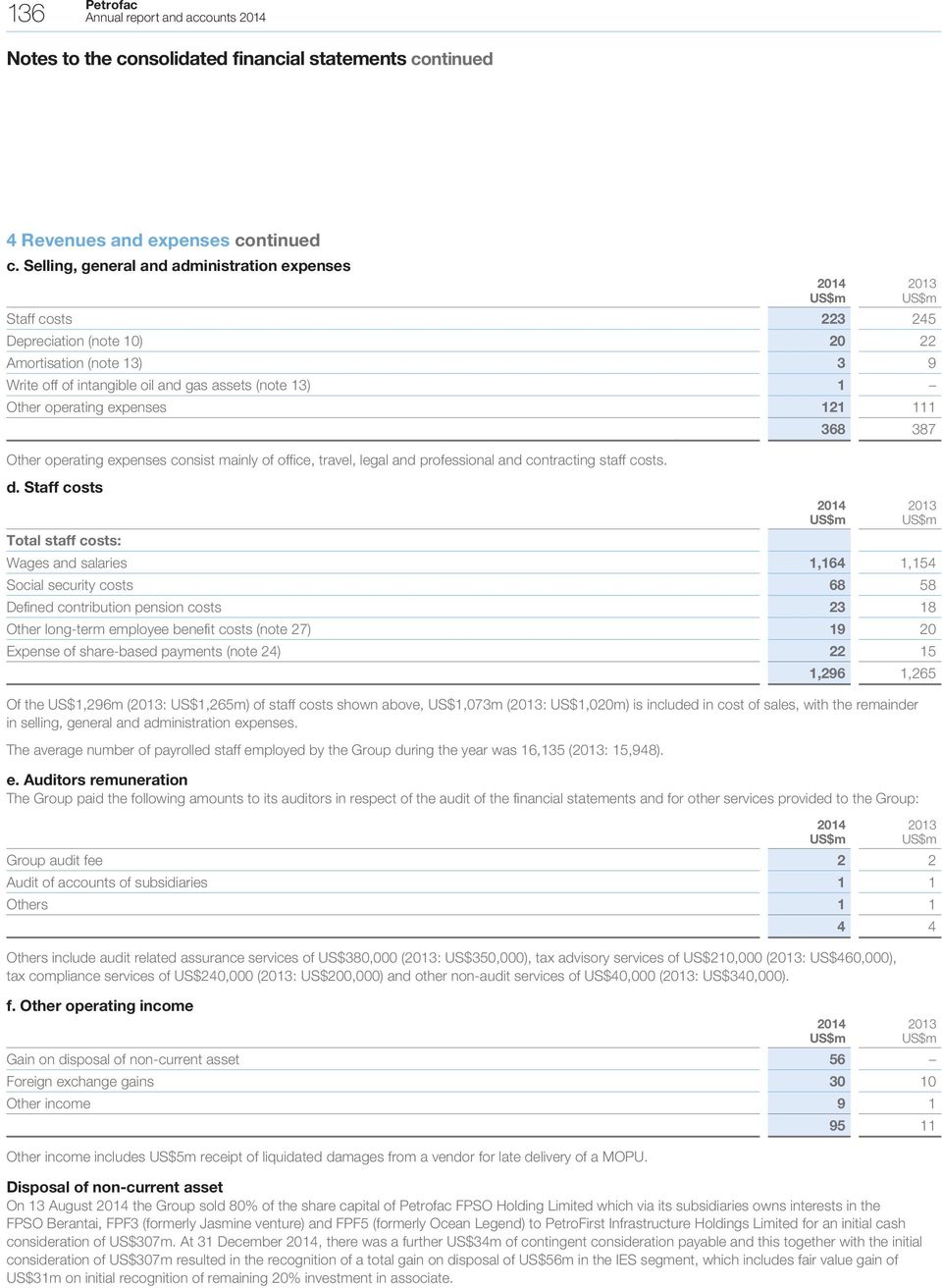
13 136 Annual report and accounts Notes to the consolidated financial statements continued 4 Revenues and expenses continued c. Selling, general and administration expenses Staff costs Depreciation (note 10) Amortisation (note 13) 3 9 Write off of intangible oil and gas assets (note 13) 1 Other operating expenses Other operating expenses consist mainly of office, travel, legal and professional and contracting staff costs. d. Staff costs Total staff costs: Wages and salaries 1,164 1,154 Social security costs Defined contribution pension costs Other long-term employee benefit costs (note 27) Expense of share-based payments (note 24) ,296 1,265 Of the US$1,296m (: US$1,265m) of staff costs shown above, US$1,073m (: US$1,020m) is included in cost of sales, with the remainder in selling, general and administration expenses. The average number of payrolled staff employed by the Group during the year was 16,135 (: 15,948). e. Auditors remuneration The Group paid the following amounts to its auditors in respect of the audit of the financial statements and for other services provided to the Group: Group audit fee 2 2 Audit of accounts of subsidiaries 1 1 Others Others include audit related assurance services of US$380,000 (: US$350,000), tax advisory services of US$210,000 (: US$460,000), tax compliance services of US$240,000 (: US$200,000) and other non-audit services of US$40,000 (: US$340,000). f. Other operating income Gain on disposal of non-current asset 56 Foreign exchange gains Other income Other income includes US$5m receipt of liquidated damages from a vendor for late delivery of a MOPU. Disposal of non-current asset On 13 August the Group sold 80% of the share capital of FPSO Holding Limited which via its subsidiaries owns interests in the FPSO Berantai, FPF3 (formerly Jasmine venture) and FPF5 (formerly Ocean Legend) to PetroFirst Infrastructure Holdings Limited for an initial cash consideration of US$307m. At 31 December, there was a further US$34m of contingent consideration payable and this together with the initial consideration of US$307m resulted in the recognition of a total gain on disposal of US$56m in the IES segment, which includes fair value gain of US$31m on initial recognition of remaining 20% investment in associate.
14 137 Annual report and accounts Strategic report Governance Financial statements The gain on disposal has been computed as follows: Fair value of consideration for 80% of the equity received in cash 87 Proceeds from repayments of loans due from FPSO Holding Limited 220 Fair value of contingent consideration for 80% of the equity receivable at reporting date 34 Total consideration Property, plant and equipment (31) Cash (48) Finance lease receivables (336) Trade and other receivables (16) Debt acquisition costs (3) Total book value of assets disposed (434) Berantai RSC project financing debt transferred (note 26) 128 Trade and other payables 25 Total book value of liabilities disposed 153 Due to/due from related parties arising on disposal Due from related parties 23 Due to related parties (40) (17) Allocated goodwill written off (note 12) Transaction costs Fair value gain on initial recognition of remaining 20% investment in associate 31 Gain on disposal 56 g. Other operating expenses Foreign exchange losses Loss on fair value changes in Seven Energy warrants (note 15) 1 Other expenses 3 1 (15) (3) 42 17
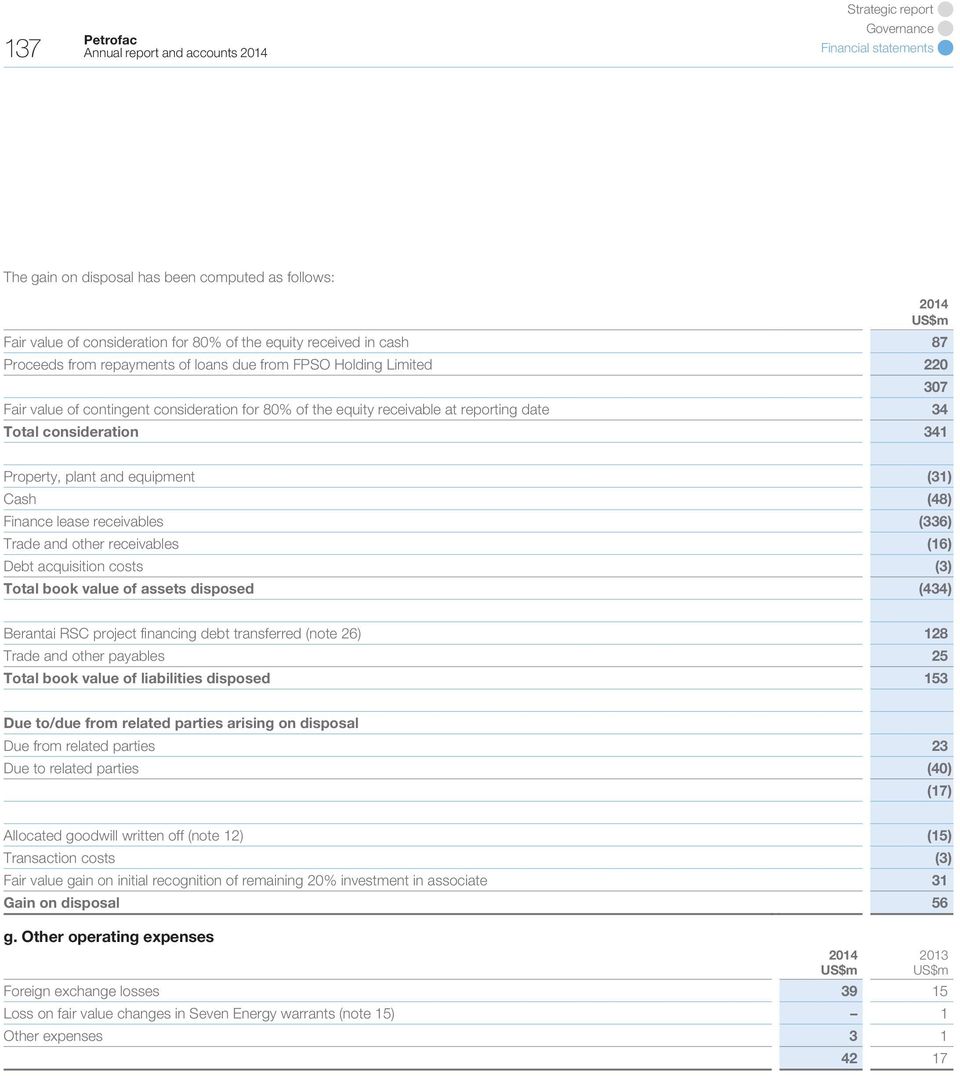
15 138 Annual report and accounts Notes to the consolidated financial statements continued 5 Exceptional items and certain re-measurements Impairment of assets including goodwill (172) Fair value re-measurements (261) (433) Provision for onerous contract (30) Total exceptional items and certain re-measurements (463) Tax relief 2 Income statement charge for the year (461) As a result of significantly lower commodity price expectations, cost overruns on the conversion of the FPF1 vessel and the latest view of the timing of first production, the Group reviewed the carrying value of its loan receivable from Ithaca Energy in respect of the Greater Stella Area in the UK. The review was carried out on a fair value basis using risk adjusted cash flow projections discounted at a post-tax rate of 9.0%. This resulted in a pre-tax reduction in fair value of the Greater Stella Area receivable of US$207m (post-tax US$207m) in the IES segment. Following the review of the Ticleni Production Enhancement Contract in Romania the Group has taken the decision to exit the contract and consequently has fully impaired the carrying value of the property, plant and equipment relating to the contract of US$130m and other intangible assets of US$4m. This resulted in a pre-tax impairment charge of US$134m (post-tax US$137m) and the Group has also provided for expenses relating to termination of this contract of US$30m in the IES segment. The Group has also reviewed the carrying value of the other assets, including goodwill in the IES portfolio in light of lower commodity price expectations. As a result of this review further impairment charges of US$20m (post-tax US$25m) have been recognised in the IES segment in respect of the FPSO Opportunity and OML119 in Nigeria and US$18m of IES goodwill has been written off. Pre-tax fair value re-measurements of US$54m (post-tax US$44m) have been recognised on the Berantai RSC in Malaysia and the warrants the Group holds over shares in Seven Energy International Limited. For impairment of property, plant and equipment and intangible oil and gas assets, fair value less costs of disposal are determined by discounting the post-tax cash flows expected to be generated from oil and gas production net of selling costs taking into account assumptions that market participants would typically use in estimating fair values. These estimates are categorised within Level 3 of the fair value hierarchy. Post-tax cash flows are derived from projected production profiles for each asset taking into account forward market commodity prices over the relevant period and where external forward prices are not available the Group s Board approved five year business planning assumptions are used. As each field has different reservoir characteristics and contractual terms the post-tax cash flows for each asset are calculated using individual economic models which include assumptions around the amount of recoverable reserves, production costs, life of the field/licence period and the selling price of the commodities produced. Refer to note 32 for fair value disclosures in respect of assets carried at fair value.
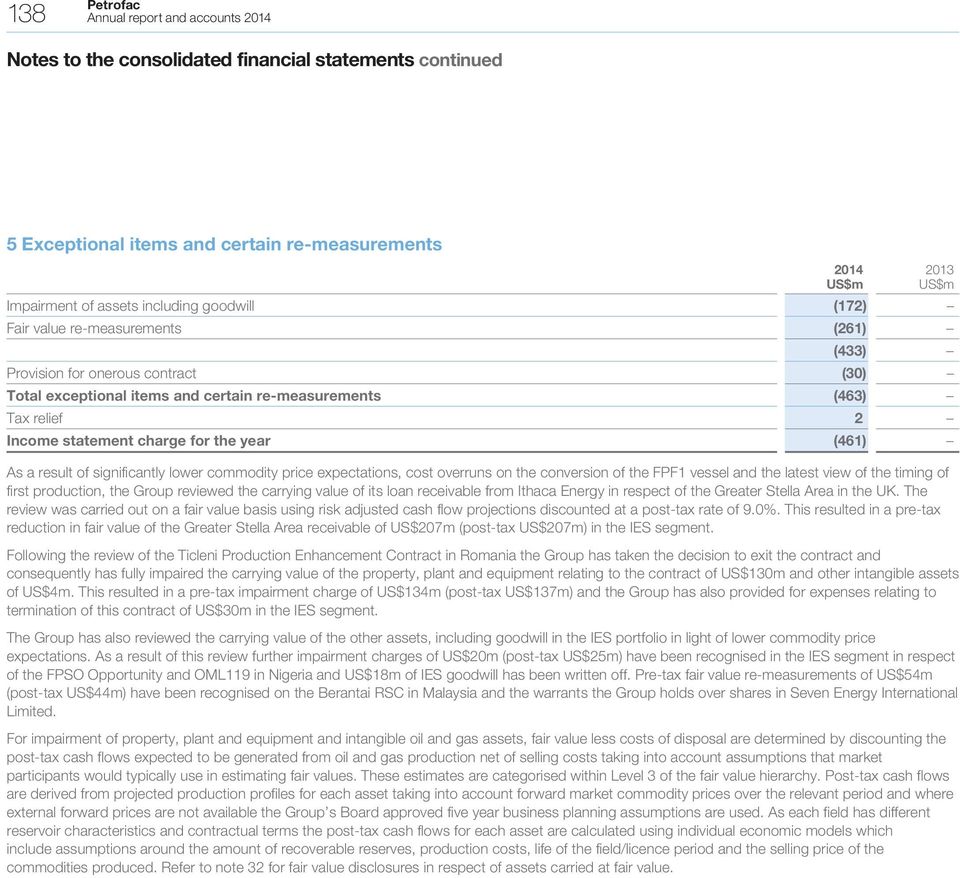
16 139 Annual report and accounts Strategic report Governance Financial statements 6 Finance (costs)/income Finance costs Long-term borrowings Finance leases Short-term loans and overdrafts Unwinding of discount on provisions (note 27) Total finance costs Finance income (54) (23) (19) (1) (6) (4) (79) (28) Bank interest 2 1 Unwinding of discount on long-term receivables from customers (note 16) Total finance income Income tax a. Tax on ordinary activities The major components of income tax expense are as follows: Current income tax Business performance Exceptional items and certain re-measurements Current income tax charge Adjustments in respect of current income tax of previous years (89) (89) (29) Deferred tax Relating to origination and reversal of temporary differences 16 (7) 9 2 Recognition of tax losses relating to prior periods (2) 5 3 (1) Income tax expense/(credit) reported in the income statement 33 (2) Income tax reported in equity Deferred tax related to items charged directly to equity Current income tax related to share schemes (1) (1) Income tax income reported in equity The split of the Group s tax charge between current and deferred tax varies from year to year depending largely on: the variance between tax provided on the percentage of completion of projects versus that paid on accrued income for engineering, procurement and construction contracts; and the tax deductions available for expenditure on Risk Service Contracts and Production Enhancement Contracts (PECs), which are partially offset by the creation of losses. See 7c below for the impact on the movements in the year. Total
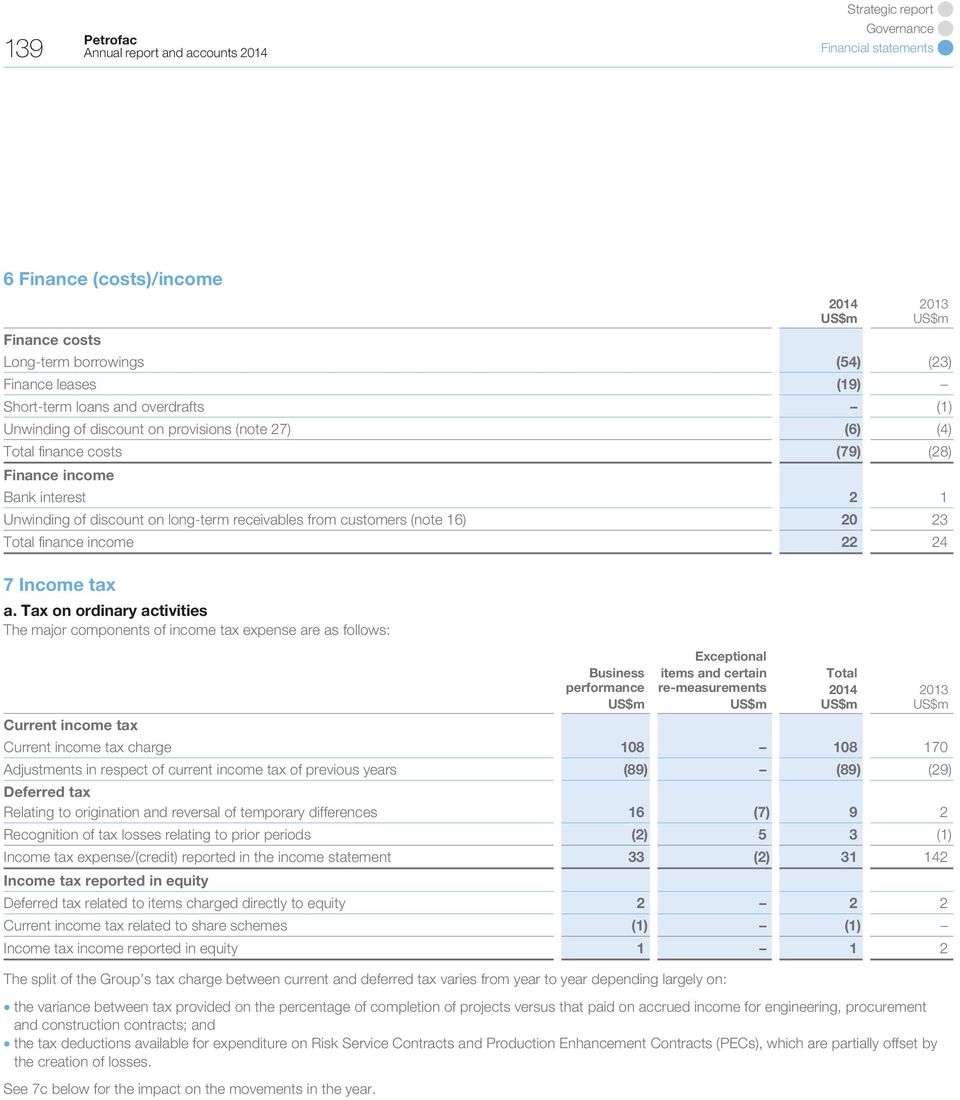
17 140 Annual report and accounts Notes to the consolidated financial statements continued 7 Income tax continued b. Reconciliation of total tax charge A reconciliation between the income tax expense and the product of accounting profit multiplied by the Company s domestic tax rate is as follows: Business performance Exceptional items and certain re-measurements Accounting profit before tax 634 (463) At Jersey s domestic income tax rate of 0% (: 0%) Expected tax charge in higher rate jurisdictions 69 (38) Expenditure not allowable for income tax purposes Adjustments in respect of previous years (90) 1 (89) (28) Adjustments in respect of losses not previously recognised/derecognised (4) 2 (2) (8) Unrecognised tax losses Other permanent differences Effect of change in tax rates 1 At the effective income tax rate of 18.4% (: 18.0%) 33 (2) The Group's effective tax rate for the year ended 31 December is 18.4% (: 18.0%). The Group s effective tax rate, excluding the impact of exceptional items and certain re-measurements, for the year ended 31 December is 5.2% (: 18.0%). A number of factors have impacted the effective tax rate, excluding the impact of exceptional items and certain re-measurements, this year, principally being the net release of tax provisions held in respect of income taxes which is partially offset by the impact of tax losses created in the year for which the realisation against future taxable profits is not probable. In line with prior years, the effective tax rate is also driven by the mix of profits in the jurisdictions in which profits are earned. The adjustments in respect of prior periods include the utilisation of tax losses which were previously unrecognised, in addition to the tax provision release mentioned above. From 1 April 2015, the main UK corporation tax rate will be 20%. The change in the UK rate to 20% was substantively enacted prior to 1 Jan and the impact of the change included within the prior year charge. There is therefore no impact of the change on the current year charge. From 1 January 2016 the main Malaysian rate of corporation tax will reduce by 1% to 24%. This change was substantively enacted prior to the reporting date and therefore the impact of the change on the current year tax charge has been included above. c. Deferred tax Deferred tax relates to the following: Consolidated statement of financial position Total Consolidated income statement Deferred tax liabilities Fair value adjustment on acquisitions 2 3 (1) Accelerated depreciation Profit recognition (68) Other temporary differences Gross deferred tax liabilities Deferred tax assets Losses available for offset (15) 3 Decelerated depreciation for tax purposes 3 2 (1) 1 Share scheme Profit recognition Other temporary differences (33) (26) Gross deferred tax assets Net deferred tax liability/deferred tax charge Of which Deferred tax assets Deferred tax liabilities

18 141 Annual report and accounts Strategic report Governance Financial statements d. Unrecognised tax losses and tax credits Deferred income tax assets are recognised for tax loss carry forwards and tax credits to the extent that the realisation of the related tax benefit through offset against future taxable profits is probable. The Group did not recognise deferred income tax assets of US$231m (: US$29m). Expiration dates for tax losses No earlier than No earlier than 2024 No expiration date Tax credits (no expiration date) During, the Group recognised a tax benefit from the utilisation of tax losses US$1m (: US$2m), recognised losses not previously recognised of US$4m (: US$7m) and derecognised tax losses from a prior period of US$2m (: US$ nil). 8 Earnings per share Basic earnings per share amounts are calculated by dividing the profit for the year attributable to ordinary shareholders by the weighted average number of ordinary shares outstanding during the year. Diluted earnings per share amounts are calculated by dividing the profit attributable to ordinary shareholders, after adjusting for any dilutive effect, by the weighted average number of ordinary shares outstanding during the year, adjusted for the effects of ordinary shares granted under the employee share award schemes which are held in trust. The following reflects the income and share data used in calculating basic and diluted earnings per share: Profit attributable to ordinary shareholders for basic and diluted earnings per share excluding exceptional items and certain re-measurements Profit attributable to ordinary shareholders for basic and diluted earnings per share including exceptional items and certain re-measurements m m Weighted average number of ordinary shares for basic earnings per share Effect of dilutive potential ordinary shares granted under share-based payment schemes 3 3 Adjusted weighted average number of ordinary shares for diluted earnings per share Dividends paid and proposed Declared and paid during the year Equity dividends on ordinary shares: Final dividend for 2012: cents per share Interim dividend : cents per share Final dividend for : cents per share 149 Interim dividend : cents per share Proposed for approval at AGM (not recognised as a liability as at 31 December) Equity dividends on ordinary shares Final dividend for : cents per share (: cents per share)

19 142 Annual report and accounts Notes to the consolidated financial statements continued 10 Property, plant and equipment Oil and gas assets Oil and gas facilities Land, buildings and leasehold improvements Plant and equipment Vehicles Office furniture and equipment Assets under construction Cost At 1 January ,339 Additions Acquisition of subsidiaries Disposals (110) (1) (1) (1) (4) (117) Transfer from intangible oil and gas assets (note 13) Transfers (71) Exchange difference At 1 January ,884 Additions Disposals (48) (7) (1) (9) (65) Transfer from intangible oil and gas assets (note 13) Transfers (14) (7) Exchange difference (13) (3) (1) (6) (23) At 31 December 1, ,728 Total Depreciation At 1 January (98) (141) (84) (9) (16) (94) (442) Charge for the year (102) (34) (53) (6) (4) (30) (229) Acquisition of subsidiaries (18) (3) (4) (25) Disposals Transfers (7) 7 Exchange difference (1) (1) (2) At 1 January (200) (175) (162) (18) (19) (119) (693) Charge for the year (116) (24) (52) (12) (3) (23) (230) Charge for impairment (note 5) (99) (15) (2) (29) (145) Disposals Transfers (5) 5 Exchange difference At 31 December (415) (197) (211) (31) (21) (126) (29) (1,030) Net carrying amount: At 31 December ,698 At 31 December ,191 Additions to oil and gas assets mainly comprise Santuario, Magallanes and Arenque PECs of US$160m, and Pánuco PEC of US$12m (: Field development costs relating to block PM304 in Malaysia of US$46m, Santuario and Magallanes PECs of US$211m, Ticleni PECs of US$54m, Pánuco PECs of US$22m and capitalised decommissioning costs provided on the PM304 block in Malaysia of US$13m, Santuario, Magallanes and Arenque PECs of US$77m and Pánuco PECs of US$10m). Additions to oil and gas facilities in mainly comprise an FPSO acquired under a finance lease for block PM304 in Malaysia of US$184m, the upgrade of the FPSO Opportunity at a cost of US$5m and upgrade work on Berantai vessel of US$10m. Transfer from intangible oil and gas assets of US$264m mainly comprises field development costs on block PM304 in Malaysia of US$236m (: US$21m) and Ticleni PEC costs of US$28m. Of the total charge for depreciation in the income statement, US$210m (: US$207m) is included in cost of sales and US$20m (: US$22m) in selling, general and administration expenses. Assets under construction represent expenditures incurred in relation to construction of the new JSD6000 installation vessel.

20 143 Annual report and accounts Strategic report Governance Financial statements Included in oil and gas facilities, land, buildings and leasehold improvements and plant and equipment is property, plant and equipment under finance lease agreements, for which book values are as follows: Net book value Gross book value Finance leased assets arising on disposal of subsidiary (note 4f) 215 Additions Depreciation Exchange difference (30) (24) (1) At 31 December Additions to finance leased assets mainly comprise an FPSO acquired under a finance lease for block PM304 in Malaysia of US$184m. 11 Material partly-owned subsidiaries Emirates LLC is the only material partly-owned subsidiary in the Group and the proportion of the nominal value of issued shares controlled by the Group is disclosed in note 33. Movement of non-controlling interest in Emirates LLC At 1 January 5 Non-controlling interest arising on a business combination 5 Profit for the year 20 Net unrealised (gains)/losses on derivatives (note 25) (13) At 31 December 12 5 The balance of non-controlling interests relate to other partly-owned subsidiaries that are not material to the Group. Financial information of Emirates LLC that has material non-controlling interests is provided below: Summarised income statement Revenue Cost of sales (715) (537) Gross profit Selling, general and administration expenses Finance income (54) (24) 2 Profit for the year 79 Attributable to non-controlling interest 20 Summarised statement of financial position Current assets Non-current assets Total assets Current liabilities Non-current liabilities 10 3 Total liabilities Total equity Attributable to: Limited shareholders Non-controlling interests 12 5 Summarised cash flow information Operating 133 (32) Investing (38) 32 Financing (16) No dividends were paid to non-controlling interests during and.

21 144 Annual report and accounts Notes to the consolidated financial statements continued 12 Goodwill A summary of the movements in goodwill is presented below: At 1 January Acquisitions during the year 32 Re-assessment of contingent consideration payable (4) Impairment (note 5) (18) Goodwill written off on disposal of subsidiary (note 4f) (15) Exchange difference (7) 2 At 31 December Goodwill written off on disposal of subsidiary relates to the sale of 80% of the share capital of FPSO Holding Limited to PetroFirst Infrastructure Holdings Limited (note 4f). Goodwill of US$18m relating to Integrated Energy Services cash-generating unit was impaired during the year (note 5). Re-assessment of contingent consideration payable in comprised a decrease in contingent consideration payable on Caltec Limited of US$4m. Goodwill acquired through business combinations has been allocated to four groups of cash-generating units, for impairment testing as follows: Onshore Engineering & Construction Offshore Projects & Operations Engineering & Consulting Services Integrated Energy Services These represent the lowest level within the Group at which the goodwill is monitored for internal management purposes. The Group considers cash-generating units to be individually significant where they represent greater than 25% of the total goodwill balance. Onshore Engineering & Construction, Offshore Projects & Operations, Engineering & Consulting Services and Integrated Energy Services cash-generating units Recoverable amounts have been determined based on value in use calculations, using discounted pre-tax cash flow projections. Management have adopted projection periods appropriate to each unit s value in use. For Onshore Engineering & Construction, Offshore Projects & Operations and Engineering & Consulting Services cash-generating units the cash flow projections are based on financial budgets approved by senior management covering a five-year period, extrapolated at a growth rate of 2.5% per annum. For the Integrated Energy Services business the cash flows are based on economic models over the length of the contracted period for Production Enhancement Contracts, Equity upstream investments and Risk Service Contracts. For other operations included in Integrated Energy Services, cash flows are based on financial budgets approved by senior management covering a five-year period, extrapolated at a growth rate of 2.5% per annum. The carrying amount of goodwill for the Onshore Engineering & Construction, Offshore Projects & Operations and Engineering & Consulting Services cash-generating units is not individually significant in comparison with the total carrying amount of goodwill and therefore no analysis of sensitivities has been provided below. Carrying amount of goodwill allocated to each group of cash-generating units Onshore Engineering & Construction unit Offshore Projects & Operations unit Engineering & Consulting Services unit Integrated Energy Services unit Key assumptions used in value in use calculations for the Integrated Energy Services unit The following key assumptions were included in the value in use calculations used to estimate the recoverable amount of the Integrated Energy Services cash-generating unit. Where management has identified a reasonably possible change in any of these assumptions that would result in impairment, details have been provided below: Market share: for the Training business which is within Integrated Energy Services, the key assumptions relate to management s assessment of maintaining the unit s market share in the UK and developing further the business in international markets. Capital expenditure: the Production Enhancement Contracts in the Integrated Energy Services unit require a minimum level of capital spend on the projects in the initial years to meet contractual commitments. If the capital is not spent, a cash payment of the balance is required which does not qualify for cost recovery. The level of capital spend assumed in the value in use calculation is that expected over the period of the budget based on the current field development plans which assumes the minimum spend is met on each project and the contracts remain in force for the entire duration of the project. For other equity upstream investments, the level of capital spend assumed is based on sanctioned field development plans and represents the activities required to access commercial reserves. A 10% increase in capital expenditure, representing a total overspend of US$115m undiscounted, across the portfolio of Integrated Energy Services projects would result in an additional impairment charge equal to the carrying value of goodwill of US$34m.
22 145 Annual report and accounts Strategic report Governance Financial statements Reserve volumes and production profiles: management has used its internally developed economic models of reserves and production profiles as inputs in to the value in use for the Production Enhancement Contracts, Risk Service Contracts and Equity Upstream Investments. These economic models are revised annually as part of the preparation of the group s five year business plans which are approved by the Board. Management has used forward curve oil prices of US$61 per barrel for 2015 and US$69 per barrel for 2016 and long term planning prices of US$80 per barrel for 2017 and US$85 per barrel for 2018 and US$90 per barrel for 2019 and beyond (: US$100 per barrel for and beyond) to determine reserve volumes. A 10% decrease in forecast production across the portfolio of Integrated Energy Services projects would result in an additional impairment charge equal to the carrying value of goodwill of US$34m and a 10% reduction in the oil price would result in an additional impairment charge equal to the carrying value of goodwill of US$34m. Growth rate: estimates are based on management s assessment of market share having regard to macro-economic factors and the growth rates experienced in the recent past in the markets in which the unit operates. A growth rate of 2.5% per annum has been applied for businesses within the Integrated Energy Services cash-generating unit where the cash flows are not based on long term contractual arrangements. Discount rate: management has used a pre-tax discount rate of 11.6% per annum (: 10.4% per annum). The discount rate is derived from the estimated weighted average cost of capital (WACC) of the Group and has been calculated using an estimated risk free rate of return adjusted for the Group s estimated equity market risk premium. A 100 basis point increase in the pre-tax discount rate to 12.6% would result in an additional impairment charge equal to the carrying value of goodwill of US$34m. 13 Intangible assets Intangible oil and gas assets Cost: At 1 January Additions Assets related to increase in decommissioning provision (note 27) 47 Transfer to oil and gas assets (note 10) Impairments (note 5) Write off (note 4b and note 4c) (264) (21) (5) (9) Net book value of intangible oil and gas assets at 31 December Other intangible assets Cost: At 1 January Additions Impairments (note 5) Write off Exchange difference 10 (4) (4) (3) At 31 December Accumulated amortisation: At 1 January Amortisation (20) (15) (5) (5) Exchange difference 2 At 31 December (23) (20) Net book value of other intangible assets at 31 December Total intangible assets Intangible oil and gas assets Oil and gas assets (part of the Integrated Energy Services segment) additions and assets additions related to increase in decommissioning provision above comprise largely US$137m (: US$40m) capitalised expenditure on the Group s assets in Malaysia. There were investing cash outflows relating to capitalised intangible oil and gas assets of US$119m (: US$43m) in the current period arising from pre-development activities. Transfers within intangible oil and gas assets represent transfers to oil and gas assets relating to block PM304 in Malaysia of US$236m and Ticleni PECs of US$28m (note 10). The US$8m write off of intangible oil and gas assets is in respect of a dry well in Chergui and US$1m is in respect of Bowleven license costs written off. Other intangible assets Other intangible assets comprising project development expenditure, customer contracts, proprietary software and patent technology are being amortised over their estimated economic useful life on a straight-line basis and the related amortisation charges included in selling, general and administration expenses (note 4c). US$4m relating to LNG intellectual property was written off during.
23 146 Annual report and accounts Notes to the consolidated financial statements continued 14 Investments in associates/joint ventures Associates Joint ventures As at 1 January Loan made to FPF1 Limited 4 4 Share of profits Transferred to investment in subsidiary (11) (11) Dividends received (10) (10) As at 31 December Loan made to FPF1 Limited Share of profits Fair valuation gain on initial recognition of investment in associate (note 4f) Transfer to available-for-sale investment (note 15) (185) (185) Dividends received (7) (3) (10) As at 31 December Dividends received include US$7m received from PetroFirst infrastructure Limited and US$3m received from TTE Limited (: US$2m received from TTE Limited and US$8m received from Emirates LLC). Fair value gain of US$31m represents the increase in fair value of the remaining 20% share in PetroFirst Infrastructure Limited post disposal of 80% of the share capital of FPSO Holding Limited (note 4f). Associates Associates acquired through acquisition of subsidiary 1 PetroFirst Infrastructure Limited 28 FPF1 Limited Investment in Seven Energy International Limited Seven Energy International Limited The share of the Seven Energy s statement of financial position is as follows: Non-current assets 1,140 Current assets 220 Non-current liabilities (284) Current liabilities (682) Equity 394 Group s share of net assets 87 Transaction costs incurred 2 Residual goodwill 95 Carrying value of investment 184 Share of associates revenues and net profit/(loss): Revenue 76 Net profit 17 Seven Energy investment in associate was transferred to available-for-sale investment during the year and therefore only comparative information is shown above (see note 15). At the time of transfer, on carrying out a fair valuation there was no gain/loss on derecognition of the investment in associate and recognition as an available-for-sale investment. Total
24 147 Annual report and accounts Strategic report Governance Financial statements Interest in other associates Summarised financial information of PetroFirst Infrastructure Limited and FPF1 Limited, based on their IFRS financial statements, and reconciliation with the carrying amount of the investment in consolidated financial statements are set out below: Revenue 28 Cost of sales Gross profit 28 Selling, general and administration expenses Finance (expense)/income, net (8) (6) Profit before income tax 14 Income tax Profit 14 Group s share of profit for the year 4 Current assets 40 2 Non-current assets Total assets Current liabilities 20 Non-current liabilities Total liabilities Net assets Group s share of net assets Carrying amount of the investment The associates had no contingent liabilities or capital commitments as at 31 December and.
25 148 Annual report and accounts Notes to the consolidated financial statements continued 14 Investments in associates/joint ventures continued Interest in joint ventures Summarised financial information of the joint ventures 1, based on their IFRS financial statements, and reconciliation with the carrying amount of the investment in consolidated financial statements are set out below: Revenue Cost of sales (26) (25) Gross profit 9 13 Selling, general and administration expenses (2) (2) Finance (expense)/income, net Profit before income tax 7 11 Income tax (1) (1) Profit 6 10 Group s share of profit for the year 3 5 Current assets Non-current assets 5 2 Total assets Current liabilities 11 2 Non-current liabilities 4 2 Total liabilities 15 4 Net assets Group s share of net assets 5 5 Carrying amount of the investment A list of these joint ventures is disclosed in note 33. The joint ventures had no contingent liabilities or capital commitments as at 31 December and. The joint ventures cannot distribute their profits until they obtain consent from the venturers. 15 Available-for-sale investment On 15 April, Seven Energy secured additional equity capital that resulted in dilution of the Company s interest in Seven Energy from 23.5% to 15.4%. Following the dilution of ownership interest, the Group does not exercise significant influence over the activities of Seven Energy and as a result has transferred the investment of US$185m from investment in associate to available-for-sale investment (note 14). The Group continues to have the option to subscribe for 148,571 of additional warrants in Seven Energy at a cost of a further US$52m, subject to the performance of certain service provision conditions and milestones in relation to project execution. However at 31 December the residual fair value of these warrants was assessed as nil, resulting in an income statement charge for the year of US$11m (note 5).
26 149 Annual report and accounts Strategic report Governance Financial statements 16 Other financial assets and other financial liabilities Other financial assets Non-current Classification Receivable under the Berantai RSC Fair value through profit and loss Receivable from joint venture partners Loans and receivables Forward currency contracts designated as hedges (note 32) Designated as cash flow hedges 50 5 Restricted cash Fair value through profit and loss 1 1 Current Receivable under the Berantai RSC Fair value through profit and loss Receivable in respect of the development of the Greater Stella Area Fair value through profit and loss Fair value change in respect of the Greater Stella Area receivable (note 5) Fair value through profit and loss (207) Receivable from joint venture partners Loans and receivables 150 Seven Energy warrants (note 15) Fair value through profit and loss 11 Forward currency contracts designated as hedges (note 32) Designated as cash flow hedges Oil derivative (note 32) Designated as cash flow hedges 20 Restricted cash Fair value through profit and loss 8 4 Other financial liabilities Non-current Contingent consideration payable Fair value through profit and loss 1 Interest rate swaps (note 32) Fair value through profit and loss 1 Finance lease creditors (note 29) Loans and borrowings 738 Forward currency contracts designated as hedges (note 32) Designated as cash flow hedges 18 Current Contingent consideration payable Fair value through profit and loss 1 1 Forward currency contracts designated as hedges (note 32) Designated as cash flow hedges 74 2 Forward currency contracts undesignated (note 32) Fair value through profit and loss 11 Oil derivative (note 32) Designated as cash flow hedges 1 Finance lease creditors (note 29) Loans and borrowings Interest rate swaps (note 32) Fair value through profit and loss 1 Interest payable Fair value through profit and loss The long-term and short-term receivables under the Berantai RSC represent the discounted value of amounts due under the contract which are being recovered over a six year period from in line with the contractual terms of the project. The short-term receivable in respect of the development of the Greater Stella Area represents a loan made to the consortium partners to fund s share of the development costs of the field. The short-term and long term receivable from joint venture partners represents the 70% gross up on finance leases in respect of oil and gas facilities relating to block PM304 in Malaysia that are included 100% in the Group s consolidated statement of financial position (Group s 30% share US$234m). Restricted cash comprises deposits with financial institutions securing various guarantees and performance bonds associated with the Group s trading activities (note 29).This cash will be released on the maturity of these guarantees and performance bonds.
27 150 Annual report and accounts Notes to the consolidated financial statements continued 17 Fair Value Measurement The following financial instruments are measured at fair value using the hierarchy below for determination and disclosure of their respective fair values: Level 1: Unadjusted quoted prices in active markets for identical financial assets or liabilities Level 2: Other valuation techniques where the inputs are based on significant observable factors Level 3: Other valuation techniques where the inputs are based on significant unobservable market data Year ended 31 December Date of valuation Level 2 Level 3 Financial assets Receivable under the Berantai RSC (note 32 pg 166) 31 December 381 Available-for-sale investment (note 32 pg 166) 31 December 185 Amounts receivable in respect of the development of the Greater Stella Area, net of fair value changes (note 32 pg 167) 31 December 192 Oil Derivative 31 December 20 Euro forward currency contracts designated as cash flow hedge 31 December 77 Assets for which fair values are disclosed (note 32): Cash and short-term deposits 31 December 986 Restricted cash 31 December 9 Financial liabilities Euro forward currency contracts designated as cash flow hedge 31 December 91 Sterling forward currency contracts designated as cash flow hedge 31 December 1 Liabilities for which fair values are disclosed (note 32): Interest-bearing loans and borrowings Senior notes 31 December 750 Term loan 31 December 500 Revolving credit facility 31 December 475 Bank overdrafts 31 December 9 Finance lease creditors 31 December 972 Contingent consideration 31 December 1 Year ended 31 December Date of valuation Financial assets Seven Energy warrants (note 15) 31 December 11 Receivable under the Berantai RSC (pg 166) 31 December 476 Amounts receivable in respect of the development of the Greater Stella Area 31 December 200 Euro forward currency contracts designated as cash flow hedge 31 December 24 Sterling forward currency contracts designated as cash flow hedge 31 December 4 Assets for which fair values are disclosed (note 32): Cash and short-term deposits 31 December 617 Restricted cash 31 December 5 Financial liabilities Euro forward currency contracts designated as cash flow hedge 31 December 2 Sterling forward currency contracts undesignated 31 December 11 Interest rate swaps 31 December 2 Oil derivative 31 December 1 Liabilities for which fair values are disclosed (note 32): Interest-bearing loans and borrowings Senior notes 31 December 750 Revolving credit facility 31 December 444 Project financing 31 December 138 Bank overdrafts 31 December 32 Finance lease creditors 31 December 15 Contingent consideration 31 December 2 Level 2 Level 3
28 151 Annual report and accounts Strategic report Governance Financial statements 18 Inventories Crude oil 3 4 Stores and spares Raw materials 1 Included in the consolidated income statement are costs of inventories expensed of US$73m (: US$43m). 19 Work in progress and billings in excess of cost and estimated earnings Cost and estimated earnings 15,892 14,244 Less: billings (14,290) (12,771) Work in progress 1,602 1,473 Billings 5,638 5,690 Less: cost and estimated earnings (5,373) (5,436) Billings in excess of cost and estimated earnings Total cost and estimated earnings 21,265 19,680 Total billings 19,928 18, Trade and other receivables Trade receivables 1,680 1,294 Retentions receivables Advances Prepayments and deposits Receivables from joint venture partners Other receivables ,783 2,360 Other receivables mainly consist of Value Added Tax recoverable of US$140m (: US$130m), US$34m receivable from PetroFirst Infrastructure Holdings Limited relating to disposal of 80% of the share capital of FPSO Holding Limited (note 4f). Trade receivables are non-interest bearing and are generally on 30 to 60 days terms. Trade receivables are reported net of provision for impairment. The movements in the provision for impairment against trade receivables totalling US$1,684m (: US$1,299m) are as follows: Specific impairment General impairment Total Specific impairment General impairment At 1 January Charge for the year Amounts written off (2) (2) At 31 December Total
29 152 Annual report and accounts Notes to the consolidated financial statements continued 20 Trade and other receivables continued At 31 December, the analysis of trade receivables is as follows: Neither past due nor impaired < 30 days days of days past due days days days Unimpaired 1, ,675 Impaired , ,684 Less: impairment provision (2) (2) (4) Net trade receivables 1, ,680 > 360 days Total Unimpaired ,277 Impaired ,299 Less: impairment provision (1) (1) (3) (5) Net trade receivables ,294 The credit quality of trade receivables that are neither past due nor impaired is assessed by management with reference to externally prepared customer credit reports and the historic payment track records of the counterparties. Advances represent payments made to certain of the Group s subcontractors for projects in progress, on which the related work had not been performed at the statement of financial position date. Receivables from joint venture partners are amounts recoverable from venture partners on the FPSO Berantai, Block PM304 and Emirates on an engineering, procurement and construction project. All trade and other receivables are expected to be settled in cash. Certain trade and other receivables will be settled in cash using currencies other than the reporting currency of the Group, and will be largely paid in sterling, euros and Kuwaiti dinars. 21 Cash and short-term deposits Cash at bank and in hand Short-term deposits Total cash and bank balances Short-term deposits are made for varying periods of between one day and three months depending on the immediate cash requirements of the Group, and earn interest at respective short-term deposit rates. The fair value of cash and bank balances is US$986m (: US$617m). For the purposes of the consolidated statement of cash flows, cash and cash equivalents comprise the following: Cash at bank and in hand Short-term deposits Bank overdrafts (note 26) (9) (32)
30 153 Annual report and accounts Strategic report Governance Financial statements 22 Share capital The share capital of the Company as at 31 December was as follows: Authorised 750,000,000 ordinary shares of US$0.020 each (: 750,000,000 ordinary shares of US$0.020 each) Issued and fully paid 345,912,747 ordinary shares of US$0.020 each (: 345,912,747 ordinary shares of US$0.020 each) 7 7 The movement in the number of issued and fully paid ordinary shares is as follows: Ordinary shares: Ordinary shares of US$ each at 1 January 345,891,490 Issued during the year as further contingent consideration payable for the acquisition of a subsidiary 21,257 Ordinary shares of US$0.020 each at 1 January 345,912,747 Ordinary shares of US$0.020 each at 31 December 345,912,747 The share capital comprises only one class of ordinary shares. The ordinary shares carry a voting right and the right to a dividend. Share premium: The balance on the share premium account represents the amount received in excess of the nominal value of the ordinary shares. Capital redemption reserve: The balance on the capital redemption reserve represents the aggregated nominal value of the ordinary shares repurchased and cancelled. 23 Treasury shares For the purpose of making awards under the Group s employee share schemes, shares in the Company are purchased and held by the Employee Benefit Trust and the Joint Venture Companies Employee Benefit Trust. All these shares have been classified in the statement of financial position as treasury shares within equity. The movements in total treasury shares are shown below: At 1 January 5,672, ,466, Acquired during the year 1,000, ,300, Vested during the year (1,686,754) (34) (2,093,522) (37) At 31 December 4,985, ,672, Shares vested during the year include dividend shares and 8% uplift adjustment made in respect of the EnQuest demerger of 102,514 shares (: 153,408 shares). 24 Share-based payment plans Performance Share Plan (PSP) Under the PSP, share awards are granted to Executive Directors and a restricted number of other senior executives of the Group. The shares vest at the end of three years subject to continued employment and the achievement of certain pre-defined market and non-market-based performance conditions. The 50% market performance based part of these awards is dependent on the total shareholder return (TSR) of the Group compared with an index composed of selected relevant companies. The fair value of the shares vesting under this portion of the award is determined by an independent valuer using a Monte Carlo simulation model taking into account the terms and conditions of the plan rules and using the following assumptions at the date of grant: awards 22 Mar awards 18 Apr awards 24 May awards Expected share price volatility (based on median of comparator Group s three-year volatilities) 32.7% 34.6% 34.7% 33.9% 38.0% 51.0% Share price correlation with comparator Group 40.4% 44.0% 44.3% 42.0% 46.0% 43.0% Risk-free interest rate 1.2% 0.4% 0.4% 0.5% 0.4% 1.7% Expected life of share award 3 years 3 years 3 years 3 years 3 years 3 years Fair value of TSR portion 827p 692p 492p 571p 1,103p 788p 2012 awards 2011 awards
31 154 Annual report and accounts Notes to the consolidated financial statements continued 24 Share-based payment plans continued The non-market-based condition governing the vesting of the remaining 50% of the total award is subject to achieving between 7.5% and 15% earnings per share (EPS) growth targets over a three-year period. The fair values of the equity-settled award relating to the EPS part of the scheme are estimated, based on the quoted closing market price per Company share at the date of grant with an assumed vesting rate per annum built into the calculation (subsequently trued up at year end based on the actual leaver rate during the period from award date to year end) over the three-year vesting period of the plan. Deferred Bonus Share Plan (DBSP) Under the DBSP selected employees are required to defer a proportion of their annual cash bonus into Company shares ( Invested Award ). Following such an award, the Company will generally grant the participant an additional award of a number of shares bearing a specified ratio to the number of his or her invested shares ( Matching Shares ), typically using a 1:1 ratio. Subject to a participant s continued employment, invested and matching share awards may either vest 100% on the third anniversary of grant; or alternatively, vest one-third on the first anniversary of the grant, one-third on the second anniversary and the final proportion on the third anniversary. At the year end the values of the bonuses settled by shares cannot be determined until the Remuneration Committee has approved the portion of the employee bonuses to be settled in shares. Once the portion of the bonus to be settled in shares is determined, the final bonus liability to be settled in shares is transferred to the reserve for share-based payments. The costs relating to the Matching Shares are recognised over the corresponding vesting period and the fair values of the equity-settled Matching Shares granted to employees are based on the quoted closing market price at the date of grant with the charge adjusted to reflect the expected vesting rate of the plan. Share Incentive Plan (SIP) All UK employees, including UK Executive Directors, are eligible to participate in the SIP. Employees may invest up to sterling 1,800 per tax year of gross salary (or, if lower, 10% of salary) to purchase ordinary shares in the Company. There is no holding period for these shares. Restricted Share Plan (RSP) Under the RSP, selected employees are made grants of shares on an ad hoc basis. The RSP is used primarily, but not exclusively, to make awards to individuals who join the Group part way through the year, having left accrued benefits with a previous employer. The fair values of the awards granted under the RSP at various grant dates during the year are based on the quoted market price at the date of grant adjusted for an assumed vesting rate over the relevant vesting period. Value Creation Plan (VCP) During 2012 the Company introduced a one-off Value Creation Plan (VCP) which is a share option scheme for Executive Directors and key senior executives within the Company. VCP is a premium priced share option scheme with options granted with an exercise price set at a 10% premium to the grant date price. Options will vest to the extent of satisfying Group and divisional profit after tax targets, together with various other performance underpins and risk/malus provisions that can be imposed at the discretion of the Remuneration Committee. The share options vest in equal tranches on the fourth, fifth and sixth anniversaries of the original grant date but may be exercised up to eight years from the date of grant. The VCP share options were fair valued by an independent valuer using a Black-Scholes option pricing model taking into account the rules of the plan and using the following key assumptions: Tranche 1 Tranche 2 Tranche 3 Share price at the date of grant 1,555p 1,555p 1,555p Exercise price 1,710p 1,710p 1,710p Expected lives of the award 6 years 6.5 years 7 years Share price volatility 41% 41% 41% Share price dividend yield 2.3% 2.3% 2.3% Risk-free interest rates 1.1% 1.2% 1.3% Per share fair values 451p 467p 482p Share-based payment plans information The details of the fair values and assumed vesting rates of the share-based payment plans are below: Fair value per share PSP (EPS portion) DBSP RSP 22 Mar 18 Apr 24 May Assumed vesting rate Fair value per share Assumed vesting rate Fair value per share Assumed vesting rate Fair value per share Assumed vesting rate Fair value per share Assumed vesting rate awards 1,376p 0.0% 1,376p 90.9% 1,157p 96.7% awards 1,446p 0.0% 1,266p 0.0% 1,340p 0.0% 1,446p 82.5% 1,366p 92.4% 2012 awards 1,705p 0.0% 1,705p 84.1% 1,555p 77.6% 2011 awards 1,426p 26.0% 1,426p 87.8% 1,463p 76.7%
32 155 Annual report and accounts Strategic report Governance Financial statements The following table shows the movements in the number of shares held under the share-based payment plans outstanding but not exercisable: PSP DBSP RSP VCP Total * * Outstanding at 1 January 1,315,870 1,232,186 3,708,306 3,120, , ,171 1,701,150 1,773,713 7,264,200 6,649,038 Granted during the year 406, ,221 2,226,630 1,948,702 82, ,722 2,716,051 2,652,645 Vested during the year (43,308) (368,005) (1,802,020) (1,097,127) (227,892) (123,133) (2,073,220) (1,588,265) Forfeited during the year (539,461) (47,532) (310,720) (264,237) (36,210) (64,886) (346,322) (72,563) (1,232,713) (449,218) Outstanding at 31 December 1,139,931 1,315,870 3,822,196 3,708, , ,874 1,354,828 1,701,150 6,674,318 7,264,200 *Includes Invested and Matching Shares The number of shares still outstanding but not exercisable at 31 December, for each award is as follows: PSP DBSP RSP VCP Total * * awards 401,931 2,034,728 82,591 2,519,250 awards 413, ,879 1,191,476 1,794, , ,635 1,775,428 2,484, awards 324, , ,992 1,251,020 65, ,424 1,354,828 1,701,150 2,340,296 3,535, awards 441, ,052 20, ,453 20,565 1,213, awards 18,779 30,362 18,779 30,362 Total awards 1,139,931 1,315,870 3,822,196 3,708, , ,874 1,354,828 1,701,150 6,674,318 7,264,200 * Includes Invested and Matching Shares. The average share price of the Company shares during was US$19.19 (sterling equivalent of 11.65). The number of outstanding shares excludes the 8% uplift adjustment made in respect of the EnQuest demerger and dividend shares shown below: PSP DBSP RSP Total * * EnQuest 8% uplift ,234 Dividend shares 72,514 74, , ,741 14,873 17, , ,929 Outstanding at 31 December 72,514 74, , ,059 15,257 18, , ,163 * Includes Invested and Matching Shares. The charge in respect of share-based payment plans recognised in the consolidated income statement is as follows: PSP *DBSP RSP VCP Total Share based payment charge/(credit) (1) (1) * Represents charge on Matching Shares only. The Group has recognised a total charge of US$22m (: US$15m) in the consolidated income statement during the year relating to the above employee share-based schemes (see note 4d) which has been transferred to the reserve for share-based payments along with US$24m of the bonus liability accrued for the year ended 31 December which has been settled in shares granted during the year (2012 bonus of US$22m). The increase in the share based payments charge compared with the previous year is due to there being a significant decrease in in the expected future vesting rates of the Performance Share Plans and the Value Creation Plan which resulted in IFRS 2 cost credits being recognised. For further details on the above employee share-based payment schemes refer to pages 101, and 111 of the Directors remuneration report.
33 156 Annual report and accounts Notes to the consolidated financial statements continued 25 Other reserves Net unrealised (gains)/losses on derivatives Foreign currency translation Reserve for share-based payments Balance at 1 January (25) Foreign currency translation (4) (4) Net gains on maturity of cash flow hedges recycled in the year (1) (1) Net changes in fair value of derivatives and financial assets designated as cash flow hedges Share-based payments charge (note 24) Transfer during the year (note 24) Shares vested during the year (34) (34) Deferred tax on share-based payments reserve (2) (2) Balance at 1 January 28 (29) Foreign currency translation (22) (22) Net gains on maturity of cash flow hedges recycled in the year (14) (14) Net changes in fair value of derivatives and financial assets designated as cash flow hedges (21) (21) Share-based payments charge (note 24) Transfer during the year (note 24) Shares vested during the year (33) (33) Deferred tax on share-based payments reserve (1) (1) Balance at 31 December (7) (51) Total Attributable to: Limited shareholders 6 (51) Non-controlling interests (13) (13) Balance at 31 December (7) (51) Nature and purpose of other reserves Net unrealised gains/(losses) on derivatives The portion of gains or losses on cash flow hedging instruments that are determined to be effective hedges is included within this reserve net of related deferred tax effects. When the hedged transaction occurs or is no longer forecast to occur, the gain or loss is transferred out of equity to the consolidated income statement. Realised net gains amounting to US$8m (: US$1m net gain) relating to foreign currency forward contracts and financial assets designated as cash flow hedges have been recognised in cost of sales. The forward currency points element and ineffective portion of derivative financial instruments relating to forward currency contracts and gains on un-designated derivatives amounting to US$10m (: US$nil) have been recognised in cost of sales. Foreign currency translation reserve The foreign currency translation reserve is used to record exchange differences arising from the translation of the financial statements in foreign subsidiaries. It is also used to record exchange differences arising on monetary items that form part of the Group s net investment in subsidiaries. Reserve for share-based payments The reserve for share-based payments is used to record the value of equity-settled share-based payments awarded to employees and transfers out of this reserve are made upon vesting of the original share awards. The transfer during the year reflects the transfer from accrued expenses within trade and other payables of the bonus liability relating to the year ended of US$24m (2012 bonus of US$22m) which has been voluntarily elected or mandatorily obliged to be settled in shares during the year (note 24).
34 157 Annual report and accounts Strategic report Governance Financial statements 26 Interest-bearing loans and borrowings The Group had the following interest-bearing loans and borrowings outstanding: Current 31 December Actual interest rate % Bank overdrafts (i) UK LIBOR % US LIBOR % Other loans: 31 December Actual interest rate % UK LIBOR % US LIBOR % Current portion of project financing (v) n/a US LIBOR % Non-current Effective interest rate % UK LIBOR % US LIBOR % Maturity on demand 9 32 US LIBOR % n/a Senior notes (ii) 3.40% 3.40% 3.68% 4 years Term Loan (iii) US LIBOR % Revolving credit facility (RCF) (iv) US LIBOR % n/a US LIBOR % US LIBOR % 2 years 500 US LIBOR % 3 years Project financing (v) n/a US LIBOR % n/a n/a 117 Less: Debt acquisition costs net of accumulated amortisation and effective interest rate adjustments Discount on senior notes issuance 1,725 1,311 (13) (17) (2) (3) 1,710 1,291 Total interest-bearing loans and borrowings 1,719 1,344 Details of the Group s interest-bearing loans and borrowings are as follows: (i) Bank overdrafts Bank overdrafts are drawn down in US dollars and sterling denominations to meet the Group s working capital requirements. These are repayable on demand. (ii) Senior notes has an outstanding aggregate principal amount of US$750m Senior Notes due in 2018 (Notes). The Group pays interest on the Notes at an annual rate equal to 3.40% of the outstanding principal amount. Interest on the Notes is payable semi-annually in arrears in April and October each year. The Notes are senior unsecured obligations of the Company and will rank equally in right of payment with the Company s other existing and future unsecured and unsubordinated indebtedness. International Ltd and International (UAE) LLC irrevocably and unconditionally guarantee, jointly and severally, the due and prompt payment of all amounts at any time becoming due and payable in respect of the Notes. The Guarantees are senior unsecured obligations of each Guarantor and will rank equally in right of payment with all existing and future senior unsecured and unsubordinated obligations of each Guarantor. (iii) Term Loan On 31 August, entered into a US$ 500m 2 year term loan facility with a syndicate of 5 international banks. The facility, which matures on 31 August 2016, is unsecured and is subject to two financial covenants relating to leverage and interest cover. was in compliance with these covenants for the year ending 31 December. The loan was fully drawn as of 31 December (: Nil). Interest is payable on the facility at LIBOR %. (iv) Revolving Credit Facility has a US$1,200m 5 year committed revolving credit facility with a syndicate of international banks, which is available for general corporate purposes. The facility, which matures on 11 September 2017, is unsecured and is subject to two financial covenants relating to leverage and interest cover. was in compliance with these covenants for the year ending 31 December. As at 31 December, US$475m was drawn under this facility (: US$444m). Interest is payable on the drawn balance of the facility at LIBOR + 1.5% and in addition utilisation fees are payable depending on the level of utilisation.
35 158 Annual report and accounts Notes to the consolidated financial statements continued 26 Interest-bearing loans and borrowings continued (v) Project financing As a result of the disposal of 80% of FPSO Holding Limited, the project financing related to the Berantai FPSO was transferred to PetroFirst Infrastructure Holdings Limited in August and is no longer shown in the Group s accounts (note 4f). Fees relating to the Group s financing arrangements have been capitalised and are being amortised over the term of the respective borrowings. None of the Company s subsidiaries are subject to any material restrictions on their ability to transfer funds in the form of cash dividends, loans or advances to the Company. 27 Provisions Other long-term employment benefits provision Provision for decommissioning Other provisions At 1 January Additions during the year Paid in the year (13) (13) Unwinding of discount At 1 January Additions during the year Paid in the year (11) (11) Exchange difference (1) (1) Unwinding of discount 6 6 At 31 December Other long-term employment benefits provision Labour laws in the United Arab Emirates require employers to provide for other long-term employment benefits. These benefits are payable to employees on being transferred to another jurisdiction or on cessation of employment based on their final salary and number of years service. All amounts are unfunded. The long-term employment benefits provision is based on an internally produced end of service benefits valuation model with the key underlying assumptions being as follows: Senior employees Total Other employees Average number of years of future service 5 3 Average annual % salary increases 6% 4% Discount factor 5% 5% Senior employees are those earning a base of salary of over US$96,000 per annum. Discount factor used is the local Dubai five-year Sukuk rate. Provision for decommissioning The decommissioning provision primarily relates to the Group s obligation for the removal of facilities and restoration of the sites at the PM304 field in Malaysia, Chergui in Tunisia and Santuario, Magallanes, Arenque and Pánuco Production Enhancement Contracts in Mexico. Additions during the year were in relation to PM304 field in Malaysia. The liability is discounted at the rate of 4.28% on PM304 (: 4.16%), 6.00% on Chergui (: 5.25%) and 5.38% on Santuario, Magallanes, Arenque and Pánuco Production Enhancement Contracts (: 5.86%). The unwinding of the discount is classified as finance cost (note 6).The Group estimates that the cash outflows against these provisions will arise in 2026 on PM304, 2031 on Chergui, 2033 on Santuario and Magallanes, 2038 on Arenque and 2030 on Pánuco Production Enhancement Contracts. Other provisions This represents amounts set aside to cover claims against the Group which will be settled via the captive insurance company Jermyn Insurance Company Limited.
36 159 Annual report and accounts Strategic report Governance Financial statements 28 Trade and other payables Trade payables Advances received from customers Accrued expenses Other taxes payable Other payables ,670 2,296 Advances received from customers represent payments received for contracts on which the related work had not been performed at the statement of financial position date. Other payables mainly consist of retentions held against subcontractors of US$78m (: US$73m) and payable to joint venture partners of US$35m (: US$50m). US$298m was reclassified from trade payables to accrued expenses in the comparative year to conform to current year presentation. Certain trade and other payables will be settled in currencies other than the reporting currency of the Group, mainly in sterling, euros and Kuwaiti dinars. 29 Commitments and contingencies Commitments In the normal course of business the Group will obtain surety bonds, letters of credit and guarantees, which are contractually required to secure performance, advance payment or in lieu of retentions being withheld. Some of these facilities are secured by issue of corporate guarantees by the Company in favour of the issuing banks. At 31 December, the Group had letters of credit of US$10m (: US$29m) and outstanding letters of guarantee, including performance, advance payments and bid bonds of US$4,211m (: US$3,602m) against which the Group had pledged or restricted cash balances of, in aggregate, US$9m (: US$5m). At 31 December, the Group had outstanding forward exchange contracts amounting to US$2,276m (: US$1,273m). These commitments consist of future obligations either to acquire or to sell designated amounts of foreign currency at agreed rates and value dates (note 32). Leases The Group has financial commitments in respect of non-cancellable operating leases for office space and equipment. These non-cancellable leases have remaining non-cancellable lease terms of between one and 17 years and, for certain property leases, are subject to renegotiation at various intervals as specified in the lease agreements. The future minimum rental commitments under these non-cancellable leases are as follows: Within one year After one year but not more than five years More than five years Included in the above are commitments relating to the lease of office buildings in Aberdeen, United Kingdom of US$115m (: US$120m). Minimum lease payments recognised as an operating lease expense during the year amounted to US$44m (: US$44m). Long-term finance lease commitments are as follows: Land, buildings and leasehold improvements The commitments are as follows: Future minimum lease payments Finance cost Present value Within one year After one year but not more than five years More than five years , The finance leased assets mainly comprise oil and gas facilities in Berantai RSC and Block PM304 in Malaysia, the lease term for such leases range between 4 years to 10 years. The above finance lease commitments include 70% gross up of US$546m on finance leases in respect of oil and gas facilities relating to block PM304 in Malaysia.
37 160 Annual report and accounts Notes to the consolidated financial statements continued 29 Commitments and contingencies continued Capital commitments At 31 December, the Group had capital commitments of US$1,034m (: US$942m) excluding the above lease commitments. Included in the US$1,034m of commitments are: Building of the JSD6000 installation vessel Production Enhancement Contracts in Mexico Further appraisal and development of wells as part of Block PM304 in Malaysia Costs in respect of Ithaca Greater Stella Field development in the North Sea Commitments in respect of the construction of a new training centre in Oman Related party transactions The consolidated financial statements include the financial statements of Limited and the subsidiaries listed in note 33. Limited is the ultimate parent entity of the Group. The following table provides the total amount of transactions which have been entered into with related parties: Sales to related parties Purchases from related parties Amounts owed by related parties Amounts owed to related parties Joint ventures Associates 1 Key management personnel interests All sales to and purchases from joint ventures are made at normal market prices and the pricing policies and terms of these transactions are approved by the Group s management. All related party balances will be settled in cash. Purchases in respect of key management personnel interests in included US$264,000 reflecting the costs of chartering the services of an aeroplane used for the transport of senior management and Directors of the Group on company business, which is owned by an offshore trust of which the Group Chief Executive of the Company is a beneficiary. The charter rates charged for Group usage of the aeroplane were significantly less than comparable market rates. No similar related party transactions took place during. Also included in purchases in respect of key management personnel interests is US$26,000 (: US$138,000) relating to client entertainment provided by a business owned by a member of the Group s key management. Compensation of key management personnel The following details remuneration of key management personnel of the Group comprising Executive and Non-executive Directors of the Company and other senior personnel. Further information relating to the individual Directors is provided in the Directors remuneration report on pages 96 to 112. Short-term employee benefits Share-based payments 3 Fees paid to Non-executive Directors Accrued contract expenses Accrued contract expenses Reserve for contract losses The reserve for contract losses includes provision to cover costs in excess of revenues on a contract of US$27m and a provision for an onerous contract of US$30m relating to Ticleni Production Enhancement Contract in Romania (note 5).
38 161 Annual report and accounts Strategic report Governance Financial statements 32 Risk management and financial instruments Risk management objectives and policies The Group s principal financial assets and liabilities, other than derivatives, comprise available-for-sale financial assets, trade and other receivables, amounts due from/to related parties, cash and short-term deposits, work-in-progress, interest-bearing loans and borrowings, trade and other payables and contingent consideration. The Group s activities expose it to various financial risks particularly associated with interest rate risk on its variable rate cash and short-term deposits, loans and borrowings and foreign currency risk on conducting business in currencies other than reporting currency as well as translation of the assets and liabilities of foreign operations to the reporting currency. These risks are managed from time to time by using a combination of various derivative instruments, principally forward currency contracts in line with the Group s hedging policies. The Group has a policy not to enter into speculative trading of financial derivatives. The Board of Directors of the Company has established an Audit Committee and Board Risk Committee to help identify, evaluate and manage the significant financial risks faced by the Group and their activities are discussed in detail on pages 84 to 95. The other main risks besides interest rate and foreign currency risk arising from the Group s financial instruments are credit risk, liquidity risk and commodity price risk and the policies relating to these risks are discussed in detail below: Interest rate risk Interest rate risk arises from the possibility that changes in interest rates will affect the value of the Group s interest-bearing financial liabilities and assets. The Group s exposure to market risk arising from changes in interest rates relates primarily to the Group s long-term variable rate debt obligations and its cash and bank balances. The Group s policy is to manage its interest cost using a mix of fixed and variable rate debt. The Group s cash and bank balances are at floating rates of interest. Interest rate sensitivity analysis The impact on the Group s pre-tax profit and equity due to a reasonably possible change in interest rates on loans and borrowings at the reporting date is demonstrated in the table below. The analysis assumes that all other variables remain constant. Pre-tax profit 100 basis point increase 100 basis point decrease Equity 100 basis point increase 100 basis point decrease 31 December (9) 9 31 December (5) 5 The following table reflects the maturity profile of these financial liabilities and assets: Year ended 31 December Financial liabilities Floating rates Within 1 year 1 2 years 2 3 years 3 4 years 4 5 years More than 5 years Bank overdrafts (note 26) 9 9 Term loans (note 26) Financial assets Floating rates Total Cash and short-term deposits (note 21) Restricted cash balances (note 16)
39 162 Annual report and accounts Notes to the consolidated financial statements continued 32 Risk management and financial instruments continued Year ended 31 December Within 1 year 1 2 years 2 3 years 3 4 years 4 5 years More than 5 years Financial liabilities Floating rates Bank overdrafts (note 26) Term loans (note 26) Financial assets Floating rates Cash and short-term deposits (note 21) Restricted cash balances (note 16) Financial liabilities in the above table are disclosed gross of debt acquisition costs, effective interest rate adjustments and discount on senior notes of US$15m (: US$20m). Interest on financial instruments classified as floating rate is re-priced at intervals of less than one year. The other financial instruments of the Group that are not included in the above tables are non-interest bearing and are therefore not subject to interest rate risk. Foreign currency risk The Group is exposed to foreign currency risk on sales, purchases, and translation of assets and liabilities that are in a currency other than the functional currency of its operating units. The Group is also exposed to the translation of the functional currencies of its units to the US dollar reporting currency of the Group. The following table summarises the percentage of foreign currency denominated revenues, costs, financial assets and financial liabilities, expressed in US dollar terms, of the Group totals. % of foreign currency denominated items Total % of foreign currency denominated items Revenues 26.5% 32.4% Costs 56.5% 45.0% Current financial assets 33.6% 33.1% Non-current financial assets 0.0% 1.0% Current financial liabilities 36.4% 22.2% Non-current financial liabilities 1.3% 0.0% The Group uses forward currency contracts to manage the currency exposure on transactions significant to its operations. It is the Group s policy not to enter into forward contracts until a highly probable forecast transaction is in place and to negotiate the terms of the derivative instruments used for hedging to match the terms of the hedged item to maximise hedge effectiveness. Foreign currency sensitivity analysis The income statements of foreign operations are translated into the reporting currency using a weighted average exchange rate of conversion. Foreign currency monetary items are translated using the closing rate at the reporting date. Revenues and costs in currencies other than the functional currency of an operating unit are recorded at the prevailing rate at the date of the transaction. The following significant exchange rates applied during the year in relation to US dollars: Average rate Closing rate Average rate Closing rate Sterling Kuwaiti dinar Euro The following table summarises the impact on the Group s pre-tax profit and equity (due to change in the fair value of monetary assets, liabilities and derivative instruments) of a reasonably possible change in US dollar exchange rates with respect to different currencies: Pre-tax profit Equity +10% US dollar rate increase 10% US dollar rate decrease +10% US dollar rate increase 10% US dollar rate decrease 31 December (9) 9 85 (85) 31 December (34) (66)
40 163 Annual report and accounts Strategic report Governance Financial statements Derivative instruments designated as cash flow hedges At 31 December, the Group had foreign exchange forward contracts as follows: Contract value Fair value (undesignated) Fair value (designated) Net unrealised gain/(loss) Euro purchases (14) 22 (22) 26 Sterling purchases/(sales) (394) (349) (11) (1) 4 (3) 4 Kuwaiti dinars sales (313) Yen sales (3) (3) (11) (15) 26 (25) 30 The above foreign exchange contracts mature and will affect income between January 2015 and June 2019 (: between January and November 2015). At 31 December, the Group had cash and short-term deposits designated as cash flow hedges with net unrealised losses of US$2m (: US$1m gain) as follows: Fair value Net unrealised gain/(loss) Euro cash and short-term deposits (2) 1 During, changes in fair value loss of US$50m (: gains US$32m) relating to these derivative instruments and financial assets were taken to equity and gains of US$8m (: US$1m) were recycled from equity into cost of sales in the income statement. The forward points and ineffective portions of the above foreign exchange forward contracts and loss on un-designated derivatives of US$10m (: US$nil) were recognised in the income statement (note 4b). Commodity price risk oil prices The Group is exposed to the impact of changes in oil and gas prices on its revenues and profits generated from sales of crude oil and gas. The Group s policy is to manage its exposure to the impact of changes in oil and gas prices using derivative instruments, primarily swaps and collars. Hedging is only undertaken once sufficiently reliable and regular long-term forecast production data is available. During the year the Group entered into various crude oil swaps hedging oil production of 608,999 barrels (bbl) (: 323,657 bbl) with maturities ranging from January 2015 to December In addition, fuel oil swaps were also entered into for hedging gas production of 46,260 metric tonnes (MT) (: 35,147MT) with maturities from January 2015 to December The fair value of oil derivatives at 31 December was an asset of US$20m (: US$1m liability) with net unrealised gains deferred in equity of US$20m (: US$1m loss). During the year, US$6m gain (: US$nil) was recycled from equity into the consolidated income statement on the occurrence of the hedged transactions and a gain in the fair value recognised in equity of US$27m (: US$1m loss). The following table summarises the impact on the Group s pre-tax profit and equity (due to a change in the fair value of oil derivative instruments and the underlifting asset/overlifting liability) of a reasonably possible change in the oil price: Pre-tax profit Equity +30 US$/bbl 30 US$/bbl +30 US$/bbl 30 US$/bbl increase decrease increase decrease 31 December (18) December (3) 3 (9) 9 For sensitivity relating to the impact of changes in the oil price on other financial assets, refer to pages 166 and 167. Credit risk The Group trades only with recognised, creditworthy third parties. Business Unit Risk Review Committees (BURRC) evaluates the creditworthiness of each individual third-party at the time of entering into new contracts. Limits have been placed on the approval authority of the BURRC above which the approval of the Board of Directors of the Company is required. Receivable balances are monitored on an ongoing basis with appropriate follow-up action taken where necessary. At 31 December, the Group s five largest customers accounted for 48.7% of outstanding trade receivables, retention receivables, work in progress, receivable under Berantai RSC and receivable in respect of the development of the Greater Stella Area (: 49.3%). With respect to credit risk arising from the other financial assets of the Group, which comprise cash and cash equivalents, short and long term receivables from customers (including the Berantai RSC and Greater Stella Area projects), available-for-sale financial assets and certain derivative instruments, the Group s exposure to credit risk arises from default of the counterparty, with a maximum exposure equal to the carrying amount of these instruments.
41 164 Annual report and accounts Notes to the consolidated financial statements continued 32 Risk management and financial instruments continued Liquidity risk The Group s objective is to ensure sufficient liquidity is available to support future growth. Our strategy includes the provision of financial capital and the potential impact on the Group s capital structure is reviewed regularly. The Group is not exposed to any external capital constraints. The maturity profiles of the Group s financial liabilities at 31 December are as follows: Year ended 31 December 6 months or less 6 12 months 1 2 years 2 5 years More than 5 years Contractual undiscounted cash flows Carrying amount Financial liabilities Interest-bearing loans and borrowings ,225 1,734 1,719 Finance lease creditors , Trade and other payables (excluding advances from customers and other taxes payable) 1, ,649 1,649 Due to related parties Contingent consideration Derivative instruments Interest payments , , ,094 4,436 Year ended 31 December 6 months or less 6 12 months 1 2 years 2 5 years More than 5 years Contractual undiscounted cash flows Carrying amount Financial liabilities Interest-bearing loans and borrowings , ,364 1,344 Finance lease creditors Trade and other payables (excluding advances from customers and other taxes payable) 1, ,808 1,808 Due to related parties Contingent consideration Derivative instruments Interest payments , , ,386 3,186 The Group uses various funded facilities provided by banks and its own financial assets to fund the above mentioned financial liabilities. Capital management The Group s policy is to maintain a healthy capital base to sustain future growth and maximise shareholder value. The Group seeks to optimise shareholder returns by maintaining a balance between debt and capital and monitors the efficiency of its capital structure on a regular basis. The gearing ratio and return on shareholders equity is as follows: Cash and short-term deposits Interest-bearing loans and borrowings (A) (1,719) (1,344) Net debt (B) (733) (727) Equity attributable to Limited shareholders (C) 1,861 1,989 Profit for the year attributable to Limited shareholders (D) Gross gearing ratio (A/C) 92.4% 67.6% Net gearing ratio (B/C) 39.4% 36.6% Shareholders return on investment (D/C) 6.4% 32.7%
42 165 Annual report and accounts Strategic report Governance Financial statements Fair values of financial assets and liabilities The fair value of the Group s financial instruments and their carrying amounts included within the Group s statement of financial position are set out below: Financial assets Carrying amount Fair value Cash and short-term deposits Restricted cash Seven Energy warrants (note 15) Available-for-sale investment Receivable under Berantai RSC Amounts receivable in respect of the development of the Greater Stella Area, net of fair value changes Oil derivative Euro forward currency contracts designated as cash flow hedge Sterling forward currency contracts designated as cash flow hedge 4 4 Financial liabilities Interest-bearing loans and borrowings Senior notes Term Loan Revolving credit facility Project financing Bank overdrafts Finance lease creditors Contingent consideration Interest rate swaps 2 2 Oil derivative 1 1 Euro forward currency contracts designated as cash flow hedge Sterling forward currency contracts designated as cash flow hedge 1 1 Sterling forward currency contracts undesignated The Group considers that the carrying amounts of trade and other receivables, work-in-progress, trade and other payables, other current and noncurrent financial assets and liabilities approximate their fair values and are therefore excluded from the above table. The fair value of the financial assets and liabilities is included at the amount at which the instrument could be exchanged in a current transaction between willing parties, other than in a forced or liquidation sale. The following methods and assumptions were used to estimate the fair values: The Group enters into derivative financial instruments with various counterparties, principally financial institutions with investment grade credit ratings. Derivatives valued using valuation techniques with market observable inputs are mainly foreign exchange forward contracts and oil derivatives. Market values have been used to determine the fair values of available-for-sale financial assets, forward currency contracts, interest rate swaps and oil derivatives. The fair values of long-term interest-bearing loans and borrowings and finance lease creditors are equivalent to their amortised costs determined as the present value of discounted future cash flows using the effective interest rate.
43 166 Annual report and accounts Notes to the consolidated financial statements continued 32 Risk management and financial instruments continued The fair value of the receivable under Berantai RSC (note 17) has been calculated using a discounted cash flow model. The valuation requires management to make certain assumptions about unobservable inputs to the model, the oil price assumptions used are the same as disclosed in note 12, other significant unobservable inputs are disclosed in the table below: Internal rate of return 11.5% 15.0% Discount rate 6.0% 6.0% Management regularly assesses a range of reasonably possible alternatives for those significant unobservable inputs and determines their impact on the total fair value. The fair value of the receivable under Berantai RSC is only sensitive to a reasonable change in the internal rate of return and the discount rate. The table below explains the impact on the fair value of the receivable as a result of changes to these inputs: 100 basis points decrease in the internal rate of return (1) (16) 100 basis points increase in the discount rate basis points decrease in the discount rate (2) (10) Reconciliation of fair value measurement of the receivable under Berantai RSC: As at 1 January Billings during the year Fair value (loss)/gain included in revenue (3) 16 Fair value loss on contract receivables (note 5) (43) Unwinding of discount Receipts during the year (134) (70) As at 31 December The fair value of the available-for-sale investment (note 17) has been calculated using a discounted cash flow model. The oil price assumptions used are the same as disclosed in note 12, the risk adjusted cash flow projections are discounted at a post-tax rate of 9.0% The table below explains the impact on the fair value of the available-for-sale investment as a result of changes to these inputs: 10% decrease in the oil price (per barrel) (4) 10% increase in the oil price (per barrel) basis points decrease in the discount rate (14) 100 basis points increase in the discount rate 14 Reconciliation of fair value measurement of the available-for-sale investment: Transferred from investment in associate 185 Fair value change As at 31 December 185
44 167 Annual report and accounts Strategic report Governance Financial statements The fair value of the amounts receivable in respect of the development of the Greater Stella Area (note 17) has been calculated using a discounted cash flow model that represents the value which management expects would be converted to oil and gas assets upon transfer of legal title of the licence on achieving first oil. The oil price assumptions used are the same as disclosed in note 12, the risk adjusted cash flow projections are discounted at a post-tax rate of 9.0%. The table below explains the impact on the fair value of the amounts receivable in respect of the development of the Greater Stella Area as a result of changes to these inputs: 10% decrease in the oil price (per barrel) and gas (per mcf) (59) 10% increase in the oil price (per barrel) and gas (per mcf) basis points decrease in the discount rate basis points increase in the discount rate (17) Reconciliation of fair value measurement of the amounts receivable in respect of the development of the Greater Stella Area: As at 1 January Advances during the year to the partners Fair value loss (note 5) (207) As at 31 December
45 168 Annual report and accounts Notes to the consolidated financial statements continued 33 Subsidiaries and joint arrangements At 31 December, the Group had investments in the following subsidiaries and joint arrangements: Proportion of nominal value of issued shares controlled by the Group Name of company Country of incorporation Trading subsidiaries Algeria EURL Algeria (Cyprus) Limited Cyprus Eclipse Petroleum Technology Limited England K W Limited England Oilennium Limited England (Malaysia-PM304) Limited England Contracting Limited England Engineering Limited England Services Limited England UK Holdings Limited England The New Energy Industries Limited England TNEI Services Limited England Caltec Limited England Energy Developments UK Limited England Deutschland GmbH Germany Jermyn Insurance Company Limited Guernsey Engineering India Private Limited India Engineering Services India Private Limited India Information Services Private Limited India PT. PCI Indonesia Indonesia PT. IKPT International Indonesia Integrated Energy Services Limited Jersey Monsoon Shipmanagement Limited Jersey Energy Developments (Ohanet) Jersey Limited Jersey Energy Developments International Limited Jersey Energy Developments West Africa Limited Jersey Facilities Management International Limited Jersey FPF004 Limited Jersey GSA Limited Jersey International Ltd Jersey Offshore Management Limited Jersey Platform Management Services Limited Jersey Training International Limited Jersey Petroleum Facilities E & C Limited Jersey (JSD 6000) Limited Jersey Petrokyrgyzstan Limited Jersey E&C Sdn Bhd Malaysia Energy Developments Sdn Bhd Malaysia Engineering Services (Malaysia) Sdn Bhd Malaysia Training Sdn Bhd Malaysia PFMAP Sdn Bhd Malaysia
46 169 Annual report and accounts Strategic report Governance Financial statements Proportion of nominal value of issued shares controlled by the Group Name of company Country of incorporation Trading subsidiaries continued SPD Well Engineering Sdn Bhd Malaysia H&L/SPD Americas S. de R.L. Mexico Mexico SA de CV Mexico Mexico Servicios SA de CV Mexico Operadora de Campos del Noreste S.A. de C.V. Mexico Global Employment B.V. Netherlands Kazakhstan B.V. Netherlands Mexico Holdings B.V. Netherlands Netherlands Cooperatief U.A. Netherlands Netherlands Holdings B.V. Netherlands Treasury B.V. Netherlands PTS B.V. Netherlands Kazakhstan Ventures B.V. Netherlands Nigeria B.V. Netherlands Norge B.V. Netherlands Oman B.V. (formerly Russia B.V.) Netherlands Energy Services Nigeria Limited Nigeria International (Nigeria) Limited Nigeria Holdings AS Norway Norge AS Norway E&C Oman LLC Oman Solutions & Facilities Support S.R.L Romania PKT Technical Services Ltd Russia PKT Training Services Ltd Russia Sakhalin Technical Training Centre Russia Saudi Arabia Company Limited Saudi Arabia Atlantic Resourcing Limited Scotland Facilities Management Group Limited Scotland Facilities Management Limited Scotland Training Limited Scotland Scotvalve Services Limited Scotland SPD Limited Scotland Stephen Gillespie Consultants Limited Scotland Training Group Limited Scotland Training Holdings Limited Scotland Plant Asset Management Limited Scotland South East Asia Pte Ltd Singapore Training Institute Pte Limited Singapore International South Africa (Pty) Limited South Africa Emirates LLC (note 11) United Arab Emirates E&C International Limited United Arab Emirates FZE United Arab Emirates International (UAE) LLC United Arab Emirates SPD LLC United Arab Emirates Energy Developments (Ohanet) LLC United States Inc. United States Training Inc. United States SPD Group Limited British Virgin Islands
47 170 Annual report and accounts Notes to the consolidated financial statements continued 33 Subsidiaries and joint arrangements continued Proportion of nominal value of issued shares controlled by the Group Name of company Country of incorporation Dormant subsidiaries KW Norge AS Norway i Perform Limited Scotland Joint Venture International Limited Scotland Montrose Park Hotels Limited Scotland 100 RGIT Ethos Health & Safety Limited Scotland 100 Rubicon Response Limited Scotland Scota Limited Scotland 100 Training (Trinidad) Limited Trinidad Services Inc United States Proportion of nominal value of issued shares Country of controlled by the Group Name of joint arrangement Principal Activities incorporation Joint Arrangements Joint ventures MJVI Sdn Bhd Dormant Brunei Costain Limited Dormant England Spie Capag International Limited Dormant Jersey TTE Limited Operation and management of a training Jersey centre China Petroleum Engineering Services Consultancy for Petroleum and chemical Netherlands Cooperatif U.A. engineering Professional Mechanical Repair Services Company Operation of service centre providing Saudi Arabia mechanical services to oil and gas industry KGNT Kazakhstan LLP Dormant Kazakhstan 50 Takatuf Oman LLC Construction, operation and management Oman 40 of a training centre Joint operations PetroAlfa Servicios Integrados de Energia SAPI de CV Services to oil and gas industry Mexico Petro-SPM Integrated Services S.A. de C.V. Production enhancement for Pánuco Mexico /ABB Lummus JV Dormant Unincorporated Bechtel JV Feasibility study for a project in UAE Unincorporated /Daelim JV EPC for a project in Oman Unincorporated /Bonatti JV EPC for a project in Algeria Unincorporated NGL 4 JV EPC for a project in UAE Unincorporated /Samsung/CB&I CFP EPC for a project in Kuwait Unincorporated Directly held by Limited. 2 Companies consolidated as subsidiaries on the basis of control. 3 Joint arrangement classified as joint operation on the basis of contractual arrangement, whereby the activities of the arrangement are primarily designed for the provision of output to the venturers, this indicates that the venturers have rights to substantially all the economic benefits of the assets of the arrangement. 4 Joint arrangement classified as joint operation on the basis of contractual arrangement between the joint venturers to be jointly and severally liable for performance under Pánuco ISC. 5 Joint arrangement classified as joint operation on the basis of contractual arrangement between the joint venturers that gives rights to assets and obligation for liabilities of the joint arrangement to the venturers. 6 The unincorporated arrangement between the venturers is a joint arrangement, as contractually, all the decisions about the relevant activities require unanimous consent by the venturers. The Company s interest in joint ventures is disclosed on page 148.
SIGNIFICANT GROUP ACCOUNTING POLICIES
 SIGNIFICANT GROUP ACCOUNTING POLICIES Basis of consolidation Subsidiaries Subsidiaries are all entities over which the Group has the sole right to exercise control over the operations and govern the financial
Note 2 SIGNIFICANT ACCOUNTING
 Note 2 SIGNIFICANT ACCOUNTING POLICIES BASIS FOR THE PREPARATION OF THE FINANCIAL STATEMENTS The consolidated financial statements have been prepared in accordance with International Financial Reporting
Acal plc. Accounting policies March 2006
 Acal plc Accounting policies March 2006 Basis of preparation The consolidated financial statements of Acal plc and all its subsidiaries have been prepared in accordance with International Financial Reporting
The consolidated financial statements of
 Our 2014 financial statements The consolidated financial statements of plc and its subsidiaries (the Group) for the year ended 31 December 2014 have been prepared in accordance with International Financial
ACCOUNTING POLICIES. for the year ended 30 June 2014
 ACCOUNTING POLICIES REPORTING ENTITIES City Lodge Hotels Limited (the company) is a company domiciled in South Africa. The group financial statements of the company as at and comprise the company and its
EXPLANATORY NOTES. 1. Summary of accounting policies
 1. Summary of accounting policies Reporting Entity Taranaki Regional Council is a regional local authority governed by the Local Government Act 2002. The Taranaki Regional Council group (TRC) consists
ANNUAL FINANCIAL RESULTS
 ANNUAL FINANCIAL RESULTS For the year ended 31 July 2013 ANNUAL FINANCIAL RESULTS 2013 FONTERRA CO-OPERATIVE GROUP LIMITED Contents: DIRECTORS STATEMENT... 1 INCOME STATEMENT... 2 STATEMENT OF COMPREHENSIVE
Summary of Significant Accounting Policies FOR THE FINANCIAL YEAR ENDED 31 MARCH 2014
 46 Unless otherwise stated, the following accounting policies have been applied consistently in dealing with items which are considered material in relation to the financial statements. The Company and
ANNUAL FINANCIAL RESULTS FOR THE YEAR ENDED 31 JULY 2014 FONTERRA ANNUAL FINANCIAL RESULTS 2014 A
 ANNUAL FINANCIAL RESULTS FOR THE YEAR ENDED 31 JULY 2014 FONTERRA ANNUAL FINANCIAL RESULTS 2014 A CONTENTS DIRECTORS STATEMENT 1 INCOME STATEMENT 2 STATEMENT OF COMPREHENSIVE INCOME 3 STATEMENT OF FINANCIAL
MATRIX IT LTD. AND ITS SUBSIDIARIES CONSOLIDATED FINANCIAL STATEMENTS
 CONSOLIDATED FINANCIAL STATEMENTS AS OF DECEMBER 31, 2013 CONSOLIDATED FINANCIAL STATEMENTS AS OF DECEMBER 31, 2013 NIS IN THOUSANDS INDEX Page Auditors' Reports 2-4 Consolidated Statements of Financial
NOTES TO THE FINANCIAL STATEMENTS For the financial year ended 31 March 2012
 For the financial year ended 31 March These notes form an integral part of and should be read in conjunction with the accompanying financial statements. 1. GENERAL The Company, Singapore Telecommunications
Principal Accounting Policies
 1. Basis of Preparation The accounts have been prepared in accordance with Hong Kong Financial Reporting Standards ( HKFRS ). The accounts have been prepared under the historical cost convention as modified
An Overview. September 2011
 An Overview September 2011 September 2011 Insights into IFRS: An overview 1 INSIGHTS INTO IFRS: AN OVERVIEW Insights into IFRS: An overview brings together all of the individual overview sections from
FINANCE POLICY POLICY NO F.6 SIGNIFICANT ACCOUNTING POLICIES. FILE NUMBER FIN 2 ADOPTION DATE 13 June 2002
 POLICY NO F.6 POLICY SUBJECT FILE NUMBER FIN 2 ADOPTION DATE 13 June 2002 Shire of Toodyay Policy Manual FINANCE POLICY SIGNIFICANT ACCOUNTING POLICIES LAST REVIEW 22 July 2014 (Council Resolution No 201/07/14)
Preliminary Final report
 Appendix 4E Rule 4.3A Preliminary Final report AMCOR LIMITED ABN 62 000 017 372 1. Details of the reporting period and the previous corresponding period Reporting Period: Year Ended Previous Corresponding
G8 Education Limited ABN: 95 123 828 553. Accounting Policies
 G8 Education Limited ABN: 95 123 828 553 Accounting Policies Table of Contents Note 1: Summary of significant accounting policies... 3 (a) Basis of preparation... 3 (b) Principles of consolidation... 3
Transition to International Financial Reporting Standards
 Transition to International Financial Reporting Standards Topps Tiles Plc In accordance with IFRS 1, First-time adoption of International Financial Reporting Standards ( IFRS ), Topps Tiles Plc, ( Topps
NOTES TO THE ANNUAL FINANCIAL STATEMENTSNOTE
 NOTES TO THE ANNUAL FINANCIAL STATEMENTSNOTE Notes to the ANNUAL FINANCIAL STATEMENTS 19 1. SUMMARY OF SIGNIFICANT ACCOUNTING POLICIES The principal accounting policies adopted in the preparation of these
In addition, Outokumpu has adopted the following amended standards as of January 1, 2009:
 1. Corporate information Outokumpu Oyj is a Finnish public limited liability company organised under the laws of Finland and domiciled in Espoo. The parent company, Outokumpu Oyj, has been listed on the
POLICY MANUAL. Financial Management Significant Accounting Policies (July 2015)
 POLICY 1. Objective To adopt Full Accrual Accounting and all other applicable Accounting Standards. 2. Local Government Reference Local Government Act 1995 Local Government (Financial Management) Regulations
(Amounts in millions of Canadian dollars except for per share amounts and where otherwise stated. All amounts stated in US dollars are in millions.
 Notes to the Consolidated Financial Statements (Amounts in millions of Canadian dollars except for per share amounts and where otherwise stated. All amounts stated in US dollars are in millions.) 1. Significant
Notes to the Consolidated Financial Statements
 1. General The Company is a public limited company incorporated in Hong Kong and its shares are listed on The Stock Exchange of Hong Kong Limited (the Stock Exchange ). The address of the registered office
MOL Hungarian Oil and Gas Public Limited Company and Subsidiaries
 MOL Hungarian Oil and Gas Public Limited Company and Subsidiaries Consolidated financial statements prepared in accordance with International Financial Reporting Standards together with the independent
Accounting policies. General information. Comparatives for 2011. Summary of significant accounting policies. Changes in accounting policies
 Accounting policies General information This document constitutes the Annual Report and Financial Statements in accordance with UK Listing Rules requirements and the Annual Report on Form 20-F in accordance
TCS Financial Solutions Australia (Holdings) Pty Limited. ABN 61 003 653 549 Financial Statements for the year ended 31 March 2015
 TCS Financial Solutions Australia (Holdings) Pty Limited ABN 61 003 653 549 Financial Statements for the year ended 31 March 2015 Contents Page Directors' report 3 Statement of profit or loss and other
Consolidated financial statements
 Summary of significant accounting policies Basis of preparation DSM s consolidated financial statements have been prepared in accordance with International Financial Reporting Standards (IFRS) as adopted
ANNUAL FINANCIAL RESULTS
 ANNUAL FINANCIAL RESULTS Directors Statement The directors of Air New Zealand Limited are pleased to present to shareholders the Annual Report* and financial statements for Air New Zealand and its controlled
ATS AUTOMATION TOOLING SYSTEMS INC. Annual Audited Consolidated Financial Statements
 Annual Audited Consolidated Financial Statements For the year ended March 31, 2014 MANAGEMENT S RESPONSIBILITY FOR FINANCIAL REPORTING The preparation and presentation of the Company s consolidated financial
Significant Accounting Policies
 Apart from the accounting policies presented within the corresponding notes to the financial statements, other significant accounting policies are set out below. These policies have been consistently applied
Notes to the Financial Statements
 These notes form an integral part of and should be read in conjunction with the accompanying financial statements. 1. General The Company is a public limited company domiciled and incorporated in Singapore.
SAMPLE MANUFACTURING COMPANY LIMITED CONSOLIDATED FINANCIAL STATEMENTS. Year ended December 31, 2011
 SAMPLE MANUFACTURING COMPANY LIMITED CONSOLIDATED FINANCIAL STATEMENTS Year ended SAMPLE MANUFACTURING COMPANY LIMITED CONSOLIDATED FINANCIAL STATEMENTS For the year ended The information contained in
The statements are presented in pounds sterling and have been prepared under IFRS using the historical cost convention.
 Note 1 to the financial information Basis of accounting ITE Group Plc is a UK listed company and together with its subsidiary operations is hereafter referred to as the Company. The Company is required
NOTES TO THE COMPANY FINANCIAL STATEMENTS
 FINANCIAL S 78 79 80 81 82 CONSOLIDATED INCOME CONSOLIDATED OF COMPREHENSIVE INCOME CONSOLIDATED OF FINANCIAL POSITION CONSOLIDATED OF CONSOLIDATED OF CHANGES IN EQUITY 83 NOTES TO THE CONSOLIDATED FINANCIAL
ARABIAN SCANDINAVIAN INSURANCE COMPANY P.L.C.
 ARABIAN SCANDINAVIAN INSURANCE COMPANY P.L.C. Financial statements and independent auditor s report for the year ended 31 December 2012 ARABIAN SCANDINAVIAN INSURANCE COMPANY P.L.C. Contents Pages Independent
Example Consolidated Financial Statements. International Financial Reporting Standards (IFRS) Illustrative Corporation Group 31 December 2010
 Example Consolidated Financial Statements International Financial Reporting Standards (IFRS) Illustrative Corporation Group 1 Introduction 2010 The preparation of financial statements in accordance with
Volex Group plc. Transition to International Financial Reporting Standards Supporting document for 2 October 2005 Interim Statement. 1.
 Volex Group plc Transition to International Financial Reporting Standards Supporting document for 2 October 2005 Interim Statement 1. Introduction The consolidated financial statements of Volex Group plc
1. Accounting policies for consolidated financial statements
 1 1. Accounting policies for consolidated financial statements Corporate information The Sanoma Group comprises three reporting segments: Media, News and Learning. The Media segment consists of four strategic
accounting policies for the year ended 31 march 2009
 The annual financial statements are prepared on the historical cost basis, unless otherwise indicated, in accordance with International Financial Reporting Standards (IFRS), the requirements of the Companies
Accounting policies for the year ended 31 March 2009
 Accounting policies for the year ended 31 March 2009 A. Basis of preparation of consolidated financial statements under IFRS National Grid s principal activities involve the transmission and distribution
Statutory Financial Statements
 Statutory Financial Statements for the year ended December 31, 2007 by Kardan NV, Amsterdam, the Netherlands Consolidated IFRS Financial Statements Consolidated IFRS Balance Sheet 54 Consolidated IFRS
Summary of significant accounting policies
 1 (14) Summary of significant accounting policies The principal accounting policies applied in the preparation of Neste's consolidated financial statements are set out below. These policies have been consistently
KOREAN AIR LINES CO., LTD. AND SUBSIDIARIES. Consolidated Financial Statements
 Consolidated Financial Statements December 31, 2015 (With Independent Auditors Report Thereon) Contents Page Independent Auditors Report 1 Consolidated Statements of Financial Position 3 Consolidated Statements
Türkiye İş Bankası A.Ş. Separate Financial Statements As at and for the Year Ended 31 December 2015
 Türkiye İş Bankası A.Ş. Separate Financial Statements As at and for the Year Ended 2015 29 April 2016 This report includes 93 pages of separate financial statements together with their explanatory notes.
SHIRE OF CARNARVON POLICY
 SHIRE OF CARNARVON POLICY POLICY NO C010 POLICY SIGNIFICANT ACCOUNTING POLICIES RESPONSIBLE DIRECTORATE CORPORATE COUNCIL ADOPTION Date: 27.5.14 Resolution No. FC 5/5/14 REVIEWED/MODIFIED Date: Resolution
ACCOUNTING POLICY 1.1 FINANCIAL REPORTING. Policy Statement. Definitions. Area covered. This Policy is University-wide.
 POLICY Area covered ACCOUNTING POLICY This Policy is University-wide Approval date 5 May 2016 Policy Statement Intent Scope Effective date 5 May 2016 Next review date 5 May 2019 To establish decisions,
Consolidated financial statements of MTY Food Group Inc. November 30, 2015 and 2014
 Consolidated financial statements of MTY Food Group Inc. Independent auditor s report...1 2 Consolidated statements of income... 3 Consolidated statements of comprehensive income... 4 Consolidated statements
ILLUSTRATIVE FINANCIAL STATEMENTS YEAR ENDED 31 DECEMBER 2013 International Financial Reporting Standards
 ILLUSTRATIVE FINANCIAL STATEMENTS YEAR ENDED 31 DECEMBER 2013 International Financial Reporting Standards 2 A Layout (International) Group Ltd Annual report and financial statements For the year ended
NOTES TO THE FINANCIAL STATEMENTS FOR THE YEAR ENDED 31 DECEMBER 2014
 1. STATEMENT OF ACCOUNTING POLICIES General information Kingspan Group plc is a public limited company registered and domiciled in Ireland, with its registered office at Dublin Road, Kingscourt, Co Cavan.
IFRS Illustrative Consolidated Financial Statements 2014
 IFRS Illustrative Consolidated Financial Statements 2014 1 PKF International Limited administers a network of legally independent member firms which carry on separate businesses under the PKF Name. PKF
 Consolidated statement of total comprehensive income For the Years Ended 31 December 2013 and 2012 2013 2012 Note w 000 w 000 Revenue 4 71,514 46,007 Cost of sales 5 (31,273) (21,926) Gross profit 40,241
SINOCHEM HONG KONG (GROUP) COMPANY LIMITED. Report of the Directors and Audited Consolidated Financial Statements.
 Report of the Directors and Audited Consolidated Financial Statements CONTENTS Pages REPORT OF THE DIRECTORS 1-2 INDEPENDENT AUDITORS REPORT 3 AUDITED FINANCIAL STATEMENTS Consolidated statement of comprehensive
Historical cost is generally based on the fair value of the consideration given in exchange for goods and services.
 Overview business review sustainability and governance performance financials additional information 123 ANNUAL REPORT For the financial year ended 31 March These notes form an integral part of and should
International Financial Reporting Standard 3 Business Combinations
 International Financial Reporting Standard 3 Business Combinations Objective 1 The objective of this IFRS is to improve the relevance, reliability and comparability of the information that a reporting
Fiat Group Consolidated Financial Statements
 Fiat Group 120 Income Statement 121 Statement of Comprehensive Income 122 Statement of Position 124 Statement of Cash Flows 125 Statement of Changes in Equity 126 Income Statement pursuant to Consob Resolution
How To Write A Budget For The Council
 FP5 SIGNIFICANT ACCOUNTING POLICIES - BUDGET Adopted: Audit Committee 20 June 2013 Committee Decision No. 10 Audit Committee Minutes endorsed by Council OMC 18 July 2013 Council Decision No. 2753 AASB
STATEMENT OF COMPLIANCE AND BASIS OF MEASUREMENT
 Accounting policies REPORTING ENTITY The Waikato Regional Council is a territorial local authority governed by the Local Government Act 2002, and is domiciled in New Zealand. The main purpose of prospective
Auditors report to the shareholder of Sun Pharma Holdings (previously known as Nogad Holdings)
 Auditors report to the shareholder of Sun Pharma Holdings (previously known as Nogad Holdings) Report on the Financial Statements We have audited the financial statements of Sun Pharma Holdings, which
Lenta Limited and subsidiaries Consolidated financial statements. For the year ended 31 December 2014
 Consolidated financial statements For the year ended Contents Page Statement of management s responsibilities for the preparation and approval of the consolidated financial statements for the year ended...2
Losses within a subsidiary are attributed to the non-controlling interest even if that results in a deficit balance.
 IFRS ACCOUNTING POLICIES 2012 CORPORTATE INFORMATION The consolidated financial statements of Visma AS, for the year ended 31 December 2012 were authorised for issue in accordance with a resolution of
Consolidated Financial Statements
 Consolidated Financial Statements Consolidated Income Statement for the year ended 30 June Consolidated Financial Statements Notes $'000 $'000 Revenue from continuing operations 437,459 336,460 Employee
Acerinox, S.A. and Subsidiaries. Consolidated Annual Accounts 31 December 2014. Consolidated Directors' Report 2014. (With Auditors Report Thereon)
 Acerinox, S.A. and Subsidiaries Consolidated Annual Accounts 31 December 2014 Consolidated Directors' Report 2014 (With Auditors Report Thereon) (Free translation from the original in Spanish. In the event
136 ST ENGINEERING / ABOVE & BEYOND
 136 ST ENGINEERING / ABOVE & BEYOND Independent auditors report Members of the Company Singapore Technologies Engineering Ltd Report on the financial STATEMENTS We have audited the accompanying financial
Notes to the financial statements Year ended 31 December 2011
 These notes form an integral part of the financial statements. The financial statements were authorised for issue by the Board of Directors on 12 March 2012. 1 Domicile and activities City Developments
Acerinox, S.A. and Subsidiaries. Consolidated Annual Accounts 31 December 2013. Consolidated Directors' Report 2013. (With Auditors Report Thereon)
 Acerinox, S.A. and Subsidiaries Consolidated Annual Accounts 31 December 2013 Consolidated Directors' Report 2013 (With Auditors Report Thereon) (Free translation from the original in Spanish. In the event
Consolidated Financial Statements December 31, 2014 and 2013. (Stated in Canadian Dollars)
 Consolidated Financial Statements December 31, 2014 and 2013 CONSOLIDATED STATEMENTS OF FINANCIAL POSITION As at December 31, 2014 2013 Note $ $ ASSETS Current assets Cash and cash equivalents 4 32,141,013
Bone Therapeutics. Consolidated Financial Statements For the years ended 31 December 2012 and 2013
 Bone Therapeutics Consolidated Financial Statements For the years ended 31 December 2012 and 2013 1 TABLE OF CONTENTS Consolidated statement of financial position... 3 Consolidated statement of comprehensive
[7] Accounting policies
![[7] Accounting policies](/thumbs/39/20265557.jpg "[7] Accounting policies") 121 [7] Accounting policies The Group financial statements have been prepared under the historical cost convention, with the exception of derivative financial instruments, available-for-sale financial
121 [7] Accounting policies The Group financial statements have been prepared under the historical cost convention, with the exception of derivative financial instruments, available-for-sale financial
Grenville Strategic Royalty Corp (formally Troon Ventures Ltd.) Consolidated Financial Statements For the Year Ended December 31, 2014
 Grenville Strategic Royalty Corp (formally Troon Ventures Ltd.) Consolidated Financial Statements For the Year Ended Contents Independent Auditors Report... 2 Consolidated Statements of Financial Position...
RELIANCE INDUSTRIES (MIDDLE EAST) DMCC 1. Reliance Industries (Middle East) DMCC Reports and Financial Statements for the year ended 31 December 2014
 RELIANCE INDUSTRIES (MIDDLE EAST) DMCC 1 Reliance Industries (Middle East) DMCC Reports and Financial Statements for the year ended 31 December 2014 2 RELIANCE INDUSTRIES (MIDDLE EAST) DMCC Independent
The acquisition method of accounting is used to account for business combinations by the group.
 ABN 79 114 456 781 Summary of Significant Accounting Policies Basis of Preparation Huon produce general purpose financial statements which are been prepared in accordance with the Corporations Act 2001,
International Accounting Standard 39 Financial Instruments: Recognition and Measurement
 EC staff consolidated version as of 18 February 2011 FOR INFORMATION PURPOSES ONLY International Accounting Standard 39 Financial Instruments: Recognition and Measurement Objective 1 The objective of this
OJSC PhosAgro. Consolidated Financial Statements for the year ended 31 December 2012
 Consolidated Financial Statements for the year ended 31 December 2012 Contents Auditors Report Consolidated Statement of Comprehensive Income 5 Consolidated Statement of Financial Position 6 Consolidated
IFRS Hot Topics. Full Text Edition February 2013. ottopics...
 IFRS Hot Topics Full Text Edition February 2013 ottopics... Grant Thornton International Ltd (Grant Thornton International) and the member firms are not a worldwide partnership. Services are delivered
OMAN INSURANCE COMPANY P.S.C. AND SUBSIDIARIES. Consolidated financial statements and independent auditor s report for the year ended 31 December 2013
 OMAN INSURANCE COMPANY P.S.C. AND SUBSIDIARIES Consolidated financial statements and independent auditor s report for the year ended 31 December 2013 OMAN INSURANCE COMPANY P.S.C. AND SUBSIDIARIES Contents
The Uniting Church in Australia - Queensland Synod UnitingCare Queensland. Financial Statements
 The Uniting Church in Australia - Queensland Synod Financial Statements Contents Page Consolidated Statement of Profit or Loss and Other Comprehensive Income 1 Consolidated Statement of Financial Position
STATEMENT BY THE BOARD
 Financial Statements 1 FINANCIAL STATEMENTS STATEMENT BY THE BOARD In our opinion, (a) the accompanying consolidated financial statements of Info-communications Development Authority of Singapore (the
Accounting policy. for the year ended 30 September 2013
 114 for the year ended 30 September 2013 1. Basis of preparation The principle accounting policies applied in the preparation of these consolidated annual financial statements are set out below. These
2 This Standard shall be applied by all entities that are investors with joint control of, or significant influence over, an investee.
 International Accounting Standard 28 Investments in Associates and Joint Ventures Objective 1 The objective of this Standard is to prescribe the accounting for investments in associates and to set out
Notes to Consolidated Financial Statements (forming part of the financial statements)
 Notes to Consolidated Financial Statements 85 1 Reporting entity DP World Limited ( the Company ) was incorporated on 9 August 2006 as a Company Limited by Shares with the Registrar of Companies of the
Financial Statements 2014
 Financial Statements 2014 This financial statement is part of Heijmans annual report 2014. The complete English version of the annual report will be published a number of weeks after the publication of
Annual Report 2009 Financial Information
 Annual Report 2009 Financial Information Financial Information 2009 Contents 01 Chief Executive Officer and Chief Financial Officer s Responsibility Statement 02 2009 Consolidated Financial Statements
SAMPLE MANUFACTURING COMPANY LIMITED CONSOLIDATED FINANCIAL STATEMENTS. Year ended December 31, 2012
 SAMPLE MANUFACTURING COMPANY LIMITED CONSOLIDATED FINANCIAL STATEMENTS Year ended SAMPLE MANUFACTURING COMPANY LIMITED CONSOLIDATED FINANCIAL STATEMENTS For the year ended The information contained in
VASSETI (UK) PLC CONSOLIDATED FINANCIAL STATEMENTS FOR THE SIX MONTHS ENDED 30 JUNE 2013
 CONSOLIDATED FINANCIAL STATEMENTS FOR THE SIX MONTHS ENDED 30 JUNE 2013 INTERIM MANAGEMENT REPORT (UNAUDITED) FOR THE 6 MONTHS ENDED 30 JUNE 2013 1. Key Risks and uncertainties Risks and uncertainties
EKO FAKTORİNG A.Ş. FINANCIAL STATEMENTS AT 31 DECEMBER 2013 TOGETHER WITH INDEPENDENT AUDITOR S REPORT
 FINANCIAL STATEMENTS TOGETHER WITH INDEPENDENT AUDITOR S REPORT FINANCIAL STATEMENTS CONTENTS PAGES BALANCE SHEET (STATEMENT OF FINANCIAL POSITION)... 1 STATEMENT OF COMPREHENSIVE INCOME... 2 STATEMENT
Investments in Associates and Joint Ventures
 International Accounting Standard 28 Investments in Associates and Joint Ventures In April 2001 the International Accounting Standards Board (IASB) adopted IAS 28 Accounting for Investments in Associates,
Brussels, March 2014 Summary of significant accounting policies
 Brussels, March 2014 Summary of significant accounting policies Tessenderlo Chemie NV (hereafter referred to as the "company"), the parent company, is domiciled in Belgium. The consolidated financial statements
Consolidated Statement of Financial Position Sumitomo Corporation and Subsidiaries As of March 31, 2016 and 2015. Millions of U.S.
 Consolidated Statement of Financial Position Sumitomo Corporation and Subsidiaries As of March 31, 2016 and 2015 ASSETS Current assets: Cash and cash equivalents 868,755 895,875 $ 7,757 Time deposits 11,930
AL FUJAIRAH NATIONAL INSURANCE COMPANY P.S.C. Independent auditor s report and financial statements for the year ended 31 December 2013
 AL FUJAIRAH NATIONAL INSURANCE COMPANY P.S.C. Independent auditor s report and financial statements for the year ended 31 December 2013 Al Fujairah National Insurance Company P.S.C. Independent auditor
DBS BANK LTD (Incorporated in Singapore. Registration Number: 196800306E) AND ITS SUBSIDIARIES
 DBS BANK LTD (Incorporated in Singapore. Registration Number: 196800306E) AND ITS SUBSIDIARIES FINANCIAL STATEMENTS For the financial year ended 31 December 2013 Financial Statements Table of Contents
What science can do. AstraZeneca Annual Report and Form 20-F Information 2014
 What science can do Financial Statements Group Accounting Policies Basis of accounting and preparation of financial information The Consolidated Financial Statements have been prepared under the historical
IFrS. Disclosure checklist. July 2011. kpmg.com/ifrs
 IFrS Disclosure checklist July 2011 kpmg.com/ifrs Contents What s new? 1 1. General presentation 2 1.1 Presentation of financial statements 2 1.2 Changes in equity 12 1.3 Statement of cash flows 13 1.4
Consolidated financial statements
 Rexam Annual Report 83 Consolidated financial statements Consolidated financial statements: Independent auditors report to the members of Rexam PLC 84 Consolidated income statement 87 Consolidated statement
NOTES TO THE CONSOLIDATED FINANCIAL STATEMENTS
 1 GENERAL INFORMATION COSCO Pacific Limited (the Company ) and its subsidiaries (collectively the Group ) are principally engaged in the businesses of managing and operating container terminals, container
FLUIDRA, S.A. AND SUBSIDIARIES. Consolidated Annual Accounts and Consolidated Directors Report
 FLUIDRA, S.A. AND SUBSIDIARIES Consolidated Annual Accounts and Consolidated Directors Report (Prepared in accordance with International Financial Reporting Standards as adopted by the European Union)