
CS 688 Pattern Recognition Lecture 4. Linear Models for Classification
|
|
|
- MargaretMargaret Harmon
- 10 years ago
- Views:
Transcription
1 CS 688 Pattern Recognition Lecture 4 Linear Models for Classification Probabilistic generative models Probabilistic discriminative models 1

2 Generative Approach ( x ) p C k p( C k ) Ck p ( ) ( x Ck ) p( Ck ) Ck x = p( x) ( x) p( x C ) p( ) p p = k k C k Two class case: logistic sigmoid function 2
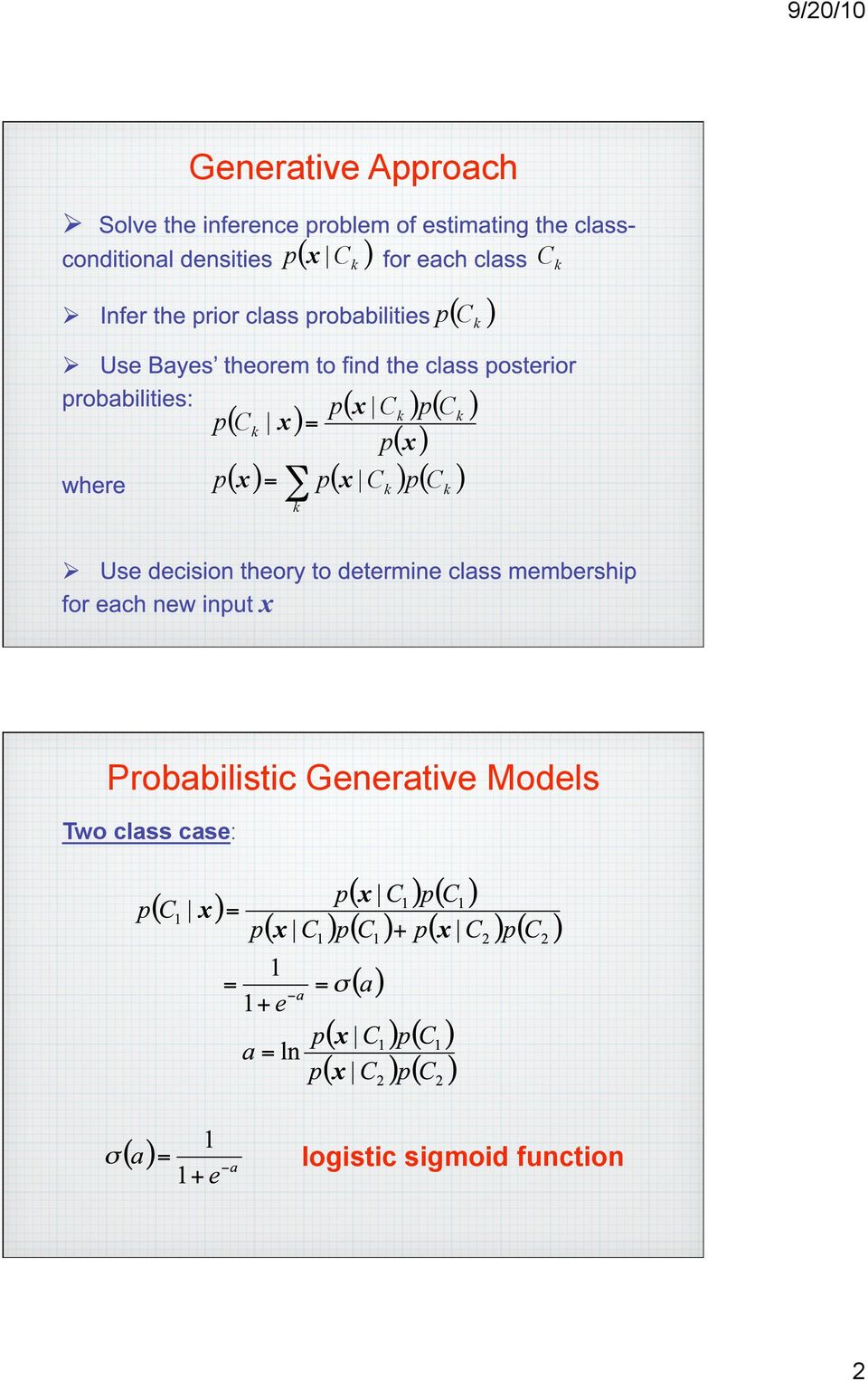
3 K >2 classes: softmax function Lets assume the class-conditional densities are Gaussian with the same covariance matrix: Two class case first. We can show the following result: 3

4 4

5 We have shown: Decision boundary: 5
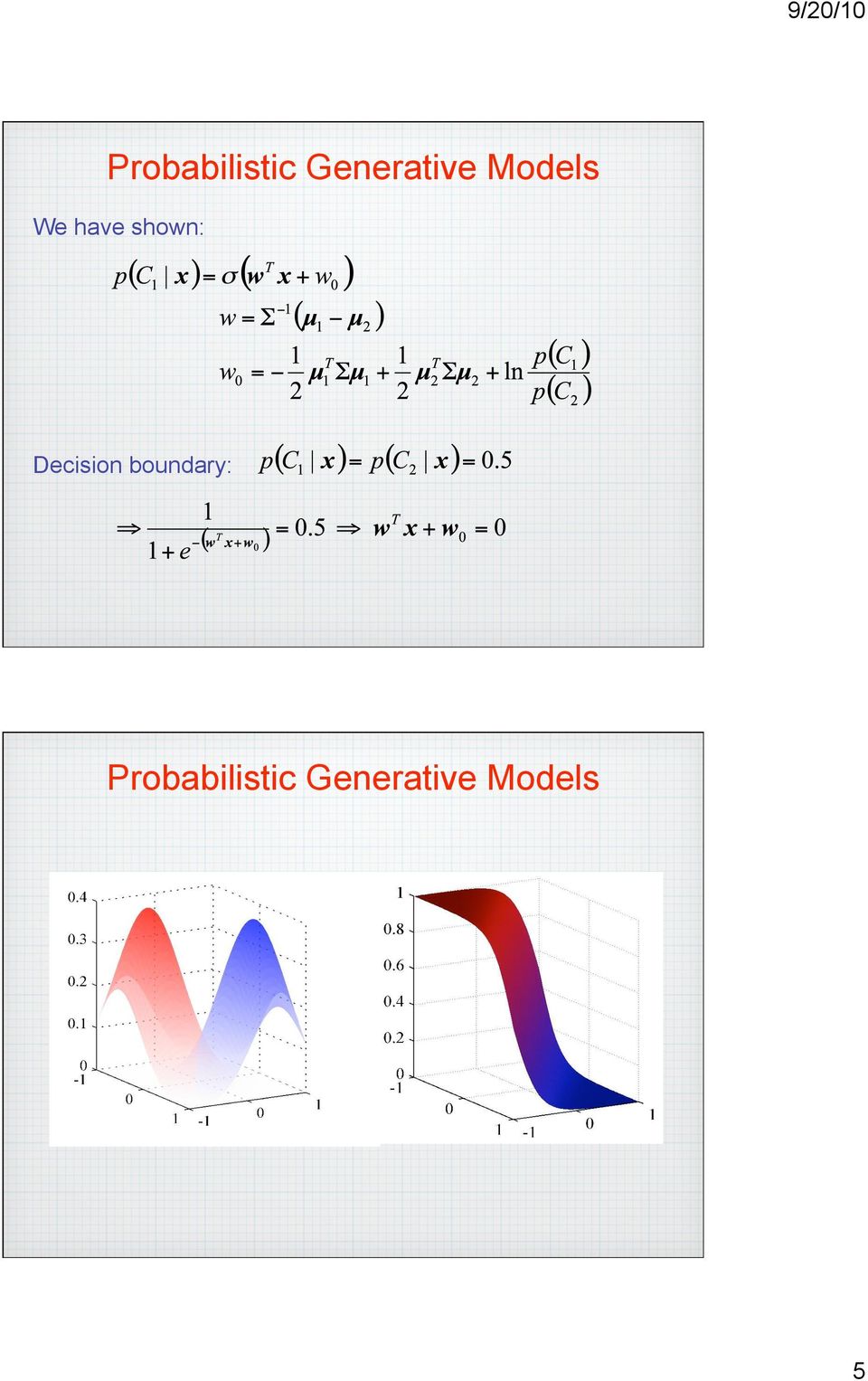
6 K >2 classes: We can show the following result: The cancellation of the quadratic terms is due to the assumption of shared covariances. If we allow each class conditional density to have its own covariance matrix, the cancellations no longer occur, and we obtain a quadratic function of x, i.e. a quadratic discriminant. 6

7 Maximum likelihood solution We have a parametric functional form for the class-conditional densities: We can estimate the parameters and the prior class probabilities using maximum likelihood. Two class case with shared covariance matrix. Training data: 7
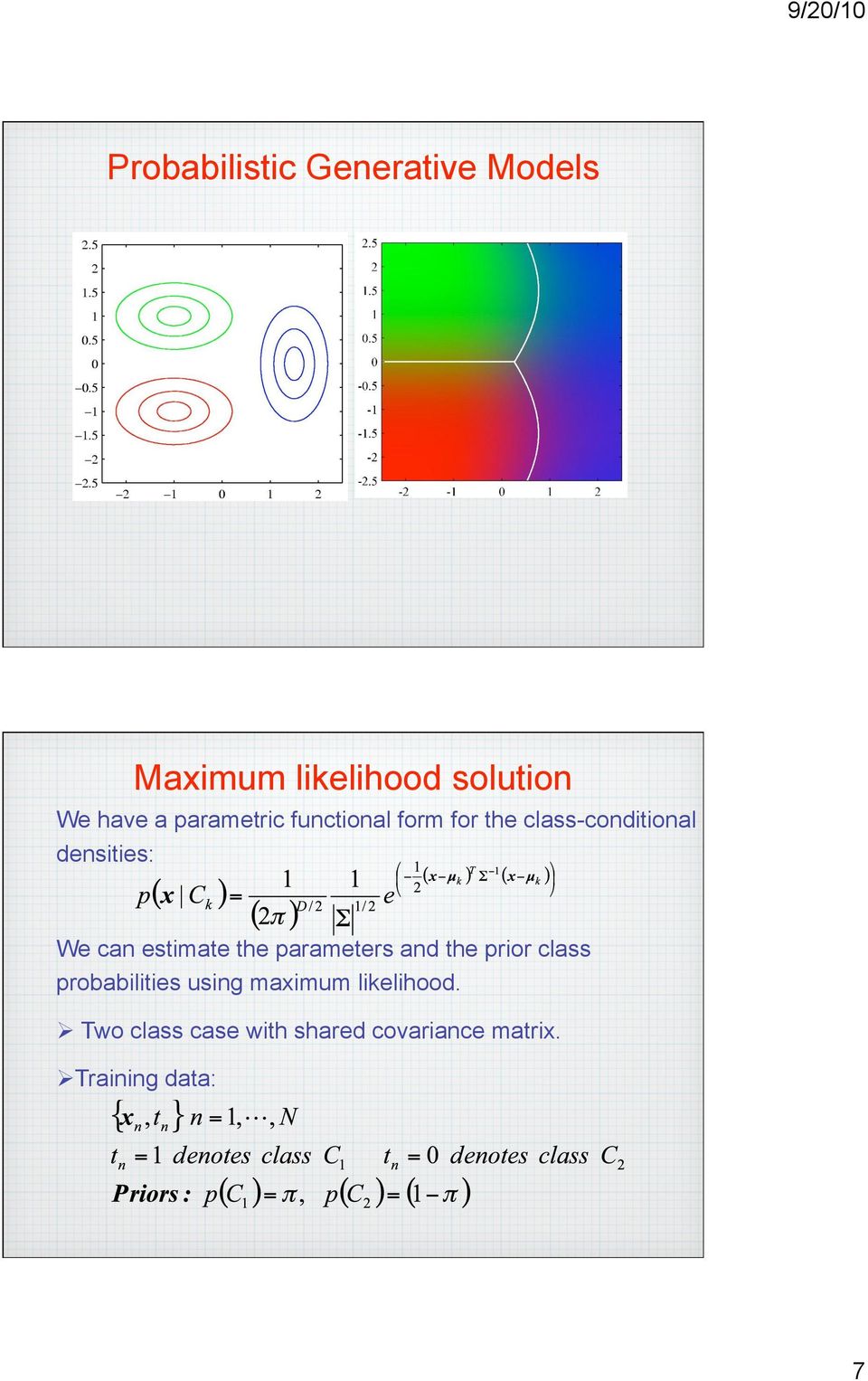
8 Maximum likelihood solution For a data point from class we have and therefore For a data point from class we have and therefore Maximum likelihood solution Assuming observations are drawn independently, we can write the likelihood function as follows: N p( t π,µ 1,µ 2,Σ) = p( t n π,µ 1,µ 2,Σ) = N n=1 [ p( x n,c 1 )] t n p x n,c 2 n=1 N n=1 [ πn ( x n µ 1,Σ)] t n [ ( )] 1 t n = [( 1 π)n ( x n µ 2,Σ)] 1 t n t = ( t 1,,t N ) T 8
![write the likelihood function as follows: N p( t π,µ 1,µ 2,Σ) = p( t n π,µ 1,µ 2,Σ) = N n=1 [ p( x n,c 1 )]](/docs-images/42/14087932/images/page_8.jpg "t n p x n,c 2 n=1 N n=1 [ πn ( x n µ 1,Σ)] t n [ ( )] 1 t n = [( 1 π)n ( x n µ 2,Σ)] 1 t n t = ( t 1,,t N )")
9 Maximum likelihood solution We want to find the values of the parameters that maximize the likelihood function, i.e., fit a model that best describes the observed data. p t π,µ 1,µ 2,Σ N n=1 ( ) = [ πn ( x n µ 1,Σ)] t n [( 1 π)n ( x n µ 2,Σ)] 1 t n As usual, we consider the log of the likelihood: Maximum likelihood solution We first maximize the log likelihood with respect to terms that depend on are. The 9
![p t π,µ 1,µ 2,Σ N n=1 ( ) = [ πn ( x n µ 1,Σ)] t n [( 1 π)n ( x n µ 2,Σ)] 1 t n As usual, we consider](/docs-images/42/14087932/images/page_9.jpg "the log of the likelihood: Maximum likelihood solution We first maximize the log likelihood with")
10 Maximum likelihood solution Thus, the maximum likelihood estimate of of points in class is the fraction The result can be generalized to the multiclass case: the maximum likelihood estimate of is given by the fraction of points in the training set that belong to Maximum likelihood solution We now maximize the log likelihood with respect to terms that depend on are. The 10
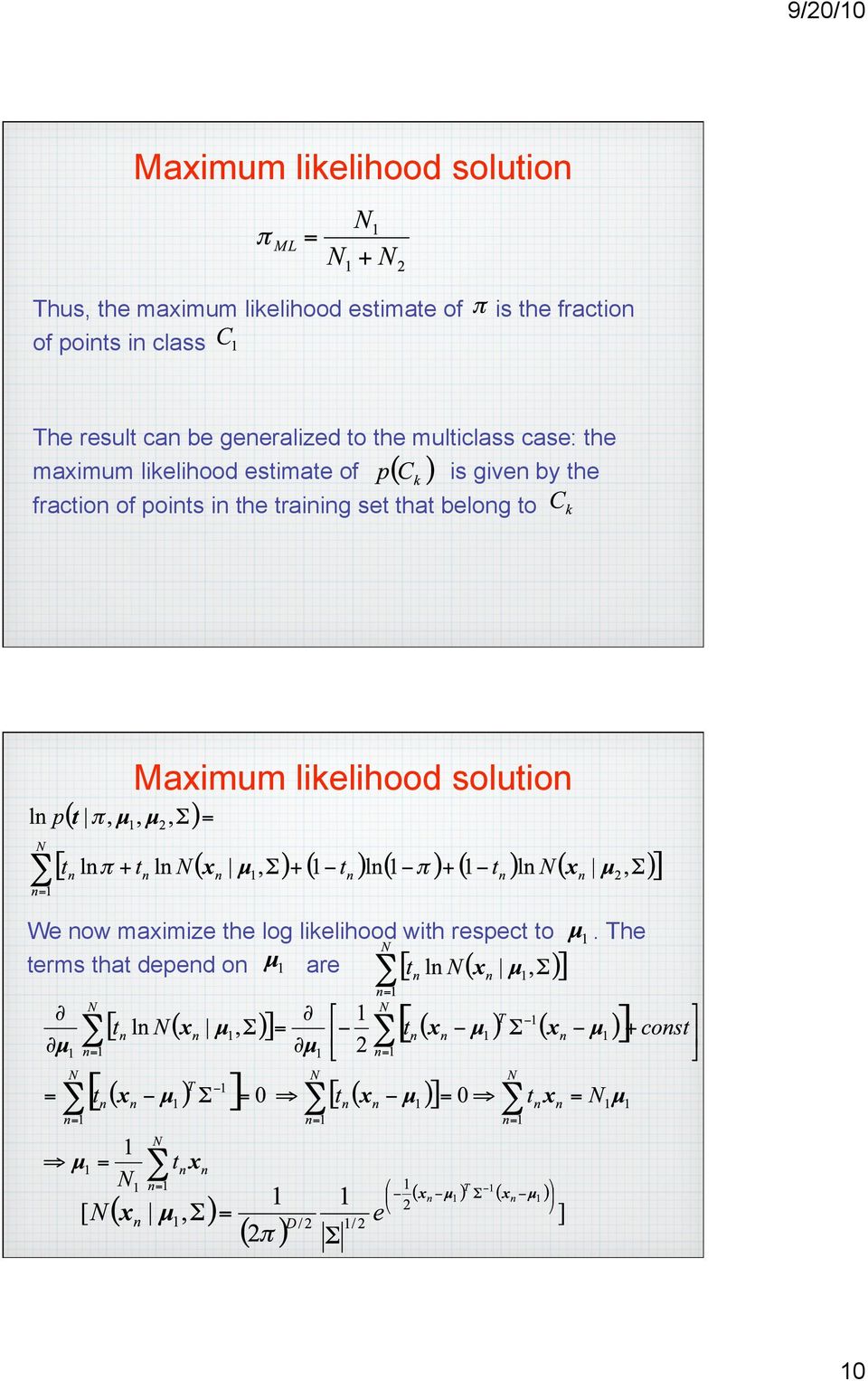
11 Maximum likelihood solution Thus, the maximum likelihood estimate of is the sample mean of all the input vectors assigned to class By maximizing the log likelihood with respect to obtain a similar result for we Maximum likelihood solution Maximizing the log likelihood with respect to the maximum likelihood estimate we obtain Thus: the maximum likelihood estimate of the covariance is given by the weighted average of the sample covariance matrices associated with each of the classes. This results extend to K classes. 11

12 Probabilistic Discriminative Models Two-class case: Multiclass case: Discriminative approach: use the functional form of the generalized linear model for the posterior probabilities and determine its parameters directly using maximum likelihood. Probabilistic Discriminative Models Advantages: Fewer parameters to be determined Improved predictive performance, especially when the class-conditional density assumptions give a poor approximation of the true distributions. 12

13 Probabilistic Discriminative Models Two-class case: In the terminology of statistics, this model is known as logistic regression. Assuming estimate? how many parameters do we need to Probabilistic Discriminative Models How many parameters did we estimate to fit Gaussian class-conditional densities (generative approach)? 13

14 Logistic Regression We use maximum likelihood to determine the parameters of the logistic regression model. { x n,t n } n =1,,N t n =1 denotes class C 1 t n = 0 denotes class C 2 We want to find the values of w that maximize the posterior probabilities associated to the observed data Likelihood function : L w N ( ) = P( C 1 x n ) t n n=1 ( 1 P( C 1 x n )) 1 t n N ( ) t n = y x n n=1 ( 1 y( x n )) 1 t n Logistic Regression We consider the negative logarithm of the likelihood: 14

15 Logistic Regression We compute the derivative of the error function with respect to w (gradient): We need to compute the derivative of the logistic sigmoid function: a σ ( a ) = a 1 1+ e = e a a 1+ e a = σ a 1+ e a 1+ e a ( ) 2 = 1 ( ) ( ) 1 σ( a) e a 1+ e a 1+ e = a Logistic Regression 15
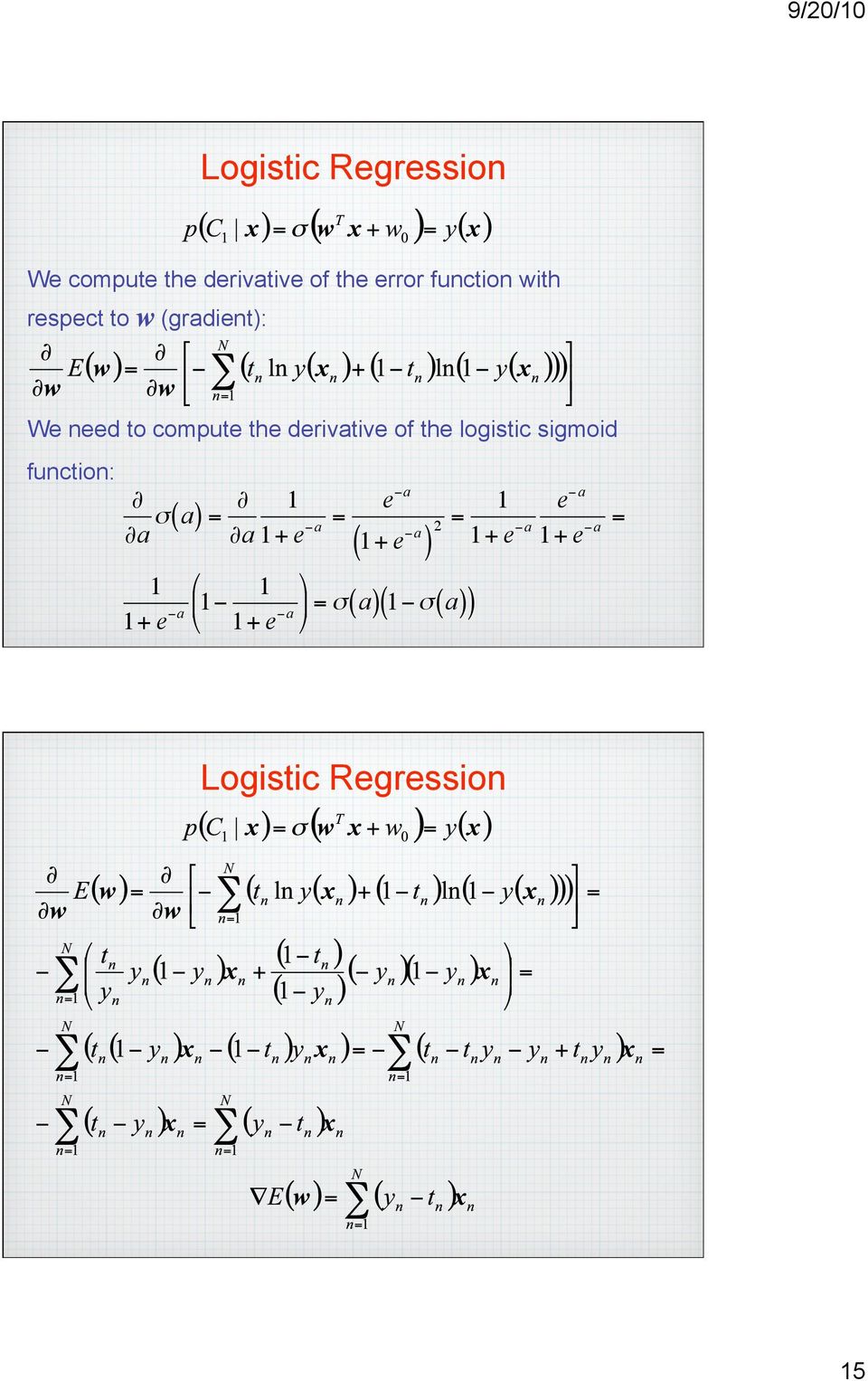
16 Logistic Regression The gradient of E at w gives the direction of the steepest increase of E at w. We need to minimize E. Thus we need to update w so that we move along the opposite direction of the gradient: This technique is called gradient descent It can be shown that E is a concave function of w. Thus, it has a unique minimum. An efficient iterative technique exists to find the optimal w parameters (Newton-Raphson optimization). Batch vs. on-line learning The computation of the above gradient requires the processing of the entire training set (batch technique) If the data set is large, the above technique can be costly; For real time applications in which data become available as continuous streams, we may want to update the parameters as data points are presented to us (on-line technique). 16

17 On-line learning After the presentation of each data point n, we compute the contribution of that data point to the gradient (stochastic gradient): The on-line updating rule for the parameters becomes: η > 0 is called learning rate. It's value needs to be chosen carefully to ensure convergence Multiclass Logistic Regression Multiclass case: We use maximum likelihood to determine the parameters of the logistic regression model. { x n,t n } n =1,, N ( ) denotes class C k t n = 0,, 1,,0 We want to find the values of w 1,,w K that maximize the posterior probabilities associated to the observed data Likelihood function : ( ) = P( C k x n ) t nk L w 1,,w K N K = y k x n n=1 k =1 n=1 k =1 N K ( ) t nk 17

18 Multiclass Logistic Regression We consider the negative logarithm of the likelihood: Multiclass Logistic Regression We compute the gradient of the error function with respect to one of the parameter vectors: 18

19 Multiclass Logistic Regression Thus, we need to compute the derivatives of the softmax function: y k = a k a k e ak e a j = j e a k j e a j j e a j e a k ea k ( ) 2 = y k y 2 k = y k 1 y k Multiclass Logistic Regression Thus, we need to compute the derivatives of the softmax function: for j k, y k = a j a j e ak j e a j = e a k e a j = y 2 k y j e a j j 19

20 Multiclass Logistic Regression Compact expression: Multiclass Logistic Regression 20

21 Multiclass Logistic Regression It can be shown that E is a concave function of w. Thus, it has a unique minimum. For a batch solution, we can use the Newton-Raphson optimization technique. On-line solution (stochastic gradient descent): 21
PATTERN RECOGNITION AND MACHINE LEARNING CHAPTER 4: LINEAR MODELS FOR CLASSIFICATION
 PATTERN RECOGNITION AND MACHINE LEARNING CHAPTER 4: LINEAR MODELS FOR CLASSIFICATION Introduction In the previous chapter, we explored a class of regression models having particularly simple analytical
Linear Models for Classification
 Linear Models for Classification Sumeet Agarwal, EEL709 (Most figures from Bishop, PRML) Approaches to classification Discriminant function: Directly assigns each data point x to a particular class Ci
These slides follow closely the (English) course textbook Pattern Recognition and Machine Learning by Christopher Bishop
 Music and Machine Learning (IFT6080 Winter 08) Prof. Douglas Eck, Université de Montréal These slides follow closely the (English) course textbook Pattern Recognition and Machine Learning by Christopher
Christfried Webers. Canberra February June 2015
 c Statistical Group and College of Engineering and Computer Science Canberra February June (Many figures from C. M. Bishop, "Pattern Recognition and ") 1of 829 c Part VIII Linear Classification 2 Logistic
STA 4273H: Statistical Machine Learning
 STA 4273H: Statistical Machine Learning Russ Salakhutdinov Department of Statistics! [email protected]! http://www.cs.toronto.edu/~rsalakhu/ Lecture 6 Three Approaches to Classification Construct
Statistical Machine Learning
 Statistical Machine Learning UoC Stats 37700, Winter quarter Lecture 4: classical linear and quadratic discriminants. 1 / 25 Linear separation For two classes in R d : simple idea: separate the classes
Pa8ern Recogni6on. and Machine Learning. Chapter 4: Linear Models for Classifica6on
 Pa8ern Recogni6on and Machine Learning Chapter 4: Linear Models for Classifica6on Represen'ng the target values for classifica'on If there are only two classes, we typically use a single real valued output
Pattern Analysis. Logistic Regression. 12. Mai 2009. Joachim Hornegger. Chair of Pattern Recognition Erlangen University
 Pattern Analysis Logistic Regression 12. Mai 2009 Joachim Hornegger Chair of Pattern Recognition Erlangen University Pattern Analysis 2 / 43 1 Logistic Regression Posteriors and the Logistic Function Decision
Logistic Regression. Jia Li. Department of Statistics The Pennsylvania State University. Logistic Regression
 Logistic Regression Department of Statistics The Pennsylvania State University Email: [email protected] Logistic Regression Preserve linear classification boundaries. By the Bayes rule: Ĝ(x) = arg max
Linear Discrimination. Linear Discrimination. Linear Discrimination. Linearly Separable Systems Pairwise Separation. Steven J Zeil.
 Steven J Zeil Old Dominion Univ. Fall 200 Discriminant-Based Classification Linearly Separable Systems Pairwise Separation 2 Posteriors 3 Logistic Discrimination 2 Discriminant-Based Classification Likelihood-based:
Classification Problems
 Classification Read Chapter 4 in the text by Bishop, except omit Sections 4.1.6, 4.1.7, 4.2.4, 4.3.3, 4.3.5, 4.3.6, 4.4, and 4.5. Also, review sections 1.5.1, 1.5.2, 1.5.3, and 1.5.4. Classification Problems
Lecture 3: Linear methods for classification
 Lecture 3: Linear methods for classification Rafael A. Irizarry and Hector Corrada Bravo February, 2010 Today we describe four specific algorithms useful for classification problems: linear regression,
Linear Classification. Volker Tresp Summer 2015
 Linear Classification Volker Tresp Summer 2015 1 Classification Classification is the central task of pattern recognition Sensors supply information about an object: to which class do the object belong
CSCI567 Machine Learning (Fall 2014)
 CSCI567 Machine Learning (Fall 2014) Drs. Sha & Liu {feisha,yanliu.cs}@usc.edu September 22, 2014 Drs. Sha & Liu ({feisha,yanliu.cs}@usc.edu) CSCI567 Machine Learning (Fall 2014) September 22, 2014 1 /
Linear Threshold Units
 Linear Threshold Units w x hx (... w n x n w We assume that each feature x j and each weight w j is a real number (we will relax this later) We will study three different algorithms for learning linear
Probabilistic Linear Classification: Logistic Regression. Piyush Rai IIT Kanpur
 Probabilistic Linear Classification: Logistic Regression Piyush Rai IIT Kanpur Probabilistic Machine Learning (CS772A) Jan 18, 2016 Probabilistic Machine Learning (CS772A) Probabilistic Linear Classification:
Logistic Regression. Vibhav Gogate The University of Texas at Dallas. Some Slides from Carlos Guestrin, Luke Zettlemoyer and Dan Weld.
 Logistic Regression Vibhav Gogate The University of Texas at Dallas Some Slides from Carlos Guestrin, Luke Zettlemoyer and Dan Weld. Generative vs. Discriminative Classifiers Want to Learn: h:x Y X features
Lecture 8 February 4
 ICS273A: Machine Learning Winter 2008 Lecture 8 February 4 Scribe: Carlos Agell (Student) Lecturer: Deva Ramanan 8.1 Neural Nets 8.1.1 Logistic Regression Recall the logistic function: g(x) = 1 1 + e θt
Machine Learning and Pattern Recognition Logistic Regression
 Machine Learning and Pattern Recognition Logistic Regression Course Lecturer:Amos J Storkey Institute for Adaptive and Neural Computation School of Informatics University of Edinburgh Crichton Street,
CCNY. BME I5100: Biomedical Signal Processing. Linear Discrimination. Lucas C. Parra Biomedical Engineering Department City College of New York
 BME I5100: Biomedical Signal Processing Linear Discrimination Lucas C. Parra Biomedical Engineering Department CCNY 1 Schedule Week 1: Introduction Linear, stationary, normal - the stuff biology is not
3F3: Signal and Pattern Processing
 3F3: Signal and Pattern Processing Lecture 3: Classification Zoubin Ghahramani [email protected] Department of Engineering University of Cambridge Lent Term Classification We will represent data by
Example: Credit card default, we may be more interested in predicting the probabilty of a default than classifying individuals as default or not.
 Statistical Learning: Chapter 4 Classification 4.1 Introduction Supervised learning with a categorical (Qualitative) response Notation: - Feature vector X, - qualitative response Y, taking values in C
CSC 411: Lecture 07: Multiclass Classification
 CSC 411: Lecture 07: Multiclass Classification Class based on Raquel Urtasun & Rich Zemel s lectures Sanja Fidler University of Toronto Feb 1, 2016 Urtasun, Zemel, Fidler (UofT) CSC 411: 07-Multiclass
MVA ENS Cachan. Lecture 2: Logistic regression & intro to MIL Iasonas Kokkinos [email protected]
 Machine Learning for Computer Vision 1 MVA ENS Cachan Lecture 2: Logistic regression & intro to MIL Iasonas Kokkinos [email protected] Department of Applied Mathematics Ecole Centrale Paris Galen
LOGISTIC REGRESSION. Nitin R Patel. where the dependent variable, y, is binary (for convenience we often code these values as
 LOGISTIC REGRESSION Nitin R Patel Logistic regression extends the ideas of multiple linear regression to the situation where the dependent variable, y, is binary (for convenience we often code these values
CS229 Lecture notes. Andrew Ng
 CS229 Lecture notes Andrew Ng Supervised learning Let s start by talking about a few examples of supervised learning problems Suppose we have a dataset giving the living areas and prices of 47 houses from
11 Linear and Quadratic Discriminant Analysis, Logistic Regression, and Partial Least Squares Regression
 Frank C Porter and Ilya Narsky: Statistical Analysis Techniques in Particle Physics Chap. c11 2013/9/9 page 221 le-tex 221 11 Linear and Quadratic Discriminant Analysis, Logistic Regression, and Partial
Introduction to Online Learning Theory
 Introduction to Online Learning Theory Wojciech Kot lowski Institute of Computing Science, Poznań University of Technology IDSS, 04.06.2013 1 / 53 Outline 1 Example: Online (Stochastic) Gradient Descent
Predict Influencers in the Social Network
 Predict Influencers in the Social Network Ruishan Liu, Yang Zhao and Liuyu Zhou Email: rliu2, yzhao2, [email protected] Department of Electrical Engineering, Stanford University Abstract Given two persons
Logistic Regression (1/24/13)
 STA63/CBB540: Statistical methods in computational biology Logistic Regression (/24/3) Lecturer: Barbara Engelhardt Scribe: Dinesh Manandhar Introduction Logistic regression is model for regression used
Linear smoother. ŷ = S y. where s ij = s ij (x) e.g. s ij = diag(l i (x)) To go the other way, you need to diagonalize S
 Linear smoother ŷ = S y where s ij = s ij (x) e.g. s ij = diag(l i (x)) To go the other way, you need to diagonalize S 2 Online Learning: LMS and Perceptrons Partially adapted from slides by Ryan Gabbard
Machine Learning Logistic Regression
 Machine Learning Logistic Regression Jeff Howbert Introduction to Machine Learning Winter 2012 1 Logistic regression Name is somewhat misleading. Really a technique for classification, not regression.
Classification. Chapter 3
 Chapter 3 Classification In chapter we have considered regression problems, where the targets are real valued. Another important class of problems is classification problems, where we wish to assign an
University of Cambridge Engineering Part IIB Module 4F10: Statistical Pattern Processing Handout 8: Multi-Layer Perceptrons
 University of Cambridge Engineering Part IIB Module 4F0: Statistical Pattern Processing Handout 8: Multi-Layer Perceptrons x y (x) Inputs x 2 y (x) 2 Outputs x d First layer Second Output layer layer y
Classification using Logistic Regression
 Classification using Logistic Regression Ingmar Schuster Patrick Jähnichen using slides by Andrew Ng Institut für Informatik This lecture covers Logistic regression hypothesis Decision Boundary Cost function
An Introduction to Machine Learning
 An Introduction to Machine Learning L5: Novelty Detection and Regression Alexander J. Smola Statistical Machine Learning Program Canberra, ACT 0200 Australia [email protected] Tata Institute, Pune,
Lecture 2: The SVM classifier
 Lecture 2: The SVM classifier C19 Machine Learning Hilary 2015 A. Zisserman Review of linear classifiers Linear separability Perceptron Support Vector Machine (SVM) classifier Wide margin Cost function
Logistic Regression for Spam Filtering
 Logistic Regression for Spam Filtering Nikhila Arkalgud February 14, 28 Abstract The goal of the spam filtering problem is to identify an email as a spam or not spam. One of the classic techniques used
Principled Hybrids of Generative and Discriminative Models
 Principled Hybrids of Generative and Discriminative Models Julia A. Lasserre University of Cambridge Cambridge, UK [email protected] Christopher M. Bishop Microsoft Research Cambridge, UK [email protected]
Introduction to Logistic Regression
 OpenStax-CNX module: m42090 1 Introduction to Logistic Regression Dan Calderon This work is produced by OpenStax-CNX and licensed under the Creative Commons Attribution License 3.0 Abstract Gives introduction
Two Topics in Parametric Integration Applied to Stochastic Simulation in Industrial Engineering
 Two Topics in Parametric Integration Applied to Stochastic Simulation in Industrial Engineering Department of Industrial Engineering and Management Sciences Northwestern University September 15th, 2014
Lecture 6: Logistic Regression
 Lecture 6: CS 194-10, Fall 2011 Laurent El Ghaoui EECS Department UC Berkeley September 13, 2011 Outline Outline Classification task Data : X = [x 1,..., x m]: a n m matrix of data points in R n. y { 1,
Probabilistic Models for Big Data. Alex Davies and Roger Frigola University of Cambridge 13th February 2014
 Probabilistic Models for Big Data Alex Davies and Roger Frigola University of Cambridge 13th February 2014 The State of Big Data Why probabilistic models for Big Data? 1. If you don t have to worry about
MACHINE LEARNING IN HIGH ENERGY PHYSICS
 MACHINE LEARNING IN HIGH ENERGY PHYSICS LECTURE #1 Alex Rogozhnikov, 2015 INTRO NOTES 4 days two lectures, two practice seminars every day this is introductory track to machine learning kaggle competition!
Lecture 6. Artificial Neural Networks
 Lecture 6 Artificial Neural Networks 1 1 Artificial Neural Networks In this note we provide an overview of the key concepts that have led to the emergence of Artificial Neural Networks as a major paradigm
Classification by Pairwise Coupling
 Classification by Pairwise Coupling TREVOR HASTIE * Stanford University and ROBERT TIBSHIRANI t University of Toronto Abstract We discuss a strategy for polychotomous classification that involves estimating
Natural Language Processing. Today. Logistic Regression Models. Lecture 13 10/6/2015. Jim Martin. Multinomial Logistic Regression
 Natural Language Processing Lecture 13 10/6/2015 Jim Martin Today Multinomial Logistic Regression Aka log-linear models or maximum entropy (maxent) Components of the model Learning the parameters 10/1/15
Bayesian Machine Learning (ML): Modeling And Inference in Big Data. Zhuhua Cai Google, Rice University [email protected]
 Bayesian Machine Learning (ML): Modeling And Inference in Big Data Zhuhua Cai Google Rice University [email protected] 1 Syllabus Bayesian ML Concepts (Today) Bayesian ML on MapReduce (Next morning) Bayesian
Scalable Machine Learning - or what to do with all that Big Data infrastructure
 - or what to do with all that Big Data infrastructure TU Berlin blog.mikiobraun.de Strata+Hadoop World London, 2015 1 Complex Data Analysis at Scale Click-through prediction Personalized Spam Detection
Designing a learning system
 Lecture Designing a learning system Milos Hauskrecht [email protected] 539 Sennott Square, x4-8845 http://.cs.pitt.edu/~milos/courses/cs750/ Design of a learning system (first vie) Application or Testing
Statistical Machine Learning from Data
 Samy Bengio Statistical Machine Learning from Data 1 Statistical Machine Learning from Data Gaussian Mixture Models Samy Bengio IDIAP Research Institute, Martigny, Switzerland, and Ecole Polytechnique
Statistical Models in Data Mining
 Statistical Models in Data Mining Sargur N. Srihari University at Buffalo The State University of New York Department of Computer Science and Engineering Department of Biostatistics 1 Srihari Flood of
Lecture 9: Introduction to Pattern Analysis
 Lecture 9: Introduction to Pattern Analysis g Features, patterns and classifiers g Components of a PR system g An example g Probability definitions g Bayes Theorem g Gaussian densities Features, patterns
Machine Learning. CUNY Graduate Center, Spring 2013. Professor Liang Huang. [email protected]
 Machine Learning CUNY Graduate Center, Spring 2013 Professor Liang Huang [email protected] http://acl.cs.qc.edu/~lhuang/teaching/machine-learning Logistics Lectures M 9:30-11:30 am Room 4419 Personnel
STATISTICA Formula Guide: Logistic Regression. Table of Contents
 : Table of Contents... 1 Overview of Model... 1 Dispersion... 2 Parameterization... 3 Sigma-Restricted Model... 3 Overparameterized Model... 4 Reference Coding... 4 Model Summary (Summary Tab)... 5 Summary
The Probit Link Function in Generalized Linear Models for Data Mining Applications
 Journal of Modern Applied Statistical Methods Copyright 2013 JMASM, Inc. May 2013, Vol. 12, No. 1, 164-169 1538 9472/13/$95.00 The Probit Link Function in Generalized Linear Models for Data Mining Applications
large-scale machine learning revisited Léon Bottou Microsoft Research (NYC)
 large-scale machine learning revisited Léon Bottou Microsoft Research (NYC) 1 three frequent ideas in machine learning. independent and identically distributed data This experimental paradigm has driven
THE GOAL of this work is to learn discriminative components
 68 IEEE TRANSACTIONS ON NEURAL NETWORKS, VOL. 16, NO. 1, JANUARY 2005 Discriminative Components of Data Jaakko Peltonen and Samuel Kaski, Senior Member, IEEE Abstract A simple probabilistic model is introduced
Loss Functions for Preference Levels: Regression with Discrete Ordered Labels
 Loss Functions for Preference Levels: Regression with Discrete Ordered Labels Jason D. M. Rennie Massachusetts Institute of Technology Comp. Sci. and Artificial Intelligence Laboratory Cambridge, MA 9,
A Log-Robust Optimization Approach to Portfolio Management
 A Log-Robust Optimization Approach to Portfolio Management Dr. Aurélie Thiele Lehigh University Joint work with Ban Kawas Research partially supported by the National Science Foundation Grant CMMI-0757983
Regression III: Advanced Methods
 Lecture 4: Transformations Regression III: Advanced Methods William G. Jacoby Michigan State University Goals of the lecture The Ladder of Roots and Powers Changing the shape of distributions Transforming
Basics of Statistical Machine Learning
 CS761 Spring 2013 Advanced Machine Learning Basics of Statistical Machine Learning Lecturer: Xiaojin Zhu [email protected] Modern machine learning is rooted in statistics. You will find many familiar
Azure Machine Learning, SQL Data Mining and R
 Azure Machine Learning, SQL Data Mining and R Day-by-day Agenda Prerequisites No formal prerequisites. Basic knowledge of SQL Server Data Tools, Excel and any analytical experience helps. Best of all:
Data Mining and Data Warehousing. Henryk Maciejewski. Data Mining Predictive modelling: regression
 Data Mining and Data Warehousing Henryk Maciejewski Data Mining Predictive modelling: regression Algorithms for Predictive Modelling Contents Regression Classification Auxiliary topics: Estimation of prediction
Statistical Data Mining. Practical Assignment 3 Discriminant Analysis and Decision Trees
 Statistical Data Mining Practical Assignment 3 Discriminant Analysis and Decision Trees In this practical we discuss linear and quadratic discriminant analysis and tree-based classification techniques.
Wes, Delaram, and Emily MA751. Exercise 4.5. 1 p(x; β) = [1 p(xi ; β)] = 1 p(x. y i [βx i ] log [1 + exp {βx i }].
![Wes, Delaram, and Emily MA751. Exercise 4.5. 1 p(x; β) = [1 p(xi ; β)] = 1 p(x. y i [βx i ] log [1 + exp {βx i }].](/thumbs/30/14087801.jpg "Wes, Delaram, and Emily MA751. Exercise 4.5. 1 p(x; β) = [1 p(xi ; β)] = 1 p(x. y i [βx i ] log [1 + exp {βx i }].") Wes, Delaram, and Emily MA75 Exercise 4.5 Consider a two-class logistic regression problem with x R. Characterize the maximum-likelihood estimates of the slope and intercept parameter if the sample for
Wes, Delaram, and Emily MA75 Exercise 4.5 Consider a two-class logistic regression problem with x R. Characterize the maximum-likelihood estimates of the slope and intercept parameter if the sample for
Response variables assume only two values, say Y j = 1 or = 0, called success and failure (spam detection, credit scoring, contracting.
 Prof. Dr. J. Franke All of Statistics 1.52 Binary response variables - logistic regression Response variables assume only two values, say Y j = 1 or = 0, called success and failure (spam detection, credit
Chapter 4: Artificial Neural Networks
 Chapter 4: Artificial Neural Networks CS 536: Machine Learning Littman (Wu, TA) Administration icml-03: instructional Conference on Machine Learning http://www.cs.rutgers.edu/~mlittman/courses/ml03/icml03/
171:290 Model Selection Lecture II: The Akaike Information Criterion
 171:290 Model Selection Lecture II: The Akaike Information Criterion Department of Biostatistics Department of Statistics and Actuarial Science August 28, 2012 Introduction AIC, the Akaike Information
L4: Bayesian Decision Theory
 L4: Bayesian Decision Theory Likelihood ratio test Probability of error Bayes risk Bayes, MAP and ML criteria Multi-class problems Discriminant functions CSCE 666 Pattern Analysis Ricardo Gutierrez-Osuna
Gaussian Conjugate Prior Cheat Sheet
 Gaussian Conjugate Prior Cheat Sheet Tom SF Haines 1 Purpose This document contains notes on how to handle the multivariate Gaussian 1 in a Bayesian setting. It focuses on the conjugate prior, its Bayesian
IFT3395/6390. Machine Learning from linear regression to Neural Networks. Machine Learning. Training Set. t (3.5, -2,..., 127, 0,...
 IFT3395/6390 Historical perspective: back to 1957 (Prof. Pascal Vincent) (Rosenblatt, Perceptron ) Machine Learning from linear regression to Neural Networks Computer Science Artificial Intelligence Symbolic
Master s Theory Exam Spring 2006
 Spring 2006 This exam contains 7 questions. You should attempt them all. Each question is divided into parts to help lead you through the material. You should attempt to complete as much of each problem
Supervised Learning (Big Data Analytics)
 Supervised Learning (Big Data Analytics) Vibhav Gogate Department of Computer Science The University of Texas at Dallas Practical advice Goal of Big Data Analytics Uncover patterns in Data. Can be used
Introduction to General and Generalized Linear Models
 Introduction to General and Generalized Linear Models General Linear Models - part I Henrik Madsen Poul Thyregod Informatics and Mathematical Modelling Technical University of Denmark DK-2800 Kgs. Lyngby
Principles of Data Mining by Hand&Mannila&Smyth
 Principles of Data Mining by Hand&Mannila&Smyth Slides for Textbook Ari Visa,, Institute of Signal Processing Tampere University of Technology October 4, 2010 Data Mining: Concepts and Techniques 1 Differences
Bayes and Naïve Bayes. cs534-machine Learning
 Bayes and aïve Bayes cs534-machine Learning Bayes Classifier Generative model learns Prediction is made by and where This is often referred to as the Bayes Classifier, because of the use of the Bayes rule
The Optimality of Naive Bayes
 The Optimality of Naive Bayes Harry Zhang Faculty of Computer Science University of New Brunswick Fredericton, New Brunswick, Canada email: hzhang@unbca E3B 5A3 Abstract Naive Bayes is one of the most
A Simple Introduction to Support Vector Machines
 A Simple Introduction to Support Vector Machines Martin Law Lecture for CSE 802 Department of Computer Science and Engineering Michigan State University Outline A brief history of SVM Large-margin linear
A Stochastic 3MG Algorithm with Application to 2D Filter Identification
 A Stochastic 3MG Algorithm with Application to 2D Filter Identification Emilie Chouzenoux 1, Jean-Christophe Pesquet 1, and Anisia Florescu 2 1 Laboratoire d Informatique Gaspard Monge - CNRS Univ. Paris-Est,
A Game Theoretical Framework for Adversarial Learning
 A Game Theoretical Framework for Adversarial Learning Murat Kantarcioglu University of Texas at Dallas Richardson, TX 75083, USA muratk@utdallas Chris Clifton Purdue University West Lafayette, IN 47907,
CS 2750 Machine Learning. Lecture 1. Machine Learning. http://www.cs.pitt.edu/~milos/courses/cs2750/ CS 2750 Machine Learning.
 Lecture Machine Learning Milos Hauskrecht [email protected] 539 Sennott Square, x5 http://www.cs.pitt.edu/~milos/courses/cs75/ Administration Instructor: Milos Hauskrecht [email protected] 539 Sennott
Programming Exercise 3: Multi-class Classification and Neural Networks
 Programming Exercise 3: Multi-class Classification and Neural Networks Machine Learning November 4, 2011 Introduction In this exercise, you will implement one-vs-all logistic regression and neural networks
Modern Optimization Methods for Big Data Problems MATH11146 The University of Edinburgh
 Modern Optimization Methods for Big Data Problems MATH11146 The University of Edinburgh Peter Richtárik Week 3 Randomized Coordinate Descent With Arbitrary Sampling January 27, 2016 1 / 30 The Problem
L3: Statistical Modeling with Hadoop
 L3: Statistical Modeling with Hadoop Feng Li [email protected] School of Statistics and Mathematics Central University of Finance and Economics Revision: December 10, 2014 Today we are going to learn...
A Logistic Regression Approach to Ad Click Prediction
 A Logistic Regression Approach to Ad Click Prediction Gouthami Kondakindi [email protected] Satakshi Rana [email protected] Aswin Rajkumar [email protected] Sai Kaushik Ponnekanti [email protected] Vinit Parakh
Practical Data Science with Azure Machine Learning, SQL Data Mining, and R
 Practical Data Science with Azure Machine Learning, SQL Data Mining, and R Overview This 4-day class is the first of the two data science courses taught by Rafal Lukawiecki. Some of the topics will be
i=1 In practice, the natural logarithm of the likelihood function, called the log-likelihood function and denoted by
 Statistics 580 Maximum Likelihood Estimation Introduction Let y (y 1, y 2,..., y n be a vector of iid, random variables from one of a family of distributions on R n and indexed by a p-dimensional parameter
Penalized Logistic Regression and Classification of Microarray Data
 Penalized Logistic Regression and Classification of Microarray Data Milan, May 2003 Anestis Antoniadis Laboratoire IMAG-LMC University Joseph Fourier Grenoble, France Penalized Logistic Regression andclassification
CSI:FLORIDA. Section 4.4: Logistic Regression
 SI:FLORIDA Section 4.4: Logistic Regression SI:FLORIDA Reisit Masked lass Problem.5.5 2 -.5 - -.5 -.5 - -.5.5.5 We can generalize this roblem to two class roblem as well! SI:FLORIDA Reisit Masked lass
Learning Gaussian process models from big data. Alan Qi Purdue University Joint work with Z. Xu, F. Yan, B. Dai, and Y. Zhu
 Learning Gaussian process models from big data Alan Qi Purdue University Joint work with Z. Xu, F. Yan, B. Dai, and Y. Zhu Machine learning seminar at University of Cambridge, July 4 2012 Data A lot of
Reject Inference in Credit Scoring. Jie-Men Mok
 Reject Inference in Credit Scoring Jie-Men Mok BMI paper January 2009 ii Preface In the Master programme of Business Mathematics and Informatics (BMI), it is required to perform research on a business
Simple and efficient online algorithms for real world applications
 Simple and efficient online algorithms for real world applications Università degli Studi di Milano Milano, Italy Talk @ Centro de Visión por Computador Something about me PhD in Robotics at LIRA-Lab,