
vav retrofit terminals
|
|
|
- Kelly Wilkerson
- 10 years ago
- Views:
Transcription
1 retrofit Redefine your comfort zone. energy solutions

2 Table of Contents products Application Icons Key... 2 VAV Retrofit Terminals roducts... 3 external round duct series EXX, ECX and ECV External Round Duct Series... 5 Features and Benefits... 5 Applications... 6 Dimensions... 8 erformance Data slide-in series QCV Slide-In Series Features and Benefits Applications Dimensions erformance Data special purpose and internal retrofit series ECT Special urpose and Internal Retrofit Series Features and Benefits Applications ECT-AN for Anemostat Terminals ECT-BC for Barber-Colman Terminals ECT-BU for Buensod Terminals ECT-CN for Connor Terminals ECT-HC for Titus Terminals ECT-KR for Krueger Terminals ECT-TB for Tuttle & Bailey Terminals ECT-L Series notice Notice VAV RETROFIT TERMINALS ALICATION ICONS KEY energy solutions contributes toward energy savings by reducing operating costs of air distribution devices for use in retrofitting older products into modern designs & systems 2 retrofit

3 VAV Retrofit Terminal roducts pages: 5-12 EXX VARIABLE AIR VOLUME Converts older constant volume systems into modern energy efficient variable air volume systems Flow measurement taps included for easy balancing connections Simple & easy installation ECX VARIABLE AIR VOLUME Converts older constant volume systems into modern energy efficient variable air volume systems Flow measurement taps included for easy balancing connections Simple & easy installation Metal cover protects pneumatic velocity controller external round duct series ECV VARIABLE AIR VOLUME Converts older constant volume systems into modern energy efficient variable air volume systems Flow measurement taps included for easy balancing connections Simple & easy installation Metal cover protects velocity controller Variety of control options available pages: slide-in series VARIABLE AIR VOLUME Converts older constant volume systems into modern energy efficient variable air volume systems Low installation costs Available in a variety of sizes The casing can be configured to mount on either the right or left side of the existing duct Variety of velocity control options available QCV VAV RETROFIT TERMINALS 3

4 VAV Retrofit Terminal roducts (continued) pages: ECT-AN VARIABLE AIR VOLUME Designed to retrofit Anemostat Terminals Can be adjusted for a minimum cfm setting of zero (full shutoff) Available with electric actuators for us with electronic or DDC retrofit controls ECT-BC VARIABLE AIR VOLUME Designed to retrofit Barber- Colman Terminals erformance after is similar to Titus ESV for single duct operation & Titus EDV for dual duct operation Minimum airflow can be adjusted for full shutoff Available with electric actuators for us with electronic or DDC retrofit controls special purpose & internal retrofit series ECT-BU VARIABLE AIR VOLUME Designed to retrofit Buensod Terminals Can be adjusted for a minimum cfm setting of zero (full shutoff) Available with electric actuators for us with electronic or DDC retrofit controls ECT-CN VARIABLE AIR VOLUME Designed to retrofit Connor Terminals Can be adjusted for a minimum cfm setting of zero (full shutoff) Available with electric actuators for us with electronic or DDC retrofit controls VAV RETROFIT TERMINALS 4 ECT-HC VARIABLE AIR VOLUME Designed to retrofit Titus Terminals erformance after is similar to Titus ESV for single duct operation & Titus EDV for dual duct operation Can be adjusted for a minimum cfm setting of zero (full shutoff) High capacity valve can control up to 800 cfm Available with electric actuators for us with electronic or DDC retrofit controls ECT-KR VARIABLE AIR VOLUME Designed to retrofit Krueger Terminals Can be adjusted for a minimum cfm setting of zero (full shutoff) Available with electric actuators for us with electronic or DDC retrofit controls ECT-TB VARIABLE AIR VOLUME Designed to retrofit Tuttle & Bailey Terminals Minimum airflow can be adjusted for full shutoff Available with electric actuators for us with electronic or DDC retrofit controls ECT-L CONTROL BOXES Can control single or duct duct applications neumatic only

5 Overview - External Round Duct Series FEATURES AND BENEFITS Titus External Round Retrofit Terminals can upgrade those old existing HVAC systems to current standards of energy efficiency and comfort! External round retrofit terminals are designed to easily convert the old system powered or constant volume systems to more energy efficient variable volume systems. They may also be used in newly designed systems as air measuring devices and exhaust control valves. With Titus external round retrofit terminals, you never have to worry about a lengthy conversion process. Compact and light weight, these units install quickly in cramped spaces, supported only by the existing ductwork. The simple cylindrical casing matches standard round duct at both inlet and outlet. ECV Series and ECX units can be inserted in branch ducts where no control units have been before. They may also be used to replace older units or added to the inlets of existing units that are entirely or partly deactivated. The ECV Series terminals are available from Titus with pneumatic, electric, analog electronic or direct digital controls (DDCs). Flexibility in application makes selecting Titus external round terminals the simple solution for any retrofit project. Multiple rolled beads on the casing ensure roundness, while providing the benefit of leak free connections to round ducts. Both ends are sized to allow easy insertion into standard hard or flexible round ducts. AeroCross multi-point, center averaging sensor amplifies flow signal and ensures control accuracy, regardless of inlet duct configuration. Field convertible linkage (pneumatic controls) allows NO/NC changever without actuator removal. Stainless steel casing is available for use in areas where hazardous envrionments exist. Delrin damper bearings are unaffected by temperature and humidity, and prevent binding. Flow measurement taps included for easy balancing connections. Cast position indicator on damper shaft for easier monitoring of damper position. Shaft is ½-inch diameter for compatibility with almost any actuator design. DECV Sheet metal cover (not shown) protects pneumatic velocity controller (optional). Special damper design provides smooth flow and reduced sound levels. AeroCross multi-point, center averaging sensor amplifies flow signal and ensures control accuracy, regardless of inlet duct configuration. Both ends are sized to allow easy insertion into standard hard or flexible round ducts. AeroCross multi-point, center averaging sensor amplifies flow signal and ensures control accuracy, regardless of inlet duct configuration. EXX Both ends are sized to allow easy insertion into standard hard or flexible round ducts. Flow measurement taps included for easy balancing connections. Sheet metal cover protects pneumatic velocity controller (standard). Flow measurement taps included for easy balancing connections. EXTERNAL ROUND DUCT SERIES ECX 5

6 ALICATIONS EXISTING NEUMATIC DUAL DUCT UNIT: CONVERTING TO SINGLE DUCT VAV One inlet is capped off. Constant volume regulators are removed. Titus ECX is installed on cooling inlet of existing unit. Existing thermostat and damper actuator now connect to controller on ECX. Unit now provides pressure independent variable air volume, cooling (or heating) only, regardless of whether existing thermostat is direct acting or reverse acting, or whether damper is normally open or normally closed. EXISTING NEUMATIC DUAL DUCT: CONVERTING TO DUAL DUCT VAV; TWO EXISTING DAMER ACTUATORS (Option 1) Existing constant volume regulators are retained and used. Cooling inlet is left as is. ECX is installed on heating inlet. Existing room thermostat is connected to both existing cooling damper actuator and to the Titus controller on the ECX, which controls existing heating damper actuator. This conversion provides variable air volume without wasteful simultaneous heating and cooling. Heating control is pressure independent; cooling is pressure dependent. Maximum cooling cfm is limited by existing constant volume regulators. Maximum heating cfm (less than cooling) is limited by adjustment of ECX. A mixing minimum airflow can be obtained with a start point adjustment using the Titus II Controller. (Option 2) For pressure independent control of both heating and cooling, constant volume regulators are deactivated or removed. ECXs are installed on both heating and cooling inlets. Converting Existing neumatic Dual Duct to Single Duct VAV psi Main Controller Cold M ECX T One Inlet Capped Existing Damper Constant Volume Regulator(s) Deactivated or Removed Converting Existing neumatic Dual Duct to Single Duct VAV (Option 1) Controller M ECX psi Main Existing Cold Duct Existing Damper Constant Volume Regulator(s) Retained and Used Min. * Max CLG is determined by existing constant volume regulator setting Max HTG Max. Max CLG* ALICATIONS Existing room thermostat is connected to Titus controllers on both ECXs, which control both existing damper actuators. A mixing minimum airflow can be obtained with a start point adjustment using the Titus II Controller. Converting Existing neumatic Dual Duct to Single Duct VAV (Option 2) psi Main M ECX ECX Controller Controller T Existing Damper (Both SIdes) Constant Volume Regulator(s) Retained and Used * Max CLG is determined by existing constant volume regulator setting Max HTG Max CLG* 6

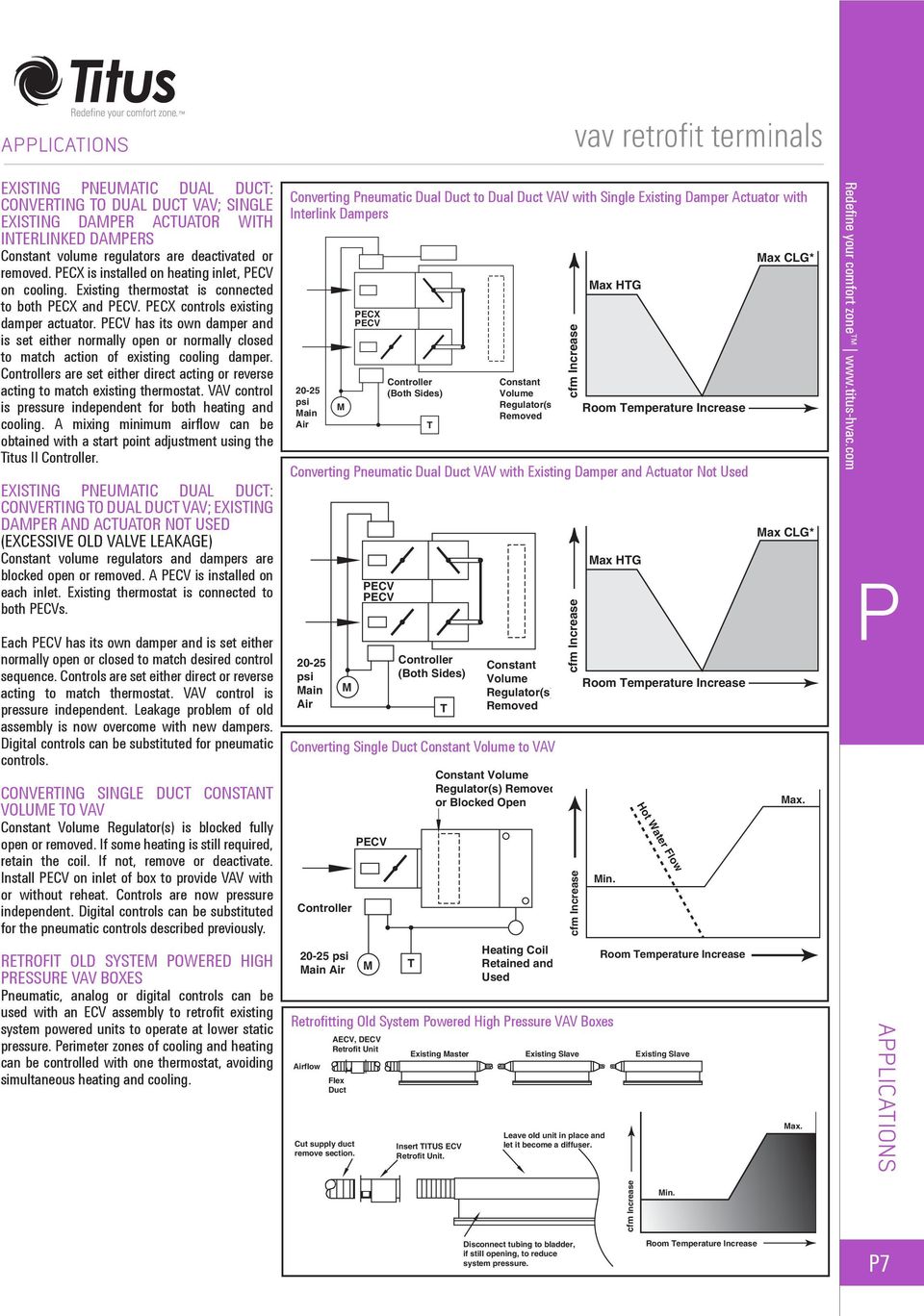
7 ALICATIONS EXISTING NEUMATIC DUAL DUCT: CONVERTING TO DUAL DUCT VAV; SINGLE EXISTING DAMER ACTUATOR WITH INTERLINKED DAMERS Constant volume regulators are deactivated or removed. ECX is installed on heating inlet, ECV on cooling. Existing thermostat is connected to both ECX and ECV. ECX controls existing damper actuator. ECV has its own damper and is set either normally open or normally closed to match action of existing cooling damper. Controllers are set either direct acting or reverse acting to match existing thermostat. VAV control is pressure independent for both heating and cooling. A mixing minimum airflow can be obtained with a start point adjustment using the Titus II Controller. EXISTING NEUMATIC DUAL DUCT: CONVERTING TO DUAL DUCT VAV; EXISTING DAMER AND ACTUATOR NOT USED (EXCESSIVE OLD VALVE LEAKAGE) Constant volume regulators and dampers are blocked open or removed. A ECV is installed on each inlet. Existing thermostat is connected to both ECVs. Each ECV has its own damper and is set either normally open or closed to match desired control sequence. Controls are set either direct or reverse acting to match thermostat. VAV control is pressure independent. Leakage problem of old assembly is now overcome with new dampers. Digital controls can be substituted for pneumatic controls. CONVERTING SINGLE DUCT CONSTANT VOLUME TO VAV Constant Volume Regulator(s) is blocked fully open or removed. If some heating is still required, retain the coil. If not, remove or deactivate. Install ECV on inlet of box to provide VAV with or without reheat. Controls are now pressure independent. Digital controls can be substituted for the pneumatic controls described previously. RETROFIT OLD SYSTEM OWERED HIGH RESSURE VAV BOXES neumatic, analog or digital controls can be used with an ECV assembly to retrofit existing system powered units to operate at lower static pressure. erimeter zones of cooling and heating can be controlled with one thermostat, avoiding simultaneous heating and cooling. Converting neumatic Dual Duct to Dual Duct VAV with Single Existing Damper with Interlink Dampers psi Main M ECX ECV Controller (Both Sides) T Constant Volume Regulator(s) Removed Converting neumatic Dual Duct VAV with Existing Damper and Not Used psi Main M Converting Single Duct Constant Volume to VAV Controller psi Main ECV ECV ECV M Controller (Both Sides) T T Constant Volume Regulator(s) Removed Constant Volume Regulator(s) Removed or Blocked Open Heating Coil Retained and Used Max HTG Max HTG Min. Retrofitting Old System owered High ressure VAV Boxes flow Flex Duct AECV, DECV Retrofit Unit Cut supply duct remove section. Existing Master Insert TITUS ECV Retrofit Unit. Existing Slave Leave old unit in place and let it become a diffuser. Hot Water Flow Existing Slave Max CLG* Max CLG* Max. Max. ALICATIONS Min. Disconnect tubing to bladder, if still opening, to reduce system pressure. 7
8 DIMENSIONS Available Models: EXX, ECX and ECV Series Note: Units are not insulated Inlet Total cfm Range cfm Range A E ¾ ¾ ¾ ¼ ¾ ¼ ¾ EXX ECX E HI AeroCross TM, multi-point, center averaging velocity sensor LO Tube w/red stripe AeroCross TM, multi-point, center averaging velocity sensor A ¼" OD neumatic Tube w/ green stripe Grommet Control Enclosure flow OD = Listed Minus ⅛" ¼" OD neumatic Tubing flow flow Inlet - " Outlet Ring Inlet Adapter Note: Right hand control location, as shown, is standard on all models. Left hand is optional. 9½" 2" HI ½" 4" LO 1" 1¼" 5 " ID = Listed cfm Range A D* E L / /8 2 1 / / /8 2 1 / / /8 2 1 / / /8 1 5 / / /8 1 1 / / /8 5 / / /8 1 / / / / / / / ECV / ressure Dependant E A 4½" flow D* Outside neumatic Note: Right hand control location, as shown, is standard on all models. Left hand is optional. L D* Outside DIMENSIONS 8 cfm Range A D* E L / /8 2 1 / / /8 2 1 / / /8 2 1 / / /8 1 5 / / /8 1 1 / / /8 5 / / /8 1 / / / / / / / ECV / ressure Independant AeroCross TM multi-point, center averaging velocity sensor A 4½" flow D* Outside Metal Control Cover (Optional) neumatic Note: Right hand control location, as shown, is standard on all models. Left hand is optional. L D* Outside Thermostat and 20 psi Main Connections

9 DIMENSIONS cfm Range A D* J L / / / / / / / / / / / / / / / / / / / / EECV 12¼" 6⅛" A 6½" flow D* Outside Note: Right hand control location, as shown, is standard on all models. Left hand is optional. L Control Box 18" J D* Outside cfm Range A D* J L / / / / / / / / / / / / / / / / / / / / AECV 12¼" 6⅛" AeroCross TM, multi-point, center averaging velocity sensor A 6½" flow D* Outside Control Box L 18" J D* Outside Note: Right hand control location, as shown, is standard on all models. Left hand is optional. cfm Range A D* J L / / / / / / / / / / / / / / / / / / / / DECV 12¼" 6⅛" AeroCross TM, multi-point, center averaging velocity sensor A 6½" flow D* Outside Control Box L 18" J D* Outside Note: Units are not insulated. s 4 and 5 built with the same casing as 6, with a duct adapter added to each end to accommodate the smaller duct size. Note: Right hand control location, as shown, is standard on all models. Left hand is optional. DIMENSIONS 9

10 ERFORMANCE DATA EXTERNAL ROUND DUCT RETROFIT TERMINAL UNITS RECOMMENDED CFM RANGES Available Models: ECV / neumatic EECV / Electric AECV / Analog Electronic DECV / Digital Electronic Available in stainless steel for exhaust applications. Straight tube design. Inlet Total cfm Range cfm Ranges of Minimum and Maximum Settings ECV ECV AECV DECV neumatic Titus II neumatic Titus I Analog Electronic TA1 Typical Digital Controller Controller Controller Controller Minimum Maximum Minimum Maximum Minimum Maximum Minimum Maximum * * * * * * * * * 500 * * * * * * * * * * * * * * * * * * * * * * * * * * * * * * * * * * * * * * * * 00 5* 00 Note 1: An asterisk (*) indicates Factory cfm settings (except zero) will not be made below this range because control accuracy is reduced Note 2: On pressure dependent units, minimum cfm is always zero, and there is no maximum. On controls mounted by Titus but supplied by others, Factory Mounting Authorization (FMA) these values are guidelines only. Controls mounted on an FMA basis are calibrated in the field. ERFORMANCE DATA 10

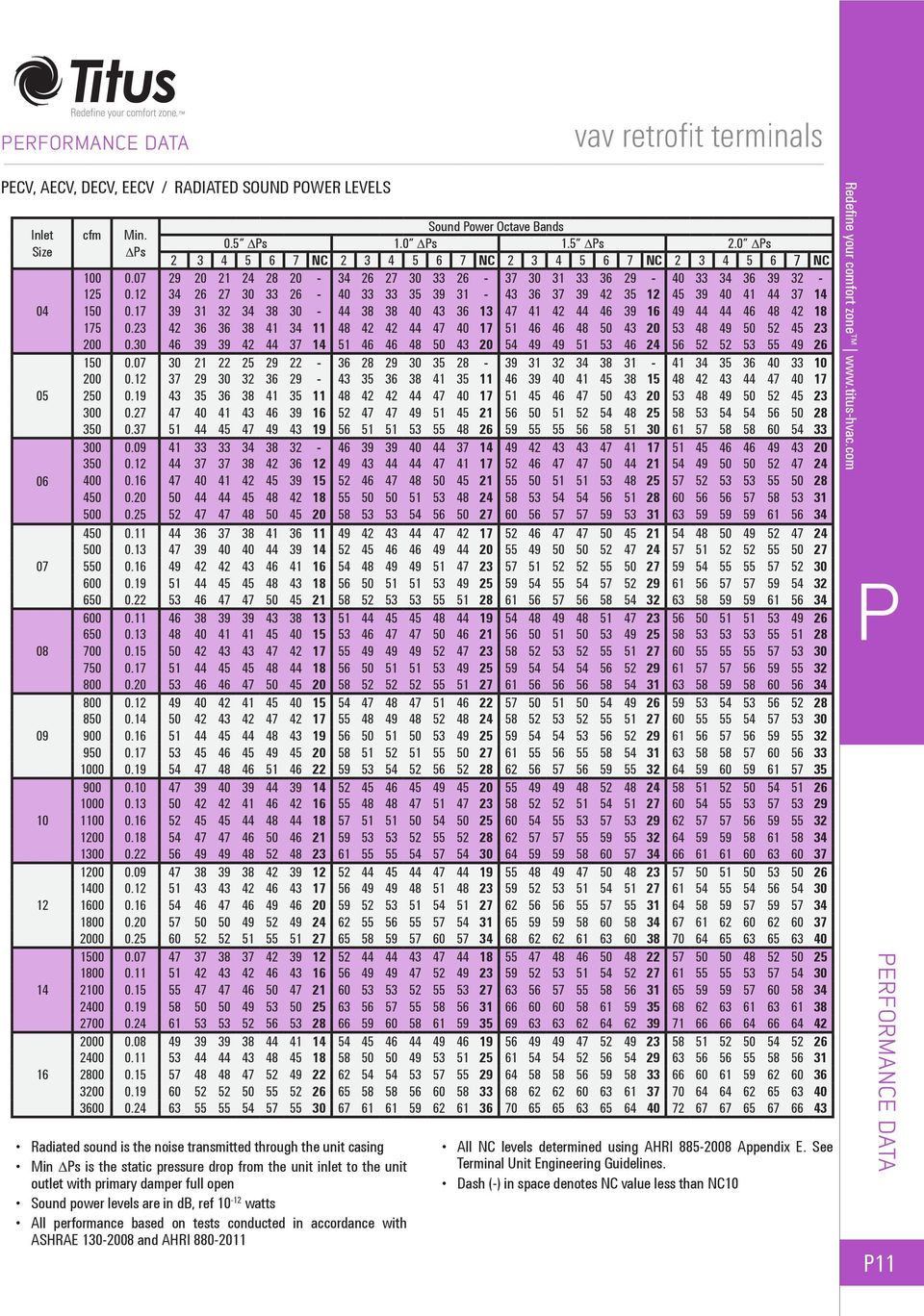
11 ERFORMANCE DATA ECV, AECV, DECV, EECV / RADIATED SOUND OWER LEVELS Inlet cfm Min. s Sound ower Octave Bands 0.5 s 1.0 s 1.5 s 2.0 s NC NC NC NC Radiated sound is the noise transmitted through the unit casing Min s is the static pressure drop from the unit inlet to the unit outlet with primary damper full open Sound power levels are in db, ref watts All performance based on tests conducted in accordance with ASHRAE and AHRI All NC levels determined using AHRI Appendix E. See Terminal Unit Engineering Guidelines. Dash (-) in space denotes NC value less than NC10 ERFORMANCE DATA 11
12 ERFORMANCE DATA ERFORMANCE DATA 12 ECV, AECV, DECV, EECV / DISCHARGE SOUND OWER LEVELS Inlet cfm Min. s Sound ower Octave Bands 0.5 s 1.0 s 1.5 s 2.0 s NC NC NC NC Discharge sound is the noise emitted from the unit discharge into the downstream ductwork Min s is the static pressure drop from the unit inlet to the unit outlet with primary damper full open Sound power levels are in db, ref watts All performance based on tests conducted in accordance with ASHRAE and AHRI All NC levels determined using AHRI Appendix E. See Terminal Unit Engineering Guidelines. Dash (-) in space denotes NC value less than NC10

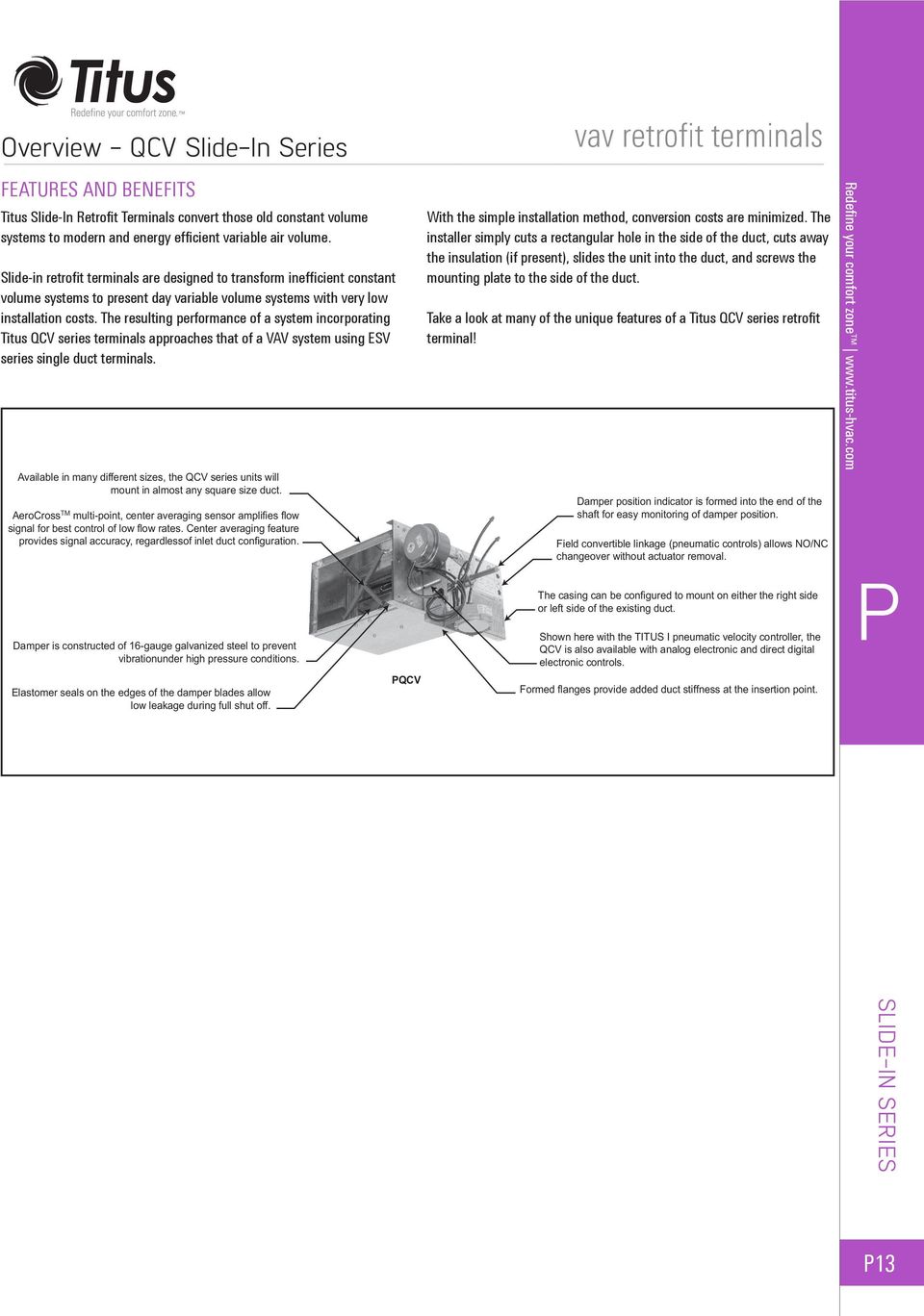
13 Overview - QCV Slide-In Series FEATURES AND BENEFITS Titus Slide-In Retrofit Terminals convert those old constant volume systems to modern and energy efficient variable air volume. Slide-in retrofit terminals are designed to transform inefficient constant volume systems to present day variable volume systems with very low installation costs. The resulting performance of a system incorporating Titus QCV series terminals approaches that of a VAV system using ESV series single duct terminals. Available in many different sizes, the QCV series units will mount in almost any square size duct. AeroCross TM multi-point, center averaging sensor amplifies flow signal for best control of low flow rates. Center averaging feature provides signal accuracy, regardlessof inlet duct configuration. With the simple installation method, conversion costs are minimized. The installer simply cuts a rectangular hole in the side of the duct, cuts away the insulation (if present), slides the unit into the duct, and screws the mounting plate to the side of the duct. Take a look at many of the unique features of a Titus QCV series retrofit terminal! Damper position indicator is formed into the end of the shaft for easy monitoring of damper position. Field convertible linkage (pneumatic controls) allows NO/NC changeover without actuator removal. Damper is constructed of 16-gauge galvanized steel to prevent vibrationunder high pressure conditions. Elastomer seals on the edges of the damper blades allow low leakage during full shut off. QCV The casing can be configured to mount on either the right side or left side of the existing duct. Shown here with the TITUS I pneumatic velocity controller, the QCV is also available with analog electronic and direct digital electronic controls. Formed flanges provide added duct stiffness at the insertion point. SLIDE-IN SERIES 13
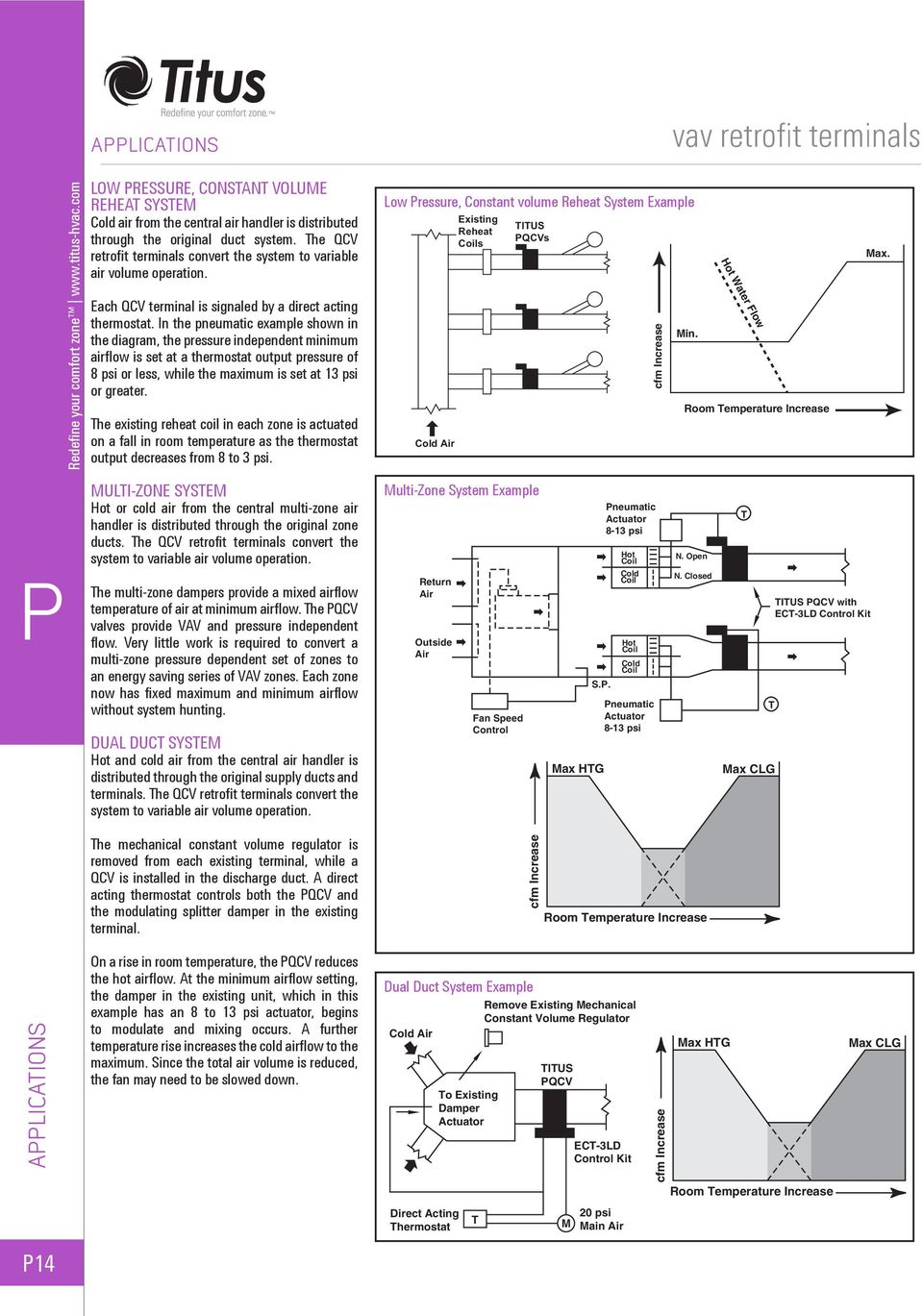
14 ALICATIONS LOW RESSURE, CONSTANT VOLUME REHEAT SYSTEM Cold air from the central air handler is distributed through the original duct system. The QCV retrofit terminals convert the system to variable air volume operation. Each QCV terminal is signaled by a direct acting thermostat. In the pneumatic example shown in the diagram, the pressure independent minimum airflow is set at a thermostat output pressure of 8 psi or less, while the maximum is set at 13 psi or greater. The existing reheat coil in each zone is actuated on a fall in room temperature as the thermostat output decreases from 8 to 3 psi. Low ressure, Constant volume Reheat System Example Cold Existing Reheat Coils TITUS QCVs Min. Hot Water Flow Max. MULTI-ZONE SYSTEM Hot or cold air from the central multi-zone air handler is distributed through the original zone ducts. The QCV retrofit terminals convert the system to variable air volume operation. The multi-zone dampers provide a mixed airflow temperature of air at minimum airflow. The QCV valves provide VAV and pressure independent flow. Very little work is required to convert a multi-zone pressure dependent set of zones to an energy saving series of VAV zones. Each zone now has fixed maximum and minimum airflow without system hunting. DUAL DUCT SYSTEM Hot and cold air from the central air handler is distributed through the original supply ducts and terminals. The QCV retrofit terminals convert the system to variable air volume operation. Multi-Zone System Example Return Outside Fan Speed Control S.. Max HTG neumatic 8-13 psi Hot Coil Cold Coil Hot Coil Cold Coil neumatic 8-13 psi N. Open N. Closed T T Max CLG TITUS QCV with ECT-3LD Control Kit The mechanical constant volume regulator is removed from each existing terminal, while a QCV is installed in the discharge duct. A direct acting thermostat controls both the QCV and the modulating splitter damper in the existing terminal. ALICATIONS On a rise in room temperature, the QCV reduces the hot airflow. At the minimum airflow setting, the damper in the existing unit, which in this example has an 8 to 13 psi actuator, begins to modulate and mixing occurs. A further temperature rise increases the cold airflow to the maximum. Since the total air volume is reduced, the fan may need to be slowed down. Dual Duct System Example Cold To Existing Damper Remove Existing Mechanical Constant Volume Regulator TITUS QCV ECT-3LD Control Kit Max HTG Max CLG Direct Acting Thermostat T M 20 psi Main 14
15 DIMENSIONS Available Model: QCV Series H** W** Gasket flow Orifice plate is undersized ¼ for easy installation. Additional gasket must be field supplied to assure a tight seal. 10½ AeroCross TM, multi-point, center averaging velocity sensor Opening in duct by others 6 12¼ H + 1 /8 Control Enclosure Note 1: H and W represents outside duct dimension. Note 2: Analog/digital (AQCV/DQCV) shown. Contact your Titus representative for control enclosure location and dimensions. Available with pneumatic controls. Gasket Mounting late QCV SERIES / AVAILABLE DUCT SIZES* Unit/ Damper A (5x5) B (6x6) C (8x6) D (10x8) E (14x8) F (18x6) G (12x10) H (18x10) cfm Range Max cfm Range Available Duct s* Width W Height H , 6, 8, 10, 12 5 to to 6, 8, 10, , 8, 10, , 8, 10, 12, 14 6 to to 8, 10, 12, , 10, 12, , 10, 12, 14, 16 6 to to 8, 10, 12, 14, , 10, 12, 14, to to , 12, 14, 16, , 12, 14, 16, , 12, 14, 16, , 12, 14, 16, , 16, 18, 20, 22, 24 8 to to 14, 16, 18, 20, 22, , 16, 18, 20, 22, , 20, 22, 24, 26 6 to to 18, 20, 22, 24, , 20, 22, 24, , 14, 16, 18, 20, to to 12, 14, 16, 18, 20, , 14, 16, 18, 20, , 20, 22, 24, 26, 28, to to 18, 20, 22, 24, 26, 28, , 20, 22, 24, 26, 28, Unit/ Damper J (18x12) K (20x14) L (30x12) M (22x16) N (24x18) (30x20) R (x20) cfm Range Max cfm Range Available Duct s* Width W Height H , 20, 22, 24, 26, to to 18, 20, 22, 24, 26, , 20, 22, 24, 26, , 22, 24, 26, 28, to to 20, 22, 24, 26, 28, , 22, 24, 26, 28, , 32,, to to 30, 32,, , 32,, , 24, 26, 28, 30, 32,, to to 22, 24, 26, 28, 30, 32,, , 24, 26, 28, 30, 32,, to to , 26, 28, 30, 32,, , 26, 28, 30, 32,, , 26, 28, 30, 32,, , 26, 28, 30, 32,, , 32,, 36,,,,, to to 30, 32,, 36,,,,, , 32,, 36,,,,, ,,, 46, 48, 50, to to,,, 46, 48, 50, ,,, 46, 48, 50, Note 1: The cfm Range column shows ranges from lowest minimum setting to highest maximum setting for pneumatic controls. DIMENSIONS * This is only a sampling of sizes available for the QCV Series. Any duct size larger than the damper size can be built. Note 2: The column, Max cfm Range shows the range of maximum cfm settings, for pneumatic controls. 15

16 ERFORMANCE DATA SLIDE-IN RETROFIT TERMINAL UNITS RECOMMENDED CFM RANGES Available Models: QCV / neumatic AQCV / Analog Electronic DQCV / Digital Electronic Inlet Damper Total cfm Range cfm Ranges of Minimum and Maximum Settings QCV neumatic TITUS II AQCV Analog Electronic DQCV Typical Digital Controller Controller Controller Minimum Maximum Minimum Maximum Minimum Maximum A 5 x * * * B 6 x * * * C 8 x * * * D 10 x * * * E 14 x * * * F 18 x * * * G 12 x * * H 18 x * * * J 18 x * * * K 20 x * * * L 30 x * * * M 22 x * * * N 24 x * * * x * * * R x * * * Note: An asterisk (*) indicates factory settings (except zero) will not be made below this range because control accuracy would be reduced. ERFORMANCE DATA Total cfm range refers to the overall range of adjustment of the pneumatic velocity controller, from the lowest MIN setting to the highest MAX setting Minimum cfm range refers to the range of adjustment of the MIN setting of the pneumatic velocity controller Maximum cfm range refers to the range of adjustment of the MAX setting of the pneumatic velocity controller 16

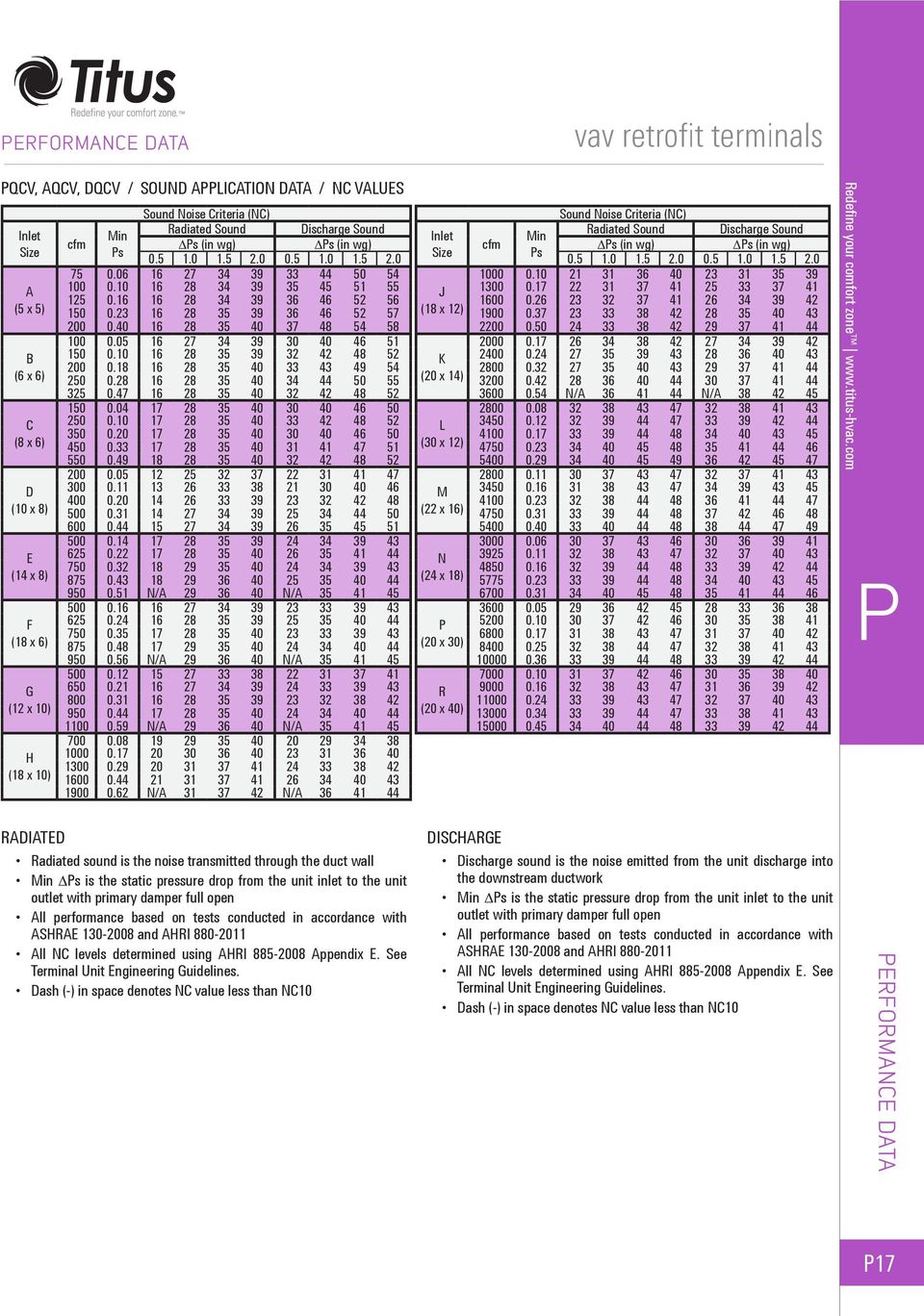
17 ERFORMANCE DATA QCV, AQCV, DQCV / SOUND ALICATION DATA / NC VALUES Inlet A (5 x 5) B (6 x 6) C (8 x 6) D (10 x 8) E (14 x 8) F (18 x 6) G (12 x 10) H (18 x 10) Sound Noise Criteria (NC) cfm Min Radiated Sound Discharge Sound s (in wg) s (in wg) s N/A N/A N/A N/A N/A N/A N/A N/A 36 Inlet J (18 x 12) K (20 x 14) L (30 x 12) M (22 x 16) N (24 x 18) (20 x 30) R (20 x ) Sound Noise Criteria (NC) cfm Min Radiated Sound Discharge Sound s (in wg) s (in wg) s N/A N/A RADIATED Radiated sound is the noise transmitted through the duct wall Min s is the static pressure drop from the unit inlet to the unit outlet with primary damper full open All performance based on tests conducted in accordance with ASHRAE and AHRI All NC levels determined using AHRI Appendix E. See Terminal Unit Engineering Guidelines. Dash (-) in space denotes NC value less than NC10 DISCHARGE Discharge sound is the noise emitted from the unit discharge into the downstream ductwork Min s is the static pressure drop from the unit inlet to the unit outlet with primary damper full open All performance based on tests conducted in accordance with ASHRAE and AHRI All NC levels determined using AHRI Appendix E. See Terminal Unit Engineering Guidelines. Dash (-) in space denotes NC value less than NC10 ERFORMANCE DATA 17
18 Overview - Special urpose and Internal Series FEATURES AND BENEFITS Titus Internal Retrofit Terminals convert those old mechanically regulated terminals to energy efficient VAV terminals! Existing constant volume systems retrofitted to variable air volume conserve energy by reducing reheat requirements, reducing refrigeration loads and reducing fan horsepower by taking advantage of building load diversity. Titus provides an easy, effective means to retrofit existing mechanical constant volume terminals without replacing the existing terminal or interrupting ductwork. Titus internally mounted, or ECT series, terminals are the most unique line of retrofit devices in the HVAC industry. Specifically designed to quickly replace mechanical regulators in existing terminals, each ECT series valve is unique. By replacing the mechanical regulators with ECT valves, the inefficient constant volume system is transformed into an energy saving, comfort providing variable volume system. Mechanically regulated terminals were produced by many different manufacturers over the years, including Titus. Today, a different model of ECT series retrofit variable air volume valve is used to replace the old mechanical regulators for each different manufacturer of terminals. Best of all, this is done with very little effort since each retrofit valve is designed to be installed while the supply air system is still running and without removing the existing terminals. Each ECT series valve is designed for maximum efficiency in operation and installation. Let s look at some of the features found in Titus ECT series internal retrofit terminals. All ECT series terminals are designed to be installed through existing access panels so no extensive sheet metal rework is required. Heavy gauge galvanized steel construction ensures quiet and durable operation. AeroCross TM multi-point, centeraveraging sensor amplifies flow signal for best control of low flow rates. Center-averaging feature provides signal accuracy, regardless of inlet duct configuration. ECT-AN repunched holes on the mounting flange match up with existing mounting bolts for the old regulators, making installation simple. Retrofit valve damper is normally open for ease of installation with supply air system operating. SECIAL UROSE & INTERNAL ECT-L series control packages, in conjunction with ECT series valves, can operate virtually any kind of control sequence. All control components found in an ECT-L series control package are protected by a heavy gauge metal enclosure. ECT-KR ECT-L Delrin damper bearings are unaffected by temperature and humidity, and prevent binding. Multiple ECT series valves can be operated from one ECT-L series control package. 18

19 ALICATIONS CONVERTING SINGLE DUCT CONSTANT VOLUME TO VAV In the preceding diagram, the original single duct constant volume, cooling only terminal has been converted to single duct VAV cooling only. The constant volume regulators have been replaced with a Titus ECT series internal retrofit terminal. The Titus ECT-3LS pneumatic control package provides pressure independent VAV control. Converting Single Duct Constant Volume to VAV psi Main ECT-3LS ECT T Stat Min. Max. CONVERTING SINGLE DUCT CONSTANT VOLUME WITH REHEAT TO VAV In the preceding diagram, the original single duct constant volume unit with reheat has been converted to single duct VAV. The constant volume regulators have been replaced with a Titus ECT series internal retrofit terminal. The Titus ECT-3LD pneumatic control package provides pressure independent VAV control for both cooling and heating. The heating airflow increases with an increase in water flow for more accurate constant discharge air temperature. Converting Single Duct Constant Volume with Reheat to VAV psi Main ECT-3LD ECT Coil T Stat Hot Water Valve Max. Hot Water Flow Min. Max. CONVERTING DUAL DUCT CONSTANT VOLUME TO SINGLE DUCT VAV COOLING In the preceding diagram, the original dual duct terminal has been converted to single duct, cooling only, to serve an interior zone. Notice that the hot duct connection has been capped. The damper is normally closed with respect to the cold air duct. Since the main control air feeds directly into the existing damper actuator, the damper goes fully open when the main control air is turned on. The Titus ECT-3LS then provides pressure independent VAV control. Converting Dual Duct Constant Volume to Single Duct VAV Cooling Existing Damper psi Main Cap Cold ECT-3LS ECT Existing Dual Duct Terminal Unit T Stat Min. Max. ALICATIONS 19

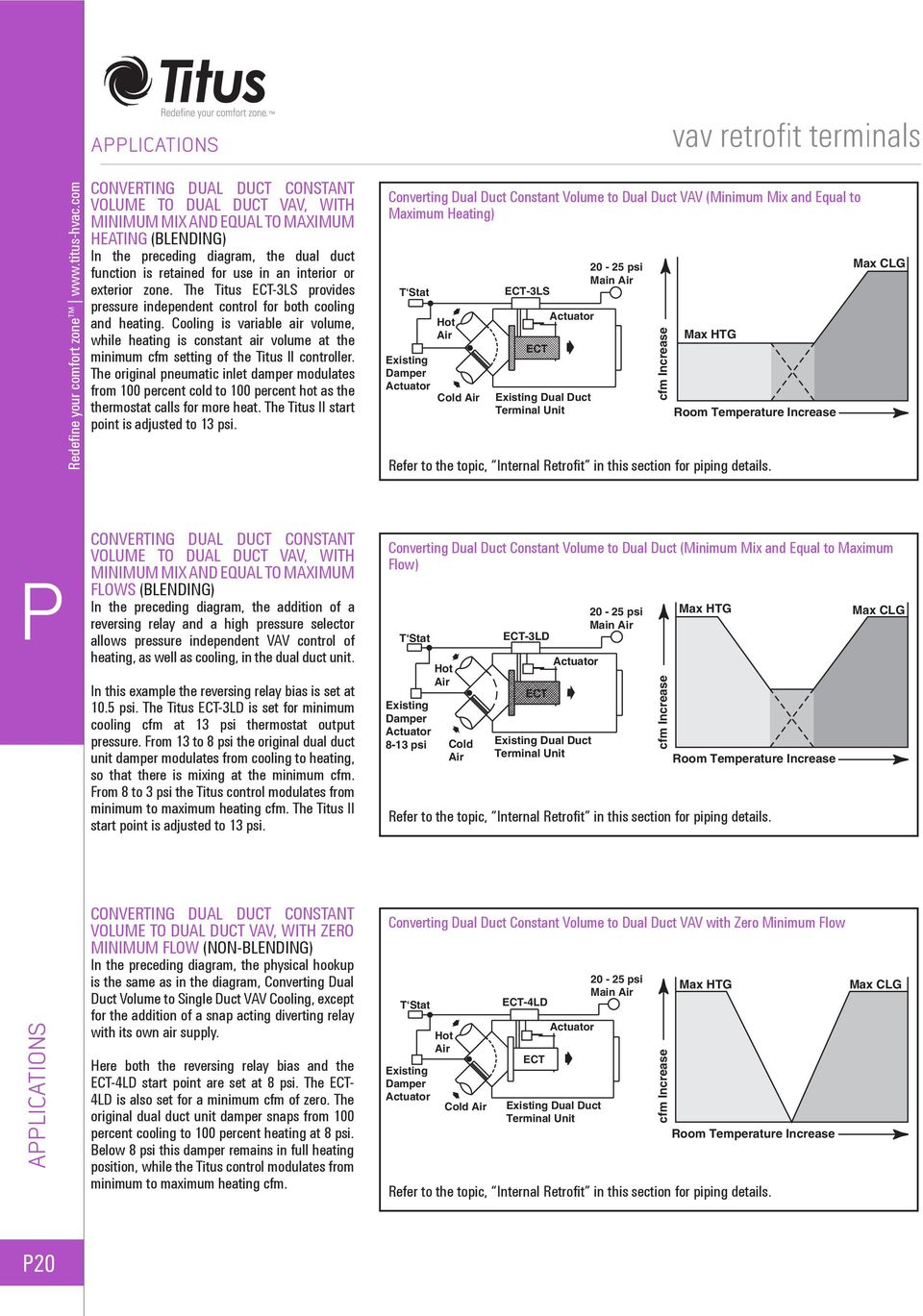
20 ALICATIONS CONVERTING DUAL DUCT CONSTANT VOLUME TO DUAL DUCT VAV, WITH MINIMUM MIX AND EQUAL TO MAXIMUM HEATING (BLENDING) In the preceding diagram, the dual duct function is retained for use in an interior or exterior zone. The Titus ECT-3LS provides pressure independent control for both cooling and heating. Cooling is variable air volume, while heating is constant air volume at the minimum cfm setting of the Titus ll controller. The original pneumatic inlet damper modulates from 100 percent cold to 100 percent hot as the thermostat calls for more heat. The Titus II start point is adjusted to 13 psi. Converting Dual Duct Constant Volume to Dual Duct VAV (Minimum Mix and Equal to Maximum Heating) T Stat Existing Damper Hot Cold ECT-3LS ECT Existing Dual Duct Terminal Unit psi Main Refer to the topic, Internal Retrofit in this section for piping details. Max HTG Max CLG CONVERTING DUAL DUCT CONSTANT VOLUME TO DUAL DUCT VAV, WITH MINIMUM MIX AND EQUAL TO MAXIMUM FLOWS (BLENDING) In the preceding diagram, the addition of a reversing relay and a high pressure selector allows pressure independent VAV control of heating, as well as cooling, in the dual duct unit. In this example the reversing relay bias is set at 10.5 psi. The Titus ECT-3LD is set for minimum cooling cfm at 13 psi thermostat output pressure. From 13 to 8 psi the original dual duct unit damper modulates from cooling to heating, so that there is mixing at the minimum cfm. From 8 to 3 psi the Titus control modulates from minimum to maximum heating cfm. The Titus II start point is adjusted to 13 psi. Converting Dual Duct Constant Volume to Dual Duct (Minimum Mix and Equal to Maximum Flow) T Stat Existing Damper 8-13 psi Hot Cold ECT-3LD ECT Existing Dual Duct Terminal Unit psi Main Refer to the topic, Internal Retrofit in this section for piping details. Max HTG Max CLG ALICATIONS CONVERTING DUAL DUCT CONSTANT VOLUME TO DUAL DUCT VAV, WITH ZERO MINIMUM FLOW (NON-BLENDING) In the preceding diagram, the physical hookup is the same as in the diagram, Converting Dual Duct Volume to Single Duct VAV Cooling, except for the addition of a snap acting diverting relay with its own air supply. Here both the reversing relay bias and the ECT-4LD start point are set at 8 psi. The ECT- 4LD is also set for a minimum cfm of zero. The original dual duct unit damper snaps from 100 percent cooling to 100 percent heating at 8 psi. Below 8 psi this damper remains in full heating position, while the Titus control modulates from minimum to maximum heating cfm. Converting Dual Duct Constant Volume to Dual Duct VAV with Zero Minimum Flow T Stat Existing Damper Hot Cold ECT-4LD ECT Existing Dual Duct Terminal Unit psi Main Refer to the topic, Internal Retrofit in this section for piping details. Max HTG Max CLG 20
21 Special urpose and Internal Series ECT-AN (Anemostat Terminals) OVERVIEW Variable Volume ECT-AN is a variable volume, retrofit control valve. Designed for retrofitting Anemostat mechanically controlled terminals, it directly replaces the mechanical constant volume regulators. This change out is easily done through the access panel in the bottom of the existing Anemostat terminal. The Titus ECT-AN valve fits the same space as the original volume regulator. The mounting holes in the ECT-AN inlet panel are prepunched to fit the existing bolts. While most Anemostat terminals will require no additional modifications, exceptions may be encountered because of minor variations in original manufacture. Simple relocation of the mounting holes, the valves or the sound/mixing baffle may be necessary to overcome space limitations. ECT-AN (INLET VIEW) See the topic, Control Boxes ECT-L Series in this section for optional pneumatic control packages. AVAILABLE MODEL: ECT-AN / HV-C series only Constant Volume* Options E, D, O or R ECT-AN / Dual Duct or Single Duct Applications SELECTION GUIDE The table shows the number of original mechanical regulators in each Anemostat terminal size. It also shows the corresponding sizes of Titus ECT-AN valves needed to replace these regulators. Each cfm range is the total for the entire terminal. The ECT-AN cfm range represents the typical limit settings for the reset span of a pneumatic velocity controller. ANEMOSTAT TERMINALS Type and Terminal Max cfm Range HV* 5 C HV* 6 C HV* 7 C HV* 8 C HV* 10 C HV* 12 C HV* 14 C HV* 16 C Regulator / cfm Range per Terminal Original Anemostat Titus ECT-AN 4 S T T T 28T 18T 28T L 1 23L L 1 23L L L 1 23L L * E=End Discharge D=Diffuser Discharge O=Octopus Discharge R=Reheat RW=Reheat (Hot Water) RS=Reheat (Steam) RE=Reheat (Electric) The minimum should be equal to or greater than 50 percent of the maximum airflow setting. The ECT-AN retrofit valve can be adjusted for a minimum cfm setting of zero (full shutoff). The ECT-AN retrofit is also available with electric actuators for use with electronic or DDC retrofit controls. Before the retrofit valves and controls are ordered, Titus recommends spot checking the existing terminals to determine the condition of the inlet dampers and actuators. The interiors should also be checked for space limitations and mounting conflicts. Anemostat Dual Duct Terminal Cold In retrofit energy solutions See website for Specifications Hot In ECT-AN 21
22 Special urpose & Internal Series (continued) ECT-BC (Barber-Colman Terminals) OVERVIEW Variable Volume ECT-BC is a variable air volume, retrofit control valve. Designed for retrofitting Barber-Colman mechanically controlled terminals, it directly replaces the mechanical constant volume regulators. This change out is easily done by removing the existing mechanical regulator from the side mounting channels and installing the new Titus ECT-BC valve in the same channels. The resulting performance approaches that of the current Titus Model ESV for single duct operation and EDV for dual duct operation. The hand of the ECT-BC retrofit valve can be changed by inverting it before sliding it in place. If using pneumatic velocity controllers as illustrated, simply snap the controller back into its bracket to maintain a dials-down orientation. AVAILABLE MODELS: ECT-BC / Single Duct Models: HSCE, HSCM, HSCT ECT-BC / Dual Duct Models: HDCE, HDCM, HDCD SELECTION GUIDE The table shows the retrofit valve size for each size of Barber-Colman terminal, together with the selection range for maximum airflow (retrofitted). The minimum airflow can be adjusted for full shut-off. ECT-BC retrofit energy solutions See website for Specifications Notice that some sizes have two flow ranges. Choose the retrofit valve size for the flow range desired. The minimum flow setting should be equal to or greater than 25 percent of the lowest maximum flow setting. Exception: The ECT-BC retrofit valve can also be adjusted for a minimum flow setting of zero (full shutoff). BARBER-COLMAN TERMINALS Barber-Colman Inlet Duct Maximum cfm Control Range Titus ECT-BC Upper Channel Barber-Colman Terminal ECT-BC A B A B A B A B See the topic, Control Boxes ECT-L Series in this section for optional pneumatic control packages. Hot In Cold In Multi-oint Center Averaging Velocity Sensor TITUS Model ECT-BC Retrofit Valve Lower Channel Gasket Gauge Tee Optional neumatic Control Kit 22
23 Special urpose & Internal Series (continued) ECT-BU (Buensod Terminals) OVERVIEW Variable Volume ECT-BU is a variable air volume, retrofit control valve. Designed for retrofitting Buensod design 14 and 16 mechanically controlled terminals. It directly replaces the mechanical constant volume regulators. This change out is easily done through the access panel in the bottom of the existing Buensod terminal. The old regulator flange is used as a pattern for drilling the mounting holes in the ECT-BU inlet panel. While most design 14 and 16 terminals will require no additional modifications, exceptions may be encountered because of minor variations in original manufacture. Simple relocations of the valves or of the sound baffle may be necessary to overcome space limitations. ECT-BU (INLET VIEW) See the topic, Control Boxes ECT-L Series in this section for optional pneumatic control packages. AVAILABLE MODEL: ECT-BU / H-Series, Designs 14 and 16 SELECTION GUIDE The table shows the number of original mechanical regulators in each Buensod terminal size. It also shows the corresponding sizes of Titus ECT-BU valves needed to replace these regulators. Each cfm range is the total for the entire terminal. The ECT-BU cfm range represents the typical limit settings for the reset span of a pneumatic velocity controller. The minimum should be equal to or greater than 50 percent of the maximum airflow setting. BUENSOD TERMINALS Design Single Duct Single Duct with Reheat Dual Duct Buensod Titus Titus Regulatory ECT-BU Retrofit Quantity Quantity cfm and and Range 4HS(R) 4 H A HS(R) 5 H B HS(R) 6 H C and 7HS(R) 7 H D HS(R) 8 H E HS(R) 9 H E HS(R) 10 H F HLA E HLB E HLC E A HLAS(R) HLA E B HLBS(R) HLB F A HLCS(R) HLC E B HLDS(R) HLD F The ECT-BU retrofit valve can be adjusted for a minimum cfm setting of zero (full shut-off) with leakage less than 10 cfm at 3 inches pressure differential. The ECT-BU is also available with electric actuators for use with electronic or DDC retrofit controls. Before the retrofit valves and controls are ordered, we recommend spot checking the existing terminals to determine the condition of the inlet dampers and actuators. The interiors should also be checked for space limitations and mounting conflicts. Retrofit Control Box Buensod Terminal Cold retrofit energy solutions See website for Specifications Hot ECT-BU 23
24 Special urpose & Internal Series (continued) ECT-CN (Connor Terminals) OVERVIEW Variable Volume ECT-CN is a variable air volume, retrofit control valve. Designed for retrofitting Connor mechanically controlled terminals, it directly replaces the mechanical constant volume regulators. This change out is easily done through the access panel in the bottom of the existing Connor terminal. The Titus ECT-CN valve fits the same space as the original constant volume regulator(s). The mounting holes in the ECT-CN inlet panel are pre-punched to fit the existing mounting bolts on sizes 4 to 10. On unit sizes 12 to 16, mounting holes must be drilled to match original bolt locations on the Connor regulator panel. Only a single ECT-CN is required to replace as many as four of the original mechanical regulators. ECT-CN While most Connor terminals will require no additional modifications, exceptions may be encountered because of minor variations in original manufacture. AVAILABLE MODEL: ECT-CN / 45 Series Dual Duct Models: DDC, DDV, DSC SELECTION GUIDE The table shows the original Connor terminal size, and corresponding sizes of Titus ECT-CN valves needed. Each cfm range is the total for the entire terminal. The ECT-CN cfm range represents the typical limit settings for the reset span of a pneumatic velocity controller. The minimum should be equal to or greater than 50 percent of the maximum airflow setting. retrofit energy solutions See website for Specifications The ECT-CN retrofit valve can also be adjusted for a minimum cfm setting of zero (full shut-off) with leakage less than 20 cfm at 3 inches pressure differential. The ECT-CN is also available with electric actuators for use with electronic or DDC retrofit controls. Before the retrofit valves and controls are ordered, we recommend spot checking the existing terminals to determine the condition of the inlet dampers and actuators. The interiors should also be checked for space limitations and mounting conflicts. ECT-CN CONNOR TERMINALS Inlet Dual Duct Models: DDC, DDV DSC Titus ECT-CN Titus Retrofit cfm Range Connors Dual Duct Terminal See the topic, Control Boxes ECT-L Series in this section for optional pneumatic control packages. Hot Cold 24
25 Special urpose & Internal Series (continued) ECT-HC (Titus Terminals) OVERVIEW Variable Volume The ECT-HC is a variable air volume, retrofit control valve. Designed for Titus mechanically controlled terminal units, it directly replaces the mechanical constant volume regulators in those models. This change out is easily done through the access panel in the bottom of the existing Titus terminal. The resulting performance approaches that of the current Titus Model ESV and EDV terminals. Some installations require fewer ECT-HC valves than the number of existing mechanical regulators. In those cases the extra regulators are removed and the openings are covered with metal plates. ECT-HC The pneumatic actuators of as many as three ECT-HCs can be controlled by one Titus II controller. Any number of controllers can be signaled by one thermostat. AVAILABLE MODEL: ECT-HC / Models: TDH, TDL, TSH, TSHR, HD, LD, HS, and HSR SELECTION GUIDE The table shows the maximum number of original constant volume regulators in each terminal model and size. It also shows the number of Model ECT-HC retrofit valves required to replace these regulators. Each ECT-HC high capacity valve can control up to 800 cfm. neumatic TITUS TERMINALS retrofit energy solutions See website for Specifications or electric actuators are available. Each cfm range is a total for the entire terminal. It represents typical limit settings for the reset span of the pressure independent pneumatic controller. The ECT-HC valve can also be adjusted for a minimum cfm setting of zero (full shut-off) with leakage of less than 2 percent. Design 1 Shipment 1968 through Shipments 1974 through 1984 Single Duct Single Duct with Reheat Dual Duct TSH TSHR TDH HS HSR HD cfm Range No. of Titus Regulators No. of Titus ECT-HC Valves * * * A * B C D E F G H J Model TDH Optional (ECT-L Series) neumatic Control Kit Contact factory for availability See the topic, Control Boxes ECT-L Series in this section for optional pneumatic control packages. Titus Dual Duct Mechanically Regulated Terminal ECT-HC 25
26 Special urpose & Internal Series (continued) ECT-KR (Krueger Terminals) OVERVIEW Variable Volume ECT-KR is a variable air volume, retrofit control valve. Designed for retrofitting Krueger mechanically controlled terminals, it directly replaces the mechanical regulators in those models. This change out is easily done through the access panel in the bottom of the existing Krueger terminal. In some installations the new air volume is much less than the original, so that the terminals require fewer ECT-KR valves than the number of existing mechanical regulators. In those cases the extra regulators are removed and the openings are covered with metal plates. ECT-KR ECT-KR AVAILABLE MODEL: ECT-KR / Single Duct Models: CVM-ES, CVM-MS, CVM-RA, CVM-RB ECT-KR / Dual Duct Models: CVM-ES, CVM-M, CVM-D SELECTION GUIDE ECT-KR is a variable air volume, retrofit control valve. Designed for retrofitting Krueger mechanically controlled terminals, it directly replaces the mechanical regulators in those models. This change out is easily done through the access panel in the bottom of the existing Kruger terminal. Each cfm range is the total for the entire terminal. The ECT-KR cfm range represents the typical limit settings for the reset span of a pneumatic velocity controller. KRUEGER TERMINALS Krueger Original Retrofitted Number of Number of ECT-KR Terminal cfm cfm Original ECT-KR Retrofit Valve Range Range Regulators Valves N/A N/A C D E E F E 12 x D 16 x G 20 x G retrofit energy solutions The minimum should be equal to or greater than the 50 percent of the maximum airflow setting. The ECT-KR retrofit valve can also be adjusted for a minimum cfm setting of zero (full shut-off) with leakage less than 10 cfm at 3 inches pressure differential. The ECT-KR is also available with electric actuators for use with electronic or DDC retrofit controls. Before the retrofit valves and controls are ordered, we recommend spot checking the existing terminals to determine the condition of the inlet dampers and actuators. The interiors should also be checked for space limitations and mounting conflicts. Retrofit Control Box Krueger Terminal See website for Specifications 26 See the topic, Control Boxes ECT-L Series in this section for optional pneumatic control packages. Cold Hot
27 Special urpose & Internal Series (continued) ECT-TB (Tuttle & Bailey Terminals) OVERVIEW Variable Volume ECT-TB is a variable air volume, retrofit control valve. Designed for retrofitting Tuttle & Bailey mechanically controlled terminals, it directly replaces the mechanical constant volume regulators. This change out is easily done through the access panel in the bottom of the existing Tuttle & Bailey terminal. The Titus ECT-TB valve fits the same space as the original constant volume regulator. The old regulator flange is used as a pattern for drilling the mounting holes in the mounting panel. While most Tuttle & Bailey terminals will require no additional modifications, exceptions may be encountered because of minor variations in original manufacture. Simple relocations of the valves or of the sound baffle may be necessary to overcome space limitations. ECT-TB See the topic, Control Boxes ECT-L Series in this section for optional pneumatic control packages. AVAILABLE MODEL: ECT-TB / Single Duct Model: MMC-MVC ECT-TB / Dual Duct Models: MM-MVC, MMD-MVC, MM4-MVC retrofit energy solutions See website for Specifications SELECTION GUIDE The table shows the retrofit valve size for each size of Tuttle & Bailey terminal, together with the selection range for TITUS maximum Model airflow ECT-TB Retrofit (retrofitted). The minimum airflow can be adjusted Valve for full shut-off. TITUS Tuttle & Bailey Dual Duct Terminal TUTTLE & BAILEY TERMINALS TB TB Titus Maximum Unit Inlet ECT-EB cfm Settings A 5 A AB 5 AB B 6 B C 7 C D 8 D E 10 E F 12 F G 18 x 10 G H 18 x 14 H ECT-TB RETROFIT ROCEDURES FOR VARIOUS SIZES OF TUTTLE & BAILEY TERMINALS Remove & mount old actuator on terminal outside Old Multi-oint Inlet Sensor ECT-TB Cold ACCESS DOOR REMOVED MCV Regulator Hot ECT-TB Control Box ECT-TB Access Door Removed Mount retrofit kit/actuator inside terminal s A, AB, B, C, D Control Box Access Door Removed s E, F Cut hole to remove bolts to regulator & remove s G, H Access Door Removed Inside 27
28 Special urpose & Internal Series (continued) ECT-L Series CONTROL BOXES Available Models: ECT-3LS ECT-3LD ECT-4LD The pneumatic control connections in most installations are made as shown in the ECT-3LS diagram at the right. Just one Titus II pneumatic controller can control as many as four retrofit valves. Although just one controller is shown in the diagram, any number of Titus II controllers can be connected in parallel to one room thermostat. Note: SCFM SCFH SCFM = SCFH/60 Standard Cubic Feet er Minute Standard Cubic Feet er Hour The ECT-3LD control box is used in both single duct and dual duct applications. Included are a high pressure selector switch and a reversing relay with its bias adjusted to match the start point of the water valve opening for single duct applications. For dual duct applications, the reversing relay is normally adjusted to the mixing damper actuator start point pressure plus the actuator throttling pressure range, divided by two. ECT-3LS Compressed Consumption = 1.2 SCFH + Thermostat Loss TITUS Retrofit Valves To s From Sensor ECT-3LS Control Box LO TITUS II See the topic, ECT Series Applications in this section for flow Control Sequence B HI T ECT-3LD Compressed Consumption = 1.7 SCFH + Thermostat Loss TITUS Retrofit Valves From Sensor ECT-3LD Control Box TITUS II LO B M High ressure Selector HI T M Reversing Relay To Existing Valve or Inlet Thermostat T M Thermostat T psi Main To s M psi Main See the topic, ECT Series Applications in this section for flow Control Sequence ECT-L SERIES 28 The ECT-4LD control box is typically used only in dual duct applications. In addition to the high pressure selector switch and reversing relay, a snap acting diverting relay is included. The start point of the Titus II controller is normally set at 8 psi, and the switch point of the snap acting diverting relay is also set at 8 psi. The diverting relay is also adjusted so that 8 psi in equals 8 psi out. Note: Compressed air consumption values shown are for the Titus ECT-L control box only and do not include the thermostat. ECT-4LD Compressed Consumption = 1.7 SCFH + Thermostat Loss TITUS Retrofit Valves To s From Sensor LO TITUS II B ECT-3LS Control Box Snap Acting Diverting Relay To Existing Inlet See the topic, ECT Series Applications in this section for flow Control Sequence HI T M High ressure Selector S Reversing Relay C NC M Thermostat T M psi Main
29 Notice NOTICE: Titus is a registered trademark of System Components L. Anemostat is a registered trademark of Anemostat roducts Division, a Mestek Company. Buensod and Barber-Colman terminal units are trademarks of Hart & Cooley, Inc. Connor is a registered trademark of Connor Incorporated, of Tek- Systems, Inc. HSCE, HSCM, HSCW, HSCT, HDCE, HDCM, HDCD are model numbers of products manufactured by Barber- Colman. HVEC, HVDC, HVOC, and VRC are model numbers of products manufactured by Anemostat. MMC - MVC, MM-MVC, MMD-MVC, MM-4-MVC are model numbers of products manufactured by Tuttle & Bailey. H Series - Design 14 & 16 are model numbers of products manufactured by Buensod. NOTICE 29
30 Notes
ret-ro-fi ret-ro-fit ret-ro-fit titus retrofit energy solutions www.titus-hvac.com
 ret-ro-fit ret-ro-fit ret-ro-fi titus retrofit energy solutions www.titus-hvac.com www.greenspec.com titus retrofit energy solutions Table of Contents Retrofit Energy Solutions Overview... 5 Major Systems...
plenum slot diffusers
 light powered Redefine your comfort zone. www.titus-hvac.com dual-function smart logic light powered energy solutions Table of Contents PLENUM SLOT IFFUSERS products Plenum Slot iffusers Products... 4
PNEUMATIC CONTROLS Selection and Description
 PNEUMATIC CONTROLS Selection and Description Carnes pneumatic controlled throttling units are suitable for a standard 20 psi control system and may be supplied with pressure dependent or pressure independent
PNEUMATIC CONTROLS Dual Duct Sequence Descriptions
 PNEUMATIC CONTROLS Dual Duct Sequence Descriptions Model ADCC dual duct throttling unit control sequences fall into three basic categories: mixing, without mixing, and constant volume. The piping diagrams
UNIVERSITY OF MISSOURI 23 0000 - Heating Ventilating and Air-Conditioning (HVAC) March 2015.01
 GENERAL: This section provides general standards for overall sizing and design of Heating, Ventilating, and Air Conditioning (HVAC) systems. Other sections contain specific standards for each system per
SECTION 23 05 93 TESTING, ADJUSTING, AND BALANCING FOR HVAC INTRODUCTORY INFORMATION
 SECTION 23 05 93 TESTING, ADJUSTING, AND BALANCING FOR HVAC INTRODUCTORY INFORMATION The purpose of this guide specification is to assist the specifier in correctly specifying Mechanical System Testing
General Information... 2
 Pneumatic VAV Reset Volume Controllers CSC 2000 Series Applications Guide General Information... 2 CSC 2000 Series Overview...2 odels and Specifications...3 ounting...4 Connections...4 All Units...4 Beige
MULTIZONE APPLICATION OF SOLUTION UNITS
 MULTIZONE APPLICATION OF SOLUTION UNITS APPLICATION GUIDE Supersedes: 102.20-AG12 (206) Form: 102.20-AG12 (307) GENERAL Multi-zone heating and air conditioning units offer design and application advantages
NEBB STANDARDS SECTION-8 AIR SYSTEM TAB PROCEDURES
 NEBB STANDARDS SECTION-8 AIR SYSTEM TAB PROCEDURES 8.1 INTRODUCTION Testing, adjusting, and balancing of HVAC systems can best be accomplished by following a series of systematic procedures. The NEBB TAB
Element D Services Heating, Ventilating, and Air Conditioning
 PART 1 - GENERAL 1.01 OVERVIEW A. This section supplements Design Guideline Element D3041 on air handling distribution with specific criteria for projects involving design of a Data Center spaces B. Refer
T 3 Series VAV Diffusers Analog Diffuser Steel Square Panel Horizontal Pattern Model: T 3 SQ
 TSQ--0 7-7-07 T Series VAV Diffusers Analog Diffuser Steel Square Panel Horizontal Pattern Model: T SQ Model Configuration T SQ- Heating / Cooling Border Type (Lay-In) Full Face Nominal Round Duct Size
KRUEGER Single-Duct and Retro Fit Terminal Units
 KRUEGER Single-Duct and Retro Fit Terminal Units PRE-INSTALLATION General The LMHS, RVE, and SVE single duct terminals are available with factory installed Pneumatic, Analog electronic, and DDC control
GENERAL PRODUCT OVERVIEW
 CONTROLS Pneumatic Controls comprehensive range of factory supplied, installed and calibrated controls are available for pressure independent control applications with all terminal types. Pressure dependent
Rev. No. 0 January 5, 2009
 ENERGY & ENVIRONMENTAL ENERGY ISSUES COMMITTEE 415 Main Building Telephone (574) 631-6666 Notre Dame, Indiana Facsimile (574) 631-5883 46556 USA Energy Conservation Plan For HVAC Systems Rev. No. 0 January
Demand Based Static Pressure Reset Control for Laboratories
 LLC Demand Based Static Pressure Reset Control for Laboratories Laboratories are generally the largest users of energy in any facility. Whether in a pharmaceutical research facility, a university or a
Recirculating Roof Fans Models ESRMD, ESRMDF and ERD
 Recirculating Roof Fans Models ESRMD, ESRMDF and ERD Four-Way Fan Exhaust Supply Mix Recirculate BUILDING VALUE IN AIR. October 2005 Recirculating Roof Fans Exhaust/Supply/Recirculation/Mix Model ESRMD
Installation Manual. TITUS I, II, and IIA Pneumatic Controls Installation, Operation, and Maintenance Manual. (See Figure 3) (Label, See Figure 3)
 Installation Manual PNEU-IOM-1.0 5-2-05 IUS I, II, and IIA Pneumatic Controls Installation, Operation, and Maintenance Manual Adjusting Minimum and Maximum Air Flow Airflow limits are printed on the label
ENHANCED LABORATORY HVAC SYSTEM
 ENHANCED LABORATORY HVAC SYSTEM INTRODUCTION Since the early 1980's the attention to more energy efficient laboratory designs has been on the rise due to the increase in energy cost and the emergence of
AABC Specifications for Testing and Balancing HVAC Systems
 AABC Specifications for Testing and Balancing HVAC Systems The Associated Air Balance Council (AABC) Total System Balancing Specifications for HVAC Testing, Balancing and Performance Verification TOTAL
Cooktop Low-Profile Ventilation Hoods
 INSTALLATION GUIDE Cooktop Low-Profile Ventilation Hoods Contents Wolf Cooktop Low-Profile Ventilation Hoods........ 3 Cooktop Low-Profile Hood Specifications.......... 4 Cooktop Low-Profile Hood Installation............
HVAC Systems: Overview
 HVAC Systems: Overview Michael J. Brandemuehl, Ph.D, P.E. University of Colorado Boulder, CO, USA Overview System Description Secondary HVAC Systems Air distribution Room diffusers and air terminals Duct
Powers Controls TH 192 S Single Temperature Room Thermostat
 Technical Instructions Document No. 155-065P25 TH 192-1 Powers Controls TH 192 S Single Temperature Room Thermostat 50 60 70 80 TH0355R1 70 80 POWERS Description The TH 192 S thermostats are proportional
AMD-33 Air Measuring Station with VCD-33 Control Damper
 Application and esign Construction Standard Optional Frame Material Galvanized Steel - Frame Material Thickness 16 ga. (1.5mm) 12 ga. (2.7mm) Frame Type 5 in. x 1 in. hat channel - Blade Material Galvanized
Powers Controls Free Energy Band TH 193 HC Heating/Cooling Room Thermostat
 Document No. 155-068P25 TH 193-4 Powers Controls Free Energy Band TH 193 HC Heating/Cooling Room Thermostat 50 60 70 80 70 TH0356R1 60 80 POWERS Description The TH 193 HC thermostats are proportional dual
Installer s Guide 18-AH39D1-13
 18-AH39D1-13 Cased Aluminum "Convertible" Coils 4TXCA018BC3HC** 4TXCA024BC3HC** 4TXCB025BC3HC** 4TXCB026BC3HC** 4TXCB031BC3HC** 4TXCB032BC3HC** ALL phases of this installation must comply with NATIONAL,
Powers Controls TH 192 HC Heating/Cooling Room Thermostat
 Powers Controls TH 192 HC Heating/Cooling Room Thermostat Technical Instructions Document No. 155-066P25 TH 192-2 50 60 70 80 70 TH0356R1 60 80 POWERS Description The TH 192 HC thermostats are proportional
SAM HOUSTON STATE UNIVERSITY
 PART 1: GENERAL 1.01 General Requirements A. This standard is intended to provide useful information to the Professional Service Provider (PSP) to establish a basis of design. The responsibility of the
HVAC Checklist - Long Form
 HVAC Checklist - Long Form Page 1 of 14 Appendix B discusses HVAC system components in relation to indoor air quality. utside Air Intake Location pen during occupied hours? Unobstructed? Standing water,
Introduction. Angle/Flared/Sequence/Changeover Service Valves. Valves D-193. www.usa.siemens.com/hvac
 Introduction Angle/Flared/Sequence/Changeover Service D-193 In this section, you will find flared, angled, sequence and changeover valves for use in service applications. D-194 Need additional assistance?
specializing in AIR CONDITIONING, PARTS AND SYSTEMS for your classic vehicle PERFECT FIT IN-DASH HEAT/ COOL/ DEFROST 1967-72 CHEVROLET PICKUP
 specializing in AIR CONDITIONING, PARTS AND SYSTEMS for your classic vehicle PERFECT FIT IN-DASH HEAT/ COOL/ DEFROST 1967-72 CHEVROLET PICKUP CONTROL & OPERATING INSTRUCTIONS The controls on your new Perfect
Methods for Effective Room Air Distribution. Dan Int-Hout Chief Engineer, Krueger Richardson, Texas
 Methods for Effective Room Air Distribution Dan Int-Hout Chief Engineer, Krueger Richardson, Texas Agenda Overview LEED issues and Update Perimeter Acoustics Thermal Comfort IAQ / Standard 62.1 Update
security products metric sizes Redefine your comfort zone. www.titus-hvac.com
 metric sizes secure lethal objects monitoring areas suicide deterrent Redefine your comfort zone. www.titus-hvac.com humid areas prevents corrosion minimum security medium security maximum security Table
ANSI/AHRI Standard 880 (I-P) with Addendum 1. 2011 Standard for Performance Rating of Air Terminals
 ANSI/AHRI Standard 880 (I-P) with Addendum 1 2011 Standard for Performance Rating of Air Terminals Approved by ANSI on October 27, 2011 WITH ADDENDUM 1, PERFORMANCE RATING OF AIR TERMILS June 2012 Note:
Condensing Boiler Efficiency
 Condensing Boiler Efficiency Date: July 17, 2012 PRES E NT ED BY DO N L E O NA RDI LE O N A RD I I NC. HV AC T RAI N I N G & C ON SU LT IN G Concepts 1 The current state of evolution in boiler design 2
Basics of HVAC Cleaning
 Basics of HVAC Cleaning Seminar Outline Residential 1. Types of systems used and why 2. Types of air distribution systems 3. System components 4. Determining the need for cleaning (ACR2002) 5. Project
A Prototype Alternative Ventilation System for Retrofit, Rehab and Renovation of Rural Alaska Houses
 A Prototype Alternative Ventilation System for Retrofit, Rehab and Renovation of Rural Alaska Houses Robert L Crosby Jr, Biorealis Systems, Inc. Abstract: Bristol Bay Housing Authority (BBHA) currently
Float and Thermostatic Traps Series H, C and X
 Hoffman Specialty Installation & Maintenance Instructions HS-(E) and Thermostatic Traps Series H, C and X Series C & NPT Series C NPT Series X NPT Series C NPT Series H Ratings Maximum Max. Operating NPT
REGULATORS 175/153 Series
 175/153 Series 175 HEATING 153 COOLING Watson McDaniel reserves the right to change the designs and/or materials of its products without notice. 2002 Watson McDaniel Company Revised 7/2002 175 / 153 Screwed
Appendix B: VAV Controller Flow Calculation Constants
 Appendix Issue Date September 18, 2003 Appendix B: VAV Controller Flow Calculation VAV Controller Flow Calculation...2 Introduction... 2 ey Concepts... 3 About Flow Calculation... 3 Carnes Company... 4
AMD-23-TD. Thermal Dispersion Air Measuring Station with VCD-23 Control Damper. Application and Design. Ratings. Features and Control Options.
 Application and esign Thermal ispersion Air Measuring Station with VC-23 Control amper The combines the functionality of a highly accurate thermal dispersion airflow measuring station and a low leakage
VariTrane Duct Designer An in depth look...
 VariTrane Duct Designer An in depth look... Introduction The VariTrane Duct Designer duct design program was written to help optimize design while obtaining a minimum pressure system. The program is based
1932 Lexington Houston, Texas 77098-4220 (713) 524-4877. Recommendations for installation of cooling systems
 1932 Lexington Houston, Texas 77098-4220 (713) 524-4877 The purpose for this information is to provide a better understanding of the HVAC equipment, components, designs, and installations, of HVAC system
One Year Warranty. Stock U.S. # of Volts Weight CONN. Height Dia. Watts # GAL. Elements INS. Inches NATURAL GAS* Six Year Warranty
 One Year Warranty ELECTRIC Stock U.S. # of Volts Weight CONN. Height Dia. Watts # GAL. Elements INS. Inches Fused Ceramic Shield tank lining is corrosion-resistant for years of dependability. Adjustable
Duct Leakage Testing. Ken Helfers, TSI Inc. 2011, TSI Incorporated
 Duct Leakage Testing Ken Helfers, TSI Inc. Agenda Need for duct leakage testing Duct leakage testing standards and regulations Performing duct leakage testing Why Test Ducts for Leakage? Conserve energy
SECTION 23 81 03 - PACKAGED ROOFTOP AIR CONDITIONING UNITS NON-CUSTOM
 SECTION 23 81 03 - PACKAGED ROOFTOP AIR CONDITIONING UNITS NON-CUSTOM PART 1 - GENERAL 1.1 SUMMARY A. Section Includes: 1. Packaged rooftop air conditioning unit (5 tons and smaller). 2. Roof curb. 1.2
WON0502-B INSTALLATION INSTRUCTIONS FOR ELECTRIC FURNACES. Bulletin 30-34 / March 2013
 Bulletin 30-34 / March 2013 INSTALLATION INSTRUCTIONS FOR ELECTRIC FURNACES General The information on the following pages is to provide the installer the necessary information to properly install the
The Axial Flow Valve. Class 300/600. [email protected] www.elster-instromet.com SERIES
 The Axial Flow Valve SERIES Class 300/600 [email protected] www.elster-instromet.com THE AXIAL FLOW VALVE - SERIES 300/600 A UNIQUE REGULATOR What is the Axial Flow Valve? The Axial Flow Valve
COMMISSIONING OF HVAC SYSTEMS
 FORM CL-01 SYSTEMS / EQUIPMENT INCLUDED : SYSTEM STARTUP CHECKLIST I - PRE - STARTUP INSPECTION EQUIPMENT MOUNTING & SETTING CONTROL, INTERLOCK & POWER WIRING ALIGNMENT OF MOTORS & DRIVES PIPING, CONNECTIONS
 AIR COOLED CHILLER CHILLED WATER PUMP CONTROL: The chilled water pump with the lowest runtime will automatically start when the outside air temperature rises above the system enable setpoint. When the
Mechanical Heating Ventilation and Air Conditioning Ductwork and Duct Accessories
 Basis of Design This section applies to the design and installation of ductwork, air terminal boxes, air outlets and inlets, volume dampers, pressure relief dampers, smoke/fire dampers, and smoke/fire
Design Information. Designing Your Dust Collection System. Typical dust or fume collection system
 Design Information Designing Your Dust Collection System There are five simple steps to designing an effective and efficient dust collection system. 1. Draw a floor plan of your shop Important Terms to
Acoustical Design Guidelines for HVAC Systems in Schools
 Acoustical Design Guidelines for HVAC Systems in Schools Seminar 9, ASHRAE Summer Meeting Albuquerque, New Mexico Sponsor: TC 2.6 Sound and Vibration Robert M. Lilkendey Associate Principal Consultant
Heating Water by Direct Steam Injection
 Heating Water by Direct Steam Injection Producing hot water by direct steam injection provides a solution where large volumes of hot water at precise temperatures are required, and where energy and space
HVAC Air Duct Leakage. November 2013 Presented By: Mark Terzigni Project Manager Technical Services SMACNA
 HVAC Air Duct Leakage November 2013 Presented By: Mark Terzigni Project Manager Technical Services SMACNA Learning Objectives Understand the difference between System leakage and Duct leakage Understand
Direct steam injection humidifiers
 Direct steam injection humidifiers Direct steam injection gives quality control of air humidity. Research and development in separation, the use of lightweight stainless steel combined a constant temperature
FIRE DAMPER APPLICATION GUIDE
 FIRE AND CEILING RADIATION DAMPERS FIRE DAMPER APPLICATION GUIDE Use this application guide to help determine what type of fire damper best suits the application. Below are listed the ten Metal-Fab fire
A. The Commissioning Authority (CxA) has been contracted or will be contracted directly with the Owner for this project.
 DIVISION 23 HEATING, VENTILATING, AND AIR CONDITIONING (HVAC) SECTION 23 08 02 PART 1 GENERAL 1.01 AUTHORITY (CxA) A. The Commissioning Authority (CxA) has been contracted or will be contracted directly
Commercial Gas Furnace Upflow
 Commercial Gas Furnace Upflow Model G24-200 80% A.F.U.E. 200,000 Btuh Input Heating Cap. 7.5 or 10 Tons Nominal Add-On Cooling GUK FEATURES Certified by A.G.A./C.G.A. Laboratories. Heavy gauge painted
Centrifugal Fans and Pumps are sized to meet the maximum
 Fans and Pumps are sized to meet the maximum flow rate required by the system. System conditions frequently require reducing the flow rate. Throttling and bypass devices dampers and valves are installed
Variable Air Volume - VAV
 Mode Enable Sensor Options Variable Air Volume - VAV The temperature of this sensor will determine if the unit is in heating, cooling or vent mode during occupied operation. The following options are available:
REAL OPERATING COST SAVINGS FROM RETRO- COMMISSIONING OPPORTUNITIES FOR SAVINGS IN ACADEMIC MEDICAL CENTERS
 REAL OPERATING COST SAVINGS FROM RETRO- COMMISSIONING OPPORTUNITIES FOR SAVINGS IN ACADEMIC MEDICAL CENTERS Ken L. Hansen P.E. University of Nebraska Medical Center [email protected] 402-559- 5301 402-630-
HP switch LP switch Discharge thermo Comp. Surface thermo
 1 Specifications Zubadan Model Name PUHZ-SHW80VHA PUHZ-SHW11VHA PUHZ-SHW11YHA Power supply (phase, cycle, voltage) 1φ, V, Hz 1φ, V, Hz 3φ, 0V, Hz Max. current A 9.5 35.0 13.0 Breaker size A 3 16 Outer
POWERS Controls No. 4 Pneumatic Damper Actuator
 POWERS Controls No. 4 Pneumatic Damper Actuator Technical Instructions Document No. 155-032P25 AP 331-2 Actuator Assembly 331-2929 Typical Actuator Assembly 331-2904 Typical Actuator Assembly 331-3000
FLUID FLOW Introduction General Description
 FLUID FLOW Introduction Fluid flow is an important part of many processes, including transporting materials from one point to another, mixing of materials, and chemical reactions. In this experiment, you
Installation Manual. Rental Services. Air Handling Units CHS-SVN01A-EN. July 2008
 Installation Manual Rental Services Air Handling Units July 2008 CHS-SVN01A-EN Copyright 2008 Trane All rights reserved This document and the information in it are the property of Trane and may not be
AIR CONDITIONING PRODUCTS COMPANY
 Quality Products Fixed Louvers AIR CONDITIONING PRODUCTS COMPANY all Shutter Backdraft Damper Ceiling Shutter Motorized Damper Fixed Louver Ga le Shutter Drainable Louver Supply Damper Fiberglass Shutter
RFI Response RFP: HSCG88-16-R-PQQ015 Replace HVAC Bldg A & C San Diego, CA.
 1. There is verbiage in the hazardous material report referring to a state licensed abatement contractor. Within the recommendations part of the report (page 64 of 111 of the specification pdf) is the
Duct Design. Presented by Dave Janquart
 Duct Design Presented by Dave Janquart Overview of Topics Duct design Duct insulation SMACNA Standards Factors Influencing Duct Design Equipment Losses Air Velocity Duct Material Duct Size & Shape Length
APC APPLICATION NOTE #112
 #112 Best Practices for Deploying the InfraStruXure InRow SC By David Roden Abstract The InfraStruXure InRow SC (ACSC100 and ACSC101) is a self-contained air conditioner for server rooms and wiring closets.
Glossary of Heating, Ventilation and Air Conditioning Terms
 Glossary of Heating, Ventilation and Air Conditioning Terms Air Change: Unlike re-circulated air, this is the total air required to completely replace the air in a room or building. Air Conditioner: Equipment
PSS10H/B PSS12H/A ILLUSTRATED PARTS LISTS
 PSS10H/B PSS12H/A ILLUSTRATED PARTS LISTS AC AND DC GENERATOR SCHEMATIC ENGINE GENERATOR ASSEMBLY REF Description QTY PSS10 PSS12 1 Engine, Honda GX620K1VXC2 Code 637220 1 99779-000 GX670VXC2 Code 637220
Bring the fresh in. Dedicated Outside Air Systems
 Bring the fresh in. Dedicated Outside Air Systems The inside story on outside air. On average, we breathe in 3,400 gallons of air each day. Ambient indoor air pollution is a major problem, affecting health
Evaluate, Clean, and Tune Guidance
 Evaluate, Clean, and Tune Guidance The Evaluate, Clean and Tune (ECT) process serves three essential purposes in the Weatherization Assistance Program (WAP). The first is to evaluate the existing system
Mustang Series PRESSURE REDUCING CONTROL VALVE WITH PRESSURE SUSTAINING FEATURE. M115-2 (Globe) M1115-2 (Angle) Schematic. Standard Components
 Schematic Throttles to reduce high upstream pressure to constant lower downstream pressure Throttles to maintain minimum upstream pressure PRESSURE REDUCING CONTROL VALVE WITH PRESSURE SUSTAINING FEATURE
SECTION 11 78 13 MORTUARY REFRIGERATORS
 PART 1 - GENERAL 1.1 DESCRIPTION SECTION 11 78 13 MORTUARY REFRIGERATORS SPEC WRITER NOTE: Delete between //---// if not applicable to project. Also delete any other item or paragraph not applicable in
! WARNING. McDonnell & Miller Installation & Maintenance Instructions MM-217(I) Series 150S and 157S (Snap Switch, All Models except 157S-RB-P)
 Series 150S and 157S (Snap Switch, All Models except 157S-RB-P) Low Water Cut-Off/Pump Controllers For Steam Boilers and Other Level Control Applications McDonnell & Miller Installation & Maintenance Instructions
Basic Selection & Proper Application of Overhead Air Distribution Devices
 Basic Selection & Proper Application of Overhead Air Distribution Devices GRD Selection & Application Terms Selection Throw Sound Installation Variations affect Performance Inlet Effects Basics Return
Cooling system components, removing and installing
 Volkswagen Touareg 3.2 - Cooling system components, removing and installing Page 1 / 24 19-1 Cooling system components, removing and installing Warning! Hot steam may escape when opening expansion tank.
Life Safety Dampers Selection and Application Manual. Ceiling Radiation Dampers Fire Dampers Combination Fire Smoke Dampers Smoke Dampers
 Life Safety Dampers Selection and Application Manual Ceiling Radiation Dampers Fire Dampers Combination Fire Smoke Dampers Smoke Dampers May 2014 1 2 Table of Contents HOW TO USE THIS MANUAL DAMPER APPLICATION
Toroidal Conductivity Sensor
 Instruction Sheet PN 51A-/rev.C June 2012 Toroidal Conductivity Sensor For additional information, please visit our website at www.emersonprocess.com/rosemountanalytical.com SPECIFICATIONS Wetted Materials:
Commissioning - Construction Documents (Page 1 of 6)
 Commissioning - Construction Documents (Page 1 of 6) A. General Information Climate Zone: Building Type: Conditioned Area (sf): Reviewer's Name: Reviewer's Agency: Note: Design Review for each system/subsystem
Cooling Capacity CFM range @.5 in. w.c. (125 Pa)
 N8MXL Product Specifications 80% ECM Single Stage Heating Furnace EASIER TO SELL 80% AFUE Flame roll out sensors standard Category I venting Blocked vent switch 24 VAC humidifier terminal Electronic air
Index 11.1. Page. Pumping Systems...11.2-11.4 Intensifiers...11.5 Gas Boosters...11.6-11.7 High Pressure Generators...11.8-11.9
 Pumping Systems, Intensifiers, Gas Boosters and High Pressure Generators High Pressure Equipment Company produces a number of components and systems for general industrial, elevated pressure applications.
ECOCIAT. Domestic hot water heat recovery unit
 Heat recovery unit Domestic hot water High energy efficiency with R410A Compact and quiet Scroll compressors Brazed-plate heat exchangers Heating Heat recovery ENVIRONMENTALLY HFC R410A PROTECTION DE FRIENDLY
Lesson 36 Selection Of Air Conditioning Systems
 Lesson 36 Selection Of Air Conditioning Systems Version 1 ME, IIT Kharagpur 1 The specific objectives of this chapter are to: 1. Introduction to thermal distribution systems and their functions (Section
Oil and Coolant Circulating Heating System. Model - OCSM
 Oil and Coolant Circulating Heating System Model - OCSM Installation & Operation Manual 216280-000 REV 2 Identifying Your System The HOTSTART heating system is designed to heat fluids for use in marine
Installation/ Operation Maintenance
 Installation/ Operation aintenance VariTrane Pneumatic Controls arch 02 Thermostat Thermostat election and Location In general, both one- and two-pipe thermostats have a gain of 2.5 psi per degree Fahrenheit,
Dual Maximum VAV Box Controls
 ASHRAE Golden Gate Chapter November 13, 2014 Dual Maximum VAV Box Controls Steven T. Taylor, PE FASHRAE Taylor Engineering LLC staylor@taylor engineering.com Agenda VAV Box basics Sizing VAV Boxes How
Installation and User Instructions Unvented Electric Storage Water Heater Models: S10UNV, S15UNV.
 Installation and User Instructions Unvented Electric Storage Water Heater Models: S10UNV, S15UNV. MULTIPOINT Please read and understand these instructions before starting work. Please leave this leaflet
PIPES AND TUBES FOR HVAC PIPING AND EQUIPMENT
 PIPES AND TUBES FOR HVAC PIPING AND EQUIPMENT GENERAL INFORMATION 1.1 This section applies to piping systems for chilled water, hot water, condenser water, steam, condensate return, fuel oil, refrigerant
WAVELET WATER QUALITY MONITORING KIT
 AYYEKA Rethink Water Monitoring WAVELET WATER QUALITY MONITORING KIT ON OFF QUICK START GUIDE AYYEKA IMPORTANT! Use with pressure applications up to 145 PSI. Contact AYYEKA SUPPORT center for technical
ROOF TOP MOUNTED Air Handler Specification
 ROOF TOP MOUNTED Air Handler Specification PART 1: GENERAL (Model RT) Mechanical Specification 1.01 WORK INCLUDED A. Provide complete air handling unit(s) suitable for outdoor installation. Contractor
CE6500 Energy Recovery Ventilator
 ADVANCED COMMERCIAL Energy Recovery Ventilator PRODUCT SPECIFICATIONS & TECHNICAL DATA Features NOMINAL CAPACITY 5500-7000 CFM CASING Double-wall cabinet White exterior paint, -gauge galvanized steel -gauge
SECTION 23 05 12 GENERAL PROVISIONS FOR HVAC WORK
 SECTION 23 05 12 GENERAL PROVISIONS FOR HVAC WORK 1 GENERAL 1.1 GENERAL REQUIREMENTS A. This Section is coordinated with and complementary to the General Conditions and Supplementary General Conditions
with MERCURY FREE 1 HP Relays ! WARNING Before using this product read and understand instructions.
 B Installation & Maintenance Instructions MM-414 Series 150E and 157E Low Water Cut-Off/Pump Controllers For Steam Boilers and Other Level Control Applications A Typical Applications: Primary or secondary
PRESSURE REDUCING CONTROL VALVE
 Schematics Throttles to reduce high upstream pressure to constant lower downstream pressure Low Flow By-Pass controls at low flows 4 PRESSURE REDUCING CONTROL VALVE with LOW FLOW BY-PASS FEATURE Main Line
Get the FACTS about SEER and Deliver Better Customer Value
 What is SEER? SEER stands for Seasonal Energy Efficiency Ratio. It s a number that describes how well air-conditioning equipment works. A higher SEER means better efficiency and lower energy bills. SEER
ECO-AIR AIR CONDITIONING www.northamericanhvac.com
 INDEX ACCESSORIES INSTALLATION... 3-7 LINE SETS... 3-7 GEOTHERMAL... 3-8 WIRING CABLE... 3-8 CIRCULATOR PUMPS (PRO-TECH MODEL)... 3-9 DC INVERTER SINGLE ZONE HEAT PUMP... 3-6 DC INVERTER TECHNOLOGY...
Example Retrocommissioning Measure: Opening Throttled Discharge Valves
 Opening Throttled Discharge Valves This 21-story building, constructed in 1997, is located in Oregon and contains 589,000 gross square feet of mostly office occupancy. The HVAC system includes six large
Duct Leakage Testing 101 Frank Spevak The Energy Conservatory Minneapolis, MN
 Duct Leakage Testing 101 Frank Spevak The Energy Conservatory Minneapolis, MN Copyright 2011 The Energy Conservatory Minneapolis MN 612-827-1117 Housekeeping If you do not hear anything from your computer