
Aspen Cloud Server Management Console
|
|
|
- Jack Hunt
- 10 years ago
- Views:
Transcription
1 Aspen Cloud Server Management Console Management of Cloud Server Resources Power All Networks Ltd. User Guide June 2011, version Refer to ICP V1.1 PAGE 1

2 Table of Content 1. Introduction Initial Setting.. 5 New ICP Setting.. 5 Add new ICP in Cloud Management System (CMS) DHCP Setup Getting Started Cloud Management Console.. 24 IDC Billing Console. 25 IDC Operation Console 25 Forget Password Introduction to IDC Operation Console VM Management Host Management Cloud Server Management Template Management IDC Maintenance Zone Management OS Management Auto Refill Policy Cloud Server Refill Management Partner Management Currency Management.. 87 City Maintenance PAGE 2

3 Table of Content 4.2. Account Management Production Account Control Panel ACL Settings Remote Access Management Product Management Plan Management Value Added Service Management Change Password in IDC Operation Tool Introduction to IDC Billing Console Capacity & Usage Report New Subscription Report Revenue Report User Subscription Report Demo Account Recharge Report Change Password in IDC Billing Tool Text based Menu Password Recovery Script FAQ Contact Details PAGE 3

4 1. Introduction What is Aspen Cloud Management Console Aspen Cloud Management Console is a series of tools allowing IDC to assign and mange resources. All resources can be managed by a single console. By using mouse clicks, users can manage the ADD / Drop of resources, including Host, IDC and Virtual Machine in ease. Our powerful management console is not only keep track of users own resources, but also monitor the client use. With the billing tools, this helps users to prepare a clear, concise presentation of the resources subscriptions and income analysis. The management console is divided into 3 parts, including End User Tool, IDC Billing Console and IDC Operation Console. End User Tool is used by the end user. The Billing Console is used to generate the billing report, i.e.: Subscriptions and Revenue Report. And for the latter, it's used to assign resources for IDC. PAGE 4
5 2. Initial Setting New ICP Setup STEP 1 By default, ICP server with IP Address subnet mask To change IP address, open webmin: URL : ip]:10005/ e.g. : Default Username and Password is admin and cloudadmin Click On Network Configuration Network Interfaces Save and Apply eth0 Choose Tab Page Activated at Boot Remark: Don t choose Active Now, should be Activated at Boot PAGE 5

6 2. Initial Setting (continued) STEP 2 By default ICP Cloud Software is not activated. Each ICP server is required a unique license authorized by Power All. To activate, open the URL: URL : ip]:10007/initial_key.php e.g. : Example: Initial setup key generation IP Address : MAC Address : BC:30:5B:D0:26:80 Hardware ID : M:92SBW 2K74W T2VYQ ECC75 Generated Key : h69t2iuy0biiy55l4plbe9957 Copy all server information displayed on browser and following to aspen [email protected] (If you have multiple servers to activate, you can send all server information in single .) Server ID (can be found on server profile) IP address MAC address Hardware ID Generated Key STEP 3 After Power All received the server information, will generate one license file per server, and back to customer. PAGE 6

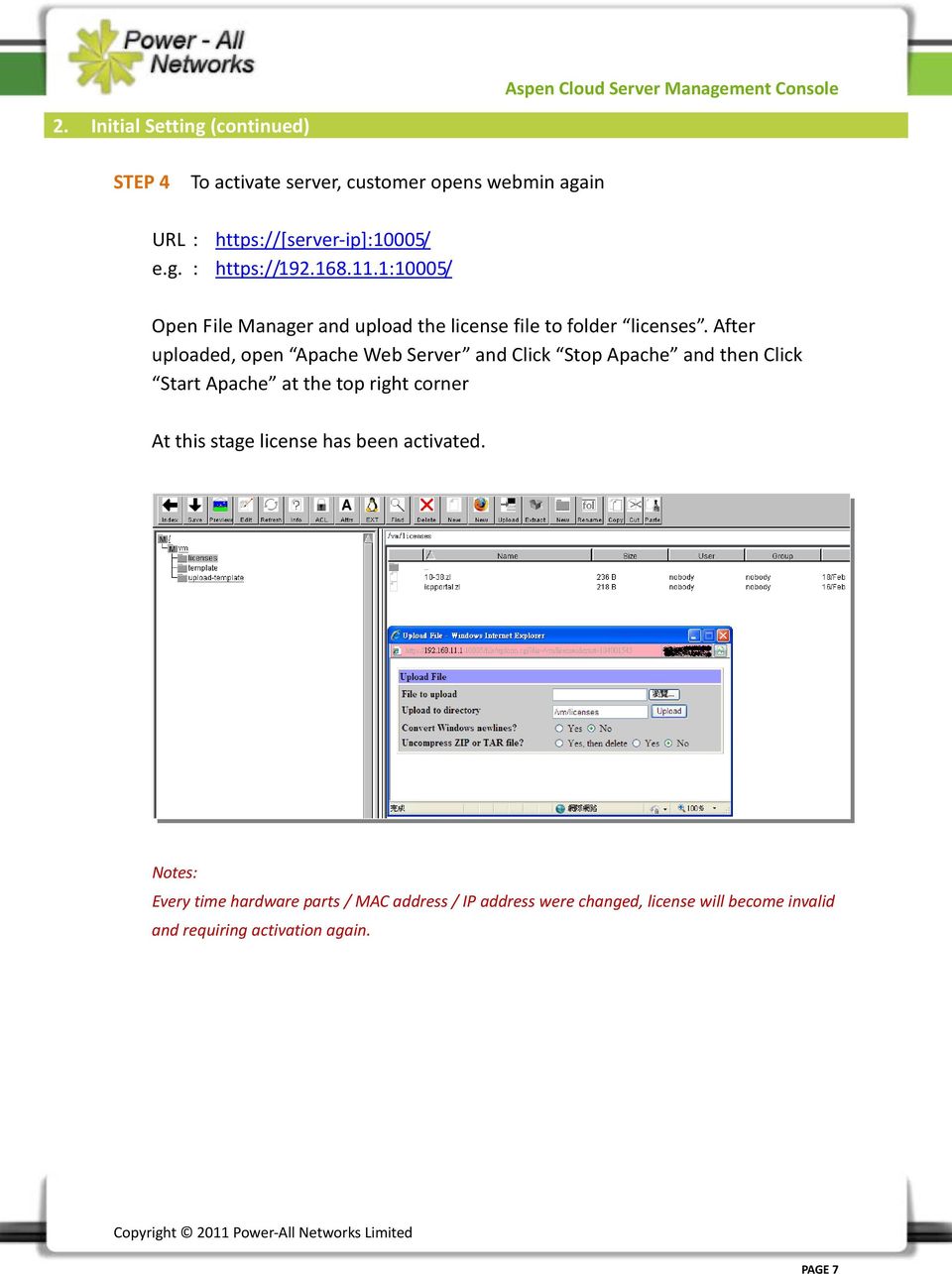
7 2. Initial Setting (continued) STEP 4 To activate server, customer opens webmin again URL : ip]:10005/ e.g. : Open File Manager and upload the license file to folder licenses. After uploaded, open Apache Web Server and Click Stop Apache and then Click Start Apache at the top right corner At this stage license has been activated. Notes: Every time hardware parts / MAC address / IP address were changed, license will become invalid and requiring activation again. PAGE 7
8 2. Initial Setting (continued) STEP 5 Configuring Administration Panel (CMS Only) 5.1. Initial setup of CMS URL : ip]:10006 e.g. : Default Username and Password is admin and cloudadmin PAGE 8
![Initial setup of CMS URL : http://[server ip]:10006 e.g.](/docs-images/44/13688611/images/page_8.jpg ": http://192.168.11.")
9 3. Initial Setting (continued) Click Initial Setup of CMS Please input the destination IP Address of CMS server or Click Auto Detect to use current IP Address. Select Country and then Click Submit PAGE 9

10 2. Initial Setting (continued) 5.2. Login to CMS Admin Panel e.g. The default Login and Password of IDC Operation Console is icp_admin and cloudadmin. The default Login and Password of IDC Billing Console is icp and cloudadmin PAGE 10

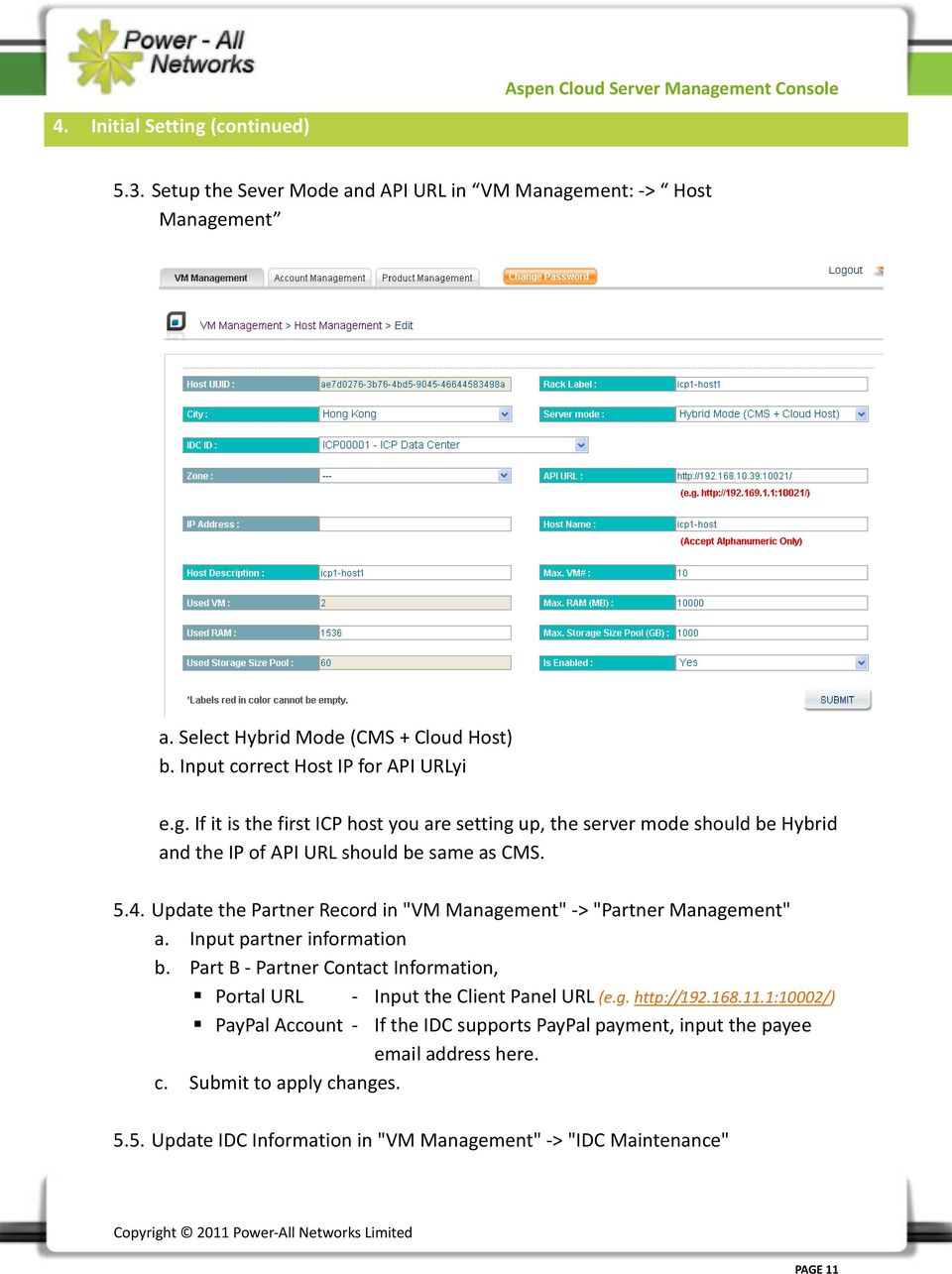
11 4. Initial Setting (continued) 5.3. Setup the Sever Mode and API URL in VM Management: > Host Management a. Select Hybrid Mode (CMS + Cloud Host) b. Input correct Host IP for API URLyi e.g. If it is the first ICP host you are setting up, the server mode should be Hybrid and the IP of API URL should be same as CMS Update the Partner Record in "VM Management" > "Partner Management" a. Input partner information b. Part B Partner Contact Information, Portal URL Input the Client Panel URL (e.g. PayPal Account If the IDC supports PayPal payment, input the payee address here. c. Submit to apply changes Update IDC Information in "VM Management" > "IDC Maintenance" PAGE 11
12 2. Initial Setting (continued) Add new ICP in Cloud Management System (CMS) STEP 1 To activate a new ICP. Repeat New ICP Setup Step 1 4 STEP 2 Login to CMS Admin Panel. To register a new ICP host, click REGISTER in Host Management e.g. Input the host information. Labels with Cyan color are compulsory and the rest is optional. Below are the descriptions for each fields. Rack Label: Label that paste in the physical server, it should be the same as the server name. City: IDC: API URL: City where the host is located. The idc where the host is located. The api server's url link. e.g. If the IP of new ICP Server is , then should be filled in this field. Remark: / must be behind the port number PAGE 12

13 2. Initial Setting (continued) Host Name: Host Name for the newly added host. Host Description: User's description for the host. Max. VM#: Maximum number of vm that can be assigned to this host. Max. RAM (MB): Ram size for the host. Max. Storage Size Pool (GB) : Disk size for the host. Is Enabled: To determine whether this host can be used. Click Connect to verify the connection is correct from CMS to New ICP Server. Click SUBMIT button and confirm the registration. STEP 3 Mount to CMS common folders 3.1 Login to new icp webmin page. E.g Select Disk and Network Filesystems 3.3 Select Type Common Internet Filesystem (cifs) and then Click Add mount PAGE 13

14 2. Initial Setting (continued) There are three folders need to mounted from CMS. Mounted As Server Name Share Name Login Name Password /vm/template CMS_IP template nobody cloudadmin /vm/customer template CMS_IP customer template nobody cloudadmin /vm/idc template CMS_IP idc template nobody cloudadmin 3.4 Fill correct information according to above table and then click Save and Mount PAGE 14

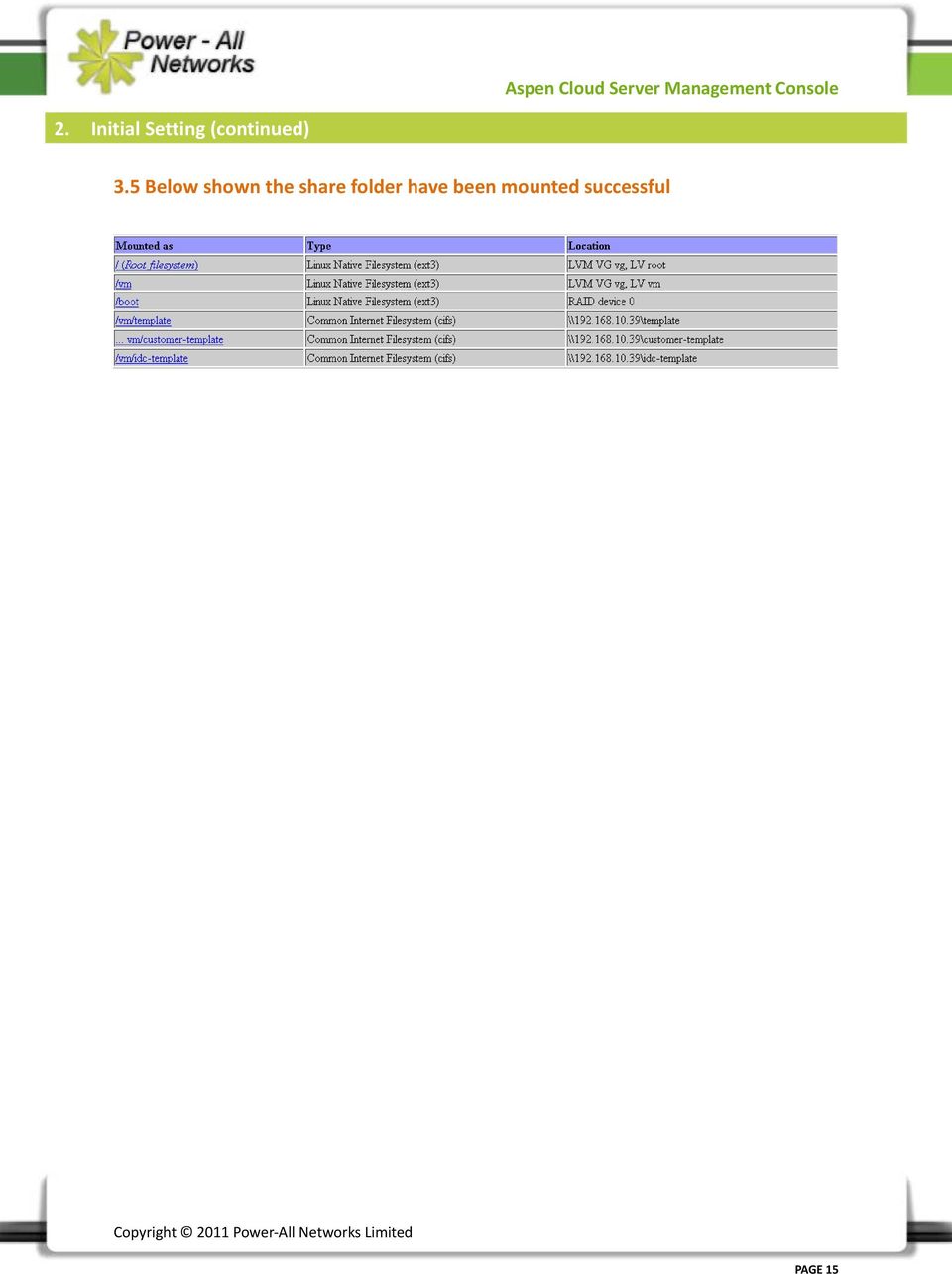
15 2. Initial Setting (continued) 3.5 Below shown the share folder have been mounted successful PAGE 15
16 2. Initial Setting (continued) DHCP Setup The network configuration of VMs should be managed by DHCP Server. All MAC Address should be specified when creating VM. Below is a procedure of setting up the DHCP Server for assigning network information to VMs with MAC Address. STEP 1 Go to and Click DHCP Server PAGE 16

17 2. Initial Setting (continued) STEP 2 Click the button ConfigFile at bottom of the page PAGE 17

18 2. Initial Setting (continued) STEP 3 Edit the following lines based on the network environment and click Save when complete. Remark: Please make sure the server is UP or Re start after edit the configure file 1. Edit the DNS IP of network, these values will be assigned to VM # The following line set your DNS IP address: option domain-name-servers , ; 2. Edit the Dummy configure, the IP / subnet setting will be same as the network of the cserver host. ############################ ## Assume eth0 of this server (host server) with IP /24, gateway (router) ############################ # Dummy (should be same as the eth0 of host server) PAGE 18

19 subnet netmask { authoritative; option routers ; host { option host-name "dummy.localdomain"; option routers ; deny client-updates; deny unknown-clients; hardware ethernet 11:11:11:22:22:22; fixed-address ; } } 3. Edit the VM IP, subnet, Gateway and MAC address ############################ ## Private IP example ## Assume VM 1 with IP /24, gateway (router) , MAC address (hardware ethernet): 00:16:3e:6a:6b:22 ############################ # VM 1 subnet netmask { authoritative; option routers ; host { option host-name "00:16:3e:6a:6b:22-icp.localdomain"; option routers ; deny client-updates; deny unknown-clients; hardware ethernet 00:16:3e:6a:6b:22; fixed-address ; } } PAGE 19
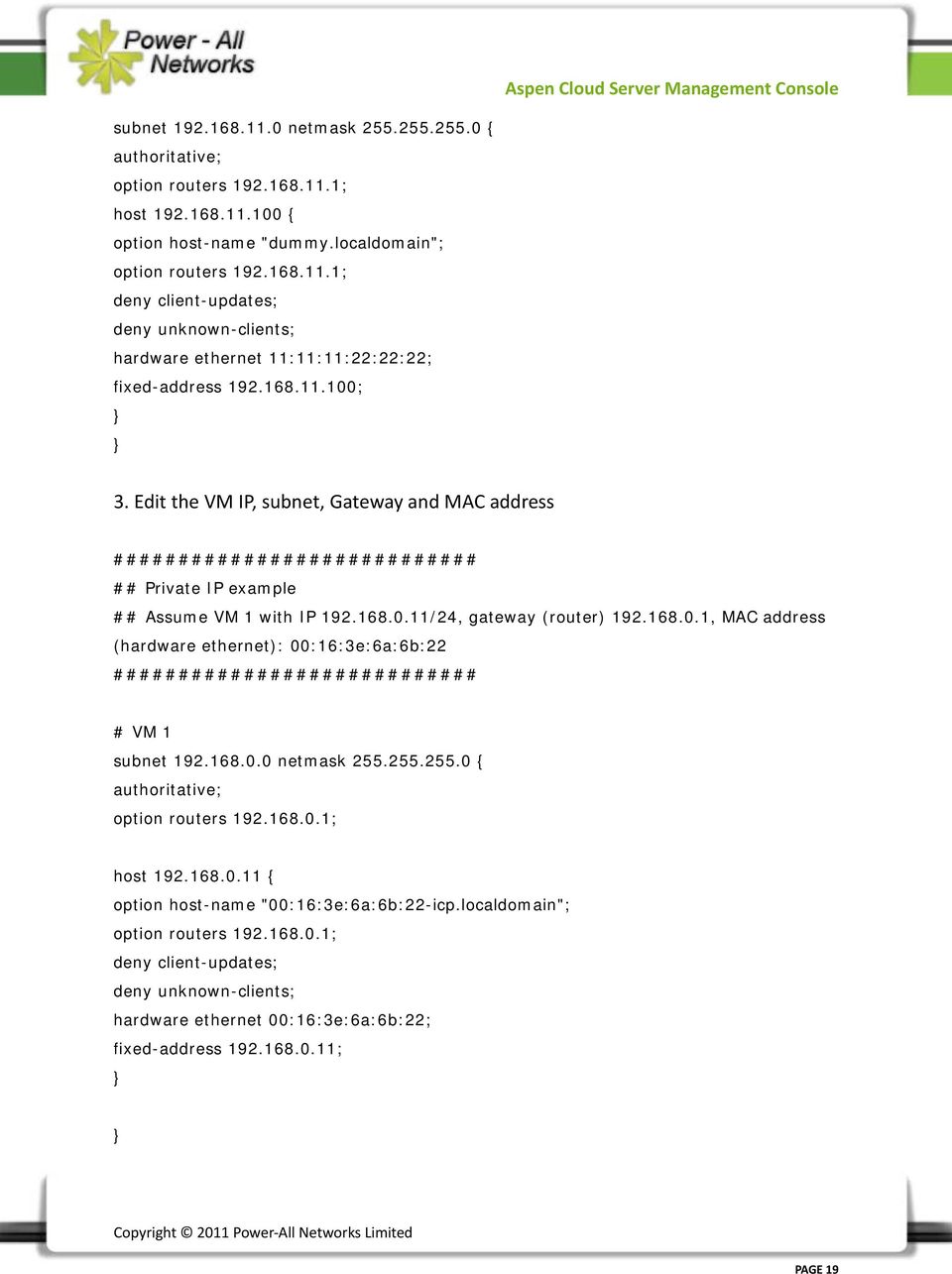
20 Example of the DHCP Server configure file: # # DHCP Server Configuration file. # see /usr/share/doc/dhcp*/dhcpd.conf.sample # authoritative; default lease time ; max lease time ; # The following line set your DNS IP address: option domain name servers , ; ddns update style interim; # Cloud Server production shared network WAN { # # Production Cloud Servers # ############################ ## Assume eth0 of this server (host server) with IP /24, gateway (router) ############################ # Dummy (should be same as the eth0 of host server) subnet netmask { authoritative; option routers ; host { option host name "dummy.localdomain"; PAGE 20

21 option routers ; deny client updates; deny unknown clients; hardware ethernet 11:11:11:22:22:22; fixed address ; } } ############################ ## Private IP example ## Assume VM 1 with IP /24, gateway (router) , MAC address (hardware ethernet): 00:16:3e:6a:6b:22 ## Assume VM 2 with IP /24, gateway (router) , MAC address (hardware ethernet): 00:16:3e:2a:4d:35 ############################ # VM 1 subnet netmask { authoritative; option routers ; host { option host name "00:16:3e:6a:6b:22 icp.localdomain"; option routers ; deny client updates; deny unknown clients; hardware ethernet 00:16:3e:6a:6b:22; fixed address ; } } # VM 2 subnet netmask { authoritative; option routers ; PAGE 21
22 host { option host name "00:16:3e:2a:4d:35 icp.localdomain"; option routers ; deny client updates; deny unknown clients; hardware ethernet 00:16:3e:2a:4d:35; fixed address ; } } ############################ ## Public IP example ## Assume VM 3 with IP /24, gateway (router) , MAC address (hardware ethernet): 00:16:3e:4b:1d:11 ## Assume VM 4 with IP /24, gateway (router) , MAC address (hardware ethernet): 00:16:3e:4b:1d:14 ############################ # VM 3 subnet netmask { authoritative; option routers ; host { option host name "00:16:3e:4b:1d:11 icp.localdomain"; option routers ; deny client updates; deny unknown clients; hardware ethernet 00:16:3e:4b:1d:11; fixed address ; } } PAGE 22
23 # VM 4 subnet netmask { authoritative; option routers ; host { option host name "00:16:3e:4b:1d:14 icp.localdomain"; option routers ; deny client updates; deny unknown clients; hardware ethernet 00:16:3e:4b:1d:14; fixed address ; } } } # End of DHCP config file PAGE 23
24 2. Getting Started Cloud management Console STEP 1 Open we can see the main page of management console. STEP 2 Click IDC Billing Console / IDC Operation Console, a login screen will appear. Enter the username in the Login text field and input the correct the password. Login will be successfully. And it will then direct to the main page of Billing / Operation console. PAGE 24
25 3. Getting Started (continued) IDC Billing Console IDC Operation Console PAGE 25
26 3. Getting Started (continued) Forget Password In case users forget their account password, forget password function is provided to users for their account password. STEP 1 STEP 2 Click Forget Password in IDC Billing Console or IDC Operation Console in login page. It will link to the forget password page. The page is similar in billing and operation console. Input the login account and the registered . STEP 3 Click Retrieve button. An with the login password will send to the user's registered . PAGE 26
27 4. Introduction to IDC Operation Console This chapter describes how to use IDC Operation Console. The IDC Operation Console can be divided into 3 parts: VM Management : It allows to control the vm related operations and resources. Account Management : It allows user to handle different types of accounts Product Management : It allows user to manage the plans and products PAGE 27
28 4.1. Introduction to IDC Operation Console VM Management VM Management Aspen Cloud Server Management Console VM Management allows to control the vm related operations and resources. It can be divided into: Host Management : It shows a list of all physical servers. Cloud Server Management : It displays a list of all vm status. Template Management : It shows a list of vm templates. IDC Management : It helps to manage the IDC and its member access right. Zone Management : It shows a list of zone. Auto Refill Policy : It manages the refill policy for IDC. OS Management : It shows a list of OS available for vm. Cloud Server Refill Management : It is a tool for refill vm in batch. Partner Management : It manages the partner records. t : It allows manage the currency used in system City Maintenance : It manages the city information. PAGE 28
29 4.1. Introduction to IDC Operation Console Host Management Host Management Aspen Cloud Server Management Console Click Host Management from the vm management interface can enter the browsing page. By clicking SEARCH button, it shows a list of physical servers. PAGE 29
30 4.1. Introduction to IDC Operation Console Host Management (continued) The listing result contains 8 columns: Host Name : The name of the physical server. Zone : The zone where the physical server located. Rack Label : The label that paste in the physical server, should be the same as the server name. Total : The total number of vm in that server. In Used : The number of vm that are already used by users. Available : The number of available vm that can be subscribed by users. Terminated : The number of vm that is terminated. Disabled : The number of vm that can't be subscribed by users. For further information for server, for instance, the IP address, ram usage, etc. User can click the row in the searching result. PAGE 30
31 4.1. Introduction to IDC Operation Console Host Management (continued) Host Registration Host Registration requires the set up in admin console and cloud server host. Section 1: Set up in admin console STEP 1 STEP 2 STEP 3 To register a host, click REGISTER in the browsing page. It will then direct to the register page. Input the API URL and click CONNECT to connect the host. If connect success, SUBMIT button will appear. (API URL Format: Input the host information. Labels with Cyan color are compulsory and the rest is optional. PAGE 31
32 4.1. Introduction to IDC Operation Console Host Management (continued) Below are the descriptions for field use in host register. Label Name Rack Label City Server Mode IDC Zone API URL IP Address Host Name Host Description Max. VM# Used VM Physical RAM Size Used RAM Available Ram Max. RAM (MB) Max. Storage Size Pool (GB) Is Enabled Descriptions Label that paste in the physical server, it should be the same as the server name. City where the host is located. Can by Hybrid or Host mode The idc where the host is located. IDC can have several different zones. Select a zone if users need to assign the host to specific zone. If not select, host will place in default zone The api server's url link. IP Address for the host. Host Name for the newly added host User's description for the host. Maximum number of vm that can be assigned to this host. The number of max vm must be greater than that of used vm. The number of vm have been used in host. The total ram size for the host. The ram size which is used in vm subscription. The ram size that is available for further vm subscription. Ram size for the host. Disk size for the host. To determine whether this host can be used. PAGE 32
33 4.1. Introduction to IDC Operation Console Host Management (continued) STEP 4 STEP 5 Click SUBMIT button and confirm the registration. After registration success, it will show message Add VM Host Success in the screen. Section 2: Config the new cloud server host ( Xen host ) STEP 1 STEP 2 Open the host config URL, ie: ip]/sys_config.php. Configure the "Portal URL" and "Administration Console URL" with the CMS's IP. STEP 3 Rename the "Simple Host Name" with new name. e.g. you setup 2nd host. then enter "server 2". STEP 4 STEP 5 In "Unique Host UUID", enter the new generated UUID from "Admin console". (i.e. From above procedure point 3). Click Save. Edit Host STEP 1 STEP 2 STEP 3 STEP 4 Click EDIT button in the browsing page, it will direct to the edit page. Edit the desired items. Items with cyan color label must be inputted. If users change the API URL, users need to click CONNECT to re connect the host first. Click SUBMIT button and confirm the update. After update success, message Edit VM Host Success will display on screen. PAGE 33
34 4.1. Introduction to IDC Operation Console Host Management (continued) Remove Host STEP 1 STEP 2 Click REMOVE button for the host record and confirm the remove action. If no cloud server exists in that host, the host record can be removed successfully. Otherwise, failure message will display on screen. PAGE 34
35 4.1. Introduction to IDC Operation Console Cloud Server Management Cloud Server Management Aspen Cloud Server Management Console Click Cloud Server Management from the vm management interface can enter the cloud server management panel. Kindly remind that cloud server list will not be displayed until users perform any searching action. In general, to perform a search, users can select the IDC from the IDC combo box. Then, select a server from the host list and enter the particular searching criteria if need. After click SEARCH button, it will list all the vm records matching the searching criteria. PAGE 35
36 4.1. Introduction to IDC Operation Console Cloud Server Management (continued) The searching result shows the vm description, status and operations available to perform. The following illustrates the terms in details: VM UUID Template Hostname Subscription Status VM Status Enabled Login (Sus. Date) : The unique id for vm. : The operation system for vm. : The connect domain for each vm. Users can connect this vm through this hostname in public cloud. : The use status of vm, i.e.: Available, Terminated. : The cloud server state, i.e.: Power off : Whether the vm is available to use. : The user's name that subscribed the vm. If the subscribed user's status is suspend. This field will include the user's suspend date. For further information for vm, for example, the mac address, connect public IP, connect private IP, etc. User can click the vm record in the searching result. PAGE 36
37 4.1. Introduction to IDC Operation Console Cloud Server Management (continued) VM Operations List and its Relationship to VM Status There are total 20 different operations can be performed to vm. Below is a list. 1. Add : Register a vm 2. Edit : Update the VM Information 3. Verify : To determine whether the data is consistent to server 4. Assign VM : Allow the admin to subscribe an available vm to particular user 5. Terminate : Change the vm status to terminate 6. Build Template : Create a new template that is same as the current server 7. Suspend VM : Change the vm status from subscribed to suspend 8. Reactivate VM : Change the vm status from suspend to subscribed 9. Start : Power on a cloud server 10. Soft Reboot : Restart a cloud server under software control, without removing power 11. Hard Reboot : Restart the computer without first performing any shut down procedure 12. Soft Shutdown : Turn off the cloud server under software control 13. Hard Shutdown : Compulsory turn off the computer without any shut down procedure 14. Assign Parts : Add value added service to the existing vm 15. Remove Parts : Remove value added service to the existing vm 16. Refill : Newly create another vm with available status 17. Remove : Remove a vm 18. Restart Refill : Perform the refill procedure again 19. Rollback : Cancel the action that perform before 20. Unlock : Unlock a vm PAGE 37
38 4.1. Introduction to IDC Operation Console Cloud Server Management (continued) Different operations can be only performed for particular vm status. Therefore, it's necessary to understand the relationship of operations and vm status. For each vm, it can perform Edit and Verify function. If a vm can be subscribed, subscription status must be available and enabled is YES Besides, a particular vm can be subscribed by admin by using Assign VM function. If a vm is subscribed and is NOT terminated, it can perform Terminate, Build Template, Suspend VM and cloud server related operations, i.e.: Start, Soft Reboot, Hard Reboot, Soft Shutdown, Hard Shutdown. Once a vm is suspended. It can perform Reactivate VM. If a vm is subscribed, enabled is yes and is NOT terminated, it can perform Assign Parts and Remove Parts. If a vm can be Refill, its subscription status must be available or terminated. If a vm can be Remove, is subscription status must be terminated. If a vm can be Unlock, this server must undergo another action in progress. If a vm subscription status is Refill Timeout, this vm can perform Restart Refill function. If a vm subscription status is LV Create Failed / Clone Failed / Config Template Not Found / OS Image File Not Found / LV Remove Failed, this vm can perform Rollback function. PAGE 38
39 4.1. Introduction to IDC Operation Console Cloud Server Management (continued) Table summary the available functions for different vm status: Subscription Status Enabled Available Functions All YES / NO Edit / Verify Available YES Assign VM Subscribed YES/ NO Terminate Build Template Suspend VM Start Soft Reboot Hard Reboot Soft Shutdown Hard Shutdown VM Suspend Reactivate VM Subscribed YES Assign Parts Remove Parts Available / Terminated YES / NO Refill Terminated YES / NO Remove Refill Timeout YES / NO Restart Refill LV Created Failed / Clone Failed Config Template YES / NO Rollback NotFound/ OS Image File Not Found / LV Remove Failed VM undergoes another action Unlock PAGE 39
40 4.1. Introduction to IDC Operation Console Cloud Server Management (continued) Add VM STEP 1 STEP 2 STEP 3 STEP 4 To add a vm, click ADD in the browsing page. It will direct to the add page. Select and enter the newly added VM's information. Note1 : VM UUID and MAC Address can be inputted by user or click the General new UUID or Generate MAC Address button to generate a random VM UUID / MAC Address respectively. Note2 : All fields with cyan color label must be inputted or selected. Click SUBMIT button and confirm the action. After add success, it will show message VM record has been created successfully in the screen. PAGE 40
41 4.1. Introduction to IDC Operation Console Cloud Server Management (continued) Edit VM STEP 1 To update a record, choose the Edit option in the combo box list for the desired record in the searching result page. STEP 2 Click Execute button. Then it will link to the edit page. PAGE 41
42 4.1. Introduction to IDC Operation Console Cloud Server Management (continued) STEP 3 STEP 4 STEP 5 Update the vm information. Label in Cyan color must not be empty. Click SUBMIT button and confirm the update. After update success, message VM record had been update successfully will be displayed. PAGE 42
43 4.1. Introduction to IDC Operation Console Cloud Server Management (continued) Verify VM To determine whether the vm data is consistent to server. Users can use Verify function. STEP 1 To verfiy a vm, choose the Verify option in the combo box list for the desired record in the searching result page. STEP 2 Click Execute button and confirm this action. If verify success, message VM was verify successfully will show on screen. Assign VM When a vm status is available and enabled is YES. The vm is available for users to subscribe. To allow admin to subscribe an available vm to particular user, Assign VM function is provided. STEP 1 STEP 2 Check the check box Available in VM Status, select the radio button Yes in Enabled? and click SEARCH button. A list for vm that can perform Assign VM function will be shown. Choose the Assign VM option in the combo box list for the desired record. PAGE 43
44 4.1. Introduction to IDC Operation Console Cloud Server Management (continued) STEP 3 Click Execute button. It will link to an assign vm page. STEP 4 Input the user name in the Login Name field or choose the user name by using the search function. To use the search user function: 1. Click the red label SEARCH. A searching window will show up. Note that the user list will not be shown unless users perform searching action. 2. Select and input the searching criteria if needed and click SERACH button. A list of users will be displayed on the screen. 3. Click SELECT button in the searching result. After click SELECT, the searching window will close and the selected user name will be inputted automatically in the Login Name field. PAGE 44
45 4.1. Introduction to IDC Operation Console Cloud Server Management (continued) Once inputted a valid user name. The available vm plan for the assign user will be displayed on the screen. STEP 5 STEP 6 Enter the server description. It is the user s custom server description for the newly subscribed vm. Choose the notification option. Suppose notification must be sent to admin. Check the check box if is needed to notice the end user for the subscription of vm. PAGE 45
46 4.1. Introduction to IDC Operation Console Cloud Server Management (continued) STEP 7 STEP 8 STEP 9 Select the desired vm plan. Click Assign VM button and confirm the action. If assign success, message VM was assigned to user successfully will display on screen. Admin will receive the mail notification for the subscription of vm. Terminate VM When a vm is no longer to use, users can terminate a vm. STEP 1 Check the check box Subscribed in VM Status and click SEARCH button. A list for subscribed vm will be shown. STEP 2 To terminate a record, choose the Terminate option in the combo box list for the desired record in the searching result page. STEP 3 Click Execute button. Check the vm information and confirm this action. If terminate success, message Terminated VM successfully will show on screen. The subscription status of vm will change from Subscribed to Terminated PAGE 46
47 4.1. Introduction to IDC Operation Console Cloud Server Management (continued) Build Template For the subscribed vm, users can create another template that is same as the current server. However, there are 4 points need to note in using this function. 1. This function applies to Plan A only. 2. When the template is creating in process, all functions for this server will be disabled until the template creation process completed. 3. Template creation process may take 1 2 days. 4. The maximum number of custom template allowed for each account is 10. If the subscribed server fulfilled the above requirements, users can create this server as template. STEP 1 STEP 2 To build a template, check the check box Subscribed in VM Status and click SEARCH button. A list for subscribed vm will be shown. Choose the Build Template option in the combo box list for the desired record in the searching result page. PAGE 47
48 4.1. Introduction to IDC Operation Console Cloud Server Management (continued) STEP 3 STEP 4 STEP 5 Click Execute button. It will link to build template page. Enter the new template name. Click Create Template button and confirm the action. If create template success, message IDC Template is creating in progress... will show on screen. PAGE 48
49 4.1. Introduction to IDC Operation Console Cloud Server Management (continued) Suspend VM STEP 1 STEP 2 Check the check box Subscribed in VM Status and click SEARCH button. A list for subscribed vm will be shown. Choose the Suspend option in the combo box list for the desired record in the searching result page. STEP 3 Click Execute button. Check the vm information and confirm this action. Once action success, subscription status will change from Subscribed to VM Suspend. PAGE 49
50 4.1. Introduction to IDC Operation Console Cloud Server Management (continued) Reactivate VM STEP 1 STEP 2 STEP 3 STEP 4 STEP 5 Check the check box Subscribed in VM Status and click SEARCH button. A list for subscribed vm (with status VM Suspend) will be shown. Choose the Edit option in the combo box list for the suspend record in the searching result page. Click Execute button. It will link to edit page. Scroll down the page and click the RE ACTIVATE button which is next to the SUBMIT button. Note that only suspend record contains this button Confirm the action. If reactivate success, message VM record has been updated successfully will show on screen. Subscription status of vm will change from VM Suspended to Subscribed. Start / Soft Reboot / Hard Reboot / Soft Shutdown / Hard Shutdown Server For a subscribed cloud server, it can perform cloud server related operations. STEP 1 Check the check box Subscribed in VM Status and click SEARCH button. A list for subscribed vm (with status VM Suspend) will be shown. STEP 2 Choose the Start / Soft Reboot / Hard Reboot / Soft Shutdown / Hard Shutdown option in the combo box list for the suspend record in the searching result page. STEP 3 Click Execute button and confirm the action. PAGE 50
51 4.1. Introduction to IDC Operation Console Cloud Server Management (continued) Assign Parts Value added service can be added to the existing vm. The value added service plan is defined in Product Management Value Added Services Management which this topic will discuss later. STEP 1 STEP 2 Check the check box Subscribed in VM Status and click SEARCH button. A list for subscribed vm will be shown. Choose the Assign Parts option in the combo box list for the desired record in the searching result page. STEP 3 Click Execute button. And it will link to resources listing page. The resources listing page will list the resources that are already attached to this server. PAGE 51
52 4.1. Introduction to IDC Operation Console Cloud Server Management (continued) STEP 4 Click ADD button in the listing page. And it will further link to resources assign page. STEP 5 STEP 6 STEP 7 Choose parts types in the Parts Type combo box list. Enter IP Address if select IP Address or Input Port Number and Trust IP Address if select Firewall. (ie: Port Number: 21,22,80; Trust IP Address: ) Select the desired plan. Click ADD button and confirm the action. If assign success, message Add Parts Successfully will display on screen. PAGE 52
53 4.1. Introduction to IDC Operation Console Cloud Server Management (continued) VM Parts Listing Value added service to a particular vm can be checked in resources listing page or resources remove page. Please refer to Assign Parts functions Step1 3 or Remove Parts functions Step1 3 to see how to get into to the page. In the listing page, the upper part will show the server information and the lower part is the attached items. PAGE 53
54 4.1. Introduction to IDC Operation Console Cloud Server Management (continued) Resources information will not be shown once get into the page. Click SEARCH button to list all the attached resources to a certain vm. To find out a particular parts type attached to the server, select parts type in Parts Type combo box list. PAGE 54
55 4.1. Introduction to IDC Operation Console Cloud Server Management (continued) Remove Parts When additional parts added to a certain server. The additional resources must be removed before users terminate a vm. STEP 1 Check the check box Subscribed in VM Status and click SEARCH button. A list for subscribed vm will be shown. STEP 2 Choose the Remove Parts option in the combo box list for the desired record in the searching result page. STEP 3 STEP 4 STEP 5 Click Execute button. And it will link to resources remove page. The resources remove page will list the resources that are already attached to this server and provide remove parts options. Click SEARCH to list all resources of this server. Select parts type in Parts Type combo box list to find out a particular resource attached to this server. Select the radio button for the desired remove item. STEP 6 Click REMOVE and confirm the action. If remove success, message Remove Parts Successfully will display on screen. PAGE 55
56 4.1. Introduction to IDC Operation Console Cloud Server Management (continued) Refill VM VM needs to refill if the following situations occur. If the vm amount of a particular os type is not enough while that of another os type is in excess. (For example: There are totally 10 Windows VM, 20 Linux VM. If 9 of Windows vm are subscribed and there is a high probability that more windows vm will be needed. At the same time, majority of Linux VM are available. To strike a balance, it's necessary to increase the amount of Windows VM, resulting in the need of refill Linux VM to Windows VM) [Available VM >Refill]57 Unused VM. (User account balance is insufficient while the user is not willing to recharge the vm; or the trial period is expired). This kind of VM should be refilled so as to make it available for another user to subscribe. [Terminated VM >Refill] STEP 1 To refill a vm, find out the vm that is desired to refill in the searching result page. PAGE 56
57 4.1. Introduction to IDC Operation Console Cloud Server Management (continued) STEP 2 STEP 3 STEP 4 STEP 5 STEP 6 Click Execute button. And it will link to refill page. Click Generate new uuid and Generate new password button to generate new uuid and password respectively. Select the refill template in New Standard Template or New Custom Template. Select option in Enable After Refill. Click Refill button and confirm the action. After refill success, message Refill has been requested will display on screen. VM can be refilled even the os type is not same. After refill, the number of vm in server will remain unchanged. PAGE 57
58 4.1. Introduction to IDC Operation Console Cloud Server Management (continued) Remove / Restart Refill / Rollback / Unlock VM The management methods for the above functions are the same. Please refer the previous topic VM Operations List and its Relationship to VM Status to see the definition and when can perform the above operations. STEP 1 STEP 2 Choose the Remove / Restart Refill / Rollback / Unlock option in the combo box list for the desired record in the searching result page. Click Execute button and confirm this action. If action success, a successful message will show on screen. VM Summary By clicking SUMMARY button in cloud management panel, it will show the vm summary for different IDC. For Term of Use in the summary page, please refer to the Host Management. PAGE 58
59 4.1. Introduction to IDC Operation Console Template Management Template Management Aspen Cloud Server Management Console Click Template Management from the vm management interface can enter the template s browsing page. Select criteria, i.e: IDC, Template, OS Type, etc. can restrict the searching result. In the searching criteria fields, two terms need pay extra attention. They are End User Enabled and Administrator Enabled. End User Enabled : It's used to determine whether the template is visible to end users. Administrator Enabled : If this flag is enabled, the template will be displayed in all template combo box in control panel. (Even the end user enabled was set to 0) PAGE 59
60 4.1. Introduction to IDC Operation Console Template Management (continued) Template Registration STEP 1 STEP 2 To register a template, click REGISTER in the browsing page. It will then direct to the register page. Input the template information. Fill in Template Description, Image Filename, Config Filename, etc (ie: Image Filename: Centos5.4.img; Config Filename: Centos5.4.xml) STEP 3 STEP 4 Assign template to IDC. Check the IDC check box if this template is available for the IDC and select Enabled of template. If Enabled is Yes, this template will be visible to this IDC. Click REGISTER button to complete the registration. Confirm the action to continue. If template registration success, message Register template successfully will show. PAGE 60
61 4.1. Introduction to IDC Operation Console Template Management (continued) Edit Template STEP 1 Click EDIT button in the searching result page, it will direct to the edit page. The edit page is similar to the register page, just a field Administrator Enabled more in the edit page. Administrator Enabled is default to yes for each template. STEP 2 STEP 3 STEP 4 Edit the desired items. Please note that if the selected template is used by a subscribed vm, the size of the primary size can t be updated. Click UPDATE button and confirm the update. After update success, message Update template successfully will display on screen. PAGE 61
62 4.1. Introduction to IDC Operation Console Template Management (continued) Remove Template STEP 1 STEP 2 To remove a template, click REMOVE button for the unwanted template in the searching result page. Confirm the action. If remove success, message Template remove successfully will show. Upload Template To register a new template, apart from registration through Register function, users can register in Upload Template function. The main difference between Register and Upload Template function is that upload template function will register a new template and verify the checksum of both image and xml file in server while register function will only perform the registration. As upload template will perform the checking of files in server. Users should upload the image and xml file to server before registrant the template. Here are few steps for preparation and upload: 1. Prepare the image and the xml file. 2. Compute MD5 checksum for both image and xml file. 3. Prepare a FTP cli.e.nt software. For example: FileZilla 4. Login the TEMPLATE SERVER using the FTP account. 5. Upload the image and xml file to /vm/upload template. PAGE 62
63 4.1. Introduction to IDC Operation Console Template Management (continued) After upload, users can register the template in Upload Template STEP 1 To upload template, click UPLOAD button in template management panel, it will link to template upload page. STEP 2 STEP 3 Input the file information and template information. Note that Image File MD5 and XML Config MD5 should have 32 digits. Click SUBMIT button and confirm the action. If action success, it will show Verification process started on screen. PAGE 63
64 4.1. Introduction to IDC Operation Console Template Management (continued) Re upload Template Users can re upload the image and xml file to server after register a template. However, after the re upload of image file, it's necessary to verify the re upload image and file and update the information for the existing template. Therefore Re upload template function is provided. STEP 1 To re upload a template, click REUPLOAD button for the template record. It will then link to the template re upload page. STEP 2 STEP 3 Fill in the new file information. Remind that Image File MD5 and XML Config MD5 should have 32 digits. Click SUBMIT to update and verify the image files. Confirm the action to continue. If action success, message Verification process started will show. PAGE 64
65 4.1. Introduction to IDC Operation Console Template Management (continued) Template Detail There is a DEATIL button for every IDC in each template record. By clicking DETAIL button, it will show template usage for different hosts in the selected IDC. For the term use in detail page, please refer to Host Management. PAGE 65
66 4.1. Introduction to IDC Operation Console IDC Maintenance IDC Maintenance Aspen Cloud Server Management Console IDC Maintenance allows the admin to manage the IDC record. Click IDC Maintenance from the vm management interface can enter the IDC maintenance panel. Select IDC and IDC type, i.e.: Public cloud or Private cloud. And click SERACH button. It will display a list of IDC records matching the searching criteria. Here are the meaning for the terms use in search page: IDC : IDC's name. IDC Type : Can be public cloud or private cloud. Public cloud means the resources is available for general public. Private cloud represents the resources will be used internally. City : The city code for IDC's located city. VIF Name : Name of virtual network interface. NPS Max Storage : Max Storage Size of SASP M. NPS Used Storage : Used Storage Size of SASP M. PAGE 66
67 4.1. Introduction to IDC Operation Console IDC Maintenance (continued) IDC Registration STEP 1 To add a IDC, click ADD in the IDC browsing page. It will direct to the add page. PAGE 67
68 4.1. Introduction to IDC Operation Console IDC Maintenance (continued) PAGE 68
69 4.1. Introduction to IDC Operation Console IDC Maintenance (continued) STEP 2 Enter the IDC information. For Part A : IDC Information, except Approval Required and IDC Service Agreement, other fields inside this part must be entered. For Part B : IDC Contact Information, the whole part is optional. Fill in the details if need. For Part C : Member ACL List, it's the part to control access right to access other IDC's resources. ( If the newly added IDC is C while the member acl list for IDC A is checked and that of IDC B is not checked. This means that C has access right to access data for IDC A, but no access right to access data for IDC B.) STEP 3 STEP 4 Click SAVE button to complete the registration. Confirm the action to continue. After registration success, it will show message Add IDC successfully on screen. When an IDC is created, users can not see the record of newly added IDC because the current login account do not have the access right to access the data for the newly added IDC. To grant IDC access right for an account, please follow the below steps. Make New IDC Available to Account STEP 1 STEP 2 STEP 3 STEP 4 STEP 5 STEP 6 Click Global Management Account in Account Management. Input the account login name in Login Name and click SEARCH button. Click Edit button for the account record. Check the newly added IDC name in Part C: Resources Right. Click UPDATE to save the new setting. Login and then relogin again. After relogin, the account can see the record for newly added IDC. PAGE 69
70 4.1. Introduction to IDC Operation Console IDC Maintenance (continued) Edit IDC STEP 1 STEP 2 STEP 3 To update an IDC, click the Edit button for the IDC record. It will link to the edit page. The edit page is the same as the register page. Edit the IDC information. See IDC Registration STEP2 for the parts description. Click SAVE to update the record and confirm the action. If action success, it will show message Update IDC successfully on screen. Remove IDC STEP 1 STEP 2 STEP 3 To remove an IDC, first search the list of IDC in the IDC maintenance panel. Click REMOVE button for the unwanted IDC record. Confirm the action. If action success, record will delete after confirm; otherwise failure message will display. PAGE 70
71 4.1. Introduction to IDC Operation Console Zone Management Aspen Cloud Server Management Console Zone Management Zone Management allows the admin to manage zone for IDC. Click Zone Management from the vm management interface can enter the zone management panel. Select the IDC, the available zone will list in the zone combo box. Select the IDC, zone and click SERACH button, it shows a list of zone records. For further information of a zone, users can click the row for the zone record. It shows the vm use summary of host for the selected zone. PAGE 71
72 4.1. Introduction to IDC Operation Console Zone Management (continued) Zone Registration STEP 1 To register a zone, click REGISTER in the zone browsing page. It will direct to the register page. STEP 2 STEP 3 Select which IDC the zone should be located. Input zone name with different languages and the zone code. Select Is enabled. If enabled is yes, this zone is visible for the selected IDC. All fields must be inputted to add a zone. After input all fields, click SUBMIT button. A new zone will be added after action success. And the system will create an unique and random zone uuid for the newly added zone. PAGE 72
73 4.1. Introduction to IDC Operation Console Zone Management (continued) Edit Zone STEP 1 STEP 2 STEP 3 To update a zone, click the Edit button for the zone record. It will link to the edit page. The edit page is the same as the register page. Edit the zone information. All fields should be filled. Click SUBMIT to update the record and confirm the action. If action success, it will show message Update zone successfully on screen. Remove Zone STEP 1 STEP 2 To remove a zone, click the REMOVE button for the zone record. Please note that only zone with single host contains REMOVE button. Confirm the action. If action success, record will delete after confirm; otherwise failure message will display. PAGE 73
74 4.1. Introduction to IDC Operation Console OS Management OS Management Aspen Cloud Server Management Console Click OS Management from the vm management interface can enter the os management panel. By clicking SEARCH button, it shows a list of operating systems. Currently, OS type only consists of Linux and Windows. And there are two virtual types for the operating systems, called Fully virtualized and Para virtualized. Linux can be fully or Para virtualized while Windows must be fully virtualized. PAGE 74
75 4.1. Introduction to IDC Operation Console OS Management (continued) Add OS STEP 1 To add an operating system, click ADD in the os browsing page. It will direct to the add page. STEP 2 STEP 3 Input all the fields for OS information. Remark: Linux can be fully or Para virtualized in Virtual Type while Windows can only be fully virtualized. The maximum number of CPU is 4. The maximum number of RAM is 8GB. The maximum number of additional SASP6 / SASPM drive is 10. After input all fields, click SUBMIT button. A new OS will be added after action success. Message Add record successfully will display on screen. PAGE 75
76 4.1. Introduction to IDC Operation Console OS Management (continued) Edit OS STEP 1 STEP 2 STEP 3 To update an OS, click the Edit button for the os record. It will link to the edit page. The edit page is the same as the register page. Edit the OS information. All fields should be filled. Click SUBMIT to update the record and confirm the action. If action success, it will show message Update record successfully on screen. Remove OS STEP 1 STEP 2 To remove an os, click the REMOVE button for the os record. Confirm the action. If action success, record will delete after confirm; otherwise failure message will display. PAGE 76
77 4.1. Introduction to IDC Operation Console Auto Refill Policy Aspen Cloud Server Management Console Auto Refill Policy When an IDC is created in IDC maintenance, it will create a record in auto refill policy. The auto refill policy is the setting to determine whether auto refill is enabled in that IDC as well as the refill setting. Auto refill policy is defaulted in the creation of IDC, the default settings are: Enable Auto Refill : Disable Template Policy : Policy1 Enable After Refill : No Click Auto Refill Policy from the vm management interface can enter the auto refill policy management panel. By clicking SEARCH button, it shows a list of IDC records. The searching result contains 5 columns. IDC Name : The name of IDC Enabled : A flag to determine whether auto refill is enabled for this IDC Template : The default refill template when auto refill Policy : The template policy number There are three template policies: 1. Refill with same template being used on cloud server. 2. If the template is no longer exists on the system, default template will be used. 3. Refill with selected template Enable After Refill : A flag to determine whether the refilled server enable after refill. PAGE 77
78 4.1. Introduction to IDC Operation Console Auto Refill Policy (continued) Edit Auto Refill Policy STEP 1 To update a policy, click the Edit button for the IDC record. It will link to the edit page. STEP 2 STEP 3 Update the policy. Click SAVE to update the policy and confirm the action. If action success, it will show message Update Policy Setting Success on screen. Remove Auto Refill Policy Auto refill policy cannot be removed, it's the refill settings for each IDC. When IDC record is removed in IDC Maintenance, the record of auto refill policy will be removed at the same time. PAGE 78
79 4.1. Introduction to IDC Operation Console Cloud Server Refill Management Cloud Server Refill Management Cloud server can refill in VM Management one by one (See the procedures of Refill VM in Cloud Server Management ) or refill in batch. To refill several cloud servers in batch, users can use the Cloud Server Refill Management. Click Cloud Server Refill Management from the vm management interface can enter the cloud server refill management panel. By clicking SEARCH button, it shows a list of current refill records. The current refill list contains 6 columns. New VM UUID : vm uuid after this vm refill Old VM UUID : The vm uuid of the refilled vm Template : The selected refilled template Status : The vm's refill status Enable After Refill : A flag to determine whether the refilled server enable after refill Duration (Mins) : The time use for refill process PAGE 79
80 4.1. Introduction to IDC Operation Console Cloud Server Refill Management (continued) Add Refill Batch STEP 1 STEP 2 STEP 3 STEP 4 To add batch of refill, click ADD BATCH in the cloud server refill browsing age. It will direct to the add batch page. The add batch page will list all the available / terminated vm that can refill in a certain IDC. Select IDC and click SERACH to find out the suitable vm to refill. Click the row for vm record, more vm information can be shown. Check the check boxes of vm records that are willing to refill. Select the Refill template and Enable After Refill. Click Submit' button and confirm the action. Message Refill has been request will display on screen when request success. The system will generate a random UUID for the refill vm and records of refill items will be added in the current refill list. The refill process will start refill vm one by one. Once the refill process start or complete, system will generate an and send to admin. To check the refill status of vm, users can also check in the listing page. PAGE 80
81 4.1. Introduction to IDC Operation Console Cloud Server Refill Management (continued) Cancel Refill Users can stop the refill process after refill request is made, but cancel only available if the vm not yet start the refill process. If a vm status is PENDING, this represents that the refill process not start and users can cancel the refill process; otherwise, cancel request will be failed. STEP 1 STEP 2 To cancel a refill request, click Cancel button for the refill record. Confirm the cancel action. If action success, message Cancel refill request success will display on screen. PAGE 81
82 4.1. Introduction to IDC Operation Console Partner Management Partner Management Aspen Cloud Server Management Console Click Partner Management from the vm management interface can enter the partner management panel. By clicking SERACH, it shows a list of the existing partners. The result list of the partners shows the general partner information, i.e.: brand name and contact info, etc. and the maximum vm subscription. Partner management contains add and edit action. As there are several terms use in register / edit page, before introducing the procedures for above operations, it's important to explain the terms. PAGE 82
83 4.1. Introduction to IDC Operation Console Partner Management (continued) Terms use in partner register / edit page 1. Logo Image The left upper image on the top of system. Image can be in jpg, jpeg, gif, bmp or png format. The best resolution for logo image is 65 x 144 jpg. 2. Icon Image The icon image for the browser. Icon image can be in ico format only. The best resolution for icon image is 16 x 16 ico. 3. Global Alert Enable / disable any s to both admin and users in certain situation. 4. Max VM to subscribe The maximum number of cloud servers that can be subscribed for this partner's user account. 5. Minimum price for custom template User account balance must have a certain amount before create custom template. Otherwise, users cannot create custom template. PAGE 83
84 4.1. Introduction to IDC Operation Console Partner Management (continued) Add Partner STEP 1 STEP 2 To add a partner, click ADD in the partner s browsing page. It will direct to the add page. Input the partner information. The following are some fields that must be filled. Partner Name, Brand Name, Login Image, Icon Image, Address1, Telephone No, Admin Address, Support Address, No Reply Address and Max VM to Subscribe. In Part C: Partner Setting. Users can enabled / disable system s to admin / users for certain situation. PAGE 84
85 4.1. Introduction to IDC Operation Console Partner Management (continued) PAGE 85
86 4.1. Introduction to IDC Operation Console Partner Management (continued) STEP 3 Click SUBMIT button after input the fields. Confirm the register action. System will generate a new partner id for the added partner. If action success, message Create partner success will display on screen. Edit Partner STEP 1 STEP 2 STEP 3 To update a partner, click the Edit button for the partner record. It will link to the edit page. The edit page is the same as the register page. Edit the partner information. See Add Partner STEP2 for the compulsory input terms. Click SUBMIT after edit the fields. Confirm the update action. Message Update partner successfully will display on screen when action success. PAGE 86
87 4.1. Introduction to IDC Operation Console Currency Management Currency Management Aspen Cloud Server Management Console Click Currency Management from the vm management interface can enter the currency management panel. By clicking SERACH, it shows a list of the existing currency. The result list shows the general currency information. Add Currency STEP 1 To add a currency, click ADD in the currency s browsing page. It will direct to the add page. PAGE 87
88 4.1. Introduction to IDC Operation Console Currency Management (continued) STEP 2 STEP 3 Input the currency information. All fields must be entered. Is Active determines whether the currency is enabled or disabled in the system. Click SUBMIT button after input the fields. Confirm the register action. If action success, message Register currency successfully will display on screen. And now you can use your newly added currency if the currency is active. Edit Currency STEP 1 STEP 2 To update a currency, click the Edit button for the currency record. It will link to the edit page. The edit page is the same as the register page. Edit the currency information. Please remind that only currency that is not used by any members can change the Is Active from Yes to No. PAGE 88
89 4.1. Introduction to IDC Operation Console Currency Management (continued) STEP 3 Click SUBMIT after edit the fields. Confirm the update action. If action success, message Update record successfully will display on screen. Remove Currency To remove a currency, it must satisfy the following 4 situations. 1. No partner currency record. 2. No members use the currency. 3. No plan currency record. 4. No parts currency record. If all above situations fulfill, users can perform the remove action. STEP 1 STEP 2 To remove a currency, click the REMOVE button for the currency record. Confirm the action. If action success, record will delete after confirm; otherwise failure message will display. PAGE 89
90 4.1. Introduction to IDC Operation Console City Maintenance City Maintenance Aspen Cloud Server Management Console Click City Maintenance from the vm management interface to manage the city records. Select a certain city and click SEARCH button to show a list of city records. The searching results will show the city name in different languages. In this case, it shows the city name in English, Simplified Chinese and Traditional Chinese. Add City STEP 1 To add a city, click ADD in the city s browsing page. It will then direct to the add page. PAGE 90
91 4.1. Introduction to IDC Operation Console City Maintenance (Continued) STEP 2 STEP 3 Enter the city name in different languages. Click SAVE button to continue. If the action success, successful message will display on the screen. The newly added city now can use in other functions of this system. Edit City STEP 1 STEP 2 STEP 3 To update the city information, click the EDIT button for the city record. It will link to the edit page. The edit page is the same as the add page. Update the city information. Click SAVE and confirm the action. If update success, successful message will show on screen. Remove City STEP 1 STEP 2 STEP 3 To remove a city, click the REMOVE button for the city record. Click OK to confirm the deletion. Remind that an active used city records cannot be deleted, users can only remove an unused city. If the action success, successful message will show on the screen. PAGE 91
92 4.2. Introduction to IDC Operation Console Account Management Aspen Cloud Server Management Console Account Management Click Account Management tab can get into the account management interface. Account Management allows the handling for different types of accounts. It can be divided into: Production Account : It shows a list of production accounts. Demo Account : It displays a list of demo accounts. Control Panel ACL Settings : It helps to manage the access right of CPanel for IDC. Remote Access Management : It is the login strategy for the console. Global Management Account : It manages the system accounts. PAGE 92
93 4.2. Introduction to IDC Operation Console Production Account Production Account Aspen Cloud Server Management Console User accounts can be production account or demo account. In public cloud, two types of accounts must have sufficient balance to subscribe / purchase a virtual machine while in private cloud, both accounts can subscribe vm directly without recharge. The difference between production and demo account is the permission of using vm. For demo account, it can subscribe vm, but it does not receive the permission to change and update the hardware assignment of vm while production account does. Click Production Account or Demo Account from the account management interface can enter the production account or demo account management panel respectively. By clicking SEARCH button, it shows a list of corresponding accounts. Each page shows 10 account records in default. Change the records per page and page number manually in the right corner combo box if need. PAGE 93
94 4.2. Introduction to IDC Operation Console Production Account (continued) Click the account row can see the subscribed plan and parts for the selected account. PAGE 94
95 4.2. Introduction to IDC Operation Console Production Account (continued) Add Production Account STEP 1 To add a production or demo account, click REGISTER in the corresponding account browsing page. It will then direct to the add page. The register page is very similar in production and demo account, just a slightly different. (See the images below) Note that there is a VM Quota in the add page for both accounts. The VM Quota refers to the maximum number of cloud servers that can be subscribed for account. For production account, the vm quota is set from the Partner Management (See terms for Max VM to subscribe ). For demo account, the vm quota is default to 1. Besides, only production account contains paypal address and billing type that is default to daily settlement. And for demo account, it contains an account expiry date. The trial period is a month start from the register date. PAGE 95
96 4.2. Introduction to IDC Operation Console Production Account (continued) STEP 2 STEP 3 Input the account information. Label in cyan color can not be empty. After fill the account detail, click Submit button. Confirm the registration. If the action success, message Production / Demo account was created successfully will show on screen. Edit Production Account STEP 1 STEP 2 STEP 3 To update an account, click the Edit button for the account record. It will link to the edit page. The edit page is the same as the register page. Edit the account information. Label in cyan color must be entered. Click SUBMIT to update the record and confirm the action. It will show message Production / Demo account updated successfully on screen if action success. PAGE 96
97 4.2. Introduction to IDC Operation Console Production Account (continued) Suspend Production Account When an Active account will not be used, admin can suspend the account. To suspend an account, STEP 1 STEP 2 STEP 3 Click Edit button for an active account. It will link to the edit page. Active account can be searched by selecting Active in Status and click SEARCH in the account panel. Scroll down the page and there is a button SUSPEND next to the SUBMIT. Click SUSPEND button and confirm the action. If action success, message Production / Demo account suspended successfully will show. The status for an account will change from Active to Suspended. Account status change From: To: PAGE 97
98 4.2. Introduction to IDC Operation Console Production Account (continued) Reactivate Production Account After an account suspend, it's not available to subscribe any plan and vm parts. In an attempt to make it available for subscribe resources again, admin needs to reactivate an account. To reactivate an account, STEP 1 STEP 2 STEP 3 Click Edit button for the suspend account record. It will link to the edit page. Suspend accounts can be searched by selecting Suspend in Status, select the suspension date and click SEARCH in the account panel. Scroll down the page and there is a button RE ACTIVATE next to the SUBMIT button. Click RE ACTIVATE button and confirm the action. If action success, message Production / Demo account activated successfully will show. The account status will change from Suspend to Active. PAGE 98
99 4.2. Introduction to IDC Operation Console Production And Demo Account (continued) Recharge Production Account The subscribed vm will suspend if the account balance is insufficient. To recharge an account, STEP 1 STEP 2 STEP 3 Find out the account would like to recharge, click Recharge button for the account record It will then link to the recharge page. Select the Recharge Type. Input the Paypal Txn ID if the recharge type is PayPal. Input the Recharge Amount. And enter the Remarks if needed. After input the recharge information, click SUBMIT button. If recharge success, message Production / Demo account recharged successfully will display on screen. And an recharge will send to admin and end users for the recharge. PAGE 99
100 4.2. Introduction to IDC Operation Console Production Account (continued) Recharge Summary After a user recharge, the system will save the user's transaction record. Admin can view the transaction history for a user by using the Recharge Summary function. To check the recharge records for a user, STEP 1 STEP 2 Find out the account would like to view. Click the Summary button for the account record. It will connect to the summary page. Each summary page will show 20 records per page in default, change it manually if need. The summary page will list the recharge date, recharge type, PayPal txn id, currency and recharge amount that the terms use is the same as recharge page. Note that in Recharge Type column, if there is no Remark for the recharge transaction, it will only show recharge type; otherwise it will show recharge type + remark. PAGE 100
101 4.2. Introduction to IDC Operation Console Production Account (continued) Export to XML In order to make the admin more convenient to manage the user's transaction data. An Export function is provided to allow admin to export the transaction records in XML format. STEP 1 To export the data to XML, get into the user's transaction summary page. (See procedures in Recharge Summary ) STEP 2 There exists an Export to XML button in the right top corner. Click the Export to XML button, it will export the data into XML as an attached file. Click Confirm to save the XML file. PAGE 101
102 4.2. Introduction to IDC Operation Console Control Panel ACL Settings Control Panel ACL Settings Aspen Cloud Server Management Console To control the access right for CPanel, a Control Panel ACL Settings function is provided. It can manage the view access right and user access right for IDC. Click Control Panel ACL Settings to get into the management panel. It shows a list for IDC record. The access right will not be set once an IDC is created. Admin need to register an acl setting record for a certain IDC if need. PAGE 102
103 4.2. Introduction to IDC Operation Console Control Panel ACL Settings (continued) Register ACL Settings STEP 1 To register IDC acl setting, click REGISTER button in the browsing page. Then it will link to add page. PAGE 103
104 4.2. Introduction to IDC Operation Console Control Panel ACL Settings (continued) STEP 2 STEP 3 Each IDC can have one record for acl setting only. Therefore, in register page, only IDC without acl setting record can be chosen. Select the IDC and its view access right as well as user access right. Click ADD to complete the registration and confirm the action. If the action success, message Add acl successfully will display. Edit ACL Settings STEP 1 STEP 2 STEP 3 To update the settings, click the Edit button for the setting record. It will link to the edit page. The edit page is the same as the register page. Input the new settings. Click UPDATE button and confirm the action. If action success, it will show message Edit acl successfully on screen. PAGE 104
105 4.2. Introduction to IDC Operation Console Control Panel ACL Settings (continued) Remove ACL Settings STEP 1 STEP 2 To remove the setting, click the REMOVE button for the setting record. Confirm the action. If action success, record will delete after confirm; otherwise failure message will display. PAGE 105
106 4.2. Introduction to IDC Operation Console Remote Access Management Remote Access Management To control whether accept remote assistant for the management panel, a Remote Access Management function is provided. Remote IP Address will be checked in the system login page to validate the users. Click Remote Access Management to get into the setting page. It shows the access setting. Terms use in the page. 1. Always Allow Access From IP Address If the remote IP address presents in the Always Allow Access From IP Address white list, users are able to login the system no matter what option selected in remote management setting. 2. Disable Remote Management If the remote IP address is not present in the Always Allow Access From IP Address white list, users are not allow to login the system. PAGE 106
107 4.2. Introduction to IDC Operation Console Remote Access Management (continued) 3. Disable Remote Management Except IP Address When this option select, system will check the remote IP against this whitelist. If the remote IP address is not include in this list, users will fail to login. 4. Enable Remote Management from anywhere. 5. Remote IP address will not be checked in the login page. If the user's login information is correct. Users are able to login the system. Example: In below example, Always Allow Access From IP Address is and Remove Management Except IP Address is It implies that no matter what strategy Remote Management Setting set, can login to the system. Since Disable Remote Management Except IP Address strategy set in Remote Management Setting, system only available to login with IP Address and PAGE 107
108 4.3. Introduction to IDC Operation Console Product Management Product Management Aspen Cloud Server Management Console Click Product Management tab can get into the product management interface. Product management allows the management of plans and products It can be divided into: Plan Management : It allows the control of vm plans. Value Added Service Management : It manages the products of vm parts. PAGE 108
109 4.3. Introduction to IDC Operation Console Plan Management Plan Management Aspen Cloud Server Management Console Plan Management allows the control of vm s plans. Click Plan Management from the product management interface can enter the plan s browsing page. Select IDC, it will show the existing plans for IDC automatically. The searching result contains the following 5 columns. Plan : Plan name Plan Description : Plan detail OS : Plan available in which OS Price Per day : Daily price for plan Enabled : Visibility of plan Plan Creation Plan can be created manually one by one. PAGE 109
110 4.3. Introduction to IDC Operation Console Plan Management (continued) Create Manually One By One STEP 1 STEP 2 Click ADD button in the browsing page. Then it will link to add page. Select the IDC that the plan belongs to. Fill in the plan, pricing, network usage pricing, hard disk backup / restore pricing and operating system information. The fields with red stars must be inputted. PAGE 110
111 4.3. Introduction to IDC Operation Console Plan Management (continued) STEP 3 Click SUBMIT and confirm the action. If add plan success, message Plan record was added successfully will display. PAGE 111
112 4.3. Introduction to IDC Operation Console Plan Management (continued) Edit Plan STEP 1 To update the plans, click the Edit button for the plan record. It will link to the edit page. The edit page is the same as the register page. STEP 2 Update the plan, pricing, network usage pricing, hard disk backup / restore pricing and operating system information if need. Note: 1. If the selected plan is used by a subscribed vm, its No of VCPU, Dedicated RAM and Hard Drive Space is non editable. 2. IDC can not change once a plan is registered. Apart from change plan s details manually; plan s information can be edited from loading an existing plan. (See section: Load from existing plan individually) STEP 3 Click SUBMIT button and confirm the action. If action success, it will show message Plan record was updated successfully on screen. PAGE 112
113 4.3. Introduction to IDC Operation Console Plan Management (continued) Remove Plan STEP 1 To remove a plan, click the REMOVE button for the plan record. STEP 2 Confirm the action. If action success, record will delete after confirm; otherwise failure message will display. PAGE 113
114 4.3. Introduction to IDC Operation Console Value Added Service Management Value Added Services Management Value added Service management allows the management of vm parts products. Click Value Added Services Management from the product management interface can enter the services browsing page. Select IDC, it will show the existing services for IDC automatically. To restrict the services for certain category, select the option from Category. Currently, there are 7 existing category, including Virtual Processor, RAM, SASP 6, SASP M, IP Address, Migratable Domain and Firewall. PAGE 114
115 4.3. Introduction to IDC Operation Console Value Added Service Management (continued) Service Creation Same as plan management, service records can be created manually one by one. Create Manually One By One STEP 1 STEP 2 Click ADD button in the service s browsing page. Then it will link to add page. Select the IDC that the parts belongs to. Fill in the value added service, pricing, and operating system information. The fields with red stars must be inputted. PAGE 115
116 4.3. Introduction to IDC Operation Console Value Added Service Management (continued) STEP 3 Fill in the Hard disk Backup / Restore Pricing Information section service category is SASP 6 / SASP M. PAGE 116
117 4.3. Introduction to IDC Operation Console Value Added Service Management (continued) STEP 4 After complete the whole form, click SUBMIT and confirm the action. If add parts success, message Plan record was added successfully will display. Edit Service STEP 1 To update the service, click the Edit button for the plan record. It will link to the edit page. The edit page is the same as the register page. STEP 2 If Category is SASP 6 / SASP M, update valued service, pricing, harddisk backup / restore pricing and operating system information if needed; else update the information without the backup / restore pricing section. Note: 1. If the selected service is used a subscribed vm, it s Category and related information can not change. (i.e. if Category is Virtual Processor, No of VCPU can t change) 2. IDC can not change once a service is registered. Apart from change service s details manually; service s information can be edited from loading an existing plan. (See section: Load from existing plan individually) PAGE 117
118 4.3. Introduction to IDC Operation Console Value Added Service Management (continued) STEP 3 Click SUBMIT button and confirm the action. If action success, it will show message Plan record was updated successfully on screen. Remove Service STEP 1 To remove a plan, click the REMOVE button for the plan record. STEP 2 Confirm the action. If action success, record will delete after confirm; otherwise failure message will display. PAGE 118
119 4.4. Introduction to IDC Operation Console Change Password in IDC Operation Tool Change Password in IDC Operation Tool Suggests to change account password regularly to ensure the security. To change the current account password, apart from updating it from Global Account Management, it can change easily in Change Password option. STEP 1 Click Change Password the orange button. It will link to a change password page. STEP 2 Input the current password, new password and re enter the new password. Note that the new password should be longer than 6 characters. STEP3 Click SAVE and confirm the action. If action success, message Password change successfully will show on screen. PAGE 119
120 5. Introduction to IDC Billing Console This chapter describes how to use IDC Billing Console. The default Login and Password of IDC Billing Console is icp and cloudadmin PAGE 120
121 5. Introduction to IDC Billing Console (continued) The IDC Billing Console allows generate the billing report for cloud servers. The reports can be divided into: 1. Capacity & Usage Report It illustrates the full capacity, used resources and available capacity of server. 2. New Subscription Report It shows a list of new subscriptions within specific period. 3. Revenue Report It lists all transactions within selected period. 4. User Subscription Report It retrieves a list of user's subscribed services and their current balance. 5. Demo Account Recharge Report It shows the total amount of demo account recharge in each IDC. PAGE 121
122 5.1. Introduction to IDC Billing Console Capacity & Usage Report Capacity & Usage Report Aspen Cloud Server Management Console Click Capacity & Usage Report from the IDC billing console interface can enter the browsing page. Select the IDC and click SEARCH. It shows the full capacity, used resources and available capacity of server. Select the services type, the searching result can further restrict to a particular resource, ie: Cloud Server, RAM. PAGE 122
123 5.1. Introduction to IDC Billing Console (continued) Export to XML In order to make the admin more convenient to manage the billing records. An Export function is provided in all reports so as to allow admin to export the report result in XML format. STEP 1 STEP 2 To export the data to XML, get into the browsing page of report. There exists an Export to XML button next to the SEARCH button. Click the Export to XML button, it will export the data into XML as an attached file. STEP 3 Click Confirm to save the XML file. PAGE 123
124 5.1. Introduction to IDC Billing Console Subscription Report Aspen Cloud Server Management Console New Subscription Report Click New Subscription Report from the IDC billing console interface can enter the browsing page. Select IDC, date and click SERACH. It shows a list of new subscriptions within the selected period. Each page will show 10 records per page in default, change it manually if need. Item Description in the searching result shows the subscription for plans or resources. Mouse over the item description, the plan details will appear. PAGE 124
125 5.1. Introduction to IDC Billing Console Subscription Report (continued) The searching result records are order by the Subscription Date in UTC and Username in ascending order in default. To change the order to display, users can simply click the title header. i.e. Subscription Date, Item Description, etc. Click the same title header will change the order from ascending to descending, and vice versa. Export to XML The subscription records can be exported as XML format by clicking the Export to XML button. Please refer to Export to XML in Capacity & Usage Report. PAGE 125
126 5.1. Introduction to IDC Billing Console Revenue Report Aspen Cloud Server Management Console Revenue Report Click Revenue Report from the IDC billing console interface can enter the browsing page. Select IDC, date and click SERACH, it shows two parts. The upper part lists all transactions within the selected period. The lower parts show the total revenue for the transactions. PAGE 126
127 5.1. Introduction to IDC Billing Console Revenue Report (continued) Aspen Cloud Server Management Console By selecting the services type, the searching result can restrict to a particular resource. Each page will show 10 records per page in default, change it manually if need. Same as New Subscription Report, data in Revenue Report is order by the Transaction Data in UTC and Username in ascending order in default. Click the title header to change the display order.besides, mouse over the item description, the plan details will show. Export to XML The transaction records can be exported as XML format by clicking the Export to XML button. Please refer to Export to XML in Capacity & Usage Report. PAGE 127
128 5.1. Introduction to IDC Billing Console User Subscription Report User Subscription Report Click User Subscription Report from the IDC billing console interface can enter the browsing page. It retrieves a list of user's active subscribed services and their current balance. Select IDC, date and click SERACH, it shows a list of user's subscriptions. Each page will show 10 records per page in default, change it manually if need. Input the username and check the users status can further restrict the transaction record. Users status can be 3 different types 1. User Balance under level : User's current balance is lower than the requested balance level 2. Suspend : Users account is suspend 3. Normal User : User's balance is not under level and account is not suspend PAGE 128
129 5.1. Introduction to IDC Billing Console User Subscription Report (continued) For more information of user's subscriptions, click the user's record. It shows the user's subscribed items, group by date. Mouse over the item description, the plan details will appear. Export to XML The transaction records can be exported as XML format by clicking the Export to XML button. Please refer to Export to XML in Capacity & Usage Report. PAGE 129
130 5.1. Introduction to IDC Billing Console Demo Account Recharge Report Demo Account Recharge Report Click Demo Account Recharge Report from the IDC billing console interface can enter the browsing page. It shows the total amount of demo account recharge in each IDC. Select the recharge date, it will show the records Export to XML The transaction records can be exported as XML format by clicking the Export to XML button. Please refer to Export to XML in Capacity & Usage Report. PAGE 130
131 5.1. Introduction to IDC Billing Console Change Password in IDC Billing Tool Change Password in IDC Billing Tool It s suggested to change the account password regularly to ensure the security. To change the IDC billing account password, users can use the Change Password function. STEP 1 Click Change Password the orange button. It will link to a change password page. STEP 2 Input the current password, new password and re enter the new password. Note that the new password should be longer than 6 characters. STEP 3 Click SAVE and confirm the action. If action success, message Password change successfully will show on screen. PAGE 131
132 6. Text Based Menu Text Based Menu is the management tools of ICP System. It is used for doing simple configurations and emergency event. Any incorrect values and wrong configuration input will cause the network failure and you can not access through the web GUI management tools, at that time, you need to connect the system by console directly. How to login to PowerAll Text Based Menu 1. Connect Monitor, Keyboard and Mouse to system. Login as the admin user account, then administration menu should be shown in the screen. By default login is siteadmin and password is cloudadmin. Our system also support SSH remote access. If you have SSH client application at your desktop, you can also remote access our system. 2. The following is the Administration Menu: ************************************************* * * * Power All Text Based Menu * * * ************************************************* > Main Menu 0) Exit Power All Text Based Menu 1) Network Configuration 2) Change Administrator Password 3) Show System Status 4) Reset All Settings To Default 5) Shutdown/Reboot > Please select an option: PAGE 132
133 6. Text Based Menu (continued) Main Functions of Power All Text Based Menu 0) Exit Power All Text Based Menu This function is used to logout PowerAll Text Based Menu. When administrator complete the configuration of the system, it is recommended that to logout to the system. When press 0, system will prompt a message to confirm quit the system or not. If confirmed quite the system, just press y, if not, press n. 1) Network Configuration This function mainly to configure networking information like IP address, Host file, DNS setting or let administrator to restart the network: Press 1 to display network information of eth0 Press 2 to configure the IP address or network information. Press Ctrl + x to exit PAGE 133
134 6. Text Based Menu (continued) Press 3 to configure the Hostname. In most case, this part is no need to modify. Press 4, the function of Edit Host File is let administrator to configure host file information Press 5, the following is let administrator to configure DNS setting. Press 6 to display the route information. PAGE 134
135 6. Text Based Menu (continued) Press 7 to restart network of the system. 2) Change Administrator Password This function let administrator to change password of the siteadmin system account. Input new password for change new password or press 0 to back to Main Menu. > Change Administrator Password 0) Return To Main Menu 1) Change Password For admin > Please select an option: 3) Show System Status 1) Display Memory Usage PAGE 135
136 6. Text Based Menu (continued) 2) Display CPU Usage 3) Display the status of Raid 4) Reset All Settings To Default 5) Shutdown/Reboot PAGE 136
137 7. FAQ 7. Password Recovery Script Objective Configure the password recovery program which can change password for new template Supported Platform Windows and Linux Resource location Procedures [Linux] 1. Depends on what OS you ready to setup and prepare related file. config.properties GetPasswordGen.class PasswordGen.class 2. Copy files to specified folder below. Copy files to /usr/local/cserver (if not exists, create cserver ) 3. Use any text editor to open the file, config.properties. Content of the file apiurl= chkversionfilename=chkversion.php getpasswordfilename=getpassword.php You only edit the red area i.e. [YOUR_IP] Following is the sample apiurl= chkversionfilename=chkversion.php getpasswordfilename=getpassword.php Here, is the IP of CMS. Except the red area ([YOUR_IP]), don t edit other config. Caution: End of the URL MUST have a / on it. Otherwise, error would occur when the program runs. Save the file after edit. PAGE 137
138 7. Password Recovery Script (continued) 4. Create a new file named password_recovery.sh Copy and paste the following command into password_recovery.sh cd /usr/local/cserver /usr/bin/java GetPasswordGen Save and exit after modify the file Change the owner of password_recovery.sh chown 755 /usr/local/cserver/password_recovery.sh 5. Edit open text editor and edit file rc.local Add the follow command to rc.local /usr/local/cserver/*.sh Save and exit after modify the file 6. Finish all the steps above can make your template enable the password recover function and will use the password from web console on next bootup. 7. Finish PAGE 138
139 7. Password Recovery Script (continued) Procedures [Windows] 1. Depends on what OS you ready to setup and prepare related file. config.properties GetPasswordGen.vbs PasswordGen.vbs 2. Copy files to specified folder below. Copy files to C:/WINDOWS/system32 3. Use any text editor to open the file, config.properties Content of the file apiurl= chkversionfilename=chkversion.php getpasswordfilename=getpassword.php You only edit the red area i.e. [YOUR_IP] Following is the sample apiurl= chkversionfilename=chkversion.php getpasswordfilename=getpassword.php Here, is the IP of your IDC portal. Except the red area ([YOUR_IP]), don t edit other config. Caution: End of the URL MUST have a / on it. Otherwise, error would occur when the program runs. Save and close the file after edit. PAGE 139
140 7. Password Recovery Script (continued) 4. Add new Scheduled Task 5. PAGE 140
141 7. Password Recovery Script (continued) 6. Click next to continues the setup wizard 7. Click Browse to continues the setup wizard PAGE 141
142 7. Password Recovery Script (continued) 8. Find and select GetPasswordGen.vbs from C:/WINDOWS/system32 then click open to continues the setup wizard 9. On Perform this task option select When my computer starts and click next to continues the setup wizard PAGE 142
143 7. Password Recovery Script (continued) 10. Enter "NT AUTHORITY\SYSTEM" as username, if SYSTEM a/c is password protected, please enter password, otherwise leave it blank, then click next to continues the setup wizard PAGE 143
144 7. Password Recovery Script (continued) 11. Click Finish and the password recover function will enable after reboot. 12. Finish PAGE 144
145 8. FAQ Q1. How to monitor current usage of resources such as CPU/RAM/Disk, etc? 1. Login to the IDC Billing Console. 2. Click Capacity & Usage Report. 3. Select Services Type and click Search button. A list of current usage of resources will be shown. Q2. How to bypass the billing flow? $0 plan Q3. How to suspend a user account? 1. Login to IDC Operation Console. 2. Click Account Management tab. 3. Click Production Account or Demo Account which depend on the account type 4. Search a user. 5. Click Edit button for the account record. 6. Click SUSPEND button. If action success, message Production / Demo account suspended successfully will show. Q4. How to recharge balance? 1. Login to IDC Operation Console. 2. Click Account Management tab. 3. Click Production Account or Demo Account which depend on the account type. 4. Search a user. 5. Click Recharge button for the account record. 6. Input the recharge information. 7. Click SUBMIT button If recharge success, message Production / Demo account recharged successfully will display on screen. 8. A recharge will send to admin and users for the recharge. PAGE 145
146 7. FAQ (continued) Q5 How to offer monthly postpaid service to customer? 1. Login to IDC Operation Console 2. Click Account Management tab. 3. Click Production Account. 4. If need to register a new account, 4a. Click REGISTER button. It will link to an add page. 4b. Input the account information. Select Monthly Settlement in Billing Type. 4c. Click SUBMIT button. If action success, a new account for monthly postpaid service is created. 5. If the customer account exist, 5a. Input the customer's name into Login Name and click SEARCH button. 5b. Click Edit button to edit an account. 5c. Select Monthly Settlement in Billing Type. 5d. Click SUBMIT button. The account billing type is changed to monthly postpaid service if action success. Q6. How to recycle a terminated server to new customer? To recycle a terminate server to users. Admin need to refill the vm so as to make it available to subscribe again. To refill a terminated server, please refer to Cloud Server Management Refill VM. Q7. How to recycle all terminated servers in batch? Cloud Server Refill Management and Auto Refill policy. To refill terminated server in batch, please refer to Cloud Server Refill Management Refill in batch. PAGE 146
147 7. FAQ (continued) Q8. How to add more physical servers if all cloud server are fully utilized? 1. ICP users can order a physical server from certified vendors. 2. Once the server is available, create a host record for the new server. 3. And then create cloud server records for the new host. Q9. How to create new cloud center and link together with existing center? 1. Login to IDC Operation Console. 2. Click VM Management tab. 3. Click IDC Maintenance and click ADD button. It will link to an add page. 4. Input the IDC information. 5. Select the Member ACL List for the existing IDC, so that the existing IDC can browse the data for the newly added cloud center. 6. Click SAVE button and confirm the creation of cloud center. If action success, it will show message Add IDC successfully on screen. Q10. How to create a new template? Template can be created by the existing template or register a new one. 1. Login to IDC Operation Console. 2. Click VM Management tab and click Cloud Server Management. 3. (A) To create from existing template: A1. Select a subscribed vm as template and select Build Template option. A2. Click Execute button. And it will link to build template page. A3. Input the new template name and click Create Template button. If action success, successful message will be shown. 3. (B) To register a new template: B1. Click Register button. B2: Input the template information and assign template to certain IDC. B3. Click REGISTER button. If action success, successful message will be shown. PAGE 147
148 7. FAQ (continued) Q11. How to register a new plan? 1. Login to the IDC Operation Console. 2. Click Product Management Tab 3. Click Plan Management. 4. Click Add button. 5. Input the new plan information. 6. Click SUBMIT. If action of registered new plan success, it will show message Plan record was added successfully Q12. How to update plan price? 1. Login to the IDC Operation Console. 2. Click Product Management tab. 3. Click Plan Management and select an IDC. 4. Click Edit button for the plan record. 5. Update the Pricing Information. 6. Click SUBMIT If action of updated plan price success, it will show message Plan record was updated successfully on screen. PAGE 148
149 9. Contact Details About Power All Networks Ltd Power All focuses on basic storage and server grid infrastructure. By using the virtualization technology, Power All has developed an on demand based cloud computing platform allowing users to deploy and scale their infrastructure on the cloud virtually called Aspen Cloud Server. For more detail, please visit Power All Company Aspen Cloud Storage Portal For more information, please contact Power All at: Address: Power All Networks Limited Unit 540 & 541, 5/F, Enterprise Palace, No.5 Science Park West Avenue, Hong Kong Science Park, Shatin, Hong Kong Phone: (852) Fax: (852) PAGE 149
MYASIA CLOUD SERVER. Defining next generation of global storage grid User Guide AUG 2010, version 1.1
 MYASIA CLOUD SERVER Defining next generation of global storage grid User Guide AUG 2010, version 1.1 Table of Content 1. Introduction.. 3 2. Getting Started... 4 3. Introduction to Cloud Server Management
Virtual Appliance Setup Guide
 The Virtual Appliance includes the same powerful technology and simple Web based user interface found on the Barracuda Web Application Firewall hardware appliance. It is designed for easy deployment on
Overview... 2. Customer Login... 2. Main Page... 2. VM Management... 4. Creation... 4 Editing a Virtual Machine... 6
 July 2013 Contents Overview... 2 Customer Login... 2 Main Page... 2 VM Management... 4 Creation... 4 Editing a Virtual Machine... 6 Disk Management... 7 Deletion... 7 Power On / Off... 8 Network Management...
Plesk 11 Manual. Fasthosts Customer Support
 Fasthosts Customer Support Plesk 11 Manual This guide covers everything you need to know in order to get started with the Parallels Plesk 11 control panel. Contents Introduction... 3 Before you begin...
Installing and Using the vnios Trial
 Installing and Using the vnios Trial The vnios Trial is a software package designed for efficient evaluation of the Infoblox vnios appliance platform. Providing the complete suite of DNS, DHCP and IPAM
Backup & Disaster Recovery Appliance User Guide
 Built on the Intel Hybrid Cloud Platform Backup & Disaster Recovery Appliance User Guide Order Number: G68664-001 Rev 1.0 June 22, 2012 Contents Registering the BDR Appliance... 4 Step 1: Register the
Quick Start Guide for VMware and Windows 7
 PROPALMS VDI Version 2.1 Quick Start Guide for VMware and Windows 7 Rev. 1.1 Published: JULY-2011 1999-2011 Propalms Ltd. All rights reserved. The information contained in this document represents the
In order to upload a VM you need to have a VM image in one of the following formats:
 What is VM Upload? 1. VM Upload allows you to import your own VM and add it to your environment running on CloudShare. This provides a convenient way to upload VMs and appliances which were already built.
Barracuda Link Balancer Administrator s Guide
 Barracuda Link Balancer Administrator s Guide Version 1.0 Barracuda Networks Inc. 3175 S. Winchester Blvd. Campbell, CA 95008 http://www.barracuda.com Copyright Notice Copyright 2008, Barracuda Networks
Required Virtual Interface Maps to... mgmt0. bridge network interface = mgmt0 wan0. bridge network interface = wan0 mgmt1
 VXOA VIRTUAL APPLIANCE KVM Hypervisor In-Line Deployment (Bridge Mode) 2012 Silver Peak Systems, Inc. Support Limitations In Bridge mode, the virtual appliance only uses mgmt0, wan0, and lan0. This Quick
Installing, Uninstalling, and Upgrading Service Monitor
 CHAPTER 2 Installing, Uninstalling, and Upgrading Service Monitor This section contains the following topics: Preparing to Install Service Monitor, page 2-1 Installing Cisco Unified Service Monitor, page
System Admin Module User Guide. Schmooze Com Inc.
 Schmooze Com Inc. Chapters Overview Using the Module DDNS DNS Email Setup FTP Server Intrusion Detection License Network Settings Notification Settings Port Management Power Options Storage Time Zone Updates
Quick Start Guide for Parallels Virtuozzo
 PROPALMS VDI Version 2.1 Quick Start Guide for Parallels Virtuozzo Rev. 1.1 Published: JULY-2011 1999-2011 Propalms Ltd. All rights reserved. The information contained in this document represents the current
Storage Sync for Hyper-V. Installation Guide for Microsoft Hyper-V
 Installation Guide for Microsoft Hyper-V Egnyte Inc. 1890 N. Shoreline Blvd. Mountain View, CA 94043, USA Phone: 877-7EGNYTE (877-734-6983) www.egnyte.com 2013 by Egnyte Inc. All rights reserved. Revised
Installing and Configuring vcenter Support Assistant
 Installing and Configuring vcenter Support Assistant vcenter Support Assistant 5.5 This document supports the version of each product listed and supports all subsequent versions until the document is replaced
Fasthosts Internet Parallels Plesk 10 Manual
 Fasthosts Internet Parallels Plesk 10 Manual Introduction... 2 Before you begin... 2 Logging in to the Plesk control panel... 2 Securing access to the Plesk 10 control panel... 3 Configuring your new server...
VELOCITY. Quick Start Guide. Citrix XenServer Hypervisor. Server Mode (Single-Interface Deployment) Before You Begin SUMMARY OF TASKS
 If you re not using Citrix XenCenter 6.0, your screens may vary. VELOCITY REPLICATION ACCELERATOR Citrix XenServer Hypervisor Server Mode (Single-Interface Deployment) 2013 Silver Peak Systems, Inc. This
If you re not using Citrix XenCenter 6.0, your screens may vary. Required Virtual Interface Maps to... mgmt0. virtual network = mgmt0 wan0
 If you re not using Citrix XenCenter 6.0, your screens may vary. VXOA VIRTUAL APPLIANCES Citrix XenServer Hypervisor In-Line Deployment (Bridge Mode) 2012 Silver Peak Systems, Inc. Support Limitations
EXPRESSCLUSTER X for Windows Quick Start Guide for Microsoft SQL Server 2014. Version 1
 EXPRESSCLUSTER X for Windows Quick Start Guide for Microsoft SQL Server 2014 Version 1 NEC EXPRESSCLUSTER X 3.x for Windows SQL Server 2014 Quick Start Guide Document Number ECX-MSSQL2014-QSG, Version
Admin Guide Virtual Private Server (VPS) MailStreet Hosting Control Panel (CP)
 Admin Guide Virtual Private Server (VPS) MailStreet Hosting Control Panel (CP) DOCUMENT REVISION DATE: September 1, 2009 Virtual Private Server (VPS) Admin Guide / Table of Contents Page 2 of 87 Table
READYNAS INSTANT STORAGE. Quick Installation Guide
 READYNAS INSTANT STORAGE Quick Installation Guide Table of Contents Step 1 Connect to FrontView Setup Wizard 3 Installing RAIDar on Windows 3 Installing RAIDar on Mac OS X 3 Installing RAIDar on Linux
3.5 EXTERNAL NETWORK HDD. User s Manual
 3.5 EXTERNAL NETWORK HDD User s Manual Table of Content Before You Use Key Features H/W Installation Illustration of Product LED Definition NETWORK HDD Assembly Setup the Network HDD Home Disk Utility
Virtual Web Appliance Setup Guide
 Virtual Web Appliance Setup Guide 2 Sophos Installing a Virtual Appliance Installing a Virtual Appliance This guide describes the procedures for installing a Virtual Web Appliance. If you are installing
WHMCS WHMCS Author: Version: Date:
 WHMCS Author: Version: Date: Maksym Holiney 21 24-Apr-2015 11:07 Table of Contents 1 What's New 7 1 Changelog for server modules: 7 2 Changelog for OnApp Billing module: 9 2 OnApp WHMCS Cloud Module Guide
Virtual Managment Appliance Setup Guide
 Virtual Managment Appliance Setup Guide 2 Sophos Installing a Virtual Appliance Installing a Virtual Appliance As an alternative to the hardware-based version of the Sophos Web Appliance, you can deploy
SHAREPOINT 2013 IN INFRASTRUCTURE AS A SERVICE
 SHAREPOINT 2013 IN INFRASTRUCTURE AS A SERVICE Contents Introduction... 3 Step 1 Create Azure Components... 5 Step 1.1 Virtual Network... 5 Step 1.1.1 Virtual Network Details... 6 Step 1.1.2 DNS Servers
Virtual Data Centre. User Guide
 Virtual Data Centre User Guide 2 P age Table of Contents Getting Started with vcloud Director... 8 1. Understanding vcloud Director... 8 2. Log In to the Web Console... 9 3. Using vcloud Director... 10
TANDBERG MANAGEMENT SUITE 10.0
 TANDBERG MANAGEMENT SUITE 10.0 Installation Manual Getting Started D12786 Rev.16 This document is not to be reproduced in whole or in part without permission in writing from: Contents INTRODUCTION 3 REQUIREMENTS
System Administration Training Guide. S100 Installation and Site Management
 System Administration Training Guide S100 Installation and Site Management Table of contents System Requirements for Acumatica ERP 4.2... 5 Learning Objects:... 5 Web Browser... 5 Server Software... 5
User Guide. Cloud Gateway Software Device
 User Guide Cloud Gateway Software Device This document is designed to provide information about the first time configuration and administrator use of the Cloud Gateway (web filtering device software).
Pharos Control User Guide
 Outdoor Wireless Solution Pharos Control User Guide REV1.0.0 1910011083 Contents Contents... I Chapter 1 Quick Start Guide... 1 1.1 Introduction... 1 1.2 Installation... 1 1.3 Before Login... 8 Chapter
How to Test Out Backup & Replication 6.5 for Hyper-V
 How to Test Out Backup & Replication 6.5 for Hyper-V Mike Resseler May, 2013 2013 Veeam Software. All rights reserved. All trademarks are the property of their respective owners. No part of this publication
HP CloudSystem Enterprise
 HP CloudSystem Enterprise F5 BIG-IP and Apache Load Balancing Reference Implementation Technical white paper Table of contents Introduction... 2 Background assumptions... 2 Overview... 2 Process steps...
NOC PS manual. Copyright Maxnet 2009 2015 All rights reserved. Page 1/45 NOC-PS Manuel EN version 1.3
 NOC PS manual Copyright Maxnet 2009 2015 All rights reserved Page 1/45 Table of contents Installation...3 System requirements...3 Network setup...5 Installation under Vmware Vsphere...8 Installation under
VMware/Hyper-V Backup Plug-in User Guide
 VMware/Hyper-V Backup Plug-in User Guide COPYRIGHT No part of this publication may be reproduced, stored in a retrieval system, or transmitted in any form or by any means, electronic, mechanical, photocopying,
Quick Start Guide. Citrix XenServer Hypervisor. Server Mode (Single-Interface Deployment) Before You Begin SUMMARY OF TASKS
 Quick Start Guide VX VIRTUAL APPLIANCES If you re not using Citrix XenCenter 6.0, your screens may vary. Citrix XenServer Hypervisor Server Mode (Single-Interface Deployment) 2013 Silver Peak Systems,
D-Link Central WiFiManager Configuration Guide
 Table of Contents D-Link Central WiFiManager Configuration Guide Introduction... 3 System Requirements... 3 Access Point Requirement... 3 Latest CWM Modules... 3 Scenario 1 - Basic Setup... 4 1.1. Install
How To Install An Org Vm Server On A Virtual Box On An Ubuntu 7.1.3 (Orchestra) On A Windows Box On A Microsoft Zephyrus (Orroster) 2.5 (Orner)
 Oracle Virtualization Installing Oracle VM Server 3.0.3, Oracle VM Manager 3.0.3 and Deploying Oracle RAC 11gR2 (11.2.0.3) Oracle VM templates Linux x86 64 bit for test configuration In two posts I will
BDR for ShadowProtect Solution Guide and Best Practices
 BDR for ShadowProtect Solution Guide and Best Practices Updated September 2015 - i - Table of Contents Process Overview... 3 1. Assess backup requirements... 4 2. Provision accounts... 4 3. Install ShadowProtect...
emerge 50P emerge 5000P
 emerge 50P emerge 5000P Initial Software Setup Guide May 2013 Linear LLC 1950 Camino Vida Roble Suite 150 Carlsbad, CA 92008 www.linearcorp.com Copyright Linear LLC. All rights reserved. This guide is
External Storage 200 Series. User s Manual
 External Storage 200 Series User s Manual Version 1.2 00P3DS200ZSEA2 Table of Contents User s Manual 1. Overview...3 2. Key Features...3 3. Rear Connectors...4 4. Setup the External Storage 200...4 5.
A Guide to New Features in Propalms OneGate 4.0
 A Guide to New Features in Propalms OneGate 4.0 Propalms Ltd. Published April 2013 Overview This document covers the new features, enhancements and changes introduced in Propalms OneGate 4.0 Server (previously
BaseManager & BACnet Manager VM Server Configuration Guide
 BaseManager & BACnet Manager VM Server Configuration Guide For Self-Hosted BaseManager & BACnet Manager Servers Deployed as Virtual Machines August 27, 2015 Customer Service 1-866-294-5847 i Baseline Inc.
WHM Administrator s Guide
 Fasthosts Customer Support WHM Administrator s Guide This manual covers everything you need to know in order to get started with WHM and perform day to day administrative tasks. Contents Introduction...
VMware@SoftLayer Cookbook Backup, Recovery, Archival (BURA)
 VMware@SoftLayer Cookbook Backup, Recovery, Archival (BURA) IBM Global Technology Services: Khoa Huynh ([email protected]) Daniel De Araujo ([email protected]) Bob Kellenberger ([email protected]) 1
Multi-Homing Security Gateway
 Multi-Homing Security Gateway MH-5000 Quick Installation Guide 1 Before You Begin It s best to use a computer with an Ethernet adapter for configuring the MH-5000. The default IP address for the MH-5000
CLOUD INFRASTRUCTURE VIRTUAL SERVER (SHARED) USER GUIDE
 CLOUD INFRASTRUCTURE VIRTUAL SERVER (SHARED) USER GUIDE WELCOME TO THE VIRTUAL SERVER (SHARED) USER GUIDE AUSTRALIAN ACCOUNT HOLDERS For sales, account set-up enquiries and technical support, contact your
Testing and Restoring the Nasuni Filer in a Disaster Recovery Scenario
 Testing and Restoring the Nasuni Filer in a Disaster Recovery Scenario Version 7.2 November 2015 Last modified: November 3, 2015 2015 Nasuni Corporation All Rights Reserved Document Information Testing
Virtual Appliances. Virtual Appliances: Setup Guide for Umbrella on VMWare and Hyper-V. Virtual Appliance Setup Guide for Umbrella Page 1
 Virtual Appliances Virtual Appliances: Setup Guide for Umbrella on VMWare and Hyper-V Virtual Appliance Setup Guide for Umbrella Page 1 Table of Contents Overview... 3 Prerequisites... 4 Virtualized Server
ReadyNAS Setup Manual
 ReadyNAS Setup Manual NETGEAR, Inc. 4500 Great America Parkway Santa Clara, CA 95054 USA October 2007 208-10163-01 v1.0 2007 by NETGEAR, Inc. All rights reserved. Trademarks NETGEAR, the NETGEAR logo,
ServerPronto Cloud User Guide
 ServerPronto Cloud User Guide Virtual machines Virtual machines are based on templates and are deployed on hypervisors. Hypervisors give them access to CPU, disk and network resources. The ServerPronto
F-Secure Internet Gatekeeper Virtual Appliance
 F-Secure Internet Gatekeeper Virtual Appliance F-Secure Internet Gatekeeper Virtual Appliance TOC 2 Contents Chapter 1: Welcome to F-Secure Internet Gatekeeper Virtual Appliance.3 Chapter 2: Deployment...4
V310 Support Note Version 1.0 November, 2011
 1 V310 Support Note Version 1.0 November, 2011 2 Index How to Register V310 to Your SIP server... 3 Register Your V310 through Auto-Provision... 4 Phone Book and Firmware Upgrade... 5 Auto Upgrade... 6
DRO-210i LOAD BALANCING ROUTER. Review Package Contents
 DRO-210i LOAD BALANCING ROUTER Review Package Contents Make sure that the package contains the following items. DRO-210i Load Balancing Router 2 Straight Ethernet Cables 1 Cross Over Ethernet Cable 1 Power
SonicWALL SRA Virtual Appliance Getting Started Guide
 COMPREHENSIVE INTERNET SECURITY SonicWALL Secure Remote Access Appliances SonicWALL SRA Virtual Appliance Getting Started Guide SonicWALL SRA Virtual Appliance5.0 Getting Started Guide This Getting Started
Virtual Appliance Setup Guide
 Virtual Appliance Setup Guide 2015 Bomgar Corporation. All rights reserved worldwide. BOMGAR and the BOMGAR logo are trademarks of Bomgar Corporation; other trademarks shown are the property of their respective
Shield Pro. Quick Start Guide
 Shield Pro In the box: Power Adapter Shield Network Cables Let s get started! Before installing Shield you will first need to determine which operating mode best fits your needs. To help with this process,
How To Use 1Bay 1Bay From Awn.Net On A Pc Or Mac Or Ipad (For Pc Or Ipa) With A Network Box (For Mac) With An Ipad Or Ipod (For Ipad) With The
 1-bay NAS User Guide INDEX Index... 1 Log in... 2 Basic - Quick Setup... 3 Wizard... 3 Add User... 6 Add Group... 7 Add Share... 9 Control Panel... 11 Control Panel - User and groups... 12 Group Management...
RealPresence Platform Director
 RealPresence CloudAXIS Suite Administrators Guide Software 1.3.1 GETTING STARTED GUIDE Software 2.0 June 2015 3725-66012-001B RealPresence Platform Director Polycom, Inc. 1 RealPresence Platform Director
EZblue BusinessServer The All - In - One Server For Your Home And Business
 EZblue BusinessServer The All - In - One Server For Your Home And Business Quick Start Guide Version 3.8 1 2 3 EZblue Server Overview EZblue Server Installation EZblue Server Configuration 4 EZblue Magellan
Chapter 6 Using Network Monitoring Tools
 Chapter 6 Using Network Monitoring Tools This chapter describes how to use the maintenance features of your Wireless-G Router Model WGR614v9. You can access these features by selecting the items under
Hands on Lab: Building a Virtual Machine and Uploading VM Images to the Cloud using Windows Azure Infrastructure Services
 Hands on Lab: Building a Virtual Machine and Uploading VM Images to the Cloud using Windows Azure Infrastructure Services Windows Azure Infrastructure Services provides cloud based storage, virtual networks
Using iscsi with BackupAssist. User Guide
 User Guide Contents 1. Introduction... 2 Documentation... 2 Terminology... 2 Advantages of iscsi... 2 Supported environments... 2 2. Overview... 3 About iscsi... 3 iscsi best practices with BackupAssist...
VMware vcenter Support Assistant 5.1.1
 VMware vcenter.ga September 25, 2013 GA Last updated: September 24, 2013 Check for additions and updates to these release notes. RELEASE NOTES What s in the Release Notes The release notes cover the following
VPS Hosting User Guide
 TM VPS Hosting User Guide VPS Hosting Control Panel Managing VPS... 1 Opening Power Panel...... 1 Starting/Stopping VPS... 2 Changing VPS Hostname... 2 Enabling/Disabling Automatic Updates... 5 Installing
F-SECURE MESSAGING SECURITY GATEWAY
 F-SECURE MESSAGING SECURITY GATEWAY DEFAULT SETUP GUIDE This guide describes how to set up and configure the F-Secure Messaging Security Gateway appliance in a basic e-mail server environment. AN EXAMPLE
XMS Quick Start Guide
 812-0055-002D XMS Quick Start Guide Overview of Quick Start Steps This guide will quickly get you up and running with the Xirrus Management System (XMS). It includes instructions for setting up the XMS
Virtual Appliance for VMware Server. Getting Started Guide. Revision 2.0.2. Warning and Disclaimer
 Virtual Appliance for VMware Server Getting Started Guide Revision 2.0.2 Warning and Disclaimer This document is designed to provide information about the configuration and installation of the CensorNet
Acano solution. Virtualized Deployment R1.1 Installation Guide. Acano. February 2014 76-1025-03-B
 Acano solution Virtualized Deployment R1.1 Installation Guide Acano February 2014 76-1025-03-B Contents Contents 1 Introduction... 3 1.1 Before You Start... 3 1.1.1 About the Acano virtualized solution...
I N S T A L L A T I O N M A N U A L
 I N S T A L L A T I O N M A N U A L 2015 Fastnet SA, St-Sulpice, Switzerland. All rights reserved. Reproduction in whole or in part in any form of this manual without written permission of Fastnet SA is
NSi Mobile Installation Guide. Version 6.2
 NSi Mobile Installation Guide Version 6.2 Revision History Version Date 1.0 October 2, 2012 2.0 September 18, 2013 2 CONTENTS TABLE OF CONTENTS PREFACE... 5 Purpose of this Document... 5 Version Compatibility...
Cisco Prime Collaboration Deployment Administration Guide, Release 10.5(1)
 Cisco Prime Collaboration Deployment Administration Guide, Release 10.5(1) First Published: May 07, 2014 Americas Headquarters Cisco Systems, Inc. 170 West Tasman Drive San Jose, CA 95134-1706 USA http://www.cisco.com
Prestige 202H Plus. Quick Start Guide. ISDN Internet Access Router. Version 3.40 12/2004
 Prestige 202H Plus ISDN Internet Access Router Quick Start Guide Version 3.40 12/2004 Table of Contents 1 Introducing the Prestige...3 2 Hardware Installation...4 2.1 Rear Panel...4 2.2 The Front Panel
Good Morning Wireless! SSID: MSFTOPEN No Username or Password Required
 Good Morning Wireless! SSID: MSFTOPEN No Username or Password Required 2 Today s Agenda - 9:00-10:30 - Windows Azure Infrastructure Services - 10:30-10:45 - Break - 10:45-12:00 - Windows Azure Infrastructure
Sophos UTM Software Appliance
 Sophos UTM Software Appliance Quick Start Guide Product version: 9.300 Document date: Monday, December 01, 2014 Sophos UTM Minimum Hardware Requirements Intel compatible CPU 1.5 GHz+ 1 GB RAM (2 GB recommended)
Workflow Templates Library
 Workflow s Library Table of Contents Intro... 2 Active Directory... 3 Application... 5 Cisco... 7 Database... 8 Excel Automation... 9 Files and Folders... 10 FTP Tasks... 13 Incident Management... 14 Security
CommandCenter Secure Gateway
 CommandCenter Secure Gateway Quick Setup Guide for CC-SG Virtual Appliance - VMware, XEN, HyperV This Quick Setup Guide explains how to install and configure the CommandCenter Secure Gateway. For additional
System Area Manager. Remote Management
 System Area Manager Remote Management Remote Management System Area Manager provides remote management functions for its managed systems, including Wake on LAN, Shutdown, Restart, Remote Console and for
24online FAQs. 24Online FAQs. Copyright Elitecore Technologies Ltd., Ahmedabad, INDIA. Elitecore Technologies ltd. 1
 x 24Online FAQs Copyright Elitecore Technologies Ltd., Ahmedabad, INDIA Elitecore Technologies ltd. 1 Installation FAQs Contents Installation FAQs...3 General FAQs...4 Installation FAQs Q: Is anything
Installing and Configuring vcloud Connector
 Installing and Configuring vcloud Connector vcloud Connector 2.7.0 This document supports the version of each product listed and supports all subsequent versions until the document is replaced by a new
RBackup Server Installation and Setup Instructions and Worksheet. Read and comply with Installation Prerequisites (In this document)
 RBackup Server Installation and Setup Instructions and Worksheet Fill out the Installation Worksheet. (In this document) Read and comply with Installation Prerequisites (In this document) Review the Partner
Chapter 9 Monitoring System Performance
 Chapter 9 Monitoring System Performance This chapter describes the full set of system monitoring features of your ProSafe Dual WAN Gigabit Firewall with SSL & IPsec VPN. You can be alerted to important
Web Sites, Virtual Machines, Service Management Portal and Service Management API Beta Installation Guide
 Web Sites, Virtual Machines, Service Management Portal and Service Management API Beta Installation Guide Contents Introduction... 2 Environment Topology... 2 Virtual Machines / System Requirements...
GX-V. Quick Start Guide. Microsoft Hyper-V Hypervisor. Before You Begin SUMMARY OF TASKS. Before You Begin WORKSHEET VIRTUAL GMS SERVER
 Quick Start Guide GX-V VIRTUAL GMS SERVER Microsoft Hyper-V Hypervisor 2012 Silver Peak Systems, Inc. Before You Begin Windows 2008 server installed and Hyper-V is running Hyper-V management software is
About the VM-Series Firewall
 About the VM-Series Firewall Palo Alto Networks VM-Series Deployment Guide PAN-OS 6.0 Contact Information Corporate Headquarters: Palo Alto Networks 4401 Great America Parkway Santa Clara, CA 95054 http://www.paloaltonetworks.com/contact/contact/
SOA Software API Gateway Appliance 7.1.x Administration Guide
 SOA Software API Gateway Appliance 7.1.x Administration Guide Trademarks SOA Software and the SOA Software logo are either trademarks or registered trademarks of SOA Software, Inc. Other product names,
VMware Horizon FLEX User Guide
 Horizon FLEX 1.1 This document supports the version of each product listed and supports all subsequent versions until the document is replaced by a new edition. To check for more recent editions of this
Working With Your FTP Site
 Working With Your FTP Site Welcome to your FTP Site! The UnlimitedFTP (UFTP) software will allow you to run from any web page using Netscape, Internet Explorer, Opera, Mozilla or Safari browsers. It can
IIS, FTP Server and Windows
 IIS, FTP Server and Windows The Objective: To setup, configure and test FTP server. Requirement: Any version of the Windows 2000 Server. FTP Windows s component. Internet Information Services, IIS. Steps:
DDNS Management System User Manual V1.0
 DDNS Management System User Manual V1.0 1 03/01/2012 Table of Contents 1. Introduction.3 2. Network Configuration 3 2.1. Configuring DDNS locally through DVR Menu..3 2.2. Configuring DDNS through Internet
How to install/upgrade the LANDesk virtual Cloud service appliance (CSA)
 How to install/upgrade the LANDesk virtual Cloud service appliance (CSA) The upgrade process for the virtual Cloud Services Appliance is a side- by- side install. This document will walk you through backing
Quick Installation Guide DAP-1360. Wireless N 300 Access Point & Router
 DAP-1360 Wireless N 300 Access Point & Router BEFORE YOU BEGIN Delivery Package Access point DAP-1360 Power adapter DC 12V Ethernet cable (CAT 5E) (brochure). If any of the items are missing, please contact
EZblue BusinessServer The All - In - One Server For Your Home And Business
 EZblue BusinessServer The All - In - One Server For Your Home And Business Quick Start Guide Version 3.11 1 2 3 EZblue Server Overview EZblue Server Installation EZblue Server Configuration 4 EZblue Magellan
Interworks. Interworks Cloud Platform Installation Guide
 Interworks Interworks Cloud Platform Installation Guide Published: March, 2014 This document contains information proprietary to Interworks and its receipt or possession does not convey any rights to reproduce,
Required Virtual Interface Maps to... mgmt0. virtual network = mgmt0 wan0. virtual network = wan0 mgmt1. network adapter not connected lan0
 VXOA VIRTUAL APPLIANCES Microsoft Hyper-V Hypervisor Router Mode (Out-of-Path Deployment) 2013 Silver Peak Systems, Inc. Assumptions Windows 2008 server is installed and Hyper-V server is running. This
Internet Filtering Appliance. User s Guide VERSION 1.2
 Internet Filtering Appliance User s Guide VERSION 1.2 User s Guide VERSION 1.2 InternetSafety.com, Inc 3979 South Main Street Suite 230 Acworth, GA 30101 Phone 678 384 5300 Fax 678 384 5299 1 Table of
Registering with Cisco UCM
 FLX VoIP Registering with Cisco UCM Date: May 15 th, 2012 This technical note gives a detailed description on how to register a Revolabs FLX conference phone with a Cisco Unified Communications Manager
CYAN SECURE WEB APPLIANCE. User interface manual
 CYAN SECURE WEB APPLIANCE User interface manual Jun. 13, 2008 Applies to: CYAN Secure Web 1.4 and above Contents 1 Log in...3 2 Status...3 2.1 Status / System...3 2.2 Status / Network...4 Status / Network
Polycom Phones User Guide. 2003-2012 Bicom Systems
 I Table of Contents Part I Introduction 1 Part II Requirements 1 Part III Installation 2 1 Power... Adapter 3 2 Power... over Ethernet (PoE) 3 3 Factory... Settings 3 3 Part IV Registering Phone 1 Manual...
SysPatrol - Server Security Monitor
 SysPatrol Server Security Monitor User Manual Version 2.2 Sep 2013 www.flexense.com www.syspatrol.com 1 Product Overview SysPatrol is a server security monitoring solution allowing one to monitor one or