
PRICOA Global Funding I. $15,000,000,000 Global Medium Term Note Program
|
|
|
- Daisy Horton
- 10 years ago
- Views:
Transcription
1 PRICOA Global Funding I $15,000,000,000 Global Medium Term Note Program This base prospectus supplement, including Annex 1 attached hereto (this "First Base Prospectus Supplement"), supplements and must be read in conjunction with the Offering Circular dated May 8, 2015 (the "Base Prospectus") prepared by PRICOA Global Funding I, a statutory trust organized in series under the laws of the State of Delaware (the Issuer ), under the Program (as defined in the Base Prospectus). This document constitutes a base prospectus supplement for purposes of Article 16 of Directive 2003/71/EC (the "Prospectus Directive 2003/71/EC"). This First Base Prospectus Supplement has been approved by the Central Bank of Ireland, as competent authority under the Prospectus Directive 2003/71/EC. The Central Bank of Ireland only approves this First Base Prospectus Supplement as meeting the requirements imposed under Irish and EU law pursuant to the Prospectus Directive 2003/71/EC. Annex 1 of this First Base Prospectus Supplement includes the unaudited financial statements of The Prudential Insurance Company of America, a New Jersey, United States stock life insurance company ( PICA ), as of and for the three months ended March 31, 2015 and 2014 (including any notes thereto, the First Quarter Financial Statements ), prepared on the basis of statutory accounting principles, and Management s Discussion and Analysis of Financial Condition and Results of Operations of PICA (prepared based upon the First Quarter Financial Statements), as of and for the three months ended March 31, 2015 and 2014 (the First Quarter MD&A ). Copies of the First Quarter Financial Statements and the First Quarter MD&A will also be made available for inspection at the offices of the Irish Listing Agent of the Issuer at A&L Listing Limited, International Financial Services Centre, North Wall Quay, Dublin 1, Ireland. Moody s Investors Service, Inc. ( Moody s ) is not established in the European Economic Area but the ratings assigned by it are endorsed by Moody s Investors Service Limited. Standard & Poor s Ratings Services, a Standard & Poor s Financial Services LLC business ( S&P ) is not established in the European Economic Area but the ratings assigned by it are endorsed by Standard & Poor s Credit Market Services Europe Limited. Fitch Ratings, Inc. ( Fitch ) is not established in the European Economic Area but the ratings assigned by it are endorsed by Fitch Ratings Ltd. A.M. Best Company ( A.M. Best ) is not established in the European Economic Area but the ratings assigned by it are endorsed by A.M. Best Europe-Rating Services Ltd. Each of Moody s, S&P, Fitch and A.M. Best is a rating agency not established in the European Economic Area and not registered under Regulation (EC) No. 1060/2009 (the CRA Regulation ) by the relevant competent authorities and not included in the list of credit rating agencies published by the European Securities and Market Authority ( ESMA ) on its website in accordance with the CRA Regulation. The rating of certain Series of Notes to be issued under the Program may be specified in the applicable Final Terms (as defined in the Base Prospectus). Whether or not each rating applied for in relation to the relevant Series of Notes will be issued by a credit rating agency established in the European Economic Area and registered under the CRA Regulation will be disclosed in the applicable Final Terms.
2 A rating is not a recommendation to buy, sell or hold securities and may be subject to revision, suspension or withdrawal at any time by the assigning rating agency. In general, European regulated investors are restricted under the CRA Regulation from using credit ratings for regulatory purposes, unless such ratings are issued by a credit rating agency established in the EU and registered under the CRA Regulation (and such registration has not been withdrawn or suspended), subject to transitional provisions that apply in certain circumstances while the registration application is pending. Such general restriction will also apply in the case of credit ratings issued by non-eu credit rating agencies, unless the relevant credit ratings are endorsed by an EU-registered credit rating agency or the relevant non-eu rating agency is certified in accordance with the CRA Regulation (and such endorsement action or certification, as the case may be, has not been withdrawn or suspended). Except as disclosed in this First Base Prospectus Supplement, there are no significant new factors, material mistakes or inaccuracies relating to the information included in the Base Prospectus affecting the assessment of the Notes to be offered under the Base Prospectus, that have arisen since the publication of the Base Prospectus. Each of the Issuer and PICA accepts responsibility that, having taken all reasonable care to ensure that such is the case, the information contained in this First Base Prospectus Supplement, to the best of its knowledge, is in accordance with the facts and contains no omission likely to affect the import of such information. To the extent that there is any inconsistency between any statement in this First Base Prospectus Supplement and any statement in or incorporated by reference in the Base Prospectus, the statements in this First Base Prospectus Supplement will prevail. The Issuer is not a subsidiary of PICA or of any affiliate of PICA. The obligations of the Issuer evidenced by the Notes will not be obligations of, and will not be guaranteed by, any person, including, but not limited to, PICA, Prudential Holdings, LLC ("PH"), or Prudential Financial, Inc. ("PFI"), or any of their respective subsidiaries or affiliates. PICA, PH and PFI of the United States are not affiliated with Prudential plc, which is headquartered in the United Kingdom. THE NOTES HAVE NOT BEEN AND WILL NOT BE REGISTERED UNDER THE UNITED STATES SECURITIES ACT OF 1933, AS AMENDED (THE "SECURITIES ACT"), OR ANY APPLICABLE STATE OR FOREIGN SECURITIES LAWS, AND MAY NOT BE OFFERED OR SOLD EXCEPT TO (1) PERSONS REASONABLY BELIEVED TO BE QUALIFIED INSTITUTIONAL BUYERS (AS DEFINED IN RULE 144A UNDER THE SECURITIES ACT) OR (2) PERSONS WHO ARE NOT U.S. PERSONS (AS DEFINED IN REGULATION S UNDER THE SECURITIES ACT ( REGULATION S )) OUTSIDE THE UNITED STATES IN ACCORDANCE WITH REGULATION S. All transfers of the Notes in the United States, whether in the initial distribution or in secondary trading, will be limited to transferees who are Qualified Institutional Buyers. The Notes are not transferable except as described in the Base Prospectus, as supplemented, and in the relevant Terms and Conditions of each Series of the Notes. Supplement dated June 17, 2015

3 ANNEX 1 MANAGEMENT S DISCUSSION AND ANALYSIS OF FINANCIAL CONDITION AND RESULTS OF OPERATIONS OF PICA AS OF AND FOR THE THREE MONTHS ENDED MARCH 31, 2015 (See Annex A for definitions of certain terms used in this Management s Discussion and Analysis) Summary of Principal Differences between SAP and GAAP The financial information for The Prudential Insurance Company of America ( PICA ) in this Management s Discussion and Analysis has been prepared in accordance with SAP. SAP differs in certain respects, which in some cases may be material, from GAAP. The significant differences between SAP and GAAP are noted below: The SAP financial statements of PICA do not consolidate its subsidiaries. The value of its subsidiaries are recorded as Preferred Stock, Common Stock and Other Invested Assets. Under SAP, policy acquisition costs, such as commissions, and other costs incurred in connection with acquiring new business, are expensed when incurred; under GAAP, such costs are deferred and amortized either over the expected lives of the contracts or based on the level and timing of either gross margins, gross profits or gross premiums, depending on the type of contract. Under SAP, the Commissioner's Reserve Valuation Method is used for the majority of individual insurance reserves; under GAAP, individual insurance policyholder liabilities for traditional forms of insurance are generally established using the net level premium method. For interestsensitive policies, a liability for policyholder account balances is established under GAAP based on the contract value that has accrued to the benefit of the policyholder. Policy valuation assumptions used in the estimation of policyholder liabilities are generally prescribed under SAP; under GAAP, policy valuation assumptions are based upon best estimates as of the date the policy is issued, with provisions for the risk of adverse deviation. Under SAP, the Commissioner's Annuity Reserve Valuation Method is used for the majority of individual deferred annuity reserves; under GAAP, individual deferred annuity policyholder liabilities are generally equal to the contract value that has accrued to the benefit of the policyholder, in addition to liabilities for certain guarantees under variable annuity contracts. Under SAP, reinsurance reserve credits taken by ceding entities as a result of reinsurance contracts are netted against the ceding entity s policy and claim reserves and unpaid claims; under GAAP, reinsurance recoverables are reported as assets. Under SAP, an interest maintenance reserve ("IMR") is established to capture realized investment gains and losses, net of tax, on the sale of bonds and interest-related other-than-temporary impairment of bonds resulting from changes in the general levels of interest rates, and is amortized into income over the remaining years to expected maturity of the assets sold or impaired; under GAAP, no such reserve is required. Under SAP, an asset valuation reserve ("AVR") based upon a formula prescribed by the NAIC is established as a liability to offset potential non-interest related investment losses, and changes in the AVR are charged or credited directly to surplus; under GAAP, no such reserve is required.

4 Under SAP, investments in bonds and preferred stocks are generally carried at amortized cost; under GAAP, investments in bonds and preferred stocks, other than those classified as held to maturity, are carried at fair value. Under SAP, certain assets designated as non-admitted are excluded from assets by a direct charge to surplus; under GAAP, such assets are carried on the balance sheet with appropriate valuation allowances. Under SAP, surplus notes are recorded as a component of surplus; under GAAP, surplus notes are recorded as debt. Under SAP, an extraordinary distribution approved by PICA s regulator may be recorded as a return of capital; under GAAP, the distribution is recorded as a dividend when PICA has undistributed retained earnings. Under SAP, goodwill is subject to admissibility limits and is amortized over a period not to exceed ten years; under GAAP, goodwill is subject to impairment testing and not amortized. Under SAP, income tax expense is based upon taxes currently payable. Changes in deferred taxes are generally reported in surplus and subject to admissibility limits; under GAAP, changes in deferred taxes are generally recorded in income tax expense. Under SAP, deposits to universal life contracts and immediate annuity contracts without life contingencies are credited to revenue; under GAAP, such deposits are reported as increases to the policyholder account balances. Under SAP, certain contracts, in particular deferred annuities with mortality risk, are considered life contracts and, accordingly, premiums associated with these contracts are reported as revenues. Under U.S. GAAP, the Company s deferred annuities are classified as either insurance contracts or investment contracts and, accordingly, those annuities classified as investment contracts are not reported as revenues. Amounts received for investment contracts are not reported as policy liabilities and insurance reserves. Under SAP, interest-related other-than-temporary impairments for bonds are determined based primarily upon PICA s intent to sell or inability to assert its intent and ability to hold the security until recovery; under GAAP, other-than-temporary impairments for debt securities are based primarily upon whether PICA intends to sell the security or more likely than not will be required to sell the security before recovery of its amortized cost basis. 2
5 Overview PICA is one of the largest insurance companies in the United States. The principal products and services of PICA include individual life insurance and annuities, group insurance and pension and retirement products and related services and administration. The results in the analysis below include the results of the Closed Block business, which comprises the assets and related liabilities of the Closed Block, defined below. The principal executive offices of PICA are located in Newark, New Jersey. As of March 31, 2015, PICA's admitted assets were $251 billion (including $136 billion held in separate accounts), compared to $309 billion (including $132 billion held in separate accounts) as of December 31, Excluding separate accounts, assets were primarily comprised of a mix of bonds, mortgage loans, contract loans, cash and short-term investments, and equity investments designed to match the cash flow requirements of insurance liabilities. The decrease in admitted assets was driven by the Closed Block restructuring in the first quarter of 2015 in which PICA ceded approximately $58 billion of assets to its wholly owned subsidiary, PLIC. Results of Operations Net Income 2015 to 2014 Three Month Comparison. Net income for the three months ended March 31, 2015 was $3,867 million compared to $246 million for the three months ended March 31, The increase of $3,621 million between years includes a $1,275 million increase in operating income before income taxes, from $199 million for the three months ended March 31, 2014 to $1,474 million for the three months ended March 31, 2015, which was primarily driven by the following: A $1,474 million increase in the corporate and other business primarily driven by a distribution of $1,031 million from PICA s subsidiary, PLIC, to PICA. The distribution was made in connection with the Closed Block Business Tax Payment Agreement, entered into in connection with the first quarter, 2015 restructuring of the Closed Block business in order to facilitate the efficient settlement of taxes within the Prudential consolidated group. In addition, corporate and other business increased $433 million as a result of reinsuring certain reserves related to the Closed Block to PLIC in conjunction with the Closed Block restructuring in the first quarter of Closed Block reserves related to reserve valuation basis changes are included as part of PICA s corporate and other business; and A $43 million increase in the group insurance business primarily driven by favorable claims experience in the group disability business; and Partially offset by: A $224 million decrease in the individual life and annuity businesses mainly due to reinsurance of the Closed Block to PLIC in the first quarter of Net losses resulting from the Closed Block reinsurance transaction were offset and deferred through a change in unrealized capital losses. Also contributing to the decrease in operating income before taxes were higher margin reserves and deficiency reserves in the individual life business as well as an unfavorable mortality experience in the Hartford business; and A $12 million decrease in the retirement business primarily due to lower net spread income driven by lower alternative and swap settlement income as well as reserve strengthening related to PICA s pension risk transfer business, partially offset by higher separate account gains and fee income due to a pension risk transfer transaction in the first quarter of
6 The other components of net income included an increase in net realized capital gains of $3,270 million, from $49 million for the three months ended March 31, 2014 to $3,319 million for the three months ended March 31, Realized capital gains in the first quarter of 2015 were driven by gain from the Closed Block reinsurance transaction. Realized gains resulting from the Closed Block transaction were offset and deferred through change in unrealized capital losses. The components of net realized capital gains are discussed below under Capital Gains. The above increases in net income were partially offset by a $924 million increase in the tax provision, from $2 million for three months ended March 31, 2014 to $926 million for the three months ended March 31, Income taxes in the first quarter of 2015 were driven by the Closed Block reinsurance transaction. The income tax provision is further discussed below under Income Tax Provision. Change in Statutory Capital and Surplus For the three months ended March 31, Statutory capital (surplus plus AVR) increased $929 million, from $13,710 million at December 31, 2014 to $14,639 million at March 31, The increase in capital for the period ended March 31, 2015 was primarily driven by: Net income of $3,867 million, as discussed above under Net Income ; and Partially offset by: A $2,480 change in unrealized capital gains/(losses) (excluding deferred tax) primarily due to the Closed Block reinsurance transaction. Specifically, $1,431 million of common stock unrealized loss reflects previously recognized unrealized gains that were realized in the first quarter of 2015 as part of the transaction. Additionally, $1,274 million of unrealized losses reflects the deferral of PICA s overall gain to surplus from the transaction. Partially offsetting the Closed Block reinsurance transaction unrealized losses were $271 million of unrealized derivative gains driven by lower interest rates; and A $434 million change in net admitted deferred income tax asset (including unrealized deferred tax gains). Results are based upon the calculation for admissibility in accordance with SSAP No. 101, Income Taxes, A Replacement of SSAP No. 10R and SSAP No. 10. Revenues 2015 to 2014 Three Month Comparison. Total revenues decreased $49,819 million from $5,348 million for the three months ended March 31, 2014 to ($44,471) million for the three months ended March 31, The decrease in total revenues was primarily driven by a $51,597 million decrease in premiums between periods from $3,975 million for the three months ended March 31, 2014 to ($47,622) million for the three months ended March 31, The decrease in premiums was primarily driven by: A $52,802 million decrease in the individual life and annuity businesses primarily due to the Closed Block reinsurance transaction. Reinsurance ceded premiums of $52,631 million reflect the offset of Closed Block reserves and IMR transferred under the reinsurance agreement with PLIC, as discussed under Net Increase in Reserves and Other Benefits below; and A $92 million decrease in the group insurance business primarily driven by higher lapse rates (one large life client lapsed in the first quarter of 2015) and lower sales resulting from enhanced pricing discipline across all products; and Partially offset by: 4
7 A $1,215 million increase in the retirement business primarily due to pension risk transfer and longevity reinsurance transactions completed during the second half of 2014 and first quarter of 2015; and A $80 million increase between periods in the international insurance business primarily driven by higher premiums assumed from the new coinsurance agreement with PGFL. Partially offsetting the decrease in total revenue includes an increase in other income/(losses) of $1,495 million, from a $437 million loss for the three months ended March 31, 2014 to income of $1,058 million for the three months ended March 31, The increase in other income/(losses) was primarily driven by a favorable change in adjustments on reinsurance ceded related to the reinsurance agreement of the Closed Block business. The adjustments are based on formulas set forth in this reinsurance agreement that are mainly affected by investment experience. However, changes in adjustments on reinsurance related to the Closed Block are largely offset by the net impact of similar adjustments in premiums, benefits, expenses and dividends to policyholders. As a result, the reinsurance agreement of the Closed Block has minimal impact on net gain from operations. Additionally, investment income, including IMR amortization, increased $282 million from $1,811 million for the three months ended March 31, 2014 to $2,093 million for the three months ended March 31, This increase was primarily due to the dividend distribution from PICA s subsidiary, PLIC as discussed above under Net Income. Excluding the dividend distribution, investment income declined due to the reduction of PICA s asset portfolio as a result of its Closed Block reinsurance transaction in the first quarter of Benefits 2015 to 2014 Three Month Comparison. Total surrenders, benefits and fund withdrawals increased $572 million from $5,334 million for the three months ended March 31, 2014 to $5,906 million for the three months ended March 31, The increase in total surrenders, benefits and fund withdrawals was primarily driven by: A $878 million increase in the retirement business primarily driven by benefit payments related to pension risk transfer and longevity reinsurance transactions completed during the second half of 2014 and the first quarter of 2015; and A $51 million increase in the international business primarily due to higher assumed benefits from PLICJ as a result of higher benefit experience; and Partially offset by: A $352 million decrease in the individual life and annuity business primarily driven by the Closed Block reinsurance transaction in the first quarter of Also contributing to the decrease were lower surrender benefits in the annuity business as this block of business continues to run-off in PICA. Net (Decrease) Increase in Reserves 2015 to 2014 Three Month Comparison. Reserves decreased $47,702 million for the three months ended March 31, 2015, compared to an increase of $392 million for the three months ended March 31, The decrease of $48,094 million in the change in reserves between periods was primarily due to the following: A $47,973 million decrease between periods in the individual life and annuity business primarily due to the Closed Block reinsurance transaction during the first quarter of 2015 in which Closed Block reserves were ceded to PLIC; and 5

8 A $425 million decrease in the corporate and other business primarily driven by ceded reinsurance of certain reserves related to the Closed Block to PLIC. As discussed above under Net Income, Closed Block reserves related to reserve valuation basis changes are included as part of PICA s corporate and other business; and A $95 million decrease in the group insurance business primarily due to favorable claims experience reflecting lower new claims and higher claims resolutions in the disability business as well as favorable experience on life products; and Partially offset by: A $375 million increase in the retirement business primarily due to reserve strengthening related to PICA s pension risk transfer business; and A $24 million increase in international insurance business mainly due to new reserves established for the PGFL reinsurance agreement in the first quarter of 2015, partially offset by a decrease in assumed reserves from PLICJ. Commissions 2015 to 2014 Three Month Comparison. Commissions decreased $32 million from $172 million for the three months ended March 31, 2014 to $140 million for the three months ended March 31, The decrease between periods was primarily driven by a decrease in the individual life business as its Hartford sales distribution channel was discontinued. Other (Benefits) Expenses 2015 to 2014 Three Month Comparison. Other (benefits) expenses increased $3,771 million from $334 million for the three months ended March 31, 2014 to ($3,437) million for the three months ended March 31, The increase between periods was primarily driven by the transfer of $3,783 million of Closed Block IMR to PLIC as part of the Closed Block reinsurance transaction. Net Transfer From Separate Accounts 2015 to 2014 Three Month Comparison. The net transfer from the separate accounts was ($901) million for the three months ended March 31, 2015, compared to net transfers from the separate accounts of ($1,181) million for the three months ended March 31, The $280 million change between periods was primarily driven by contributions to separate account products in the retirement business as a result of pension risk transfer transaction that occurred during the first quarter of Dividends to Policyholders 2015 to 2014 Three Month Comparison. Dividends to policyholders decreased $49 million from $98 million for the three months ended March 31, 2014 to $49 million for the three months ended March 31, 2015 primarily driven by the continued run-off of the closed block, as well as adjustments related to the reinsurance of the Closed Block as discussed above under Revenues. 6

9 Income Tax Provision 2015 to 2014 Three Month Comparison. The income tax provision increased $924 million between periods from $2 million for the three months ended March 31, 2014 to $926 million for the three months ended March 31, The increase in the income tax provision between periods is primarily due to the impact of the reinsurance transaction between PICA and its subsidiary, PLIC, which resulted in an estimated tax expense of $920 million. Capital Gains 2015 to 2014 Three Month Comparison. Net realized capital gains, after taxes and contribution to the IMR, increased $3,270 million, from $49 million for the three months ended March 31, 2014 to $3,319 million for the three months ended March 31, The following table sets forth the components of net realized capital gains: Three Months Ended March 31, Three Months Ended March 31, Change Bonds. $ 3,698 $ 71 $ 3,627 Equity securities. 1, ,344 Derivative instruments 297 (22) 319 Mortgage loans (2) 566 Other invested assets Other Gross realized capital gains. 6, ,220 Less capital gains tax Less IMR transfers, net of tax... 2, ,813 Net realized capital gains.. $ 3,319 $ 49 $ 3,270 Net realized capital gains for the three months ended March 31, 2015 were primarily driven by realized capital gains on bonds and equity securities, partially offset by IMR transfers. These realized capital gains were driven by the Closed Block reinsurance transaction as most of PICA s Closed Block asset portfolio was transferred to PLIC. The IMR transfers of $2,856 million during the year were primarily driven by gains on bonds from this transaction. During the first quarter of 2015, bond gains of $3,698 million were partially offset by other-than-temporary bond impairments of $2 million while equity gains of $1,395 million were partially offset by $1 million of other-than-temporary equity impairments. Net realized capital gains for the three months ended March 31, 2014 were primarily driven by realized capital gains on bond and equity securities, partially offset by realized capital losses on derivatives. During the first quarter of 2014, bond trading gains of $82 million were partially offset by other-than-temporary bond impairments of $11 million while equity trading gains of $53 million during the year were partially offset by $2 million of other-than-temporary equity impairments. IMR transfers of $43 million during the year were primarily driven by trading gains on bonds, partially offset by losses from derivatives. Change in net unrealized capital gains/(losses) was ($1,301) million for the three months ended March 31, The change was mainly due to $1,431 million of unaffiliated common stock unrealized losses which reflect previously recognized unrealized gains that were realized in the first quarter of 2015 as part of the Closed Block reinsurance transaction. Additionally, $1,274 million of unrealized losses reflect the deferral of PICA s overall gain to surplus from the transaction. Partially offsetting these losses were $1,179 million of unrealized 7

10 deferred tax gain and $271 million of unrealized derivative gains as a result of a decrease in interest rates during the period. Change in net unrealized capital gains/(losses) was $407 million for the three months ended March 31, The $407 million change in net unrealized capital gains was mainly due to gains from derivatives as a result of a decrease in interest rates during the period. In addition, affiliated common stock gains were driven by earnings from PICA s insurance subsidiary, PLI. Investment Results Summary of Investments PICA's general account investment portfolio consists of public and private bonds, stocks, mortgage loans on real estate, real estate, contract loans, and other invested assets such as joint ventures and limited partnerships. The composition of PICA's portfolio reflects, within the discipline provided by its risk management approach, its need for competitive results and the selection of diverse investment alternatives available primarily through its asset management segment. The size of PICA's portfolio enables it to invest in asset classes that may be unavailable to the typical investor. The following table sets forth the composition of PICA's invested assets as of the dates indicated in accordance with SAP. March 31, 2015 December 31, 2014 Carrying % of Carrying % of Amount Total Amount Total ($ in millions) Long-term bonds Public bonds... $45, % $70, % Private bonds... 22, , Preferred stock Common stock... 7, , Mortgage loans on real estate. 17, , Real estate Contract loans , , Cash and short-term investments... 3, , Joint ventures and limited partnerships... 5, , Receivables for securities Derivatives.. 2, , Total invested assets... $108, % $166, % 8

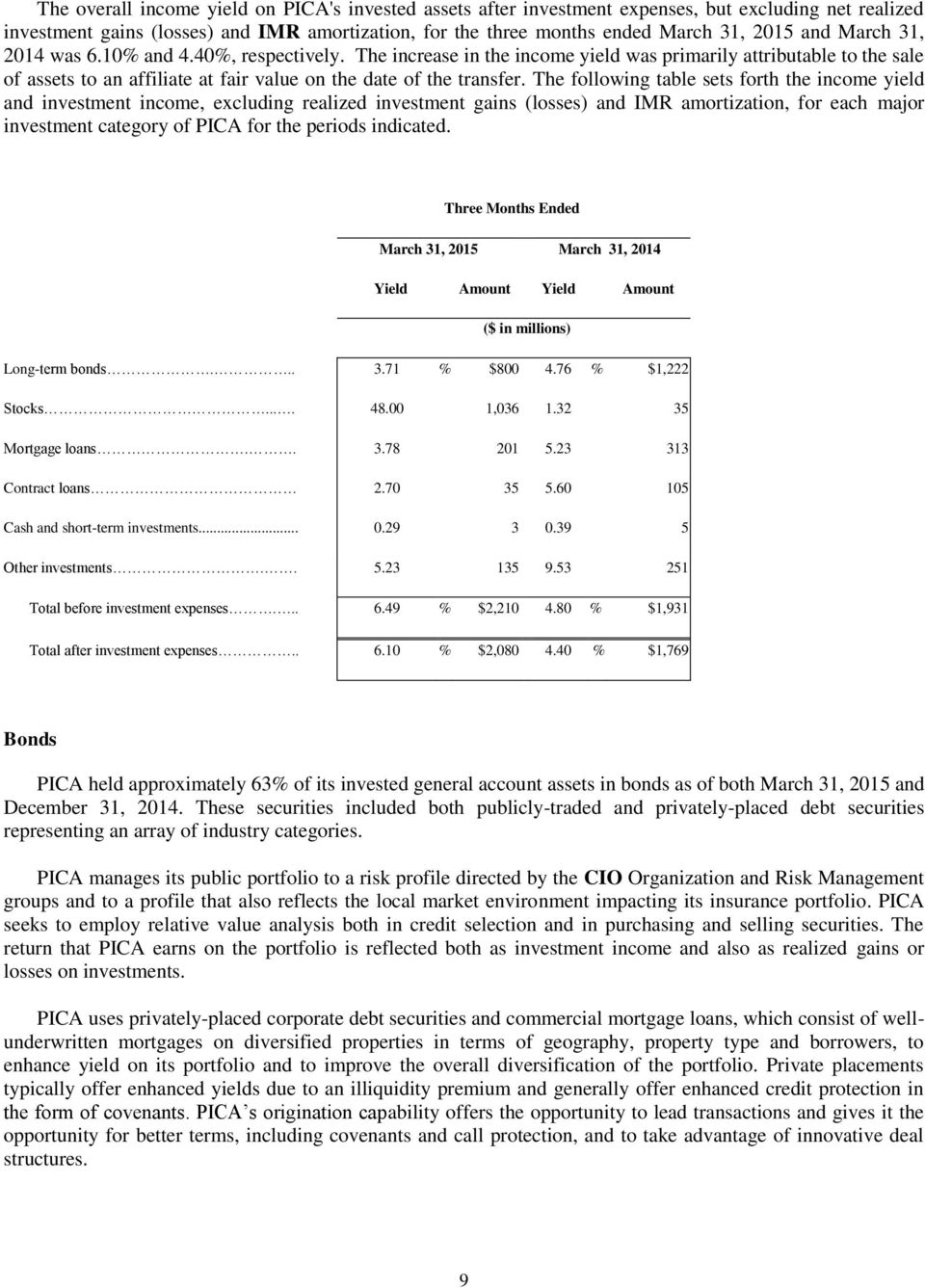
11 The overall income yield on PICA's invested assets after investment expenses, but excluding net realized investment gains (losses) and IMR amortization, for the three months ended March 31, 2015 and March 31, 2014 was 6.10% and 4.40%, respectively. The increase in the income yield was primarily attributable to the sale of assets to an affiliate at fair value on the date of the transfer. The following table sets forth the income yield and investment income, excluding realized investment gains (losses) and IMR amortization, for each major investment category of PICA for the periods indicated. Three Months Ended March 31, 2015 March 31, 2014 Yield Amount Yield Amount ($ in millions) Long-term bonds % $ % $1,222 Stocks , Mortgage loans Contract loans Cash and short-term investments Other investments Total before investment expenses % $2, % $1,931 Total after investment expenses % $2, % $1,769 Bonds PICA held approximately 63% of its invested general account assets in bonds as of both March 31, 2015 and December 31, These securities included both publicly-traded and privately-placed debt securities representing an array of industry categories. PICA manages its public portfolio to a risk profile directed by the CIO Organization and Risk Management groups and to a profile that also reflects the local market environment impacting its insurance portfolio. PICA seeks to employ relative value analysis both in credit selection and in purchasing and selling securities. The return that PICA earns on the portfolio is reflected both as investment income and also as realized gains or losses on investments. PICA uses privately-placed corporate debt securities and commercial mortgage loans, which consist of wellunderwritten mortgages on diversified properties in terms of geography, property type and borrowers, to enhance yield on its portfolio and to improve the overall diversification of the portfolio. Private placements typically offer enhanced yields due to an illiquidity premium and generally offer enhanced credit protection in the form of covenants. PICA s origination capability offers the opportunity to lead transactions and gives it the opportunity for better terms, including covenants and call protection, and to take advantage of innovative deal structures. 9
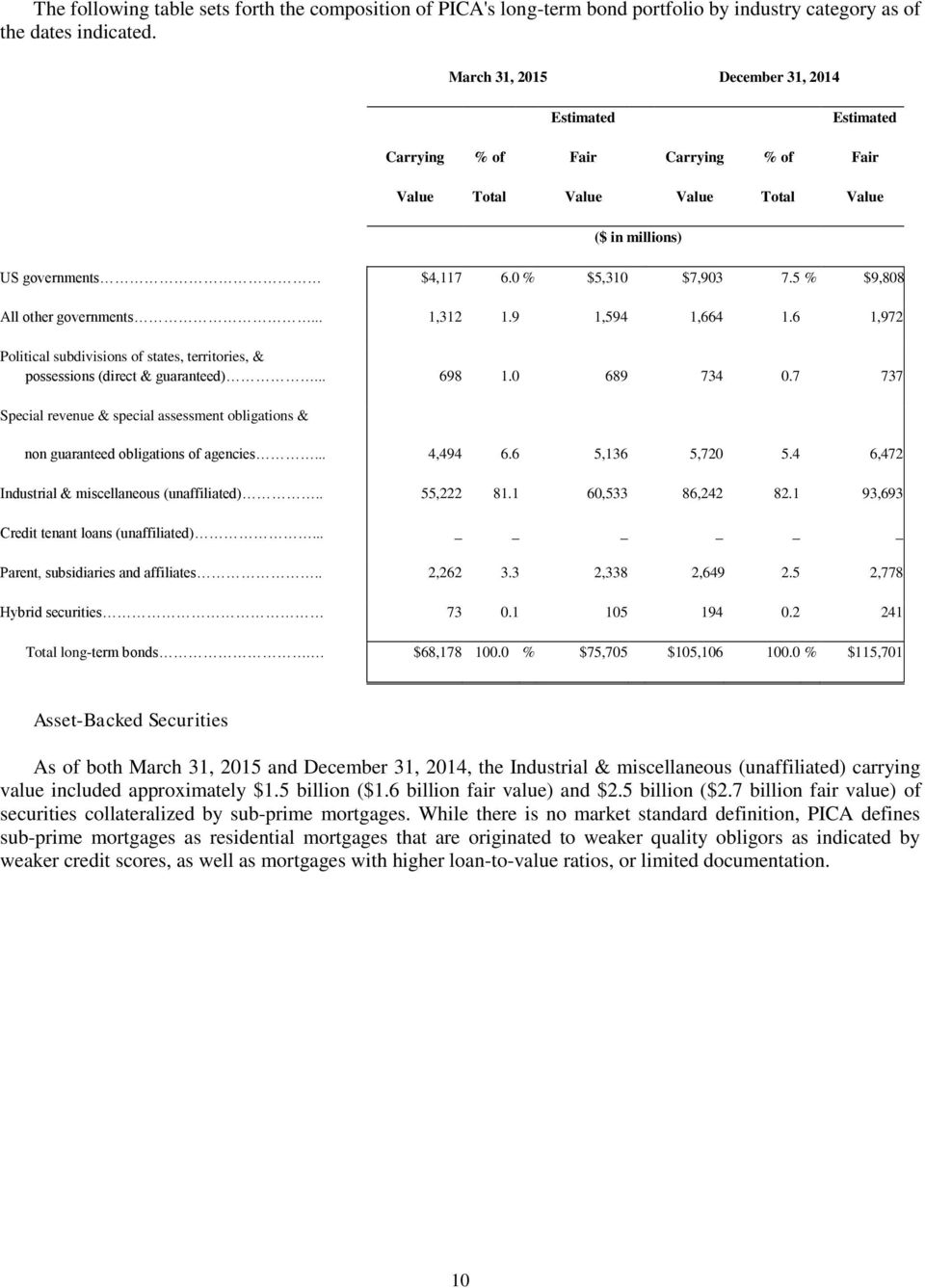
12 The following table sets forth the composition of PICA's long-term bond portfolio by industry category as of the dates indicated. March 31, 2015 December 31, 2014 Estimated Estimated Carrying % of Fair Carrying % of Fair Value Total Value Value Total Value ($ in millions) US governments $4, % $5,310 $7, % $9,808 All other governments... 1, ,594 1, ,972 Political subdivisions of states, territories, & possessions (direct & guaranteed) Special revenue & special assessment obligations & non guaranteed obligations of agencies... 4, ,136 5, ,472 Industrial & miscellaneous (unaffiliated).. 55, ,533 86, ,693 Credit tenant loans (unaffiliated)... Parent, subsidiaries and affiliates.. 2, ,338 2, ,778 Hybrid securities Total long-term bonds. $68, % $75,705 $105, % $115,701 Asset-Backed Securities As of both March 31, 2015 and December 31, 2014, the Industrial & miscellaneous (unaffiliated) carrying value included approximately $1.5 billion ($1.6 billion fair value) and $2.5 billion ($2.7 billion fair value) of securities collateralized by sub-prime mortgages. While there is no market standard definition, PICA defines sub-prime mortgages as residential mortgages that are originated to weaker quality obligors as indicated by weaker credit scores, as well as mortgages with higher loan-to-value ratios, or limited documentation. 10
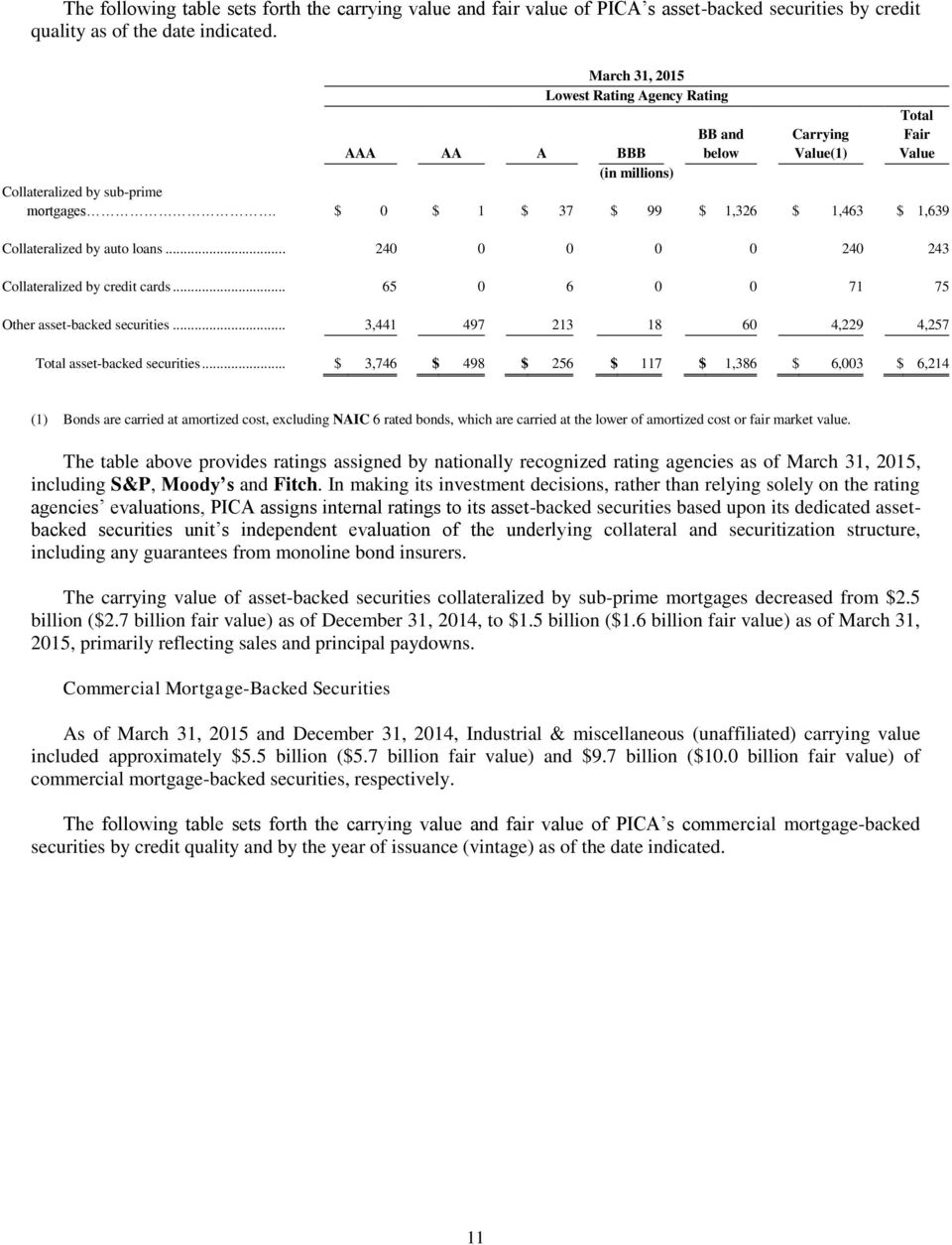
13 The following table sets forth the carrying value and fair value of PICA s asset-backed securities by credit quality as of the date indicated. March 31, 2015 Lowest Rating Agency Rating BB and below Carrying Value(1) AAA AA A BBB (in millions) Collateralized by sub-prime mortgages. $ 0 $ 1 $ 37 $ 99 $ 1,326 $ 1,463 $ 1,639 Collateralized by auto loans Collateralized by credit cards Other asset-backed securities... 3, ,229 4,257 Total asset-backed securities... $ 3,746 $ 498 $ 256 $ 117 $ 1,386 $ 6,003 $ 6,214 Total Fair Value (1) Bonds are carried at amortized cost, excluding NAIC 6 rated bonds, which are carried at the lower of amortized cost or fair market value. The table above provides ratings assigned by nationally recognized rating agencies as of March 31, 2015, including S&P, Moody s and Fitch. In making its investment decisions, rather than relying solely on the rating agencies evaluations, PICA assigns internal ratings to its asset-backed securities based upon its dedicated assetbacked securities unit s independent evaluation of the underlying collateral and securitization structure, including any guarantees from monoline bond insurers. The carrying value of asset-backed securities collateralized by sub-prime mortgages decreased from $2.5 billion ($2.7 billion fair value) as of December 31, 2014, to $1.5 billion ($1.6 billion fair value) as of March 31, 2015, primarily reflecting sales and principal paydowns. Commercial Mortgage-Backed Securities As of March 31, 2015 and December 31, 2014, Industrial & miscellaneous (unaffiliated) carrying value included approximately $5.5 billion ($5.7 billion fair value) and $9.7 billion ($10.0 billion fair value) of commercial mortgage-backed securities, respectively. The following table sets forth the carrying value and fair value of PICA s commercial mortgage-backed securities by credit quality and by the year of issuance (vintage) as of the date indicated. 11
14 March 31, 2015 Lowest Rating Agency Rating Vintage AAA AA A BBB (in millions) BB and below Total Carrying Value (1) Total Fair Value $ 21 $ 0 $ 0 $ 0 $ 0 $ 21 $ , ,618 1, , ,566 1, , ,528 1, & prior Total commercial mortgage-backed securities (2)(3)... $ 5,458 $ 54 $ 0 $ 0 $ 0 $ 5,512 $ 5,747 (1) Bonds are carried at amortized cost, except NAIC 6 rated bonds, which are carried at the lower of cost or fair market value. (2) The tables above provide ratings as assigned by nationally recognized rating agencies as of March 31, 2015, including S&P, Moody s, Fitch, and Realpoint. (3) There were no agency commercial mortgage-backed securities included in the table above as of March 31, The following table sets forth the carrying value of our AAA commercial mortgage-backed securities as of the dates indicated, by type and by year of issuance (vintage). AAA Rated Commercial Mortgage-Backed Securities Carrying Value by Type and Vintage March 31, 2015 Super Senior AAA Structures Other AAA Vintage Super Senior (shorter duration tranches) Super Senior (longest duration tranche) Mezzanine Junior Other Senior Other Subordinate Other Total AAA Securities at Carrying Value (in millions) $ 21 $ 0 $ 0 $ 0 $ 0 $ 0 $ 0 $ , , , , , & Prior Total... $ 3,949 $ 1,492 $ 0 $ 0 $ 0 $ 0 $ 17 $ 5,458 12

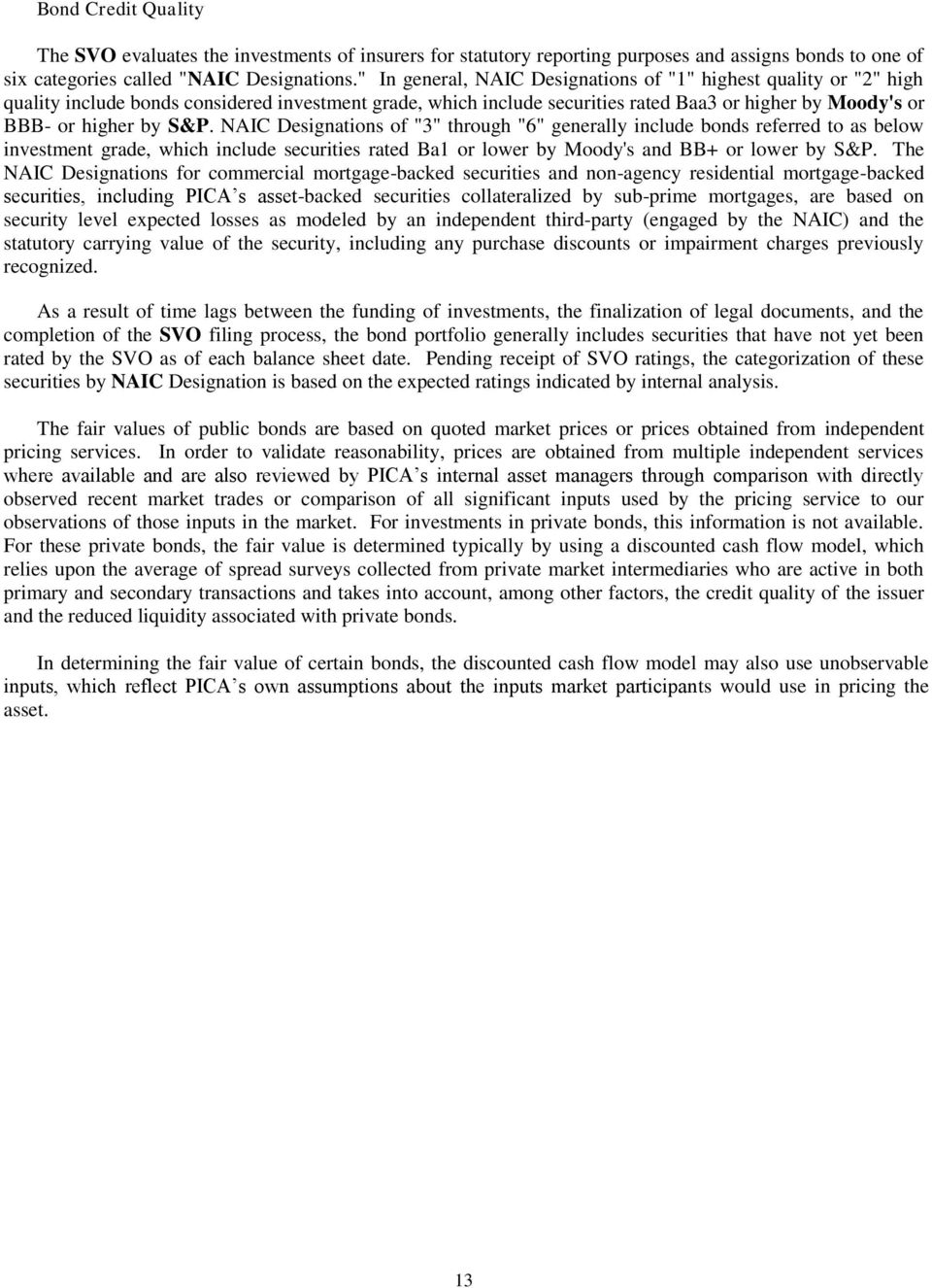
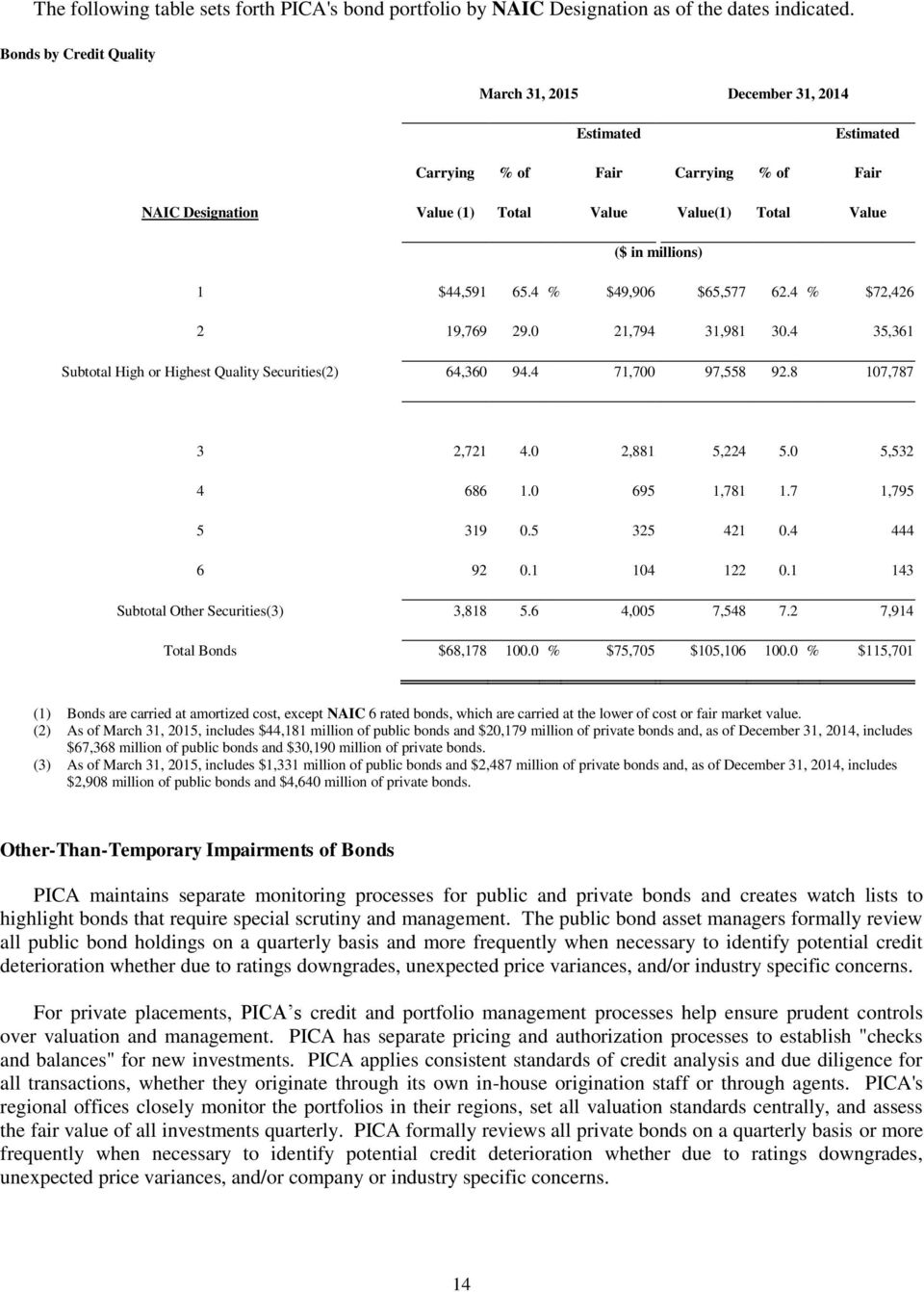
15 Bond Credit Quality The SVO evaluates the investments of insurers for statutory reporting purposes and assigns bonds to one of six categories called "NAIC Designations." In general, NAIC Designations of "1" highest quality or "2" high quality include bonds considered investment grade, which include securities rated Baa3 or higher by Moody's or BBB- or higher by S&P. NAIC Designations of "3" through "6" generally include bonds referred to as below investment grade, which include securities rated Ba1 or lower by Moody's and BB+ or lower by S&P. The NAIC Designations for commercial mortgage-backed securities and non-agency residential mortgage-backed securities, including PICA s asset-backed securities collateralized by sub-prime mortgages, are based on security level expected losses as modeled by an independent third-party (engaged by the NAIC) and the statutory carrying value of the security, including any purchase discounts or impairment charges previously recognized. As a result of time lags between the funding of investments, the finalization of legal documents, and the completion of the SVO filing process, the bond portfolio generally includes securities that have not yet been rated by the SVO as of each balance sheet date. Pending receipt of SVO ratings, the categorization of these securities by NAIC Designation is based on the expected ratings indicated by internal analysis. The fair values of public bonds are based on quoted market prices or prices obtained from independent pricing services. In order to validate reasonability, prices are obtained from multiple independent services where available and are also reviewed by PICA s internal asset managers through comparison with directly observed recent market trades or comparison of all significant inputs used by the pricing service to our observations of those inputs in the market. For investments in private bonds, this information is not available. For these private bonds, the fair value is determined typically by using a discounted cash flow model, which relies upon the average of spread surveys collected from private market intermediaries who are active in both primary and secondary transactions and takes into account, among other factors, the credit quality of the issuer and the reduced liquidity associated with private bonds. In determining the fair value of certain bonds, the discounted cash flow model may also use unobservable inputs, which reflect PICA s own assumptions about the inputs market participants would use in pricing the asset. 13
16 The following table sets forth PICA's bond portfolio by NAIC Designation as of the dates indicated. Bonds by Credit Quality March 31, 2015 December 31, 2014 Estimated Estimated Carrying % of Fair Carrying % of Fair NAIC Designation Value (1) Total Value Value(1) Total Value ($ in millions) 1 $44, % $49,906 $65, % $72, , ,794 31, ,361 Subtotal High or Highest Quality Securities(2) 64, ,700 97, , , ,881 5, , , , Subtotal Other Securities(3) 3, ,005 7, ,914 Total Bonds $68, % $75,705 $105, % $115,701 (1) Bonds are carried at amortized cost, except NAIC 6 rated bonds, which are carried at the lower of cost or fair market value. (2) As of March 31, 2015, includes $44,181 million of public bonds and $20,179 million of private bonds and, as of December 31, 2014, includes $67,368 million of public bonds and $30,190 million of private bonds. (3) As of March 31, 2015, includes $1,331 million of public bonds and $2,487 million of private bonds and, as of December 31, 2014, includes $2,908 million of public bonds and $4,640 million of private bonds. Other-Than-Temporary Impairments of Bonds PICA maintains separate monitoring processes for public and private bonds and creates watch lists to highlight bonds that require special scrutiny and management. The public bond asset managers formally review all public bond holdings on a quarterly basis and more frequently when necessary to identify potential credit deterioration whether due to ratings downgrades, unexpected price variances, and/or industry specific concerns. For private placements, PICA s credit and portfolio management processes help ensure prudent controls over valuation and management. PICA has separate pricing and authorization processes to establish "checks and balances" for new investments. PICA applies consistent standards of credit analysis and due diligence for all transactions, whether they originate through its own in-house origination staff or through agents. PICA's regional offices closely monitor the portfolios in their regions, set all valuation standards centrally, and assess the fair value of all investments quarterly. PICA formally reviews all private bonds on a quarterly basis or more frequently when necessary to identify potential credit deterioration whether due to ratings downgrades, unexpected price variances, and/or company or industry specific concerns. 14
17 All bonds with unrealized losses are subject to review to identify other-than-temporary impairments in value. In evaluating whether a decline in value is other-than-temporary, PICA considers several factors including, but not limited to, the following: the reasons for the decline in value (credit event, currency or interest rate related, including general credit spread widening); PICA's ability and intent to hold its investment for a period of time to allow for recovery of value; PICA's intent to sell its investment before recovery of the cost of the investment; the financial condition of and near-term prospects of the issuer; and the extent and the duration of the decline. In determining whether a decline in value is other-than-temporary, PICA places a greater emphasis on analysis of the underlying credit versus the extent and duration of a decline in value. PICA s credit analysis of an investment includes determining whether the issuer is current on its contractual payments, evaluating whether it is probable that PICA will be able to collect all amounts due according to the contractual terms of the security, and analyzing PICA s overall ability to recover the carrying value of the investment. PICA continues to utilize valuation declines as a potential indicator of credit deterioration, and applies additional levels of scrutiny in its analysis as the severity and duration of the decline increases. Under SSAP No. 43R, an other-than-temporary impairment occurs when the entity does not expect (on a discounted basis) to recover the entire cost basis of a loan-backed or structured security. The amount of the other-than-temporary impairment recognized as a realized loss equals the difference between the investment's cost basis and the present value of cash flows expected to be collected, discounted at the effective interest rate implicit in the debt security prior to impairment. The present value of cash flows expected to be collected becomes the new cost basis of the investment. Additionally, if an entity wrote the security down to fair value due to the intent to sell or because it does not have the ability and intent to hold a security in an unrealized loss position for a period of time sufficient to recover the cost of the security, the non-interest related portion of the other-than-temporary impairment losses is recorded through the AVR while the interest related other-thantemporary impairment losses is recorded through the IMR. Preferred Stock PICA held less than 1% of its invested general account assets in preferred stock as of both March 31, 2015 and December 31, Common Stocks PICA held approximately 7% and 6% of its invested general account assets in common stock as of March 31, 2015 and December 31, 2014, respectively. Substantially all of PICA's unaffiliated common stocks are publicly-traded on national securities exchanges. Impairments of Common Stocks Common stocks with unrealized losses are subject to review to identify other-than-temporary impairments in value. In evaluating whether a decline in value is other-than-temporary, PICA consistently considers several factors including, but not limited to, the following: 15

18 the extent and the duration of the decline; including, but not limited to, the following general guidelines: o o declines in value greater than 20%, maintained for six months or greater; declines in value maintained for one year or greater; and o declines in value greater than 50%. the reasons for the decline in value (credit event, currency or market fluctuation); PICA s ability and intent to hold the investment for a period of time to allow for a recovery of value, including common stock managed by independent third parties where we do not have management discretion; and the financial condition of and near-term prospects of the issuer. PICA generally recognizes other-than-temporary impairments for securities with declines in value greater than 50% maintained for six months or greater or with any decline in value maintained for one year or greater. In addition, in making its determinations PICA continues to analyze the financial condition and near-term prospects of the issuer, including an assessment of the issuer s capital position, and considers its ability and intent to hold the investment for a period of time to allow for a recovery of value. When it has been determined that there is an other-than-temporary impairment, PICA records a writedown in its Statement of Operations and Changes in Capital and Surplus within "Net Realized Capital Gains (Losses)" to the estimated fair value, which reduces the cost basis. The new cost basis of an impaired security is not adjusted for subsequent increases in estimated fair value. Estimated fair values for publicly traded common stock are based on quoted market prices or prices obtained from independent pricing services. Estimated fair values for privately traded common stock are determined using valuation and discounted cash flow models that require a substantial level of judgment. Mortgage Loans on Real Estate Investment Mix PICA held approximately 16% and 15% of its invested general account assets in mortgage loans on real estate as of March 31, 2015 and December 31, 2014, respectively. The following table sets forth the composition of PICA s general account investments in commercial mortgage and other loans, as of the dates indicated. March 31, December 31, (in millions) Commercial mortgage loans... $ 16,047 $ 23,578 Agricultural property loans. 1,247 1,904 Residential property loans Total (1).. $ 17,298 $ 25,486 (1) The portfolio as of March 31, 2015, consisted of 1,215 commercial mortgage loans and 458 residential and agricultural loans and as of December 31, 2014, consisted of 1,392 commercial mortgage loans and 511 residential and agricultural loans. PICA originates mortgage loans on real estate using dedicated investment staff and a network of independent companies through various regional offices. All loans are underwritten consistently with PICA's standards using a proprietary quality rating system that has been developed using its experience in real estate and mortgage lending. 16
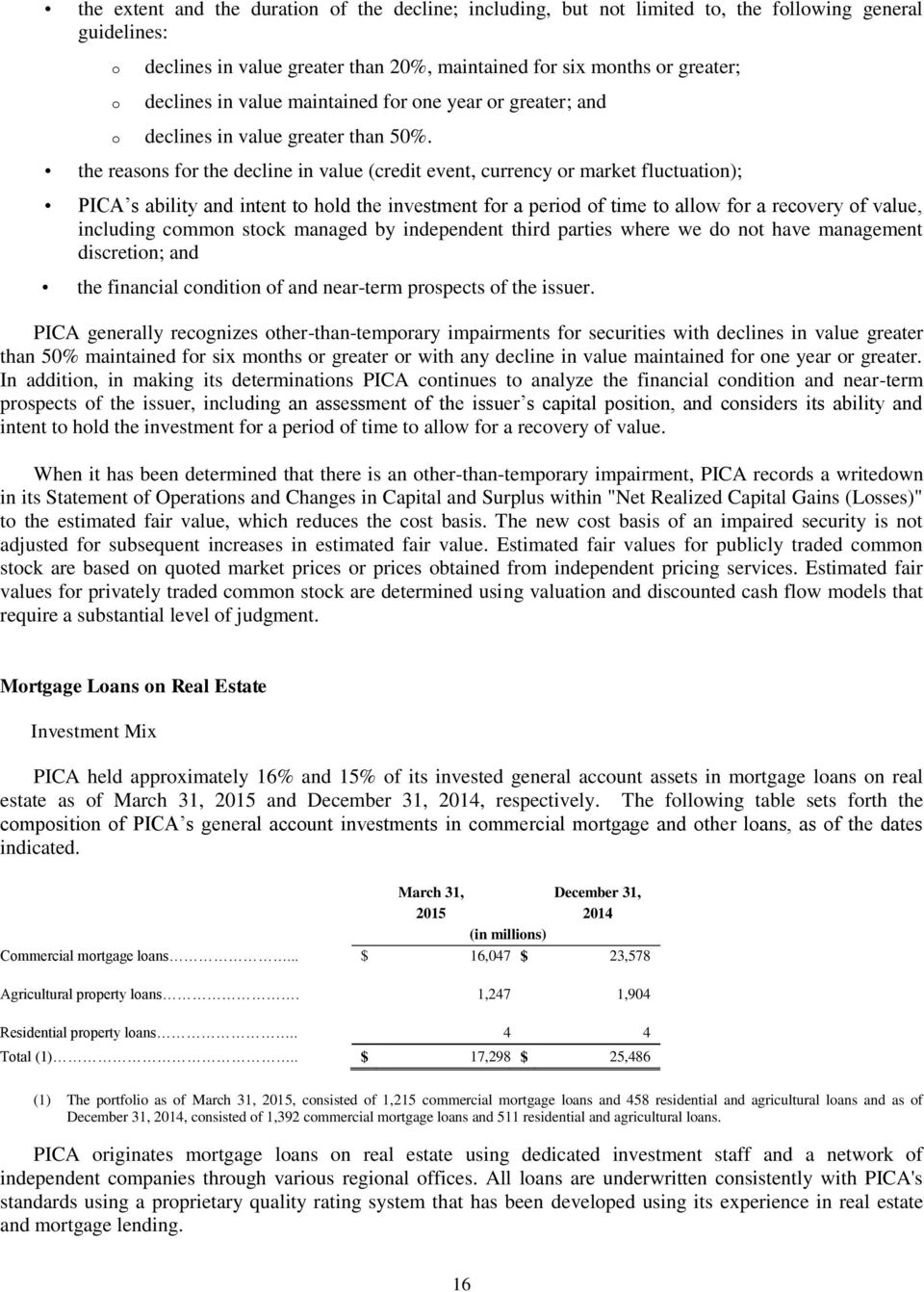
19 PICA s loan portfolio strategy emphasizes diversification by property type and geographic location. The following table sets forth the breakdown of the mortgage loan portfolio by geographic region as of the dates indicated. March 31, 2015 December 31, 2014 Carrying % of Carrying % of U.S. Regions: Value Total Value Total ($ in millions) Pacific $5, % $8, % South Atlantic 3, , Middle Atlantic 2, , West South Central 1, , East North Central 1, , Mountain New England , West North Central East South Central Subtotal U.S. Regions $16, % $24, % Other Total mortgage loans $17, % $25, % PICA s commercial mortgage and agricultural property loans are geographically dispersed throughout the United States and internationally with the largest concentrations in California ($4.7 billion), New York ($1.8 billion), and Texas ($1.5 billion) as of March 31, As of March 31, 2015, PICA s investments in commercial and agricultural mortgage loans had a weighted average debt service coverage ratio of 2.50 times, and a weighted average loan-to-value ratio of 54%. Loan-tovalue and debt service coverage ratios are measures commonly used to assess the quality of commercial and agricultural mortgage loans. The loan-to-value ratio compares the amount of the loan to the fair value of the underlying property collateralizing the loan, and is commonly expressed as a percentage. Loan-to-value ratios greater than 100% indicate that the loan amount is greater than the collateral value. A smaller loan-to-value ratio indicates a greater excess of collateral value over the loan amount. The debt service coverage ratio compares a property s net operating income to its debt service payments. Debt service coverage ratios less than 1.0 times indicate that property operations do not generate enough income to cover the loan s current debt payments. A larger debt service coverage ratio indicates a greater excess of net operating income over the debt service payments. The values utilized in calculating these loan-to-value ratios are developed as part of PICA s periodic review of the commercial and agricultural mortgage loan portfolio, which includes an internal evaluation of the underlying collateral value. PICA s periodic review also includes a quality re-rating process, whereby it updates the internal quality rating originally assigned at underwriting based on the proprietary quality rating system mentioned above. 17
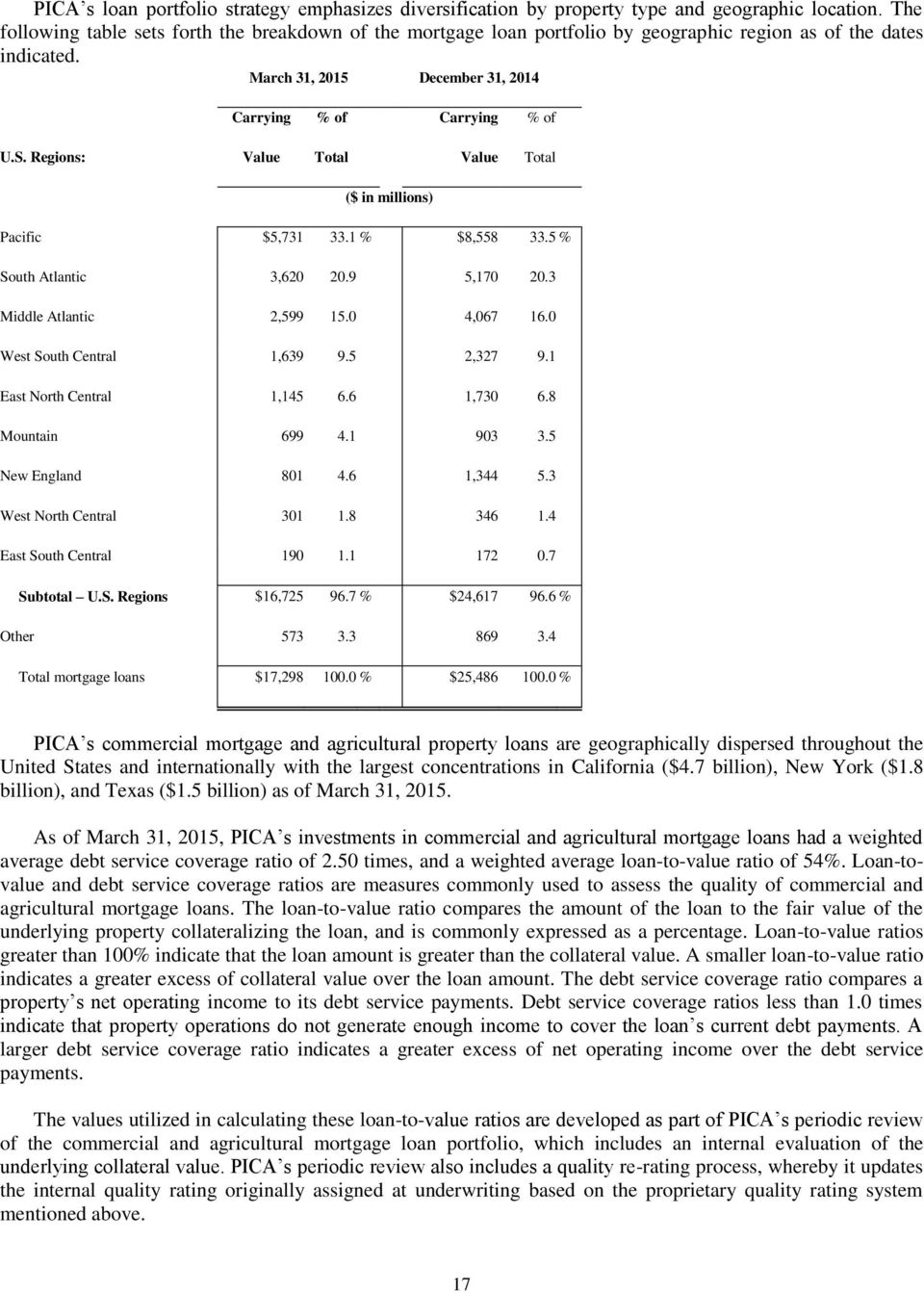
20 The following table sets forth the gross carrying value of PICA s investments in mortgage loans on real estate by loan-to-value and debt service coverage ratios as of the date indicated. March 31, 2015 Debt Service Coverage Ratio Loan to-value Ratio Greater than 1.2x 1.0x to <1.2x Less than 1.0x (in millions) Total Mortgage Loans 0%-59.99%... $ 9,795 $ 246 $ 129 $ 10,170 60%-69.99%... 4, ,953 70%-79.99%... 1, ,900 Greater than 80% Total mortgage loans... $ 16,265 $ 706 $ 327 $ 17,298 The following table sets forth the breakdown of PICA s mortgage loans on real estate portfolio by year of origination as of the date indicated. March 31, 2015 Gross Carrying Value % of Total Year of Origination ($ in millions) 2015 $ % , , , , , & prior 3, Total mortgage loans on real estate $ 17, % Mortgage Loans on Real Estate Quality Ongoing review of the portfolio is performed and loans are placed on watch list status based on a predefined set of criteria, where they are assigned to one of the following categories. PICA places loans on early warning status in cases where, based on its analysis of the loan s collateral, the financial situation of the borrower or tenants or other market factors, PICA believes a loss of principal or interest could occur. PICA classifies loans as closely monitored when it determines there is a collateral deficiency or other credit events that may lead to a potential loss of principal or interest. Loans not in good standing are those loans where PICA has concluded that 18

21 there is a high probability of loss of principal, such as when the loan is in the process of foreclosure or the borrower is in bankruptcy. PICA s workout and special servicing professionals manage the loans on the watch list. As described below, in determining PICA s allowance for losses, it evaluates each loan on the watch list to determine if it is probable that amounts due according to the contractual terms of the loan agreement will not be collected. PICA establishes an allowance for losses to provide for the risk of credit losses inherent in the lending process. The allowance includes loan specific reserves for loans that are determined to be impaired as a result of PICA s loan review process. PICA defines an impaired loan as a loan for which it estimates it is probable that amounts due according to the contractual terms of the loan agreement will not be collected. The loan specific loss allowance is based on PICA s assessment as to ultimate collectability of loan principal and interest. Valuation allowances for an impaired loan are recorded based on the present value of expected future cash flows discounted at the loan s effective interest rate or based on the fair value of the collateral less the estimated costs to obtain and sell. The valuation allowance for commercial mortgage and other loans can increase or decrease from period to period based on these factors. The following table sets forth the breakdown of PICA's mortgage loans on real estate portfolio by quality as of the dates indicated. March 31, December 31, Carrying Value Carrying Value (in millions) Good standing $ 17,269 $ 25,457 Good standing with restructured terms Interest overdue more than three months, not in foreclosure 1 1 Foreclosure in process 0 0 Total mortgage loans $ 17,298 $ 25,486 19
22 The following table sets forth the change in valuation allowances for PICA s mortgage loans on real estate portfolio as of the dates indicated: March 31, December 31, (in millions) Allowance, beginning of year $ 5 $ 0 Addition to/(release of) allowance for losses 0 5 Charge-offs, net of recoveries 0 0 Change in foreign exchange 0 0 Allowance, end of period $ 5 $ 5 Joint Ventures and Limited Partnerships PICA held 5% of its invested general account assets in joint ventures and limited partnerships as of both March 31, 2015 and December 31, The following table sets forth the composition of PICA's joint ventures and limited partnerships, by type, as of the dates indicated. March 31, 2015 December 31, 2014 Carrying % of Carrying % of Value Total Value Total ($ in millions) Joint venture and limited partnership interests in real estate $ % $ % Joint venture and limited partnership interests in common stock 3, , Joint venture and limited partnership interests in fixed income 1, , Joint venture and limited partnership interests other , Total joint ventures and limited partnerships(1) $ 5, % $ 8, % (1) Balances accounted for under equity method of accounting net of impairments. 20
23 Liquidity and Capital Resources Liquidity Liquidity refers to the ability to generate sufficient cash resources to meet the payment obligations of PICA. Capital refers to the long term financial resources available to support the operation of PICA s businesses, fund business growth, and provide a cushion to withstand adverse circumstances. PICA employs a Capital Protection Framework to ensure that sufficient capital resources are available to maintain adequate capitalization and competitive RBC ratio and solvency margins under various stress scenarios. The Capital Protection Framework incorporates the potential impacts from market related stresses, including equity markets, real estate, interest rates, credit losses, and foreign currency exchange rates. Potential sources of capital include on-balance sheet capital, derivatives, reinsurance and contingent sources of capital. Although we continue to enhance our approach, we believe we currently have access to sufficient resources to maintain adequate capitalization and competitive RBC ratios and solvency margins under a range of potential stress scenarios. PICA's principal cash flow sources from insurance, annuities and guaranteed products are premiums and annuity considerations, investment and fee income, and investment maturities and sales. PICA supplements these cash inflows with financing activities. PICA s cash outflow requirements principally relate to benefits, claims, dividends paid to policyholders, and payments to contract holders in connection with surrenders, withdrawals and net policy loan activity. Benefits include the payment of benefits under life insurance, annuity and guaranteed products. PICA s uses of cash also include commissions, general and administrative expenses, purchases of investments, and debt service and repayments in connection with financing activities, as well as dividend payments to its parent, PFI. Some of PICA's products, such as guaranteed products offered to institutional customers, provide for payment of accumulated funds to the contract holder at a specified maturity date unless the contract holder elects to roll over the funds into another contract with PICA. PICA regularly monitors its liquidity requirements associated with policyholder and contract holder obligations so that it can manage cash inflows to match anticipated cash outflow requirements. In addition, PICA has several subsidiaries that are subject to regulatory limitations on the payment of dividends to PICA. PICA is subject to regulatory limitations on the payment of dividends. New Jersey insurance law provides that, except in the case of extraordinary dividends (as described below), all dividends or distributions paid by PICA may be paid only from unassigned surplus, as determined pursuant to SAP, less unrealized capital gains and revaluation of assets. PICA must give prior notification to the Commissioner of its intent to pay any dividend or distribution. Also, if any dividend, together with other dividends or distributions made within the preceding twelve months, exceeds the greater of (i) 10% of the prior calendar year s statutory surplus or (ii) the prior calendar year s statutory net gain from operations (excluding realized capital gains), the dividend is considered to be an extraordinary dividend and the prior approval of the Commissioner is required for payment of the dividend. Moreover, the Commissioner is authorized to disallow the payment of any dividend or distribution, even if the dividend is not an extraordinary dividend, if it determines that PICA does not have a reasonable surplus as to policyholders relative to its outstanding liabilities and adequate to its financial needs or if it finds PICA to be in a hazardous financial condition. In May 2015, PICA paid a $1.95 billion extraordinary dividend to PFI, which was approved by the Commissioner in May
24 Net cash provided by operations was $327 million and $117 million for the three months ended March 31, 2015 and March 31, 2014, respectively. The fluctuation between periods was primarily driven by an increase in net premiums and lower operating expenses, partially offset by a decline in net investment income. Net cash (used in) investing activities was ($2,825) million and ($1,921) million for the three months ended March 31, 2015 and March 31, 2014, respectively. The fluctuation between periods was principally driven by an increase in net payments for investments acquired. PICA s cash flows from investment activities result from repayments of principal, proceeds from maturities and sales of invested assets and investment income, net of amounts reinvested. The primary liquidity risks with respect to these cash flows are the risk of default by debtors or bond insurers, PICA counterparties willingness to extend repurchase and/or securities lending arrangements and market volatility. PICA closely manages these risks through our credit risk management process and regular monitoring of our liquidity position. Net cash provided by financing activities was $223 million and $835 million for the three months ended March 31, 2015 and March 31, 2014, respectively. The fluctuation in net cash provided by financing activities between periods was principally driven by an increase in payments of borrowed money. Included in financing activity above were contractually scheduled withdrawals and prepayments of general account GICs totaling $147 million for the three months ended March 31, Because these contractual withdrawals, as well as the level of surrenders experienced, were consistent with PICA's assumptions in asset liability management, the associated cash outflows did not have an adverse impact on PICA s overall liquidity. PICA believes that cash flows from its insurance, annuity and guaranteed products operations are adequate to satisfy the current liquidity requirements of these operations based on its current liability structure and considering a variety of reasonably foreseeable stress scenarios. The continued adequacy of this liquidity will depend upon factors including future securities market conditions, changes in interest rate levels, policyholder perceptions of PICA's financial strength and the relative safety of competing products, each of which could lead to reduced cash inflows or increased cash outflows. In addition, market volatility can impact the level of capital required to support PICA s businesses, particularly PICA s annuity business. As of March 31, 2015 and December 31, 2014, PICA had cash and short-term investments of approximately $3.5 billion and $5.8 billion, respectively, and investment grade bonds with a fair market value of $71.7 billion and $107.8 billion, respectively. Non-Insurance Contractual Obligations The following table presents PICA's contractual cash flow commitments on notes payable and other borrowings and surplus notes, excluding interest payable, as of March 31, This table does not reflect PICA's obligations under its insurance, annuity and guaranteed products contracts. 22
25 Payment Due by Period Total Less than 1 Year 1-3 Years 4-5 Years After 5 Years ($ in millions) Notes payable and other borrowings (1)... $ 1,045 $ 980 $ $ $ 65 Surplus notes (2) Total... $ 1,990 $ 1,080 $ $ 500 $ 410 (1) The amounts for notes payable and other borrowings represent scheduled principal repayments on debt. The amount reported on the balance sheet of the statutory financial statements represents the carrying value. The balance sheet amount was $1,047 million and $1,102 million as of March 31, 2015 and December 31, 2014, respectively. (2) The amounts for surplus notes represent the aggregate principal amounts. The amount reported in the capital and surplus section of the statutory financial statements represents the current statement value. In addition to the amounts shown above, PICA is a party to operating leases for which its future minimum lease payments under non-cancelable leases were $322 million and $285 million as of March 31, 2015 and December 31, 2014, respectively. During the normal course of its business, PICA utilizes financial instruments with off-balance sheet credit risk such as commitments and financial guarantees. Commitments primarily include commitments to fund investments in private placement securities, limited partnerships and other investments, as well as commitments to originate mortgage loans. Certain contracts underwritten by the Retirement business include guarantees related to financial assets owned by the guaranteed party. These contracts are accounted for as derivatives, at fair value. As of March 31, 2015, such contracts in force carried a total guaranteed value of $74 billion. These guarantees are supported by collateral that is not reflected on PICA s balance sheet. This collateral had a fair value of $76 billion as of March 31, Contingencies PICA has entered into reinsurance agreements with PLICJ, PLICK, and other foreign entities, all of which are affiliates of PICA. In each case, PICA has agreed to reinsure certain individual life insurance policies through excess risk term contracts. Furthermore, PICA has agreed to co-insure U.S. dollar-denominated policies sold by PLICJ. For these reinsurance policies assumed, PICA has retroceded a portion of these risks to affiliated companies. PICA has committed to repurchase securities under master repurchase agreements in the amount of $3,621 million and holds cash collateral for loaned securities of $1,541 million as of March 31, PICA conducts asset-based or secured financing, including transactions such as securities lending, repurchase agreements and mortgage dollar rolls to earn spread income, to borrow funds, or to facilitate trading activity. These programs are primarily driven by portfolio holdings of securities that are lendable based on counterparty demand in the marketplace. The collateral received in connection with these programs is primarily used to purchase securities in PICA s short-term spread portfolios. Investments held in the short-term spread portfolio include cash and cash equivalents, short-term investments, mortgage loans and fixed maturities, including mortgage- and assetbacked securities, with a weighted average life at time of purchase by the short-term portfolios of four years or less. Floating rate assets compromise the majority of our short-term spread portfolio. These short-term 23
26 portfolios are subject to specific investment policy statements, which among other things, do not allow for significant asset/liability interest rate duration mismatch. Financing In May 2015, PFI sold in a public offering $1 billion in aggregate principal amount of 5.375% Fixed-to- Floating Junior Subordinated Notes due PF, a wholly owned subsidiary of PICA, continues to serve as a source of financing for PICA and its subsidiaries, as well as for other subsidiaries of PFI. PF operates under a support agreement with PICA whereby PICA has agreed to maintain PF's positive tangible net worth at all times. PF borrows funds primarily through the direct issuance of commercial paper. PF s outstanding loans to other subsidiaries of PFI have declined over time as it transitions into a financing company primarily for PICA and its remaining subsidiaries. As of March 31, 2015, PF had a tangible net worth of $13.3 million and short-term and long-term notes outstanding of $363 million and $240 million, respectively. PF maintains a commercial paper program with an authorized capacity of $7.0 billion. PF's outstanding commercial paper was $363 million as of March 31, 2015, representing a decrease of $23 million from December 31, The weighted average maturity of PF s outstanding commercial paper was 18 days of which 54% was overnight. As of March 31, 2015, the majority of these proceeds were utilized to fund shortterm cash flow timing mismatches and the working capital needs of PF s affiliates, while the remainder was primarily held in cash and cash equivalents. The daily average commercial paper outstanding for the three months ended March 31, 2015 under this program was $824 million. The weighted average interest rates on these borrowings were 0.11% and 0.07% for the three months ended March 31, 2015 and 2014, respectively. PFI has issued a subordinated guarantee covering PF s commercial paper program. As of March 31, 2015, PFI and PF maintained an aggregate of $3.8 billion of unsecured committed credit facilities consisting of a $2.0 billion five-year facility expiring in November 2018 that has PFI as a borrower and a $1.8 billion three-year facility expiring in November 2016 that has both PFI and PF as borrowers. Each of the facilities may be used for general corporate purposes, including as backup liquidity for PFI s commercial paper programs discussed above. As of March 31, 2015, there were no outstanding borrowings under either credit facility. Borrowings under these credit facilities were conditioned on the PFI s maintenance of consolidated net worth of at least $ billion, which for this purpose was calculated as U.S. GAAP equity, excluding accumulated other comprehensive income (loss) and excluding equity of noncontrolling interests. As of March 31, 2015, the consolidated net worth of PFI exceeded this required minimum amount. In April 2015, PFI entered into a new $4.0 billion five-year credit facility that has both PFI and PF as borrowers. This new credit facility amends and restates PFI s prior credit facilities. Borrowings under the new credit facility may be used for general corporate purposes, and PFI expects that it may borrow under the new facility from time to time to fund its working capital needs. In addition, amounts under the new credit facility may be drawn in the form of standby letters of credit that can be used to meet PFI s operating needs. Similar to the former credit facilities, the new credit facility contains representations and warranties, covenants and events of default that are customary for facilities of this type, and borrowings under the facility are not contingent on PFI s credit ratings nor subject to material adverse change clauses. Borrowings under the new credit facility are conditioned on PFI s maintenance of consolidated net worth of at least $ billion, which, under this facility, is calculated as U.S. GAAP equity, excluding accumulated other comprehensive income (loss), equity of noncontrolling interests, and equity attributable to the Closed Block. In 2003, PICA established a Funding Agreement Notes Issuance Program pursuant to which a Delaware statutory trust issues medium-term notes secured by funding agreements issued to the trust by PICA. The 24
27 funding agreements provide cash flow sufficient for the debt service on the medium-term notes. The mediumterm notes are sold in transactions not requiring registration under the Securities Act of 1933, as amended. The notes have fixed or floating interest rates and original maturities ranging from five to ten years. Under SAP, debt of subsidiaries is not included in debt of PICA. Similarly, under SAP, debt of variable interest entities such as the trust is not included in debt of PICA. As a result, the medium-term notes are not included in the line item Notes payable and other borrowings on PICA s Statutory Statements of Admitted Assets, Liabilities and Capital and Surplus. As of March 31, 2015 and December 31, 2014, the outstanding aggregate principal amount of such notes totaled $2.7 billion and $2.7 billion, respectively. On August 18, 2014, the Delaware trust sold in a private placement $500 million in aggregate principal amount of 1.350% Medium-Term Notes due August 18, On May 16, 2014, the Delaware trust sold in a private placement $500 million in aggregate principal amount of 2.200% Medium-Term Notes due May 16, 2019 and $200 million aggregate principal amount of floating rate securities due May 16, 2016, paying a interest rate equal to 3 month LIBOR plus 0.15%. PICA s ability to issue new notes under this program will depend on market conditions. PICA intends to repay the maturing notes through a combination of cash flows from asset maturities, asset sales, and internal sources of funds such as PF. Liabilities under the funding agreements issued by PICA to the trust in connection with each tranche of medium-term notes are included, along with liabilities relating to other funding agreements, in the line item Policyholders account balances on PICA s Statutory Statements of Admitted Assets, Liabilities and Capital and Surplus. PICA is a member of the FHLBNY. Membership allows PICA access to the FHLBNY s financial services, including the ability to obtain collateralized loans and to issue collateralized funding agreements. FHLBNY borrowings and funding agreements are collateralized by qualifying mortgage-related assets or U.S. Treasury securities, the fair value of which must be maintained at certain specified levels relative to outstanding borrowings. FHLBNY membership requires PICA to own member stock and borrowings require the purchase of activity-based stock in an amount equal to 4.5% of outstanding borrowings. Under FHLBNY guidelines, if PICA s financial strength ratings decline below A/A2/A Stable by S&P/Moody s/fitch, respectively, and the FHLBNY does not receive written assurances from the NJDOBI regarding PICA s solvency, new borrowings from the FHLBNY would be limited to a term of 90 days or less. Currently there are no restrictions on the term of borrowings from the FHLBNY. NJDOBI permits PICA to pledge collateral to the FHLBNY in an amount of up to 5% of its prior year-end statutory net admitted assets, excluding separate account assets. Based on PICA s statutory net admitted assets as of December 31, 2014, the 5% limitation equates to a maximum amount of pledged assets of $8.9 billion and an estimated maximum borrowing capacity (after taking into account required collateralization levels and purchases of activity-based stock) of approximately $7.5 billion. Nevertheless, FHLBNY borrowings are subject to the FHLBNY s discretion and to the availability of qualifying assets at PICA. As of March 31, 2015, PICA had pledged assets with a fair value of $2.8 billion supporting an outstanding advance of $280 million. This advance is in Short-term debt and matures in December 2015 and outstanding funding agreements totaling $1.9 billion are included in Policyholders account balances. The fair value of qualifying assets that were available to PICA but not pledged amounted to $5.5 billion as of March 31, PRIAC is a member of the FHLBB. Membership allows PRIAC access to collateralized advances. PRIAC s membership in FHLBB requires the ownership of member stock and borrowings from FHLBB require the purchase of FHLBB activity-based stock in an amount between 3.0% and 4.5% of outstanding borrowings, depending on the maturity date of the obligation. As of March 31, 2015, PRIAC had no advances outstanding under the FHLBB facility. 25
28 Under Connecticut state insurance law, without the prior consent of the Connecticut Insurance Department, the amount of assets insurers may pledge to secure debt obligations is limited to the lesser of 5% of prior-year statutory admitted assets or 25% of prior-year statutory surplus, resulting in a maximum borrowing capacity for PRIAC under the FHLBB facility of approximately $0.2 billion as of March 31, Capital The Risk Based Capital, or RBC, ratio is the primary measure by which PICA evaluates its capital adequacy. PICA s RBC ratio is managed to a level consistent with an AA ratings objective; however, ratings agencies take into account a variety of factors in assigning ratings to PICA. RBC is determined by statutory formulas that consider risks related to the type and quality of the invested assets, insurance-related risks associated with an insurer s products, interest rate risks and general business risks. The RBC ratio calculations are intended to assist insurance regulators in measuring the adequacy of an insurer s statutory capitalization. PICA reported an RBC ratio of 498% as of December 31, 2014, which exceeds the minimum levels required by applicable insurance regulations. The level of statutory capital of PICA can be materially impacted by interest rate and equity market fluctuations, changes in the values of derivatives, the level of impairments recorded, and credit quality migration of the investment portfolio, among other items. Further, a recapture of business subject to reinsurance arrangements due to defaults by, or credit quality migration affecting, the reinsurers could result in higher required statutory capital levels. The level of statutory capital of PICA is also affected by statutory accounting rules, which are subject to change by insurance regulators. (The inclusion of RBC measures is intended solely for the information of investors and is not intended for the purpose of ranking any insurance company or for use in connection with any marketing, advertising or promotional activities.) PFI and its subsidiaries reinsure variable annuity living benefit guarantees to an affiliated captive reinsurance company, Pruco Re, which is not a subsidiary of PICA. Pruco Re requires access to sufficient liquidity to support the hedging activities such as periodic settlements, purchases, maturities, terminations and breakage. The liquidity needs can vary materially due to, among other items, changes in interest rates, equity markets, mortality and policyholder behavior. Currently, we fund these liquidity needs with a combination of capital contributions and loans from PFI and affiliates. The living benefits hedging activity in Pruco Re may also result in collateral postings on derivatives to or from counterparties. The net collateral position depends on changes in interest rates and equity markets related to the amount of the exposures hedged. Depending on market conditions, the collateral posting requirements can result in material liquidity needs. In addition, certain derivatives entered into on or after June 10, 2013 are required to be cleared under the Dodd-Frank Act. These cleared derivatives typically have additional collateral requirements. As of March 31, 2015, the living benefit hedging derivatives were in a net receive position of $6.8 billion compared to a net posting position of $4.7 billion as of December 31, The change in position was primarily driven by a decline in interest rates. Ratings Developments Ratings Financial strength ratings (which are sometimes referred to as claims-paying ratings) and credit ratings are important factors affecting public confidence in an insurer and its competitive position in marketing products. Nationally Recognized Statistical Ratings Organizations continually review the financial performance and financial condition of the entities they rate, including PICA and its rated affiliates. PICA s credit ratings are also important for its ability to raise capital through the issuance of debt and for the cost of such financing. A downgrade in the credit or financial strength ratings of PICA or its rated affiliates could potentially, among other things, limit PICA s ability to market products, reduce its competitiveness, increase the number or value of policy surrenders and withdrawals, increase borrowing costs and potentially make it more difficult to borrow 26
29 funds, adversely affect the availability of financial guarantees, such as letters of credit, cause additional collateral requirements or other required payments under certain agreements, allow counterparties to terminate derivative agreements and/or hurt PICA s relationships with creditors, distributors or trading counterparties, thereby potentially negatively affecting its profitability, liquidity and/or capital. In addition, PICA considers its own risk of non-performance in determining the fair value of its liabilities. Therefore, changes in its credit or financial strength ratings may affect the fair value of its liabilities. Financial strength ratings represent the opinions of rating agencies regarding the financial ability of an insurance company to meet its obligations under an insurance policy. Credit ratings represent the opinions of rating agencies regarding an entity s ability to repay its indebtedness. The following table summarizes the ratings for PICA as of December 31, A.M. S&P(1) Moody's(2) Best(3) Fitch(4) Financial Strength Ratings: AA- A1 A+ A+ (1) S&P financial strength ratings for insurance companies range from AAA (extremely strong) to R (regulatory supervision). A rating of AA- is the fourth highest of twenty-three rating categories. (2) Moody's insurance financial strength ratings range from Aaa (exceptional) to C (lowest). A rating of A1 is the fifth highest of twenty-one rating categories. Numeric modifiers are used to refer to the ranking within the group with 1 being the highest and 3 being the lowest. These modifiers are used to indicate relative strength within a category. (3) A.M. Best financial strength ratings for insurance companies currently range from A++ (superior) to S (suspended). A rating of A+ is the second highest of sixteen rating categories. (4) Fitch financial strength ratings range from AAA (exceptionally strong) to C (distressed). A rating of A+ is the fifth highest of nineteen rating categories. The ratings set forth above reflect current opinions of each rating agency. Each rating should be evaluated independently of any other rating. These ratings are reviewed periodically and may be changed at any time by the rating agencies. As a result, there is no assurance that PICA will maintain its current ratings in the future. Rating agencies use an outlook statement for both industry sectors and individual companies. For an industry sector, a stable outlook generally implies that over the next months, the rating agency expects ratings to remain unchanged among companies in the sector. Currently, A.M. Best, S&P, Moody s and Fitch all have the U.S. life insurance industry on stable outlook. For a particular company, an outlook generally indicates a medium- or long-term trend (generally six months to two years) in credit fundamentals, which if continued, may lead to a rating change. These indicators are not necessarily a precursor of a rating change nor do they preclude a rating agency from changing a rating at any time without notice. Currently, Fitch has all of the Company s ratings on positive outlook; A.M. Best, Moody s and S&P have all of PICA s ratings on stable outlook. Requirements to post collateral or make other payments, as a result of ratings downgrades, under certain agreements, including derivative agreements, can be satisfied in cash or by posting permissible securities held by PICA and/or its affiliate that is a party to the agreements. A ratings downgrade of three ratings levels from the ratings levels as of December 31, 2014 (relating to financial strength ratings in certain cases and credit ratings in other cases) would result in estimated additional collateral posting requirements or payments under such agreements of approximately $9 million. The amount of collateral required to be posted for derivative agreements is also dependent on the fair value of the derivative positions as of the balance sheet date. In addition, a ratings downgrade by A.M. Best to "A-" for PICA would require PICA to either post collateral or a letter of credit in the amount of approximately $1.4 billion, based on the level of statutory reserves related to the variable annuity business acquired from Allstate. Management believes that the posting of such collateral would not be a material liquidity event for PICA. 27
30 In view of the difficulties experienced in recent years by many financial institutions, the rating agencies have heightened the level of scrutiny that they apply to such institutions, have increased the frequency and scope of their credit reviews, have requested additional information from the companies that they rate, and may adjust upward the capital and other requirements employed in the rating agency models for maintenance of certain ratings levels, such as the financial strength ratings currently held by PICA. In addition, actions PICA might take to access third party financing or to realign its capital structure may in turn cause rating agencies to reevaluate PICA s ratings. Litigation and Regulatory Matters Litigation PICA is subject to legal and regulatory actions in the ordinary course of its businesses. Pending legal and regulatory actions include proceedings specific to it and proceedings generally applicable to business practices in the industries in which it operates, including in both cases businesses that have either been divested or placed in wind-down status. PICA is subject to class action lawsuits and individual lawsuits involving a variety of issues, including sales practices, underwriting practices, claims payment and procedures, additional premium charges for premiums paid on a periodic basis, denial or delay of benefits, return of premiums or excessive premium charges and breaching fiduciary duties to customers. In its investment-related operations, PICA is subject to litigation involving commercial disputes with counterparties or partners and class action lawsuits and other litigation alleging, among other things, that PICA has made improper or inadequate disclosures in connection with the sale of assets and annuity and investment products or charged excessive or impermissible fees on these products, recommended unsuitable products to customers, mishandled customer accounts or breached fiduciary duties to customers. PICA is also subject to litigation arising out of its general business activities, such as its investments, contracts, leases and labor and employment relationships, including claims of discrimination and harassment and could be exposed to claims or litigation concerning certain business or process patents. Regulatory authorities from time to time make inquiries and conduct investigations and examinations relating particularly to PICA and its businesses and products. In addition, PICA, along with other participants in the businesses in which it engages, may be subject from time to time to investigations, examinations and inquiries, in some cases industry-wide, concerning issues or matters upon which such regulators have determined to focus. In some of PICA s pending legal and regulatory actions, parties are seeking large and/or indeterminate amounts, including punitive or exemplary damages. The outcome of a litigation or regulatory matter, and the amount or range of potential loss at any particular time, is often inherently uncertain. The following is a summary of updates from December 31, 2014 disclosures of certain pending proceedings. Lederman v. PFI In March 2015, the court granted PICA summary judgment and dismissed with prejudice the complaint of the remaining plaintiff with claims against PICA. Bouder v. PFI Other Matters In February 2015, the federal District Court for New Jersey granted in part, and denied in part, plaintiffs renewed class certification motion. It certified for class treatment plaintiffs wage payment claims which include allegations that PICA made improper deductions from the wages of its former common law agents in California, New York, and Pennsylvania, and its financial services associates in California and New York. The 28
31 Court denied plaintiffs attempt to certify a class based on PICA s alleged failure to pay overtime to its former common law agents and its financial services associates in California, Illinois, New York and Pennsylvania. In March 2015, PICA filed a motion requesting that the Court reconsider its decision to partially grant plaintiffs renewed class certification motion with regard to its former common law agents. Residential Mortgage-Backed Securities Litigation PICA et al. v. Bank of America National Association & Merrill Lynch & Co., Inc., et al. In April 2015, this lawsuit was settled. PICA et al. v. Countrywide Financial Corp., et al. In April 2015, this lawsuit was settled. RMBS Trustee PICA et al. v. Bank of New York Mellon In March 2015, defendants filed a motion to dismiss the amended complaint. PICA et al. v. Citibank N.A. In February 2015, defendants filed a motion to dismiss the amended complaint. PICA et al. v. Deutsche Bank, et al. In April 2015, defendants filed a motion to dismiss the amended complaint. PICA et al. v. HSBC, et al. In January 2015, defendants filed a motion to dismiss the amended complaint. PICA et al. v. U.S. Bank National Association In February 2015, defendants filed a motion to dismiss the amended complaint. PICA et al. v. Wells Fargo Bank, et al. In April 2015, defendants filed a motion to dismiss the amended complaint. On an ongoing basis, PICA s internal supervisory and control functions review the quality of sales, marketing and other customer interface procedures and practices and may recommend modification or enhancement. From time to time, this review process results in the discovery of product administration, servicing or other errors, including errors relating to the timing or amount of payments or contract values due to customers. In certain cases, if appropriate, PICA may offer customers remediation and may incur charges, including the cost of such remediation, administrative costs and regulatory fines. PICA s litigation and regulatory matters are subject to many uncertainties, and given their complexity and scope, their outcomes cannot be predicted. It is possible that PICA s results of operations or cash flows in a particular quarterly or annual period could be materially affected by an ultimate unfavorable resolution of 29
32 pending litigation and regulatory matters depending, in part, upon the results of operations or cash flow for such period. In light of the unpredictability of PICA s litigation and regulatory matters, it is also possible that in certain cases an ultimate unfavorable resolution of one or more pending litigation or regulatory matters could have a material adverse effect on PICA s financial position. Management believes, however, that, based on information currently known to it, the ultimate outcome of all pending litigation and regulatory matters, after consideration of applicable reserves and rights to indemnification is not likely to have a material adverse effect on PICA s financial position. Recent Information Regarding Tax The income tax provision is calculated in accordance with SSAP No. 101 Income Taxes, A Replacement of SSAP No. 10R and SSAP No. 10. PICA s liability for income taxes includes the liability for unrecognized tax benefits, interest and penalties which relate to tax years still subject to review by the IRS or other taxing authorities. Audit periods remain open for review until the statute of limitations has passed. Generally, for tax years which produce net operating losses, capital losses or tax credit carryforwards ( tax attributes ), the statute of limitations does not close, to the extent of these tax attributes, until the expiration of the statute of limitations for the tax year in which they are fully utilized. The completion of review or the expiration of the statute of limitations for a given audit period could result in an adjustment to the liability for income taxes. The tax years that remain subject to examination by the US tax authorities at March 31, 2015 are 2007 through PICA does not anticipate any significant changes within the next 12 months to its total unrecognized tax benefits related to tax years for which the statute of limitations has not expired. The dividends received deduction ( DRD ) reduces the amount of dividend income subject to U.S. tax and is a significant component of the difference between PICA s effective tax rate and the federal statutory tax rate of 35%. The DRD for the current period was estimated using information from 2014 and current year results, and was adjusted to take into account the current year s equity market performance and expected business results. The actual current year DRD can vary from the estimate based on factors such as, but not limited to, changes in the amount of dividends received that are eligible for the DRD, changes in the amount of distributions received from mutual fund investments, changes in the account balances of variable life and annuity contracts, and PICA s taxable income before the DRD. There is a possibility that the IRS and the U.S. Treasury will address, through guidance, issues related to the calculation of the DRD. In addition, for the last several years, revenue proposals included in the Obama Administration's budgets have included proposed changes to the method used to determine the amount of the DRD. A change in the DRD, including the possible retroactive or prospective elimination of this deduction through guidance or legislation, could increase actual tax expense and reduce PICA s consolidated net income. For tax years 2007 through 2015, PICA is participating in the IRS s Compliance Assurance Program ( CAP ). Under CAP, the IRS assigns an examination team to review completed transactions as they occur in order to reach agreement with PICA on how they should be reported in the relevant tax returns. If disagreements arise, accelerated resolutions programs are available to resolve the disagreements in a timely manner before the tax returns are filed. Estimated Recovery from Lehman Brothers Holdings, Inc. In connection with disputes arising out of the Chapter 11 bankruptcy petition filed by Lehman Brothers Holdings Inc., PICA, through its subsidiary, PGF, previously recorded losses related to a portion of its counterparty exposure on derivative transactions it had previously held with Lehman Brothers and its affiliates. PICA, through PGF, recorded no estimated recoveries related to this matter for the three months ended March 31, 2015 within change in net unrealized capital gains (losses) in PICA s Summary of Operations. 30
33 ANNEX A Definitions Asset Liability Management A unit within PFI that develops and implements investment policies, long-term investment plans and tactical investment strategies for PICA's general account asset portfolios. The unit is responsible for asset allocation, asset liability matching and designing investment policies and strategies that are consistent with products sold and developed by PICA's Retirement, Annuity, Individual Insurance and Group Insurance profit centers. AVR Asset Valuation Reserve, established under SAP as a liability to offset potential non-interest related investment losses. Changes in AVR are charged or credited directly to surplus; no such reserve is required under GAAP. Closed Block PICA s liabilities for certain participating individual life insurance policies and annuities issued in the United States were segregated, together with assets which will be used exclusively for the payment of benefits, policyholder dividends and taxes with respect to these products, in a regulatory mechanism referred to as the Closed Block. CIO - Chief Investment Officer Commissioner State Insurance Department Commissioners and/or the Commissioner of the New Jersey Department of Banking and Insurance. Dodd-Frank Act The Wall Street Reform and Consumer Protection Act of 2010 FHLBB - Federal Home Loan Bank of Boston FHLBNY Federal Home Loan Bank of New York Fitch Fitch Ratings, Ltd. GAAP Generally Accepted Accounting Principles, in the United States of America. GICs Guaranteed Investment Contracts IHC Debt - Intermediate Holding Company Debt IMR Interest Maintenance Reserve, established under SAP, to capture realized investment gains and losses, net of tax, on the sale of bonds resulting from changes in the general level of interest rates, and is amortized into income over the remaining years to expected maturity of the assets sold; no such reserve is required under GAAP. IRS Internal Revenue Service Moody s Moody s Investors Service, Inc. NAIC National Association of Insurance Commissioners NJCAP Prudential New Jersey Captive Insurance Company NJDOBI New Jersey Department of Banking and Insurance 31
34 PFI Prudential Financial, Inc., a New Jersey corporation and the ultimate parent company of PICA, PH and all of their respective subsidiaries or affiliates. PF Prudential Funding, LLC, a New Jersey limited liability company and a wholly owned financing subsidiary of PICA. PGFL Prudential Gibraltar Financial Limited PH Prudential Holdings, LLC, a New Jersey limited liability company that owns all of the issued and outstanding shares of the capital stock of PICA. PICA The Prudential Insurance Company of America, a New Jersey stock life insurance company. PLI Pruco Life Insurance Company, a wholly owned subsidiary of PICA. PLIC - Prudential Legacy Insurance Company of New Jersey PLICJ The Prudential Life Insurance Company Ltd., an affiliate of PICA. (Located in Japan) PLICK The Prudential Life Insurance Company of Korea, Ltd., an affiliate of PICA. PRIAC The Prudential Retirement Insurance and Annuity Company, a wholly owned subsidiary of PICA. Pruco Re - Pruco Re. Ltd. SAP Statutory Accounting Principles SSMDF Social Security Master Death File SVO The Securities Valuation Office, a division of the NAIC. S&P Standard and Poor s Ratings Services, a division of The McGraw-Hill Companies, Inc. Surplus and Related Assets - Assets allocated by PICA outside of the Closed Block to meet regulatory capital requirements and provide additional capital with respect to the Closed Block s liabilities. SSAP Statements of Statutory Accounting Principles 32
35 THE PRUDENTIAL INSURANCE COMPANY OF AMERICA STATUTORY STATEMENTS OF ADMITTED ASSETS, LIABILITIES AND CAPITAL AND SURPLUS March 31, December 31, (in millions) ASSETS Bonds... $ 68,178 $ 105,106 Preferred stocks Common stocks... 7,680 10,554 Mortgage loans on real estate... 17,298 25,486 Real estate Contract loans... 2,816 7,622 Cash and short-term investments... 3,476 5,751 Derivatives... 2,732 2,693 Other invested assets... 5,756 8,484 Total cash and invested assets , ,319 Premiums due and deferred... 2,416 2,364 Accrued investment income ,186 Current federal income tax recoverable Net deferred tax asset... 2,369 2,804 Other assets... 1,059 4,750 Separate account assets , ,679 TOTAL... ASSETS $ 251,486 $ 309,102 LIABILITIES AND SURPLUS Liabilities Policy liabilities and insurance reserves: Future policy benefits and claims... $ 74,399 $ 122,239 Advanced premiums Policy dividends... 2,019 1,983 Policyholders' account balances... 10,712 15,876 Notes payable and other borrowings... 1,047 1,102 Asset valuation reserve... 2,090 3,379 Federal income tax payable Interest maintenance reserve ,227 Transfers from separate accounts due or accrued... (65) (77) Securities sold under agreement to repurchase... 3,621 8,153 Cash collateral held for loaned securities... 1,541 2,695 Derivatives Other liabilities... 6,654 9,835 Separate account liabilities , ,308 Total liabilities... $ 238,936 $ 298,771 Capital and Surplus Common capital stock and gross paid in and contributed surplus... $ 1,791 $ 1,489 Surplus notes Special surplus fund Unassigned surplus... 9,295 7,396 Total capital and surplus... 12,550 10,331 TOTAL... LIABILITIES, CAPITAL AND SURPLUS... $ 251,486 $ 309,
36 THE PRUDENTIAL INSURANCE COMPANY OF AMERICA STATUTORY STATEMENTS OF OPERATIONS AND CHANGES IN CAPITAL AND SURPLUS Three Months ended March 31, (in millions) REVENUE Premiums and annuity considerations... $ (47,622) $ 3,975 Net investment income... 2,093 1,811 Other income (losses)... 1,058 (437) Total Revenue... $ (44,471) $ 5,348 BENEFITS AND EXPENSES Death benefits... $ 1,181 $ 1,344 Annuity benefits... 2,405 1,984 Disability benefits Other benefits Surrenders, benefits and fund withdrawals... 2,091 1,744 Net (decrease) increase in reserves... (47,702) 392 Commissions Net transfer from separate accounts... (901) (1,181) Other (benefits) expenses... (3,437) 334 Total Benefits and Expenses... $ (45,994) $ 5,051 Operating income before dividends and income taxes... $ 1,523 $ 297 Dividends to policyholders Operating income before income taxes... 1, Income tax expenses Income from Operations Net Realized Capital Gains... 3, NET INCOME... $ 3,867 $ 246 CAPITAL AND SURPLUS Capital and Surplus, beginning of year... $ 10,331 $ 9,383 Change in common capital stock and gross paid in and contributed surplus Change in special surplus funds Net income... 3, Change in net unrealized capital (losses) gains... (1,301) 407 Change in non-admitted assets Change in asset valuation reserve... 1,289 (104) Change in net deferred income tax... (2,563) 10 Amortization related to employee retirement plans and other pension adjustments Change in special surplus funds... (18) - Other changes, net... (304) 16 Change in unassigned surplus... 1, CAPITAL AND SURPLUS, END OF PERIOD... $ 12,550 $ 10,111 2
37 THE PRUDENTIAL INSURANCE COMPANY OF AMERICA STATUTORY STATEMENTS OF CASH FLOWS CASH FLOWS FROM OPERATING ACTIVITIES Three Months Ended March 31, (in millions) Premiums and annuity considerations... $ 4,145 $ 3,654 Net investment income... 1,015 1,665 Other income Separate account transfers... 1,554 1,202 Benefits and claims paid... (5,899) (6,008) Policyholders' dividends paid... (13) (54) Federal income taxes... (171) 136 Other operating expenses... (581) (899) Net cash provided by operating activities... $ 327 $ 117 CASH FLOWS FROM INVESTING ACTIVITIES Proceeds from investments sold, matured or repaid Bonds... $ 4,232 $ 8,193 Stocks Mortgage loans on real estate Other invested assets Miscellaneous proceeds Payments for investments acquired Bonds... (1,546) (9,534) Stocks... (48) (1,175) Mortgage loans on real estate... (732) (1,118) Real estate... (7) (6) Other invested assets... (855) (326) Miscellaneous applications... (5,243) (9) Net cash used in investing activities... $ (2,825) $ (1,921) CASH FLOWS FROM FINANCING ACTIVITIES (Payments) proceeds of borrowed money... $ (57) $ 353 Net deposits on deposit-type contract funds Other financing activities Net cash provided by financing activities Net change in cash and short-term investments... (2,275) (969) Cash and short-term investments, beginning of year... 5,751 6,036 CASH AND SHORT-TERM INVESTMENTS, END OF PERIOD... $ 3,476 $ 5,067 3
38 THE PRUDENTIAL INSURANCE COMPANY OF AMERICA STATUTORY STATEMENTS OF CASH FLOWS The following non-cash transactions were excluded from the Statutory Statement of Cash Flow for the three months ended March 31, 2015 and March 31, 2014 respectively: 3/31/2015 3/31/2014 Statutory Statement Reporting Line (in millions) Statement of Operations and Changes in Capital and Surplus Net Investment Income (1,031) Statement of Admitted Assets, Liabilities and Capital and Surplus Federal income tax payable 1,031 Statement of Operations and Changes in Capital and Surplus Premiums 52,591 Statement of Admitted Assets, Liabilities and Capital and Surplus Bonds (proceeds) (37,751) Statement of Admitted Assets, Liabilities and Capital and Surplus Common stocks (proceeds) (3,569) Statement of Admitted Assets, Liabilities and Capital and Surplus Mortgage loans on real estate (proceeds) (9,146) Statement of Admitted Assets, Liabilities and Capital and Surplus Cash and short-term investments (3,955) Statement of Admitted Assets, Liabilities and Capital and Surplus Contract loans (4,834) Statement of Admitted Assets, Liabilities and Capital and Surplus Derivatives (proceeds) (270) Statement of Admitted Assets, Liabilities and Capital and Surplus Other invested assets (proceeds) (2,846) Statement of Operations and Changes in Capital and Surplus Net Investment Income (406) Statement of Operations and Changes in Capital and Surplus Other Income (423) Statement of Admitted Assets, Liabilities and Capital and Surplus Other liabilities 236 Statement of Admitted Assets, Liabilities and Capital and Surplus Other invested assets (9) Statement of Admitted Assets, Liabilities and Capital and Surplus Accrued investment income 5 Statement of Admitted Assets, Liabilities and Capital and Surplus Other liabilities 15 Statement of Admitted Assets, Liabilities and Capital and Surplus Policyholder Account Balances 5,231 Statement of Admitted Assets, Liabilities and Capital and Surplus Interest Maintenance Reserve (3,783) Statement of Operations and Changes in Capital and Surplus Commissions 3,783 Statement of Admitted Assets, Liabilities and Capital and Surplus Other liabilities 5,093 Statement of Admitted Assets, Liabilities and Capital and Surplus Other liabilities 30 Statement of Admitted Assets, Liabilities and Capital and Surplus Other liabilities 10 Statement of Admitted Assets, Liabilities and Capital and Surplus Other assets 4,050 Statement of Admitted Assets, Liabilities and Capital and Surplus Other liabilities (4,050) Statement of Admitted Assets, Liabilities and Capital and Surplus Other invested assets (proceeds) 299 Statement of Operations and Changes in Capital and Surplus Change in capital (297) Statement of Admitted Assets, Liabilities and Capital and Surplus Mortgage loans on real estate (proceeds) (3) Statement of Admitted Assets, Liabilities and Capital and Surplus Common stocks (proceeds) (1) Statement of Admitted Assets, Liabilities and Capital and Surplus Bonds (proceeds) (226) Statement of Admitted Assets, Liabilities and Capital and Surplus Common stocks (cost) 226 Statement of Operations and Changes in Capital and Surplus Premiums 640 Statement of Operations and Changes in Capital and Surplus Net transfers to (from) separate accounts (640) Statement of Admitted Assets, Liabilities and Capital and Surplus Change in net unrealized capital gains/losses 2,904 Statement of Admitted Assets, Liabilities and Capital and Surplus Change in net unrealized capital gains/losses (2,904) 4
39 THE PRUDENTIAL INSURANCE COMPANY OF AMERICA NOTES TO UNAUDITED INTERIM STATUTORY FINANCIAL STATEMENTS March 31, 2015 and December 31, BUSINESS The Prudential Insurance Company of America (the Company, Prudential Insurance or PICA ) is a wholly-owned subsidiary of Prudential Financial, Inc. ( Prudential Financial ). The principal products and services of the Company include individual life insurance, annuities, group insurance and retirement services. On January 1, 2015, PICA entered into a reinsurance agreement with its subsidiary Prudential Legacy Insurance Company ( PLIC ), in which PICA reinsured substantially all of the outstanding liabilities of its regulatory closed block (the Closed Block ), primarily on a coinsurance basis. The only exceptions to the 100% coinsurance arrangement are as follows (1) the policyholder dividend liability which will be reinsured from PICA to PLIC on a 100% modified coinsurance basis (2) 10% of the Closed Block s New York policies, which will be retained by PICA on both the coinsurance and modified coinsurance agreements; and (3) certain Closed Block policies that were previously reinsured externally. In connection with this reinsurance transaction, PICA ceded approximately $58 billion of assets into a newly established statutory guaranteed separate account of PLIC. Concurrently, PICA ceded approximately $5 billion of assets to PLIC to support the securities lending program. The Closed Block is a regulatory mechanism that consists of Prudential Insurance s liabilities for certain participating individual life insurance policies and annuities issued in the United States that were, together with certain assets, allocated to the Closed Block in an amount that has been determined to produce cash flows which, together with revenues from policies included in the Closed Block, are expected to be sufficient to support obligations and liabilities relating to these policies, including provision for payment of benefits, certain expenses, and taxes and to provide for continuation of the Closed Block policyholder dividend scales in effect in 2000, assuming experience underlying such scales continues. Also effective January 1, 2015, PICA recaptured existing agreements whereby PICA reinsured 90% of the Closed Block s long-term risk under modified coinsurance agreements and reinsured 90% of the Closed Block s short-term risk with its captive reinsurance subsidiary, NJCAP on a coinsurance basis. Concurrently, NJCAP cancelled its $2 billion letter of credit facility it had entered into in connection with the reinsurance arrangement. 2. SIGNIFICANT ACCOUNTING POLICIES AND PRINCIPLES The Company, domiciled in the state of New Jersey, prepares its statutory financial statements in accordance with accounting practices prescribed or permitted by the New Jersey Department of Banking and Insurance (the Department ). Prescribed statutory accounting practices ( SAP ) include publications of the National Association of Insurance Commissioners ( NAIC ), state laws, regulations and general administrative rules. Permitted statutory accounting practices encompass all accounting practices not so prescribed. NAIC SAP reporting differs from generally accepted accounting principles in the United States of America ( GAAP ). NAIC SAP is designed to address the concerns of regulators. GAAP is designed to meet the varying needs of the different users of financial statements. NAIC SAP is considered to be more conservative than GAAP in
40 certain respects and attempts to determine at the financial statement date an insurer s ability to pay claims in the future. GAAP, on the other hand, stresses measurement of emerging earnings of a business from period to period, by matching revenue to expense. Management has assessed the non-insurance entities subject to SSAP No. 97, Investments in Subsidiary, Controlled and Affiliated Entities, and, based upon the amount of capital that these entities represent and PICA s strong capital position, management has decided not to obtain GAAP audits for 17 entities as of March 31, Management has therefore valued these entities for purposes of its financial statements at zero. At the end of future fiscal years, management may decide to obtain U.S. GAAP audits for entities subject to SSAP No. 97 and thereby restore their equity value for purposes of inclusion in capital and surplus.
PRICOA Global Funding I. $15,000,000,000 Global Medium Term Note Program
 Supplemental Offering Circular PRICOA Global Funding I $15,000,000,000 Global Medium Term Note Program This supplemental offering circular, including Annex 1 attached hereto (this "Supplemental Offering
TIAA-CREF LIFE INSURANCE COMPANY
 Audited Statutory Basis Financial Statements as of December 31, 2015 and 2014 and for the three years ended December 31, 2015 INDEX TO STATUTORY - BASIS FINANCIAL STATEMENTS Page Independent Auditor s
Allstate Life Insurance Group Combined Management Discussion and Analysis For the Year Ended December 31, 2007
 NAIC Group Code 0008 NAIC Company Code 60186 Employer s ID Number 36-2554642 Allstate Life Insurance Group Combined Management Discussion and Analysis For the Year Ended December 31, 2007 The Allstate
Jackson National Life Global Funding U.S. $9,000,000,000
 BASE PROSPECTUS SUPPLEMENT Jackson National Life Global Funding U.S. $9,000,000,000 GLOBAL DEBT ISSUANCE PROGRAM This supplement (this Base Prospectus Supplement ) is supplemental to and must be read in
PRUCO LIFE INSURANCE COMPANY OF NEW JERSEY INDEX TO FINANCIAL STATEMENTS
 PRUCO LIFE INSURANCE COMPANY OF NEW JERSEY INDEX TO FINANCIAL STATEMENTS Statements of Financial Position - December 31, 2010 and 2009 B-1 Statements of Operations and Comprehensive Income Years ended
NEW YORK LIFE INSURANCE COMPANY FINANCIAL STATEMENTS (STATUTORY BASIS) DECEMBER 31, 2014 and 2013
 NEW YORK LIFE INSURANCE COMPANY FINANCIAL STATEMENTS (STATUTORY BASIS) DECEMBER 31, 2014 and 2013 Table of Contents Independent Auditor's Report 1 Statutory Statements of Financial Position 3 Statutory
TIAA-CREF LIFE INSURANCE COMPANY
 Audited Statutory Basis Financial Statements as of December 31, 2014 and 2013 and for the three years ended December 31, 2014 December 31, 2014 INDEX TO STATUTORY - BASIS FINANCIAL STATEMENTS Page Report
New York Life Global Funding $7,000,000,000 GLOBAL DEBT ISSUANCE PROGRAM
 BASE PROSPECTUS SUPPLEMENT New York Life Global Funding $7,000,000,000 GLOBAL DEBT ISSUANCE PROGRAM This supplement ( Base Prospectus Supplement ) is supplemental to and must be read in conjunction with
New York Life Global Funding $11,000,000,000 GLOBAL DEBT ISSUANCE PROGRAM
 BASE PROSPECTUS SUPPLEMENT New York Life Global Funding $11,000,000,000 GLOBAL DEBT ISSUANCE PROGRAM This supplement ( Base Prospectus Supplement ) is supplemental to and must be read in conjunction with
The Farmers Automobile Insurance Association
 The Farmers Automobile Insurance Association Report on Audits of Financial Statements - Statutory Basis For the Years Ended December 31, 2015 and 2014 Table of Contents Page(s) Independent Auditor s Report...
Jackson National Life Global Funding U.S. $10,750,000,000
 BASE PROSPECTUS SUPPLEMENT Jackson National Life Global Funding U.S. $10,750,000,000 GLOBAL DEBT ISSUANCE PROGRAM This supplement (this Base Prospectus Supplement ) is supplemental to and must be read
TEACHERS INSURANCE AND ANNUITY ASSOCIATION OF AMERICA
 TEACHERS INSURANCE AND ANNUITY ASSOCIATION OF AMERICA Audited Statutory Basis Financial Statements as of December 31, 2014 and 2013 and for the three years ended December 31, 2014 December 31, 2014 INDEX
NEW YORK LIFE INSURANCE AND ANNUITY CORPORATION (A wholly owned subsidiary of New York Life Insurance Company)
 NEW YORK LIFE INSURANCE AND ANNUITY CORPORATION (A wholly owned subsidiary of New York Life Insurance Company) FINANCIAL STATEMENTS (STATUTORY BASIS) DECEMBER 31, 2010 and 2009 J pwc To the Board of Directors
NEW YORK LIFE INSURANCE COMPANY FINANCIAL STATEMENTS. DECEMBER 31, 2013 and 2012
 NEW YORK LIFE INSURANCE COMPANY FINANCIAL STATEMENTS (STATUTORY BASIS) DECEMBER 31, 2013 and 2012 Table of Contents Independent Auditor's Report 1 Statutory Statements of Financial Position 3 Statutory
MASSACHUSETTS MUTUAL LIFE INSURANCE COMPANY AND SUBSIDIARIES
 MASSACHUSETTS MUTUAL LIFE INSURANCE COMPANY AND SUBSIDIARIES CONSOLIDATED STATUTORY FINANCIAL STATEMENTS As of and for the years ended December 31, 2005 and 2004 MASSACHUSETTS MUTUAL LIFE INSURANCE COMPANY
NEW YORK LIFE INSURANCE AND ANNUITY CORPORATION (A wholly owned subsidiary of New York Life Insurance Company)
 NEW YORK LIFE INSURANCE AND ANNUITY CORPORATION (A wholly owned subsidiary of New York Life Insurance Company) FINANCIAL STATEMENTS (STATUTORY BASIS) DECEMBER 31, 2011 and 2010 NEW YORK LIFE INSURANCE
2013 NAIC ANNUAL STATEMENT INSTRUCTIONS HEALTH DEC 2013 REVISIONS
 2013 NAIC ANNUAL STATEMENT INSTRUCTIONS HEALTH DEC 2013 REVISIONS PAGE 45: LIABILITIES, CAPITAL AND SURPLUS Revision: Modify instruction for Details of Write-ins Aggregated at Line 23 for Liablities Reason:
Report of Independent Registered Public Accounting Firm
 Report of Independent Registered Public Accounting Firm The Board of Directors of Massachusetts Mutual Life Insurance Company and Policy owners of Massachusetts Mutual Variable Life Separate Account II:
MASSACHUSETTS MUTUAL LIFE INSURANCE COMPANY AND SUBSIDIARIES
 MASSACHUSETTS MUTUAL LIFE INSURANCE COMPANY AND SUBSIDIARIES CONDENSED CONSOLIDATED STATUTORY FINANCIAL STATEMENTS As of June 30, 2015 and December 31, 2014 and for the six months ended June 30, 2015 and
Forward Looking Statements 2. Condensed Consolidated Financial Statements
 Mutual of Omaha Insurance Company and Subsidiaries Executive Summary and Analysis of Financial Condition as of September 30, 2015 and December 31, 2014 and Results of Operations for the Nine Months Ended
INDUSTRIAL-ALLIANCE LIFE INSURANCE COMPANY. FIRST QUARTER 2000 Consolidated Financial Statements (Non audited)
 INDUSTRIAL-ALLIANCE LIFE INSURANCE COMPANY FIRST QUARTER 2000 Consolidated Financial Statements (Non audited) March 31,2000 TABLE OF CONTENTS CONSOLIDATED INCOME 2 CONSOLIDATED CONTINUITY OF EQUITY 3 CONSOLIDATED
PROTECTIVE LIFE INSURANCE CO 10-Q. Quarterly report pursuant to sections 13 or 15(d) Filed on 11/14/2011 Filed Period 09/30/2011
 PROTECTIVE LIFE INSURANCE CO 10-Q Quarterly report pursuant to sections 13 or 15(d) Filed on 11/14/2011 Filed Period 09/30/2011 UNITED STATES SECURITIES AND EXCHANGE COMMISSION WASHINGTON, D. C. 20549
Protective Reports First Quarter of 2011 Results and Announces Completion of Coinsurance Agreement
 Protective Life Corporation Post Office Box 2606 Birmingham, AL 35202 205-268-1000 FOR IMMEDIATE RELEASE Protective Reports First Quarter of 2011 Results and Announces Completion of Coinsurance Agreement
TRANSAMERICA ADVISORS LIFE INSURANCE COMPANY
 UNITED STATES SECURITIES AND EXCHANGE COMMISSION Washington, D.C. 20549 FORM 10-Q QUARTERLY REPORT PURSUANT TO SECTION 13 OR 15(d) OF THE SECURITIES EXCHANGE ACT OF 1934 FOR THE QUARTERLY PERIOD ENDED
Financial Review. 16 Selected Financial Data 18 Management s Discussion and Analysis of Financial Condition and Results of Operations
 2011 Financial Review 16 Selected Financial Data 18 Management s Discussion and Analysis of Financial Condition and Results of Operations 82 Quantitative and Qualitative Disclosures About Market Risk 90
Forward Looking Statements 2. Condensed Consolidated Financial Statements
 Mutual of Omaha Insurance Company and Subsidiaries Executive Summary and Analysis of Financial Condition as of March 31, 2016 and December 31, 2015 and Results of Operations for the Three Months Ended
American International Group, Inc.
 Financial Supplement Fourth Quarter 2013 All financial information in this document is unaudited. This report should be read in conjunction with AIG s Annual Report on Form 10-K for the year ended December
Financial Review. 16 Selected Financial Data 18 Management s Discussion and Analysis of Financial Condition and Results of Operations
 Financial Review 16 Selected Financial Data 18 Management s Discussion and Analysis of Financial Condition and Results of Operations 80 Quantitative and Qualitative Disclosures About Market Risk 86 Consolidated
FINANCIAL REVIEW. 18 Selected Financial Data 20 Management s Discussion and Analysis of Financial Condition and Results of Operations
 2012 FINANCIAL REVIEW 18 Selected Financial Data 20 Management s Discussion and Analysis of Financial Condition and Results of Operations 82 Quantitative and Qualitative Disclosures About Market Risk 88
MASSACHUSETTS MUTUAL LIFE INSURANCE COMPANY AND SUBSIDIARIES
 MASSACHUSETTS MUTUAL LIFE INSURANCE COMPANY AND SUBSIDIARIES CONSOLIDATED STATUTORY FINANCIAL STATEMENTS As of and for the years ended December 31, 2014 and 2013 CONSOLIDATED STATUTORY FINANCIAL STATEMENTS
Dumfries Mutual Insurance Company Financial Statements For the year ended December 31, 2010
 Dumfries Mutual Insurance Company Financial Statements For the year ended December 31, 2010 Contents Independent Auditors' Report 2 Financial Statements Balance Sheet 3 Statement of Operations and Unappropriated
ANNUAL REPORT PEKIN LIFE INSURANCE COMPANY 2013
 ANNUAL REPORT PEKIN LIFE INSURANCE COMPANY 2013 Table of Contents Letter to Shareholders....................................................1 Significant Figures.......................................................2
UNITED STATES SECURITIES AND EXCHANGE COMMISSION Washington, D.C. 20549 FORM 10-Q
 UNITED STATES SECURITIES AND EXCHANGE COMMISSION Washington, D.C. 20549 FORM 10-Q È QUARTERLY REPORT PURSUANT TO SECTION 13 OR 15(d) OF THE SECURITIES EXCHANGE ACT OF 1934 For the quarterly period ended
Sentinel Security Life Insurance Company
 Sentinel Security Life Insurance Company STATUTORY FINANCIAL STATEMENTS AND INDEPENDENT AUDITOR S REPORT AND OTHER LEGAL AND REGULATORY INFORMATION C O N T E N T S Page Independent Auditor s Report...
KENTUCKY EMPLOYERS' MUTUAL INSURANCE AUTHORITY dba KENTUCKY EMPLOYERS' MUTUAL INSURANCE
 KENTUCKY EMPLOYERS' MUTUAL INSURANCE AUTHORITY dba KENTUCKY EMPLOYERS' MUTUAL INSURANCE Statutory Basis Financial Statements and Supplementary Information Years Ended December 31, 2010 and 2009 with Independent
Jackson National Life Global Funding U.S. $8,000,000,000
 BASE PROSPECTUS SUPPLEMENT Jackson National Life Global Funding U.S. $8,000,000,000 GLOBAL DEBT ISSUANCE PROGRAM This supplement (this Base Prospectus Supplement ) is supplemental to and must be read in
MINNESOTA LIFE INSURANCE COMPANY AND SUBSIDIARIES. Consolidated Financial Statements And Supplementary Schedules. December 31, 2015, 2014 and 2013
 MINNESOTA LIFE INSURANCE COMPANY AND SUBSIDIARIES Consolidated Financial Statements And Supplementary Schedules December 31, 2015, 2014 and 2013 KPMG LLP 4200 Wells Fargo Center 90 South Seventh Street
Mutual of Omaha Insurance Company
 Mutual of Omaha Insurance Company Statutory Financial Statements as of and for the Years Ended December 31, 2014 and 2013, Supplemental Schedules as of and for the Year Ended December 31, 2014, and Independent
MASSACHUSETTS MUTUAL LIFE INSURANCE COMPANY AND SUBSIDIARIES
 MASSACHUSETTS MUTUAL LIFE INSURANCE COMPANY AND SUBSIDIARIES CONDENSED CONSOLIDATED STATUTORY FINANCIAL STATEMENTS As of September 30, 2015 and December 31, 2014 and for the nine months ended September
The Great-West Life Assurance Company. Management s Discussion and Analysis
 The Great-West Life Assurance Company Management s Discussion and Analysis 2008 Table of Contents 2 Consolidated Operating Results 8 Consolidated Financial Position 11 Liquidity and Capital Management
Kansas City 1Life Insurance Company
 Kansas City 1Life Insurance Company 2011 First Quarter Report Includes our subsidiaries: Sunset Life Insurance Company of America Old American Insurance Company Sunset Financial Services, Inc. Post Office
MITSUI SUMITOMO INSURANCE COMPANY, LIMITED AND SUBSIDIARIES. CONSOLIDATED BALANCE SHEETS March 31, 2005 and 2006
 CONSOLIDATED BALANCE SHEETS March 31, 2005 and 2006 2005 2006 ASSETS Investments - other than investments in affiliates: Securities available for sale: Fixed maturities, at fair value 3,043,851 3,193,503
Starr Insurance & Reinsurance Limited and Subsidiaries
 Starr Insurance & Reinsurance Limited and Subsidiaries Financial Statements Table of Contents Page Independent Auditors Report 1 Financial Statements Consolidated Balance Sheet 2 Consolidated Statement
American Automobile Association of Northern California, Nevada & Utah (AAA NCNU) Consolidated Financial Statements December 31, 2014 and 2013
 American Automobile Association of Northern California, Nevada & Utah (AAA NCNU) Consolidated Financial Statements Index Page(s) Independent Auditor s Report... 1 2 Consolidated Financial Statements Statements
MUTUAL OF OMAHA Investor Presentation July 2014
 MUTUAL OF OMAHA Investor Presentation July 2014 Forward-Looking Statements This document contains certain forward-looking statements about Mutual of Omaha Insurance Company ( Mutual of Omaha ) and certain
Sentinel Security Life Insurance Company
 Sentinel Security Life Insurance Company STATUTORY FINANCIAL STATEMENTS AND INDEPENDENT AUDITOR S REPORT AND OTHER LEGAL AND REGULATORY INFORMATION For the Years Ended December 31, 2013 and 2012 C O N
American International Group, Inc.
 Financial Supplement First Quarter 2012 This report should be read in conjunction with AIG s Report on Form 10-Q for the quarter ended March 31, 2012 filed with the Securities and Exchange Commission.
MASSACHUSETTS MUTUAL LIFE INSURANCE COMPANY AND SUBSIDIARIES
 MASSACHUSETTS MUTUAL LIFE INSURANCE COMPANY AND SUBSIDIARIES CONDENSED CONSOLIDATED STATUTORY FINANCIAL STATEMENTS As of June 30, 2012 and December 31, 2011 and for the six months ended June 30, 2012 and
MASSACHUSETTS MUTUAL LIFE INSURANCE COMPANY AND SUBSIDIARIES
 MASSACHUSETTS MUTUAL LIFE INSURANCE COMPANY AND SUBSIDIARIES CONDENSED CONSOLIDATED STATUTORY FINANCIAL STATEMENTS As of and for the years ended December 31, 2010 and 2009 Index to Condensed Consolidated
MASSACHUSETTS MUTUAL LIFE INSURANCE COMPANY AND SUBSIDIARIES
 MASSACHUSETTS MUTUAL LIFE INSURANCE COMPANY AND SUBSIDIARIES CONDENSED CONSOLIDATED STATUTORY FINANCIAL STATEMENTS As of March 31, 2012 and December 31, 2011 and for the three months ended March 31, 2012
North Carolina Insurance Underwriting Association
 North Carolina Insurance Underwriting Association Statutory Financial Statements and Supplemental Schedules (With Independent Auditor s Report Thereon) December 31, 2014 and 2013 Contents Independent Auditor
S TATUTORY- B ASIS F INANCIAL S TATEMENTS Financial Guaranty Insurance Company March 31, 2015
 S TATUTORY- B ASIS F INANCIAL S TATEMENTS Financial Guaranty Insurance Company March 31, 2015 Statutory-Basis Financial Statements March 31, 2015 Statutory-Basis Financial Statements Contents Statutory-Basis
Basic Statutory Accounting P&C & Life
 Basic Statutory Accounting P&C & Life Brent Hammer & Jeff Siefker Grange Insurance Today s Agenda Economics of Insurance Types of Insurance Products Statutory Accounting Overview Accounting Topics: STAT
ALLOCATION STRATEGIES A, C, & I SHARES PROSPECTUS August 1, 2015
 ALLOCATION STRATEGIES A, C, & I SHARES PROSPECTUS August 1, 2015 Investment Adviser: RidgeWorth Investments A Shares C Shares I Shares Aggressive Growth Allocation Strategy SLAAX CLVLX CVMGX Conservative
GOLDMAN SACHS BANK USA AND SUBSDIARIES
 GOLDMAN SACHS BANK USA AND SUBSDIARIES Consolidated Financial Statements As of and for the years ended December 31, 2014 and December 31, 2013 Financial Statements INDEX Page No. Consolidated Financial
Seix Total Return Bond Fund
 Summary Prospectus Seix Total Return Bond Fund AUGUST 1, 2015 (AS REVISED FEBRUARY 1, 2016) Class / Ticker Symbol A / CBPSX R / SCBLX I / SAMFX IS / SAMZX Before you invest, you may want to review the
QUARTERLY STATEMENT OF THE
 QUARTERLY STATEMENT OF THE Athene Annuity & Life Assurance Company TO THE Insurance Department OF THE STATE OF FOR THE QUARTER ENDED MARCH 3, 205 LIFE AND ACCIDENT AND HEALTH 205 ASSETS Assets Current
QUARTERLY STATEMENT OF THE. Athene Annuity & Life Assurance Company TO THE. Insurance Department OF THE STATE OF
 QUARTERLY STATEMENT OF THE Athene Annuity Life Assurance Company TO THE Insurance Department OF THE STATE OF FOR THE QUARTER ENDED SEPTEMBER 0, 204 LIFE AND ACCIDENT AND HEALTH 204 STATEMENT AS OF SEPTEMBER
Statutory Financial Statements and Report of Independent Certified Public Accountants. Massachusetts Catholic Self-Insurance Group, Inc.
 Statutory Financial Statements and Report of Independent Certified Public Accountants Massachusetts Catholic Self-Insurance Group, Inc. Contents Page Report of Independent Certified Public Accountants
GE Financial Assurance Holdings, Inc. (Exact name of registrant as specified in its charter)
 UNITED STATES SECURITIES AND EXCHANGE COMMISSION WASHINGTON, D.C. 20549 FORM 10-Q QUARTERLY REPORT PURSUANT TO SECTION 13 OR 15(d) OF THE SECURITIES EXCHANGE ACT OF 1934 For the quarterly period ended
QUARTERLY STATEMENT OF THE
 QUARTERLY STATEMENT OF THE Athene Annuity and Life Company TO THE Insurance Department OF THE STATE OF FOR THE QUARTER ENDED SEPTEMBER 30, 014 LIFE AND ACCIDENT AND HEALTH 014 STATEMENT AS OF SEPTEMBER
Condensed Consolidated Interim Financial Statements Q4 2014. aegon.com
 Condensed Consolidated Interim Financial Statements Q4 2014 aegon.com The Hague, February 19, 2015 Table of contents Condensed consolidated income statement 2 Condensed consolidated statement of comprehensive
HSBC FINANCE CORPORATION
 UNITED STATES SECURITIES AND EXCHANGE COMMISSION Washington, D.C. 20549 FORM 10-Q (Mark One) QUARTERLY REPORT PURSUANT TO SECTION 13 OR 15(d) OF THE SECURITIES EXCHANGE ACT OF 1934 For the quarterly period
Public Employees Individual Retirement Account Fund/Deferred Compensation Plan (A Component Unit of the State of Alabama)
 Public Employees Individual Retirement Account Fund/Deferred Compensation Plan (A Component Unit of the State of Alabama) FINANCIAL STATEMENTS For the Fiscal Year Ended September 30, 2014 201 South Union
CUNA Mutual Holding Company and Subsidiaries
 CUNA Mutual Holding Company and Subsidiaries Consolidated Financial Statements As of December 31, 2015 and 2014 and for the Three Years Ended December 31, 2015 And Independent Auditors Report Table of
Condensed Interim Consolidated Financial Statements of. Canada Pension Plan Investment Board
 Condensed Interim Consolidated Financial Statements of Canada Pension Plan Investment Board September 30, 2015 Condensed Interim Consolidated Balance Sheet As at September 30, 2015 As at September 30,
American International Group, Inc. Financial Supplement Fourth Quarter 2005
 Financial Supplement Fourth Quarter 2005 This report should be read in conjunction with AIG's Annual Report on Form 10-K for the year ended December 31, 2005 filed with the Securities and Exchange Commission.
Oxford Health Plans (CT), Inc.
 Oxford Health Plans (CT), Inc. Statutory Basis Financial Statements as of and for the Years Ended December 31, 2014 and 2013, Supplemental Schedules as of and for the Year Ended December 31, 2014, Independent
Starr Insurance & Reinsurance Limited and Subsidiaries
 Starr Insurance & Reinsurance Limited and Subsidiaries Consolidated Financial Statements December 31,2014 and 2013 Table of Contents December 31, 2014 and 2013 Page Independent Auditors' Report 1 Consolidated
Condensed Interim Consolidated Financial Statements of. Canada Pension Plan Investment Board
 Condensed Interim Consolidated Financial Statements of Canada Pension Plan Investment Board December 31, 2015 Condensed Interim Consolidated Balance Sheet As at December 31, 2015 (CAD millions) As at December
NGM Insurance Company, Insurance Subsidiaries and Affiliate. Combined Statutory-Basis Financial Statements
 NGM INSURANCE COMPANY, INSURANCE SUBSIDIARIES AND AFFILIATE COMBINED STATUTORY-BASIS FINANCIAL STATEMENTS AS OF DECEMBER 31, 2011 AND 2010 TOGETHER WITH REPORT OF INDEPENDENT AUDITORS Ernst & Young LLP
TEXTRON FINANCIAL CORPORATION
 TEXTRON FINANCIAL CORPORATION Quarterly Financial Statements (Unaudited) For the fiscal quarter ended Textron Financial Corporation is a wholly-owned subsidiary of Textron Inc. Beginning with the quarter
American International Group, Inc. Financial Supplement First Quarter 2010
 Financial Supplement First Quarter 2010 This report should be read in conjunction with AIG's Quarterly Report on Form 10-Q for the quarter ended March 31, 2010 filed with the Securities and Exchange Commission.
ASSET VALUATION RESERVE. Enter amounts from Line 16 of the prior year s Reserve Calculation.
 ASSET VALUATION RESERVE This exhibit and its supporting calculations are designed to address the credit-related (default) and equity risks of the company s assets by calculating a basic contribution, a
CONTACTS: PRESS RELATIONS BETSY CASTENIR (212) 339-3424 INVESTOR RELATIONS ROBERT TUCKER (212) 339-0861 FSA HOLDINGS FIRST QUARTER 2004 RESULTS
 FOR IMMEDIATE RELEASE CONTACTS: PRESS RELATIONS BETSY CASTENIR (212) 339-3424 INVESTOR RELATIONS ROBERT TUCKER (212) 339-0861 FSA HOLDINGS FIRST QUARTER 2004 RESULTS NET INCOME $84 Million in Q1 04 (+28%
(A Special Purpose Vehicle Consolidated by the Federal Reserve Bank of New York)
 (A Special Purpose Vehicle Consolidated by the Federal Reserve Bank of New York) Consolidated Financial Statements as of and for the Years Ended December 31, 2012 and 2011 and Independent Auditors Report
The transfer between levels of hierarchy (i.e., from Level 2 to Level 1) in 2010 was due to the listing of the SMC shares in December 2010.
 24 In accordance with this amendment, financial assets and liabilities measured at fair value in the statement of financial position are categorized in accordance with the fair value hierarchy. This hierarchy
PricewaterhouseCoopers, Chartered Accountants, P.O. Box HM 1171, Hamilton HM EX, Bermuda T: +1 (441) 295 2000, F: +1 (441) 295 1242, pwc.
 1 April 27, 2012 Report of Independent Auditors To the Shareholder of XL Re Ltd In our opinion, the accompanying consolidated balance sheets and the related consolidated statements of income, retained
GOLDMAN SACHS BANK USA AND SUBSIDIARIES
 Consolidated Financial Statements As of and for the years ended December 31, 2013 and December 31, 2012 Independent Auditor s Report To the Board of Directors and Shareholder of Goldman Sachs Bank USA:
Notes to Consolidated Financial Statements Note 1: Basis of Presentation
 NOTES TO CONSOLIDATED FINANCIAL STATEMENTS to Consolidated Financial Statements Note 1: Basis of Presentation Bank of Montreal ( the bank ) is a public company incorporated in Canada having its registered