
GOLDMAN SACHS BANK USA AND SUBSDIARIES
|
|
|
- Marian Russell
- 10 years ago
- Views:
Transcription
1 GOLDMAN SACHS BANK USA AND SUBSDIARIES Consolidated Financial Statements As of and for the years ended December 31, 2014 and December 31, 2013

2
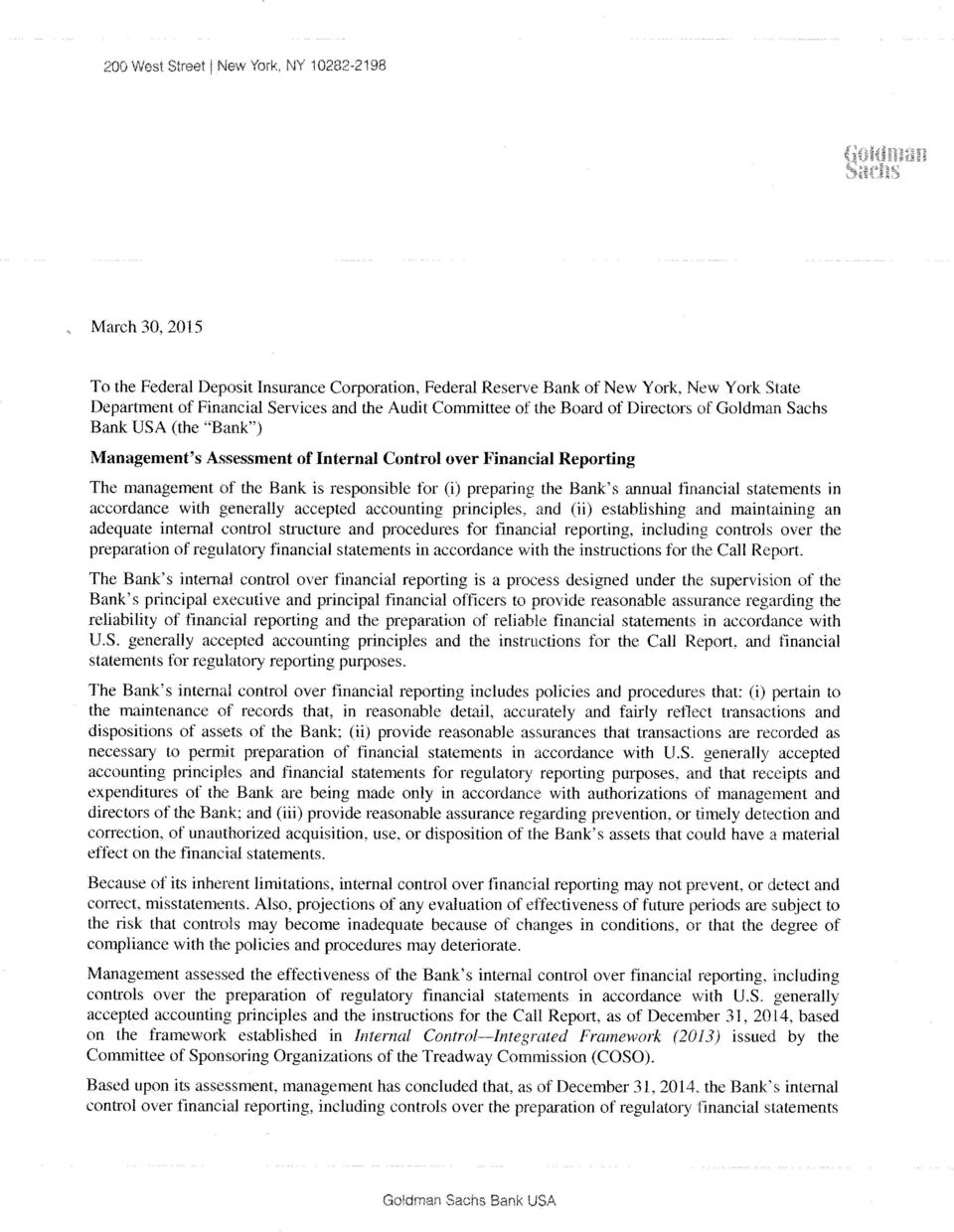
3

4

5
6 Financial Statements INDEX Page No. Consolidated Financial Statements Consolidated Statements of Earnings 2 Consolidated Statements of Financial Condition 3 Consolidated Statements of Changes in Shareholder s Equity 4 Consolidated Statements of Cash Flows 5 Note 1. Description of Business 6 Note 2. Basis of Presentation 6 Note 3. Significant Accounting Policies 7 Note 4. Financial Instruments Owned, at Fair Value and Financial Instruments Sold, But Not Yet Purchased, at Fair Value 11 Note 5. Fair Value Measurements 12 Note 6. Cash Instruments 14 Note 7. Derivatives and Hedging Activities 21 Note 8. Fair Value Option 35 Note 9. Loans Receivable 40 Note 10. Collateralized Agreements and Financings 42 Note 11. Variable Interest Entities 45 Note 12. Other Assets 47 Note 13. Deposits 47 Note 14. Borrowings 48 Note 15. Other Liabilities and Accrued Expenses 48 Note 16. Commitments, Contingencies and Guarantees 49 Note 17. Legal Proceedings 54 Note 18. Regulation and Capital Adequacy 54 Note 19. Transactions with Related Parties 58 Note 20. Interest Income and Interest Expense 60 Note 21. Employee Incentive Plans and Employee Benefit Plans 60 Note 22. Income Taxes 62 Note 23. Credit Concentrations 63 Note 24. Subsequent Events 64

7 Consolidated Statements of Earnings Year Ended December $ in millions Revenues Interest income $ 1,454 $ 1,100 Interest expense Net interest income 1, Gains and losses from financial instruments, net 1,831 2,415 Other revenues Total non-interest revenues 2,021 2,507 Net revenues, including net interest income 3,061 3,192 Operating expenses Compensation and benefits Service charges Other expenses Total operating expenses Pre-tax earnings 2,250 2,339 Provision for taxes Net earnings $ 1,320 $ 1,384 The accompanying notes are an integral part of these consolidated financial statements. 2

8 Consolidated Statements of Financial Condition As of December $ in millions, except share and per share amounts Assets Cash $ 39,856 $ 51,124 Collateralized agreements: Securities purchased under agreements to resell (includes $4,232 and $1,330 at fair value as of December 2014 and December 2013, respectively) 5,775 1,804 Receivables: Loans receivable 25,285 13,107 Receivables from customers and counterparties, brokers, dealers and clearing organizations 6,401 6,751 Financial instruments owned, at fair value (includes $4,976 and $7,443 pledged as collateral as of December 2014 and December 2013, respectively) 39,363 31,762 Other assets (includes $7 at fair value as of December 2013) 1,503 1,001 Total assets $ 118,183 $ 105,549 Liabilities and shareholder s equity Deposits (includes $5,874 and $2,375 at fair value as of December 2014 and December 2013, respectively) $ 73,250 $ 64,392 Collateralized financings: Securities sold under agreements to repurchase, at fair value 6,578 6,983 Other secured financings (includes $78 and $65 at fair value as of December 2014 and December 2013, respectively) Payables: Payables to customers and counterparties, brokers, dealers and clearing organizations 3,511 2,607 Financial instruments sold, but not yet purchased, at fair value 8,488 9,234 Subordinated borrowings 2,000 Other liabilities and accrued expenses (includes $143 and $120 at fair value as of December 2014 and December 2013, respectively) 2,712 2,140 Total liabilities 96,681 85,498 Commitments, contingencies and guarantees Shareholder s equity Shareholder s equity (includes common stock, par value $100 per share; 80,000,000 shares authorized, issued and outstanding as of December 2014 and December 2013) 21,502 20,051 Total liabilities and shareholder s equity $ 118,183 $ 105,549 The accompanying notes are an integral part of these consolidated financial statements. 3

9 Consolidated Statements of Changes in Shareholder s Equity Year Ended December $ in millions Shareholder s equity Shareholder s equity, beginning of year $ 20,051 $ 20,667 Net earnings 1,320 1,384 Capital contributions from The Goldman Sachs Group, Inc Dividends paid to The Goldman Sachs Group, Inc. (2,000) Shareholder s equity, end of year $ 21,502 $ 20, Capital contributions for 2014 were non-cash. See Note 19 for further information. The accompanying notes are an integral part of these consolidated financial statements. 4

10 Consolidated Statements of Cash Flows Year Ended December $ in millions Cash flows from operating activities Net earnings $ 1,320 $ 1,384 Adjustments to reconcile net earnings to net cash provided by/(used for) operating activities Depreciation and amortization 2 2 Deferred income taxes (74) (60) Share-based compensation 18 7 Changes in operating assets and liabilities Receivables and payables (excluding loans receivable), net 1,254 (4,725) Collateralized transactions (excluding other secured financings), net (4,376) (8,198) Financial instruments owned, at fair value (7,609) 14,780 Financial instruments sold, but not yet purchased, at fair value (746) (1,058) Other, net 662 (343) Net cash provided by/(used for) operating activities (9,549) 1,789 Cash flows from investing activities Loans receivable, net (12,178) (7,138) Net cash used for investing activities (12,178) (7,138) Cash flows from financing activities Deposits, net 8,686 (1,393) Proceeds from issuance of subordinated borrowings 2,000 Dividends paid to The Goldman Sachs Group, Inc. (2,000) Other, net (227) 424 Net cash provided by/(used for) financing activities 10,459 (2,969) Net decrease in cash (11,268) (8,318) Cash, beginning of year 51,124 59,442 Cash, end of year $ 39,856 $ 51,124 SUPPLEMENTAL DISCLOSURES: Cash payments for interest were $383 million and $335 million for 2014 and 2013, respectively. Cash payments for income taxes, net of refunds, were $357 million and $908 million for 2014 and 2013, respectively. The accompanying notes are an integral part of these consolidated financial statements. 5

11 Note 1. Description of Business Goldman Sachs Bank USA, together with its consolidated subsidiaries (collectively, the Bank), is a wholly-owned subsidiary of The Goldman Sachs Group, Inc. (Group Inc.), a bank holding company under the Bank Holding Company Act of 1956 (BHC Act) and a financial holding company under the amendments to the BHC Act effected by the U.S. Gramm Leach Bliley Act of The Bank is a New York state-chartered bank and a member of the Federal Reserve System. It is supervised by the Board of Governors of the Federal Reserve System (Federal Reserve Board), the New York State Department of Financial Services and the Consumer Financial Protection Bureau, and is a member of the Federal Deposit Insurance Corporation (FDIC). As a registered swap dealer, the Bank is also regulated by the U.S. Commodity Futures Trading Commission. In March 2013, the Financial Services Authority authorized the Bank to operate a branch in London, United Kingdom (the London Branch). The London Branch is regulated by the Financial Conduct Authority and the Prudential Regulation Authority. The Bank s activities include the acceptance of client and brokered deposits; lending in the form of bank and bridge loans and mortgage loans to private wealth management, institutional and corporate clients, and other counterparties; entering into interest rate, credit, currency and other derivatives; agency lending and facilitating client transactions and making markets in fixed income products. All subsidiaries of the Bank are wholly-owned by the Bank, with the exception of MMDP, in which Mitsui Sumitomo has a 50% interest. As a condition of the Bank s reorganization in November 2008, Group Inc. agreed to guarantee certain losses, including credit-related losses, relating to assets contributed by Group Inc. on the date of the reorganization (the Guarantee). Group Inc. also agreed to pledge to the Bank certain collateral, including interests in subsidiaries and other illiquid assets. See Note 19 for further discussion of the Guarantee and other transactions with affiliates. Note 2. Basis of Presentation These consolidated financial statements are prepared in accordance with accounting principles generally accepted in the United States (U.S. GAAP) and include the accounts of the Bank and all other entities in which the Bank has a controlling financial interest. Intercompany transactions and balances within the Bank have been eliminated. All references to 2014 and 2013 refer to the Bank s years ended, or the dates, as the context requires, December 31, 2014 and December 31, 2013, respectively. Any reference to a future year refers to a year ending on December 31 of that year. Certain reclassifications have been made to previously reported amounts to conform to the current presentation. The following activities are conducted in the Bank s significant operating subsidiaries: Goldman Sachs Mitsui Marine Derivative Products, L.P. (MMDP), a Delaware limited partnership, acts as an intermediary in transactions involving derivative contracts. MMDP is able to provide credit rating enhancement to derivative products due to its partnership with an external party, Mitsui Sumitomo Insurance Co., Ltd. (Mitsui Sumitomo). Goldman Sachs Mortgage Company, a New York limited partnership, originates commercial mortgage loans and purchases commercial and residential mortgage loans and other consumer loan assets for securitization and marketmaking. It also provides warehouse financing to third parties. 6
12 Note 3. Significant Accounting Policies The Bank s significant accounting policies include when and how to measure the fair value of assets and liabilities and when to consolidate an entity. See Notes 5 through 8 for policies on fair value measurements, and below and Note 11 for policies on consolidation accounting. All other significant accounting policies are either discussed below or included in the following footnotes: Financial Instruments Owned, at Fair Value and Financial Instruments Sold, But Not Yet Purchased, at Fair Value Note 4 Fair Value Measurements Note 5 Cash Instruments Note 6 Derivatives and Hedging Activities Note 7 Fair Value Option Note 8 Loans Receivable Note 9 Collateralized Agreements and Financings Note 10 Variable Interest Entities Note 11 Other Assets Note 12 Deposits Note 13 Borrowings Note 14 Other Liabilities and Accrued Expenses Note 15 Commitments, Contingencies and Guarantees Note 16 Legal Proceedings Note 17 Regulation and Capital Adequacy Note 18 Transactions with Related Parties Note 19 Interest Income and Interest Expense Note 20 Employee Incentive Plans and Employee Benefit Plans Note 21 Income Taxes Note 22 Credit Concentrations Note 23 Consolidation The Bank consolidates entities in which the Bank has a controlling financial interest. The Bank determines whether it has a controlling financial interest in an entity by first evaluating whether the entity is a voting interest entity or a variable interest entity (VIE). Voting Interest Entities. Voting interest entities are entities in which (i) the total equity investment at risk is sufficient to enable the entity to finance its activities independently, and (ii) the equity holders have the power to direct the activities of the entity that most significantly impact its economic performance, the obligation to absorb the losses of the entity and the right to receive the residual returns of the entity. The usual condition for a controlling financial interest in a voting interest entity is ownership of a majority voting interest. If the Bank has a majority voting interest in a voting interest entity, the entity is consolidated. Variable Interest Entities. A VIE is an entity that lacks one or more of the characteristics of a voting interest entity. The Bank has a controlling financial interest in a VIE when the Bank has a variable interest or interests that provide it with (i) the power to direct the activities of the VIE that most significantly impact the VIE s economic performance, and (ii) the obligation to absorb losses of the VIE or the right to receive benefits from the VIE that could potentially be significant to the VIE. See Note 11 for further information about VIEs. Use of Estimates Preparation of these consolidated financial statements requires management to make certain estimates and assumptions, the most important of which relate to fair value measurements and the provisions for losses that may arise from litigation, regulatory proceedings and tax audits. These estimates and assumptions are based on the best available information but actual results could be materially different. 7

13 Revenue Recognition Financial Assets and Financial Liabilities at Fair Value Financial instruments owned, at fair value and Financial instruments sold, but not yet purchased, at fair value are recorded at fair value either under the fair value option or in accordance with other U.S. GAAP. In addition, the Bank has elected to account for certain of its other financial assets and financial liabilities at fair value by electing the fair value option. The fair value of a financial instrument is the amount that would be received to sell an asset or paid to transfer a liability in an orderly transaction between market participants at the measurement date. Financial assets are marked to bid prices and financial liabilities are marked to offer prices. Fair value measurements do not include transaction costs. Fair value gains or losses are included in Gains and losses from financial instruments, net. See Notes 5 through 8 for further information about fair value measurements. Transfers of Assets Transfers of assets are accounted for as sales when the Bank has relinquished control over the assets transferred. For transfers of assets accounted for as sales, any related gains or losses are recognized in net revenues. Assets or liabilities that arise from the Bank s continuing involvement with transferred assets are measured at fair value. For transfers of assets that are not accounted for as sales, the assets remain in Financial instruments owned, at fair value or Loans receivable and the transfer is accounted for as a collateralized financing, with the related interest expense recognized over the life of the transaction. See Note10 for further information about transfers of assets accounted for as collateralized financings. Securitization Activities The Bank transfers portfolios of commercial mortgages to its affiliates for purposes of securitization. The Bank accounts for the transfer as a sale when it has relinquished control over the transferred assets. The Bank accounts for assets pending transfer at fair value and therefore does not typically recognize significant gains or losses upon the transfer of assets. The Bank generally receives cash in exchange for the transferred assets. As of December 2014 and December 2013, the Bank had no continuing involvement with transferred assets. Cash Cash is comprised of highly liquid overnight deposits held in the ordinary course of business. As of December 2014 and December 2013, cash included $39.24 billion and $51.09 billion, respectively, of interest-bearing deposits with banks. Of these amounts, $38.68 billion and $50.39 billion was held at the Federal Reserve Bank. As of December 2014 and December 2013, cash held at the Federal Reserve Bank exceeded regulatory reserve requirements of $111 million and $97 million, respectively. As of December 2014 and December 2013, cash included $173 million and $108 million, respectively, of restricted cash from cash collateral for which the Bank does not have the right to deliver or repledge. Receivables from Customers and Counterparties, Brokers, Dealers and Clearing Organizations Receivables from customers and counterparties, brokers, dealers and clearing organizations are primarily comprised of collateral posted in connection with certain derivative transactions and receivables related to pending unsettled trades. Receivables from customers and counterparties, brokers, dealers and clearing organizations are accounted for at amortized cost net of estimated uncollectible amounts, which generally approximates fair value. While these receivables are carried at amounts that approximate fair value, they are not accounted for at fair value under the fair value option or at fair value in accordance with other U.S. GAAP and therefore are not included in the Bank s fair value hierarchy in Notes 6 through 8. Had these receivables been included in the Bank s fair value hierarchy, substantially all would have been classified in level 2 as of December 2014 and December Interest on receivables from customers and counterparties, brokers, dealers and clearing organizations is recognized over the life of the transaction and included in Interest income. 8

14 Payables to Customers and Counterparties, Brokers, Dealers and Clearing Organizations Payables to customers and counterparties, brokers, dealers and clearing organizations primarily consist of collateralized payables related to client transactions including collateral received in connection with certain derivative transactions. Payables to customers and counterparties, brokers, dealers and clearing organizations are accounted for at cost plus accrued interest, which generally approximates fair value. While these payables are carried at amounts that approximate fair value, they are not accounted for at fair value under the fair value option or at fair value in accordance with other U.S. GAAP and therefore are not included in the Bank s fair value hierarchy in Notes 6 through 8. Had these payables been carried at fair value and included in the Bank s fair value hierarchy, substantially all would have been classified in level 2 as of December 2014 and December Interest on payables to customers and counterparties, brokers, dealers and clearing organizations is recognized over the life of the transaction and included in Interest expense. Offsetting Assets and Liabilities To reduce credit exposures on derivatives and securities financing transactions, the Bank may enter into master netting agreements or similar arrangements (collectively, netting agreements) with counterparties that permit it to offset receivables and payables with such counterparties. A netting agreement is a contract with a counterparty that permits net settlement of multiple transactions with that counterparty, including upon the exercise of termination rights by a non-defaulting party. Upon exercise of such termination rights, all transactions governed by the netting agreement are terminated and a net settlement amount is calculated. In addition, the Bank receives and posts cash and securities collateral with respect to its derivatives and securities financing transactions, subject to the terms of the related credit support agreements or similar arrangements (collectively, credit support agreements). An enforceable credit support agreement grants the non-defaulting party exercising termination rights the right to liquidate the collateral and apply the proceeds to any amounts owed. In order to assess enforceability of the Bank s right of setoff under netting and credit support agreements, the Bank evaluates various factors including applicable bankruptcy laws, local statutes and regulatory provisions in the jurisdiction of the parties to the agreement. Derivatives are reported on a net-by-counterparty basis (i.e., the net payable or receivable for derivative assets and liabilities for a given counterparty) in the consolidated statements of financial condition when a legal right of setoff exists under an enforceable netting agreement. Resale and repurchase agreements with the same term and currency are presented on a net-by-counterparty basis in the consolidated statements of financial condition when such transactions meet certain settlement criteria and are subject to netting agreements. In the consolidated statements of financial condition, derivatives are reported net of cash collateral received and posted under enforceable credit support agreements, when transacted under an enforceable netting agreement. In the consolidated statements of financial condition, resale and repurchase agreements are not reported net of the related cash and securities received or posted as collateral. See Note 10 for further information about collateral received and pledged, including rights to deliver or repledge collateral. See Notes 7 and 10 for further information about offsetting. Foreign Currency Translation Assets and liabilities denominated in non-u.s. currencies are translated at rates of exchange prevailing on the date of the consolidated statements of financial condition and revenues and expenses are translated at average rates of exchange for the period. Foreign currency remeasurement gains or losses on transactions in nonfunctional currencies are recognized in earnings. Recent Accounting Developments Inclusion of the Fed Funds Effective Swap Rate (or Overnight Index Swap Rate) as a Benchmark Interest Rate for Hedge Accounting Purposes (ASC 815). In July 2013, the FASB issued ASU No , Derivatives and Hedging (Topic 815) Inclusion of the Fed Funds Effective Swap Rate (or Overnight Index Swap Rate) as a Benchmark Interest Rate for Hedge Accounting Purposes. ASU No permits the use of the Fed Funds Effective Swap Rate (OIS) as a U.S. benchmark interest rate for hedge accounting purposes. The ASU also removes the restriction on using different benchmark rates for similar hedges. ASU No was effective for qualifying new or redesignated hedging relationships entered into on or after July 17, 2013 and adoption did not materially affect the Bank s financial condition, results of operations, or cash flows. 9

15 Investments Equity Method and Joint Ventures (ASC 323). In January 2014, the FASB issued ASU No , Investments Equity Method and Joint Ventures (Topic 323) Accounting for Investments in Qualified Affordable Housing Projects. ASU No permits certain investments in qualified affordable housing projects to be accounted for using the proportional amortization method. Under the proportional amortization method, the initial cost of the investment is amortized in proportion to tax credits and other benefits received, and net investment performance amortization in the income statement is recognized as a component of income taxes. The Bank adopted the provisions of ASU No effective January 1, 2014 and adoption did not materially affect the Bank s financial condition, results of operations or cash flows. Revenue from Contracts with Customers (ASC 606). In May 2014, the FASB issued ASU No , Revenue from Contracts with Customers (Topic 606). ASU No provides comprehensive guidance on the recognition of revenue from customers arising from the transfer of goods and services. The ASU also provides guidance on accounting for certain contract costs, and requires new disclosures. ASU No is effective for annual reporting periods beginning after December 15, 2016, including interim periods within that reporting period. Early adoption is not permitted. The Bank is still evaluating the effect of the ASU on its financial condition, results of operations, and cash flows. Repurchase-to-Maturity Transactions, Repurchase Financings, and Disclosures (ASC 860). In June 2014, the FASB issued ASU No , Transfers and Servicing (Topic 860) Repurchase-to-Maturity Transactions, Repurchase Financings, and Disclosures. ASU No changes the accounting for repurchaseand resale-to-maturity agreements by requiring that such agreements be recognized as financing arrangements, and requires that a transfer of a financial asset and a repurchase agreement entered into contemporaneously be accounted for separately. ASU No also requires additional disclosures about certain transferred financial assets accounted for as sales and certain securities financing transactions. The accounting changes and additional disclosures about certain transferred financial assets accounted for as sales are effective for the first interim and annual reporting periods beginning after December 15, The additional disclosures for securities financing transactions are required for annual reporting periods beginning after December 15, 2014 and for interim reporting periods beginning after March 15, Adoption of the accounting changes in ASU No on January 1, 2015 did not materially affect the Bank s financial condition, results of operations, or cash flows. Amendments to the Consolidation Analysis (ASC 810). In February 2015, the FASB issued ASU No , Consolidation (Topic 810) Amendments to the Consolidation Analysis. ASU No eliminates the deferral of the requirements of ASU No , Consolidations (Topic 810) Improvements to Financial Reporting by Enterprises Involved with Variable Interest Entities for certain interests in investment funds and provides a scope exception from Topic 810 for certain investments in money market funds. The ASU also makes several modifications to the consolidation guidance for VIEs and general partners investments in limited partnerships, as well as modifications to the evaluation of whether limited partnerships are VIEs or voting interest entities. ASU No is effective for interim and annual reporting periods beginning after December 15, Early adoption is permitted. Adoption of ASU No is not expected to materially affect the Bank s financial condition, results of operations, or cash flows. 10

16 Note 4. Financial Instruments Owned, at Fair Value and Financial Instruments Sold, But Not Yet Purchased, at Fair Value Financial instruments owned, at fair value and financial instruments sold, but not yet purchased, at fair value are accounted for at fair value either under the fair value option or in accordance with other U.S. GAAP. See Note 8 for further information about other financial assets and financial liabilities accounted for at fair value primarily under the fair value option. The table below presents the Bank s financial instruments owned, at fair value, including those pledged as collateral, and financial instruments sold, but not yet purchased, at fair value. As of December 2014 As of December 2013 $ in millions Financial Instruments Owned Financial Instruments Sold, But Not Yet Purchased Financial Instruments Owned Financial Instruments Sold, But Not Yet Purchased U.S. government and federal agency obligations $ 13,573 $ 2,195 $ 6,547 $ 3,208 Non-U.S. government and agency obligations , Mortgage and other asset-backed loans and securities: Loans and securities backed by commercial real estate 1,979 1,397 Loans and securities backed by residential real estate 4,693 3,460 2 Bank loans and bridge loans 5, Other 1, ,898 5, Subtotal 28,192 2,626 20,077 3,965 Derivatives 11,171 5,862 11,685 5,269 Total $ 39,363 $ 8,488 $ 31,762 $ 9, Primarily consists of other debt obligations and equity investments. 2. Primarily relates to the fair value of unfunded lending commitments for which the fair value option was elected

17 Gains and Losses from Financial Instruments, net The table below presents, by major product type, gains/(losses) related to the Bank s financial instruments owned, at fair value and financial instruments sold, but not yet purchased, at fair value, including both derivative and non-derivative financial instruments. These gains/(losses) are included in Gains and losses from financial instruments, net and exclude related interest income and interest expense. See Note 20 for further information about interest income and interest expense. The gains/(losses) in the table are not representative of the manner in which the Bank manages its activities because many of the Bank s market-making, lending and other activities utilize financial instruments across various product types. Accordingly, gains or losses in one product type frequently offset gains or losses in other product types. For example, many of the Bank's interest rate derivatives are sensitive to changes in foreign currency exchange rates and may be economically hedged with foreign currency contracts. $ in millions Year Ended December Product Type Interest rates $ (3,805) $ 429 Currencies 4, Credit 1,342 1,419 Equities 16 Total $ 1,831 $ 2,415 Note 5. Fair Value Measurements The fair value of a financial instrument is the amount that would be received to sell an asset or paid to transfer a liability in an orderly transaction between market participants at the measurement date. Financial assets are marked to bid prices and financial liabilities are marked to offer prices. Fair value measurements do not include transaction costs. The Bank measures certain financial assets and financial liabilities as a portfolio (i.e., based on its net exposure to market and/or credit risks). The best evidence of fair value is a quoted price in an active market. If quoted prices in active markets are not available, fair value is determined by reference to prices for similar instruments, quoted prices or recent transactions in less active markets, or internally developed models that primarily use market-based or independently sourced parameters as inputs, including, but not limited to, interest rates, volatilities, debt prices, foreign exchange rates, credit spreads and funding spreads (i.e., the spread, or difference, between the interest rate at which a borrower could finance a given financial instrument relative to a benchmark interest rate). U.S. GAAP has a three-level fair value hierarchy for disclosure of fair value measurements. The fair value hierarchy prioritizes inputs to the valuation techniques used to measure fair value, giving the highest priority to level 1 inputs and the lowest priority to level 3 inputs. A financial instrument s level in the fair value hierarchy is based on the lowest level of input that is significant to its fair value measurement. The fair value hierarchy is as follows: Level 1. Inputs are unadjusted quoted prices in active markets to which the Bank had access at the measurement date for identical, unrestricted assets or liabilities. Level 2. Inputs to valuation techniques are observable, either directly or indirectly. Level 3. One or more inputs to valuation techniques are significant and unobservable. 12

18 The fair values for substantially all of the Bank s financial assets and financial liabilities are based on observable prices and inputs and are classified in levels 1 and 2 of the fair value hierarchy. Certain level 2 and level 3 financial assets and financial liabilities may require appropriate valuation adjustments that a market participant would require to arrive at fair value for factors such as the counterparty and the Bank or its affiliates credit quality, funding risk, transfer restrictions, liquidity and bid/offer spreads. Valuation adjustments are generally based on market evidence. See Notes 6 through 8 for further information about fair value measurements of cash instruments, derivatives and other financial assets and financial liabilities accounted for at fair value primarily under the fair value option (including information about unrealized gains and losses related to level 3 financial assets and financial liabilities, and transfers in and out of level 3), respectively. The table below presents financial assets and financial liabilities accounted for at fair value under the fair value option or in accordance with other U.S. GAAP. In the table below, counterparty and cash collateral netting represents the impact on derivatives of netting across levels of the fair value hierarchy. Netting among positions classified in the same level is included in that level. As of December $ in millions Total level 1 financial assets $ 5,088 $ 7,170 Total level 2 financial assets 96,966 83,189 Total level 3 financial assets 4,151 4,817 Counterparty and cash collateral netting (62,610) (62,077) Total financial assets at fair value $ 43,595 $ 33,099 Total assets $ 118,183 $ 105,549 Total level 3 financial assets as a percentage of Total assets 3.5% 4.6% Total level 3 financial assets as a percentage of Total financial assets at fair value 9.5% 14.6% Total level 1 financial liabilities $ 2,254 $ 3,255 Total level 2 financial liabilities 47,197 34,328 Total level 3 financial liabilities 2,027 1,589 Counterparty and cash collateral netting (30,317) (20,395) Total financial liabilities at fair value $ 21,161 $ 18,777 Total level 3 financial liabilities as a percentage of Total financial liabilities at fair value 9.6% 8.5% 13

19 Note 6. Cash Instruments Cash instruments include U.S. government and federal agency obligations, non-u.s. government and agency obligations, mortgage and other asset-backed loans and securities, bank loans and bridge loans and other nonderivative financial instruments owned and financial instruments sold, but not yet purchased. See below for the types of cash instruments included in each level of the fair value hierarchy and the valuation techniques and significant inputs used to determine their fair values. See Note 5 for an overview of the Bank s fair value measurement policies. Level 1 Cash Instruments Level 1 cash instruments include certain U.S. government and federal agency obligations and non-u.s. government and agency obligations. These instruments are valued using quoted prices for identical unrestricted instruments in active markets. The Bank defines active markets for debt instruments based on both the average daily trading volume and the number of days with trading activity. Level 2 Cash Instruments Level 2 cash instruments include certain U.S. government and federal agency obligations, certain mortgage and other asset-backed loans and securities, certain bank loans and bridge loans and certain lending commitments. Valuations of level 2 cash instruments can be verified to quoted prices, recent trading activity for identical or similar instruments, broker or dealer quotations or alternative pricing sources with reasonable levels of price transparency. Consideration is given to the nature of the quotations (e.g., indicative or firm) and the relationship of recent market activity to the prices provided from alternative pricing sources. Valuation adjustments are typically made to level 2 cash instruments (i) if the cash instrument is subject to transfer restrictions and/or (ii) for other premiums and liquidity discounts that a market participant would require to arrive at fair value. Valuation adjustments are generally based on market evidence. Level 3 Cash Instruments Level 3 cash instruments have one or more significant valuation inputs that are not observable. Absent evidence to the contrary, level 3 cash instruments are initially valued at transaction price, which is considered to be the best initial estimate of fair value. Subsequently, the Bank uses other methodologies to determine fair value, which vary based on the type of instrument. Valuation inputs and assumptions are changed when corroborated by substantive observable evidence, including values realized on sales of financial assets. 14

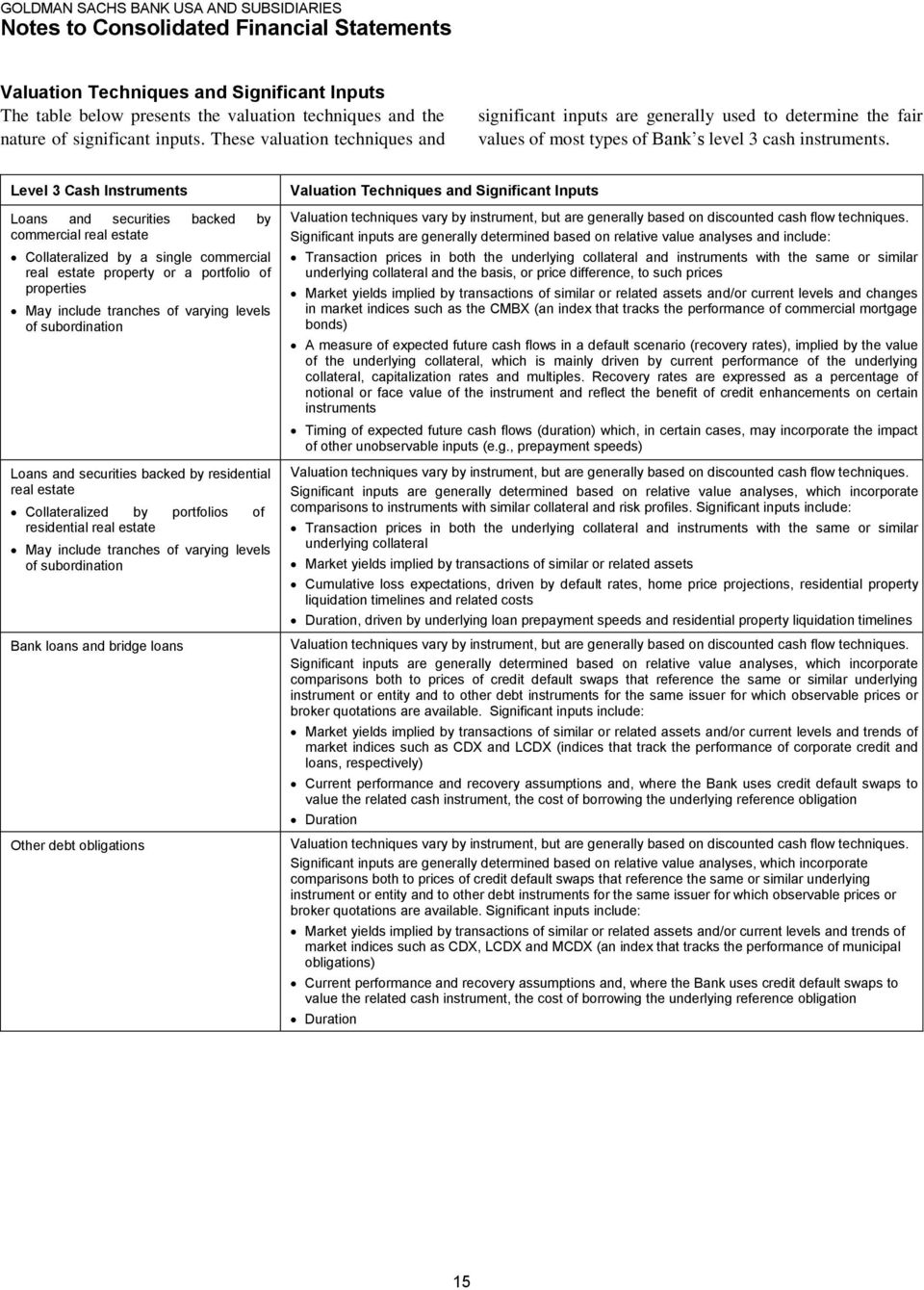
20 Valuation Techniques and Significant Inputs The table below presents the valuation techniques and the nature of significant inputs. These valuation techniques and significant inputs are generally used to determine the fair values of most types of Bank s level 3 cash instruments. Level 3 Cash Instruments Loans and securities backed by commercial real estate Collateralized by a single commercial real estate property or a portfolio of properties May include tranches of varying levels of subordination Loans and securities backed by residential real estate Collateralized by portfolios of residential real estate May include tranches of varying levels of subordination Bank loans and bridge loans Other debt obligations Valuation Techniques and Significant Inputs Valuation techniques vary by instrument, but are generally based on discounted cash flow techniques. Significant inputs are generally determined based on relative value analyses and include: Transaction prices in both the underlying collateral and instruments with the same or similar underlying collateral and the basis, or price difference, to such prices Market yields implied by transactions of similar or related assets and/or current levels and changes in market indices such as the CMBX (an index that tracks the performance of commercial mortgage bonds) A measure of expected future cash flows in a default scenario (recovery rates), implied by the value of the underlying collateral, which is mainly driven by current performance of the underlying collateral, capitalization rates and multiples. Recovery rates are expressed as a percentage of notional or face value of the instrument and reflect the benefit of credit enhancements on certain instruments Timing of expected future cash flows (duration) which, in certain cases, may incorporate the impact of other unobservable inputs (e.g., prepayment speeds) Valuation techniques vary by instrument, but are generally based on discounted cash flow techniques. Significant inputs are generally determined based on relative value analyses, which incorporate comparisons to instruments with similar collateral and risk profiles. Significant inputs include: Transaction prices in both the underlying collateral and instruments with the same or similar underlying collateral Market yields implied by transactions of similar or related assets Cumulative loss expectations, driven by default rates, home price projections, residential property liquidation timelines and related costs Duration, driven by underlying loan prepayment speeds and residential property liquidation timelines Valuation techniques vary by instrument, but are generally based on discounted cash flow techniques. Significant inputs are generally determined based on relative value analyses, which incorporate comparisons both to prices of credit default swaps that reference the same or similar underlying instrument or entity and to other debt instruments for the same issuer for which observable prices or broker quotations are available. Significant inputs include: Market yields implied by transactions of similar or related assets and/or current levels and trends of market indices such as CDX and LCDX (indices that track the performance of corporate credit and loans, respectively) Current performance and recovery assumptions and, where the Bank uses credit default swaps to value the related cash instrument, the cost of borrowing the underlying reference obligation Duration Valuation techniques vary by instrument, but are generally based on discounted cash flow techniques. Significant inputs are generally determined based on relative value analyses, which incorporate comparisons both to prices of credit default swaps that reference the same or similar underlying instrument or entity and to other debt instruments for the same issuer for which observable prices or broker quotations are available. Significant inputs include: Market yields implied by transactions of similar or related assets and/or current levels and trends of market indices such as CDX, LCDX and MCDX (an index that tracks the performance of municipal obligations) Current performance and recovery assumptions and, where the Bank uses credit default swaps to value the related cash instrument, the cost of borrowing the underlying reference obligation Duration 15
21 Significant Unobservable Inputs The tables below present the ranges of significant unobservable inputs used to value the Bank s level 3 cash instruments. These ranges represent the significant unobservable inputs that were used in the valuation of each type of cash instrument. Weighted averages in the tables below are calculated by weighting each input by the relative fair value of the respective financial instruments. The ranges and weighted averages of these inputs are not representative of the appropriate inputs to use when calculating the fair value of any one cash instrument. For example, the highest recovery rate presented in the tables below for bank loans and bridge loans is appropriate for valuing a specific loan but may not be appropriate for valuing any other bank loans or bridge loans. Accordingly, the ranges of inputs presented below do not represent uncertainty in, or possible ranges of, fair value measurements of the Bank s level 3 cash instruments. Significant input types which are only relevant to a single instrument have been excluded from the tables below. Level 3 Cash Instruments Loans and securities backed by commercial real estate Collateralized by a single commercial real estate property or a portfolio of properties May include tranches of varying levels of subordination Loans and securities backed by residential real estate Collateralized by portfolios of residential real estate May include tranches of varying levels of subordination Level 3 Assets as of December 2014 ($ in millions) Valuation Techniques and Significant Unobservable Inputs $584 Discounted cash flows: Yield Duration (years) $47 Discounted cash flows: Yield Cumulative loss rate Duration (years) Range of Significant Unobservable Inputs (Weighted Average) as of December % to 10.1% (7.1%) 0.4 to 2.4 (1.4) 4.5% to 9.0% (8.2%) 10.4% to 11.2% (11.1%) 1.8 to 5.4 (2.4) Bank loans and bridge loans $2,165 Discounted cash flows: Yield Recovery rate Duration (years) 1.4% to 17.6% (5.6%) 40.0% to 85.0% (62.0%) 1.1 to 5.0 (2.4) Other 1 $312 Discounted cash flows: Yield/Discount rate Duration (years) 2.6% to 13.6% (5.1%) 2.9 to 3.5 (3.4) 1. Primarily consists of other debt obligations and equity investments. 16
22 Level 3 Cash Instruments Loans and securities backed by commercial real estate Collateralized by a single commercial real estate property or a portfolio of properties May include tranches of varying levels of subordination Loans and securities backed by residential real estate Collateralized by portfolios of residential real estate May include tranches of varying levels of subordination Level 3 Assets as of December 2013 ($ in millions) Valuation Techniques and Significant Unobservable Inputs $760 Discounted cash flows: Yield Duration (years) $63 Discounted cash flows: Yield Cumulative loss rate Duration (years) Range of Significant Unobservable Inputs (Weighted Average) as of December % to 10.5% (6.9%) 2.1 to 3.4 (2.7) 5.8% to 8.9% (8.0%) 8.5% to 17.1% (14.6%) 2.3 to 5.0 (3.1) Bank loans and bridge loans $2,105 Discounted cash flows: Yield Recovery rate Duration (years) 1.4% to 11.9% (4.2%) 40.0% to 85.0% (56.6%) 0.9 to 5.3 (2.6) Other 1 $308 Discounted cash flows: Yield 2.7% to 13.0% (5.4%) 1. Primarily consists of other debt obligations and equity investments. Increases in yield, duration or cumulative loss rate used in the valuation of the Bank s level 3 cash instruments would result in a lower fair value measurement, while an increase in recovery rate would result in a higher fair value measurement. Due to the distinctive nature of each of the Bank s level 3 cash instruments, the interrelationship of inputs is not necessarily uniform within each product type. 17
23 Fair Value of Cash Instruments by Level The tables below present, by level within the fair value hierarchy, cash instrument assets and liabilities, at fair value. Cash instrument assets and liabilities are included in Financial instruments owned, at fair value and Financial instruments sold, but not yet purchased, at fair value, respectively. There were no transfers during the year between Level 1 and Level 2 cash instrument assets or liabilities. Cash Instrument Assets at Fair Value as of December 2014 $ in millions Level 1 Level 2 Level 3 Total U.S. government and federal agency obligations $ 4,403 $ 9,170 $ $ 13,573 Non-U.S. government and agency obligations Mortgage and other asset-backed loans and securities: Loans and securities backed by commercial real estate 1, ,979 Loans and securities backed by residential real estate 4, ,693 Bank loans and bridge loans 3,490 2,165 5,655 Other 1 1, ,607 Total $ 5,088 $ 19,996 $ 3,108 $ 28,192 Cash Instrument Liabilities at Fair Value as of December 2014 $ in millions Level 1 Level 2 Level 3 Total U.S. government and federal agency obligations $ 2,195 $ $ $ 2,195 Non-U.S. government and agency obligations Bank loans and bridge loans Other Total $ 2,254 $ 249 $ 123 $ 2,626 Cash Instrument Assets at Fair Value as of December 2013 $ in millions Level 1 Level 2 Level 3 Total U.S. government and federal agency obligations $ 6,547 $ $ $ 6,547 Non-U.S. government and agency obligations ,308 Mortgage and other asset-backed loans and securities: Loans and securities backed by commercial real estate ,397 Loans and securities backed by residential real estate 3, ,460 Bank loans and bridge loans 3,362 2,105 5,467 Other 1 1, ,898 Total $ 7,170 $ 9,671 $ 3,236 $ 20,077 Cash Instrument Liabilities at Fair Value as of December 2013 $ in millions Level 1 Level 2 Level 3 Total U.S. government and federal agency obligations $ 3,208 $ $ $ 3,208 Non-U.S. government and agency obligations Bank loans and bridge loans Loans backed by residential real estate 2 2 Other Total $ 3,255 $ 514 $ 196 $ 3, Primarily consists of other debt obligations and equity investments. 18
24 Level 3 Rollforward If a cash instrument asset or liability was transferred to level 3 during a reporting period, its entire gain or loss for the period is included in level 3. Net realized and net unrealized gains and losses on these instruments are included in Gains and losses from financial instruments, net. Level 3 cash instruments are frequently economically hedged with level 1 and level 2 cash instruments and/or level 1, level 2 or level 3 derivatives. Accordingly, gains or losses that are reported in level 3 can be partially offset by gains or losses attributable to level 1 or level 2 cash instruments and/or level 1, level 2 or level 3 derivatives. As a result, gains or losses included in the level 3 rollforward below do not necessarily represent the overall impact on the Bank s results of operations, liquidity or capital resources. The tables below present changes in fair value for all cash instrument assets and liabilities categorized as level 3 as of the end of the year. Purchases in the table below include both originations and secondary market purchases. $ in millions Balance, beginning of year Level 3 Cash Instrument Assets at Fair Value for the Year Ended December 2014 Net unrealized gains/(losses) Net relating to realized instruments Transfers Transfers gains/ still held at into out of (losses) year-end Purchases Sales Settlements level 3 level 3 Balance, end of year Mortgage and other assetbacked loans and securities: Loans and securities backed by commercial real estate $ 760 $ 16 $ 14 $ 254 $ (59) $ (244) $ $ (157) $ 584 Loans and securities backed by residential real estate (19) (29) 47 Bank loans and bridge loans 2, (75) 1,499 (239) (1,021) 7 (175) 2,165 Other (7) 134 (40) (87) 312 Total $ 3,236 $ 89 $ (60) $ 1,906 $ (317) $ (1,334) $ 7 $ (419) $ 3,108 $ in millions Balance, beginning of year Level 3 Cash Instrument Liabilities at Fair Value for the Year Ended December 2014 Net unrealized (gains)/losses Net relating to realized instruments Transfers Transfers (gains)/ still held at into out of losses year-end Purchases Sales Settlements level 3 level 3 Balance, end of year Bank loans and bridge loans $195 $(4) $4 $(145) $ 48 $ 17 $ 8 $(1) $122 Other Total $196 $(4) $4 $(145) $ 48 $ 17 $ 8 $(1) $ Primarily consists of other debt obligations and equity investments. The net unrealized loss on level 3 cash instruments of $64 million (reflecting a $60 million loss on cash instrument assets and a $4 million loss on cash instrument liabilities) for 2014 primarily consisted of losses on bank loans and bridge loans, primarily due to the impact of widening credit spreads. Transfers out of level 3 during 2014 primarily reflected transfers of certain bank loans and bridge loans and loans and securities backed by commercial real estate to level 2 principally due to increased price transparency as a result of market evidence, including market transactions in these or similar instruments. 19
25 $ in millions Balance, beginning of year Level 3 Cash Instrument Assets at Fair Value for the Year Ended December 2013 Net realized gains/ (losses) Net unrealized gains/(losses) relating to instruments still held at year-end Purchases Sales Settlements Transfers into level 3 Transfers out of level 3 Balance, end of year Mortgage and other assetbacked loans and securities: Loans and securities backed by commercial real estate $ 1,065 $ 61 $ (9) $ 34 $ (97) $ (344) $ 109 $ (59) $ 760 Loans and securities backed by residential real estate (11) (11) 63 Bank loans and bridge loans 2, (633) (902) 67 (37) 2,105 Other (30) (22) 14 (311) 308 Total $ 4,284 $ 127 $ 14 $ 1,078 $ (771) $ (1,279) $ 190 $ (407) $ 3,236 $ in millions Balance, beginning of year Level 3 Cash Instrument Liabilities at Fair Value for the Year Ended December 2013 Net realized (gains)/ losses Net unrealized (gains)/losses relating to instruments still held at year-end Purchases Sales Settlements Transfers into level 3 Transfers out of level 3 Balance, end of year Bank loans and bridge loans $ 388 $ (7) $ (34) $ (251) $ 131 $ 5 $ 1 $ (38) $ 195 Other Total $ 388 $ (7) $ (33) $ (251) $ 131 $ 5 $ 1 $ (38) $ Primarily consists of other debt obligations. The net unrealized gain on level 3 cash instruments of $47 million (reflecting a $14 million gain on cash instrument assets and a $33 million gain on cash instrument liabilities) for 2013 primarily consisted of gains on bank loans and bridge loans, primarily due to the impact of tighter credit spreads on both funded loans and unfunded lending commitments. Transfers into level 3 during 2013 primarily reflected the transfer from level 2 of certain loans and securities backed by commercial real estate and certain bank loans and bridge loans, principally due to a lack of market transactions in these loans. Transfers out of level 3 during 2013 primarily reflected transfers to level 2 of certain other debt obligations principally due to improved transparency of market prices as a result of market transactions in these or similar instruments. 20
26 Note 7. Derivatives and Hedging Activities Derivative Activities Derivatives are instruments that derive their value from underlying asset prices, indices, reference rates and other inputs, or a combination of these factors. Derivatives may be traded on an exchange (exchange-traded) or they may be privately negotiated contracts, which are usually referred to as over-the-counter (OTC) derivatives. Certain of the Bank s OTC derivatives are cleared and settled through central clearing counterparties (OTC-cleared), while others are bilateral contracts between two counterparties (bilateral OTC). Substantially all of the Bank s derivative instruments are OTC. Market-Making. As a market maker, the Bank enters into derivative transactions to provide liquidity to clients and to facilitate the transfer and hedging of their risks. In this capacity, the Bank typically acts as principal and is consequently required to commit capital to provide execution. As a market maker, it is essential to maintain an inventory of financial instruments sufficient to meet expected client and market demands. Risk Management. The Bank also enters into derivatives to actively manage risk exposures that arise from its marketmaking and lending activities in derivative and cash instruments. The Bank s holdings and exposures are hedged, in many cases, on either a portfolio or risk-specific basis, as opposed to an instrument-by-instrument basis. In addition, the Bank may enter into derivatives designated as hedges under U.S. GAAP. These derivatives are used to manage interest rate exposure in certain fixed-rate deposits. The Bank enters into various types of derivatives, including: Futures and Forwards. Contracts that commit counterparties to purchase or sell financial instruments or currencies in the future. Swaps. Contracts that require counterparties to exchange cash flows such as currency or interest payment streams. The amounts exchanged are based on the specific terms of the contract with reference to specified rates, financial instruments, currencies or indices. Options. Contracts in which the option purchaser has the right, but not the obligation, to purchase from or sell to the option writer financial instruments or currencies within a defined time period for a specified price. Derivatives are reported on a net-by-counterparty basis (i.e., the net payable or receivable for derivative assets and liabilities for a given counterparty) when a legal right of setoff exists under an enforceable netting agreement (counterparty netting). Derivatives are accounted for at fair value, net of cash collateral received or posted under enforceable credit support agreements (cash collateral netting). Derivative assets and liabilities are included in Financial instruments owned, at fair value and Financial instruments sold, but not yet purchased, at fair value, respectively. Gains and losses on derivatives not designated as hedges under ASC 815 are included in Gains and losses from financial instruments, net. 21
27 The table below presents the fair value and the notional amount of derivative contracts by major product type on a gross basis. Gross fair values exclude the effects of both counterparty netting and collateral, and therefore are not representative of the Bank s exposure. The table below also presents the amounts of counterparty and cash collateral netting in the consolidated statements of financial condition, as well as cash and securities collateral posted and received under enforceable credit support agreements that do not meet the criteria for netting under U.S. GAAP. Where the Bank has received or posted collateral under credit support agreements, but has not yet determined such agreements are enforceable, the related collateral has not been netted in the table below. Notional amounts, which represent the sum of gross long and short derivative contracts, provide an indication of the volume of the Bank s derivative activity and do not represent anticipated losses. Derivative Assets As of December 2014 As of December 2013 Derivative Liabilities Notional Amount Derivative Assets Derivative Liabilities Notional Amount $ in millions Derivatives not accounted for as hedges Interest rates $860,541 $826,856 $44,285,793 $ 752,664 $ 708,633 $46,170,628 Exchange-traded ,633, ,859,382 OTC-cleared 227, ,159 13,575, , ,793 15,727,015 Bilateral OTC 633, ,495 28,076, , ,632 28,584,231 Credit Bilateral OTC 4,594 4, ,898 5,994 7, ,277 Currencies Bilateral OTC 63,822 60,564 2,205,614 52,081 46,627 2,129,916 Other Bilateral OTC 1 1, , ,888 Subtotal 930, ,778 46,761, , ,545 48,601,709 Derivatives accounted for as hedges Interest rates , ,337 OTC-cleared , Bilateral OTC , ,416 Gross fair value/notional amount of derivatives $930,403 2 $892,801 2 $46,781,799 $ 811,709 2 $ 763,611 2 $48,615,046 Amounts that have been offset in the consolidated statements of financial condition Counterparty netting (857,405) (857,405) (738,570) (738,570) OTC-cleared (204,424) (204,424) (214,977) (214,977) Bilateral OTC (652,981) (652,981) (523,593) (523,593) Cash collateral netting (61,827) (29,534) (61,454) (19,772) OTC-cleared (22,902) (726) (15,719) (1,733) Bilateral OTC (38,925) (28,808) (45,735) (18,039) Fair value included in financial instruments owned/ financial instruments sold, but not yet purchased $11,171 $5,862 $ 11,685 $ 5,269 Amounts that have not been offset in the consolidated statements of financial condition Cash collateral received/posted (239) (698) (120) (533) Securities collateral received/posted (1,535) (752) (2,649) (1,043) Total $9,397 $4,412 $ 8,916 $ 3, Includes equity and commodities derivatives. 2. Includes derivative assets and derivative liabilities of $239 million and $698 million, respectively, as of December 2014, and derivative assets and derivative liabilities of $72 million and $533 million, respectively, as of December 2013, which are not subject to an enforceable netting agreement or are subject to a netting agreement that the Bank has not yet determined to be enforceable. 22
28 Valuation Techniques for Derivatives The Bank s level 2 and level 3 derivatives are valued using derivative pricing models (e.g., discounted cash flow models, correlation models, and models that incorporate option pricing methodologies, such as Monte Carlo simulations). Price transparency of derivatives can generally be characterized by product type. Interest Rate. In general, the key inputs used to value interest rate derivatives are transparent, even for most longdated contracts. Interest rate swaps and options denominated in the currencies of leading industrialized nations are characterized by high trading volumes and tight bid/offer spreads. Interest rate derivatives that reference indices, such as an inflation index, or the shape of the yield curve (e.g., 10- year swap rate vs. 2-year swap rate) are more complex, but the key inputs are generally observable. Credit. Price transparency for credit default swaps, including both single names and baskets of credits, varies by market and underlying reference entity or obligation. Credit default swaps that reference indices, large corporates and major sovereigns generally exhibit the most price transparency. For credit default swaps with other underliers, price transparency varies based on credit rating, the cost of borrowing the underlying reference obligations, and the availability of the underlying reference obligations for delivery upon the default of the issuer. Credit default swaps that reference loans, asset-backed securities and emerging market debt instruments tend to have less price transparency than those that reference corporate bonds. In addition, more complex credit derivatives, such as those sensitive to the correlation between two or more underlying reference obligations, generally have less price transparency. Currency. Prices for currency derivatives based on the exchange rates of leading industrialized nations, including those with longer tenors, are generally transparent. The primary difference between the price transparency of developed and emerging market currency derivatives is that emerging markets tend to be observable for contracts with shorter tenors. Equity. Price transparency for equity derivatives varies by market and underlier. Options on indices and the common stock of corporates included in major equity indices exhibit the most price transparency. Equity derivatives generally have observable market prices, except for contracts with long tenors or reference prices that differ significantly from current market prices. More complex equity derivatives, such as those sensitive to the correlation between two or more individual stocks, generally have less price transparency. Liquidity is essential to observability of all product types. If transaction volumes decline, previously transparent prices and other inputs may become unobservable. Conversely, even highly structured products may at times have trading volumes large enough to provide observability of prices and other inputs. See Note 5 for an overview of the Bank s fair value measurement policies. Level 1 Derivatives Level 1 derivatives include short-term contracts for future delivery of securities when the underlying security is a level 1 instrument, and exchange-traded derivatives if they are actively traded and are valued at their quoted market price. Level 2 Derivatives Level 2 derivatives include OTC derivatives for which all significant valuation inputs are corroborated by market evidence. In evaluating the significance of a valuation input, the Bank considers, among other factors, a portfolio s net risk exposure to that input. The selection of a particular model to value a derivative depends on the contractual terms of and specific risks inherent in the instrument, as well as the availability of pricing information in the market. For derivatives that trade in liquid markets, model selection does not involve significant management judgment because outputs of models can be calibrated to market-clearing levels. Valuation models require a variety of inputs, such as contractual terms, market prices, yield curves, discount rates (including those derived from interest rates on collateral received and posted as specified in credit support agreements for collateralized derivatives), credit curves, measures of volatility, prepayment rates, loss severity rates and correlations of such inputs. Significant inputs to the valuations of level 2 derivatives can be verified to market transactions, broker or dealer quotations or other alternative pricing sources with reasonable levels of price transparency. Consideration is given to the nature of the quotations (e.g., indicative or firm) and the relationship of recent market activity to the prices provided from alternative pricing sources. 23
29 Level 3 Derivatives Level 3 derivatives are valued using models which utilize observable level 1 and/or level 2 inputs as well as unobservable level 3 inputs. For the majority of the Bank s interest rate and currency derivatives classified within level 3, significant unobservable inputs include correlations of certain currencies and interest rates (e.g., the correlation between Euro inflation and Euro interest rates), specific interest rate volatilities, and the basis, or difference, between benchmark interest rates and related indices. For level 3 credit derivatives, significant unobservable inputs include illiquid credit spreads and upfront credit points, which are unique to specific reference obligations and reference entities, recovery rates and certain correlations required to value credit and mortgage derivatives (e.g., the likelihood of default of the underlying reference obligation relative to one another). Valuation Adjustments Valuation adjustments are integral to determining the fair value of derivative portfolios and are used to adjust the midmarket valuations, produced by derivative pricing models, to the appropriate exit price valuation. These adjustments incorporate bid/offer spreads, the cost of liquidity, credit valuation adjustments and funding valuation adjustments, which account for the credit and funding risk inherent in the uncollateralized portion of derivative portfolios. The Bank also makes funding valuation adjustments to collateralized derivatives where the terms of the agreement do not permit the Bank to deliver or repledge collateral received. Marketbased inputs are generally used when calibrating valuation adjustments to market-clearing levels. In addition, for derivatives that include significant unobservable inputs, the Bank makes model or exit price adjustments to account for the valuation uncertainty present in the transaction. For level 3 equity derivatives, the valuation of certain structured trades requires the use of level 3 correlation inputs, such as the correlation of the price performance of two or more individual stocks or the correlation of the price performance for a basket of stocks to another asset class such as commodities. Subsequent to the initial valuation of a level 3 derivative, the Bank updates the level 1 and level 2 inputs to reflect observable market changes and any resulting gains and losses are recorded in level 3. Level 3 inputs are changed when corroborated by evidence such as similar market transactions, third-party pricing services and/or broker or dealer quotations or other empirical market data. In circumstances where the Bank cannot verify the model value by reference to market transactions, it is possible that a different valuation model could produce a materially different estimate of fair value. See below for further information about significant unobservable inputs used in the valuation of level 3 derivatives. 24
30 Significant Unobservable Inputs The tables below present the ranges of significant unobservable inputs used to value substantially all of the Bank s level 3 derivatives, as well as averages and medians of these inputs. The ranges represent the significant unobservable inputs that were used in the valuation of each type of derivative. Averages represent the arithmetic average of the inputs and are not weighted by the relative fair value or notional of the respective financial instruments. An average greater than the median indicates that the majority of inputs are below the average. The ranges, averages and medians of these inputs are not representative of the appropriate inputs to use when calculating the fair value of any one derivative. For example, the highest correlation presented in the tables below for interest rate derivatives is appropriate for valuing a specific interest rate derivative but may not be appropriate for valuing any other interest rate derivative. Accordingly, the ranges of inputs presented below do not represent uncertainty in, or possible ranges of, fair value measurements of the Bank s level 3 derivatives. Level 3 Derivative Product Type Net Level 3 Assets/(Liabilities) as of December 2014 ($ in millions) Valuation Techniques and Significant Unobservable Inputs Interest rates $(224) Option pricing models and discounted cash flow models 1 : Correlation 2 Volatility Basis Range of Significant Unobservable Inputs (Average / Median) as of December 2014 (16) % to 84% (37% / 40%) 36 basis points per annum (bpa) to 156 bpa (100 bpa / 115bpa) 2 bps to 21 bps (18 bps / 20 bps) Currencies $(41) Option pricing models: Correlation 2 55% to 80% (69% / 73%) Credit $360 Option pricing models, correlation models, and discounted cash flow models 1 : Correlation 2 Credit spreads Upfront credit points 5% to 99% (69% / 72%) 34 bps to 473 bps (171 bps / 134 bps) 3 0 points to 96 points (18 points / 7 points) Equities $107 Option pricing models: Correlation 2 30% to 82% (49% / 50%) 1. The fair value of any one instrument may be determined using multiple valuation techniques. For example, option pricing models and discounted cash flows models are typically used together to determine fair value. Therefore, the level 3 balance encompasses both of these techniques. 2. The range of unobservable inputs for correlation across derivative product types (i.e., cross-asset correlation) was 22% to 66% (Average: 42% / Median: 41%) as of December The difference between the average and the median for these spread inputs indicates that the majority of the inputs fall in the lower end of the range. 25
31 Level 3 Derivative Product Type Net Level 3 Assets/(Liabilities) as of December 2013 ($ in millions) Valuation Techniques and Significant Unobservable Inputs Interest rates $33 Option pricing models: Rate Correlation 2 Volatility Basis Range of Significant Unobservable Inputs (Average / Median) as of December % to 2.75% (2.74% / 2.74%) 22% to 84% (58% / 60%) 36 basis points per annum (bpa) to 165 bpa (107 bpa / 112 bpa) 7 bps to 11 bps (9 bps / 9 bps) Currencies $47 Option pricing models: Correlation 2 69% to 79% (72% / 72%) Credit $407 Option pricing models, correlation models and discounted cash flows models 1 : Correlation 2 Credit spreads Upfront credit points Recovery rates 5% to 93% (55% / 61%) 3 bps to 828 bps (78 bps / 26 bps) 3 3 points to 88 points (26 points / 20 points) 66% to 85% (73% / 73%) 1. The fair value of any one instrument may be determined using multiple valuation techniques. For example, option pricing models and discounted cash flows models are typically used together to determine fair value. Therefore, the level 3 balance encompasses both of these techniques. 2. The range of unobservable inputs for correlation across derivative product types (i.e., cross-asset correlation) was 21% to 68% (Average: 42% / Median: 45%) as of December The difference between the average and the median for the credit spreads input indicates that the majority of the inputs fall in the lower end of the range. 26
32 Range of Significant Unobservable Inputs The following provides further information about the ranges of significant unobservable inputs used to value the Bank s level 3 derivative instruments. Correlation. Ranges for correlation cover a variety of underliers both within one market (e.g., foreign exchange rates) and across markets (e.g., correlation of a foreign exchange rate and an interest rate), as well as across regions. Generally, cross-asset correlation inputs are used to value more complex instruments and are lower than correlation inputs on assets within the same derivative product type. Volatility. Ranges for volatility cover numerous underliers across a variety of markets, maturities and strike prices. Interest rate and basis. The ranges for interest rate and interest rate basis cover variability of markets and maturities. Credit spreads, upfront credit points and recovery rates. The ranges for credit spreads, upfront credit points and recovery rates cover a variety of underliers (index and single names), regions, sectors, maturities and credit qualities (high-yield and investmentgrade). The broad range of this population gives rise to the width of the ranges of significant unobservable inputs. Sensitivity of Fair Value Measurement to Changes in Significant Unobservable Inputs The following provides a description of the directional sensitivity of the Bank s level 3 fair value measurements to changes in significant unobservable inputs, in isolation. Due to the distinctive nature of each of the Bank s level 3 derivatives, the interrelationship of inputs is not necessarily uniform within each product type. Correlation. In general, for contracts where the holder benefits from the convergence of the underlying asset or index prices (e.g., interest rates, credit spreads, and foreign exchange rates), an increase in correlation results in a higher fair value measurement. Volatility. In general, for purchased options an increase in volatility results in a higher fair value measurement. Interest rate. In general, for contracts where the holder is receiving a variable interest rate, an increase in interest rates results in a higher fair value measurement. Interest rate and basis. In general, for contracts where the holder is receiving the interest rate basis, a tighter basis results in a higher fair value measurement. Credit spreads, upfront credit points and recovery rates. In general, the fair value of purchased credit protection increases as credit spreads or upfront credit points increase or recovery rates decrease. Credit spreads, upfront credit points and recovery rates are strongly related to distinctive risk factors of the underlying reference obligations, which include reference entity-specific factors such as leverage, volatility and industry, market-based risk factors, such as borrowing costs or liquidity of the underlying reference obligation, and macroeconomic conditions. 27
33 Fair Value of Derivatives by Level The tables below present the fair value of derivatives on a gross basis by level and major product type as well as the impact of netting. The gross fair values exclude the effects of both counterparty netting and collateral netting, and therefore are not representative of the Bank s exposure. Counterparty netting is reflected in each level to the extent that receivable and payable balances are netted within the same level and is included in Counterparty and cash collateral netting. Where the counterparty netting is across levels, the netting is reflected in Cross-Level Netting. Derivative Assets at Fair Value as of December 2014 $ in millions Level 1 Level 2 Level 3 Cross-Level Netting Cash Collateral Netting Total Interest rates $ $ 860,555 $ 370 $ $ $ 860,925 Currencies 63, ,822 Credit 3, ,594 Equities Commodities Gross fair value of derivative assets 928,774 1, ,403 Counterparty and cash collateral netting (856,036) (586) (783) (61,827) (919,232) Fair value included in financial instruments owned $ $ 72,738 $ 1,043 $ (783) $ (61,827) $ 11,171 Derivative Liabilities at Fair Value as of December 2014 $ in millions Level 1 Level 2 Level 3 Cross-Level Netting Cash Collateral Netting Total Interest rates $ $ 826,285 $ 594 $ $ $ 826,879 Currencies 60, ,564 Credit 3, ,419 Equities Commodities Gross fair value of derivative liabilities 891,376 1, ,801 Counterparty and cash collateral netting (856,036) (586) (783) (29,534) (886,939) Fair value included in financial instruments sold, but not yet purchased $ $ 35,340 $ 839 $ (783) $ (29,534) $ 5,862 28
34 Derivative Assets at Fair Value as of December 2013 $ in millions Level 1 Level 2 Level 3 Cross-Level Netting Cash Collateral Netting Total Interest rates $ $ 752,392 $ 604 $ $ $ 752,996 Currencies 51, ,081 Credit 4,837 1,157 5,994 Other Gross fair value of derivative assets 809,468 2, ,709 Counterparty and cash collateral netting (737,224) (723) (623) (61,454) (800,024) Fair value included in financial instruments owned $ $ 72,244 $ 1,518 $ (623) $ (61,454) $ 11,685 $ in millions Level 1 Level 2 Level 3 Derivative Liabilities at Fair Value as of December 2013 Cross-Level Netting Cash Collateral Netting Interest rates $ $ 708,128 $ 571 $ $ $ 708,699 Currencies 46, ,627 Credit 6, ,676 Other Gross fair value of derivative liabilities 761,880 1, ,611 Counterparty and cash collateral netting (737,224) (723) (623) (19,772) (758,342) Fair value included in financial instruments sold, but not yet purchased $ $ 24,656 $ 1,008 $ (623) $ (19,772) $ 5, Includes equity and commodities derivatives. Total 29
35 Level 3 Rollforward If a derivative was transferred to level 3 during a reporting period, its entire gain or loss for the period is included in level 3. Transfers between levels are reported at the beginning of the reporting period in which they occur. In the tables below, negative amounts for transfers into level 3 and positive amounts for transfers out of level 3 represent net transfers of derivative liabilities. Gains and losses on level 3 derivatives should be considered in the context of the following: A derivative with level 1 and/or level 2 inputs is classified in level 3 in its entirety if it has at least one significant level 3 input. If there is one significant level 3 input, the entire gain or loss from adjusting only observable inputs (i.e., level 1 and level 2 inputs) is classified as level 3. Gains or losses that have been reported in level 3 resulting from changes in level 1 or level 2 inputs are frequently offset by gains or losses attributable to level 1 or level 2 derivatives and/or level 1, level 2, and level 3 cash instruments. As a result, gains/(losses) included in the level 3 rollforward below do not necessarily represent the overall impact on the Bank s results of operations, liquidity or capital resources. The tables below present changes in fair value for all derivatives categorized as level 3 as of the end of the year. $ in millions Asset/ (liability) balance, beginning of year Level 3 Derivative Assets and Liabilities at Fair Value for the Year Ended December 2014 Net unrealized gains/(losses) relating to instruments Transfers still held at into year-end Purchases Sales Settlements level 3 Net realized gains/ (losses) Transfers out of level 3 Asset/ (liability) balance, end of year Interest rates net $33 $(58) $(136) $4 $(1) $9 $ $(75) $(224) Currencies net 47 (97) (50) 19 (9) 44 5 (41) Credit net 407 (10) (15) (3) (44) Equities - net (1) (6) 14 (1) 107 Commodities net 0 (1) Total derivatives net $510 $(161) 1 $(164) 1 $98 $(26) $44 $(30) $(67) $ The aggregate amount is reported in Gains and losses from financial instruments, net. The net unrealized loss on level 3 derivatives of $164 million for 2014 was primarily attributable to the impact of changes in interest rates on certain interest rate derivatives and the impact of changes in foreign exchange rates on certain currency derivatives. Transfers out of level 3 derivatives during 2014 primarily reflected transfers of certain interest rate derivative assets to level 2, principally due to increased transparency of unobservable interest rate inputs used to value these derivatives. Transfers into level 3 derivatives during 2014 primarily reflected transfers from level 2 of certain credit derivative liabilities, principally due to unobservable credit spread inputs becoming significant to the valuation of these derivatives. 30
36 Level 3 Derivative Assets and Liabilities at Fair Value for the Year Ended December 2013 Asset/ Net unrealized gains/(losses) Asset/ $ in millions (liability) balance, beginning of year Net realized gains/ (losses) relating to instruments still held at year-end Purchases Sales Settlements Transfers into level 3 Transfers out of level 3 (liability) balance, end of year Interest rates net $(166) $ (64) $ 105 $ 8 $ (12) $ 127 $ 2 $ 33 $ 33 Currencies net (10) (109) (174) 28 (14) (54) 47 Credit net 848 (73) (392) 40 (50) 58 (28) Other net (1) 23 Total derivatives net $ 695 $(245) 2 $(461) 2 $76 $(76) $ 385 $153 $(17) $ Includes equity and commodities derivatives. 2. The aggregate amount is reported in Gains and losses from financial instruments, net. The net unrealized loss on level 3 derivatives of $461 million for 2013 was primarily attributable to the impact of changes in foreign exchange rates on certain currency derivatives, the impact of tighter credit spreads on certain credit derivatives, partially offset by the impact of changes in interest rates on certain interest rate derivatives. Transfers into level 3 derivatives during 2013 primarily reflected transfers from level 2 of certain currency derivative assets, principally due to unobservable correlation inputs becoming significant to the valuation of these derivatives. Transfers out of level 3 derivatives during 2013 primarily reflected transfers of certain currency derivatives assets to level 2, principally due to increased transparency of unobservable correlation inputs used to value these derivatives. Impact of Credit Spreads on Derivatives On an ongoing basis, the Bank realizes gains or losses relating to changes in credit risk through the unwind of derivative contracts and changes in credit mitigants. The net gain/(loss) attributable to the impact of changes in credit exposure and credit spreads (of the Bank s counterparties as well as of the Bank or its affiliates) on derivatives was $24 million and $(59) million for 2014 and 2013, respectively. Derivatives with Credit-related Contingent Features Certain of the Bank s derivatives have been transacted under bilateral agreements with counterparties who may require the Bank to post collateral or terminate the transactions based on changes in the credit ratings of the Bank or its affiliates. Typically, such requirements are based on the credit ratings of Group Inc. The Bank assesses the impact of these bilateral agreements by determining the collateral or termination payments that would occur assuming a downgrade by all rating agencies. A downgrade by any one rating agency, depending on the agency s relative ratings of the Bank or its affiliates at the time of the downgrade, may have an impact which is comparable to the impact of a downgrade by all rating agencies. The table below presents the aggregate fair value of net derivative liabilities under such agreements (excluding application of collateral posted to reduce these liabilities), the related aggregate fair value of the assets posted as collateral, and the additional collateral or termination payments that could have been called at the reporting date by counterparties in the event of a one-notch and two-notch downgrade in the credit ratings of the Bank or its affiliates. As of December $ in millions Net derivative liabilities under bilateral agreements $6,883 $5,043 Collateral posted 5,685 4,008 Additional collateral or termination payments for a one-notch downgrade Additional collateral or termination payments for a two-notch downgrade 1,
37 Credit Derivatives The Bank enters into a broad array of credit derivatives in locations around the world to facilitate client transactions and to manage the credit risk associated with its businesses. Credit derivatives are actively managed based on the Bank s net risk position. Credit derivatives are individually negotiated contracts and can have various settlement and payment conventions. Credit events include failure to pay, bankruptcy, acceleration of indebtedness, restructuring, repudiation and dissolution of the reference entity. Credit Default Swaps. Single-name credit default swaps protect the buyer against the loss of principal on one or more bonds, loans or mortgages (reference obligations) in the event the issuer (reference entity) of the reference obligations suffers a credit event. The buyer of protection pays an initial or periodic premium to the seller and receives protection for the period of the contract. If there is no credit event, as defined in the contract, the seller of protection makes no payments to the buyer of protection. However, if a credit event occurs, the seller of protection is required to make a payment to the buyer of protection, which is calculated in accordance with the terms of the contract. Credit Indices, Baskets and Tranches. Credit derivatives may reference a basket of single-name credit default swaps or a broad-based index. If a credit event occurs in one of the underlying reference obligations, the protection seller pays the protection buyer. The payment is typically a pro-rata portion of the transaction s total notional amount based on the underlying defaulted reference obligation. In certain transactions, the credit risk of a basket or index is separated into various portions (tranches), each having different levels of subordination. The most junior tranches cover initial defaults and once losses exceed the notional amount of these junior tranches, any excess loss is covered by the next most senior tranche in the capital structure. Total Return Swaps. A total return swap transfers the risks relating to economic performance of a reference obligation from the protection buyer to the protection seller. Typically, the protection buyer receives from the protection seller a floating rate of interest and protection against any reduction in fair value of the reference obligation, and in return the protection seller receives the cash flows associated with the reference obligation, plus any increase in the fair value of the reference obligation. Credit Options. In a credit option, the option writer assumes the obligation to purchase or sell a reference obligation at a specified price or credit spread. The option purchaser buys the right, but does not assume the obligation, to sell the reference obligation to, or purchase it from, the option writer. The payments on credit options depend either on a particular credit spread or the price of the reference obligation. The Bank economically hedges its exposure to written credit derivatives primarily by entering into offsetting purchased credit derivatives with identical underliers. Substantially all of the Bank s purchased credit derivative transactions are with financial institutions and are subject to stringent collateral thresholds. In addition, upon the occurrence of a specified trigger event, the Bank may take possession of the reference obligations underlying a particular written credit derivative, and consequently may, upon liquidation of the reference obligations, recover amounts on the underlying reference obligations in the event of default. As of December 2014, written and purchased credit derivatives had total gross notional amounts of $ billion and $ billion, respectively, for total net notional purchased protection of $22.32 billion. As of December 2013, written and purchased credit derivatives had total gross notional amounts of $ billion and $ billion, respectively, for total net notional purchased protection of $25.42 billion. 32
38 The table below presents certain information about credit derivatives. In the table below: Fair values exclude the effects of both netting of receivable balances with payable balances under enforceable netting agreements, and netting of cash received or posted under enforceable credit support agreements, and therefore are not representative of the Bank s credit exposure. Tenor is based on expected duration for mortgagerelated credit derivatives and on remaining contractual maturity for other credit derivatives. The credit spread on the underlier, together with the tenor of the contract, are indicators of payment/performance risk. The Bank is less likely to pay or otherwise be required to perform where the credit spread and the tenor are lower. Maximum Payout/Notional Maximum Payout/Notional Amount Amount of Purchased Fair Value of of Written Credit Derivatives by Tenor Credit Derivatives Written Credit Derivatives Offsetting Other Purchased Purchased Net Years or Credit Credit Asset/ $ in millions Months Years Greater Total Derivatives 1 Derivatives 2 Asset Liability (Liability) As of December 2014 Credit spread on underlier (basis points) $ 26,681 $ 58,376 $ 6,161 $ 91,218 $ 81,071 $ 31,395 $ 2,295 $ 435 $ 1, , ,608 3,296 1, (23) 501-1,000 1, ,024 1, (60) Greater than 1,000 2,278 2, ,942 4, (681) Total $ 30,496 $ 64,908 $ 6,388 $ 101,792 $ 91,051 $ 33,055 $ 2,515 $ 1,419 $ 1,096 As of December 2013 Credit spread on underlier (basis points) $ 26,114 $ 79,187 $ 4,795 $ 110,096 $ 100,701 $ 33,480 $ 3,574 $ 478 $ 3, , ,860 3, , , ,458 1, Greater than 1,000 1,368 3, ,516 4, (435) Total $ 28,057 $ 86,868 $ 5,005 $ 119,930 $ 110,051 $ 35,296 $ 4,085 $ 1,132 $ 2, Offsetting purchased credit derivatives represent the notional amount of purchased credit derivatives that economically hedge written credit derivatives with identical underliers. 2. This purchased protection represents the notional amount of purchased credit derivatives not included in Offsetting Purchased Credit Derivatives. 33
39 Hedge Accounting The Bank applies hedge accounting for certain interest rate swaps used to manage the interest rate exposure of certain fixed-rate certificates of deposit. To qualify for hedge accounting, the derivative hedge must be highly effective at reducing the risk from the exposure being hedged. Additionally, the Bank must formally document the hedging relationship at inception and test the hedging relationship at least on a quarterly basis to ensure the derivative hedge continues to be highly effective over the life of the hedging relationship. Fair Value Hedges The Bank designates certain interest rate swaps as fair value hedges. These interest rate swaps hedge changes in fair value attributable to the designated benchmark interest rate (e.g., London Interbank Offered Rate (LIBOR)), effectively converting a substantial portion of fixed-rate obligations into floating-rate obligations. The Bank applies a statistical method that utilizes regression analysis when assessing the effectiveness of its fair value hedging relationships in achieving offsetting changes in the fair values of the hedging instrument and the risk being hedged (i.e., interest rate risk). An interest rate swap is considered highly effective in offsetting changes in fair value attributable to changes in the hedged risk when the regression analysis results in a coefficient of determination of 80% or greater and a slope between 80% and 125%. For qualifying fair value hedges, gains or losses on derivatives are included in Interest expense. The change in fair value of the hedged item attributable to the risk being hedged is reported as an adjustment to its carrying value and is subsequently amortized into interest expense over its remaining life. Gains or losses resulting from hedge ineffectiveness are included in Interest expense. When a derivative is no longer designated as a hedge, any remaining difference between the carrying value and par value of the hedged item is amortized to interest expense over the remaining life of the hedged item using the effective interest method. See Note 20 for further information about interest income and interest expense. The table below presents the gains/(losses) from interest rate derivatives accounted for as hedges, the related hedged bank deposits, and the hedge ineffectiveness on these derivatives, which primarily consists of amortization of prepaid credit spreads resulting from the passage of time. Year Ended December $ in millions Interest rate hedges $ 83 $ (461) Hedged bank deposits (116) 387 Hedge ineffectiveness (33) (74) 34
40 Note 8. Fair Value Option Other Financial Assets and Financial Liabilities at Fair Value In addition to all cash and derivative instruments included in Financial instruments owned, at fair value and Financial instruments sold, but not yet purchased, at fair value, the Bank accounts for certain of its other financial assets and financial liabilities at fair value primarily under the fair value option. The primary reasons for electing the fair value option are to: Reflect economic events in earnings on a timely basis; Mitigate volatility in earnings from using different measurement attributes (e.g., certain transfers of financial instruments owned accounted for as financings are recorded at fair value whereas the related secured financing would be recorded on an accrual basis absent electing the fair value option); and Address simplification and cost-benefit considerations (e.g., accounting for hybrid financial instruments at fair value in their entirety versus bifurcation of embedded derivatives and hedge accounting for debt hosts). Hybrid financial instruments are instruments that contain bifurcatable embedded derivatives and do not require settlement by physical delivery of non-financial assets (e.g., physical commodities). The Bank does not bifurcate hybrid financial instruments and accounts for such instruments at fair value under the fair value option. Other financial assets and financial liabilities accounted for at fair value under the fair value option include: Repurchase agreements and certain resale agreements; Certain other secured financings, consisting of transfers of assets accounted for as financings rather than sales; Certain other liabilities, primarily unsecured borrowings included in Other liabilities and accrued expenses ; and Certain time deposits (deposits with no stated maturity are not eligible for a fair value option election), including structured certificates of deposit, which are hybrid financial instruments. These financial assets and financial liabilities at fair value are generally valued based on discounted cash flow techniques, which incorporate inputs with reasonable levels of price transparency, and are generally classified as level 2 because the inputs are observable. Valuation adjustments may be made for liquidity and for counterparty and the Bank s credit quality. See below for information about the significant inputs used to value other financial assets and financial liabilities at fair value, including the ranges of significant unobservable inputs used to value the level 3 instruments within these categories. These ranges represent the significant unobservable inputs that were used in the valuation of each type of other financial assets and financial liabilities at fair value. The ranges and weighted averages of these inputs are not representative of the appropriate inputs to use when calculating the fair value of any one instrument. For example, the highest yield presented below for resale and repurchase agreements is appropriate for valuing a specific agreement in that category but may not be appropriate for valuing any other agreements in that category. Accordingly, the ranges of inputs presented below do not represent uncertainty in, or possible ranges of, fair value measurements of the Bank s level 3 other financial assets and financial liabilities. Resale and Repurchase Agreements. The significant inputs to the valuation of resale and repurchase agreements are funding spreads, the amount and timing of expected future cash flows and interest rates. As of December 2014, there were no level 3 resale and repurchase agreements. The range of significant unobservable inputs used to value level 3 resale agreements as of December 2013 was 2.7% to 3.9% (weighted average: 2.9%) for yield. As of December 2013, there were no level 3 repurchase agreements. 35
41 Generally, increases in yield, in isolation, would result in a lower fair value measurement. Due to the distinctive nature of each of the Bank s level 3 resale agreements, the interrelationship of inputs is not necessarily uniform across such agreements. See Note 10 for further information about collateralized agreements. Other Secured Financings. The significant inputs to the valuation of other secured financings at fair value are the amount and timing of expected future cash flows, interest rates, funding spreads, the fair value of the collateral delivered by the Bank (which is determined using the amount and timing of expected future cash flows, market prices, market yields and recovery assumptions) and the frequency of additional collateral calls. As of both December 2014 and December 2013, there were no level 3 other secured financings. Deposits. The significant inputs to the valuation of time deposits are interest rates and the amount and timing of future cash flows. The Bank s deposits that are included in level 3 are hybrid financial instruments. As the significant unobservable inputs used to value hybrid financial instruments primarily relate to the embedded derivative component of these deposits, these inputs are incorporated in the Bank s derivative disclosures related to unobservable inputs in Note 7. Fair Value of Other Financial Assets and Financial Liabilities by Level The tables below present, by level within the fair value hierarchy, other financial assets and financial liabilities accounted for at fair value primarily under the fair value option. Other Financial Assets at Fair Value as of December 2014 $ in millions Level 1 Level 2 Level 3 Total Securities purchased under agreements to resell $ $ 4,232 $ $ 4,232 Total $ $ 4,232 $ $ 4,232 Other Financial Liabilities at Fair Value as of December 2014 $ in millions Level 1 Level 2 Level 3 Total Deposits $ $ 4,809 $ 1,065 $ 5,874 Securities sold under agreements to repurchase 6,578 6,578 Other secured financings Other liabilities and accrued expenses Total $ $ 11,608 $ 1,065 $ 12,673 Other Financial Assets at Fair Value as of December 2013 $ in millions Level 1 Level 2 Level 3 Total Securities purchased under agreements to resell $ $ 1,267 $ 63 $ 1,330 Other assets 7 7 Total $ $ 1,274 $ 63 $ 1,337 Other Financial Liabilities at Fair Value as of December 2013 $ in millions Level 1 Level 2 Level 3 Total Deposits $ $ 1,990 $ 385 $ 2,375 Securities sold under agreements to repurchase 6,983 6,983 Other secured financings Other liabilities and accrued expenses Total $ $ 9,158 $ 385 $ 9,543 36
42 Transfers Between Levels of the Fair Value Hierarchy Transfers between levels of the fair value hierarchy are reported at the beginning of the reporting period in which they occur. There were no transfers of other financial assets and financial liabilities between level 1 and level 2 during 2014 or The tables below present information about transfers between level 2 and level 3. Level 3 Rollforward If a financial asset or financial liability was transferred to level 3 during a reporting year, its entire gain or loss for the year is included in level 3. The tables below present changes in fair value for other financial assets and financial liabilities accounted for at fair value categorized as level 3 as of the end of the year. Level 3 other financial assets and liabilities are frequently economically hedged with cash instruments and derivatives. Accordingly, gains or losses that are reported in level 3 can be partially offset by gains or losses attributable to level 1, 2 or 3 cash instruments or derivatives. As a result, gains or losses included in the level 3 rollforward below do not necessarily represent the overall impact on the Bank s results of operations, liquidity or capital resources. Balance, beginning of year Net realized gains/ (losses) Level 3 Other Financial Assets at Fair Value for the Year Ended December 2014 Net unrealized gains/(losses) relating to instruments still held at year-end Purchases Sales Issuances Settlements Transfers into level 3 Transfers out of level 3 Balance, end of year $ in millions Securities purchased under agreements to resell $63 $ $ $ $ $ $(63) $ $ $ $ in millions Balance, beginning of year Net realized (gains)/ losses Level 3 Other Financial Liabilities at Fair Value for the Year Ended December 2014 Net unrealized (gains)/losses relating to instruments Transfers still held at into year-end Purchases Sales Issuances Settlements level 3 Transfers out of level 3 Balance, end of year Deposits $385 $ $21 1 $ (5) $ $ 442 $(6) $ 280 $(52) $1, Included in Gains and losses from financial instruments, net. Transfers into level 3 of other financial liabilities during 2014 reflected transfers of certain deposits from level 2, principally due to unobservable inputs being significant to the valuation of these instruments. Transfers out of level 3 of other financial liabilities during 2014 primarily reflected transfers of certain deposits to level 2, principally due to increased transparency of significant inputs used to value these instruments. 37
43 Balance, beginning of year Net realized gains/ (losses) Level 3 Other Financial Assets at Fair Value for the Year Ended December 2013 Net unrealized gains/(losses) relating to instruments still held at year-end Purchases Sales Issuances Settlements Transfers into level 3 Transfers out of level 3 Balance, end of year $ in millions Securities purchased under agreements to resell $278 $4 1 $ $ $ $ $(15) $ $ (204) $63 $ in millions Balance, beginning of year Net realized (gains)/ losses Level 3 Other Financial Liabilities at Fair Value for the Year Ended December 2013 Net unrealized (gains)/losses relating to instruments Transfers still held at into year-end Purchases Sales Issuances Settlements level 3 Transfers out of level 3 Balance, end of year Deposits $359 $ $ (6) $ $ $ 109 $ (6) $ $ (71) $385 Other secured financings 31 (31) Total $390 $ $ (6) 1 $ $ $109 $(37) $ $ (71) $ Included in Gains and losses from financial instruments, net. Transfers out of level 3 of other financial assets during 2013 primarily reflected transfers of certain resale agreements to level 2, principally due to increased price transparency as a result of market transactions in similar instruments. Transfers out of level 3 of other financial liabilities during 2013 primarily reflected transfers of certain deposits to level 2, principally due to increased transparency of significant inputs used to value these instruments. Gains and Losses on Financial Assets and Financial Liabilities Accounted for at Fair Value Under the Fair Value Option The table below presents the gains and losses recognized as a result of the Bank electing to apply the fair value option to certain financial assets and financial liabilities. These gains and losses are included in Gains and losses from financial instruments, net. The table below also includes gains and losses on the embedded derivative component of hybrid financial instruments included in deposits. These gains and losses would have been recognized under other U.S. GAAP even if the Bank had not elected to account for the entire hybrid instrument at fair value. The amounts in the table exclude contractual interest, which is included in Interest income and Interest expense. See Note 20 for further information about interest income and interest expense. Gains/(Losses) on Financial Assets and Financial Liabilities at Fair Value Under the Fair Value Option Year Ended December $ in millions Deposits $(110) $81 Other Total $(90) $ Primarily consists of unrealized gains on certain $106 unsecured borrowings included in Other liabilities and accrued expenses. Excluding the gains and losses on the instruments accounted for under the fair value option described above, Gains and losses from financial instruments, net primarily represents gains and losses on Financial instruments owned, at fair value and Financial instruments sold, but not yet purchased, at fair value. 38
44 Loans at Fair Value. The Bank originates loans to provide financing to clients. These loans are typically longer-term in nature. The Bank s lending activities include lending to investment-grade and non-investment-grade corporate borrowers. The Bank s lending activities also include extending loans to borrowers that are secured by commercial and residential real estate. In addition, the Bank extends loans and lending commitments to private wealth management clients that are primarily secured by residential real estate or other assets. The Bank accounts for certain loans at fair value under the fair value option which are included in Financial instruments owned, at fair value. See Note 6 for a discussion of the techniques and significant inputs used in the valuation of loans. The table below presents details about loans at fair value. As of December $ in millions Corporate loans $5,283 $ 4,806 Loans backed by residential real estate 1 4,640 3,389 Loans backed by commercial real estate 1,928 1,265 Loans to private wealth management clients Other loans Total $12,499 $10, Loans backed by residential real estate are typically loans collateralized by the borrower s personal residence. Substantially all loans backed by residential real estate are to private wealth management clients. The majority of these loans have maturities over ten years and carry a floating interest rate. The aggregate contractual principal amount of loans for which the fair value option was elected exceeded the related fair value by $277 million and $207 million as of December 2014 and December 2013, respectively. Included in these amounts are loans in non-accrual status (including loans more than 90 days past due) with a principal balance of $5 million and a fair value of $3 million as of December 2014 and a principal balance of $7 million and a fair value of $4 million as of December Impact of Credit Spreads on Loans and Lending Commitments The estimated net gain attributable to changes in instrumentspecific credit spreads on loans and loan commitments for which the fair value option was elected was $1.02 billion and $1.29 billion for 2014 and 2013, respectively. Changes in the fair value of loans and lending commitments are primarily attributable to changes in instrument-specific credit spreads. Substantially all of the Bank s loans and lending commitments are floating-rate. 39
45 Note 9. Loans Receivable Loans receivable is primarily comprised of loans held for investment that are accounted for at amortized cost net of allowance for loan losses. Interest on such loans is recognized over the life of the loan and is recorded on an accrual basis. The table below presents details about loans receivable. As of December $ in millions Corporate loans 1 $11,808 $ 5,937 Loans to private wealth management clients 10,986 6,542 Loans backed by commercial real estate 1, Other loans 1,046 Subtotal 25,422 13,181 Allowance for loan losses (137) (74) Total $25,285 $13, Includes loans made as part of the Bank s Community Reinvestment Act activities. As of December 2014 and December 2013, the fair value of Loans receivable was $25.17 billion and $13.19 billion, respectively. As of December 2014, had these loans been carried at fair value and included in the fair value hierarchy, $12.63 billion and $12.54 billion would have been classified in level 2 and level 3, respectively. As of December 2013, had these loans been carried at fair value and included in the fair value hierarchy, $6.02 billion and $7.17 billion would have been classified in level 2 and level 3, respectively. Loans to Private Wealth Management Clients. Loans to the Bank s private wealth management clients include loans used by clients to finance private asset purchases, employ leverage for strategic investments in real or financial assets, bridge cash flow timing gaps or provide liquidity for other needs. Such loans are primarily secured by securities or other assets. The majority of these loans are demand or shortterm loans and carry a floating interest rate. Loans Backed by Commercial Real Estate. Loans backed by commercial real estate include loans collateralized by hotels, retail stores, multifamily housing complexes and commercial and industrial properties. The majority of these loans have maturities between one year and five years and carry a floating interest rate. Other Loans. Other loans primarily include loans secured by consumer loans, and other assets. The majority of these loans have maturities between one year and five years and carry a floating interest rate. Below is a description of the captions in the table above. Corporate Loans. Corporate loans include term loans, revolving lines of credit, letter of credit facilities and bridge loans, and are principally used for operating liquidity and general corporate purposes, or in connection with acquisitions. Corporate loans may be secured or unsecured, depending on the loan purpose, the risk profile of the borrower and other factors. The majority of these loans have maturities between one year and five years and carry a floating interest rate. 40
46 The Bank also extends lending commitments that are held for investment and accounted for on an accrual basis. As of December 2014 and December 2013, such lending commitments were $60.35 billion and $31.47 billion, respectively. The carrying value and the estimated fair value of such lending commitments were liabilities of $157 million and $1,671 million, respectively, as of December 2014, and $102 million and $863 million, respectively, as of December The carrying value included $61 million and $40 million as of December 2014 and December 2013, respectively, related to the allowance for losses on unfunded commitments. As these lending commitments are not accounted for at fair value under the fair value option or at fair value in accordance with other U.S. GAAP, their fair value is not included in the Bank s fair value hierarchy in Notes 6 through 8. Had these commitments been accounted for at fair value and included in the Bank s fair value hierarchy, they would have primarily been classified in level 3 as of both December 2014 and December Included in loans receivable are loans held for sale which are accounted for at the lower of cost or market. The balance of such loans was $265 million and $614 million as of December 2014 and December 2013, respectively. Credit Quality The Bank s risk assessment process includes evaluating the credit quality of its loans receivable. The Bank performs credit reviews which include initial and ongoing analyses of its borrowers. A credit review is an independent analysis of the capacity and willingness of a borrower to meet its financial obligations, resulting in an internal credit rating. The determination of internal credit ratings also incorporates assumptions with respect to the nature of and outlook for the borrower s industry, and the economic environment. The Bank also assigns a regulatory risk rating to such loans based on the definitions provided by the U.S. federal bank regulatory agencies. As of December 2014 and December 2013, the Bank s loans receivable were primarily extended to non-investment-grade borrowers and lending commitments held for investment and accounted for on an accrual basis were primarily extended to investment grade borrowers. Substantially all of these loans and lending commitments align with the U.S. federal bank regulatory agencies definition of Pass. Loans and lending commitments meet the definition of Pass when they are performing and/or do not demonstrate adverse characteristics that are likely to result in a credit loss. Impaired Loans and Loans on Non-Accrual Status A loan is determined to be impaired when it is probable that the Bank will not be able to collect all principal and interest due under the contractual terms of the loan. At that time, loans are placed on non-accrual status and all accrued but uncollected interest is reversed against interest income and interest subsequently collected is recognized on a cash basis to the extent the loan balance is deemed collectible. Otherwise all cash received is used to reduce the outstanding loan balance. As of December 2014 and December 2013, impaired loans in non-accrual status were not material. Allowance for Losses on Loans and Lending Commitments The Bank s allowance for loan losses is comprised of two components: specific loan level reserves and a collective, portfolio level reserve. Specific loan level reserves are determined on loans that exhibit credit quality weakness and are therefore individually evaluated for impairment. Portfolio level reserves are determined on the remaining loans, not deemed impaired, by aggregating groups of loans with similar risk characteristics and estimating the probable loss inherent in the portfolio. As of December 2014 and December 2013, substantially all of the Bank s loans receivable were evaluated for impairment at the portfolio level. The allowance for loan losses is determined using various inputs, including industry default and loss data, current macroeconomic indicators, borrower s capacity to meet its financial obligations, borrower country of risk, loan seniority, and collateral type. Management s estimate of loan losses entails judgment about loan collectability based on available information at the reporting dates, and there are uncertainties inherent in those judgments. While management uses the best information available to determine this estimate, future adjustments to the allowance may be necessary based on, among other things, changes in the economic environment or variances between actual results and the original assumptions used. Loans are charged off against the allowance for loan losses when they are deemed to be uncollectible. 41
47 The Bank also records an allowance for losses on lending commitments that are held for investment and accounted for on an accrual basis. Such allowance is determined using the same methodology as the allowance for loan losses, while also taking into consideration the probability of drawdowns or funding and is included in Other liabilities and accrued expenses in the consolidated statements of financial condition. As of December 2014 and December 2013, substantially all of such lending commitments were evaluated for impairment at the portfolio level. The tables below present the change in allowance for loan losses and the allowance for losses on lending commitments for the years ended December 2014 and December $ in millions Year Ended December Allowance for loan losses Balance, beginning of year $ 74 $ 20 Charge-offs (3) Provision for loan losses Balance, end of year 1 $137 $ Included within the allowance for loan losses as of December 2014 was $10 million related to individually impaired loans with an unpaid principal balance of $57 million. Included within the allowance for loan losses as of December 2013 was $6 million related to individually impaired loans with an unpaid principal balance of $25 million. $ in millions Year Ended December Allowance for losses on lending commitments Balance, beginning of year $ 40 $ 19 Provision for losses on lending commitments Balance, end of year $ 61 $ 40 Note 10. Collateralized Agreements and Financings Collateralized agreements are securities purchased under agreements to resell (resale agreements). Collateralized financings are securities sold under agreements to repurchase (repurchase agreements) and other secured financings. The Bank enters into these transactions in order to, among other things, facilitate client activities, invest excess cash, and finance certain Bank activities. Collateralized agreements and financings are presented on a net-by-counterparty basis when a legal right of setoff exists. Interest on collateralized agreements and collateralized financings is recognized over the life of the transaction and included in Interest income and Interest expense, respectively. See Note 20 for further information about interest income and interest expense. The table below presents the carrying value of resale and repurchase agreements. As of December $ in millions Securities purchased under agreements to resell 1 $ 5,775 $ 1,804 Securities sold under agreements to repurchase 1 6,578 6, Repurchase agreements are carried at fair value under the fair value option. Resale agreements are primarily carried at fair value under the fair value option. See Note 8 for further information about the valuation techniques and significant inputs used to determine fair value. The provision for losses on loans and lending commitments is included in Gains and losses from financial instruments, net in the consolidated statements of earnings. As of December 2014 and December 2013, substantially all of the allowance for loan losses and allowance for losses on lending commitments were related to corporate loans and corporate lending commitments. Substantially all of these allowances were determined at the portfolio level. 42
48 Resale and Repurchase Agreements A resale agreement is a transaction in which the Bank purchases financial instruments from a seller, typically in exchange for cash, and simultaneously enters into an agreement to resell the same or substantially the same financial instruments to the seller at a stated price plus accrued interest at a future date. A repurchase agreement is a transaction in which the Bank sells financial instruments to a buyer, typically in exchange for cash, and simultaneously enters into an agreement to repurchase the same or substantially the same financial instruments from the buyer at a stated price plus accrued interest at a future date. The financial instruments purchased or sold in resale and repurchase agreements primarily include U.S. government and federal agency obligations. The Bank receives financial instruments purchased under resale agreements, makes delivery of financial instruments sold under repurchase agreements, monitors the market value of these financial instruments on a daily basis, and delivers or obtains additional collateral due to changes in the market value of the financial instruments, as appropriate. For resale agreements, the Bank typically requires collateral with a fair value approximately equal to the carrying value of the relevant assets in the consolidated statements of financial condition. Even though repurchase and resale agreements involve the legal transfer of ownership of financial instruments, they are accounted for as financing arrangements because they require the financial instruments to be repurchased or resold at the maturity of the agreement. However, repos-tomaturity are accounted for as sales. A repo-to-maturity is a transaction in which the Bank transfers a security under an agreement to repurchase the security where the maturity date of the repurchase agreement matches the maturity date of the underlying security. Therefore, the Bank effectively no longer has a repurchase obligation and has relinquished control over the underlying security and, accordingly, accounts for the transaction as a sale. See Note 3 for information about changes to the accounting for repos-tomaturity which became effective in January The Bank had no repos-to-maturity outstanding as of December 2014 and December Offsetting Arrangements The tables below present the gross and net resale and repurchase agreements and the related amount of netting with the same counterparty under enforceable netting agreements (i.e., counterparty netting) included in the consolidated statements of financial condition. Substantially all of the gross carrying values of securities sold under agreements to repurchase are subject to enforceable netting agreements. The majority of securities purchased under agreements to resell are also subject to enforceable netting agreements. The tables below also present the amounts not offset in the consolidated statements of financial condition including counterparty netting that does not meet the criteria for netting under U.S. GAAP and the fair value of cash or securities collateral received or posted subject to enforceable credit support agreements. Where the Bank has received or posted collateral under credit support agreements, but has not yet determined such agreements are enforceable, the related collateral has not been netted in the tables below. As of December 2014 Assets Resale agreements Liabilities Repurchase agreements $ in millions Amounts included in the consolidated statements of financial condition Gross carrying value $ 5,775 $ 6,578 Counterparty netting Total 5,775 6,578 Amounts not offset in the consolidated statements of financial condition Counterparty netting (3,637) (3,637) Collateral (2,129) (2,725) Total $ 9 $ 216 $ in millions As of December 2013 Assets Resale agreements Liabilities Repurchase agreements Amounts included in the consolidated statements of financial condition Gross carrying value $ 4,761 $ 9,940 Counterparty netting (2,957) (2,957) Total 1,804 6,983 Amounts not offset in the consolidated statements of financial condition Counterparty netting (1,135) (1,135) Collateral (661) (5,684) Total $ 8 $
49 Other Secured Financings In addition to repurchase agreements, the Bank funds certain assets through the use of other secured financings and pledges financial instruments and other assets as collateral in these transactions. These other secured financings consist of transfers of financial assets accounted for as financings rather than sales (primarily bank loans and mortgage whole loans). The Bank has elected to apply the fair value option to a portion of other secured financings because the use of fair value eliminates non-economic volatility in earnings that would arise from using different measurement attributes. See Note 8 for further information about other secured financings that are accounted for at fair value. Other secured financings that are not recorded at fair value are recorded based on the amount of cash received plus accrued interest, which generally approximates fair value. While these financings are carried at amounts that approximate fair value, they are not accounted for at fair value under the fair value option or at fair value in accordance with other U.S. GAAP and therefore are not included in the Bank s fair value hierarchy in Notes 6 through 8. Had these financings been included in the Bank s fair value hierarchy, they would have primarily been classified in level 3 as of December 2014 and December As of both December 2014 and December 2013, other secured financings included $142 million related to transfers of financial assets accounted for as financings rather than sales. Such financings were collateralized by financial assets included in Financial instruments owned, at fair value and Loans receivable. Of the $142 million in other secured financings outstanding as of December 2014, $58 million had a contractual maturity of one year or less. All of the other secured financings outstanding as of December 2013 had a contractual maturity of one year or less. As of December 2014 and December 2013, the aggregate contractual principal amount of other secured financings for which the fair value option was elected approximated their fair value. Collateral Received and Pledged The Bank receives cash and securities (e.g., U.S. government and federal agency, other sovereign and corporate obligations) as collateral, primarily in connection with resale agreements, derivative transactions and customer margin loans. The Bank obtains cash and securities as collateral on an upfront or contingent basis for derivative instruments and collateralized agreements to reduce its credit exposure to individual counterparties. In many cases, the Bank is permitted to deliver or repledge these financial instruments received as collateral when entering into repurchase agreements or collateralizing derivative transactions. The Bank also pledges certain financial instruments owned, at fair value in connection with repurchase agreements and other secured financings. The Bank also pledges loans receivable in connection with other secured financings. These assets are pledged to counterparties who may or may not have the right to deliver or repledge them. The table below presents financial instruments at fair value received as collateral that were available to be delivered or repledged and were delivered or repledged by the Bank. As of December $ in millions Collateral available to be delivered or repledged $ 5,971 $ 8,956 Collateral that was delivered or repledged 4,635 6,670 The table below presents information about assets pledged. As of December $ in millions Financial instruments owned, at fair value, pledged to counterparties that: Had the right to deliver or repledge $ 4,976 $ 7,443 Did not have the right to deliver or repledge Loans receivable pledged to counterparties that: Did not have the right to deliver or repledge
50 Note 11. Variable Interest Entities VIEs generally finance the purchase of assets by issuing debt and equity securities that are either collateralized by or indexed to the assets held by the VIE. The debt and equity securities issued by a VIE may include tranches of varying levels of subordination. See Note 3 for the Bank s consolidation policies, including the definition of a VIE. The Bank makes investments in and loans to VIEs that hold real estate and distressed loans. The Bank enters into basis swaps on assets held by other asset-backed VIEs. The Bank also enters into derivatives with certain mortgage-backed and corporate CDO and CLO VIEs. The Bank generally enters into derivatives with other counterparties to mitigate its risk from derivatives with these VIEs. VIE Consolidation Analysis A variable interest in a VIE is an investment (e.g., debt or equity securities) or other interest (e.g., derivatives or loans and lending commitments) in a VIE that will absorb portions of the VIE s expected losses and/or receive portions of the VIE s expected residual returns. The Bank s variable interests in VIEs include loan and lending commitments and derivatives that may include interest rate, foreign currency and/or credit risk. The enterprise with a controlling financial interest in a VIE is known as the primary beneficiary and consolidates the VIE. The Bank determines whether it is the primary beneficiary of a VIE by performing an analysis that principally considers: Which variable interest holder has the power to direct the activities of the VIE that most significantly impact the VIE s economic performance; Which variable interest holder has the obligation to absorb losses or the right to receive benefits from the VIE that could potentially be significant to the VIE; The VIE s purpose and design, including the risks the VIE was designed to create and pass through to its variable interest holders; The VIE s capital structure; The terms between the VIE and its variable interest holders and other parties involved with the VIE; and Related-party relationships. The Bank reassesses its initial evaluation of whether an entity is a VIE when certain reconsideration events occur. The Bank reassesses its determination of whether it is the primary beneficiary of a VIE on an ongoing basis based on current facts and circumstances. Nonconsolidated VIEs The Bank s exposure to the obligations of VIEs is generally limited to its interests in these entities. In certain instances, the Bank provides guarantees, including derivative guarantees, to VIEs or holders of variable interests in VIEs. The tables below present information about nonconsolidated VIEs in which the Bank holds variable interests. Nonconsolidated VIEs are aggregated based on principal business activity. The nature of the Bank s variable interests can take different forms, as described in the rows under maximum exposure to loss. In the tables below: The maximum exposure to loss excludes the benefit of offsetting financial instruments that are held to mitigate the risks associated with these variable interests. For retained and purchased interests, and loans and investments, the maximum exposure to loss is the carrying value of these interests. 45
51 For commitments and guarantees, and derivatives, the maximum exposure to loss is the notional amount, which does not represent anticipated losses and also has not been reduced by unrealized losses already recorded. As a result, the maximum exposure to loss exceeds liabilities recorded for commitments and guarantees, and derivatives provided to VIEs. The carrying value of all assets and liabilities held by the Bank related to its variable interests in nonconsolidated VIEs are included in the consolidated statement of financial condition in Financial instruments owned, at fair value and Financial instruments sold, but not yet purchased, at fair value. $ in millions Mortgage and other assetbacked Nonconsolidated VIEs as of December 2014 Corporate CDOs and CLOs Real estate, credit-related and other investing Assets in VIE $3,255 1 $ 91 $1,252 $4,598 Carrying Value of the Bank s Variable Interests Assets Liabilities 2 2 Maximum Exposure to Loss in Nonconsolidated VIEs Retained interest Purchased interests 3 3 Commitments and guarantees Derivatives 3, ,300 Loans and investments Total $3,250 1 $96 $702 $4,048 Total $ in millions Mortgage and other assetbacked Nonconsolidated VIEs as of December 2013 Corporate CDOs and CLOs Real estate, credit-related and other investing Assets in VIE $ 1,849 1 $ 677 $ 817 $ 3,343 Carrying Value of the Bank s Variable Interests Assets Liabilities Maximum Exposure to Loss in Nonconsolidated VIEs Purchased interests Commitments and guarantees Derivatives 1, ,733 Loans and investments Total $ 1,707 1 $ 47 $ 651 $ 2, Assets in VIE and maximum exposure to loss include $395 million and $395 million, respectively, as of December 2014, and $586 million and $607 million, respectively, as of December 2013, related to CDOs backed by mortgage obligations. Total 46
52 Note 12. Other Assets Other assets are generally less liquid, non-financial assets. The table below presents other assets by type. As of December $ in millions Receivables from affiliates 1 $ 469 $ 278 Federal Reserve Board shares Income tax-related assets Prepaid expenses Other Total $1,503 $1, See Note 19 for further information about related party transactions. 2. See Note 22 for further information about income taxes. 3. Includes $209 million related to investments in qualified affordable housing projects as of December Note 13. Deposits The table below presents the Bank s deposits by type: As of December $ in millions Savings $44,732 $44,105 Time 28,105 19,946 Demand Total 1 $73,250 $64, Substantially all of the Bank s deposits were held in the U.S. Savings accounts are comprised of money market deposit accounts (MMDA) and negotiable order of withdrawal accounts (NOW). MMDA and NOW are interest-bearing accounts that have no stated maturity or expiration date. The depositor may be required by the Bank to give written notice of intended withdrawals not less than seven days before such withdrawals are made. Time deposits consist primarily of brokered certificates of deposit which have stipulated maturity dates and rates of interest. Early withdrawals of time deposits are generally prohibited. Demand deposit accounts are accounts that may be interestbearing, that have no stated maturity or expiration date and are not subject to restrictions with respect to the timing and number of transactions that deposit holders may execute. Savings and demand deposits were recorded based on the amount of cash received plus accrued interest, which approximates fair value. In addition, the Bank designates certain derivatives as fair value hedges to convert substantially all of its time deposits not accounted for at fair value from fixed-rate obligations into floating rate obligations. Accordingly, the carrying value of time deposits approximated fair value as of December 2014 and December While these savings, time and demand deposits are carried at amounts that approximate fair value, they are not accounted for at fair value under the fair value option or at fair value in accordance with other U.S. GAAP and therefore are not included in the Bank s fair value hierarchy in Notes 6 through 8. Had these deposits been included in the Bank s fair value hierarchy, they would have been classified in level 2 as of December 2014 and December
53 The Bank s time deposits by contractual maturity are as follows: $ in millions As of December $ 9, , , , , thereafter 5,675 Total 1 $ 28, Includes $4,325 million greater than $100,000, of which $952 million matures within three months, $937 million matures within three to six months, $2,170 million matures within six to twelve months, and $266 million matures after twelve months. The table below presents the balances of time deposits accounted for under the fair value option: As of December $ in millions Maturity Principal Fair Value Principal Fair Value < 1 year $2,970 $2,987 $ 561 $ 569 Maturity > 1 year 2,957 2,887 1,922 1,806 Total $5,927 $5,874 $2,483 $2,375 Note 14. Borrowings Subordinated Borrowings The Bank has an $8.00 billion revolving subordinated loan agreement with Group Inc., which matures in As of December 2014, outstanding subordinated borrowings were $2.00 billion. The carrying value of the subordinated borrowings generally approximated fair value. As of December 2013, there were no outstanding subordinated borrowings with Group Inc. under this agreement. Amounts borrowed under this agreement bear interest at the federal funds rate plus 1.85% per annum. Any amounts payable under the agreement would be subordinate to the claims of certain other creditors of the Bank, including depositors and regulatory agencies. Other Borrowings In December 2014, the Bank received approval to access funding from the Federal Home Loan Bank. As of December 2014, we had not accessed this funding. In March 2015, the Bank drew $1.00 billion of funding. Note 15. Other Liabilities and Accrued Expenses The table below presents other liabilities and accrued expenses by type. As of December $ in millions Income tax-related liabilities 1 $1,113 $1,191 Payables to affiliates Accrued expenses Other Total $2,712 $2, See Note 22 for further information about income taxes. 2. Consists primarily of unsecured borrowings from affiliates, and includes $59 million and $330 million of borrowings with a maturity greater than one year as of December 2014 and December 2013, respectively. 48
54 Note 16. Commitments, Contingencies and Guarantees Commitments The table below presents the Bank s commitments. $ in millions 2015 Commitments to extend credit Commercial lending: Commitment Amount by Period of Expiration as of December Total Commitments as of December Thereafter Investment-grade $9,177 $13,516 $32,845 $2,452 $57,990 $53,890 Non-investment-grade 3,504 4,686 11,617 3,179 22,986 19,824 Warehouse financing 1,306 1, ,646 1,716 Total commitments to extend credit 13,987 19,290 44,574 5,771 83,622 75,430 Contingent and forward starting resale agreements Forward starting repurchase agreements Letters of credit 26 Investment commitments Other Total commitments $15,281 $19,452 $44,903 $6,055 $85,691 $75,963 Commitments to Extend Credit The Bank s commitments to extend credit are agreements to lend with fixed termination dates and depend on the satisfaction of all contractual conditions to borrowing. These commitments are presented net of amounts syndicated to third parties. The total commitment amount does not necessarily reflect actual future cash flows because the Bank may syndicate all or substantial additional portions of these commitments. In addition, commitments can expire unused or be reduced or cancelled at the counterparty s request. The fair value of commitments accounted for under the fair value option was a liability of $253 million and $674 million as of December 2014 and December 2013, respectively. As of December 2014 and December 2013, $60.35 billion and $31.47 billion, respectively, of the Bank s lending commitments were held for investment and were accounted for on an accrual basis. See Note 9 for further information about such commitments. Commercial Lending. The Bank s commercial lending commitments are extended to investment-grade and noninvestment-grade corporate borrowers. Commitments to investment-grade corporate borrowers are principally used for operating liquidity and general corporate purposes. The Bank also extends lending commitments in connection with contingent acquisition financing and other types of corporate lending as well as commercial real estate financing. Commitments that are extended for contingent acquisition financing are often intended to be short-term in nature, as borrowers often seek to replace them with other funding sources. Sumitomo Mitsui Financial Group, Inc. (SMFG) provides the Bank and its affiliates with credit loss protection on certain approved loan commitments (primarily investmentgrade commercial lending commitments). The notional amount of such loan commitments was $25.45 billion and $26.65 billion as of December 2014 and December 2013, respectively. The credit loss protection on loan commitments provided by SMFG is generally limited to 95% of the first loss the Bank and its affiliates realize on such commitments, up to a maximum of approximately $950 million. In addition, subject to the satisfaction of certain conditions, upon the Bank s request, SMFG will provide protection for 70% of additional losses on such 49
55 commitments, up to a maximum of $1.13 billion, of which $768 million and $870 million of protection had been provided as of December 2014 and December 2013, respectively. The Bank also uses other financial instruments to mitigate credit risks related to certain commitments not covered by SMFG. These instruments primarily include credit default swaps that reference the same or similar underlying instrument or entity or credit default swaps that reference a market index. Warehouse Financing. The Bank provides financing to clients who warehouse financial assets. These arrangements are secured by the warehoused assets, primarily consisting of corporate loans and commercial mortgage loans. Contingent and Forward Starting Resale Agreements/Forward Starting Repurchase Agreements The Bank enters into resale agreements and repurchase agreements that settle at a future date, generally within three business days. The Bank also enters into commitments to provide contingent financing to its clients and counterparties through resale agreements. The Bank s funding of these commitments depends on the satisfaction of all contractual conditions to the resale agreement and these commitments can expire unused. Letters of Credit The Bank had commitments under letters of credit issued by various banks which the Bank provided to counterparties in lieu of securities or cash to satisfy various collateral and margin deposit requirements. Investment Commitments The Bank s investment commitments consist of commitments to invest in securities, real estate and other assets. Contingencies Legal Proceedings. See Note 17 for information on legal proceedings. Certain Mortgage-Related Contingencies. There are multiple areas of focus by regulators, governmental agencies and others within the mortgage market that may impact originators, issuers, servicers and investors. There remains significant uncertainty surrounding the nature and extent of any potential exposure for participants in this market. Representations and Warranties. Substantially all of the activity described below, with respect to representations and warranties, occurred prior to the November 2008 reorganization of the Bank. Any losses incurred within the entities contributed during the reorganization are thus reimbursed under the Guarantee (see Notes 1 and 19 for additional information regarding the Guarantee). As such, there will not be an impact to the continuing operations or results of the Bank with respect to these matters. The Bank has not been a significant originator of residential mortgage loans. The Bank did purchase loans originated by others and generally received loan level representations of the type described below from the originators. During the period 2005 through 2008, the Bank sold approximately $10 billion of loans to government-sponsored enterprises and approximately $11 billion of loans to other third parties. In addition, the Bank transferred loans to trusts and other mortgage securitization vehicles. As of December 2014 and December 2013, the outstanding balance of the loans transferred to trusts and other mortgage securitization vehicles during the period 2005 through 2008 was approximately $25 billion and $29 billion, respectively. This amount reflects paydowns and cumulative losses of approximately $100 billion ($23 billion of which are cumulative losses) as of December 2014 and approximately $96 billion ($22 billion of which are cumulative losses) as of December A small number of these Goldman Sachs-issued securitizations with an outstanding principal balance of $401 million and total paydowns and cumulative losses of $1.66 billion ($550 million of which were cumulative losses) as of December 2014, and an outstanding principal balance of $463 million and total paydowns and cumulative losses of $1.60 billion ($534 million of which are cumulative losses) as of December 2013, were structured with credit protection obtained from monoline insurers. In connection with both sales of loans and securitizations, the Bank provided loan level representations of the type described below and/or assigned the loan level representations from the party from whom the Bank purchased the loans. 50
56 The loan level representations made in connection with the sale or securitization of mortgage loans varied among transactions but were generally detailed representations applicable to each loan in the portfolio and addressed matters relating to the property, the borrower and the note. These representations generally included, but were not limited to, the following: (i) certain attributes of the borrower s financial status; (ii) loan-to-value ratios, owner occupancy status and certain other characteristics of the property; (iii) the lien position; (iv) the fact that the loan was originated in compliance with law; and (v) completeness of the loan documentation. The Bank has received repurchase claims for residential mortgage loans based on alleged breaches of representations, from government-sponsored enterprises, other third parties, trusts and other mortgage securitization vehicles, which have not been significant. During the years ended December 2014 and December 2013, the Bank repurchased loans with an unpaid principal balance of less than $10 million. The loss related to the repurchase of these loans incurred by the Bank was reimbursed under the Guarantee for 2014 and The Bank has received a communication from counsel purporting to represent certain institutional investors in portions of Goldman Sachs-issued securitizations between 2003 and 2007, such securitizations having a total original notional face amount of approximately $150 billion, offering to enter into a settlement dialogue with respect to alleged breaches of representations made by the Bank in connection with such offerings. Ultimately, the Bank s exposure to claims for repurchase of residential mortgage loans based on alleged breaches of representations will depend on a number of factors including the following: (i) the extent to which these claims are actually made within the statute of limitations taking into consideration the agreements to toll the statute of limitations the Bank has entered into with trustees representing trusts; (ii) the extent to which there are underlying breaches of representations that give rise to valid claims for repurchase; (iii) in the case of loans originated by others, the extent to which the Bank could be held liable and, if it is, the Bank s ability to pursue and collect on any claims against the parties who made representations to the Bank; (iv) macroeconomic factors, including developments in the residential real estate market; and (v) legal and regulatory developments. Based upon the large number of defaults in residential mortgages, including those sold or securitized by the Bank, there is a potential for increasing claims for repurchases. However, the Bank is not in a position to make a meaningful estimate of that exposure at this time. Foreclosure and Other Mortgage Loan Servicing Practices and Procedures. Losses arising from the foreclosure and other mortgage loan servicing practices and procedures described below have been reimbursed by Group Inc. As a result, no reserves have been recorded by the Bank in connection with these matters. The Bank had received a number of requests for information from regulators and other agencies, including state attorneys general and banking regulators, as part of an industry-wide focus on the practices of lenders and servicers in connection with foreclosure proceedings and other aspects of mortgage loan servicing practices and procedures. The requests sought information about the foreclosure and servicing protocols and activities of Litton Loan Servicing L.P. (Litton), a residential mortgage servicing subsidiary sold by the Bank to Ocwen Financial Corporation (Ocwen) in the third quarter of The Bank is cooperating with the requests and these inquiries may result in the imposition of fines or other regulatory action. In connection with the sale of Litton to Ocwen in 2011, the Bank provided customary representations and warranties, and indemnities for breaches of these representations and warranties, to Ocwen. These indemnities are subject to various limitations, and are capped at approximately $50 million. The Bank has not yet received any claims under these indemnities. The Bank also agreed to provide specific indemnities to Ocwen related to claims made by third parties with respect to servicing activities during the period that Litton was owned by the Bank and which are in excess of the related reserves accrued for such matters by Litton at the time of the sale. These indemnities are capped at approximately $125 million. As of December 2014, claims under these indemnities and payments made in connection with these claims were not material. 51
57 The Bank further agreed to provide indemnities to Ocwen not subject to a cap, which primarily relate to potential liabilities constituting fines or civil monetary penalties which could be imposed in settlements with U.S. states attorneys general or in consent orders with the U.S. federal bank regulatory agencies or the New York State Department of Financial Services, in each case relating to Litton s foreclosure and servicing practices while it was owned by the Bank. Group Inc. and the Bank have entered into a settlement with the Federal Reserve Board relating to foreclosure and servicing matters. Under the Litton sale agreement the Bank also retained liabilities associated with claims related to Litton s failure to maintain lender-placed mortgage insurance, obligations to repurchase certain loans from government-sponsored enterprises, subpoenas from one of Litton s regulators, and fines or civil penalties imposed by the Federal Reserve Board or the New York State Department of Financial Services in connection with certain compliance matters. Management does not believe, based on currently available information, that any payments under these indemnities will have a material adverse effect on the Bank s financial condition. Guarantees Derivative Guarantees. The Bank enters into various derivatives that meet the definition of a guarantee under U.S. GAAP, including written currency contracts, and interest rate caps, floors and swaptions. These derivatives are risk managed together with derivatives that do not meet the definition of a guarantee, and therefore the amounts in the tables below do not reflect the Bank s overall risk related to its derivative activities. Disclosures about derivatives are not required if they may be cash settled and the Bank has no basis to conclude it is probable that the counterparties held the underlying instruments at inception of the contract. The Bank has concluded that these conditions have been met for certain large, internationally active commercial and investment bank counterparties, central clearing counterparties and certain other counterparties. Accordingly, the Bank has not included such contracts in the tables below. Derivatives are accounted for at fair value and therefore the carrying value is considered the best indication of payment/performance risk for individual contracts. However, the carrying values in the tables below exclude the effect of counterparty and cash collateral netting. Securities Lending Indemnifications. The Bank, in its capacity as an agency lender, indemnifies most of its securities lending customers against losses incurred in the event that borrowers do not return securities and the collateral held is insufficient to cover the market value of the securities borrowed. Collateral held by the lenders in connection with securities lending indemnifications was $32.46 billion and $32.00 billion as of December 2014 and December 2013, respectively. Because the contractual nature of these arrangements requires the Bank to obtain collateral with a market value that exceeds the value of the securities lent to the borrower, there is minimal performance risk associated with these guarantees. 52
58 Other Financial Guarantees. In the ordinary course of business, the Bank provides other financial guarantees of the obligations of third parties (e.g., standby letters of credit and other guarantees to enable clients to complete transactions). These guarantees represent obligations to make payments to beneficiaries if the guaranteed party fails to fulfill its obligation under a contractual arrangement with that beneficiary. The tables below present information about certain derivatives that meet the definition of a guarantee, securities lending indemnifications and certain other guarantees. The maximum payout in the tables below is based on the notional amount of the contract and therefore does not represent anticipated losses. See Note 7 for further information about credit derivatives that meet the definition of a guarantee which are not included below. The tables below also exclude certain commitments to issue standby letters of credit that are included in Commitments to extend credit. See the table in Commitments above for a summary of the Bank s commitments. $ in millions Derivatives Carrying Value of As of December 2014 Securities lending indemnifications Other financial guarantees Net Liability $ 1,118 $ $ 14 Other Representations, Warranties and Indemnifications. The Bank provides representations and warranties to counterparties in connection with a variety of commercial transactions and occasionally indemnifies them against potential losses caused by the breach of those representations and warranties. The Bank may also provide indemnifications protecting against changes in or adverse application of certain U.S. tax laws in connection with ordinary-course transactions such as borrowings or derivatives. These indemnifications generally are standard contractual terms and are entered into in the ordinary course of business. Generally, there are no stated or notional amounts included in these indemnifications, and the contingencies triggering the obligation to indemnify are not expected to occur. The Bank is unable to develop an estimate of the maximum payout under these guarantees and indemnifications. However, management believes that it is unlikely the Bank will have to make any material payments under these arrangements, and no material liabilities related to these arrangements have been recognized in the consolidated statements of financial condition as of December 2014 or December Maximum Payout/Notional Amount by Period of Expiration 2015 $ 34,010 $ 31,584 $ , ,702 1, Thereafter 9, Total $ 75,610 $ 31,584 $ 2,435 As of December 2013 $ in millions Derivatives Securities lending indemnifications Other financial guarantees Carrying Value of Net Liability $ 439 $ $ (18) Maximum Payout/Notional Amount by Period of Expiration 2014 $ 33,277 $ 31,175 $ , , Thereafter 1, Total $ 50,922 $ 31,175 $ 2,416 53
59 Note 17. Legal Proceedings The Bank is involved in a number of judicial, regulatory and other proceedings concerning matters arising in connection with the conduct of the Bank s businesses. Many of these proceedings are in early stages, and many of these cases seek an indeterminate amount of damages. For most such cases, however, the Bank expects that it would receive reimbursement from Group Inc. under the Guarantee agreement (see Notes 1 and 19). With respect to material proceedings, management is generally unable to estimate a range of reasonably possible loss for matters, including where (i) actual or potential plaintiffs have not claimed an amount of money damages, except in those instances where management can otherwise determine an appropriate amount; (ii) the matters are in early stages; (iii) matters relate to regulatory investigations or reviews, except in those instances where management can otherwise determine an appropriate amount, (iv) there is uncertainty as to the likelihood of a class being certified or the ultimate size of the class; (v) there is uncertainty as to the outcome of pending appeals or motions; (vi) there are significant factual issues to be resolved; and/or (vii) there are novel legal issues presented. Management does not believe, based on currently available information, that the outcomes of any matters will have a material adverse effect on the Bank s financial condition, though the outcomes could be material to the Bank s operating results for any particular period, depending, in part, upon the operating results for such period. Note 18. Regulation and Capital Adequacy The Bank is regulated as described in Note 1, and is subject to consolidated risk-based regulatory capital requirements as described below. For purposes of assessing the adequacy of its capital, the Bank computes its capital requirements in accordance with the risk-based capital regulations applicable to state member banks. These capital requirements are expressed as capital ratios that compare measures of regulatory capital to risk-weighted assets (RWAs). The Bank s capital levels are subject to qualitative judgments by the regulators about components of capital, risk weightings and other factors. In addition, the Bank is subject to requirements with respect to leverage. Applicable Capital Framework As of December 2013, the Bank was subject to the risk based capital regulations of the Federal Reserve Board that were based on the Basel I Capital Accord of the Basel Committee on Banking Supervision (Basel Committee), and incorporated the revised market risk regulatory capital requirements (together, the Prior Capital Rules). As of January 1, 2014, the Bank became subject to the Federal Reserve Board s revised risk-based capital and leverage regulations, subject to certain transitional provisions (Revised Capital Framework). These regulations are largely based on the Basel Committee s final capital framework for strengthening international capital standards (Basel III) and also implement certain provisions of the Dodd-Frank Act. Under the Revised Capital Framework, the Bank is an Advanced approach banking organization. The Bank was notified in the first quarter of 2014 that it had completed a parallel run to the satisfaction of the Federal Reserve Board, as required under the Revised Capital Framework. As such, additional changes in the Bank s capital requirements became effective on April 1,
60 Beginning on January 1, 2014, regulatory capital was calculated based on the Revised Capital Framework. Beginning April 1, 2014, there were no changes to the calculation of regulatory capital, but RWAs were calculated using (i) the Prior Capital Rules, adjusted for certain items related to capital deductions under the previous definition of regulatory capital and for the phase-in of new capital deductions (Hybrid Capital Rules), and (ii) the Advanced approach and market risk rules set out in the Revised Capital Framework (together, the Basel III Advanced Rules). The lower of the ratios calculated under the Hybrid Capital Rules and those calculated under the Basel III Advanced Rules are the binding regulatory capital requirements for the Bank. The ratios calculated under the Hybrid rules were lower than those calculated under the Basel III Advanced Rules and therefore were the binding ratios for the Bank as of December As a result of the changes in the applicable capital framework in 2014, the Bank s capital ratios as of December 2014 and those as of December 2013 were calculated on a different basis and, accordingly, are not comparable. Effective on January 1, 2015, regulatory capital continues to be calculated under the Revised Capital Framework, but RWAs are required to be calculated under the Basel III Advanced Rules, as well as the Standardized approach and market risk rules set out in the Revised Capital Framework (together, the Standardized Capital Rules). The lower of the ratios calculated under the Basel III Advanced Rules and those calculated under the Standardized Capital Rules are the binding regulatory capital requirements for the Bank. Regulatory Capital and Capital Ratios. The Revised Capital Framework changed the definition of regulatory capital to include a new capital measure called Common Equity Tier 1 (CET1) and the related regulatory capital ratio of CET1 to RWAs (CET1 ratio), and changed the definition of Tier 1 capital. The Revised Capital Framework also increased the level of certain minimum risk-based capital and leverage ratios applicable to the Bank. The U.S. Federal Deposit Insurance Corporation Improvement Act of 1991 (FDICIA), among other things, requires the federal banking agencies to take prompt corrective action (PCA) in respect of depository institutions that do not meet specified capital requirements. FDICIA establishes five capital categories for FDIC-insured banks: well-capitalized, adequately capitalized, undercapitalized, significantly undercapitalized and critically undercapitalized. The table below presents the minimum ratios under the Revised Capital Framework as of December 2014, January 2015, as well as the minimum ratio the Bank expects will apply at the end of the transitional period beginning January December 2014 Minimum Ratio January 2015 Minimum Ratio January 2015 PCA wellcapitalized Minimum January 2019 Minimum Ratio Common Equity Tier 1 ratio 4.0 % 4.5% 6.5% 7.0% Tier 1 capital ratio 5.5 % 2 6.0% 8.0% 8.5% Total capital ratio 8.0 % 2 8.0% 10.0% 10.5% Tier 1 leverage ratio % 2 4.0% 5.0% 4.0% 1. The Tier 1 leverage ratio is defined as Tier 1 capital divided by average adjusted total assets (which include adjustments for goodwill and identifiable intangible assets). 2. In order to meet the quantitative requirements for being well-capitalized, the Bank must meet a higher required minimum Tier 1 capital ratio, Total capital ratio, and Tier 1 leverage ratio of 6.0%, 10.0% and 5.0%, respectively. Under the Revised Capital Framework, as of January 1, 2014, the Bank became subject to a new minimum CET1 ratio requirement of 4.0%. As of January 2015, the minimum CET1 ratio for the Bank increased from 4.0% to 4.5% and the minimum Tier 1 capital ratio increased from 5.5% to 6.0%. The minimum Total Capital ratio remained at 8.0%. In addition, these minimum ratios will be supplemented by a new capital conservation buffer, consisting entirely of capital that qualifies as CET1, that phases in, beginning on January 1, 2016, in increments of 0.625% per year until it reaches 2.5% of RWAs on January 1,
61 As noted in the table below, the Bank was in compliance with these minimum capital requirements and the wellcapitalized standard as of December 2014 and December Failure to comply with these capital requirements could result in restrictions being imposed by the Bank s regulators. Certain aspects of the Revised Capital Framework s requirements phase in over time (transitional provisions), including the introduction of new capital buffers and certain deductions from regulatory capital (such as investments in nonconsolidated financial institutions). The minimum CET1, Tier 1 and Total capital ratios applicable to the Bank will increase as the transitional provisions phase in and new capital buffers are introduced. Definition of Risk-Weighted Assets. As of December 2014, RWAs were calculated under both the Basel III Advanced Rules and the Hybrid Capital Rules. Under both the Basel III Advanced Rules and the Hybrid Capital Rules, certain amounts not required to be deducted from CET1 under the transitional provisions are either deducted from Tier 1 capital or are risk weighted. The primary difference between the Basel III Advanced Rules and the Hybrid Capital Rules is that the latter utilizes prescribed risk-weightings for credit RWAs and does not contemplate the use of internal models to compute exposure for credit risk on derivatives and securities financing transactions, whereas the Basel III Advanced Rules permit the use of such models, subject to supervisory approval. In addition, RWAs under the Hybrid Capital Rules depend largely on the type of counterparty (e.g., whether the counterparty is a sovereign, bank, broker-dealer or other entity), rather than on internal assessments of each counterparty s creditworthiness. Furthermore, the Hybrid Capital Rules do not include a capital requirement for operational risk. As of December 2013, the Bank calculated RWAs under the Prior Capital Rules. December 2014 and 2013 Capital Ratios and RWAs. The ratios calculated under the Hybrid Capital Rules presented in the table below were lower than those calculated under the Basel III Advanced Rules, and therefore were the binding ratios for the Bank as of December The Bank s ratios calculated under the Standardized Capital Rules as of December 2014 are also presented in the table below, although the ratios are not binding until January As of $ in millions December 2014 Common Equity Tier 1 $ 21,293 Tier 1 capital $ 21,293 Tier 2 capital $ 2,182 Total capital $ 23,475 Hybrid RWAs $ 149,963 CET1 ratio 14.2% Tier 1 capital ratio 14.2% Total capital ratio 15.7% Tier 1 leverage ratio 17.3% Standardized RWAs $ 200,605 CET1 ratio 10.6% Tier 1 capital ratio 10.6% Total capital ratio 11.7% The table below presents information as of December 2013 regarding the Bank s regulatory ratios under the Prior Capital Rules. As of $ in millions December 2013 Tier 1 capital $ 20,086 Tier 2 capital $ 116 Total capital $ 20,202 Risk-weighted assets $ 134,935 Tier 1 capital ratio 14.9% Total capital ratio 15.0% Tier 1 leverage ratio 16.9% 56
62 Supplementary Leverage Ratio (Unaudited) The Revised Capital Framework introduces a new supplementary leverage ratio for Advanced approach banking organizations. Under amendments to the Revised Capital Framework, the U.S. federal bank regulatory agencies approved a final rule that implements the supplementary leverage ratio aligned with the definition of leverage established by the Basel Committee. The supplementary leverage ratio compares Tier 1 capital to a measure of leverage exposure, defined as the sum of the Bank s quarterly average assets less certain deductions plus certain off-balance-sheet exposures, including a measure of derivatives exposures and commitments. Under Federal Reserve Board rules, commencing on January 1, 2018, in order to be considered a well-capitalized depository institution, the Bank must have a supplementary leverage ratio of 6.0% or greater. As of December 2014, the Bank s estimated supplementary leverage ratio under this rule and on a fully phased-in basis was 6.0%. This estimated supplementary leverage ratio is based on our current interpretation and understanding of this rule and may evolve as we discuss its interpretation and application with our regulators. Domestic Systemically Important Banking Institutions (D-SIBs) The Basel Committee published its final guidelines for calculating incremental capital requirements for domestic systemically important banking institutions (D-SIBs). The impact of these guidelines on the regulatory capital requirements of the Bank will depend on how they are implemented by the banking regulators in the United States. Required Reserves The deposits of the Bank are insured by the FDIC to the extent provided by law. The Federal Reserve Board requires that the Bank maintain cash reserves with the Federal Reserve Bank of New York. The amount deposited by the Bank at the Federal Reserve Bank of New York was $38.68 billion and $50.39 billion as of December 2014 and December 2013, respectively, which exceeded required reserve amounts by $38.57 billion and $50.29 billion as of December 2014 and December 2013, respectively. Restrictions on Payments Net assets of the Bank are restricted as to the payment of dividends to Group Inc. In addition to limitations on the payment of dividends imposed by federal and state laws, the Federal Reserve Board and the FDIC have authority to prohibit or limit the payment of dividends by the banking organizations they supervise if, in their opinion, payment of a dividend would constitute an unsafe or unsound practice in light of the financial condition of the banking organization. During 2014, the Bank paid no dividends. During 2013, the Bank paid dividends of $2.00 billion. As of December 2014 and December 2013, the Bank could have declared additional dividends of $2.15 billion and $1.17 billion, respectively, to Group Inc. Stress Test Under rules adopted by the Federal Reserve Board in 2012 under the Dodd-Frank Act, the Bank is required to conduct stress tests on an annual basis, to submit the results to the Federal Reserve Board, and to make a summary of certain results public. The rules require that the board of directors of the Bank, among other things, consider the results of the stress tests in the normal course of the Bank s business including, but not limited to, its capital planning, assessment of capital adequacy and risk management practices. Resolution Plan The FDIC issued a rule requiring each insured depository institution with $50 billion or more in assets, such as the Bank, to provide a resolution plan. The Bank s resolution plan must, among other things, demonstrate that it is adequately protected from risks arising from Group Inc. s other entities. The Bank submitted its 2013 resolution plan to its regulators in September 2013 and its 2014 resolution plan in June In December 2014, the FDIC issued guidance relating to insured depository institutions resolution plans. The Bank s 2015 resolution plan is required to be submitted on or before July 1,
63 Note 19. Transactions with Related Parties Transactions between the Bank and Group Inc. and its subsidiaries and affiliates are regulated by the Federal Reserve Board. These regulations generally limit the types and amounts of transactions (including credit extensions from the Bank) that may take place and generally require those transactions to be on terms that are at least as favorable to the Bank as prevailing terms for comparable transactions with non-affiliates. These regulations generally do not apply to transactions between the Bank and its subsidiaries. Amounts outstanding to/from affiliates, as defined by U.S. GAAP, are presented in the table below: As of December $ in millions Assets Cash $ 25 $ 22 Securities purchased under agreements to resell, at fair value 3,646 1,107 Receivables from customers and counterparties, brokers, dealers and clearing organizations 1,330 1,749 Financial instruments owned, at fair value Other assets Total $ 5,931 $ 3,563 Liabilities Deposits due to affiliates $ 3,145 $ 3,139 Securities sold under agreements to repurchase, at fair value 6,578 6,983 Payables to customers and counterparties, brokers, dealers and clearing organizations Financial instruments sold, but not yet purchased, at fair value Subordinated borrowings 2,000 Other liabilities and accrued expenses (includes $37 and $99 at fair value as of December 2014 and December 2013, respectively) 1, Total $ 13,619 $ 11,461 Group Inc. Guarantee Agreement In November 2008, Group Inc. executed a reorganization of the Bank which involved the transfer of assets and operations to the Bank. In connection with this transfer, Group Inc. entered into the Guarantee (see Note 1) with the Bank whereby Group Inc. agreed to (i) purchase from the Bank certain transferred assets or reimburse the Bank for certain losses relating to those assets; (ii) reimburse the Bank for credit-related losses from assets transferred to the Bank; and (iii) protect the Bank or reimburse it for certain losses arising from derivatives and mortgage servicing rights transferred to the Bank. As of November 28, 2013, the provisions of the Guarantee relating to derivatives transferred into the Bank were no longer in effect. The other provisions of the Guarantee were still in effect as of December In accordance with the Guarantee, as of December 2014 and December 2013, Group Inc. was also required to pledge approximately $7 million and $9 million, respectively, of collateral to the Bank. The Bank accounts for certain portions of the Guarantee as a derivative contract under U.S. GAAP; other components are accounted for as a receivable from affiliate. As of both December 2014 and December 2013, the amount of the guarantee recorded as a derivative receivable in Financial instruments owned, at fair value was immaterial. 58
64 As of December 2014 and December 2013, the Bank recorded $36 million and $47 million, respectively, in Other assets with respect to reimbursement for losses associated with representations and warranties made by the Bank prior to the date of the Bank s reorganization. See Note 16 for further discussion of contingencies associated with such representations and warranties. The Bank recorded gains of $3 million for 2014 and $11 million for 2013 in Gains and losses from financial instruments, net with respect to the Guarantee. For 2014, the Bank recorded an immaterial amount in Other revenues related to the Guarantee. For 2013, the Bank recorded no other gains or losses related to the Guarantee. Interest Income and Expense The Bank recognizes interest income and interest expense in connection with various affiliated transactions. These transactions include securities purchased under agreements to resell, securities sold under agreements to repurchase, deposits due to affiliates, other liabilities and accrued expenses, and subordinated borrowings. The Bank recognized net interest income from affiliates of $55 million for 2014 and $143 million for Other Transactions The Bank enters into various activities with affiliated entities and allocates revenues to, and receives revenues from, such affiliates for their participation. The Bank allocated net revenues to affiliates of $358 million for 2014 and $84 million for These amounts are included in Gains and losses from financial instruments, net. The Bank is subject to service charges from affiliates. The Bank reimbursed affiliates $485 million for 2014 and $580 million for 2013 for services rendered. These amounts are included in Service charges. The Bank enters into derivative contracts with Group Inc. and its affiliates in the normal course of business. As of December 2014 and 2013, outstanding derivative contracts with Group Inc. and affiliates totaled $461 million and $428 million, respectively, in Financial instruments owned, at fair value, and $605 million and $631 million, respectively, in Financial instruments sold, but not yet purchased, at fair value. In connection with its partnership interest in MMDP, the Bank has provided to Mitsui Sumitomo additional protection in the form of assets held in a VIE which could be liquidated for the benefit of Mitsui Sumitomo under certain circumstances. Equity Transactions During 2014, the Bank recorded $131 million in non-cash capital contributions. There were no capital contributions during The contributions recorded for 2014 were related to the transfer of Group Inc.-owned subsidiaries to the Bank. During 2014, the Bank did not pay dividends to Group Inc. During 2013, the Bank paid dividends of $2.00 billion to Group Inc. 59
65 Note 20. Interest Income and Interest Expense Interest is recorded over the life of the investment on an accrual basis based on contractual interest rates. The table below presents the Bank s sources of interest income and interest expense. Year Ended December $ in millions Interest income Deposits with banks $ 131 $ 137 Securities purchased under agreements to resell Financial instruments owned, at fair value Loans receivable Other interest Total interest income $ 1,454 $ 1,100 Interest expense Deposits $ 327 $ 403 Securities sold under agreements to repurchase, at fair value 1 7 Financial instruments sold, but not yet purchased, at fair value Long-term borrowings 22 Other interest 2 13 (46) 3 Total interest expense $ 414 $ 415 Net interest income $ 1,040 $ Primarily includes interest income on collateral balances posted to counterparties and other interest-earning assets. 2. Primarily includes interest expense on collateral balances received from counterparties and other interest-bearing liabilities. 3. Relates to net interest earned on the Bank s affiliate borrowing from Group Inc. Note 21. Employee Incentive Plans and Employee Benefit Plans The cost of employee services received in exchange for a share-based awards is generally measured based on the grant-date fair value of the award. Shared-based awards that do not require future service (i.e., vested awards, including awards granted to retirement-eligible employees) are expensed immediately. Shared-based awards that require future service are amortized over the relevant service period. Expected forfeitures are included in determining share-based employee compensation expense. Group Inc. pays cash dividend equivalents on outstanding restricted stock units (RSUs). Stock Incentive Plan Group Inc. sponsors a stock incentive plan, The Goldman Sachs Amended and Restated Stock Incentive Plan (2013) (2013 SIP), which provides for grants of RSUs, restricted stock, dividend equivalent rights, incentive stock options, nonqualified stock options, stock appreciation rights, and other share-based awards, each of which may be subject to performance conditions. On May 23, 2013, the 2013 SIP was approved by Group Inc. s shareholders. The 2013 SIP replaces the Amended and Restated Stock Incentive Plan (SIP) previously in effect, and applies to awards granted on or after the date of approval. Restricted Stock Units Group Inc. grants RSUs to employees under the 2013 SIP which are valued based on the closing price of the underlying shares on the date of grant after taking into account a liquidity discount for any applicable post-vesting transfer restrictions. RSUs generally vest and underlying shares of common stock deliver as outlined in the applicable RSU agreements. Employee RSU agreements generally provide that vesting is accelerated in certain circumstances, such as on retirement, death, disability and conflicted employment. The subsequent amortization of the cost of these RSUs is allocated to the Bank by Group Inc. Delivery of the underlying shares of common stock is conditioned on the grantees satisfying certain vesting and other requirements outlined in the award agreements. 60
66 The table below presents the activity related to Group Inc. RSUs granted to the Bank employees. Restricted Stock Units Outstanding Future No Future Service Service Required Required Weighted Average Grant-Date Fair Value of Restricted Stock Units Outstanding Future Service Required No Future Service Required Outstanding, December , ,935 $ $ Granted 1, 2 63,857 53, Forfeited (20,279) (82) Delivered (70,082) Vested 2 (34,217) 34, Transfers 40, Outstanding, December , , The weighted average grant-date fair value of RSUs granted during 2014 and 2013 was $ and $119.98, respectively. The fair value of RSUs granted during 2014 and 2013 includes a liquidity discount of 12.2% and 15.0%, respectively, to reflect post-vesting transfer restrictions of up to 4 years. 2. The aggregate fair value of awards that vested during 2014 and 2013 was $14 million and $8 million, respectively. Stock Options Stock options generally vest as outlined in the applicable stock option agreement. No options have been granted since In general, options expire on the tenth anniversary of the grant date, although they may be subject to earlier termination or cancellation under certain circumstances in accordance with the terms of the applicable stock option agreement and the SIP in effect at the time of grant. The table below presents the activity related to Group Inc. stock options granted to the Bank employees. Options Outstanding Weighted Average Exercise Price Aggregate Intrinsic Value ($ in millions) Weighted Average Remaining Life (years) Outstanding, December ,441 $ $ Exercised (177,028) Outstanding, December , Exercisable, December , The total intrinsic value of options exercised during 2014 was $17 million. No options were exercised during The table below presents options outstanding. Weighted Average Exercise Price Weighted Average Remaining Life (years) Options Exercise Price Outstanding $ $ ,413 $ Outstanding, December , Total employee share-based compensation expense, net of forfeitures, was $14 million and $6 million for 2014 and 2013, respectively. Defined Benefits Plans Group Inc. maintains a defined benefit pension plan for substantially all U.S. employees hired prior to November 1, As of November 2004, this plan was closed to new participants and frozen such that existing participants would not accrue any additional benefits. Group Inc. also maintains unfunded postretirement benefit plans that provide medical and life insurance for eligible retirees and their dependents covered under these programs. These plans do not have a material impact on the Bank s consolidated results of operations. Defined Contribution Plans The Bank contributes to Group Inc. s employer-sponsored defined contribution plans. 61
67 Note 22. Income Taxes Provision for Income Taxes Income taxes are provided for using the asset and liability method under which deferred tax assets and liabilities are recognized for temporary differences between the financial reporting and tax bases of assets and liabilities. The Bank reports interest expense related to income tax matters in Provision for taxes and income tax penalties in Other expenses. The Bank s results of operations are included in the consolidated federal and certain state tax returns of Group Inc. The Bank computes its tax liability as if it was filing a tax return on a modified separate company basis and settles such liability with Group Inc. pursuant to a tax sharing policy. To the extent the Bank generates tax benefits from losses, it will be reimbursed by Group Inc. pursuant to a tax sharing policy at such time as Group Inc. would have been able to utilize such losses. As of December 2014, the Bank recorded a net tax payable of $1.11 billion in Other liabilities and accrued expenses and deferred tax assets of $265 million in Other assets. As of December 2013, the Bank recorded a net tax payable of $1.19 billion recorded in Other liabilities and accrued expenses and deferred tax assets of $188 million in Other assets. For 2014 and 2013, differences between the Bank s statutory tax rate and effective tax rate related primarily to state income taxes. The tables below present the components of the provision/(benefit) for taxes. Year Ended December $ in millions Current taxes U.S. federal $ 721 $ 734 State and local Non-U.S. 2 Total current tax expense 1,004 1,015 Deferred taxes U.S. federal (74) (44) State and local (16) Total deferred tax benefit (74) (60) Provision for taxes $930 $ 955 Deferred Income Taxes Deferred income taxes reflect the net tax effects of temporary differences between the financial reporting and tax bases of assets and liabilities. These temporary differences result in taxable or deductible amounts in future years and are measured using the tax rates and laws that will be in effect when such differences are expected to reverse. Valuation allowances are established to reduce deferred tax assets to the amount that more likely than not will be realized. As of December 2014 and December 2013, the Bank did not record a valuation allowance to reduce deferred tax assets. Tax assets and liabilities are presented as a component of Other assets and Other liabilities and accrued expenses, respectively. The table below presents the components of net deferred tax assets. $ in millions Deferred tax assets ASC 740 asset related to unrecognized tax benefits As of December $130 $108 Reserves Unrealized losses 23 Compensation and benefits Total deferred tax assets $265 $188 Deferred tax liabilities Net deferred tax asset $265 $188 Unrecognized Tax Benefits The Bank recognizes tax positions in the financial statements only when it is more likely than not that the position will be sustained on examination by the relevant taxing authority based on the technical merits of the position. A position that meets this standard is measured at the largest amount of benefit that will more likely than not be realized on settlement. A liability is established for differences between positions taken in a tax return and amounts recognized in the financial statements. 62
68 As of December 2014 and December 2013, the Bank recorded a liability for uncertain tax positions of $234 million and $192 million, respectively. As of December 2014 and December 2013, the accrued liability for interest expense related to income tax matters was $59 million and $37 million, respectively. Regulatory Tax Examinations The Bank is subject to examination by the U.S. Internal Revenue Service (IRS) and other taxing authorities in jurisdictions where the Bank has significant business operations, such as New York State and City. The tax years under examination vary by jurisdiction. The U.S. federal examinations of fiscal 2008 through calendar 2010 were finalized, but the settlement is subject to review by the Joint Committee of Taxation. The examinations of 2011 and 2012 began in All years including and subsequent to 2006 for New York State and City and for all other significant states in which the Bank is included in a combined tax filing remain open to examination by the taxing authorities. The Bank believes that the liability for unrecognized tax benefits it has established is adequate in relation to the potential for additional assessments. In January 2013, Group Inc. was accepted into the Compliance Assurance Process program by the IRS. This program allows Group Inc. to work with the IRS to identify and resolve potential U.S. federal tax issues before the filing of tax returns. The 2013 tax year is the first year examined under the program, and remains subject to postfiling review. Group Inc. was also accepted into the program for the 2014 and 2015 tax years. Note 23. Credit Concentrations Credit concentrations may arise from the Bank s marketmaking and other activities and may be impacted by changes in economic, industry or political factors. The Bank seeks to mitigate credit risk by actively monitoring exposures and obtaining collateral from counterparties as deemed appropriate. While the Bank's activities expose it to many different industries and counterparties, the Bank routinely executes a high volume of transactions with asset managers, investment funds, commercial banks, brokers and dealers, clearing houses and exchanges, which results in significant credit concentrations. In the ordinary course of business, the Bank may also be subject to a concentration of credit risk to a particular counterparty, borrower or issuer, including sovereign issuers, or to a particular clearing house or exchange. The table below presents the credit concentrations in assets held by the Bank. As of December $ in millions U.S. government and federal agency obligations 1 $13,573 $6,547 % of total assets 11.5% 6.2% 1. Included in Financial instruments owned, at fair value. As of December 2014 and December 2013, the Bank did not have credit exposure to any other counterparty that exceeded 2% of total assets. To reduce credit exposures, the Bank may enter into agreements with counterparties that permit the Bank to offset receivables and payables with such counterparties and/or enable the Bank to obtain collateral on an upfront or contingent basis. Collateral obtained by the Bank related to derivative assets is principally cash and is held by the Bank or a third-party custodian. Collateral obtained by the Bank related to resale agreements is primarily U.S. government and federal agency obligations. See Note 10 for further information about collateralized agreements and financings. 63
69 The table below presents U.S. government and federal agency obligations that collateralize resale agreements. Because the Bank s primary credit exposure on such transactions is to the counterparty to the transaction, the Bank would be exposed to the collateral issuer only in the event of counterparty default. As of December $ in millions U.S. government and federal agency obligations $3,468 $ 3,977 Note 24. Subsequent Events The Bank evaluated subsequent events through March 30, 2015, the date the consolidated financial statements were issued, and determined that there were no material events or transactions that would require recognition or disclosure in these consolidated financial statements. See Note 14 for information on borrowing activity from the Federal Home Loan Bank subsequent to December
GOLDMAN SACHS BANK USA AND SUBSIDIARIES
 Consolidated Financial Statements As of and for the years ended December 31, 2013 and December 31, 2012 Independent Auditor s Report To the Board of Directors and Shareholder of Goldman Sachs Bank USA:
The Goldman Sachs Group, Inc.
 UNITED STATES SECURITIES AND EXCHANGE COMMISSION Washington, D.C. 20549 Form 10-Q È QUARTERLY REPORT PURSUANT TO SECTION 13 OR 15(d) OF THE SECURITIES EXCHANGE ACT OF 1934 For the quarterly period ended
GOLDMAN SACHS EXECUTION & CLEARING, L.P. STATEMENT OF FINANCIAL CONDITION PURSUANT to RULE 17a-5 of the SECURITIES and EXCHANGE COMMISSION
 STATEMENT OF FINANCIAL CONDITION PURSUANT to RULE 17a-5 of the SECURITIES and EXCHANGE COMMISSION As of June 30, 2013 200 WEST STREET NEW YORK, NY 10282 Statement of Financial Condition INDEX Page No.
GOLDMAN SACHS EXECUTION & CLEARING, L.P. and SUBSIDIARIES
 CONSOLIDATED STATEMENT of FINANCIAL CONDITION PURSUANT to RULE 17a-5 of the SECURITIES and EXCHANGE COMMISSION As of June 30, 2010 30 HUDSON STREET JERSEY CITY, NJ 07302 CONSOLIDATED STATEMENT OF FINANCIAL
GOLDMAN SACHS EXECUTION & CLEARING, L.P. STATEMENT of FINANCIAL CONDITION PURSUANT to RULE 17a-5 of the SECURITIES and EXCHANGE COMMISSION
 STATEMENT of FINANCIAL CONDITION PURSUANT to RULE 17a-5 of the SECURITIES and EXCHANGE COMMISSION As of June 30, 2012 200 WEST STREET NEW YORK, NY 10282 STATEMENT OF FINANCIAL CONDITION INDEX Page No.
GOLDMAN SACHS EXECUTION & CLEARING, L.P. and SUBSIDIARIES
 CONSOLIDATED STATEMENT of FINANCIAL CONDITION PURSUANT to RULE 17a-5 of the SECURITIES and EXCHANGE COMMISSION As of June 30, 2011 200 WEST STREET NEW YORK, NY 10282 CONSOLIDATED STATEMENT OF FINANCIAL
UNITED STATES SECURITIES AND EXCHANGE COMMISSION Washington, D.C. 20549 FORM 10-Q
 UNITED STATES SECURITIES AND EXCHANGE COMMISSION Washington, D.C. 20549 FORM 10-Q È QUARTERLY REPORT PURSUANT TO SECTION 13 OR 15(d) OF THE SECURITIES EXCHANGE ACT OF 1934 For the quarterly period ended
Credit Suisse Securities (USA) LLC and Subsidiaries (A wholly owned subsidiary of Credit Suisse (USA), Inc.)
 Credit Suisse Securities (USA) LLC and Subsidiaries Consolidated Statement of Financial Condition And Supplemental Schedules As of And Report of Independent Registered Public Accounting Firm PUBLIC DOCUMENT
Credit Suisse Securities (USA) LLC and Subsidiaries (A wholly owned subsidiary of Credit Suisse (USA), Inc.) Unaudited Consolidated Statement of
 Credit Suisse Securities (USA) LLC and Subsidiaries Unaudited Consolidated Statement of Financial Condition Index to Consolidated Statement of Financial Condition Page Consolidated Statement of Financial
(A Special Purpose Vehicle Consolidated by the Federal Reserve Bank of New York)
 (A Special Purpose Vehicle Consolidated by the Federal Reserve Bank of New York) Consolidated Financial Statements as of and for the Years Ended December 31, 2012 and 2011 and Independent Auditors Report
GENWORTH MI CANADA INC.
 Condensed Consolidated Interim Financial Statements (In Canadian dollars) GENWORTH MI CANADA INC. Three and six months ended June 30, 2015 and 2014 Condensed Consolidated Interim Statements of Financial
TRANSAMERICA ADVISORS LIFE INSURANCE COMPANY
 UNITED STATES SECURITIES AND EXCHANGE COMMISSION Washington, D.C. 20549 FORM 10-Q QUARTERLY REPORT PURSUANT TO SECTION 13 OR 15(d) OF THE SECURITIES EXCHANGE ACT OF 1934 FOR THE QUARTERLY PERIOD ENDED
MORGAN STANLEY & CO. LLC (SEC I.D. No. 8-15869) CONSOLIDATED STATEMENT OF FINANCIAL CONDITION AT JUNE 30, 2014 (UNAUDITED) ********
 MORGAN STANLEY & CO. LLC (SEC I.D. No. 8-15869) CONSOLIDATED STATEMENT OF FINANCIAL CONDITION AT JUNE 30, 2014 (UNAUDITED) ******** MORGAN STANLEY & CO. LLC CONSOLIDATED STATEMENT OF FINANCIAL CONDITION
VII. Consolidated financial statements Credit Suisse (Bank) 391 Report of the Statutory Auditor. 393 Consolidated financial statements
 389 VII Consolidated financial statements Credit Suisse (Bank) 391 Report of the Statutory Auditor 393 Consolidated financial statements 400 Notes to the consolidated financial statements (see the following
UNITED STATES SECURITIES AND EXCHANGE COMMISSION WASHINGTON, DC 20549 FORM 10 - Q
 UNITED STATES SECURITIES AND EXCHANGE COMMISSION WASHINGTON, DC 20549 FORM 10 - Q QUARTERLY REPORT PURSUANT TO SECTION 13 or 15(d) OF THE SECURITIES EXCHANGE ACT OF 1934 FOR THE QUARTER ENDED JUNE 30,
American International Group, Inc.
 UNITED STATES SECURITIES AND EXCHANGE COMMISSION Washington, D.C. 20549 Form 10-Q (Mark One) QUARTERLY REPORT PURSUANT TO SECTION 13 OR 15(d) OF THE SECURITIES EXCHANGE ACT OF 1934 For the quarterly period
SunGard Brokerage & Securities Services, LLC Unaudited Statement of Financial Condition June 30, 2013
 Unaudited Statement of Financial Condition Index Page(s) Financial Statements Statement of Financial Condition... 3 Notes to the Financial Statements... 4 9 Statement of Financial Condition Assets Note(s)
PRUCO LIFE INSURANCE COMPANY OF NEW JERSEY INDEX TO FINANCIAL STATEMENTS
 PRUCO LIFE INSURANCE COMPANY OF NEW JERSEY INDEX TO FINANCIAL STATEMENTS Statements of Financial Position - December 31, 2010 and 2009 B-1 Statements of Operations and Comprehensive Income Years ended
TEXTRON FINANCIAL CORPORATION
 TEXTRON FINANCIAL CORPORATION Quarterly Financial Statements (Unaudited) For the fiscal quarter ended Textron Financial Corporation is a wholly-owned subsidiary of Textron Inc. Beginning with the quarter
NATIONAL FINANCIAL SERVICES LLC STATEMENT OF FINANCIAL CONDITION AS OF DECEMBER 31, 2015 AND REPORT OF INDEPENDENT REGISTERED PUBLIC ACCOUNTING FIRM
 STATEMENT OF FINANCIAL CONDITION AS OF DECEMBER 31, 2015 AND REPORT OF INDEPENDENT REGISTERED PUBLIC ACCOUNTING FIRM Report of Independent Registered Public Accounting Firm To the Board of Directors of
OPPENHEIMER & CO. INC. AND SUBSIDIARIES
 OPPENHEIMER & CO. INC. AND SUBSIDIARIES CONSOLIDATED STATEMENT OF FINANCIAL CONDITION AND SUPPLEMENTAL SCHEDULES AS OF DECEMBER 31, 2014 AND REPORT OF INDEPENDENT REGISTERED PUBLIC ACCOUNTING FIRM ********
VII. Consolidated financial statements Credit Suisse (Bank) 281 Report of the Group Auditors. 283 Consolidated statements of income
 VII Consolidated financial statements Credit Suisse (Bank) 281 Report of the Group Auditors 283 Consolidated statements of income 284 Consolidated balance sheets 286 Statements of changes in shareholder
Harvard University Report on Federal Awards in Accordance with OMB Circular A-133 June 30, 2014 EIN #042103580
 Report on Federal Awards in Accordance with OMB Circular A-133 June 30, 2014 EIN #042103580 Report on Federal Awards in Accordance with OMB Circular A-133 Index June 30, 2014 Page(s) Part I - Financial
COLLEGE ACCESS FOUNDATION OF CALIFORNIA
 CONSOLIDATED FINANCIAL STATEMENTS C O N T E N T S Page Independent Auditors Report 1 Consolidated Statements of Financial Position 2 Consolidated Statements of Activities and Changes in Net Assets 3 Consolidated
BMO Mutual Funds 2015
 BMO Mutual Funds 2015 SEMI-ANNUAL FINANCIAL STATEMENTS BMO Select Trust Conservative Portfolio NOTICE OF NO AUDITOR REVIEW OF THE SEMI-ANNUAL FINANCIAL STATEMENTS BMO Investments Inc., the Manager of the
US GAAP. Illustrative financial statements: Investments funds. December 31, 2014
 US GAAP Illustrative financial statements: Investments funds Technical guide The purpose of this publication is to assist you in preparing the financial statements of an investment fund in accordance with
PRIME DEALER SERVICES CORP. STATEMENT OF FINANCIAL CONDITION AS OF DECEMBER 31, 2014 AND REPORT OF INDEPENDENT REGISTERED PUBLIC ACCOUNTING FIRM
 PRIME DEALER SERVICES CORP. STATEMENT OF FINANCIAL CONDITION AS OF DECEMBER 31, 2014 AND REPORT OF INDEPENDENT REGISTERED PUBLIC ACCOUNTING FIRM ******** REPORT OF INDEPENDENT REGISTERED PUBLIC ACCOUNTING
York Business Associates, L.L.C. (d/b/a TransAct Futures) and Subsidiary FINANCIAL STATEMENTS AND INDEPENDENT AUDITORS' REPORT.
 York Business Associates, L.L.C. (d/b/a TransAct Futures) and Subsidiary FINANCIAL STATEMENTS AND INDEPENDENT AUDITORS' REPORT December 31, 2014 CONSOLIDATED STATEMENT OF FINANCIAL CONDITION December
National Safety Council. Consolidated Financial Report June 30, 2014 and 2013
 Consolidated Financial Report June 30, 2014 and 2013 Contents Independent Auditor s Report 1 2 Financial Statements Consolidated statements of financial position 3 Consolidated statements of activities
SunGard Capital Corp. SunGard Capital Corp. II SunGard Data Systems Inc.
 United States Securities and Exchange Commission Washington, D.C. 20549 FORM 10-Q (Mark One) Quarterly report pursuant to section 13 or 15(d) of the Securities Exchange Act of 1934 For the quarterly period
Apex Clearing Corporation
 Statement of Financial Condition (Unaudited) Apex Clearing Corporation is a member of FINRA, Securities Investor Protection Corporation (SIPC), NYSE MKT LLC, NYSE Arca, Inc., BATS Y Exchange, Inc., BATS
Half - Year Financial Report January June 2015
 Deutsche Bank Capital Finance Trust I (a statutory trust formed under the Delaware Statutory Trust Act with its principle place of business in New York/New York/U.S.A.) Half - Year Financial Report January
PricewaterhouseCoopers, Chartered Accountants, P.O. Box HM 1171, Hamilton HM EX, Bermuda T: +1 (441) 295 2000, F: +1 (441) 295 1242, pwc.
 1 April 27, 2012 Report of Independent Auditors To the Shareholder of XL Re Ltd In our opinion, the accompanying consolidated balance sheets and the related consolidated statements of income, retained
UNITED STATES SECURITIES AND EXCHANGE COMMISSION Washington, D.C. 20549 FORM 10-Q
 UNITED STATES SECURITIES AND EXCHANGE COMMISSION Washington, D.C. 20549 FORM 10-Q (Mark One) QUARTERLY REPORT PURSUANT TO SECTION 13 OR 15(d) OF THE SECURITIES EXCHANGE ACT OF 1934 For the quarterly period
Report of Independent Auditors and Consolidated Statements of Financial Condition for. Davidson Companies and Subsidiaries
 Report of Independent Auditors and Consolidated Statements of Financial Condition for Davidson Companies and Subsidiaries REPORT OF INDEPENDENT AUDITORS To the Board of Directors Davidson Companies We
ABN AMRO CLEARING CHICAGO LLC. Statement of Financial Condition. June 30, 2015
 Assets Cash $ 47,929,384 Cash segregated under federal and other regulations 1,453,436,144 Securities purchased under agreements to resell 503,068,395 Securities owned, marketable, at fair value (including
KAISER FOUNDATION HEALTH PLAN, INC. AND SUBSIDIARIES AND KAISER FOUNDATION HOSPITALS AND SUBSIDIARIES. Combined Financial Statements.
 Combined Financial Statements (Unaudited) Table of Contents Financial Statements (Unaudited): Kaiser Foundation Health Plan, Inc. and Subsidiaries and Kaiser Foundation Hospitals and Subsidiaries: Combined
SHAY FINANCIAL SERVICES, INC. Miami, Florida (S.E.C. I.D. No. 8-043981)
 Miami, Florida (S.E.C. I.D. No. 8-043981) STATEMENT OF FINANCIAL CONDITION and INDEPENDENT AUDITOR S REPORT Miami, Florida STATEMENT OF FINANCIAL CONDITION CONTENTS INDEPENDENT AUDITORS REPORT... 1 STATEMENT
S TATEMENT OF F INANCIAL C ONDITION
 S TATEMENT OF F INANCIAL C ONDITION TD Ameritrade Clearing, Inc. SEC File Number: 8-16335 September 30, 2014 With Report of Independent Registered Public Accounting Firm Statement of Financial Condition
ODYSSEY RE HOLDINGS CORP. 10 Q Quarterly report pursuant to sections 13 or 15(d) Filed on 5/6/2010 Filed Period 3/31/2010
 ODYSSEY RE HOLDINGS CORP 10 Q Quarterly report pursuant to sections 13 or 15(d) Filed on 5/6/2010 Filed Period 3/31/2010 (Mark One) UNITED STATES SECURITIES AND EXCHANGE COMMISSION Washington, D.C. 20549
Notes to Consolidated Financial Statements Note 1: Basis of Presentation
 NOTES TO CONSOLIDATED FINANCIAL STATEMENTS to Consolidated Financial Statements Note 1: Basis of Presentation Bank of Montreal ( the bank ) is a public company incorporated in Canada having its registered
Condensed Interim Consolidated Financial Statements of. Canada Pension Plan Investment Board
 Condensed Interim Consolidated Financial Statements of Canada Pension Plan Investment Board September 30, 2015 Condensed Interim Consolidated Balance Sheet As at September 30, 2015 As at September 30,
PROTECTIVE LIFE INSURANCE CO 10-Q. Quarterly report pursuant to sections 13 or 15(d) Filed on 11/14/2011 Filed Period 09/30/2011
 PROTECTIVE LIFE INSURANCE CO 10-Q Quarterly report pursuant to sections 13 or 15(d) Filed on 11/14/2011 Filed Period 09/30/2011 UNITED STATES SECURITIES AND EXCHANGE COMMISSION WASHINGTON, D. C. 20549
VIII. Parent company financial statements Credit Suisse (Bank) 339 Report of the Statutory Auditors. 340 Financial review. 341 Statements of income
 VIII Parent company financial statements Credit Suisse (Bank) 339 Report of the Statutory Auditors 340 Financial review 341 Statements of income 342 Balance sheets 343 Off-balance sheet business 344 Notes
UNITED STATES SECURITIES AND EXCHANGE COMMISSION Washington, DC 20549 FORM 10-Q
 0Q UNITED STATES SECURITIES AND EXCHANGE COMMISSION Washington, DC 20549 FORM 10-Q QUARTERLY REPORT PURSUANT TO SECTION 13 OR 15(d) OF THE SECURITIES EXCHANGE ACT OF 1934 For the quarterly period ended
MASSACHUSETTS MUTUAL LIFE INSURANCE COMPANY AND SUBSIDIARIES
 MASSACHUSETTS MUTUAL LIFE INSURANCE COMPANY AND SUBSIDIARIES CONDENSED CONSOLIDATED STATUTORY FINANCIAL STATEMENTS As of June 30, 2015 and December 31, 2014 and for the six months ended June 30, 2015 and
Summary of Significant Differences between Japanese GAAP and U.S. GAAP
 Summary of Significant Differences between Japanese GAAP and U.S. GAAP The consolidated financial statements of SMFG and its subsidiaries presented in this annual report conform with generally accepted
UNITED COMMUNITY BANKS, INC. (Exact name of registrant as specified in its charter)
 [X] UNITED STATES SECURITIES AND EXCHANGE COMMISSION Washington, D.C. 20549 FORM 10-Q QUARTERLY REPORT PURSUANT TO SECTION 13 OR 15(d) OF THE SECURITIES EXCHANGE ACT OF 1934 For the Quarterly Period Ended
RBC CAPITAL MARKETS, LLC & SUBSIDIARIES (An indirect wholly-owned subsidiary of RBC USA Holdco Corporation) (SEC I.D. No. 8-45411)
 RBC CAPITAL MARKETS, LLC & SUBSIDIARIES (An indirect wholly-owned subsidiary of RBC USA Holdco Corporation) (SEC I.D. No. 8-45411) CONSOLIDATED STATEMENT OF FINANCIAL CONDITION AS OF OCTOBER 31, 2014 AND
SUMITOMO DENSETSU CO., LTD. AND SUBSIDIARIES. Consolidated Financial Statements
 SUMITOMO DENSETSU CO., LTD. AND SUBSIDIARIES Consolidated Financial Statements Report of Independent Public Accountants To the Board of Directors of Sumitomo Densetsu Co., Ltd. : We have audited the consolidated
The Depository Trust Company
 The Depository Trust Company Unaudited Condensed Consolidated Financial Statements as of March 31, 2016 and December 31, 2015 and for the three months ended March 31, 2016 and 2015 THE DEPOSITORY TRUST
Ford Motor Credit Company LLC
 (Mark One) [X] UNITED STATES SECURITIES AND EXCHANGE COMMISSION Washington, D.C. 20549 FORM 10-Q QUARTERLY REPORT PURSUANT TO SECTION 13 OR 15(d) OF THE SECURITIES EXCHANGE ACT OF 1934 For the quarterly
STATEMENT OF FINANCIAL CONDITION
 STATEMENT OF FINANCIAL CONDITION First Clearing, LLC (A wholly owned limited liability company of Wells Fargo Advisors, LLC) (With Report from Independent Registered Public Accounting Firm Thereon) (A
FUBON LIFE INSURANCE CO., LTD. AND SUBSIDIARIES. CONDENSED CONSOLIDATED INTERIM FINANCIAL STATEMENTS JUNE 30, 2013 and 2012
 FUBON LIFE INSURANCE CO., LTD. AND SUBSIDIARIES CONDENSED CONSOLIDATED INTERIM FINANCIAL STATEMENTS JUNE 30, 2013 and 2012 (with Independent Auditors Report Thereon) Address: 14F, No. 108, Sec. 1, Tun
INDUSTRIAL-ALLIANCE LIFE INSURANCE COMPANY. FIRST QUARTER 2000 Consolidated Financial Statements (Non audited)
 INDUSTRIAL-ALLIANCE LIFE INSURANCE COMPANY FIRST QUARTER 2000 Consolidated Financial Statements (Non audited) March 31,2000 TABLE OF CONTENTS CONSOLIDATED INCOME 2 CONSOLIDATED CONTINUITY OF EQUITY 3 CONSOLIDATED
Consolidated Financial Statements
 Consolidated Financial Statements March 19, 2015 Independent Auditor s Report To the Members of Assiniboine Credit Union Limited We have audited the accompanying consolidated financial statements of Assiniboine
Ford Motor Company (Exact name of Registrant as specified in its charter)
 UNITED STATES SECURITIES AND EXCHANGE COMMISSION Washington, DC 20549 FORM 10-Q (Mark One) Quarterly report pursuant to Section 13 or 15(d) of the Securities Exchange Act of 1934 For the quarterly period
Condensed Interim Consolidated Financial Statements of. Canada Pension Plan Investment Board
 Condensed Interim Consolidated Financial Statements of Canada Pension Plan Investment Board December 31, 2015 Condensed Interim Consolidated Balance Sheet As at December 31, 2015 (CAD millions) As at December
Starr Insurance & Reinsurance Limited and Subsidiaries
 Starr Insurance & Reinsurance Limited and Subsidiaries Financial Statements Table of Contents Page Independent Auditors Report 1 Financial Statements Consolidated Balance Sheet 2 Consolidated Statement
TIAA-CREF LIFE INSURANCE COMPANY
 Audited Statutory Basis Financial Statements as of December 31, 2015 and 2014 and for the three years ended December 31, 2015 INDEX TO STATUTORY - BASIS FINANCIAL STATEMENTS Page Independent Auditor s
Digital Federal Credit Union and Subsidiaries
 Digital Federal Credit Union and Subsidiaries Consolidated Financial Statements CONSOLIDATED FINANCIAL STATEMENTS C O N T E N T S Page Independent Auditor s Report... 1 Consolidated Financial Statements:
Financial Statements Together with Report of Independent Certified Public Accountants FJC. March 31, 2015 and 2014
 Financial Statements Together with Report of Independent Certified Public Accountants FJC TABLE OF CONTENTS Page Report of Independent Certified Public Accountants 1-2 Financial Statements Statements of
GUARDIAN CANADIAN BOND FUND
 GUARDIAN CANADIAN BOND FUND FINANCIAL STATEMENTS DECEMBER 31, 2010 March 11, 2011 PricewaterhouseCoopers LLP Chartered Accountants PO Box 82 Royal Trust Tower, Suite 3000 Toronto-Dominion Centre Toronto,
Notes to Consolidated Balance Sheet
 Notes to Consolidated Balance Sheet 1. Amounts less than one million yen have been omitted. 2. Standards for recognition and measurement of trading assets and liabilities are as follows: Recognition: Trading
MOZILLA FOUNDATION DECEMBER 31, 2014 AND 2013 INDEPENDENT AUDITORS REPORT CONSOLIDATED FINANCIAL STATEMENTS AND SUBSIDIARY AND
 MOZILLA FOUNDATION AND SUBSIDIARY DECEMBER 31, 2014 AND 2013 INDEPENDENT AUDITORS REPORT AND CONSOLIDATED FINANCIAL STATEMENTS Independent Auditors Report and Consolidated Financial Statements Independent
Consolidated Financial Statements
 Consolidated Financial Statements Reports 111 Management s responsibility for financial reporting 111 Report of Independent Registered Chartered Accountants 112 Management s report on internal control
Notes to the Consolidated Financial Statements
 Deutsche Bank 2 Consolidated Financial Statements 289 Notes to the Consolidated Financial Statements 1 Significant Accounting Policies and Critical Accounting Estimates Notes to the Consolidated Financial
Omidyar Network Fund, Inc. Financial Statements December 31, 2013 and 2012
 Financial Statements Index Page(s) Independent Auditor s Report... 1 Financial Statements Statements of Financial Position... 2 Statements of Activities and Changes in Net Assets... 3 Statements of Cash
STATEMENT OF FINANCIAL CONDITION
 Raymond James & Associates, Inc. STATEMENT OF FINANCIAL CONDITION (Unaudited) RAYMOND JAMES & ASSOCIATES, INC. (a wholly owned subsidiary of Raymond James Financial, Inc.) STATEMENT OF FINANCIAL CONDITION
Note 8: Derivative Instruments
 Note 8: Derivative Instruments Derivative instruments are financial contracts that derive their value from underlying changes in interest rates, foreign exchange rates or other financial or commodity prices
MATRIX IT LTD. AND ITS SUBSIDIARIES CONSOLIDATED FINANCIAL STATEMENTS
 CONSOLIDATED FINANCIAL STATEMENTS AS OF DECEMBER 31, 2013 CONSOLIDATED FINANCIAL STATEMENTS AS OF DECEMBER 31, 2013 NIS IN THOUSANDS INDEX Page Auditors' Reports 2-4 Consolidated Statements of Financial
UNITED STATES SECURITIES AND EXCHANGE COMMISSION WASHINGTON, DC 20549 FORM 10 - Q
 UNITED STATES SECURITIES AND EXCHANGE COMMISSION WASHINGTON, DC 20549 FORM 10 - Q QUARTERLY REPORT PURSUANT TO SECTION 13 or 15(d) OF THE SECURITIES EXCHANGE ACT OF 1934 FOR THE QUARTER ENDED MARCH 31,
ADOBE SYSTEMS INCORPORATED (Exact name of registrant as specified in its charter)
 UNITED STATES SECURITIES AND EXCHANGE COMMISSION Washington, D.C. 20549 (Mark One) FORM 10-Q QUARTERLY REPORT PURSUANT TO SECTION 13 OR 15(d) OF THE SECURITIES EXCHANGE ACT OF 1934 For the quarterly period
JPMORGAN CHASE BANK, NATIONAL ASSOCIATION (a wholly-owned subsidiary of JPMorgan Chase & Co.)
 JPMORGAN CHASE BANK, NATIONAL ASSOCIATION CONSOLIDATED FINANCIAL STATEMENTS For the three years ended December 31, 2014 FOR THE THREE YEARS ENDED DECEMBER 31, 2014 Independent Auditor s Report... 1 Page
State Street Bank and Trust Company SSgA Real Asset Non-Lending Series Fund Financial Statements December 31, 2014
 Financial Statements Independent Auditor's Report To the Trustee of State Street Bank and Trust Company We have audited the accompanying financial statements of State Street Bank and Trust Company ("the
POLISH & SLAVIC FEDERAL CREDIT UNION Brooklyn, New York. FINANCIAL STATEMENTS September 30, 2014 and 2013
 POLISH & SLAVIC FEDERAL CREDIT UNION Brooklyn, New York FINANCIAL STATEMENTS September 30, 2014 and 2013 TABLE OF CONTENTS PAGE INDEPENDENT AUDITORS REPORT...1 FINANCIAL STATEMENTS...3 Statements of Financial
2014 ANNUAL REPORT. Consolidated Financial Statements Interaudi Bank and Subsidiaries INTERPERSONAL INTERNATIONAL INTERACTIVE
 2014 ANNUAL REPORT Consolidated Financial Statements Interaudi Bank and Subsidiaries INTERPERSONAL INTERNATIONAL INTERACTIVE CONSOLIDATED FINANCIAL STATEMENTS New York, New York TABLE OF CONTENTS 2014