
PREDATORY BEHAVIOR OF TWO EUROPEAN ANT-EATING SPIDERS (ARANEAE, ZODARIIDAE)
|
|
|
- Antony Briggs
- 10 years ago
- Views:
Transcription
1 24. The Journal of Arachnology 32:31 41 PREDATORY BEHAVIOR O TWO EUROPEAN ANT-EATING SPIDERS (ARANEAE, ZODARIIDAE) Stano Pekár 1 : Department of Zoology and Ecology, aculty of Science, Masaryk University, Kotlárská 2, , Brno, Czech Republic ABSTRACT. Prey specialization and the predatory behavior of two European ant-eating zodariid spiders, Zodarion germanicum and Zodarion rubidum, were studied in detail. The spiders were offered 12 ant species and seven other insects (termites, beetles, aphids, silverfish, flies, crickets and grasshoppers). Study spiders turned out to be ant specialists as they were able to subdue many ant species but ignored all other insects, except termites, which they attacked but rarely subdued. The best capture success was obtained with medium-sized ants (e.g. Lasius and ormica). The predatory behavior of the zodariid spiders involves an attacking and a handling phase separated by a period of waiting at a safe distance. The attacking phase consisted of a very rapid lunge from the rear, followed by a bite on the most extended ant leg. After an attack, the spider retreated to a safe distance, perhaps an indication that natural selection has favored such caution in the presence of an aggressive prey. The spider waited until the ant ceased moving. Such predatory behavior, which limits contact with the predator and prey, is clearly an effective means of handling a dangerous prey. Keywords: Ant predation, myrmecophagy, prey specialization, predatory specialization Although there is limited information on the diet of many spider species, it is believed that most of the 37, species known in the world (Platnick 22) are generalists, able to subdue and consume a rather wide variety of prey types (Nentwig 1987). A few spiders are specialists such as the araneophagous mimetids (Jackson & Whitehouse 1986) and some genera of salticid spiders (Jackson & Hallas 1986), both of which feed predominantly on web-building spiders. Other spiders, such as the araneid spiders of the genus Mastophora, feed exclusively on noctuid moths and psychodid flies (Yeargan & Quate 1997). Yet other spiders are termitophagous, like ammoxenids (Dippenaar-Schoeman et al. 1996) or some theridiids (Eberhard 1991). But most of the specialized spiders are ant-eaters; perhaps a consequence of ants being numerous in the habitats of many spiders. Some of the better known ant-eating spiders are in the families Salticidae (Jackson & Pollard 1996), Theridiidae (Porter & Eastmond 1982), Dinopidae (Austin & Blest 1979), Gnaphosidae (Heller 1974) and Zodariidae (Simon 1864). Albeit ants provide a rich source of nour- 1 Address for correspondence: Research Institute of Crop Production, Drnovská 57, Praha 6 Ruzyne, Czech Republic, [email protected] ishment, they are dangerous prey. Ants recognize each other and become aggressive towards an intruder. They can bite, sting and mount a communal attack and they are so numerous that it is difficult to avoid encountering them (Hölldobler & Wilson 199). Any ant-eating predator must adopt a foraging tactic which will overcome the ant s defensive system. Some spiders, e.g. a theridiid Theridion, capture ants using silk threads. This spider builds a web above ground with several sticky threads hanging down. The ant sticks to the threads and only after it becomes entangled in the web does the spider approach and bite it (Nørgaard 1956). Similarly, Dinopis uses a small snare to throw over foraging ants (Austin & Blest 1979) while hanging on a thread above the colony of ants. A gnaphosid spider, Callilepis, approaches solitary ants rapidly and bites them on the antennae. In a short time the ant is immobilized and taken away by the spider (Heller 1974). Some salticid spiders, for example Chrysilla, Natta and Siler, stalk solitary ants from behind (Jackson & Van Olphen 1992) dropping down from the foliage on a thread when another ant approaches. Species of the genus Zodarion catch ants on the ground (ig. 1) using a very rapid attack. After the attack, Zodarion retreats and waits at a distance until the ant is 31

2 32 THE JOURNAL O ARACHNOLOGY igure 1. Male Zodarion germanicum carrying a captured ant in the vicinity of ormica cinerea nest. paralyzed (Harkness 1976, 1977). Such a rapid attack raised the question about how zodariid spiders subdue ants. Jocqué & Billen (1987) hypothesized that ants are paralyzed by means of an insecticidal compound released from the femoral organ of these spiders. However, recent investigations of Couvreur (199) and Cushing & Santangelo (22) on the foraging of Zodarion rubidum Simon 1914 supported an earlier observation of Harkness (1977) that the ants are killed instead by venom injected via the spiders fangs. This conclusion is also supported by the peculiar morphology of zodariid chelicerae, which are medially fused. Such fusion, according to Wunderlich (198), enables the short and stout fang to penetrate the strong ant cuticle. Except for the unpublished study of Couvreur (1989), we have no information on prey preference in Zodarion. My first objective in this study was to investigate the degree of prey specialization in two species of Zodariidae that occur in Slovakia: Zodarion germanicum (C.L. Koch 1837) and Z. rubidum. The second objective was to study the predatory behavior in detail. All previous observations on this behavior come from field studies (Simon 1864; Wiehle 1928; Harkness 1976). As the spiders are quite small and the attack is very quick, the field observations gave a rather superficial description of the predatory behavior. I have therefore used laboratory studies to examine the details of the predatory behavior. METHODS Prey preference experiments. In order to investigate the degree of specialization in the two spider species, I combined field observations with laboratory investigations. The field sites were a mining dump in Nováky (Slovakia) for Z. rubidum and a steep outcrop in Opatovce nad Nitrou (Slovakia) for Z. germanicum. ield observations were made between 16 h and 18 h when the spiders are most active (Pekár & Král 21). The study sites were visited for three days each month between May and August During each visit, the frequency of spiders running among or catching various ant species nesting in the ground was recorded. There were 5 and 8 ant species found in the study sites (see Table 1). In total, there were 17 and 21 nests in Nováky and Opatovce nad Nitrou, respectively, visited each time. Each nest was checked for presence of spiders at every visit but it was included in the analysis only once in order to avoid repeated measures. An observation at one nest took about 15 min. To study the degree of specialization more completely, I performed laboratory experiments. or both spider species, 1 each of first instar, adult male and adult female specimens were used. Each specimen was kept singly in a glass tube (17 mm x 6 mm, with soil substrate) at room temperature (2 2 C) under natural photoperiod (L:D 14:1). The substrate was moistened with a drop of water at 3-day intervals. The spiders were not fed for the five days before the experiment. During this time the majority of spiders constructed an igloo-shaped retreat. Shortly before the experiment, the spiders were pushed out of their retreats using a fine brush. Each spider was offered one individual of each of the following ant species: Camponotus ligniperda (Latreille), ormica cinerea Mayr, ormica cunicularia Latreille, ormica truncorum abricius, Lasius flavus (abricius), Lasius platythorax Seifert, Monomorium faraonis (Linnaeus), Myrmica sabuleti Meinert, Plagiolepis vindobonensis Lomnicki, Solenopsis fugax (Latreille), Tapinoma erraticum (Latreille) and Tetramorium caespitum (Linnaeus). Most of these species occur at the study sites. Some other species were added in order to represent a wide range of the ant body lengths. Ants were offered to spiders intermixed in a

3 PEKÁR PREDATORY BEHAVIOR O ZODARION 33 Table 1. Relative frequency of successful capture (n 1) of various ant species observed for juveniles (the first instar), males and females of Zodarion germanicum and Zodarion rubidum. Ant subfamily (AS): ormicinae, D Dolichoderinae, M Myrmicinae. a identifies species occurring in Nováky, b identifies species occurring in Opatovce nad Nitrou. Spider body sizes are means calculated from 5 individuals. Prey body size is the range of sizes measured on 1 individuals. AS Species Spider body length (mm) Body length (mm) Juv. 2.6 Z. germanicum Juv. 1.9 Z. rubidum Tiny ant species M M Solenopsis fugax b Plagiolepis vindobonensis b Monomorium faraonis Medium sized ant species M D M Tetramorium caespitum a,b Tapinoma erraticum b Lasius flavus a Lasius platythorax b Myrmica sabuleti a Large ant species ormica cinerea b ormica cunicularia a ormica truncorum [small form] b ormica truncorum [large form] b Camponotus ligniperda b random order once every 5 days. An ant was released into a tube occupied by a spider and the spider s attack and capture success were recorded. The tests lasted at most 6 min. If the spider did not capture the ant or the ant bit the spider, the ant was immediately taken out of the tube. Ants killed a few spiders. Each killed spider was replaced by other specimen. Juvenile spiders were offered only small ant species. In another experiment, each specimen of Z. germanicum used in the previous experiment was offered one specimen of each of the alternative prey: an aphid (Aphis fabae), a beetle (Tribolium confusum), a cricket (Acheta domestica), a fly (Drosophila melanogaster), a grasshopper (Locusta migratoria), a silverfish (Atelura formicaria) and a termite (Reticulitermes flavipes). The prey was offered to spiders in a random order once every 2 days. The experiment was carried out using similar procedures and under similar conditions as the one with ants. The total body size of the spiders and the prey (Table 1 & 2) was estimated Table 2. Relative frequency of successful capture (n 1) of various alternative invertebrates observed for juveniles (the first instar), males and females of Zodarion germanicum. Insect orders: A Caelifera, C Coleoptera, D Diptera, E Ensifera, I Isoptera, S Sternorrhyncha, T Thysanura. Order Species Size [mm] Juv. E D A I S C T Acheta domestica Drosophila melanogaster Locusta migratoria Reticulitermes flavipes Aphis fabae Tribolium confusum Atelura formicaria

4 34 THE JOURNAL O ARACHNOLOGY under a stereoscopic microscope as a mean number from 5 dead individuals. The differences in capture success of the tested ant species were compared between the sexes and between Zodarion species using log-linear analysis of binary data within generalized linear models as the data followed a binomial distribution. In order to identify the most optimal ant species for the two Zodarion species, a regression model was fit to the obtained data. Because the relationship between the spider success and the ant body length turned out to have an unimodal character, polynomial (parabola: y a bx cx 2 ) regression was used. Parameters obtained from the parabola were used to calculate the optima (the ant size that gives maximum capture success) and their standard deviations (see Jongman et al for more details). The differences between the optima of the two Zodarion species were compared using a t-test. Predatory behavior experiments. In order to investigate the details of the predatory behavior, I conducted laboratory observations. Ten third-instar juvenile spiders of Z. rubidum, kept singly in a Petri dish (4 mm, with filter paper attached to the bottom moistened at 3-day intervals) were used. Experiments were performed at room temperature (2 2 C) and under natural photoperiod (L:D 14:1). To each spider, one ant worker of each M. faraonis, T. caespitum and L. flavus was offered once every 3 days. Latency to the first attack, frequency of attacks on ant appendages, paralysis time (time from the first attack until ant became motionless), and the timing of attacks were recorded. Pearson correlation was used to study the relationship between frequency of bites of each ant appendage and the length of the appendage. The length of appendages was estimated from an image taken by a digital camera rather than by direct measurement because ants stretch out their appendages differently when moving. oraging behavior was recorded on a videorecorder (Sony SLV-E 1 with 25 fps) using a CCD color camera (SONY DXC-LS1P) attached to a stereoscopic microscope (Nikon SMZ-U). Some sequences were then digitized using a frame-grabber and slowly replayed so that events of prey capture could be recorded. Events were analyzed as first order Markov chains using the UNCERT program (Hailman & Hailman 1993) in order to show that the transitions between events are dependent on one another at some level of probability greater than chance (Lehner 1996). A homogeneity (chi-square) test was used to compare observed frequencies of transitions with the expected ones. Standard errors (SE) are used to show variance of means throughout the paper. Voucher specimens of spiders and ants are deposited at the Research Institute of Crop Production, Department of Entomology, Prague, Czech Republic. RESULTS Prey preference. In the field, subadult and adult specimens of Z. germanicum were often seen feeding on or running among. cinerea, followed by T. caespitum, C. ligniperda,. truncorum, and L. platythorax (ig. 2). Subadult and adult specimens of Z. rubidum were seen feeding most frequently on T. caespitum and L. platythorax (ig. 2). Early instars of this species fed on small workers of T. caespitum. None of the spider species were seen to catch prey other than ants. In the laboratory experiments, the first instar of both species readily attacked and subdued tiny ant species and some of the medium-sized ants (Table 1). Adult spiders did not attack tiny ants but easily seized all medium sized ants except for workers of M. sabuleti, which the spiders attacked but seldom subdued. Some of the large ants (. cinerea,. cunicularia and the small form of. truncorum) were successfully subdued while others (C. ligniperda and the large form of. truncorum) were seldom captured by either Zodarion species. The two largest ant species often bit legs of the spiders (in 56% of trials, n 8) and in 3 trials (4%) even killed them. Males of both species attacked and subdued on average (pooled for all ant species) slightly fewer ants than females but this difference was not significant (log-linear analysis: , NS). Neither was there a difference between the capture success of the two zodariid species (males and females combined) (loglinear analysis: 2 1.9, NS). The relationship between the size of ants and the capture success for both Zodarion species (pooled for both sexes), disregarding data on M. sabuleti (due to low capture success) was modeled using a parabola (ig. 3). It is apparent from the response curves that the optimal size of ants for Z. germanicum is very similar (optimum

5 PEKÁR PREDATORY BEHAVIOR O ZODARION 35 igure 2. Relative frequency of ant species captured by subadult and adult specimens of Zodarion germanicum and Zodarion rubidum observed in the study sites. 4.9, SD 2.1) to that for Z. rubidum (optimum 4.6, SD 2.3) (t-test: t.29, NS). These values correspond to the size of the small form of. truncorum. The optimal prey is thus equal or smaller in size than adult individuals of Z. germanicum, but it is larger than adult individuals of Z. rubidum. Of the other insects offered to the spiders, only termites were attacked but rarely subdued by Zodarion spiders. No other invertebrate was attacked or subdued (Table 2). Predatory behavior. During the attacking phase (ig. 4), spiders moved slowly while waving the first pair of legs. I recognized five events (I V) that took place during the attack. After orientation toward an ant, the spider quickly approached (I) it with halfraised forelegs (ig. 5). As the spider got closer, it first lightly touched (II) the ant s body with the tarsi of the forelegs (ig. 6); occasionally the spider touched (III) the ant using the tips of the palpal tarsi. Afterwards the spider grabbed hold of a leg by its palps, bit (IV) the leg (ig. 7), and retreated (V). The sequence of recognized events (ig. 8) did not occur by chance (Chi-square test: , P.1). The entire attack sequence, from approaching to retreating, lasted only.17.1 seconds. Detailed analysis of the behavior showed that after the first encounter with an ant, the spider often stopped and positioned itself with legs fully outstretched. The spider oriented toward an ant which passed at a distance less than 1.6 mm (n 3) from the tip of its tarsi. When an ant passed by, the spider stalked it and approached it (ig. 4). Latency to the first attack was similar for all three ant species (M. faraonis, T. caespitum and L. flavus) being on average 7 s. Spiders attacked rapidly by biting any of the ant s appendages. There were many more attacks (pooled for all three ant species) from a side or rear (77%, n 12) than on the head of ants (23 %). Bites were most often applied to the longest appendages, with bite frequency and appendage length being positively correlated (Pearson correlation: r.81, P.4). Thus the most frequently bitten leg was the longest, one of the hind legs (ig. 9). Ants were repeatedly bitten until immobile. There were on average 3.4 attacks made on the study ant species. Most of the attacks (62 %, n 12) occurred within the first 3 min and only 4 % occurred after 1 min. The frequency of attacks tended to decrease steadily with time as the ant slowed down. Immediately after being bitten the ant be-

6 36 THE JOURNAL O ARACHNOLOGY igure 3. Parabolic model describing relationship between the capture success of adult spiders of Zodarion germanicum ( ) and Zodarion rubidum ( ) and the size of ants (ordered by size): M. faraonis, T. caespitum, T. erraticum, L. flavus, L. platythorax,. cinerea,. cunicularia,. truncorum, and C. ligniperda. The coefficient of determination (R 2 ) is.91 and.81 for Zodarion germanicum and Zodarion rubidum, respectively. came excited (open mandibles), moved around and made attacks to the surrounding area. The stabbed leg was visually cramped and the velocity of the ant gradually decreased: it began to stumble, its gaster twisted and finally the whole body was overcome by paralysis. Ants (T. caespitum) that had been stabbed only once were immobile 3:35.4 min after the stab. The handling phase was separated from the attacking phase by a period of waiting. After the last attack the spider waited 2 29 min crouched in a corner of the dish. Then it began to search for the immobilized prey. The spider moved slowly with raised forelegs and palps lightly tapping the substrate, then stopped at a distance of mm from the ant, and probed with forelegs waving dorso-ventrally (ig. 1). It then stretched one foreleg forward and gently touched the prey (ig. 11). If the prey was quiescent the spider would carefully palpate it (ig. 12), grab hold of the ant s thorax and carry it away to feed up on. If the prey was still moving, the spider would run away. Sometimes (46%, n 3) the spider grabbed a still wriggling ant. During feeding, the spiders moved the ant corpse around and gradually sucked up various body parts, starting with the thorax, legs, head and abdomen. eeding took on average 2.5 hours (n 3) but varied considerably (1 7 hours). The remains of the ant were discarded as an empty shell. DISCUSSION Unlike ant-eating salticids which are also able to capture other insects (Jackson & Van Olphen 1991), zodariid spiders turned out to be more specialized in their diet. The two species of Zodarion were found to feed on ant

7 PEKÁR PREDATORY BEHAVIOR O ZODARION 37 igure 4. Sample attack path of Zodarion rubidum (black) pursuing the ant (white). 1 spider orients toward the ant; 2 spider stalks the ant; 3 spider attacks the ant from the rear; 4 spider retreats. species of different sizes and belonging to different subfamilies. With the exception of termites, they ignored other insects offered. Although the spiders attacked termites, they seldom killed them. Similar results on the prey preference of Z. rubidum were obtained by Couvreur (1989). These results suggest that the two study species of Zodarion are strict ant specialists. Couvreur (199) observed that only females of Z. rubidum capture ants. In my experiments, males captured ants as well, although less frequently than females. The ability to subdue ants for both zodariid species in both sexes was found to be dependent to some extent on the size of prey. The best success of adults was obtained with medium sized ants which are about the same size as the tested spiders. The two species showed similar abilities in the capture of the ant species. The tiny ant species were usually not attacked by adult spiders. It appears to me that these ants did not produce a signal, either visual (being too tiny), vibratory (being too light) or olfactory (producing an alarm pheromone that is not detected by spiders), that would elicit attack by Zodarion. However, the lack of response can also be explained applying the optimal foraging hypothesis (Riechert & Luczak 1982). Tiny ant species might be considered unprofitable for study Zodarion species: greater energy would be spent attacking and subduing them than gained by their consumption. The red ants (M. sabuleti) were seldom subdued by either species of spiders. Unlike in tiny ant species, M. sabuleti was attacked by spiders but the attack did not lead to immo-

8 38 THE JOURNAL O ARACHNOLOGY igure 8. low diagram of the events (pooled for the three ant species) of the attacking phase with probability frequencies (n 12). After retreating spiders either continued attacking (starting with approach) or waited and continued handling phase. igures 5 7. The attacking phase. Illustrative example of Zodarion rubidum capturing the ant (T. caespitum). Taken from a video analysis (time frame in parentheses). 6. Spider approaches ant from the rear with raised forelegs (. s); 7. Spider taps the ant s gaster (.13 s); 8. Spider bites ant s tibia of the third leg (.19 s). bilization. I assume that the spiders were not able to penetrate the heavy, sclerotized cuticle of this ant species. Alternatively, the venom of the two spider species might not be effective in immobilizing this ant. The ability to subdue large ants, like. truncorum, was very low in tube trials because the ants often bit the spiders legs. In the field, the ability is greater because the spider has more room to hide from the excited ant (pers. observ.). Lower capture success might be also due to more agile behavior of larger ant species. ormicinae ants are generally moving fast so the chances of Zodarion to attack it might decrease. The capture of ants is risky. At the study sites I found 47% (n 3) of Zodarion spiders missing at least a part of one leg presumably as a result of an ant s attack. That ants are very dangerous prey for Zodarion as can be seen from the analysis of the spider s predatory behavior. irst, the behavior is com-

9 PEKÁR PREDATORY BEHAVIOR O ZODARION 39 igure 9. Relationship between the frequency of the attacks and the length of each ant appendage (pooled for the three ant species). Appendages are ordered by visual size: leg I, antennae, leg II, leg III. posed of two phases, separated by a period of waiting at a safe distance. As the bitten ant becomes aggressive, spiders are at risk. Indeed, attacked ants often tried to attack the spider which generally fled. Second, the spider generally attacked very quickly by a surprise attack from the rear. Third, the spider bit the most extended appendage. All these acts compose a predatory strategy that enables the spider to stay away from the ant. inally, the spider handled the ant only when it was immobilized. Such predatory behavior is likely to be an adaptation to the capture of a dangerous prey. This predatory tactic corresponds well to that adopted by other ant-eating zodariid spiders, namely Z. elegans (Simon 1873) and Z. frenatum Simon 1884 (Harkness 1976, 1977; Wiehle 1928). A similar tactic, i.e. the attack from the rear followed by a retreat, has also been reported for some ant-eating salticids (Jackson & Van Olphen 1992; Jackson et al. 1998). Such a tactic is obviously a very effective means of overcoming the ant s defenses. Other ant-eating salticid spiders, however, attack ants head-on (Jackson & Van Olphen 1991). So does Callilepis nocturna Linnaeus 1758 (Heller 1974), which bites the ant s antennae. This may accelerate the paralysis (since the antennae are close to the ant s brain) and may enable this spider to grab hold of an ant s body within about a minute after the seizure, whereas Zodarion has to wait much longer. There might be a trade-off between the two foraging tactics, attacking head-on and from the rear. The former tactic is obviously more risky as the spider exposes its body close to an ant s mandibles, but enables the spider to take hold of the prey shortly after the attack. The latter tactic is safer (the spider runs away from the excited ant), but the ant can be collected by another predator (or ant nestmates) in the meantime. I suggest that robust and non ant-mimicking spiders, such as Callilepis, use the head-on tactic. Slender ant-mimicking spiders, such as the zodariids that are protected from visually hunting predators by mimicry (Pekár & Král 22) use the rear tactic. The diet specialization appears to be apomorphic for zodariid spiders. Although very little information is available for the more than 5 genera of zodariid spiders described so far (Jocqué 1991) some common traits are apparent. Primitive representatives of Zodariidae appear to be polyphagous. Lutica, from the subfamily Lachesaninae, feeds on various invertebrates and captures prey in a similar fashion to that of Atypus (Ramirez 1995). More derived representatives show some specialization. or example, the Namibian zodariid spider Psammoduon deserticola (Simon 191), a member of the subfamily Cydrelinae, feeds mainly on tenebrionid beetles, which are located while diving through the sand but will also prey on syrphid larvae and Thysanoptera (Rössl & Henschel 1999). inally the most derived representatives seem to be strictly spe-

10 4 THE JOURNAL O ARACHNOLOGY many valuable comments on the manuscript. The research was supported by a grant from the Grant Agency of the Czech Republic (no. 26/1/P67). igures The handling phase. Illustrative example of Zodarion rubidum handling the ants. Taken from a video analysis. 11. Spider approaches and begins to probe (forelegs waved); 12. Spider taps the ant s leg; 13. Spider palpates ant s head. cialized. South African species of the genus Diores feeds on termites which are ambushed on their mounds during the night (Jocqué & Dippenaar-Schoeman 1992). Acanthinozodium in North Africa (Pierre 1959) and Zodarion in Europe were observed to feed on ants. However, more investigation into the diet of other representatives of zodariid spiders should be carried out in order to support this hypothesis. ACKNOWLEDGMENTS I wish to thank Dr. P. Werner for identification of the ants and Dr. I. Hrdý for providing the termites. I am grateful to Prof. J. Buchar, Dr. R. Jackson, Dr. R. Jocqué, Prof. Y. Lubin, Dr. J. Ortega-Escobar, Dr. J. dárek, Dr. G. Stratton and two anonymous referees for LITERATURE CITED Austin, A.D. & A.D. Blest The biology of two Australian species of dinopid spider. Journal of Zoology 189: Couvreur, J.M Quelques aspects de la biologie d une araignée myrmécophage: Zodarion rubidum, (Simon, 1914). MSc Thesis, Université libre de Bruxelles, Bruxelles. Couvreur, J.M Quelques aspects de la biologie de Zodarion rubidum Simon, Nieuwsbrief van de Belgische Arachnologische Vereniging 5(2):7 15. Cushing, P.E., & R.G. Santangelo. 22. Notes on the natural history and hunting behavior of an ant eating zodariid spider (Arachnida, Araneae) in Colorado. Journal of Arachnology 3(3): Dippenaar-Schoeman, A.S., M. De Jager & A. Van den Berg Ammoxenus species (Araneae: Ammoxenidae) specialist predators of harvester termites in South Africa. African Plant Protection 2: Eberhard, W.G Chrosiothes tonala (Araneae, Theridiidae): a web-building spider specializing on termites. Psyche 98(1):7 19. Hailman, E.D. & J.P. Hailman UNCERT: Analyses of sequential events by Markov chains (version alpha). A DOS-compatible software. Available at Harkness, R.D The relation between an ant, Cataglyphis bicolor (.) (Hymenoptera: ormicidae) and a spider, Zodarion frenatum (Simon) (Araneae: Zodariidae). Entomologist s Monthly Magazine 111: Harkness, R.D urther observations on the relation between an ant, Cataglyphis bicolor (.) (Hymenoptera: ormicidae) and a spider, Zodarion frenatum (Simon) (Araneae: Zodariidae). Entomologist s Monthly Magazine 112: Heller, G Zur Biologie der ameisenfressenden Spinne Callilepis nocturna Linnaeus 1758 (Araneae, Drassodidae). Dissertation, Johannes Gutenberg-Universität, Mainz. Hölldobler, B. & E.O. Wilson The Ants. Springer-Verlag, Berlin-Heidelberg. Jackson, R.R. & S.A. Hallas Predatory versatility and intraspecific interactions of spartaeine jumping spiders (Araneae: Salticidae): Brettus adonis, B. cingulatus, Cyrba algerina, and Phaeacius sp. indet. New Zealand Journal of Zoology 13: Jackson, R.R. & S.D. Pollard Predatory behavior of jumping spiders. Annual Review of Entomology 41:

11 PEKÁR PREDATORY BEHAVIOR O ZODARION 41 Jackson, R.R. & A. Van Olphen Prey-capture techniques and prey preferences of Corythalia canosa and Pystira orbiculata, ant-eating jumping spiders (Araneae: Salticidae). Journal of Zoology 223: Jackson, R.R. & A. Van Olphen Prey-capture techniques and prey preferences of Chrysilla, Natta and Siler, ant-eating jumping spiders (Araneae, Salticidae) from Kenya and Sri Lanka. Journal of Zoology 227: Jackson, R.R. & M.E.A. Whitehouse The biology of New Zealand and Queensland pirate spiders (Araneae, Mimetidae): aggressive mimicry, araneophagy and prey specialization. Journal of Zoology 21: Jackson, R.R., D. Li, A.T. Barrion & G.B. Edwards Prey-capture techniques and prey preferences of nine species of ant-eating jumping spiders (Araneae: Salticidae) from the Philippines. New Zealand Journal of Zoology 25: Jocqué, R A generic revision of the spider family Zodariidae (Araneae). Bulletin of the American Museum of Natural History 21:1 16. Jocqué, R. & J. Billen The femoral organ of the Zodariinae (Araneae, Zodariidae). Revue de zoologie Africaine 11: Jocqué, R. & A.S. Dippenaar-Schoeman Two new termite-eating species (Araneae, Zodariidae) and some observations on unique prey immobilization. Journal of Natural History 26: Jongman, R.H.G., C.J.. Ter Braak & O..R. Van Tongeren Data analysis in community and landscape ecology. 2nd ed. Cambridge University Press, Cambridge. Lehner, P.N Handbook of ethological methods. 2 nd edition. Cambridge University Press, Cambridge. Nentwig, W The prey of spiders. Pp In Ecophysiology of Spiders. (W. Nentwig, ed.). Springer-Verlag, Berlin. Nørgaard, E Environment and behaviour of Theridion saxatile. Oikos 7: Pekár S. & J. Král. 21. A comparative study of the biology and karyotypes of two central European zodariid spiders (Araneae, Zodariidae). Journal of Arachnology 29(3): Pekár, S. & J. Král. 22. Mimicry complex in two central European zodariid spiders (Araneae, Zodariidae): how Zodarion deceives ants. Biological Journal of the Linnean Society 75: Pierre, Le mimétisme chez les araignées myrmécomorphes. Année biologique 35: Platnick, N.I. 22. The world spider catalog, version 3.. American Museum of Natural History. Available at / Porter, S.D. & D.A. Eastmond Euryopis coki (Theridiidae), a spider that preys on Pogonomyrmex ants. Journal of Arachnology 1: Ramirez M.G Natural history of the spider genus Lutica (Araneae, Zodariidae). Journal of Arachnology 23(1): Riechert S.E. & J. Luczak Spider foraging: behavioral responses to prey. Pp In Spider communication: Mechanisms and ecological significance. (P.N. Witt & J.S. Rovner, eds). Princeton Univ. Press, New Jersey. Rössl, R. & J.R. Henschel Ecology and diet of Psammoduon deserticola (Simon) (Araneae: Zodariidae). Bulletin of the British Arachnological Society 11(4): Simon, E Histoire naturelle des Araignées (Aranéides). Paris. Wiehle, H Beiträge zur Biologie der Araneen insbesondere zur Kenntnis des Radnetbaues. Zeitschrift für Morphologie und Ökologie der Tiere 11: Wunderlich, J Drei Arten der Gattung Zodarion Walckenaer 1847 aus Nordjugoslawien (Arachnida: Araneae: Zodariidae). Senckenbergiana biologica 61: Yeargan, K.V. & L.W. Quate Adult male bolas spider retain juvenile hunting tactics. Oecologia 112: Manuscript received 4 November 22, revised 12 March 23.

Everything You Wanted to Know About Spiders!
 Everything You Wanted to Know About Spiders! How do spiders fit into the Animal Kingdom? Spiders are arthropods, a group of invertebrates containing insects, crustaceans, millipedes, centipedes, arachnids
Class Insecta - The insects
 A Introduction 1. Very species rich 2. Characteristics a. 3 pairs of legs b. 2 pairs of wings (most) except flies (1 pair of wings - Diptera) B. Distribution 1. All habitats except saltwater - replaced
Social Insects. Social Insects. Subsocial 4/11/10. More widespread 13 orders of insects no reproductive division of labor
 Social Insects Sociality evolved multiple times in insects Much of Earth s fauna consists of social insects They play major roles in entire ecosystems Proliferation of ants and termites associated with
Animal Behavior. Evaluation copy
 Animal Behavior Computer 11 Perhaps one of the most difficult fields of biology to study is ethology, the study of animal behavior. Observation of a behavior is simple; interpreting what has been observed
A new species of Myrmarachne from Kenya (Araneae: Salticidae)
 Genus Vol. 13 (3): 409-415 Wroc³aw, 30 IX 2002 A new species of Myrmarachne from Kenya (Araneae: Salticidae) WANDA WESO OWSKA 1 and KATHRYN SALM 2 1 Zoological Institute, Wroc³aw University, Sienkiewicza
A new araneid genus from the Galapagos Islands (Araneae: Araneidae)
 A new araneid genus from the Galapagos Islands (Araneae: Araneidae) Herbert W. Levi ABSTRACT Contrib. Nat. Hist. 12: 893 898. A new araneid, Galaporella thaleri sp. nov., similar to species of the genus
FIELD RECOGNITION OF THE LARVAE OF NATIVE COCCINELLIDAE, COMMON TO THE POTATO FIELDS OF AROOSTOOK COUNTY
 FIELD RECOGNITION OF THE LARVAE OF NATIVE COCCINELLIDAE, COMMON TO THE POTATO FIELDS OF AROOSTOOK COUNTY R. H. Storch Department of Entomolgy, University of Maine TECHNICAL BULLETIN 43 MAINE AGRICULTURAL
TYPES OF BRITISH ANT. Identification. 1 Waist of 2 small segments Myrmicinae - Waist of 1 segment 2
 TYPES OF BRITISH ANT Identification Key to sub-families 1 Waist of 2 small segments Myrmicinae - Waist of 1 segment 2 2 Gaster constricted between segments 1 and 2, with a well-developed sting Ponerinae
METAFLUMIZONE: A NEW INSECTICIDE FOR URBAN INSECT CONTROL FROM BASF
 Proceedings of the Fifth International Conference on Urban Pests Chow-Yang Lee and William H. Robinson (editors), 2005. Printed by Perniagaan Ph ng @ P&Y Design Network, Malaysia. METAFLUMIZONE: A NEW
The Cricket Lab. Introduction
 The Cricket Lab Introduction Humans have always been fascinated by crickets, mostly because crickets sing. Movie producers add their songs to sound tracks. The Chinese have used them for medicinal purposes,
DOES THE PRESENCE OF POTENTIAL PREY AFFECT WEB DESIGN IN ARGIOPE KEYSERLINGI (ARANEAE, ARANEIDAE)?
 2000. The Journal of Arachnology 28:346 350 DOES THE PRESENCE OF POTENTIAL PREY AFFECT WEB DESIGN IN ARGIOPE KEYSERLINGI (ARANEAE, ARANEIDAE)? Marie E. Herberstein, Anne C. Gaskett, Deborah Glencross,
A NEW GENUS OF THE SPIDER SUBFAMILY GNAPHOSINA E FROM THE VIRGIN ISLANDS (ARANEAE, GNAPHOSIDAE ) Norman I. Platnick and Mohammad U.
 Platnick, N. I., and M. U. Shadab. 1977. A new genus of the spider subfamily Gnaphosinae from th e Virgin Islands (Araneae, Gnaphosidae). J. Arachnol. 3 :191-194. A NEW GENUS OF THE SPIDER SUBFAMILY GNAPHOSINA
Factors influencing the size of the orb web in Araneus diadematus
 Proc. 16th Europ. ColI. Arachnol. 329-334 Siedlce, 10.03.1997 Factors influencing the size of the orb web in Araneus diadematus Samuel ZSCHOKKE Department of Zoology, South Parks Road, Oxford, OXI 3PS,
PEST IDENTIFICATION. PMA 4570/6228 Lab 1 July 3 2014
 PEST IDENTIFICATION PMA 4570/6228 Lab 1 July 3 2014 Steps towards a successful IPM program 1. Correct identification 2. Monitoring 3. Economic thresholds 4. Choice of optimum pest control option Pests
Singapore Termite Treatment, Pest Control & Exterminator. Not Just Termites, We Handle All Pests. We re Not Satisfied Until You re Satisfied!
 Singapore Termite Treatment, Pest Control & Exterminator When it comes to termites, out of sight shouldn t mean out of mind. Even though signs of a subterranean termite infestation are difficult to spot,
MATERIAL AND METHODS Plant and animal material Experimental design Data analysis RESULTS Behaviour of C. septempuncta 476
 et al., 1981a,c) and predators were free to leave a host plant at any time. The interactions between predator and prey were quantified and the fate of the aphids in the colony was noted. MATERIAL AND METHODS
SPECIES DESCRIPTION Picture
 SPECIES DESCRIPTION Picture German Cockroach Cockroach egg case & nymphs 12-15mm (Adult Stage)Mid to dark brown body. Lighter area with 2 dark bars behind head. Wings. Very long antennae. Young are smaller
Insects in the Classroom Lesson Plan No. 101
 University of Kentucky Entomology Insects in the Classroom Lesson Plan No. 101 Flour Beetles Prepared by Caroline Stetter Neel Extension Specialist Activity Description Hands-on Discovery Lab Age Group:
The myrmecophilous fly Microdon myrmicae Schönrogge et al., 2002 (Diptera, Syrphidae) in Norway
 Norw. J. Entomol. 54, 43-48. 31 May 2007 The myrmecophilous fly Microdon myrmicae Schönrogge et al., 2002 (Diptera, Syrphidae) in Norway Øivind Gammelmo & Leif Aarvik Gammelmo, Ø. & Aarvik, L. 2007. The
Unit 4 Lesson 1: A Pest by Any Other Name
 Focus Areas: Pest Control: Biological; Environmental Science, Language Arts Focus Skills: critical thinking, conducting research, observing, graphing, interpreting data Objectives To explore human attitudes
Crotophaga ani (Smooth-billed Ani)
 Crotophaga ani (Smooth-billed Ani) Family: Cuculidae (Cuckoos and Anis) Order: Cuculiformes (Cuckoos, Anis and Turacos) Class: Aves (Birds) Fig. 1. Smooth-billed ani, Crotophaga ani. [http://www.hoteltinamu.com/wp-content/uploads/crotophaga-ani-garrapatero-piquiliso-smooth-billed-ani-
How Insects Feed from Flowers
 The Pollinator Garden: www.foxleas.com How Insects Feed from Flowers The main insect groupings that include species that use flowers as a food source are: Butterflies and Moths (Lepidoptera), Bees and
Total Course Hours. Semester Degree code. ID Course Name Professor Course Content Summary. 90 1 st 11070
 LEA0170 Invertebrate Zoology I Italo Delalibera Junior Characterization and importance of the Porifera, Cnidaria, Platyhelminthes, Nemata, Mollusca, Annelida, Echinodermata phyla and smaller invertebrate
INSECT STUDY. STEM-Based
 INSECT STUDY STEM-Based BOY SCOUTS OF AMERICA MERIT BADGE SERIES INSECT STUDY Enhancing our youths competitive edge through merit badges Requirements 1. Do the following: a. Explain to your counselor the
Ants of Urban Importance and New Invasive Species. Michael K. Rust Department of Entomology
 Ants of Urban Importance and New Invasive Species Michael K. Rust Department of Entomology Why is identification and recognition important? Does it affect IPM decisions? Thief ant Pharaoh ant Carpenter
Insect Pests of Pecan. Will Hudson Extension Entomologist
 Insect Pests of Pecan Will Hudson Extension Entomologist How important is nut drop to production? Pecan trees typically lose 75% of the pecans between nut set and shell hardening even when protected from
Raspberry Pollinators and Visitors: Focus on Bees
 Raspberry Pollinators and Visitors: Focus on Bees Introduction Raspberry flowers are visited by many insects and pollinators in Manitoba, including native and managed bees. Bees rely on flowers for nectar
Totally Termites (Grades 3 5)
 Lesson Overview Students will explore the world of termites. This lesson includes a close-up look at termite specimens, special termite adaptations and insect anatomy. Students will also learn about property
Application of ecological models in entomology: a view from Brazil
 Application of ecological models in entomology: a view from Brazil Wesley A. C. Godoy University of São Paulo "Luiz de Queiroz" College of Agriculture Piracicaba, São Paulo, Brazil - [email protected] Working
1998 B.S. Bioenvironmental Science and Entomology, Texas A&M University, College Station, Texas.
 Janis J. Reed Extension Program Specialist Texas A&M AgriLife Extension 2488 TAMU College Station, TX 77843-2488 Email: [email protected] Phone: 512-970-3904 Education 2013 Ph.D. Entomology Texas A&M
Whitepaper: By: Martin Lenich Owner, Inspect-It 1 st, Phoenix [email protected]
 Whitepaper: Everything You Need to Know (but may not WANT to know!) About Termites The different types, the signs of infestation, and the preventative measure every homeowner should take By: Martin Lenich
ULTIMATE TERMITE SOLUTION WATER BASED TERMITICIDE QUICK ACTION LONG LASTING CONTROL ELIMINATES TERMITES ODOURLESS PEOPLE, PET & PLANT FRIENDLY
 ULTIMATE TERMITE SOLUTION WATER BASED TERMITICIDE QUICK ACTION LONG LASTING CONTROL ELIMINATES TERMITES ODOURLESS PEOPLE, PET & PLANT FRIENDLY TERMITES CAN DEVOUR YOUR HOME! Australia s subterranean termites
HOW ABOUT EATING THE NEIGHBOUR?
 HOW ABOUT EATING THE NEIGHBOUR? Havlová L., Hula V., Niedobová J. Department of Zoology, Fisheries, Hydrobiology and Apiculture, Faculty of Agronomy, Mendel University in Brno, Zemedelska 1, 613 00 Brno,
The Termite Problem in Utah
 BULLETIN OF THE UNIVERSITY OF UTAH Volume 30 December 27, 1939 No. 8 The Termite Problem in Utah B Y DON M. REES and ARDEN R. GAUFIN Department of Biology, University of Utah BIOLOGICAL SERIES, Vol. V,
Perception of Different. Sugars by Blowflies
 Fly lab report p. 1 SAMPLE LAB REPORT Perception of Different Sugars by Blowflies by Alexander Hamilton Biology 101 October 24, 2009 Lab Partners: Sharon Flynn, Andi Alexander Fly lab report p. 2 ABSTRACT
A new species of Heteropoda (Araneae, Sparassidae, Heteropodinae) from Laos, the largest huntsman spider?
 A new species of Heteropoda (Araneae, Sparassidae, Heteropodinae) from Laos, the largest huntsman spider? Peter JAEGER Johannes Gutenberg-University Institute for Zoology, 55099 Mainz (Germany) [email protected]
Second Grade Insects Assessment
 Second Grade Insects Assessment 1a. The stiff shell that covers an insect s body is called an: a. outer shell b. exoskeleton 1b. The stiff shell that covers and insect s body is called an: a. outer shell
ECONOMIC INJURY LEVEL (EIL) AND ECONOMIC THRESHOLD (ET) CONCEPTS IN PEST MANAGEMENT. David G. Riley University of Georgia Tifton, Georgia, USA
 ECONOMIC INJURY LEVEL (EIL) AND ECONOMIC THRESHOLD (ET) CONCEPTS IN PEST MANAGEMENT David G. Riley University of Georgia Tifton, Georgia, USA One of the fundamental concepts of integrated pest management
A guide to living with Urban Coyotes
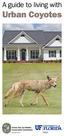 A guide to living with Urban Coyotes Living with coyotes ThinkStock Coyotes are found throughout Florida. This adaptable animal belongs to the dog family and resembles a small German shepherd. In Florida,
Castes in Social Insects
 Castes in Social Insects Module Chemical Ecology, Ayasse Outline Castes in Social Insects 1. definition 2. castes in social insects 3. caste determination A. psychophysiological caste determination B.
FINAL REPORT. Identification of termites causing damage in maize in small-scale farming systems M131/80
 FINAL REPORT Identification of termites causing damage in maize in small-scale farming systems M131/80 Project Manager: Dr MS Mphosi Co-workers: SH Nthangeni, UM du Plessis, AL Rossouw DETAILS PROJECT
The Alfalfa Weevil in Utah
 Page 1 of 5 The Alfalfa Weevil in Utah Fact Sheet No. 58 January 1989 Edward W. Evans Extension Entomologist Introduction The alfalfa weevil is a major pest throughout Utah. It is a beetle with one generation
The H-Map: An Alternative to the Venn Diagram
 The H-Map: An Alternative to the Venn Diagram H Fossil Fuels 1. 2. 3. 4. 5. Both? 1. 2. 3. Solar Power 1. 2. 3. 4. 5. Venn Diagram Fossil Fuels Solar Energy Source: Holt Elements of Literature (2005) Word
Web Mining using Artificial Ant Colonies : A Survey
 Web Mining using Artificial Ant Colonies : A Survey Richa Gupta Department of Computer Science University of Delhi ABSTRACT : Web mining has been very crucial to any organization as it provides useful
PREDATION OF CITRUS RED MITE (PANONYCHUS CITRI) BY STETHORUS SP. AND AGISTEMUS LONGISETUS
 PREDATION OF CITRUS RED MITE (PANONYCHUS CITRI) BY STETHORUS SP. AND AGISTEMUS LONGISETUS The Horticulture and Food Research Institute of New Zealand Limited, Private Bag 92169, Auckland, New Zealand Corresponding
Termites. Identification. Termites are social and can form large nests or colonies, consisting of three (3) major castes (types):
 Termites Termites are small, white, tan or black insects that can cause severe damage to wooden structures. Termites belong to the insect order Isoptera, an ancient insect group that dates back more than
Lora Babilo Orange County Vector Control District
 Lora Babilo Orange County Vector Control District Mosquito Biology Mosquitoes have four life stages: Egg Larva Pupa Adult The duration of the life cycle depends d on the species and environmental conditions
INSECTS CLASSROOM RESOURCES CREATED AND COMPILED BY IPTV K-12 CONNECTIONS
 INSECTS CLASSROOM RESOURCES CREATED AND COMPILED BY IPTV K-12 CONNECTIONS *THE MATERIALS WERE DESIGNED TO ACCOMMODATE A K-6 AUDIENCE PLEASE MODIFY AS APPROPRIATE INSECTS A to Z Work with a partner to complete
Pond Vocabulary Words and Meanings
 Pond Vocabulary Words and Meanings Adapt: to adjust to a use or situation Aquatic: from or in the water Bacteria: tiny organisms, too small to be seen with the naked eye Carnivore: an animal that eats
Insect Respiration. Spider Respiratory Systems
 Respiration In Spiders Robert Gale Breene III College of the Southwest, Carlsbad, New Mexico USA Respiration, loosely the gaseous exchange of O 2 and CO 2 in spiders, is often misunderstood, even by arachnologists.
Host specificity and the probability of discovering species of helminth parasites
 Host specificity and the probability of discovering species of helminth parasites 79 R. POULIN * and D. MOUILLOT Department of Zoology, University of Otago, P.O. Box 6, Dunedin, New Zealand UMR CNRS-UMII
Name That Adaptation. Background: Link to the Plan Read Section 5 (Whooping Crane Ecology and Biology) in the Management Plan
 Summary Students will explore structural, physiological, and behavioral adaptations of whooping cranes. Objectives: Students will be able to: Define an adaptation Describe several whooping crane adaptations
Name Class Date. Adapting to the Environment Adaptations and Survival
 CHAPTER 3 4 SECTIN Adapting to the Environment Adaptations and Survival EFRE YU READ After you read this section, you should be able to answer these questions: What adaptations help animals survive? What
Presents. Superstition in the Pigeon
 www.all-about-psychology.com Presents Superstition in the Pigeon By B. F. Skinner (1948) First Published in Journal of Experimental Psychology, 38, 168-172 To say that a reinforcement is contingent upon
suscon Green One application. 3 years control against grass grub. Grass grub damaged pasture
 suscon Green One application. 3 years control against grass grub. Grass grub damaged pasture suscon Green is a dust free, controlled release granule that controls Grass Grub in newly established pasture
Mendelian Genetics in Drosophila
 Mendelian Genetics in Drosophila Lab objectives: 1) To familiarize you with an important research model organism,! Drosophila melanogaster. 2) Introduce you to normal "wild type" and various mutant phenotypes.
Evolutionary implications of variation in the calling song of the cricket Gryllus bimaculatus De Geer (Orthoptera: Gryllidae)
 Evolutionary implications of variation in the calling song of the cricket Gryllus bimaculatus De Geer (Orthoptera: Gryllidae) By Marna Ferreira Submitted in partial fulfilment of the requirements for the
Introduction to Ecology
 Introduction to Ecology Ecology is the scientific study of the interactions between living organisms and their environment. Scientists who study ecology are called ecologists. Because our planet has many
CABI Bioscience, Silwood Park, Ascot, Berks SL5 7TA, UK and current address: Landcare Research, Private Bag 92-170, Auckland, New Zealand
 Systematic & Applied Acarology, (1999) 4, 63-68 Predation of Amblyseius longispinosus (Acari: Phytoseiidae) on Schizotetranychus nanjingensis (Acari: Tetranychidae), a spider mite injurious to bamboo in
Discover Entomology. Discover Entomology. A Science, a Career, a Lifetime. A Science, a Career, a Lifetime
 Discover Entomology A Science, a Career, a Lifetime Discover Entomology A Science, a Career, a Lifetime What is Entomology? Entomology is the study of insects. Entomologists study bees, ants, beetles,
THE PREDATORY BEHAVIOR OF CYRTOPHORA (ARANEAE : ARANEIDAE ) Yael D. Lubin. Smithsonian Tropical Research Institut e P.O. Box 2072, Balboa, Panam a
 Lubin, Y. D. 1980. The predatory behavior of Cyrtophora (Araneae : Araneidae). J. Arachnol., 8 : 159-185. THE PREDATORY BEHAVIOR OF CYRTOPHORA (ARANEAE : ARANEIDAE ) Yael D. Lubin Smithsonian Tropical
Education. Research Interests. Professional Experience
 Janis J. Reed Graduate Research Assistant Texas A&M University Center for Urban & Structural Entomology Bldg. 1051; 2143 TAMU College Station, TX 77843-2143 Email: [email protected] Phone: 512-970-3904
Insect identification sheet
 information leaflet Insect identification sheet To enable you to identify the insect you have in your home, we have provided some identification sheets. These depict the most common pest species that you
The Fly. Quality Pest Management. Live Cleaner. Live Healthier. Cluster Fly. The weather is warming up and as if from no where the flies appear.
 The Fly The weather is warming up and as if from no where the flies appear. House Fly Flies will pitch and feed on just about anything including faeces to your lunch! They spread disease and are a generally
Epigeic terrestrial invertebrates as indicators of environmental changes on a European scale
 ALARM Field Site Network (FSN) Project of Partner UBern within FSN Epigeic terrestrial invertebrates as indicators of environmental changes on a European scale Ground-dwelling terrestrial arthropods represent
LESSON PLAN: Macro- and Meso-fauna Extraction
 LESSON PLAN: Macro- and Meso-fauna Extraction Introduction: S o i l 4 Y o u t h soilweb.landfood.ubc.ca/youth/ 1 There is a lot of life below our feet a single teaspoon of soil can hold over one billion
Worksheets. (Caterpillars of Singapore s Butterflies) Worksheet Title Recommended level. Adaptations of the caterpillar defence mechanism
 Worksheets (Caterpillars of Singapore s Butterflies) Worksheet Title Recommended level 1 Life cycle of a butterfly P3 2 Am I an insect? P3 3 4 Adaptations of the caterpillar defence mechanism The butterfly
Simple Random Sampling
 Source: Frerichs, R.R. Rapid Surveys (unpublished), 2008. NOT FOR COMMERCIAL DISTRIBUTION 3 Simple Random Sampling 3.1 INTRODUCTION Everyone mentions simple random sampling, but few use this method for
Most of the final work preparing the collection will be done at home once you learn preparation techniques in science lab. WHAT IS AN INSECT?
 INSECT COLLECTING INSTRUCTIONS SEVENTH GRADE SCIENCE INSECT PROJECT The first unit that you will study in science in the fall is entomology. This is a study of insects and includes preparing an insect
EFFECTS OF AUDITORY FEEDBACK ON MULTITAP TEXT INPUT USING STANDARD TELEPHONE KEYPAD
 EFFECTS OF AUDITORY FEEDBACK ON MULTITAP TEXT INPUT USING STANDARD TELEPHONE KEYPAD Sami Ronkainen Nokia Mobile Phones User Centric Technologies Laboratory P.O.Box 50, FIN-90571 Oulu, Finland [email protected]
Crabs. Focus Question
 Topics Crabs, Adaptations Crabs Grades PreK-2 Site Indoors Duration 30 minutes (minimum) Materials Crab Cards Clay or foil Pipe cleaners Egg carton sections, small boxes, jars, lids, food cups, yogurt
The Genetics of Drosophila melanogaster
 The Genetics of Drosophila melanogaster Thomas Hunt Morgan, a geneticist who worked in the early part of the twentieth century, pioneered the use of the common fruit fly as a model organism for genetic
LAB 11 Drosophila Genetics
 LAB 11 Drosophila Genetics Introduction: Drosophila melanogaster, the fruit fly, is an excellent organism for genetics studies because it has simple food requirements, occupies little space, is hardy,
INFORMATION SHEET ON TERMITES & TERMITE MANAGEMENT PROCEDURES
 INFORMATION SHEET ON TERMITES & TERMITE MANAGEMENT PROCEDURES IMPORTANT INFORMATION: The Australian Standard AS 3660.2 Protection of buildings from subterranean termites provides details for minimising
Identifying Aquatic Insects From Your Pond
 Identifying Aquatic Insects From Your Pond Penobscot County Soil & Water Conservation District Natural Resources Conservation Service 28 Gilman Plaza, Suite #2 Bangor, ME 04401 Tel: (207) 990-3676 Fax:
ESL (English as a Second Laguage) Bugs Alive! Pre-visit. On-site. Post-visit
 These materials have been designed to be easily downloaded as PDF files and give adult learners the opportunity to be involved in pre-visit, on-site and post-visit activities about this exhibition. Pre-visit
Bountiful Beetles Lesson Plan
 Bountiful Beetles Lesson Plan Lesson Title: Bountiful Beetles Objectives: Students will identify the life cycle, anatomy and other characteristics of beetles. Students will conduct a simple research using
Lab #10 Invertebrates 2 and Vertebrates 1 (Exercises 39, 40)
 Name Bio 182-General Biology Lab #10 Invertebrates 2 and Vertebrates 1 (Exercises 39, 40) Answer the questions in the space provided. You need to turn this sheet at the end of the lab. In general know
Using Light Sticks to Predict the Effects of Changing Temperature on the Light Emitted by Fireflies
 Name: LUMINESCENCE It s Cool Light! Class: Visual Quantum Mechanics ACTIVITY 8 Using Light Sticks to Predict the Effects of Changing Temperature on the Light Emitted by Fireflies Goal We will investigate
COTTON RESEARCH AND DEVELOPMENT CORPORATION
 '\,. COTTON RESEARCH AND DEVELOPMENT CORPORATION Project title: Assessing the effectiveness of Helicoverpa predators Project Number: UNE13C Research Organisation: University of New England Principal researcher:
STANDARD CLEANING AND CALIBRATION PROCEDURE FOR TGA-50(H) AND TGA-51(H)
 STANDARD CLEANING AND CALIBRATION PROCEDURE FOR TGA-50(H) AND TGA-51(H) by Joseph F. Greenbeck, Jr. And Courtney W. Taylor INTRODUCTION The following procedure is to be used for the maintenance and calibration
CHAPTER 20 COMMUNITY ECOLOGY
 CHAPTER 20 COMMUNITY ECOLOGY MULTIPLE CHOICE 1. The relationship between a predator and its prey is best illustrated by a. a snake eating a bird. c. a lion eating a zebra. b. a fox eating a mouse. d. a
Integrated Pest Management (IPM)
 Integrated Pest Management (IPM) in crops and pastures Integrated Pest Management (IPM) means using a combination of biological, cultural and chemical control methods to manage pest problems. The term
Other forms of ANOVA
 Other forms of ANOVA Pierre Legendre, Université de Montréal August 009 1 - Introduction: different forms of analysis of variance 1. One-way or single classification ANOVA (previous lecture) Equal or unequal
Process 3.5. A Pour it down the sink. B Pour it back into its original container. C Dispose of it as directed by his teacher.
 Process 3.5 Biology EOI sample test questions Objective numbers correspond to the State Priority Academic Student Skills (PASS) standards and objectives. This number is also referenced with the local objective
honey bee By Henry Touray
 honey bee By Henry Touray Introduction For my project I have chosen to research Bees. I chose to find out about the bee because bees have been in the news lately. Lots of hives have died out and scientists
The Basics of Scanning Electron Microscopy
 The Basics of Scanning Electron Microscopy The small scanning electron microscope is easy to use because almost every variable is pre-set: the acceleration voltage is always 15kV, it has only a single
Ants in Telecommunications Equipment
 Ants in Telecommunications Equipment PROBLEM: On a national basis, various species of ants enter pedestals, cabinets, aerial equipment seeking moisture, food source or housing. They are damaging and breaking
The Ultimate Guide to Exterminating Termites
 TAKE ON THOSE TERRIBLE TERMITES! The Ultimate Guide to Exterminating Termites Prepared by: TERMITE TERROR: DESTRUCTION IN A FEW BITES Have you ever wondered why termites are such a problem? Home inspectors
IPM: from Integrated Pest Management to Intelligent Pest Management
 IPM: from Integrated Pest Management to Intelligent Pest Management About the author: Joe Boggs Assistant Professor The Ohio State University Extension and OSU Department of Entomology E-mail: [email protected]
http://www.jstor.org This content downloaded on Tue, 19 Feb 2013 17:28:43 PM All use subject to JSTOR Terms and Conditions
 A Significance Test for Time Series Analysis Author(s): W. Allen Wallis and Geoffrey H. Moore Reviewed work(s): Source: Journal of the American Statistical Association, Vol. 36, No. 215 (Sep., 1941), pp.