
Application of ecological models in entomology: a view from Brazil
|
|
|
- Kathlyn Clark
- 9 years ago
- Views:
Transcription

1 Application of ecological models in entomology: a view from Brazil Wesley A. C. Godoy University of São Paulo "Luiz de Queiroz" College of Agriculture Piracicaba, São Paulo, Brazil - [email protected]
2 Working with ecological models in different places and areas Medical and forensic entomology Agricultural and forest entomology Universidade Estadual Paulista University of São Paulo - ESALQ Luiz de Queiroz College of Agriculture
3 Overview Part I: blowflies as a study model to investigate intra and interspecific interactions Population dynamics: a scenario involving exotic and native blowfly species Population dynamics applied to forensic entomology Intraguild predation Tri-trophic interactions Part II: combining population theory with biological control and integrated pest management (IPM) Ecological basis for modelling pests and natural enemies Concept of economic injury level A preliminary model combining host-parasitoid theory and IPM Inserting spatial dimension into the system Experiments focused on potential natural enemies for mass production
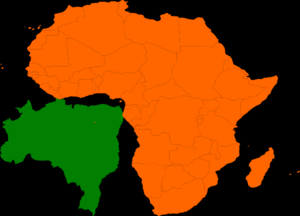
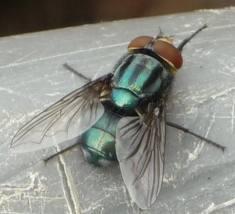
4 Population dynamics: a scenario involving exotic and native blowfly species
5 Importance of blowflies Vector of diseases Larval therapy Myiasis Forensic entomology
6 and finally, as an experimental model to study population dynamics in laboratory
7 Life cycle of blowflies Carrion
8 Modelling biology and ecology of flies N t F( N t ) S( N t ) N t Fecundity Survival Prout & McChesney, 1985
9 Density dependence N t F( N t ) S( N t ) N t F * f N t * s Nt e S e F* S* f s N(t) N(t)
10 Population size Population size Different values for fecundity and survival produce different dynamics Exotic blowfly species Native blowfly species Generations Generations
11 Part I: blowflies as a study model to investigate intra and interspecific interactions Population dynamics: a scenario involving exotic and native blowfly species Population dynamics applied to forensic entomology Intraguild predation Tri-trophic interactions Part II: combining population theory with biological control and integrated pest management (IPM) Ecological basis for modelling pests and natural enemies Concept of economic injury level A preliminary model combining host-parasitoid theory and IPM Inserting spatial dimension into the system Experiments focused on potential natural enemies for mass production
12 Forensic applications
13 How can ecological models provide useful information for forensic sciences? Showing what factors govern diversity and abundance of insects
14 Three important ecological factors: Diversity and abundance of blowflies Interspecific and trophic interactions Psychoactive drugs or medicines and population dynamics of blowflies Diversity and abundance influence strength of interactions demographic parameters depend on resources available and influence dynamic behaviours Influence of drugs on demographic parameters
15 Comparing demographic parameters influenced by drugs with the Prout & McChesney model N 1 t 1 F( Nt ) S( Nt ) N 2 t F S * * e e f N t s N t 1. Amphetamine (stimulant drug) 2. Phenobarbital (anticonvulsant, sedative and hypnotic) 3. Methanol (organic solvent) 4. Oxycodone (analgesic)
16 Table 1. Exponential regression analysis of fecundity and survival for the control, phenobarbital, methanol and amphetamine treatments Control Phenobarbital Methanol Amphetamine F S F S F S F S Y intercepts RC r ANOVA P < 0.001; F = fecundity; S = survival; RC= Regression coefficient
17 Fecundity and survival influenced or not by drugs in C. albiceps Control Phenobarbital Fecundity Survival
18 Fecundity and survival influenced or not by drugs in C. albiceps Methanol Amphetamine Fecundity Survival
19 Table 1. Exponential regression analysis of fecundity and survival for the control, phenobarbital, methanol and amphetamine treatments Control Phenobarbital Methanol Amphetamine F S F S F S F S Without prey Y intercepts RC r ANOVA P < 0.001; F = fecundity; S = survival; RC= Regression coefficient Table 2. Exponential regression analysis of fecundity and survival in oxycodone, phenobarbital, methanol and amphetamine treatments with the addition of C. megacephala prey Oxycodone Methanol Amphetamine With prey F S F S F S Y intercepts RC r ANOVA P < 0.001; F = fecundity; S = survival; RC= Regression coefficient
20 Fecundity and survival influenced or not by prey consumption Without prey With prey Fecundity Survival
21 Table 3. Percentage of predation of C. albiceps on C. megacephala without choice of prey Predation rate on C. megacephala Time Control Phenobarbital Oxycodone Amphetamine Methanol Total
22 Part I: blowflies as a study model to investigate intra and interspecific interactions Population dynamics: a scenario involving exotic and native blowfly species Population dynamics applied to forensic entomology Intraguild predation Tri-trophic interactions Part II: combining population theory with biological control and integrated pest management (IPM) Ecological basis for modelling pests and natural enemies Concept of economic injury level A preliminary model combining host-parasitoid theory and IPM Inserting spatial dimension into the system Experiments focused on potential natural enemies for mass production
23 Intraguild predation Predator Prey

24 Intraguild predation equations

25
26 Satiation intensity
27 Attack intensity
28 Part I: blowflies as a study model to investigate intra and interspecific interactions Population dynamics: a scenario involving exotic and native blowfly species Population dynamics applied to forensic entomology Intraguild predation Tri-trophic interactions Part II: combining population theory with biological control and integrated pest management (IPM) Ecological basis for modelling pests and natural enemies Concept of economic injury level A preliminary model combining host-parasitoid theory and IPM Inserting spatial dimension into the system Experiments focused on potential natural enemies for mass production
29 Tri trophic interactions investigated IGP: Intraguild predation

30 Interactions investigated with experiments IG-prey survival in absence of IG predator IG-prey survival in presence of IG predator IG-predator survival in absence of IG prey IG-predator survival in presence of IG prey IG - Intraguild
31 IG prey alone IG predator alone IG predator and prey IG prey and parasitoid IG predator and parasitoid IG predator, prey and parasitoid
32 Nomenclature for the ecological model n e = time from oviposition to hatching = 1 day n l1 = development time for 1st and 2nd larval instars n l2 = development time for o 3rd Instar n l = n l1 + n l2 = 4 days n p = pupal time = 4 days n a = adult time = 7 days Species: Chrysomya megacephala (PREY): 1 Chrysomya albiceps (PREDATOR): 2 Nasonia vitripennis (PARASITOID): W
33 Functions for the model IGP by L 2 n on L 1 n Cannibalism on L 2n, IGP ( ), cannibalism ( ) and parasitism ( ) f 1 and f 2 with values between 1 and 0.5
34 Parasitism Number of pupae parasitized = Maximum number of pupae parasitized for 1 day
35 Model description Age of fly E, L,P ou A Species Egg Larva Pupa Natural mortality IGP and cannibalism Adult 3rd Instar: beginning of Beginning of simulation 1st day Following day interactons between flies Pupae
36 Parasitism Natural mortality Natural mortality Interactions with parasitoids Surviving pupae reaches adult phase Oviposition by flies New life cycle
37 Parasitoid equation k = cycle length h = sex ratio (eggs) q = eggs per day Natural mortality Days since the beginning of the experiment
38 Density of blowfly species long to generation Prey + 1 parasitoid Prey + 10 parasitoids Initial population Size = 300 Initial population Size = 100 Predator + 1 parasitoid Predator + 10 parasitoids Gray bars = larvae and pupae of blowflies, White bars = dead individuals, Black lines = parasitoids
39 Only IG prey and predator Prey: bars Predator: black line high IGP and low cannibalism high IGP and high cannibalism low IGP and low cannibalism low IGP and high cannibalism
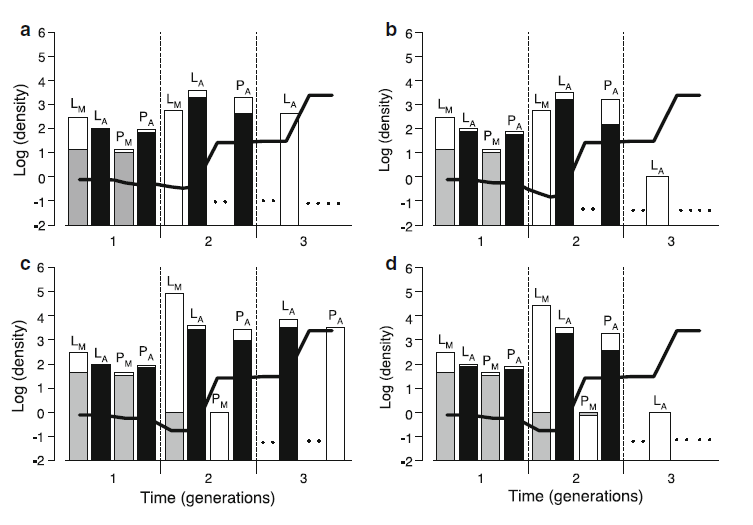
40 Prey Predator IG prey, predator and parasitoids high IGP and low cannibalism high IGP and high cannibalism parasitoid low IGP and low cannibalism low IGP and high cannibalism parasitoid
41 Part I: blowflies as a study model to investigate intra and interspecific interactions Population dynamics: a scenario involving exotic and native blowfly species Population dynamics applied to forensic entomology Intraguild predation Tri-trophic interactions Part II: combining population theory with biological control and integrated pest management (IPM) Ecological basis for modelling pests and natural enemies Concept of economic injury level A preliminary model combining host-parasitoid theory and IPM Inserting spatial dimension into the system Experiments focused on potential natural enemies for mass production
42 Starting from a host parasitoid model with functional response type II densityindependent survival of parasitoid propagules at generation t
43 If N(t+1) < threshold (L) If N(t+1) threshold (L) q1 = reduction of host population by other methods q2 = parasitoid release rate = number of released parasitoids L = economic threshold Tang & Cheke, 2008
44 Introducing integrated pest management (IPM) strategies into the model
45 30 Population dynamics without IPM strategies N,P H P Population dynamics taking into account IPM strategies 25 L = 15 N,P H P Tempo


46 Now including migration by using coupled lattice model Diffusion type I Host Density independent Diffusion type II Host Density dependent H < Economic threshold: white; H Economy threshold: gray; H Injury level: black
47 without IPM and migration with IPM with IPM and migration
48 Part I: blowflies as a study model to investigate intra and interspecific interactions Population dynamics: a scenario involving exotic and native blowfly species Population dynamics applied to forensic entomology Intraguild predation Tri-trophic interactions Part II: combining population theory with biological control and integrated pest management (IPM) Ecological basis for modelling pests and natural enemies Concept of economic injury level A preliminary model combining host-parasitoid theory and IPM Inserting spatial dimension into the system Experiments focused on potential natural enemies for mass production
49 Relationships between pest and potential predators
50 Experiments to compare the best diet for natural enemies

51 Experiments focused on potential natural enemies for mass production M =
52 Population dynamics of Podisus nigrispinus structured in life stages maintained in artificial diet N Life cycle stages
53 Population dynamics of P. nigrispinus structured in life stages maintained in Drosophila melanogaster N Life cycle stages
54 Population dynamics of P. nigrispinus structured in life stages maintained in Chrysomya putoria N Life cycle stages
55 Current projects by graduate students Fennel and cotton with colored fibers intercropping, pest and natural enemies (Master thesis) Trophic interactions between Spodoptera frugiperda (corn caterpillar) and natural enemies (Master thesis) Trophic interactions between soybean bug and their parasitoids (phd thesis) Intraguild predation in Diaphorina citri and their natural enemies: citrus and sorghum intercropping (phd thesis) Population dynamics of forest pest and natural enemies (phd thesis) Trophic interactions between predator stink bugs and crop pests (phd thesis) Functional response and predator prey dynamics in coccinelids and aphids (posdoc)
56 Thank you
PREVALENCE OF INSECT PESTS, PREDATORS, PARASITOIDS AND ITS SURVIVAL IN GENETICALLY ENGINEERED CORN IN PAKISTAN
 PREVALENCE OF INSECT PESTS, PREDATORS, PARASITOIDS AND ITS SURVIVAL IN GENETICALLY ENGINEERED CORN IN PAKISTAN BY DR. HABIB IQBAL JAVED National Agricultural Research Centre Islamabad, Pakistan INTRODUCTION
What is a pest? How Insects Become Pests. How do insects become pests? Problems with Pesticides. What is most commonly used to control insect pests?
 What is a pest? How Insects Become Pests How do insects become pests? Introduction outside of native range Becomes disease vector Plant or animal (inclu. human) disease vector Host shift in native insect
COTTON RESEARCH AND DEVELOPMENT CORPORATION
 '\,. COTTON RESEARCH AND DEVELOPMENT CORPORATION Project title: Assessing the effectiveness of Helicoverpa predators Project Number: UNE13C Research Organisation: University of New England Principal researcher:
Total Course Hours. Semester Degree code. ID Course Name Professor Course Content Summary. 90 1 st 11070
 LEA0170 Invertebrate Zoology I Italo Delalibera Junior Characterization and importance of the Porifera, Cnidaria, Platyhelminthes, Nemata, Mollusca, Annelida, Echinodermata phyla and smaller invertebrate
Introduction to Integrated Pest Management. John C. Wise, Ph.D. Michigan State University MSU Trevor Nichols Research Complex
 Introduction to Integrated Pest Management John C. Wise, Ph.D. Michigan State University MSU Trevor Nichols Research Complex What is Integrated Pest Management? Integrated Pest Management (IPM) New concept;
Introduction to the concepts of IPM
 DEPARTMENT OF PRIMARY INDUSTRY AND FISHERIES Principles of Integrated Pest Management Deanna Chin and Brian Thistleton, Entomology, Diagnostic Services What is a pest? Principles of IPM Introduction to
PEST IDENTIFICATION. PMA 4570/6228 Lab 1 July 3 2014
 PEST IDENTIFICATION PMA 4570/6228 Lab 1 July 3 2014 Steps towards a successful IPM program 1. Correct identification 2. Monitoring 3. Economic thresholds 4. Choice of optimum pest control option Pests
HOW TO ASSESS NON-TARGET EFFECTS OF POLYPHAGOUS BIOLOGICAL CONTROL AGENTS: TRICHOGRAMMA BRASSICAE AS A CASE STUDY
 Assessing Non-Target Effects of Polyphagous Biological Control Agents HOW TO ASSESS NON-TARGET EFFECTS OF POLYPHAGOUS BIOLOGICAL CONTROL AGENTS: TRICHOGRAMMA BRASSICAE AS A CASE STUDY Dirk BABENDREIER
PREDATION OF CITRUS RED MITE (PANONYCHUS CITRI) BY STETHORUS SP. AND AGISTEMUS LONGISETUS
 PREDATION OF CITRUS RED MITE (PANONYCHUS CITRI) BY STETHORUS SP. AND AGISTEMUS LONGISETUS The Horticulture and Food Research Institute of New Zealand Limited, Private Bag 92169, Auckland, New Zealand Corresponding
CURRICULUM VITAE : AHMED HUSSEIN EL-HENEIDY
 CURRICULUM VITAE NAME : AHMED HUSSEIN EL-HENEIDY DATE OF BIRTH : 25 APRIL 1946 CITIZENSHIP : EGYPTIAN COUNTRY OF RESIDENCE: EGYPT ADDRESS : P. O. Box # 915, P. Code 11728, MAADI, CAIRO, EGYPT E-mail Address:
Integrated Pest Management
 Integrated Pest Management Ecology and Human Impact R. Bruce Chapman Insect Science Ltd Pest organisms When do organisms become pests? When an organism s population exceeds a threshold level, and control
Upscaling of locally proven IPM technologies for control of pest of economic importance i
 Technology Fact Sheet for Adaptation Upscaling of locally proven IPM technologies for control of pest of economic importance i Technology: Upscaling of locally proven IPM technologies for control of pest
Using Degree-Day Tools To Improve Pest Management: Dont get caught off-guard!
 Using Degree-Day Tools To Improve Pest Management: Dont get caught off-guard! Len Coop, IPPC, OSU Corvallis Jan 25, 2012 You fell asleep, didn't you? Topics for today's session: Degree-day/phenology concepts
The Alfalfa Weevil in Utah
 Page 1 of 5 The Alfalfa Weevil in Utah Fact Sheet No. 58 January 1989 Edward W. Evans Extension Entomologist Introduction The alfalfa weevil is a major pest throughout Utah. It is a beetle with one generation
Insect Pests of Pecan. Will Hudson Extension Entomologist
 Insect Pests of Pecan Will Hudson Extension Entomologist How important is nut drop to production? Pecan trees typically lose 75% of the pecans between nut set and shell hardening even when protected from
1211PSS 232 Biological Control Tu Th 11:30-12:45 Aiken 112
 1211PSS 232 Biological Control Tu Th 11:30-12:45 Aiken 112 Instructor: Dr. Yolanda Chen Office: Jeffords 209 Office Hours: W 11:00-12:30, or by appointment Email: [email protected] Phone: (802) 656-2627
The use of gamma radiation to control two serious pests of Brazilian agriculture
 XA21544 The use of gamma radiation to control two serious pests of Brazilian agriculture V. Arthur a, F.M. Wiendl b, T.A. Wiendl, c J.A.D. Aguilar* a Nuclear Energy Center for Agriculture CENA/ USP Piracicaba,
Integrated Pest Management: Principles & Practice. Dr. Ana Legrand Connecticut IPM Program University of Connecticut
 Integrated Pest Management: Principles & Practice Dr. Ana Legrand Connecticut IPM Program University of Connecticut Integrated Pest Management IPM is the selection, integration and implementation of pest
Pest Management - Holistic Pest Control?
 Pest Management - Holistic Pest Control? 2. Modern control tactics and the birth of IPM The action of parasites, predators, and pathogens in maintaining another organism s density at a lower average than
INTEGRATED PEST MANAGEMENT OF INSECTS IN URBAN GREEN SPACES
 INTEGRATED PEST MANAGEMENT OF INSECTS IN URBAN GREEN SPACES M Glavendekić University of Belgrade, Faculty of Forestry, Department of Landscape Architecture and Horticulture, Belgrade, Serbia, email: [email protected]
Integrated Pest Management
 Integrated Pest Management Science and Language Arts Brief Description: This lesson will focus all of the information the students have learned about pests in the other insect lessons in a decision-making
fo r en sic ento m o lo gy
 Teacher background information Forensic entomology combines the study of insects and other arthropods with the science of criminal investigations. When a crime is committed insects can accumulate on and
POPULATION DYNAMICS. Zoo 511 Ecology of Fishes
 POPULATION DYNAMICS Zoo 511 Ecology of Fishes Today s goals Understand why and how population dynamics are important in fisheries ecology Gain experience in a variety of mark-recapture methods What are
Discover Entomology. Discover Entomology. A Science, a Career, a Lifetime. A Science, a Career, a Lifetime
 Discover Entomology A Science, a Career, a Lifetime Discover Entomology A Science, a Career, a Lifetime What is Entomology? Entomology is the study of insects. Entomologists study bees, ants, beetles,
Unit 4 Lesson 1: A Pest by Any Other Name
 Focus Areas: Pest Control: Biological; Environmental Science, Language Arts Focus Skills: critical thinking, conducting research, observing, graphing, interpreting data Objectives To explore human attitudes
On-Farm Habitat To Provid Multiple Ecosystem Service. Seminar Outline:
 CEFS SOSA 2011 Workshop: On-Farm Habitat To Provid Multiple Ecosystem Service David Orr, Charlie Plush, Aaron Fox Photo by Charlie Plush Seminar Outline: -Introduction -Agriculture and Ecology -Natural
Insects in the Classroom Lesson Plan No. 101
 University of Kentucky Entomology Insects in the Classroom Lesson Plan No. 101 Flour Beetles Prepared by Caroline Stetter Neel Extension Specialist Activity Description Hands-on Discovery Lab Age Group:
#1: Threshold and Injury Calculations the Theory. #2: Putting Economic Injury Levels and Action Thresholds to Use. Related Topics
 Module #4 What is a Threshold? p. 1 www.nysaes.cornell.edu/ipmnet/ne.ipm.region What is a Threshold? By James VanKirk Overview Concept Activity Handouts The Economic Injury Level and the Action Threshold
Attracting Beneficial Insects with Native Flowering Plants
 Extension Bulletin E-2973 New January 2007 Attracting Beneficial Insects with Native Flowering Plants Anna Fiedler, Julianna Tuell, Rufus Isaacs, and Doug Landis Department of Entomology, Michigan State
Genetically modified crops in Integrated Pest Management
 Federal Department of Economic Affairs, Education and Research EAER Agroscope Genetically modified crops in Integrated Pest Management Franz Bigler, Michael Meissle and Jörg Romeis Agroscope ART Zürich,
Entomology 101 Integrated Pest Management IPM. Terminology Related to Pests. Types of damage. Strategies of Pest Control or Management
 Entomology 101 Integrated Pest Management IPM David J. Shetlar, Ph.D. The BugDoc The Ohio State University, OARDC & OSU Extension Columbus, OH November, 2009, D.J. Shetlar, all rights reserved The evolution
John Herbert 122 S. Entomology Drive Tifton, GA 31793 Phone: (229) 386-3228 Fax: (229) 386-3086 Email: [email protected]
 John Herbert 122 S. Entomology Drive Tifton, GA 31793 Phone: (229) 386-3228 Fax: (229) 386-3086 Email: [email protected] Education Ph.D. Entomology, University of Florida 2009 Concentration: Biological
BIOLOGICAL CONTROL OF INSECT PESTS IN WHEAT
 BIOLOGICAL CONTROL OF INSECT PESTS IN WHEAT Allen Knutson, Extension entomologist; Emory P. Boring, III Extension entomologist; G. J. Michels Jr. Associate professor of Entomology, Texas AgriLife Extension
ECONOMIC INJURY LEVEL (EIL) AND ECONOMIC THRESHOLD (ET) CONCEPTS IN PEST MANAGEMENT. David G. Riley University of Georgia Tifton, Georgia, USA
 ECONOMIC INJURY LEVEL (EIL) AND ECONOMIC THRESHOLD (ET) CONCEPTS IN PEST MANAGEMENT David G. Riley University of Georgia Tifton, Georgia, USA One of the fundamental concepts of integrated pest management
Some Parasitoids of Lepidopterous Stem Borer Pests on Maize in Southern Ghana
 Bulletin of Environment, Pharmacology and Life Sciences Original Article Online ISSN 2277 188 Bull. Environ. Pharmacol. Life Sci.; Volume 1 [6] May 212: 77-83 All Rights Reserved Academy for Environment
The need for longitudinal study of the dual roles of insects as pests and food resources in agroecosystems
 THE H. R. MacCARTHY LECTURE COMMITTEE IS PLEASED TO PRESENT THE 15 TH ANNUAL H. R. MacCARTHY PEST MANAGEMENT LECTURE ENTITLED The need for longitudinal study of the dual roles of insects as pests and food
Mendelian Genetics in Drosophila
 Mendelian Genetics in Drosophila Lab objectives: 1) To familiarize you with an important research model organism,! Drosophila melanogaster. 2) Introduce you to normal "wild type" and various mutant phenotypes.
Case Study. Vetiver Grass as Component of Integrated Pest Management Systems
 Case Study Vetiver Grass as Component of Integrated Pest Management Systems Johnnie van den Berg School of Environmental Sciences and Development, North-West University, Private Bag X6001, Potchefstroom,
Aggrawal s Internet Journal of Forensic Medicine and Toxicology 5(1) (2004) 40 44. Erratum
 Aggrawal s Internet Journal of Forensic Medicine and Toxicology 5(1) (2004) 40 44 Erratum Application of Forensic Entomology to estimate of the postmortem interval (PMI) in homicide investigations by the
Biological Control. Biological Control. Biological Control. Biological Control
 Presentation Overview How To Use Biological Controls Effectively Raymond Cloyd Agents Basics of How To Successfully Use Summary Will Agents Eat Each Other? Yes!! Program For Western Flower Thrips Intra-Guild
Determining the effect of stemborers on yields of cereal crops, principally maize and sorghum
 Integrated Systems for the Humid Tropics (Humidtropics) Determining the effect of stemborers on yields of cereal crops, principally maize and sorghum International Centre of Insect Physiology and Ecology
Chemical versus Biological Control of Sugarcane. By Abid Hussain Matiari Sugar Mills Ltd.
 Chemical versus Biological Control of Sugarcane By Abid Hussain Matiari Sugar Mills Ltd. Sugarcane It is an important cash crop, Pakistan is the fifth largest cane producing country. However, its yield
INTEGRATED PEST MANAGEMENT
 C 1 H A P TE R INTEGRATED PEST MANAGEMENT LEARNING OBJECTIVES After completely studying this chapter, you should: Be able to define integrated pest management. Understand the importance of an economic
DISSABS. Subject Coverage. File Type. Features Alerts (SDIs) Monthly. Record Content. File Size More than 2.8 million records (2/2016) Coverage
 Subject Coverage File Type All subject areas are covered, including: Agriculture and Food Science Bioscience and Biotechnology Business Chemistry Education Electronics and Telecommunications Engineering
Don t Bug Me An Integrated Pest management Activity by
 http://www.life.umd.edu/grad/mlfsc/ Don t Bug Me An Integrated Pest management Activity by Suzanne Avtges Jessica Matthews John Gorrell Kim Vogt Don t Bug Me - A Teaching Unit on Integrated Pest Management
Karen J. English Graphic and Web Designer. Please click the thumbnails on the following pages to view larger versions of the images.
 Karen J. English Graphic and Web Designer Please click the thumbnails on the following pages to view larger versions of the images. graphic design: small pieces graphic design: large pieces web design
Revista de Biología Tropical ISSN 0034-7744 versión impresa
 Page 1 of 5 Revista de Biología Tropical ISSN 0034-7744 versión impresa Rev. biol. trop v.46 n.4 San José dic. 1998 Como citar este artículo Interspecific competition between Metagonystilum minense (Diptera:
Fungal Entomopathogens: An Enigmatic Pest Control Alternative
 Fungal Entomopathogens: An Enigmatic Pest Control Alternative Nicole Rusconi $ and Cerruti R 2 Hooks! $ Student Research Assistant and 1 Associate Professor and Extension Specialist, University of Maryland
IPM: from Integrated Pest Management to Intelligent Pest Management
 IPM: from Integrated Pest Management to Intelligent Pest Management About the author: Joe Boggs Assistant Professor The Ohio State University Extension and OSU Department of Entomology E-mail: [email protected]
BENEFITS OF USING IPM
 Edward J. Bechinski and William H. Bohl Potato growers who use IPM consider all available pest control tools. Alternatives to conventional pesticides are the foundation of every IPM plan. Pesticides play
AP ENVIRONMENTAL SCIENCE 2012 SCORING GUIDELINES
 AP ENVIRONMENTAL SCIENCE 2012 SCORING GUIDELINES Question 3 The active ingredients in many pesticides are chemical compounds that kill organisms such as insects, molds, and weeds. Proponents claim that
INSECT MANAGEMENT (Roberts & McPherson)
 INSECT MANAGEMENT (Roberts & McPherson) A number of insect pests are capable of severely damaging soybeans. However, it is important to realize that soybeans can withstand considerable insect damage at
CABI Bioscience, Silwood Park, Ascot, Berks SL5 7TA, UK and current address: Landcare Research, Private Bag 92-170, Auckland, New Zealand
 Systematic & Applied Acarology, (1999) 4, 63-68 Predation of Amblyseius longispinosus (Acari: Phytoseiidae) on Schizotetranychus nanjingensis (Acari: Tetranychidae), a spider mite injurious to bamboo in
What is Integrated Pest Management?
 SLIDE 1: This is Steve Johnson, University of Maine Cooperative Extension, bringing you information on Integrated Pest Management. It is possible to receive a Maine Board of Pesticides Control recertification
Class Insecta - The insects
 A Introduction 1. Very species rich 2. Characteristics a. 3 pairs of legs b. 2 pairs of wings (most) except flies (1 pair of wings - Diptera) B. Distribution 1. All habitats except saltwater - replaced
FIELD RECOGNITION OF THE LARVAE OF NATIVE COCCINELLIDAE, COMMON TO THE POTATO FIELDS OF AROOSTOOK COUNTY
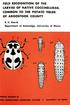 FIELD RECOGNITION OF THE LARVAE OF NATIVE COCCINELLIDAE, COMMON TO THE POTATO FIELDS OF AROOSTOOK COUNTY R. H. Storch Department of Entomolgy, University of Maine TECHNICAL BULLETIN 43 MAINE AGRICULTURAL
This lesson is part of a larger, comprehensive school garden guide called Minnesota School Gardens: A Guide to Gardening and Plant Science developed
 This lesson is part of a larger, comprehensive school garden guide called Minnesota School Gardens: A Guide to Gardening and Plant Science developed by Minnesota Agriculture in the Classroom in 2013. The
NATURE AND SCOPE OF BIOLOGICAL CONTROL
 Biological Control of Pests, ENTO 675, UH-Manoa, Fall 2000, M. W. Johnson 1 NATURE AND SCOPE OF BIOLOGICAL CONTROL I. DEFINITIONS A. H. S. Smith (1919) first used term "biological control" to signify the
PEST MANAGEMENT (CSP Enhancements) January 2006 Enhancement Activity Task Sheet
 Reduced risks to ground and surface water quality Lower costs by limiting chemical applications to only when necessary To learn more about Integrated Pest Management go to the following website: http://extension.usu.edu/files/gardpubs/ipm01.pdf
Monarch Butterflies: Beautiful But Poisonous by Kelly Hashway
 by Kelly Hashway If you ve ever seen a monarch butterfly, then you ve probably noticed their bright orange and black colors. It makes them easy to see in the sky. You may think this would put the Monarch
INTEGRATED PEST CONTROL
 19 TOPIC 3 INTEGRATED PEST CONTROL Scope Chemical pesticides are now the traditional solution to pest problems, and they have saved lives and crops. Their use, however, has created significant problems,
BIOS 3010: Ecology Lecture 16: Manipulating abundance: 2. Manipulating abundance: 3. Pest and weed control:
 BIOS 3010: Ecology Lecture 16: Manipulating abundance: Lecture summary: Manipulating abundance: Pest control. Pesticides:» Benefits.» Problems. Biological control. Cultural control. Integrated pest management.
12. INSECT PEST AND DISEASE MANAGEMENT
 12. INSECT PEST AND DISEASE MANAGEMENT Conservation farming promotes a diversity of insect life, influences pest populations and also favours many beneficial insects. The beneficial insects which act as
Outline. What is IPM Principles of IPM Methods of Pest Management Economic Principles The Place of Pesticides in IPM
 Improving Control Systems in Thailand for Plant and Plants Products Intended for Export to the European Union co-funded by the European Union and Thai Department of Agriculture Preharvest Use of Pesticides
Resources: Arthropod Pest Management
 8a. Arthropod Pest Management Resources 1 Resources: Arthropod Pest Management Suggested Readings for Students (see Print Resources for annotations and URLs) Benbrook, Charles M. 1996. Chapter 7: Bio-intensive
Control of Insect Pests in Eucalypt Plantations
 Control of Insect Pests in Eucalypt Plantations Number 30 Revised February 2007 By Charlma Phillips, Principal Forest Health Scientist Eucalypts are native to Australia and have evolved in association
Biology of External Parasites of Dairy Goats 1
 ENY-273 Biology of External Parasites of Dairy Goats 1 P. G. Koehler and J. F. Butler 2 Arthropod pests limit production in the dairy goat industry in many ways. External parasites feed on body tissue
Wooly Whiteflies (Aleurothrixus floccosus)
 Cooperative Extension Wooly Whiteflies (Aleurothrixus floccosus) The University of Arizona $ College of Agriculture $ Tucson, Arizona 85721 (part of the publication Citrus Arthropod Pest Management in
USING HABITAT MANAGEMENT TO IMPROVE BIOLOGICAL CONTROL ON COMMERCIAL ORGANIC FARMS IN CALIFORNIA
 USING HITT MNGEMENT TO IMPROVE IOLOGICL CONTROL ON COMMERCIL ORGNIC FRMS IN CLIFORNI Ramy Colfer, Mission Organics, Salinas, C 939, U.S.. INTRODUCTION Mission Organics grows organic vegetables on over
Managing Insect Pests
 13 Managing Insect Pests Kevin Steffey Department of Crop Sciences [email protected] Mike Gray Department of Crop Sciences [email protected] Technically, an insect pest of crops is any species that
Grasshopper and Bean Leaf Beetle
 FS 905 Economic Thresholds in Soybeans Grasshopper and Bean Leaf Beetle Michael A. Catangui, Ph.D. Extension entomologist & assistant professor Plant Science Department South Dakota State University Economic
Biological Control for Insect Management in Strawberries 1
 HS923 Biological Control for Insect Management in Strawberries 1 Silvia I. Rondon, Daniel J. Cantliffe, and James F. Price 2 The strawberry, Fragaria ananassa Duch., is an intensively cultivated high value
Integrated Pest Management (IPM)
 Integrated Pest Management (IPM) in crops and pastures Integrated Pest Management (IPM) means using a combination of biological, cultural and chemical control methods to manage pest problems. The term
SECTION 1 : INTRODUCTORY. Chapter 1 Introduction. Pest status and economic damage
 SECTION 1 : INTRODUCTORY Chapter 1 Introduction Cotton production systems The cotton pest situation Cotton bollworm (Helicoverpa armigera) Pest status and economic damage COTTON BOLLWORM CONTROL species,
Recommended Resources: The following resources may be useful in teaching
 Unit D: Controlling Pests and Diseases in the Orchard Lesson 1: Managing and Controlling Pests of Fruit and Nut Crops Student Learning Objectives: Instruction in this lesson should result in students achieving
Integrated pest management for mango orchards using green ants as a major component
 Integrated pest management for mango orchards using green ants as a major component A manual for conventional and organic mango growers in Australia Renkang Peng and Keith Christian School of Science and
The Soil Food Web and Pest Management
 The Soil Food Web and Pest Management Mary Barbercheck, Department of Entomology, 501 ASI Building, Penn State University, University Park, PA, 16802 Tel. (814)863-2982 [email protected] New England Vegetable
KNOWLEDGE EXPECTATIONS FOR PEST CONTROL ADVISORS: INTEGRATED PEST MANAGEMENT I. ECOLOGICAL PRINCIPLES AS THEY RELATE TO PEST MANAGEMENT
 KNOWLEDGE EXPECTATIONS FOR PEST CONTROL ADVISORS: INTEGRATED PEST MANAGEMENT I. ECOLOGICAL PRINCIPLES AS THEY RELATE TO PEST MANAGEMENT A. Levels Of Ecological Organization natural selection; ecological
Worksheets. (Caterpillars of Singapore s Butterflies) Worksheet Title Recommended level. Adaptations of the caterpillar defence mechanism
 Worksheets (Caterpillars of Singapore s Butterflies) Worksheet Title Recommended level 1 Life cycle of a butterfly P3 2 Am I an insect? P3 3 4 Adaptations of the caterpillar defence mechanism The butterfly
Examples of Math Applications in Forensic Investigations Anthony and Patricia Nolan Bertino Bertino Forensics
 Examples of Math Applications in Forensic Investigations Anthony and Patricia Nolan Bertino Bertino Forensics One of the many benefits of teaching forensics to high school students is that they walk through
Population Ecology. Life History Traits as Evolutionary Adaptations
 Population Ecology An Overview of Population Ecology Population ecology is the study of factors that affect population: Density Growth A population is a group of individuals of a single species that occupy
Formulation of bio-pesticides and mass culture of natural enemies for pest management. D. Ahangama
 Formulation of bio-pesticides and mass culture of natural enemies for pest management D. Ahangama Bio-pesticides Microbial pesticides Fungi, Bacteria, Viruses, Protozoa, Nematodes Biochemical Substances
PEST DISTRIBUTION PROFILE
 PEST DISTRIBUTION PROFILE Chilo partellus Authors W.D. Hutchison Professor, Department of Entomology, University of Minnesota, St. Paul, MN 55108 R.C. Venette Research Biologist, Northern Research Station,
MATERIAL AND METHODS Plant and animal material Experimental design Data analysis RESULTS Behaviour of C. septempuncta 476
 et al., 1981a,c) and predators were free to leave a host plant at any time. The interactions between predator and prey were quantified and the fate of the aphids in the colony was noted. MATERIAL AND METHODS
LAB 11 Drosophila Genetics
 LAB 11 Drosophila Genetics Introduction: Drosophila melanogaster, the fruit fly, is an excellent organism for genetics studies because it has simple food requirements, occupies little space, is hardy,
Pest Management for Organic Agriculture
 Pest Management for Organic Agriculture A report for the Rural Industries Research and Development Corporation by Paul A Horne November 2007 RIRDC Publication No 07/191 RIRDC Project No IPM-1A 2007 Rural